/


Автор: Finkel C.
Теги: history islam history of the ottoman empire history of turkey
ISBN: 978-0-465-02396-7
Год: 2005

Текст
                    HISTORY

OSMAN’S DREAM

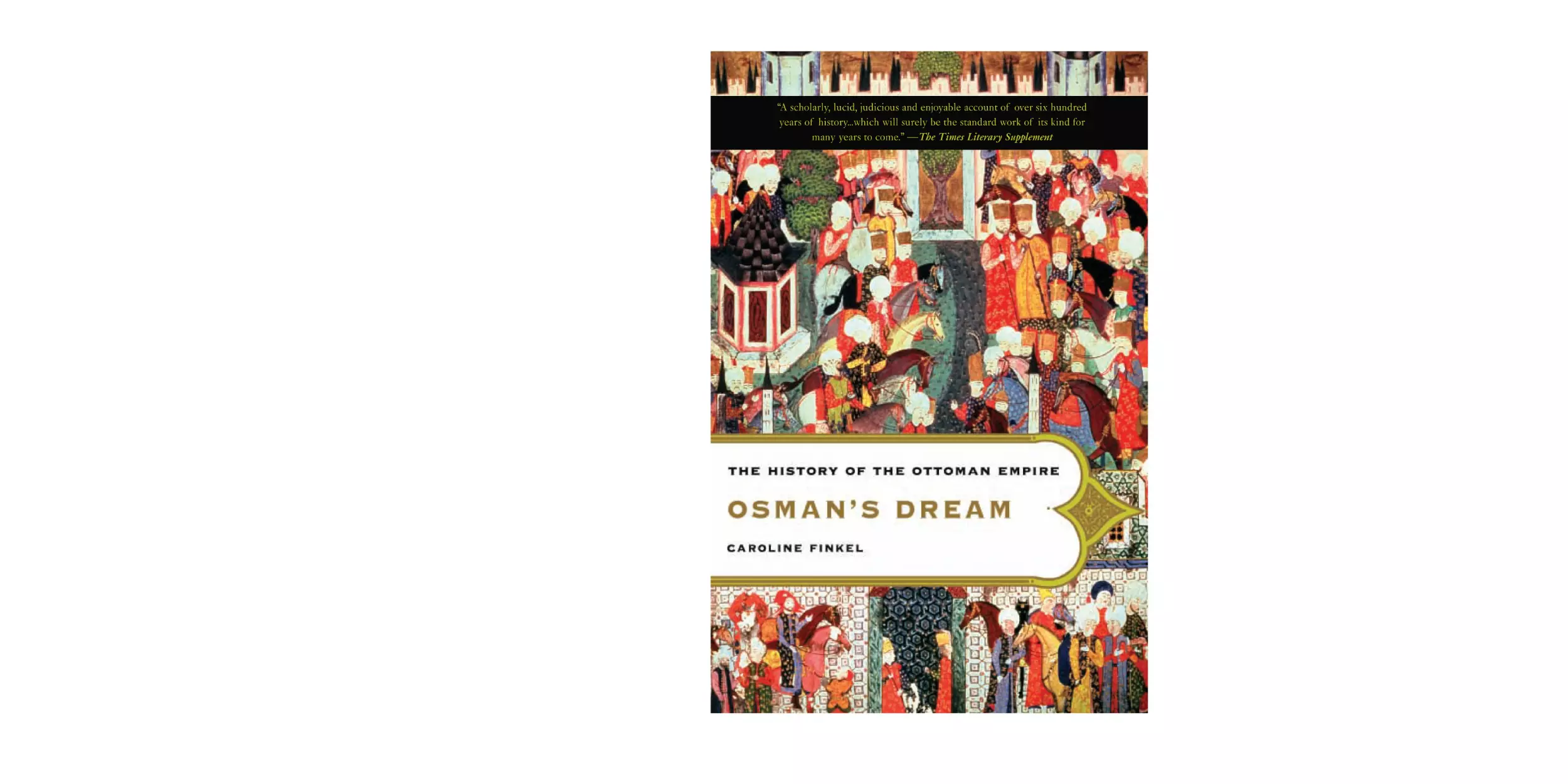
“A scholarly, lucid, judicious and enjoyable account of over six hundred
years of history...which will surely be the standard work of its kind for
many years to come.” —The Times Literary Supplement

The Ottoman Empire was one of the largest and most influential
empires in world history. Its reach extended to three continents and it
survived for more than six centuries, but its history is too often colored
by the memory of its bloody final throes on the battlefields of World
War I. In this magisterial work—the first definitive account written for
the general reader—renowned scholar Caroline Finkel lucidly recounts
the epic story of the Ottoman Empire from its origins in the thirteenth
century through its destruction in the twentieth.
“[Finkel’s] mastery of the historical literature is obvious: The sheer
amount of information packed between these two covers makes it
a landmark achievement.”
—New York Sun
“Caroline Finkel effortlessly conveys the high drama of Ottoman
history.”
—Orhan Pamuk
“Splendidly written...the most authoritative narrative history of the
empire yet published.”
—Jason Goodwin, Literary Review (UK)

C AROLINE F INKEL has lived in Istanbul for many years and traveled
widely in Turkey and the former Ottoman lands. She has a doctorate
in Ottoman history from the School of Oriental and African Studies
at the University of London; Osman’s Dream is her third book. She
currently divides her time between Istanbul and London.

Cover design by PracherDesigns; Cover painting: Enthronement of Suleyman the
Magnificent (1494–1566) from the ‘Suleymanname’ by Arifi, 1558 (gouache on paper)
by Turkish School (16th century), Topkapi Palace Museum, Istanbul, Turkey,
Bridgeman Art Library, Dost Yayinlari, Giraudon
$18.95 US
ISBN-13: 978-0-465-02397-4
ISBN-10: 0-465-02397-5

A Member of the Perseus Books Group
www.basicbooks.com

4/c process;
matte polypropylene

Praise for Osman’s Dream
“[Finkel’s] mastery of the historical literature is obvious: The sheer
amount of information packed between these two covers makes it a
landmark achievement.”
—New York Sun
“With this superb book, Finkel boldly covers new ground in striving to
show the Ottoman Empire from within. . . . Having spent 15 years living
in Turkey, Finkel is uniquely positioned to overcome the practical hurdles
to Ottoman research, but her real strength is in historiography: she has a
keen ability to extract salient observations from her sources even as she
renders their political motives transparent.The result is a panorama of the
Ottoman Empire to rival the best portraits of the Romanovs and Habsburgs, and a must-have for history collections.” —Booklist (starred review)
“Possibly the first book in English on the entire history of the Ottoman
Empire for general readers. In [Finkel’s] well-written narrative, she breaks
with Western scholarship by not treating the empire as the stereotypical
‘Sick Man of Europe,’ preferring to let the extensive Turkish sources tell a
story of an enormous, complex, multiethnic state.”
—Library Journal
“Readable survey on one of the world’s great empires. . . . Finkel’s text is
a satisfying blend of narrative history, anecdote and character study. . . .
The more we know about the Ottomans, the more easily comprehensible
the subsequent history of the region they ruled becomes. Finkel’s study
makes a useful contribution.”
—Kirkus Reviews
“Finkel’s striking innovation is to turn a mirror on the Ottomans and
examine how they saw themselves and their empire. . . . A refreshingly
original perspective . . . this history makes a riveting and enjoyable read
for all audiences.”
—Publishers Weekly
“A magnificent new historical panorama. . . . For perhaps the first time in
English, a genuine Ottoman scholar has written a clear narrative account
of the great empire based mainly on Turkish rather than hostile western
accounts. The result is not only a revelation; it is a vital corrective to the
influential but partial and wrong-headed readings of the flagbearers of
intellectual Islamophobia, such as V. S. Naipaul, Bernard Lewis and Samuel
Huntingdon, all of whom continue to manufacture entirely negative
images of one of the most varied empires of history . . . ”
—William Dalrymple, The Scotsman

“Osman’s Dream is a deeply sympathetic, compelling and highly readable
account of the rise and fall of an immensely complex and dynamic society
which, at its height was the most the most far-reaching and the most
powerful Empire the world had ever seen. But it is also something more.
For Caroline Finkel has not only told the history of how a band of Turcoman warriors from eastern Anatolia came to dominate so much of the
world. She has also shown why that history matters, why today we are in
no position to understand, not merely the modern Republic of Turkey
but also modern Islam unless we also understand the past, and the present
perception, of the greatest and most enduring of the Islamic states.”
—Anthony Pagden, Distinguished Professor of
History and Political Science, UCLA
“How timely to have such a lucid, well-researched, and fair-minded
history of the Ottoman Empire—and one too which treats it not as
some exotic and alien world, but as part of our common past.”
—Margaret MacMillan, author of Paris 1919
“Osman’s Dream is a treasure for anyone who wants to know exactly
what happened when in the Ottoman Empire. Here at last is a reliable
history that takes into full account not only the work of international and
Turkish historians but also the writings of the Ottomans themselves.”
—Hugh Pope, author of Sons of the Conquerors:
The Rise of the Turkic World
“Finkel has brilliantly woven together a highly readable survey of 600
years of Ottoman history. Well researched and beautifully written,
Osman’s Dream will be essential reading for anyone who wants to know
more about the Empire that ruled for centuries over so many of our
contemporary trouble spots—from the Balkans to the Arab world.”
—Heath W. Lowry,Ataturk Professor of Ottoman &
Modern Turkish Studies, Princeton University
“The Ottoman Empire has been in the spotlight of late, and the subject of
a fair few studies—some of high quality—which makes the freshness of
Finkel’s history the more striking. The secret, apart from an irresistible
narrative style, is a generous openness to every aspect of Ottoman life and
culture, and a willingness to address Ottoman problems on their terms.
What has often come across as an impossibly exotic procession of Viziers,
Beys and Pashas is here brought vividly home to the general reader.”
—The Scotsman

CHAPTER TITLE

Osman’s Dream
The Story of the Ottoman Empire 1300–1923

CAROLINE FINKEL

A Member of the Perseus Books Group
New York

iii

OSMAN’S DREAM

Copyright © 2005 by Caroline Finkel
Published in hardcover in the United States in 2006 by Basic Books,
A Member of the Perseus Books Group
Published in paperback in 2007 by Basic Books
First published in the United Kingdom in 2005 by
John Murray Publishers, a division of Hodder Headline
‘Istanbul (Not Constantinople)’
Words and Music by Jimmy Kennedy and Nat Simon
© 1953 (Renewed) Chappell & Co.
All rights reserved. Used by permission.
All rights reserved. Printed in the United States of America. No part of
this book may be reproduced in any manner whatsoever without written
permission except in the case of brief quotations embodied in critical
articles and reviews. For information, address Basic Books,
387 Park Avenue South, New York, NY 10016-8810.
Books published by Basic Books are available at special discounts for
bulk purchases in the United States by corporations, institutions, and
other organizations. For more information, please contact the Special
Markets Department at the Perseus Books Group, 11 Cambridge Center,
Cambridge MA 02142, or call (617) 252-5298 or (800) 255-1514,
or e-mail special.markets@perseusbooks.com.
A CIP catalog record for this book is available
from the Library of Congress.
HC: ISBN 13 978-0-465-02396-7 ; ISBN 0-465-02396-7
British ISBN 0-7195-5513-2
PBK: ISBN 13 978-0-465-02397-4 ; ISBN 0-465-02397-5
10 9 8 7 6 5 4 3 2 1

iv

CHAPTER TITLE

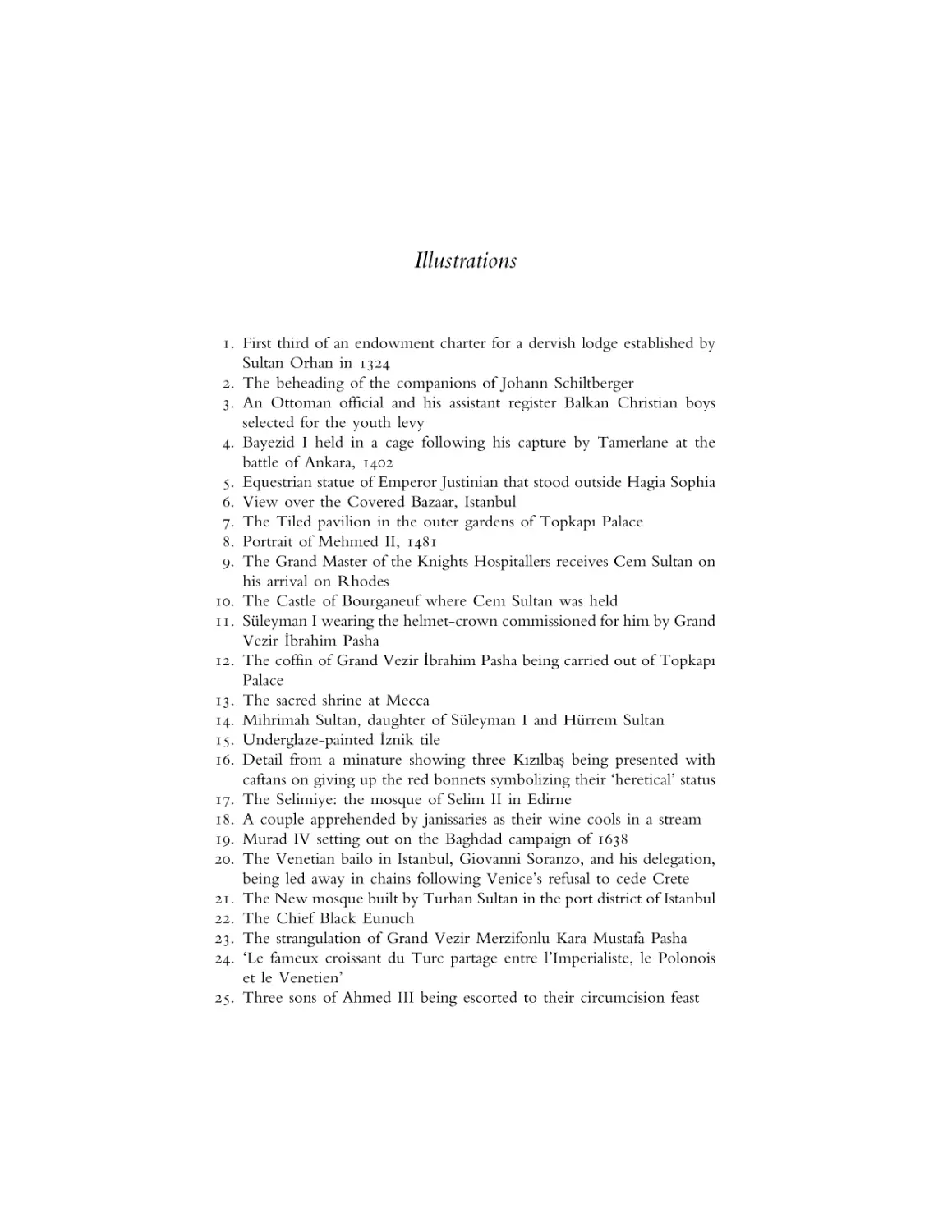
Contents

Illustrations
Acknowledgements
Preface
A note on spelling, names, maps and quotations
A guide to Ottoman titles
Maps
1.
2.
3.
4.
5.
6.
7.
8.
9.
10.
11.
12.
13.
14.
15.
16.

First among equals
A dynasty divided
An imperial vision
Sultan of the faithful
Possessor of the kingdoms of the world
The sedentary sultan
Government by faction
Revenge of the pashas
Rule of the grandees
The empire unravels
The perils of insouciance
The power of the provinces
From the ‘New Order’ to the ‘Re-ordering’
A crisis of identity
The Islamic empire
The storm before the calm

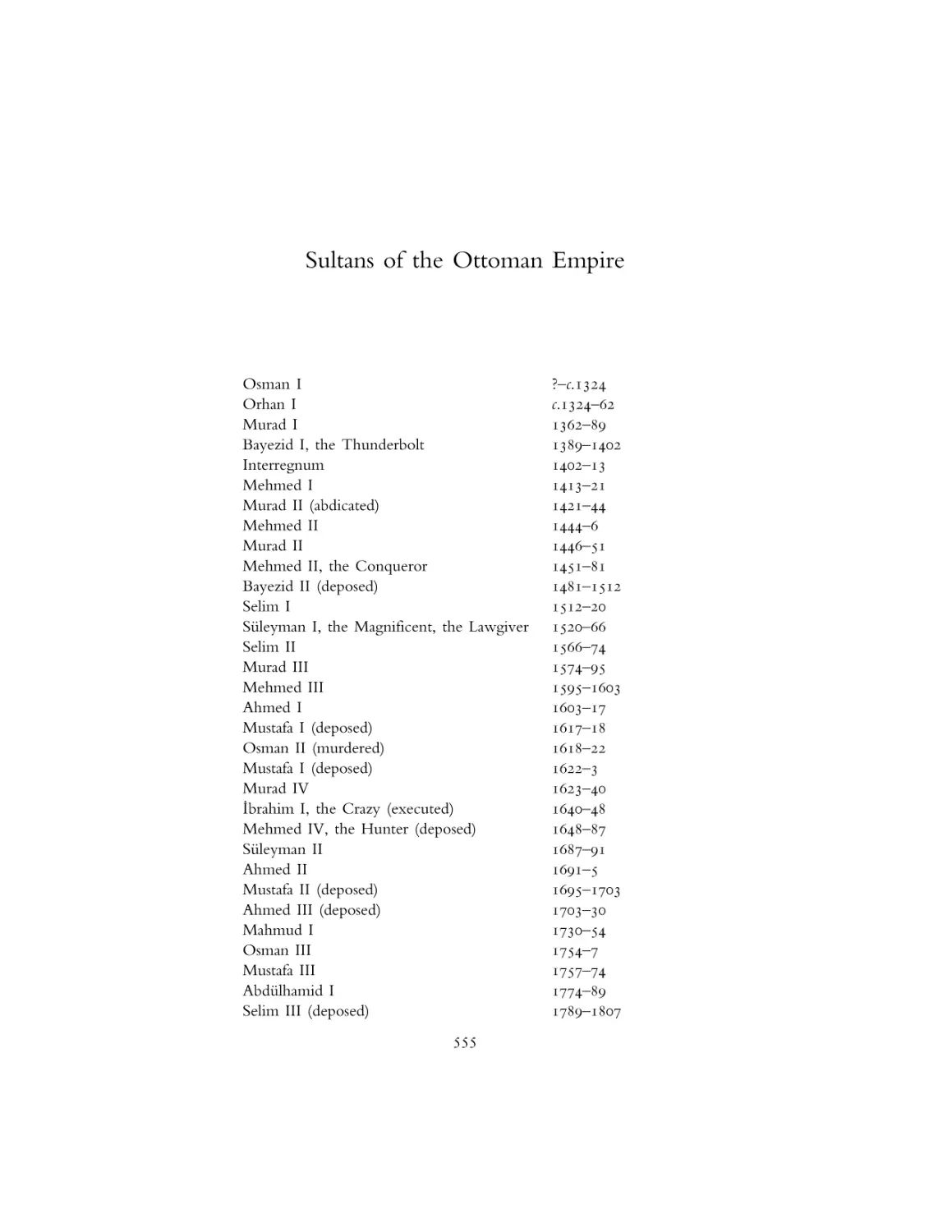
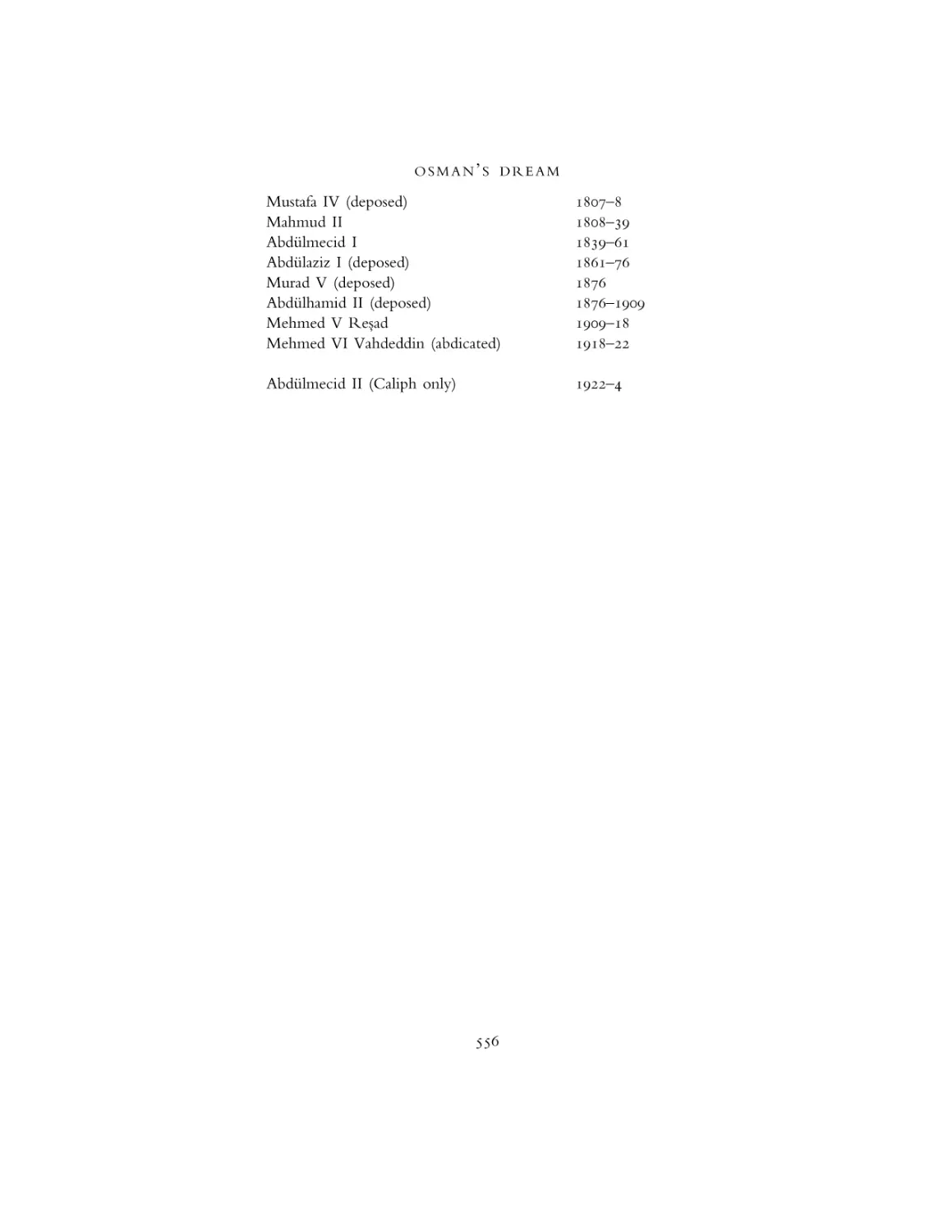
Sultans of the Ottoman Empire
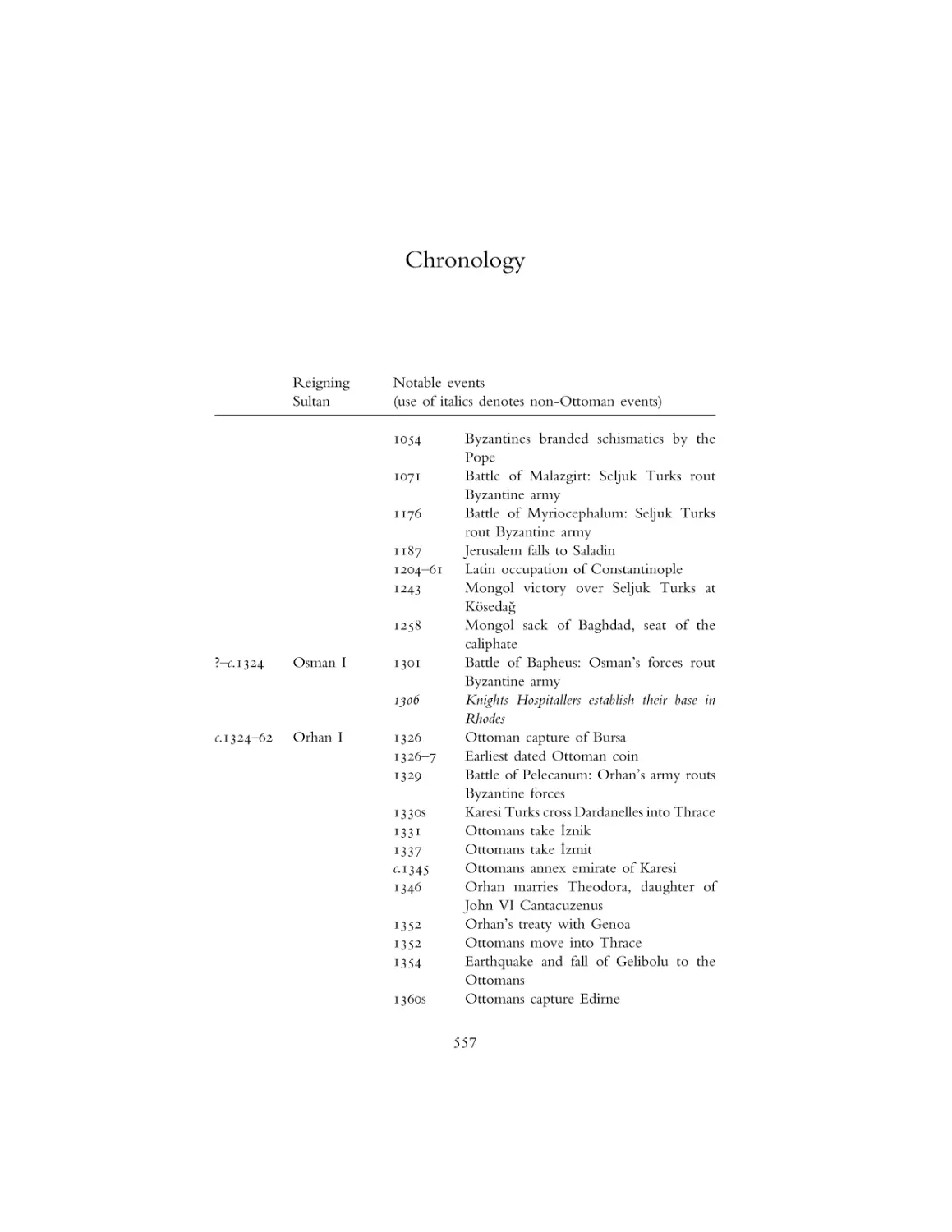
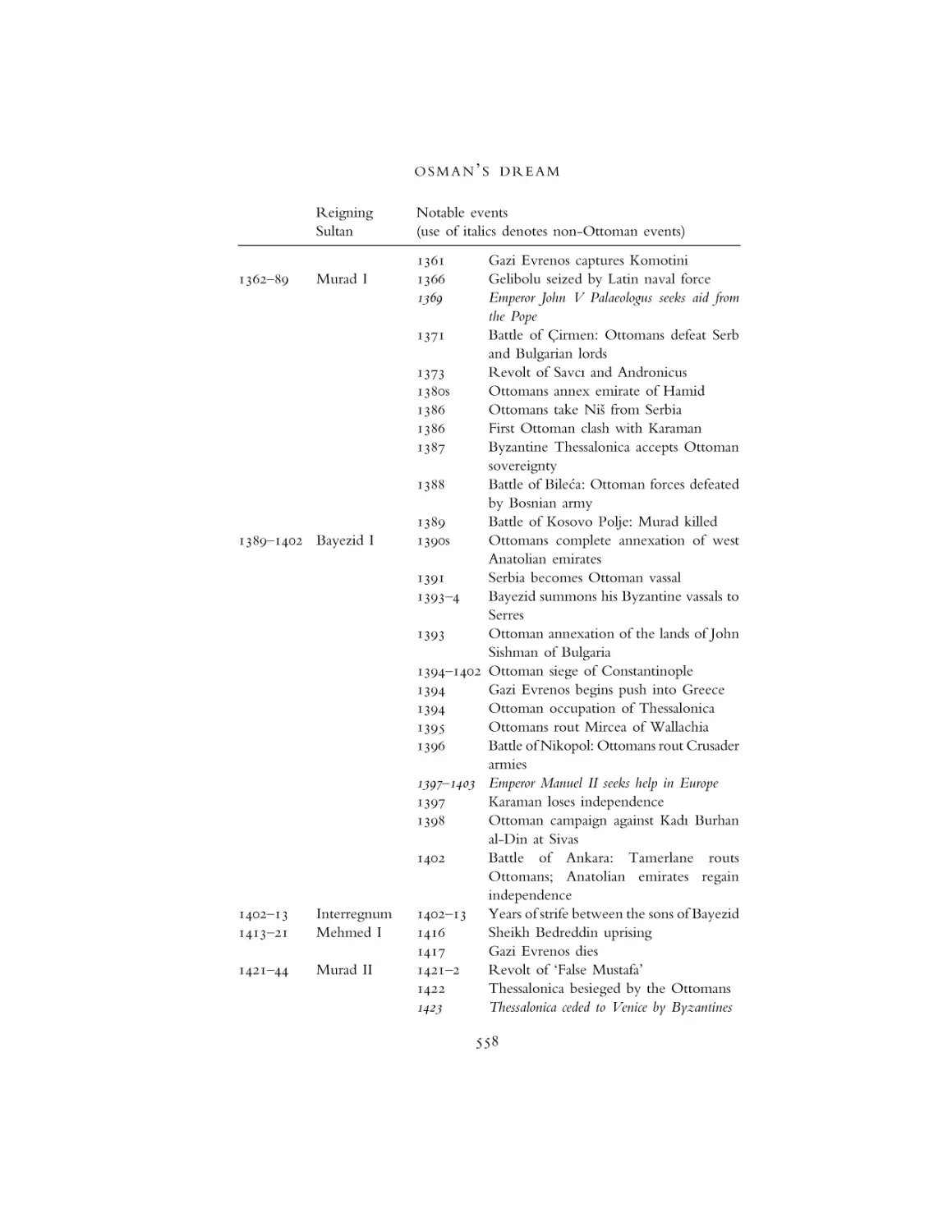
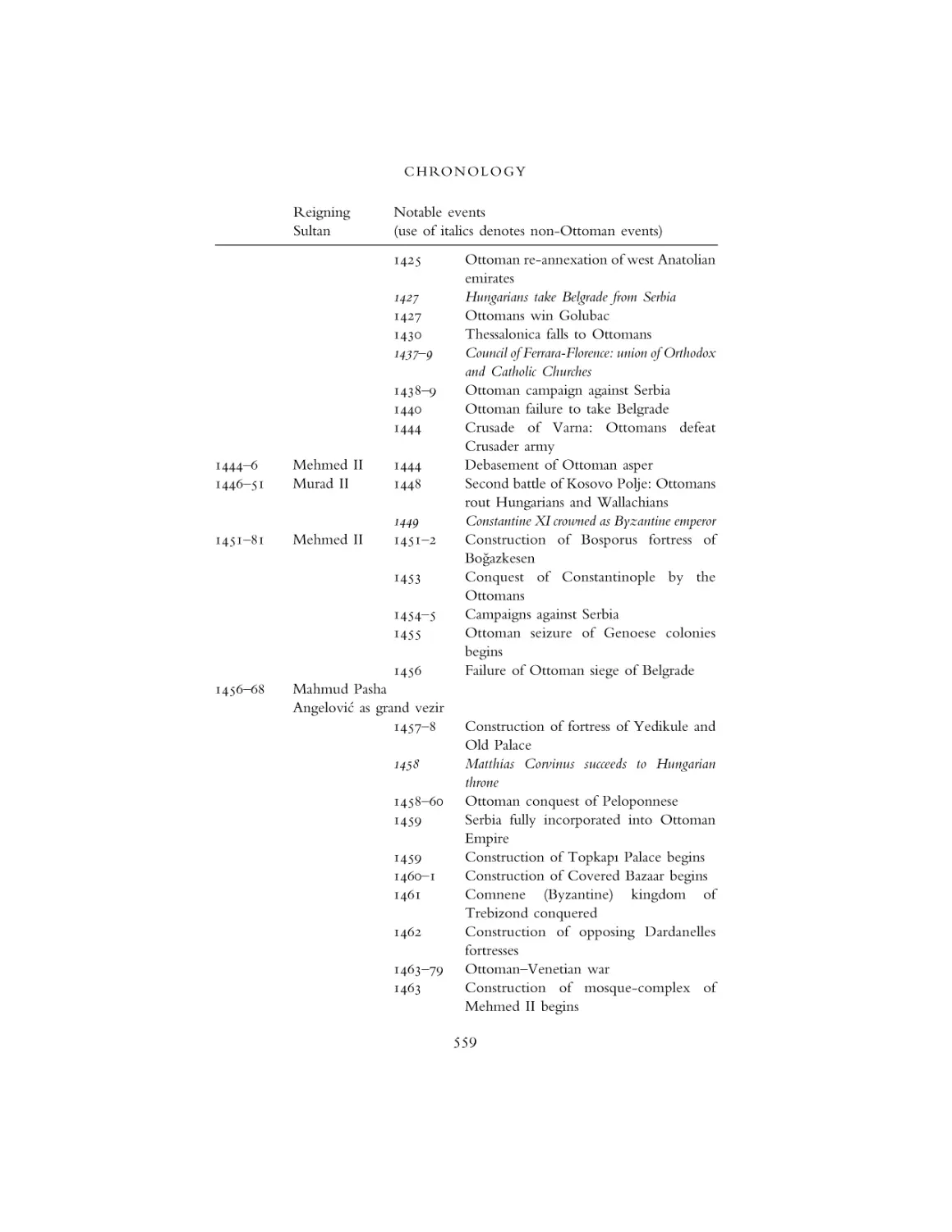
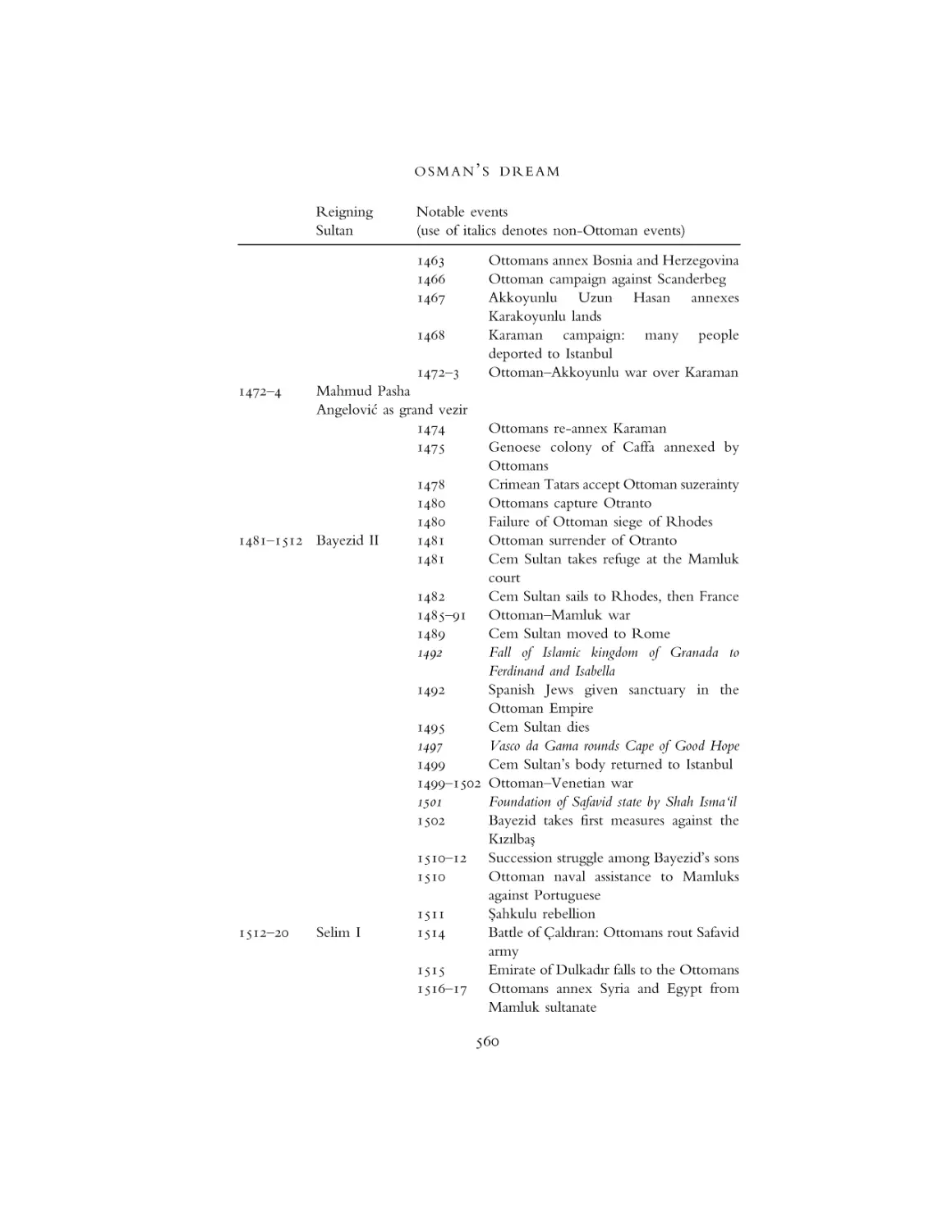
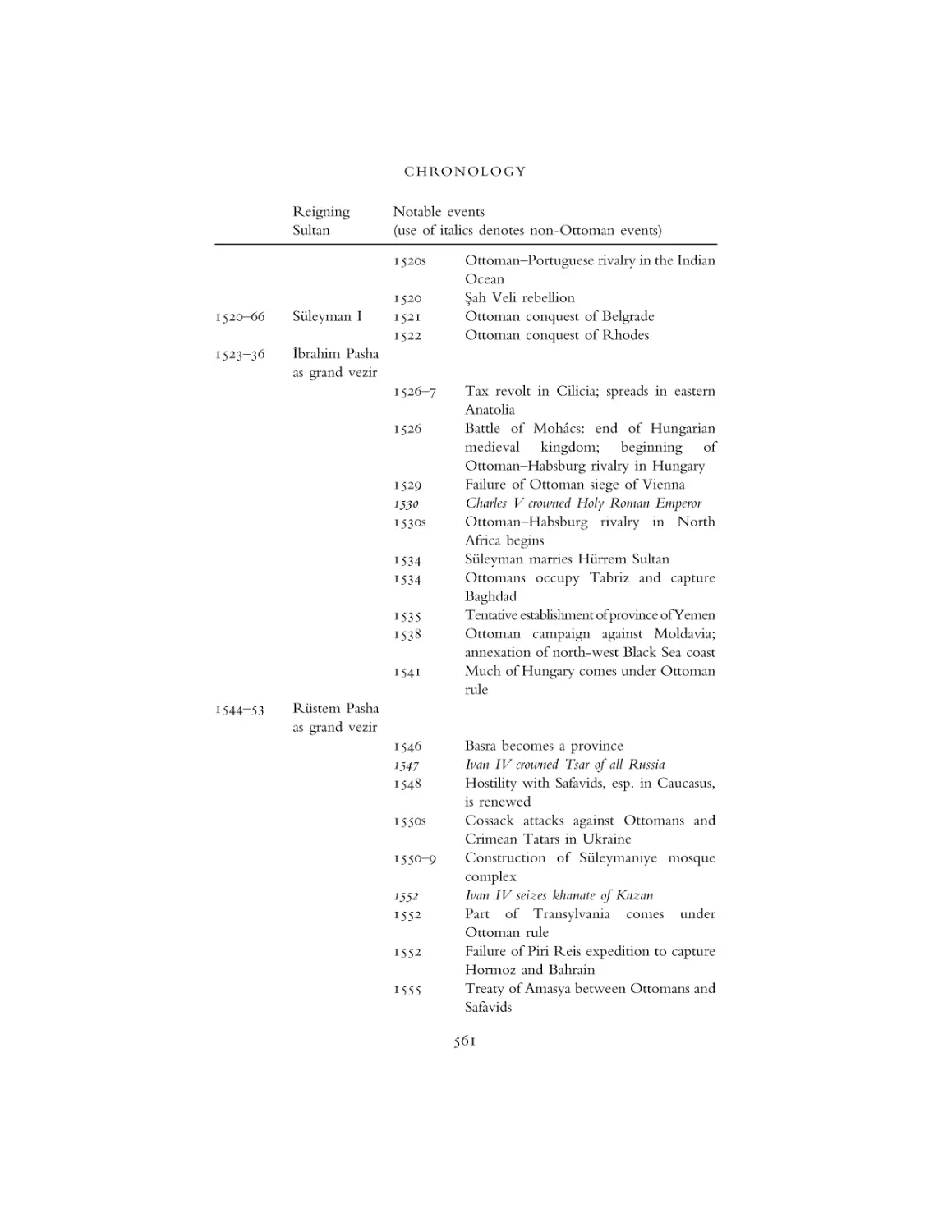
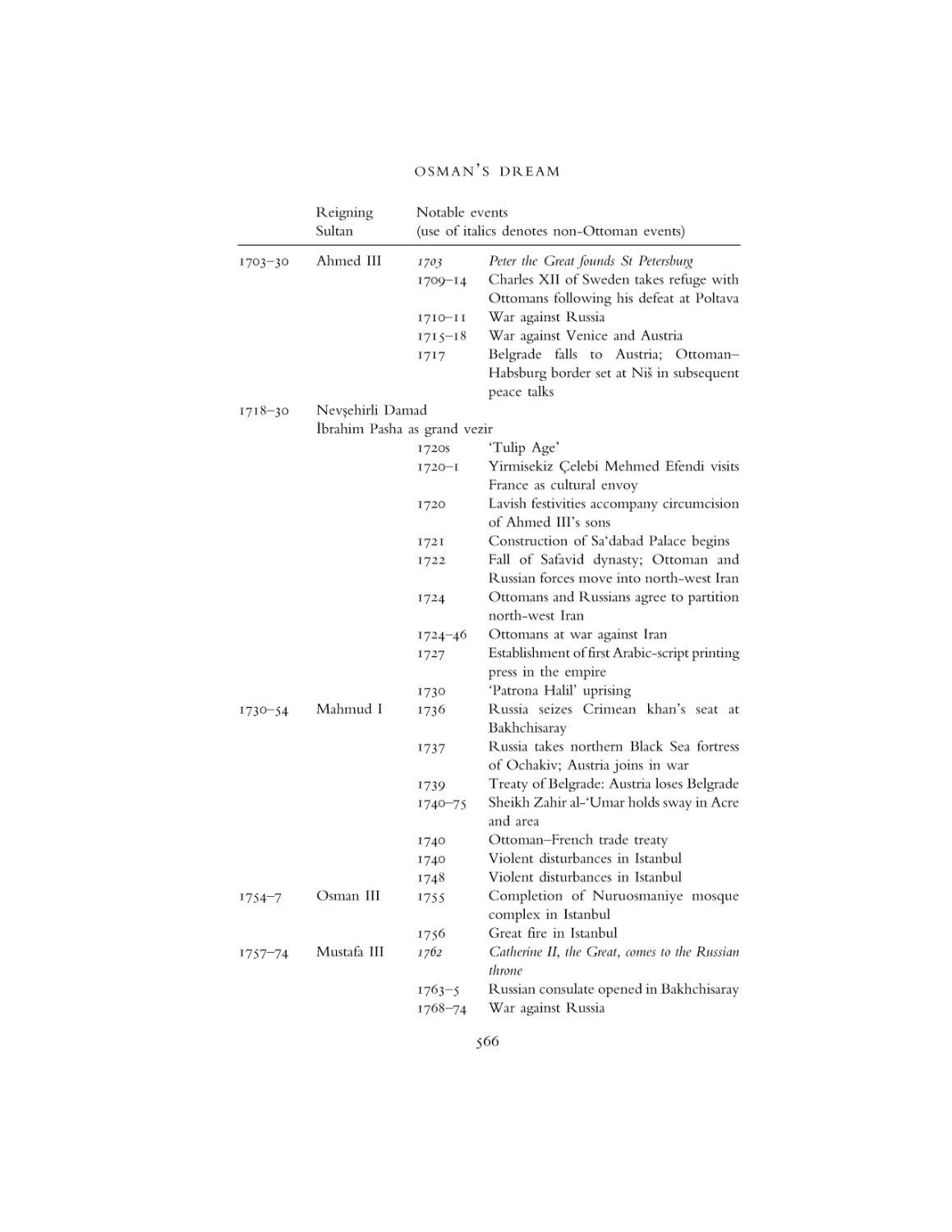
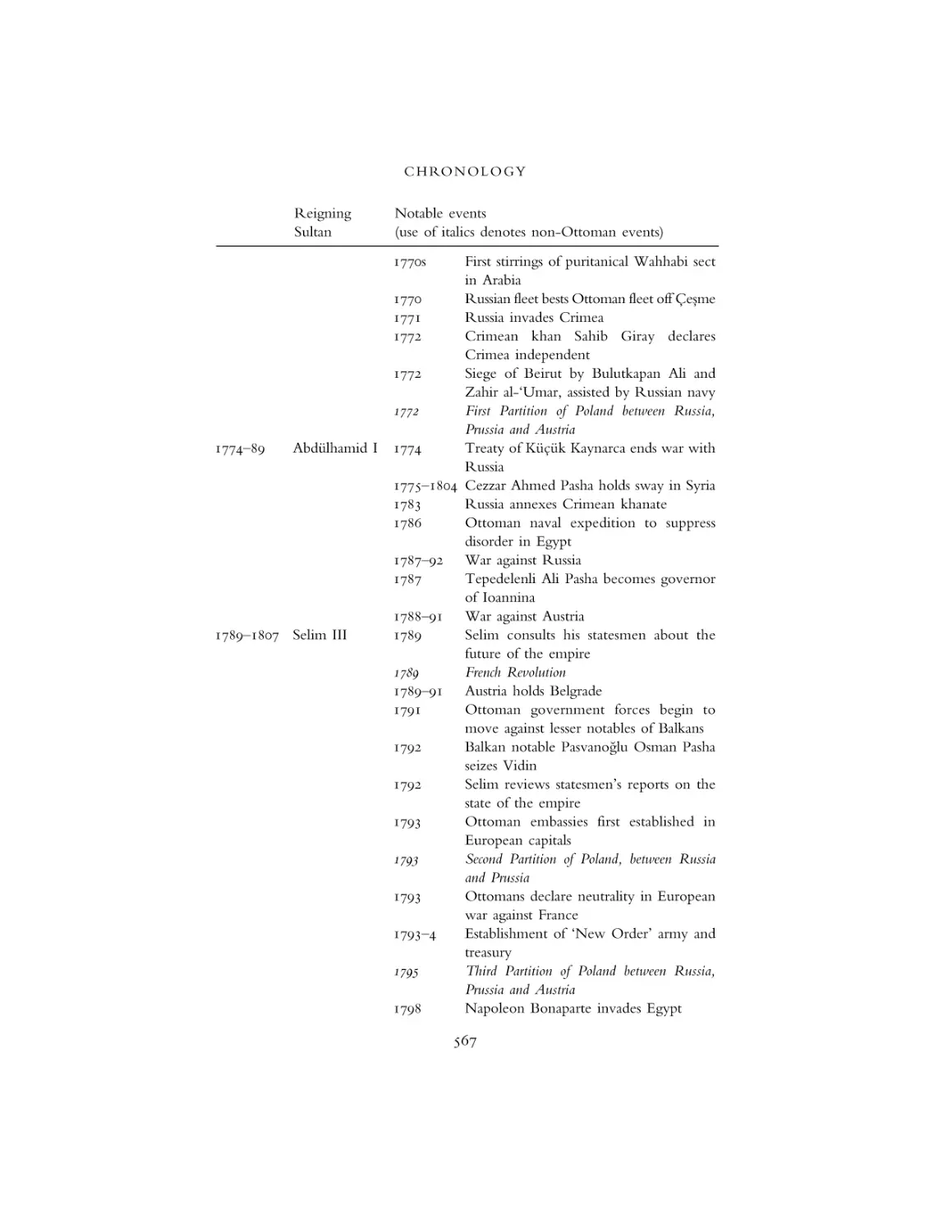
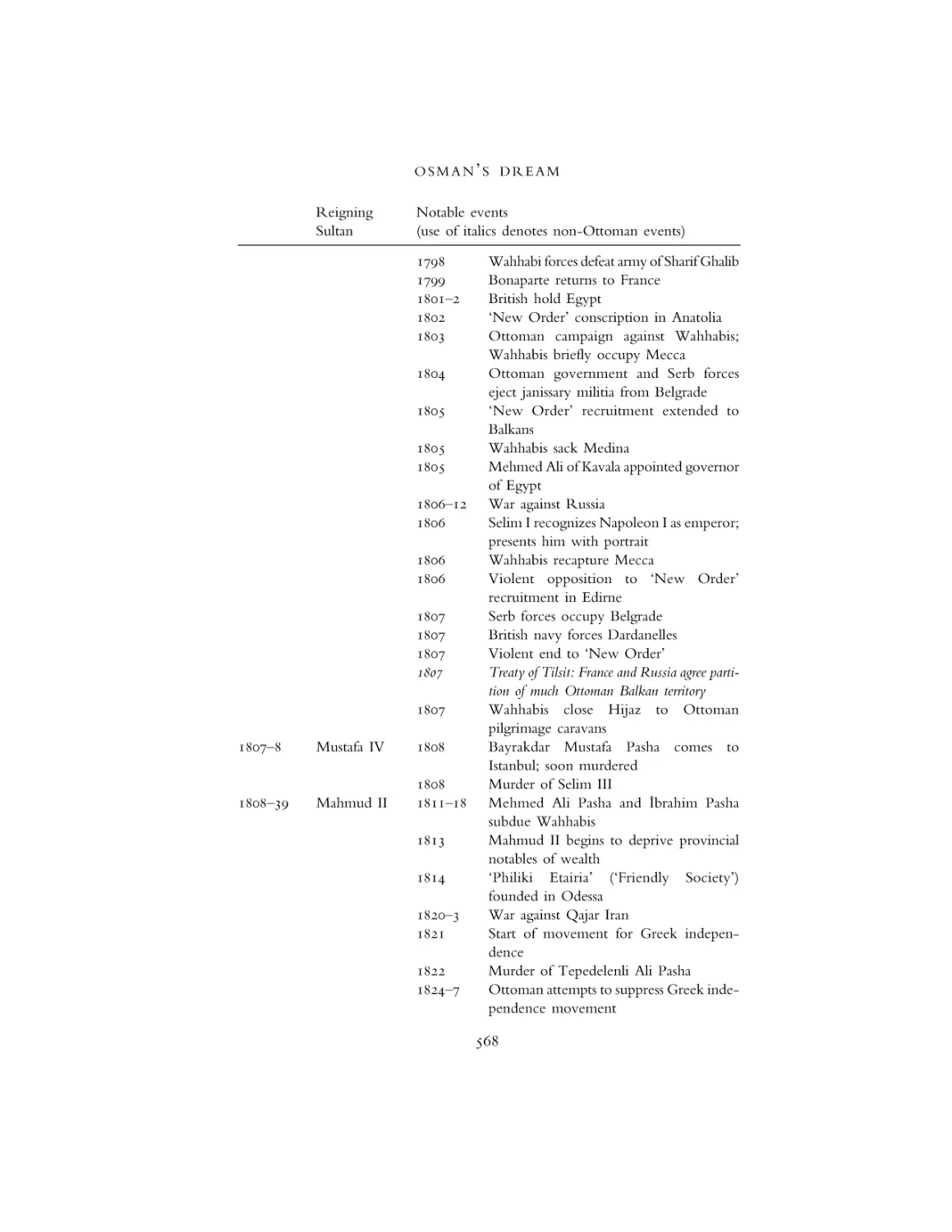
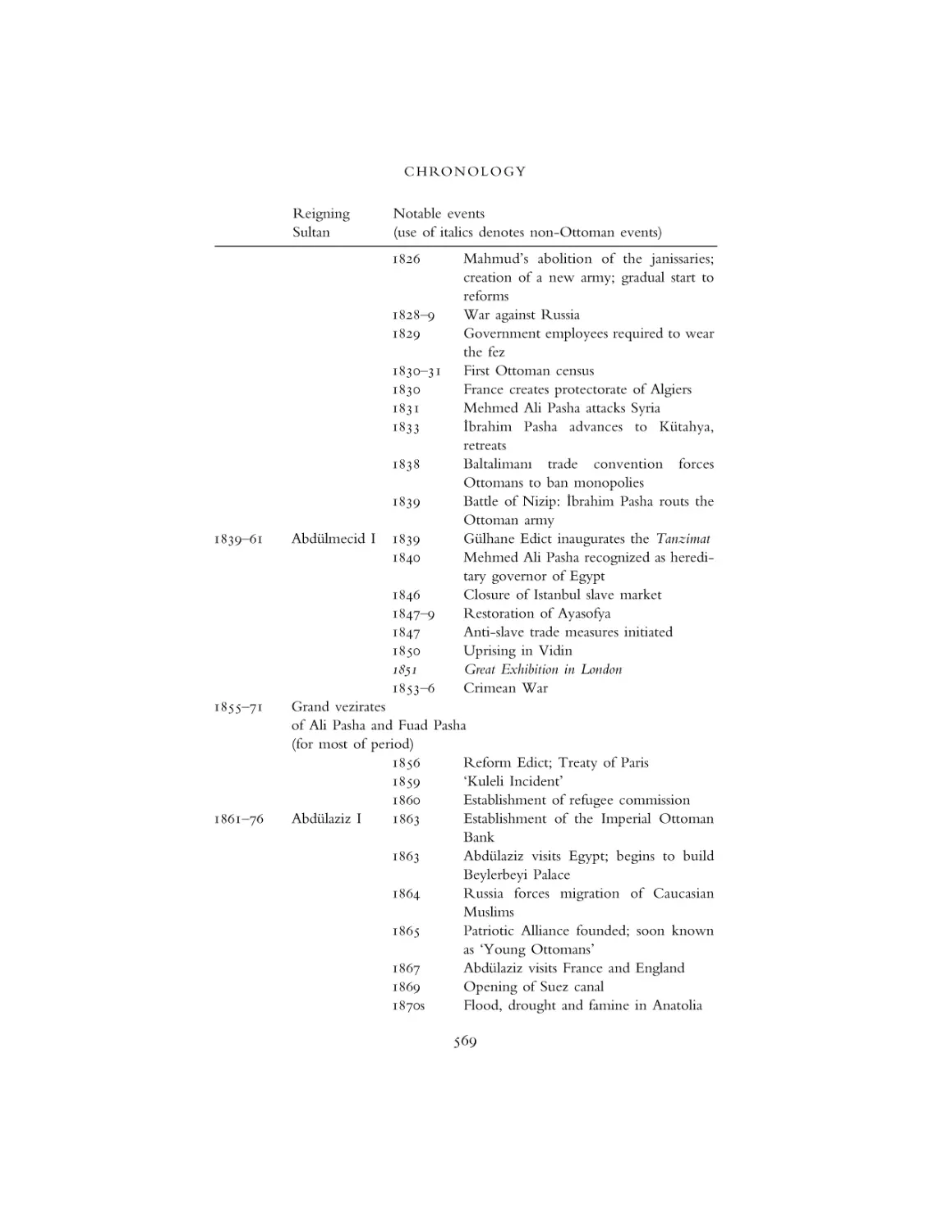
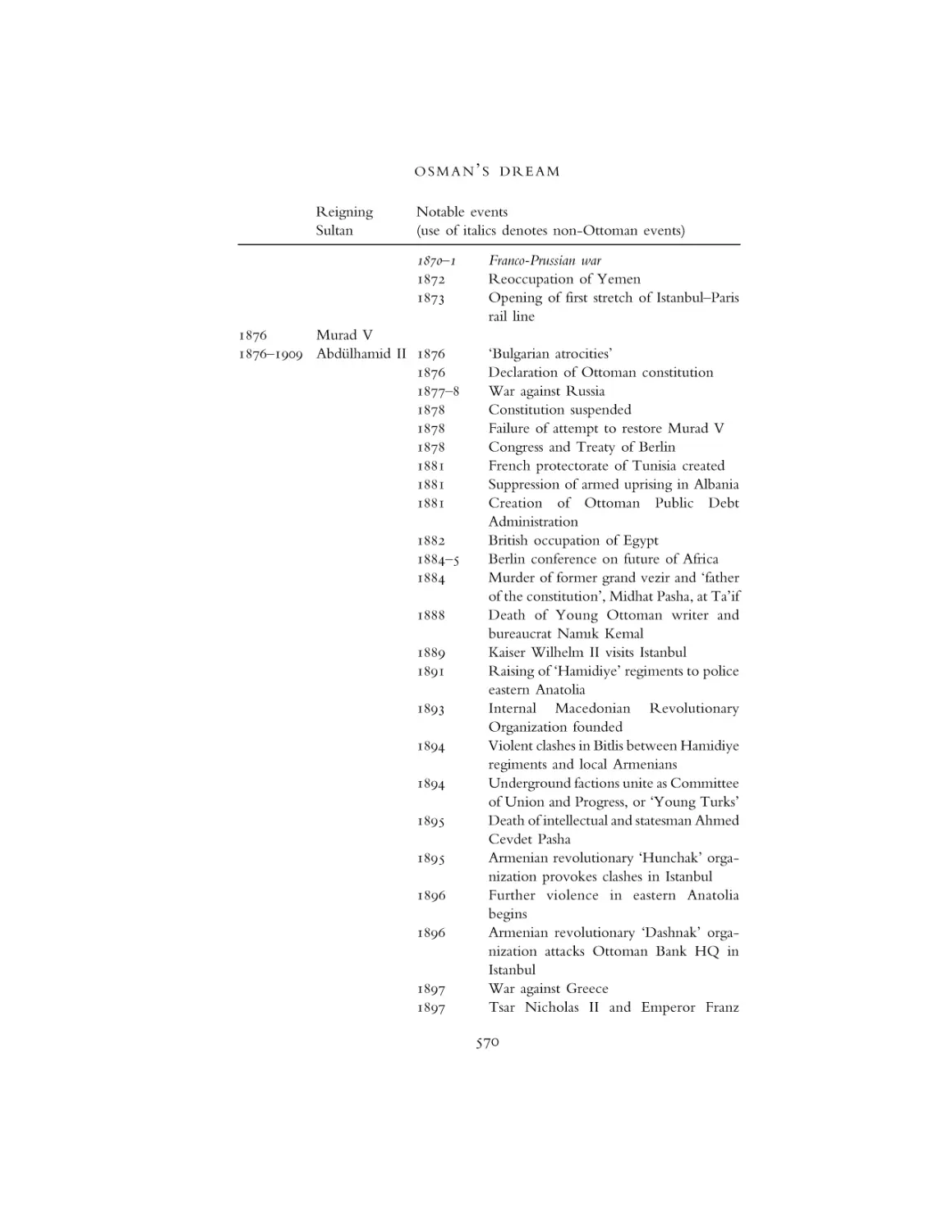
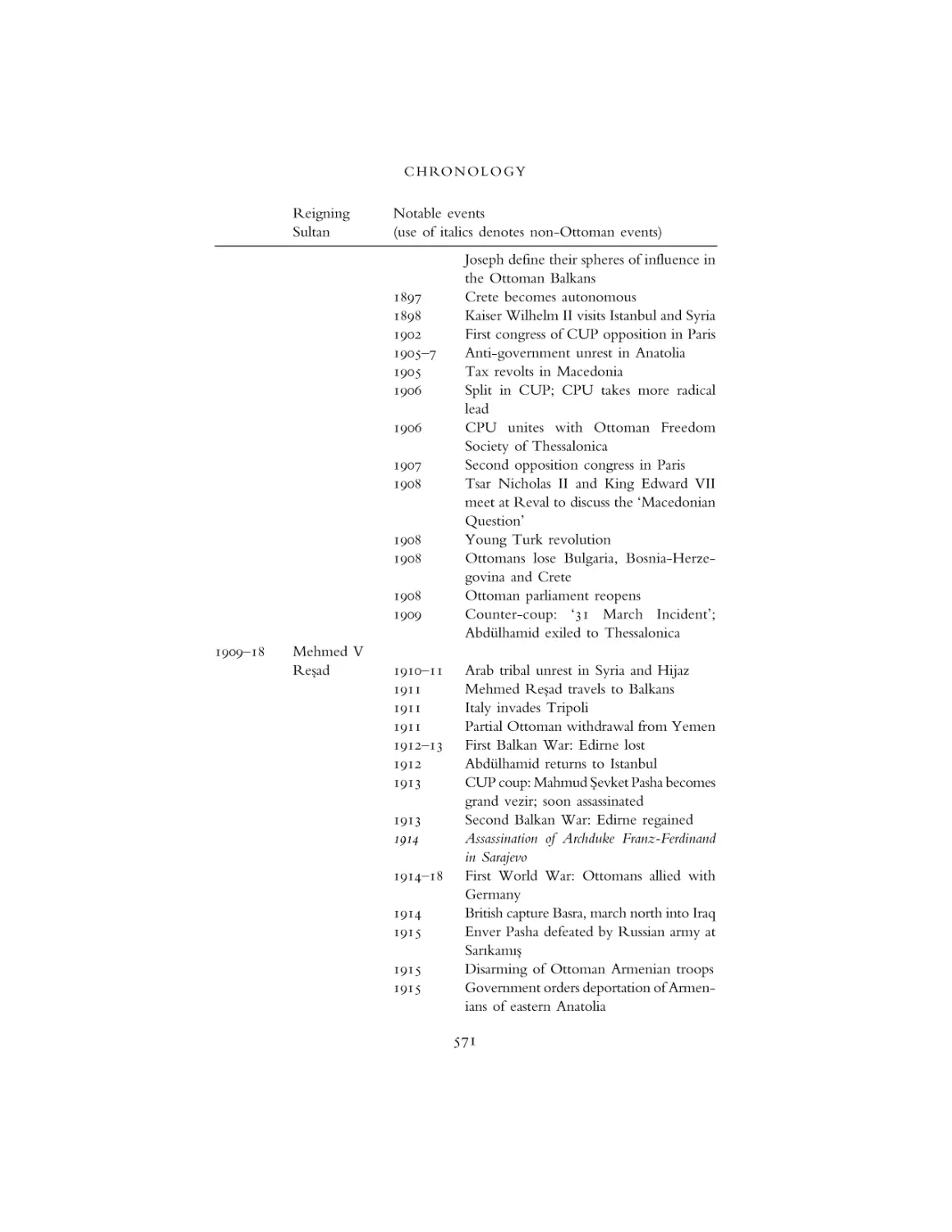
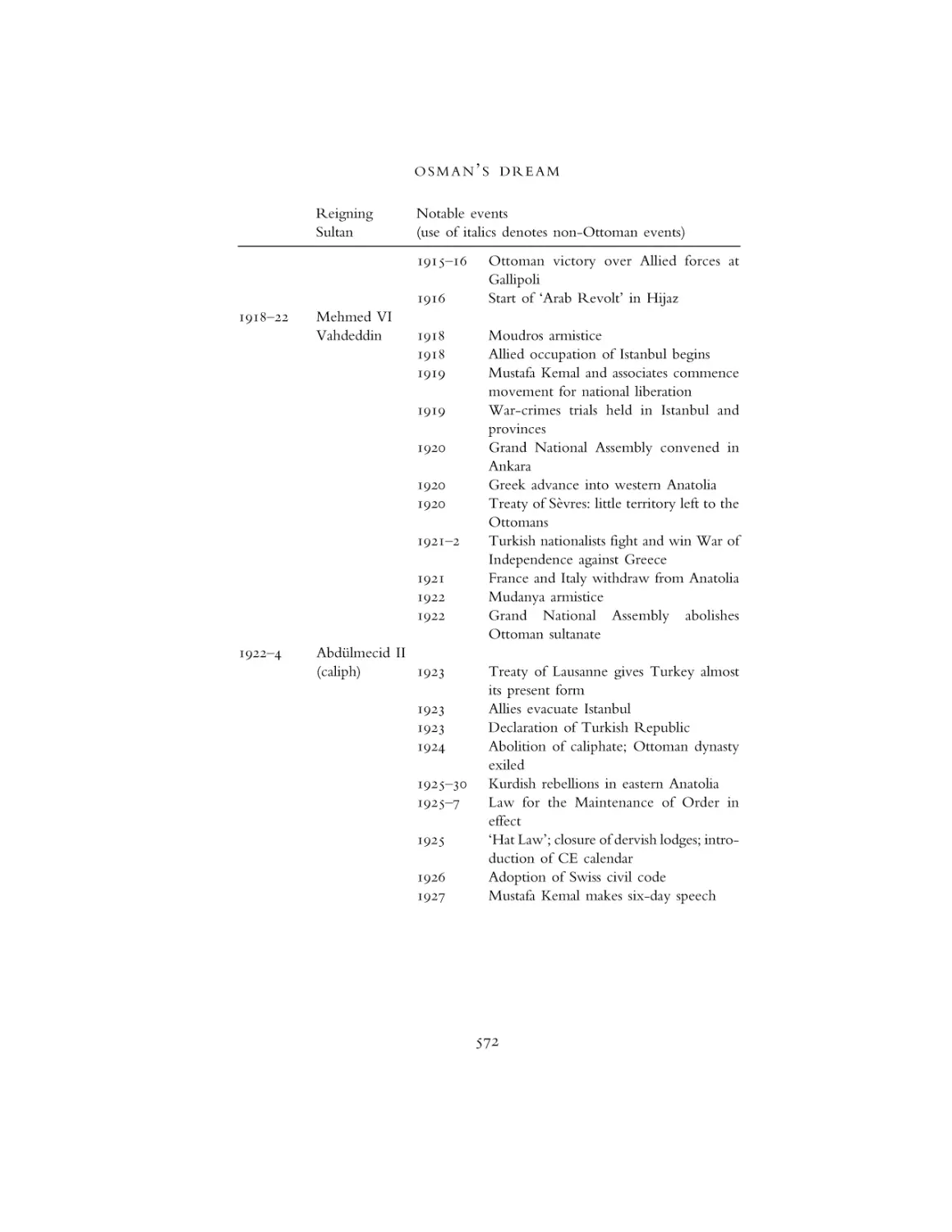
Chronology
Notes
Bibliography
Index

vii
ix
xi
xv
xvii
xix
1
22
48
81
115
152
196
223
253
289
329
372
413
447
488
526
555
557
573
610
642

v

OSMAN’S DREAM

vi

CHAPTER TITLE

Illustrations

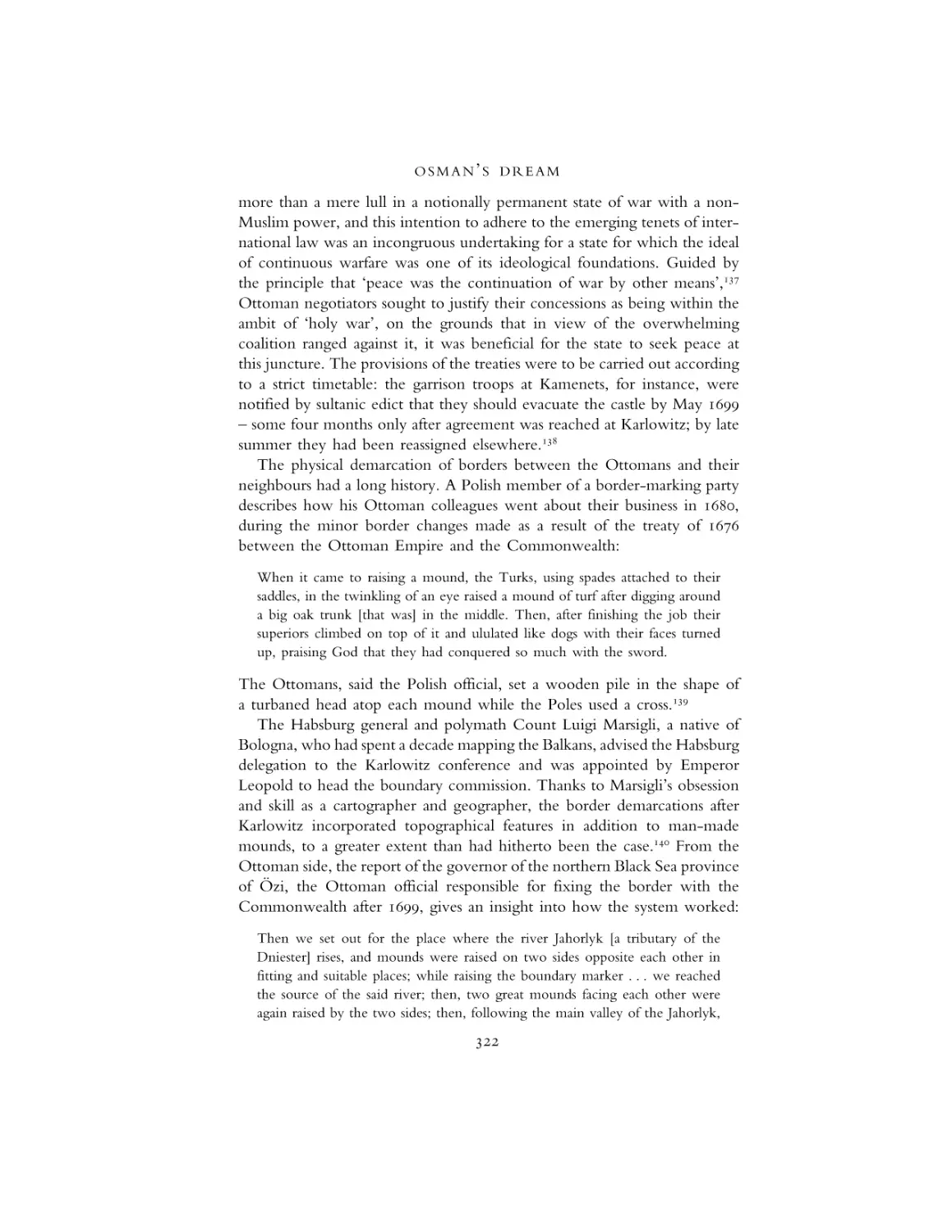
1. First third of an endowment charter for a dervish lodge established by
Sultan Orhan in 1324
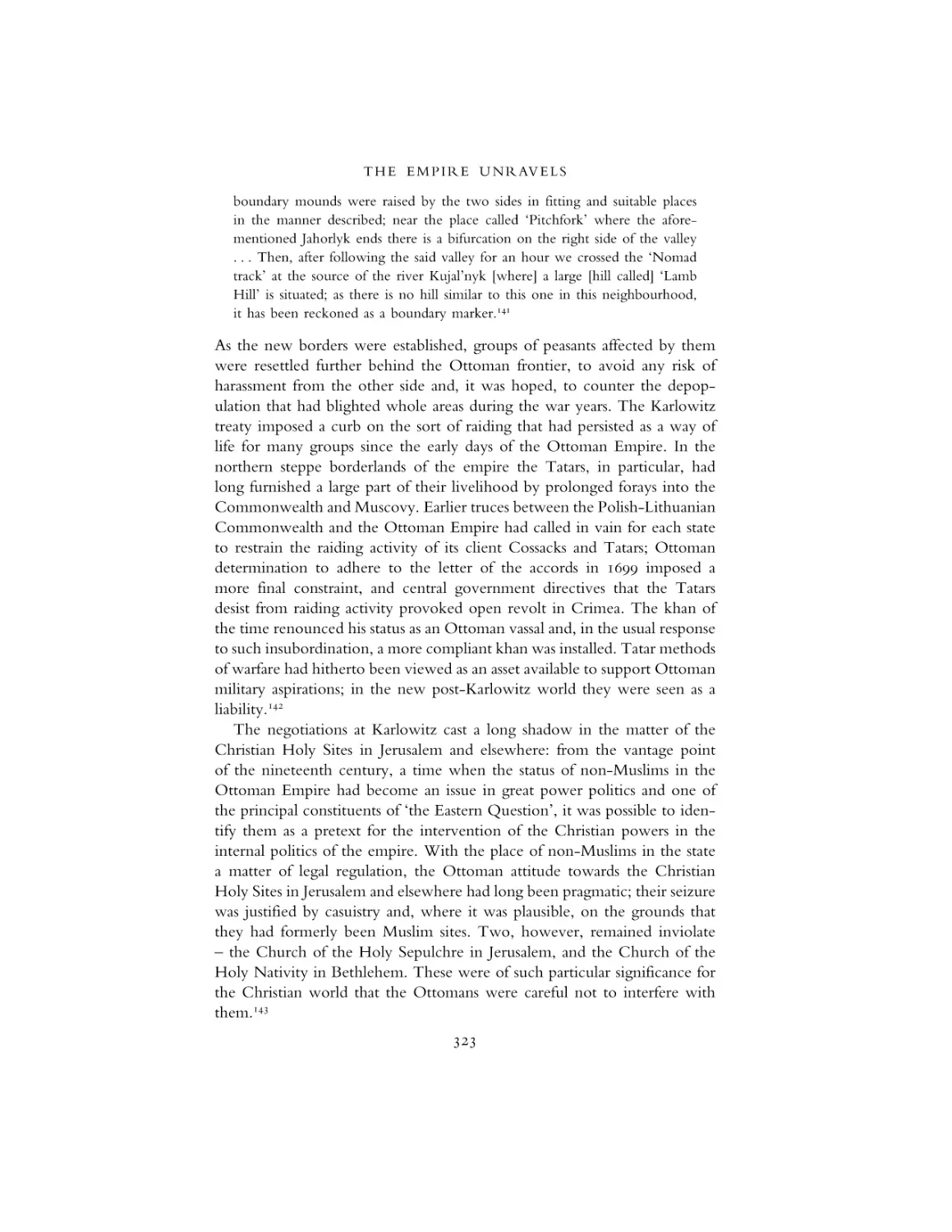
2. The beheading of the companions of Johann Schiltberger
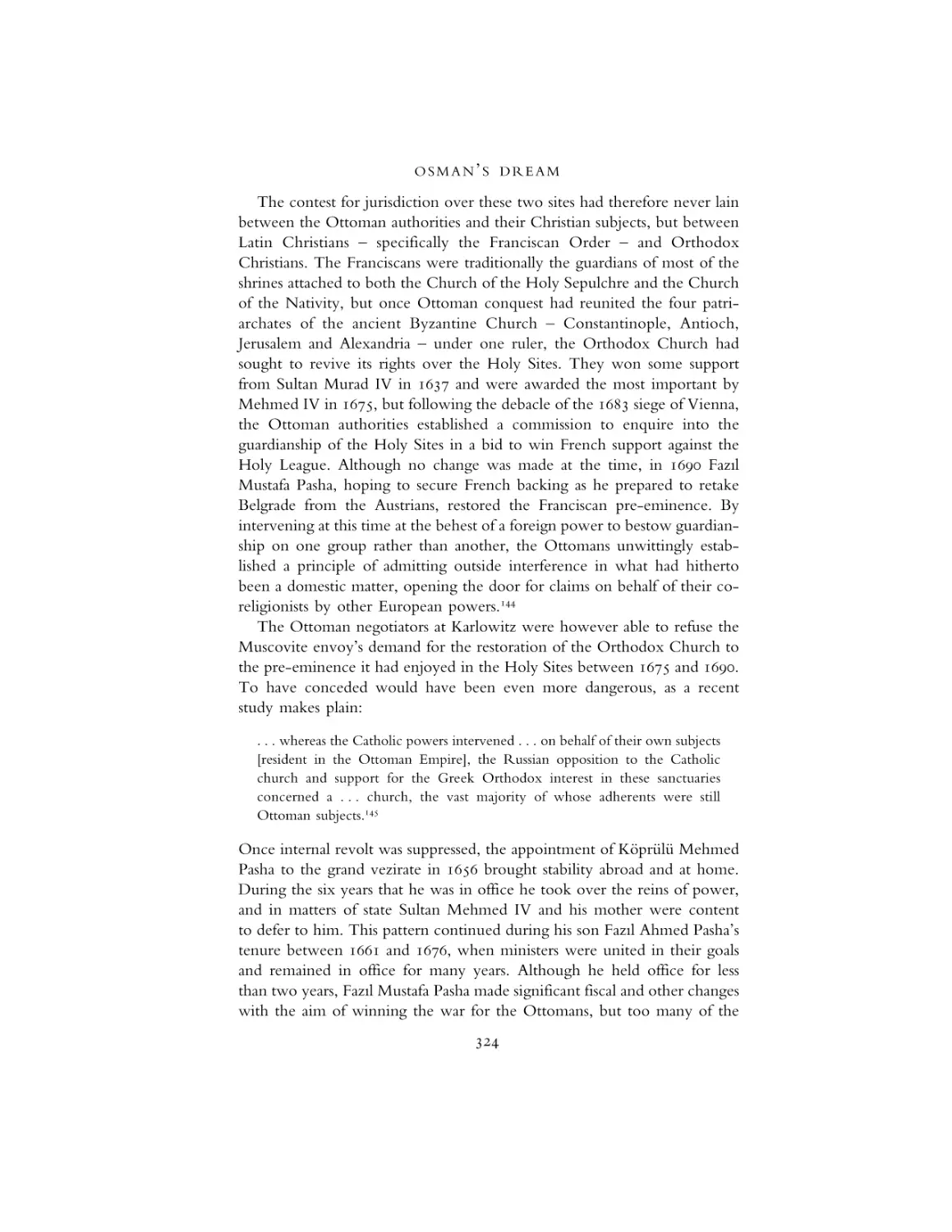
3. An Ottoman official and his assistant register Balkan Christian boys
selected for the youth levy
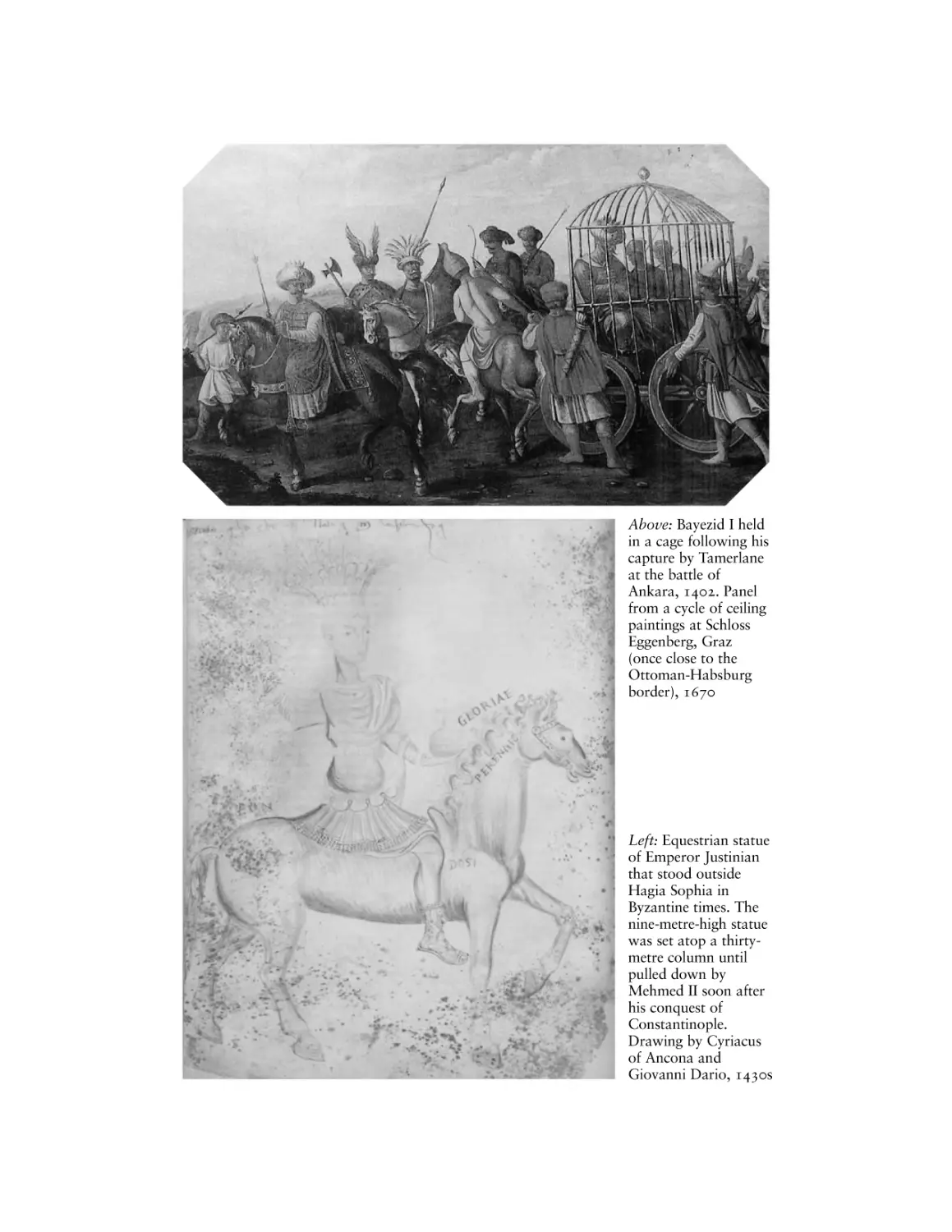
4. Bayezid I held in a cage following his capture by Tamerlane at the
battle of Ankara, 1402
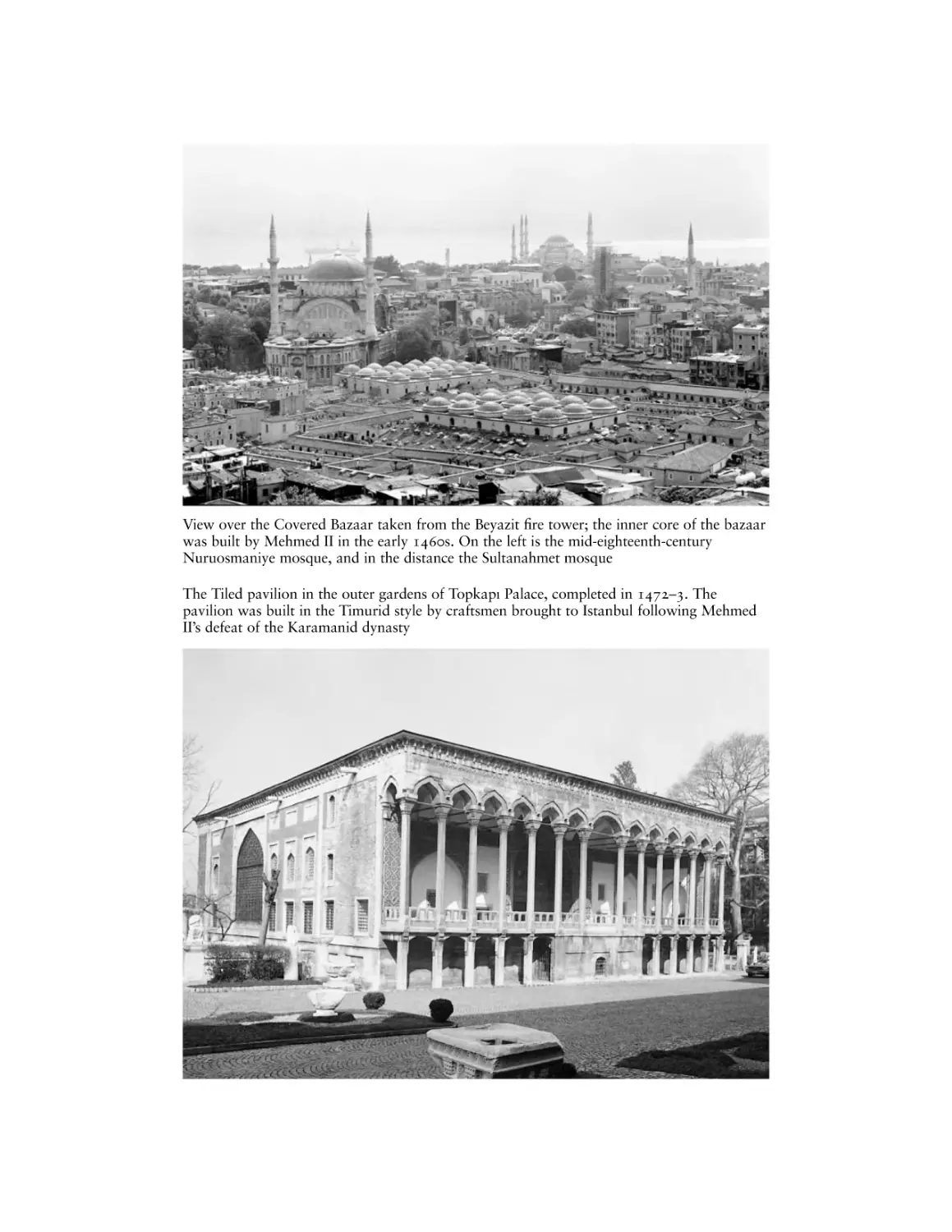
5. Equestrian statue of Emperor Justinian that stood outside Hagia Sophia
6. View over the Covered Bazaar, Istanbul
7. The Tiled pavilion in the outer gardens of Topkapì Palace
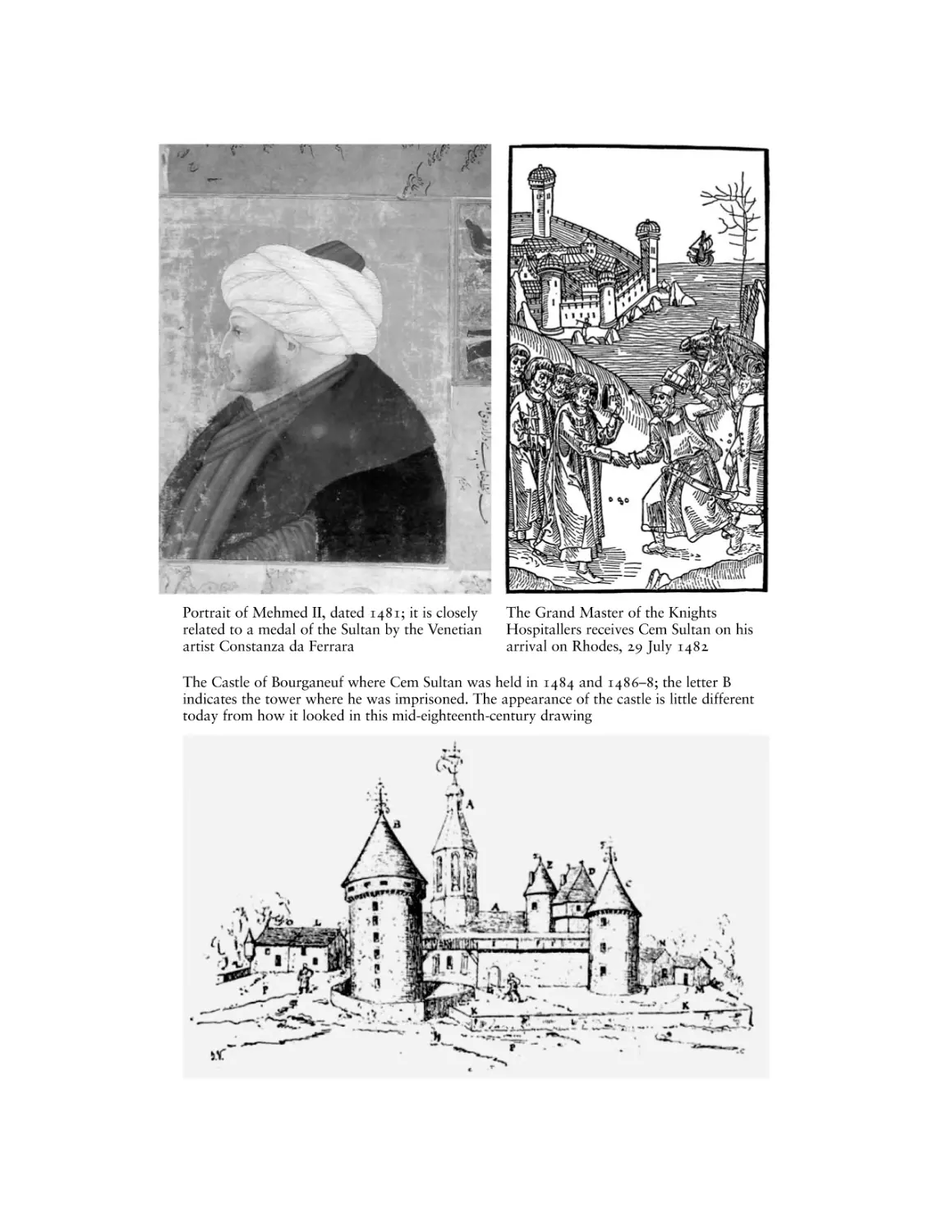
8. Portrait of Mehmed II, 1481
9. The Grand Master of the Knights Hospitallers receives Cem Sultan on
his arrival on Rhodes
10. The Castle of Bourganeuf where Cem Sultan was held
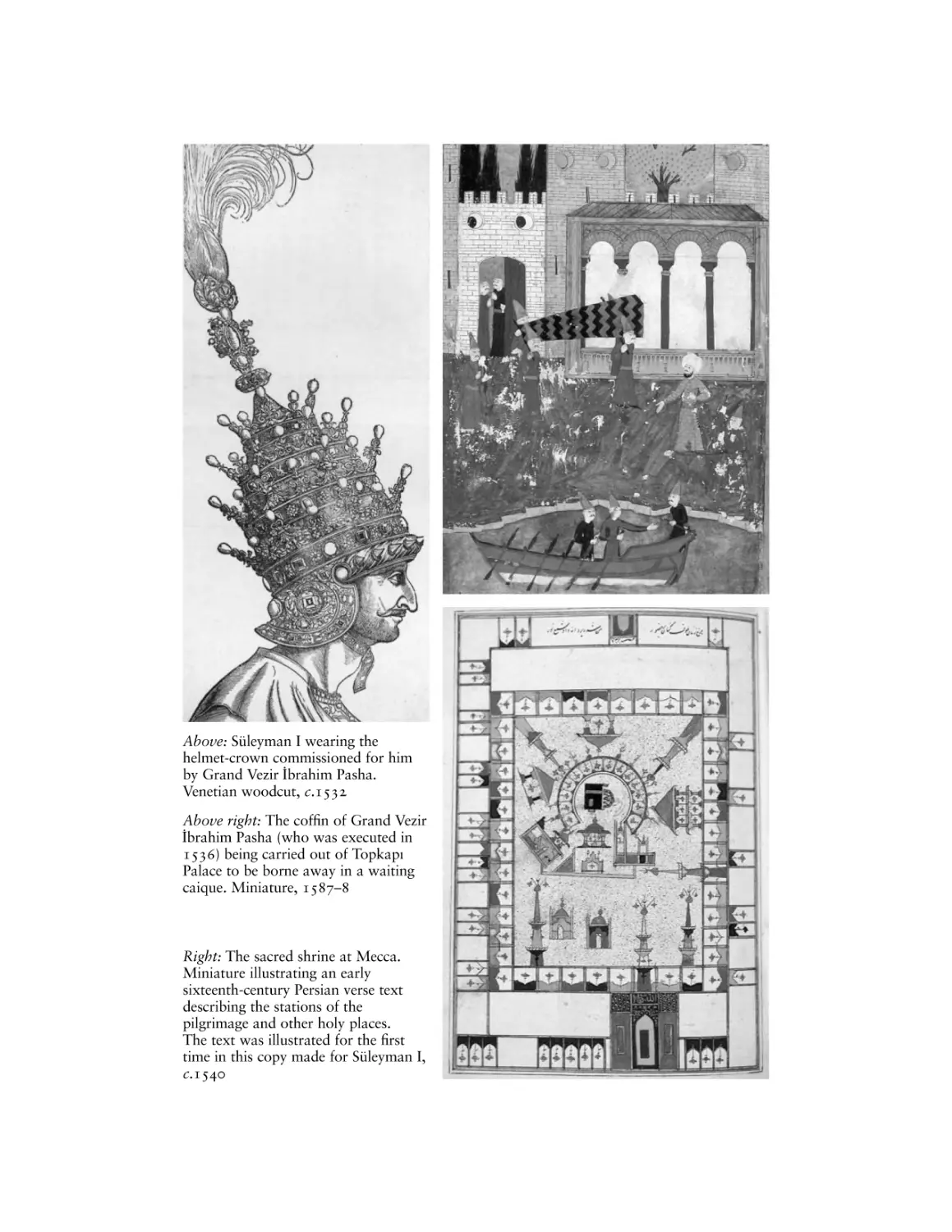
11. Süleyman I wearing the helmet-crown commissioned for him by Grand
Vezir Ibrahim Pasha
12. The coffin of Grand Vezir Ibrahim Pasha being carried out of Topkapì
Palace
13. The sacred shrine at Mecca
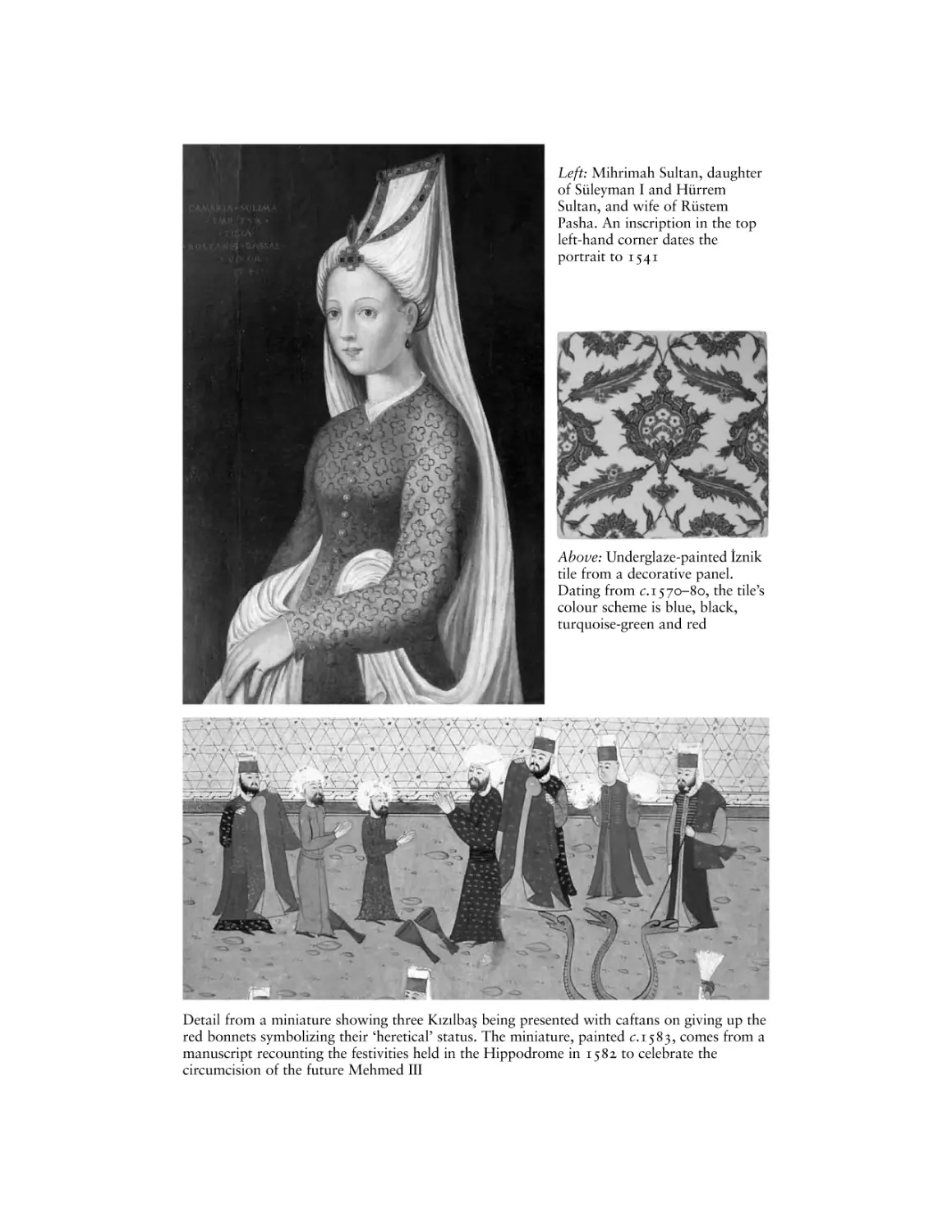
14. Mihrimah Sultan, daughter of Süleyman I and Hürrem Sultan
15. Underglaze-painted Iznik tile
16. Detail from a minature showing three Kìzìlbas being presented with
caftans on giving up the red bonnets symbolizing their ‘heretical’ status
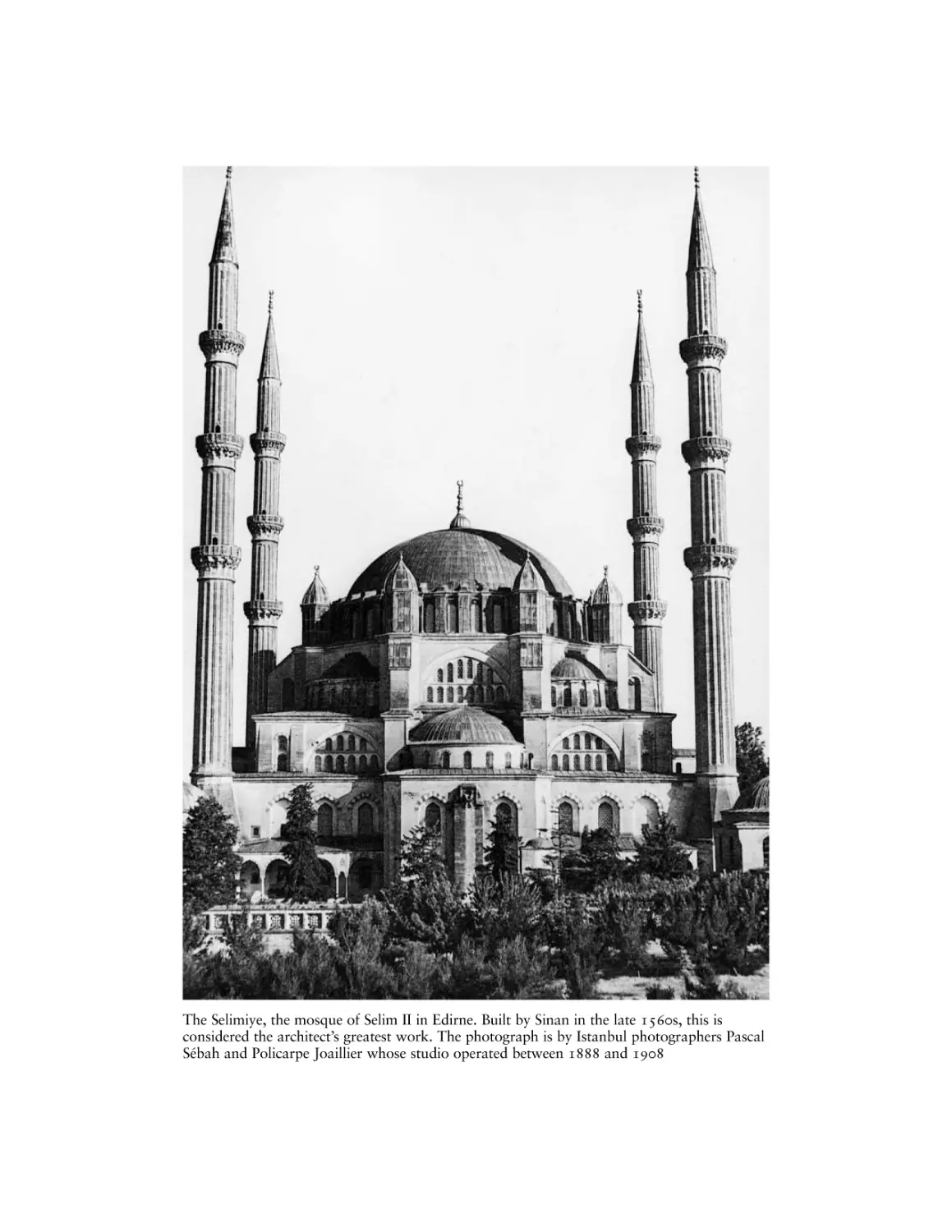
17. The Selimiye: the mosque of Selim II in Edirne
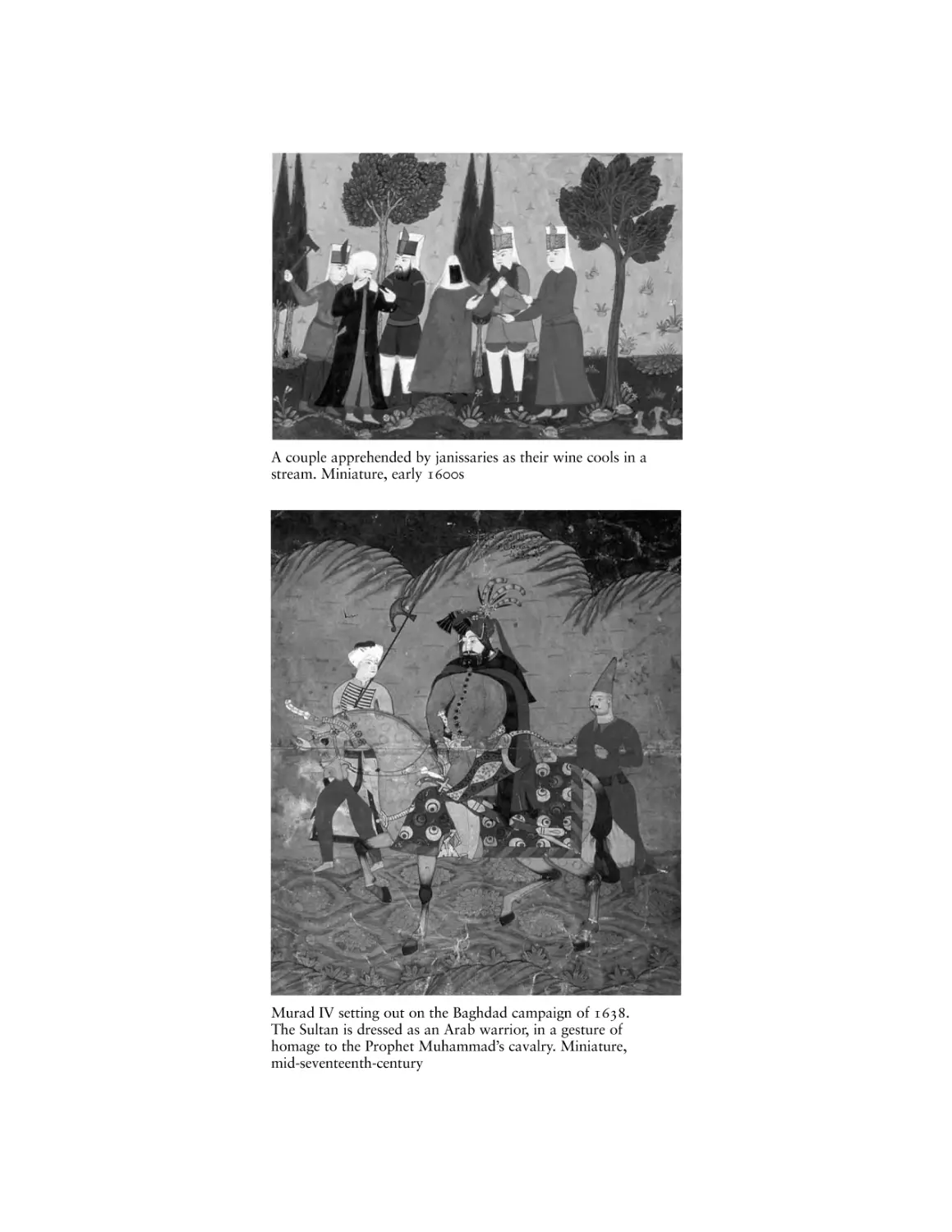
18. A couple apprehended by janissaries as their wine cools in a stream
19. Murad IV setting out on the Baghdad campaign of 1638
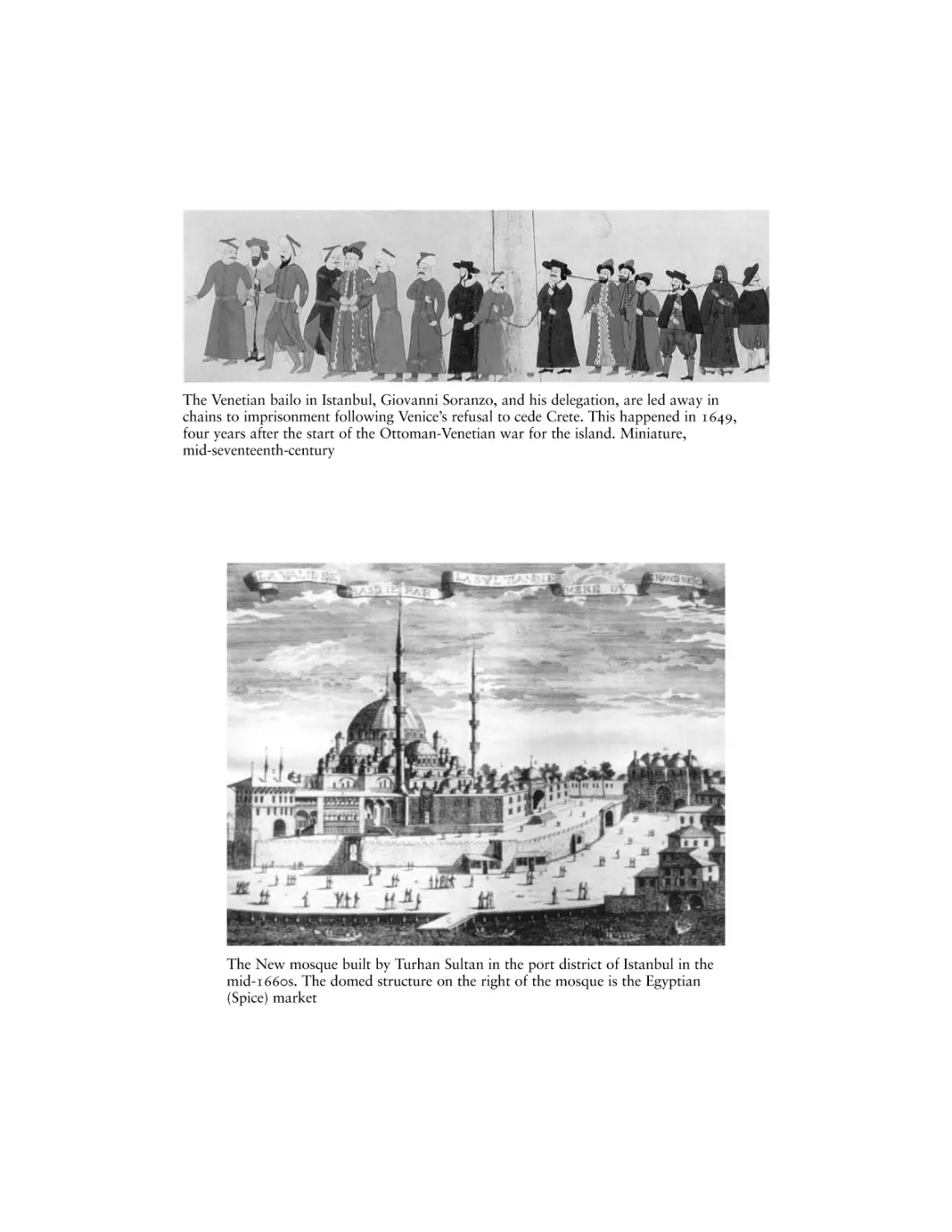
20. The Venetian bailo in Istanbul, Giovanni Soranzo, and his delegation,
being led away in chains following Venice’s refusal to cede Crete
21. The New mosque built by Turhan Sultan in the port district of Istanbul
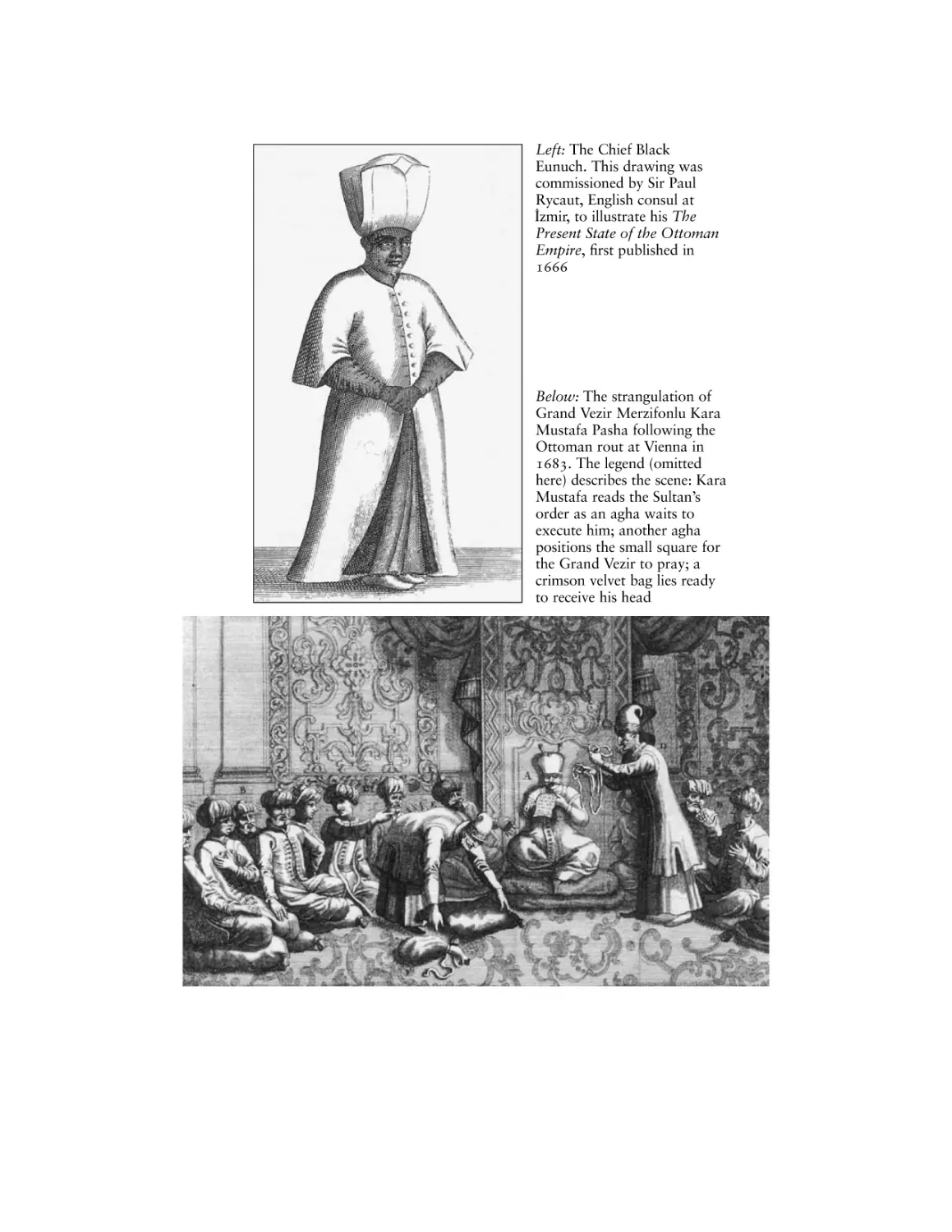
22. The Chief Black Eunuch
23. The strangulation of Grand Vezir Merzifonlu Kara Mustafa Pasha
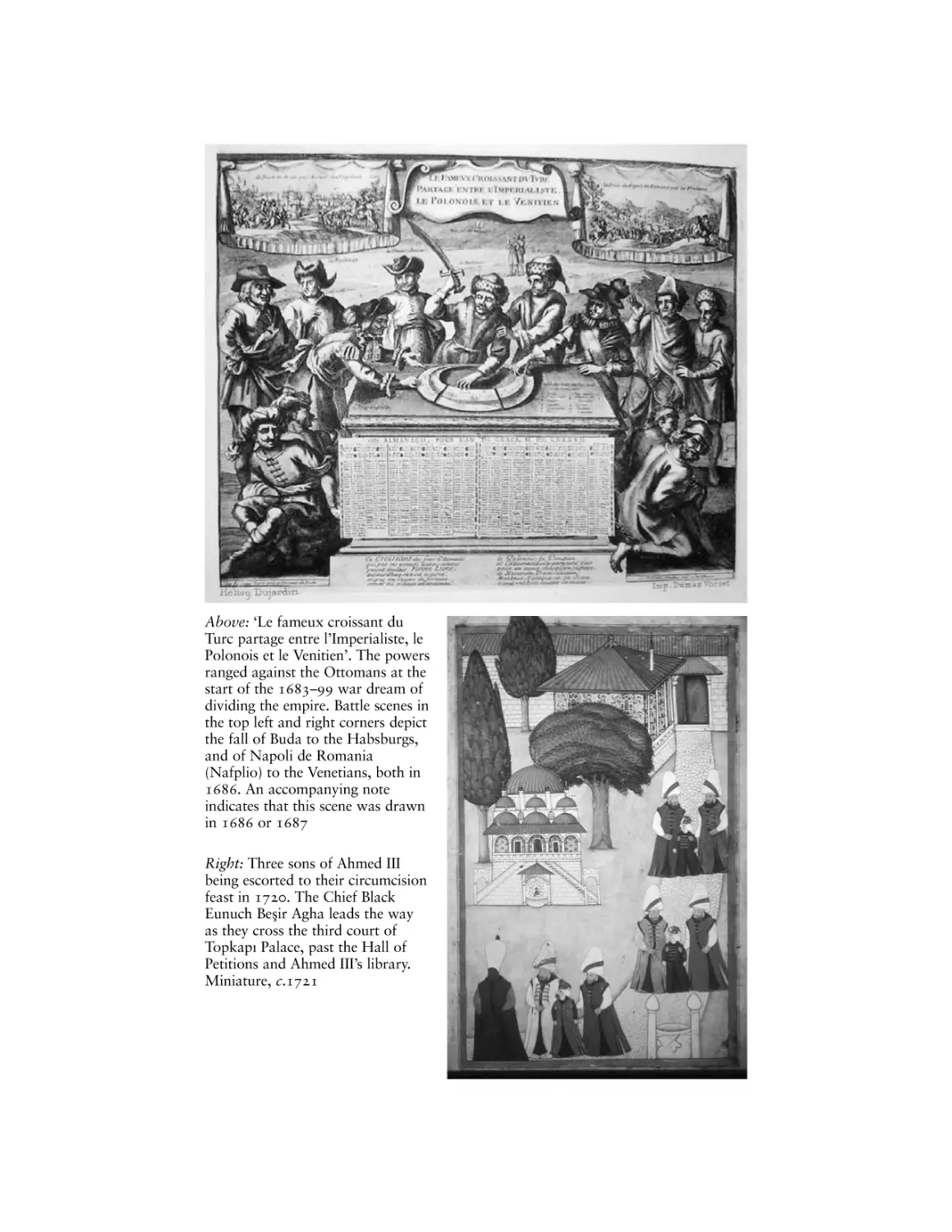
24. ‘Le fameux croissant du Turc partage entre l’Imperialiste, le Polonois
et le Venetien’
25. Three sons of Ahmed III being escorted to their circumcision feast

vii

OSMAN’S DREAM

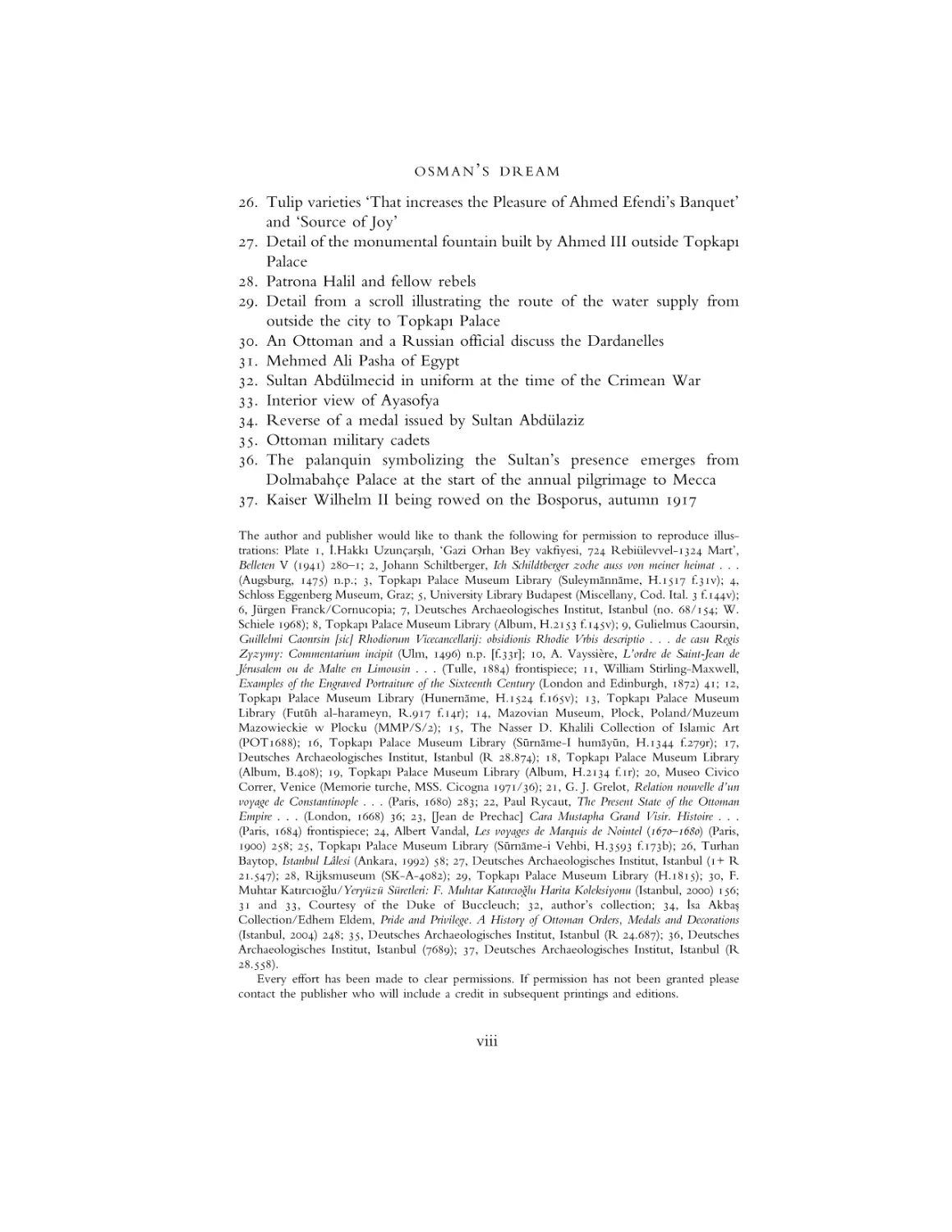
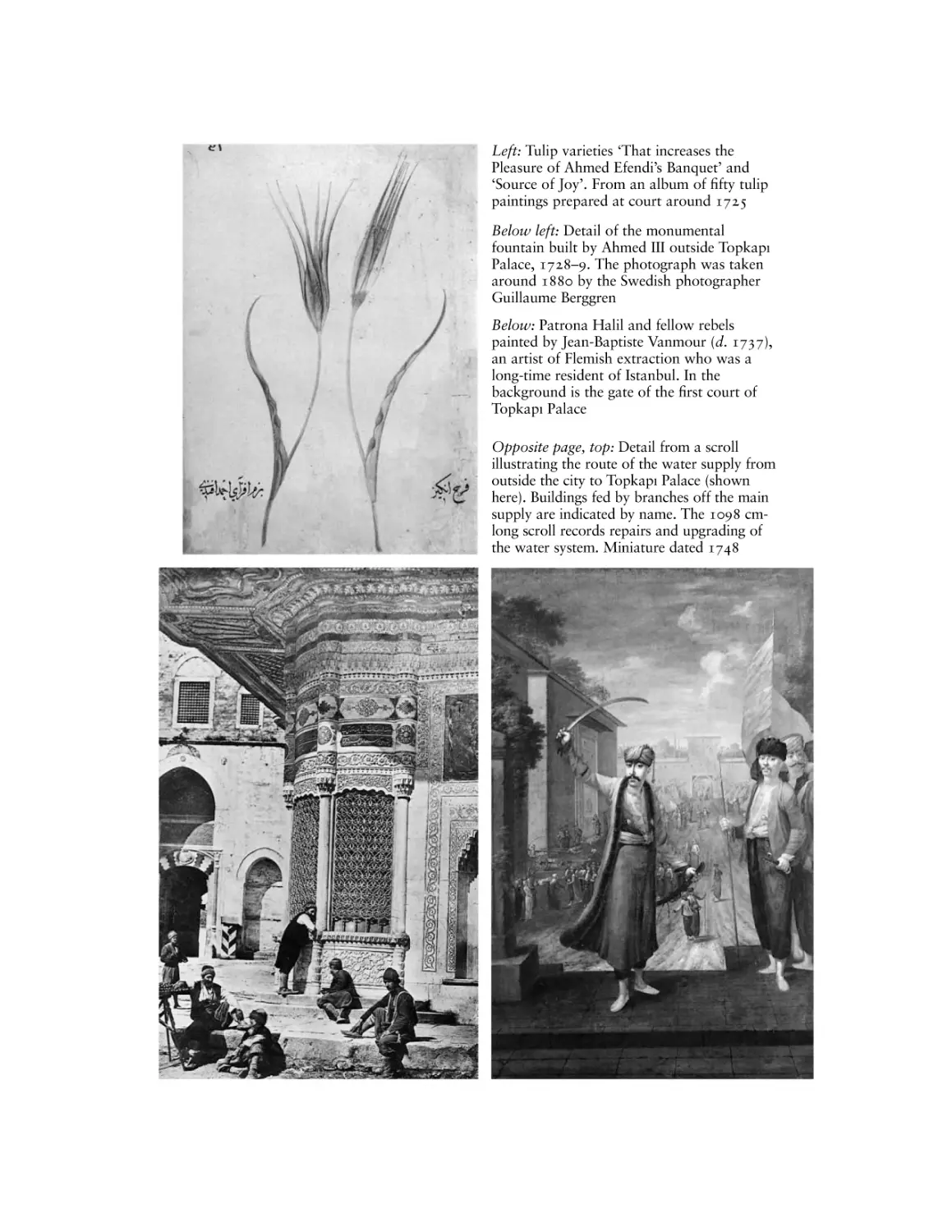
26. Tulip varieties ‘That increases the Pleasure of Ahmed Efendi’s Banquet’
and ‘Source of Joy’
27. Detail of the monumental fountain built by Ahmed III outside Topkapì
Palace
28. Patrona Halil and fellow rebels
29. Detail from a scroll illustrating the route of the water supply from
outside the city to Topkapì Palace
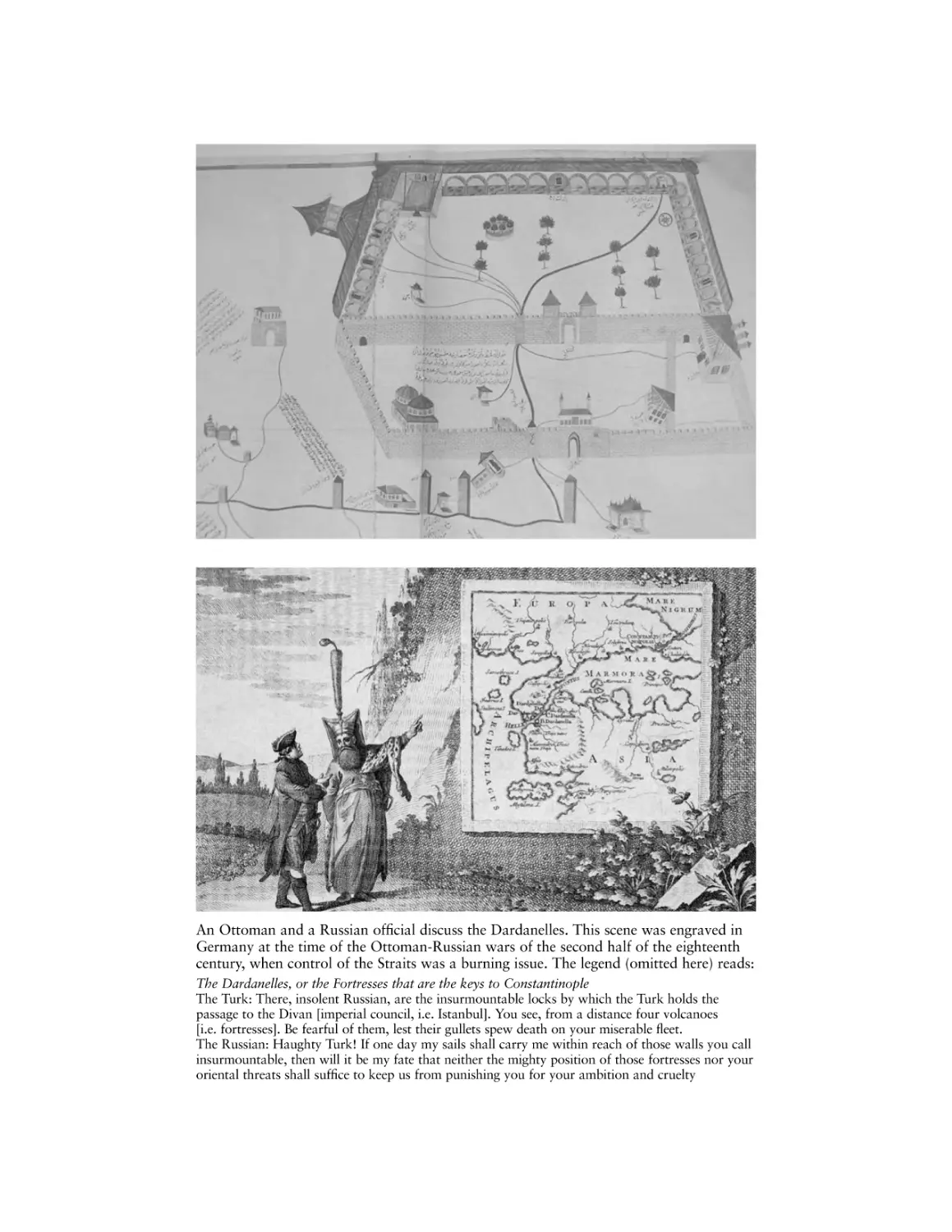
30. An Ottoman and a Russian official discuss the Dardanelles
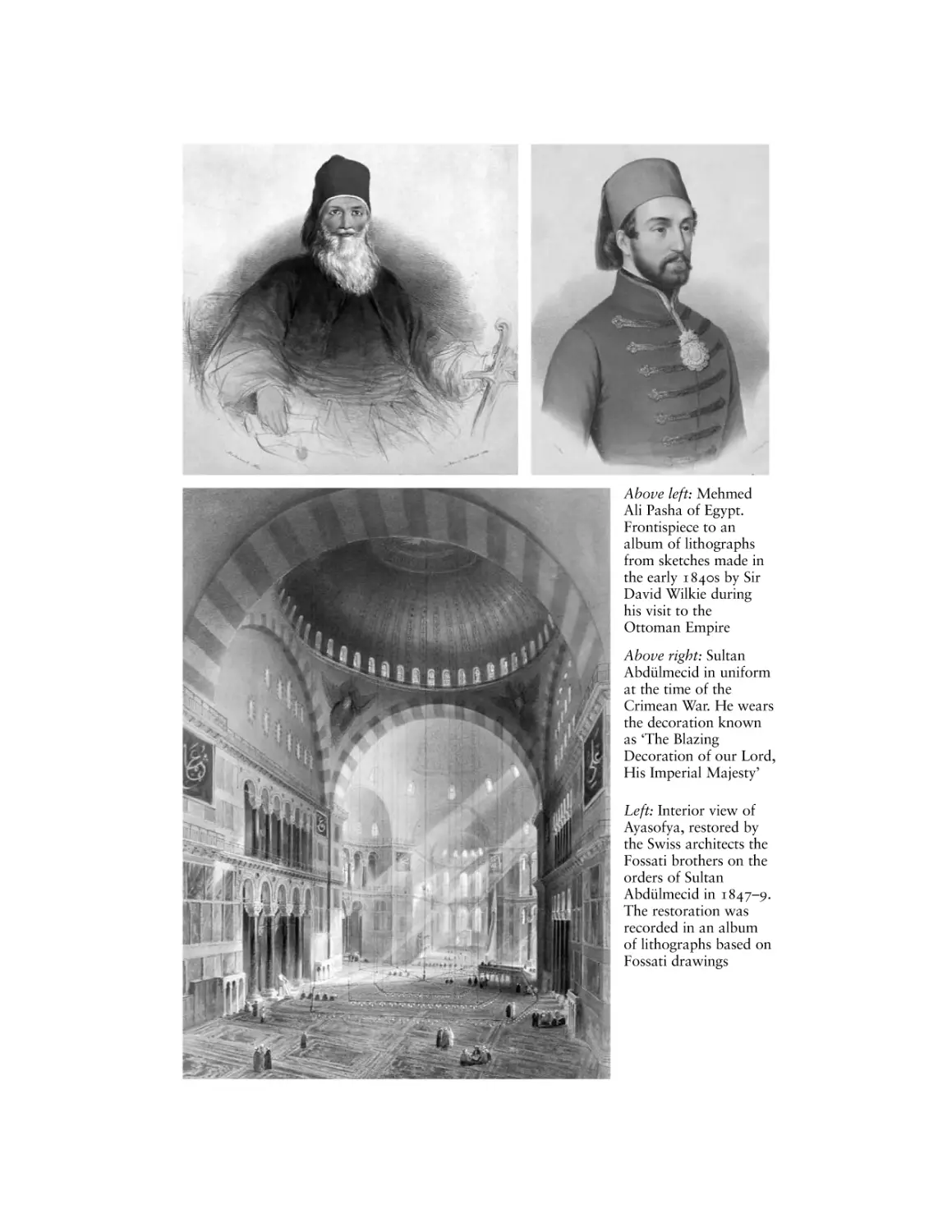
31. Mehmed Ali Pasha of Egypt
32. Sultan Abdülmecid in uniform at the time of the Crimean War
33. Interior view of Ayasofya
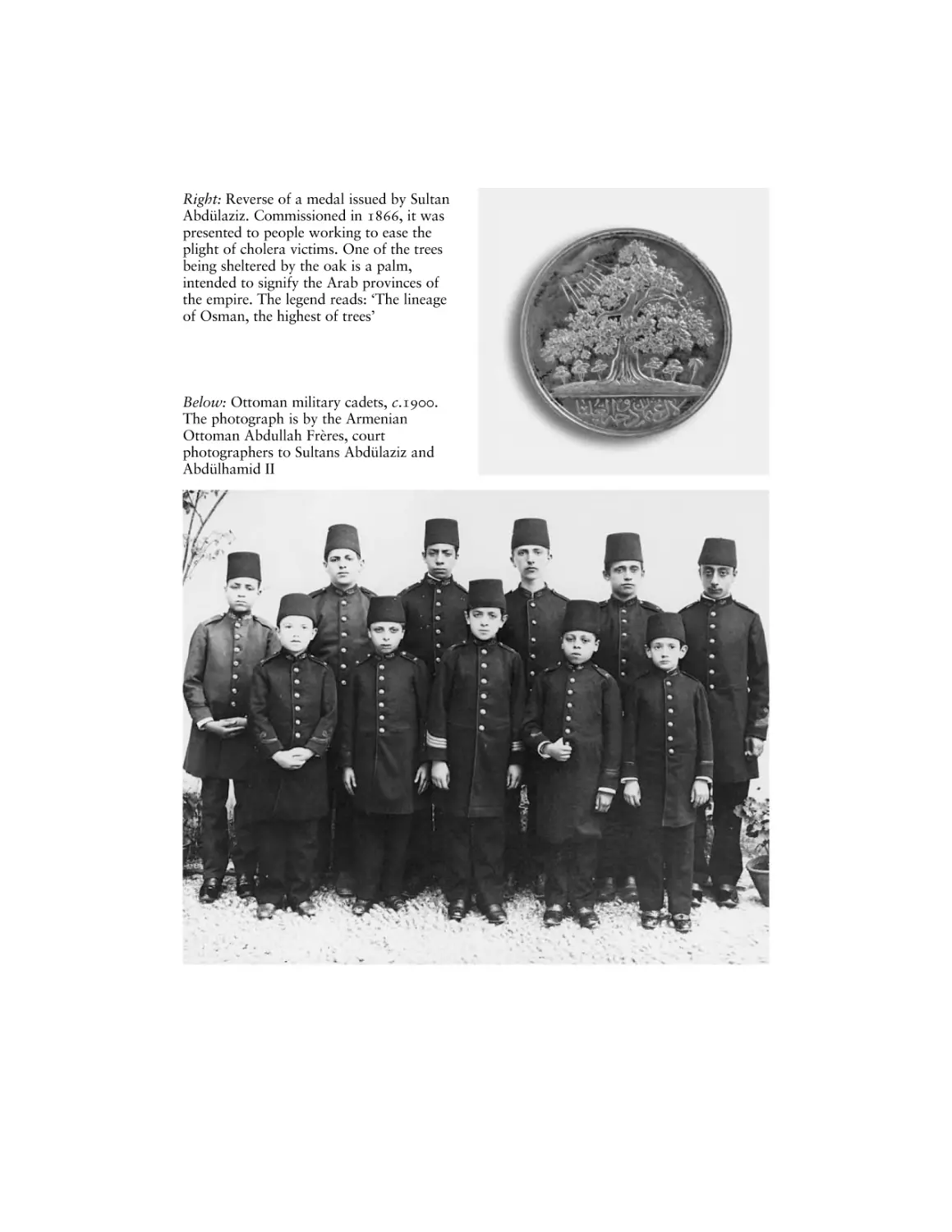
34. Reverse of a medal issued by Sultan Abdülaziz
35. Ottoman military cadets
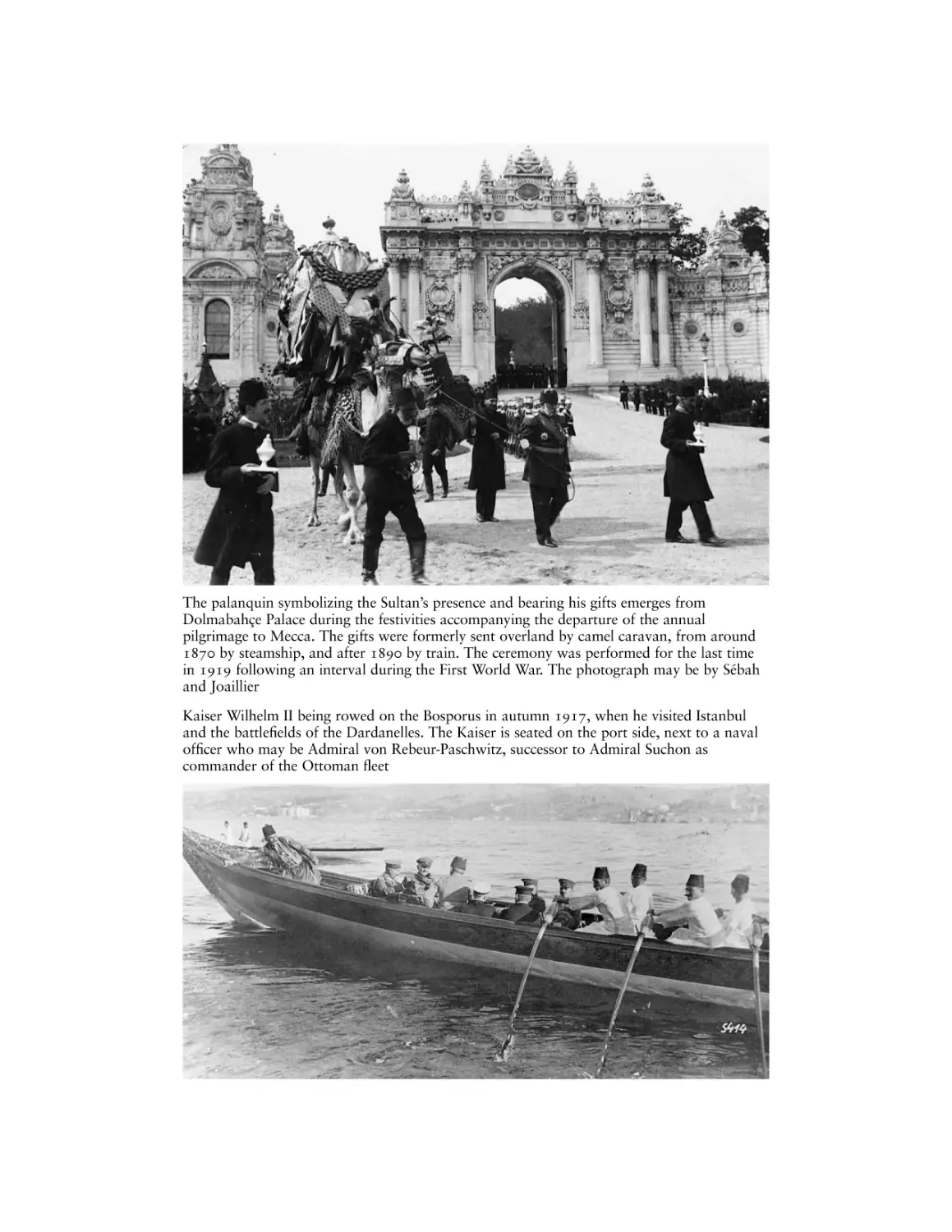
36. The palanquin symbolizing the Sultan’s presence emerges from
Dolmabahçe Palace at the start of the annual pilgrimage to Mecca
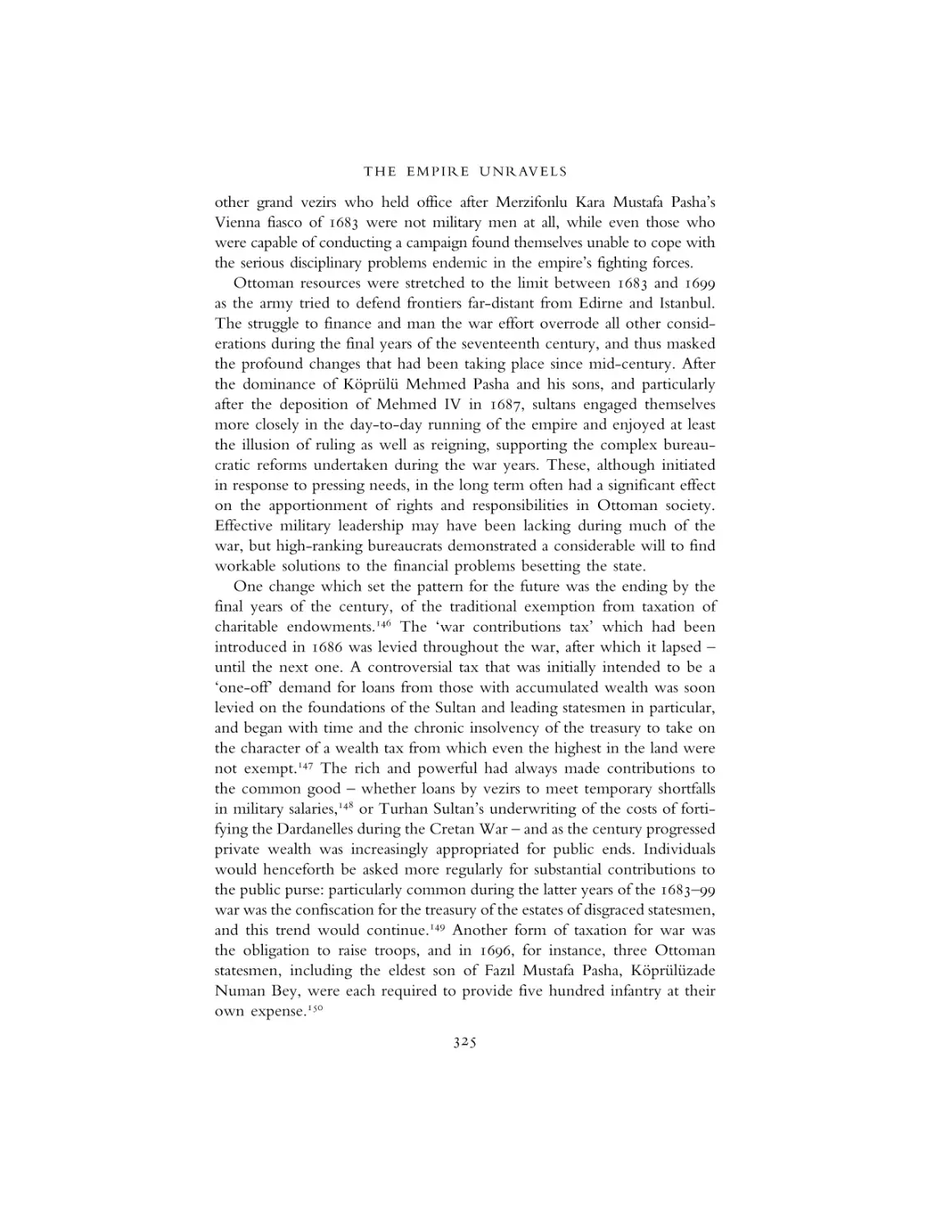
37. Kaiser Wilhelm II being rowed on the Bosporus, autumn 1917
The author and publisher would like to thank the following for permission to reproduce illustrations: Plate 1, I.Hakkì Uzunçarsìlì, ‘Gazi Orhan Bey vakfiyesi, 724 Rebiülevvel-1324 Mart’,
Belleten V (1941) 280–1; 2, Johann Schiltberger, Ich Schildtberger zoche auss von meiner heimat . . .
(Augsburg, 1475) n.p.; 3, Topkapì Palace Museum Library (Suleymanname, H.1517 f.31v); 4,
Schloss Eggenberg Museum, Graz; 5, University Library Budapest (Miscellany, Cod. Ital. 3 f.144v);
6, Jürgen Franck/Cornucopia; 7, Deutsches Archaeologisches Institut, Istanbul (no. 68/154; W.
Schiele 1968); 8, Topkapì Palace Museum Library (Album, H.2153 f.145v); 9, Gulielmus Caoursin,
Guillelmi Caonrsin [sic] Rhodiorum Vicecancellarij: obsidionis Rhodie Vrbis descriptio . . . de casu Regis
Zyzymy: Commentarium incipit (Ulm, 1496) n.p. [f.33r]; 10, A. Vayssière, L’ordre de Saint-Jean de
Jérusalem ou de Malte en Limousin . . . (Tulle, 1884) frontispiece; 11, William Stirling-Maxwell,
Examples of the Engraved Portraiture of the Sixteenth Century (London and Edinburgh, 1872) 41; 12,
Topkapì Palace Museum Library (Hunername, H.1524 f.165v); 13, Topkapì Palace Museum
Library (Futuh al-harameyn, R.917 f.14r); 14, Mazovian Museum, Plock, Poland/Muzeum
Mazowieckie w Plocku (MMP/S/2); 15, The Nasser D. Khalili Collection of Islamic Art
(POT1688); 16, Topkapì Palace Museum Library (Surname-I humayun, H.1344 f.279r); 17,
Deutsches Archaeologisches Institut, Istanbul (R 28.874); 18, Topkapì Palace Museum Library
(Album, B.408); 19, Topkapì Palace Museum Library (Album, H.2134 f.1r); 20, Museo Civico
Correr, Venice (Memorie turche, MSS. Cicogna 1971/36); 21, G. J. Grelot, Relation nouvelle d’un
voyage de Constantinople . . . (Paris, 1680) 283; 22, Paul Rycaut, The Present State of the Ottoman
Empire . . . (London, 1668) 36; 23, [Jean de Prechac] Cara Mustapha Grand Visir. Histoire . . .
(Paris, 1684) frontispiece; 24, Albert Vandal, Les voyages de Marquis de Nointel (1670–1680) (Paris,
1900) 258; 25, Topkapì Palace Museum Library (Surname-i Vehbi, H.3593 f.173b); 26, Turhan
Baytop, Istanbul Lâlesi (Ankara, 1992) 58; 27, Deutsches Archaeologisches Institut, Istanbul (1+ R
21.547); 28, Rijksmuseum (SK-A-4082); 29, Topkapì Palace Museum Library (H.1815); 30, F.
Muhtar Katìrcìoglu/Yeryüzü Süretleri: F. Muhtar Katìrcìoglu Harita Koleksiyonu (Istanbul, 2000) 156;
31 and 33, Courtesy of the Duke of Buccleuch; 32, author’s collection; 34, Isa Akbas
Collection/Edhem Eldem, Pride and Privilege. A History of Ottoman Orders, Medals and Decorations
(Istanbul, 2004) 248; 35, Deutsches Archaeologisches Institut, Istanbul (R 24.687); 36, Deutsches
Archaeologisches Institut, Istanbul (7689); 37, Deutsches Archaeologisches Institut, Istanbul (R
28.558).
Every effort has been made to clear permissions. If permission has not been granted please
contact the publisher who will include a credit in subsequent printings and editions.

viii

CHAPTER TITLE

Acknowledgements

Many colleagues and friends have generously encouraged and assisted me over
the long years that Osman’s Dream has been in the making. They have answered
a multitude of queries in person and by mail; sent me articles and books both
unpublished and published; read single chapters, multiple chapters, even the
complete typescript; and at every turn attempted to save me from error.
Without the willingness of all these people to share the fruits of their scholarship so unreservedly, I could not have embarked upon writing this book.
My greatest debt of gratitude is reserved for the staff of the Istanbul branch
of the American Research Institute in Turkey: the director Antony Greenwood
and his assistants Gülden Güneri and Semrin Korkmaz tolerated my presence
for months at a time, as I read my way through the Institute’s excellent
collection of material relating to matters Ottoman – and every day for months
shared lunch with me. Without the delight of my morning boat-ride across
the Bosporus, and the calm of the Institute’s library, I would have given up
at an early stage. I began writing Osman’s Dream in Cambridge, where Kate
Fleet of the Skilliter Centre at Cambridge University gave me the run of
the Skilliter Library, another oasis for the Ottomanist, and I am also appreciative of the help of the staff of the Institut français des études anatoliennes
and the Islam Arastìrmalarì Vakfi library, both in Istanbul, and of the British
Library, for permitting me the use of their rich collections.
Of the many others whose myriad assistances are discernible in my book,
I mention the following by name: Gábor Ágoston, Virginia Aksan, John
Alexander, Jean-Louis Bacqué-Grammont, Marc Baer, Michele Bernardini,
Idris Bostan, Gregory Bruess, Duncan Bull, Robert Dankoff, Caroline
Davidson, Selim Deringil, Kathryn M. Ebel, Howard Eissenstadt, Y. Hakan
Erdem, Selçuk Esenbel, Suraiya Faroqhi, Cornell Fleischer, Pál Fodor, John
Freely, Fatma Müge Göçek, Daniel Goffman, Yasemin Gönen, Rossitsa
Gradeva, Jane Hathaway, Colin Heywood, Frédéric Hitzel, M. Sükrü
Hanioglu, Colin Imber, Robert Jones, Yavuz Selim Karakìsla, Claire Ruoff
Karaz, Michael Khodarkovsky, Machiel Kiel, Dariusz Kolodziejczyk, Klaus
Kreiser, Donna Landry, Heath Lowry, Gerald MacLean, Andrew Mango,
Nenad Moacanin, Rhoads Murphey, Oktay Özel, Burcu Özgüven, Oded
Peri, Hedda Reindl-Kiel, Kahraman Sakul, Ariel Salzmann, Hamish Scott,
Norman Stone, Frank Sysyn, Nabil al-Tikriti, Christine Thompson, Lucienne
Thys-Senocak, Gündüz Vassaf, Sara Nur Yìldìz, Fehmi Yìlmaz, Elizabeth

ix

OSMAN’S DREAM

Zachariadou, Fariba Zarinebaf-Shahr. This list cannot hope to be exhaustive,
and there are many others whose help I benefited from along the way. Two
more to whom I am indebted are Joyce Matthews, who translated many of
the passages of prose and poetry from Ottoman Turkish into mellifluous
English, striving with singular success to catch the tone of the original; and
Ara Güler, who photographed me for the publicity material.
Writing is hard; coming by illustrations is harder. I would like to thank the
following, in particular, for making the process relatively painless: Filiz Çagman,
Zeynep Çelik and Gülendam Nakipoglu of Topkapì Palace Library; Edhem
Eldem; Muhittin Eren of Eren Publications, Istanbul; John Scott of Cornucopia
Magazine; F. Muhtar Katìrcìoglu; the staff of the Cultural Department of Yapì
Kredi Bank, Istanbul; Giulia Bartrum of the British Museum, Dept. of Prints
and Drawings; Natalia Królikowska; Krzysztof Wawrzyniak.
My commissioning editor at John Murray, Caroline Knox, provided support
until the later stages of the book’s passage towards publication: to her, to her
successor Gordon Wise, to Caroline Westmore for her exemplary attentiveness
to detail, to Cathy Benwell and Nikki Barrow, my warmest thanks are due.
Preparing the book for publication in the United States was expedited by the
boundless enthusiasm and energy of Lara Heimert, Executive Editor, and David
Shoemaker, Assistant Editor. I would also like to acknowledge gratefully the
editing skills of Liz Robinson and Elizabeth Dobson who gave the text a fluency
it could not otherwise have had. Philip Mansel proposed this book to John
Murray, and deserves special mention for being instrumental in initiating the
writing of the Ottoman story for a general audience, an opportunity the like
of which all too rarely comes the way of an academic historian. My agent Anne
Engel gently urged me on when I became discouraged. The maps were drawn
by Martin Collins and the index compiled by Douglas Matthews.
I set out on the Ottoman path under the expert and painstaking guidance
of Victor Ménage, formerly professor of Turkish at the School of Oriental and
African Studies, London University. Now, many years later, I can offer something in return for his wisdom. Another Victor, Victor Ostapchuk, with whom
I share a passion for the Ottoman Black Sea and the intricacies of its defence
against powers coming from the north, devoted much time to reading my typescript as it progressed and commenting on it in learned depth and detail –
despite pressing matters relating to his own work and career. But most of all,
I am lucky to have married a writer and journalist – or rather, an academic
manqué who became a journalist – who has taught me the indisputable value
of making the inaccessible accessible, and that there is usually a form of words
that will convey even the most abstruse point to a general audience. To the
two Victors – Vic-i büzürg and Vic-i sagir – to Andrew Finkel, and to our
daughter Izzy, whose formative years have been spent entirely in the shadow
of the Ottomans, I dedicate this book.

x

CHAPTER TITLE

Preface

There has been an explosion of history-writing in recent years, and on the
shelves of bookshops together with histories of every other time and place
are now to be found Ottoman histories of varying scope and subject matter.
Some are intended for an academic audience, some cover only limited periods
of time, some are based entirely on non-Turkish or non-Ottoman sources.
My purpose has been to try to provide for a general audience an up-to-date
history of the whole chronological span of the Ottoman Empire – and beyond;
my aim has been to counter the over-simplified notion that the Ottoman
Empire rose, declined, and fell – and that is all we need to know about it.
Like history itself, historical research does not stand still, and the last ten
or fifteen years have produced exciting new perspectives and interpretations.
Nevertheless current general perceptions of the Ottoman Empire still owe a
great deal to the observations and prejudices preserved in European sources
written in the heat of the various confrontations between western states and
the Ottomans. Characterizations of the empire as an ‘Oriental despotism’ or
‘the Sick Man of Europe’, for instance, derive from particular moments in
time when such ‘soundbites’ suited particular purposes. Unfortunately, they
have been continually repeated and recycled as though they encompass the
whole history of the empire and are adequate to embrace the historical insights
gained since they were coined.
Much of what passes for general history-writing about the Ottoman
Empire in its varied aspects is in reality quite innocent of ‘history’ and reduces
the Ottomans and their world to a theatre of the absurd – a parade of salacious sultans, evil pashas, hapless harem women, obscurantist clerics – stereotypical characters frozen into a well-worn setting which lacks all but the
barest acknowledgement of the dynamics of history. It tells a timeless tale of
an alien and exotic universe, and fails to inform the reader of the processes
which shaped that universe. That these books sell well is evidence of general
interest in the Ottoman Empire; that they are grounded neither on the more
recent historical perceptions nor on the original sources is a reflection of the
fact that Ottoman historians have rarely stirred themselves to write for a
general audience. I hope my ‘new narrative’ will entertain the general reader,
while at the same time serving as a modest corrective, furthering our understanding of the connections between past and present and of how we got to
where we are today.

xi

OSMAN’S DREAM

My own approach to Ottoman history is perforce coloured by long residence in the Turkish Republic, the final successor state of the Ottoman
Empire, where I have lived for some fifteen years. The past is truly another
country in Turkey, whose citizens have been deprived of easy access to the
literary and historical works of previous eras by the change of alphabet in
1928 from Arabic script to the Roman alphabet familiar to most of the
western world. At the same time, an ongoing programme to make the vocabulary more Turkish is expunging words of Arabic and Persian derivation –
the other two components of the rich amalgam that was the Ottoman tongue,
today in danger of becoming as ‘dead’ as Latin. On the other hand, works
from the Ottoman centuries are now being published in modern script with
simplified language, enabling modern readers to gain some understanding of
what went before. The situation would otherwise be dire: imagine an English
literary canon which lacked anything written before the 1930s!
It once seemed possible that, with the passing of those generations who
had learnt the Ottoman language before the change of alphabet, there would
be few who were able to read the voluminous documents and manuscripts
which are the basic source-material for Ottoman history. However, students
continue to train as historians, and learn Ottoman, and they hold university
positions in Turkey and abroad alongside non-Turkish-born Ottoman specialists. Yet it has not been easy for Turks to cast off the ‘official history’ taught
them in school, a version of their past which took its impetus from the revolution identified with the name of Mustafa Kemal Atatürk, the ‘father of
modern Turkey’. In the early years of the republic the Ottoman centuries
were considered to be a closed book and disdained as though they had no
connection with its citizens, for whom a more distant Turkic past was considered appropriate. But as the Ottoman period has receded in memory, it is
becoming open to scrutiny; and although Turks have been enjoined by the
gurus of education to see themselves as inheritors of a proud past which can
be described but not interrogated, this too is changing. Thus official history
now endorses the notion that the Ottoman dynasty was invincible and
its sultans all-powerful – except those remembered with such soubriquets as
‘Sot’ or ‘Crazy’ – but little attention has yet been given to the opposition
to the state and its writ which occurred from the earliest years of the empire:
a reluctance to acknowledge the existence of dissent which is an abiding
feature of politics in modern Turkey.
Yet, despite the practical hurdles which hinder an understanding of their
Ottoman past, the citizens of the modern Turkish state are endlessly curious
about their history. Political discourse is peppered with lively exchanges of
a kind quite unfamiliar to western observers: varying perceptions of the past
provide a rich source of reference as politicians and interest groups quibble
over which version of history will best serve tomorrow’s purposes (a tomorrow

xii

P R E FAC E

that has often seemed more uncertain than it is elsewhere). Many conversations allude to topics whose roots stretch back into history. The most visible
example of the past haunting the present is the ‘Armenian question’ – which
in its current manifestation revolves around Armenians lobbying for national
governments to declare the communal massacres in Anatolia in the First
World War a genocide. Less obvious to outsiders are two other topics high
on the Turkish agenda: the role of the military in politics, and the limits of
the acceptable in religious expression. These are themes that pervaded Ottoman
history, and preoccupied the statesmen and people of the past as they do
today’s. The historian’s task is to show how the past led up to the present,
or to a present that is now past. In Turkey history-writing thus becomes a
more serious matter than it is in some other countries, and the writer of
Ottoman history cannot enjoy the luxury of supplying entertainment at the
cost of explanation.
It is customary for studies of the Ottoman Empire to end in 1922, the year
of the abolition of the sultanate; in 1923 when the Turkish Republic was
declared; or even in 1924, when the caliphate was abolished. I have extended
my account into the republican period, to 1927, the year when Atatürk made
a great speech justifying his role in the overthrow of the empire and the
establishment of the republic, and setting out his vision, his dream for the
future. Herein lies the conceit behind the title of my book, which alludes
to a dream the first sultan, Osman, is said to have had, a dream interpreted
as prophesying the birth and growth of the empire whose story I endeavour
to tell. Continuing this history until 1927 also allows me to point to some
of the continuities between the republic and the history of the empire: the
received wisdom that the republic was a tabula rasa which bore only the
imprint of the Atatürk revolution is gradually being challenged by historians.
In writing a work of such ambitious scope I have been faced with many
hard choices. I make no claims to completeness – which would, after all,
have been impossible to achieve. A strong narrative line seemed desirable.
At some points, readers may object that it would be easier to understand
what is going on if unfamiliar elements like the janissaries or the harem were
treated separately, outside the main flow of the text. I contend that these
features are integral aspects of the society which produced them, that they
did not exist in a vacuum; by the same token, art and architecture arise from
the complexity of society, and cannot be interpreted as isolated expressions
of pure creativity. Nor does it make any sense to deal with religion in a
chapter entitled ‘Islam’, since religion is a major dynamic force in history,
and the way it is practised at any time or in any place has political repercussions. Viewing history through ‘institutions’ tends to freeze-frame what
was dramatic, and obscure the interconnections between related events. It

xiii

OSMAN’S DREAM

has the further drawback of encouraging the reader to seize upon the very
aspects of Ottoman history that have so often been treated pejoratively,
without explaining how they arose and why they developed as they did.
Thus is any attempt to interpret Ottoman history by the same standards as
other histories hindered, and that history made to seem unique. There are
unique aspects to the history of every state, of course; but to emphasize them
rather than the aspects that are comparable to the history of other states seems
to me to miss the point.
The ‘black hole’ that is Ottoman history is a cause for regret in and of
itself, but more regrettable still is the present palpable ‘iron curtain’ of misunderstanding between the West and Muslims. This stems to a large degree
from the West’s ‘old narrative’ of the Ottoman Empire, which by extension
is the narrative of many centuries of the Islamic past. To understand those
who are culturally and historically different from us – rather than resorting
to such labels as ‘evil empire’, ‘fundamentalist’ and ‘terrorist’ to mask our
ignorance – is a matter of urgency. The greatest hubris is to ask why ‘they’
are not like ‘us’, to accept our cultural biases lazily and without question,
and to frame the problem in terms of ‘what went wrong?’
This, then, is a book intended for several audiences. I hope general readers
who know little of the Ottomans apart from the ‘old’ narrative will find the
‘new’ narrative every bit as entertaining – and much more complex and satisfying, since it explains how the empire and its people saw themselves and
how this perception changed over time. I have written much about the
Ottomans’ neighbours and rivals to east and west, so there is something, too,
for those interested in territories on the Ottoman frontiers as well as further
away. It is also intended for students embarking on a study of Ottoman
history, who presently lack a single-volume narrative in English. I hope,
indeed, that it will be read by all those for whom the long centuries of the
Ottoman Empire hold a fascination.

xiv

CHAPTER TITLE

A note on spelling, names, maps and quotations

The modern Turkish alphabet has 29 letters, of which three vowels and
three consonants are unfamiliar to those who do not know the language,
and one consonant is pronounced differently from English. The letters in
question are these:
c as j in Jane
ç as ch in chip
g silent; lengthens a preceding vowel
ì as i in cousin
ö as eu in Fr. deux
s as sh in ship
ü as in Fr. tu

Turkish also has a dotted capital i – I – which I have used for Ottoman
and Turkish personal and place-names, e.g. Izmir, not Izmir, but have not
used, exceptionally, for Istanbul, which I have written thus and not as
Istanbul as is proper.
Imposing entirely consistent systems for personal and place-names has
proved an insurmountable challenge. For people who may be deemed
Ottomans I have used modern Turkish ‘academic’ spellings: the name
Mehmed, for instance, is today Mehmet in popular usage, and Bayezid,
Beyazit; I have preferred the older version. I have also used the Turkish
version for the names of the Turcoman rulers of, for example, Karaman
and the Akkoyunlu. For Seljuks, Mamluks, Safavids and other non-Ottomans
I have relied on the spelling in the Cambridge History of Islam (omitting
indication of vowel length) except for a few individuals familiar to English
readers, such as Tamerlane (properly Timur).
Place-names are still more problematic; for every watertight reason for

xv

OSMAN’S DREAM

preferring one spelling over another, there is an equally watertight reason
for preferring the second. Most places had more than one name; some
places in central Europe, for instance, are known by four names e.g. Nové
Zámky (mod.), Uyvar (Ott.), Érsekújvár (Hung.), Neuhäusel (Ger.). The
Ottoman place-names (which have usually been retained in modern Turkish)
are most familiar to me, but would have confounded English readers. I
have therefore, since they have the virtue of being easy to locate, but at
risk of anachronism, chosen to use modern place-names as given in The
Times Comprehensive Atlas of the World (Millennium Edition, 2000) except
in the case of some Ottoman provinces for which to use a modern name
would have been an anachronism too far, and idiosyncrasy seemed a lesser
sin – Uyvar is a case in point. An alternative, perhaps more familiar, placename is often given at first mention in the text, and alternative names are
also found in the Index.
Mapping the Ottoman Empire is notoriously difficult. The empire’s frontiers were never entirely stable for long and, internally, provinces formed
and re-formed; historians still do not have an accurate picture of which
provinces existed at any time, let alone exactly where their borders lay.
Any map attempting to show provinces can therefore only be impressionistic; the administrative centre of each province is, however, usually known.
Many of the passages quoted in the text have been shortened and the
style of some translations by others into English from another language has
been slightly revised.

xvi

CHAPTER TITLE

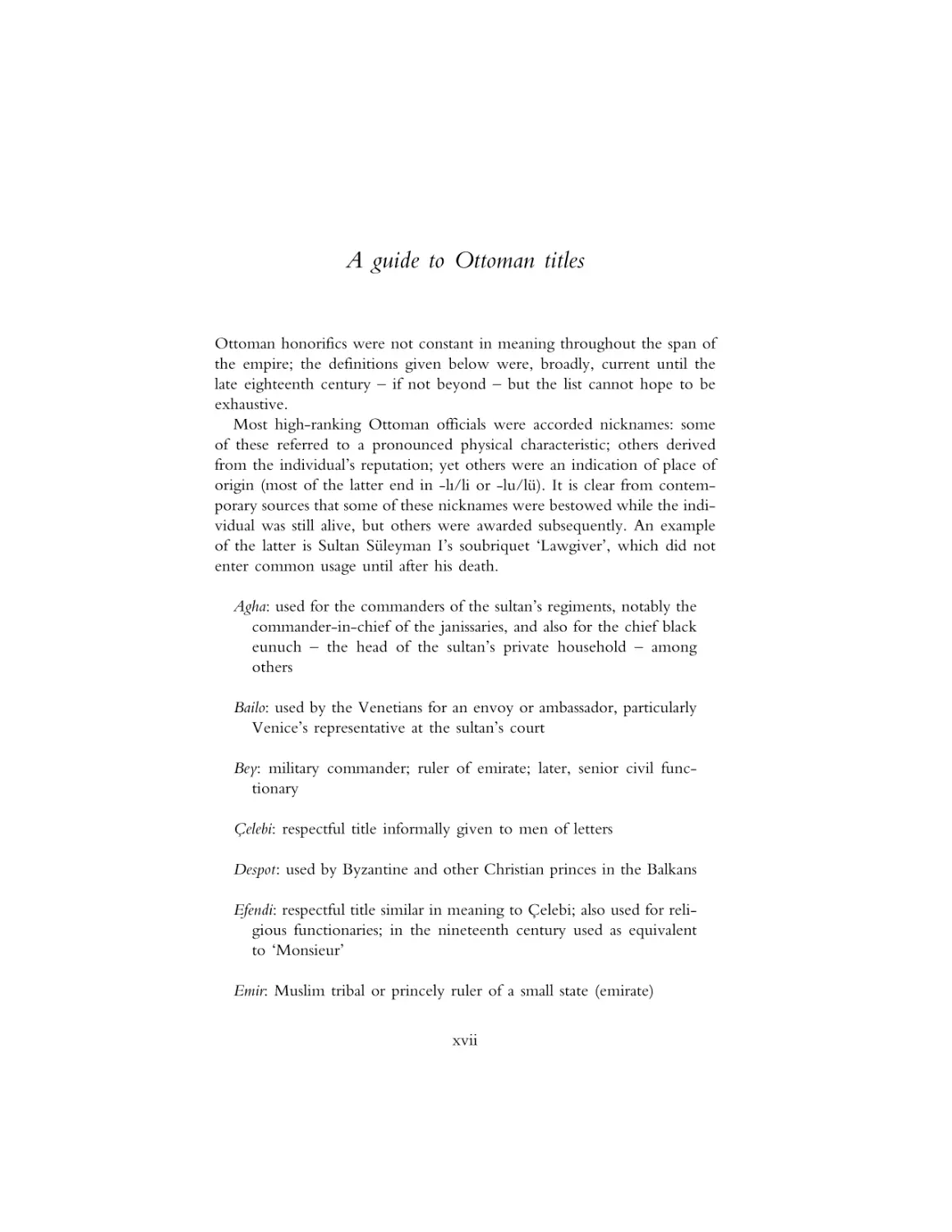
A guide to Ottoman titles

Ottoman honorifics were not constant in meaning throughout the span of
the empire; the definitions given below were, broadly, current until the
late eighteenth century – if not beyond – but the list cannot hope to be
exhaustive.
Most high-ranking Ottoman officials were accorded nicknames: some
of these referred to a pronounced physical characteristic; others derived
from the individual’s reputation; yet others were an indication of place of
origin (most of the latter end in -lì/li or -lu/lü). It is clear from contemporary sources that some of these nicknames were bestowed while the individual was still alive, but others were awarded subsequently. An example
of the latter is Sultan Süleyman I’s soubriquet ‘Lawgiver’, which did not
enter common usage until after his death.
Agha: used for the commanders of the sultan’s regiments, notably the
commander-in-chief of the janissaries, and also for the chief black
eunuch – the head of the sultan’s private household – among
others
Bailo: used by the Venetians for an envoy or ambassador, particularly
Venice’s representative at the sultan’s court
Bey: military commander; ruler of emirate; later, senior civil functionary
Çelebi: respectful title informally given to men of letters
Despot: used by Byzantine and other Christian princes in the Balkans
Efendi: respectful title similar in meaning to Çelebi; also used for religious functionaries; in the nineteenth century used as equivalent
to ‘Monsieur’
Emir: Muslim tribal or princely ruler of a small state (emirate)

xvii

OSMAN’S DREAM

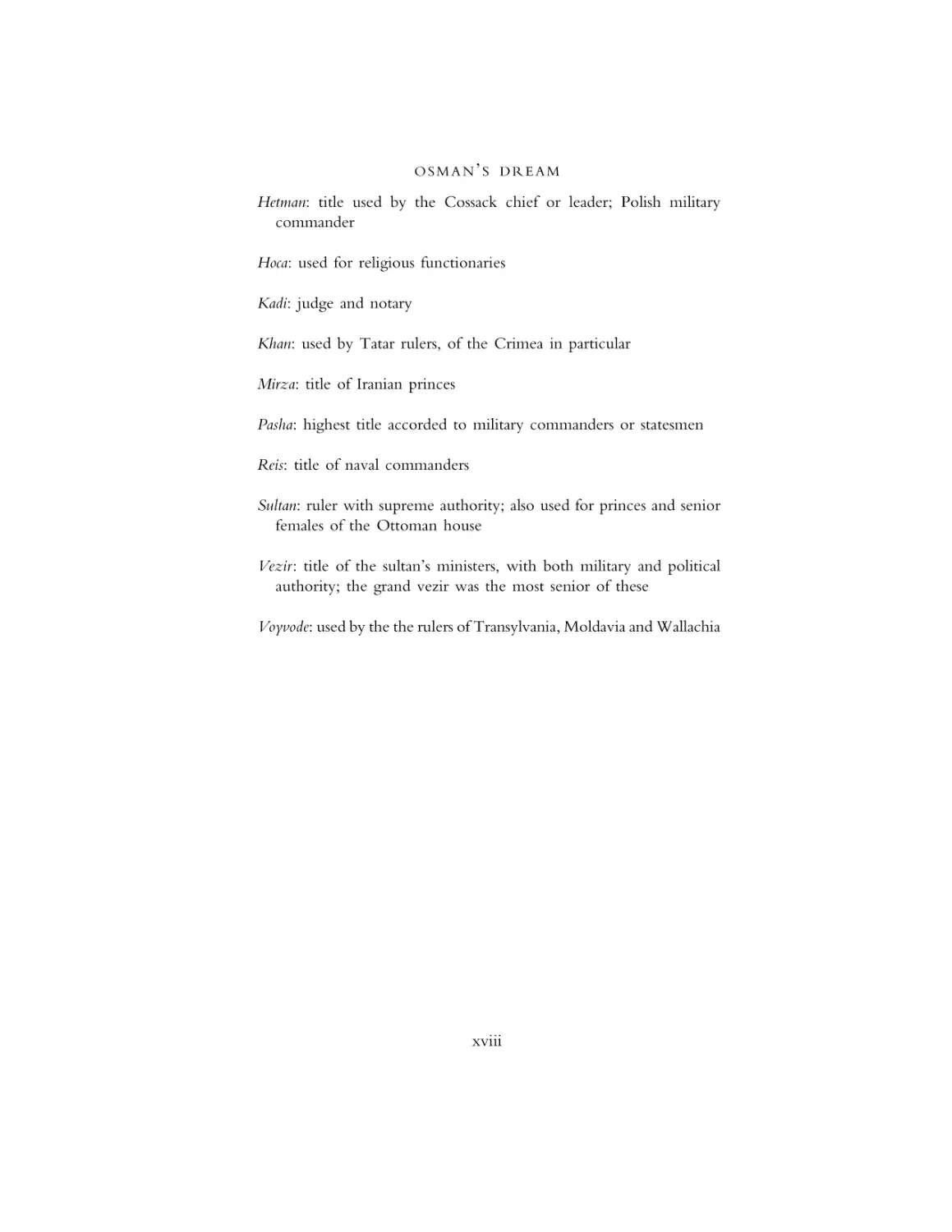
Hetman: title used by the Cossack chief or leader; Polish military
commander
Hoca: used for religious functionaries
Kadi: judge and notary
Khan: used by Tatar rulers, of the Crimea in particular
Mirza: title of Iranian princes
Pasha: highest title accorded to military commanders or statesmen
Reis: title of naval commanders
Sultan: ruler with supreme authority; also used for princes and senior
females of the Ottoman house
Vezir: title of the sultan’s ministers, with both military and political
authority; the grand vezir was the most senior of these
Voyvode: used by the the rulers of Transylvania, Moldavia and Wallachia

xviii

CHAPTER TITLE

Maps

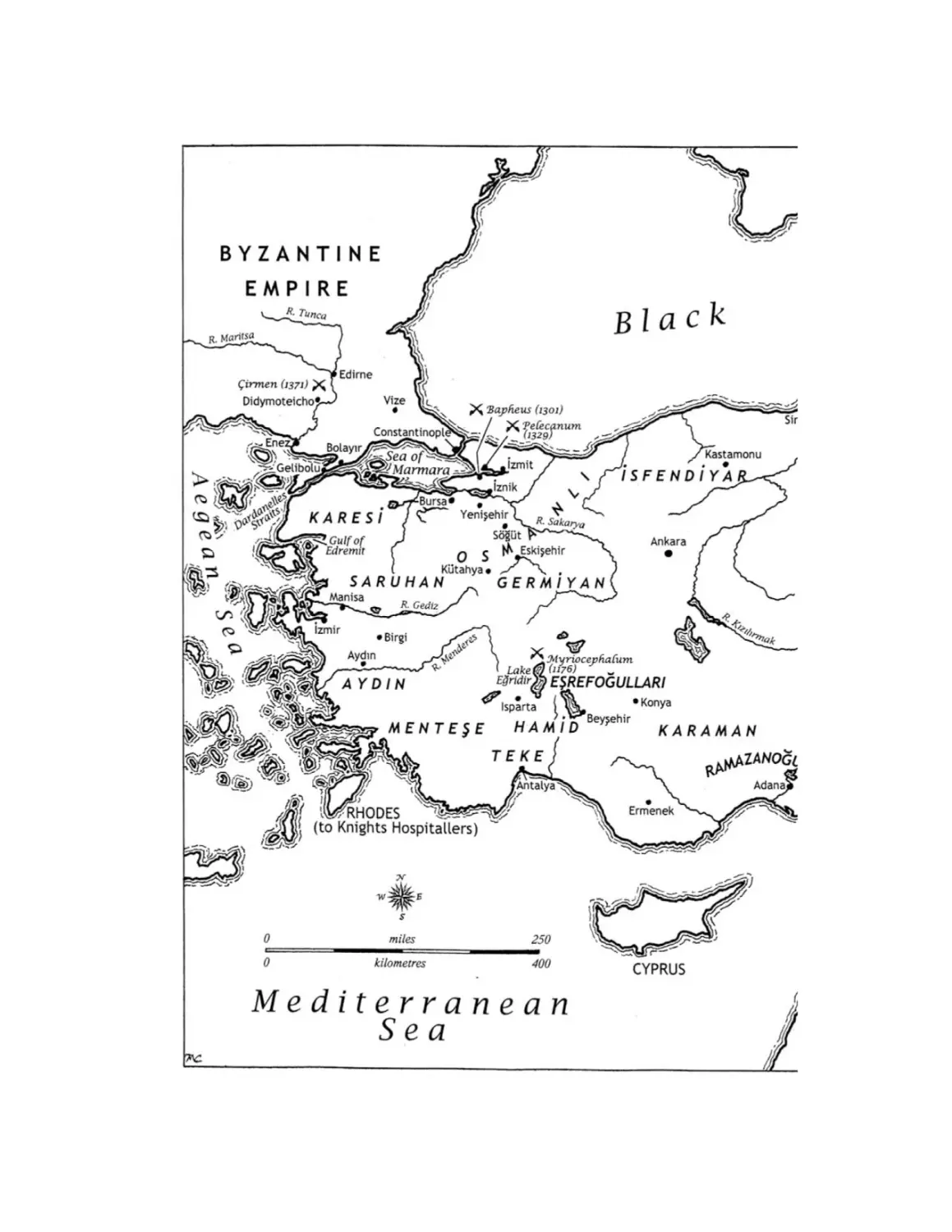
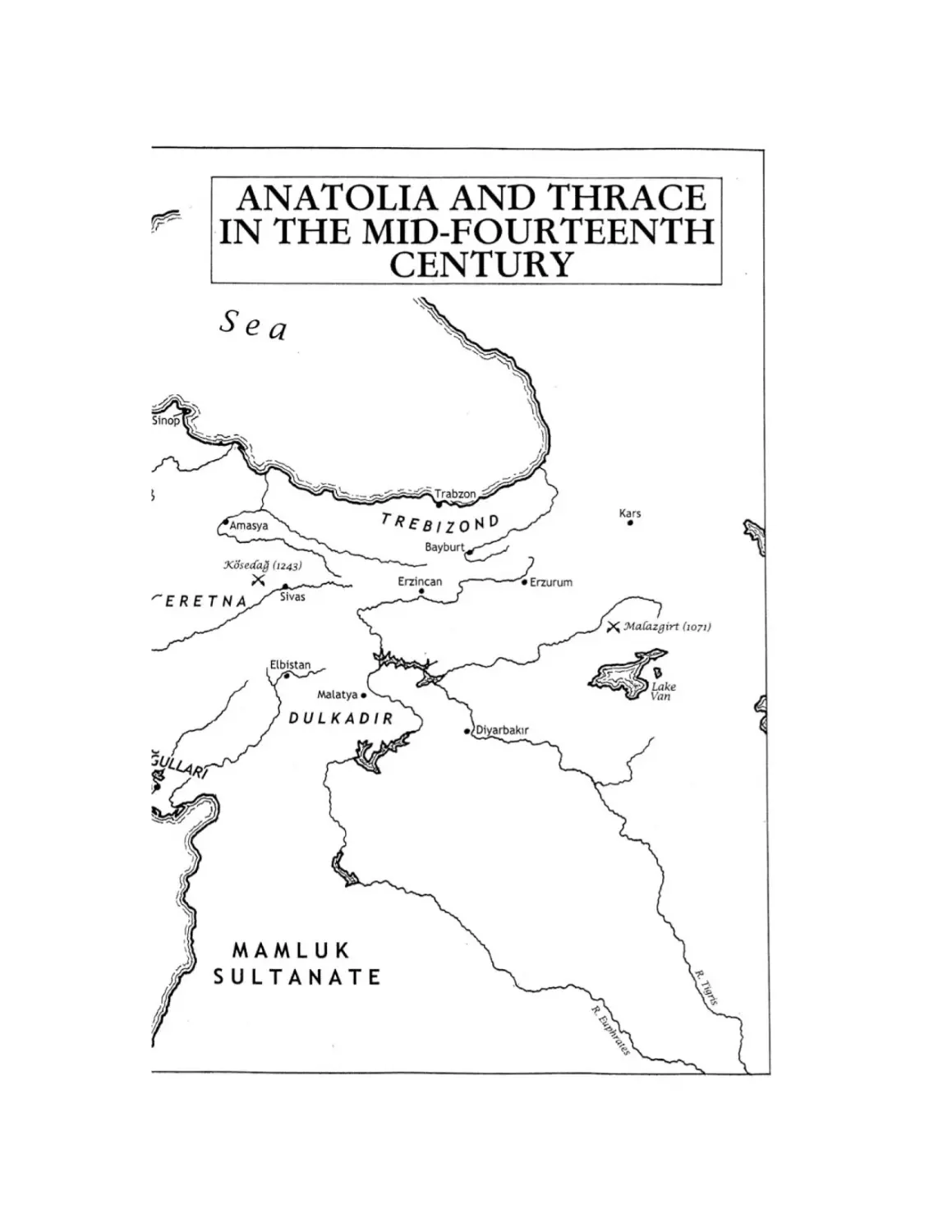
1. Anatolia and Thrace in the Mid-Fourteenth Century

xx

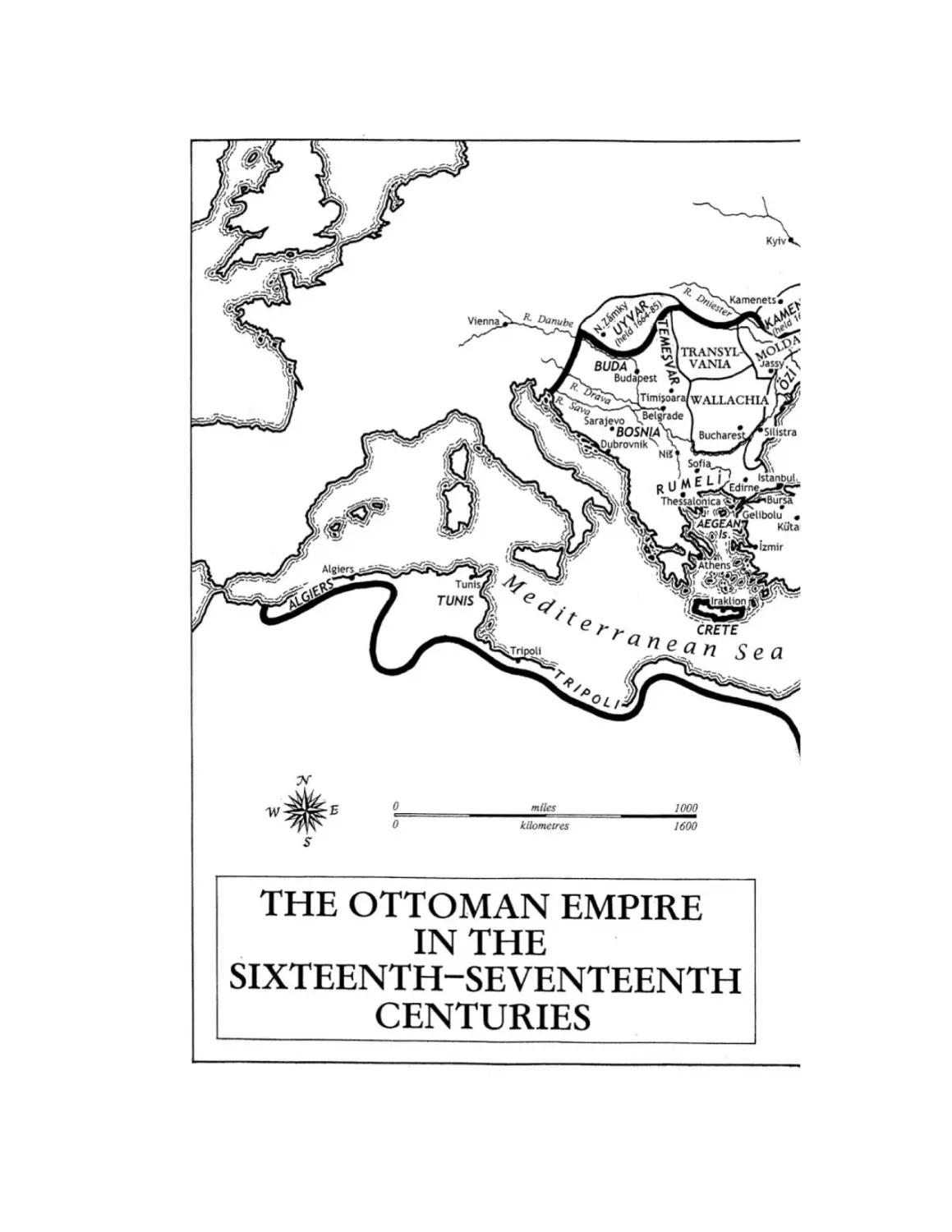
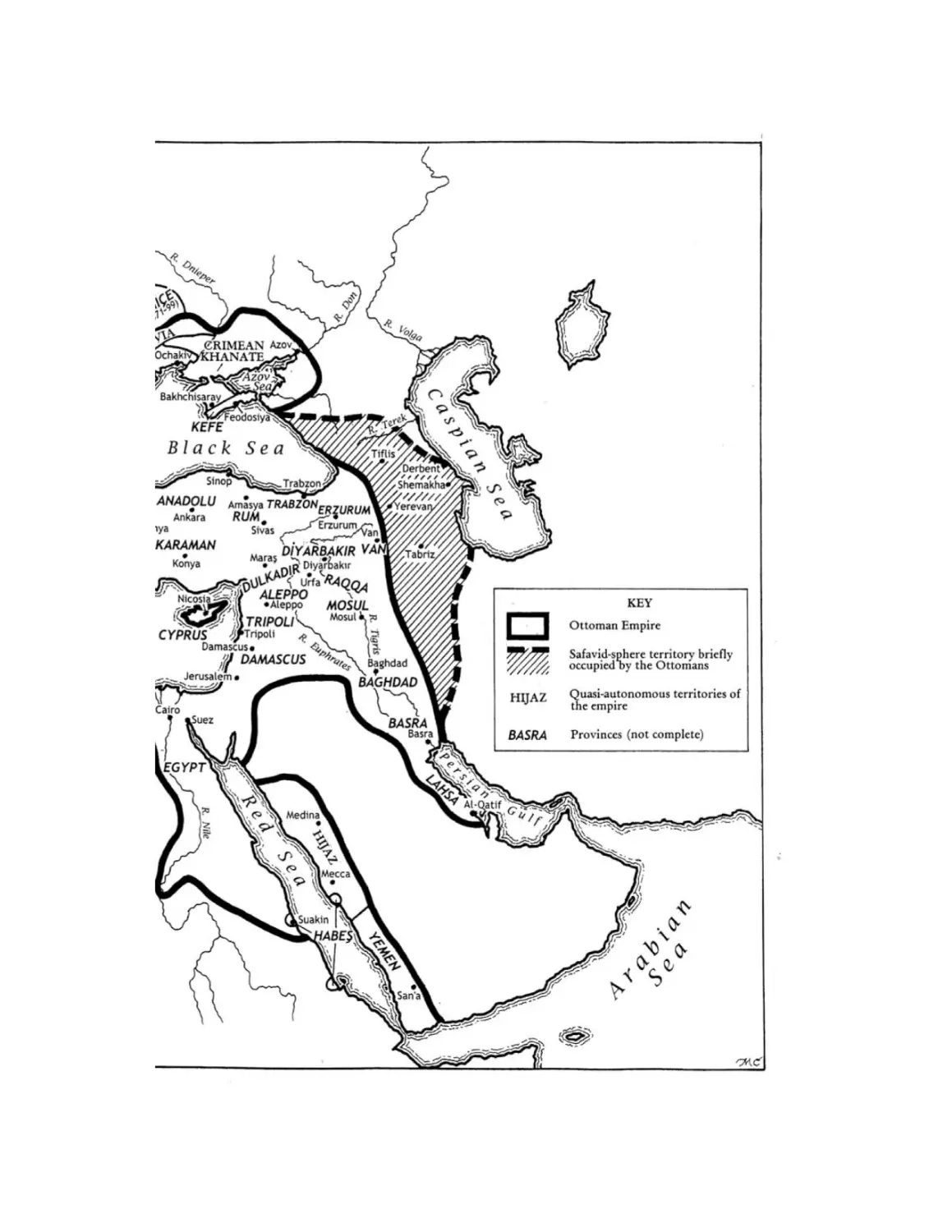
2. The Ottoman Empire in the Sixteenth–Seventeenth Centuries

xxii

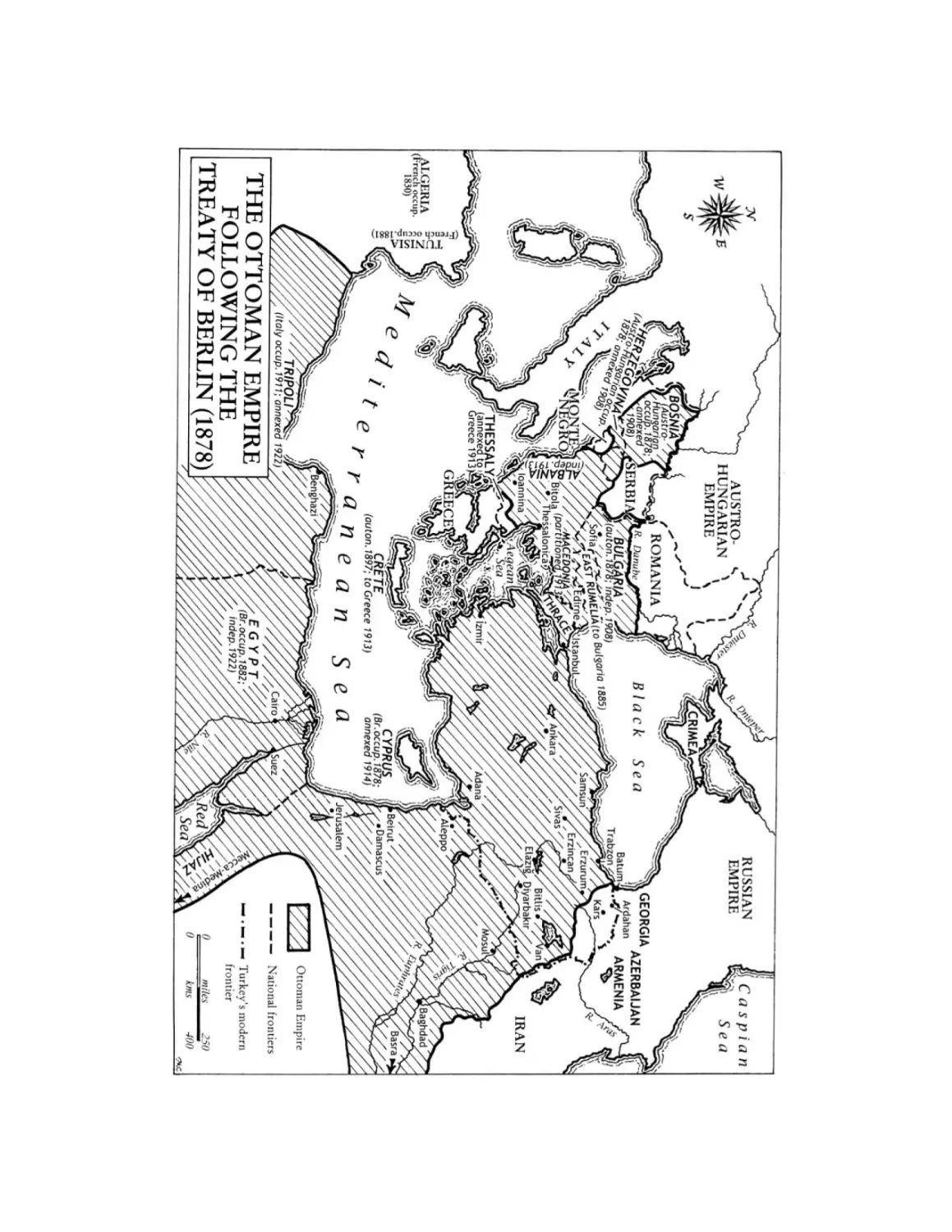
3. The Ottoman Empire Following the Treaty of Berlin (1878)

xxiv

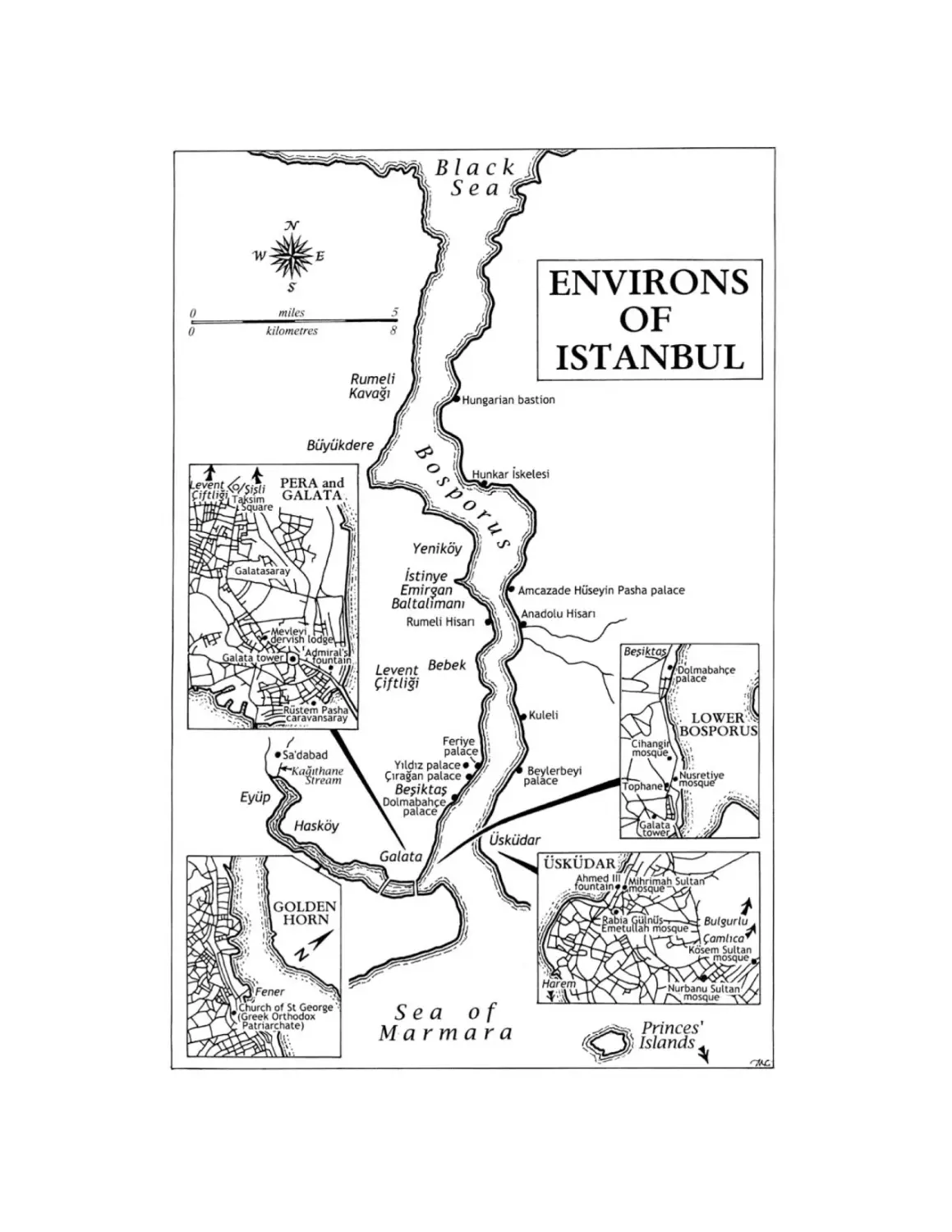
4. Environs of Istanbul

xxv

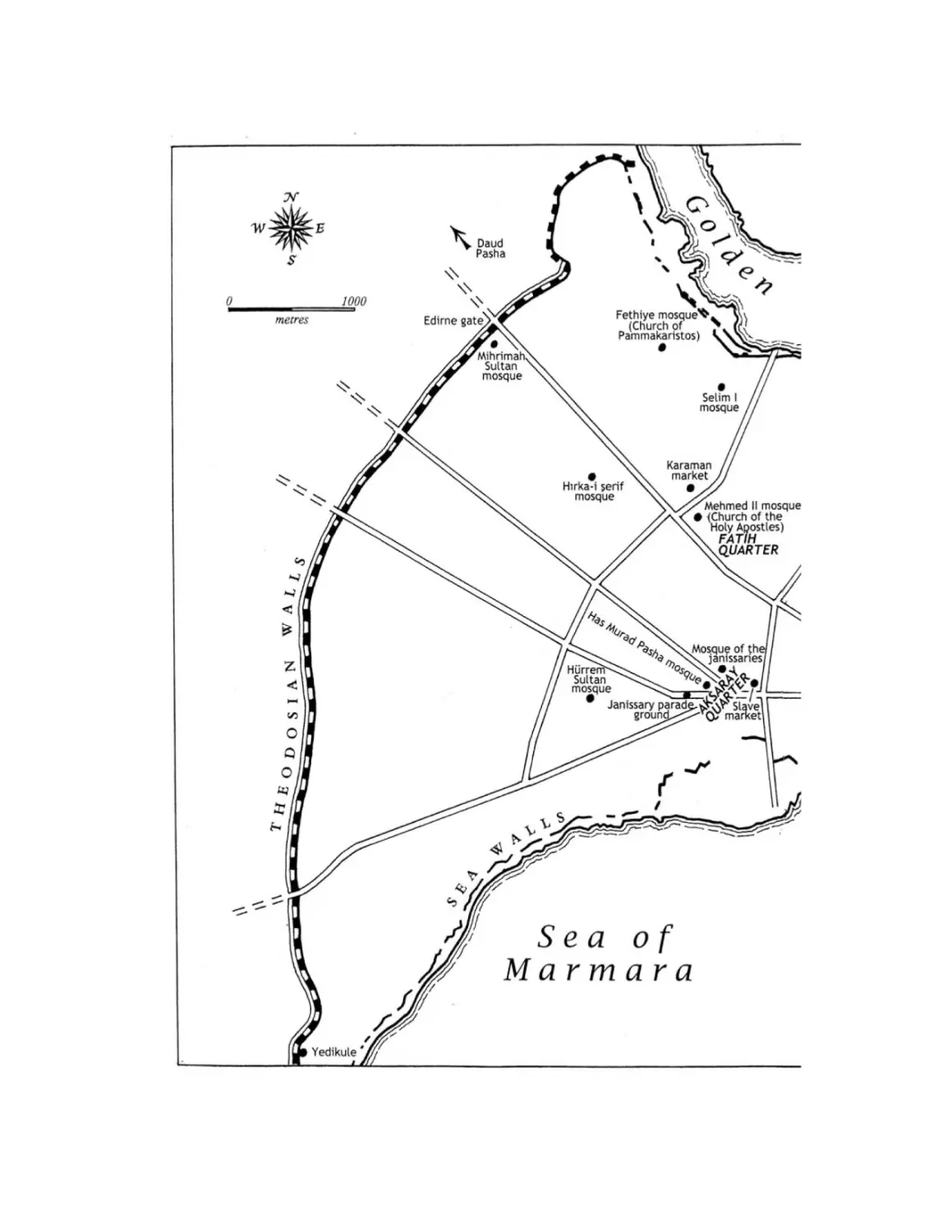
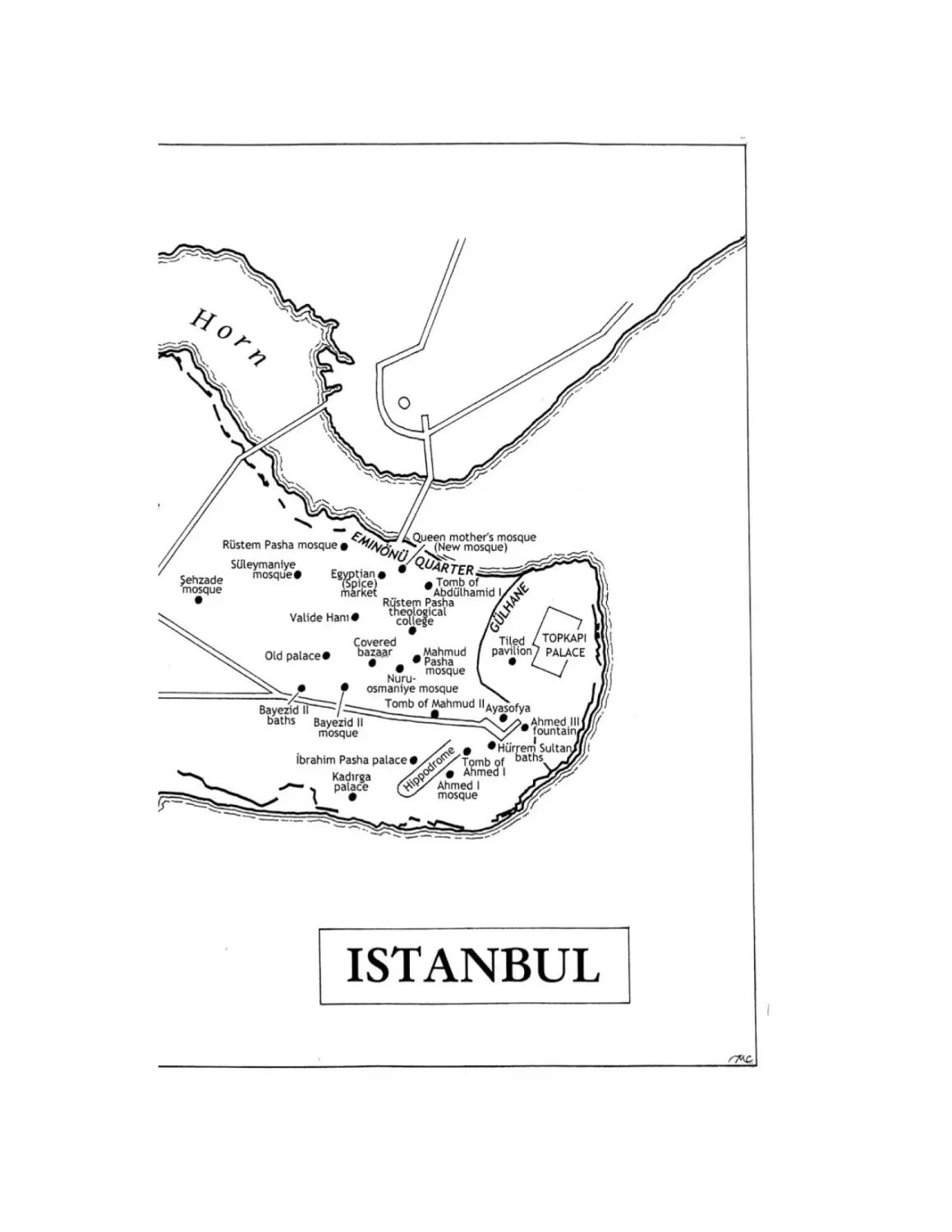
5. Istanbul

xxvi

xix

OSMAN’S DREAM

xx

CHAPTER TITLE

xxi

OSMAN’S DREAM

xxii

CHAPTER TITLE

xxiii

OSMAN’S DREAM

xxiv

CHAPTER TITLE

xxv

OSMAN’S DREAM

xxvi

CHAPTER TITLE

xxvii

OSMAN’S DREAM

xxviii

CHAPTER TITLE

1
First among equals

O TTOMAN E MPIRE ended on a particular day, but its beginnings
are shrouded in myth.
On 29 October 1923 Mustafa Kemal Atatürk was declared president of the
Turkish Republic, a state whose legitimacy was based on popular sovereignty
within finite, internationally-recognized frontiers. Turkish republicans had
already demoted the Ottoman Sultan – on 1 November 1922 – so that he
retained only his religious role as caliph, and on 3 March 1924 they abolished
that office too, thereby abandoning altogether the notion that the state they
were creating owed its existence to dynastic politics or to divine right.
Between the 15th and the 20th of October 1927 Mustafa Kemal set out
in a lengthy address to parliament – so famous that it is known in Turkish
simply as ‘The Speech’ – the reasons his generation had rejected the nation’s
stale and unprofitable Ottoman past. His first years in power were dedicated to a series of reforms, which he called revolutions, designed to oblige
the Turkish people to abandon their imperial heritage, escape the tyranny
of clerics, and embrace the modern world.
It is only more recently that Turks have been able to see their own history
as something other than the story of the rise and terrible decline of an Islamic
empire that at its height in the sixteenth century might have rivalled the
might of ancient Rome, but that owing to some inherent flaw failed to keep
pace with the Christian West. For centuries Ottoman military might intimidated the armies not just of Europe but of Iran and other Muslim states;
Ottoman architects built the great mosques which dominate the skylines of
Istanbul and provincial cities; the empire’s legal system continued to juggle
the ethnic complexities of the Balkans and the Middle East. To discover
exactly how the Ottomans managed to finance and administer an empire of
this scale, modern historians of an independent mind began to decipher the
architects’ account books and to examine the legal records; a new generation of scholars began to read between the lines of chronicles commissioned
by victorious sultans, to see how the history of empire was not simply the
history of its ruling family; and, perhaps most importantly, they began to
look critically at the histories written – sometimes with all the sophistication

T

HE

1

OSMAN’S DREAM

of western scholarship – in territories that had once been under Ottoman
rule, and discovered that they were partial and incomplete because, seeing
through a glass darkly, their authors presented national myth as historical fact,
and made assumptions about the nature of the Ottoman Empire without
listening to the Ottoman voice.
So by the time the Turkish Republic celebrated the seventy-fifth anniversary of its creation in 1998, it had the confidence to plan festivities on the
eve of the second millennium to commemorate the founding 700 years
earlier of the Ottoman Empire. But why should 1299 CE be considered
the founding date of the empire? – there were no famous battles, no declarations of independence or storming of a bastille. The simplest explanations
are often the most convincing: that year corresponds to the years 699–700
in the Islamic calendar.* By rare mathematical coincidence, the centuries
turned at the same time in both the Christian and Islamic calendars. What
more auspicious year to mark the founding of an empire that spanned
Europe and the Middle East?
The early Ottomans, struggling to plant their authority, were less
concerned with the date of the founding of their state than with the vision
that underpinned their right to rule. To them, empire began quite literally with a dream. One night, the first sultan, Osman, was sleeping in the
house of a holy man called Edebali when:
He saw that a moon arose from the holy man’s breast and came to sink in his
own breast. A tree then sprouted from his navel and its shade compassed the
world. Beneath this shade there were mountains, and streams flowed forth
from the foot of each mountain. Some people drank from these running waters,
others watered gardens, while yet others caused fountains to flow. When
Osman awoke he told the story to the holy man, who said ‘Osman, my son,
congratulations, for God has given the imperial office to you and your descendants and my daughter Malhun shall be your wife’.1

First communicated in this form in the later fifteenth century, a century
and a half after Osman’s death in about 1323, this dream became one of
the most resilient founding myths of the empire, conjuring up a sense of
temporal and divine authority and justifying the visible success of Osman
and his descendants at the expense of their competitors for territory and
power in the Balkans, Anatolia, and beyond.
*
* The Islamic calendar is a lunar calendar of some 354 days; each month begins when a
new moon is first sighted. Day one of this calendar is 15 or 16 July 622 CE, the first day of
the lunar year in which the Prophet Muhammad journeyed from Mecca to Medina after
losing the support of his clan in a leadership struggle.

2

F I R S T A M O N G E Q UA L S

No one could have predicted the achievements of the Ottomans over the
succeeding centuries. Around 1300 they were only one of many Turcoman,
or Turkish, tribal groups of Central Asian origin vying for control in
Anatolia – the land between the Black Sea, the Mediterranean and the
Aegean. This had been part of the Eastern Roman Empire, which evolved
into the Byzantine Empire following the split between East and West.
Constantine the Great, after he came to power in 324 CE, had founded his
new imperial capital, Constantinople, on the Bosporus, and the city had
continued as capital of the eastern empire. Byzantium at its height had
included the Balkans and extended east across Anatolia into modern Syria
and beyond, but never recovered from the sack of Constantinople in 1204
by the knights of the Fourth Crusade, nor from the ensuing Latin occupation of the city between 1204 and 1261. By the early fourteenth century
the empire was reduced to Constantinople itself, Thrace, Macedonia and
much of modern Greece, and a few fortresses and seaports in western
Anatolia.
Turcoman tribes had been bold raiders on the eastern frontier of the
Byzantine Empire for centuries, long before the Ottomans came to prominence. Most successful of the earlier wave of Turcomans were the Seljuk
Turks, who had gradually moved westward from Central Asia as part of a
prolonged migration of pastoralist nomads into the Middle East and Anatolia
at a time when Byzantium was weakened by internal disputes far away in
Constantinople. The Seljuk Turks met with little opposition and in 1071,
under their sultan Alparslan, they defeated a Byzantine army commanded
by Emperor Romanus IV Diogenes at the battle of Malazgirt (Manzikert),
north of Lake Van in eastern Anatolia, opening the way for the Turcoman
migrants to move westwards practically unhindered.
Islam arrived in predominantly Christian Anatolia with the Seljuk Turks;
individuals of Turcoman stock had embraced Islam from the ninth century
when they came into contact – often as mercenaries – with the Muslim
dynasties of the Arab heartlands; mass conversion of Turks in Central Asia
was only about a century old, however. Their migration into Anatolia was
a momentous event. Under Alparslan’s successors the Seljuks established
themselves in Anatolia, making their base not far from Constantinople, at
Iznik (Nicaea), until the capture of that city by the soldiers of the First
Crusade in 1097 forced them to withdraw to Konya (Iconium), in central
Anatolia. At around the same time the Danishmendid emirate, initially more
powerful than the Seljuks, controlled a wide swathe of territory across north
and central Anatolia; in the north-east, the Saltukids ruled their lands from
Erzurum and the Mengucheks from Erzincan; and in the south-east were
the Artukids of Diyarbakìr (Amid). The Anatolia into which these Turcomans

3

OSMAN’S DREAM

moved was ethnically and culturally mixed, with long-established Kurdish,
Arab, Greek, Armenian and Jewish populations in addition to the Muslim
Turcomans. Byzantium lay to the west, and in Cilicia and northern Syria
were the Armenian and Crusader states, bordered to the south by the Muslim
Mamluk state with its capital at Cairo. Over the course of the next century
the Seljuks absorbed the territories of their weaker Turcoman neighbours,
and in 1176 their sultan Kilijarslan II routed the army of the Byzantine
emperor Manuel I Comnenus at the site known as Myriocephalum, to the
north of Lake Egridir in south-west Anatolia. No longer confined to the
interior of the Anatolian plateau, the Turcomans began expanding towards
the coasts, gaining access to the trade routes of the surrounding seas.
The early thirteenth century was the heyday of the Seljuks of Rum as
they called themselves (the geographic marker ‘Rum’ signified the lands of
‘Eastern Rome’, the Byzantine Empire) in distinction to the Great Seljuk
Empire in Iran and Iraq. Stable relations between the Byzantines and the
Seljuks of Rum allowed the latter to concentrate on securing their eastern
borders, but this equilibrium was shattered when another wave of invaders
swept in from the east: the Mongols, led by the descendants of the fearsome conqueror Genghis Khan, who sacked the lands of the various successor
states of the Great Seljuk Empire that lay in their path. As the Seljuk victory
at Malazgirt in 1071 had hastened the collapse of Byzantine rule in Anatolia,
so a Mongol victory over a Seljuk army in 1243 at Kösedag, near Sivas in
north-central Anatolia, spelled the end of independence for the Seljuks of
Rum. Their once-powerful sultan in Konya now became a tribute-paying
vassal of the Mongol khan whose seat was far away at Karakorum in inner
Asia. The subsequent years were turbulent as the sons of the last independent sultan Kay-Khusraw II disputed their patrimony, supported by various
Turcoman and Mongol factions. Although during the last quarter of the
century the Mongol Ilkhanid dynasty imposed direct administration, Ilkhanid
control in Anatolia was never very strong for they, like the Seljuks, were
locked in internecine struggle. The Turcomans of Anatolia resisted the
Ilkhanids, and the Mamluks of Egypt and Syria made inroads into the
Ilkhanid domains from the south. But the Ilkhanids were more concerned
with securing the profits to be earned from customs dues on the valuable
trade between India and Europe, which passed along the routes through
north-east Anatolia, and all but abandoned their ‘far west’ to the Turcoman
marcher-lords on the north-western fringes of the former Seljuk lands.2
By the early years of the fourteenth century Anatolia had become home
to a new generation of Muslim Turcoman emirates. They often formed
strategic alliances, but inevitably came into conflict as each developed its
own distinct economic and political goals. In the south around Antalya

4

F I R S T A M O N G E Q UA L S

(Adalia) was the emirate of Teke, in south-west Anatolia was Mentese,
with Aydìn to its north; the inland emirate of Hamid centred on Isparta,
Saruhan had Manisa as its capital and northwards towards the Dardanelles
lay Karesi. Germiyan’s capital was Kütahya, while north-central Anatolia
was the territory of the house of Isfendiyar. The emirate of Karaman occupied south-central Anatolia with its capital at first deep in the Taurus mountains at Ermenek, then at Karaman and finally at the former Seljuk seat of
Konya. By mid-fourteenth century, Cilicia was home to the emirates of
the Ramazanogullarì, centred in Adana, and the neighbouring
Dulkadìrogullarì, based to the north-east at Elbistan. In north-west Anatolia,
bordering what remained of Byzantium, was the emirate of Osman, chief
of the Osmanlì – known to us as the Ottomans.
We first hear of the Ottomans around 1300 when, so a contemporary
Byzantine historian tells us, there occurred in 1301 the first military encounter
between a Byzantine force and troops led by a man called Osman. This
battle – the battle of Bapheus – was fought not far from Constantinople,
on the southern shore of the Sea of Marmara: the Byzantine forces were
routed.3 Many years were to elapse, however, before the power of the
Ottomans could be said to rival that of the Byzantines and many myths
would arise to explain the origins of a dynasty that seemed to have sprung
from nowhere.
Why did the family of Osman come to dominate its neighbours and,
over the succeeding centuries, how did the Ottoman emirate, only one
among many in the borderlands between Byzantine and Seljuk–Ilkhanid
territory, become the sole inheritor of both these states and develop into
a great and long-lived empire expanding into three continents? These questions continue to fascinate historians – and to elude conclusive answer. One
reason is that the history of medieval Anatolia is still rather little known.
Another is that contemporary annalists of the settled states of the region –
Seljuk, Armenian, Byzantine, Mamluk and Latin – were preoccupied with
their own fate: details of those against whom they fought or with whom
they concluded treaties enter their accounts only fortuitously. The traditions of the Anatolian Turcomans were oral and it was only once most of
their rivals had been erased from the map that the Ottomans wrote down
the story of their origins, emphasizing their own history at the expense of
that of long-gone challengers and their doomed endeavours to found permanent states.
There are further questions to be considered. Was the Ottoman emirate
motivated above all by commitment to ‘holy war’4 ( jihad ) – the struggle
against non-Muslims that was a canonical obligation upon all believers? For
Muslims the world was notionally divided into the ‘abode of Islam’, where

5

OSMAN’S DREAM

Islam prevailed, and the ‘abode of war’, the infidel lands that must one day
accept Islam – and ‘holy war’ was the means to bring this about. ‘Holy
war’ had, after all, motivated the Muslim community in its early years as
the new faith sought to expand and, like the proclamation of a Christian
crusade, had provided inspiration to fighters down the ages. Or was it the
fluid character of frontier society at this time which enabled the Ottoman
emirate to gain control over extensive territories? Was the Ottoman emirate’s
ability to win out over rival dynasties and states due to a favourable strategic
location in the march-lands of the poorly-defended Byzantine Empire, or
was Ottoman expansion a consequence of political acumen and good luck?
Modern historians attempt to sift historical fact from the myths contained
in the later stories in which Ottoman chroniclers accounted for the origins
of the dynasty, with the help of clues contained in contemporary inscriptions, coins, documents and epic poems, as well as in works in languages
other than Turkish. Wherever the answers to questions about Ottoman
success may lie, the struggle of the Ottomans against their Anatolian neighbours was hard fought over almost two centuries.
The geographical and climatic features of the Anatolian land mass which
was home to the Turcoman emirates played a significant role in shaping
their history and in the success or failure of their efforts at carving out
territorial enclaves. Most of Anatolia is high, forming an elevated central
plateau ringed, except in the west, by mountains rising to 4,000 metres.
The terrain is gentle in the west, where the foothills of the plateau fall
to the Aegean and the Sea of Marmara leaving a wide, fertile coastal
plain. In the south-east the mountains give way to the deserts of Iran,
Iraq and Syria. In the north and south the coastal strip is narrow and
deep valleys penetrate the mountains between steep, rugged peaks. The
steppe grasslands of the plateau provide rich grazing for flocks and herds
but experience extremes of climate: Turcoman pastoralists – like many
Anatolian husbandmen today – moved their animals to high pastures for
the summer months. They traded with the settled agriculturists of the
western lowlands and the coastal fringes, where soils are more productive and the climate less severe; the people of the coastal lands in turn
looked to the sea for their livelihood. Thus were goods exchanged and
alliances established.
The Ottomans were not the first of the post-Mongol wave of Muslim
Turcoman dynasties to appear in the historical record. We hear of the
Germiyan house in 1239–40,5 well before Osman’s battle against the
Byzantines in 1301, while the Karamanids, named after one Karaman Bey,
first appear in 1256.6 As they began to claim permanent lands, these emerging

6

F I R S T A M O N G E Q UA L S

dynasties sought to make themselves visible in new ways, for instance by
building monuments to impress would-be supporters. This, a practice of
settled folk, not of nomadic pastoralists or subsistent agriculturists, can be
seen as indicating the ambitions of former nomads to found a sedentary
state. Evidence for the building activity of the Turcoman dynasties survives
in dated inscriptions: from the mosque of the minor dynasty of Esrefogullarì
at Beysehir in the lake district of south-west Anatolia of the year 696 of
the Islamic calendar (1296–7 CE),7 and from the now-demolished Kìzìl Bey
mosque in Ankara where the pulpit was repaired by the chiefs of Germiyan
in 699 (1298–9).8 The Great mosque built by the Karamanid leader Mahmud
Bey in Ermenek dates, according to its inscription and foundation deed,
from 702 (1302–3).9 The earliest dated Ottoman structure of which we
have record is the Hacì Özbek mosque in Iznik where the foundation
inscription is dated 734 (1333–4).10
Ottoman tradition recounts that a tribal chief called Ertugrul settled in
north-west Anatolia in the marcher-lands between the Seljuk–Ilkhanid and
Byzantine Empires, and that the Seljuk sultan at Konya awarded him lands
around the small settlement of Sögüt, north-west of modern Eskisehir
(Dorylaeum), with the right to summer pastures for his flocks in the highlands south-west of Sögüt. If the only artefact which has come down to
us from the time of Osman – an undated coin – is genuine, it suggests that
Ertugrul was an historical personage, for it bears the legend ‘Minted by
Osman son of Ertugrul’.11 And since the minting of coins was a prerogative accorded in Islamic practice – as in western – only to a sovereign, it
indicates Osman’s pretensions to be a princely ruler rather than a mere
tribal chief, demonstrating that he had accumulated sufficient authority to
challenge Ilkhanid claims to suzerainty over him and his people: the
Turcoman emirates did not mint coins in the names of their own emirs
while they remained under the nominal suzerainty of the Ilkhanids. The
oldest surviving dated Ottoman coin is from 1326–7, however, after Osman’s
death, and some see this as the earliest the Ottoman state can be considered to have been independent of the Ilkhanids.12
The Ottomans were fortunate in their geography. Osman’s lands were
close to Constantinople, bringing him into contact with the governors of
the Byzantine towns in north-west Anatolia, with whom he competed for
influence as well as for pasture to satisfy the flocks of his followers. This
proximity to Constantinople offered the promise of great rewards should
that city fall, but also put the Ottomans under pressure from the Byzantine
army as it sought to protect what remained of its beleaguered territory.
Osman’s earliest advances against Byzantium seem to have been concentrated against small settlements in the countryside rather than against the

7

OSMAN’S DREAM

towns. It may be that the towns were difficult to capture while the countryside offered resources which were of greater value to him and his men.
The representation of this area by a contemporary Byzantine historian as
prosperous, populous and well-defended is borne out by archaeological
evidence.13 Even before his first datable victory over Byzantine forces in
1301, Osman seems to have assumed control of lands lying between his
father’s pastures around Sögüt and Iznik although he failed, despite a lengthy
siege between 1299 and 1301, to take Iznik itself.14
After his victory over Byzantine forces in 1301, Osman was impossible to
ignore. The Byzantine emperor Andronicus II Palaeologus thought to make
a radical alliance against the growing threat he represented by offering one
of the princesses of his family in marriage to Osman’s nominal overlord, the
Ilkhanid khan Ghazan (whose seat was at Tabriz in north-west Iran) and
then, when Ghazan died, to his brother. But the anticipated reciprocal help
in men and materials was not forthcoming and in 1303–4 Andronicus employed
the Spanish adventurers of the crusading Catalan Grand Company to protect
his domains from further Ottoman advance. Like so many mercenary groups,
the Catalans turned to raiding on their own account,15 calling upon Turcoman
fighters – though not necessarily those under Osman’s control – to join them
in pursuit of their own objectives across the Dardanelles Straits in the Balkans.
Only an alliance between Byzantium and the kingdom of Serbia16 checked
this Turcoman–Catalan advance.
The arrival of the Turcomans in Anatolia disturbed the equilibrium of the
older states. The administrative hand of the once-great Byzantine and
Seljuk–Ilkhanid Empires did not reach with any authority into the region
of uncertainty lying between them. But it was not exclusively warriors who
inhabited these marches. The opportunities they offered undoubtedly
attracted adventurers, but also people who followed the frontier simply
because they had nowhere else to go. The milieu of these frontier lands
where the Ottoman state had its beginnings has been described as:
. . . criss-crossed by overlapping networks of nomads and seminomads, raiders,
volunteers on their way to join military adventurers, slaves of various backgrounds, wandering dervishes, monks and churchmen trying to keep in touch
with their flock, displaced peasants and townspeople seeking refuge, disquieted souls seeking cure and consolation at sacred sites, Muslim schoolmen
seeking patronage, and the inevitable risk-driven merchants of late medieval
Eurasia.17

The presence of dervishes, or Muslim holy men, was one of the most
striking features of the marches. Like Christian monks, some wandered the

8

F I R S T A M O N G E Q UA L S

countryside while others lived in communities of their adherents and their
deeds and piety were recounted in epics and hagiographies which formed
part of a long oral tradition. The links of the first Ottoman rulers with
dervishes are attested to by the earliest extant document of the Ottoman
state, the grant in 1324 by Osman’s son Orhan of land east of Iznik for
a dervish lodge.18 Such lodges, like the tombs of Christian saints, formed a
nucleus which attracted settlement into new areas and were an inexpensive means of securing the loyalty of the common people; dervish lodges
symbolized the popular expressions of Islam which flourished in Anatolia
alongside the Sunni Islam of Seljuk imperial culture. Osman may not himself
have been well versed in the ways of Sunni Islam, but Orhan adopted its
forms for the foundations of his state: theological colleges were built during
his lifetime19 to promote the learned form of religion to which he aspired,
and the language and style of the 1324 land-grant document show that his
administrators were thoroughly familiar with classical Islamic chancery practice.20 The Ottoman sultans who followed Orhan were invariably affiliated
to one of the dervish orders: coexistence and compromise between different
manifestations of religious belief and practice is one of the abiding themes
of Ottoman history.
Many dervish lodges were founded in north-west Anatolia. But the fluid
conditions of the marches attracted the restless energies of dervishes of a
non-contemplative bent, and after the mid-fourteenth century, when the
Ottomans began to colonize the Balkans, they played a particularly significant role. Dervishes carried Turco-Islamic culture with them as they fought
alongside the warriors of the marches, urging them on, to be rewarded
with grants of vacant land or lands won from the fleeing population.21 The
variety of dervish orders is as bewildering as the history of their formation
and re-formation. Among the best-known is the Bektasi order, originally
a minor sect, which later came to prominence in its connection with the
sultan’s elite infantry troops, the janissaries.
The devotional practices of mosque-goer and dervish could be accommodated side by side in one building, and many mosques today associated
with Sunni Islamic observance once had a wider function, as a refuge for
dervishes as well as congregational prayer-hall. Indeed, the mosques built
in Bursa by the second Ottoman sultan Orhan and his son and successor
Murad are referred to in their endowment deeds as dervish lodges.22 The
earliest surviving Ottoman structure in Europe, the public kitchen of Gazi
Evrenos Bey in Komotini in present-day Greek Thrace, was built, like very
many other similar establishments of the time, with small domed rooms to
the side where dervishes could gather.23
Orhan’s land-grant of 1324 shows that Islam was a component of the

9

OSMAN’S DREAM

public identity of the chiefs of the Ottoman emirate from the start, for in
an indisputably Islamic formulation he designates himself ‘Champion of the
Faith’, while his late father, Osman, is styled ‘Glory of the Faith’.24 No
document survives to tell us how Osman referred to himself, but already
in the later thirteenth century the rulers of some other western Anatolian
emirates had adopted Islamic epithets for themselves – ‘Victor of the Faith’
or ‘Sword of the Faith’, for instance.25 The first Turcoman chief of this
period to identify himself as a ‘Warrior for the Faith’, a gazi, was of the
house of Aydìn in an inscription recording the construction in 1312 of a
mosque in Birgi in western Anatolia. By the 1330s, both the emir of
Mentese and Orhan himself styled themselves ‘Sultan of the Gazis’ in
inscriptions.26
The term gazi, denoting one who undertakes gaza, meaning ‘war for
the faith’, or ‘war against infidels’, or ‘holy war’ (gaza may be considered
almost a synonym for jihad ), had been accorded to Muslim fighters in Seljuk
times and before, but did not, in the early fourteenth century, have a
confrontational, anti-Christian connotation. The term was widely used by
the Ottomans, and when their chronicles and poems honoured Osman and
his cohorts as gazis the word meant ‘warrior’ or ‘raider’, but with no more
religious injunction than was inherent in the incumbent duty of every
Muslim to fight against infidels.27 Fortuitously, the Ottoman emirate
bordered a Christian state, but there are no grounds for asserting that it
was unique among its neighbouring emirates in embracing the ideology of
‘holy war’, nor does embrace of the ideology of ‘holy war’ provide sufficient account for its achievements. A recent reconsideration of the widelyaccepted view that the raison d’être of the Ottoman emirate was the pursuit
of ‘holy war’ has concluded that it was, rather, a ‘predatory confederacy’
comprising Muslim and Christian warriors alike, whose goal was ‘booty,
plunder and slaves, no matter the rhetoric used by its rulers’.28 In this
confederacy, the hypothesis continues, Turcoman fighters were in the
minority: the rapid pace of conquest required willing and indiscriminate
acceptance of large numbers of Christians into the Ottoman fold to meet
the shortage of manpower available to create and administer the fledgling
state.29
The religion of the early Ottoman Muslims was not exclusive: oral traditions which sang the deeds of the heroes of the marches recorded not only
that co-operation between Muslim fighters and Byzantine Christians was
frequent, but that intermarriage was not uncommon.30 That the Christian
population of the north-west Anatolian marches continued to practise their
religion freely is attested to in the letters of Gregory Palamas, Archbishop
of Thessalonica, who travelled through the area in 1354 as captive of the

10

F I R S T A M O N G E Q UA L S

Ottomans.31 Eminent Byzantines, moreover, found employment at the
Ottoman court, both in Orhan’s time and into the early sixteenth century.32
Later Ottoman chroniclers, writing in a period of prolonged warfare with
the Christian states of the Balkans and beyond, emphasized a religious inspiration for the early conquests of the dynasty, representing the Turcoman
frontiersmen as motivated solely by a desire to spread Islam. Writing at a
time when the political environment was quite different, an imperial and
theocratic state of which Sunni Islam was the official religion, they attributed
militant piety to these frontiersmen: it seemed appropriate to assert that it
had always been thus, that the state had been created by the tireless efforts
of Muslim warriors struggling against their supposed antithesis, the Christian
kingdoms of Byzantium and Europe. Modern historians have too often
been willing accomplices in accepting the chroniclers’ version of the
Ottoman past.
By the time the story of the beginnings of the Ottoman Empire came to
be written down, they were a distant memory. The early years of dynasties that subsequently achieve spectacular success are often shrouded in
mystery, and later traditions greatly embellish meagre truths in an attempt
to provide legitimacy. Osman was described in his own time as one of the
most energetic of the Turcoman chiefs threatening Byzantium, and although
he failed to take Iznik, his siege of this important city and his military
success over a Byzantine army in 1301 must have won him prestige and
renown, encouraging many warriors to throw in their lot with him and
his men. However, changing times demanded legitimization of Ottoman
claims both to territory and to pre-eminence over the other Turcoman
dynasties of Anatolia, and it became necessary that the personal fame won
by Osman in his lifetime be bolstered with more compelling grounds for
Ottoman supremacy.
Many challenged Ottoman power over the centuries and it was vital
that the dynasty demonstrate its rule as the natural order of things. The
legend of Osman’s dream proved inadequate to neutralize all challenges,
however, and a more tangible legacy was needed to address the place of
the nascent Ottoman state in the political history of the region. By the late
fifteenth century popular epic was claiming that Osman’s father Ertugrul
had been granted his land near Sögüt by the Seljuk sultan of Rum himself,
a claim bolstered by a story that the Seljuk sultan had presented Osman
with insignia of office – a horsetail standard, a drum and a robe of honour
– as marks of his legitimacy as heir to the Seljuks. A century later still, in
1575, an Ottoman chancellor forged documents purporting to be a record
of the presentation of these insignia.33 Such stories addressed the question

11

OSMAN’S DREAM

of the Ottoman right to inherit the Seljuk mantle, but Ottoman sovereignty
also called for a nobler lineage than that of its rivals. From the early fifteenth
century, then, in the face of competing states – the Timurids, and the
Akkoyunlu (‘White Sheep’) Turcoman tribal confederation which had
moved west after the wave of migration which brought Osman’s clan –
the Ottomans were furnished with Central Asian descent from the Turkic
Oguz tribe and their illustrious ancestor the Prophet Noah, who was said
to have given the East to his son Japheth.34 There are hints in texts that
have come down to us that Osman’s family had a less than romantic past,
that he was, in fact, a simple peasant. Another tradition describes his forebears as Arabs of the Hijaz, indication, perhaps, that the Ottomans at one
time thought such a fictive genealogy would best assert their legitimacy.35
This claim disappeared early but the dream legend, by contrast, was repeated
down the ages, even until the later years of the very Ottoman Empire it
had portended.
Beyond the likelihood that the first Ottoman sultan was a historical
figure, a Turcoman Muslim marcher-lord of the Byzantine frontier in
north-west Anatolia whose father may have been called Ertugrul, there is
little other biographical information about Osman. But his dream incidentally provides one more detail which is corroborated by documentary
evidence: early Ottoman land deeds suggest that a holy man known as
Sheikh Edebali lived at the same time as Osman, and there is some evidence
that Osman married his daughter as one of his two wives.36
At the heart of Ertugrul’s lands at Sögüt is a small mosque bearing his
name, and a tomb, said to have been built for him as an open structure
by his son Osman and later enclosed by Osman’s son Orhan.37 However,
since both mosque and tomb have been rebuilt so often that nothing of
their original architectural form remains, no surviving buildings can with
confidence be ascribed to Osman. Nevertheless, in the late nineteenth
century, when Sultan Abdülhamid II sought to bolster his faltering regime
by identifying it more closely with the great deeds of his illustrious forebears, he found it convenient to promote Sögüt as the Ottoman heartland
and created there a veritable cemetery of the first Ottoman heroes. He
rebuilt Ertugrul’s mausoleum and interred his purported remains in a marble
sarcophagus, and added a grave for Ertugrul’s wife, one for Osman – even
though he had been reburied in Bursa by his son Orhan – and graves for
25 of Osman’s fellow warriors.38 To the present day Sögüt remains a shrine
and the site of an annual festival to commemorate the earliest days of the
Ottomans.
Osman probably died in 1323–4, having secured for his heirs substantial territory in north-west Anatolia, stretching from his headquarters at

12

F I R S T A M O N G E Q UA L S

Yenisehir, the ‘New City’ (Melangeia), to Eskisehir, the ‘Old City’, with
Sögüt at its centre. Yenisehir was strategically situated between Iznik and
Bursa, two places he had intended but failed to capture.39 In 1326 his son
Orhan captured Bursa and this important city became the new hub of
Ottoman power. Like Iznik and Izmit (Nicomedia), Bursa had for some
time been isolated from Constantinople as a result of Osman’s control of
the surrounding countryside; Orhan continued his father’s blockade of the
city and starved the inhabitants into submission. The Moroccan traveller
ibn Battuta reported that Orhan was the foremost and richest of the several
Turcoman chiefs whose courts he visited during his sojourn in Anatolia in
1330–32. He further noted that Orhan never stayed in one place for long
but moved constantly between the hundred or so fortresses he commanded,
in order to make sure they were in good repair. When he visited newlyOttoman Bursa, ibn Battuta found a city ‘with fine bazaars and wide streets,
surrounded on all sides by gardens and running springs’.40 Here Orhan
buried his father – or, rather, reburied him having moved his remains from
Sögüt to this, his new capital – and his mother (who was probably not the
daughter of Sheikh Edebali, but another woman). He was himself later
buried here, together with his wives Asporça and Nilüfer and various family
members,41 as was his son and successor, Murad, who was killed in 1389
at the battle of Kosovo Polje in Serbia. Bursa always held a special place
in Ottoman dynastic memory and continued for some generations to be
the favoured place of burial for members of the royal house, even after the
court moved first to Edirne (Adrianople) and later to Constantinople.
In 1327 the western Thracian frontier of Byzantium was invaded by the
Bulgarian tsar Michael Shishman, whose army twice came within sight of
Edirne before a negotiated settlement was reached. Relieved at having been
able to withstand this danger, Emperor Andronicus III Palaeologus (grandson
of Andronicus II) and the commander-in-chief of his army, Grand Domestic
John Cantacuzenus (later to rule as John VI), in 1329 turned to deal with
the more threatening situation to the east. They met an army under the
command of Orhan at Pelecanum, west of Izmit. Orhan declined to engage
in full battle on the steep northern slopes of the Gulf of Izmit, but sent a
force of archers to attack the Byzantine troops. Seeing that the Ottomans
would not fight, the Emperor prepared to retreat; but he delayed and was
wounded, his army was forced to turn to fight the pursuing Ottoman
troops, and the confrontation ended in stalemate.
In 1331 Iznik surrendered to an Ottoman siege begun some years earlier.
Many of its inhabitants had already deserted the city for Constantinople,
and seven months after its fall ibn Battuta found it ‘in a mouldering

13

OSMAN’S DREAM

condition and uninhabited except for a few men in the Sultan’s service’.42
The loss of Iznik brought it home to Emperor Andronicus that he would
not necessarily be able to ensure the survival of what remained of his empire
– and most critically of Constantinople – by military means, and in 1333
he demeaned himself by going to meet Orhan who was then besieging
Izmit. This first diplomatic encounter between a Byzantine emperor and
the upstart leader of a new state was momentous: it resulted in once-proud
Byzantium agreeing to pay the Ottomans in return for a guarantee that the
Emperor be allowed to retain the little territory he still held in Anatolia.
The defences of Izmit were sound: like Iznik and Bursa, it was able to
withstand a long siege, and it was not until 1337 that its inhabitants
succumbed to the blockade of the approaches to the city. The very length
of these sieges demonstrated the strength of the Ottomans: they did not
yet have gunpowder technology but they could field enough men to maintain control of territories already won, and also assign an army to remain
camped outside the walls of a city over a significant period of time. The
raiding tactics of Osman’s forces had been appropriate to their nomadic
origins: Orhan was gradually adopting the techniques of a sedentary army
sustained by a settled population.
Not only the Ottomans and the Bulgars were threatening Byzantium,
however. The emirate of Karesi was almost as close to Constantinople as
the Ottomans, and by the 1330s had occupied territory on the north Aegean
coast of Anatolia west of a line running from the Sea of Marmara to the
Gulf of Edremit. Its long coastline and access to the sea gave it a strategic
advantage over the Ottomans who remained as yet an inland power. Karesi’s
control of the Dardanelles Straits posed a real danger to the remaining
Byzantine enclaves in the Balkans and on two occasions in the 1330s the
Karesi Turcomans crossed over to Thrace with their horses and raided
inland before the Byzantines were saved by the arrival of crusading galleys
which destroyed the Karesi fleet.43
The Orthodox Byzantines and their Church had been branded as schismatics by the Catholic Latins since 1054; moreover the Latin occupation of
Constantinople between 1204 and 1261 was still a vivid memory, and in
the difficulties in which the Emperor now found himself this old rivalry
flared again. Intimation that the common Christian faith of Orthodox and
Catholic counted for nothing came in 1337 when the Genoese, from their
trading colony at Galata (also known as Pera) across the Golden Horn from
Constantinople, made contact with Orhan in support of his plans to attack
the Byzantine capital. The Emperor sent a mission to the Pope indicating
that he might be willing to give ground on the contentious matter of
Orthodox–Catholic religious differences if help were forthcoming against

14

F I R S T A M O N G E Q UA L S

the Ottomans.44 So sensitive was the issue of Byzantium’s refusal to renounce
the Orthodox faith and reunite its Church with Rome, and so wide the
breach between successive popes and emperors, that there had been very
little communication between them for some fifty years before this approach.
The death of Emperor Andronicus III in 1341 plunged Byzantium into
civil war. Emir Umur Bey of Aydìn and the Emir of Saruhan had earlier
helped him with their navies to ward off Latin attacks on Byzantine possessions in the Aegean and Umur Bey now took the side of Andronicus’
successor and regent for his young son, his trusted adviser John VI
Cantacuzenus. Umur Bey’s growing military and naval power and alliance
with John enabled him to raid into the Balkans. This prompted a western
crusade which in 1344 burnt his outlet to the sea, the fortress and port of
Izmir (Smyrna).45 The Ottomans also formed an alliance with the new
emperor when Orhan married John’s daughter Theodora in a splendid ceremony in 1346.46
Political correctness in its most literal sense set in early among the
Ottomans: their chroniclers mention neither Orhan’s alliance with the
Christian Byzantine emperor John VI, nor his marriage to Princess Theodora.
To have done so would have been to undermine their picture of an Islamic
empire in the making. By contrast, a fifteenth-century Ottoman chronicler
of the house of Aydìn (which had by then vanished) did not scruple to
reveal that John had had to call upon the help of Umur Bey and had also
offered him one of his daughters.47 Similar fluidity of alliances between
Ottomans and Christians was characteristic of the final century of Byzantium
and continued once Byzantium was no more. Just as the first Ottoman
warriors formed strategic alliances regardless of religious considerations, so
the mature Ottoman Empire entered coalitions with one Christian state
against another as realpolitik demanded. The pervasive notion of permanent and irreconcilable division between the Muslim and Christian worlds
at this time is a fiction.
By the same token, as the Ottomans made alliances with one Christian
state or another, so they attacked their own co-religionists and annexed
their lands. Yet conquest of their Muslim neighbours in Anatolia posed a
thorny problem. Campaigns against and conquest of Christian states required
no justification, for these states were considered the ‘abode of war’, nonMuslim regions whose absorption into the Islamic lands, the ‘abode of
Islam’, was only a matter of time. The chroniclers were at pains, however,
to avoid having to justify canonically-questionable aggression against fellow
Muslims, and the motives for Ottoman expansion at the expense of their
Muslim rivals were traditionally disguised. The annexation of Karesi, the
first of the rival Turcoman emirates to be taken by the Ottomans, is a case

15

OSMAN’S DREAM

in point: Orhan took advantage of factionalism inside the emirate of Karesi
in the mid-1340s, but the episode is portrayed by the chroniclers as a
peaceful submission by the inhabitants.
After 1350 Ottoman activities began for the first time to impinge directly
on the interests of European states. Between 1351 and 1355 Genoa and
Venice were involved in a war over control of the lucrative Black Sea
trade. Soon after the arrival of the protagonists of the Fourth Crusade at
Constantinople in 1204, Venice had acquired a colony at Tana (Azov) at
the head of the Sea of Azov, while Genoa had a number of colonies on
the Black Sea shores, including at Caffa (Feodosiya) in the Crimea. These
colonies were entrepôts for the export to the west of raw materials such
as furs, silk, spices, precious stones and pearls. Orhan took the side of Genoa
in the conflict with Venice, supplying both its fleet and its trading colony
at Galata, and in 1352 concluded a treaty with his ally; his forces also assisted
the Genoese when Galata came under attack from Venetian and Byzantine
troops.48
The Genoese provided Orhan’s forces with boats to ferry them across
the Bosporus,49 but it was the beleaguered John Cantacuzenus who unwittingly helped the Ottomans establish a permanent presence in Thrace. In
1352, at John’s invitation, a band of mercenary soldiers referred to in the
texts as ‘Turks’ garrisoned the Byzantine fort of Tzympe in the vicinity of
the town of Bolayìr, north-east of Gelibolu (Gallipoli) on the north shore
of the Dardanelles. Shortly thereafter, these ‘Turks’ offered their allegiance
to Süleyman Pasha, son of Orhan, and the Ottomans acquired their first
stronghold in the Balkans.50 The establishment of Ottoman bases in Thrace
was the decisive event of Orhan’s reign and its treatment by the Ottoman
chroniclers is instructive. Concerned to represent the Ottoman expansion
into Thrace, of which Süleyman was the architect, as proceeding from the
favour of God and Ottoman skill and valour, they conveniently obscured
the crucial part played by the men of the former lands of the Karesi emirate
who had fought alongside him.51
The chroniclers were not even prepared to accord the forces of nature
a role in the Ottoman conquests. Byzantine sources refer to an earthquake
in 1354 – two years after the initial Ottoman forays across the Straits –
which destroyed the walls of Gelibolu and ruined a number of other towns
on the north-west coast of the Sea of Marmara; these were then occupied
by Ottoman and other Turkish forces. The Byzantine chroniclers made
much of the earthquake as an excuse for their weakness in the face of a
superior foe – but there is no reference to it in Ottoman sources.52
These events in Thrace precipitated the abdication of Emperor John VI
Cantacuzenus in favour of his son Matthew, who ruled briefly before being

16

F I R S T A M O N G E Q UA L S

succeeded by Andronicus III’s son John V Palaeologus. When Orhan’s
youngest son Halil, still only a child, was captured by Genoese pirates in
1357, the new emperor became involved in delicate negotiations to engineer his ransom and release, thus bringing the Byzantines some respite: the
next two years saw little advance on the Ottoman frontier. John Palaeologus,
aspiring to unite Byzantine and Ottoman territories, married his daughter
Irene to Halil – in the hope that Halil would succeed his father as, under
the Ottoman system where each son theoretically had an equal chance of
succeeding, he might have done. But the plan came to nothing, for it was
Halil’s older brother Murad who took their father’s place.
Peaceful coexistence between Orhan and John Palaeologus was to prove
a mirage. Orhan had intended his eldest son, Süleyman Pasha, to succeed
him but Süleyman died in 1357, shortly after Halil’s capture, as the result
of a fall from his horse; his steed was buried next to him in Bolayìr, where
their graves can still be seen.53 Murad was sent to take Süleyman’s place as
commander-in-chief on the Thracian frontier and with the help of local
commanders he achieved further victories, so that when Orhan died in
1362 the Ottomans had occupied much of southern Thrace and were in
possession of the important Byzantine city of Didymoteicho to the south
of Edirne. As the frontier moved west, so did the seat of the sultan and
his court – from Yenisehir to Bursa to Didymoteicho, and then to Edirne,
captured sometime in the 1360s. The lands of Karesi on the northern Aegean
coast of Anatolia were under Ottoman control at Orhan’s death, and his
domains reached as far east as Ankara (the capital of modern Turkey),
captured from a rival Turcoman dynasty by Süleyman Pasha. In an inscription in the Alaeddin Mosque in Ankara54 dating from the year of his death,
Orhan is identified for the first time as ‘Sultan’, signifying Ottoman claims
to absolute power. Other emirs of western Anatolia took up the challenge
and soon adopted this title themselves: Germiyan and Karaman in 1368–9,
Aydìn in 1374, Saruhan in 1376 and Mentese in 1377.55
The rapid expansion of the Ottoman domains under Orhan is clearly
legible in the architecture of his time. The stamp of the new regime was
firmest in the major cities of Iznik and Bursa but some thirty mosques in
the small towns and villages of north-west Anatolia also bear his name. In
the cities he constructed the mosques, bath-houses, theological colleges,
public kitchens, bridges, tombs, and dervish lodges that identified them as
Islamic and Ottoman. Orhan also commemorated his father’s conquests by
building mosques and other structures necessary for Muslim life in places
Osman had conquered, and many of the buildings of his time bear the
names of other figures – warriors and holy men alike – who were prominent in the success of the Ottomans. Süleyman Pasha is remembered in

17

OSMAN’S DREAM

mosques, theological colleges and baths in the Ottoman heartland in Anatolia
and others mark his conquests in Thrace, including the former church of
Hagia Sophia in Vize (Bizye), which he converted into a mosque.56 Such
a change of function upon Ottoman conquest was typical, especially when
a town had not surrendered but had been taken by force. The resettlement
of Turkish populations in the wake of the frontier warriors slowly brought
prosperity to Thrace once more. The weight of the Byzantine feudal regime
had long since alienated many of the indigenous Christians from the provincial aristocracy and from their masters in Constantinople, a state of affairs
exacerbated by the great destruction wrought during the civil war of the
early 1340s.
The Byzantine emperors at Constantinople still hoped that western
Christendom would rescue them from the Ottomans who, it was clear
from their expansion into Thrace, did not intend any permanent accommodation. Yet whenever an appeal for western aid was made, the same
conditions were attached to the response – the Orthodox Byzantines must
abandon their schismatic ways and accept the Church of Rome. What help
did reach Constantinople was dictated by the political, diplomatic and
commercial concerns of individual states. In 1364 John Palaeologus turned
to the fellow Orthodox state of Serbia, a potential ally which was by now
also threatened by Ottoman expansion; but Serbia had lost its former vitality
following the death of its king Stephen Dušan in 1355, as his successors
competed for power. Next John travelled to Hungary to seek the help of
King Louis, but to no avail. The only hopeful sign was the recovery of
the key Thracian port of Gelibolu by a Latin naval force in 1366 as the
first strike in a modest crusade in support of the beleaguered Byzantines.
A Byzantine embassy to Rome was followed in 1369 by the Emperor
himself, who in his desperation promised to accept the Latin rite as the
price of papal assistance; but the emptiness of papal assurances was soon
revealed, for no help was forthcoming.
Byzantium was not alone in its fear of Ottoman encroachment in the
Balkans. Following the conquest of Edirne in the 1360s the various successors to Stephen Dušan’s Serbia felt Ottoman pressure on their southern and
eastern frontiers. Realizing the consequences if the Ottomans were not
halted, some among these petty rulers united to field an army, but the
battle of Çirmen on the Maritsa river west of Edirne in 1371 was a disaster
for the Serbian lords: defeated, they became Ottoman vassals as did the
three rulers of Bulgaria who fought alongside them, and all obstacles to the
advance of the Ottomans into Macedonia were removed.
The expansion of the frontier was shared with quasi-independent fighters
who had thrown in their lot with the Ottomans. Four such Muslim

18

F I R S T A M O N G E Q UA L S

families were particularly prominent during the Ottoman conquest of Rumeli
(the name they used for the Balkan peninsula): these were the Evrenosogullarì,*
the Mihalogullarì, the Turahanogullarì, and the Malkoçogullarì. The first
two of these families were Christian warriors in north-west Anatolia who
had crossed to Thrace as the Ottoman frontier advanced and converted to
Islam, while the Malkoç dynasty, properly known as MalkoviÇ, were of
Christian, Serb origin; the origins of the Turahanogullarì remain obscure.57
Of these families the Evrenosogullarì achieved the greatest renown. Gazi
Evrenos was said to have been a former ally of the house of Karesi, and
to have crossed the Dardanelles with Orhan’s son Süleyman.58 From 1361,
when he captured the town for the Ottomans, he had his base at Komotini,
then on the Serbian frontier, and was responsible for erecting some of the
earliest Ottoman buildings in Rumeli. As the frontier advanced Gazi Evrenos
moved his seat westward, lastly to Giannitsa, which he founded, and where
he died and was buried in 1417.59
Sultan Murad remained in Rumeli following Orhan’s death in 1362 until
in 1373 he crossed the Dardanelles to campaign in Anatolia, accompanied
by John V Palaeologus, who had recently become his vassal. Murad’s son
Savcì and John’s son Andronicus chose this moment to rebel against their
fathers who swiftly returned home, John to Constantinople and Murad to
Rumeli. Murad had Savcì and his fellow rebels killed; Andronicus surrendered and at Murad’s insistence was imprisoned and blinded. Little else is
known of Savcì: the Ottoman chronicle tradition did not countenance
Ottoman princes who contested parental authority – especially those who
did so in alliance with a Christian prince.
The real loser, at least for a time, was John Palaeologus’ younger son
Manuel. He had been designated his father’s successor soon after the revolt
of Andronicus, but when the strife between John and Andronicus was eventually resolved in 1381 the succession was altered in favour of Andronicus’
son, another John. Manuel fled to Thessalonica, a Macedonian city of great
significance in the Byzantine world as an intellectual and artistic centre,
and there set up an independent court. This was quite contrary to Ottoman
interests, and his disquiet at Manuel’s military activities against the Ottoman
advance in this part of Macedonia prompted Murad to action. His
commander Kara (‘Black’) Halil Hayreddin Çandarlì took Serres and other
cities in southern Macedonia and in 1387, after a four-year siege, Manuel
left Thessalonica and the city accepted Ottoman sovereignty – although it
was not until seven years after this formal subjugation that the Ottomans,
* The suffix ‘-ogullarì’ means ‘sons of ’ in Turkish; the often interchangeable ‘-oglu’ means
‘son of ’.

19

OSMAN’S DREAM

having been engaged elsewhere, removed the native Byzantine functionaries
and were able to occupy the city and its hinterland and impose their administration. Soon after the fall of Thessalonica Manuel accepted that he must
become an Ottoman vassal. He was punished by John V for his abandonment of the city by being exiled to the north Aegean island of Lemnos
where he may have spent the next three years. In 1390 his father summoned
him to Constantinople against Andronicus’ son John who claimed the
throne as John VII – Andronicus had died in 1385 – but Manuel persuaded
his nephew to go to Genoa to seek help against the Ottomans. Returning
home in 1390 John VII was expelled from Constantinople and fled to the
Sultan; when John V died in 1391, Manuel succeeded him to the Byzantine
throne as Manuel II Palaeologus.60
Kara Halil Hayreddin Çandarlì was a scion of an Anatolian Muslim
dynasty which subsequently furnished the Ottomans with a number of
eminent statesmen. His mosque, dating from 1385, is the oldest recorded
Ottoman monument in Serres.61 The various offices held by Kara Halil
Hayreddin are evidence of the way the Ottoman state was evolving from
its nomadic origins to become based on a core of secure territory behind
the fluid frontier: Murad’s reign is as significant for its administrative developments as for the extent of his conquests. Kara Halil Hayreddin held the
post of kadì (judge) in Iznik and Bursa and then became Murad’s first chief
justice and also his chief minister, in addition to his military command.
This joint supervision over army and administration made him, in effect,
the first grand vezir of the Ottoman state.62
In preparation for the siege of Thessalonica Murad transferred large numbers
of troops to Rumeli, where those not engaged in the blockade of Manuel’s
stronghold operated against other petty lords of this politically-fragmented
region. They pushed into Epirus and Albania, and in 1386 took the city of
Niš from the Serbian prince Lazar, giving the Ottomans access to the Morava
river valley, which led north-west towards Belgrade and the heart of central
Europe and westwards into Bosnia and to Dubrovnik (Ragusa) on the Adriatic
coast. Soon afterwards, Murad’s Bulgarian vassals declared their independence
of Ottoman suzerainty. Among them was John III Shishman, ruler from
Veliko TUrnovo of the largest share of the divided medieval Bulgarian
kingdom, and Murad’s brother-in-law. Early in 1388 an army under Çandarlì
Ali Pasha, son of Kara Halil Hayreddin, marched through the snowy Balkan
passes and many of the towns of John Shishman’s northern Bulgarian domains
surrendered at his advance; they were returned to Shishman, but he was left
in no doubt that he was Murad’s vassal. However, further Ottoman incursions into Serbia in 1388 met defeat in battle at BileÇa, north-east of Dubrovnik,
at the hands of an alliance of Bosnian princes.63

20

F I R S T A M O N G E Q UA L S

Murad seems to have assumed that Lazar of Serbia had been involved
in the Ottoman defeat at BileÇa, and in 1389 he invaded Serbia, apparently
with the intention of punishing him before continuing onward into Bosnia.64
On 15 June Murad’s army met Lazar’s at Kosovo Polje, the ‘Field of
Blackbirds’, near the town of Priština. The Ottoman force numbered some
25,000 men, the combined Serbian–Kosovan–Bosnian army roughly 16,000.
When the battle ended eight hours later, the Ottomans were victorious
but both sovereigns were dead. At some point during the fighting Murad
had become isolated from the body of his army and one of Lazar’s commanders approached him, pretending that he was defecting to the Ottomans.
Instead, he stabbed the Sultan dead. Lazar was soon captured and decapitated in Murad’s tent.65
When news of Murad’s death reached Europe, King Charles VI of France
thanked God in Notre-Dame.66 But hope that this might also be the demise
of the Ottomans was mere wishful thinking: Murad’s son Bayezid took
command on his father’s death, and ensured his succession by having his
brother Yakub killed in the first recorded fratricide in the history of the
Ottoman dynasty; it is unclear whether Yakub was murdered while the battle
still raged, or some months later.67 Serbia became an Ottoman vassal, obliged
to pay tribute and supply troops, with Lazar’s son Stephen at its head.
Bosnia remained independent, as did Kosovo, under its lord Vuk BrankoviÇ,
until 1392.
Although Kosovo Polje cost the Ottomans their sultan, the price paid
by Serbia was far greater. Bayezid’s victory signalled the end of the independent Serbian kingdom, and confirmed the permanence of the Ottoman
presence in the Balkans. Today, more than 600 years later, the battle of
Kosovo Polje still figures vividly in the Serbian national consciousness as a
defining historical moment. Epic poems recited down the ages dramatized
and immortalized the memory of the defeat of a Christian king by a Muslim
sultan in a Christian heartland. Such epics fuelled the emotions of the
Christian Serbian population of the region in the terrible wars of the late
twentieth century: they saw an opportunity to remove from their midst
the Muslim population still, even after so many centuries, seen by many
as alien. And the Muslim population as readily responds to assert its right
to remain.

21

OSMAN’S DREAM

2
A dynasty divided

ULTAN M URAD I died on the western frontier of his state. His son
and successor Sultan Bayezid I hoped that the weakened position of
Serbia and his marriage after the battle at Kosovo Polje to Olivera, sister
of the new Serbian despot Stephen LazareviÇ, would prevent any further
attacks on his Balkan possessions, for he had business in the east where his
father’s expansion of the Ottoman territories had made conflict with the
numerous other Turcoman Muslim emirates of Anatolia inevitable. The
great energy he devoted to campaigning earned Bayezid the soubriquet
‘Yìldìrìm’, ‘Thunderbolt’.
The succession of Bayezid emboldened the Anatolian emirates to join
an anti-Ottoman alliance headed by his brother-in-law Alaeddin Bey, emir
of Karaman, the most indomitable of all the Turcoman Muslim states in
its efforts to counter Ottoman expansionism. Alaeddin Bey had wed
Bayezid’s sister Nefise Sultan in 1378 when the balance of power between
the two states was still unresolved. Dynastic marriage could be a useful
diplomatic tool, but did not always guarantee the allegiance of a potential
ally or secure the loyalty of a potential foe. Since the inferiority of the
bride’s family was implicit, the Ottomans gave their princesses in marriage
only to other Muslim princes, not to Christians (although Christian and
other Muslim rulers alike gave their princesses in marriage to members of
the Ottoman house in its early years in hope of an alliance).1 Nor did they
give them to their partners in conquest – the Evrenosogullarì, Mihalogullarì
or Turahanogullarì – fearing perhaps that this might embolden these Ottoman
marcher-lords to challenge the pre-eminence of the Ottoman household.2
Recognition of Ottoman ascendance over one rival emirate was symbolized by Bayezid’s marriage to the Germiyan princess Sultan Hatun in 1381,
by which he acquired the emirate of Germiyan.
The Ottomans were eager to push southwards towards the Mediterranean
through Germiyan and the emirate of Hamid – supposedly sold to Murad
in the 1380s – in pursuit of the reliable sources of revenue they needed if
their state was to flourish. One of the main trade routes from the east
crossed the Mediterranean to the south Anatolian port of Antalya and ran

S

22

A DY N A S T Y D I V I D E D

north through Hamid and Germiyan to the Black Sea basin or into the
Balkans.3 Karaman was prepared to contest Ottoman attempts to control
the trade routes and the customs dues and other taxes that went with the
territory, and the first clash occurred in 1386, while Sultan Murad was still
alive. In the Ottoman chronicle tradition, correctness required that Alaeddin
be blamed for initiating hostilities, and he is therefore said to have attacked
Ottoman territory at the entreaty of Murad’s daughter, Alaeddin’s bride;
Murad did not pursue the conflict at this time.
Having secured his western frontier, Sultan Bayezid swiftly moved east.
His army recovered Germiyan – apparently lost since his marriage to Sultan
Hatun – and annexed Aydìn, whose princess he also married.4 He reduced
the emirates of Saruhan and Mentese at this time so that the Ottomans
controlled all of western Anatolia and their domains bordered Karaman in
south-central Anatolia. In 1391 Bayezid summoned his vassals Stephen
LazareviÇ and Manuel II Palaeologus, who was now the Byzantine emperor,
and together they marched east to seize the north-central Anatolian territory of Kastamonu from the Isfendiyar emirs. Little more was achieved and
the armies returned home by December of that year. Manuel Palaeologus
appeased Bayezid, but the letters he wrote on campaign vividly convey his
despair and deep unease at his invidious position:
Certainly the Romans had a name for the small plain where we are now when
they lived and ruled here . . . There are many cities here, but they lack what
constitutes the true splendour of a city . . . that is, human beings. Most now
lie in ruins . . . not even the names have survived . . . I cannot tell you exactly
where we are . . . It is hard to bear all this . . . the scarcity of supplies, the
severity of winter and the sickness which has struck down many of our men
. . . [have] greatly depressed me . . . It is unbearable . . . to be unable to see
anything, hear anything, do anything during all this time which could somehow
. . . lift our spirit. This terribly oppressive time makes no concession to us who
regard it of prime importance to remain aloof from and to have absolutely
nothing to do with what we are now involved in or anything connected with
it, for we are not educated for this sort of thing, nor accustomed to enjoy it,
nor is it in our nature. The blame lies with the present state of affairs, not to
mention the individual [i.e. Bayezid] whose fault they are.5

In the winter of 1393–4, relations between the two rulers entered a new
phase when Bayezid heard that Manuel had proposed reconciliation to his
nephew and rival John VII Palaeologus – who had ruled as emperor briefly
in 1390 – in the hope that united they might be able to resist the Ottomans.
It was John himself, eager to secure Bayezid’s favour, who reported Manuel’s
suggestion.6 Shortly thereafter Bayezid summoned his Christian vassals to
Serres in Macedonia: they included Manuel’s brother Theodore, despot of

23

OSMAN’S DREAM

the Morea (roughly, the Peloponnese), Manuel’s father-in-law Constantine
Dragaš, Prince of Serres, Stephen LazareviÇ of Serbia – and John VII. Their
arrival in Serres was orchestrated so that each would arrive separately,
unaware that the others would be present. Manuel’s account makes it clear
that Bayezid’s invitation was not one that could be refused, and that he
feared the Sultan intended to kill them all:
For the Turk had with him those who in some capacity or other were leaders
of the Christians . . . wishing utterly to destroy them all; while they thought
to go [to Serres] and face the danger, rather than do so later on as a result of
disobeying his orders. They had indeed good reason for thinking that it was
dangerous to be in his presence, especially together at the same time.7

Manuel’s fears for their immediate safety proved groundless. Bayezid reprimanded them sternly for misgoverning their domains – perhaps to justify
future incursions into their territories – and sent them on their way. In
spring 1394, however, the Sultan embarked upon a siege of Constantinople,
first constructing a castle at the narrowest point of the Bosporus, some five
kilometres north of the city on the Asian shore; this was called Güzelcehisar
(‘Beauteous Castle’), today Anadolu Hisarì. The walls of Constantinople
had withstood many sieges over the centuries and again defied all attempts
to breach them.
It was not only to Byzantium that the Ottomans posed a threat. Bayezid
also aimed to weaken Venice, which was a significant naval power with
numerous colonies and possessions in the Aegean, on the Dalmatian coast
and in the Peloponnese. Venice relied on trade for its prosperity and the
continuing presence in the region of Florentine, Catalan, and Neapolitan
outposts, each with their own commerical and political interests, made for
an uneasy pattern of alliances which was complicated by the rise of Ottoman
power as different Christian lords sought Ottoman help against their rivals.
Sultan Murad I had inclined towards Venice in his overall strategy; Bayezid’s
policy was closer to that of his grandfather Orhan who had allied with
Genoa against Venice.8 Bayezid’s threat to Byzantine strongholds in the
Peloponnese during the early 1390s, as well as his occupation of Thessalonica
in 1394 and his siege of Constantinople, were in part directed by his need
to pre-empt a Byzantine–Venetian alliance.9 The Knights Hospitallers of
St John of Jerusalem in Rhodes were yet another force in the region. They
were a military religious order which had emerged in Jerusalem during the
crusades of the twelfth century. Following the loss of Jerusalem to the Muslims
in 1187, they were based at Acre for a century before being forced to move
to Cyprus with the fall of that city in 1291, and in 1306 they made Rhodes
their headquarters. During the final years of the fourteenth century the

24

A DY N A S T Y D I V I D E D

Hospitallers were engaged in trying to create a presence in the Peloponnese,
and in 1397 took over Corinth from Despot Theodore, in exchange for
a promise that they would resist Ottoman attacks from the north. They
took control of Mistras in 1400, but Latin occupation of the capital of the
despotate provoked an insurrection, and by 1404 the Hospitallers agreed
to withdraw.
Bayezid’s most dangerous enemy in the Balkans was the kingdom of
Hungary, at this time one of the largest states in Europe. Because it had
resisted the Mongol invasion of the mid-thirteenth century and served the
interests of the pope by sending missionaries to stamp out the heresies of
Orthodox Christianity and of the Bogomils, it was regarded as Catholic
Europe’s eastern bulwark.10 Hungarian and Ottoman spheres of influence
had come into collision after the battle of Kosovo Polje and Bayezid’s aim
now was to undermine Hungary’s attempts to rally its Balkan allies. In 1393
he had annexed the rebellious John Shishman’s possessions in Danubian
Bulgaria to counter the raids south across the Danube of Voyvode Mircea
of Wallachia, a Hungarian client. In 1395 Bayezid went into battle against
Mircea, who had concluded a defence pact with Hungary – Mircea was
forced to flee. The Ottoman conquest of Macedonia was completed in the
same year. Such Ottoman successes in the Balkans lent urgency to Hungarian
pleas for help from the West, and this time the threat coincided with a
rare period of co-operation between would-be crusaders – notably the
knights of France and England – and their governments. On 25 September
1396 the crusading armies met the Ottoman forces under Bayezid’s command
at Nikopol (Nicopolis) on the Danube. The crusaders were inspired more
by the successes of their forebears than by religion. In their impatience to
meet the enemy, the French knights refused to concede that King Sigismund
of Hungary’s Wallachian allies were more experienced in fighting the
mobile Ottoman cavalry than were the cumbersome western armies, and
deprived him of overall command. Notwithstanding, Sigismund’s own forces
came near to putting Bayezid to flight (though Sigismund himself was only
saved by his vassal Stephen LazareviÇ); but the outcome was victory for
the Ottomans.11
The Ottoman success at Nikopol gave Bayezid control over the Balkans
south of the Danube. After the battle he crossed the river into Hungary
for the first time, and his army raided far and wide. A young Bavarian
crusader named Johann Schiltberger described his narrow escape from execution: the day after the battle, many Christian prisoners were killed in cold
blood, but he was spared because of his youth and taken into captivity
together with a number of nobles.12 By contrast, the nobles captured with
him were ransomed within nine months after the intercession of their peers

25

OSMAN’S DREAM

and the presentation to Bayezid of sumptuous gifts and 300,000 florins in
cash.*13
Sultan Bayezid’s successes in the Balkans did not impress his brother-inlaw Alaeddin. The Karamanid ruler refused to acknowledge himself subject
to the Ottomans. ‘I am as great a lord as thyself,’ he claimed, in the words
of Schiltberger,14 who was in Bayezid’s suite as he led a victorious army
against the Karamanid city of Konya after his victory on the Danube.
Alaeddin paid with his life for this hubris and the Karamanid emirate lost
its independence.
This annexation of Karaman relieved the pressure from one rival state,
but on their eastern frontier the Ottomans were still challenged in the north
by Kadì Burhan al-Din Ahmad, who had eluded Bayezid on an earlier
campaign. Kadì Burhan al-Din, a poet and man of learning, had usurped
the throne of the Eretna dynasty whose seat was at Sivas in northern
Anatolia.15 Whereas the Ottomans saw themselves as heirs to the Seljuk
state in Anatolia and Karaman’s resistance to their bid for domination was
that of a rival emirate of similar Turcoman origins, Kadì Burhan al-Din
represented the Ilkhanid inheritors of the Mongol empire of Genghis Khan.
As the armies of Tamerlane, the already legendary Mongol ruler of
Transoxiana in Central Asia, were to prove, the Mongol challenge was
vastly more dangerous. The distinction between the Ottomans’ subjects
and those of Kadì Burhan al-Din was noted by Emperor Manuel II as he
moved east with Bayezid on campaign in 1391; he referred to the Turkish
population of western Anatolia as ‘Persians’, the common Byzantine usage
at this period, but called Kadì Burhan al-Din’s people ‘Scythians’, the word
used to indicate Mongols.16
By 1397 Bayezid’s siege of Constantinople had become a relentless blockade
and Emperor Manuel again sought help from abroad to save the Byzantine
capital. In June 1399, after much diplomatic to-ing and fro-ing between
Paris, London, Rome and Constantinople, Charles VI of France sent a
small army to aid Manuel. At its head was a marshal of France, Jean
Boucicaut, one of the nobles captured at Nikopol, imprisoned and then
ransomed by the Ottomans. Only by forcing his way through the Ottoman
blockade could Boucicaut reach Manuel. He realized that his army was
inadequate to relieve Constantinople and prevailed upon the Emperor to
travel to Europe and put his case in person. In December Boucicaut began
* Schiltberger subsequently entered Bayezid’s service, and six years later at the battle of
Ankara was captured by ‘Tamerlane’, the Mongol conqueror Timur, in his victory over the
Sultan; he long remained a slave of Tamerlane and his successors, but eventually escaped
captivity and returned home after thirty-two years away.

26

A DY N A S T Y D I V I D E D

the return journey with Manuel in his company, travelling to Venice by
sea and thence slowly overland to Paris where the Emperor remained for
six months. On 21 December 1400 he arrived in London and was escorted
into the city by King Henry IV. Manuel’s evident piety and sincerity won
him sympathy and the exotic appearance of his suite of bearded priests was
a cause of wonder wherever they went during the two months of their
visit. As Adam of Usk, a contemporary English chronicler, observed:
This Emperor always walked with his men, dressed alike and in one colour,
namely white, in long robes cut like tabards . . . No razor touched head or
beard of his chaplains. These Greeks were most devout in their church services,
which were joined in as well by soldiers as by priests, for they chanted them
without distinction in their native tongue.17

Received by both Charles and Henry with splendour and accorded every
courtesy, Manuel was convinced that whatever help he needed to resist
Bayezid would be forthcoming. But the money collected for Manuel
throughout England seemed to have disappeared (and the matter of its
disappearance was still being investigated in 1426).18
Manuel returned home early in 1403 to find his world greatly changed.
His city had been saved from imminent destruction by an event which
seemed to presage the end of Ottoman power: the defeat at Ankara of
Bayezid’s army by that of Tamerlane. Bayezid’s defeat turned Anatolia
upside down and brought severe disruption to the Balkans. In the longer
term, it also enabled Constantinople to survive as the Byzantine capital for
another half-century.
Thirty years previously, Tamerlane had embarked on a series of campaigns
which took him from China to Iran and culminated, as far as the Ottomans
were concerned, with the confrontation at Ankara. Tamerlane saw himself
as the successor of Genghis Khan and inheritor, therefore, of the
Seljuk–Ilkhanid territories in Anatolia – which put him in a powerful position to exploit the divisions rife among the patchwork of local dynasties
who were still independent. Bayezid, however, was encroaching upon these
same lands and with Ottoman seizure of Sivas after the murder of its emir
Kadì Burhan al-Din Ahmad in the summer of 1398, Bayezid’s and
Tamerlane’s spheres of influence abutted in eastern Anatolia. In a defiant
statement of his own independence from Tamerlane, Bayezid applied to
the Caliph in Cairo for the title of ‘Sultan of Rum’, borne by the Seljuk
sultans of Anatolia. Tamerlane demanded that Bayezid recognize him as
suzerain but Bayezid refused unequivocally.19 Kadì Burhan al-Din’s
murderer, the chief of the Akkoyunlu (‘White Sheep’) Turcoman tribal
confederation whose base was at Diyarbakìr in south-eastern Anatolia,

27

OSMAN’S DREAM

appealed to Tamerlane who responded in 1399 by embarking on the longest
expedition of his reign. This was to last seven years.
At around the same time Bayezid was persuaded by his allies Sultan Ahmad
Jalayir of Baghdad and the chief of the Karakoyunlu (‘Black Sheep’) Turcoman
tribal confederation, centred on Van in eastern Anatolia, to organize a campaign
to seize some Mamluk strongholds west of the Euphrates. This met with some
success but was a bold affront to Tamerlane. In the summer of 1400, while
Bayezid was occupied with the siege of Constantinople, Tamerlane took Sivas
and then advanced south along the Euphrates and into Mamluk territory as
far as Damascus, before turning towards Azerbaijan.20
Tamerlane’s and Bayezid’s armies met near Ankara on 28 July 1402.
Tamerlane fielded some 140,000 men while Bayezid’s army totalled 85,000.
Among his forces Tamerlane could count the disaffected former rulers of
the western Anatolian emirates whose lands had come under Ottoman
control soon after Bayezid came to the throne. These rulers, the deposed
emirs of Aydìn, Saruhan, Mentese, and Germiyan, had all sought refuge at
Tamerlane’s court while the men who had formerly owed them allegiance
were now Bayezid’s subjects and under his command. Bayezid’s own forces
of cavalry and infantry supplied the core of his army – among the latter
were janissaries, yeniçeri in Turkish, meaning ‘new force’, the infantry corps
which was first raised during the reign of Sultan Murad I from prisoners
of war captured in the Christian lands of the Balkans and was institutionalized through Bayezid’s use of the devsirme levy of youths among his Balkan
Christian subjects to ensure a reliable source of manpower.* Also in Bayezid’s
army was his vassal Stephen LazareviÇ of Serbia, and Vlachs from recentlyconquered Thessaly. Further support came from ‘Tatars’, who, says Johann
Schiltberger in his short eyewitness account of the battle at which he became
Tamerlane’s captive, numbered 30,000 men from ‘White Tartary’,21
suggesting that they had fled west before Tamerlane’s advance from their
lands north of the Caspian and Black Seas. This has recently been questioned, and it seems that these ‘Tatars’ may instead have been Turcoman
tribesmen from eastern Anatolia.22
The battle lasted all day. The opposing armies were drawn up in similar
formation with the rulers in the centre surrounded by their infantry – in
Bayezid’s case, the janissaries – with their cavalry on the wings. The earliest
* From this time until the early seventeenth century Ottoman officials would periodically
(but as time went by increasingly sporadically) visit Christian villages (at first those in the
Balkans rather than Anatolia) to select youths for intensive education as soldiers, for administrative posts, and for service in the palaces of the sultan and his senior statesmen. All the
youths chosen were obliged to convert to Islam and those channelled into the military forces,
in particular, were trained to be loyal only to the sultan.

28

A DY N A S T Y D I V I D E D

account of the battle is that of a Cretan who fought with Bayezid but fled
the field:
Bayezid’s army was made up of 160 companies. At first, Timur’s [i.e.
Tamerlane’s] army routed four of these, the commanders of [three of] which
were Tami Cozafero Morchesbei [i.e. Firuz Bey], the great Muslim Leader,
Bayezid’s son [i.e. Prince Süleyman] and Count Lazzero’s son [i.e. Stephen
LazareviÇ] . . . [the fourth] was Bayezid’s. His men fought so bravely that most
of Timur’s troops dispersed, believing Timur to have lost the battle; but he
was elsewhere and immediately sent 100,000 men to surround Bayezid and his
company. They captured Bayezid and two of his sons. Only six of Bayezid’s
companies took part in the battle, the rest fled. Timur emerged victorious.23

Commentators noted that Tamerlane’s army arrived first at Ankara and camped
by a stream, leaving Bayezid’s men and their steeds without water. Schiltberger
wrote that Tamerlane had thirty-two trained elephants24 from the backs of
which he is reported to have launched the legendary liquid incendiary agent
known as ‘Greek fire’ at the Ottoman army.25 This might well account for
the confusion which led Bayezid to believe that he had won, only to find
himself encircled and defeated. The Ottoman chroniclers, however, agree
that Bayezid lost the battle thanks to the desertion of many of his forces:
both the numerous ‘Tatars’ and the troops from the once independent west
Anatolian emirates who failed to fight. Bayezid and his son Musa were taken
prisoner, and possibly also his Serbian wife and his son Mustafa. His sons Isa,
Süleyman and Mehmed fled. Bayezid’s conquests were undone in a day.
Before Tamerlane’s invasion his domains had stretched from the Danube
almost to the Euphrates; now, Ottoman territory was roughly reduced to
that bequeathed him by his father in 1389. The eight-year blockade of
Constantinople came to an end. Tamerlane restored their lands to the emirs
of Karaman, Germiyan, Aydìn, Saruhan and Mentese, and enforced his claim
to the rest of Bayezid’s domains in Anatolia in a year-long irruption of raiding
and pillage.
When they came to write the story of Bayezid’s defeat at Ankara, the
chroniclers sought explanations for the disaster which had befallen the
Ottomans. The fifteenth-century chronicler Asìkpasazade held Bayezid
responsible for the defeat, branding him a debauchee – a view with which
the Sultan’s contemporaries concurred26 – and blaming his Serbian wife for
encouraging him to drink; he also criticized Bayezid’s vezir Çandarlì Ali
Pasha for consorting with holy men whose religious credentials were
suspect.27 Tamerlane’s victory was sufficiently humiliating, but for later
generations, the greatest cause for regret was the struggle that ensued among
the sons of Bayezid as they vied to succeed him. With Prince Musa and

29

OSMAN’S DREAM

possibly also Prince Mustafa in Tamerlane’s hands following the battle at
Ankara, Süleyman, Mehmed and Isa acted immediately to find allies to
support their individual claims to the throne. Another son, Prince Yusuf,
took refuge in Constantinople, converted to Christianity and was baptized
Demetrius.28 For the next twenty years civil war brought turmoil and
suffering on an unprecedented scale to the Ottoman state.
In his ignominious defeat, the once-powerful ruler Bayezid made a tragic
figure. Though Ottoman chroniclers a century after the battle of Ankara,
moved by his fate, wrote of Tamerlane putting Bayezid in an iron cage as
he took the humbled sultan along with him on his victorious progress across
Anatolia, historians consider this fanciful. More nearly contemporary
Ottoman writers claimed that he died by his own hand, unable to bear the
dishonour of his defeat.29 The truth about Sultan Bayezid’s fate appears to
be more prosaic: he died of natural causes in March 1403 in the westcentral Anatolian town of Aksehir – as Schiltberger had reported at the
time.30 His body was mummified and kept at first in the tomb of a Seljuk
holy man. It is said by contemporary historians that his son Musa soon
obtained permission from Tamerlane to remove the body to Bursa.31
According to the inscription on the tomb built for him here by his son
Süleyman, he was buried in 1406.32 Several decades later the Byzantine
historian Doukas wrote that Bayezid’s grave was subsequently violated and
his bones exhumed by the son of Alaeddin of Karaman, to avenge Bayezid’s
execution of his father in Konya in 1397.33
The defeat of Sultan Bayezid became a popular subject for later western
writers, composers and painters. They revelled in the legend that he was
taken by Tamerlane to Samarkand, and embellished it with a cast of characters to create an oriental fantasy that has maintained its appeal. Christopher
Marlowe’s play Tamburlaine the Great was first performed in London in
1587, three years after the formal opening of English–Ottoman trade relations when William Harborne sailed for Istanbul as agent of the Levant
Company. In 1648 there appeared the play Le Gran Tamerlan et Bajezet by
Jean Magnon, and in 1725 Handel’s Tamerlano was first performed in London;
Vivaldi’s version of the story, Bayezid, was written in 1735. Magnon had
given Bayezid an intriguing wife and daughter; the Handel and Vivaldi
renditions included, as well as Tamerlane and Bayezid and his daughter, a
prince of Byzantium and a princess of Trebizond (Trabzon) in a passionate
and incredible love story. A cycle of paintings in Schloss Eggenberg, near
Graz in Austria, translated the theme to a different medium; this was
completed in the 1670s shortly before the mighty Ottoman army attacked
the Habsburgs in central Europe.34
*

30

A DY N A S T Y D I V I D E D

Prince Süleyman and his followers, who included Bayezid’s vezir Çandarlì
Ali Pasha, took the strategic decision to leave Anatolia to Tamerlane and
assume control of his father’s western territories. Like the Ottomans,
Tamerlane had his chroniclers, and these too observed certain conventions:
concerned lest his failure to pursue Süleyman be interpreted as weakness,
Tamerlane’s official historian Sharaf al-Din Yazdi wrote that his master
exchanged envoys with Süleyman, who acknowledged Tamerlane’s
suzerainty and in return was accorded a free hand in Rumeli.35 Süleyman
began negotiations with the Christian powers of the Balkans, aimed at preempting them from exercising their historical claims to the Rumelian
domains of his weakened state which was still, however, the largest in the
region. His swift action also prevented his Balkan vassals – Byzantine,
Serbian and Latin – from taking as much advantage as the former emirs of
Anatolia of the disintegration of the Ottoman realm. Nevertheless, by the
terms of a treaty made at Gelibolu in 1403 Prince Süleyman agreed territorial concessions which would have been unthinkable only a few months
before. In addition Byzantium was released from its vassal status, as were
some Latin enclaves; had the Serbian lords not been at odds with one
another, Serbia too might have emerged from vassalage. The south-western
shore of the Black Sea and the city of Thessalonica were among the gains
made by Emperor Manuel II, who won a further significant concession in
Süleyman’s agreement to come to his aid in the event of an attack by
Tamerlane. With Byzantium’s fear of the Ottomans thus eased, Manuel
was emboldened to expel the Ottoman merchants based in Constantinople
and demolish the mosque recently built there to serve their community.36
Venice and Genoa both obtained favourable trading arrangements in the
lands Süleyman controlled.37 According to the Venetian negotiator, Pietro
Zeno, Gazi Evrenos Bey was strongly opposed to the surrender by a member
of the Ottoman house of lands which had been won by him and his fellow
marcher-lords.38
The best-known version of subsequent events is that of an anonymous
panegyrist of Prince Mehmed, the ultimate victor in the civil war. After
the battle of Ankara Mehmed retired to his base in north-central Anatolia,
re-emerging when Tamerlane himself returned eastwards in 1403. Mehmed
then defeated Prince Isa in battle south of the Sea of Marmara and entered
Bursa which had been in Isa’s hands; his forces were subsequently involved
in battles with various local lords asserting their regained independence of
Ottoman rule. Prince Isa seems also to have fought a battle with Tamerlane’s
army in Kayseri after which he retreated into north-west Anatolia until
killed by Süleyman later in 1403.39 Prince Süleyman’s Gelibolu treaty
bought him a period of stability in the Balkans. In 1404 he crossed over

31

OSMAN’S DREAM

to Anatolia and won Bursa and Ankara from Prince Mehmed who retreated
to Tokat in north-central Anatolia. Süleyman ruled both in Rumeli and
in Anatolia as far as Ankara, and his future as his father’s successor seemed
assured; indeed, some historians consider him to have been sultan and dub
him Süleyman I.
In 1409, however, a new actor appeared on the scene and threatened
Süleyman’s domains. His younger brother Prince Musa had been released
by Tamerlane in 1403 into the safe-keeping of the Emir of Germiyan, and
he in turn handed him over to Mehmed. The attack on Süleyman came
from a completely unanticipated direction: Musa had sailed from the north
Anatolian port of Sinop to Wallachia where he gained a foothold in the
region by marrying the daughter of the Wallachian voyvode Mircea. Mircea
had transferred to Süleyman his antipathy to Bayezid, and calculated that
it would be to his advantage to side with Musa. Musa’s campaign in Rumeli
was not without setbacks, but by May 1410 he had occupied Süleyman’s
capital at Edirne and reached Gelibolu, causing Süleyman to return in some
haste from Anatolia. Emperor Manuel saw the succession struggle as his
salvation, and worked to prolong it: he had regained control of the passages
between Anatolia and Rumeli as a result of the 1403 treaty and assisted
Süleyman across the Bosporus. But Süleyman was soon executed near
Edirne on Musa’s order – while drunk, if an anonymous chronicler is to
be believed – and the field was left to Mehmed and Musa.
Prince Musa thus inherited his brother Süleyman’s domains in both Rumeli
and Anatolia and ruled them uneasily for the next two years. Süleyman’s
son Orhan had taken refuge in Constantinople and, fearing that he might
provide a focus for dissent against him, Musa besieged Constantinople in
the autumn of 1411, an effort that came to nothing. His advisers and commanders gradually deserted him, and his brother Prince Mehmed now crossed
the Bosporus with Manuel’s assistance and met Musa in battle near Çatalca
in Thrace; Mehmed then returned to Anatolia. Though Musa won, his
lands in Rumeli were invaded in the north-west by troops of his former
ally Stephen LazareviÇ – who paid the price the following year when Musa
retaliated by attacking a number of Serbian strongholds. In 1413 Orhan
landed at Thessalonica, probably with the encouragement of Emperor Manuel
who hoped to distract Musa from Serbia.40 Musa managed to capture Orhan
but for some reason released him, and failed to retake Thessalonica.
Neighbouring states saw Prince Musa, with his Wallachian support, as
a greater threat than Prince Mehmed. Stephen LazareviÇ called on Mehmed
to join him in a co-ordinated campaign against Musa; Manuel also took
Mehmed’s part, providing vessels to carry him and his men across once
more into Rumeli and supplying troops. By the time that the two armies

32

A DY N A S T Y D I V I D E D

met to the south of Sofia, Mehmed’s forces included men from the emirate
of Dulkadìr in south-east Anatolia, thanks to Mehmed’s marriage with the
emir’s daughter; Byzantine troops provided by the Emperor; Serbian,
Bosnian and Hungarian troops under the command of Stephen LazareviÇ;
troops from Aydìn whose support for Musa had been firm until just before
the battle; and Rumelian troops commanded by the marcher-lord Gazi
Evrenos Bey. Musa’s army attacked strongly in battle, but eventually he
was forced to flee. He fell when his horse stumbled and was killed by one
of Mehmed’s commanders.41
With Prince Musa’s death in 1413 the civil war seemed once again to
be over and the succession resolved in favour of Prince Mehmed, known
from this time as Sultan Mehmed I. Sultan Mehmed’s first concern was to
win the allegiance of the various Anatolian emirates that had supported
him militarily but had no desire to relinquish the independence they had
regained following Tamerlane’s victory at Ankara in 1402. Mehmed met
with particularly determined resistance from Karaman and also from Cüneyd,
emir of Aydìn; Cüneyd’s stronghold at Izmir was eventually taken with
the help of allies who included the Genoese of Chios, Lesbos and Foça
(Phokaia) and the Knights Hospitallers of Rhodes. Cüneyd was appointed
governor of Nikopol on the Danube, site of Sultan Bayezid’s victory against
the Crusaders in 1396.42 The appointment of former rebels to posts in the
service of the state was a leitmotif of Ottoman administrative practice from
these early times. The Ottomans found it more politic to conciliate defeated
local lords – and, later, overly independent state servants – with a share in
the rewards of government than to kill them and risk fomenting further
unrest among their partisans.
Within a couple of years Sultan Mehmed had largely recovered the
former Ottoman domains in Anatolia and Emperor Manuel found his position weakened accordingly. He could not afford to lose the initiative he
had gained during the Ottoman interregnum by aiding one or other of the
contenders for the sultanate. The only tool remaining in his hands was
Süleyman’s son Orhan. In a last desperate attempt to keep the Ottoman
house at odds with itself he sent Orhan to Wallachia, whose voyvode
Mircea had remained an implacable enemy of Ottoman power in the region.
This marked the end of Orhan’s usefulness as an alternative focus of
Ottoman loyalty, however, for Mehmed hurried to meet him before he
had gone very far and blinded him. Then, suddenly and quite unexpectedly in 1415, Mehmed’s missing brother Prince Mustafa, or a very credible impostor – he was known as ‘False’ Mustafa – appeared in Wallachia
by way of the Byzantine outpost of Trebizond on the north-east Anatolian
coast. Mustafa was reported to have been taken into captivity with his

33

OSMAN’S DREAM

father and brother Musa in 1402, but his whereabouts during the intervening years remain obscure.43 It is tempting to believe that he was kept
prisoner at the Timurid court and that his release by Shah-Rukh, the son
and successor of Tamerlane (who had died in 1405), was timed to reignite
the Ottoman succession struggle.44 In 1416 Shah-Rukh wrote to Mehmed
to protest at the elimination of his brothers. Mehmed defiantly proffered
the justification that ‘One realm cannot shelter two padisahs . . . the enemies
that surround us are always watching for an opportunity.45 Shah-Rukh had
himself come to power only after a struggle of more than ten years against
other contenders and, like his father, wanted weak states on his periphery.
It seemed that Mehmed’s recently-reimposed authority in Rumeli would
have to face a challenge led by his brother Mustafa, whose envoys had
begun negotiations with Emperor Manuel and with Venice. Mehmed’s
decision to appoint Cüneyd of Aydìn to hold the Danubian frontier against
Wallachia proved ill-judged, for his former foe soon defected to Mustafa.46
Nevertheless the two were defeated and, when they sought asylum in the
Byzantine city of Thessalonica, Emperor Manuel was persuaded to hold
them in custody during Mehmed’s lifetime.47
The appearance of charismatic figures and their ability to attract supporters
during times of acute economic and social crisis was as potent a force in
Ottoman as in European history. In 1416, the same year that he defeated
his brother Mustafa’s challenge, Sultan Mehmed was faced with another
rebellion against his efforts to govern his Balkan provinces. This uprising
was led by Sheikh Bedreddin, an eminent member of the Islamic religious
hierarchy who was born of mixed Muslim and Christian parentage in the
town of Simavne (Kyprinos), just south-west of Edirne. Sheikh Bedreddin
was also a mystic; following theological studies in Konya and Cairo he had
gone to Ardabil in Azerbaijan which was under Timurid domination and
the home of the mystical Safavid order. Here he found a sympathetic environment for the development of his pantheistic ideas, and especially the
doctrine of the ‘oneness of being’.
The doctrine of ‘oneness of being’ sought to eliminate the oppositions
which framed life on earth – such as those between religions, and between
the privileged and the powerless – which were considered to inhibit the
oneness of the individual with God. The struggle for ‘oneness’ gave the
mystic an important role for it was he, rather than the orthodox cleric,
who had the wisdom, and therefore the task, to guide man to union with
God. This doctrine was potentially highly subversive of evolving Ottoman
efforts to establish through conquest a state with Sunni Islam as its religion
and their eponymous dynasty at its pinnacle.48

34

A DY N A S T Y D I V I D E D

In the climate of opposition to Sultan Mehmed Sheikh Bedreddin must
have seen an opportunity to preach his creed. In 1415 he abruptly left his
exile in Iznik, where he had been sent after the death of Prince Musa under
whom he had held the post of chief judge in Edirne, and made his way
to Wallachia via Sinop on the Black Sea coast. Sheikh Bedreddin became
a figurehead for those, like the supporters of Mustafa and Cüneyd, who
were disappointed in Mehmed; the heartland of his support was the ‘Deli
Orman’, the ‘Wild Forest’ region lying south of the Danube delta. Here,
where the internecine struggles of the past years had further exacerbated
the dislocation experienced as a result of Ottoman conquest, he found
adherents among disaffected marcher-lords and their followers – whose local
power was being compromised by the imposition of Ottoman overlordship – as well as among other mystics and peasants alike. The material interests of the marcher-lords and their men had been adversely affected when
Mehmed revoked the land-grants Sheikh Bedreddin had made to them on
Musa’s behalf during his tenure as chief judge.
As Sheikh Bedreddin preached his syncretist message, his disciples
Börklüce Mustafa and Torlak Kemal spread the word in western Anatolia
to the consternation of the Ottoman authorities. Once tolerant of the practice of Christianity within its own ranks, the government now adopted an
assimilative stance, using denigrating language in its decrees to describe
those who expressed their grievances in religious terms. By stigmatizing
them as ‘peasants’, ‘ignorants’ and ‘wretches’, both the state and its chroniclers branded this and later outbursts of popular discontent as illegitimate
and intolerable. These manifestations of popular resistance obliged Mehmed
to divert to their suppression resources and energy which he would have
hoped to employ more productively elsewhere.
Sheikh Bedreddin’s revolt in Rumeli was short-lived: Sultan Mehmed’s
men soon apprehended him and took him to Serres where he was judged
and executed in the market-place, accused of disturbing public order by
preaching that property must be communal and that there was no difference between the various religions and their prophets. Sheikh Bedreddin’s
teachings continued to be influential, however. Until the late sixteenth
century and beyond his sectarians were perceived as a threat to the state,49
and the doctrines he preached were common currency among anarchic
mystical sects throughout the life of the empire. Most notably, they were
espoused by the Bektasi, the dervish order with which the janissaries were
associated.
The name of Sheikh Bedreddin lives on in modern Turkey. It is especially familiar to those on the left of the political spectrum thanks to the
Epic of Sheikh Bedreddin, a long narrative poem by the Turkish communist

35

OSMAN’S DREAM

poet Nazìm Hikmet who ascribed to Sheikh Bedreddin his own inspiration and motivation in the anti-fascist struggle of the 1930s. The climax of
the poem occurs when Sheikh Bedreddin’s followers, proclaiming their
‘oneness’, meet the Sultan’s army:
To be able to sing together
pulling the nets all together from the sea,
together to forge the iron like a lace,
all together to plough the soil,
to be able to eat the honey-filled figs together
and to be able to say:
everything but the cheek of the beloved
we all share together
everywhere
To achieve this,
ten thousand heroes sacrificed their eight thousand.50

So wary of adverse reaction from the Turkish authorities were Sheikh
Bedreddin’s modern-day adherents, that although his bones were exhumed
and brought from Greece at the time of the Greco-Turkish population
exchange in 1924, they did not find a final resting-place until 1961 when
they were buried in the graveyard around the mausoleum of Sultan Mahmud
II, near the Covered Bazaar in Istanbul.
With his brother Prince Mustafa and his ally Cüneyd safely in Byzantine
custody and Sheikh Bedreddin dead, Sultan Mehmed returned to Anatolia
to try again to overcome the Karamanid state. But Karaman submitted in
vassalage to the powerful Mamluks, and Mehmed had no alternative but
to retreat. He managed, however, to annex the domains of the
Isfendiyarogullarì of north-central Anatolia through which Sheikh Bedreddin
had passed on his way to Wallachia, and to force Mircea of Wallachia to
pay him tribute. As was customary for vassals, Mircea sent his three sons
to Mehmed’s court as hostages against his good behaviour. One of these
boys was Vlad Drakul, later known as the ‘Impaler’, who became notorious as a vampire in the folk-legends of Transylvania.
By the time of his death in a riding accident in 1421, Sultan Mehmed had
still not succeeded in restoring to Ottoman control all the territories his
father Bayezid had held in Anatolia and Rumeli. Illness dogged the last
years of his life, and he had ample opportunity to ponder the problems of
the succession, his supreme aim being to avert a struggle such as had
attended his own bid for power. His vezirs concealed his death until his
son Murad, not yet twenty, could be proclaimed sultan in Bursa.
The contemporary historian Doukas reports that Mehmed had decided
36

A DY N A S T Y D I V I D E D

to send his two young sons Yusuf and Mahmud to Constantinople, to be
held as hostages by Emperor Manuel II. By this means he hoped to ensure
the continuing custody of his brother ‘False’ Mustafa and thus eliminate
the risk of any of the three joining a power struggle to succeed him. In the
event, Yusuf and Mahmud were not handed over to Manuel and Mehmed’s
death precipitated the release of ‘False’ Mustafa and Cüneyd. Doukas
considered that Mehmed’s vezir Bayezid Pasha was responsible for the
failure to hand over the two boys, insisting ‘It is not good or consonant
with the Prophet’s ordinances that the children of Muslims be nurtured by
unbelievers’.51 With Manuel’s assistance Mustafa and Cüneyd landed at
Gelibolu in Rumeli, where they were supported by the most prominent
marcher-lords of the region, the Evrenosogullarì and Turahanogullarì among
them. But before they could reach Edirne they were met by an army
commanded by Bayezid Pasha. ‘False’ Mustafa induced Bayezid Pasha’s men
to desert by revealing the scars he had, it was claimed, received at the battle
of Ankara twenty years earlier. Bayezid Pasha was executed and Mustafa
occupied Edirne as his capital, minting coinage there in proclamation of
his sultanate, as his brothers Süleyman, Musa and Mehmed had before
him.52 The readiness of the Rumelians to go over to Prince Mustafa rather
than accord allegiance to Sultan Mehmed’s son and designated heir Murad
II was an indication of the continuing unease with which these marcherwarriors viewed Ottoman efforts to impose unified and centralized government on the territories they themselves had conquered as partners of the
Ottomans. Mustafa had proved himself their ally by opposing his brother
Sultan Mehmed some six years earlier, and many had also been sympathetic to Sheikh Bedreddin’s uprising.
Mustafa’s next objective was Bursa. Sultan Murad planned to confront
him at a point north-west of the city where a bridge crossed the river
Nilüfer, and ordered the bridge to be destroyed. The two armies faced one
another across the river. Murad led Mustafa to believe that he planned to
march around the lake from which the river debouched, but instead he
swiftly reconstructed the bridge and caught his uncle unawares. The marcherlords deserted Mustafa, who fled. Most accounts of his end state that Mustafa
was apprehended by Sultan Murad’s men north of Edirne as he tried to reach
Wallachia early in 1422 and, like Sheikh Bedreddin before him, was hanged
as a common criminal which implied that Murad considered him an impostor.
Another tradition tells that he reached Wallachia and from there went to
Caffa in the Crimea and later took refuge in Byzantine Thessalonica.53 He
could not, however, have been certain even of a welcome in Wallachia, let
alone the level of support he had received in his previous campaign against
his brother Mehmed, for Wallachia was now an Ottoman vassal.

37

OSMAN’S DREAM

Another Mustafa, Murad’s brother ‘Little’ Mustafa also became the focus
of a rival claim to the sultanate. Since the death of their father, ‘Little’
Mustafa had been in one of the Anatolian states opposed to the Ottomans;
in 1422, now thirteen years old, the boy was put at the head of an army
and Bursa was besieged. When Murad sent a relieving army, ‘Little’ Mustafa
and his supporters fled to Constantinople. ‘Little’ Mustafa’s claim to the
sultanate was soon recognized throughout much of Ottoman Anatolia,
however, but thanks to the defection of Mustafa’s vezir Ilyas Pasha, Murad
marched on him in Iznik and had the boy strangled after bitter fighting.54
Writing almost a century later, the chronicler Mehmed Nesri had Ilyas
Pasha justify his treachery on the grounds that his paramount concern was
the maintenance of public order, and that no sacrifice was too great to
attain this end.55
Like his father before him, Sultan Murad II began to rebuild his state,
a daunting task, and he was well into his reign before he managed to stabilize the Ottoman domains. After the defeat of ‘False’ Prince Mustafa his
fellow rebel Cüneyd of Aydìn returned home to discover that his rule had
been usurped. Murad had promised Cüneyd and his family safe conduct
but then had them murdered, and Aydìn became Ottoman once more.
Mentese was re-annexed at this time and, sometime after 1425, Germiyan,
giving the Ottomans full control of western Anatolia once more. Karaman
remained independent: Murad had no immediate plans to attack it, nor
provocation to do so.
The years following Bayezid I’s defeat at Ankara in 1402 saw the most
tumultuous of all Ottoman succession struggles. The haunting memory of
these events later inspired Sultan Murad’s son Mehmed II, in the hope that
such terrible bloodshed would never be repeated, to sanction fratricide as
a means of smoothing the succession to the sultanate, a practice which
brought opprobrium upon the Ottoman dynasty in later times. In the
absence of contemporary accounts little is known of the path by which
Osman and his immediate successors came to the throne. It was perhaps
equally bloody: some chroniclers hint that Osman’s bid to head the clan
on the death of his father Ertugrul was contested by his uncle Dündar, and
that Osman killed him.56 Osman’s son and heir Orhan had several brothers
but the chronicles mention only one, Alaeddin, whose existence is attested
by the mosques, bath-house and dervish lodge he built in Bursa.57 Orhan
is alleged to have offered Alaeddin the leadership of the Ottoman emirate
and Alaeddin to have refused, leaving the way open for Orhan to succeed58
– thus Orhan’s succession to Osman is explained in a seamless manner.
The fate of Osman’s other sons is unknown. When Orhan died he left

38

A DY N A S T Y D I V I D E D

Murad and Halil and possibly another son, Ibrahim; if there was a struggle
for the succession, it has likewise been glossed over.59 When Bayezid
succeeded Sultan Murad I after the latter’s death at Kosovo Polje it was
reported, as noted earlier, that he killed his brother Yakub.
Although the contemporary Byzantine historian Laonicus Chalcocondylas
reports that Sultan Mehmed’s intention had been to divide the Ottoman
domain, giving Rumeli to Murad and Anatolia to ‘Little’ Mustafa, from
the time of the foundation of their state the Ottomans had adhered to the
principle that their domains should be passed on intact to one member of
the next generation. They followed Mongol practice, in that succession
was not limited to any particular member of the ruling dynasty: the question of who should succeed was a matter for God to determine. The right
to rule rested first and foremost on possession of the throne.60 Sultan Bayezid
fathered many sons who were in their turn prolific, and his grandsons also
had claims to the succession; their periodic emergence as pretenders, often
with the connivance of the Byzantine emperor Manuel II, fuelled the
struggle for the throne. Throughout much of Ottoman history, neither
fratricide as a tool of policy, nor the efforts of chroniclers to present the
succession of the first Ottoman sultans as trouble-free, were effective in
preventing the debilitating power struggles which tended to erupt on the
death of a sultan. Moreover, simply to possess the throne was not enough:
having established that he was God’s chosen ruler, each new sultan needed
to gain and keep the support of those who would enable him to exercise
his rule – the statesmen and, most importantly, the soldiers of the realm –
and seize the treasury which would give him the means to adminster and
defend Ottoman territory.
The ability of the Ottoman house to attract and retain the loyalty of
marcher-lords who were sometimes rivals and sometimes willing partners,
and to encourage other states to identify with its cause, depended on its
own success – which was not constant. Thirteenth- and fourteenth-century
Anatolia has recently been described as a place where ‘dominating, centralizing family military ascendancy . . . rebellious and factional marcher lords,
and . . . fearful, doomed but complacent petty principalities’61 vied for power,
and has been compared to other medieval states – for example, the AngloNorman state as it incorporated Wales and Ireland in the twelfth and thirteenth centuries – in which allegiance to a dynasty or to an individual
member thereof dictated the course of political history. Great power politics was another factor influencing the Ottomans and when circumstances
demanded even the fiercely anti-Ottoman Karamanids found it politic to
agree on a truce when they felt threatened by the stronger Mamluks.
The location of the region where the Ottomans established their state,

39

OSMAN’S DREAM

bordering the most moribund of the old empires, the Byzantine, brought
real advantage. The far-flung territories of the Byzantine Empire –
Constantinople, Thessalonica, the Morea, Trebizond – made it strategically weak. Internecine quarrels within and between the Byzantine dynasties of Palaeologus and Cantacuzenus, and Byzantine failure to attract
assistance from a Europe which espoused a very different Christian tradition and the interests of whose states were invariably in conflict, made this
empire vulnerable to an energetic power which relentlessly challenged its
existence. In the Balkans, although the expectations which any group –
be they marcher-lords, holy men or peasants – had of individual members
of the Ottoman family made for periods of violent strife, broadly speaking
the Ottoman dynasty retained the loyalty of those it had attracted during
the conquests and successes of the fourteenth century. The Ottomans were
able to take advantage of the weak states of the region, and after the end
of the independent Serbian kingdom in 1389 few of them questioned
Ottoman regional dominance. Moreover, Ottoman incursions into the
Balkans were not unwelcome to local populations whom the new regime
freed from the onerous obligations imposed by their feudal lords. In
Anatolia, however, there was a real alternative to Ottoman suzerainty and
here, in the years after his victory at Ankara, Tamerlane’s protection
allowed the Anatolian emirates to assert their separate identity. For a while,
the Ottomans were hardly even first among equals, but the geographical
disunity of the emirates and their lack of any common interest beyond
antipathy to the Ottomans prevented the emergence of any sustainable
challenge to Ottoman expansion.
The respite the Ottoman civil war brought to Venetian, Byzantine and
other interests in the region came to an end as Sultan Murad II consolidated his rule. Venice had good reason to fear attacks on its overseas territories from a reconstituted Ottoman state, and was fighting for the survival
of its colonies once the civil war ended. The Byzantine despotate of Morea
was under threat from the Latin lord Carlo Tocco, an Ottoman vassal
whose lands lay in the north-west Peloponnese. Thessalonica, under siege
by the Ottomans since 1422, was ceded to Venice in the following year
by Despot Andronicus on condition that its Orthodox customs be respected.
Thessalonica was a vital hub of commerce and communications, but whatever hopes Venice might have had of its possession were frustrated by the
Ottoman blockade. The city was hard to provision and the occupation a
burden on Venice’s resources. Several times Venice threatened to produce
a claimant to the Ottoman throne, but proof of the descent of such claimants
from Sultan Bayezid was by all accounts weaker than that for the two
Mustafas, ‘False’ and ‘Little’. One pretender, ‘a Turk called Ismail’, whom

40

A DY N A S T Y D I V I D E D

the Venetians held on the island of Euboea (Negroponte), was intended as
the focus of a rebellion against Murad in 1424, to divert him from the
blockade of their new possession.62 The Byzantines were equally desperate:
in 1423 John VIII Palaeologus, who had been appointed co-emperor to
share the burdens of state with his ailing father, Manuel II, travelled from
Constantinople to seek help in the West, but once again to no purpose.
In 1424, however, Manuel won some respite by concluding a treaty with
Murad by which Byzantium undertook to pay tribute and also hand over
some territory on the Black Sea.
Unable to come to terms with the Ottomans, Venice made overtures
to Hungary, proposing logistic support if Hungary would invade the
Ottoman lands. Judging that they might be willing to join an anti-Ottoman
alliance, in 1425 and 1426, respectively, Murad attacked his vassal states of
Wallachia and Serbia, putting paid to any hope Venice may have had of
help from that quarter. On the death of Stephen LazareviÇ the following
year, King Sigismund of Hungary frustrated Ottoman ambitions in the
region by seizing the strategically important fortress of Belgrade, at the
Danube–Sava confluence. Murad took the massive stronghold of Golubac,
also on the Danube, but some distance to the east. Overlordship of these
new acquisitions was formalized in a Hungarian–Ottoman treaty in 1428.
Stephen LazareviÇ had been a reliable Ottoman vassal for some thirty-five
years; his death brought Hungarian and Ottoman frontier outposts closer
together than ever before.
Though war between Venice and the Ottomans was not officially declared
until 1429, the relationship between them had been deteriorating ever since
the Venetians’ acceptance of Thessalonica from the Byzantines. Only when
that city fell to him in 1430 did Murad agree to conclude a treaty with
Venice. As soon as he won Thessalonica Murad restrained his troops from
wholesale looting and swiftly expelled them from the city. The former
inhabitants were resettled, including those who had fled during earlier phases
of the siege. Reconstruction of the city was ordered and church property
was returned to its owners; only two churches were immediately converted
into mosques, an indication that the Muslim population was small at this
time, probably consisting only of the garrison. Two years later Murad
returned, this time taking over some Christian religious establishments and
surveying the resources of the city with a view to facilitating its transformation into an Islamic centre.63
The great power struggle in the Balkans between the Ottomans, Venice
and Hungary was Murad’s major preoccupation after the fall of Thessalonica.
Even before the expiry of the 1428 Hungarian–Ottoman treaty in 1431,
Murad had moved to counter Venetian claims in Albania. Ottoman troops

41

OSMAN’S DREAM

had been invited into Albania in the 1380s during the reign of his namesake Murad I, to help one of the local lords against a Serbian rival; their
success in thwarting the latter’s ambitions led to the imposition of a degree
of Ottoman authority which increased both during Bayezid’s reign and
subsequently under Mehmed I. Albania was ruled by many lords with
conflicting interests, and its incorporation into the Ottoman state was therefore a gradual process. A cadastral survey conducted there in 143264 further
strengthened Ottoman control, resistance to which was soon crushed.65 The
uncertain allegiance of Serbia following the death of LazareviÇ in 1427
provoked Ottoman attacks in the mid-1430s and the vassaldom of Serbia
to the Ottomans rather than to Hungary was formalized through the Serbian
despot George BrankoviÇ’s payment of tribute and the marriage of his
daughter Mara to Murad.
With the Ottomans so deeply engaged in the Balkans, the emir of
Karaman, Ibrahim Bey, saw his opportunity and began to attack their territory in Anatolia. Several years of strife brought Murad some acquisitions
in the west of the Karamanid state66 but Ottoman resources were unequal
to its permanent subjugation at this time. Karaman enjoyed two significant
advantages: its geographic location as a buffer between Ottomans and
Mamluks meant that it could play one off against the other, while its
predominantly tribal, nomadic population was skilful in confounding
Ottoman attack in the mountainous terrain. This region, like the Balkans,
proved itself the locus of a long-lasting power struggle.
In 1435 Tamerlane’s heir Shah-Rukh sent ceremonial robes to the rulers
of the various Anatolian states, including the Ottoman sultan, demanding
that they wear them as a mark of allegiance. Murad did not feel able to
refuse, but apparently did not wear them on official occasions. He fought
back with a propaganda campaign of his own, minting coins with the seal
of the Kayì tribe of the Oguz Turks of Central Asia from whom the
Ottoman house sought to establish its descent, a dynastic conceit which
found acceptance in the east-central Anatolian Turcoman emirate of Dulkadìr
and among the Karakoyunlu, who unlike the Karamanids and the Akkoyunlu
were partisans of the Ottomans. Like the other anti-Ottoman dynasties with
strategic interests in eastern Anatolia, however, Shah-Rukh had no regard
for this supposed link to the Oguz tribe, viewing the Ottomans as upstarts.67
The balance of power in the Balkans occupied Murad for the remainder
of his reign. Ottoman policy became more resolute, aimed at securing the
Danube–Sava line west of Belgrade against Hungary by incorporating the
long-time vassal state of Serbia into the Ottoman realm. That Serbia’s despot
George BrankoviÇ was Murad’s brother-in-law counted for little against
the imperative of politics. A punitive invasion through the Ottoman vassal

42

A DY N A S T Y D I V I D E D

state of Wallachia into the Hungarian province of Transylvania was followed
in 1438 and 1439 by campaigns against Serbia in which the recently-built
Danubian fortress of Smederevo fell to Murad. The key stronghold of
Belgrade, his next target, failed to succumb to a six-month siege in 1440.
John VIII Palaeologus had been emperor in Constantinople since Manuel
II’s death in 1425. In 1437, he pressed for renewed consideration of the
thorny issue of church union at the Council of Ferrara which had been
called for the purpose. Repeatedly the centuries-old schism between Catholic
and Orthodox had served as an excuse for foot-dragging among the Christian
states of Europe when the Byzantines begged for support. Since Ottoman
resurgence after the reconquest of Thessalonica not only put his own domains
at risk but also presented a more direct threat to Venice and Hungary, John
hoped the Catholics would look favourably on his proposal for union.
Among the most critical theological issues dividing the two Churches were
the use of leavened or unleavened bread in the service of Communion,
the Latin doctrine of purgatory, not accepted by the Orthodox, and the
matter of papal supremacy. In July 1439, after a year and a half of intermittent debate and the removal of the Council to Florence after plague
struck Ferrara, the 375-year schism was brought to an end with the signing
of a document of union.
At first it appeared that John had miscalculated. Union with Rome
brought upon his head the wrath of the Orthodox establishment, and of
most of the Byzantine population. It even provoked a joint attack on
Constantinople by his brother Demetrius, despot of Mesembria (NesebUr)
on the western Black Sea coast, and a Turkish force. Further afield, Bishop
Isidore of Kiev (Kyiv), who had been made a cardinal by the Pope, was
deposed and arrested when he visited Moscow, and had to flee to Italy.
The patriarchs of Alexandria, Jerusalem and Antioch (Antakya) disowned
the union. The Orthodox world was divided against itself, but as far as
John was concerned his bold action was paying off, because the Pope was
mobilizing support for the promised crusade against the Ottomans.
There was optimism in Europe that success would this time attend a
united effort to contain the Ottomans. The potential gains were significant
– Hungary would acquire territory in the Balkans, Serbia would regain its
independence, the threat to Venice in the Aegean and Adriatic would disappear, and Constantinople would survive – and the omens were favourable.
The capable military commander John Hunyadi, voyvode of Transylvania,
held his position against two Ottoman attacks through Wallachia before
being driven back by the Ottomans in the snowy Zlatitsa pass, east of Sofia,
in the winter of 1443–4. The incipient anti-Ottoman revolt in northern

43

OSMAN’S DREAM

Albania of ‘Scanderbeg’, Iskender Bey – who came of a local Christian
warlord family and had been brought up a Muslim at Murad’s court – and
the extension of Byzantine authority in central Greece by John VIII’s
brother Constantine, despot of the Morea and based at Mistras, were further
straws in the wind. Constantine’s especial triumph was the rebuilding by
spring 1444 of the Hexamilion wall spanning the Corinth isthmus, demolished in 1431 by Turkish attackers.68 Concern at the momentum produced
by the ending of the Christian schism focused Ottoman minds on the very
real possibility that the crippling blow dealt their state by Tamerlane might
be repeated through the united efforts of the anti-Ottoman powers of the
West.
However, the interests of the central European powers – Hungary and
Poland, now united under the young king Wladyslaw I and III, and Serbia,
under Despot George BrankoviÇ – proved to be at odds with those of the
Latins of the Mediterranean. For the Latins the crusading ideal was a
continuing obsession, their attitude little different now from what it had
been in 1396, when French insistence on taking over the lead from the
more experienced troops of King Sigismund of Hungary had been a significant element in the débâcle at Nikopol. The painful and disorderly retreat
of the allied Hungarian army in the campaign of 1443–4 was another bitter
experience which caused the central European neighbours of the Ottomans
to question whether they really could hope to make substantial gains, or
whether a negotiated balance of power might not be more to their advantage. Through contacts facilitated by the Sultan’s Serbian wife Mara, the
leaders Wladyslaw of Hungary-Poland, John Hunyadi of Transylvania and
George BrankoviÇ of Serbia sent an embassy to Murad in Edirne where,
on 12 June 1444, a ten-year truce was agreed. Around this time Murad
called his young son Mehmed to Edirne from the west Anatolian city of
Manisa, former capital of the Saruhan emirate, where he was princegovernor of the province of Saruhan. Bemused, Murad’s commanders
warned him of the threat from the crusading Venetian fleet – which by
mid-July was off the Peloponnese69 – but to the amazement of all, he
announced that he was giving up the throne.70 The abdication of a sultan
was unprecedented in Ottoman history. Murad II’s motive for taking this
step at the age of only 41 is a matter for speculation. He had suffered
tribulations in recent months – for instance, the sudden death of his eldest
and dearest son Alaeddin, next to whose tomb in Bursa he ordered that
he himself be buried.71 Perhaps, after an active reign of more than twenty
years, he was simply tired.
Not unnaturally, Murad’s withdrawal and the accession of his twelveyear-old son were interpreted by the West as a sign of weakness they could

44

A DY N A S T Y D I V I D E D

exploit. When the Edirne truce was confirmed by Wladyslaw, Hunyadi
and BrankoviÇ in Hungary in August, Wladyslaw and Hunyadi swore false
oaths, having been absolved in advance by the papal legate to the kingdoms of Bohemia, Hungary and Poland, Cardinal Giuliano Cesarini.72 Between 18 and 22 September 1444 the crusading Hungarian army crossed
the Danube on its eastward march and soon reached Varna on the Black
Sea coast. Only George BrankoviÇ had declined to take part in the advance,
Serbia having been promised independence by Murad, and the return of
the Danube fortresses of Smederevo and Golubac. In Edirne, a fortnight’s
march from Varna, fear was palpable. It was less than a year since the
Hungarian army had last advanced through the Balkans and into the river
valleys leading to the city. Trenches were dug to protect the city and its
walls were repaired. The panic was exacerbated by dervishes of an ascetic
sect of Iranian origin, the Hurufi, whose doctrines had much in common
with the teachings of the heretical Sheikh Bedreddin; public buildings and
private houses alike were destroyed in the commotion that accompanied
the suppression of their disturbances.73 To add to the turmoil, the Byzantine
emperor John VIII released another pretender to the Ottoman throne.
Finding no support in Thrace he turned north to the ‘Wild Forest’, south
of the Danube delta, seat of Sheikh Bedreddin’s revolt against Sultan Mehmed
I; troops were sent against him from Edirne but he fled back towards
Constantinople.74
When Murad appointed Mehmed as sultan in his place, he ordered his
trusted vezir Çandarlì Halil Pasha to remain in Edirne with him. Members
of the Çandarlì family had been first ministers of the Ottoman house almost
without interruption since the reign of Murad I; this intimacy had survived
both the Timurid catastrophe and the bitter civil war, and Çandarlì Halil
had succeeded his father Çandarlì Ibrahim Pasha in the mid-1430s. Çandarlì
Halil thought Mehmed too young, and those around him unreliable. Men
such as Zaganos Mehmed Pasha, Saruca Pasha, and the talented commander
Sihabeddin Sahin Pasha were ‘professional Ottomans’. Unlike marcher-lords
such as the Evrenosogullarì or the old Muslim families of Anatolia such as
the Çandarlì, they belonged to the new caste of Christian-born statesmen
who had come to prominence during Murad’s reign, whether Byzantine
renegades or men taken in the youth-levy and converted to Islam. Sheikh
Bedreddin’s revolt had revealed the continuing fragility of the Ottoman
state and demonstrated to Murad that the faith which he espoused must
become its cornerstone. He had therefore expanded the youth-levy as a
reliable source of loyal military manpower whose converted recruits professed
the religion of his dynasty and his court.
Çandarlì Halil Pasha’s pre-eminent position engendered much jealousy

45

OSMAN’S DREAM

among the clique around Mehmed, who envisaged an Ottoman state
different in character from the stable balance of power in Anatolia and
Rumeli towards which Murad and his counsellor had been cautiously
directing it. Çandarlì Halil was reluctant to allow the enthusiastic young
sultan to lead an army against the crusaders and, alarmed at the civil unrest
in Edirne, felt that he had only one option – to recall Murad who had
been in Manisa. Making his way from Anatolia to Edirne, Murad did not
enter the city but led his army directly to the front against the Hungarians.
The great battle of Varna on the Rumelian coast of the Black Sea took
place on 10 November. The fleet bringing the crusaders from the West
had not yet reached Constantinople, but although this left the armies of
Wladyslaw of Hungary-Poland and Hunyadi of Transylvania to fight the
Ottomans alone, things went badly for the Ottoman army at first. Towards
evening, however, King Wladyslaw was killed, and his troops fled. The
satisfactory outcome of this encounter was due as much to the effectiveness of Mehmed’s commander Sihabeddin Sahin Pasha in closing the Balkan
passes leading to the plain of Thrace to the enemy as to Murad’s generalship. Nor was this the end: the next year a crusader fleet attacked Ottoman
positions on the Danube in alliance with Hunyadi and the Voyvode of
Wallachia, but again Sihabeddin Sahin Pasha led a successful defence.
During the early months of his first sultanate Mehmed had asserted his
independence of his father by taking the unprecedented step of debasing
the Ottoman currency, the silver asper, by more than 10 per cent.75 A
greater number of coins could thus be minted to meet the ever-increasing
costs of defending and administering the Ottoman territory; but while
debasement produced income for the treasury it had the undersirable effect
of causing hardship to salaried state servants who received the same number
of coins as before but of a lower silver content and therefore of lower
worth in real terms. Murad withdrew again to Manisa after the victory at
Varna but his second attempt at retirement lasted only a little longer than
the first. The janissaries were the most vociferous of those affected by the
debasement and in 1446 an insurrection broke out in Edirne provoked,
probably, by Mehmed’s meddling with the coinage. Çandarlì Halil Pasha
again called Murad back to Thrace. Sihabeddin Sahin Pasha became the
scapegoat and focus of janissary wrath and took refuge in the palace as the
restored Sultan ordered the troublemakers to be hunted down. After this
unequivocal assertion of his authority, Murad promised the janissaries salary
increases as recompense for the financial distress they had suffered.76
The degree of independence Mehmed enjoyed while his father was in
Manisa vexed contemporary commentators as much as modern historians.
Some, both at home and abroad, considered that Mehmed ruled over

46

A DY N A S T Y D I V I D E D

Rumeli, while his father was sultan in Anatolia. The Karamanids feared
that Mehmed would break a treaty they had agreed with Murad in 1444,
for all acts of a previous sultan had to be renewed on the accession of a
new one. Although Mehmed had been de jure sultan and tried to exert
his independence of his father, with schemes such as that for the conquest
of Constantinople at the earliest opportunity or the debasement of the
currency, his real power was limited thanks to Çandarlì Halil Pasha’s success
in restraining his and his clique’s wilder fantasies, albeit at the cost of alienating them. Çandarlì Halil may even have encouraged the janissary uprising
in order to have a reason to recall Murad; indeed, the removal of Mehmed
was one of the demands which the protestors voiced. When the janissaries
threatened to join the Ottoman pretender released by John VIII in 1444,
who was now back in Constantinople, the demonstration was clearly getting
out of hand.77
Mehmed accepted his removal from power and forced return to Manisa
with bad grace. As a gesture of defiance against his father he had coins
struck in his own name in a west Anatolian mint and attacked Venetian
outposts in the Aegean in contravention of the truce. Çandarlì Halil having
remained in Edirne with Murad,78 in Anatolia there was no similarly
eminent elder statesman to oversee Mehmed’s activities.
Sultan Murad turned to the pressing matter of securing his borders. The
Emperor’s brother Constantine, despot of the Morea, had recently made
gains in Attica at the expense of both local Latin lords and the Ottomans.
Murad led his army south, and with his commander Turahan breached and
destroyed the supposedly impregnable Hexamilion wall so recently rebuilt
by Constantine. Next he attempted the reconquest of Albania, where
Scanderbeg was encouraging rebellion against Ottoman authority. The
Ottomans’ most significant triumph came in 1448 when they routed an
army mainly composed of Hungarians and Wallachians under the command
of the indefatigable John Hunyadi in a second battle at Kosovo Polje, where
Hunyadi’s Wallachian allies deserted and he himself fled.
Emperor John VIII died in 1448 to be succeeded by his brother
Constantine, who ruled from 1449 as Constantine XI. In 1451 Murad died,
and his son assumed the full powers of the sultanate as Mehmed II. He and
his counsellors now looked for a great victory to reaffirm their power and
independence.

47

OSMAN’S DREAM

3
An imperial vision

HE O TTOMANS HAD ample strategic reason for coveting Constantinople, the seat of the Eastern Roman Empire since the fourth
century. Byzantine control of the Bosporus had on several occasions caused
serious logistic problems for sultans – or would-be sultans – and their armies
criss-crossing their domains, between Rumeli and Anatolia. Morever, the
costs of conquest and administration of the territories coming under Ottoman
rule were mounting, and control of the profits from taxation of the rich
trade between the Black Sea basin and the Mediterranean and Europe would
go far towards paying for the Ottoman future. The union of the Orthodox
and Catholic Churches in 1439 had serious repercussions for the Ottomans
because it increased the possibility of future crusades and raised again the
spectre of Latin influence in Constantinople, anathema to Ottomans and
Orthodox alike. Possession of Constantinople had also a compelling symbolic
value – the confirmation of empire and the victory of faith. The city
featured in both sacred and secular Muslim legend, and conquest by the
Ottomans would fulfil a tradition of the Prophet Muhammad, a version of
which they loved to quote: ‘One day Constantinople will certainly be
conquered. A good emir and a good army will be able to accomplish this.’1
Constantinople was also the ‘Red Apple’ – an expression the Ottomans
used to describe their ultimate aspiration. By striking at the Byzantine imperial city, Sultan Mehmed II aimed to pluck an alien presence from the heart
of his realm.

T

Before he could attempt to besiege Constantinople, following his accession in 1451, Mehmed had to secure his borders. He renewed his father’s
treaty with George BrankoviÇ of Serbia and concluded a three-year treaty
with John Hunyadi, regent in Hungary. He pre-empted a possible attack
from Venice by confirming a treaty made by his father in 1446.2 He also
had to exert constant vigilance to retain his territories in Anatolia since the
former emirates of Aydìn, Mentese and Germiyan were preparing to reassert
their independence and fight their way free of Ottoman domination.
Although technically an Ottoman vassal, the emirate of Karaman protected

48

AN IMPERIAL VISION

various claimants to these lands and its armies moved to retake territory
lost to Sultan Murad II. Learning that Mehmed intended to confront this
challenge, Ibrahim, the ruler of Karaman – who was married to Mehmed’s
aunt – sued for peace.
Mehmed had murdered his sole surviving brother on their father’s death;
his only known male relative and potential rival remaining was a pretender
in Constantinople purporting to be his uncle Orhan. Memories of the chaos
caused by the appearance of pretenders was still fresh in Ottoman minds
and he had therefore agreed to pay the expenses of Orhan’s continuing
custody. While Mehmed was campaigning against Karaman Emperor
Constantine XI sent envoys to ask for more money for Orhan’s upkeep
and hinted that he might release him from custody if it was not forthcoming. Mehmed bided his time in reacting to this provocation which he
considered to be in breach of a treaty granted to Constantine soon after
the Emperor’s accession.3
Yet soon enough Mehmed, undeterred by the knowledge that his greatgrandfather Bayezid I had failed to reduce Constantinople even after an
eight-year siege, embarked upon the conquest of which he had dreamed
since his first taste of sultanic authority as an adolescent in his father’s capital
of Edirne in 1444–6.4 The preliminaries to the siege and its course are
among the most familiar of historical narratives. For western contemporaries, the exchange of Christian rule for Muslim in Constantinople was
described as ‘the Fall’. For the Ottomans, it was ‘the Conquest’.
Sultan Mehmed’s was the thirteenth Muslim attempt to take the city
from the Byzantines, the first having been an Arab siege around 650 CE.5
He prepared meticulously: his passage across the Bosporus was secured with
the rapid construction in 1451–2 of the fortress of Bogazkesen, ‘Cutter of
the Strait’, some five kilometres north of the walls of Constantinople. Today
known as Rumeli Hisarì, this fortress stands opposite one built by Sultan
Bayezid I on the Anatolian shore when he tried to take the city. Like
Bayezid’s fortress, Bogazkesen was planned to serve as a forward logistical
base for the siege and a salient from which to cut off grain supplies coming
south from the Black Sea basin. It was very modern by contemporary standards of fortification, its thick walls well able to resist the technological
advances of the gunpowder age.6 Its towers were named after, and probably paid for by, Mehmed’s counsellors from his Edirne days: Zaganos
Mehmed, Saruca and Çandarlì Halil Pashas.
As the beleaguered inhabitants of Constantinople watched what they
had long feared slowly become reality, the Emperor, as on countless occasions in the past, sent urgent calls for help to possible allies in the West.
Commerical rivalry between Genoa and Venice meant that neither of these

49

OSMAN’S DREAM

states was willing to bear a greater share of the burden of defending
Constantinople than the other. Genoa sent troops under the able
commander Giovanni Giustiniani Longo, and Constantine appointed him
to command his forces along the landward stretch of the city wall; Venice
rented the Emperor naval support. In desperation, Constantine ceded his
western Black Sea coastal city of NesebUr to John Hunyadi and the
northern Aegean island of Lemnos to King Alfonso of Aragon and Naples,
but neither was prepared to aid the Byzantines in the coming struggle.
Possible assistance from Constantine’s brothers, joint despots Demetrius
and Thomas in Mistras, was ruled out by Turahan Pasha’s aggressive
campaign into the Peloponnese in the autumn of 1452. Yet despite official indifference, many volunteers came to share the defence of
Constantinople with the Byzantines.
The price Pope Nicholas V demanded for his help was the Emperor’s
pledge that the Eastern Church would be more resolute in its union with
Rome: he sent two envoys, Cardinal Isidore, formerly of Kiev, and Archbishop
Leonard of Chios, who celebrated a Mass in Hagia Sophia at which
Constantine swore to the union. But if the Emperor had finally concluded
that to move towards effecting the union of the two Churches was a necessary first step before he could even hope for help from the Pope – a step
which could be reconsidered at leisure once the immediate danger facing
the remnants of his territories was over – others, despite the life-and-death
situation they faced, were unwilling to compromise their faith, and there was
rioting in the streets of Constantinople. The figurehead of this latter group
was the monk George Scholarius, or Gennadios, who was more afraid of
divine retribution than of Ottoman conquest.* Such internal dissension was
disastrous for the resolve of the populace.7
Once the fortress of Bogazkesen had been completed, Sultan Mehmed
returned to Edirne to oversee final preparations for the siege, then marched
on Constantinople. His army numbered some 160,000 men according to the
Venetian merchant Niccolò Barbaro, who was present at the siege. The
Byzantine statesman George Sphrantzes estimated the defenders at fewer than
five thousand plus the few thousand Latins who came to the aid of the city.
Sultan Mehmed came before the walls on 5 April 1453 and, with the help
of his navy, surrounded Constantinople on all sides except along the Golden
Horn where a boom had been laid to deny the Ottoman navy entry.
Unrelenting Ottoman bombardment rent the walls on the landward side;
within, Latins and Greeks were at odds over who should man the breaches.
* Gennadios was appointed patriarch, spiritual leader of the Orthodox community, after
the city fell to Sultan Mehmed.

50

AN IMPERIAL VISION

Ottoman mining operations were met by the defenders with counter-mines.
Skirmishes continued on land and sea until 29 May when what proved to
be the final assault on the ruined land-walls began three hours before daybreak.
The third wave of the assault succeeded. With his janissaries the Sultan entered
a barbican, only to be temporarily driven back before more cannon-fire
opened a large breach, through which the victorious Ottoman troops flooded
into the city.
The historian and administrator Tursun Bey provides the sole detailed
contemporary account of the siege in the Ottoman language:
Once the [cloud of] smoke of Greek fire and the soul of the Fire-worshipping
[i.e., infidel] Prince had descended over the castle ‘as though a shadow’, the
import was manifest: the devout Sultan of good fortune had, as it were,
‘suspended the mountain’* over this people of polytheism and destruction like
the Lord God himself. Thus, both from within and without, [the shot of] the
cannons and muskets and falconets and small arrows and arrows and crossbows
spewed and flung out a profusion of drops of Pharaonic-seeming perspiration
as in the rains of April – like a messenger of the prayers of the righteous –
and a veritable precipitation and downpouring of calamities from the heavens
as decreed by God. And, from the furthest reaches below to the top-most
parts, and from the upper heights down to ground level, hand-to-hand combat
and charging was being joined with a clashing and plunging of arms and hooked
pikes and halberds in the breaches amidst the ruin wrought by the cannon.
On the outside the Champions of Islam and on the inside the wayward ones,
pike to pike in true combat, hand-to-hand;
Now advancing now feinting, guns [firing] and arms drawn,
Countless heads were severed from their trunks;
Expelling the smoke of the Greek fire, a veritable cloud
of sparks was rained on the Champions of Islam by the infidels;
Ramming into the castle walls, the trenches in this manner,
They set off the Greek fire, the enemies;
[In turn] they [i.e. the Ottoman soldiers] presented to the bastion their hooked
pikes,
Drawn, they were knocking to the ground the engaged warriors;
As if struck in the deepest bedrock by the digging of a tunnel
It seemed that in places the castle had been pierced from below.
*

Both quotations are from the Koran 7:171.

51

OSMAN’S DREAM

By the early part of the forenoon, the frenzy of the fiery tumult and the dust
of strife had died away.8

European and Byzantine accounts of the siege alike dwell on the daring
measures taken by Sultan Mehmed to achieve his aim: the huge cannon
made for him by a renegade Hungarian cannon-founder in Edirne,* the
building of a siege-tower higher than the walls of the city, the dragging of
his galleys uphill from the Bosporus shore near the present-day palace of
Dolmabahçe, and down into the Golden Horn to avoid the boom laid
across its mouth, and the construction of a pontoon bridge across the
harbour from Galata to Constantinople which enabled the Ottoman forces
to attack the walls on that side of the city and surround it completely.
For the Ottomans, the part played by the Sultan’s spiritual guide, the
mystic Sheikh Aksemseddin, was the most significant contribution to the
final outcome. The Ottomans lost many troops in a confrontation in which
four grain ships – three Genoese and one Byzantine – managed to run the
Ottoman blockade and convey their load into the Golden Horn. Following
this reverse, Aksemseddin wrote to the Sultan of the divine signs he had
seen prophesying victory, which soothed Mehmed’s despair and raised the
morale of the besieging army.9
Fifty-four days after beginning his assault, Sultan Mehmed entered a city
destroyed by siege and devastated by looting. Emperor Constantine was
nowhere in evidence. Most fifteenth-century chroniclers, both eastern and
western, agree that he was killed during the fighting, but because the whereabouts of his corpse was (and remains) unknown, legends grew up to explain
its fate and various sites in the city were considered to be his tomb.10 The
task of reconstruction which faced the Ottomans was daunting. The historian Doukas reports that Sultan Mehmed summoned the Byzantine statesman
Grand Duke Lucas Notaras and demanded to know why the Emperor had
not surrendered the city to him, thereby preventing the damage and destruction of its fabric.11
The first Friday prayer after the Conquest, conducted by Sheikh
Aksemseddin,12 took place in the basilica of Hagia Sophia, Emperor
Justinian’s imperial church, which had been turned into a mosque. Sultan
Mehmed purportedly first walked into Hagia Sophia in the company of
* Although the Ottomans seem to have adopted gunpowder technology before the end
of the fourteenth century – the use of both arquebus and cannon at Bayezid I’s siege of
Constantinople is attested – it was not until the mid-fifteenth century, and the conquest
of that city by Mehmed II, that cannon rather than blockade reduced a fortress (Ágoston,
‘Ottoman Artillery’ 24–5).

52

AN IMPERIAL VISION

Tursun Bey, who saw and recorded the awe and wonder inspired in him
by the interior. Transformation of the Christian Byzantine church into an
Islamic Ottoman mosque required only the removal of the paraphernalia
of Christian ritual – crosses and bells – and their replacement with the
furniture of Muslim worship – a prayer niche, a pulpit and minarets. Later
Mehmed also added a theological college to the complex. The Sultan’s
banners carried at the siege were displayed to commemorate his great victory,
while prayer carpets supposedly belonging to the Prophet Muhammad redefined the religious character of the church.13 The nineteenth-century
chronicler Ahmed Lutfi Efendi states that Mehmed ordered the preservation of the representations of ‘angel’s faces’ in Hagia Sophia,14 and research
has demonstrated that such sacred mosaics as the Pantocrator on the main
dome remained on view until the reign of Sultan Ahmed I in the early
seventeenth century, when they were painted over during a period of intolerance towards figural representation. Other figural mosaics not visible from
the central prayer space remained uncovered until the early eighteenth
century.15 The Ottomans did not even change the name of the building,
but merely Turkicized it to ‘Ayasofya’.
Standing outside Ayasofya, atop a column, was a colossal statue of Emperor
Justinian on horseback with a golden orb in his hand, set up in 543 CE.16
Byzantines regarded the statue as a talisman whose destruction would presage
the end of Byzantium. Like many travellers – including Johann Schiltberger,
who spent three months in Constantinople in 1426 on his journey home
after many years in captivity in the east – the Ottomans saw the orb as a
representation of the ‘Red Apple’17 and within three years of the Conquest
the statue was removed, a symbolic act against any return of the defeated
imperial power. Living in Istanbul in the mid-1540s the French humanist
Pierre Gilles saw what remained of the statue within the precincts of Topkapì
Palace: ‘Among the fragments were the Leg of Justinian, which exceeded
my Height, and his Nose, which was over nine Inches long. I dared not
measure the Horses’ Legs as they lay on the Ground but privately measured
one of the Hoofs and found it to be nine Inches in Height.’18
Mehmed’s re-creation of Byzantine Constantinople as Ottoman Istanbul
did not require the destruction of all traces of former times, however.
Rather, he sought to imbue the past with new meaning by converting
Byzantine buildings, both sacred and secular, to new functions. Hagia
Sophia was one of six churches converted into mosques after the Conquest.19
This preservation of much that was redolent of the infidel past of the city
demanded justification, however, and Mehmed subsequently commissioned
a mythic history of the emperors – Solomon, Constantine and Justinian –
who had built and rebuilt the city. In this text, or texts – for there were

53

OSMAN’S DREAM

numerous versions, written at different dates – the Islamic present was
viewed as having been ordained through the prophetic tradition of the
Prophet Muhammad and reinforced through the ‘discovery’ by Sheikh
Aksemseddin of the tomb of Ayyub Ansari, a companion of the Prophet
who had taken part in and died during an unsuccessful Arab siege of
Constantinople in 668 CE. This miracle gave Sultan Mehmed’s conquest
the religious legitimacy he sought.20
Mehmed stamped his mark on the fabric of the city with major building
projects appropriate to the Islamic way of life. Great importance was attached,
for example, to the construction of a fitting tomb for Ayyub Ansari within
the courtyard of a mosque built at the site where his grave was said to
have been found, outside the city walls at the head of the Golden Horn
in the quarter called, in its Turkicized version, Eyüp.*21 In 1457–8 the
fortress of Yedikule (‘Seven Towers’) was built at the entrance into the
city known to the Byzantines as the Porta Aurea, the ‘Golden Gate’, where
the land-walls run down to the Sea of Marmara. This was the gate through
which the Via Egnatia, the road from Rome, capital of the Western Roman
Empire, had entered Constantinople, capital of the Eastern Roman Empire.
At first Yedikule housed errant Ottoman dignitaries, and from the late
sixteenth century became infamous as the prison of foreign envoys.22
Mehmed also ordered a palace to be built in the centre of the city on the
site of the Byzantine Forum Tauri, where Bayezid Square and Istanbul
University stand today. Like Yedikule, the palace was completed in 1458.
The construction of the nucleus of the rambling complex today known as
the Covered (or Grand) Bazaar began in 1460–61; part of the rent from
its shops paid for the upkeep of Ayasofya.23
Orders for the building of two further structures signalled that Istanbul
was to replace Edirne as the Ottoman imperial capital and at the same time
expressed Sultan Mehmed’s claims as inheritor of an imperial tradition and
as the pre-eminent Muslim ruler. On the prominent site of the ancient
Byzantine acropolis in 1459 was laid the first stone of a splendid palace to
supersede that recently completed in the Forum Tauri; the latter now
became known as the ‘Old Palace’.24 In 1463 the foundation stone of a
monumental mosque complex bearing the Sultan’s name was laid.
Topkapì Palace, or the ‘New Palace’, as the Ottomans also called it until
the nineteenth century, is surrounded by a high wall and comprises three
large courtyards, each with its own monumental gate, and outer gardens in
which are several free-standing pavilions. The first two courtyards were for
* The neighbourhood is still a place of pilgrimage, but Ayyub Ansari’s mosque and tomb
have been much altered over the centuries.

54

AN IMPERIAL VISION

the public ceremonies and rituals of the court, while beyond the third gate
was a private zone reserved for the sultan and his household. The plan of the
palace resembles that of an Ottoman military encampment, with the sultan’s
inner sanctum at the core of a multiplicity of other structures arranged according
to institutional function and hierarchy. This layout, very different from contemporary western palaces, expressed through architecture the sultan’s separation
from his subjects. Despite various rebuilding programmes over the centuries,
the palace complex preserves essentially the same form today.25
His palace provided Sultan Mehmed with seclusion. Here he cultivated
an aura of mystery and power, which regulations issued towards the end
of his reign were designed to enhance. The new rules ensured that sultans
would thereafter be less visible to their people than Mehmed’s forebears,
appearing in public – even before their courtiers – on fewer occasions.26
These rules constituted a manual for court protocol, stipulating hierarchy
and precedence among the sultan’s statesmen and officials, the titles by
which they should be addressed, the order in which they would kiss the
sultan’s hand on religious festivals. There was no provision for the sultan
to appear in public: he was to be hidden behind a curtain from the gaze
of his statesmen when they met, four times a week, to present petitions to
him.27 For the next century, sultans appeared before their court only on
two annual religious holidays.28
Sultan Mehmed embellished his new buildings in a variety of styles which
reflected his subsequent conquests. The two-storey Tiled pavilion was built
in the palace grounds to commemorate a successful outcome to a campaign
in eastern Anatolia following the death in 1464 of the Karamanid ruler
Ibrahim Bey, and in particular the advantage gained by the Ottomans over
the Akkoyunlu ruler, Uzun (‘Tall’) Hasan. Craftsmen from Karaman who
settled in Istanbul after the campaign were responsible for its decoration,
and its splendour inspired many florid poems.*29
Mehmed’s mosque complex was built on a hilltop site in the quarter to
the west of the Golden Horn known as Fatih (‘the Conqueror’) in his
honour. The Church of the Holy Apostles, the burial site of generations
of Byzantine emperors, was demolished to make way for it. The mosque
was situated in a courtyard on the north and south sides of which were
ranged eight theological colleges, the four in the north named for the Black
Sea, those in the south for the Mediterranean, in Turkish Ak Deniz (‘White
Sea’). There were also a hospice, a dervish lodge and a caravansaray, and
Mehmed built a market, a bath-house and many shops whose rents would
* Today the Tiled pavilion stands divorced from its original context, opposite the nineteenthcentury bulk of the Istanbul Archaeological Museum and no longer within the gardens of
the palace.

55

OSMAN’S DREAM

provide for the upkeep of these institutions and contribute financial support
to their charitable functions. Intended to rival Ayasofya, the main dome of
the mosque at the heart of Mehmed’s complex was likewise supported by
half-domes which raised it high above the prayer hall beneath. As fate
would have it, the architect of Mehmed’s mosque was over-ambitious in
his attempts to surpass Ayasofya, for the building proved to be poorlyconstructed, and legend maintains that he was executed.30 This mosque
complex was completed in 1470 and became the prototype for such
complexes of the Ottoman ‘classical age’ in the following century.*
Mehmed set about repeopling Constantinople. People of all religions
were attracted by favourable taxation and the opportunities for a better life
promised by the revitalized metropolis. When tax and other inducements
proved inadequate attractions the Ottomans had no qualms about uprooting
and resettling their subjects if it suited their economic or political aims, and
on no occasion was resettlement used to greater effect than in post-Conquest
Istanbul. Whole communities – Muslims, Jews, and Armenian, Greek and
Latin Christians – were forcibly brought to the city over the succeeding
years. In keeping with the pattern of Ottoman conquest thus far, Muslim
deportees came exclusively from west and central Anatolia, and from
Thrace, while Christians and Jews came from across Anatolia and the Balkans;
the Latin Christians were a discrete group, transported from the former
Genoese colony of Caffa in the Crimea when it was annexed in 1475.31
Former Greek residents of Byzantine Constantinople were offered houses
and land to encourage them to return.32 The number of Muslims in the
city was increased by deporting Muslims from other parts of the state rather
than by converting existing Christians or Jews. At upwards of 75,000 souls
by the end of Mehmed’s reign,33 the population of Constantinople was half
as large again as it had been when the devastated city became his in 1453.
From 1459, Sultan Mehmed adopted a highly effective way of altering the
physical appearance of Istanbul so that observers would at once be aware that
they were in an Islamic city. In addition to the obvious new landmarks such
as his own mosque and palace and the minarets with which he embellished
Ayasofya, he ordered his statesmen to found new neighbourhoods, each to
be built around a mosque complex which would provide Muslim immigrants
to the city with the infrastructure to order their new lives. Besides a mosque
these complexes, like his own, included a variety of other structures – perhaps
a school, a theological college, a public kitchen, a bath-house, a caravansaray
or a mausoleum for the founder – a mix of charitable institutions and the
* The dome finally collapsed in a devastating earthquake in 1766, when a major rebuilding
programme was undertaken; the mosque we see today dates from this time.

56

AN IMPERIAL VISION

commercial institutions necessary to provide revenue for their upkeep.34
Examples are those founded by Mahmud Pasha AngeloviÇ (a former ByzantoSerbian noble, who was twice appointed grand vezir), which lies just outside
the Covered Bazaar on the slope that falls away to the Golden Horn, and by
Mehmed’s favourite Has Murad Pasha, a convert of the Palaeologan dynasty,
in Aksaray, near where Istanbul University stands today. The practice of establishing new neighbourhoods in this way continued apace in the reign of
Mehmed’s son and successor Bayezid II, and beyond.35 New immigrants to
Istanbul often gave to their new urban neighbourhood the name of the area
from which they came. The quarter near Mehmed II’s mosque where arrivals
from Karaman settled is still called Karaman Pazarì; the neighbourhood of
Aksaray recalls the area of central Anatolia whence settlers came following
Ottoman annexation of the Karamanid emirate.
Two days after Constantinople fell, the Genoese colony of Galata across
the Golden Horn from Istanbul surrendered, hoping to preserve the independence it had enjoyed in Byzantine times and which Mehmed had guaranteed. But Mehmed changed his mind once the city was his, and although
the colony was granted certain privileges its people, like other non-Muslim
subjects of the Ottomans (as of other Islamic states), became subject to a
poll-tax. In justification of his change of policy Mehmed reminded the
Galatans that some among their number had fought on the side of the
Byzantine defenders during the siege of Constantinople.36 He also ordered
the Galata Tower to be reduced in height by seven and a half metres to
make it less visible a sign of alien presence.37
The city’s Byzantine name, rendered in Turkish as Kostantiniyye, continued
to be used alongside the newer ‘Istanbul’.* Istanbul was punningly rendered
as ‘Islambol’, ‘abounding with Islam’, and also called Âsitâne-i Saâdet, the
‘Threshold of Felicity’, or Dersaâdet, the ‘Abode of Felicity’, among other
names. Istanbul was only adopted as the city’s official name in 1930 and the
transition immortalized in the song:
Istanbul was Constantinople
Now it’s Istanbul not Constantinople
Been a long time gone
Old Constantinople still has Turkish delight
On a moonlight night
Ev’ry gal in Constantinople
Is a Miss-stanbul, not Constantinople

* Istanbul is seemingly derived from classical Greek eis tin polin (‘to the city’), which was
then spoken in colloquial Greek as stin poli, signifying both ‘to the city’ and ‘in the city’
(that is, within the walled city), the latter meaning being the most relevant as indicating the
‘downtown’ area, rather than the suburbs.

57

OSMAN’S DREAM

So if you’ve a date in Constantinople
She’ll be waiting in Istanbul
Istanbul!!
Even old New York was once New Amsterdam
Why they changed it, I can’t say
(People just liked it better that way)
Take me back to Constantinople
No, you can’t go back to Constantinople
Now it’s Istanbul, not Constantinople
Why did Constantinople get the works?
That’s nobody’s business but the Turks’
’stanbul!! 38

The fall of Constantinople to the Ottomans was a matter of horror for the
Christian West, which feared an ever more aggressive policy of conquest.
The Pope made attempts to raise crusading armies to recover the city for
Christendom.39 Although, as before, they never resulted in a united front
against the Ottomans, they were always a consideration in Sultan Mehmed’s
policy-making. His success had serious repercussions for the maritime
economies of the West. Ottoman control of the Bosporus drove a wedge
through the strategic and trading zone comprised by the Black, Aegean and
Mediterranean seas and opened up vast resources to the Ottomans. Like
Constantinople before it, Mehmed’s new imperial capital needed food and
materials to support the flourishing and vital community he envisaged:
much of what was needed came from the Black Sea basin.
For the Genoese and Venetian colonies whose economies relied on the
Black Sea trade for their survival, the outlook was bleak. The very year
after the conquest of Constantinople Mehmed sent a fleet of 56 ships to
‘show the flag’ in the Black Sea. Failing to take the Genoese fortress of
Bilhorod-Dnistrovs’kyy (Cetatea Alba) at the mouth of the Dniester, the
Ottoman ships continued to the Crimea where with the support of Hacì
Giray, Tatar khan of the Crimea, they harassed the Genoese outpost of
Caffa; by dint of agreeing to pay an annual tribute, it was able to retain a
measure of independence, at least for a while.40 Having lost control of a
major trade route along which grain, in particular, travelled from the Black
Sea basin to feed their city-state, the Venetians were fortunate to have
concluded a treaty with Mehmed in the same year. Under its terms they
were permitted to trade in Istanbul against payment of customs duty, and
also to maintain a colony there.41
The joint Ottoman–Tatar action against the Genoese was a harbinger
of their future close, if often difficult relationship. The Tatar Giray dynasty
which ruled Crimea until its conquest by the Russian Empire in the late

58

AN IMPERIAL VISION

eighteenth century had emerged in the fifteenth century by asserting its
independence from its overlords, the Tatars of the ‘Golden Horde’ who
controlled the western part of the Mongol Empire created by Genghis
Khan, and came to occupy a special place in Ottoman history. The Giray
traced their genealogy to Genghis Khan and could thus claim the sort of
political legitimacy to which the Ottomans could only aspire: Tatar superiority in the pecking-order of Central Asian dynasties gave them a unique
prestige among Muslim states and caused the Ottomans not a little concern.42
During the first decade after the Conquest, Sultan Mehmed focused his
attention almost exclusively on the Balkans. His first major campaign after
1453 was against Serbia, the buffer between Ottoman and Hungarian territory and the route by which Hungarian influence could penetrate the
Balkans and Hungarian armies threaten his north-western frontier. The
conquest of Serbia and its full incorporation into Mehmed’s empire took
five years. Although the Ottomans captured and briefly held a couple of
Serbian fortresses in the Morava valley in 1454, they failed to take Smederevo,
the important stronghold guarding the Danubian route east of Belgrade.
The objective of the following year’s campaign was very different: the
Ottoman army moved through the south of Serbia to capture the silvermining district of Novo Brdo, providing themselves with an essential resource
in short supply elsewhere in their territory. In 1456 Mehmed commanded
the siege of Belgrade, the fortress whose strategic position at the confluence of the Danube and Sava rivers made it the key to Hungary: that he
failed to take it in a combined land and amphibious operation owed more
to its impregnable and strongly-fortified site than to the numerous but
motley crusader army which came to its relief. It remained in Hungarian
hands until 1522.
John Hunyadi died of plague soon after the siege of Belgrade, but his
spirited defence of the castle earned him a legendary place in Hungarian
history. A period of turmoil in Hungarian domestic affairs followed his
death; his son Matthias Corvinus eventually succeeded to the throne in
1458. George BrankoviÇ of Serbia had died in December 1456; his son
Lazar soon followed him, leaving no male descendant and a power vacuum
which invited Hungarian incursion. Serbia had first become an Ottoman
vassal state after the battle of Kosovo Polje in 1389, but while its rulers
adopted a cautious policy towards their masters, for many Orthodox notables Ottoman rule was preferable to that of Catholic Hungary.
The leader of the pro-Ottoman faction in Serbia was Michael AngeloviÇ,
brother of Mehmed’s recently-appointed grand vezir, Mahmud Pasha.
These brothers belonged to a minor branch of the Serbian despotate;
Mahmud Pasha had probably entered Ottoman service very young following

59

OSMAN’S DREAM

his capture by the Ottomans during the reign of Sultan Mehmed’s father,
Murad II, in 1427. It is likely that Michael AngeloviÇ, who became joint
regent of Serbia following Lazar’s death, invited Ottoman intervention in
Serbia to thwart Hungarian designs, for by spring 1458 Mahmud Pasha was
on his way to the fortress of Smederevo. In the meantime, however, the
pro-Hungarian faction in Smederevo revolted, and Michael was captured
by Lazar’s wife Helen (one of his co-regents), imprisoned and sent to
Hungary. The defenders of Smederevo refused to surrender and Mahmud
Pasha attacked the fortress, capturing the city but not the citadel; he also
made a number of other strategic conquests along the Danube. The threat
of a Hungarian advance caused Mahmud Pasha to join the Sultan at Skopje
in Macedonia whither Mehmed had retired after his Peloponnese campaign
earlier in the year, and they checked a Hungarian attack with the help of
Mehmed’s exhausted troops.43 In 1459 representatives of the pro-Ottoman
faction in Smederovo handed the keys of the citadel to Mehmed who
ordered its occupation. Thus Serbia finally became an integral part of the
Ottoman domains.44
The failure of the Ottoman vassal state of Wallachia to send the annual
tribute to Istanbul, and subsequent provocative actions of the voyvode Vlad
Drakul, ‘the Impaler’, prompted Mehmed to send Mahmud Pasha across
the Danube ahead of him to restore order in 1462. A successful campaign
followed and Vlad’s more co-operative brother Radul, who had been held
hostage in Istanbul as guarantee of Vlad’s good behaviour, was confirmed
as voyvode in his place. Vlad himself fled to Hungary.45
Security from Hungarian incursions could be guaranteed only through
full Ottoman control of the Danube–Sava river line which all but bisects
the Balkans from the Black Sea in the east to the Adriatic in the west.
North-west of Serbia and south of the Sava lay Bosnia, an Ottoman vassal
state whose king, Stephen TomaševiÇ, had also refused to send tribute to
the Sultan. In 1463 Stephen petitioned for and was granted a fifteen-year
truce but almost immediately the Ottoman army set off for Bosnia, entering
the country from the south. Stephen fled but Mahmud Pasha caught up
with him at Kljuc, where he surrendered on the promise that he could go
unharmed. Like Serbia, Bosnia became an Ottoman province – although
it had to be defended against Hungarian attack the following year – and
Mahmud Pasha next seized neighbouring Herzegovina.46 The bad faith
which had allowed the Ottomans to attack Bosnia despite a truce was again
evident when Sultan Mehmed ordered Stephen of Bosnia to be executed;
but his captured half-brother Sigismund converted to Islam and, as Kraloglu
(‘Son of the King’) Ishak Bey, became a companion of the Sultan.47 The
son of the lord of Herzegovina also converted to Islam, and as Hersekzade

60

AN IMPERIAL VISION

(‘Son of the Prince’) Ahmed Pasha served as grand vezir under both
Mehmed’s son and heir Bayezid II (whose daughter he married) and his
grandson Selim I.48
In 1455 the Ottomans had seized Genoese colonies in the Aegean: Old
and New Phokaia (Foça) on the Anatolian coast north of Izmir, which
controlled rich alum mines whose product was essential to the European
cloth trade for its dyeing processes, and Enos (Enez), at the mouth of the
Maritsa in Thrace, which derived its revenues from the salt trade. In the
same year Athens was captured from its Florentine lord by the marcherlord Ömer Bey, son of Turahan Pasha. Venetian Naxos and the Genoese
islands of Lesbos and Chios agreed to pay tribute to the Sultan in 1458.
Following the conquest of Serbia in 1459 Sultan Mehmed returned to
Istanbul and then travelled overland to reduce the Genoese colony of
Amastris (Amasra) on the Black Sea coast of Anatolia with the aid of a
naval force sent from Istanbul. In 1462 Lesbos capitulated to an Ottoman
siege while Mehmed was fortifying the Dardanelles to improve the security of Istanbul. He built a pair of fortresses here, at Çanakkale, formerly
known as Sultanhisar (‘Royal Castle’), on the Anatolian shore, and at
Kilitülbahr (‘Lock of the Sea’) opposite it on the Rumelian shore. With
the southern approaches to Istanbul now firmly in Ottoman hands, the city
was protected from naval attack.
Even after the loss of Constantinople, a few fragments of the Byzantine
Empire survived. These anachronistic entities included the Comnene
kingdom of Trebizond which became an Ottoman vassal in 1456, and the
despotate of the Morea which was ruled jointly by Thomas and Demetrius
Palaeologus, who were rarely able to work together in support of a common
cause. Long Ottoman vassals, for three years the Despots failed to pay tribute
before Sultan Mehmed’s army invaded in 1458. Last-minute payment of
this levy failed to divert Mehmed from his purpose, and he marched south.
Corinth, on the isthmus, capitulated after a three-month siege, and Ottoman
administration was extended to most of the Peloponnese. Despot Thomas
tried half-heartedly to recover some of his former possessions but became
embroiled in a war with his brother. In 1460 Mehmed himself again led
an army which by the end of the year had brought all the Peloponnese,
with the exception of the few remaining Venetian colonies, under Ottoman
control. Contemporary Greek sources report that Demetrius’ daughter Helen
entered the female quarters of the Sultan’s inner household, his harem, as
had Tamar, daughter of George Sphrantzes, a chronicler of Mehmed’s
reign.49
Trebizond was the maritime outlet for the trade of Tabriz, capital of
Uzun Hasan, the dynamic leader of the Akkoyunlu tribal confederation

61

OSMAN’S DREAM

who was married to a Comnene princess. Ottoman efforts to subdue the
Muslim emirates of Anatolia would come to seem insignificant by comparison with the struggle to control eastern Anatolia which was now beginning. Uzun Hasan considered Trebizond to be within his sphere of influence
and late in 1460 he sent his nephew as envoy to Sultan Mehmed, cautioning
him that he considered the kingdom his own prize, and warning the Sultan
not to attempt to dispossess the Comnene dynasty. Mehmed ignored the
warning and, supported by the armies of his Muslim vassals the
Isfendiyarogullarì of Kastamonu and the Karamanids, the next year moved
east with the object of annexing this last remaining Byzantine enclave in
Anatolia (which small as it was called itself an empire). Uzun Hasan sent
troops to hinder his progress, but little was achieved on either side in this
first confrontation between these two ambitious rulers.
The Comnene lands were cut off from the Anatolian hinterland by high,
inhospitable mountains. A janissary who served with the Ottoman army
on the Trebizond campaign recalled the difficulties of the march – the
distance, the hostility of the local population to the Ottoman advance in
a region where the steep, forested terrain favoured the nimble rather than
the heavily-armed soldier, hunger, and the incessant rain which turned the
route to mud. He related how a camel laden with gold coins fell on the
pass down to the city, scattering the treasure everywhere: Sultan Mehmed
gave the order for anyone who could to pick up the gold pieces and keep
them. But this was insufficient incentive:
. . . before we came down from that mountain we had plenty of trouble: the
earth was as sticky as porridge and the Janissaries had to carry the Emperor
[i.e. the Sultan] in their arms all the way to the plain and the treasure camels
remained in the mountains. Emperor Mehmed begged the Janissaries to make
an effort to get the camels down to the plain and we had to go back up the
mountain with great effort and struggle all night before we got them down
to the plain. The Emperor stayed there that day resting and gave the Janissaries
50,000 gold pieces to divide among themselves and he raised the wages of the
Janissary centurions.50

Trebizond surrendered after a six-week siege by Ottoman land and sea
forces. In Islamic law, those who surrender in a military engagement should
be allowed to go free; initially, therefore, the Emperor and his family were
spared, and held in Edirne – but (except for his daughter Anna who entered
Mehmed’s harem)51 were executed two years later. Blame for the Ottomans’
easy victory was laid by some at the door of the Trebizond treasurer, George
Amirutzes, who negotiated the surrender of the enclave with the Ottoman
grand vezir Mahmud Pasha, who was his cousin.52 Amirutzes continued
his career at the Ottoman court like a number of other learned Greeks and

62

AN IMPERIAL VISION

members of the Byzantine aristocracy. He became philosopher-royal and
amanuensis to the Sultan; his major contribution was to combine into a
whole the scattered charts of the classical Greek geographer Ptolemy, whose
work was adopted as one of the bases of Islamic and, later, Ottoman and
Renaissance cartography.53 With the removal of the Comnene dynasty from
Trebizond, Mehmed completed the reunification under Ottoman rule of
all but a few pockets of the territory which had been ruled by Byzantium
from Constantinople until the time of the Fourth Crusade in 1204.
Annexation of the Venetian maritime colonies remained an Ottoman
objective, for although Venice was unable to pose a direct strategic threat
to the Ottomans after their capture of Constantinople, it retained a nuisance
value because of its strong navy. The Ottoman–Venetian relationship had
always been dogged by mutual suspicion, but full-scale war had usually
been avoided. Commercial considerations and the knowledge that the other
crusading powers would doubtless leave it isolated made Venice reluctant
to provoke the Ottomans, until their conquest of Bosnia in 1463 endangered Venetian possessions on the Adriatic. Other Venetian colonies – principally Corfu, Methoni, Euboea and Naxos – became vulnerable as the
Ottomans attacked Venetian territory around Nafpaktos (Lepanto), a vital
base for naval operations in the Adriatic. Emboldened by the hope that it
might find an ally in Hungary, whose security was equally threatened by
the loss of Bosnia, Venice declared war on the Sultan in July 1463.
In the early stages of the war much of the Peloponnese again came under
Venetian control. In the autumn of 1463 King Matthias of Hungary invaded
Bosnia and the next year his troops defeated an army commanded by
Mehmed who retired on hearing that the King was again moving south
across the river Sava. The Pope and the Duke of Burgundy made a threeyear commitment to an anti-Ottoman crusade (albeit this venture was shortlived: by the end of 1464 it, like so many other alliances in crusading
history, had crumbled in discord).54 Though the Venetians failed to recapture the north Aegean island of Lesbos from the Ottomans in the same
year, it was seen merely as a setback, and Venice was not inclined to accept
the peace overtures of Grand Vezir Mahmud Pasha.55
Venice remained a problem, and not only in the Peloponnese. Between
Ottoman Macedonia and the Venetian strongholds of the Adriatic coast lay
the fragmented buffer of Scanderbeg’s mountainous Albania. On various
occasions since re-embracing Christianity and renouncing his Ottoman
allegiance by rebelling against Murad II, Scanderbeg had sought Latin
patronage in his bid to remain independent of the encroaching Ottomans.
Naples had been his protector since 1451 but on the death of King Alfonso
in 1458 he again acknowledged Ottoman suzerainty. The outbreak of the

63

OSMAN’S DREAM

Venetian–Ottoman war in 1463 gave him another chance to break free of
the Ottomans and he offered his services to Venice. After a couple of years
of localized warfare, Mehmed launched a full-scale campaign against
Scanderbeg and in the summer of 1466, in only 25 days, the Ottomans
built the great fortress of Elbasan where the main route linking the Ottoman
Balkans with the Adriatic coast, the former Via Egnatia, reaches the coastal
plain. Scanderbeg’s stronghold of Krujé lay isolated to the north, no longer
able to make overland contact with Venetian forces on the coast. During
the winter Scanderbeg sought material help in Italy, and in the following
year attacked the Ottoman besiegers of Krujé. This prompted a second
campaign by Mehmed which resulted in all Albania – bar a few Venetian
outposts – coming under Ottoman rule. Scanderbeg himself, for so long
the leader of Albanian resistance to the Ottomans, fled to Venetian territory where he died in 1468. Although the exercise of Ottoman authority
in this inhospitable region was tenuous, Hungary and Venice were no
longer able to exploit the volatility of the lesser Albanian lords to their
advantage.56
Although Mehmed II is thought of by western historians primarily as the
architect of the Ottoman push into Europe, he spent much of his reign
defending his eastern frontier. Uzun Hasan’s caution to Mehmed over
Trebizond in 1460 proved the precursor to a more aggressive policy, for
he soon sent an envoy to Venice to propose co-operation in Venice’s war
against the Ottomans. The strongest card in his suit was his promise to
repeat Tamerlane’s success in breaking up the Ottoman domains: Venice
agreed that he should keep whatever territory he could win in Anatolia.
By the mid-fifteenth century the long and acrimonious relationship
between the Ottoman and Karamanid states had reached an impasse. The
death in 1464 of Mehmed’s vassal Ibrahim Bey of Karaman left Karaman
open to the competing claims of the Ottomans and the Akkoyunlu. Uzun
Hasan seized the chance to regain the initiative against the Ottomans by
intervening in Karaman on behalf of Ibrahim’s eldest son Ishak and delivering the state to him. Both Uzun Hasan and Ishak accepted Mamluk
protection hoping for an ally against Mehmed’s inevitable response, which
was not long delayed: with Ottoman support, another of Ibrahim’s sons,
Pir Ahmed, drove Ishak to seek refuge with Uzun Hasan. The death of
Ishak soon afterwards deprived Uzun Hasan of his pretext for intervention
in Karaman and temporarily halted his plans to emulate Tamerlane.57
Soon, however, while the cream of the Ottoman army was engaged on
the western fringes of the empire, Uzun Hasan, on the eastern frontier,
was adding huge swathes of territory to that he had acquired through his

64

AN IMPERIAL VISION

annexation of the lands of the rival Karakoyunlu tribal confederation in
1467. Over the next two years he established his rule over Azerbaijan, Iraq,
Fars and Kirman and beyond, into the Timurid homelands further east,
which radically altered the balance of power in eastern Anatolia, and made
Uzun Hasan a vastly more formidable rival than when he had been merely
a tribal chief.58
In 1468 Uzun Hasan sent an embassy to the new Mamluk sultan Qa’it
Bay to assure himself of Mamluk protection against the Ottomans.59 Two
contemporary writers, the Venetian historian Domenico Malipiero and the
Ottoman Tursun Bey, report independently that Sultan Mehmed planned
to march into Mamluk Syria in 1468.60 However, when his vassal Pir Ahmed
of Karaman failed to provide the obligatory assistance in this campaign,
Mehmed directed his army against Karaman instead. It is not clear what
prompted Pir Ahmed to make such a wrong-headed decision, because the
forces of Karaman were no match for Mehmed, who succeeded in bringing
most Karamanid territory north of the Taurus mountain range under his
control. Uzun Hasan was preoccupied with his own imperial designs in
the east and could not intervene to help Pir Ahmed.
From 1469, once he had despatched the Timurid ruler Abu Sa‘id, Uzun
Hasan was lord of the most extensive territories in the region and successor
to the Karakoyunlu and Timurid states. With domains comprising most of
modern Iran and Iraq and much of eastern Anatolia, Uzun Hasan was
master of an empire to rival that of Sultan Mehmed and in June of that
year he stated his claims to be the sole legitimate Islamic sovereign in a
proclamation to Qa’it Bay.61 This was a challenge both to the Mamluks,
as guardians of the Holy Places of Islam in Mecca and Medina to which
all Muslims were required to make pilgrimage, and to Sultan Mehmed’s
aspirations to leadership of the Islamic world. Even after his conquest of
Constantinople Mehmed had been content to leave matters relating to the
pilgrimage to the Mamluks, seeing his own duty as temporal, that of
extending the Islamic lands.62
Uzun Hasan’s psychological warfare intensified. He competed with
Mehmed at the spiritual as well as the temporal level, referring in a letter
to the Sultan of 1471 to his recent conquest Shiraz, in southern Iran, as
‘the throne of the caliphate’.63 This claim did not greatly exercise Mehmed,
for the office of caliph had long fallen into abeyance, but Uzun Hasan’s
evocation of the spectre of Tamerlane was more alarming. One of Uzun
Hasan’s commanders wrote to the Ottoman governor of Sivas drawing a
comparison between the Akkoyunlu leader and Tamerlane – he found
Uzun Hasan superior on fourteen counts, which included the full range of
attributes desirable to support a ruler’s claims to legitimacy in this part of

65

OSMAN’S DREAM

the world. Uzun Hasan made his concerns topical, by criticizing the administrative policies of the Ottomans, such as the collection from Muslim
tribesmen of the poll-tax – which was only supposed to be paid by nonMuslims – and the forced sedentarization of the tribes to make them part
of the settled peasantry, which was an important aspect of the Ottoman
policy of subduing eastern Anatolia.64 Uzun Hasan’s claims to ancient Turkish
lineage were a determined response to Ottoman emphasis on their own
Central Asian origins in histories written at this time.65
When Sultan Mehmed sent an army against what remained of Karaman
in 1471, Pir Ahmed fled to Uzun Hasan, but Pir Ahmed’s Turcoman allies
failed to defend the Taurus passes against the Ottomans, and an Ottoman
fleet annexed a Karamanid client enclave around the port of Alanya in
south-west Anatolia. The next year the Ottomans captured Karamanid
strongholds to the east of Silifke on the southern coast of Anatolia but, to
the west, their own port of Antalya, ‘the greatest and most famous seaport in Asia’ according to Malipiero,66 was burnt in retaliation by a Christian
fleet newly allied with Uzun Hasan. The Ottoman port of Izmir on the
west coast of Anatolia was burnt by a Venetian fleet that also torched
Gelibolu in an audacious strike that breached the Dardanelles fortifications
so recently constructed by Mehmed to protect Istanbul.
In July 1472 Uzun Hasan again announced his intention to intervene to
save what remained of Karaman from the Ottomans, demanding that
Mehmed withdraw and also that he hand over Trebizond. Like Tamerlane’s
court, Uzun Hasan’s gave refuge to dispossessed Anatolian princes who
there planned the reconquest of their former territories under the eye of a
powerful patron: at this time Pir Ahmed of Karaman was one such and
Uzun Hasan’s nephew, son of the dispossessed ruler of Sinop on the north
Anatolian coast, another. By the time Mehmed left Istanbul, he had learned
that an army under the command of another of Uzun Hasan’s nephews,
Yusuf Mirza, was approaching the former Ottoman capital of Bursa, having
made substantial territorial gains in its progress across Anatolia. Superior
Ottoman strength forced a retreat, Yusuf Mirza was captured, and Pir
Ahmed of Karaman, who was with him, fled.
An incursion by Uzun Hasan across the Euphrates into the northern
Mamluk lands late in 1472 briefly served to unite Mamluks and Ottomans
against him. The immediate provocation for this campaign may have been
related to a conflict which arose over whether the palanquin of the Mamluks
from Cairo, or that of Uzun Hasan (as possessor of the former seat of the
caliphate, Baghdad), should take precedence in the ceremonies relating to
the annual pilgrimage to Mecca. As a result of this campaign Uzun Hasan
temporarily gained control of the Taurus passes to the Mediterranean where

66

AN IMPERIAL VISION

his seaborne Venetian allies were active.67 Uzun Hasan’s aggressive posturing
gave Sultan Mehmed good reason to fear the Venetian–Akkoyunlu pact,
but his invitation to Venice and Hungary to send envoys to Istanbul to
discuss peace may have been a feint to isolate Uzun Hasan from his
European allies.
Uzun Hasan’s incursion into Mamluk Syria in 1472 led Sultan Mehmed
to think the time ripe for a full-scale campaign against the Akkoyunlu
leader. On 4 August 1473 the two armies met on the Euphrates east of
Erzincan in an inconclusive encounter which caused the Ottomans great
loss. A week later, on 11 August, they met again at Baskent, in the mountains to the north; Uzun Hasan fled at the sight of an Ottoman army
well-supplied, unlike his own, with cannon and hand-guns, and his forces
were routed.68 For a quarter of a century Ottoman familiarity with the
weapons of the gunpowder age gave them the advantage over their eastern
rivals.
Uzun Hasan lost little territory by his defeat, as Sultan Mehmed did not
follow up his victory. For the Ottomans, the determined resistance of foes
who were opposed to the extension of their rule in this direction was
compounded by the logistical challenge of conducting military operations
in the inhospitable terrain of their eastern frontiers. Aware of the problems
of holding their gains here, Ottoman commanders often pulled back to
more defensible borders. Uzun Hasan’s defeat at the hands of a ruler who,
like him, claimed divine inspiration had the significant effect of undermining his prestige and his claims, and Mehmed’s reputation was correspondingly enhanced. As was customary after a victory, letters announcing
his success to the princes of the Islamic world were despatched. Weapons
in the propaganda war, these letters appropriated to Mehmed the hyperbolic epithets formerly applied to Uzun Hasan when his power seemed to
be in the ascendant. Internal rebellion was a more immediate and practical
consequence of Uzun Hasan’s defeat.69
Uzun Hasan’s removal from the scene gave the Ottomans the opportunity to annex the ever-troublesome state of Karaman once and for all and
in 1474 the commander Gedik (‘Fortress-builder’)70 Ahmed Pasha was sent
with an army to conquer the Karamanid heartland in the Taurus mountains and to take the fortresses captured by the Karamanids with the help
of their crusading allies. Ottoman administrative policy sought to reduce
tribal chiefs to the status of provincial cavalrymen and to encourage their
followers to settle in villages and towns, but the tribal population of Karaman
– particularly the Turgudlu and Varsak Turcomans – proved especially
reluctant to accept the new order. Hard to pacify, they held out in their
mountain fastnesses beyond the turn of the century, evading Ottoman

67

OSMAN’S DREAM

inspectors sent as and when local conditions permitted to assess the taxable
resources of the new province.
Sultan Mehmed gave the development of his navy a high priority. From
earliest times the Ottomans and the other Anatolian emirates had used the
seas as a line of defence. The Ottomans had built dockyards when they
first gained a coastline on the Sea of Marmara in the mid-fourteenth century;
once they had crossed into Thrace, the need to defend themselves against
the Venetians in particular gave naval matters a new urgency. A large dockyard at Gelibolu in the 1390s71 was augmented by the dockyards built in
the emirates of the Anatolian Aegean coast once these were annexed by
the Ottomans. Yet although the Ottoman navy gradually began to enjoy
successes against the Venetians and Genoese in coastal waters, and could
carry out raiding expeditions over longer distances, it was no match for
the warships of these two trading powers in close battle in the open seas.
After he took Constantinople Sultan Mehmed established a large dockyard
in the Golden Horn, using the fleet of war vessels built there to gain control
of the Black Sea basin, and also to carry his ambition further afield across
the Mediterranean. The new balance of power coming into being demanded
versatility, and Mehmed had to meet the challenge of projecting Ottoman
might over ever-greater distances at sea as well as on land.
In 1475 an armada under the command of Gedik Ahmed Pasha, now
grand vezir, sailed to the Crimea and annexed Caffa and other lesser
Genoese possessions as well as the Venetian port at Tana. Following the
establishment of a presence in the Crimea, a smaller Ottoman fleet sailed
for the north-eastern Black Sea and captured the fortresses of Kuba, near
the outlet of the Sea of Azov, and Anapa, on the coast to the east of the
Crimea, from their Latin lords.72 The southern littoral of the Crimean
peninsula was thereafter an Ottoman sub-province which probably also
included Tana (now Azov), Kuba and Anapa. In 1478, on resolution of a
twelve-year succession struggle among the sons of Hacì Giray Khan, the
remainder of the Crimean lands accepted Ottoman overlordship with Mengli
Giray as khan.73
The annexation of territory by the Ottoman Empire was not infrequently
occasioned by infighting among claimants to the throne of a vassal state,
as had happened when the rivalry among the heirs of Ibrahim Bey of
Karaman after his death in 1464 precipitated direct Ottoman intervention
and hastened the end of Karamanid independence; disputes in hitherto
independent states could also present the Ottomans, as the strongest power
in the region, with the opportunity to intervene and impose vassaldom.
The Tatars were set apart from other Ottoman vassals by their descent from

68

AN IMPERIAL VISION

Genghis Khan; this was signified by the fact that where other vassals paid
tribute to the sultan, the Tatar khan received an annual stipend and other
emoluments in recognition of his unique status.74 The Tatars had much to
contribute: their horsemen were admired for their speed and agility, and
played a vital role in Ottoman campaigning armies in both east and west.
Following their conquest of Constantinople and hold on the Straits the
Ottomans were the strongest power in the Black Sea basin. It seems that
they understood that attempting to conquer and hold the boundless, arid
steppelands to the north of the Black Sea would be out of the question,
and in the succeeding years they efficiently took over the Latin trading
colonies situated at strategic points around its coasts to give them control
of the commerce passing through them. After Crimea became an Ottoman
client, Ottoman influence in the affairs of the northern Black Sea region
and the ability to manipulate them to its own advantage increased.75
As Sultan Mehmed gradually achieved his strategic aims in the west,
Ottoman territory increasingly formed a compact block, with only a few
isolated fortresses remaining in enemy hands. Although Mehmed’s attempts
to reduce Nafpaktos failed, Krujé and Shkodër in northern Albania surrendered to the Ottomans in 1478 and 1479 respectively, the latter despite
determined resistance from its Venetian garrison. Attacks on Venice –
intended to forestall any Venetian military operations on the Ottoman
north-west frontier – increasingly took the form of devastating raids which,
in the mid-1470s, penetrated deep into Friuli towards the city itself. Uzun
Hasan’s death in 1478 contributed to Venice’s decision to sue for the peace
which was concluded in 1479. In the final stage of hostilities the Ionian
islands of Cephalonia, Santa Maura and Zante, in possession of the Tocco
family, clients of the king of Naples, were seized by the Ottomans. Following
the peace with Venice, Ottoman raiding took a new and aggressive direction, into Transylvania and what is today southern Austria. These raids
were conducted by the irregular light cavalry known as akìncì, who were
rewarded with the lion’s share of the booty they captured. A vital part of
the Ottoman military, they numbered some 50,000 men, both Muslim and
Christian, during Mehmed’s reign.76
Most daring of all, however, were the major naval operations undertaken against the Knights Hospitallers of St John on the island of Rhodes
in the eastern Mediterranean and the kingdom of Naples at Otranto on
the Italian mainland during the summer of 1480. Rhodes was the most
dangerous of the remaining Latin outposts in the Ottoman southern seas,
and an anachronism in Ottoman eyes; moreover, it had aided Venice in
the recent war. Apart from the nuisance value of its piracy, the strategic
location of the island on the sea route from Istanbul to Egypt gave Mehmed

69

OSMAN’S DREAM

reason enough to wish to conquer it. The Ottomans now felt as confident
at sea as their Mediterranean neighbours, and the reduction of Rhodes was
seen as an essential preliminary to naval operations against Egypt and Syria
in support of the land invasion of Mamluk territory which the Sultan was
said by Tursun Bey to have been planning.77 But the siege, a combined
naval and land operation, and a severe test of Sultan Mehmed’s navy, ended
in failure. The Knights had long anticipated a siege and had reinforced the
defences of the island accordingly. The Ottoman fleet was commanded by
a Byzantine renegade, Mesih Pasha. He reached the harbour of Marmaris,
on the Anatolian mainland opposite Rhodes, on 23 May and ferried the
army of 60,000 men – who had marched overland from Istanbul – to the
island, where they camped overlooking the town. After two failed assaults
the Ottoman cannon and mortars bombarded the town and miners dug
trenches. The defenders still resisted and rejected Mesih Pasha’s offer of
peace. A further Ottoman assault on 28 July failed, and the besiegers
retreated with great loss of life. By mid-August two ships sent to the aid
of the Knights by King Ferrante of Naples reached the island with the news
that the Pope had promised to send help. This caused Mesih Pasha to
embark his troops and sail back to Istanbul.
At the very time that Ferrante’s two ships were sailing to assist the
Knights, an Ottoman fleet under Gedik Ahmed Pasha was setting out from
the southern Adriatic port of Vlorë (Valona) to attack his territory. The
fortress of Otranto, only a day’s sail away, fell within two weeks. The
arrival of Ottoman troops on Italian soil induced frantic diplomatic activity
among the Italian states, who seemed inclined for once to forget their rivalries and unite in their common defence.78 Whether this attack on the south
Italian mainland was a first step towards the fulfilment of an ambition to
capture the seat of the popes at Rome remains a matter of speculation,
since Mehmed had died before his intentions became clear. Among the
titles Sultan Mehmed claimed for himself was that of ‘Roman Caesar’, signifying his aspiration to succeed to the mantle of the Byzantine Empire at
the height of its greatness under Constantine and Justinian; whether it was
also intended to communicate that he had designs on Rome itself is
disputed. After Constantinople, the capture of Rome represented the ultimate prize. If Rome was Mehmed’s goal, it is surprising that it was not
mentioned by Asìkpasazade, a chronicler decidedly in favour of holy wars,
and was referred to only in passing by other chronicles written in the
fifteenth century.79 At the very least, Mehmed did not attempt to secure
his foothold on the Italian peninsula as he might have been expected to
do if he indeed had designs on Rome: the next year he headed east, not
west.

70

AN IMPERIAL VISION

In the last days of April 1481, Sultan Mehmed crossed the Bosporus to
the army mustering-ground at Üsküdar, ready to lead his army through
Anatolia. On 3 May, only one stage further on, at a spot near Maltepe
known as ‘Sultan’s Meadow’, he died, aged 49, possibly from complications
associated with his gout.80 Although he had a history of ill-health his death
was unexpected, and he had not designated a successor. His thoughts on
the subject were contained in the law-code he had promulgated a few years
earlier, in which he gave formal sanction to the practice of fratricide, stating
that it was appropriate for whichever of his sons became sultan to do away
with the others ‘for the sake of the good order of the world’.81
Sultan Mehmed’s middle son, Mustafa, had been his favourite, but Mustafa
had fallen ill and died in 1474 while governing the newly-conquered
province of Karaman from his seat at Konya. Two sons survived: Bayezid,
who was prince-governor at Amasya, and Cem, who had succeeded Mustafa
in Konya.
In his thirty years in power Sultan Mehmed had fought eighteen campaigns
in person. The Ottoman Empire which he created was an extensive mass
of land and sea which sat at the hub of the great trading networks of the
time. Moribund and depopulated, Byzantine Constantinople had been
remade as the flourishing capital of territories that included the Balkan
peninsula as far as the Adriatic in the west, the Danube–Sava line in the
north, and most of Anatolia. The Black Sea coast marked a relatively safe
frontier beyond which there were at this time no states capable of threatening Ottoman power. Rivals still threatened to east and west, but within
the limits of Mehmed’s state a pax ottomanica brought a measure of internal
security which was disturbed only by localized brigand activity on land and
corsairs at sea.
Control of the ports of the Black Sea brought control over the trade of
the vast steppe hinterland extending as far afield as Poland, Lithuania,
Muscovy and Iran which, formerly so important to the wealth of Genoa
and Venice in particular, now contributed to Ottoman prosperity. Silk came
from the northern provinces of Iran to Bursa, the main Ottoman emporium, and from there, most of it went on to the Italian states, either as raw
silk or as Bursa silk cloth. Another luxury the Italians imported was mohair
from the Angora goat, while with the money they made from the sale of
their silk, Iranian merchants bought woollen cloth exported from Europe.
Spices from India and Arabia were in transit westwards or for use by the
Ottomans.82 A study of the customs registers of Feodosiya in the Crimea
shortly after Sultan Mehmed’s death – when, with the seizure from Moldavia
of the Danubian port of Kiliya and the Dniestrian port of Bilhorod in 1484

71

OSMAN’S DREAM

and the acceptance of vassalage by the Voyvode, the Black Sea became in
effect an ‘Ottoman lake’ – shows the range of goods being traded: cotton
and cotton goods, silk goods, woollens, grain and fruit and forest products,
raw minerals and worked metals, skins and hides, spices and sugar and
honey, dyes and alum.83
Once in possession of an imperial capital, the Ottomans developed the
court ceremonial to go with it. Muscovy, mainly trading through Feodosiya,
exported luxury furs such as sable, ermine, black fox and lynx which became
a vital component of the Ottoman royal image, used for trimming the
splendid robes worn at court and presented by the sultan to high dignitaries as a mark of his favour.84 Falconry was as much the sport of sultans
as of kings, and these birds also were brought south from the steppes to
the Ottoman court. The trade in slaves flourished too: the previously sporadic
forays of the Crimean Tatars became more regular as they raided northwards into southern Poland and Lithuania in particular, to satisfy the demands
of the Ottoman slave market at significant financial profit to themselves –
one authority puts at 18,000 the number of captives seized by the Tatars
in Poland in their first major raid in 1468, for instance, and in subsequent
years the total could be many thousands more.85 As the first power to establish an amicable relationship with the people of the steppes, the Ottomans
effectively prevented their northern neighbours from entering the Black
Sea for years to come and their imposition of stability in the region allowed
them to concentrate their attention on other frontiers.86
Control of the commercial networks of the Mediterranean and the Black
Sea allowed Mehmed to impose customs duties for the benefit of his exchequer. Strategically-deployed agents and middlemen taxed goods in transit
through the Ottoman territories as well as those destined for internal consumption. Like his predecessors, Mehmed granted the trading privileges known as
‘capitulations’ to foreign merchants; the main beneficiaries at this time were
the various Italian states. Such privileges were apt to be interrupted during
times of war, and in view of the rivalry between them, favour shown to one
or other of these states could be a useful weapon in the hands of the sultan.87
Foreign merchants reckoned the customs dues imposed under the capitulatory regime a small price to pay for access to the raw materials available
throughout the extensive territory under Ottoman authority. The Ottomans
favoured a notional ‘command economy’, in which their foremost responsibilities were to maximize the wealth in the treasury and prevent shortages in
the market-place – especially in Istanbul. Although this principle could only
ever be partially implemented, the subordination of economic to political and
social priorities which it implies serves to emphasize the different vision of
their western trading partners, who seized any opportunity to increase economic

72

AN IMPERIAL VISION

activity and profits. These two economic views complemented each other to
the ultimate disadvantage of the Ottomans who could not envision that the
western states’ eagerness to enter into capitulatory agreements with them
would, in later centuries, work to the detriment of their own economic –
and political – well-being.
The Ottoman economy was overwhelmingly dependent on agriculture
and continued to be so into the twentieth century: even today, 40 per cent
of the population of the Turkish Republic is rural. It was only partly monetarized; the value of goods delivered to or services performed for the state
and its agents was not easily quantifiable in monetary terms. Some idea of
the sources of treasury revenue during Mehmed’s reign is given by the
contemporary historian Laonicus Chalcocondylas, who considered that
the Ottoman treasury derived the greatest proportion of its income from
the poll-tax levied on non-Muslims: the policy of allowing subject populations to retain their pre-conquest faith thus brought considerable financial benefit, and this in turn discouraged Muslim proselytizing. Further
elements contributing to the balance sheet, he said, were taxes on livestock
and agricultural produce, and on trade and mines. Tribute paid by Ottoman
vassal states also entered the treasury, as well as monies from the sale of
slaves – Islamic law gave the ruler a right to one-fifth of the booty captured
in any war against infidels. A final item of income, reported Chalcocondylas,
was represented by the ‘gifts’ made to the sultan by military and other state
officials as he set out on campaign every spring: this revenue was again
paid out directly to support the sultan’s elite troops and his court and
government officials.88
Military campaigning and the establishment of direct rule in newlyconquered territories were heavy charges on the treasury and the cost of
maintaining the state grew as the Ottoman realm expanded and administration become more complex. Even before Sultan Mehmed’s reign the
standing army of elite troops comprised the infantry janissaries and six regiments of cavalrymen. A contemporary source informs us that at the time
of his victory over Uzun Hasan at Baskent in 1473, the janissaries numbered
12,000 and the sultan’s cavalry 7,500.89 These troops were paid salaries every
three months, as were the corps of cannoneers and armourers and the transport corps. By contrast, the provincial cavalrymen, who are usually referred
to in English as timariots, were awarded the right to collect peasant taxes,
each from a precisely-defined amount of land or fief (timar), in exchange
for which they were obliged to appear on campaign with their men.
The establishment of Ottoman administration across the empire took
different forms at different times and in different places. Rather than imposing
a clean break with the past, the Ottomans tended to preserve pre-existing

73

OSMAN’S DREAM

arrangements. The model widely applied in newly-conquered areas relied
on a survey of their land and resources. These assets, which theoretically
remained the property of the sultan, were parcelled out to be enjoyed by
various of his subjects. Peasants had the use of farmlands, and were taxed
on their produce to support the provincial cavalry or charitable foundations. Land, or more properly the tax revenues deriving from it, could
also be held as freehold: such outright grants were often made for dervish
lodges in the early years and increasingly, as time went by, to high officers of state and favoured individuals who often converted these gifts into
charitable foundations.90
Sultan Mehmed confiscated much freehold land, and land which supported
charitable foundations, so that it could be awarded as benefices to the
provincial cavalry whose manpower was so vital for his frequent military
campaigns.91 In the Balkans the dispossession in favour of provincial cavalrymen of marcher-lords who had won territory by force of arms, or of
those such as dervishes who had been awarded the use of state lands, was
highly unpopular. The reform had less radical effects in some areas of
Anatolia where it simply meant that the status of the local, pre-existing,
Muslim aristocracy was altered to that of provincial cavalrymen who retained
their traditional revenues from the land;92 it was reversed under Mehmed’s
successor, Bayezid II.
The rebuilding of Mehmed’s new capital and supplying it with goods
and services was a heavy burden on the finances at his disposal. His search
for ready cash led him to debase the coinage on six occasions, but there is
no record of further protests by the janissaries like those which greeted his
first debasement during his brief occupation of the throne at the time of
his father’s abdication in 1444–6.93
In its heyday the governing class of the Ottoman Empire was largely
composed of men who had entered Ottoman service through the youthlevy imposed upon the sultan’s Christian subjects. Initially confined to the
Balkans, by the end of the fifteenth century the youth-levy had been
extended to Anatolia. Certain areas – Istanbul and Bursa, for example –
were not liable. Albanian, Bosnian, Greek, Bulgar, Serbian and Croatian
boys were preferred; Jews and boys of Turkish, Kurdish, Persian, Ruthenian
(roughly, Ukrainian), Muscovite or Georgian stock were exempted, while
Armenians were taken only for service in the palace, not in the armed
forces.94 At first used to connote the clan of Osman and its followers, the
term ‘Osmanlì’ or ‘Ottoman’ came to signify a member of the ruling class,
one of the ‘sultan’s servants’, schooled to serve the state in war and peace.
Peasants and provincials of whatever faith were subjects of this state and
known as re‘aya, from the Arabic word for ‘flock’.

74

AN IMPERIAL VISION

Although Sultan Bayezid I is credited with institutionalizing the youthlevy as a means of recruiting manpower for the army and the bureaucracy,
new evidence suggests that the practice may have originated earlier, during
the reign of his father Murad I, when it was applied not by the Sultan but
by the marcher-lord Gazi Evrenos Bey in Macedonian territory conquered
by his frontier forces in the 1380s.95 Once adopted by the sultans, the
success of this method of building up a professional, salaried army with
strong ties of allegiance to them and the dynasty came, however, at the
expense of those who had formerly been in the vanguard of conquest, the
Muslim marcher-lords of Rumeli, like Gazi Evrenos himself, and their
raiding troops. The term ‘new force’ that was used to denote the infantry
of the standing army indicated the radical transformation that was under
way. Over time the Ottoman governing class altered in character with the
predominance of those who were Christian-born and non-Turkish in
origin.
Nevertheless, Muslim marcher-lords continued to play a leading role in
the conquests of the Ottoman state up to and including the reign of Sultan
Mehmed II, especially in the Balkans. North-west of Thessalonica, at the
heart of their domains in southern Macedonia and western Thrace, lay the
seat of the Evrenosogullarì in the town of Giannitsa. Although Gazi Evrenos’
sons supported the ‘False’ Mustafa during the struggle to succeed Bayezid I,
they were pardoned by the ultimate victor, Sultan Mehmed I, and Gazi
Evrenos’ grandsons played crucial command roles in many campaigns.96 In
Thessaly, where Turahan Bey founded the town of Larisa, the Turahanogullarì
were the architects of the Ottoman conquest. Turahan Bey, his son Ömer
Bey and his grandson Hasan Bey left a rich legacy of charitable foundations
in Thessaly, some sixty buildings including nineteen mosques, twelve dervish
lodges, eight bath-houses and three public kitchens.97 In Thrace lay the estates
of another prominent dynasty of the early years of the Ottoman state, the
Mihalogullarì. The names of scions of this dynasty occur often in the records
of the Ottoman conquests in the Balkans; like the sons of Gazi Evrenos, one
of the sons of the founder Köse Mihal chose to support a loser in the succession struggle of the early fifteenth century, in his case Prince Musa.98 Although
members of these and the other warrior families to whom the Ottoman
dynasty owed its success continued to hold provincial office in the Balkans
and enjoy the privilege of dispensing heritable fiefdoms to their followers,99
as the system based on the youth-levy expanded, they saw their former prestige diminish.
Another group whose influence also waned during Sultan Mehmed’s
reign was the Anatolian Turkish religious scholar-aristocracy of which the
Çandarlì family were the leading representatives. For a century from the

75

OSMAN’S DREAM

reign of Sultan Orhan, the Çandarlì had acted as confidants to the Ottoman
sultans. Kara Halil Hayreddin Çandarlì served as grand vezir to Murad I,
and two of his sons also held this post. In 1443, the grand vezir appointed
by Murad II was Kara Halil’s grandson Halil Pasha. Çandarlì Halil was kept
on by Mehmed II as grand vezir after Murad’s death, but his attempts to
dissuade Mehmed from besieging Constantinople hastened his end: he was
said by Muslim and Christian writers alike to have been in league with the
defenders of the city,100 and was executed soon after its capture. His untimely
death can now be seen as symbolic of the diminishing role which the old
Turkish families were to play in the future of the Ottoman state. Of Mehmed’s
seven grand vezirs, one was a Turkish-born Muslim, two were Christianborn converts raised by the youth-levy, two were Christian-born scions of
the Byzantine or Byzanto-Serbian nobility, and the last was also Christianborn but of unknown origin.101
A footnote to the career of Çandarlì Halil Pasha is the curious episode of
the pretender ‘Bayezid Osman’.102 In June 1456 Francesco Sforza, Duke of
Milan, received a report concerning a young boy supposedly brother to Sultan
Mehmed and said to have been entrusted by Murad II to a Latin knight, one
Giovanni Torcello. The boy had come into the hands of agents of Pope
Calixtus III, and reached Venice in the spring of 1456. From Venice he was
taken to the Apennine fortress of Spoleto. In a work appearing in 1458,
Çandarlì Halil Pasha was credited with a role in sending the boy to Italy. The
truth or otherwise of this assertion remains unknowable, but the subsequent
adventures of ‘Bayezid Osman’ are not without interest. The European rulers
into whose hands he fell seem to have made little effort to press the boy’s
putative claims to the Ottoman throne. ‘Bayezid Osman’ remained in Spoleto
until 1459, when he was taken along by Pope Pius II on his progress through
Italy which culminated in the Congress of Mantua, at which a crusade against
the Ottomans was proclaimed. In 1464 the Pope again paraded his charge in
public; he had the boy, now sixteen, bid farewell to the fleet setting off from
Ancona against the Ottomans, a scene commemorated in a fresco in the cycle
of Pius II in the Duomo of Siena. The next year ‘Bayezid Osman’ was in
Venice, and he later turned up at the court of King Matthias Corvinus in
Buda. By 1473 he was at the Viennese court of Holy Roman Emperor
Frederick III who, it seems, loved to dress in the Ottoman style, and toured
‘Bayezid Osman’ around his domains in his retinue. In 1474 ‘Bayezid Osman’
married an Austrian noblewoman, and subsequently disappeared from history’s
view. It was a tribute to the prestige of the Ottoman dynasty that, like the
vanished Byzantine emperors, Catholic monarchs embraced the role of protectors and manipulators of pretenders to the sultanate.
*

76

AN IMPERIAL VISION

The empire Sultan Mehmed II set out to create was very different from
the state his predecessors had won with such effort when the Ottoman
dynasty was little more than first among its equals – the other Muslim
Turkish dynasties of Anatolia. The practice of recruiting Christian converts
into the Ottoman governing class came to be seen as more appropriate to
his new and ambitious vision of the future direction of the imperial state.
The power enjoyed by the grand vezir as the sultan’s executive officer
increased – although the sultan could wield the ultimate sanction of dismissal
or execution. The status of the religious establishment was also enhanced
under Mehmed II. The extensive area accorded in his mosque complex to
theological colleges, and their situation on either side of the mosque – as
though to encompass it – can be seen as symbolic of the prominence he
intended the religious establishment to enjoy. By the same token, the physical distancing of the dervish lodge from the mosque – where formerly
space had been provided within one building for dervish rituals alongside
those of orthodox Islam – can be interpreted as a diminution of their place
at the heart of religious practice.103 Mehmed restricted the activities of those
dervishes opposed to the increasingly centralized direction in which the
state was moving; those prepared to support him enjoyed relatively greater
acceptability.
From the time of Sultan Mehmed II the janissaries and other units of
the standing army became the main tool for protecting and expanding the
Ottoman domains. At their head was the sultan, although his active role
as foremost of the ‘warriors for the faith’ was increasingly tempered by his
desire to establish a centralized bureaucratic state. Inspired by Çandarlì Halil
Pasha’s manipulation of the janissaries in Edirne when his father Murad II
was still alive, Mehmed strove to exert his authority over them, but was
never able to bend them completely to his will. On his accession in 1451
he found it necessary to give in to their demands for a bonus to mark the
event, a practice apparently begun by Bayezid I but from now on expected.104
Problems arose again when the janissaries mutinied in 1455 during the
winter campaign to take the port of Enez, at the mouth of the Maritsa,
from the Genoese, and again at the time of the unsuccessful siege of Belgrade
in the following year.105 Mehmed’s successors were no more fortunate and
the dire consequences of failing to keep the janissaries in check were apparent
on many occasions in the course of the Ottoman centuries.
During his last years, Sultan Mehmed undertook a programme of legislative consolidation and centralization. The architect was Karamani Mehmed
Pasha, grand vezir from, probably, 1476 until Mehmed’s death – the exact
dates of appointment and dismissal of Mehmed’s grand vezirs are disputed
– who enjoyed a distinguished career in the administration of the empire.

77

OSMAN’S DREAM

Like the Çandarlì, he came from an aristocratic Turkish background, a
descendant of the mystic Mevlana Jalal al-Din Rumi, founder of the Mevlevi
order of dervishes.106 Two law-codes are known from Mehmed’s reign:
the first contains penal clauses as well as regulations to do with the taxation of the subject population; the second is concerned with the forms of
government and the relationship between its parts. Allusions in the codes
to ‘the ancient law’ or ‘the ancient custom’ make it clear that they largely
dealt with the formalizing of regulations which were already current. It is
a matter of scholarly debate, however, which parts of the extant versions
of these law-codes do in fact date from Mehmed’s time and which clauses
were inserted in later reigns by way of updating. Mehmed was the first
sultan to promulgate laws applicable to areas of state life – such as public
administration – which were not catered for in religious law; although
neither of his codes refers to the religious law, and although their legality
depended directly on the will of the sultan, their provisions do not contradict those of religious law.107 Reviewing Sultan Mehmed’s policies, the
polemical, pro-dervish chronicler Asìkpasazade, who wrote between 1476
and 1502, held Karamani Mehmed responsible for the downturn in the
fortunes of the dervishes and marcher-lords through his programme of
returning state revenues to government control.108
Another development during the reign of Mehmed II was that a new
pattern of alliances emerged, whereby the holders of the highest offices of
government were tied to the Ottoman dynasty through marriage – this
pattern continued to the end of the empire. As the states into whose ruling
families the Ottoman dynasty had formerly intermarried with a view to
commanding allegiance in a world of shifting loyalties became absorbed
into the Ottoman domains – Byzantium, Serbia and Karaman, for instance
– so there came about a dearth of suitable marriage partners for the sultans
and members of their families. Following the execution of Mehmed’s first
grand vezir, Çandarlì Halil Pasha, the office seems to have been held by
Zaganos Mehmed Pasha, Mehmed’s mentor and confidant since childhood,
who had been certain that Constantinople would fall to his master. He was
a Christian convert whose daughter was married to Mehmed.109 Zaganos
Mehmed Pasha was succeeded as grand vezir by the former Serbian prisoner-of-war Mahmud Pasha AngeloviÇ, who was married to another of
the Sultan’s daughters. Appointed in recognition of his prowess at the failed
siege of Belgrade in 1456, he held the office until 1468, when he fell victim
to the intrigues of a rival, Rum Mehmed Pasha, who may have been
captured at the conquest of Constantinople. A talented military commander,
Mahmud Pasha accompanied Sultan Mehmed on many of his most successful
campaigns.110 Writing around the turn of the century the chronicler Mehmed

78

AN IMPERIAL VISION

Nesri said of him that it was as if the Sultan had abdicated in favour of his
grand vezir.111 The pretext for Mahmud Pasha’s dismissal from the grand
vezirate appears to have been that he was selective in carrying out the
deportation of the Karamanid population to Istanbul after the campaign of
1468, allowing the rich to remain behind. He also seems to have been
overly well-disposed to the insubordinate Karamanid prince Pir Ahmed.112
Rum Mehmed is chiefly remembered through the hostile eyes of
Asìkpasazade, whose family was adversely affected by the introduction
of taxes on properties in Istanbul which Sultan Mehmed, in the first flush of
conquest and with the aim of revitalizing the city, had ordered should
be exempt. In questioning Rum Mehmed Pasha’s motives, Asìkpasazade
resorted to the slur that he was acting as a Byzantine agent. Some of these
taxes were cancelled once Mehmed’s son Bayezid came to the throne in
yet another change of policy.113
Mahmud Pasha was reinstated as grand vezir in 1472, but he never again
enjoyed the Sultan’s complete trust. After playing a controversial role in
the 1473 campaigns against Uzun Hasan and his forces, he was dismissed
in favour of an ambitious rival, another talented commander on land and
sea, Gedik Ahmed Pasha, also of the Byzantine or Byzanto-Serbian
nobility.114 He was appointed to the grand vezirate in Mahmud Pasha’s
stead but near-contemporary observers blamed Mahmud Pasha’s final demise
on his bad relations with Sultan Mehmed’s son Prince Mustafa. The chroniclers of the time do not note any reason for the enmity between the Prince
and the Grand Vezir, nor for Mehmed’s decision in 1474 to execute a man
who had been the agent of his designs of conquest over many years. Prince
Mustafa, it will be recalled, fell ill and died in 1474; a century later it was
suggested that Mahmud Pasha had poisoned the Prince in revenge for the
latter’s violation of his harem. A contemporary document which came to
light 500 years after the event gives details of a legal dispute over his will
between Mahmud Pasha’s daughters of his first marriage and his second
wife. The second wife had apparently been divorced by Mahmud Pasha
on his return from the campaign against Uzun Hasan in 1474, because he
heard that she had impugned his honour by spending a night in the house
of Prince Mustafa’s mother when the Prince was in residence: since her
husband was away and she went to the Prince’s mother’s house at night,
a scandalous interpretation of her behaviour was unavoidable.115 Mahmud
Pasha was the injured party, but paid with his life for his failure to keep
his wife under control. The life of the highest-ranking statesman in the
empire was an uncertain one, even when he was a favourite of the sultan.
Sultan Mehmed’s predecessors had laid the foundation for a state ruled
over by an absolute sovereign and administered and protected by a slave caste

79

OSMAN’S DREAM

of ‘sultan’s servants’ who served him undividedly; Mehmed’s grand aspirations and ambitious vision further developed this idea. He saw himself as the
legitimate heir to Byzantium and as having realized Islamic traditions that
the peerless city of Constantinople would one day be Muslim; and also as
the epigone of the heroes of the Classical world. He knew some Greek, and
his interest in the ancients must have been widely known in contemporary
political circles. It was alluded to in his own time by the Venetian Niccolò
Sagundino, a native of Euboea, in his account of the Ottomans. Mehmed,
wrote Sagundino, was fascinated by the Spartans, the Athenians, the Romans
and the Carthaginians but identified above all with Alexander of Macedonia
and Julius Caesar.116 The Byzantine Critoboulos of Imbros (Gökçeada) wrote
in the preface to his eulogistic biography that Mehmed’s exploits equalled
Alexander’s:
Seeing that you are the author of many great deeds . . . and in the belief that
the many great achievements of generals and kings of old, nor merely Persians
and Greeks, are not worthy to be compared in glory and bravery and martial
valour with yours, I do not think it just that they and their deeds and accomplishments . . . should be celebrated and admired by all . . . while you should
have no witness for the future . . . or that the deeds of others . . . should be
better known and more famed . . . while your accomplishments . . . [which
are] in no way inferior to those of Alexander the Macedonian . . . should not
be set forth . . . nor passed on to posterity.117

Mehmed fostered this identification of himself with great warriors of the
past. On his way to win Lesbos from the Venetians in 1462 he visited
Troy, where he viewed the ruins, noted the advantageous location of the
site, enquired about the tombs of the heroes of the siege, Achilles and Ajax
and others, and remarked that they had been fortunate indeed to have been
extolled by a poet such as Homer.118 Soon after, he had the Iliad and the
standard life of Alexander, Arrian’s Anabasis of Alexander the Great, copied
for his library.119 The historical tradition Sultan Mehmed tried to keep alive
and of which he felt himself to be part reached far back into the past, but
his eyes were set on a brilliant future for his empire.

80

CHAPTER TITLE

4
Sultan of the faithful

M EHMED II established firm rule over the Ottoman domains,
yet he was unable to exert a similar authority over his own household.
After his death, rivalry between his two surviving sons Bayezid and Cem
(known as Cem Sultan) greatly disturbed the tranquillity of the state.
Bayezid was successful in claiming the throne but the challenge to his right
to rule posed by his charismatic younger brother continued until Cem’s
death in 1495.
A second challenge was less easily dealt with, and continued to plague
both Bayezid and his son and successor Selim I: although to western states
the victorious Ottomans seemed a perpetual threat, the Ottomans themselves
were preoccupied with danger from the east in the shape of the Safavid state
of Iran and the allure it held for the Turcoman people of eastern Anatolia –
whom Mehmed II had tried by force to bring into his empire.

S

ULTAN

At the time of Sultan Mehmed’s death, Cem was prince-governor of the
Ottoman province of Karaman from his seat at Konya and Bayezid was at
Amasya, administrative centre of the frontier province of Rum which he
had governed – if only in name during his childhood – since 1454. He
had served as commander of the east Anatolian frontier during his father’s
reign and distinguished himself in campaigns against Uzun Hasan and the
Akkoyunlu. His court at Amasya was a refuge for those who opposed his
father, particularly during Mehmed’s final years when Grand Vezir Karamani
Mehmed Pasha was working to increase the authority of central government over the provinces. Whereas Mehmed had educated himself in the
Classical and Byzantine legacy to which he imagined himself heir, Bayezid
sought the company of teachers of Islamic science and philosophy, poets
and mystics, men whose intellectual roots lay in the east.1
Islamic practice requires that corpses be buried as soon as possible but
Mehmed II’s body was neglected after it was secretly brought into Istanbul
the night after he died, and it was three days before perfumed candles were
lit beside it to temper the smell.2 Karamani Mehmed Pasha had attempted
to realize what he supposed to be the late Sultan’s wish, the succession of

81

OSMAN’S DREAM

Prince Cem rather than Prince Bayezid, by sending both brothers notification of Mehmed’s death: Konya being closer to the capital than Amasya,
he hoped that Cem would arrive to claim the throne before Bayezid. But
the janissaries supported Bayezid, and Karamani Mehmed’s strategy enraged
them. Despite the secrecy, news of Mehmed’s death had spread, and when
Karamani Mehmed tried to prevent the janissaries from returning to Istanbul
– which they had been forbidden to do – they killed him. His murder
clearly demonstrated that the janissary corps, created by the Ottoman sultans
to be their loyal guard and the elite force of their army, was an unreliable
monster which put its own interests before those of its masters.
The arrival of the corpse in the capital and Karamani Mehmed Pasha’s
murder provoked uncertainty and days of rioting. A former grand vezir,
Ishak Pasha, who had remained in Istanbul in the absence of the Sultan
and Grand Vezir on campaign, understood the importance of the unfolding
drama. He wrote begging Bayezid to hurry and seized the initiative by
proclaiming Bayezid’s eleven-year-old son Prince Korkud regent until his
father should reach the capital. Such had been Mehmed’s fear of a rival
within his own family during the last years of his reign that Korkud had
been held in Istanbul in case he became a focus of loyalty for those opposed
to his grandfather. The proclamation of Korkud’s regency quelled the looting
and disorder and the pro-Bayezid faction rallied to halt Cem’s advance.
Bayezid’s partisans included two of his sons-in-law who held positions of
influence in ruling circles: the governor of Rumeli, Hersekzade Ahmed
Pasha, and Sinan Pasha, governor of Anadolu province, who was instructed
to block the routes between Konya and the capital. It seems that Sinan
Pasha intercepted the messengers sent by the unfortunate Karamani Mehmed
to Cem in Konya.
Although Bayezid could be assured of an enthusiastic welcome once he
reached Istanbul, Cem had strong support in Anatolia. Cem’s army moved
from Konya towards the old Ottoman capital of Bursa, meeting with resistance from Bayezid’s partisans along the way. Bayezid made the journey
from Amasya to claim the throne with some apprehension, but arrived in
Istanbul and was proclaimed sultan on 22 May 1481. Mehmed’s embalmed
body had lain in Topkapì Palace; following Bayezid’s arrival it was borne
to his mosque for burial.3 An anonymous and possibly contemporary French
report describing the funeral procession provides the curious detail that an
effigy of the Sultan was carried atop the coffin. A modern comparison
between the ceremonial at Mehmed’s funeral and that of the founder of
Constantinople, Emperor Constantine the Great, in 337 CE, invites the
conclusion that even in death Mehmed nurtured the image of himself as
legitimate heir to the capital and empire of the Byzantines.4 Whereas earlier

82

S U LTA N O F T H E FA I T H F U L

sultans and high-ranking members of the Ottoman dynasty had been buried
at Bursa, Istanbul, capital of Mehmed’s empire, now became the site of
sultanic burial, wherever death might have occurred.5
Defying his brother’s army, Cem established himself at Bursa, where he
pursued his claim to the throne by minting coins and having the sermon
at the Friday prayer read in his own name. Aware of his weak position,
however, he sent his aunt as emissary to suggest to Bayezid that they partition the empire between them.6 Sultan Bayezid refused, but took seriously
the possibility that Cem’s popularity might endanger his rule in Anatolia,
and recalled the experienced commander Gedik Ahmed Pasha from Otranto.
Gedik Ahmed was at Bayezid’s side when the brothers met in battle at
Yenisehir, east of Bursa; Cem was forced to retreat to Konya, where he
arrived on 25 June pursued by Bayezid. Although Cem’s army included
troops from Karaman and tribesmen who resented Karaman’s recent incorporation into the Ottoman state7 it was not safe for him to remain in
Anatolia and, taking his family and advisers with him, he went south across
the Taurus mountains to Adana, seat of the Ramazanogullarì, clients of the
Mamluks.8
Bayezid appealed to his father-in-law Alaüddevle, ruler of neighbouring
Dulkadìr, to apprehend Cem. That this appeal was ignored demonstrated
that Cem was perceived as a real challenger for the throne whom Dulkadìr
– which like the Ramazanoglu emirate was a buffer state between the
Ottomans and the Mamluks, aligning itself first with one and then with
the other of these great powers – could not afford to alienate. From Adana
Cem continued to Antakya and then Aleppo, where he entered Mamluk
territory, reaching Cairo in late September.9
Cem and his entourage, which included his mother Çiçek Hatun, his
wife and his immediate household,10 were greeted with great warmth and
ceremony in the Cairo of Sultan Qa’it Bay. Cem made the pilgrimage to
Mecca, and on his return to Cairo was approached by a Karamanid prince,
Kasìm, brother of Uzun Hasan’s protégé Pir Ahmed. Like many dispossessed princes before him Kasìm saw opportunity in a disputed succession
and in the hope of regaining his own ancestral territories proposed to Cem
an offensive alliance against Bayezid. Cem accordingly returned to Anatolia
early in 1482, to meet Kasìm and his army in Adana. They besieged Konya,
where Bayezid’s eldest son, Abdullah, had been appointed prince-governor
in Cem’s place, but were beaten off by Abdullah and Gedik Ahmed Pasha.
Cem and Kasìm marched towards Ankara, but news of Bayezid’s own
approach from Istanbul compelled them to retreat into Cilicia. Here Cem
received an envoy from Bayezid offering him a sum of gold and the opportunity to retire to Jerusalem – but Cem had no intention of withdrawing.11

83

OSMAN’S DREAM

It is not clear why Bayezid thought Cem might agree to settle in Jerusalem,
a city deep inside Mamluk territory. Not only were relations between the
Mamluk and Ottoman states less than cordial, but Jerusalem was still claimed
by western monarchs harbouring dreams of continuing the crusade in Greater
Syria. King Ferrante of Naples styled himself ‘King of Jerusalem’ in letters
to Sultan Bayezid negotiating the Ottoman withdrawal from Otranto in
1481–2,12 and Charles VIII, who became king of France in 1483, was even
more ambitious: he not only used the title ‘King of Jerusalem’ but also,
like Mehmed, imagined himself the successor to the Byzantine emperors.13
As it had after Tamerlane’s defeat of the Sultan’s namesake Bayezid I in
1402, the Ottoman Empire again seemed in danger of being partitioned.
Kasìm Bey of Karaman, less optimistic than Cem about the prospect of
successfully pursuing Bayezid across Anatolia, proposed that Cem should
instead sail to Rumeli and foment rebellion there (perhaps he had in mind
the example of Musa, son of Bayezid I, some seventy years before). But
Cem could count on no natural constituency in Rumeli, and had no intention of continuing his struggle from there. His support lay in Anatolia;
outside this region he would have ranged against him all the resources of
the regular army inherited by Bayezid as the legitimate sultan.14 Obtaining
a safe-conduct from the Knights Hospitallers of St John on Rhodes, Cem
set sail with a suite of some thirty companions and servants from the
Mediterranean port of Korikos (Corycos) on the south coast of Anatolia
and reached Rhodes on 29 July 1482. Kasìm had appealed to the Knights
for weapons to further his Rumelian adventure but they, reluctant to antagonize Bayezid openly, refused to supply him.15 Cem spent a month in
Rhodes during which time he authorized the Grand Master of the Order,
Pierre d’Aubusson, to negotiate with Bayezid on his behalf.16 He then sailed
for France where the Knights could keep him safe from his brother.
At around this time Cem sent Bayezid a couplet in which he expressed
his sense of injustice and sadness at his situation:
A-smile on bed of roses dost thou lie in all delight,
In dolour’s stove-room mid the ashes couch I – why is this?

To which Bayezid replied:
To me was empire on the Fore-eternal day decreed,
Yet thou to Destiny wilt yield thee not – why, why is this?
‘A pilgrim to the Holy Shrines am I’ thou dost declare,
And yet thou dost for earthly Sultan-ship sigh – why is this?17

The very day after Cem quit Rhodes for France, ambassadors left the
island for the Ottoman court. The Knights were considering how to rally
support for a crusade against the vulnerable Sultan, but finding no allies,

84

S U LTA N O F T H E FA I T H F U L

hastened to renew their peace treaty with the Ottomans. This treaty, ratified by the end of the year, was broadly similar to that agreed on Mehmed
II’s accession. Possession of Cem gave the Knights enormous leverage over
Bayezid and confidence that the siege of 1480 would not be repeated, at
least for the present. Furthermore, they could afford to betray Cem’s trust:
rather than acting to protect Cem from Bayezid, d’Aubusson charged his
envoys in a secret memorandum to intimate to Bayezid that he was willing
to discuss Cem’s position. Bayezid was alive to the harm Cem might do
as the figurehead of a Christian offensive against his empire and, as the
secret memorandum had promised, the envoy he sent to take the treaty to
Rhodes for ratification by the Grand Master struck a further bargain: reminiscent of the deal between Mehmed II and the Byzantine Emperor
Constantine XI over the pretender Orhan, it stipulated that the Knights
would keep Cem under guard in France in return for an annual payment
by Bayezid of 40,000 gold ducats.18
Cem reached Nice on 17 October 1482, and allegedly expressed his
amazement at his exotic surroundings in the following couplet:
How wondrous nice a town this town of Nice,
Where none is questioned, whate’er his caprice!19

Two executions followed Cem’s departure west. Gedik Ahmed Pasha,
former grand vezir and grand admiral, had incurred Bayezid’s displeasure
for his failure to apprehend Cem when he fled to Egypt; now that the
immediate threat posed by Cem had receded, Bayezid had Gedik Ahmed
murdered in Edirne. In Istanbul Iskender Pasha, warden of the city, was
ordered to strangle Cem’s young son Oguz (like Korkud, he had been kept
in Istanbul as a hostage since Mehmed II’s time), but found himself unable
to carry out the grisly murder with his own hands. He administered poison
instead.20
Bayezid feared Cem was either plotting on his own or, worse, being
used by his enemies for their own ends. But Cem’s enforced move to
France took him further from the throne. Any offensive mounted by Kasìm
from Rumeli would, he knew, be foiled by the Ottoman fleet, which was
under Bayezid’s control. Cem also understood that he could expect no help
from the West. The Italian states were reluctant to adventure against a
proven foe – Naples had regained Otranto, but the shock of the Ottoman
seizure of the fortress in 1480 persuaded the King to strike a peace21 – and
though while he was in Rhodes Cem might have envisaged the possibility
that King Louis XI would back him, France proved uninterested in
promoting a crusade against Bayezid.22
From Nice, Cem was moved inland, from castle to castle in south-east

85

OSMAN’S DREAM

France, his captors motivated by the substantial annual sum they received
from the Sultan to guarantee his confinement. Bayezid sent various agents
to ascertain his brother’s whereabouts and report on what he was doing.23
One such was a seaman named Barak, who in 1486 travelled from Istanbul
across Italy bound for France, a hazardous journey during which he was
robbed. He reached Genoa from where he was taken to Turin to see
Charles, Duke of Savoy, who, having met Cem earlier and tried to help
him escape, was at first suspicious of Barak but agreed to give him a guide
if Barak could pay his expenses. Barak failed to raise enough money and
took ship from Genoa, intending to return to Istanbul. Alighting on the
coast at Rapallo, south of Genoa, however, he overheard a significant
conversation – possibly in a tavern: Cem was to be transferred by the
Knights to Italy. This prompted Barak to return to Genoa where he
managed to raise the money he needed to continue his quest and, with
the guide provided by the Duke, set off westwards from Turin; they crossed
the Alps by the Mont Cenis pass, following reported sightings of ‘Turks’
by local informants, until they reached the remote fortress of Bourganeuf
in central France, some forty kilometres west of the town of Aubusson,
birthplace of Pierre d’Aubusson, Grand Master of the Knights of St John.
As Barak reported to his interrogators after his return to Istanbul:
We asked the tavern-keeper ‘Is it time for mass?’ . . . ‘Yes’, he replied. He
[i.e. his guide] took me to the church. On entering the church we saw a lot
of Knights, each reading from a book in his hand. I stood in a secluded corner.
The man conducting me came up and pulled me by the shoulder, and we
went out of the church. We saw a number of men in turbans outside the
castle by the moat. I saw six persons in turbans. He himself [i.e. Cem] was
wearing a garment of black velvet and was chatting with a man with a full
beard – he looked like a civilian. He himself had his beard cut short and had
let his moustaches grow long, but his face was pale: I asked [my guide] about
this and it appears that at that time he had just recovered from illness.24

This was as close as he came to Cem. There was no further help from
Charles of Savoy, who had a rebellion on his hands, and Bayezid’s agent
Barak seems to have returned to Istanbul.25
Spurred on by Cem’s mother Çiçek Hatun, who had remained in Egypt
after her son left, the Mamluk sultan Qa’it Bay had on various occasions
during the early months of Bayezid’s reign corresponded with the Knights
of Rhodes about the possibility of having Cem sent back to Cairo, but this
was always refused.26 He intensified his efforts after 1485 when Mamluks
and Ottomans were at war, and in 1487–8 approached King Charles VIII
of France through an agent of Lorenzo de’ Medici and offered 100,000
gold ducats for the return of Cem to Cairo.27 But by this time the nego-

86

S U LTA N O F T H E FA I T H F U L

tiations of which Barak had overheard mention were under way: the Pope,
Innocent VIII, was seeking to persuade King Charles that the interests of
Christendom would be best served if Cem were handed over to him. In
March 1489 Cem reached Rome and the Vatican; he was 29 years old.
With Cem in his hands, the Pope began to rally support for an ambitious crusade against Bayezid, and in autumn 1489 sent an envoy to Qa’it
Bay to initiate negotiations for Mamluk help.28 Qa’it Bay, still hoping to
have Cem returned to his custody, promised Innocent that the former
Crusader kingdom of Jerusalem could be re-established if he sent Cem to
Egypt.29 But in 1490 Matthias Corvinus – who had tried for years to gain
custody of Cem, whether on his account or on behalf of Qa’it Bay30 –
died, and a new diplomatic era began. Ambassadors were exchanged between
Bayezid and the Pope and an agreement eventually reached which was
essentially the same as that between the Knights of Rhodes and Bayezid.
The Pope undertook to be Cem’s custodian and not to use him against
Bayezid, in exchange for which he would receive an annual sum of 40,000
gold ducats – and Christian relics such as the head of the lance that had
pierced Christ’s side at the crucifixion, preserved in Istanbul since the fall
of Constantinople. The bargain was concluded with much bad faith on
both sides.31
As Cem’s years in captivity went by, boredom set in. In the impregnable tower constructed to house him at Bourganeuf – which survives
today – his life in exile with only a few servitors for company began to
pall, and his zest for pursuing his quarrel with his brother waned.32 Once
he had arrived in Rome, considerable sums were spent on his comfort but
Cem wanted nothing so much as to return to his homeland, or failing that,
he wrote, to live out his days in Iran, the Arab lands or India.33 Even with
the possibility of a crusade looming, he told the Pope that he could not
abandon his faith ‘even for the rule of the whole world’.34 In letters taken
to Bayezid from Rome, Cem expressed his great desire to leave his prison,
and must have been sincere when he said that he was ready to forget their
differences and swear allegiance to his brother.35
As a captive in Rome, Cem might have been aware of a drama being
played out even further from his homeland that would have repercussions
there. On 2 January 1492 the city of Granada in Andalusia in southern
Spain, seat of the Islamic Nasrid dynasty, fell to the armies of Ferdinand
of Aragon and Isabella of Castile; a month later a magnificent pageant was
enacted in Rome to celebrate the Spanish victory. The fall of Constantinople
was still fresh in the minds of Christendom, and the triumph over the
‘Moors’ was welcomed as some revenge for the many tribulations suffered

87

OSMAN’S DREAM

at the hands of the Ottomans.37 Sultan Mehmed II had received a delegation of Andalusian Muslims seeking his protection in 1477,37 the year
before the Spanish Inquisition officially began, and Bayezid offered them
asylum after the fall of Granada. Although not forced to make the choice
between conversion or emigration until 1501, many accepted this offer,
and within a few years three large churches in Thessalonica were converted
into mosques to serve those who took refuge with the Ottomans.38 After
various vicissitudes, the remnants of the Andalusian Muslim community
were expelled from the Iberian peninsula between 1609 and 1614.39
The Jews of Spain, called Sephardim, were less fortunate. They had been
under pressure long before the Inquisition and many had converted to
Catholicism. However, the Inquisition tested the sincerity of converts and
many were found wanting and put to death. Practising Jews were expelled
from Spain in 1492 and emigrated to Portugal, France, and other countries of Europe. Many went to live in the Ottoman Empire, where they
found Greek-speaking Jews, called Romaniotes, and German Jews, called
Ashkenazim, who had also been expelled from their homelands. Sultan
Bayezid welcomed the Spanish Jews, reportedly with the observation: ‘Can
you call such a king [i.e. Ferdinand] wise and intelligent? He is impoverishing his country and enriching my kingdom’.40 The greatest wave of
Jewish immigration into the Ottoman lands took place between 1492 and
1512 in the wake of the persecutions which spread across Europe during
this period. Bayezid wished these refugees to concentrate in provincial
centres, and there were soon Sephardi communities in many towns of the
empire. They were not welcomed in Istanbul, however, and new synagogues in the capital were closed down and prominent Jews encouraged
to convert to Islam.41
The equilibrium established in 1490 by the agreement reached between
Innocent VIII and Bayezid concerning Cem did not last. The Ottoman
pretender was used as a pawn in European politics as Charles VIII attempted
to make good his claim to the Kingdom of Naples.42 In 1492 Innocent was
succeeded by Alexander VI, and the new pope had a pressing reason for
standing by the agreement with Bayezid, to whom he wrote of the French
king’s plans:
. . . the king of France is pushing on toward Rome with the greatest land and
sea forces, supported by the Milanese, Bretons, Portuguese, Normans and others
in order to wrest from us Jem Sultan, the brother of his Highness, and to seize
the kingdom of Naples and oust King Alfonso.43

Bayezid’s reply to the Pope, together with money sent to Rome for Cem’s
pension, was intercepted and made public, a damning condemnation of the

88

S U LTA N O F T H E FA I T H F U L

Pope as an ally of the enemy of Christendom. Charles, who was at Florence,
moved south through Italy and reached a terrified Rome on the last day
of 1494. He demanded that Cem be handed over to him. Pope Alexander
agreed under duress, on the understanding that it should be for six months
only, and against payment of a surety. Cem was duly transferred into
Charles’s custody and continued towards Naples with the King’s army.44
King Alfonso of Naples, successor to King Ferrante, turned to Bayezid
for help. According to a contemporary Venetian writer, the Sultan truly
feared that Charles might take Cem into the Balkans and raise the people
of the region against him: the Ottoman ambassador to Venice recorded
that the French King counted on support from disinherited scions of the
noble houses of Byzantium and Serbia and Scanderbeg’s Kastriota clan. The
Sultan reinforced the Dardanelles defences and prepared his fleet. Panic
spread in Istanbul where he inspected the walls and set up gun positions
to defend the city.45
Two days after Charles and his army reached Naples, Cem died there
in the night of 24–25 February 1495 at the age of 36, after thirteen years
in exile. There were rumours that poison had brought about his end, but
it seems that he died of natural causes. Even in death he found no rest.
Bayezid sent a messenger to request that the body be sent to him in
exchange for further Christian relics in his possession: without the body,
he said, he had no proof of Cem’s demise. Charles moved the corpse to
the strong fortress of Gaeta on the coast north of Naples, and when in
November 1496 the French withdrew from Gaeta the coffin was handed
over to Prince Frederick of Naples in exchange for French prisoners in
Neapolitan hands. Naples needed the Sultan’s support against its enemies,
and Bayezid threatened to nullify the peace between them if Naples did
not send the body to Istanbul. Further threats brought results, and by early
1499 Cem’s body was on its way to Istanbul, crossing the Adriatic from
San Cataldo in the heel of Italy to Vlorë on the Albanian coast. From there
it was borne home, probably by sea, met with great pomp after passing
Gelibolu, and taken to Bursa. Here Cem was finally interred alongside his
eldest brother Mustafa, in the funeral complex of his grandfather, Sultan
Murad II. His tomb can still be visited.46 The extraordinary story of Cem’s
life captured the imagination of writers in both east and west and has
continued to provide inspiration to the present.47 He is depicted as a tragic
figure on an epic scale, a true Renaissance prince – educated and articulate and the author of well-regarded poetry – who realized the folly of
his political ambitions too late to save himself from elegant captivity and a
mysterious death.
*

89

OSMAN’S DREAM

With Cem buried, Sultan Bayezid was free at last, but this episode in
Ottoman history was remarkable for heralding a change in the style of
Ottoman diplomacy vis-à-vis the Christian powers. Unlike the diplomatic
agreements of the past, whereby one state would mediate relations with
the Ottomans on behalf of others whose interests were affected, negotiations over Cem’s custody had been conducted individually with each state.
Bayezid had been able to exploit the rivalry between them and, from the
mid 1480s, direct bilateral relations with the European states began to
outweigh the collective agreements of the past. The first Ottoman envoys
were sent to European courts at this time – to France in 1483, to Muscovy
in 1495 and to the Holy Roman Emperor in 1496–7.48 Although both
Christian and Muslim states depicted their relations as being perpetually
hostile, Cem’s odyssey demonstrated the extent to which political expediency rather than religious ideology dictated their attitude. It was apparent
to all that Charles VIII’s France was a far more immediate threat than the
Ottoman Empire to peace in Italy, and the Ottomans exploited this situation with acumen.
The years during which Bayezid was occupied with the fate of Cem also
demonstrated that despite Mehmed II’s remarkable achievements, the integrity
of the Ottoman Empire could not be taken for granted. Cem’s departure
for Rhodes in July 1482 had given Sultan Bayezid some respite from domestic
turmoil. Prince Kasìm of Karaman, who had made common cause with
Cem, sought a pardon from the Sultan and in return for renouncing his
claims to independence was appointed governor of the southern Anatolian
province of Iç-il (roughly, Cilicia), formerly part of the emirate of Karaman.49
An elderly man, he died in 1483. Karaman could now be administered as
an integral part of the Ottoman domains but the situation remained tense.
As late as 1500, Bayezid was forced to despatch troops to defeat another
claimant to Karaman, Kasìm’s nephew Mustafa, who appeared from Iran
with an army in support of an uprising there.50
In the competition for the allegiance of the Turcoman tribal population
living in the buffer region between Mamluks and Ottomans, Sultan Qa’it
Bay had resisted the temptation to exploit Cem, but Cem’s period of refuge
with the Mamluk sultan in 1481 had been an augury of conflict to come.
Besides the Karamanid tribes, now at least nominally Ottoman, though
disaffected, there were the still-independent emirates of the Dulkadìroglu
and Ramazanoglu dynasties, who controlled territories with shifting boundaries from their centres at Elbistan and Adana respectively and relied on
Mamluk or Ottoman support for their continued existence.
The first Ottoman–Mamluk war began in 1485 when, with the blessing
of his son-in-law Bayezid, Alaüddevle of Dulkadìr besieged the Mamluk

90

S U LTA N O F T H E FA I T H F U L

city of Malatya, west of the Euphrates in south-east Anatolia. Bayezid sent
reinforcements to support Alaüddevle when the Mamluks retaliated; the
Mamluks were defeated but went on to win a second encounter shortly
afterwards.51 The Mamluk ruler went out of his way to taunt Bayezid by
confiscating gifts sent to him by the Shah of the Deccan (in peninsular India)
as they passed through Mamluk territory.52 In the summer of 1485 Bayezid
despatched an army under the new governor of Karaman, Karagöz (‘Blackeye’) Mehmed Pasha, against the Turgudlu and Varsak Turcomans, tribes
who had been fiercest in their resistance to Ottoman annexation of Karaman
and had supplied men for Cem’s army in its attempt to reach Istanbul in
1481. Karagöz Mehmed captured the fortresses of the Tarsus–Adana area,
whose strategic location controlling the route from Anatolia to Syria earned
them the epithet ‘key to the Arab lands’.53
Sultan Qa’it Bay acted decisively to contain the Ottoman threat to his
domains. In March 1486 Mamluk troops clashed on a battlefield near Adana
with a combined force of Karagöz Mehmed’s units from Karaman and an
army sent from Istanbul under the command of Bayezid’s son-in-law
Hersekzade Ahmed Pasha, now governor of Anadolu. Karagöz Mehmed
and his men fled (he was later arrested and executed) and Hersekzade
Ahmed was captured and sent to Cairo. The Mamluks took control of
Adana, Tarsus and the Cilician plain.54 The following year the grand vezir,
Daud Pasha, led into the field an imperial army joined this time by
Alaüddevle’s forces from Dulkadìr. Against Alaüddevle’s advice, the original plan to march against the Mamluks was abandoned and the army redirected to suppress an uprising of the Varsak and Turgudlu tribes. Having
succeeded in this, Daud Pasha returned home knowing that he had reduced
the risk of an attack in the rear whenever the Ottomans resumed their
campaigns against the Mamluks.55
In 1488 the Ottomans launched a two-pronged attack on the Mamluks
by land and sea. Hersekzade Ahmed Pasha, lately freed from captivity in
Cairo, commanded a fleet in support of the land operations, while the army
was commanded by the governor of Rumeli, Hadìm (‘Eunuch’) Ali Pasha.
As it moved into disputed territory, the army captured a number of fortresses
from the Mamluks and their clients. Both antagonists attempted to attract
assistance from the West – because of its treaty relations with the Mamluks
Venice refused Bayezid the use of Cyprus as a base, while Qa’it Bay
approached the other Italian states with equal lack of success.56 There was
relief in Rhodes when the Ottoman fleet sailed by without making any
demands, for while the Knights of St John maintained diplomatic and
commercial relations with the Mamluks, it was the Ottomans they feared.57
Venice sent a fleet to Cyprus which prevented Hersekzade Ahmed’s armada

91

OSMAN’S DREAM

landing; instead it docked at Iskenderun on the Anatolian coast to confront
the Mamluk forces as they came north through the pass from Syria. But a
great storm wrecked the Ottoman fleet and the Mamluks were able to
continue towards Adana unimpeded. Hadìm Ali’s army suffered a great
defeat in the ensuing battle and fled, pursued by Turcoman tribal forces.
It was small consolation that a Mamluk unit returning to Aleppo was routed
by Hersekzade Ahmed. Hadìm Ali withdrew into Karaman and tried to
regroup his scattered forces. Many of the Ottoman provincial commanders
who had fled the battlefield were taken back to Istanbul and imprisoned
in the Bosporus fortress of Rumeli Hisarì. Adana castle resisted siege for
three months before its Ottoman garrison handed it over to the Mamluks.
Defeat cost the Ottomans the support of the few Turcoman tribes over
whom they had been able to exert influence, and also led Alaüddevle of
Dulkadìr to be more open about his preference for the Mamluks as the
stronger power in the region. The Ottomans responded by favouring his
brother Sahbudak as ruler of Dulkadìr, but they were unable to enforce
his candidacy and he was sent by Alaüddevle as a captive to Egypt where
he, too, took the Mamluk side.58
Yet the Mamluks were unable to exploit their advantage. In 1490 their
army pushed into Karaman to besiege Kayseri in central Anatolia, only to
withdraw when it was learned that Hersekzade Ahmed Pasha was marching
against them. The Mamluks could no longer bear the cost of a conflict that
had become bogged down in stalemate, and they faced internal opposition
to the war. The Ottomans were aware that their own forces might have
to confront a crusade from the West, and a peace was agreed the following
year: the frontier between the two states was fixed at the Gülek pass
commanding the route over the eastern Taurus Mountains, and the Mamluks
retained their influence in the Adana region.59
The inconclusive Ottoman–Mamluk war having already ended when
Cem died in 1495, Bayezid was then free to turn his attention westwards.
The Venetian envoy in Istanbul saw the extensive preparations being undertaken at the arsenal in the Golden Horn in 1499, but could not believe
that either his republic or its overseas territories could be the target: Venice
had been careful to keep its distance from any plans for a crusade being
discussed during the years of Cem’s captivity, and had been at peace with
the Ottomans since 1479. He thought instead, as did the Knights, that the
armada would sail against Rhodes.60
It seemed that Bayezid had always been determined to complete his
father’s project of driving the Venetians from their remaining outposts.
Nafpaktos surrendered to a land and sea attack on 28 August 1499 and the
Ottomans fortified the narrow entrance to the Gulf of Corinth to the west

92

S U LTA N O F T H E FA I T H F U L

with a pair of opposed fortresses, just as they had fortified their other
strategic waterways, the Bosporus and the Dardanelles. Venice itself was
harassed in October by raids which came to within 30 kilometres of the
city. Early in 1500 a Venetian emissary sought the return of Nafpaktos in
an audience at the Ottoman court, only to be informed that the Sultan
intended to take over Venice’s outposts on the eastern Adriatic coast as
well, and make the Adriatic the frontier between his domains and Venice;
later that year, Methoni, Koroni and Pylos (Navarino) on the coast of the
south-western Peloponnese fell to Ottoman naval attack.61
Putting aside their disputes, and after much diplomatic wrangling, Venice,
the Papacy and Hungary entered into a league against the Ottomans in
May 1501. Venice still retained the islands of Cyprus, Crete and Corfu,
but the number of its minor possessions was dwindling. It stepped up its
attacks on Ottoman territory: later in the same year a joint French–Venetian
force landed on Lesbos, off north-west Anatolia, but was driven off.62 In
the following year Venetian forces landed on the south-western coast of
Anatolia at Fethiye (Makri) and pillaged the surrounding area.63 Despite
the assistance of its allies Venice could not improve upon these paltry shows
of strength; it sued for a peace, and a treaty concluded in 1503 saw Bayezid
closer to attaining his goal of driving Venice out of the Balkans.
Sea-power had won the Venetian war for Bayezid, and as its end
approached, he began a full-scale revamping of his navy. Lighter, more
manoeuvrable ships were built and manpower was greatly increased. No
major naval operations were undertaken for some years, but the fleet was
employed to keep maritime routes open, protecting commercial and other
shipping from the pirates, both foreign and indigenous, who operated in
the waters of the eastern Mediterranean.64
The possession of a powerful navy opened up new vistas for the Ottomans,
as it did for other European states. After Vasco da Gama rounded the Cape
of Good Hope in November 1497 and reached India the following spring,
Portuguese commercial interests began to threaten centuries-old Arab
commercial networks in the Indian Ocean; in particular, they threatened
Mamluk control of the spice trade from south and south-east Asia. Mamluk
naval strength proved insufficient to protect either this trade, or trade closer
to home: in the same years as the Portuguese became active in the Indian
Ocean Rhodian piracy was increasing in the eastern Mediterranean, and
the defeat by a Rhodian fleet of a Mamluk convoy carrying timber from
the north Syrian coast in 1508 exposed Mamluk impotence at sea. The
Mamluks were obliged to call on Bayezid’s help, and Bayezid was thus able
to achieve by friendship what he had been unable to gain by force: an
acknowledgement of his superiority over the Mamluks in the Middle

93

OSMAN’S DREAM

Eastern power struggle. In 1510 an embassy to the Ottoman court was
rewarded with substantial aid in raw materials and supplies for the Mamluk
navy. In addition to their expertise in naval matters, the Ottomans possessed
artillery the equal of that used by the Europeans; they provided the Mamluk
navy with cannon to use against the Portuguese and also sent their own
officers to command the Mamluk fleet.65
This inability of the Mamluks to protect their shipping against the
Portuguese presented Bayezid with a magnificent opportunity to intervene
in Mamluk affairs and further his own interests. His motives were various:
Ottoman access to the Indian Ocean would allow him a share of the lucrative spice trade, while his support for the Mamluks would discourage them
from allying with a new enemy now appearing on the eastern frontier –
the Safavid shah Isma‘il – and also neutralize any possible Mamluk help to
his son Korkud who, unhappy with the choice of sub-province he was
ordered to govern, had gone to Cairo in 1509, possibly in preparation for
a challenge to Bayezid’s rule. Bayezid’s calculations bore fruit.
Although the Portuguese arrival in the Indian Ocean and subsequent
Ottoman intervention there initiated a long struggle between the two, both
powers realized considerable financial and strategic advantage from their
engagement in a part of the world with which they had hitherto been little
concerned. Even more importantly, Bayezid’s intervention in Mamluk affairs
opened the way for his son Selim’s conquest of Syria and Egypt a few years
later. But before that, the Safavid state of Iran presented a challenge to the
foundations of Ottoman legitimacy as aggressive as any previously encountered. The struggle for pre-eminence within the Islamic world was every
bit as contentious as the rivalry between Christian and Muslim states, and
for the first three hundred years of its existence posed a greater threat to
the empire of the Ottomans.
If the early part of Bayezid’s reign was dominated by the fate of his brother
Cem, his last years were plagued by the Kìzìlbas (‘Red Head’) phenomenon.
‘Kìzìlbas’ was a term used to describe those who wore tall red bonnets with
twelve folds as a way of expressing their devotion to the Twelve Imams
of Shia Islam. Unlike the Karamanids and Akkoyunlu who with the Mamluks
and Ottomans espoused Sunni Islam, the new power arising on the Ottoman
eastern frontier, the fledgling Safavid state, would develop an ideology
underpinned by the beliefs of the minority Shia branch of Islam. Religious
practice and law vary little between Sunni and Shia Islam – the main difference is doctrinal: Shia Islam limits leadership of the Islamic community to
the family of the Prophet Muhammad and does not recognize the legitimacy of the Umayyad and Abbasid dynasties who had succeeded to this role.

94

S U LTA N O F T H E FA I T H F U L

Devotees of the ‘Twelver’ creed believe that the Twelfth Imam, the leader
of the Muslim community, has merely been hidden from his followers since
he disappeared in 940 CE and will appear again to usher in the kingdom
of heaven on earth.66 This creed was an Islamic equivalent of the messianic
movements of early modern Europe.
The Safavid state took its name from Sheikh Safi al-Din Ishak, the
founder of the Safavid religious order which arose in Ardabil in northwestern Iran. Sheikh Safi al-Din died in 1334, and historical convention
ascribes the foundation of the state he inspired to 1501, when the fourteenyear-old Safavid shah Isma‘il led an army which seized Tabriz, capital of
the rump Akkoyunlu state, from its ruler who was his cousin. This was
the decisive battle in a long war of succession among the Akkoyunlu princes
that had begun before Isma‘il’s birth with the death of Uzun Hasan (who
was Isma‘il’s maternal grandfather) in 1474 and intensified during the last
years of the fifteenth century. The transformation of the Safavids between
Sheikh Safi al-Din’s time and Isma‘il’s – from what a modern historian
characterizes as a ‘more or less conventional Sunni sufi organization, gradually acquiring disciples and property in a not especially unworldly fashion’67
into a state exhibiting extreme antipathy to the Ottomans combined with
a radical stance towards what is commonly understood as Sunni ‘orthodox’
Islam – is still poorly understood. Indeed, using the term ‘orthodox’ to
describe the Islam of the Ottomans – and ‘heterodox’ to describe that of
the Safavids – fails adequately to convey a sense of the variety of religious
practices in a region where institutions to enforce ‘right’ patterns of observance were rudimentary, and where popular beliefs were little affected by
bookish Islam.
The Safavid order was founded in the rugged uplands of Anatolia and
western Iran at a time when there was no effective central power in this
culturally diverse region to impose the Sunni creed of the central Arab lands.
The teachings of the Safavid sheikhs of Ardabil did not at first differ much
from those of Sunni Islam. A key figure in the transformation in Safavid
beliefs was Isma‘il’s paternal grandfather Sheikh Junayd, who came to head
the Safavid religious order in 1447 – Junayd’s militant teachings would have
shocked contemporary adherents of both Sunni and Twelver Shia Islam
alike.68 Junayd became so influential that he was exiled by the Karakoyunlu
leader Jihanshah, himself a Shiite, in whose territory Ardabil lay, and found
refuge with Jihanshah’s enemy Uzun Hasan.69 Junayd won ready adherents
among the Turcoman tribes of eastern Anatolia, north Syria and Azerbaijan
at the very time that Ottoman power was reaching into these regions. He
attracted, among other groups, the descendants of the followers of Sheikh
Bedreddin, who some fifty years before had complicated the course of the

95

OSMAN’S DREAM

Ottoman civil war.70 Yet, paradoxically, Junayd was among the holy men
sent money and gifts by Murad II, whose father Mehmed I had had Sheikh
Bedreddin executed.71
Almost half a century before Junayd came to head the Safavid order in
1447 and Sultan Mehmed II’s conquest of Constantinople in 1453, Tamerlane
had visited Ardabil as he returned to Samarkand after his defeat of Bayezid
I in 1402. The incumbent sheikh persuaded Tamerlane to free the prisoners of war he had taken on his campaigns in Anatolia, and Tamerlane
also sent letters to the reinstated emirs of Anatolia asking them to exempt
these former captives from taxation. Presumably this, too, fostered an inclination among them and their descendants in favour of the Safavids.72
Like Mehmed II before him, Isma‘il was very young when he came to
the throne and again, like Mehmed, was encouraged by his advisers towards
the direction he took. His aggressive adoption of an ideology for the
Safavids which contrasted so markedly with that of the Ottomans was a
political move with a stark religious dimension that polarized the two states
and exacerbated their territorial rivalry in eastern Anatolia. To the extent
that Uzun Hasan’s challenge to Sultan Mehmed II had been religious, it
was a challenge for primacy in the Sunni Islamic world. Competition for
power in eastern Anatolia and beyond was about to become more intense
and vicious than ever before. Dissidents in the region saw the Ottomans
as a westward-looking Byzantine-Balkan power,73 particularly after the
capture of Constantinople, and turned east for salvation. Isma‘il’s message
provided an avenue of protest for these reluctant subjects of the sultan –
in particular the nomadic Turcoman tribes of the mountainous rim of
Anatolia, whose loyalty to the Ottomans was demanded merely as the
result of accidental conquest – allowing them to voice their preference for
a state which extolled the virtues of rebellion. The danger for the Ottomans
was that Isma‘il’s new populist creed attracted those whose religious and
political beliefs were poorly-defined and who saw little place for themselves in the centralized Ottoman regime being built on the ruins of other
Anatolian emirates which had once seemed equally viable. The disenfranchized tribal populations of the Ottoman–Iranian borderlands were a
liability for the Ottomans who, while they did not want them participating in the running of their state, did not want to lose them to the
Safavids who would use them to promote their own military and political interests.74
Safavid doctrine declared that the shah was the reincarnation of the
Prophet Muhammad’s son-in-law and cousin, Imam ‘Ali – succession from
‘Ali, at the least, was a necessary condition for succession to the Shia
imamate – who was himself the manifestation of God in human form,75

96

S U LTA N O F T H E FA I T H F U L

and western travellers who visited Iran in the early sixteenth century reported
that Isma‘il was revered by his followers as a god.76 The term Kìzìlbas was
first used in the time of Isma‘il’s father Sheikh Haydar. Shah Isma‘il’s
proclamation that with the establishment of the Safavid state his adherents
had at last found a territory they could call their own led thousands to rally
to him in expectation of the imminent reappearance of the Twelfth Imam.
He wrote of his followers that ‘no one can be a Kìzìlbas unless his heart
is pure and his bloody entrails are like rubies’.77 In 1502 a rumour that
there were some 5,000 Kìzìlbas in Istanbul prompted Sultan Bayezid to
take the first measures to suppress their activity by closing the city gates
and arresting suspects. Fearing that Kìzìlbas sympathizers would take refuge
with Isma‘il, he banned movement across the Ottoman–Safavid frontier –
but to little effect.78
While he was prince-governor of Amasya, Bayezid had patronized the
emerging Halveti order of dervishes whose sheikhs had had links with Uzun
Hasan and whose teachings had certain features in common with Safavid
doctrine. Mehmed II, who was suspicious of holy men from the eastern
provinces, had expelled an influential Halveti sheikh from Istanbul, but
when he succeeded his father Bayezid invited one of the Sheikh’s foremost
pupils to settle in the capital, and the order flourished.79 Bayezid’s own
mystical leanings may explain in part, at least, why he was anxious to avoid
open conflict with his new Safavid neighbour. In the winter of 1504–5 he
wrote to Isma‘il to condemn his treatment of Sunni Muslims, warning him
that good relations could develop only if such persecution stopped.80 A raid
into Safavid territory in 1505 by Bayezid’s son Selim provoked only a mild
reaction from Isma‘il; the mutual wariness of Isma‘il and Bayezid was still
apparent in 1507, when Bayezid gave his tacit blessing to Isma‘il to allow
him to cross Ottoman territory to campaign against the emirate of Dulkadìr.81
Like Uzun Hasan before him, Isma‘il had for some time been in contact
with Venice82 in the hope of initiating an anti-Ottoman alliance, but
without success; in 1508, for example, when he renewed proposals for an
alliance, Venice demurred on the grounds that it had to honour its peace
treaty with the Ottomans.83 Shah Isma‘il gradually brought the former
Akkoyunlu territories under his rule and by 1508 had reached Iraq and
taken Baghdad, the former seat of the caliphate.
Bayezid’s disinclination to provoke Shah Isma‘il contrasted with his son
Prince Selim’s eagerness to confront what he saw as the menace of the
Kìzìlbas. Selim, the third of Bayezid’s four surviving sons* and for many
* Sultan Bayezid had eight sons and seventeen daughters. In 1510 his surviving sons were
Ahmed, Korkud, Selim and Sehinsah; Abdullah, Mahmud, Mehmed and Alemsah had died
earlier.

97

OSMAN’S DREAM

years prince-governor of the province of Trabzon on the impoverished
borderlands of the empire where the threat posed by the Kìzìlbas to the
integrity of the Ottoman domains was most evident, was infuriated by his
father’s inactivity.84 This tension between father and son was exacerbated
in 1510 when Bayezid reprimanded Selim for defeating an army led by
Isma‘il’s brother that was marching on Trabzon itself.85 In the same year,
in a letter to his father, Selim complained bitterly about Trabzon – its
inhospitability, the lack of ready supplies, and the unproductivity of the
lands Bayezid had assigned for his support:
Since no grain ripens in this province and there is always paucity and poverty,
whoever is [prince-governor] is weak and helpless. Produce comes from
outside. Thus, ever since I came here, grain has come by boat or from the
Turcoman. There has never been much value to this place and nothing has
changed. I don’t even have the capacity to build my own boat . . . The upshot
is that it is impossible to describe a situation of such neediness.86

Soon after, Selim deserted the province for the court of his own son,
Süleyman – the future Süleyman the Magnificent – who was prince-governor
at Feodosiya of the province of Kefe, aided in this act of defiance by his
father-in-law, the khan of the Crimea Mengli Giray.87 Selim’s disobedience to Sultan Bayezid and his aggressive policy toward the Safavids shaped
the course of Ottoman history over the coming years.
In 1511 the province of Teke in south-west Anatolia was the scene of
a major Kìzìlbas uprising led by an adherent of Shah Isma‘il’s teachings to
whom Sultan Bayezid regularly sent alms.88 The missionaries of this holy
man – one Karabìyìklìoglu (‘Son of Blackbeard’) Hasan Halife, popularly
known as Sahkulu (‘Slave of the Shah’) – not only incited disobedience to
Ottoman rule in Anatolia but also fomented rebellion in Rumeli; several
were arrested.89 Early in 1511 Bayezid’s second surviving son Prince Korkud
had returned from his exile in Egypt to govern Teke, only to learn that
Selim had been appointed prince-governor of Saruhan, a province more
desirable than Teke on account of its greater proximity to the capital.
Korkud suddenly left his seat at Antalya and headed north, and Sahkulu
promptly proclaimed himself rightful heir to the Ottoman throne, on behalf
of Shah Isma‘il. The timing of the revolt was hardly accidental: it came to
a head on 9 April, which corresponded to the Shia holy day of 10 Muharrem,
anniversary of the martyrdom of Imam Husayn, son of Imam ‘Ali.90 Sahkulu
was hailed by his followers as Messiah and Prophet,91 the very words
anathema to the rulers of a state which saw itself as the repository of
orthodox Islam. The Ottoman view of themselves as the foremost Muslim
power led them to brand Sahkulu not just a rebel but a heretic.

98

S U LTA N O F T H E FA I T H F U L

It was a role Sahkulu was only too happy to embrace. While Prince
Korkud was on the road, a band of Sahkulu’s Kìzìlbas followers numbering
four and a half thousand attacked Korkud’s retinue and killed some of his
men. Local government troops who responded to the attack were forced
to retreat in disarray into the fortress of Antalya. By no means all of Sahkulu’s
followers could fairly be described as religious fanatics: as well as peasants
and tribesmen they included impoverished provincial cavalrymen who had
lost their lands (to government officials and their retainers who were not
strictly eligible to hold them) and also provincial cavalrymen belonging to
old Muslim Turkish families dispossessed when their lands were awarded
to the rising class of Christian-born Muslim cavalrymen as a reward for
prowess in battle.92
Encouraged by his victory, Sahkulu’s army of the dispossessed marched
north through Anatolia setting fire to towns and villages as they went –
the government accused them of burning mosques and dervish lodges, even
Korans. Their numbers swollen to 20,000 men, they passed Burdur in the
lake district of south-west Anatolia and reached the town of Kütahya, where
they were initially put to flight by the governor of Anadolu province whose
seat it was. He then found himself isolated and was captured by Sahkulu’s
troops, who beheaded him, impaled him and roasted him on a spit. A
sergeant who witnessed the passage of the Kìzìlbas reported that they attacked
and plundered everything in their path, with the collaboration of the townsfolk of Kütahya:
They destroyed everything – men, women and children – and even sheep and
cattle if there were too many for their needs; they destroyed cats and chickens.
They looted all the valued possessions of the [villagers] of Kütahya province
– their carpets and whatever else they could find – and collected them up and
burned them . . . your servant Sergeant Iskender witnessed all this . . . the
townspeople of Kütahya, in particular, behaved with great dishonour and
allowed [the Kìzìlbas] to destroy the means of livelihood of the [villagers] and
did not [help them].93

The force Prince Korkud sent against the Kìzìlbas was defeated, and he
had to take refuge in Manisa castle. The road to Bursa and, beyond that,
to Istanbul, was now open to the rebels. On 21 April 1511 the kadì ( judge)
of Bursa wrote to the commander of the janissaries that if he and his men
did not reach the city within two days, the country was lost. Sahkulu
seemed close to successfully expelling Ottoman writ from Anatolia and
establishing his own authority in the name of Shah Isma‘il.94 Grand Vezir
Hadìm Ali Pasha was appointed to lead the campaign against Sahkulu and
his followers. Near Kütahya he combined with the forces of Bayezid’s eldest

99

OSMAN’S DREAM

surviving son Prince Ahmed, but caught up with the rebels only after a
forced march through Anatolia to Sivas, where both Sahkulu and Hadìm
Ali were killed in the ensuing battle.95 Many of the Kìzìlbas fled east into
Iran;96 those who fell into Ottoman hands were deported to Methoni and
Koroni in the Peloponnese, captured by Bayezid in 1500 during the war
with Venice.97
Sahkulu’s rebellion dramatically affected the balance of power among
Bayezid’s sons in their bids to succeed to his throne. The elderly Sultan –
he was now about 60 – also had many grandsons, further embittering the
succession contest. The logic of the prince-governor system was that it
distanced princes from Istanbul, making it more difficult for them to challenge the ruling sultan; at the same time, appointments could be manipulated so that the sultan’s favourite to succeed was closest to Istanbul, and
upon his death would have the best chance of arriving in the capital ahead
of his rivals to seize the throne. Before abandoning Trabzon in 1510 Selim
had tried to secure for his son Süleyman the governorship of the province
of Bolu, less than 200 kilometres east of Istanbul, but was blocked by Prince
Ahmed,98 supported by Bayezid (who himself favoured Ahmed). Selim’s
own appointment to Saruhan brought him closer to the capital than Ahmed,
who had succeeded his father as prince-governor at Amasya, yet Saruhan
was not close enough for Selim, and before his appointment to that province
he had requested the governorship of a province in Rumeli, a request that
was also refused, on the grounds that it was unlawful.*99
Selim had no intention of going to Saruhan. Leaving Süleyman’s province
of Kefe in March 1511 he marched through Rumeli at the head of an
army. By June he had reached Edirne where Bayezid’s court had been in
residence since the great earthquake of 10 September 1509 – referred to
in contemporary sources as the ‘Lesser Judgement Day’ – which had devastated Istanbul and the surrounding area. To avert a bloody confrontation
with his son, Bayezid ignored his earlier ruling as to the legitimacy of
prince-governorships outside the Anatolian provinces and conceded to
Selim the governorship of the Danubian frontier province of Semendre
(centring on Smederevo). Most critically, he also promised Selim that he
would not abdicate in favour of Prince Ahmed.100
With the death in battle against Sahkulu of his main supporter, the grand
* The system of prince-governorships operated only in the predominantly Muslim territories of Anatolia and the northern Black Sea coastal province of Kefe. This at least had
been so since the civil war of the early fourteenth century, when rebellious Ottoman princes
had rallied the followers of the disaffected marcher-lords of the Balkans in support of their
claims to the throne (Lowry, The Nature of the Early Ottoman State 141, 157).

100

S U LTA N O F T H E FA I T H F U L

vezir Hadìm Ali Pasha, Prince Ahmed realized that his position was much
weakened. Prince Selim, however, doubtful of his father’s sincerity and
unable to believe that Ahmed would so readily be cast aside, turned his
army towards Istanbul and early in August offered his father battle in Thrace,
near Çorlu, between Edirne and Istanbul. When Bayezid ordered his forces
to open fire, Selim fled back into Rumeli and took ship up the Black Sea
coast to Kiliya, on a mouth of the Danube. He was ordered by his father
to return to Kefe. Bayezid again took up residence in Istanbul.101
During this time, Prince Ahmed was engaged in putting down the
Sahkulu uprising, after which he moved from the Sivas area to Afyon in
west-central Anatolia; hearing of the battle between Bayezid and Selim, he
marched towards Istanbul, insisting he wanted to pay his respects to his
father – Bayezid invited him to do so. Gathering his forces, which included
tribal contingents from the province of Karaman – the very men who were
so receptive to Shah Isma‘il’s propaganda, hoping again to seize advantage
from the internecine struggles of the Ottoman dynasty – Ahmed wrote to
tell the grand vezir, Koca (‘Great’) Mustafa Pasha, to prepare for his arrival.
Against all his expectations, when he reached Istanbul on 21 September
1511 he was greeted with a janissary revolt and forced to remain in Üsküdar,
on the Asian shore of the Bosporus, unable to cross to the capital where
he had in fact hoped to be proclaimed sultan.102 The Grand Vezir (who
had been Bayezid’s trusted envoy to the Pope to negotiate the terms of
Cem’s custody in Rome) was assassinated.103 The battle-lines were now
drawn: the janissaries supported Selim, and Shah Isma‘il’s partisans supported
Ahmed.
Ahmed retreated into Anatolia, aiming to increase his support and take
the capital by storm. His hopes of seizing the sultanate dashed, he openly
contested his father’s authority by making provincial appointments on his
own account. When his repeated demands for the governorship of Karaman
– now held by Bayezid’s grandson Prince Mehmed, who had succeeded
his late father Prince Sehinsah – were refused, he successfully besieged the
prince-governor’s seat of Konya. The janissaries were again instrumental in
frustrating Ahmed’s hopes, for when news of his victory reached Istanbul
they rebelled again, demanding that Selim stake his claim as sultan and
taking their ultimatum to the council of state. Their vociferous support for
Selim forced Bayezid’s hand and, bowing to force majeure, he appointed
Selim commander-in-chief of the army. Selim set out again from Kefe, to
march on Istanbul.104
With Ahmed in Konya and Selim in Kefe, Prince Korkud in his turn
imagined that he could win the throne by getting to Istanbul first. He left
Manisa and arrived quietly, reaching the city by boat, asked Bayezid to

101

OSMAN’S DREAM

forgive him his past disobedience, and awaited Selim’s arrival. Korkud
thought to buy the janissaries’ support by distributing gold; they accepted
it, but when Selim arrived in Istanbul in April 1512 they backed his deposition of his father.105 For the first time the janissaries were instrumental in
forcing a ruling Ottoman sultan from power; but it was by no means the
last: whatever the Ottoman succession practice in theory, it was the janissaries who made and unmade sultans.
Sultan Mehmed II had greatly enhanced the status of the janissaries and
Selim, who could not accept Bayezid’s appeasement of Shah Isma‘il’s state
and its Kìzìlbas adherents, was heir to this legacy; the majority of his troops
were Ottoman by education rather than by birth, and needed a resolute
sultan to fulfil the mission for which they had been recruited. Ahmed, by
contrast, was a focus for those who had been dispossessed of their former
existence and saw no place for themselves in the new Ottoman state.
Bayezid’s brother Cem had appealed to broadly the same constituency.
Sultan Bayezid had survived an assassination attempt while on campaign
in Albania in 1492 when a dervish of the anarchical Kalenderi sect lunged
at him, an attack which precipitated the expulsion of the Kalenderi from
Rumeli.106 He could not survive deposition, however, and a month later
died of natural causes while on the road to retirement in his birthplace of
Didymoteicho in Thrace.107
In Konya, Prince Ahmed’s reaction to Selim’s deposition of their father
was to proclaim himself the rightful sultan. He sent his second son Alaeddin
to Bursa with an army which entered the city in mid-June 1512, sacking
it and causing the population to flee. News that Selim was planning to
cross the Sea of Marmara from Istanbul, supposedly to hunt, forced Alaeddin
to retreat to join his father, who was by now back in Afyon. Ahmed
summoned all available reinforcements, throwing Anatolia into turmoil;
leaving his son Süleyman regent in Istanbul, Selim marched into Anatolia.
Ahmed was most reluctant to meet his brother in open battle, withdrawing
from Afyon to Ankara, and thence towards his former seat at Amasya –
but there he found the city defended against him. He left a trail of destruction and disorder behind him as he crossed Anatolia and was branded a
rebel by Selim.108
Ahmed next went southwards, his every move observed by Selim’s spies,
who also reported on the intentions of his supporters. Suggesting that for
him to seek asylum outside the Ottoman lands would bring dishonour on
the dynasty, Ahmed asked Selim for some territory in Anatolia. But Selim
would not entertain the idea of giving up any part of his domains, and
proposed that Ahmed seek asylum in a Muslim state. Ahmed’s partisans
encouraged him to take refuge with Shah Isma‘il – who had sheltered

102

S U LTA N O F T H E FA I T H F U L

Ahmed’s eldest son Murad since Selim became sultan – or in Dulkadìr, or
in Egypt. The new Mamluk sultan Qansawh al-Ghawri was unwilling to
help so Ahmed retired to Dulkadìr for the winter; Selim based himself for
the season at Bursa.109
Despite this apparent resolution of the troubles attending Selim’s succession to Bayezid, there was no trust between the brothers. Ahmed feared
that Selim would return to attack him in the spring and Selim learned that
Ahmed was negotiating with Shah Isma‘il.110 Ahmed again turned his forces
against Amasya; this time the city surrendered to him, and in the first days
of 1513 he left his fourth son Osman there as regent. He had received a
number of letters encouraging him to think the sultanate could still be his,
and it may be that he believed them, but they were a trap laid for him by
Selim. Bent on reaching Bursa, Ahmed marched across northern Anatolia,
encountering resistance as he went.111
Following Bayezid’s death, Selim had humoured Korkud for a while.
His brother was allowed to return to Manisa, from where he made repeated
requests for an appointment to the island of Lesbos which Selim refused.
Korkud changed his plea to the lands of Teke or Alanya, which were also
refused; Selim feared that from these places on the south Anatolian coast
he might, like their uncle Cem, flee to Egypt, and become the figurehead
of a European crusade.112 Early in 1513 Selim travelled south on the
pretext of a hunting expedition and attacked Manisa. Korkud escaped the
city and was later found hiding in a cave; he was sent to Bursa, and strangled on 13 March; he was in his mid-forties.113
On 4 April 1513 Selim marched from Bursa with his army, and joined
battle with Ahmed at Yenisehir eleven days later. Ahmed was captured
after a fall from his horse, and strangled. Amasya was soon retaken from
his son Osman, who shared the fate of his cousins – the remaining sons of
Korkud, Ahmed and Selim’s late brothers Mahmud, Alemsah and Sehinsah
– who had been executed a short time earlier.114 The tombs of these many
grandsons of Bayezid are still to be seen in Bursa and Amasya.
Now secure on the throne, Sultan Selim I was free to impose his own
solution to the problem of the Kìzìlbas which had in part provoked his
usurpation of the throne. During the last years of Bayezid’s reign Selim’s
open challenge to his father’s authority had motivated some other members
of the Ottoman dynasty to side with the Kìzìlbas – his brother Sehinsah
had seemed ready to join those rebelling in the name of Sahkulu, but had
died before his sympathy had turned to action. Prince Ahmed’s son Murad
had sympathized with the Kìzìlbas to such an extent that from the summer
of 1511, when his father was appointed to campaign against Sahkulu and
Murad became governor at Amasya in his place, he adopted their red head-

103

OSMAN’S DREAM

gear. Even as Sahkulu’s forces were devastating wide swathes of western
Anatolia, Kìzìlbas sympathizers were propagandizing among the population
of north-central Anatolia; indeed, the uprising had spread here too.115
For years the Safavids and their sympathizers had been trying to subvert
Ottoman political authority in Anatolia; having disposed of the rivals for
power within his own family, Sultan Selim readied himself to take on Shah
Isma‘il himself. Single-mindedly he prepared for what would clearly be a
difficult campaign: the distance to be travelled by the army was great, the
terrain inhospitable, and the Kìzìlbas hostile. In the spring of 1514 he crossed
the Bosporus to begin the long journey eastwards.
Like Sultan Mehmed II on the eve of the siege of Constantinople, Selim
I renewed treaties with European states – Venice and Poland – and with
the Mamluks, hoping thereby to avert any risk of war on two fronts.
Agreement with Hungary proved more difficult, even though both parties
knew it to be to their mutual advantage. The Hungarian envoy was held
hostage and with his suite was taken on Selim’s campaigns in Iran and afterwards in Syria and Egypt, where, for the purpose of demonstrating Selim’s
enormous power, he was paraded to observers as the Hungarian king.116
In Islamic law, the only allowable justification for the war of Muslim
against Muslim is a religious one, ‘to enforce the sacred law or to check
transgressions against it’;117 Ottoman campaigns therefore required sanction
in the form of an opinion expressed by the religious authorities that the
proposed foe had departed from the path of true Islam. When the Anatolian
emirates came under Ottoman sovereignty as the result of territorial disputes,
chroniclers had been eager to provide the conquerors with due provocation. The struggle with the Safavids was clearly going to be not only logistically taxing but, without doctrinal sanction, illicit. The Ottoman quarrel
was cloaked accordingly in religious rhetoric, their claim to be the repository of ‘right religion’ – in distinction to the errant Safavids – duly emphasized. As the propaganda battle against the Safavids intensified, a new
vocabulary was employed to describe Isma‘il’s adherents:
. . . according to the prescripts of the holy law . . . we give an opinion according
to which [the Kìzìlbas whose chief is Isma‘il of Ardabil] are unbelievers and
heretics. Any who sympathize with them and accept their false religion or assist
them are also unbelievers and heretics. It is a necessity and a divine obligation
that they be massacred and their communities be dispersed.118

The scholar-historian Kemalpasazade (who during the succeeding reign of
Sultan Süleyman I held the highest office in the Ottoman religious hierarchy, that of sheikhulislam) stated the matter more forcefully yet: in his
opinion, war against the Kìzìlbas was counted ‘holy war’, of equivalent

104

S U LTA N O F T H E FA I T H F U L

merit to war against the non-Muslim enemies of Islam.119 The outright
condemnation of the Safavids in Ottoman sources is in surprising contrast
to the respectful terms in which Safavid historians referred to the Ottomans,
seeing them as a bastion of Islam in the face of European unbelief. The
Ottomans needed to execrate the Safavids in the harshest terms their religion could allow in order to justify the severity of their repressive measures.120
Sultan Selim carried out his religious duty with brutal efficiency. Once
in possession of a juridical opinion permitting him to go to war against
Shah Isma‘il, he wrote to accuse his enemy of departing from the faith:
. . . you have subjected the upright community of Muhammad . . . to your
devious will [and] undermined the firm foundation of the faith; you have
unfurled the banner of oppression in the cause of aggression [and] no longer
uphold the commandments and prohibitions of the Divine Law; you have
incited your abominable Shii faction to unsanctified sexual union and the shedding of innocent blood.121

To reduce the threat of Kìzìlbas harassment along his route to Iran, Selim
sent his officials to the province of Rum in north-central Anatolia to register
by name the Kìzìlbas who had settled there. Many thousands of the 40,000
registered were massacred, and thousands more arrested;122 as a result no
Kìzìlbas agitation was experienced in the rear of the Sultan’s march, nor
for the next five years or so.123 Selim also closed his frontiers with the
Safavid state, forbidding the passage of merchants in either direction – this
was a trade war aimed at ruining the Safavid economy by halting its export
of silk to the west, but also at preventing arms, metal or specie moving
into Iran from the west. As a precursor to this more drastic measure, Selim
had expelled Iranian merchants from Bursa when he wintered there in
1512–13.124
Of advantage to Selim was the presence on Shah Isma‘il’s eastern frontier of the Özbek state which had been a contender for the spoils of the
Akkoyunlu and the Timurids which had fallen to the Safavids. In 1510
Isma‘il had driven the Özbeks back across the River Oxus, but in 1512
they again invaded his north-eastern province of Horasan and defeated a
Safavid army. In the summer of 1514 Selim marched on Isma‘il’s territory
from the west. Despite having advance warning of Selim’s intentions, Isma‘il
could do little to prepare for this encounter, and the only tactic he could
employ was a scorched earth policy in advance of the Ottoman army.
The rigours of the journey across Anatolia by Selim’s army to engage
Shah Isma‘il in battle exhausted his troops, provisions were in short supply,
and the failure to reach Isma‘il triggered discontent. Despite the juridical
opinion justifying the campaign, there were murmurings in Ottoman ranks

105

OSMAN’S DREAM

that it was wrong to fight fellow Muslims. The janissaries, never given to
concealing their anger, were close to outright mutiny and fired their guns
at the Sultan’s tent when they were camped north of Lake Van. Soon Selim
heard that Shah Isma‘il’s forces were assembled at Çaldìran, north-east of
the lake; the prospect of imminent confrontation mollified the janissaries.
In the battle that took place on 23 August 1514 Isma‘il fielded 80,000
cavalry archers, many of them drawn from the tribes it was Selim’s mission
to subdue, including those from Dulkadìr and Karaman. Selim’s forces
numbered some 100,000 men, of whom 12,000 were janissary musketeers.
Isma‘il lacked not only muskets but also cannon, of which the Ottomans
had 500 which they chained together, preventing Safavid advance. Both
sides suffered great losses in the ensuing battle, notably among the high
command.125 One of Isma‘il’s wives was captured and given to an Ottoman
statesman126 while Isma‘il himself fled the field, first to Tabriz and then
south-east. Selim pursued him as far as Tabriz where he arrived on 6
September, and sacked the city. It was unseasonably cold; Selim may have
intended to remain in the region with a view to fighting the following
spring, but the Ottoman troops, including the provincial cavalrymen,
refused to winter in the east and he was obliged to turn back towards
Amasya.
To assuage the rumblings of discontent in the army, scapegoats were
needed. They included the grand vezir, Hersekzade Ahmed Pasha, who
had seen a long career in Ottoman government service since being brought
from his native land of Bosnia by Mehmed II’s army in 1474. He was
dismissed and his place taken by the second vezir, Dukakinzade (‘Son of
the Duke’) Ahmed Pasha – his father was an Albanian nobleman – who
was soon executed for colluding in a janissary mutiny at Amasya which
had erupted early in 1515 with the aim of preventing another campaign in
the east; Dukakinzade Ahmed was also suspected of corresponding with
Alaüddevle, ruler of Dulkadìr. Alaüddevle had refused to join the Ottomans
in their war against Isma‘il, and Dulkadìr troops had fought at Çaldìran
with the Safavid shah, who had sent a Kìzìlbas force to assist Alaüddevle
in launching attacks across the Ottoman frontier to cut Selim’s supply lines.
Selim determined to end Dulkadìr’s existence. On this occasion the Mamluks
failed to aid Alaüddevle. Dulkadìr fell to Selim’s army in June 1515, and
the road to Syria and Egypt was open to the Ottomans.127
In the wake of the Çaldìran campaign the Kìzìlbas refuge of Kemah
(Kamakh), on the Euphrates to the south-west of Erzincan, fell into Ottoman
hands, as did, among others, the strategic city of Diyarbakìr on the Tigris.
Attracted to Selim’s side by the prestige of his victory at Çaldìran, the
Kurdish tribal lords of the region chased Isma‘il’s officers and officials from

106

S U LTA N O F T H E FA I T H F U L

the mountains of south-eastern Anatolia, and as Selim’s grip on the borderlands tightened, the Ottoman sphere of influence was extended eastwards
to the Erzincan–Diyarbakìr line and into what is now northern Iraq. The
accompanying extension of Selim’s ‘closed frontier’ policy all but cut off
Tabriz from its Kìzìlbas constituency and the centre of gravity of the Safavid
lands perforce shifted eastwards, to the disadvantage of Isma‘il’s Turcoman
supporters.
But Selim could not afford to be complacent. Fresh problems arose
concerning the loyalty of his own troops. A commander from Amasya
wrote to complain that, because of the wretched economic conditions in
the area, the land-holdings allotted to the cavalrymen of the province of
Rum to finance their upkeep were so impoverished that there was a risk
that they would be unable to make their appearance on campaign. In the
days before the extension of Ottoman control over the other states of
Anatolia, it had been permissible for a cavalryman to send a proxy to fight
in his place; now, Ottoman law demanded that he go in person. Furthermore,
land rights which had formerly been heritable were now bestowed at the
whim of the sultan. Both changes, wrote the commander, were the cause
of great dissatisfaction.128
Three successive reigns had failed to bring stability to the lives of the
provincial cavalrymen who were such an important component of the army
in battle and of the rural order in peacetime. Scholarly opinion is undecided
about how far Sultan Mehmed II had effected his policy of reassigning the
holdings of indigenous Anatolian families to his new breed of Christianborn cavalrymen, but it seems that the trend began in his reign. Bayezid
II had reversed his father’s measures, returning these holdings to their former
owners and as a consequence antagonizing those whom Mehmed had
favoured. Selim continued his grandfather’s policies of undermining local
ties by making the sultan the principal source of largesse. In the province
of Karaman, for instance, he bestowed lands on cavalrymen brought in
from Rumeli for the purpose of breaking up the old order of dynastic and
tribal allegiances since these were proving a stronger focus for loyalty than
the new imperial order he was intent on imposing.129 Palliatives the peasant
class was accorded – such as the preservation in the province of Rum of
laws dating back to the days of the Akkoyunlu130 – were not extended to
the indigenous provincial cavalry, while Selim’s reforms compounded the
uncertainties and insecurities brought about by the suppression of the Kìzìlbas
and the simmering hostility against Iran.
After his defeat at Çaldìran Isma‘il assumed that Selim would return in
the spring to continue his campaign, and his anxiety was heightened by
further Özbek attacks in the east. Selim refused to accept Isma‘il’s pleas for

107

OSMAN’S DREAM

peace, arresting and imprisoning the several Safavid envoys (they included
the highest religious authority in Azerbaijan) who came as supplicants to his
court.131 Isma‘il began to look for allies among the Christian powers but his
appeals fell on deaf ears. Venice had had cordial relations with Isma‘il from
the early years of the century but had renewed its treaty with the Ottomans
in 1513 and declined to offer assistance. Cem’s son Murad had continued
to live on the island of Rhodes after his father’s short sojourn there in 1482
but had never put himself forward as a claimant to the Ottoman throne; as
if to emphasize the point, he had converted to Catholicism. Yet Isma‘il
demanded of the Knights that he be handed over. In 1510 and 1513 Isma‘il
had failed in an attempt to interest Affonso d’Albuquerque, Viceroy of the
Indies and the architect of Portuguese expansion into the Indian Ocean, in
an attack on their common enemy, the Mamluks; he appealed again to the
Portuguese after Çaldìran, and Albuquerque sent two small cannon and six
arquebuses – scarcely even a symbolic gesture. Appeals to Hungary, Spain
and the Pope were turned down.132
The Ottomans had many reasons to attempt the conquest of Syria and
Egypt, and it was clear that now was the time to act. Before Çaldìran the
Mamluk sultan Qansawh al-Ghawri, wanting to keep his options open, had
refused to participate in an alliance with Selim against Isma‘il; after Çaldìran,
in 1515, he declined to enter into a pact with Isma‘il against the Ottomans.
Before Çaldìran Selim’s attitude towards the Mamluks had been conciliatory; after Çaldìran, the Ottoman annexation of Dulkadìr exposed the
Mamluks to a direct attack, and the Sultan could risk more open aggression. He snubbed the Mamluks by appointing Alaüddevle’s nephew and
rival Ali Bey as governor of the new province of Dulkadìr in his place and
sending Alaüddevle’s head to Cairo.133
Diplomacy between the great powers of the Middle East was a complicated business. The spies and agents of each – Ottoman, Mamluk and
Safavid – were engaged in an endless game of disseminating propaganda
and disinformation in equal measure. In 1516 Selim’s army set out eastwards again from Istanbul, having spent the winter preparing for what was
clearly planned to be a major campaign. Qansawh al-Ghawri believed the
attack would be directed against Isma‘il, as did Isma‘il himself.134 Modern
scholarship is divided as to whether Selim did indeed intend to campaign
against Isma‘il in 1516, and only changed direction once he was well
advanced. Against this, Selim’s campaign of 1514 had been arduous and his
troops mutinously unenthusiastic, and moreover Isma‘il had been thoroughly humiliated by his defeat at Çaldìran, and could no longer sustain
his claims to precedence in the Islamic world.

108

S U LTA N O F T H E FA I T H F U L

Ottoman chicanery reached its climax in a letter from Khayr Bak, a
Mamluk official in Aleppo, who sent news to Qansawh al-Ghawri in April
1516 stating – falsely – that Isma‘il, invading Ottoman territory at the head
of a large army, had ousted the recently-installed Ottoman garrison of
Diyarbakìr, close to the Mamluk border. This inspired Qansawh al-Ghawri
to march to Aleppo to see for himself what was happening, an advance
which Selim disingenuously interpreted as provocation. But the Mamluks,
as Sunni Muslims and guardians of the Holy Places of Islam at Mecca and
Medina, could scarcely be branded heretics even in the interests of Ottoman
realpolitik, so that a campaign against them was harder to justify than one
against the Safavids and their Kìzìlbas adherents. Although the evidence of
Qansawh al-Ghawri’s purported intrigues with Isma‘il is little more than
Isma‘il’s approach to him in 1515,135 the Ottoman religious establishment
agreed to support a campaign against the Mamluks on the grounds that
‘who aids a heretic is himself a heretic’, and that to do battle against them
might be considered holy war.136 Selim was in no mood to let the weakness of this pretext deflect him from his purpose; the Ottoman chroniclers,
perhaps because they realized that the Sultan’s case was canonically questionable, took pains to emphasize that the campaign was directed against
the ‘heretical’ Safavids rather than the Sunni Mamluks.
Armed with the religious opinion he sought, Selim marched south from
Malatya into Syria, and the Ottoman and Mamluk armies met north of
Aleppo at Marj Dabik on 24 August 1516. In a few hours the battle was
over. Although the Mamluk army was perhaps as numerous as Selim’s, they
had barely begun to embrace gunpowder technology and had few firearms
to face the Ottoman cannon and muskets. Panic set in among his troops
as Qansawh al-Ghawri fled the field, his flight marking the end of more
than 250 years of Mamluk rule in Syria. The desertion to the Ottomans
of the Mamluk forces under Khayr Bak, now governor of Aleppo, was
another decisive factor in this crucial battle: Ottoman cunning again became
evident, for it turned out that Khayr Bak had for some time been an agent
of the Sultan. Qansawh al-Ghawri did not survive, but the cause of his
death is uncertain.137
The people of Aleppo had no love for the Mamluks and rejoiced at
news of the Ottoman advance; Selim’s army met with no resistance as it
moved south to Damascus, which surrendered. On the first Friday in the
holy month of Ramadan the prayer was performed in Sultan Selim’s name
in the city’s great Umayyad mosque, built in the early eighth century. In
this way did the new, Ottoman, ruler of Syria announce his victory to
the world. Selim and his advisers were at first undecided whether the army
should proceed to Cairo: it was already late in the campaigning season,

109

OSMAN’S DREAM

and the Mamluk capital lay far across the desert. It was clear, however,
that the gains already made in Syria would not be secure if Egypt remained
in Mamluk hands, and Selim therefore accepted the advice of those eager
to continue this outstandingly successful campaign. In Cairo, there was
disagreement between the notables over whether to heed Selim’s call to
surrender. Tuman-Bay, the new Mamluk sultan, was in favour of reaching
an accommodation with Selim, but the war party won the argument; in
a battle south of Gaza a Mamluk army under the command of the dispossessed Mamluk governor of Damascus, Janbardi al-Ghazali, was outgunned
and outmanoeuvred. On his march south Sultan Selim visited the Muslim
Holy Places in Jerusalem, a city which, as well as being sacred to Christians
and Jews, is the third most revered shrine in Islam – the site, in some
traditions, of the Prophet Muhammad’s ascent into heaven. A week after
leaving Damascus, on 23 January 1517, the Ottoman army defeated the
Mamluks at Raydaniyya outside Cairo – like the Safavids at Çaldìran, the
Mamluks relied on their mobile cavalry archers who were no match for
the cannons and muskets of the Ottomans. Selim briefly entered Cairo a
few days later to be confronted with strong resistance which his troops
could only overcome with much loss on both sides. The Mamluk commanders fled across the Nile and remained at large for some two months.
Tuman-Bay was apprehended and brought before Selim on 31 March; he
was killed and his body displayed in public at one of the gates of the city
for all to see. Only then could the Ottoman sultan consider Cairo his and
the Mamluk empire defunct.138
Selim’s conquest of the Mamluk domains shifted the centre of gravity
of the Ottoman Empire eastwards culturally as well as geographically. He
was now the ruler of the Arab lands where Islam had begun, and for the
first time in its history the population of the empire was predominantly
Muslim. Selim was now visibly the most successful Islamic ruler of his time.
He had won his throne in the struggle against the Kìzìlbas heresy and
thereby reinforced the identification of the Ottomans, both politically and
ideologically, with religious orthodoxy. Victory over the Mamluks made
him guardian of the Holy Places of Mecca and Medina and guarantor of
the pilgrimage routes by which the Muslim faithful had travelled to the
sites associated with the life of the Prophet Muhammad for more than eight
hundred years. Possession of the sites sacred to Islamic orthodoxy could
only imbue the Ottoman dynasty with greater legitimacy. This sudden
Muslim predominance within the empire sealed the Ottoman tendency
towards fuller adoption of the traditional Islamic practices and mores of the
Arab lands: as it has been recently put: ‘the question of who conquered
whom is debatable’.139

110

S U LTA N O F T H E FA I T H F U L

Until its sack by the Mongols in 1258 and their murder of Caliph alMusta‘in of the Abbasid dynasty which had held the office for five
centuries, Baghdad had been the centre of the Islamic caliphate. In 1260
the Mamluk general Baybars had brought an Abbasid scion to Cairo, but
the caliphate had long since lost the religious authority it had enjoyed
in the days when Islamic rulers had had to apply to the caliph for full
legitimization of their rule. The Cairo caliphs lacked power, and retained
only a shred of their former influence. The Mamluks exploited them as
part of their accession ceremonial, and their titles were appropriated by
Islamic rulers as an instrument in establishing their legitimacy. The title
of caliph had, for instance, been used on occasion by Ottoman sultans
since Murad II, but in a rhetorical sense rather than as a straightforward
political–legal assertion of sovereignty over the Muslim community.
Selim certainly made no claims to exercise what remained of the sacred
authority of this office; the last caliph, al-Mutawakkil, was sent into exile
in Istanbul, where he stayed until the reign of Selim’s son Süleyman. As
time went by, the issue of the caliphate came to intrigue Ottoman intellectuals, but stories that there had been an official transfer of the office
to Selim when he conquered Cairo did not begin to circulate until the
eighteenth century,140 when it was necessary to counter Russian claims
to protect Ottoman Christians with claims to Ottoman spiritual authority
over Russian Muslims.
With Selim’s conquest of Egypt and Syria, the trade blockade of Iran
became easier to enforce. Despite Selim’s prohibition, merchant caravans
had circumvented it by passing from Iran into Mamluk territory and thence
sending goods westwards by sea. After the conquest, the Mamluk trade
routes both by land and sea came under direct Ottoman control. If this
was a cause for satisfaction, the truth was that the Safavid and Ottoman
economies had both suffered from the blockade: the silk which passed along
the trade routes was the engine of the Iranian economy, and Bursa the
chief market for this commodity in the Ottoman Empire. The shortage
must also have been keenly felt in Italy, the end-market, where silk was
much prized and where profits from the trade were vital to the economies
of the city-states. Deportation was another tool Selim used in his trade war
with the Safavids. The Iranian community in the newly-Ottoman city of
Aleppo – the emporium in whose markets silk from Iran was sold on, especially to Venetian merchants – was suspected of maintaining ties with Shah
Isma‘il, and in 1518, like the Iranian community of Bursa before it, was
removed to Istanbul.141
The conquest of the Mamluk lands promised prestige and geopolitical
advantage, and opened new vistas of Ottoman expansion. Selim now had

111

OSMAN’S DREAM

a route to the Red Sea, and a new era of direct Ottoman rivalry with the
Portuguese in the Indian Ocean began. In its heyday in the fourteenth and
fifteenth centuries the Mamluk state had been as splendid as the Ottoman,
thanks to the revenues derived from its control of the spice trade from the
east and taxes levied on locally-grown rice, sugar and cotton; these riches
would now fill the Ottoman sultan’s coffers. The resounding defeat of Shah
Isma‘il at Çaldìran in 1514 neutralized the volatile tribes of the Ottoman
south-eastern flank, and many of them came under Ottoman rule with the
redrawing of the political map of the region. With the reverse suffered by
their champion the Kìzìlbas were subdued for the time being, but their
total suppression continued to be a major preoccupation of Ottoman
domestic politics throughout the sixteenth century.
Selim left Cairo in September 1517 and moved north at a leisurely pace.
When Shah Isma‘il’s envoy arrived in Damascus with rich presents to
express his master’s hopes for peace, he was executed. In May 1518 Selim’s
army marched to the Euphrates, apparently heading towards Iran, but then
without warning turned west and returned to Istanbul. His reasons for this
change of direction are unknown but his decision may have been influenced by discontent among his troops at the prospect of another campaign
against Iran, or by doubt that his logistic preparations were sufficient to
undertake such an expedition.142
Observers wondered what Selim would do next. Following his annexation of the Mamluk lands, his neighbours in the west feared that he would
now turn his attack on them. At the same time, his conquest of Syria had
given them cause to go on the offensive themselves, the Holy Sites of
Christendom in Bethlehem and Jerusalem having fallen into Ottoman
hands. Although the Christian Holy Sites had been in Muslim hands since
the seventh century, except for the interlude between 1099 and 1244 when
they were held by the Crusaders, the Ottomans were far more threatening
to the West than the Mamluks, and their possession of these sites intensified Pope Leo X’s efforts to organize a crusade. He commissioned a report
from his cardinals who responded in November 1517 that there was no
alternative to a crusade when the enemy’s aim was the destruction of
Christianity. Francis I of France and the Holy Roman Emperor Maximilian
I put forward their views, Maximilian proposing that a five-year Europewide peace was necessary before a crusade could be considered. In 1518
the Pope accordingly declared that the princes of Christendom must
renounce the quarrels which so often in the past had prevented them acting
in concert against the Ottomans.143
A flurry of diplomatic activity followed as the Pope sought ratification
of this project,144 but he was to be disappointed yet again by the lukewarm

112

S U LTA N O F T H E FA I T H F U L

reaction of various parties essential to its success. Venice could not afford
to be involved: having renewed peace with the Ottomans in 1513 and
refused to be wooed by Isma‘il after his defeat at Çaldìran, in 1517 the
republic had won from the Ottomans the right to continue to hold Cyprus
as a tribute-paying colony, as it had done under the Mamluks.145 Raid and
counter-raid had for many years continued at a low intensity on the long
Ottoman–Hungarian frontier, but in 1513 the King of Hungary had
concluded a peace treaty with the Ottomans.146 The treaty between the
Ottoman Empire and Poland was renewed in 1519.147 Perhaps the greatest
hindrance to the proposed crusade, however, was the contention between
Francis I of France and Emperor Charles V for mastery within Europe.
The Ottomans were learning how to exploit the rivalry between the
Christian powers, and the plan for a crusade collapsed.
In 1519 the scope of activity in the imperial arsenal seemed to suggest
Rhodes as a likely target of Ottoman designs: since the conquest of Egypt
an attack on this Christian stronghold, on the maritime route between
Istanbul and Selim’s new provinces, was only a matter of time. But Shah
Isma‘il feared the worst: although his former power was gone, he still had
the capacity to annoy Selim and in the early months of 1520 he gave his
blessing to a Kìzìlbas rebellion that became known as the Sah Veli uprising,
after a Kìzìlbas leader from near Sivas where in 1511 Sahkulu had met his
end in battle. Some years before, Sah Veli’s father Sheikh Celal had rallied
thousands of men to his side, proclaiming himself the Messiah and posing
a serious threat to order in north-central Anatolia, and in 1516 and 1518
Sah Veli himself had evaded the Ottoman blockade to travel to and from
Iran. The Ottoman governor of Sivas wrote to Istanbul of the scope of
Kìzìlbas ravages in Anatolia, where their sympathizers included members
of the Dulkadìrid dynasty, opposed to Selim’s client Ali Bey. The Sultan
mobilized his army against this renewed menace and two major battles
ensued in central and north-central Anatolia. Ali Bey executed Sah Veli
and had him dismembered in public, as a lesson to his supporters and a
warning to those of his own men with Kìzìlbas leanings.* Following this
uprising, the commander of the Ottoman army was ordered to spend the
summer in Anatolia with his men, in preparation for a new campaign.148
From Istambol’s throne a mighty host to Iran guided I;
Sunken deep in blood of shame I made the Golden Heads [i.e. the Kìzìlbas]
to lie.
Glad the Slave [i.e. the Mamluks], my resolution, lord of Egypt’s realm became:
* Sheikh Celal and Sah Veli are venerated to this day and their supposed tombs, situated
to the south-west of Sivas, are apparently still standing.

113

OSMAN’S DREAM

Thus I raised my royal banner e’en as the Nine Heavens high.
From the kingdom fair of Iraq to Hijaz these tidings sped,
When I played the harp of Heavenly Aid at feast of victory.
Through my sabre Transoxiana drowned was in a sea of blood;
Emptied I of kuhl of Isfahan the adversary’s eye.
Flowed down a River Amu [i.e. the Oxus] from each foeman’s every hair –
Rolled the sweat of terror’s fever – if I happed him to espy.
Bishop-mated was the King of India by my Queenly troops,
When I played the Chess of empire on the Board of sov’reignty.
O SELIMI, in thy name was struck the coinage of the world,
When in crucible of Love Divine, like gold, that melted I.149

The violent images conjured up by this poem by Sultan Selim – under his
nom de plume, Selimi – endorse the reputation for ruthlessness he earned
himself, towards enemies (such as the hapless envoys of the Safavid shah
Isma‘il) and also closer to home. His treatment of Isma‘il’s envoys may have
been a response to the Shah’s earlier mistreatment of one of Bayezid’s
envoys, reported to have been forced to watch a Sunni opponent of the
Shah burn, and also to eat forbidden pork.150 In his treatment of his own
ministers, however, Selim exercised to the full his absolute power of life
and death over the ‘sultan’s servants’. His father had rotated the office of
grand vezir among seven men during the twenty-nine years of his reign;
of the six men who held the office of grand vezir during the eight years
of Selim’s reign, he caused three to be executed. Selim is known to posterity
as ‘Yavuz’, ‘the Stern’: he came to power violently, and violence marked
his reign. He died on the road from Edirne to Istanbul during the night
of 21–22 September 1520, leaving only one son, Süleyman, who came to
the throne without crisis. Before he died he ordered his leading clerics to
renew the opinion sanctioning war against Isma‘il.151
The conquest of Constantinople had given Mehmed II the power that
went with the possession of an imperial city which had exerted its fascination for centuries, a legacy he drew upon in his bold claims to be the
inheritor and continuator of the glorious secular traditions of Byzantium.
With his victory over the Mamluk state and his possession of the Holy
Places of Islam, Sultan Selim made the Ottomans heir to an equally glorious
sacred tradition. Secular and sacred traditions would together sustain the
legitimacy and authority of his successors.

114

CHAPTER TITLE

5
Possessor of the kingdoms of the world

[ S ULTAN S ÜLEYMAN ] HAS drawn near to [God], the Lord of Majesty and
Omnipotence, the Creator of the World of Dominion and Sovereignty, [Sultan
Süleyman] who is His slave, made mighty with Divine Power, the Caliph,
resplendent with Divine Glory, Who performs the Command of the Hidden
Book and executes its Decrees in [all] regions of the inhabited Quarter:
Conqueror of the Lands of the Orient and the Occident with the Help of
Almighty God and His Victorious Army, Possessor of the Kingdoms of the
World, Shadow of God over all Peoples, Sultan of the Sultans of the Arabs
and the Persians, Promulgator of Sultanic Qanuns, Tenth of the Ottoman
Khakans, Sultan son of the Sultan, Sultan Süleyman Khan . . . May the line of
his Sultanate endure until the End of the Line of the Ages!1

Thus run the extravagant claims recorded in the inscription over the main
portal of the great mosque Sultan Süleyman I built in Istanbul in the 1560s,
during the last years of his reign. He was a contemporary of the ambitious
Renaissance monarchs of Europe – the Holy Roman Emperors Charles V
of Habsburg and his brother Ferdinand I; Charles’s son Philip II of Spain;
the French Valois kings Francis I and his son Henry II – rivals of the
Habsburgs; the English Tudors, Henry VIII and his children, Edward VI,
Mary I and the ‘Virgin Queen’, Elizabeth I; and of Ivan IV, ‘the Terrible’,
tsar of Muscovy. Shah Isma‘il still ruled in Iran when Süleyman came to
the throne and the Mughal emperor Akbar in India from 1556. Such European
observers as the Venetian ambassadors to his court ranked Süleyman with
these and called him ‘the Magnificent’ or, simply, ‘the Grand Turk’.
The Venetian envoy to Istanbul described Süleyman on his accession in
1520:
. . . only twenty-five years old, tall and slender, but tough, with a thin and
bony face. Facial hair is evident but only barely. The Sultan appears friendly
and in good humour. Rumour has it that Süleyman is aptly named,* enjoys
reading, is knowledgeable and shows good judgement.2

He was fortunate in that his accession was uncontested; yet it seems unlikely
* Meaning that Süleyman was wise; Süleyman is the Ottoman version of Solomon.

115

OSMAN’S DREAM

that Selim should have sired only one son when he had six daughters, and
it is possible that there were brothers who were executed in 1514 to prevent
a coup while Selim was on campaign against the Safavids – but whom the
sources neglect to mention. Süleyman ruled the Ottoman Empire for 46
years, longer than any other sultan, and led his army on thirteen campaigns
to the frontiers of his domains.
Europeans marvelled at the pace of Ottoman military conquest. Those
who visited the empire during Süleyman’s reign sent an eager audience at
home highly-coloured accounts of their experiences, dwelling also on the
grandeur and display of diplomatic relations, court ritual, and architecture.
But these splendours were not what most struck his Ottoman contemporaries, and Ottoman writers of later times. Süleyman declared on his accession that even-handed justice would be the hallmark of his reign, and soon
overturned some of his father’s decisions which seemed to run counter to
this intention. One of his first acts was to compensate the Iranian merchants
at Bursa whose silk Sultan Selim had confiscated when he banned commerce
with the Safavids. The craftsmen and scholars who had forcibly been deported
by Selim on his conquests of Tabriz and Cairo were allowed to return
home, and governors who exceeded their powers and abused their trust
were punished.3 Caliph al-Mutawakkil was permitted to return to Cairo
from his enforced exile in Istanbul.4 Such acts as these and the attention
which he later gave to codifying the laws of the empire led Ottoman writers
of the eighteenth century and since to describe Süleyman as ‘Kanuni’, ‘the
Legislator’.5 The epithets ‘Magnificent’ and ‘Legislator’ highlight the differing
perceptions Europeans and Ottomans had of Süleyman’s reign, but they
also broadly evoke its contrasting phases: from his accession until the execution in 1536 of his favourite, the grand vezir Ibrahim Pasha, the Sultan
lived as an ostentatious, public figure; during the remaining thirty years of
his sultanate, until his death in 1566, he led a sober existence and was rarely
glimpsed by his subjects or foreign visitors. A Venetian envoy in Istanbul
wrote of him in 1553:
. . . [he] now drinks no wine . . . only fair water, on account of his infirmities. He has the reputation of being very just and when he has been accurately
informed of the facts of the case he never wrongs any man. Of his faith and
its laws he is more observant than any of his predecessors.6

The renunciations that characterized Süleyman’s later years have been
attributed to the approach of the Islamic millennium in the year 1591–2, and
the need he felt to prepare himself for the perfect world that was imminent.7
It did not need the closing of a millennium to arouse expectations among
the monarchs of the time and Europe, too, was awash with apocalyptic

116

P O S S E S S O R O F T H E K I N G D O M S O F T H E WO R L D

notions which affected dreamers at all levels of society. In Spain, for example,
the crusading enthusiasm of the late fifteenth century was in no way diminished by its destruction of the Islamic kingdom of Granada in 1492, for there
were souls to be won in North Africa and the New World. Christopher
Columbus, for instance, became obsessed with the twin goals of recovering
Jerusalem from Muslim rule and converting the world to Catholicism, and
saw himself as the Messiah of the last days.8
In 1530 the Habsburg emperor Charles V revived the idea of the Holy
Roman Empire as a universal monarchy and was crowned by the Pope in
Bologna: the Holy Roman Empire had been the medieval state encompassing Italy and much of central Europe that was fancifully seen as the
successor to the Roman Empire and purported to unite all (Catholic)
Christians under one sovereign. Soon after, in an elaborate ceremony in
1547, Ivan IV was crowned tsar of all Russia: this bold assertion of equality
with the kings of Europe – on whom only the pope could confer their
title – was also a statement of his claim to be heir to Byzantium and,
himself, the universal monarch.9
With their millennium approaching, Islamic rulers had yet greater reason
to promote visions of the world that matched their boundless ambitions,
and did so in various ways. In India, the Mughal emperor Akbar’s response
was to emphasize the secular and religiously neutral character of his multiethnic state, and his ‘pursuit of reason rather than reliance on tradition’;10
the Safavid shah Isma‘il cast himself as the ‘restorer of justice’ and ‘true
religion’ among his Kìzìlbas followers; and his rival Sultan Süleyman also
saw the pursuit of justice as the key, but in an orthodox Sunni Islamic
guise.
In this climate of fierce competition, the use of grandiose titles was an
effective way to publicize pretensions to universal kingship. Like his inscriptions, Süleyman’s decrees, correspondence and coinage became suitable
vehicles for this purpose. Following his conquest of Syria and Egypt in
1516–17, his father Selim I had referred to himself as ‘world conqueror’, a
term indicating absolute sovereign authority in the most uncompromising
way. Süleyman perpetuated this claim, and in chancery documents such as
this letter to King Sigismund I of Poland-Lithuania in 1525 the territorial
extent of his empire was spelled out in exaggerated terms:
. . . padisah of the White [i.e. Mediterranean] and the Black Sea, of Rumelia,
Anatolia, Karaman, the provinces of Dulkadìr, Diyarbakìr, Kurdistan, Azerbaijan,
Persia, Damascus, Aleppo, Egypt, Mecca, Medina, Jerusalem, and all the lands
of Arabia, of Yemen, and of the many lands conquered with overwhelming
power by my noble fathers and magnificent grandfathers.11

117

OSMAN’S DREAM

His father Selim’s conquest of the Mamluk state gave Süleyman Jerusalem,
but he was not the only one to claim it: when the French entered Naples
in 1495 Charles VIII was acclaimed king of Jerusalem; Charles V of Spain
also saw himself in this role (as did Philip II after him), and prophecies that
he would capture the city abounded in the West.
From Süleyman’s accession, his father Selim’s aggressive policy in the east
was superseded by one of disengagement: Süleyman sought to contain Iran,
not conquer it. Envoys sent secretly to the Safavid court at Tabriz to ascertain the risk posed by Shah Isma‘il established that he was preoccupied by
an army of the Sunni Özbek state which lay to his east, which was again
threatening Safavid territory. This left the new sultan free to set out on his
first campaign12 – in the west, where unfinished business demanded his
attention. Like Shah Isma‘il, European monarchs were also occupied elsewhere – Charles V with the first stirrings of the Reformation and Francis
I of France with resisting Charles’s claims against his territories in Italy –
and unprepared for a sudden reversal of Ottoman policy after years of peace.
Süleyman aimed to capture the great fortress of Belgrade which neither
Murad II nor Mehmed II had been able to wrest from Hungary. Hungary
was weak and isolated and unable to respond, and on 29 August 1521
Belgrade surrendered after a siege of almost two months. Some of the
defenders who had hoped to remain were forcibly exiled to Istanbul where
they were settled near the fortress of Yedikule; others from the towns and
castles of Srem, the tongue of land between the Danube and Sava rivers,
were settled in villages of the Gelibolu peninsula.13 Several other Hungarian
strongholds also fell to the Ottomans, who now had access to the route
westwards along the Sava and the possibilities of water-borne transport
which it offered. Possession of Belgrade after the failed sieges of 1440 and
1456 provided the Ottomans with a strong forward base for any push into
the heart of Hungary.
Next it was the turn of Rhodes, another stronghold Mehmed II had
failed to capture and which the Knights had feared Selim would surely
attack. What the Ottomans found insupportable was not that Rhodes sheltered and supplied pirates who made attacks on Ottoman shipping, but that
the Knights held as slaves many Muslims captured on corsair raids while
making the pilgrimage to Mecca. Those who managed to escape from
Rhodes complained of the harsh treatment they received, which often
ended in death for those who did not escape or could not afford to ransom
themselves.14
Süleyman commanded his army in person; the siege lasted five months
and the Ottomans accepted the surrender of Rhodes on 20 December 1522.

118

P O S S E S S O R O F T H E K I N G D O M S O F T H E WO R L D

The Knights had sustained great losses, and were allowed to go free; settlers
from the Balkans and Anatolia soon arrived to take their place. The Knights
sailed west but could find no permanent refuge until in 1530 they settled
on the inhospitable island of Malta – ‘merely a rock of soft sandstone’ –
which Charles V offered them on condition that they take responsibility
for the defence of the Spanish outpost of Tripoli in North Africa.15 The
conquest of Rhodes brought the Ottomans a step closer to full control of
the eastern Mediterranean basin. They failed, however, to exploit the
island’s commercial or strategic possibilities; the Venetian envoy Pietro
Zeno noted this neglect almost immediately, observing in 1523 that ‘the
Sultan has no use for Rhodes’.16 Of the large islands in the region, only
Cyprus and Crete remained in non-Ottoman hands.
Selim I’s victory over the Mamluks brought into the empire subjects
with a history quite unlike that of the peoples the Ottomans had conquered
before. Campaigns against Byzantium and the Christian states of the Balkans
had to some extent been inspired by the rhetoric of ‘holy war’, whereby
it was the duty of Muslims to extend the rule of Islam over non-believers.
In Anatolia, the lesser states the Ottomans annexed were, like themselves,
Turkish in origin and Muslim, sharing a common culture. The Mamluk
lands required a fresh approach, for although the majority of the population was Muslim, these new Ottoman subjects were Arabs, whose culture
and traditions were older than and very different from those of the Ottomans.
The Mamluk conquests were soon reorganized as Ottoman provinces
and the aim was to establish a relationship which would encourage their
new subjects to believe in the ‘naturalness’ of the Ottoman order. The
preamble to the law-code of the Syrian province of Tripoli promulgated
in 1519 gives an idea of how the Sultan sought to legitimize his sovereignty.
It stated that the province had hitherto been held by ‘tyrants’ – meaning
the Mamluks – from whom God had wrested power to bestow it on more
worthy rulers, the Ottomans. The Mamluks were said to have misused
their mandate from God; Ottoman rule, by contrast, would usher in an
era of justice under the leadership of the Sultan, to whom were ascribed
many of the qualities usually reserved for the Almighty.17
The appointment to administrative positions of prominent members of
the ousted regime was another stratagem the Ottomans used to ease their
assumption of power. To govern the provinces of Damascus and Egypt
Sultan Selim had appointed men who had collaborated with the Ottomans
– the former Mamluk governor of Damascus, Janbardi al-Ghazali, was reappointed to the province and the former Mamluk governor of Aleppo,
Khayr Bak, went to Cairo as governor of Egypt. Very soon after Selim’s
death, however, Janbardi al-Ghazali led an uprising against his new masters,

119

OSMAN’S DREAM

declaring himself sovereign and entering into diplomatic relations with the
Knights of Rhodes, from whom he sought military and naval support.18
Revealing as it did the weakness of Ottoman authority in the recentlyconquered Mamluk state, only a few days’ voyage east of the island, this
was a further incentive for Süleyman to conquer Rhodes. He sent an army
to put down the revolt, and Janbardi was killed. Khayr Bak died in 1522
and was succeeded as governor of Egypt by Süleyman’s brother-in-law
Çoban (‘Shepherd’) Mustafa Pasha, who in 1524 had to crush an attempt
by the next Ottoman governor Ahmed Pasha to re-establish the Mamluk
sultanate with himself at its head. Süleyman considered this so alarming
that he sent his favourite, his grand vezir and brother-in-law Ibrahim Pasha
– married to his sister Hadice Sultan – to govern Egypt, re-establish law
and order and oversee the enactment of a law-code for the province.
Ibrahim Pasha had been born a Venetian subject at Parga, on the Ionian
coast opposite Corfu, and after his capture by the Ottomans had served in
Süleyman’s household in Manisa when he was prince-governor of Saruhan.
Almost as soon as he became sultan, Süleyman publicly demonstrated the
favour in which he held Ibrahim by building him a magnificent palace on
the Hippodrome in Istanbul.* Having inherited his first grand vezir, Piri
Mehmed Pasha, from his father, Süleyman appointed Ibrahim to succeed
him. Such promotion, of someone who was not a vezir but a senior officer
of the Sultan’s household, was extraordinary.
The transition from Mamluk to Ottoman rule was handled more circumspectly following the revolts in Syria and Egypt. The Egyptian law-code
of 1525, couched in conciliatory tones, aimed to appease the local population and protect them against any excesses on the part of the alien Ottoman
military.19 Once the internal situation had been stabilized and dissent bought
off for the foreseeable future, the Ottoman state could begin to benefit
from the revenues of Egypt – ‘the jewel in the Ottoman crown and an
indispensable source of its financial stability’, as a modern historian puts
it.20 The Ottoman province of Egypt, like the Mamluk state before it, was
responsible for the organization of the annual Muslim pilgrimage to Mecca,
but even after the retention of revenue for this purpose and for the upkeep
of the Islamic Holy Places a welcome surplus remained to be sent annually to the central Ottoman treasury in Istanbul.
Once Ibrahim Pasha had established a sound basis for Ottoman rule in
Egypt, the way was open for a more vigorous effort to protect the empire’s
commercial and territorial interests in the Arabian Sea, the Red Sea and
the Persian Gulf, with which naval assistance rendered to the Mamluks in
* The palace, somewhat altered, today houses the Museum of Turkish and Islamic Art.

120

P O S S E S S O R O F T H E K I N G D O M S O F T H E WO R L D

the time of Bayezid II had given Ottoman captains some familiarity. While
the Mamluks still ruled Egypt the Portuguese had sent fleets into the Red
Sea, and the consequent loss of revenues from the spice trade adversely
affected the Egyptian economy. Ibrahim hoped to make the Red Sea secure
for Ottoman vessels and ordered the readying of a fleet at Suez under the
captaincy of Selman Reis, who prepared a report which included a lengthy
description of Portuguese enclaves on the coasts of the Indian Ocean and
of the abundant riches of Yemen and ports in the Red Sea, and recommended an aggressive strategy of conquest.21
Another seafarer who favoured a forward policy in the Indian Ocean
was the mariner and cartographer Piri Reis, who had commanded part of
the fleet that lent logistic support to the overland attack on Egypt by Selim
I in 1516–17 and had been Ibrahim Pasha’s pilot on his voyage to Egypt
in 1524. Piri Reis had presented Selim with a map of the world drawn by
himself, and had also composed a naval manual, the Kitâb-i Bahriyye (‘Book
of Seafaring’), a detailed compendium of nautical information about the
seas and coasts of the Mediterranean, prefaced by an analysis of Portuguese
activity in the Indian Ocean. When Ibrahim returned to Istanbul in 1525
– after only a few months in Egypt – he brought a new edition of this
manual to Süleyman’s attention, in the expectation that the Sultan would
share his vision for expansion in the Indian Ocean.22 But although Ibrahim’s
energetic successor as governor of Egypt, Hadìm (‘Eunuch’) Süleyman Pasha
– who was governor for a total of twelve years – built up the Suez fleet
in response to attacks by the Portuguese on both pilgrim and merchant
vessels, which aroused Ottoman fears that they might occupy the Holy
Places, appeals to Istanbul for action prompted only a modest response. A
challenge to Portuguese supremacy in the Indian Ocean was planned for
1531 but had to be postponed because the guns and munitions were needed
in the Mediterranean instead.23 Doubtless at Hadìm Süleyman’s instigation,
the Ottomans embarked in 1531–2 upon the digging of a canal between
the Red Sea and the Nile which was intended to provide an alternative
route for the spice trade, out of reach of the Portuguese. Reports in the
diaries of the contemporary Venetian chronicler and archivist Marino Sanudo
tell of thousands of men working on this project – which was never
completed.24
Soon after Ibrahim Pasha returned to Istanbul from Cairo, he was appointed
to command the imperial army on campaign in Hungary. With the Sultan
he set out for the front, and on 29 August 1526 the Ottomans emerged
victorious over the army of Louis II of Hungary and Bohemia in a twohour battle in the marshes of Mohács in southern Hungary; King Louis

121

OSMAN’S DREAM

was drowned while escaping and those of his forces who had not been
killed fled the field. The Ottoman victory at Mohács was as momentous
in its consequences as that of Sultan Murad I against the medieval Serbian
kingdom at Kosovo Polje in 1389 and initiated a 150-year struggle between
Ottomans and Habsburgs in central Europe.
The core territories of the Habsburgs covered much of present-day
Austria, but at the end of the fifteenth century judicious choice of marriage
partners made the dynasty rulers of a far-flung empire. The marriage in
1477 of the future Maximilian I of Habsburg with Mary, heir to Charles
‘the Bold’, Duke of Burgundy (who also ruled over the Low Countries),
was followed in 1496 by that of Maximilian’s son Philip to Juana, daughter
of Ferdinand of Aragon and Isabella of Castile. Although sixth in line to
her parents’ united throne, Juana succeeded after all those with prior claim
died. On the death of Maximilian in 1519, his heir Charles V, eldest son
of Philip and Juana, was ruler of the kingdoms of Castile and Aragon, along
with Navarre, Granada, Naples, Sicily, Sardinia and Spanish America; the
dukedom of Burgundy, and the Netherlands; as well as the Habsburg lands
in Austria. In 1521 Charles’s younger brother Ferdinand married the daughter
of Wladyslaw of the Jagiellon dynasty, king of Hungary and Bohemia, and
the following year their sister Mary was wed to Wladyslaw’s son, Louis
[II]. From 1521 the Austrian domains of the Habsburgs were given to
Ferdinand to govern autonomously as archduke.25
The Austria of Archduke Ferdinand was not perceived as any immediate threat by Süleyman and his advisers who associated Habsburg might
with Charles V and his wars in western Europe, where the main foes of
the Habsburgs were the Valois of France. From 1494, when Charles VIII
of France had seized the kingdom of Naples, until 1503, when it was won
by Spain, their rivalry had been acted out in southern Italy; thereafter, the
focus of their struggle had shifted to the north of Italy. The battle fought
on 24 February 1525 at Pavia, south of Milan, is considered decisive: his
army routed, King Francis I of France was captured on the battlefield by
Charles V and taken to captivity in Spain. He was released a year later after
agreeing to surrender some of his territories and renouncing his claims in
Italy; Francis also agreed, under duress, to co-operate against the Ottomans.
While Francis was still a prisoner, a French envoy had in fact been sent to
ask for Süleyman’s help in freeing him and to request the Sultan’s assistance against Charles, but the envoy had been murdered, together with his
suite, by the governor of Bosnia. Francis’s letter reached Istanbul, however,
and Süleyman responded favourably. After his release, despite his undertaking to Charles, Francis was able to reply in July 1526 that he hoped to
be able to reciprocate in the future.26

122

P O S S E S S O R O F T H E K I N G D O M S O F T H E WO R L D

How far Süleyman thought his warm relations with Francis would result
in practical assistance is unclear. The Sultan had his own reasons for
marching into Hungary in 1526, and recent scholarship suggests that he
had intended to do so from the time of his successful siege of Belgrade in
1521. Selim’s victories had stabilized the Ottoman eastern frontier and, in
any case, the war of Ottoman Muslims against their co-religionists in the
Safavid and Mamluk states had never been popular among the military
forces of the empire. Once the Knights Hospitallers, a long-time irritant
to the Ottomans, had been driven from their base at Rhodes in 1522, the
possibility of taking advantage of the fall of Belgrade to invade the Hungarian
kingdom became a realistic proposition.27
Süleyman advanced to the Hungarian capital of Buda after his victory
at Mohács, entering the city on 11 September. Sultan Mehmed II’s contemporary, King Matthias Corvinus, had been a generous patron and discriminating collector of Italian artefacts – textiles, ceramics, goldwork, glass and
statuary. He had also founded a library of unparalleled fame. Possession of
the spoils of defunct kingdoms was an eloquent statement of superiority
and the Ottoman conquerors carried rich booty back to Istanbul. Many
manuscripts were seized: over the centuries some found their way back
west, and Sultan Abdülhamid II is said to have returned the remainder to
Hungary in 1887; a few, however, may still be in the Topkapì Palace
library. The pair of monumental bronze candlesticks taken from the
Cathedral of the Virgin on the Buda citadel still flank the prayer niche of
Ayasofya.28
The future lines of the Ottoman conflict with the Austrian Habsburgs
became apparent when two competing candidates arose to claim the
Hungarian throne following King Louis’s death. John Zápolya, voyvode of
Transylvania, who was related to Louis by marriage, was elected to succeed
by the Hungarian diet and crowned King of Hungary in November 1526.
Meanwhile, Archduke Ferdinand had claimed the thrones of Hungary and
Bohemia in right of his wife, and been elected King of Bohemia in October
1526. In November Ferdinand was also elected King of Hungary by a
faction favouring Charles V; fear of the Ottomans eased his path to these
thrones – to many of the Hungarian nobles, the Habsburgs seemed the
dynasty most able to resist this threat. In September 1527 Ferdinand drove
Zápolya out of Buda and was crowned King of Hungary on 3 November.29
Louis’s death at Mohács had changed everything for the Ottomans,
who found themselves confronting a dynasty as ambitious as their own
instead of an independent Hungary, greatly weakened since the days of
Matthias Corvinus. Ferdinand was now cast as the Ottoman foe in central
Europe and, it has recently been argued, it was only a matter of time

123

OSMAN’S DREAM

before conditions would be ripe for Ottoman efforts to be directed more
energetically at the Habsburgs across their common border.30 Charles could
offer Ferdinand no help against the Ottomans because in 1527 he had had
to go on the defensive against a league led by France to resist Habsburg
domination in Europe. The unhappy result was that Rome was sacked by
his forces in May of that year and the Pope, who had joined the league,
was taken prisoner. The French besieged Naples in 1528, and in 1529, in
order to leave himself free to deal with the religious troubles of the
Reformation, Charles agreed the Peace of Cambrai with Francis – who
again agreed to renounce his Italian claims.
Ferdinand’s assumption of the Hungarian throne produced a new direction in Ottoman policy. After the defeated Zápolya retreated from Buda,
first into Transylvania and then into Poland, he opened negotiations with
Süleyman, leading to the conclusion of an alliance between them in
February 1528. As the victor at Mohács, Süleyman considered the Hungarian
crown his to bestow, by right of conquest, and promised it – but not the
territory itself – to Zápolya. In this the Sultan was less than sincere, seeing
Zápolya’s kingship as a temporary measure intended to stabilize the situation in Hungary until he could take on Ferdinand directly. On 10 May
1529 Süleyman set out with his army for Vienna. En route at Mohács,
John Zápolya was received in audience by the Sultan, after which Buda
was retaken from Ferdinand who had scant resources in both manpower
and money to call upon, whether in the Habsburg lands in Austria or in
Hungary itself. In spring 1528 he had despatched envoys to Istanbul to
negotiate peace – but they had been sent home empty-handed.31 The
march was fraught with logistical difficulties caused by heavy rains and
floods, and it took almost four months for the Sultan’s forces to reach
Buda from Istanbul, and another two weeks to reach Vienna, where they
arrived in the last days of September. The operation of the Ottoman army
in Hungary was always extremely arduous. Many large rivers – of which
the greatest is the Danube – flow across the plains of central Europe,
producing terrain that was waterlogged for much of the year before the
drainage schemes of modern times made progress on land easier. Ottoman
supply-lines were over-extended, and the troops were exhausted. Although
in only moderate repair the city walls of Vienna withstood Ottoman assault,
and after only three weeks Süleyman gave the order to retreat. His
bedraggled army returned to Buda where Zápolya was crowned with the
crown of the revered king of medieval Hungary, St Stephen, in a symbolic
act aimed at undermining Habsburg claims to the Hungarian throne.
Süleyman and his troops then continued to Belgrade and so to Istanbul.
This siege of Vienna (like the one in 1683 during the wars that ended

124

P O S S E S S O R O F T H E K I N G D O M S O F T H E WO R L D

Ottoman sovereignty in Hungary) became a metaphor for Muslim aggression against the Christian world in the minds of contemporaries and later
commentators alike, defining their attitudes to the West’s Muslim neighbour.
In 1532 Süleyman led another campaign into Hungary but the nearest
his land forces got to Vienna was the small town of KOszeg (Güns), some
80 kilometres to the south of the city, which capitulated only after a threeweek siege. Süleyman agreed to leave Ferdinand in possession of northern
and western Hungary – known as ‘Royal Hungary’ by contemporaries –
but did not abandon his claims there.32 That summer an Ottoman fleet off
the southern Peloponnese was harried by a Habsburg armada under the
command of Charles’s talented Genoese admiral Andrea Doria, which seized
the ports of Nafpaktos and Koroni. This reverse prompted Süleyman to
improve his fleet and appoint as grand admiral Hayreddin Reis – known
as ‘Barbarossa’ on account of his red beard – a corsair from Lesbos operating out of Algiers, who had entered the service of Selim I shortly before
his death: Nafpaktos and Koroni were soon won back.33
After truce negotiations with Ferdinand in 1533, Sultan Süleyman sent
Ibrahim Pasha eastwards. The Safavid shah Isma‘il, whose policies and actions
had brought so much aggravation to Selim I, had died in 1524, when his
son and successor Tahmasp, a boy of ten, became the victim of a power
struggle among the Kìzìlbas chiefs to whom the Safavids looked for support.
This infighting, and frequent Özbek attacks into Safavid territory, weakened the state built up by Isma‘il and reduced the possibility of Safavid
incursions into Ottoman Anatolia: Ottomans and Özbeks recognized their
common interest in undermining the Safavids.34 In 1528 the Kìzìlbas
governor of Baghdad offered his submission of Süleyman, but was soon
killed and Safavid authority re-established. The frontier between Ottoman
and Safavid territories reconfigured itself as the Safavid governor of Azerbaijan
province defected to the Sultan, and the Kurdish emir of Bitlis, west of
Lake Van, to the Shah, but Ibrahim Pasha and his army arrived in the
region late in 1533 to find Bitlis again in Ottoman hands.35
Ibrahim Pasha spent the winter in Aleppo. In the summer of 1534 he
took Shah Tahmasp’s capital of Tabriz. Tahmasp fled rather than face the
Ottomans – like his father before him, he avoided confrontation, a tactic
which added to the uncertainties of campaigning in Iran. After a threemonth march across Anatolia in the summer heat, Sultan Süleyman joined
Ibrahim and his men in Tabriz, and they decided to pursue the Shah. Two
months later, after a long march through the snowy uplands of south-west
Iran, the Ottoman army reached Baghdad and the city surrendered. As the

125

OSMAN’S DREAM

seat of the caliphate between the mid-eighth century and the murder of
the incumbent by the Mongols in 1258, Baghdad was important to the
Ottoman dynasty’s efforts to legitimize their claims to pre-eminence in the
Islamic world. During the months that Süleyman remained in Baghdad he
made a miraculous discovery that mirrored Sultan Mehmed II’s finding of
the tomb of the Muslim saint Ayyub Ansari at the time of the conquest
of Constantinople. The religious lawyer Abu Hanifa, founder of the school
of law favoured by the Ottomans over the other three law schools of Sunni
Islam – the Maliki, the Shafi‘i and the Hanbali, which continued to function alongside the Hanafi school in the Arab provinces – had died in
Baghdad in 767 CE; Süleyman ‘rediscovered’ his tomb and, asserting his
sacred authority over Baghdad, repaired it, adding a mosque and hospice.*
Süleyman also built a dome over the tomb of the theologian and mystic
‘Abd al-Qadir al-Gilani,36 thereby claiming the saint for the orthodox practice of Islam, and completed a mosque begun by Shah Isma‘il37 which thus
became a Sunni rather than a Shia sanctuary. In the course of this campaign,
known as the ‘campaign of the two Iraqs’ (that is, ‘Iraq of the Arabs’ or
Lower Mesopotamia, and ‘Iranian Iraq’, the mountainous region to the
east), the most sacred shrines of Shia Islam – Najaf, where the Prophet’s
son-in-law ‘Ali was buried, and Karbala’, site of the tomb of ‘Ali’s son
Husayn – had also fallen into Ottoman hands; Süleyman wrote of his visit
to these shrines in a letter to Francis I.38 Süleyman’s temporal right to
Baghdad was soon formalized by the proclamation of a law-code for the
new province of the same name. At many points it resembled the Safavid
code but tax burdens were eased and practices considered extra-legal by
the victorious Ottomans were annulled. His aim was to demonstrate that
Ottoman justice was superior to that of the vanquished Safavids.39
The Ottomans clashed with the Habsburgs in the western Mediterranean
as well as in Hungary and the Peloponnese. Portugal had established outposts
on the North African coast since the early fifteenth century and Spain,
once it had annexed Granada and its ports, embarked on its own programme
of aggression against the indigenous Muslim population. Spain’s crusade in
North Africa was termed the Reconquista, on the grounds that these lands
had once been Christian,40 and Charles V saw his enthronement in 1530
as Holy Roman Emperor as reinforcing his moral authority to press forward
with the consolidation of Spanish power. The beleaguered Muslim population of North Africa addressed pleas for assistance to the Sultan – as
* A turban reputed to have been that of Abu Hanifa was on display in the treasury of
Topkapì Palace in the early years of the seventeenth century (Necipoglu, Architecture, Ceremonial
and Power 141).

126

P O S S E S S O R O F T H E K I N G D O M S O F T H E WO R L D

protector of the Muslim community – and an intense contest between
Habsburgs and Ottomans ensued. Ottoman naval policy in these waters
relied on the skills, honed by years of experience, of the corsair captains
of the North African shores who were employed by the Ottoman state to
redirect their energies to the struggle with Spain: Barbarossa was only the
most famous among them. The corsairs sometimes overthrew those they
were employed to protect: in 1534 Barbarossa seized Tunis from the Muslim
Hafsid dynasty (in response to which Charles sent a fleet to retake the port
and caused a massive fortress to be built nearby at La Goletta for his Christian
garrison). As Ottoman authority gradually extended some way inland in
North Africa, local Muslim dynasts realized that their independence could
be compromised as much by Istanbul as by Madrid. The possibility of
annexation by the Ottoman Empire was a prospect as unwelcome to many
of them as it had been to those on the frontier in east and south-eastern
Anatolia.
Süleyman and his advisers had become adept at exploiting the longrunning rivalry and hostility between Charles V and Francis I, and 1536
saw another episode in what a modern historian has described – in view
of Francis’s undertaking to his fellow Christian sovereigns to assist in the
defence of Italy in the event of an Ottoman landing there – as his ‘comedy
of opposition to the Turks’.41 Since before the conquest of Constantinople,
the Ottomans had extended to Venetian and Genoese merchants the privileges known as ‘capitulations’, by which they were allowed to establish
trading communities; under the Mamluks (and under the Ottomans after
the fall of the Mamluks) French, Venetian and Catalan merchants enjoyed
such privileges within Syria and Egypt, and in 1536 the French negotiated
the extension of their privileges throughout the Ottoman Empire – and
the Ottomans were accorded similar privileges in French territories. This
acknowledgement of a special relationship with France was one of the last
initiatives taken by Ibrahim Pasha, who was executed a month later; trade
apart, the aim of the agreement was to secure the Ottomans an ally against
the Habsburgs.42 Süleyman sent an envoy to Venice proposing that it enter
the Ottoman–French alliance but this was met with a refusal43 – Venetian
fear of the Habsburgs was greater than its fear of the Ottomans.
Ottoman relations with Venice had on the whole remained unaffected
by cross-currents in European politics, but repeated clashes on land in
Dalmatia and at sea in the Adriatic heralded a new phase. Moreover, Ibrahim
Pasha’s execution deprived Venice of a friend at the Ottoman court. In
1537 the Sultan marched to Vlorë on the Adriatic coast apparently with
the intention of launching a two-pronged attack on Italy with the help,
from the south, of Barbarossa and his fleet. This might have been the chance

127

OSMAN’S DREAM

to conquer Rome, as its inhabitants still feared was Süleyman’s aim: the
Sultan’s goal, Francis I said in 1531 to the Venetian ambassador at the
French court, was to reach Rome.44 Barbarossa laid waste the area around
Otranto, while Sultan Süleyman attacked the Venetian island of Corfu, but
when it became clear that only a long siege would yield the fortress to the
Ottomans, they withdrew. The Venetians’ former good understanding with
the Ottomans was destroyed and Venice agreed to participate with Charles
V and the Pope in a Holy League to crusade against them. On 27 September
1538 an allied fleet under Andrea Doria met the Ottomans under Barbarossa
in the seas off Preveza, an Ionian coastal town south of Corfu. Barbarossa’s
victory laid bare the relative weakness of the other naval powers in the
western Mediterranean. Faced with the disruption of the trade with the
Ottomans which was essential for its prosperity – and especially the grain
to keep its citizens fed – in 1539 Venice sued for peace: its expectation
that a Christian alliance would serve the longer-term aim of protecting its
vulnerable coastal outposts from Ottoman attack was doomed, for Charles’s
overriding purpose was to defend the western Mediterranean and Spain
against the depredations of the North African corsairs, who were aided and
abetted by Hayreddin Barbarossa. For Venice, the price of the peace eventually concluded late in 1540 was the cession to the Ottomans of its remaining
fortresses in the Peloponnese, some of which it had held for three centuries,
and the payment of a large indemnity.45
Even as the Ottoman navy was seeing action in the Mediterranean, the
governor of Egypt, Hadìm Süleyman Pasha – recently returned from the
‘campaign of the two Iraqs’ – was sailing to help a Muslim ruler across the
Arabian Sea. In 1535 Bahadur Shah, the sultan of Gujarat, had been defeated
by the Mughal emperor Humayun, and called on Portuguese help. He
allowed the Portuguese to build a fortress at Diu, at the southern tip of
the Gujarat peninsula, the entrepôt for the transmission of spices westwards
from India; but once the danger from Humayun had passed, he appealed
for Ottoman help against the Portuguese. Hadìm Süleyman sailed from
Suez with a fleet of 72 vessels and appeared off Gujarat after nineteen days
at sea.46 The Portuguese had in the interim executed Bahadur Shah, and
their stout fortress held out against the Ottoman guns. News of the approach
of a Portuguese relief fleet prompted Hadìm Süleyman to raise the siege
and make for home, but despite the failure of his mission this proved a
turning point in Ottoman–Portuguese rivalry in the region for he had
demonstrated that the Ottoman fleet was capable of crossing the Arabian
Sea. On the way to Diu, Hadìm Süleyman took the port of Aden, and the
strategically-important province of Yemen was established in the south of
the Arabian peninsula – albeit that the Ottoman grip there was tenuous.

128

P O S S E S S O R O F T H E K I N G D O M S O F T H E WO R L D

Diplomacy soon ensured that control of the maritime routes into the Red
Sea was in Ottoman hands; the Ottomans and Portuguese exchanged envoys
following the 1538 campaign, the respective commercial spheres of the two
states were recognized, and security for their merchants was agreed.47
There was stalemate in affairs in Hungary after 1532: the Ottomans had
failed in a second attempt to capture Vienna, but Ferdinand was in no position to contemplate aggression against them. The Sultan’s vassal Petru Rares,
the Voyvode of Moldavia, was suspected of collusion with the Habsburgs,
and in 1538 Süleyman led an army against him, took the former Moldavian
capital of Suceava, and temporarily removed Petru. He also annexed southern
Bessarabia, the wide coastal strip between the mouths of the Danube and
the Dniester known to the Ottomans as Bucak, and occupied the northern
Black Sea littoral from the Dniester to the Boh with the fort of Cankerman
(on the site of modern Ochakiv) at the mouth of the Dnieper – control
of this territory was of strategic importance for the passage from the Crimea
of the Tatar cavalry who were an essential component of the Ottoman
campaign army. On the Dniester lay the fortress of Bender (on the site of
modern Tighina) to which was affixed an inscription bearing a strikingly
bold assertion of Süleyman’s claims to vanquished – or partly-vanquished
– states, Safavid, Byzantine and Mamluk: ‘In Baghdad I am the shah, in
Byzantine realms the caesar, and in Egypt the sultan’.48
In 1538 John Zápolya and King Ferdinand concluded a pact. They agreed
that each was to have the title of king in their respective parts of Hungary
but that when John died, his territory would pass to Ferdinand. On 22 July
1540, John Zápolya died, two weeks after the birth of his son, who was
named John Sigismund. Hastening to capitalize on this unexpected situation before the Ottomans could respond, Ferdinand laid siege to Buda. As
Charles V’s brother, Ferdinand’s succession to the throne of Hungary would
effect an extension of the Holy Roman Empire that Süleyman could not
countenance, so he promised his protection to the infant John Sigismund
and in spring 1541 set out to settle scores with Ferdinand. Having raised
the Habsburg siege of Buda, he brought central Hungary under direct
Ottoman rule. Ferdinand retained the western and northern parts of the
former kingdom of Hungary while John Sigismund – with George
Martinuzzi, the Bishop of Grosswardein, as regent – was given Transylvania
to rule as an Ottoman vassal.
Istanbul’s relationship with the Ottoman vassal state of Transylvania was
rather different from that with the long-time vassal states of Moldavia and
Wallachia. Initially, in the mid-sixteenth century, no Ottoman troops were
stationed in Transylvania. The voyvode of Transylvania was elected by the
local diet for confirmation by the sultan, whereas the voyvodes of Moldavia

129

OSMAN’S DREAM

and Wallachia were the sultan’s appointees. Nor was the voyvode of
Transylvania required to send his sons as hostages to the Ottoman court.
Transylvania’s annual tribute was lower than that of the Danubian principalities, and there was no requirement to provide goods or services for
Istanbul as the latter were obliged to do.49
The early years of Süleyman’s reign were marked by extravagant displays
and triumphal processions of a kind alien in many respects to previous
Ottoman practice. The Hippodrome in Istanbul again became the scene of
public entertainments and pageants, as it had been under the Byzantines.
From royal weddings and circumcisions to the execution of non-conformist
preachers, the significant rites of life and death were observed here. The
first such event was the marriage in 1524 of Süleyman’s sister Hadice to
Ibrahim Pasha, when the public celebrations lasted fifteen days. Forty days
of festivities followed the circumcision of Süleyman’s young sons Mustafa,
Mehmed and Selim – the future Sultan Selim II – in 1530. This last occasion presented a matchless opportunity for an unambiguous statement of
Ottoman power, and the tents of their defeated rivals – the Akkoyunlu,
the Safavids and the Mamluks – were accordingly displayed to the crowds,
while at the feast the hostage princes of the Akkoyunlu, the Mamluks and
the Dulkadìrogullarì were ostentatiously seated close to the Sultan.50
As grand vezir and brother-in-law to the Sultan, Ibrahim Pasha both
masterminded and revelled in these costly displays, while his supervision of
the renovation of the Topkapì Palace between 1525 and 1529 gave his
extravagance further rein. Mehmed II’s council hall and treasury were
demolished to make way for a much larger eight-domed treasury and threedomed council hall built adjoining the Tower of Justice. A striking improvement was the extensive rebuilding of the Hall of Petitions at the entrance
to the third court – this is the free-standing structure which to this day
bars visitors from direct access into the heart of the palace. The sumptuous
decoration and furnishing of this hall was remarked by contemporaries who
saw it as an exquisite harmony of silver and gold, jewels, precious textiles
and marbles.51 The French antiquarian Pierre Gilles, who visited Istanbul
soon after the agreement of the capitulations with France, described the
Sultan sitting on a low couch to receive ambassadors, ‘. . . in a little apartment built with marble, adorned with gold and silver and sparkling with
diamonds and precious stones. This Room of State is encircled with a
portico that is supported by pillars of the finest marble, the capitals and
pedestals of which are all gilded’.52
The Sultan and Grand Vezir, well-informed about matters in the West,
quickly received details of Charles V’s splendid coronation as Holy Roman

130

P O S S E S S O R O F T H E K I N G D O M S O F T H E WO R L D

Emperor by Pope Clement VII in 1530, and as quickly interpreted it as
tending to reinforce the claim that the Holy Roman Emperor saw himself
as the recreated caesar of the Roman Empire. Sultan Mehmed II had aspired
to be a universal sovereign and had been seen as a rival by Matthias
Corvinus, in his day the most powerful figure in central Europe, who
fancied himself the new Hercules or (like Mehmed himself and, according
to the Venetian ambassadors of the sixteenth century, both Selim I and
Süleyman) Alexander the Great.53 Süleyman could not leave this perceived
challenge unanswered. From Venice Ibrahim Pasha commissioned a gold
helmet of four superimposed crowns surmounted with a plumed aigrette.
It reached Edirne in May 1532, by way of the Ottoman tributary port-city
of Dubrovnik on the Adriatic, as the Sultan was leading his army towards
Hungary. The helmet-crown was prominently displayed at the audiences
Süleyman gave and played its part in the carefully-choreographed triumphal
parades that took place along the route to war, for the benefit of the foreign
ambassadors and other observers the Sultan wanted to impress with his
power. The Habsburg envoys Süleyman received at Niš seemed unaware
that the turban was the headgear of sultans, and thought this gaudy regalia
was the Ottoman imperial crown. Neither the timing of Ibrahim Pasha’s
commission nor its form was accidental. The helmet-crown bore stylistic
similarities to the Emperor’s and also to the papal tiara – but with more
tiers it symbolized a challenge to their power.54
Ibrahim was like a brother to the Sultan, his intimate adviser and highest
officer of state, and this very closeness made him enemies. In 1525 his
palace on the Hippodrome was sacked in a janissary uprising in Istanbul
that may have been incited by his rivals.55 In the matter of the helmetcrown, the state treasurer criticized him for extravagance in commissioning
it during an expensive campaign. The helmet-crown’s absence from contemporary Ottoman written sources and miniature paintings alike indicates
disapproval of its purchase. The state treasurer also took Ibrahim to task
for extending the ‘campaign of the two Iraqs’ to Baghdad at great financial cost,56 and Ibrahim used the power of his rank to have the treasurer
executed.
The relationship between Süleyman and Ibrahim was reminiscent of that
between Sultan Mehmed II and his favourite, the grand vezir Mahmud
Pasha AngeloviÇ. Süleyman could be as merciless as his great-grandfather
and, like Mahmud Pasha, Ibrahim was suddenly executed at the whim of
his master, in March 1536, soon after his return from the ‘campaign of the
two Iraqs’. The Sultan had given him, as grand vezir, every latitude in both
public and private arenas; now he was buried in an unmarked grave. During
his lifetime Ibrahim was referred to by the soubriquet ‘Makbul’ (‘Favourite’)

131

OSMAN’S DREAM

but, once he was dead, a play on words changed this to ‘Maktul’ (‘the
Executed’). He was little mourned: after his death, a crowd smashed the
three bronze statues of classical figures he had brought back in 1526 from
the palace of Matthias Corvinus in Buda and set up outside his own palace
on the Hippodrome.57 Ibrahim’s execution marks the end of the first phase
of Süleyman’s reign.
During his years as grand vezir Ibrahim Pasha had had a contender for
Süleyman’s affections – the Ruthenian slave-girl Hürrem Sultan, Roxelana
as she is known in the West, Süleyman’s haseki, or ‘favourite’. She bore him
their first child in 1521 and Süleyman married her with great ceremony in
1534 after she had produced six children, five of them sons. A European
witness described the wedding:
The ceremony took place in the Seraglio, and the festivities have been splendid
beyond all record. There was a public procession of the presents. At night the
principal streets are gaily illuminated and there is much music and feasting.
The houses are festooned with garlands and there are everywhere swings in
which people can swing by the hour with great enjoyment. In the old
Hippodrome a great tribune is set up, the place reserved for the Empress and
her ladies screened with a gilt lattice. Here Roxelana and the Court attended
a great tournament in which both Christian and Moslem Knights were engaged
and tumblers and jugglers and a procession of wild beasts and giraffes with
necks so long they as it were touched the sky.58

Hürrem Sultan was said by a Venetian ambassador to be ‘young but not
beautiful, although graceful and petite’.59 Süleyman was deeply in love with
her and, once she supplanted all others in his affections, faithful to her
alone. His marriage to a freed slave was as much a break with convention
as his swift promotion of Ibrahim Pasha to the grand vezirate had been.60
The procurement of women – whether as war booty or via the slave
trade – for the private households of the sultan and other wealthy and
powerful men paralleled the youth-levy by which the Ottomans raised soldiers
and administrators for the empire. The word harem by which these private
households were known – which in Arabic means literally ‘a place that is
sacred and protected’ – at that time signified both the quarters assigned to
the women of the palace and the women themselves collectively. As their
empire became ‘more Islamic’, the Ottomans adopted the practice of other
Muslim dynasties by permitting slave concubines rather than their legal wives
to bear the sultan’s offspring. The politics of Ottoman reproduction had the
unique feature that, from the reign of Mehmed II if not earlier, concubines
were allowed to produce only one son, although they could give birth to
daughters until the birth of a son curtailed their childbearing. This was
presumably achieved by means of sexual abstinence or birth control, but we

132

P O S S E S S O R O F T H E K I N G D O M S O F T H E WO R L D

are ignorant of the methods that might have been used. The humble beginnings and ‘unencumbered’ status of concubines meant that, unlike the royal
brides of the earliest Ottoman times, they had no dynastic aspirations of
their own, no potential as agents either of foreign powers or of would-be
domestic rivals to the Ottoman sultans. The logic of the one-mother-oneson policy was that since all sons of a deceased sultan had a theoretically
equal chance of succeeding their father, the extent to which their mothers
could promote their chances of succession was critical. While Ottoman
princes were serving as prince-governors in the provinces, their mothers
played a vital role in preparing them for the throne; had one concubine
borne two princes, however, she would have had to choose which she
would ally herself with in the inevitable succession struggle.61
Süleyman’s marriage to a concubine was shocking enough; his disregard
for the one-mother-one-son norm still more so. Hürrem was accused of
having bewitched him. After their marriage she moved with her children
from the Old Palace into Topkapì Palace, where her apartments in the
harem adjoined those of the Sultan – another innovation many frowned
upon. The quarters assigned within the Topkapì Palace to the harems of
previous sultans had been comparatively small, and Ibrahim Pasha oversaw
their enlargement to accommodate this new ‘royal family’ and their
retainers.62 When they were apart, Hürrem wrote passionately to Süleyman
in prose and verse, and provided him with a valuable link to palace affairs
when he was away on campaign. Probably in 1525 she wrote:
My Sultan, there is no limit to the burning anguish of separation. Now spare
this miserable one and do not withhold your noble letters. Let my soul gain
at least some comfort from a letter . . . When your noble letters are read, your
servant and son Mir Mehmed and your slave and daughter Mihrimah weep
and wail from missing you. Their weeping has driven me mad, it is as if we
were in mourning. My Sultan, your son Mir Mehmed and your daughter
Mihrimah and Selim Khan and Abdullah send you many greetings and rub
their faces in the dust at your feet.63

Although Hürrem Sultan’s place in Süleyman’s affections was unassailable
she was jealous of Ibrahim Pasha, for he had been close to the concubine
Mahidevran, mother of Süleyman’s eldest surviving son Mustafa. As Hürrem
usurped Mahidevran’s position, so Mustafa’s status as heir-apparent altered
in favour of her sons. The celebration of the marriage between Süleyman
and Hürrem sealed the fates of Mahidevran and Mustafa, and left Ibrahim
as Hürrem’s only remaining rival. She has been suspected of complicity in
Ibrahim’s execution, and the circumstantial evidence is persuasive.
*

133

OSMAN’S DREAM

Ottoman victory over the Safavids at Baghdad and against the Holy League
at Preveza, the truce with the Portuguese after the Diu campaign, and the
annexation of much of Hungary, all gave only temporary break in hostilities: within a few years activity resumed on each front. In 1542 a Habsburg
attack on Pest, across the Danube from Buda, was repulsed by local Ottoman
forces, and in the next year Süleyman again set out westwards and took a
number of strategic fortresses which were added to the province of Buda.
Ottoman successes encouraged Ferdinand to sue for peace and a five-year
truce was agreed in 1547 with the grand vezir Rüstem Pasha (who had
married Süleyman’s daughter Princess Mihrimah in 1539). Although
Ferdinand still held the far northern and western regions of the former
Hungarian kingdom, the truce imposed the humiliating obligation to pay
an annual tribute to the Sultan.
The truce of 1547 held for a while, but when in 1551 the intrigues of
Bishop Martinuzzi, the power behind the Transylvanian throne, handed
Transylvania to Ferdinand, reuniting a large part of the medieval Hungarian
kingdom, Ottoman retaliation was not long delayed. The governor of
Rumeli, Sokollu Mehmed Pasha, moved into Transylvania to besiege the
capital, Timisoara, taking a number of important strongholds on the way;
the arrival of reinforcements and the lateness of the season saved the city
for a while, but it fell to the Ottomans in 1552 and became the centre
of the new Ottoman province of Temesvar, comprising the western part of
Transylvania. That same year the Ottomans failed to take Eger, to the
north-east of Buda, despite a hard-fought assault, but the other strongholds
they acquired served to consolidate Ottoman rule for the future. Two
provinces – Buda and Temesvar – were now under direct Ottoman rule,
and for the first time Ottoman Hungary was a compact entity, defended
by a continuous chain of fortresses, some newly-built but most captured
from the Hungarians.64
Both Habsburgs and Ottomans had to compromise in the exercise of
their rule in Hungary. Neither imperial power could by itself afford to
annex, administer and defend Hungary, but had to rely on the Hungarian
nobles who had survived the Mohács debacle. Many of the Hungarian
nobility had become Protestant in the Reformation, and it was necessary
for Ferdinand and his government to treat them with circumspection if they
were to share the burden of defence against the Ottomans. The Ottomans
were able to manipulate the split between Catholics and Protestants as they
had earlier played off Catholic and Orthodox but, like the Habsburgs, had
to accommodate the still-powerful nobles who continued to exercise many
of the day-to-day functions of government in Ottoman Hungary as they
did in ‘Royal Hungary’.65

134

P O S S E S S O R O F T H E K I N G D O M S O F T H E WO R L D

His north-western frontier stabilized with the truce of 1547, Sultan
Süleyman embarked upon another campaign against Iran when Shah
Tahmasp’s brother Alqas Mirza defected to the Ottomans. Alqas Mirza was
the governor of the Safavid province of Shirvan in the Caucasus, to the
west of the Caspian Sea, and his relationship with his elder brother had
always been uneasy; when Tahmasp sent a force to quell his insubordination, he fled to Istanbul by way of the Crimean port of Feodosiya. Süleyman
sent Alqas Mirza ahead of him on campaign in 1548, but although the
Ottoman army reached Tabriz, it abandoned the city for lack of supplies.
It was clear that Alqas Mirza lacked both the local support and the ambition to usurp Tahmasp, and Süleyman returned home with little to show
for his expedition except the capture of the frontier city of Van and some
rich booty, including a tent commissioned by Shah Isma‘il which was one
of Tahmasp’s most prized possessions. Alqas Mirza professed Sunni Islam
but this appeared to be nothing more than a pragmatic gesture, for he soon
returned home – though there were those who thought Süleyman’s grand
vezir Rüstem Pasha had induced him to go by casting doubt on his loyalty
to Süleyman. Alqas Mirza sent a letter to Tahmasp to ask his pardon, but
he was killed on Tahmasp’s orders early in 1549.66
Taking advantage of Ottoman reluctance to campaign on their inhospitable eastern frontier, Tahmasp soon set out to regain the territories
recently lost. In 1554 Süleyman retaliated, again leading his army in
person. Yerevan (capital of modern Armenia) and Nakhichevan in the
southern Caucasus marked the farthest extent of his campaign, during
which the Ottomans copied their adversary in adopting scorched-earth
tactics in the border zones from which the Safavids launched their raids.
The first formal peace treaty between the two states – the Treaty of
Amasya – was signed in 1555. By its terms the Ottomans kept their earlier
conquests in Iraq; Süleyman’s second and third Iranian campaigns,
however, had brought no lasting gain and it seemed that coexistence was
the most either party could hope for.
In the Mediterranean, stalemate was also in sight. An attempt by Charles
V in 1541 to capture Algiers from Barbarossa’s deputy there, Hadìm Hasan
Agha, was foiled only by a chance gale which blew up and saved the hopelessly outnumbered Muslim defenders from the mighty Spanish armada. On
the other side, throughout the years of Ottoman–Habsburg engagement in
the western Mediterranean, Ottoman commanders in North Africa made
frequent and devastating raids on the north Mediterranean coast – in 1543,
for instance, the Italian islands and the coast of Naples suffered.67
In 1551 the port of Tripoli – held for Charles by the Knights Hospitallers,
now based on Malta – was successfully besieged in a joint operation by an

135

OSMAN’S DREAM

Ottoman imperial fleet and a fleet under the command of another legendary
corsair, Turgud Reis. Obliged as they were by the terms of their agreement with Charles to defend Tripoli, the Knights on Malta viewed the
Ottoman presence there with great unease. A joint Spanish–Hospitaller fleet
reached the island of Jerba, to the west of Tripoli, in spring 1560 and built
a strong fortress to serve as a forward base for ousting the Ottomans from
this part of the Mediterranean, but a fleet sent from Istanbul besieged and
captured the island. Ottoman confidence at sea seemed unbounded. Some
years of peace ensued, but in 1565 came an unexpected reverse when an
Ottoman siege of the Knights’ Maltese stronghold failed.68 Like earlier
Ottoman defeats, this was hailed as a portent of the triumph of Christendom,
a straw grasped at by the western powers as they sought consolation for
the failure of their strategy in the Mediterranean basin.
Policing the Arabian Sea and its salients was a formidable task for the
Ottomans, an exacting test of their ambitions during which their naval
potential and limits became apparent. Ottoman vessels were as yet inferior
to those of the Portuguese, more suitable for coastal sailing than for crossing
the wide ocean. Following the Diu expedition and the accommodation
reached with the Portuguese in the Arabian Sea, the rivalry between the
two powers was acted out rather closer to home, especially in the Persian
Gulf. The port of Basra at the head of the Gulf was taken by the Ottomans
after Baghdad fell to them, offering another gateway onto the Arabian Sea
closer to India than their existing ports of Suez or Aden, and a valuable
site for the establishment of a dockyard. Unluckily, however, the Portuguese
had since 1515 held the island trading centre of Hormoz, and thus
commanded the straits opening from the Gulf into the Arabian Sea, and a
less exposed passage to the southern coast of Safavid Iran and the fabled
lands of the East.
In 1552 the veteran seaman Piri Reis set out from Suez with instructions to take both Hormoz and Bahrain, centre of the pearling industry
and another Portuguese possession. He captured the city of Hormoz but a
ship carrying essential equipment was lost and he was left without the means
to prevail against the fortress. He cut short his expedition, looted the nearby
island of Qeshm, and sailed with his booty to Basra.69 The career of Piri
Reis had flourished under the patronage of Ibrahim Pasha; but Ibrahim
Pasha was long dead, and Piri Reis was no longer able to convince those
in ruling circles of the value of his contribution. His failure in this mission
led to execution, an untimely end for one of the greatest men of the age
and a further demonstration of Süleyman’s readiness to be ruthless when
he deemed it necessary.

136

P O S S E S S O R O F T H E K I N G D O M S O F T H E WO R L D

Soon after Piri Reis’s execution, the Ottomans created the province of
Lahsa on the southern, Arabian, shore of the Gulf, to provide a land base
to support naval efforts against the Portuguese, and in 1559 a combined
land and sea operation was mounted from Lahsa and Basra to take Bahrain,
whose ruler had vacillated for years between his powerful Ottoman and
Portuguese neighbours. Sailing from Hormoz, the Portuguese fleet repulsed
the Ottoman attack on the main Bahraini fortress of Manamah, but from
the jaws of disaster the Ottomans were able to snatch the consolation of
an agreement whereby both parties made a strategic withdrawal, and from
1562 envoys were exchanged. In the Persian Gulf as elsewhere compromise had been reached: the Portuguese continued to control the sea passage
through the Gulf, and the Ottomans the onward caravan route overland
to Aleppo.70
Like the coasts of the Persian Gulf, those of the Red Sea are long and
have few suitable anchorages. To maintain a presence in this inhospitable
terrain was a daunting logistic challenge, and Ottoman jurisdiction, as in
other peripheral zones of the empire, diminished rapidly outside a few
strongholds. Their new province of Lahsa, for instance – like Yemen – was
at first a ‘paper province’, where the Ottomans were under constant harassment from indigenous Arab tribes who were unused to strong central
authority and prevented the Ottomans from exercising their rule in any
meaningful way. They were realistic enough not to expect to do so, however;
their claiming as provinces regions where imperial power made little impact
on local life outside a restricted area was a gesture intended to order and
classify the Ottoman world and provide a framework for its administration.
The Ottomans were always fearful of becoming over-extended, and well
aware of their inability to impose direct rule over the vast ‘empty’ hinterlands of the limited territory they needed for strategic purposes.
The lands beyond the southern limit of Mamluk rule in Egypt – Asyut
on the Nile – were also terra incognita. Between Asyut and the First Cataract
south of Aswan lay Nubia, and beyond Nubia the sultanate of Funj; further
south still was Abyssinia, largely Christian. In his report of 1525 on Portuguese
activities in the Indian Ocean, the sea captain Selman Reis had recommended the establishment of Ottoman control in Abyssinia, ‘Habes’ to the
Ottomans – by which he meant the western coastal strip of the Red Sea,
past the straits of Bab al-Mandab, and along the southern shore of the Gulf
of Aden – in order to wrest control of the spice trade from the Portuguese.
He remarked on the weakness of the tribes in the region, both Christian
and Muslim, and also proposed the conquest of the land between the islandfortress of Suakin, held by the Ottomans since the 1520s, and the Nile
entrepôt of Atbara, a centre for the ivory and gold trade. No action was

137

OSMAN’S DREAM

taken at the time but in 1555, partly in response to Funj advances northwards, Ottoman policy changed. Özdemir Pasha, sub-governor of Yemen,
who had formerly served the Mamluks, was in that year made governor of
the notional province of Habes, but a campaign up the Nile launched from
Cairo failed when the troops refused to proceed beyond the First Cataract.
Two years later, an army sailed from Suez to Suakin and thence south to
Mits’iwa, the Red Sea port for the inland city of Asmara, which was captured
by Özdemir Pasha and his troops. Although much delayed, Selman Reis’s
objective of shutting the Portuguese out of the Red Sea was realized, and
the Ottomans gained control of the customs dues on the valuable trade
passing through their ports on its shores.71
The Ottomans had allies in their efforts to keep the Indian Ocean trade
routes open. One of the most significant was the Muslim sultanate of Aceh
in north-western Sumatra, a producer of pepper; when threatened by
Portuguese expansionism, Aceh sought Ottoman military assistance.
Ottoman troops were sent to aid the sultan against the Portuguese in 1537
and 1547, and in 1566 Aceh formally requested the protection of the
Ottomans – the sultan considered the Ottoman sultan his suzerain, he said,
and mentioned his name in the Friday prayer. By the next year, when an
Ottoman fleet set out from Suez to aid Aceh, its ports were under Portuguese
blockade; two ships laden with cannon and war matériel and five hundred
men reached their destination, in a much-scaled-down version of what had
been envisaged. Inadequate as it was to the task of expelling the Portuguese
from these seas, the presence of this force – like Ottoman harassment in
the Persian Gulf – demonstrated that the Portuguese could not act with
impunity. This stout defence of their commercial interests by the Ottomans
led to a recovery in the value of the spice trade passing through Egypt
from the middle of the sixteenth century.72
In 1547 Ivan IV was crowned ‘Tsar of all the Russias’ in the capital of his
state of Muscovy, far across the steppelands north of the Black Sea, which
were home to the freebooting Cossacks and various nomadic peoples who
had moved west from Asia, and a volatile region where the Ottomans had
aligned themselves with the Muslim Tatar khanate of the Crimea. Until
the early years of the sixteenth century, the Crimean khanate had been a
staunch ally of Muscovy in defending their mutual economic and territorial interests against Poland-Lithuania and its steppe allies. So, too, Ottoman
and Muscovite economic interests were complementary and relations
friendly: in 1498, Muscovite merchants were granted the right to trade
freely in the Ottoman Empire. During Selim I’s reign envoys from both
Muscovy and the Crimea conducted an active diplomatic campaign for

138

P O S S E S S O R O F T H E K I N G D O M S O F T H E WO R L D

favour in Istanbul as Muscovy competed for a share of Poland-Lithuania’s
fur trade with the Ottomans, while the Tatars feared the encroachment of
Muscovy into Muslim lands.73 Ivan’s coronation signalled to the Muslim
Tatar khans of the steppe – the rulers of Crimea, Kazan and Astrakhan,
whose Genghisid lineage was superior to his own – that he was their equal.74
Mutually advantageous Muscovite–Ottoman trade contacts continued
until in 1552, only five years after his coronation, Ivan seized the khanate
of Kazan on the river Volga and four years later took Astrakhan, whose
capital of the same name lies on the Volga delta on the north-west coast
of the Caspian Sea. The Muscovite princes had long intervened in the politics of Kazan and Astrakhan and Tsar Ivan IV was able to achieve the
conquests of these khanates by supporting one warring local faction against
another. The Ottomans allowed those they conquered to retain their religious practices – albeit within defined parameters – and only gradually
imposed the full weight of their administration; Muscovite policy towards
the first non-Christian, non-Slavic-speaking lands they annexed was uncompromising, since to come within the Muscovite embrace was above all to
accept Orthodox Christianity. Attempts to force the conversion of their
new Muslim subjects met local resistance, however, and on occasion
Muscovite missionaries had to bow to complaints from the Ottomans and
the Crimean khanate that they were undermining the Muslim faith.75
The alliance of the Caucasian province of Shirvan with the Ottomans
between the late 1540s and its reoccupation by Shah Tahmasp in 1551 had
encouraged the Ottomans to think about their strategy in Transcaucasia,
and the Muscovite conquest of Kazan and Astrakhan was the first tangible
sign that the strategic interests of the Ottomans and Muscovy would not
always be concordant. For Astrakhan to be in Muscovite hands cast a shadow
over Ottoman prestige for it removed from the sultan’s protection the route
passing through Astrakhan along which Sunni Muslim pilgrims from Central
Asia travelled on their way to one of the Black Sea ports before continuing southwards to Mecca. The dockyard at Sinop on the Anatolian Black
Sea coast soon stepped up construction of war-galleys to meet the incipient challenge to Ottoman influence on this frontier.76
Five of Süleyman’s sons survived beyond the early years of his reign:
Mustafa, born of the concubine Mahidevran, and Mehmed, Selim, Bayezid
and Cihangir, all born of Hürrem Sultan. Mehmed, the eldest son of Hürrem,
was considered by contemporaries to be his father’s favourite, but he died
prematurely in 1543, probably of smallpox. In a break with tradition he
was buried in Istanbul rather than Bursa, the usual resting-place for princes.
His tomb is in the garden of the Sehzade mosque complex, built by Süleyman

139

OSMAN’S DREAM

in his memory, the earliest important commission entrusted to Sinan, the
great Ottoman architect of the sixteenth century. The rich architectural
and decorative repertoire with which Sinan experimented here became
more restrained later in his master’s reign.77
In 1553 Süleyman’s eldest son Prince Mustafa was executed in his late
thirties. The first sultan to execute an adult son was Murad I in the late
fourteenth century who caused the rebellious Savcì to be put to death. The
official reason for Mustafa’s execution was that he was planning to usurp
the throne but, as in the case of the execution of the Sultan’s favourite
Ibrahim Pasha, blame was laid at the door of Hürrem Sultan, who was
suspected of conniving with her son-in-law and ally, the grand vezir Rüstem
Pasha. It is not hard to imagine Hürrem going to any lengths to have her
own son succeed his father, perhaps encouraging the ageing Sultan to
suspect that Mustafa, a popular figure, would force him to step down – as
Süleyman’s own father Selim I had his grandfather, Bayezid II. Following
the death of Prince Mehmed some years earlier the standing army had
indeed considered demanding Süleyman’s retirement to Didymoteicho,
south of Edirne, in a close parallel with Bayezid’s fate.78 Whatever Mustafa’s
intentions may have been, Süleyman could carry out this summary act
without compunction since he had other sons of whom none had a preordained right to succeed to the throne. Mustafa was buried in Bursa and
to appease the many critics of Süleyman’s peremptory action, Rüstem Pasha
was temporarily dismissed from office. Prince Cihangir, Mustafa’s crippled
half-brother, to whom he was especially close, soon died in Aleppo while
campaigning against Iran. The mosque Süleyman built for him could easily
be seen from the palace: much altered in appearance – thanks, most recently,
to reconstruction in the late nineteenth century by Sultan Abdülhamid II
– it still perches on the side of the hill in the Cihangir quarter across the
water from the old city of Istanbul.
The despatch of Prince Mustafa did not bring Süleyman’s family troubles to an end for, as had happened before, a pretender arose in his place,
a ‘pseudo-Mustafa’ who headed an uprising in the Balkans. Writing from
Istanbul in July 1556, Ferdinand’s ambassador, Baron Ogier Ghislain de
Busbecq – who was involved in the protracted negotiations for a peace in
Hungary – reported that Süleyman and Hürrem’s son Prince Bayezid, her
favourite, was suspected of having instigated the revolt. Pseudo-Mustafa
and his followers were captured and brought to Istanbul, where they were
put to death on the Sultan’s orders. Hürrem Sultan managed to avert the
consequences of Bayezid’s supposed involvement79 but in 1558 she died.
Without her moderating influence on their ambitions, open conflict broke
out between Bayezid and his remaining brother, Selim.

140

P O S S E S S O R O F T H E K I N G D O M S O F T H E WO R L D

Süleyman, apparently fearing a coup, sent Bayezid and Selim to govern
distant provinces. Selim was transferred from his favourable appointment
in Manisa to Konya, further from Istanbul. Bayezid was moved from his
post as military commander at Edirne to Amasya, where Prince Mustafa
had been before him. He was the last prince-governor appointed to serve
there, for the practice of giving a prospective sultan experience of kingship in the governing of a province had fallen into abeyance by the end
of the century. Bayezid understood that the contest to succeed Süleyman
had begun in earnest and, as he crossed north Anatolia to Amasya, attracted
to his side an army of the disaffected – provincial cavalrymen and irregulars, as well as tribesmen of south-east Anatolia – numbering some thousands of men, many of whom had been partisans of his brother Mustafa.80
Concerned lest Bayezid might attract support from Iran, Süleyman sought
juridical opinion as to whether it was lawful to kill him,81 and ordered the
governors of the Anatolian provinces to mobilize their troops around Selim;
he promised them substantial pay rises, and speedy promotion to any who
would enlist. The opposing armies met near Konya, Selim’s the larger and
better-equipped. On the second day Bayezid fled the field towards Amasya,
where he still commanded support. Despite the peace agreed with the
Sultan in 1555, Shah Tahmasp offered him asylum in Iran. On hearing of
this, Süleyman sent the governors of his border provinces orders to detain
Bayezid but again had to resort to inducements to gain their co-operation.
In July 1559, with four of his sons, Bayezid fled eastwards to Iran.82 To
the last he hoped for forgiveness, but Süleyman had been unmoved by his
appeals. In desperation, Bayezid had addressed himself to Grand Vezir
Rüstem Pasha:
By God the great and munificent, from the very beginning I contracted and
swore to His Excellency, the illustrious and felicitous padisah, who is the refuge
of the world, that I did not intend [to bring] revolt and opposition and harm
and ruin to the realm; I previously repented and asked from the bottom of my
heart [for] God’s forgiveness, acknowledging my offence [which occurred in]
a malign fit of rage; I repeatedly sent apologetic letters requesting forgiveness
and favour and then undertook and swore not to oppose the noble pleasure.83

Bayezid’s asylum at Tahmasp’s court appeared to the Shah a fitting revenge
for Süleyman’s use of his brother Alqas Mirza against him in 1547. Selim
was intimately involved in the attempt to get Bayezid back and over the
course of the next three years seven Ottoman delegations travelled to the
Safavid court charged with persuading Tahmasp to give up the prince; in
1562 he finally succumbed, agreeing to trade Bayezid and his sons for quantities of gold coin and sumptuous gifts, of which a decorated sword, a

141

OSMAN’S DREAM

dagger, a belt, a chestnut horse and five Arab stallions would be presented
to him when Selim received news that Bayezid and his sons were transferred into the custody of his envoys. But before this could happen they
were murdered at Tahmasp’s capital of Qazvin by a trusted henchman of
Selim and their bodies handed over instead. In stark contrast to the posthumous favour shown to his elder brother Mehmed, the rebel Bayezid and
his sons were buried outside the walls of the provincial Anatolian town of
Sivas.84
The equilibrium achieved in Ottoman–Safavid relations with the Amasya
treaty of 1555 lasted until 1578, and even Shah Tahmasp’s offer of refuge
to Prince Bayezid did not upset it. The Ottomans could settle their relations with foreign powers by treaty but they were never able entirely to
stamp out domestic disaffection and unrest – whether religiously-inspired
or not.
When he came to the throne Süleyman had proclaimed that his reign
would be an era of justice, but in 1526–7 Anatolia had erupted in widespread
rebellion. The immediate cause of this uprising was a survey undertaken
for the purpose of assessing tax revenues in Cilicia, which was perceived
by the local population as inequitable. Provincial forces proved unequal to
the task of putting down the disorder and reinforcements were brought in
from Diyarbakìr, but the revolt spread widely in eastern Anatolia and took
on overtly political–religious overtones with a call to arms issued by Kalender
Shah, a Kalenderi dervish and spiritual descendant of the revered thirteenthcentury mystic Hacì Bektas. Ordering their escape route to Iran to be
blocked, Süleyman sent the grand vezir Ibrahim Pasha himself against the
rebels whom, while he was still riding east, Ottoman forces succeeded in
scattering at the cost of the lives of several provincial sub-governors who
were among those killed on 8 June 1527 in a skirmish near Tokat in northcentral Anatolia. In late June Ibrahim Pasha and his army encountered the
rebels and crushed them.85
Less violent forms of non-conformity were also stamped upon. In 1527
an opinion of Sheikhulislam Kemalpasazade, the supreme religious authority
in the empire, brought the death penalty for a scholar, Molla Kabiz, who
had argued from the Koran and from traditions ascribed to the Prophet
that Jesus was spiritually superior to Muhammad. Listening to the preliminary interrogation of Kabiz from behind a grille in the imperial council
chamber, Sultan Süleyman remonstrated with Ibrahim Pasha for having
brought a heretic into his presence. Kabiz refused to renounce his beliefs,
and after further interrogation he was executed.86 Kemalpasazade gave a
similar opinion in 1529 in the case of a young preacher named Sheikh
Ismail Masuki whose ideas enjoyed wide popular support. Among them

142

P O S S E S S O R O F T H E K I N G D O M S O F T H E WO R L D

was the mystical doctrine of the ‘oneness of being’, that man was God, the
doctrine espoused by Sheikh Bedreddin during the years of civil war a
century earlier. It had been considered highly subversive by Sultan Mehmed
I, and Sultan Süleyman’s religious authorities found it equally unsettling.
Like Sheikh Bedreddin Masuki was charged with heresy, and executed with
twelve of his acolytes in the Hippodrome. Popular opinion saw him as a
martyr, and the activities of his followers were still vexing the Ottoman
authorities thirty years later.87
The notion of how far religious expression must depart from officiallysanctioned belief and practice to constitute a heresy is decided by those
holding power, not by the ‘heretics’ themselves. The Ottoman state defined
certain beliefs as ‘heretical’, considering them liable to have adverse political consequences, and by the same token could be lenient when the political consequences were deemed insignificant. Thus, as the territorial struggle
between the Ottoman and Safavid states abated for the time being, the
Kìzìlbas ‘heresy’ was no longer a problem that demanded military action
against a neighbour but one that was gradually redefined as an internal
matter. Following Süleyman’s eastern campaign of 1533–5 there had been
significant Kìzìlbas migration into Iran, while those who remained within
Ottoman frontiers were persecuted. The judicial opinion of Sheikhulislam
Ebüssuud, Kemalpasazade’s successor from 1545 until 1574, was that they
were apostates, the canonical penalty for whom was death – Kemalpasazade’s
opinion regarding Masuki’s preachings was also supported by Ebüssuud
Efendi.88 In its effort to impose an officially-sanctioned form of Islam, the
Ottoman establishment allowed domestic dissenters no quarter.
During the early part of his reign Sultan Süleyman relied for counsel solely
on Ibrahim Pasha and Hürrem Sultan. After Ibrahim Pasha’s execution
Hürrem continued to be her husband’s intimate confidante, together with
their daughter Mihrimah, wife of Rüstem Pasha, who was grand vezir from
1544 almost without interruption until 1561. Rüstem Pasha’s position as
the Sultan’s son-in-law gave him great power and he made many enemies.
He understood the workings of the palace better than had Ibrahim Pasha,
and although he was implicated with Hürrem in the execution of Prince
Mustafa he merely spent a brief period out of office to appease the supporters
of the late prince before being reinstated. He went on to gain a reputation for increasing the revenues of the state by manipulating the coinage
and the grain market, and selling offices. He amassed a huge personal
fortune, and it was said by his contemporaries that the practice of taking
bribes became the norm during his period in office.89 When Rüstem died
he was buried in the Sehzade mosque complex built to commemorate

143

OSMAN’S DREAM

Süleyman’s son Mehmed, a clear acknowledgement of the regard in which
Süleyman held him.
As a rich man Rüstem Pasha could afford to be a generous patron, and
he funded the construction of many mosques and other sacred and secular
buildings across the empire, usually employing the skills of the architect
Sinan, chief imperial architect from 1538. Rüstem’s own mosque is in
Eminönü, the main port district of Istanbul on the Golden Horn. With
land at a premium and rents high, an existing church-turned-mosque was
demolished and Sinan designed Rüstem’s mosque above a ground floor of
shops. The accompanying religious college had to be built some distance
away, on the slope above the port, while a caravansaray was constructed
across the Golden Horn in the commercial district of Galata, where there
were also rich profits to be made. Rüstem also built large caravansarays on
the main Anatolian trade routes at Erzurum and at Eregli, near Konya, as
well as two in Thrace.90
It was under Rüstem Pasha’s aegis that ‘classical’ Ottoman art and architecture reached its fullest expression. As the master-craftsmen brought back
from his conquests by Selim I died their influence waned, to be replaced
with that of men recruited through the youth-levy and educated specifically to serve the Ottoman house. A regular system of recruitment and
promotion was introduced and artistic expression – whether on textiles and
tiles or in calligraphic decoration – became more standardized as a result.
Where once the subtle, abstract designs of the Iranian canon had predominated, under the influence of a more consciously orthodox Islam, the bold
stylized depiction of mostly plant designs, endlessly and repeatedly blended,
now held sway. Except in miniature painting, representation of humans
became rare.91 Rüstem Pasha’s mosque in Eminönü is famous for the sumptuousness and variety of its tiles, in cobalt blue, turquoise, green and tomato
red under a transparent glaze – among the finest products of the workshops at Iznik, across the Sea of Marmara from Istanbul, which for more
than a century produced tiles for the court.
Situated prominently on the spine of the hill overlooking the Golden
Horn, the Süleymaniye mosque complex, built during Rüstem Pasha’s
tenure of office, was a fittingly imposing monument to the sultan of an
orthodox Islamic empire.92 As he became more pious in his later years,
Süleyman depended on Sheikhulislam Ebüssuud to convey a sober image
of the Ottoman dynasty, one considered appropriate to an Islamic world
power within more or less fixed frontiers. This image of himself and his
empire was not to be that of a swashbuckling conqueror like his grandfather Mehmed II, ruler of a predominantly Christian state, but rather one
that would appeal to his Muslim subjects in the old Islamic lands of Egypt

144

P O S S E S S O R O F T H E K I N G D O M S O F T H E WO R L D

and Syria and the Fertile Crescent. Unlike the earlier years of his own
reign, when under the auspices of Ibrahim Pasha the image of empire
promoted was directed at Charles V, the Safavids were now the target –
albeit less aggressively – as they had been in his father’s time. Ebüssuud
was an adept associate in the quest to harmonize the claims of the Ottoman
dynasty to temporal power with those to leadership of the Islamic world.93
Although Selim I had given no prominence to the title of caliph, the
guardianship of the Islamic Holy Places which followed Selim’s conquest
of the Mamluk lands seemed to Ebüssuud to require that the sultan assume
it in its full meaning. Tradition demanded that the caliph be descended
from the Qurayshi tribe to which the Prophet Muhammad had belonged,
but this did not trouble Ebüssuud: he simply fabricated a basis for a claim
that the Ottomans were connected to the Qurayshi. To give further weight
to this sleight-of-hand, he announced that the title was hereditary. Ebüssuud
was able to find support in the work of historians: already in Selim I’s
reign, Mehmed Nesri had portrayed the dynasty as heirs to the Prophet,
while Süleyman’s grand vezir from 1539 to 1541, Lutfi Pasha, writing in
the 1540s, emphasized that the Ottoman sultans were the only true upholders
of orthodoxy.94 A grandiloquent inscription placed over the portal of the
Süleymaniye mosque – quoted at the beginning of this chapter – immortalized Süleyman’s claim to be caliph.
Ebüssuud is also credited with bringing the dynastic law of the state,
kânûn (from which derives Süleyman’s Turkish soubriquet, Kanuni), into
conformity with sacred law, shari‘a. While dynastic or secular law relied to
a great extent on principles derived from customary practice and originated
with the sultans, sacred law does (and did) not concern itself primarily with
practical matters but with the discovery of the Law of God as revealed
through the Koran and the sayings and actions of the Prophet Muhammad
and his Companions; its practitioners, or jurists, sought to accomplish this
by the exercise of reasoning and interpretation in the discussion of theoretical problems, or jurisprudence. The practical matters dealt with in the
sacred law include the ritual obligations of Muslims – rules for the conduct
of prayer and fasting – specific areas of penal justice and the regulation and
maintenance of equilibrium in society according to established criteria principally based on the dichotomies between male and female, Muslim and
non-Muslim, and free man and slave (individuals falling into the second of
each of these categories are assigned a subordinate but clearly-defined legal
status).95
There were thus whole areas of complex administrative practice in the
Ottoman state over which sacred law had no jurisdiction. Mehmed II had
been the first to codify a body of dynastic law based on the practices of

145

OSMAN’S DREAM

preceding sultans. Süleyman’s general law-code proclaimed around 1540
was a revision and amplification of those of Mehmed II and Bayezid II,
containing legislative principles for the empire as a whole on matters such
as the regulation of the provincial cavalry forces, taxation (the Ottoman
Empire derived the major part of its revenue from agricultural taxes) and
the affairs of the minority population;96 Süleyman also continued his predecessors’ work of creating law-codes for newly-conquered territories. A state
with an expanding bureaucracy to regulate its workings needed an up-todate law to fit the times, and Ebüssuud strove to harmonize the new regulatory machinery of the Ottoman Empire with the precepts of the much
older, and superior, sacred law.
Regularization of the laws of the empire was accompanied by a reorganization of the religious establishment whose members also acted as judges
arbitrating matters relating to both sacred and dynastic law. In Süleyman’s
time the religious establishment was expanded, and its career structure regularized to provide the many well-trained men needed to staff the legal and
religious offices of the empire. Süleyman’s claim that the Ottoman Empire
was the one true Islamic state required consistency in the implementation
of law and in the statement of religious doctrine, both to counter the attractions of the ‘heretical’ Safavids and to assign to his non-Muslim subjects
their allotted place within the Islamic legal structure. The sheikhulislam,
also known as the müfti, had been merely the chief religious authority in
Istanbul; his status was now enhanced so that he became head of the whole
religious establishment, and the supreme religious figure in the state. His
new responsibilities came to include the time-consuming and highly-charged
business of rewards and appointments within the religious hierarchy,
however, and his proximity to infighting within the body of which he was
himself a product made him more rather than less vulnerable to political
currents and set at nought any expectations of impartiality. In seeking legal
opinions from the sheikhulislam across a wide range of issues Süleyman
and his advisers intended a further consolidation of the sultan’s legitimacy
as supreme Muslim sovereign; they found instead that they had initiated
the politicization of the office.97
The third senior functionary to leave his mark on the period of Süleyman’s
maturity was his chancellor, Celalzade Mustafa Çelebi. Celalzade Mustafa
accompanied Ibrahim Pasha to Egypt in 1525 as secretary of the imperial
council – he probably prepared the Egyptian law-code98 – and served as
chancellor for more than twenty years from the time of the execution of
Ibrahim Pasha in 1536. He worked with Ebüssuud to reconcile dynastic
and sacred law, establishing the chancellor as the chief authority on dynastic
law. He also professionalized the bureaucracy so that, as in the religious

146

P O S S E S S O R O F T H E K I N G D O M S O F T H E WO R L D

and artistic establishments, candidates would undergo training in order to
proceed up the hierarchy.99 As Ebüssuud was taken as a model for future
holders of the office of sheikhulislam, so Celalzade Mustafa was considered
the epitome of chancellors.
Celalzade Mustafa was also author of a monumental history of Süleyman’s
reign up to 1557, when he was forced from office by Rüstem Pasha. His
work set a new tone in the presentation of the sultan and the dynasty,
depicting Süleyman first and foremost as the sober ruler of a just and mature
order,100 a representation of the ideal monarch which tended to become
ritualized after the creation of the post of court historiographer. The verseform panegyric it was the historiographer’s task to compose had its roots
in the Iranian tradition of portraying the ruler as an epic hero which pervaded
Ottoman court culture through the work of highly accomplished emigrés
such as the first court historiographer ‘Arifi Fethullah Çelebi, who had
come to Istanbul at the time of the revolt of Shah Tahmasp’s brother Alqas
Mirza in 1548–9. As the sultan’s right to be identified as the ruler of an
Islamic empire was publicly exemplified in religious architecture and good
works and in the execution of dynastic law, so his image was honed in the
historical works of the time for the benefit of the few who could afford
to commission them or might chance to read or listen to recitation of them
– in the absence of printing these historical works could circulate only
among the rich and powerful. Their loyalty could not always be guaranteed, any more than that of the poor and illiterate, and it was necessary
that they too be convinced of the sultan’s inalienable right to rule. Another
of Süleyman’s concerns in creating the post of court historiographer was
the rehabilitation of his father, whose reputation for ruthlessness did not fit
the image of the ideal Muslim ruler, and to this end he commissioned a
number of works specifically extolling Selim’s deeds; by the end of the
century, Selim was duly accepted as a heroic rather than a cruel figure.101
Writing in the early years of Süleyman’s reign, his sheikhulislam
Kemalpasazade composed an elegy on Selim which was a precursor of the
genre; it begins:
He, an old man in prudence, a youth in might;
His sword aye triumphant, his word ever right.
Like Asef [i.e. Solomon’s vezir] in wisdom, the pride of his host;
He needed no vezir, no mushir [i.e. a general] in fight.
His hand was a sabre; a dagger, his tongue;
His finger an arrow; his arm, a spear bright.
In shortest of time, many high deeds he wrought;
Encircle the world did the shade of his might.102

147

OSMAN’S DREAM

The Ottomans became masters of the manipulation of symbolism in
bolstering their claims to supremacy. Mehmed II had codified court ritual
and laid down strict rules for the comportment of palace and governmental
officials; Süleyman took this to its logical conclusion. No longer would the
sultan eat with his courtiers, nor accept petitions personally as a matter of
course. Mehmed often observed meetings of the imperial council through
a latticed window high in the wall of the chamber, rather than attending
them in person; Süleyman made this the rule rather than the exception.
He emphasized the inferior position of visiting ambassadors by not rising
to greet them; they subsequently remarked on his silence and immobility
as he received them in his Hall of Petitions.103 Süleyman rarely appeared
before his people; when he did – attending Friday prayers or marching to
war – the event was carefully staged to enhance the mystique surrounding
him.
Conquests could not be made indefinitely, and in the second half of his
reign the feasts and triumphal progresses of Süleyman’s early years were
replaced as symbols of the dynasty’s greatness by the more permanent legacy
of bricks and mortar. For the first time, royal women joined the sultan and
his statesmen in demonstrating their piety to the people of Istanbul: three
of the six mosque complexes erected by members of the dynasty in the
capital during Süleyman’s reign are associated with women – previously
they had built only in the provinces. Compared with his predecessors,
Süleyman’s own programme of sacred and secular building – from mosque
complexes to aqueducts – was extensive. There were those who regarded
such lavish public expenditure with suspicion – the late-sixteenth-century
bureaucrat and intellectual Mustafa Ali of Gelibolu remarked that the need
for public services in a particular place was not a consideration when a
decision was taken regarding pious works: what was important, he said,
was that new foundations be funded by booty rather than from the public
purse.104
The projects undertaken by the royal women of Süleyman’s family were
more charitable than commercial in character, including elements such as
a hospital or a public kitchen, not always found in the foundations sponsored
by male members of the dynasty. In the town of Manisa where she had
lived with Süleyman when he was prince-governor of Saruhan his mother
Hafsa Sultan built an extensive complex with a staff of more than a hundred
people. Besides a mosque there was a theological college, a dervish lodge,
a primary school, and a public kitchen to feed the poor; Süleyman later
added a hospital and bath-house.105 For Süleyman’s daughter Mihrimah
Sultan the imperial architect Sinan built a mosque complex with a clinic
and a public kitchen by the landing-stage at Üsküdar, across the Bosporus

148

P O S S E S S O R O F T H E K I N G D O M S O F T H E WO R L D

from Istanbul and the first stop along the road to war in Anatolia, and
another on a high terrace next to the Edirne Gate of Istanbul through
which the imperial army marched on the road to war in Europe.
Hürrem Sultan’s foundations – some built at her personal instigation,
others merely in her name – ensured that many thousands would have
access to her philanthropy and thus be grateful for her concern (and that
of the dynasty) for their well-being. They were situated at key sites in the
empire: in the seats of the dynasty in Istanbul and Edirne, in the Muslim
Holy Places and in Jerusalem. The earliest was the complex in Istanbul
built for her by Sinan between 1537 and 1539; it was his largest commission to date and the first mosque complex sponsored by a royal woman to
be built in Istanbul. The construction of a mosque complex in Hürrem’s
name so soon after the execution of Ibrahim Pasha in 1536 was doubtless
intended to improve her image; it included a public kitchen and a hospital.
Shortly before her death in 1558 Sinan built a large double bath bearing
her name at the edge of the Hippodrome, next to the wall of Ayasofya.
Hürrem’s foundation in Jerusalem was the most splendid of all, consisting
of a mosque, a 55-room lodging-house for pilgrims, a bakery, a public kitchen,
a cellar, a granary, a woodshed, a refectory, toilets, an inn and stables.106
Inherited, like Mecca and Medina, by the Ottomans from the Mamluks,
Jerusalem was the place from where the Prophet Muhammad is said to have
ascended into heaven. Between 1537 and 1541 Süleyman redecorated the
Dome of the Rock mosque – built at the end of the seventh century – in
the Ottoman manner, and extensively rebuilt the old city walls.107
After the Ottomans became protectors of the Holy Places of Mecca and
Medina they continued the Mamluk practice of embellishing these sites.
The Mamluks had jealously guarded their suzerainty here and refused to
allow rival Islamic rulers the privilege of making donations, for fear that
this would lend them greater prestige. They had rejected the gifts of
Tamerlane’s son and successor Shah-Rukh as they had Sultan Mehmed II’s
offer of a covering for the Ka‘ba shrine. Selim I had had little time to
demonstrate his respect for the Holy Places but Süleyman undertook extensive renovations. In Mecca he built four theological schools and rebuilt the
minarets of the Great mosque, adding a seventh of great height. He also
repaired the water supply: the number of visitors had increased and the
provision of clean and plentiful water for ablutions and drinking was more
essential than ever. Süleyman also donated large wax candles for the illumination of the mosque during evening prayers, and perfumes for the
Ka‘ba.108 In both Mecca and Medina he caused to be built a public kitchen
in Hürrem Sultan’s name.
The reaction of the Ottomans to the sacred monuments of Christendom

149

OSMAN’S DREAM

they inherited was competition, not destruction, as exemplified by Mehmed
II’s construction of his own mosque in Istanbul to vie with the Orthodox
Christian basilica of Hagia Sophia. Its association with the life of the Prophet
apart, the attention Süleyman lavished on Jerusalem might seem out of
proportion to the importance of what was in effect a small provincial town,
but here he could advertise his splendour to a diverse audience. The public
works he and Hürrem Sultan sponsored served to inform Muslim observers
that Jerusalem was now an Ottoman city, albeit one that owed a debt to
the Islamic rulers of the past. They would have been noticed also by the
Christian pilgrims who travelled there at an average of almost six hundred
each year over the next century109 – but if the French ambassador M.
d’Aramon is typical, they thought little of Süleyman’s improvements. When
he visited Palestine in 1548 in connection with the difficulties then being
experienced by the Franciscans in the Christian Holy Sites, the impressions
of his party were less than favourable:
Jerusalem has been enclosed by city walls built by the Turks, but there are
neither ramparts nor a ditch. The town is medium-sized and not much populated, the streets are narrow and unpaved . . . The so-called temple of Solomon
is at the base of the city . . . round and with a lead-covered dome; around its
core are chapels as in our churches, which is all one can surmise because no
Christian is permitted to enter without threat of death or having to become
a [Muslim].110

For Venetian ambassadors Süleyman was still as ‘Magnificent’ at the end
of his reign as at the beginning but in different ways. His personal display
was now muted to a pious sobriety befitting a sultan who aspired to be
the embodiment of justice; his magnificence had become more impersonal,
advertised in building works and moral acts. Süleyman’s reign soon came
to be regarded as the golden age of the empire (a judgement until recently
accepted uncritically by historians), with the corollary that what followed
could be considered as nothing more than a decline from this apogee:
Ottoman men of letters writing during the century after Süleyman dwelt
nostalgically on the justice he had brought to the land, which they perceived
to have been vitiated thereafter by corrupt statesmen and administrators.
Yet while they idealized his reign as a time of order, there were some,
nevertheless, who saw policies adopted by his government as containing
within them the seeds of discord. Among his critics was Lutfi Pasha, who
even while Süleyman was still on the throne voiced his concerns about
widespread bribery, excessive military spending and the infiltration of peasants into the military class.111 As grand vezir himself under Süleyman, Lutfi
Pasha must have witnessed the Sultan’s retreat from government – and

150

P O S S E S S O R O F T H E K I N G D O M S O F T H E WO R L D

disapproved. He advised the Sultan not to allow his courtiers to meddle in
state affairs: administering the state was, he said, the business of the sultan
and his grand vezir. One of the inevitable consequences of sultanic withdrawal from public affairs was foreseen by the janissaries, who in 1558
complained of Süleyman that ‘He cannot know anything about anyone by
living within four walls. He places all his confidence in a host of despots
. . . he is unaware of the condition of the people’.112
The death in 1564 of King Ferdinand, who had succeeded his brother
Charles V as Holy Roman Emperor in 1558, and the accession of his energetic son Maximilian II, rekindled Ottoman–Habsburg hostilities. The
immediate pretext for a new campaign was Maximilian’s failure to pay the
tribute he owed the Sultan. In his mid-sixties, and after an interval of eleven
years, Sultan Süleyman decided to lead his army in person again. Possibly
his decision owed something to the chiding of his daughter Mihrimah
Sultan, who told him he was neglecting his canonical obligation to lead
his army in holy war against the infidel.113 Accompanied by Grand Vezir
Sokullu Mehmed Pasha, in the spring of 1566 he marched west for the
first time in 23 years. Four hours before dawn on 7 September Süleyman
died under the walls of the fortress of Szigetvár in southern Hungary which
his army had been besieging for a month. Szigetvár fell the next day and
the area to the south of Lake Balaton was occupied.
As had often been the fate of campaigning sultans, Süleyman I died far
from his capital. Only one of his sons survived him, but Selim was at his
post as prince-governor in Kütahya in Anatolia: it was not the fear of a
succession struggle among brothers that alarmed Sokullu Mehmed Pasha,
therefore, but the possibility that a vacuum at the heart of government
might excite the ambitions of claimants outside the Ottoman dynasty.
Ignoring the Islamic stricture that burial and the formalities preceding it
must be carried out as soon as possible, Sokullu Mehmed conducted an
elaborate ruse to keep Süleyman’s death a secret until Selim could be
proclaimed sultan. Summoning him to travel with all haste from Kütahya,
the Grand Vezir continued to conduct state business in Süleyman’s name,
and the letters of victory relating the fall of Hungarian fortresses to the
Ottoman army were sent out as though his master were alive. The Sultan’s
customary attendance at Friday prayers in a hastily-erected mosque was
proclaimed to the army, and his subsequent non-appearance on the pretext
of his gout provoked little reaction. When bureaucrats began arriving at
Szigetvár from Istanbul the troops and their officers in Hungary began to
suspect that something was amiss, but Sokullu Mehmed was able, for a
time, to maintain the ruse.114

151

OSMAN’S DREAM

6
The sedentary sultan

until some three weeks after Sultan Süleyman’s death that
Selim reached Istanbul from his governorship at Kütahya. Sokullu
Mehmed Pasha had so deftly concealed the Sultan’s passing that many
were surprised by his son’s appearance in the capital on 29 September.
Immediately proclaimed sultan – as Selim II – he set off for the Hungarian
front three days later, but was warned by Sokullu Mehmed that he must
not continue beyond Belgrade because there was too little money in the
campaign treasury to pay the troops the donative customary on the accession of a new sultan. On the pretext of completing repairs to the fortress,
Sokullu Mehmed detained the army at Szigetvár until he was able to
announce that it was too late in the season to continue the campaign,
and the order was given on 20 October to begin the arduous march
home.1
News of Süleyman’s death and Selim’s accession had still not been officially proclaimed to the troops when the army set off the next day towards
Istanbul. Following his death, Süleyman’s body had been washed and
temporarily buried under his tent; now it was exhumed in order to be
taken home. One of the late Sultan’s pages was chosen to sit in the Sultan’s
carriage and gesture to the troops in his character. The chronicler Mustafa
Efendi of Selanik (Thessalonica), who as a young man was present on the
Szigetvár campaign, was one of six people chosen to recite passages from
the Koran by the side of the carriage as it progressed; he describes the page
chosen to be Süleyman’s double as white-faced, hawk-nosed, with a sparse
beard and a bandaged neck, and an appearance of ill-health. Mustafa Efendi
reported that although everyone was by then aware that Süleyman was
dead, no formal proclamation was made until 48 days after the event, by
which time the cortège was nearing Belgrade where the new sultan was
waiting.2 The funeral prayers performed there in Selim’s presence were
later repeated in front of his father’s newly-built mosque in Istanbul, to
give the people of Süleyman’s capital a last chance to remember the Sultan
and his works. Sultan Süleyman was subsequently buried in the place he
had chosen – not, as was customary, in front of the prayer-niche wall of

I

T WAS NOT

152

T H E S E D E N TA RY S U LTA N

the mosque bearing his name, but in a tomb built in its garden, next to
that of his wife Hürrem Sultan.3
The ceremony accompanying the accession of an Ottoman sultan was
customarily modest; the new ruler was set on the throne and his statesmen
swore allegiance to him. Selim II, however, unwittingly set a precedent
for the future. Like his father and grandfather before him, after his confirmation as sultan he had visited the shrine of Ayyub Ansari (the Companion
of the Prophet Muhammad whose tomb had been miraculously rediscovered during the siege of Constantinople in 1453) to seek the saint’s blessing
before departing for the front; as it fell out, Selim made this pilgrimage
immediately after his enthronement, and thereafter every new sultan visited
the shrine as an integral part of his accession ceremony.4 One benefit of
the pilgrimage was that it gave the new sultan an opportunity to progress
triumphally through the city in full view of his subjects.
Sokullu Mehmed Pasha had barely been able to contain the troops at
Belgrade where, on their first encounter with the new sultan, they demanded
their accession donative – he handed out a small amount sufficient to pacify
them and, promising the balance later, raised their pay and that of the various
bureaucratic and service personnel also on the campaign. The march home
went smoothly enough but as the army reached Istanbul, the janissaries
mutinied. The Sultan and his entourage entered the city through the Edirne
Gate, in the shadow of the mosque sponsored by Selim’s sister Mihrimah
Sultan, but when they reached their parade ground near the Sehzade mosque,
the janissaries refused to continue towards the Topkapì Palace. For an hour
they stood their ground; then they moved off again, then again came to a
halt, this time before the baths of Sultan Bayezid II. Here one of Selim’s
vezirs and the grand admiral Piyale Pasha remonstrated with them; both
were knocked from their horses, and the stand-off was only broken by the
distribution of handfuls of gold coins. Those janissaries appointed to duty
at the palace proceeded there, but once inside, they barred the gates against
the Sultan. Sokullu Mehmed Pasha resolved the crisis by advising Selim
that the only way out of this potentially dangerous situation was to pay
the balance of the accession donative forthwith.5
There had been janissary insurrections before, most notably during the
first sultanate of Mehmed II in the 1440s. Selim’s humiliation demonstrated
that to achieve a smooth passage to the throne it was not enough to be
sole heir; it was still essential also to have the support of the janissaries and
the other elite units of the army. In theory these corps were the servants
of the sultan but in reality he was the prisoner of their whims, and without
their support he could not exercise his sovereignty. Securing the allegiance
of their troops was as essential for Ottoman sultans as it was for the crowned

153

OSMAN’S DREAM

heads of Europe. As Ottoman history amply demonstrated, deposition or
regicide was the fate of the monarch who forfeited this loyalty.
Like his brothers, Selim had received training befitting a warrior-prince,
and had already been exposed to the rigours of campaigning. At the age
of twenty, after a short spell in Konya, he was sent to Manisa in place of
his dead brother Mehmed as prince-governor of Saruhan province – the
post customarily held by the favourite to succeed to the sultanate – and
remained there until the conflict with his brother Bayezid in 1558 when
he was sent back to Konya. After the defeat of Bayezid in the succession
struggle Selim was appointed to Kütahya, where he stayed until his father’s
death. Süleyman had demonstrated the degree of his reliance on Selim in
1548 by leaving him as regent in Istanbul while he himself was absent on
the Iranian front.6 On that occasion Selim seems to have acquitted himself
well, yet he failed to embrace his new role with much energy when faced
with the total responsibility of the sultanate. The fear inspired by the everpresent threat of mutiny among his troops was matched by his fear of a
coup during his absence from the capital. After he became sultan Selim
never again travelled further from Istanbul than the royal hunting grounds
at Edirne.7
Sokullu Mehmed Pasha ran Selim II’s empire as the visible face of
Ottoman rule, while the Sultan stayed aloof from the cut and thrust of
decision-making. This remarkable man occupied the post of grand vezir
continuously for fourteen years, under three sultans. He belonged to the
minor Serbian aristocratic family of SokoloviÇ (‘Son of the Falconer’),
and was a product of the youth-levy. During Süleyman’s reign he moved
smoothly up the palace hierarchy. His first significant post was as admiral
of the fleet following the death of Barbarossa. He then held a number
of important provincial governorships and military commands on the
western and eastern frontiers of the empire until he was appointed grand
vezir by Süleyman in 1565. The dangerous circumstances of Süleyman’s
attempt to prevent conflict among his sons allowed Sokullu Mehmed
Pasha to demonstrate his value to the dynasty. He was entrusted with
suppressing the revolt of the pretender pseudo-Mustafa in 1555, and in
1559, as commander of the army sent by Süleyman to support Selim
against his brother Bayezid, he proved his indispensability to the future
sultan. Selim owed his victory to Sokullu Mehmed, and, while the Prince
did not fail to reward him, Süleyman bound him still closer by marrying
him, in 1562, to Selim’s daughter Esmahan Sultan (Sokullu Mehmed
divorced his two other wives to free himself to accept this honour). The
relationship of this able statesman and military commander with his
master had echoes of that of Süleyman’s hapless favourite Ibrahim Pasha;

154

T H E S E D E N TA RY S U LTA N

like Ibrahim’s, Sokullu Mehmed’s special status was prominently advertised by the location of his palace, on the Hippodrome, close to that of
his master.8
During the first years of Selim II’s reign the Ottomans were occupied with
small but important operations on distant frontiers. When news of Süleyman’s
death reached the province of Yemen in 1567 the powerful chief of the
Zaydi clan, Imam Mutahhar ibn Sharaf al-Din, rallied his Shia followers in
open rebellion. Ottoman authority in Yemen had always been tenuous. In
this rugged and sparsely-populated terrain, it proved impossible to suppress
independent local Arab chiefs, while a common profession of Islam was
inadequate to secure their acquiescence to the imposition of an entirely
alien regime. The construction and garrisoning of the fortresses essential to
Ottoman attempts to subdue local dissent made the province expensive to
control, and although the energetic governor Özdemir Pasha had made
Ottoman rule more effective during his tenure between 1549 and 1554,9
his successors proved weaker. Yemen had been divided into two provinces
in 1565, but the Ottoman governor of the southern province centred on
San‘a was murdered and the many strongholds the Ottomans had previously secured were lost to Imam Mutahhar.10
Yemen was important because control of the spice route brought substantial customs revenues into the coffers of the Ottoman Empire. In 1568 a
strong expedition was sent to pacify the province under the command of
Sultan Selim’s former tutor and confidant Lala Mustafa Pasha, a choice
which showed that Selim was not entirely the pawn of his grand vezir, for
Sokullu Mehmed resented Lala Mustafa’s place in the Sultan’s affections.
To put down the uprising in Yemen Lala Mustafa needed men and supplies
from Egypt but the provincial governor, another rival, Koca (‘Great’) Sinan
Pasha, refused his requests and made it impossible for him to pursue the
campaign. In a spate of petitions to the Sultan the two defended their
respective positions. Koca Sinan proved the stronger, and Lala Mustafa was
dismissed from command of the Yemen campaign. To mark his continuing favour, however, Selim created for him the position of sixth vezir in
the governing council of the empire. Koca Sinan took over leadership of
the campaign, but the logistic demands of fighting in Yemen forced him
to reach a settlement with the Zaydi. The two Yemeni provinces were
reunited, and by 1571 Koca Sinan was able to return to Cairo.11 The instability in the region caused the Ottomans to look again at the possibility of
building a canal to connect the Mediterranean and the Red Sea. As an
imperial order enjoined the governor of Egypt:

155

OSMAN’S DREAM

. . . because the accursed Portuguese are everywhere owing to their hostilities
against India, and the routes by which Muslims come to the Holy Places are
obstructed and, moreover, it is not considered lawful for people of Islam to
live under the power of miserable infidels . . . you are to gather together all
the expert architects and engineers of that place . . . and investigate the land
between the Mediterranean and Red Seas and . . . report where it is possible
to make a canal in that desert place and how long it would be and how many
boats could pass side-by-side.12

But again the proposal went no further.
Muscovy’s annexation of the Muslim Tatar khanates of Kazan and
Astrakhan in the 1550s adversely affected its cordial relations with the
Ottomans and altered the strategic balance in the region. The gradual penetration of Muscovy into Transcaucasia added a third power as a potential
focus of loyalty for local rulers whose vacillating preferences for Ottomans
and Safavids exacerbated traditional rivalries in the region. The pressure
from the Tatars of the steppe, prompting local people to seek Muscovy’s
protection, was a further complication. In 1567, when Muscovite help was
requested by one chieftain, Ivan IV obliged by building a fort on the River
Terek, which rises in the central Caucasus and empties into the Caspian.13
The Özbek and Khivan Khans responded with an appeal to the Ottomans,
complaining that Muscovite control of Astrakhan blocked the route south
both for merchants and for pilgrims to Mecca.14
Sultan Süleyman and his vezirs had shown little interest in campaigns
which would take them into territory even more inhospitable than the
frontier zone with the Safavids, but Selim’s accession brought a change
in policy. Encouraged by the Muslim rulers of the region, Sokullu Mehmed
Pasha sought local advice on the feasibility of digging a canal between
the Don and Volga rivers, and was encouraged to believe it would be
possible. In Süleyman’s time reports had reached Moscow of talk in Istanbul
of constructing a riverine route between the Sea of Azov and the Caspian,
but no steps had been taken to realize the project. In the second year of
Selim’s reign – a year after the Muscovites had built the fort on the Terek
– an expedition to secure Astrakhan was in the making. Craft able to
navigate the Don were built in the dockyards of Feodosiya and the necessary matériel and supplies were shipped from Istanbul to Azov. Troops
were mobilized from Rumeli and northern Anatolia. Doubtful of the
practicability of such a canal and afraid of the presence of Ottoman interlopers so close to his territory, the Tatar Khan of the Crimea was reluctant to participate – but unable to refuse. Muscovy offered the Safavids
cannon and guns to create a diversion in the Caucasus, but the offer was
not accepted.15

156

T H E S E D E N TA RY S U LTA N

The Astrakhan campaign of 1569 was commanded by Kasìm Pasha, the
governor of Kefe province. The Don was so shallow in summer that even
the special boats built at Feodosiya found progress up-river from the Sea
of Azov difficult. The chosen site for the canal lay to the south of modern
Volgograd, where the Don and Volga were still 65 kilometres apart. The
land between them was hilly, and it became clear that a canal could not
be cut through such terrain. The decision was therefore taken to transport
the flotilla and supplies overland between the rivers, following the practice
of the Cossacks of the Don. The effort needed simply to level the ground
for this purpose was disproportionate, however, and Kasìm Pasha decided
to send his heavy equipment back down the Don to Azov, after which the
force taking it there would march across the steppe to Astrakhan and meet
up with him and his men who would have reached this city by following
the Volga south. Ill-equipped and short of food as they were, the Ottoman
forces were unable to make much impact on Astrakhan. They retired in
September, sustaining further losses in men and matériel both as they returned
to Azov and, owing to the seasonal storms, on their sea voyage back to
Istanbul.16
The scheme to cut a canal to connect these two great rivers was consonant with Sokullu Mehmed’s penchant for ambitious engineering projects
and his interest in military logistics, but although he found a willing and
tenacious lieutenant in Kasìm Pasha, Kasìm’s intention to continue the
campaign in the following year was rejected by Istanbul. Though the bold
canal scheme had failed, it none the less had significant consequences. As
little as the Ottomans did Tsar Ivan IV wish to get involved in a war in
the steppe, and when the 1569 expedition was over he sent an envoy to
Istanbul to congratulate Selim on his accession. The Russians abandoned
the Terek fort, but Ivan refused to surrender Astrakhan.17
This amicable agreement between Tsar and Sultan reckoned without the
Crimean Tatars, however. In 1571 the Tatars demanded the cession of
Kazan and Astrakhan, and raided and burnt the capital city of Moscow.
Selim took advantage of this new situation and sent a message to Tsar Ivan
reiterating their demand, agreeing to support the Tatar Khan in a new
expedition to retake the two cities. In the summer of 1572 the Tatar army
again set out towards Moscow, but this time they suffered a great defeat
close to the city, and the reconquest of the lower Volga was abandoned
by the Crimeans and the Ottomans alike.*18
*
* The project for a canal to join the Don and Volga was finally realized in 1952, along
the route the Ottomans had planned to follow four centuries earlier.

157

OSMAN’S DREAM

Although Ottoman interest in distant adventures on land was not yet
exhausted, Sultan Selim II’s reign was more noted for naval activity, as he
continued the active forward policy pursued by Süleyman against the
Spanish Habsburgs in the western Mediterranean. Nor was Spain alone in
opposing the Ottomans: in the Magreb, the Sa‘di dynasty of Morocco and
the Hafsids of Tunis offered Muslims alternatives to a dynasty based far
away whose ability to protect its North African territories depended on
the security of its maritime routes. Blocking Ottoman passage into the
western Mediterranean were the Knights Hospitallers at Malta, Sicily –
governed by a Spanish viceroy – and the Spanish outpost of La Goletta
near Tunis.
In 1568 the Ottomans were sowing discord within the Sa‘di clan in an
attempt to undermine the dynasty’s hold on Morocco, when the corsair
captain Kìlìç (‘Sword’) Ali – also known as ‘Uluç’ (‘Barbarian’) Ali in reference to his non-Muslim, Italian origin – in Ottoman employ at the time,
sent a small army overland from Algiers which defeated the Hafsids in battle
to win their territory of Tunis, although not yet the key fortress of La
Goletta. Kìlìç Ali had timed his expedition against these Spanish vassals well,
for the Spanish armies were occupied in the Netherlands or in suppressing
the Morisco revolt on the Spanish mainland. The Moriscos petitioned the
Sultan for help but their uprising was put down by King Philip II’s troops19
which led to further Morisco migration into Ottoman domains.20
The major events of these years were the capture of Cyprus from Venice
in 1571 and the defeat of the Ottoman fleet at Nafpaktos in the battle of
Lepanto the same year. Venice had ruled Cyprus since 1489, having been
invited there to protect the last, weak Lusignan kings against Ottoman
attack. In those days, when Mamluk Egypt was a power to be reckoned
with, Venice had paid Cairo an annual tribute for its most easterly possession, as it now paid the Ottomans. Friction between the Ottomans and
Venice was never completely absent but outright war was usually avoided.
According to contemporary Ottoman historians, it was Venetian protection for the corsairs who plagued Ottoman vessels sailing the route to Egypt
which drove Selim to mount a campaign to conquer Cyprus.21 Naval preparations were under way during 1569, the year of the ill-fated Astrakhan
campaign. Sokullu Mehmed Pasha cautioned against such an undertaking,
so soon after the Malta debacle of 1565, but his rivals convinced the Sultan
to seek a juridical opinion authorizing the expedition, which was in breach
of the peace treaty with Venice that had been renewed following his accession. Sheikhulislam Ebüssuud conveniently declared himself of the opinion
that an attack on Cyprus was legitimate if the intention behind the declaration of war was the recovery of lands which had once been under Muslim

158

T H E S E D E N TA RY S U LTA N

rule – as Cyprus had been, briefly, in the early Islamic period. The problem
was framed thus:
A land was previously in the realm of Islam. After a while the abject infidels
overran it, destroyed the colleges and mosques, and left them vacant. They
filled the pulpits and galleries with the tokens of infidelity and error, intending
to insult the religion of Islam with all kinds of vile deeds, and by spreading
their ugly acts to all corners of the earth . . . When peace was previously
concluded with the other lands in possession of the said infidels, the aforenamed land was included. An explanation is sought as to whether, in accordance with the [sacred law], this is an impediment to the Sultan’s determining
to break the treaty.
ANSWER:
There is no possibility that it could ever be an impediment. For the Sultan of
the people of Islam (may God glorify his victories) to make peace with the
infidels is legal only where there is benefit to all Muslims. When there is no
benefit, peace is never legal. When a benefit has been seen, and it is then
observed to be more beneficial to break it, then to break it becomes absolutely obligatory and binding.22

This was the only occasion during the sixteenth century on which a peace
treaty was broken by the Ottomans.23
The considerable amount of money needed by the Ottomans before
they could embark upon the conquest of Cyprus was partly met by the
sale of monasteries and churches belonging to the Orthodox Church in
the European provinces of the empire. Orthodox Christianity had an
honourable past as a bulwark against the Latins, earlier in the shape of
Venice and the Papacy but now exemplified by the Catholic Habsburgs,
and the functioning of the Orthodox Church within the Ottoman Empire
was generally unproblematic: as long as the institution acted within the
prescribed bounds of its relationship with the state, it had little cause for
complaint. Sultan Selim’s confiscation of Church lands in 1568 was not
aimed at the destruction of the Church, but was in line with the continuing efforts of Sheikhulislam Ebüssuud – who, until his death in 1574,
served Selim as he had served Süleyman before him – to streamline the
land-holding system in the Ottoman domains. Once forfeit, churches and
monasteries could be bought back, to the treasury’s benefit. But the effects
of the confiscations were uneven, the richer monasteries surviving while
the poorer ones were sold to new owners who could afford to pay the
price.24
The Ottoman treasury thus enriched, Lala Mustafa Pasha was appointed
commander-in-chief of the Cyprus land forces while the fleet was

159

OSMAN’S DREAM

commanded by the grand admiral Müezzinzade (‘Son of the Prayer-caller’)
Ali Pasha – who, in the words of one modern historian, ‘had never in his
life directed even a caique’;25 he was fortunate to have at his side Piyale
Pasha, who had previously served as grand admiral for fourteen years.
Though the European powers had been aware for some time that a wellequipped and numerous fleet was being readied they were not certain
whither it was bound. Rumour favoured Cyprus, and there was palpable
unease in Venice in 1568–9 because the administration of the island was
recognized to be corrupt, and unable to stand against any Ottoman attack;
by the time the rumours were confirmed, some improvements to defences
and supplies had been made. The Sultan’s envoy reached Venice in March
1570 with an ultimatum: Cyprus must be surrendered, or the Ottomans
would mount an attack. By September they had occupied the inland city
of Nicosia.
Venice was hard-pressed to find allies for the defence of Cyprus. The
Austrian Habsburgs and the Ottomans had made peace in Hungary in 1568;
the Spanish Habsburgs saw no strategic value in the island and owed Venice
nothing, for Venice had failed to provide support against the Ottomans at
Malta in 1565. In past times, indeed, Venice had always preferred to maintain good relations with the Ottomans rather than to participate in leagues
against them. On this occasion much effort, especially on the part of the
Pope, resulted in May 1571 in an agreement between Venice, the Papacy
and Spain, a condition of which was that Venice would go to Spain’s aid
in North Africa.
In September 1571 a fleet under the command of Don John of Austria,
the illegitimate son of the former Holy Roman Emperor Charles V and
half-brother of Philip II of Spain, sailed east from Messina. It reached the
Ionian island of Cephalonia only to learn that Magosa (Famagusta), the last
Venetian stronghold on Cyprus, had fallen to the Ottomans on 1 August
after an eleven-month siege. The reconquest of Cyprus rather than its
defence must now be the aim of the Christian allies. In the Gulf of Patras,
however, at the mouth of the Gulf of Corinth, Don John’s fleet found an
Ottoman fleet that had spent the summer raiding and even capturing
Venetian islands and possessions on the Adriatic coast. Don John seized the
opportunity, and the two fleets engaged off Nafpaktos on 7 October.
Like the Ottoman failures before Vienna in 1529 and 1683, the battle
of Lepanto is an event graven on the western consciousness as having only
narrowly saved Christendom from being overrun by the ‘infidel Turk’. It
was much described by eye-witnesses and later historians alike, but no
Ottoman contemporary thought to preserve his recollections for posterity26
– indeed, there were few survivors among the Ottoman seamen. Don John

160

T H E S E D E N TA RY S U LTA N

had over two hundred galleys – oared warships armed with cannon – and
six galleasses – in effect, large galleys armed with bigger cannon – while
the Ottomans had an even greater number of vessels but lacked galleasses.
A shift in the wind meant that the battle was fought on calm seas and
heavy cannon could achieve maximum effect; fired relentlessly at the
Ottoman fleet at close quarters, they proved decisive for the Christians.
Most of the Ottoman fleet was burnt and sunk; wounded men and corpses
rendered ‘tutto il mare sanguinoso’. A violent storm blew up after the battle
was over – the battle had lasted for four hours – and finished off any who
might have hoped for rescue.27
Don John took to sea again in 1572, but Christian euphoria and plans
for future attacks on Ottoman territories were to prove short-lived. The
Ottomans had spent the winter rebuilding a fleet to replace that lost at
Lepanto. Müezzinzade Ali Pasha having been killed in that battle the
command was given to Kìlìç Ali Pasha as grand admiral.28 The two fleets
skirmished inconclusively off the Peloponnese but the anticipated victory
eluded the Christians. The league was beginning to fail, and did not sail
again against the Ottomans in 1573 as planned. Instead, Venice sought
peace through its representative in Istanbul, who had been held under house
arrest since hostilities began in spring 1570.29 As well as accepting the loss
of Cyprus, Venice paid an indemnity of 300,000 ducats to the Ottomans;
prisoners were exchanged and the Adriatic coast frontier set at pre-1570
limits.30
One man at least on the winning side did not receive what he had hoped
for from this treaty: Sultan Selim’s close confidant, the Sephardic Jewish
banker and merchant Joseph Nasi. In recognition of his support in Selim’s
struggle against his brother Bayezid Nasi had been rewarded with the title
of Duke of Naxos, along with the considerable customs revenues from the
island’s wine trade. It was said he wished now to be made King of Cyprus
– contemporary European historians certainly credited him with having
encouraged Selim to declare war against Venice in 1569, and it was rumoured
that he had ready a standard embroidered with the arms of Venice and the
legend ‘Joseph Nasi, King of Cyprus’ in gold letters.31 But the Sultan chose
to keep the revenues of the island for the treasury, and Nasi was disappointed.
When it came to settling their own people in Cyprus the Ottomans experienced serious difficulty in promoting voluntary immigration from Anatolia.
The island lacked the attractions of newly-conquered territory on the
Rumelian front, for instance, or the consolations of Istanbul following the
fall of the city to Mehmed II in 1453. Moreover, the climate was uncomfortably hot in summer and grazing land was scarce. Some volunteers there

161

OSMAN’S DREAM

must have been, but forcible resettlement predominated: single women were
sent as brides for the soldiers garrisoning the island’s fortresses; skilled peasants of good reputation were transported there with promises of land and
tax relief. Many of those selected as settlers hid from the authorities before
they could be apprehended, while many others succeeded in returning to
the mainland, a matter of obvious concern to the government, which
resorted to banishing undesirables there – an early precedent for the British
policy of deporting petty criminals to Australia, perhaps. Those suspected
of Kìzìlbas sympathies, against whom there was a new wave of vigilance in
the later part of the sixteenth century,32 were sent there, as were others
considered a threat to the stability of society, including unruly religious
students, brigands and minor officials who had fallen from favour.33
Don John – having failed in the unrewarding season of 1572 to engineer the collapse of Ottoman naval power that had been anticipated after
Lepanto – retook Tunis in 1573 with a Spanish armada, and built a new
fortress at La Goletta. With a fleet larger than that lost at Lepanto the
Ottomans again captured Tunis in 1574, in a combined operation with the
land forces of the provinces of Algiers, Tripoli and Tunis. In diplomatic
moves made before the fleet set out the Ottomans sought the assistance of
the Moriscos of Spain, suggesting that they ally with the Protestants of the
Netherlands; an Ottoman agent was also sent directly to the Netherlands
to propose an alliance for a combined strike against Spain, but nothing
came of it.34 Agents and spies throughout Europe kept Ottoman statesmen
well-informed about political alliances, while Joseph Nasi’s commercial
connections provided the Sultan with another effective intelligence-gathering
network across a wide area.
Lasting control of North Africa posed both Habsburgs and Ottomans a
challenge upon which the prestige of each depended. The Ottomans had
a mission to protect their co-religionists but there were clear risks in repeatedly running the gauntlet of the Spanish navy. On the other hand, though
Philip II could not accept an Ottoman presence so close to the heart of
his kingdom, he chose to give priority to the suppression of the Protestant
revolt in the Netherlands, a complex and hugely expensive logistical undertaking. In 1575 Spain declared herself bankrupt.35
In 1574, the year of the Ottoman reconquest of Tunis, Sultan Selim II died
after a fall in the bath. He was 50 years old. He had emulated his forebears by building a prominent, monumental mosque complex, but had
broken with tradition by siting it in the old Ottoman capital of Edirne in
Thrace, where he loved to indulge his passion for hunting. His father’s
Süleymaniye mosque symbolized the power of the Islamic religion and the

162

T H E S E D E N TA RY S U LTA N

Ottoman dynasty in the imperial capital; Selim carried this message beyond
the confines of Istanbul. Edirne lay on the military road to Europe and the
overland route travelled by the envoys of European powers bound for
Istanbul on diplomatic missions; the Selimiye – situated on rising ground
at the heart of the city, on the site of a palace built in the 1360s by Sultan
Murad I36 – may be seen from all approaches. The mosque’s four minarets,
soaring more than seventy metres into the sky, long impressed those who
passed through. A century and a half later Lady Mary Wortley Montagu,
wife of the English ambassador in Istanbul, remarked that the Selimiye
mosque was ‘the noblest building I ever saw’.37 The seventeenth-century
traveller Evliya Çelebi adduced a characteristically Ottoman justification for
Selim’s choice of Edirne, relating that the Prophet Muhammad came to
Selim in a dream and directed him to build there.38 The Prophet’s visitation seems to have taken place even before the death of Süleyman, since
the chronogram for the Selimiye’s foundation yields the date 1564–5,*39
but it was finished only after Selim’s death. It was built with the spoils
of the Cyprus campaign, as the Süleymaniye had been with those of
the Belgrade, Rhodes and Malta campaigns.40 A departure from his usual
scheme of a mosque with a central dome surrounded by semidomes, the
Selimiye mosque with its single dome that is broader than that of Ayasofya
is considered the masterpiece of the imperial architect Sinan, in which
he aimed to demonstrate his skill and virtuosity by surpassing his Byzantine
model.41
Selim’s mosque complex may have been built in Edirne, but he also left
his mark on the architecture and skyline of Istanbul: in 1572 he embarked
upon the first major repair of Ayasofya undertaken since the appropriation
of the church by Mehmed II. In the century since the Conquest the structure had become ringed around with houses and other domestic buildings,
and Selim ordered that they be demolished. Subsequent inspection revealed
that the buttresses were crumbling and in urgent need of repair: the historian Mustafa Efendi of Selanik noted that the building was tilting. Selim
inspected the mosque in the company of Sinan and issued orders for an
extensive renovation. One of the two minarets added at the Conquest had
been constructed of wood, and this was to be rebuilt in brick; two further
minarets were added. The Sultan roundly condemned those who considered the works unnecessary because Hagia Sophia had been built by nonMuslims.42
In the precincts of Ayasofya Selim ordered the construction of two
* A chronogram is a piece of writing, often an inscription or poem, in which certain letters
– in the case of Ottoman chronograms these are usually in the final line – are each assigned
a known numerical value; when these values are added together they produce a date.

163

OSMAN’S DREAM

theological colleges, as well as a mausoleum for himself. He died before
his mausoleum was finished and he was buried under a tented awning on
its site, the first sultan to die in Istanbul. The theological colleges were
never built, and the completion of the minarets and mausoleum fell to his
eldest son and successor, Murad III.43 Selim’s choice of Ayasofya for his
burial was not surprising. He could hardly be buried elsewhere than in the
imperial capital, nor in a mosque built by any of his predecessors,
and Ayasofya was hallowed through its association with Mehmed II, the
Conqueror. Selim’s decision to carry out repairs to Ayasofya was neither
entirely connected with his plans for his burial nor entirely fortuitous. In
directing his attention to this former Christian basilica so soon after the
Ottoman conquest of Cyprus he was reinforcing the Muslim ascendance
demonstrated by his victory over the Christian powers, and countering any
suggestion that Ottoman might had been diminished by defeat in the battle
of Lepanto. By the time of Selim’s death the Pyrrhic nature of this Christian
victory was becoming apparent.
Sultan Selim also continued his parents’ involvement with Mecca, and
his work gave the Great mosque the distinctively Ottoman appearance it
retains today. The enclosure lacked the space for a monumental mosque
like those in Istanbul, so the galleries surrounding the courtyard were
remodelled in the Ottoman style and given domes in place of their original flat roof. These works were continued during Murad III’s reign, serving
to impress pilgrims from all over the world with the power and munificence of the new protectors of the Muslim Holy Places.44
Selim’s death was unexpected and the transition to power of the new
sultan was again handled by Sokullu Mehmed Pasha, who sent secretly to
Manisa to inform Prince Murad of his father’s death. The exigencies of
ensuring dynastic continuity again imposed a delay before the new sultan
could stake his claim to the throne; meanwhile, Selim’s body was preserved
on ice in the palace.45 In another departure from custom, the funeral prayer
was performed in the confines of Topkapì Palace, rather than in public in
a mosque. In death as in life: the intimate and private ceremony reflected
the growing distance between the sultan and his subjects. Moreover, the
ritual prayer at Selim’s funeral was said by the Sheikhulislam, indicating the
more visible and formal role given to this official in Süleyman’s reign and
setting a precedent for the future.46
Selim’s eldest son – by some twenty years – happened also to be the eldest
surviving male member of the dynasty. Murad III was clearly destined to
follow his father, yet to prevent any challenge to his right to succeed he
took the precaution of ordering the execution of his young brothers on

164

T H E S E D E N TA RY S U LTA N

his accession; they were buried alongside their father Selim.47 Murad’s
Jewish ‘Third Physician’, Domenico Hierosolimitano, described his master’s
qualms over the impending murders:
But Sultan Murat, who was so compassionate as to be unable to see blood
shed, waited eighteen hours, in which he refused to sit on the Imperial throne
or to make public his arrival in the City, seeking and discussing a way first to
free his nine brothers of the blood who were in the Seraglio . . . In order that
he should not break the law of the Ottoman state . . . weeping, he sent the
mutes to strangle them, giving nine handkerchiefs with his own hands to the
chief of the mutes.48

Murad’s successor, Mehmed III, was his eldest son by some nine years and
on his accession in 1595 he ordered the execution of his surviving brothers,
of whom the eldest was more than twenty years younger than him. The
many small sarcophagi of Murad’s and Mehmed’s brothers demonstrated
that murder was the price of avoiding the civil strife which often attended
the succession of a sultan; the public was profoundly shocked. One can be
thankful that subsequent generations were less prolific and never again did
so many young princes die to ensure that their brother would have a smooth
passage to the throne.
The office of grand vezir had been held by Sokullu Mehmed Pasha
throughout the eight years of Selim II’s reign, and he continued in post
under Murad III, until in 1579 he was assassinated by a disgruntled petitioner in the imperial council chamber. After his death the prestige of the
grand vezirate declined: seven men occupied the post during the 21-year
reign of Murad III, and as they fell in and out of favour the office changed
hands among them eleven times. The grand vezir became subject to the
sultan’s whim, to be replaced whenever he proved unable to fulfil his
master’s demands. Neither Murad III nor his son Mehmed III cared to be
personally involved in the running of the empire, but that was not to say
that they no longer made decisions. Quite the contrary: the grand vezir’s
independent decision-making authority was curtailed, even in routine
administrative matters. Direct contact between sultan and grand vezir became
less usual, replaced by written correspondence in which the sultan indicated his decisions on a range of affairs of state – appointments, salary
payments, bureaucratic administration – decisions based on summaries of
the issue in question presented to him in the form of petitions.49
Even more than Selim II, Murad III and Mehmed III preferred to pass
their days in their private quarters, rather than in the council chamber
where state business was discussed, and in their own apartments they were
more susceptible to the influence of favourites over whom the bureaucratic

165

OSMAN’S DREAM

procedures of government had little control. Subject though he was to the
limitations imposed by palace functionaries and favourites, Sokullu Mehmed
Pasha was able to rein in the worst excesses of the factions which flourished in this era of weak sultanic authority, reserving many influential offices
for his own protégés and family members.50 After his death, competition
between those in the sultan’s orbit became entrenched.
From the time of Süleyman, who publicly favoured his wife Hürrem
Sultan to the exclusion of the concubines of his harem, the status of the
senior women of the royal household was transformed. Continuing the
trend started by Hürrem they became more visible, and more permanently
so through their public building works. Some also gained a new and powerful
role, that of valide, queen-mother, mother of the ruling sultan. Hürrem had
died before her son Selim came to the throne, but Selim’s concubine
Nurbanu Sultan dominated the life of her own son Murad III after his
accession and until her own death almost ten years later. Nurbanu was
queen-mother in the fullest meaning of the term – she was the first to use
the title officially.51 Long thought to have been born to a noble Venetian
family, captured when a child by the grand admiral Barbarossa and consigned
to the imperial harem, it seems, rather, that she was a Greek from Corfu.52
Hürrem had played only a modest part in diplomacy through her correspondence in Süleyman’s name with the King of Poland and the sister of
the Safavid Shah, but Nurbanu’s influence on the international relations of
the Ottoman state was more open. Foreign envoys knew how important
it was to gain her favour; a visitor to Istanbul in the suite of the Venetian
ambassador, Jacopo Soranzo, invited to witness the circumcision festivities
of Prince Mehmed in 1582 remarked, ‘the wife . . . with the queen-mother
governed everything . . . one had to depend on them, or at least not have
them against you’.53
With Murad III the royal household became still more of a ‘royal family’.
On his accession he moved his household to Istanbul from Manisa where
as prince-governor he had lived with his consort Safiye Sultan and their
children. In Istanbul, Nurbanu made her place again beside her son, moving
into the harem at Topkapì Palace from the Old Palace – whither she had
retired on Selim’s death. As queen-mother, she saw to the smooth functioning of the harem and stood at the peak of its hierarchy. Her daily stipend
was the highest in the empire, three times that of the Sultan himself.
Nurbanu Sultan’s transfer of residence from the Old to the New Palace
was celebrated with a public procession through Istanbul.54 Within ten years
of Murad’s accession the number of women in the harem of Topkapì Palace
– concubines and servants – had doubled to more than a hundred. The
harem quarters were rebuilt to provide more splendid apartments for the

166

T H E S E D E N TA RY S U LTA N

Sultan’s mother, and extra space for the growing number of women housed
there. For himself Murad built a two-storey, domed bedroom–pavilion, the
inner walls clad with the finest Iznik tiles, and to this he added baths and
a domed throne room next to his bedchamber.55
Whereas Selim, like Süleyman, had lived in a separate residence in the
third court of the palace, only paying visits to the harem, Murad was immersed
in domesticity – ample indication of the momentous changes occurring in
the conduct of the sultan and the character of his empire. Murad was not
a martial sultan, eager to lead his army on campaign, but a ruler who
preferred to spend his life in the company of women. During his ten or
so years in Manisa Murad had lived with Safiye Sultan as his only sexual
partner in a nuclear family with their three children (of whom the future
Mehmed III was the eldest). His sister Esmahan and his mother considered
this monogamous relationship inadequate to ensure that there would be a
candidate for the throne when the time came, however, and, probably in
the early 1580s, they encouraged Murad to take concubines. He died leaving
49 children.56
The increase in the size and importance of the harem and in the authority
and visibility of the queen-mother also served to enhance the position of
the harem’s custodian, the most senior among the black African eunuchs
who supervised the women living there.* Sultan Murad created (or if not
created, certainly enhanced) the office of chief black eunuch soon after he
came to the throne, and charged the incumbent with oversight of the
endowments which supported the Muslim Holy Places, hitherto managed
by the chief white eunuch of the palace who supervised the pages, the
male counterpart to the harem.57 The extensive endowments of former
sultans Mehmed II, Bayezid II, Selim I and Süleyman I also soon came
under the chief black eunuch’s auspices, and he began to hold weekly audiences to deal with these matters. He controlled the flow of significant
amounts of money – and enjoyed the power that went with it.58 The grand
vezir and other government ministers were also losers in the redistribution
of power which resulted from the gains made by the harem and its senior
officer. In his account of the reign of Murad III, the intellectual and bureaucrat Mustafa Ali of Gelibolu pointed out the deleterious effects of the practices which were developing, noting that because of their proximity to the
Sultan the eunuchs and concubines of the harem were now in a position
to influence appointments by exerting pressure on the political process;
they even began selling appointments.59 This would not have dismayed the
* Like the Mamluk sultans the Ottoman sultans employed eunuchs to guard their private
household; apart from the sultan himself they (and mutes and dwarves) were the only adult
males permitted to enter the harem. Little is known of their recruitment and training.

167

OSMAN’S DREAM

Sultan who was doubtless well pleased with the first fruits of his scheme
to enhance the power of the palace; Mustafa Efendi of Selanik tells us that,
soon after the assassination in 1579 of Sokullu Mehmed Pasha – until Murad
III’s reign, at least, the epitome of the all-powerful grand vezir – he even
considered dispensing with the post altogether.60
Parallel to the world of the harem in which Murad III spent so much
more time than his predecessors was that of his male favourites. Among
these were men who had been with him since his years in Manisa: his
tutor Hoca Sadeddin Efendi, his controller of finances Kara (‘Black’) Üveys
Çelebi, and his spiritual adviser, the Halveti sheikh Suca.61 Hoca Sadeddin’s
father had been an intimate of Selim I while he himself had been an assistant to Süleyman and Selim’s sheikhulislam, Ebüssuud; he is known today
for the Ottoman history which he dedicated to Murad.62 His son Esad
Efendi became sheikhulislam in due course, maintaining the place of his
dynasty at the heart of the state. Soon after Murad’s accession Sokullu
Mehmed set himself up in opposition to this inner circle by accusing Kara
Üveys of financial irregularity. Sokullu Mehmed’s scheme backfired, and
his loss of prestige was plain to all: Kara Üveys was put in control of the
financial administration of the empire with a seat in the governing council,
while Sokullu Mehmed’s appointees were purged and their possessions
confiscated. Most pointedly, his cousin Sokullu Mustafa Pasha, the able
governor of Buda, was executed and Kara Üveys appointed in his place.
Reluctant though Kara Üveys was to accept this post so far from the seat
of power, he had little choice.63 He was later appointed governor of Egypt,
and during his tenure a revolt broke out in response to the harsh financial
controls he imposed on the army. The mutineers entered his council chamber
and pillaged his private quarters; he was personally attacked, and members
of his retinue were killed.64
Sheikh Suca, an unlettered man, fostered Murad’s interest in mysticism.
The Sultan relied on the Sheikh to interpret his dreams and forecast his
destiny. This was by no means unusual, for hand-in-hand with the official
promotion of Sunni orthodoxy went an eager seeking for esoteric knowledge, and the Halveti had become the most ‘orthodox’ of dervish sects in
the sense that they found wide acceptance among the Ottoman establishment. Sokullu Mehmed Pasha, indeed, had provided a lodge for his own
Halveti spiritual adviser, attached to the mosque complex he built for his
wife Esmahan in the Kadìrga quarter of Istanbul.65
Following his accession in 1574 Murad III continued Selim II’s aggressive
policies in North Africa and the western Mediterranean. No immediate
and radical shift in orientation was to be expected, indeed, while Sokullu

168

T H E S E D E N TA RY S U LTA N

Mehmed remained in his post as grand vezir. Events moved fast in these
years. Ottoman military support enabled the Sa‘di ruler to be driven from
power and in his place a disaffected member of the family was installed in
Morocco as an Ottoman client. This victory gave the Ottomans control
of the whole North African littoral, and brought them into contention
with the Portuguese on the western frontiers of their empire as well as on
the eastern. Even as a Spanish envoy arrived in Istanbul to seek peace with
the Sultan, King Sebastian of Portugal sought help against the Ottomans
from his cousin Philip of Spain; Philip equivocated, but finally provided
both men and ships. In 1578 Portugal invaded Morocco; King Sebastian
was killed at the battle of Alcazar and although the Ottoman client ruler
was also killed, Ottoman assistance enabled his brother to succeed him.
The long period of Ottoman–Habsburg warfare in the western
Mediterranean came to an end in 1580 with a treaty which freed Spain to
concentrate its attention northwards.66
Tripoli, Tunis and Algiers were by now all provinces under the nominal
authority of Ottoman governors, but local leaders continued to put their
own parochial interests first, and undermined any notions the Ottoman
central government might have had of bringing the administration of these
provinces in line with the bureaucratic norms elsewhere in the empire.
The relationship of the Ottomans with these Magrebian provinces was a
‘marriage of convenience’ in which both parties had low expectations of
the other: Istanbul anticipated little revenue from the Magreb but hoped
for assistance against common enemies in the Mediterranean, while nominally Ottoman subjects in the Magreb by no means sought ‘Ottomanization’
or integration into the empire, and expected little in the way of central
government investment and infrastructure.67
The Ottoman–Habsburg peace of 1580 indicated a certain equilibrium
in the balance of sea power between the two empires. At the same time
active Ottoman involvement against the Portuguese in the Indian Ocean
was gradually waning; their attempts in 1585 and 1589 to break the
Portuguese hold on the coasts of Mozambique represented the last gasp.68
The Ottomans were glad of the respite in the Mediterranean, for in
1578 they had become embroiled in a full-scale international crisis, war
with Iran in the Caucasus. This war, which dominated Murad’s reign,
inaugurated a long period of belligerency between the two powers which
continued until a lasting peace was finally agreed in 1639. There had been
peace on this frontier since the Treaty of Amasya in 1555 but the death
of Shah Tahmasp in 1576 was followed by factional infighting and a
revival of Kìzìlbas activity. Sokullu Mehmed Pasha had argued strongly
against reopening hostilities with Iran. He was known to favour an

169

OSMAN’S DREAM

Ottoman presence in the Caucasus to check Muscovite expansion there
but he was also alive to the logistical problems involved, and wary of the
expense of campaigning in the region. Sokullu Mehmed had had enemies
even before the new clique around Murad came to prominence, before
the queen-mother Nurbanu Sultan and the harem attained their unprecedented power. His old rival Lala Mustafa Pasha revealed himself as ready
to capitalize on the situation, and provided a figurehead around whom the
courtiers who hated Sokullu Mehmed could coalesce. They calculated that
if Lala Mustafa, the hero of Cyprus, were to be victorious in war again
this would suggest that Sokullu Mehmed should be dismissed and Lala
Mustafa elevated in his place. Following the decision to go to war against
the Safavids Lala Mustafa was appointed commander jointly with another
relentlessly ambitious rival from the days of the Yemen campaign, Koca
Sinan Pasha. But their inability to work together soon led to Koca Sinan’s
dismissal, leaving Lala Mustafa in sole command and poised to reap the
rewards for the success he anticipated.69
As the Caucasus was the theatre of war, the eastern Anatolian frontier
city of Erzurum was the forward base for the Ottoman campaign against
Iran. Having sailed to Trabzon and then marched south over the mountains, Lala Mustafa and his army mobilized at Erzurum during the summer
of 1578. The Safavids and their client states in the Caucasus were in such
disarray that the Ottomans were able to advance through Georgia, occupying Tiflis (capital of modern Georgia) as they went, to reach the principalities to the north. By the end of the summer, several of the princes
of the region had submitted to the Ottomans, who now occupied parts of
the Shirvan area on the western shore of the Caspian. Özdemiroglu Osman
Pasha – son of the former governor of the province of Habes Özdemir
Pasha – was given the unenviable task of governing this distant and vulnerable new province. With Tatar assistance he routed local and Safavid resistance but his supply lines to the Ottoman occupiers of Tiflis were cut, and
he was obliged to withdraw for the winter from Shemakha, the main city
of Shirvan province, to the Caspian coastal fortress-city of Derbent.70
Leaving his old enemy Koca Sinan Pasha behind in Istanbul proved fatal
for Lala Mustafa Pasha. When Sokullu Mehmed Pasha was assassinated in
1579 the second vezir, Semiz (‘Fleshy’) Ahmed Pasha, husband of Mihrimah
Sultan and Rüstem Pasha’s daughter Hümasah Sultan, took his place as
grand vezir. Moved up the hierarchy to become third vezir, Koca Sinan
was well-placed to arrange matters to his own advantage. Semiz Ahmed
recalled Lala Mustafa from the front and appointed Koca Sinan commander
in his stead. Lala Mustafa’s protégés were accused (in some cases with justification) of corruption and dismissed from government service. He managed

170

T H E S E D E N TA RY S U LTA N

to retain the post of second vezir, however, and when Semiz Ahmed died
after only a few months in office, it seemed that the grand vezirate would
at last be his.71
But Lala Mustafa did not after all achieve the promotion he so much
desired: although he undertook the duties of the grand vezir, Koca Sinan
was able to prevent his confirmation in office, and after a three-month
hiatus it was Koca Sinan who was appointed grand vezir in August 1580.
Lala Mustafa died soon thereafter. The deaths of Sokullu Mehmed Pasha,
Lala Mustafa Pasha and Semiz Ahmed Pasha marked the closing of an era,
for they were the last links with the reign of Süleyman. Koca Sinan was
of a younger generation, the one that had risen to maturity and power
under Sultan Selim II. He was more easily able to accommodate himself
to government by faction, and indeed did so with acumen, becoming grand
vezir a total of five times.72
Soon after Koca Sinan, who was still also commander-in-chief of the
army, reached Erzurum in November 1580, the Safavids were suing for
peace.73 Assuming hostilities were at an end, Koca Sinan returned to Istanbul,
when in fact continuing war in Georgia had prevented the conclusion of
an Ottoman–Iranian peace; he was dismissed some months later and the
second vezir, Siyavus Pasha, appointed in his stead. The following years
were spent securing Ottoman control in the Caucasus. In contrast to earlier
campaigns against the Safavids on this frontier, this time the Ottomans
attempted a permanent occupation of the region. Shirvan was only one of
four new provinces created at this time.74 The problems faced in the Caucasus
were similar to those in Yemen, namely the volatility of local rulers and
the inhospitability of climate and terrain. The expansion of the empire into
these peripheral regions depended on the Ottomans establishing and holding
fortresses, outside which they enjoyed little control. The fortress of Kars,
today in north-eastern Turkey, was rebuilt as an advance base from which
to supply the garrisons of the newly-conquered territory; Yerevan was also
rebuilt and other smaller strongholds were secured.
Özdemiroglu Osman Pasha remained in Derbent until reinforcements
arrived from Rumeli by way of the Crimea in 1582, then marched overland to drive the Safavids from the eastern Caucasus. The Tatar cavalry of
the Crimea were essential to his ability to maintain what was a tenuous
grip on the region, but in defiance of his obligations as the sultan’s vassal
Khan Mehmed Giray II now refused to provide sufficient troops to aid the
Ottomans. Özdemiroglu Osman therefore marched into the Crimea and,
with the assistance of a fleet from Istanbul commanded by Kìlìç Ali Pasha,
installed a new khan. During the five years of his service on the Caucasian
front Özdemiroglu Osman was isolated from the intrigues at court; when

171

OSMAN’S DREAM

he returned to Istanbul he was given a hero’s welcome and, to the anger
of the clique around Murad who this time failed to influence the Sultan,
was appointed grand vezir in the summer of 1584. He died a year later,
having captured Tabriz in the course of a further campaign in the east –
this time with significant Tatar help – and, for the first time ever, having
held it for the Ottomans.75
Özdemiroglu Osman Pasha’s conquest of the former Safavid capital of
Tabriz in 1585 inaugurated a new phase in the war with Iran. So great was
Ottoman confidence that statesmen for a while looked favourably on a
proposal from the Khan of the Özbeks, whose territory of Transoxiana lay
to the north-east of Iran across the river Oxus, that his armies should push
north to recapture Astrakhan from Muscovy.76 Another front against Iran
was opened in the south as the new governor of Baghdad, Cigalazade Sinan
Pasha – a scion of the Genoese family of Cicala who had been captured
at sea as a boy and converted to Islam – went on the offensive. He took
part of south-west Iran for the Ottomans, and carved out two new
provinces.77
The internal upheaval in Iran which followed Shah Tahmasp’s death
eventually ended in 1587 through the determined efforts of his grandson
who came to the throne in that year. During his long reign Shah ‘Abbas
would go on to establish a reputation as the epitome of Safavid grandeur
and greatness, but in 1588 and 1589 he was vulnerable: the Özbeks attacked
Iran across the Oxus and captured the cities of Herat, Mashad and Nishapur.
Shah ‘Abbas sued the Ottomans for peace, the terms of which forced him
to settle for the status quo. It was an expensive peace for the Safavids, as
the Ottomans now held much of the Caucasus and Kurdistan – albeit at
great cost. For the Ottomans, it was a more decisive result against the
Safavids than they had achieved at any time since Selim I’s victory at
Çaldìran in 1514. The treaty established a border farther to the east and
north than had been possible before, and it seemed that the century-old
contest between the Safavid and Ottoman states had come to an end.
Meanwhile, Muscovy, having once established a foothold in the Caucasus,
continued its expansion apace: this ever more confident state set out to
colonize the region by insisting that the local chiefs – whether Christian,
as the Georgians were, or Muslim – swear allegiance to the tsar; those who
did not were threatened with the imminent arrival of an army. The urgency
of the situation was expressed in dramatic language by the ruler of Dagestan
to the Ottoman Sultan in 1589:
. . . the cities you took from Persia . . . will not be able to defend themselves;
and the Russians will unite with the Persian shah and the Georgian king, and
then they will march on Istanbul from here and the French and Spanish kings

172

T H E S E D E N TA RY S U LTA N

[will march in] from the other side and you, yourself, will not survive in
Istanbul, and you will be captured and the Muslims will become Christians,
and our faith will come to an end, if you do not intercede.78

This plea seems to have gone unheard but the spectre of encroachment
into the Caucasus by the Muscovy of Ivan IV meant that the Ottomans
could not ignore this region: like south-east Anatolia in the opening years
of the century, it was one that attracted the strategic interest of a trio of
outside powers.
With the confidence born of success on their eastern border, few Ottoman
voices were raised against a renewal of conflict with the Habsburgs on the
empire’s European land frontier. Although peace had officially been made
in 1568 – and the treaty renewed in 1574 and 1583 – localized hostilities
and skirmishes along the extensive Croatian–Bosnian border had persisted.
The Habsburg authorities had repeatedly protested about raids by local
Ottoman forces, and reorganized their border defences to protect their
people, but were anxious to maintain the peace and assiduously paid the
annual tribute or gift – depending on the point of view – agreed in 1568,
so as to give the Ottomans no pretext for launching a formal campaign.
In the years since their last encounters both Habsburgs and Ottomans had
come to realize that neither could hope for a decisive victory.79
In 1591 Hasan Pasha, governor of Bosnia, took a number of forts on
the western, Croatian, section of the Ottoman–Habsburg frontier – on the
face of it an independent action, but probably supported from Istanbul –
and a new Ottoman fort was built on the Kulpa river at Petrinja. The
Habsburgs, well aware of the neglected state of their border defences, saw
this as a hostile act, but attempted by diplomatic means to avoid an escalation of the fighting. In 1593 Hasan Pasha crossed the Kulpa and besieged
the fort of Sisak. Whoever held Sisak held the route along the Sava to
Zagreb and into Austria; a hastily assembled relief force routed the Ottoman
attackers, many of whom, including Hasan Pasha, were killed.80
Here was the excuse for a full-scale campaign Koca Sinan Pasha, once
more grand vezir, had been seeking: in July 1593 he set off westwards at
the head of the army. From the rapidity with which the Ottomans were
able to react to the failure of the siege of Sisak it is clear that, just as the
Ottoman navy had recovered quickly after the losses incurred at Lepanto,
so the Ottoman military machinery had swiftly rebuilt itself after the recent
Iranian wars. With a major offensive in central Europe in prospect, all
other issues were set aside, including a naval campaign against Spain for
which the Protestant powers had been lobbying, and which in 1590–1 was

173

OSMAN’S DREAM

already in preparation. To abandon this last in particular probably caused
the Ottoman government few regrets, for their strategic goals in the
western Mediterranean had been accomplished and their disengagement
from that arena, symbolized by the 1580 truce with Spain, subsequently
renewed. It was, in any case, clear both to the Venetian ambassador and
to Koca Sinan himself that the Ottoman navy would have been unequal
to another series of distant encounters at sea owing to the neglect of the
fleet in recent years.81 Unlike naval campaigns, Koca Sinan Pasha observed,
land-based warfare could be far more immediate: ‘One can launch a
campaign on land by a mere command: everybody mounts his horse and
sets off. A naval expedition is not like that . . . however great the material investment and human effort, it can only be realized in seven to eight
months’.82 The war in central Europe thus begun in 1593 in such carefree haste lasted until 1606; neither side gained much from it, while the
costs to both in financial terms and in damage to the fabric of the state
were enormous.
By the end of the sixteenth century the character of warfare was changing
in both east and west. In former times, particularly in Iran, the ability of
the enemy to avoid a pitched battle by vanishing into the countryside had
often thwarted Ottoman efforts to attain a decisive victory, but the recent
campaigns on that front had demonstrated that a more static style of warfare
was now becoming the norm, involving fortresses to be reduced by lengthy
siege if territory was to be won. On the Habsburg–Ottoman border, after
the truce of 1568, the Habsburgs and their partisans took refuge behind a
line of strongholds intended to protect the hinterland from enemy incursions, and these had their counterparts on the Ottoman side of the frontier. In the central section of this front, on the Habsburg side stood
Nagykanizsa, GyOr (Raab), Komárom, Nové Zámky (Neuhäusel) and Eger;
ranged against these, on the Ottoman side were Szigetvár, Székesfehérvár
(Stuhlweissenberg), Buda and Esztergom, with a second line of fortresses
in an arc from Belgrade to Timisoara.83
The gains and losses enjoyed and suffered by Ottomans, Habsburgs and
Hungarians alike over the thirteen years of this war well illustrated its
wearing and inconclusive nature. The first two years achieved nothing.
Early in 1595 Sultan Murad III died and was smoothly succeeded by his
twenty-nine-year-old son. Mehmed III inherited a state in disarray and it
was clear that a new strategy was urgently needed to raise the prestige of
both sultan and empire. At a meeting convened by Grand Vezir Koca Sinan
Pasha it was agreed that, in a radical departure from recent practice, the
new sultan, inexperienced as he was, must lead his army in battle84 – something no sultan had done since Süleyman’s final campaign in 1566. Koca

174

T H E S E D E N TA RY S U LTA N

Sinan died in April 1596; in June the Ottoman imperial army set out to
join the forces which had been holding the line on the frontier. Their aim
was to capture the fortress of Eger which lay on the route between Austria
and Transylvania which, together with Moldavia and Wallachia, had sought
Habsburg protection. Eger fell and the Ottoman army with its Tatar reinforcements then encountered the Transylvanians and the main Habsburg
army in the nearby plain of MezOkeresztes on 25 October. From the closelycontested field battle which ensued, the only one of the war, the Ottomans
emerged victorious – at first it seemed that they had lost, and only the
fierce attack on the Habsburg forces as they plundered the Ottoman camp
saved the day. The Sultan, not relishing his role as commander-in-chief,
had suggested to his new grand vezir, Damad Ibrahim Pasha, that he should
return to Istanbul; he had to be chivvied to stand fast.85 The English ambassador to the Ottoman court, Sir Edward Barton, was taken on the campaign
by Mehmed to accompany the Habsburg ambassador to the Sultan and
ensure that he and his suite were safely conveyed back to their own territory. Barton’s secretary Thomas Glover described the scene following a
skirmish in which the Ottoman forces came off worst:
At which time I leave to the world, to consider what fright the Grand Signior
was in, seeing all his Armie flie; yet incouraged by some about him of his
chiefe Officers, caused his Banners Imperiall to march forwards upon the
Christians; and he with his Bow and Arrowes shot thrice, and as some say,
slue three Christians.86

The following years saw peace talks mooted as border fortresses continued
to change hands. Wallachia again opted for Ottoman vassaldom. In 1600
the Ottomans broke through the Habsburg defensive line to the south with
the conquest of the strategically important fortress of Nagykanizsa; Vienna
feared another siege,87 and the following year the Habsburgs tried and failed
to retake Nagykanizsa. Pest was lost to the Ottomans and then retaken
during the last desultory years of the war, and Transylvania again aligned
with the Ottomans. The final year of fighting, 1605, saw Esztergom (captured
by the Habsburgs in 1595) once more in Ottoman hands. By now all the
protagonists were exhausted and eager for peace. The next year this was
agreed – at the border village of Zsitvatorok rather than in Istanbul as was
usual. This in itself denoted a concession by the Sultan, whose predecessors had customarily issued peace terms to their vanquished foes. Among
a variety of provisions, each side was to retain the territory it then held –
giving the Ottomans the meagre reward of only two new strongholds, Eger
and Nagykanizsa – and Emperor Rudolf won the further advantage that
he and his successors would henceforth be treated as equals by the sultan.

175

OSMAN’S DREAM

The ‘tribute’ paid by emperor to sultan would cease, after the payment of
a one-off sum of 200,000 florins.88
The military response on the Habsburg side had been bedevilled by the
Counter-Reformation, which had cost them the support of potential
Protestant allies; while the Ottomans, after 1603, were campaigning on two
fronts, as Shah ‘Abbas of Iran attempted to regain the territory he had
signed away in 1590. Within the empire, moreover, the multifarious domestic
troubles which had been building up since the 1580s had come to a head:
1599 saw the first of a number of military campaigns directed against an
alarming wave of rebellion in Anatolia and there was unrest in many other
parts of the empire. That Sultan Mehmed III died in 1603 and was succeeded
by his thirteen-year-old son Ahmed seemed of little consequence.
The last quarter of the sixteenth century was as difficult for European states
as for the Ottomans. The warfare in which all were frequently engaged
imposed budgetary strains from which each state sought its own relief, and
the economies of Spain, France, England and Austria were all subject to
severe disruption and over-extension; annual expenditures exceeded
revenues, and innovative measures had to be sought to handle the crises.
Inevitably these were accompanied by social and political upheaval – from
which the Ottomans could not hope to be immune, although in their case
it took a peculiarly Ottoman course.
The precise causes of the disruptions within the Ottoman Empire in the
later sixteenth century are still poorly understood, and a clear hierarchy of
causes and effects has yet to be distinguished. Until the sixteenth century,
Ottoman economic and demographic expansion was underpinned by the
revenues of newly-conquered provinces, but as conquest slowed, less coin
was available to oil the wheels of this quite highly-monetarized economy.
In the winter of 1585–6, in an attempt to raise more cash during the Iranian
war, the Ottoman government debased the silver asper, the akçe, almost
halving its silver content; in an economy where the amount of silver – or
gold – mixed with alloy in a coin determined its value, this measure caused
great financial instability.89
The Ottoman economy had always been open to external influences.
Since early in the sixteenth century, specie – coin – from the mines of the
Americas had been making its way eastwards in the course of commercial
transactions, driving indigenous coins of low silver content from circulation. Following the debasement of 1585–6 those on fixed salaries paid in
aspers – such as members of the bureaucracy or the military – suffered
greatly, for their money now bought only half as many goods as before.
Such a drastic inflation of prices exacerbated social discontent to the point

176

T H E S E D E N TA RY S U LTA N

where the authorities found it impossible to force people to accept payment
of their salaries in the debased coinage. Because taxes were paid largely in
aspers, treasury revenues were also halved in real terms. The government
tried to close the gap between state revenue and state expenditure by levying
new taxes on the peasant population, and the system of tax-farming –
whereby an individual or partnership paid the state in advance a sum equivalent to the tax revenue from a given source, then made the actual collection themselves (with an extra element of profit built in) – was extended.
The treasury also borrowed from the personal fortunes of wealthy members
of the establishment. This internal borrowing indicated a very different
approach to financial management from that of the European powers – the
Ottoman Empire did not raise foreign loans until the nineteenth century.*
By contrast, had the Habsburgs not been supported by the financial resources
of their Catholic allies, the war of 1593–1606 might have had a different
outcome: the German princes within the Holy Roman Empire contributed
more in 1594 to the war against the Ottomans than they had paid towards
all Charles V’s anti-Ottoman campaigns put together.90
By 1589 the adverse effects of the debasement of the asper produced a
janissary revolt like that which had erupted in response to Mehmed II’s
manipulation of the currency during his first sultanate in the 1440s. The
janissaries, who had the support of the Sheikhulislam, blamed the governor
of Rumeli and the director of the treasury for paying their salaries in
debased coin. Sultan Murad III sacrificed these officials to the mutineers
– the first of many such episodes in which a terrified sultan found himself
utterly at the mercy of competing factions close to him. (Neither Selim
II nor Murad III seems to have shared Süleyman’s sense of the portentous nature of the Islamic millennium; contemporary intellectuals, on the
other hand, viewed this violent episode as emblematic of the breakdown
of authority which would precede it.) Continuing financial instability in
the last years of the century was blamed by the palace cavalry on Sultan
Mehmed’s mother Safiye Sultan’s lady-in-waiting Esperanza Malchi, a
woman who conducted the queen-mother’s transactions with the outside
world, and in 1600 she was murdered by some of their number.91 Many
leading statesmen of the seventeenth century became scapegoats for the
continuing crisis at the heart of the state, and no sultan could afford to
be at odds with the military. In a further complication, the two main corps
* Despite the Islamic prohibition on usury Ottoman lenders – at least in the Balkans and
Anatolia – collected interest on loans; they employed various subterfuges to disguise it. In
the later nineteenth century, when the empire was heavily indebted to the European Powers,
European rules were applied, and the Ottoman government perforce abandoned all pretence
of adhering to the canonical injunction.

177

OSMAN’S DREAM

of his elite troops, the janissary infantry and the palace cavalry, more often
than not supported rival cliques. In 1582 a fight between these two groups
had left several dead and brought a dramatic end to the lavish public celebrations for the circumcision of Mehmed III, then still Prince Mehmed,
being held in the Hippodrome.92
The financial and social distress that accompanied the debasement of the
coinage came at a time when the costs of warfare had reached unprecedented levels as methods of fighting changed. The provincial cavalry forces,
supported by agricultural taxes paid in lieu of an obligation to appear on
campaign, were less effective in an age of defensive, siege-based warfare,
and as the borders of the empire expanded provincial cavalrymen lost their
enthusiasm for campaigning: scarcely had they recovered from the exhausting
Iranian war of 1578–90 when their services were required first on the
Habsburg frontier, and then again on the Iranian. As Mustafa Efendi of
Selanik wrote in 1597, they had not seen peace for twenty years.93 Infantry
– which in the Ottoman context meant primarily the musket-bearing janissaries – were more useful than cavalry in modern warfare, and their numbers
grew accordingly, from almost 8,000 in 1527 to 13,500 by the time of
Sultan Selim II’s death in 1574 and to almost 40,000 by 1609.94 Like other
salaried state employees (whose numbers also grew inexorably) they had to
be paid in cash – and on time if trouble was to be averted.
The government was in a dilemma. The rapid increase in the numbers
of salaried troops could not continue indefinitely, and other sources of
manpower were sought. A solution which appealed because it was cheap
was to enlist men from the peasantry – the prime requirement now being
Muslims who could wield a musket – to serve for the term of a campaign,
after which they would be demobilized. This innovation openly flouted the
fiction that peasants were disbarred from serving in the combat army, being
employed only to perform various auxiliary tasks alongside the sultan’s elite
fighting troops and the provincial cavalry. It soon became clear, however,
that even if they had not been troublemakers prior to enlistment, men
already disaffected by over-taxation and their inability to make ends meet
became a major disruptive element after demobilization. They retained their
guns, and did not return to their previous occupation. The allegiance of
these men could be bought by anyone who could pay them, be he bandit
leader or fractious servant of the state. In an era of poor communications,
local ties were usually stronger than loyalty to the government and its officers in far-away Istanbul, and the population’s experience of the demands
of central government for taxes and manpower hardly more favourable than
that at the hands of the so-called rebels among whom they lived. It was
primarily in Anatolia that troops were raised from the peasantry, and it

178

T H E S E D E N TA RY S U LTA N

was Anatolia that suffered the most violent effects of the ensuing brigandage
and outright rebellion. Having discovered provincial cavalry to be unsuited
to the new style of warfare, and seeking as ever to raise money, the government ordered many of the cavalry not to present themselves on campaign
but to pay a tax instead; they too became available to join in the unrest.
During its first centuries the Ottoman state had seen many challenges to its
power – the resistance of the Anatolian principalities to Ottoman territorial
control, the succession struggles of Ottoman princes, the rebellions of the
Kìzìlbas against Sunni orthodoxy, the outspoken stances taken by individual
clerics or preachers, the king-making revolts of the elite army in Istanbul.
The opening years of the second Islamic millennium were ones of deep
crisis as uprisings against Ottoman rule were witnessed across the empire.
At the very time when the Ottoman army was engaged in fighting in
both west and east, the Kurdish Canbulad clan, hereditary rulers in northern
Syria, seized the opportunity to assert their independence. To declare his
sovereignty Canbuladoglu Ali Pasha, appointed Ottoman governor of Aleppo
in 1606, had the Friday prayer read in his own name – and probably also
minted his own coinage. Canbuladoglu Ali had the support of anti-government rebels in Anatolia and was also encouraged by the Duke of Tuscany,
Ferdinand I, who appreciated the commercial importance of Aleppo as an
outlet for Iranian silk and other goods bound for European markets, and
hoped to share in Canbuladoglu Ali’s good fortune. Grand Vezir Kuyucu
(‘Well-digger’) Murad Pasha was sent against Canbuladoglu Ali with a large
army in 1607; ignoring his protestations that he was a loyal servant of the
Sultan, Kuyucu Murad continued southwards to meet the rebellious
governor in pitched battle. Canbuladoglu Ali managed to escape with his
life and was subsequently pardoned and appointed governor of the distant
province of Temesvar in Hungary. Kuyucu Murad Pasha was finally able
to take his revenge in 1610, when he had Canbuladoglu Ali executed in
Belgrade.95
A one-time ally of Canbuladoglu Ali, the Druze chief Fakhr al-Din Ma‘n,
controlled most of the territory covered by modern Lebanon and northern
Israel and was similarly ambitious. In 1608 Fakhr al-Din concluded a treaty
with the Duke of Tuscany, and in 1611 Kuyucu Murad’s successor as grand
vezir, Nasuh Pasha, mobilized an army to curb his growing strength. Fakhr
al-Din fled to Tuscany in 1613 but returned five years later, by which time
his brother Yunus had reached an accommodation with his Ottoman masters.
Fakhr al-Din’s continuing career of defiance of the government in Istanbul
and expansion of the territories under his control ended only with his
execution in 1635.96

179

OSMAN’S DREAM

The Ottoman central government also had to deal with many lesser
revolts against its authority. Egypt was frequently the scene of mutiny: that
of 1589 against the governor Kara Üveys Pasha was followed in 1598 by
an attack on the governor at that time, Serif Mehmed Pasha; in 1601 troops
broke into Serif Mehmed’s council chamber and murdered several officials.
In 1604 Hacì Ibrahim Pasha was murdered – the first governor of Egypt
to die in this way. It took the despatch from Istanbul of the third vezir,
Hadìm (‘Eunuch’) Mehmed Pasha, to bring an end to the military uprisings of these years, for which he earned himself the soubriquet ‘Hammer
of the Troops’.97 In the European provinces, famine was the pretext for
the murder of the governor of Buda in 1590,98 while in North Africa,
Tripoli and Tunis were in revolt: Tripoli was almost lost to the Ottomans
before Egyptian troops were sent to restore order in 1592,99 and the
governor of Tunis was murdered by a mob around a man who proclaimed
himself the Mahdi.100
But these events, although sufficiently alarming for the central authorities at a time when resources in money and manpower were stretched to
the limit, were overshadowed by the rebellions which convulsed Anatolia
during these years. They were known as the Celali rebellions, after Sheikh
Celal who, as we have seen, had led a revolt in the early sixteenth century.
Official documents contain vivid descriptions of a Celali raid:
. . . several hundred horsemen and musketmen including [twenty-four names]
like brigands came to the province, pillaged the goods of the poor, burnt their
houses, killed more than 200 men, ran off with the young boys and virgin
girls, and stole more than 50,000 sheep, goats, horses and good camels, and
took stores of barley, wheat, oil, honey and other commodities: then they
captured more than 300 men, torturing them day and night.101

Over the course of the sixteenth century the Safavid state had lost the
millennarian fervour of Shah Isma‘il’s reign, to reach, under Shah ‘Abbas,
a modus vivendi with the Ottomans. As religious rivalry with the Safavids
waned, those who were dissatisfied with life in the crisis-ridden Ottoman
state rebelled against its authority in a different way, unencumbered by religious rhetoric. Although the term ‘Celali’ had originated in the context of
a religiously-inspired protest movement, in the course of the sixteenth
century it came to be used by Ottoman officials to describe a wide range
of rebels against the state102 – even those with no obvious religious motivation for their discontent. In the opinion of one modern historian, ‘The
characteristic tone of troublemakers before and during the Celali risings
seems less an appeal to the higher values of society than a brash and cynical
contempt for them’,103 and scholars today tend to see the Celali rebellions

180

T H E S E D E N TA RY S U LTA N

of the turn of the sixteenth/seventeenth centuries as secular revolts of the
disaffected from many walks of life – brigands, students of religion, provincial governors, demobilized soldiers, deserters, landless peasants. However,
while it is true that, unlike many earlier Anatolian opposition movements,
the Celali rebellions did not present their cause in religious terms, the fact
that there were no similar uprisings in the Balkan provinces of the empire
suggests, at the least, that they were more than simple armed rebellions
with no link to the earlier history of religious and political opposition in
Anatolia.
Problems arising from religion did not of course disappear: individuals
were still charged with heresy – with having Kìzìlbas sympathies, implying
that the accused was Shia and owed allegiance to the shah rather than the
sultan. A Kìzìlbas purge was ordered before the outbreak of war with Iran
in 1578 when the governor of the province of Baghdad – where there
were many Safavid sympathizers – reported that there was ‘no end to the
heretics and misbelievers’.104 The government in Istanbul feared fifth-column
activities in this heavily Shia area. The only serious Kìzìlbas uprising during
the second half of the sixteenth century also occurred in 1578, when a man
claiming to be Shah Isma‘il appeared among the Turcomans of southeastern Anatolia.105
Among the first of the ‘new-style’ rebels to attract the attention of the
Ottoman authorities was one Karayazìcì (‘Black Scribe’) Abdülhalim,
employed alternately in the state’s salaried forces and in the retinue of a
provincial sub-governor. Losing his job when his master was dismissed, he
joined a militia band of which he soon became the leader and his name
became linked with a series of upheavals which spread insecurity across
Anatolia while most military men were campaigning in Hungary, and determined many people – both Christian and Muslim – to migrate to Istanbul.
Karayazìcì issued orders as though he were the sultan and made appointments, including designating one of his followers his grand vezir, and organized his forces as though they were those of the central state. Like other
leaders seeking to enhance their standing, he claimed that he was descended
from the shahs and that the Prophet Muhammad, appearing to him in a
dream, had bestowed upon him the right to rule. The governor of Karaman
province, ordered in 1599 to put down Karayazìcì’s rebellion, joined him
instead. An army was then sent from Istanbul under the command of
Sinanpasazade Mehmed Pasha, son of the late grand vezir, the formidable
Koca Sinan Pasha. The rebels took refuge in the city of Urfa (Edessa) in
south-east Anatolia. After besieging Urfa for some two months,
Sinanpasazade Mehmed lifted the siege having cut a deal with Karayazìcì
to deliver up his unfortunate ally the governor of Karaman, who was taken

181

OSMAN’S DREAM

back to a painful end in Istanbul. In spring 1600 Sinanpasazade Mehmed
pursued Karayazìcì across Anatolia to the city of Amasya; the rebel had, so
it seems, been bought off with the governorship of the sub-province of
the same name.106
Karayazìcì was soon moved to a new post at Çorum, and in 1601 an
army under the command of Sokullu Mehmed Pasha’s son Sokulluzade
Hasan Pasha beat Karayazìcì’s army in battle at Elbistan, south-east of Kayseri,
inflicting a great blow on Celali morale. Karayazìcì died shortly afterwards
and leadership of the rebels fell to his brother, Deli (‘Crazy’) Hasan. In
spring 1602 a Celali army attacked towns in north-central Anatolia and
besieged Sokulluzade Hasan in Tokat. From his base at Aleppo the Venetian
consul in Syria, Vincenzo Dandolo, reported that Sokulluzade Hasan lost
five million pieces of gold, his baggage train and his harem to the Celalis;
he also lost his life. Deli Hasan and his men moved on to besiege Ankara
and other towns: it was the eastern provinces that were worst affected by
Celali depredations. Ottoman subjects of all classes supported them, however,
as did the brother of the Khan of the Crimea, hoping for Celali backing
to win the khanate for himself. In another desperate attempt to bribe their
way to a solution, the government awarded Deli Hasan the rank of pasha
and the post of governor of far-away Bosnia.107
The policy of co-opting rebels into the ruling class of the empire as
provincial governors and military commanders was an imperfect way of
neutralizing their energies, as a glance back at the history of the fourteenth
century might have reminded the government. The Ottoman establishment seemed to have forgotten how Cüneyd, the dispossessed prince of
Aydìn, awarded the governorship of Nikopol on the Danube, had then
taken an active and disruptive part in the civil war among the sons of
Bayezid I. Deli Hasan proved no more loyal a servant despite government
hopes: after a couple of seasons spent campaigning against the Habsburgs
he was suspected of treasonous dealings with them and executed.108 The
historian Ibrahim of Peç (Pécs), who was on the Hungarian front at the
time, had nothing but criticism for the conduct of Deli Hasan’s troops on
campaign, in particular their insubordination: ordered to help with the
building of earthworks in the course of an engagement during the last years
of the Hungarian wars, they retorted, ‘We have fought for years in Anatolia
and nowhere did we dig ditches or construct palisades,* and we do not
intend to do so now’.109
The removal of Deli Hasan from Anatolia changed nothing. The Ottoman
* A screen of close-set pointed sticks lashed together, set up as a defensive shield or enclosure.

182

T H E S E D E N TA RY S U LTA N

government was unable to deal with the Celali rebels because sufficient
forces could not be spared to put down the unrest decisively: to wage war
against powerful foreign adversaries on two distant fronts took all the strategic
inventiveness the state could command. The prevailing insecurity disrupted
trade routes, while the passage of armies destroyed agricultural land so that
tax-payers could no longer pay the dues on which the provincial cavalrymen depended to equip themselves and their retinue for participation in
military campaigns. The Celali depredations in Anatolia caused so many
thousands to leave the land that this exodus came to be known as ‘the
Great Flight’. The rich went to Istanbul, the less well-off to the relative
security of the walled towns of Anatolia. Villages and agricultural lands
were deserted, as drought affected much of Anatolia from 1603 and winters
were unusually hard. Prices soared.110
Hostile military activity against the Ottoman state came from yet other
quarters. The Cossacks of the northern Black Sea steppe could tie up the
regular army for months at a time and, as with the Celalis, their predations – at first localized – took on ever more alarming dimensions. The
Cossacks first appear in the historical record in the fourteenth century, as
roaming bandits or adventurers inhabiting the ‘vacuum’ of the steppe,
where central government authority was weak, and they could pursue a
way of life at odds with that of the settled population – fishing and hunting,
raiding the merchants plying their trade between the Black Sea and the
cities to the north, and alternately fighting or banding together for joint
exploits on the steppe with the Tatars of the Crimea against PolandLithuania and Muscovy.
With the appearance of the Ottomans on the northern Black Sea coast
in the later fifteenth century, and the ensuing symbiosis between this
leviathan and the Crimean Tatars, the politics of the steppe were transformed and the Polish and Ukrainian nobles of the borderlands (‘ukraina’
means ‘borderland’) – who themselves barely acknowledged central government – recruited Cossack warriors to defend their estates against Tatar raids.
Soon after 1538, when Sultan Süleyman led a successful campaign against
his insubordinate vassal Moldavia, he designated the northern Black Sea
littoral from the Dniester to the Boh a new province. Subsequent Cossack
attacks on strongholds, and on herdsmen and travellers, caused the Ottomans
mounting concern, as thousands of captives as well as livestock, arms and
all sorts of chattels were seized, in a region where the sultan’s writ was
intended to bring security.111
In the 1550s and early 1560s the Ukrainian prince Dmytro Vyshnevetsky
led the Cossacks. He organized them against the Tatars and oversaw the
construction of a fortress on one of the islands below the Dnieper rapids

183

OSMAN’S DREAM

– some 375 kilometres upstream from the river mouth – which became
their headquarters in the region. The creation of this administrative centre
was the first step in the formation of a Cossack corporate identity.
Vyshnevetsky offered his services to Muscovy and attacked both Moldavia
and the new Ottoman province; in 1556 he attacked Cankerman – the
fortress capital of the province – but left after causing much destruction to
the town and its environs, and in 1563 he was captured and executed in
Istanbul. These raids were considered by the Ottomans to breach the official state of peace between Poland-Lithuania and the Sultan: even before
the creation of the Polish-Lithuanian Commonwealth in 1569, when the
relations of the Polish king with the Cossacks as a defence force began to
be regularized, complaints about Cossack incursions into zones the Ottomans
considered within their sphere of influence were addressed by the Sultan
to the Cossacks’ nominal overlord, the Polish king.
The Cossacks gradually widened the scope of their ravages, no longer
confining their attacks to the steppe. The near absolute security of the
Ottoman mare nostrum that was the Black Sea, and of its shores, was rudely
disrupted from the last quarter of the sixteenth century as the Cossacks of
the Dnieper region set sail in their highly manoeuvrable longboats to attack
settlements on the Rumelian coast, and reached the mouth of the Bosporus.
In 1614 they appeared on the north Anatolian coast, raiding the port of
Sinop and causing, by all accounts, a great deal of destruction. In the words
of the contemporary intellectual Katib Çelebi:
With the guidance of renegades who fled from the land of Islam, [the Cossacks]
came to the fortress of Sinop on the Anatolian shore and entered that old castle
by surprise and caused much damage . . . they took [with them] the goods and
families that they had plundered and set out to sea.112

There was little the Ottomans could do against such a stealthy and swift
foe.
Sultan Ahmed I came to the throne on the death of his father Mehmed
III in 1603. Two years later he was persuaded by Nasuh Pasha, in charge
of government efforts to suppress the Celali revolts, that only the Sultan’s
presence at the head of the imperial army would convince the rebels to
give up their struggle – his father had, after all, been on the battlefield at
MezOkeresztes in Hungary in 1596, when the Ottomans had triumphed.
But Ahmed’s campaigning days ended almost as soon as they began. When
he reached Bursa in November 1605 he became ill from drinking the water
coming down off Uludag mountain; as the English ambassador of the time,
Henry Lello, expressed it,

184

T H E S E D E N TA RY S U LTA N

. . . the Emperor him self coming into that ayre wch he ws not accostomed
unto and dringing of that water wch cam from the snowy hills hurte his stomache that he becam sicke wthall and wished h. self at home againe for there
was noe meanes to go forwards.113

A Venetian report also remarked on the young Sultan’s sensitivity:
Ahmed was happier in his garden than in Anatolia where wolves prowled,
where people ate grass and stinking corpses of fallen horses and camels in their
hunger, and asked for alms from those riding by.114

The Sultan’s uncomfortable experiences inclining him to favour conciliation rather than confrontation, he allowed some of the most prominent
Celali leaders and their followers, who were camped near Bursa at this
time, to enter the ranks of the Ottoman army.115 However, once the war
in Hungary ended the following year the Ottoman government could at
last turn its attention away from the western frontiers of the empire and
concentrate all its vigour on the problems in the east – the Anatolian rebellions, and the continuing war in Iran.
Another prominent Celali leader was a man named Kalenderoglu
Mehmed, whose first significant rebellion was in western Anatolia in 1605.
In 1607, when Grand Vezir Kuyucu Murad Pasha marched across Anatolia
to suppress Canbuladoglu Ali Pasha’s rebellion in Syria, he offered
Kalenderoglu the governorship of the sub-province of Ankara. Kalenderoglu
accepted, but the gates of the city of Ankara were barred against him.
Frustrated by an unsuccessful two-week siege, he headed westwards again
to attack Bursa: all but the inner fortress fell to the rebels. News of Kuyucu
Murad’s victory over Canbuladoglu Ali failed to calm the panic in Istanbul
as the people of the city anticipated the imminent arrival of Kalenderoglu.116
Grigor of Kemah, an Armenian priest who followed events closely, wrote
of the fear that Istanbul might be set alight by Celalis who managed to
enter the city undetected. The Sultan ordered that all suspicious-looking
individuals be apprehended, and arrested if no one was willing to vouch
for them.117 Manpower to resist the Celalis was sought wherever it could
be found – including, as the French ambassador of the time, M. Salignac,
reported, among the citizens of Istanbul: but they, he opined, would ‘die
of fright before they fight’.118
After spending some time in the area to the west of Bursa, Kalenderoglu
and his men moved south to west-central Anatolia and, in summer 1608,
turned east to resume their brigandage. Kuyucu Murad Pasha, on his
journey home from Aleppo after his defeat of Canbuladoglu Ali, hoped to
catch the rebels in central Anatolia, between his own army returning from

185

OSMAN’S DREAM

the south-east and an army marching from Istanbul to meet him, as renewed
efforts to bribe the Celali leaders with promises of state appointments fell
on deaf ears. Despite the inherent logistical problems, Kuyucu Murad’s skill
and experience as a military commander and his ability to hold the loyalty
of his army finally enabled him to defeat Kalenderoglu’s forces in battle at
a pass deep in the Taurus mountains, north-east of Adana, on 5 August
1608.119
Kalenderoglu’s troops fled north-east with government forces in pursuit.
Near Sebinkarahisar, north-east of Sivas, it seemed that the rebels might
be annihilated but they escaped to confront their pursuers again east of
Bayburt, where another battle ensued. The remnants of Kalenderoglu’s
Celali army, numbering some 10,000 ‘musketeers and fully-armed cavalry’,
plus their servants and grooms, reached safety in Iranian territory in late
autumn 1608. Any anxiety initially felt by their hosts at accepting these
unruly fighters proved to be unfounded. Eskandar Monshi, one of the chief
secretaries of the Safavid court, was a witness of their reception by the
Shah’s envoy and of the arrival of five hundred of their number at the
Safavid capital of Isfahan. By his account they were met with feasts and
celebrations wherever they went,120 the implication being that this was a
humiliation for the Ottoman Sultan.
Iran and the Ottomans were still at war, but in spring 1609 peace was
mooted – although the presence of Kalenderoglu and the other Celalis
in Iran bedevilled the relationship between Sultan and Shah. Determined
to eradicate any remaining rebels from Anatolia, in the campaigning
season of 1609 Kuyucu Murad Pasha sent his commanders against them
rather than launching a full-scale attack on Iran, and the last Celali leaders
still in Anatolia were killed, with their followers. Kalenderoglu died in
May 1610 and those of his men who had followed him to Iran returned
to Anatolia under the protection of Nasuh Pasha, now governor of
Diyarbakìr, who forged those experienced fighters into an elite brigade
of musketmen.121
Kuyucu Murad Pasha thus achieved a victory that had eluded the
Ottomans for years, and received a hero’s welcome on his return to Istanbul.
The many refugees who had fled the countryside for the safety of the
capital, and those who had continued on into Thrace, were given three
months to return to their homes. To reassure his Christian subjects, the
Sultan gave orders for the repair of the churches and monasteries destroyed
by the Celalis, and taxes were to be waived for three years. Grigor of
Kemah, one of those affected by this order, described the perilous return
journey of the displaced to their homes in north-central Anatolia, where
they faced an uncertain future:

186

T H E S E D E N TA RY S U LTA N

. . . we set out on the road like a flock of sheep without a shepherd . . . we
were more than 7,000 people – Armenians and Turks – and there was not
enough food or animal fodder to be found along the way . . . we reached
Tosya without mishap but were here obliged to camp out of fear at the signs
of Celali activity. [A Celali chief] with many soldiers was camped in the HacìHamza plain and all the city and castle gates were closed. Later we moved off
all at once, women, children and the less able men walking by an upper road
and the rest of us, equipped with bows and arrows, following the main road.
The Celalis were afraid when they saw how many we were and hid in their
tents; some stood at their tent-door and greeted us. Thus we continued on
our way without mishap to Merzifon and on to Niksar.122

The renewal of war with Iran in 1603 was devastating for a state whose
resources were stretched to the limit; in particular, the Ottomans had no
manpower available to defend territory recently won in the east. Shah
‘Abbas was able to take advantage of the Ottomans’ over-extension because
since 1590 he had transformed his army by recruiting an elite corps of men
answerable only to himself, in effect a military slave caste analogous to
Ottoman practice. His aim was to reduce his dependence on the fickle
loyalties of the tribal levies who had underpinned the Safavid rise a century
before, and had also been responsible for much of the disorder that had
attended his own succession.123 Like Shah Isma‘il before him, during the
years of peace ‘Abbas had also engaged in energetic but abortive efforts to
gain diplomatic and financial support from the West.124 A number of border
incidents provoked the resumption of hostilities, and in September 1603,
in twelve days, Shah ‘Abbas marched from Isfahan to Tabriz at the head
of his army. He found the city empty of its Ottoman garrison. Tabriz
retaken, the Safavid armies then won back Nakhichivan, and took Yerevan
after a six-month siege.
Sorely-pressed though they were on their western frontier at this time,
it was clear to the government in Istanbul that they could not afford to
leave the task of confronting Shah ‘Abbas solely to the military forces of
their eastern provinces, and in 1604 the vezir Cigalazade Sinan Pasha was
appointed to head an army sent from Istanbul. He found the frontier zone
depopulated and devoid of provisions, the result of the same scorched-earth
tactics which had hindered Ottoman progress in the past. Reverting to the
ways of his forebears, the Shah kept just ahead of his pursuers. Cigalazade
Sinan and his forces, wintering in Diyarbakìr and Van, came under Safavid
attack and were forced to retreat to Erzurum. In May 1605 the two armies
met near Tabriz. Uncharacteristically, the Ottoman army deserted the field,
leaving behind most of its equipment and provisions.125
As the Ottomans concentrated on their domestic problems in Anatolia

187

OSMAN’S DREAM

during the following years, the Safavids chased the Ottoman garrisons from
their remaining strongholds in the Caucasus and Azerbaijan. The fighting
was over without the Ottomans having been able to put up any defence.
The grand vezir Kuyucu Murad Pasha set out against Shah ‘Abbas in 1610
but failed to engage him in battle and died in Diyarbakìr in August 1611.
A truce was agreed in the following year by the terms of which the
Ottoman–Safavid frontier would revert to that agreed at Amasya in 1555
– the Ottomans were to lose all their gains from the wars of 1578–90.126
Before the treaty could be ratified, however, two Georgian princes
sought Ottoman protection, prompting a strike by Shah ‘Abbas which the
Ottomans interpreted as a breach of the truce. The Shah, furthermore, had
detained the Ottoman envoy at his court.127 Nasuh Pasha, who had favoured
peace with Iran, was executed in 1614 and replaced as grand vezir by a
more aggressive man, Öküz (‘Ox’) Mehmed Pasha, who was betrothed to
Sultan Ahmed’s daughter. His appointment presaged a change of policy,
and in August 1616 he arrived before the fortress of Yerevan at the head
of a large army. His siege failed, however, and he in turn was replaced.
After continuing skirmishes the Ottoman forces fell into an ambush near
Tabriz on 10 September 1618 and lost, according to an informant of Eskandar
Monshi, Shah ‘Abbas’s secretary, fifteen thousand fighters.128 The war was
over – at least for the time being – and the peace which Nasuh Pasha had
worked years earlier to achieve at last became a reality.
These years – and the ones that succeeded them – were truly a ‘time of
troubles’ for the Ottoman Empire. The work of contemporary men of
letters reflected their anxiety about the manifestations of crisis they observed,
which seemed to defy resolution, and predicted the imminent collapse of
all that had been built during the previous three centuries. Mustafa Ali of
Gelibolu was one of those who expounded his analysis of the changes
which had taken place in the Ottoman polity by the turn of the millennium. Naming the four main Islamic states then in existence – the regional
empires of the Ottomans, the Safavids, the Mughals and the Özbeks, all of
which had been forged since the Mongol invasions of the thirteenth century
and had Turkish and steppe-nomadic roots – he noted that unlike the
Mughals who claimed descent from the Timurids and the Özbeks who
claimed descent from Genghis Khan, the Ottomans lacked a claim to legitimacy based on descent; nor did they have a religious ideology that could
be traced back to the Prophet, as the Safavids did. Indeed, he observed,
their earlier claims to legitimacy based on ideologies of their descent from
the Oguz clan of Central Asia, or as inheritors of the Seljuks, or as the
only true warriors for Islam, were irrelevant. What had given the Ottomans

188

T H E S E D E N TA RY S U LTA N

their unquestioned legitimacy, he suggested, was first and foremost the more
tangible attribute of a dynastic order committed to universal justice dispensed
by a strong central authority; this, however, had been vitiated since the
time of Selim II, or even earlier, when Süleyman allowed his favourites a
hand in the affairs of state.129
As well as producing pessimistic analysis the Islamic millennium engendered a yearning for the well-ordered world which Ottoman intellectuals
imagined had existed in the past: Sultan Süleyman’s attempt to create the
illusion of a just polity became a victim of its own success. Territorial victories were now less easy to win and the sultan had retired from active
involvement in the business of government: the vicious struggle for a share
in the rewards accruing to those in power must have been profoundly
shocking to men raised under the old order. The Ottoman Empire was
not alone, however – government by favourites became matter for criticism in Spain and France after the death of Philip II in 1598 and of Henry
IV in 1610. A true king, as the author of a contemporary treatise wrote
reprovingly of Philip II’s son, Philip III, ‘should not be content with simply
having supreme power . . . and then merely sleeping and relaxing; but
should be the first in government, in council, and in all the offices of
state’.130
The image of the warrior-sultan at the helm of an ever-expanding empire
was becoming harder to sustain. Mehmed III was the last sultan who as a
prince had governed a province as preparation for the sultanate. The theatres
of war in which the Ottomans now found themselves involved were so
far from Istanbul that a sultan leading his army in person might be gone
for months, if not years. As long sieges came to predominate over swift
field battles as the typical form of imperial military engagement, moreover,
victory became even less predictable: the blow to the prestige of the dynasty
in the case of a failure was more easily deflected if blame could be laid at
the door of an expendable officer of state, rather than the sultan. At the
same time, some grand vezirs were equally keen to avoid the invidious
position of being held to account for military defeat, and equally fearful of
losing office while on campaign. In consequence, the task of commanding
the imperial army in battle gradually devolved on lesser vezirs, or on military commanders appointed for the term of a particular campaign.131 Initially,
contemporaries who saw the sultan first and foremost as a warrior viewed
this break with earlier practice as a dangerous innovation, but by the early
seventeenth century perceptions of the sultan’s role had shifted to accommodate the new reality, and it was regarded as prudent for him to remain
in the capital.132
Not all commentators moved with the times, however, and some who

189

OSMAN’S DREAM

saw only the undesirable consequences of the sultan’s changed role expressed
the opinion that he had become a marginal figure.133 Advice manuals written
by Ottoman men of letters – called ‘mirrors for princes’ – had a long tradition stretching back to the late fourteenth century. Like the woes they
catalogued, the blessings they looked for hardly varied: a strong, just ruler;
a balance between the sultan’s salaried standing army of cavalry and infantry
and the provincial cavalry; peace and security for the producing class so
that they could afford to pay the taxes on which the smooth functioning
of the state depended; and adherence to the structure of society laid out
in the sultanic law as elaborated during the sixteenth century.134 Recent
events had revealed all too clearly the extent to which these ideal norms
had been violated – if they had ever been even approximated. The sultan
was no longer seen to be in control of state affairs; the manpower demands
of the turn-of-the-century wars had necessitated the recruitment of men
of the producing classes – indeed, of any who ‘had a horse and could equip
themselves’135 – and these had infiltrated the sultan’s elite forces, once staffed
almost entirely by means of the youth-levy; and the need to pay the militia
who functioned as the musketmen that were the backbone of the modern
army imposed budgetary demands that severely strained the state’s coffers.
The various ‘mirrors for princes’ dwelt at length on the need to prevent
the entry of ‘unauthorized’ outsiders into the tax-exempt class, and spelt
out who should be regarded as ineligible for the sultan’s service: Muslim
Turks, nomads, Armenians, Jews, Kurds, Gypsies, and the ethnic groups
of the Black Sea.136 The compilers of these tracts could not accept that the
gap between their ideal but imaginary state and the new reality was unbridgeable, that the traditional system of clearly stratified ‘estates’ they lamented
was over – if it had indeed ever existed.
An event concerning the construction of an observatory in Istanbul illustrates the flimsiness of an individual’s grip on power at this time. Sokullu
Mehmed Pasha was the enterprising and persuasive grand vezir during
whose tenure such projects as the Don–Volga and Red Sea canals were
proposed; in 1574 he convinced Murad III, the newly-enthroned sultan,
to order the construction of an astronomical observatory in Galata, across
the Golden Horn from Istanbul. In furthering the scientific study of the
cosmos – astronomy – it would also improve the accuracy of the astrology
used to predict auspicious moments for various undertakings by the Sultan.
But Sokullu Mehmed was assassinated in October 1579, and in January
1580 the observatory was razed after the sheikhulislam of the time, Ebüssuud
Efendi’s son Ahmed Semseddin Efendi, advised Murad that observation of
the stars brought bad luck, as evidenced by the ills that had befallen the
Ottoman state during the past few years.137

190

T H E S E D E N TA RY S U LTA N

As the fate of the Istanbul observatory also helps to show, the sheikhulislam
was one of the state office-holders whose prestige was enhanced as that of
the grand vezir diminished. As the religious hierarchy lost its former distance
from secular affairs, he and his advisers became the representatives of the
interests of the clergy in the political arena. They did not shrink from
fighting out their struggles for patronage in public, to the distress of such
traditionalists as Mustafa Ali of Gelibolu, who bemoaned the days when,
as he saw it, the religious hierarchy was above politics and possessed the
moral authority of the disinterested.138 During the reign of Ahmed I the
juridical opinions of the sheikhulislam became a source of law, particularly
where land was concerned, and he came to be relied on for decisions which
had earlier been the responsibility of the chancellor.139 Contemporary sources
show that between 1550 and 1650 almost half of those holding the three
highest posts in the religious hierarchy came from eleven families: indeed
the power of the family of Mehmed III’s former tutor, later sheikhulislam,
Sadeddin Efendi – who had been by the timorous Sultan’s side at
MezOkeresztes in 1596 – was second only to that of the Ottoman dynasty
itself.140
As the new millennium and the new century unfolded, there were hints
that the state religion of the Ottomans was taking a puritanical, even
dogmatic, turn. The episode of the observatory was one sign of this tendency
towards inflexibility. There were others: laws restricting the apparel of
Christians and Jews were issued, and the drinking of alcohol banned –
albeit briefly.141 Yet although it became increasingly intolerant of latitudinarianism in the practice of Islam, and was prepared to pursue those who
went beyond the bounds of acceptability in their expression of the Muslim
faith, the Ottoman Empire remained remarkable for its toleration of nonMuslim minorities whose separate – and unequal – status was guaranteed
by law in exchange for payment of a poll-tax. Jews were prominent in
commerce, and many were successful tax-farmers. During much of the
sixteenth century they were close to the Ottoman dynasty, employed as
physicians to the sultans and as diplomats; the Jewish banker Joseph Nasi
advised both Süleyman and Selim II. Following the financial crisis of the
1580s, however, and the social and economic upheaval which ensued, the
position of such prominent Jews altered. Envy of the wealth they had accumulated, for example, resulted in the levying of extraordinary taxes upon
them, in contravention of the exemptions they had hitherto enjoyed.
Mehmed III’s mother Safiye Sultan’s lady-in-waiting Esperanza Malchi,
murdered by members of the palace cavalry in 1600, was Jewish, which
might have exacerbated their fury at what they saw as her part in the
currency manipulation of the mid-1580s; they also accused her of meddling

191

OSMAN’S DREAM

in the tax-collection process. Mehmed’s immediate reaction was to appease
the palace cavalry by imposing further restrictions on the customary rights
of the Jews, but he lifted these two years later.142
Murad III continued the practice of relying on a Jewish confidant, in
his case the Ragusan merchant David Passi, who had been Joseph Nasi’s
interpreter. Passi was at court from the mid-1580s; his advice was sought
on financial matters, and also on domestic and foreign policy. It was this
last which brought about his downfall, for he made an enemy of Koca
Sinan Pasha, five times grand vezir, who had different ideas about who
were the enemies of the Ottoman state. Koca Sinan launched a violent
campaign of defamation against Passi; he not only wrote to the Sultan about
Passi’s supposed crimes but fulminated against all Jews and declared them
unsuitable to hold positions of influence in an Islamic state; he blamed the
economic problems of the time on Passi, and sought to have him executed.
In 1591 Murad ordered that Passi be deported to Rhodes, which became
a recognized place of exile for those who narrowly escaped execution.143
At the turn of the century, one of the most populous Jewish communities in the city of Istanbul was dispersed to make way for the mosque
complex of the queen-mother Safiye Sultan. Situated between the port
facilities on the Golden Horn and the bazaar on the hill above, this was
the commercial hub of the city, where Rüstem Pasha had built his mosque
and shops. A synagogue and many Jewish houses were compulsorily
purchased to provide a site for Safiye’s complex; it was a controversial
proceeding, and the project was criticized for its expense.144 The first stone
was laid on 20 August 1598,145 and had the work continued, it would have
been the first mosque built by a queen-mother within the walls of Istanbul.
The building works lapsed, however, because Mehmed III died in 1603,
followed by Safiye in 1605.*
The Greek Orthodox subjects of the empire also came under pressure
during these years. In 1587 they lost the Church of the Pammakaristos in
Istanbul, which had housed the Patriarchate since soon after the Ottoman
conquest of the city. In celebration of Ottoman successes against Iran in
the Caucasus the church became the ‘Mosque of Victory’ (Fethiye Camii)
and the seat of the Patriarchate moved to the Church of St George in the
Fener district on the Golden Horn (where it still is today).146 Provincial
governors who sought to follow this example by converting churches into
mosques were forbidden to do so,147 but Koca Sinan Pasha, who founded
many institutions for the benefit of the Muslim community, such as mosques,
* As we will see, the mosque was eventually completed as the Yeni (‘New’) or Valide
(‘Queen-mother’) mosque in 1665, and still dominates the square at Eminönü.

192

T H E S E D E N TA RY S U LTA N

bridges, fountains and bath-houses, in 1590–91, year 999 of the Islamic
calendar, provided the goods and money necessary to establish a charitable
foundation and make the alterations needed to transform the Church of St
George Rotunda in Thessalonica into a mosque. The mosaics in the former
church had not yet been covered up in 1591, when they were seen by the
Venetian envoy Lorenzo Bernardo as he passed through the city.148
Up until the reign of Murad III, the sultan’s library still contained over
one hundred Greek manuscripts, and Greek manuscripts could easily be
bought in Istanbul by visitors such as Ferdinand I’s ambassador Baron Ogier
Ghislain de Busbecq, who was in the city in the middle of the sixteenth
century. John Malaxos, a Greek scholar who moved to Istanbul following
the conquest of his native Nafplio by the Ottomans in 1540, catalogued
eight private libraries during the reign of Selim II and found some 555
Greek manuscripts; their subsequent fate is unknown, but it is clear that
the last years of the sixteenth century saw the end of Ottoman interest in
their Byzantine heritage.149
Ahmed I undertook extensive repairs to Ayasofya, where mosaics of
several Biblical figures had remained visible from the central prayer space
since the Conquest. Many of these he now had covered over, choosing
which to conceal according to Koranic principles. The Pantocrator in the
dome, the image of Christ as God, was quite unacceptable from an Islamic
perspective, but Mary is a revered figure in Islamic teaching, so the Virgin
and Child in the apse were left untouched.150 The message conveyed by
this iconoclastic impulse was of a sultan seeking to find a new role appropriate to the times.
Neither Selim II, Murad III nor Mehmed III built an imperial mosque
in Istanbul. Selim built in Edirne, Murad in Manisa where he had been
prince-governor; Mehmed did not build a mosque at all. All three were
buried, each in his own mausoleum, in the garden around Ayasofya. Sultan
Ahmed I may have failed to emulate the military command of his father,
however hesitant, but he followed the precedent of his illustrious warrior
ancestors, constructing a monumental mosque complex in Istanbul; he was
the last sultan to do so until the mid-eighteenth century. Work began in
1609, and there were those who opposed it, pointing out that it was inappropriate because imperial mosques should be built only with the proceeds
of conquest.151 This was an objection that had been raised in the past, in
relation to other mosque complexes; Mustafa Ali of Gelibolu regarded such
extravagance as contrary to divine law.152 In a time of severe financial straits
when foreign and domestic wars were draining the imperial exchequer, it
was a project that could hardly fail to excite opposition.
The date when work began on Sultan Ahmed’s mosque was not without

193

OSMAN’S DREAM

significance. The Ottomans were smarting from the loss of face implicit in
the terms of the peace treaty made with the Habsburgs in 1606, and the
loss of territory to the Safavids in the ongoing war, but the grand vezir,
Kuyucu Murad Pasha, had just accomplished the suppression of the Celali
rebels. It was not a conquest of the sort traditionalists recognized, but it
was the only Ottoman military success of recent times, and Sultan Ahmed’s
mosque was its celebration. The extensive complex, commonly known
today as the Blue Mosque from the predominating colour of the tiles
cladding its interior, was finished in 1617, the year of Sultan Ahmed’s death.
It stood on a prominent site on the south side of the Hippodrome; to make
way for it the palace of Sokullu Mehmed Pasha – built over the remains
of the Byzantine imperial palace, opposite that of Süleyman’s one-time
favourite Ibrahim Pasha – was demolished.
Ahmed’s choice of a prominent site on which to build his monumental
mosque was not the only way in which he sought to emulate Sultan
Süleyman: Ottoman and foreign contemporaries alike remarked on his
obsession with his great-great-grandfather. Like Süleyman, he promulgated
a law-code of his own; he constructed a garden at Dolmabahçe where
Süleyman had once had a garden; he ordered new editions of literary works
commissioned by Süleyman; and he rode through Istanbul in procession
on a richly bejewelled and caparisoned horse as his ancestor had done before
him.153 The young Sultan’s mimicry of his illustrious forebear could not
change the reality of the times, however, and new themes were also
addressed, and new styles adopted, in the representation of the royal
personage in both literary and artistic productions of the period. The eulogistic forms of the mid-sixteenth century which glorified a sultan’s military
successes gave way to narratives portraying the life of a sedentary ruler,
through a wide range of events at court and across the empire. Writers
now based their narratives on ‘sources’, both the eye-witness experience
of themselves or others and the actual documents put out by a burgeoning
bureaucracy. Their histories focused on the state as a whole rather than on
the dynasty in and of itself, chronicling the day-to-day governance of the
empire and emphasizing appointments and political affairs. By the time
Ahmed I came to the throne, the post of official historiographer, charged
with lauding the person of the sultan, had been dispensed with as an embarrassing irrelevance.154
Selim II showed no interest in historical manuscripts; his son Murad III,
by contrast, was an avid patron of the arts of the book, and during his
reign some of the finest Ottoman manuscripts were produced. These were
illustrated with miniatures in the traditional style as well as portraits of
Murad and his forebears – he was the first to commission a series of like-

194

T H E S E D E N TA RY S U LTA N

nesses of the sultans to illustrate a historical text. This series, completed
before the assassination of Sokullu Mehmed Pasha in 1579, was based on
portraits of the sultans commissioned by the Grand Vezir in Venice, possibly
from the workshop of Paolo Veronese. At the same time, representation
of the sultan on his throne became an established convention, a visual shift
– from the sultan on horseback at the head of his army to an enthroned
sultan – that echoed contemporary reality.155
Ambition for conquest was not dead, however, as an album of sultans’
portraits from the reign of Ahmed I indicates. This introduced a new iconographic element in the shape of the ‘Red Apple’, the symbol of world
conquest which had once referred to Constantinople, then to Rome, Buda
and Vienna in turn.156 When Ahmed’s son came to the throne as Sultan
Osman II some months after his father’s death, he is said to have set off
on campaign against the Commonwealth of Poland-Lithuania dressed in
the armour of Sultan Süleyman,157 as if this talisman would restore his troubled domains to their former greatness.

195

OSMAN’S DREAM

7
Government by faction

practices which had evolved to
support the ideology of an ever-expanding Ottoman Empire could not
accommodate the troubles which beset it at the end of the sixteenth century
as expansion slowed. Once sultans no longer routinely rode to war at the
head of their armies, apprenticeship in this activity became obsolete. It is
difficult to say whether the custom of educating the sultan’s sons in statecraft by sending them to govern provinces in his name lapsed as a matter
of policy, or simply because Mehmed III’s father Murad III happened to
die when none of Mehmed’s nineteen younger brothers was of an age to
act as a governor, and Mehmed himself then died before any of his own
sons reached maturity. Mass fratricide as a tool to pre-empt rival claims to
the throne – as practised by Murad III and Mehmed III – was unpopular
and an alternative was sought: from the time of Mehmed III’s reign, young
princes were no longer accorded any public role, but confined instead to
quarters within the harem of Topkapì Palace.* The diminished status of the
princes was reflected in the small stipend they received, no more than that
enjoyed by their maiden aunts, the sultan’s unmarried sisters.1
The seclusion of the princes did not however serve to prevent the disruption which historically accompanied the transfer of power on the demise
of a sultan. Previously princely contenders had themselves bid for the
throne; now they became little more than pawns in the hands of rival
cliques within the ruling establishment. In the absence of cadet members
of the dynasty with experience of the political and military life of the
empire, unrestrained factional quarrelling centred on these cliques. The
tender years of many sultans at their accession also gave their contentious
advisers a free hand.
Sultan Ahmed I died in 1617 at the age of 27. According to the contemporary scholar Katib Çelebi, leading statesmen agreed that the extreme
youth of Ahmed’s many sons disqualified them from the succession, and

P

OLITICAL AND ADMINISTRATIVE

* Western writers imagined them imprisoned, literally, in a ‘cage’ – but the Turkishlanguage equivalent of this term was not used until later.

196

G OV E R N M E N T B Y FAC T I O N

the throne passed instead to his 26-year-old brother Mustafa;2 in fact,
Ahmed’s eldest son Osman was 14, and Ahmed had been younger than
that at his succession. The mass fratricides of Osman’s grandfather and greatgrandfather remained a vivid memory, however, and Osman was left alive.
The power of Ahmed’s favourite concubine, Mahpeyker, a Greek woman
known as Kösem Sultan, may have been a decisive factor in keeping him
from the throne: although Osman’s relationship with her was warm, he
was born of another mother, Mahf iruz, and Kösem, like Sultan Süleyman’s
wife Hürrem, had young sons of her own for whom she had ambitions.3
Mustafa’s enthronement was a break with the practice of father-to-son
succession which had prevailed since the Ottoman dynasty came to prominence some three centuries earlier.
The architect of Mustafa’s succession seems to have been the sheikhulislam
Esad Efendi, who was the senior statesman in the capital at the time of
Sultan Ahmed’s death.4 He proved to have made an unfortunate choice,
since Mustafa was disliked by the people and considered soft in the head
from the beginning of his short reign – as reported by the contemporary
historian Ibrahim of Peç, Sultan Mustafa would fill his pockets with gold
and silver coins, tossing them out of boats and otherwise distributing them
to any indigent he happened upon, which was considered most unfitting
behaviour.5 He was sultan for only three months before being deposed in
a coup d’état engineered by the chief black eunuch Mustafa Agha who,
on a day when the imperial council was convened for the purpose of
distributing salaries, locked Sultan Mustafa in his room and brought about
the enthronement of his nephew Osman in his place.6 Mustafa I, the first
sultan to be deposed by means of a palace coup rather than one headed
by a member of the dynasty, spent Osman’s reign confined to the harem
as he had been before his accession.
Having been passed over so ignominiously, Sultan Osman II seemed
doubly bent on regaining the initiative and re-establishing the prestige of
the sultanate. He dismissed Grand Vezir Kayseriyeli Halil Pasha, who had
been on campaign on the eastern front during the months of Mustafa’s
reign, for leading his army to defeat at the hands of the Safavids. For their
part in putting Mustafa on the throne Osman also dismissed the second
vezir Sofu (‘Devout’) Mehmed Pasha and restricted the authority of
Sheikhulislam Esad Efendi. The power of appointment within the religious
hierarchy, previously a perquisite of the sheikhulislam, was awarded to
Osman’s tutor, Ömer Efendi, to whom the young sultan remained close.
Chief Black Eunuch Mustafa Agha survived the coup; he was, however,
soon exiled to Egypt – the customary fate for dismissed chief black eunuchs
from this time – by Osman’s new appointee as grand vezir in late 1619,

197

OSMAN’S DREAM

the former grand admiral Güzelce (‘Beauteous’) Ali Pasha, whose influence
over the Sultan was greater than his own. Ömer Efendi was also distanced
from court at this time and sent to Mecca – he returned on Güzelce Ali
Pasha’s death in March 1621.7
In 1618 had begun the Europe-wide conflict later known as the Thirty
Years’ War. The Ottomans initially had a stake in the struggle, persuaded
by the Protestant voyvode of Transylvania, Gabriel Bethlen, to assume the
role of protector of the Hungarians against the Catholic Habsburgs, but
the army of the Protestant King Frederick V of Bohemia was defeated at
the Battle of the White Mountain outside Prague on 8 November 1620.
Earlier that year an army had marched from Polish Ukraine into Moldavia
– an incursion into the territory of an Ottoman vassal – in support of a
candidate for voyvode who had been deposed by the Ottomans. Although
this confrontation ended in defeat for the aggressor, the next spring Sultan
Osman ordered full mobilization of the imperial army8 – an attack on the
Commonwealth offered an opportunity to strike at the Catholic cause from
another direction. Some contemporary commentators blamed the outbreak
of war in 1621 rather on ongoing Cossack raids across the Black Sea.9 The
guiding principle of the relations between the Ottomans and the
Commonwealth was that each undertook to control their unruly steppe
vassals. The Crimean Tatars and the Cossacks of Ukraine,* respectively,
were essential to their suzerains as auxiliary military forces, but it was barely
possible to restrain them from raiding indiscriminately in search of booty.
No sultan had led his troops in person since Mehmed III’s reluctant
appearance at MezOkeresztes in 1596; Osman seized the opportunity to
demonstrate that the sultan was still a warrior-king. Wary of the vacuum
this would leave in Istanbul, he took the precaution of having his brother
Mehmed, next to him in age, murdered before he set out. In revenge for
the slights he had received at Osman’s hands, Sheikhulislam Esad Efendi
refused to legitimize this murder with a favourable juridical opinion; having
failed to bow the highest legal authority in the land to his will, Osman
sought support from the next in rank in the religious hierarchy.10 His uncle
Mustafa I remained alive, as did his younger brothers, protected by their
mother, Kösem Sultan.
Osman set out on his 1621 campaign in May, the customary time of
year, but was plagued by his army’s lack of enthusiasm and continuing
inclement weather – even the Bosporus had frozen the previous winter,
* An important group were those known in Slavic sources as the Zaporozhian Cossacks
or ‘Cossacks from beyond the rapids’, and in Ottoman sources as ‘Cossacks of the Dnieper.’

198

G OV E R N M E N T B Y FAC T I O N

and the people of Istanbul had been able to cross the Golden Horn on the
ice.11 The Ottomans lost many pack animals and much equipment as they
marched north along the military road to cross the Danube by a bridge of
boats at Isaccea. The Cossacks were known to have joined the
Commonwealth army – in fact, they provided at least half of its manpower12
– and Kayseriyeli Halil Pasha, who now held the post of grand admiral,
remained to guard the bridge against a possible Cossack attack.13 With
Osman at their head the main body of the army arrived on the upper
Dniester before the fortress of Khotin which had belonged to Moldavia
until ceded to the Polish-Lithuanian Commonwealth a few years earlier.
A month was spent before the castle, and it resisted six assaults. At first
Osman refused to concede defeat, but it was clear that he would not be
able to hold out for the winter with his restive forces, and he was eventually persuaded to abandon the siege and march for home. Under the
terms of the ensuing peace, Cossack raids on the Ottomans were to stop
as were Tatar and Moldavian incursions against the Commonwealth, while
the Commonwealth agreed not to interfere in Ottoman Hungary or the
Ottoman vassal states of Transylvania, Moldavia and Wallachia. If the
Ottomans were on the defensive, the Commonwealth was equally unwilling
to provoke them further.14
The army was back in Istanbul in January 1622, the ignominious withdrawal from Khotin celebrated as though it had been a great conquest.
Sultan Osman’s scribes composed ‘letters of victory’ of the kind customarily issued to proclaim Ottoman success in war, and literary works extolled
the campaign as such.15 But Khotin had strained the Sultan’s relations with
his elite regiments to the limit, and there was growing insubordination
among the janissaries and the cavalry. Soon after his return from the front,
Sultan Osman announced that he intended to undertake the pilgrimage to
Mecca and prepared to cross the Bosporus to Üsküdar with only a few of
his troops. The facts remain obscure: sultans had rarely travelled far from
Istanbul without the army, hunting trips being the most usual cause, and
none had ever been on the pilgrimage; Osman’s declaration was thought
by those around him to have masked a plan to replace his fractious personal
regiments with men recruited from the peasants and tribesmen of Anatolia
and beyond – in addition to the militias already raised as musketmen since
the late sixteenth century. Doubtless aware that a disaster was unfolding,
Sheikhulislam Esad Efendi tried to dissuade him from leaving Istanbul,
offering the opinion that the sultan was not required to perform the
pilgrimage, indeed that he should remain where he was.16 Neither his counsels nor those of the Grand Vezir or Ömer Efendi prevailed, and rumours
spread that Osman intended to make Cairo the new capital of his empire.17

199

OSMAN’S DREAM

On 18 May 1622, the day that Sultan Osman was to set out on on his
journey across Anatolia, a military insurrection erupted in the capital. Ibrahim
of Peç witnessed the ensuing events, and recorded them in chilling detail.
As the people of the city gathered, he reports, the janissaries and the sultan’s
cavalry marched to the Hippodrome and issued a demand for the heads of
the Grand Vezir, Chief Black Eunuch Süleyman Agha (successor to Mustafa
Agha), and Ömer Efendi. The Sultan, still inside the palace, was warned
of the seriousness of the situation, but refused to sacrifice his advisers.
Meanwhile palace staff sympathetic to the the uprising opened the gates to
the troops who poured into the palace in search of the former sultan,
Mustafa.18
A former janissary left a colourful account of the exploits of six of the
soldiers:
. . . while the crowd was boring through the dome [of the harem apartment
where Mustafa was hiding] some servants fired arrows which went right among
the people and cut them to pieces; those on the dome broke through it but
it was impossible to descend [into the room below]; when no rope could be
found, they cut the cords of the curtains of the vezirs’ council chamber and
three janissaries and three cavalrymen tied the cords to themselves and descended;
they prostrated themselves at Sultan Mustafa’s feet.

The soldiers escaped with Mustafa by the same route; the Grand Vezir and
the Chief Black Eunuch were hacked to pieces.19
From his vantage point near the Sehzade mosque, Ibrahim of Peç soon
saw a huge crowd pressing around the carriage carrying Mustafa and his
mother to the janissary barracks and thence to their mosque, where the
janissaries acknowledged him as sultan. A kilometre away, unaware of what
was going on, Osman was in the palace making new appointments and
hoping that the janissaries could be won round by the distribution of gold.
Sent next day to quell the disorder, the new janissary commander-in-chief
was killed, as was Osman’s new grand vezir. Osman himself then went
secretly to the official residence of the janissary commander-in-chief, hoping
to find there officers who could be bribed to support him, but he was
discovered by the rebels. Ibrahim watched from the window as they dressed
him in rags, set him on a horse, and took him to the janissaries’ mosque.20
An acquaintance who was present in the mosque reported to Ibrahim
of Peç how Osman pleaded with his captors to realize their error in restoring
Mustafa, who kept rising from his place in front of the prayer-niche to see
what was causing the noise outside in the street – but to no avail. Mustafa’s
brother-in-law, Daud Pasha, appeared with a noose in his hand; Osman
grasped this as he reminded the assembly that Daud Pasha had several times

200

G OV E R N M E N T B Y FAC T I O N

committed crimes which warranted the death penalty, and that he had been
lenient towards him. Mustafa’s mother took Daud Pasha’s part, and only
the intervention of Ibrahim’s informant kept the noose from reaching its
mark. That afternoon Mustafa went as sultan to the palace while Osman
was taken on a market barrow to the fortress of Yedikule and there strangled; one ear and his nose were sent to Mustafa’s mother. Sultan Osman
was buried at the foot of the grave of his father Sultan Ahmed in the
crowded dynastic tomb beside Ahmed’s ‘Blue’ mosque.21
The janissary who left the stirring account of Mustafa’s liberation from
the harem was at pains to demonstrate the justice of his comrades’ case, and
set down their several grievances. First, they strongly resented the prominence of Sultan Osman’s tutor Ömer Efendi, a man of humble provincial
origins and therefore alien to the janissary ethos. The immediate cause of
their uprising, however, was Osman’s apparent intention to replace them
with musketmen recruited in Anatolia and the sultan’s cavalry with cavalrymen from Syria and Egypt; they blamed Süleyman Agha, the Chief Black
Eunuch, for insisting to Osman that this was a feasible notion. The proposed
employment of such provincial, Muslim-born troops as the backbone of a
new army severely threatened their position, and the affront was the greater,
they pointed out, because these were the very men who had risen against
the established order in the rebellions which had shaken the reign of Sultan
Ahmed. The elite regiments also felt they had been inadequately rewarded
for their efforts on the Khotin campaign; and on their return they had been
humiliatingly disciplined by their officers, who patrolled the streets in disguise
and sent those found to be drunk and disorderly to serve in the boats which
transported building stone.22
Thus did an eloquent janissary explain the profound unease felt by the
sultan’s regiments. As they saw it, their jealously-guarded privileges, indeed
their very existence, were threatened by Osman’s radical plan to recruit
military manpower from new sources – if that was in fact what he intended.
Contemporary accounts of Osman’s bloody end reflect the partisanship of
their authors: most owed their positions to their links with statesmen and
high-ranking bureaucrats, and they argued that Osman had brought his fate
upon himself by taking the advice of unscrupulous advisers. Like their
patrons, they could only disapprove of the increasing influence that functionaries in the private household of the Sultan, such as his tutor and the
Chief Black Eunuch, had come to exert on the decision-making process.
Sultan Osman II was the first victim of regicide in the history of the
empire; his execution left his uncle Mustafa and his own younger brothers
as the only surviving males of the dynasty. Mustafa ruled for another sixteen
months before being deposed yet again, this time by the very elite regiments

201

OSMAN’S DREAM

responsible for his restoration. The pattern was thus set for the rest of the
century. Mustafa was replaced by Kösem’s eldest son Murad [IV], who died
in his late twenties in 1640, leaving no male heir. Murad was succeeded
by his brother Ibrahim, another of Kösem Sultan’s sons; known as ‘Crazy’,
Ibrahim was dethroned eight years later, leaving his eldest son Mehmed
[IV], aged only seven, to succeed him. On this occasion there was no question of minority being considered grounds for disqualifying a prince from
succession to the throne, as at that point Mehmed was the sole other
survivor of the bloodline of the Ottoman dynasty. In this period of abruptly
truncated reigns and early deaths without mature heirs, it appeared doubtful
whether the dynasty would survive. Mehmed IV was deposed in 1687 –
like Osman, Mustafa and Ibrahim, by rebellious troops. There was now a
choice of possible successors: not only Mehmed’s sons, but also his brothers.
In the event it was Mehmed’s brother, Ibrahim’s second son, who came
to the throne as Süleyman II, followed in turn by his younger brother who
ruled as Ahmed II. The principle of seniority as the criterion for eligibility
to rule was emphatically established with Mehmed IV’s own sons, Mustafa
II and Ahmed III, who succeeded Ahmed II;23 both were forced from the
throne by janissary revolts.
One of the key political struggles in the early years of the Ottoman Empire
was the resistance of much of Anatolia to the uniformity imposed by the
state as its administration became more bureaucratic and centralized and its
religion more orthodox. At first glance it seems surprising that the ferment
against Ottoman central government should have been so much stronger
in largely Muslim Anatolia than in the predominantly Christian Balkans. A
partial explanation for the incongruity doubtless lay in the fact that Muslim
expectations of an Islamic state were higher than those of Christians, but
few received what they considered their due. The Celali revolts were only
the most recent phase of the ongoing struggle between the Anatolian
provinces and Istanbul. To this long-standing opposition of the military
forces of Anatolia to the privileges enjoyed by those with direct access to
power in Istanbul was now added a new ingredient – the tension in Istanbul
itself between rival competitors for power, among whom the sultan’s regiments were prominent. The murder of Osman was symptomatic of this
particular struggle, which coloured domestic politics for years to come,
providing a perfect pretext for the expression of provincial frustration.
Revenge for Sultan Osman’s murder came from a quite unanticipated
quarter, in the shape of a rebellion led by the governor of the eastern
Anatolian province of Erzurum, Abaza (‘Abkhazian’) Mehmed Pasha.
Related by marriage to the then grand vezir, Hadìm (‘Eunuch’, also known

202

G OV E R N M E N T B Y FAC T I O N

as Gürcü, ‘Georgian’) Mehmed Pasha, Abaza Mehmed had hitherto been
a model servant of the Ottoman state in the execution of his various duties.
Ibrahim of Peç was aware that something was afoot: in 1622, as treasurer
of the province of Diyarbakìr, he observed messengers passing between
Abaza Mehmed and his own superior, Hafìz (‘One who knows the Koran
by heart’) Ahmed Pasha, the governor of Diyarbakìr, and learned that Hafìz
Ahmed planned to march to Üsküdar at the head of an army of provincial military commanders to settle scores with the murderers of Sultan
Osman.24 When news reached Istanbul that Abaza Mehmed had expelled
the janissary garrison from Erzurum and other fortresses within his jurisdiction, he was dismissed from office. Held by Abaza Mehmed and his
followers to be complicit in Osman’s murder, members of the sultan’s
cavalry and infantry who were in Anatolia on government business found
it impossible to carry out their tasks.25 The Armenian priest Grigor of
Kemah hid in the Topkapì district of Istanbul (on the land walls) from the
turmoil following Osman’s regicide, and received news of events in Erzurum:
any janissaries who were lucky enough to be able to escape Abaza Mehmed’s
wrath, he was told, changed their clothes and took Armenian names so
that they would not be discovered as they tried to reach Istanbul.26
Sultan Mustafa and the janissaries alike denied responsibility for Osman’s
murder. Mustafa’s brother-in-law Daud Pasha had briefly been Mustafa’s
grand vezir after Osman’s death, but this time neither his connections nor
his position could save him: he was chosen as the scapegoat, and executed
in an attempt to assuage the wave of discontent that was building up in
Anatolia. Other officers of state who had taken an active role in Osman’s
deposition met the same fate. The janissaries were in control of Istanbul:
in February 1623 they forced the dismissal of Grand Vezir Hadìm Mehmed
Pasha and the reappointment of one of his predecessors, who emptied the
treasury to retain their support. Members of the religious hierarchy gathered in the mosque of Sultan Mehmed II and called for the new grand
vezir’s dismissal after he assaulted one of their number. Threats by the
Grand Vezir and his janissary supporters failed to shake their resolve. They
were attacked by thugs sent by the Grand Vezir; many were murdered and
their bodies thrown into the sea.27
Meanwhile Abaza Mehmed Pasha, angered by his dismissal from the
governorship of Erzurum and fully aware of the tense situation in Istanbul
and the vacuum at the heart of government, was raising an army. Abaza
Mehmed provided a focus for those in whose minds the memory of the
harshness exercised by forces loyal to the sultan in repressing the provincial rebels of Anatolia and Syria in the Celali revolts was still fresh, and for
those who felt cheated of the chance of being part of Osman’s proposed

203

OSMAN’S DREAM

Anatolian–Arab army. Recruits eager to act against their rivals in the sultan’s
regiments were not hard to find.
Reports reached Istanbul that Abaza Mehmed Pasha was marching on
Ankara with an army of 40,000 men. Emissaries from the capital failed to
divert him from his course, and in May 1623 the government sent men of
the sultan’s regiments against him. Their commander soon realized, however,
that his force was inadequate, and withdrew to Bursa rather than face certain
defeat.28 For seven months Abaza Mehmed besieged Ankara.29 There was
little money available in the imperial treasury to fund an adequate campaign
against him and tax collection was impossible across the large areas he and
his cohorts controlled. Solakzade Mehmed Hemdemi Çelebi was employed
in the palace and witness to events in the capital at this time: he reports
that the commander-in-chief of the janissaries, Bayram Agha, conspired to
remove the Grand Vezir who had emptied the treasury in order to pacify
his janissary supporters.30
Emboldened by this, the clerics whom the deposed Grand Vezir had
tormented petitioned Sultan Mustafa’s mother that her son was quite unequal
to the demands of ruling the empire, forcefully asserting that the instability
and manifold troubles now being experienced would only get worse if he
remained on the throne. There were few who demurred when it was
suggested that in the best interests of the state, and of themselves as servants
of that state, Mustafa should be deposed and replaced by Prince Murad –
at eleven, the eldest surviving son of Sultan Ahmed I. The plea of Mustafa’s
mother that he be spared was respected – lacking any partisans, he seemed
to pose no threat – and he disappeared back inside the harem. When he
eventually died, in 1639, no one could decide where to bury him; his body
lay for seventeen hours before being ignominiously interred in a disused
olive oil store in the courtyard of Ayasofya.31
In the five turbulent years following the death of Ahmed I, a shift had
taken place in the balance of power around the sultanate. The sultan was
still considered the ultimate and legitimate locus of power, but his servants
and others within his orbit had thrown off the deference which had formerly
characterized their relations with their sovereign and vied for advantage
without restraint, a tendency encouraged by the sultan’s increasing reclusiveness. This in its turn encouraged a growing vociferousness by those
who sought to exercise power in his name, who might include his mother,
the grand vezir, the chief black eunuch, functionaries of the palace, janissary officers, and others. Throughout these vicissitudes the Ottoman dynasty
somehow retained its power to inspire devotion and enthusiasm, and was
not seriously challenged; although the early eighteenth-century bureaucrat

204

G OV E R N M E N T B Y FAC T I O N

Mustafa Naima, author of one of the major Ottoman chronicles, records
that there were rumours that members of the Tatar Giray dynasty of the
Crimea, who were clients of the Ottomans, planned to overthrow and
replace them during the chaos of 1624.32 Provincial protests such as that
led by Abaza Mehmed Pasha, although replicated many times during the
century, were not revolutionary in intent: they did not aim at the overthrow of the sultanic order, but rather at an improvement within it of the
situation of the individual rebel leader and his group. Thus continued the
painful transition from an empire whose sultan was first and foremost a
warrior-king to one in which he was called upon – but often failed – to
exercise his authority over an empire whose frontiers were becoming ever
more immutable.
The relative calm which prevailed in Istanbul following the accession of
the young Sultan Murad IV in September 1623 contrasted with troubles
elsewhere. In Anatolia Abaza Mehmed Pasha and his army were still at
large, while in Baghdad the governor had recently been killed by the locallyemployed garrison troops: although nominally in the service of the Ottoman
sultan, they felt little allegiance to him.33 The governor of Diyarbakìr, Hafìz
Ahmed Pasha, was ordered to deal with the mutineers. Ibrahim of Peç,
who had previously attributed to Hafìz Ahmed plans to march on Istanbul
to avenge Sultan Osman’s death, was still in his service, and recorded how
he cautioned him that the sympathies of the mutineers lay with the Safavids,
to whom they might be ready to offer Baghdad.34 Events only served to
demonstrate Ibrahim’s acuity: on 14 January 1624 the fortress was handed
to the Safavids by an Ottoman officer who had usurped the power of the
governor. It had been in Ottoman hands for some ninety years, and its loss
presaged a period of warfare with Iran which lasted until 1639.
Abaza Mehmed Pasha remained at odds with the ruling establishment
in Istanbul despite the removal of Sultan Mustafa and those he held responsible for Sultan Osman’s murder, but after his forces were beaten near
Kayseri by another expedition sent out from Istanbul he withdrew eastwards to Erzurum, and sought the Sultan’s pardon.35 Hafìz Ahmed Pasha
was also pardoned for the loss of Baghdad and became grand vezir early
in 1626, as well as commander-in-chief on the same front, but was subsequently dismissed for failing to retake Baghdad after a nine-month siege.36
The Ottoman forces fought hard but were attacked from behind by tribal
troops in the Shah’s employ. With no hope of relief, they were overwhelmed.37 Further north, the Safavids displayed renewed energy by winning
other Ottoman strongholds and putting down rebellions of their vassals in
Georgia.38

205

OSMAN’S DREAM

Responsibility for bringing this episode in the war with Iran to an end
fell to Kayseriyeli Halil Pasha, Sultan Ahmed’s last grand vezir, now reappointed. He was further charged with subduing Abaza Mehmed Pasha, who
despite his royal pardon continued to cause disturbances in Anatolia.39 Abaza
Mehmed was like a son to the new grand vezir, but despite their lifelong
association had refused Kayseriyeli Halil’s request to go to the relief of a
border fortress under Safavid siege; indeed, when the army sent by Kayseriyeli
Halil to raise the siege had reached Abaza Mehmed’s base at Erzurum, he
had had its commander murdered and had plundered its supplies and equipment.40 In April 1628 Kayseriyeli Halil was dismissed for his failure to
subdue Abaza Mehmed:41 the governorship of Erzurum was a highly sensitive post, for the province bordered the Safavid lands, and full confidence
in the governor’s loyalty to the sultan was essential. Eskandar Monshi, chief
court secretary and biographer to Shah ‘Abbas, reported that Abaza Mehmed
had made overtures to the Safavids on two occasions: the Shah, however,
regarded him as an opportunist.42
In the summer of 1628 Abaza Mehmed Pasha’s rebellion was brought
to an end – at least for a while – by Kayseriyeli Halil Pasha’s successor as
grand vezir, Bosnak (‘Bosnian’) Husrev Pasha, the first commander-in-chief
of the janissaries to hold the post. Bosnak Husrev was ordered to complete
Kayseriyeli Halil’s task by mounting a campaign to retake Baghdad, and as
he journeyed towards his target he encountered various Safavid forces in
their common borderlands. The army arrived outside Baghdad in September
1630, but the siege to retake the city failed again and after a disastrous and
costly campaign, the Ottoman army was harassed energetically by the Safavids
as it retreated to winter quarters in Mardin. A campaign planned for the
following season had to be abandoned; Bosnak Husrev was dismissed, and
Hafìz Ahmed Pasha was rehabilitated and reappointed in his place.43
The scholar Katib Çelebi, who held a post in the military bureaucracy
on Bosnak Husrev Pasha’s Baghdad campaign, recorded how, despite its
failure, and despite the hardships the troops recalled from the frontier had
to endure, they wanted none other than Bosnak Husrev as their commanderin-chief, and were enraged at his dismissal.44 Hafìz Ahmed Pasha, by
contrast, was favoured by a clique around Murad IV’s mother Kösem Sultan
and her ally, the Chief Black Eunuch. Having held a number of high offices
under Sultan Ahmed, Hafìz Ahmed was a link with Kösem’s past, and he
was also married to Sultan Murad’s sister Ayse. Because of Murad’s youth
at his accession, Kösem had an unprecedented share in the direction of the
state as her son’s regent, and enjoyed this power until well into Murad’s
reign.45
The dismissal of Bosnak Husrev Pasha in the first weeks of 1632 plunged

206

G OV E R N M E N T B Y FAC T I O N

the capital into such scenes of disorder as had attended the deposition of
Sultan Mustafa; the chronicler Ibrahim of Peç likened the tumult to a
beehive.46 Katib Çelebi ascribed culpability for inflaming passions to Receb
Pasha, Bosnak Husrev Pasha’s proxy in Istanbul, who had ambitions to be
grand vezir himself. Sultan Murad yielded to an ultimatum from the mutinous troops and appeared before them; they demanded Hafìz Ahmed Pasha,
and he was knifed in the Sultan’s presence. Receb Pasha succeeded him.47
The reappointment of Hafìz Ahmed Pasha as grand vezir had seen the
posts of chief treasurer and janissary commander-in-chief also change hands,
and the new incumbents were considered guilty in the matter of Bosnak
Husrev Pasha’s dismissal by their association with the palace clique, as was
Sultan Murad’s favourite, Musa Çelebi. Converging on the Grand Vezir’s
palace in the Hippodrome, the mob demanded that these three men be
delivered up to them. Receb Pasha insisted that the Sultan was not concealing
them, but Ibrahim of Peç recorded that he soon saw the corpse of Musa
Çelebi lying in the Hippodrome. The following day the janissary
commander-in-chief and the chief treasurer were executed, with the Sultan’s
complicity. However horrific these events might sound, wrote Ibrahim of
Peç, the reality was even bloodier.48 Murad’s distrust of Receb Pasha was
soon translated into his execution. As for Bosnak Husrev, however popular
he might be with the army, Murad held him responsible for contributing
to the disorder, and government agents were sent to find him in the northcentral Anatolian town of Tokat, where he had been delayed on his return
to Istanbul from the front. The people of Tokat resisted the agents’ entry
into the town but were overcome, and Bosnak Husrev was put to death.49
The story of Abaza Mehmed Pasha was not yet over. He had already
been given a second chance, and he had again failed to fulfil his responsibilities, but in 1628 he was nevertheless appointed governor of Bosnia –
far from his seat of power and his constituency. Abaza Mehmed fought
campaigns in the Balkans, and in 1632 became governor of Özi, the Danubian
and northern Black Sea province whence Ottoman oversight of this strategic
region was exercised. He was at Sultan Murad’s side in 1633 when a new
campaign was being planned, but his progress from rebellious governor to
royal intimate ended in 1634, when Sultan Murad could no longer resist
his enemies’ clamour for his execution. By Murad’s order Abaza Mehmed
was accorded a ceremonial funeral, and the Sultan rode in the procession;
his burial in the tomb of Kuyucu Murad Pasha, who had brought the first
wave of Celali rebellions to an end in 1608, was an honour signifying that
in the final analysis he was not considered a rebel but remained, in the
Sultan’s eyes, a loyal member of the ruling establishment.50
The Ottoman traveller and writer Evliya Çelebi was, like Abaza Mehmed

207

OSMAN’S DREAM

Pasha, of Caucasian origin. In 1646 he was serving in Erzurum, and in his
celebrated ‘Book of Travels’ he recorded the appearance there of a man
claiming to be Abaza Mehmed. This man said that with the connivance
of the Sultan he had escaped execution in 1634 by fleeing to Gelibolu on
the Dardanelles; thereafter he had spent seven years as a corsair in Algiers,
seven more years in Denmark after his capture in a battle, and three years
with the Portuguese navy in the Indian Ocean, and then travelled to India
and China and finally arrived back in Erzurum by way of Central Asia and
Iran. Reported to Istanbul by Evliya’s superior, the governor of Erzurum,
the tale prompted an investigation to discover the truth of the matter (to
begin with, the years did not add up!). An official was soon on his way to
Erzurum with orders for the execution of the man and the governor, who
had extended his hospitality to him, was dismissed.51 The part taken by the
Sultan in Abaza Mehmed’s funeral had raised doubts at the time as to
whether it was really his corpse in the coffin – it seemed inconceivable
that Murad would so publicly display his affection for a one-time rebel.
Rumour had it that the coffin must contain one of Murad’s brothers, whom
he had put to death, or perhaps the body of his uncle Mustafa, released in
this way from his incarceration in the palace, but the Armenian priest Grigor
of Kemah knew some tailors who in the course of their business would
exchange gossip with the palace staff: one of the tailors claimed to have
spoken with the man who had strangled Abaza Mehmed, and for Grigor
that settled the issue. The death of Abaza Mehmed touched Armenians
especially, according to Grigor, for he lived among them in Erzurum for
a long time and showed concern for their troubles. The priest described
Abaza Mehmed as ‘a man who loved Christians and particularly the oppressed
Armenian community; a man who served his country well and was solicitous of the weak of all [religions] without discrimination’.52
Sultan Murad emerged chastened and wiser from the events which shook
Istanbul in the first months of 1632. He was twenty years old, and he had
handled the crisis with maturity. Letters written by his mother Kösem Sultan
to the grand vezir, probably in 1628, show that even then, when her son
was still in his teens, she was becoming resigned to his independence of
decision.53 The demise of her son-in-law Hafìz Ahmed Pasha and of the
faction sacrificed to defuse the janissary uprising left Kösem somewhat
discredited, and more circumspect in exercising her power as mother of
the Sultan. Until her simple-minded second son Ibrahim succeeded to the
throne following Murad’s premature death in 1640, she withdrew from the
stage of Istanbul politics.
Murad now began to play a more active role. Having displayed his

208

G OV E R N M E N T B Y FAC T I O N

personal authority, he attempted to re-establish that of the sultanate in both
government and military affairs. In the latter context, he decided to emulate
his illustrious forebears by leading his army on campaign against the Safavids.
Seeing the disastrous consequences of the endemic unrest in Anatolia, he
determined to deal with it using both stick and carrot, countering rebellious uprisings with military might but also enacting administrative measures
designed to calm the disaffection which led servants of the state and local
strongmen alike to take up arms against the government. He also addressed
the problem of brigandage. The stability of the four-and-a-half-year incumbency of his new grand vezir, former governor of Egypt Tabanìyassì (‘Flatfooted’) Mehmed Pasha, brought the factional infighting in Istanbul under
control.
Ottoman intellectuals continued to put forward their views on statecraft.
Surviving texts share a concern that the chaotic present in which their
authors lived was a result of a breakdown in state and society. As with the
advice manuals written around the turn of the century, their purpose was
to guide the sultan towards restoration of what were perceived as the glories
of bygone times. Their prescriptions were therefore conservative rather than
innovative, recommending measures they hoped would restore the form
of centralized government which they believed to have existed in the past,
one in which vezirs acted in harmony as faithful servants of the charismatic
sultan at their head. Caught up as they were on a wave of rapid change,
it was perhaps understandable that these writers should recommend that
the clock be turned back to a time when their own place in society was
more secure. Just as the sultan’s regiments had felt threatened by Sultan
Osman’s supposed intention to recruit troops from Anatolia and the east,
so the intellectuals’ position was eroded as new factions rose to prominence
who exercised patronage among previously insignificant groups. These
competing factions who sought to exercise power so abruptly in the early
seventeenth century were in a position to do so because of the failure of
existing arrangements for government and for preventing the growth of
centres of power to rival the sultanate. Factions whose ambitions had hitherto been kept in check were now strong enough to make and unmake
rulers in their fight for inclusion among the privileged military and bureaucratic office-holders whose positions brought them the financial and other
rewards which were the prerogative of members of the establishment.54
Among the most celebrated of the advice treatises written during these
years is that of a functionary in the Sultan’s household known as Koçu Bey
who presented his work to Murad IV in 1631. (When Ibrahim succeeded
his brother, Koçu Bey reworked his text and presented a revised version
to the new sultan.) Among the many other aspects of state organization

209

OSMAN’S DREAM

upon which he touched, Koçu Bey’s diagnosis of the ills at the heart of
the state echoed that of earlier writers: as he saw it, the withdrawal of the
sultan from visible involvement in state affairs allowed harem members to
exert their influence; the provincial cavalry was in disarray, and most of
the livings formerly assigned them to enable them to participate with their
retainers in military campaigns were now in the hands of palace functionaries, harem women and the subject class; the consequent lack of military manpower meant that the sultan’s elite regiments had to be opened
up to ‘outsiders’ rather than remaining the preserve of those raised through
the youth-levy and trained in the values of the Ottoman establishment, a
change which sapped their corporate ethos and brought about, argued Koçu
Bey, the disorder apparent to all.55
Sultan Murad shared many of the opinions expressed by the treatise
writers, and was ready to act upon their strictures in the interests of stability
in the internal workings of the state. However, both he and those he
brought to power after the crisis which followed the dismissal of Bosnak
Husrev Pasha were also aware that pragmatic rather than ideal solutions
would better answer the exigencies of the turbulent times through which
they were living. Murad’s overriding aims were to end the provincial
unrest, and to strengthen the army with a view to recapturing Baghdad,
which he judged would provide an outlet for the frustrations of his elite
troops.
The chroniclers Ibrahim of Peç and Katib Çelebi, employed as bureaucrats in Istanbul at the time, were witnesses of Murad’s reform programme.
Curbs on the numbers and tax collection activities of the sultan’s cavalry
regiments resulted in a violent demonstration in the Hippodrome on 8 June
1632.56 Reform of the provincial cavalry of Rumeli and Anatolia was also
addressed in 1632. Inspections were ordered to ensure that state lands
granted in return for military obligations were in the right hands.57 The
practice of father-to-son inheritance of military land-grants was to be abandoned, and those eligible to hold vacant land-grants were now to include
members of the salaried regiments who wished to do so – according to
Katib Çelebi, janissaries left their regiments in order to qualify for landgrants – men from the sultan’s cavalry regiments who were based in the
provinces, and also peasants, ‘local youths who had demonstrated ability in
warfare and combat’. Small units of land inadequate to support a soldier
and his retainers were combined into larger holdings.58 The Sultan was
adamant that no land-holder should be exempt from the obligation to
campaign. In his communications with his officials, he frequently expressed
his fears that they were being less than honest in the execution of their
duties – to the detriment of the treasury.59

210

G OV E R N M E N T B Y FAC T I O N

Despite these reforms, disturbances continued in Anatolia. The activities of those execrated by the government as rebels and brigands emptied
great swathes of the countryside, and in so doing destroyed the tax base of
this predominantly agricultural empire. Government programmes designed
to fill the treasury and furnish soldiers for the army brought further anguish
to peasants who had already suffered from having to flee their villages before
the unruly hordes with whom the government was in contention. If they
were to have a chance of success, it was essential that the measures introduced in 1632 to reassign land-grants be accompanied by the resettlement
of the peasants whose labours provided the taxes on which the cavalryman
and his household survived, and which allowed him to go on campaign.
Replenishment of the treasury was the greatest test facing Murad – without
money, the state could not function. Grigor of Kemah suggests it was the
experience of crossing Anatolia on the way to campaign in the Caucasus
in 1635 that brought home to Murad the reality of the crisis in the countryside. The people of Sivas related to him how most of their number had
fled to Istanbul, and they themselves were unable to meet their tax obligations. Murad immediately ordered that all who had left their homes be
sent back; in Istanbul, criers went through the city telling those who had
sought refuge there to leave within twenty days, on pain of death:
The wives and children of Turks and Armenians married to local [i.e. Istanbul]
women realized what a wretched situation they would face in an unfamiliar
place and did not want to go with their husbands . . . The Muslims divorced
their wives with a single word, as their laws allow, but now the cries of children who did not want to be separated from their mothers and fathers rose
up. The city was filled with the plaints of people being separated from their
loved ones and of the old, sick and infirm.

The queen-mother Kösem Sultan objected that it was not appropriate in a
time of war to cause still more anguish; sparing a thought for those who
were to be forced to leave behind them the new lives they had created for
themselves in the capital after being driven from their lands, to face an uncertain future in a distant and devastated countryside, Murad relented. He granted
exemption to the old and infirm, orphans and widows, those born in Istanbul
and any who could prove they had been in the city for over forty years.60
Sultan Murad’s initial reaction to the flight from the countryside may have
been grounded in emotion, but a well-considered policy was needed if the
problem was to be resolved. In 1636 he ordered the preparation of a detailed
report on the financial resources of Anatolia, the purpose being to identify
who – in the conditions of endemic unrest which had caused the displacement of thousands of potential taxpayers – was available to be taxed.61

211

OSMAN’S DREAM

Beyond Anatolia, on the fringes of the empire, when central authority
seemed weak, local dynasts flexed their muscles. In the area of modern
Lebanon, the Druze clan leader Fakhr al-Din Ma‘n had long held the office
of military governor under the Ottomans. The Anatolian rebellions isolated
him from the centre of the empire and enabled him to strengthen his hold
on this region and its revenues – he was very active commercially, entering
into agreements on his own behalf with European merchants. His quasiindependent status was respected by the central government as long as he
remained loyal and dutifully remitted the tax-revenues from the silk and
cotton grown in the region, but in 1633, considering that Fakhr al-Din
had become too powerful, the Grand Vezir ordered the Ottoman governor
of Damascus to arrest him and send him with his sons to Istanbul where
he was subsequently executed.62 None of the lesser families who sought to
fill the vacuum left by his removal had the power to challenge the Ottomans.
Fakhr al-Din’s son Hüseyin was educated as an Ottoman, and after employment in the palace was sent to India in 1656 as an envoy of Sultan Mehmed
IV. His name is preserved in history as the main verbal informant of the
chronicler Mustafa Naima.63
After almost a century of struggling to impose their authority on the
rich province of Yemen, and singularly failing to subdue it, the Ottomans
relinquished their tenuous hold, which by the time of their departure was
restricted to a narrow coastal strip. The call of the local Zaydi clan for ‘holy
war’ inspired successive actions against the Ottomans early in the century,
followed by a brief respite before further local resistance culminated in 1635
in an ignominous retreat. The Ottoman struggle to hold this distant and
inhospitable land had been costly to both sides.64 The religious orthodoxy
of their imperial masters held no attractions for the native dynasties of
Yemen, and the Ottoman state was no longer either willing or able to
divert resources to maintain a presence in a place whose strategic value had
diminished since the days of their rivalry with the Portuguese in the seas
of the Indian Ocean.
In his efforts to quell the disturbances in the provinces, military offensive
and administrative reform were two of Murad IV’s weapons. He was also
party to a campaign of moral regeneration aimed at remoulding the character of his subjects that came to influence social and political life throughout
the century. Sultan Ahmed had in 1609 forbidden the growing and consumption of tobacco which English traders had recently brought into his domains,
citing as his reason that people were not going about their business but
spending night and day smoking in the coffee-houses. Tobacco was so
popular that the ban was ineffective and had to be repeated in 1614, by

212

G OV E R N M E N T B Y FAC T I O N

which time it was so profitable a crop that it competed for land with the
traditional occupation of apiculture, and the price of honey rose accordingly. Sultan Osman had repeated the ban – reinforced with a juridical
opinion – and Sultan Murad followed suit late in 1630.65
In March 1631 the Sultan ordered that the sumptuary laws regarding
non-Muslims be enforced with renewed vigour. This was in fact a political matter, if legal in inspiration – non-Muslims were second-class subjects,
to be ‘treated with contempt, made submissive and humbled in their clothes
and style of dress’ – and it was Ahmed I who, wishing to be seen as the
exemplar of right religion, had laid down which items of clothing could
be worn only by Muslims. Murad restated the ban in no uncertain terms:
Insult and humiliate infidels in garment, clothing and manner of dress according
to Muslim law and imperial statute. Henceforth, do not allow them to mount
a horse, wear sable fur, sable fur caps, satin and silk velvet. Do not allow their
women to wear mohair caps wrapped in cloth and ‘Paris’ cloth. Do not allow
infidels and Jews to go about in Muslim manner and garment. Hinder and
remove these kinds. Do not lose a minute in executing the order that I have
proclaimed in this manner.66

Murad’s social programme found a champion in the charismatic preacher
Kadìzade Mehmed, a native of the north-west Anatolian town of Balìkesir,
who in 1631 was appointed preacher at the Ayasofya mosque – the most
prestigious appointment of its kind in the empire. On the occasion of the
Prophet Muhammad’s birthday which fell that year on 16 September 1633,
two sermons were delivered at the Sultan Ahmed mosque in the presence
of Murad IV. The first was by the regular preacher of the Friday sermon
at that mosque, the respected Halveti sheikh Ebülhayr Mecdeddin
Abdülmecid, known as Sivasi Efendi; the second was by Kadìzade Mehmed.
According to Katib Çelebi, Sivasi Efendi attempted to anticipate his rival’s
remarks by ridiculing his ideas, but Kadìzade Mehmed’s dramatic denunciation of all innovation in religious practice and belief and in social behaviour
struck a chord with a congregation worn down by the disturbances of
recent years.67
Following the prayers for the Prophet, the dispersing crowds raided the
taverns of the city, and the Sultan made no move to stop them. It was
around the time of this critical confrontation, too, that he ordered the
closing-down and razing of coffee-houses across the empire, with the exception of those in Egypt and in Mecca and Medina. A more than usually
disastrous conflagration in Istanbul had left the people of the city uneasy,
and prone to gather in coffee-houses to express their anxiety, leading those
in government circles to fear that another bout of sedition might be in the

213

OSMAN’S DREAM

offing; Murad also ordered taverns to close. Tobacco, taverns and coffeehouses were inextricably linked and, economic considerations aside, Murad’s
ban on tobacco of a few months earlier can be seen as an attack on the
unregulated life of the coffee-houses and taverns as much as on the noxious
weed itself – now he took more direct action. Sultan Mehmed III had
promoted the opening of coffee-houses in cities other than Istanbul, to
give people somewhere to relax; Ahmed I, on the other hand, had ordered
them to be closed, but the ban could not be enforced.68
Debates between innovators and fundamentalists had long been a lively
part of Islamic intellectual life, and the climate of austere morality which
continued throughout the seventeenth century – named the Kadìzadeli
movement after Kadìzade Mehmed – had its roots in the conservative
tendency represented by Mehmed Birgevi, a scholar of Sultan Süleyman’s
time who in a number of treatises addressing public and private morality
had promoted a puritanical strain in religious thinking. In their quest for
an uncorrupted Islam shorn of the innovations which had accrued since
the time of the Prophet, the Kadìzadeli movement adopted Birgevi’s writings as their touchstone.69
The Kadìzadelis were particularly critical of the dervishes, but Sultan
Murad seems not to have been entirely won over and to have aimed to
steer a middle course; he was even-handed in the favour he showed
Kadìzade Mehmed and Sivasi Efendi.70 The more ‘other-worldly’ dervish
brotherhoods, once an arm of the conquering state in the Balkans, had
long since found their role in the public sphere reduced, but the Ottoman
sultans and the ruling establishment had continued in their relaxed attitude
towards mainstream mystical orders; the Halveti, for instance, who had
established their headquarters in Istanbul on the accession of Bayezid II,
had maintained their pre-eminence under Selim I and Süleyman I.71 Murad
IV was open in his patronage of Sheikh Aziz Mahmud Hüdayi of the
Celveti order (a branch of the Halveti): the Sheikh had been his father’s
spiritual master, and on the young sultan’s succession had girded him with
the sword in the ceremony at Eyüp.72 Murad was also known to appreciate the ritual whirling of the Mevlevi dervishes, who performed for him
at the palace,73 and for thirteen of the seventeen years of his reign he
employed as sheikhulislam the eminent jurist and mystical poet Zekeriyazade
Yahya Efendi, a man well-known for his dervish sympathies.74
The Kadìzadelis were as much opposed to high Islam – considering its
clerics to be tainted by their association with the political life of the state
– as to the mysticism and ritual practices of the dervishes. Kadìzade Mehmed
represented another type of cleric – neither mystic, nor member of the
state religious hierarchy trained in Islamic thought, law and religion, but

214

G OV E R N M E N T B Y FAC T I O N

one who considered his proper milieu to be the day-to-day religious life
of the mosque. It was doubtless Kadìzadeli rhetoric that made possible the
execution of the then sheikhulislam Ahizade (‘Son of the Religious Brother’)
Hüseyin Efendi in 1634. Ahizade Hüseyin protested when Sultan Murad
ordered the execution of the kadì of Iznik solely on the basis of complaints
from the local people. In the Sultan’s absence in Bursa he wrote to Kösem
Sultan of his discomfort at Murad’s action, drawing her attention to the
traditional privileges and respect accorded the religious hierarchy and asking
that she remind her son of this. Rumours spread that Ahizade Hüseyin was
planning the removal of Murad, and when the Sultan returned to Istanbul
on receipt of his mother’s letter he first ordered Ahizade Hüseyin and his
son, the kadì of Istanbul, into exile in Cyprus, then changed his mind and
sent an executioner after them.75 This was a shocking and unprecedented
event: such punishments as execution and confiscation of goods or estates
were an occupational hazard for those in the military-administrative branches
of state service, but clerics of the religious hierarchy had traditionally been
exempt from them – a corollary of the fiction that they remained aloof
from factional intrigue. Ahizade’s execution reflected the real role played
by the religious hierarchy in contemporary politics and spelled out to them
the price to be paid for access to the material rewards of state service. It
also demonstrated that the principle of clerical inviolability was merely a
principle, and that political expedience tended to override apparently
immutable custom. Yet if Ahizade Hüseyin was the first holder of the office
of sheikhulislam to be executed, he was one of only three such out of some
130 during the life of the empire.76
The later years of Murad IV’s reign were dominated by campaigns against
Iran, harking back to the first centuries of the empire, when the most
serious challenge to its integrity had come from the east – from the
Karamanids, the Akkoyunlu and the Safavids – rather than from the west.
Yet although Selim I’s war of annihilation against Shah Isma‘il in the early
sixteenth century had been briefly revived during the first part of Süleyman’s
reign, the Treaty of Amasya of 1555 had established respective Ottoman
and Safavid spheres of influence which served to guide mutual relations
thereafter. No longer did either seek universal domination but each accepted
the existence of the other. Subsequent Ottoman–Safavid wars were localized border affairs resulting in little change beyond the loss or gain of individual fortresses.
However the nature of war between the Ottomans and Safavids might
have changed, Sultan Murad’s attempt to recapture the greatness of former
times demanded revival of the tradition of sultan as warrior, and he was

215

OSMAN’S DREAM

determined to lead his army in war against the Safavids just as Sultan
Süleyman had a century earlier. Sultan Osman II’s efforts in this respect
had been short-lived and far from convincing; Murad’s control over the
apparatus of state was more certain than Osman’s, and he judged that the
political gains promised by a victory on the eastern front outweighed the
threat of a coup during his absence.
Shah ‘Abbas had died in 1629 and his grandson and successor Shah Safi,
taking advantage of the turmoil caused by the revolts in Istanbul and Anatolia,
had stirred up the princes of Georgia and also sent a force to besiege the
Ottoman fortress of Van.77 Sultan Murad was not able to set out against Shah
Safi until the spring of 1635, the delay in part the result of his apparent intention of leading the Ottoman army against the Polish-Lithuanian
Commonwealth in a campaign on that front in summer 1634 – for which
purpose he marched as far as Edirne78 – and in part a consequence of his
troops’ reluctance to go to war, which forced him to concede a period of
rest before setting off eastwards.79 Peace with the Commonwealth freed
Murad for a decisive response to events on his border with Iran, and a large
army was eventually despatched to support the Anatolian troops resisting the
Safavids, commanded by Grand Vezir Tabanìyassì Mehmed Pasha until the
Sultan was able to join it. Thus it was that the first time he ventured far
from Istanbul the Sultan led his army across Anatolia by way of Erzurum
and Kars to the Safavid-held fortress of Yerevan. As he went he took the
opportunity to wreak summary justice for the rebellions and brigandage which
had blighted his early years as sultan, executing those against whom there
were complaints, who included a number of provincial governors deemed
to have misused their powers.80 Such stern disciplinary tactics also served him
well in the harsh conditions of warfare on the eastern frontier, discouraging
the mutinies which had so often blighted the campaigns of earlier sultans.
Yerevan had been held by the Ottomans between 1583 and 1604; it
now withstood an eight-day siege before the garrison surrendered on 8
August 1635. From Yerevan Murad’s army continued south to Tabriz, but
the experience of previous occasions when the Ottoman army had been
able to reach this city was repeated: they could not hold it, and at the
approach of winter retreated to Van. A great friendship blossomed between
the Sultan and the defeated governor of Yerevan, Mirgune Tahmasp Quli
Khan, who became known to the Ottomans as Emirgün. Emirgün was
subsequently summoned to Istanbul, where he was given a regular income,
and a garden in the Bosporus village today known as Emirgan in which
he built a palace ‘in the Persian style’.81 Murad spent much time in Emirgün’s
company and, according to Jean Baptiste Tavernier, a seventeenth-century
French visitor to Istanbul, they indulged in drinking bouts together.82

216

G OV E R N M E N T B Y FAC T I O N

In December 1635 Sultan Murad made a splendid ceremonial entry into
Istanbul, as the warrior who had re-established the tradition of his forefathers. His victory was commemorated with the building of the Revan
pavilion in the gardens of Topkapì Palace on a terrace overlooking the Golden
Horn; the fact that Yerevan was retaken by the Safavids within eight months
of Emirgün’s surrender – and three months after Murad’s entry into Istanbul
– was not allowed to tarnish the success of the campaign. Possibly the loss
of Yerevan was seen as no more than a temporary setback: news of the
Safavid counter-attack prompted the sending of an army to help the Ottoman
garrison retain the city, but it was too small and the weather was freezing
cold. The grand vezir Tabanìyassì Mehmed Pasha, who had remained in
winter quarters in Diyarbakìr, was dismissed on account of the loss of Yerevan
and replaced by the Sultan’s brother-in-law Bayram Pasha, a former janissary commander-in-chief and governor of Egypt.83
Although they had retaken Yerevan and defeated an Ottoman army in
battle, the Safavids sent an envoy to sue for peace when they heard that
Sultan Murad was preparing for another campaign in the east,84 but Murad
was not to be dissuaded. Before he left Istanbul this time, he ordered that
all the guilds of the city should pass before him in procession. Evliya Çelebi’s
lively report of this colourful ceremony suggests that he may have been
present himself, but he notes that the lengthy description of it found in his
‘Book of Travels’ was copied from a manuscript known as the ‘Description
of Constantinople’ in the possession of his patron and kinsman, the statesman
Melek (‘Angel’) Ahmed Pasha (the manuscript’s whereabouts is today
unknown). From the Pavilion of Processions in the south-west corner of
the outer wall of the palace enclosure the Sultan viewed the march-past of
the guilds, representing 735 trades and professions. The descriptions of them
copied by Evliya Çelebi include notes about their history and practices,
and according to him the procession, like much that Murad ordered, was
for the purposes of enumeration; the ‘Description of Constantinople’ also
contained an inventory of all the buildings of the imperial city, from
mosques to prisons, and the intention was that this inventory should supersede the one ordered by Sultan Selim II some half-century earlier.85
The imperial Ottoman army with the Sultan at its head left Üsküdar on
8 May 1638 and travelled by way of Konya, Aleppo, Diyarbakìr and Mosul
to reach Baghdad in November. The fortress surrendered after a siege lasting
39 days. On taking this predominantly Shia city Murad ordered the repair
of the mausoleum of the theologian and mystic ‘Abd al-Qadir al-Gilani
which Süleyman I had built after he took Baghdad in 1534, when he also
reconstructed the shrine of the eminent jurist Abu Hanifa; Murad’s attention to al-Gilani’s mausoleum was similarly intended to reassert the pre-

217

OSMAN’S DREAM

eminence of the Ottoman practice of Islam over that of the defeated
Safavids. Zekeriyazade Yahya Efendi travelled to Baghdad with Murad, the
first time that a sheikhulislam had accompanied a campaigning army.86 On
his return to Istanbul the Sultan celebrated his victory with construction
in the palace grounds, overlooking the Golden Horn, of the Baghdad
pavilion – a companion to that he had built after the Yerevan campaign.
Sultan Murad IV was also involved in another significant building project
elsewhere in his empire: his name appears in an inscription as the last in a
line of rulers to rebuild the holiest shrine of Islam, the Ka‘ba in Mecca.
Attempts had been made to strengthen its walls during the reign of Murad’s
father Sultan Ahmed, but a devastating flood in 1630 had brought the structure close to collapse. Rebuilding it was no straightforward task, either
practically – it must be reverently taken apart stone by stone because it was
considered to have been made by God – or philosophically – some religious authorities held any modern reconstruction to be unacceptable, while
others held such work to be the traditional responsibility of the Sharif of
Mecca rather than of the distant Ottoman sultan. Legal opinion was sought
and a compromise was reached: the state provided the necessary materials
and expertise (probably not locally available) and the Meccan notables
received robes of honour to mark various phases of the rebuilding programme
and said prayers for the Sultan and the continuation of Ottoman rule in
recognition of this gesture. The prominent reference to Murad’s part in
the project in the inscription was a reminder to the Islamic community of
the beneficent acts of the Ottoman sultans as protectors of the Holy Places.87
Although the Thirty Years’ War in which Europe had been embroiled since
shortly after the death of Sultan Ahmed freed the Ottomans to pursue their
strategic interests in the east, lesser issues in the west which had remained
unresolved at the beginning of the century re-emerged to demand attention
during these years. One was the question of sovereignty over Transylvania,
where succession to the princedom of this vassal state was contested following
the death of Gabriel Bethlen in 1629 and the Ottoman force sent in 1636 to
curb the over-independent stance of his successor George Rákóczi was
defeated.88 Nevertheless, in 1642 the Treaty of Zsitvatorok which had
concluded the Habsburg–Ottoman war of 1593–1606 was renewed at the
wish of both parties: the Thirty Years’ War ended in 1648 and the Habsburgs,
who were the main protagonists, were more than willing to renew the treaty
again the following year.89 The agreement between the Ottoman Empire and
Venice to act against a common enemy did bring the Ottomans a small part
in the Thirty Years’ War. At issue was control of the Valtellina pass
through the Alps northwards from Italy, essential to the Habsburgs for

218

G OV E R N M E N T B Y FAC T I O N

communication with their north Italian and Dutch possessions. In 1624–5
Venice requested and received permission from Sultan Murad to recruit
mercenaries from certain areas of Ottoman-held Bosnia, Albania and the
Peloponnese to assist in the defence of its interests against the Habsburgs.90
The peace treaty agreed in 1623 between the Ottomans and the PolishLithuanian Commonwealth after Osman II’s defeat at Khotin had failed to
resolve the problems associated with their respective vassals, the Crimean
Tatars and the Ukrainian Cossacks, but at no time did the two states engage
in all-out war in these years: the peace of 1623 was uneasily maintained, even
following the phoney war of 1634, and the Ottoman army, navy and local
troops were kept busy on the Black Sea frontier patrolling the shores and sealanes and garrisoning the strongholds on the entire seaboard as Cossack raids
into Anatolian and Rumelian coastlands continued unabated. Unlike the Tatars,
the Cossacks were as at home on sea as on land, and the Ottoman Black Sea
galleys were no match for their small, manoeuvrable craft. A special flotilla of
smaller vessels was built to combat them in the shallow waters where the
great steppe rivers debouch into the Black Sea, but the Cossacks were also
masters of concealment and easily able to avoid battle with Ottoman vessels.91
For three-quarters of a century, from the time it first had a presence on the
northern Black Sea coast in 1475, the imperial power had ‘managed’ this frontier without undue concern, free to direct its resources to more troubled areas
of the Ottoman domains; the subsequent turmoil in the steppe of the years
when Dmytro Vyshnevetsky had led the Cossacks was merely a foretaste of
the early seventeenth-century Cossack irruption into the ‘Ottoman lake’, when
even large towns such as Feodosiya, Bilhorod, Constanta, Varna, Samsun and
Trabzon were repeatedly attacked and even sacked. Nor were settlements on
the lower Danube – such as Kiliya, Izmail, Brâila and Isaccea – spared. This
was of immense significance: it disrupted the supply of raw materials and foodstuffs on which the city of Istanbul and the economy of the empire depended.92
The Cossacks also struck far inside the Bosporus on several occasions in these
years: in 1624 they sacked and burned the coastal villages at least as far south
as Yeniköy. The English ambassador Sir Thomas Roe witnessed the raid of
19 July 1624:
. . . between 70 and 80 boats of the Cossacks with 50 men apiece, rowers and
soldiers, watching the opportunity of the captan bassa’s [i.e. the grand admiral]
being engaged in Tartary, entered the Bosphorus about the break of day; where
dividing themselves they sacked and burnt almost all the villages and houses
of pleasure [i.e. waterside villas], on both sides of the river, as far as the castles
[i.e. Rumeli Hisarì and Anadolu Hisarì] and within four miles of this city [i.e.
Istanbul]. The principal places were Baiukdery [i.e. Büyükdere] and Jenichoie
[i.e. Yeniköy], and Stenia on the Asia shore [i.e. Istinye, on the European

219

OSMAN’S DREAM

shore?]; where having made great and rich booty, they stayed until nine of
the clock in the forenoon; and then all this city and suburbs having taken the
alarm, the grand seignior [i.e. the Sultan] came down to the water’s side . . .
having not one galley ready for defence, they manned and armed all the shipboats, barges and other small wherries to the number of 4 or 500, with such
people as they could either get to row, or hope to fight; and despatched all
the horse and foot in the city, to the number of 10,000 to defend the coast
from further spoil; never was seen a greater fear and confusion.93

Roe reported that Cossack raids in the Bosporus so alarmed the government that if the imperial council was in session when news of another
arrived, it ‘broke up in rage and haste[ned] to send out to prevent their
further invasions’.94
Following the Khotin war, in 1623 Mehmed Giray [III] became khan
of the Crimea and the next year his brother Sahin returned there from the
court of Shah ‘Abbas where he had fled ten years earlier during a succession dispute. Sahin’s closeness to the Shah prompted the Ottoman government to restore the brothers’ rival for power, the former khan, Canbeg
Giray. Canbeg travelled by sea from Istanbul but he needed Ottoman help
to secure the throne, which the Ottomans, their military and naval forces
already overstretched, could hardly provide. Mehmed and Sahin entered
into the first-ever political alliance with the Cossacks of the Dnieper, the
erstwhile mortal enemies of the Crimean Tatars, to confront Canbeg, and
in July the Ottoman Grand Admiral sailed for the Crimea to assist him.
Their combined forces could not resist the Tatar–Cossack attack – the
Tatars surrounded them, Canbeg and his men fled, the Ottoman infantry
was slaughtered, and the Tatars seized the campaign treasury.95 Mehmed
Giray remained as khan with Sahin as his heir-apparent. In 1625 the
Cossacks raided Trabzon to devastating effect,96 only one among a number
of fearsome attacks in these years. A great sea battle between an Ottoman
fleet and the Cossacks took place outside the Danube delta early in August:
the Ottoman Admiral was saved only by a favourable wind.97
The Tatar–Cossack alliance alarmed the Polish government as much as
it did the Ottoman, and it took steps to suppress the Cossacks lest they
provoke war between the Commonwealth and their powerful neighbour.
In a dispatch back to England commenting on the new regional situation
that arose with this alliance Thomas Roe wrote, ‘any intelligence between
these two roving nations . . . will prove very troublesome to this city and
state’.98 European diplomats in Istanbul were keenly aware of the implications of developments in the Black Sea for Ottoman power in the
Mediterranean and central Europe; they therefore followed them closely
and attempted to influence events in ways that would favour their own

220

G OV E R N M E N T B Y FAC T I O N

states. Thus, for the Habsburgs, difficulties in the Black Sea served to divert
the attention and energy of the Ottomans from central Europe, while for
their rivals – France and England – peace in the Black Sea freed Ottoman
forces to engage the Habsburgs and their allies.99
In order to meet the Cossack threat the Ottomans decided to improve
their defences in the northern Black Sea region in the hope that they could
more readily hinder, if not prevent, the Cossacks from sneaking down the
Dnieper into the open sea. In the course of two expeditions, one in 1627
and another in 1628, they added some new forts to the fortress complex
at Ochakiv at the mouth of the river. In addition, in 1628, they were able
to unseat Mehmed and Sahin Giray, despite their Cossack support.100 The
frequent succession struggles among the family of the Tatar khans of the
Crimea – in which one member would seek allies among their neighbours
against another – often provoked the Ottomans to intervene to ensure that
their preferred candidate was on the throne.
Just as the Cossacks of the Dnieper had to negotiate their way past the
fortress of Ochakiv at the river mouth in order to reach the Black Sea, the
free passage of the Don Cossacks was hindered by the port city of Azov,
which had been Ottoman since 1475. In 1636 the Don Cossacks laid siege
to Azov with the support of their Ukrainian fellows, taking it in the next
year, and leaving their champion, Muscovy, with the dilemma of whether
to support them and risk inciting Ottoman anger. The Ottomans expended
great efforts to recover Azov over the next few years, fearing attacks on their
forts at the mouth of the Sea of Azov which if successful would allow the
Cossacks another point of entry into the Black Sea.101 A major expedition
to retake Azov was mounted in 1641 when the fleet sailed forth and, together
with the Tatars, besieged the fortress for many weeks even as the defenders’
successful mining operations claimed many lives, until at the approach of
winter they were forced to withdraw without being able to dislodge the
Cossacks.102 But Muscovy refused the defenders of Azov any support and
the next year they relinquished the fortress to the relief of the Ottomans.
Muscovy remained reluctant to antagonize the Ottomans for most of
the seventeenth century – being more concerned with Sweden and the
Polish-Lithuanian Commonwealth – a policy which only changed with the
(failed) expeditions southwards across the steppe in the 1680s during the
Ottoman–Holy League wars, and Peter the Great’s attack on Azov in 1696.
The siege of Commonwealth-held Smolensk, south-west of Moscow, in
1632–3 had been a humiliating revelation of Muscovy’s military weakness;
for an army which had failed to achieve this modest goal to take on the
greatest military power in the region would have been suicidal.103 Muscovy
continued to pay tribute to the Tatar khans of the Crimea – as it had in

221

OSMAN’S DREAM

medieval times to their ancestors, the khans of the Golden Horde; this was
a reminder of its status, but that it now dared refer to this tribute as a ‘gift’
indicated a perceptible shift in their relations.104 The power struggle in the
steppe which had begun with the break-up of the Golden Horde in the
fifteenth century was, in its broad outlines, not dissimilar from that which
had taken place in south-eastern Anatolia between Mamluk Egypt, Safavid
Iran and the Ottomans more than a century earlier. Both Muscovy and
the Commonwealth were taking the first steps towards expansion into the
steppelands which the Ottomans had for so long looked upon as a buffer
zone policed on their behalf by the Crimean Tatars.
Much as the Black Sea shores of the Ottoman Empire were frequently
the object of Cossack raids, so its Mediterranean and Adriatic frontiers and
its shipping were harassed by corsairs from the North African littoral and
the Adriatic itself – the latter known as Uskoks, and supported by the
Habsburgs – who also attacked the trading vessels of Malta, Venice and
other Italian republics, as well as those bearing Muslim pilgrims to Mecca
or carrying slaves from Africa to Istanbul. On occasion, when the commercial loss was high and the affront too great, the Ottomans retaliated, but
the generally cordial relations which existed between Ottomans and
Habsburgs were maintained unless local authorities acted in the heat of the
moment and took matters into their own hands.105 One punitive response
by Venice to corsair activity in the Adriatic led to an explosive incident
in 1638 (while the Baghdad campaign was under way), when a North
African fleet numbering sixteen ships raided the coast of Calabria. This
alarmed the Venetians who sent a fleet of their own in pursuit. When the
North African corsairs took refuge in the Ottoman Adriatic port of Vlorë,
the Venetians blockaded the port, fired their cannon at the fortress, and
seized the ships of the corsairs, sinking fifteen and sending one to Venice
as a trophy. Reprisals against Venetians within the Ottoman Empire were
threatened as was the cutting of trade between the two states, but wiser
counsels prevailed and the incident was finally brought to a conclusion
through diplomatic channels; the Bailo was released after ten months’
imprisonment and, as in 1573, Venice paid an indemnity to the Ottomans.106
In the east, the peace agreed with the Safavids in 1639 by the treaty of
Zuhab brought to an end the long Ottoman–Safavid struggle which had
begun with the battle of Çaldìran in 1514. Henceforth the Ottomans were
preoccupied with events elsewhere, and the peace held until the fall of the
Safavid dynasty in the 1720s. By its terms the Safavids retained Yerevan
and its neighbouring territories in the Caucasus while the Ottomans kept
Iraq and Baghdad, and this re-establishment of the equilibrium lost since
the Amasya treaty of 1555 was one of Murad IV’s greatest achievements.

222

CHAPTER TITLE

8
Revenge of the pashas

N F EBRUARY 1639, on his way back to Istanbul after recovering Baghdad
from the Safavids, Sultan Murad reached Diyarbakìr; he was ill, and had
to rest there for two months before continuing home to Istanbul. Within
a year he was dead – at the age of 29 – and was buried in the crowded
dynastic tomb of his father Ahmed I. His uncle, the incompetent twotimes sultan Mustafa I, had died shortly before. In a departure from recent
practice, Murad had waited until he was home from his various campaigns
before despatching his brothers: Bayezid* and Süleyman – half-brothers to
Murad and full brothers to Osman II – had met their end at the time of
the celebrations marking the Yerevan campaign of 1635; Murad’s full brother
Kasìm was killed on Murad’s return from Baghdad.
Murad had spared only one brother – probably in response to the pleas
of his mother, Kösem Sultan – and Ibrahim, known as ‘Crazy’ Ibrahim,
became sultan. For the first time since Süleyman I succeeded his father Selim
I, there were no rival claimants: Murad had no surviving son, and the direct
male line was all but extinguished. Ibrahim’s mental health may have been
in doubt, but the consequences of a complete failure of the Ottoman line
can only be imagined. When he was summoned from the inner recesses of
the palace, Ibrahim was unable to believe that Murad was dead, and assumed
that he was about to share the fate of their unfortunate brothers.
Sultan Ibrahim kept on Murad’s appointees as sheikhulislam and grand
vezir. Zekeriyazade Yahya Efendi remained sheikhulislam until his death in
1644, after a total of eighteen years in office under three sultans. Murad’s
final grand vezir, Kemankes Kara (‘Black Archer’) Mustafa Pasha, had negotiated the peace treaty which brought the Iranian wars to an end and enjoyed
a relatively long tenure of office (some five years) before falling victim to
factional struggle and execution, also in 1644. As the mother of a sultan
who showed little inclination to participate in state affairs, Kösem Sultan

I

* As Osman’s full brother Bayezid could be considered the rightful heir in Murad’s place.
His fate inspired the French playwright Racine to dramatize his story in a play first performed
in 1672. Racine knew of Murad’s murder of Bayezid from the despatches of Count de Cézy,
French ambassador to the Sultan’s court at the time of the fratricide.

223

OSMAN’S DREAM

again came to the fore, and again she exercised the power she had relinquished after the bloody events of 1632. Competition between the Grand
Vezir and the Queen-mother was inevitable, but power struggles at the
highest level were kept in check during the early years of Ibrahim’s reign.1
Kemankes Kara Mustafa Pasha continued the reforms begun under Murad
IV and his former grand vezir Tabanìyassì Mehmed Pasha; as with Tabanìyassì
Mehmed’s four and a half years in office, this further period of stability gave
the respite from factional infighting which allowed for their continuing
enactment. The exchequer was brought to concede that the resettlement of
peasants on their former lands was fraught with insoluble problems, and a
new tax survey was ordered which required instead that they be registered
where they were presently to be found.2 Kemankes Kara Mustafa reduced
the numbers of janissaries and cavalrymen to 17,000 and 12,000 respectively.
He stabilized the currency, required that payments into and withdrawals
from the treasury be made in cash, rather than by notes-of-hand,3 and issued
a detailed price code.4 He also took measures against one of the most
intractable problems of the age, the proliferation of those of no evident
value to the state who nevertheless drew salaries from the treasury.
It was inevitable that such a determined grand vezir should arouse opposition, and in 1642–3 another rebellion erupted. The governor of Aleppo,
Nasuhpasazade Hüseyin Pasha, son of Ahmed I’s grand vezir Nasuh Pasha,
was on very bad terms with Kemankes Kara Mustafa Pasha.5 Nasuhpasazade
Hüseyin sheltered a troublemaker sought by the government, ignored orders
sent from Istanbul, and illicitly inserted the sultan’s cypher at the head of
his communications – vezirs serving in the provinces were forbidden the
privilege of using the cypher;6 he also complained that the Aleppo post had
cost him so much money that he could not meet his outstanding debts from
the income the position brought – Katib Çelebi reported that it was around
this time that senior governmental posts began to be awarded to those who
could pay for them. Kemankes Kara Mustafa appointed Nasuhpasazade
Hüseyin to the governorship of Sivas instead, but secretly ordered the incumbent governor to confront him with military force – the hapless governor
was killed in the mêlée and Nasuhpasazade Hüseyin marched on Istanbul
to air his grievances. His army grew as he crossed Anatolia. At Izmit, only
some hundred kilometres from Istanbul, he routed a force sent against him
from the capital and pressed on to Üsküdar. Contemporary accounts of his
end differ. According to one version, Nasuhpasazade Hüseyin took ship on
the Black Sea before being captured by government agents outside Ruse
on the Danube and killed.7 Another version has the Grand Vezir feigning
forgiveness and promising him the governorship of the province of Rumeli
before sending executioners across the Bosporus to exact punishment.8

224

R E V E N G E O F T H E PA S H A S

Nasuhpasazade Hüseyin Pasha had aspired to become grand vezir; another
rival for Kemankes Kara Mustafa Pasha’s office was Civan (‘Young Fellow’)
Kapucubasì (‘Gatekeeper’) Sultanzade Mehmed Pasha, who had crowned a
relatively successful military and administrative career by recovering the fortress
of Azov from the Cossacks in 1642 while he was governor of the province
of Özi on the northern Black Sea coast. Kemankes Kara Mustafa’s reforms
threatened many vested interests, making his position vulnerable, and late in
1643, the Grand Vezir distanced Civan Kapucubasì Sultanzade Mehmed from
court, appointing him to the governorship of Damascus. But Kemankes Kara
Mustafa could not hope to outmanoeuvre the factions conspiring against him
indefinitely: Nasuhpasazade Hüseyin’s uprising was only one symptom of the
dissatisfaction his reforms engendered, and in February 1644 Sultan Ibrahim
gave the order for his execution. Civan Kapucubasì Sultanzade Mehmed was
recalled from Damascus and appointed grand vezir in his place.9
Sultan Ibrahim left day-to-day matters in the hands of his vezirs, but like
his brother Murad was ready to listen to the promptings of favourites. Where
Murad had been encouraged by the Kadìzadeli preachers to close the coffeehouses and enforce the sumptuary laws, Ibrahim’s ill health made him a ready
prey to quackery of all sorts. In Cinci (‘Demon-chaser’) Hüseyin Hoca he
found the spiritual adviser to suit his needs. Officially, the summit of Cinci
Hüseyin’s career was his appointment as chief justice of Anatolia, but the
part he played in the politics of the day far exceeded the limits of that office.10
The Sultan’s preferment of Cinci Hüseyin indicated that the Sheikhulislam’s
position had become insecure but, providentially, Zekeriyazade Yahya Efendi
died before Sultan Ibrahim was inspired to remove him.
Like the corsair incident at Vlorë in 1638 which had threatened to escalate
but was then defused, that which occurred in the summer of 1644 also had
the appearance of one that could be resolved. Yet it sparked a war between
Ottomans and Venetians that lasted intermittently until 1669. Contemporary
Ottoman sources – including Katib Çelebi – report that that summer,
Maltese corsairs attacked a small fleet off the island of Karpathos which lies
between Rhodes and Crete. Aboard were Chief Black Eunuch Sünbül Agha,
sailing into internal exile in Egypt, as was customary for chief black eunuchs
when they were pensioned off, and a number of prominent pilgrims on
their way to Mecca. Sünbül Agha was killed in the confrontation, and
captured treasure was loaded on to a ship which docked briefly in a Cretan
harbour; in recognition of the assistance they had been rendered, the corsairs
presented part of the treasure to the Venetian governor-general of Crete.
As one of Sünbül Agha’s horses was being off-loaded for presentation to
the governor of Candia its hooves touched the ground which, says Katib

225

OSMAN’S DREAM

Çelebi, was taken for a bad omen. After a few days the corsairs sailed west,
but before they had gone very far, they scuttled the captured Ottoman boats
with the loss of the remaining supplies and animals on board.11
News of this act of piracy provoked outrage in Istanbul, where it was
considered that the Venetians of Crete had wilfully flouted the terms of
the agreement that no corsair vessels intent on or guilty of attacking the
shipping of the other party be given shelter. According to Giovanni Soranzo,
the Venetian bailo in Istanbul, all foreign envoys in the capital were
summoned to an audience with the Sultan’s influential favourite Cinci
Hüseyin Hoca; they were cross-examined as to the involvement of their
respective sovereigns in the affair, and each ordered to make separate written
statements. At first refusing to do so, they then consented, with the proviso
that the truth could only be ascertained by sending someone to Crete for
the purpose. Some Ottoman sailors who had survived the incident eventually made their way back to Istanbul, where they revealed that the Maltese
had in fact remained on Crete for twenty days, selling their booty and
taking on supplies. To the Ottomans this was no minor infringement, which
could be overlooked – and it smacked of a deliberate alliance between the
Venetians and their co-religionists on Malta.12
The other side’s explanation of the incident was greatly at variance with
the Ottoman version. The Venetian governor of Crete reported to the Doge
that the Maltese vessels had landed only long enough to put ashore some
Greeks in their company before continuing on to Malta; indeed, the officer
responsible for the stretch of coast where the Maltese had landed had since
been executed for being absent from his post at the time. Two such different
versions of events could not be reconciled. It was clearly in Venice’s interest
to keep the peace, for it could not afford to defend itself or its possessions
against Ottoman attack: on Crete itself, the indigenous Greek population
was unlikely to rise in defence of Venetian masters for whom they had no
love. There seems to have been scant discussion in the Ottoman imperial
council regarding the usefulness of going to war over this incident: the bellicose stance adopted by Cinci Hüseyin Hoca was supported by Silahdar
(‘Sword-bearer’) Yusuf Agha, another favourite of Sultan Ibrahim, a
Dalmatian renegade and also his son-in-law.13 Silahdar Yusuf was promoted
to the rank of pasha and appointed grand admiral in command of the
combined land and sea operation.14 With Kemankes Kara Mustafa Pasha
dead and his moderating voice silenced, the war party was in the ascendant.
Malta was thought to be the destination of the Ottoman fleet that was
now making ready for sea in the imperial dockyard. Still maintaining its
innocence, Venice could not believe otherwise, and was taken by surprise
when the Ottoman armada arrived off Crete on 26 June 1645.15 During

226

R E V E N G E O F T H E PA S H A S

this first summer of campaigning the Ottomans took the fortress of Chania
(Canea) after almost two months, allowing its defenders to go free with
their lives and possessions intact, in keeping with the Islamic code of war
and with Ottoman practice. The conquest was symbolized by the transformation of the cathedral into the main mosque of the city, which was
named for the Sultan; of two other churches also converted, one was named
for the victorious commander, Silahdar Yusuf Pasha.16
But Silahdar Yusuf Pasha did not long survive this promising fillip to his
career. He returned to Istanbul to face criticism from the grand vezir Civan
Kapucubasì Sultanzade Mehmed Pasha with regard to his handling of the
siege, and in particular of the fact that he had brought back so little booty.
Although Sultan Ibrahim, having listened to the arguments of both sides,
proceeded to strip Civan Kapucubasì Sultanzade Mehmed of the grand vezirate, Silahdar Yusuf found that the constancy of the Sultan’s favour was not
to be relied upon: when he refused to return to Crete on the grounds that
winter was not the season for campaigning, and that the fleet was in any
case unprepared, Ibrahim ordered his execution for disobedience.17
In 1646 hostilities spread to another theatre of the fragmented
Venetian–Ottoman frontier when the Ottomans conquered significant
Venetian territory on the Dalmatian coast, only to lose some of it the
following season.18 The war on Crete was going well, however. Rethymno
fell early in the year and the smaller strongholds throughout the island shortly
thereafter. The siege of Iraklion (Candia), the largest city on the island,
began in October 1647 (and continued for the next 22 years), and by 1648
the remainder of the island bar a couple of minor forts was in Ottoman
hands; it even proved possible to impose a basic form of Ottoman administration, though the island produced little in the way of taxes as yet.19 But
Ottoman luck was about to run out. Venetian forces had landed on the
island of Bozcaada (Tenedos) in 1646, and although they had been repulsed,
that they could harass Ottoman shipping so close to their home base – and
at a highly-strategic point along the sea route to Crete – did not bode well
for the future. In 1648 a Venetian fleet blockaded the Dardanelles and for
a year the Ottomans were unable to sail out into the Aegean and supply
their garrisons on Crete; supplies for Istanbul were also affected. The Ottoman
navy moved its base – by land – to the fortified west Anatolian harbour of
Çesme, enabling it to overcome to some extent the immobility in operations which the blockade imposed.20 In April 1649 a new and mighty fleet
was launched from Istanbul and the blockade was broken.21
The outbreak of hostilities between the Ottoman Empire and Venice
had repercussions far away from the theatre of war on Crete. Polish exasperation with the Crimean Tatars had reached a new level in recent years

227

OSMAN’S DREAM

as the effort required to defend the Commonwealth against their raids
diverted resources which could better have been employed elsewhere. King
Wladyslaw IV had harboured plans for a ‘Turkish war’ since soon after he
came to the throne in 1632, and now found a ready ear in the Venetian
envoy to his court, Giovanni Tiepolo, who proposed to him that while
Ottoman attention was focused on Crete the Cossacks, who were nominally Wladyslaw’s subjects, should attack the Ottoman Black Sea coasts –
a tactic that had in the past caused great consternation in Istanbul; Tiepolo
also offered financial help. Wladyslaw considered that it was too dangerous
to directly provoke the Ottomans and held to his view that the wiser course
was to launch an attack on the Tatars which would in any case escalate
into war with their Ottoman suzerain. This idea appealed to Tiepolo who
in March 1646 obtained the Venetian government’s promise that it would
subsidize such an endeavour.22
Wladyslaw failed to find backing from his own government, but the
Commonwealth’s neighbours – Muscovy, and the Ottoman vassal states of
Wallachia, Moldavia and Transylvania – all intimated that he could count
on their support for his scheme which he deemed he could carry out at
minimum cost using the Cossack forces at his disposal. But there was a lull
in Tatar raids into Commonwealth territory at this time and the Ottoman
government, aware of the great difficulty of conducting warfare on two
fronts, adopted a conciliatory tone in its dealings with Wladyslaw. Most
significantly, however, the constitution of Poland did not permit a war of
aggression and his own government refused to budge; the King had no
alternative but to bow to its will.23
The war with Venice was fought against a background of Ottoman administrative confusion. Once Murad IV’s most senior statesmen had been
removed from the scene, instability in the affairs of both palace and government marked Ibrahim’s reign. Although the Sultan’s feeble-mindedness
provided an opportunity for his mother to intervene in decision-making,
she was powerless to prevent him looking to his own favourites for advice.
He occupied himself in the harem, showing little interest in either foreign
or domestic politics. Members of the government jockeyed for position as
the fortunes of the factions to which they were allied rose and fell. Intrigue
was the order of the day, but fraught with peril: murmurings by Salih Pasha,
grand vezir from 1645, that Sultan Ibrahim should be deposed and replaced
by one of his sons brought him swift retribution in 1647.24 Despite the
reforms initiated by Murad IV to make it easier for the state to collect the
revenues which were its due, the treasury was again empty.
Continuing unrest in the provinces was another sign of disaffection

228

R E V E N G E O F T H E PA S H A S

pervading society. Anatolia was in turmoil. The life of the peasants was
disrupted as much by local brigandage as by the politically-motivated rebellions of such as Abaza Mehmed Pasha and Nasuhpasazade Hüseyin Pasha.
Their response was to abandon their traditional way of life, which many
did as economic conditions deteriorated, and seek their fortune as military
men in the retinue of one or other pasha, or to resort to pillaging the
countryside in the company of their fellows. State rhetoric made a distinction between rebellion and brigandage. Pashas were regarded as Ottomans,
first and foremost, and rebellious pashas were considered as aberrant members
of this ruling class for which they had been moulded by education; until
and unless they proved themselves particularly recalcitrant, they were brought
back within the fold, for a time, at least. Brigands, on the other hand, were
social inferiors in the eyes of the state, members of the tax-paying peasant
class who had illicitly renounced their ordained position in the social order,
and were punished according to the criminal code. It was rare for any
brigand to enter the ranks of the Ottoman elite. Rebellious pashas and
brigands alike raided passing caravans, oppressed the peasantry, opposed
agents of the central government charged with tax-collection, and were
both loved and hated by local people. They offered the unemployed an
outlet for their energies, and recruited many armed young men into their
ranks; they were also the subject of contemporary ballads, which alternated
between advising them to give up their lawless ways and encouraging them
in their clash with authority.25
Typical of the brigand chiefs of these years was Karahaydaroglu Mehmed
who, taking advantage of the absence of the Ottoman troops in Crete,
from the mid-1640s followed his father Kara (‘Black’) Haydar into brigandage; he plundered caravans along the main routes through western
Anatolia, at the same time demanding the governorship of a sub-province.
This was refused him, and an army under the command of Ipsir Mustafa
Pasha, governor of Karaman province (who had been brought up in the
household of Sultan Osman’s would-be avenger Abaza Mehmed Pasha and
would later become grand vezir26), was sent to apprehend him in the winter
of 1647–8 but failed, as did subsequent attempts. Karahaydaroglu Mehmed
was eventually caught and hanged in late 1648.27 Like others of his kind,
he is remembered in a popular song:
Haydar-oglu, can you be in your right mind?
How could you turn rebel against Osman’s most exalted domain?
However many cruel acts you have committed in this world
one by one you shall be called to account for all.
...

229

OSMAN’S DREAM

Why would you not stay put and be peaceable?
Now it is you, your name is on everybody’s tongue;
Take heed for it is at the hands of Kara-Ali [i.e. the executioner]
that you will die a death of a thousand torments.
...
Katib Ali [i.e. the author] says: Go tend to your own business;
they will reduce the whole world to your head on the gallows
one day black ravens will alight on your corpse;
do not suppose you can hang on to such magnificence.28

The rebellion of Abaza Mehmed Pasha in 1623 had erupted to avenge
Sultan Osman’s murder, and Nasuhpasazade Hüseyin Pasha’s grievance was
the restriction placed upon his authority as provincial governor. Another
Anatolian uprising which similarly threatened to exacerbate the discord in
Istanbul by adding to it the quarrels of the provinces was that of Varvar Ali
Pasha, governor of Sivas. The historian and bureaucrat Mustafa Naima,
whose history was compiled half a century later, reports that in 1647 Istanbul
demanded 30,000 aspers from Sivas as a contribution to the festivities planned
to accompany the holy month of Ramadan, but after consultation with the
notables of the city Varvar Ali decided that he could not impose this burden
on local tax-payers. Other demands from Istanbul followed, including one
that a wife of Ipsir Mustafa Pasha be sent to Istanbul – which Varvar Ali
refused on the grounds that the wife of a Muslim should not be handed
over to anyone other than her lawful husband – and eventually his increasing
exasperation provoked him to speak out against those he held responsible
for the disruption of rural life. He blamed the Sultan for not attending to
affairs of state, complaining that the sultanate had fallen into the hands of
the women around him, and pinpointed the brevity of governor and subgovernor appointments as the besetting evil, for in his view, since senior
posts in the provinces could not typically be made to pay for themselves
before three years were up, each new incumbent was encouraged to make
as much money as possible, at the expense of the local people, before he
was dismissed. Varvar Ali announced that, in the interests of the smooth
running of the state, he would go to present his case in Istanbul in person.29
Evliya Çelebi, who was in Erzurum at this time, recorded how the governor
of the province, his current patron Defterdarzade (‘Son of the Treasurer’)
Mehmed Pasha, received news of Salih Pasha’s execution and a warning that,
as a protégé of the late grand vezir, his own life was in danger from the new
grand vezir Hezarpare (‘Thousand Pieces’) Ahmed Pasha, who had succeeded
Salih Pasha five days after his death, and was intent on disposing of the many
provincial governors he considered insubordinate. Defterdarzade Mehmed
discussed the letter with his officials and asked how they would react if he

230

R E V E N G E O F T H E PA S H A S

were to seize the local treasury and shut himself up in Erzurum castle, ‘to
become a Celali like Abaza [Mehmed] Pasha’; his attempt to expel the janissary garrison from the fortress failed, however.30 Shortly thereafter, while at
Erzincan, Evliya Çelebi reported the arrival of a letter from Varvar Ali Pasha
with the news that he had been dismissed from the governorship of Sivas
over the incident involving Ipsir Mustafa Pasha’s wife, and was marching on
Istanbul with a numerous and powerful retinue which included seven other
provincial governors and eleven sub-provincial governors. Varvar Ali referred
to Hezarpare Ahmed’s reign of terror and proposed that Defterdarzade
Mehmed and his men join him on his march on Istanbul – Defterdarzade
Mehmed agreed and frantic preparations began. Evliya Çelebi found himself
caught up willy-nilly in the confusion, but his foremost concern was for the
goods he was carrying with him.31
Varvar Ali Pasha’s plan had been to divide the eastern provinces of the
empire among the rebellious pashas, including Ipsir Mustafa Pasha, but his
proposed coalition did not hold. Defterdarzade Mehmed Pasha sent Evliya
Çelebi with a letter to Varvar Ali, who was at the time camped south-east of
Amasya, warning him against Ipsir Mustafa whom he said was not to be trusted.
Ipsir Mustafa’s successor as governor of Karaman, Köprülü Mehmed Pasha,
had meanwhile been ordered to command the royalist troops sent to rout
Varvar Ali’s army, but before they could mobilize, Köprülü Mehmed was
captured by Varvar Ali. Soon, Ipsir Mustafa and his troops arrived at Varvar
Ali’s camp, now north of Ankara, rescued Köprülü Mehmed and had Varvar
Ali executed – before Evliya Çelebi had had time to warn him of a plot
hatched in Istanbul for Defterdarzade Mehmed Pasha to hunt him down, just
as Varvar Ali had been ordered to kill Defterdarzade Mehmed. Evliya Çelebi
endured an awkward interview with Ipsir Mustafa but stoutly denied that he
had any close association with Defterdarzade Mehmed, claiming that he had
merely found himself on the road by chance and been caught up in the mêlée.32
Varvar Ali Pasha wrote a verse autobiography detailing his career as a state
servant, including his recruitment by the youth-levy – which had all but
ceased by the middle of the seventeenth century when janissary numbers were
so great as to render it obsolete, and there was no longer any need for Christian
converts to people the Ottoman ruling class. Varvar Ali’s couplets are
important as one of the few personal accounts of a career in the militaryadministrative hierarchy of the Ottoman Empire. He had been drafted by
Sultan Ahmed’s agents around 1600 – ‘they took me weeping and in distress,
I did not know what was in store for me’ – and sent to Istanbul to be educated
as a page in the palace service. After four years of preparation he spent ten
years in training in the palace, and then became one of Sultan Ahmed’s
falconers, in which capacity he had a chance to impress the Sultan:

231

OSMAN’S DREAM

. . . One day it happened that on going out for the chase the Sultan
approached and himself received the falcon from my own hand;
Espying a vulture in the sky, he had no sooner loosed the falcon
for the pursuit when, felled, the prey dropped to the plain;
Addressing me at that moment, ‘Pray tell’ he bade,
‘reveal to me your heart’s desire, your wish is my command’;
In reply I entreated, ‘As one of your pages in the senior service,
may you grant my wish and permit me to attend you on the march’.

This was the start of a closeness to successive sultans, such as every recruit
into the Ottoman ruling class must have striven for. Varvar Ali Pasha
served Sultan Osman II on the Khotin campaign, and his reward was to
be assigned to the sultan’s cavalry. He won a land-grant in the province
of Damascus, but left the cavalry in disgust over the part played by the
sultan’s regiments in Osman’s overthrow; he was soon appointed a janissary commander in Egypt, returning to Istanbul a year later as chief of
two falconry units in turn. By about 1625 he was serving the young
Sultan Murad IV on the hunt, won his favour, became a cavalry
commander and took part in the ill-fated Baghdad campaign of 1629–30.
He was then appointed governor of Cyprus – his first significant post –
where to his regret he remained for only six months before being recalled
to Istanbul; he was next sent to govern Adana, Cyprus again, Diyarbakìr
and Maras in turn. In 1635 he accompanied the Sultan on his campaign
to reconquer Baghdad and was rewarded for his valour with money and
a kaftan:
. . . Thrice on the campaign Shah Ismail’s men [i.e. the Safavid troops] I
vanquished by God’s will and submitted my trophies to our sultan;
In recognition of my feat of bravery, Shah Murad Khan
awarded me aspers in the sum of four purses and a robe of honour.

Distinguishing himself both on the Yerevan campaign and in the subsequent sack of Tabriz, Varvar Ali was appointed governor of Cyprus
again and, a year later, of the province of Anadolu in western Anatolia.
He was wounded leading the assault in the Baghdad campaign of 1638
and invalided out, and was then appointed governor of the province of
Rumeli. On Sultan Ibrahim’s succession he fell briefly from favour, but
was then sent to govern, in turn, the provinces of Van, Anadolu, Adana,
and the sub-province of Bolu, between Istanbul and Ankara. At the very
time when he was feeling most disillusioned by the frequent changes of

232

R E V E N G E O F T H E PA S H A S

posting he and his peers had to endure – which doubtless lay behind his
later proposal that such appointments must last longer than three years
– he was sent to govern Bosnia, the homeland he had left some forty
years earlier:
. . . After three-and-two-score years [the post of governor-general of Bosnia]
was attained – in short, my aspired goal I proclaimed;
On the bestowal of this supreme favour,
I became oblivious to the world, the universe entire;
Should the grace of God be granted to His servant,
a shepherd may be [transported] to a sultan’s domain.33

Unfortunately Varvar Ali Pasha’s autobiography ends here, three years
before his death in 1648. The impetus that made him challenge the power
of the establishment so vigorously can therefore only be guessed at. His
return as Ottoman governor to the native land he had left as an adolescent was clearly a source of pride, and his brilliant career was a clear demonstration of the opportunity open to a boy such as he, removed from a poor
peasant family. No doubt there were tears on both sides as such boys left
home and family, but the youth-levy appears not to have aroused much
resistance among the Christians subject to it – it almost seems that it may
have been regarded as a legal duty owed to a legitimate monarch, rather
than a tyrannical imposition. By the middle of the seventeenth century,
however, its more occasional character may have made it seem akin to the
impressment of men for military service – such as was practised in many
contemporary western states.
The end of Sultan Ibrahim’s reign was a bloody affair: the chronicler Hasan
Vecihi, employed in Istanbul at the time, declared that the details would
fill a bound volume.34 By 1648 all factions were united in viewing the
Sultan’s removal as a necessity. Even Ibrahim’s mother, Kösem Sultan, had
come to realize that his actions were detrimental to the future of the state,
both domestically and in its foreign relations. Kösem was as weary of
Ibrahim’s extravagant and volatile ways as the rest of his circle, and also
fearful for her own position, as she revealed in writing to Grand Vezir
Hezarpare Ahmed Pasha, ‘In the end he will leave neither you nor me
alive. We will lose control of the government. The whole society is in
ruins. Have him removed from the throne immediately’.35
Hezarpare Ahmed Pasha was widely unpopular, resented as much in Istanbul
as by the provincial governors on whom the state depended for its smooth

233

OSMAN’S DREAM

functioning. His enjoyment of the luxuries his position brought within his
reach was too overt, and he did little to exercise a moderating influence on
the Sultan’s excesses. Katib Çelebi, who was close to events, wrote that the
Grand Vezir’s presentation of sable robes to commanders returning from the
Cretan campaigns provided an impetus for the uprising which led to Ibrahim’s
deposition.36 A gesture of such ostentation – albeit sanctioned by custom –
was the ultimate affront to a people suffering the hardships brought by domestic
and foreign strife: the Venetian blockade of the Dardanelles begun earlier
that year meant that goods were scarce in the city.
Discontent was first expressed at the janissaries’ mosque – which had
played a key part in the deposition of Sultan Osman and the restoration
of his uncle Mustafa in 1623 – underlining yet again the janissaries’ central
role in the making and unmaking of sultans. From here, on 7 August 1648,
they sent word to the palace that the young princes of the next generation must be protected from harm. Hezarpare Ahmed Pasha fled but was
soon caught and executed by order of the Sultan. As in 1623, the janissaries allied themselves with the religious establishment in the person of the
Sheikhulislam and senior clerics, inviting them to their mosque. The next
day they assembled in the Hippodrome.37
Casting aside the formalities of their customary deference, the janissaries and the sultan’s cavalry regiments, who were invited to support
them, held the Sultan himself responsible for the ills of the state. Yet
though they had the monopoly of armed might in Istanbul, they did not
feel able to rely on brute force alone in so momentous an act as the deposition of a sultan. They could not conceive of operating outside the framework of tacit consensus which underpinned the state, and felt they needed
a juridical opinion from the Sheikhulislam to sanction their actions with
canonical legitimacy. The alternative was anarchy without restraint. Their
original raison d’être as the sultan’s crack troops now a distant memory,
the janissaries and cavalrymen had come to regard themselves as guardians
of the state – a role which did not of necessity conflict with their position
as the sultan’s servants, but increasingly did so in practice. In an era when
the authority of the sultan was weakened by the vociferousness of the
factions in his orbit, they saw it as their task to perpetuate the established
form of government and to ensure their place in it. Individual sultans
were expendable, but the continuity inherent in the centrality of the
Ottoman dynasty was an article of faith.
The Sheikhulislam deferred to Kösem Sultan in the matter of Ibrahim’s
deposition, aware like other statesmen that she must be consulted before
the final decision could be taken. They sent a message to inform her that
they were all agreed he must go, and ready to swear the oath of allegiance

234

R E V E N G E O F T H E PA S H A S

to the eldest prince, his son Mehmed. Kösem Sultan agreed to meet them
in the palace where she went through the motions of resisting them:
For so long you have permitted whatever my son wished [and] proved your
loyalty; [and] not once has any of you admonished him or not wished him
well. Now you wish to reverse the situation and criticize such an innocent
one. This is an evil act.

The matter was discussed for two hours, at the end of which she seemed
in despair:
All are united in the opinion that the Sultan must be deposed; it is impossible
to do otherwise. You tell me that if I don’t hand over the Prince, they will
enter the palace and take him by force.38

It was a measure of the authority which had accrued to the figure of the
sultan’s mother, and to the present queen-mother in particular, that it was
considered necessary to win her over before the Sheikhulislam could deliver
his opinion. Although she could write to the Grand Vezir privately of her
true feelings, in the company of the statesmen convention required that
she appear to resist them. Fearing that attempts might be made to restore
Ibrahim, another juridical opinion was sought regarding his subsequent
execution.39 Soon the ‘Crazy’ Sultan was dead, to be buried in the tomb
of his deposed great-uncle, Sultan Mustafa, in the precincts of Ayasofya.40
If any hoped that the departure of the incompetent Sultan Ibrahim and
the succession of seven-year-old Mehmed IV would temper the factional
struggles in Istanbul and the turmoil in the provinces, they were swiftly disillusioned. A new sultan, and especially one so young, merely brought new
alliances into play. In keeping with the custom which had by now become
an accepted norm, Mehmed’s mother should have acted as regent on his
behalf until he came of age, as Kösem Sultan had for Murad IV until he
threw off her authority during the later part of his reign. This time, however,
the confused events of recent years and the fact that Mehmed’s mother,
Turhan Sultan, was only in her early twenties, did not make for a smooth
transition to a regency; the statesmen considered her too inexperienced to
have any share in the exercise of power. The position of queen-mother was
therefore redefined – as had happened with the right of succession in 1617,
when the brother of the deceased Ahmed I rather than his son had been put
on the throne: the senior female of the harem, Kösem Sultan, remained in
the palace, and Turhan Sultan was set aside to wait her turn.41
Hezarpare Ahmed Pasha’s successor as grand vezir, Sofu Mehmed Pasha,
was the compromise candidate of those who had engineered Sultan Ibrahim’s
deposition and in his nine months in the post, never more than a puppet

235

OSMAN’S DREAM

of competing factions. He was removed and executed to make way for the
janissary commander-in-chief Kara Murad Pasha, whose elevation to the
grand vezirate signalled that the influence of the janissaries on affairs of state
would continue during Sultan Mehmed IV’s minority;42 and, indeed, a
janissary commander-in-chief became grand vezir on several occasions during
these years.
Ibrahim’s deposition no more put an end to unrest on the streets of Istanbul
than it did to factional struggle. The protestors now were youths educated in
the expectation of a position at court, or a career in the sultan’s cavalry regiments. Lack of money to pay the salaries of the many who were eligible for
the cavalry had led to neglect of these regiments in recent years – most
conspicuously on the occasion of the latest change of sultan, a time when
promotions into their ranks were customarily made. Supported by serving
cavalrymen, the frustrated candidates pronounced that Sultan Ibrahim had
been wrongly executed, but the janissaries and clerics who had agreed on his
deposition remained united: backed by a juridical opinion that it was an
unlawful rebellion, over some days the janissaries bloodily put down the protest
in the Hippodrome, where the cavalrymen and would-be cavalrymen had
gathered.43 Thus did the recent solidarity between infantry and cavalry become
another casualty of the unrest as each corps pursued its own interests.
Suppression of the cavalry uprising in Istanbul which attended Sultan
Ibrahim’s deposition provoked a violent response in the provinces. From
his base at Nigde in central Anatolia Gürcü (‘Georgian’) Abdülnebi Agha,
a former member of the sultan’s cavalry, set off for Istanbul to protest on
behalf of those recently massacred. Contemporary chroniclers, shaken by
the crisis unfolding before them, dwelt at length on the alarming sequence
of events. Abdurrahman Abdi, later Pasha, and Mehmed IV’s favourite, had
graduated to service in Topkapì Palace from the palace school of Galatasarayì
at the very time of the massacre in the Hippodrome. Of Gürcü Abdülnebi
he noted in his digest of these events that he harboured a personal grievance
against the government, having been deprived of a lucrative state job. Gürcü
Abdülnebi demanded the head of the Sheikhulislam whose opinion had
sanctioned the killing of his fellows, and requested an opportunity to state
his case before the Sultan.44 According to the chronicler Mustafa Naima,
Gürcü Abdülnebi was particularly distressed because the bodies of the
protesters had been unceremoniously dumped in the sea without the necessary obsequies being performed: they had been killed, said their avenger,
as though they were Christian prisoners-of-war.45
Gürcü Abdülnebi Agha gathered together a large force which included
a brigand of the name of Katìrcìoglu (‘Son of the Muleteer’) Mehmed

236

R E V E N G E O F T H E PA S H A S

and his band, and crossed Anatolia, reaching Iznik in the summer of 1649.
The government’s response was to send forth an army commanded by
the governor of Erzurum, Tavukçu (‘Chicken-keeper’) Mustafa Pasha,
who was then in Istanbul. However, when it reached Izmit, two stages
north of Iznik, it became apparent that the governor’s forces were inadequate to resist the rebels, and they returned to the capital. Instead, it
was decided to station a large army at Üsküdar, just across the Bosporus
from Istanbul, and in the Çamlìca hills above. When the government
forces were in position the sacred standard of the Prophet Muhammad
was taken from the palace at the request of the grand vezir Kara Murad
Pasha to his camp at Çamlìca.*46 The Sultan, however – or probably, as
regent, his grandmother Kösem Sultan – refused to give permission for
the standard to be used to rally the troops against Gürcü Abdülnebi,
according to Abdurrahman Abdi, because they hoped to settle the crisis
without the bloodshed which the use of this potent symbol might produce.
Nevertheless, the Grand Vezir’s tough yet conciliatory stance was apparently justified when further communications from Gürcü Abdülnebi
moderated his demand to the dismissal of the Sheikhulislam and, when
this was also refused, to senior provincial posts for himself and his associates, including Katìrcìoglu Mehmed. With the rebel army now encamped
at Bulgurlu, only a short distance from the Grand Vezir’s forces, he
deemed it expedient to concede this reduced demand.47 The terror engendered in Istanbul by the menacing events unfolding across the Bosporus
is palpable in Mustafa Naima’s account of this rebellion, although it was
compiled some fifty years later, with its details of the hasty enrolment of
new janissaries to fight the rebels, of orders for the city’s bread ovens to
work at full capacity, and of the arming of shepherds and low-lifes to
police a city now empty of troops.48
Grand Vezir Kara Murad Pasha’s limited compromise with the rebels
did not work. Bands of skirmishers from either side encountered one another,
and after a vicious fight the rebels emerged victorious. The Grand Vezir
thereupon sent his troops against Gürcü Abdülnebi’s forces, and they fled
into Anatolia. Gürcü Abdülnebi was apprehended at Kìrsehir, east of Ankara,
and his severed head was subsequently displayed outside Topkapì Palace as
a warning to others who might think to challenge the Sultan.49 Katìrcìoglu
Mehmed won a pardon, entered the Ottoman military-administrative establishment, and served stints as a provincial governor before being killed in
* Apparently brought from Damascus to Istanbul in 1593–4 to provide inspiration in the
war against the Habsburgs, the standard had accompanied Sultan Mehmed III to the battlefield of MezOkeresztes in Hungary, but after the 1596 campaigning season it was not returned
to Damascus (Necipoglu, Architecture, Ceremonial and Power 151).

237

OSMAN’S DREAM

action on Crete50 – this was a rare case of a brigand chief becoming a highranking state servant.
Another striking detail from Mustafa Naima’s retrospective account of these
events concerns the circumstances surrounding the withdrawal of Tavukçu
Mustafa Pasha from Izmit before the despatch of a larger force under the
command of the Grand Vezir. According to Naima, Tavukçu Mustafa and
his men encountered Katìrcìoglu Mehmed and his forces at Izmit, but as
Tavukçu Mustafa’s janissaries took aim, Katìrcìoglu Mehmed called out to
them to hold their fire, for he had no quarrel with them. At this, the janissaries emerged from their trenches, sat down with their supposed enemies,
and drank coffee with them. Some of the janissaries even went behind the
lines to Gürcü Abdülnebi’s camp, where they met with a similarly amicable
reception. Tavukçu Mustafa’s men decided there was no reason for this fight,
and also persuaded reinforcements arriving on the scene by boat to lay down
their arms. In this version of events, faced with this insubordination among
his troops, and seeing that the townspeople of Izmit supported the rebels,
Tavukçu Mustafa had no alternative than to retire to Istanbul.51
Gürcü Abdülnebi’s revolt revealed the depth of the divisions among the
self-appointed guardians of the Ottoman state and within its ruling circles.
The sultan’s cavalry were at first at odds with the janissaries, ready to support
rebels allegedly seeking revenge, like them, for the massacre in the
Hippodrome. Yet the janissary rank-and-file were easily able to have amicable
intercourse with the rebels. Some officials criticized the Queen-mother, as
the Sultan’s regent, for her refusal to sanction the use of the sacred standard
against Gürcü Abdülnebi’s forces; but she was supported by her ally the Chief
Black Eunuch who, like her, insisted that it must be used only against nonMuslims. As it transpired, permission for it to be taken from the palace had
been given by the Registrar of the Descendants of the Prophet who ignored
the tradition that only the sultan had the authority to take such a decision.
Another high-ranking cleric, on the other hand, was wary of the consequences of issuing a juridical opinion that it was licit to attack rebels whose
grievances contained more than a grain of truth: the recent massacre in the
Hippodrome demonstrated that it might produce further violence.52 So it
was that Gürcü Abdülnebi’s readiness to arm himself and his supporters and
to take his complaint to Istanbul was understood by the statesmen as a grievous
threat to their hold on power, one all the more alarming given that the
sultan’s regiments seemed ready to mutiny. Yet the rebels could conceive of
no other redress than the award of an office of state.
Although Gürcü Abdülnebi had brought the disquiet of Anatolia to the
very heart of the Ottoman state, the resolution of his rebellion did not
result in any improvement in the life of the Anatolian people. In 1650

238

R E V E N G E O F T H E PA S H A S

those in possession of state land-grants were ordered to pay over half their
income as an extraordinary tax,53 a move which can only have exacerbated
the already turbulent situation in the provinces. The careers of the ‘rebellious pashas’ brought to prominence by this turmoil tended to conform to
a pattern: they alternated periods in the service of the state with periods
of resistance, and when sent against others of their number, they were
reluctant agents of the central power. They hoped to make the statesmen
in Istanbul aware of provincial concerns, and to impose their own vision
of government upon the chaos they witnessed there. When the various
factions in Istanbul were sufficiently united to curtail the pashas’ activities,
they were able to do so; often this unity was lacking, however, and the
terrifying prospect of thousands of armed men heading for the capital left
little alternative but submission – to a greater or lesser degree – to the
pashas’ demands for inclusion, or reinclusion, in the ruling establishment.
Gürcü Abdülnebi’s was one of many violent expressions of deep-seated
provincial resentment of the janissaries’ increasing control of central power
to be acted out in the immediate environs of the capital. (In England, seven
years earlier, the march of a hostile army on the capital had resulted in a
similar stand-off at Turnham Green, about as far from the heart of London
as Bulgurlu is from the centre of Istanbul – but on that occasion the ‘rebel’
was King Charles I, trying to reclaim his throne, and those holding power
were the members of the Long Parliament.)
One notable circumstance common to several of the rebellious pashas
who rose to particular prominence between Sultan Osman’s murder in 1623
and the lull in provincial disturbances which followed the appointment as
grand vezir in 1656 of Varvar Ali Pasha’s one-time captive Köprülü Mehmed
Pasha, was their Caucasian origin. Abaza Mehmed Pasha came from Abkhazia
on the Caucasian Black Sea coast as did Ipsir Mustafa Pasha; Gürcü Abdülnebi
was a Georgian. Dervis Mehmed Pasha, who was grand vezir in 1653–4,
was also from the Caucasus.54 Evliya Çelebi’s kinsman and patron Melek
Ahmed Pasha was another Abkhazian but, noting that Abkhazians were
considered stingy, Evliya held that Istanbul-born Melek Ahmed should not
really be counted as one.55 Men such as these were not products of the
youth-levy, for they were Muslim-born and came from a region which
had not traditionally supplied recruits for the ruling establishment. The
possibility of state service had been opened up to the youths of the Caucasus
from late in the sixteenth century: describing the quarter of Galata around
the cannon foundry, Evliya Çelebi noted that those living there came mainly
from the Black Sea and from Georgia and Abkhazia; he wrote that the
Abkhazians sent their children back to their country when they were merely
a year or two old, to be brought up there and then returned to Istanbul

239

OSMAN’S DREAM

at the age of fifteen when they would be presented to the sultan’s favourites
or sold to state dignitaries. Melek Ahmed, Evliya wrote, had entered state
service from such a background.56
Other rebels came from the western reaches of the empire and had
been recruited through the youth-levy in the customary way: for instance,
Varvar Ali Pasha was from Bosnia* and Evliya Çelebi’s one-time patron
Defterdarzade Mehmed Pasha was from Herzegovina. It is evident from
contemporary accounts that there was tension between men of Bosnian or
Albanian origin and those from Abkhazia, Georgia or the further Caucasus;
men brought into the Ottoman system from the Balkans considered those
hailing from the Caucasus to be interlopers57 – and Ipsir Mustafa Pasha’s
Abkhazian origin, for instance, was cited by Defterdarzade Mehmed when
he warned the hapless Varvar Ali not to trust him.
In August 1650 Melek Ahmed Pasha was appointed grand vezir, but his
term came to an abrupt end a year later as a result of his incompetence in
handling a violent uprising of Istanbul tradesmen. The treasury was empty
in these years, and when time came in the summer of 1651 for salaries to
be paid to the janissaries, the state treasurer colluded with their officers to
collect debased coin struck in the Belgrade mint and clipped coins wherever they might be found, and the shopkeepers of Istanbul were forced to
exchange these for the gold coins in their possession at a loss of 30 per
cent on the official rate. The gold coins were then exchanged for silver at
the moneychangers, at a loss to the latter. By this means enough cash was
found to both pay the salaries and allow the janissary officers a substantial
profit.58 As it happened there was more debased coin available for these
financial manipulations than usual, for the insecurity of the sea-routes –
presumably because of continuing Cossack harassment – meant that it was
not possible to send off the pay due to the garrison at Azov.59
Guild leaders took their complaints to Melek Ahmed Pasha citing fourteen other levies they had had to endure that year in addition to this latest
vexation. Their pleas fell on deaf ears. Melek Ahmed insulted them, calling
them ‘infidel cats’, and ordered them out.60 Reaction against the proliferation of debased coin came to a head in uproar in the Istanbul bazaar on
21 August. The tradesmen shut up their shops and their leaders gathered
at the residence of the sheikhulislam, Karaçelebizade Abdülaziz Efendi – a
former chief justice of both Rumeli and Anatolia who had played a part
in the deposition of Sultan Ibrahim and was therefore on bad terms with
* The printed edition of Mustafa Naima’s chronicle used here refers to him as Vardar Ali
Pasha, implying possibly that he came from, or at least had some connection with, the area
of the river Vardar in Macedonia.

240

R E V E N G E O F T H E PA S H A S

Kösem Sultan61 – who wrote a history of his time in which he recorded
his involvement in the tradesmen’s uprising. The leaders of the tradesmen
appealed to the Sheikhulislam to intercede on their behalf with the Sultan,
but he pleaded that he could not and advised them to go once more to
the Grand Vezir; their tone became menacing and he was forced to agree
to write to Melek Ahmed about the matter. Omitted from Karaçelebizade
Abdülaziz’s account of events – but recorded by Mustafa Naima – is the
fact that when the tradesmen’s leaders insisted that he go before them to
the palace, he went to another room on the pretext of performing his ablutions and tried to escape from his house without them noticing.62 His horse
saddled up, Karaçelebizade Abdülaziz was taken under close supervision to
Ayasofya where there was gathered a crowd he estimated at 20,000.63
The Sultan consented to give Karaçelebizade Abdülaziz an audience but
before the boy could arrive, Kösem Sultan, seeing the Sheikhulislam waiting,
asked why he had been permitted to come inside. Fearfully, Karaçelebizade
Abdülaziz stated his business and, after a long discussion, convinced the
Queen-mother that the grand vezir’s seal must be brought to her, signifying
his dismissal.64 Sultan Mehmed summoned the terrified Grand Vezir and
ordered him to write a memorandum designed to bring an end to the unrest,
but the crowd would accept only the Sultan’s own hand. He therefore
ordered that all recent impositions be lifted, indeed that nothing additional
to the taxes included in the law code of Sultan Süleyman I be levied. The
crowd prepared to disperse, and it seemed that the trouble was over. But
there then arose a demand for the execution of sixteen people whom the
tradesmen accused of embezzling state funds – mainly janissary officers,
including the commander-in chief, Kara Çavus (‘Black Messenger’) Mustafa
Agha. The crowd also called for the dismissal of Melek Ahmed Pasha. In a
naive effort to put an end to the unrest, Kösem Sultan proposed that Kara
Çavus Mustafa should replace Melek Ahmed Pasha, but when Kara Çavus
Mustafa refused to go to the palace, demanding that the seal of office be
brought to him, an elderly vezir, Siyavus Pasha, was appointed instead.65
Predictably, Evliya Çelebi blamed others for Melek Ahmed’s fall, and
Karaçelebizade Abdülaziz for inciting the crowd and palace against his patron.66
Night came. The new grand vezir and the Sheikhulislam tried to calm
the tension. They went to the mosque of the janissaries to meet the regiments’ officers, where the commander-in-chief Kara Çavus Mustafa Agha
reminded Siyavus Pasha that he was impotent without the janissaries’ support.
Next morning the streets were full again, and janissaries stood menacingly
on every corner with drawn swords to stop the people reaching the palace.
Many of the protestors were wounded, others murdered. Fear eventually
dispersed the crowd, but the tradesmen refused to reopen their shops.67

241

OSMAN’S DREAM

The janissary officers determined to silence all opposition inside the
palace to their domination. Their target, to which Kösem Sultan agreed
for reasons of her own, was the faction around Turhan Sultan, and an
element of their plan was the replacement of Sultan Mehmed with his
younger brother Süleyman, whose mother was a less threatening rival than
Turhan. One of Kösem’s servants leaked news of a plot to poison the young
sultan to Turhan’s faction whereupon Turhan and her supporters decided
to have Kösem assassinated. She was murdered on the night of 2 September
1651 by palace functionaries hired for the purpose.68 With Kösem dead,
Turhan’s partisans now came to the fore, the most senior among them her
chief black eunuch, Süleyman Agha. The new grand vezir Siyavus Pasha
was a natural ally of this faction having himself been the victim of the janissaries’ brutishness on his appointment to the post only a few days earlier.
The janissary officers were able to resist the swell of popular sentiment
for only a short time longer: all sections of society were set against them
as indicated by events since Mehmed IV’s accession. It was the janissaries
who had enabled the elderly queen-mother, Kösem Sultan, to retain her
grip on power, but commentators were divided as to whether she had
actively sought an alliance with them, or whether she had felt constrained
to humour them as the only means of preserving the integrity of the state;
to some, their power seemed a lesser evil than the looming prospect of
having to concede every whim of the populace.69
When Kösem Sultan was murdered she was nearly seventy and had been
at the centre of power since becoming Ahmed I’s favourite concubine some
fifty years earlier. During her periods of regency in the reigns of her sons
Murad IV and Ibrahim and her grandson Mehmed IV she had achieved
unprecedented influence over political decision-making in her role as
protector of the dynasty and the state. As observers were divided concerning
her motives for espousing the janissaries’ cause, so they differed in their
verdict on her other activities. Some reckoned that she had, most reprehensibly, amassed a great fortune through illegitimate means and that her
involvement in affairs of state was to be execrated. To Mustafa Naima,
however, she was a great benefactress who put the income from the lands
and revenues assigned to her to good use, undertaking charitable works
and construction projects as visible signs of the concern of the dynasty for
its subjects.70 Her mosque in Üsküdar is not large, and far less splendid
than that of her predecessor as queen-mother, Nurbanu Sultan – who built
a mosque, a theological school, a dervish lodge, a hospice, a school, a caravansaray, a bath-house, and other structures in the same quarter – but her
substantial caravansaray near the Covered Bazaar in Istanbul – the Valide
Han – still stands, albeit in a much dilapidated condition.

242

R E V E N G E O F T H E PA S H A S

Early on the morning following Kösem Sultan’s murder, the Sultan
summoned his statesmen and the palace functionaries to an audience. First to
speak were two high-ranking clerics, Hanefi Efendi and Hocazade Mesud
Efendi, who adduced the argument that since the Ottoman sultan was the
caliph of Islam any opposed to him were to be accounted rebels, and that it
was proper to kill them. They recommended that the sacred standard be
brought out, and that criers be sent around the city to summon all true
believers; any who did not come to the palace should be punished. The Sultan
seemed convinced by their reasoning and the sacred standard was taken from
safe-keeping – despite the fact that those causing the disorder were Muslim.
Sheikhulislam Karaçelebizade Abdülaziz Efendi was conspicuous by his absence
from the palace: against advice and after much indecision, he ignored the
Sultan’s summons, preferring to put his trust in the janissary officers whom
he greatly feared and whom he reckoned would emerge victorious from the
confusion. With a number of other senior clerics he took refuge at the janissary commander-in-chief’s residence, but when clerics and janissary commanders decided to move to the nearby mosque of the janissaries, they found
their way impeded by rank-and-file janissaries who were many, armed, and
surrounded them on all sides as they went, challenging the clerics that they
had refused to attend the Sultan’s audience. By this time criers had roused
the people of the city against those who, in usurping the government, had
overstepped the bounds of acceptable conduct. Fired up, the crowd blamed
the janissaries for Kösem’s murder and swore to avenge it.71
In his absence, Sheikhulislam Karaçelebizade Abdülaziz Efendi was
dismissed. Much discussion ensued over a suitable successor; the candidate
supported by Turhan Sultan’s faction, his deputy Ebusaid Efendi, was
appointed, and his first act was to give a juridical opinion for the execution of those who refused to rally to the sacred standard. The janissary officers, under siege in their mosque, and with no means of escaping from
their predicament, were effectively isolated. Soon the streets were full of
men converging on the palace, each armed to defend himself against the
janissaries. Bewildered, at first the crowd bided its time, waiting to see what
would happen, and before long the rank-and-file janissaries began to join
the surge towards the sacred standard, trying to blend in. Ebusaid Efendi
sent a letter to their officers in the corps’ mosque, ordering them to appear
before him. This was ignored, and the commander-in-chief, Kara Çavus
Mustafa Agha, thinking that his rank-and-file would rescue them, told his
colleagues to stand fast and be ready to defend themselves if forces loyal
to the new government were sent against them – however, all but the most
senior officers soon slipped away. A defiant Kara Çavus Mustafa Agha sent
an ultimatum to the palace demanding the heads of a further ten officials,

243

OSMAN’S DREAM

in addition to four aghas of Turhan’s faction he had earlier called for – as
an alternative, he proposed exiling the latter to Egypt.72
The loyalty of the people of Istanbul proved by their readiness to rally
to the sacred standard, the crowd – and the janissaries in its midst – dispersed.
The negotiations that eventually ended this shocking incident must have
encouraged the janissary commanders to believe they would survive, albeit
in exile, but still in possession of the wealth they had amassed while in
office: Kara Çavus Mustafa Agha was appointed governor of Temesvar,
while his second-in-command, another Mustafa, was to be governor of
Bosnia, and the former janissary commander-in-chief Bektas Agha was
awarded the office of sub-governor of Bursa. In the event, however, all
were killed shortly afterwards at the Sultan’s behest, and the seizure of their
huge fortunes went some way to alleviating the state’s dire financial crisis.73
Karaçelebizade Abdülaziz Efendi, compromised by his closeness to these
janissary officers, was exiled to the island of Chios:74 his actions had manifestly undermined the fiction that members of the religious hierarchy remained
aloof from politics. Three weeks of turmoil were thus brought to an end,
and it was seen that the statesmen around the Sultan and his young mother
had acquitted themselves well in the handling of an explosive situation.
With the ending of janissary domination of Istanbul politics began the
supremacy of another clique, that of the palace aghas who had confirmed
Turhan Sultan in her position as queen-mother. While officially she was
the Sultan’s representative during his immaturity, the primary agent of her
will was Chief Black Eunuch Süleyman Agha, who had been party to the
decisions taken for the restoration of order and the destruction of the janissary commanders. Grand Vezir Siyavus Pasha had no real power, and within
a few weeks was replaced by the aged and equally ineffectual Gürcü
Mehmed Pasha, brother of the rebel Gürcü Abdülnebi.75 Gürcü Mehmed
was succeeded after a few months by Tarhoncu (‘Tarragon-eater’ or
‘Tarragon-seller’) Ahmed Pasha, who had been governor of Egypt between
1649 and 1651, had subsequently been imprisoned in the fortress of Yedikule
on the Istanbul land walls, and had his wealth confiscated, before being
ignominiously appointed governor of a Balkan sub-province.76 His rehabilitation was engineered by Hocazade Mesud Efendi, now chief justice of
Anatolia, who was deeply involved in state affairs and a powerful presence
in the palace; but it was not achieved without a great deal of deliberation
on the part of the Sultan and the high officers of state. Mehmed’s own
preference was for his tutor Deli Hüseyin Pasha, currently commanding
the army in Crete, but Hocazade Mesud dominated the proceedings and,
with an eloquent summary of the three critical problems facing the state –
the condition of the fleet, the war in Crete, and finding the money to pay

244

R E V E N G E O F T H E PA S H A S

for this war – persuaded the Sultan that Tarhoncu Ahmed, whom he
reminded everyone had kept the Egyptian treasury in the black, was the
only man for the job.77
In a radical departure from past practice Tarhoncu Ahmed Pasha was
required as a condition of his appointment to undertake, in the presence
of the Sultan, his vezirs and the Sheikhulislam, to resolve the three problems identified by Hocazade Mesud Efendi. Threatened with the loss of
his head if he failed in his mission, Tarhoncu Ahmed set two conditions
of his own. The first was that no one, whatever their status, should be
exempt from his efforts to ensure that the state received the moneys due
it, and that he should have full independence in this matter; the second,
that he should have the power vested in him to rescind the improper
appointments and preferments of his predecessor.78
Earlier reform efforts had typically been rooted in the attempted reimposition of norms imagined to have prevailed in past times. Now it seemed
the realization was dawning that solutions designed to cope with the present
were required, rather than attempts to make the present conform to the
past.79 Tarhoncu Ahmed’s appointment seemed to suggest that the recent
turmoil had shaken Ottoman statesmen to the core and forced them to
adopt a constructive attitude, with the overriding aim of saving the state
from sinking further into bankruptcy, but this rare instance of agreement
was not enough to ensure that workable solutions would or could be found.
Tarhoncu Ahmed’s undertaking to achieve a satisfactory outcome to the
Cretan war, for example, conflicted with the need to put the financial affairs
of the state to rights, and he soon found himself in dispute with Grand
Admiral Dervis Mehmed Pasha over the money needed to keep the fleet
in readiness.80 These were also years of plague and poor harvests.81 Perhaps
inevitably, Tarhoncu Ahmed failed to balance the budget: he remained in
office for less than a year, and the terms of his contract were honoured –
he paid with his life. His austere measures had not been popular and, as
Evliya Çelebi observed on the appointment of Dervis Mehmed Pasha as
his successor, ‘the people breathed a sigh of relief . . . they celebrated each
day as though it was New Year’s Eve . . . everyone rejoiced.’82 A contemporary from Baghdad, however, where Dervis Mehmed, as governor from
soon after its reconquest in 1638, had adopted innovative economic measures
which were often unpopular, wrote of him as a brutal tyrant.83 Former
grand vezir Melek Ahmed Pasha was swiftly rehabilitated from the disgrace
that followed his ignominious handling of the Istanbul uprising of 1651;
by 1653 he was second vezir and, Evliya Çelebi recorded with no trace of
irony, in a position to enjoy life in his twelve mansions on the shores of
the Bosporus.84

245

OSMAN’S DREAM

Ipsir Mustafa Pasha, rescuer of the future grand vezir Köprülü Mehmed
Pasha from probable death at the hands of Varvar Ali Pasha in 1648, also
briefly became grand vezir. He had spent his early years in the retinue of
Abaza Mehmed Pasha, accompanying him when he marched on Istanbul
in 1623 and during his subsequent career in the Balkans. He won the
patronage of Grand Vezir Kemankes Kara Mustafa Pasha, architect of the
1639 peace with Iran, fought with Sultan Murad on the Yerevan campaign,
and held the governorship of a number of provinces. His strong-arm tactics
made him unpopular, but built him a reputation as the only man capable
of putting down the rebellions of these years. He had declined to fight on
behalf of the state against the rebel pashas who were his allies – against
Dervis Mehmed Pasha, then governor of Anadolu province in 1646, for
example, and against Varvar Ali Pasha in 1648 (though in the end he took
the state’s part on the latter occasion).85
In 1651, as governor of Sivas, Ipsir Mustafa Pasha occupied Ankara and
attempted to establish his own administration in the area, setting himself
up as a champion of the sultan’s cavalry regiments against the janissaries.
One of the demands he addressed to the government was that the Druze
of Lebanon, whose grip on the tax-farms of the area he had earlier failed
to loosen, be suppressed; he was soon appointed governor of Aleppo and
charged with the task of quelling Druze insubordination. His success in
this, coupled with an awareness of the dramatic events in Istanbul, encouraged him to put forward his own programme for the redress of the ills
besetting the government – as had the unfortunate Varvar Ali Pasha before
him; he sent notice of it to the governors of the Anatolian provinces, but
received scant response. Complaints of his harsh style of government in
Aleppo reached Istanbul, as did reports that he planned to march on the
capital and take retribution on the incumbent statesmen. Alarmed, they
sought to deflect his wrath by appointing him grand vezir. At first he
refused, but in December 1654 he marched from Aleppo to Istanbul to
claim the office, seizing tax-farms for his own men, and exacting summary
justice as he went. In an attempt to bind him to the dynasty’s cause he
was betrothed to Ayse Sultan, a middle-aged, widowed daughter of Ahmed
I.* Ipsir Mustafa lasted only a few months as grand vezir, during which
time he succeeded in alienating even his cavalry supporters, to the extent
that they united with the janissaries in a rebellion which led to his execution.86 He was only one of a succession of provincial governors who had
used the opportunity afforded by distance from Istanbul to attempt to throw
* Two of her previous six husbands had also been grand vezirs: Nasuh Pasha, grand vezir
between 1611 and 1614, and Hafiz Ahmed Pasha, who served in 1625–6 and again in 1631.

246

R E V E N G E O F T H E PA S H A S

off central control. While serving in the provinces such men were able to
build a local power-base from which it seemed possible to dictate their
own terms to the government of the day. Rarely did they rise as high in
the administration as Ipsir Mustafa – and his hubris was followed by swift
nemesis.
The war for Crete continued. While the ruling circles were engaged in so
intensive an internal struggle for power there was little chance of a consistent policy. Commanders pursued their goals – as they saw them – as best
they could, always uncertain whether troops or funds would reach them,
and nervous that incidents of mutiny – like that in August 1649 when the
janissaries demanded to be sent home after two years’ service in the trenches
of Iraklion87 – might be repeated. It was not only fighting ships they needed
but a high level of logistical support in men and matériel, without which
they were quite unable to function. In July of 1651 – the summer which
saw the tradesmen’s uprising and the murder of Kösem Sultan – the first
significant naval engagement of the war took place. A strong Ottoman fleet
sailed south from Istanbul and met the Venetians off Santorini, an initial
skirmish which was followed by a battle off Naxos in the Cyclades in which
the Ottoman fleet was scattered and close on a thousand captives were
taken by the Venetians.88
There was little activity in the Cretan war during the months of Tarhoncu
Ahmed Pasha’s grand vezirate, but as a former grand admiral his successor
Dervis Mehmed Pasha gave it greater priority. During his term of office
there occurred, in May 1654, what subsequently proved to be the first of
four naval battles in the Dardanelles; it ended in Ottoman victory, but the
Venetians were able to console themselves with the knowledge that the
Ottomans had suffered the substantial loss of six thousand men. The new
grand admiral, Kara Murad Pasha, restructured the fleet at Chios, then
raided Tinos, and met the Venetians at Milos before sailing to Foça, north
of Izmir, and then returning to the Dardanelles, from where he went south
to Crete and was back again in Istanbul by the autumn. The Venetians
may have avoided a second set-piece engagement with an Ottoman fleet
in 1654, but a joint Venetian–Maltese fleet encountered the foe at the
Dardanelles in June 1655; this time the Ottomans withdrew after a sixhour battle. In July, a five-week Venetian siege of Monemvasia in the
Peloponnese came to nothing.89
Success or failure in a naval battle of the seventeenth century could lie
in a shift of the wind. In the Dardanelles in June 1656 not only was the
current in the Venetians’ favour, but such a shift of the wind gave added
advantage, bunching the Ottoman fleet against the shore of the Straits,

247

OSMAN’S DREAM

unable to escape the Venetian guns. The feelings of Grand Admiral Kenan
Pasha were clear from his report of the circumstances of this defeat. He
had been all too aware before the battle that he was undermanned: the
troops of the sultan’s regiments refused to serve at sea, and he had to resort
to men of inferior quality. When brought to battle by the Venetians he
suffered further losses through desertion, as men leapt overboard and swam
to the nearby shore. He could only watch impotently as the wind blew
his ships one against the other.90 Previous attempts made by Venice to
blockade the Straits and thus prevent naval supplies and manpower from
Istanbul reaching Crete to reinforce the Ottoman assault on Iraklion had
been thwarted, but in this disastrous encounter the Ottomans lost the strategically vital islands of Bozcaada and Lemnos. Holding them, the Venetians
could control the Straits and the Ottoman outlet to the open seas of the
Aegean and beyond. If the Ottomans escaped lightly in 1655, wrote Mustafa
Naima, in 1656 they suffered their worst naval defeat since Lepanto.91
The war with Venice was not the only international crisis to occupy the
Ottomans in the middle of the seventeenth century. After years of peaceful
coexistence, their relationship with the Polish–Lithuanian Commonwealth
was shaken in 1648 by events on the north-western frontier of the empire
when the Ukrainian Cossacks, ably commanded by Hetman Bohdan
Khmelnytsky, rose against their Polish masters. When King Wladyslaw was
formulating his scheme to provoke the Ottomans to fight on a second front
in the Black Sea while they were yet battling Venice for possession of
Crete, he had secretly negotiated with Cossack leaders – of whom
Khmelnytsky was one – to gauge the strength of their willingness to
participate; although his hopes were dashed, the discussions upset the status
quo and raised expectations of an improvement in the oppressed situation
of the Cossacks within the Commonwealth. The immediate cause of
Khmelnytsky’s revolt, however, was the seizure of his lands by a Polish
nobleman; unlike many of his fellows, Khmelnytsky refused to accept such
behaviour and events were set in motion which led to outright war between
the Cossacks and the Commonwealth.
Setting aside past differences Khmelnytsky and the Tatar khan Islam Giray
III negotiated an alliance to bring together the formidable combination of
the Cossack infantry and the Tatar cavalry; a precedent for this had been
set in 1624 when the Cossacks supported Mehmed and Sahin Giray in their
resistance to Ottoman attempts to reinstate Canbeg Giray as Crimean khan.
One condition of Khmelnytsky’s alliance with Islam Giray was that the
Cossacks should burn the 3,000 boats of their Black Sea fleet, cause of so
much devastation to Ottoman shores, in case they were used to harass the
coasts of the khanate. The forces of the Commonwealth had no hope of

248

R E V E N G E O F T H E PA S H A S

resisting the Cossack–Tatar combination; their army lost several battles and
Warsaw was left vulnerable to attack. However, the Cossack–Crimean alliance
was not a natural one, by reason of their very different geopolitical interests, and the Khan made sure that the Cossacks were not strengthened
enough to achieve total success in their uprising. Khmelnytsky looked for
other allies, the Ottoman sultan among them, and long negotiations ensued.
Muscovy and the Commonwealth had signed a treaty in 1634 and Muscovy
therefore could not respond to Khmelnytsky’s request for help; in 1654,
however, with his erstwhile Tatar ally now on good terms with the Polish
king, Khmelnytsky swore allegiance to the Tsar, precipitating a war between
Muscovy and the Commonwealth over Ukraine. Khmelnytsky’s revolt and
its bloody consequences were an important element in preparing the ground
for the great power struggle in the steppe between the Commonwealth,
Muscovy and the Ottoman Empire, which came to a climax over a century
later with the partition of Poland, the end of the Crimean khanate and the
Ottoman retreat from the northern Black Sea.92
In 1656 another revolt of the utmost severity convulsed Istanbul for several
months, recorded in a number of contemporary accounts. According to
the Ottoman Armenian Eremya Çelebi Kömürcüyan, a youth at the time,
the uprising began at midday on Friday, 1 March 1656: he was sitting in
a shop when a great noise erupted, and the shopkeepers began to close
their shutters. The important Friday midday prayer was cancelled as officers and men of the sultan’s regiments gathered at their parade ground,
complaining because their salaries were being paid in debased coin – an
event not in itself unusual, but the coin was so corrupt on this occasion
that 1000 aspers of it was valued at less than one hundred aspers in the
market-place. The troops marched to the Hippodrome, vociferously
demanding that those who had deceived Sultan Mehmed by implementing
the debasement be killed. Two days later the Sultan granted the leaders of
the mutiny an audience; they swore allegiance to him, levelling blame at
‘some black and white aghas and women’ whom they held responsible for
perverting his rule. The aghas of the harem retorted that it was he they
were after which frightened the boy-Sultan so much that he trembled and
began to cry. Wiping his tears he asked the mutineers what they wanted
and was presented with a list of thirty-one names, including that of his
mother and the Chief Black Eunuch. Still weeping, Mehmed asked that
his mother be spared – this was acceptable to the ringleaders, but soon the
bodies of the Chief Black Eunuch and the Chief White Eunuch were
thrown over the wall of the palace into the mob below, and their mutilated corpses were strung feet up in a plane tree in the Hippodrome.93

249

OSMAN’S DREAM

The next day the troops again marched on the palace. The Sultan was
unable to resist their demands: more palace officials were sacrificed and
their corpses tossed over the wall to be strung up in the plane trees, while
the troops forced the appointment of their own candidates to the ranking
offices of state; among these was Siyavus Pasha who became grand vezir
for the second time, and Hocazade Mesud Efendi who became sheikhulislam.
Some of their intended victims escaped, and a hunt for them began in the
city – criers went about promising any who found them a position in the
sultan’s cavalry or infantry and a land-grant. Five days after the beginning
of the uprising the criers ordered the shops to reopen. Eremya Çelebi
recalled seeing the Sultan’s nurse Meleki Hatun, who had been responsible
for betraying Kösem Sultan’s plot to Turhan Sultan, being taken away
before she was murdered and strung up in a tree. Three days later the relatives of those hung from the plane trees were ordered to come and retrieve
the corpses. The reign of terror continued during the following weeks.94
In late April the governor of Damascus, Boynuegri (‘Crook-neck’, also
known as Boynuyaralì, ‘Wounded-necked’) Mehmed Pasha, who was in his
late eighties, was summoned from his post to succeed Siyavus Pasha who
had died after a month as grand vezir. Boynuegri Mehmed had been sent
to Syria to put an end to the activities of Seydi Ahmed Pasha, an ally of
Melek Ahmed Pasha and a fellow Abkhazian, who had subsequently been
removed from the governorship of Aleppo – where he and his men had
pillaged and wrought great destruction – to Sivas. Sultan Mehmed’s advisers
showed some skill in handling the current crisis, which was made even more
dangerous than past uprisings by the unanimity of purpose of janissaries and
cavalrymen. On 9 May the Sultan ordered his troops to prepare for campaign;
the janissaries and cavalrymen hoped that this would be against Seydi Ahmed
Pasha. The anticipated rewards of campaigning were clearly attractive: Eremya
Çelebi reported that anyone who was not eligible to be enlisted, but who
falsely passed himself off as a janissary or cavalryman, had his garb ripped
off. He does not explain why this should have happened, but by describing
the enthusiastic common folk as ‘Turks’, a term of disparagement at the
time, implies that the tax-exempt military were zealous in refusing to share
their privileges with the tax-paying populace. Some ‘Turks’ dressed themselves as Armenians, recognizable by their yellow boots, their coloured fur
hats and quilted turbans, their colourful jackets and silk cummerbunds; these
‘Turks’, by contrast, perhaps sought to avoid military service at any price,
since non-Muslims did not serve as fighting men.95
On several occasions Eremya Çelebi saw the Sultan going about the city
in disguise (as sultans not infrequently did), once passing through the bazaar
only a stone’s throw away from his shop. On another occasion the Sultan

250

R E V E N G E O F T H E PA S H A S

ordered the beheading of a man caught smoking tobacco. It was almost two
months after the anarchy began before Mehmed IV was again able to appear
openly in ceremonial procession to celebrate Friday prayers in a mosque
outside the palace; in veneration, the tradesmen and city people threw sand
in his path so that his horse’s hooves would not touch the ground.96
The dangerous situation in Istanbul was brought under control and a
measure of tranquillity was finally restored by employing the classic strategy
of divide and rule – the janissaries and the cavalrymen were made to doubt
one another’s loyalty to their common cause. At the time of Mehmed’s
first public appearance for the Friday prayer, word went around among the
janissaries that Seydi Ahmed Pasha – recently arrived in the capital – had
been granted an audience at the palace in the company of the officers of
the sultan’s cavalry. One week later the janissary commander-in-chief was
executed and Seydi Ahmed was granted an amnesty – Eremya Çelebi
describes the arrival of his followers in Istanbul, loaded down with the
goods and weapons, including even cannon, plundered in the course of
their progress through Anatolia. They did not stay long, but set off for
Silistra on the Danube, a recently (and as it turned out, only temporarily)
independent province where Seydi Ahmed was to be governor.97 Deprived
of the cavalrymen’s support, and with their commander-in-chief removed,
the janissaries gradually subsided into quiescence.
Sheikhulislam Hocazade Mesud Efendi was a victim of the violence.
Twenty-two years after Ahizade Hüseyin Efendi had become the first
sheikhulislam to be executed, judged guilty of meddling in politics by
Murad IV in 1634, Hocazade Mesud became the second. The decision to
appoint him had been forced upon the Sultan in the heat of the chaos,
despite his reputation for venality and propensity, as with Ahizade Hüseyin,
for meddling in politics. To Eremya Çelebi he was the scourge of the
Armenian community of Bursa – as kadì in that city, earlier in his career,
he had had an Armenian church pulled down, prompting the grand vezir
of the time to send inspectors to the city to investigate the incident.98 By
Eremya Çelebi’s account, Hocazade Mesud was punished for his activities
in Bursa with five hundred lashes to his feet, and a ban on future office –
which did not, however, hold him back.99
For several weeks during that tumultuous summer of 1656 – between the
death of the aged Siyavus Pasha in late April and the arrival from Damascus
of Boynuegri Mehmed Pasha early in July – there had been no grand vezir.
The disastrous sea-battle in the Dardanelles took place on 26 June, Bozcaada
fell to the Venetians on 8 July and Lemnos on 20 August.100 The subsequent blockade of the Dardanelles affected not only the war in Crete: there

251

OSMAN’S DREAM

was a scarcity of food and other goods in Istanbul, and prices rose. Many
people addressed petitions to the Sultan, hoping to provoke him to action.101
At a meeting on 4 September between Sultan Mehmed and his highestranking statesmen and military officers a detailed plan concerning preparations and strategy for the forthcoming land and sea campaign against Venice
was discussed. Although significant sums had lately accrued to the treasury
from the estates of those murdered in the recent uprisings and from melting
down the debased coin which had sparked the furore,102 the state coffers
were far from full. Furthermore, Boynuegri Mehmed Pasha noted, some
of the revenues traditionally earmarked to defray campaign expenses were
no longer in the possession of the state but had devolved into the hands
of private individuals. He threatened that if this problem was not remedied, the burden of continuing the war against Venice must fall this season
on individual statesmen and military officers who would bear the cost from
their own pockets. Needless to say, this did not meet with approval, but
when these revenues were reassigned, Boynuegri Mehmed distributed them
amongst his own supporters.103
The Sultan was not pleased with his new grand vezir, complaining that
he had achieved nothing since coming to office – and had caused much
irritation besides. A week later another meeting was called. To everyone’s
surprise, Mehmed IV announced that he intended to lead his army on
campaign in person. Boynuegri Mehmed Pasha maintained that this would
add further expense to an undertaking which was in any case most inadvisable, but his protestations fell on deaf ears.104 A few days later, he paid
for his frank opinion with dismissal, and was replaced on 15 September by
Köprülü Mehmed Pasha who had been without office, living in his adopted
home-town of Köprü, near Amasya, since throwing in his lot with Ipsir
Mustafa Pasha – unwisely, as it turned out. He had returned to Istanbul
with Boynuegri Mehmed in July, and settled back into the politics of central
government after an absence of several years. The odd workings of fate
displayed by the dismissal of Boynuegri Mehmed and the elevation in his
place of Köprülü Mehmed as grand vezir fittingly inaugurated the rise of
a dynasty which was to monopolize the office into the next century.

252

R E V E N G E O F T H E PA S H A S

9
Rule of the grandees

TTOMAN HISTORY OF the second half of the seventeenth century is
dominated by the name of Köprülü. The appointment of Köprülü
Mehmed Pasha as grand vezir in September 1656 marked the beginning of
a period during which many members of his household or their protégés
were to hold the office. Köprülü Mehmed remained in power until his
death in 1661; his son Fazìl Ahmed succeeded him and died in office in
1676, a length of tenure unprecedented for the times. Next came Köprülü
Mehmed’s son-in-law, Merzifonlu Kara Mustafa, who was executed for his
failure at the siege of Vienna in 1683. In 1687 another son-in-law, Siyavus,
held the office for a few months. From 1689 the younger son of Köprülü
Mehmed, Fazìl Mustafa, was grand vezir until his death in battle against
the Habsburgs in 1691. In 1692 Çalìk (‘Crooked’) Ali, a protégé of Kara
Mustafa, was in office for a year. Between 1697 and 1702 the son of Köprülü
Mehmed’s brother – thus a cousin of Fazìl Ahmed and Fazìl Mustafa –
became the grand vezir known as Amcazade Hüseyin Pasha. The last member
of the dynasty to be grand vezir was Numan, eldest son of Fazìl Mustafa,
in 1710. Success bred success: as members of the household rose to command
the empire, their opportunities for patronage increased and the networks
of loyal clients they built ensured them an ever firmer grip on power.
Although other statesmen held the office of grand vezir for short periods
during the years of their dominance, it was not until the Köprülüs came
up against the clerical dynasty of Sheikhulislam Feyzullah Efendi at the turn
of the century that their fortunes declined.1
Köprülü Mehmed was from Albania, a product of the youth-levy and
an adopted son of the town of Köprü in north-central Anatolia. He was
in his seventies but his past career, while long and adequately distinguished,
had not been such as to single him out from other possible candidates. He
had the indisputable advantage, however, of not having been party to the
chronic factional disputes which had racked the capital in recent years, and
although he was living in Istanbul at the time of his elevation he held no
government post there – his appointment as grand vezir came as he was
about to leave for the distant province of Tripoli in Syria as its governor.

O

253

OSMAN’S DREAM

Other recent grand vezirs had also been chosen from outside court circles:
Köprülü Mehmed’s immediate predecessor, the octagenarian Boynuegri
Mehmed Pasha, had been summoned from the governorship of Damascus,2
and before that, the aged Siyavus Pasha had been based at Silistra on the
Danube when called to the grand vezirate – whether as governor of the
province of the same name, or of Özi on the northern Black Sea coast is
unclear.3 In February 1656 the Sultan had decided to recall Deli Hüseyin
Pasha from Crete, where he had served for thirteen years;4 in the event,
however, the uprising which brought Köprülü Mehmed to power began
before Deli Hüseyin could take up office.
Writing half a century later, the historian Mustafa Naima reported that in
fact Köprülü Mehmed Pasha had been proposed for the post of grand vezir
by the queen-mother, Turhan Sultan, and her faction when the appointment of Deli Hüseyin Pasha was being discussed, and it is certain that he
owed his eventual recall to court to his ties with members of her household
who championed him against other possible candidates.5 Naima’s verdict on
Turhan’s predecessor as queen-mother, Kösem Sultan, suggests that he was
comfortable with the principle of the mother of a sultan acting as regent and
intervening in state decisions.6 More than that, he felt reassured that a member
of the ruling dynasty and the accepted representative of the under-age sultan
– rather than an official compromised by involvement in the unrest – should
have been instrumental in engineering an appointment which was to prove
harshly effective in ending the ugly events which preceded it.
The administrative groundwork necessary for Köprülü Mehmed Pasha
to fulfil Turhan Sultan’s expectations had already been laid. Probably in
1654, and possibly at Turhan Sultan’s instigation, the grand vezir’s office
had been moved outside the palace enclosure: distancing the grand vezir
physically from palace intrigues would, it was hoped, foster a recovery of
the prestige the position had lost over the past half-century.7 Turhan and
her circle proved perspicacious in their choice. There must have been those
who agreed with the keeper of Melek Ahmed Pasha’s seal that Köprülü
Mehmed was ‘a miserable wretch . . . who could not even give straw to a
pair of oxen’,8 but his patrons were powerful enough to withstand the
vested interests opposed to his appointment, and his arrival at the head of
government after years of chaos was welcomed by many.
Köprülü Mehmed Pasha’s first action on the domestic front was taken
against the Kadìzadelis, currently enjoying a revival. Their puritanical message
had once more fallen on receptive ears during the bitter factionalism of
Mehmed IV’s early years, and their potential for disrupting the public order
which it was the Grand Vezir’s aim to re-establish was such as could not
be ignored. Their spiritual authority, Üstüvani Mehmed Efendi, was a

254

RU L E O F T H E G R A N D E E S

preacher who had built a reputation in the mosques of the city, and gained
entrée to the palace through his popularity among some of its functionaries.
The Kadìzadelis attacked the clerical establishment in general, but the force
of their tirades was once more reserved for the dervishes; Üstüvani Mehmed’s
earliest success had occurred in 1651, when he persuaded Melek Ahmed
Pasha, then grand vezir, to order the destruction of a Halveti dervish lodge
in Istanbul. His acolytes, driven off by the defenders of a second lodge
which they attacked, put the Sheikhulislam, Karaçelebizade Abdülaziz
Efendi’s predecessor Bahai Mehmed Efendi, under duress and obtained from
him a juridical opinion critical of dervish practices – which was subsequently withdrawn.9
Within a week of Köprülü Mehmed Pasha’s assumption of office the
Kadìzadelis threw down the gauntlet, in the form of a multi-point
programme for a return to the fundamental tenets of the faith.10 As they
gathered at the mosque of Mehmed II to plan how to put their programme
into effect, Köprülü Mehmed made plain his determination to rely on the
‘official’ institutions of the state, seeking the advice of the clerical establishment, whose position as the religious wing of the state apparatus was
threatened by Kadìzadeli influence in high places. Perhaps out of fear of
public sentiment the new grand vezir did not execute the Kadìzadeli leaders
whom he rounded up, but banished them, the powerful Üstüvani Mehmed
Efendi included, to Cyprus.11
Other victims of the purge against those Köprülü Mehmed feared or those
he held responsible for fomenting unrest were not so lucky. The hanging of
the Orthodox Patriarch on the grounds that he had encouraged the Christians
of Wallachia to rebel against Ottoman rule was wholly unprecedented.12 Deli
Hüseyin Pasha, accused of misappropriating funds intended for the Cretan
war, was initially saved from death by the intervention of Köprülü Mehmed’s
patrons in the Queen-mother’s circle on the grounds that it was an inadmissible fate for one who had given such distinguished service for so long,
and the incumbent Sheikhulislam refused to issue a juridical opinion recommending his execution. But Deli Hüseyin’s supporters were soon outwitted;
two years later Köprülü Mehmed invited him to Istanbul, and was able to
prevail on the Sultan to order the summary despatch of his rival.13
It was by no means a foregone conclusion that Köprülü Mehmed Pasha
would manage to hold on to power until death removed him, and his rivals
clung to the expectation that if they could muster enough support, they
had a chance of office. Any high-ranking Ottoman statesman who had
continued to live through the recent tit-for-tat violence could count himself
lucky, and the very fact of his survival tended to bolster any ambition he
might have of one day becoming grand vezir. Old discontents festered, and

255

OSMAN’S DREAM

the aggrieved sought opportunities to express and redress them. With the
aim of distancing another rival from Istanbul, soon after his elevation Köprülü
Mehmed ordered Seydi Ahmed Pasha to be dismissed from the post of
grand admiral which he had been awarded for his part in repulsing a
Venetian attack on the Dardanelles late in the summer of 1656,14 and to
serve instead as governor of Bosnia. The sultan’s cavalry, who were supporters
of Seydi Ahmed, ran amok in protest; the janissaries were persuaded to
take the side of the authorities against them and Köprülü Mehmed strove
to present a united front, summoning to his palace the leading officers of
all branches of government. The Sultan delegated to him the authority to
punish the unruly, and a curfew was imposed. A number of officials of the
cavalry regiments were executed, and many cavalrymen caught hiding in
the caravansarays of the city and across the Bosporus in Üsküdar were
beheaded. In the continuing effort to root out troublemakers all those
making common cause with them were also hunted down15 – their corpses,
as Sultan Mehmed IV’s confidant and chronicler Abdurrahman Abdi Pasha
so elegantly put it, ‘provided sustenance for the creatures of the sea’.16
Crete was still not won. The Venetian blockade of the Dardanelles was
short-lived and in the 1657 season Ottoman ships appeared in the Aegean
as usual. The Venetians were over-extending themselves in attempting to
hold Bozcaada and Lemnos, close to the Anatolian mainland and far-distant
from their home ports. After several months of hard-fought naval engagement in the Dardanelles, in which Köprülü Mehmed himself commanded
the land army encamped on the Anatolian coast of the Straits, the Ottomans
retook the islands and those deemed to have been derelict in their duty
during the campaign were executed17 – an early sign that the regime of
Köprülü Mehmed Pasha was of a different order from those of recent
memory. It was also true that Venice was finding the war against the
Ottomans a drain on its finances. Some senators appreciated that the restoration of normal relations was necessary to allow Venetian merchants access
to the Ottoman market on which they relied for a good proportion of
their income – but this pragmatic view did not prevail. The Ottomans
briefly toyed with the possibility of peace with Venice when the independent foreign policy being pursued by their vassal George II Rákóczi
caused them to mount expeditions into Transylvania, but their demand for
the whole of Crete was unacceptable to Venice.18
Rákóczi had set himself up as the champion of the Hungarian Protestants,
and with courage derived from the agreement he had made with King
Charles X Gustav of Sweden in December 1656 marched north into Poland.
He managed to prevail upon the neighbouring Ottoman vassal states of

256

RU L E O F T H E G R A N D E E S

Wallachia and Moldavia to join him and this alarmed the government in
Istanbul, as it threatened the existing balance of power which it was in the
interests of both Habsburgs and Ottomans to maintain. A weak
Commonwealth on their north-western frontier suited the Ottomans far
better than a swathe of territory seized by an energetic vassal and held with
Swedish support. In the event, Rákóczi’s expeditions against the
Commonwealth brought him no gain. In the spring of 1657, Melek Ahmed
Pasha, governor of the province of Özi at the time, was ordered to bring
Rákóczi and his allies into line; by late summer his forces were joined by
those of the Crimean Khan, and in 1658 Köprülü Mehmed Pasha himself
marched into Transylvania leading an army among whom were some thousands of men sent by the Commonwealth. Rákóczi fled, but he and the
errant vassal princes of Wallachia and Moldavia were soon replaced by less
independent-minded or less persuadable figures.19
While in winter quarters at Edirne following the recovery of Bozcaada
and Lemnos and before setting out for Translyvania the following spring,
Köprülü Mehmed Pasha, aiming to eliminate troublemakers before they
could cause problems on the campaign, massacred many more cavalrymen
who had been ordered to mobilize there. Even Mustafa Naima could not
record the event with equanimity: he wrote of the banks of the Tunca
river in Edirne as being strewn with their corpses.20 Abdurrahman Abdi
Pasha recorded that the winter was especially cold that year, causing much
suffering – the snow was so deep that roads were blocked and provisions
difficult to obtain, and wood for heating was not to be found so fruit trees
were cut down to provide fuel.21
Köprülü Mehmed Pasha managed to bring order to Istanbul and enjoyed
successes against Venice and Rákóczi, but he was still not accepted by the
provincial governors of Anatolia. In late 1658, on his return from
campaigning in Transylvania, he was faced with a revolt among them which
would undoubtedly have brought an end to his tenure and had serious
repercussions for the ruling establishment as a whole had he not overcome
the rebels. As it was, the uprising concluded with the massacre of some
thirty pashas – most of whom had long records of state service – which
put an end for a while to the frequent revolts which had marked life in
Anatolia in past decades.
The chief protagonist in Anatolia was Abaza Mehmed Pasha’s fellow countryman Abaza Hasan Pasha, who was already an active dissenter before Köprülü
Mehmed Pasha moved to the centre of Ottoman politics. Abaza Hasan, a
supporter of the former rebel and grand vezir Ipsir Mustafa Pasha, like many
other Anatolian pashas, could not accept the legitimacy of Köprülü Mehmed’s
grand vezirate. The Grand Vezir’s purge of the sultan’s cavalrymen in Edirne

257

OSMAN’S DREAM

proved to be counter-productive as many who escaped his wrath fled, despite
the harsh weather, while provincial cavalrymen who had yet to answer the
call-up had disobeyed their orders to muster. In mid-summer 1658 some
30,000 gathered instead at Konya in central Anatolia, among them the governors of Damascus and Anadolu provinces and fifteen other former or serving
provincial governors, with Abaza Hasan Pasha at their head. Complaining
about being ordered to mobilize, the rebels announced that, ‘We will continue
to assemble [here] until Köprülü Mehmed Pasha is dismissed’,22 and proposed
in his place the governor of Damascus, Tayyarzade Ahmed Pasha, whose
father had briefly been grand vezir during the reign of Murad IV and whose
brother was governor of Raqqa province in Syria. The Sultan ordered the
rebels to the Transylvanian front immediately, but in vain, for they merely
reiterated their fear of Köprülü Mehmed and their refusal to fight until he
was removed from office – and Köprülü Mehmed Pasha had to leave Edirne
for the front in mid-summer 1658 without most of the Anatolian troops.
Aware of the havoc they could wreak, the Sultan thought it expedient to
offer them an alternative to service under the Grand Vezir on the Balkan
front and ordered them instead to the defence of the frontier at Baghdad.
But Abaza Hasan Pasha ignored the order and moved west towards Bursa –
intent on lending their rebellion an aura of legitimacy, his followers were
ordered not to extort provisions and money from the peasantry as they went
but to account for all supplies they collected.23
News of their approach to Bursa impressed upon the authorities the seriousness of their intentions; memories of other rebellions such as that of
Gürcü Abdülnebi only a few years earlier were still fresh in official minds.
The former grand admiral Kenan Pasha, Köprülü Mehmed Pasha’s proxy
while he was away on campaign, was ordered by the Sultan to defend
Bursa.24 A further communication from Abaza Hasan Pasha, who was
described by the messenger as the ‘Sultan’s servant’, infuriated Mehmed
IV. His memorialist Abdurrahman Abdi Pasha reported his reaction:
I greatly regret having to say this but these men are not my servants; maybe
they are the Devil’s. I have already ordered them to abandon their useless and
perverse notions and come [before me] but because they are afraid of coming,
they can go and take part in the defence of Baghdad [instead] or else stop
assembling and return to their appointed [duties]. What sort of Muslims are
they who continue to disobey orders? God willing, it will not be the body of
only one individual I [cut to] the ground; I will murder them all.25

From his camp near the front the Grand Vezir sent an ultimatum: if the
rebels refused to join him, he would deal with them after the campaign
was over.26

258

RU L E O F T H E G R A N D E E S

Abaza Hasan Pasha’s insurrection was a little different from previous rebellions on the part of Anatolian cavalrymen. His predecessors had couched
their complaints in traditional terms, insisting on their allegiance to the Sultan
while expressing contempt for his servants, whom they professed to hold
responsible for the ills of the empire; in the face of Mehmed IV’s refusal to
so much as acknowledge his demands, Abaza Hasan wanted no part of the
establishment. His intention was to create his own state: ‘From now on,
consider us as implacable a foe as the Shah of Iran; they [the Sultan] shall
have Rumeli and we Anatolia’.27 Such a radical declaration was all the more
dangerous for being made to a young and inexperienced sultan while his
grand vezir and most of the loyal troops of the empire were far away.
Abaza Hasan Pasha and his men dug in outside Bursa. He set up something resembling a provincial administration, appointing his fellows to the
governorships held by those who were away on campaign with Köprülü
Mehmed Pasha, as the head of an alternative government might, and taking
provisions from the local people on the pretext of feeding the army. The
townsfolk of Bursa assembled the arms and provisions Kenan Pasha levied
from them – but they were in contact with Abaza Hasan Pasha, and supplied
his forces as well. This further provoked Sultan Mehmed, who sought a
juridical opinion to the effect that those who refused to join campaigns
against the infidels and incited sedition were themselves worse than infidels.
When the clerics refused to provide such an opinion the Sultan decided to
dispense with it, and proclaimed a general call to take up arms against the
rebels. The governor of Diyarbakìr, Murteza Pasha, was ordered to command
the anti-rebel forces drawn from those whose loyalty could still be counted
on – the troops of the eastern provinces of Diyarbakìr, Erzurum, Aleppo
and Iç-il (comprising Cilicia and Cyprus) and the Kurdish tribal leaders.
Government edicts assured the Anatolian people that order would be restored,
and criticism of the Grand Vezir was forbidden in the Sultan’s presence.
The government’s ability to resist the rebels deteriorated further when Kenan
Pasha was persuaded to throw in his lot with Abaza Hasan – troops sent
from Istanbul to defend the coastal town of Gemlik on the road to Bursa
managed to kill some of Abaza Hasan’s men when they reached Mudanya,
but he sent more after them to avenge the loss, and the government forces
retreated back across the Sea of Marmara towards Istanbul. Trenches were
dug in Üsküdar to defend the capital, as they had been at the time of Gürcü
Abdülnebi’s revolt nine years earlier, and cannon were emplaced.28
The rebel army was expected imminently, and the region was in turmoil.
People barricaded themselves into their homes, while those living on the
Marmara coast sent their chattels to Istanbul for safekeeping and stripped
their gardens and orchards of produce in advance of the harvesting season.

259

OSMAN’S DREAM

Looters were active and rumours rife. Hatred of Köprülü Mehmed Pasha
was widespread and palpable; according to Mustafa Naima, most people
hoped Abaza Hasan Pasha would be victorious, especially the preachers,
whose implacable opposition Köprülü Mehmed had earned by exiling their
leader Üstüvani Mehmed Efendi to Cyprus. Some among them professed
to hold Abaza Hasan to be ‘the renewer of faith of the eleventh century
[of the Islamic calendar]’, a messianic figure come to restore the fundamentals of religion in the Prophetic tradition.29
The Sultan ordered Köprülü Mehmed Pasha’s immediate return from
Transylvania. Abdurrahman Abdi Pasha was probably at his master’s side
and records that Mehmed, his mother and their entourages had been in
Edirne since before the campaign opened, and it was to Edirne that Köprülü
Mehmed travelled, meeting with them and the Sheikhulislam and the top
military authorities on 15 October 1658, three days after his arrival. Thereafter
they all travelled to Istanbul, where outstanding salaries were distributed
by the Sultan to those of his elite troops who remained loyal; they assembled for the purpose at Kagìthane meadow outside the city at the head of
the Golden Horn, in an exercise intended to put the rebellious soldiers
among them to the test: any member of the sultan’s regiments who did
not appear to collect his money within five days had his name expunged
from the rolls.30 The government seemed to be regaining the initiative.
For two months a rebel army and government forces had clashed in the
vicinity of Kütahya in west-central Anatolia: the rebels were defeated with
high losses, and a successful attack on Iznik which routed government forces
was not enough to restore hope to them. When word of the salary distribution reached the ears of those of Abaza Hasan’s followers who came from
the sultan’s regiments, many of them went to Istanbul in expectation of being
reinstated into the corps. However, the names of some 7,000 elite cavalrymen who had refused to participate in the campaign in Transylvania had
been erased from the rolls and Köprülü Mehmed Pasha ordered the execution of any who could be apprehended. A thousand men were killed within
a few days in Anatolia, as well as others who had managed to enter Istanbul
too late for the roll-call, but Köprülü Mehmed was still not confident of
victory and sent 5,000 janissaries to defend Izmit. The continuing massacres
of cavalrymen had begun to provoke thoughts of mutiny among the janissaries, however, although they had hitherto remained united in support of
the government – if only through fear. Now, protesting that they were not
prepared to be party to killing fellow Muslims, they branded the Grand Vezir
their enemy and suggested handing him over to Abaza Hasan. This threat
was serious enough to dissuade Köprülü Mehmed from campaigning in
person against the rebels, and Murteza Pasha was given command in his stead.

260

RU L E O F T H E G R A N D E E S

But Köprülü Mehmed soon had occasion to question the wisdom of his
decision when Murteza Pasha at first failed to force a battle when the opportunity arose in central Anatolia and was then roundly defeated by Abaza
Hasan, with losses on both sides amounting to eight thousand men.31
Winter came, and spies infiltrated both the government and the rebel
camps. As Köprülü Mehmed Pasha considered holding secret talks with the
rebels, Abaza Hasan Pasha’s position was weakening. He had moved southeastwards, but finding it difficult to supply his winter quarters in Gaziantep
(Aintab) on account of the snowy weather and the hostility of the people
of the region who were loyal to the government, decided to move into
Syria; before he had gone very far he fell into an ambush at Birecik on
the Euphrates and lost more than a thousand men. From his winter quarters in Aleppo Murteza Pasha sent his agents in disguise into Abaza Hasan’s
camp with the promise of a pardon from the Sultan to try to persuade the
rebel soldiers to desert their leader. When Abaza Hasan heard of this he
pleaded with the waverers that he was fighting for their cause – but Murteza
Pasha’s blandishments proved irresistible to men stricken by hunger. Seeing
his support melting away, Abaza Hasan accepted the senior cleric of
Gaziantep’s offer to intercede with the Sultan on his behalf. Murteza Pasha
sent a hostage as proof of the genuineness of the offer, and Abaza Hasan
and his remaining followers, who still included many formerly high-ranking
officials, accepted an invitation to stay in Aleppo while their pardons were
sought; Murteza Pasha swore that no harm would come to them.32
Their days in Aleppo passed in great amicability. Abaza Hasan Pasha was
lodged in Murteza Pasha’s mansion, his 31 companions and their servitors
elsewhere. No response to their petition arrived from Istanbul, however, and
the continuing presence of the rebels in Aleppo began to make Murteza
Pasha uneasy. Finally, he gave instructions that when the cannon was fired
from Aleppo fortress on the night of 24 February 1659, the rebels were to
be murdered by those in whose houses they were guests. Abaza Hasan Pasha,
Tayyarzade Ahmed Pasha, Kenan Pasha and some others were dining with
Murteza Pasha that night – as Naima imagines the scene, companionably
eating and drinking and agreeing to put past differences behind them. But
as they made for the bathroom of Murteza Pasha’s mansion to perform the
ritual ablution before the evening prayer, twenty or thirty ‘dragon-like braves’
burst in and bloodily stabbed them to death. News of the massacre was
immediately sent to the governor of the fortress who fired the cannon to
indicate that the time had come for the less eminent rebels to be slaughtered. Their heads were stuffed with straw and sent to be displayed in Istanbul;
their bodies were suspended outside one of the city gates of Aleppo.33
There is no direct evidence to suggest that Köprülü Mehmed Pasha was

261

OSMAN’S DREAM

complicit in the manner of ending Abaza Hasan Pasha’s revolt, but the
result surely satisfied him. The finality of its conclusion was such as to
dissuade most other disaffected servants of the Ottoman state from following
his example, although the provincial sub-governor of Antalya, Kör (‘Blind’)
Mustafa Pasha, took advantage of the disorder provoked by Abaza Hasan
Pasha’s rebellion to foment unrest in his own area. This met with a strong
government response by land and sea and Kör Mustafa, unwisely trusting
in the promise of a sultanic pardon, was soon executed, as were others in
Damascus and Cairo who dared to challenge Köprülü Mehmed.34
The Grand Vezir took no chances. Once the Anatolian rebellions had been
suppressed he sent his proxy in Istanbul, Ismail Pasha – who had succeeded
Kenan Pasha in the post – to the eastern borderlands to seek out any remaining
there who might be considered a threat to the order of the state. No one
was immune, be they provincial governor, janissary or cavalryman, judge or
religious leader. The penalty was death, as was sanctioned by juridical opinion.
As part of Köprülü Mehmed’s attempt to impose a common purpose, Ismail
Pasha’s inspection team was composed of both military and religious-legal
officials: and to impress upon the people that the Sultan and his ministers
were fully in control, they moved through Anatolia with great ceremony.
One of their tasks was to check the status of those claiming to be military
men in order to ascertain that they were not in reality peasants who had
sought to escape taxation by enlisting. Maximizing tax revenue was the abiding
concern of Ottoman governments, and striking a balance between this imperative and the state’s need for troops a compromise. Ismail Pasha’s team found
80,000 guns illegally in the hands of the peasantry and seized them for the
state armoury. Some Mevlevi dervishes apprehended in Konya were freed
when they proved their identity, but four others who had donned dervish
garb only to be revealed on closer inspection as erstwhile followers of Abaza
Hasan Pasha were punished accordingly.35
Anatolia and the Arab provinces were subdued for the present, the Cretan
war had reached a stalemate, and a change of princes had restored order
to the vassal states of Wallachia and Moldavia – in Transylvania, however,
George Rákóczi still refused to accept his removal by the Sultan, and with
Habsburg assistance fought against the Sultan’s choice as his replacement.
The young Sultan and his mother were surely complicit in the harshness
with which Köprülü Mehmed Pasha had crushed domestic dissent: Mehmed
had stood by his grand vezir, if only for want of any alternative. Köprülü
Mehmed considered that the time was now ripe for a display of sultanic
splendour and queen-motherly concern, designed to win over the Ottoman
people. Mehmed IV’s great passion was hunting – he acquired the epithet

262

RU L E O F T H E G R A N D E E S

‘the Hunter’ – and his preferred residence was Edirne, where from the sanctuary of his palace outside the town he could follow the chase free from
the squabbles of the capital. He had reigned for eleven years, but he had
only ever travelled between Istanbul and Edirne, and royal journeys such as
these could hardly be celebrated sufficiently for the propaganda purposes
which Köprülü Mehmed had in mind. Well aware of the potent symbolism
of monarchy, he devised a fitting manifestation of his sovereign’s majesty.
On 26 May 1659 the imperial standard was brought out from the inner
recesses of Topkapì Palace and set up outside the Gate of Felicity that
marked the boundary between its private and public areas. Over the next
month the Sultan and his mother, as well as his vezirs and troops, crossed
over to Üsküdar, and on 30 June set off with great pomp for the dynastic
burial city of Bursa which they reached, at a leisurely pace and with
extended stops along the way, on 29 July. Bursa had been in great peril
during Abaza Hasan Pasha’s revolt, and there was public rejoicing and adulation for Sultan Mehmed during his time there. The normal business of
government continued: new appointments were made and justice exacted
as those who had colloborated in the anti-Köprülü uprising were dismissed
and the Sultan ordered the execution of those Bursans who had supplied
Abaza Hasan when he was advancing on Istanbul. Having demonstrated
his earthly authority the Sultan visited the tombs of his ancestors, where
the legitimacy and splendour being demonstrated as his by divine right was
underlined when the sacred mantle of the Prophet was put on display as
the focus of a nightly ceremony.36
The royal sojourn in Bursa was only the beginning of the progress among
his people planned by the Grand Vezir for his Sultan. From there they
visited the Dardanelles. Recent naval engagements with the Venetians had
demonstrated that the fortresses built on either shore by Sultan Mehmed
II in the mid-fifteenth century were not adequate to prevent the passage
of modern sailing vessels. Every year, according to Mustafa Naima, thirty
or forty Venetian ships would anchor beyond these castles and blockade
the Straits; other vessels sailing into the Straits from the Aegean, unaware
of their presence, fell into the ambush. The problem had been recognized
by the previous queen-mother Kösem Sultan shortly before her murder,
and she had appointed an architect to look into the feasibility of constructing
opposing batteries further west, towards the Aegean end of the Straits.
Kösem’s project for the new castles was carried forward during Turhan
Sultan’s regency, and by the time of her visit in late September of 1659,
the fortifications were complete except on the seaward side. From the
Dardanelles, the royal party travelled back to Edirne.37 When the castles
had been completed, almost two years later, the Sultan and his mother

263

OSMAN’S DREAM

again travelled to the Straits with great ceremony to view the work – as
described by his confidant Abdurrahman Abdi Pasha, who wrote a poem
to mark the ‘gracious gift’ of ‘the mother of Sultan Mehmed Khan Gazi’:
Building two fortresses, one on either side [of the Straits],
She made the lands of the people of faith safe from the enemy.
...
What grace, to fill in the sea on two sides,
So parallel, and thus to build the Straits anew.38

On 30 September 1661 Köprülü Mehmed Pasha died in Edirne after
some months’ illness. Like Turhan Sultan, he too was a charitable benefactor. His endowments followed the pattern of his life and conquests in
putting the Ottoman seal on newly-conquered territory. The most varied
of his foundations was that on the island of Bozcaada, recaptured from the
Venetians early in his grand vezirate. Here he built two mosques, a school,
a caravansaray, a bath-house, a coffee-house, a stable, nine mills, a watermill, a bakery and 84 shops. The income-generating elements of the foundation did not however produce enough revenue to cover outgoings and
charitable works, so a number of villages and other rural sources of revenue
were granted to Köprülü Mehmed to make up the shortfall, among them
the taxes from two villages on the island of Lemnos, also retaken by him
from the Venetians, shortly after Bozcaada.39
In the Transylvanian campaign of 1658 Rákóczi’s stronghold of Ineu
became part of the Ottoman Empire, and Köprülü Mehmed Pasha built
here a mosque, two schools, nine mills and thirty shops. In his native town
of Rudnik in Albania he built a mosque and school, and in his adopted
home in the Amasya region, to which, before he became grand vezir, it
was his habit to return during the periods when he was out of office, he
established a number of other endowments, including a caravansaray at
Gümüshacìköy, north-west of the town of Amasya on the east–west trade
route through north-central Anatolia, to stimulate commerce. His period
of service in Syria prompted him to provide better security for the pilgimage
route, and south of Antakya (Antioch), at Jisr ash Shughur on the Orontes
river, he built a fort, two mosques, a caravansaray and a school – operationally the most expensive of his foundations, because it served the important defensive purpose of protecting merchants and pilgrims from the raids
of the desert peoples.40
Patronage had long been an important route to preferment in the Ottoman
Empire, and sons had succeeded fathers in the high offices of state for more
than fifty years – as shown by the numerous vezirs with the appellations

264

RU L E O F T H E G R A N D E E S

A-oglu B Pasha, or X-pasa-zade Y Pasha, ‘oglu’ meaning ‘son’ in Turkish,
and ‘zade’ meaning ‘son’ in Persian. Thus the names of Özdemir-oglu
Osman Pasha and Nasuh-pasa-zade Hüseyin, for instance, indicate that this
Osman was the son of Özdemir [Pasha], and Hüseyin the son of Nasuh
Pasha. On Köprülü Mehmed Pasha’s death his son Fazìl Ahmed Pasha
became grand vezir in his stead at the unusually early age of 26 – and, in
a variant of these forms, was known as Köprülüzade Fazìl Ahmed Pasha;
it was the first time that a son had succeeded his father as grand vezir. Fazìl
Ahmed had begun his education in theological college and graduated to
hold posts in the religious hierarchy in Istanbul, but he abandoned religion
for administration soon after his father became grand vezir, and was appointed
to the sensitive frontier governorship of Erzurum, where a trusted man was
always needed. The decision to appoint him grand vezir was taken before
his father’s death: knowing that his end was near, Köprülü Mehmed recalled
Fazìl Ahmed from Damascus (where he was by then serving as governor)
and made him his proxy.41 Köprülü Mehmed’s desire to have his chosen
successor near at hand recalls the tactics of sultans of former times, and the
parallel between Köprülü Mehmed’s ambitions for his family and that of
the Ottoman sultans for theirs during the fifteenth and sixteenth centuries
strikingly illustrates the unbounded aspirations of this grandee dynasty.
Fazìl Ahmed Pasha’s fifteen-year tenure as grand vezir – cut short by his
premature death in 1676 – was marked by a number of military campaigns,
especially on the north-western frontier, as the Ottoman Empire again
enjoyed a period of expansion. Fazìl Ahmed’s first objective was a fresh
attempt to break the impasse with Venice over Crete, and full mobilization of the imperial army was ordered on 25 September 1662. His idea was
to launch a campaign into Dalmatia in 1663 in support of local Ottoman
troops whose activities against Venetian strongholds in the region – such
as the fortresses of Šibenik, Split and Kotor – had been a perennial irritant
to the republic. The Ottomans entertained hopes of capturing these fortresses,
but by November it was apparent that the army would be heading towards
Hungary rather than Dalmatia.42
The instability produced by George Rákóczi’s activities in Transylvania
seemed to have been resolved in 1660 when a large army restored Ottoman
authority, winning a number of strongholds – including Oradea which had
narrowly escaped capture in 1658, and now became the nucleus of a modest
new province of the same name (Varad in Turkish) – and killing their
troublesome former vassal.43 A curious detail concerning the siege of Oradea
linked it to the Ottoman conquest of Constantinople two centuries before:
as with the statue of the mounted Emperor Justinian which ‘protected’
Constantinople, Oradea was ‘protected’ by a talisman – four bronze statues

265

OSMAN’S DREAM

of medieval Hungarian saint-kings, dating from the end of the fourteenth
century. Contemporary Transylvanian historians recorded the Hungarians’
belief that the city would never be won by another power while these
statues remained in place; the Ottomans accordingly made a point of directing
their firepower against them. They succeeded in destroying them – and in
taking the fortress – and the wreckage was removed to Belgrade, where it
was melted down to make guns – referred to ironically by the Ottomans
as ‘the gods of the Hungarians’.44
Such direct Ottoman intervention in Transylvania was a cause of grave
disquiet to the Habsburgs, whose candidate to succeed Rákóczi, John
Kemény, was soon driven out by Ottoman forces and Michael Apafi, a
provincial magnate, installed in his place late in 1661. Kemény resisted for
a while but was killed in battle in February 1662.45 Peace between the
Ottomans and the Habsburgs could not be achieved in 1662, and on 14
April 1663 Fazìl Ahmed Pasha set off from Edirne at the head of the imperial army, reaching Belgrade on 7 June. The Grand Vezir was not in the
mood for conciliation, and when he met the Emperor Leopold I’s envoys
he reminded them of the violations of the conditions of the peace that had
occurred in Transylvania and elsewhere on their common border and –
such was Ottoman confidence at this time – also demanded reinstatement
of the annual tribute paid by the Holy Roman Empire to the Ottoman
sultan from the time of the Hungarian wars in the reign of Sultan Süleyman
until the end of the 1593–1606 war.46 No accord could be reached, however,
and the envoys were imprisoned.
Fazìl Ahmed Pasha had apparently intended to march against GyOr, one
of the strongholds guarding the approaches to Vienna, which the Ottomans
had briefly held between 1594 and 1598. Once at Buda, however, and after
further fruitless talks with Habsburg representatives, his plans changed, and
the Ottoman army moved north, crossing the Danube at Esztergom and
arriving before the fortress of Nové Zámky on 17 August 1663; this decision both surprised and alarmed the Habsburg forces under the command
of the general Raimondo Montecuccoli, whose strategy for the defence of
Vienna was not yet in place but who was even less prepared for an attack
elsewhere. Fazìl Ahmed’s decision was both daring and aggressive, because
Nové Zámky lay on the route between Vienna and Transylvania and was
one of the key points in the Habsburg defence system. The defenders at
first refused to surrender the castle, and the siege – in which Fazìl Ahmed’s
forces were supported by Cossacks and Crimean Tatars, and troops from
Moldavia and Wallachia – lasted five weeks. When the garrison finally
surrendered, the defenders were allowed to leave unharmed, and Fazìl
Ahmed Pasha and his army returned to Belgrade for the winter. The

266

RU L E O F T H E G R A N D E E S

campaigning season of 1663 ended with what amounted to a tidying-up
operation, the capture of a number of other smaller castles in the area and
their inclusion in the new province known as Uyvar, based on Nové Zámky.47
For contemporaries in the West, the conquest of Nové Zámky carried
echoes of former times and seemed to signal a resurgence of Ottoman military power and energy. Nevertheless, forces loyal to the Habsburgs were
not slow to take advantage of the weeks during which Fazìl Ahmed Pasha
was occupied with the siege and the subsequent winter demobilization, and
in January 1664 they seized and briefly held a number of Ottoman forts in
the south of Hungary. The situation was serious, however – it seemed that
Vienna was again under threat, and help for the Habsburgs was forthcoming
from the Pope, from Spain, from some of the German princes, and even
from France, currently at peace with the Holy Roman Empire. Rather than
attempting to retake Nové Zámky, Habsburg efforts in 1664 were directed
against Nagykanizsa, the key stronghold on the route between Belgrade and
Vienna, held by the Ottomans since 1601. The siege was lifted when Fazìl
Ahmed Pasha and his army arrived, and the Ottoman army continued its
advance, taking a number of other forts – including one whose razing they
had demanded in the failed peace talks which preceded the Uyvar campaign
– and with the intention of now besieging GyOr.48
Whatever hopes the Ottomans might have entertained were dashed on
1 August 1664 at Szentgotthárd, north-east of Nagykanizsa on the river
Rába, where they were defeated in a field-battle by Montecuccoli’s forces.
The traveller and writer Evliya Çelebi was with Fazìl Ahmed Pasha’s army
and described its difficult march towards the Rába from Nagykanizsa, shadowed by Habsburg units on the west bank of the river as it went; provisions were very short and the muddy and marshy conditions made progress
extremely slow – it took five hours to cover a distance that should have
taken only one hour.49 When the army reached the eastern bank of the
river opposite the castle of Szentgotthárd, the sun came out but the enemy
was nowhere to be seen. Evliya Çelebi reported that the water in the river
was low at that point, only as deep as a rider’s stirrups, and Fazìl Ahmed
sent raiders across to harry villages on the western bank. The decision to
besiege Vienna was taken, despite the lateness of the season and the scarcity
of provisions, and the wretched troops could not object; orders were given
for a bridge to be hastily built across the river, and the army prepared to
advance within two days. Evliya Çelebi was disgusted with this foolish decision – which he blamed on two of Fazìl Ahmed’s commanders, the governor
of Aleppo Gürcü (‘Georgian’) Mehmed Pasha (who had been grand vezir
for a few months in 1651–2), and Ismail Pasha (who had won notoriety
on account of his pitiless inspection tour of Anatolia a few years earlier).

267

OSMAN’S DREAM

The army’s condition was like that of a water-mill deprived of water, wrote
Evliya Çelebi, and he secretly took himself off to the Tatar camp to find
supplies for himself and his eleven men, and grazing for his six horses.
The next day was Friday, the rest-day before battle; some thousands of
Ottoman troops crossed the river to reconnoitre and learnt from captured
informants that ten thousand of the enemy were concealed in nearby woods.
Gürcü Mehmed Pasha and Ismail Pasha tried to convince Fazìl Ahmed
Pasha that the attack should begin forthwith; although wiser counsels pointed
out that many Ottoman troops were absent grazing their horses, and the
presence of so few Habsburg troops must be a trick, the Pashas would not
be gainsaid, and the main body of the Ottoman army was ordered to ford
the river a day earlier than had been planned, and before the bridge was
securely in place.
The fight went well at first. Only a few thousand more enemy troops
appeared from the woods, and the Ottoman forces were able to retire with
hundreds of prisoners and booty, as well as the heads of those they had killed
in battle – for which, as was customary, they were rewarded. Evliya Çelebi
claimed to have been present on the field, and noted that 9,760 Habsburg
troops had been killed for 760 Ottoman; flush with success, Fazìl Ahmed
Pasha’s men raided far and wide. But then, before much of the Ottoman
army could cross the bridge, the mighty Habsburg army made itself visible
and was soon drawn up along the river, and fresh troops kept appearing on
the battlefield – even after six hours of hand-to-hand fighting. The Ottoman
fighters were, said Evliya Çelebi, ‘like a mere drop in the ocean of the enemy
forces’, yet Fazìl Ahmed did not call upon the Tatar troops to support them
because he had a grievance against the Khan’s son who commanded them.
Evliya Çelebi’s own horse was shot from under him in the thick of battle,
and he forded the river to find another; looking from the Ottoman camp
back across the river at the battlefield, he could see to his alarm that the
Ottoman troops were being vanquished and there was still no let-up in the
fighting. At this point, Fazìl Ahmed ordered the janissaries to move to the
trenches guarding the bridgehead, but when their fellows saw this redeployment, they assumed them to be fleeing the field. Soon, the Ottoman
army was in total disarray as any who could, fled, trying to get back across
the river to their own camp. Evliya Çelebi witnessed the scene:
Because the bridge had been built in a hurry, some places were tied together
with the ropes used for stabilizing the cannon and when so many troops
crowded onto it like ants trying to get to the other side, the bridge could not
withstand it and collapsed. All the janissaries were submerged, but some were
able to grasp at trees or the ropes used to fashion the bridge . . . Both banks
of the river were steep and riven with crevasses and it was impossible for men

268

RU L E O F T H E G R A N D E E S

or horses to escape. Thousands dismounted but the horses were in the water
and their bridles and stirrups became entangled and the soldiers got caught up
among them and the mules.50

Some men were fortunate enough to find a way out of the mêlée, however,
either by walking upon the bodies of their fallen comrades to reach the
bank, or crossing the river away from the bridge; others managed to find
places where the water was shallow, but these tended to be spots where
enemy troops had gathered, and this carried its own risks. It was, remarked
Evliya Çelebi, ‘like the Day of Judgement’.
As a shift in the wind could spell the difference between triumph or
disaster at sea, so difficult terrain and inclement weather, even more than
the limitations imposed by the distances the Ottoman army had to travel
from its bases in Istanbul and Edirne, could decide whether a military operation succeeded or failed. The Danube and its many tributaries might be
useful for the transport of men and supplies, but in this part of Hungary
they were liable to flooding and the surrounding plains to waterlogging –
a common occurrence in the heavy late-summer rains repeatedly mentioned
in the chronicles of these years. Such conditions were inimical to the movement of the thousands upon thousands of men and horses, the heavilyladen supply trains and the artillery that made up an army and, in particular,
impeded the construction of, and passage across, bridges.
This defeat on the Rába forced the Ottomans into a more defensive
posture, and within a few days a peace treaty with a term of twenty years
had been agreed with the Habsburgs whose fighting forces were unequal to
the task of deriving further advantage from their victory. Transylvania was
to remain independent under Ottoman influence, and the Austrian emperor
– the ‘Roman’ emperor, as the Ottoman version of the Treaty of Vasvar has
it – again agreed to pay the sultan’s treasury an annual ‘gift’. Newly-conquered
Nové Zámky remained Ottoman.51 Fazìl Ahmed Pasha was subsequently
scrupulous in ensuring that the provisions of the treaty were observed; the
Ottomans needed a period of peace on this frontier to free them to deal
with the Venetians, for the war over Crete was now in its nineteenth year.
In the suite of the Ottoman envoy Kara (‘Black’) Mehmed Pasha, the
governor of Rumeli province, when he travelled to the Habsburg court
for ratification of the treaty, was Evliya Çelebi, who has left us the earliest
surviving Ottoman account of an embassy to a foreign state.52 It seems that
Fazìl Ahmed was critical of Kara Mehmed’s modest apparel and retinue,
telling him that as the Sultan’s envoy he must confront the Emperor in
fitting splendour and extravagance. Evliya Çelebi is exuberant in describing
all that he saw in Vienna, and reveals a particular fascination with Leopold I,

269

OSMAN’S DREAM

who had succeeded his father as Holy Roman Emperor in 1658 when he
was just eighteen:
. . . he is of medium height with a slim waist and neither corpulent nor solid
nor skinny, a youth as hairless as a self-sacrificing young brave. God made his
skull in the shape of a bonnet of a Mevlevi dervish or a gourd or a water
bottle. His forehead is as flat as a board. His eyebrows are thick and black but
there is a decent space between them. His eyes are as round as an owl’s and
reddish; his eyelashes are long and black; his face is as long as that of Mr Fox;
his ears are as large as a child’s slippers. His nose is as a shrivelled grape . . .
or as large and red as an aubergine of the Peloponnese; three fingers could fit
inside each nostril and from these extensive nostrils protrude black hairs like
those of the beard of a thirty-year-old brave which mix in confusion with his
moustache. He has a bushy black moustache which reaches to his ears, his lips
are like those of a camel (a loaf of bread could fit in his mouth); and his teeth
are likewise, huge white camel’s teeth. Whenever he speaks, saliva pours from
. . . his camel’s lips and as it flows, the many [servitors] beside him wipe [it
away] with red cloths like towels, and he combs his beard and moustaches
continually. His fingers are like cucumbers of Langa [i.e. a market-garden area
in Istanbul] . . . All his dynasty is as ugly as him, and his hideous image is
found in all churches and houses and on coinage . . .53

While his grand vezir was in Hungary, Mehmed IV spent the two years
of his absence between his palace at Edirne and hunting game in Thrace
and Macedonia. The Sultan encouraged his favourite Abdurrahman Abdi to
record for posterity every detail of courtly life, from the numbers of leopard,
fox and roe deer hunted on any one day to a strongman’s feat in lifting an
elephant and its rider off the ground. Even when Abdurrahman Abdi fell
ill, the Sultan admonished him to record the day’s events.54 Fazìl Ahmed
Pasha returned to Edirne in July 1665 and the court travelled to Istanbul in
easy stages by way of the Dardanelles, where they inspected the fortifications. The next pressing business was to complete the conquest of Crete.
Piracy against pilgrims and merchant ships was still rife on the seas in these
years and raiding and slaving continued. At a meeting of leading statesmen
the Sultan appointed the Grand Vezir to command the planned campaign
in Crete, and preparations were put in hand during the winter of 1665–6.
The Venetian ambassador had been held in Edirne for the past twelve years;
he was now offered a last opportunity to conclude a peace. Fazìl Ahmed
proposed that Venice, in exchange for retaining Iraklion, should make the
Ottomans a once-only payment of 100,000 gold pieces, then an annual
payment of 10,000. This and other conditions were rejected by the ambassador, and mobilization continued apace.55

270

RU L E O F T H E G R A N D E E S

Troops for the campaign were ordered to assemble at the ports of
Thessalonica, Euboea, and Monemvasia in the Peloponnese, from where
they would take ship for Crete; the janissaries travelled by sea from Istanbul,
while Fazìl Ahmed Pasha and his retinue left Edirne on 25 May 1666, journeying overland through Macedonia and Thessaly to embark from Euboea.
Things did not go well on the march. Many of his troops sickened and
died along the way, and Fazìl Ahmed had to rest the army for two months
at Thiva (Thebes); they were not able to reach Crete until the winter.56
As the Grand Vezir set out from Edirne, the Sultan pressed Abdurrahman
Abdi to tell him stories of the great victories of his forebears – of Selim
I’s rout of Shah Isma‘il of Iran at Çaldìran in 1514, of Süleyman I’s conquest
of Rhodes in 1521 and of Belgrade the following year.57
The fortress of Iraklion still held out, and the Ottoman forces pressed
the siege in 1667 and 1668. The defending garrison was exhausted and
pessimistic; the help they sought from France had not arrived, and their
other allies were prone to distraction by questions of precedence among
the commanders of the ships of the Christian fleet – which had been
supplied by Savoy, Venice, the Papacy, the Knights Hospitallers of Malta,
Naples and Sicily.58 Although Venice sued for peace in 1668 this did not
stop the fighting.59 By the spring of 1669, however, Louis XIV of France
was finally ready to furnish troops for the Cretan war.60 When they arrived,
the Ottoman besiegers stoutly resisted the attack on their positions from
the sea, and there were many losses on both sides. After a month and a
half of indecisive fighting the French, who bore the main burden of the
attack on the Ottomans, were disinclined to continue the action; although
well aware that their presence must encourage the Sultan to come to a
settlement more readily, they sailed for home, leaving Francesco Morosini,
commander of the defending Venetian forces, no alternative but to
surrender.61 Crete, which had been held by the Venetians for four and a
half centuries, passed to the Ottomans after 24 years of war; only the coastal
fortresses of Spinalonga, in the east, and Suda and Gramvousa (Grabousa)
in the west, remained in Venetian hands.
As he had following the Treaty of Vasvar with the Habsburgs in 1664,
Fazìl Ahmed Pasha stayed on to oversee the implementation of the peace
in Crete. Away from the fighting the island had not suffered greatly, and
the two main export crops of olive oil and wine would recover in time.62
The city of Iraklion was in ruins and, with the departure of the Venetians,
deserted;63 a week after the city was transferred to Ottoman hands, Evliya
Çelebi called the victorious army to the Friday prayer. The fabric of the
city was ordered to be repaired, and great celebrations followed.64
As Sultan Mehmed II had made of Byzantine Constantinople an Ottoman

271

OSMAN’S DREAM

and Islamic city, so Fazìl Ahmed Pasha Ottomanized and Islamicized
Venetian Crete. He converted the opulent Church of St Francis into
Iraklion’s main mosque, and named it for the Sultan. The palace of the
Venetian governor was converted for use by the Ottoman governor, and
the financial officer of the new province had his base in the loggia. Other
churches were converted into mosques, of which the most obvious outward
sign was the replacement of the bell-towers by minarets – in choosing the
most prominent church in Iraklion to be the Sultan’s mosque, and adding
a minaret to draw the eye towards it, Fazìl Ahmed ensured that the presence of the Ottomans was visible from afar, from both the sea and land
approaches to the city. It was important to them that there should be no
ambiguity about who now held the island, and prominently-sited churches
in the other main towns of Chania (taken in 1645) and Rethymno (taken
in 1646) also became mosques.65
The property abandoned by the fleeing Venetian population of Iraklion
was either assigned to provide endowments to support the charitable foundations of Fazìl Ahmed Pasha and his commanders, or auctioned to the
highest bidder – be he janissary, Jew or Orthodox Christian – for private
use. The charitable foundations served to promote Muslim settlement,
commerce and the spread of Ottoman and Islamic culture, rather as dervish
lodges had in earlier times. The old policy of forced resettlement as a means
of repopulating new conquests had been abandoned: settlers came to Iraklion
from the Cretan countryside, and the Islamicization of the island was achieved
more gradually, by conversion, rather than by bringing Muslims in from
the mainland, as had been attempted unsuccessfully in Cyprus a century
before. Moreover, most of those who came to Iraklion were military men,
in name if not in practice, predominantly of Cretan origin and able to
identify with the local people.66
There was another feature of this Ottomanization that differed from what
had gone before, and it reflected the fact that the Ottoman dynasty had by
this time lost some of its power and prestige to the Köprülü and other
grandee households. There were mosques named for sultans in Cretan cities,
but they were not necessarily the most important ones. Following the
Ottoman conquest of Chania, its cathedral had been converted into a mosque
named for the reigning Sultan Ibrahim, but those serving the largest congregations in Iraklion, as in Rethymno, were sponsored by Ottoman statesmen
who had participated in the conquest of the island, and by the queenmother, Turhan Sultan, while the major patron was of course the Grand
Vezir himself. Evliya Çelebi noted that a mosque named for Sultan Ibrahim,
during whose reign the war with Venice had begun, was being used by its
end to store gunpowder, an observation that throws this shift of power into

272

RU L E O F T H E G R A N D E E S

relief. Another index of the decline in prestige of the sultanate was that
unlike the mosques of earlier sultans, those on Crete had only one minaret.67
Calm prevailed only briefly after the successful conclusion of the siege of
Iraklion brought the long Cretan war to an end. By the summer of 1670
Fazìl Ahmed Pasha was back in Istanbul, and two years later he set out again
with the army towards Ukraine. The Polish-Lithuanian Commonwealth was
greatly weakened by this time, the Cossack uprising which had begun in
1648 having developed, by 1654, into a war between the Commonwealth
and Muscovy over the question of sovereignty in Ukraine. The
Commonwealth had come under attack from all sides, including Sweden,
before years of sporadic fighting ended in 1667, leaving Ukraine divided
along the Dnieper with the right bank, on the west, under Commonwealth
suzerainty, and the east bank, on the left, under Muscovite control. The
Cossacks of Ukraine preferred independence from both the Commonwealth
and Muscovy, and Hetman Petro Doroshenko, leader of the Right Bank
Cossacks, sought Ottoman protection in his resistance.68 In June 1669, after
several months of negotiations to ascertain whether he was sincere in his
desire to submit to Ottoman suzerainty, the Sultan sent Doroshenko the
symbols customarily awarded by the Ottomans to their vassals – a horse-tail
standard, a drum, a banner, and a diploma of investiture – in recognition
of the Hetman’s authority over all of Ukraine. Almost twenty years after
Bohdan Khmelnytsky had first expressed his desire to be a ‘slave of the
Sultan’,69 much of Ukraine again became part of the Ottoman Empire.
Direct support for the Right Bank Cossacks seemed to offer the Ottomans
another ally in the steppe besides the Tatars. In opting to support the Cossacks
against the Commonwealth, the Ottomans abandoned their traditional policy
in the region, that of keeping a balance between the Commonwealth and
Muscovy. The Commonwealth responded in 1671 by sending forces under
Hetman Jan Sobieski into Right Bank Ukraine and throwing down the
gauntlet to the Ottomans; they in turn declared war, citing Polish interference in the lands of their new vassal as the casus belli.70 The Ottoman aim
was to take, as a bulwark for closer control of their northern frontier, the
strategic fortress of Kamenets-Podol’skiy in the province of Podolia, situated
on a bluff around which a tributary of the Dniester has incised a steep gorge,
and considered impregnable; a further potential benefit was that, with Podolia
an Ottoman province, the often insubordinate vassal states of Moldavia and
Wallachia could be more vigilantly supervised.71
Seclusion in the Topkapì Palace had been the lot of Ottoman princes
since the early years of the century, but Mehmed was determined that his
eldest son and heir-apparent should know what was expected of a sultan.

273

OSMAN’S DREAM

This new campaign offered a chance to demonstrate that the Ottoman Empire
could still embark on a war of territorial expansion under the command of
a warrior-king, and the Sultan decided to lead the campaign in person, taking
with him Prince Mustafa and, instead of his own mother Turhan Sultan,
Mustafa’s mother, his favourite concubine Rabia Gülnüs Emetullah.*72
The march northwards towards Poland was wet and hazardous. The
silver carriage in which Rabia Gülnüs Emetullah rode sank fast in the clay
soil at one point along the route, and she had to be rescued by the Grand
Vezir. Prince Mustafa and his mother remained south of the Danube at
Babadag, while the Sultan and the army continued to Isaccea where a bridge
was built over the Danube.73 Before he crossed to the northern bank,
Mehmed briefly returned to Babadag to visit his family.74 Thirty-nine days
later and some four or five hours from their target of Kamenets, the army
crossed the Dniester to enter Polish territory. The fortress was poorly
defended and fell to the Ottomans on 27 August 1672 after nine days of
heavy bombardment. When the keys had been handed over to Fazìl Ahmed
Pasha, the Sultan was able to visit this latest Ottoman conquest; he ordered
Abdurrahman Abdi Pasha, who was by his side out of harm’s way during
the fighting, to compose a commemorative poem of twenty-four couplets
and a chronogram – it was usual that such a poem would later be carved
in marble and displayed over the gate of the fortress.75
The defenders of Kamenets were granted security of life and property,
the right to remain living in the fortress if they wished, and the right to
worship according to their own rites, whether Latin or Orthodox; they
were also allowed to keep as many churches as they needed. As was
customary, a number became mosques – the Catholic Cathedral of St Peter
and St Paul became the mosque of Sultan Mehmed IV, while others were
named for his mother Turhan Sultan, for Rabia Gülnüs Emetullah, Grand
Vezir Fazìl Ahmed Pasha, and for Musahib (‘Companion’) Mustafa Pasha
and Merzifonlu Kara Mustafa Pasha, second and third vezir respectively.
Within a short time, other marks of the new regime became evident as
the charitable foundations typical of a Muslim town were established. On
the first Friday after the conquest the Warrior-Sultan celebrated the prayer
in his new mosque.76
The new Ottoman province of Kamenets (or, properly, Kameniçe),
* This was not quite without precedent: contemporary chronicles describe the Cretan
campaign of 1668 as ‘royal’. The Sultan did leave Edirne with the intention of travelling to
Larisa in Thessaly, but his participation was little more than symbolic; he spent many months
hunting in the area, and only moved to Euboea to embark for Crete in September 1669 –
where he received news of the fall of Iraklion, and turned for home (Abdurrahman Abdi
Pasa, ‘Abdurrahman Abdi Pasa Vekâyi’nâme’si’ 256–95).

274

RU L E O F T H E G R A N D E E S

constituted from the Commonwealth’s province of Podolia, was, like the
other provinces formed during the Köprülü years – Varad, Uyvar and Crete
– rather smaller than those created during the earlier centuries of Ottoman
conquest when the wholesale acquisition of new territory was easier. Kamenets
was being surveyed for taxation purposes before the end of 1672, and its
new administrators tried to introduce the system of land-holding whereby
land was awarded to cavalrymen in exchange for their undertaking to campaign
when required to do so77 – the system which once obtained across the central
lands of the empire but had fallen into abeyance. While cavalry had not
entirely lost their effectiveness even in the more static warfare of the late
seventeenth century, it was really the age of infantry, and the application of
this old and hallowed institution in Kamenets and the other provinces
conquered at this time smacks rather of an attempt to recreate the golden
age of the empire than an effort to tackle the challenges of the present.78
The Commonwealth might have had to pay for its defeat by ceding
Podolia to the Sultan and acknowledging his suzerainty over Right Bank
Ukraine, and by the payment of an annual tribute – which according to
Ottoman law made the Polish king an Ottoman vassal – but Ottoman
attempts to impose their land regime in Kamenets were premature. The
Polish king might have signed the peace treaty, but he was widely disdained
and his nobles were determined to regain what they had lost. Old quarrels were forgotten and the Commonwealth’s armies were hastily improved,
so much so that they were able to defeat the Ottoman garrison at Khotin
in 1673 before Fazìl Ahmed’s relieving force could arrive,79 but in 1675
Ottoman units caused further alarm by raiding across the frontier into Polish
territory.80 By now the Commonwealth wanted respite, and agreed revised
peace terms in 1676 that relieved the Polish king from the humiliation of
having to pay an annual tribute to the Sultan. However, this, and the acquisition of two fortresses in Ukraine, was far less than the Ottomans had led
the Poles to believe they stood to gain from the settlement.81
Ottoman championing of Right Bank Ukraine had brought war with
the Commonwealth – and gratifying territorial gain – but the change in
the balance of power in the region provoked a reaction from Muscovy,
whose forces encroached on the Ottoman protectorate, and in 1674 an
army with Sultan Mehmed at its head marched north from Edirne to save
Hetman Petro Doroshenko, besieged in his capital in the fortress of Chyhyryn
on a western tributary of the Dnieper; the Crimean Tatars saved the day
for the Ottomans whose raiders, commanded by Merzifonlu Kara Mustafa
Pasha, went on to destroy forts and settlements that had acknowledged
Muscovite rather than Ottoman suzerainty.82
*

275

OSMAN’S DREAM

Hostilities against the Commonwealth and Muscovy meant that not until
1675 could the recent successes of the Ottoman army be celebrated in a
way appropriate to the warrior-sultan of a resurgent military power. That
spring Sultan Mehmed IV decreed fifteen days of celebration in Edirne for
the circumcision of his sons, Mustafa, aged eleven, and two-year-old Ahmed,
and eighteen days of festivities for the marriage of their sister Hadice Sultan,
aged seventeen, to the second vezir, Musahib Mustafa Pasha. Following six
months of preparation, the circumcision feast took place between 14 and
29 May, and the marriage was celebrated between 9 and 27 June. Not since
the marriage feasts of Sultan Süleyman I’s sister Hadice Sultan to his grand
vezir and favourite Ibrahim Pasha in 1524, or of his grand-daughters to
three high-ranking statesmen in 1562, or the circumcision feast of the future
Mehmed III in 1582, had its like been seen.
Hezarfen Hüseyin Efendi, a former bureaucrat, wrote a detailed, dayby-day description of the festivities, of which he was probably a witness.
Banquets, lavish gifts, theatre performances, fireworks, clowning, equestrian displays and much more besides went to make up a scrupulously
orchestrated exhibition of dynastic splendour and munificence. Ottoman
officials and dignitaries and the people of Edirne were invited to feasts
according to their rank, and presented their offerings to the Sultan and the
Princes – religious and poetic texts, silver vessels and valuable cloth predominated. When Hadice Sultan married, she received many presents from the
Sultan, while the bridegroom was required to entertain the high officials
of state at banquets and distribute largesse far and wide.83 The setting for
the celebrations was the open space in front of the royal palace:
. . . on one side twenty-two ships’ masts’ booms were erected and a thousand
small lamps arranged on each of them with great inventiveness. [The Sultan]
ordered them to be kept illuminated from beginning to end of the festivities.
Seven imperial tents were erected by the Sultan. In some of them the Sultan
and the Princes rested at all times while others were for the Grand Vezir and
Sheikhulislam and the Chief Justices of Rumeli and Anadolu and other members
of the imperial council, and in front of each tent were wooden tribunes so
that the music and conversation and other amusements could be observed.84

The Englishman Dr John Covel, chaplain of the Levant Company, visited
Edirne and its environs in 1675 and was present at the festival. Many
commoners were circumcised at the same time as the Princes, and Dr Covel
was an observer – indeed, he wrote, ‘the Turkes would be so farre from
hindring your seeing, as they would make way for you’:
I saw many 100es of them (there being about 2,000 in all the 13 nights) cut
. . . There were many of riper yeares, especially renegades that turn’d Turks.

276

RU L E O F T H E G R A N D E E S

The common way there of turning was (as I saw several) to go before the G
Sr [i.e. Grand Seigneur, the Sultan]: and Vizier, and throw down their cap,
or hold up their right hand or forefinger; they were immediately led away by
an officer (who stands by on purpose), and cut with the rest. I saw a Russe
of about 20 yeares old, who after he had been before the Vizier came to the
tent skipping and rejoicing excessively; yet, in cutting he frowned (as many
of riper ages doe). One night we met a young lad, who askt us the way to
the Vizier. Being a country boy, we askt him what he would with him. He
told us his brother turn’d Turk, and he would goe find him, and be cut too;
and two days after he was as good as his word . . . There were at least 200
proselytes made in these 13 days.85

Although Fazìl Ahmed Pasha had abandoned his theological training in his
youth, he remained sensitive to its influences, and during his grand vezirate the puritanical Kadìzadelis who had been anathema to his father experienced a revival. As governor of Erzurum he came under the sway of
Mehmed ibn Bistan, a Kurdish preacher from Van, hence known as Vani
Efendi, a charismatic figure in the local religious establishment. Much older
than Fazìl Ahmed, Vani Efendi was a kindred spirit from the intellectual
world Fazìl Ahmed had left behind when he turned his talents to administration. The two men became friends, and when Fazìl Ahmed became
grand vezir, Vani Efendi was invited to Istanbul as his spiritual adviser. He
was later awarded the influential post of preacher at the Friday prayers in
the new imperial mosque of Turhan Sultan, inaugurated in 1665, and
continued as the Grand Vezir’s spiritual guide.86
Vani Efendi’s closeness to the Grand Vezir inevitably brought him close
to Mehmed IV, and in the chronicle of Mehmed IV’s favourite Abdurrahman
Abdi Pasha his name appears as frequently as those of the Sultan’s most
prominent vezirs. He was with Mehmed during the years that the court
was at Edirne, where Abdurrahman Abdi had ample opportunity to observe
him. Interestingly, there seems to have been no important conflict of ideas
between Vani Efendi and the clerical establishment in the person of
Sheikhulislam Minkarizade (‘Son of the man with an aquiline nose’) Yahya
Efendi, though the equal status accorded their views in matters over which
the Sheikhulislam would traditionally have had the monopoly of spiritual
authority was striking. Vani Efendi accompanied the Sultan on his abortive
military campaign to Crete, and also on the Kamenets campaign where the
former Carmelite church in the city was named as a mosque in his honour,
and he was given leave to establish a charitable foundation.87
Both the Sultan and his grand vezir were young enough to be susceptible to the guidance of one such as Vani Efendi, and his eminence was a
boon to his less elevated followers, whose voices had been muted since the

277

OSMAN’S DREAM

banishment of Üstüvani Mehmed Efendi and his acolytes to Cyprus in
1656. The events of the pre-Köprülü years had done much to discredit the
clerical hierarchy whose members had enmeshed themselves in the political and factional wrangles that were acted out in the capital, and the time
was ripe for the resurgence of a group such as the Kadìzadelis who could
legitimately claim a share in reimposing morality. During Vani Efendi’s
ascendance the mystical orders again became a target of Kadìzadeli attentions. He ordered the destruction of a Bektasi dervish lodge near Edirne,
and even forced upon the rich and influential Mevlevi lodge in Galata a
general prohibition on the public performance of Sufi music and dance,
which he held to be out of keeping with the tenets of orthodox belief. As
in the days when Kadìzade Mehmed had had the ear of Sultan Murad IV,
coffee-houses were pulled down and smoking was again banned.88
The dervishes were at least Muslims: Vani Efendi and his followers felt
far more insulted by the presence of non-Muslims in the empire, and the
privileges accorded them. The production and consumption of wine, for
example, were traditionally forbidden to Muslims but permitted to Christians
and Jews – to the benefit of the treasury which collected a tithe. In 1670
an imperial edict was issued which abolished the office of commissioner
for wine, ordered the razing of taverns in greater Istanbul, and imposed a
ban on the sale of wine, not only causing financial loss to the treasury but
also penalizing the Christians and Jews who handled the lucrative trade. As
had happened with previous attempts to curb the wine trade, however,
subterfuge and smuggling rendered the edict less than effective.89 Perhaps
it was the spectacle of ‘hundreds’ of people arriving every day to visit the
taverns in the village of Karaagaç, a short distance from Edirne, that so
inflamed Vani Efendi. Dr John Covel had first-hand knowledge of the
‘Turkish’ love of wine, and of the protection money earned by the janissary commander-in-chief for turning a blind eye to the debauchery at
Karaagaç. All at court drank, he said, except for the Sultan and the two
Mustafa Pashas – Merzifonlu Kara and Musahib.90
The tolerated status of non-Muslims had been codified in Ottoman law
since before the reign of Mehmed II, their legally-defined niche symbolized
by payment of a poll-tax. However, the eagerness with which Ottoman
Christians and Jews forged links with foreign merchants and agents of foreign
governments whenever the opportunity arose gave a puritan such as Vani
Efendi pause, and he concluded that members of these minorities must be
brought into line and rendered invisible. Traditionally the Ottoman attitude
towards non-Muslim places of worship had been lenient as long as they did
not exceed certain dimensions, and their repair was permitted as necessary,
although reconstruction could be prohibited if or when the original building

278

RU L E O F T H E G R A N D E E S

was completely destroyed. Under Vani Efendi’s influence, the ground on
which had stood eighteen of the twenty-five churches burnt down in the
great fires that ravaged Istanbul and Galata in the 1660s, though initially
restored to Christian hands, was subsequently confiscated and sold to Muslims.91
In 1664, Vani Efendi succeeded in having a ban imposed on the interfaith prayers which the Sheikhulislam advised the Sultan should be said all
over the empire for the success of the forthcoming campaign. In the event,
the defeat of the Ottomans at the hands of the Habsburgs at Szentgotthárd
made Vani Efendi’s assertion that the prayers of Muslims alone would be
sufficient to guarantee the success of the campaign look questionable.92 The
earlier wave of Kadìzadeli activity had been intended to bring errant
Muslims back to the righteous path; Vani Efendi, by contrast, sought to
enforce Islamic prescriptions concerning the place of non-Muslims in a
Muslim society, at the expense of traditional Ottoman leniency, and because
he had the support of both Sultan and Grand Vezir he was able to see his
programme put into practice.
Visible to a wider audience than Turhan Sultan’s castles at the Dardanelles
was what is today called the Yeni Cami or ‘New’ mosque, an abbreviation
of its full name, Yeni Valide Camii, the ‘New mosque of the Queen-mother’.
It looms large on the shore of the Golden Horn in the Eminönü quarter of
Istanbul and its dependencies are many: a royal pavilion, a primary school,
a public fountain, a library and a market – known as the Egyptian or Spice
Market – together with Turhan’s large mausoleum. This mosque complex
was the first built by a royal woman to be considered the equal of the great
sultanic mosque complexes – those of Mehmed II, Bayezid II, Selim I, Süleyman
I, the Sehzade mosque which Süleyman built for his dead son Prince Mehmed,
the mosque of Ahmed I and, of course, Ayasofya.93 The project had been
initiated by Safiye Sultan, mother of Mehmed III, but abandoned when he
died and she retired into obscurity. Murad IV had apparently considered
going ahead with the construction, but dropped the idea. Turhan Sultan’s
decision to take over this site – in the commercial district of Istanbul –
provided an unanticipated opportunity to subordinate the Jews.
The fire of 1660 that devastated much of the city took its toll of the
Jewish neighbourhood in the port district of Eminönü; the Jews were
blamed in ruling circles for starting the fire and following it their properties were expropriated and the community expelled from the area. That
this was viewed as a meritorious act is made explicit both in inscriptions
inside the royal pavilion of the mosque and in the text of its endowment
deed: written on a tile panel in the royal pavilion is the Koranic verse referring to the Prophet Muhammad’s exile of a Jewish tribe from Medina and
the confiscation of their land, while Turhan Sultan’s endowment deed refers

279

OSMAN’S DREAM

to ‘the Jews who are the enemy of Islam’.94 Thus was Islam imposed on
this commercial district, a domestic parallel to the war conducted against
foreign infidels. The Jews mostly moved out of sight, up the Golden Horn
to another Jewish community in the Hasköy quarter,95 and when they later
drifted back to Eminönü, they were again ordered to be expelled.96 Vani
Efendi’s part in this execration of Jews echoed that played by Mehmed
III’s grand vezir Koca Sinan Pasha when he exploited a burst of anti-Jewish
sentiment in the 1590s, just before Safiye Sultan made the decision to build
her mosque on the same site. Like her son and the Grand Vezir, Turhan
Sultan appreciated Vani Efendi’s efforts, and showed it by adding a convent
for him to her mosque complex.97
The Jews of the empire became highly visible again in 1665 when a
rabbi from the cosmopolitan commercial port of Izmir, Sabbatai Zvi, declared
himself to be the Messiah. Jews in Izmir and Istanbul who believed him
abandoned their commercial activities, and disputes broke out between
them and their co-religionists who did not share their hopes for a ‘return’
to Jerusalem. Influenced by Vani Efendi, the government intervened to
stamp out Zvi’s activities. At first he was imprisoned in one of the Dardanelles
castles, but when the clamour of his disciples disrupted public order in the
locality he was taken to Edirne for interrogation by the Sultan’s closest
advisers, Merzifonlu Kara Mustafa Pasha, Sheikhulislam Minkarizade Yahya
Efendi – who had issued a juridical opinion that Christians or Jews could
be ordered to convert to Islam98 – and Vani Efendi. The Sultan was a secret
observer of the proceedings, and of Sabbatai Zvi’s conversion when offered
the choice between that or death.99 Emerging as the ‘new Muslim’ Aziz
Mehmed Efendi, a salaried court functionary, Sabbatai Zvi began to proselytize on behalf of his adopted religion, sowing more than a little confusion in the minds of his former adherents – an unlooked-for ally in Vani
Efendi’s crusade to minimize the prominence of non-Muslims in the public
life of the empire. Unlike in Sultan Süleyman I’s time, when non-conformist
religious opinions could lead to execution, the Ottoman establishment was
able to absorb a repentant religious trouble-maker as easily as it had earlier
accommodated the contrite military rebels of Anatolia. Sabbatai Zvi’s fervour
for his new faith did not last, however, and he was eventually banished to
Albania where he died in 1676. The movement he initiated had repercussions throughout Europe and the Middle East, bringing about the conversion to Islam of Jews and Christians across the empire.*100
European observers were at a loss to explain the wave of conversions
* The descendants of his followers, known as Dönme from the Turkish verb meaning ‘to
convert’, remain an identifiable group in Turkey today.

280

RU L E O F T H E G R A N D E E S

which took place during the reign of Sultan Mehmed IV,101 both before
but especially after Sabbatai Zvi’s time, when many Christians and Jews
appeared in person before the Sultan, at his court in Edirne and also in the
course of his frequent hunting expeditions. So numerous were they that
included in a new compilation of laws drawn up by the Sultan’s secretary
Abdurrahman Abdi Pasha in 1676–7 was ‘The Law of the New Muslim’,
which regularized the conversion process to comprise instruction in the
articles of Islam, the awarding of coins and the appropriate clothing to the
convert and, if Christian, his circumcision. Conversion permitted Jews and
Christians to share in the benefits enjoyed by the majority Muslim population of the empire, and relieved them of the political and financial disabilities of their ‘tolerated’ status. ‘New Muslim’ males, like old, had the
opportunity to rise to the highest offices of state; they could, among other
benefits, marry whom they chose, while non-Muslim males were restricted
to marrying non-Muslim women. Women and children also converted:
among the advantages for women was that they could then divorce nonMuslim husbands or, if they were the household slaves of non-Muslims,
eventually gain their freedom.102
That the court could spend so much time in Edirne, where Mehmed IV was
able to indulge his passion for hunting, and his laissez-faire attitude to affairs
of state, suggests that Anatolia was at last quiet, a successful outcome of the
late Grand Vezir Köprülü Mehmed Pasha’s violent repression of the disturbances there. Köprülü Mehmed had also laid the foundations for the stable
government of his son Fazìl Ahmed Pasha by stamping out the factional struggles and palace intrigues that had characterized politics earlier in the century.
Under Fazìl Ahmed, who was grand vezir for fifteen years, the holders of the
highest offices of state remained remarkably unchanged. Merzifonlu Kara
Mustafa Pasha had held high office under Köprülü Mehmed and continued
to counsel the Sultan after Fazìl Ahmed came to power, as did the vezir
Musahib Mustafa Pasha. The chief treasurer Cebeci (‘Armourer’) Ahmed
Pasha, appointed in 1662, remained in his post for fourteen years. Sheikhulislam
Minkarizade Yahya Efendi, another who came to office after Köprülü Mehmed
Pasha’s death, was dismissed only after eleven years’ service, in 1674.
Fazìl Ahmed Pasha was 41 years old when he died of ‘acute dropsy
brought on by drink’ while on the road from Istanbul to Edirne on 3
November 1676; he was buried in his father’s tomb near the Covered Bazaar
in Istanbul.103 His brother Fazìl Mustafa Pasha, who was with him when he
died, took the seal of the office of grand vezir to the Sultan, who invested
Merzifonlu Kara Mustafa Pasha as the new incumbent. Merzifonlu Kara
Mustafa had first come to prominence as a protégé of Köprülü Mehmed

281

OSMAN’S DREAM

Pasha, and during his childhood friend and brother-in-law Fazìl Ahmed’s
tenure he developed the intimacy with the Sultan which guaranteed his
preferment. As proxy to Fazìl Ahmed, he had rarely left court, and some
western diplomats suspected him of intriguing against Fazìl Ahmed.104
Merzifonlu Kara Mustafa Pasha’s first business on becoming grand vezir
was once more to defend Ottoman interests in Right Bank Ukraine from
encroachment by the forces of Muscovy and Left Bank Ukraine. His harsh
reprisals against the people of Right Bank Ukraine that followed the Ottoman
campaign of 1674, and the tightening of Ottoman control there, made for
widespread dissatisfaction with the leadership of Hetman Petro Doroshenko,
who began to feel disappointed in the Sultan and uneasy about his vulnerable position between powerful neighbours. In 1676 Doroshenko sent the
insignia he had received from the Sultan to the Tsar, handed his capital at
Chyhyryn over to him, and was granted refuge in Muscovy. The Sultan
appointed a new Cossack leader, the son of Bohdan Khmelnytsky, hero of
the 1648 Cossack uprising against the Commonwealth, but he was but a
pale shadow of his father and his predecessor Doroshenko. The Ottomans
could not countenance the Muscovite presence in territory they counted
Ottoman, and the two states were soon at war; after failing to retake
Chyhyryn by siege in 1677, Merzifonlu Kara Mustafa succeeded in expelling
the garrison in 1678.105 Presented with another opportunity to prove his
warrior credentials, Mehmed IV set out with great ceremony and travelled
as far as the Danubian fortress of Silistra, where he remained for the duration of the campaign.106
Isolated, and hard to defend from any renewed Muscovite attack,
Chyhyryn was demolished by the Ottomans; three new castles which would
better serve their defensive needs in the region were built further east, on
the Dnieper and Boh rivers.107 When word came that Muscovy was preparing
for a new assault the Sultan again readied himself to lead his troops to war,
but the mediation of the Tatar Khan led Muscovy to sue for peace and in
1681 a treaty bringing to an end five years of tension on the Dnieper was
signed at Bakhchisaray, the Khan’s capital in the Crimea. This, the first
formal treaty between Muscovy and the Ottomans, promised twenty years
of peace and recognized Ottoman suzerainty of Right Bank Ukraine, except
for the city of Kyiv (which, with Left Bank Ukraine, had been in vassalage
to Muscovy since 1667). In the event Ottoman policy in regard to the
northern Black Sea – to do there only what was required in order to
preserve their heartland from attack – seemed little changed; the conquest
of Podolia apart, their intervention in Ukraine had been necessitated by
developments in the relationship between Muscovy and the Commonwealth
which were beyond their control. By 1681 they were over-extended and

282

RU L E O F T H E G R A N D E E S

glad of a respite, and seemed to have resolved the strategic problems on
their northern frontier.108
To the north-west, the Ottoman–Habsburg frontier had been quiet since the
Treaty of Vasvar of 1664, and central Europe was at peace, Fazìl Ahmed Pasha
having been content with the treaty provisions giving the Ottomans their
province of Uyvar, north of the Danube. The Hungarian nobility, however,
felt let down by Montecuccoli and Emperor Leopold’s seeming intention of
replacing constitutional government in ‘Royal Hungary’ with absolutist rule;
a number of them were accused of trying to secure the help of the French
or the Ottomans, and executed in 1671 for treason. The Counter-Reformation
was imposed with more or less severity at various times during the seventeenth century, but with particular brutality under Leopold I: although the
conspiracy was proto-national rather than religious in inspiration – both
Catholics and Protestants had been involved – Hungarian Protestants of all
classes were persecuted, and Hungary more and more came to be viewed as
conquered territory to be ruled directly from Vienna.109
It seemed to many dissenting Protestant Hungarians that Ottoman toleration might be preferable to the bigotry of Habsburg rule and they sought
refuge in the Ottoman vassal state of Transylvania. Fazìl Ahmed Pasha had
always declined to involve himself in the struggles of these malcontents, and
had ordered the Transylvanian prince Michael Apafi to follow the same
policy. In 1678, however, the Calvinist noble Imre Thököly, a prominent
voice in the Hungarian struggle against Habsburg hegemony and Catholic
domination, was elected leader of the disaffected Protestants, and his success
in a number of engagements with Habsburg forces gave him a swathe of
territory in upper Hungary and further enhanced his prestige. By this time
Leopold had come to realize that his policy in Hungary was proving counterproductive; in 1680 he made a truce with Thököly and in May 1681 convened
a Diet at which he offered to reinstate a measure of local autonomy and
religious toleration. Thököly refused to attend its meetings.110 One chronicler of these years, Silahdar (‘Sword-bearer’) Fìndìklìlì Mehmed Agha, was
a page at court at the time and reports the arrival there in July of Thököly’s
envoys, who presented an appeal for co-operation to the Sultan.111 Early in
1682 Thököly was rewarded with a treaty of fourteen articles recognizing
him as an Ottoman vassal.112 Merzifonlu Kara Mustafa Pasha saw in him a
potential tool in the fulfilment of his plans against the Habsburgs. Thus it
was that when Leopold sent his envoy to renew the Treaty of Vasvar, due
to expire in 1684, he found that the Ottomans were no longer prepared to
consider doing so, having agreed to support the ‘King of Central Hungary’,
as Thököly was dubbed in recognition of his new status.113 Between the

283

OSMAN’S DREAM

possibilities offered by Thököly and the encouragement offered by the
French envoy at the Ottoman court – France, having designs of its own in
regard to the Habsburg Empire, intimated that it would not intervene in
any war between Habsburgs and Ottomans – it is not surprising that the
Habsburg envoy was unable to get any satisfaction in the matter of the
renewal of the treaty.114
The Sultan was perhaps reluctant to see an escalation of tension in
Hungary, but the Grand Vezir was determined, and seconded by the
commander-in-chief of the janissaries, Tekirdaglì Bekri Mustafa Pasha, who
pleaded that his men were eager to fight. Silahdar Fìndìklìlì Mehmed Agha
reports that Merzifonlu Kara Mustafa Pasha went so far as to solicit false
reports exaggerating the trouble on the border. He also requested a juridical
opinion from the Sheikhulislam and, ignoring the inconvenient response –
that war was not licit – put the Habsburg envoy, who had been intent on
peace at almost any price, under house arrest.115
It was an opportune moment for the Ottomans to make war on the
Habsburgs: they had the front-line support of Thököly while the Habsburgs
were losing ground in Hungary and the French had indicated that they
would not intervene; Muscovy was keen to maintain peace,116 and the
Polish-Lithuanian Commonwealth was too weak to pose a threat. By 3
May 1683 the imperial Ottoman army, accompanied by Sultan Mehmed,
was in Belgrade, having for once set out early in the campaigning season.
As it advanced along the Danube, Thököly’s forces and those of the
Crimean Khan joined it.117 Silahdar Fìndìklìlì Mehmed Agha was present
on the campaign and complained bitterly about the terrible rains that dogged
progress from the time the army set out from Edirne on 30 March; he
remarked, especially, upon the difficulty of getting the Sultan’s favourite
concubine Rabia Gülnüs Emetullah and eighty coachloads of ladies of the
harem safely across the bridge over a river near Plovdiv.118
The original plan was that Merzifonlu Kara Mustafa Pasha should take
GyOr, as Fazìl Ahmed Pasha had intended in 1664. (The Habsburg envoy
had refused to surrender it during the pre-campaign negotiations.) However,
in a meeting held while the army was encamped before the fortress, Kara
Mustafa announced that since the fortress was stronger than anticipated, it
would be better to proceed straight to Vienna, rather than lose troops
besieging it. He would listen to no objections, and the army moved
forwards.119 There was much to recommend this decision, for the high
command of the Habsburg army, riven as it was with personal and bureaucratic disputes, had been slow to formulate a workable defensive strategy,
and slow to mobilize. In Vienna, panic set in in the first days of July, when
it became clear that the Ottomans were well advanced; the Emperor and

284

RU L E O F T H E G R A N D E E S

his court deserted the city on 7 July and retreated to Passau, where they
arrived on 18 July carrying their treasures with them. As they went they
were pursued by Tatar cavalry who on 16 July raided an area some 100
kilometres west of Vienna.120
Silahdar Fìndìklìlì Mehmed Agha reported that when news of Merzifonlu
Kara Mustafa Pasha’s unauthorized action reached Sultan Mehmed in
Belgrade, he was astonished by his grand vezir’s blatant disregard of his
explicit orders – but impotent to change the course of events.121 Nevertheless,
fortune seemed to be smiling on the Ottomans and their allies: they
outnumbered the Emperor’s forces and, although they had passed by GyOr,
they had captured a number of other strategically-placed positions as they
advanced.122
Within a few days of arriving outside the walls of Vienna, Merzifonlu
Kara Mustafa Pasha had drawn up his army to surround the city on all
sides, leaving little place for a relief army to approach. The siege opened
with the customary offer of safe conduct if the defenders would surrender
the fortress, but this, as was also customary, was refused. The Ottoman
forces entrenched themselves quickly and expertly, and the bombardment
began on 14 July. Kara Mustafa, intent on missing no detail that would
ensure a a successful outcome, was unhurried and systematic, but the
fighting was fierce and the suspense high. One month into the siege an
Ottoman mine opened a breach and the attackers were able to enter the
intermediate defences of the ravelin.123
The consequences of an Ottoman victory weighed heavily on the minds
of European princes and statesmen, overshadowed by the knowledge that
appeals for united action against the common enemy had rarely been
responded to in past centuries and, when attempted, had still more rarely
been durable or decisive. Today’s ally might be tomorrow’s enemy: the
mutual suspicion and the embers of old enmities militated against cohesive
action. France was as good as its intimations and sent no troops to the relief
of Vienna. The Polish-Lithuanian Commonwealth was the only power
bound to come to the defence of the Habsburgs. The Commonwealth was
still smarting from the loss of influence over the Cossacks of Right Bank
Ukraine and the forfeiture of large tracts of territory in Podolia to the
Ottomans embodied in the treaties of 1672 and 1676. Although the independence and privileges of the local assemblies did not, on the face of it,
make it certain that any help would be forthcoming even from this quarter,
the nobles of Podolia – most inclined to come to the aid of the Habsburgs
because they were hopeful of regaining their lands in the event of an
Ottoman defeat – swayed their fellows124 and, united by the need for
assistance against a common enemy, the Habsburg Empire and the

285

OSMAN’S DREAM

Commonwealth came together in an uneasy alliance, concluding a mutual
defence pact in March 1683 which rendered the Commonwealth’s treaties
with the Ottomans untenable.
Already in June the Polish army had been on alert on its southern border,
worried by Thököly’s incursions from Transylvania into Polish territory as
well as the advance of the Ottoman army from Buda. When the first
desperate appeal from Vienna reached him in mid-July, just as the siege
was beginning, Sobieski moved his court from Warsaw to Krakow without
displaying any particular sense of urgency, but as details of the progress of
the siege became known he worked hard to mobilize an army sufficient
to the task confronting it. Failure would invite further Ottoman military
action against the Commonwealth, but for Sobieski it would also represent a setback to his personal ambitions. Sobieski’s army left Krakow on
15 August, and by the end of the month he was at Hollabrun, north-east
of Vienna, with Charles of Lorraine, the Emperor’s brother-in-law and
commander of the small Habsburg army which had been harrying the
Ottomans’ supply line. The Bavarians to the south-west and the Protestant
Saxons to the north-west of Vienna also sent troops, but no agreement had
been reached with other potential allies, such as the Elector of
Brandenburg.125
The siege had continued for nearly two months without either side
gaining decisive advantage, although the defenders’ position was desperate.
The relief armies moved slowly to cross the Danube at Tulln and mass on
the south bank to march through the the Wienerwald and approach the
city from the west. The Ottomans, assuming that the mountainous and
thickly-forested terrain would defy even the most determined relief force,
had neglected to defend this approach sufficiently – but if they could not
ignore the 60,000-strong advancing army, no more could they raise the
siege, after so many weeks of effort and with the scent of victory in the
air. Sobieski spent three days drawing up his forces: the Austrians were on
the left, nearest the river, the Germans in the centre, and the Commonwealth
troops – who were slower to take their places – on the rising ground of
the right wing. Merzifonlu Kara Mustafa was greatly outnumbered, with
some 30,000 men, plus an unknown number of Moldavians, Wallachians
and Tatars. The fiercely-fought battle on 12 September lasted until evening;
in the morning most of the fighting took place on the low ground close
to the river, but once Sobieski and the Commonwealth cavalry were able
to catch up with the other contingents, a co-ordinated advance became
possible. By the end of the day the Ottoman army had been swept aside
as the enemy line advanced and, realizing the hopelessness of their situation, those who had not been cut to pieces fled.126 The siege was lost; as

286

RU L E O F T H E G R A N D E E S

deserted Ottoman positions were plundered, Sobieski’s men secured the
lion’s share, including the magnificent embroidered tents of the Ottoman
high command to be seen today in museums in Krakow and elsewhere in
the former Polish lands.
Those of the Ottoman forces who were not killed or taken captive
retreated in disorder, cold and hungry, along the road towards GyOr, where
they crossed the river Rába. When news of the defeat before Vienna reached
the Sultan in his camp at Belgrade he was furious, threatening Kara Mustafa
Pasha with execution and summoning him to appear before him; but the
Grand Vezir refused to continue to Belgrade, pleading that he was ill.127 It
was clear, however, that preparations for the next season must begin soon,
and Mehmed and his retinue set off back to Edirne without waiting for
Kara Mustafa to reach Belgrade.128 If the blame for the defeat – Sobieski’s
intervention apart – lay at Kara Mustafa’s door, it was due less to his decision to march straight for Vienna than to a number of technical miscalculations on his part, such as failing to bring heavy artillery to the siege but
relying instead on light guns, which were certainly more mobile and transportable but proved inadequate to breach Vienna’s strongly fortified walls.
Nor was he able to deal with the defenders’ successful countermining operations, which hindered Ottoman forward progress during the siege.129
Before retreating to winter quarters, Merzifonlu Kara Mustafa Pasha reorganized the defence of the Hungarian front. He blamed the debacle on the
governor of Buda, who had disagreed with his strategy of bypassing GyOr
and heading for Vienna at the start of the campaign, and subsequently failed
to satisfy the Grand Vezir with the quality of his generalship; he was
executed and his estate confiscated for the benefit of the treasury.130
Merzifonlu Kara Mustafa Pasha had long been a close adviser of the
Sultan, but any doubts Mehmed IV might have harboured about him were
given substance during his absence on campaign as plotters fabricated reports
of disorder in the empire. On hearing of the defeat at Vienna, one of the
plotters, the keeper of the sultan’s stables Bosnak (‘Bosnian’) Sarì (‘Fairskinned’) Süleyman Agha, announced, in the words of Silahdar Fìndìklìlì
Mehmed Agha, that ‘our enemy [i.e. Merzifonlu Kara Mustafa Pasha] is
finished with; the time is ripe for revenge’; other plotters were the Chief
Black Eunuch, Yusuf Agha, and the third vezir Kara Ibrahim Pasha. Mehmed
succumbed to the pressure from Kara Mustafa’s detractors, and the Grand
Vezir was executed in Belgrade on Christmas Day 1683131 while engaged
in planning a new advance for the following spring. Kara Ibrahim took his
place as grand vezir. Kara Mustafa’s body was buried in the courtyard of
the mosque opposite the palace in Belgrade.132 Although by Silahdar Fìndìklìlì
Mehmed Agha’s account, the Sultan ordered his head to be taken back to

287

OSMAN’S DREAM

Istanbul for burial in his tomb near the Covered Bazaar,133 a skull in Vienna’s
city museum is commonly believed to be his.134
Silahdar Fìndìklìlì Mehmed Agha made no secret of his conviction that
the Grand Vezir alone was responsible both for directing the campaign
against Vienna, and for the disasters which ensued, recording a significant
dream:
At that time [i.e. during the deliberations preceding the campaign] the Grand
Vezir dreamt that as he put new boots on his feet, a seven-headed dragon
appeared before him and walked all over him [and] bit him. And the next day
he had Soothsayer Hasan Efendi interpret the dream. ‘The boots you are
wearing signify departure for campaign and the dragon is the Habsburg Caesar
who, since he wears the crown of Noshirvan [i.e. the Sassanian king, Khusraw
I], is submissive to the command of seven kings. It is best that you withdraw
from this campaign or it is certain that you will regret it’.135

For all his conviction that Merzifonlu Kara Mustafa Pasha was responsible
for the defeat at Vienna, Silahdar Fìndìklìlì Mehmed Agha found the
intrigue at court in the Grand Vezir’s absence hard to stomach. He later
claimed to have had a premonition of Kara Mustafa’s fate; after reporting
a great storm on 13 December, he observed: ‘if there is thunder and lightning in December, it portends that the ruler of that land will secretly murder
a leading statesman and sequester his assets’.136 Among the other casualties
of the Vienna campaign was the Kadìzadeli preacher Vani Efendi. Having
shared Kara Mustafa’s desire to take the city he had accompanied the army
there;137 Sultan Mehmed disapproved, and he was sent away from court to
his estate near Bursa, where he died in 1685.138
Merzifonlu Kara Mustafa Pasha owes his place in history to his failure
at the second Ottoman siege of Vienna. This ignominious Ottoman defeat
was of great psychological importance for the Habsburgs and the whole of
Europe. It seemed to western observers that the tide of Ottoman conquest
was turning. The literary production of the time reflects the exaggerated
expectations of contemporaries that the forces of Christianity would at last
triumph after centuries of struggle. The Vienna debacle was certainly a
blow for the Ottomans – at the time, however, they had no idea that it
was merely the first in a chain of defeats which would end only in 1699
with a humiliating and highly unfavourable peace.

288

RU L E O F T H E G R A N D E E S

10
The empire unravels

ARLY IN F EBRUARY 1684 alarming reports from Belgrade reached the
court at Edirne: the commander on the Hungarian front, Tekirdaglì
Bekri Mustafa Pasha, informed Sultan Mehmed IV that the Christian states
had entered into an alliance against the Ottomans. Muscovy, he wrote, was
planning an attack on the Crimea, while the Polish-Lithuanian
Commonwealth hoped to regain Podolia and seize Wallachia; Venice would
mount attacks in Bosnia, against Crete in the Mediterranean, and against
the coast of Rumeli and the islands of the archipelago in the Aegean;
Sweden, France, Spain, England, the United Provinces of the Netherlands,
Genoa and the Papacy were also party to the alliance. The Ottoman statesmen
gathered at Edirne expressed their fear of warfare on many fronts at once,
deciding that a commander must be assigned to each theatre while the
Sultan or the grand vezir, Kara Ibrahim Pasha, remained behind to oversee
preparations for the campaigns ahead. Tekirdaglì Bekri Mustafa himself was
in poor health, and the governor of Diyarbakìr, Seytan-Melek (‘DevilAngel’) Ibrahim Pasha, was ordered to Buda in his place.1 The signatories
to the Holy League concluded in March 1684 were the Austrian Habsburgs,
Poland-Lithuania, Venice and the Papacy, and the signing of an armistice
between France and Austria in the summer of 16842 boded still worse, but
the following year peace between the Ottomans and the French was
renewed,3 removing the possibility of French participation.

E

With Merzifonlu Kara Mustafa Pasha dead, the next prominent scion of
the Köprülü household was the second son of Köprülü Mehmed, Fazìl
Ahmed Pasha’s brother Fazìl Mustafa Pasha. He had been present with Fazìl
Ahmed at the conclusion of the siege of Iraklion and had been appointed
seventh vezir on Merzifonlu Kara Mustafa’s recommendation, but having
been entrusted by the Sultan with guarding the Queen-mother and the
young princes, had taken little further part in military campaigns. The close
relationship with the Sultan this implied won him further favour, but a
tide of anti-Köprülü feeling followed the Vienna defeat, Merzifonlu Kara
Mustafa’s death and the appointment of Kara Ibrahim Pasha as grand vezir

289

OSMAN’S DREAM

in his place, and in it Fazìl Mustafa lost the important post of governor of
the northern Black Sea province of Özi awarded him before his brotherin-law lost his head. This frontier command went to the new grand vezir’s
accomplice, Sarì Süleyman, who became a pasha, and Fazìl Mustafa was
deprived of active involvement in the next, dangerous stage of the war.4
The incompetence of the anti-Köprülü faction which now came to
power brought disaster upon the Ottomans. In the course of their retreat
from Vienna they lost Esztergom on the Danube north of Buda, which
they had held since 1543 apart from a ten-year period when it was in
Habsburg hands. During 1684 there were significant Habsburg advances
into Hungary: Visegrád and Vác, two key strongholds near Esztergom, fell
to them and, leaving Buda under siege, the Austrians routed an Ottoman
force a day’s march south of the city. In 1685 the Ottomans retook Vác,
but an attempt to retake Esztergom came to nothing and the province of
Uyvar – won but twenty years previously by Fazìl Ahmed Pasha – was
lost. There was great rejoicing in the West.5 Venice was also active in these
years: its forces besieged and took Santa Maura, Preveza and Pylos on the
Ionian coast of Greece, plus a number of other fortresses, and also Ottoman
strongholds in Dalmatia.6
Sarì Süleyman Pasha was recalled to Edirne after the 1685 campaigning
season and soon named grand vezir in place of Kara Ibrahim Pasha, deemed
to have neglected his task of overseeing the logistic demands of the army.
The Sultan gave Kara Ibrahim the permission he sought to go on pilgrimage
to the Holy Places, but the gossip among his enemies suggested that his
real intention was to raise an illicit army in Anatolia: his estate was seized,
and he was exiled to Rhodes.7 The rumour-mongering was of interest to
the government for reports were again reaching Istanbul of unrest and brigandage among the Anatolian militia, some of whom were sacking towns
and villages – when efforts to quell their disorder failed, the authorities
decided that the only solution was to mobilize them for campaign.8
As war began to take its toll, the government contemplated the losses
in men and matériel, and the accompanying drain on the treasury. Early
in 1686 a war council attended by high-ranking clerics, military officers
and statesmen was held in the presence of the Sultan. The prevailing sentiment was that so critical a campaign now required the presence of either
the Sultan or the Grand Vezir at the front; if the Grand Vezir was in
command, there was no need for the Sultan to remain in Edirne, and he
should therefore return to Istanbul, to spare the people of the area the
unwarranted financial burden of the court’s continued presence. Mehmed
IV reached Istanbul in April to find famine in his capital – and indeed,
similar conditions prevailed over much of the empire, in part thanks to the

290

T H E E M P I R E U N R AV E L S

disruption brought about by the war. Prices of basic foodstuffs had risen
drastically and in some parts of Anatolia people were reduced to eating
roots and walnut husks. To mark the return of the court to the capital after
so many years, the Sultan visited the shrine of Ayyub Ansari at the head
of the Golden Horn. Thereafter, eschewing the confinement of Topkapì
Palace, he chose to spend his time relaxing in the parklands along the
Bosporus.9
Thus it was that Sarì Süleyman Pasha was appointed to lead the army
to the Hungarian front, and orders were sent out to mobilize once more.
Mehmed received the Grand Vezir in special audience, and presented him
with the sacred standard of the Prophet, commending it and the Grand
Vezir and his army to God’s keeping. In a break with precedent the mantle
of the Prophet – supposedly brought to Istanbul earlier than the sacred
standard, following Sultan Selim I’s conquest of Egypt in 151710 – was
opened out as if to invoke the power of this sacred relic. According to
Silahdar Fìndìklìlì Mehmed Agha, who was employed in the palace at the
time and would certainly have heard about the ceremony if he had not
actually witnessed it, all present were reduced to tears by the affecting
scene.11
The 1686 campaigning season was critical for Ottoman fortunes. On 2
September the city of Buda, held since 1526 when Sultan Süleyman I
conquered a large part of Hungary, fell to the besieging Habsburg army.
The province of Buda had stood for almost 150 years on the
Ottoman–Habsburg frontier; unlike Vienna, the city of Buda was an
Ottoman city, and its loss was a considerable psychological as well as military blow. The Ottoman hold on Hungary crumbled as one fortress after
another fell. When winter came and the Ottomans retired to quarters in
Belgrade, the Austrians were also able to install their garrisons in some of
the castles of Transylvania.12
The scale of the defeats suffered in 1686 was such that, for the first time
ever, the Ottoman Empire sought to initiate peace negotiations with its
enemies, but approaches on the part of Grand Vezir Sarì Süleyman Pasha
prompted by the fall of Buda failed to elicit any interest. The previous year
the commander on the Hungarian front, Seytan-Melek Ibrahim Pasha, had
sent peace overtures to the Habsburg commander Charles of Lorraine after
the fall of Nové Zámky, without consulting the government in Istanbul:
he received no answer but his independent action was discovered and he
was executed. Preparations for the 1687 campaigning season were put in
hand during the winter, but before the army set out Sarì Süleyman wrote
again, this time to Emperor Leopold I himself. No longer supplicants, the
Habsburgs now showed themselves capable of as much preoccupation with

291

OSMAN’S DREAM

diplomatic niceties as the Ottomans, objecting that such letters were of no
value unless they were written by the Sultan to the Emperor; furthermore,
for a letter to be taken into serious consideration, it must be countersigned
by the Grand Vezir and other senior government members. Such protocol
was one thing; but the members of the Holy League, having pledged themselves to conclude no separate peace with the Ottomans, now placed an
insuperable hurdle in the path of further negotiations: demands for the
return of Podolia to the Polish-Lithuanian Commonwealth and of Crete
to Venice, and Ottoman withdrawal from Hungary in favour of the
Habsburgs. It was learnt in Venice that Ottoman hopes of an alliance with
Iran had been dashed by the Shah; he refrained from attacking the Ottomans
in the east while they were engaged in Europe, but vowed that he would
retake Baghdad once the war with the Christians was over.13
The war had depleted the treasury, and the overriding concern of the
high command was to find sufficient cash to pay the troops, albeit in arrears,
for they well knew the trouble an unpaid soldiery could cause. In 1686 a
new ‘war contributions tax’ was imposed upon the clerical establishment,
hitherto exempt from such exactions; although notionally a loan, to be
repaid when conditions allowed, it prompted vociferous complaints. A
senior cleric who voiced the fears of his fellows that the money would be
spent on the construction of further pleasure palaces like that at Edirne was
exiled to Cyprus for his temerity in challenging the Sultan’s decree; nevertheless, the tax was transferred to the shoulders of the townspeople of the
empire and collected, at least in Istanbul, under the watchful eye of armed
guards before being taken to the mansion of the Grand Vezir’s proxy –
where most of it disappeared. Nevertheless, the urgent need for funds
prompted even members of the royal family to contribute to the war effort
from the income of their estates. Silahdar Fìndìklìlì Mehmed Agha was a
witness to the tense negotiations over the war contributions tax, and recorded
how the extraordinary harshness of that winter added to the misery – people
could not leave their houses for fifty days because of the cold, and he
himself, when rowing on the Golden Horn, had to break the ice with an
oar as he went.14
The Grand Vezir was still in Belgrade when news came that the forces
of the Holy League were attacking Osijek, the bridgehead on the Drava
that was the historical link with the rest of Hungary. The League’s forces
were repulsed and the Ottomans pursued their retreat northwards, but Sarì
Süleyman Pasha proved a poor general, and on 12 August 1687 south of
Mohács, scene of Sultan Süleyman’s decisive victory against the Hungarian
king in 1526, his army suffered a costly defeat. News from other fronts was
similarly disastrous: the Peloponnese was lost to the Venetian navy under

292

T H E E M P I R E U N R AV E L S

the command of Francesco Morosini, defender of Candia in 1669, who in
September blew up the roof of the Parthenon in Athens when trying to
evict its Ottoman garrison.15 Furthermore, the Tatar Khan did not himself
join the campaign that year, pleading that Jan Sobieski had entered into a
pact with Muscovy with the intention of jointly attacking Crimea.16
Sobieski’s son besieged Kamenets in 1687 but the arrival of an
Ottoman–Tatar relief army scattered his forces.17
After their defeat near Mohács Sarì Süleyman Pasha and his army retreated
south along the Danube towards Belgrade, reaching Petrovaradin on 27
August. Here they paused, and the Grand Vezir attempted revenge by
sending a force back to attack an enemy position eight hours away to the
north, but a tremendous storm broke as the troops were crossing the bridge
over the wide, fast river, and the vanguard was stranded on the sodden
northern bank with no food and no protection against the elements – an
incident that proved to be the spark which ignited, with terrible consequences, the simmering discontent within the ranks. They returned over
the bridge in disarray; the Grand Vezir attempted to appease them, but the
soldiers demanded that he hand over the symbols of his office: the seal he
held as grand vezir and the sacred standard of the Prophet entrusted to him
by the Sultan.18
Sarì Süleyman Pasha fled: he gathered up the sacred standard and took
boat down the river in the direction of Belgrade. A large gathering of
troops in his tent united in blaming him in his absence for all the ills which
had befallen them both individually and collectively and, as the rebellious
Anatolian pashas earlier in the century might have done, they put forward
their own candidate to command the army on its return to Istanbul, the
elderly and experienced governor of Aleppo and son-in-law of Köprülü
Mehmed Pasha, Siyavus Pasha. The mutineers prepared a report to submit
to the Sultan in which they complained of the many broken promises made
to the army over the past two seasons – provisions promised but supplied
in insufficient amounts, pay and financial rewards for military success
pledged but not forthcoming. They also recorded their anger that once
they had crossed the bridge Sarì Süleyman ordered them to be given twelve
days’ worth of supplies and march instead to distant Eger from Petrovaradin,
rather than confronting the enemy only a few hours north; this, they said,
was the last straw and, lacking any protection against the terrible rain, they
had refused to obey.19 When he fled Sarì Süleyman Pasha was accompanied to Belgrade by some high-ranking statesmen including Tekirdaglì Bekri
Mustafa Pasha, who was once again janissary commander-in-chief, but most
subsequently decided to return to the army at Petrovaradin. One of those
who continued with him from Belgrade downstream to Ruse and then

293

OSMAN’S DREAM

overland towards Istanbul was the chief treasurer of the empire, Seyyid
Mustafa Pasha.20
With a war to fight on three fronts and a major military revolt on his
hands, Sultan Mehmed IV commanded Siyavus Pasha to see to the empire’s
defences as a matter of the utmost urgency. He ordered the army to winter
quarters in Belgrade and forbade the return of any troops to Istanbul. The
soldiers, outraged, hardened their terms, demanding the execution of Sarì
Süleyman Pasha and the appointment of Siyavus Pasha as grand vezir in
his place; they also refused to remain in Belgrade. Retired officers in Istanbul
of whom the Sultan asked advice recommended purging the upper echelons of the army. First of all, they said, a new grand vezir must be appointed,
and Tekirdaglì Bekri Mustafa Pasha should be replaced, along with all officers commanding military units at the front; arrears in pay must also be
settled. Before a decision could be made on whether this was the best
policy for ending the revolt, however, further letters arrived from the rebels
demanding Sarì Süleyman’s execution. The Sultan ordered the seal of office
of the grand vezir and the sacred standard of the Prophet to be taken to
Siyavus Pasha forthwith, and they were presented to him at Niš as he was
on his way back to Istanbul with the mutinous army.21
Among the leaders of the mutiny were officers of the sultan’s infantry
and cavalry regiments; allied with them were militia commanders from
Anatolia. Their anger was not assuaged by the change of grand vezir, and
at Niš they surrounded the tent of Siyavus Pasha while he was holding an
audience; they demanded the head of Seyyid Mustafa Pasha, whom they
held responsible for not paying them and, when Siyavus Pasha sent his men
to try to quiet them, they fired at his tent. Siyavus Pasha told Seyyid Mustafa
that he himself had no authority over these armed men, and that Seyyid
Mustafa must plead with them instead. When he went outside to do so,
he was cut to pieces. Siyavus Pasha narrowly escaped with his life, but
other senior members of the government present at the audience were all
murdered.22
One Receb Pasha had been appointed Sarì Süleyman Pasha’s proxy in
Istanbul while he was at the front; the office was a reward to a partisan
and fellow Bosnian for his part in despatching Sarì Süleyman’s predecessor,
Kara Ibrahim Pasha. Receb Pasha had designs on the grand vezirate himself,
and wanted to see Mehmed IV’s eldest son, Prince Mustafa, now 23, on
the throne. For the first time since the death of Ahmed I in 1617 the Sultan
had both sons and brothers available as possible successors; forecasting that
the arrival of the mutinous army in Istanbul would bring chaos, Receb
Pasha suggested to Sheikhulislam Ankaravi Mehmed Efendi that, since it
might well be the intention of the rebels to depose the Sultan and enthrone

294

T H E E M P I R E U N R AV E L S

his brother Prince Süleyman in his place, it would be wise to pre-empt
them by making Mustafa sultan forthwith. Perhaps the Sheikhulislam
preferred the nearly middle-aged Süleyman, because he refused to give a
juridical opinion sanctioning the proposed act of treason. Receb Pasha tried
to have him removed, but this was to over-step his authority, and when
it was reported to the Sultan he ordered the apprehension of both the
disgraced Grand Vezir and his intriguing proxy. The anti-Köprülü faction
was in disarray. Sultan Mehmed sent to the Dardanelles for his trusted ally
Fazìl Mustafa Pasha, who had been exiled there from court: his word carried
more weight than the Sultan’s with the military, and Mehmed appointed
him proxy to the Grand Vezir in Receb Pasha’s place. Faced by the imminent arrival of the army in the capital, the Sultan acted as decisively as he
could, hoping that this would pacify the troops and bring an end to the
dangerous disorder.23
Receb Pasha fled, evading capture for the present. It was not long before
Sarì Süleyman was found hiding in disguise in parkland far up the Bosporus,
and executed; his head was sent to the troops on their way back from
Hungary, to pacify them. It reached the new grand vezir Siyavus Pasha
and the army at Plovdiv, where they were camped after marching from
Niš, on 17 October 1687. In the Grand Vezir’s tent the Sultan’s accompanying letter was read out to the assembled officers: they could see Sarì
Süleyman’s head for themselves, he wrote; Receb Pasha was being sought
day and night, and faced execution when he was apprehended. He promised
that pay and supplies would be provided in full, and every effort made to
rectify the injustices the army had suffered at the hands of Sarì Süleyman.
But, the Sultan’s letter went on, it was not right that the soldiers should
come to Istanbul when there was war on every hand: they must winter in
Plovdiv and Sofia while additional troops were being mobilized and new
financial resources found for continuing the war. But the troops were not
satisfied – they found nothing new in what the Sultan had to say. They
wanted further undertakings concerning the repair of captured fortresses
and the pay and conditions of their garrisons. Notably, they also demanded
that the Sultan should give up his habitual hunting. The mutineers were
in an ugly mood: they cut the ropes of the Grand Vezir’s tent, and sent
the imperial standards forward to the next way-station along the road to
Istanbul.24
The leader of the army rebels was an Anatolian, Yegen (‘Nephew’)
Osman, who had served on the Hungarian front under Seytan-Melek
Ibrahim Pasha; when Seytan-Melek Ibrahim was executed for the loss of
the province of Uyvar in 1685, Yegen Osman had fled back eastwards with
a large body of discontented soldiers who proceeded to sack town and

295

OSMAN’S DREAM

countryside across central Anatolia. As in earlier times, the state tried to
buy his co-operation, and appointed him commander of the Anatolian
militia. He had forged them into an active unit on the Hungarian front,
at a time when scarcity of effective military manpower was a pressing
concern. Thus it was that the award of state office had set him up to play
a central role in the tumultuous events of these years.25
On 18 October the army left Plovdiv and eight days later reached Edirne.
Yegen Osman – now a pasha – advised his fellows that they should stop
there rather than march on Istanbul; Grand Vezir Siyavus Pasha concurred,
but opposition came from the sultan’s regiments, the janissaries among
them, who insisted on continuing to Istanbul to force a showdown. Their
menacing tone won Yegen Osman over: it was clear that only the deposition of the Sultan would satisfy his militia and those who marched with
them.26 On the first day of the new Islamic year, a written demand for the
deposition of Mehmed IV reached Istanbul from the sultan’s regiments.
Fazìl Mustafa Pasha had already been informed by the Grand Vezir of the
troops’ demand, and the Sultan had agreed to make way in favour of his
son Prince Mustafa.27 He called a meeting in the mosque of Ayasofya,28
where the highest legal authorities of the empire and the commanders of
the sultan’s regiments gathered with other statesmen and notables of the
city to hear the demands of the advancing army read out to them. The
assembly decided, however, that Sultan Mehmed IV should abdicate in
favour of his brother Süleyman. Silahdar Fìndìklìlì Mehmed Agha was
serving as a page in the privy chamber at the time and, as he put it,
‘witnessed the truth of it all’:
The Chief Black Eunuch went to that part [of Topkapì Palace] known as the
Boxwood [Apartment] where Prince Süleyman Khan was confined, and invited
him to leave [his quarters] whereupon, supposing that he was to be done away
with, the Prince became seized with fright and refused to come out. ‘Your
majesty, my Sultan, fear not! By God, I swear I intend you no harm. All the
imperial ministers and doctors of theology and your military servants have
chosen you as the [next] sultan and are awaiting the honour of your presence.
We are at your command.’ His heart still in a state of unease, the Prince
replied, weeping, ‘If my removal [i.e. execution] has been ordered, tell me,
so that I may perform my prayers in the prescribed form prior to the order
being carried out. I have been confined for forty years – ever since I was a
child. Rather than dying [a thousand deaths] each [and every] day, it is preferable to die [once] at the earliest instant . . .’
Again placing a kiss on the Prince’s foot, the imperial officer responded,
‘God forbid, do not say such things, I beg you: it is not a death but rather a
throne which has been set up for you.’ [When the Chief Black Eunuch stated
that all the Prince’s servants would attend him], the Prince’s companion by

296

T H E E M P I R E U N R AV E L S

his side, his younger brother Ahmed, offered reassurance, saying, ‘By your
leave, do not be afraid, the Agha [i.e. the Chief Black Eunuch] always tells
the truth.’ Upon this, the Prince emerged from the apartment. Since [he] was
dressed in a robe of red satin and his feet encased in a pair of short, heavy
riding boots – having had nothing to wear for years except clothes of the very
meanest and poorest sort – the Agha had one of his own robes brought, a
dark bluish-brown broadcloth lined with sable, [which he] draped over [Prince
Süleyman’s] satin robe, and [then], giving his arm to the Prince, conducted
him with reverence and deference to the Pavilion of Felicity of the Privy
Chamber and seated him on a throne by the pool. The Swordbearer and the
pages of the Privy Chamber now came forward and, as he advanced in their
company toward the imperial Audience Hall, the Prince inquired, ‘Are you
going to stop by the Lion House,* [all enveloped in] darkness, and execute
me there?’ ‘Oh, my Lord’, [the Swordbearer] answered, ‘how can you suggest
such a thing? God forbid, may it be known that your removal [from the
Boxwood Apartment] was in order that you should ascend the throne. See,
your servant, the Chief White Eunuch, along with the imperial messenger, is
coming from the Privy Apartments to meet you.’ The Chief White Eunuch
extended his salutations [to the Prince] and, putting his arm through the Prince’s
left arm escorted him to the imperial audience hall and seated him [on the
throne]. In accordance with ancient custom, the sacred turban of the Prophet
Joseph, [kept safe] in the Imperial Treasury,† was brought forth and placed on
the exalted head [of the Prince] and adorned with three bejewelled plumes,
trailing downwards. The point to which the sun had risen was but one-anda-half spear-lengths high: it was three o’clock.
[Prince Süleyman] ascended the imperial throne . . . and the first in line to
swear allegiance was the Registrar of the Descendants of the Prophet
Muhammad, followed by the [Grand Vezir’s] Proxy and the Chancellor and
the chief justices of the provinces of Rumeli and Anadolu and, subsequently,
the Sheikhulislam [i.e. Debbagzade (‘Son of the Tanner’) Mehmed Efendi,
who had succeeded Ankaravi Mehmed Efendi] with various doctors of theology,
and the senior officers of the militia and the sultan’s regiments and the rebels
[sic], as well as the head of the Palace Doorkeepers and the chief officer of
the Bearers of the Imperial Flask – all swore their allegiance to the Sultan. [In
turn,] the Sultan extended his salutations to the [assembled body in the] imperial Audience Hall and then honoured the Pavilion of the Privy Chamber by
his presence, where he was seated on a throne at the pool. Now, the servants
of the treasury and the commissariat and the campaign also came to swear their
allegiance. The Chief Black Eunuch, Ali Agha, came bearing an imperial
rescript ordering the confinement of [the new Sultan’s] brother Ahmed Khan,
* The Lion House was a former Byzantine church located outside the palace grounds to
the south of Ayasofya, in the cellar of which the Ottoman sultans kept wild animals.
†
Joseph’s turban may still be seen in the collection of Holy Relics housed in Topkapì
Palace.

297

OSMAN’S DREAM

the deposed Sultan [i.e. Mehmed IV], and the two princes . . . Mustafa Khan
and . . . Ahmed Khan [i.e. Mehmed IV’s sons]; the three were raised up and
detained in the Boxwood Apartment. A secret concealed from the inmates of
the court and the residents of the city [of Istanbul], the imperial writ was
presented to Sultan Mehmed Khan, who said, ‘I bow my head to God’s wish.
Once imprisoned are we then to be executed?’ The Agha replied, ‘God forbid,
your Majesty! May that day never come. The order refers only to your being
confined.’ That same day, the palace heralds delivered the propitious news to
the Queen-mother and were granted an untold number of gifts, and the public
crier proclaimed to the city the glad tidings of the imperial accession; and the
Friday sermon was orated in the name of the newly-enthroned sultan and the
coinage now bore his name.29

Neither Mehmed IV nor his sons had previously spent much time in the
palace. For most of his reign he had kept his court in Edirne, and when
in Istanbul had preferred the pavilions in the royal parks to the gloom of
Topkapì Palace. Mehmed must have been permitted to leave the capital
after his deposition, however, because he died in 1692 in Edirne; he was
buried in the tomb of his mother Turhan Sultan near her mosque in the
commercial quarter of Istanbul.30
Mehmed’s removal met the demands of the rebellious troops. Yegen
Osman Pasha remained outside the city with the militia units, and the
Grand Vezir entered Istanbul with the sultan’s regiments and all the bureaucrats who had accompanied the campaign to oversee its administration. On
14 November, however, once the janissaries were gathered at their parade
ground and the sultan’s cavalrymen in the Hippodrome, they voiced new
demands, calling for Receb Pasha, who had evaded arrest for a month
before being found in Çatalca in Thrace and imprisoned, to be handed
over to them. Four days later, it was decided to pay them nine months’
arrears of salary in the hope that this would persuade them to return to
barracks, but as the cavalrymen were being paid, word came from the janissary parade ground that the janissaries refused to accept their pay unless
they also received the accession donative customary when a new sultan
came to the throne: the cavalrymen joined in the protest and soon the city
was in uproar. Having no ready cash at their disposal, and desperate to
calm the unrest, the beleaguered authorities were forced to award whatever entitlements to tax-farming rights the ringleaders desired. Yegen
Osman Pasha was appointed governor of the province of Rumeli to
discourage him from entering the city, the money needed to meet the
accession donative for the thousands of troops entitled to it – at least 90,000,
by Defterdar Sarì Mehmed Pasha’s reckoning, of whom some 70,000 were
janissaries and around 5,000 were cavalrymen – was scraped together from

298

T H E E M P I R E U N R AV E L S

the remittances of some of the eastern provinces, and Receb Pasha was
executed, but nothing seemed to mollify the troops.31
Twenty days after he was led from the obscurity of the palace, Sultan
Süleyman II was girded with the sword in the now traditional ceremony
at Eyüp, then made his processional entry into Istanbul through the Edirne
Gate of the city, symbolically taking possession of his empire. Still the
rebellion continued. Grand Vezir Siyavus Pasha ordered the dismissal of
the commander-in-chief of the janissaries and the appointment of another
in his place, but news that the ringleader of the rebel janissaries had been
murdered further incited both janissaries and cavalry, and in revenge they
killed their new commanding officer. Knowing the Grand Vezir to be
incapable of any bold move, they sought another scapegoat for their many
dissatisfactions, and found him in the person of Fazìl Mustafa Pasha, whom
they accused of orchestrating attempts to restore order; Siyavus Pasha
agreed that his proxy should be sent back to the defence of the Dardanelles.
The rebels failed to intimidate Sheikhulislam Debbagzade Mehmed Efendi
into giving a juridical opinion in favour of Fazìl Mustafa’s execution, but
managed to bring about the Sheikhulislam’s dismissal. The new appointee
as sheikhulislam was Es-seyyid Feyzullah Efendi, a descendant of the
Prophet and pupil of Vani Efendi, who had swiftly worked his way up
the clerical hierarchy.32
The long and dangerous military rebellion was reaching its climax.
Mutinous troops and a mob eager to profit from the chance to riot and
loot besieged the palace of Siyavus Pasha as he met there with Feyzullah
Efendi and others, stoning its walls and firing their muskets. The pressure
was too much for Feyzullah Efendi who slipped outside bearing the Grand
Vezir’s seal which he turned over to the leader of the mutiny. Some hours
later the mob managed to break into the aged Grand Vezir’s palace; when
he saw to his disgust that some of the rioters were entering his harem, and
that he himself was unable to escape their fury, he tried to bar the door
separating the harem from the public apartments – but was murdered where
he stood. The rioters stole whatever they could carry and, designating the
women of the harem as ‘war booty’, carried them off too.33
The people of Istanbul reacted in different ways to the chaos. After a
shop in the Old Bazaar was looted, other tradesmen barricaded their doors.
When one shopkeeper raised a piece of white cloth on the tip of a pole
and called on all true Muslims to rally, a rumour spread throughout the
city and its suburbs that the sacred standard of the Prophet had been brought
out of the palace. Gradually a crowd gathered at Topkapì Palace: the sacred
standard was paraded on the walls, and the people demanded to be delivered from the anarchy of the mutinous troops. A number of the rebel

299

OSMAN’S DREAM

leaders were lynched by the crowd outside the palace, and others who
made their way there to join their fellows met with the same fate. A new
grand vezir was appointed, the chancellor Ismail Pasha, Fazìl Mustafa Pasha’s
successor as grand vezir’s proxy when he returned to the Dardanelles;
Sheikhulislam Feyzullah Efendi and other leading clerics who had played
a shabby part in the rebellion were replaced.34 Thus ended, in mid-April
1688, the mutiny which had begun on the Danube early in September
1687. The rebels had entered the city in November 1687: after five long
months of terror, a new sultan was on the throne and public order was
finally restored.
Far away in Hungary, the war continued. Once the Ottoman field army
had marched back to Istanbul, the beleaguered garrison troops were left
behind to cope with the forces of the Holy League. During the winter of
1687 and in the first months of 1688 the Habsburgs made gains along the
weakly-defended border, including Eger which the Ottomans had held
since 1596. They also scored notable successes on the Bosnian front further
to the west: there, mobilization of local Ottoman troops to support the
garrisoned positions was not a success, for they proved only too ready to
flee at the first sign of danger, and very many took refuge with the Austrians.35
In Istanbul, the crisis of the winter months had caused preparations for
the 1688 campaign to be neglected. Grand Vezir Ismail Pasha did not take
command of the army in Hungary; instead Yegen Osman Pasha, always
unpredictable, was charged with trying to turn back the tide of Habsburg
success – by remaining encamped outside the walls of Istanbul with his
men, he had escaped direct implication in the violent events that took place
over the winter. His appointment of his own men to a number of military posts was not wholly successful: they seem to have found it difficult
to abandon their old habits, for reports continued to reach Istanbul of their
harassment of a peasantry whom the demands of so many years of war had
left starving and impoverished. Yegen Osman was apparently either unable
or unwilling to discipline his men; the call went out for a general mobilization against them, and he was dismissed as commander on the Hungarian
front.36
Grand Vezir Ismail Pasha held office for only two months before falling
victim to infighting at court. He was replaced on 2 May 1688 by the former
commander-in-chief of the janissaries and commander on the Hungarian
front after the failure of the Vienna campaign, Tekirdaglì Bekri Mustafa
Pasha, now recovered from his earlier ill health. Tekirdaglì Bekri Mustafa
had initially deserted the Ottoman camp at Petrovaradin with Sarì Süleyman
Pasha when the mutiny first began, then returned, and had thereafter spent

300

T H E E M P I R E U N R AV E L S

the months of that troubled winter away from Istanbul, at the Dardanelles
fortresses.37 With the aim of depriving the Austrians – and foes on other
fronts – of the opportunity to face an Ottoman army that was ill-prepared
to meet them, Tekirdaglì Bekri Mustafa set urgent preparations in hand.
The Ottoman war effort was in disarray: with the campaigning season
of 1688 well advanced and little prospect of peace, there was no time for
the government to devise a well-considered solution to the pressing shortage
of military manpower to fight along a wide front. As in the recent revolt
which had seen the field army defy orders and march en masse from the
front to Istanbul, the numerous occasions on which the sultan’s regiments
had seemed to threaten the very survival of the prevailing order as they
plunged Istanbul into tumult for weeks on end demonstrated the complete
breakdown of military discipline. Moreover, the system of awarding landgrants to provincial cavalrymen on condition that they appear on campaign
with their retinues no longer met even the defensive needs of the empire
– indeed, for all practical purposes, the institution had long since lapsed. It
seemed the best hope of ensuring that enough men were available was to
again concentrate the energies of Yegen Osman Pasha and his followers on
the borders of the empire, even though their depredations on the countryside and its inhabitants suggested a reluctance to abandon their old ways.
The general mobilization against them was therefore countermanded, and
they were reintegrated into the fabric of the state with the award of provincial governorships and sub-governorships, on condition that they appear
on campaign with men under their command. Recalcitrant individuals had
traditionally been incorporated into the state apparatus as a means of refocusing their loyalties; the novelty now lay in the scale of the state’s reliance
on these unruly troops as the backbone of the army. To attempt to defend
the empire with an unreliable force whose members owed their first allegiance to their leaders rather than to the Sultan was clearly to court further
disaster. The murder by Ottoman garrison troops of the commanders of
the fortresses of Iraklion, Kamenets and Timisoara between 1687 and 1689
was yet more evidence of the central authorities’ loss of control.38
Finding money for the campaign was proving as much of a problem as
finding men to fight it. The treasury was empty, so gold and silver plate
was melted down in a desperate effort to raise funds for the army.39 During
the seventeenth century the Ottomans had struggled to obtain enough silver
for the minting of their own coins, so had allowed the silver coinage of
various European states and that of newly-conquered territories to circulate freely within the empire. Supplies of copper were more readily available, but for reasons as yet unexplained the Ottomans had all but ceased
the minting of copper coinage from the late 1630s. From 1688, in the after-

301

OSMAN’S DREAM

math of the rebellion of the winter months, copper coinage was again
minted and issued in large quantities to enable the state to pay Sultan
Süleyman’s accession bonus and satisfy the demands of salaried employees,
notably the troops of the sultan’s regiments, as well as pay for the continuing war; it was easily counterfeited, however, and not always acceptable
to the merchants from whom the state obtained supplies needed to provision both Istanbul and the army, and the practice was abandoned in 1691.40
The seriousness of the situation was not lost on Süleyman II and his
statesmen. In June 1688, however, the ambassador of the United Provinces
to the Ottoman court sought an audience with the Grand Vezir and informed
him that Emperor Leopold and his allies were inclined to peace. This offer
of mediation as a way to bring an end to the war was prompted by the
desire of William of Orange (soon to be William III of England, Scotland
and Ireland) to see the Austrian troops presently engaged in Hungary freed
for service in the Rhineland and the Palatinate in support of the alliance
he was beginning to put together against Louis XIV of France. News of
this move also reached Istanbul by way of the military commander at
Belgrade and, despite his promise on his accession that he intended to lead
his army in person to win back the territories his forebears had conquered
at such cost,41 Süleyman decided to send envoys to remind the Emperor
of the friendship between their fathers – Ferdinand III and Murad IV,
during whose reigns earlier in the century there had been peace between
Habsburgs and Ottomans. It was usual to send letters announcing the accession of a new sultan to fellow monarchs, and on this occasion they went
to the Mughal Sultan Aurangzeb, and to Iran, Özbekistan, Yemen, France,
England and the United Provinces; and on 11 July 1688 a high-ranking
chancery official, one Zülfikar Efendi, set out for Vienna, carrying Süleyman’s
letter to Emperor Leopold, at the head of a peace-seeking delegation which
included the Chief Dragoman – literally, the ‘Chief Interpreter’, but in
reality the principal intermediary between the sultan and foreign rulers –
the Ottoman Greek Alexander Iskerletzade, known in the West as
Mavrocordato.42
But these peace overtures did not end the war, and preparations continued
apace. In the absence of a firm hand to direct the war effort, the suppression of the military rebellion and the enthronement of a new sultan did
nothing to improve the performance of the Ottoman army on the Hungarian
front where the Ottoman presence was by now reduced to a tenuous hold
on a few minor forts. The most devastating blow to the Ottomans in 1688
was the loss of Belgrade, which fell to the Habsburg army on 8 September
after a month’s siege. Yegen Osman Pasha made no attempt to put up any
real defence against the attackers but allowed his men to loot the city’s

302

T H E E M P I R E U N R AV E L S

bazaars instead of fighting, and retreated with them well behind the front
line to the safety of Niš, leaving the defence of Belgrade to the governor
of Rumeli. The Habsburg army under Maximilian Emanuel, Elector of
Bavaria, easily overcame Imre Thököly and some Ottoman troops in a
battle outside the city. Belgrade’s resistance for as long as a month was
remarkable, since it was inadequately garrisoned and there was no expectation of relief – Zülfikar Efendi and his delegation happened to reach the
Habsburg camp as the siege ended: his assessment was that although their
weaponry was impressive, the Habsburg troops were in a parlous condition and ready to withdraw once they had secured the defence of their
territory.43 For more than a century and a half this strategically vital fortress
had been the inviolable forward base from which military operations against
the Habsburgs had been conducted; once it was lost, the road to Istanbul
was open. The inhabitants of Belgrade fled down the Danube to escape
the advancing Habsburg forces – as did the garrisons of Ottoman-held forts
along the river.44 By October Zülfikar Efendi and Mavrocordato had been
arrested and were being held outside Vienna.45
Yegen Osman was responsible for allowing the Habsburgs to advance
so effortlessly into the Ottoman heartland, yet following the loss of Belgrade
he was confirmed as commander-in-chief of the imperilled front for the
next season. No other experienced commanders were available, and none
who identified closely with the central government could be sure of the
loyalty of their men. When the frontiers of the empire were so severely
threatened, Yegen Osman appeared to offer the only solution. Orders went
out for the enlistment of Muslim men fit to fight; participation in the forthcoming campaign was also proclaimed to be the duty of non-combatants
who, as tax-payers, would provide the wherewithal that would enable the
campaign to proceed, and advance payment of certain taxes was demanded
– an unprecedented measure adopted in a bid to fill the coffers of the
state.46
Despite Yegen Osman Pasha’s position as the lynch-pin of Ottoman
strategy in Hungary, the renewed sense of momentum engendered by the
preparations to resist the Austrians encouraged Ottoman statesmen to hope
that he could be outflanked. The most senior officials, from the Grand
Vezir to Sheikhulislam Debbagzade Mehmed Efendi (who had been reappointed following Feyzullah Efendi’s dismissal) and the commanders of the
sultan’s regiments, were united in the view that if Yegen Osman and his
associates were taken out of circulation, victory would follow. The government was also determined to weaken his status as a charismatic figurehead
for the discontented by revoking his authority as militia leader. Within a
few months he was stripped of his rank, and the companies of irregulars

303

OSMAN’S DREAM

which had been formed as long ago as the beginning of the century to
provide essential manpower for the wars against Iran and Austria then being
fought were abolished. While the fighting capabilities of these men were
still needed, by forcing them to enrol in companies untainted by association with rebellion, the government hoped to undermine the attractions
of opposition to the state.47 A juridical opinion sanctioned the hunting
down of any rebellious elements – which now included Yegen Osman –
and orders to this effect were sent to Ottoman provincial governors in
Rumeli and Anatolia. In particular, the route between Anatolia and Rumeli
by way of the Dardanelles was strongly fortified to resist any rebel forces
that might try to cross over with the intention of marching on Istanbul, as
had happened in the past when there was provincial unrest. The part played
by Yegen Osman and his followers in neglecting the defence of the
Hungarian frontier was matched in Anatolia by the all-too-familiar acts of
brigandage, hold-ups on the roads and pillaging of countryside and town.48
Following the fall of Belgrade, Yegen Osman Pasha had passed the winter
in Sofia; in the spring, finding that the call to arms against him severely
limited his freedom of movement, he fled west towards Albania. Near PeÇ
he and thirteen of his followers were killed by local people in whose house
they had been made welcome as guests. Two of his closest allies fled in
disguise to Egypt, but were caught when they arrived and returned to
Edirne for execution. Similar fates awaited others who fled towards Iran
but were apprehended when they reached Erzurum, and executed.49 The
Ottoman government had at last managed to get the better of rebels who
were seriously hindering the smooth running of vital military operations
essential to success in the war against the Holy League.
The course of the war was now affected by events far outside the
Ottoman lands. The chances of a successful outcome to the delicate peace
negotiations initiated by William III depended on the ever-changing fortunes
of any one of the parties or potential parties to the conflict. Shortly after
the notable Austrian victory at Belgrade, Louis XIV of France, in defiance
of the truce of 1684 whereby he had pledged a 20-year peace with Emperor
Leopold, invaded the Palatinate. The renewal of war against France in
western Europe from October 1688 – known variously as the War of the
League of Augsburg, the War of the Grand Alliance, the Nine Years’ War,
or King William’s War – diverted Habsburg resources from the struggle
against the Ottomans, as they found themselves having to fight determined
enemies on two far-separated fronts.50
On 10 April 1689 the Sultan’s tents were pitched in the Edirne plain.
Zülfikar Efendi’s peace talks having made little progress, Süleyman II was

304

T H E E M P I R E U N R AV E L S

in a position to keep his vow and earn himself the title of ‘Gazi’ by leading
that year’s campaign. The state coffers were somewhat replenished, draconian orders had been promulgated for mobilization, Yegen Osman Pasha
and his cohorts had been defeated and the unrest in Anatolia suppressed;
the Sultan’s presence on campaign was intended to suggest a new-found
confidence in the ability of the empire to survive, but it was also a desperate
measure aimed at salvaging honour and territory in the face of looming
disaster. The Sultan accompanied the army as far as Sofia where the governor,
Arab Receb Pasha, was appointed commander-in-chief in succession to
Yegen Osman Pasha.51 It was rare if not unprecedented for an Arab to rise
so high; this prejudice against Arabs was expressed by Defterdar Sarì Mehmed
Pasha in his chronicle of these years, where he referred slightingly to Receb
Pasha’s origins but noted, nevertheless, that he was renowned for his courage.
The problem, in Defterdar Sarì Mehmed’s opinion, was that at the very
time when a wise and capable commander-in-chief was urgently needed,
the office went to someone who did not have good relations with the
troops, failed to consult them before acting, and did not reflect on the
consequences of his chosen course of action.52
As the events of 1689 unfolded, the fanfare attending the Sultan’s ‘participation’ in the campaign was insufficient to mask the fact that, despite the
Habsburgs being occupied elsewhere, the defensive situation in the Balkans
was becoming worse than it had ever been. A new western coalition against
the French – comprising Austria, England and the United Provinces – was
signed on 12 May; with King William’s decisive emergence onto the stage
of European politics, this ‘Grand Alliance’ superseded the defensive League
of Augsburg of 1686 between Emperor Leopold and a number of German
princes. Zülfikar Efendi required new instructions to meet the changed
circumstances, and sent an envoy to Edirne for the purpose.53 The Ottomans
were now inclined to accept Habsburg conditions for peace, and Zülfikar
Efendi was instructed to try to persuade the Emperor to return to Belgrade,
and agree a new Habsburg–Ottoman border at the Sava–Danube line.
Mindful of the Holy League’s determination that none of its participants
should agree a separate peace, the Ottomans were also prepared to concede
Venice’s conquests on the Ionian coast and in Dalmatia, and the
Commonwealth’s demand for the levelling of the fortress of Kamenets.
However, in September 1689 the new French ambassador to the Sultan’s
court, Marquis Castagnères de Châteauneuf, energetically sabotaged any
possibility of agreement between the Ottomans and the Holy League by
proposing an Ottoman–French alliance,54 and the window of opportunity
for peace was again slammed shut as the Ottomans saw a chance of recovering their position.

305

OSMAN’S DREAM

Meanwhile, the new commander-in-chief marched northwards with the
army. As they approached Belgrade late in August, news came that there
were enemy troops ahead; Arab Receb Pasha ordered his men to pursue
them but they turned, and the pursuers found themselves under fire at
night, immobilized in an oak forest, and unable to fight – they fled back
along the road to Niš, leaving their heavy equipment behind. Arab Receb
was unable either to co-ordinate the manoeuvres of his troops, to gather
useful military intelligence, or even to impose discipline on his soldiers –
they refused to regroup at Niš, and began to march back to Sofia to present
their grievances to the grand vezir, Tekirdaglì Bekri Mustafa Pasha. In a
final blow, in late September, Niš was then lost to a Habsburg force which
took advantage of the Ottomans’ failure to secure a bridge over the raging
river Nišava.55 The debacle at Niš accelerated the mass migration of Muslims
southwards through the Balkans and into Anatolia56 which had begun with
the fall of Belgrade in 1688, and was now exacerbating the internal displacement of population already brought about by war and rebellion.
The fall of Niš brought Arab Receb Pasha’s execution. With Belgrade
protected by their new forward base the Austrians were able to take several
Ottoman forts on the Danube, as far west as Petrovaradin. Opening a new
front in Wallachia, where they met with little resistance, they advanced
towards Bucharest until they were driven out by the forces of the voyvode
Constantin Brâncoveanu. The Sultan’s advisers recommended that he withdraw from Sofia to Plovdiv and thence to Edirne. Incited thereto, apparently, by the local Orthodox peasantry, Habsburg forces raided through
Ottoman lands as far south as the towns of Skopje and Kyustendil in
Macedonia. Just as Balkan Muslims sought safety in retreat into the Sultan’s
realms, the Orthodox sought refuge behind Austrian lines. The disloyal part
played by these Christian subjects in failing to safeguard fortified positions
was a matter of real concern to the Ottoman government.57
On 25 October 1689 the clerical hierarchy met in consultation and
concluded that Fazìl Mustafa Pasha – by this time serving in Chios – must
be recalled and appointed grand vezir.58 At the time of the rebellion which
precipitated Mehmed IV’s deposition, Sheikhulislam Debbagzade Mehmed
Efendi had demonstrated his partiality for Fazìl Mustafa by refusing to issue
a juridical opinion sanctioning his execution – like his brother Fazìl Ahmed
Pasha, Fazìl Mustafa had, after all, been a cleric before transferring to a
career in the military-administrative elite.59 When civil disorder threatened
to tear the empire apart in 1656 senior statesmen had turned to a Köprülü
to save the Ottoman domains, and so it was unanimously agreed now as
they gathered in audience in the Sultan’s tent at Edirne.60 For once the
change of grand vezir went smoothly – Tekirdaglì Bekri Mustafa Pasha had

306

T H E E M P I R E U N R AV E L S

served the empire well on the Habsburg front, and was allowed to retire
to his estates. But unlike Tekirdaglì Bekri Mustafa, Fazìl Mustafa Pasha was
not tempted by the peace the Dutch and English were trying to broker,
and instead made preparations for the campaigning season ahead, which he
intended should reverse Ottoman fortunes in the war.
Like his father Köprülü Mehmed Pasha before him, Fazìl Mustafa Pasha
adopted stern measures when he came to power, removing from office or
ordering the execution of any state officials of the previous regime who
were deemed inadequate to the demands of the new, and installing his own
appointees in their place. Command of the army on the Austrian front was
awarded to the janissary commander-in-chief Koca Mahmud Agha, in the
hope that he would encourage and inspire his own men to rediscover their
legendary fighting potential. In a style reminiscent of earlier, more disciplined times the corps was subjected to a strict roll-call, and the names of
dead janissaries were removed from the rolls to prevent their fellows
collecting their salary in their stead.61 With the aim of more effective and
efficient mobilization, other corps were also re-registered and their whereabouts established; troops were called up from Egypt and other North
African provinces, and naval levies were ordered to ready the fleet to resist
Venice. As in the previous year, a general mobilization of the Muslim
population was proclaimed.62
A radical solution adopted to meet the manpower requirements of the
army in the 1690 campaigning season was the conscription of settled and
nomadic tribesmen from Anatolia and Rumeli. Five thousand men were
raised from the Turcoman and Kurdish tribes of south-east Anatolia, their
appearance for duty on the Austrian front being assured by the device of
naming a guarantor who was to be held financially responsible if they failed
to arrive at the mustering grounds at Edirne. In Rumeli a different approach
was employed: nomadic tribesmen were required to participate in return
for exemption from certain taxes to which they were normally subject.63
The tribal populations of the Balkan provinces had served as auxiliaries in
early times, and were accorded a role as fighting men from the reign of
Mehmed II; now they were to be fashioned into more formal units and
known as ‘Sons of the Conquerors’, an inspiring reminder of the role their
forefathers had played in the Ottoman settlement of the Balkans.64
The Ottomans enjoyed an unfamiliar taste of success in 1690. The most
forward of the fortresses held by the Austrians – Pirot, south-east of Niš
on the road to Sofia – was retaken after a three-day siege.65 Although Niš
was better able to resist it too was retaken in September, thanks to the
mining skill of the janissaries and other forces, and the arrival of a relief
army. The defenders bargained to be allowed to leave for Belgrade, rather

307

OSMAN’S DREAM

than face the usual penalty of death for their refusal to surrender, and the
Ottomans accepted their excuse – that although they had received a document from the attacking Ottomans, they could find no one who could
read it and therefore did not know that it was the customary offer of safeconduct.66
The road up the valley of the Nišava – secured by the fortresses of Pirot
and Niš – was one approach to Belgrade from the Ottoman headlands; the
other was the Danube valley, guarded by its line of strongholds. Here Vidin
was retaken, then Smederevo and Golubac further west, and at the start of
October 1690 a large army comprising the sultan’s regiments, provincial
cavalry troops, musketeers from Egypt, Tatars, and others arrived before
Belgrade. The surrounding land was levelled and the fortress was besieged
from both the Danube and the Sava side. On the seventh day the defenders’
armoury was blown up and burned, and on 8 October the castle was
retaken. Heavy rains and winter weather subsequently forced the Grand
Vezir and his main army to abandon their efforts to move north and west
along the Danube to join the governor of Bosnia in besieging Osijek, west
of the Drava–Danube confluence, and that siege was therefore raised.67 The
help of French engineers and gunners – taken off French ships docked in
Istanbul – in repairing Belgrade was Châteauneuf’s particularly cost-effective means of bolstering the recent rapproachement between France and
the Ottoman Empire;68 local people evicted from the island in the Danube
below the fortress were impressed as labourers.69 The one significant loss
for the Ottomans during 1690 was the fortress of Nagykanizsa, south of
Lake Balaton in Hungary, the ‘key to Germany’ as it had once been known.70
Having assured himself that the front-line positions were well fortified
and supplied and that preparations for the forthcoming season’s campaigning
had been taken in hand, Fazìl Mustafa Pasha returned to Istanbul after the
reconquest of Belgrade. Campaigning by local troops continued over the
winter: in Bosnia Austrian mortars taken from Belgrade and other castles
were used to effect, and the fortress of Knin was besieged and taken; on
the Adriatic, the Venetian navy arrived too late to relieve Vlorë.71
After the disastrous campaigning season of 1689, when Arab Receb Pasha’s
incompetent generalship caused mutiny among the troops, the victories of
1690 were sweet indeed, and it seemed natural to ascribe them to the presence of a Köprülü at the head of government. Even while giving his attention to military matters, Fazìl Mustafa Pasha had overseen many reforms in
the administration of the empire, some in response to the exigencies of the
moment but others intended to have far-reaching effects. One of his first
actions as grand vezir was to repeal the tax on the production by the non-

308

T H E E M P I R E U N R AV E L S

Muslim population of wine and other alcoholic drinks (such as the anisebased arak) introduced in 1688 as a means of raising ready cash.72 When
serving as a provincial governor in the Aegean, far from the fevered activity
on the beleaguered military frontier, Fazìl Mustafa had been able to observe
events with greater detachment than if he had been a member of the inner
circle of government and party to the infighting and crisis mentality of his
peers. He saw that the wine tax, in striking directly at the livelihood of
the peasants of the Aegean, inclined them to collaborate with the enemy;
now instead of raising money by taxing production he attempted to ban
consumption, so that alcoholic drinks produced inside the empire had to
be exported – and subjected to an export duty – thus continuing to provide
revenue for the treasury.73 Production of tobacco had been legalized in
1646, and by the 1690s the crop was grown across the empire where climatic
conditions permitted; unlike wine, both production and export of tobacco
were taxed.74 Coffee, which came into the empire from the former Ottoman
province of Yemen, via Egypt, was another item which was frowned upon
but had potential for generating customs revenues: its import was first taxed
in Süleyman II’s reign and, to provide still greater income for the treasury,
a further tax was levied on its sale.75
In addition to hastily-conceived measures to meet the most immediate
needs of the campaigning season of 1690, Fazìl Mustafa Pasha tackled a
problem the Ottoman government had faced periodically in the course of
the seventeenth century – the resettlement of people who had deserted
their lands, usually as a consequence of war or brigandage; the government
acted with persistence, in some cases still intent on forcing them to return
to their homes after forty years away.76 Landless peasants too had been
offered inducements to settle abandoned lands but this policy was only
partially successful.77 Fazìl Mustafa focused what he intended should be
more effective settlement schemes on two specific groups: the nomadic
tribal population – which the government hoped to settle permanently –
and the Christians of the empire.
The settlement of traditionally nomadic tribes had been part and parcel
of the Ottoman conquests of earlier times but had long been abandoned
as the period of irresistible expansion was superseded by the need for a
more defensive posture. Now, in ‘the reopening of ruined and unowned
places to agriculture through the [forced] settlement of tribes’78 far from
the front line, Fazìl Mustafa adapted an old policy to meet present needs.
From early 1691 orders went out for the permanent settlement of Kurdish
and Turcoman tribes of Anatolia and further east who traditionally moved
their flocks between lowland and mountain pastures, and therefore had
some experience of settled life once their seasonal migration had taken

309

OSMAN’S DREAM

place. The tribes were exempted from extraordinary taxation in return for
giving up their migratory habits and restoring the agricultural potential of
the area to which they were assigned, while shepherds only – rather than
the whole tribe – accompanied the herds to their summer pastures.79
Over the next years tribes were forcibly moved to such areas as the
Euphrates bend in the Urfa–Harran area, the area between Adana and
Iskenderun, between Ankara and Tokat in the bend of the Kìzìlìrmak river,
and the area between Isparta and Denizli in south-west Anatolia.80 A
number of central Anatolian tribes accused of murder and pillage were
moved to Cyprus, and to Raqqa in Syria where they were expected to act
as a first line of defence against Bedouin attack:81 the Ottoman state had
no use for the Bedouin, considering them little better than unbelievers
because they attacked the caravan routes and particularly that of the
pilgrimage to Mecca. The project was not a success: tribal opposition manifested itself in rebellion, notably in 1697,82 and as fast as lands were settled,
they were again abandoned. Not only was permanent residence in one
location insupportable for people used to the freedoms and rhythms of
seasonal migration, but scant thought appears to have been given to the
practicalities – in some locations identified for resettlement the climate was
too harsh, the water supply insufficient, or the soil unsuitable for yearround agriculture.83 In short, this was an ill-conceived plan which did not
achieve its aims, and the failure of such draconian intervention in the life
of the tribes illustrated the acuity of those who in the mid-sixteenth century
had sternly admonished officials charged with surveying the tribes of Baghdad
to respect their traditional rights.84
The resettlement of Christian populations who had fled their villages
was more simply achieved. Permission to establish and repair churches was
in the gift of the state authorities, and one of the incentives to resettlement offered by Fazìl Mustafa Pasha was a swift and positive response to
such requests from Anatolia and Rumeli.85 This was not the first occasion
when the Ottoman authorities looked favourably on the desire of the
Christians of the empire to rebuild their churches – nor would it be the
last; although more research is needed to clarify this matter, it is clear that
it was fairly routine for such requests to be granted in times of war or
rebellion, when populations were forced to flee for their lives.86 The
government hoped that, with their churches repaired, Christian communities could be re-established and agriculture again made productive – and
taxable.
A law introduced in 1688 and first implemented in 1691 altered the basis
on which the poll-tax paid by the non-Muslims of the empire was calculated. Traditionally, the tax had been levied on individual adult males, but

310

T H E E M P I R E U N R AV E L S

could also be assessed collectively on villages or towns, and rates varied
from place to place depending on the productivity of the community.
Collective assessment had gradually replaced individual assessment, and
although the rates were revised from time to time, inevitably revision lagged
behind reality, and shared responsibility for a tax last assessed in more populous or prosperous times could place an exorbitant burden on communities depleted by war; it was certainly significant in exacerbating the
disaffection of Ottoman Christian peasants in the Balkans and causing them
to flee the empire for Habsburg-controlled territory. The western Black
Sea port of Varna, for instance, had lost one-third of its pre-war nonMuslim population of some 1,300 households, and had a new survey not
been carried out in 1685, those remaining would still have been required
to pay the amount originally levied on these 1,300 households – though
tax collectors might find themselves unable in practice to extract dues from
stricken communities.87
Finding tax collection ever more difficult, the Ottoman government
decided in 1688 upon reform of the system. Fazìl Mustafa Pasha energetically implemented the reform when he came to power, and from 1691
the poll-tax was once more assessed on individual adult males rather than
on the community as a whole; it was levied according to the tax-payer’s
means, and the rates were standardized across the empire. Changing to a
new system in the middle of a war must have caused confusion and cannot
have been achieved very smoothly, and the problem was compounded by
the fact that while those liable for this tax wanted – understandably – to
pay it in whatever coinage was to hand, it had been decreed that only
Ottoman gold coins and pure silver coins would be accepted. Abuses in
assessment and collection of the new tax were of course prevalent, but
adjustments to its operation were made over subsequent years and it
continued to furnish an important percentage of treasury revenue.88 More
effective assessment gradually followed the reform, enabling the state to
raise more money from its Christian and Jewish subjects. This was justifiable in the sense that the physical burden of defending the realm was shouldered by the male Muslim population, and while they suffered and died,
it seemed equitable that non-Muslims should play a more significant part
financially in the defence of Ottoman lands.
In 1691 Fazìl Mustafa Pasha departed for the front with a certain amount
of anxiety – Sultan Süleyman II was ill with dropsy, and not expected to
survive the month. However, he had had his cousin Amcazade Hüseyin
Pasha appointed as his proxy, and the recent discovery of a plot among
senior clerics to depose Süleyman and put Mehmed IV on the throne

311

OSMAN’S DREAM

again89 should have eased his mind. Furthermore, before he left Edirne on
15 June he had presided at a meeting of high-ranking statesmen who agreed
that Süleyman’s middle-aged brother Ahmed had the qualifications to
succeed, and that neither Mehmed – whom they said had brought nothing
but ruin upon the empire during his forty-year reign – nor Mehmed’s sons,
Mustafa and Ahmed – who during their father’s reign had, they opined,
learnt to ‘ride with him like unbridled lions, to eat and drink with him
and to make war and music’ – should be considered.90
Fazìl Mustafa Pasha was only a week out of Edirne when Süleyman II
died there and the senior Ahmed – who like Süleyman had spent decades
in confinement – was girded with the sword and proclaimed sultan in a
ceremony in the Edirne mosque of Çelebi Sultan Mehmed [I], more
commonly known as the Eski Cami, the ‘Old mosque’.91 The final campaign
season of Süleyman’s reign promised well for the future; Fazìl Mustafa
seemed to be leading a reversal of Ottoman fortunes after the bleak years
since the siege of Vienna. Süleyman’s administrative achievements have
been overshadowed by the resoluteness and military successes of his grand
vezir, but the overhauling of the Ottoman administration during this long
period of war was their common project,92 and the late Sultan’s most lasting
monument – the more than 1,100-page-long chronicle of the events of his
short reign that he commissioned, regrettably still unpublished – survives
as evidence of his attention to detail and involvement in government.93
The Habsburgs now sought to regain Belgrade, and Fazìl Mustafa Pasha
planned a rapid response to cut them off before they could reach the fortress.
The Tatars had not yet arrived to join the main body of his army, but
against his better judgement he decided that his men must go forward alone
– or miss their opportunity. In a field battle on 19 August 1691 at Slankamen
on the Danube north of Belgrade, the Ottoman army was routed and Fazìl
Mustafa Pasha was killed by a stray bullet. His men retreated in disorder
to Belgrade, leaving behind their artillery and the army treasury. The death
of Fazìl Mustafa on the battlefield threatened a breakdown in military discipline as had occurred after the fall of Belgrade in 1688, and as they had
then, many of his troops fled back towards Sofia from the front, their
numbers swollen with brigands and bandits as they went.94
The choice of the military men and clerics at the front to fill Fazìl Mustafa
Pasha’s post as commander-in-chief, temporarily at least, was Koca (‘Great’)
Halil Pasha, lately in command against the Venetians in the Peloponnese
and Dalmatia.95 The new grand vezir, however, was the undistinguished
second vezir, Arabacì (‘Cartwright’, also known as Kadì, ‘Judge’, or Koca)
Ali Pasha. At a meeting of the imperial council in Edirne, the Chief Justice
of Rumeli proposed that Arabacì Ali should go immediately to Belgrade to

312

T H E E M P I R E U N R AV E L S

oversee preparations for the 1692 campaign. He agreed reluctantly, but it
would have taken three or four months for him to get there and his departure was delayed by the onset of winter; Edirne was instead decreed winter
quarters for the army and the base of operations.96
A new sultan and a new grand vezir brought changes. Fazìl Mustafa
Pasha had been determined to win the war rather than seek peace – although
briefly it had seemed that he was receptive to the idea that peace talks
might be held in Belgrade97 – but Arabacì Ali Pasha had no desire to
command the army and could tacitly accept the loss of Hungary. As Ottoman
presence there weakened, so Ottoman suzerainty over Transylvania had
become ever more nominal, and in 1686 – the year the Ottomans lost
Buda – the Transylvanian estates made known their wish to place the state
under Habsburg protection if religious freedom was respected and Michael
Apafi was allowed to remain as prince; in March 1688, these terms became
reality.98 Following Apafi’s death in April 1690 the estates nominated his
son as his successor, but the Ottomans tried to place Imre Thököly – who
had consistently given them military support during the war – on the
throne. In dividing the attentions of the Habsburgs this move contributed
to Ottoman successes during 1690, but in 1691 Thököly was driven out
by a Habsburg army and by the end of that year, so disastrous for the
Ottomans, Transylvania perforce accepted Habsburg suzerainty once more.
Transylvania’s slide towards the Habsburgs opened up a new front for the
Ottomans to defend when they had few resources to spare.
Whatever success the Ottomans enjoyed against the Habsburgs during
these years was in large measure due to the leadership of Fazìl Mustafa
Pasha, as well as to the fact that the intensification of the war against France
in western Europe was diverting Habsburg troops from the east. Nevertheless,
this coincidental combination of a favourable international situation and a
capable grand vezir enabled the Ottomans to imagine that at last they might
have a chance of winning the war; on the other hand, had Fazìl Mustafa
been less hawkish, that same war, which cost the Ottomans so dear, might
have ended many years sooner.
A period of uncertainty followed the death of Fazìl Mustafa Pasha, and by
early 1692 many new military and administrative appointments had been
made, a shuffling of offices that reflected the intense power struggle taking
place in government circles – among the victims were Grand Vezir Arabacì
Ali Pasha who was exiled to Rhodes, his estate confiscated, and Amcazade
Hüseyin Pasha, who was posted to the Dardanelles. The Austrian forward
base on the Danube front was now at Petrovaradin, only a few stages from
Belgrade, and it was clear to the Ottoman high command that no advance

313

OSMAN’S DREAM

northwards was feasible at present, but that their efforts must be concentrated on holding the Danube line. In November, after the decision was
taken not to further repair and improve the fortress of Belgrade at that
time, the army moved back to Edirne.99
Anglo-Dutch efforts at mediation continued meanwhile, and shortly
before the Ottoman army marched south, William III’s Dutch envoy to
the Habsburg court, Coenraad Van Heemskerck – who was temporarily
appointed as the King’s ‘English’ envoy to the Sultan’s court alongside the
Dutch envoy there, Jacobus Colyer – travelled from Vienna to Belgrade
to present to Mavrocordato Austrian peace proposals made on behalf of
itself and its allies. Onerous in terms of territorial concessions, these proved
unacceptable to the Ottoman side, but Van Heemskerck was ordered to
Edirne where he arrived early in December. He was denied an audience
with the Grand Vezir until the return from England of Lord Paget, formerly
William’s English envoy to Vienna, now transferred to the Porte, upon
whose arrival in Edirne in February 1693 a fierce battle for precedence
took place. The chance of peace receded further when it became apparent
that the language of the Austrian terms was far from clear. After some
weeks of further wrangling between the two envoys, and with hopes of
an audience raised then as quickly dashed, Paget, Van Heemskerck and
Colyer were eventually summoned before the Sultan’s vezirs and senior
army officers on 24 March 1693 where, to their surprise, the proposals for
peace with Austria Van Heemskerck had presented to Mavrocordato in
Belgrade some months earlier – based on the principle known as uti
possidetis, briefly, that each party should keep what it held at the time of
the negotiations – were read out to torment them; this piece of theatre
demonstrated that the Ottomans had, by now, no thoughts of peace.100
Paget reported of a meeting he had with the Grand Vezir’s proxy in Edirne:
By the discourse I had with this Person, I perceived he knew not what was
meant by Uti possidetis, nor what a Mediation was, or how a Mediator could
be usefull, so that I judged they had never before heard the proposition with
any regard.101

Despite further efforts on the part of the envoys, it was evident that there
was little more they could do at that time to satisfy King William’s urgent
desire to see an end to the war. The dispute over matters of precedence
between Van Heemskerck (who returned home in April 1694) and Paget
– envoys representing different states who were both servants of the same
master – clearly contributed to the failure of peace negotiations.102
During the winter of 1692–3 Austrian troops threatened the last remaining
Ottoman strongholds in the principality of Transylvania, and operations in

314

T H E E M P I R E U N R AV E L S

1693 were therefore switched to that front. As a new grand vezir, Bozoklu
Mustafa Pasha, led his army from Edirne to Ruse and crossed over the
Danube into Wallachia to combine with the Tatar army, news arrived that
a large Austrian force was besieging Belgrade. Having discussed the dilemma
the Ottoman high command decided that the army could not both defend
Transylvania and relieve Belgrade; priority was given to Belgrade, and the
troops, including the Tatars, moved back westwards along the Danube,
their cannon travelling by river. News of the Ottoman advance caused the
Austrians to raise the siege; the poorly-secured fortress had suffered badly
in the bombardment, damage that had to be made good at once for fear
of further attack, but there was comfort to be drawn from the Tatar pursuit
of the Austrian army as it returned to Petrovaradin, when much booty and
numbers of prisoners were taken. In early September 1694 the Ottoman
army was encamped before Petrovaradin with yet another grand vezir –
Sürmeli (‘He with kohl-lined eyes’) Ali Pasha – at its head. The troops
dug in and besieged this impregnable riverside fortress for 22 days, until
the Danube burst its banks and filled their trenches with water, when they
gave up and withdrew to Belgrade. The struggle for these two important
strongholds had reached stalemate. As the contemporary chronicler Defterdar
Sarì Mehmed Pasha acknowledged, the Habsburgs, although weakened,
were still a force to be reckoned with.103
Sultan Ahmed II was 48 years old when he emerged into public life to succeed
his brother Süleyman in 1691. He died on 7 February 1695 in Istanbul and
was buried in the mausoleum built by his grandfather, Sultan Ahmed I – 36
members of the dynasty rest there to this day. His successor Mustafa II, son
of Mehmed IV ‘the Hunter’, was some thirty years old and had led a freer
and less cloistered life than his two uncles, Süleyman and Ahmed. Although
he had spent the twelve years since his father’s deposition in seclusion in
Edirne, it was a less oppressive confinement than he would have endured in
Topkapì Palace, and before that he had accompanied his father on campaign.
Like his predecessors, he too saw the sultan’s presence at the head of the
imperial army as the key to victory, and in his first proclamation announced
that, like his forebear Süleyman I, he would lead his troops on campaign in
person. For three days his statesmen debated the matter, concluding that
although the cost of the Sultan’s participation would be high, it would surely
be effective in turning the tide of the war to Ottoman advantage.104
In contrast to the qualified fervour displayed by his uncles, when Mustafa
II declared that he would lead his army on campaign he meant exactly that.
On 1 July 1695 he left Edirne, reaching Belgrade on 9 August. With him
were Sheikhulislam Feyzullah Efendi, once his tutor, and reappointed to

315

OSMAN’S DREAM

head the clerical hierarchy soon after Mustafa’s accession, and the incumbent grand vezir, Elmas (‘Diamond’) Mehmed Pasha, who had been elevated
to office from a ceremonial position in the chancery. A council of war was
convened at Belgrade to consider whether to besiege Petrovaradin again or
to head north towards Timisoara and attempt to retake some of the
Transylvanian fortresses in the area which had fallen into Habsburg hands.
The Austrians were using one, Lipova, to the north-east of Timisoara, as a
forward base for an attack on this key Ottoman stronghold. The reinforcement and resupply of Timisoara was a constant preoccupation of the Ottoman
commanders on this front, as Austrian armies came and went from their
bases further west, and it was eventually decided that, if they could retake
Lipova, the Austrian supplies of food and matériel would be theirs.105
Sultan Mustafa inspected Belgrade’s fortress and fortifications incognito, and
found them in better repair than he had expected.106 The addition of more
bastions and an increased garrison improved its defences before the army
moved off. Lipova was successfully recaptured, and the considerable quantity
of supplies held there was transferred to Timisoara. As winter approached,
the Sultan and his army travelled south through Wallachia to cross the Danube
at Nikopol, where Mustafa was reunited with his harem, which had retreated
here from Belgrade for fear of an Austrian attack. For the first time in years
Mustafa wintered in Istanbul rather than Edirne, for the purpose of overseeing
more closely the preparations for the 1696 campaign season.107
The Sultan’s presence at the front seemed indeed to have assured success,
and the next year promised even greater victory according to Silahdar
Fìndìklìlì Mehmed Agha. At Sultan Mustafa’s instruction he wrote a chronicle to celebrate his reign – hubristically the Sultan called it the ‘Book of
Victory’ – and in it he recorded a miraculous discovery made in the Sultan’s
private treasury in January 1696: a valuable sword, and with it a bronze
plate explaining its provenance, inscribed on one side in characters which
were either ‘Suryani’ or Hebrew and on the other in Arabic. According
to the inscription on the plate, the sword was made by King David and
with it he had slain Goliath; it had passed through the hands of Jesus and
ultimately to the Mamluks of Egypt (and reached Istanbul, we may surmise,
following Selim I’s conquest of the Mamluk lands in 1516–17). The discovery
of the sword was held to be God’s work, a manifestation of divine approval
indicating that Sultan Mustafa would accomplish great deeds. Hereafter,
vowed the Sultan, he would wear this sword on campaign as a talisman.*108
* Both the copper plate and the sword are displayed in the collection of Holy Relics
housed in Topkapì Palace; I have been unable to ascertain whether the inscription referred
to by Silahdar Fìndìklìlì Mehmed Agha is in Hebrew or Syriac, or whether a translation of
it exists.

316

T H E E M P I R E U N R AV E L S

Despite the miraculous sword, the campaign of 1696 was inconclusive
and unsatisfying. Sultan Mustafa intended to march his army towards
Belgrade, but news that the Austrians were besieging Timisoara caused him
to change his plans and head north over the Danube instead to relieve that
fortress.109 On campaign for the third time in 1697, Mustafa reached
Belgrade from Edirne late in the summer, on 10 August, when serious
differences of opinion arose as to what the season’s aim should be. Opposing
factions put forward their arguments: either consolidate their position in
Transylvania, or move up the Danube to attack Habsburg-held Petrovaradin.
Understandably, perhaps, the warden of the fortress of Timisoara strongly
recommended the first option,110 while the warden of the fortress of Belgrade,
Amcazade Hüseyin Pasha, argued for Petrovaradin. Over the last years, in
the naval war against the Holy League that paralleled the war on land,
Amcazade Hüseyin had scored a number of notable successes against the
Venetians in the Aegean;111 now he argued persuasively against a campaign
in Transylvania. The late summer rains, he asserted, would turn the marshy
terrain to mud and make hauling the ordnance difficult, and several bridges
would have to be built. He reminded the assembly of the disaster on the
Rába in 1664, when his cousin Fazìl Ahmed Pasha had died in the confusion of trying to get his troops across the river.112 Even if they were unable
to take Petrovaradin they could leave it under siege; and unless Petrovaradin
was wrested from the Habsburgs, it would be impossible for the Ottomans
to make further conquests. His advice was ignored, and the army moved
towards Transylvania.113
Elmas Mehmed Pasha opted to head for Timisoara. He was an unpopular man and greatly distrusted by Silahdar Fìndìklìlì Mehmed Agha, who
in his account of Mustafa II’s exploits accused him of deliberately misleading
the Sultan over the previous two years by exaggerating the size of the army,
claiming that it numbered 104,000 fighting men when in fact the number
of effectives was closer to 50,000.114 At first it seemed that Amcazade
Hüseyin Pasha’s views had been overcautious, for the Ottoman army
succeeded in crossing three rivers without serious mishap, routing an Austrian
force on the Tisza and taking the castle of Titel which they demolished
for lack of troops to garrison it.115 Sultan Mustafa then crossed the Tisza
safely to the Timisoara bank – but part of the army under the command
of the Grand Vezir was attacked from the rear before they could follow.
Austrian troops under Prince Eugene of Savoy – often recognized as the
greatest general ever to serve the Habsburgs – destroyed the bridge at Senta
which the Grand Vezir’s forces could have used; in a vicious battle, Elmas
Mehmed and many of the most senior figures in the Ottoman militaryadministrative establishment were killed. Silahdar Fìndìklìlì Mehmed Agha,

317

OSMAN’S DREAM

who had crossed the river in the Sultan’s party, chronicled his master’s
horror as he watched from the further bank, not yet aware of the scale of
the disaster.116
When Sultan Mustafa ordered the men that remained to secure the
bridge, they fled and hid in the reeds. Taking only what they could carry
on horseback, the Sultan and those few with him, who included his mentor
Sheikhulislam Feyzullah Efendi, set off for the safety of Timisoara: without
pausing to rest along the way, they reached it two days later. The imperial tent had been left on the battlefield, but the sacred standard and the
mantle of the Prophet were safe. Silahdar Fìndìklìlì Mehmed Agha mourned
a chest full of his own possessions, lost in the mêlée.117
Thus the Ottomans paid the price for ignoring Amcazade Hüseyin Pasha’s
advice. Having remained behind to protect Belgrade from enemy attack,
he was now appointed grand vezir in place of Elmas Mehmed Pasha. In a
changed international context, the battle at Senta proved to be the catalyst
for peace after fourteen years of war, the struggle between the Grand Alliance
and France which had occupied Habsburg troops in the west having ended
in 1697, leaving Austria free once again to deploy all its forces against the
Ottomans. The peace negotiations which had waxed and waned fitfully
since Zülfikar Efendi’s arrival in Vienna in 1688 – where he had stayed for
four years, some of that under arrest, before returning home – were finally
brought to a conclusion as the members of the Holy League, well aware
that the death of the sickly Charles II of Spain might at any moment plunge
them again into conflict with France, strove to secure Austria’s eastern frontier and free the Habsburg troops in case action against Louis XIV was to
be renewed.
The complexities of the relationships between the European states themselves and between them and the Ottoman Empire at the end of the seventeenth century were reflected in the peace negotiations. Amcazade Hüseyin
Pasha had not been inclined to peace when he became grand vezir following
the rout at Senta, and well knew that military inactivity would be interpreted as a lack of resolve and thus weaken Ottoman bargaining power in
the negotiations being mooted, so Sultan Mustafa ordered preparations for
the campaign of 1698 to proceed as usual while he waited in Edirne.
Amcazade Hüseyin, meanwhile, set out with the army for the frontier at
Belgrade, and had reached Sofia when the Emperor’s envoys arrived at
Sofia with the written proofs of the peace proposals which the Ottomans
had demanded. William III’s English and Dutch envoys at the Sultan’s
court, Lord Paget and Jacobus Colyer, travelled to Belgrade ahead of the
army with the Ottoman envoys, the chancellor Rami (‘Archer’) Mehmed

318

T H E E M P I R E U N R AV E L S

Efendi and the chief dragoman Alexander Iskerletzade (Mavrocordato).
Meanwhile hostilities continued: the Tatar army arrived from the northeast, successfully harassing Austrian positions and raiding into Poland.118
The mediating envoys and their entourages were waiting at Belgrade
when the Grand Vezir arrived with the army. The very location for the
peace talks was a matter for dispute: the Ottomans declared themselves
unable to accept the Austrian invitation to meet on conquered Hungarian
territory, while the Austrians refused to accept a meeting on Ottoman soil.
A compromise was found in the village of Sremski Karlovci (Karlowitz),
situated on the Danube between the two empires’ respective forward positions of Petrovaradin and Belgrade – significantly, perhaps, it was much
closer to Petrovaradin than to Belgrade. Dwellings and stables to house the
delegations were hastily constructed, and the two Ottoman envoys, together
with Paget and Colyer and an escort of 2,000 troops, arrived there on 20
October 1698. With winter approaching, meanwhile, the Grand Vezir led
his army back towards Istanbul, leaving the negotiators to hammer out the
peace.119
The Ottomans had not at first thought to make peace with all members
of the Holy League, only with Austria, but at Paget’s insistence agreed to
do so.120 The talks eventually involved nine principals – two Ottoman, two
Austrian, one Polish, one Muscovite, one Venetian, one Dutch and one
English – and their entourages. Every day for four months the delegations
met in the richly-adorned Ottoman tent. The time-wasting tactics of the
Muscovite and Venetian envoys in particular caused the Ottoman envoys
much frustration, but even so small a matter as the physical appearance of
the documents submitted by their erstwhile adversaries could breed disgust.
The accreditation of Rami Mehmed Efendi as Ottoman representative in
the peace talks took the form of a single large sheet of paper bearing the
Sultan’s cypher enhanced with gold, inside a silver envelope contained in
a brocade purse wrapped in a heavy napkin, which was handed over to
the Habsburg ambassador with great ceremony. The corresponding Austrian
document was by contrast a few scrappy pieces of paper sealed with ordinary wax.121
The provisions of the Treaty of Karlowitz left the Ottomans deprived
for ever of much of the European territory they had until recently called
their own. The principle underlying the negotiations was uti possidetis, so
that it was the exceptions to this principle requested by the various parties
that remained to be agreed. The Ottomans concluded separate treaties with
each of their adversaries. To Austria they conceded Hungary and
Transylvania, with the exception of the Banat, a wedge of territory lying
between the Tisza, Tamiš, Danube and Mures rivers that included the

319

OSMAN’S DREAM

fortress of Timisoara, the defence of which had been such a heavy logistic
burden.122
The Polish-Lithuanian Commonwealth’s foremost aim in joining the
Holy League had been to regain Podolia, the province lost to the Ottomans
in 1672. A number of attempts to recapture the strong fortress of Kamenets
made during the course of the war had been frustrated thanks in large
measure to the support provided the Ottomans by the Tatar troops of the
Crimean khans and their frequent raids across the land around the fortress
and into the Commonwealth itself. In contrast to Austria and its great territorial gains at the expense of the Ottomans, the Polish-Lithuanian
Commonwealth had made none and had, moreover, suffered greatly. By
the terms of the treaty between the Ottomans and the Commonwealth the
principle of uti possidetis was modified and Podolia was to be returned to
the Commonwealth in exchange for an undertaking not to interfere in
Moldavia.123
The Ottoman fleet had been stretched to the utmost against Venice
during the years of the war. The fortress of Euboea on the island of the
same name had withstood a Venetian siege in 1688,124 and although in
1691 the Venetian captain-general Domenico Mocenigo had expressed the
opinion that defence of the Peloponnese – where, he said, the Ottoman
navy was unlikely to appear in the foreseeable future – was a more realistic aim than attempting to regain Crete and the Aegean islands,125 Chania
on Crete was besieged by an allied fleet in 1692 when the garrison on the
island of Gramvousa (which had remained Venetian after 1669) surrendered
to the Ottomans. Reinforcements were sent from the Cretan mainland and
the siege was raised.126 The Venetians had considered an attack on Chios
in 1691 and the island was briefly in their hands in the winter of 1694–5,
until it was won back by a fleet under the command of Amcazade Hüseyin
Pasha.127 Bozcaada and Lesbos were subjected to unsuccessful Venetian
attacks in 1697 and 1698 respectively,128 and along the Ottoman–Venetian
frontier in Dalmatia forts were besieged and changed hands regularly during
these years. Austrian troops pressing hard from the north and north-west
on occasion forced Ottoman Bosnia to defend itself on two fronts. By the
Treaty of Karlowitz the Venetians were confirmed in their possession of
the Peloponnese and their Dalmatian strongholds.129
Muscovy’s late accession to the Holy League in 1686 had signalled a change
in its generally non-belligerent policy towards the Ottoman Empire. In the
same year it had resolved by treaty with the Polish-Lithuanian Commonwealth
the problems which had been setting them against one another, in particular confirming Muscovy’s 1667 suzerainty over Left Bank Ukraine – and
Kyiv, which had initially been conceded by the Commonwealth for only

320

T H E E M P I R E U N R AV E L S

two years. One of the undertakings Muscovy had given in return in this
so-called Treaty of Eternal Peace was to wage war on the Crimea,130 whose
Tatar population was an unpredictable menace for both parties. Muscovy’s
overriding aims were to put an end to their raids for ever, and establish
indisputable control in Right Bank Ukraine: in 1687, Muscovy provoked
a war with the Tatars with an inflammatory demand for the cession of the
Crimean peninsula, the resettlement of the Tatar population in Anatolia,
and a payment of two million gold pieces. The ensuing military expedition, under the command of Prince Vasily Golitsyn, was followed by
another in 1689: both foundered ignominiously in the logistical problems
of unfamiliar terrain as the Tatars burned the steppe, denying supplies to
the Muscovite troops.131
Peter the Great had become co-tsar in 1682, at the age of ten, sharing
the throne with his feeble-minded elder half-brother Ivan. In 1689 the
regency of his half-sister Sophia was overthrown, as a consequence in part
of the failure of her favourite, Golitsyn, in the Crimea. In 1695 Peter led
a two-month siege of the Ottoman fort of Azov at the mouth of the river
Don; it failed, but in 1696 he returned, having spent the intervening winter
months hiring foreign engineers and other experts and building a fleet to
prevent the Ottoman Black Sea fleet from relieving Azov.132 This time he
succeeded. Tsar Peter entered the Karlowitz negotiations unwillingly, feeling
more than capable of continuing to fight; but from a position of strength
derived from their prior agreement with Austria the Ottomans were able
at least to some extent to dictate terms. A two-year truce was agreed at
Karlowitz with a lasting peace to be negotiated at a later date.133 By 1700
Peter’s focus had switched from the south of his domains to the north; in
order to pursue the ‘Great Northern War’ against Sweden134 he now sought
peace with the Ottomans and a treaty was duly agreed.135 Signed between
equals, it overturned the diplomatic hierarchy whereby the Ottoman sultan
had viewed the Tsar of Muscovy as his subordinate, and signified that
Muscovy was now a major power, one Ottoman diplomacy could ill afford
to ignore. For the first time, a Muscovite ambassador resided permanently
in Istanbul.
The Ottoman Empire of 1699 was a very different place from that of 1683.
If a treaty-dictated loss of territory was the most visible sign of change, the
manner of its happening heralded a new era in Ottoman diplomacy. In the
accords agreed at Karlowitz all parties declared their respect for the concept
of territorial integrity: the Ottoman–Habsburg treaty was to last for 25
years, those with the Commonwealth and with Venice indefinitely, and
that agreed with Muscovy in 1700 for 30 years.136 This indicated rather

321

OSMAN’S DREAM

more than a mere lull in a notionally permanent state of war with a nonMuslim power, and this intention to adhere to the emerging tenets of international law was an incongruous undertaking for a state for which the ideal
of continuous warfare was one of its ideological foundations. Guided by
the principle that ‘peace was the continuation of war by other means’,137
Ottoman negotiators sought to justify their concessions as being within the
ambit of ‘holy war’, on the grounds that in view of the overwhelming
coalition ranged against it, it was beneficial for the state to seek peace at
this juncture. The provisions of the treaties were to be carried out according
to a strict timetable: the garrison troops at Kamenets, for instance, were
notified by sultanic edict that they should evacuate the castle by May 1699
– some four months only after agreement was reached at Karlowitz; by late
summer they had been reassigned elsewhere.138
The physical demarcation of borders between the Ottomans and their
neighbours had a long history. A Polish member of a border-marking party
describes how his Ottoman colleagues went about their business in 1680,
during the minor border changes made as a result of the treaty of 1676
between the Ottoman Empire and the Commonwealth:
When it came to raising a mound, the Turks, using spades attached to their
saddles, in the twinkling of an eye raised a mound of turf after digging around
a big oak trunk [that was] in the middle. Then, after finishing the job their
superiors climbed on top of it and ululated like dogs with their faces turned
up, praising God that they had conquered so much with the sword.

The Ottomans, said the Polish official, set a wooden pile in the shape of
a turbaned head atop each mound while the Poles used a cross.139
The Habsburg general and polymath Count Luigi Marsigli, a native of
Bologna, who had spent a decade mapping the Balkans, advised the Habsburg
delegation to the Karlowitz conference and was appointed by Emperor
Leopold to head the boundary commission. Thanks to Marsigli’s obsession
and skill as a cartographer and geographer, the border demarcations after
Karlowitz incorporated topographical features in addition to man-made
mounds, to a greater extent than had hitherto been the case.140 From the
Ottoman side, the report of the governor of the northern Black Sea province
of Özi, the Ottoman official responsible for fixing the border with the
Commonwealth after 1699, gives an insight into how the system worked:
Then we set out for the place where the river Jahorlyk [a tributary of the
Dniester] rises, and mounds were raised on two sides opposite each other in
fitting and suitable places; while raising the boundary marker . . . we reached
the source of the said river; then, two great mounds facing each other were
again raised by the two sides; then, following the main valley of the Jahorlyk,

322

T H E E M P I R E U N R AV E L S

boundary mounds were raised by the two sides in fitting and suitable places
in the manner described; near the place called ‘Pitchfork’ where the aforementioned Jahorlyk ends there is a bifurcation on the right side of the valley
. . . Then, after following the said valley for an hour we crossed the ‘Nomad
track’ at the source of the river Kujal’nyk [where] a large [hill called] ‘Lamb
Hill’ is situated; as there is no hill similar to this one in this neighbourhood,
it has been reckoned as a boundary marker.141

As the new borders were established, groups of peasants affected by them
were resettled further behind the Ottoman frontier, to avoid any risk of
harassment from the other side and, it was hoped, to counter the depopulation that had blighted whole areas during the war years. The Karlowitz
treaty imposed a curb on the sort of raiding that had persisted as a way of
life for many groups since the early days of the Ottoman Empire. In the
northern steppe borderlands of the empire the Tatars, in particular, had
long furnished a large part of their livelihood by prolonged forays into the
Commonwealth and Muscovy. Earlier truces between the Polish-Lithuanian
Commonwealth and the Ottoman Empire had called in vain for each state
to restrain the raiding activity of its client Cossacks and Tatars; Ottoman
determination to adhere to the letter of the accords in 1699 imposed a
more final constraint, and central government directives that the Tatars
desist from raiding activity provoked open revolt in Crimea. The khan of
the time renounced his status as an Ottoman vassal and, in the usual response
to such insubordination, a more compliant khan was installed. Tatar methods
of warfare had hitherto been viewed as an asset available to support Ottoman
military aspirations; in the new post-Karlowitz world they were seen as a
liability.142
The negotiations at Karlowitz cast a long shadow in the matter of the
Christian Holy Sites in Jerusalem and elsewhere: from the vantage point
of the nineteenth century, a time when the status of non-Muslims in the
Ottoman Empire had become an issue in great power politics and one of
the principal constituents of ‘the Eastern Question’, it was possible to identify them as a pretext for the intervention of the Christian powers in the
internal politics of the empire. With the place of non-Muslims in the state
a matter of legal regulation, the Ottoman attitude towards the Christian
Holy Sites in Jerusalem and elsewhere had long been pragmatic; their seizure
was justified by casuistry and, where it was plausible, on the grounds that
they had formerly been Muslim sites. Two, however, remained inviolate
– the Church of the Holy Sepulchre in Jerusalem, and the Church of the
Holy Nativity in Bethlehem. These were of such particular significance for
the Christian world that the Ottomans were careful not to interfere with
them.143

323

OSMAN’S DREAM

The contest for jurisdiction over these two sites had therefore never lain
between the Ottoman authorities and their Christian subjects, but between
Latin Christians – specifically the Franciscan Order – and Orthodox
Christians. The Franciscans were traditionally the guardians of most of the
shrines attached to both the Church of the Holy Sepulchre and the Church
of the Nativity, but once Ottoman conquest had reunited the four patriarchates of the ancient Byzantine Church – Constantinople, Antioch,
Jerusalem and Alexandria – under one ruler, the Orthodox Church had
sought to revive its rights over the Holy Sites. They won some support
from Sultan Murad IV in 1637 and were awarded the most important by
Mehmed IV in 1675, but following the debacle of the 1683 siege of Vienna,
the Ottoman authorities established a commission to enquire into the
guardianship of the Holy Sites in a bid to win French support against the
Holy League. Although no change was made at the time, in 1690 Fazìl
Mustafa Pasha, hoping to secure French backing as he prepared to retake
Belgrade from the Austrians, restored the Franciscan pre-eminence. By
intervening at this time at the behest of a foreign power to bestow guardianship on one group rather than another, the Ottomans unwittingly established a principle of admitting outside interference in what had hitherto
been a domestic matter, opening the door for claims on behalf of their coreligionists by other European powers.144
The Ottoman negotiators at Karlowitz were however able to refuse the
Muscovite envoy’s demand for the restoration of the Orthodox Church to
the pre-eminence it had enjoyed in the Holy Sites between 1675 and 1690.
To have conceded would have been even more dangerous, as a recent
study makes plain:
. . . whereas the Catholic powers intervened . . . on behalf of their own subjects
[resident in the Ottoman Empire], the Russian opposition to the Catholic
church and support for the Greek Orthodox interest in these sanctuaries
concerned a . . . church, the vast majority of whose adherents were still
Ottoman subjects.145

Once internal revolt was suppressed, the appointment of Köprülü Mehmed
Pasha to the grand vezirate in 1656 brought stability abroad and at home.
During the six years that he was in office he took over the reins of power,
and in matters of state Sultan Mehmed IV and his mother were content
to defer to him. This pattern continued during his son Fazìl Ahmed Pasha’s
tenure between 1661 and 1676, when ministers were united in their goals
and remained in office for many years. Although he held office for less
than two years, Fazìl Mustafa Pasha made significant fiscal and other changes
with the aim of winning the war for the Ottomans, but too many of the

324

Above: The beheading of the companions of Johann
Schiltberger, captured by the Ottomans on the crusade
that culminated in the battle of Nicopolis (Nikopol) in
1396. Schiltberger was spared on account of his youth

Above: First third of an
endowment charter for a dervish
lodge established by Sultan
Orhan. The tuğra, or ‘imperial
signature’, at the top reads
‘Orhan, son of Osman’. Dated
1324 and written in Persian, this
is the earliest surviving Ottoman
document
Right: An Ottoman official and
his assistant register Balkan
Christian boys selected for the
youth-levy. The official takes a
tax to cover the price of the
boys’ new red clothes and the
cost of transport from their
home, while the assistant
records their village, district and
province, parentage, date of
birth and physical appearance.
Miniature, mid-sixteenth-century

Above: Bayezid I held
in a cage following his
capture by Tamerlane
at the battle of
Ankara, 1402. Panel
from a cycle of ceiling
paintings at Schloss
Eggenberg, Graz
(once close to the
Ottoman-Habsburg
border), 1670

Left: Equestrian statue
of Emperor Justinian
that stood outside
Hagia Sophia in
Byzantine times. The
nine-metre-high statue
was set atop a thirtymetre column until
pulled down by
Mehmed II soon after
his conquest of
Constantinople.
Drawing by Cyriacus
of Ancona and
Giovanni Dario, 1430s

View over the Covered Bazaar taken from the Beyazit fire tower; the inner core of the bazaar
was built by Mehmed II in the early 1460s. On the left is the mid-eighteenth-century
Nuruosmaniye mosque, and in the distance the Sultanahmet mosque
The Tiled pavilion in the outer gardens of Topkapı Palace, completed in 1472–3. The
pavilion was built in the Timurid style by craftsmen brought to Istanbul following Mehmed
II’s defeat of the Karamanid dynasty

Portrait of Mehmed II, dated 1481; it is closely
related to a medal of the Sultan by the Venetian
artist Constanza da Ferrara

The Grand Master of the Knights
Hospitallers receives Cem Sultan on his
arrival on Rhodes, 29 July 1482

The Castle of Bourganeuf where Cem Sultan was held in 1484 and 1486–8; the letter B
indicates the tower where he was imprisoned. The appearance of the castle is little different
today from how it looked in this mid-eighteenth-century drawing

Above: Süleyman I wearing the
helmet-crown commissioned for him
by Grand Vezir İ˙ brahim Pasha.
Venetian woodcut, c.1532
Above right: The coffin of Grand Vezir
İ˙ brahim Pasha (who was executed in
1536) being carried out of Topkapı
Palace to be borne away in a waiting
caique. Miniature, 1587–8

Right: The sacred shrine at Mecca.
Miniature illustrating an early
sixteenth-century Persian verse text
describing the stations of the
pilgrimage and other holy places.
The text was illustrated for the first
time in this copy made for Süleyman I,
c.1540

Left: Mihrimah Sultan, daughter
of Süleyman I and Hürrem
Sultan, and wife of Rüstem
Pasha. An inscription in the top
left-hand corner dates the
portrait to 1541

Above: Underglaze-painted İ˙ znik
tile from a decorative panel.
Dating from c.1570–80, the tile’s
colour scheme is blue, black,
turquoise-green and red

Detail from a miniature showing three Kızılbasç being presented with caftans on giving up the
red bonnets symbolizing their ‘heretical’ status. The miniature, painted c.1583, comes from a
manuscript recounting the festivities held in the Hippodrome in 1582 to celebrate the
circumcision of the future Mehmed III

The Selimiye, the mosque of Selim II in Edirne. Built by Sinan in the late 1560s, this is
considered the architect’s greatest work. The photograph is by Istanbul photographers Pascal
Sébah and Policarpe Joaillier whose studio operated between 1888 and 1908

A couple apprehended by janissaries as their wine cools in a
stream. Miniature, early 1600s

Murad IV setting out on the Baghdad campaign of 1638.
The Sultan is dressed as an Arab warrior, in a gesture of
homage to the Prophet Muhammad’s cavalry. Miniature,
mid-seventeenth-century

The Venetian bailo in Istanbul, Giovanni Soranzo, and his delegation, are led away in
chains to imprisonment following Venice’s refusal to cede Crete. This happened in 1649,
four years after the start of the Ottoman-Venetian war for the island. Miniature,
mid-seventeenth-century

The New mosque built by Turhan Sultan in the port district of Istanbul in the
mid-1660s. The domed structure on the right of the mosque is the Egyptian
(Spice) market

Left: The Chief Black
Eunuch. This drawing was
commissioned by Sir Paul
Rycaut, English consul at
İ˙ zmir, to illustrate his The
Present State of the Ottoman
Empire, first published in
1666

Below: The strangulation of
Grand Vezir Merzifonlu Kara
Mustafa Pasha following the
Ottoman rout at Vienna in
1683. The legend (omitted
here) describes the scene: Kara
Mustafa reads the Sultan’s
order as an agha waits to
execute him; another agha
positions the small square for
the Grand Vezir to pray; a
crimson velvet bag lies ready
to receive his head

Above: ‘Le fameux croissant du
Turc partage entre l’Imperialiste, le
Polonois et le Venitien’. The powers
ranged against the Ottomans at the
start of the 1683–99 war dream of
dividing the empire. Battle scenes in
the top left and right corners depict
the fall of Buda to the Habsburgs,
and of Napoli de Romania
(Nafplio) to the Venetians, both in
1686. An accompanying note
indicates that this scene was drawn
in 1686 or 1687
Right: Three sons of Ahmed III
being escorted to their circumcision
feast in 1720. The Chief Black
ç Agha leads the way
Eunuch Besir
as they cross the third court of
Topkapı Palace, past the Hall of
Petitions and Ahmed III’s library.
Miniature, c.1721

Left: Tulip varieties ‘That increases the
Pleasure of Ahmed Efendi’s Banquet’ and
‘Source of Joy’. From an album of fifty tulip
paintings prepared at court around 1725
Below left: Detail of the monumental
fountain built by Ahmed III outside Topkapı
Palace, 1728–9. The photograph was taken
around 1880 by the Swedish photographer
Guillaume Berggren
Below: Patrona Halil and fellow rebels
painted by Jean-Baptiste Vanmour (d. 1737),
an artist of Flemish extraction who was a
long-time resident of Istanbul. In the
background is the gate of the first court of
Topkapı Palace
Opposite page, top: Detail from a scroll
illustrating the route of the water supply from
outside the city to Topkapı Palace (shown
here). Buildings fed by branches off the main
supply are indicated by name. The 1098 cmlong scroll records repairs and upgrading of
the water system. Miniature dated 1748

An Ottoman and a Russian official discuss the Dardanelles. This scene was engraved in
Germany at the time of the Ottoman-Russian wars of the second half of the eighteenth
century, when control of the Straits was a burning issue. The legend (omitted here) reads:
The Dardanelles, or the Fortresses that are the keys to Constantinople
The Turk: There, insolent Russian, are the insurmountable locks by which the Turk holds the
passage to the Divan [imperial council, i.e. Istanbul]. You see, from a distance four volcanoes
[i.e. fortresses]. Be fearful of them, lest their gullets spew death on your miserable fleet.
The Russian: Haughty Turk! If one day my sails shall carry me within reach of those walls you call
insurmountable, then will it be my fate that neither the mighty position of those fortresses nor your
oriental threats shall suffice to keep us from punishing you for your ambition and cruelty

Above left: Mehmed
Ali Pasha of Egypt.
Frontispiece to an
album of lithographs
from sketches made in
the early 1840s by Sir
David Wilkie during
his visit to the
Ottoman Empire
Above right: Sultan
Abdülmecid in uniform
at the time of the
Crimean War. He wears
the decoration known
as ‘The Blazing
Decoration of our Lord,
His Imperial Majesty’
Left: Interior view of
Ayasofya, restored by
the Swiss architects the
Fossati brothers on the
orders of Sultan
Abdülmecid in 1847–9.
The restoration was
recorded in an album
of lithographs based on
Fossati drawings

Right: Reverse of a medal issued by Sultan
Abdülaziz. Commissioned in 1866, it was
presented to people working to ease the
plight of cholera victims. One of the trees
being sheltered by the oak is a palm,
intended to signify the Arab provinces of
the empire. The legend reads: ‘The lineage
of Osman, the highest of trees’

Below: Ottoman military cadets, c.1900.
The photograph is by the Armenian
Ottoman Abdullah Frères, court
photographers to Sultans Abdülaziz and
Abdülhamid II

The palanquin symbolizing the Sultan’s presence and bearing his gifts emerges from
Dolmabahçe Palace during the festivities accompanying the departure of the annual
pilgrimage to Mecca. The gifts were formerly sent overland by camel caravan, from around
1870 by steamship, and after 1890 by train. The ceremony was performed for the last time
in 1919 following an interval during the First World War. The photograph may be by Sébah
and Joaillier
Kaiser Wilhelm II being rowed on the Bosporus in autumn 1917, when he visited Istanbul
and the battlefields of the Dardanelles. The Kaiser is seated on the port side, next to a naval
officer who may be Admiral von Rebeur-Paschwitz, successor to Admiral Suchon as
commander of the Ottoman fleet

T H E E M P I R E U N R AV E L S

other grand vezirs who held office after Merzifonlu Kara Mustafa Pasha’s
Vienna fiasco of 1683 were not military men at all, while even those who
were capable of conducting a campaign found themselves unable to cope with
the serious disciplinary problems endemic in the empire’s fighting forces.
Ottoman resources were stretched to the limit between 1683 and 1699
as the army tried to defend frontiers far-distant from Edirne and Istanbul.
The struggle to finance and man the war effort overrode all other considerations during the final years of the seventeenth century, and thus masked
the profound changes that had been taking place since mid-century. After
the dominance of Köprülü Mehmed Pasha and his sons, and particularly
after the deposition of Mehmed IV in 1687, sultans engaged themselves
more closely in the day-to-day running of the empire and enjoyed at least
the illusion of ruling as well as reigning, supporting the complex bureaucratic reforms undertaken during the war years. These, although initiated
in response to pressing needs, in the long term often had a significant effect
on the apportionment of rights and responsibilities in Ottoman society.
Effective military leadership may have been lacking during much of the
war, but high-ranking bureaucrats demonstrated a considerable will to find
workable solutions to the financial problems besetting the state.
One change which set the pattern for the future was the ending by the
final years of the century, of the traditional exemption from taxation of
charitable endowments.146 The ‘war contributions tax’ which had been
introduced in 1686 was levied throughout the war, after which it lapsed –
until the next one. A controversial tax that was initially intended to be a
‘one-off’ demand for loans from those with accumulated wealth was soon
levied on the foundations of the Sultan and leading statesmen in particular,
and began with time and the chronic insolvency of the treasury to take on
the character of a wealth tax from which even the highest in the land were
not exempt.147 The rich and powerful had always made contributions to
the common good – whether loans by vezirs to meet temporary shortfalls
in military salaries,148 or Turhan Sultan’s underwriting of the costs of fortifying the Dardanelles during the Cretan War – and as the century progressed
private wealth was increasingly appropriated for public ends. Individuals
would henceforth be asked more regularly for substantial contributions to
the public purse: particularly common during the latter years of the 1683–99
war was the confiscation for the treasury of the estates of disgraced statesmen,
and this trend would continue.149 Another form of taxation for war was
the obligation to raise troops, and in 1696, for instance, three Ottoman
statesmen, including the eldest son of Fazìl Mustafa Pasha, Köprülüzade
Numan Bey, were each required to provide five hundred infantry at their
own expense.150

325

OSMAN’S DREAM

The reform which over time proved to have the greatest effect on
Ottoman society, by expanding the number of the super-rich, was the
introduction of life-term tax-farming – the long-term transfer into private
hands of this particular source of state income. Previously entitlements to
farm taxes had been resubmitted for auction every three years, thus in
theory allowing different individuals and groups a turn and thereby ensuring
that none became too wealthy and influential. Life-term tax-farming was
introduced by a decree of 10 January 1695; the government had become
dissatisfied with the prevailing system, recognizing that tax-farmers tended
to take the short-term view, making no investment in their ‘resource’, with
the result that peasants had to borrow to pay for seed and other necessities and became so indebted to moneylenders that they could no longer
work the fields from whose produce the treasury derived taxes. Moreover,
the exorbitant demands of tax-farmers sometimes caused villagers to flee,
further exacerbating the all-too-familiar problem of abandoned, depopulated lands.151
The successful bidder for a life-term tax-farm enjoyed greater security
than the previous system had offered. The capital sum he paid the treasury
at auction to acquire his asset was equivalent to between two and eight
times its anticipated annual net profit, and the treasury thus benefited each
time a life-term tax-farm was auctioned – in effect, a form of internal
borrowing by the state from those who had wealth to invest which was a
great help in meeting the critical shortfall of state income during the war.152
It took time for the system to become firmly established, however, and its
effects only gradually became apparent. Life-term tax-farming was first
applied in some provinces of south-east Anatolia and the Arab provinces153
before being extended elsewhere, and the choice of these predominantly
Muslim provinces for its introduction served to spread the burden of taxation more equitably through the empire; the reformed poll-tax, for example,
another of the state’s main sources of income, fell mainly on the Christian
population – which was the majority in the Balkans – and west and central
Anatolia.154
The desperate years of war showed that neither the loyalty to the dynasty
of the ruling class nor the loyalty of the notables of outlying provinces to
the central state could be taken for granted. The new tax-farming system
introduced in these years altered the basis of access to the bounty of the
state; anyone powerful enough to challenge the Ottoman dynasty for power
could now be neutralized, at least for a while, by offering them the possibility of inclusion in the ruling establishment as state patrimony was dispersed
ever wider.
Although the Köprülü were among the most prominent beneficiaries of

326

T H E E M P I R E U N R AV E L S

the new tax arrangements, even before the introduction of life-term taxfarming they had accumulated enough wealth to establish generous charitable endowments which brought them a prestige to match that of the
Ottoman dynasty. Between the reign of Ahmed I and the mid-eighteenth
century the Ottoman house withdrew from its earlier prominence as a
patron of impressive mosque complexes proclaiming its might, and only
three or four large mosques were built by its members. The beneficence
of the Köprülü was more apparent, and Istanbul no longer the preferred
location. In 1658–9, for instance, Köprülü Mehmed Pasha raised a fortress
at the mouth of the gulf protecting the Aegean city of Izmir, to safeguard
the port from Venetian attack during the ongoing Cretan war; Izmir had
developed from a village in the sixteenth century into a cosmopolitan
commercial centre for the export of the agricultural products of the west
Anatolian interior to Europe, and with this castle the authorities could more
effectively monitor the trading vessels from which customs dues were
collected. Fazìl Ahmed Pasha was interested in stimulating commerce as
well as collecting taxes, both in the new provinces he conquered for the
empire and closer to home: during the 1670s he sponsored the building of
the infrastructure needed to turn Izmir into a booming entrepôt – a market,
a caravansaray, public baths and a vast customs house; he also built an aqueduct to bring water to the city and paved its main thoroughfares.155
Beyond the requirement that charitable endowments should be directed
to pious ends, the stipulations concerning their management were often
loose and left much to the discretion of those responsible for running them.
Moreover, the requirement that the property or money endowed be alienated was only observed in the breach, and over the years cash ‘leaked’ from
foundations back into the hands of grandee households such as the Köprülü,
enabling them to protect their great wealth from confiscation, and to pass
it on to their heirs.156 One measure of their power was the fact that during
38 out of the 47 years following Köprülü Mehmed Pasha’s appointment to
the office in 1656 the grand vezirate was held by members of his or his
relatives’ households.157 The subject awaits further research, but there is
evidence that in the late seventeenth century households less prominent
than the Köprülü also endowed charitable foundations both in Istanbul and
across the empire for the purpose of perpetuating their control of financial
assets – since such foundations were supposedly exempt from tax.158 The
growing trend for sons to inherit their fathers’ appointments in the central
administration and as provincial governors enabled minor households, having
attained the first rung on the ladder of power, to consolidate their position and rise in prominence.159
The picture of Köprülü Mehmed Pasha handed down to posterity has

327

OSMAN’S DREAM

been strongly influenced by the chronicle of Mustafa Naima, whose partisanship is beguiling. However, it must be remembered that Naima’s patron
was another Köprülü, Amcazade Hüseyin Pasha, who appointed him to
the post of official historian when he became grand vezir in 1697, and that
his History was commissioned some forty years after Köprülü Mehmed
came to power. Naima represents Köprülü Mehmed’s acceptance of the
grand vezirate as a ‘contract’ between Sultan and Grand Vezir whereby
Köprülü Mehmed dictated various conditions to the eight-year-old Mehmed
IV when he accepted the post. First of all, he wanted absolute authority
in matters of state, even over the will of the Sultan; second, he would
decide all state appointments; third, his decisions were not to be limited
in scope by the opinions of other statesmen; and fourth, any who tried to
undermine him were to be ignored.160 This picture of the circumstances
of Köprülü Mehmed’s appointment to the grand vezirate – embellished
with details not found in any of the contemporary accounts on which it
is supposedly based – is considered an invention by modern historians who
see it as approximating the situation prevailing when Naima was writing,
at the turn of the seventeenth to eighteenth century, and the interests of
his patron after decades of Köprülü dominance. Monarchy had become
institutionalized and depersonalized and the Ottoman dynasty per se was
of little real importance by then,161 the sultan scarcely more than a symbolic
node, a primus inter pares at the heart of the system of power and wealth
that began to develop over the next century. Having survived the war of
1683–99 and the subsequent loss of territory enshrined in the Karlowitz
treaty, the empire recovered, albeit painfully, as it adapted to meet new
circumstances.

328

CHAPTER TITLE

11
The perils of insouciance

LTHOUGH ANOTHER K ÖPRÜLÜ briefly held the office of grand vezir
in 1710, the heyday of this household ended soon after the conclusion of the Karlowitz treaty. Ill health forced Amcazade Hüseyin Pasha to
resign in 1702 after five years,1 and thereafter senior members of the household more usually held office in provincial than in central government.
Amcazade Hüseyin met his nemesis in Sheikhulislam Feyzullah Efendi,
former pupil and son-in-law of Vani Mehmed Efendi who had owed his
own career to the patronage of Feyzullah’s father, the highest-ranking
cleric in Erzurum.2 Feyzullah Efendi had been Sultan Mustafa’s tutor and
mentor since childhood, and had first come to prominence during the
military rebellion of 1687–8 when he was briefly sheikhulislam following
the accession of Sultan Süleyman II; shortly after Mustafa’s accession he
was again elevated to head the religious hierarchy. If the manner of his
appointment was unusual, the power and patronage he exercised were
unprecedented, and total: his eldest son held the office of Registrar of the
Descendants of the Prophet, his second son was chief justice of Anatolia,
his third son had formerly been a judge in Bursa, his fourth son was tutor
to one of the royal princes, and his brother-in-law was chief justice of
Rumeli.3 Government ministers such as Amcazade Hüseyin came to play
a much reduced role in running the state. Marriage alliances between the
Ottoman dynasty and the households of the Köprülü and Feyzullah Efendi
did not serve to contain the tensions. In the autobiography he wrote
describing the fates and fortunes of his family until the year 1702 Feyzullah
Efendi stated that he was the Sultan’s most intimate confidant and that his
advice was sought in all matters,4 but he was to enjoy his monopoly of
influence for only a short time longer: his flagrant refusal to acknowledge
any limits to his power or self-aggrandisement eventually brought suppressed
discontents into the open, and in 1703 he was murdered in a violent
uprising which also forced Mustafa’s deposition.

A

Edirne had been the favourite seat of the Ottoman court since the reign
of Sultan Mustafa’s father Mehmed IV; the uprising which occurred in

329

OSMAN’S DREAM

1703 is referred to as the ‘Edirne Incident’, and may be ascribed to the
frustrations which had been building up in Ottoman society during the
years of warfare which had so recently ended. It was twenty years since
Merzifonlu Kara Mustafa Pasha’s defeat at the siege of Vienna, and although
the Ottomans had enjoyed some military successes even in the latter stages
of the war, in his willingness to accede to the terms of the Treaty of
Karlowitz Mustafa II was seen by many as compromising Muslim honour.
The implications of the treaty became evident only gradually, since the
demarcation of the new, shrunken borders of the empire in Europe was a
lengthy process still under way in 1703, but it had come to exemplify
Mustafa’s military failure.
On Tuesday 17 July the mutiny in Istanbul of troops ordered to a distant
Ottoman vassal state in western Georgia to put down a rebellion soon
attracted wide support.5 A high-ranking cleric handed down the extraordinary juridical opinion that the Friday prayer should not be performed,
an act of defiance signifying that the Sultan had lost the allegiance of
members of the clerical establishment as well as of the military.6 New leaders
emerged to replace those compromised by their association with Mustafa
II and Feyzullah Efendi, and a brother-in-law of Amcazade Hüseyin Pasha
was put in place to head a caretaker government set up in Istanbul in opposition to that in Edirne.7 When the rebel demand that Feyzullah Efendi be
handed over, and that the Sultan and his court return permanently to the
capital, was reported to Mustafa in Edirne he had the delegation bearing
the petition arrested and, having sent Feyzullah Efendi and his family to a
secure location outside the city, he made preparations to confront the
rebels.8 The grand vezir at the time was Rami Mehmed Pasha, one of the
two Ottoman negotiators at Karlowitz. He had been a protégé of Feyzullah
Efendi but their relationship had soured, and he was seen by the rebels as
a moderate.9
Events took on an almost revolutionary cast with the establishment of
the alternative government in Istanbul – but this was revolution in the
Ottoman style, of which the typical ingredients were deposition followed
by the succession of another member of the dynasty, rather than a fullblown overthrow of the prevailing system of government. Memories of
the bloody uprisings of recent times – such as the months during the winter
of 1687–8 when mutinous troops brought chaos to Istanbul – must have
inclined the rebels to a degree of caution, an attitude exemplified in the
need they felt for clerical sanction at each stage of the insurrection. Further
delegations to Edirne from Istanbul met with no response, causing the rebels
to suspect that the Sultan was preparing for a showdown. The rebel forces
were greatly superior to those the Sultan was able to muster, and on 19

330

THE PERILS OF INSOUCIANCE

August, in a battle near Havsa, half-way between Edirne and Istanbul, his
troops deserted and he fled back to Edirne. It was plain that he retained
the loyalty of none.10 On 24 August Mustafa II’s brother Ahmed became
sultan in his place, and Sultan Mustafa lived out his life – six months
remained to him – in the Boxwood apartments of Topkapì Palace11 where
he had been incarcerated when his father Mehmed IV was deposed. Mustafa’s
memorialist Silahdar Fìndìklìlì Mehmed Agha held the Sultan’s senior officials to be guilty of treason, accusing them of having come to an understanding with the putative vezirs of the government-in-waiting and then
disappearing from view, deserting the deposed sultan when he needed them
most.12
Anarchy ensued as the rebels turned their attention from the certainties
of their cause to focus on the future. The transfer of power from Mustafa’s
supporters to Ahmed III’s was bedevilled, even after Ahmed’s enthronement, by the problem of whose authority was to be accepted as legitimate
while government and court officials fled Edirne for the countryside. Silahdar
Fìndìklìlì Mehmed Agha reported that Feyzullah Efendi and his family travelled from Edirne to Varna on the Black Sea coast, and that while they
were looking for a boat to take them to Trabzon en route to Feyzullah
Efendi’s home town of Erzurum, he was captured by agents sent by the
rebels, and imprisoned in the castle of Varna. Feyzullah Efendi was able to
get a message secretly to Rami Mehmed Efendi who convinced the new
sultan that the former sheikhulislam be exiled to Euboea. He set out but
before he had gone very far there was a moment of danger, as rebels bearing
a contrary order of the deposed Sultan Mustafa tried to seize him; Sultan
Ahmed’s order was upheld by the local authorities, however, and Feyzullah
Efendi and his party made for Edirne. A day’s journey outside the city, as
they were spending the night in a caravansaray, officials charged with
recording Feyzullah Efendi’s estate arrived – under the direction of Defterdar
Sarì Mehmed Pasha, chronicler of the 1683–99 war, now serving the first
of his seven stints as chief treasurer of the empire, a position he was shortly
to lose in the turmoil of these months.13 The implication was clear. Cursing
him with the accusation that he was a Kìzìlbas – a heretic – the officials
began their work. Feyzullah Efendi, his sons and those with them were
stripped to their underwear, and put in simple ox-carts under the watchful
eye of a posse of janissaries who heaped curses on them all the way to
Edirne where they were thrown in gaol. For three days and nights they
were tortured, but neither he nor his sons would reveal where their wealth
was secreted; the Sultan was informed of the situation after still more
agonizing torture failed to bring results, and a juridical opinion was handed
down for the execution of the former sheikhulislam. Feyzullah Efendi was

331

OSMAN’S DREAM

brought from his cell, put on a draught horse and, reproached by a mob
consisting of men of religion, janissaries, rebels and the riffraff of the city,
was forced to ride to the flea market where he was beheaded. The feet of
his corpse were bound to his severed head, and some three hundred nonMuslims, including priests – who had been assembled only by force –
walked through the city dragging Feyzullah Efendi’s dismembered body
behind them. After an hour and a half the corpse was thrown into the
Tunca river that runs through the city: Feyzullah Efendi’s head was stuck
on a stick and paraded around the janissary barracks before also being thrown
in the river. Silahdar Fìndìklìlì Mehmed Agha was, we should not forget,
a faithful servant of Mustafa II and by default a partisan of Feyzullah Efendi
– he only related these events, he said, to illustrate the utterly disastrous
situation in the empire. One of the most striking details of this grisly theatre
is his observation that braziers of incense were burned as the body of the
former sheikhulislam was dragged through the town – to make it clear that
he could in no way be considered to have died as a Muslim.14 The clerical establishment felt scant sympathy, considering that his accelerated rise
to power and disregard for the limits to the authority of the office of
sheikhulislam had set him apart from them. An anonymous author who
was clearly close to events reported that Feyzullah Efendi’s identifiable assets
were seized for the treasury and used in part to appease the vociferous
demands of the military for their arrears of pay and the customary accession bonus; the remainder of the large sum needed was provided from the
revenues of the Egyptian treasury and the income of the crown lands of
the new sultan, his mother, the Grand Vezir, and others.15 Feyzullah Efendi’s
eldest son, whom Mustafa II had designated Feyzullah Efendi’s successor,16
was executed in Istanbul, and his body thrown into the sea; two sons of
the Kadìzadeli preacher Vani Mehmed Efendi were murdered in the same
purge.17
The ringleaders of the uprising who had formed themselves into an alternative government were soon exiled or executed, but the explosive events
of 1703 continued to have repercussions: in 1706 some middle-ranking officers of state who had joined the rebellion and been dismissed in its aftermath plotted to depose Sultan Ahmed and replace him with one of his
sons, but they were informed upon, and the soldiers among them were
strangled and their bodies thrown into the sea – this was risky, because in
1649 a similarly ignominious end, the denial of a Muslim burial, had
prompted the rebellion of Gürcü Abdülnebi. A few months later a pretender
to the Ottoman throne made an appearance. Proclaiming himself a son of
Sultan Mehmed IV, and thus brother to Mustafa II and Ahmed, he sailed
from North Africa to Chios carrying papers which purported to confirm

332

THE PERILS OF INSOUCIANCE

his story; rumours reaching Istanbul suggested that he might rally the disaffected in Anatolia and be proclaimed sultan in Bursa. He was beheaded at
Sultan Ahmed’s command, and his head displayed outside Topkapì Palace.18
If the Karlowitz treaty brought domestic turmoil in its wake, it also altered
the relationship of the Ottoman state to the outside world. An early sign
of the shift in the empire’s relationship with the world beyond its borders
was that the treaty was negotiated by the highest-ranking Ottoman bureaucrat and not, as hitherto, by a pasha, a military man; thereafter, the use of
chancery officials as negotiators became standard practice.19 The European
states came to realize that the Ottoman Empire no longer had the strength
to challenge them as it had before and, as the eighteenth century wore on,
diplomacy rather than military might increasingly set the terms of the Ottoman
encounter with its European neighbours, as negotiation began to prevail
over aggression as a way of resolving international differences. Between 1739
and 1768 diplomatic initiatives brought peace on the empire’s western frontiers – but not before the Ottomans had become embroiled in a number
of conflicts not entirely of their own making.
Under Peter the Great Muscovy, customarily referred to as Russia from
this time, was an expansive power without, as yet, the resources to sustain
full-scale military operations on widely-distant fronts. To the west Sweden,
a formidable opponent, barred Russia’s access to the Baltic Sea, which was
crucial to Tsar Peter’s plans for the development of his territories, as was
access to the south, to the Black Sea and the warmer seas beyond. In 1699
he allied himself with Denmark and the Polish-Lithuanian Commonwealth
with the aim of forcing a route through to the Baltic; the news that peace
had been concluded with the Sultan prompted him to declare war on
Sweden in August 1700, joining his allies in what became known as the
Great Northern War. Despite the long-standing good relations between
them, the Ottomans rejected Swedish appeals for assistance. Having relieved
Narva on the Gulf of Finland, besieged by a poorly-supplied and outnumbered Russian army which received no help from its allies, the twentyyear-old King Charles XII of Sweden – known to the Ottomans as
‘Iron-Headed’ Charles – marched south against Augustus II of Poland.20
While he was thus occupied, in 1701 and 1702 the Russians made frequent
incursions into Livonia – today, the south of Estonia and north of Latvia
– and in May 1703 they took a small fort at the mouth of the river Neva.
Peter had gained his foothold on the Baltic, and of the wooden village that
began to rise there, one modern historian asserts that ‘the founding of
Petersburg . . . was tantamount to a declaration that . . . Charles XII, while
unbeaten on the battlefield, had lost the war’.21

333

OSMAN’S DREAM

In the spring of 1706 a report reached Istanbul from the Crimean Khan,
apparently solicited by Grand Vezir Baltacì (‘Halberdier’) Mehmed Pasha,
that the Russians were threatening the Ottoman Black Sea frontier, and a
fleet sailed to his aid.22 Ottoman–Russian relations were tense, and the
hostility between Russia and Sweden began to impinge on Ottoman concerns
in the wake of Charles XII’s campaign into Russia in 1708. In May 1708
Charles marched across Lithuania, lured ever eastwards by the retreating
Russian army, but Peter had ordered the destruction of everything that could
sustain the Swedish troops, and they crossed the Dnieper and turned south
into Ukraine where the supply situation was expected to be more favourable.
Ivan Mazepa, the Cossack hetman of Left Bank Ukraine – all of Ukraine
that remained to the Cossacks after the abolition of the hetmanate in Right
Bank Ukraine by Poland in 1700 – defected to Charles in early November,
but his headquarters at Baturyn, some 150 kilometres north-east of Kyiv, was
mercilessly sacked by the Russians and the hoped-for supplies destroyed.23
The winter of 1708–9 was extraordinarily cold and Charles found himself
immobilized on the steppes of Ukraine as hundreds of his men froze to
death. Although the Zaporozhian Cossacks (the Cossacks of the lower
Dnieper) declared for Charles in March 1709, their headquarters was
destroyed by a Russian force in May and any hopes that their support might
turn the tide were dashed. Finally, in July, Charles besieged the town of
Poltava, south-east of Kyiv, at Mazepa’s urging; Tsar Peter arrived to raise
the siege, and at the end of the month routed the Swedes.24 Charles sought
refuge first at the Ottoman fortress at Ochakiv at the mouth of the Dnieper,
moving later to Tighina on the Dniester, where he built a settlement outside
the city. From his self-imposed exile he continued to rule Sweden, but his
defeat at Poltava signalled the end of its ‘great power’ status.25 The battle
of Poltava sealed Ukraine’s fate, as Russian control of the Cossack state on
the left bank of the Dnieper intensified.
The Russians protested that in allowing the Swedish King to remain on
their soil the Ottomans were acting contrary to the provisions of their
treaty of 1700, but Sultan Ahmed and his grand vezir Çorlulu Ali Pasha
hoped to use Charles’s presence as a bargaining counter to improve the
terms of the peace agreed with Russia. Diplomacy worked against Charles’s
interests at first, leading to a renewal of the peace early in 1710 and agreement on the conditions of his return to Sweden. Charles refused to leave
Tighina, however, and plotted against Çorlulu Ali, whom he held responsible for the Ottoman policy of appeasement towards Russia.26 Intrigues
connected with the presence of Charles and his supporters on Ottoman
soil brought about the dismissal of several high-ranking officials, including
the Grand Vezir, who was subsequently executed.

334

THE PERILS OF INSOUCIANCE

The influence of Charles and other ‘Northerners’ who had taken refuge
with the Ottomans was in part responsible for a more aggressive policy
towards Russia. When he moved south into Ukraine late in 1708 Charles
had hoped that Ottoman support might be forthcoming;27 it was clearly in
the interests of Charles and his fellows, who saw themselves as victims of
Russian might, to encourage the Ottomans in the belief that they had a
common interest in hindering Russia’s military advance. Although the
Ottoman government in general was reluctant to confront Russia, there
were those who argued for action, foremost among them the Crimean
khan Devlet Giray II: the anti-Russian policy he forged, independently of
the Ottomans, was as intransigent as Sweden’s.28 The khans had long shown
themselves ready to manipulate the sensitivities of the Istanbul government
in the interests of their own subjects, and were appointed and replaced
according to the extent to which their activities contributed to the wider
strategic needs of the moment. On this occasion the Ottoman clerical establishment bent an encouraging ear to Devlet Giray’s pleas on behalf of those
who found themselves in the path of Russia’s southward expansion, and
the janissaries were eager to avenge the loss of Azov in 1696 – on which
Peter was lavishing almost as much attention as he devoted to Petrograd –
St Petersburg, his ‘window on the west’.29
Reports from the Ottoman Empire’s northern frontier only served to
confirm the threat posed by Peter,30 and in November 1710 the Ottomans
declared war on Russia. After a winter spent in making preparations, on
19 July 1711 the advance guards of the two armies, Russia’s led by Tsar
Peter himself, confronted one another across the Prut, a tributary of the
Danube. That night, Tatar forces swam the river to engage the Russians
while Ottoman engineers secured the bridges across the river, allowing the
rest of the vastly superior Ottoman army to cross. Peter’s troops retreated
a distance from the fighting on the river, but although he found himself
surrounded and short of supplies, his men at first resisted the Ottoman
onslaught on their positions. On 22 July, after an attack on the Russians
by forces led by the grand vezir and commander-in-chief, Baltacì Mehmed
Pasha, Peter proposed terms to which Baltacì Mehmed readily agreed.31
Between Russian prevarication and Ottoman indecision as to whether to
continue the war,32 however, the Treaty of Adrianople, as it is known in
the West, was not ratified until 1713; under its terms, Russia lost all it had
gained in 1700.33 The reason for Baltacì Mehmed’s failure to pursue his
undoubted advantage has remained a matter for conjecture, as has the question of whether a more resolute Ottoman stance would have changed the
course of history. The argument that the Ottomans lacked either the
resources or the will to involve themselves in another and perhaps prolonged

335

OSMAN’S DREAM

war cannot have persuaded the Sultan, who dismissed and imprisoned
Baltacì Mehmed. Many years later, in 1763, Frederick the Great asked the
consummate Ottoman politician and envoy to Berlin, Ahmed Resmi Efendi,
about this battle on the Prut: he was told that the Ottomans’ withdrawal
from the fray had been dictated by the Sultan’s magnanimity.34
Charles XII and the other vociferous ‘Northerners’ with him – Mazepa
having died at Tighina, these now included his successor as Cossack hetman,
Pylyp Orlik, and Charles’s Polish envoy to the Sultan, Stanislav Poniatowski
– finally left Ottoman territory in October 1714, taking their quarrels with
them, but not before they had exhausted the patience of their hosts. Early
in 1713 Charles’s court outside Tighina had been attacked by local Ottoman
and Crimean forces and he and a number of his men taken prisoner – the
Sultan expressed anger at the excessive violence employed, but Charles and
his men were taken first to Didymoteicho in Thrace, then to Edirne where
Charles was detained as a bargaining counter until the peace with Russia
was ratified. The Great Northern War did not end until 1721; Charles was
killed in Norway fighting the Danes in 1718, and Peter died in 1725; neither
was succeeded by a sovereign as able as themselves.35
The story of Charles XII’s relations with the Ottomans did not end with
his departure, however, nor even with his death. He left Ottoman territory financially indebted to the Sultan and private moneylenders alike, and
in 1727–8 and 1733 envoys were sent to Stockholm for the purpose of
scheduling repayment of the Sultan’s portion of the debt – amounting to
some three million silver thalers. In 1738 an arrangement was finally worked
out: the Ottoman treasury was paid one-third of the outstanding amount,
and requested a fully-equipped warship, a seventy-gun frigate and 30,000
muskets in lieu of the remainder. The warship was wrecked off Cádiz en
route to Istanbul, but another Swedish ship did reach its destination and
this, with its cargo of explosives and 10,000 muskets, was acceptable to the
Ottomans. The remaining debt was considered to have been discharged
when they accepted a Swedish offer of 6,000 muskets.36
The origin of the Ottoman war against Venice in the Peloponnese between
1715 and 1717 has been traced to rebellions against Ottoman rule in
Montenegro which were incited by Peter the Great’s appeals for help to his
co-religionists in the Balkans (similar to those the Habsburg emperor Leopold
had made in 1690 at the height of his long war with the Sultan, and Peter
himself had done early in 1711).37 Following Peter’s defeat on the Prut, the
Montenegrins found refuge from the Ottoman authorities in Venice’s
Dalmatian territories.38 The governor of Bosnia, Numan Pasha (son of former
general and grand vezir Köprülü Fazìl Mustafa Pasha, who had himself been

336

THE PERILS OF INSOUCIANCE

grand vezir briefly after Çorlulu Ali Pasha’s dismissal), was ordered to subdue
the Montenegrins, and he reported to Istanbul that Venice was in breach of
the conditions of the Karlowitz treaty. The Ottomans declared war in January
1715, and for a campaign that would depend primarily on naval power, the
preparedness of the fleet was accorded special attention.39
Redress for these complaints, and for Ottoman loss of the Peloponnese
under the terms of the treaty, was accomplished by the capitulation or
capture of some of the most strategic fortresses in that peninsula.40 Venice,
however, had entered into a mutual defence pact with Austria, which feared
that Ottoman gains would threaten its border in Croatia; rather than
capturing Venice itself following their successes in the initial campaign, as
the Sultan dreamed of doing,41 the Ottomans found themselves fighting on
two fronts – not at all what the government had anticipated. Negotiation
proving fruitless, in 1716 Grand Vezir Silahdar Ali Pasha led an army to
Belgrade, while the fleet sailed to besiege Corfu.42
The views of those in the Ottoman government who thought it folly
to go to war against Austria were ignored.43 Mobilization was slow and
troop numbers insufficient, and when the opposing armies met on 5 August
at Petrovaradin, the Austrian forward base during the latter stages of the
1683–99 war, their forces under the command of Prince Eugene of Savoy
took only five hours to rout the Ottomans, and Silahdar Ali Pasha was
killed. Matters went badly also at Corfu, where news of the Petrovaradin
defeat so discouraged the Ottomans that they abandoned the siege.44 From
Petrovaradin, Prince Eugene marched into the Banat and the fortress of
Timisoara capitulated within a few weeks. In 1717 he led the Austrian army
to a great victory against superior forces by once again expelling the Ottomans
from Belgrade, and went on to advance south along the Balkan river valleys
deep into Ottoman territory, causing the populations along their route to
disperse and flee in panic to Istanbul.45
For eight years the Transylvanian prince Francis II Rákóczi had struggled to secure from the Habsburgs toleration for his Calvinist supporters
and recognition of Transylvanian independence, but in February 1711 he
had been forced to flee to Poland, and since 1713 had been living in France.
Early in 1718 he was invited to Edirne and an audience with the Sultan
produced a plan that he should attempt to reclaim the principality of
Transylvania – but the Ottomans agreed peace terms with Austria before
this could happen.46 Although he had been of no practical help to the
Ottoman cause in Hungary, from August 1718 until his death in 1735 he
remained with his retinue as guests of the Ottomans in the town of Tekirdag
(Rodosto), to the west of Istanbul on the north coast of the Sea of Marmara,
preoccupied with anti-Habsburg schemes.47

337

OSMAN’S DREAM

With the appointment in May 1718 of a new grand vezir, Nevsehirli
Damad Ibrahim Pasha, the Ottoman government was ready to consider
peace; negotiations took place at Pozarevac (Passarowitz), south-east of
Belgrade, mediated, as at Karlowitz, by the British and Dutch ambassadors
to the Sultan. At the expense of the Ottomans, Austria kept Belgrade and
Timisoara and advanced its border to Niš. This settlement restored the
borders of Hungary and Croatia to their positions before the campaigns of
Sultan Süleyman I,48 and codicils improved Austria’s access to trade with
Ottoman domains.49 Austria’s ally Venice was left at even more of a disadvantage than the Ottomans: the Ottomans retained the Peloponnese while
Venice kept the conquests it had made in Dalmatia.
Its troops might be engaged on far-distant frontiers, but the day-to-day
business of government of the Ottoman Empire did not come to a standstill. Once the more violent expressions of the 1703 uprising had subsided
and the court returned to Istanbul, a new equilibrium in government and
in public life was gradually established. Vezirs were dismissed and appointed,
while foreign envoys arrived, as was customary, to present their sovereigns’
congratulations to the new sultan; the Shah of Iran sent ‘an enormous
elephant’.50
Though they had destroyed old certainties, the shock of Karlowitz and
the crisis of the ‘Edirne Incident’ gradually receded from memory. The
authority of the Köprülü household had not after all been replaced by that
of Feyzullah Efendi, for the concession of such a position to a clerical
dynasty would have required an unimaginably radical transformation in the
world-view of both the Ottoman ruling class and the sultan’s subjects. The
principle that grandee households had a legitimate part to play in government had been established when in the painful years of the mid-seventeenth century a succession of members of the Köprülü dynasty proved
themselves capable of dealing with the havoc caused by the struggles of
janissaries, palace aghas and the disaffected military men of the provinces
to assert their own claims to a share in the exercise of power. In the early
eighteenth century the monopoly they had formerly enjoyed from their
close association with the Ottoman house broke down, and the Köprülü
became only one among the most prominent grandee households who
shared power.
Sultan Ahmed sought to balance the power of the grandee households
and also to mould their interests to coincide with those of the Ottoman
house. In addition to his several sons, Ahmed III had thirty daughters, and
many pages of the chronicles for this period carry reports of their births
and weddings – and their deaths, for many died young. Unlike Ottoman

338

THE PERILS OF INSOUCIANCE

princes, who had suffered seclusion in the palace for a century, Ottoman
princesses were now allotted a public role for the first time.51 The timehonoured practice of assuring the loyalty of statesmen to the Ottoman
dynasty by marrying them to princesses was carried to new lengths as the
princesses were wed, often more than once if they were widowed, to
leading members of the new grandee households. Six of Ahmed’s daughters contracted seventeen marriages between them: the most-married was
Saliha Sultan, who had five husbands.52 The international landscape that
began to develop after Karlowitz made it necessary for the character and
constituents of Ottoman power to be redefined domestically as well as
externally, and in this respect Ahmed III’s fecundity facilitated the extension of the old practice of princess–statesman marriages, promoting stability
among the grandee households who now shared in the authority of the
Ottoman house.
The unwritten compact between the Sultan and the grandees gave the
latter, in exchange for their loyalty, access to the rewards of association
with the royal dynasty, enabling them to satisfy the demands of their own
burgeoning households. Thus, to the expenses of warfare, traditionally the
greatest drain on state revenues, were now added the expenses of the upkeep
and perpetuation of the many independent households spawned by the
marriages of the Sultan’s daughters. Cash was needed to support their
extravagance, and innovative solutions were sought to finance both the
luxuries they considered their right and the charitable works they considered their obligation. The restructuring of taxation which had begun in
the 1690s in response to the financial drain of the war – most notably
through the devices of reform of the poll-tax and life-term tax-farming –
coincided with a pronounced increase in regional trade during the first half
of the eighteenth century, and this helped the Ottoman state recover and
enabled its wealthier members to enrich themselves further.
The system of life-term tax-farming instituted in 1695 was still at an
experimental stage when Ahmed came to the throne. Although in theory
any male could bid for a tax-farm, it soon became apparent who were the
long-term beneficiaries of the new fiscal arrangements. Since a potential
buyer needed access to existing assets to fund his bid at the auctions held
to distribute life-term tax-farms, it was easier for those who were already
well-off – high-ranking officers of the military and clerical establishments,
for instance – to get their hands on these state assets. Those with insufficient personal capital to buy on their own account could do so in partnership with other family members or business associates or borrow from
the non-Muslim financiers – mostly Istanbul-based and Armenian – who
with their access to European capital underwrote much of the Ottoman

339

OSMAN’S DREAM

economy: indeed, their participation was an essential component of the
system.53
There was no shortage of buyers for potentially lucrative tax-farms, and
competition pushed up the auction price, to the advantage of the treasury.54
Within only two years of the introduction of the system, the treasury’s ongoing
search for cash to finance the continuing war had led the authorities to
widen the range of investments being auctioned as life-term tax-farms.
Initially the system had been intended merely to reorganize the financial
administration of imperial estates, already farmed on short-term (typically
three-year) contracts; now, veziral estates and land-holdings originally
intended to support garrison or cavalry troops were brought within the
scope of the new arrangements.55
Those who bought the title to life-term tax-farms were satisfied with
promise of a secure income, but it was soon realized that the easy terms
under which the system had been introduced were over-generous, and in
1715, shortly after the declaration of war on Venice, the titles to most lifeterm tax-farms were abrogated. In 1717, shortly before the appointment of
Nevsehirli Damad Ibrahim Pasha as grand vezir, another change of policy
returned them to their previous holders, at a fee half of that with which
they had originally secured title.56 Investors were particularly attracted to
liquid assets – that is, the revenues derived from such non-agricultural taxfarms as the various customs and excise dues, which were growing as trade
expanded. By the time of Ahmed’s accession, however, it was striking how
a system intended also to revitalize agriculture in Eastern Anatolia and the
Arab provinces had become geographically skewed: the most valuable –
and, therefore, the most desirable – life-term tax-farms proved to be in the
Balkans rather than in the east.57
Another alteration to the system meant that after 1714 members of the
traditional tax-paying class were no longer eligible to bid for life-term taxfarms, even if they had sufficient means to do so.58 As a result, the main
beneficiaries of the system were members of the Muslim elite – about a
thousand bureaucrats, soldiers and clerics, most of them based in Istanbul,
far from the sources of their income.59 The many daughters of Ahmed III
and his successors were also major beneficiaries – princesses were the only
females able to hold life-term tax-farms60 – with land-holdings and entitlement to customs dues in the Balkans in particular.61 The administration of
provincial tax-farms was undertaken by men knowledgeable about local
conditions whose cut of the tax ‘take’ gave them a financial interest in the
rewards of the enterprise.62 The access of even the most wealthy provincials to the rewards of tax-farming at this time was only marginally enhanced
by the introduction of auctions in centres outside Istanbul, for these auctions

340

THE PERILS OF INSOUCIANCE

did not include commercial and urban tax-farms such as market dues, but
were confined to village and agricultural revenues.63 They did, however,
allow small investors a place in the market: given good fortune, they too
could accumulate a measure of wealth, and this encouraged them to regard
the new financial arrangements, and hence the activities of the state, with
favour. The support Ahmed enjoyed from the grandees during his reign
indicated that this new distribution of rewards at the state’s disposal was
deemed satisfactory by those who might otherwise have been in a position
to challenge the government’s authority.
The export of raw materials – predominantly grain, wool, cotton and
dried fruits – to the nascent processing industries of western Europe was
one of the marks of the new economic interdependency in which the
Ottoman Empire was now beginning to share. Since the early seventeenth
century the export trade had flowed mainly from Izmir, and Thessalonica
gradually became the second largest export centre. During the eighteenth
century cotton overtook wool as the leading Ottoman export commodity.64
For domestic consumption the Ottomans produced simple, inexpensive
textiles in small workshops, but in the early eighteenth century also tried
to reproduce the finer or more specialized cloths coming from Europe,
both to reduce reliance on imports and to meet shortages. The rebellion
of 1703 curtailed the manufacture of woollen cloth begun under the auspices
of Rami Mehmed Efendi but production began again in 1709 and continued
until it was eventually abandoned in 1732 because the quality was not sufficiently fine and the price could not compete with that of imports. State
manufacture of sailcloth for the navy began in 1709 and continued through
various vicissitudes into the nineteenth century. From 1720 the state also
became involved in the production of silk, the preferred cloth of the rich,
but could not compete with privately-produced domestic silk after midcentury.65
Relations with England were traditionally cordial, but early in the eighteenth century France replaced the English as the Ottomans’ dominant
trading partner, a development that was mirrored in a further strengthening
of diplomatic relations. France and the Ottomans had a long history of
strategic association based on their common interest in countering Habsburg
power, and King Louis XIV’s talented minister Jean-Baptiste Colbert’s reorganization of French trade after 1670 enabled French merchants to take
advantage of the ending of hostilities in 1699.
After the wars of the Holy League and the Spanish Succession, after the
Great Northern War, after Karlowitz, the 1703 uprising and wars with
Russia, Austria and Venice, there was peace in western Europe and peace

341

OSMAN’S DREAM

along the Ottoman Empire’s western frontiers. Now it was not only war
that prompted the Sultan to send ambassadorial missions to his European
peers. It was to Paris that Yirmisekiz (‘Twenty-eight’) Çelebi Mehmed
Efendi – so called because he had belonged to the 28th janissary regiment
– set out in 1720 with the news that the Sultan had granted France permission to repair the Church of the Holy Sepulchre in Jerusalem. This was
information that could as easily have been conveyed with considerably less
pomp, even through the French envoy in Istanbul – but Yirmisekiz Çelebi
Mehmed was instructed by Grand Vezir Nevsehirli Damad Ibrahim Pasha
‘to visit fortresses and factories, and to make a thorough study of the means
of civilization and education, and report on those suitable for application
in the Ottoman Empire’.66 In effect, he was the first official Ottoman
cultural envoy; he obeyed his instructions, and reported his experiences
fully on his return. Damad Ibrahim had himself travelled to Vienna the
previous year, to ratify the Treaty of Passarowitz, and was well aware of
all that could be learnt from beyond the Ottoman borders.67
Yirmisekiz Çelebi Mehmed Efendi’s observations were influential in
encouraging those now coming to power in the state to appreciate the
usefulness of peaceful contact with the West. The Ottomans had always
been receptive to technological innovation if it seemed to answer a practical need and could be accommodated within existing cultural mores –
early examples were their use of cannon even before the siege of
Constantinople, and of hand-held firearms from the sixteenth century. To
the consternation of the governments of the time, as the latter became
widely available they upset the balance of power within the empire, bringing
considerable social upheaval to Anatolia in particular, as armed men roamed
the land. European clocks and watches, porcelain and fashions, by contrast,
were trifles only affordable and readily assimilated by the wealthy, mere
novelties, with no obvious potentially adverse impact on the existing social
order. Exchange of such goods between the empire and the West had a
long history stretching back to the Renaissance, and in the years of Nevsehirli
Damad Ibrahim Pasha’s grand vezirate, they became available in greater
profusion than ever before, thanks to the upturn in trade.
The alacrity with which such consumer goods were adopted by those
who could afford them was only one manifestation of a renewed vitality
in social life. Sultan Ahmed III used public display and ostentatious patronage
to forward his aim of reviving the fortunes of the Ottoman dynasty. Lavish
ceremony marked the wedding of his eldest daughter, five-year-old Fatma
Sultan (who later married Nevsehirli Damad Ibrahim Pasha), to the almost
forty-year-old Silahdar Ali Pasha in 1709.68 Damad Ibrahim, who became
grand vezir in 1718, encouraged the Sultan in his exploitation of public

342

THE PERILS OF INSOUCIANCE

ceremony and display as a tool for impressing both the ruling class and the
ruled. A splendid fifteen-day festival celebrated the circumcision of four of
Ahmed’s surviving sons in 1720, and two sumptuously illustrated prose
manuscripts – one copy for the Sultan and the other for the Grand Vezir
– were produced to record the event. The text was from the pen of Seyyid
Hüseyin Vehbi and the illustrations the work of the painter known as Levni,
the foremost court painter of his day. The volume was only the second
but also the last to be devoted to a royal festival: the first was that produced
to celebrate the circumcision of the future Mehmed III in 1582. The celebrations of 1720 carried echoes of the past two centuries, such as the
wedding of Sultan Süleyman’s ill-fated grand vezir Ibrahim Pasha in 1523,
the circumcision of the Sultan’s sons in 1530, and the departure of Sultan
Murad IV to reconquer Baghdad from the Safavids in 1638. One of the
main spectacles of the pageantry of 1720 was a procession of the guilds,
like the one described by Evliya Çelebi in the previous century, which
enabled tradesmen to show off their wares – both the mundane and luxurious – to potential customers watching the parade, whether Ottoman
grandees, European ambassadors or the common people of Istanbul.69
The mosque of Rabia Gülnüs Emetullah Sultan hinted at a restatement
of the role of the queen-mother in expressing the legitimacy of the dynasty.
Rabia Gülnüs, as mother of both Mustafa II and Ahmed III, was queenmother from Mustafa’s accession in 1695 until her death in 1715. According
to a list dating from 1702 the estates she held were worth almost three
times those of the Grand Vezir (after whom came princesses of the royal
house, followed by vezirs and members of the dynasty of the Crimean
khans),70 and in 1708 she embarked on the building of a prominently-situated mosque complex at the landing-stage in Üsküdar, opposite that of
Süleyman I’s daughter Mihrimah Sultan; it was completed two and a half
years later, just before the army set out on campaign against Russia.71 In
1722, seven years after her death, it was granted the privilege of suspending
lights between its minarets to mark the holy month of Ramadan, thus
marking it as the equal in status of the greatest mosques of Istanbul –
Süleymaniye, Sultan Ahmed and Yeni Valide.72
With power more widely dispersed among the Ottoman grandees than at
any time since the earliest days of the state, it rapidly became clear that the
aspirations of the new order would not and could not be confined within
the purlieus of Topkapì Palace. Having grown up in the freer atmosphere
of Edirne, Ahmed III himself resented the constraints forced upon him
once the court returned to Istanbul. Writing a century later, in 1837, Miss
Julia Pardoe, a visiting English gentlewoman, recorded the vehemence with

343

OSMAN’S DREAM

which Sultan Mahmud II responded to his chief architect’s efforts to convince
him that Topkapì was more splendid than any palace to be found in Europe:
‘None save a rogue or fool could class that palace . . . hidden beneath high
walls and amid dark trees, as though it would not brave the light of day,
with . . . light, laughing palaces, open to the free air and pure sunshine of
heaven’.73 Sultan Mahmud may or may not have spoken so feelingly, but
it seems likely that Ahmed III felt much the same. Sultans and their ministers had always had hunting-grounds and gardens along the shores of the
Bosporus, with modest pavilions and villas of wood and stone for informal
use, but the eighteenth century saw a change as multi-storeyed, waterfront
palaces were built, their impressive façades extending along the shore.74 A
letter from Lady Mary Wortley Montagu, wife of the British ambassador,
who visited Istanbul in 1717–18, refers to ‘some hundreds of magnificent
palaces’ along the Bosporus alone;75 even allowing for exaggeration, this is
an indication that the building boom was well advanced before the 1720s.
The earliest of the Bosporus waterside palaces of which a portion – a small
part of the public rooms – remains standing is that built in wood in the
village of Anadolu Hisarì in 1699 by Köprülü grand vezir Amcazade Hüseyin
Pasha.
The nouveaux riches Ottoman grandees of the 1720s had the leisure to
enjoy themselves and the money to indulge their whims. The social gatherings of this ‘fashionable society’ were frequent, ostentatious, and conducted
beyond the confines of the old walled city of Istanbul. Banquets and entertainments often lasting several days were held at Ahmed’s own palaces and
those of his extended family and other prominent households. For the first
time, according to a modern architectural historian, ‘an introvert society’
was introduced to an ‘urban and extrovert’ way of life.76 This greater sociability had its effect on the local economy, prompting shifts in previous
patterns of consumption of, for instance, food, clothing and furnishings. In
the case of food, olive oil, seafood and vegetable dishes were used to a
greater extent than before. People were also ready to experiment with new
dishes, and patterns of entertaining began to change as consumption of
coffee and desserts (made possible by increased use of sugar, where honey
had formerly predominated), in particular, fostered novel modes of social
relationship outside the ‘dining-room’, in spaces reserved for the enjoyment of these foods.77
Ahmed abandoned the tradition of enhancing the mystique of the dynasty
by retreating to the seclusion of the suburban gardens and parklands, choosing
instead to appear openly before his subjects. He made royal progresses by
water, visible to all, just as Elizabeth of England had a century and a half
earlier. Simon Schama, writing of the way Elizabeth ‘us[ed] the river

344

THE PERILS OF INSOUCIANCE

[Thames] as a stage on which to embrace all of her subjects [in] a brilliantly calculated triumph of public relations’, quotes a contemporary chronicler who describes her as ‘shewing herself so freely and condescending
unto the people, she made herself dear and acceptable to them’.78
The Sultan could not simply abandon Topkapì, however, for it was the
traditional centre of government. The palace had not been the sultan’s
regular residence for half a century, so it was natural that Ahmed, even if
he hoped to live there as little as possible, should have the private apartments redecorated. The centrepiece of these renovations was his chamber
in the harem, whose every wall is covered with murals of fruit and flowers,
the vibrant architectural decoration of the age. Such naturalistic motifs were
ubiquitous, whether rendered in marble or on paper in manuscripts. Portrait
painting also changed as the influential artist Levni portrayed the sultans
during whose reigns he worked – Mustafa II and Ahmed III – in greater
close-up. His portraits are particularly striking for their faithful record of
the character of the sitter, whose individuality seems to have been accentuated to make him more human: the distance between sultan and observer
seems to have shrunk.79
The future court chronicler Mehmed Rasid Efendi was a cleric in
Istanbul at the time,80 with close knowledge of the finances of the empire.
He noted that around 1720, for the first time in years, the treasury’s balance
of payments began to show a surplus: it seemed that the financial reforms
were proving effective.81 The next year Sultan Ahmed gave orders for the
construction of the most splendid palace of all, that of Sa‘dabad – ‘Abode
of Felicity’ – in meadows upstream from where the Kagìthane stream, the
‘Sweet Waters of Europe’, feeds into the Golden Horn near Eyüp. Grandees
liked to build their palaces along the Golden Horn as well as the Bosporus,
and the Kagìthane meadows had long been a refuge from the city, a place
where people would gather for entertainment and celebration. Ahmed III’s
Sa‘dabad took the idea of the ‘garden pavilion’ to new lengths. The Kagìthane
stream was tamed to flow through the park in a marble-lined canal (remnants
of which are still visible), and along the straight axis thus imposed lay the
continuous, symmetrical façades of the palaces of dignitaries and courtiers:
the Sultan’s own palace stood on thirty marble columns with a pool before
it.82 The palaces were given fanciful names: The Elephant’s Bridge, The
First Waterfall, The Silver Canal, The Hall of Paradise, and so on.83
Like that of Sultan Süleyman I in the sixteenth century, the reign of
Ahmed III paralleled in many ways those of his European contemporaries
(or near-contemporaries), and it is hardly possible to avoid comparison of
Sa‘dabad with the Versailles of the recently-dead Louis XIV, or the Summer
Palace and Gardens of Peter the Great in Petrograd – or, indeed, the

345

OSMAN’S DREAM

suburban palaces around Peter’s capital. Like Peter, who brought back from
his visit to western Europe in 1716–17 an album of views of Louis XIV’s
garden palaces of Versailles and Fontainebleau, and announced on his return
to Petrograd that a new palace he was building there must ‘vie with
Versailles’,84 Yirmisekiz Çelebi Mehmed Efendi also came home bearing a
souvenir of his time in France – twelve engravings of Versailles, now in
the collection of Topkapì Palace.85 Like Tsar Peter, Sultan Ahmed took a
close personal interest in the execution of his building projects.86 The
circumstances of his own youth provided inspiration for Sa‘dabad: like
Edirne, it was to be a refuge where he could enjoy the unencumbered life
sought by recent sultans away from Istanbul. The flavour of Iran detectable
in the names of the Kagìthane palaces reflected the influence of the Safavid
court, as pervasive in Sa‘dabad and in the wider artistic endeavours of the
age as that of Versailles.
Ordinary people benefited from the extravagances of the rich, and not
only from the increased demand for goods and services. Patronage, particularly that of the Sultan and Grand Vezir, provided such public services
as the numerous, large and intricately-decorated fountains throughout
greater Istanbul.87 The illumination of the imperial and veziral mosques
of Istanbul on more nights than ever before had the effect of expanding
and reshaping public space and relaxing constraints on personal mobility,
enabling even the poor to move about the city when previously they had
been confined to their homes during the hours of darkness. This new
freedom was a key aspect of what is called, in a twentieth-century coinage,
the ‘Tulip Age’.88
Tulips there were – and in abundance. This oriental bulb, whether it
reached Europe in the mid-sixteenth century through the agency of Ogier
Ghislain de Busbecq, Habsburg ambassador at the court of Sultan Süleyman
I, or even earlier, as has recently been proposed,89 had long been as popular
among the notables of Istanbul as it became among their counterparts in
Europe. Tulips had been woven into textile designs, drawn on pottery and
tiles, painted on manuscripts, and sculpted on fountains since the sixteenth
century, and Evliya Çelebi wrote in the 1630s of the tulip gardens of the
Bosporus, even referring to a tulip named for Kagìthane in his time.90 Now,
almost a hundred years on, tulips once again became an indulgence to
console the Ottomans for the deprivations of war – but the thousands of
bulbs Ahmed III imported came from the United Provinces, centre of the
tulip trade. Most prized by Ottoman tulip-fanciers, the form they sought
to bring to perfection, was an ‘almond-shaped, dagger-petalled’ tulip. The
Ottomans were aware of the havoc an unregulated market could cause,
and sale of the very many varieties available had to be controlled through

346

THE PERILS OF INSOUCIANCE

a system of official pricing to dampen the inevitable speculation in this
most sought-after of commodities91 – the Dutch had experienced such
tulipomania in the late 1620s and 1630s,92 immortalized by Alexandre
Dumas in his novel The Black Tulip. Writing in 1726, the French ambassador to Istanbul described one of Grand Vezir Nevsehirli Damad Ibrahim
Pasha’s tulip extravaganzas:
There are 500,000 bulbs in the Grand Vezir’s garden. When the Tulips are in
flower and the Grand Vezir wants to show them off to the Grand Seigneur,
they take care to fill in any spaces with Tulips picked from other gardens and
put in bottles. At every fourth flower, candles are set into the ground at the
same height as the tulips and the pathways are decorated with cages of all sorts
of birds. All the trellis-work is bordered with flowers in vases and lit up by a
vast number of crystal lamps of various colours . . . The colours and reflections of the lights in mirrors make a marvellous effect. The illuminations are
accompanied by noisy music and Turkish music lasts through all the nights
that the tulips are in flower. All this is at the expense of the Grand Vezir, who
during the whole of tulip time, lodges and feeds the Grand Seigneur and his
suite.93

But the ‘Tulip Age’ was not only about pleasure. The sacred complement
to the ostentatious banquets, audiences and progresses of Ahmed III’s reign
were the visits he and his retinue of state dignitaries paid to the chamber
housing the sacred mantle of the Prophet. Before the eighteenth century,
visits to the mantle had been regular only at the accession of a new sultan;
under Sultan Ahmed visiting the mantle became an elaborate state ceremony that took place annually on 15 Ramadan, the full moon on the
middle day of the holiest month in the Islamic calendar. The previous day
the Sultan would take part in the ritual cleaning of the chamber and in
preparing the mantle for display. Contemporary ‘Books of Ceremonies’
give precise details of the ritual – who was to participate, with their order
of precedence sketched in diagrammatic fashion, what they must wear, and
the prayers to be performed.94
Another opportunity for Sultan Ahmed to remind his subjects that religion was an essential component of Ottoman dynastic life presented itself
on the occasion of the ritual ceremony symbolizing the religious instruction of his young sons, which took place with great pomp shortly after
their spectacular circumcision feast in 1720. The younger princes – Mehmed,
Mustafa and Bayezid – were only three and four years old when the Sultan
and the highest officials of state, both secular and religious, attended the
ceremony in the Pearl Pavilion on the coast below Topkapì Palace.95 The
Sultan’s concern for his people was demonstrated when five thousand poor
boys were circumcised at the same time as his sons.96

347

OSMAN’S DREAM

In another gesture underlining the attachment of those in power to the
sacred calendar, Damad Ibrahim Pasha gave a more extravagant form to
the feasts which traditionally marked the end of the month of Ramadan.
Soon after he came to the grand vezirate, in 1721, he held a feast at Eyüp,
he and his retinue returning to Istanbul afterwards with great pomp. Such
feasts became more splendid as time went by,97 perpetuated throughout the
century by Mahmud I and his successors as a means of impressing upon
the court and people the sultan’s piety and continuing relevance as head
of state.*
If the clerical profession had their doubts about the comportment of
court society, they were nevertheless easily co-opted. Lectures were held
in the presence of Damad Ibrahim Pasha during Ramadan at which leading
clerics engaged in learned disputation on a passage from the Koran or the
Traditions of the Prophet. The text to be debated was carefully chosen:
among the Koranic passages discussed during the 1720s were those
concerning ‘Victory’ – an appropriate topic in the context of the Iranian
campaigns that began in 1722.98
As the identification of the clerical profession with the goals of the
dynasty grew closer it was manipulated to enhance the legitimacy of the
Sultan, and develop a coterie of allies. The role of the clerical profession
also changed in more subtle ways as it became increasingly more of a ‘closed
shop’. There were families who in the past had furnished more than one
sheikhulislam; now, what were essentially clerical dynasties began to enjoy
a monopoly on this and other high religious offices, and the principle of
dynastic succession to the pinnacle of the hierarchy became entrenched.
Sheikhulislam Feyzullah Efendi may have been murdered, but his descendants would be rehabilitated and rise to the top again once a new sultan
succeeded Ahmed III. Between 1703, the year of Sheikhulislam Feyzullah
Efendi’s murder and of Ahmed III’s accession, and 1839, three families,
including the Feyzullahzade, contributed 13 of the 58 sheikhulislams in this
period and, since sheikhulislams were frequently dismissed and later reappointed, 20 out of 76 tenures of the office.99 Such clerical dynasties had
their counterparts in the military and in the bureaucracy, and while significant numbers of children of military men and bureaucrats were to be found
among high-ranking clerics, legislation in 1715 restricting entry into the
clerical profession to the advantage of the sons of clerics gave nepotism
official sanction. And just as the grandees of Istanbul enjoyed what was
tantamount to a monopoly of the life-term tax-farm system, so in the non* To this day, evening banquets are held during Ramadan by politicians hoping to win
votes, and businessmen wishing to impress with their largesse.

348

THE PERILS OF INSOUCIANCE

secular sphere, the imperial capital was granted a monopoly on educating
recruits to the clerical career.100 The ‘new nepotism’ cut across the traditional state ‘orders’ to produce a privileged class – a veritable aristocracy –
united by common interests against such challenges to their power and the
sultan’s as had blighted government during the seventeenth century.
The relationship of Grand Vezir Nevsehirli Damad Ibrahim Pasha to
Sultan Ahmed bore echoes of that of Sheikhulislam Feyzullah Efendi to
Sultan Mustafa II at the beginning of the century, and he was able to use
it in the same way to the advantage of his extended family. Members of
Damad Ibrahim’s household, the Nevsehirlizade, wielded significant influence as offices in the imperial council were monopolized by his men: one
son-in-law was his proxy as grand vezir and another was grand admiral.
He himself married Sultan Ahmed’s eldest daughter Fatma Sultan, and other
members of his family wed the next three surviving princesses. Even before
he became grand vezir, Damad Ibrahim had been arranging marriages
between members of his household and the Ottoman dynasty, and building
up his network of patronage. He brooked no rivals: members of the Köprülü
household – Abdullah Pasha and Esad Pasha (sons of Fazìl Mustafa Pasha),
and former grand vezir Numan Pasha – were assigned to positions in distant
corners of the empire, as had been their fate during the years of Feyzullah
Efendi’s ascendancy.101
Nevsehirli Damad Ibrahim Pasha was grand vezir for twelve years, a rare
period of stability in government office to match Fazìl Ahmed Pasha’s tenure
as grand vezir. Sheikhulislam Yenisehirli Abdullah Efendi also held office
for twelve years; Damad Ibrahim’s son-in-law, the grand admiral, held office
for nine years, the finance minster, Hacì Ibrahim Efendi, for ten years, and
Chancellor Üçanbarlì (‘Three Storehouses’) Mehmed Efendi for twelve
years. However, the longest-serving of all those in the Sultan’s circle was
the chief black eunuch, Hacì Besir Agha, who despite – or perhaps on
account of – his venality, held his post from 1717 for an unprecedented
29 years.
Although Nevsehirli Damad Ibrahim Pasha was admired by European
visitors to Istanbul (as he is by many modern writers) as an enlightened
reformer who tried to drag the Ottomans into the contemporary world,
Ottoman commentators of the time were less generous. His evident commitment to peace certainly did not satisfy some sections of society, for whom
a more defensive stance on the part of the Ottoman state was a betrayal
of everything it stood for. At best, most Ottoman chroniclers of the eighteenth and nineteenth centuries considered Damad Ibrahim to have been
responsible for introducing alien ideas, and for over-taxation and nepotism;
they saw him as having been profligate with state resources and overly

349

OSMAN’S DREAM

permissive in his attitude to the relaxed parks-and-palaces social life of the
grandees, and at worst, responsible for giving licence to a sexual profligacy
which upset relations between men and women. That ordinary people had
some opportunity to share in these entertainments and to imitate their
betters was also regretted by the chroniclers.102
The diplomatic settlements of Karlowitz in 1699 and Passarowitz in 1719
brought peace to the western and northern frontiers of the Ottoman
Empire, and bought the rich and powerful time to savour the pleasures of
Sa‘dabad and the new Bosporus palaces of the ‘Tulip Age’. It seemed that
Sultan Ahmed was winning the hearts and minds of his subjects, and that
he and Nevsehirli Damad Ibrahim Pasha had been correct in their assessment that satisfying the curiosity of the public about the lives of the royal
family and the grandees was beneficial for Istanbul society at large.103 Events
were soon to prove them wrong, however. The significant changes in the
demographic landscape seen during the War of the Holy League as the
Habsburgs pushed forward into Ottoman territory, and following the fixing
of new borders after Karlowitz, and again following Passarowitz, forced
desperate Ottoman Muslims who found themselves on the wrong side of
the frontiers agreed by these treaties to move south-east through the Balkans
towards the capital. The Peloponnese was returned to the Ottomans at
Passarowitz, but the intervening years had seen migrations from that region
to compound those resulting from the permanent loss of Hungary,
Transylvania and Podolia. Where once Ottoman wars had been fought on
enemy soil, after 1683 they were fought within the empire’s borders, exacerbating the displacement of the Ottoman population, and in a city where
the maintenance of public order was difficult at the best of times, these
new arrivals were not welcome. They formed an underclass whose presence impinged directly upon the tradesmen and artisans of Istanbul – as
the immigrants sought employment, the long-established complained bitterly
of the undermining of their jealously-guarded privileges.104 Throughout the
1720s it was repeatedly decreed that immigrants to Istanbul should return
whence they had come, and local authorities in Rumeli were ordered to
regulate their movement, but mere admonitions, however strongly worded,
were to little avail.105
With a growing underclass of the displaced and dispossessed, and
simmering resentment among established tradespeople, social differences
became ever more marked, and violent expressions of popular anger showed
that the gulf between the ostentatiously rich and the rest was becoming
dangerously wide. In 1726 a crowd stoned Sultan Ahmed’s palace at Besiktas
over ten nights, forcing him to move to one of his residences on the Golden
Horn.106 In Izmir, the years 1727 and 1728 saw a clash between janissaries

350

THE PERILS OF INSOUCIANCE

and the troops of the government representative in the city over their
respective spheres of authority; it developed into a prolonged revolt which
drew in the discontented from various walks of life, prompting intervention from Istanbul but ending with the escape of the ringleaders.107 As for
life-term tax-farming, while it brought greater wealth to those already rich
enough to bid at the auctions, and also benefited their agents, and people
like traders and artisans providing goods and services for those with the
money to pay for them, for those who paid the taxes this system opened
the way both to ever more excessive demands, and also to jurisdictional
disputes over tax-collection rights in which they were the inevitable losers.
In truth, the insouciance of the Ottoman court and grandee households
was becoming increasingly resented, and by the time statesmen came to
appreciate this, it was too late to deflect popular restiveness.
Apart from the flurry of military activity attending Peter the Great’s capture
of Azov in 1696, little had occurred to disturb the peace in the east established by the 1639 Ottoman–Safavid treaty of Zuhab. In the first decades
of the eighteenth century Iran had its own domestic troubles, and in 1720
the Sultan, eager for information about events there, sent an ambassador,
Ahmed Dürri Efendi, to Shah Husayn.108 The formal, ostensible purpose
of the visit was to consult with the Safavids over the Ottoman–Habsburg
trade agreement of 1718, which contained a clause regulating the passage
of Iranian merchants through Ottoman territory.109 In 1721 Sunni Afghan
tribes invaded Iran from the east, taking the Safavid capital of Isfahan the
next year; the Shia Safavid dynasty fell and Russia agreed to assist the rump
Safavid state in its struggle against the Afghans in return for territorial
concessions. The Ottomans, fearing the instability would spread to their
own Caucasian frontier with Russia, and putting forward as justification
the age-old charge that the Safavids were not true Muslims, profited from
the confusion to reoccupy the north-west Iranian provinces they had held
at various times before 1639. A clash between the Ottomans and Russia
threatened, but diplomacy prevailed, and in 1724, under the terms of an
Ottoman–Russian partition of north-west Iran mediated by French negotiators,110 the Ottomans won Russian recognition of their gains. A curious
aspect of the agreement with Russia was that, notwithstanding the Ottomans’
religious justification of their campaign, it specified support for the restoration of the Safavids rather than the Afghans.111
But Iran was not peaceful for long. There was no hope for the Safavids
in the face of the Afghan advance; and the Afghans were bold enough to
use the Ottomans’ own casuistry against them, appealing to the Sultan to
recognize them as the rightful rulers of Iran on the grounds that the Shia

351

OSMAN’S DREAM

were heretics and had been branded as such by the Ottomans. This plea
cut no ice in Istanbul: the Afghans were considered rebels, and the two
years of fighting that ensued112 ended in 1728 when Mehmed Rasid Efendi
– now retired from the post of court chronicler which he held between
1714 and 1723 – was sent to Iran by Ahmed III to confirm an Ottoman–
Afghan peace.113 The Afghans were soon overthrown by Nadir Khan, also
known as Tahmasp Quli Khan, of the Turcoman Afshar tribe, an energetic military leader who confronted the Ottomans and on 12 August 1730
took from them Tabriz which they had won in 1725.114 Like the earlier
wars in the west, this war with Iran made its own contribution to the
waves of rural immigrants making their way to Istanbul.
Conscious of the currents set in motion by the opening of a new period
of warfare with Iran, Nevsehirli Damad Ibrahim Pasha proposed that to
boost public morale Sultan Ahmed should ride at the head of his army on
the campaign of 1730. It would not be the first time he had accompanied
his army: in 1715 at the outset of the struggle against Venice for possession of the Peloponnese, and again in 1717, the year of the loss of Belgrade,
he had set out with his men – but had remained far behind the front line.115
The army began to assemble at the mustering-ground at Üsküdar by the
end of July 1730, and by 3 August the troops were drawn up, waiting for
the Sultan to cross the Bosporus from Istanbul. When he made no move
to do so, Damad Ibrahim could only assume that he had decided not to
lead his troops eastwards and immediately hastened to his side to beg him
not to delay, reminding him that a janissary revolt would certainly be the
result if he failed to appear. Emulating his forebears on the eastern frontier was a very different proposition from doing so in the Balkans, and it
was only after much pleading that Damad Ibrahim, in consultation with
the commander-in-chief of the janissaries, could persuade Ahmed to appear
in Üsküdar – which he did with great pomp, after a progress to Eyüp,
where before an audience which included foreign ambassadors he had been
ceremonially girded with a sword, as if for a coronation.116
By an unfortunate coincidence, just at this time news of the fall of Tabriz
to Nadir Khan reached Istanbul. Only the previous month, the Ottoman
commander of the fortress of Hamadan had deserted his post; now the
commander of Tabriz was reported to have done the same. As rumours
that the campaign was about to be called off ran through the capital, the
army remained immobilized at Üsküdar – neither Sultan nor Grand Vezir
seemed eager to provide leadership, both withdrawing from the musteringground to their palaces on the Bosporus. Such was the level of public
discontent that they then feared to leave the city, for it was certain that an
uprising would follow. Clerics and janissaries alike nursed their grievances

352

THE PERILS OF INSOUCIANCE

against Nevsehirli Damad Ibrahim Pasha, the former on account of his
nepotism, the janissaries because not for the first time they found it difficult to adapt to change, and to the new climate of diplomacy and conciliation with an erstwhile enemy.117
Still the army waited at Üsküdar, increasingly restive, and having received
little reassurance that any attention had been paid to the essential logistical
underpinnings of the campaign. The tradesmen and artisans were particularly aggrieved. From earliest times Ottoman tradesmen had accompanied
the troops on campaign, taking their wares with them to sell. This year,
however, they fell victim to an onerous tax of recent invention: they were
required to pay a levy on what they expected to earn on campaign, and
at a rate which they considered excessive; the tax proved the more injurious since no one was buying – the tradesmen had invested in goods to
sell to the soldiers, but found no customers.118 On 8 September the Sultan
roused himself from his torpor to announce that the Grand Vezir would
lead the army on campaign.119
There were many in Istanbul who had reason to be unhappy with their
lot, but the protagonists of the uprising that began on 28 September 1730
were a motley crew of tradesmen and former soldiers, numbering some
25–30 men in all. Some had taken part in earlier disturbances, such as that
at Izmir in 1727–8, a harbinger of the troubles which now beset Istanbul.
Their initial attempts to rally support in the bazaar and from the janissaries
met with only limited success, and European observers in the city at the
time agreed that the uprising could have been suppressed had it been
stamped on at once. When news of it reached the Sultan he summoned
his advisers to his palace in Üsküdar; the same evening, in great fear and
trepidation, the Sultan and state dignitaries crossed the Bosporus under
cover of darkness to the greater safety of Topkapì Palace – but they could
reach no decision on what action to take.120
The next day was Friday, the holy day on which it was customary to
express grievances and political protest after the midday prayer. The rebels
had grown bolder now; at first it was the dispossessed, those for whom
there was no place in the life of the city, who joined the swelling crowd,
but the janissary rank-and-file were soon persuaded to align themselves on
their side. However, as so often in the past in cases of rebellion, the rebels
felt the need to grace their deeds with legal sanction, and soon obtained a
juridical opinion from a biddable, low-ranking cleric who was willing to
endorse their actions. Unable to trust his troops, the Sultan sent some officers of the palace to enquire of the rebels what their grievances were, and
to order them to disperse. They refused, demanding that 37 officials be
handed over to them to answer charges: the wanted men included the

353

OSMAN’S DREAM

Grand Vezir and one of his sons-in-law; the other, the Grand Admiral,
had shown some sympathy for the plight of the rebels.121 This rebellion
followed the usual pattern, its participants making no clear statement of
their grievances, demanding only to lay their hands on the Sultan’s men.
The Sultan set up the Prophet’s sacred standard and called upon all Godfearing Muslims to rally to it, a ruse successfully resorted to by his grandfather Sultan Mehmed IV at the time of the 1651 uprising in Istanbul. On
this occasion it was of no avail, and the rebels repeated their demands that
Nevsehirli Damad Ibrahim Pasha and Sheikhulislam Yenisehirli Abdullah
Efendi be handed over to them. Ahmed was reluctant to abandon Damad
Ibrahim, but there were those around him who thought that the Grand
Vezir’s deposition would save their own skins. On the third day of the
rebellion the rebels cut the water supply to Topkapì Palace and blocked
the delivery of food. Chief Black Eunuch Hacì Besir Agha caused the
Grand Vezir’s seal of office to be taken from him by force, and the Sultan
had no other recourse than to order the execution of Damad Ibrahim and
both his sons-in-law – the reason why both were by now targets of rebel
wrath is unclear. Damad Ibrahim had alienated many in government circles,
and at this time of crisis discovered that he could not count upon even his
closest allies. When it was learned that the rebels were attacking the palace,
a hasty inventory of the condemned men’s estates was made and the sentences
were carried out. The three bodies were delivered to the mob, who displayed
them in the city. There was some confusion as to whether one was indeed
Damad Ibrahim’s corpse, or whether he remained hidden in the palace.122
Despite the murder of Damad Ibrahim Pasha and his sons-in-law, the
crowd still did not disperse. Now they demanded the removal of Sultan
Ahmed himself. When informed of this ultimatum, the Sultan calmly went
to Mahmud, son of his brother Mustafa II, brought him and his own two
eldest surviving sons Süleyman and Mehmed out of the harem, and ordered
the palace officials to swear the oath of allegiance to Mahmud as his successor.
This orderly handover of the sultanate was mirrored in the city, where
there was remarkably little material damage and, since Sultan Ahmed had
no trustworthy troops to call upon to put down the rebellion with force,
scant loss of life.123 One of the most eminent victims of the uprising was
the Ottoman envoy who had visited Versailles, Yirmisekiz Çelebi Mehmed
Efendi: like others associated with the regime of Ahmed III he was distanced
from court; he was exiled to Cyprus, and died in 1732.124
The rebels formed a parallel administration by nominating their own
candidates to fill the state offices made vacant by the removal of Ahmed’s
closest advisers. The new sultan warily issued an invitation to the rebel
leader, one Patrona Halil (an Albanian after whom the uprising came to

354

THE PERILS OF INSOUCIANCE

be called – his epithet derived from a ship on which he had once served),
to state his grievances at the palace. In response, the Sultan abrogated some
of the taxes imposed by Nevsehirli Damad Ibrahim Pasha; but calm was
not so easily bought. One of Damad Ibrahim’s economies had involved
reducing the number of supernumeraries in the sultan’s troops – the rebels
now opened the rolls to any who wished to enlist, and thousands did so,
undoing Damad Ibrahim’s good work. A witness to these events of whom
nothing is known but his name, Abdi, wrote that ‘however many people
there were in a household – female, male, bastards in the womb – all were
individually registered and then signed-up to the sultan’s troops; thus the
public treasury was robbed’. By comparison with the few days leading up
to the deposition of Ahmed III, the situation was now far more dangerous,
for real authority in Istanbul and at the heart of the state now lay in the
hands of Patrona Halil and his associates.125
Patrona Halil presented himself as a man of the people, as well as their
protector, and the Ottoman establishment was deeply offended by his
uncouth appearance. At the customary ceremony in Eyüp at which the
new sultan was girded with the sword, he rode before Sultan Mahmud in
the procession in simple clothes and with bare feet. The Sultan’s mother
was beguiled by his Rasputin-like charms, referring to him as ‘my second
son’ and showering favours on him when he visited her palace. The streets
were thronged with his partisans and appointees, who were appeased with
hand-outs from the treasury. Eight days after Mahmud came to the throne,
he deemed it time to restore order. A compromise was reached: the crowds
agreed to disperse on the understanding that no one would be punished
for their part in the rebellion, and that the rebels were allowed to keep a
small force under arms. But their parallel administration successfully interfered in the process of appointing his own men to state office which was
the prerogative of a new sultan: the rebel leaders had not previously aspired
to the highest positions themselves, but now began to see their formal integration into the state apparatus as their only hope of salvation and demanded
the right to make such appointments themselves. Patrona Halil himself,
apparently eager to return to sea, wanted to be grand admiral.126
A month after the revolt began, tensions between the rebel leaders and
the janissaries became apparent – and the murder of a janissary officer on
5 November clinched it. The palace found itself of one mind with the
janissaries in wanting to put an end to the reign of the plebeian, and public
opinion, too, was at last turning. In secret meetings the government
decided that open suppression of Patrona Halil and his associates was out
of the question, since it might increase their following. Aware that a plot
was being formulated, the rebel leaders made it known that if war was

355

OSMAN’S DREAM

declared on Iran or Russia, they would leave Istanbul for the front. But
this was unacceptable to Mahmud’s government, and a more elaborate
solution was planned: Patrona Halil and the other leaders, about thirty
men in all, were invited to attend a meeting at which, they were told,
their demands for government office would be met. As they arrived at the
palace they were divided into small groups and as they waited – so they
thought – for the Sultan to award them the robes of honour to mark their
appointment to the posts they had been promised, first the ringleaders and
then the rest were murdered by the Sultan’s men. The waiting crowd
began to wonder what had happened when none returned from the audience, until they saw the bloody bodies of the rebel leaders being brought
out from the palace. This was enough to sap the courage of those who
still entertained hopes that their cause would triumph, and many fled the
city or disappeared from sight. The Sultan issued orders that any rebels
who had fled were to be apprehended wherever they might be found.
The French ambassador, the Marquis de Villeneuve, estimated that more
than a thousand people were killed during the four days following the
massacre in the palace.127
The chronicler Semdanizade (‘Son of the Candlestick Maker’) Fìndìklìlì
Süleyman Agha was no more than a child when these events took place
and must have heard them retold by his father who worked as a state official; he especially mentions one Kabakulak (‘Swollen-eared’) Ibrahim Pasha,
a man who had gained a reputation for ruthlessness during his many years
of service in Egypt, as having been largely responsible for putting down
the Patrona Halil rebellion, comparing him to two earlier grand vezirs:
Kuyucu Murad Pasha,128 who achieved military success against the revolt
of Canbuladoglu Ali Pasha in Syria in 1607 and against the Celalis in 1609,
and Tabanìyassì Mehmed Pasha, who suppressed the Istanbul uprising of
1632. Kabakulak Ibrahim was grand vezir for a few months from January
1731, but was dismissed in the autumn of the same year.
Many of the rebels escaped retribution and in March 1731 avenged the
death of their comrades by looting the city before marching on the barracks
of the janissaries and the sultan’s other regiments, then on to the palace.
The witness known as Abdi noted among those now joining the protest
recent arrivals in Istanbul whom he evidently considered to be the dregs
of society – Laz (from the eastern Black Sea), gypsies, Armenians, Ottoman
Greeks, Jews, Kurds, Bosnians, Anatolian Muslims (Turks), and unsophisticated Muslims from the Balkans.129 This time, however, the sacred standard worked its magic: many rallied to it at the Sultan’s call, and the rebels
were unable to rouse any support among the people of the city. When a
shot from a firearm hit the standard, the crowd turned on the rebels; those

356

THE PERILS OF INSOUCIANCE

bringing severed heads to the palace as evidence of rebels killed were richly
rewarded.130
Except in cases where populations were relocated at the direction of the
state, it had always been Ottoman policy to discourage migration because
land without people to work it did not contribute to state revenues. The
Patrona Halil rebellion seemed to demonstrate a further disadvantage of the
uncontrolled movement of people – that migration into Istanbul had severe
social consequences. Migrant Albanians were blamed for inciting the unrest
in 1730, and their role officially noted in edicts subsequently sent to the
military and civil authorities in the western Balkans; following a minor
uprising in Istanbul in September 1731, the authorities were strictly enjoined
to prevent further migration. Patrona Halil was Albanian – it is unclear
how many of his fellow rebel-leaders shared his origins, but Albanians in
general made convenient scapegoats. A further crackdown in 1734 admonished the authorities of the villages on the northern shore of the Sea of
Marmara to ensure that any Albanians – Muslim or non-Muslim – trying
to reach Istanbul illegally by water be denied a boat, and be sent bound
to Istanbul.131 Thus had the city’s needs changed over time: Sultan Mehmed
II had encouraged, indeed required, provincial populations to move to
Istanbul to make it a flourishing imperial capital; Sultan Mahmud I introduced stringent regulations to keep people from the provinces out of the
city, but was unable to enforce them effectively.
Anatolia could not remain untouched by the human consequences of the
wars of this period: whereas in the Balkans the outcome was migration to
Istanbul, provoked by the redrawing of the borders of the empire, Anatolia
was once more affected by the ravages of a disorderly soldiery. The most
undisciplined units of irregular troops had been ordered to disband following
the end of the war with Austria and Venice in 1718,132 but the Iranian war
of the 1720s gave them a chance to reassemble; Silahdar Fìndìklìlì Mehmed
Agha articulated the view prevailing in ruling circles when he described the
Anatolian provinces as the ‘lair of brigands’.133 Anatolia was hardly sharing
in the economic growth which was bringing prosperity to some, and the
plight of those in rural areas was becoming steadily worse. The inspiration
behind the introduction of life-term tax-farming in the empire’s eastern
provinces had in part derived from the need to revitalize agriculture, but
most of Anatolia was not initially included, probably because it was not anticipated that these provinces would attract bidders. There was some life-term
tax-farm investment in western Anatolia in 1703, but only 5 per cent was
in village lands.134 The failure to attract investors to bid for the title to agricultural lands offers some clue to rural conditions at the time.

357

OSMAN’S DREAM

Nevsehirli Damad Ibrahim Pasha’s government had been well aware
of the distress being experienced by the people of the Anatolian provinces,
and had by no means neglected them. Efforts to assuage rural misery by
enabling people to make a living lay behind the establishment of new
settlements or improvement of those existing, especially along the
pilgrimage route through south-eastern Anatolia where security had long
been a problem. Caravansarays were built or rebuilt, with villages around
them in which tribesmen or villagers from particularly poor areas were
resettled, a policy that continued into Mahmud I’s reign, and beyond.135
The most ambitious of Damad Ibrahim’s projects was the transformation
of the central Anatolian village of Muskara, where he was born, into the
town of Nevsehir (‘New City’) (today, the administrative centre for the
tourist region of Cappadocia). Here he built two mosques, a theological
college, a soup-kitchen, a school, a library, a covered market, two bathhouses and eight fountains, which still form the commercial heart of the
modern city.136
Far to the east and south of Istanbul, beyond the core territory of Anatolia,
were the Arab provinces of the empire. They had become part of the
Ottoman realm at various dates during the sixteenth century, and most
were initially administered according to a law-code tailored to local customs
and conditions under a governor exercising authority in the sultan’s name.
Two systems of land-holding prevailed: in the province of Mosul, and in
the Syrian provinces of Aleppo, Damascus and Tripoli, for instance, landgrants were awarded in return for military service as in most of Anatolia
and the Balkans; and in Basra, Baghdad, Egypt and Habes, for instance,
and in the north African coastal provinces of Algiers, Tunis and Tripoli,
which were only loosely connected to the centre, tax-farming predominated. In addition to these two systems, significant territory remained under
the control of tribal chiefs – such as the Kurdish chiefs – who, although
also subject to some central regulation, enjoyed a greater measure of independence than other land-holders. Over time the methods by which these
provinces were governed – like other provinces formed as territorial conquest
allowed, and as administrative priorities evolved – might diverge radically
from the model imposed on conquest, but what they always had in common
was that the degree to which central control was enforced waxed and
waned, as locally-based groups accumulated – or temporarily relinquished
– power at the expense of Istanbul.
Egypt was the largest province of the empire and, from its strategic location on the main trade routes, the richest. It also had a special place in the
empire, owing to its responsibility for ensuring the smooth functioning of

358

THE PERILS OF INSOUCIANCE

the pilgrimage and supplying grain and financial support to the Muslim
Holy Places. Customs dues contributed the greatest share of the revenue
of the Egyptian treasury, and its agriculture and its towns thrived under
the Ottomans; after meeting local expenses including, most notably, those
of the annual pilgrimage to Mecca, a surplus was sent each year to the
central treasury in Istanbul. There were inevitable problems associated with
the grafting-on of the alien Ottoman regime to that of the defeated Mamluks,
but Ottoman rule in Egypt was fairly stable until the latter part of the
sixteenth century, a period marked by a rash of rebellions against the
governor’s authority.137 During the seventeenth century the tensions inherent
in the conflict between central and local interests were played out in a
series of factional struggles for control of the lucrative posts of provincial
treasurer and commander of the pilgrimage, and the role of the Istanbulappointed governor was reduced to that of a mediator between the factions.
The attempt by the Köprülü vezirs to strengthen central authority in Egypt
was short-lived,138 and by the early eighteenth century the janissaries –
some of them on temporary assignment from the sultan’s regiments, others
of local origin – were the strongest power in the province, fully integrated
into the networks of tax-farming and household-based politics which were
the route to wealth and power. In 1711 a particularly bloody revolt rooted
in a janissary struggle erupted, drawing in the dominant households of Fiqari
and Qasimi, competitors for control of the rich grain trade of Upper Egypt.
The favoured Ottoman tactic of divide and rule failed to restore equilibrium: in 1730 these rival factions were again in open conflict, and in 1736
the Ottoman governor had many leaders of the Fiqari murdered.139
A prominent challenger of the writ of Istanbul was Çerkes Mehmed
Bey, who became leader of the Qasimi faction in the 1720s but was driven
from Cairo by the leader of the Fiqari; he took ship across the Mediterranean
to Trieste, and sought refuge at the Habsburg court – denied him following
a strongly-worded letter from the Sultan to the Emperor. He fled back to
Tripoli on the north African coast. The mere act of seeking sanctuary with
the Sultan’s enemy was enough to have Çerkes Mehmed branded a traitor,
and orders went out through the Muslim world for his capture and execution. The vehemence with which they were phrased testifies to the added
severity with which an attempt to solicit such help from a foreign power
was viewed by the Ottomans. In the event, Çerkes Mehmed managed to
re-enter Egypt, and was reported to have drowned in the Nile mud while
fleeing his Fiqari adversaries.140
As long as the province’s military and financial obligations were met and
local disturbances did not get out of hand, the central government allowed
the notable families of Syria, too, latitude in their affairs. Many thousands

359

OSMAN’S DREAM

of the faithful crossed Syria each year on the pilgrimage, and their security was a mark of the sultan’s legitimacy in the region. During the 1690s
local officials proved inadequate to their responsibilities in this respect, and
the case for a reorganization of the province became inescapable. In 1708
one Nasuh Pasha was appointed governor of the province of Damascus and
commander of the pilgrimage, which from this time on was subject to
direct supervision by Istanbul. But Nasuh Pasha’s considerable skills as an
administrator were outweighed by his propensity for self-aggrandisement,
and by 1713 members of his household held most of the sub-governorships in Damascus; this was too much for Istanbul – an army was sent
against him from Aleppo, and he was killed. The al-‘Azm family held the
governorship on several occasions during the rest of the century, benefiting
financially from this political-administrative role.141 Other prominent families were the Ma‘n and Shihab in Mount Lebanon142 and the Zaydani in
Galilee.143 Sheikh Zahir al-‘Umar was a leading Zaydani tax-farmer who
held sway in the coastal province of Sidon, where he grew rich following
the growth in trade during the first half of the century, monopolizing the
cotton market. In the 1740s he secured the customs revenues of Acre,
thereby formalizing his position as the most powerful magnate of the area.144
In 1720 Sultan Ahmed III ordered the restoration of the Dome of the
Rock and the al-Aqsa mosque in Jerusalem, together with that of some
dozen other Muslim shrines in the area which had received little attention
since the time of Sultan Süleyman I. The European states had vied for
authority over the Christian Holy Sites in Jerusalem and Bethlehem during
the negotiations which culminated in the Treaty of Karlowitz of 1699, and
while authority over these shrines was still technically in the gift of the
sultan, in practice he was now more than ever constrained by diplomatic
considerations. It may be that behind Ahmed’s repair programme lay a wish
to signal Ottoman interest in the Muslim sacred monuments, as a counter
to the heightened interest of foreign powers in the Christian shrines; the
repair of the Muslim shrines, like the government’s attempt to improve
administration in Syria, was a gesture aimed at reinforcing the loyalty of
local Muslims and further restoration of Muslim shrines in Jerusalem took
place under Mahmud I in 1742 and in 1753–4.145 By Sultan Mahmud’s
time, the audience at whom these appeals were directed was, increasingly,
the local magnates on whom the central government depended for the
smooth functioning of Ottoman administration in outlying regions of the
empire like the Syrian provinces.
As in Egypt and elsewhere, the Damascene military establishment included
many janissaries of both central and local origin. These two corps coexisted
unhappily in the garrisons of the province and in 1740, when tensions

360

THE PERILS OF INSOUCIANCE

became too great, those of the central forces were withdrawn from the city
of Damascus for six years. A third group with which the central state had
to deal were the Bedouin tribesmen, and these it continued to seek to
contain by a policy of settlement reinforced by a degree of incorporation
into the local administration, especially by means of employing them to
protect and supply the pilgrimage caravans.146
The Ottoman Empire’s north African provinces of Algiers, Tunis and
Tripoli usually received even less attention than Egypt and Syria from central
government. In the sixteenth century they had played an essential role
providing bases for the naval forces fighting on behalf of the Ottomans
against the Spanish Habsburgs; during the seventeenth century, they were
left largely to their own devices but from the early eighteenth century the
three provinces were ruled by officials descended from men who had seized
control locally and established dynasties recognized by Istanbul – with occasional reminders that these provinces were part of the empire. The increased
reliance on diplomacy that marked the eighteenth century impinged upon
life in these provinces because the main source of their revenue – privateering – was proscribed once Sultan Mustafa II had agreed to guarantee
the safety of Christian shipping from corsair attack. Skirmishes between the
corsairs and Spanish vessels continued through the century, and the Ottoman
government was rarely able to exert influence on the unruly seafarers who
were theroretically the sultan’s subjects. When circumstances demanded,
the sultan could bring his will to bear in these provinces – but it required
continual effort. By the terms of an Austrian–Ottoman navigation convention of 1727 the Ottomans undertook to ensure that Habsburg shipping
was protected from the corsairs of their north African provinces, and when,
between 1729 and 1731, the Algerian ruler allowed his ships to attack
Austrian shipping in the Mediterranean, sanctions were applied to make
him see sense – among them the denial to the province of military and
financial assistance, the closing of Ottoman harbours in the eastern
Mediterranean to Algerian shipping, and prohibition of recruitment of
Anatolian manpower to the Algerian army and navy.147
The seventeenth-century Russian statesman Afanasii Ordin-Nashchokin had
proposed three main strategic goals for an expanding Muscovy. The first was
to reach the Baltic, the second was to reunite the Belarussian and Ukrainian
lands and bring them under Muscovite rule, and the third was to open
Muscovy to the Black Sea.148 Access to the Baltic had been won by Peter
the Great, while the incorporation of Belarussia and Ukraine would not be
entirely achieved until 1795 with the Third Partition of Poland; as the modest
Muscovite state began to evolve into the Russian Empire, however, the

361

OSMAN’S DREAM

Ottomans now found themselves hard-pressed to prevent the third, Russian
access to the Black Sea and the warmer waters beyond. In 1726 Russia and
Austria concluded a mutual defence pact – Russia wanted assistance against
the Ottomans, Austria against its old rival France and the emerging power
of the kingdom of Prussia – and it served both sides well in 1733 when
Russia intervened to secure the Polish throne for its preferred candidate,
initiating the War of the Polish Succession which convulsed western Europe
for the next two years. The Polish-Lithuanian Commonwealth’s weakness
diminished the chances of an attack on Russia’s western frontier, and it
seemed the time was ripe for a new stage of Russian southward expansion.
In May 1735 Russia declared war on the Ottomans, and in July 1736 took
the Crimean capital, Bakhchisaray; the Black Sea fortress of Kinburun, on a
sand spit opposite Ochakiv at the mouth of the river Dnieper, also fell to
them, and was razed. In July 1737 they took Ochakiv itself, and an Ottoman
attempt to retake the fortress in October failed because of torrential rain,
desertion, and insufficient effort on the part of the Ottoman fleet. Russia’s
further ambitious plans foundered on their continuing inability to overcome
the logistical demands of campaigning in the steppe region; their only other
success was the recapture of Azov, which they had forfeited in 1713 by the
Treaty of Adrianople. Peace negotiations held in 1737–8 came to nothing.
Russia’s demands reflected its long-term aims: it claimed the Crimea, the
Kuban steppe, and the Black Sea coast from the Dnieper west to the Danube;
it further demanded the independence under Russian protection of areas
where there were large numbers of Orthodox Christians – in Moldavia and
Wallachia, along the Danube, and around the northern shores of the Black
Sea – the first assertion of Russian claims to Ottoman territory on the grounds
of the inhabitants’ religion. Campaigning continued in 1738, extending to
the western Black Sea region, but soon ended in a stalemate.
The mutual defence pact with Russia had dragged Austria into the war
in 1737. The Ottomans sought to protect themselves from these two
formidable opponents by means of agreements with Sweden in 1737 and
1739 – the latter included a mutual defence pact against Russia.149 The war
was a disaster for Austria, and by 1739 it too was ready for a respite. Under
the terms of the Treaty of Belgrade – negotiated with French mediation
and concluded in the same year – Austria lost Belgrade and most of the
territory gained in the Treaty of Passarowitz some twenty years earlier.
Russia sacrificed all its conquests except Azov; it had lost some 100,000 men
during the war, mostly from sickness exacerbated by the meagre diet on
which its troops were forced to subsist.150 The resolve of the Sultan’s negotiators over the matter of who should possess Belgrade was an important
element in ensuring the favourable outcome for the Ottomans of the peace

362

THE PERILS OF INSOUCIANCE

treaties that ended this war.151 French mediation put the Ottoman Empire
in the debt of France, and for the first time France did not have to accept
a gracious bestowal of trading privileges from the sultan, but was in a position to demand them – a new treaty was agreed in 1740. As it happened,
the impossibility of controlling the volatile and poorly-coordinated Ottoman
market meant that France was unable to take full advantage of its new privileges, but nevertheless the fact remained that a foreign power was no longer
a supplicant to the Ottoman sultan in commercial affairs.152
While Central Europe was plunged into two vicious conflicts sparked by
the expansionist policies of Frederick the Great of Prussia – the War of the
Austrian Succession (1740–8) and the Seven Years’ War (1756–63) – on the
northern and western frontiers of the Ottoman Empire a long period of
peace followed the wars with Russia and Austria. Things were different in
the east, however. The Ottomans had enjoyed almost a century of peace
with Iran, as a result of the stability of the late Safavid period, until the
appearance of Nadir Khan. Having captured Tabriz in 1730, he besieged
Baghdad for several months in 1733, and forced the Ottomans to enter into
peace negotiations. Because their bargaining power was circumscribed by
Nadir Khan’s treaty of alliance with Russia in 1735 and their own defensive need to counter the Russian push southwards, the Ottomans thought
that the best they could expect to salvage was a settlement imposing a return
to the borders of 1639. In 1736, as the Ottomans defended themselves against
the Russian advance on the Black Sea, Nadir Khan declared himself the
first shah of the Afshar dynasty; he followed this with proposals for redefining
the character of Iranian Islam so that the Twelver Shiism adopted around
1500 as the religion of the Safavid state by its first shah, Isma‘il, would now
be considered a fifth school of Sunni Islam, alongside the four longestablished schools – Hanafi, Hanbali, Shafi‘i and Maliki. The Ottoman
negotiators were nonplussed: there were no precedents to assist them in
arriving at a decision on such a radical suggestion and, despite Nadir Khan’s
supplicatory and co-operative stance, they rejected his request. Fortunately
for the Ottomans, Nadir soon turned east to pursue his conquests against
the Afghans, the Mughals of India and the Özbeks of Transoxiana, his career
reminiscent of that of Tamerlane, three and a half centuries before.153
The return of Nadir Shah to Iran in 1740 directly affected Ottoman
strategic interests in the region. His demeanour towards his western neighbour was more aggressive now, and he reasserted his proposal for the reorganization of religion – but it was still unacceptable to the Ottomans.
Campaigning first in the Caucasus, he went on the offensive and by 1743
was in Iraq, where he besieged the fortress of Mosul which the Ottomans
could hold only with great effort, and in 1745 marched on Yerevan.154 In

363

OSMAN’S DREAM

Istanbul there were fears that another rebellion might ensue, and new
controls on public assembly were introduced, relaxed only in 1746 when
an Ottoman–Iranian peace treaty was at last achieved.155 Both sides were
ready for peace: the Ottoman–Russian war had taken its toll, and Nadir
Shah had now dropped his proposals concerning religion. The latter were
not without effect, however, for the 1746 treaty established a completely
new basis for relations between the Ottomans and Iran, the essence of
which was that Iran was no longer to be considered a pariah state of Shia
heretics, against which Ottoman aggression could always be justified by
sophistry, but was to be accepted as a fellow Muslim state on an equal
footing with all other Muslim states – a compromise clearly to the advantage of both Ottomans and Iranians.156
The first decade of Sultan Mahmud’s reign was spent in not altogether
successful attempts to grapple with the frustrations that had produced the
1730 rebellion. Successive Ottoman governments were well aware of the
consequences of shortages, so that ensuring adequate food supplies for the
people of Istanbul was always a prime concern. The Venetian blockade of
Istanbul in the 1650s had caused anxiety, but the accelerated migration to
the city in the eighteenth century brought problems of a different order.
The immediate aftermath of the 1730 rebellion saw the Sultan write to
officials in Izmir of food shortages and plague in the capital.157
Migration could be tackled at source as well as in the migrants’ destination of Istanbul. In 1740, following the war with Austria and Russia, and
at the start of a new period of hostilities with Iran, demobilized irregulars
were again running amok in Anatolia and government forces were ordered
to attack them if they continued their insurgency.158 The same year a decree
directed at secular officials ordered them not to make overly onerous or
illegal exactions from the tax-payers of Anatolia. The underlying purpose
of these decrees was to prevent further movement of people to Istanbul159
which was what alarmed the Sultan and his vezirs most of all. On 6 June
1740 an incident in Istanbul that began with a crowd looting shops soon
snowballed into cries for an uprising. As at the time of the 1730 rebellion,
neither the Sultan nor the Grand Vezir was in evidence and the initiative
lay with the janissary officers, who prevented the unrest from spreading,
but bloodily. The city was searched for those considered to be implicated:
Albanians were again the prime suspects, and those who had lived in Istanbul
for less than ten years were ordered to return whence they had come. The
British ambassador put the death toll resulting from these events at 3,000.160
There were disturbances in Istanbul again in May 1748, and again they
were violently suppressed; more deportations followed, and a near-complete

364

THE PERILS OF INSOUCIANCE

ban on migration was introduced, but despite the severe penalties for
infringement161 there is ample evidence that migrants, including Albanians,
were present and earning their living quite peacefully in Istanbul around
the middle of the century.162
Yet the wars and uprisings which punctuated the era – and the social
consequences they brought in their wake – did little to dent the confidence of the Ottomans. Though domestic peace was only an illusion during
the middle years of the eighteenth century, it was a period of consolidation for the social order that had been establishing itself since the early
years of the century. The revival of architectural patronage on the part of
the sultan and his family begun during Ahmed III’s reign continued alongside that of the grandees, and pleasure palaces, libraries and fountains
remained the dominant forms – Ahmed’s fountains outside the walls of
Topkapì Palace and at the landing-stage at Üsküdar are among the most
imposing monuments of Istanbul. Mahmud had symbolically dissociated
himself from the ‘Tulip Age’ at the start of his reign: within three days of
his accession he had ordered its most potent symbol, the palaces at Sa‘dabad,
to be razed by their royal and grandee owners.163 This was not the end of
Sa‘dabad, however: in 1740, an officer belonging to the embassy sent from
Vienna to ratify the 1739 Treaty of Belgrade made a series of drawings of
the palace as he saw it when the ambassador’s retinue was entertained there
by the Sultan and his vezirs. From these it is clear that much had survived
the events of 1730; documentation still exists of the repairs which restored
the palace to its former splendour, and made Sa‘dabad once again the scene
of pageantry.164 In 1743 the Sultan ordered repairs to the marble basins of
the water cascades165 which had given Ahmed III’s playground its unique
character.
It was almost 150 years since a sultan had last sponsored the building of
a new and impressive mosque complex, that of Ahmed I early in the seventeenth century; Mahmud’s – named the Nuruosmaniye, or ‘Light of Osman’,
named for his successor who completed it in 1755 – was situated at the
entrance to the Covered Bazaar.166 The mid-eighteenth century was also
a period of mosque-building in the provinces – in the cities of Aydìn and
Erzurum, for instance.167 Mahmud I continued the work his predecessor
had begun in providing the ever-growing population of Istanbul with a
new system of dams and aqueducts in the Belgrade Forest, north-west of
Istanbul,168 to bring water to the fountains which were springing up on
every corner; Mahmud’s most striking fountain was (and is) on the southwest corner of Taksim Square in Istanbul. Taksim means ‘distribution’, and
it was to this point that waters from the countryside were channelled for
distribution to the inhabitants of the Ottoman capital, which was expanding

365

OSMAN’S DREAM

as never before – the wall on the west side of Taksim Square conceals the
water distribution pipes.
Mosque complexes had always included libraries but during the eighteenth century libraries increasingly became independent structures designed
expressly to house manuscript collections – Fazìl Ahmed Pasha had been
the first patron of a purpose-built library.169 Sultan Ahmed III and his circle
had founded many libraries, a tradition continued by Mahmud and his
court, both in the provinces and in Istanbul. The golden pickaxe with
which Ahmed turned the soil for the foundations of his library in the third
court of Topkapì Palace was said to be the same one his great-grandfather
Sultan Ahmed I had used when initiating the building of his imperial
mosque in 1609.170 The pickaxe was until recently exhibited in the library,171
and the priceless manuscript collection of Ahmed III and his successors is
now housed in the nearby mosque first established in Mehmed II’s reign,
where it is available to scholars.
The Ottoman literate were afforded a new experience during the ‘Tulip
Age’ with the establishment of the first Arabic-script printing press in the
empire in 1727. Printing had had a chequered history in the Ottoman
Empire. Jewish refugees from Spain and Portugal had brought this relatively new technology with them when they settled in Istanbul and elsewhere in 1492, but according to contemporary Jewish sources, Sultan Bayezid
II soon banned all printing and his order was reiterated by Sultan Selim I
in 1515 – the crime was punishable by death. Thereafter, the production
of printed books for the Armenian, Greek and Jewish communities of the
empire was not without problems – at some time in the sixteenth century
Jesuit missionaries in Istanbul banned the operation of a press run by a
Cephalonian bishop in Istanbul, while in 1698 an Armenian press was
destroyed by the janissaries.172 The seventeenth-century Ottoman chronicler Ibrahim of Peç, a Hungarian by origin, had wondered why printed
books were not available to readers of the Arabic and Ottoman languages,
and it was a fellow countryman of his, Ibrahim Müteferrika (who had
arrived in Istanbul as a slave and was appointed translator to Francis Rákóczi
during his exile in Tekirdag), who took the initiative and set up the first
press. He began by printing maps, and in 1726 submitted a treatise detailing
his project to Grand Vezir Nevsehirli Damad Ibrahim Pasha. The juridical
opinion of the Sheikhulislam was favourable, and the Sultan’s blessing
followed.173
The order which Sultan Ahmed addressed to Ibrahim Müteferrika and
his partner in the enterprise, Yirmisekiz Çelebi Mehmed Efendi’s son
Mehmed Said Efendi (who had accompanied his father on his embassy to
France in 1720), made it clear that the Sultan did not find it difficult to

366

THE PERILS OF INSOUCIANCE

justify the introduction of printing. Since the dawning of the Islamic era,
he wrote, the doctors of religion had produced many books of various
sorts, from Korans to dictionaries, but
Because most literary works have perished or been lost with the passage of
time and the conflicts of the years, and in the rebellions of Genghis Khan, the
Troublemaker and Hulagu Khan, the Undiscerning [this refers to Genghis
Khan’s grandson who sacked Baghdad in 1258], and the occupation of the
land of Andalusia by the dissolute Franks [this refers to the expulsion of the
Muslims from southern Spain from the late fifteenth century], and in other
wars and massacres and in conflagrations, lexicons and works of onomancy [i.e.
divination from names] and Arabic grammars and dictionaries and history books
and substantial volumes of copies of the Traditions of the Prophet and great
essential works are rare today in the lands of Islam; and furthermore clerks and
copyists are lethargic and lack zeal, and what they write is not without errors
and blunders.174

The innovation of printing in Arabic characters had mixed fortunes after
a promising start. In partnership with Mehmed Said Efendi – who since
his visit to France with his father in 1720 had visited Sweden in 1733 in
pursuit of the money owed by Charles XII to the Ottoman treasury –
Ibrahim Müteferrika printed seventeen books before his death in 1745.
Most were Ottoman chronicles, but there were also an Arabic–Ottoman
dictionary, a Persian–Ottoman dictionary, an Ottoman–French grammar,
and a history of Afghanistan (the Sultan had banned the printing of religious books in order that scribes should not be put out of business).175 The
Müteferrika press operated only sporadically after its founder’s death and
was eventually closed down in 1796–7, having printed only 24 titles (most
print runs numbered 500 copies) in its 64 years of existence. Its demise
seems not to have been a consequence of overt opposition to printing in
Arabic characters, but rather to a lack of interest among the small number
of those who could read,176 who seem to have preferred the more sensuous
pleasures of manuscript books.*
The way those who wielded power in the Ottoman Empire responded to
the new influences of the eighteenth century is usually illustrated by accounts
* The market for printed books in Peter the Great’s Russia had also been less than buoyant,
despite his personal enthusiasm for the printing press and his realization of its power to
educate and reform. He encouraged the publication of books of all sorts, from histories to
instruction manuals to law-codes to belles-lettres; this was in stark contrast to the situation
before his time, when between the establishment of the Moscow printing press in the 1560s
and the start of his reign, only three books that were ‘not specifically religious’ in character
were published (Hughes, Russia in the Age of Peter the Great 316–25).

367

OSMAN’S DREAM

of various people considered by modern writers to have been agents of
change. Yirmisekiz Çelebi Mehmed Efendi and his fellow ambassadors formed
one such group, while the printer Ibrahim Müteferrika represented another.
The advisers who brought the latest European military methods to the
Ottomans made up a third group, epitomized by the French renegade Comte
Claude-Alexandre de Bonneval, who had fought alongside Prince Eugene
of Savoy when the Habsburgs defeated the Ottomans at Petrovaradin in
1716, and then in 1729, having fallen out with Prince Eugene, sought asylum
in the Ottoman Empire. The Ottomans were aware that changes in methods
of waging war had tipped the balance against them, and one of the first
works published by Ibrahim Müteferrika’s press after the accession of Sultan
Mahmud I in 1730 was a pamphlet on military organization written by
Müteferrika himself.177 The next year Mahmud invited Bonneval to Istanbul
and encouraged him to initiate the modernization of the army. Humbaracì
(‘Bombardier’) Ahmed Pasha, as he was known in his adopted land after his
conversion to Islam, wrote a treatise recommending the adoption of western
methods by the army, emphasizing in particular the need for improved
training. Though his efforts were undermined as much by the French ambassador (who saw him as a turncoat) as by squabbling vezirs, he succeeded in
reorganizing the corps of bombardiers and was involved in the modernization of the imperial cannon and weapons foundries and of gunpowder
production. The school of military engineering he founded in 1734 was
closed in 1750, however, as a result of clerical pressure, and janissary opposition put paid to his plans to enlarge the bombardier corps.178
The changes which occurred in the Ottoman Empire in the first half of
the eighteenth century were complex, and the life-stories of prominent
men such as these who took advantage of what the modern world had to
offer go only part of the way to explaining them. The relative tranquillity
of relations between the empire and other nations at mid-century can in
part be attributed to the calibre of the statesmen who held office during
these years. This was an interlude during which there was a better chance
than hitherto that international misunderstandings and disputes could be
resolved through diplomacy rather than war, a trend manifest in the downgrading of the military to the advantage of the administrative profession,
the inevitable outcome of the longer-term transformation of the empire
from a militant state to one more concerned with defence. A career in the
upper reaches of the Ottoman administration now brought a man greater
prominence than one in the army; military heroism was now exemplified
by the stubborn defence of a beleaguered fortress rather than the triumphant
occupation of new territories.
The growth of diplomacy as a means of resolving differences brought

368

THE PERILS OF INSOUCIANCE

greater prominence to the chancellor, whose responsibilities had evolved
to include the all-important area of the conduct of foreign affairs. The
Ottoman negotiator at Karlowitz, Rami Mehmed Pasha, was chancellor
for a total of almost eight years before reluctantly and briefly serving as
grand vezir, and the career of Koca Ragib Pasha followed a similar path.
Koca Ragib participated in the peace negotiations with Nadir Shah and
also those leading up to the Treaty of Belgrade of 1739; he became chancellor in 1741,179 and was grand vezir from 1757 until his death seven years
later. Koca Ragib was also a son-in-law of the Sultan, and thus an early
beneficiary of the trend for high-level bureaucrats to be so favoured, which
continued until the end of the empire. A further five men who held the
post of chancellor before 1768, and the outbreak of a new phase of war
with Russia, were subsequently appointed grand vezir – a man of military
background was no longer given preference.180
Unlike warfare, diplomacy encourages an interest in and knowledge of
one’s fellows, simply because those responsible for diplomatic relations
need a constant flow of information on which to base policy decisions.
In the case of the Ottoman Empire, individual embassies such as that of
Yirmisekiz Çelebi Mehmed Efendi to France in 1720–1 were one-off
opportunities to provide the chancellor’s office with description of strange
and distant worlds. Many other such reports followed, from Ottoman
envoys sent to Russia, Austria, Poland, Sweden and Iran. The customary
but irregular exchange of envoys with Mughal India continued, the activities of Nadir Shah in Iran providing the impetus in the 1740s.181 The
conveyance of greetings from a new sultan to his fellow rulers also offered
an excuse for an embassy, one accorded all the pomp and circumstance
due his representative. In a style that was reminiscent of the reports
Venetian envoys to Istanbul had filed on their return home in earlier
centuries, Ottoman envoys paid especially close attention to the politics
and culture of the countries they visited, and the cultural exchange, in
particular, worked both ways – during these years more curious Europeans
than ever before travelled both to Istanbul and deeper into Ottoman territory, to see the empire for themselves.
Many in high places who had the means were happy to experiment with
ideas and fashions which stimulated their curiosity, but there was no uncritical emulation of the West in Ottoman ruling circles at this time; there are
limits to the adaptability and flexibility of every society, and it was never
likely that ever-closer Ottoman contact with Europe would result in deep
cultural transformation. Historians of the Ottomans have often stigmatized
them for a conservatism which declined to embrace western ways, as though
the western path to the modern world was so inevitable that all who rejected

369

OSMAN’S DREAM

it were by definition guilty of opposition to reform and enlightenment.
But the janissaries opposed reorganization and modernization for the good
reason that it materially threatened their privileged position, while the clerics
could see the incipient changes of the time as a challenge to their monopoly
of education – a science such as military technology required teachers with
a non-traditional education and thus threatened the clerical ‘closed shop’.
Peter the Great is renowned for his manipulation of the old order for the
purpose of dragging his state into the modern world, but this was not the
Ottoman way. The eighteenth-century Ottoman Empire may have been
fully involved in European trade, but not all the novelties brought back by
ambassadors and merchants from the exotic West, whether artefacts or ideas,
were likely to take firm root in a state so fundamentally different in outlook
from its European neighbours. A need to compensate for the damage inflicted
on the self-esteem of the Ottoman Empire by the disastrous wars of the
later seventeenth century perhaps lay behind the renewed emphasis on the
Islamic quality of the sultan and his realm that ran parallel with the increased
consumerism and apparent openness to western ideas that characterized the
eighteenth century. Although designed as much for internal as for external
consumption, this redefinition of the Ottoman imperial image so evident
in the reigns of eighteenth-century sultans was at the same time very much
in tune with the spirit of the age, one in which in other states across Europe
respect for and adherence to a single officially-defined religion was still a
touchstone of loyalty, whether it was Catholic France and Austria, Protestant
Britain and Prussia, or Orthodox Russia.
During the eighteenth century the empire was no longer able to choose
whether to accept or reject foreign influence, but used the means at its disposal
to resist what were deemed its harmful effects. One aspect of the retreat into
traditional certainties that accompanied this time of increasing consumption
was a renewed emphasis on sumptuary laws as a tool to maintain an ordered
society. Military men, bureaucrats, clerics and peasants could be distinguished
by their dress, but most striking were the differences in the dress of nonMuslims – regulated in style and colour – that helped to confine them to
their appropriate, subordinate place. Like non-Muslims, women were also
subject to restrictions on how they could behave and what they might wear,
especially in public – they were expected to be untouched by any hint of
scandal and anonymous in appearance. During the last decade of Ahmed III’s
reign the people of Istanbul – and especially women of all classes – enjoyed
greater freedom of movement and opportunity to appear outside their homes
than ever before, a fact that did not go unrecognized by the authorities. In
1726, at the height of the ‘Tulip Age’, Nevsehirli Damad Ibrahim Pasha acted
to shore up the familiar moral order before it was irrevocably undermined,

370

THE PERILS OF INSOUCIANCE

issuing a set of regulations aimed at curbing the stylish excesses of fashionable
female society and reimposing norms of decorum:
While the government was at Edirne preparing for the approaching military
campaign, and occupied with matters of general importance, some good-fornothing women took the opportunity to embellish and ornament their garb,
and behave coquettishly in the streets; they copied the headgear of infidel
women in all its strange forms, resulting in many shameful styles completely
at odds with chaste observance. They must avoid rending the curtain of honour
and disturbing their costume by such shameful acts, and making unsuitable
proposals to their husbands and disturbing [man’s respect for woman] with evil
innovations. Hereafter, women must not go out into the street in a dustcoat
with a collar greater in width than a hand-span or a kerchief [composed] of
more than three squares (which is the limit of sobriety), with a head-band
wider than a finger-breadth, and if they do, their collars will be cut.182

These regulations do not seem to have been enforced, however, but subsequent governments did not give up the struggle to confine women to their
allotted place in society. Both Mahmud I and his brother and successor
Sultan Osman III (1754–7) issued numerous sumptuary regulations designed
to reverse the drift towards unseemly deportment among women apparently condoned by their uncle Ahmed III.183
Osman’s reign, as one modern historian would have it, was memorable
for little else than the restrictions he placed on the public life of women
and his sumptuary laws affecting both women and non-Muslims; this was
certainly one of the cornerstones of his approach to the problem of redefining
the dynasty in keeping with the pervading religiosity. Though non-Muslims
were less prominent than formerly in the public arena, many had acquired
considerable wealth, often through their commercial association with
Europeans, and in aspiring to the status enjoyed by similarly successful
Muslims were ready to disregard the sartorial markers of their inferior
station: the chronicles of the time record numerous hangings, beatings and
drownings for infringements.184 Osman’s successor, Mustafa III, added more
sumptuary laws of his own, as did Sultan Abdülhamid I who reigned between
1774 and 1789185 – these impositions carried echoes of the puritanical
concerns of the Kadìzadelis. The many levels of exchange fostered by diplomacy and trade were matched and counterbalanced by an impulse to protect
what was unique to Ottoman political and cultural life, particularly the religious substructure on which it rested, for this, like the temporal power of
the dynasty, was in danger of being undermined by the empire’s ever closer
involvement with Europe.

371

OSMAN’S DREAM

12
The power of the provinces

of the eighteenth century, from the succession of
Sultan Osman III in 1754 to the end of the reign of his cousin Sultan
Abdülhamid I in 1789, is one of the least-known periods in Ottoman
history. Perhaps the most significant event of Osman’s short reign was the
great fire of 5/6 July 1756, one of many during the eighteenth century.
Beginning in the Cibali neighbourhood on the Golden Horn, it spread
through the walled city of Istanbul and, according to the contemporary
chronicler Semdanizade Fìndìklìlì Süleyman Efendi, raged for 48 hours,
reducing 130 theological colleges, 335 mills, 150 mosques, 77,400 dwellings,
34,200 shops and 36 bath-houses to ashes.1 The next Sultan, Osman’s cousin
Mustafa, was, until shortly before he came to the throne in 1757, only the
second surviving son of Sultan Ahmed III, and there was no reason to
expect that he would succeed Osman. But in 1756 Mustafa’s brother
Mehmed (then almost 40, and barely a few days his elder) was poisoned
by Osman and it was only by the exercise of constant vigilance that Mustafa
avoided the same fate. No prince had been murdered by a sultan for a
century: one of Osman’s grand vezirs was dismissed for opposing the murder
of Mehmed, another when the deed became public knowledge.2
There is a wealth of sources for the second half of the eighteenth century,
but most of the Ottoman chronicles are still available only in manuscript,
and the rich archival documentation is still largely unread and unevaluated.
The life of the senior statesman Ahmed Resmi Efendi, however, provides a
glimpse of contemporary shifts in the practice of governance.3 Ahmed Resmi
served with distinction in various chancery posts, and as Sultan Mustafa’s
envoy visited Maria Theresa’s Vienna in 1757–8 and Frederick the Great’s
Berlin in 1763–4. His reports are wide-ranging and incisive – in the case of
his first embassy, for example, he analyses the causes of the Seven Years’ War
then raging in Europe as well as describing Vienna and the other cities he
passed through on his journey. The Berlin embassy was prompted by the
possibility of an Ottoman–Prussian alliance. Ahmed Resmi’s admiration of
Frederick’s character shines through his account of their meeting:

T

HE SECOND HALF

372

T H E P OW E R O F T H E P ROV I N C E S

Night and day he reads of the deeds and exploits of rulers of the past such as
the great Alexander and Timur. He stays far from the troubles and frustrations
of his family and does not get involved in matters of religion and creed. All
his thoughts and deeds are confined to and expended in pushing back the frontiers of his domains and winning glory and fame.4

His implied criticism of recent Ottoman sultans is palpable, as is his dissatisfaction with the Ottoman military machine and his sympathy for the lot
of the Prussian infantryman:
Frederick’s officers send the rank-and-file soldiers from castle to castle and from
guard post to guard post night and day, and at certain times they drill within
the city of Berlin or in its environs at special parade grounds. They are taught
three hundred at a time to hold a musket, to load and discharge it, to walk
close to one another like a wall, and never to break the pattern of their lines
whether they are brave or frightened. Night and day the commanders oppress
these soldiers, who have their muskets in hand, their bandoliers around their
waist and everything precisely in its place; they are in a deplorable condition
and treated worse than slaves, with only a crust of bread, sufficient to prevent
death.5

The Ottomans had been at peace with their European neighbours since
1739. By the mid-1760s Austria was weakened, war-weary, wary of Frederick
the Great, and without an ally prepared to back any Austrian adventure
against the Ottomans in the Balkans.6 Peter the Great had bankrupted his
country, and it was not until the indomitable Catherine II came to the
throne in 1762 that Russia was again in a position to seize the initiative.
When Ottomans and Russians next came to blows, their confrontation was
of a quite different order from those that had gone before: Russia learned
the lessons of past weaknesses, and had made military reforms which enabled
its army to fight and to win in the steppelands north of the Black Sea.
Ahmed Resmi Efendi was a participant in the first of the two great
Ottoman–Russian wars of the second half of the eighteenth century, that
of 1768–74, which with the war of 1787–92 paved the way for the antagonisms which underlay Ottoman–Russian relations during the nineteenth
century.
At the root of Russia’s renewal of conflict with the Ottomans lay its policy
vis-à-vis the Polish-Lithuanian Commonwealth. Despite fierce pressure from
France, the Ottomans had doggedly resisted the many appeals from the
Commonwealth for their support against Russia following the 1739 Treaty
of Belgrade. Ahmed Resmi Efendi passed through Poland on his embassy
to Berlin just at the time of the death of Augustus III in 1763, and in the

373

OSMAN’S DREAM

following year, Catherine the Great of Russia secured the election of her
former lover Stanislaw Poniatowski to the Polish throne. Prussia and Austria,
while equally disturbed by Russian interference in Polish-Lithuanian affairs,
preferred that someone else – the Ottomans – should find a military solution to the problem.7 Early in 1768, close to the Ottoman border in the
town of Bar in the province of Podolia, formerly Ottoman Kameniçe,
certain Polish nobles opposed to foreign (that is, Russian) interference in
the Commonwealth formed a confederacy.8 It lacked both leadership and
a clear programme – it was indeed as weak and disorganized as the movements of Imre Thököly or Francis II Rákóczi, those Transylvanian nobles
of an earlier age who had appealed to the Ottomans for help against the
Habsburgs – yet it played its part in provoking a war from which only
Russia emerged stronger. The confederacy issued a strong appeal to the
Sultan, and to France. Russia ignored a subsequent Ottoman ultimatum
for the withdrawal of its troops from the Commonwealth and in October
1768 the Sultan declared war.
Russia’s intentions with regard to Poland were one Ottoman concern;
another was the Crimea, where Russia had enjoyed some military success
during the 1736–9 war and which it had not ceased to covet. In 1763 Russia
persuaded the Khan to accept the establishment of a consulate in his capital
of Bakhchisaray, but the consul lacked discretion, and when it became clear
that St Petersburg was receiving information which could have come from
no other source, he was expelled after only two years. As well as Prussia and
Austria, it still suited France to encourage the Ottomans into war with Russia,
and when in 1767 Baron de Tott, a Hungarian artillery officer serving in the
French army who had lived in Istanbul between 1755 and 1763 before
returning west, was sent by France to the Crimea as extraordinary consul,
Catherine was immediately suspicious – there was no trade to speak of between
France and the Crimea, and to her de Tott’s real intentions were all too
evident.9 In the opinion of Ahmed Resmi Efendi, the Crimean Tatars were
responsible for bringing Russia and the Ottomans to the point of war after
so many years; he cited their constant forays into Russian territory as the
reason why Russia did not respect peace treaties with the Ottomans.10
Russia’s strategy was carefully considered: at the outset of the war one
Russian army marched across Right Bank Ukraine while another shadowed it further to the south.11 During the six years until the peace of 1774
the Ottomans suffered several disastrous defeats on the Danubian front at
the hands of the Russians, most notably the siege and capture in 1769 of
Khotin, south of Kamenets on the Dniester, and the field battle at Kagul,
on the Prut, the following year.12
In 1770, for the first time and to the great consternation of the Ottomans,

374

T H E P OW E R O F T H E P ROV I N C E S

a Russian fleet made the long voyage from the Baltic port of Kronstadt via
the English Channel and the Bay of Biscay, to execute a daring foray into
the Mediterranean and Aegean. The purpose of the Kronstadt fleet – which
included a squadron under the command of the British naval officer RearAdmiral Elphinston, who had recently entered Russian service – was to
assist Russia’s Orthodox co-religionists in the Balkans to rise against the
Ottomans. Localized revolts broke out in Montenegro, Bosnia, Herzegovina
and Albania, and another was instigated in the poorly-defended and longneglected region of the Peloponnese. In this last case it was intended to
disembark and combine with local leaders (and with Russian agents, who
had been fomenting discontent for some years).13 By June the Ottoman
grand admiral Hüsameddin Pasha was off the Peloponnese with his fleet,
in preparation for what was intended to be a joint operation with the land
forces of the military governor in the region, former grand vezir Muhsinzade
(‘Son of the Benefactor’) Mehmed Pasha. When this failed to go according
to plan, Hüsameddin Pasha withdrew to the safety of the Anatolian coast,
north of the port of Çesme, near Izmir, to where the Russian fleet pursued
him, and battle was joined on 5 July. The Ottoman ships were forced to
retreat into the Çesme roadstead where they were confined by the Russians
who two days later set them ablaze. Some 5,000 Ottoman sailors lost their
lives; only the Grand Admiral’s ship escaped, and he was dismissed. The
hero of the Çesme disaster was one of his naval commanders, Cezayirli
(‘Algerian’) Hasan Pasha, who was promoted to grand admiral after driving
the Russian fleet from the island of Lemnos in the northern Aegean, which
it had captured and was intending to use as a base from which to blockade
the Dardanelles.14 In the Peloponnese, meanwhile, the Muslim population
took matters into their own hands; the disorder provoked by Muhsinzade
Mehmed Pasha’s forces and those of provincial notables hastily summoned
from Macedonia and Thessaly spelled doom for Russia’s plans.15 This, at
least, was a welcome success for the Ottomans.
The shock of the Russian naval attack at Çesme reminded the Ottomans
that they neglected naval preparedness at their peril – they were also reminded
of the role the distant north African provinces could have played in the
defence of the empire when the heartland was threatened in such a manner.
Diplomatic missions sent in 1787 at the outbreak of another phase of war
with Russia to enlist the help of Morocco and Spain failed, however –
Morocco had no ships available, while Spain saw no reason to help a traditional enemy.16
From 1769 until the end of the war Ahmed Resmi Efendi served at the
front against Russia, mostly as second-in-command to the Grand Vezir,
commander-in-chief of the army. The appointment of a senior bureaucrat

375

OSMAN’S DREAM

like Ahmed Resmi to military command was unusual; with it, he became
a pasha and a partner in strategic decision-making which aimed to salvage
Ottoman honour from the crushing defeats the empire had suffered. The
Ottomans rejected Russian peace overtures made in late 1770; in this, like
another senior bureaucrat and chronicler of these years, Ahmed Vasìf Efendi
(who was captured by the Russians on the Crimean front in 1771 and held
as prisoner of war in St Petersburg), Ahmed Resmi found himself at odds
with his government. From 1771 he served as deputy to Muhsinzade Mehmed
Pasha, once again grand vezir, for whom he had the highest regard, and
who, like him, saw clearly the great toll the war was taking on the empire.
Both men were keen to settle on favourable terms as soon as possible.17
Following the destruction of the Ottoman fleet at Çesme, Russia had
remarkable success in another theatre of war. In 1771 a Russian army invaded
Crimea, for so long a vassal state of the Ottoman Empire, and through a
devious blend of ‘carrot and stick’ tactics, in 1772 obtained the agreement
of Sahib Giray Khan that the Crimea should henceforth be regarded as an
independent state comprising the steppe between the Dniester and Boh rivers,
and between the Dnieper and the Sea of Azov, the Crimean peninsula, and
the Kuban steppe.18 Throughout the Crimea’s long history successive khans
had played upon the depth of sentiment with which the Ottomans regarded
this outpost on the front line with Russia, at the same time not hesitating
to pursue their own direction in foreign policy when they saw fit.
In 1771 Austria and the Ottomans reached an agreement whereby the
Ottomans would cede territory in return for Austria’s military assistance
against Russia, but the next year, while Russia and the Ottomans were
engaged in peace talks mediated by Austria and Prussia, Austria abandoned
its alliance with the Ottomans, and in July 1772 joined Russia and Prussia
in what is known as the first partition of Poland (there were to be two
more, in 1793 and 1795). Sahib Giray’s treaty with Catherine was signed
four months later, and the peace negotiations foundered on the ‘Crimean
question’. Ahmed Resmi’s warning that the Ottoman state should settle for
realistic borders was at first ignored by Istanbul, but an inconclusive season
of warfare on the Danube in 1773, followed in 1774 by two disastrous
battles at Suvorovo and Shumen, south of the Danube, forced the Ottomans
back to the negotiating table.19 Sultan Mustafa had died in January 1774,
not before expressing his apprehensions regarding the events of the time:
The world is in decay, do not think it will be right with us;
The state has declined into meanness and vulgarity,
Everyone at the court is concerned with pleasure;
Nothing remains for us but divine mercy.20

376

T H E P OW E R O F T H E P ROV I N C E S

Mustafa was succeeded as sultan by his brother Abdülhamid. Ahmed Resmi,
appointed to represent Ottoman interests at the peace negotiations of July
1774, found himself party to terms even more humiliating than those of
Karlowitz in 1699, and his role as a signatory to the treaty known to the
Ottomans as the Treaty of Küçük Kaynarca – from the village of Kaynardza,
25 kilometres south-east of Silistra on the Danube, where it was signed –
brought about his fall from grace.
Ahmed Resmi Efendi’s assessment of the Ottoman war effort against
Russia in the confrontation of 1768–74, as revealed in his three reports,
illustrates the contrast between the Ottoman and the Russian approach.
Catherine’s war cabinets debated strategy in depth, studying previous
campaigns in order to learn the lessons of past failure. At the outbreak of
war in 1768, for instance, a three-year operational plan was discussed in St
Petersburg, including four alternative schemes for the pursuit of the first
year’s campaign, designed to deal with various possible Ottoman actions.21
The Ottoman approach was very different. Ahmed Resmi had first-hand
experience of Istanbul’s failure to take the advice of front-line commanders, and of the way lack of co-ordination prolonged the war. Following
the disastrous first season of campaigning he made trenchant criticisms of
military operational procedures, later turning his attention to the wider
context of Ottoman–Russian relations and arguing in favour of fixed borders
between the two states, and peace perpetuated through the tools of diplomacy and negotiation. His third report, written in 1781, reasserted that
peace was preferable to war, illustrating his theme with historical examples
ranging from early Islamic times until the late war when the Ottomans had
refused the peace proposal of Catherine’s general Peter Rumiantsev in 1771
while the Russians were in a far stronger position.22
In 1765 Rumiantsev had reiterated a number of strategic goals dear to
those who favoured Russian expansionism, of which two are particularly
significant: the incorporation of the Crimean khanate into the Russian
state, and the extension of the Russian frontier to the Black Sea coast.23
Under the terms of the Treaty of Küçük Kaynarca, they were all but
achieved. The Khan of the Crimea had thrown off Ottoman suzerainty
and the region was now under Russian influence, while three centuries
of Ottoman control of the Black Sea ended with Russia in possession of
Kinburun at the mouth of the river Dnieper, and of Kerch and Jenikale
at the mouth of the Sea of Azov. Russia also acquired rights for its commercial shipping to sail freely in the Black Sea, with access to the Mediterranean,
and was permitted to establish consulates in Ottoman territory, and a
permanent embassy in Istanbul.24 For the first time ever, under the terms
of a secret article, the Ottomans agreed to pay a war indemnity, spread

377

OSMAN’S DREAM

over the next three years;25 their consolation was the return of Russia’s
gains in the Danube region.
A contemporary Ottoman author from the Peloponnese recorded a
dream he had when the Russian ambassador arrived at the Sultan’s court
to arrange the details of the peace, and how he drew strength from it –
mistakenly, as it turned out:
I was in Beyoglu in my dream and it seemed that I saw vast pavilions built to
receive the Russian ambassador; he was a man of some eighty years of age,
judging from his grizzled appearance, and was sitting on a chair in a large,
high pavilion, and the Sultan’s high officials were standing and serving the
ambassador. However many instruments and games and amusements there are
at court, all were in evidence and were played one by one, and bears and
monkeys performed. After a little while the ambassador’s face assumed an
inhuman aspect and was transformed into that of a great lion, of a red colour,
darker than roof tiles, and in order to see roundabouts, he came to the edge
of the pavilion, saying ‘When the ambassador’s face is as that of a lion, it indicates the power of Muscovy’ and when, crying as I dreamt, I saw this insult
to the officials of the Sublime State, a man came up to me where I was, at
the foot of a tree, saying ‘Don’t be troubled. This figure you see is not a real
lion but rather one of cardboard, made from paper, and if some water were
to be spilled on it, it would soften and be ruined’.26

The extent to which the Treaty of Küçük Kaynarca would be implemented was always extremely doubtful, because of the inherent ambiguity
of a number of its clauses and also as a consequence of Ottoman reluctance
to accept the magnitude of what they had signed away. While the Sultan
had abandoned any pretension to political influence in the Crimean lands,
the treaty enshrined his spiritual authority over his erstwhile vassal subjects,
recognizing him as the ‘Caliph of all Muslims’ – a title rarely used by the
Ottoman sultans but one which, formalized in terms which fitted western
rather than Islamic conceptions of religious authority, expressed the Sultan’s
claim to pre-eminence among Muslim princes as realized by Selim I with
his victory over the Mamluks in 1517. The degree to which the clauses of
the treaty accorded Russia the similar privilege of spiritual authority over the
sultan’s Orthodox subjects has always been a matter of interpretation and
controversy. The view that the treaty gave Russia the right to intervene –
more precisely, to make ‘representations’ – on behalf of all Orthodox Christians
in the Ottoman Empire is open to question, since the notorious articles 7
and 14 of the treaty refer specifically to only one congregation, that of a
Russian (‘Russo-Greek’ in the Italian and Ottoman texts, ‘Greco-Russian’
in the Russian version) Orthodox church in Beyoglu, the main throughfare
of the old Genoese suburb of Galata, in Istanbul – which was never built.27

378

T H E P OW E R O F T H E P ROV I N C E S

The privilege of protecting a single congregation of their co-religionists in
Beyoglu had already been conceded to the Catholic powers of France and
Austria, although not to Protestant England and Prussia, and the new Orthodox
church was to be ‘protected’ on the same model.28
In addition to the proposed Russian church in Beyoglu, the Ottomans
were enjoined, under various articles of the treaty, not to oppress Christians
in the Aegean Archipelago, the Danubian Principalities of Moldavia and
Wallachia, and western Georgia. Franz Thugut, the Austrian diplomat
representing the Emperor’s interests in Istanbul at the time of the peace
negotiations, characterized the clauses relating to Russian claims to protect
all Ottoman Orthodox Christians as emblematic of ‘Russian skill’ and
‘Turkish imbecility’. But Thugut was guessing the contents of the treaty,
and wrote these words before he had a chance to see it in its final form;
responsibility for asserting that Russia had hoodwinked the Ottomans may
be laid at the door of a historian writing at the height of the nationalist,
anti-Ottoman fervour of the late nineteenth century who, concealing the
circumstances of Thugut’s observation, cited him as his unimpeachable
authority. Such an interpretation, with the implication that Russia did indeed
win the right to intervene in the empire’s internal affairs in 1774, found
favour in the post-Crimean War world of the second half of the nineteenth
century, and has been repeated ever since.
The treaty did lend itself to misinterpretation, though: it was in three,
inconsistent originals – in Russian, Ottoman and Italian – and it was a
French translation of the Russian version of the treaty issued by Catherine’s
government in 1775 that became the tool of European diplomacy.* This
textual confusion, together with Catherine’s claims to be the protector of
Ottoman Orthodox subjects, introduced further ambiguities in interpretation which favoured Russia. Thugut’s other, hysterical, assertion that Russia’s
backing for the ‘schism’ of Orthodoxy would spell the imminent end of
Catholicism in the Middle East was not uncommonly heard among his coreligionists as Russia extended its influence in the Balkans; but when Prince
Metternich, Austrian foreign minister at the time of the Greek revolt against
Ottoman rule in 1821, scrutinized the treaty he dismissed it as a basis for
Russian right of protection over Ottoman Orthodox Christians.29 Whatever
the letter of the Treaty of Küçük Kaynarca, its subsequent interpretation
was what mattered – and Russia proved all too adept at playing on every
ambiguity and inconsistency.
*
* The Treaty of Küçük Kaynarca was apparently not translated into English until 1854,
the time of the Crimean War (Treaties (Political and Territorial) 131ff).

379

OSMAN’S DREAM

The post-war years were a time of great instability in the Crimean lands
as Russian-supported contenders for the khanate vied with those favoured
by the Ottomans. In April 1777 Catherine’s candidate Sahin Giray, who
had greatly impressed her with his good looks and Venetian education
when he was in St Petersburg to arrange the independence treaty of 1772
on behalf of his brother Sahib Giray Khan, became khan. He tried to establish the military and administrative institutions required by a state no longer
in thrall to an imperial master, but his apparent preference for the nonMuslim minorities of the Crimea as the vanguard of his intended modernization provoked an insurrection, and a Russian army was soon sent to his
aid. This force was in no hurry to return home, especially since Sahin Giray
had completely lost the support of his Muslim subjects; the Christians, for
their part, feared Muslim reprisals should the Russians leave, and many of
them were resettled in Russian territory. Encouraged by Tatar exiles in
Istanbul, in 1778 the Sultan sent a fleet under the command of the northcentral Anatolian notable Canikli Hacì Ali Pasha to unseat Sahin Giray, but
it failed to achieve anything and, perforce, he recognized Sahin as khan.30
In 1779 the Russian army withdrew from the Crimea as it was obliged
to do under the terms of an agreement with the Ottomans. Sahin Giray’s
reforms continued falteringly, but his territorial ambitions in the region at
the expense of the Ottomans, and his inability to impose his authority over
even his rivalrous brothers, led to a revolt in the Kuban in 1782. Catherine
again sent troops, but this time they did not leave – realizing that a stable
and independent Crimea was impossible to achieve, she proclaimed the
annexation of the khanate on 8 April 1783.31 Sahin Giray spent the next
four years in Russian custody, planning how to escape his captivity for
Istanbul. He petitioned both Sultan and Empress, but found himself merely
a pawn in their political manoeuvrings. In 1787 Catherine permitted him
to leave, and with the promise of an estate in Thrace – the customary
prerogative of Crimean khans – he travelled to Edirne in the early summer.
When Sultan Abdülhamid heard he was approaching the city, he saw the
moment to take his revenge for Sahin Giray’s perfidy, and directed him to
proceed instead to exile in Rhodes – and secretly ordered that ‘this infidel
scoundrel, this trickster’ be executed with all haste. The former khan
managed to stay alive for another two months, however: further edicts for
his execution went astray, and the official guarding him on the voyage to
Rhodes did not have the courage to kill him. Once on Rhodes he took
refuge in the French consulate, but was eventually removed by force and
the sentence of death carried out – an ignominious end to three hundred
years of shared history of the Crimean khans and the Ottoman sultans.32
Thereafter began intensive Russian colonization and settlement of the

380

T H E P OW E R O F T H E P ROV I N C E S

steppe and the building of a Black Sea fleet based at Kherson, in the Dnieper
estuary, only two and a half days’ sail from Istanbul. Empress Catherine
had not been in a hurry to annex the Crimean lands: in 1770 the Russian
state council issued a statement that ‘the Tatars could never become useful
subjects of Her Imperial Majesty, and . . . would form a poor defence on
the frontier against their co-religionists, the Turks’, and her opinion had
altered little over the years. Even in 1778, the year of the second revolt
against Sahin Giray, she seemed inclined to leave the Crimea independent
– despite pressure from her advisers. But times had changed: her lover and
favourite Gregory Potemkin is credited with persuading her to annex the
khanate in 1783, justifying the action on the grounds that Russia had not
received its due in the Küçük Kaynarca settlement.33
The loss of the Crimean lands was a blow to the Ottomans of a magnitude that would in earlier times have led to an immediate declaration of
war. That this did not happen was an acknowledgement of their weakened
military position, the emptiness of the treasury, and the ascendancy of
statesmen who advocated peace at all costs. Conflicting points of view inside
the ruling establishment – whether to seek reconquest, or to accept the loss
with equanimity in the interests of the wider welfare of the state – reflected
the painful process of adjusting to a world in which the ideology of the
‘ever-expanding frontier’ no longer served Ottoman interests. Violations of
the Treaty of Küçük Kaynarca and its codicils occurred on both sides, but
Ahmed Resmi Efendi found another champion of his pacifist stance in Grand
Vezir Halil Hamid Pasha, who served from 1782 to 1785, and ordered
improvements to the northern defences of the empire but at the same time
argued for resigned acceptance of the loss of the Crimea.34 In 1784 Russia
pressured Sultan Abdülhamid to sign an acknowledgement of Ottoman acquiescence to the new situation – a deed that would have been widely unpopular had it become known; it was signed secretly, and not only by the
Sultan, his vezirs and senior clerics but also, at Russia’s behest, by the heirapparent, his nephew Selim (later Selim III).35
Halil Hamid Pasha lost his position (and his head) when implicated by
his rivals at court in a plot to depose Sultan Abdülhamid I in favour of
Selim. Of Halil Hamid’s closest associates, the then governor of the
Peloponnese and a former janissary commander-in-chief were also executed,
and the Sheikhulislam was exiled. Influence now rested with the clique
around the long-serving Grand Admiral. Cezayirli Hasan Pasha was in the
process of undertaking naval reforms the counterpart of those Halil Hamid
had proposed for the land army, but their relationship was not close and
their common interests did not extend to the deposition of the Sultan.36
It has long been open to debate whether Catherine the Great or any of

381

OSMAN’S DREAM

her statesmen seriously envisaged the partition of the Ottoman Empire.
Russia and Austria had already each seized part of Poland, and it was widely
believed that the secret agreement reached between Catherine and Joseph
II of Austria tended to further Catherine’s so-called ‘Greek project’, a reestablishment of the Byzantine Empire centred on ‘Constantinople’. A
potent symbol of this dream was the use of an image of Hagia Sophia on
a medal struck to mark the birth of her grandson Constantine Pavlovich
in 1779.37 Rumours of Russia’s intentions had reached Istanbul in 1782,38
and gained added credibility when in the spring of 1787 Catherine met
Joseph II outside Kherson where Empress and Emperor entered the city
through a triumphal arch bearing in Greek the legend, ‘The Way to
Byzantium’. Whether or not Catherine was really committed to the ‘Greek
project’, Sultan Abdülhamid took it seriously and feared that Russia’s next
step would be the seizure of Anatolia; he took steps to strengthen the North
Anatolian coastal fortresses of Sinop and Samsun,39 and to protect Istanbul
from possible attack built two new forts on the upper Bosporus in addition to the five already constructed after 1774.40
For three years from 1786 responsibility for decision-making was in the
hands of the hawkish grand vezir Koca Yusuf Pasha. All avenues for
resolving the dispute with Russia by diplomacy had been exhausted by the
time of Catherine’s royal progress through her new province in the Crimea,
and her subsequent demand for Ottoman withdrawal from Georgia met
with insistence on recognition of eastern Georgia as an Ottoman vassal, on
the right to search Russian ships in the Black Sea, on the closure of some
sensitive Russian consulates (in Jassy, Bucharest and Alexandria) and, most
critically, on the return of the Crimea. This last, in particular, Catherine
could not concede.41 In August 1787 the Ottomans declared war.
While Ottoman opinion had undoubtedly considered the loss of the
Crimea a disaster, the prospect of war was unpopular, and for the first time
the people of Istanbul were prompted to express their opposition by means
of posters, stuck up on public buildings – such as the palace – or distributed
in the mosques. One broadside left at the Admiral’s Fountain near the homebase of the fleet in the Karaköy quarter opened with the following words:
Sultan Abdülhamid, we have just about run out of patience. You have not
yet realized the error of your ways. You have seen that Yusuf Pasha [who was
a Georgian by birth, and a convert] is unable to perform his service properly.
Why have you let yourself be deceived by his words and turned the empire
over to the infidel?

The Sheikhulislam and the Grand Vezir’s proxy were also charged with
not being true Muslims, and the diatribe continued:

382

T H E P OW E R O F T H E P ROV I N C E S

You should immediately venture out in public in disguise and mingle with
your subjects to get a sense of the public mood and initiate negotiations for
peace. Recall the standards from the battlefield and bring the troops home –
or, by God, you will later regret it. Yusuf Pasha cannot do his job, and you
will suffer the negative consequences. You have made a fool of yourself. Court
chamberlains [Yusuf Pasha had served as a court chamberlain] are not up to
the task of carrying out the business of the empire.

Like many sultans Abdülhamid was indeed in the habit of going around the
city incognito, and he was able to see the posters for himself. His first reaction was to blame ‘infidels’ in general for the poster, but there was also
suspicion that the grand admiral Cezayirli Hasan Pasha might be behind it.42
Ahmed Resmi Efendi’s perception that the Crimean Tatars were responsible
for precipitating the war of 1768–74 may be open to dispute, but the Crimea
was certainly the casus belli in 1787. The timing of the war was awkward for
both Austria (which declared war early in 1788) and Russia – Joseph was
apprehensive of Russian aims but preoccupied both by Prussia and by domestic
unrest resulting from his administrative reforms,43 while in 1788 Catherine
had to deal with an attack on her Swedish border – but the Ottomans had
taken on foes who could combine to engage their forces from Dalmatia to
the Caucasus. Campaigning against Russia in late 1787 and 1788 centred on
the Ottoman fortress of Ochakiv and nearby Russian Kinburun, at the mouth
of the Dnieper, the scene of much fierce fighting in 1736–9. Sweden’s war
effort was too feeble to engage Russia for long; Russian troops on the Black
Sea were reinforced and Ochakiv fell after a siege. On the Austrian front,
Koca Yusuf Pasha crossed the Danube into Hungary but winter prevented
consolidation of this promising advance, and the Austrians occupied Khotin.
Soon after the outbreak of war the Sultan ordered that new coinage be
marked ‘Struck in Istanbul’, rather than ‘Struck in Constantinople’ – perhaps
in response to Catherine’s numismatic challenge – and also that imperial
decrees should henceforth refer to the Ottoman capital by this name.*44
The bellicosity displayed by Koca Yusuf Pasha and Sultan Abdülhamid –
who was even accorded the epithet to which all sultans aspired, that of
‘Warrior for the Faith’45 – was out of touch with the mood of the times:
both the people of Istanbul and other senior statesmen viewed peace as
* A perusal of Ottoman coin catalogues demonstrates that the name ‘Constantinople’ is
indeed replaced by ‘Istanbul’ – in the form ‘Islambol’ – on coins struck during the reign
of Abdülhamid and his successor Selim III, although ‘Constantinople’ was again used thereafter. Mahmud I had issued a similar order on coming to the throne in 1730, and coins of
that time were also stamped ‘Islambol’ (Pere, Osmanlìlarda Madenî Paralar; Refik, Onikinci
Asr-i Hicri’de 185).

383

OSMAN’S DREAM

essential for the well-being of the state. Catherine, however, was also warminded: even before the fall of Ochakiv, she refused to consider the mediation offered by the Triple Alliance of Britain, Prussia and the United
Provinces in August 1788.46
Sultan Abdülhamid died in the spring of 1789 and was succeeded by his
nephew Selim, the 28-year-old son of Mustafa III. Selim’s first priority was
to achieve a victorious conclusion to the war. Despite the reappraisal of
tried and tested Ottoman practices then favoured in government circles he
resorted to the traditional method of retaining the commitment of his troops
by paying them generously, and also – perhaps in emulation of Emperor
Joseph II’s brief assumption of command of the Habsburg army47 – gave
some thought to a proposal that he should lead his forces himself. Determined
to avenge the humiliations suffered by the Ottoman state, his aim was
nothing less than the return of the Crimean lands – a dream that was to
haunt the Ottomans for another century. Coming to the throne at such a
critical time, Selim, well aware of the need to secure the loyalty of leading
statesmen, initially kept Koca Yusuf as grand vezir and appointed as
sheikhulislam a man who was less than competent but widely favoured by
the clerical establishment.
Sultan Selim did not after all lead his army in battle. It was an idea put
forward by the Grand Vezir’s proxy, and in a letter to him Selim made
very plain his irritation at the way it had been seized upon as though he
had committed himself to such a course of action:
When we discussed the matter earlier, you told me it was my duty to go on
campaign and I said I would go – but it was not my idea initially: the idea
was yours, and you had an imperial decree written, and it is because of this
that the matter is now on the tongues of all the world. The Swedish ambassador expressed his pleasure at the decree. I will not be seen as a teller of
untruths and a habitual liar by such European powers, and by the military
corps and the public. You know what happens to a lying sultan. It is clear to
me that your conduct has hindered and obstructed my going on campaign.
But because the padisah cannot go with only scant supplies it is necessary to
get ready immediately – yet you have made no preparations. It befits monarchs
to keep their word: whether it is war or peace I will certainly move to Edirne
or further in the spring. I will not be scorned by the ignorant. If you create
an impediment to my going, and prevent me doing so, and thereby disgrace
me in front of the whole world and in Europe, you should know that I swear
I will disgrace all of you who were at the meeting where the matter was
discussed.48

The campaign of 1789 was a disaster for the Ottomans. Although he
left high-ranking military commanders like the Grand Vezir in place, the

384

T H E P OW E R O F T H E P ROV I N C E S

disruption caused by Selim’s succession was enough to undermine what
little momentum had been achieved by a campaigning army already short
of money and provisions. The Austrians advanced into Bosnia and Serbia
and, after a fifty-year interval, retook Belgrade. Russia occupied Wallachia,
restored to Ottoman suzerainty in 1774 but increasingly unreliable since.
That winter the Sultan rejected an offer of peace. Russia’s wider strategic
interests were drawing its attention westwards: it needed peace to attend
to the war with Sweden (with whom Selim had agreed an alliance shortly
after his accession49), and to make the most of the opportunity to profit
from the distraction of its neighbours that the revolution in France seemed
to offer.
Possession of Belgrade allowed Austria’s army to move south-east through
the Balkans to Niš as it had exactly a century earlier: it was expected in
Istanbul that it might get as far as Sofia. In Prussia the Ottomans found an
ally eager to take the place so long held by France. Prussia had courted
the Ottomans for half a century, ever since Frederick the Great’s accession
in 1740, and a treaty of trade and friendship between the two powers had
been signed in 1761, but it was only in 1790 that a full alliance was realized.50 Its achievement further disinclined the Sultan to consider peace, and
set him at odds with his recently-appointed grand vezir, Cezayirli Hasan
Pasha, trusted but aged, and still such a convinced pacifist that he boldly
defied the Sultan and initiated peace negotiations on his own authority.
In 1790, the Russians were disappointed in their plans for an attack
across the Danube in co-ordination with the Austrian army, but managed
nevertheless to occupy the main Ottoman fortresses of the lower Danube.51
That same year the Ottomans negotiated with Poland a mutual defence
pact in the event of attack by Russia, but it was never ratified.52 On the
death of Emperor Joseph II and accession of Leopold II, also in 1790,
Austria settled its differences with Prussia,53 and in the face of more
pressing concerns Prussia unilaterally set aside the treaty of alliance on
which the Ottomans had pinned their hopes of a chance to recover the
Crimea. In the same year Russia responded favourably to Cezayirli Hasan
Pasha’s overtures for peace, offering rather attractive terms for a disengagement, but Sultan Selim rejected them – he was counting on Prussia’s
promise to intervene against Austria, unaware of the deal his new ally
was doing with Austria for its own purposes. This was doubly unfortunate, since later in the same year Russia agreed peace with Sweden, which
thereby also broke its treaty with the Ottomans.54 On the plus side the
change of Habsburg policy led in 1791 to an Austrian–Ottoman peace
agreement, the Treaty of Sistovi, whereby Austria returned the Ottoman
territories it had won, including Belgrade.55 The web of international

385

OSMAN’S DREAM

diplomacy was seldom more tangled than at this period. Russia had by
now replaced Habsburg Austria as the Ottomans’ main adversary, and in
1791 consolidated the progress made in the Danube region the previous
year.
To the east, in the Caucasus, Russia was fast encroaching in a region
of petty principalities over which Iran had traditionally struggled with the
Ottomans for influence and control. Ottoman hopes of mobilizing the tribes
of the Kuban under the leadership of the exiled Tatar khans for the purpose
of retaking the Crimean lands were dashed as the logistical problems were
found to be insurmountable and local tribes proved unwilling to identify
with Ottoman aims in the region. Nor were the chiefs of the southern
Caucasus of much assistance.56 The Ottomans, like the Russians when they
sought compliance from the peoples of their eastern and southern frontiers, found that the opportunistic support of populations whose strategic
interests and priorities differed markedly from their own could only – if
then – be won by means of lavish gifts and inducements.
For the 1789 campaigning season the Ottomans had mobilized troops
and requisitioned provisions from north Anatolia to counter Russian advance
on the Ottoman fortress of Anapa, on the north-eastern Black Sea coast
east of the outlet of the Sea of Azov; battle-lines hardened as the Russians
fortified and garrisoned a defensive line on the river Kuban. A Russian
attack on Anapa left the Ottomans little choice but to buy the essential
participation in the defence of the region of Battal (‘Clumsy’) Hüseyin
Pasha, son of the Anatolian notable Canikli Hacì Ali Pasha, by conferring
on him the province of Trabzon. Battal Hüseyin’s avowed aim was nothing
less than to drive the Russians from the Caucasus and retake the Crimean
lands, but his ambition was confounded when his army was pursued by
the Russians south from the Kuban to the Black Sea coast in the autumn
of 1790; the Caucasian peoples who had been fighting with him were abandoned as he surrendered, and he and his son Tayyar (‘Mercurial’) Mahmud
Bey spent nine years as prisoners of the Russians. A new commander from
the Canikli household was appointed to the Caucasian front; the Russians
besieged Anapa in July 1791, occupying it within two weeks, and the
commander was executed for this loss – he had not even left Trabzon.57
The Ottomans were ready for peace. The Treaty of Jassy in January
1792 reinforced and compounded Ottoman losses suffered by the Treaty
of Küçük Kaynarca, by fixing the borders between the Ottoman and
Russian empires on the Dniester in the west and the Kuban in the east.
Anapa was restored to the Ottomans, but they were to be held responsible
for the good behaviour of the peoples living south of the Kuban, and
required to pay an indemnity if these should raid across the river and cause

386

T H E P OW E R O F T H E P ROV I N C E S

any damage to life or property on the Russian side of the border. Like the
Cossacks, however, the Caucasian peoples did not consider themselves
bound by this treaty and their nominal suzerain had to make good the
losses incurred by their raids; this clause was activated in 1798, for instance,
and the Ottoman treasury required to pay.58
Anapa was repaired and strongly fortified, but the reconquest of the
Crimea began to seem less pressing after 1792, as did the assertion of Ottoman
influence in the Caucasus – until Iran began to demonstrate renewed interest
in the region as Agha Muhammad Khan of the Qajar dynasty embarked
in 1795 on a campaign to reconquer former Safavid territories between the
Aras and Kura rivers. Although eastern Georgia had been a Russian protectorate since 1783 and a mutual defence pact against Iran and the Ottomans
was still theoretically in force, Russia was slow to react to requests for assistance against Agha Muhammad from one of the Georgian rulers.59 Indeed,
after Catherine the Great’s death on 6 November 1796 her successor Tsar
Paul I almost immediately made peace with Iran.60
Agha Muhammad Khan’s incursions into the Caucasus called for an
Ottoman response, too: Azerbaijan and Dagestan, both bordering the Caspian
Sea, were in the Ottoman sphere of influence, and the Caucasian rulers
appealed to Istanbul for help against the Qajars, whom they characterized
as Kìzìlbas. This was at first refused, but when Agha Muhammad Khan
sacked Tbilisi in September 1795 the governor of Erzurum was appointed
to command the Caucasian front. Sultan Selim’s initial reluctance to help
his Caucasian flock demonstrated inconsistency, at the least, in view of the
fact that only a few years earlier his predecessor, Abdülhamid, had considered seeking financial assistance from another group of Muslim states –
those in North Africa – whose loyalty to and expectations of the Ottoman
sultan were strengthened as a result of Abdülhamid’s adoption of the title
of caliph in 1774.61
War, as ever, spelled ruin for the finances of the Ottoman Empire. A decline
in trade from the 1760s left the treasury barely able to pay for the hostilities of late-century. As the frontiers of the empire shrank the Ottomans
lost not only territory but centres of production and markets to Russia,
and matters were only exacerbated by incidental factors such as the indemnity paid by the Ottomans to Russia following the 1768–74 war (which
was equivalent to perhaps half of the annual cash receipts of the treasury)62
and the epidemics which were a concomitant of war. As a final blow to
the economy, trade with the Ottoman Empire’s main commercial partner
also collapsed as the wars in which revolutionary France was involved began
to take their toll.63

387

OSMAN’S DREAM

With much tax-gathering in the hands of life-term tax-farmers, the
central treasury was so short of funds that the state was barely able to fulfil
some of its essential tasks, in particular the raising of troops for war, and
by the last decades of the century it had become more dependent than
ever before on the provincial grandees – some of whom were the selfsame tax-farmers – who alone had the resources to bear the financial burden
of military campaigns.64 During the 1768–74 war provincial governors and
grandees bore much of the responsibility for provisioning the army – and
profited from it through their control of the market. During this war, Grand
Vezir and Commander-in-Chief Muhsinzade Mehmed Pasha was deeply
involved in tortuous negotiations with the provincial notables of the Balkans
and Anatolia concerning the raising of local troops from the areas over
which they had authority.65 In gradually devolving one of its basic functions, the defence of the realm, into the hands of newly-wealthy and newlypowerful provincial magnates, the state made it easy for them to act in
their own interests and ignore government writ when it suited them to do
so. The need to mobilize resources for war – the ‘management of warfare’
– was perhaps now, more than ever, one of the most important catalysts
of change in the Ottoman Empire.
Traditional solutions, too, were employed in the effort to cope with the
financial crisis – increasing taxes, debasing the coinage, melting down valuable objects, and confiscating the estates of disgraced, high-ranking officials, a practice greatly extended from the 1780s to include those of other
wealthy individuals, on the thinnest of pretexts.66 In 1775, the year after
the Treaty of Küçük Kaynarca, a system of public borrowing designed to
draw those of lesser means into the financial market was adopted, but the
system was subject to frequent modification as the treasury struggled to
meet the interest payments.67
In 1784, matters having apparently reached the point where the wealthy
of the Ottoman Empire were either unwilling or unable to finance the
state any longer, the government discussed for the first time the possibility
of borrowing from abroad. European states had long been in the habit of
meeting any shortfall in their domestic budget by borrowing from international moneylenders or banking houses, but the Ottomans had always
hitherto relied on inventive ways of squeezing internal sources of revenue.
They had no institutions able to guarantee any loan raised in this novel
way, and it was proposed instead that between five and ten thousand individuals should stand surety for the money, which would be paid back in
instalments. France, the Dutch and Spain were considered as possible sources
of funds, but Morocco appeared to offer the most attractive prospect.
Morocco had recently sent an ambassador to Istanbul and he – as a gambit

388

T H E P OW E R O F T H E P ROV I N C E S

to win Ottoman friendship – had hinted at financial assistance, a vague
promise that gave rise in some quarters to the opinion, gratifying to those
who held that a loan should be sought only from a Muslim country, that
Morocco was in a position to lend to the Ottomans.68
Discussions about the possibility of raising a foreign loan went no further
at this time, but after 1787, when the Ottomans were again at war with
Russia, the need for money once more became acute – and not only for
their own campaigns: desperate as the financial situation was, the Ottomans
promised Sweden a hefty subsidy if she would attack Russia’s western front
(the Swedish–Russian peace of 1790 subsequently relieved it of this obligation).69 Realizing that after all nothing was to be expected from Morocco,
the government turned to Algiers and Tunis. It was hoped that describing
the loan as ‘aid for holy war’ would make it attractive to their co-religionists, but such was not the case. The Sheikhulislam gave a juridical
opinion that the gravity of the crisis legitimized negotiations with a nonMuslim state, and overtures were made to the United Provinces; the Dutch
ambassador, however, said it would be more appropriate for the Ottomans
to seek a private loan, from a merchant rather than from the government.70
In the aftermath of the French Revolution, the approach to the United
Provinces failed, as did another to Spain.71
During his childhood and early adolescence, while his father Mustafa III
was still alive, Selim’s life had been comparatively unrestricted, and he
carried with him into adulthood a more open habit of mind than did most
princes of the preceding two centuries, who had lived entirely within the
palace, sometimes for decades before their accession. Until deprived of his
freedom on Sultan Abdülhamid’s accession, the young prince had attended
meetings of the imperial council and at a time when the necessity for military reform was beginning to preoccupy Ottoman statesmen in earnest, had
reviewed his father’s troops. Although further confined following the
discovery of the plot to depose Abdülhamid in 1785, Selim managed to
maintain his links with the outside world, and these helped him recognize
that change was inevitable, and would be better actively introduced than
faced with resignation or resistance. From the time of the first
Ottoman–Russian war until his accession Selim corresponded intermittently
with Louis XVI concerning military reform; he made plain his admiration
for France as a model state, but blamed the French for pushing the Ottomans
into war in 1768 and then failing to support them, and, barely concealing
his desire to take revenge on Russia, wrote of his hope for Louis’s help in
regaining the territory lost since that time.
Coming to the throne in the middle of a debilitating war, Sultan Selim III

389

OSMAN’S DREAM

dealt with his army in the customary way by paying the accession donative, but only a month later he summoned some two hundred high-ranking
state officials – military men, bureaucrats and clerics – to a consultative
assembly to discuss the future of his crumbling empire. In addressing itself
to the very survival of the empire, rather than to any one specific issue,
Selim’s initiative was something new in the process of government.
Following the peace agreed at Jassy in 1792 he reviewed the reports on
the state of the empire commissioned from his statesmen, of which more
than twenty survive, mainly concerning measures to improve the performance of the Ottoman army in its struggle with Europe – and with Russia
in particular. Traditional values, the essayists acknowledged, must be adapted
so that the Ottomans could take advantage of modern methods and technology. Similar views put forward in previous years by Ahmed Resmi
Efendi (among others) had paved the way: now the debate had been
widened and his successors were able to make their contributions in a more
receptive climate. Statesmen and bureaucrats had always offered their views
to the sultan, but now they were actively sought – as was a wider range
of opinions than had customarily been the case. Among Sultan Selim’s most
influential advisers were the leading cleric Tatarcìk (‘Little Tatar’) Abdullah
Efendi and Ebubekir Ratib Efendi, ambassador to Vienna in 1792 and later
chancellor, whose reports dealt with many areas of Ottoman governance
apart from the purely military.
There was a conservative strain in the recommendations for a return to
the ways of old, before basic and uniquely Ottoman institutions – primarily
the janissaries – became, as the statesmen saw it, fatally corrupted; but
parallel to these recommendations went proposals for the creation of new
military corps or the upgrading of those already established during the
course of the century. The reports illustrate a conscious acceptance in ruling
circles of the need to borrow from the infidel the things which made him
strong, combined with a recognition that this must be done within the
familiar idiom of Ottoman Islam.72
Military reform came at a time when Russian might had sent shockwaves through the Ottoman establishment. Western assistance came particularly from the French, and the figure most closely identified with it in
retrospect was Baron de Tott. After his removal from his post as extraordinary consul in the Crimea in 1767, he was summoned to serve Sultan
Mustafa III following the defeat of the Ottoman navy by the Russian fleet
at Çesme in 1770. Under what amounted to a programme of French technical assistance, he organized activities which ranged from refortifying the
Dardanelles against possible Russian naval attack on Istanbul, to advising
on the setting-up of various military professional schools and a rapid-fire

390

T H E P OW E R O F T H E P ROV I N C E S

artillery regiment. Such was de Tott’s talent for self-promotion, and so
popular did the memoirs he wrote after he left Istanbul become, that attention has always been focused on the reforms which took place under foreign
guidance, to the neglect of those initiated by the Ottomans themselves,
particularly those affecting provincial rather than central troops.73
One such was Sultan Abdülhamid I’s abolition of the locally-mustered
levend irregulars who formed a parallel infantry to the janissaries numbering
between 100,000 and 150,000 men – who had failed to distinguish themselves in the 1768–74 war.74 Ahmed Resmi Efendi saw them in action in
1769 and was particularly scathing about them, characterizing them as an
uncontrollable rabble who would better have stayed at home.75 The term
levend had pejorative connotations dating back at least two centuries, having
originally been one of the labels applied to the disbanded irregulars who
had been responsible for so much unrest in Anatolia in the last quarter of
the sixteenth century.* As other sultans had before him Abdülhamid issued
a ban on the use of the term levend – in 1775, following the end of the
war – a symbolic measure aimed at marking a new beginning.76
Under Selim the sultan’s regiments were also the focus of attention. Ever
since mid-century when Frederick the Great of Prussia’s reforms had set a
standard to be emulated, the problem of achieving a disciplined and highlytrained army had exercised every European monarch, and Selim and his
statesmen hoped to reorganize the janissaries and the other corps of the
sultan’s regiments and also to create an entirely new body of troops funded
by its own treasury. This experiment in military modernization was aimed
at moulding a disciplined, professional force with greatly improved firepower and training.
In earlier times the janissaries were recruited from Christian-born youths
who converted to Islam and underwent training for service in this most elite
of the sultan’s military corps, but over the centuries this ‘purity’ was gradually vitiated and the youth-levy abandoned; instead, Muslim-born men were
recruited into the corps, and it became more of a militia than a force confined
to its barracks when not on active duty, and training and discipline suffered
accordingly. The numbers had swollen over the years and included many
‘paper janissaries’, individuals long dead or deserted, or who had never actually been part of the fighting forces. The chronicler Semdanizade Fìndìklìlì
Süleyman Efendi, employed to muster troops for the 1768–74 war, remarked
that anyone who claimed to be a janissary was accepted as such.77 The sale
of warrants had been permitted since the reign of Mahmud I, and control
over the rolls of enlisted men had slackened to the point where there was a
* The term was also applied to a class of seamen.

391

OSMAN’S DREAM

thriving market in these documents proving an individual’s status as a member
of the corps, and thus entitling him to salary and benefits and the tax-free
status enjoyed by the military. Abuse of the system reached the highest levels:
following the dismissal in 1779 of a grand vezir promoted to this post from
janissary commander-in-chief, his confiscated estate included warrants worth
a sum equivalent to the daily pay of some 1,600 janissaries. In 1782–5 Grand
Vezir Halil Hamid encountered violent opposition when he tried to streamline the corps by ascertaining the numbers of men actually serving and by
forbidding the sale of warrants.78
Like the traditional janissary forces, Selim’s ‘New Order’ army was to be
forged from raw recruits – all Muslim-born, now, not Christian – who were
to receive specialized training to equip them for service in the modern army
which he envisaged. Before men could be recruited, however, funds had
to be assigned for their support, and a new treasury was set up for the
purpose by a decree of 1 March 1793, and the first troops recruited from
the unemployed youth of Istanbul. Only on 18 September 1794 did Selim
publicly proclaim the regulations for his ‘New Order’ army.* From then on
men were recruited from Anatolia, and within six years 90 per cent of the
men in the ‘New Order’ army were peasants or tribesmen from this region.
They had the full complement of regulations and markers of difference from
other units and from what had gone before – barracks, uniforms and the
like – but of course they had no traditions at all to compare with the proud
history of the janissaries, and unsurprisingly the janissaries refused to serve
with them. It was no new thing for the janissaries to refuse to accommodate previously untapped sources of manpower in the cause of military
reform – in 1622 Osman II had been murdered because they feared he was
plotting to create a parallel army. Nor was it always their military shortcomings that prompted moves to reform or augment the janissaries: during
the reign of Sultan Abdülhamid I the creation of an alternative force came
under consideration when it was thought that the janissaries were responsible for starting the fires which so often blighted Istanbul, rather than acting
as agents of civil law and order,79 the peace-time role expected of them
before the establishment of independent fire and police forces in the nineteenth century. A contemporary source tells us that Abdülhamid would go
in disguise to the site of the many fires which broke out in Istanbul during
his reign, often spending the night in houses close by to observe their
progress, and rewarding those fighting the fire.80
Sultan Selim and his advisers were well aware that the strength of entrenched
* The term ‘New Order’ was applied at this time exclusively to military reorganization,
and only later to other reforms (Shaw, ‘The Origins of Ottoman Military Reform’ 292).

392

T H E P OW E R O F T H E P ROV I N C E S

interests would make any thoroughgoing overhaul of the janissary corps impossible. Tatarcìk Abdullah Efendi cannily couched his reform proposals in terms
of an appeal to the honour of the corps in its glorious heyday under Sultan
Süleyman I81 – long before it had become an anachronism in European warfare
and a threat to public order at home – but his ambitious plans were of necessity scaled down. The only possible solution, it seemed, was to leave the organization of the janissaries untouched, and to train them in the use of more
modern European-style rifles – but they rioted whenever they were required
to drill and their numbers continued to swell.
The ‘New Order’ army, by contrast, seemed destined for success, and 500
of its number, in action for the first time, took part in the defeat of Napoleon
Bonaparte’s army at Acre in Syria in 1799. In Anatolia in 1802 a form of
conscription was introduced whereby provincial officials and notables had to
provide a certain number of men for training in the ‘New Order’ army, and
in 1805 recruitment was extended to the Balkans where recruiting agents
encountered fierce resistance. By 1806 it comprised more than 22,500 men
and 1,500 officers, quartered in Istanbul, Anatolia and the Balkans.
Naval reform was equally slow and fraught with problems. In 1784 a
Frenchman named M. Bonneval – not to be confused with the Bonneval
who became Humbaracì Ahmed Pasha earlier in the century – wrote a scathing
report on the navy that reserved its only kind words for Cezayirli Hasan
Pasha’s efforts to improve the fleet’s performance (which included meeting
many of the expenses from his own pocket). Bonneval noted, inter alia, that
captains were poorly trained and unmotivated, and that disorder aboard ship
and the bad state of repair of both vessels and essential equipment inhibited
seaworthiness. The fiasco at Çesme in 1770 and the certainty that a campaign
to retake the Crimea would require a much improved Black Sea fleet prompted
Sultan Abdülhamid to urge haste in preparations to take on the Russians once
war became inevitable after the loss of the Crimea. In the mid-1780s galleons,
brigantines and sloops were built, and a warship was bought from Sweden
and a ‘copper-bottomed’ vessel from England, and when the fleet set sail to
the Black Sea and the Mediterranean on 23 April 1788, it comprised 28 ships
manned by 263 officers and about 12,500 men.82 But it arrived too late to
enable the existing forces in the area to reduce Kinburun where there was
heavy fighting soon after the outbreak of the war, and Russian retention of
this highly strategic outpost prevented the fleet from playing a decisive part
in the defence of Ochakiv, merely delaying its surrender by some weeks at
the cost of 15 ships.83 The Ottoman government heeded this lesson and
between 1789 and 1798 45 large, modern warships came into service, but
new ships were only part of the answer: as with the army, manpower was
the besetting problem. The poor quality of the captains noted by Bonneval

393

OSMAN’S DREAM

was addressed by a new system of officer training and the establishment of
professional schools where education in naval architecture went hand-in-hand
with instruction in the principles of navigation.84
Sultan Selim was a man of feeling and spiritual depth as well as a modernizer: in the years before his accession he wrote music and poetry which
reflected his pessimism about the state of the empire, and he derived spiritual comfort from his attachment to the Mevlevi order of dervishes. As
sultan, like others before him, he was swift to place his chosen spiritual
mentor in a position of influence over the ruling circle as well as the wider
population. In the mystical poet Sheikh Galib he had a supporter and propagator of his reforming ideals; in 1791 Galib was appointed sheikh of the
Mevlevi lodge in Galata, and Selim became a frequent visitor. He enhanced
the visibility and influence of the order, supporting Mevlevi activities across
the empire and repairing the tomb of the order’s thirteenth-century founder,
Mevlana Jalal al-Din Rumi, in Konya in central Anatolia. Sheikh Galib,
for his part, wrote many poems to commemorate the Sultan’s efforts to
introduce military reform.85 Just as Tatarcìk Abdullah Efendi referred back
to the janissary traditions of Süleyman I’s time, so Sheikh Galib sought to
make the proposed reforms seem less threatening with vocabulary which
employed the familiar concepts of the Ottoman past. A poem beginning:
His Highness Han Selim who fashions perfect justice in his age,
Has brought prosperity anew to flourish in our faith and state;
Illumined by inspiration divine, his comprehending heart
Creates original conceits of rhyme and reason for the state.
His effort and his thought are all to restore order to the world,
He reckons requisites like war like invocations of God’s name;
He registers the army’s needs with gold and silver freely spent,
Divine favour bestows upon his many works success and fame

concluded with a verse describing the barracks newly built for the bombardier
corps that it commemorates. Doubtless Selim also saw his Mevlevi propagandist as a counterweight to the Bektasi order of dervishes associated with
the janissaries,86 and certainly their influence was undermined as that of the
Mevlevi grew. The Sultan did not rely on Mevlevi backing alone, however,
but was careful to invoke the principles of Islamic law for his reforms as
another tactic in playing down their departure from past practices.87
The new order envisioned by Sultan Selim was built upon a revised perception of the Ottoman place in the world and involved more than a modernization of the empire’s naval and military capabilities. In 1699 the Treaty
of Karlowitz had forced the Ottomans to abandon their expectation that

394

T H E P OW E R O F T H E P ROV I N C E S

the physical limits of the empire could be expanded indefinitely: the reality
of the significant territorial losses suffered at that time forced them to seek
a new raison d’être for the empire more in keeping with the times. One
symbol of the Ottomans’ appreciation of their new place in the European
order was their acceptance of third-party mediation in peace negotiations.
The wars with Russia between 1768 and 1792 dealt the Ottoman state an
even greater blow than its conflict with Habsburg Austria at the end of the
seventeenth century, forcing a further revision of its diplomatic relations
with the outside world and acceptance by Ottoman statesmen of the necessity to adhere to mutual agreements and treaty obligations in a spirit of
reciprocity – as they perceived their European peers to do.
Traditionally, Ottoman sultans had seen themselves as graciously conferring peace on a supplicant adversary, but a period during which the empire
was always on the defensive exposed this for the fiction it was. Traditionally,
too, peace had been predicated on the principle of ‘terminable coexistence’,
a temporary condition the sultan was at liberty to end when he saw fit.88
The concept of reciprocity in European diplomacy had been aptly expressed
by the Treaty of Westphalia which ended the Thirty Years’ War in 1648.
Although the arrangements did not work perfectly – and have been characterized by a modern historian as less a harmony of interests than a ‘collision of [states’] greed and fear’ – the various settlements the treaty comprised
recognized the sovereignty and independence of the individual states that
made up the Holy Roman Empire, and the framework within which the
competing claims of these states were to be regulated and stabilized was a
tacit recognition of a shifting balance of power. The first occasion on which
the term ‘balance of power’ actually appeared in a treaty was in the Treaty
of Utrecht which concluded the War of the Spanish Succession in 1713.89
Almost a century later Selim III, seeking to establish his relations with the
European powers on a predictable basis, embraced the concepts according
to which they had regulated affairs between themselves for so many years.
Selim assumed that if the Ottoman Empire engaged with the other states
of Europe according to their rules, it would be accorded equal terms and
equal treatment, so that the action of Prussia and Sweden in setting aside
their treaties with the Ottomans in 1790 was deeply shocking to the Istanbul
government – so incredulous were the Ottomans that they continued to
regard the alliance with Prussia as valid until at least 1793.90 Unfortunately
for Selim, the times were against him: just when the Ottoman Empire had
a sultan prepared to make sweeping changes the states of Europe were
thrown into upheaval, first by the French Revolution, then by the
Napoleonic Wars, and forced to reassess their own priorities and the modus
vivendi which had served them for so long. The Ottomans were to learn

395

OSMAN’S DREAM

that in the present state of affairs, European diplomacy reflected their own
customary stance – that treaties were considered expendable when realpolitik
demanded. It was a bitter lesson.
As the Ottoman–Russian war ended in 1792, the first of the pan-European
conflicts triggered by the collapse of the French monarchy began. At the
outbreak in 1793 of the war which saw a coalition of Great Britain, Austria,
Prussia and numerous smaller states ranged against republican France, the
Ottomans declared themselves neutral in a move which was a significant
departure from previous practice. When the Prussian ambassador to the
Sultan tried to persuade the chancellor, Mehmed Rasid Efendi, that the
Ottomans should ban the French within the empire from wearing the cockades that symbolized sympathy for the revolution, he replied:
They [i.e. France] and the other European states who have treaties with the
Sublime State are its friends, and those who reside in Istanbul are its guests.
The friendship of the Sublime State for the French is not contingent on its
form of government, be it a republic or a monarchy, but it is a friendship for
the French people. You name the French who reside in Istanbul as Jacobins
whereas we know them as the French. We do not consider their costume and
symbols important, and interfering in these matters means disapproving of their
conduct. Even disapproving is enough to be deemed to be taking the part of
their adversaries, and this is contrary to neutrality.91

The Chancellor stated that interference in the dress of the French was
forbidden by the capitulations, implying that Ottoman relations with France
remained unaltered – whether the state was royal or republican – and no
amount of effort by the powers of what is known as the ‘First Coalition’
could alter this.92 This was the first time that the Ottomans stated their
position in terms of a concept which was current in European international
law but had no place in Islamic law93 – even in its Ottoman version.
In 1798 Napoleon Bonaparte invaded Ottoman Egypt. Such insolence
could not be ignored, but the decision to declare war on their long-time
ally was not taken lightly. In justifying their response to this French belligerence the Ottoman declaration of war demonstrated their desire to adhere
to European norms:
They [i.e. France] suddenly attacked like a pirate and seized Egypt, the most
precious dominion of the Sublime State, in a manner the like of which has
never been seen, and which is contrary to international law and to the legal
rules that are valid among states.94

The requirement for a juridical opinion authorizing these hostilities necessitated the removal of the pro-French party in the imperial council, which

396

T H E P OW E R O F T H E P ROV I N C E S

included the Grand Vezir and the Sheikhulislam. One consequence of the
French invasion of Egypt was that the Ottomans found themselves allied
not only with Great Britain and, briefly, Austria, but also with their nemesis
Russia, in the ‘Second Coalition’. This too was a novelty – the first time
the Ottoman Empire had participated in a coalition with other states.95
Selim’s reign is also notable for another departure in diplomatic practice. From earliest times foreign envoys from east and west had been
received at the Ottoman court but only rarely had they been sent forth;
during the eighteenth century at least twenty missions to European capitals are known to have taken place, five of them in the last decade. Selim
recognized the advantages of reciprocity, and established permanent
embassies. The first was in London in 1793; Vienna and Berlin followed
in 1794 and 1795; in 1797, an ambassador was sent to Paris.96 Although it
is clear that Selim intended to send a permanent ambassador to St Petersburg
some time between 1793 and 1795, no appointment was made.97 The turbulence of Europe at this time proved inimical to the experiment, however,
and some of the cultural imperatives of Islam can only have been a further
constraint – the prohibition of the consumption of alcohol, for example –
at a time when an ambassador’s full engagement in the social life of the
capital to which he was appointed was an essential part of diplomatic intercourse. Bonaparte’s stricture to his ministers that they should ‘not fail to
give good dinners and to pay attention to women’ was quite contrary to
the dictates of Ottoman comportment, as Selim was well aware:
The zeal inspired by Islam and the preservation of the honour of the Ottoman
State in truth prevent social relations between Muslim ambassadors and their
foreign hosts. Thus the main purpose, which is to penetrate secrets and attain
benefit, will not be possible.98

Selim’s desire to be a monarch in the European style was all-consuming,
however. Like Mustafa III and Abdülhamid I he commissioned local and
European artists to paint his portrait for presentation to family members to
hang in their palaces; in 1794 and 1795, moreover, he ordered his ambassador
in London, Yusuf Agha Efendi, to arrange for seventy engravings, in both
colour and black and white, to be made from his portrait for presentation
to dignitaries. He was the first sultan to realize the international political
function served by imperial portraiture: he commissioned an album containing engraved portraits of all the sultans from a London printer, and in 1806
presented a portrait of himself to Bonaparte. As he wrote to his grand vezir:
I am delighted by the French Emperor’s gifts, especially the portraits. That he
sent me portraits demonstrates great friendship and sincerity, because it is an

397

OSMAN’S DREAM

important custom for friends to exchange portraits in Europe. You have no
idea how happy this makes me. I have a portrait of myself specially painted
for him, a large picture. I must send it immediately to my imperial friend.99

The way the fabric of central authority in the Ottoman provinces unravelled
during the eighteenth century was not simply the result of failures to balance
inevitable conflicts between central government and local interests, and the
problems it brought were only exacerbated in the last decade of the century
by the element of recentralization in some of Selim’s reforms, which went
against the grain of the tendencies of the preceding years. Few in the provinces
were happy with the arrangements for raising and financing the ‘New Order’
army, for example, since they undermined provincial notables’ recently-won
responsibility for recruiting troops as well as their financial interests, as
revenues for the ‘New Revenue’ treasury which was to finance the ‘New
Order’ army were raised in part by taking certain tax-farms back into state
ownership when they fell vacant.100 These were investments local notables,
as a group, would not willingly relinquish, for the availability of financial
resources gave them an opportunity to build political clout. The claw-back
of financial assets also hit particularly at those of intermediate means, for the
system of life-term tax-farms had tended to greatly increase the numbers of
individuals at all levels of provincial life with a stake in or ancillary association with the system. Once the bottom rungs of the ladder of local power
had been attained, further aggrandisement could be achieved by a wider
geographical spread of investments or by diversification into sectors of the
economy less intimately tied to the parlous finances of central government
– moneylending, or regional or even international trade.101 Those who were
most successful found themselves in a position to ignore central government
demands – and there were many more prepared to join them.
Regional influences that played their part in the general trend towards a
measure of provincial autonomy also ensured that the experience of the
European provinces of the empire was very different from that of Anatolia
and particularly of the Arab lands – indeed, the experience of each province
was in many ways unique. Because of their geographical situation the Balkan
territories of the empire had always been easy targets for the interventionist
designs of European powers, and by the end of the eighteenth century the
Ottoman state had lost the loyalty of much of its Balkan Christian population. The wars that convulsed the region over the years had prompted many
to seek refuge in the Habsburg domains, but even those who remained were
not immune to siren calls from beyond Ottoman borders. But it was not
only the Christians who threatened the stability of the Balkans: local Muslim
dynasts both here and in western Anatolia were every bit as ambitious and

398

T H E P OW E R O F T H E P ROV I N C E S

susceptible to outside blandishments, and the situation was little different
in eastern Anatolia, where regional loyalties still exercised a strong pull
on the significant Shia populations of the Ottoman provinces bordering
Iran.
The Arab world was also changing. After the failure of initial attempts
to bind them tightly to a centre both physically and culturally far-distant,
Ottoman policy towards the Arab provinces settled for a compromise based
on a measure of loyalty from its Arab subjects to the Ottoman dynasty and
state and the powerful bond of shared religion. This compromise had
provided a sufficient guarantee against separatist tendencies until the late
eighteenth century when the degree of independence achieved by the
Bosnian adventurer Cezzar (‘Butcher’) Ahmed Pasha in Syria was exceeded
only by that of the Albanian Mehmed Ali Pasha in Egypt, in the wake of
the French invasion of 1798, while the Wahhabi Islamic renewal movement which began in the Hijaz in the mid 1770s had the potential to be
as much of a threat as the incipient separatist tendencies of Christians in
the Balkans.
By the end of the eighteenth century little of Anatolia was administered by officials sent from Istanbul in the time-honoured way; rather, a
number of households who had built up fortune and influence over the
century acted as intermediaries between the Istanbul government and its
provincial agents. Among the most prominent were the Çapanogullarì of
central Anatolia, the Karaosmanogullarì of western Anatolia and the Canikli
of north-central Anatolia. The Çapanogullarì had sprung from modest
beginnings to monopolize local financial and administrative positions in
central Anatolia by the time of the war of 1768–74, and for thirty years
from 1782 the patriarch of the family, Süleyman Bey, co-operated with
central government, providing troops and provisions as requested in return
for further rewards. He supported Sultan Selim in the establishment of the
recruitment and financing structures of the ‘New Order’ army, briefly fell
from favour during the reign of Selim’s successor Mustafa IV, and then
again collaborated with the government until his own death in 1813, by
which time the holdings of his dynasty comprised interests across central
Anatolia and in the Arab provinces of Raqqa and Aleppo.102 Support for
Selim’s reforms clearly brought rewards, for during his reign Süleyman
Bey and his brother Mustafa were able to build a substantial mosque in
Yozgat, east of Ankara, which was further enlarged by Süleyman Bey’s
son.103
The Çapanogullarì had a history of conflict with their neighbours the
Canikli, whose lands lay between their own and the Black Sea, and the
fortunes of the two dynasties waxed and waned as the state favoured

399

OSMAN’S DREAM

sometimes the former, sometimes the latter. But the Canikli (as we have
seen) proved unreliable as government allies, and their fall from grace
worked to the advantage of the Çapanogullarì. Following his release from
Russian captivity Tayyar Mahmud Bey refused to support the ‘New
Order’ and in 1806 fled to the Crimea – since 1783 part of the Russian
Empire.104
The Karaosmanogullarì could trace their history from the seventeenth
century, and in the eighteenth century their influence was due largely to
their control of the office of governor’s proxy in the sub-province of
Saruhan. They possessed significant agricultural estates and also some of the
richest commercial tax-farms of Izmir and maintained public order in an
area whose life-blood was foreign trade. Like the Çapanogullarì they
supported the state, providing essential assistance in men and provisions for
the 1787–92 Ottoman–Russian war. Karaosmanoglu Hacì Ömer Agha, who
died in 1829, was said to be the richest of all provincial grandees of his
time.105 The dynasty left a significant architectural legacy in the area centred
on their seat at Manisa, where mosques, caravansarays, libraries and theological colleges attest to their great wealth and extensive patronage.106
In the east, authority in administrative and fiscal matters in Diyarbakìr,
situated on an important trade route on the river Tigris, was concentrated
for some years at the end of the eighteenth century in the hands of the
hereditary leaders of the Naksibendi dervish order, the Seyhzade family,
having previously been shared between government agents and a spectrum
of local notables. Until the time of Selim’s reforms Diyarbakìr’s interests
broadly coincided with those of the central state, but the arrival in the city
in 1802 of a battalion of ‘New Order’ troops had dire consequences. They
had been recruited from outside the province but their salaries were to be
met from local revenue sources seized from their current beneficiaries and
transferred to the ‘New Revenue’ treasury for the purpose. This peremptory imposition on an economy already suffering from the general economic
downturn of the second half of the eighteenth century provoked an uprising.
Deportations played a part in the government’s efforts to quell the disturbances, and among those removed were 71 members of the Seyhzade family.107
There was no ‘typical’ Anatolian dynasty, as this brief account demonstrates, but by the eighteenth century Anatolian notables had abandoned
the rebellions – usually characterized by the government as ‘sedition and
disorder’ – so endemic in the seventeenth. The Balkans offered almost a
mirror-image of the Anatolian experience, less affected than Anatolia by
rebellions during the seventeenth century, more during the eighteenth. The
intense periods of warfare against Austria in the late seventeenth century
and then against Russia, in particular, in the eighteenth, had placed an

400

T H E P OW E R O F T H E P ROV I N C E S

intolerable strain on the people of the Balkans. A few had found and seized
an opportunity to profit, but the majority had been consigned to a miserable existence. Much of the fighting had taken place on Ottoman territory, precipitating significant refugee movements, and disease had also taken
its toll of a population in distress.
As in seventeenth-century Anatolia, so in the late eighteenth-century
Balkans the line between a brigand and a rebellious notable was often very
finely drawn. Among a host of minor contenders, the main players – who
certainly fell into the second of these categories – were Pasvanoglu Osman
Pasha of Vidin and Tirsiniklioglu Ismail Agha of Ruse, both on the Danube,
Tepedelenli Ali Pasha of Ioannina and the Bushatli clan of northern Albania
who each controlled and administered huge territories. These magnates
were men with their roots in the provinces. Their interests in life-term
tax-farms were extensive, and they had supplied the army with men and
provisions during the 1787–92 war. As in Anatolia, friction between these
powerful households was inevitable: the Bushatli vied with Tepedelenli Ali
as their respective ambitions brought them into territorial conflict in Albania;
on the Danube, Pasvanoglu Osman and Tirsiniklioglu Ismail competed for
resources and influence. Istanbul needed these notables for the vital part
they played in the war effort but, although willing to reward them with
economic power in their respective regions, tried to deny them the political power they craved – and rebellion was the result. When the interests
of these men conflicted with those of central government, armies were
raised against them – but with little success.
To take the example of Pasvanoglu Osman Pasha: his father Ömer’s
estates had been confiscated in 1788 when he was executed for inciting the
population of the Vidin area against the state. Part of this territory was
returned to Osman after he distinguished himself in the war of 1787 to 1791
against Austria, enabling him to build up sufficient funds to attract to his
side a militia composed of demobilized troops and other troublemakers who
had been caught up in the recent war. His subsequent raids into Serbia and
Wallachia brought him the Sultan’s censure, but he was pardoned on the
promise that he would become a loyal servant of the state. In 1792, however,
he seized the fortress of Vidin from its Ottoman governor for which he was
ordered to be executed. Pardoned once more thanks to the support of the
local people, he continued to build up his following and, profiting particularly from a share of the region’s trade with Austria, by 1794 was the most
powerful magnate in Rumeli, controlling territory from Belgrade to Edirne.
Repeated government attempts to appease him failed. He was permanently
at odds with the commander of the fortress of Belgrade, Hacì Mustafa Pasha,
and in 1796–7 he seized lands from his rival on the Danube, Tirsiniklioglu

401

OSMAN’S DREAM

Ismail Agha of Ruse; following the rout in 1797 by Tepedelenli Ali Pasha
of Pasvanoglu Osman’s more than 12,000-strong militia – composed of
Turks, Albanians, Bulgarians and Bosnians – Selim sent over 80,000 troops
under the command of a coalition of royalist Rumelian notables and statesmen
of central government against him in Vidin. After eight months the siege
of Vidin was raised, and Pasvanoglu Osman was pardoned yet again by the
Sultan who needed to turn his attention elsewhere.108
The government did not hesitate to set these provincial magnates against
one another, or to employ them to contain those viewed in Istanbul as ‘brigands’ – rapacious officials, demobilized soldiers and anonymous riff-raff – but
whose methods of operation on occasion differed little from theirs. The lesser
notables of the Balkans were known as ‘mountain brigands’ in Istanbul, and
the government first moved against them in 1791, as the war with Russia
was winding down. Several frustrated attempts to reduce their activities
revealed them to be adept at manipulating the government for their own
purposes, and the old ploy of encouraging loyalty and conformity by the
distribution of provincial governorships proved only intermittently effective.109
The loyalty to the central state displayed by the most prominent Anatolian
families found no echo in the Balkans, where all were opposed to the ‘New
Order’ – as were the men called to join up. As one contemporary remembers it, when enlistment orders went out in the Balkan provinces, they were
greeted with blunt refusal to comply: ‘We are janissaries and our forefathers
were janissaries; we will not accept the ‘New Order’.110
In the volatility of the international situation during Selim III’s reign, as
the French Revolution and the Napoleonic Wars transformed the balance
of power in Europe, foreign powers found scope for intervention on the
periphery of Ottoman domestic affairs that was potentially more damaging
than hitherto. Russia, and to a lesser extent Austria, continued to exert
influence in the provinces of the west and north; as the need to safeguard
British trade routes to the east brought Great Britain closer involvement
in Middle Eastern affairs, it too began to emerge as a force for the Ottomans
to reckon with. At a time when their relationship with central government
was changing, Balkan notables – particularly in Montenegro and Albania,
which had never fully acquiesced to Ottoman authority – found it tempting
to seek to further their own interests by means of alliance with one European
power or another. Those whose territories lay on the borders of the Adriatic
and the Danube were most susceptible to external offers of assistance in
advancing their aims – often an assertion of greater independence – in
exchange for their connivance in the game of Great Power politics.
Even before Bonaparte’s invasion of Egypt there was potential for hostile

402

T H E P OW E R O F T H E P ROV I N C E S

French intervention in Ottoman affairs. In 1797 the Treaty of Campo
Formio between Austria and France – the culmination of Bonaparte’s efforts
in Italy – awarded France the Ionian islands and the port cities of southern
Albania and Epirus, giving France, by virtue of its possession of Venice’s
Dalmatian colonies, a border with the Ottoman Empire. Talleyrand, the
French minister for foreign affairs, had plans to use Tepedelenli Ali Pasha
of Ioannina and Pasvanoglu Osman Pasha in a bid to overthrow the Sultan.
Tepedelenli Ali clearly did not feel confident enough to disavow his allegiance to Selim,111 who to secure his loyalty, promoted him and promised
to reward him; Pasvanoglu Osman was not only reported to be involved
in discussions with the French but in 1798 established contacts with the
Russian and Austrian consuls in Bucharest.
While most of the troops of the Ottoman Balkans were engaged in
Egypt following Bonaparte’s invasion, Pasvanoglu Osman gave his support
– not for the first time – to the janissaries rebelling against Hacì Mustafa
Pasha in Belgrade who were, in reality, an ill-disciplined and opportunistic
militia rather than a reliable fighting force loyal to the Sultan. The extra
taxes Hacì Mustafa found it necessary to levy in order to defend the province
against the janissaries’ depredations raised protests among local Serbs, who
had been granted a degree of autonomy by Selim in the effort to conciliate them after the recent war with Austria.112 Resorting to the most costeffective solution, Mustafa Pasha permitted the Serbs to take up arms to
defend themselves, further inflaming the situation, and he was soon forced
by a juridical opinion delivered by the senior cleric of Belgrade to permit
the janissaries, and other disruptive elements whom he had earlier exiled
from the province, to return. They had taken refuge with Pasvanoglu
Osman Pasha in Vidin, and in 1801, once more in control of the fortress
of Belgrade, they executed Hacì Mustafa.113 By 1804 opposition to the
militia from the population suffering at its hands – Christian and Muslim
alike – was such that a juridical opinion to the effect that resistance to the
abuses of the militia was licit was handed down and, supplied with munitions by the Ottoman governor of Niš, a force of some 30,000 Serbs under
the leadership of George PetroviÇ, also known as Kara (‘Black’) George,
successfully besieged the fortress of Belgrade. Similar attacks on the janissary militia took place in other strongholds where they were holding out.
The Serbs appealed for help to Russia, who offered some clandestine support,
but the Austrian government remained neutral: both had more pressing
concerns elsewhere. Serbs of the Austrian military border did, however,
come to the aid of their beleaguered fellows.114
Although local Christians and Muslims were united in a common purpose
of bringing down the janissary regime, the Istanbul government was soon

403

OSMAN’S DREAM

sufficiently alarmed by the Serbs’ success to send an army against them –
the usual response to any over-ambitious provincial power. The Serbs under
Kara George won the confrontation and went on to bring the whole
province under their control, finally occupying the fortress of Belgrade on
6 January 1807. With the Orthodox Christian Serbs now ranged against the
forces of the Ottoman state – rather than merely a discredited local militia
– it seemed there had never been a better opportunity for Russia to intervene in the Balkans on behalf of her co-religionists. Russia was at war with
the Ottoman Empire from late 1806 over control of Moldavia and Wallachia,
and in June 1807 Russia sent an envoy to Belgrade to broker a convention
with the Serb authorities: throwing in their lot with their Orthodox protector,
the Serbs agreed to accept Russian military advisers and the establishment
of Russian garrisons in the province, and were promised a constitution. But
the full-blown intervention that seemed so inevitable did not materialize:
Russia’s peace treaty with Napoleon at Tilsit in 1807 included a French
offer to mediate between Russia and the Ottomans, effectively precluding
Russian support for the Sultan’s Orthodox subjects.115
The Serb revolt had repercussions for Austria because the population of
its Balkan border with Ottoman territory was predominantly Slav and
Orthodox. Austria was a Catholic empire, and securing the loyalty of these
people considered schismatics by the Church was a matter of particular
concern in Vienna, for fear lest ‘their faith [make] them look to the Tsar
of Russia for protection’. The time-honoured compromise between Catholic
government and Orthodox subjects exemplified by the Uniate Church –
whose adherents recognized the Pope as their spiritual authority while
retaining Orthodox liturgy and ritual – still held in theory, but whenever
the Ottoman threat receded – after the Treaty of Passarowitz in 1718, for
example – the Catholic Church was allowed a freer hand: then, Orthodox
Christians were persecuted and their religious freedoms further curtailed,
and refugees who had travelled northwards across the border following the
war returned to their former homes in Ottoman territory. The pattern
repeated itself: Austria’s poor performance in the war of 1737–9 led to
another period of Orthodox repression, this time involving the Jesuits,116
and forcible conversion, the mere rumour of which prompted unrest along
the border and renewed flight into Ottoman territory – and, incited by
Russian agents, into Russian territory.117 By the 1770s, Austria’s border
with the Ottomans in the Balkans was a tightly-controlled, fortified line
stretching from the Adriatic to the Carpathians, whose management became
even more of a challenge once Russia began to play an active role in the
internal politics of the region. Emperor Joseph II cherished a hope that a
policy of religious toleration and the Austrian alliance with Russia from

404

T H E P OW E R O F T H E P ROV I N C E S

1788 would win the loyalty of his Orthodox subjects; and his successor,
Leopold II, between 1790 and 1792 repealed all legislation discriminating
against them.118
The Serb revolt did not just rekindle doubts about the loyalties of
Austria’s Orthodox subjects – it also raised the spectre of Slav nationalism,
uniting the Orthodox Slavs with their Catholic Slav fellows of southern
Hungary, Slavonia and Croatia, who felt aggrieved by Austria’s failure to
intervene in the revolt, and aided their fellow Slavs when they were able.
The Austrian government was now anxious lest this community of South
Slav interest cutting across the religious divide should prejudice the loyalty
of even the Catholic defenders of the Habsburg southern border with the
Ottomans.119 The Ottomans, too, had much to fear from those professing
a common Slav identity.
During the course of the eighteenth century, the Orthodox Christian
Danubian Principalities – on the lower Danube between the Ottoman and
Russian empires – became a focus of Russian interest as the wars involving
the Ottomans, Russia and Austria gradually weakened Ottoman authority
in the region. The indigenous ruling class of the Principalities had customarily provided candidates for prince-governor, but this system had ended
in 1711 following the defection of the Moldavian prince Dimitri Cantemir
to Peter the Great in expectation that Russia would triumph in its war of
1710–12 with Cantemir’s suzerain, Sultan Ahmed III. The last indigenous
prince of Wallachia, Constantin Brâncoveanu, failed to assist Peter on the
Prut, choosing instead to turn his supplies over to the Ottoman army,120
but subsequently fell victim to the scheming ambition of Cantemir’s successor
in Moldavia, Nicholas Mavrocordato – son of Alexander, who had been
one of the negotiators of the Treaty of Karlowitz – and was executed in
Istanbul in 1714 with his four sons and his counsellor; their heads were
exposed before the gate of Topkapì Palace.121 Thereafter began the centurylong ‘Phanariot’ period in the history of the Principalities as Greeks originating in the wealthy and influential merchant and banking community of
the ‘Phanar’ district of Istanbul – known as ‘Fener’ in Turkish, and still
the seat of the Orthodox Patriarch as it has been since 1587 – became the
preferred candidates for prince-governor, exercising their authority from
their splendid courts at Jassy in Moldavia or Bucharest in Wallachia.
Like their indigenous predecessors the Phanariot prince-governors were
answerable to Istanbul, but their primary loyalty was to the sultan rather
than to local interests. Ottoman concerns in this buffer region were essentially strategic, for Russia’s power was on the rise. There were few constraints
on how a prince-governor and his followers were able to make themselves
rich at the expense of the local people, but any suspicion of treasonous

405

OSMAN’S DREAM

dealings with Russia was reason enough for removal, and few prince-governors held the post for very long. The ultimate sanction of execution on
the sultan’s orders continued to be enforced during the Phanariot period
as it had been before.122
Jassy and Bucharest were occupied by the troops of Catherine the Great
during the Ottoman–Russian war of 1768–74, but the Treaty of Küçük
Kaynarca had restored Moldavia and Wallachia to the Ottomans, albeit
under conditions favourable to Russian influence in their internal affairs.
The war of 1787–92 further weakened Ottoman influence in the
Principalities: under the terms of the Treaty of Jassy the border between
Russia and Moldavia was set at the Dniester – previously the Dnieper had
marked their common frontier. In 1802, Russia won the right to approve
Ottoman candidates for prince-governor of Moldavia and Wallachia, and
their term of office was set at seven years. For the Ottomans, this strengthening of Russian authority cast a long shadow over their hopes of maintaining the integrity of their European territories.
Reluctant to alienate either France or Russia, Sultan Selim tried to steer
a path through the insistent diplomatic activity of their ambassadors in
Istanbul. The Ottomans had recognized revolutionary France when it
became impossible to do otherwise but failed to send any official acknowledgement when Bonaparte was crowned Emperor Napoleon I in 1804, and
this led to a suspension of diplomatic relations between the two states.
Russia moved to fill the void: Selim agreed that Russian ships could sail
through the Bosporus into the Mediterranean, and conceded the right to
appoint Russophile prince-governors in the Danubian Principalities.
Napoleon’s victories against Austria at Ulm and Russia at Austerlitz late in
1805 caused Selim to change tack, however, and in February 1806 he recognized Napoleon as the equal of the emperors of Russia and Austria. In
August 1806 the Ottomans yielded to French insistence and unilaterally
dismissed the governors of Moldavia and Wallachia, which provoked Russian
military intervention in the Principalities; in December the Ottomans
declared war. In May 1807 Napoleon agreed with the Shah of Iran that
France would help Iran recover Georgia, annexed by Russia in 1801;123
but in July of that year he signed the Treaty of Tilsit with Tsar Alexander
of Russia. Napoleon’s intentions in the east appear to have been to create
a diversion with a threat to British interests in India, and either to distract
Russia – with trouble on its southern borders – or, by offering the opportunity for further expansion, to bring Russia into alliance with France.
Distant as they were from events in Europe, it was yet inevitable that the
Arab provinces of the Ottoman Empire should feel the effects of the profound

406

T H E P OW E R O F T H E P ROV I N C E S

changes wrought by Great Power politics. The Baghdad–Basra borderlands
of the Ottoman Empire with Iran were semi-autonomous, their administration in the hands of the Sunni al-Da’ud household for much of the
period between 1723 and 1831. Istanbul could attempt to assert its authority
through the appointment of governors, but although central control was
more than usually desirable in a region where the potential for friction with
neighbouring Iran was limitless, it was also more difficult to impose on a
diverse population of settled peasants, Arab and Kurdish tribesmen, Iranian
Shiites, merchants and traders, and pilgrims travelling to the Hijaz. War
broke out on this frontier in 1774, just as the Treaty of Küçük Kaynarca
obliged the Ottomans to acknowledge their weakened military position in
the west. Western Iran was in the hands of the energetic Shia Zand dynasty
of Shiraz and the south-west Caucasus was controlled by Georgia,
nominally an Ottoman vassal, but allied with Russia from 1783. The
Tigris–Euphrates basin was thus the remaining strategic bulwark against
further Zand expansion at a time when the Ottoman imperial army was
scarcely in a position to assist local forces to defend it.124
Ömer Pasha al-Da’ud, governor of Baghdad between 1764 and 1775,
was a man more interested in consolidating his own power than fulfilling
his duties as an agent of the Ottoman sultan. The Shah complained of his
independent actions to Sultan Abdülhamid, but there was little Istanbul was
either able or prepared to do. When in 1775 the rich Gulf port of Basra
was besieged by the Zand, Ömer Pasha feared they would move on to
attack Baghdad, and offered little assistance – the siege ended a year later
with the capitulation of the starving garrison. Even before the fall of Basra
an Ottoman army composed of forces loyal to the Sultan attacked Baghdad,
dislodging and killing Ömer Pasha, and following its loss the Ottomans
declared war on the Zand. The sanctioning juridical opinion cited the attack
on Basra as casus belli and dwelt on the arrogance and duplicity of the
Zand, a demonstration that the principle of justifying war against Iran on
the grounds that Shia Muslims were schismatics – first departed from in
the treaty with Nadir Shah in 1746 – had indeed been abandoned.125
Subsequent hostilities were brief, however, and peace negotiations began
in 1777.
The most famous scion of the al-Da’ud dynasty was Süleyman Pasha,
‘the Great’, commander-in-chief at the siege of Basra and governor of
Baghdad between 1780 and 1802. To the undoubted relief of Sultan Selim,
he accepted the ‘New Order’ in his domains.126 Others in the region did
not, notably the al-Jalili and other leading households of Mosul who
controlled territories to the north of Baghdad. These notables had established a monopoly over agricultural production in the area, and consistently

407

OSMAN’S DREAM

diverted to their own purposes resources to which Istanbul laid claim. They
were disenchanted with the central authority, particularly with the poor
Ottoman performance on the Russian front after 1768, and Süleyman Pasha
al-Jalili, governor of Kirkuk and then of Mosul, ignored instructions to
furnish provisions during the siege of Basra – and subsequent government
efforts to employ him as a supplier of provisions for the army were equally
unsuccessful. The Mosul notables were limited in their ambitions only by
the increasing power of the Baghdad governors around the turn of the
century, and the imposition of the ‘New Order’.127
Late eighteenth-century Syria was also in the hands of local notable households, though circumstances varied between provinces. Aleppo, for instance,
threw up no one pre-eminent family; rather, factional alliances among different
families manoeuvred for control of local resources and revenues as a basis for
political and economic strength. Here, bloody confrontation was likely to
erupt in the rivalry between ‘paper janissaries’ – men on the janissary rolls
who had no military role or intentions – and privileged local dignitaries. The
province of Damascus was controlled for much of the eighteenth century by
the al-‘Azm household, whose members benefited financially from the office
of governor,128 but as the Iranian silk trade contracted, Damascus lost importance to the province of Sidon and its commercial port of Acre, where Sheikh
Zahir al-‘Umar held sway from the 1740s, impervious to repeated attempts
by the central authorities to curb his activities.129 In 1771, during the
Russian–Ottoman war of 1768–74, Sheikh Zahir al-‘Umar co-operated with
the de facto ruler of Egypt, Bulutkapan (‘Cloud-snatcher’) Ali Bey, when
he embarked upon a campaign to conquer Syria, carefully justifying his
conduct as a defensive measure.130 This pretext was belied when, following
the destruction of the Ottoman fleet off Çesme in western Anatolia and the
subsequent attack on Ottoman ships and land positions in the northern
Aegean,131 some ships of the Russian fleet sailed to assist the rebels on a
promise received from Bulutkapan Ali to hand over Jerusalem and the Christian
Holy Sites. Bulutkapan Ali was betrayed by his client Mehmed Bey Abu alDhahab (who was also his brother-in-law and successor), and his successes
proved ephemeral, but in 1772 he joined Sheikh Zahir in Syria where, with
the naval support of the Russians who bombarded the city from the sea,
they besieged Beirut, a seat of the Druze loyalist clan of the Shihab.132 While
occupied by the war with Russia in the west and north, the Ottoman central
government could only hope to defuse this dangerous rebellion by pacifying
Sheikh Zahir with control of the financial assets of the province of Sidon;
once the war was over, however, Mehmed Bey (now governor of Egypt)
led an expedition against Sheikh Zahir in 1775. Although Mehmed Bey died
of illness while on this campaign, Sheikh Zahir was overthrown.133

408

T H E P OW E R O F T H E P ROV I N C E S

Sheikh Zahir al-‘Umar’s successor as the predominant notable of northern
Syria was a man of very different origins. Cezzar Ahmed Pasha, a Bosnian
by birth, had reached Cairo in 1756 in the entourage of the Italian renegade, three times grand vezir and then governor of Egypt, Hekimoglu (‘Son
of the Doctor’) Ali Pasha.134 He entered Bulutkapan Ali Bey’s household
but left his service in 1769 and subsequently distinguished himself by going
to the aid of the Shihab when Beirut was under siege by Sheikh Zahir.
Rewarded with the governorship of Sidon in 1775, he held it until his
death in 1804, bringing much of greater Syria under his sway – he was
additionally appointed governor of Damascus in 1785 – and controlling the
revenues of the region which primarily derived from the trade in cotton
and grains. Central government efforts to limit his authority by appointing
him to govern provinces such as Bosnia, far from his financial base in Syria,
were in vain, but whatever Istanbul’s misgivings about his quasi-autonomy,
he was punctilious in observing the formalities of his relationship with the
sultan, including forwarding the annual remittance to the central treasury,
and ensured the safety of pilgrims by subduing other, less compliant, local
forces.135 The economic life of Syria prospered under Cezzar Ahmed Pasha’s
regime as commercial revenues fuelled the development of the towns of
Acre, Beirut and Sidon in particular; he built extensively in his seat at Acre
– six mosques, two bazaars and many caravansarays, fountains, bath-houses
and watermills.136
Peace and economic prosperity came to Egypt in the middle years of the
eighteenth century, as the powerful Kazdaglì faction established itself as the
leading household in the province. This was a time when many new buildings were erected in Cairo and other centres by rulers who were at first
content with the extent of their autonomy within the Ottoman Empire.
Bulutkapan Ali Bey was head of the household from 1760; his invasion of
Syria in 1771, in pursuit of even greater independence from Istanbul than
he already enjoyed, gives an indication of the scale of the resources at his
command, and the impotence of the Istanbul government to prevent him –
albeit that it failed because he was betrayed by Mehmed Bey Abu al-Dhahab.137
By 1786 the deteriorating security situation in Egypt prompted the central
government to intervene to restore order to a province riven by factional
infighting since the death of Bulutkapan Ali Bey in 1773 and of Mehmed
Bey Abu al-Dhahab two years later. Two other members of the Kazdaglì
household – Ibrahim Bey and Murad Bey – shared power uneasily and
discordantly. They had recently deposed two Ottoman governors, no remittances were being paid over to the central treasury, and they were suspected
of collaborating with Russia.138 Moreover, local French merchants who had
suffered at their hands had appealed to the Sultan for protection against

409

OSMAN’S DREAM

Murad Bey’s attacks on their churches, and threatened to call upon the
French government to intervene if the Sultan would not.139 The Istanbul
government commissioned a report on conditions in Egypt from Cezzar
Ahmed Pasha; in it he described Cairo and the Egyptian countryside, and
the military forces of the province, and recommended that the Sultan should
send an expedition to reassert the power of central government and better
organize the administration of Egypt:
A total of twelve thousand soldiers will suffice for the expedition from Gaza
. . . and the total time required for this trip [to Cairo] is eighty-three hours.
During the trip . . . the new governor of Egypt must continually present gifts
to the soldiers, on various minor pretexts, in order to attract their support, for
since ancient times the people of Egypt have been expert in deceit and
treachery. The varieties of stratagems and deceits used against ancient kings
and former princes are well known . . . Also among the necessary prerequisites for this governor is that he must have gone to Egypt in advance, stayed
there for several years, and participated in important affairs there.140

In 1786 a naval force was dispatched under the command of Grand Admiral
Cezayirli Hasan Pasha, but this ended in a strategic withdrawal after the troops
he landed failed to corner the troublemakers who retreated into the hinterland, and the Admiral was recalled to Istanbul the following year after the
declaration of war against Russia. Ibrahim Bey and Murad Bey were pardoned
by the Sultan and continued to divert the revenues of the province into their
own coffers. The uncertain conditions of the 1780s and 1790s also had an
adverse effect on the profits of the French merchants in Egypt.141
Bonaparte’s invasion of Egypt in 1798 shocked the Ottomans profoundly,
just as the appearance of the Russian fleet in the Aegean in 1770 had. The
French rationalized their invasion of the territory of a nominally friendly
power with a proclamation echoing the language of Ottoman diplomacy,
asserting that they were the ‘enemies of [the Sultan’s] enemies’ – that is,
of the quarrelsome households who ruled Egypt so erratically. Bonaparte’s
expectation was that once the corrupt military leaders at their head had
been removed, the people would embrace the new regime the French
intended to establish.142 Cezzar Ahmed Pasha’s recommendations had run
along similar lines – though with the aim of restoring the power of Istanbul,
not imposing that of Paris.143
Cezzar Ahmed Pasha proved his continuing commitment and value to
the Ottoman state in 1799 when Syria came under attack from Bonaparte.
In November 1798 Bonaparte protested his peaceful intentions to Cezzar
Ahmed,144 but then set out towards Syria to pre-empt the possibility of
forces commanded by Cezzar Ahmed combining with any Ottoman expedition that might be sent to relieve Egypt, and reached Acre by mid-March

410

T H E P OW E R O F T H E P ROV I N C E S

1799. Some of Cezzar Ahmed’s local rivals joined the French in their siege
of Acre, but he was supported by a British naval force including two menof-war. The siege dragged on until the arrival of an Ottoman fleet and
convoy and the spread of plague among the French forces combined to
influence Bonaparte to withdraw during the night of 20/21 May.145
The Ottomans themselves suffered defeat at Bonaparte’s hands at Abouqir
Bay, when an army was landed there in July 1799, but the next month
Bonaparte secretly left his new conquest for France. Holding on to Egypt
proved difficult after his departure. Lower-ranking clerics uneasy with French
pledges to respect Islam gave a focus to popular opposition, and the French
army was close to mutiny. In Cairo itself, French rule could only be restored
after a siege of the city lasting for several weeks in spring 1800, and in March
1801 British and Ottoman forces landed at Abouqir Bay as an Ottoman land
army under the command of the Grand Vezir reached Egypt through Syria
(the route Selim I had taken in his conquest of Mamluk Egypt in 1517).
Cairo was surrounded, the French surrendered, and the British held Egypt
until it was restored to the Ottomans by the Treaty of Amiens in 1802.146
Factions which had not supported the French were favoured by the
British, but they found the establishment of sovereign authority in Egypt
as elusive a goal as had the Ottomans and the French. Conditions were
wretched for a population exhausted by factional fighting and war, and did
not immediately improve when the British withdrew in 1803. The governor
appointed by Istanbul was frustrated in his attempt to establish a modern
army in the French style, and in 1803 he was caused to flee by a mutiny
in an Albanian regiment, part of an Ottoman expeditionary force sent to
Egypt two years earlier to eject the French. Repeated failures to restore
order enabled the young commander of the Albanian regiment, one Mehmed
Ali of Kavala, on the northern Aegean coast, to outmanoeuvre all other
contenders for power and Istanbul, unable to impose any other solution,
appointed him governor in 1805.147
This was to prove no short-lived expedient. Before long Mehmed Ali had
successfully quashed opposition to his governorship from the factions who
struggled to restore themselves to their pre-1798 eminence, and had built up
his own household, inviting family and loyal allies from his homeland to join
him. Whether he was prompted by sincerity or self-interest may be open to
question, but he respected the Sultan’s sole right to mint coins and to have
his name honoured in the Friday prayer – and, moreover, remitted to Istanbul
the surpluses of the Egyptian treasury.148 Mehmed Ali’s metamorphosis into
a model servant of the Ottoman state was soon accomplished.
Istanbul’s interests in the Arab lands were complicated from the last
decades of the eighteenth century by the emergence of a puritanical Islamic

411

OSMAN’S DREAM

sect originating in an inaccessible tribal area in the centre of the Arabian
peninsula, far beyond the practical limits of Ottoman authority. Building
on its appeal as a renewal movement rejecting the accretion of un-Islamic
practices over the centuries – cults of holy men, superstition, sacrifice and
the like – the eponymous founder of the Wahhabi sect, Muhammad bin
‘Abd al-Wahhab, attracted political and religious support and opprobrium
in equal measure. By the 1770s the Wahhabi, with their religious practices
so different from those promoted at the heart of the Ottoman Empire,
were intervening in territory which came under the authority of the Sharifs
of Mecca, and before long were pushing into Iraq. By the time of
Muhammad bin ‘Abd al-Wahhab’s death in 1792, the stage was set for the
foundation of a state based on his teachings under the leadership of a tribal
chief, ‘Abd al-‘Aziz bin Muhammad bin Su‘ud.
Territorial and spiritual ambitions soon brought the new Saudi-Wahhabi
state into conflict with Ottoman concerns, but only slowly did Istanbul
realize that reports from this distant corner of the empire should be taken
seriously. The sharif of Mecca of the 1790s, Sharif Ghalib, organized expeditions against the Wahhabi and their tribal allies, but his forces tended to
defect and his appeals for assistance to Ottoman governors in Syria and
Iraq, and then to Istanbul, fell on deaf ears. In 1798 Sharif Ghalib’s army
was defeated, and he was forced to cede extensive territory.149 The ‘infidel’
Bonaparte’s success in Egypt in 1798 further diminished the Ottoman SultanCaliph’s prestige as protector of the Holy Places and leader of the Muslim
community (so carefully nurtured over the centuries), and confirmed the
Wahhabi in their view that only they could preserve Islam. In 1802 they
took the holy Shia pilgrimage city of Karbala’ in Iraq but, preoccupied for
an extended period with the Egyptian crisis, only in 1803 did the Istanbul
government order a formal campaign against them. Troops and supplies
failed to materialize in adequate quantity, however, and the Saudi advance
continued. In 1803 the Saudis occupied Mecca until ousted by Sharif Ghalib;
in 1805 they sacked Medina, and in 1806 recaptured Mecca.150 Aware of
his gravely weak position, Sharif Ghalib hoped at least for a measure of
coexistence between the traditional order and this aggressive new sect, but
the Saudis disdained his attempts at accommodation and closed the Hijaz
to the Ottoman pilgrimage caravans in 1807. Su‘ud bin ‘Abd al-‘Aziz,
successor to ‘Abd al-‘Aziz bin Muhammad bin Su‘ud, substituted his own
name for that of the Sultan in the Friday prayers, usurping the most important prerogative of sovereignty in the Islamic world. The humiliation of
Sultan Selim was complete, his claims to be supreme Islamic ruler now
barely sustainable.

412

T H E P OW E R O F T H E P ROV I N C E S

13
From the ‘New Order’ to the ‘Re-ordering’

HE CHAOTIC SITUATION in the Balkan provinces of the empire at
the turn of the century was closely related to the Great Power realignment of the time. Following Ottoman recognition of Napoleon as emperor
in February 1806, he sent his envoy General Sebastiani to Istanbul to negotiate an alliance with the Ottomans against Russia; Napoleon intended
Selim’s army to act as a buffer, permitting further French advance into the
Balkans to consolidate his victories at Ulm and Austerlitz late the previous
year – his wild dream for Iran to be the third party to the alliance, thus
offering him a passage to India, was realized the following spring.
In June 1806 there was upheaval close to Istanbul, when a force of ‘New
Order’ troops recruited in Anatolia marched from the capital towards Edirne
with the intention of intimidating the janissaries of the area – who to a
man opposed Selim’s military reorganization – into accepting it. The people
of the region refused to supply provisions for the force on the orders of a
local magnate, Dagdevirenoglu (‘Son of the Overturner of Mountains’)
Mehmed Agha, who had the support of his fellow notables who like him
objected both to Sultan Selim’s new army and to his plans for recruitment
in the Balkans. In Edirne, the official who proclaimed the Sultan’s recruitment plans was lynched, and the Sultan’s name was omitted from the Friday
prayer across the region. Grand Vezir Ismail Pasha was secretly in contact
with the rebels, however, and tried to persuade the Sultan not to insist
on imposing the ‘New Order’ in the Balkans – but to no avail. As
Dagdevirenoglu Mehmed summoned his fellows (including the Ruse
magnate Tirsiniklioglu Ismail Agha) to Edirne, the people of the town of
Çorlu, halfway between Istanbul and Edirne, barred the road to the ‘New
Order’ troops sent from the capital,1 who pounded Çorlu with cannonfire, causing great losses to both sides.2 Selim gave orders for his troops to
proceed no further, no more blood was spilt, but the incident marked the
beginning of the end of the ‘New Order’ project.3
Selim was seduced by the restoration of good relations with France; this
greatly disturbed the British who in February 1807, forcing the Dardanelles
in the teeth of heavy fire from the Ottoman batteries on its shores, sailed

T

413

OSMAN’S DREAM

several ships as far as the Princes’ Islands, off the coast of Istanbul. But
heavy seas permitted only one vessel to advance and drop anchor off
Topkapì Palace, and plans to bombard the city on 22 February were dropped
at the last minute; bad weather and resolute diplomacy on the part of the
British conspired to force the fleet’s withdrawal, and it sailed away having
achieved nothing – except for bolstering Selim’s confidence in his alliance
with France.
At war with Russia since December 1806, in April 1807 the Ottoman
government again sent its forces into the Balkans, to Silistra on the Danube,
effectively the front line against this aggressive foe. During the intervening
months Selim had pursued further innovations intended to improve the
morale and performance of the army, provoking further anti-‘New Order’
disturbances in Edirne; these disturbances spread to Rumeli as conscription
proceeded, and as local notables saw how the power they had accumulated
could all too easily be swept away. Meanwhile, in Istanbul, the Sultan
announced that he wished to wear the European-style uniform of the ‘New
Order’ troops to the mosque for the Friday prayer and as he took the salute;
moreover, he expressed a desire that the militia of the Upper Bosporus
fortresses guarding the Black Sea approaches to Istanbul should also wear
it. Some of his advisers warned that this was a misguided notion, but the
opinion of the overseer responsible for the security of the Bosporus that
the men would even wear headgear as outlandish as a hat if the Sultan
wished them to do so won the day. On Monday 24 May the superintendent of these fortresses, former chancellor Mahmud Raif Efendi (called
‘Ingiliz’ because he had spent time in London between 1793 and 1797 as
first secretary to the first permanent Ottoman ambassador there), read out
to the assembled men the Sultan’s decree that they must accept the ‘New
Order’ and adopt its uniform, examples of which he and his deputy had
with them.4
The matter of the ‘New Order’ aroused such violent passions among
contemporaries as to colour their accounts, which also vary in their detailed
relation of the sequence of events; what cannot be doubted is that the
militia who garrisoned the fortresses of the Upper Bosporus were not
promising material for recruitment into Selim’s new army, having more in
common with the unruly forces who had precipitated the Serb revolt. In
the ‘Hungarian Bastion’ on the Asian shore of the Upper Bosporus5 the
leader of the garrison troops drew his pistol and shot Mahmud Raif Efendi’s
deputy in the stomach, according to one witness. Reckoning that they
might as well be hung for a sheep as a lamb, the rebels also determined to
kill Mahmud Raif, whom they held responsible for the innovation being
forced upon them; they must have known him as a convinced proponent

414

F RO M T H E

‘NEW

ORDER’ TO THE

‘RE-ORDERING’

of the ‘New Order’ reforms, and may have been aware that he had published
a work in Ottoman, French and German explaining Selim’s military and
naval reforms to the world at large.6 Word of their intentions reached
Mahmud Raif at the fortress of Rumeli Kavagì across the Bosporus, and
he fled, but the militia men crossed the water, caught up with him and
shot him too.7 By the time news of these murders reached the Sultan, the
mutinous troops had managed to enlist the support of the janissaries, who
declared common cause with them. The only units capable of restraining
the insurgents were the reduced number of ‘New Order’ troops at Levent
Çiftligi in the Rumelian Bosporus hills and at Harem in Üsküdar, but the
Grand Vezir’s proxy, Köse (‘Beardless’) Musa Pasha, who had remained in
Istanbul while his superior – Ibrahim Hilmi Pasha, successor to Ismail Pasha
– went off on campaign, was a conservative, and confined them to barracks.
By Wednesday night the rebels had marched unimpeded down the Bosporus
shore to Tophane, the cannon foundry below Galata, only a short boatride from the palace.8
At this moment of crisis, Sultan Selim proved himself hesitant and frightened. In audience at Topkapì Palace with a number of janissary leaders, he
denied that he had been trying to force the Bosporus militia to become
‘New Order’ troops and offered to abandon his cherished project to reform
his military forces, but when this was reported to their rank-and-file, they
refused to believe the Sultan who, they said, had refused to disband his
‘New Order’ army so far, despite the trouble it had caused across Rumeli
and Anatolia. The Bosporus militia spread through the city, attracting all
manner of malcontents to their side. Government officials fled as the mob
arrived at the janissary barracks in the city, and the Sultan told clerics who
thought to seek refuge in the palace to remain where they were, in the
grand vezir’s office. Required to order their men to stamp out the uprising,
retired janissary leaders meeting in the courtyard of the Süleymaniye mosque
vacillated, suggesting that the sheikhulislam, Serifzade Seyyid Mehmed
Ataullah Efendi, and the chief justices of Rumeli and Anatolia should meet
them in their barracks.9
With the Grand Vezir and the janissary commander-in-chief away on
campaign, the task of dealing with the militia and the janissaries allied with
them fell most heavily on the Sheikhulislam, the Grand Vezir’s proxy Köse
Musa Pasha, and the janissary second-in-command, Mehmed Arif Agha.
Both Seyyid Mehmed Ataullah Efendi and Köse Musa had sympathized
with the rebellion against the ‘New Order’ in Edirne the year before10 and
Ataullah Efendi had been appointed sheikhulislam – as a conservative who
might make the reforms more palatable – in the wake of events there. It
was true that Köse Musa’s refusal to order the ‘New Order’ troops to nip

415

OSMAN’S DREAM

the Bosporus uprising in the bud had avoided a bloody confrontation –
but it had also denied the Sultan a military solution.
The pattern of the rebellion was a familiar one. The janissary parade
ground seethed with janissaries and men belonging to the armourers’ corps
and the militia. The cauldrons in which the janissaries’ food was cooked
were brought out onto the square and overturned, the customary gesture
of defiance against a sultan. Deliberations inside the barracks had produced
a list of twelve high-ranking officials whom the rebels held responsible for
their grievances, and some of them marched to the Hippodrome to demand
that these men be handed over, on the way murdering a clerk of the janissary corps who was foolhardy enough to suggest moderation. The janissary leaders tried to calm the mob, but they wanted to get their hands on
the officials on the list, have the ‘New Order’ dissolved and all traces of it
expunged. Fearfully, Sultan Selim agreed to comply with these demands,
promising a return to the system of sultan’s infantry and cavalry which had
prevailed in the days of Sultan Süleyman I.11
When rumours of the imminent disbandment of the ‘New Order’ reached
their barracks at Harem and Levent Çiftligi, Selim’s cherished troops simply
left their posts and wandered off. Some of the government officers whose
names were on the rebels’ list were discovered in hiding, taken to the janissary parade ground and murdered, and the Sultan, in a bid to save himself,
had others executed in the palace and their heads sent out to the janissaries. That evening the rebellious soldiers announced that the safety of the
heirs to the throne – Selim’s cousins, Sultan Abdülhamid I’s sons Mustafa
and Mahmud, who were in their twenties – needed to be ensured, implying
that Selim might do them harm. The proclamation the Sultan had read out
in the office of the grand vezir and at the janissary parade ground brought
tears even to the eyes of the rebels according to one witness to these events:
I have no children. The Princes are my sons and the light of my eye. God
forbid that I should be the cause of extinguishing and annihilating the state
and dominion of the Ottoman dynasty and the pure Ottoman line by assassinating them. I could never entertain such thoughts. Pray God that day will
never come. Let God give them long life!12

It was Thursday 28 May and both the clerics and the janissary leaders – at
pains throughout these events to disassociate themselves from the rank-andfile – assumed that Selim’s sentimental appeal of the previous night had
brought the uprising to an end: the Sultan had, after all, acceded to the
demands of the rebels, the ‘New Order’ army had been disbanded, and
many of the government officers named on the list of twelve had been
murdered. The men of the Bosporus militia could be conciliated with

416

F RO M T H E

‘NEW

ORDER’ TO THE

‘RE-ORDERING’

money, they thought, their leaders with the customary robes of honour
and award of ranks. When this offer was put before the militia, however,
their leader Kabakçì (‘Pumpkin-seller’) Mustafa protested that they had one
further demand – the removal of Sultan Selim and the succession of Prince
Mustafa: they no longer accepted Selim as either their temporal or their
spiritual leader. Asked what was to become of Selim, those speaking for
the militia informed the Sheikhulislam that they had no intention of harming
him and reminded him that Sultan Ahmed III had lived out his days in
peace in the palace after his deposition in 1730. The appropriate Koranic
invocation for the succession was read forthwith, prayers were said, and
the sound of massed voices assenting ‘So be it’ welled up from the parade
ground below.13 Sheikhulislam Ataullah Efendi was afraid of going alone
to convey the news of his deposition to Selim and effect the enthronement ceremony, but he accepted an escort of 2,000 men and moved towards
the palace in the midst of a growing crowd. The palace gate was closed,
so a letter was sent inside, to the Chief Black Eunuch, stating that the
mutinous soldiers would not disperse until Selim stepped down and the
oath of allegiance to the new sultan, Mustafa IV, was concluded.14
A crowd of 50,000 filled the area outside the palace and around Ayasofya,
chanting ‘We want Sultan Mustafa’. As the Sheikhulislam and the Grand
Vezir’s proxy and their entourages waited outside the palace, the Chief
Black Eunuch delivered the deposition ultimatum to Selim in the
Circumcision pavilion in the Hanging garden (today, the fourth court). In
despair, but knowing what he must do, Selim went into the harem to find
his cousin Mustafa who emerged hesitantly after his long years of confinement. The new sultan was set upon a throne before the Gate of Felicity,
and his statesmen swore the oath of allegiance to mark his accession.15
Sultan Mustafa IV was enthroned after sunset on the day of Selim’s deposition; the next day, Friday 29 May, prayers were held in Ayasofya. The
Bosporus militia had secured their new sultan – but they held out for more.
Their leaders demanded, and were awarded, positions of command; the
rank-and-file clamoured for pay rises; the militia leader Kabakçì Mustafa
was appointed overseer of the Bosporus castles on the European shore. The
new sultan issued an edict confirming the disbanding of the ‘New Order’
troops and requesting an undertaking from the militia that they would
never again mutiny, in return for which they would be pardoned without
recrimination. By the first days of June the uprising was over; the janissaries and militia received a generous accession bonus, and all military men
returned to barracks.16
Like Sultan Osman II in 1622, Sultan Selim III was brought down in
response to his plans to reorganize military manpower – if this is indeed

417

OSMAN’S DREAM

what Osman intended, about which there is some doubt. In the popular
imagination the fate of both sultans has a tragic quality about it – but
Selim’s reign, at least, was not all hard work. His private secretary wrote
a detailed and personal record of his sovereign’s reign, a day-by-day
account of court life uncontaminated by cares of state, of royal progresses
along the waterways of the city, of picnics and hunting parties, of musical
soirées and royal audiences, as much as of military reviews.17 For all his
serious purpose, Selim – who was himself a composer of talent – and his
circle were as much inclined to the pursuit of pleasure as Ahmed III and
his courtiers.
There were other parallels with the reign of Ahmed III. Like that of
1730, the revolt of 1807 was named for the man who emerged as the first
to voice demands for the deposition of the Sultan: in 1730 it was Patrona
Halil who had this distinction, and in 1807 Kabakçì Mustafa. Like Patrona
Halil, Kabakçì Mustafa was from the underclass of Ottoman society; he
came from the north-central Anatolian region of Kastamonu, and numbered
Georgians and Albanians among his closest associates. He and his cohorts,
having signed up as militia, were not given the training necessary to make
an armed and unruly rabble into the disciplined soldiers the state needed,
and the concessions they gained did nothing to make a compliant force of
them: on the pretext of patrolling the Bosporus, they got drunk and looted
and got into fights, and made money illicitly by bringing prostitutes back
to the castle.18
A week after his enthronement, Sultan Mustafa celebrated Friday prayer
at the New mosque on the waterfront in the Eminönü district and visited
the nearby tomb of his father Sultan Abdülhamid I. Six days later he visited
the tomb of Sultan Mehmed II, and that of Ayyub Ansari at the head of
the Golden Horn, where he was girded with the sword believed to be
that of Osman, the first Ottoman sultan, and the following Friday attended
prayers in the mosque of Sultan Bayezid II and visited his tomb. This
careful observance of time-honoured rituals did not, however, endow
Mustafa with the moral authority and legitimacy he sought. In the weeks
following his accession he tried to strengthen his position by ordering the
exile or murder of many of Selim’s officials, but not all his attempts to
remove key figures associated with the violent demise of the ‘New Order’
were successful. Köse Musa Pasha was dismissed but briefly reinstated two
weeks later, and janissary discontent with the new appointment to the
office of sheikhulislam also brought the reinstatement of Ataullah Efendi.
Others were less fortunate, however. The second-in-command of the janissaries, Mehmed Arif Agha, who had played a crucial role in conciliating
the rebels and bringing the recent uprising to a conclusion, was accused

418

F RO M T H E

‘NEW

ORDER’ TO THE

‘RE-ORDERING’

of financial irregularity. He was removed from office and exiled from
Istanbul, his wealth confiscated and used to pay the janissaries; as he passed
through Bursa on his way to undertake the pilgrimage to Mecca he was
murdered, and his head sent to Istanbul. The janissaries also forced the
sacking of Grand Vezir Ibrahim Hilmi Pasha who was absent at the
Danubian front, and secured the appointment of their own candidate as
janissary commander-in-chief.19
On 18 October 1807, the north Anatolian grandee and opponent of
the ‘New Order’ Canikli Tayyar Mahmud Pasha returned to Istanbul
from the Crimea where he had fled in 1806.20 He was soon appointed
proxy to the new grand vezir Çelebi Mustafa Pasha but was dismissed
within a few months, having antagonized and threatened key statesmen:
most significantly, it was said that the janissaries did not want him. In
March 1808 he was exiled with a large entourage to Didymoteicho in
western Thrace, but his estate was not forfeit, and Sultan Mustafa sent
him a pension.21
With the failure of Tayyar Mahmud Pasha’s bid to play a leading part
in government in the post-‘New Order’ regime, another provincial grandee
sought to take the state into his own hands. The magnate Bayrakdar
Mustafa Pasha had come to prominence following the murder in summer
1806 of the powerful and disruptive Tirsiniklioglu Ismail Agha, to whom
he had been second-in-command on the Danubian front. Tirsiniklioglu
Ismail’s domains in the Silistra area had passed to Bayrakdar Mustafa, and
the commander of the ‘New Order’ army was instructed to limit his influence, but – as was so often the case with the empire’s provincial strongmen
– the Sultan was effectively left with little choice but to accept him as
the dominant power in the region,22 for Bayrakdar Mustafa’s services were
essential to the empire’s defence against the Russians in the phase of
warfare that had just begun. On 3 February 1807 he was appointed military commander on the Danube front, and governor of the province of
Silistra.23
The providentially strategic location of the territories he controlled
brought Bayrakdar Mustafa Pasha great responsibilities and rewards, and at
the end of the 1807 campaigning season several high-ranking statesmen
who had found themselves on the Danube front when Selim was deposed
had chosen to remain with him in Ruse rather than return to Istanbul. All
proponents of the ‘New Order’, they planned to restore the reforming
sultan. When Bayrakdar Mustafa heard news that Grand Vezir Çelebi Mustafa
Pasha had invited rival Danubian notables to meet him in Edirne as he
returned from campaign, he marched towards the city with 10,000 men in
a display of strength which struck fear into the population not just there

419

OSMAN’S DREAM

but in Istanbul. Through an ally who acted as intermediary he reached an
understanding with the Grand Vezir who, hoping to defuse this potentially
dangerous situation, sent Bayrakdar Mustafa’s rivals away from Edirne and
invited him into the city on the pretext of discussing the condition of the
army. Sultan Mustafa had neither anticipated nor sanctioned Çelebi Mustafa’s
action, and could not understand why Bayrakdar Mustafa had abandoned
his responsibilities at the front in the middle of a war with Russia24 – albeit
that an armistice had been agreed in August 1807 following the Treaty of
Tilsit.
Bayrakdar Mustafa Pasha had in fact a great deal to say about the
condition of the Danubian army. In a devastating report forwarded to
the Grand Vezir’s proxy in Istanbul on 4 July 1808, he complained of a
shortage of troops – only a fraction of those requested had reported for
duty, as had also been the case the previous year – and of supplies: once
local provisions and those from the further Balkans had been consumed,
there was such a critical shortage that in the 1807 season he had had to
use the produce of his own estates to feed his men; furthermore, at great
personal expense he had bought food from the peasants north of the
Danube. He pointed out that the Ottoman peasants were suffering under
the demands made upon them and, following the example of the Serbs
(whose rebellion was under way at this time), were refusing to provide
food and fodder for the army. Without troops, provisions and money,
he said, it was impossible to conduct the war against Russia. He was
scathing about the numbers of non-combatants who accompanied the
army, and complained in particular of the 30,000–40,000 soldiers deemed
necessary to escort the sacred standard ‘to impress the enemy’, all of
them demanding to be fed; he had suggested the previous year that the
sacred standard should either not accompany the army at all, or at least
remain at Edirne, but to no avail. Soldiers, he said, were needed for
fighting.25
The exasperation that underlay Bayrakdar Mustafa Pasha’s words was
evident. He stressed that he would not have travelled to Edirne unless he
had thought it essential to discuss these matters with the Grand Vezir –
every hour, he said, cost him money. His sole motivation was the wellbeing of the state, and the service of the Sultan. He needed provisions and
troops – including militia, which he considered an essential component of
the campaigning army – for both the Russian and the Serbian fronts, and
he needed them now. He saw discipline as one of the main problems besetting the Ottoman war effort, and recommended that trustworthy vezirs be
appointed to each stretch of the Danube to co-ordinate the activities of
the men under his overall command; he needed a reliable fighting force,

420

F RO M T H E

‘NEW

ORDER’ TO THE

‘RE-ORDERING’

not thousands of what he deemed totally worthless pen-pushers. Desertion
was another serious problem, said Bayrakdar Mustafa, especially among
soldiers from Anatolia.26
Like so many Ottoman provincial malcontents before him, Bayrakdar
Mustafa Pasha stated his desire to present his respects to the Sultan personally. Even had he wished to, the Grand Vezir could not have resisted this
inevitability; he wrote to one of Sultan Mustafa’s closest confidants, a black
eunuch in the harem, of Bayrakdar Mustafa’s intentions, but they amounted
to a fait accompli. Searching for a way of delaying Bayrakdar Mustafa’s
arrival in Istanbul, Sheikhulislam Ataullah Efendi and the Grand Vezir’s
proxy suggested the Sultan write to the Grand Vezir to remind him of the
customary rituals to be observed on the return of the sacred standard to
Istanbul with the army. Whatever their apprehensions, however, they were
determined not to provoke a confrontation which could only have a bloody
outcome, so the response to the Grand Vezir made it clear that Bayrakdar
Mustafa did have the Sultan’s permission to travel to the city.27
As Bayrakdar Mustafa Pasha approached Istanbul, Kabakçì Mustafa was
hunted down and murdered – on whose orders, whether those of Bayrakdar
Mustafa or Sultan Mustafa, is unclear. On 19 July 1808 the Sheikhulislam
and the Grand Vezir’s proxy rode out from Istanbul with their retinues to
play their part in the ceremony of receiving the sacred standard from the
returning army. Sultan Mustafa went to the customary site to the west of
Istanbul, near the mustering ground of Daud Pasha, and formally accepted
the standard from Grand Vezir Çelebi Mustafa Pasha. Handing it over to
the standard bearer, he then returned to the palace ahead of Çelebi Mustafa.
Although Bayrakdar Mustafa had reached Daud Pasha, he remained in his
tent and did not observe the ceremony.28
The delay occasioned by the ceremony of receiving the sacred standard
from the returning army had still not allowed the Sultan and his advisers
enough time to devise a plan to confront Bayrakdar Mustafa Pasha. Two
days later Bayrakdar Mustafa entered a city whose people watched and
waited apprehensively to see what would transpire. He first made his way
to the grand vezir’s office and there dismissed Çelebi Mustafa Pasha – for
having broken the pact they had agreed in Edirne to restore Sultan Selim
to the throne. Çelebi Mustafa had been manipulated by Bayrakdar Mustafa
for his own ends – and finally outwitted. On Bayrakdar Mustafa’s orders,
Sheikhulislam Ataullah Efendi and other high-ranking clerics were dismissed
and exiled. Bayrakdar Mustafa next went with his men to the palace, and
demanded that the former sultan be produced. Sultan Mustafa’s courtiers
knew well enough what this portended, and told their master what he
already knew – that as long as Selim lived, his own position was insecure.

421

OSMAN’S DREAM

On the pretext of bringing Selim before Sultan Mustafa, Mustafa’s men
went into the deposed sultan’s quarters and, when he refused to come out,
murdered him – when Bayrakdar Mustafa entered the palace he found he
was too late. He asked the new Sheikhulislam whether Sultan Mustafa,
murderer of an innocent, could any longer be considered the legitimate
ruler; receiving the answer he anticipated, he had Mustafa’s brother Mahmud
brought from his quarters. Bayrakdar Mustafa and all the senior statesmen
swore allegiance to the new Sultan Mahmud II, who offered Bayrakdar
Mustafa the grand vezir’s seal of office taken from Çelebi Mustafa Pasha;
after initially demurring, he accepted the honour. Those officials held responsible for murdering Selim were executed and their heads displayed at the
outer gate of the palace, each with a placard identifying them as ‘traitors
to religion and state who had dared to martyr Sultan Selim’.29 Tayyar
Mahmud Pasha was another victim of the rise of Bayrakdar Mustafa Pasha;
his star shone briefly during the reign of Mustafa, who soon after exiling
him to Thrace had appointed him to command the fortress of Varna, on
the Black Sea coast south of the Danube, but he was executed shortly after
the Sultan was deposed.30
The sudden deposition of Mustafa IV and accession of 23-year-old Prince
Mahmud on 28 July 1808 surprised everyone. He had no natural allies, and
was a mere pawn in the hands of Bayrakdar Mustafa Pasha, who had come
to Istanbul to reinstate Selim as sultan. Two months after Mahmud’s accession Bayrakdar Mustafa presided over an unusual assembly which brought
together members of the central government, including the commanders
of the sultan’s regiments and the Sheikhulislam, and some of the leading
provincial notables, Bayrakdar Mustafa’s erstwhile peers – a total of 25
men.31
The pact which resulted from their deliberations consisted of seven articles imposing a set of obligations on the 25, who pledged allegiance to the
new sultan and recognized Grand Vezir Bayrakdar Mustafa Pasha as his
representative, to whom they undertook to defer as long as he acted justly.
They proposed to stamp on janissary or other disorder in Istanbul, and
agreed to provide troops for the army and observe the financial demands
of the state. All swore to act justly in all matters, guaranteed that their
absent fellows would observe their obligations, and undertook to act against
them if they did not. In recompense for these solemn promises, the notables awarded themselves the right to pass their lands on to their successors
in perpetuity. It was a blatant attempt to formalize the independence from
Istanbul for which the notables had struggled so tenaciously, and it was
presented to Sultan Mahmud as a fait accompli.32 Only four of the 25 men

422

F RO M T H E

‘NEW

ORDER’ TO THE

‘RE-ORDERING’

who signed the pact were provincial notables, those who were supposed
to be party to the form of government and power-sharing it laid out; the
others were officers of the central government. Mahmud was powerless to
resist; the empire was still at war with Russia, the statesmen on whom he
might have relied for support against the notables were signatories to the
pact – and he could only append his own signature. The original signed
document no longer survives, however: it seems that Sultan Mahmud had
it destroyed at the first opportunity.33
The text of the pact survives only in the works of contemporary historians. Two of the four signatories represented the Cebbarzade (Çapanogullarì),
and Karaosmanogullarì dynasties, both supporters of Selim’s ‘New Order’.34
Among those provincial notables whose signatures do not appear was
Tepedelenli Ali Pasha of Ioannina, who had for so long set out to thwart
the authority of Istanbul, and who did not approve of Bayrakdar Mustafa
Pasha setting the terms of their future relationship with the Sultan and with
each other. In the event, the pact never came into effect. Within a few
weeks, on 15 November, Bayrakdar Mustafa was killed in a violent janissary revolt which erupted in response to his plans for the creation of a new
military corps together with reorganization of the janissaries and curtailment of their privileges. Janissary efforts to secure the restoration of Mustafa
IV came to nothing: Mahmud had him murdered as they marched on the
palace after setting fire to the mansions of leading statesmen.35 Mahmud
was thus left as the only male of the Ottoman dynasty.
Istanbul was yet again the scene of bloody fighting, and even after
Bayrakdar Mustafa Pasha’s death it took some days of decisive action to
bring the janissaries under control. Ayasofya came under attack and the
water supply to the palace was cut. Barely able to hold their own, troops
loyal to Mahmud hunted down the rioting janissaries wherever they were
to be found – in all, some 5,000 janissaries and 600 loyal troops were said
to have lost their lives. The navy bombarded the janissary barracks from
the Golden Horn, causing much destruction, and fires consumed large areas
of the city.36 The price of janissary submission was the disbandment of the
new military units organized by Bayrakdar Mustafa as a thinly-disguised
alternative to Sultan Selim’s ‘New Order’ troops and the murder of those
of Bayrakdar Mustafa’s close associates who could be found; many others
were sent into internal exile.37 Despite their high losses, the janissary corps
survived: their elimination, considered to be the defining event of Mahmud’s
sultanate, was not undertaken until 1826. The legal and bureaucratic reforms
of his reign, of which the so-called Tanzimat ‘re-ordering’ of Ottoman
public life was a logical outcome and continuation, began earlier, however,
and made a far deeper impression than the reforms of Selim III, which had

423

OSMAN’S DREAM

been directed primarily towards enhancing Ottoman military effectiveness.
The piecemeal adoption of infidel armaments and training methods, both
early in Selim III’s reign and before that, had singularly failed to bring the
Ottomans the victories they sought. The more radical innovations of Selim’s
‘New Order’, seen by him as a first step towards the creation of a modern,
disciplined army, failed because they struck at the core of the Ottomans’
perception of their own identity. The pivotal importance of the army, and
of the janissaries in particular, to the continuing existence of the state was
one of the foundations of this sense of identity, for over the centuries they
had been instrumental in making a Sunni Islamic whole out of sprawling
and disparate territories. The creation of a new, parallel force seen to be
favoured over the traditional guardians of the Ottoman state threatened to
undermine their privileged position in society, and the essential role played
by these numerous and vociferous troops and the militia who aspired to
share their prestige and rewards. Their antipathy to Selim’s reforms was
further exacerbated by their inability to make a living, for they were as
deeply affected as the rest of the population by the economic downturn of
this period.
That fewer policy-makers and power-wielders should have supported
Selim’s reform efforts than opposed them is not surprising. Western weaponry
was an obviously useful tool in the achievement of specific aims common
to both the Ottomans and their rivals – yet there was a body of opinion
which would have agreed with an anonymous commentator writing towards
the end of the 1768–74 Russian war when he questioned why the Ottomans
should have to resort to western military methods, when the infidels had
always claimed it was the religious zeal of the Ottomans that made them
unbeatable.38 Even among those willing to embrace technological changes
seen to be advantageous, however, there were few ready to countenance
the cultural transformation implied by the importation of alien ways. For
reform to succeed, the impetus had to come from inside Ottoman society
– or at least be represented as having done so – otherwise it was unlikely
to gain acceptance beyond a limited circle of statesmen and intellectuals.
Over the course of the eighteenth century the concept of the ‘ever-victorious frontier of the expanding empire’ had given way to that of the ‘welfare
of religion and state’ as a more realistic raison d’être. By the end of the
century, diplomacy and the conduct of war were largely the preserve of
bureaucrats in the Ottoman state, as they were in Europe, a change in the
administrative and cultural landscape that further emphasized the irrelevance of such ancient institutions as the janissaries.
The task of writers at this time who favoured reform was to rationalize
change in state and society and present it within an Islamic context; the

424

F RO M T H E

‘NEW

ORDER’ TO THE

‘RE-ORDERING’

idea that the welfare of religion and state could – and often should – imply
peace rather than war only gradually won wide acceptance, and in this
transitional period was rejected by many in ruling circles as well as by those
who controlled the means of violence.39 Few stood to gain materially from
reform, and Selim’s efforts went too far, too fast: the line between an
acceptable and an unacceptable level of imposed change was a very fine
one. Over the past hundred years the central government had relinquished
administrative and financial authority in a bid both to raise money for the
treasury and to expand the class with a vested interest in the perpetuation
of the empire, and this had had unforeseen consequences for domestic politics. In some instances the devolution of power to local notables was sufficient to retain their loyalty, but on the periphery of the empire in particular,
and where it was accompanied or followed by Great Power meddling, the
pressures compounded to exert a decentralizing tendency. Selim had too
many disparate interests to satisfy; his loss of legitimacy may be attributed
to his misjudgement of the limits of the possible.
By the summer of 1808 the Ottoman Empire was already afflicted by the
‘Western Question’ that eventually brought about its destruction: the Great
Powers had abandoned any pretence of respecting the balance-of-power
framework within which relations between states had been conducted since
the seventeenth century, and instead gave free rein to their all-consuming
rivalries – acting them out largely on Ottoman soil. The new strategic
configurations of the Napoleonic age meant that the assumptions on which
the Ottoman special relationship with France had been based could no
longer be taken for granted. The ties that bound Egypt to Istanbul had
been weakened still further as a result of the French invasion of 1798, and
France was now not averse to discussing partition of the sultan’s domains
with Russia. The Ottoman–Russian war which had begun in 1806 dragged
on: Ottoman efforts to negotiate a peace settlement had failed, and the
status of Moldavia and Wallachia remained in dispute. The Serb revolt also
continued. There had been a lull in the fighting while Tsar Alexander of
Russia attempted to reach a modus vivendi with Napoleon and to agree
with him a common vision of how Europe and the Ottoman Empire might
look in the future. As both emperors came to realize, however, each had
strategic concerns which prevented a workable relationship, so that the
Treaty of Tilsit in fact created more problems than it solved. Nevertheless,
the thaw in relations between France and Russia briefly gave Russia hope
of an ally to support its territorial claims in the Principalities.
Britain was also beginning to enter the politics of the Near East, although
to little effect as yet. British relations with France, Russia and Austria were

425

OSMAN’S DREAM

of greater importance to it than those with the Ottomans, and the ‘phoney
war’ of 1807 – occasioned by a British naval show of strength off Istanbul
in protest at the diplomatic ascendance of France’s ambassador, but
compounded by an expedition intended to prevent the return of the French
to Egypt – was concluded by a peace between Britain and the Ottomans
in January 1809.40 By 1808 Russia occupied Moldavia and much of Wallachia,
and in 1810 the Russian army advanced south across the Danube, capturing
fortresses essential to Ottoman security as it went; by the end of 1811 Sultan
Mahmud was seeking peace. Russia, now itself threatened by Napoleon’s
invasion, agreed to settle and under the terms of the Treaty of Bucharest
of 1812 acquired no more of the Principalities than Bessarabia – the part
of Moldavia between the Dniester and the Prut rivers – and certain territories she had won in the Caucasus, which were to prove a continuing
source of conflict with the Ottomans.41 Again, as in the wars of the eighteenth century, the Ottomans were committed to paying reparations to the
Russians and although the first of the three instalments was waived, the
second and third could be paid only by means of expensive loans negotiated by local and foreign money-brokers.42
Russia’s increased influence in the Balkans was mirrored by her advances
against the Muslim states of the Caucasus, where the Ottoman sultans had
lost prestige through their unwillingness or inability to protect their coreligionists from Russian encroachment.43 In the Arab provinces, and as a
result of a Muslim rather than a Christian challenge – extremely damaging
to the sultan as protector of the Holy Places – Mecca and Medina were
no longer in Ottoman hands. Egypt itself was under the control of a governor
– Mehmed Ali Pasha – who was establishing a personal dominion destined
to change the relationship with Istanbul for ever. The Ottomans felt beleaguered, as though their empire was no more than a pawn in the politics
of the Great Powers. Like other victims of Great Power expansionism –
the Polish-Lithuanian Commonwealth, Sweden, Hungary and Venice, for
instance – they felt themselves to be suffering, and they offered asylum to
fellow sufferers: Poles fleeing the Third Partition of the Commonwealth
between Russia, Austria and Prussia in 1795 were only the first of many
such immigrants44 who followed in the footsteps of Charles XII of Sweden,
driven by the Russians to seek asylum at Tighina in 1709, and the
Transylvanian prince Francis Rákóczi, when his homeland was finally
annexed by the Habsburgs in 1710.
Peace with Russia had its consequences for the Serbian struggle against
the Ottomans. Like the Principalities, Serbia had enjoyed a measure of
respite while Russia and France argued, but in 1809 an Ottoman army
took back much lost territory. Outside events sealed the fate of the rebels,

426

F RO M T H E

‘NEW

ORDER’ TO THE

‘RE-ORDERING’

for Serbia was of secondary importance to Russia when war with Napoleon
was in prospect. The Treaty of Bucharest provided for a settlement in
Serbia, giving the Ottomans the right to reoccupy the territory in return
for concessions to the Serbs regarding self-administration.45 Resistance
continued, however, and was only gradually suppressed, in part because
local Ottoman notables refused to co-operate with Istanbul. Belgrade was
retaken by the Ottomans in the autumn of 1813 but the pacification of
Serbia eluded them: another uprising broke out in 1815, in protest at the
harsh policies of the Ottoman governor of Belgrade.
Ottoman incompetence in the Russian war and the events surrounding
his accession demonstrated two things to Sultan Mahmud: first, the incontrovertible fact that the janissaries were as unsuited to the task of defending
Ottoman frontiers as they were dangerous when idle in Istanbul; second,
that the power of the provincial notables exceeded all reasonable bounds.
The capital experienced episodes of disorder provoked by janissary uprisings in 1809, 1810 and 1811; most of those called up to serve on the 1811
campaign deserted almost before they had left Istanbul, and Mahmud soon
introduced some measures to improve discipline in the corps.46 Like that
of the janissaries, the performance of the Balkan provincial notables in the
1806–12 war had been less than commendable: although some had given
the government the assistance it sought, others, especially those on the
Danubian front, had refused to co-operate and had surrendered territory
to the Russians without putting up any serious defence.47
Mahmud inherited the knotty problem of Mehmed Ali of Egypt, the
provincial dynast who most resolutely resisted any attempt by Istanbul to
reassert central authority. Of all the quasi-independent territories within
the Ottoman Empire, Mehmed Ali’s Egypt had gone furthest down the
road to full autonomy. Mahmud must have looked on with a mixture of
envy and dismay as this former Albanian soldier ruthlessly eradicated opposition. One of his more notorious acts was the destruction of the military
class which had dominated Egypt before his arrival there: in 1811, 450 men
assembled for a ceremonial occasion were bloodily massacred, another thousand were murdered by a military expedition led to Upper Egypt by his
son Ibrahim Pasha, and their tax-farms were appropriated for the treasury.48
Mehmed Ali’s example demonstrated that centralization of power made
for a strong state. The restructuring of Ottoman finances which had begun
at the end of the seventeenth century with the introduction of life-term
tax-farming had facilitated the growth of a magnate class, in Istanbul and
in the provinces. The provincial magnates whom the state came to rely on
to furnish troops and supplies from the time of the Russian wars of the
later eighteenth century, in particular, all too frequently disregarded Istanbul’s

427

OSMAN’S DREAM

authority and acted on their own initiative – with unpredictable consequences for the Ottoman political order. Sultan Selim had taken the first
faltering steps to regain power for the central authority, but Sultan Mahmud
proposed more resolute measures to deprive the magnates of the resources
on which their power rested, and at the same time to both lighten the
burden imposed on the peasantry by these tax-farmers and strengthen the
government’s financial foundation by redirecting provincial revenues from
the pockets of local dynasts to the central treasury. From 1813, accordingly, tax-farms that came up for auction could be bid for only by senior
administrators of the area where they were situated.49 One notable family
reined in by this means was the Çapanogullarì of central Anatolia: when
Süleyman Bey, head of the dynasty, died in 1813, his domains were awarded
to officers of the state to administer.50 Although several other notables were
subdued at this time,51 this first attempt to starve provincial strongmen of
funds was in general less than successful.52 The Egyptian model was clearly
unsuited to the unwieldy territories of an empire.
Mehmed Ali was securely entrenched in Egypt, and Mahmud was powerless to dislodge him. The governorship of Thessalonica offered him in 1806
proved insufficiently alluring,53 and in truth he was needed to retrieve
Ottoman honour in the Hijaz, where Wahhabi expansion was every bit as
unwelcome to Mehmed Ali as to the central government. A campaign was
mounted in 1811 for which Mehmed Ali was given responsibility – though
with some anxiety as to whether he could be trusted not to retake Mecca
and Medina on his own account. The campaign dragged on until 1813, by
which time both Mecca and Medina were recovered from the Wahhabi.
Mehmed Ali’s son Ibrahim Pasha was appointed commander-in-chief of
the forces in the Hijaz: by 1818 he had captured the Sa‘udi capital at alDir‘aiyah, now a suburb of Riyadh, which was razed to the ground, and
the Sa‘udi emir ‘Abd Allah bin Su‘ud, who was sent to Istanbul and beheaded.
Ibrahim was appointed governor of the Hijaz as his reward.54
Accounts of the Ottoman nineteenth century have too often treated the
emergence of nationalism in the Balkans as though it were the inevitable
result of Ottoman ‘misrule’ in the region – as though Balkan Christians
had heroically resisted their Ottoman masters for centuries while awaiting
the right moment to break free. This, however, is to ignore both the
complicated historical processes that led to the dismemberment of the empire,
and events particular to the formation of each successor state created during
the nineteenth and early twentieth centuries. There was more to the history
of the times than the separatist national movements of Ottoman Balkan
Christian subjects, but they loom so large in the historical accounts of these

428

F RO M T H E

‘NEW

ORDER’ TO THE

‘RE-ORDERING’

nations as to lend weight to this reductionist understanding of the later
years of the empire.
The path that led to the creation of the modern Greek state was very
different, for example, from the events that resulted, fitfully, in an independent Serbia. No doubt the people of the Peloponnese remembered the
anti-Ottoman uprising of 1770 in that region, but by the early nineteenth
century Russia had other preoccupations and was no more inclined to
foment trouble again among her Orthodox co-religionists in this distant
and backward corner of the empire than she was to aid the Serbians.
Tepedelenli Ali Pasha, who had held sway in Ioannina from the late 1780s,
was quasi-sovereign in the territories he controlled, which at the peak of
his power included much of present-day continental Greece and Albania.
In his territories the economy was healthy and the social scourges of piracy
and banditry were kept in check; although he pursued his own, often independent line in trade and foreign relations,55 he was generally conciliatory
in his dealings with Istanbul. Despite Sultan Mahmud’s policy of subduing
provincial notables, therefore, the government was wary of attacking him:
when Ottoman statesmen discussed the matter in 1819, there were those
who detected the portents of rebellion in the Peloponnese and Euboea,
and feared the consequences of neglecting these in order to fight Tepedelenli
Ali. In 1820, however, after much deliberation in his councils of state, the
Sultan declared Tepedelenli Ali a rebel and sent an army against him,
prompting him to call for an anti-Ottoman uprising in Greece and Albania.
The Sultan’s army became bogged down in the effort to subdue Tepedelenli
Ali, but ignoring advice from its commander-in-chief in the area, Ahmed
Hursid Pasha, the government insisted that he stick to this objective rather
than send forces to deal with the unrest in the Peloponnese – which took
the form of attacks on Muslim communities and symbols of the Ottoman
authorities, as well as an increased level of brigandage.56
Traditionally, 1821 marks the start of the movement for Greek independence from the Ottoman Empire. Intent on its policy of suppressing
the Balkan notables, the government in Istanbul seemed unaware of the
perils of the resulting power vacuum at the local level; nor did it comprehend that with its forces tied up in subduing Tepedelenli Ali Pasha, few
men were available to stamp out unrest elsewhere. Greek independence is
now annually celebrated on 25 March, in commemoration of the day in
1821 when Germanos, metropolitan of Old Patras, raised the Cross in defiance of the Ottoman authorities at Kalavryta in the northern Peloponnese.
Dissatisfied with the reaction of his ministers to the revolt, Mahmud dismissed
his grand vezir and sheikhulislam at the end of March. The government
called upon the Orthodox Patriarch, Gregory V, to excommunicate the

429

OSMAN’S DREAM

rebels, and the Church was enlisted to use its influence to restore order.57
Once the scope of the uprising in the Peloponnese became clear, however,
he was unceremoniously hanged – on Easter Saturday, 22 April 1821 – at
the gate of the Patriarchate in Istanbul; he was deemed to have forfeited
the trust placed in him by the Sultan as leader of the Orthodox subjects
of the empire – to have broken the compact with the sultans which dated
back to the days of Mehmed the Conqueror.58
In March 1821, as Tepedelenli Ali Pasha was resisting Ottoman forces
in the western Balkans, an aide-de-camp to the Tsar, General Prince
Alexander Ypsilantis, who claimed descent from the Byzantine princely
dynasty of the Comnenus, led a small force south across the Prut, hoping
to gain support from anti-Ottoman elements in Moldavia and Wallachia.
When news reached Istanbul of his audacious move, the Patriarch anathematized him and his followers as ‘impious leaders, desperate fugitives and
destructive traitors’59 – but it did not prevent his hanging. The Ottoman
government was taken quite by surprise, and took measures to disarm and
register the sizeable Greek Orthodox population of Istanbul and Edirne and
other large cities – though at the same time the Sultan issued an edict
intended to prevent Muslim mobs attacking them.60 Ypsilantis was briefly
able to take over the government of Moldavia, but Wallachia was in turmoil
– in the throes of an anti-boyar revolt under the militia leader Tudor
Vladimirescu – and in late June his meagre forces were defeated by an
Ottoman army. The Russian government did not back him, and the Serbian
prince Miloš ObrenoviÇ – Kara George’s successor – failed to respond to
his proposal for combined resistance to the Ottomans.61 Indeed, it is uncertain whether Ypsilantis’s expedition was co-ordinated with the disturbances
in the Peloponnese, or whether it was simply a quixotic gesture by a man
who dreamed of a recreated Byzantine Empire in the Ottoman Balkans in
which Orthodox Christianity replaced Islam.
In February 1822 Tepedelenli Ali Pasha was murdered. His part in the
inception of the Greek revolt is still debated, but when his severed head
was exposed in a dish in the first courtyard of Topkapì Palace it was accompanied by a detailed narrative of his crimes, describing him as ‘a traitor to
our religion . . . who has sent huge sums to the infidels of the Morea [i.e.
the Peloponnese] . . . to encourage them to revolt against the Muslims’.62
His nemesis, the vezir Halet Efendi, whose insistence that Tepedelenli Ali
was a rebel had led to the campaign against him in 1820,63 had betrayed
the undertaking of Commander-in-Chief Ahmed Hursid Pasha that
Tepedelenli Ali would be left alive if he surrendered.64 By a sweet irony,
Halet Efendi met with a similar fate: his crime, according to the bill pinned
up beside his head, was his propensity to intrigue and discord.65 Halet

430

F RO M T H E

‘NEW

ORDER’ TO THE

‘RE-ORDERING’

Efendi had been Mahmud’s favourite, winning the Sultan’s trust in the
early years of his reign in the struggle against the provincial magnates. He
traded on his influence to amass a great fortune, and secretly worked to
inhibit Mahmud’s proposed reforms of the janissary corps by warning him
that they would provoke disorder, and directing his attention to other affairs
of state. A measure of Halet Efendi’s influence is that in 1821 his bold
proposal to issue more arms to the janissaries was accepted by the state
authorities. The next year, however, widespread discontent following
Ottoman failure in the Peloponnese caused the Sultan to question his faith
in him – the system of selling offices to buy janissary support which had
served the Vezir for so long began to unravel. When janissary leaders
appealed to Mahmud to remove Halet Efendi, he took the request seriously and dismissed his favourite before ordering his execution.66
Even if the 1770 uprising in the Peloponnese and Russia’s part in it
were not direct antecedents of later Greek anti-Ottoman revolts, since the
Treaty of Küçük Kaynarca in 1774 Russia had seen itself as the protector
of Orthodox Christians under Ottoman sovereignty, and the Crimea –
quasi-independent under Russian protection after 1774, then annexed by
Russia in 1783 – provided a base for further resistance against Ottoman
rule. Greeks moved into the Crimea at Russia’s behest as refugees from
the Peloponnese fiasco, brought there by Catherine’s general Orlov to man
the fortresses at the outlet of the Sea of Azov,67 and the numbers of Greek
merchants in Black Sea, as well as in Aegean and Adriatic ports, grew
during the last quarter of the eighteenth century. Educated Greeks were
receptive to the revolutionary ideas emanating from America and France
in the 1770s and 1790s, and to the notions of liberalism and nationality
circulating in Europe during and after the Napoleonic Wars. The far-flung
mercantile communities thrived, and funded the establishment of churches
and schools and libraries and publishing houses, which they set up more
freely than in Ottoman territory. The first stirrings of a liberation movement among Greek intellectuals emanated from Odessa where a secret
society, Philiki Etairia or the ‘Friendly Society’, was founded in 1814, dedicated to fostering Greek patriotism. It was influenced by the work of an
Izmir-born scholar who passed more than half his life in France, Adamantios
Korais, and a Hellenized Vlach, Rigas Velestinlis. Korais’s translations of
Greek classics into a more demotic language brought the sense of an
inspiring Greek past to his readers, while Rigas sought inspiration in the
model of a new Byzantium with the governing institutions of republican
France.68
The struggle that took place in the Peloponnese over the next years
was bloody and, in territorial terms, inconclusive. A first republican

431

OSMAN’S DREAM

constitution was declared at Epidavros in January 1822, but following the
promulgation of a revised version the following year, civil war broke out
as the leaders of the revolt competed for power, adding further horror to
the inter-communal massacres taking place in the Peloponnese and the
islands.69 Opposed to those who dreamed of nationhood were those who
considered their interests best served by a continuance of the status quo –
the upper echelons of the Greek Church who enjoyed status and privilege
under the Ottomans, and prominent Greeks in Istanbul or the provinces;
nor could anything be expected from the uneducated rank-and-file of the
faithful.70 Russia maintained a cautious stance vis-à-vis the Greek revolt,71
its desire to encourage co-religionists in their struggle against the Ottomans
perhaps tempered by an awareness that such encouragement might serve
as an example to its own aggrieved Muslim subjects. The other European
powers, reluctant to see Russia gain advantage in the Balkans, were adamant
in their refusal to co-operate in schemes which might result in the partition of the Ottoman Empire. The Ottomans themselves were handicapped
in their response by hostilities on their eastern frontier where intermittent
border incursions by the Qajars led to war against Iran between 1820 and
1823, which further limited the number of troops available to put down
the Greek uprising. In 1824 Mahmud took the desperate step of inviting
Mehmed Ali of Egypt to assist with his modernized army and navy, in
return for which Ibrahim Pasha was to be awarded the governorship of the
Peloponnese. Ibrahim Pasha set sail in July from Alexandria, but was not
able to land in the bay of Methoni until February 1825 because of Greek
superiority at sea. First capturing several key coastal strongholds in the Mani,
the Egyptian expeditionary force soon controlled most of the Peloponnese;
on the Greek mainland, Missolonghi, at the entrance to the Gulf of Corinth,
fell in April 1826 after a siege of fifteenth months, and Athens a year later
– little territory remained in the hands of the rebels. Ibrahim Pasha’s success
served only to concentrate the attention of the European powers, however;
Britain, France and Russia set aside their differences, and two years of
complex diplomatic moves culminated in the Sultan’s refusal of a mediated
armistice and the decision of the Powers to blockade the Peloponnese.72
On 20 October 1827 the Ottoman–Egyptian fleet was destroyed in the
battle of Navarino by a combined Anglo-French–Russian fleet at Pylos in
the south-western Peloponnese, and Ibrahim Pasha’s troops were evacuated. The Ottoman defeat made Great Power intervention in the incipient
Greek state inevitable.
In May 1826 Sultan Mahmud issued an edict for the formation of a new
military corps, initially numbering in excess of 7,500 men, to be recruited

432

F RO M T H E

‘NEW

ORDER’ TO THE

‘RE-ORDERING’

by drawing 150 men from each of 51 janissary companies in Istanbul –
around one-fifth of the total number of janissaries on active duty. Unlike
Selim’s ‘New Order’ troops, they were not intended to form a parallel
army; the hope was, rather, to reform the janissary corps from within, by
means of restructuring, and providing them with the drill and other military skills they sorely needed if they were to have any chance of standing
up to the might of Russia. Just before the proclamation of the edict, senior
clerics, janissary officers, and other high-ranking officials both of the court
and of the auxiliary military forces were required to sign an undertaking
that they would all accept Mahmud’s reform plan and do nothing to undermine its chance of success.73
The passions aroused by the creation of the ‘New Order’, and the terrible
consequences of the failure of Selim’s reforms to take hold at that time,
were a salutary lesson to Sultan Mahmud that he must prepare the ground
before embarking on his own innovations. Following the removal of Halet
Efendi in 1822 he began to gather around him men he could trust, and to
win over all groups which might threaten his intended reform of military
manpower, but it was another four years before he felt secure enough to
proceed. Ibrahim Pasha’s victory at Missolonghi in April 1826 seemed to
indicate that the tide was turning in favour of the Ottomans, and gave a
necessary boost to the Sultan’s confidence.74
Determined to succeed where Selim had not, Mahmud continued the
tradition established by his predecessors of requiring leading clerics to debate
matters of religion in his presence as a means of keeping informed of
currents of thought outside the palace.75 In general, high-ranking clerics
had been inclined to support the mostly military reform measures of the
later eighteenth century, but their subordinates tended to be more conservative and had more influence among the common people – janissary opposition to reforms, for example, had often been buttressed by the traditionalism
of low-ranking clerics76 – and it was necessary for the Sultan to conciliate
these lower echelons and the common people, by visibly displaying his
sincere commitment to religion and his view of it as a cornerstone of the
state which he had no intention of jeopardizing by the reforms he had in
mind. To this end he attended religious gatherings, enjoined the observation of prayers, endowed foundations, and built mosques in Istanbul and
in the provinces.77 Implementation of the edict for the reorganization of
the janissaries was declared to be a religious duty, and an imam was assigned
to each newly-established company to lead them in their religious observance.78
The clerical establishment was easier to win over than the janissaries
themselves. Religious symbolism was used by the Ottomans’ imperial

433

OSMAN’S DREAM

neighbours, Russia and Austria, to boost the morale of their military
manpower – Tsar Alexander I tried to persuade his cannon fodder to believe
in a religious Utopia, while on the Habsburg frontier with the Ottomans,
Catholics and Orthodox alike went to war under the banner of the Virgin
Mary – and Mahmud tried to employ Muslim symbolism to similar ends.79
A year earlier the imperial press had issued an Ottoman-language translation of a well-known, ninth-century Arabic treatise on the law of war in
Islam; this was the first occasion on which the example of the Prophet
Muhammad was invoked to encourage the janissaries to fight more enthusiastically – and it met with resistance from them.80 Nevertheless, Mahmud
persevered in seeking ways to cloak his reforms in familiar language: in
order that the revamped janissary army be considered Muslim rather than
western in inspiration, drill was to be based explicitly on that used by
Mehmed Ali’s army which had, it was said, proved its worth in the Hijaz
and in the Peloponnese.81 (Interestingly, in 1822, Mehmed Ali had ordered
Ibrahim Pasha to adopt the ‘New Order’ model of Selim III.)82 In a calculated appeal to tradition, Mahmud named the new corps eskinci after one
that had been important in the time of Sultan Mehmed II.83
Murmurings of dissent among the janissary rank-and-file were evident
from the time of the proclamation of the edict for their reform: they were
not impressed by the Sultan’s proposals for a new corps to be created within
their ranks. Nevertheless, the first drill of the eskinci corps, on 12 June 1826,
went off without trouble, albeit in an atmosphere of great apprehension;
shortage of uniforms and equipment meant that the number of men present
to be put through their paces was only several hundred out of the 5,000
already enrolled. The next day’s drill also passed off completely without
incident.84
The following evening, barely two weeks after Sultan Mahmud had
proclaimed his reform of the janissaries, an insurrection began. On the
night of 14 June small bands of janissaries began to gather at their parade
ground; some among them roamed the streets of Istanbul, firing guns and
starting fires and looking for their commander-in-chief whom they felt
had sold them out. He managed to evade them,85 but at dawn the many
hundreds by now assembled at the parade ground – one eyewitness dubbed
them ‘prattling curs’86 – overturned their cauldrons in the traditional
gesture of defiance. Again they surged through the city, looting as they
went; one group sacked Grand Vezir Selim Mehmed Pasha’s mansion, and
the women of his household escaped only by hiding in an underground
cavern in the garden.87 The Sultan was at his palace in Besiktas when the
insurrection broke out. Some of his predecessors, apt to hide at the first
sign of a janissary mutiny, would have stayed where they were, but Mahmud

434

F RO M T H E

‘NEW

ORDER’ TO THE

‘RE-ORDERING’

took a caique down the Bosporus to Topkapì Palace. So inevitable had
been a janissary uprising against the reforms, and such pains had the Sultan
taken to ensure that they succeeded, that a contingency plan had already
been prepared.88 State officials gathered in the palace and held an emergency council before the trouble could get out of hand; when they sent
to ask the janissary rebel leaders the cause of their dissatisfaction, the answer
came back:
We will not do this sort of drill. Our ancient practice and drill for war is to
hit earthenware jugs with rifle shot, and to hack at felt matting with the sabre.
We want [to lay our hands on] those responsible for this innovation.89

Contemporary sources suggest that more than 13,000 loyal troops were
with the statesmen and officials in the palace; some put the figure as high
as 23,000 – or even 60,000. The Sultan made a stirring speech on his arrival
there, and following the Sheikhulislam’s juridical opinion to the effect that
Islamic law permitted such an uprising to be put down with force, Mahmud
went into the treasury and brought out the sacred standard of the Prophet.
The standard was duly taken from the palace and hung up on the pulpit
in the mosque of Sultan Ahmed on the Hippodrome. It worked its magic,
and as criers went around the city calling all true Muslims to assemble
beneath it, the populace hurried to do so. Officers of state who gathered
in the mosque to discuss how to proceed decided to reject negotiation. A
body of loyal troops – artillerymen, sappers and bombardiers – made for
the janissary barracks, but the gates were shut fast against them as the rebel
janissaries barricaded themselves inside. The imperial cannoneers opened
fire, and the barracks were soon ablaze; those who could, fled, to engage
in hand-to-hand battle with the loyal troops waiting outside – the rest
burned inside.90
Mahmud had not intended to wipe the janissaries off the face of the
earth in such a violent manner, but both his care in preparing for the introduction of his reform of the corps, and the realism that demanded a contingency plan should matters go awry, meant that when he found himself
with no other option, he could resolutely bring the operation to its grisly
conclusion. Both an Ottoman witness and the British ambassador Stratford
Canning put the number of dead at around 6,000.91 In addition to those
killed in the attack on the janissary barracks – which according to another
Ottoman witness lasted only 21 minutes92 – many thousands more were
hunted down in the succeeding days. Roads and ports were strictly controlled
so that news of the ‘Auspicious Incident’, as it was called, and of the new
edict formally abolishing the janissary corps, could not get out before
provincial governors had received their instructions on how to proceed.

435

OSMAN’S DREAM

They were ordered to confiscate all janissary equipment they could lay their
hands on, and evacuate the janissary garrisons from all forts, replacing them
with their own men; the word ‘janissary’ was to be expunged from the
vocabulary – a typical Ottoman compromise. Men who called themselves
janissaries had been bringing disorder to provinces all over the empire for
years, and people everywhere embraced the chance to take revenge: many
local janissary leaders were executed, but many of the rank-and-file must
have melted back into the civilian life they had never truly forsaken. Although
its members had played no part in the janissary rebellion, the militia
garrisoning the Bosporus forts – which had proved its unreliability with its
rebellion against Sultan Selim’s ‘New Order’ – was dissolved. The government also took the opportunity to cleanse Istanbul of those it considered
undesirable – people of the underclass of the crowded city, who needed
little encouragement to join in any disorder. During the two and a half
months following the liquidation of the janissaries 20,000 people were
expelled and sent back to their native provinces – and they were forbidden
to return.93
Mahmud quickly set about creating a new army. The ‘Victorious Soldiers
of Muhammad’ was initially to consist of 12,000 infantry and some 1,550
cavalrymen in Istanbul, with further units in the provinces. Detailed regulations governed their conditions of service – they would serve for a
minimum of twelve years, with a right to leave once a year – and their
dress, which was European-style.
At the appointed times, majors will each be allocated by the state treasury a
heavy jacket with frogging of gilt thread and a pair of full-fashioned trousers,
close-fitted to the top of the shins, of dark red broadcloth, and a loose-fitting
robe and, for the head, a quilted calpac-type cap ornamented with gilt thread
and a Lahore shawl [i.e. of fine wool]; these will be replaced as necessary, on
the occasion of the payment of salary. On 6 May each year, adjutant majors
will each be allotted a short heavy jacket and a short loose-fitting robe and a
quilted calpac-type cap ornamented with gilt thread and a Baghdad shawl [i.e.
probably of silk or cotton] in a floral pattern and, to the captains and lieutenants and standard-bearers and sergeants, the aforementioned garments minus
the shawl; and to each of the rank-and-file soldiers and scribes a full-length
heavy jacket of broadcloth blended with raw silk. The uniform of the rankand-file will also consist of a plain quilted calpac-type cap and a drill cloak of
strong coarse wool and a short loose-fitting robe and full trousers, snug up to
the top of the shins, of homespun wool, and drawers, and a light half-boot.94

Traditionally the janissary corps had been made up of Christian converts
to Islam, and no doubt converts had continued to join even after Muslimborn men came to form its backbone; the law-code for the new ‘Victorious

436

F RO M T H E

‘NEW

ORDER’ TO THE

‘RE-ORDERING’

Soldiers of Muhammad’ laid down that no converts should be enlisted.
Non-Muslims were found among the dead janissaries in Istanbul, identified by the sign of the Cross tattooed on their arms; the Sultan maintained
they had been spies, Christians masquerading as Muslims.95
The janissary barracks in Istanbul were razed, and the new army was
quartered outside the city at Levent Çiftligi, Üsküdar and Daud Pasha,
where Selim III had built barracks for his ‘New Order’ troops. The military and naval engineering schools, the medical school and other such institutions were expanded to support the new forces. Unlike his forebears,
Mahmud involved only a handful of foreign advisers in the establishment
of his new army – the Ottomans had few European friends at this time,
and the canny governor of Egypt, Mehmed Ali Pasha, when approached
by the Sultan, claimed that his own drill officers were not yet ready for
the task – while his foreign instructors ‘had become accustomed in Egypt
to high salaries and expensive uniforms, and their presence in Istanbul would
be obstructive to the Ottoman army’.96
One of the handful of foreigners to get involved was Signor Calosso, a
former officer of the Piedmontese cavalry who had been living in Istanbul
for some years, who taught Sultan Mahmud to ride in the European style.
As the Scottish traveller Charles Macfarlane wrote in 1828 when he visited
the city:
The difference of this from the Turkish style of equitation is so immense as
to offer no trifling difficulty to one accustomed to the latter, with huge saddles
like cradles, and short and almost immoveable stirrups that tuck up the knees
in close contact with the groin. Indeed, so considerable is this difficulty, that
but few of the regular imperial guard could yet keep a steady seat with their
long stirrups . . . Mahmood was indisputably the best horseman à la Européen
in his army; and this acquirement, together with another proficiency he was
fast arriving at, viz. that of commanding and manoeuvring a squadron of horse,
formed then his pride and glory.97

The abolition of the janissaries was followed within a month by a government attack on the Bektasi, the dervish order most closely associated with
them – the eponymous founder was patron saint of the corps, which was,
indeed, often referred to as the ‘Bektasi corps’. Leaders of dervish orders
acceptable to the government – the Naksibendi, Kadiri, Halveti, Mevlevi
and Sa‘di – were co-opted to adduce arguments for the suppression of the
Bektasi. Whatever degree of reluctance they may have felt about
pronouncing on the fate of their fellows, they had no choice but to rubberstamp what was in effect a political decision, presented as a religious one.
The charge levelled against the Bektasi was traditional enough – that of

437

OSMAN’S DREAM

heterodoxy, so often used historically to justify politically expedient action
against Muslims whose orthodox Sunni credentials were in doubt. Prominent
members of the order were executed, and Bektasi property in Istanbul was
destroyed, or confiscated and sold, or converted to other uses. The ruling
applied not only in the capital: throughout Rumeli and Anatolia the break
with the past was pitilessly emphasized with the redirection of revenue
from Bektasi lands to the treasury of Mahmud’s new army.98
Rumour and misinformation fed the purges: many of those anathematized as such were not Bektasi at all, and this applied to both high and
low. The grand vezir, Selim Mehmed Pasha, was made responsible for
rooting out Bektasi adherents in Istanbul – but it came to the ears of the
contemporary court chronicler Ahmed Lutfi Efendi that Selim Mehmed
Pasha was himself a Bektasi.99 From the upper strata of the religious establishment, Sanizade Ataullah Efendi – a former court chronicler, and author
of important medical works – was accused in 1826 of being a Bektasi sympathizer, and exiled from Istanbul; he died of a broken heart – so it was said
– before the Sultan’s order of exile could reach him.100 The practice of
affiliation to more than one dervish order was so common, and the attempt
to eradicate Bektasism at this time so vehement, that sheikhs of other orders
were also rounded up and sent into internal exile. Largely because of their
infiltration into and acceptance by other orders, however, especially the
officially-favoured Naksibendi order – on whom their properties were
bestowed – the Bektasi were able to survive clandestinely, and by midcentury they were again finding open favour in elite circles.101
Association with the janissaries also brought execution for the politically-influential heads of the three wealthiest Jewish families in Istanbul –
Adjiman, Carmona and Gabbai. Isaiah Adjiman was banker to the janissary corps at the time, as his predecessors had been before him; the other
two were said also to have links with janissary finances. Their estates were
confiscated, and doubtless the resulting treasury windfall was a consideration sealing their fate.102 Apologists for this treatment of Jews see matters
differently, however, blaming their deaths on Armenian–Jewish rivalry over
lucrative financial posts.103 (Wealthy Armenian bankers had themselves
suffered execution and dispossession at times: a notable case was that of
Yakub Houvanessian, who had managed the financial affairs of Mahmud
I’s long-serving chief black eunuch Hacì Besir Agha in the mid-eighteenth
century.)104
The summary execution of the Jewish bankers and the suppression of
the Bektasi brought widespread complaint – although Mahmud had stopped
short of formally proscribing the Bektasi order – and the costs of his reforms
were biting: all the officials on whom he had relied for the success of his

438

F RO M T H E

‘NEW

ORDER’ TO THE

‘RE-ORDERING’

plans to improve his army were handsomely rewarded, and new taxes were
levied on the artisans of the city to make up the shortfall. The people of
Istanbul were numbed by the events of these months – insecure, and
harassed by the authorities, they watched in horror as dead bodies, ‘many
of them torn, and in part devoured by dogs’, washed up on the shore
below Topkapì Palace; plague broke out in the city in late July as the
number of corpses mounted. On 31 August 1826, by which time he thought
his victory over the janissaries complete, the Sultan replaced the sacred
standard in the treasury. Almost immediately a terrible fire began to rage
through the city, whose houses were dry as tinder because of the summer
heat; former janissaries who had escaped the purge were held responsible
by many for setting the blaze.105
Within months of the defeat of the Ottoman–Egyptian fleet in the battle
of Navarino, Russia declared war on the Ottomans; in April 1828 the
Russian army crossed into Moldavia, and by July 1829 had reached Edirne
– only 200 kilometres from Istanbul – while their Caucasian forces had
taken north-eastern Anatolia as far as Erzurum and Trabzon, seizing many
other fortresses along the way. The Ottomans sued for peace, which was
concluded with the Treaty of Adrianople (Edirne). As one of the terms of
the peace the Ottomans acquiesced in the establishment of an independent
Greek state comprising the Peloponnese and part of mainland Greece
together with some islands. In May 1832 the fledgling Greek republic officially became a kingdom, under the ‘protection’ of Britain, France, Russia,
and Bavaria – the last of which provided the seventeen-year-old Catholic
Prince Otto, son of Ludwig I of Bavaria, to be its king. This recognition
of the new state marked the beginning of the European involvement in
Greece which was to last throughout the nineteenth century. Under the
Treaty of Adrianople Russia won the right to trade within the borders of
the Ottoman Empire, its occupation of part of Georgia and Armenia was
recognized and, of particular significance, so was Russian influence in the
Danubian Principalities.106 To Britain, especially, this development was an
unwelcome milestone in Russia’s achievement of control in the Balkans
and over the Ottoman Empire: she was beginning to see Russia as a significant potential threat to her growing interests in the east. Over the coming
years Great Power politics underwent a realignment at the heart of which
lay Britain’s determination to prevent the break-up of the Ottoman Empire
to the benefit of Russia.107
Despite the onerous provisions of the peace treaty and the accompanying loss of prestige, Sultan Mahmud survived defeat by Russia. For him
it was merely a demonstration that the war had come too soon: the benefits

439

OSMAN’S DREAM

of his military reforms were not yet sufficiently far-reaching. For lowerranking clerics, however, it demonstrated yet again that western-inspired
innovations were inimical to the tenets of Islam. They not only withdrew
their support but encouraged the people of the provinces to join their
protests. The popular uprisings that swept through Anatolia in 1829 and
1830 were an opportunity for erstwhile janissaries to make their continuing nuisance value felt.108 Against this background of external humiliation
and internal disquiet, Mahmud pursued reform with renewed urgency. His
ambitions, unlike those of his predecessors, were not limited to the military sphere alone: it was evident to him that no piecemeal enhancement
of military effectiveness was of itself sufficient to maintain Ottoman integrity
and sustain an active role for the Ottoman Empire in international decision-making. His aim, therefore, was nothing less than a transformation of
society – a re-ordering or Tanzimat, ‘the Auspicious Re-ordering’ as he
called it in an edict written shortly before his death.109
Accordingly, Mahmud turned his attention to the administration of the
empire, aiming to recentralize it as he had the army and the treasury. But
first he needed an accurate idea of the empire’s resources. In 1830–31,
therefore, Rumeli, Anatolia and the Aegean Islands were subjected to their
first modern census, designed to count and categorize Ottoman subjects
with a view to ascertaining their military and tax obligations; it was completed
within a year and, to make it almost impossible to escape the census-taker’s
register, was intended to be repeated every six months.110
Mahmud was the first Ottoman sultan to tour his domains for the
purpose of seeing for himself how his subjects lived. Between 1830 and
his death in 1839 he made five trips, to Tekirdag on the north coast of the
Sea of Marmara in January 1830; to the Dardanelles and Edirne in June
1831 – when he stayed away from Istanbul for a full month; to Gemlik
and Izmit to visit the naval dockyards for a week in September 1833; a
second visit to Izmit in November 1836 to launch a new ship of the line;
and in April 1837 he spent more than a month touring Rumeli, visiting
Varna on the Black Sea coast, Silistra and Ruse on the Danube, and
Shumen, Veliko TUrnovo, KazanlUk and Stara Zagora in Bulgaria. On
each journey he visited shrines and military installations, inspected public
works and promised state aid in building more, met local dignitaries, and
lent an ear to the concerns of the common people, both Muslim and nonMuslim.111
Ottoman administration had evolved to meet the demands of the changing
functions it was called upon to fulfil, and traditionally there had been a fluidity
between its three main branches – military, civil and judicial-religious – with
many prominent statesmen starting their careers in the last-named branch and
moving across into the military or civil branch. In the final two years of his

440

F RO M T H E

‘NEW

ORDER’ TO THE

‘RE-ORDERING’

reign, beginning in 1837, Mahmud established three ministries which, although
they proved to be short-lived, set an important precedent for the future: the
ministry of the interior, headed by the grand vezir (from this time on sometimes also referred to as prime minister); the foreign ministry, which had
emerged as a separate branch of government during the late seventeenth
century; and the ministry of justice. A hierarchical structure was introduced
for civil servants, the old system of annual appointments was dropped, and
salaries replaced the customary and much-abused system of fees. The supreme
council of justice set up by Mahmud’s government in 1838 to prepare and
implement legislation was later expanded, and remained the principal legal
body of the empire.112
The pages of Ottoman history are filled with accounts of expropriations
and executions of high-ranking officials – including, in the seventeenth
century, members of the supposedly-exempt religious establishment –
summarily punished at the whim of the sultan and often at the instigation
of rivals for power; victims were frequently led to believe they had attracted
the lesser punishment of exile only to find the executioner in hot pursuit.
The last bureaucrat to suffer this fate was Pertev Pasha, head of the ministry
for civil affairs (soon to become the ministry of the interior), in 1837. In
a case of factional antipathy combining elements of international diplomacy
and conflicting directions in policy-making, his rival Akif Pasha, head of
what was shortly renamed the foreign ministry, persuaded the Sultan of
Pertev’s perfidy, accusing him in particular of closeness to the British.
Mustafa Resid Pasha, known simply as Resid Pasha, Mahmud’s most brilliant ambassador and a protégé of Pertev Pasha, had become foreign minister
by the time of his patron’s death, but could not save him: instead he pressed
for the abolition of these extra-judicial punishments and expropriations,
and this was accepted as one aspect of the penal code for officials and judges
of 1838.113
Not content with rationalizing government procedures, Mahmud sought
also to remove the visible markers of difference between individuals – this
was an extraordinary measure, for external appearances had always counted
in the Ottoman Empire, and the sumptuary laws governing the dress proper
to an individual’s status in society were enforced, or allowed to lapse, or
rewritten, as political circumstances demanded. As recently as 1814 Mahmud
himself had warned the people of Istanbul that they must wear appropriate
garb ‘because it has become impossible to differentiate one class from
another’:
The people of the Exalted Abode of the Sultanate [i.e. Istanbul] are divided
into numerous classes and every class has its own costume; they should go

441

OSMAN’S DREAM

about wearing that costume, with everyone observing established custom and
knowing their place, and honouring and respecting their betters and military
officers and obeying them . . . And those in the retinues of pashas, and members
of the imperial guard and the constabulary and tradesmen must not wrap a
shawl and cotton embroidered in silk around their heads like galleon sailors,
and whatever their status and the peculiarities of their dress, they must garb
themselves appropriately. For some time . . . a blind eye has been turned, and
the spendthrift of all classes have abandoned their former dress and the garments
peculiar to them, and they have dressed in a recklessly extravagant manner
according to whatever enters their heads . . . most palace officials and the military class and tradesmen have altered their ancient costume and their essential
appearance.114

The fez condemned by Mustafa Kemal (Atatürk) – first president of the
Turkish Republic – in 1925 as a relic of the Ottoman past had been introduced by Mahmud II a century earlier. His imposition of the new headgear on his new army proved remarkably problem-free – the fez was already
worn by the military forces of the Magrebi provinces and Egypt, as it was
by troops in the retinue of the Sharif of Mecca, so it was abundantly clear
that there was no canonical objection to it. It had in fact already made its
appearance in the Ottoman army, worn by musketeers fighting against the
rebellious Balkan notable Pasvanoglu Osman Pasha of Vidin. The wearing
of the fez was extended to government employees in 1829; the support of
the religious establishment was sought, and mosque preachers were enlisted
to convince the people that the fez was acceptable.115
The sumptuary laws had distinguished people by religion as well as by
rank, and those whose only claim to superiority was their status as Muslims
were strongly opposed to Mahmud’s demands for uniformity, by which
this religious distinction became invisible. Non-Muslims, on the other hand,
even those who were not bureaucrats, were keen to embrace this symbol
of a new age, one in which they hoped to co-exist on equal terms with
Muslims.116 Clerics proved steadfastly immune to sultanic blandishments,
and rejected outright Mahmud’s demand that they too adopt the new headgear in place of their turbans.117 Mahmud’s own adoption of the trousers
and frock-coat – in a modified version known as istanbulin – of his fellow
monarchs in Europe demonstrated the sincerity of his commitment to this
break with the past.
Cultural displays in the western idiom became all the rage in the rarefied
circles in which Ottoman Muslims and non-Muslims mingled, but did not
stop there. Mahmud invited the composer Giuseppe Donizetti, brother of
the better-known Gaetano, to Istanbul as master of the sultan’s music, with
the task of training the military band (first founded by Selim III for his

442

F RO M T H E

‘NEW

ORDER’ TO THE

‘RE-ORDERING’

‘New Order’ troops) which had replaced the janissary band whose sound
had once struck fear into the hearts of their infidel foes. Contemporary
Italian music soon became popular at court.118 Since about the middle of
the eighteenth century sacred architecture had displayed a westernizing,
baroque tendency – as exemplified in the Nuruosmaniye mosque built in
the 1750s – of which perhaps the last example was the Mosque of Victory
(Nusretiye), built between 1823 and 1826 and named for Mahmud’s triumph
over the janissaries. Mahmud continued the very un-Islamic and un-Ottoman
practice of having his portrait painted, and presenting copies – possibly in
cameo form – to his own statesmen and to foreign dignitaries. He was
bolder than Selim, however, and in addition ordered his portrait to be hung
on view in public places such as barracks and government offices, just as
other European monarchs of the time did. The religious establishment
strongly disapproved of such display of the royal person, but in 1832 he
nevertheless presented a bejewelled portrait of himself to the sheikhulislam
of the time.119 Reflecting on the splendid ceremonial accompanying the
hanging of the royal portrait in the Selimiye barracks at Harem in Üsküdar
in 1836, the court historian Ahmed Lutfi Efendi countered possible canonical objections with the arguments that it was beneficial to preserve the
likeness of the truly great – such as Sultan Mahmud – and that the practice conformed to ancient custom. He also noted, however, that when
Mahmud’s portrait was presented to Arab notables, any religious formulae
were omitted,120 in order to avoid further upsetting people whose support
he needed and to whom the very fact of figural representation might have
been offensive.
In Egypt, Mehmed Ali had gone further than Mahmud down the road of
overhauling his domains, but his reforms were achieved at great cost and
the results were not always as successful as he had hoped: changes in the
military, financial and agricultural spheres – of which an extensive irrigation programme was an integral component – were pushed through at the
expense of the peasantry, while his new army had singularly failed to impress
in the Navarino campaign of 1827. Mehmed Ali promptly took further
measures to improve both his army and his navy.121
France was disappointed in its hopes of using Mehmed Ali for its own
purposes in the Sultan’s Magrebi provinces – for he was convinced that his
interests lay in the eastern Mediterranean, not in the west122 – and acted
on its own, progressively occupying the Ottoman satellite province of Algiers
from the 1830s. As compensation for his losses at the hands of the Great
Powers in the Peloponnese Mehmed Ali requested of Sultan Mahmud the
Syrian provinces, rich in natural and human resources; the Sultan awarded

443

OSMAN’S DREAM

him instead the governorship of Crete, but he rejected it, aware that the
costs of keeping order on the island would be a drain on his finances. In
1831 he launched land and sea campaigns against Syria. Commanding the
revitalized Egyptian army, his son Ibrahim Pasha routed the Ottoman forces
and advanced into Anatolia where he met with an eager response from the
local population. Such an act of open revolt could not be tolerated by
Istanbul: like insubordinate governors before them down the ages, with
Tepedelenli Ali Pasha of Ioannina only the latest example, Mehmed Ali
and Ibrahim were branded rebels, and an army under the grand vezir, Resid
Pasha, was sent against them. When the two armies met outside Konya,
the Ottoman army was defeated and the Grand Vezir taken prisoner.123
Possibly Mehmed Ali had no intention of declaring independence of the
Sultan at this time124 – his ambitions certainly drove him to test the boundaries of his vassalage to their limits, but in all probability he had no idea
of operating outside the framework of the empire; he was, after all, an
Ottoman. Ibrahim Pasha saw matters differently. Even as Mehmed Ali wrote
to Mahmud asking forgiveness – at the same time demanding that he be
allowed to keep the extensive territories he had won – Ibrahim was insisting
that his father should mint coins in his own name and have his name used
in the Friday prayer.125 Yet again, it seemed, the greatest threat to the
empire’s integrity was found to come from within it: by January 1833
Ibrahim had advanced to Kütahya, within striking distance of Bursa. Supplies
for Istanbul were partly cut off by the Egyptian advance and famine threatened in the city. Failing to gain definite promises of help from either Britain
or France, Sultan Mahmud was forced to call upon Tsar Nicholas for help,
and in February 1833 the Russians established a bridgehead up the Bosporus
from Istanbul.126 Such an appeal for assistance against one of the Ottoman
Empire’s own governors to a long-time adversary whose motives for intervention could only be self-serving was unprecedented and a measure of
the empire’s weakness.
Mehmed Ali emerged from this adventure with profit. Repeated attempts
to appease him had brought him, by April 1833, the governorships of Egypt,
Aleppo, Damascus, Tripoli (in Syria), Acre, Crete, Beirut, Safed, Jerusalem
and Nablus; Ibrahim Pasha was to govern Jiddah, Habes and Mecca, and
at the beginning of May was appointed revenue-collector of the Anatolian
province of Adana, from whose forests he hoped to extract timber to build
up his fleet. In July a so-called mutual defence pact between Russia and
the Ottoman Empire was signed, the Treaty of Hunkar Iskelesi, named for
the upper Bosporus base of the Russian fleet during the summer of 1833.
The devil was in the detail of a secret article by which the Ottomans in
effect agreed to close the Dardanelles, should Russia request it, to the

444

F RO M T H E

‘NEW

ORDER’ TO THE

‘RE-ORDERING’

warships of other foreign powers.127
Mahmud resented the concessions which had been the price of peace.
Despite all he had secured, Mehmed Ali also considered himself to have
done badly: Ibrahim’s appointment was subject to annual review, Egypt
was still expected to pay an annual remittance to the Ottoman exchequer, and possession of the Syrian territories proved less advantageous
than he had envisaged because of local resistance to Ibrahim’s administration. Sliding cotton prices depressed the Egyptian economy, and Egypt’s
oppressed people signalled their simmering opposition to the manner and
pace of Mehmed Ali’s reforms by refusing to serve as conscripts in the
army.128
His dissatisfaction with his achievements and the setbacks he suffered in
the years that followed served only to increase Mehmed Ali’s ambition. To
the alarm of both the Sultan – who would thereby lose even nominal
control of the Holy Places – and the western powers, in May 1838 he
made it clear he wanted independence. In 1839 an Ottoman army was
again sent to deal with Ibrahim Pasha and again, Mahmud’s improvements
notwithstanding, it failed. Ibrahim won a decisive field battle at Nizip,
south-east of Gaziantep, on 24 June; within a week Mahmud was dead and
his son Abdülmecid was sultan. The Grand Admiral chose this moment to
defect to Mehmed Ali, sailing to Alexandria and taking the imperial fleet
with him. The new sultan’s government prepared to come to terms.129
The war with Mehmed Ali was an internal Ottoman problem, but it
was resolved through European adjudication. After much disagreement
between themselves, Britain, Russia, France, Austria and Prussia, presenting
a united front, warned the Grand Vezir against rushing into a settlement
with the rapacious governor. On 22 August, Istanbul responded by authorizing the Powers to negotiate a settlement on the empire’s behalf, and the
diplomatic manoeuvring that ensued revealed the nub of the ‘Eastern
Question’: each of the Powers was suspicious of the influence wielded by
the others in the Ottoman Empire, and particularly fearful lest another
Power should gain an untoward advantage – whether strategic, territorial
or commercial. By contrast with the Greek case, where European interests came down firmly against the Ottomans and were instrumental in
bringing independence, in 1839 fear of Russia drove the diplomacy: the
entrenched position of Russia in Ottoman affairs following the Hunkar
Iskelesi treaty of 1833 and what it might portend was a cause to Britain
especially of great concern.130
A great deal of intricately nuanced negotiation eventually resulted in July
1840 in a compromise – the Convention for the Pacification of the Levant
– signed by Britain, Austria, Prussia, Russia and the Ottoman Empire;

445

OSMAN’S DREAM

France refused to be party to the inevitable coercive measures against
Mehmed Ali. Under the terms of this agreement, the other provinces
Mehmed Ali held were lost to him, but the governorship of Egypt was
confirmed as hereditary for him and his heirs – a solution to which he had
aspired for many years. From the Ottoman perspective, Egypt remained
part of the empire. Mehmed Ali at first refused to withdraw from the territories he was no longer permitted to control, and looked forward to obtaining
more favourable terms with the mediation of France. A revolt against
Ibrahim Pasha’s regime in Syria gave the Powers the opportunity they
sought to intervene and expel him; Mehmed Ali agreed to return the
Ottoman fleet, and the Sultan tried to attach strict conditions to his hereditary governorship of Egypt but was dissuaded by his partners to the convention – within a year Mehmed Ali was subdued. The imperial decree
embodying the revised status of the province of Egypt included a proviso
that all treaties concluded by the Ottoman government with other states
should apply equally to Egypt, and this curbed Mehmed Ali’s potential for
further trouble-making: his power had been largely funded by the operation of state monopolies, but these had been banned under the terms of
the commercial convention known as the Baltalimanì Convention, after
the Bosporus village where it was signed between Britain and Sultan Mahmud
in 1838.131 In July 1841 France, Britain, Russia, Austria, Prussia and the
Ottomans signed the Straits Convention, under which the principle was
accepted that the Dardanelles and the Bosporus should remain closed to
foreign warships in time of peace.132
From this time, British influence and intervention in the Near East
burgeoned. It was not long before other European states were accorded
similar trading privileges, but it was the British, with their advanced industrialization and financial institutions, who were best placed to profit from the
commercial opportunities now available to them. The long-term effects of
this liberalization of trade were mixed: foreign merchants had the advantage
over Ottoman merchants, who continued to pay internal customs dues; the
volume of trade increased, but at the cost of undermining Ottoman domestic
production and, primarily because of the loss of income from tariffs, of weakening still further the finances of the empire. As one historian sees it, ‘the
Ottoman Empire turned into a virtual British protectorate’.133

446

F RO M T H E

‘NEW

ORDER’ TO THE

‘RE-ORDERING’

14
A crisis of identity

3 N OVEMBER 1839 in the Gülhane, or ‘Rose Bower’, in the outer
gardens of Topkapì Palace, Sultan Abdülmecid promulgated what
became known as the Gülhane Edict, which formally inaugurated the era
known as the Tanzimat, or ‘Re-ordering’. Mahmud II’s reform programme
had proceeded as circumstances allowed; the Gülhane Edict was a public
pronouncement that the old ways had failed to fit the empire for the modern
age, and also an unequivocal statement of the ideological framework that
underlay the legal and administrative changes of the recent past and would
guide those of the future. Although foisted on the population from the
pinnacle of power, the Edict was a document by which the Sultan committed
himself and his government to a contractual partnership with his subjects.
It would affect them all, and all were expected to subscribe to its precepts.
The new medium of the press conveyed the Edict to the literate – the text
was printed in the official gazette, Takvîm-i vakâyi – and, more traditionally, provincial governors and sub-governors were instructed to arrange
ceremonial readings in the public squares of the empire’s towns and cities.1
The Edict was proclaimed by Mustafa Resid Pasha, the foreign minister,
in the presence of the Sultan and an assemblage of statesmen, clerics and
foreign ambassadors. Its preamble blamed the Ottoman Empire’s descent
from greatness during the past 150 years on a failure to observe both the
sacred and the sultanic law – a situation that could be remedied, it continued,
by means of good administration founded on the principles of security of
life, protection of honour and property, and new measures in the fields
of taxation and military service: guarantees regarding security of life and
property would encourage loyalty to the state; new sources of taxation
were being sought to replace the income from tax-farms and the ‘accursed
monopolies from which the domains had recently been liberated’;2 a fair
system of taxation would be established and the uses to which this money
would be put – the expenses of the army and navy demanding the largest
share – would be regulated by law; military mobilization was to be regularized to distribute the burden equitably, and a limit of four to five years’
conscript service was set. For the first time these principles were to be

O

N

447

OSMAN’S DREAM

applied to all Ottoman subjects, both Muslim and non-Muslim. The
bribery that plagued the bureaucracy would be outlawed, and a penal code
introduced to punish those derelict in observation of the laws, whomsoever they were, and in accordance with their rank. The concluding
promise, to which all Ottoman subjects and friendly states were invited
to bear witness, was of thoroughgoing administrative change. The Edict
was firmly and explicitly couched in the language of Islamic law, and the
laws which it would engender would not conflict with this, while this
essentially religious character was symbolically confirmed when the Sultan
swore to it in the Chamber of the Holy Mantle in the presence of highranking clerics and bureaucrats.3
It was customary for a new sultan to make a proclamation of his intention
to rule justly, and Abdülmecid had done so on his accession four months
earlier. It was unusual for that statement of intent to be so soon followed
by another – and the timing was not coincidental. An unfortunate combination of domestic and external events – in particular, the threat posed by
Mehmed Ali and the shifting strengths and interests of the Great Powers
with respect to Ottoman affairs – found the empire on the defensive by the
end of the 1830s despite Sultan Mahmud’s wide-ranging reforms. If the
Baltalimanì commercial convention of 1838 was the price the Ottomans had
to pay for British support in the settlement with Mehmed Ali, the proclamation of the Gülhane Edict was the cost of securing this self-interested
support in the longer term. The Tanzimat had, in effect, been initiated by
Mahmud during the last years of his reign, but Abdülmecid’s promulgation
of the Gülhane Edict was a gesture intended to demonstrate to the European
powers the sincerity of Ottoman intentions to modernize their state. The
evidence it gave of a renewed vigour at the heart of the empire was calculated to impress upon the Powers the empire’s determination and capacity
to participate on equal terms – inviting them to display good will in their
support for Ottoman reform efforts – and at the same time to demonstrate
a willingness to accommodate their often vociferously-expressed concerns
about the welfare of the Sultan’s non-Muslim subjects.
Sultan Abdülmecid was only sixteen when he came to the throne, and
the approach to reform embodied in the Gülhane Edict – so different from
his father’s – is generally ascribed to the initiative of Resid Pasha. A product
of theological college, he had subsequently transferred to the civil bureaucracy and gained wide experience of the world of international politics. He
had negotiated with both Mehmed Ali and his son Ibrahim Pasha when
their expansionist policies were threatening the empire, and had been
ambassador in both Paris and London. During his time in London he had

448

A CRISIS OF IDENTITY

won British support for Ottoman resistance to Mehmed Ali, a success that
initiated a pro-British outlook among the group of reformers closest to
him.4
The prominence of Resid Pasha as a conduit for the British influence
subsequently manifested in Ottoman legislation has tended to overshadow
the homegrown aspects of the Edict. Resid Pasha had a hand in the drafting
of the Edict, and members of the religious hierarchy were also prominent
in its formulation, an involvement that seems to have precluded any sense
of a need for a juridical opinion to sanction its proclamation and suggests
that they saw no conflict with the precepts of Islamic law. The Sultan
himself had grown up in an orthodox Islamic environment fostered by his
tutors and his mother. In his accession proclamation he had not only
referred to himself as ‘Commander of the Faithful and [God’s] Caliph on
the face of the earth’ but had announced that no toleration would be
shown towards those who did not pray five times a day, in keeping with
their religious obligation. He wrote to his grand vezir: ‘The Caliphate has
been passed on to us by inheritance and by right . . . it is our wish to see
that the exalted [Islamic law] is applied in all matters’. Like his forebears,
he was an adherent of a dervish order, in his case the Halidi branch of
the Naksibendi order, as were a number of his closest advisers. Unlike the
Bektasi, the Halidi, noted for the centrality of the sacred law in their teachings, found acceptance in conservative ruling circles; they benefited – as
did the Naksibendi and the Mevlevi – from the demise of the Bektasi after
1826. In Damascus, at the site of the tomb of Sheikh Halid Baghdadi, the
founder of the order, Abdülmecid had a mausoleum and dervish convent
constructed in the early 1840s. His pronouncements and his acts were
those of a pious man – in 1851 he ordered a mosque to be built in the
Fatih district of Istanbul to house a second mantle of the Prophet
Muhammad (the first being that kept in Topkapì Palace)5 – and one in
whom an understanding of the need for continuing reform within the
framework of Islamic law underlay the search for a more viable state
expressed in the Gülhane Edict.6
Each reform effort in the history of the Ottoman Empire had provoked
opposition, but where its containment had hitherto been a purely domestic
issue, one consequence of the Gülhane Edict was to bring internal Ottoman
tensions onto the international stage. By responding to outside pressure in
the timing and tone of the Edict, the government laid the reform process
open to foreign monitoring, and this tended to throw into relief the profound
differences in outlook between Christian European and Islamic Ottoman
culture. Debates about the nature and speed of change were complicated
and the resolution of internal conflict became far more difficult as the

449

OSMAN’S DREAM

demands of the European powers, which were often incompatible with
one another, clamoured to be satisfied.
At first reading there was little remarkable in the Gülhane Edict’s statement of intent regarding a desire for better administration and a healthier
state treasury. A new dimension, however, was the emphasis on law to
provide the framework within which administrative reforms were to be
carried out: this reflected a development of Mahmud’s aim that impersonal,
rational decision-making should replace the unregulated application at whim
of either sacred or sultanic writ. A general penal code passed into law in
1840; in the same year tax-farming was abolished, at least in theory: in
practice, the intentions of the legislators could not fully be realized, and it
was still flourishing in the early twentieth century.7 But the application of
the Tanzimat was very uneven across the empire. Lack of personnel trained
to carry out the reforms, inertia combined with an instinctive resistance to
change imposed from above, an insolvent treasury, an underdeveloped infrastructure, a largely illiterate population, the problems of communicating the
new values across far-flung and diverse lands – all these factors bedevilled
the implementation of the reforms.
Explicit manipulation of the overlapping categories according to which
Ottoman society had traditionally functioned, and of the rights and duties
proper to and expected of each individual by virtue of his membership of a
particular group, lay at the root of much of the unrest generated by the
Gülhane Edict.8 The promise of equality for all before the law was not one
to be easily assimilated in the Ottoman milieu, since Islam itself enshrines
three significant inequalities: those of believer and unbeliever, master and slave,
male and female.9 Inequality between believer and unbeliever set the terms
of the fundamental structure of every Islamic society, and Ottoman society
had in the past also been further defined by the now blurred distinction
between the ruling class and the ruled – that is, between the tax-exempt and
the taxed. Pragmatism and compromise were characteristic of many spheres
of Ottoman activity, in that these distinctions were not always and everywhere rigidly enforced, but public articulation of the principle of equality for
all Ottoman subjects was too much for many to countenance with equanimity – particularly when an uncomfortable dimension of the new arrangements was that any failure or backsliding was sure to invite foreign recrimination.
The most obvious expression in Ottoman society of the inequality between
Muslim and non-Muslim was the poll-tax paid by the latter. This particular distinction was not one that could be abolished at a stroke, but even
the administrative changes made at this time required a juridical opinion
from the Sheikhulislam.10 To bring the status of non-Muslims into line with
that of Muslims – that is to say, to relieve non-Muslims of the requirement

450

A CRISIS OF IDENTITY

to pay a poll-tax – would have been to deprive the state of important
revenues, as well as conflicting with the principle of the ‘second-class’ status
of non-Muslims in a Muslim state, so ‘equality’ was effected, rather, by
bringing the status of the Muslim population more in line with that of nonMuslims; Muslim and non-Muslim peasants alike were now required to pay
a graduated tax, according to the value of their land-holding.11 Some of the
new regulations to centralize and regularize tax collection had in fact been
laid down during the final year of Mahmud II’s reign; they were intended
to remove the abuses which had blighted the lives of the subject population, but poorer Muslims were nevertheless unhappy with the imposition
of a regular tax payable in cash where they had previously been liable for
a number of different taxes, some of them payable in kind, as were certain
other groups of Muslims who had long enjoyed special exemption from
taxation in return for the performance of specific services for the state, and
were now to be taxed instead.12
As was to be expected, Ottoman Christians and their European champions, who had eagerly looked forward to the removal of the social and
financial disabilities which exemplified the second-class status of nonMuslims, interpreted the continuing existence of the poll-tax as being
contrary to the Tanzimat promise of equality for all. Ignoring the inconvenient fact that like any state the Ottoman Empire needed tax revenues
to be able to function, wherever the shortcomings of the Tanzimat were
discussed in the European press, the unsatisfactory nature of its taxation
system was the main preoccupation.13 As for the Jewish population of the
empire, their complaints were less easily heard than were those of Christians,
for there was no Great Power ready to intervene on their behalf in Ottoman
domestic affairs – although in the 1830s Britain had sought recognition as
the protector of Ottoman Jewry, to match Russia’s claims to protect
Orthodox Christians and France’s in respect of Catholics, and had looked
to settle Jews in Ottoman Palestine and Syria. Since their numbers were
small and they were more widely dispersed than the Christian communities, the Ottoman authorities did not see Jews as a threat to the state. In
an attempt to give the appearance of pluralism, however, the government
had in 1835 for the first time appointed a leader of the Jewish community,
counterpart in principle to the Orthodox and Armenian patriarchs. But this
appointment sat uneasily with the reluctance of Judaism to recognize such
an all-supreme figure: he was at first regarded with suspicion, and only
gradually came to be accepted.14
During the 1830s a series of uprisings had taken place in the area of Niš,
near the western Ottoman border with Serbia. The Serbian leader Miloš
ObrenoviÇ refused to support the rebels, and skilfully worked instead to

451

OSMAN’S DREAM

further administrative reform in partnership with the Ottoman authorities.
In 1839 he abdicated, however, and his place as hereditary prince was soon
taken by his sixteen-year-old son Michael. Two years later trouble broke
out as tax reform began to be implemented: the land-holding class was
Christian, the peasantry mixed Muslim and Christian, and all were unhappy
not only with the new tax rates but with the fact that some taxes which
had theoretically been abolished were still being demanded from them. The
representations made by the Christian peasants of the Niš area to Michael
ObrenoviÇ in that year bore scant trace of any yearning for independence,
but simply sought improvement in the conditions under which they lived
– ‘people are not revolting against the legitimate government of the Sultan,
rather they want that the benevolent terms of the Gülhane Edict be faithfully and exactly carried out’, one such petition took care to note.15
Resistance coalesced along communal lines, however, and local Ottoman
administrators called upon Albanian troops – Muslims – to quash the disturbances. They did so, violently, until Istanbul intervened. The religious overtones of the conflict were not lost on the champions of the Ottoman
Orthodox: Russia protested and a commission was duly sent from Istanbul
to determine what lay behind the incident. The Ottoman government was
of the opinion that the Serbian leadership had instigated the disturbances,
but fearing that such tax-related protests might spark further intercommunal
unrest in what was a highly sensitive region, decided to pacify the Christians
by ransoming those of their fellows seized by the Albanian irregulars,
retrieving their stolen livestock and other moveable goods, and distributing
money to those caught up in the violence; gradually, those who had fled
made their way home.16
The event which most publicly demonstrated that reform, albeit incompletely and falteringly, was moving too far, too fast for most upper-echelon
bureaucrats as well as for the people at large was Resid Pasha’s dismissal
from the post of foreign minister in March 1841, apparently as a result of
bribes offered to his enemies by Mehmed Ali who saw him as responsible
for the Convention for the Pacification of the Levant agreed the previous
year.17 The government was in the hands of the conservative in outlook,
and the cabinet decided unanimously that many newly-introduced measures
should be countermanded18 – which only added to the confusion. A factor
that contributed to Resid Pasha’s downfall was clerical disapproval of his
introduction of a commercial code based on the French model which owed
nothing to the precepts of Islamic law: instead, it dealt with partnerships
and bankruptcies and the like – and was soon suspended.
Reform cost money, as Sultan Mahmud had discovered. His administration had resorted to debasement of the coinage, thereby provoking one

452

A CRISIS OF IDENTITY

of the most inflationary periods ever experienced in Ottoman history. The
amount of silver in the widely-used coin known as the kurus had not
changed between 1789 and his accession in 1808, but during the 30 years
of his reign it decreased by some 80 per cent; in gold coins the decrease
in precious metal was below 20 per cent. Two periods of devaluation can
be identified: between 1808 and 1822, and again between 1828 and 1831.
The second, faster period encompassed both the Russian war of 1828–9
and the burden of the subsequent reparations payments imposed on the
Ottomans. The suppression of the janissaries in 1826 having removed the
group most vociferous in its opposition to debasement of the coinage, this
second phase was largely successful, leaving the treasury in a better position to meet its obligations.19
But debasement alone could not provide an adequate solution to longterm financial needs, and the state was overly indebted to the moneybrokers of Galata. In 1840 a hitherto untried financial instrument, paper
money, was introduced. Although in character this was closer to treasury
bonds – it was redeemable only after eight years, at an interest rate in the
interim of 12.5 per cent per annum – circulated only in Istanbul, and was
subject to counterfeiting, it gradually came to be accepted as a medium of
exchange comparable to the coinage, as the government had intended, and
was to some extent successful in augmenting treasury funds.20 In 1844 a
bimetallic standard setting a fixed rate for the conversion of silver with gold
was introduced: this also contributed to stabilizing the coinage. Like so
many Ottoman innovations of these years, the inspiration came from Egypt.21
Soon after his dismissal in 1841 Resid Pasha had returned to Paris as
ambassador; he was recalled in 1845 and re-appointed foreign minister, and
the following year he became grand vezir. His tenure, which lasted intermittently until his death in 1858, was long for the times, and reversed the
downgrading the office had suffered during the reign of Mahmud II. It
took the young Sultan Abdülmecid some time to establish his authority –
the more so, from the problems attending the implementation of the
Tanzimat – but with the respected Resid Pasha at his side he gained the
stature to proceed with the reform programme, which had fallen victim to
the conservatives who had taken over in 1841.
One necessary administrative measure of the years of Resid Pasha’s absence
was the initiation in 1843 of a survey of the rural resources of the empire,
with the aim of informing central government of the potential of the
provinces. Following his reinstatement, far-reaching reforms were introduced in the fields of law and education in particular – commercial courts
serving both Muslims and non-Muslims in 1847; in 1850 a revamped Frenchinspired commercial code to replace that which had contributed to Resid

453

OSMAN’S DREAM

Pasha’s dismissal nine years earlier; and the foundation of a ministry of
education and of secular schools for boys aged between ten and fifteen.22
While this establishment of structures which were not anchored in Islamic
mores was advantageous to modernization of the state in the long run,
there were inevitable contradictions and conflicts with the still-functioning
traditional system which were not easily resolved. Moreover, the innovations were few in number.
Despite reform, the pace of change in rural areas was slow. Landlords
with large agricultural holdings did not disappear overnight but continued
to order affairs largely to suit themselves, and found it easy to subvert the
best intentions of the reformers. In its dynamics, an uprising in 1850 in
Vidin, on the Danube, may be typical of other areas. The Muslim landlords here were angered by the abolition of the corvee, the system of forced
labour imposed on the predominantly Christian peasants who tenanted their
land. Outlawed in 1838, it had continued, de facto, along with other unremunerated and onerous services the peasants were called upon to perform.
Armed peasant resistance prompted the landlords to petition the government: the government’s response was that corvee had indeed been abolished and the matter should be settled locally. However, the forum for
resolution of such disputes was the local council, and since the very landlords who had mounted the petition formed a majority of its members, the
issue was resolved in their favour and there was little change in the situation on the ground.23 Evidence suggests that the attitude of Russia and
Serbia was one of caution to the point of restraint regarding events in
Vidin, and that there was no question of the Vidin disturbances embodying
a bid for Bulgarian independence from the Ottoman Empire.24 It did appear,
however, as though any optimism in Ottoman ruling circles that the Tanzimat
reformulation of state ideology would arrest agitation among the Christian
minorities of the empire was likely to prove ill-founded.
Surprisingly, perhaps, even before Resid Pasha’s return to the grand vezirate a faltering start had been made in implementing one of the most
contentious propositions of the Gülhane Edict, but a key part of the Ottomans’
new programme of equality for all – the conscription of non-Muslims into
the fighting forces of the empire. The Sheikhulislam gave the opinion that
there was no canonical impediment to non-Muslims serving in the military
and there was a compelling reason why they should do so – the empire
needed troops, and, from a variety of causes, battlefield losses among them,
the Muslim population was in relative decline. The cabinet wondered whether
it might be better to employ non-Muslims only on land, and not in the
confined quarters of a warship, where it was unlikely that they would mix
easily with the Muslim sailors. Nevertheless, the necessary regulatory frame-

454

A CRISIS OF IDENTITY

work was in place by 1843, and conscription of Christians into the navy
took place in 1845 and 1847 – even though the reformist party was not in
power at the time. The government made efforts to rein in officials who
treated the conscripts harshly, but the British complained nonetheless, and
feared that the next step would be to take Christians into the army. No
Christian sailors were recruited between 1848 and 1851; in 1851 many
Macedonian Christians fled to the Peloponnese to avoid conscription into
the navy, while Christians in Trabzon sought documents showing them to
be under the protection of the local Greek and Russian consuls, even foreign
passports. Concessions such as offering Christians conscripted into the navy
work in the imperial dockyard rather than at sea failed to resolve the impasse
at this time.25
Despite the many setbacks encountered in implementing the laws which
derived from it, the Ottoman reformers who supported the precepts of the
Gülhane Edict saw themselves as equal partners of the European powers
in a new world order, an equality symbolized by participation in such events
as the world fairs of the nineteenth century. The warmth of Ottoman–British
relations, as notably exemplified by Resid Pasha’s contacts with Stratford
Canning – ambassador in Istanbul from 1825 to 1827, and again between
1842 and 1858 – doubtless encouraged the Ottomans to seize the opportunity to take part in the first of these, the Great Exhibition held in London
in 1851 (they also participated in the World Fairs of 1855 and 1867 in Paris,
1862 in London and 1863 in Istanbul – and others later in the century).
The purpose of participation, according to an official announcement, was
to demonstrate the productivity of the Ottoman lands and the capabilities
of the Ottoman people in the fields of agriculture, industry, and arts and
crafts. Some 700 producers displayed their wares and a number, particularly from the quasi-independent provinces of Egypt and Tunis, were
awarded prizes.26
The years from 1839 until the beginning of the hostilities leading up to
the outbreak of the Crimean War in 1853 were ones of international peace
for the empire as it eagerly embraced the outside world. The gradual introduction into the Ottoman lands of technical innovation in manufacturing
and agriculture meant an increase in production for both the domestic and
international markets. In the case of international trade, the rights won by
foreign merchants to trade freely within the empire, and the ending of
monopolies, made for a regime that was one of the most liberal in the
world.27
Britain emerged as the foremost among the Great Powers during the 1840s
as Russia was apparently forced onto the defensive with regard to the

455

OSMAN’S DREAM

Ottoman Empire, but there were soon signs that Russia was actively seeking
the partition of the empire, using the pretext of protecting its Orthodox
Christian subjects as a means to destabilize it.28 Catholic and Orthodox
rivalry in the Holy Sites of Palestine provided fruitful grounds for foreign
intervention, as it had for centuries – the Franciscans having gained the
upper hand in 1690 and had their position confirmed in 1740 following
French support of the Ottomans in the Treaty of Belgrade, before losing
it to the Russian-backed Orthodox in 1757.29 In the 1840s the issue blew
up again as the question of the Holy Sites became an element in the wider
rivalry between France and Russia. Russian pilgrims greatly outnumbered
both their Ottoman co-religionists and Catholic pilgrims, and Tsar Nicholas
I displayed an active interest in the Sites. The Ottoman government was
harangued by Russia and France over the next few years as each sought
to win international prestige and popular support at home by espousing
the cause.
Another building of broad religious significance came into prominence
during this period – the basilica-mosque of Ayasofya, the Hagia Sophia of
Orthodox Byzantium. When Sultan Abdülmecid commissioned major
restoration works in 1847 the building was in such an obvious state of
disrepair that visitors to Istanbul dwelt on its neglected condition, both
structurally and decoratively.30 Mahmud I, in the mid-eighteenth century,
had been the last sultan to renovate Ayasofya. From the later eighteenth
century, initially in response to their claims to religious authority over their
co-religionists in the Crimea who came under Russian rule at this time,
successive sultans began to emphasize their identity as the Caliph of Islam
and Ayasofya took on a new role as the ‘symbolic seat of the Ottoman
caliphate’, complete with a set of myths to account for this new interpretation.31 The restoration work commissioned in 1847 was entrusted to the
Swiss Fossati brothers, who had been in Istanbul ever since arriving in 1837
to build the Russian Embassy; they had remained after its completion,
building a wide range of structures, from country villas to government
offices to Catholic churches. The Sultan had some concerns about clerical
reaction to the project – but nevertheless paid several visits to Ayasofya
during the course of the works. His order for the repairs was issued at a
time when the most reactionary clerics were away from Istanbul on the
pilgrimage to Mecca.32
Abdülmecid celebrated the completion of the Ayasofya repairs in 1849
by ordering the casting in Paris of a medal with his own cypher on one
side and a depiction of the basilica-mosque on the other,33 achieving wide
recognition for the building and enhancing its symbolic significance. It was
a time, as the Ottomans understood very well, when it was necessary to

456

A CRISIS OF IDENTITY

play an active part in forging the image they presented to the outside world.
Through his work on Ayasofya Abdülmecid was both addressing his domestic
constituency and at the same time making a statement of goodwill to the
Christian world in a language it understood. The Sultan’s attention to this
particular monument in a city they coveted must have irritated the Russians
quite as much as another move calculated to please the Ottomans’ British
allies, the asylum offered to Polish and Hungarian refugees from the failed
anti-absolutist revolutions of 1848, in which the Russia of the autocratic
Nicholas I had interested itself. It was a gesture not without benefit to the
Ottomans, for many of the refugees went into the military or the bureaucracy; some converted to Islam, but many retained their religion.
In 1850, as president of the French Republic, Prince Louis-Napoleon
renewed his claim to custody of the Holy Sites in a bid to gain the support
of his country’s clerics. Protracted negotiations resulted in 1852 in the keys
of the Church of the Nativity in Bethlehem being awarded to the Catholics.
Their use was hedged around with restrictions intended to satisfy Russia,
but early in 1853 an indignant Tsar discussed with the British ambassador
to St Petersburg his plans for the partition of what he referred to for the
first time as ‘the Sick Man of Europe’. Tsar Nicholas hoped to gain the
Danubian Principalities, Bulgaria and Serbia, the British would have Egypt
and Crete, and Istanbul would become a free port. There was little reaction from London, however, and taking this for tacit agreement, in late
February 1853 a Russian envoy, Prince Alexander Menshikov, brought the
Sultan an ultimatum demanding continuing Russian pre-eminence in the
Holy Sites and recognition of Russia’s rights over Ottoman Orthodox
subjects. The Tsar’s demands were rejected, and early in July Russian forces
began to cross the river Prut into Moldavia. In September Britain and
France sent four warships through the Dardanelles towards Istanbul, and
after further fruitless diplomatic manoeuvring the Ottomans sent an army
across the Danube on 27 October. Thus the opening moves in what became
the Crimean War. It was not until March 1854 that war was formally
declared, after Russian bombardment of the Ottoman fleet at Sinop in
November of the preceding year brought Britain and France, ever-dubious
about Russia’s intentions with regard to the Ottoman Empire, hastening
to its aid. The Ottomans had found themselves allies in their struggle against
their northern neighbour and the Crimean War had begun.34
Austria stood to be affected as much as the Ottoman Empire by Russia’s
occupation of the Danubian Principalities, and played a role as mediator
among the four Powers enmeshed in the war. In June 1854 the Russian
troops were forced to withdraw, and Austrian troops arrived to take their
place, according to the terms of a treaty with the Sultan who thereby

457

OSMAN’S DREAM

transferred his sovereign rights in the Principalities to Austria for the duration of the war. Passage through the Principalities thus denied to the
belligerents, the focus of the war shifted to the Crimea, where Britain and
France saw an opportunity to destroy Russia’s fleet and naval installations,
and put an end to the bitter wrangling over the ‘Straits Question’ for ever.
The port city of Sevastopol was the three allies’ goal, but it was a year
before they could finally reduce it in September 1855. By November Russian
forces had advanced through the Caucasus to take the fortress of Kars in
north-east Anatolia, while in December Austria threatened to enter the war
on the allied side if Russia refused to sue for peace. Negotiations soon
resulted in the Treaty of Paris of 30 March 1856.35
The Treaty of Paris recognized the Ottoman Empire as a member of
equal standing with the other Powers of the Concert of Europe and, in
guaranteeing its territorial integrity, seemed to signal that it would no longer
be a victim of Russian – or any other – territorial designs. The Ottoman
Empire had at last won the acceptance for which sultans had striven since
the reign of Selim III. Russia had underestimated Britain’s influence in the
region and its hopes of controlling the Black Sea were dashed: it was to
be open for all to trade in, and none to militarize. The Principalities and
Serbia were returned to nominal Ottoman sovereignty, and European guarantee.36 The apocalyptic language employed by Russia’s generals following
the signing of the treaty – one wrote ‘it [is] impossible any longer to hide
behind the curtain of official self-congratulation’ – was justified by the
admission of its foreign minister Prince Alexander Gorchakov eleven years
later that the Russian Empire had been in very real danger of collapse
during the Crimean War.37
Reference was made in the Treaty of Paris to the so-called ‘Reform
Edict’ which, promulgated by the Sultan on 18 February 1856, dwelt at
length on matters relating to the Ottoman Empire’s non-Muslim population whose condition was of intense interest to the Powers. In this Edict,
the vague undertakings of the Gülhane Edict were spelt out in full. Sultan
Abdülmecid guaranteed his subjects freedom of religious observance and
undertook that distinctions based on ‘religion, language or race’ should ‘be
forever effaced from administrative protocol’. The door was opened for all
creeds to enter the new civil and military schools, and to seek state employment, an area where Muslims had traditionally predominated. The Edict
repeated the intention that direct tax collection should replace tax-farming.
New legal procedures would guarantee a more even-handed application of
justice. The Edict also promised efforts to modernize the infrastructure of
the state by establishing banks and reforming the financial system, by
improving communications, and by public works. In regard to these last,

458

A CRISIS OF IDENTITY

the Edict stated that means should be sought ‘to profit by the science, the
art and the funds of Europe’.38 The right of foreign powers to intervene
in Ottoman domestic matters was specifically rejected in the Treaty of Paris,
but its possibility was implicit in every phrase of the Reform Edict.
The promised reforms appeared to be developments of the programme
that had been under way since the latter years of the reign of Mahmud II,
but they were announced under extreme pressure from and the strong
influence of the empire’s European allies, whose determination to undermine Russia’s claims to protection of the Ottoman Orthodox – and the
instability in the Balkans that might follow therefrom – they reveal. Resid
Pasha, who had been out of office since 1855 and played no part in the
Edict’s formulation or in the Paris negotiations, was extremely vexed by
it. He accepted the necessity for the empire to adapt to changing times,
and the need to address the position of non-Muslims, but was critical of
the notion that changes must be made all at once, and at the behest of
foreign powers. What worried him most, however, was his apprehension
that the Muslim population of the empire would feel it had been completely
ignored in the Edict, and that this peremptory overturning of centuries of
shared history would have repercussions in relations between Muslim and
non-Muslim: he warned the government to be prepared to deal with what
he saw as the inevitable tension.39
The terms of the Treaty of Paris may have freed the empire from the
threat of Russia’s territorial ambitions, but outside pressure continued in
another guise, as Britain pressed for compliance with the Sultan’s undertakings. The intellectual and statesman Ahmed Cevdet Pasha reported the
reaction of many Muslims when the Edict was proclaimed: ‘Today we have
lost the sacred, communal rights which our ancestors won with their blood.
The Muslim community is the ruling community but it has been deprived
of its sacred rights. This is a day of grief and sorrow for the Muslim people.’40
Although in theory both Edicts offered a better life for all Ottoman subjects,
Muslim and non-Muslim alike, the perception of their effect was very
different. The living conditions of ordinary Ottoman subjects of all creeds
were hardly enviable, and resentment mounted among Muslims as nonMuslims pushing for their new-found ‘rights’ at every opportunity sought
to make the most of the measures relating to their communities. The same
administrative reforms that benefited the one seemed only to further oppress
the other. In the months and years following the promulgation of the
Reform Edict, riots and disturbances between Muslims and non-Muslims
erupted across the empire; troops had to be sent in to restore order, and
many were killed.41
One early sign of dissatisfaction with the reform process was the unrest

459

OSMAN’S DREAM

that occurred in Istanbul in 1859. It united army officers and clerics, including
devotees of the conformist Naksibendi-Halidi sect42 – of which Sultan
Abdülmecid was a member – against the legislative changes that affected
them. Whether it was the intention of the conspirators to bring down the
government or remove the Sultan is unclear. They were arrested and tried
at the military school of Kuleli on the Bosporus after which the incident
is named, and were exiled or imprisoned at the direction of Grand Vezir
Mehmed Emin Ali Pasha.43
The promises in the 1856 Edict regarding freedom of religious observance for all Ottoman subjects included the assertion that ‘no one shall be
compelled to change their religion’.44 Unlike Christianity in its various
forms, Islam has seldom gone out of its way to proselytize, and the Ottoman
attitude to conversion always tended to non-intervention – attributed by
some to the fact that, prior to the Tanzimat reforms, a significant nonMuslim population was necessary for the poll-tax revenues it brought the
treasury. Even apostasy from Islam to another of the ‘religions of the book’
– Christianity or Judaism – was generally tolerated at this time, as long as
it had not been forced upon the individual. Official Ottoman wrath was
reserved instead for Sunni Muslims who inclined towards Shia beliefs – a
similar attitude to that of Nicholas I’s Russia, which disdained ‘Old Believers’,
who like adherents of Shiism in the Ottoman Empire were labelled ‘schismatics’ and persecuted.45 The principle of equality of all before the law
first promulgated in the Gülhane Edict upset the Ottoman state’s traditional
composure in these matters, however, and foreign intervention in cases of
conversion and apostasy in the succeeding years undoubtedly contributed
to the defensive tone of the explicit statements regarding religion embodied
in the Reform Edict of 1856.46
One result of the 1856 Edict was that Christian missionaries became
more active in the empire. The rights of all confessional groups to open
their own schools became a dangerous weapon in the hands of these messengers of the western Churches, both Catholic and Protestant, and a cause
of concern to the Orthodox of the empire as well as to Muslims. Catholic
proselytizing among the Ottoman Orthodox – whether of the Greek,
Armenian or Syrian rite – had long been a cause of concern, as repeated
references in early eighteenth-century imperial edicts to the ‘turning’ of
Orthodox Armenians from their customary rites attest.47 An anti-Protestant
backlash among the Orthodox of the Balkans in the 1840s had led the
Protestants to concentrate their efforts further east, where their activities
and their scarcely-concealed belief in the inherent inferiority of the eastern
Churches – whom the missionaries sought to introduce to ‘a higher and
more perfect development of Christianity’ – had for some years sorely vexed

460

A CRISIS OF IDENTITY

the Maronite and Armenian patriarchs.48 Their activity was also of concern
to the Ottoman authorities, for after 1856 they felt free to convert Muslims
as well as other Christians, and saw every objection of their Ottoman hosts
as a violation of the undertakings given in the Edict.49 After the proclamation of the Gülhane Edict in 1839 the realization began to dawn that
Muslims might convert to Christianity, and after 1856 the possibility became
a reality: faced with the potential loss of Muslim souls to Christianity, to
add to those lost in battle defending the empire, the government was forced
to forsake its earlier pragmatism and assert a ‘policy’ that conversion was
not permitted. Many Muslim converts to Christianity, moreover, sought
the protection of one or other foreign power. Notwithstanding the Great
Powers’ attempts to influence the Sultan by taking official cognizance of
the response to every case of conversion, the Ottomans preserved their
dignity and their right of sovereignty in their domains by introducing procedures to be followed by those who would convert to Islam, and the authorities were pragmatic when objections were raised concerning whether the
act was voluntary or coerced. In cases where individuals left Islam for
Christianity, they could be arrested and punished. The Ottomans’ posture
in all cases of conversion and apostasy was that it was their concern, and
not the concern of outsiders.50
The issue of conscription became a matter of urgency when the losses
of the Crimean War resulted in a severe shortage of military manpower.
In this time of crisis Ottoman Christian community leaders set aside their
objections and offered their firm support to the war effort – in October
1853, even before the formal declaration of hostilities, the Armenian community declared its members prepared to serve ‘even in the army’ – while
Britain and France, as allies aware of the need for manpower to fight the
Russians and happy to see the consequent abandonment of the poll-tax,
abandoned their scruples and welcomed Christian conscription. In 1855,
however, during the war, thousands of potential Christian conscripts fled
the Niš area for neighbouring Serbia, and the policy had to be modified
to exclude the Ottoman borderlands. Once the war was over, official recognition of how unwelcome the requirement that all must serve in the army
was to Muslim and non-Muslim alike led to a compromise. Provision had
already been made for particular cases in which individual non-Muslims
would be permitted to send a substitute in their place; the 1856 Edict specifically admitted substitution as a general principle, and provided for the
purchase of exemption. Thus the poll-tax, abolished by the Gülhane Edict,
in effect continued to be collected, but under a new name – as an exemption tax which relieved eligible non-Muslims of the duty of military service.51
Muslim honour was thereby satisfied by the maintenance of a distinction

461

OSMAN’S DREAM

between themselves and their inferiors, and non-Muslims were not forced
to share a burden they found distasteful, however logically it formed part
of the price of equality. It was blatant casuistry, of course, but as well as
being acceptable to those directly concerned it enabled the Ottoman state
to collect revenues which in the guise of a poll-tax had attracted western
objections on the score of inequality, but which the state could not afford
to lose.
Resid Pasha was proved right in his expressions of concern about the
Reform Edict. With the best will in the world, there was no way the
multi-confessional, geographically incoherent and economically backward
Ottoman Empire, whose institutions and legal framework had evolved to
accommodate the demands of its own particular culture and concerns, could
hope to implement within any short space of time promises exacted by
foreign powers under conditions of extreme pressure.
The mantle of Resid Pasha had passed to Mehmed Emin Ali Pasha,
known simply as Ali Pasha, and Keçecizade (‘Son of the Felter’) Fuad Pasha,
who held the offices of grand vezir and foreign minister by turns from the
middle years of the century. Apart from an interval of 46 months, one or
other was grand vezir continuously between May 1855 and September
1871. With their coterie, they monopolized executive power. In 1856, Ali
Pasha was grand vezir, Fuad Pasha the Sultan’s foreign minister.
Both men were products of the translation bureau, a government office
set up in the wake of Greek independence. Hitherto Ottoman Greeks had
acted as translators in essential government business, but the Greek uprisings of 1821 marked the end of this pre-eminence: many signed up to fight
for independence, others were hunted down as traitors, and there were few
translators to be found in Istanbul. By the 1830s – the beginning of the
era of close foreign involvement in Ottoman internal affairs – the new
translation bureau was functioning, staffed almost exclusively by Muslims.
This expanding office nourished the talents of many young bureaucrats
who later in the century were among those who most eagerly promoted
reform. The translators’ work, which was mostly diplomatic, gave them a
window on the world denied to their colleagues in other branches of
government.52 The direction in which the careers of Ali and Fuad led
distanced them from tacit acceptance of the values of traditional society;
the rational values of the ideal bureaucrat with which they became imbued
inclined them to the view that good government would resolve the problems that preoccupied the Powers who held the empire in thrall. They
acknowledged the importance of religion as a ‘cultural anchor’, but thought
the benefits of education and commerce would diminish its role in society.53
The pace of new legislation grew hectic. A long section of the 1856

462

A CRISIS OF IDENTITY

Edict concerned internal reforms in the Greek, Armenian and Jewish
communities: many people within each had long wanted to lessen clerical
control and reduce opportunities for corruption among the clergy, and
although change did not come without further prompting from the Ottoman
authorities, greater representation of lay members in the internal affairs of
the communities was eventually the result.54 Other reforms inspired by the
Edict were concerned with improvements to infrastructure: the survey of
the empire’s rural resources initiated in 1843 resulted in the publication in
1858 of an agrarian code which dealt with such matters as private property in the countryside, tax relief on the income from certain crops such
as tobacco and cotton whose cultivation was to be encouraged, and the
improvement of communications in rural areas. The maritime code of 1863
typified others that rationalized existing laws providing, like the commercial code, a legal framework for a range of new activities hitherto alien to
customary Ottoman practice. In 1868 the council of state – which had
taken over the legislative functions of the supreme council of justice set up
under Mahmud II – established five commissions, for domestic and military affairs, finance, justice, public works and commerce and agriculture,
and education. Non-Muslims were represented on these, as were provincial delegates and business interests. At a time when the empire was being
pressured by the Powers into reforming its economic and commercial infrastructure, its leading statesmen were prepared to embrace the process wholeheartedly as a means of preserving the empire and making it modern. As
Ali Pasha noted in the political testament he wrote in 1871 for Sultan
Abdülmecid’s successor, Abdülaziz,
We had to establish stronger relations with Europe. It was essential to identify Europe’s material interests with our own. Only then could the integrity
of the Empire become a reality rather than a diplomatic fiction. In making the
European states interested directly and materially in the conservation and defence
of the country, we entered into many partnerships necessary for the regeneration of the Empire and the development of its riches.55

Implementation of the moves towards reform of provincial administration prefigured in the 1839 Gülhane Edict had been slow. The individual
most closely identified with provincial reform was the statesman Midhat
Pasha, who subsequently won a special place in Ottoman history as the
‘father’ of the constitution promulgated in 1876. Midhat had held appointments on various of the commissions and councils of the early Tanzimat
years, but in 1855 his presentation to the then grand vezir Resid Pasha of
his ideas on provincial reform set the future course of his career. Between
1855 and the introduction of new provincial regulations in 1864 he served

463

OSMAN’S DREAM

(from 1861 to 1864) as governor of the province of Niš on the Serbian
border. Here his vocation was revealed, for he proved both imaginative
and efficient; his first-hand experience of the problems of life on the periphery
of the empire provided the inspiration for the law he drafted with Grand
Vezir Fuad Pasha.56
The testing-ground for the law of 1864 was to be the newly-created
Danube province – a ‘super-province’ formed from the three smaller
provinces of Niš, Vidin and Silistra – and Midhat Pasha was appointed its
governor. He embarked on an ambitious public works programme,
improving security, starting factories, and creating agricultural credit cooperatives which enabled peasants to borrow at low rates of interest. The
latter, in particular, was a radical measure at a time when such institutions
hardly existed in Europe, and their records show that they served Muslims
and non-Muslims equally. Midhat Pasha also set up local administrative
councils to which members were elected and on which all religious groups
were represented – although Muslims were usually in the majority. The
first official provincial newspaper in the empire, named Tuna (‘Danube’)
after the province, was started in 1865; it was bilingual – in Ottoman and
Bulgarian – and published official decrees, Midhat’s speeches to the provincial assembly, and gave detailed accounts of reforms both present and envisaged.57 Midhat Pasha encountered opposition from all sides, however, when
he tried to set up mixed Muslim and non-Muslim schools. The Bulgarianlanguage press of Istanbul was generally appreciative of his administration,
until wariness of the rising tide of Bulgarian nationalism prompted him to
resort to repressive measures for which he was strongly criticized locally.58
In 1867 he was recalled to Istanbul to consult on proposals for a number
of new laws, but he fell out with Ali Pasha (who was then grand vezir)
and was sent as governor to the province of Baghdad where he spent five
years attempting to introduce reforms like those he had embarked upon in
the Danube province. In 1870 Sultan Abdülaziz, who had succeeded his
brother Abdülmecid in 1861, appointed Midhat Pasha grand vezir, but he
held the office only briefly because his open criticism of existing government practices and personnel and his single-minded pursuit of his own
vision of reform soon made him powerful enemies.59
Concessions to non-Muslims and the manipulation in their favour of
the distinctions between them and Muslims signally failed to bear the anticipated fruit of strengthening their loyalty to the Ottoman state by encouraging them to see themselves as Ottomans first, and only secondly as
Christians or Jews. Nor did the new regulations governing provincial
administration satisfy them. The Cretans, for example, made their desire
for union with Greece abundantly clear in periodic uprisings, most notably

464

A CRISIS OF IDENTITY

that of 1866–8, while clashes in Serbia in 1862 between the Ottoman
garrison of the border fortress of Belgrade and the local townsfolk eventually brought about a withdrawal of Ottoman troops in 1867. For centuries
this strategic stronghold had loomed large in the Ottoman psyche but Ali
Pasha, ever the pragmatist, saw this retreat as the concession of an enclave
that was a cause of constant difficulty and expense.60
It was not only in the Balkans that sectarian strife brought bloody consequences. Antagonism between Maronite and Druze in Lebanon which had
been manifest at the time of Ibrahim Pasha’s withdrawal from Syria in 1840
flared again in 1860, leaving thousands dead. Although the regime subsequently introduced by the central government inaugurated a long period
of peace and to that extent was a success, the manner of quelling the disturbances was harsh.61
During Mahmud II’s reign the government had been unable to extend
its reach into Cilicia in south-east Anatolia, where the most prominent of
the local dynasties, the Küçükaliogullarì and the Kozanogullarì, continued
to defy central authority until mid-century, jealously seeking to maintain
a measure of independence. The Küçükaliogullarì had resisted the forces
of the royalist Çandarogullarì, sent to subdue them early in the century,
but were temporarily beaten by the troops of the governor of Adana in
1817. Situated as they were at the point where the Ottoman and Egyptian
spheres of influence intersected, the local tribes were, as in earlier times,
able to defy both. Profiting from the confusions inherent in the struggle
of Mehmed Ali Pasha and Ibrahim Pasha against the Sultan, they had
extended their territorial control and engaged with impunity in the banditry
which was their main financial support – the plundering of caravans, in
particular the richly-laden pilgrimage caravans from Istanbul to Mecca.
Abdülmecid’s recognition in 1840 of Mehmed Ali as hereditary governor
of Egypt led to a cessation of hostilities in the region, and once Ibrahim
Pasha had left Syria, Cilicia experienced a period of benign neglect by the
Ottoman government. By 1865, however, the prevailing spirit of reform
and the notion that good governance would solve the problems besetting
the empire required the establishment of central control in this lawless
region; the government’s strategy was one of conciliation – but the threat
of violence implicit in the presence of a large, specially-commissioned force
meant that its aims were achieved with a minimum of confrontation. Antigovernmental activity and tax-evasion were pardoned, and tribal lords,
execrated as bandits and outlaws before the campaign, were now brought
into the Ottoman fold. Some were exiled to Istanbul, others were appointed
to administrative posts in distant corners of the empire. Their followers saw
the benefits of compliance, even where it meant accepting a sedentary life.62

465

OSMAN’S DREAM

Over the centuries the Ottomans were remarkably consistent in their policy
of preferring to incorporate or reincorporate provincial troublemakers into
the ‘establishment’, only employing the iron fist where there was no sign
of compromise in the errant party.
Ottoman pragmatism was similarly apparent in another issue that struck at
the very roots of the Islamic canon. While the poll-tax had been dealt with
by transmuting it into a payment for exemption from military service, and
equality between the sexes was of concern neither to the Tanzimat reformers
nor to their European mentors, the third of the canonical inequalities, that
between master and slave, became a burning topic at a time when the
emancipation of slaves was high on the British agenda. Great Britain abolished the slave trade in 1807 (following the example of Denmark and the
United States), and slavery in 1833; in 1840 the recently-founded British
and Foreign Anti-Slavery Society declared universal abolition of the slave
trade and slavery one of its main objectives. But slavery simply could not
be abolished in the Ottoman Empire, in view of its canonical status: it
remained legal until the end of the empire and in the matter of reform,
the issue of slavery serves to illustrate what was culturally feasible, and what
was not.
The solution arrived at by the Ottomans was more or less adequate to
placate foreign interests but proved unacceptable to many at home. The
first step towards restricting the activities of those engaged in the slave trade
was the closure in 1846 of the centuries-old Istanbul slave market, apparently on the orders of Sultan Abdülmecid, and for reasons that are not
entirely clear – nevertheless, the British could not fail to be delighted.
Measures were taken in 1847 to suppress the black slave trade in the Persian
Gulf, and in Tripoli in North Africa in 1849, and against the trafficking of
white slaves from Georgia and Circassia during the Crimean War – under
British pressure, and with the intention, on the Ottoman side, of ‘disrupt[ing]
the flow of slaves to the empire as little as possible’.63 When news of these
moves reached Jiddah, an uproar ensued. Fearing that the lucrative black
slave trade would soon be outlawed, some merchants addressed themselves
to the Sharif of Mecca and to leading clerics, maintaining that the reforms
were contrary to Islamic law. The head of the Mecca clerical establishment
delivered a juridical opinion excoriating this and other Tanzimat reforms
which he considered contrary to sacred law, and holy war was declared
against the ‘Turks’, who were pronounced to be ‘polytheists’ and ‘apostates’: ‘battle must be joined with them and their supporters; those who
are with us will go to heaven, and those who are with them to hell; their
blood will be spilt in vain, and their goods are legitimate booty’.64 The

466

A CRISIS OF IDENTITY

Ottoman government reacted vigorously to suppress this outburst and
prevent further deterioration of a tense situation.65
The Hijaz protesters’ worst fears were realized in 1857, when a general
prohibition on the black slave trade came into force. During the discussions leading up to this, the Ottoman cabinet decided that since the
Circassians were ‘brought into civilization from barbarism’ and, by virtue
of their good fortune in entering the Ottoman world, moved from ‘poverty
and need’ to ‘welfare and happiness’, the trade in Circassian slaves was not
comparable with the trade in black slaves. The ban on the black slave trade
satisfied the British, who turned a blind eye to the continuing Circassian
slave trade at this time. In order to pacify the Hijaz, the general ban on
the trade in black slaves was not implemented there; in the regions where
it was introduced it was not successful, and had to be reiterated in 1877
and again thereafter.66
Russia tightened its grip on the Caucasus following the Crimean War
and there was a significant movement of Muslim Circassians into Ottoman
territory as much of the indigenous population was systematically expelled
and forced across the Black Sea to the ports of north Anatolia and the
Balkan ports of Constanta and Varna. Apart from the problem the authorities faced in accommodating hundreds of thousands of immigrants, there
was the delicate matter that many were slaves. Although the Ottomans had
resisted British pressure to prevent the Circassian slave trade, the arrival on
Ottoman soil of those already enslaved presented a problem of a different
sort. It was estimated that about a quarter of the 600,000-plus immigrant
Circassians were of slave status; most of these were involved in agricultural
slavery, which was little practised by the Ottomans. When they reached
Ottoman territory many of the slaves demanded their freedom, but their
owners resisted. The authorities were unprepared for the violence that
ensued and public order was threatened. The issue was a sensitive one, for
the immigrant communities as well as for the guardians of the sacred law,
and the authorities moved cautiously, setting up a refugee commission in
1860. This dealt with three main issues: the settlement of and allocation of
land to the refugees; the resolution of disputes between masters and slaves;
and the sale as slaves of weaker Circassians by their more powerful countrymen. By bringing such matters before the refugee commission as well
as before the courts, the government was able to bring arguments to bear
which had nothing to do with the Islamic law which was traditionally
applied in such cases. In 1867 a clear policy on slavery among the Circassian
immigrants was formulated, based on the principle that the Circassian slaves
deserved to be free on two counts: the Tanzimat reforms had extended
freedom to all Ottoman subjects, and the enslavement of free-born Muslims

467

OSMAN’S DREAM

was canonically unacceptable. In practice this meant, not immediate manumission of the Circassian agricultural slaves, but their gradual emancipation, and compensation for their masters with awards of vacant state land.
The implementation of this policy was far from consistent, but in the long
term it was broadly successful. One of the most obvious anomalies was that
immigrant Circassian girls continued to become slaves in the harems of those
able to afford them – a practice the Ottomans did not consider to be slavery
at all.67
Traditionally Ottoman statesmen and judges had demonstrated flexibility
in the execution of Islamic law; rarely were the canonically-prescribed
penalties exacted in full in criminal cases, and rarely was a compromise
position not achievable in other matters that fell within its purview. The
eventual banning of the slave trade, rather than of slavery itself, was such
an instance, as was the adjudication of punishments for conversion and
apostasy without recourse to the full panoply of doctrinal rigour. In the
nineteenth century, however, this customary inclination to compromise on
points of Islamic law alienated many whom the government hoped to win
over to the cause of reform, as Ottoman Muslims became increasingly
concerned at the way the European-inspired programme of change appeared
to be undermining their religious and cultural identity. At the same time,
reform went at too slow a pace to satisfy the Powers, and in particular too
slowly for Ottoman non-Muslims in the Balkans, some of whom had already
tasted the heady elixir of national self-determination.
The Islamic ordering of society which regarded non-Muslims as legally
different from the Muslim population contained within it the seeds of the
destruction of the Ottoman Empire, although it was the intervention of
outside forces prepared to emphasize this ‘separateness’ that caused the logic
of the arrangement to work itself out. For centuries many Orthodox
Christians had prized the freedom to practise their religion by and large
guaranteed under the Ottoman Empire, and had displayed little inclination
to subject themselves to the often less tolerant rulers of the Latin West,
but this era had ended even before the nineteenth century, in large part as
a result of the appearance of an Orthodox power – Russia – on the world
stage. Nevertheless, Greece was the only region of the Ottoman Empire
that achieved full independence before the Tanzimat – albeit that the Greek
state of that time was small, and much of the territory of modern Greece
remained an integral part of the Ottoman domains throughout the nineteenth century. In an age of poor communications and low literacy most
Ottoman Christians remained indifferent as to the identity of their sovereign
and had little idea of the world beyond the locality in which they lived.

468

A CRISIS OF IDENTITY

Ottoman relations with the outside world had since the earliest times
been defined by the special privileges commonly known as ‘capitulations’
granted to friendly foreign states by successive sultans. Initially these were
diplomatic and commercial concessions intended to secure reciprocal political advantage and ensure the abundance of scarce but essential goods in
the Ottoman market-place. By the eighteenth century the fiction that
foreigners were the supplicants in these arrangements was being routinely
exposed, in the way they were seen to use their diplomatic and commercial muscle to introduce clauses serving their own interests and quite alien
to the original spirit of the capitulations, which the Ottoman government
was often forced to accept.
Throughout the course of the eighteenth century an increasing number
of non-Muslim Ottomans managed to acquire the extra-territorial privileges afforded by the capitulations to the diplomats and merchants of friendly
foreign states living and working in the empire, even though by the terms
of the capitulatory agreements of the late seventeenth century the only
Ottoman subjects entitled to such a protected status, which included freedom
from taxation and other burdens imposed by the state, were the interpreters
who served foreign consulates and embassies. By degrees, foreign protection came to be extended to other Ottoman subjects working for foreign
states – who were usually non-Muslims because the work demanded
linguistic capabilities few Muslims were likely to have had the opportunity
to acquire. On this topic the most detailed studies have been made of the
situation in Syria, and in Aleppo in particular: here the British were initially
circumspect, but France, for instance, fully cognizant of the advantages to
be wrung from the capitulatory system, had habitually offered protection
to numbers of Ottoman Orthodox converts to Catholicism from early in
the seventeenth century.68 As the empire’s bargaining power declined,
abuses of these privileges became more flagrant.
It is not easy to determine exactly how many Ottoman subjects availed
themselves of the opportunity to enjoy foreign protection, but statistics
seem to suggest a significant loss of confidence in the empire among its
non-Muslim subjects. Austria, for instance, is said to have had 260,000
protégés in Moldavia and Wallachia by the end of the eighteenth century,69
while the estimate that 120,000 Ottoman Greeks had benefited from Russian
protection by 180870 may not be an exaggeration. Those seeking foreign
protection usually came from the upper echelons of society: not only was
the state deprived of their taxes, but the fact that they had the ear of foreign
diplomats called into question their loyalty to the sultan. Selim III and
Mahmud II were well aware of the problem, and each introduced measures
intended to limit the number of foreign protégés. Ottoman Muslims ceased

469

OSMAN’S DREAM

to have a dominant share in the empire’s commerce from the eighteenth
century, when trade with the East had declined as that with the West
grew;71 for Ottoman non-Muslims integrated into the long-distance diplomatic and commercial networks of the time, and especially for those who
had foreign protection, it was easy to leave the empire and make a life
elsewhere – and many did.
In the nineteenth century the economic position of Muslims was thus
relatively weak in comparison with that of non-Muslims, who could reap
substantial rewards from international trade or as middlemen between
western and Ottoman commercial interests. When it came to the political
stage, however, it was as true as it always had been that non-Muslims had
less chance of success than Muslims – although it was open to anyone to
convert to Islam and thus gain access, and there were exceptions. Both
groups were frustrated, Muslims because their control of domestic trade
could never win them the riches non-Muslim Ottomans could acquire from
their links with international commerce, and non-Muslims because they
were excluded from real power and had no outlet for the political ambitions fostered by their commercial success.72 These respective specializations served to drive a wedge between Muslims and non-Muslims that only
added to the differences implicit in the separate and inferior status customarily accorded to non-Muslims in a Muslim state.
The Tanzimat reforms clearly exacerbated the growing rift between
Muslim and non-Muslim and contributed to the disaffection of both communities. It did not take much for non-Muslims to imagine that they might
be better off outside the Ottoman state, and the readiness of foreign powers
to champion their cause made this dream seem realizable. Contrary to the
reformers’ intentions, measures aimed at ‘good government’ were in some
respects counter-productive, because permitting a measure of autonomy to
the provinces militated against the centralization Mahmud II had tried to
enforce, and in regions where non-Muslims predominated gave added
momentum to their hopes of a future existence elsewhere. The example
of Greece demonstrated that such hopes could become reality.
The intractable problems thrown into relief by the Tanzimat were evident
to the statesmen of the time, but the solutions they proposed were inadequate. In the political testament he wrote for Sultan Abdülaziz, Ali Pasha
observed:
The [unequal] privileges enjoyed by different communities arise from inequalities in their obligations. This is a grave inconvenience. The Muslims are
absorbed almost entirely in the service of government. Other people devote
themselves to professions which bring wealth. In this way the latter establish
an effective and fatal superiority over Your Majesty’s Muslim subjects. In

470

A CRISIS OF IDENTITY

addition [only the Muslims serve in the army]. Under these circumstances
the Muslim population, which decreases at a frightening rate, will be quickly
absorbed and become nothing more than a tiny minority, growing weaker
day by day . . . What is a man good for when he returns to his village after
spending the most vigorous part of his life in the army barracks or camps?
. . . The Muslims must, like the Christians, devote themselves to [commercial] agriculture, trade, industry and crafts. Labour is the only durable capital.
Let us put ourselves to work, Sire, that is the only way to safety for us.
There is still time to liberate the Muslim population from obligations which
benefit the Christians . . . Let the Christians furnish soldiers, officers and
government functionaries in proportion to their numbers.73

Evidence of the deleterious effects of unequal conscription, and of the introduction of western concepts of private property with the enactment of the
land law of 1858, soon became visible. In the 1860s, for instance, British
reports noted that Muslims were losing their land to Christians who had
the money to buy it74 – and, moreover, were not absent at the front but
safe at home.
Unlike many European monarchs, Ottoman sultans had never travelled far
from the empire’s capital except at the head of an army. In 1863, shortly
after Ibrahim Pasha’s son Ismail came to power as hereditary governor of
Egypt, Sultan Abdülaziz visited the province in peacetime, with the intention of impressing on Ismail that he should rein in his ambition75 (but to
little effect: only three years later Ismail secured an edict sanctioning succession by primogeniture in his line, in place of the seniority principle which
had prevailed hitherto. He also won another concession that had eluded
Mehmed Ali and Ibrahim Pasha, the right to conclude treaties on his own
account and to raise loans; his new title of khedive signified his enhanced
status, superior to that of other provincial governors of the empire.76
Khedive Ismail proved a jealous guardian of the tentative progress towards
independence initiated by Mehmed Ali, and like his grandfather’s, Ismail’s
rivalry with his sovereign continued unabated). Abdülaziz was clearly influenced by his visit to Egypt, for when he came home he decorated his new
palace at Beylerbeyi on the Bosporus in an eclectic style drawing on Moorish,
oriental and faux-Mamluk elements he must have seen in Cairo. It was an
exuberant antidote to the interminable gloom of his brother’s palace at
Dolmabahçe, and the North African influence persisted in the decoration
of the Çìragan Palace, completed for him in 1871.
If Ottoman sultans rarely left their capital except at the head of an army,
still less did they travel outside the borders of the empire. Abdülaziz undertook the first and last overseas visit by an Ottoman sultan in 1867, when

471

OSMAN’S DREAM

he spent six weeks in France at the invitation of Napoleon III to attend
the Paris Exhibition, then went on to London for eleven days as the guest
of Queen Victoria, visiting military installations, parliament, and institutions such as the Royal Asiatic Society and the Royal College of Surgeons;
he went home by way of Belgium, Germany, Austria and Hungary.77
Khedive Ismail was at the Paris Exhibition too, and was accorded an equally
splendid reception. It was obvious to Abdülaziz that he was in danger of
being upstaged. Indeed, Ismail was more familiar with Europe than the
Sultan, having studied in Paris between 1846 and 1848, and undertaken a
diplomatic mission there in 1855.78 Like Abdülaziz, Ismail too wished to
demonstrate that his domains were rapidly modernizing, and to strengthen
ties with France; his efforts paid off, for the next year France made a
substantial loan to Egypt.79
In 1859 work had begun on the Suez canal. Opened in 1869, the canal
redirected the focus of British and French interest away from the Istanbulcentred Ottoman Empire to the possibilities now opening up beyond the
Near East. It also gave the Ottomans easier access to the Yemen, where
from mid-century they had been prosecuting an unpopular war intended
to subjugate this former province.80 The canal project brought Khedive
Ismail considerable prestige, and its opening was the occasion of lavish
pomp and circumstance. This time Europe visited the Orient – and was
thoroughly impressed. The all-expenses-paid, three-week-long celebrations
encompassed ceremonies, feasts and entertainments both during the progress
of the many visitors – the procession of ships down the canal was led by
Empress Eugénie in the French imperial yacht – and in the lavish setting
of the newly-built town of Isma’iliya.81 Khedive Ismail’s ostentation
provoked the Sultan’s open displeasure, and only sumptuous gifts secured
a reconfirmation of the privileges bestowed on him.82
The years from the mid-1850s to the mid-1860s were a time of great
prosperity as Egypt enjoyed a cotton boom when the American Civil War
caused US cotton to disappear from the world market, and Khedive Ismail
invested heavily in railways as well as the canal and other public works.
The collapse of the boom meant debt for Khedive and peasant alike, and
Egypt resorted to extensive borrowing – encouraged by her western partners – which by 1875 had brought the country to the verge of bankruptcy.83
Ismail was not the only one of Mehmed Ali’s line to give Abdülaziz and
his advisers cause for anxiety, nor was Abdülaziz the only one vexed by
Ismail. The Khedive’s younger brother Mustafa Fazìl Pasha was a senior
Ottoman bureaucrat, and Sultan Abdülaziz’s bestowal of the hereditary title
to Egypt on Ismail’s direct descendants confounded Mustafa Fazìl’s hopes
of succession. The dynastic struggle between the brothers was played out

472

A CRISIS OF IDENTITY

in Istanbul where Mustafa Fazìl, when finance minister in 1863–4, alienated Grand Vezir Fuad Pasha and became persona non grata in governing
circles. In 1866 he left Istanbul for Paris, where he played a leading part
in the émigré opposition, bankrolling their activities and condemning the
Ottoman government in open letters to the Sultan.84
Like his grandfather, Ismail had ambitions to expand his domains southwards. The departure of European slave traders from the Upper Nile region,
in part as a result of Ismail’s anti-slavery campaign, left a vacuum which
he hoped to fill. In the wake of international acclaim for his programme
of modernization in Egypt, British agents working on his behalf made efforts
between 1869 and 1885 to bring this area under Egyptian administration,
but local resistance compelled his expeditionary forces to withdraw. The
Mahdist revolt of 1881, which occurred two years after Ismail’s deposition
by the Sultan at the insistence of France and Britain, saw the Egyptian army
annihilated, and eventually forced Egypt to relinquish its territories in the
African interior – in parts of what are today Sudan, Somalia, Eritrea and
Ethiopia – where Ismail had been intent on building his own empire.85
A curious footnote to the rivalry between Khedive Ismail and Abdülaziz
is the story of the bronze equestrian statue cast for the Sultan in 1872.
There had, apparently, been projects – and even designs – for non-figural
monuments to be erected in Istanbul to commemorate the Gülhane and
Reform Edicts, but neither had been realized. On his visits to London and
Paris in 1867 Abdülaziz must have seen the public statuary in these capitals, as well as the sculptures gracing the various pavilions at the Paris
Exhibition, which Ismail also attended. On his return Ismail had commissioned a large equestrian statue of his father Ibrahim Pasha, which still stands
in Cairo’s Azbakiyya Square, Ibrahim’s finger pointing menacingly to the
north-west. Even before the statue of Ibrahim was erected in Cairo in 1872,
news of the commission and a description of the statue were published in
the Istanbul press in 1868, and in 1869 Sultan Abdülaziz commissioned the
English sculptor Charles Fuller, who was visiting the capital, to sculpt his
bust. His mother objected, however, and Fuller continued his work furtively,
watching Abdülaziz when he appeared in public, and the Sultan co-operated
by passing by Fuller’s workshop as if by chance, so that the artist could
more accurately mould his likeness. Fuller was so pleased with the result
that he decided to make a half-life-size bronze equestrian statue instead of
the modest bust, and had the Sultan’s favourite horse measured; his client
was also gratified, and he ordered the statue to be cast in bronze. The
casting was done in Munich; but when the boat carrying the statue reached
the Bosporus the Sultan’s mother had the offending object thrown overboard. It was rescued, however, and set up in the palace at Beylerbeyi

473

OSMAN’S DREAM

where bulls and deer and other beasts commissioned around this time roam
the gardens. But the Sultan was upstaged yet again by the Khedive: not
only was the statue of Ibrahim life-size and on very public display, but
even as Fuller was working in Istanbul Ismail commissioned a second
massive equestrain statue, of Mehmed Ali, which was unveiled in Alexandria
in 1873.86
Sultan Abdülaziz’s rivalry with Khedive Ismail over monumental equestrian statues apart, he also showed himself to be thoroughly in tune with
the crowned heads of Europe: even before Sultan Abdülhamid made the
Ottoman heartland at Sögüt a shrine to Osman I and his warriors, Abdülaziz
had already ‘invented’ an Ottoman dynastic tradition appropriate to the
times. All monarchs revel in the bestowing and receiving of orders and
decorations, and the Ottomans had adopted western forms as soon as
changes from traditional costume early in the nineteenth century rendered
the breast flat, providing a surface on which to pin them. Abdülmecid had
created his own order, the Mecidi, but Abdülaziz named his the Osmani.
His intentions were plain: the reverse of the decoration bore an image of
drums and crossed banners, and the date 699 of the Islamic calendar
(1299–1300 CE), with the clear implication that this was the date of the
foundation of the Ottoman Empire. In April 1862 the Sultan travelled to
Bursa to lay a particularly richly-bejewelled version of the Osmani Order,
First Class, on the sarcophagus of his illustrious ancestor, the eponymous
founder of the dynasty. This gesture symbolized his desire to demonstrate
to his fellow monarchs that the Ottoman house, like their own, had a long
history whose beginnings were not lost in the mists of time, but traceable
to a precise and seminal moment of origin.87
With the emergence in 1865 of a secret society known as the Patriotic
Alliance – a small and amorphous but influential group of dissenters whose
members later came to be called the ‘Young Ottomans’ – the Ottoman
state experienced something new, the first stirrings of a politics of ideas
which would gradually be transformed into action in the public arena.
Unlike the protesters of past times – such as the disgruntled pashas of seventeenth-century Anatolia, or janissaries throughout the ages, or vulgar
populists like Patrona Halil and Kabakçì Mustafa – these men were intellectuals, and several had served in the translation bureau. What united such
very different personalities as the poet and journalist Namìk Kemal, Khedive
Ismail’s brother Mustafa Fazìl Pasha, the journalists Sinasi Bey and Ali Suavi,
and the poet Ziya Bey (later Pasha), to name only a few of the leading
Young Ottomans, was the desire to define a patriotic Ottoman identity as
a counterpart to the national identities which they saw emerging in Europe.

474

A CRISIS OF IDENTITY

Divided as they were over the most basic questions of a common programme
and inconsistent as was their political theory, the Young Ottomans were
of one mind in regarding Islam as the essential framework within which
reform must take place.88
As they pursued their efforts to blur the distinctions which divided society
along traditional lines, the reforming statesmen of the 1856 generation had
also seen the desirability of a new basis for loyalty to the empire: Ali Pasha,
for instance, realized that if the empire could not satisfy the needs of its
population – and here he had in mind the non-Muslims in particular –
they would seek an alternative.89 Like that envisaged by the Young
Ottomans, the basis for patriotism that he and his colleagues came to suppose
might resolve the tensions between Muslim and non-Muslim subjects of
the sultan was European in inspiration, and came to be known as
‘Ottomanism’: it too was an attempt to supersede ethnic and religious loyalties with allegiance to the state based on equal citizenship90 – but its emphasis
was rather different, and to the Young Ottomans these statesmen seemed
to be jettisoning much of the Islamic component of the Ottoman state and
to be over-eager to appease the Great Powers by making concessions to
Ottoman Christians.
The Young Ottomans maintained that ‘Ottomanism’ could not guarantee the integrity of the empire, and that Ali Pasha’s recipe of enlightened despotism and good government was not sufficient to arrest the
separatist tendencies of the Christian population. As the most appropriate
form of government they proposed instead a participatory constitutional
liberalism, but rather than taking it over as a product of the European
Enlightenment they sought to root it within Islam, vehemently emphasizing the continuing and essential validity of Islam as the basis of Ottoman
political culture. The new medium of the press was the forum in which
the Young Ottomans publicized their ideas and expressed their criticism of
the government and the European powers alike, and the price of their
boldness was censorship and exile. Fuad Pasha died in 1869, and following
the death of Ali Pasha in 1871, the exiles were free to return to Istanbul.91
The value the Young Ottomans placed on Islamic ideology gave renewed
prominence to the clerical establishment, whose influence had to some
extent been eroded. Earlier in the century high-ranking clerics had been
compliant partners in the reform measures of Selim III, and in 1826 had
allowed Mahmud II to co-opt them in the suppression of the janissaries
and the formation of his new army. However, in the same year, the pious
foundations which contributed to the support of the clerical establishment
were brought together under the aegis of a new ministry, and further
bureaucratization followed in the latter part of Mahmud’s reign with the

475

OSMAN’S DREAM

establishment of a separate office of the sheikhulislam in 1837 which restricted
this official’s purview to matters with a religious component.92 Furthermore,
the effect of the new law codes introduced as the century progressed – the
penal code of 1840 and the commercial code of 1850, for instance, and in
particular the civil code for which preparations began in 1868 – was to
limit the remit of Islamic law to matters of family, inheritance and marriage.
With regard to education, the other sphere in which the clerical establishment had a traditional monopoly, an alternative to the theological colleges
had first been established in the eighteenth century with the technicallyoriented vocational schools intended to provide trained personnel for the
army and navy. During the nineteenth century the number and range of
such schools continued to widen: would-be bureaucrats were turned out
by the mixed Muslim and non-Muslim civil service school founded in 1859,
and by the lycée of Galatasaray – which was also mixed – founded in 1868
on the site of a school that had trained pages for the palace since the
sixteenth century.93
This was education for the few, however: initially it was not the intention of the Tanzimat reformers to educate the masses. A small number of
ordinary people benefited from the few schools established after 1839 to
bridge the years between primary school and entry into the professional
schools, but it was only in 1869 that a programme of general education
intended to ‘mould [subjects] into citizens’94 was introduced. The 1869
regulations, though not successfully applied until after the accession of
Abdülhamid II in 1876, introduced a system of primary, secondary and
further education that seemed to narrow yet further the functions of the
clerics.95 Nevertheless, the shortage of qualified personnel to implement the
Tanzimat reforms, in conjuction with the fact that few reforms were aimed
at the clerical establishment per se, meant that clerics continued to hold
legal posts at all levels and were able to maintain their position as educators in the traditional system. There was also a place for them in the parallel
modernizing system, teaching such subjects as religion, law, and the Arabic
and Ottoman languages. As long as they retained a presence in government, and reform could be accommodated under the umbrella of Islam,
clerics were prepared to take part in the process of modernization – and
there was markedly less opposition to reform in the nineteenth century
than there had been in earlier centuries, when far less significant innovations were in question.96
The work on the new Ottoman civil code continued for some years.
Its architect, the intellectual, statesman and historian Ahmed Cevdet Pasha,
was both high-ranking cleric and Tanzimat reformer. Poised to achieve the
pinnacle of the clerical career as sheikhulislam, he was denied this office

476

A CRISIS OF IDENTITY

by his rivals and in 1866, in his forties, was forced to transfer to the bureaucracy, where his long immersion in Islamic law and culture served as a
solid foundation for his continuing contribution to the re-ordering of
Ottoman government. Reform as he understood it was a process that enabled
Islam to incorporate western scientific and technical concepts.97 This was
a goal which had inspired reformers in the past – the difference now, in
the nineteenth century, was that the need for directed change was widely
accepted in ruling circles. Ahmed Cevdet’s essentially conservative
programme had much to recommend it to those who saw the dangers of
an unconsidered imitation of western ways. But the dilemma remained:
how much westernization, and of what sort?
Ahmed Cevdet Pasha was a protégé of Resid Pasha, and his work was
informed by the familiarity with western ideas and mores this association
brought him. There had been talk of adopting the French civil code, but
those critics who saw it as too alien an importation won the debate: the
new civil code was to be based on the familiar principles of Islamic law.
Where the new civil code differed from Islamic law as previously applied
was in its enactment as a law of the state: it therefore applied to all subjects,
Muslim and non-Muslim alike.98 Non-Muslims were, in fact, no strangers
to Islamic courts: they had always had their own courts, but had often
preferred to use the Islamic courts if they anticipated a more favourable
judgement – such as in cases of inheritance where Islamic law provided for
fixed shares of the deceased’s estate to pass to specific descendants, rather
than allowing division of an estate at the whim of the deceased. The drafters
of the civil code took the corpus of Islamic jurisprudence and fashioned it
into 1,851 articles presented in an ordered and accessible format; the new
code altered the implementation of Islamic law by codifying provisions to
eliminate rulings based on individual interpretation and commentary. The
drafters’ characterization of Islamic law as ‘an ocean without shores’ was
an eloquent statement of the scope of their task, for the corpus that had
served the Ottomans for so long had come to seem amorphous and unfathomable, and out of keeping with the spirit of modernization blowing through
government circles.99 Yet not everybody found Ahmed Cevdet Pasha’s
painstaking efforts convincing: in 1870 the conservative sheikhulislam Hasan
Fehmi Efendi succeeded, albeit for a brief time, in bringing the project
within the ambit of his own department of government and obtaining
Ahmed Cevdet Pasha’s dismissal, and his obdurate opposition to the importation of any western cultural values reflected the views of others of his
profession at this time.
Until the Tanzimat reforms became embedded in the institutions of
government and their full effect became apparent, Islam was an integral,

477

OSMAN’S DREAM

organic facet of both public and private life. The creeping Tanzimat restriction on the administrative role of the clerical establishment brought the
raison d’être of the clerics into question, and in so doing heightened the
emphasis placed on their religious role. Islam, according to a modern
writer, ‘had stopped being something that was lived and not questioned.
Secularizing reforms had made Islam become more “Islamic” . . . This
postulated cultural core was now considered as important and as characteristically Islamic as the ritual side of Islam.’100 As the old order passed
and people came to realize what had been lost during the Tanzimat decades,
they felt themselves stranded in unfamiliar terrain where their cultural
values no longer had their former currency101 – not the least of the factors
contributing to this sense of disorientation was the pace at which their
physical environment was being transformed, as the Industrial Revolution
impinged upon their lives in diverse ways. What the Young Ottomans
sought to emphasize and preserve was the Islamic ‘core’ at the heart of
Ottoman culture.
The imperial capital to which the Young Ottoman exiles returned after
Ali Pasha’s death was not the liberal haven they had hoped to find. Ali and
Fuad had kept the Sultan isolated, exercising power on his behalf: in 1863,
soon after his accession, they and the group of vezirs around them had
tendered their resignations when Abdülaziz would not allow them to introduce the financial measures they deemed necessary to balance the budget,
a battle of wills that led briefly to a change of grand vezir before first Fuad
and then Ali was reinstated.102 Their monopoly of power left no obvious
successor to the highest offices of state, however, and with these two men
gone Abdülaziz reclaimed his role as the arbiter of state affairs, supported
by his new grand vezir Mahmud Nedim Pasha, long an advocate of sultanic
absolutism. Mahmud Nedim had in common with the Young Ottomans
an insistence on the Islamic character of the Ottoman state, but there the
similarity ended.103
Despite Fuad Pasha and Ali Pasha’s best efforts, by 1871 the finances of
the Ottoman Empire were in ruins. Banks were first established in the
empire from the 1840s as trade with Europe grew following the commercial conventions of the late 1830s, and during the Crimean War the Ottoman
government resorted for the first time to foreign loans. The costs involved
in implementing reforms, restructuring the economy, and servicing the
loans were high – and debt mounted inexorably. Sultan Abdülaziz’s reign
was notable particularly for his attention to the Ottoman fleet; he intended
it to be the equal of those of France and Britain, and by the end of his
reign in 1876 it comprised 20 battleships, 4 ships of the line, 5 frigates, 7
corvettes and 43 cargo ships. The first short stretches of rail track – in the

478

A CRISIS OF IDENTITY

Izmir area and between Cernavoda on the Danube and Constanta on the
Black Sea coast – had been laid during the reign of Abdülmecid; Abdülaziz
expanded the network, awarding an Austrian company the concession for
a proposed Istanbul–Paris line – of which the section from Istanbul to Sofia
opened in 1873, as did a line connecting Istanbul and Izmit. Internal
communications were further strengthened with the improvement and
building of roads in Rumeli, Anatolia and Syria; merchant shipping transported goods along the lengthy coasts of the empire, and on the great rivers
such as the Tigris and the Euphrates; and the telegraph system, first used
during the Crimean War, was subsequently expanded to reach deep into
the provinces.104 With this rapidly developing communications network
the agricultural crops and minerals so eagerly sought by European merchants
could easily be brought from their source for transport onwards to the capitalist economies of the industrial West.
Under the impact of the Tanzimat and with the exposure of the Ottomans
as never before to the rest of the world and to the transformations that
were affecting it, the Ottoman sense of identity was being undermined as
old certainties were called into question. The sense of foreboding felt
throughout Muslim society – from the Young Ottoman intellectuals and
the clerical establishment to the peasants whose lot was not in any way
improved by what appeared to them to be unwarranted concessions to their
non-Muslim fellows – was fed by the deepening financial crisis, exacerbated by an international stock market crash in 1873 which made it impossible for the Ottoman government to raise further external loans. Floods
and drought brought famine across Anatolia – and the deaths that followed
in their wake deprived the treasury of tax revenues. In 1875 the government announced that it could not meet its debt repayments, and declared
a moratorium.105
The outcome of the Franco-Prussian war of 1870–71 saw France defeated
and Britain left alone to champion the preservation of the Ottoman Empire
and, in particular, the neutrality of the Straits. Russia seized its chance
and, citing violations of the Treaty of Paris of 1856, achieved the abrogation of those clauses that had prevented Russian warships from entering
the Black Sea. The conservative Powers were now in the ascendant: in
1872 the emperors of Austria-Hungary and Russia travelled to Berlin to
honour the first emperor of Germany, at which time these three absolutist
states reached an informal understanding interpreted elsewhere in Europe
as a gesture against the rising tide of liberalism. But in the Balkans the
interests of two of these three powers were in conflict: while Russia
dreamed of bringing all Slavs under her influence, not excluding those in

479

OSMAN’S DREAM

Austria-Hungary, Austria-Hungary was fearful of nationalist agitation among
these same populations. Since the Crimean War Austria had faced this
dilemma – whether to align herself with France and Britain whose liberalism implied self-determination for minorities, or with Russia, whose size
and Orthodoxy threatened to overshadow her and whip up Slav agitation.
The troubles of flood, drought and famine that beset rural Anatolia in
the early 1870s had their effect in the towns and cities of the Balkans,
where the drop in tax revenues from the stricken areas to the east of Istanbul
due to the collapse of their agricultural economy led to increased taxation
to compensate. In July 1875 an uprising against the increased taxation broke
out in the Ottoman border province of Herzegovina, and soon spread to
neighbouring Bosnia, which was of immediate concern to Austria-Hungary.
Russia and Austria-Hungary intervened diplomatically, proposing a number
of administrative reforms in these two provinces, but although Sultan
Abdülaziz was forced to accept that reforms must be made this failed to
stem the unrest, merely demonstrating to his subjects yet again that the
Ottoman sultan was unable to stand up to outside pressure.106
The profound cultural dislocation and humiliation being experienced by
the majority of Ottoman Muslims found expression at this juncture in strident criticism of the government for its appeasement of foreign powers. In
March 1876 there appeared in Istanbul a clandestinely-published pamphlet
entitled ‘Manifesto for Muslim Patriots’ calling for a representative, consultative assembly; it is likely that Midhat Pasha, who had become one of the
foremost advocates of constitutional reform, had a hand in it.107
Among the theological students who were the ‘Muslim Patriots’ in question the demands of the Young Ottomans for a constitution had found an
audience, as during the early days of May thousands of them massed on the
streets of Istanbul, like discontented janissaries and artisans before them. They
held impassioned meetings in the main mosques, criticizing the government
and clamouring for the dismissal of the pro-Russian grand vezir Mahmud
Nedim Pasha and Sheikhulislam Hasan Fehmi Efendi. The palace acceded to
their demands – after some hesitation – but this did not calm the agitation,
and the Sultan himself was maligned. In an effort to stop the spread of news
and rumour which was inflaming the situation he ordered the imposition of
press censorship and the suspension of telegraphic communication, to no avail:
at the end of a month during which the tension in Istanbul threatened an
outbreak of violence at any moment, Sultan Abdülaziz was deposed.108
Several leading state officials were complicit in the plot to remove
Abdülaziz; those most closely involved were the conservative minister of
war Hüseyin Avni Pasha, the president of the military council Redif Pasha,
and the director of the military academy Süleyman Hüsnü Pasha. The

480

A CRISIS OF IDENTITY

frustration and apprehension felt at the centre of power were palpable,
and Hüseyin Avni expressed one area of concern in conversation with
Süleyman Hüsnü when the possibility of removing Abdülaziz was broached:
The rumour that Mahmud Nedim Pasha will again become Grand Vezir is
gaining strength. There is no doubt that the country will suffer the oppression and invasion of Russia. Sultan Abdül Aziz is a Russophile. The signs of
collapse and peril in state affairs strike the eye.109

In his subsequent account of these events and of his part in them, from
which this quotation comes, Süleyman Hüsnü Pasha related that Hasan
Fehmi Efendi’s successor as sheikhulislam, Hayrullah Efendi, had a dream
he interpreted as divine sanction for the deposition, expressing his concern
that the plotters should not later be accused of having carried out an illegitimate act. The dream allowed Hayrullah Efendi to issue a favourable
juridical ruling for Abdülaziz’s deposition, and this enabled Süleyman Hüsnü
to assert that ‘our objective will be quite legal and easily accomplished in
a manner that will not permit of attack’.110
The coup d’état was carefully planned. Abdülaziz was at the waterside
palace of Dolmabahçe, as was the next-in-line, Abdülmecid’s eldest son
Murad: the problem for the conspirators was how to bring Prince Murad
out from his quarters, so that he could be proclaimed sultan, without arousing
suspicion. Before daybreak on 30 May, Süleyman Hüsnü Pasha and his military escort entered the palace to find Prince Murad – who had been kept
abreast of the deposition plans – waiting for them; they concealed him in a
carriage and took him to a caique, which crossed the water to Sirkeci, from
where he continued in another carriage to the war ministry in the Bayezid
quarter of the city (the building now houses the rector’s office of Istanbul
University). Here the oath of allegiance was sworn by Grand Vezir Mehmet
Rüstü Pasha, Hüseyin Avni Pasha, Hayrullah Efendi, Midhat Pasha, and a
number of other statesmen including ‘Abd al-Muttalib, the Sharif of Mecca.
Next, it was necessary to remove Abdülaziz from Dolmabahçe before Sultan
Murad returned. Under cover of darkness the palace was surrounded by
troops on the landward side, and a naval cordon held the Bosporus: cannon
fired from these vessels according to the conspirators’ carefully co-ordinated
plans woke Abdülaziz, and news of his deposition was brought to him. He
and his household, including his two eldest sons, his mother and his underchamberlain Fahri Bey, were put in caiques and ferried in the pouring rain
to the shore below Topkapì Palace, where a mean carriage and a pack-animal
waited to convey the party to its new quarters in the palace.111 Meanwhile,
Sultan Murad V crossed the water back to Dolmabahçe.112
The conspirators were indeed lucky that their actions were not discovered.

481

OSMAN’S DREAM

Just before he left the palace, Murad sent a note to his brother Abdülhamid
saying: ‘They are taking me away and I do not know how or why. I entrust
my children and household first to God and secondly to you’; the terrified Abdülhamid feared a similar attempt on his own life and called for
weapons to be brought so that he could defend himself. This ruse succeeded
but Murad’s departure from Dolmabahçe with Süleyman Hüsnü Pasha and
his men was observed by Sultan Abdülaziz’s servants from the windows of
the palace; they assumed, however, that the prince was being taken away
because he had committed a crime for which they expected that he would
be banished or executed.113
With a new sultan came expectations that a new era was about to begin.
As Süleyman Hüsnü Pasha recounted in his memoir, on the very day of
Murad’s accession, Midhat Pasha – at the time minister without portfolio
– presented to his colleagues a draft accession speech he had prepared, by
which Murad V would proclaim his promise of constitutional rule and
ministerial responsibility. The opposition of the Grand Vezir and Hüseyin
Avni Pasha to so bold a change in the direction of the state resulted in the
final version containing only vague references to this sensitive issue, however,
and heated exchanges between leading statesmen who subsequently met to
discuss the future left the way ahead no clearer than it had been before the
deposition of Abdülaziz.114
Still more dramatic events were to come. Abdülaziz did not like Topkapì
Palace, and four days after his arrival there he and his immediate household
were moved to Feriye Palace, on the Bosporus shore north of Çìragan Palace
(his rejection of Sultan Murad’s offer of Beylerbeyi pleased Hüseyin Avni
Pasha, who considered it too hard to police).115 Ahmed Cevdet Pasha noted
wryly in his memoirs that the apartments in which Abdülaziz lodged had
been built by him for Murad and were constructed as stoutly as a fortress,
as though the deposed sultan had prepared a prison for himself; and he saw
further irony in the fact that having lavished so much money on his passion
of building up a modern fleet, Abdülaziz should have found himself under
naval blockade.116 But even on the Bosporus life was intolerable. In his intimate account of his master’s humiliation, Fahri Bey described how those
guarding the former sultan taunted him, and denied him and his household
even the bare essentials of life such as clean drinking water.117 Within a few
days Abdülaziz was found dead, and suicide was the unanimous verdict of
the nineteen eminent physicians who examined the corpse.118
At a meeting of ministers at the house of Midhat Pasha on 15 June an
army officer whose late sister had been one of Abdülaziz’s concubines burst
in and shot both Hüseyin Avni Pasha and the foreign minister, Mehmed
Rasid Pasha. The officer, Çerkes (‘Circassian’) Hasan, had been aide-de-

482

A CRISIS OF IDENTITY

camp to Abdülaziz’s eldest son, Prince Yusuf Izzeddin, and the accession
of Murad destroyed his hopes that Yusuf would ever become sultan.119 So
rattled were Ottoman statesmen by this insolent murder that they and their
families took to carrying a revolver or dagger wherever they went. Çerkes
Hasan was strung up in a tree in Bayezid Square.120
With Hüseyin Avni Pasha removed from the scene, those who favoured
the introduction of a liberal constitution were in the ascendant, their cause
championed by Midhat Pasha. Although his intellectual background was
very different from theirs and the relations between them were at times
uneasy, Midhat Pasha shared with the Young Ottomans the conviction that
a constitutional assembly was an essential component of reform; he also
maintained that the deposition of Abdülaziz as a precursor to constitutional
reform was in accordance with the popular will.121 But the new sultan
seemed incapable of action: the circumstances of his sudden elevation to
the sultanate under armed escort, followed by the shock of the untimely
deaths of Abdülaziz and two of his ministers, had apparently left him
mentally paralysed. The realization began to dawn on his statesmen that he
was quite unsuited to rule over the empire at this time of crisis.122
Sultan Murad V occupied the throne for only three months before the
advice of doctors who diagnosed him as unfit to rule and a juridical opinion
legitimizing the removal of a sultan who was insane paved the way for his
deposition. As a contemporary jingle put it, ‘In [year] ’93 [of the Islamic
calendar] he was padisah of the world for 93 days; [then,] Sultan Murad the
disappointed went into retirement’. In the years before he found himself
caught up in the political turmoil of the Ottoman succession, his mental
health had not been in question. He had led the unfettered life of any
European heir-apparent, travelling to Egypt and Europe with Abdülaziz in
the 1860s, and taking part in the fashionable salon life of Istanbul where
he met intellectuals, society belles and visiting foreigners alike. He loved
music and was an accomplished composer, as well as a woodworker and
furniture-maker. In the early 1870s, when Young Ottoman intellectuals
returned from Paris on the death of Ali Pasha, Murad had lent an eager
ear to one of their leading thinkers, Namìk Kemal.* On 31 August 1876
Murad’s brother took his place, as Sultan Abdülhamid II; Murad was kept
under house arrest in the Çìragan Palace.
*
* When Murad came to the throne Namìk Kemal returned from three years’ internal exile
on Cyprus, occasioned by the rapturous reception accorded to The Fatherland, a play he had
written about the Muslim and Turkish peoples’ embrace of the concept of patriotism – a
notion that Abdülaziz found too threatening, especially when the audience began to call for
Murad (Sakaoglu, art. Murad V, Ist. Ansik. 5.510–12).

483

OSMAN’S DREAM

During these very months, and in part as a consequence of these very
events, the Ottomans were in danger of losing the support of the one ally
on whom they had counted since the beginning of the century. Britain,
so long regarded as a true friend of the empire, put her faith in the postCrimean War settlement as the best hope of restraining Russian expansionism. But Ottoman state bankruptcy, nationalist uprisings and the speedy
deposition of two sultans could only reinforce the opinion of critics of
Britain’s long-standing policy that it was time for that policy to change.
Britain’s relations with the Ottoman Empire had of course never been
purely disinterested; what finally tilted the balance was the indignation of
British public opinion at news of the violent suppression in April 1876 of
a Bulgarian popular uprising in the Plovdiv area, midway between Edirne
and Sofia, by irregular forces of Circassians who had been displaced from
the Muslim states of the Caucasus after 1864 following Russian seizure of
their homeland, and settled near Plovdiv by the Ottomans. The massacres
of Christians in the Plovdiv area were indeed greater than any that had
gone before, but the number of dead in the ‘Bulgarian atrocities’, as they
were referred to in the contemporary British press and thereafter, was exaggerated with the connivance of Russia’s ambassador in Istanbul, Count
Nikolai Ignatiev – and Gladstone added his voice to the outcry, without
pausing to consider the historical circumstances which had brought the
Circassians to the Balkans. As one modern historian reminds us,
[The Circassians] must have developed a distrust, perhaps hatred, of Christians
because of their experiences in the Caucasian wars and their forced exile from
their homeland. Circassians had also been subjected to torture and other atrocities by Bulgarians fighting in Serbia and Bosnia. To them the enemy was
easily identified. The Russians, whom they had long known and hated, and
the Bulgarians must have appeared little different from one another.123

Not for the first time, the agitated British and other Europeans ignored the
inconvenient fact that there were also many Muslims dead at the hands of
the rebels.124
The massacres provoked particular outrage in Russia. For all its militant
posturing with regard to Ottoman Orthodox Christians and Ottoman Slavs,
Russia had until now hesitated to champion nationalist causes lest they
encourage its own significant non-Russian populations to seek an independent future125 – but when Serbian and Montenegrin troops crossed into
Bulgaria from the west in July 1876 and were defeated by Ottoman forces,
Russia mobilized for war. Britain now saw little utility in continuing to
prop up the Ottoman Empire, and intervened to organize a conference of

484

A CRISIS OF IDENTITY

the Powers to settle the matter. The proposals put forward by this conference would have had the effect of confining Ottoman rule in Europe to
Albania, the north Aegean coast and eastern Thrace; the Ottoman government rejected them and made peace with Serbia, even as the Powers were
paring down their demands to a vaguely-expressed hope for reforms in
Bulgaria and Bosnia-Herzegovina. Russia refused to demobilize and,
following her declaration of war on 24 April 1877, the region was plunged
into a conflict during the course of which Russian troops advanced through
Ottoman territory to Edirne – meeting strong resistance only at the fortress
of Pleven, in northern Bulgaria – while in the east her forces advanced
towards Erzurum. The war ended on 31 January 1878 with an armistice
concluded at Edirne. Since the end of the Crimean War the Ottomans had
enjoyed almost twenty years of international peace; the renewed struggle
with Russia was to cost them dear.
Neither Austria nor Britain was prepared to concede Russia’s success; a
few days after the Russian–Ottoman armistice a British fleet moved to anchor
off the Princes’ Islands off Istanbul, prompting the Russian army in the
Balkans to advance to the seaside town of Yesilköy (San Stefano), close by
the modern city’s main airport, with orders to occupy the capital if the British
ships moved into the Bosporus. War between Britain and Russia threatened
– but was avoided. The terms Russia imposed on the Ottomans in the Treaty
of San Stefano were severe: Bulgaria – stretching from the Black Sea to the
Aegean – was to be autonomous, as were Bosnia and Herzegovina; Romania
(the state founded in 1861 comprising the former Ottoman vassal states of
Wallachia and Moldavia), Serbia and Montenegro would all receive Ottoman
territory and be independent; while in the east the provinces of Kars, Ardahan,
Batum and Dogubayezid would become Russian. Greece was particularly
alarmed at Russia’s unilateralist stance since Macedonia and other regions
considered ‘Greek’, rather than Slav, were included in the new Bulgaria
Russia sought to create; and Britain and Austria registered their anger.
Diplomatic necessity was on the side of the objectors, however, because the
far-reaching territorial reorganization in the Balkans envisaged by Russia was
so radical a modification of the Treaty of Paris that it required consultation
with the signatories to that treaty. The terms Russia dictated to the Ottomans
at San Stefano were diluted to some extent at the Congress held in Berlin
between 13 June and 13 July 1878, attended by representatives of Britain,
Austria-Hungary, Russia, the Ottoman Empire, Germany, Italy and France;
the Congress resulted in the Treaty of Berlin, which effectively marked the
end of centuries of Ottoman sovereignty in the Balkans.
Under the terms of the Treaty of Berlin Bulgaria was partitioned three
ways: Russian influence was assured in the newly-autonomous northern

485

OSMAN’S DREAM

section, a semi-autonomous province of Eastern Rumeli was created in the
central region, and the southern part remained under Ottoman rule. Russia
also acquired southern Bessarabia, together with Batum, Kars and Ardahan.
Russia might have been able to overcome the Ottoman army as a result
of the improvements in armaments and military administration, and the
widening of military service introduced since the Crimean War, but was
not powerful enough to withstand pressure from Britain and Austria. In
yielding to them in Berlin Russia has been said by modern historians to
have lost the peace.126 Nevertheless, Russia managed to impose a war
indemnity on the Ottomans, amounting to 802.5 million French Francs,
in lieu of territory it had won and then withdrawn from under the terms
of the treaty. Russia had no investments in the empire and therefore no
share in the Ottoman debt, and saw the indemnity as an opportunity to
share in the financial rewards enjoyed by the other Powers at the expense
of its erstwhile foe. By claiming that Russia had a first call on any available funds successive Russian ambassadors were able to counter investment
projects of rival Powers and of the Ottoman government itself, which might
have brought some prosperity to the empire.127
Austria-Hungary was not itself involved in the war of 1877–8, but the
stability of the Balkans required that it receive gains to balance those of
Russia, and it was accordingly awarded Bosnia and Herzegovina. The independence of Serbia, Romania and Montenegro was formally recognized at
Berlin but, as was perhaps inevitable, the way in which their boundaries
were determined left these states dissatisfied. Before the Congress met in
Berlin the Sultan had relinquished control of Cyprus to Britain in exchange
for an annual payment and a vaguely-worded promise concerning military
assistance against future Russian aggression in eastern Anatolia – and for
fear that the British would not otherwise support the Ottomans at Berlin.128
Britain thus acquired a Near Eastern ‘forward base’ from which to counteract any potential threat to the Ottoman Empire from Russia in the east
– for Russia, its territorial ambitions in the Balkans curbed, now shifted its
strategic focus to Central Asia, and the fate of the Ottoman Empire became
linked more closely than ever before to the security of British routes to
India.
The war of 1877–8 and the Treaty of Berlin that ended it hastened the
culmination of a process begun with the defeats suffered by the Ottomans
at the hands of the Habsburgs in the last years of the seventeenth century:
the empire lost more than a third of its territory, and much of its nonMuslim population. The only significant remaining non-Muslim communities, the Greeks and Armenians, were less clearly concentrated than the

486

A CRISIS OF IDENTITY

Serbs, Bulgarians and others, and did not apparently present the same threat
of further geographical separatism. Nevertheless, the Ottoman pledge of
reform in the Armenian provinces of east and north-east Anatolia, discussed
with the British in negotiations over the Cyprus Convention and included
in the Treaty of Berlin following Armenian lobbying of European statesmen,
boded ill for the future, although reform was a mere shadow of the independence or autonomy some had sought.129 Many Ottoman Greeks had
benefited economically from the reforming edicts of 1839 and 1856, but
there were those nevertheless who deserted the empire for independent
Greece. Some who did so found life in their ‘homeland’ less satisfying than
what they had left behind – Athens at independence was a provincial town
in ruins, with nothing to offer sophisticated Ottoman Greeks comparable
with the culture and financial rewards of such cities as Istanbul, Thessalonica
and Izmir – and they later returned.130
Austria-Hungary’s occupation of Bosnia and Herzegovina after the Treaty
of Berlin was not altogether satisfactory; it proved to be a liability for
Vienna, upsetting the delicate internal equilibrium of the Habsburg Empire
by bringing under Austrian administration a population that was largely
Serb and Orthodox, and therefore susceptible to the blandishments of
Russia’s new creed of pan-Slavism. Hungary’s experience since 1867 in
attempting to ‘Magyarize’ its own Slav population made its leaders uneasy
at the prospect of accepting political and administrative control over still
more. Not only that, the many Muslims in Bosnia and Herzegovina also
now came under Vienna’s control – the Ottoman headache of competing
nationalisms had spread to Austria-Hungary.131 Austria-Hungary was now,
like the Ottoman Empire, a state of diverse nationalities and religions; and,
again like the Ottoman Empire, too weak to resist Russia, with which it
was allied. Britain’s loss of patience with the Ottomans was in part a response
to the fact that following the Treaty of Berlin there was little Ottoman
Balkan territory left to be protected against Russian or Austrian designs.
Now, the conundrum for all the Powers with interests in the region was
how to find a new framework to ensure the stability of the often less than
viable independent or semi-autonomous Balkan states that succeeded the
Ottoman Empire.

487

OSMAN’S DREAM

15
The Islamic empire

BDÜLHAMID II HAS been more harshly judged by history than any
other sultan. His life is as obscured by myth as that of Sultan Süleyman
I – ‘The Magnificent’ in western parlance. But whereas Süleyman is universally admired as the epitome of sultans, Abdülhamid exemplifies all that the
West found most reprehensible about the Ottoman Empire. The picture
of him as ‘Abdul the Damned’, or the ‘Red Sultan’, as the cruel and paranoid scion of a dynasty whose days were numbered, echoes the views of
the European statesmen whose eyes were covetously trained on his domains
and has survived to today. In 1876, following the intercommunal massacres
that year in Bulgaria, William Gladstone condemned the Sultan and his
people with the words ‘from the first black day they entered Europe, they
[have been] the one great anti-human specimen of humanity’.1
In modern Turkey there are two competing views of Abdülhamid: a
historian of his age has recently written that the political actors of the time
should be ‘rescued both from their Kemalist denigrators and their “fans”
on the lunatic fringe of the Turkish Right’, as well as from Abdülhamid’s
western detractors.2 The ‘Kemalist denigrators’ are those who view the last
years of the Ottoman Empire as an obscurantist and somewhat shameful
past from which their country was delivered by the leadership and vision
of Mustafa Kemal [Atatürk]; to the Kemalists, Abdülhamid’s reign serves
as a counterpoint to the new age that dawned with the final collapse of
the empire and the establishment of the Turkish Republic in 1923. To ‘the
lunatic fringe of the Turkish Right’, by contrast, Abdülhamid is a hero,
the sultan who reverted to a more conservative path after the experimentation of the Tanzimat, re-emphasizing the Islamic character of the Ottoman
state and championing Muslims against the other peoples of the empire,
the non-Muslims being seen in this reading as the root of the crisis which
brought about the empire’s collapse.
If the western judgement of Abdülhamid and his times derives from the
characterization of the late Ottoman Empire as supine,* the homegrown

A

* Eric Hobsbawm has described it, jarringly, as ‘the most obvious evolutionary fossil’ by
the standards of nineteenth-century liberalism (Deringil, The Well-Protected Domains 6).

488

THE ISLAMIC EMPIRE

versions ‘spin’ aspects of the period which suit modern political purposes.
Nevertheless, these contrasting verdicts do provide signposts indicating significant events such as the dénouement of the so-called Eastern Question,
Abdülhamid’s use of Islam as a cement to hold together his disintegrating
empire, and the agonies that surrounded the end of that empire and the
search for a new and secure format for the national state that replaced it.
They must be examined in the context of their times, however, not stressed
to support a particular modern agenda.
The origins of Abdülhamid’s suspicious personality remain obscure.
Nevertheless, whatever influences may have shaped his life before he came
to the throne, the violent circumstances of his accession would have been
enough to rattle the most stable character. In the opinion of one modern
specialist,
He was a striking amalgam of determination and timidity, of insight and fantasy,
held together by immense practical caution and an instinct for the fundamentals of power. He was frequently underestimated. Judged on his record, he was
a formidable domestic politician and an effective diplomat.3

Abdülhamid appreciated drama and European music, and built a charming
theatre at his palace at Yìldìz in which to enjoy them; like Murad V he
was a skilled woodworker, and furniture attributed to him can still be
seen in Beylerbeyi and Yìldìz Palaces; and he enjoyed nothing more than
having the detective adventures of Sherlock Holmes read to him before
going to bed. To the Hungarian scholar and British agent Arminius
Vámbéry, who knew him well, he was ‘the very personification of the
bourgeois monarch’.4
In the heat of the clamour which preceded the removal of Sultan Abdülaziz,
Murad, as heir-apparent, had suggested that he would be favourable to a
constitution once he was sultan. When it became clear that he could not
long remain on the throne, a similar undertaking was wrung from the
reluctant Abdülhamid. Although any reference to a constitution was absent
from the speech made immediately upon his accession,5 the new sultan
kept his promise, and held meetings to discuss the merits of various constitutional arrangements. It seemed that the aspirations of the Young Ottomans
– few in number though they were – might at last be realized. They were
not united in their aims or methods, but their ideas could be characterized
as ‘a defence of liberal values with Islamic arguments’ in contrast to what
they saw as the Tanzimat bureaucrats’ imitation of western norms which
had set Ottoman political culture adrift from its Islamic roots. On 23
December 1876, three months after his accession, and even as the Powers

489

OSMAN’S DREAM

were deliberating resolution of the Bosnia-Herzegovina and Bulgarian
crises, Abdülhamid proclaimed an Ottoman constitution and the creation
of an Ottoman parliament.
Midhat Pasha chaired the commission charged with producing the
constitution, and expended determined efforts to frame it so as to ensure
that the new political arrangements would work. Four days before its
promulgation he was appointed grand vezir; only six weeks later, however,
he was exiled from Istanbul to Brindisi, in a rare instance of exile abroad
rather than to a distant location within the empire. Abdülhamid had always
mistrusted Midhat, a man who had deposed two sultans.6 Moreover, the
constitution of 1876 – unlike the Edicts of 1839 and 1856 – failed to
appease the Powers who were deciding the empire’s fate, and Russia was
still mobilized for war. Midhat’s legacy survived until 14 February 1878,
when, as the British fleet entered the Sea of Marmara and peace negotiations with the Russians were about to take place, Sultan Abdülhamid
suspended the constitution and, less than a year after its official opening
on 19 March 1877, prorogued the first Ottoman parliament. It did not
seem to him that an untried and imperfectly understood form of government could rescue the empire from the crises which now enveloped it.
Salvation, he considered, could only be achieved by a reversal of the
liberal and constitutional currents represented by Midhat Pasha and his
fellows, and a restoration to the sultanate of the powers which had passed
to the government and the bureaucracy as a result of Tanzimat reforms.
Abdülhamid’s overriding priority was to hold on to what remained of
the Ottoman domains, and his subsequent policies were directed to this
end.
One member of the Young Ottomans made a startling appearance on
the public stage, when in May 1878 the radical journalist Ali Suavi masterminded a plot to restore Murad V. This was the third attempt of
Abdülhamid’s reign to restore the former sultan – and the most dramatic.
After returning to Istanbul from exile in Paris on Abdülhamid’s succession,
Ali Suavi was appointed to government office but soon fell from grace; he
began speaking out in public and writing in the press about the parlous
condition of the empire, and on 20 May 1878 stormed Çìragan Palace at
the head of a band of some 250 fighters – disaffected men who had been
forced to migrate from Bulgaria to Istanbul by the recent Russian–Ottoman
war. Murad had been informed of the plot and was dressed and waiting
for them, but Ali Suavi and 23 of his fellows were killed by palace guards,
30 more were wounded and many were apprehended; Murad was removed
first to a pavilion in the grounds of Yìldìz Palace in the hills above Çìragan
before being held under strict supervision in the Feriye Palace, where

490

THE ISLAMIC EMPIRE

Abdülaziz had met his end. In the subsequent inquiry into the incident,
the intellectuals and statesmen found to be complicit in the plot were
sentenced to three years’ hard labour, to monetary fines, or to imprisonment or internal exile.7
For Sultan Abdülhamid the Treaty of Berlin was a conspiracy against
the Ottoman Empire and Islam.8 Under its terms, 8 per cent of the empire’s
territory – much of it rich and productive – and almost 20 per cent of its
population were forfeit. Christians formed the majority of the estimated
4.5 million people who were no longer Ottoman subjects.9 The corollary
of this was that Muslims now formed a higher proportion of the empire’s
population, a proportion that had been increased still further by the influx
during and after the war of 1877–8 of Muslim refugees from the Caucasus,
the Crimea, Kazan and Azerbaijan. It became ever clearer to many in power
as well as in opposition that unity at home was a prerequisite of any effective resistance to further territorial dismemberment of the empire by the
Great Powers and their Balkan clients, and that with the altered demography of the empire post-Berlin a new basis for loyalty to the state was
needed – the ‘Ottomanism’ of the Tanzimat reformers, intended to counter
the desire for self-determination of an empire of diverse religions and national
aspirations, was no longer appropriate for a state whose population was
three-quarters Muslim.
Recent events had revealed once again how ephemeral European protestations of friendship could be, and in particular those of Britain, whose aid
in the war against Russia the Ottomans had hoped for in vain.10 Nevertheless,
at one level Ottoman confidence remained undented: like their predecessors, Abdülhamid and his statesmen still considered themselves the equal of
their European fellows, and the Ottoman state the peer of the European
Powers. The liberal ethos of the constitutional monarchies of Britain and
France seemed to give rein to any with secessionist ideas, so Abdülhamid
preferred to portray himself as a proud autocrat in the mould of the German
Kaiser or the Austrian Emperor – although any resemblance to the equally
autocratic Tsar Alexander II of Russia was downplayed. Most tellingly, the
Sultan and his circle presented themselves and their world as ‘modern’, and
deserving of respect as such: any public manifestations of ‘Ottoman-ness’
– as in the tableaux and stalls at the World Fairs in which the Ottomans
participated – that might be construed by spectators as exotic or uncivilized were strictly forbidden, on the grounds that they laid the empire open
to ridicule.11 Where the Ottoman Empire clearly differed from European
states was in the matter of religion, but this the Ottomans in no way considered a mark of inferiority. To the contrary: Abdülhamid made a virtue of
it, bending the Islamic faith of the majority of his subjects to provide a

491

OSMAN’S DREAM

parallel to the ethnic and linguistic nationalisms espoused by his European
peers.
Recognizing that the Tanzimat notion of the disparate peoples of the
empire embracing a common identity as Ottoman subjects was outworn
even before his accession, and with the example of Russia’s pan-Slavism –
not to mention pan-Hellenism and pan-Germanism – before him,
Abdülhamid supported the formulation of a new and more relevant ideological principle. He took the latent notion of the Ottoman sultan as caliph
and refashioned it to command the allegiance not just of his own people
but of all Muslims, asserting more insistently than any Ottoman sultan before
him the potency of his identity as caliph, and the appropriateness of Islam
as a focus of loyalty for the state. In the opinion of Sir Henry Layard,
British ambassador in Istanbul between 1877 and 1880, Abdülhamid considered his position as caliph superior to that of sultan and accorded it more
importance.12 If this was the case, it was because he saw no other way of
saving the empire.
It was traditional for a sultan to emphasize his devotion to Islam at the
outset of his reign, and the choice of sword used in the girding ceremony
that had become part of Ottoman accession ritual from the time of Sultan
Selim II in 1566 had a significance that cannot have been lost on contemporaries. In recent times, Sultan Mahmud II had been girded with two
swords on his accession in 1808, those supposedly belonging to the Prophet
Muhammad and to Osman I – the first of the Ottoman sultans – in a
statement of his parallel dynastic and religious claims; his choice of the
sword of Osman – known to posterity as ‘Gazi’, ‘Warrior’ – rather than
that of any other sultan, may be interpreted as symbolizing his intention
to restore the military might of the empire. In 1839, however, Abdülhamid’s
pious father Abdülmecid chose to be girt only with the sword of the
Caliph ‘Umar, second caliph of Islam, who had adopted the title of
‘Commander of the Faithful’ to indicate his spiritual authority over the
emerging Muslim community. Sultan Abdülaziz had chosen likewise in
1861, but Abdülhamid was, like Mahmud, girt with the sword of Osman
as well as that of Caliph ‘Umar. Abdülmecid had asserted the Islamic character of the Gülhane Edict promulgated soon after his accession; the constitution Abdülhamid promulgated referred to an Ottoman claim to the
‘supreme Islamic caliphate’.13
The title of caliph had been used by Ottoman sultans from the time
of Selim I, but in an ill-defined and not overtly political sense. Ottoman
claims to inherit the caliph’s spiritual authority over all Muslims rested
on the belief not only that Selim had brought back the relics of the
Prophet from his campaign to conquer Egypt in 1517–18, but that he

492

THE ISLAMIC EMPIRE

had also been invested with the office of caliph by the last Abbasid
incumbent.14 The idea that the Ottoman sultan was caliph, the ‘representative of God on earth’, was given contemporary force by Ahmed
Cevdet Pasha who, writing of the girding ceremony of Sultan Abdülaziz,
stated that,
When Sultan Selim [I] conquered Egypt and brought the Abbasid Caliph to
Istanbul, the Abbasid Caliph girded Sultan Selim with this sword [of ‘Umar]
and thus transferred the Islamic Caliphate to the house of Osman.15

Ahmed Cevdet Pasha’s elaboration of this myth was prescriptive. He was
Sultan Abdülhamid’s guide in many aspects of his politics of Islam, and his
copious writings on the issue of the caliphate were reflected in the Sultan’s
policies.16
The issue of the sultan’s political-legal role as caliph had been aired from
time to time in the centuries since Selim’s conquest of Egypt – during the
reigns of Süleyman I and Mehmed IV for instance – but what prompted
the Ottomans to emphasize the religious authority over Muslims everywhere of the sultan as caliph were the Austrian and Russian assaults on
Ottoman territory of the later eighteenth century.17 A heightened consciousness of the Ottoman sultan’s function as caliph began when the Crimea
was lost to the empire and came under strong Russian influence: the sultan’s
spiritual authority over the Tatars – in his capacity as ‘Caliph of all Muslims’
– was enshrined in the Treaty of Küçük Kaynarca of 1774. In 1783 Empress
Catherine declared the annexation of the Crimea by Russia, and one result
of the shock of this loss of Muslim territory was Ottoman insistence on
the sultan’s role as protector of all Muslims regardless of who their temporal
ruler might be. It did not take long for the notion to appear in print; one
of the earliest mentions of the formal transfer of the caliphate to Selim I
appeared very shortly after 1774, in 1787, in the celebrated Tableau général
de l’Empire othoman by the Istanbul Armenian Ignatius Mouradgea d’Ohsson,
who began his career as dragoman at the Swedish Legation and rose to
become minister plenipotentiary and head of the legation.
Despite the lingering hostility between the two states, the Russian tsar’s
deference to the sultan-caliph in matters concerning Islam in the Crimea
continued to be symbolized intermittently between 1863 – or possibly
earlier – and 1914 by the sultan sending a high-ranking envoy, whenever
the tsar visited his summer residences at Livadya* near Yalta, or Sevastopol,
or Odessa, to welcome him to territory where the sultan was spiritual
* The Livadya Palace was the site of the Yalta conference where Churchill, Roosevelt and
Stalin redrew the map of Europe in 1945.

493

OSMAN’S DREAM

leader.18 The European Powers referred to the sultan as caliph when it
suited their purpose: more often, however, it was the Islamic leaders of
Asia, whose states were becoming European colonies, who appealed to him
as caliph, as their protector.19
A potential stumbling-block to the imposition of Sultan Abdülhamid’s
new orthodoxy was the historic preference that the caliph must be a descendant of the Qurayshi tribe of the Hijaz, to which the Prophet Muhammad
had belonged. But the Ottoman state espoused the Hanafi school of Islamic
jurisprudence which was lenient on this issue, and the other schools –
Shafi‘i, Hanbali and Maliki – had long since put no obstacles in the way.20
Ahmed Cevdet Pasha argued that in the past the caliph had come from
the Qurayshi tribe only because they were in the majority.21 The rumblings
of discontent with Ottoman rule that occurred across the Arab world from
time to time were a cause of concern to Abdülhamid on two counts in
particular: he feared the Arabs might raise objections to his caliphate on
the grounds of his non-Arab descent; and, more worryingly, that the British
might use any hint that a rival Arab caliphate was in the making to foment
a movement for Arab separatism from the empire. Events in Egypt in
1881–2 – when what began as a military mutiny gathered wide support
from a civilian population united in a desire to throw off European control
of the economy, but was then followed by British occupation of this still
nominally Ottoman province – only served to feed a fear of British interference elsewhere.22
Abdülhamid’s fear of collusion between the British and a rival Arab
candidate for the caliphate was not unfounded: almost at the start of
Abdülhamid’s reign his ambitious representative in the Hijaz, Sharif Husayn,
had been found to be making overtures to the British behind a mask of
loyalty to the Sultan.23 The sacred places of Mecca and Medina had been
saved from the Wahhabis early in the nineteenth century with the assistance of Mehmed Ali of Egypt, but the Ottoman hold on the soil the sultan
must possess in order to claim pre-eminence in the eyes of the Muslim
community clearly needed reinforcing. Because thousands of pilgrims visited
the Holy Places every year, the question of their possession had implications throughout the Islamic world. It was the responsibility of the Ottoman
sultan and his agents to provide for the security and well-being of the
pilgrims, and it was clear that more attention must now be paid both to
the pilgrimage, and to the sultan’s Arab subjects, hitherto the objects of
usually benign neglect by Istanbul.
The early 1880s accordingly saw great material and infrastructural
improvements in the Hijaz undertaken by the energetic governor Osman
Nuri Pasha, whose aim was to extend the government’s reach into this

494

THE ISLAMIC EMPIRE

distant and sensitive area. Government buildings were constructed all over
the province, and barracks and military hospitals were built. Osman Nuri
engaged in public works, printed provincial almanacs, and repaired the
shrine at Mecca and its water system.24 Suspicions of British intentions were
compounded by the fact that local Bedouin tribes were unruly, reluctant
to submit to the authority of any but their own leaders. The ‘stick’ of
increased central government presence in the Hijaz and elsewhere in the
Arab lands was accompanied by the ‘carrot’ of listing the Arab provinces
ahead of those in the Balkans and Anatolia in official registers, and the
payment of higher salaries to governors of Arab provinces25 – a modern
variant on the old Ottoman policy of offering inducements to foster cooperation among local leaders whose allegiance could not be taken for
granted.
The role of the Ottoman sultan as the chief benefactor of the Muslim
Holy Places was more important than ever now that ‘Islamism’ had replaced
Ottomanism, and Abdülhamid’s jealousy in respect of the Holy Places led
him to feel threatened whenever other Islamic leaders offered gifts to these
shrines: he forbade the practice, and also refused them permission to acquire
property in the Hijaz.26 The building of the Hijaz railway from Damascus
to Medina between 1900 and 1908 represented a further Ottoman commitment to Muslims the world over, making the pilgrimage incomparably
easier.
Abdülhamid made an ‘Islamic Vatican’ of his palace at Yìldìz. As part
of his policy of building Arab support for his pretension to the caliphate
as well as for increased central government involvement in the Arab lands,
he invited Arab religious leaders to live in Istanbul as his advisers, and
employed them on missions to the Arab provinces. Like earlier ‘hostages’
at court, they were also responsible for the good behaviour of their
constituencies at home. Few Arabs had been intimates of a sultan, so they
were a curious sight to Abdülhamid’s contemporaries; they were assumed
by their detractors to be soothsayers and astrologers. One among them was
Sheikh Muhammad Abu’l-Huda al-Sayyadi, a Syrian who, besides serving
Abdülhamid’s purposes in his writings – which included the proposition
that absolute government had originated with the rise of Islam – used his
position of authority to fabricate genealogies for his followers in Syria which
would enable them to claim the greatly-enhanced status that accompanied
descent from the Prophet. Abdülhamid acknowledged these mythical
genealogies and exempted Abu’l-Huda al-Sayyadi’s clients from military
service – as was the right of descendants of the Prophet. Another consequence of these closer contacts between the Sultan and Arab religious leaders
was generous state support for certain dervish orders, largesse that served

495

OSMAN’S DREAM

to reinforce the provincial reverence for the Sultan-Caliph expressed in
Abu’l-Huda al-Sayyadi’s pamphlets.27
In Syria, however, the thirty years since the promulgation in 1856 of
the Reform Edict, with its promise of equal civil and political rights for
Muslim and non-Muslim alike, and the decentralizing provincial reforms
of the 1860s, had seen the gradual formation of a Syrian consciousness based
on geographical and linguistic rather than on denominational grounds. This
had been assisted by the combining of the three Syrian provinces of
Damascus, Sidon and Tripoli into a single ‘super-province’ encompassing
Syria as a single geographical and administrative unit. So, too, the Tanzimat
reforms had succeeded better here than they had in many other places in
integrating people professing different religions, because all spoke a single
language and were encouraged by local intellectuals to think of themselves
as Arabs rather than as members of different faiths. Abdülhamid’s insistence
on Islam as the foundation of loyalty to the Ottoman state sat uneasily with
this development, and influential propagandists like Abu’l-Huda al-Sayyadi
had a vital role to play in supporting the implementation of his ‘Islamist’
policy in Syria, especially after Midhat Pasha’s tenure as governor between
1878 and 1880. Dissemination of ‘Islamist’ propaganda was aided by the
censorship of the Syrian press and control of local publishing output, which
had to be submitted to Istanbul for vetting; Abdülhamid’s manipulation of
provincial boundaries also helped to sever people from their identity as
members of a Syrian whole.28
Abdülhamid’s calculated assumption of the caliph’s political authority
brought a break with the practice of his recent predecessors, who had
valued public appearances before their subjects in all the panoply of pomp
and circumstance as valuable expressions of the temporal power of the
sultan. Fostering the notion of the sanctity of the Sultan-as-Caliph was
another matter, and Abdülhamid’s was in any case a character predisposed
to seclusion. He hid himself away in Yìldìz Palace and appeared in public
only rarely – on his way to Friday prayers in the mosque which he had
built nearby for the purpose, for instance – glimpses intended to enhance
his mystique. His fear of deposition was justified: in addition to the
attempted coups early in his reign, opposition groups tried to remove
him in 1895, 1896 and 1902–03, for instance, and concocted assassination
plots in 1899 and 1905.29
Although by this time overwhelmingly Muslim, the Ottoman Empire
was far from homogenous. Its official faith had to have resonance for all
– Turk and Kurd, Arab and Albanian, Sunni and Shia, and the shades of
belief and practice which fitted none of these overlapping categories. The
creed of Shiism was as potentially subversive in the Sunni Ottoman state

496

THE ISLAMIC EMPIRE

as the nationalism of the Balkan Christians, and the beliefs of the Turcoman
population of eastern Anatolia had indeed been a matter of official concern
in earlier times: the course of Ottoman–Iranian relations had historically
revolved around Istanbul’s heavy-handed efforts to win over those
suspected of Shia sympathies, and much of the population of the Ottoman
provinces of Basra, Baghdad and Mosul was Shia, as were the Zaydis of
Yemen. As well as buying loyalty to the Sultan-Caliph on the part of the
Shia and those professing beliefs at odds with Sunnism by the award of
honours and gifts, an official version of Islam was spread by missionary
and educational efforts.30 Outright conversion to Sunni Islam was also
attempted, and was met in these same provinces by efforts emanating
from the Shia holy cities of Karbala’ and Najaf to ‘turn’ the nominally
Sunni tribes of the area to Shiism.31 Closer to home, the ignorance of
the Muslim population of the Anatolian heartland required the despatch
of preachers ‘to teach religion and to correct beliefs’.32 During antigovernment rebellions in Erzurum in 1906–7, it was decided that an
elementary school should be built there ‘to correct the religious precepts
of the Alawites* and to thwart their conspiracy’.33 The widespread Christian
missionary activity which flourished following the commitment to freedom
of religion contained in the 1856 Reform Edict only made the saving of
Sunni Muslim souls before they were lost for ever seem a matter of the
greatest urgency.
For non-Ottoman Muslims, acceptance of Abdülhamid as their caliph
and protector seemed to offer an allegiance with which to challenge the
colonizing European empires. Appeals to the Sultan by the Muslim rulers
of Indian Ocean states for help against the Portuguese in the sixteenth
century were a precursor of those which now emanated from the Muslim
subjects of the imperial powers – of the French in Algeria and Tunisia (as
we may now call them), the Dutch in Indonesia and Malaysia, the British
in India and in occupied Egypt, and the Russians in central Asia. Previous
Ottoman sultans had not invariably put Muslim wishes first: when the
British appealed to Sultan Abdülmecid during the Indian Mutiny, only a
year after he had obliged them with the proclamation of the Reform Edict,
he co-operatively responded with a letter to be read out in Indian mosques
enjoining the people to remain calm.34
Africa’s Muslim populations were now almost all outside the Ottoman
Empire: following the establishment of French protectorates in the province
of Algiers in 1830 and in Tunis in 1881, and British occupation of Egypt
* The Alawites (Alevis in Turkish) practise a form of Islam whose adherents, like the Shia,
revere the Prophet’s grandson ‘Ali.

497

OSMAN’S DREAM

in 1882, Tripoli* was the only North African territory still nominally under
Ottoman rule. Relations with Muslim leaders in Central and East Africa
were considered to be especially important, not least because the region had
recently become of interest to the European powers who were already an
established presence in North Africa. The use of Islam as a tool with which
to build allegiance to the Sultan-Caliph was therefore extended, and a new
foreign policy devised to strengthen what remained of Ottoman influence
in the continent. Little justification was needed: the author of a book written
at the behest of the palace noted that Africa was a ‘dark continent’ where
‘civilized’ powers sent colonists and, further, that it was beneficial to spread
‘the light of Islam’ into these ‘savage’ regions.35 The Ottomans were not
initially invited to the 1884–5 Berlin conference on the future of Africa but
they asserted their right to attend, and their delegate was instructed to defend
their historic rights, their material and moral interests, and ‘the sacred rights
of the great Caliphate’. The Ottomans did not, however, seek to exert direct
control over their fellow Muslims, who appreciated their restraint.36 Insignia
and honours were lavished on foreign Muslim leaders, from the Sultan of
Zanzibar who received the Mecidi Order of Sultan Abdülmecid in 188037
to lesser African tribal leaders who were presented with Ottoman flags in
1894 by a special agent sent from Istanbul on an information-gathering
mission. This agent recommended that the chiefs should receive robes of
honour, an imperial edict and a copy of the Koran, in exchange for which
they would be expected to include the Sultan’s name in their Friday prayers.38
Russian and Chinese Muslims were also targets: as Russia pushed further
into central Asia, the Ottomans sought to subvert its efforts by reinforcing
their appeal to the Muslims of central Asia; and in 1901 the young military
officer who would later win notoriety as Enver Pasha visited Shanghai,
leaving behind the two clerics who had accompanied him. Following the
visit of another delegation sent by the Sultan in 1907, a Hamidiye Institute
of higher education was founded in Beijing.39
In 1903 a proposal reached the Ottoman government suggesting the
commemoration, in due course, of the four-hundredth anniversary of the
transfer of the caliphate from Abbasid to Ottoman hands: ‘We seem to
have somehow missed this sacred occasion three times and if we let it go
by again a hundred years will elapse before we get another chance’. The
* The Ottoman province of Tripoli nominally extended eastwards across the vast desert
towards Egypt. In nineteenth-century European usage the western part of the province was
called Tripolitania and the eastern Cyrenaica. The name Libya is of ancient origin, revived
as a geographical designation by the Italians in the first years of the twentieth century: after
Italy had wrested Tripolitania and Cyrenaica from the Ottomans in 1911, the combined
territories were thenceforward referred to as ‘Libya’.

498

THE ISLAMIC EMPIRE

suggested participants were Muslim leaders from around the world, including
‘the Islamic leaders of Australia’.40 The conference never materialized,
because in 1917 Europe was in chaos and the Ottoman world was fast
disappearing. The transfer of the caliphate had not previously been celebrated simply because it had not been regarded as of great importance.
Sultan Abdülhamid’s design for preserving what remained of the Ottoman
Empire was conservative in its approach to government as well as in its
ideological underpinnings and although he eschewed the innovations in
bureaucratic organization characteristic of the preceding years, yet his conservatism allowed for measures he considered would bring prosperity to his
realm. He knew that a strong economy was essential to the achievement
of his aims, for without modernization of infrastructure and communications the potential of Ottoman agricultural and industrial resources would
remain untapped. Nevertheless, while military and administrative expenditures increased during his reign – and averaged about 60 per cent of government expenditure – the amount spent by the state on public works,
education, health, agriculture and trade accounted, together, for a rather
insignificant average 5 per cent of the annual budget. What proved a debilitating handicap in realizing Abdülhamid’s dreams was that almost 30 per
cent of annual expenditure went towards servicing the public debt.41
The stability of the grand vezirate during the Tanzimat years, when the
office alternated between Fuad Pasha and Ali Pasha, vanished after Ali’s death
in 1871. In the nearly five years between 1871 and the deposition of Sultan
Abdülaziz the office changed hands nine times, as factional struggle and the
Sultan’s whim again subverted the work of government. Abdülhamid
frequently changed his grand vezir: of the sixteen terms served by various
holders of the office during the first six years of his sultanate, only one was
longer than a year. Between 1882 and his deposition in 1909 there was greater
stability, and Mehmed Said Pasha, Mehmed Kamil Pasha, Ahmed Cevad
Pasha, Halil Rifat Pasha and Mehmed Ferid Pasha served for longer periods.
Unlike Abdülaziz, who left affairs in the hands of his two vezirs for most of
his reign, Abdülhamid interested himself closely in the government of his
empire, and engaged in detailed and often heated debates over policy with
his grand vezirs. If he prevailed in argument – and dismissal was the price
for questioning his final decision – his most prominent vezirs nevertheless
felt able to express their views vigorously.42 What made it possible for him
to exert his will over his closest advisers was, in the words of one historian,
. . . the failure [of government] to reach a consensus concerning the ‘structure
of authority’, or an organisational framework within which to reconcile

499

OSMAN’S DREAM

conflicting interests under the new circumstances created by the Western challenge [as] existing principles of legitimacy faded.43

It was part of the Ottoman ethos for the sultan to demand unquestioning
personal loyalty from state servants and this was truer than ever under
Abdülhamid. In the past, those who failed to live up to this ideal had been
punished by execution or exile, while those who repented were brought
back into the fold. Despite their vehement displays of opposition to the
ruling order, the contrite among the rebellious governors of seventeenthcentury Anatolia, for instance, had been offered new posts, often on the
far side of the empire: the unrepentant, however, had been hunted down.
The nineteenth-century version of this was the bestowal of state office on
figures in the political opposition – the leading Young Ottoman Namìk
Kemal, for example, who like Midhat Pasha had been involved in the
preparation of the constitution, was imprisoned in 1877 and then exiled to
government posts on a succession of Aegean islands – Lesbos, then Rhodes,
and finally Chios, where he died.
Concentration of power in his own person was the ultimate expression
of Abdülhamid’s fear of the decentralization of authority which in his view
had presented the Balkan provinces with the opportunity to secede from the
empire. This prescription for ensuring the continued survival of the empire
was diametrically opposed to that of Midhat Pasha, a true representative of
Tanzimat optimism, who believed that separatist tendencies could best be
countered by demonstrating the benefits of ‘good government’.
Abdülhamid’s treatment of Midhat Pasha was among the sorriest episodes
of his reign. From his exile in Brindisi Midhat Pasha travelled widely in
Europe but in 1878 was allowed to return to internal exile on Crete. It
was not long before he was invited to re-enter the ranks of the Ottoman
bureaucracy as provincial governor of Syria, where he endeavoured to
undertake reforms similar to those he had set in train in the Danubian
province and in Baghdad some fifteen years before. Receiving reports that
led him to believe Midhat Pasha to be seeking to arrogate to himself powers
beyond those appropriate to a governor, Abdülhamid removed him from
Syria to become governor of Aydìn province in western Anatolia: nearer
at hand, he would be less of a threat. On 17 May 1881, after only a few
months in that post, Midhat Pasha was arrested. Ahmed Cevdet Pasha, now
justice minister, travelled to Izmir to bring him back to Istanbul, where
with thirteen other suspects he was put on trial for the murder of Sultan
Abdülaziz44 – a remarkable turn of events, for the verdict of suicide had
been generally accepted, even by Ahmed Cevdet,45 now one of his accusers.
The interrogation and court proceedings took place at Yìldìz. Some of

500

THE ISLAMIC EMPIRE

the suspects were tortured to obtain a confession – Abdülaziz’s underchamberlain Fahri Bey left a chilling description of his own ordeal in
which, he said, Abdülhamid himself participated.46 Eleven men were found
guilty, including Midhat Pasha, Fahri Bey and two of Abdülhamid’s
brothers-in-law, Damad Mahmud Celaleddin and Damad Mehmed Nuri;
these named and five others were condemned to death, the remaining two
to ten years’ hard labour. The sentences were reviewed, and although a
majority, including Ahmed Cevdet Pasha, favoured their implementation,
the Sultan commuted them to life imprisonment, fearing the adverse reaction the executions were bound to arouse.47 The convicted men were sent
to Ta’if in the Hijaz, imprisoned in a fortress in the most uncomfortable
conditions and denied all contact with the outside world;48 Sheikhulislam
Hasan Hayrullah Efendi, who had given the juridical opinion for Abdülaziz’s
deposition, was already incarcerated there. In 1884 Midhat Pasha and Damad
Mahmud Celaleddin were murdered on the Sultan’s orders;49 only three
men, including Fahri Bey, returned alive to Istanbul in 1908 when
Abdülhamid’s regime was overturned.50
The murder of Midhat Pasha, a man feared by Abdülhamid as the focus
of a constitutional movement which he viewed as setting limits on his
authority, reveals the depths of the Sultan’s insecurity. Abdülhamid was
well aware that it was an unacceptable act – and it was covered up. Midhat’s
murder was the first of a leading statesman since 1837, when the revulsion
engendered by the execution of Mahmud II’s grand vezir Pertev Pasha had
prompted legislation to outlaw this sultanic prerogative. That the influence
of the Tanzimat was not to be negated at the mere whim of the Sultan
had already been demonstrated by the fate of the 1876 constitution: it was
not abrogated but suspended, it remained on the statute books, and continued
to be referred to in the annual state almanac.
If the loss of most of the predominantly Christian Balkan territories of the
empire in the Treaty of Berlin of 1878 had already proved Midhat Pasha’s
plans for provincial reform idealistic, the emergence of a separatist movement among the Albanians, of whom some 70 per cent were Muslim, could
but reinforce this judgement; and if Arab susceptibility to British blandishments proved a shock to the Ottoman body politic, Albanian unrest
was even more so, since the Albanians were traditionally among the most
loyal of Ottoman populations. The Albanian separatist movement had its
roots in sentiments not dissimilar to those which prompted Sharif Husayn’s
overtures to the British – apprehension that further territorial dismemberment of the empire would not long be delayed.51
The borders of the sub-province of Albania established by the Ottomans

501

OSMAN’S DREAM

in 1432 underwent many modifications over time, and by 1878 ‘Albania’
denoted a region inhabited by ethnic Albanians – predominantly Muslim,
but also Catholic and Orthodox – consisting of territory falling within the
provinces of Shkoder, Kosovo, Monastir and Ioannina. In the north of the
region lived the Ghegs, and in the south the more sedentary Tosks.52 Since
the loyalty of the Albanians had long been taken for granted, scant consideration had been given to their ‘national’ inclinations during the administrative reorganizations made earlier in the nineteenth century to
accommodate the more militantly nationalist Greeks, Serbs and Bulgarians.
On 10 June 1878, three days before the Congress of Berlin was convened,
a number of activists attended a meeting in Prizren, where they formed
the ‘Albanian League’ to protest against the possibility of Albanian-populated territories being occupied by a foreign power. At first the activists
won encouragement in Istanbul, but the spectacle of the Austrian occupation of Bosnia-Herzegovina and the award of Ottoman territory to Greece
and Montenegro soon set the League and the government at odds, and the
League’s aspirations for national autonomy were encouraged by Britain.
When the time came for implementation of outstanding clauses of the
Berlin treaty, which did indeed include forfeit of Ottoman land in the
Albanian provinces, an armed uprising broke out over a wide area and by
September 1881 had been put down by the Sultan’s army. The League was
then disbanded after three years of activity.53
Violence in eastern Anatolia in the mid-1890s again made Abdülhamid’s
government particularly unpopular abroad. In the disappointment that followed
the Treaty of Berlin a number of Armenian organizations with nationalist
ambitions had been formed. Two – the Hunchaks, founded by émigrés in
Geneva in 1887, and the more anti-Russian Dashnaks, founded in Tiflis in
1890 – espoused violence as a means of securing Armenian independence and
were not averse to provoking Muslim reprisals as a way of attracting foreign
attention.54 In 1891, concerned about possible Russian designs in the remote
and barely-governed east Anatolian provinces, Abdülhamid raised the
‘Hamidiye’ irregular cavalry regiments among the Kurds to police the region
and provide a security force of first resort. The Kurdish tribes were jealously
independent, and forging them into a formal organization would, he hoped,
also serve to restrain their lawlessness and increase their loyalty to the distant
government in Istanbul.55 The timing of this intervention could scarcely have
been more unfortunate: coinciding as it did with increased Armenian revolutionary activity, it upset the existing if imperfect balance of power in the
region. The Hamidiye regiments became participants in the turmoil, and in
1894 particularly savage encounters between Hamidiye and the Armenians at
Sason in Bitlis province prompted Britain, France and Russia to intervene

502

THE ISLAMIC EMPIRE

with proposals of administrative reforms; they could not agree among themselves, however, and the Sultan was not party to the deliberations. Frustrated
by the lack of progress, the Hunchaks took their cause to Istanbul and, hoping
to influence the outcome of the discussions then under way, on 30 September
1895 tried to force their way to the headquarters of the government to present
a petition. They clashed with troops on the way, and many Istanbul Armenians
were killed by Muslim mobs in the ensuing chaos.56
International reaction to this incident forced Abdülhamid to concede
some reforms in the eastern provinces, recognizing the place of nonMuslims in local administration and agreeing that the Hamidiye regiments
would be armed only when on active duty. His concessions were made
reluctantly, and he did not publish the decree for a year: he considered his
own understanding of the situation and of the possibility of adverse reaction on the part of the Muslim population of the region to be superior to
that of the Powers, and in this he was proved correct. During the remaining
months of 1895 and on into 1896 there was terrible violence as government authorities, Armenians, Kurds and Turks fought one another, ensuring
– thanks to the wealth of despatches sent from the region by consuls (mostly
British) and missionaries (mostly American) describing the suffering they
witnessed – that the names of the towns of Harput and Zeytun (now
Süleymanlì), to cite only the best-known, would long be remembered as
the sites of intercommunal massacres. In August 1896 the Dashnaks in their
turn attacked the headquarters of the Ottoman Bank in Istanbul in another
bid to attract outside attention, and conducted a bombing campaign in the
city. Again there were reprisals against the Armenians of Istanbul in which
hundreds if not thousands were killed. Fearful that foreign intervention
might be the response, Abdülhamid published the decree regarding the
reforms he had conceded the previous year, extending them to cover all
his domains except the Hijaz,57 thus further alienating the Muslim population of the empire whose allegiance he needed so desperately to retain.
Many Ottoman Armenians were themselves deeply uneasy about the turn
events were taking, as Russian Armenians who had come to Anatolia and
Istanbul as agitators in the 1890s threatened and on occasion even assassinated them for not providing financial support or for continuing to assert
their allegiance to the Ottoman state.58
Armenians and Albanians were not the only subjects of the Sultan to
express their deep discontent violently during the final years of the nineteenth century. Crete was still an Ottoman province, and revolts there were
not infrequent. King George of Greece was of one mind with Greek nationalists in wishing to annex the island, and in 1897 sent a fleet and soldiers
there. Great Power pressure forced Abdülhamid to offer Crete autonomy

503

OSMAN’S DREAM

under Ottoman sovereignty, but soon Greek troops were mobilizing in
Thessaly, Greece’s northern border with the empire. Following Ottoman
humiliation under the terms of the Treaty of Berlin, Abdülhamid had turned
to Germany, the one Great Power with no tradition of interest in the Near
East, for support against the rest; German civilian and military advisers had
been active ever since, as Germany replaced Britain as the Power most
trusted by the Sultan.59 The Greek forces were no match for the Germantrained and German-equipped Ottoman army called against them, and were
soon defeated. Furthermore, Greece was required to pay a hefty war indemnity to compensate the Ottomans for the territory won by them in Thessaly
and returned under the terms of the peace, and payment of interest on the
Greek debt came under the oversight of an international financial commission. Abdülhamid’s offer of autonomy for Crete was now accepted by the
Powers.60
Intellectuals were in full agreement with Abdülhamid’s aim of saving what
remained of Ottoman territory, but were unsympathetic to his efforts, frustrated as much by his autocratic style of government as by his too-obvious
failure to resist the partition of the empire. In the early part of his reign
dissent came from many quarters – from romantic liberals and constitutionalists, from clerics, from freemasons, from bureaucrats and palace officials. This opposition was as disorganized and disunited as the Young
Ottomans had been, and initially unsuccessful as much for this reason as
any other – although the ministry of police founded in 1880 was aided in
its work by an unofficial network of spies responsible to the palace, and
this web of informers betrayed the dissidents.
Only in 1889 did another form of opposition to Abdülhamid and his
policies – which would in the long run prove to be as disruptive as the
violence of the Armenian activists – find the beginnings of an organizational structure. In that year, some students in the military medical college
founded a secret society which aimed to restore the constitution and parliament. The society was discovered, however, and those of its members who
evaded arrest fled to Paris where they continued their opposition to the
Sultan. Resistance to Abdülhamid’s rule coalesced in 1894 when a variety
of underground factions adopted the umbrella name ‘Committee of Union
and Progress’ (CUP), popularly known as the ‘Young Turks’.61
Over the next years the activity of the Young Turk opposition developed from an intellectual into a pragmatic political endeavour; periods of
great vitality alternated with periods of infighting and intrigue among the
members of the CUP at home and, increasingly, in exile. As might be
expected during a time of extreme political ferment, they espoused a variety

504

THE ISLAMIC EMPIRE

of often competing ideas, and the removal of Abdülhamid was the only
cause on which all could agree. CUP members were of all ethnic and religious backgrounds, and the organization soon had branches across the empire
and in Europe, but it was very much an elitist enterprise and did not seek
to mobilize a mass following.62
Abdülhamid was quite successful in suppressing the activities of the CUP
inside the empire, and tried to do the same abroad. In 1899, through the
good offices of his German allies, he requested of the European states where
the CUP was active that they, too, take measures against them – the Swiss
agreed to investigate, the French were less than enthusiastic. In December
of the same year the Sultan’s brother-in-law Damad Mahmud Celaleddin
Pasha (his name was identical with that of another brother-in-law who had
been murdered in Ta’if in 1884) left Istanbul with his sons Prince Sabaheddin
and Prince Lutfullah for Europe, where they became involved in the opposition movement.63 With the CUP in a parlous state, Sabaheddin and
Lutfullah proposed a congress of those opposed to the Ottoman regime,
and it was held in Paris in 1902 after the French government – the focus
of much lobbying by the Princes and French deputies, journalists and
statesmen persuaded of their cause – had condemned the Ottoman government and issued the necessary licence. Participation in the congress was
closely controlled by Prince Sabaheddin – or Sabaheddin Bey as he was
commonly known. The delegates included members of Armenian opposition organizations who allied themselves with Sabaheddin’s faction – which
shared their conviction that outside intervention was the remedy for the
empire’s ills – against that headed by Ahmed Rìza, a polymath and former
bureaucrat who categorically rejected foreign intervention in Ottoman affairs.
Although they were in the minority at the congress, Ahmed Rìza and his
supporters had been dominant in the CUP since its foundation, whereas
Sabaheddin Bey’s group, though part of the numerical majority, had only
recently allied itself to the organization. The European press naturally
applauded the pro-interventionist faction, but events were to prove Ahmed
Riza and his fellows the more resilient.64
Sabaheddin Bey’s faction maintained strong links with Armenian and
also with Albanian and Macedonian opposition groups following the Paris
congress, and was execrated by its opponents for soliciting outside help to
overthrow Abdülhamid’s regime. The Sultan mounted a determined
campaign against them, to which they responded by plotting, with British
support, an elaborate coup attempt. Ahmed Rìza’s coalition, on the other
hand – their ideology in stark contrast to that of Sabaheddin Bey’s faction
– worked hard to provide a sound organizational basis for the future. This
invited the participation of all peoples of the rump empire – or at least of

505

OSMAN’S DREAM

the revolutionary groups deemed to represent them; Ahmed Rìza and his
followers favoured ‘Turk’ rather than ‘Ottoman’ to describe a subject of
the sultan, and declared all attempts to find a common purpose with the
non-Turkish – by which they meant non-Muslim – opposition to be fanciful.
They valued Islam not as a religion but as a vehicle to focus incipient
national consciousness.65
Ahmed Rìza’s programme was one of gradual change, and those in his
coalition who preferred a more activist approach initially had little influence. This changed in 1905 when Bahaeddin Sakir, doctor to Prince Yusuf
Izzeddin who was second in line to the throne, was exiled to Erzincan
because of his links with the CUP and fled from there to join the organization in Paris. His aim was to forsake evolution for revolution and engage
in some form of common action with the revolutionary Armenian groups,
but the Armenians rejected his approach.66 In January 1906 he named his
faction the Committee of Progress and Union (CPU) and it was not long
before its members made the critical decision to invite the military to play
a role in the movement, an idea apparently derived from the Prussian soldier
and writer Colmar, Freiherr von der Goltz.67 Von der Goltz had spent
more than ten years reorganizing the Ottoman army (in which he achieved
field rank) in the 1880s and 1890s, and continued to maintain close ties
with it. Though eighteenth- and nineteenth-century reformers had tried
to unravel the relationship, the military and the political had been intertwined throughout the Ottoman centuries, so the idea of military participation in political activity was not hard to accept; it did, however, leave
at a disadvantage those in the CUP who rejected it in principle.
Events abroad engendered optimism in those struggling to remove
Abdülhamid. The first Russian revolution of 1905 had shaken Tsar Nicholas
II and forced him to concede a degree of constitutional reform; it also left
Russian liberal groups who favoured gradual change out of step with the
peasants and workers, who saw that something – but not enough – had
been achieved by means of strikes and protests and the murder of policemen.
Iran had won a written constitution and an elected assembly from its Qajar
rulers following the almost non-violent, Tehran-based revolution of 1905–6.
This movement had drawn inspiration from the Young Turk opposition
to Abdülhamid, and its success encouraged the CPU to think the time had
come for greater urgency in their own efforts.
Between 1905 and 1907, popular dissatisfaction with the government erupted
in widespread rebellion in the Ottoman heartland of Anatolia. Here as elsewhere in the empire at this time able-bodied men were being conscripted
for a new phase of an unpopular war in Yemen – which the Ottomans

506

THE ISLAMIC EMPIRE

had reoccupied in 1872, but where their forces came under constant attack
from the local Arabs: this mobilization caused wide popular discontent, and
the costs of the Yemeni campaign were a drain on the Ottoman budget.68
The rebellions demonstrated that when it came to the lives of his subjects
as individuals, Abdülhamid’s studied campaign to enhance his sanctity as
caliph was worth little and his efforts to enforce his autocratic rule were
less than successful. Not for the first time, taxation was one of the chief
grievances of the rural and urban population of Anatolia as the burden
imposed by a state trying vainly to meet the costs of servicing its public
debt and modernizing its infrastructure and armed forces became ever more
onerous.69
Abdülhamid had been well aware since his accession of the need to
ameliorate the desperate lot of the majority of his subjects, and one of his
first actions had been to set up a financial commission to consider the reorganization of the rural tax system. Administrative problems and the bureaucracy’s imperfect knowledge of the rural economy prevented the orderly
implementation of its recommendations, however, and resulted in misappropriation by those appointed to collect the taxes, whether government
agents or tax-farmers. Early in the twentieth century two new rural taxes
were introduced in addition to the agricultural tithe – which, theoretically
set at 10 per cent of agricultural production, was the largest single item of
state revenue. Both were, of course, unpopular: the new poll-tax was seen
as overburdening the poor at the expense of the better-off, while taxes on
livestock were raised arbitrarily rather than in line with market values. To
compound these problems, Ottoman producers were finding it increasingly
difficult to compete in world markets as prices for agricultural goods and,
especially and most critically, cereals fell, and this in turn discouraged further
investment.70
Against the general background of deep-seated grievance felt by the
people of eastern Anatolia as the result of the conditions of their everyday
lives, the immediate and particular causes of the insurrections that broke
out in a number of Anatolian towns were various. In the two years following
the first revolt, in Diyarbakìr, in August 1905 – this one began as a reaction to the rapacity of a local Kurdish tribal leader – there were violent
disturbances in Erzurum, Sinop, Kastamonu, Trabzon, Samsun, Giresun,
Sivas, Kayseri, Van, to name only some.71
The revolt in Erzurum in 1906–7 was particularly alarming to the authorities. Here, Armenians and Muslims alike joined in protesting against the
poll-tax and livestock taxes. On 31 March 1906, three weeks after the revolt
began, protesters cut the telegraph line linking Erzurum to the army headquarters in Erzincan. Troops were sent to Erzurum to investigate: the

507

OSMAN’S DREAM

governor was replaced, and the new livestock tax was lifted. When this
failed to quell the protests the new governor promised to lift the poll-tax
as well, but this verbal undertaking was not backed by the government,
which insisted that a way must be found to collect both taxes. News of
the governor’s arrest of three of the ring-leaders leaked out, and he was
seized and held hostage by the demonstrators before being exchanged for
the three. The government declared an amnesty, and in March 1907 both
taxes were abolished throughout the empire. Deprived of their casus belli
the protesters were quick to adopt new forms of disobedience: rural
Armenians converted to Islam en masse, robbing the state of taxes peculiar to non-Muslims, and in the Erzurum garrison soldiers mutinied for
their arrears of pay. The bankrupt treasury was unable to meet the soldiers’
demands and further violence ensued, but when representatives of the
central government melted away and locals took over the administration,
it completely subsided. A grain shortage some months later brought a new
round of unrest; this was eventually quashed by government forces and
those held to have been responsible for the eighteen months of insurrection were tried and sentenced.72
The CPU played no part in the Anatolian revolts; the ‘League of Private
Initiative and Decentralization’ did. Unlike the CPU which targeted bureaucrats, intellectuals and army officers, this Paris-based organization formed
by Sabaheddin Bey in response to the breaking-away of the CPU had
forged links with provincial leaders in Anatolia and had agents in the region;
his co-operation with the Dashnaks ensured that Armenians and Muslims
were united against the government not just in Erzurum but also in other
places that experienced disturbances in 1905–7.73 According to a recent
authority, ‘we may confidently contend that the Young Turks abroad and
in Eastern Anatolia were responsible for turning regional disturbance[s] into
a fully-fledged constitutional movement’.74
In 1907 a second congress of the Ottoman opposition took place in
Paris, under the presidency of Ahmed Rìza, Sabaheddin Bey, and Khachatur
Maloumian of the Dashnaks. The atmosphere of the congress was tense,
and CPU mistrust of alliance with an Armenian organization – indeed the
insincerity of their collaboration from the start – was subsequently made
very clear by the CPU leaders in their writings.75 This failed attempt to
unite the leading Young Turk organizations was in any case overtaken by
events as the torch of protest passed from expatriate organizations forced
to disseminate their message through the written word to activists inside
the empire. Young Turk involvement in the Anatolian rebellions of 1905–7
was only a sign of what was to come.
The establishment in Thessalonica in September 1906 of a secret

508

THE ISLAMIC EMPIRE

organization known as the Ottoman Freedom Society (OFS) gave the CPU
a new base, within the empire. A leading figure in the OFS was a postal
official, (Mehmed) Talat Bey, and other founder members – many of whom
had been members of the old CUP – included a landowner, an accountant, and a lieutenant. Other officers of the Third Army based in Thessalonica
were also attracted to the OFS, among them one Major (Ismail) Enver. In
September 1907 the OFS merged with the CPU, losing its name but continuing its existence as an autonomous organization. The document laying
out the conditions under which the two bodies merged stated that the
‘essential purpose’ of the merged committee was ‘to bring about the implementation of the Constitution of Midhat Pasha proclaimed in [1876]’.76
The merger enabled the CPU to build upon the strong presence of the
OFS in Thessalonica, and gave it a new orientation and sense of urgency
in seeking the removal of Abdülhamid and the restoration of constitutional
government. The revitalized CPU modelled its regulations on those of the
activist Dashnaks and also of the Internal Macedonian Revolutionary
Organization (IMRO) founded in 1893 in Thessalonica, its object to establish a Macedonian state in the wedge of land comprising the multi-ethnic
Ottoman provinces of Kosovo, Monastir and Thessalonica which cut a
swathe across the southern Balkans from present-day Albania to Thrace.77
In 1895 IMRO had spawned a breakaway faction intent on liberating
Macedonia from the Ottomans and making it part of a united Greater
Bulgaria, and the recently-created states of Bulgaria, Serbia and Greece,
bordering Macedonia, put forward conflicting territorial claims which IMRO
sought to counter. The struggle by these neighbour states to assert national
rights over Macedonia was at first religious and cultural, and spearheaded
by institutions which could concentrate confessional loyalty. A Bulgarian
exarchate had been created in 1870 and Greek interests had the support of
the Oecumenical Patriarch in Istanbul; Serbia, whose position was weakest,
achieved formal religious independence from the Oecumenical Patriarch in
1902 with the creation of the Skopje bishopric. The aggressive propaganda
contest for the allegiance of the Christians of these Ottoman provinces was
a cause of real concern to Abdülhamid’s government, for it realized that
Great Power intervention would not be long delayed.78
Meanwhile, the CPU was becoming a truly revolutionary organization,
recruiting individuals prepared to sacrifice themselves for the cause, encouraging assassinations, and authorizing the killing of anyone deemed ‘hazardous’.
Nevertheless, its rituals were rather comical: new members were inducted
blindfold, with one hand on the sacred book of the candidate’s religion,
and the other on a dagger or revolver, or on an Ottoman flag. The CPU
also adopted a coat of arms described thus by its most recent historian:

509

OSMAN’S DREAM

On top rested the constitution in the form of a book under a shining sun.
Pennants reading ‘pen’ and ‘weapon’ hung from spears flanking the right and
left sides respectively. From beneath each spear jutted a cannon. Unlike the
cannon of the Ottoman imperial coat of arms* this pair of cannons were being
fired, symbolizing ideological dynamism. In the centre stood a large upturned
crescent reading ‘fraternity, freedom, equality’. The word ‘justice’ hung above
the middle of the crescent. Below the crescent snaked a ribbon emblazoned
‘Ottoman Committee of Progress and Union’, while at the bottom of the coat
of arms, below the ribbon, two clasped hands symbolized mutual understanding
among the Ottoman peoples.79

IMRO guerrilla practice provided a model for a strike force of CPU military officers, while Muslim guerrilla bands were organized along the lines
of the anti-IMRO bands already operating in Macedonia – and the latter
put their experience at the disposal of the CPU for the purpose of saving
the remaining European provinces of the empire from further dismemberment. In the space of just over a year from the merger of the OFS and
the CPU, the CPU had established branches in more than 75 Balkan towns
and cities as well as in Istanbul and, less successfully, in Anatolia. The
revamped CPU considered revolution impossible without the participation
of the army, in which it had total faith. It planned carefully and specifically targeted its propaganda at the regular army troops serving on the
Anatolian west coast, knowing they would be used to put down the revolution when it began.80
The ‘Macedonian Question’ was one of the most intractable of the territorial issues facing the Ottoman government. There was nothing common
to the three provinces on which to base Macedonian identity, and the
Ottoman security forces were unequal to the task of controlling the
violence between the various ethnic and religious groupings. In 1897 Tsar
Nicholas II of Russia and Franz Joseph of Austria had defined their spheres
of interest in the Ottoman Balkans; a fierce uprising incited by IMRO in
1903 brought Tsar and Emperor together again. The result of their deliberations – which took note of British recommendations – was a proposal
that a Russian and an Austrian adviser be appoined to the governors of
each of the three Macedonian provinces; that a European should command
the security forces in Macedonia; that the security forces be composed of
Christians and Muslims in proportion to their numbers in the general population; and that Russia and Austria should each be responsible for ensuring
calm in a part of Macedonia. The Ottomans were forced to accept this
* This was adopted early in Abdülhamid’s reign, and served as a model for the CPU coat
of arms.

510

THE ISLAMIC EMPIRE

proposal in principle but by means of tenacious diplomacy and prevarication were able to subvert its implementation.81 April 1905 saw rebellions
against the poll-tax and livestock taxes in Macedonia comparable to those
in Anatolia.82
Fears that Abdülhamid would be forced to accede to European pressure fed into the momentum for change being generated in the CPU.
The CPU’s Paris-based journal concentrated almost exclusively on the
Macedonian Question, and this and other extensive propaganda efforts
convinced Muslims and non-Muslims alike that revolution was inevitable.
The CPU addressed itself to the population of the region at large as well
as to Muslims in particular, well aware that an appeal to Muslims – or
Turks – alone would have been counter-productive, serving only to
alienate the large Christian population of Macedonia.* By 1908 earlier
appeals to ‘Turks’ as the vanguard of the movement that must save the
empire had been joined by appeals to ‘Ottomanist’ and ‘Islamist’ identity, a fluidity that assisted the CPU aim of forging links with a variety
of revolutionary groups in Macedonia.83
The rapid growth of the CPU that followed its move to Thessalonica
and the success of its propaganda efforts meant it could no longer remain
entirely underground. The Ottoman government had long been aware of
the clandestine organizations ranged against it, and a number of arrests had
been made during the early months of 1908. On 13 May the true ambition and capability of the CPU, and the scale of the threat it posed, were
revealed when the government received an ultimatum warning the Sultan
that if the constitution was not restored ‘blood will be shed and the dynasty
will be in danger’. The Minister of War was told to resign, or face the
possiblity of assassination. The dire situation in Macedonia was discussed
at a meeting between Tsar Nicholas II and King Edward VII between 9
and 12 June 1908 at Tallinn (Reval), the Estonian capital, for further deliberations on the ‘Macedonian Question’. Suspecting the imminent intervention of Russia and Britain, the CPU revolution entered its active phase,
with a campaign of assassinations and guerrilla activity against government
agents in the three provinces – the CPU continued to insist, nevertheless,
on its liberal intentions.84
Appropriating the methods of Balkan fighters against a hated regime, bands
of mutinous troops and armed civilians took to the hills in early July, spreading
*

Reliable population figures are hard to come by. The Ottoman census of 1906–7 shows
Muslim and Christian populations as almost equal, at around one million each, with Christians
slightly in the majority. Statistics submitted to the British Foreign Office prior to the Berlin
Congress in 1878, however, inflated the number of Christians for political purposes, showing
them to be double the number of Muslims (Karpat, Ottoman Population 45–6, 166).

511

OSMAN’S DREAM

the demand for constitutional government as they moved through the region.
Major Enver of the Third Army was one of the middle-ranking officers who
figured most prominently in the adoption of these guerrilla tactics as government authority dissolved and, with the assistance of the Third Army, the CPU
was able to take control in Macedonia. The Monastir branch of the CPU
was in charge of the details of the revolution: after two days of feverish activity
during which the town came entirely under CPU control, the Monastir
committee instructed all its branches to complete the revolution by 23 July,
from which date, it informed governors and other senior provincial officials,
the Ottoman constitution would be reinstated by force. An ultimatum to the
government demanded the restitution of the constitution, and threatened a
march on Istanbul on 26 July if it were not complied with. In a gesture of
conciliation Abdülhamid dismissed the Grand Vezir and the commander-inchief of the army – but this proved insufficient. Following urgent meetings
with his advisers, he issued a decree, published in the press on 24 July, ordering
the restoration of the constitution and the holding of elections.85 As news of
the revolution and its outcome spread gradually to the distant provinces of
the empire, initial reactions varied from enthusiasm to disbelief.
Thus began what historians of modern Turkey call ‘the second constitutional period’: Abdülhamid remained on the throne, but as a constitutional monarch. After the euphoria had died down, it became plain to the
CUP – the name to which the CPU reverted after the revolution – that
the task of arresting the collapse of the Ottoman Empire required a new
strategy that would utilize the idealistic expectations which had inspired
the revolution to the ends they had envisaged. The difficulty was that while
the call for a constitution also implied the re-opening of parliament, an
institution designed to restrain the excesses of the powerful, the CUP, in
the view of its most recent historian, ‘had no desire for a pluralist political
system in which various parties and societies would pursue their particular
agendas. Rather, its leaders envisaged an umbrella organization under which
all ethnic, religious and social groups would work together within limits
carefully drawn by the CUP’.86 Although very ready to harness popular
sentiment in the weeks leading up to their coup, the CUP leaders saw
parliament merely as ‘an extension of the modern bureaucratic apparatus
under the control of an enlightened governing élite’.87
During the remaining months of summer 1908 a variety of political
proposals were put forward by the CUP. There was nothing remarkable
in the CUP’s desire to complete the modernization of the state by reforming
finance and education and promoting public works and agriculture, nor in
its espousal of the principles of equality and justice revealed when its manifesto, issued prior to the parliamentary elections held in October and

512

THE ISLAMIC EMPIRE

November 1908, reasserted the equality of the obligations and rights of all
Ottoman citizens without regard to race or religion. The Christian communities of what remained of the Ottoman Balkans did not feel that the CUP
any longer represented their aspirations, however, and expressed their hope
for full implementation of the rights promised them – so they understood
– under the Tanzimat reforms.88 Those in the vanguard of reform had
appropriated the notion of Ottomanism, but the contradictions implicit in
the practical realization of this ideology – in persuading Muslims and nonMuslims alike that the achievement of true equality between them entailed
the acceptance by both of obligations as well as rights – posed them a
problem.
October 1908 saw the new regime suffer a significant blow with the
irrevocable loss of three territories over which the empire still exercised
nominal sovereignty. During the first week of the month Ottoman Bulgaria
declared its independence of the empire and its union with independent
Bulgaria (semi-autonomous Eastern Rumelia had already become part of
Bulgaria as the result of a coup in 1885–6), Austria-Hungary formally
annexed Bosnia-Herzegovina, and Crete, which had been under Greek
administration for ten years, announced its union with Greece. The only
crumbs of comfort were that the Ottomans could expect to be compensated by the winners for these territorial losses, and that the Sultan-Caliph’s
continuing religious authority over the Muslims of these regions was
recognized.
Elections for a new parliament went ahead under laws carefully prepared
and detailed in their provisions, and were keenly contested in a spirit of
elation. CUP-sponsored candidates were opposed by the newly-formed
Liberal Union (LU), to which some of those hostile to the CUP were
attracted. Sabaheddin Bey, who returned from his long exile in September
1908, was not a founding member of the LU but he was its éminence grise
and it espoused his view that in non-homogeneous provinces decentralized government was best. The party was poorly organized in the provinces,
however, and failed to convince many minority candidates that they should
contest the election under its banner; lacking organization, it also failed to
tap into the continuing support for the old regime in less developed areas.89
CUP candidates won a majority of the seats, and a bi-cameral parliament
was opened by Sultan Abdülhamid on 17 December 1908.90
The Sultan and his closest advisers must have hoped that the cool reception accorded his opening speech did not mirror the general mood, but the
reaction among the liberal classes to the grudging manner in which Abdülhamid
had dealt with the re-opening of parliament was so unenthusiastic that it was
decided to invite the deputies to a banquet at Dolmabahçe Palace at which

513

OSMAN’S DREAM

the Sultan’s good intentions could be presented to them more clearly. His
chief secretary Ali Cevad Bey was able to prevail on his master as to the
content of the speech in which this was to be done: as he records in his
account of the events of 1908–9, the deputies applauded without reservation.
The press was not satisfied, however, and continued to attack the Sultan; he
in his turn, feeling that he had done his duty, refused to descend from Yìldìz
Palace to the Çìragan Palace on the shore below for the customary Bayram
reception, or to appear before parliament on occasions when protocol
demanded his presence.91
Hand in hand with the dramatic developments of the summer of 1908 went
an unprecedented liberalization in social and economic expression, particularly in the cities and above all in Istanbul. In 1901 women had again
been the target of sumptuary laws detailing the length and thickness of the
all-enveloping veil they were required to wear – even in a car, for those
lucky enough to be driven in one – and, once such restrictive laws were
relaxed, educated women eagerly seized freedoms they had hitherto been
denied, dressing as they chose, becoming more visible in public life, attending
meetings and setting up philanthropic and educational associations. It was
in 1908 that the prominent intellectual and activist Halide Edip founded
‘The Society for the Elevation of Women’, which had links with Britain’s
suffragette movement. But old attitudes died hard and the empire’s impotence in the face of the territorial losses of October 1908 brought crowds
out onto the streets demanding the closure of theatres and taverns, prohibition on photography and – even as many were throwing off the veil –
the re-covering of women: there were calls for nothing less than a return
to the full implementation of Islamic law.
Another group which now felt free to protest against their conditions
of existence were the workers. Ottoman subjects had always had the
right to petition the authorities for the redress of perceived wrongs, and
this means of defending their interests had persisted when other, nontraditional avenues of worker protest, arising from the unfamiliar forms
and conditions of employment which were arriving in the empire as the
industrialization of the economy proceeded, were proscribed in 1845 by
a law – translated from a French law of 1800 – banning trades unions
and strikes.This law had never entirely prevented episodes of intransigence and violence, and in 1908 protesters were prepared to risk reprisals
on the part of police and troops in order to express grievances which
had hitherto had no outlet. The protests multiplied as workers went on
strike for wage increases and improved conditions in the mines, factories
and railways where they laboured. The first anti-strike legislation since

514

THE ISLAMIC EMPIRE

1845 was passed by the government in October 1908 – even before parliament was opened – after a strike on the Anatolian Railway. In the three
months following the revolution there were more than a hundred strikes:
these were mainly in Istanbul and Thessalonica, but few regions of the
empire remained unaffected and it is estimated that three-quarters of the
industrial labour force of between 200,000 and 250,000 (comprising both
men and women) went on strike at this time.92 The 1908 strike wave was
an indication that the aggrieved were no longer willing to be subservient
as they had been in the past, and the retreat of Abdülhamid’s repressive
regime provided an opportunity, albeit limited, for the individual to seek
an improvement in his conditions of life and work. According to a recent
historian of the period, however, Ottoman strikers were ‘crushed by
gunboats, battalions and anti-strike laws, their paths of action curbed and
the domination of the state reasserted’.93 Like Abdülhamid and his predecessors, the CUP had little time to listen to the voices of ‘the people’, and
saw any disturbance of public order as a threat to the tranquillity of the
state – and gave its agents licence to suppress it.
For many of his subjects Sultan Abdülhamid still remained a being above
criticism, the ‘shadow of God on earth’: at the time of the Anatolian tax
revolts in 1905–7, for example, the population rejoiced and prayed for his
long life whenever he intervened to dismiss bureaucrats and administrators
they deemed corrupt. Such esteem and veneration forced political activists
to find other causes to mobilize anti-government opinion.94 The months
of February and March 1909 were troubled as opposition to the new order
built up: the liberal opposition in parliament vociferously accused the CUP
of authoritarianism and in late March an association called the Muslim
Union was founded, which through its mouthpiece, the newspaper Volkan
(‘Volcano’), incited Muslims to rise against the CUP.
On the day remembered by Turkish historians as 31 March 1909 – in
fact, 13 April of the Gregorian calendar – a counter-coup began; this was
based on the traditional alliance between disaffected clergy and disaffected
troops – in this case, men of the First Army stationed in Istanbul and light
infantry of the Third Army based in Thessalonica. The Third Army light
infantry had gained notoriety six months earlier, when some of their number
quartered in Istanbul put down a mutiny of soldiers who refused to embark
for the ongoing campaign in Yemen. In mid-March 1909 they had been
called upon again, this time to suppress a mutiny of Albanian troops stationed
at the Yìldìz Palace who refused to accept Anatolian troops serving with
them. The women of the harem witnessed the arrival of the Third Army
infantry and, anticipating the blood-bath which would surely ensue, screamed
out in alarm, causing the order to fire to be rescinded: a volatile situation

515

OSMAN’S DREAM

was defused before a shot could be fired.95 Now, however, disgruntled troops
streamed into the Old City from their barracks across the Golden Horn to
gather with other malcontents in the Hippodrome – scene of so many rebellions in the past. Their destination was no longer the Topkapì Palace, but
the parliament building which lay hard by. Gradually the news came out
that soldiers of the First Army and infantrymen of the Third Army had
taken their officers prisoner. The cry which galvanized them as they marched
on the city was a call for the restitution of Islamic law:96 under the modernizing regime of which the army was the agent, the mutinous troops claimed,
they were allowed no time for religious observance. Abdülhamid’s preference had always been for officers who had risen through the ranks: he
thought them more conservative, less likely to harbour liberal aspirations.
Many such officers had been dismissed by the CUP after the 1908 revolution – which was spearheaded by graduates of the military academy rather
than men up from the ranks. The dispossessed now seeking redress shared
the same social background as the middle- and lower-ranking clergy who
joined in their protest: these men were fast losing their role in public life
as the empire changed. Moreover, since military service had been reduced
to two years for those serving in particularly unhealthy climates such as Iraq
and Yemen, rumours were rife that in order to raise more manpower,
students at theological colleges were for the first time to become liable for
conscription – this added extra tinder to the fire.97
The mob called for the heads of high-ranking CUP statesmen; the
Sheikhulislam, acting as an intermediary, was informed of five demands: the
dismissal of the Grand Vezir, the Minister of War and the President of the
parliament; the removal of certain prominent CUP members; the full implementation of Islamic law; the dismissal of officers who were graduates of the
military academies and the reinstatement of those who had come up through
the ranks; and a promise from the Sultan that they would not be punished.98
Resolution of the confrontation of 13 April was speedy: the government
resigned, the rebels were pardoned, and the Sultan promised greater attention to Islamic law. The counter-coup, seen by some historians as the work
of Abdülhamid and the palace – since members of the Ottoman family,
among them one of the Sultan’s sons and one of his nephews, and highranking palace functionaries, were apparently behind the ‘31 March Incident’
and involved in planning its aftermath99 – had apparently been successful.
The CUP reacted swiftly to what was perceived as a deal between
Abdülhamid and the rebels. It was true that the government had tendered
its resignation – albeit under duress – but the actions of the Sultan were
those of an autocrat bound by no constitution and in defiance of parliament. Ten days later the Sultan and his staff found themselves isolated in

516

THE ISLAMIC EMPIRE

Yìldìz Palace and under siege by what was referred to as the ‘Action Army’
– troops mostly drawn from the main body of the Third Army, under its
commander Mahmud Sevket Pasha, hurriedly marched from Thessalonica.
According to Ali Cevad Bey, by 27 April soldiers with bayonets were
thronging every corner of the palace except for the harem, whose denizens
were isolated and crying out in hunger. Mahmud Sevket protested that his
troops had not come to depose the Sultan but the next day, following
heated discussions in parliament, a delegation of deputies consisting of Aram
Efendi, an Armenian, Karasu Efendi, a Jew from Thessalonica, and two
Muslims, Arif Hikmet Pasha and Esad Pasha, arrived at the palace and
announced that ‘the people’ had deposed the Sultan. Requesting that he
be allowed to retire to Çìragan Palace, Abdülhamid, unable to accept that
he was responsible for his own downfall, turned to Ali Cevad and chided
him for being present when the oath of allegiance was sworn to his brother
Resad who now became sultan. Ali Cevad reports how he wept bitter tears
as he protested his loyalty to Abdülhamid and the nation. Ali Cevad
expected Abdülhamid to move to Çìragan the next day and was surprised
when, that night, army officers attached to Mahmud Sevket arrived at Yìldìz
and ordered him to inform the Sultan of his immediate departure, ‘for his
own safety’, to Thessalonica – home to the Third Army and headquarters
of the CUP. Abdülhamid, carrying a small bag, and his immediate household – his youngest son Mehmed Abid Efendi, his fifth son Abdurrahim
Hayri Efendi and a number of concubines – climbed into four carriages
and set off for the railway station to begin their journey into internal exile.
It was recorded in the press that the deposed sultan drank a glass of water
at the station, rewarding the man who brought it to him with a generous
tip. Pained by his master’s ingratitude, Ali Cevad Bey watched them go
and in the morning retired to his house in the Bosporus village of Bebek.100
The constitution neither provided for the deposition of a sultan nor
recognized the principle that sovereignty lay with the people: parliament
therefore did not have sole power to sanction Abdülhamid’s removal. The
CUP saw itself as the repository of the people’s will by virtue of its responsibility for the restoration of the constitution and its reimposition of order
following the counter-coup, but lacked any legal justification for this view.
The constitution did however declare Islam to be the religion of the state
– so Islam could still be used to sanction the actions of those directing the
state. The decision to depose Abdülhamid was therefore given legitimacy
by resort to the solution acceptable in Islamic law: a juridical opinion of
the Sheikhulislam.101 The delegation that went to Yìldìz to inform the
Sultan of his deposition bore this with them.102
Whereas the counter-coup – the ‘31 March Incident’ – had been almost

517

OSMAN’S DREAM

bloodless, the CUP retribution that followed was merciless. Among the
almost 80 men court-martialled and hanged in the immediate aftermath
were more than 50 soldiers, two pashas and the publisher of the newspaper
Volkan, Dervis Vahdeti, as well as members of Abdülhamid’s household.
Many others were imprisoned, and common soldiers who had participated
in the rebellion were sent to build roads in the Balkans.103 The ‘31 March
Incident’ was not without repercussions in the provinces. During a mutiny
of troops in Erzincan on 13 April – prompted by rumours that Islamic law
was going to be re-instituted – the local CUP office was destroyed. Between
14 and 16 April, in circumstances that remain incompletely understood,
thousands of Armenians were massacred in Adana and elsewhere in the
area, and much of the city was burned. It was said at the time, on the basis
of apparently reliable information, that the Sultan himself gave the order
for the massacres and for the elimination of the local CUP, which still
embraced the ideal of Ottomanism and counted on the support of Christians
as much as of Muslims, and that agents provocateurs were sent to incite
the Muslim population. In the city of Adana at least, Muslim religious
leaders denounced the massacres and expressed their solidarity with the
Armenian Church.104
Abdülhamid’s brother Resad came to the throne as Sultan Mehmed V.
Parliament recognized that the Ottoman constitution was out of date, and
in the revised version produced in the summer of 1909 – taking account
of the tests to which it had been put by recent events – it made itself the
pre-eminent source of authority in the empire. The powers of the sultan
were officially restricted so that he no longer ruled, but reigned, and his
function in government was limited to confirming the decisions made by
parliament or the cabinet.105 This was a very significant break with the past.
One strong man emerged from the ‘31 March Incident’ – Mahmud Sevket
Pasha, who now enjoyed significant power as inspector-general of the First,
Second and Third armies, based respectively in Istanbul, Edirne and
Thessalonica, a position that put him, in effect, both above parliament and
also above the CUP, whose instrument he had been in master-minding
Abdülhamid’s deposition. Parliament’s newly-won sovereignty had been
infringed even before it was established, by the imposition of martial law
at the time of Mahmud Sevket’s march on Istanbul to depose Abdülhamid:
martial law remained in force for much of the following years.106
With the sultan rendered impotent in government, the next years saw
competition between new contenders for power. Mahmud Sevket Pasha
was never a CUP member, and insisted that the army should not be
influenced by politics: he soon made plain his intention to act without

518

THE ISLAMIC EMPIRE

constitutional restraint. The CUP had won a majority in parliament in
the elections held in 1908, fielding candidates in its identity as an ‘association for the public good’, but the lines between its political and military membership were blurred, as were those between the recognized
deputies who had gained their seats by means of CUP patronage and the
‘invisible’ men of the extra-parliamentary, underground Committee.
Resolution of these contradictions began in 1909, when the Committee
officially abandoned its secrecy and became a formal political party – the
Party of Union and Progress, known as the Unionist Party.107
CUP leaders considered that maintaining the empire intact called for
draconian methods, and measures passed in late 1909 that included a further
anti-strike law and laws limiting freedom of assembly effectively curbed
expressions of opposition to the government.108 Most significantly, a law
for the conscription of non-Muslims was passed. As in past times, this again
raised protest among minority community leaders, who demanded that their
men serve in separate units from Muslim troops – and exemption could
still be bought by those who could afford it.109
Parliament was slowly learning its role, but disagreement over the state
budget in 1910 demonstrated where power really lay. Appointed to the
cabinet as minister of war in the hope that this would limit his independence of action, Mahmud Sevket Pasha argued forcefully against a reduction in military expenditure – financial resources were scarce, and his
colleagues wished to divert them to other ends – and had his way. He also
triumphed in the matter of the fate of the treasures of Yìldìz Palace: the
military were suspected of having helped themselves freely when occupying the palace at the time of Abdülhamid’s deposition, but Mahmud
Sevket successfully blocked calls for an inquiry.110
If the civilians in parliament could not entirely control the military as
represented by Mahmud Sevket Pasha, neither could the CUP entirely
control the political process. Soon after the establishment of the CUP as a
political party, a group calling itself the People’s Party splintered off from
the parliamentary Party of Union and Progress; outside parliament CUP
repressions engendered opposition in the form of a number of political
groupings which resembled one another only in their distaste for the CUP’s
centralizing, heavy-handed conduct. The murder of a liberal journalist in
June 1910 signalled another round of anti-opposition activity, however. A
similar murder had occurred only a few days before the ‘31 March Incident’,
and the authorities were wary. Arrests followed, and a story was put about
of a plot afoot to overthrow the government.111
In November 1911 a party calling itself the Liberal Union – dissolved
and reformed since it was founded in 1908 – had become the focus of

519

OSMAN’S DREAM

opposition to the government, and in an Istanbul by-election it won the
seat; determined to strengthen its grip on parliament still further, at a time
when wars were under way in Yemen and Libya, the CUP responded by
using its parliamentary majority to force the dissolution of parliament.
Resorting to intimidation and electoral fraud, the CUP was again returned
as the majority party in the elections of early 1912.112 Opposition voices
had by now learnt from the CUP that unconstitutional actions achieved
swifter results than waiting patiently for parliament to gain the confidence
to assert itself without outside interference, and in July 1912 a secret organization of officers strongly opposed to the CUP forced the dissolution of
parliament once more.113 The Sultan announced new elections, but before
they could be completed the empire had been plunged into war in the
Balkans. The elections were cancelled, and it was more than a year before
they could be held again.114
Adjusting to the new concepts of governance introduced by the establishment of a constitutional sultanate was a painful process exacerbated by
continuing tension in the provinces and foreign pressure on Ottoman territory. Like many other ethnic and confessional groups Albanians had been
members of the clandestine CUP in the years leading up to the 1908 revolution; indeed the revolution is said to have begun on 3 July – more than
two weeks before the events in Istanbul – when an Albanian, Captain
Ahmed Niyazi, with 200 men, took to the mountains between Ohrid and
Monastir from where, in his own name, he issued a demand for the restoration of the constitution.* The removal of censorship after the revolution
gave Albanians, like other subjects of the empire, freedom of expression,
and the lively press resulting seized the opportunity to stimulate the growth
of a national consciousness. Albanians of all faiths and political persuasions
put forward a number of vociferous demands for greater self-determination, but following the counter-coup of 1909, however, the CUP leadership in Istanbul became suspicious of the Albanian national movement, and
stoutly resisted it: to have conceded its demands would have been to
acknowledge that the supposedly united Muslim community was at odds
with itself. Concessions were also unthinkable for strategic reasons: Albania
was the buffer which protected the heart of the empire from the covetous
Europeans. An Albania whose loyalties could not be counted on was a
source of great anxiety for the government. The issue around which matters
coalesced was a CUP ruling outlawing the use of the Latin alphabet for
* The 1908 revolution is commonly known as the ‘Young Turk’ revolution, and the part
played in it by non-Turks, such as Albanians, is only grudgingly acknowledged by Turkish
nationalist historians.

520

THE ISLAMIC EMPIRE

the Albanian language in the public arena; this heavy-handed action drove
a wedge between the formerly united Christian and Muslim communities,
and resulted in armed resistance by both against government authorities in
the region.115
The CUP decided to make use of the Sultan-Caliph himself to secure the
loyalty of the inhabitants of this troublesome region which in past centuries
had provided the empire with many of its most prominent statesmen and its
most courageous soldiers. On 5 June 1911, Sultan Mehmed V went from
Istanbul by sea to Thessalonica, where he sent his secretary to visit Abdülhamid
in his exile and held numerous audiences with local notables and government officers. Here he received the ‘honoured fighter’ Captain Niyazi, before
travelling inland by train to Skopje and on to Priština. On 15 June, anniversary of the defeat of the Serbian King Lazar and his army by Sultan Murad
I at Kosovo Polje in 1389, he led the Muslim congregation in prayer at the
site of the battle. He had been greeted by large crowds as he progressed
through the Balkans, but fewer people than expected turned up at Kosovo
Polje to see him. Newspaper editorials greeting his arrival back in Istanbul
opined that he had ‘returned with the keys to the hearts of the people of
Rumelia’,116 but in truth neither his visit nor the attendant concessions made
to local demands – such as the granting of amnesty to all convicts except
murderers – served to forestall further unrest.
As in Albania, so in the Arab provinces of the empire both local and
regional identities tended to prove more unifying than narrowly religious
considerations. Consciousness of and pride in Arab culture had found
expression since the Tanzimat, and particularly during Abdülhamid’s reign
when Arabs, historically excluded from high office in central government,
were courted by him to give legitimacy to his Islamist claims as much as
to forestall Arab moves towards independence from the empire. Arab opinion
regarding the changes that took place in faraway Istanbul following his
removal was ambivalent. More than a quarter of the approximately 280
deputies in the 1908 Parliament were Arabs.117 Like the Armenians, many
Arabs who participated in formal politics – either locally or in Istanbul –
showed themselves more receptive to liberalism than to the radicalism and
even violence of the CUP. As the CUP became more strident in its centralizing policies and, in keeping with its aim of forging an ‘Ottoman’ loyalty,
in its refusal to recognize local diversities as a basis for representation, Arab
sensibilities were offended. CUP imposition of Turkish in the secondary
schools and law courts of the empire gave rise to the perception in some
Arab circles that this struck not just at the very root of their Arabness but
at the sanctity of the religion that united Turk and Arab, and this perception was used to bolster awareness of the threat CUP policies were seen

521

OSMAN’S DREAM

to pose to the great measure of autonomy traditionally enjoyed by the Arab
provinces.118 Ahmed Cevdet Pasha had warned Abdülhamid of the importance of respecting the Arabs, since their language was the language of
Islam, and had pointed out the damage wrought by state officials who
insulted Arabs by referring to them as ‘fellahin’, peasants.119
Attempts on the part of the CUP and the government to extend central
government authority into areas hitherto controlled by local tribal chiefs
resulted in serious uprisings in 1910 and 1911 in Syria and the Arabian
Peninsula, in particular. Arab response to the drama being played out in
Istanbul was diverse: Egyptian intellectuals, for instance, looked to the capital
for inspiration in their struggle against the alien British, emphasizing their
allegiance to the Sultan-as-Caliph, while the feelings of Syrian intellectuals
who had left their homeland for Cairo to escape the encroachment of Ottoman
central government on their traditional freedoms were quite otherwise.120
Abdülhamid’s hopes of pre-empting European colonial designs in North
Africa failed. Italy was unified in 1870, and following French occupation
of Tunis in 1881 the Italian government began to state its interest in the
region, and the Italian press to urge occupation of Tripoli. Italian claims
continued to be repeated throughout the 1890s, and in 1902 local representatives met the Italian consul in Cairo to sound out Italy’s intentions
should it occupy the province. The consul replied that Italy sought merely
to prevent encroachment by other European powers, but that should occupation be necessary, it would respect Islam; soon the Italians began to arm
local people who were fighting the French. To the chagrin of the CUP,
Italian business interests were quick to gain a foothold in Tripoli, and Italy
began to compete with the empire for influence. A new Ottoman governor
was sent to the province in 1910, but the Italians complained that he was
obstructing their interests; in late 1911, keen not to lose out in the increasingly competitive struggle for colonial possessions, Italy invaded.121 The
Ottoman military forces of the province had been sent to fight in Yemen,
where yet another rebellion was taking its course, and the defence of Tripoli
– which, as War Minister Mahmud Sevket Pasha admitted, was indefensible – was undertaken by officers drawn from the CUP, including a young
officer called Mustafa Kemal, and Major Enver, who encouraged local
Sanusi tribesmen in a guerrilla war in the east of the province.122 Enver
entertained fantasies of the province as his own ‘kingdom’, leading Friday
prayers and even printing paper money bearing his signature, and he held
out until the autumn of 1912.123 In April of 1912 Italian warships bombarded
the Dardanelles, and in May went on to occupy the Dodecanese.124 The
Treaty of Ouchy (near Lausanne) of October 1912 formalized the loss of
the Ottoman province of Tripoli to the Italians. From now on, the Ottomans

522

THE ISLAMIC EMPIRE

would be fighting a defensive war – almost without interruption – until
1923 and the end of the empire.
Hardly had the empire concluded its war in the Yemen – in 1911 – and
begun peace negotiations with Italy, than a far more deadly struggle began
in the Balkans, where the small, newly-created states in this volatile region
vied with one another, even while feigning co-operation, to press their
own national claims. Various alliances agreed between Serbia, Montenegro,
Greece and Bulgaria following the outbreak of the war with Italy were
translated into action early in October 1912 when these states, having
demanded far-reaching administrative reforms in the Ottoman Balkan
provinces, mobilized against the ill-prepared Ottomans. Thus began the
First Balkan War.125 The remaining Ottoman Balkan territories were of
immeasurably greater significance to the empire than Tripoli, and Enver
left North Africa for the Balkans late in 1912, confident that he could save
them. But by the time he and his fellow officers reached Istanbul, the
Ottoman army had retreated to the Çatalca lines some 50 kilometres west
of Istanbul – established in 1877–8 to defend the capital from Russian attack.
The lines held, and in December the Balkan allies agreed a cease-fire.
Deliberations at a subsequent peace conference in London were protracted
by the irreconcilable claims of the various Balkan states.126
Some of the terms of the proposed treaty became clear at an early stage,
however, among them that Edirne, still under siege by the Bulgarians,
should pass to their possession. The Ottoman government headed by Grand
Vezir Kamil Pasha (known as ‘Ingiliz’ – ‘English’ – Kamil, from his close
relations with Britain over more than twenty years) favoured concessions
so unthinkable as to again prompt the military, as ‘guardians of the state’,
to take action to compensate for the perceived failings of the parliament.
On 23 January 1913, a contingent of troops led by Enver burst into the
cabinet chamber, shot dead the war minister Nazìm Pasha, and elicited
Kamil’s resignation at gunpoint; Enver and his closest allies then requisitioned the Sheikhulislam’s car and drove to the palace where they forced
the Sultan to appoint Mahmud Sevket Pasha grand vezir in Kamil’s place.
He also became war minister again, having lost the office a few months
previously.127 This precipitate and unconstitutional action left the course of
domestic politics and the task of rebuffing the attacks of external enemies
in Mahmud Sevket Pasha’s hands: his government rejected the peace terms
emerging from the London Conference, and the Bulgarians resumed their
bombardment of Edirne. Enver proposed to Mahmud Sevket that he lead
an attack on the Bulgarians from the west but this plan to relieve the city
ended in fiasco, and it surrendered to the Bulgarians on 24 March 1913; a
peace agreement was signed in London on 30 May.128

523

OSMAN’S DREAM

Enver’s coup had overthrown the government, but it did nothing to
enhance the ability of the Ottoman army to defend the empire’s borders,
and it seemed likely that the CUP would lose support. The disaster of the
First Balkan War discredited Mahmud Sevket Pasha. On 11 June 1913 he
was assassinated, and the twelve men allegedly responsible for his death
were hanged – this was an opportunity for the CUP to round up opponents. The Second Balkan War had begun when an outbreak of fighting
between Bulgaria, Serbia and Greece over the division of territory caused
Bulgaria to transfer forces from her new eastern border in Thrace to
Macedonia. Ottoman troops moved westwards to fill the vacuum left by
the Bulgarian retreat and won the CUP a chance to show its mettle. Edirne
was retaken – Enver rode into the city at the head of the triumphant troops,
upsetting the corps which had liberated the city – and the army pushed
west across the Maritsa–Tunca line. The subsequent peace between the
empire and Bulgaria left Edirne in Ottoman hands, and settled the western
border of Turkey as it is today.129
The aftermath of the January 1913 coup left leading CUP members with
a stranglehold on government, but the party had lost its Macedonian powerbase in the Balkan Wars. British propaganda emanating from their base in
Egypt was ever more strident in its denuciation of the Turks, and blatant
in its efforts to drive a wedge between them and the Arabs. It was apparent
to the Istanbul government that the single largest non-Turkish group in
the empire must be conciliated. An article in the Egyptian Gazette on 22
April 1913 demonstrated this to be a matter of the utmost urgency:
The struggle is between Semitic Mohammedan and Turk Mohammedan. Race
is the fundamental fact. And the Turk physically differs from the Arab as a
drayhorse differs from a Derby winner. Greater still is the difference intellectually and spiritually, between the slow, placid, steady, autocratic, materialistic,
unspeculative, unaesthetic Turk, and the quick-witted, restless, democratic,
political, romantic, artistic, versatile Arab.130

The Istanbul government worked hard – and, considering its previous
stance, surprisingly sensitively – to accommodate Arab demands for a more
acceptable style of provincial rule. The reinstatement of Arabic in law
courts and secondary schools, and in petitions and official communications, elicted much positive response: it was only a few years since the
use of Turkish as the common language of the empire had been seen as
a tool of integration, but the requirement to use it had been a cause of
considerable bitterness among the Sultan’s Arab subjects. Another proposal
under consideration for a time was to abandon Istanbul, so strategically
vulnerable, for a more central, possibly Arab, capital. This idea had been

524

THE ISLAMIC EMPIRE

favoured by Mahmud Sevket Pasha who was from Baghdad. He had thought
Aleppo to be the location that would redress Arab feelings of estrangement from the Ottoman government; others, fearing that the Arabs would
not in any case long remain within the empire, suggested an Anatolian
capital.131
But the greatest compromise forced upon the CUP government in 1913
by the logic of prevailing circumstances was that it must use Islam as a
political instrument to cement Arab allegiance to the Ottoman state and
its caliph, and thus as a brake on separatist tendencies. This echoed
Abdülhamid’s tactical use of religion: given that loss of territory had rendered
‘Ottomanism’ little more than an anachronism, there seemed no alternative to a version of ‘Islamism’ attuned to contemporary circumstances as a
means of ensuring the loyalty of the Muslim Arabs of the empire. The
1914 elections saw better representation of Arabs in parliament than ever
before.132 Like many another community alienated by an overbearing central
government, Ottoman Arabs as a whole were nevertheless as yet unable to
envisage a different framework for their existence: even the Libyan war
and its exposure of the manifest inability of the Ottoman army to protect
Arab Islamic lands from foreign aggression barely shook Arab allegiance to
the empire.
The loss of western Thrace, Macedonia and Albania in the wake of the
Balkan Wars was a body-blow to the Ottoman Empire which had controlled
much of these territories since the fourteenth century. The refugee crises
of the nineteenth century were re-enacted afresh as Balkan Muslims fled
towards Istanbul. One who left Macedonia well in advance of his former
subjects was the deposed Sultan Abdülhamid. In October 1912 he was put
aboard a German ship in Thessalonica and taken to Istanbul, to the Bosporus
palace of Beylerbeyi, where he lived out his days. It was not as secluded
as Yìldìz; at Beylerbeyi he was unable to shut out the world which was
changing dramatically before his very eyes.

525

OSMAN’S DREAM

16
The storm before the calm

of the nineteenth century, coupled with aggressive exploitation and tutelage on the part of industrializing European
states, had forced a semi-colonial status on the Ottoman Empire. Many of
the new economic and infrastructural enterprises of Abdülhamid’s reign –
such as insurance companies and banks, ports and railways – were foreignowned, sometimes in partnership with Ottoman non-Muslims; the high
cost of servicing the public debt consumed much state revenue and the
debt was, moreover, administered by a council of seven, of whom five
members were foreign. By providing a scapegoat for the ills of the empire
these inescapable signs of humiliation worked to the advantage of the CUP;
more positively, revision of the disastrous peace terms being discussed in
London in December 1912 – brought about by the retaking of Edirne early
in 1913 – had a similar effect. The liberal opposition, having flexed its
muscles with the forced dissolution of parliament in 1912, had been crushed
by means of the executions that followed Mahmud Sevket Pasha’s assassination in June 1913. The execution of former officials had been an exception since the 1840s; exile had been considered sufficient punishment – and
was frequently followed by rehabilitation. Seventy-five years later, during
the second and third constitutional periods of the Ottoman Empire, the
fate of those in public life could be far more brutish.
In January 1914 Enver, now promoted pasha, became minister of war;
the military governor of Istanbul, (Ahmed) Cemal Pasha, who had been
responsible for exacting revenge against the liberals after Mahmud Sevket’s
assassination, became minister for the navy; and former postal official Talat,
for long a pivotal figure in the civilian wing of the CUP, served as minister
of the interior. The parliament that emerged from the elections in 1914
reflected better than hitherto the ethnic composition of the Ottoman population, with more Arab deputies – some of them in the CUP – than in
previous parliaments.1 The CUP was in the majority, and thus preserved
from effective political challenge: it put forward coercive measures as ‘the
will of parliament’, and the result was authoritarian government.2 For the
next four years, any other input into the political process was restricted still

T

HE ECONOMIC CRISES

526

THE STORM BEFORE THE CALM

further by the outbreak of the First World War. A recent writer has summed
up the situation with this question and answer: ‘Could the Ottoman government of 1914 be described as a personal dictatorship under Enver, a singleparty state under the Union and Progress party [CUP], or a straightforward
military regime? The answer probably lies between all three.’3
On 28 June 1914 the Habsburg heir-apparent Archduke Franz-Ferdinand
was assassinated by a Serbian nationalist in Sarajevo. Austria declared war
on Serbia on 28 July and Russia decreed a general mobilization on 31 July,
prompting Germany to declare war on Russia on 1 August. On 2 August
Germany invaded Luxembourg, and on 3 August declared war on France.
Germany marched into Belgium on 4 August, and that same day Britain
declared war on Germany.
The Ottoman Empire was taken into the First World War as the result
of diplomacy as secret as most CUP activity. On 22 July, before it was
certain that war was inevitable, Enver Pasha had proposed an
Ottoman–German alliance to Baron von Wangenheim, the German ambassador in Istanbul, and the grand vezir Said Halim Pasha had made similar
propositions to the Austro-Hungarian ambassador. Neither diplomat received
the proposals with much enthusiasm, but as events brought the likelihood
of war closer, an agreement committing the empire to support Germany
– were Russia to intervene in Austria-Hungary’s dispute with Serbia, and
Germany therefore be required to support its ally Austria-Hungary – was
negotiated, and received the Sultan’s blessing before being signed on 2
August. The government’s official stance was one of armed neutrality,
leaving the other Great Powers guessing as to Ottoman intentions.4
Following the Balkan Wars attempts made by the CUP to forge closer
links with Britain, Russia and France had received no positive response,5
but it was nevertheless not a foregone conclusion that the empire would
align itself with Germany, despite Germany’s close and long-standing military and economic influence. Enver had been military attaché in Berlin
from 1909 to 1911, but his relations with the German military mission in
Istanbul were far from easy, and in particular those with its chief, Otto
Liman von Sanders: as a patriot he put his faith in the Turkish soldier and
the Turkish army, and deeply resented German instruction.6
Military experts from Prussia were advising on the modernization of the
Ottoman army as early as the 1830s. In 1880, in the uncertainty following
the Treaty of Berlin, Sultan Abdülhamid had asked the German chancellor
Otto von Bismarck to provide him with military and civilian advisers. To
the Sultan, Bismarck’s Germany, a nation that eschewed alliance with either
Britain or Russia, was neutral with regard to the Ottoman Empire: this

527

OSMAN’S DREAM

was not entirely the case but the fiction served the interest of both parties.
Military contacts continued, and Ottoman officers visited Germany for
training – Mahmud Sevket Pasha, for instance, spent ten years there. These
contacts had paid dividends in improving Ottoman military performance,
and the importance of this in a state so heavily reliant on the army for its
survival was such that the assistance Britain provided to the navy and France
to the gendarmerie could not hope to yield equal influence. In its turn,
German assistance to the Ottomans boosted German domestic industry,
particularly armaments and steel; the most visible and prestigious German
investment in the Ottoman Empire was the Berlin–Baghdad railway, for
which German industry largely provided both rolling stock and rails. The
concessions for the two main sections across Ottoman territory, from Konya
to Baghdad and Baghdad to the Persian Gulf, were awarded in 1888 and
1903 respectively, and Germany was glad to be paid by the kilometre to
assist the Ottomans against what was seen as British encroachment in the
Gulf, and in the extension of Istanbul’s writ in the empire’s furthest provinces.
Kaiser Wilhelm II, the only European head of state received by Abdülhamid,
visited Istanbul in 1889 and both Istanbul and Syria in 1898.7
Peremptory action by Britain also had a part in inclining the Ottomans
to the German side. Aware that the Istanbul government was unlikely to
be allied with the British in the impending war, on 28 July 1914 Winston
Churchill ordered the seizure of two warships being built for the Sultan’s
navy in British shipyards. Having been paid for by public subscription, these
ships already belonged to the Ottomans – and the public was duly outraged.
On 10 August two German cruisers – the Breslau and the Goeben – were
permitted to enter the Dardanelles to escape the British ships pursuing them,
and were soon turned over to the Ottoman navy as some recompense for
the vessels held by the British.8
The imminence of war in Europe inspired Ottoman statesmen to take
a number of defiant steps symbolizing a bid to free the empire from its
thraldom to western economic interests. On the day of the signing of the
alliance with Germany, the government announced the ending of foreign
debt repayments.9 The German ambassador in Istanbul proposed a joint
protest with the empire’s other creditor-states, on the grounds that international regulations must not be unilaterally abrogated, but no agreement
could be reached on the text of the protest note; the Ottoman government would make no concessions and the matter soured Ottoman–German
relations throughout the war.10 Another issue guaranteed to mobilize Muslim
opinion against western interests was that of the capitulations, which had
long served as a convenient scapegoat for the ills of the Ottoman state.
Successive governments since 1908 had sought their abolition but the Great

528

THE STORM BEFORE THE CALM

Power beneficiaries of the status quo had resisted. On 9 September 1914
they were unilaterally abolished, to expressions of popular support, both
spontaneous and CUP-sponsored.11
On 29 October, with the Breslau and the Goeben – renamed Midilli (the
Ottoman name for Lesbos) and Yavuz (‘Stern’) Sultan Selim – under his
command, Admiral Souchon of the German navy, commander since 9
September of the Ottoman navy, shelled the Russian ports of Odessa,
Nikolayev and Sevastopol, sinking many Russian warships. This action sealed
the Ottoman Empire’s fate – Russia declared war on 2 November, and
Britain and France on 5 November. On 11 November 1914 Sultan Mehmed
V Resad declared war on Britain, France and Russia. Two days later, in the
chamber housing the relics of the Prophet at Topkapì Palace, at a ceremony
in the Sultan’s presence, ‘holy war’ was proclaimed.12 Five juridical opinions
legitimized the call, for the first time addressed to all Muslims – particularly
those in territories ruled by the colonial powers of Britain, France and Russia
– to rise against the infidel. There was some enthusiasm for this appeal to
the Muslim community at large among Arab clerics, but one of the key individuals whose support was critical, the Sharif of Mecca, Sharif Husayn, refused
to associate himself with the Sultan’s rallying cry on the grounds that were
he to rouse local Muslim sentiment, he might provoke a blockade, and
possibly bombardment, of the ports of the Hijaz by the British – who occupied Egypt and controlled shipping in the Red Sea. Reaction from elsewhere in the Islamic world was muted – in Egypt and India, for instance,
juridical opinions asserted that it was obligatory to obey the British.13
Between the Ottoman army’s headquarters in Istanbul and many of the
theatres of war in which that army was involved lay the great land mass
of Anatolia. Communications had improved greatly over the past fifty years,
but the road and rail network was hardly adequate to the demands of
wartime: the mobilization and supply of troops posed insurmountable logistical difficulties. It took more than a month to reach Syria from Istanbul,
for example, and nearly two months to reach Mesopotamia. Railwaybuilding proceeded apace, but inevitably there were gaps in the system,
and troops and supplies were forced to rely on boat, truck and camel. The
border with Russia was no better served: the head of the railway was only
60 kilometres east of Ankara, and it was 35 days’ march to Erzurum from
this point.14 Roads were poor, and the sea lanes risky owing to the presence of the British navy in the Mediterranean, and of the Russian in the
Black Sea. The Ottoman Empire was an agricultural state which had thrown
itself into an industrialized war. It could raise an army but lacked the capacity
to support it adequately.15
The defence of the Ottoman Empire against enemy aggression was

529

OSMAN’S DREAM

concentrated at different times on four widely separated fronts: east Anatolia
and the Caucasus, the Dardanelles, Iraq, and Syria and Palestine. The early
months of the war did not bode well for the Ottomans, for German support
did little to ensure their success. The British captured Basra in November
1914, and marched north into Iraq. The army led by Cemal Pasha – as
commander of the Fourth Army – to eject the British from Egypt was stopped
at the Suez canal in February 1915, and again the next summer. In the snows
of north-eastern Anatolia in January 1915 Enver Pasha lost almost 80,000 of
the men he commanded, in battle against Russian forces at Sarìkamìs, in an
attempt to avenge the territorial losses of the 1877–8 war; 60,000 Ottoman
soldiers died in the winter of 1916–17 on the Mus–Bitlis section of the front.
Ottoman victories were few and Pyrrhic: the repulse of British forces in
Palestine in the spring of 1917 was followed by the loss of Jerusalem in
December of the same year, and though what remained of the British army
besieged at Kut-al-Imara in southern Iraq between December 1915 and April
1916 was taken captive, Baghdad fell to the British only six months later.
While Kut still figures in the Turkish imagination as an Ottoman victory,
the only lasting military success achieved by the empire’s army was the defence
of the Dardanelles in 1915–16 – the Gallipoli campaign – which was not
only a tremendous strategic victory but provided a necessary psychological
boost, and somewhat vindicated the Ottomans in the eyes of their German
allies. Ottoman losses at Gallipoli were terrible: statistics give some 90,000
dead with 165,000 wounded – but this is undoubtedly an underestimate.16
Ottoman loss of life over the four-year war as a whole was equally
horrific, and many more died of illness than of their wounds. Estimates put
the number of soldiers killed in action at 325,000, while the number of
wounded – of whom some 60,000 subsequently died – varies from 400,000
to 700,000. A further 400,000 men died of disease, bringing the total number
of Ottoman combatants who died to almost 800,000. The number of effectives fell by half between March 1917 and March 1918, from 400,000 to
200,000, and was halved again by the time of the armistice in October
1918, when the number of Ottoman men under arms was only 15 per cent
of what it had been in early 1916 when the army was at maximum strength
of 800,000. Tens of thousands deserted. The main burden of providing
combat manpower fell on the Turkish peasantry of Anatolia, which
accounted for some 40 per cent of total Ottoman population at the outset
of the war.17 One result of the enormous loss of life was a shortage of
manpower to work the land. At a time when the army’s requirements took
precedence over civilian needs, those left at home often endured conditions as miserable as those serving at the front.
The war tested to the limit the empire’s relations with its Arab popula-

530

THE STORM BEFORE THE CALM

tion. Although Ottoman Arabs largely retained their traditional loyalties –
the most deep-seated being to the sultan as caliph of Islam – the exigencies
of the war were fostering new attitudes. Returning humiliated from his
Egyptian campaign in February 1915 to Syria, where he exercised absolute
power in both military and civil affairs, Cemal Pasha convinced himself that
an uprising amongst local Arabs was imminent, and instituted a reign of
terror. Leading Arabs were executed, and notable families deported to Anatolia
in the cause of eliminating those he deemed hostile to the CUP; in defiance of current CUP policy, the exclusive use of Turkish was reimposed.
Cemal’s policies did nothing to alleviate the famine that was gripping Syria;
rather it was exacerbated by a British and French blockade of the coastal
ports, the requisitioning of transports, profiteering and – strikingly – Cemal’s
preference for spending scarce funds on public works and the restoration of
historic monuments. Already by 1914 the burden of financing the government and administration of the empire had begun to fall ever more heavily
on the Arab (and Anatolian) provinces as a consequence of the empire’s loss
of territory – and taxes – in the Balkans.18 Cemal’s harsh regime in Syria
made for widespread Arab resentment, though this had yet to take the form
of nationalism as it was understood by the European powers with their long
experience of stirring up Ottoman subjects in the Balkans.
The British had not hitherto interested themselves particularly in the
Arab lands between Egypt and the Arabian Peninsula – regions critical for
control of the route to India – but the continuing chronic instability in
Istanbul led them to reconsider their role in the Near East, and to explore
ways in which anti-Ottoman Arab sentiment could be manipulated to their
advantage. At the same time, they could not afford to ignore the interest
France was displaying in the region. The suggestion of some Arabs that
choosing an Arab caliph would enable them to distance themselves from
the Ottomans was therefore quite acceptable to British policy-makers, for
whereas Christian Arabs in general inclined to France, the Muslims, who
in Syria were the majority, inclined to the British. In June 1916 the socalled ‘Arab Revolt’ broke out in the Hijaz: its origins lay in an opportunistic bid by Sharif Husayn to expand his influence. In August he was
replaced by Sharif Haydar, but in October he proclaimed himself king of
Arabia and in December was recognized by the British as an independent
ruler. There was little Istanbul could do to influence the course of events,
other than try to prevent news of the uprising spreading, lest it demoralize
the stricken army or act as a spur to anti-Ottoman Arab factions.19 It was
strange enough that the Ottomans were allied in a holy war with Germany,
an infidel power; to have invited German troops to assist in the defence
of the Muslim Holy Places would have been out of the question.

531

OSMAN’S DREAM

The course of events in the Arab lands during the First World War is still
the subject of debate – and a full treatment is outside the scope of this book.
For too long, British romanticization of the Arabs and demonization of the
Turks predisposed an eager audience to believe T. E. Lawrence’s fictionalized account, and to ignore historians’ analysis of the reality on the ground.
As in the nineteenth century the Powers mistrusted one another, and inasmuch as they saw in the war an opportunity to reduce what remained of the
Ottoman Empire still further, they also knew that they must be vigilant against
one another’s claims: intense diplomacy as well as fighting continued throughout
the war. Britain’s strategic concerns at this time have been characterized thus:
The scenario commonly envisaged by British planners was of a post-war situation in which the dominant fact in the Near East would be the
Ottoman–German alliance, a view shared by German planners. British plans
were made with the notion of limiting the possible damage to their interests
from such an alliance; the most obvious way was by limiting Ottoman authority
over parts of the empire.20

As each Power manoeuvred to achieve its ends, various plans and agreements resulted, which would be signed and sealed at the peace conference
that would inevitably follow the end of the war. In the series of diplomatic exchanges known as the Constantinople Agreement – concluded in
March–April 1915 – Britain and France promised Russia the Straits and
Istanbul following victory in the war; the Treaty of London of the following
month recognized Italy’s claim to influence in south-west Anatolia; France
and Britain both put forward claims to Syria, and as these and other agreements regarding the Arab provinces of the empire were discussed, Russia
demanded Ottoman territory on its border in north-east Anatolia. Postwar arrangements for Syria were complicated by the question of Palestine,
and Britain, fearful of the effect an Ottoman sultan-caliph might have on
the millions of Muslims under British rule, opened discussions with Sharif
Husayn about an Arab caliphate and an independent Arab state. The details
of the proposed Ottoman partition and how this Arab state might look
were worked out during 1915 in the correspondence between Husayn and
the British High Commissioner in Egypt, Sir Henry McMahon, and in the
agreement between a British negotiator, Mark Sykes, and his French opposite number, François Georges-Picot. Although these two documents were
broadly compatible, they differed in essentials about such matters as the
status of Palestine and the extent and degree of independence of a future
Arab state. Arrangements made early in the war could hardly have been
expected to stand the test of time: the course of the war and shifting national
priorities – by 1917 the Ottoman military effort was collapsing, and Russia

532

THE STORM BEFORE THE CALM

was in the throes of the Bolshevik Revolution – had rendered these partly
(although not entirely) void. In 1917, also, the United States entered the
war, and President Woodrow Wilson’s doctrine of self-determination for
new states began – perforce, if almost imperceptibly at first – to influence
the colonial attitudes of the Great Powers who had never before paid much
heed to the wishes of those whose fate they were deciding.21
The First World War altered Ottoman society in ways no political or ideological programme had succeeded in doing – and in the long run brought
the empire’s dissolution. Each stage of the territorial dismemberment of the
Ottoman domains had consequences for the ethnic and religious make-up
of the state, as successive waves of people arriving from predominantly
Muslim regions forfeited by the empire compensated for the loss of many,
though certainly not all, non-Muslim Ottoman Christians – the Greeks,
Bulgars and Serbs who saw a rosier future in their own national states.
Ottoman Jews subscribed to the idea of ‘Ottomanism’ for longer, continuing to hold prominent positions in the CUP even after the 1908 revolution.22 In the early years of the century about half of all Ottoman Jews
lived in Thessalonica – where many had settled after their expulsion from
Spain and Portugal at the end of the fifteenth century; they had shown
little interest in Zionist efforts to establish a Jewish homeland in Palestine
during the reign of Abdülhamid, and few chose to go there when
Thessalonica was lost to Greece in 1912, migrating instead to France,
Britain, Egypt, Brazil, South Africa and the United States.23 Following the
1908 revolution, a branch of the World Zionist Organization was established in Istanbul; until the First World War its activities focused on cultural
matters, although political aims were never absent from its programme.24
Zionists supported the survival of the empire until the early stages of the
war – they tried to form a group to provide medical assistance to the
Ottoman army during the Balkan Wars of 1912–13, and to assist the war
effort after 1914; Zionist groups also offered to contribute towards the cost
of the Hijaz railway. Many of them saw a homeland within the Ottoman
Empire as the best guarantor of their security.25
Whether they favoured gradual or revolutionary change, Armenians too
had had close, if uneasy, relations with the CUP; like other non-Muslim
groups, they came to prefer the liberal wing of the Committee, and after
1911 usually sided with the opposition. Many, however, saw a chance of
achieving an independent state if Russia won the war, and Russian propaganda encouraged them in this hope; in the event, the Armenian population of Anatolia barely survived. During the first year of the war Russia
armed Armenian insurgents who fought against their own government in

533

OSMAN’S DREAM

north-east Anatolia – and who were accordingly regarded as traitors by
Istanbul. Following Enver Pasha’s vainglorious defence of the Ottoman
front at Sarìkamìs and in the face of a Russian advance, on 25 February
1915 the order was given for Armenian soldiers in the regular army to be
disarmed, lest they go over to the Russians and fight with them. Transferred
to auxiliary battalions responsible for providing the fighting arm with logistic
and other services, they found themselves at the mercy of armed Muslim
soldiers detailed to keep order among them.26 In eastern Anatolia attacks
on Ottoman government offices, on representatives of the government, and
on Muslim civilians alike went on throughout the early months of the war
and, with the war effort in peril on all fronts, the government decided on
24 April 1915 to deport the Armenians of eastern Anatolia to Syria and
Iraq, well away from the Ottoman–Russian front line. Matters became yet
more alarming for the Ottomans when in mid-May a Russian–Armenian
army reached Van – driving out the garrison and massacring the population before setting up an Armenian ‘state’27 – and on 27 May the government passed the ‘Deportation Law’, whereby the military authorities were
authorized to relocate the Armenians around Lake Van and in the province
of Van southwards into south-east Anatolia, to break up concentrations of
Armenian population considered breeding-grounds for anti-Ottoman rebellion. Government orders included strict instructions on ensuring the safe
conduct of the Armenian deportees,28 yet eyewitness reports from foreign
consuls, missionaries and soldiers in eastern Anatolia told of terrible suffering
as thousands died on the march and thousands more were massacred. Detailed
regulations were also given for the protection of these people’s property,29
but in the autumn of 1915 legislation passed the Ottoman parliament for
expropriation of the assets of the Armenian deportees.30
Of the multitude of controversies in Ottoman history, ‘the Armenian
question’ is the one least open to detached debate on the part of either the
inquiring layman or the historian. The ‘question’ today has come to focus
exclusively on whether the massacres constituted genocide – itself a term
whose very meaning is the subject of acrimonious debate, the provisions of
the 1948 UN Convention on Genocide notwithstanding – and all other
aspects of this acutely sensitive matter tend to be scrutinized for their value
in clarifying this central point. This focus, and the thicket of argument and
counter-argument which attends it, bedevil any wider understanding of the
history of the fate of Ottoman Armenians. For most Armenians – a people
who exist today in an impoverished landlocked state in the Caucasus, or as
besieged minorities in their former homelands in the Middle East, or in
communities scattered across the globe – it is an article of faith that the
wartime Ottoman government was seeking their extinction. They cite millions

534

THE STORM BEFORE THE CALM

of dead, point out that Armenians living blameless lives far away from the
front were also killed or forced to leave their homes, and accuse successive
Turkish governments of failing to make the contemporary archives fully available to researchers – even of having destroyed the evidence. The Turkish
case rests on a number of contentions: that the whole idea that the government of the time ordered the massacres is a nonsense; that more Turks – for
‘Turks’, read ‘Muslims’ – than Armenians were killed in the war; that the
fifth column activities of some Armenians made their deportation inevitable;
that an Armenian community still exists in Istanbul, demonstrating that the
extermination of a whole population was never intended and that the term
genocide is therefore inapplicable; that the military tribunal subsequently set
up to try those suspected of war crimes was illegitimate since the Allies occupied Istanbul at the time; and that the desperate situation in eastern Anatolia
in the early years of the war set Kurd against Armenian in a civil war within
the larger conflict as they struggled for dwindling resources.
The 1948 Convention on Genocide outlaws the destruction ‘in whole or
in part’ of a national, ethnic, racial or religious group, ‘as such’. That terrible
massacres took place on both sides is not in doubt; the devil is in the detail,
and only genuinely disinterested historical research will establish whether the
deportation and death of the Armenians of Anatolia constituted a genocide
or not – if that is what must be determined. No ‘smoking gun’ has been
found in the Ottoman archives, but this cannot be taken as evidence that
no order was given: documents can be lost perfectly innocently, as well as
removed. Some who accept Ottoman culpability suggest that the massacres
were ordered by the ‘Special Organization’, a secret society of military men
inside the CUP which was started by Enver Pasha and under his control at
the start of the war, but its records no longer exist. A contemporary antiCUP journalist and popular historian, Ahmed Refik (Altìnay), writing in
1915 following the massacre of Muslims in Van, lent this view credence:
At the beginning of the war numerous bands were sent from Istanbul to
Anatolia. They consisted of murderers and thieves freed from prison. They
were trained for a week in the War Ministry square and then sent to the front
with the help of the Special Organisation. It is these bands which committed
the worst crimes in the Armenian atrocities.31

Ahmed Refik’s testimony would seem to shift the burden of guilt to a
clandestine body, but does not thereby necessarily exonerate a government
whose relations with the Special Organization remain unclear. Circumstantial
evidence does not constitute proof, however, and judgement must await
the completion of research: the ‘narrative gap in Ottoman Armenian
history’,32 whereby the story of the intercommunal violence that took place

535

OSMAN’S DREAM

in Anatolia and Syria during the First World War is told predominantly
from one side – the Armenian – certainly demands redress. What is clear,
however, is that the issue of the ‘Armenian genocide’ not only continues
to bedevil Turkish foreign relations around the world but consigns Armenia,
which borders Turkey and is officially at war with another of its neighbours, Turkey’s ally Azerbaijan, to a wretched existence.
It is also clear that the war devastated the already weakened Ottoman
economy. The economic policies – or the ‘national economy’ – instituted
at the outset of the war, in a complete reversal of the liberal regime which
had pertained for centuries, had two main components. The immediate
purpose of the abolition of capitulations and the cancellation of foreign
debt repayments was to reduce the foreign stranglehold on the Ottoman
economy; a second purpose – and one to which great political weight was
attached – was to extirpate non-Muslims from the economy by transferring assets to Muslim Turks and encouraging their participation with
government contracts and subsidies. From this grew a class of Muslim businessmen of whom the most enterprising prospered by exploiting the extraordinary demand created by the war, and the inflation, speculation and
opportunities for profiteering that it brought. Some received lands and business expropriated from Armenians and Greeks. The majority did not,
however, and the economy took many years to recover.33
Great Power politics had changed irrevocably by the end of the First
World War. The empires of Russia, Austria-Hungary and the Ottomans
had either collapsed or were so weak as to be of no strategic consequence,
and the fortunes of the Allies – Britain, France and Italy, which had
entered the war in 1915 – were in the ascendant. The war exhausted all
parties, however, and the victors had more pressing concerns closer to
home than the immediate fate of the Ottoman Empire, so a militarilyimposed post-war solution was out of the question. On the other hand,
multi-ethnic empires had manifestly failed to satisfy the aspirations of large
numbers of their subjects for many years, and national states were widely
viewed as the wave of the future. Mandates and spheres of influence
within a nation-state were seen to be the answer, allowing the Allies to
continue to reap the economic and political rewards they desired, just as
they had in the Balkans in the nineteenth century. Another critical factor
in determining the configuration of the post-war settlement in the Ottoman
Empire was the perceived opportunity to punish the Muslim state that
had for so long defied European designs. To this end, ‘the Turk’, as the
jingoistic idiom of the day in Britain, for instance, designated the Ottoman
Muslim population, must be crushed for ever, and the remaining Christian

536

THE STORM BEFORE THE CALM

and Jewish subject peoples of the empire set on the road to self-determination.
For the Ottomans the end of the war followed the collapse of their ally
Bulgaria in September 1918, which left Istanbul open to an Allied advance.
The cabinet sought an armistice, and negotiations were concluded on 30
October 1918 aboard a British ship moored off Moudros on the island of
Lemnos in the northern Aegean. The most immediately alarming of the
calculatedly vague provisions was Article 7, giving the victors the right to
occupy ‘any strategic points in the event of a situation arising which
threatens the security of the Allies’, while Article 24 allowed for Allied
occupation, ‘in case of disorder’, of the six Armenian provinces in eastern
Anatolia34 – Sivas, Elazìg (Mamuretülaziz), Diyarbakìr, Bitlis, Erzurum and
Van. Two days later leading CUP figures – Talat, Cemal and Enver among
them – fled Istanbul for the Crimea, from where they went on to Berlin.35
On 13 November the Allies arrived to occupy Istanbul,36 in apparent contravention of the implications of an undertaking given by Admiral Calthorpe,
Royal Navy commander in the Mediterranean and one of the two British
principals in the negotiations, to inform the British government that this
would not happen as long as the Ottoman government was able to ensure
the security of Allied lives and possessions there.37
The Allies moved swiftly to establish their occupation of Istanbul; the
British were first, and soon followed by the French and the Italians. In due
course each power was allocated a district of the city to police: the British
occupied Pera, Galata and Sisli, the French occupied Istanbul proper and
the suburbs to the west, and the Italians the Asian shore of the Bosporus
– but they were at odds with one another.38 Their inability to resolve even
administrative matters in an amicable fashion was symbolized by the curious
episode of the movement that emerged almost immediately to convert
Ayasofya – occupied since before the Allied occupation by Turkish troops
– back to a church from the mosque it had been for over four and a half
centuries. Militant Christian opinion saw in the occupation a chance to
reclaim the former Byzantine basilica, and the return of the building to the
Oecumenical Patriarch, under the impetus of philhellenic sentiment in
Britain, was seen as a means of cementing a strategic alliance with Greece.
The first intimation that division between Orthodox and Latin Christians
retained all its power to excite passions came with an unexpected proposal
that the church should not be Greek Orthodox at all, but Greek Uniate,
in union with Rome. The argument for this rested on an assertion that at
the time of the conquest of Constantinople by Sultan Mehmed II in 1453,
Constantinople had been in communion with Rome – moreover, since
the rupture with Rome had occurred in the eleventh century, the church

537

OSMAN’S DREAM

had been Catholic longer than it had been Orthodox. Ultra-Protestant
champions of the Greek Orthodox position detected a popish plot, while
some with more political feeling saw an attempt by their Italian or French
allies to gain the upper hand. The propaganda war that ensued in Britain
had strong overtones of the anti-Muslim rhetoric of the Crusades – the
Foreign Office was cautious, the do-gooders strident. Most circumspect
and anxious of all was the India Office, where officials fully realized the
effect the dispossession of the Sultan-Caliph by the British might have on
Indian Muslims. Another interested party soon showed its hand: a British
pro-Ottoman pressure group, the Anglo-Ottoman Society, concurred with
the India Office line of Britain as the protector of Muslims.39
On 24 May 1915 – as the Ottoman government decided that only
through deportation of the Armenians of eastern Anatolia could it suppress
the domestic insurgency which made fighting in an international conflict
so much more intractable – the Allies had declared their intention to pursue
‘all members of the Ottoman government and those of their agents who
are implicated in [the] massacres [of Armenians]’. Sultan Mehmed V Resad
died on 3 July 1918 and before the end of the year the new Sultan, his
brother Mehmed VI Vahdeddin, had authorized the setting-up of military
tribunals to try those responsible for economic crimes, and for the ‘deportations and massacres’ of Armenians – the fear of the defeated Ottoman
government was that failure to punish war criminals would incite the Allied
occupation forces to retaliate with a harsh application of the terms of the
peace. In January 1919 began the preliminary investigations that led to the
first war-crimes trials in history, and the proceedings were reported irregularly in the official government gazette, the Takvîm-i vakâyi. The trial of
some 120 wartime cabinet ministers and top CUP functionaries began on
28 April 1919; the indictment was based on the testimony of Ottoman
Muslims and on documentary evidence. It claimed that the massacres had
been carried out with official complicity; Talat Pasha was named as the
mastermind; the deportations and killings were said to have been carried
out by CUP functionaries in the provinces, in particular by members of
the clandestine, extra-legal Special Organization – as Ahmed Refik had
reported at the time. The indictment noted that any state officials who had
resisted orders were dismissed, while ordinary Muslims who sheltered
Armenians had been threatened with death. A week later the court was
informed that further crimes against the Armenian population had come
to its notice, crimes committed in Istanbul as well as in the provinces, rape,
torture and massacre among them. The court concluded that the deportations had been engineered by the CUP central committee, and at the end
of May 1919 67 of those in custody were transferred to the British colony

538

THE STORM BEFORE THE CALM

of Malta, for there was concern that the Istanbul prison where they were
being held might be stormed and the accused released; another 41 suspects
were freed at this time. Talat, Cemal, Enver and four other CUP leaders
who had all fled Istanbul were found guilty in absentia in early July, and
sentenced to death. A number of other trials relating to massacres in specific
provincial locations – Trabzon, Harput, Mosul, for instance – followed. By
October 1919, however, the momentum of the courts martial had abated,
and a year later proceedings ceased altogether.40
The continuing presence of Allied forces in Istanbul and the surrounding
area was ostensibly a temporary measure while peace terms were being
agreed in Paris. In fact it seemed that what remained of the empire was
already being divided, and that the majority Turkish population might be
deprived of any territory where it was sovereign. By May 1919 the French
were in occupation of Adana, the British were in Kilis, Urfa, Maras and
Gaziantep (all of which the French would take over from them by the end
of the year), and the Italians occupied Antalya.41 On 15 May forces from
mainland Greece landed at Izmir – the main city of Aegean Anatolia, an
area with a significant Ottoman Greek population – with the encouragement of the British whose aim was to prevent further Italian advance.42
The Greek landing was contrary to Ottoman hopes, since in addition to
his reassurances that there would be no military occupation of Istanbul,
Admiral Calthorpe had told the Ottoman negotiatiors at Moudros that their
request that Greek troops not be allowed to land either in Istanbul or Izmir
had been forwarded to London.43 The landing caused alarm to all the parties
to the Ayasofya dispute, for it raised fears that the Turkish army units in
occupation of the basilica-mosque might destroy it rather than let it fall
into the hands of the Greeks, should they move on to Istanbul; it spelled
the end of the proposal to turn the mosque back into a church.44
The Ottoman government was supine in the face of the post-war crisis
and Allied occupation of much of Anatolia, the Grand Vezir, Vahdeddin’s
brother-in-law Damad Ferit, considering its task to be merely that of reestablishing order. A high-ranking officer and war hero, Mustafa Kemal,
tried unsuccessfully in November 1918 to influence the political process
against the occupation from behind the scenes through his contacts in parliament. Although he had long been a member of the CUP, he was untainted
by association with the darkest wartime deeds of the Committee’s leaders
or its associated underground organizations, and was known to be an opponent of Enver Pasha. With his closest allies – Ali Fuat, Refet (Bele), Rauf
(Orbay) and Kazìm Karabekir, hero of the eastern front, all of whom also
disagreed with government policy, or lack of it – Mustafa Kemal laid secret
plans for a military solution.45

539

OSMAN’S DREAM

Like its Aegean coast, the eastern half of Anatolia’s Black Sea coast was
an area with sizeable Ottoman Greek communities, and thousands more
Greeks fleeing the Bolshevik revolution arrived here after 1917 causing
tensions with the local Muslim population to run high. British troops had
arrived in March 1919 to restore order but had neither men enough nor
the will to do so. When the Interior Minister suggested sending Mustafa
Kemal to investigate, the cabinet agreed, and he was duly appointed inspector
of the Ninth Army – whose base was at Erzurum – making him, in effect,
the government’s commissioner in all of eastern Anatolia east of Ankara.
On 16 May 1919 Mustafa Kemal boarded a steamer at Istanbul and arrived
at Samsun, on the Anatolian Black Sea coast, three days later.46
During the course of the war Anatolia had armed itself under the guidance of the Special Organization, a task taken over after November 1918
by its successor, the equally secretive Karakol (‘Guardpost’), whose leaders
were prominent CUP members.47 Besides his mission to calm the disturbances on the eastern Black Sea coast, Mustafa Kemal was also charged
with disarming the population of the region under his aegis, and supervising the disarmament of the troops of the Ninth Army as required under
the terms of the Moudros armistice. As soon as Mustafa Kemal had departed
for Samsun, however, the British became suspicious that there was more
to his mission than met the eye, and at their urging the Ottoman cabinet
ordered his recall. During these same weeks Greek troops pushed forward
from Izmir and the Aegean coast – with the consent of the Allies – to seize
territory they considered their birthright; despite all they had suffered in
the recent war, the Muslim population of western Anatolia mobilized again,
determined not to allow them an inch.48
Mustafa Kemal disobeyed orders. Kazìm Karabekir and Refet (Bele), his
close associates and designated subordinates in his disarmament mission, had
preceded him to the east and were based at Erzurum and Sivas respectively; the three men now set off down a path which led irrevocably to a
severing of the link between the anti-occupation cause and the authority
of the Istanbul government. An important element of this was the forging
of an independent resistance movement, to which end Mustafa Kemal and
his associates made extensive use of the telegraph to communicate with
military officers all over Anatolia and in Thrace to disseminate their message.49
People from all walks of life responded, and congresses of ‘nationalists’, as
they referred to themselves, were held at various locations in Anatolia, the
most important being those in Erzurum and Sivas in the summer of 1919.
The principles agreed amounted to a programme for future action: that the
Ottoman lands should retain their independence and integrity within the
armistice lines; that there should be no minority privileges and that Greek

540

THE STORM BEFORE THE CALM

and Armenian territorial claims should be resisted; and that foreign aid was
acceptable as long as it was freely given. It was intended that the SultanCaliph should continue to command the allegiance of the people – but the
will of the people was supreme.50
In November 1918 the CUP had dissolved itself, and many of its
members were under arrest as suspects in the ongoing war-crimes trials. In
the elections for the new parliamentary session which opened in Istanbul
in January 1920, only candidates sanctioned by the Society for the Defence
of National Rights, the superior organ of the many such local societies
founded from late 1918 by Muslims all over what remained of the empire
to assert the principle of Ottoman national self-determination, had a chance
to stand. The defiant sentiments of the Erzurum and Sivas congresses were
reiterated in the new parliament on 17 February and adopted as a ‘national
pact’ which demanded the inviolability and independence of the territories occupied by the Ottoman Muslim majority, making special reference
to Istanbul and the Sea of Marmara; and the holding of plebiscites in areas
with an Arab majority, in western Thrace, and in the areas lost to Russia
under the Treaty of Berlin. Further, the pact required that the rights of
minorities be subject to treaty arrangements.51 The idea of resistance to the
occupation was slowly catching on in the corridors of power in Istanbul.
There were two significant features of this vision of the future. The
name ‘Turkey’, by which the Ottoman state had for centuries been known
in Europe, was adopted in the national pact to signify the territory remaining
to the post-war empire. However, although it was now recognized as an
inescapable fact – given the readiness of Armenian and Greek subjects of
the empire to appeal for foreign support against their own government –
that the non-Muslim population was a dangerous liability, and Ottomanism
was therefore jettisoned as a legitimizing principle, it was not ‘Turkism’
which replaced it but a sincere appeal to Muslim sentiment. And as Mustafa
Kemal made clear in a speech in December 1919, since the Arab future
clearly lay elsewhere, it was specifically to the Muslim sentiment of Turks
and Kurds that this appeal was directed.52 For the resistance movement at
this time, nationalism meant that Muslim Turks and Kurds were the heirs
to the Ottoman Empire.
The British were vehement in their condemnation of the nationalists and
wary of the widening appeal and clandestine modus operandi of the resistance both in Istanbul and in Anatolia. The endorsement of the national
pact by parliament gave it constitutional recognition, and determined the
British to impose control in Istanbul in the hope that they could thereby
control the government. They obtained approval from the other Allies, but

541

OSMAN’S DREAM

the plan was leaked to the nationalists by French and Italian sympathizers.
Nevertheless, on 15/16 March 1920 five leading nationalist deputies including
Rauf (Orbay) and Kara Vasìf, leader of Karakol, were arrested by British
troops in the parliament building: like the war-crimes suspects the previous
year, they and sixteen other nationalists were deported to Malta. Parliament
dissolved itself in protest, and 84 of its members fled the capital for the
small walled city of Ankara, centrally-located on the Anatolian plateau on
the railway line from Istanbul,53 and the headquarters of a nationalist
committee that hoped to take over power when the increasingly redundant Istanbul government was no longer able to function.
On 23 April a Grand National Assembly composed of the parliamentarians who had made their way from Istanbul met for the first time in Ankara.
The election of Mustafa Kemal as president of this parliament-in-waiting
confirmed him as foremost among the nationalists, a development unwittingly connived at by the British in rounding up his associates. The lingering
traces of the political Islam promoted by Abdülhamid II were slow to disappear, however. The Ankara nationalists proclaimed their loyalty to Sultan
and Caliph – as yet, they offered no viable alternative to this regime – and
used the rhetoric of this loyalty to good effect by celebrating the opening
of the Assembly with customary verve. Sheep were sacrificed, the Koran
was recited and relics of the Prophet were carried in procession.54
The convening of the Grand National Assembly was a momentous event:
only twelve days earlier the Sheikhulislam had issued a juridical opinion
execrating the nationalists as unbelievers and enjoining true believers to kill
them. On 1 May Mustafa Kemal and his companions were condemned to
death in absentia. But the Allies were hard-pressed and impotent, and as
support for the Grand National Assembly in Ankara widened it came to
be seen as a viable alternative to the parliament in Istanbul. With the Greek
advance into Anatolia apparently unstoppable during the summer of 1920
– and Edirne and Bursa already captured – on 2 July Mustafa Kemal called
the people to rise in a ‘holy war’.55 The counter-appeals of the organs of
state in Istanbul – the Allies, the Sultan and the government – which aimed
to rouse the people against the nationalists through the state’s claims to
Islamic legitimacy, were thereby rendered ineffective.
While events in Turkey were moving fast, the Allies and the non-Turkish
Ottoman parties with an interest in the partition of the empire were leisurely
debating its future; the peace negotiations began in Paris in 1919, and
continued in London and San Remo. The views of the vanquished Ottomans
were barely considered: after much bargaining among the participants, an
Ottoman delegation was summoned to Sèvres, outside Paris, to sign the
treaty hammered out by the victors. At the ceremony on 10 August 1920

542

THE STORM BEFORE THE CALM

the Ottoman signatories agreed on behalf of their countrymen that Thrace
be ceded to Greece, and that Greece would be sovereign in the Izmir area
for five years – after which the League of Nations would decide whether
it became a full part of Greece; the frontiers of an independent Armenian
state were to be determined by the US President Woodrow Wilson; the
Kurdish areas of south-eastern Anatolia were to remain under Ottoman
sovereignty for the present, with the question of whether the Kurds might
become independent left to the decision of the League of Nations; and so
on. The empire had shrunk to comprise Istanbul and northern Anatolia –
large swathes of which were presently under occupation. The capitulations
revoked at the outbreak of the war were reinstated, and the Allies prepared
to implement the harsh regime they had imposed on the defeated empire.
It was necessary for the Ottoman parliament to ratify the Sèvres treaty
– but parliament had been dissolved. It was clear that nothing could be
done without the agreement of the nationalists, but they were determined
to make the treaty unworkable. The military threat facing the rump empire
was very real: only the presence of the British prevented the Greeks from
pushing on towards Istanbul, and Bolshevik Russia wanted the east Anatolian
provinces of Van and Bitlis, where there had formerly been a significant
Armenian population, to become part of an Armenian state.
The credit for masterminding the defence of Turkey must go to Mustafa
Kemal as president of the Grand National Assembly, and for carrying it
out to the exhausted Muslim conscript army and the people of Anatolia.
Refusing Russia’s demands, Mustafa Kemal gave Kazìm Karabekir orders
to move against the Armenian forces in north-eastern Anatolia. On 30
October 1920 Karabekir and his troops took Kars – which had been lost
to the Russians in 1878 – then continued their advance and forced the
Armenians to surrender. Yet again Allied plans were set at nought by events
on the ground: it was four days after this victory that President Wilson
decided that the Armenian state he had been charged with defining should
encompass a large area of north-eastern and eastern Turkey extending to
Trabzon, Erzurum, Van and Bitlis: this determination was never published,
however, so embarrassing was it thought to be. On 2 December the
Bolsheviks declared what remained of Armenia a Soviet republic; their
former differences with the Grand National Assembly were set aside and a
treaty of friendship was signed in March 1921 by which it was agreed that
the Turkish–Armenian border should be that decided after the Armenian
defeat of the previous winter.56
British support for Greek aggression in Anatolia was particularly galling to
the nationalist resistance: the Greeks already had a national state which the
Turks did not, and the participation of this aggressor as an equal partner in

543

OSMAN’S DREAM

the peace negotiations seemed unjust. Moreover, the Greek army, unlike the
Armenians who had no reliable support in the region where they sought to
establish their state, was well-supported locally and therefore far more dangerous
to the defenders of Anatolia. Everywhere there was guerrilla fighting between
irregulars of all complexions, bandits were ubiquitous, and local Muslims fled
to Istanbul. The nationalists used the troops and armed bands whose support
they could command to oppose those, whether they be royalists or foreign
occupiers, who defied them. From Britain’s point of view, however, the
Greek advance of 1920 isolated the nationalists in Anatolia, leaving the British
unhindered to tutor the Ottoman government in Istanbul. The various Allies
had different intentions with regard to their own future in Anatolia, which
only served to deepen the rift between them apparent in their administration
of occupied Istanbul. France and Italy were wary of British determination to
put the Sèvres treaty fully into effect, and saw the Greeks as pawns in a plan
for British control over the eastern Mediterranean. They showed themselves
willing to negotiate with the nationalists in Ankara: in June 1921 Italy left its
last base on the Anatolian mainland at Anatalya, and by the autumn, after
coming under sustained attack from the nationalist forces in Cilicia, France
had withdrawn from Anatolia, content with an undisputed mandate in Syria.
The Greeks themselves insisted on their rights in Anatolia as outlined
in the Sèvres treaty. The war with the Greeks in 1921–2 – known to the
Turks as the War of Independence – was a continuation of the bloody
guerrilla struggle that had been going on since the invasion of May 1919.
In March 1921 the Greek army suffered its first setback north of Eskisehir
but soon regrouped, then in September, having advanced to within 80
kilometres of Ankara, again fell back to the west of the river Sakarya, after
a 21-day battle along a 100-kilometre front. In this alien territory the Greeks
were harassed on all sides by an unexpectedly tenacious resistance.57
The Greeks were the only party who succeeded in taking by force the
territory promised them at Sèvres – and much more besides. That the Sèvres
treaty was unenforceable and that the nationalists could no longer be ignored
was slowly becoming apparent to Britain, which had for so long been the
most dogged supporter of the Sultan and his government, and which saw
the nationalists as so unpredictable that it was difficult for its politicians to
make the necessary leap of diplomatic imagination and abandon the ‘legitimate’ Ottoman authority. Yet British policy gradually came to favour
compromise, and in April 1921, together with France and Italy, Britain
declared neutrality in the struggle between the Greeks and the Turkish
nationalists.58 In August 1922 the Greeks were defeated by the nationalists
and retreated to Izmir, which the victorious Turkish army entered on 9
September and set alight. About three-quarters of some 200,000 Ottoman

544

THE STORM BEFORE THE CALM

Greeks who had left western Anatolia after the Balkan wars of 1912–13
had returned following the Greek occupation of the region in 1919; now,
both they, and another quarter of a million who had remained throughout,
fled to Greece for ever.59 Within ten days of the arrival of the Turkish
forces in Izmir, all Greek troops had departed from Anatolia.60
The British were shaken by the nationalist victory, for the road to Istanbul
was now open to the doughty defenders of Anatolia. It was the perspicacity
of the nationalist commander Ismet (Inönü) and the Allied commander-inchief in Istanbul, General Harington, rather than the London government,
that was responsible for the conclusion of the warfare which had beset the
Ottoman Empire intermittently for so many years. On 11 October 1922 an
armistice was signed at Mudanya on the south coast of the Sea of Marmara,
a short boat-trip from Istanbul. That the empire was represented by Ismet
(Inönü), the commander of the western front and a loyal ally of Mustafa
Kemal, and not by an envoy from Istanbul, demonstrated the redundancy
of the sultan. History had moved on. A month later, the Assembly in Ankara
voted to abolish the sultanate, and Sultan Mehmed VI Vahdeddin was
succeeded as caliph by his cousin Abdülmecid, the eldest surviving male of
the dynasty, who was elected to the office by the Assembly. Long and difficult negotiations with the Powers resulted in the Treaty of Lausanne, signed
on 24 July 1923, by which Turkey acquired its present borders – with minor
subsequent adjustments – and equal status with its longtime besiegers. All
remaining detainees awaiting trial for the massacres of Armenians were
released61 – a door had truly been closed on the past. The aspirations expressed
in the national pact of 1920 were almost entirely achieved at Lausanne, more
than vindicating the nationalists’ struggle, and on 23 August 1923, the Lausanne
treaty was ratified by the Grand National Assembly. On 2 October the Allies
evacuated Istanbul; on 13 October Ankara was proclaimed the capital; and
on 29 October the Republic of Turkey was founded, with Mustafa Kemal
as president and Ismet (Inönü) as prime minister.
The refusal of the nationalists to accept the humiliating future designed
for Turkey by the architects of the Sèvres treaty was a more dramatic and
prolonged expression of the same determination that had driven the Ottoman
army to retake Edirne against the odds in 1913. The shadow of Sèvres
hangs over Turkey to this day in the lingering fear that foreign enemies
and their collaborators inside Turkey may again seek to divide the state
which was defended with such tenacity and at such cost. Attitudes in some
quarters of Turkish society to the possibility of entry to the European Union
are also coloured by the spectre of Sèvres, and European intentions are
closely scrutinized for signs of duplicity.
*

545

OSMAN’S DREAM

On 3 March 1924, six months after the foundation of the Turkish Republic,
the Assembly voted to abolish the caliphate and ordered the Ottoman dynasty
– some 120 members altogether62 – into exile. It was a decision that split
the Assembly, for some of its members continued to esteem the Caliph and
had been upset by the way the faction around Mustafa Kemal had pushed
through the proclamation of the constitution. The abolition of the caliphate
poisoned relations between more determined nationalists like Mustafa Kemal
himself, and moderates like Rauf (Orbay) and Kazìm Karabekir who had
both visited Caliph Abdülmecid shortly before the office was abolished. It
was only the most visible sign of the increasingly autocratic hold Mustafa
Kemal and his most trusted colleagues exercised over the Assembly.63
Reaction to the abolition of the caliphate came from across the Muslim
world – from India, Egypt and the Far East. Indian Muslims were the most
numerous group to express their outrage, a reaction condemned by the
more radical of the Turkish nationalists as foreign interference in domestic
affairs.64 A proposal for Mustafa Kemal to adopt the title of caliph fell on
deaf ears and others, such as the Imam of Yemen and the King of Afghanistan,
were put forward as possible candidates. Abdülmecid, deposed and exiled
to Switzerland, used his caliphal titles in inviting Islamic leaders to a congress
– it never met, but his temerity provoked strong condemnation in Turkey.65
The devotion of most Muslims to their religion and to the Caliph was
sincere; the abolition of the caliphate deprived the new republic’s citizens,
at a single stroke, of a familiar focus of loyalty just at the time when the
Assembly’s distaste for religiosity in general was deepening their sense of
alienation from the radical project of modernization – which was equated
with westernization – being directed from Ankara. Initially, indeed, the
project of modernizing Turkey was, like that of reforming the Ottoman
Empire, peculiar to an elite group, one with which many people had little
reason to identify: it was easy for them simply to resent it, even while
acknowledging that they had finally gained a secure homeland once more.
The trauma of defeat in the Balkan Wars convinced the Ottomans that
they must defend Anatolia at all costs, or perish; this imperative had farreaching demographic consequences, as lands forcibly abandoned by the
Armenians of Anatolia were settled by Muslim refugees from the Balkans,
who had themselves lost everything. The exchange of populations between
Greece and Turkey which followed the Treaty of Lausanne was the final
phase in an exodus of Muslims from former Ottoman territory now in the
hands of Christian nation-states – or of avowedly atheist ones, in the case
of the Soviet Union. By 1923 the population of what remained of the
Ottoman Empire – the Republic of Turkey – was about 13 million, of
which 98 per cent was Muslim; before the First World War it had been

546

THE STORM BEFORE THE CALM

80 per cent Muslim. With the disappearance of the more highly urbanized
Christian communities, the population had also become more rural: before
the war, 25 per cent had lived in towns of over 10,000 inhabitants; after
the war the figure was 17 per cent.66
Official Ottoman and Turkish census figures illustrate the dramatic decline
between 1900 and 1927 in the numbers of non-Muslims in major cities.
The most striking statistic is that for Erzurum, at one time the home of
many Armenians: here, the non-Muslim population decreased from 32 per
cent of the total to 0.1 per cent. In Sivas the decrease was from 33 per
cent to 5 per cent. In Trabzon, where historically there was a large Greek
population, non-Muslims had declined from 43 per cent to 1 per cent of
the total. The non-Muslim population of Izmir fell from 62 per cent to 14
per cent between 1900 and 1927. In Istanbul the change was less striking:
the percentage of non-Muslims fell from 56 in 1900 to 35 in 1927.67 The
success of the new nationalist republic in avenging itself on the Ottoman
Armenians and Greeks who, as the victors saw it, had so treacherously
turned against their Muslim compatriots was manifest.
Although the Muslim majority of Turkey included significant populations of Kurds, Arabs, Circassians, Georgians, Abhazians, Laz, Albanians and
others, those who were ethnically Turkish predominated as empire gave
way to republic. Once the caliphate had been so imperiously despatched,
Islamism could have no further relevance: the future was redefined as secular,
and religion was relegated to the private sphere of people’s lives. The idea
that the Turks were the chosen people of the new republic, yet at the same
time that this new republic – the final successor state to the Ottoman Empire
– was not created to accommodate the identity of all the peoples within it
but that they must conform to its requirements, was slow to mature. In its
final form it was the result of political and social engineering drawing on
long-existing strands in Ottoman Turkish culture as well as on contemporary western thought and a pragmatism appropriate to the times.
For legal and administrative purposes religion rather than ethnic origin
had traditionally been the primary marker of the Ottoman subject population. For example, the only clue to ethnicity in the tax registers which
were the backbone of Ottoman bureaucracy was the names recorded: the
tax-payers’ ethnicity could be guessed at by assuming that the names they
bore – Slav, Greek, Armenian or Turkish, for instance – accurately reflected
their origins; it was clearer, however, that those bearing Slav, Greek and
Armenian names were Christian, and those with Turkish names were
Muslim. The Ottoman dynasty did indeed claim descent from the Turkic
Oguz clan, and a sense of being Turkish had existed from earliest times,
but the dynasty had ceased to dwell on this facet of Ottoman identity from

547

OSMAN’S DREAM

the sixteenth century onwards, when such emphasis became redundant as
the rival dynasties claiming Central Asian antecedents were defeated. Ethnic
categories were also employed in Ottoman writings, where the term ‘Turk’,
like ‘Kurd’, and ‘Arab’, was typically used disparagingly – often with the
qualifiers ‘ignorant’ or ‘dishonest’. At times ‘Turk’ had been used to denote
the aberrant, those who resisted the dictates of the state, such as the adherents of the Safavid Shah Isma‘il in the sixteenth century, or those who
raised the standard of rebellion against central government in the seventeenth. The seventeenth-century traveller Evliya Çelebi, for instance, referred
to the Turkish peasants he encountered on his journeys as ‘witless Turks’.68
The insights of those who were inquiring into the Turkish past in the
years around 1900 offered access to the cultural roots of the Turks, and led
to a more positive idea of Turkishness; in this they were assisted by western
orientalists preoccupied for some time past with the study of the history of
‘exotic’ peoples, their racial origins and their languages. The Ottoman press
made the case for a more ‘Turkish’ language, shorn of its Persian and Arabic
accretions, and dictionaries and grammars and geographies and histories of
the Turks were published. The Young Ottoman Namìk Kemal, whose patriotic writings seem to have inspired Mustafa Kemal,69 saw Turks as the inheritors of a proud past rather than as the vanguard of an emerging nation,70
while Sultan Abdülhamid II also appreciated those who were of ‘pure
Turkish blood’, and honoured the Ramazanogullarì clan71 which had been
established in the Adana region for as long as the Ottomans had been in
Anatolia. In the view of his contemporary, the statesman Ahmed Cevdet
Pasha, ‘the real strength of the Sublime State lies with the Turks. It is an
obligation of their national character and religion to sacrifice their lives for
the House of Osman until the last one is destroyed. Therefore it is natural
that they be accorded more worth than other peoples of the Sublime State.’72
The 1908 revolution aimed to rescue the remnants of the Ottoman
Empire rather than establish a national state. As a basis for political community rather than merely an abstract idea, ‘Turkishness’ had been entertained
in CUP writings in the first years of the century but was then downplayed73
until, after the events of 1908, intellectuals felt freer to explore the concept
further; cultural and patriotic societies with names including the word
‘Turk’ began to proliferate. The notion that Turkishness could be divorced
from the Ottoman context came from abroad, from Russian Muslim intellectuals who were ethnically Turks – of Turkic origin, that is, rather than
citizens of the Turkish Republic – and were trying to define a basis for
their own identity in the turmoil of the final decades of the Russian Empire.
Some settled in Istanbul, and were immensely influential in demonstrating
to Ottoman Turkish intellectuals that Turkish identity could transcend the

548

THE STORM BEFORE THE CALM

framework of the Ottoman Empire. An appeal to ethnic Turks outside
Ottoman frontiers, in China, Iran, Iraq and particularly in Russia, who
were also struggling to resist imperialism, was one strand of this new identity.74 As a political programme this pan-Turkism was of rather little importance in the Ottoman Empire, existing more as an aspiration in the imaginings
of the romantically-inclined; it did not long outlast the empire, and was
explicitly condemned by Mustafa Kemal in 1921.75 Its most enthusiastic
adherent in Ottoman governing circles was Enver Pasha; thoroughly seduced
by the idea, he met his end in 1922 leading a Muslim force against the
Red Army in what is today Tajikistan.
The usefulness of the idea of Turkishness in promoting a new national
consciousness became apparent after the First World War, when the
‘treachery’ of all other Ottoman peoples – Ottoman Christians at least –
was revealed. The concept that what remained of the Ottoman Empire –
Turkey – must be the homeland for the Turks was infinitely more durable
than pan-Turkism; Turkish nationalism as a political force was efficiently
built up and impressed upon the population by means of the iron fist –
the crushing of opposition and political difference – in the velvet glove of
mass education and military conscription. In the early years of the republic,
nationalist intellectuals worked hard to define values that could be instilled
in the people to provide a focus of loyalty to the new Turkish state, and
at the same time employed to legitimize its creation.
The way Kurdish identity was subsumed within Turkish is an instructive example of the most extreme form taken by the redefinition of the
population of the Republic of Turkey as entirely Turkish. The Treaty of
Sèvres in 1920 had allowed for the possibility of a Kurdish state but there
had been no reference to this in the Lausanne treaty signed three years
later; in the same way, earlier plans for local Kurdish autonomy received
no mention in the constitution of the new republic promulgated in 1924.
No delegation representing the interests of the defeated Ottoman Empire
had been invited to the negotiations leading up to the Sèvres treaty; at the
Lausanne peace conference the foreign minister of the republic, Ismet
(Inönü), led the Turkish nationalist delegation. The unravelling of the
empire dissolved the bonds that had united Turks and Kurds – the sultanate,
Islamic law and the caliphate – and the modern secular Turkey Mustafa
Kemal hoped to create could not countenance a self-governing ethnic
group, under leaders wed to their traditional ways: they must be dragged
into the new era. The principle of the equality of all citizens without
discrimination provided ideological justification for the policy of building
a homogeneous nation, and Kurds thus became Turks by decree.76
The meaning of the Turkishness that is the cornerstone of the modern

549

OSMAN’S DREAM

Turkish state is frequently misunderstood by those who fail to realize that
it is not a marker of ethnicity but a commitment to membership of an
‘imagined’ nation of Turks in which all are supposedly equal. Since the
only minorities historically recognized by the Ottoman state were nonMuslim, the Kurds – as Muslims and citizens of the Turkish Republic –
are deemed to be as Turkish as any pure-blooded Turk. European Union
recognition of a Kurdish minority is thus incomprehensible to many Turks.
The so-called Sheikh Said revolt that broke out north of Diyarbakìr in
February 1925 was only the first in a long series of rebellions in the Kurdish
provinces between that date and 1930. It prompted the passage of a draconian law for the maintenance of public order subsequently used to silence
political opposition to Mustafa Kemal and his close associates. The possibility
of organizing an uprising had been under discussion by an underground
Kurdish group since 1923; the abolition of the caliphate was only one grievance
voiced by rebels interrogated by the British in 1924 – in addition to this,
the use of the Kurdish language had recently been forbidden in public places;
the use of Turkish in education prevented Kurds from being educated; the
word ‘Kurdistan’ was banned from geography books; and Turkish soldiers
raided Kurdish villages, taking away animals and food without paying for
them. The rebellion began on 13 February when ten tribesmen of the
Naksibendi Sheikh Said of Palu refused to surrender to gendarmes sent to
apprehend them for what officialdom termed ‘banditry’. The stand-off
continued for three weeks during which a number of Kurdish tribes supported
the rebels, and by 7 March they had the city of Diyarbakìr under siege. The
uprising extended over a wide area of eastern Anatolia to the west of Lake
Van; local military forces proved unable to suppress it and martial law was
imposed, but when this too proved inadequate, troops were brought in from
elsewhere, and the uprising was put down with much bloodshed. The besiegers
of Diyarbakìr surrendered on 15 April, and by the end of May the rebellion
had been stamped out. The rebellion – which was overtly both Kurdish and
Islamist in character – was a response to the consequences of change – the
apprehension felt by the large sheikhly landowners in the region that they
would be the victims in the republican revolution now under way. Many
Kurds were hanged, and many others were deported westwards. It has been
said that the Turkish army lost more men in the suppression of the Sheikh
Said rebellion than during the War of Independence.77
In the wake of the rebellion, opposition to the regime headed by Mustafa
Kemal and Ismet (Inönü) was effectively silenced. Emergency measures to
last two years were embodied in the ‘Law for the Maintenance of Order’
passed by the Assembly: many newspapers were closed; martial law continued
in the east; the ‘independence tribunals’ set up to try those not convinced

550

THE STORM BEFORE THE CALM

of the nationalist cause in 1920 were again pressed into service, and many
dissidents were hanged – a minimum of 240 out of some 2,500 arrested by
one reckoning,78 660 out of 7,500 by another.79 In 1924 the Progressive
Republican Party had broken away from Mustafa Kemal’s People’s Party
(founded in September 1923); it included many of his erstwhile close
colleagues – among them Kazìm Karabekir and Rauf (Orbay) – who were
disillusioned with the uncompromising turn which politics was taking, and
offered the only formal opposition in the Assembly. At the beginning of
June 1925 the cabinet decided to close it down.80
With repression came fundamental changes intended to reorganize
Turkish society, and it was in the east, again, that these innovations aroused
a heightened public response. Even the enforced change of headgear from
fez to brimmed hat had its victims, for it was as offensive to many as the
earlier replacement of the turban by the fez under Sultan Mahmud II in
the late 1820s. In the same week in November 1925 that the hat law came
into effect, another ordinance closed dervish lodges and the graves and
shrines of holy men and sultans – all of which had always played an important part in the everyday lives of ordinary people.* That December, the
lunar Muslim calendar was abandoned in favour of the international
Christian-era calendar, and the 24-hour clock replaced the system of
numbering hours from sunset. The next year saw major legal reforms as
foreign law-codes were borrowed from the West. The new civil code was
Swiss in origin and allowed, inter alia, for sweeping changes in the position of women, awarding them a greatly improved status both at home
and in the work-place. It is for this that the women of today’s Turkey
express their lasting gratitude to Mustafa Kemal.81
For the two years from 1925 during which the Law for the Maintenance
of Order was energetically applied, the press was intimidated: liberal and
conservative, religious and communist papers alike were closed down –
recalling Abdülhamid II’s periodic bouts of censorship; only those extolling
the government line could be published.82 An attempt on Mustafa Kemal’s
life in 1926 provided him with a pretext to rid himself of the last remnants
of the old CUP. Although the party was officially defunct, some of its
members had continued their activities through the period of resistance to
Allied occupation and beyond. Their last burst had been a meeting of the
party’s former leaders in 1923 which resulted in a manifesto proposing cooperation with Mustafa Kemal, an offer he rejected. Since all political opposition had effectively been outlawed in 1925, it was easy to manipulate the
* The government was ultimately as little successful as Mahmud II – the orders are again,
today, a vibrant part of Turkish life.

551

OSMAN’S DREAM

assassination attempt into an excuse for the trial and execution of leading
CUP members. The tribunal trying them claimed that the 1923 meeting
was the origin of the assassination plot.83
Over 36 hours between 15 and 20 October 1927, on the occasion of the
first congress of the successor to the People’s Party, the Republican People’s
Party (which was to monopolize power until after the Second World War),
Mustafa Kemal delivered a speech replete with rhetorical and polemical
passages in which he set forth his version of the story of the demise of the
Ottoman Empire and the birth of the Turkish Republic. The chief protagonist in the drama was, of course, Mustafa Kemal himself. The speech is
not a straightforward narrative history of events between 1919 and 1927
but begins on 19 May 1919, the day he reached Samsun from Istanbul. Its
most reliable English edition runs to 724 pages, of which the first 657 take
the story up to 29 October 1923 and the proclamation of the republic.84
In what remained of the speech Mustafa Kemal castigated those who were
less than enthusiastic about the new order, including journalists (for giving
space to expressions of opposition) and, in particular, his once close associate, Rauf (Orbay).85 Rauf and Kazìm Karabekir and their fellows – in a
section of the speech prefaced ‘Now . . . I will tell you something about
a great plot’ – were also criticized at length for founding the breakaway
Progressive Republican Party which had dared to challenge his authority
in 1924. The forced dissolution of the PRP and, by implication, Mustafa
Kemal’s inalienable right to set the terms of political debate ‘in accordance
with the will of the people’ were thereby justified.86
The history of the Turkish Republic, whether written by Turks or
foreigners, has invariably ignored the repression that accompanied the
creation of the post-Ottoman state, and emphasized Mustafa Kemal’s part
in it to the almost complete neglect of the other equally estimable individuals, from peasants to women to military commanders, who resisted the
partition of the empire proposed by the Treaty of Sèvres and worked to
save what remained of it to establish a homeland for the Turks. Yet until
he won unreserved acclaim for masterminding the victory over the Greek
insurgents in western Anatolia in 1921–2 it was not inevitable that Mustafa
Kemal would emerge as Turkey’s undisputed political leader, or that he
would achieve the power to dispose of those who did not wholeheartedly
concur with his vision of the future. According to recent studies, the resistance struggle that followed the First World War was planned and carried
out by the CUP: Mustafa Kemal and his supporters were not at first among
its leaders. In the cause of throwing the figure of Mustafa Kemal into high
relief, the extent of the break with the past associated with the transition

552

THE STORM BEFORE THE CALM

from late empire to early republic has also been exaggerated. While the
republic was in many ways very different from the empire – in its territorial extent and demography, for instance – there were also significant continuities from the Young Turk period, in political leadership, bureaucracy,
and the army. Some other aspects, such as ideology, are more difficult to
analyse: both Ottomanism and Islamism were jettisoned in favour of the
pre-eminence of the Turks; the state was deemed supreme, and the voice
of the individual or group was correspondingly diminished; elitism and a
concomitant distrust of the people were manifest; and an emphasis on
education and a belief in progress were aspects of late Ottoman thought
that were retained at the core of republican ideology.87
Public life in modern Turkey is framed by the ideology known as
‘Kemalism’, the particular version of Turkish nationalism manifested in
Mustafa Kemal’s actions and words and interpreted by the military ‘guardians’
of the state. To separate the man from the myth is no easy task. Mustafa
Kemal promoted a cult centred on himself by encouraging the erection of
statues in his honour across Turkey – commemorating, in particular, key
events in the creation of the republic88 – and the practice has been continued
by the keepers of his legacy to the almost total exclusion of any other
heroes of the resistance and the early republic – indeed, of any other famous
man or woman. During Mustafa Kemal’s lifetime the talented military
commander Kazìm Karabekir, a man to whom the republic also owes a
large measure of gratitude for its existence, tried to publish a memoir of
his part in the post-war struggle; it was promptly suppressed; and when an
extended version of his memoirs was produced in 1960 (the year of the
first of three military coups since the founding of the republic, the others
being in 1971 and 1980) the publisher was sued, and the memoirs impounded
and only released when the trial ended nine years later.89 Since 1953 the
mortal remains of Mustafa Kemal have lain in a monumental mausoleum
overlooking the city of Ankara, the focus of much state protocol; few
remember the final resting-place of his associates, except of his henchman
Ismet (Inönü). Such a staunchly Kemalist inclination on the part of the
Turkish Republic has not, however, been a constant phenomenon; it
acquired exclusive pervasiveness in public life with the military coup of 12
September 1980.
A section of the speech Mustafa Kemal made in 1927 was devoted to
the abolition of the caliphate, which as he realized was still a highly controversial issue. In a briefer section, the banning of the fez and the proscription of dervish orders were justified as attacks on ignorance, and the
legitimacy of adopting draconian measures such as the ‘independence
tribunals’ and the Law for the Maintenance of Order was asserted.90

553

OSMAN’S DREAM

Employing an argument which has echoed down the years in the wake of
successive military coups, he maintained that
We never used the exceptional measures, which were in any case legal, to set
ourselves in any way above the law. On the contrary, we applied them to
restore peace and quiet in the country . . . as soon as the necessity for the
application of the exceptional measures to which we had turned no longer
existed, we did not hesitate to renounce them.91

The military and their civilian supporters who appointed themselves to
share the burden of guarding the Turkish state and the fanning of the flame
of Kemalism perpetuate and interpret Mustafa Kemal’s legacy to convince
the citizens of the modern republic to conform to the values which he
embodied – not only its secularism and forward-looking modernity in public
life, but also such authoritarian inclinations as the crushing of dissent and
constraints on the freedom of speech. Mustafa Kemal’s actions were informed
by the perils of the years during which he was in power; but times have
changed, and solutions prompted by the ideals and fears of the 1920s are
not best suited to the problems and challenges of the twenty-first century.
The past weighs heavily, however, and many Turks would disagree with
the disparaging western view associating Kemalism with ‘militarism, authoritarianism and ethnic nationalism’: for them, Kemalism is ‘synonymous with
progress and, therefore, with freedom’.92 There are encouraging signs today,
however, that greater diversity of expression is becoming acceptable and
the place of the military in Turkish public life is receding.
Like the Ottoman Empire, for which the vision of the future embodied
in Osman’s dream supplied legitimation, the young Turkish Republic
required a founding myth – and the speech made by Mustafa Kemal in
1927 provided it. He and his unsung allies achieved a great triumph in
wresting victory from the jaws of despair, and gave the republic an unassailable legitimacy. The version of history so cogently expressed by Mustafa
Kemal in his speech has survived great political changes in Turkey. A historian of the future, looking back and seeing the present as merely an instant
in the longue durée, might find that the Turkish Republic eventually
discovered it no longer had any need to emphasize Mustafa Kemal’s dream,
and let it slip into history – alongside Osman’s dream and the various other
myths that had sustained the Ottoman Empire before it.

554

CHAPTER TITLE

Sultans of the Ottoman Empire

Osman I
Orhan I
Murad I
Bayezid I, the Thunderbolt
Interregnum
Mehmed I
Murad II (abdicated)
Mehmed II
Murad II
Mehmed II, the Conqueror
Bayezid II (deposed)
Selim I
Süleyman I, the Magnificent, the Lawgiver
Selim II
Murad III
Mehmed III
Ahmed I
Mustafa I (deposed)
Osman II (murdered)
Mustafa I (deposed)
Murad IV
Ibrahim I, the Crazy (executed)
Mehmed IV, the Hunter (deposed)
Süleyman II
Ahmed II
Mustafa II (deposed)
Ahmed III (deposed)
Mahmud I
Osman III
Mustafa III
Abdülhamid I
Selim III (deposed)

555

?–c.1324
c.1324–62
1362–89
1389–1402
1402–13
1413–21
1421–44
1444–6
1446–51
1451–81
1481–1512
1512–20
1520–66
1566–74
1574–95
1595–1603
1603–17
1617–18
1618–22
1622–3
1623–40
1640–48
1648–87
1687–91
1691–5
1695–1703
1703–30
1730–54
1754–7
1757–74
1774–89
1789–1807

OSMAN’S DREAM

Mustafa IV (deposed)
Mahmud II
Abdülmecid I
Abdülaziz I (deposed)
Murad V (deposed)
Abdülhamid II (deposed)
Mehmed V Resad
Mehmed VI Vahdeddin (abdicated)

1807–8
1808–39
1839–61
1861–76
1876
1876–1909
1909–18
1918–22

Abdülmecid II (Caliph only)

1922–4

556

CHAPTER TITLE

Chronology

Reigning
Sultan

Notable events
(use of italics denotes non-Ottoman events)
1054
1071
1176
1187
1204–61
1243
1258

?–c.1324

Osman I

1301
1306

c.1324–62

Orhan I

1326
1326–7
1329
1330s
1331
1337
c.1345
1346
1352
1352
1354
1360s

Byzantines branded schismatics by the
Pope
Battle of Malazgirt: Seljuk Turks rout
Byzantine army
Battle of Myriocephalum: Seljuk Turks
rout Byzantine army
Jerusalem falls to Saladin
Latin occupation of Constantinople
Mongol victory over Seljuk Turks at
Kösedag
Mongol sack of Baghdad, seat of the
caliphate
Battle of Bapheus: Osman’s forces rout
Byzantine army
Knights Hospitallers establish their base in
Rhodes
Ottoman capture of Bursa
Earliest dated Ottoman coin
Battle of Pelecanum: Orhan’s army routs
Byzantine forces
Karesi Turks cross Dardanelles into Thrace
Ottomans take Iznik
Ottomans take Izmit
Ottomans annex emirate of Karesi
Orhan marries Theodora, daughter of
John VI Cantacuzenus
Orhan’s treaty with Genoa
Ottomans move into Thrace
Earthquake and fall of Gelibolu to the
Ottomans
Ottomans capture Edirne

557

OSMAN’S DREAM

1362–89

Reigning
Sultan

Notable events
(use of italics denotes non-Ottoman events)

Murad I

1361
1366
1369

1389–1402 Bayezid I

1402–13
1413–21

Interregnum
Mehmed I

1421–44

Murad II

Gazi Evrenos captures Komotini
Gelibolu seized by Latin naval force
Emperor John V Palaeologus seeks aid from
the Pope
1371
Battle of Çirmen: Ottomans defeat Serb
and Bulgarian lords
1373
Revolt of Savcì and Andronicus
1380s
Ottomans annex emirate of Hamid
1386
Ottomans take Niš from Serbia
1386
First Ottoman clash with Karaman
1387
Byzantine Thessalonica accepts Ottoman
sovereignty
1388
Battle of BileÇa: Ottoman forces defeated
by Bosnian army
1389
Battle of Kosovo Polje: Murad killed
1390s
Ottomans complete annexation of west
Anatolian emirates
1391
Serbia becomes Ottoman vassal
1393–4
Bayezid summons his Byzantine vassals to
Serres
1393
Ottoman annexation of the lands of John
Sishman of Bulgaria
1394–1402 Ottoman siege of Constantinople
1394
Gazi Evrenos begins push into Greece
1394
Ottoman occupation of Thessalonica
1395
Ottomans rout Mircea of Wallachia
1396
Battle of Nikopol: Ottomans rout Crusader
armies
1397–1403 Emperor Manuel II seeks help in Europe
1397
Karaman loses independence
1398
Ottoman campaign against Kadì Burhan
al-Din at Sivas
1402
Battle of Ankara: Tamerlane routs
Ottomans; Anatolian emirates regain
independence
1402–13 Years of strife between the sons of Bayezid
1416
Sheikh Bedreddin uprising
1417
Gazi Evrenos dies
1421–2
Revolt of ‘False Mustafa’
1422
Thessalonica besieged by the Ottomans
1423
Thessalonica ceded to Venice by Byzantines

558

C H RO N O L O G Y

Reigning
Sultan

Notable events
(use of italics denotes non-Ottoman events)
1425
1427
1427
1430
1437–9
1438–9
1440
1444

1444–6
1446–51

Mehmed II
Murad II

1444
1448

1451–81

Mehmed II

1449
1451–2
1453
1454–5
1455

1456–68

1456
Mahmud Pasha
AngeloviÇ as grand vezir
1457–8
1458
1458–60
1459
1459
1460–1
1461
1462
1463–79
1463

Ottoman re-annexation of west Anatolian
emirates
Hungarians take Belgrade from Serbia
Ottomans win Golubac
Thessalonica falls to Ottomans
Council of Ferrara-Florence: union of Orthodox
and Catholic Churches
Ottoman campaign against Serbia
Ottoman failure to take Belgrade
Crusade of Varna: Ottomans defeat
Crusader army
Debasement of Ottoman asper
Second battle of Kosovo Polje: Ottomans
rout Hungarians and Wallachians
Constantine XI crowned as Byzantine emperor
Construction of Bosporus fortress of
Bogazkesen
Conquest of Constantinople by the
Ottomans
Campaigns against Serbia
Ottoman seizure of Genoese colonies
begins
Failure of Ottoman siege of Belgrade

Construction of fortress of Yedikule and
Old Palace
Matthias Corvinus succeeds to Hungarian
throne
Ottoman conquest of Peloponnese
Serbia fully incorporated into Ottoman
Empire
Construction of Topkapì Palace begins
Construction of Covered Bazaar begins
Comnene (Byzantine) kingdom of
Trebizond conquered
Construction of opposing Dardanelles
fortresses
Ottoman–Venetian war
Construction of mosque-complex of
Mehmed II begins

559

OSMAN’S DREAM

Reigning
Sultan

Notable events
(use of italics denotes non-Ottoman events)
1463
1466
1467
1468

1472–4

1472–3
Mahmud Pasha
AngeloviÇ as grand vezir
1474
1475

1481–1512 Bayezid II

1512–20

Selim I

Ottomans annex Bosnia and Herzegovina
Ottoman campaign against Scanderbeg
Akkoyunlu Uzun Hasan annexes
Karakoyunlu lands
Karaman campaign: many people
deported to Istanbul
Ottoman–Akkoyunlu war over Karaman

Ottomans re-annex Karaman
Genoese colony of Caffa annexed by
Ottomans
1478
Crimean Tatars accept Ottoman suzerainty
1480
Ottomans capture Otranto
1480
Failure of Ottoman siege of Rhodes
1481
Ottoman surrender of Otranto
1481
Cem Sultan takes refuge at the Mamluk
court
1482
Cem Sultan sails to Rhodes, then France
1485–91 Ottoman–Mamluk war
1489
Cem Sultan moved to Rome
1492
Fall of Islamic kingdom of Granada to
Ferdinand and Isabella
1492
Spanish Jews given sanctuary in the
Ottoman Empire
1495
Cem Sultan dies
1497
Vasco da Gama rounds Cape of Good Hope
1499
Cem Sultan’s body returned to Istanbul
1499–1502 Ottoman–Venetian war
1501
Foundation of Safavid state by Shah Isma‘il
1502
Bayezid takes first measures against the
Kìzìlbas
1510–12 Succession struggle among Bayezid’s sons
1510
Ottoman naval assistance to Mamluks
against Portuguese
1511
Sahkulu rebellion
1514
Battle of Çaldìran: Ottomans rout Safavid
army
1515
Emirate of Dulkadìr falls to the Ottomans
1516–17 Ottomans annex Syria and Egypt from
Mamluk sultanate

560

C H RO N O L O G Y

Reigning
Sultan

Notable events
(use of italics denotes non-Ottoman events)
1520s

1520–66

Süleyman I

1523–36

Ibrahim Pasha
as grand vezir

1520
1521
1522

1526–7
1526

1529
1530
1530s
1534
1534
1535
1538
1541
1544–53

Ottoman–Portuguese rivalry in the Indian
Ocean
Sah Veli rebellion
Ottoman conquest of Belgrade
Ottoman conquest of Rhodes

Tax revolt in Cilicia; spreads in eastern
Anatolia
Battle of Mohács: end of Hungarian
medieval kingdom; beginning of
Ottoman–Habsburg rivalry in Hungary
Failure of Ottoman siege of Vienna
Charles V crowned Holy Roman Emperor
Ottoman–Habsburg rivalry in North
Africa begins
Süleyman marries Hürrem Sultan
Ottomans occupy Tabriz and capture
Baghdad
Tentative establishment of province of Yemen
Ottoman campaign against Moldavia;
annexation of north-west Black Sea coast
Much of Hungary comes under Ottoman
rule

Rüstem Pasha
as grand vezir
1546
1547
1548
1550s
1550–9
1552
1552
1552
1555

Basra becomes a province
Ivan IV crowned Tsar of all Russia
Hostility with Safavids, esp. in Caucasus,
is renewed
Cossack attacks against Ottomans and
Crimean Tatars in Ukraine
Construction of Süleymaniye mosque
complex
Ivan IV seizes khanate of Kazan
Part of Transylvania comes under
Ottoman rule
Failure of Piri Reis expedition to capture
Hormoz and Bahrain
Treaty of Amasya between Ottomans and
Safavids

561

OSMAN’S DREAM

Reigning
Sultan
1555–61

1565–79

Notable events
(use of italics denotes non-Ottoman events)
1555

Establishment of province of Habes

1556
1558
1558

Ivan IV seizes khanate of Astrakhan
Death of Hürrem Sultan
Rivalry begins between Süleyman’s sons
Bayezid and Selim to succeed him

Rüstem Pasha
as grand vezir

Sokullu Mehmed
Pasha as grand vezir
1565

1566–74

Selim II

1574–95

Murad III

1568–71
1568
1569
1571
1571
1572
1574
1575
1575
1578–90
1578
1580s

1580
1580
1585–6
1588
1589
c.1590
1590s

Failure of Ottoman siege of Knights
Hospitallers base on Malta
Suppression of rebellion in Yemen
Ottoman–Austrian Habsburg peace treaty
Failure of Don–Volga canal project
Ottoman capture of Cyprus from Venice
Battle of Lepanto: Ottomans defeated by
Holy League
Major repairs undertaken to Ayasofya
Construction of observatory in Galata
begins
Completion of Selimiye mosque complex
in Edirne
Spain declares state bankruptcy
War against Safavids in Caucasus
Sokullu Mehmed Pasha orders sultans’
portraits series from Venice
Murad greatly expands the sultans’ private
household – enlarges harem of Topkapì
Palace; enhances role of chief black eunuch
Razing of Galata observatory
Ottoman–Spanish Habsburg truce in
western Mediterranean
Debasement of Ottoman asper
Death of Sinan the architect
Janissary revolt in response to debasement
of the coinage
Ottomans begin to raise irregular infantry
from peasantry
Provincial revolts against Ottoman central
authority; start of Celali revolts in Anatolia

562

C H RO N O L O G Y

Reigning
Sultan

Notable events
(use of italics denotes non-Ottoman events)
1591–2
Islamic millennium
1593–1606 War against Austrian Habsburgs

1595–1603 Mehmed III
1603–17
Ahmed I

1603–18
1606–7
1609–17
1609

1617–18
1618–22

Mustafa I
Osman II

1622–3
1623–40

Mustafa I
Murad IV

1618–48
1621–2
1622–8
1623–32
1624–39
1624
1624
1627–8
1630
1631
1632
1633

1640–8

Ibrahim I

1635
1636–41
1638
1640–4
1640–8
1642–3
1644–69
1647–8
1648

1648–87

Mehmed IV

1648–57

War against Safavids
Rebellion of Canbuladoglu Ali Pasha in
Syria
Construction of Ahmed I mosque complex
End of first phase of Celali revolts
Thirty Years’ War in Europe
Ottoman campaign against PolandLithuania
Revolt of Abaza Mehmed Pasha
Murad’s mother Kösem Sultan acts as
regent
War against Safavids
Baghdad lost to Safavids
Ukrainian Cossacks sack Bosporus villages,
raid Trabzon
Ottomans intervene in Crimean khanate
power struggle
Ottoman failure to retake Baghdad
Puritanical Kadìzadeli movement takes off
Murad begins programme of reform
Kadìzadeli-inspired
disturbances
in
Istanbul
Ottoman withdrawal from Yemen
Azov held by Don Cossacks
Ottomans recover Baghdad
Financial reforms of Grand Vezir
Kemankes Kara Mustafa Pasha
Kösem Sultan resumes role as regent
Rebellion of Nasuhpasazade Huseyin
Pasha, governor of Aleppo
War against Venice over Crete
Rebellion of Varvar Ali Pasha, governor
of Sivas, and others
Revolt of sultan’s regiments forces
Ibrahim’s deposition
Cossack revolt led by Hetman Khmelnytsky

563

OSMAN’S DREAM

Reigning
Sultan

Notable events
(use of italics denotes non-Ottoman events)
1649
1651
1656

1656–61

Köprülü Mehmed
Pasha as grand vezir
1657–8
1658–9
1659

1660
1660

1661–76

Rebellion of Gürcü Abdülnebi Agha
Uprising of Istanbul tradesmen; Kösem
Sultan murdered
Violent revolt in Istanbul provoked by
payment of sultan’s regiments in debased
coin

Campaign to subdue Ottoman vassal
Rákóczi of Transylvania
Rebellion of Abaza Hasan Pasha and
others against Köprülü Mehmed
Royal progress to the Dardanelles;
completion of fortresses sponsored by
Turhan Sultan
Province of Varad created in north-west
Transylvania
Great fire in Eminönü quarter of Istanbul;
building of Turhan Sultan’s ‘New’ mosque
commences

Köprülü Fazìl
Ahmed Pasha as grand vezir
1664
Province of Uyvar created north-west of
Buda
1665
Vani Mehmed Efendi becomes spiritual
adviser to Fazìl Ahmed: new wave of
Kadìzadeli activity
1665
Sabbatai Zvi declares himself Messiah
1667
Ukraine divided between Polish-Lithuanian
Commonwealth and Muscovy
1669
Crete falls to Ottomans; the island is
created a new province
1669
Hetman Doroshenko of Right Bank
Ukraine submits to Ottoman suzerainty
1671–2
War against Poland-Lithuania
1672
Province of Kamenets created in Polish
province of Podolia
1674
Campaign to save Hetman Doroshenko’s
capital at Chyhyryn from Muscovy

564

C H RO N O L O G Y

Reigning
Sultan

Notable events
(use of italics denotes non-Ottoman events)

1676–83

Merzifonlu Kara
Mustafa Pasha as grand vezir
1676
Hetman Doroshenko transfers allegiance
from sultan to tsar
1677–8
War against Muscovy
1681
Treaty of Bakhchisaray between Ottomans
and Muscovy recognizes Ottoman
suzerainty over Right Bank Ukraine
1683–99 War against Austrian Habsburgs, Venice,
Poland and Muscovy
1683
Failure of second siege of Vienna
1684
Peace agreed between France and Austrian
Habsburgs
1686
Ottomans lose Buda and large part of
Hungary
1687
Muscovite army moves south into Crimea:
retreats in disarray
1687
Ottomans lose battle at Mohács; Grand
Vezir Sarì Süleyman Pasha flees
1687–91
Süleyman II
1687–8
Militia mutiny; uprising among sultan’s
regiments in Istanbul
1688
William of Orange initiates peace
negotiations between Ottomans and
Habsburgs
1688
Belgrade falls to Habsburgs
1688–97
War of the League of Augsburg
1689
Muscovite army moves south into Crimea:
retreats in disarray
1689–91
Köprülü Fazìl
Mustafa Pasha as grand vezir
1690
Financial reforms of Fazìl Mustafa begin
1690
Ottomans retake Belgrade and other
strongholds
1691–95
Ahmed II
1695
Introduction of life-term tax-farming
1695–1703 Mustafa II
1697
Ottoman army routed at Senta
1697–1702 Amcazade Hüseyin
Pasha as grand vezir
1699
Treaty of Karlowitz brings peace between
Ottomans and Austria and its allies
1703
‘Edirne Incident’ provokes deposition of
Mustafa II

565

OSMAN’S DREAM

1703–30

Reigning
Sultan

Notable events
(use of italics denotes non-Ottoman events)

Ahmed III

1703
1709–14
1710–11
1715–18
1717

1718–30

1730–54

1754–7

1757–74

Peter the Great founds St Petersburg
Charles XII of Sweden takes refuge with
Ottomans following his defeat at Poltava
War against Russia
War against Venice and Austria
Belgrade falls to Austria; Ottoman–
Habsburg border set at Niš in subsequent
peace talks

Nevsehirli Damad
Ibrahim Pasha as grand vezir
1720s
‘Tulip Age’
1720–1
Yirmisekiz Çelebi Mehmed Efendi visits
France as cultural envoy
1720
Lavish festivities accompany circumcision
of Ahmed III’s sons
1721
Construction of Sa‘dabad Palace begins
1722
Fall of Safavid dynasty; Ottoman and
Russian forces move into north-west Iran
1724
Ottomans and Russians agree to partition
north-west Iran
1724–46 Ottomans at war against Iran
1727
Establishment of first Arabic-script printing
press in the empire
1730
‘Patrona Halil’ uprising
Mahmud I
1736
Russia seizes Crimean khan’s seat at
Bakhchisaray
1737
Russia takes northern Black Sea fortress
of Ochakiv; Austria joins in war
1739
Treaty of Belgrade: Austria loses Belgrade
1740–75 Sheikh Zahir al-‘Umar holds sway in Acre
and area
1740
Ottoman–French trade treaty
1740
Violent disturbances in Istanbul
1748
Violent disturbances in Istanbul
Osman III
1755
Completion of Nuruosmaniye mosque
complex in Istanbul
1756
Great fire in Istanbul
Mustafa III
1762
Catherine II, the Great, comes to the Russian
throne
1763–5
Russian consulate opened in Bakhchisaray
1768–74 War against Russia

566

C H RO N O L O G Y

Reigning
Sultan

Notable events
(use of italics denotes non-Ottoman events)
1770s

First stirrings of puritanical Wahhabi sect
in Arabia
1770
Russian fleet bests Ottoman fleet off Çesme
1771
Russia invades Crimea
1772
Crimean khan Sahib Giray declares
Crimea independent
1772
Siege of Beirut by Bulutkapan Ali and
Zahir al-‘Umar, assisted by Russian navy
1772
First Partition of Poland between Russia,
Prussia and Austria
1774–89
Abdülhamid I 1774
Treaty of Küçük Kaynarca ends war with
Russia
1775–1804 Cezzar Ahmed Pasha holds sway in Syria
1783
Russia annexes Crimean khanate
1786
Ottoman naval expedition to suppress
disorder in Egypt
1787–92 War against Russia
1787
Tepedelenli Ali Pasha becomes governor
of Ioannina
1788–91 War against Austria
1789–1807 Selim III
1789
Selim consults his statesmen about the
future of the empire
1789
French Revolution
1789–91 Austria holds Belgrade
1791
Ottoman government forces begin to
move against lesser notables of Balkans
1792
Balkan notable Pasvanoglu Osman Pasha
seizes Vidin
1792
Selim reviews statesmen’s reports on the
state of the empire
1793
Ottoman embassies first established in
European capitals
1793
Second Partition of Poland, between Russia
and Prussia
1793
Ottomans declare neutrality in European
war against France
1793–4
Establishment of ‘New Order’ army and
treasury
1795
Third Partition of Poland between Russia,
Prussia and Austria
1798
Napoleon Bonaparte invades Egypt

567

OSMAN’S DREAM

Reigning
Sultan

Notable events
(use of italics denotes non-Ottoman events)
1798
1799
1801–2
1802
1803
1804
1805
1805
1805
1806–12
1806
1806
1806
1807
1807
1807
1807
1807

1807–8

Mustafa IV

1808

1808–39

Mahmud II

1808
1811–18
1813
1814
1820–3
1821
1822
1824–7

Wahhabi forces defeat army of Sharif Ghalib
Bonaparte returns to France
British hold Egypt
‘New Order’ conscription in Anatolia
Ottoman campaign against Wahhabis;
Wahhabis briefly occupy Mecca
Ottoman government and Serb forces
eject janissary militia from Belgrade
‘New Order’ recruitment extended to
Balkans
Wahhabis sack Medina
Mehmed Ali of Kavala appointed governor
of Egypt
War against Russia
Selim I recognizes Napoleon I as emperor;
presents him with portrait
Wahhabis recapture Mecca
Violent opposition to ‘New Order’
recruitment in Edirne
Serb forces occupy Belgrade
British navy forces Dardanelles
Violent end to ‘New Order’
Treaty of Tilsit: France and Russia agree partition of much Ottoman Balkan territory
Wahhabis close Hijaz to Ottoman
pilgrimage caravans
Bayrakdar Mustafa Pasha comes to
Istanbul; soon murdered
Murder of Selim III
Mehmed Ali Pasha and Ibrahim Pasha
subdue Wahhabis
Mahmud II begins to deprive provincial
notables of wealth
‘Philiki Etairia’ (‘Friendly Society’)
founded in Odessa
War against Qajar Iran
Start of movement for Greek independence
Murder of Tepedelenli Ali Pasha
Ottoman attempts to suppress Greek independence movement

568

C H RO N O L O G Y

Reigning
Sultan

Notable events
(use of italics denotes non-Ottoman events)
1826

1828–9
1829
1830–31
1830
1831
1833
1838
1839
1839–61

Abdülmecid I

1839
1840
1846
1847–9
1847
1850
1851
1853–6

1855–71

1861–76

Mahmud’s abolition of the janissaries;
creation of a new army; gradual start to
reforms
War against Russia
Government employees required to wear
the fez
First Ottoman census
France creates protectorate of Algiers
Mehmed Ali Pasha attacks Syria
Ibrahim Pasha advances to Kütahya,
retreats
Baltalimanì trade convention forces
Ottomans to ban monopolies
Battle of Nizip: Ibrahim Pasha routs the
Ottoman army
Gülhane Edict inaugurates the Tanzimat
Mehmed Ali Pasha recognized as hereditary governor of Egypt
Closure of Istanbul slave market
Restoration of Ayasofya
Anti-slave trade measures initiated
Uprising in Vidin
Great Exhibition in London
Crimean War

Grand vezirates
of Ali Pasha and Fuad Pasha
(for most of period)
1856
Reform Edict; Treaty of Paris
1859
‘Kuleli Incident’
1860
Establishment of refugee commission
Abdülaziz I
1863
Establishment of the Imperial Ottoman
Bank
1863
Abdülaziz visits Egypt; begins to build
Beylerbeyi Palace
1864
Russia forces migration of Caucasian
Muslims
1865
Patriotic Alliance founded; soon known
as ‘Young Ottomans’
1867
Abdülaziz visits France and England
1869
Opening of Suez canal
1870s
Flood, drought and famine in Anatolia

569

OSMAN’S DREAM

Reigning
Sultan

Notable events
(use of italics denotes non-Ottoman events)
1870–1
1872
1873

1876
Murad V
1876–1909 Abdülhamid II 1876
1876
1877–8
1878
1878
1878
1881
1881
1881
1882
1884–5
1884
1888
1889
1891
1893
1894
1894
1895
1895
1896
1896

1897
1897

Franco-Prussian war
Reoccupation of Yemen
Opening of first stretch of Istanbul–Paris
rail line
‘Bulgarian atrocities’
Declaration of Ottoman constitution
War against Russia
Constitution suspended
Failure of attempt to restore Murad V
Congress and Treaty of Berlin
French protectorate of Tunisia created
Suppression of armed uprising in Albania
Creation of Ottoman Public Debt
Administration
British occupation of Egypt
Berlin conference on future of Africa
Murder of former grand vezir and ‘father
of the constitution’, Midhat Pasha, at Ta’if
Death of Young Ottoman writer and
bureaucrat Namìk Kemal
Kaiser Wilhelm II visits Istanbul
Raising of ‘Hamidiye’ regiments to police
eastern Anatolia
Internal Macedonian Revolutionary
Organization founded
Violent clashes in Bitlis between Hamidiye
regiments and local Armenians
Underground factions unite as Committee
of Union and Progress, or ‘Young Turks’
Death of intellectual and statesman Ahmed
Cevdet Pasha
Armenian revolutionary ‘Hunchak’ organization provokes clashes in Istanbul
Further violence in eastern Anatolia
begins
Armenian revolutionary ‘Dashnak’ organization attacks Ottoman Bank HQ in
Istanbul
War against Greece
Tsar Nicholas II and Emperor Franz

570

C H RO N O L O G Y

Reigning
Sultan

Notable events
(use of italics denotes non-Ottoman events)

1897
1898
1902
1905–7
1905
1906
1906
1907
1908

1908
1908
1908
1909
1909–18

Mehmed V
Resad

1910–11
1911
1911
1911
1912–13
1912
1913
1913
1914
1914–18
1914
1915
1915
1915

Joseph define their spheres of influence in
the Ottoman Balkans
Crete becomes autonomous
Kaiser Wilhelm II visits Istanbul and Syria
First congress of CUP opposition in Paris
Anti-government unrest in Anatolia
Tax revolts in Macedonia
Split in CUP; CPU takes more radical
lead
CPU unites with Ottoman Freedom
Society of Thessalonica
Second opposition congress in Paris
Tsar Nicholas II and King Edward VII
meet at Reval to discuss the ‘Macedonian
Question’
Young Turk revolution
Ottomans lose Bulgaria, Bosnia-Herzegovina and Crete
Ottoman parliament reopens
Counter-coup: ‘31 March Incident’;
Abdülhamid exiled to Thessalonica
Arab tribal unrest in Syria and Hijaz
Mehmed Resad travels to Balkans
Italy invades Tripoli
Partial Ottoman withdrawal from Yemen
First Balkan War: Edirne lost
Abdülhamid returns to Istanbul
CUP coup: Mahmud Sevket Pasha becomes
grand vezir; soon assassinated
Second Balkan War: Edirne regained
Assassination of Archduke Franz-Ferdinand
in Sarajevo
First World War: Ottomans allied with
Germany
British capture Basra, march north into Iraq
Enver Pasha defeated by Russian army at
Sarìkamìs
Disarming of Ottoman Armenian troops
Government orders deportation of Armenians of eastern Anatolia

571

OSMAN’S DREAM

Reigning
Sultan

Notable events
(use of italics denotes non-Ottoman events)
1915–16
1916

1918–22

Mehmed VI
Vahdeddin

1918
1918
1919
1919
1920
1920
1920
1921–2
1921
1922
1922

1922–4

Abdülmecid II
(caliph)
1923
1923
1923
1924
1925–30
1925–7
1925
1926
1927

Ottoman victory over Allied forces at
Gallipoli
Start of ‘Arab Revolt’ in Hijaz
Moudros armistice
Allied occupation of Istanbul begins
Mustafa Kemal and associates commence
movement for national liberation
War-crimes trials held in Istanbul and
provinces
Grand National Assembly convened in
Ankara
Greek advance into western Anatolia
Treaty of Sèvres: little territory left to the
Ottomans
Turkish nationalists fight and win War of
Independence against Greece
France and Italy withdraw from Anatolia
Mudanya armistice
Grand National Assembly abolishes
Ottoman sultanate
Treaty of Lausanne gives Turkey almost
its present form
Allies evacuate Istanbul
Declaration of Turkish Republic
Abolition of caliphate; Ottoman dynasty
exiled
Kurdish rebellions in eastern Anatolia
Law for the Maintenance of Order in
effect
‘Hat Law’; closure of dervish lodges; introduction of CE calendar
Adoption of Swiss civil code
Mustafa Kemal makes six-day speech

572

CHAPTER TITLE

Notes

n order to reduce end-notes I have not cited some basic texts in each
instance that I have referred to them. Two such volumes of general
applicability are R. Mantran (ed.), Histoire de l’empire ottoman and Michael
Cook (ed.), A History of the Ottoman Empire to 1730. When writing of the
first century and a half of the empire I have rarely cited D. Nicol, The
Last Centuries of Byzantium, 1261–1453 and Colin Imber, The Ottoman
Empire 1300–1481, both of which I have used extensively; similarly, M. Balivet’s
Islam mystique et révolution armée dans les Balkans ottomans and A. Y. Ocak’s
Zìndìklar ve Mülhidler were indispensable for the religious currents of that
time. Kenneth Setton’s The Papacy and the Levant (1204–1571) provided
invaluable European and Mediterranean factual background up to 1600,
complementing Andrew Hess’s ‘The Evolution of the Ottoman Seaborne
Empire’ and ‘The Ottoman Conquest of Egypt’, and Setton’s Venice,
Austria, and the Turks continues the story up to 1700. I have constantly
referred to but infrequently cited Leslie Peirce’s The Imperial Harem:
Women and Sovereignty in the Ottoman Empire. Frank Sysyn was kind enough
to allow me to use his typescript ‘The Great Ukrainian Revolt’ for Cossack
history of the mid-seventeenth century. Stanford Shaw, Between Old and
New, provided a narrative line for the late eighteenth to early nineteenth
centuries, and for the final chapters I took as my basic texts M. S.
Anderson, The Eastern Question, 1774–1923, Malcolm Yapp, The Making
of the Modern Near East, 1792–1923, Paul Dumont, ‘La période des Tanzimât
(1839–1878)’ and François Georgeon, ‘Le dernier sursaut’. Elsewhere, I
have tried to indicate my sources clearly, and despite the numerous
anomalies in modern Turkish spelling and transliteration in particular,
have endeavoured to preserve the original orthography of each source in
the end-notes and bibliography.

I

573

N O T E S T O PAG E S 1–19

Chapter One: First among equals
1. Lindner, Nomads and Ottomans 37
2. Martinez, ‘Bullionistic Imperialism’
173
3. Inalcìk, ‘Osman Ghazi’s Siege’ 77ff
4. Wittek, The Rise of the Ottoman
Empire
5. Mélikoff, art. Germiyan-oghullarì,
EI2 II.989
6. Uzunçarsìlìoglu, Anadolu Beylikleri 3
7. Yavas, art. Esrefoglu Camii IA2
11.479–80
8. Varlìk, Germiyan-ogullarì Tarihi 31–2
9. Konyalì, Âbideleri ve Kitâbeleri 706–8
10. Ayverdi, . . . Osmanlì Mi’mârîsinin
Ilk Devri 167
11. Artuk, ‘Osmanlì Beyliginin
Kurucusu’ 27ff
12. Pamuk, A Monetary History 30–31
13. Lefort, ‘Tableau de la Bithynie’
101ff
14. Inalcìk, ‘Osman Ghazi’s Siege’ 77ff
15. Lindner, Nomads and Ottomans 26–7
16. Oikonomides, ‘The Turks in
Europe’ 159ff
17. Kafadar, Between Two Worlds 61
18. Uzunçarsìlì, ‘Gazi Orhan Bey
vakfiyesi’ 277ff
19. Ayverdi, . . . Osmanlì Mi’mârîsinin
Ilk Devri 18–20
20. Lowry, The Nature of the Early
Ottoman State 72–8
21. Barkan, ‘Osmanlì Imparatorlugunda
Bir iskan’ 279ff; Aktepe, ‘. . .
Rumeli’nin türkler’ 299ff
22. Beldiceanu-Steinherr, ‘Le règne de
Selim Ier’ 37; Eyice, ‘. . . Dinî –
Içtimaî Bir Müessesesi’ 3ff
23. Kiel, ‘Observations on the History’
426–8; Kiel, ‘The Oldest
Monuments’ 127–33, 138a
24. Uzunçarsìlì, ‘Gazi Orhan Bey
vakfiyesi’ 280–81
25. Kafadar, Between Two Worlds 76
26. Mantran, ‘De la titulature’ 208–9
27. Imber, ‘What Does Ghazi Actually
Mean?’ 165ff
28. Lowry, The Nature of the Early
Ottoman State 43
29. Lowry, The Nature of the Early
Ottoman State 57, 95–6, 102
30. Kafadar, Between Two Worlds 67–71

574

31. Philippidis-Braat, ‘La captivité de
Palamas’ 204–6
32. Lowry, The Nature of the Early
Ottoman State 115–30
33. Imber, ‘The Ottoman Dynastic
Myth’ 7ff
34. Flemming, ‘Political Genealogies’
123ff
35. Lowry, The Nature of the Early
Ottoman State 78–9
36. Inalcìk, ‘How to Read ‘Ashik
Pasha-Zade’s History’ 148–9, 153
37. Ayverdi, . . . Osmanlì Mi’mârîsinin
Ilk Devri 2–3, 14
38. Deringil, The Well-Protected Domains
31–2
39. Inalcìk, ‘Osman Ghazi’s Siege’ 90–91;
Inalcìk, art. Bursa EI2 I.1333–4
40. ibn Battuta, The Travels of ibn
Battuta 2.450
41. Peirce, The Imperial Harem 51, 300
42. ibn Battuta, The Travels of ibn
Battuta 2.453
43. Zachariadou, ‘The Emirate of
Karasi’ 225ff
44. Luttrell, ‘Latin Responses’ 121
45. Inalcìk, ‘The Rise of the
Turcoman’ 316–19
46. Bryer, ‘Greek Historians’ 471ff
47. Zachariadou, ‘Histoires et légendes’
53–4
48. Luttrell, ‘Latin Responses’ 122
49. Luttrell, ‘Latin Responses’ 122–3
50. Oikonomides, ‘From Soldiers of
Fortune’ 239ff
51. Zachariadou, ‘The Emirate of
Karasi’ 233–4
52. Zachariadou, ‘Natural Disasters’
8–11
53. Ayverdi, . . . Osmanlì Mi’mârîsinin
Ilk Devri 45–8
54. Konyalì, Ankara Camileri 13–14
55. Mantran, ‘De la titulature’ 209–10
56. Ayverdi, . . . Osmanlì Mi’mârîsinin
Ilk Devri 18–216
57. Lowry, The Nature of the Early
Ottoman State 58–66
58. Mélikoff, art. Ewrenos Oghullarì,
EI2 II.720
59. Kiel, ‘The Oldest Monuments’
117ff; Kiel, ‘Observations on the
History’ 426–8; Kiel, ‘Yenice-i
Vardar’ 300ff

N O T E S TO PAG E S 20–34
60. Charanis, ‘The Strife among the
Palaeologi and the Ottoman Turks’
294–305
61. Kiel, ‘Observations on the History’
429–32
62. Ménage, art. Djandarlì
EI2 II.444
63. Reinert, ‘From Niš to Kosovo
Polje’ 184, 191–4, 206, 209–11;
Kiel, ‘Mevlana Nesri’ 167–8
64. Reinert, ‘From Niš to Kosovo
Polje’ 205–6
65. Reinert, ‘A Byzantine Source’ 252,
253
66. Luttrell, ‘Latin Responses’ 134
67. Reinert, ‘A Byzantine Source’
269–72

Chapter Two: A dynasty divided
1. Peirce, The Imperial Harem 29
2. Lowry, The Nature of the Early
Ottoman State 141–2
3. Zachariadou, ‘From Avlonya to
Antalya’ 231
4. Peirce, The Imperial Harem 40
5. Dennis, The Letters of Manuel II
Palaeologus 44–6
6. Barker, Manuel II Palaeologus 112
7. Chrysostomides, Manuel II
Palaeologus 136
8. Zachariadou, ‘Marginalia on the
History of Epirus and Albania’
195ff; Loenertz, ‘Pour l’histoire du
Péloponnèse’ 186–96
9. Inalcìk, review of Barker, Manuel II
Palaeologus 277–8
10. Fodor, ‘The View of the Turk’
71–127
11. Housley, The Later Crusades 74–7
12. Schiltberger, The Bondage and Travels
5–6
13. Setton, The Papacy and the Levant
I.359–69
14. Schiltberger, The Bondage and Travels
8
15. Rypka, art. Burhan al-Din, EI2
I.1327
16. Zachariadou, ‘Manuel II
Palaeologos’ 475–6
17. Nicol, ‘A Byzantine Emperor in
England’ 214

575

18. Nicol, ‘A Byzantine Emperor in
England’ 204ff
19. Inalcìk, ‘Periods in Ottoman
History’ 21
20. Alexandrescu-Dersca, La campagne de
Timur 35–8, 41–7
21. Schiltberger, The Bondage and Travels
21
22. Alexandrescu-Dersca, La campagne de
Timur viii, 36, 68, 70, 112–15;
Ménage, art. Devshirme, EI2
II.210–11; Imber, The Ottoman
Empire 54
23. Alexandrescu-Dersca, La campagne de
Timur 129–30
24. Schiltberger, The Bondage and Travels
21
25. Yìnanç, art. Bayezid I (Yìldìrìm), IA
2.386
26. Lowry, The Nature of the Early
Ottoman State 26–9
27. Imber, ‘Paul Wittek’s “De la défaite
d’Ankara”’ 73
28. Zachariadou, ‘Süleyman çelebi in
Rumili’ 269
29. Köprülü, ‘Yìldìrìm Beyazid’in
esareti’ 591ff
30. Schiltberger, The Bondage and Travels
21
31. Yinanç, art. Bayezid I (Yìldìrìm), IA
2.388–9
32. Ayverdi, . . . Osmanlì Mi’mârîsinin
Ilk Devri 464–9
33. Doukas, Decline and Fall 115
34. Denny et al., Court and Conquest 6–9
35. Uzunçarsìlì, ‘Çandarlì Zâde Ali Pasa
Vakfiyesi’ 559–60
36. Necipoglu, ‘Ottoman Merchants in
Constantinople’ 158–9
37. Zachariadou, ‘Süleyman çelebi in
Rumili’ 274–83
38. Lowry, The Nature of the Early
Ottoman State 141
39. Zachariadou, ‘Süleyman çelebi in
Rumili’ 283–91
40. Imber, art. Musa Celebi EI2
VII.644–5
41. Imber, art. Musa Celebi EI2
VII.644–5
42. Inalcìk, art. Mehemmed I, EI2
VI.975
43. Heywood, art. Mustafa, EI2
VII.710–11

N O T E S T O PAG E S 34–54
44. Inalcìk, art. Mehemmed I, EI2
VII.976
45. Inalcìk, ‘The Ottoman Succession’
57
46. Inalcìk, art. Mehemmed I, EI2
VII.976
47. Inalcìk, art. Mehemmed I, EI2
VII.976
48. Balivet, ‘Deux partisans’ 376–7
49. Tietze, ‘Sheykh Bali Efendi’s
Report’ 115ff
50. Göksu and Timms, Romantic
Communist 127–31
51. Doukas, Decline and Fall 132
52. Heywood, art. Mustafa, EI2
VII.711; Heywood, ‘824/“8224” =
1421: the “False” (Düzme) Mustafa’
165
53. Heywood, art. Mustafa, EI2 VII.711
54. Heywood, art. Mustafa, EI2
VII.712–13
55. Inalcìk, ‘The Ottoman Succession’
60
56. Kafadar, ‘Osman Beg and his Uncle’
157ff
57. Ayverdi, . . . Osmanlì Mi’mârîsinin
Ilk Devri 49–56, 104, 110–11
58. Kafadar, Between Two Worlds 136
59. Inalcìk, ‘The Conquest of Edirne’
204–5
60. Inalcìk, ‘The Ottoman Succession’,
40–41, 47
61. Heywood, ‘824/“8224” = 1421: the
“False” (Düzme) Mustafa’ 174
62. Imber, The Ottoman Empire 98
63. Vryonis, ‘The Ottoman Conquest
of Thessaloniki’ 281ff; Kiel, ‘Notes
on the History’ 124–7
64. Inalcìk, Hicrî 835 Tarihli
65. Kiel, Ottoman Architecture in Albania
18–19
66. Sümer, art. Karaman-oghullarì EI2
IV.624
67. Inalcìk, ‘The Ottoman Succession’
44–6
68. Nicol, The Immortal Emperor 23–4
69. Setton, The Papacy and the Levant
II.86
70. Inalcìk. ‘1444 Buhranì’ 1ff
71. Inalcìk, ‘Fatih Sultan Mehmed’in’
55ff
72. Kolodziejczyk, Ottoman–Polish
Diplomatic Relations 100–109

73. Inalcìk, ‘1444 Buhranì’ 37–8
74. Inalcìk and Oguz, Gazavât-i Sultân
Murâd 37–9
75. Pamuk, A Monetary History 40,
47–58
76. Inalcìk, ‘Istanbul’un Fethinden
Önce’ 92–6
77. Inalcìk, ‘Istanbul’un Fethinden
Önce’ 90–93, 96
78. Inalcìk, ‘Istanbul’un Fethinden
Önce’ 105

Chapter Three: An imperial vision

576

1. Inalcìk, ‘Istanbul: an Islamic City’
249
2. Inalcìk, ‘Istanbul’un Fethinden
Önce’ 123
3. Nicol, The Immortal Emperor 51–2
4. Inalcìk, ‘Istanbul’un Fethinden
Önce’ 90–91
5. Inalcìk, ‘Istanbul: an Islamic City’
249
6. Özgüven, ‘Barut ve Tabya’ 60–77
7. Nicol, The Immortal Emperor 57–61
8. Tursun Bey, Târîh-i Ebü’l-Feth 55–6;
Vatin, ‘Tursun Beg assista-t-il au
siège’ 317ff
9. Inalcìk, ‘Eyüp Projesi’ 1–2
10. Nicol, The Immortal Emperor 82,
92–4
11. Doukas, Decline and Fall 232
12. Köprülü and Uzun, art.
Aksemseddin, IA2 2.300
13. Necipoglu, ‘The Life of an Imperial
Monument’ 197, 202–4
14. Ahmed Lûtf î Efendi, Vak’anüvîs
Ahmed Lûtf î Efendi Tarihi 5.883
15. Necipoglu, ‘The Life of an Imperial
Monument’ 211–13, 217–18, 221
16. Malalas, The Chronicle 287
17. Yerasimos, ‘Agaçtan Elmaya’ 304–12
18. Raby, ‘Mehmed the Conqueror’
141ff, 142
19. Inalcìk, ‘Istanbul: an Islamic City’
252
20. Yerasimos, La fondation de
Constantinople; Inalcìk, ‘Istanbul: an
Islamic City’ 249–50
21. Necipoglu, ‘Dynastic Imprints’ 2.25
22. Yìlmaz, art. Yedikule Hisarì ve
Zindanì, Ist. Ansik. 7.460–61

N O T E S TO PAG E S 54–74
23. Inalcìk, ‘The Hub of the City’ 4,
11
24. Necipoglu, Architecture, Ceremonial
and Power 4–6
25. Necipoglu, Architecture, Ceremonial
and Power 242–50
26. Necipoglu, Architecture, Ceremonial
and Power 15–22, 251
27. Özcan, ‘Fâtih’in teskilât kanûnnâmesi’ 29–56
28. Necipoglu, Architecture, Ceremonial
and Power 22
29. Necipoglu, Architecture, Ceremonial
and Power 212–17
30. Kafescioglu, ‘Heavenly and
Unblessed’ 212
31. Lowry, ‘“From Lesser Wars”’ 325
32. Inalcìk, ‘The Policy of Mehmed II’
237–8
33. Inalcìk, art. Istanbul, EI2 IV.238–9
34. Inalcìk, ‘The Policy of Mehmed II’
237
35. Inalcìk, art. Istanbul, EI2 IV.230–33
36. Inalcìk, ‘Ottoman Galata’ 280–82
37. Mitler, ‘The Genoese in Galata’ 74
38. Words by Jimmy Kennedy; music
by Nat Simon
39. Housley, The Later Crusades 99ff
40. Ostapchuk, ‘The Ottoman Entry’ 9
41. Imber, The Ottoman Empire 162
42. Fisher, The Crimean Tatars 12–14
43. Stavrides, The Sultan of Vezirs
73–98, 108, 121–8
44. Inalcìk, ‘Mehmed the Conqueror’
102–3
45. Stavrides, The Sultan of Vezirs
140–43
46. Stavrides, The Sultan of Vezirs
146–50, 157–60
47. Babinger, Mehmed the Conqueror 222
48. ŠabanoviÇ, art. Hersek-zade, EI2
III.340–42
49. Peirce, The Imperial Harem 30, 294
50. MihaloviÇ, Memoirs of a Janissary
117–19
51. Peirce, The Imperial Harem 30
52. Stavrides, The Sultan of Vezirs 86–90
53. Raby, ‘Mehmed the Conqueror’s
Greek Scriptorium’ 24
54. Setton, The Papacy and the Levant
II.249–52
55. Stavrides, The Sultan of Vezirs
155–7, 212–13

577

56. Inalcìk, art. Iskender Beg, EI2
IV.138–40; Kiel, Ottoman Architecture
108–37
57. Woods, The Aqquyunlu 106
58. Woods, The Aqquyunlu 109–14
59. Woods, The Aqquyunlu 114
60. Imber, The Ottoman Empire 198
61. Woods, The Aqquyunlu 112–16, 124
62. Inalcìk, art. Mehmed II, IA 7.514
63. Sourdel, art. Khalifa, EI2 IV.945
64. Woods, The Aqquyunlu 128
65. Imber, ‘The Ottoman Dynastic
Myth’ 19
66. Imber, The Ottoman Empire 209
67. Woods, The Aqquyunlu 120, 130
68. Woods, The Aqquyunlu 131–4
69. Woods, The Aqquyunlu 134, 137
70. Kiel, art. Gedik Ahmed Pasa IA2
13.543
71. Bostan, Osmanlì Bahriye Teskilâtì 14
72. Inalcìk, ‘Mehmed the Conqueror’
108
73. Fisher, The Crimean Tatars 8–12
74. Fisher, The Crimean Tatars 11–12
75. Ostapchuk, ‘The Human Landscape’
27–31
76. Murphey, Ottoman Warfare 35;
Lowry, The Nature of the Early
Ottoman State 51–4
77. Tursun Bey, Târîh-i Ebü’l-Feth 180
78. Setton, The Papacy and the Levant
II.343–5
79. Turan, ‘Fatih’in Italya Seferi’ 140
80. Vatin and Veinstein, ‘La mort de
Mehmed II’ 187–90
81. Özcan, ‘Fâtih’in teskilât kanûnnâmesi’ 46
82. Inalcìk, ‘The Ottoman State’
218–28, 236–40
83. Inalcìk, . . . The Customs Registers of
Caffa 121–4
84. Berindei, ‘Le role des fourrures’
89–92
85. Fisher, ‘Muscovy and the Black Sea
Slave Trade’ 31–4
86. Ostapchuk, ‘The Human Landscape’
23–37
87. Inalcìk, ‘The Ottoman State’ 193–4
88. Vryonis, ‘Laonicus Chalcocondyles’
423ff
89. Inalcìk, ‘The Ottoman State’ 88
90. Inalcìk, ‘The Ottoman State’
120–31

N O T E S T O PAG E S 74–87
91. Inalcìk, ‘The Ottoman State’ 126–7
92. Özel, ‘Limits of the Almighty’
242–3
93. Pamuk, A Monetary History 48
94. Özcan, art. Devsirme, IA2 9.255
95. Demetriades, ‘Some Thoughts’ 29
96. Mélikoff, art. Ewrenos Oghullarì,
EI2 II.721
97. Kiel, ‘Das türkische Thessalien’
150–51
98. Babinger, art. Mikhal-oghlu, EI2
VII.34
99. Lowry, The Nature of the Early
Ottoman State 141
100. Inalcìk, ‘Istanbul’un Fethinden
Önce’ 124–7
101. Stavrides, The Sultan of Vezirs 63–7
102. Babinger, ‘Bajezid Osman’ 349ff
103. Kafescioglu, ‘Heavenly and
Unblessed’ 211–12, 217
104. Özcan, art. Cülûs, IA2 8.110
105. Inalcìk, art. Mehmed II IA 7.512
106. de Groot, art. Mehmed Pasha
Karamani, EI2 VI.995–6
107. Inalcìk, ‘Suleiman the Lawgiver’ 109
108. Özel, ‘Limits of the Almighty’
226–7
109. Stavrides, The Sultan of Vezirs 63
110. Stavrides, The Sultan of Vezirs 63,
101, 116ff
111. Imber, The Ottoman Empire 199
112. Stavrides, The Sultan of Vezirs
329–33
113. Inalcìk, ‘The Policy of Mehmed II’
240–47
114. Stavrides, The Sultan of Vezirs
173–81; Lowry, The Nature of the
Early Ottoman State 116
115. Uzunçarsìlì, ‘Fatih Sultan
Mehmed’in’ 719ff; cf. Stavrides, The
Sultan of Vezirs 344–52
116. Sagundino, ‘Orazione al serenissimo
principe’ 131–3
117. Kritovoulos, History of Mehmed the
Conqueror 3
118. Kritovoulos, History of Mehmed the
Conqueror 181
119. Raby, ‘Mehmed the Conqueror’s
Greek Scriptorium’ 18, 21

Chapter Four: Sultan of the faithful

578

1. Kappert, Die osmanischen Prinzen
19–67
2. Vatin and Veinstein, ‘Les obsèques
des sultans ottomans’ 217
3. Vatin and Veinstein, ‘La mort de
Mehmed II’ 193–9
4. Necipoglu-Kafadar, ‘Dynastic
Imprints’ 2.26–7
5. Kreiser, ‘Istanbul, die wahre Stadt’
2.20
6. Vatin, Sultan Djem 18
7. Tansel, Sultan II. Bâyezit’in Siyasî
Hayatì 25, 30–34
8. Vatin, Sultan Djem 128
9. Tansel, Sultan II. Bâyezit’in Siyasî
Hayatì 34–5
10. Peirce, The Imperial Harem 47
11. Vatin, Sultan Djem 130–41
12. Uzunçarsìlì, ‘Otranto’nun zaptìndan
sonra’ 595ff
13. Tansel, ‘Yeni vesikalar karsìsìnda
Sultan Ikinci Bayezit’ 189
14. Vatin, Sultan Djem 30–31, 142–3
15. Vatin, L’Ordre de Saint-Jean-deJérusalem 161–3
16. Vatin, Sultan Djem 19
17. Gibb, A History of Ottoman Poetry
2.75
18. Vatin, L’Ordre de Saint-Jean-de
Jérusalem 161–72, 174–8
19. Gibb, A History of Ottoman Poetry
2.77
20. Uzunçarsìlì, ‘Degerli Vezir Gedik
Ahmet Pasa’ 495
21. Uzunçarsìlì, ‘Otranto’nun zaptìndan
sonra’ 595ff
22. Vatin, Sultan Djem 25–6
23. Vatin, ‘Itinéraires d’agents de la
Porte’ 29ff
24. Ménage, ‘The Mission of an
Ottoman Secret Agent’ 118
25. Ménage, ‘The Mission of an
Ottoman Secret Agent’ 118–19, 127
26. Vatin, L’Ordre de Saint-Jean-deJérusalem 209–10
27. Inalcìk, ‘A Case Study in
Renaissance Diplomacy’ 211, 218–19
28. Vatin, L’Ordre de Saint-Jean-deJérusalem 222
29. Tansel, ‘Yeni vesikalar karsìsìnda
Sultan Ikinci Bayezit’ 188

N O T E S TO PAG E S 87–98
30. Vatin, Sultan Djem 38, 42
31. Inalcìk, ‘A Case Study in
Renaissance Diplomacy’ 212–16
32. Vatin, Sultan Djem 49
33. Tansel, ‘Yeni vesikalar karsìsìnda
Sultan Ikinci Bayezit’ 220
34. Vatin, Sultan Djem 206–7
35. Inalcìk, ‘A Case Study in
Renaissance Diplomacy’ 223
36. Setton, The Papacy and the Levant
II.422–4
37. Inalcìk, ‘Ottoman Galata’ 325
38. Kiel, ‘Notes on the History’ 142
39. Housley, The Later Crusades 303–4
40. Benbassa and Rodrigue, Sephardi
Jewry 7
41. Levy, The Sephardim in the Ottoman
Empire 4, 11
42. Setton, The Papacy and the Levant
II.447–8
43. Setton, The Papacy and the Levant
II.456
44. Setton, The Papacy and the Levant
II.454–7, 467–81
45. Imber, ‘A Note on “Christian”
Preachers’ 60–64
46. Vatin, ‘Macabre trafic’ 231ff
47. Conway Morris, Jem
48. Fodor and Dávid, ‘HungarianOttoman Peace Negotiations’ 13–14
49. Vatin, Sultan Djem 142
50. Sümer, art. Karaman-oghullarì EI2
IV.624
51. Har-El, Struggle for Domination 124–7
52. Tekindag, ‘II. Bayezid Devrinde
Cukur-Ova’da Nüfuz Mücâdelesi’
348
53. Tansel, Sultan II. Bâyezit’in Siyasî
Hayatì 99–100
54. Har-El, Struggle for Domination
141–2
55. Tansel, Sultan II. Bâyezit’in Siyasî
Hayatì 121–3
56. Tekindag, ‘II. Bayezid Devrinde
Çukur-Ova’da Nüfuz Mücâdelesi’
361–2
57. Vatin, L’Ordre de Saint-Jean-deJérusalem 207–8
58. Tekindag, ‘II. Bayezid Devrinde
Çukur-Ova’da Nüfuz Mücâdelesi’
361–8
59. Tansel, Sultan II. Bâyezit’in Siyasî
Hayatì 113–15

579

60. Setton, The Papacy and the Levant
II.514–17
61. Setton, The Papacy and the Levant
II.514, 520–22
62. Setton, The Papacy and the Levant
II.514, 524–32, 538
63. Tansel, ‘Yeni vesikalar karsìsìnda
Sultan Ikinci Bayezit’ 204
64. Brummett, Ottoman Seapower 92–5
65. Brummett, Ottoman Seapower
111–17; Vatin, L’Ordre de Saint-Jeande-Jérusalem 294ff
66. Nasr, art. Ithna ‘Asharriya, EI2
IV.277
67. Morgan, Medieval Persia 108
68. Morgan, Medieval Persia 109
69. Allouche, The Origins and
Development 41–6
70. Tansel, Sultan II. Bâyezit’in Siyasî
Hayatì 236
71. Beldiceanu-Steinherr, ‘Le règne de
Selim Ier’ 41
72. Tansel, Sultan II. Bâyezit’in Siyasî
Hayatì 231, 235
73. Bacqué-Grammont, Les Ottomans,
les Safavides 17
74. Walsh, ‘The Historiography of
Ottoman–Safavid Relations’ 208
75. Mélikoff, ‘Le problème kìzìlbas’ 50
76. Allouche, The Origins and
Development 155–6
77. Mélikoff, ‘Le problème kìzìlbas’ 50,
51
78. Bacqué-Grammont, Les Ottomans,
les Safavides 18
79. Martin, ‘A Short History of the
Khalwati’ 277–82
80. Allouche, The Origins and
Development 86–8
81. Bacqué-Grammont, Les Ottomans,
les Safavides 21–3
82. Allouche, The Origins and
Development 80–81
83. Tansel, Sultan II. Bâyezit’in Siyasî
Hayatì 245
84. Zarinebaf-Shahr, ‘Qìzìlbash
“Heresy”’ 7
85. Bacqué-Grammont, Les Ottomans,
les Safavides 24
86. Uluçay, ‘Yavuz Sultan Selim’
VI/9.75
87. Bacqué-Grammont, Les Ottomans,
les Safavides 25

N O T E S T O PAG E S 98–108
114. Uluçay, ‘Yavuz Sultan Selim’
VII/10.142, VIII/11–12.191–200
115. Uluçay, ‘Yavuz Sultan Selim’
VII/10.123, 127–31
116. Bacqué-Grammont, Les Ottomans,
les Safavides 45; Kolodziejczyk,
Ottoman–Polish Diplomatic Relations
115; Fodor and Dávid,
‘Hungarian–Ottoman Peace
Negotiations’ 37–8
117. Khadduri, art. Harb, EI2 III.180
118. Bacqué-Grammont, Les Ottomans,
les Safavides 51–2; cf. Tekindag, ‘. . .
Yavuz Sultan Selim’in Iran Seferi’
54–5, docts I, I/a
119. Tekindag, ‘. . . Yavuz Sultan
Selim’in Iran Seferi’ 55, 77–8
120. Walsh, ‘The Historiography of
Ottoman–Safavid Relations’ 204–5,
207
121. Zarinebaf-Shahr, ‘Qìzìlbash
“Heresy”’ 7
122. Tekindag, ‘. . . Yavuz Sultan
Selim’in Iran Seferi’ 56
123. Bacqué-Grammont, ‘. . . Notes et
documents sur la révolte’ 5ff
124. Bacqué-Grammont, ‘. . . Notes
sur le blocus’ 68ff; BacquéGrammont, ‘Notes sur une saisie de
soie’ 245
125. Tekindag, ‘. . . Yavuz Sultan
Selim’in Iran Seferi’ 63–9; BacquéGrammont, Les Ottomans, les
Safavides 45–9, 146ff; Varlìk, art.
Çaldìran Savasì, IA2 8.193–4
126. Peirce, The Imperial Harem 37
127. Tansel, Yavuz Sultan Selim 73–4,
80–81, 101–7
128. Beldiceanu-Steinherr and BacquéGrammont, ‘A propos de quelques
causes’ 76–81
129. Beldiceanu-Steinherr and BacquéGrammont, ‘A propos de quelques
causes’ 77
130. Inalcìk, ‘Suleiman the Lawgiver’ 127
131. Bacqué-Grammont, Les Ottomans,
les Safavides 75–6, 82–3, 87
132. Bacqué-Grammont, Les Ottomans,
les Safavides 74, 128–45
133. Bacqué-Grammont, Les Ottomans,
les Safavides 189–93
134. Bacqué-Grammont, Les Ottomans,
les Safavides 194–5

88. Tansel, Sultan II. Bâyezit’in Siyasî
Hayatì 248
89. Uluçay, ‘Yavuz Sultan Selim’
VI/9.61–3
90. Bacqué-Grammont, Les Ottomans,
les Safavides 25–6
91. Uluçay, ‘Yavuz Sultan Selim’
VI/9.65
92. Tekindag, ‘Sah Kulu Baba Tekeli
Isyanì’ 1/3.34ff
93. Tekindag, ‘Sah Kulu Baba Tekeli
Isyanì’ 1/4.55
94. Tekindag, ‘Sah Kulu Baba Tekeli
Isyanì’ 1/4.55–6
95. Uluçay, ‘Yavuz Sultan Selim’
VI/9.68–74
96. Tekindag, ‘Sah Kulu Baba Tekeli
Isyanì’ 1/4.58
97. Bacqué-Grammont, Les Ottomans,
les Safavides 18
98. Uluçay, ‘Yavuz Sultan Selim’
VI/9.77
99. Uluçay, ‘Yavuz Sultan Selim’
VI/9.85
100. Uluçay, ‘Yavuz Sultan Selim’
VI/9.82–6
101. Uluçay, ‘Yavuz Sultan Selim’
VI/9.86–90
102. Uluçay, ‘Yavuz Sultan Selim’
VII/10.117–20
103. Inalcìk, ‘A Case Study in
Renaissance Diplomacy’ 218;
Sebastian, ‘Ottoman Government
Officials’ 326
104. Uluçay, ‘Yavuz Sultan Selim’
VII/10.121–6
105. Uluçay, ‘Yavuz Sultan Selim’
VII/10.125–6, VIII/11–12.185–6
106. Ocak, ‘Quelques remarques’ 74–5
107. cf. Kiel, art. Dimetoka,
IA2 9.305–8
108. Uluçay, ‘Yavuz Sultan Selim’
VII/10.131–7
109. Uluçay, ‘Yavuz Sultan Selim’
VII/10.137–42
110. Bacqué-Grammont, Les Ottomans,
les Safavides 36–7
111. Uluçay, ‘Yavuz Sultan Selim’
VIII/11–12.191–7
112. Uluçay, ‘Yavuz Sultan Selim’
VIII/11–12.188–90
113. Uzunçarsìlì, ‘II nci Bayezid’in
ogullarìndan Sultan Korkut’ 585–90

580

N O T E S T O PAG E S 109–26
135. Bacqué-Grammont, Les Ottomans,
les Safavides 191, 195–7
136. Repp, The Müfti of Istanbul 213–14
137. Tansel, Yavuz Sultan Selim 135–9;
Bacqué-Grammont, Les Ottomans,
les Safavides 195
138. Tansel, Yavuz Sultan Selim 118, 145,
147ff
139. Lowry, The Nature of the Early
Ottoman State 96
140. Sourdel, art. Khalifa, EI2 IV.945
141. Bacqué-Grammont, ‘. . . Notes sur
le blocus’ 79–84
142. Bacqué-Grammont, Les Ottomans,
les Safavides 225–8, 231–4
143. Setton, The Papacy and the Levant
III.175–80
144. Setton, The Papacy and the Levant
III.183ff
145. Jennings, Christians and Muslims 4
146. Fodor and Dávid,
‘Hungarian–Ottoman Peace
Negotiations’ 9
147. Kolodziejczyk, Ottoman–Polish
Diplomatic Relations 115
148. Bacqué-Grammont, ‘. . . Notes et
documents sur la révolte’
5ff, 26–7
149. Gibb, Ottoman Poems 33
150. Allouche, The Origins and
Development 86–7
151. Bacqué-Grammont, Les Ottomanes,
les Safavides 274

Chapter Five: Possessor of the
kingdoms of the world
1. Imber, Ebu’s-su‘ud 75
2. Fisher, ‘The Life and Family’ 2
3. Inalcìk, ‘Suleiman the Lawgiver’ 110
4. Sourdel, art. Khalifa, EI2 IV.945
5. Kafadar, ‘The Myth of the Golden
Age’ 40–41
6. Fisher, ‘The Life and Family’ 3
7. Fleischer, ‘The Lawgiver as Messiah’
159ff
8. Housley, The Later Crusades 311
9. Khodarkovsky, Russia’s Steppe
Frontier 40, 103
10. Sen, ‘East and West’ 33
11. Kolodziejczyk, Ottoman–Polish
Diplomatic Relations 225

581

12. Bacqué-Grammont, ‘The Eastern
Policy’ 222–3
13. Emecen, ‘The History of an Early
Sixteenth Century Migration’ 77ff
14. Vatin, ‘La conquête de Rhodes’
447–8, 454
15. Housley, The Later Crusades 230
16. Vatin, L’Ordre de Saint-Jean-deJérusalem 374
17. Abou-el Haj, ‘Aspects of the
Legitimation’ 371ff
18. Bacqué-Grammont, Les Ottomans,
les Safavides 292–3
19. Behrens-Abouseif, Egypt’s
Adjustment 38–41
20. Murphey, ‘Frontiers of Authority’ 3
21. Inalcìk, ‘The Ottoman State’
319–25; Özbaran, ‘A Turkish
Report’ 99ff
22. Soucek, art. Piri Re’is, EI2
VIII.308–9
23. Özbaran, ‘Ottoman Naval Policy’
61
24. Özbaran, ‘The Ottomans in
Confrontation’ 96
25. Ingrao, The Habsburg Monarchy 4–5
26. Setton, The Papacy and the Levant
III.238, 245–6
27. Fodor, ‘Ottoman Policy towards
Hungary’ 285–93
28. Rogers, ‘The Arts under Süleymân
the Magnificent’ 259–60; Rogers,
The Topkapì Saray Museum 13
29. Setton, The Papacy and the Levant
III.314
30. Fodor, ‘Ottoman Policy towards
Hungary’ 296
31. Barta, ‘A Forgotten Theatre of War’
105, 109, 122–3; Fodor, ‘Ottoman
Policy towards Hungary’ 296–8
32. Fodor, ‘Ottoman Policy towards
Hungary’ 299
33. Housley, The Later Crusades 131–2
34. Bacqué-Grammont, ‘Ubaydu-llah
han de Boukhara’ 485ff
35. Bacqué-Grammont, ‘The Eastern
Policy’ 227–8
36. Braune, art. ‘Abd al-Kadir alDjilani, EI2 I.69–70
37. Streck and Dixon, art. Kazimayn,
EI2 IV.855
38. Gökbilgin, ‘Venedik Devlet
Arsivindeki’ 111–13

N O T E S T O PAG E S 126–42
39. Murphey, ‘Süleyman’s Eastern
Policy’ 244
40. Housley, The Later Crusades 304–8
41. Setton, The Papacy and the Levant
III.359
42. Inalcìk, art. Imtiyazat, EI2 III.1183;
Matuz, ‘À propos de la validité’
183ff
43. Theunissen, ‘Ottoman–Venetian
Diplomatics’ 161
44. Setton, The Papacy and the Levant
III.431; Necipoglu, ‘Süleymân the
Magnificent’ 175
45. Theunissen, ‘Ottoman–Venetian
Diplomatics’ 163–8
46. Chaudhuri, Trade and Civilisation
72–3; Harrison, art. Diu, EI2 II.322;
Orhonlu, art. Khadìm Süleyman
Pasha, EI2 IV.901
47. Özbaran, ‘Osmanlì Imparatorlugu ve
Hindistan yolu’ 98–101; Özbaran,
‘Ottoman Naval Policy’ 61–3
48. Inalcìk, The Ottoman Empire 41
49. Dávid, ‘Administration in Ottoman
Europe’ 88–9
50. Peirce, The Imperial Harem 74
51. Necipoglu, Architecture, Ceremonial
and Power 23, 79–84, 96–110
52. Gilles, The Antiquities of
Constantinople 22
53. Valensi, The Birth of the Despot 37,
46; Fodor, ‘The View of the Turk’
83–4
54. Necipoglu, ‘Süleymân the
Magnificent’ 163ff
55. Gökbilgin, art. Ibrahim Pasa, IA
5/II.909
56. Inalcìk, ‘Sultan Süleymân: the Man’
93
57. Peirce, The Imperial Harem 74;
Necipoglu, ‘Süleymân the
Magnificent’ 182
58. Peirce, The Imperial Harem 62
59. Peirce, The Imperial Harem 59
60. Peirce, The Imperial Harem 59–61
61. Peirce, The Imperial Harem 38–9,
42–3, 44; Schick, ‘Gynaeceum and
Power’ 151–3
62. Necipoglu, Architecture, Ceremonial
and Power 162–3
63. Peirce, The Imperial Harem 64
64. Hegyi, ‘The Ottoman Military
Force’ 133; Veinstein, art. Sokullu

582

Mehmed Pasha, EI2 IX.707
65. Ágoston, ‘Limits of Imperial
Authority’; Ágoston, ‘A Flexible
Empire’ 24–6
66. Walsh, ‘The Revolt of Alqas Mirzâ’
75–8; Savory, art. Alkas Mirza, EI2
I.406; Murphey, ‘Süleymân’s Eastern
Policy’ 245
67. Hess, The Forgotten Frontier 74–5
68. Williams, ‘Mediterranean Conflict’
49, 52–3
69. Özbaran, ‘The Ottoman Turks and
the Portuguese’ 125–32
70. Özbaran, ‘Bahrain in 1559’ 179ff;
Özbaran, ‘The Ottoman Turks and
the Portuguese’ 138, 140
71. Alexander, ‘The Turks on the
Middle Nile’ 15–16; Özbaran, ‘A
Turkish Report’ 108–9; Ménage,
‘The Ottomans and Nubia’ 143–4;
Özbaran, ‘The Ottomans in East
Africa’ 193, 195
72. Inalcìk, ‘The Ottoman State’
327–31, 345–6
73. Inalcìk, ‘Power Relationships’ 182–3
74. Inalcìk, ‘The Ottoman State’
278–80; Khodarkovsky, Russia’s
Steppe Frontier 40, 103
75. Khodarkovsky, Russia’s Steppe
Frontier 104–10, 191
76. Bostan, Osmanlì Bahriye Teskilâtì 18
77. Necipoglu, ‘A Kânûn for the State’
198
78. Flemming, ‘Public Opinion under
Sultan Süleymân’ 54; Turan,
Kanunî’nin Oglu Sehzâde Bayezid
24ff
79. Forster, The Turkish Letters 81–3;
Kappert, Die osmanischen Prinzen
115–16
80. Kappert, Die osmanischen Prinzen
118–22
81. Repp, The Müfti of Istanbul 284–6
82. Kappert, Die osmanischen Prinzen
123–5, 126–30
83. Turan, Kanunî’nin Oglu Sehzâde
Bayezid 205
84. Kappert, Die osmanischen Prinzen
140–49; Turan, Kanunî’nin Oglu
Sehzâde Bayezid 148–57
85. Bacqué-Grammont, ‘Un rapport
inédit’ 156ff; Ocak, ‘Quelques
remarques’ 73–4

N O T E S T O PAG E S 142–60
86. Imber, ‘A Note on “Christian”
Preachers’ 65; Repp, The Müfti of
Istanbul 234–6
87. Ocak, ‘Kanûnî Sultan Süleyman
devrinde’ 49ff; Repp, The Müfti of
Istanbul 236–8
88. Zarinebaf-Shahr, ‘Qìzìlbash “Heresy”’
8; Imber, ‘The Persecution of the
Ottoman Shi‘ites’ 271; Repp, The
Müfti of Istanbul 237–8
89. Gökbilgin, ‘Rüstem Pasa’ 10ff
90. Yerasimos, ‘Sinan and his Patrons’
214, 215
91. Necipoglu, ‘A Kânûn for the State’
195ff
92. Necipoglu-Kafadar, ‘The
Süleymaniye Complex’ 92ff
93. Imber, Ebu’s-su‘ud 103–6; Imber,
‘Süleymân as Caliph’ 179ff
94. Imber, ‘The Ottoman Dynastic
Myth’ 12, 23–4
95. Imber, Ebu’s-su‘ud 24, 30–32, 35–6
96. Fleischer, Bureaucrat and Intellectual
199
97. Zilfi, ‘Sultan Süleymân’ 109ff;
Fodor, ‘Sultan, Imperial Council,
Grand Vizier’ 77
98. Behrens-Abouseif, Egypt’s
Adjustment 38
99. Fleischer, Bureaucrat and Intellectual
217–18
100. Fleischer, ‘The Lawgiver as Messiah’
173
101. Woodhead, ‘An Experiment in
Official Historiography’ 159–60, 172
102. Gibb, Ottoman Poems 43
103. Fodor, ‘Sultan, Imperial Council,
Grand Vizier’ 79–80; Necipoglu,
Architecture, Ceremonial and Power
102
104. Necipoglu, ‘The Süleymaniye
Complex’ 113
105. Peirce, The Imperial Harem 199–200
106. Singer, Constructing Ottoman
Beneficence 46–7
107. St Laurent and Riedlmayer,
‘Restorations of Jerusalem’ 77
108. Faroqhi, Pilgrims and Sultans 28,
100–101, 103–5, 108
109. Peri, Christianity under Islam 179
110. Chesnau, Le Voyage de Monsieur
d’Aramon 118–19
111. Fodor, ‘State and Society’ 223–4

112. Fodor, ‘Sultan, Imperial Council,
Grand Vizier’ 80–81
113. Fisher, ‘The Life and Family’ 6
114. Selânikî Mustafa Efendi, Tarih-i
Selânikî 1.35–9

Chapter Six: The sedentary sultan

583

1. Selânikî Mustafa Efendi, Tarih-i
Selânikî 1.40, 42, 43–4, 46
2. Selânikî Mustafa Efendi, Tarih-i
Selânikî 1.39, 46–8
3. Vatin and Veinstein, ‘Les obsèques’
222–5, 230, 233–42
4. Vatin, ‘Aux origines du pèlerinage’
92, 95–9
5. Selânikî Mustafa Efendi, Tarih-i
Selânikî 1.50–56
6. Woodhead, art. Selim II, EI2 IX.131
7. Selânikî Mustafa Efendi, Tarih-i
Selânikî 1.84
8. Veinstein, art. Sokullu Mehmed
Pasha, EI2 IX.706–11
9. Blackburn, art. Özdemir Pasha, EI2
VIII.235
10. Blackburn, ‘Two Documents’ 223ff
11. Fleischer, Bureaucrat and Intellectual
45–54; Smith, Lightning over Yemen
12. BOA/Mühimme Defteri vol. 7 no.
721
13. Khodarkovsky, ‘Of Christianity,
Enlightenment and Colonialism’ 395
14. Kurat, ‘The Turkish Expedition to
Astrakhan’ 13
15. Kurat, ‘The Turkish Expedition to
Astrakhan’ 7ff
16. Kurat, ‘The Turkish Expedition to
Astrakhan’ 7ff
17. Kurat, ‘The Turkish Expedition to
Astrakhan’ 7ff
18. Bennigsen, ‘L’expédition turque
contre Astrakhan’ 441–4
19. Hess, The Forgotten Frontier 87–90
20. Inalcìk, ‘Ottoman Galata’ 326
21. Jennings, Christians and Muslims 11–12
22. Imber, Ebu’s-su‘ud 84–5; FotiÇ, ‘The
Official Explanations’ 33ff
23. Imber, Ebu’s-su‘ud 85
24. Imber, Ebu’s-su‘ud 159–62; FotiÇ,
‘The Official Explanations’ 33ff
25. Danismend, Izahlì Osmanlì Tarihi
Kronolojisi 2.439

N O T E S T O PAG E S 160–75
26. Inalcìk, ‘Lepanto in the Ottoman
Documents’ 185ff
27. Setton, The Papacy and the Levant
IV.1052–9
28. Soucek, art. ‘Uludj ‘Ali,
EI2 X.811
29. Lesure, ‘Notes et documents’ 134ff
30. Theunissen, ‘Ottoman–Venetian
Diplomatics’ 174, 490–95 (Ottoman
text of treaty)
31. Roth, The House of Nasi 17, 41,
46–8, 142, 145
32. Zarinebaf-Shahr, ‘Qìzìlbash
“Heresy”’ 9–13
33. Jennings, Christians and Muslims
212–39
34. Hess, ‘The Moriscos’ 17–21
35. Hess, The Forgotten Frontier 95
36. Osman, Edirne Sarayì 18
37. Wortley Montagu, The Turkish
Embassy Letters 96
38. Evliyâ Çelebi, Seyahatnâme 3.246
39. Vatin and Veinstein, ‘Les obsèques’
230–31
40. Necipoglu-Kafadar, ‘The
Süleymaniye Complex’ 113
41. Necipoglu, ‘Challenging the Past’
175–6
42. Necipoglu, ‘The Life of an Imperial
Monument’ 205–7
43. Necipoglu, ‘The Life of an Imperial
Monument’ 207–8
44. Faroqhi, Pilgrims and Sultans 101–2
45. Peirce, The Imperial Harem 261
46. Vatin and Veinstein, ‘Les obsèques’
226
47. Necipoglu, ‘The Life of an Imperial
Monument’ 208
48. Austin, Domenico’s Istanbul 37
49. Fodor, ‘The Grand Vizieral Telhis’
137, 154–63
50. Fleischer, Bureaucrat and Intellectual
46, 56
51. Necipoglu, Architecture, Ceremonial
and Power 164
52. Arbel, ‘Nur Banu’ 241ff
53. Soranzo, ‘Relazione e Diario’ 237
54. Peirce, The Imperial Harem 126, 188
55. Necipoglu, Architecture, Ceremonial
and Power 164–75
56. Peirce, The Imperial Harem 121, 259
57. Necipoglu, Architecture, Ceremonial
and Power 174

584

58. Ahmed Resmî Efendi, Hamîletü’lKüberâ 44–5
59. Fleischer, Bureaucrat and Intellectual
295
60. Tezcan, ‘Searching for Osman’ 156
61. de Groot, art. Murad III, EI2
VII.596
62. Flemming, art. Khodja Efendi, EI2
V.27, 29
63. Gökbilgin, ‘Kara Üveys Pasa’nìn
Budin Beylerbeyligi’ 18ff
64. Winter, ‘Ottoman Egypt’ 17
65. Clayer, Mystiques, état et société 84,
107–11
66. Hess, The Forgotten Frontier 95–9
67. Murphey, ‘Frontiers of Authority’ 28
68. Özbaran, ‘Ottoman Naval Policy’
69
69. Fleischer, Bureaucrat and Intellectual
76–9
70. Kortepeter, Ottoman Imperialism
51–61
71. Fleischer, Bureaucrat and Intellectual
85–7
72. Fleischer, Bureaucrat and Intellectual
89
73. Kütükoglu, Osmanlì-Iran Siyâsî
Münâsebetleri 113ff
74. Kortepeter, Ottoman Imperialism 55,
68–70
75. Kortepeter, Ottoman Imperialism
85–90
76. Selânikî Mustafa Efendi, Tarih-i
Selânikî 1.190–91
77. Parry, art. Cighala-zade (Yusuf)
Sinan Pasha, EI2 II.33–4
78. Khodarkovsky, ‘Of Christianity,
Enlightenment and Colonialism’
406, 409
79. Rothenburg, The Austrian Military
Border 40–56
80. Rothenburg, The Austrian Military
Border 56–8
81. Fodor, ‘Between Two Continental
Wars’ 90ff
82. Fodor, ‘Between Two Continental
Wars’ 92
83. Ágoston, ‘Habsburgs and Ottomans’
131–6; Hegyi, ‘The Ottoman
Military Force’ 134–6
84. Selânikî Mustafa Efendi, Tarih-i
Selânikî 2.548–9
85. Schmidt, ‘The Egri Campaign’ 125ff

N O T E S T O PAG E S 175–92
86. Glover, ‘The Journey of Edward
Barton Esquire’ 318
87. Finkel, The Administration of Warfare
17
88. Bayerle, ‘The Compromise at
Zsitvatorok’ 5ff
89. Pamuk, A Monetary History 122–3,
131
90. Parrott, ‘The Ottoman Conflict’ 76
91. Kafadar, ‘Les troubles monétaires’
386, 387
92. Terzioglu, ‘The Imperial
Circumcision’ 85, 88
93. Selânikî Mustafa Efendi, Tarih-i
Selânikî 2.716
94. Murphey, Ottoman Warfare 45
95. Griswold, The Great Anatolian
Rebellion 83–5, 122, 128–53
96. Salibi, art. Fakhr al-Din, EI2
II.750–51
97. Winter, ‘Ottoman Egypt’ 17–20
98. Selânikî Mustafa Efendi, Tarih-i
Selânikî 1.225
99. Fodor, ‘Between Two Continental
Wars’ 96
100. Selânikî Mustafa Efendi, Tarih-i
Selânikî 1.222
101. Griswold, The Great Anatolian
Rebellion 49
102. Beldiceanu-Steinherr and BacquéGrammont, ‘A propos de quelques
causes’ 82
103. Cook, Population Pressure 36
104. Imber, ‘The Persecution’ 245ff, 246
105. Imber, ‘The Persecution’ 251–4
106. Griswold, The Great Anatolian
Rebellion 24–34; Tezcan, ‘Searching
for Osman’ 124
107. Griswold, The Great Anatolian
Rebellion 34–44
108. Griswold, The Great Anatolian
Rebellion 44–6
109. Peçevî Ibrahim Efendi, Tarîh-i Peçevî
2.275
110. Akdag, Celali Isyanlarì 250–57
111. Veinstein, ‘L’occupation ottomane
d’Ocakov’ 128–55; Veinstein,
‘Prélude au problème cosaque’ 329ff
112. Ostapchuk, ‘The Human Landscape’
45–9
113. Burian, The Report of Lello 23
114. Griswold, The Great Anatolian
Rebellion 55

585

115. Griswold, The Great Anatolian
Rebellion 54–6
116. Griswold, The Great Anatolian
Rebellion 168–80
117. Andreasyan, ‘Bir Ermeni kaynagìna
göre’ 41
118. Griswold, The Great Anatolian
Rebellion 182
119. Griswold, The Great Anatolian
Rebellion 182–97
120. Eskandar Beg Monshi, History of
Shah ‘Abbas 2.969–73
121. Griswold, The Great Anatolian
Rebellion 203–8
122. Andreasyan, ‘Celâlilerden Kaçan
Anadolu Halkìnìn’ 45–9
123. Morgan, Medieval Persia 134–7
124. Kütükoglu, Osmanlì-Iran Siyâsî
Münâsebetleri 246–59
125. Kütükoglu, Osmanlì-Iran Siyâsî
Münâsebetleri 259–74
126. Kütükoglu, Osmanlì-Iran Siyâsî
Münâsebetleri 276–8
127. Eskandar Beg Monshi, History of
Shah ‘Abbas 2.1081–3, 1087–94
128. Eskandar Beg Monshi, History of
Shah ‘Abbas 2.1155
129. Fleischer, ‘Royal Authority’ 206,
209–10, 212–13
130. Elliott, Richelieu and Olivares 34
131. Fodor, ‘Sultan, Imperial Council’
78
132. Peirce, The Imperial Harem
168–72
133. Abou-El-Haj, Formation of the
Modern State 38
134. Fodor, ‘State and Society’ 238
135. Finkel, The Administration of Warfare
36–7
136. Fodor, ‘State and Society’ 238
137. Sayìlì, The Observatory in Islam
289–305
138. Fleischer, Bureaucrat and Intellectual
160
139. Inalcìk, art. Kanunname, EI2 IV.566
140. Tezcan, ‘Searching for Osman’
105–9, 116–24
141. Tezcan, ‘Searching for Osman’
125–6, 349
142. Fodor, ‘An Anti-Semite Grand
Vizier?’ 192
143. Fodor, ‘An Anti-Semite Grand
Vizier?’ 196–9

N O T E S TO PAG E S 192–206
144. Thys-Senocak, ‘The Yeni Valide
Mosque Complex’ 63–4
145. Selânikî Mustafa Efendi, Tarih-i
Selânikî 2.761
146. Eyice, art. Fethiye Camii, Ist. Ansik.
3.300
147. Heyd, Ottoman Documents on
Palestine 175
148. Kiel, ‘Notes on the History’ 146–7,
148b
149. Schreiner, ‘John Malaxos’ 203ff
150. Necipoglu, ‘The Life of an Imperial
Monument’ 210–20
151. Necipoglu-Kafadar, ‘The
Süleymaniye Complex’ 113
152. Crane, ‘The Ottoman Sultan’s
Mosques’ 204
153. Avcìoglu, ‘Ahmed I and the
Allegories of Tyranny’ 218–23
154. Woodhead, ‘An Experiment’ 157ff
155. Raby, ‘From Europe to Istanbul’
150–63; Çagman, ‘Portrait Series’
164–87; Necipoglu, ‘A Period’
202–7; Bagcì, ‘The Spread’ 216–19;
Mahir, ‘Portraits’ 298–307
156. Mahir, ‘Portraits’ 299–301
157. Decei, art. Hotin, IA 5/1.568

Chapter Seven: Government by
faction
1. Peirce, The Imperial Harem 99
2. Kâtib Çelebi, Fezleke 1.385
3. Peirce, The Imperial Harem 232
4. Tezcan, ‘Searching for Osman’
131–3
5. Peçevî Ibrahim Efendi, Tarîh-i Peçevî
2.361
6. Tezcan, ‘Searching for Osman’
172–4
7. Peçevî Ibrahim Efendi, Tarîh-i Peçevî
2.371
8. Kolodziejczyk, Ottoman–Polish
Diplomatic Relations 129–31
9. Ostapchuk, ‘An Ottoman
Gazaname’ 488
10. Peçevî Ibrahim Efendi, Tarîh-i Peçevî
2.375
11. Peçevî Ibrahim Efendi, Tarîh-i Peçevî
2.374–5
12. Ostapchuk, ‘The Human Landscape’
35

586

13. Ostapchuk, ‘An Ottoman
Gazaname’ 490–91
14. Kolodziejczyk, Ottoman–Polish
Diplomatic Relations 376–87
15. Yücel, ‘Yeni Bulunan II. Osman
Adìna’ 313ff
16. Kâtib Çelebi, Fezleke 2.9–12
17. Peçevî Ibrahim Efendi, Tarîh-i Peçevî
2.380–81
18. Peçevî Ibrahim Efendi, Tarîh-i Peçevî
2.381–2
19. Hüseyin Tugi, Tugi Tarihi 498
20. Peçevî Ibrahim Efendi, Tarîh-i Peçevî
2.383–5
21. Peçevî Ibrahim Efendi, Tarîh-i Peçevî
2.385–8
22. Hüseyin Tugi, Tugi Tarihi 493–4,
502
23. Peirce, The Imperial Harem 99–101
24. Peçevî Ibrahim Efendi, Tarîh-i Peçevî
2.391
25. Solak-zâde, Mehmed Hemdemî
Çelebî, Solak-zâde Tarihi 2.499–500
26. Andreasyan, ‘Abaza Mehmed Pasa’
132–5
27. Peçevî Ibrahim Efendi, Tarîh-i Peçevî
2.389–90
28. Kâtib Çelebi, Fezleke 2.35–6
29. Andreasyan, ‘Abaza Mehmed Pasa’
135
30. Solak-zâde, Mehmed Hemdemî
Çelebî, Solak-zâde Tarihi 2.511–12
31. Peirce, The Imperial Harem 191, 264
32. Mustafa Na‘ima, Ravzatu´l-Hüseyn
2.229
33. Eskandar Beg Monshi, History of
Shah ‘Abbas 2.1208–9
34. Peçevî Ibrahim Efendi, Tarîh-i Peçevî
2.391–3
35. Peçevî Ibrahim Efendi, Tarîh-i Peçevî
2.401
36. Parry, art. Hafiz Ahmed Pasha, EI2
III.58
37. Eskandar Beg Monshi, History of
Shah ‘Abbas 2.1275–80
38. Eskandar Beg Monshi, History of
Shah ‘Abbas 2.1228–49
39. de Groot, art. Khalil Pasha
Kaysariyyeli, EI2 IV.971
40. Solak-zâde, Mehmed Hemdemî
Çelebî, Solak-zâde Tarihi 2.519–20
41. de Groot, art. Khalil Pasha
Kaysariyyeli, EI2 IV.971

N O T E S T O PAG E S 206–22
42. Eskandar Beg Monshi, History of
Shah ‘Abbas 2.1238–9, 1286–7,
1298–9
43. Inalcìk and Repp, art. Khosrew
Pasha, EI2 V.33–4
44. Kâtib Çelebi, Fezleke 2.139
45. Peirce, The Imperial Harem 244–5
46. Peçevî Ibrahim Efendi, Tarîh-i Peçevî
2.420
47. Kâtib Çelebi, Fezleke 2.139–40
48. Peçevî Ibrahim Efendi, Tarîh-i Peçevî
2.422–3
49. Inalcìk and Repp, art. Khosrew
Pasha, EI2 V.34
50. Andreasyan, ‘Abaza Mehmed Pasa’
138–9, 140–41
51. Evliyâ Çelebi, Seyahatnâme 1.96–7
52. Andreasyan, ‘Abaza Mehmed Pasa’
131, 142
53. Peirce, The Imperial Harem 244–5
54. Abu-El-Haj, ‘Fitnah, Huruc ala alSultan and Nasihat’ 185ff
55. Fodor, ‘State and Society’ 231–3
56. Peçevî Ibrahim Efendi, Tarîh-i Peçevî
2.427–8; Kâtib Çelebi, Fezleke
2.144–7
57. Murphey, ‘The Veliyyuddin Telhis’
554–5
58. Howard, ‘The Ottoman Timar
System’ 211, 214–15, 223
59. Murphey, ‘An Ottoman View’ 333–4
60. Andreasyan, ‘Celâlilerden Kaçan
Anadolu Halkìnìn’ 49–53
61. Murphey, Regional Structure
62. Inalcìk, ‘Tax Collection’ 335–9;
Salibi, art. Fakhr al-Din, EI2. II.751
63. Thomas, A Study of Naima 140–45
64. Brouwer, ‘A Stockless Anchor’ 173–5
65. Yìlmaz, ‘Osmanlì Imparatorlugunda
Tütün Tarìmì’
66. Baer, ‘Honored by the Glory of
Islam’ 152–4
67. Kâtib Çelebi, Fezleke 2.155
68. Kâtib Çelebi, Fezleke 2.154–5
69. Zilfi, ‘The Kadìzadelis’ 260–61
70. Zilfi, ‘The Kadìzadelis’ 257–8
71. Clayer, Mystiques, état et société 66
72. Kafadar, ‘Eyüp’te Kìlìç Kusanma
Törenleri’ 59
73. Zilfi, The Politics of Piety 140
74. Zilfi, ‘The Kadìzadelis’ 258
75. Ipsirli, art. Ahîzâde Hüseyin Efendi,
IA2 1.548–9

587

76. Zilfi, The Politics of Piety 114
77. Kâtib Çelebi, Fezleke 2.151, 153–4
78. Kâtib Çelebi, Fezleke 2.160–61
79. Murphey, ‘An Ottoman View’ 331
80. Kâtib Çelebi, Fezleke 2.164–5
81. Evliyâ Çelebi, Seyahatnâme 1.208
82. Tavernier, Les six voyages 1.36
83. Kâtib Çelebi, Fezleke 2.186
84. Kâtib Çelebi, Fezleke 2.190–91
85. Evliyâ Çelebi, Seyahatnâme
1.217–317
86. Kâtib Çelebi, Fezleke 2.205
87. Faroqhi, Pilgrims and Sultans 113–20
88. Decei and Gökbilgin, art. Erdel, EI2
II.704
89. Setton, Venice, Austria, and the Turks
81, 157
90. Faroqhi, ‘The Venetian Presence’
321–2
91. Ostapchuk, ‘An Ottoman
Gazaname’ 492–3
92. Ostapchuk, ‘The Human Landscape’
27ff
93. Ostapchuk, ‘The Ottoman Black
Sea Frontier’ 79
94. Ostapchuk, ‘The Human Landscape’
79
95. Ostapchuk, ‘The Ottoman Black
Sea Frontier’ 62ff
96. Ostapchuk, ‘The Human Landscape’
44, 50–58
97. Ostapchuk, ‘The Ottoman Black
Sea Frontier’ 62, 68, 72–3, 113–16
98. Ostapchuk, ‘The Ottoman Black
Sea Frontier’ 82
99. Ostapchuk, ‘The Ottoman Black
Sea Frontier’ 28
100. Ostapchuk, ‘The Ottoman Black
Sea Frontier’ 149–64
101. Ostapchuk, ‘Five Documents’ 90–91
102. Mustafa Na‘ima, Ravzatü´l-Hüseyn
4.4, 5–6
103. Fuller, Strategy and Power 1–14
104. Inalcìk, ‘Power Relationships’ 198–9
105. Faroqhi, ‘The Venetian Presence’
320
106. Setton, Venice, Austria, and the Turks
108–10; Theunissen,
‘Ottoman–Venetian Diplomatics’
183

N O T E S T O PAG E S 224–41

Chapter Eight: Revenge of the
pashas
1. Peirce, The Imperial Harem 250
2. Darling, Revenue-Raising and
Legitimacy 94–6
3. Kâtib Çelebi, Fezleke 2.232
4. Yücel, Es’ar Defteri
5. Kâtib Çelebi, Fezleke 2.226
6. Hasan Vecîhî, ‘Vecîhî Ta’rîhi’ 19v
7. Kâtib Çelebi, Fezleke 2.226–8
8. Solak-zâde, Mehmed Hemdemî
Çelebi, Solak-zâde Tarihi 2.556–8
9. Aktepe, art. Mehmed Pasa, IA 7.606
10. Zilfi, The Politics of Piety 97–100
11. Kâtib Çelebi, Fezleke 2.233–4
12. Setton, Venice, Austria, and the Turks
112–17
13. Setton, Venice, Austria, and the Turks
116
14. Kâtib Çelebi, Fezleke 2.239
15. Setton, Venice, Austria, and the Turks
126
16. Kâtib Çelebi, Fezleke 2.260
17. Gökbilgin, art. Ibrahim, IA 5/II.883
18. Setton, Venice, Austria, and the Turks
142–3, 148–9
19. Kâtib Çelebi, Fezleke 2.357
20. Setton, Venice, Austria, and the Turks
149–50
21. Goffman, Britons in the Ottoman
Empire 152
22. Hrushevsky, History of Ukraine-Rus´
8.263–6
23. Hrushevsky, History of Ukraine-Rus´
8.266–9
24. Hasan Vecîhî, ‘Vecîhî Ta’rîhi’ 27v
25. Uluçay, ‘Üç Eskiya Türküsü’ 85ff
26. Aktepe, ‘Ipsir Mustafa Pasa’ 45
27. Inalcìk, art. Haydar-oghlu, EI2
III.317–18
28. Uluçay, ‘Üç Eskiya Türküsü’ 89–90
29. Mustafa Na‘ima, Ravzatü´l-Hüseyn
4.239–40
30. Evliyâ Çelebi, Seyahatnâme 2.192
31. Evliyâ Çelebi, Seyahatnâme 2.198
32. Evliyâ Çelebi, Seyahatnâme 2.231–2,
235–6, 238–40
33. Soucek, review of M. DukanoviÇ,
Rimovana autobiografija Varvari AliPaše 290ff
34. Hasan Vecîhî, ‘Vecîhî Ta’rîhi’ 30v
35. Peirce, The Imperial Harem 264

588

36. Kâtib Çelebi, Fezleke 2.327
37. Hasan Vecîhî, ‘Vecîhî Ta’rîhi’
30v–31r
38. Kâtib Çelebi, Fezleke 2.329
39. Kâtib Çelebi, Fezleke 2.330
40. Hasan Vecîhî, ‘Vecîhî Ta’rîhi’ 32r
41. Peirce, The Imperial Harem 251
42. Peirce, The Imperial Harem 251
43. Hasan Vecîhî, ‘Vecîhî Ta’rîhi’
32v–34r
44. Abdurrahman Abdi Pasa,
‘Abdurrahman Abdi Pasa
Vekâyi’nâme’si’ 7–8, 14–15
45. Mustafa Na‘ima, Ravzatü´l-Hüseyn
4.408
46. Abdurrahman Abdi Pasa,
‘Abdurrahman Abdi Pasa
Vekâyi’nâme’si’ 15–16
47. Abdurrahman Abdi Pasa,
‘Abdurrahman Abdi Pasa
Vekâyi’nâme’si’ 16
48. Mustafa Na‘ima, Ravzatü´l-Hüseyn
4.412–13
49. Abdurrahman Abdi Pasa,
‘Abdurrahman Abdi Pasa
Vekâyi’nâme’si’ 16–17
50. Orhonlu, art. Katìrdjì-oghlì
Mehmed Pasha, EI2 IV.766
51. Mustafa Na‘ima, Ravzatü´l-Hüseyn
4.413–14
52. Mustafa Na‘ima, Ravzatü´l-Hüseyn
4.410, 415
53. Abdurrahman Abdi Pasa,
‘Abdurrahman Abdi Pasa
Vekâyi’nâme’si’ 22
54. Ipsirli, art. Dervis Mehmed Pasa,
IA2 9.193–4
55. Dankoff, The Intimate Life 9
56. Evliyâ Çelebi, Seyahatnâme 1.190, 5.89
57. Kunt, ‘Ethnic-Regional (Cins)
Solidarity’ 237–8
58. Kâtib Çelebi, Fezleke 2.373–4
59. Abdurrahman Abdi Pasa,
‘Abdurrahman Abdi Pasa
Vekâyi’nâme’si’ 28
60. Mustafa Na‘ima, Ravzatü´l-Hüseyn
5.98
61. Kaya, art. Karaçelebizâde Abdülaziz
Efendi, IA2 24.382
62. Mustafa Na‘ima, Ravzatü´l-Hüseyn
5.99
63. Karaçelebizâde Abdülaziz Efendi,
‘Zeyl-i Ravzatü´l-Ebrâr’ 41v–43r

N O T E S T O PAG E S 241–55
64. Karaçelebizâde Abdülaziz Efendi,
‘Zeyl-i Ravzatü´l-Ebrâr’ 43r–44r
65. Mustafa Na‘ima, Ravzatü´l-Hüseyn
5.99–102
66. Dankoff, The Intimate Life 82
67. Mustafa Na‘ima, Ravzatü´l-Hüseyn
5.103–5
68. Mustafa Na‘ima, Ravzatü´l-Hüseyn
5.107–11
69. Mustafa Na‘ima, Ravzatü´l-Hüseyn
5.102; cf. Thomas, A Study of
Naima 102
70. Mustafa Na‘ima, Ravzatü´l-Hüseyn
5.114–15; cf. Thomas, A Study of
Naima 101–2
71. Mustafa Na‘ima, Ravzatü´l-Hüseyn
5.118–21
72. Mustafa Na‘ima, Ravzatü´l-Hüseyn
5.122–7
73. Mustafa Na‘ima, Ravzatü´l-Hüseyn
5.130–44
74. Abdurrahman Abdi Pasa,
‘Abdurrahman Abdi Pasa
Vekâyi’nâme’si’ 32
75. Kâtib Çelebi, Fezleke 2.343
76. Abdurrahman Abdi Pasa,
‘Abdurrahman Abdi Pasa
Vekâyi’nâme’si’ 36
77. Mustafa Na‘ima, Ravzatü´l-Hüseyn
5.215–21
78. Mustafa Na‘ima, Ravzatü´l-Hüseyn
5.221–2
79. Murphey, ‘Solakzade’s Treatise of
1652’ 27ff
80. Mustafa Na‘ima, Ravzatü´l-Hüseyn
5.271–2
81. Dankoff, The Intimate Life 107
82. Dankoff, The Intimate Life 108
83. Kunt, ‘Dervis Mehmed Pasa’ 202
84. Dankoff, The Intimate Life 107
85. Aktepe, ‘Ipsir Mustafa Pasa’ 45–47
86. Aktepe, ‘Ipsir Mustafa Pasa’ 47–52
87. Murphey, ‘Forms of Differentiation’
161–2
88. Setton, Venice, Austria, and the Turks
163–4
89. Setton, Venice, Austria, and the Turks
172–82
90. Abdurrahman Abdi Pasa,
‘Abdurrahman Abdi Pasa
Vekâyi’nâme’si’ 79–80
91. Mustafa Na‘ima, Ravzatü´l-Hüseyn
6.182

92. Ostapchuk, ‘Ukraine between’ 8,
11–16
93. Andreasyan and Derin, ‘Çìnar
Vak’asì’ 58–60
94. Andreasyan and Derin, ‘Çìnar
Vak’asì’ 61–8
95. Andreasyan and Derin, ‘Çìnar
Vak’asì’ 70–71
96. Andreasyan and Derin, ‘Çìnar
Vak’asì’ 70–71
97. Andreasyan and Derin, ‘Çìnar
Vak’asì’ 71–3
98. Kâtib Çelebi, Fezleke 2.225
99. Andreasyan and Derin, ‘Çìnar
Vak’asì’ 73
100. Setton, Venice, Austria, and the Turks
184
101. Mustafa Na‘ima, Ravzatü´l-Hüseyn
6.205
102. Andreasyan and Derin, ‘Çìnar
Vak’asi’ 65
103. Mustafa Na‘ima, Ravzatü´l-Hüseyn
6.206–7
104. Mustafa Na‘ima, Ravzatü´l-Hüseyn
6.207–8

Chapter Nine: Rule of the grandees

589

1. Gökbilgin and Repp, art. Köprülü,
EI2 V.256–63; Heywood, art. Kara
Mustafa Pasha, Merzifonlu EI2
IV.589–92; Köprülü, art. (‘Amudjazade) Husayn Pasha, EI2 III.626–7
2. Abdurrahman Abdi Pasa,
‘Abdurrahman Abdi Pasa
Vekâyi’nâme’si’ 80
3. Abdurrahman Abdi Pasa,
‘Abdurrahman Abdi Pasa
Vekâyi’nâme’si’ 74
4. Mustafa Na‘ima, Ravzatu´l-Hüseyn
6.138
5. Mustafa Na‘ima, Ravzatu´l-Hüseyn
6.135, 209, 212
6. Thomas, A Study of Naima 101–2
7. Kunt, ‘Naîmâ, Köprülü and the
Grand Vezirate’ 62
8. Dankoff, The Intimate Life 204
9. Zilfi, ‘The Kadìzadelis’ 258,
259–60
10. Mustafa Na‘ima, Ravzatü´l-Hüseyn
6.218–20
11. Zilfi, The Politics of Piety 147

N O T E S T O PAG E S 255–71
12. Baer, ‘Honored by the Glory of
Islam’ 157–8
13. Ilgürel, art. Hüseyin Pasa (Deli), IA2
19.6
14. Abdurrahman Abdi Pasa,
‘Abdurrahman Abdi Pasa
Vekâyi’nâme’si’ 81
15. Mustafa Na‘ima, Ravzatü´l-Hüseyn
6.237–49
16. Abdurrahman Abdi Pasa,
‘Abdurrahman Abdi Pasa
Vekâyi’nâme’si’ 87
17. Mustafa Na‘ima, Ravzatü´l-Hüseyn
6.266ff
18. Setton, Venice, Austria, and the Turks
188–9
19. Kolodziejczyk, Ottoman–Polish
Diplomatic Relations 142; Gökbilgin
and Repp, art. Köprülü, EI2
V.257–8
20. Mustafa Na‘ima, Ravzatü´l-Hüseyn
6.329
21. Abdurrahman Abdi Pasa,
‘Abdurrahman Abdi Pasa
Vekâyi’nâme’si’ 98
22. Abdurrahman Abdi Pasa,
‘Abdurrahman Abdi Pasa
Vekâyi’nâme’si’ 104
23. Mustafa Na‘ima, Ravzatü´l-Hüseyn
6.329–33, 379
24. Mustafa Na‘ima, Ravzatü´l-Hüseyn
6.333
25. Abdurrahman Abdi Pasa,
‘Abdurrahman Abdi Pasa
Vekâyi’nâme’si’ 105
26. Mustafa Na‘ima, Ravzatü´l-Hüseyn
6.335
27. Mustafa Na‘ima, Ravzatü´l-Hüseyn
6.336
28. Mustafa Na‘ima, Ravzatü´l-Hüseyn
6.336–8
29. Mustafa Na‘ima, Ravzatü´l-Hüseyn
6.338; cf. Woods, The Aqquyunlu
116–17
30. Abdurrahman Abdi Pasa,
‘Abdurrahman Abdi Pasa
Vekâyi’nâme’si’ 110–11
31. Mustafa Na‘ima, Ravzatü´l-Hüseyn
6.361–7
32. Mustafa Na‘ima, Ravzatü´l-Hüseyn
6.368–75
33. Mustafa Na‘ima, Ravzatü´l-Hüseyn
6.375–8

590

34. Abdurrahman Abdi Pasa,
‘Abdurrahman Abdi Pasa
Vekâyi’nâme’si’ 114, 115–16
35. Mustafa Na‘ima, Ravzatü´l-Hüseyn
6.402–5
36. Mustafa Na‘ima, Ravzatü´l-Hüseyn
6.397–401; cf. Necipoglu,
Architecture, Ceremonial and Power
151–2
37. Mustafa Na‘ima, Ravzatü´l-Hüseyn
6.407–8; Abdurrahman Abdi Pasa,
‘Abdurrahman Abdi Pasa
Vekâyi’nâme’si’ 121
38. Peirce, The Imperial Harem 196
39. Kunt, ‘The Waqf as an Instrument’
193–4
40. Kunt, ‘The Waqf as an Instrument’
193, 195–6
41. Gökbilgin and Repp, art. Köprülü,
EI2 V.259
42. Kopcan, ‘Einige Bemerkungen’ 163
43. Decei and Gökbilgin, art. Erdel, IA
4.303
44. Fodor, ‘The View of the Turk’
98–9
45. Decei and Gökbilgin, art. Erdel, IA
4.303–4
46. Kopcan, ‘Ottoman Narrative
Sources’ 91
47. Kopcan, ‘Ottoman Narrative
Sources’ 91–3
48. Gökbilgin and Repp, art. Köprülü,
EI2 V.259
49. Evliyâ Çelebi, Seyahatnâme 7.29ff
50. Evliyâ Çelebi, Seyahatnâme 7.36
51. Defterdar Sarì Mehmed Pasa, Zübdei Vekayiât 8–9
52. Evliyâ Çelebi, Seyahatnâme 7.53ff;
cf. Unat, Osmanlì Sefirleri 47–9
53. Evliyâ Çelebi, Seyahatnâme 7.116
54. Abdurrahman Abdi Pasa,
‘Abdurrahman Abdi Pasa
Vekâyi’nâme’si’ 134–70, 141, 152,
163–4, 172
55. Silâhdâr Fìndìklìlì Mehmed Aga,
Silâhdâr Ta’rîhi 1.393–5
56. Silâhdâr Fìndìklìlì Mehmed Aga,
Silâhdâr Ta’rîhi 1.411–12
57. Abdurrahman Abdi Pasa,
‘Abdurrahman Abdi Pasa
Vekâyi’nâme’si’ 206–7
58. Silâhdâr Fìndìklìlì Mehmed Aga,
Silâhdâr Ta’rîhi 1.411–12; Setton,

N O T E S T O PAG E S 271–84
Venice, Austria, and the Turks 194–5
59. Setton, Venice, Austria, and the Turks
206ff
60. Setton, Venice, Austria, and the Turks
220–24
61. Setton, Venice, Austria, and the Turks
224–8; Silâhdâr Fìndìklìlì Mehmed
Aga, Silâhdâr Ta’rîhi 1.513–14
62. Greene, A Shared World 50, 54, 110ff
63. Greene, A Shared World 80–81
64. Evliyâ Çelebi, Seyahatnâme 8.460–61
65. Bierman, ‘The Ottomanization of
Crete’ 53ff
66. Greene, A Shared World 78ff
67. Bierman, ‘The Ottomanization of
Crete’ 61–3
68. Kolodziejczyk, Ottoman–Polish
Diplomatic Relations 141–5
69. Ostapchuk, ‘Ukraine between’
12–13, 19–20
70. Ostapchuk, ‘Ukraine between’ 21–2
71. Kolodziejczyk, The Ottoman Survey
Register 6–7
72. Silâhdâr Fìndìklìlì Mehmed Aga,
Silâhdâr Ta’rîhi 1.574
73. Abdurrahman Abdi Pasa,
‘Abdurrahman Abdi Pasa
Vekâyi’nâme’si’ 325–8
74. Silâhdâr Fìndìklìlì Mehmed Aga,
Silâhdâr Ta’rîhi 1.576
75. Abdurrahman Abdi Pasa,
‘Abdurrahman Abdi Pasa
Vekâyi’nâme’si’ 329, 336, 340–44,
347–8
76. Kolodziejczyk, The Ottoman Survey
Register 59–65
77. Kolodziejczyk, The Ottoman Survey
Register 13, 16–17
78. Metin Kunt, oral communication
79. Kolodziejczyk, Ottoman–Polish
Diplomatic Relations 148, 494–580
80. Silâhdâr Fìndìklìlì Mehmed Aga,
Silâhdâr Ta’rîhi 1.648–9, 653
81. Kolodziejczyk, Ottoman–Polish
Diplomatic Relations 149
82. Ostapchuk, ‘Ukraine between’ 23–4
83. Hezarfen Hüseyin Efendi, Telhîsü’lBeyân 207–46
84. Hezarfen Hüseyin Efendi, Telhîsü’lBeyân 208
85. Baer, ‘Honored by the Glory of
Islam’ 167
86. Baer, ‘Honored by the Glory of

591

Islam’ 107–8
87. Kolodziejczyk, The Ottoman Survey
Register 60, 61
88. Zilfi, ‘The Kadìzadelis’ 263–4; Zilfi,
The Politics of Piety 149
89. Baer, ‘Honored by the Glory of
Islam’ 142–6
90. Covel, Voyages en Turquie 88–90
91. Baer, ‘Honored by the Glory of
Islam’ 132–7
92. Zilfi, The Politics of Piety 157
93. Peirce, The Imperial Harem 206–7
94. Thys-Senocak, ‘The Yeni Valide’
66–8; Baer, ‘Honored by the Glory
of Islam’ 125–7
95. Baer, ‘Honored by the Glory of
Islam’ 85–7
96. Refik, Onikinci Asr-i Hicrî’de 88–9
97. Thys-Senocak, ‘The Yeni Valide’
67
98. Baer, ‘Honored by the Glory of
Islam’ 296
99. Abdurrahman Abdi Pasa,
‘Abdurrahman Abdi Pasa
Vekâyi’nâme’si’ 215–16
100. Baer, ‘Honored by the Glory of
Islam’ 304–6
101. Zilfi, The Politics of Piety 154–6
102. Baer, ‘Honored by the Glory of
Islam’ 168–75, 181–91, 205ff
103. Gökbilgin and Repp, art. Köprülü,
EI2 V.260–61
104. Heywood, art. Kara Mustafa Pasha,
Merzifonlu, EI2 IV.589–90
105. Ostapchuk, ‘Ukraine between’ 24–5
106. Defterdar Sarì Mehmed Pasa, Zübde-i
Vekayiât 91
107. Defterdar Sarì Mehmed Pasa, Zübde-i
Vekayiât 109
108. Defterdar Sarì Mehmed Pasa, Zübde-i
Vekayiât 110, 119; Kolodziejczyk,
Ottoman–Polish Diplomatic Relations
152; Ostapchuk, ‘Ukraine between’
26
109. Kann, A History of the Habsburg
Empire 72–3
110. Stoye, The Siege of Vienna 43–4
111. Silâhdâr Fìndìklìlì Mehmed Aga,
Silâhdâr Ta’rîhi 1.743
112. Refik, Türk Hizmetinde Kiral Tököli
Imre 8–10
113. Silâhdâr Fìndìklìlì Mehmed Aga,
Silâhdâr Ta’rîhi 1.757–8

N O T E S T O PAG E S 284–96
114. Stoye, The Siege of Vienna 45
115. Silâhdâr Fìndìklìlì Mehmed Aga,
Silâhdâr Ta’rîhi 1.757–8
116. Defterdar Sarì Mehmed Pasa, Zübde-i
Vekayiât 137
117. Defterdar Sarì Mehmed Pasa, Zübde-i
Vekayiât 139, 141–2
118. Silâhdâr Fìndìklìlì Mehmed Aga,
Silâhdâr Ta’rîhi 2.5–6
119. Defterdar Sarì Mehmed Pasa, Zübde-i
Vekayiât 146–8
120. Stoye, The Siege of Vienna 120–49,
174–5
121. Silâhdâr Fìndìklìlì Mehmed Aga,
Silâhdâr Ta’rîhi 2.39
122. Defterdar Sarì Mehmed Pasa, Zübde-i
Vekayiât 151
123. Stoye, The Siege of Vienna 150–73
124. Kolodziejczyk, Ottoman–Polish
Diplomatic Relations 153–4
125. Stoye, The Siege of Vienna 200–27
126. Stoye, The Siege of Vienna 243–64
127. Silâhdâr Fìndìklìlì Mehmed Aga,
Silâhdâr Ta’rîhi 2.87–8
128. Defterdar Sarì Mehmed Pasa, Zübde-i
Vekayiât 163
129. Stoye, The Siege of Vienna 158–61
130. Defterdar Sarì Mehmed Pasa, Zübde-i
Vekayiât 159–60
131. Silâhdâr Fìndìklìlì Mehmed Aga,
Silâhdâr Ta’rîhi 2.119–21
132. Silâhdâr Fìndìklìlì Mehmed Aga,
Silâhdâr Ta’rîhi 2.124
133. Silâhdâr Fìndìklìlì Mehmed Aga,
Silâhdâr Ta’rîhi 2.123
134. Gabriel, ‘Die Türkenbeute in Österreich’ 101ff
135. Silâhdâr Fìndìklìlì Mehmed Aga,
Silâhdâr Ta’rîhi 1.757–8
136. Silâhdâr Fìndìklìlì Mehmed Aga,
Silâhdâr Ta’rîhi 2.120
137. Zilfi, The Politics of Piety 157
138. Defterdar Sarì Mehmed Pasa, Zübde-i
Vekayiât 210

Chapter Ten: The empire unravels
1. Silâhdâr Fìndìklìlì Mehmed Aga,
Silâhdâr Ta’rîhi 2.126–7
2. Setton, Venice, Austria, and the Turks
273–4
3. Silâhdâr Fìndìklìlì Mehmed Aga,

592

Silâhdâr Ta’rîhi 2.231–2
4. Gökbilgin and Repp, art. Köprülü,
EI2 V.261; Silâhdâr Fìndìklìlì
Mehmed Aga, Silâhdâr Ta’rîhi 2.127
5. Setton, Venice, Austria, and the Turks
273–6
6. Defterdar Sarì Mehmed Pasa, Zübde-i
Vekayiât 166, 179–80, 206–7
7. Defterdar Sarì Mehmed Pasa, Zübde-i
Vekayiât 211, 212, 213–14
8. Silâhdâr Fìndìklìlì Mehmed Aga,
Silâhdâr Ta’rîhi 2.228
9. Silâhdâr Fìndìklìlì Mehmed Aga,
Silâhdâr Ta’rîhi 2.236–7, 240–41, 243
10. Atasoy, art. Hìrka-i Saâdet, IA2
17.375
11. Silâhdâr Fìndìklìlì Mehmed Aga,
Silâhdâr Ta’rîhi 2.238–9
12. Silâhdâr Fìndìklìlì Mehmed Aga,
Silâhdâr Ta’rîhi 2.249–53
13. Setton, Venice, Austria, and the Turks
277, 280–81, 282–3
14. Silâhdâr Fìndìklìlì Mehmed Aga,
Silâhdâr Ta’rîhi 2.262–4; cf.
Defterdar Sarì Mehmed Pasa, Zübde-i
Vekayiât 221
15. Setton, Venice, Austria and the Turks
287, 309–12
16. Defterdar Sarì Mehmed Pasa, Zübde-i
Vekayiât 230–31
17. Silâhdâr Fìndìklìlì Mehmed Aga,
Silâhdâr Ta’rîhi 2.292
18. Defterdar Sarì Mehmed Pasa, Zübde-i
Vekayiât 232–3
19. Defterdar Sarì Mehmed Pasa, Zübde-i
Vekayiât 233–7
20. Defterdar Sarì Mehmed Pasa, Zübde-i
Vekayiât 237–8
21. Defterdar Sarì Mehmed Pasa, Zübde-i
Vekayiât 238–42
22. Defterdar Sarì Mehmed Pasa, Zübde-i
Vekayiât 243–5
23. Defterdar Sarì Mehmed Pasa, Zübde-i
Vekayiât 213, 214, 245–7
24. Defterdar Sarì Mehmed Pasa, Zübde-i
Vekayiât 246, 247, 248–9
25. Defterdar Sarì Mehmed Pasa, Zübde-i
Vekayiât 228–9, 232–5, 237
26. Defterdar Sarì Mehmed Pasa, Zübde-i
Vekayiât 251–3
27. Silâhdâr Fìndìlìlì Mehmed Aga,
Silâhdâr Ta’rîhi 2.291, 295
28. Defterdar Sarì Mehmed Pasa, Zübde-i

N O T E S TO PAG E S 298–310
Vekayiât 254
29. Silâhdâr Fìndìklìlì Mehmed Aga,
Silâhdâr Ta’rîhi 2.296–8
30. Defterdar Sarì Mehmed Pasa, Zübde-i
Vekayiât 438–9
31. Defterdar Sarì Mehmed Pasa, Zübde-i
Vekayiât 265, 268–71
32. Defterdar Sarì Mehmed Pasa, Zübde-i
Vekayiât 271, 272, 273–4, 275
33. Defterdar Sarì Mehmed Pasa, Zübde-i
Vekayiât 275–7
34. Defterdar Sarì Mehmed Pasa, Zübde-i
Vekayiât 280–81
35. Defterdar Sarì Mehmed Pasa, Zübde-i
Vekayiât 282–5
36. Defterdar Sarì Mehmed Pasa, Zübde-i
Vekayiât 285–6, 288–9
37. Defterdar Sarì Mehmed Pasa, Zübde-i
Vekayiât 245, 288
38. Defterdar Sarì Mehmed Pasa, Zübde-i
Vekayiât 288–9, 290, 293, 315
39. Defterdar Sarì Mehmed Pasa, Zübde-i
Vekayiât 287
40. Pamuk, A Monetary History 145–6,
155–8
41. Silâhdâr Fìndìklìlì Mehmed Aga,
Silâhdâr Ta’rîhi 2.365
42. Silâhdâr Fìndìklìlì Mehmed Aga,
Silâhdâr Ta’rîhi 2.365–6; Defterdar
Sarì Mehmed Pasa, Zübde-i Vekayiât
291–2
43. Defterdar Sarì Mehmed Pasa, Zübde-i
Vekayiât 305
44. Silâhdâr Fìndìklìlì Mehmed Aga,
Silâhdâr Ta’rîhi 2.371–4
45. Heywood, ‘English Diplomacy’ 65
46. Defterdar Sarì Mehmed Pasa, Zübde-i
Vekayiât 305, 308–10
47. Defterdar Sarì Mehmed Pasa, Zübde-i
Vekayiât 312–13, 314
48. Defterdar Sarì Mehmed Pasa, Zübde-i
Vekayiât 312–13
49. Defterdar Sarì Mehmed Pasa, Zübde-i
Vekayiât 320–21, 329–30, 338
50. Setton, Venice, Austria, and the Turks
389–90
51. Defterdar Sarì Mehmed Pasa, Zübde-i
Vekayiât 322
52. Defterdar Sarì Mehmed Pasa, Zübde-i
Vekayiât 330
53. Heywood, ‘An Undiplomatic
Anglo-Dutch Dispute’ 64
54. Heywood, ‘English Diplomacy’

593

78–80
55. Defterdar Sarì Mehmed Pasa, Zübde-i
Vekayiât 330–33
56. Yìlmaz, ‘The Life of Köprülü Fazìl
Mustafa Pasha’ 35
57. Defterdar Sarì Mehmed Pasa, Zübde-i
Vekayiât 333, 334, 336, 338,
339–40
58. Gökbilgin and Repp, art. Köprülü,
EI2 V.261
59. Gökbilgin and Repp, art. Köprülü,
EI2 V.261
60. Defterdar Sarì Mehmed Pasa, Zübde-i
Vekayiât 339–40
61. Defterdar Sarì Mehmed Pasa, Zübde-i
Vekayiât 341, 343ff
62. Yìlmaz, ‘The Life of Köprülü Fazìl
Mustafa Pasha’ 24–7
63. Yìlmaz, ‘The Life of Köprülü Fazìl
Mustafa Pasha’ 27–31
64. Halaçoglu, art. Evlâd-i Fâtihan, IA2
11.524–5
65. Defterdar Sarì Mehmed Pasa, Zübde-i
Vekayiât 366–7
66. Defterdar Sarì Mehmed Pasa, Zübde-i
Vekayiât 367–8, 370–71
67. Defterdar Sarì Mehmed Pasa, Zübde-i
Vekayiât 369, 371–3, 374–5, 376
68. Heywood, ‘English Diplomacy’
117
69. Defterdar Sarì Mehmed Pasa, Zübde-i
Vekayiât 379
70. Finkel, The Administration of Warfare
17
71. Defterdar Sarì Mehmed Pasa, Zübde-i
Vekayiât 377–8
72. Defterdar Sarì Mehmed Pasa, Zübde-i
Vekayiât 298–9, 343, 345
73. Yìlmaz, ‘The Life of Köprülü Fazìl
Mustafa Pasha’ 19–20
74. Yìlmaz, ‘Osmanlì Imparatorlugunda
Tütün Tarìmì’
75. Tabakoglu, Gerileme Dönemine
Girerken Osmanlì Maliyesi 274–5;
Defterdar Sarì Mehmed Pasa, Zübde-i
Vekayiât 632–3
76. Halaçoglu, XVIII. yüzyìlda Osmanlì
Imparatorlugu’nun iskan siyaseti 4–6
77. Orhonlu, Osmanlì Imparatorlugunda
Asiretleri Iskân Tesebbüsü 30
78. Halaçoglu, XVIII. yüzyìlda Osmanlì
Imparatorlugu’nun iskan siyaseti 4–6
79. Orhonlu, Osmanlì Imparatorlugunda

N O T E S T O PAG E S 310–20
Asiretleri Iskân Tesebbüsü 43ff
80. Orhonlu, Osmanlì Imparatorlugunda
Asiretleri Iskân Tesebbüsü map
81. Orhonlu, Osmanlì Imparatorlugunda
Asiretleri Iskân Tesebbüsü 43ff
82. Silahdar Fìndìklìlì Mehmed Aga,
Nusretnâme 1.246–50; Defterdar Sarì
Mehmed Pasa, Zübde-i Vekayiât
627–8
83. Orhonlu, Osmanlì Imparatorlugunda
Asiretleri Iskân Tesebbüsü 89–90
84. Murphey, ‘Ottoman Census
Methods’ 120
85. Yìlmaz, ‘The Life of Köprülü Fazìl
Mustafa Pasha’ 46–7
86. Rossitsa Gradeva, personal communication
87. Yìlmaz, ‘The Life of Köprülü Fazìl
Mustafa Pasha’ 48
88. Yìlmaz, ‘The Life of Köprülü Fazìl
Mustafa Pasha’ 48–53; Tabakoglu,
Gerileme Dönemine Girerken Osmanlì
Maliyesi 136–49
89. Silâhdâr Fìndìklìlì Mehmed Aga,
Silâhdâr Ta’rîhi 2.567–9
90. Silâhdâr Fìndìklìlì Mehmed Aga,
Silâhdâr Ta’rîhi 2.569–70
91. Defterdar Sarì Mehmed Pasa, Zübde-i
Vekayiât 398
92. Murphey, ‘Continuity and
Discontinuity’ 419ff
93. Murphey, art. Süleyman II, EI2
IX.842
94. Defterdar Sarì Mehmed Pasa, Zübde-i
Vekayiât 399–400, 405
95. Defterdar Sarì Mehmed Pasa, Zübde-i
Vekayiât 377, 403
96. Defterdar Sarì Mehmed Pasa, Zübde-i
Vekayiât 404, 407
97. Heywood, ‘An Undiplomatic
Anglo-Dutch Dispute’ 66
98. Ingrao, The Habsburg Monarchy 79
99. Defterdar Sarì Mehmed Pasa, Zübde-i
Vekayiât 421–2, 424, 430–32, 438
100. Heywood, ‘An Undiplomatic
Anglo-Dutch Dispute’ 73–91
101. Heywood, ‘English Diplomacy’ 216
102. Heywood, ‘English Diplomacy’
passim
103. Defterdar Sarì Mehmed Pasa, Zübde-i
Vekayiât 440, 445, 450–54, 456–63,
465, 492–4
104. Defterdar Sarì Mehmed Pasa, Zübde-i

594

Vekayiât 522–3
105. Defterdar Sarì Mehmed Pasa, Zübde-i
Vekayiât 549, 553
106. Silahdar Fìndìklìlì Mehmed Aga,
Nusretnâme 1.57
107. Defterdar Sarì Mehmed Pasa, Zübde-i
Vekayiât 554–5, 555–6, 558, 566,
570
108. Silahdar Fìndìklìlì Mehmed Aga,
Nusretnâme 1.133
109. Defterdar Sarì Mehmed Pasa, Zübde-i
Vekayiât 588, 591–4
110. Silahdar Fìndìklìlì Mehmed Aga,
Nusretnâme 1.277–9
111. Köprülü, art. (‘Amudja-zade)
Husayn Pasha, EI2 III.627
112. Defterdar Sarì Mehmed Pasa, Zübde-i
Vekayiât 622
113. Silahdar Fìndìklìlì Mehmed Aga,
Nusretnâme 1.280
114. Silahdar Fìndìklìlì Mehmed Aga,
Nusretnâme 1.277–8
115. Defterdar Sarì Mehmed Pasa, Zübde-i
Vekayiât 622–3
116. Silahdar Fìndìklìlì Mehmed Aga,
Nusretnâme 1.294–9
117. Silahdar Fìndìklìlì Mehmed Aga,
Nusretnâme 1.299–300
118. Defterdar Sarì Mehmed Pasa, Zübde-i
Vekayiât 639–41, 643–5, 649–50
119. Defterdar Sarì Mehmed Pasa, Zübde-i
Vekayiât 645, 650
120. Heywood, ‘English Diplomacy’ 257
121. Defterdar Sarì Mehmed Pasa, Zübde-i
Vekayiât 653–4
122. Defterdar Sarì Mehmed Pasa, Zübde-i
Vekayiât 654–62
123. Defterdar Sarì Mehmed Pasa, Zübde-i
Vekayiât 662–7 (Ottoman text of
treaty with Poland-Lithuania);
Kolodziejczyk, Ottoman–Polish
Diplomatic Relations 593–8 (English
translation of Ottoman text of treaty
with Poland-Lithuania)
124. Setton, Venice, Austria, and the Turks
354–8
125. Setton, Venice, Austria, and the Turks
380–86
126. Setton, Venice, Austria, and the Turks
386–7
127. Köprülü, art. (‘Amudja-zade)
Husayn Pasha, EI2 III.627
128. Defterdar Sarì Mehmed Pasa, Zübde-i

N O T E S T O PAG E S 320–32
Vekayiât 620, 646–7
129. Defterdar Sarì Mehmed Pasa, Zübde-i
Vekayiât 667–72 (Ottoman text of
treaty with Venice)
130. Hughes, Russia in the Age of Peter
the Great 10
131. Fuller, Strategy and Power 14ff
132. Hughes, Russia in the Age of Peter
the Great 8–11, 17–18
133. Silahdar Fìndìklìlì Mehmed Aga,
Nusretnâme 1.375–7 (Ottoman text
of truce with Muscovy)
134. Hughes, Russia in the Age of Peter
the Great 26
135. Defterdar Sarì Mehmed Pasa, Zübde-i
Vekayiât 692–8 (Ottoman text of
treaty with Muscovy)
136. Abou-El-Haj, ‘The Formal Closure’
467
137. Abou-El-Haj, ‘The Narcissism of
Mustafa II’ 123
138. Abou-El-Haj, ‘The Formal Closure’
467, 470–71
139. Kolodziejczyk, Ottoman–Polish
Diplomatic Relations 61–2
140. Stoye, Marsigli’s Europe 164ff;
Kolodziejczyk, Ottoman–Polish
Diplomatic Relations 57
141. Kolodziejczyk, Ottoman–Polish
Diplomatic Relations 634
142. Abou-El-Haj, ‘The Formal Closure’
471–5
143. Peri, ‘Islamic Law and Christian
Holy Sites’ 97–104
144. Peri, Christianity under Islam 98, 101,
105–9, 111–12, 153
145. Peri, Christianity under Islam 201
146. Abou-El-Haj, Formation of the
Modern State 126
147. Tabakoglu, Gerileme Dönemine
Girerken Osmanlì Maliyesi 266–7
148. Finkel, The Administration of Warfare
260–63
149. Tabakoglu, Gerileme Dönemine
Girerken Osmanlì Maliyesi 295–9
150. Defterdar Sarì Mehmed Pasa, Zübde-i
Vekayiât 581
151. Genç, ‘Osmanlì Maliyesinde
Malikane Sistemi’ 285–8
152. Genç, ‘A study of the feasibility’ 348
153. Genç, ‘Osmanlì Maliyesinde
Malikane Sistemi’ 285–8; Defterdar
Sarì Mehmed Pasa, Zübde-i Vekayiât

512–13
154. Salzmann, ‘Measures of Empire’ 136
155. Goffman, ‘Izmir: from village’
107–9
156. Abou-El-Haj, Formation of the
Modern State 122–3
157. Abou-El-Haj, ‘The Ottoman Vezir
and Pasa Households’ 443–4
158. Abou-El-Haj, Formation of the
Modern State 126–7
159. Abou-El-Haj, ‘The Ottoman Vezir
and Pasa Households’ 439–43
160. Kunt, ‘Naîmâ, Köprülü and the
Grand Vezirate’ 58–9
161. Murphey, ‘Continuity and Discontinuity’ 425

Chapter Eleven: The perils of
insouciance

595

1. Köprülü, art. (‘Amudja-zade)
Husayn Pasha, EI2 III.626–7
2. Faroqhi, ‘An Ulama Grandee’ 199ff
3. Silahdar Fìndìklìlì Mehmed Aga,
Nusretnâme 2.162–3
4. Türek and Derin, ‘Feyzullah
Efendi’nin kendi kaleminden’ 24.69ff,
89; cf. Türek and Derin, ‘Feyzullah
Efendi’nin kendi kaleminden’
23.205ff; Derin, ‘Seyhülislâm
Feyzullah Efendi’nin nesebi’ 97ff
5. Abou-El-Haj, The 1703 Rebellion
16ff, 115–17
6. Abou-El-Haj, The 1703 Rebellion 24
7. Abou-El-Haj, The 1703 Rebellion
30–1
8. Abou-El-Haj, The 1703 Rebellion
33ff, 62–3
9. Baykal, art. Râmî Mehmed Pasa, IA
9.623–4; Abou-El-Haj, The 1703
Rebellion 72–5
10. Abou-El-Haj, The 1703 Rebellion
65–74, 77–8
11. (Anonymous), Anonim Osmanlì
Tarihi 275
12. Silahdar Fìndìklìlì Mehmed Aga,
Nusretnâme 2.184
13. Özcan, art. Defterdar Sarì Mehmed
Pasa, IA2 9.98
14. Silahdar Fìndìklìlì Mehmed Aga,
Nusretnâme 2.193–5
15. (Anonymous) Anonim Osmanlì Tarihi

N O T E S T O PAG E S 332–45
249–51
16. Taysi, art. Feyzullah Efendi
(Seyyid), IA2 12.527
17. Silahdar Fìndìklìlì Mehmed Aga,
Nusretnâme 2.181–97
18. Silahdar Fìndìklìlì Mehmed Aga,
Nusretnâme 2.235, 239–40
19. Aksan, An Ottoman Statesman 18–19
20. Frost, The Northern Wars 226ff, 263ff
21. LeDonne, The Russian Empire 24
22. Silahdar Fìndìklìlì Mehmed Aga,
Nusretnâme 2.229
23. Frost, The Northern Wars 286–8,
372–3
24. Frost, The Northern Wars 288–94
25. Theolin, The Swedish Palace 32, 33
26. Kurat, Prut Seferi 1.124, 133–5
27. Frost, The Northern Wars 287
28. Ortaylì, ‘Une proclamation
universelle’ 105–9
29. Hughes, Russia in the Age of Peter
the Great 46
30. Silahdar Fìndìklìlì Mehmed Aga,
Nusretnâme 2.265–6
31. Aksan, Ottoman Warfare ch. 3
32. Silahdar Fìndìklìlì Mehmed Aga,
Nusretnâme 2.276ff, 287ff
33. LeDonne, The Russian Empire 91
34. Aksan, An Ottoman Statesman 89–90
35. Theolin, The Swedish Palace 35–40
36. Theolin, The Swedish Palace 41–4
37. Hughes, Russia in the Age of Peter
the Great 46–7, 352; cf. Aktepe,
‘1711 Prut seferi’ 23–4
38. Darkot, art. Karadag, IA 6.225
39. Silahdar Fìndìklìlì Mehmed Aga,
Nusretnâme 2.324–6
40. Aksan, Ottoman Warfare ch. 3
41. Silahdar Fìndìklìlì Mehmed Aga,
Nusretnâme 2.336–8
42. Kurat and Bromley, ‘The Retreat of
the Turks’ 210–11
43. Silahdar Fìndìklìlì Mehmed Aga,
Nusretnâme 2.344–5
44. Kurat and Bromley, ‘The Retreat of
the Turks’ 211–12
45. Silahdar Fìndìklìlì Mehmed Aga,
Nusretnâme 2.366–71
46. Silahdar Fìndìklìlì Mehmed Aga,
Nusretnâme 2.374–5
47. Gökbilgin, ‘II. Rakoczi Ferencz’
595ff
48. Rothenburg, The Austrian Military

596

Border 103
49. Ortaylì, ‘Ottoman–Habsburg
Relations’ 290
50. Silahdar Fìndìklìlì Mehmed Aga,
Nusretnâme 2.227
51. Artan, ‘From Charismatic
Leadership’ 53ff
52. Öztuna, Devletler ve Hanedânlar
220–27
53. Salzmann, ‘Measures of Empire’
194ff
54. Genç, ‘A study of the feasibility’
349
55. Salzmann, ‘Measures of Empire’ 170
56. Genç, ‘Osmanlì Maliyesinde
Malikane Sistemi’ 245
57. Salzmann, ‘Measures of Empire’
172–3
58. Genç, ‘Osmanlì Maliyesinde
Malikane Sistemi’ 239
59. Genç, ‘A study of the feasibility’
356
60. Genç, art. Esham, IA2 11.377
61. Artan, ‘Periods and Problems’ 22–5
62. Genç, ‘A study of the feasibility’
356
63. Salzmann, ‘Measures of Empire’ 181
64. McGowan, ‘The Age of the Ayans’
734–5
65. Genç, ‘Ottoman Industry’ 69–82
66. Göçek, East Encounters West 4
67. Unat, Osmanli Sefirleri 52–3
68. Silahdar Fìndìklìlì Mehmed Aga,
Nusretnâme 2.250–52; Uluçay,
‘Fatma ve Safiye’ 139–48
69. Atìl, ‘The Story of an EighteenthCentury Ottoman Festival’ 181ff;
Irepoglu, Levnî 87ff
70. Artan, ‘From Charismatic
Leadership’ 62
71. Silahdar Fìndìklìlì Mehmed Aga,
Nusretnâme 2.269–70
72. Mehmed Râsid Râsid Ta’rîhi
5.307–8
73. Necipoglu, Architecture, Ceremonial
and Power 258
74. Necipoglu, ‘The Suburban
Landscape’ 32ff
75. Wortley Montagu, The Turkish
Embassy Letters 140
76. Kuban, Istanbul 336
77. Artan, ‘Aspects of the Ottoman
Elite’s Food Consumption’ 107ff

N O T E S T O PAG E S 345–60
78. Schama, Landscape and Memory 329
79. Irepoglu, ‘Innovation and Change’
380–85, 408–11
80. Özergin, art. Râsid, Mehmed, IA
9.632
81. Mehmed Râsid, Râsid Ta’rîhi
5.185–6, 311–15
82. Göçek, East Encounters West 76
83. Aktepe, ‘Kâgìdhâne’ye Dâir Bâzì
Bilgiler’ 339–43, 353
84. Hughes, Russia in the Age of Peter
the Great 218
85. Göçek, East Encounters West 75–7
86. Hughes, Russia in the Age of Peter
the Great 217–18; Göçek, East
Encounters West 75
87. Hamadeh, ‘Splash and Spectacle’ 123ff
88. Zilfi, ‘Women and Society’ 295–6
89. Pavord, The Tulip 58–62
90. Evliyâ Çelebi, Seyahatnâme, 1.206
91. Aktepe, ‘Damad Ibrahim Pasa’
91–126
92. Pavord, The Tulip 137ff
93. Pavord, The Tulip 43–55, esp. 50
94. Necipoglu, Architecture, Ceremonial
and Power 151–2
95. Mehmed Râsid, Râsid Ta’rîhi
5.320–28
96. Irepoglu, Levnî 87
97. Aktepe, Patrona Isyanì 62
98. Zilfi, ‘A Medrese for the Palace’ 186,
189
99. Zilfi, ‘Elite Circulation’ 320
100. Zilfi, ‘Elite Circulation’ 326, 340–41
101. Aktepe, Patrona Isyanì 104ff
102. Zilfi, ‘Ibrahim Pasha and the
Women’ 555ff
103. Zilfi, ‘Women and Society’ 294–8
104. Olson, ‘The Esnaf’ 336
105. Aktepe, ‘XVIII. asrìn ilk yarìsìnda
Istanbul’un’ 2–9
106. Isma‘il Âsìm Efendi, Âsìm Ta’rîhi
397–8
107. Aktepe, ‘1727–1728 Izmir isyanìna
dâir’ 71ff
108. Unat, Osmanlì Sefirleri 59–61
109. Aktepe, ‘Dürrî Ahmet Efendi’nin
Iran Sefareti’ 1/1.58
110. Olson, ‘The Ottoman–French
Treaty’ 349
111. Tucker, ‘The Peace Negotiations’
21
112. Tucker, ‘The Peace Negotiations’

597

21–2
113. Baysun, ‘Müverrih Râsid Efendi’nin
Iran Elciligine Dâir’ 145ff; Aktepe,
‘Vak’anüvis Rasid Mehmed
Efendi’nin’ 155ff
114. Tucker, ‘The Peace Negotiations’
22
115. Silahdar Fìndìklìlì Mehmed Aga,
Nusretnâme 2.333, 334, 364
116. Aktepe, Patrona Isyanì 92–5
117. Aktepe, Patrona Isyanì 91, 96–7,
99–100, 118–21
118. Tabakoglu, Gerileme Dönemine
Girerken Osmanlì Maliyesi 275;
Aktepe, ‘Ahmed III. devrinde Sark
seferine’ 17ff
119. Aktepe, Patrona Isyanì 101
120. Aktepe, Patrona Isyanì 133–40
121. Aktepe, Patrona Isyanì 140–42,
143–5
122. Aktepe, Patrona Isyanì 145, 147–9,
150–54
123. Aktepe, Patrona Isyanì 155–7
124. Veinstein, art. Mehmed Yirmisekiz
(Celebi Efendi), EI2 VI.1006
125. Aktepe, Patrona Isyanì 158–60
126. Aktepe, Patrona Isyanì 161–9
127. Aktepe, Patrona Isyanì 169–80
128. Sem’dânî-zâde Fìndìklìlì Süleyman
Efendi, Mur’i’t-Tevârih 1.16–21
129. Abdi, Abdi Tarihi 62
130. Sem’dânî-zâde Fìndìklìlì Süleyman
Efendi, Mur’i’t-Tevârih 1.17–19
131. Aktepe, ‘XVIII. asrìn ilk yarìsìnda
Istanbul’un’ 10–16
132. Mehmed Râsid, Râsid Ta’rîhi 5.123
133. Silahdar Fìndìklìlì Mehmed Aga,
Nusretnâme 2.415
134. Salzmann, ‘Measures of Empire’
175–6
135. Halaçoglu, XVIII. yüzyìlda Osmanlì
Imparatorlugu’nun iskan siyaseti
96–108
136. Aktepe, ‘Nevsehirli Damad Ibrahim
Pasa’ya âid iki vakfiye’ 151
137. Winter, ‘Ottoman Egypt’ 17–20
138. Hathaway, ‘Egypt in the seventeenth century’ 42, 48, 49ff
139. Crecelius, ‘Egypt in the eighteenth
century’ 70–73
140. Hathaway, ‘Çerkes Mehmed Bey’
108ff
141. Barbir, Ottoman Rule in Damascus

N O T E S T O PAG E S 360–75
xv, 44–55
142. Tekindag, ‘XVIII. ve XIX. asìrlarda
Cebel Lübnan’ 31ff
143. Cohen, Palestine in the 18th Century
8–11
144. Cohen, Palestine in the 18th Century
30–42
145. St Laurent and Riedlmayer,
‘Restorations of Jerusalem’ 77–9, 84
146. Barbir, Ottoman Rule in Damascus
89–93, 97–107
147. Hess, ‘The Forgotten Frontier’ 74ff;
Ortaylì, ‘Ottoman–Habsburg
Relations’ 290–92
148. Kolodziejczyk, Ottoman–Polish
Diplomatic Relations 162
149. Theolin, The Swedish Palace 55–8
150. LeDonne, The Russian Empire
99–100, 233–4; Aksan, Ottoman
Warfare ch. 3
151. Aksan, Ottoman Warfare ch. 3
152. Eldem, ‘Istanbul: from imperial’,
190–4
153. Tucker, ‘The Peace Negotiations’
24–32
154. Olson, ‘The Ottoman–French
Treaty’ 350
155. Aktepe, ‘XVIII. asrìn ilk yarìsìnda
Istanbul’un’ 23–4
156. Tucker, ‘The Peace Negotiations’
34–7
157. Aktepe, ‘XVIII. asrìn ilk yarìsìnda
Istanbul’un’ 10
158. Özkaya, ‘XVIII inci Yüzyìlda
Çìkarìlan Adalet-nâmelere göre’
461–2
159. Özkaya, ‘XVIII inci Yüzyìlda
Çìkarìlan Adalet-nâmelere göre’
459–60
160. Olson, ‘Jews, Janissaries, Esnaf’ 193–7
161. Aktepe, ‘XVIII. asrìn ilk yarìsìnda
Istanbul’un’ 25–8
162. Faroqhi, ‘Migration into
Eighteenth-Century’ 163ff
163. Abdi, Abdi Tarihi 45
164. Eldem, Sa‘dabad 22ff
165. Aktepe, ‘Kâgìdhâne’ye Dâir Bâzì
Bilgiler’ 358
166. Kuban, art. Nuruosmaniye Külliyesi,
Ist. Ansik. 6.100–103
167. Goodwin, A History of Ottoman
Architecture 377, 387, 400–402
168. Goodwin, A History of Ottoman

Architecture 375
169. Erünsal, Türk Kütüphaneleri Tarihi
61ff
170. Silahdar Fìndìklìlì Mehmed Aga,
Nusretnâme 2.384–5
171. Irepoglu, Levnî 23
172. Mystakidis, ‘Hukûmet-i ‘Osmâniye’
324–5
173. Kut, art. Matba‘a, EI2 VI.800
174. Refik, Onikinci Asr-i Hicrî’de Istanbul
Hayatì 89–90
175. Refik, Onikinci Asr-i Hicrî’de Istanbul
Hayatì 90
176. Kut, art. Matba‘a, EI2 VI.801
177. Kut, art. Matba‘a, EI2 VI.800
178. Özcan, art. Humbaracì Ahmed Pasa,
IA2 18.351; Levy, ‘Military Reform’
232–3; Hitzel, ‘Relations interculturelles et scientifiques’ 1.304–5
179. Aksan, An Ottoman Statesman 8–9
180. Itzkovitz, ‘Eighteenth Century
Ottoman Realities’ 86
181. Unat, Osmanlì Sefirleri 62ff
182. Refik, Onikinci Asr-i Hicrî’de Istanbul
Hayatì 87
183. Zilfi, ‘Women and Society’ 298–301
184. Zilfi, ‘Women and Society’ 301
185. Sarìcaoglu, Kendi Kaleminden Bir
Padisahìn Portresi 254–5

Chapter Twelve: The power of the
provinces

598

1. Sem’dânî-zâde Fìndìklìlì Süleyman
Efendi, Mur’i’t-Tevârih 2/A.9
2. Altundag, art. Osman III, IA 9.449
3. Aksan, An Ottoman Statesman
4. Atsìz, Ahmed Resmî Efendi’nin 71
5. Atsìz, Ahmed Resmî Efendi’nin 73
6. Ingrao, The Habsburg Monarchy
192–4
7. Aksan, An Ottoman Statesman 78,
115–17
8. Kolodziejczyk, Ottoman–Polish
Diplomatic Relations 164
9. Fisher, The Russian Annexation 27–8,
29–30
10. Aksan, An Ottoman Statesman 119
11. LeDonne, The Russian Empire 104
12. Aksan, An Ottoman Statesman
144–69
13. Nagata, ‘Greek Rebellion of 1770’

N O T E S T O PAG E S 375–89
103ff
14. Anderson, Naval Wars 278–91;
Aktepe, art. Çesme Vak’asì, IA2
8.288–9
15. Nagata, ‘Greek Rebellion of 1770’
103ff
16. Hess, ‘The Forgotten Frontier’ 83–4
17. Aksan, An Ottoman Statesman 104–8,
111–14
18. Fisher, The Russian Annexation
40–51, 160
19. Aksan, An Ottoman Statesman
153–66
20. Gawrych, ‘Seyh Galib and Selim
III’ 94
21. Fuller, Strategy and Power 140–41
22. Aksan, An Ottoman Statesman
109–10, 188–99
23. Fuller, Strategy and Power 137
24. LeDonne, The Russian Empire
105–6; Hurewitz, Diplomacy in the
Near and Middle East 1.54–61 (Engl.
translation of treaty)
25. Heywood, art. Küçük Kaynardja,
EI2 V.313; Sarìcaoglu, Kendi
Kaleminden Bir Padisahìn Portresi 163
26. Süleyman Penah Efendi, ‘Mora
Ihtilali Tarihçesi’ 156–7
27. Davison, ‘The “Dosografa” Church’
51ff
28. Davison, ‘“Russian Skill and
Turkish Imbecility”’ 35
29. Davison, ‘“Russian Skill and
Turkish Imbecility”’ 28ff
30. Fisher, ‘Sahin Giray, the Reformer
Khan’ 93ff
31. Fisher, ‘Sahin Giray, the Reformer
Khan’ 93ff
32. Emecen, ‘Son Kìrìm Hânì Sâhin
Giray’ìn’ 315ff
33. Fisher, ‘Sahin Giray, the Reformer
Khan’ 94–5, 109, 119
34. Aksan, An Ottoman Statesman
180–84
35. Beydilli, ‘Bonnaval’in izinde’ 74
36. Uzunçarsìlì, ‘Sadrâzam Halil Hamid
Pasa’ 239–55
37. Bruess, Religion, Identity and Empire
238
38. Aksan, An Ottoman Statesman 179
39. Sarìcaoglu, Kendi Kaleminden Bir
Padisahìn Portresi 175
40. Uzunçarsìlì, ‘Kaynarca

599

Muahedesinden Sonraki’ 514–15
41. LeDonne, The Russian Empire 110
42. Sarìcaoglu, Kendi Kaleminden Bir
Padisahìn Portresi 249–50
43. Ingrao, The Habsburg Monarchy 207
44. BOA/Hatt-i hümayun no. 8231
45. Sarìcaoglu, Kendi Kaleminden Bir
Padisahìn Portresi 260
46. Aksan, Ottoman Warfare ch. 4
47. Ingrao, The Habsburg Monarchy 207–8
48. Karal, Selim III’ün Hatt-i
Hümayunlarì 28–9
49. Naff, ‘Ottoman Diplomatic
Relations’ 105–6
50. Aksan, ‘An Ottoman Portrait’
205–6
51. Aksan, Ottoman Warfare ch. 4
52. Kolodziejczyk, Ottoman–Polish
Diplomatic Relations 167, 644–59
53. Ingrao, The Habsburg Monarchy
209–10
54. Naff, ‘Ottoman Diplomatic
Relations’ 105–6
55. Ingrao, The Habsburg Monarchy
209–10
56. Gökçe, ‘1787–1806 yìllarì arasìnda
Kafkasya’da’ 4–12
57. Gökçe, ‘1787–1806 yìllarì arasìnda
Kafkasya’da’ 19–33
58. Gökçe, ‘1787–1806 yìllarì arasìnda
Kafkasya’da’ 34–8, 52–3
59. LeDonne, The Russian Empire 108–9
60. Gökçe, ‘1787–1806 yìllarì arasìnda
Kafkasya’da’ 46–50
61. Sarìcaoglu, Kendi Kaleminden Bir
Padisahìn Portresi 168–9, 211–14
62. Genç, art. Esham, IA2 11.377
63. Eldem, French Trade 59
64. Aksan, ‘The One-eyed Fighting the
Blind’ 228–9
65. Aksan, ‘Feeding the Ottoman
Troops’ 1ff
66. Cezar, Osmanlì Maliyesinde Bunalìm
110
67. Genç, art. Esham, IA2 11.376ff
68. Cezar, Osmanlì Maliyesinde Bunalìm
89–92; cf. Sarìcaoglu, Kendi
Kaleminden Bir Padisahìn Portresi
167–9, 211–14
69. Eldem, French Trade 188–9
70. Cezar, Osmanlì Maliyesinde Bunalìm
137–8; cf. Sarìcaoglu, Kendi
Kaleminden Bir Padisahìn Portresi

N O T E S TO PAG E S 389–407
167–9, 211–14
71. Cezar, Osmanlì Maliyesinde Bunalìm
137–8; cf. Sarìcaoglu, Kendi
Kaleminden Bir Padisahìn Portresi 167–9
72. Aksan, ‘Ottoman Political Writing’
63
73. Aksan, ‘Breaking the Spell’ 253ff
74. Aksan, ‘Whatever happened to the
Janissaries’ 28–9
75. Aksan, An Ottoman Statesman
189–90
76. Aksan, ‘Whatever happened to the
Janissaries’ 35–6
77. Aksan, ‘Whatever happened to the
Janissaries’ 33
78. Özcan, art. Esame, IA2 11.356
79. Sarìcaoglu, Kendi Kaleminden Bir
Padisahìn Portresi 191, 234–42
80. Karal, ‘Nizâm-i Cedid’e dair lâyihalar’ 237
81. Karal, ‘Nizâm-i Cedid’e dair lâyihalar’ 418
82. Sarìcaoglu, Kendi Kaleminden Bir
Padisahìn Portresi 180–83
83. Aksan, Ottoman Warfare ch. 4
84. Panzac, ‘The Manning of the
Ottoman Navy’ 50–53
85. Gawrych, ‘Seyh Galib and Selim
III’ 102, 105–9
86. Holbrook, The Unreadable Shores of
Love 107–10
87. Beydilli, Türk Bilim ve Matbaacìlìk
223
88. Kissling, Rechtsproblematiken 10
89. Gönen, ‘The Integration of the
Ottoman Empire’ 16
90. Gönen, ‘The Integration of the
Ottoman Empire’ 121–3
91. Gönen, ‘The Integration of the
Ottoman Empire’ 67, 69
92. Gönen, ‘The Integration of the
Ottoman Empire’ 63–75, 120
93. Khadduri, War and Peace 251–2
94. Gönen, ‘The Integration of the
Ottoman Empire’ 79
95. Gönen, ‘The Integration of the
Ottoman Empire’ 145
96. Unat, Osmanlì Sefirleri; Naff,
‘Reform and the Conduct of
Diplomacy’ 303–4
97. Gönen, ‘The Integration of the
Ottoman Empire’ 86
98. Gönen, ‘The Integration of the

600

Ottoman Empire’ 88–9
99. Renda, ‘Searching for New Media’
451ff; Karal, Selim III’ün Hatt-i
Hümayunlarì 92–3
100. Cezar, Osmanlì Maliyesinde Bunalìm
155ff
101. Salzmann, ‘Measures of Empire’
408–9
102. Mert, art. Çapanogullarì, IA2
8.221–2
103. Goodwin, A History of Ottoman
Architecture 400–402
104. Mert, art. Canikli Hacì Ali Pasa
Ailesi, IA2 7.151–3
105. Orhonlu, art. Kara ‘Othman-oghlì,
EI2 IV 592–3; Nagata, art.
Karaosmanogullarì, IA2 24.468–9
106. Kuyulu, Kara Osman-oglu Ailesine
Ait Mimari Eserler
107. Salzmann, ‘Measures of Empire’
212, 428, 434ff, 453, 461
108. Zens, ‘Pasvanoglu Osman Pasa’
89–99
109. Özkaya, Osmanlì Imparatorlugunda
Daglì Isyanlarì
110. Derin, ‘Yayla Imamì Risalesi’ 217
111. Fleming, The Muslim Bonaparte
82–94
112. Jelavich, History of the Balkans 195
113. Zens, ‘Pasvanoglu Osman Pasa’
100–103
114. Rothenburg, The Military Border
102–4
115. Jelavich, History of the Balkans 198–9
116. Rothenburg, The Austrian Military
Border 105–7, 118–19
117. Rothenburg, The Military Border
31–2
118. Rothenburg, The Military Border 7,
81–2
119. Rothenburg, The Military Border
103, 105, 106, 107
120. Hughes, Russia in the Age of Peter
the Great 48
121. Cazacu, ‘La “mort infâme”’ 259–61
122. Cazacu, ‘La “mort infâme”’ 253ff
123. Yapp, The Making of the Modern
Near East 52
124. Perry, ‘The Mamluk Pasalik of
Baghdad’ 59, 62–3, 66
125. Perry, ‘The Mamluk Pasalik of
Baghdad’ 65, 67, 68
126. Salzmann, ‘Measures of Empire’

N O T E S T O PAG E S 408–21
426–7
127. Khoury, State and provincial society
69–72
128. Holt, Egypt and the Fertile Crescent
107–9, 132–3
129. Cohen, Palestine in the 18th Century
7–19
130. Cohen, Palestine in the 18th Century
52
131. Anderson, Naval Wars 291–9
132. Tekindag, ‘XVIII. yuzyìlda
Akdeniz’de Rus donanmasì’ 37ff
133. Cohen, Palestine in the 18th Century
45–53; Crecelius, ‘Egypt in the
eighteenth century’ 82
134. Emecen, art. Cezzâr Ahmed Pasa,
IA2 7.516
135. Cohen, Palestine in the 18th Century
53–77
136. Emecen, art. Cezzâr Ahmed Pasa,
IA2 7.518
137. Crecelius, ‘Egypt in the eighteenth
century’ 73–82
138. Hathaway, The politics of households
118
139. Crecelius, ‘Egypt in the eighteenth
century’ 84
140. Shaw, Ottoman Egypt in the
Eighteenth Century 11–13
141. Crecelius, ‘Egypt in the eighteenth
century’ 84–6
142. Dykstra, ‘The French occupation of
Egypt’ 117–21
143. Shaw, Ottoman Egypt in the
Eighteenth Century 7
144. Uzunçarsìlì, ‘Bonapart’ìn Cezzar
Ahmed Pasa’ya Mektubu’ 451–4
145. Tekindag, ‘Yeni kaynak ve vesikarlarìn ìsìgì’ 1ff
146. Dykstra, ‘The French occupation of
Egypt’ 131–2
147. Fahmy, ‘The era of Muhammad
‘Ali Pasha’ 140–44
148. Fahmy, ‘The era of Muhammad
‘Ali Pasha’ 144–6
149. Abir, ‘The “Arab Rebellion” of
Amir Ghalib’ 188–9
150. Peskes, art. Wahhabiyya,
EI2 XI.42

Chapter Thirteen: From the ‘New
Order’ to the ‘Re-ordering’
1. Gökçe, ‘Edirne Âyanì Dagdevirenoglu Mehmed Aga’ 97ff
2. Derin, ‘Yayla Imamì Risalesi’ 218
3. Gökçe, ‘Edirne Âyanì Dagdevirenoglu Mehmed Aga’ 109
4. Derin, ‘Yayla Imamì Risalesi’ 221–3
5. Derin, ‘Tüfengçi-basì Ârif Efendi
Tarihçesi’ 386
6. Beydilli and Sahin, Mahmud Râif
Efendi
7. Derin, ‘Tüfengçi-basì Ârif Efendi
Tarihçesi’ 386
8. Derin, ‘Yayla Imamì Risalesi’ 223–4
9. Derin, ‘Tüfengçi-basì Ârif Efendi
Tarihçesi’ 389–92
10. Gökçe, ‘Edirne Âyanì Dagdevirenoglu Mehmed Aga’ 101
11. Derin, ‘Tüfengçi-basì Ârif Efendi
Tarihçesi’ 393–5; Derin, ‘Yayla
Imamì Risalesi’ 229
12. Derin, ‘Tüfengçi-basì Ârif Efendi
Tarihçesi’ 395–9
13. Derin, ‘Tüfengçi-basì Ârif Efendi
Tarihçesi’ 399–401
14. Derin, ‘Tüfengçi-basì Ârif Efendi
Tarihçesi’ 402–3
15. Derin, ‘Tüfengçi-basì Ârif Efendi
Tarihçesi’ 404–5
16. Derin, ‘Tüfengçi-basì Ârif Efendi
Tarihçesi’ 406, 408–15
17. Arìkan, III. Selim’in Sirkâtibi Ahmed
Efendi
18. Derin, ‘Tüfengçi-basì Ârif Efendi
Tarihçesi’ 388, 438
19. Derin, ‘Tüfengçi-basì Ârif Efendi
Tarihçesi’ 415–18, 423ff
20. Derin, ‘Tüfengçi-basì Ârif Efendi
Tarihçesi’ 443
21. Uzunçarsìlì, Meshur Rumeli Âyanlarìndan 92–4
22. Shaw, Between Old and New 347–8
23. Uzunçarsìlì, Meshur Rumeli Âyanlarìndan 57–8
24. Uzunçarsìlì, Meshur Rumeli Âyanlarìndan 95–7, 101–2
25. Uzunçarsìlì, Meshur Rumeli Âyanlarìndan 104–7
26. Uzunçarsìlì, Meshur Rumeli Âyanlarìndan 107–11

601

N O T E S T O PAG E S 421–35
27. Uzunçarsìlì, Meshur Rumeli Âyanlarìndan 112–16, 221–3
28. Uzunçarsìlì, Meshur Rumeli Âyanlarìndan 113–14, 116–17, 118–19
29. Derin, ‘Yayla Imamì Risalesi’ 242–7
30. Uzunçarsìlì, Meshur Rumeli Âyanlarìndan 92–4
31. Inalcìk, ‘Sened-i Ittifak’ 604–6;
Lewis, art. Dustur, EI2 II.640–41
32. Inalcìk, ‘Sened-i Ittifak’ 604–6;
Lewis, art. Dustur, EI2 II.640–41
33. Ortaylì, Imparatorlugun En Uzun
Yüzyìlì 29–30
34. Uzunçarsìlì, Meshur Rumeli Âyanlarìndan 143–4
35. Derin, ‘Yayla Imamì Risalesi’
252–60
36. Sakaoglu, art. Alemdar Olayì, Ist.
Ansik. 1.186
37. Derin, ‘Yayla Imamì Risalesi’
260–63, 266
38. Aksan, ‘Ottoman Political Writing’
60
39. Aksan, ‘Ottoman Political Writing’
53ff
40. Yapp, The Making of the Modern
Near East 55
41. LeDonne, The Russian Empire
114–15
42. Kazgan, ‘2. Sultan Mahmut
Devrinde Enflasyon’ 122–3
43. Gökçe, ‘1787–1806 yìllarì arasìnda
Kafkasya’da’ 57ff
44. Kolodziejczyk, Ottoman–Polish
Diplomatic Relations 168
45. Anderson, The Eastern Question 46
46. Reed, ‘The Destruction of the
Janissaries’ 40–45
47. Levy, ‘Ottoman Attitudes’ 333–4
48. Fahmy, ‘The era of Muhammad
‘Ali Pasha’ 146–9
49. Cezar, Osmanlì Maliyesinde Bunalìm
242–3
50. Mert, XVIII. ve XIX. Yüzyìllarda
Çapanogullarì 66–8
51. Reed, ‘The Destruction of the
Janissaries’ 20–24
52. Cezar, Osmanlì Maliyesinde Bunalìm
242–3
53. Fahmy, ‘The era of Muhammad
‘Ali Pasha’ 145
54. Ibrahim, ‘The Egyptian empire’
200–202

602

55. Fleming, The Muslim Bonaparte 36–56
56. Levy, ‘Ottoman Attitudes’ 336–9
57. Levy, ‘Ottoman Attitudes’ 338, 339
58. Cazacu, ‘La “mort infâme”’ 281–2
59. Clogg, A Short History 54
60. Levy, ‘Ottoman Attitudes’ 338
61. Anderson, The Eastern Question 52–3
62. Cazacu, ‘La “mort infâme”’ 282–5
63. Levy, ‘Ottoman Attitudes’ 337
64. Bowen, art. ‘Ali Pasha Tepedelenli,
EI2 I.399
65. Cazacu, ‘La “mort infâme”’ 286–8
66. Reed, ‘The Destruction of the
Janissaries’ 48, 53–61
67. Fisher, The Russian Annexation 90–91
68. Clogg, A Concise History 23–32
69. Anderson, The Eastern Question 54–5
70. Clogg, A Concise History 29
71. Anderson, The Eastern Question 60–61
72. Kutluoglu, The Egyptian Question
44–5
73. Reed, ‘The Destruction of the
Janissaries’ 122, 153, 155–8
74. Reed, ‘The Destruction of the
Janissaries’ ch. II, 109–11
75. Zilfi, ‘A Medrese for the Palace’ 188
76. Levy, ‘The Ottoman Ulema’ 13–14
77. Heyd, ‘The Ottoman ‘Ulema’ 93
78. Reed, ‘The Destruction of the
Janissaries’ 150; Levy, ‘The
Ottoman Ulema’ 18–19
79. Aksan, ‘Breaking the Spell’ 277
80. Hagen, ‘The Prophet Muhammad’
151–2
81. Ahmed Lûtf î Efendi, Vak’anüvîs
Ahmed Lûtfî Efendi Tarihi 1.94
82. Fahmy, ‘The era of Muhammad
‘Ali Pasha’ 154
83. Özcan, art. Eskinci, IA2 11.470
84. Reed, ‘The Destruction of the
Janissaries’ 169–76, 186
85. Reed, ‘The Destruction of the
Janissaries’ 189–92
86. Sirvânlì Fatih Efendi, Gülzâr-i
Fütûhât 10
87. Ahmed Lûtf î Efendi, Vak’anüvîs
Ahmed Lûtfî Efendi Tarihi 1.101
88. Reed, ‘The Destruction of the
Janissaries’ 196
89. Reed, ‘The Destruction of the
Janissaries’ 199
90. Reed, ‘The Destruction of the
Janissaries’ 202–8, 210ff

N O T E S T O PAG E S 435–49
91. Reed, ‘The Destruction of the
Janissaries’ 236–7
92. Sirvânlì Fatih Efendi, Gülzâr-i
Fütûhât 13
93. Reed, ‘The Destruction of the
Janissaries’ 249, 254ff, 279, 282
94. Ahmed Lûtf î Efendï, Vak’anüvîs
Ahmed Lûtfî Efendi Tarihi 1.140–41
95. Erdem, ‘Recruitment’ 194
96. Levy, ‘The Officer Corps’ 22
97. Macfarlane, Constantinople in 1828
1.504
98. Barnes, An Introduction to Religious
Foundations 87–8, 90–91
99. Ahmed Lûtfî Efendi, Vak’anüvîs
Ahmed Lûtfî Efendi Tarihi 1.125
100. Reed, ‘The Destruction of the
Janissaries’ 96, 238
101. Zarcone, Mystiques, Philosophes et
Francs-Maçons 90, 92–3, 96–7
102. Levy, ‘Millet Politics’ 427–8
103. Shaw, The Jews of the Ottoman
Empire 148–9
104. Eldem, ‘Istanbul: from imperial’
164–74
105. Reed, ‘The Destruction of the
Janissaries’ 330, 335–41
106. LeDonne, The Russian Empire
121–3
107. Yapp, The Making of the Modern
Near East 70
108. Levy, ‘The Ottoman Ulema’ 30
109. Kaynar, Mustafa Resit Pasa ve
Tanzimat 191
110. Aydìn, ‘Sultan II. Mahmud
Döneminde’ 81ff
111. Özcan, ‘II. Mahmud Memleket
Gezileri’ 361ff
112. Findley, Bureaucratic Reform 140–47
113. Findley, Ottoman Civil Officialdom
70–80; Findley, Bureaucratic Reform
145
114. Refik, Onüçüncü Asr-i Hicrî’de
Istanbul Hayatì 11
115. Uzunçarsìlì, ‘Asâkir-i Mansure-ye
fes giydirilmesi’ 224ff
116. Quataert, ‘Clothing Laws, State’
412–21
117. Heyd, ‘The Ottoman ‘Ulema’ 70
118. Spatar, art. Muzika-i Hümayun, Ist.
Ansik. 6.11–12
119. Heyd, ‘The Ottoman ‘Ulema’ 70
120. Ahmed Lûtf î Efendi, Vak’anüvîs

Ahmed Lûtfi Efendi Tarihi 5.882;
Kreiser, ‘Public Monuments’ 104–5,
115
121. Fahmy, ‘The era of Muhammad
‘Ali Pasha’ 159–65
122. Fahmy, ‘The era of Muhammad
‘Ali Pasha’ 165–6
123. Kutluoglu, The Egyptian Question
55–6, 61ff
124. Kutluoglu, The Egyptian Question
189–90
125. Fahmy, ‘The era of Muhammad
‘Ali Pasha’ 167
126. Kutluoglu, The Egyptian Question
93–4
127. Kutluoglu, The Egyptian Question
101–7
128. Fahmy, ‘The era of Muhammad
‘Ali Pasha’ 168, 170–72
129. Kutluoglu, The Egyptian Question
125ff
130. Kutluoglu, The Egyptian Question
146ff
131. Hurewitz, Diplomacy in the Near and
Middle East 1.110–11 (Engl. translation of Convention)
132. Kutluoglu, The Egyptian Question
161ff
133. Akarlì, ‘The Problems of External
Pressures’ 13

Chapter Fourteen: A crisis of
identity
1. Inalcìk, ‘Application of the
Tanzimat’ 97–8
2. Kaynar, Mustafa Resit Pasa ve
Tanzimat 178
3. Hurewitz, Diplomacy in the Near and
Middle East 1.113–16 (Engl. translation of the Gülhane Edict); Inalcìk,
‘Sened-i Ittifak’ 611–14; Kaynar,
Mustafa Resit Pasa ve Tanzimat
174–85
4. Zürcher, art. Reshid Pasha, Mustafa,
EI2 VIII.484–5
5. Atasoy, art. Hìrka-i Saâdet, IA2
17.377; Tanman, art. Hìrka-i Serif
Camii, IA2 17.378
6. Abu-Manneh, ‘The Islamic Roots’
182–8, 189, 194; Algar, art.
Nakshbandiyya, EI2 VII.937

603

N O T E S T O PAG E S 450–66
7. Quataert, ‘The Age of Reforms’
854–5
8. Inalcìk, ‘Application of the
Tanzimat’ 98ff
9. Imber, Ebu’s-su‘ud 31–2
10. Inalcìk, ‘Application of the
Tanzimat’ 105
11. Inalcìk, ‘Application of the
Tanzimat’ 116
12. Shaw, ‘The Nineteenth-Century’
421–4
13. Inalcìk, ‘Application of the
Tanzimat’ 106
14. Levy, ‘Millet Politics’ 425ff
15. Pinson, ‘Ottoman Bulgaria’ 109
16. Inalcìk, ‘Application of the
Tanzimat’ 115–24; Pinson,
‘Ottoman Bulgaria’ 105–13
17. Zürcher, art. Reshid Pasha, Mustafa,
EI2 VIII.485
18. Inalcìk, ‘Application of the
Tanzimat’ 113–14
19. Pamuk, A Monetary History 193–6,
198
20. Davison, ‘The First Ottoman
Experiment’ 60ff
21. Pamuk, A Monetary History 207–8
22. Zürcher, art. Reshid Pasha, Mustafa,
EI2 VIII.485
23. Inalcìk, ‘Application of the
Tanzimat’ 105, 124–7; Pinson,
‘Ottoman Bulgaria’ 113ff
24. Pinson, ‘Ottoman Bulgaria’ 119–21,
132, 145
25. Gülsoy, Osmanlì Gayrimüslimlerinin
Askerlik Serüveni 39–42, 46–55
26. Önsoy, ‘Osmanlì Imparatorlugu’nun
Katìldìgì’ 195–9
27. Quataert, ‘The Age of Reforms’ 826
28. LeDonne, The Russian Empire 125–6
29. Peri, Christianity under Islam 202
30. Mango, Materials for the Study 10–11
31. Necipoglu, ‘The Life of an Imperial
Monument’ 220–21
32. Mango, Materials for the Study 8, 12,
135–6
33. Necipoglu, ‘The Life of an Imperial
Monument’ 224–5
34. LeDonne, The Russian Empire 126–7
35. LeDonne, The Russian Empire 126–7
36. Hurewitz, Diplomacy in the Near and
Middle East 1.153–6 (Engl. text of
Treaty of Paris)

604

37. Fuller, Strategy and Power 265–8
38. Hurewitz, Diplomacy in the Near and
Middle East 1.149–53 (Engl. translation of Reform Edict)
39. Gülsoy, ‘1856 Islâhât Fermanì’na
Tepkiler’ 446–7
40. (Ahmed) Cevdet Pasa, Tezakir 1.68
41. Bozkurt, Alman-Ingiliz Belgelerinin
71–83; Gülsoy, ‘1856 Islâhât
Fermanì’na Tepkiler’ 448–58
42. Zarcone, Mystiques, Philosophes et
Francs-Maçons 94
43. Davison, Reform in the Ottoman
Empire 100–102
44. Hurewitz, Diplomacy in the Near and
Middle East 1.151
45. Hosking, Russia: People and Empire
236–8
46. Deringil, ‘“There is no Compulsion
in Religion”’ 114–19
47. Refik, Onikinci Asr-i Hicrî’de Istanbul
Hayatì 21–2, 32–3, 35, 160–63
48. Salt, Imperialism, Evangelism 32–3
49. Salt, Imperialism, Evangelism 34–5
50. Deringil, ‘“There is no Compulsion
in Religion”’ 119–30
51. Gülsoy, Osmanlì Gayrimüslimlerinin
Askerlik Serüveni 55ff
52. Findley, Bureaucratic Reform 132–5
53. Mardin, Religion and Social Change
113
54. Davison, art. Tanzimat,
EI2 X.205
55. Akarlì, ‘The Problems of External
Pressures’ 16
56. Davison, art. Midhat Pasha, EI2
VI.1032
57. Todorova, ‘Midhat Pasa’s
Governorship’ 116, 120
58. Todorova, ‘Midhat Pasa’s
Governorship’ 119–26
59. Davison, art. Midhat Pasha, EI2
VI.1032–3
60. Akarlì, ‘The Problems of External
Pressures’ 15
61. Akarlì, The Long Peace 22–33
62. Dumont, ‘La pacification du SudEst anatolien’ 108ff; Gould, ‘Lords
or Bandits?’ 485ff
63. Erdem, Slavery in the Ottoman
Empire 94–107
64. (Ahmed) Cevdet Pasa, Tezakir
1.111–12

N O T E S T O PAG E S 467–84
65. Toledano, The Ottoman Slave Trade
129–35
66. Erdem, Slavery in the Ottoman
Empire 107–13; Toledano, The
Ottoman Slave Trade 135
67. Toledano, Slavery and Abolition 81ff
68. Masters, ‘The Sultan’s
Entrepreneurs’ 586; Masters, The
Origins of Western Economic
Dominance 94, 96–7
69. Naff, ‘Ottoman Diplomatic
Relations’ 103
70. Quataert, ‘The Age of Reforms’
838
71. Masters, ‘The Sultan’s
Entrepreneurs’ 579, 594
72. Eldem, ‘Istanbul: from imperial’ 194
73. Akarlì, ‘The Problems of External
Pressures’ 20
74. Issawi, ‘Introduction’ 8
75. Küçük, art. Abdülaziz, IA2 1.180
76. Hunter, ‘Egypt under the successors’
193
77. Sehsuvaroglu, ‘Sultan Abdülaziz’in
Avrupa Seyahatì’ 41–51
78. Vatikiotis, art. Isma‘il Pasha, EI2
IV.192
79. Çelik, Displaying the Orient 32–6
80. Yapp, The Making of the Modern
Near East 175
81. Çelik, Displaying the Orient 145–51
82. Vatikiotis, art. Isma‘il Pasha, EI2
IV.192
83. Hunter, ‘Egypt under the successors’
186–94
84. Davison, Reform in the Ottoman
Empire 197–217; Kuran, art.
(Mustafa) Fadil Pasha (Misirli), EI2
II.728
85. Ibrahim, ‘The Egyptian empire’
210–15
86. Kreiser, ‘Public Monuments’ 103ff
87. Eldem, Pride and Privilege 216–22,
230–34
88. Mardin, The Genesis 10ff
89. Akarlì, ‘The Problems of External
Pressures’ 21–2
90. Karpat, ‘The Transformation’ 261
91. Mardin, The Genesis 10ff, 115–16
92. Mardin, Religion and Social Change
107
93. Kuran, ‘Répercussions sociales’
144–6

605

94. Deringil, The Well-Protected Domains
93
95. Kuran, ‘Répercussions sociales’ 146
96. Kushner, ‘The Place of the Ulema’
63–6, 69–74
97. Halaçoglu and Aydìn, art. Cevdet
Pasa, IA2 7.444, 445, 447
98. Mardin, Religion and Social Change
114–15; Findley, art. Medjelle, EI2
VI.971–2
99. Messick, The Calligraphic State 54
100. Mardin, Religion and Social Change
117–18
101. Mardin, Religion and Social Change
117–18
102. Köprülü, art. Fuad Pasa, Keçecizâde,
IA2 13.203
103. Abu-Manneh, ‘The Sultan and the
Bureaucracy’ 257ff
104. Küçük, art. Abdülaziz, IA2 1.181
105. Pamuk, A Monetary History 214
106. Yasamee, Ottoman Diplomacy 13–14
107. Davison, art. Midhat Pasha, EI2
VI.1033
108. Davison, Reform in the Ottoman
Empire 318ff
109. Devereux, ‘Süleyman Pasha’s “The
Feeling”’ 3, 14
110. Devereux, ‘Süleyman Pasha’s “The
Feeling”’ 15–16
111. Baykal, Ibretnümâ 4
112. Devereux, ‘Süleyman Pasha’s “The
Feeling”’ 16ff
113. Devereux, ‘Süleyman Pasha’s “The
Feeling”’ 26, 27
114. Devereux, ‘Süleyman Pasha’s “The
Feeling”’ 31–2
115. Baykal, Ibretnümâ 5–6
116. (Ahmed) Cevdet Pasa, Tezakir 4.156
117. Baykal, Ibretnümâ 6–14
118. Baykal, Ibretnümâ 19
119. Davison, Reform in the Ottoman
Empire 346
120. (Ahmed) Cevdet Pasa, Tezakir
4.160
121. Uzunçarsìlì, Midhat ve Rüstü
Pasalarìn Tevkiflerine 54
122. Davison, Reform in the Ottoman
Empire 342ff
123. McCarthy, Death and Exile 60
124. McCarthy, Death and Exile 33–6,
59–61, 94–5
125. Fuller, Strategy and Power 271

N O T E S TO PAG E S 486–501
126. Fuller, Strategy and Power 323–7;
LeDonne, The Russian Empire 141–2
127. Noradounghian, Recueil d’actes internationaux 4.206–7; Milgrim, ‘An
Overlooked Problem’ 519ff
128. Yasamee, Ottoman Diplomacy 58–9
129. Salt, Imperialism, Evangelism 57–8
130. Ortaylì, ‘Greeks in the Ottoman
Administration’ 165
131. Sked, The Decline and Fall 243–4

Chapter Fifteen: The Islamic empire
1. Salt, ‘The Narrative Gap’ 34
2. Deringil, The Well-Protected Domains
2
3. Yasamee, Ottoman Diplomacy 20
4. Yasamee, Ottoman Diplomacy 20
5. Davison, Reform in the Ottoman
Empire 338ff; Yasamee, Ottoman
Diplomacy 15
6. Davison, art. Midhat Pasha, EI2
VI.1033–4
7. Küçük, art. Çìragan Vak‘asì, IA2
8.306–9
8. Yasamee, Ottoman Diplomacy 61–2
9. Akarlì, ‘The Problems of External
Pressures’ 191; Karpat, Ottoman
Population 28
10. Yasamee, Ottoman Diplomacy 16, 17
11. Deringil, The Well-Protected Domains
139, 150ff
12. Özcan, art. Hilâfet, IA2 17.548
13. Karateke, Padisahìm Çok Yasa! 52–6;
Lewis, ‘The Ottoman Empire’
292–3
14. Özcan, art. Hilâfet, IA2 17.548
15. (Ahmed) Cevdet Pasa, Tezakir
2.152; cf. Lewis, ‘The Ottoman
Empire’ 293
16. Özcan, ‘Sultan II. Abdulhamid’in
“Pan-Islâm”’ 123ff
17. Ortaylì, Imparatorlugun En Uzun
Yüzyìlì 63
18. Aydìn, ‘Livadya Sef âretleri’ 321ff;
Ortaylì, ‘Reforms of Petrine Russia’
47
19. Özcan, art. Hilâfet, IA2 17.547
20. Deringil, The Well-Protected Domains
48; Haddad, review of Deringil, The
Well-Protected Domains 209
21. Özcan, art. Hilâfet, IA2 17.547

606

22. Yasamee, Ottoman Diplomacy 27,
87ff
23. Buzpìnar, ‘The Hijaz, Abdulhamid
II’ 99ff esp. 106, 114
24. Ochsenwald, Religion, Society 188–9
25. Kayalì, Arabs and Young Turks 32
26. Deringil, The Well-Protected Domains
57–60
27. Abu-Manneh, ‘Sultan Abdulhamid
II’ 138–42
28. Abu-Manneh, ‘Sultan Abdulhamid
II’ 143–8
29. Hanioglu, The Young Turks 74–5,
63, 64, 84–6, 106–7, 130–31
30. Deringil, ‘Legitimacy Structures’
347–9
31. Haddad, review of Deringil, The
Well-Protected Domains 209
32. Deringil, The Well-Protected Domains
77
33. Hanioglu, Preparation for a Revolution
115
34. Özcan, art. Hilâfet, IA2 17.548
35. Deringil, The Well-Protected Domains
148
36. Deringil, ‘Les Ottomans et le
partage’ 43ff; Karpat, The
Politicization of Islam 258ff
37. (Ahmed) Cevdet Pasa, Tezakir 4.195
38. Deringil, ‘Legitimacy Structures’
352–3
39. Broomhall, Islam in China 291–3;
Sìrma, ‘II. Abdülhamid’in Çin
müslümanlarìnì’ 559ff
40. Deringil, ‘Legitimacy Structures’
350, 358
41. Akarlì, ‘The Problems of External
Pressures’ 182, 202–3
42. Akarlì, ‘The Problems of External
Pressures’ 96, 104–36
43. Akarlì, ‘The Problems of External
Pressures’ 77
44. Davison, art. Midhat Pasha, EI2
VI.1034
45. (Ahmed) Cevdet Pasa, Tezakir
4.156–7
46. Baykal, Ibretnümâ
47. Uzunçarsìlì, Midhat Pasa ve Yìldìz
Mahkemesi 307–8, 321–9
48. Baykal, Ibretnümâ 63–7
49. Uzunçarsìlì, Midhat Pasa ve Tâif
Mahkûmlarì 22–4, 56ff
50. Baykal, Ibretnümâ viii–ix

N O T E S T O PAG E S 501–19
51. Buzpìnar, ‘The Hijaz, Abdulhamid
II’ 105–6
52. Gawrych, ‘Ottoman Administration’
3
53. Gawrych, ‘Ottoman Administration’
24ff; Yasamee, Ottoman Diplomacy
63–4, 76–8
54. Salt, Imperialism, Evangelism 61–4
55. Duguid, ‘The Politics of Unity’
144–8
56. Salt, Imperialism, Evangelism 72–93
57. Salt, Imperialism, Evangelism 93–110
58. Fatma Müge Göçek, personal
communication
59. Yasamee, Ottoman Diplomacy 73–5
60. Clogg, A Short History 93–4
61. Hanioglu, The Young Turks 71–7
62. Hanioglu, The Young Turks 78ff
63. Hanioglu, The Young Turks 126–36,
142–6
64. Hanioglu, The Young Turks 173ff
65. Hanioglu, Preparation for a Revolution
8ff, 39–46
66. Hanioglu, Preparation for a Revolution
130–36
67. Hanioglu, Preparation for a Revolution
136ff, 294
68. Hanioglu, Preparation for a Revolution
106ff, 121, 123
69. Kansu, The Revolution of 1908 36,
38; Akarlì, ‘The Problems of
External Pressures’ 155–73
70. Kansu, The Revolution of 1908 36,
38; Akarlì, ‘The Problems of
External Pressures’ 155–73
71. Kansu, The Revolution of 1908 41–2;
Hanioglu, Preparation for a Revolution
104–9
72. Hanioglu, Preparation for a Revolution
109–14; Kansu, The Revolution of
1908 44–9
73. Hanioglu, Preparation for a Revolution
91–5, 114–20
74. Hanioglu, Preparation for a Revolution
120
75. Hanioglu, Preparation for a Revolution
191ff
76. Zürcher, The Unionist Factor 37–41;
Hanioglu, Preparation for a Revolution
215–16
77. Hanioglu, Preparation for a Revolution
217
78. Jelavich, The Establishment 207–13

607

79. Hanioglu, Preparation for a Revolution
218
80. Hanioglu, Preparation for a Revolution
217–32
81. Anderson, The Eastern Question
271–3
82. Kansu, The Revolution of 1908 41–2
83. Hanioglu, Preparation for a Revolution
232–61, 296
84. Hanioglu, Preparation for a Revolution
263–4, 266–71
85. Hanioglu, Preparation for a Revolution
273–5
86. Hanioglu, Preparation for a Revolution
283
87. Hanioglu, Preparation for a Revolution
311
88. Kansu, The Revolution of 1908
160–62
89. Kansu, The Revolution of 1908
184–92
90. Kayalì, ‘Elections and the Electoral
Process’ 267–73
91. Unat, Ikinci Mesrutiyetin Ilânì 25–30,
31–3, 35–6, 39–41, 42–3
92. Karakìsla, ‘The 1908 Strike Wave’
154–6, 168, 173–5
93. Quataert, ‘Ottoman Workers’ 37
94. Hanioglu, Preparation for a Revolution
121
95. Unat, Ikinci Mesrutiyetin Ilânì 19, 44
96. Farhi, ‘The Seriat as a Political
Slogan’ 275
97. Zürcher, ‘Ottoman Labour
Battalions’
98. Farhi, ‘The Seriat as a Political
Slogan’ 276
99. Kansu, Politics in Post-Revolutionary
Turkey 69, 77ff
100. Unat, Ikinci Mesrutiyetin Ilânì 68–75,
78, 80–87, 97–100, 145–6, 148–54
101. Farhi, ‘The Seriat as a Political
Slogan’ 291–4
102. Unat, Ikinci Mesrutiyetin Ilânì 82
103. Mango, Atatürk 89; Kansu, Politics in
Post-Revolutionary Turkey 137–47
104. Kansu, Politics in Post-Revolutionary
Turkey 118–25
105. Ahmad, The Young Turks 58–9
106. Hale, Turkish Politics and the Military
41; William Hale, personal communication
107. Ahmad, The Young Turks 48–9, 54

N O T E S T O PAG E S 519–35
108. Ahmad, The Young Turks 61–3
109. Zürcher, ‘The Ottoman
Conscription System’ 89–90
110. Ahmad, The Young Turks 73
111. Ahmad, The Young Turks 55, 82–3
112. Kayalì, ‘Elections and the Electoral
Process’ 272–7
113. Kansu, Politics in Post-Revolutionary
Turkey 398–408
114. Kayalì, ‘Elections and the Electoral
Process’ 277–8
115. Gawrych, ‘Ottoman Administration’
103–4, 287ff
116. Zürcher, ‘Kosovo Revisited’ 26ff,
36
117. Kayalì, Arabs and Young Turks 84;
cf. Kansu, The Revolution of 1908
238, 239
118. Kayalì, Arabs and Young Turks 91–4,
96–100
119. Özcan, ‘Sultan II. Abdulhamid’in
“Pan-Islam”’ 128, 139
120. Kayalì, Arabs and Young Turks
108–11, 124–5
121. Anderson, ‘Nineteenth-century
Reform’ 338–9, 341–3
122. Mango, Atatürk 101
123. Haley, ‘The Desperate Ottoman’
1–15
124. Anderson, The Eastern Question
290–91
125. Dumont and Georgeon, ‘La mort
d’un empire’ 604–7
126. Anderson, The Eastern Question 293–6
127. Dumont and Georgeon, ‘La mort
d’un empire’ 608
128. Mango, Atatürk 117–20
129. Mango, Atatürk 120–22
130. Kayalì, Arabs and Young Turks
130–34
131. Kayalì, Arabs and Young Turks
135–7, 139
132. Kayalì, Arabs and Young Turks 176

Chapter Sixteen: The storm before
the calm
1. Kayalì, ‘Elections and the Electoral
Process’ 279, 280
2. Tanilli, ‘Le tournant de 1913’ 348–51
3. Hale, Turkish Politics and the Military
49

608

4. Mango, Atatürk 133–4
5. Ahmad, ‘The Late Ottoman
Empire’ 15
6. Haley, ‘The Desperate Ottoman’
24–45
7. Yasamee, Ottoman Diplomacy 73ff;
Trumpener, ‘Germany and the End’
111ff
8. Mango, Atatürk 134–5
9. Mango, Atatürk 134
10. Tanilli, ‘Le tournant de 1913’ 352
11. Ahmad, ‘The Late Ottoman
Empire’ 17
12. Mango, Atatürk 135, 136
13. Peters, Islam and Colonialism 90–94
14. Zürcher, ‘Between Death and
Desertion’ 250–53
15. Zürcher, ‘The Ottoman Empire and
the Armistice of Moudros’
16. Zürcher, ‘Between Death and
Desertion’ 242–4
17. Zürcher, ‘Between Death and
Desertion’ 239–46; Zürcher, ‘The
Ottoman Empire and the Armistice
of Moudros’
18. Kayalì, Arabs and Young Turks 126,
192–6, 198–200
19. Kayalì, Arabs and Young Turks
124–5, 128, 196–9
20. Yapp, The Making of the Modern
Near East 275
21. Yapp, The Making of the Modern
Near East 266ff
22. Hanioglu, ‘Jews in the Young Turk
Movement’ 519ff
23. Olson, ‘The Young Turks and the
Jews’ 233
24. Benbassa, ‘Associational Strategies’
463–4
25. Ortaylì, ‘Ottomanism and Zionism’
532–4
26. Zürcher, ‘Ottoman Labour
Battalions’
27. Sonyel, The Ottoman Armenians
291–300
28. Süslü, Armenians and the 1915 Event
100–106 (Engl. text)
29. Süslü, Armenians and the 1915 Event
106–10
30. Dadrian, ‘The Documentation’
565
31. Mango, ‘A Speaking Turkey’ 161
32. Salt, ‘The Narrative Gap’ 19ff

N O T E S T O PAG E S 536–54
33. Keyder, ‘Manufacturing in the
Ottoman Empire’ 128–30, 133–7
34. Hurewitz, Diplomacy in the Near and
Middle East 2.37
35. Mango, Atatürk 190
36. Criss, Istanbul under Allied Occupation
60ff
37. Zürcher, ‘The Ottoman Empire and
the Armistice of Moudros’
38. Criss, Istanbul under Allied Occupation
60ff
39. Goldstein, ‘Holy Wisdom and
British Foreign Policy’ 36ff
40. Dadrian, ‘The Documentation’ 552,
554, 556–60, 561–2, 571 n.33
41. Andrew Mango, personal communication
42. Mango, Atatürk 217
43. Zürcher, ‘The Ottoman Empire and
the Armistice of Moudros’
44. Goldstein, ‘Holy Wisdom and
British Foreign Policy’ 60–61
45. Mango, Atatürk 198–201, 207–9,
211
46. Mango, Atatürk 212–21
47. Zürcher, Political Opposition 14–15;
Criss, Istanbul under Allied Occupation
98ff
48. Mango, Atatürk 195, 221, 225, 227,
228
49. Mango, Atatürk 221, 230
50. Mango, Atatürk 238–41, 244–9
51. Zürcher, Turkey 143, 144, 157–8
52. Mango, Atatürk 264, 269
53. Mango, Atatürk 269–73
54. Mango, Atatürk 276–7
55. Mango, Atatürk 275, 279, 282
56. Mango, Atatürk 287–97, 558
57. Mango, Atatürk 310–21
58. Andrew Mango, personal communication
59. Zürcher, ‘From empire to republic’
60. Mango, Atatürk 344
61. Dadrian, ‘The Naim-Andonian
Documents’ 336–8
62. Mango, Atatürk 406
63. Zürcher, Political Opposition 32ff

609

64. Zürcher, Political Opposition 32–8,
esp. 36
65. Özcan, art. Hilâfet, IA2 17.551–2
66. Zürcher, ‘From empire to republic’
67. McCarthy, ‘Foundations of the
Turkish Republic’ 142
68. Matthews, ‘The Ottoman
Inheritance Inventory’ 100–101
69. Mango, Atatürk 37, 109
70. Mardin, The Genesis 326–8, 331
71. Deringil, The Well-Protected Domains
32
72. Deringil, The Well-Protected Domains
170
73. Hanioglu, Preparation for a Revolution
295–9
74. Eissenstadt, ‘Turkic
Immigrants/Turkish Nationalism’
25ff
75. Georgeon, ‘Les Foyers Turcs’
197–202
76. Mango, ‘Atatürk and the Kurds’ 1ff
77. Tunçay, Türkiye Cumhuriyeti’nde
Tek-Parti 134–44, 172–3, 178–9; van
Bruinissen, Agha, Shaikh and State
265ff
78. Tunçay, Türkiye Cumhuriyeti’nde
Tek-Parti 173
79. Zürcher, Turkey 181
80. Zürcher, Political Opposition
81. Mango, Atatürk 433–8
82. Zürcher, Political Opposition 86
83. Zürcher, ‘The Last Phase’ 371–7;
Mango, Atatürk 445–53
84. Mustapha Kemal, A Speech Delivered
85. Mustapha Kemal, A Speech Delivered
658–80
86. Mustapha Kemal, A Speech Delivered
686–721
87. Zürcher, ‘From empire to republic’
88. Gür, ‘Atatürk heykelleri’ 147ff
89. Mango, Atatürk 462–3
90. Mustapha Kemal, A Speech Delivered
680–86, 721–3
91. Mustapha Kemal, A Speech Delivered
721
92. Mango, ‘A Speaking Turkey’ 157

OSMAN’S DREAM

Bibliography

AAS
AHR
AO
AOASH
BMGS
BTTD
BSOAS
DOP
IED
IHR
IJMES
IJTS
JAOS
JESHO
JMH
JTS
MES
NPT
OA
SI
TB
TD
TED
TM
TSAB
TULP
VD
WZKM

Asian and African Studies
American Historical Review
Archivum Ottomanicum
Acta Orientalia Academiae Scientiarum Hungaricae
Byzantine and Modern Greek Studies
Belgelerle Türk Tarihi Dergisi
Bulletin of the School of Oriental and African Studies
Dumbarton Oaks Papers
Istanbul Enstitüsü Dergisi
International History Review
International Journal of Middle Eastern Studies
International Journal of Turkish Studies
Journal of the American Oriental Society
Journal of the Economic and Social History of the Orient
Journal of Modern History
Journal of Turkish Studies
Middle Eastern Studies
New Perspectives on Turkey
Osmanlì Arastìrmalarì (also known as Journal of Ottoman Studies)
Studia Islamica
Toplum ve Bilim
Tarih Dergisi
Tarih Enstitüsü Dergisi
Türkiyat Mecmuasì
Turkish Studies Association Bulletin
Turkology Update Leiden Project Working Papers Archive
Vakìflar Dergisi
Wiener Zeitschrift für die Kunde des Morgenlandes

IA
IA2
EI2
Ist. Ansik.

Islam Ansiklopedisi (Istanbul 1965–88)
Türkiye Diyanet Vakfì Islam Ansiklopedisi (Istanbul 1988–)
Encyclopedia of Islam, 2nd edition (London 1960–)
Istanbul Ansiklopedisi (Istanbul 1993–4)

art.
ch.
ed., eds
edn
esp.
n.p.

article
chapter
editor, editors
edition
especially
no place of publication listed

610

BIBLIOGRAPHY

n.s.
pbk
prep.
publ.
repr.
Univ.
unpubl.
vol., vols

new series
paperback
prepared for publication by
published
reprint
University
unpublished
volume, volumes

Abdi, Abdi Tarihi (1730 Patrona Ihtilâli Hakkìnda Bir Eser), prep. F. R. Unat, Ankara
(repr. 1999)
Abir, M., ‘The “Arab Rebellion” of Amir Ghalib of Mecca (1788–1813)’, MES 7 (1971)
185–200
Abdurrahman Abdi Pasa, ‘Abdurrahman Abdi Pasa Vekâyi’nâme’si’, prep. Fahri Çetin
Derin, Unpubl. Ph.D. thesis, Istanbul Univ. (1993)
Abou-El-Haj, Rifa‘at A., ‘Ottoman Diplomacy at Karlowitz’, JAOS 87 (1967) 498–512
Abou-El-Haj, Rifa‘at A., ‘The Formal Closure of the Ottoman Frontier in Europe:
1699–1703’, JOAS 89 (1969) 467–75
Abou-El-Haj, R. A., ‘The Narcissism of Mustafa II (1695–1703): A Psychohistorical
Study’, SI 40 (1974) 115–31
Abou-El-Haj, Rifaat Ali, ‘The Ottoman Vezir and Pasa Households, 1683–1703: a
Preliminary Report’, JOAS 94 (1974) 438–47
Abou-El-Haj, Rifa‘at Ali, The 1703 Rebellion and the Structure of Ottoman Politics, Istanbul
(1984)
Abou-El-Haj, Rifaat Ali, ‘Aspects of the Legitimation of Ottoman Rule as Reflected
in the Preambles to two Early Liva Kanunnameler’, Turcica XXI–XXIII (1991) 371–83
Abou-El-Haj, Rifa‘at ‘Ali, Formation of the Modern State. The Ottoman Empire, Sixteenth
to Eighteenth Centuries, Albany (1991)
Abu-El-Haj, Rifa‘at Ali, ‘Fitnah, Huruc ala al-Sultan and Nasihat: Political Struggle
and Social Conflict in Ottoman Society 1560s–1700s’, in J.-L. Bacqué-Grammont
and E. van Donzel (eds), Proceedings of Comité international d’études préottomanes et ottomanes, VIth Symposium, Cambridge 1–4 July 1984, Istanbul
(1987) 185–91
Abu-Manneh, B., ‘Sultan Abdulhamid II and Shaikh Al-Sayyadi’, MES 15 (1979) 131–53
Abu-Manneh, Butrus, ‘The Sultan and the Bureaucracy: the anti-Tanzimat Concepts
of Grand Vizier Mahmud Nedim Pasa’, IJMES 22 (1990) 257–74
Abu-Manneh, Butrus, ‘The Islamic Roots of the Gülhane Rescript’, Die Welt des Islams
34 (1994) 173–203
Ágoston, Gábor, ‘Ottoman Artillery and European Military Technology in the Fifteenth
and Seventeenth Centuries’, AOASH XLVII/1–2 (1994) 15–48
Ágoston, Gábor, ‘Habsburgs and Ottomans: Defense, Military Change and Shifts in
Power’, TSAB 22 (1998) 126–41
Ágoston, Gábor, ‘Limits of Imperial Authority and the Impact of Frontier Defense: the
Ottoman and Habsburg Frontiers in Hungary, 1541–1699’, paper presented at 116th
Annual Meeting of the American Historical Association, 3–6 January 2002, San
Francisco (typescript)
Ágoston, Gábor, ‘A Flexible Empire: Authority and its Limits on the Ottoman Frontiers’,
IJTS 9 (2003) 15–32
Ahmad, Feroz, The Young Turks. The Committee of Union and Progress in Turkish Politics,
1908–1914, Oxford (1969)

611

OSMAN’S DREAM

Ahmad, Feroz, ‘The Late Ottoman Empire’, in Marian Kent (ed.), The Great Powers
and the End of the Ottoman Empire, London (1984) 5–30
(Ahmed) Cevdet Pasa, Tezakir, 4 vols, Ankara (1953–67)
Ahmed Lûtfî Efendi, Vak’anüvîs Ahmed Lûtfî Efendi Tarihi, 8 vols, Istanbul (1999)
Ahmed Resmî Efendi, Hamîletü‘l-Küberâ, prep. Ahmet Nezihî Turan, Istanbul (2000)
Akarlì, Engin Deniz, ‘The Problems of External Pressures, Power Struggles, and
Budgetary Deficits in Ottoman Politics under Abdülhamid II (1876–1909): Origins
and Solutions’, unpubl. Ph.D. thesis, Princeton Univ. (1976)
Akarlì, Engin Deniz, The Long Peace. Ottoman Lebanon, 1861–1920, Berkeley (1993)
Akdag, Mustafa, Celali Isyanlarì (1550–1603), Ankara (1963)
Aksan, Virginia, ‘The One-eyed Fighting the Blind: Mobilization, Supply and Command
in the Russo-Turkish War of 1768–1774’, IHR XV (1993) 221–38
Aksan, Virginia, ‘Ottoman Political Writing, 1768–1808’, IJMES 25 (1993) 53–69
Aksan, Virginia, An Ottoman Statesman in War and Peace. Ahmed Resmi Efendi, 1700–1783,
Leiden (1995)
Aksan, Virginia, ‘Feeding the Ottoman Troops on the Danube, 1768–1774’, War and
Society 13 (1995) 1–14
Aksan, Virginia, ‘Whatever Happened to the Janissaries? Mobilization for the 1768–1774
Russo-Ottoman War’, War in History 5/1 (1998) 23–36
Aksan, Virginia, ‘An Ottoman Portrait of Frederick the Great’, in The Ottoman Empire
in the Eighteenth Century, Oriente Moderno XVIII (LXXIX) n.s. (1999) 203–15
Aksan, Virginia, ‘Ottoman Military Recruitment Strategies in the Late Eighteenth
Century’, in Erik J. Zürcher (ed.), Arming the State. Military Conscription in the Middle
East and Central Asia 1775–1925, London (1999) 21–39
Aksan, Virginia, ‘Breaking the Spell of the Baron de Tott: Reframing the Question of
Military Reform in the Ottoman Empire, 1760–1830’, IHR XXIV (2002) 253–77.
Aksan, Virginia, An Empire Besieged: Ottoman Warfare, 1700–1870, Harlow (2006)
Aktepe, M. Münir, ‘XIV. ve XV. asìrlarda Rumeli’nin türkler tarafìndan iskânìna dair’,
TM X (1951–53 [1953]) 299–312
Aktepe, M. Münir, ‘Damad Ibrahim Pasa devrinde lâle’, TD IV/7 (1952 [1953]) 85–126;
TD V/8 (1953) 85–104; TD VI/9 (1954) 23–38
Aktepe, M. Münir, ‘Ahmed III. devrinde Sark seferine istirak edecek ordu esnafì hakkìnda
vesikalar’, TD VII/10 (1954) 17–30
Aktepe, M. Münir, ‘Vak’anüvis Rasid Mehmed Efendi’nin Esref Sah Nezdindeki Elçiligi
ve Buna Tekaddüm Eden Siyasî Muhabereler’, TM XII (1955) 155–78
Aktepe, M. Münir, ‘1727–1728 Izmir isyanìna dâir bâzì vesikalar’, TD VIII/11–12 (1955
[1956]) 71–98
Aktepe, M. Münir, Patrona Isyanì (1730), Istanbul (1958)
Aktepe, M. Münir, ‘XVIII. asrìn ilk yarìsìnda Istanbul’un Nüfus Mes’elesine Dâir Bâzì
Vesikalar’, TD IX/13 (1958) 2–30
Aktepe, M. Münir, ‘Nevsehirli Damad Ibrahim Pasa’ya âid iki vakfiye’, TD XI/15
(1960) 149–60
Aktepe, Münür, ‘Dürrî Ahmet Efendi’nin Iran Sefareti’, BTTD 1/1 57–60, 1/2 60–3,
1/3 64–6 (1967); 1/4 60–2, 1/5 63–56, 1/6 82–4 (1968)
Aktepe, M. Münir, ‘Ipsir Mustafa Pasa ve kendisile ilgili bâzì belgeler’, TD 24 (1970)
45–58
Aktepe, M. Münir, ‘Kâgìdhâne’ye Dâir Bâzì Bilgiler’, in Ord. Prof. Ismail Hakkì
Uzunçarsìlì’ya Armagan, Ankara (1976) 335–63
Aktepe, M. Münir, ‘1711 Prut seferi ile ilgili ba’zi belgeler’, TD 34 (1983–84 [1984])
19–54

612

BIBLIOGRAPHY

Aktepe, M. Münir, art. Mehmed Pasa (Sultan-zâde, Civan Kapìcì-Basì, Semîn), IA
7.605–7
Aktepe, M. Münir, art. Çesme Vak’asì, IA2 8.288–9
Alexander, John, ‘The Turks on the Middle Nile’, Archéologie du Nil Moyen 7 (1996)
15–35
Alexandrescu-Dersca, M. M., La campagne de Timur en Anatolie (1402), London (1977)
Algar, Hamid, art. Nakshbandiyya, EI2 VII.934–7
Allouche, Adel, The Origins and Development of the Ottoman–Safavid Conflict
(906–962/1500–1555), Berlin (1983)
Altundag, Sinâsî, art. Osman III, IA 9.448–50
Anderson, Lisa, ‘Nineteenth-century Reform in Ottoman Libya’, IJMES 16 (1984)
325–48
Anderson, M. S., The Eastern Question, 1774–1923, London (1966)
Anderson, R. C., Naval Wars in the Levant, 1559–1853, Liverpool (1952)
Andreasyan, Hrand D., ‘Bir Ermeni kaynagìna göre Celâlî isyanlarì’, TD XIII/17–18
(1962–63 [1963]) 27–42
Andreasyan, Hrand D., ‘Abaza Mehmed Pasa’, TD XVII (1967 [1968]) 131–42
Anderasyan, Hrand D., ‘Celâlilerden Kaçan Anadolu Halkìnìn Geri Gönderilmesi’, in
Ord. Prof. Ismail Hakkì Uzunçarsìlì’ya Armagan, Ankara (1976) 45–53
Anderasyan, Hrand, and Derin, Fahri Ç., ‘Çìnar Vak’asì (Eremya Çelebi Kömürcüyan’a
göre)’, IED III (1957) 57–83
(Anonymous) Anonim Osmanlì Tarihi (1099–1116/1688–1704), prep. Abdülkadir Özcan,
Ankara (2000)
Arbel, Benjamin, ‘Nur Banu (c.1530–1583): a Venetian Sultana?’, Turcica XXIV (1992)
241–59
Arìkan, V. Sema (prep.), III. Selim’in Sirkâtibi Ahmed Efendi Tarafindan Tutulan Rûznâme,
Ankara (1993)
Artan, Tülay, ‘From Charismatic Leadership to Collective Rule. Introducing Materials
on the Wealth and Power of Ottoman Princesses in the Eighteenth Century’, Toplum
ve Ekonomi 4 (1993) 53–94
Artan, Tülay, ‘Periods and Problems of Ottoman (Women’s) Patronage on the Via
Egnatia’, in E. Zachariadou (ed.), The Via Egnatia under Ottoman Rule (1380–1699),
A Symposium held in Rethymnon, 9–11 January 1994, Institute for Mediterranean
Studies, Halcyon Days in Crete II, Rethymnon (1996) 19–43
Artan, Tülay, ‘Aspects of the Ottoman Elite’s Food Consumption: Looking for “Staples”,
“Luxuries”, and “Delicacies” in a Changing Century’, in D. Quataert (ed.),
Consumption Studies and the History of the Ottoman Empire, 1550–1922, an Introduction,
Albany (2000) 107–200
Artuk, Ibrahim, ‘Osmanlì Beyliginin Kurucusu Osman Gazi’ye Ait Sikke’, in O. Okyar
and H. Inalcìk (eds), Social and Economic History of Turkey (1071–1920), Papers presented
to the First International Congress on the Social and Economic History of Turkey,
Hacettepe University, July 11–13 1977, Ankara (1980) 27–31
Atasoy, Nurhan, art. Hìrka-i Saâdet, IA2 17.374–7
Atìl, Esin, ‘The Story of an Eighteenth-Century Ottoman Festival’, Muqarnas 10 (1993)
181–211
Atsìz, Bedriye (prep.), Ahmed Resmî Efendi’nin Viyana ve Berlin Sefaretnameleri, Istanbul
(1980)
Austin, M., Domenico’s Istanbul, London (2001)
Avcìoglu, Nebahat, ‘Ahmed I and the Allegories of Tyranny in the Frontispiece to
George Sandys’s Relation of a Journey’, Muqarnas 18 (2001) 203–26

613

OSMAN’S DREAM

Aydìn, Mahir, ‘Livadya Sefâretleri ve Sefâretnâmeleri’, Belgeler XIV/18 (1989–92 [1992])
321–57
Aydìn, Mahir, ‘Sultan II. Mahmud Döneminde Yapìlan Nüfûs Tahrirleri’, in Sultan II.
Mahmud ve Reformlarì Semineri, 28–30 Haziran 1989, IUEF Tarih Arastìrma
Merkezi, Istanbul (1990) 81–106
Ayverdi, Ekrem Hakkì, Istanbul Mi’mârî Çagìnìn Mense’i: Osmanlì Mi’mârîsinin Ilk Devri
630–805 (1230–1402), Istanbul (1966)
Babinger, Franz, ‘Bajezid Osman (Calixtus Ottomanus), ein Vorläufer und Gegenspieler
Dschem-Sultans’, La nouvelle Clio 3 (1951) 349–88
Babinger, Franz, Mehmed the Conqueror and his Time, Princeton (1978)
Babinger, Fr., art. Mikhal-oghlu, EI2 VII.34–5
Bacqué-Grammont, Jean-Louis, ‘Etudes turco-safavides I. Notes sur le blocus de
commerce iranien par Selîm Ier’, Turcica VI (1975) 68–88
Bacqué-Grammont, Jean-Louis, ‘Notes sur une saisie de soie d’Iran en 1518’, Turcica
VIII/2 (1976) 237–53
Bacqué-Grammont, J.-L., ‘Etudes Turco-Safavides III. Notes et documents sur la révolte
de Sah Veli b. Seyh Celâl’, AO 7 (1982) 5–69
Bacqué-Grammont, Jean-Louis, ‘Un rapport inédit sur la révolte anatolienne de 1527’,
SI 62 (1985) 156–71
Bacqué-Grammont, Jean-Louis, Les Ottomans, les Safavides et leurs voisins, Istanbul (1987)
Bacqué-Grammont, Jean-Louis, ‘Ubaydu-llah han de Boukhara et Soliman le Magnifique.
Sur quelques pièces de correspondance’, in G. Veinstein (ed.), Soliman le magnifique
et son temps, Actes du Colloque de Paris, Galeries Nationales du Grand Palais, 7–10
mars 1990, Paris (1992) 485–504
Bacqué-Grammont Jean-Louis, ‘The Eastern Policy of Süleymân the Magnificent
1520–1533’, in H. Inalcìk and C. Kafadar (eds), Süleymân the Second and his Time,
Istanbul (1993) 219–28
Baer, Marc, ‘Honored by the Glory of Islam: the Ottoman State, Non-Muslims, and
Conversion to Islam in Late Seventeenth-Century Istanbul and Rumelia’, unpubl.
Ph.D. thesis, Univ. of Chicago (2001)
Bagcì, Serpil, ‘The Spread and Liberation of the Royal Image’, in The Sultan’s Portrait.
Picturing the House of Osman, Istanbul (2000) 216–19
Balivet, Michel, ‘Deux partisans de la fusion religieuse des Chrétiens et des Musulmans
au XVe siècle: Le turc Bedreddin de Samavna et le grec Georges de Trebizonde’,
Byzantina 10 (1980) 361–400
Balivet, Michel, Islam mystique et révolution armée dans les Balkans ottomans. Vie du Cheikh
Bedreddîn le ‘Hallaj des Turcs’ (1358/59–1416), Istanbul (1995)
Barbir, Karl K., Ottoman Rule in Damascus, 1708–1758, Princeton (1980)
Barkan, Ömer Lutfì, ‘Osmanlì Imparatorlugunda Bir iskan ve kolonizasyon metodu
olarak Vakìflar ve Temlikler: I. Istilâ devirlerinin Kolonizator Türk dervisleri ve
zâviyeleri’, VD 2 (1942) 279–386
Barker, John W., Manuel II Palaeologus (1391–1425): A Study in Late Byzantine
Statesmanship, New Brunswick (1969)
Barnes, John Robert, An Introduction to Religious Foundations in the Ottoman Empire,
Leiden (1986)
Barta, Gábor, ‘A Forgotten Theatre of War 1526–1528 (Historical Events preceding
the Ottoman–Hungarian Alliance of 1528)’ in G. Dávid and P. Fodor (eds),
Hungarian–Ottoman Military and Diplomatic Relations in the Age of Süleyman the
Magnificent, Budapest (1994) 93–130
Bayerle, Gustav, ‘The Compromise at Zsitvatorok’, AO 6 (1980) 5–53

614

BIBLIOGRAPHY

Baykal, Bekir Sìtkì, (prep.), Ibretnümâ. Mabeynci Fahri Bey’in Hatìralarì ve Ilgili Bazì
Belgeler, Ankara (repr. 1989)
Baykal, Bekir Sìtkì, art. Râmî Mehmed Pasa, IA 9.623–4
Baysun, M. Cavid, ‘Müverrih Râsid Efendi’nin Iran Elciligine Dâir’, TM IX (1946–51
[1951]) 145–50
Behrens-Abouseif, Doris, Egypt’s Adjustment to Ottoman Rule, Leiden (1994)
Beldiceanu-Steinherr, Irène, ‘Le règne de Selim Ier: Tournant dans la vie politique et
religieuse de l’Empire ottoman’, Turcica VI (1975) 34–48
Beldiceanu-Steinherr, Irène, and Bacqué-Grammont, Jean-Louis, ‘A propos de quelques
causes de malaises sociaux en Anatolie Centrale’, AO 7 (1982) 71–116
Benbassa, Esther, ‘Associational Strategies in Ottoman Jewish Society in the Nineteenth
and Twentieth Centuries’, in A. Levy (ed.), The Jews of the Ottoman Empire, Princeton
(1994) 457–84
Benbassa, Esther, and Rodrigue, Aron, Sephardi Jewry, Berkeley (2000)
Bennigsen, Alexandre, ‘L’expédition turque contre Astrakhan en 1569 d’après les
Registres des “Affaires importantes” des Archives ottomanes’, Cahiers du Monde russe
et soviétique VIII (1967) 427–46
Berindei, Mihnea, ‘Le rôle des fourrures dans les relations commerciales entre la Russie
et l’empire ottoman avant la conquête de la Sibérie’, in Ch. Lemercier-Quelquejay
et al. (eds), Passé turco-tatar, présent soviétique, Études offertes à Alexandre Bennigsen,
Louvain (1986) 89–98
Beydilli, Kemal, ‘Bonnaval’in izinde: Muhtedî Osman Bey veya Avusturyalì firârî General
Karlo de Kotzi’, OA 11 (1991) 73–104
Beydilli, Kemal, Türk Bilim ve Matbaacìlìk Tarihinde Mühendishâne Matbaasì ve Kütüphânesi
(1776–1826), Istanbul (1995)
Beydilli, Kemal, and Sahin, Ilhan, Mahmud Râif Efendi ve Nizâm-i Cedîd’e Dâir Eseri,
Ankara (2001)
Bierman, Irene, ‘The Ottomanization of Crete’, in I. Bierman et al. (eds), The Ottoman
City and its Parts, Urban Structure and Social Order, New York (1991) 53–75
Blackburn, J. R., ‘Two Documents on the Division of Ottoman Yemen into two
Beglerbegliks (973/1565)’, Turcica XXVII (1995) 223–36
Blackburn, J. R., art. Özdemir Pasha, EI2 VIII.235–6
BOA/Hatt-i hümayun no. 8231: Basbakanlìk Osmanlì Arsivi (Prime Minister’s Ottoman
Archives, Istanbul)
BOA/Mühimme Defteri vol.7 no.721: Basbakanlìk Osmanlì Arsivi (Prime Minister’s
Ottoman Archives, Istanbul), publ. as 7 Numaralì Mühimme Defteri (975–976/1567–1569),
Ankara (1997–8)
Bostan Idris, Osmanlì Bahriye Teskilâtì: XVII. Yüzyìlda Tersâne-i Âmire, Ankara (1992)
Bowen, H., art. ‘Alï Pasha Tepedelenli, EI2 I.398–9
Bozkurt, Gülnihâl, Alman–Ingiliz Belgelerinin ve Siyasi Gelismelerin Isìgì Altìnda Gayrimüslim
Osmanlì Vatandaslarìnìn Hukukî Durumu (1839–1914), Ankara (repr. 1996)
Braune, W., art. ‘Abd al-Kadir al-Djilani, EI2 I.69–70
Broomhall, Marshall, Islam in China. A Neglected Problem, London (1910)
Brouwer, C. G., ‘A Stockless Anchor and An Unsaddled Horse: Ottoman Letters Addressed
to the Dutch in Yemen, First Quarter of the 17th Century’, Turcica XX (1988)
173–242
Bruess, Gregory, Religion, Identity and Empire: a Greek Archbishop in the Russia of Catherine
the Great, Boulder (1997)
Brummett, Palmira, Ottoman Seapower and Levantine Diplomacy in the Age of Discovery,
Albany (1994)

615

OSMAN’S DREAM

Bryer, Anthony, ‘Greek Historians on the Turks: the Case of the first Byzantine–Ottoman
Marriage’, in R. H. C. Davis and J. M. Wallace-Hadrill (eds), The Writing of History
in the Middle Ages, Oxford (1981) 471–94
Burian, Orhan (prep.), The Report of Lello, Third English Ambassador to the Sublime Porte,
Ankara (1952)
Buzpìnar, S. Tufan, ‘The Hijaz, Abdulhamid II and Amir Hussein’s Secret Dealings
with the British, 1877–80’, MES 31 (1995) 99–123
Çagman, Filiz, ‘Portrait Series of Nakkas Osman’, in The Sultan’s Portrait. Picturing the
House of Osman, Istanbul (2000) 164–87
Cazacu, Matei, ‘La “mort infâme”. Décapitation et exposition des têtes à Istanbul (XVe–XIXe
siècles)’, in G. Veinstein (ed.), Les Ottomans et la mort, Leiden (1996) 245–89
Çelik, Zeynep, Displaying the Orient. Architecture of Islam at Nineteenth-Century World’s
Fairs, Berkeley (1992)
Cezar, Yavuz, Osmanlì Maliyesinde Bunalìm ve Degisim Dönemi (XVIII. yy dan Tanzimat’a
Mali Tarih), Istanbul (1986)
Charanis, Peter, ‘The Strife among the Palaeologi and the Ottoman Turks, 1370–1402’,
Byzantion 16/1 (1942 [1944]) 286–314
Chaudhuri, K. N., Trade and Civilisation in the Indian Ocean. An Economic History from
the Rise of Islam to 1750, Cambridge (1985)
Chesnau, Jean, Le Voyage de Monsieur d’Aramon, Paris (1887)
Chrysostomides, J. (prep.), Manuel II Palaeologus Funeral Oration on his Brother Theodore,
Corpus Fontum Historiae Byzantinae XXVI, Thessalonica (1985)
Clayer, Nathalie, Mystiques, état et société: les Halvetis dans l’aire balkanique de la fin du
Xme siècle à nos jours, Leiden (1994)
Clogg, Richard, A Short History of Modern Greece, Cambridge (repr. 1987)
Clogg, Richard, A Concise History of Greece, Cambridge (repr. 1995)
Cohen, Amnon, Palestine in the 18th Century, Jerusalem (1973)
Conway Morris, Roderick, Jem: Memoirs of an Ottoman Secret Agent, London (1988)
Cook, Michael, Population Pressure in Rural Anatolia, 1450–1600, London (1972)
Cook, Michael (ed.), A History of the Ottoman Empire to 1730, Cambridge (1976)
Covel, Dr John, Voyages en Turquie, 1675–1677, prep. Jean-Pierre Grélois, Paris (1998)
Crane, Howard, ‘The Ottoman Sultan’s Mosques: Icons of Imperial Legitimacy’, in I.
Bierman et al. (eds), The Ottoman City and its Parts, Urban Structure and Social Order,
New York (1991) 173–243
Crecelius, Daniel, ‘Egypt in the eighteenth century’, in M. W. Daly (ed.), The Cambridge
History of Egypt, vol. 2: Modern Egypt from 1517 to the end of the twentieth century,
Cambridge (1998) 59–86
Criss, Bilge, Istanbul under Allied Occupation, 1918–1923, Leiden (1999)
Dadrian, Vahakn, ‘The Naim-Andonian Documents on the World War I Destruction
of Armenians: the Anatomy of a Genocide’, IJMES 18 (1986) 311–60, 550
Dadrian, Vahakn, ‘The Documentation of the World War I Armenian Massacres in
the Proceedings of the Turkish Military Tribunal’, IJMES 23 (1991) 549–76
Danismend, Ismail Hami, Izahlì Osmanlì Tarihi Kronolojisi, 4 vols, Istanbul (1947–55)
Dankoff, Robert, (prep., with a historical introduction by Rhoads Murphey), The
Intimate Life of an Ottoman Statesman. Melek Ahmed Pasha (1588–92) as Portrayed in
Evliya Celebi’s Book of Travels, Albany (1991)
Darkot, Besim, art. Karadag, IA 6.221–30
Darling, Linda T., Revenue-Raising and Legitimacy. Tax Collection and Finance Administration
in the Ottoman Empire 1560–1660, Leiden (1996)
Dávid, Géza, ‘Administration in Ottoman Europe’, in M. Kunt and C. Woodhead
(eds), Süleyman the Magnificent and his Age, London and New York (1995) 71–90

616

BIBLIOGRAPHY

Davison, Roderic, Reform in the Ottoman Empire, 1856–1876, Princeton (1963)
Davison, Roderic, ‘“Russian Skill and Turkish Imbecility”: the Treaty of Kuchuk
Kainardji Reconsidered’, in R. Davison, Essays in Ottoman and Turkish History,
1774–1923, Austin (1990) 29–50. (First publ. in Slavic Review 35/3 (1976) 463–83)
Davison, Roderic, ‘The “Dosografa” Church in the Treaty of Küçük Kaynarca’, in R.
Davison, Essays in Ottoman and Turkish History, 1774–1923, Austin (1990) 51–9. (First
publ. in BSOAS 42/1 (1979) 46–52)
Davison, Roderic, ‘The First Ottoman Experiment with Paper Money’, in R. Davison,
Essays in Ottoman and Turkish History, 1774–1923, Austin (1990) 60–72. (First publ.
in O. Okyar and H. Inalcìk (eds), Social and Economic History of Turkey (1071–1920),
Papers presented to the First International Congress on the Social and Economic
History of Turkey, Hacettepe University July 11–13 1977, Ankara (1980) 243–51)
Davison, R. H., art. Midhat Pasha, EI2 VI.1031–5
Davison, R. H., art. Tanzimat, EI2 X.201–9
Decei, Aurel, art, Hotin, IA 5/1.567–71
Decei, Aurel, and Gökbilgin, M. Tayyib, art. Erdel, IA 4.293–306
Decei, Aurel, and Gökbilgin, M. Tayyib, art. Erdel, EI2 II.703–5
Defterdar Sarì Mehmed Pasa, Zübde-i Vekayiât, prep. Abdülkadir Özcan, Ankara
(1995)
de Groot, A. H., art. Khalil Pasha Kaysariyyeli, EI2 IV.970–2
de Groot, A. H., art. Mehmed Pasha Karamani, EI2 VI.995–6
de Groot, A. H., art. Murad III, EI2 VII.595–7
Demetriades, Vassilis, ‘Some Thoughts on the Origins of the Devsirme’, in E.
Zachariadou (ed.), The Ottoman Emirate (1300–1389), A Symposium held in
Rethymnon, 11–13 January 1991, Institute for Mediterranean Studies, Halcyon Days
in Crete I, Rethymnon (1993) 23–31
Dennis, George T., (prep.), The Letters of Manuel II Palaeologus, Corpus Fontum Historiae
Byzantinae VIII, Washington (1977)
Denny, Walter, et al., Court and Conquest. Ottoman Origins and the Design for Handel’s
Tamerlano at the Glimmerglass Opera, Kent, Ohio (1998)
Derin, Fahri Ç., ‘Seyhülislâm Feyzullah Efendi’nin nesebi hakkìnda bir risâle, TD X/14
(1959) 97–104
Derin, Fahri Ç., (prep.), ‘Yayla Imamì Risalesi’, TED 3 (1972 [1973]) 213–72
Derin, Fahri Ç., (prep.), ‘Tüfengçi-basì Ârif Efendi Tarihçesi’, Belleten XXXVIII (1974)
379–443
Deringil, Selim, ‘Legitimacy Structures in the Ottoman State: the Reign of Abdülhamid
II (1876–1909)’, IJMES 23 (1991) 345–59
Deringil, Selim, The Well-Protected Domains; Ideology and the Legitimation of Power in the
Ottoman Empire, 1876–1909, London (1998)
Deringil, Selim, ‘Les Ottomans et le partage de l’Afrique, 1880–1900’, in S. Deringil,
The Ottomans, the Turks, and World Power Politics, Istanbul (2000) 43–55. (First publ.
in S. Kuneralp (ed.), Studies on Ottoman Diplomatic History V (1990) 121–33)
Deringil, Selim, ‘“There is no Compulsion in Religion”: on Conversion and Apostasy
in the Late Ottoman Empire, 1839–1856’ in S. Deringil, The Ottomans, the Turks,
and World Power Politics, Istanbul (2000) 101–30. (First publ. in Comparative Studies
in Society and History 42/3 (2000) 547–75)
Devereux, Robert, ‘Süleyman Pasha’s “The Feeling of the Revolution”’, MES 15
(1979) 3–35
Doukas, Decline and Fall of Byzantium to the Ottoman Turks, prep. Harry J. Magoulias,
Detroit (1975)

617

OSMAN’S DREAM

Duguid, Stephen, ‘The Politics of Unity: Hamidian Policy in Eastern Anatolia’, MES
9 (1973) 139–55
Dumont, Paul, ‘La pacification du Sud-Est anatolien en 1865’, Turcica V (1973) 108–30
Dumont, Paul, ‘La période des Tanzimât (1839–1878)’, in R. Mantran (ed.), Histoire de
l’empire ottoman, Paris (1989) 459–522
Dumont, Paul, and Georgeon, François, ‘La mort d’un empire’, in R. Mantran (ed.),
Histoire de l’empire ottoman, Paris (1989) 577–647
Dykstra, Darrell, ‘The French occupation of Egypt, 1798–1801’, in M. W. Daly (ed.),
The Cambridge History of Egypt, vol. 2: Modern Egypt from 1517 to the end of the twentieth century, Cambridge (1998) 113–38
Eissenstadt, Howard, ‘Turkic Immigrants/Turkish Nationalism: Opportunities and
Limitations of a Nationalism in Exile’, TSAB 25/26 (2001–2) 25–50
Eldem, Edhem, French Trade in Istanbul in the Eighteenth Century, Leiden (1999)
Eldem, Edhem, ‘Istanbul: from imperial to peripheralized capital’, in E. Eldem et al.,
The Ottoman City between East and West, Cambridge (1999) 135–206
Eldem, Edhem, Pride and Privilege. A History of Ottoman Orders, Medals and Decorations,
Istanbul (2004)
Eldem, Sedat H., Sa‘dabad, Ankara (1977)
Elliott, J. H., Richelieu and Olivares, Cambridge (repr. 1991)
Emecen, Feridun, ‘Son Kìrìm Hânì Sâhin Giray’ìn îdâmì mes’elesi ve buna dâir vesikalar’,
TD 34 (1983–84 [1984]) 315–46
Emecen, Feridun, ‘The History of an Early Sixteenth Century Migration – Sirem
Exiles in Gallipoli’, in G. Dávid and P. Fodor (eds), Hungarian–Ottoman Military
and Diplomatic Relations in the Age of Süleyman the Magnificent, Budapest (1994)
77–87
Emecen, Feridun, art. Cezzâr Ahmed Pasa, IA2 7.516–18
Erdem, Y. Hakan, Slavery in the Ottoman Empire and its Demise, 1800–1909, Basingstoke
(1996)
Erdem, Hakan, ‘Recruitment for the “Victorious Soldiers of Muhammad” in the Arab
Provinces, 1826–1828’ in Israel Gershoni et al. (eds), Histories of the Modern Middle
East. New Directions, Boulder (2002) 189–206
Erünsal, Ismail E., Türk Kütüphaneleri Tarihi II. Kurulustan Tanzimat’a Kadar Osmanlì
Vakìf Kütüphaneleri, Ankara (1988)
Eskandar Beg Monshi, History of Shah ‘Abbas the Great, 2 vols, prep. R. M. Savory,
Boulder (1978)
Evliyâ Çelebi, Seyahatnâme, 8 vols., prep. Y. Daglì et al., Istanbul (1996–2004)
Eyice, Semavi, ‘Ilk Osmanlì Devrinin Dinî – Içtimaî Bir Müessesesi Zâviyeler ve
Zâviyeli–Camiler’, Istanbul Üniversitesi Iktisat Fakultesi Mecmuasì 23 (1962–3) 3–80
Eyice, Semavi, art. Fethiye Camii, Ist. Ansik. 3.300–301
Fahmy, Khaled, ‘The era of Muhammad ‘Ali Pasha, 1805–1848’, in M. W. Daly (ed.),
The Cambridge History of Egypt, vol. 2: Modern Egypt from 1517 to the end of the twentieth century, Cambridge (1998) 139–79
Farhi, David, ‘The Seriat as a Political Slogan – or the “Incident of the 31st March”’,
MES 7 (1971) 275–99
Faroqhi, Suraiya, ‘The Venetian Presence in the Ottoman Empire, 1600–30’, in Huri
Islamoglu-Inan (ed.), The Ottoman Empire and the World-Economy, Cambridge (1987)
311–44
Faroqhi, Suraiya, ‘An Ulama Grandee and his Household’, OA IX (1989) 199–208
Faroqhi, Suraiya, Pilgrims and Sultans. The Hajj under the Ottomans 1517–1683, London
(1994)

618

BIBLIOGRAPHY

Faroqhi, Suraiya, ‘Migration into Eighteenth-Century “Greater Istanbul” as Reflected
in the Kadi Registers of Eyup’, Turcica XXX (1998) 163–83
Findley, Carter, Bureaucratic Reform in the Ottoman Empire. The Sublime Porte, 1789–1922,
Princeton (1980)
Findley, Carter, Ottoman Civil Officialdom, Princeton (1989)
Findley, Carter, art. Medjelle, EI2 VI.971–2
Finkel, Caroline, The Administration of Warfare: the Ottoman Military Campaigns in Hungary,
1593–1606, Vienna (1988)
Fisher, Alan W., The Russian Annexation of the Crimea, 1772–1783, Cambridge (1970)
Fisher, Alan, ‘Muscovy and the Black Sea Slave Trade’, in A. Fisher, A Precarious Balance:
Conflict, Trade and Diplomacy on the Russian–Ottoman Frontier, Istanbul (1999) 27–46.
(First publ. in Canadian-American Slavic Studies VI (1972) 575–94)
Fisher, Alan, The Crimean Tatars, Stanford (1987)
Fisher, Alan, ‘The Life and Family of Süleyman I’, in H. Inalcìk and C. Kafadar (eds),
Süleymân the Second and his Time, Istanbul (1993) 1–19
Fisher, Alan, ‘Sahin Giray, the Reformer Khan, and the Russian Annexation of the
Crimea’, in A. Fisher, Between Russians, Ottomans and Turks: Crimea and Crimean
Tatars, Istanbul (1998) 93–121
Fleischer, Cornell, ‘Royal Authority, Dynastic Cyclism, and “Ibn Khaldûnism” in
Sixteenth-Century Ottoman Letters’, AAS XVIII (1983) 198–220
Fleischer, Cornell, Bureaucrat and Intellectual in the Ottoman Empire. The Historian Mustafa
Âli (1541–1600), Princeton (1986)
Fleischer, Cornell, ‘The Lawgiver as Messiah: the Making of the Imperial Image in the
Reign of Süleymân’, in G. Veinstein (ed.), Soliman le magnifique et son temps, Actes
du Colloque de Paris, Galeries Nationales du Grand Palais, 7–10 mars 1990, Paris
(1992) 159–77
Fleming, K. E., The Muslim Bonaparte. Diplomacy and Orientalism in Ali Pasha’s Greece,
Princeton (1999)
Flemming, Barbara, ‘Political Genealogies in the Sixteenth Century’, OA VII–VIII
(1988) 123–37
Flemming, Barbara, ‘Public Opinion under Sultan Süleymân’, in H. Inalcìk and C.
Kafadar (eds), Süleymân the Second and his Time, Istanbul (1993) 49–56
Flemming, B., art. Khodja Efendi, EI2 V.27–9
Fodor, Pál, ‘State and Society, Crisis and Reform in 15th–17th Century Ottoman
Mirror[s] for Princes’, AOASH XL/2–3 (1986) 217–40
Fodor, Pál, ‘Ottoman Policy towards Hungary, 1520–1541’, AOASH XLV/2–3 (1991)
271–345
Fodor, Pál, ‘Sultan, Imperial Council, Grand Vizier: Changes in the Ottoman Ruling
Elite and the Formation of the Grand Vizieral Telhis’, AOASH XLVII/1–2 (1994)
67–84
Fodor, Pál, ‘Between Two Continental Wars: the Ottoman Naval Preparations in
1590–1592’, in Ingeborg Baldauf and Suraiya Faroqhi (eds) with the collaboration
of Rudolf Veselý, Armagan, Festschrift für Andreas Tietze, Prague (1994) 90–111
Fodor, Pál, ‘The Grand Vizieral Telhis. A Study in the Ottoman Central Administration
1566–1656’, AO XV (1997) 137–88
Fodor, Pál, ‘The View of the Turk in Hungary: the Apocalyptic Tradition and the
Legend of the Red Apple in Ottoman–Hungarian Context’, in P. Fodor, In Quest
of the Golden Apple, Istanbul (2000) 71–103. (First publ. in B. Lelouche and S.
Yerasimos (eds), Les traditions apocalyptiques au tournant de la chute de Constantinople,
Actes de la Table Ronde d’Istanbul (13–14 avril 1996), Paris (1999) 99–131)

619

OSMAN’S DREAM

Fodor, Pál, ‘An Anti-Semite Grand Vizier? The Crisis in Ottoman–Jewish Relations
in 1591–1592 and its Consequences’, in P. Fodor, In Quest of the Golden Apple,
Istanbul (2000) 191–206
Fodor, Pál, and Dávid, Géza, ‘Hungarian–Ottoman Peace Negotiations in 1512–1514’,
in G. Dávid and P. Fodor (eds), Hungarian–Ottoman Military and Diplomatic Relations
in the Age of Süleyman the Magnificent, Budapest (1994) 9–45
Forster, E. S., (prep.), The Turkish Letters of Ogier Ghiselin de Busbecq, Oxford (1927)
FotiÇ, Aleksandar, ‘The Official Explanations for the Confiscation and Sale of
Monasteries (Churches) and their Estates at the Time of Selim II’, Turcica XXVI
(1994) 33–54
Frost, Robert, The Northern Wars, 1558–1721, Harlow (2002)
Fuller, William C., Strategy and Power in Russia, 1600–1914, New York (1992)
Gabriel, Erich, ‘Die Türkenbeute in Österreich’, in Christine Wessely (ed.), Die Türken
und was von ihnen bleib, Vienna (1978) 101–6
Gawrych, George Walter, ‘Ottoman Administration and the Albanians, 1908–1913’,
unpubl. Ph.D. thesis, Univ. of Michigan (1980)
Gawrych, George W., ‘Seyh Galib and Selim III: Mevlevism and the Nizam-i Cedid’,
IJTS 4 (1987) 91–114
Genç, Mehmet, ‘Osmanlì Maliyesinde Malikane Sistemi’, in O. Okyar (ed.), Türkiye
Iktisat Tarihi Semineri, Metinler/Tartìsmalar, 8–10 Haziran 1973, Ankara (1975)
231–96
Genç, Mehmet, ‘A study of the feasibility of using eighteenth-century Ottoman financial records as an indicator of economic activity’, in Huri Islamoglu-Inan (ed.), The
Ottoman Empire and the World-Economy, Cambridge (1987) 345–73
Genç, Mehmet, ‘Ottoman Industry in the Eighteenth Century: General Framework,
Characteristics and Main Trends’, in D. Quataert (ed.), Manufacturing in the Ottoman
Empire and Turkey, 1500–1950, Albany (1994) 59–86
Genç, Mehmet, art. Esham, IA2 11.376–80
Georgeon, François, ‘Les Foyers Turcs à l’époque kémaliste (1923–1931)’, Turcica XIV
(1982) 168–215
Georgeon, François, ‘Le dernier sursaut’, in R. Mantran (ed.), Histoire de l’empire ottoman,
Paris (1989) 523–76
Gibb, E. J. W., Ottoman Poems Translated into English Verse in the Original Forms, London
(1882)
Gibb, E. J. W., A History of Ottoman Poetry, 6 vols, London (repr. 1958–63)
Gilles, Pierre, The Antiquities of Constantinople, Ithaca (repr. 1988)
Glover, Thomas, ‘The Journey of Edward Barton Esquire, her Majesties Ambassador
with the Grand Signior otherwise called the Great Turke, in Constantinople, Sultan
Mahumet Chan. Written by Sir Thomas Glover then Secretarie to the Ambassador,
and since employed in that Honourable Function by his Majestie, to Sultan Achmet
. . .’, in S. Purchas (ed.), Hakluytus Posthumus or Purchas his Pilgrimes etc., Glasgow
(1905–7) VIII.304–20
Göçek, Fatma Müge, East Encounters West. France and the Ottoman Empire in the Eighteenth
Century, New York (1987)
Goffman, Daniel, Britons in the Ottoman Empire, 1642–1660, Seattle (1998)
Goffman, Daniel, ‘Izmir: from village to colonial port city’, in E. Eldem et al., The
Ottoman City between East and West, Cambridge (1999) 79–134
Gökbilgin, Tayyib, ‘II. Rakoczi Ferencz ve Tevabiine Dair Yeni Vesikalar’, Belleten V
(1941) 577–95
Gökbilgin, M. Tayyib, ‘Kara Üveys Pasa’nìn Budin Beylerbeyligi (1578–80)’, TD II/3–4
(1950–51 [1952]) 18–34

620

BIBLIOGRAPHY

Gökbilgin, M. Tayyib, ‘Rüstem Pasa ve hakkìndaki ithamlar’, TD VIII/11–12 (1955
[1956]) 10–50
Gökbilgin, M. Tayyib, ‘Venedik Devlet Arsivindeki Türkçe Belgeler Kolleksiyonu ve
Bizimle Ilgili Diger Belgeler’, Belgeler V–VIII (1968–71 [1971]) 1–151
Gökbilgin, Tayyib, art. Ibrahim, IA 5/II.880–5
Gökbilgin, M. Tayyib, art. Ibrahim Pasa, IA 5/II.908–15
Gökbilgin, M. Tayyib, and Repp, R., art. Köprülü, EI2 V.256–63
Gökçe, Cemal, ‘Edirne Âyanì Dagdeviren-oglu Mehmed Aga’, TD XVII/22 (1967
[1968]) 97–110
Gökçe, Cemal, ‘1787–1806 yìllarì arasìnda Kafkasya’da cereyan eden siyasi olaylar’, TD
26 (1972) 1–66
Göksu, Saime, and Timms, Edward, Romantic Communist. The Life and Work of Nazìm
Hikmet, New York (1999)
Goldstein, Erik, ‘Holy Wisdom and British foreign policy 1918–1922: the St Sophia
redemption agitation’, BMGS 15 (1991) 36–64
Gönen, Yasemin Saner, ‘The Integration of the Ottoman Empire into the European
State System during the Reign of Selim III’, unpubl. MA thesis, Bogaziçi Univ.
(1991)
Goodwin, Godfrey, A History of Ottoman Architecture, London (pbk 1987)
Gould, Andrew G., ‘Lords or Bandits? The Derebeys of Cilicia’, IJMES 7 (1976)
485–506
Greene, Molly, A Shared World. Christians and Muslims in the Early Modern Mediterranean,
Princeton (2000)
Griswold, Thomas, The Great Anatolian Rebellion, 1000–1020/1591–1611, Berlin (1983)
Gülsoy, Ufuk, ‘1856 Islâhât Fermanì’na Tepkiler ve Maras Olaylarì’, in Prof. Dr Bekir
Kütükoglu’na Armagan, Istanbul (1991) 443–58
Gülsoy, Ufuk, Osmanlì Gayrimüslimlerinin Askerlik Serüveni, Istanbul (2000)
Gür, Faik, ‘Atatürk heykelleri ve Türkiye’de resmî tarihin görsellesmesi’, TB 90 (2001)
147–65
Haddad, Mahmoud, review of S. Deringil, The Well-Protected Domains (London) 1998,
Middle East Studies Association Bulletin 33 (1999) 208–10
Hagen, Gottfried, ‘The Prophet Muhammad as an Exemplar in War: Ottoman Views
on the Eve of World War I’, NPT 22 (2000) 145–72
Halaçoglu, Yusuf, XVIII. yüzyìlda Osmanlì Imparatorlugunun iskan siyaseti ve asiretlerin
yerlestirilmesi, Ankara (repr. 1991)
Halaçoglu, Yusuf, art. Evlâd-i Fâtihan, IA2 11.524–5
Halaçoglu, Yusuf, and Aydìn, M. Akif, art. Cevdet Pasa, IA2 7.443–50
Hale, William, Turkish Politics and the Military, London (1994)
Haley, Charles D., ‘The Desperate Ottoman: Enver Pasa and the German Empire –
I’, MES 30 (1994) 1–51
Hamadeh, Shirine, ‘Splash and Spectacle: the Obsession with Fountains in EighteenthCentury Istanbul’, Muqarnas 19 (2002) 123–48
Hanioglu, M. Sükrü, ‘Jews in the Young Turk Movement to the 1908 Revolution’,
in A. Levy (ed.), The Jews of the Ottoman Empire, Princeton (1994) 519–26
Hanioglu, M. Sükrü, The Young Turks in Opposition, New York (1995)
Hanioglu, M. Sükrü, Preparation for a Revolution. The Young Turks, 1902–1908, Oxford
(2001)
Har-EI, Shai, Struggle for Domination in the Middle East. The Ottoman-Mamluk War,
1485–91, Leiden (1995)
Harrison, J. B., art. Diu, EI2 II.322

621

OSMAN’S DREAM

Hasan Vecîhî, ‘Vecîhî Ta’rîhi’, MS, Topkapì Palace Library, Emanet Hazinesi 1425
Hathaway, Jane, The politics of households in Ottoman Egypt, Cambridge (1997)
Hathaway, Jane, ‘Egypt in the seventeenth century’, in M. W. Daly (ed.), The Cambridge
History of Egypt, vol. 2: Modern Egypt from 1517 to the end of the twentieth century,
Cambridge (1998) 34–58
Hathaway, Jane, ‘Çerkes Mehmed Bey: Rebel, Traitor, Hero?’, TSAB 22/1 (1998)
108–15
Hegyi, Klára, ‘The Ottoman Military Force in Hungary’, in G. Dávid and P. Fodor
(eds), Hungarian–Ottoman Military and Diplomatic Relations in the Age of Süleyman the
Magnificent, Budapest (1994) 131–48
Hess, Andrew, ‘The Moriscos: an Ottoman Fifth Column in Sixteenth-Century Spain’,
AHR 74/1 (1968) 1–25
Hess, Andrew, ‘The Evolution of the Ottoman Seaborne Empire in the Age of Oceanic
Discoveries, 1423–1525’, AHR 75/7 (1970) 1892–1919
Hess, Andrew, ‘The Ottoman Conquest of Egypt (1517) and the Beginning of the
Sixteenth-Century World War’, IJMES 4 (1973) 55–76
Hess, Andrew, ‘The Forgotten Frontier: the Ottoman North African Provinces during
the Eighteenth Century’, in T. Naff and R. Owen (eds), Studies in Eighteenth Century
Islamic History, Carbondale (1977) 74–87
Hess, Andrew, The Forgotten Frontier, Chicago (1978)
Heyd, Uriel, Ottoman Documents on Palestine, 1552–1615, Oxford (1960)
Heyd, Uriel, ‘The Ottoman ‘Ulema and Westernization in the Time of Selim III and
Mahmud II’, Scripta Hierosolymitana IX (1961) 63–96
Heywood, Colin, ‘English Diplomacy between Austria and the Ottoman Empire in
the War of the Sacra Liga, 1684–1699, with special reference to the period 1689–1699’,
unpubl. Ph.D. thesis, London Univ. (1970)
Heywood, Colin, ‘824/“8224” = 1421: the “False” (Düzme) Mustafa and his Ephemeral
Coinage’, Arab Historical Review for Ottoman Studies 15–16 (1997) Part 1 (= Mélanges
Halil Sahillioglu, ed. Abdeljelil Temimi), Zaghouan (1997) ii.159–75
Heywood, Colin, ‘An Undiplomatic Anglo-Dutch Dispute at the Porte: the Quarrel
between Coenraad Van Heemskerck and Lord Paget (1693)’, in Alexander Hamilton
et al. (eds) Friends and Rivals in the East. Studies in Anglo-Dutch Relations in the Levant
from the Seventeenth to the Early Nineteenth Century, Leiden (2000) 59–94
Heywood, C. J., art. Kara Mustafa Pasha, Merzifonlu, EI2 IV.589–92
Heywood, C. J., art. Küçük Kaynardja, EI2 V.312–13
Heywood, C. J., art. Mustafa, EI2 VII.710–13
Hezarfen Hüseyin Efendi, Telhîsü’l-Beyân fî Kavânîn-i Âl-i Osmân, prep. Sevim Ilgürel,
Ankara (1998)
Hitzel, Frédéric, ‘Relations interculturelles et scientifiques entre I’empire ottoman et
les pays de I’Europe occidentale, 1453–1839’, 2 vols, unpubl. Ph.D. thesis, Univ.
de Paris-Sorbonne (1994)
Holbrook, Victoria Rowe, The Unreadable Shores of Love. Turkish Modernity and Mystic
Romance, Austin (1994)
Holt, Peter M., Egypt and the Fertile Crescent 1516–1922. A Political History, London (1966)
Hosking, Geoffrey, Russia: People and Empire, 1552–1917, London (1997)
Housley, Norman, The Later Crusades. From Lyons to Alcazar 1274–1580, Oxford (1992)
Howard, Douglas, ‘The Ottoman Timar System and its Transformation, 1563–1656’,
unpubl. Ph.D. thesis, Indiana Univ. (1987)
Hrushevsky, Mykhailo, History of Ukraine-Rus´, vol. 8: The Cossack Age, 1626–1650,
Edmonton (2002)

622

BIBLIOGRAPHY

Hughes, Lindsey, Russia in the Age of Peter the Great, New Haven (pbk 2000)
Hunter, F. Robert, ‘Egypt under the successors of Muhammad ‘Ali’, in M. W. Daly
(ed.), The Cambridge History of Egypt, vol. 2: Modern Egypt from 1517 to the end of the
twentieth century, Cambridge (1998) 180–97
Hurewitz, J. C., Diplomacy in the Near and Middle East. A Documentary Record: 1553–1914,
2 vols, Princeton (1956)
Hüseyin Tugi, Tugi Tarihi, prep. M. Sertoglu, Belleten XI (1947) 489–514
ibn Battuta, The Travels of ibn Battuta, A.D. 1325–1354, prep. H. A. R. Gibb, Cambridge
(1962)
Ibrahim, Hassan Ahmed, ‘The Egyptian empire, 1805–1885’, in M. W. Daly (ed.), The
Cambridge History of Egypt, vol. 2: Modern Egypt from 1517 to the end of the twentieth
century, Cambridge (1998) 198–216
Ilgürel, Mücteba, art. Hüseyin Pasa (Deli), IA2 19.5–6
Imber, Colin, ‘The Persecution of the Ottoman Shi‘ites according to the mühimme
defterleri, 1565–1685’, Der Islam 61 (1979) 245–73
Imber, Colin, ‘Paul Wittek’s “De la défaite d’Ankara à la prise de Constantinople”’,
OA 5 (1986) 65–81
Imber, Colin, ‘The Ottoman Dynastic Myth’, Turcica XIX (1987) 7–27
Imber, Colin, ‘A Note on “Christian” Preachers in the Ottoman Empire’, OA 10
(1990) 59–67
Imber, Colin, The Ottoman Empire 1300–1481, Istanbul (1990)
Imber, Colin, ‘Süleymân as Caliph of the Muslims: Ebû’s-Su‘ûd’s Formulation of
Ottoman Dynastic Ideology’, in G. Veinstein (ed.), Soliman le magnifique et son temps,
Actes du Colloque de Paris, Galeries Nationales du Grand Palais, 7–10 mars 1990,
Paris (1992) 179–84
Imber, Colin, Ebu’s-su‘ud. The Islamic Legal Tradition, Stanford (1997)
Imber, Colin, ‘What Does Ghazi Actually Mean?’, in Ç. Balìm-Harding and C. Imber
(eds), The Balance of Truth: Essays in Honour of Professor Geoffrey Lewis, Istanbul (2000)
165–78
Imber, Colin, art. Musa Celebi, EI2 VII.644–5
Inalcìk, Halil, ‘1444 Buhranì’, in H. Inalcìk, Fatih Devri Üzerinde Tetkikler ve Vesikalar
I, Ankara (1954) 1–53
Inalcìk, Halil, ‘Fatih Sultan Mehmed’in Ilk Culûsu’, in H. Inalcìk, Fatih Devri Üzerinde
Tetkikler ve Vesikalar I, Ankara (1954) 55–67
Inalcìk, Halil, ‘Istanbul’un Fethinden Önce Fatih Sultan Mehmed’, in H. Inalcìk, Fatih
Devri Üzerinde Tetkikler ve Vesikalar I, Ankara (1954) 69–136
Inalcìk, Halil, Hicrî 835 Tarihli Sûret-i Defter-i Sancak-i Arnavid, Ankara (1954)
Inalcìk, Halil, ‘Sened-i Ittifak ve Gülhane Hatt-i Hümayun’, Belleten XXVIII (1964) 603–22
Inalcìk, Halil, ‘Suleiman the Lawgiver and Ottoman Law’, AO 1 (1969) 105–38
Inalcìk, Halil, ‘The Policy of Mehmed II toward the Greek Population of Istanbul and
the Byzantine Buildings of the City’, DOP 23–24 (1969–70) 231–49
Inalcìk, Halil, review of J. W. Barker, Manuel II Palaeologus (1391–1425): A Study in
Late Byzantine Statesmanship (New Brunswick, 1969), AO 3 (1971) 272–85
Inalcìk, Halil, ‘The Conquest of Edirne (1361)’, AO 3 (1971) 185–210
Inalcìk, Halil, ‘Application of the Tanzimat and its Social Effects’, AO 5 (1973) 97–127
Inalcìk, Halil, ‘Lepanto in the Ottoman Documents’ in Gino Benzoni (ed.), Il Mediterraneo
nella seconda metà del ’500 alla luce di Lepanto, Florence (1974) 185–92
Inalcìk, Halil, The Ottoman Empire. The Classical Age 1300–1600, London (repr. 1975)
Inalcìk, Halil, ‘A Case Study in Renaissance Diplomacy. The Agreement between
Innocent VIII and Bayezid II on Djem Sultan’, JTS 3 (1979) 209–30

623

OSMAN’S DREAM

Inalcìk, Halil, ‘The Hub of the City: the Bedestan of Istanbul’, IJTS 1 (1979–80) 1–17
Inalcìk, Halil, ‘Power Relationships between Russia, the Crimea and the Ottoman
Empire as Reflected in Titulature’, in Ch. Lemercier-Quelquejay et al. (eds), Passé
turco-tatar, présent soviétique, Études offertes à Alexandre Bennigsen, Louvain (1986)
175–211
Inalcìk, Halil, ‘Tax Collection, Embezzlement and Bribery in Ottoman Finances’, TSAB
15 (1991) 327–46
Inalcìk, Halil, ‘Sultan Süleymân: the Man and the Statesman’, in G. Veinstein (ed.),
Soliman le magnifique et son temps, Actes du Colloque de Paris, Galeries Nationales
du Grand Palais, 7–10 mars 1990, Paris (1992) 89–103
Inalcìk, Halil, ‘Osman Ghazi’s Siege of Nicaea and the Battle of Bapheus’, in E.
Zachariadou (ed.), The Ottoman Emirate (1300–1389), A Symposium held in
Rethymnon, 11–13 January 1991, Institute for Mediterranean Studies, Halcyon Days
in Crete I, Rethymnon (1993) 77–99
Inalcìk, Halil, ‘The Rise of the Turcoman Maritime Principalities in Anatolia, Byzantium
and the Crusades’, in H. Inalcìk, The Middle East and the Balkans under the Ottoman
Empire, Bloomington (1993) 309–41. (First publ. in Byzantinische Forschungen,
Internationale Zeitschrift für Orientalistik IX (1985) 179–217)
Inalcìk, Halil, ‘The Ottoman Succession and its Relation to the Turkish Concept of
Sovereignty’, in H. Inalcìk, The Middle East and the Balkans under the Ottoman Empire,
Bloomington (1993) 37–69. (First publ. as ‘Osmanlìlarda Saltanat Verâseti Usûlü ve
Turk Hakimiyet Telâkkisiyle Ilgisi’, Siyasal Bilgiler Fakültesi Dergisi XIV (1959) 69–94)
Inalcìk, Halil, ‘The Ottoman State: Economy and Society, 1300–1600’, in H. Inalcìk
with D. Quataert (eds), An Economic and Social History of the Ottoman Empire, 1300–1914,
Cambridge (1994) 9–409
Inalcìk, Halil, ‘How to Read ‘Ashik Pasha-Zade’s History’, in C. Heywood and C.
Imber (eds), Studies in Ottoman History in Honour of Professor V. L. Ménage, Istanbul
(1994) 139–56
Inalcìk, Halil, ‘Eyüp Projesi’, in Tülay Artan (ed.), Eyüp: Dün/Bugün, Sempozyum
11–12 Aralìk 1993, Istanbul (1994) 1–23
Inalcìk, Halil, Sources and Studies on the Ottoman Black Sea, vol. I: The Customs Registers
of Caffa, 1487–1490, ed. V. Ostapchuk, Cambridge, MA (1996)
Inalcìk, Halil, ‘Mehmed the Conqueror (1432–1481) and his Time’, in H. Inalcìk,
Essays in Ottoman History, Istanbul (1998) 87–109. (First publ. in Speculum XXXV
(1960) 408–27)
Inalcìk, Halil, ‘Ottoman Galata, 1453–1553’, in H. Inalcìk, Essays in Ottoman History,
Istanbul (1998) 275–376. (First publ. in Edhem Eldem (ed.), Première Rencontre
Internationale sur l’Empire Ottoman et la Turquie Moderne, Institut National des Langues
et Civilisations Orientales, Maison des Sciences de l’Homme, 18–22 janvier 1985,
Istanbul (1991) 17–105)
Inalcìk, Halil, ‘Periods in Ottoman History’, in H. Inalcìk, Essays in Ottoman History,
Istanbul (1998) 15–28
Inalcìk, Halil, ‘Istanbul: an Islamic City’, in H. Inalcìk, Essays in Ottoman History,
Istanbul (1998) 249–71. (First publ. in Journal of Islamic Studies I (1990) 1–23)
Inalcìk, H., art. Mehmed II, IA 7.506–35
Inalcìk, H., art. Bursa, EI2 I.1333–6
Inalcìk, Halil, art. Haydar-oghlu, Mehmed, EI2 III.317–18
Inalcìk, Halil, art. Imtiyazat, EI2 III.1178–89
Inalcìk, H., art. Iskender Beg, EI2 IV.138–40
Inalcìk, H., art. Istanbul, EI2 IV.224–48

624

BIBLIOGRAPHY

Inalcìk, H., art. Kanunname, EI2 IV.562–6
Inalcìk, H., art. Mehemmed I, EI2 VI.973–8
Inalcìk, Halil, and Oguz, Mevlûd, (prep.), Gazavât-i Sultân Murâd b. Mehemmed Hân,
Ankara (1978)
Inalcìk, H., and Repp, R. C., art. Khosrew Pasha, EI2 V.32–5
Ingrao, Charles, The Habsburg Monarchy, 1618–1815, Cambridge (1994)
Ipsirli, Mehmet, art. Ahîzâde Hüseyin Efendi, IA2 1.548–9
Ipsirli, Mehmet, art. Dervis Mehmed Pasa, IA2 9.193–4
Irepoglu, Gül, Levnî. Painting, Poetry, Colour, Ankara (1999)
Irepoglu, Gül, ‘Innovation and Change’, in The Sultan’s Portrait. Picturing the House of
Osman, Istanbul (2000) 378–439
Isma‘il Âsìm Efendi, Çelebizâde, Âsìm Ta’rîhi, Istanbul (1282/1865–6)
Issawi, Charles, ‘Introduction’, in D. Gondicas and C. Issawi (eds), Ottoman Greeks in
the Age of Nationalism: Politics, Economy and Society in the Nineteenth Century, Princeton
(1999) 1–16
Itzkovitz, Norman, ‘Eighteenth Century Ottoman Realities’, SI XVI (1962) 72–94
Jelavich, Charles and Barbara, The Establishment of the Balkan National States, 1804–1920,
Seattle (1977)
Jelavich, Barbara, History of the Balkans, Eighteenth and Nineteenth Centuries, Cambridge
(repr. 1985)
Jennings, Ronald C., Christians and Muslims in Ottoman Cyprus and the Mediterranean
World, 1571–1640, New York (1993)
Kafadar, Cemal, ‘Les troubles monétaires de la fin du XVIe siècle et la prise de
conscience ottoman du déclin’, Annales ESC 46e année/1 (1991) 381–400
Kafadar, Cemal, ‘The Myth of the Golden Age’, in H. Inalcìk and C. Kafadar (eds),
Süleymân the Second and his Time, Istanbul (1993) 37–48
Kafadar, Cemal, ‘Eyüp’te Kìlìç Kusanma Törenleri’, in Tülay Artan (ed.), Eyüp:
Dün/Bugün, Sempozyum 11–12 Aralìk 1993, Istanbul (1994)
Kafadar, Cemal, ‘Osman Beg and his Uncle: Murder in the Family?’ in C. Heywood
and C. Imber (eds), Studies in Ottoman History in Honour of Professor V. L. Ménage,
Istanbul (1994) 155–63
Kafadar, Cemal, Between Two Worlds. The Construction of the Ottoman State, Berkeley
(1995)
Kafescioglu, Çigdem, ‘Heavenly and Unblessed, Splendid and Artless: Mehmed II’s
Mosque Complex in Istanbul in the Eyes of its Contemporaries’, in C. Kafescioglu
and L. Thys-Senocak (eds), Essays in Honor of Aptullah Kuran, Istanbul (1999) 211–22
Kann, Robert A., A History of the Habsburg Empire, 1526–1918, Berkeley (1974)
Kansu, Aykut, The Revolution of 1908 in Turkey, Leiden (1997)
Kansu, Aykut, Politics in Post-Revolutionary Turkey, 1908–1913, Leiden (2000)
Kappert, Petra, Die osmanischen Prinzen und ihre Residenz Amasya im 15. und 16. Jahrhundert,
Istanbul (1976)
Karaçelebizâde Abdülaziz Efendi, ‘Zeyl-i Ravzatü´l-Ebrâr’, MS, Istanbul Univ. Library,
Ibnülemin 2986
Karakìsla, Yavuz Selim, ‘The 1908 Strike Wave in the Ottoman Empire’ TSAB 16/2
(1992) 153–77
Karal, Enver Ziya, ‘Nizâm-i Cedid’e dair lâyihalar, 1792’, Tarih Vesikalarì (1941–2)
414–25
Karal, Enver Ziya, Selim III’ün Hatt-i Hümayunlarì, Nizam-ì Cedit, Ankara (1942)
Karateke, Hakan T., Padisahìm Çok Yasa! Osmanlì Develetinin Son Yüz Yìlìnda Merasimler,
Istanbul (2004)

625

OSMAN’S DREAM

Karpat, Kemal, ‘The Transformation of the Ottoman State, 1789–1908’, IJMES 3 (1972)
243–81
Karpat, Kemal H., Ottoman Population 1830–1914. Demographic and Social Characteristics,
Madison (1985)
Karpat, Kemal H., The Politicization of Islam. Reconstructing Identity, State, Faith and
Community in the Late Ottoman State, Oxford (2001)
Kâtib Çelebi, Fezleke, 2 vols, Istanbul (1286–7/1869–71)
Kaya, Nevzat, art. Karaçelebizâde Abdülaziz Efendi, IA2 24.381–3
Kayalì, Hasan, ‘Elections and the Electoral Process’, IJMES 27 (1995) 265–86
Kayalì, Hasan, Arabs and Young Turks. Ottomanism, Arabism, and Islamism in the Ottoman
Empire, 1908–1918, Berkeley (1997)
Kaynar, Resat, Mustafa Resit Pasa ve Tanzimat, Ankara (1954)
Kazgan, Haydar, ‘2. Sultan Mahmut Devrinde Enflasyon ve Darphane Amiri Kazaz
Artin’, TB 11 (1980) 115–30
Keyder, Çaglar, ‘Manufacturing in the Ottoman Empire and in Republican Turkey ca.
1900–1950’, in D. Quataert (ed.), Manufacturing in the Ottoman Empire and Turkey,
1500–1950, Albany (1994)
Khadduri, Majid, War and Peace in the Law of Islam, Baltimore (1955)
Khadduri, Majid, art. Harb, EI2 III.180–81
Khodarkovsky, Michael, ‘Of Christianity, Enlightenment, and Colonialism: Russia in
the North Caucasus, 1550–1800’, JMH 71/2 (1999) 394–430
Khodarkovsky, Michael, Russia’s Steppe Frontier. The Making of a Colonial Empire,
1500–1800, Bloomington (2002)
Khoury, Dina, State and provincial society in the Ottoman Empire. Mosul, 1540–1834,
Cambridge (1997)
Kiel, Hedda Reindl, art. Gedik Ahmed Pasa, IA2 13.543–4
Kiel, Machiel, ‘Observations on the History of Northern Greece during the Turkish
Rule, Historical and Architectural Description of the Turkish Monuments of Komotini
and Serres, their Place in the Development of Ottoman Turkish Architecture, and
their Present Condition’, in M. Kiel, Studies on the Ottoman Architecture of the Balkans,
Hampshire, UK (1990) III. (First publ. in Balkan Studies 12 (1971) 415–44)
Kiel, Machiel, ‘Yenice-i Vardar (Vardar Yenicesi–Giannitsa): a Forgotten Turkish
Cultural Centre in Macedonia of the 15th and 16th Century’, in M. Kiel, Studies
on the Ottoman Architecture of the Balkans, Hampshire, UK (1990) IV. (First publ. in
Studia Byzantina et Neohellenica Nederlandica 3 (1971) 300–29)
Kiel, Machiel, ‘The Oldest Monuments of Ottoman–Turkish Architecture in the
Balkans’, in M. Kiel, Studies on the Ottoman Architecture of the Balkans, Hampshire,
UK (1990) XIV. (First publ. in Sanat Tarihi Yìllìgì 12 (1983) 117–38)
Kiel, Machiel, ‘Notes on the History of some Turkish Monuments in Thessaloniki and
their Founders’, in M. Kiel, Studies on the Ottoman Architecture of the Balkans,
Hampshire, UK (1990) I. (First publ. in Balkan Studies 11 (1970) 123–48)
Kiel, Machiel, Ottoman Architecture in Albania 1385–1912, Istanbul (1990)
Kiel, Machiel, ‘Mevlana Nesri and the Towns of Medieval Bulgaria’, in C. Heywood
and C. Imber (eds), Studies in Ottoman History in Honour of Professor V. L. Ménage,
Istanbul (1994) 165–87
Kiel, Machiel, ‘Das türkische Thessalien: Etabliertes Geschichtsbild versus Osmanische
Quellen’, in R. Lauer and P. Schreiner (eds), Die Kultur Griechenlands in Mittelalter
und Neuzeit, Goettingen (1996) 109–96
Kiel, Machiel, art. Dimetoka, IA2 9.305–8
Kissling, Joachim, Rechtsproblematiken in den christlich-muslimischen Beziehungen vorab im
Zeitalter der Türkenkriege, Graz (1974)

626

BIBLIOGRAPHY

Kolodziejczyk, Dariusz, Ottoman–Polish Diplomatic Relations (15th–18th Century). An
Annotated edition of ‘Ahdnames and Other Documents, Leiden (2000)
Kolodziejczyk, Darius, (prep.), The Ottoman Survey Register of Podolia (ca. 1681). Defter-i
Mufassal-i Eyalet-i-Kamaniçe, Cambridge, MA (2004)
Konyalì, I. H., Âbideleri ve Kitâbeleri ile Karaman Tarihi. Ermenek ve Mut Âbideleri, Istanbul
(1967)
Konyalì, I. H., Ankara Camileri, Ankara (1978)
Kopcan, Vojtech, ‘Ottoman Narrative Sources to the Uyvar Expedition 1663’, AAS
VII (1971) 89–100
Kopcan, Vojtech, ‘Einige Bemerkungen zur Versorgung der osmanischen Armee
während des “Uyvar Seferi” im Jahre 1663’, in Hans Georg Majer and Raoul Motika
(eds), Türkische Wirtschafts- und Sozialgeschichte von 1071 bis 1920, Akten des IV.
Internationale Kongresses, Wiesbaden (1995) 163–9
Köprülü, M. F., ‘Yìldìrìm Beyazid’in esareti ve intiharì hakkìnda’, Belleten I (1937) 591–603
Köprülü, Orhan F., art. (‘Amudja-zade) Husayn Pasha, EI2 III.626–7
Köprülü, Orhan F., art. Fuad Pasa, Keçecizâde, IA2 13.202–5
Köprülü, Orhan F., and Mustafa Uzun, art. Aksemseddin, IA2 2.299–302
Kortepeter, C. Max, Ottoman Imperialism during the Reformation. Europe and the Caucasus,
New York (1972)
Kreiser, Klaus, ‘Istanbul, die wahre Stadt der Muslime’, in Jean-Louis Bacqué-Grammont
and Aksel Tibet (eds), Cimetières et traditions funéraires dans le monde islamique, 2 vols,
Ankara (1996) 2.9–21
Kreiser, Klaus, ‘Public Monuments in Turkey and Egypt, 1840–1916’, Muqarnas 14
(1997) 103–17
Kritovoulos, History of Mehmed the Conqueror, prep. C. T. Riggs, Westport (1954)
Kuban, Dogan, Istanbul. An Urban History, Istanbul (1996)
Kuban, Dogan, art. Nuruosmaniye Külliyesi, Ist. Ansik. 6.100–103
Küçük, Cevdet, art. Abdülaziz, IA2 1.179–85
Küçük, Cevdet, art. Çìragan Vak’asì, IA2 8.306–9
Kunt, Metin, ‘Naîmâ, Köprülü and the Grand Vezirate’, Bogaziçi University Journal I
(1973) 57–64
Kunt, Metin Ibrahim, ‘Ethnic-Regional (Cins) Solidarity in the Seventeenth-Century
Ottoman Establishment’, IJMES 5 (1974) 233–9
Kunt, Ibrahim Metin, ‘Dervis Mehmed Pasa, Vezir and Entrepreneur: A Study in
Ottoman Political-Economic Theory and Practice’, Turcica IX/1 (1977) 197–214
Kunt, I. Metin, ‘The Waqf as an Instrument of Public Policy: Notes on the Köprülü
Family Endowments’, in C. Heywood and C. Imber (eds), Studies in Ottoman History
in Honour of Professor V. L. Ménage, Istanbul (1994) 189–98
Kuran, Ercümend, ‘Répercussions sociales de la réforme de l’éducation dans l’Empire
ottoman’, in J.-L. Bacqué-Grammont and Paul Dumont (eds), Économie et Sociétés
dans l’empire ottoman (Fin du XVIIIe – Début du XXe siècle), Paris (1983) 144–6
Kuran, E., art. (Mustafa) Fadil Pasha (Mìsìrlì), EI2 II.728
Kurat, Akdes Nimet, Prut Seferi ve Barìsì, 1123 (1711), 2 vols, Ankara (1951, 1953)
Kurat, A. N., ‘The Turkish Expedition to Astrakhan in 1569 and the Problem of the
Don–Volga Canal’, Slavonic and East European Review 40 (1961–2) 7–24
Kurat, A. N., and Bromley, J. S., ‘The Retreat of the Turks’, in M. Cook (ed.), A
History of the Ottoman Empire to 1730, Cambridge (1976) 178–219
Kushner, David, ‘The Place of the Ulema in the Ottoman Empire in the Age of Reform
(1839–1918), Turcica XIX (1987) 51–74
Kut, Günay, Alpay, art. Matba‘a (in Turkey), EI2 VI.799–803

627

OSMAN’S DREAM

Kutluoglu, Muhammed H., The Egyptian Question (1831–1841). The Expansionist Policy
of Mehmed Ali Pasa in Syria and Asia Minor and the Reaction of the Sublime Porte,
Istanbul (1998)
Kütükoglu, Bekir, Osmanlì-Iran Siyâsî Münâsebetleri (1578–1612), Istanbul (repr. 1993)
Kuyulu, Inci, Kara Osman-oglu Ailesine Ait Mimari Eserler, Ankara (1992)
LeDonne, John P., The Russian Empire and the World, 1700–1917. The Geopolitics of
Expansion and Containment, New York (1997)
Lefort, Jacques, ‘Tableau de la Bithynie au XIIIe siècle’, in E. Zachariadou (ed.), The
Ottoman Emirate (1300–1389), A Symposium held in Rethymnon, 11–13 January 1991,
Institute for Mediterranean Studies, Halcyon Days in Crete I, Rethymnon (1993)
101–17
Lesure, Michel, ‘Notes et documents sur les relations vénéto-ottomanes, 1570–1573,
I’, Turcica IV (1972) 134–64
Levy, Avigdor, ‘The Ottoman Ulema and the Military Reforms of Sultan Mahmud
II’, AAS VII (1971) 13–39
Levy, Avigdor, ‘The Officer Corps in Sultan Mahmud II’s New Ottoman Army,
1826–39’, IJMES 2 (1971) 21–39
Levy, Avigdor, ‘Ottoman Attitudes to the Rise of Balkan Nationalism’, in Béla Király
and Gunther E. Rothenburg (eds), War and Society in East Central Europe, vol. 1:
New York (1979) 325–45
Levy, Avigdor, ‘Military Reform and the Problem of Centralization in the Ottoman
Empire in the Eighteenth Century’, MES 18/3 (1982) 227–49
Levy, Avigdor, The Sephardim in the Ottoman Empire, Princeton (1992)
Levy, Avigdor, ‘Millet Politics: the Appointment of a Chief Rabbi in 1835’, in A. Levy
(ed.), The Jews of the Ottoman Empire, Princeton (1994) 425–38
Lewis, Bernard, ‘The Ottoman Empire in the Mid-Nineteenth Century: A Review’,
review of R. Davison, Reform in the Ottoman Empire, 1856–76 (Princeton, 1963),
MES 1 (1964) 283–95
Lewis, B., art. Dustur (Turkey), EI2 II.640–47
Lindner, Rudi, Nomads and Ottomans in Medieval Anatolia, Bloomington (1983)
Loenertz, R., ‘Pour l’histoire du Péloponnèse au XIVe siècle’, Etudes Byzantines 1
(1943) 152–96
Lowry, Heath, ‘“From Lesser Wars to the Mightiest War”: the Ottoman Conquest and
the Transformation of Byzantine Urban Centers in the Fifteenth Century’, in A.
Bryer and H. Lowry (eds), Continuity and Change in Late Byzantine and Early Ottoman
Society, Papers given at a Symposium at Dumbarton Oaks in May 1982, Birmingham
(1986) 323–38
Lowry, Heath W., The Nature of the Early Ottoman State, Albany (2003)
Luttrell, Anthony, ‘Latin Responses to Ottoman Expansion before 1389’, in E.
Zachariadou (ed.), The Ottoman Emirate (1300–1389), A Symposium held in
Rethymnon, 11–13 January 1991, Institute for Mediterranean Studies, Halcyon Days
in Crete I, Rethymnon (1993) 119–34
McCarthy, Justin, ‘Foundations of the Turkish Republic: Social and Economic Change’,
MES 19 (1983) 139–51
McCarthy, Justin, Death and Exile. The Ethnic Cleasing of Ottoman Muslims, 1821–1922,
Princeton (1995)
Macfarlane, Charles, Constantinople in 1828, 2 vols, London (second edn 1829)
McGowan, Bruce, ‘The Age of the Ayans, 1699–1812’, in H. Inalcìk with D. Quataert
(eds), An Economic and Social History of the Ottoman Empire, 1300–1914, Cambridge
(1994) 637–758

628

BIBLIOGRAPHY

Mahir, Banu, ‘Portraits in New Context’, in The Sultan’s Portrait. Picturing the House of
Osman, Istanbul (2000) 298–312
Malalas, John, The Chronicle of John Malalas, prep. Eliz. Jeffreys et al., Melbourne (1986)
Mango, Andrew, ‘A Speaking Turkey. A Review Article’, MES 33 (1997) 152–70
Mango, Andrew, ‘Ataturk and the Kurds’, MES 35 (1999) 1–25
Mango, Andrew, Atatürk, London (1999)
Mango, Cyril, Materials for the Study of the Mosaics of St Sophia at Istanbul, Washington (1962)
Mantran, Robert, (ed.), Histoire de l’empire ottoman, Paris (1989)
Mantran, Robert, ‘L’Etat ottoman au XVIIIe siècle: la pression européenne’ in R.
Mantran (ed.), Histoire de l’empire ottoman, Paris (1989) 265–86
Mantran, Robert, ‘De la titulature des derniers seldjoukides à celle des premiers
ottomans. Brèves remarques sur les données épigraphiques’, Mélanges offerts à Louis
Bazin, Paris (1992) 207–11
Mardin, Serif, The Genesis of Young Ottoman Thought, Princeton (1962)
Mardin, Serif, Religion and Social Change in Modern Turkey, The Case of Bediüzzaman
Said Nursi, Albany (1989)
Mardin, B. G., ‘A Short History of the Khalwati Order of Dervishes’ in N. Keddie
(ed.), Scholars, Saints and Sufis, Berkeley (1972) 275–305
Martinez, A. Peter, ‘Bullionistic Imperialism: the Il-Xanid Mint’s Exploitation of the
Rum-Saljuqid Chancery, 654–695 H./1256–96 A.D.’, AO 13 (1993–4) 169–276
Masters, Bruce, The Origins of Western Economic Dominance in the Middle East. Mercantilism
and the Islamic Economy in Aleppo, 1600–1750, New York (1988)
Masters, Bruce, ‘The Sultan’s Entrepreneurs: the Avrupa Tüccaris and the Hayriye Tüccaris
in Syria’, IJMES 24 (1992) 579–97
Matthews, Joyce Hedda, ‘The Ottoman Inheritance Inventory as an Exercise in Conceptual
Reclamation (ca. 1600–1675)’, unpubl. Ph.D. thesis, Binghamton Univ. (2001)
Matuz, Joseph, ‘À propos de la validité des capitulations de 1536 entre I’Empire ottoman
et la France’, Turcica XXIV (1992) 183–92
Mehmed Râsid, Râsid Ta’rîhi, 5 vols, Istanbul (1282/1865–6)
Mélikoff, Irène, ‘Le problème kìzìlbas’, Turcica VI (1975) 34–48
Mélikoff, I., art. Ewrenos Oghullarì, EI2 II.720–21
Mélikoff, I., art. Germiyan-oghullarì, EI2 II.989–90
Ménage, V. L., ‘The Mission of an Ottoman Secret Agent in France in 1486’, Journal
of the Royal Asiatic Society (1965) 112–32
Ménage, V. L., ‘The Ottomans and Nubia in the Sixteenth Century’, Annales
Islamologiques 24 (1988) 137–54
Ménage, V. L., art. Devshirme, EI2 II.210–13
Ménage, V. L., art. Djandarlì, EI2 II.444–5
Meriwether, Margaret L., ‘Urban Notables and Rural Resources in Aleppo, 1770–1830’,
IJTS 4 (1987) 55–73
Mert, Özcan, XVIII. ve XIX. Yüzyìllarda Çapanogullarì, Ankara (1980)
Mert, Özcan, art. Canikli Hacì Ali Pasa Ailesi, IA2 7.151–4
Mert, Özcan, art. Çapanogullarì, IA2 8.221–4
Messick, Brinkley, The Calligraphic State. Textual Domination and History in a Muslim
Society, Berkeley (1993)
MihaloviÇ, Konstantin, Memoirs of a Janissary, prep. S. Soucek and B. Stolz, Ann Arbor
(1975)
Milgrim, Michael R., ‘An Overlooked Problem in Turkish–Russian Relations: the
1878 War Indemnity’, IJMES 9 (1978) 519–37
Mitler, Louis, ‘The Genoese in Galata: 1453–1682’, IJMES 10 (1979) 71–91

629

OSMAN’S DREAM

Morgan, David, Medieval Persia, 1040–1797, London (1988)
Murphey, Rhoads, ‘The Veliyyuddin Telhis: Notes on the Sources and Interrelations
between Koçi Bey and Contemporary Writers of Advice to Kings’, Belleten XLIII
(1979) 547–71
Murphey, Rhoads, Regional Structure in the Ottoman Economy. A Sultanic Memorandum
of 1636 AD concerning the Sources and Uses of the Tax-Farm Revenues of Anatolia and
the Coastal and Northern Portions of Syria, Wiesbaden (1987)
Murphey, Rhoads, ‘Ottoman Census Methods in the Mid-Sixteenth Century’, SI 71
(1990) 115–26
Murphey, Rhoads, ‘Solakzade’s Treatise of 1652: A Glimpse at Operational Principles
Guiding the Ottoman State During Times of Crisis’, Proceedings of V. Milletlerarasì
Türkiye Sosyal ve Iktisat Tarihi Kongresi, Istanbul, 21–25 Agustos 1989, Ankara
(1990) 27–32
Murphey, Rhoads, ‘Süleymân’s Eastern Policy’, in. H. Inalcìk and C. Kafadar (eds),
Süleymân the Second and his Time, Istanbul (1993) 229–48
Murphey, Rhoads, ‘Continuity and Discontinuity in Ottoman Administrative Practice
during the Late Seventeenth Century’, Poetics Today 14/2 (1993) 419–43
Murphey, Rhoads, ‘An Ottoman View from the Top and Rumblings from Below: the
Sultanic Writs (Hatt-i Humayün) of Murad IV (r. 1623–40)’, Turcica XXVIII (1996)
319–38
Murphey, Rhoads, Ottoman Warfare, 1500–1700, London (1999)
Murphey, Rhoads, ‘Forms of Differentiation and Expression of Individuality in Ottoman
Society’, Turcica XXXIV (2002) 135–70
Murphey, Rhoads, ‘Frontiers of Authority: the Interplay between Sultanic and Private
Initiative in the Creation of New Ottoman Frontiers in the Mediterranean between
1515 and 1575’, paper presented at 116th Annual Meeting of the American Historical
Association, 3–6 January 2002, San Francisco (typescript)
Murphey, R., art. Süleyman II, EI2 IX.842
Mustafa Na‘ima, Ravzatü´l-Hüseyn f î Hulâsâti Ahbari´l-Hâfìkayn, 6 vols, Istanbul
(1280/1863–4)
Mustapha [Mustafa] Kemal, A Speech Delivered by Ghazi Mustapha Kemal [Atatürk] in
October 1927, Nutuk, Istanbul (repr. 1985)
Mystakidis, B. A., ‘Hukûmet-i ‘Osmâniye tarafindan ilk te’sîs olunan Matba‘a ve bunun
Sirâyeti’, Târîh-i Osmânî Encumeni Mecmuasì I (1911) 322–8
Naff, Thomas, ‘Reform and the Conduct of Diplomacy in the Reign of Selim III,
1789–1807’, JAOS 83 (1963) 295–315
Naff, Thomas, ‘Ottoman Diplomatic Relations with Europe in the Eighteenth Century:
Patterns and Trends’, in T. Naff and R. Owen (eds), Studies in Eighteenth Century
Islamic History, Carbondale (1977) 88–107
Nagata, Yuzo, ‘Greek Rebellion of 1770 in the Morea Peninsula’, in Y. Nagata, Studies
on the Social and Economic History of the Ottoman Empire, Izmir (1995) 103–18
Nagata, Yuzo, art. Karaosmanogullarì, IA2 24.468–70
Nasr, S. H., art. Ithna ‘Asharriya, EI2 IV.277–9
Necipoglu-Kafadar, Gülru, ‘The Süleymaniye Complex in Istanbul: an Interpretation’,
Muqarnas 3 (1985) 92–117
Necipoglu, Gülru, Architecture, Ceremonial and Power; the Topkapì Palace in the Fifteenth
and Sixteenth Centuries, Cambridge, MA (1991)
Necipoglu, Gülru, ‘The Life of an Imperial Monument: Hagia Sophia after Byzantium’,
in R. Mark and A. Çakmak (eds), Hagia Sophia from the Age of Justinian to the Present
Day, Cambridge, MA (1992)
Necipoglu, Gülrü, ‘A Kânûn for the State, A Canon for the Arts: Conceptualizing the

630

BIBLIOGRAPHY

Classical Synthesis of Ottoman Art and Architecture’, in G. Veinstein (ed.), Soliman
le magnifique et son temps, Actes du Colloque de Paris, Galeries Nationales du Grand
Palais, 7–10 mars 1990, Paris (1992) 195–216
Necipoglu, Gülrû, ‘Süleymân the Magnificent and the Representation of Power in the
Context of Ottoman–Habsburg–Papal Rivalry’, in H. Inalcìk and C. Kafadar (eds),
Süleymân the Second and his Time, Istanbul (1993) 163–94
Necipoglu, Gülru, ‘Challenging the Past: Sinan and the Competitive Discourse of EarlyModern Islamic Architecture’, Muqarnas 10 (1993) 169–80
Necipoglu-Kafadar, Gülru, ‘Dynastic Imprints on the Cityscape: the Collective Message
of Imperial Funerary Mosque Complexes in Istanbul’, in Jean-Louis BacquéGrammont and Aksel Tibet (eds), Cimetières et traditions funéraires dans le monde
islamique, 2 vols, Ankara (1996) 2.23–36
Necipoglu, Gülru, ‘The Suburban Landscape of Sixteenth-Century Istanbul as a Mirror
of Classical Ottoman Garden Culture’, in Attilio Petruccioli (ed.), Gardens in the
Time of the Great Muslim Empires, Leiden (1997) 32–71
Necipoglu, Gülru, ‘A Period of Transition: Portraits of Selim II’, in The Sultan’s Portrait.
Picturing the House of Osman, Istanbul (2000) 202–7
Necipoglu, Nevra, ‘Ottoman Merchants in Constantinople during the First Half of the
Fifteenth Century’, BMGS 16 (1992) 158–69
Nicol, D., ‘A Byzantine Emperor in England. Manuel’s Visit to London in 1400–1’,
University of Birmingham Historical Journal XII/2 (1971) 204–25
Nicol, Donald, The Last Centuries of Byzantium, 1261–1453, Cambridge (2nd edn
1993)
Nicol, Donald, The Immortal Emperor. The Life and Legend of Constantine Palaiologios,
Last Emperor of the Romans. Cambridge (1994)
Noradounghian, Gabriel, Recueil d’actes internationaux de l’empire ottoman, 4 vols, Paris
(1897–1903)
Ocak, A. Yasar, ‘Quelques remarques sur le rôle des derviches kalenderis dans les
mouvements populaires et les activités anarchiques aux XVe et XVIe siècles dans
l’empire ottoman’, OA 3 (1982) 69–80
Ocak, Ahmet Yasar, ‘Kanûnî Sultan Süleyman devrinde Osmanlì resmî düsüncesine
karsì bir tepki hareketi: Oglan Seyh Ismail-i Mâsûkî’, OA 10 (1990) 49–58
Ocak, Ahmet Yasar, Zìndìklar ve Mülhidler (15–17. Yüzyìllar), Istanbul (1998)
Ochsenwald, William, Religion, Society and the State in Arabia. The Hijaz under Ottoman
Control, 1840–1908, Columbus (1984)
Oikonomides, Nicolas, ‘The Turks in Europe (1305–13) and the Serbs in Asia Minor
(1313)’, in E. Zachariadou (ed.), The Ottoman Emirate (1300–1389), A Symposium
held in Rethymnon, 11–13 January 1991, Institute for Mediterranean Studies, Halcyon
Days in Crete I, Rethymnon (1993) 159–68
Oikonomides, Nicolas, ‘From Soldiers of Fortune to Gazi Warriors: the Tzympe Affair’,
in C. Heywood and C. Imber (eds), Studies in Ottoman History in Honour of Professor
V. L. Ménage, Istanbul (1994) 239–47
Olson, Robert W., ‘The Esnaf and the Patrona Halil Rebellion of 1730: a Realignment
in Ottoman Politics’, JESHO XVII (1974) 329–44
Olson, Robert W., ‘Jews, Janissaries, Esnaf and the Revolt of 1740 in Istanbul’, JESHO
XX/2 (1977) 185–207
Olson, Robert, ‘The Young Turks and the Jews: a Historiographical Revision’, Turcica
XVIII (1986) 219–35
Olson, Robert, ‘The Ottoman–French Treaty of 1740: a Year to be Remembered?’,
TSAB 15/2 (1991) 347–55

631

OSMAN’S DREAM

Önsoy, Rifat, ‘Osmanlì Imparatorlugu’nun Katìldìgì Ilk Uluslararasì Sergiler ve Sergi-i
Umumi-i Osmani (1863 Istanbul Sergisi)’, Belleten XLVII (1984) 195–235
Orhonlu, Cengiz, Osmanlì Imparatorlugunda Asiretleri Iskân Tesebbüsü (1691–1696), Istanbul
(1963)
Orhonlu, C., art. Kara ‘Othman-oghlì, EI2 IV.592–4
Orhonlu, Cengiz, art. Katìrdjì-oghlì Mehmed Pasha, EI2 IV.765–6
Orhonlu, C., art. Khadìm Süleyman Pasha, EI2 IV.901–2
Ortaylì, Ilber, ‘Ottoman–Habsburg Relations, 1740–70, and Structural Changes in the
International Affairs of the Ottoman State’, in Jean-Louis Bacqué-Grammont et al.
(eds), Türkische Miszellen, Festschrift Robert Anhegger, Istanbul (1987) 287–98
Ortaylì, Ilber, ‘Reforms of Petrine Russia and the Ottoman Mind’, in Bernard Lewis
et al. (eds), Raiyyet Rüsûmu. Essays presented to Halil Inalcìk on his Seventieth Birthday
by his Colleagues and Students, JTS 11 (1987) 45–8
Ortaylì, Ilber, ‘Une proclamation universelle du khanat de Crimée de janvier 1711’,
Studies on Ottoman Diplomatic History I, Istanbul (1987) 105–9
Ortaylì, Ilber, ‘Ottomanism and Zionism during the Second Constitutional Period,
1908–1915’, in A. Levy (ed.), The Jews of the Ottoman Empire, Princeton (1994) 527–46
Ortaylì, Ilber, Imparatorlugun En Uzun Yüzyìlì, Istanbul (repr. 1995)
Ortaylì, Ilber, ‘Greeks in the Ottoman Administration during the Tanzimat Period’, in
D. Gondicas and C. Issawi (eds), Ottoman Greeks in the Age of Nationalism: Politics,
Economy and Society in the Nineteenth Century, Princeton (1999) 161–79
Osman, Rifat, Edirne Sarayì, prep. Süheyl Ünver, Ankara (1957)
Ostapchuk, Victor, ‘Five Documents from the Topkapì Palace Archive on the Ottoman
Defense of the Black Sea against the Cossacks (1639)’, in Bernard Lewis et al. (eds),
Raiyyet Rüsûmu, Essays presented to Halil Inalcìk on his Seventieth Birthday by his
Colleagues and Students, JTS 11 (1987) 49–104
Ostapchuk, Victor, ‘The Ottoman Black Sea Frontier and the Relations of the Porte
with the Polish-Lithuanian Commonwealth and Muscovy, 1622–1628’, unpubl.
Ph.D. thesis, Harvard Univ. (1989)
Ostapchuk, Victor, ‘An Ottoman Gazaname on Halil Paša’s Naval Campaign against
the Cossacks (1621)’, in Adelphotes: a Tribute to Omeljan Pritsak by his Students, Harvard
Ukrainian Studies XIV/3–4 (1990) 481–521
Ostapchuk, Victor, ‘The Human Landscape of the Ottoman Black Sea in the Face of
the Cossack Naval Raids’, in Kate Fleet (ed.), The Ottomans and the Sea, Oriente
Moderno XX (LXXXI) n.s. (2001) 23–95
Ostapchuk, Victor, ‘The Ottoman Entry into the Black Sea’ (typescript)
Ostapchuk, Victor, ‘Ukraine between the Polish-Lithuanian Commonwealth, Muscovy
and the Ottoman Empire: the Struggle for a New Order in Eastern Europe,
1648–1681’ (typescript)
Özbaran, Salih, ‘Osmanlì Imparatorlugu ve Hindistan yolu’, TD 31 (1977 [1978]) 65–146
Özbaran, Salih, ‘The Ottoman Turks and the Portuguese in the Persian Gulf, 1534–1581’,
in S. Özbaran, The Ottoman Response to European Expansion. Studies on
Ottoman–Portuguese Relations in the Indian Ocean and Ottoman Administration in the
Arab Lands during the Sixteenth Century, Istanbul (1994) 119–57. (First publ. in Journal
of Asian History 6/1 (1972) 45–87)
Özbaran, Salih, ‘A Turkish Report on the Red Sea and the Portuguese in the Indian
Ocean (1525)’, in S. Özbaran, The Ottoman Response to European Expansion. Studies
on Ottoman–Portuguese Relations in the Indian Ocean and Ottoman Administration in the
Arab Lands during the Sixteenth Century, Istanbul (1994) 99–109. (First publ. in Arabian
Studies IV (1978) 81–8)

632

BIBLIOGRAPHY

Özbaran, Salih, ‘Bahrain in 1559. A Narrative of Turco-Portuguese Conflict in the Gulf’,
in S. Özbaran, The Ottoman Response to European Expansion. Studies on Ottoman–Portuguese
Relations in the Indian Ocean and Ottoman Administration in the Arab Lands during the
Sixteenth Century, Istanbul (1994) 179–88. (First publ. in OA 3 (1982) 91–104)
Özbaran, Salih, ‘The Ottomans in Confrontation with the Portuguese in the Red Sea
after the Conquest of Egypt in 1517’, in S. Özbaran, The Ottoman Response to
European Expansion. Studies on Ottoman–Portuguese Relations in the Indian Ocean and
Ottoman Administration in the Arab Lands during the Sixteenth Century, Istanbul (1994)
89–97. (First publ. in Studies on Turkish–Arab Relations I (1986) 207–14)
Özbaran, Salih, ‘The Ottomans in East Africa’, in S. Özbaran, The Ottoman Response
to European Expansion. Studies on Ottoman–Portuguese Relations in the Indian Ocean and
Ottoman Administration in the Arab Lands during the Sixteenth Century, Istanbul (1994)
189–97. (First publ. in Studies on Ottoman Diplomatic History V (1990) 147–55)
Özbaran, Salih, ‘Ottoman Naval Policy in the South’ in M. Kunt and C. Woodhead
(eds), Süleyman the Magnificent and his Age, London (1995) 55–70
Özcan, Abdülkadir, ‘Fâtih’in teskilât kanûnnâmesi ve Nizâm-i âlem için kardes katli
meselesi’, TD 33 (1980–81 [1982]) 7–56
Özcan, Abdülkadir, ‘II. Mahmud Memleket Gezileri’, in Prof. Dr Bekir Kütükoglu’na
Armagan, Istanbul (1991) 361–79
Özcan, Abdülkadir, art. Cülûs, IA2 8.108–14
Özcan, Abdülkadir, art. Defterdar Sarì Mehmed Pasa, IA2 9.98–100
Özcan, Abdülkadir, art. Devsirme, IA2 9.254–7
Özcan, Abdülkadir, art. Esame, IA2 11.355–6
Özcan, Abdülkadir, art. Eskinci, IA2 11.469–71
Özcan, Abdülkadir, art. Humbaracì Ahmed Pasa, IA2 18.351–3
Özcan, Azmi, ‘Sultan II. Abdulhamid’in “Pan-Islâm” Siyasetinde Cevdet Pasa’nin Tesiri’,
in Ahmed Cevdet Pasa Vefatìnìn 100. Yìlìna Armagan, Ankara (1997) 123–31
Özcan, Azmi, art. Hilâfet, IA2 17.546–53
Özel, Oktay, ‘Limits of the Almighty: Mehmed II’s “Land Reform” Revisited’, JESHO
42 (1999) 226–46
Özergin, M. Kemâl, art. Râsid, Mehmed, IA 9.632–4
Özgüven, H. Burcu, ‘Barut ve Tabya: Rönesans Mimarisi Baglamìnda Fatih Sultan
Mehmed Kaleleri’, unpubl. Ph.D. thesis, Istanbul Teknik Univ. (1997)
Özkaya, Yücel, ‘XVIII inci Yüzyìlda Çìkarìlan Adalet-nâmelere göre Türkiye’nin Iç
Durumu’, Belleten XXXVIII (1974) 446–90
Özkaya, Yücel, Osmanlì Imparatorlugunda Daglì Isyanlarì (1791–1808), Ankara (1983)
Öztuna, Yìlmaz, Devletler ve Hanedânlar vol. 2: Türkiye (1074–1990), Ankara (1969)
Pamuk, Sevket, A Monetary History of the Ottoman Empire, Cambridge (2000)
Panzac, Daniel, ‘The Manning of the Ottoman Navy in the Heyday of Sail (1660–1850)’,
in Erik J. Zürcher (ed.), Arming the State. Military Conscription in the Middle East and
Central Asia 1775–1925, London (1999) 41–57
Parrott, David, ‘The Ottoman Conflict in European History’, review of Jan Paul
Niederkorn, Die europaischen Mächte und der “Lange Türkenkrieg” Kaiser Rudolfs II.
(1593–1606) (Vienna, 1993), in Journal of Early Modern History 1 (1999) 75–9
Parry, V. J., art. Cighala-zade (Yusuf) Sinan Pasha, EI2 II.33–4
Parry, V. J., art. Hafiz Ahmed Pasha, EI2 III.58–9
Pavord, Anna, The Tulip, London (1999)
Peçevî Ibrahim Efendi, Tarîh-i Peçevî, 2 vols, Istanbul (1283/1866–7)
Peirce, Leslie, The Imperial Harem: Women and Sovereignty in the Ottoman Empire, New
York (1993)

633

OSMAN’S DREAM

Pere, Nuri, Osmanlìlarda Madenî Paralar, Istanbul (1968)
Peri, Oded, ‘Islamic Law and Christian Holy Sites: Jerusalem and its Vicinity in Early
Ottoman Times’, Islamic Law and Society 6/1 (1999) 97–111
Peri, Oded, Christianity under Islam in Jerusalem. The Question of the Holy Sites in Early
Ottoman Times, Leiden (2001)
Perry, John R., ‘The Mamluk Pasalik of Baghdad and Ottoman–Iranian Relations in
the Late-Eighteenth Century’, in Sinan Kuneralp (ed.), Studies on Ottoman Diplomatic
History I, Istanbul (1987) 59–70
Peskes, Esther, art. Wahhabiyya, EI2 XI.39–45
Peters, Rudolph, Islam and Colonialism, The Doctrine of Jihad in History, The Hague
(1979)
Philippidis-Braat, Anna, ‘La captivité de Palamas chez les Turcs: dossier et commentaire’, Travaux et Mémoires 7 (1979) 109–221
Pinson, Mark, ‘Ottoman Bulgaria in the First Tanzimat Period – The Revolts in Nish
(1841) and Vidin (1850)’, MES 11 (1975) 103–46
Quataert, Donald, ‘The Age of Reforms, 1812–1914’, in H. Inalcìk with D. Quataert
(eds), An Economic and Social History of the Ottoman Empire, 1300–1914, Cambridge
(1994) 759–943
Quataert, Donald, ‘Ottoman Workers and the State, 1826–1914’, in Zachary Lockman
(ed.), Workers and Working Classes in the Middle East, Albany (1994) 21–37
Quataert, Donald, ‘Clothing Laws, State, and Society in the Ottoman Empire’ IJMES
29 (1997) 403–25
Raby, Julian, ‘Mehmed the Conqueror’s Greek Scriptorium’, DOP 37 (1983) 15–34
Raby, Julian, ‘Mehmed the Conqueror and the Byzantine Rider of the Augustaion’,
Topkapì Sarayì Müzesi, Yìllìk 2 (1987) 141–52
Raby, Julian, ‘From Europe to Istanbul’, in The Sultan’s Portrait. Picturing the House of
Osman, Istanbul (2000) 136–63
Reed, Howard A., ‘The Destruction of the Janissaries by Mahmud II in June 1826’,
unpubl. Ph.D. thesis, Princeton Univ. (1951)
Refik, Ahmet, Türk Hizmetinde Kiral Tököli Imre (1683–1705), Istanbul (1932)
Refik, Ahmed, Onikinci Asr-i Hicrî’de Istanbul Hayatì (1689–1785), Istanbul (repr. 1988)
Refik, Ahmed, Onüçüncü Asr-i Hicrî’de Istanbul Hayatì (1786–1882), Istanbul (repr. 1988)
Reinert, Stephen W., ‘From Niš to Kosovo Polje. Reflections on Murad I’s Final
Years’, in E. Zachariadou (ed.), The Ottoman Emirate (1300–1389), A Symposium
held in Rethymnon, 11–13 January 1991, Institute for Mediterranean Studies, Halcyon
Days in Crete I, Rethymnon (1993) 169–211
Reinert, Stephen W., ‘A Byzantine Source on the Battles of BileÇa (?) and Kosovo
Polje: Kydones’ Letters 396 and 398 reconsidered’, in C. Heywood and C. Imber
(eds), Studies in Ottoman History in Honour of Professor V. L. Ménage, Istanbul (1994)
250–72
Renda, Günsel, ‘Searching for New Media in Eighteenth Century Ottoman Painting’,
in Sabine Prätor and Christoph K. Neumann (eds), Arts, Women and Scholars. Studies
in Ottoman Society and Culture, Festschrift Hans Georg Majer vol. 2, Istanbul (2002)
451–90.
Repp, R. C., The Müfti of Istanbul. A Study in the Development of the Learned Hierarchy,
London (1986)
Rogers, Michael, The Topkapì Saray Museum. The Albums and Illuminated Manuscripts,
Boston (1986)
Rogers, Michael, ‘The Arts under Süleymân the Magnificent’, in H. Inalcìk and C.
Kafadar (eds), Süleymân the Second and his Time, Istanbul (1993) 257–94

634

BIBLIOGRAPHY

Roth, Cecil, The House of Nasi. The Duke of Naxos, Philadelphia (1948)
Rothenburg, Gunter Erich, The Austrian Military Border in Croatia, 1522–1747, Urbana
(1960)
Rothenburg, Gunter Erich, The Military Border in Croatia, 1740–1881, Chicago (1966)
Rypka, J., art. Burhan al-Din, EI2 I.1327–8
ŠabanoviÇ, H., art. Hersek-zade, EI2 III.340–42
Sagundino, Nicola, ‘Orazione al serenissimo principe e invitto re Alfonso’, in Agostino
Pertusi (prep.), La Caduta di Constantinopoli, 2 vols., n.p. (1976)
St Laurent, Beatrice, and Riedlmayer, András, ‘Restorations of Jerusalem and the Dome
of the Rock and their Political Significance, 1537–1928’, Muqarnas 10 (1993) 76–84
Sakaoglu, Necdet, art. Alemdar Olayì, Ist. Ansik. 1.185–6
Sakaoglu, Necdet, art. Murad V, Ist. Ansik. 5.510–13
Salibi, Kamal, art. Fakhr al-Din, EI2 II.749–51
Salt, Jeremy, Imperialism, Evangelism and the Ottoman Armenians, 1878–1896, London
(1993)
Salt, Jeremy, ‘The Narrative Gap in Ottoman Armenian History’, MES 39 (2003) 19–36
Salzmann, Ariel, ‘Measures of Empire: Tax Farmers and the Ottoman Ancien Regime,
1695–1807’, unpubl. Ph.D. thesis, Columbia Univ. (1995)
Sarìcaoglu, Fikret, Kendi Kaleminden Bir Padisahìn Portresi, Sultan I. Abdülhamid
(1774–1789), Istanbul (2001)
Savory, Roger, art. Alkas Mirza, EI2 I.406
Sayìlì, Adnan, The Observatory in Islam, Ankara (1960)
Schama, Simon, Landscape and Memory, London (pbk 1996)
Schick, Irwin Cemil, ‘Gynaeceum and Power: the “Sultanate of Women” Reconsidered’,
review of Leslie Peirce, The Imperial Harem (New York, 1993), in NPT 12 (1995) 145–55
Schiltberger, Johann, The Bondage and Travels of Johann Schiltberger, a Native of Bavaria,
in Europe, Asia and Africa, 1396–1427, reprint of Hakluyt, London edn of 1879,
Frankfurt (1995)
Schmidt, Jan, ‘The Egri Campaign of 1596: Military History and the Problem of
Sources’, in Andreas Tietze (ed.), Habsburgisch-osmanische Beziehungen, Colloque sous
le patronage du Comité international des études pré-ottomanes et ottomanes, Wien,
26–30. September 1983, Vienna (1985) 125–44
Schreiner, Peter, ‘John Malaxos (16th Century) and his Collection of Antiquates
Constantinopolitanae’, in Nevra Necipoglu (ed.), Byzantine Constantinople: Monuments,
Topography and Everyday Life, Leiden (2001) 203–14
Sebastian, Peter, ‘Ottoman Government Officials and their Relations with the Republic
of Venice in the Early Sixteenth Century’, in C. Heywood and C. Imber (eds),
Studies in Ottoman History in Honour of Professor V. L. Ménage, Istanbul (1994) 319–38
Sehsuvaroglu, Bediî, ‘Sultan Abdülaziz’in Avrupa Seyahatì’, BTTD 1 (1967) 41–51
Selânikî Mustafa Efendi, Tarih-i Selânikî, prep. Mehmet Ipsirli, 2 vols, Istanbul (1989)
Sem’dânî-zâde Fìndìklìlì Süleyman Efendi, Mur’i’t-Tevârih, prep. M. Münir Aktepe, 2
vols/3 parts, Istanbul (1976, 1978, 1980)
Sen, Amartya, ‘East and West: the Reach of Reason’, New York Review of Books XLVII
n.12 (20 July, 2000) 33–6
Setton, Kenneth M., The Papacy and the Levant (1204–1571), I The Thirteenth and Fourteenth
Centuries, Philadelphia (1976); II The Fifteenth Century, Philadelphia (1978); III The
Sixteenth Century to the Reign of Julius III, Philadelphia (1984); IV The Sixteenth
Century from Julius II to Pius V, Philadelphia (1984)
Setton, Kenneth M., Venice, Austria, and the Turks in the Seventeenth Century, Philadelphia
(1991)

635

OSMAN’S DREAM

Shaw, Stanford, (prep.), Ottoman Egypt in the Eighteenth Century; the Nizâmnâme-i Mìsìr
of Cezzâr Ahmed Pasha, Cambridge, MA (1964)
Shaw, Stanford, ‘The Origins of Ottoman Military Reform: the Nizam-i Cedid Army
of Sultan Selim III’, JMH 37 (1965) 291–306
Shaw, Stanford, Between Old and New, Cambridge, MA (1971)
Shaw, Stanford, ‘The Nineteenth-Century Ottoman Tax Reforms and Revenue System’,
IJMES 6 (1975) 421–59
Shaw, Stanford, The Jews of the Ottoman Empire and the Turkish Republic, London (1991)
Silâhdâr Fìndìklìlì Mehmed Aga, Silâhdâr Ta’rîhi, 2 vols, Istanbul (1928)
Silahdar Fìndìklìlì Mehmed Aga, Nusretnâme, prep. Ismet Parmaksìzoglu, 2 vols, Istanbul
(1962, 1966)
Singer, Amy, Constructing Ottoman Beneficence. An Imperial Soup Kitchen in Jerusalem,
Albany (2002)
Sìrma, Ihsan Süreyya, ‘II. Abdülhamid’in Çin müslümanlarìnì sünni mezhebine baglama
gayretlerine dâir bir belge’, TD 32 (1979) 559–62
Sirvânlì Fatih Efendi, Gülzâr-i Fütûhât, prep. Mehmet Ali Beyhan, Istanbul (2001)
Sked, Alan, The Decline and Fall of the Habsburg Empire, 1815–1918, London (1989)
Smith, Clive, Lightning over Yemen. A History of the Ottoman Campaign (1569–71), London
(2002)
Solak-zâde, Mehmed Hemdemî Çelebî, Solak-zâde Tarihi, prep. V. Çabuk, vol. 2,
Istanbul (1989)
Sonyel, Salahi Ramsdan, The Ottoman Armenians. Victims of Great Power Diplomacy,
London (1987)
Soranzo, Jacopo, ‘Relazione e Diario del Viaggio di Jacopo Soranzo Ambasciatore della
Repubblica di Venezia per il Ritaglio di Mehemet Figliuolo di Amurat Imperatore
dei Turchi L’anno 1581’, in E. Albèri (ed.), Relazioni degli Ambasciatori Veneti al
Senato, Ser. III vol. 2, Florence (1844) 209–53
Soucek, S., review of M. DukanoviÇ, Rimovana autobiografija Varvari Ali-Paše (Beograd,
1967), AO 3 (1971) 290–301
Soucek, S., art. Piri Re’is, EI2 VIII.308–9
Soucek, S., art. ‘Uludj ‘Ali, EI2 X.810–11
Sourdel, D., art. Khalifa, EI2 IV.937–47
Spatar, M. Halim, art. Muzika-i Hümayun, Ist. Ansik. 6.11–12
Stavrides, Theoharis, The Sultan of Vezirs. The Life and Times of the Ottoman Grand Vezir
Mahmud Pasha AngeloviÇ (1453–1474), Leiden (2001)
Stoye, John, The Siege of Vienna, London (1964)
Stoye, John, Marsigli’s Europe, 1680–1730, New Haven (1994)
Streck, M., and Dixon, A. A., art. Kazimayn, EI2 IV.854–6
Süleyman Penah Efendi, ‘Mora Ihtilali Tarihçesi veya Penah Ef. Mecmuasì, 1769’, prep.
Aziz Berker, Türk Tarih Vesikalarì II (1942–3) 63–80, 153–160, 228–40, 309–320,
385–400, 473–80
Sümer, F., art. Karaman-oghullarì, EI2 IV.619–25
Süslü, Azmi, Armenians and the 1915 Event of Displacement, Ankara (1994)
Sysyn, Frank, ‘The Great Ukrainian Revolt: The Khmel’nyts’kyi Uprising, 1648–1658’
(typescript)
Tabakoglu, Ahmet, Gerileme Dönemine Girerken Osmanlì Maliyesi, Istanbul (1985)
Tanilli, Server, ‘Le tournant de 1913 dans l’histoire de l’ “Union et Progrès”’, in Edhem
Eldem (ed.), Première Rencontre Internationale sur l’Empire Ottoman et la Turquie Moderne,
Institut National des Langues et Civilisations Orientales, Maison des Sciences de
l’Homme, 18–22 janvier 1985, Istanbul (1991) 347–54

636

BIBLIOGRAPHY

Tanman, Baha, art. Hìrka-i serif Camii, IA2 17.378–82
Tansel, Selâhattin, ‘Yeni vesikalar karsìsìnda Sultan Ikinci Bayezit hakkìnda bazì
mütalâlar’, Belleten XXVII (1963) 185–236
Tansel, Selâhattin, Sultan II. Bâyezit’in Siyasî Hayatì, Istanbul (1966)
Tansel, Selâhattin, Yavuz Sultan Selim, Ankara (1969)
Tavernier, Jean Baptiste, Les six voyages de Jean Baptiste Tavernier, Ecuyer Baron d’Aubonne,
en Turquie, en Perse, et aux l’Indes, 2 vols, [Paris] (1676)
Taysi, Mehmet Serhan, art. Feyzullah Efendi (Seyyid), IA2 12.527–8
Tekindag, M. C. Sehabeddin, ‘XVIII. ve XIX. asìrlarda Cebel Lübnan Sihâb-ogullarì’,
TD IX/13 (1958) 31–44
Tekindag, M. C. Sahabeddin, ‘Yeni kaynak ve vesikalarìn ìsìgì altìnda Bonaparte’ìn
Akkâ muhasarasì’, TD XV/20 (1965) 1–20
Tekindag, M. C. Sehabeddin, ‘Yeni kaynak ve vesikalarìn ìsìgì altìnda Yavuz Sultan
Selim’in Iran Seferi’, TD XVII/22 (1967 [1968]) 49–78
Tekindag, Sahabettin, ‘Sah Kulu Baba Tekeli Isyanì’, BTTD 1/3 (1967) 34–9; 1/4
(1968) 54–9
Tekindag, Sehabettin, ‘II. Bayezid Devrinde Çukur-Ova’da Nüfuz Mücâdelesi. Ilk
Osmanlì-Memlüklü Savaslarì (1485–1491)’, Belleten XXXI (1967) 345–73
Tekindag, Sahabettin, ‘XVIII. yuzyìlda Akdeniz’de Rus donanmasì ve Cezzar Ahmed
Bey’in Beyrut savunmasì’, BTTD 1/5 (1967) 37–45
Terzioglu, Derin, ‘The Imperial Circumcision Festival of 1582: an Interpretation’,
Muqarnas 12 (1995) 84–100
Tezcan, Baki, ‘Searching for Osman: A Reassessment of the Deposition of the Ottoman
Sultan Osman II (1618–1622)’, unpubl. Ph.D. thesis, Princeton Univ. (2001)
Theolin, Sture, The Swedish Palace in Istanbul, Istanbul (2000)
Theunissen, H., ‘Ottoman–Venetian Diplomatics: the ‘ahd-names. The Historical
Background and the development of a Category of Political-Commercial Instruments
together with an Annotated edition of a Corpus of relevant Documents’, unpubl.
Ph.D. thesis, Utrecht Univ. (1991)
Thomas, Lewis, A Study of Naima, New York (1972)
Thys-Senocak, Lucienne, ‘The Yeni Valide Mosque Complex at Eminönü’, Muqarnas
15 (1998) 58–70
Tietze, Andreas, ‘Sheykh Bali Efendi’s Report on the Followers of Sheykh Bedreddin’,
OA 7 (1988) 115–22
Todorova, Maria, ‘Midhat Pasa’s Governorship of the Danube Province’, in Caesar E.
Farah (ed.), Decision-making in the Ottoman Empire, Kirksville, MO (1993) 115–28
Toledano, Ehud, The Ottoman Slave Trade and its Suppression, Princeton (1982)
Toledano, Ehud, Slavery and Abolition in the Ottoman Middle East, Seattle (1998)
Treaties (Political and Territorial) Between Russia and Turkey, 1774–1849 (Great Britain,
House of Commons, Sessional Papers, 1854, vol. 2) 131–211
Trumpener, Ulrich, ‘Germany and the End of the Ottoman Empire’, in Marian Kent
(ed.), The Great Powers and the End of the Ottoman Empire, London (1984) 111–40
Tucker, Ernest, ‘The Peace Negotiations of 1736: a Conceptual Turning Point in
Ottoman–Iranian Relations’, TSAB 20/1 (1996) 16–37
Tunçay, Mete, Türkiye Cumhuriyeti’nde Tek-Parti Yönetimi’nin Kurulmasì (1923–1931),
Istanbul (repr. 1999)
Turan, Serafeddin, ‘Fatih’in Italya Seferi’, VD 4 (1958) 139–47
Turan, Serafettin, Kanunî’nin Oglu Sehzâde Bayezid Vak’asì, Ankara (1961)
Türek, Ahmed, and Derin, F. Çetin, ‘Feyzullah Efendi’nin kendi kaleminden hâl
tercümesi’, TD 23 (1969) 205–19; 24 (1970) 69–92

637

OSMAN’S DREAM

Tursun Bey, Târîh-i Ebü’l-Feth, prep. Mertol Tulum, Istanbul (1977)
Uluçay, Çagatay, ‘Yavuz Sultan Selim nasìl padisah oldu?’, TD VI/9 (1954) 3–90; VII/10
(1954) 117–42; VIII/11–12 (1955 [1956]) 185–200
Uluçay, Çagatay, ‘Fatma ve Safiye Sultanlarìn Dügünlerine Ait Bir Arastìrma’, IED 4
(1958) 135–66
Uluçay, M. Çagatay, ‘Üç Eskiya Türküsü’, TM XIII (1958) 85–100
Unat, Faik Resit, (prep.), Ikinci Mesrutiyetin Ilânì ve Otuzbir Mart Hâdisesi, Ankara
(1960)
Unat, Faik Resit, Osmanlì Sefirleri ve Sefaretnameleri, Ankara (1968)
Uzunçarsìlì, Ismail Hakkì, ‘Sadrâzam Halil Hamid Pasa’, TM V (1935 [1936]) 213–67
Uzunçarsìlìoglu, I. Hakkì, Anadolu Beylikleri ve Akkoyunlu, Karakoyunlu Devletleri, Ankara
(1937)
Uzunçarsìlì, I. Hakkì, ‘Gazi Orhan Bey vakfìyesi, 724 Rebiülevvel–1324 Mart’, Belleten
V (1941) 277–88
Uzunçarsìlì, Ismail Hakkì, ‘Çandarlì Zâde Ali Pasa Vakfiyesi’, Belleten V (1941) 549–76
Uzunçarsìlì, Ismail Hakkì, Meshur Rumeli Âyanlarìndan Tirsinikli Ismail, Yìlìk Oglu
Süleyman Agalar ve Alemdar Mustafa Pasa, Istanbul (1942)
Uzunçarsìlì, I. Hakkì, ‘Asâkir-i Mansure-ye fes giydirilmesi hakkìnda Sadr-i Âzamìn
Takriri ve II. Mahmud’un Hatt-i Hümâyunu’, Belleten XVIII (1954) 224–30
Uzunçarsìlì, I. Hakkì, ‘Otranto’nun zaptìndan sonra Napoli Kìralì ile dostluk
görüsmeleri’, Belleten XXV (1961) 595–608
Uzunçarsìlì, I. Hakkì, ‘Fatih Sultan Mehmed’in Vezir-i Âzamlarìndan Mahmud Pasa
ile Sehzade Mustafa’nìn Aralarì Neden Açìlmìstì?’, Belleten XXVIII (1964) 719–28
Uzunçarsìlì, I. Hakkì, ‘Bonapart’ìn Cezzar Ahmed Pasa’ya Mektubu ve Akkâ
Muhasarasìna Dair Bir Deyis’, Belleten XXVIII (1964) 451–7
Uzunçarsìlì, I. H., ‘Degerli Vezir Gedik Ahmet Pasa II. Bayezid Tarafìndan Niçin
Katledildi?’, Belleten XXVIV (1965) 491–7
Uzunçarsìlì, Ismail Hakkì, ‘II nci Bayezid’in ogullarìndan Sultan Korkut’, Belleten XXX
(1966) 539–601
Uzunçarsìlì, Ismail Hakkì, ‘Kaynarca Muahedesinden Sonraki Durum Icabì Karadeniz
Bogazìnìn Tahkimi’, Belleten XLIV (1980) 511–33
Uzunçarsìlì, Ismail Hakkì, Midhat ve Rüstü Pasalarìn Tevkiflerine Dâir Vesikalar, Ankara
(repr. 1987)
Uzunçarsìlì, Ismail Hakkì, Midhat Pasa ve Tâif Mahkûmlarì, Ankara (repr. 1992)
Uzunçarsìlì, I. Hakkì, Midhat Pasa ve Yìldìz Mahkemesi, Ankara (repr. 2000)
Valensi, Lucette, The Birth of the Despot, Venice and the Sublime Porte, Ithaca (1993)
van Bruinissen, Martin, Agha, Shaikh and State. The Social and Political Structures of
Kurdistan, London (1992)
Varlìk, Mustafa Ç., Germiyan-ogullarì Tarihi (1300–1429), Ankara (1974)
Varlìk, Mustafa Ç., art. Çaldìran Savasì, IA2 8.193–4
Vatikiotis, P. J., art. Isma‘il Pasha, EI2 IV.192–3
Vatin, Nicolas, ‘Itinéraires d’agents de la Porte en Italie (1483–1495): Réflexions sur
I’organisation des missions ottomanes et sur la transcription turque des noms de
lieux italiens’, Turcica XIX (1987) 29–50
Vatin, Nicolas, ‘La conquête de Rhodes’, in G. Veinstein (ed.), Soliman le magnifique
et son temps, Actes du Colloque de Paris, Galeries Nationales du Grand Palais, 7–10
mars 1990, Paris (1992) 435–54
Vatin, Nicolas, ‘Macabre trafic: la destinée post-mortem du Prince Djem’, Mélanges offerts
à Louis Bazin, Paris (1992) 231–9

638

BIBLIOGRAPHY

Vatin, Nicolas, L’Ordre de Saint-Jean-de-Jérusalem, l’Empire ottoman et la Méditerranée orientale entre les deux sièges de Rhodes (1480–1522), Paris (1994)
Vatin, Nicolas, ‘Aux origines du pèlerinage à Eyup des sultans ottomans’, Turcica XXVII
(1995) 91–9
Vatin, Nicolas, Sultan Djem. Un prince ottoman dans l’Europe du XVe siècle d’après deux sources
contemporaines: Vâki‘ât-i Sultan Cem, Oeuvres de Guillaume Caoursin, Ankara (1997)
Vatin, Nicolas, ‘Tursun Beg assista-t-il au siège de Constantinople en 1453?’, WZKM
91 (2001) 317–29
Vatin, Nicolas, and Veinstein, Gilles, ‘Les obsèques des sultans ottomans de Mehmed
II à Ahmed Ier (1481–1616), in G. Veinstein (ed.), Les Ottomans et la mort, Leiden
(1996) 207–44
Vatin, Nicolas, and Veinstein, Gilles, ‘La mort de Mehmed II’, in G. Veinstein (ed.),
Les Ottomans et la mort, Leiden (1996) 187–206
Veinstein, Gilles, ‘L’occupation ottomane d’Ocakov et le problème de la frontière
lituano-tatare, 1538–1544’, in Ch. Lemercier-Quelquejay et al. (eds), Passé turcotatar, présent soviétique, Études offertes à Alexandre Bennigsen, Louvain (1986) 123–55
Veinstein, Gilles, ‘Prélude au problème cosaque à travers les registres de dommages
ottomans des années 1545–1555’, Cahiers du Monde russe et soviétique XXX (1989)
329–62
Veinstein, G., art. Mehmed Yirmisekiz (Celebi Efendi), EI2 VI.1004–6
Veinstein, G., art. Sokullu Mehmed Pasha, EI2 IX.706–11
Vryonis Jr., Speros, ‘Laonicus Chalcocondyles and the Ottoman Budget’, IJMES 7
(1976) 423–32
Vryonis Jr., Speros, ‘The Ottoman Conquest of Thessaloniki in 1430’, in A. Bryer and
H. Lowry (eds), Continuity and Change in Late Byzantine and Early Ottoman Society,
Papers given at a Symposium at Dumbarton Oaks in May 1982, Birmingham (1986)
281–321
Walsh, J. R., ‘The Revolt of Alqas Mirzâ’, WZKM 68 (1976) 61–78
Walsh, J. R., ‘The Historiography of Ottoman–Safavid Relations in the Sixteenth and
Seventeenth Centuries’, in B. Lewis and P. Holt (eds), Historians of the Middle East,
Oxford (1982) 197–211
Williams, Ann, ‘Mediterranean Conflict’, in M. Kunt and C. Woodhead (eds), Süleyman
the Magnificent and his Age, London (1995) 39–54
Winter, Michael, ‘Ottoman Egypt, 1525–1609’, in M. W. Daly (ed.), The Cambridge
History of Egypt, vol. 2: Modern Egypt from 1517 to the end of the twentieth century,
Cambridge (1998) 1–33
Wittek, Paul, The Rise of the Ottoman Empire, London (1938)
Woodhead, Christine, ‘An Experiment in Official Historiography: the Post of Sehnameci
in the Ottoman Empire, c.1555–1605’, WZKM 75 (1983) 157–82
Woodhead, Christine, art. Selim II, EI2 IX.131–2
Woodhead, art. Silahdar Fìndìklìlì Mehmed Agha, EI2 IX.610
Woods, John L., The Aqquyunlu. Clan, Confederation, Empire, Minneapolis (1976)
Wortley Montagu, (Lady) Mary, The Turkish Embassy Letters, London (1994)
Yapp, M. E., The Making of the Modern Near East, 1792–1923, London (1987)
Yasamee, F. A. K., Ottoman Diplomacy. Abdülhamid II and the Great Powers, 1878–1888,
Istanbul (1996)
Yavas, Dogan, art. Esrefoglu Camii, IA2 11.479–80
Yerasimos, Stéphane, La fondation de Constantinople et de Sainte-Sophie dans les traditions
turques, légendes d’Empire, Paris (1990)

639

OSMAN’S DREAM

Yerasimos, Stefanos, ‘Sinan and his Patrons: Programme and Location’, Hommes et idées
dans l’espace ottoman, Analecta Isisiana XXIX, Istanbul (1997) 211–15. (First published
in Islamic Environmental Design V (1987 [1990]) 124–31)
Yerasimos, Stefanos, ‘Agaçtan Elmaya: Apokaliptik Bir Temanìn Soyagacì’, Cogito 17
(1999) 291–332
Yìlmaz, Fehmi, ‘The Life of Köprülü Fazìl Mustafa Pasha and his Grand Vizierate’,
unpubl. MA thesis, Bilkent Univ., Ankara (1996)
Yìlmaz, Fehmi, ‘Osmanlì Imparatorlugunda Tütün Tarìmì: Siyasi, Sosyal ve Iktisadi
Tahlili, 1600–1883’, unpubl. Ph.D. thesis, Marmara Univ., Istanbul (2005)
Yìlmaz, art. Yedikule Hisarì ve Zindanì, Ist. Ansik. 7.460–62
Yìnanç, Mükrimin H., art. Bayezid I (Yìldìrìm), IA 2.369–92
Yücel, Yasar, ‘Yeni Bulunan II. Osman Adìna Yazìlmìs Bir “Zafer-name”’, Belleten
XLIII (1979) 313–64
Yücel, Yasar, Es‘ar Defteri (1640 Tarihli), Ankara (1992)
Zachariadou, Elizabeth A., ‘Manuel II Palaeologos on the Strife between Bayezid I and
Kadi Burhan al-Din Ahmad’, BSOAS 43 (1980) 471–81
Zachariadou, Elizabeth, ‘Süleyman çelebi in Rumili and the Ottoman chronicles’, Der
Islam 60 (1983) 268–96
Zachariadou, Elizabeth, ‘Marginalia on the History of Epirus and Albania (1380–1418)’,
WZKM 78 (1988) 195–210
Zachariadou, Elizabeth, ‘The Emirate of Karasi and that of the Ottomans: Two Rival
States’, in E. Zachariadou (ed.), The Ottoman Emirate (1300–1389), A Symposium
held in Rethymnon, 11–13 January 1991, Institute for Mediterranean Studies, Halcyon
Days in Crete I, Rethymnon (1993) 225–36
Zachariadou, Elizabeth, ‘Histoires et légendes des premiers Ottomans’, Turcica XXVII
(1995) 45–89
Zachariadou, Elizabeth, ‘From Avlonya to Antalya: Reviewing the Ottoman Military
Operations of the 1380s’, in E. Zachariadou (ed.), The Via Egnatia under Ottoman
Rule (1380–1699), A Symposium held in Rethymnon, 9–11 January 1994, Institute
for Mediterranean Studies, Halcyon Days in Crete II, Rethymnon (1996) 227–32
Zachariadou, Elizabeth, ‘Natural Disasters: Moments of Opportunity’, in E. Zachariadou
(ed.), Natural Disasters in the Ottoman Empire, A Symposium held in Rethymnon,
10–12 January 1997, Institute for Mediterranean Studies, Halcyon Days in Crete III,
Rethymnon (1999) 7–11
Zarcone, Thierry, Mystiques, Philosophes et Francs-Maçons en Islam, Paris (1993)
Zarinebaf-Shahr, Fariba, ‘Qìzìlbash “Heresy” and Rebellion in Ottoman Anatolia during
the Sixteenth Century’, Anatolia Moderna VII (1997) 1–15
Zens, Robert, ‘Pasvanoglu Osman Pasa and the Pasalìk of Belgrade’, IJTS 8 (2002)
89–104
Zilfi, Madeline C., ‘Elite Circulation in the Ottoman Empire: Great Mollas of the
Eighteenth Century’, JESHO XXVI/III (1983) 318–63
Zilfi, Madeline C. ‘The Kadìzadelis: Discordant Revivalism in Seventeenth-Century
Istanbul’, Journal of Near Eastern Studies 45/2 (1986) 251–69
Zilfi, Madeline C., The Politics of Piety: the Ottoman Ulema in the Postclassical Age
(1600–1800), Minneapolis (1988)
Zilfi, Madeline C., ‘Sultan Süleymân and the Ottoman Religious Establishment’, in H.
Inalcìk and C. Kafadar (eds), Süleymân the Second and his Time, Istanbul (1993) 109–20
Zilfi, Madeline C., ‘A Medrese for the Palace: Ottoman Dynastic Legitimation in the
Eighteenth Century’, JAOS 113 (1993) 184–91

640

BIBLIOGRAPHY

Zilfi, Madeline C., ‘Ibrahim Pasha and the Women’, in Daniel Panzac (ed.), Histoire
économique et sociale de l’Empire ottoman et de la Turquie (1326–1960), Actes du sixième
congrès international tenu à Aix-en-Provence du 1 er au 4 juillet 1992, Paris (1995)
555–9
Zilfi, Madeline C., ‘Women and Society in the Tulip Era, 1718–1730’, in Amira El
Azhary Sonbol (ed.), Women, the Family, and Divorce Laws in Islamic History, Syracuse
(1996) 290–303
Zürcher, Erik, Jan, The Unionist Factor: the Role of the Committee of Union and Progress
in the Turkish Nationalist Movement 1905–1926, Leiden (1984)
Zürcher, Erik Jan, Political Opposition in the Early Turkish Republic. The Progressive
Republican Party 1924–1925, Leiden (1991)
Zürcher, Erik Jan, ‘The Last Phase in the History of the Committee of Union and
Progress (1923–1924)’, in Edhem Eldem (ed.), Première Rencontre Internationale sur
l’Empire Ottoman et la Turquie Moderne, Institut National des Langues et Civilisations
Orientales, Maison des Sciences de l’Homme, 18–22 janvier 1985, Istanbul (1991)
369–77
Zürcher, Erik Jan, ‘Between Death and Desertion. The Experience of the Ottoman
Soldier in World War I’, Turcica XXVIII (1996) 235–58
Zürcher, Erik Jan, ‘The Ottoman Empire and the Armistice of Moudros’, TULP,
(www.let.leidenuniv.nl/tcimo/tulp/research/LIDDLE.htm). Publ. in Hugh Cecil
and Peter H. Liddle (eds), At the Eleventh Hour: Reflections, Hopes, and Anxieties at
the Closing of the Great War, 1918, London (1998) 266–75
Zürcher, Erik J., Turkey. A Modern History, London (revised edn, 1998)
Zürcher, Erik Jan, ‘The Ottoman Conscription System in Theory and Practice’, in
Erik J. Zürcher (ed.), Arming the State. Military Conscription in the Middle East and
Central Asia 1775–1925, London (1999) 79–94
Zürcher, Erik-Jan, ‘Kosovo Revisited: Sultan Resad’s Macedonian Journey of June
1911’, MES 35/4 (1999) 26–39
Zürcher, Erik J., ‘Ottoman Labour Battalions in World War I’, TULP, (www.let.leidenuniv.nl/tcimo/tulp/research/ejz14.htm) (2002)
Zürcher, Erik-Jan, ‘From empire to republic – problems of transition, continuity and
change’, TULP, (www.let.leidenuniv.nl/tcimo/tulp/research/Fromtorep.htm) (n.d.)
Zürcher, E. J., art. Reshid Pasha, Mustafa, EI2 VIII.484–6

641

OSMAN’S DREAM

Index

Abaza Hasan Pasha, 257–62
Abaza Mehmed Pasha, 202–8, 229–31, 257
‘Abbas I, Safavid Shah, 172, 176, 180, 187–9, 206,
216
Abbasids, 111, 493
‘Abd al-‘Aziz bin Muhammad bin Su‘ud, 412
‘Abd Allah bin Su‘ud, Sa‘udi Emir, 428
Abdi (unidentified), 355–6
Abdülaziz, Sultan: Ali Pasha’s testament for, 463, 470;
appoints Midhat Pasha grand vezir, 464; visits
Egypt and western Europe, 471–2; bronze
equestrian statue, 473–4; creates orders and
decorations, 474; and budget measures, 478; and
Balkan reforms, 480; deposed, 480–2; death, 482,
500
Abdülhamid I, Sultan: reign, 372, 377, 389; adopts
title of caliph, 378, 387; conflicts with Russia,
380–3; orders execution of Sahin Giray, 380;
death, 384; seeks North African help, 387;
army/naval reforms, 391–3
Abdülhamid II, Sultan: and Sögüt, 12; returns spoils
to Hungary, 123; mosque reconstruction, 140;
educational reforms, 476; and brother Murad’s
accession, 482; accession, 483, 489; reputation,
488–9; agrees to then suspends constitution,
489–90; character and interests, 489; claims
monarchical-spiritual supremacy, 491–7, 507, 513,
515; and Treaty of Berlin, 491; and African
Muslims, 498; autocratic government, 499–500,
504, 514; torture methods, 501; and provincial
unrest, 503–4; opposition to, 504–6, 508–11;
financial reorganization, 507; and Macedonian
Question, 511–12; decrees restoration of
constitution, 512; opens parliament (1908), 513–14;
shuns parliament, 514; and counter-coup (1909),
516; deposed and exiled, 517; returns to Istanbul
from Macedonia, 525; requests German military
assistance, 527; visited by Kaiser Wilhelm II, 528;
on Turkish identity, 548
Abdullah Pasha (Köprülü), 349
Abdülmecid I, Sultan: accession, 445, 449; proclaims
reforms, 447–8, 450, 492; religious observance,
449, 460; administration, 453–5, 457; restores
Hagia Sophia, 456–7; recognizes Mehmed Ali as
hereditary governor of Egypt, 465; closes Istanbul
slave market, 466; enthronement ritual, 492
Abdülmecid II, Caliph, 545–6
Abdurrahim Hayri Efendi, Abdülhamid II’s son, 517
Abdurrahman Abdi Pasha, 256–8, 260, 264, 270–1,
274, 277, 281
Abkhazia, 239–40
Abouqir Bay, 411
Abu’l-Huda al-Sayyadi, Muhammad, Sheikh,
495–6
Abu Hanifa: tomb in Baghdad, 126 & n, 217

Abu Sa‘id, Timurid ruler, 65
Abyssinia, 137–8
Aceh, 138
Acre (Akka), 409, 411
Adam of Usk, 27
Adana, 83, 91–2; Armenians massacred (1909), 518
Aden, 128, 136
Adjiman, Isaiah, 438
Adrianople, Treaty of (1713), 335, 362; (1829), 439
Adriatic, 127, 161, 222
Aegean: Ottomans seize Genoese colonies in, 61;
islands census (1830–1), 440
Afghans: capture Isfahan (1721), 351
Africa: Muslims in, 497
Agha Muhammad Khan, 387
Ahizade Hüseyin Efendi, Sheikhulislam, 215, 251
Ahmad Jalayir, Sultan of Baghdad, 28
Ahmed I, Sultan: accession, 184; illness, 184–5;
buildings and improvements, 193–4; death, 196,
204; bans tobacco, 212, 214; Varvar Ali serves,
231–2; mosque, 279; mausoleum, 315
Ahmed II, Sultan, 202, 276, 312, 315
Ahmed III, Sultan: accession, 202, 331; executes
pretender, 333; protects Charles XII of Sweden,
334; imprisons Baltacì Mehmed, 336; daughters’
role and marriages, 338–9, 342; relations with
grandee families, 338–9, 341; administration and
reforms, 339–41, 370–1; public display and
ceremony, 342–5, 347; palaces and court life,
343–5; building programme, 345–6, 365; portraits,
345; religious observance, 347–8; and social unrest,
350–1, 418; and military campaign in Iran, 352;
confirms Ottoman–Afghan peace, 352; deposed,
354–5; orders restoration of Dome of the Rock,
360; founds libraries, 366; and Dimitri Cantemir,
405
Ahmed, Bayezid II’s son, 100–3
Ahmed Cevad Pasha, Grand Vezir, 499
Ahmed Cevdet Pasha, 459, 476–7, 482, 493–4,
500–1, 522, 548
Ahmed Dürri Efendi, 351
Ahmed Hursid Pasha, 429–30
Ahmed Lutfi Efendi, 53, 438, 443
Ahmed Niyazi, Captain, 520–1
Ahmed Pasha, governor of Egypt, 20
Ahmed Refik (Altìnay), 535, 538
Ahmed Resmi Pasha, 336, 372–7, 381, 383, 390–1
Ahmed Rìza, 505–6, 508
Ahmed Semseddin Efendi, Sheikhulislam, 190
Ahmed Vasìf Efendi, 376
Akbar, Mughal Emperor, 115, 117
Akif Pasha, 441
akìncì (light cavalry), 69
Akkoyunlu tribal confederation/state, 12, 64–5, 67,
81, 95–7, 130

642

INDEX
Aksemseddin, Sheikh, 52, 54
Alaeddin, Murad II’s son, 44
Alaeddin Bey, Emir of Karaman, 22–3, 26, 30, 38
Alaüddevle, ruler of Dulkadìr, 83, 90–2, 106, 108
Alawites (Alevis; religious sect), 497
al-‘Azm family, 360
Albania: Ottomans in, 42, 69; Murad II attempts
conquest of, 47; migrants from, 357, 364;
disaffection in, 401–2; Tepedelenli Ali Pasha rules,
429; nationalist separatism in, 501–3, 520–1; and
revolution of 1908, 520 & n; lost to Ottomans,
525
Albanian League, 502
Albuquerque, Affonso d’, 108
Alcazar, battle of (1578), 169
al-Da’ud family, 407
Aleppo, 109, 111, 137, 179, 399, 408, 469; massacre
(1659), 261
Alexander I, Tsar of Russia, 406, 425, 434
Alexander II, Tsar of Russia, 491
Alexander VI, Pope, 88–9
Alexander the Great, 80, 130
Alfonso, King of Aragon and Naples, 50, 63, 89
Algiers, 135, 169, 261; France occupies, 443
al-Gilani, ‘Abd al-Qadir, 126, 217
Ali Bey, governor of Dulkadìr, 108, 113
Ali Cevad Bey, 514, 517
Ali Fuat, 539
‘Ali, Imam, the Prophet’s son-in-law and cousin, 96,
126
Ali Pasha (Mehmed Emin Ali Pasha), Grand Vezir,
460, 462–5, 470, 475, 478, 499
Ali Suavi, 474, 490
al-Jalili household, 407
al-Musta‘in, Caliph, 111
al-Mutawakkil, Caliph, 111, 116
Alparslan, Seljuk Sultan, 3
Alqas Mirza, 135, 141
Amasra (Amastris), 61
Amasya, 71, 81–2, 97, 100, 102–3, 106–7, 141, 182,
231, 252, 264; Treaty of (1555), 135, 142, 169,
215
Amcazade Hüseyin Pasha (Köprülü), Grand Vezir,
253, 311, 313, 317–18, 320, 328, 329–30, 344
Amiens, Treaty of (1802), 411
Amirutzes, George, 62
Anadolu Hisarì, 344
Anapa, 386–7, 400, 419
Anatolia: Turcomans in, 3–8, 62; geography and
climate, 6; Mehmed II contends for, 64–6, 96;
supports Cem, 84; Bayezid II campaigns in, 91;
revolts against Bayezid II, 98–9; Kìzìlbas
disaffection in, 104; Selim I in, 107; Kìzìlbas
depradations in, 113; peasant troops from, 178;
Celali rebellions, 180–6, 202; Abaza Mehmed
Pasha’s revolt in, 202–6; discontent with Ottoman
centralisation, 202–4; Murad IV’s reforms in,
210–12; unrest under Ibrahim I, 229–31; unrest
under Mehmed IV, 238–9; revolts against Köprülü
Mehmed and Mehmed IV, 257–61; conscription
into army, 307; tribes resettled in Cyprus and
Syria, 310; economic deprivation, 357–8;
migration to Istanbul, 357; administration under
Selim III, 398–401; first census (1830–1), 440;
popular uprisings (1829–30), 440; floods and
droughts (1870s), 479–80; rebellions against
Abdülhamid II, 502, 506–8, 514; Greek aggression
in, 540, 542–4; and post-First World War

settlement, 540, 543; in 1920 peace agreement,
543; resettled, 546
Andronicus II Palaeologus, Byzantine Emperor, 8
Andronicus III Palaeologus, Byzantine Emperor,
13–14
Andronicus, Despot of Thessalonica, 40
Andronicus, John V Palaeologus’ son, 19
AngeloviÇ, Michael, 59–60
Anglo-Ottoman Society (British), 538
Ankara: battle of (1402), 17, 26n, 27–30, 33, 38, 40,
84; Prince Süleyman gains, 32; Grand National
Assembly established (1920), 542; proclaimed
capital, 545
Ankaravi Mehmed Efendi, Sheikhulislam, 294–5
Anna Comnene, Byzantine Princess, 62
Antalya (Adalia), 4, 22, 66, 539, 544
Apafi, Michael, 266, 283, 313
Arab Receb Pasha, Grand Vezir, 305–6, 308
Arabacì Ali Pasha, Grand Vezir, 312–13
Arabian peninsula: uprising (1911), 412, 522, see also
Hijaz
Arabian Sea, 136
Arabic language, 521–2, 524
Arabs: prejudice against, 305; Abdülhamid II invites
to Istanbul, 495, 521; in parliament, 521, 525;
differences with Turks, 524; revolt in First World
War, 531–2
Ardabil, 95
‘Arifi Fethullah Çelebi, 147
Armenians: and Treaty of Berlin, 487; nationalism,
502–3; rebel against Abdülhamid, 507–8;
massacred in Adana (1909), 518; independence
ambitions, 533–4, 543; relations with CUP, 533;
relocated and massacred (1915), 534–6, 538; form
Soviet republic, 543
Artukids, 3
Asìkpasazade, 29, 78–9
Asmara, 138
Astrakhan, 139, 156–7, 172
astronomy, 190
Atatürk see Mustafa Kemal (Atatürk)
Ataullah Efendi see Serifzade Seyyid Mehmed
Ataullah Efendi
Athens, 61, 293
Aubusson, Pierre d’, Grand Master of Knights
Hospitallers of St John, 84–6
Augustus III, King of Poland, 373
Aurangzeb, Mughal Emperor, 302
Austria-Hungary: Ottoman raids into, 69; mutual
defence pact with Venice, 337; defence pact with
Russia (1726), 362; losses in war with Russia
(1739), 369, 404; and Ottoman war with Russia
(1771), 376; peace agreement with Ottomans
(1791), 385; recovers Belgrade (1789), 385; and
Serbs’ resistance to janissaries, 403; border with
Ottomans, 404; and Orthodox Christians, 404–5;
occupation of Danubian Principalities, 457–8;
offers protection to Ottoman Christians, 469; and
Slav threat, 479–80; and Russian success against
Ottomans (1878), 485; awarded Bosnia and
Herzegovina, 486–7; national and religious
diversity, 487; annexes Bosnia-Herzegovina (1908),
513; in First World War, 527; empire collapses
(1918), 536; see also Habsburg dynasty; Hungary
Austrian Succession, War of (1740–8), 363
Ayasofya see Hagia Sophia
Aydìn, 17, 48, 365, 500
Ayse Sultan, Ahmed I’s daughter, 206, 246

643

OSMAN’S DREAM
Ayyub Ansari: tomb, 54, 126; Selim II makes
pilgrimage to shrine, 153; see also Eyüp
Azerbaijan, 387, 536
Aziz Mahmud Hüdayi, Sheikh, 214
Aziz Mehmed Efendi, 280; see also Zvi, Sabbatai
Azov (Azak; Tana), 16, 221, 225, 321, 335, 351,
362
Azov, Sea of, 156–7
Baghdad: as seat of caliph, 111; surrenders to
Süleyman I, 125–6; Safavid sympathisers in, 181;
Safavids recover from Ottomans (1624), 205–6;
Murad IV captures, 217, 232; Ottomans retain,
222; Nadir Khan besieges, 363; in Iran-Ottoman
disputes, 407; captured by British in First World
War, 530
Bahadur Shah, Sultan of Gujarat, 128
Bahaeddin Sakir, 506
Bahai Mehmed Efendi, Sheikhulislam, 255
Bahrain, 136–7
Bakhchisaray, 362, 374; Treaty of (1681), 282
Balkans: Ottomans colonize, 9, 40; Ottomans’ first
stronghold in, 16; Bayezid I campaigns in, 25–6;
Murad II in, 41–2; Mehmed II’s policy in, 59–61;
army conscription in, 307; migration to Istanbul,
357; Russians assist anti-Ottoman rising in, 375;
Christian separatism and nationalism in, 398–9,
428–9, 497; insurgency and disaffection in, 401–5,
414; militia disruptions in, 403; sectarian strife,
465; great power conflict over, 479; taxes
increased, 480; independent and semi-autonomous
states in, 486–7, 501, 509; Austro-Russian partition
proposals, 510; wars (First, 1912–13), 520, 522;
(Second, 1913), 524
Baltacì Mehmed Pasha, Grand Vezir, 334–5
Baltalimanì Convention (1838), 446, 448
Baltic: and Russian expansionism, 361
Bapheus, battle of (1301), 5
Bar, 374
Barak (seaman), 86–7
Barbaro, Niccolò, 50
Barbarossa see Hayreddin Reis
Barton, Sir Edward, 175
Basra, 136–7, 407–8, 530
Battal Hüseyin Pasha, 386
Baybars, Mamluk general, 111
Bayezid I, Sultan (‘the Thunderbolt’): accession, 21,
39; campaigns and conquests, 22–6; marriages,
22–3; fails to take Constantinople, 24, 26, 28, 49;
Tamerlane defeats at Ankara, 27–30, 38, 84; fate,
30; sons and succession, 39–40; and youth-levy, 75
Bayezid II, Sultan: and peopling of Istanbul, 57;
succeeds father, 71, 79, 81–2; land policy, 74, 107;
education and intellectual interests, 81; conflict
with brother Cem over succession, 82–7, 90;
agreement with popes, 87–8; welcomes Spanish
Jews, 88; demands return of Cem’s body, 89;
diplomatic arrangements with European states, 90;
war with Mamluks, 91; offensive against Venice,
92–3, 100; alliance with Mamluks, 93–4; improves
navy, 93; suppresses Kìzìlbas, 97; mystical interests,
97; offspring, 97n, 100; son Selim defies, 98;
succession question, 100–2; deposition and death,
102, 140; survives assassination attempt, 102; lawcodes, 146; mosque, 279, 418; bans printing, 366
Bayezid Osman (pretender), 76
Bayezid Pasha, vezir, 37
Bayezid, Murad IV’s brother, 223 & n

Bayezid, Süleyman I’s son, 139–42, 154
Bayrakdar Mustafa Pasha, 419–23
Bedouin, 310, 361, 495
Bedreddin, Sheikh, 34–7, 45, 95, 143
Beijing: Hamidiye Institute, 498
Beirut, 408–9
Bektasi order (dervishes), 9, 278; suppressed, 437–8,
449
Belarussia, 361
Belgrade: Murad II besieges, 43; Mehmed II
besieges, 59; Süleyman I captures, 118, 123; troops
demand donative on accession of Selim II, 153;
Habsburgs capture (1688), 302–3, 306; Ottomans
recover (1690), 308; Ottomans defend against
Habsburgs (1691–6), 312–18; peace talks in, 319;
Austria retains, 338; Ottomans regain from Austria
(1739), 362; Austria recovers (1789), 385; Austria
returns to Ottomans (1791), 385; janissaries seize,
403–4; Serbs seize (1807), 404; Ottomans retake
(1813), 427
Belgrade, Treaty of (1739), 362, 365, 373, 456
Berlin conference (1884–5), 498
Berlin, Congress (and Treaty) of (1878), 485–7, 491,
501–2, 527, 542
Berlin–Baghdad railway, 528
Bessarabia, 129
Bethlehem, 112, 323–4, 360
Bethlen, Gabriel, Voyvode of Transylvania, 198,
217
Beylerbeyi Palace, 471, 474, 482, 525
Beyoglu, 378–9
BileÇa, battle of (1388), 20–1
Bilhorod-Dnistrovs’kyy (Akkerman; Cetatea Alba),
58, 71
Bismarck, Prince Otto von, 527
Black Sea: Ottoman naval forces in, 68; Ottomans
annex Latin colonies, 69, 71; Ottomans dominate,
71–2; Cossacks in, 218–19, 222, 228; Russian
ambitions for access to, 361–2; Russians gain
access to, 377; Ottoman fleet developed, 393;
opened for trade (1856), 458
Bogazkesen see Rumeli Hisarì
Bonneval, Comte Claude-Alexandre de (Humbaracì
Ahmed Pasha), 368
Börklüce Mustafa, 35
Bosnak Husrev Pasha, Grand Vezir, 206–7, 210
Bosnak Sarì Süleyman Agha see Sarì Süleyman Pasha
Bosnia: Mehmed II invades, 60; Matthias Corvinus
recaptures, 63; Ottoman actions in under Murad
III, 173; Varvar Ali governs, 233; in HabsburgOttoman war, 308; tax revolts, 480; European
powers demand reforms in, 485; granted
autonomy, 485; awarded to Austria-Hungary, 486;
Austria-Hungary annexes (1908), 513
Bosporus: Cossack activities in, 218–19
Boucicaut, Jean, 26–7
Boynuegri (or Boynuyaralì) Mehmed Pasha, Grand
Vezir, 249, 251–2, 254
Bozcaada (Tenedos), 227, 251, 256–7, 264, 320
Bozoklu Mustafa Pasha, Grand Vezir, 315
Brâncoveanu, Constantin, 306, 405
BrankoviÇ, George, Serbian Despot, 42, 44–5, 48, 59
Breslau (German–Ottoman cruiser, renamed Midilli),
528–9
brigandage, 229, 304
Britain: involvement in Near and Middle East, 402,
425–6, 445–6, 531–2; penetrates Dardanelles,
413–14; peace with Ottomans (1809), 426; opposes

644

INDEX
break-up of Ottoman Empire, 439; supports
Ottomans against Mehmed Ali, 448–9; protects
Ottoman Jewry, 451; Great Power status, 455; in
Crimean War, 457; and Ottoman reforms after
Crimean War, 459; abolishes slave trade, 466; and
Bulgarian atrocities, 484; calls conference to
restrain Ottomans in Europe, 485; gains Cyprus,
486; and Russian success against Ottomans (1878),
488; fleet enters Sea of Marmara (1878), 490;
Muslim suspicion of, 494–5; occupies Egypt
(1882), 494; supports Albanian separatist
movement, 502; declares war on Germany (1914),
527; activities in First World War, 529–30; in
occupation of Turkish territories (1918–19), 537,
539–40; condemns Turkish nationalists, 542–3;
supports Greek advance in Anatolia, 543–4;
declares neutrality in Greek war with Turks, 544
Bucharest, 405–6
Buda, 123–4, 129, 134, 266, 289, 291
Bulgaria: nationalism, 464; granted autonomy and
partitioned, 485–6; exarchate created, 509;
declares independence (1908), 513; in Balkan
Wars (1912–13), 523–4; collapse at end of First
World War, 537
Bulgarian atrocities (1876), 484
Bulutkapan Ali Bey, 408–9
Burhan al-Din, Kadì, 26, 27
Bursa, 9, 13, 17, 31–2, 37–8, 102–3, 105, 111, 116,
263
Busbecq, Baron Ogier Ghislain de, 140, 193, 346
Bushatli clan (Albania), 401
Byzantine Empire: and split with Roman Empire, 3;
relations with Seljuks, 4; under threat from
Bulgars and Ottomans, 13–14, 18, 24, 48; schism
with Latin Church, 14–15, 18, 43; internecine
quarrels, 40; strategic weakness, 40; pays tribute to
Murad II, 41; union of Catholic and Orthodox
churches (1439), 48, 50; fragments survive, 61
Caffa see Feodosiya
Cairo, 4, 109–11, 411; see also Egypt
Çaldìran, battle of (1514), 106–8, 112–13, 172, 222
calendar: Islamic, 2 & n; reformed, 551
Çalìk Ali Pasha (Köprülü), Grand Vezir, 253
Caliphate, 111, 492–4, 496–8, 513, 522, 542;
abolished, 546
Calixtus III, Pope, 76
Calosso, Signor, 437
Calthorpe, Admiral Sir Somerset Arthur Gough-,
537, 539
Cambrai, Peace of (1529), 124
Campo Formio, Treaty of (1797), 403
Canbeg Giray, Crimean Khan, 220, 248
Canbulad clan (Kurdish), 179
Canbuladoglu Ali Pasha, 179, 185
Çandarlì family, 45, 75–6
Çandarlì Ali Pasha, Grand Vezir, 20, 29, 31
Çandarlì Halil Pasha, Grand Vezir, 45–7, 49, 76–8
Çandarlì, Kara Halil Hayreddin, Grand Vezir, 19–20,
76
Çandarogullarì family, 465
Canikli family, 399
Canikli Hacì Ali Pasha, 380
Cankerman see Ochakiv
Canning, Stratford (later 1st Viscount Stratford), 435,
455
Cantemir, Dimitri, 405
Çapanogullarì family, 399–400, 423, 428

capitulations (trading privileges), 127, 469, 528–9
Carmona family, 438
Catalan Grand Company, 8
Catherine II (the Great), Empress of Russia, 373–4,
376–7, 379–84, 406, 493; death, 387
Catholic Church: schism with Eastern Church,
14–15, 18, 43; relations with Orthodox Church,
404–5; missionary activities, 460
Caucasus, 169–73, 386–7, 467, 458
Cebbarzade dynasty see Çapanogullarì family
Celal, Sheikh, 113, 180
Celali rebellions, 180–7, 202–3
Celalzade Mustafa Çelebi, 146–7
Çelebi Mustafa Pasha, Grand Vezir, 419, 421–2
Cem Sultan, Mehmed II’s son: contends for
succession, 71, 81–5; exile, custody and travels in
Europe, 84–90, 92; death and burial, 89–90
Cemal Pasha (Ahmed Cemal Pasha), 526, 530–1,
537, 539
census: instituted (1830–1), 440
Çerkes Hasan, 483
Çerkes Mehmed Bey, 359
Cesarini, Cardinal Giuliano, 49
Çesme: Russian naval attack on, 375–6, 390,
408
Cezayirli Hasan Pasha, 375, 381, 385, 393, 410
Cézy, Count de, 223n
Cezzar Ahmed Pasha, 399, 409–11
Chalcocondylas, Laonicus, 39, 73
Chania (Canea; Hanya), 227
Charles II, King of Spain, 318
Charles V, Holy Roman Emperor: rivalry with
Francis I of France, 113, 122, 127; and Süleyman
I, 115; revives Holy Roman Empire, 117;
ambitions to rule Jerusalem, 118; and Knights
Hospitallers, 119; inheritance, 122; and Ferdinand’s
accession to Hungarian throne, 123; forms Holy
League with Venice, 128; coronation, 130;
attempts to capture Algiers, 135; rivalry with
Ottomans, 145; Ferdinand succeeds, 151
Charles VI, King of France, 21, 26–7
Charles VIII, King of France, 86–7, 118, 122
Charles X Gustav, King of Sweden, 256
Charles XII, King of Sweden, 333–6, 367, 426
Charles, Duke of Lorraine, 286, 291
Charles, Duke of Savoy, 86
Châteauneuf, Marquis Castagnères de, 305, 308
China: Muslims in, 498
Chios (Sakìz), 61
Christians: in Ottoman Empire, 213, 278–9, 310–11;
Holy Sites in Ottoman lands, 323–4, 360; in
Balkans, 398–9, 428–9; conscription into armed
forces, 454–5, 461–2; in forced labour, 454;
missionary activities, 460–1
Churchill, (Sir) Winston, 528
Chyhyryn, 282
Çiçek Hatun, 83, 86
Cigalazade Sinan Pasha, 172, 187
Cihangir, Prince, Süleyman I’s son, 139–40
Cilicia, 5, 83, 142, 465; see also Iç-il
Cinci Hüseyin Hoca, 225–6
Çìragan Palace, 471
Circassians, 466–8, 484
Çirmen, battle of (1371), 18
Civan Kapucubasì Sultanzade Mehmed Pasha, 225,
227
Clement VII, Pope, 131
Çoban Mustafa Pasha, 120

645

OSMAN’S DREAM
coffee, 309
coinage: debased, 46, 74, 176–8, 240, 249, 452–3;
shortage, 301–2; and tax payments, 311; bears
name Istanbul, 383 & n
coins: from Osman I’s time, 7
Colbert, Jean-Baptiste, 341
Columbus, Christopher, 117
Colyer, Jacobus, 314, 318–19
Committee of Progress and Union (CPU): formed,
506, 508; merges with OFS, 509–10; revolutionary
practices and rituals, 509–12; and Macedonian
Question, 511–12
Committee of Union and Progress see Young Turks
Commonwealth (Polish-Lithuanian) see PolandLithuania
Comnene family, 61–3
concubines, 132–3, 166–7
Constantine I (the Great), Roman Emperor, 3, 82
Constantine XI, Byzantine Emperor (earlier Despot
of the Morea), 44, 47, 49–50, 52, 85
Constantine Dragas, Prince of Serres, 24
Constantinople see Istanbul
Constantinople Agreement (1915), 532
Convention for the Pacification of the Levant
(1840), 445, 452
Corfu, 93, 128, 337
Corinth, 25, 61
Çorlu, 413
Çorlulu Ali Pasha, Grand Vezir, 334, 337
corvee (forced labour system), 454
Cossacks: location, 138; raids across Black Sea,
183–4, 198, 219–20, 222, 228, 248; corporate
identity, 184; support Poland-Lithuania, 199, 219,
228; lose Azov (1642), 225; alliance with Tatars,
248–9; rebel against Poland, 248, 273; support
Charles XII of Sweden, 334
Counter-Reformation, 176, 283
Covel, Dr John, 276, 278
Crete: Venice occupies, 93, 119; and Maltese
corsairs, 225–6; 1645–69 war over, 226–8, 244,
247–8, 251, 256, 265, 270; Ottomans recover,
271–3; in war with Habsburgs and Venice, 320;
seeks union with Greece, 464; revolts against
Ottoman rule, 503–4; achieves union with Greece
(1908), 513
Crimea: Tatar khanate in, 58–9, 138, 156, 182–3,
205; Ottoman naval campaign against, 68;
Muscovy undertakes to wage war on, 321; and
Russo-Ottoman war of 1768–74, 374, 376–7;
Russo-Ottoman disputes over, 380–5, 387;
annexed by Russia, 431, 493; see also Tatars
Crimean War (1854–6), 456–8
Critoboulos of Imbros (Gökçeada), 80
Croatia, 337–8
Crusades, 3, 16, 48, 112
Cüneyd of Aydìn, 33–8, 182
Cyprus, 91, 93, 113, 119, 158–60, 161–2, 486–7
Dagdevirenoglu Mehmed Agha, 413
Dagestan, 387
Dalmatia, 127
Damad Ferit, 539
Damad Mahmud Celaleddin, Abdülhamid II’s
brother-in-law, 505
Damad Mahmud Celaleddin (murdered 1884), 501,
505
Damad Mehmed Nuri, 501
Damascus (Sam), 360–1

Dandolo, Vincenzo, 182
Danishmendids, 3
Danube province: created, 464
Danubian Principalities, 405–6, 425, 439, 457–8
Dardanelles: Mehmed II fortifies, 61; Venetians
breach fortifications, 66; Venetians blockade
(1648), 227, 234, 256; Ottoman-Venetian battles
in, 247–8, 251, 256, 263; agreed closure to foreign
warships in peacetime, 444–6; Britain protects
neutrality of, 479; bombarded by Italians (1912),
522; in First World War, 530
Dashnaks, 502, 503, 508–9
Daud Pasha, Grand Vezir, 91
Daud Pasha, Grand Vezir, 200–1, 203
Debbagzade Mehmed Efendi, Sheikhulislam, 297,
299, 303
Defterdar Sarì Mehmed Pasha, 298, 305, 315, 331
Defterdarzade Mehmed Pasha, 230–1, 240
Deli Hasan, 182
Deli Hüseyin Pasha, 244, 254–5
Demetrius, Despot of Mesembria, 43
Demetrius Palaeologus, co-Despot of Morea, 50, 61
Dervis Mehmed Pasha, Grand Vezir, 239, 245–7
Dervis Vahdeti, 518
dervishes, 8–9, 77, 214, 278, 437, 551; see also
Bektasi order; Halidi dervishes; Halveti order;
Hurufi dervishes; Mevlevi dervishes; Kalenderi sect
Naksibendi dervishes
Devlet Giray II, Crimean Khan, 335
Didymoteicho (Dimetoka), 17, 102, 140, 419
Diu, 128, 134
Diyarbakìr (Amid), 27, 106, 109, 142, 186–8, 203,
205, 217, 223, 232, 259, 289, 400, 507, 537, 550
Dodecanese, 522
Don, river: canal to Volga, 156–7, 190
Donizetti, Giuseppe, 442
Dönme (converted Jews), 280n
Doria, Andrea, 125
Doroshenko, Hetman Petro, 273, 275, 282
Doukas (Byzantine historian), 30, 36, 52
Druzes, 179, 212, 246, 408, 465
Dukakinzade Ahmed Pasha, 106
Dulkadìr emirate, 5, 42, 90, 97, 103, 106, 108, 113,
130
Dulkadìrogullarì see Dulkadìr emirate
Dutch: as peace negotiators, 302, 314, 318–19;
tulipomania, 347
‘Eastern Question’, 323, 445, 489
Ebubekir Ratib Efendi, 390
Ebülhayr Mecdeddin Abdülmecid see Sivasi Efendi
Ebusaid Efendi, Sheikhulislam, 243
Ebüssuud Efendi, Sheikhulislam, 143–7, 158, 164,
168, 190
Edebali, Sheikh, 2, 12
Edirne (Adrianople): court in, 13, 329–30; Musa
captures, 32; False Mustafa occupies, 37; ten-year
truce (1444), 44–5; civil unrest in, 46; Selimiye
mosque, 162–3; Murad IV marches to, 216;
Mehmed IV in, 263, 276, 281, 298, 329; palace,
292; ‘Incident’ (1703 uprising), 330–2, 338; ‘New
Order’ troops advance on, 413–14; RussoOttoman armistice at (1878), 485; lost to Bulgaria,
523; Ottomans regain, 524, 526
education: reforms and developments, 454, 476
Edward VII, King of Great Britain, 511
Eger, 175
Egypt: Selim I conquers, 94, 108–11, 117; as

646

INDEX
Ottoman province, 119–20; commercial and
territorial interests, 120–1; western trading
privileges in, 127; Ottoman territorial limits in,
138; law code, 146; revolt against Kara Üveys,
168; revolts against Ottoman rule, 180; status as
province, 358–9; Bonaparte invades, 396–7, 402–3,
410–11; Mehmed Ali governs, 399, 411, 426–8,
465; economic prosperity, 409; Ottomans send
naval force to (1786), 410; British defeat Bonaparte
in, 411; relations with Ottomans weaken, 425;
advance on Syria and Anatolia, 444; Mehmed Ali
demands independence for, 445; revised provincial
status, 446; borrowing after economic boom, 472;
hereditary governorship, 472–3; surrenders African
interior territories, 473; British occupation of
(1882), 494; anti-British feelings in, 522;
disaffection towards Ottomans (1913), 524; stance
in First World War, 529–30; see also Mamluks
Elmas Mehmed Pasha, Grand Vezir, 316–18
Elphinston, Rear Admiral John, 375
Eminönü, 144, 279–80
Emirgün (Mirgune Tahmasp Quli Khan), 216
Enez (Enos), 61
Enver Pasha (Captain Ismail Enver), 498, 509, 512,
522–4, 526–7, 530, 534–5, 537, 539, 549
Eremya Çelebi Kömürcüyan, 249–51
Ertugrul, 7, 11
Erzurum, 170–1, 202–3, 206, 208, 259, 365, 507–8,
537
Esad Efendi, Sheikhulislam, 168, 197–9
Esad Pasha (Köprülü), 349
Eskandar Monshi, 186, 188, 206
Esmahan Sultan, Selim II’s daughter, 154, 168
Esrefogullarì dynasty, 7
Esztergom, 290
Eternal Peace, Treaty of (1686), 320–1
Euboea (Agrìboz; Negroponte), 320, 429
Eugene, Prince of Savoy, 317, 337, 358
eunuchs: role and status, 167
European Union: prospective Turkish entry, 545
Evliya Çelebi, 163, 207–8, 217, 230–1, 239–41, 245,
267–9, 272, 346, 548
Evrenosogullarì family, 19, 22, 45, 75
Eyüp, 214, 299, 345, 348, 352, 255; see also Ayyub
Ansari
Fahri Bey, 481–2, 501
Fakhr al-Din Ma‘n, 179, 212
Fatma Sultan, Ahmed III’s daughter, 342, 349
Fazìl Ahmed Pasha (Köprülü), Grand Vezir, 253,
265–74, 277, 281–3, 306, 324, 366
Fazìl Mustafa Pasha (Köprülü), Grand Vezir, 253,
281, 289–90, 295–6, 299, 306–13, 324
Feodosiya (Caffa, Kefe), 16, 68, 71–2, 98, 157
Ferdinand I, Duke of Tuscany, 179
Ferdinand III, Holy Roman Emperor, 302
Ferdinand, King of Aragon, 87
Ferdinand, King of Hungary and Archduke of
Austria, 122–5, 129, 134, 151
Ferrante, King of Naples, 70, 84–5
Ferrara, Council of (1437), 43
Feyzullah Efendi, Sheikhulislam, 253, 299–300, 303,
315, 318, 329–32, 338, 348
fez: introduced by Mahmud II, 442, 551
Fiqari household, 359
First World War (1914–18): outbreak, 527; conduct
of, 528–30; Arab involvement in, 531–2; effect on
Ottoman Empire, 533, 536–7

Florence, Council of (1439), 43
Foça (Phokaia), 61
Fossati brothers (Swiss architects), 456
France: on crusade, 25, 44; Ottoman envoys in, 90; in
league against Ottomans (1501), 93; besieges
Naples, 124; trading privileges in Syria and Egypt,
127; neutrality in Ottoman-Habsburg conflict,
284–5; renews peace with Ottomans (1685), 289;
Holy League turns against, 302, 313; proposed
alliance with Ottomans, 305; helps repair Belgrade,
308; as Ottoman trading partner, 341, 363; mediates
in Russo-Ottoman war (1739), 362–3; coalition
against (1793), 396; gains from Campo Formio
treaty, 403; intervenes in Ottoman affairs, 403;
revolutionary regime recognized by Ottomans, 406;
interests in Egypt, 409–10; improving relations with
Russia, 425; special relations with Ottomans, 425;
interest in North Africa, 443; refuses coercive
measures against Mehmed Ali, 446; in Crimean
War, 457; offers protection to Ottoman Christians,
469; interest in Near East, 531; in occupation of
Istanbul and Adana (1918–19), 537; withdraws from
Anatolia, 544; see also Napoleon I (Bonaparte)
Francis I, King of France, 112–13, 118, 122, 124,
127–8
Franco-Prussian War (1870–1), 479
Franz Joseph, Austro-Hungarian Emperor, 510
Franz-Ferdinand, Archduke of Austria, 527
Frederick II (the Great), King of Prussia, 336, 363,
372–3, 385, 391
Frederick III, Holy Roman Emperor, 76
Frederick V, King of Bohemia, 198
Frederick, Prince of Naples, 89
French Revolution, 395, 402
Fuad Pasha, Keçecizade, 462, 464, 473, 475, 478, 499
Fuller, Charles, 473
Funj, 137–8
Gabbai family, 438
Galata (Pera), 14, 57, 190
Galib, Sheikh, 394
Gallipoli campaign (1915–16), 530
Gama, Vasco da, 93
gazi: defined, 10
Gazi Evrenos Bey, 9, 19, 31, 33, 75
Gedik Ahmed Pasha, Grand Vezir, 67–8, 70, 79, 83,
85
Gelibolu (Gallipoli), 16, 18, 32, 66, 68; treaty (1403),
31
Genghis Khan, 4, 26–7, 59, 69
Gennadios see Scholarius, George, 50
Genoa: traders support Orhan, 14; rivalry with
Venice, 16, 24, 49; trading rights under Prince
Süleyman, 31; interests threatened by Murad II,
40; Galata colony surrenders to Mehmed II, 57;
and fall of Constantinople, 58; Aegean colonies fall
to Ottomans, 61; granted ‘capitulations’ by
Ottomans, 127
George I, King of Greece, 503
Georgia, 382, 387, 406
Germanos, Metropolitan of Kalavryta, 429
Germany: rise to power, 479; supports Ottomans,
504–5, 527–8; in First World War, 527
Germiyan emirate, 5–6, 17, 22–3, 38, 48
Ghalib, Sharif of Mecca, 412
Ghazan, Ilkhanid Khan, 8
Gilles, Pierre, 53, 130
Giray Tatars see Crimea; Tatars

647

OSMAN’S DREAM
Gladstone, William Ewart, 484, 488
Glover, Thomas, 175
Goeben (German–Ottoman cruiser, renamed Yavuz
Sultan Selim), 528–9
Golden Horde, 59, 222
Golitsyn, Prince Vasily, 321
Goltz, Colmar, Freiherr von der, 506
Gorchakov, Prince Alexander, 458
Granada, 87–8, 117
Grand Alliance (Austria-England-United Provinces),
305
grand vezirate: decline under Murad III, 165, 167–8;
office moved away from palace, 254
Great Exhibition, London (1851), 455
Greece: independence movement, 429–32, 445, 462,
470; becomes independent kingdom (1832), 439,
468; provides translators, 462; and Treaty of San
Stefano, 485; Ottoman Greeks migrate to, 487;
seeks control of Crete, 503–4; union with Crete,
513; in Second Balkan War, 523; aggression in
Anatolia (1919), 539, 540, 542–4; granted 5–year
sovereignty in Izmir (1920), 543; war with Turkey
(1921–2), 544–5; population exchanges with
Turkey, 546
Gregory V, Orthodox Patriarch, 429–30
Gregory Palamas, Archbishop of Thessalonica, 10
Grigor of Kemah, 185–6, 203, 208, 211
Gülhane Edict (1839), 447–50, 452, 454–5, 458,
460–1, 463, 473, 490, 492
Gürcü Abdülnebi Agha, 236–9, 244, 258, 332
Gürcü Mehmed Pasha, Grand Vezir, 267–8
Güzelce Ali Pasha, Grand Vezir, 198
GyOr (Raab; Yanìk), 266, 284, 287
Habes province see Abyssinia
Habsburg dynasty: conflict with Ottomans, 122–4,
126–7, 134–5, 151, 158, 162; and peace of 1580,
169; Ottoman war with (1593–1606), 173–5; in
Thirty Years’ War, 217–18, 220; Ottomans
maintain peaceful relations with, 222; counters
Ottoman campaign (1663–4), 266–7; hegemony in
Hungary, 283; Ottoman war with (1683–99),
284–92, 300–7, 312–18, 325; victory at Vienna
(1683), 288; advances in Hungary, 290; rejects
Ottoman peace overtures, 291–2; in War of the
League of Augsburg, 304; peace negotations and
treaty with Ottomans (1699), 314, 318–19; and
North African corsairs, 361; see also AustriaHungary
Hacì Bektas, 142
Hacì Besir Agha, Chief Black Eunuch, 349, 354, 438
Hacì Giray, Crimean Khan, 68
Hacì Ibrahim Pasha, 180
Hacì Mustafa Pasha, 401, 403
Hacì Ömer Agha (Karaosmanogullarì), 400
Hadìm Ali Pasha, Grand Vezir, 91–2, 99–101
Hadìm Hasan Agha, 135
Hadìm Mehmed Pasha (Gürcü), Grand Vezir, 202–3
Hadìm Süleyman Pasha, 121, 128
Hadice Sultan, Mehmed IV’s daughter, 276
Hadice Sultan, Süleyman I’s sister, 120, 130, 276
Hafiz Ahmed Pasha, Grand Vezir, 203, 205–8, 246n
Hafsa Sultan, Süleyman I’s mother, 148
Hagia Sophia (Ayasofya), Istanbul: Ottomans convert
to mosque, 52–3; Selim II repairs, 163–4; Ahmed
I repairs, 193; prominence, 279; restoration
(1847–9), 456; proposed reconversion to church,
537–9

Halet Efendi, 430–1, 433
Halid Baghdadi, Sheikh, 449
Halide Edip, 514
Halidi dervishes, 449, 560
Halil, Sultan Orhan’s son, 17, 39
Halil Hamid Pasha, Grand Vezir, 381, 392
Halil Rifat Pasha, Grand Vezir, 499
Halveti order (dervishes), 97, 168, 214
Hamid emirate, 5, 22–3
Hamidiye regiments (Kurdish), 502–3
Hanafi school (Islamic), 494
Handel, George Frederick: Tamerlano, 30
Hanefi Efendi, 243
Harborne, William, 30
harem: defined, 132; expanded under Murad III,
166–8, 170; status of women in, 166
Harington, General Sir Charles, 545
Harput, 503
Has Murad Pasha, 57
Hasan Bey (Turahanogullarì), 75
Hasan Fehmi Efendi, Sheikhulislam, 477, 480–1
Hasan Hayrullah Efendi, Sheikhulislam, 501
Hasan Pasha, governor of Bosnia, 173
Hasan Vecihi, 233
Hat Law (1925), 551
Havsa, battle of (1703), 331
Haydar, Sharif of Mecca, 531
Haydar, Sheikh, 97
Hayreddin Reis (‘Barbarossa’), 125, 127–8, 166
Heemskerck, Coenraad van, 314
Hekimoglu Ali Pasha, Grand Vezir, 409
Helen, Demetrius Palaeologus’ daughter, 61
Helen, co-Regent of Serbia, 60
Henry IV, King of England, 27
Hersekzade Ahmed Pasha, Grand Vezir, 60–1, 82,
91–2, 106
Herzegovina, 60, 480, 485–7, 513; see also Bosnia
Hexamilion wall (Corinth), 44, 47
Hezarfen Hüseyin Efendi, 276
Hezarpare Ahmed Pasha, Grand Vezir, 230–1,
233–5
Hierosolimitano, Domenico, 165
Hijaz, 494–5, 531
Hoca Sadeddin Efendi, 168, 191
Hocazade Mesud Efendi, Sheikhulislam, 243–5,
250–1
Holy League: (1530s), 128, 133; (1684), 289, 291–2,
300, 305, 350
Holy Roman Empire: Ottoman envoys to, 90;
Charles V revives, 117; see also Austria-Hungary;
Habsburg dynasty
holy war see jihad
Hormoz, 136–7
Houvanessian, Yakub, 438
Hulagu Khan, 367
Humayun, Mughal Emperor, 128
Humbaracì Ahmed Pasha see Bonneval, Comte
Claude-Alexandre de
Hunchaks, 502–3
Hungary: conflict with Bayezid I, 25; Venice seeks
alliance with, 41; war with Murad II, 41, 43;
Varna defeat, 45–6; and Mehmed II’s Balkan
campaigns, 59–60, 64; in league against Ottomans
(1501), 93; Selim I’s relations with, 104; peace
treaty with Ottomans (1513), 113; Süleyman’s
campaigns against, 118, 121, 123–5, 134; religious
division in, 134, 283; in war of 1593–1606, 174;
and Oradea statues, 266; Mehmed IV’s 1663

648

INDEX
campaign in, 267; Habsburg hegemony in, 283–4;
Habsburg advances in, 290–2, 300, 303–4; Holy
League troops transferred to fight French, 302;
Ottoman advance in (1690), 307–8; Ottomans
withdraw from, 313; Ottomans concede to
Austria, 319; borders restored (1718), 338, 350;
refugees from 1848 revolution, 457; and
occupation of Bosnia and Herzegovina, 487; see
also Austria-Hungary
Hunkar Iskelesi, Treaty of (1833), 444–5
Hunyadi, John, Voyvode of Transylvania, 43–7, 48,
50, 59
Hürrem Sultan (Roxelana), 13, 139–40, 143, 149–50,
153, 166
Hurufi dervishes, 45
Hüsameddin Pasha, 375
Husayn, Imam, Imam ‘Ali’s son, 98, 126
Husayn, Shah of Iran, 351
Husayn, Sharif of Mecca, then King of the Hijaz,
494, 501, 529, 531
Hüseyin Avni Pasha, 480–3
Hüseyin, Fakhr al-Din Ma‘n’s son, 75, 212
ibn Battuta, 13
Ibrahim I, Sultan (‘the Crazy’), 202, 209, 223–8,
233–6
Ibrahim Bey, (Kazdaglì), 409–10
Ibrahim Bey, Emir of Karaman, 42, 49, 55, 64, 68
Ibrahim Hilmi Pasha, Grand Vezir, 419
Ibrahim Müteferrika, 366–8
Ibrahim Pasha, Grand Vezir: lifestyle, 116;
background and career, 120–1; campaign against
Safavids, 125; execution, 127, 131–2, 140, 149;
marries Süleyman’s sister, 130, 276, 343; and
Ottoman display, 130–1; relations with Süleyman,
131–2, 143, 154–5, 200; Hürrem’s jealousy of,
133; crushes revolt in Anatolia, 142; and imperial
image, 145
Ibrahim Pasha, Mehmed Ali’s son, 427–8, 432–3,
444–6, 448, 465, 473–4
Ibrahim of Peç, 182, 197, 203, 205, 207, 210, 366
Ibrahim, Sultan Orhan’s son, 39
Iç-il (province), 90, 259; see also Cilicia
Ignatiev, Count Nikolai, 484
Ilkhanid dynasty, 4, 7
Ilyas Pasha, vezir, 38
India: Napoleon’s ambitions for, 413; British routes
to, 486, 531; follows Britain in First World War,
529
Indian Mutiny (1857–8), 497
Indian Ocean: Portuguese-Ottoman conflict in,
93–4, 108, 112, 121
Innocent VIII, Pope, 87–8
Inquisition, Holy, 88
Internal Macedonian Revolutionary Organization
(IMRO), 509–10
Ionian islands, 69, 403
Ipsir Mustafa Pasha, Grand Vezir, 229–31 239–40,
246–7, 252, 257
Iraklion (Candia), 227, 271–3
Iran: challenges Ottoman legitimacy, 94; trade
blockade under Selim I, 111; Süleyman campaigns
in, 125; war in Caucasus with Ottomans, 169;
Özbeks attack, 172; military strategy, 174;
welcomes Celali rebels, 186; resumes war with
Ottomans (1603), 187; Shah ‘Abbas’s private
troops, 187; declines support for Ottomans against
Holy League, 291; Afghans invade, 351–2; wars

with Ottomans (1722–45), 352, 363; peace treaty
with Ottomans (1746), 364; in Caucasus, 386–7;
Napoleon supports in recovery of Georgia, 406;
borders with Ottomans, 407; Napoleon seeks
alliance with, 413; written constitution, 506; see
also Safavid state
Iraq, 126, 135; in First World War, 530
Irene, Emperor John V’s daughter, 17
Isa, Bayezid I’s son, 30–1
Isabella, Queen of Castile, 87
Isfahan, 351
Isfendiyar emirate, 5, 23, 62
Isfendiyarogullarì see Isfendiyar emirate
Ishak, Ibrahim of Karaman’s son, 64
Ishak Pasha, Grand Vezir, 82
Isidore, Cardinal Bishop of Kiev, 43, 50
Iskender Bey see Scanderbeg
Iskender Pasha, warden of Istanbul, 85
Iskenderun (Alexandretta), 92
Islam: and Holy War, 5–6; internal conflicts, 94–7,
104; Holy Places, 110, 120–1, 145, 149, 164, 167,
359, 412, 426, 428, 494–5; predominance in
Ottoman Empire, 110; millennium, 117, 177; and
heretical teachings, 142–3; conversions to, 280–1,
470; schools of, 363; and laws of war, 434;
enshrines inequalities, 450, 468; and apostasy,
460–1; acceptance of slavery, 466; Young
Ottomans and, 475, 478, 489; and civil code, 477;
and secularizing reforms, 478; worldwide, 496–9;
CUP embraces, 525
Islam Giray III, Tatar Khan, 248
Ismail (pretender), 40
Isma‘il, Safavid Shah: conflict with Selim I, 94–9,
101–9, 111–14, 115, 215; and Islamic millennium,
117; relations with Süleyman I, 118; death, 125;
pretender appears among Turcomans, 181; and
‘Turks’, 548
Isma’il Pasha, Grand Vezir, 262, 267–8, 300
Ismail Pasha, Khedive of Egypt, 471–4
Isma’iliya, 472
Ismet (Inönü), 545, 549–50
Istanbul (Constantinople): founded, 3; proximity to
Ottomans, 7; Bayezid I besieges, 24, 26, 28, 49;
blockade lifted (1403), 29; Musa besieges (1411),
32; Demetrius attacks, 43; Mehmed II besieges
and captures, 48–52, 114; Mehmed II recreates
and rebuilds, 53–6, 71, 74; resettled, 56; names,
57–8, 383; consequences of fall for west, 58;
earthquake (1509), 100; Hippodrome, 130, 132;
improvements and rebuilding, 130, 144, 345,
365–6; libraries in, 193, 366; Blue Mosque, 194;
‘Description of ’, 217; Murad IV’s processions in,
217; and army rebellion under Mehmed IV,
236–8; Sehzade mosque, 279; Yeni Valide Camii
(mosque), 279; famine (1686), 290; militia mutiny
in (1687–8), 298–300, 330; palaces and mosques,
343–5; social dissatisfactions under Ahmed III,
350–1; rebellion of 1730, 353–5; migration to,
357, 364–5; food shortages and plague under
Mahmud I, 364; violent disturbances (1740, 1748),
364; Nuruosmaniye mosque, 365, 443; violence
after Bayrakdar Mustafa’s death, 423; fires: (1660),
279; (1756), 372; (1826), 439; plague, 439; slave
market closed, 466; rail links, 479; proposed
removal of capital from, 525; Allies occupy
(1918), 537; Allies evacuate (1923), 545; nonMuslim population, 547; see also Hagia Sophia;
Topkapì Palace

649

OSMAN’S DREAM
Italy: trade with east, 71; Süleyman attacks, 127–8;
African colonialism, 522; in occupation of Istanbul
and Antalya (1918–19), 537, 539; withdraws from
Anatolia, 544
Ivan IV (‘the Terrible’), Tsar of Russia, 117, 138–9,
156–7, 173
Izmir (Smyrna), 15, 66, 539, 543, 544, 547
Izmit (Iznikmid; Nicomedia), 14, 224, 260
Iznik (Nicaea), 3, 8, 13–14, 17
Jalal al-Din Rumi, Mevlana, 78, 394
Janbardi al-Ghazali, 110, 119–20
janissaries (yeniçeri): in Bayezid I’s forces, 28; revolts
after debasement of coinage, 46, 74, 177; in
standing army, 73, 75, 77; control of, 77; kill
Karamani Mehmed, 82; in Bayezid II succession
rivalries, 101–2; unrest towards Selim I, 106;
criticize Süleyman I, 151; mutiny against Selim II,
153; sultans’ dependence on, 153; unrest under
Murad III, 177–8; revolt against Osman II and
restore Mustafa I, 200–1; depose sultans, 201–2;
Abaza Mehmed exacts vengeance on, 203; landgrants to, 210; numbers reduced, 224; in deposing
of Ibrahim I, 234, 236; role and influence, 234,
236; rebellions under Mehmed IV, 236–8, 241–2,
249–51, 298–9; payments to, 240; and Kösem
Sultan’s murder, 242–4; domination ended, 244;
support Köprülü Mehmed, 256; discipline
tightened, 307; power in Egypt, 359; resist
modernization, 370, 424; reforms under Selim III,
391–3, 402, 413, 436; in Balkans, 401, 403–4;
rebel against Selim III, 415–16; eliminated (1826),
423, 435–7, 439, 453; and killing of Bayrakdar
Mustafa, 423; incompetence, 427; and Halet
Efendi, 431; rebel at Mahmud II’s reforms, 433–5
Jassy: Treaty of (1792), 386–7, 406; court, 405–6
Jerusalem (Kudüs): falls to Muslims (1187), 24; as
prospective refuge for Cem, 83–4; Selim I visits,
110; Ottomans capture, 112; Christian claims to,
117–18; Dome of the Rock, 149, 360; Hürrem
Sultan’s foundation in, 149; Christian Holy Sites,
323–4, 360, 408, 456; in First World War, 530
Jews: in Ottoman Empire, 88, 191–2, 278–80, 311,
451, 533; bankers executed, 438; community
leader appointed, 451; and Palestine homeland,
533
jihad, 5, 10, 529
Jihanshah, Karakoyunlu leader, 95
John III Shishman, Bulgarian ruler, 20, 25
John V Palaeologus, Byzantine Emperor, 17–20
John VI Cantacuzenus, Byzantine Emperor, 13,
15–16, 19
John VII Palaeologus, Byzantine Emperor, 20, 23
John VIII Palaeologus, Byzantine Emperor, 41, 43,
45, 47
John of Austria, Don, 160–2
Joseph II, Holy Roman Emperor, 382–5, 404
Junayd, Sheikh, 95–6
Justinian, Roman Emperor: statue, 53, 265
Kabakçì Mustafa, 417–18, 421, 474
Kabakulak Ibrahim Pasha, Grand Vezir, 356
Kabiz, Molla, 142
Kadìzade Mehmed, 213–14, 278
Kadìzadeli movement, 214–15, 225, 254–5, 277–9,
371
Kagul, battle of (1770), 374
Kalender Shah, 142

Kalenderi sect, 102
Kalenderoglu Mehmed, 185–6
Kamenets-Podol’skiy (Kameniçe), 273–5, 293, 305,
320, 322
Kamil Pasha (‘Ingiliz’), Grand Vezir, 523
Kara Çavus Mustafa Agha, 241, 243–4
Kara Halil Hayreddin Çandarlì see Çandarlì, Kara
Halil Hayreddin
Kara Haydar, 229
Kara Ibrahim Pasha, Grand Vezir, 287, 289–90, 294
Kara Mehmed Pasha, 269
Kara Murad Pasha, Grand Vezir, 236–7, 247
Kara Üveys Çelebi, 168
Kara Üveys Pasha, 180
Kara Vasìf, 542
Karaçelebizade Abdülaziz Efendi, Sheikhulislam,
240–1, 243–4, 255
Karagöz Mehmed Pasha, 91
Karahaydaroglu Mehmed, 229
Karakol (organization), 540, 542
Karakoyunlu tribal confederation/state (‘Black
Sheep’), 28, 65
Karaman emirate, 4, 5–6, 17, 26, 33, 36, 38–9, 42,
48–9, 62, 64–8; ruled by Ottomans, 90
Karamani Mehmed Pasha, 77–8, 81–2
Karaosmanogullarì family, 399–400, 423
Karayazìcì Abdülhalim, 181, 182
Karbala’, 126, 412, 497
Karesi emirate, 5, 14–17
Karlowitz, Treaty of (1699), 319, 321–3, 328, 330,
333, 338, 350, 360, 369, 394
Kars, 171, 458, 543
Kasìm Bey, Karamanid Prince, 83–5, 90
Kasìm Pasha, 157
Kastriota clan (Albania), 89
Katib Çelebi, 184, 196, 206–7, 210, 213, 224–6,
234
Katìrcìoglu Mehmed, 236–8
Kay-Khusraw II, Seljuk Sultan, 4
Kayseriyeli Halil Pasha, Grand Vezir, 197, 199, 206
Kazan khanate, 139, 156–7
Kazdaglì faction (Egypt), 409
Kazìm Karabekir, 539–40, 543, 546, 551–3
Kemah, 106
Kemalpasazade, Sheikhulislam, 104, 142, 147
Kemankes Kara Mustafa Pasha, Grand Vezir, 223–6,
246
Kemény, John, 266
Kenan Pasha, 248, 258–9, 261–2
Khayr Bak, 109, 119–20
Kherson, 381
Khiva, 156
Khmelnytsky, Hetman Bohdan, 248–9, 273, 282
Khotin: siege of (1621), 199, 218; Polish forces
defeat Ottomans at (1673), 275; siege and capture
of (1769), 374
Kìlìç (or Uluç) Ali Pasha, 158, 161, 171
Kilijarslan II, Seljuk Sultan, 4
Kiliya, 71
Kinburun, 383, 393
Kìzìlbas, 94, 97–100, 102–5, 107, 112–13, 125, 143,
162, 169, 181, 387
Knights Hospitallers of St John of Jerusalem: on
Rhodes, 24–5, 33; Mehmed II attacks, 69; hold
Cem, 84–6; renew peace treaty with Ottomans,
85; leave Rhodes for Malta, 119, 123; support
Mamluks, 120; hold Tripoli, 135–6; and security
of Mediterranean, 158

650

INDEX
Koca Halil Pasha, 312
Koca Mahmud Agha, 307
Koca Mustafa Pasha, Grand Vezir, 101
Koca Ragib Pasha, Grand Vezir, 369
Koca Sinan Pasha, Grand Vezir, 155, 170–1, 173–5,
192, 280
Koca Yusuf Pasha, Grand Vezir, 382–4
Koçu Bey, 209–10
Konya (Iconium), 3–4, 83, 141; battle of (1831),
444
Köprülü household, 253, 272, 289, 327, 329, 338,
349, 359
Köprülü Mehmed Pasha, 231, 239, 246, 252,
253–63, 281, 324–5; death and achievements, 264,
327–8
Korais, Adamantios, 431
Korkud, Bayezid II’s son, 82, 85, 94, 98–9, 101–3
Köse Mihal, 75
Köse Musa Pasha, 415, 418
Kösedag, battle of (1243), 4
Kösem Sultan (Mahpeyker), Ibrahim I’s mother:
authority and influence, 197–8, 208, 235, 254; and
Hafiz Ahmed Pasha, 206, 208; intercedes with
Sultan, 211, 215; and Ibrahim’s excesses, 233–5;
refuses use of sacred standard, 237–8; and Melek
Ahmed Pasha’s dismissal, 241; murdered, 242–3,
247; mutineers demand life of, 249; and defence
of Straits, 263
Kosovo Polje: battle of (1389), 13, 21, 22, 39, 59,
122, 521; second battle of (1448), 47
KOszeg (Güns), 125
Kozanogullarì dynasty, 465
Kraloglu Ishak Bey, 60
Krujé, 64, 69
Küçük Kaynarca, Treaty of (1774), 377–9, 381, 386,
406–7, 431, 493
Küçükaliogullarì dynasty, 465
Kuleli Incident (1859), 460
Kurdish language, 550
Kurdistan, 172, 502–3
Kurds: and post-First World War settlement, 543;
identity, 549–50; Sheikh Said revolt (1925), 550
Kut-al-Amara, 530
Kütahya, 99, 260, 444
Kuyucu Murad Pasha, Grand Vezir, 179, 185–6, 188,
194, 207
La Goletta, 158, 162
Lahsa province, 137
Lala Mustafa Pasha, 155, 159, 170–1
land-grants, 210–11, 301, 358
Lausanne, Treaty of (1923), 545–6
Law for the Maintenance of Order (1925–7), 550–1,
553
Lawrence, T.E., 532
Layard, Sir Austen Henry, 492
Lazar, Serbian Prince, 20–1, 521
League of Augsburg, War of the (Grand Alliance;
Nine Years’ War, 1688–96), 304
League of Nations, 543
League of Private Initiative and Decentralization, 508
Lebanon, 179, 465
Lello, Henry (Sir), 184
Lemnos, 251, 256–7, 264, 375
Leo X, Pope, 112
Leonard, Archbishop of Chios, 50
Leopold I, Holy Roman Emperor, 266, 269–70, 283,
291, 302

Leopold II, Holy Roman Emperor, 385, 405
Lepanto see Nafpaktos
Lesbos (Midilli), 61, 63, 80, 93, 320
Levni, 345
Liberal Union (LU), 513, 519
Libya, 498n, 520, 525
Liman von Sanders, Otto, 527
Lithuania see Poland-Lithuania
Livadya see Yalta
London, Treaty of (1915), 532
Longo, Giovanni Giustiniani, 50
Louis II, King of Hungary and Bohemia, 121–3
Louis XI, King of France, 85
Louis XIV, King of France, 271, 302, 304, 345–6
Louis XVI, King of France, 389
Lucas Notaras, Grand Duke, 52
Lutfi Pasha, Grand Vezir, 145, 150–1
Lutfullah, Prince, 505
Macedonia: Bayezid I conquers, 25; Bulgaria claims
part, 485; nationalist movement in, 509–12;
Christian population, 511 & n; lost to Ottomans,
525
Macfarlane, Charles, 437
McMahon, Sir Henry, 532
Mahdist revolt (1881), 473
Mahfiruz, Osman II’s mother, 197
Mahidevran (concubine of Süleyman I), 133, 139
Mahmud I, Sultan: accepts Swedish muskets, 336;
accession, 354–5; and Patrona Halil uprising, 355–6;
rules against migration to Istanbul, 357; reforms and
modernizations, 358; rural resettlement policy, 358;
restores Muslim shrines in Jerusalem, 360;
administration, 364; rebuilding and development
programme, 365–6; sumptuary regulations, 371
Mahmud II, Sultan: mausoleum, 36; on Topkapì
Palace, 344; when Prince, 416; accession, 422, 492;
presented with fait accompli, 422–3; and ineptness
of janissaries, 427; and Mehmed Ali’s rule in Egypt,
427–8; administration and reforms, 428, 438–41,
447–8, 451, 470; and Greek independence
movement, 429–30; and provincial notables, 429;
seeks support from Mehmed Ali, 432; forms new
military corps, 433; religious symbolism, 433–4;
eliminates janissaries, 434–6, 439; creates new army
(‘Victorious Soldiers of Muhammad’), 436–7, 440;
horsemanship, 437; tours empire, 440; building
programme, 443; portraits, 443; death, 445; and
protected non-Muslims, 469
Mahmud Bey, Karamanid leader, 7
Mahmud Nedim Pasha, Grand Vezir, 478, 480–1
Mahmud Pasha AngeloviÇ, Grand Vezir, 57, 59–60,
62–3, 78–9, 131
Mahmud, Abdülhamid I’s son see Mahmud II
Mahmud, Mehmed I’s son, 37
Mahmud Raif Efendi (‘Ingiliz’), 414–15
Mahmud Sevket Pasha, Grand Vezir, 517–19, 522–6,
528
Malatya, 91
Malaxos, John, 193
Malazgirt (Manzikert), battle of (1071), 3–4
Malchi, Esperanza, 177, 191
Malipiero, Domenico, 65–6
Maloumian, Khachatur, 508
Malta: Knights Hospitallers in, 119, 123, 135;
Ottomans besiege (1565), 135; corsairs attack
Ottoman ships, 225–6; fleet supports Venice in
war against Ottomans, 247

651

OSMAN’S DREAM
Mamluk sultanate: opposes Ilkhanids, 4; Tamerlane
invades, 28; Karaman’s relations with, 36, 42;
supports Uzun Hasan, 64–5; Uzun Hasan invades
territory, 66–7; war with Ottomans (1485–8),
90–2; alliance with Bayezid II, 93–4; naval
weakness, 93–4; Selim I’s treaty with, 104; fails to
aid Alaüddevle, 106; Selim I attacks and defeats,
108–11, 119; Sunni affiliations, 109; and caliphate,
111; trade and economy, 112; under Ottoman
rule, 119; hostage princes displayed, 130;
embellishes Holy Places, 149
Ma‘n family, 360; see also Fakhr al-Din Ma‘n
Manisa, 103, 154; mosque, 193
Manuel I Comnenus, Byzantine Emperor, 4
Manuel II Palaeologus, Byzantine Emperor, 19–20,
23–4, 26–7, 31–4, 37, 39, 41
Mara, Murad II’s wife, 42, 44
Maria Theresa, Holy Roman Empress, 372
Marj Dabik, battle of (1516), 109
Marlowe, Christopher: Tamburlaine the Great, 30
Maronites, 465
Marsigli, Count Luigi, 322
Martinuzzi, George, Bishop of Grosswardein, 129,
134
Mary, Louis II’s wife, 122
Masuki, Sheikh Ismail, 142–3
Matthew Cantacuzenus, Byzantine Emperor, 16
Matthias Corvinus, King of Hungary, 59, 63, 76, 87,
123, 131–2
Mavrocordato, Alexander (Alexander Iskerletzade),
302–3, 314, 319
Mavrocordato, Nicholas, 405
Maximilian I, Holy Roman Emperor, 112, 122
Maximilian II, Holy Roman Emperor, 151
Maximilian Emanuel, Elector of Bavaria, 303
Mazepa, Hetman Ivan, 334, 336
Mecca, 149–50, 164, 198; see also Islam: Holy Places
Medici, Lorenzo de’, 86
Medina see Islam: Holy Places
Mediterranean: conflict in, 125, 127–8, 134–5, 158,
162, 174; Murad III’s policy in, 168–9
Mehmed I, Sultan: conflicts with brothers, 30–4;
accession as sultan, 33; rebellions against, 34–6, 45;
death and succession, 36–7; and division of
Ottoman lands, 39; conflict with Serbs, 42;
executes Sheikh Bedreddin, 96; mosque, 312
Mehmed II, Sultan: succeeds on father’s abdication,
44–6; debases coinage, 46, 74; rule, 46–7; removed
from power, 47; returns to full powers, 47;
besieges and captures Constantinople, 48–52, 114;
preserves Hagia Sophia, 53; recreates and rebuilds
Istanbul, 53–6, 71, 74; Balkan campaigns, 59–61,
64, 69, 123; campaign against Trebizond, 62–3;
defends eastern frontiers, 64–7, 96; develops navy,
68; raids in central Europe, 69; aspires to conquest
of Rome, 70; death and succession, 70–1, 81–2;
commercial achievements, 71–2; land policy, 74;
administrative system and officers, 76–80; relations
with janissaries, 77; law codes, 78, 145–6;
accomplishments and interests, 80; burial, 81–3;
deal with Constantine XI, 85; receives Andalusian
Muslim delegation, 88; aspires to be universal
sovereign, 131; relations with Mahmud Pasha
AngeloviÇ, 131; court ritual, 148; mosque, 150,
279
Mehmed III, Sultan: succeeds, 165, 174;
circumcision, 166, 178, 276, 343; in war against
Austrian Habsburgs, 174–5, 198, 237n; death, 176,

184, 196; governs province before sultanate, 189;
and treatment of Jews, 192; burial and mausoleum,
193
Mehmed IV, Sultan (‘the Hunter’): succeeds father as
minor, 202, 235–6; and Karaçelebizade Abdülaziz,
241; troops demand undertakings from, 249–51,
295; leads army in person, 252; and Abaza Hasan’s
revolt, 258–60, 262; hunting, 262–3, 270, 281;
ceremonies and progresses, 263–4, 276; encourages
Abdurrahman Abdi’s writing, 270–1; campaign
against Poland-Lithuania, 273–5; temperance, 278;
and conversions to Islam, 281; and campaign against
Muscovy, 282; on campaign against Austrian
Habsburgs, 284–5, 294; and defeat at Vienna, 287;
and Holy League against Ottomans, 289–90; plots
against, 294–5; succession to, 294, 296–8; troops
demand deposition, 296, 298, 325; death and burial,
298; proposal to reinstate, 311; advised by Köprülü
Mehmed as child, 328; and caliphate, 493
Mehmed V Resad, Sultan, 518, 521, 538
Mehmed VI Vahdeddin, Sultan, 538, 545
Mehmed Abid Efendi, Abdülhamid II’s son, 517
Mehmed Ali Pasha: governs Egypt, 399, 411, 426–8,
443, 445, 465; Mahmud II invites to Istanbul, 432;
and training of Mahmud II’s new army, 437;
improves army and navy, 443; attacks Syria, 444;
demands independence, 445, 448, 465; European
powers intervene against, 445–6; offers bribes to
Resid Pasha’s enemies, 452; saves Muslim sacred
places, 494
Mehmed Arif Agha, 415, 418–19
Mehmed, Bayezid II’s grandson, 101
Mehmed Bey Abu al-Dhahab, 408–9
Mehmed Birgevi, 214
Mehmed Emin Ali Pasha see Ali Pasha
Mehmed Ferid Pasha, Grand Vezir, 499
Mehmed Giray II, Crimean Khan, 171
Mehmed Giray III, Crimean Khan, 220–1
Mehmed Kamil Pasha, Grand Vezir, 499
Mehmed Nesri, 38, 78, 145
Mehmed, Mustafa III’s brother, 372
Mehmed, Süleyman I’s son, 130, 139–40, 154, 279
Mehmed Rasid Efendi, 345, 352
Mehmed Rasid Efendi, 396
Mehmed Rasid Pasha, 482
Mehmed Said Efendi, 366–7
Mehmed Said Pasha, Grand Vezir, 499
Mehmet Rüstu Pasha, Grand Vezir, 481
Melek Ahmed Pasha, Grand Vezir, 217, 239–41, 245,
250, 255,
257
Meleki Hatun, 249
Mengli Giray, Crimean Khan, 68, 98
Menshikov, Prince Alexander, 457
Mentese emirate, 5, 17, 38, 48
Merzifonlu Kara Mustafa Pasha, Grand Vezir, 253,
274–5, 278, 281–8, 289, 325, 330
Mesih Pasha, Grand Vezir, 70
Metternich, Prince Clemens Lothar Wenzel, 379
Mevlevi dervishes, 78, 262, 278, 394, 449
MezOkeresztes (Haçova), battle of (1596), 175, 191,
198, 237n
Michael Shishman, Bulgarian Tsar, 13
Midhat Pasha, Grand Vezir, 463–4, 480–3, 490, 496;
tried and murdered, 500–1
Mihalogullarì dynasty, 75
Mihrimah Sultan, Süleyman I’s daughter, 134, 143,
148, 151, 153, 170, 343

652

INDEX
Milan, Francesco Sforza, Duke of, 76
Minkarizade Yahya Efendi, Sheikhulislam, 277, 281
Mircea, Voyvode of Wallachia, 25, 32–3, 36
Missolonghi, 432–3
Mistras, 25
Mits’iwa, 138
Mocenigo, Domenico, 320
Mohács, battles of: (1526), 121–4; (1687), 292–3
Moldavia (Bogdan), 129–30, 183–4, 198, 257, 406,
425–6, 430, 469, 485
Mongols, 4, 26, 39, 111, 188
Montagu, Lady Mary Wortley, 163, 344
Montecuccoli, General Raimondo, 266, 283
Montenegro (Karadag), 336, 402, 484–6
Morea, 61; see also Peloponnese
Morocco, 158, 169; hopes to borrow from Ottomans,
388
Morosini, Francesco, 271, 292
Mosul, 363
Moudros armistice (1918), 537, 539–40
Mozambique, 169
Mudanya armistice (1922), 545
Müezzinzade Ali Pasha, 160–1
Mughal Empire, 188, 369
Muhammad bin ‘Abd al-Wahhab, 412
Muhammad the Prophet: prophesies capture of
Constantinople, 48; and caliphate, 145; sacred
standard, 237–8, 435; sacred mantles, 347, 449;
sword, 492
Muhsinzade Mehmed Pasha, Grand Vezir, 375–6, 388
Murad I, Sultan: killed, 13, 21–2, 39; succeeds to
sultanate, 17, 39; campaigns and conquests, 19–21,
23–4, 122, 521; raises janissaries, 28; in Albania,
42; and youth-levy, 75
Murad II, Sultan: succeeds father, 36–7, 39; conflict
with Mustafas, 37–8; reign, 38, 40, 60; in Balkans,
41–3, 47; and Shah-Rukh’s overlordship, 42;
abdicates, 44; leads army against Hungarians, 46;
death, 47; recalled, 47; Junayd sends tribute to, 96
Murad III, Sultan: has brothers killed, 164–5;
succeeds, 164; decline of grand vezirate under,
165; reign and administration, 165–6; household
and lifestyle, 166–8; aggressive policies in North
Africa and Mediterranean, 168; interest in
mysticism, 168; death, 174, 196; and army unrest,
177–8; builds observatory at Galata, 190; Manisa
mosque, 193; as literary/art patron, 194
Murad IV, Sultan: accession, 204–5; and Abaza
Mehmed’s execution and burial, 207–8; concedes
to mutinous troops, 207; authority and
administration, 208–12, 224, 228; campaigns
against Safavids, 209, 215–17, 343; social/moral
programme, 212–14; laws on non-Muslims, 213;
attitude to dervishes and clerics, 214–15; victory
entry into Istanbul, 217; peace with Safavids
(1639), 222; death, burial and succession, 223–4;
Varvar Ali serves, 232; and Yeni Cami mosque
complex, 279; and Ferdinand III, 302
Murad V, Sultan, 481–3, 489–91
Murad Bey (Kazdaglì), 409–10
Murad, Cem Sultan’s son, 108
Murad, Prince Ahmed’s son, 103
Murteza Pasha, 259–61
Musa, Bayezid I’s son, 29–30, 32–6, 75, 84
Musa Çelebi, 207
Musahib Mustafa Pasha, 274, 276, 278
Muscovy see Russia
Muslim Union, 515

Mustafa I, Sultan: first enthroned and deposed,
197–8; restored (1622) and again deposed (1623),
200–5; death, 223
Mustafa II, Sultan: and succession to Mehmed IV,
194, 296, 312; accompanies army against Poland,
274; circumcision, 276; accession, 315; leads army
on campaign, 315–18; wears ‘sword of David’,
316; deposed, 329–31; portraits, 345; proscribes
corsair activity against Christian ships, 361
Mustafa III, Sultan, 371–2, 376–7
Mustafa IV, Sultan, 416–23
Mustafa Ali of Gelibolu, 148, 167, 188, 191, 193
Mustafa Efendi of Selanik, 152, 163, 168, 178
Mustafa Fazìl Pasha, 472–4
Mustafa, Bayezid I’s son (‘False Mustafa’), 30, 33–5,
37, 40, 75
Mustafa, Mehmed I’s son (‘Little Mustafa’), 38–40
Mustafa, Mehmed II’s son, 71, 79
Mustafa, Süleyman I’s son, 130, 133, 139–41, 143
Mustafa Kemal (Atatürk): assumes presidency, 1,
545; achievements and influence, 488, 552–4; in
defence of Tripoli, 522; post-war plans for
national liberation, 539–43; condemned to
death in absentia, 542; elected president of
parliament-in-waiting, 542; organizes defence of
Turkey, 543; and abolition of caliphate, 546;
proclaims constitution, 546; condemns panTurkism, 549; silences political opposition, 550–1;
assassination attempt on, 551–2; six-day speech
(1927), 552–3
Mustafa Naima: and Giray plots, 205; on Hüseyin,
Fakhr al-Din’s son, 212; on demand on Sivas,
230; on Gürcü Abdülnebi’s rebellion, 236–8; on
Varvar Ali Pasha, 240n; on Karaçelebizade
Abdülaziz, 241; praises Kösem Sultan, 242, 254;
on Köprülü Mehmed, 257, 260, 328; on killing of
Abaza Hasan, 261; on Venetian blockade of
Straits, 263
Myriocephalum, battle of (1176), 4
Nadir (Khan) Shah (Tahmasp Quli Khan), 352,
363–4, 369, 407
Nafpaktos (Lepanto), 63, 69, 92–3, 125; battle of
(1571), 158, 160–1, 164
Nagykanisza (Kanije), 175, 308
Najaf, 126, 497
Naksibendi dervishes, 400, 438, 449, 460
Namìk Kemal, 474, 483, 500, 548
Naples: Mehmed II attacks territory of, 69; regains
Otranto, 85; Charles VIII of France seizes, 122;
besieged by French, 124
Napoleon I (Bonaparte), Emperor of the French,
393, 396–7, 402–4, 406, 410–11, 413, 427
Napoleon III, Emperor of the French (earlier LouisNapoleon), 457, 472
Napoleonic Wars, 395–7, 402, 413
Nasi, Joseph, 161–2, 191
Nasrid dynasty, 87
Nasuh Pasha, Grand Vezir, 186, 188, 224, 246n, 360
Nasuhpasazade Hüseyin Pasha, 224–5, 229–30
Navarino (Pylos), battle of (1827), 432, 439
Naxos, 61, 247
Nazìm Hikmet: Epic of Sheikh Bedreddin, 35–6
Nazìm Pasha, 523
Nefise Sultan, Alaeddin Bey of Karaman’s wife, 22
Nevsehir ( formerly Muskara), Anatolia, 358
Nevsehirli Damad Ibrahim Pasha, Grand Vezir, 175,
338, 340, 342, 347–50, 352–5, 358, 366, 370

653

OSMAN’S DREAM
‘New Order’ army, 390–4, 413–15, 419, 423–4, 433,
436
Nice, 85
Nicholas I, Tsar of Russia, 444, 457, 460
Nicholas II, Tsar of Russia, 506, 510–11
Nicholas V, Pope, 50
Nikopol (Nicopolis), battle of (1396), 25, 44
Nile, river: canal link to Red Sea, 121, 137–8
Niš, 20, 306–8, 338, 385, 451–2, 461, 464
Nizip, battle of (1839), 445
North Africa: Spanish Reconquista in, 126;
Habsburg conflict with Ottomans over, 127, 162;
Murad III’s policy in, 168–9; Muslims in, 498;
Italian colonialism in, 522
Nové Zámky (Neuhausel; Uyvar), 266–7, 269, 283,
291, 295
Novo Brdo, 59
Nubia, 137
Numan (Bey) Pasha (Köprülü), Grand Vezir, 253,
325, 336
Nurbanu Sultan, Murad III’s mother, 166, 170,
242
ObrenoviÇ, Michael, 452
ObrenoviÇ, Miloš, 430, 451
Ochakiv (Cankerman; Ochakov; Özi), 383–4, 393
Oguz, Cem Sultan’s son, 85, 181, 221, 290
Oguz Turks, 42, 188
Ohsson, Ignatius Mouradgea d’, 493
Ökuz Mehmed Pasha, Grand Vezir, 188
Olivera, Bayezid I’s wife, 22
Ömer Bey (Turahanogullarì), 61, 75
Ömer Efendi, 197–201
Ömer Pasha al-Da’ud, 407
‘oneness of being’ doctrine, 34–5, 143
Oradea (Grosswardein; Varad), 265
Ordin-Nashchokin, Afanasii, 361
Orhan, Sultan, 9, 11–17, 24, 38
Orhan, Prince Süleyman’s son, 32–3, 49
Orlik, Hetman Pylyp, 336
Orlov, General Vladimir, 431
Orthodox Church: in Ottoman Empire, 159,
192–3, 468; and Christian Holy Sites, 324; and
Küçük Kaynarca treaty, 378–9; relations with
Catholic Church, 404–5; and Russian
intervention in Balkans, 404; status in Austria,
404–5; and Greek independence, 430; and
Serbian unrest, 452; anti-Protestantism,
460–1
Osijek, 292, 308
Osman I, Sultan: dream, 2, 11–12; origins, 6–7, 12;
defeats Byzantines (1301), 8; Muslim faith, 10;
reputation, 11; death and burial, 12–13; memorial
mosques, 17; rise to power, 38
Osman II, Sultan: campaign dress, 195; age at father’s
death, 197; enthroned, 197; in Thirty Years’ War,
198–9, 218; murdered, 200–3, 205, 239, 392,
417–18; bans tobacco, 213; Varvar Ali serves, 232
Osman III, Sultan, 371–2
Osman Nuri Pasha, 494–5
Osman, Prince Ahmed’s son, 103
Osmani order, 474
Otranto, 69–70, 84–5, 128
Otto I, King of Greece, 439
Ottoman Empire: ends (1923), 1; power and extent,
1–2; founding date (1299), 2; myth of origins,
11–12; Red Apple symbol of world conquest, 48,
195; trade and prosperity under Mehmed II, 71–2;

654

standing army, 73, 75, 77; warrior families support,
75; law-codes, 78, 145–6; marriage alliances, 78;
diplomatic relations with other powers, 90, 113,
333, 342, 368–9; war with Mamluks (1485–8),
90–2; rivalry with Portuguese, 93–4, 108, 112,
136, 169; struggle for dominance in Islamic world,
94; and system of prince-governorships, 100 & n,
189, 196; defeats Mamluks, 109; Islamic
predominance in, 110; controls trade routes, 111;
conflict with Habsburgs, 122–4, 126–7, 134–5,
151, 162; ‘capitulations’ (privileges) to foreign
states, 127, 469, 528–9; fleet sails to India, 128;
conquests in Hungary, 134; expansion eastward
and southward, 136–8; relations with Muscovy,
138–9, 321, 334–5; and religious heresy, 143, 497;
classical art and architecture in, 144; dynastic law
(kânûn), 145–7; as protector of Holy Places, 145,
149; court ritual, 148; agreement with Ivan IV,
157; in western Mediterranean, 158, 162; war with
Iran in Caucasus, 169–71; offensive against
Habsburgs (1593–1606), 173–7; economic/financial
instability in late 16th century, 176–8; army unrest
under Murad III, 177–8; early 17th-century revolts
and rebellions, 179–85; renews war with Safavids
(1603–16), 187–8; non-Muslims in, 188, 191–2,
213, 278–9, 310, 323, 370, 450, 458–60, 462–4,
469–70, 547–8; campaign leaders and
responsibilities, 189; sultan’s role and status in,
189–90, 204, 209, 328; officers and administration,
190–1, 209–10; religious puritanism under Ahmed
I, 191–3; princes’ diminished role, 196;
bureaucratic centralism, 202; advice manuals,
209–10; intellectuals in, 209; army reforms,
210–11, 224, 236, 423–4; in Thirty Years’ War,
217, 219–20; peace with Safavids (1639), 222; war
with Venice (1638–69), 225–8, 247–8, 251–2, 256,
263; Caucasian and Balkan officials in, 239–40;
patronage, 264–5, 346; campaign in central Europe
(1663–4), 266–9; treaty with Habsburgs (1664),
269; recovers Crete, 271–2; campaign against
Poland-Lithuania (1671–2), 273–5; war with
Muscovy (1677–8), 282; treaty with Muscovy
(1681), 282; war with Austrian Habsburgs and
Holy League (1683–99), 284–92, 300–7, 312–18,
325; defeat at Vienna (1683), 286–8; Christian
alliance against (1684), 289; war taxes, 292, 325;
army conscription, 307; resettlement programme
under Fazìl Mustafa, 309–10; tax reforms, 309–11,
326–7, 339–40, 450–1, 458, 466, 507; peace
negotiations and treaties (1699–1700), 314, 318–22;
border demarcation, 322–3, 350; Christian Holy
Sites in, 323–4; wealth tax, 325; protects Charles
XII of Sweden, 334–5; war with Russia (1710),
335; war with Venice in Peloponnese (1715–17),
336–7; princesses’ revised role and status in,
339–40; economic and trade development (18th
century), 340–1; receptiveness to technological
innovations, 342; food and drink, 344; social life,
344; religious observance, 347–8, 496–7; Muslim
population displacement, 350; social differences
and unrest, 350–1; and Afghan invasion of Iran,
351–2; war with Iran (1722–30), 352; rebellion
against Ahmed III, 353–6; migration in, 357; Arab
provinces, 358–61, 399, 406–12, 426, 521, 524;
war with Russia (1735–8), 362; conflict with
Nadir Khan, 363; peace treaty with Iran (1746),
364; modernization (18th century), 368; limits
Western influences, 369–71; sumptuary laws in,

INDEX
370–1, 441–2; wars with Russia (1768–74 and
1787–92), 373–7, 382–7, 393; treaty with Russia
(1774), 377–9; peace agreement with Austria
(1791), 385; peace with Russia (1792), 386; trade
and financial crisis after wars with Russia, 387–8;
borrows abroad, 388–9, 478; military/naval
reforms under Selim III (‘New Order’ troops),
390–4, 413–15; Black Sea fleet expanded, 393;
accepts third-party mediation in peace
negotiations, 395; in Second Coalition against
France (1798), 397; provincial disaffection and
powers, 398–406, 427, 429, 465–6; war with
Russia (1806–12), 404, 414, 425–7; early 19thcentury reforms, 424–5; and ‘Western Question’,
425; new army (‘Victorious Soldiers of
Muhammad’) formed, 436–7; war with Russia
(1828–9), 439; administrative reforms under
Mahmud II, 440–1; first provincial censuses
(1830–1), 440; dress and class differences, 441–2;
penal code and abolition of extra-judicial
punishments, 441, 450, 476; western cultural
influences in, 442–3; and ‘Eastern Question’ for
European powers, 445; British patronage of, 446;
European demands on, 449–50; social-religious
inequalities, 450–1; inflation and devaluation under
Mahmud II, 452–3; introduces paper money and
bimetallism, 453; survey of rural resouces (1843),
453; conscription of non-Muslims into forces,
454–5, 461–2; in Crimean War, 457–8; as ‘Sick
Man of Europe’, 457; effect of Reform Edict
(1856), 458–62; wins recognition in Treaty of
Paris (1856), 458; legislative reforms (1864), 462–4,
476; constitution (1876), 463, 489–90; foreign
influences and status in, 469; land rights, 471; civil
code revised, 476–7; financial disorder under
Abdülaziz I, 478–9; naval development under
Abdülaziz I, 478, 482; war with Russia (1877–8),
484–5; loses territory in Treaty of Berlin, 486,
491; Russians impose war indemnity on, 486;
western disparagement of, 488–9; demographic
changes, 491; Muslim diversity in, 496–7; and
overseas Muslims, 497–9; constitution restored
(1908), 512; loses Bulgaria, Bosnia-Herzegovina
and Crete (1908), 513; parliamentary elections
(1908), 513; social and economic liberalization,
514–15; strikes, 514–15; army counter coup (1909;
‘31 March Incident’), 515–18; constitution revised
(1909), 518; loss of Balkan territories, 525;
proposed removal of capital from Istanbul, 525;
economic-commercial changes in 19th century,
526; elections (1914), 526; supports Germany in
First World War, 527, 529–30; military assistance
from Germany, 528–9; defence in First World
War, 529–30; casualties in First World War, 530;
effect of First World War on, 533, 536–7;
armistice (Moudros 1918), 537, 539–40; initiates
war crimes trials (1919), 538–9; elections (1920),
541; post-First World War settlement and
partition, 542–5; ethnicity, 547
Ottoman Freedom Society (OFS), 509–10
Ottomans (pre-Empire): first recorded, 5–6; uphold
Islamic faith, 9–11; attack co-religionists, 15;
territorial expansion, 16–19; in Thrace, 16;
dynastic marriages, 22; recruit Christian youths for
military service, 28n; defeated by Tamerlane,
30–1; dynastic struggles, 38; fratricide, 38–9, 49,
164–5, 196–7, 223; regional unity and dominance,
39–40; succession practices, 39; use of gunpowder

and firearms, 52n, 67, 94, 106, 109–10, 342; fleet
in Black Sea, 58; naval development, 68, 93;
annex western Black Sea colonies, 69; naval
attacks against Rhodes, 69–70; economic system,
72–3; administrative system and governing class,
73–4, 77–9; standing army, 73; claim Islamic
legitimacy, 94–5, 104, 188–9; as heirs to Prophet,
145
Ouchy, Treaty of (1912), 522
Özbek state, 105, 107, 118, 125, 156, 188
Özdemir Pasha, 138, 155
Özdemiroglu Osman Pasha, Grand Vezir, 170–2
Paget, William, 6th Baron, 314, 318–19
Palestine: Christian rivalry in, 456; and post-First
World War settlement, 532–3
Papacy: in league against Ottomans (1501), 93; see
also Holy League
Pardoe, Julia, 343
Paris: congresses of Ottoman opposition: (1902), 505;
(1907), 508
Paris Exhibition (1867), 472
Paris, Treaty of (1856), 458–9, 479, 485
parliament: parties and opposition in, 519–20
Party of Union and Progress (Unionist Party), 519
Passarowitz, Treaty of (1719), 338, 342, 350, 362, 404
Passi, David, 192
Pasvanoglu Osman Pasha, 401, 403, 442
Patrona Halil rebellion (1730), 354–7, 418, 474
Paul I, Tsar of Russia, 387
Pavia, battle of (1525), 122
Peloponnese: Ottoman-Venice war (1715–17),
336–7; returned to Ottomans, 350; in RussoOttoman war of 1768–74, 375; and Greek
independence, 429–32; see also Morea
People’s Party, 519
Persian Gulf, 136–7
Pertev Pasha, 441, 501
Pest, 134, 175
Peter I (the Great), Tsar of Russia, 220, 321, 333–6,
345–6, 351, 361, 370, 373, 405
Petrovaradin, 306, 313, 315–17, 319, 337
PetroviÇ, George (‘Kara George’), 403–4
Petru Rares, Voyvode of Moldavia, 129
Phanariots, 405
Philiki Etairia (‘Friendly Society’), 431
Philip II, King of Spain, 118, 122, 158, 169
Philip III, King of Spain, 189
Picot, François Georges–, 532
Pir Ahmed, Ibrahim of Karaman’s son, 64–6, 79, 83
piracy and corsairs: in eastern Mediterranean, 93, 118,
158, 222, 361; in Adriatic, 222; Maltese, 225–6
Piri Mehmed Pasha, Grand Vezir, 120
Piri Reis, 121, 136–7
Pirot, 307–8
Pius II, Pope, 76
Piyale Pasha, 153, 160
Plovdiv (Filibe), 484
Podolia province (Kameniçe), 275, 285, 289, 291,
320, 350, 374
Poland-Lithuania: Selim I’s treaty with, 104, 113;
and Cossacks, 183–4; in Thirty Years’ War, 198,
216; Moldavia ceded to, 199; peace treaty with
Ottomans (1623), 219; relations with Muscovy,
221; conflict with Crimean Tatars, 227–8, 248–9,
323; Cossacks revolt against, 248–9, 273; Rákóczi’s
expeditions against, 257; Mehmed IV campaigns
against, 273–6; supports Austrian Habsburgs,

655

OSMAN’S DREAM
Poland-Lithuania: (cont.)
285–6; plans to recover Podolia, 289, 291;
demands levelling of Kamenets fortress, 305; and
peace agreement with Ottomans (1699), 320;
treaty with Muscovy (1686), 320; alliance with
Peter the Great, 333; third partition (1795), 361,
376, 426; Ottomans support against Russian threat,
373–4; first partition (1772), 376, 382; refugees
from 1848 revolution, 457
Polish Succession, War of (1733–5), 362
Poltava, battle of (1709), 334
Portugal: expansion in Indian Ocean, 93–4, 108, 112,
137, 169; in Red Sea, 121, 138; North African
outposts, 126; agreement with Ottomans, 128–9,
134, 136; fortress at Diu, 128; in Persian Gulf,
136–7; rivalry with Ottomans, 136–8, 156, 169,
497; blockades Aceh, 138; invades Morocco, 169
Potemkin, Prince Gregory, 381
press censorship, 551
Preveza, 134
printing: in Arabic script, 366–8
privateering see piracy
Progressive Republican Party, 551–2
Prussia, 363, 374, 385, 389, 396
‘Pseudo-Mustafa’ (pretender, 1555), 140, 154
Ptolemy (Claudius Ptolemaeus), 63
Qa’it Bay, Mamluk Sultan, 65, 83, 86–7, 90–1
Qajars, 387, 432
Qansawh al-Gawri, Mamluk Sultan, 103, 108–9
Qasimi household, 359
Qurayshi tribe, 145, 494
Rába, river, 267–9, 317
Rabia Gülnüs Emetullah, 274, 284; mosque, 343
Racine, Jean: Bajazet, 223n
Radul Drakul, 60
railways, 478–9, 495, 528–9
Rákóczi, Francis II, 337, 366, 374, 426
Rákóczi, George II, 256–7, 262, 264–5
Ramazanogullarì, 5, 83, 90, 548
Rami Mehmed Pasha, Grand Vezir, 318–19, 330,
341, 369
Raqqa province, 258, 399
Rauf (Orbay), 539, 542, 546, 551–2
Raydaniyya, battle of (1517), 110
Receb Pasha, 294–5, 298–9
Red Sea: canal link to Nile and Mediterranean, 121,
155, 190; Portuguese-Mamluk rivalry in, 121;
Ottomans control, 129, 137
Refet (Bele), 539–40
Reform Edict (1856), 458–62, 490
Republican People’s Party, 552
Resid Pasha (Mustafa Resid Pasha), Grand Vezir,
441, 444, 447–9, 452–5, 459, 462–3, 477
revolutions of 1848 (European), 457
Rhodes: Knights Hospitallers in, 24, 69; Mehmed II
attacks, 69–70; Cem Sultan in, 84–5, 90; and
Ottoman-Mamluk war, 91; Ottoman designs on,
113; surrenders to Süleyman I, 118, 120; Knights
Hospitallers leave, 119, 123; supports Mamluks,
120
Roe, Sir Thomas, 218–19
Romania: autonomy and independence, 485–6
Romanus IV Diogenes, Byzantine Emperor, 3
Rome: and schism with Byzantine Orthodox
Church, 43; Mehmed II aspires to conquer, 70;
Charles V sacks, 124

Roxelana see Hürrem Sultan
Rudolf II, Holy Roman Emperor, 175
Rum (Byzantium), 4
Rum Mehmed Pasha, Grand Vezir, 78–9
Rumeli, 13, 19, 37, 82; army conscription in, 307;
first census (1830–1), 440
Rumeli Hisarì, 49–50
Rumiantsev, General Peter, 377
Russia (Muscovy): and access to Black Sea, 36;
Ottoman envoys in, 90; protects Ottoman
Christians, 111, 468–9; relations with Ottoman
Empire, 138–9, 157; expansion into Muslim lands,
139, 156, 170, 172–3; proposed riverine canals,
156–7; and siege of Azov, 220; pays tribute to
Crimean Tatars, 221; denies help to Khmelnytski,
249; and Ukraine Cossacks, 273, 275–6, 282, 320;
Ottoman war with (1677–8), 282; treaty with
Ottomans (1681), 282; plans attack on Crimea
(1684), 289; representatives at 1699 peace
negotiations, 319; in Holy League against
Ottomans, 320; Great Northern War against
Sweden, 321, 333–4, 336; peace agreement with
Ottomans (1700), 321; threatens Black Sea
frontier, 334; Ottoman war with (1710), 335; aids
Safavids against Afghans, 351; expansionist strategy,
361–2; defence pact with Austria (1726), 362; war
with Ottomans (1735–8), 362; wars with
Ottomans (1768–74 and 1787–92), 373–9, 382–6,
393; Baltic fleet sails into Mediterranean (1770),
375; gains from 1774 treaty, 377–9; and Crimean
khanate, 380; expansion into steppe, 380–1;
develops Black Sea fleet, 381; and proposed
partition of Ottoman Empire, 382, 456–7; in
Caucasus, 386–7, 426, 458, 467; peace treaty with
Ottomans (1792), 386; and Balkan disaffection,
404, 429, 431; war with Ottomans (1806–12), 404,
414, 425–7; and Moldavia-Wallachia, 406; and
Treaty of Tilsit with Napoleon, 406; wins
concessions from Selim III, 406; improving
relations with France, 425; in Napoleonic wars,
427; and Greek independence movement, 432;
war with Ottomans (1828–9), 439; mutual defence
pact with Ottomans (1833), 444; supports
Mahmud II against Ibrahim Pasha, 444; in
Crimean War, 457–8; and revolutions of 1848,
457; pan-Slavism ambitions, 479–80; and Bulgarian
atrocities, 484; war with Ottomans (1877–8),
484–5; and autonomy in Balkan states, 485; and
Treaty of Berlin (1878), 485–6; imposes war
indemnity on Ottomans, 486; interest in Central
Asia, 486; revolution (1905), 506; in First World
War, 527, 529–30; and Constantinople Agreement,
532; Bolshevik Revolution (1917), 533; empire
collapses (1917), 536; post-First World War
demands, 543
Rüstem Pasha, Grand Vezir, 134–5, 140–1, 143–4,
147, 192
Sa‘di dynasty, 158
Sabaheddin, Prince (Sabaheddin Bey), 505, 508, 513
Sa‘dabad Palace, 345–6, 350, 365
Safavid order, 34, 95–6
Safavid state: rise, 94–7; unrest in Anatolia, 104;
Selim I’s hostility to, 105, 107–8; power struggle
on death of Isma‘il, 125; Süleyman I and, 125,
133–5; agreement with Ottomans (1555), 135,
142; Ivan IV supports, 156; Caucasian war with
Ottomans, 170–1; under Shah ‘Abbas, 180; renews

656

INDEX
war with Ottomans (1603), 187–8; recovers
Baghdad from Ottomans (1624), 205–6; Murad IV
campaigns against, 209, 215–17; dynasty falls
(1721), 351; Zuhab treaty with Ottomans (1639),
351; see also Iran
Safì al-Din Ishak, Sheikh, 95
Safi, Safavid Shah, 216
Safìye Sultan, Mehmed III’s mother, 166–7, 177,
191–2, 279–80
Sagundino, Niccolò, 80
Sah Veli, 113
Sahib Giray, Crimean Khan, 376, 380
Sahin Giray, Crimean Prince, 219–20, 221, 248
Sahin Giray, Crimean Khan, 380–1, 399
Sahkulu (Karabìyìkìoglu Hasan Halife), 98–101,
103–4, 113
Said, Sheikh, of Palu, 550
Said Halim Pasha, Grand Vesir, 527
St Petersburg (Petrograd), 333, 345–6
Salignac, M., 185
Salih Pasha, Grand Vezir, 228, 230
Saltukids, 3
Samsun, 540
Sanizade Ataullah Efendi, 438
San Stefano, Treaty of (1878), 485
Sanudo, Marino, 121
Sarajevo: Franz-Ferdinand assassinated in, 527
Sarì Süleyman Pasha, Grand Vezir, 287, 290–5, 300
Saruca Pasha, 45, 49
Saruhan emirate, 5, 17, 98, 100
Sa‘udi dynasty, 412, 428
Savcì Murad I’s son, 19, 140
Scanderbeg (Iskender Bey), 44, 47, 63–4, 89
Schiltberger, Johann, 25–6 & n, 28–30, 53
Scholarius, George (Gennadios), 50
Sebastian, King of Portugal, 169
Sehzade mosque complex, 140, 143
Selim I, Sultan: conquers Syria and Egypt, 94,
109–12, 117; hostility to Safavids, 97, 105, 107–8;
and Kìzìlbas, 98, 104–5; in contest for throne,
100–3, 110; challenges father, 101; relations with
European states, 104, 113; religious assertiveness,
104–5; campaigns, 105–8, 215; Çaldìran victory
over Isma‘il, 106; troops’ disaffection, 106–7, 112;
dominance, 110; controls trade routes, 111–12;
moves to and retires from Euphrates, 112; poetry,
113–14; death, 114; ruthlessness, 114, 147;
reputation, 147; and Islamic Holy Places, 149;
mosque, 279; bans printing, 366; and caliphate,
493
Selim II, Sultan: circumcision, 130; and succession,
139; conflict with brother Bayezid, 140–2;
accession, 151–3, 156, 492; janissaries revolt
against, 153; background and training, 154;
restricts travel, 154; relations with Muscovy, 156;
naval activity, 158; confiscates Church lands, 159;
death and funeral, 162, 164, 178; Edirne mosque,
162–3, 193; improves Istanbul, 163; uninterested
in historical manuscripts, 194
Selim III, Sultan: signs secret agreement with Russia,
381; accession, 384; and war with Russia, 384–5;
rejects Russian peace offers, 385; character and
interests, 389, 394, 418; administration and
reforms, 390–4, 398–9, 413–14, 423–5, 428, 433;
diplomatic practices and foreign policy, 395–7,
406; portraits, 397; and Balkan insurgents, 402;
loses Islamic leadership, 412; and army rebellion
against ‘New Order’ reforms, 415–17, 436;

deposed, 417–19; and Bayrakdar Mustafa, 421–2;
murdered, 422; and protected non-Muslims, 469
Selim Mehmed Pasha, Grand Vezir, 434, 438
Seljuk Turks, 3, 11–12
Selman Reis, 121, 137–8
Semdanizade Fìndìklìlì Süleyman Efendi, 356, 372,
391
Semiz Ahmed Pasha, Grand Vezir, 170–1
Senta, battle of (1697), 317–18
Sephardim (Spanish Jews), 88
Serbia: Ottomans defeat at Çirmen, 18; defeated at
Kosovo Polje, 21, 59; ends as kingdom, 40; Murad
II attacks, 41–2; Mehmed II conquers, 59, 61; and
rebellious janissaries, 403; revolts and seizes
Belgrade, 404–5, 425; Ottomans recover territory,
426–7; border uprisings, 451–2; tax reforms,
451–2; Christian conscripts flee to, 461; Ottoman
troops withdrawn from (1867), 465; defeated by
Ottomans in Bulgaria, 484–5; granted autonomy,
485; religious independence, 509; in Second
Balkan War, 523; in First World War, 527
Serif Mehmed Pasha, 180
Serifzade Seyyid Mehmed Ataullah Efendi,
Sheikhulislam, 415, 417–18, 421
Serres, 23–4
Sevastopol, 458
Seven Years’ War (1756–63), 363
Sèvres, Treaty of (1920), 542–5, 549, 552
Seydi Ahmed Pasha, 250–1, 256
Seytan-Melek Ibrahim Pasha, 289, 291, 295
Seyyid Hüseyin Vehbi, 343
Seyyid Mustafa Pasha, 294
Shah-Rukh, 34, 42, 149
Sharaf al-Din Yazdi, 31
sheikhulislam (müfti ): status, 146
Shia Islam: and rise of Safavids, 94–5; creed, 95–7,
496–7; and rebel movements, 181; Twelver, 363;
in Iran, 407, 497; and religious differences, 460
Shihab family, 360
Shiraz, 65
Shirvan province, 171
Shkodër (Iskodra), 69
Shumen, battle of (1774), 376
Sicily, 158
Sidon, 409
Sigismund I, King of Poland-Lithuania, 117
Sigismund, King of Hungary, 25, 41, 44
Sigismund TomaševiÇ see Kraloglu Ishak Bey
Sihabeddin Sahin Pasha, 45–6
Silahdar Ali Pasha, Grand Vezir, 337, 342
Silahdar Fìndìklìlì Mehmed Agha, 283–5, 287–8,
290, 292, 296, 316–18, 331–2, 357
Silahdar Yusuf (Agha) Pasha, 226–7
Silistra, 464
silk, 111, 116, 341
Sinan (architect), 140, 144, 148–9, 163
Sinanpasazade Mehmed Pasha, 181–2
Sinop, 139
Sistovi, Treaty of (1791), 385
Sivas, 113, 537
Sivasi Efendi, 213–14
Siyavus Pasha, Grand Vezir, 171
Siyavus Pasha, Grand Vezir, 241–2, 244, 250–1, 254
Siyavus Pasha (Köprülü), Grand Vezir, 253, 293–6,
299
Slankamen, battle of (1691), 312
slavery, 72, 79–80, 466–8, 473
Slavs: nationalism, 405

657

OSMAN’S DREAM
Smederevo (Semendre), 43, 59–60
Sobieski, Hetman Jan, 273, 286–93
Society for the Defence of National Rights, 542
Society for the Elevation of Women, 514
Sofu Mehmed Pasha, Grand Vezir, 197, 235
Sögüt, 12–13, 474
Sokullu Mehmed Pasha, Grand Vezir, 134, 151–8,
164–6, 168–71, 190, 193–4
Sokullu Mustafa Pasha, 168
Sokulluzade Hasan Pasha, 182
Solakzade Mehmed Hemdemi Çelebi, 204
Soranzo, Jacopo, 166
Souchon, Admiral Wilhelm Anton Theodor, 529
Spain: Moors driven from, 87–8; crusades against
Muslims, 117, 126; conflict with Ottomans, 158;
treaty with Ottomans (1580), 169, 174
Sphrantzes, George, 50
Sremski Karlovci see Karlowitz
Stanislaw Poniatowski, King of Poland, 336, 374
Stephen Dušan, King of Serbia, 18
Stephen LazareviÇ, Serbian Despot, 22–5, 28–9,
32–3, 41
Stephen TomaševiÇ, Bosnian King, 60
Straits Convention (1841), 446
Suakin, 137–8
Suca, Sheikh, 168
Suez canal: opened, 472; see also Nile; Red Sea
Süleyman I, Sultan (‘the Magnificent’; ‘the
Lawgiver’): as prince-governor of Feodosiya, 98;
father advances, 100; as regent in Istanbul, 102;
accession, 114–15; status and reign, 115–17; as
legislator, 116, 145–6, 189; campaigns in west, 118,
120–1, 127–9, 134, 151, 183; offensive against
Hungary, 118, 121, 123–5; negotiates release of
Francis I, 122–3; alliance with Zápolya, 124;
reaches Vienna, 124; in Baghdad, 126; conflict
with Habsburgs, 127; festivals and display, 130–1,
148; marriage and children, 131–3, 139–40;
campaigns against Iran, 135; and succession, 140–1,
154; sends sons to distant parts, 141; and religious
dissent, 142–3; image, 144–5, 147, 150; building
programme, 148, 162, 194; court ritual, 148;
embellishes Islamic Holy Places, 149; reign assessed,
150–1; death and burial, 151–3, 279; remoteness
from people, 151; favours Hürrem Sultan, 166;
reputation, 488; and caliphate, 493
Süleyman II, Sultan: succeeds brother Mehmed IV,
202, 242, 295–7, 299–300; leads troops on
campaign, 304–5; illness and death, 311–12;
administration, 312
Süleyman Agha, Chief Black Eunuch, 200–1, 242,
244
Süleyman Bey (Çapanogullarì), 399, 428
Süleyman Hüsnü Pasha, 480–2
Süleyman Pasha, Sultan Orhan’s son, 16–17, 19
Süleyman Pasha al-Jalili, 408
Süleyman Pasha al-Da’ud (the Great), 407
Süleyman, Bayezid I’s son, 29–32
Sultan: as caliph, 54, 492–4, 496–8, 513, 522, 542;
role, 189–90, 209; status declines, 204; as
benefactor of Holy Places, 495; powers reduced
(1909), 518; office abolished (1922), 545
Sultan Hatun, wife of Bayezid I, 22–3
Sünbül Agha, Chief Black Eunuch, 225
Sunni Islam: mosques used by dervishes, 9; as
Ottoman orthodoxy, 11, 496–7; and ‘oneness of
being’, 34; creed, 94–5; in religious power
struggle, 94, 96, 460; schools of, 363

Sürmeli Ali Pasha, Grand Vezir, 315
Su‘ud bin ‘Abd al-‘Aziz, 412
Suvorovo (Kozluca), battle of (1774), 376
Sweden: attacks Poland-Lithuania, 273; in Great
Northern War with Russia, 321, 333; pays Charles
XII’s compensation to Ottomans, 336; Ottoman
agreements with (1737 and 1739), 362; peace with
Russia (1790), 385, 389; Ottomans offer subisidy
for military aid against Russia, 389; see also Charles
XII, King of Sweden
Sykes, Sir Mark, 532
Syria: Selim I conquers, 94, 108–9, 111–12, 117;
western trading privileges in, 127; as province,
359–61; local dignitaries and rule in, 408–9;
Bonaparte attacks, 410; Mehmed Ali attacks,
443–4; Ibrahim Pasha’s rule in, 446; DruzeMaronite antagonism in, 465; western influence
in, 469; unity, 496; uprising (1910), 522; in First
World War, 531; French-British claims to, 532
Szentgotthárd, 267
Szigetvár, 151–2
Tabanìyassì Mehmed Pasha, Grand Vezir, 209,
216–17, 224
Tabriz, 95, 106–7, 125, 135, 172, 187, 216, 352, 363
Tahmasp, Safavid Shah, 125, 135, 139, 141–2, 169
Talat Pasha (Mehmed Talat Bey), 509, 526, 537,
538–9
Talleyrand, Charles Maurice de, 403
Tamar, George Sphrantzes’s daughter, 61
Tamerlane (Timur): defeats Bayezid I at Ankara,
26–30, 33, 40, 84, 96; occupies Anatolia, 31, 40,
44; death, 34; Uzun Hasan evokes, 64–5; visits
Ardabil, 96
Tana see Azov
Tanzimat (reforms), 423, 440, 447–8, 450–1, 453–4,
460, 463, 466, 468, 470, 476–9, 488–9, 491–2,
496, 500–1
Tarhoncu Ahmed Pasha, Grand Vezir, 244–5, 247
Tatarcìk Abdullah Efendi, 390, 394
Tatars: relations with Ottomans, 58–9, 68–9, 138–9,
198; status, 69; slave raids to north, 72; threatened
by Muscovy, 139, 156; raid Moscow, 157; in
Ottomans’ Caucasian war with Iran, 170–1; support
Ottomans in wars against Habsburgs, 175, 268, 293,
319–20; relations with Cossacks, 183–4; alliance
with Cossacks against Ottomans, 219–20; Muscovy
pays tribute to, 221; conflict with Poland, 227–8;
support Cossacks against Poland-Lithuania, 249;
save Doroshenko, 275; in offensive against Vienna,
285; border-raiding, 323; Russians disavow, 381; see
also Crimea
Tavernier, Jean Baptiste, 216
Tavukçu Mustafa Pasha, 237–8
tax-farming, 177, 326–7, 339–41, 351, 357, 388, 401
Tayyar Mahmud (Bey) Pasha (Canikli), 386, 400,
419, 422
Tayyarzade Ahmed Pasha, 258, 261
Tbilisi (Tiflis), 387
Teke emirate, 5; province, 98
Tekirdaglì Bekri Mustafa Pasha, 284, 289, 293–4,
300–1, 306–7
Temesvar province, 134, 179; see also Timisoara
Tepedelenli Ali Pasha, 401–3, 423, 429–30, 444
Theodora, Sultan Orhan’s wife, 15
Theodore, Despot of the Morea, 23–4, 25
Thessalonica (Selanik): falls to Ottomans, 19–20;
Manuel II gains, 31; ceded to Venice, 40–1;

658

INDEX
Murad regains, 41, 43; mosques in, 88; Ottoman
Freedom Society formed in, 508–9
Thirty Years’ War (1618–48), 198–9, 217, 395
Thököly, Imre, 283–4, 286, 303, 313, 374
Thomas Palaeologus, co-Despot of Morea, 50, 61
Thrace: Ottomans establish base in, 16–17; western,
lost to Ottomans, 525; proposal to cede to Greece,
543
Thugut, Franz, 379
Tiepolo, Giovanni, 228
Tighina (Bender), 129, 334, 336, 426
Tilsit, Treaty of (1807), 404, 406
Timisoara (Temesvar), 134, 316–18, 320, 337–8
Timurids, 12, 188
Tirsiniklioglu Ismail Agha, 401–2, 413, 419
tobacco, 212–14, 309
Tocco, Carlo 40; family, 69
Topkapì Palace, 54–5, 130, 343–5
Torcello, Giovanni, 76
Torlak Kemal, 35
Tott, François, Baron de, 374, 390–1
Trabzon, 98, 100, 547; see also Trebizond
trade unions, 514
Transcaucasia, 156
Transylvania (Erdel): Ottoman raids into, 69; under
Ottoman rule, 129–30; Ferdinand regains, 134;
sovereignty contested, 217; Rákóczi invades,
256–7, 262, 264–5; Ottomans recover and retain,
265–6, 269; Hungarian exiles in, 283; accepts
Habsburg suzerainty, 313, 350, 426; Ottomans
withdraw from, 315; Ottomans advance on (1696),
317; Ottomans concede to Austria, 319
Trebizond, 61–2, 64, 66; see also Trabzon
Tripoli, North Africa, 135–6, 169, 180, 361, 498,
522
Tripoli, Syria, 119
tulips (and ‘Tulip Age’), 346, 350, 366
Tuman-Bay, Mamluk Sultan, 110
Tunis, 162, 168, 169, 180, 361
Turahan Pasha, 50, 75
Turcomans, 3–8, 96
Turhan Sultan, Mehmed IV’s mother, 235, 242–4,
249, 254, 262–4, 274, 279–80, 325
Turk: as term, 250, 506, 548; identity, 548–50
Turkey: adopted as name, 542; Grand National
Assembly convened (1920), 543; war with Greece
(‘War of Independence’, 1921–2), 544–5
Turkish language: imposed in schools, 521, 531
Turkish names, 265
Turkish Republic: established (1923), 1–2, 488, 545;
prospective membership of EU, 545; population
and composition, 546–7, 549; repressive measures,
550–2; reforms and modernization, 551;
continuities with Ottoman Empire, 553; Kemalism
in, 553–1; military coup (1980), 553
Tursun Bey, 51, 53, 65, 70

Vámbéry, Arminius, 489
Van, 28, 135, 187, 216, 232, 277, 507, 534–5, 537,
543
Vani Mehmed Efendi (Mehmed ibn Bistan), 277–80,
288, 329; sons killed, 332
Varna: battle of (1444), 46; poll tax, 311
Varvar Ali Pasha, 230–3, 239–40, 246
Vasvar, Treaty of (1664), 269, 271, 283
Velestinlis, Rigas, 431
Venice: rivalry with Genoa, 16, 49; Bayezid I
opposes, 24; granted trading rights by Ottomans,
31, 127; interests threatened by Murad II, 40–1;
Thessalonica ceded to, 40; proposes alliance with
Hungary, 41; confirms treaty with Mehmed II, 48;
and fall of Constantinople, 58; colonies annexed by
Mehmed II, 62–3; war with Mehmed II (1463),
63–4, 66–7; alliance with Uzun Hasan, 64;
Mehmed II attacks, 69; defends Cyprus, 91;
Bayezid II’s offensive against, 92–3, 100; Isma‘il
proposes alliance with, 97; Selim I’s treaty with,
104, 108, 113; relations with Isma‘il, 108; joins
Holy League against Süleyman, 128; negotiates
peace (1540), 128; loses Cyprus to Ottomans
(1571), 158–60; negotiates peace (1573), 161;
agreement with Ottomans in Thirty Years’ War,
217–18; acts against corsairs, 222, 225–6; war with
Ottomans (1648–69), 225–8, 234, 247–8, 251–2,
256, 263; blockades Istanbul (1650s), 227, 234, 256,
364; rejects Fazìl Ahmed’s demands, 270; loses
Crete to Ottomans (1669), 271–2; in Holy League
against Ottomans (1684), 289–90, 292, 307, 317,
320; conquests on Ionian coast and Dalmatia, 305;
Amcazade Hüseyin’s successes against, 317; and
peace agreement (1699), 319–20; war with
Ottomans in Peloponnese (1715–17), 336–7;
diplomats’ report on Ottomans, 369; France
annexes territories, 403
Veronese, Paolo, 195
Vidin, 401–3, 454, 464
Vienna: Süleyman I advances on, 124, 129; in war of
1593–1606, 175; siege of (1683), 253, 284–6,
324–5; Fazìl Ahmed marches on, 266; Evliya
Çelebi reports on, 269–70; Ottoman defeat at,
286–8
Villeneuve, Marquis de, 356
Vivaldi, Antonio: Bayezid, 30
Vize (Bizye), 18
Vlad Drakul (‘the Impaler’), 36, 60
Vladimirescu, Tudor, 430
Vlorë (Avlonya; Valona), 222, 225, 308
Volga, river: canal to Don, 156–7, 190
Volkan (newspaper), 515, 518
Vyshnevetsky, Dmytro, Cossack leader, 183–4, 218

Üçanbarlì Mehmed Efendi, 349
Ukraine, 183, 273, 275, 282, 320, 334, 361
Umur Bey, Emir of Aydìn, 15
Uniate Church, 404
Unionist Party see Party of Union and Progress
United States of America: enters war (1917), 533
Urfa (Edessa), 181
Uskoks (corsairs), 222
Üstüvani Mehmed Efendi, 54–5, 260, 278
Utrecht, Treaty of (1713), 395
Uyvar see Nové Zámky

Wahhabi movement, 399, 412, 428, 494
Wallachia (Eflak): False Mustafa in, 37; Murad II
attacks, 41, 43; as Ottoman vassal state, 129–30;
revolt against Ottoman rule, 255; supports
Rákóczi, 257; Poland-Lithuania plans to seize,
289; Russia occupies (1789), 385; restored to
Ottomans, 406; and Russo-Ottoman war of
1806–12, 425–6; and Greek independence, 430;
Austria protects Christians in, 469; becomes part
of Romania, 485
Wangenheim, Hans, Baron von, 527

Uzun Hasan, Akkoyunlu ruler, 55, 61–2, 64–7, 69,
73, 79, 81, 95–7

659

OSMAN’S DREAM
Westphalia, Treaty of (1648), 395
White Mountain, battle of the (1620), 198
Wilhelm II, Kaiser of Germany, 528
William III (of Orange), King of England, Scotland
and Ireland, 302, 304–5, 314, 318
Wilson, Woodrow, 533, 543
wine: banned by Vani Efendi, 278; tax repealed, 309
Wladyslaw I and III, King of Hungary and Poland,
44–6
Wladyslaw IV, King of Poland, 228, 248
women: and birth control, 132; in harem, 132; royal,
148–9; restrictions on, 370–1; restrictions relaxed,
514; position in Turkish Republic, 551
woollen cloth, 341
world fairs: Ottoman participation in, 455
Yakub, Bayezid I’s brother, 21, 39
Yalta, 493 & n
Yegen Osman Pasha, 295–6, 298, 300–5
Yemen province, 121, 128, 137, 155, 212, 506–7,
514, 520, 522–3
Yenisehir, 13
Yenisehirli Abdullah Efendi, Sheikhulislam, 349, 354
Yerevan (Revan), 171, 188, 216–17, 363
Yesilköy (San Stefano), 485
Yirmisekiz Çelebi Mehmed Efendi, 342, 346, 354,
366, 368–9
Young Ottomans: formed (as Patriotic Alliance),
474–5; Islamic basis, 475, 478, 489; and
westernization, 479; demand constitution, 480,
483, 489
Young Turks (Committee of Union and Progress;
CUP): formed, 504–6; exploit regional
disturbances, 508; reform programme in second

constitutional period, 512–13, 521; parliamentary
majority, 513, 519–20, 526; repressive and
authoritarian actions, 515, 526–7; and countercoup (1909), 516–18; established as Unionist
Party, 519; and Balkan Wars, 523–4; Islamic
principles, 525; tried as war criminals, 538–9;
party dissolved, 542, 551; exploit economic
decline, 626
youth-levy, 74–5, 231, 233, 239–40, 391
Ypsilantis, General Alexander, 430
Yunus al-Din Ma‘n, 179
Yusuf Agha, Chief Black Eunuch, 287
Yusuf Agha Efendi, 397
Yusuf Izzeddin, Prince, 483, 506
Yusuf Mirza, 66
Yusuf, Bayezid I’s son, 30
Yusuf, Mehmed I’s son, 37
Zaganos Mehmed Pasha, Grand Vezir, 45, 49, 78
Zahir al-‘Umar, Sheikh, 360, 408–9
Zand dynasty, 407
Zápolya, John, King of Hungary, 123–4, 129
Zápolya, John Sigismund, 129
Zaydani family, 360
Zaydi clan, 212
Zekeriyazade Yahya Efendi, Sheikhulislam, 214, 223,
225
Zeytun (Süleymanlì), 503
Zionism, 533
Ziya (Bey) Pasha, 474
Zsitvatorok, Treaty of (1606), 175, 217
Zuhab, Treaty of (1639), 222, 351
Zülfikar Efendi, 302–5, 318
Zvi, Sabbatai, 280–1

660