/
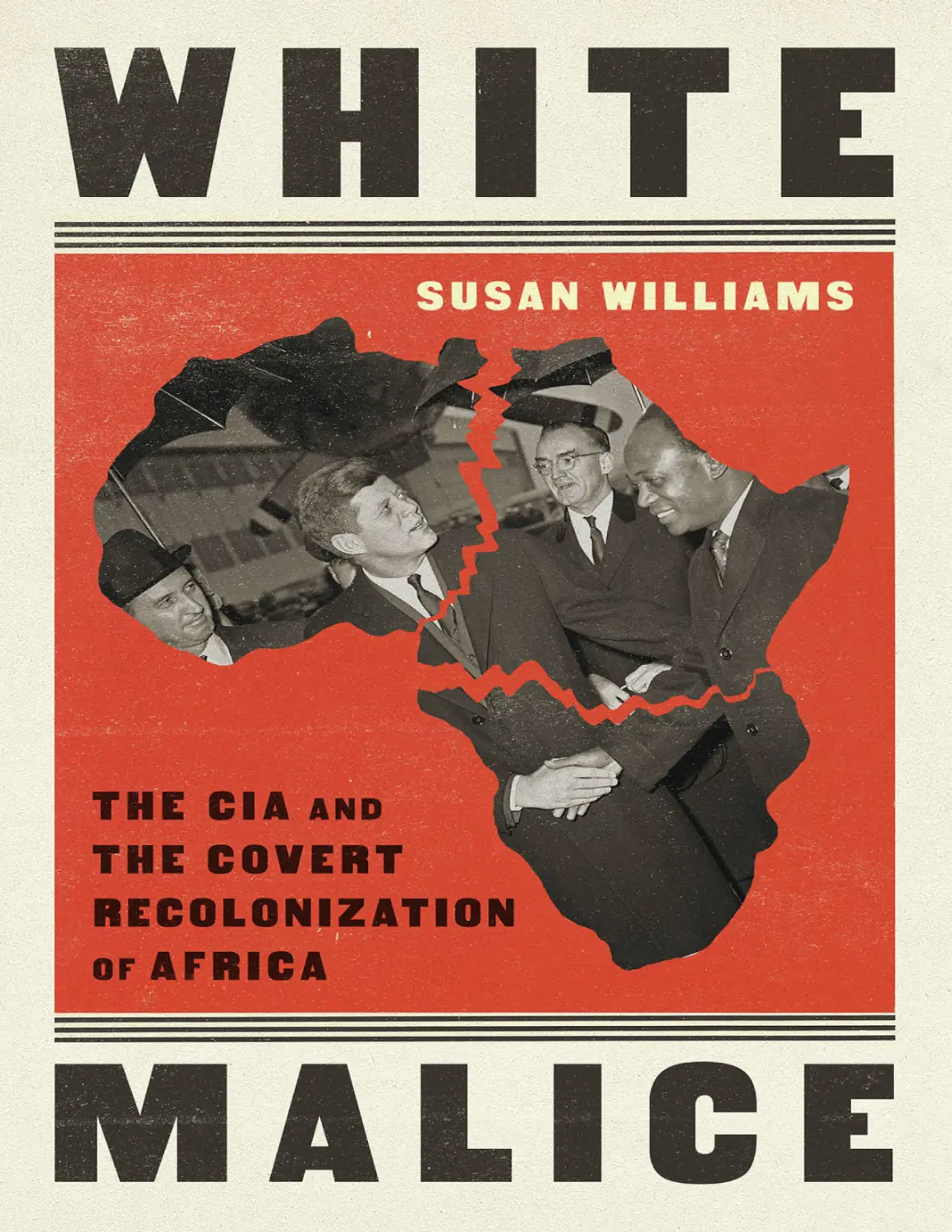


Автор: Williams Susan
Теги: military history african history neocolonialism
ISBN: 978-1-5417-6829-1
Год: 2021



Текст
                    OceanofPDF.com

Copyright © 2021 by Susan Williams
Cover design by Pete Garceau
Cover photograph of John Kennedy and Kwame Nkrumah © AP /
Shutterstock
Cover copyright © 2021 by Hachette Book Group, Inc.
Hachette Book Group supports the right to free expression and the value of
copyright. The purpose of copyright is to encourage writers and artists to
produce the creative works that enrich our culture.
The scanning, uploading, and distribution of this book without permission
is a theft of the author’s intellectual property. If you would like permission
to use material from the book (other than for review purposes), please
contact permissions@hbgusa.com. Thank you for your support of the
author’s rights.
PublicAffairs
Hachette Book Group
1290 Avenue of the Americas, New York, NY 10104
www.publicaffairsbooks.com
@Public_Affairs
First Edition: August 2021
Published by PublicAffairs, an imprint of Perseus Books, LLC, a subsidiary
of Hachette Book Group, Inc. The PublicAffairs name and logo is a
trademark of the Hachette Book Group.
The Hachette Speakers Bureau provides a wide range of authors for
speaking events. To find out more, go to www.hachettespeakersbureau.com
or call (866) 376-6591.
The publisher is not responsible for websites (or their content) that are not

owned by the publisher.
Library of Congress Control Number: 2021938151
ISBNs: 978-1-5417-6829-1 (hardcover), 978-1-5417-6828-4 (e-book)
E3-20210624-JV-NF-ORI
OceanofPDF.com

CONTENTS
Cover
Title Page
Copyright
Dedication
Epigraph
Maps
I. THE UNITED STATES OF AFRICA
1 Freedom at Midnight
2 ‘My Home Is Over Jordan’
3 The Challenge of the Congo
4 ‘Hands off Africa!’
II. THE CIA
5 Infiltration into Africa
6 ‘Africa Has Become the Real Battleground’
7 Atomium
III. AFRICAN JAZZ
8 The Rise of Lumumba
9 ‘Table Ronde’
10 Ambassador Burden
IV. AMERICA AND AFRICA

11 The Africa Division of the CIA
12 Voice of Africa
13 American CIA Agent and Kenyan CIA Asset
V. ‘INDÉPENDANCE CHA CHA’
14 ‘The Courageous Have Won’
15 Year of Africa
16 Things Fall Apart
17 Eisenhower Snubs Lumumba
VI. YQPROP
18 Bribery, Bugging and Green Berets
19 The Road to Calvary
20 The Poison Plot
VII. THE GLOBAL GAME
21 Africa at the United Nations
22 Spying on the UN
23 ‘Lumumba Assails US on Uranium’
VIII. CARROT AND STICK
24 Third-Country Agent QJWIN
25 ‘The Big American Stick’
26 Ambassador Satch
IX. THE TURNING POINT
27 Trick or Escape?
28 Manhunt for Lumumba
29 Deep Cover Agent WIROGUE
30 Baking a Snake

31 Sunk Hope
X. THE SEEDS ARE SOWN
32 Arming the Skies
33 ‘A Bride Everybody Wants’
34 Made in America
35 Hands off Ghana!
36 ‘America’s Angolan’
XI. DARK DAYS
37 ‘The CIA Reptilian Coils’
38 Closing In on Nkrumah
39 ‘One Step Backward. We Shall Take Two Forward’
40 The Dead Hand
Photos
Acknowledgements
Discover More
About the Author
List of Acronyms
List of Archives
Notes
Selected Bibliography
OceanofPDF.com

For Gervase
OceanofPDF.com

Explore book giveaways, sneak peeks, deals, and more.
Tap here to learn more.

OceanofPDF.com

The activities of the C.I.A. no longer surprise us.… Further
examples of C.I.A. activity… in Africa could be given. They
would provide material for a book of their own.
KWAME NKRUMAH,
Dark Days in Ghana (1968)
OceanofPDF.com

Africa in January 1958, when most territories were occupied by
a European colonial power or were under white supremacist
rule.

OceanofPDF.com

Africa in September 1960, when sixteen newly independent
African states were admitted to the United Nations. The map
shows the rapid pace of decolonisation since 1958.

OceanofPDF.com

The Congo at independence from Belgium, 30 June 1960.

OceanofPDF.com

PART I

THE UNITED STATES OF AFRICA
OceanofPDF.com

1

Freedom at Midnight
THE HOURS OF THE DAY had been hot and charged with thunder. As darkness
fell, the humid atmosphere in Accra felt explosive. Even so, the crowds had
swelled along the coast, and the streets were heaving. Suddenly, the newly
built Arch of Independence was floodlit against the blackness of the sea.
The monument was inscribed with a short but powerful message: ‘Freedom
and Justice. A.D. 1957’. It stood on the spot where three unarmed men had
been shot dead nine years earlier, when a British police officer had ordered
his men to fire at a peaceful deputation from the African Ex-Servicemen’s
Union. Now, it marked the start of a new era. Fireworks soared into the sky
above the arch.1
At the stroke of midnight, bells pealed loudly. Then the Union Jack
flying above Parliament House was hauled down, and the new flag of
Ghana was solemnly raised up, for the first time. As it reached the top of the
pole, it fluttered slowly in the night air—red, gold and green, with the black
lodestar of Africa at its centre. Cries of happiness rang out, and people
danced and sang in jubilation. Over and over, people cheered and shouted
out at the top of their voices: ‘Freedom! Ghana! Nkrumah!’
Prime Minister Kwame Nkrumah was carried shoulder high to a dais in
the Old Polo Ground, close to the roaring surf of the Atlantic Ocean. Under
a flood of lights, Nkrumah’s open face and large, steady eyes looked out at
the thousands in front of him. Forty-eight years old, he had spent much of
his life working for this moment, as had so many others. He wore a cotton
smock from the north of Ghana and a Gandhi-type prison cap, marked with

the initials PG, standing for ‘prison graduate’. It was a badge of honour
worn with pride by many Ghanaians, in remembrance of their unjust
imprisonment by the British.
The noise of the crowd was deafening. Then Dr Nkrumah held out his
arm to command attention, with solemn authority. He called for a minute’s
silence to give thanks to God. Then he asked everyone to remove their hats,
as the police band played the new national anthem, ‘Ghana Arise!’ Tears
streamed down his face, and many in the crowds were sobbing.
Unmistakably, on 6 March 1957, the people of Ghana were free. The British
colony of the Gold Coast was no more, and Ghana had become the first
Black-majority country to obtain independence from colonialism, blazing a
trail for the African continent.
‘At long last’, proclaimed Nkrumah, ‘the battle has ended and Ghana,
our beloved country, is free for ever’. Then, choked with emotion, he fell
silent. It was an unforgettable moment for Cameron Duodu, a young cub
reporter. ‘Just sixteen words—no more’, he wrote later. ‘But no-one who
heard them would ever be able to forget them. The cheers that greeted those
sixteen words were, of course, out of this world’.2 The iconography of
Ghana’s independence ceremony followed the pattern set by India on 15
August 1947, ten years earlier. Then, too, the Union Jack had been lowered
and replaced by the new Indian flag at midnight.
But Ghana was not copying India for dramatic effect. It was following
India’s clear commitment to international nonalignment, led by Prime
Minister Jawaharlal Nehru. This commitment had been a major theme of
the Bandung Conference of African-Asian states in 1955, in which the Gold
Coast participated. There, led by Nehru, Indonesia’s Sukarno, and Egypt’s
Gamal Abdel Nasser, twenty-nine emergent nations across Africa and Asia
had sought to lay the foundations of a nonaligned ‘third force’, to resist the
pressures from the West and from the East in the context of the Cold War.
Not only in Ghana’s capital Accra, but also in Kumasi, Tamale, SekondiTakoradi, and Cape Coast, similar ceremonies took place, where the Union
Jack was replaced with the new flag. Families in the churches and the
mosques sent prayers to God. In the nightclubs, exuberant throngs danced
to the ‘Highlife’—a popular fusion of Ghanaian musical traditions with
Western instruments.3

The Reverend Martin Luther King Jr and his wife, Coretta Scott King,
who had come from America to celebrate Ghana’s freedom, were a part of
the crowd in Accra. These young civil rights campaigners—Dr King was
just twenty-eight years old—were profoundly moved. ‘Before I knew it’,
declared Dr King in a sermon the following month to his congregation in
Montgomery, Alabama, ‘I started weeping. I was crying for joy. And I knew
about all of the struggles, and all of the pain, and all of the agony that these
people had gone through for this moment’.4

AT THE OPENING OF the first session of the Parliament of Ghana, Sir Charles
Arden-Clarke was sworn in as governor general, as the representative of the
British crown; before independence, he had been the governor, representing
not only Queen Elizabeth II but the powers of the British government in its
colonial territory. He made a brief personal statement, in which he declared
his ‘unqualified pride at his association with “colonialism”’ and referred to
the ‘continuity of purpose of British colonial policy’. Britain’s high
commissioner, who attended the session, reported to London that he
delivered this statement with a smile which evoked ‘an appreciative
response’ from members of Parliament.5 No doubt Ghana’s MPs felt
obliged to be polite to their guest. But it was a strange thing to say, since the
struggle against colonialism had been fierce—against, as Nkrumah put it,
‘the limitations on our freedom, the crimes against our dignity as human
beings’.6
It was true that in comparison with many other territories in Africa
occupied by European powers, Ghana had escaped the large invasions of
white settlers, which had wrecked the lives of so many millions of people in
territories such as Kenya, Southern Rhodesia (now Zimbabwe),
Mozambique, and South Africa.
But there were profound and brutal forms of injustice in Ghana under
British rule. Seven hospitals in the country catered for fewer than three
thousand ‘Europeans’—the colonisers’ word for any person with white skin
—leaving thirty-six hospitals for about four million Ghanaians.7 This
inequity based on skin colour was mirrored in all public services, including

education. It was also manifest in the crude physical segregation of people.
‘When I first went to the Gold Coast’, recalled Erica Powell, who went to
work for Sir Charles Arden-Clarke as his private secretary in 1952, ‘there
existed between the so-called elite of the Europeans and the Africans in
whose country they lived a racial barrier as apparent as the Mason-Dixon
Line’. She was shocked at the racism of most whites, who ‘were unanimous
in declaring that the Africans were nowhere near being capable of taking
over the government of the country’.8
Powell was among those impressed by Nkrumah’s charisma and
magnetism. They slowly became friends, and she learnt from him a
different way of looking at colonisation, which challenged her assumption
that British rule was benevolent and had brought some kind of superior
civilisation. One day, when she expressed ignorance of what selfgovernment meant, Nkrumah spent more than two hours explaining it to
her. ‘I was held spellbound—at times horrified—by what he had to say’,
wrote Powell years later. It was ‘not a sob story’, she said, but a lesson in
colonial history, politics and economics, which ‘shattered into tiny little
pieces my schoolgirl illusions about Britain’s big-hearted give-all-and-takenaught attitude towards her colonies’. At the end, she could find nothing
worthwhile to justify Britain’s presence in Africa.9
Because of her friendship with Nkrumah, Powell was ostracised by the
British community and was asked by the governor to leave the colony.
Instead, she left the colonial service. In 1955, she became Nkrumah’s
devoted and loyal private secretary, who was as much concerned by what he
ate—and didn’t eat—as by his files and appointments.10 A hard-working
and conscientious woman, who wore plain clothes and a tidy hairstyle, she
was thoroughly professional in her affect. Nonetheless, many of the British
expatriate community regarded her as the Jezebel of Accra; they spread
prurient rumours that reflected their loathing of interracial relationships.
There was no evidence to suggest that Powell and Nkrumah were having a
sexual relationship. Nkrumah had a number of friendships with women,
rooted in shared intellectual and political interests, as well as
companionship.
On the last day of 1957, Nkrumah married Fathia Halim Ritzk, a twentyfive-year old Egyptian.11 Ritzk, a former student at the University of Cairo,

was a quiet and dignified woman with dark eyes and a bright smile. When
she agreed to the marriage, she had not met Nkrumah; nor had she been to
Ghana. She had been identified as a possible wife by a friend of Nkrumah’s,
and they were shown photographs of each other.
President Nasser met with Ritzk before the marriage. He was not against
the plan, he said, but wanted her to be aware of the challenges ahead. Her
response was adamant: ‘I would like to go and marry this anti-colonial
leader. I read his autobiography, I know of his trials and tribulations, of his
struggles during his student days in America and Britain, and of his
spearheading the anti-colonial struggle upon his return to his homeland’.
For Ritzk, Nkrumah was an anticolonial hero, like Nasser. She wished to
make her own contribution to Africa’s struggle for freedom.
Their first child, born in 1959, was named Gamal, after Nasser. ‘It was
not meant to be a marriage made in heaven’, commented Gamal Nkrumah
when an adult. ‘It was a political union between Mediterranean-oriented
North Africa and the rest of the continent’.12

THE YEARS LEADING UP to Ghana’s independence were a time of suffering
and oppression. The killing in 1948 of three men of the African ExServicemen’s Union had triggered bitter and widespread violence, which
transformed the political scene of the colony. The situation became so tense
that in 1950, Governor Arden-Clarke declared a state of emergency and
imposed a curfew, during which Nkrumah was arrested on the charge of
inciting an unofficial strike. In 1951, large-scale elections to the Legislative
Assembly took place. This produced a victory for the Convention People’s
Party (CPP), led by Nkrumah, which forced the colonial government to
release him from prison. He was driven among cheering crowds to party
headquarters, and the next day he was invited by the governor to form a
government.
For the first time, Ghanaians had a majority in the Assembly and in the
Executive Council. But the ex-officio members nominated by Arden-Clarke
held the real reins of power, through their control of defence, external
affairs, finance and justice. This was ‘a Government largely in name’,

argued Nkrumah, ‘with ultimate power residing in the Governor of the Gold
Coast, who really represented the Colonial Office on the spot’.13
It was not until 1956 that a popular election was held in order to deliver
a national government, in which a majority of the seats were won by the
Convention People’s Party.

AS THE OUTGOING POWER in 1957, the British selected many of the official
guests to the independence celebrations of Ghana. President Nasser,
president of the United Arab Republic, a political union of Egypt and Syria
that had been formed in 1958, was not invited, because of the rupture in
diplomatic relations between the UK and Egypt following the fiasco of the
Suez crisis in 1956.
The most important guest from the point of view of the British
government was Princess Marina, Duchess of Kent, who came as the
representative of Queen Elizabeth II. She presided over a busy royal
programme, including a meeting at the race course—a popular event in
colonial circles. Reports sent to London by British officials praised the
duchess’s warm engagement with the celebrations, as well as her haute
couture and glittering jewels.14
More than fifty foreign governments were invited and sent special
representatives; some two hundred members of the press and media came
too.15 In the words of one press officer, ‘The world had come to Accra’.16
The largest delegations came from the USSR, the US, and the People’s
Republic of China, which sent parties of twenty or more, creating logistical
challenges for the new nation. The Ambassador Hotel, specially built for
independence to offer modern and luxurious accommodation, was not very
large and had to house all the important guests.
The American delegation, led by Vice President Richard M Nixon and
his wife, Pat, and accompanied by a second plane packed with American
newsmen, were put up in the Ambassador Hotel, along with the Soviets.
One headline in the US noted, ‘ACCRA BILLETS NIXON WITH REDS’.17
At a state banquet, ‘all was pomp and protocol’—except that the seating
plan had been drawn up alphabetically. This meant that the leader of the

Soviet delegation, the handsome I A Benedictov, minister of state farming,
sat at the top table, and Vice President Nixon, because his name began with
the letter ‘N’, was placed farther down the room. Nixon was furious.
Headlines in the US the following day made the most of it: ‘NIXON SLIGHTED
AS COMMIE HEADS TABLE; NIXON SLIGHTED ON TRIP, AIDES MIFFED; NIXON SNUB
SHOWS HOW LITTLE PRESTIGE US BILLIONS HAVE BOUGHT’.18

A British official working for the colonial public relations service
enjoyed his contact with the Russian journalists. At the airport, he found
‘two solemn men standing smoking silently’. The correspondent from
Pravda gave him a Russian cigarette and introduced him to the cameraman.
Back at the hotel, he recorded, ‘the two Russians became our politest
guests. They sat in the lounge at night, dispensing Russian cigarettes and
occasional shots of vodka that they had with them, and refused to be rattled
by the political questions thrown at them by the other correspondents’. The
official observed with wry amusement that they filed long stories on the
social and economic aspects of life in Ghana, ‘but seemed only slightly
interested in what the Duchess of Kent was doing’.19
Visiting African dignitaries included leaders such as Habib Bourguiba,
the president of Tunisia, which had achieved independence from France in
1956; William Tolbert, the vice president of Liberia; Sylvanus Olympio
from Togo; and the son of Haile Selassie, the emperor of Ethiopia. From
France came the minister of justice, François Mitterrand, and from the
Vatican, Archbishop Know.
Dr Ralph Bunche, senior advisor to Dag Hammarskjöld, the UN
secretary general, was also present. Bunche, an American, had been
awarded the Nobel Peace Prize for his mediating role in the Arab-Israeli
war of 1948–1949 and was the first Black person ever to be honoured in
this way. At the time of Ghana’s independence, Bunche was embroiled in
the ongoing Suez problem and, exhausted by the pace and by constant bouts
of dysentery, welcomed the respite offered by the visit to Ghana. He
brought a special message from Hammarskjöld, congratulating Ghana on
becoming the eighty-first member of the UN.20
A large number of guests came at the personal invitation of Prime
Minister Nkrumah. At the top of his list were George Padmore, the
Trinidadian Pan-Africanist, and his wife, Dorothy Pizer, firm friends of

Nkrumah from his days in the UK. Their vision of the future of Africa
meshed perfectly with his: not only free of colonial rule, but also not
aligned to either the East or the West. ‘We do not’, stated Padmore firmly,
‘intend to be like Russia, the United States, or anyone else’.21
With open arms, Nkrumah invited freedom fighters from all over the
world, such as Cheddi Jagan from British Guiana and Norman Manley from
British-ruled Jamaica. From South Africa came the Reverend Michael
Scott, an Anglican priest, and the peace activist Homer Jack.
From Kenya came Mbiyu Koinange, a prominent member of the Kenya
African Union and the brother-in-law of Jomo Kenyatta, its leader, who was
in prison serving a seven-year sentence handed down by the British colonial
administration for the alleged organisation of the Land and Freedom
Movement, dubbed ‘Mau Mau’ by the colonisers. The British government
were responsible in the 1950s for a terrible campaign of systematic and
brutal torture and abuse—killing, castration and rape—of Kenyan freedom
fighters.
From the US came civil rights campaigners such as Dr Martin Luther
King, Mrs Coretta Scott King, Asa Philip Randolph and Adam Clayton
Powell. Shirley Graham came without her eighty-nine-year-old husband,
the renowned African American scholar and founding father of the National
Association for the Advancement of Colored People (NAACP), Dr W E B
Du Bois. He had been blocked from travelling abroad by the US
government. Also from the US came distinguished academics, including
Horace Mann Bond, the president of Lincoln University. Nkrumah had
spent ten years studying in the US, first at Lincoln University and then at
the University of Pennsylvania.
Nkrumah’s landlady in London, Mrs Florence Manley, came with her
daughter.22 Mrs Manley had supported Nkrumah’s political work in London
and had been mentioned in intelligence reports on Nkrumah by the spies
and informers of the UK’s Special Branch and MI5, who speculated,
wrongly, that Nkrumah and Mrs Manley were on intimate terms and
planning to marry.23 Rumours about their alleged relationship were spread
by the colonial government in 1948 in a deliberate effort to discredit him.24
They, too, were strange, prurient imaginings.

ERICA POWELL WAS CONCERNED that Nkrumah barely slept during the week
of the independence celebrations. ‘When he wasn’t attending official
functions or receiving foreign guests in private audience’, she recorded, ‘he
was sought after by his own ministers, his party colleagues and the masses
of ordinary men and women’. But her concern was unfounded: for no
matter at what hour he met his guests, ‘he was fresh, alert, dynamic,
listening avidly to what each had to say and handling any subject with equal
ability and enthusiasm’.25
But one challenge almost defeated him. When told he was expected to
lead the dancing at the state ball, he was appalled, saying that he knew only
the Highlife.
He was rescued by Lucille Armstrong, who taught him the basic steps of
the waltz, foxtrot and quickstep.26 He had met Mrs Armstrong the year
before, when she had come to Ghana with her husband, Louis Armstrong,
the famous American jazz trumpeter.
Armstrong was unable to go back to Ghana to celebrate independence,
but Lucille flew there with a copy of Satchmo the Great, a new US
Information Service film of Armstrong’s earlier visit. The film showed
Armstrong dedicating to Prime Minister Nkrumah the protest anthem from
the 1920s ‘(What Did I Do to Be So) Black and Blue’, composed by the
jazz musician Fats Waller. The last lines of the song—painfully and
powerfully—convey the injustice of discrimination against Black people
because of the colour of skin. ‘My only sin’, goes the song, ‘is in my skin’.
One of its most heart-wrenching lines includes the words ‘wished I was
dead’. It asks, ‘How would it end?’ Satchmo the Great captured Nkrumah’s
emotional response to the song, as he listened intently to the words.27
The state ball during the independence celebrations was a far more
formal affair than the jazz concerts the previous year. One of the guests was
Genoveva Marais, a South African woman in her twenties who had arrived
in Ghana the month before to work as an Inspector of Schools. She was
excited to be a fully fledged Black citizen in Ghana and no longer a victim
of apartheid in her own country. Her father had felt great happiness at the
independence of Ghana, and ‘the thrill he felt’, she wrote later in a memoir,

‘was translated to me’.
When the invitation to the ball arrived, Marais was ‘in the heights of
delight’. Beautiful, vivacious and sophisticated, she was quickly noticed by
Nkrumah, who sent an officer to request her company at his table. She had
noticed Nkrumah’s ‘easy air’ as he walked around the room chatting with
different people, but all the same she felt ‘dizzy and nervous’.
Her unease swiftly disappeared as they joked and laughed together. They
had much in common: Marais, like Nkrumah, had studied in the US—at
Columbia University in New York—after her education at Fort Hare and
Rhodes University in South Africa. She quickly sensed that Nkrumah was
physically attracted to her, which was confirmed when the prime minister
invited her to State House the following morning.
Before long, he asked her to marry him, but she refused. She noted with
approval that Nkrumah ‘created a new dimension for African womanhood.
There were even female Members of Parliament and a judge!’ But, she said,
‘I was not ready for marriage and I was far too critical and independent’.
This did not prevent the development of their relationship. ‘Veva’, as
Nkrumah called Marais, believed that she learnt ‘to know and understand
Kwame Nkrumah as no one else ever could’.28 They became close
companions, and it was widely rumoured that she was his lover.29

AS THE REVEREND MARTIN Luther King witnessed the birth of Ghana, he
realised its wider significance. ‘This event’, he believed, ‘will give impetus
to oppressed peoples all over the world. I think it will have worldwide
implications and repercussions—not only for Asia and Africa, but also for
America’. It renewed his conviction, he said in a radio interview in Accra,
‘in the ultimate triumph of justice. And it seems to me that this is fit
testimony to the fact that eventually the forces of justice triumph in the
universe, and somehow the universe itself is on the side of freedom and
justice. So that this gives new hope to me in the struggle for freedom’.30
The independence celebrations led King to compare African liberation
with African American civil rights struggles. ‘At bottom’, commented King,
‘both segregation in America and colonialism in Africa are based on the

same thing—white supremacy and contempt for life’.31
King also met Vice President Nixon for the first time in Ghana. Back in
America, Nixon, along with the US president, Dwight D Eisenhower, had
been asked by African Americans living in the southern states to visit them,
to see for themselves the ugliness of Jim Crow and the laws enforcing racial
segregation. The vice president had managed to evade those requests. But
soon after arriving in Accra, King attended a reception where he
encountered Nixon. He used it as an opportunity to press him to visit the
South. ‘Mr Vice President, I’m very glad to meet you here’, King told
Nixon, ‘but I want you to come visit us down in Alabama where we are
seeking the same kind of freedom the Gold Coast is celebrating’.32
Generally, Nixon was in his element on the trip. When he was met at the
airport by a group of ministers, he cut away from the official party and
headed for the airport fence. He had spotted a crowd lining the rails and,
followed by his wife, he shook hands with everybody and patted heads.
According to a press officer, ‘He smiled, smiled all the time’. The Ghanaian
ministers, ‘themselves experienced politicians, watched Nixon’s technique
admiringly’, while an American reporter commented dryly that Nixon was
‘campaigning already’ for the forthcoming US election.33
Newsreels captured Nixon grinning broadly and wielding his movie
camera throughout the visit. Echoing the euphoria of his Ghanaian hosts, he
went up to one man in jovial good humour. Slapping him on the shoulder,
he asked him how it felt to be free. ‘I wouldn’t know, Sir’, came the reply.
‘I’m from Alabama’.34

FOR NKRUMAH, FREEDOM FOR Ghana had a significance beyond even the
liberation of the nation. He set this out clearly in his speech at the Old Polo
Ground. ‘Our independence’, he insisted, ‘is meaningless unless it is linked
up with the total liberation of the African continent’. Liberation would
stretch from north to south. ‘The Sahara no longer divides us’, he said
firmly. ‘It unites us’.
The only way forward for Africa, Nkrumah believed, was the creation of
a federation of nations—a United States of Africa. He was applying the

lessons of freedom from the history of America, where thirteen colonies had
revolted in 1776 against the British, and together had issued the Declaration
of Independence. The colonies formed a union, eventually constituting the
fifty states of the United States of America.
Nkrumah wanted Africa to achieve the same union of states, declared his
friend and disciple Kofi Batsa, a Ghanaian political activist. The states
would aim to serve each other with ‘all the necessary economic conditions
of labour, of skills, of capital, of minerals, of energy reserves—to provide a
self-contained and self-development economy’. Within Africa, added Batsa,
Nkrumah saw there were ‘enormous skills, enormous assets and great
potential’ to achieve this vision.
African unity, therefore, was ‘the strategy of the total liberation and
complete independence of Africa’.35 It was a bold, visionary goal, full of
idealism and pragmatism.
OceanofPDF.com

2

‘My Home Is Over Jordan’
NKRUMAH HAD BEEN A STUDENT in America for ten years, between 1935
and 1945. His experience had a profound influence on the development of
his thinking and his politics. But it is extraordinary that he went to the US at
all. For one thing, he came from a poor family. His father, a goldsmith, had
died when he was seventeen; his mother, Elizabeth Nyaniba, with whom he
had lived as a child in the village of Nkroful in Nzima in the extreme
southwest of the Gold Coast, was a local trader in cigarettes and rice.1 He
left his homeland with very little money and knew that he would suffer
hardship. It was also painful to go so far away from his mother, especially
as he was her only child. ‘It cannot be helped’, she said. ‘May God and
your ancestors guide you’.
Most Ghanaians hoping to study abroad looked to British universities,
especially if they wished to establish themselves in a profession such as
law. But Nkrumah was different: his aim was not to secure a career, but to
find a way of ending the colonisation of the Gold Coast. He was therefore
inspired by the speeches and newspaper articles of Nnamdi Azikiwe, a
Nigerian nationalist who had recently returned to Africa from his studies in
the US. Azikiwe went on to become the first president of Nigeria in 1963.
In the 1930s, he fired the imaginations of those who longed for freedom
from the European colonisers. He urged African intellectuals to go to the
US and ‘to come back with the Golden Fleece’. Nkrumah was among the
first to take Azikiwe’s advice.
After boarding ship to the US, Nkrumah ‘felt desperately alone and sat

on my bunk close to tears’. But beside him he found a telegram from
Azikiwe: ‘Goodbye. Remember to trust in God and in yourself’.2 This gave
him the courage he needed to face the journey.
Once he had arrived in the US, Nkrumah managed to enrol at Lincoln
University, in Pennsylvania. Lincoln, the alma mater of Azikiwe, was
widely regarded as the Princeton of African American universities; in 1854,
it had become the first institution anywhere in the world to grant degrees to
Black students. At Lincoln, Nkrumah ‘soared through examinations’, notes
his biographer Basil Davidson. He earned both a bachelor of arts in 1939
and a bachelor of theology in 1942, when he graduated at the top of his
class. Then, again following in the path of Azikiwe, he went to the
University of Pennsylvania, where he obtained two MA degrees.
In 1945, Nkrumah attracted the attention of the FBI, which sent a
‘special agent’ to investigate his behaviour on campus. The agent reported
that ‘while the subject had lacked leadership on the campus and had not
shown initiative, he was considered loyal and honest. He knew of no radical
tendencies on the part of the subject’. Nkrumah was ‘not an independent
thinker’, added the agent.3 Judging by its several reports on Nkrumah, the
FBI gained no real sense at that time of the man who would lead his nation
to freedom and take a key role on the world stage.
Nkrumah learned the art of preaching in the US and on many Sundays
gave sermons at Baptist and Presbyterian churches in Philadelphia and in
New York. ‘When he preached it was about Africa. He was a good but quiet
speaker’, according to one source.4
Nkrumah was an intellectual of the first order; he read and studied
incessantly.5 But he learnt as much from the struggles of American daily
life, he believed, as he did at institutions or libraries. These struggles
included poverty and hunger. Though his way of life was simple and
abstemious—he was always teetotal and did not smoke—he found it
difficult to get by. He relied for survival on menial jobs, such as selling fish
from a cart in Harlem in New York City. For a period he worked from
midnight to eight am in all weathers in a shipbuilding yard in Pennsylvania.
When not living in university accommodation, he found it hard at times to
find lodging available to nonwhites and was forced to sleep on a park bench
or in a doorway. In New York, he sometimes bought a subway ticket and

spent the whole night travelling back and forth between Brooklyn and
Harlem.6
He also suffered the brutal injustice of racism. In his Autobiography,
published in 1957, the chapter on his years in America is titled ‘Hard
Times’. He describes a journey by bus involving a stop in Baltimore. In the
refreshment room at the bus terminal, Nkrumah asked the white waiter for a
drink of water:
He frowned and looked down his nose at me as if I was something
unclean. ‘The place for you, my man, is the spittoon outside’, he
declared as he dismissed me from his sight. I was so shocked that I
could not move.
I just stood and stared at him.
Nkrumah had already experienced racial segregation in American buses and
restaurants and other public places. But, he said, ‘I could not bring myself
to believe that one could refuse a man a drink of water because his skin
happened to be a different colour’.7
A similar racist insult was suffered in the US by Komla A Gbedemah,
Ghana’s minister of finance, a few months after independence. The waitress
at a Howard Johnson’s restaurant in Delaware refused to seat him in the
restaurant, because ‘colored people are not allowed to eat in here’.
Gbedemah, who had entertained Vice President Nixon earlier that year, was
outraged. ‘If the Vice President of the US can have a meal in my house
when he is in Ghana’, said Gbedemah, ‘then I cannot understand why I
must receive this treatment at a roadside restaurant in America’.
Gbedemah gave a report of the event to the press, and the episode came
to the attention of President Eisenhower, who issued an official apology. ‘I
believe the United States as a government, if it is going to be true to its
founding documents’, said Eisenhower, ‘does have the job of working hard
toward that time when there is no discrimination made on such [an]
inconsequential reason as race, color, or religion’.
Eisenhower invited Gbedemah to breakfast with himself and Nixon at
the White House, demonstrating his readiness to sit at table with a person
who was Black. Meanwhile, the executives at Howard Johnson’s gave new

instructions to the Delaware restaurant manager: from then on, he was to
serve ‘anybody who comes to our doors’.8 Gbedemah, by calling out the
moral wrong of American segregation, had contributed in a powerful and
public way to the civil rights movement.

IN JULY 1958, DR Nkrumah returned to America. Influential figures were
eager to meet the rising star of West Africa, including Eisenhower, who
hosted a luncheon for him in Washington.9
It was a stark contrast to his first years in the country. An important stop
on his 1958 tour was Harlem, where he had spent his summers as a student,
looking for work in the day and sleeping in the subways at night.10 Here, at
a packed reception, Ralph Bunche spoke of Ghana’s independence a year
earlier, setting out the significance of Nkrumah’s achievements for African
Americans: ‘We salute you, Kwame Nkrumah, not only because you are the
Prime Minister of Ghana.… We salute you because you are a true and living
representation of our best hopes and ideals: of the determination we have to
be accepted fully as equal beings, of the pride we have held and nurtured in
our African origin’. Bunche added with emphasis, ‘But above all, Mr Prime
Minister, we embrace you because you and your people and we are brothers
—brothers of the skin and beneath the skin’.11
On the evening following the Harlem reception, African American
organisations including the NAACP sponsored a huge dinner in Nkrumah’s
honour at the Waldorf Astoria, with one thousand guests.12 Nkrumah took
this opportunity to invite interested and qualified Americans to come to
Ghana as teachers and technicians.13
Before leaving the US, Nkrumah flew to Chicago. His secretary, Erica
Powell, who was travelling with him, was astonished to see that practically
the whole of the route from the airport to the centre of town was lined with
African Americans. ‘It was like being back in Africa’, she recorded in her
memoir. The reception the Black community gave to Nkrumah, she said,
‘was truly from their hearts. Many of them, particularly the older ones, were
unashamedly weeping. Others stood as if stunned, unable to believe in
miracles, that they would ever live to witness such honour bestowed on one

of their own colour’.14

AMONG THE WEEPING CITIZENS who lined the streets to welcome Nkrumah to
Chicago were many with a direct link with Africa: they were descended
from ancestors taken forcibly as slaves from its shores. The link was
officially remembered in the Year of Return in 2019, when the state of
Ghana invited ‘the Global African family, home and abroad, to mark 400
years of the arrival of the first enslaved Africans in Jamestown, Virginia’.
The Year of Return was organised to mark ‘the cumulative resilience of all
the victims of the Trans Atlantic Slave Trade’.15 It was followed by Beyond
the Return, a ten-year project directed at ‘the people of African descent,
wherever they may currently be living’.16
In the fifteenth century, Portuguese traders had gone to West Africa to
‘tap into the systems of mining and trading gold that were deeply
entrenched in the region’, explains K James Myers, a historian of Africa
and the diaspora.17 But by the sixteenth century, their greed had shifted to a
trade in human beings. Thus began the savage removal of people from
Africa to North America, South America and the Caribbean (a small
percentage of people were taken to Europe or other locations, including the
Atlantic Islands, such as Madeira and the Canaries). The profits to be made
from the sale of human life brought in traders from other nations, too:
British, French, Dutch, Spanish, Danish, Swedish, German and, in due
course, American.
It has been extremely difficult to collect accurate data regarding the
numbers of men, women and children who were forcibly carried away from
Africa in the long centuries of the Atlantic slave trade. However, recent
authoritative research for a major database estimates that more than twelve
and a half million captive individuals were forced to leave Africa between
1501 and 1875.18 Nearly two million of those people are estimated to have
perished during the horrors of the journeys; many died through disease or ill
treatment, and others, in despair or defiance, jumped overboard.
This crossing is often referred to as the Middle Passage, on the grounds
that it was the middle leg of a triangular route from Europe to Africa (with

goods that would be sold in return for captured people), then to the
Americas (to sell the captives and buy sugar, tobacco and other produce),
and finally back to Europe—before embarking on yet another triangular
voyage. However, voyages frequently did not follow the triangular pattern,
especially in the South Atlantic. For instance, journeys from Brazil to
Africa, and then back, were common.
Close to eleven million people disembarked in the Americas to be sold
into slavery.19 Often, Myers states, people were disembarked only to be
reshipped to another location; frequently, there were multiple legs and sales
in these journeys. At the time of sale, it was common for children to be
taken away from their parents and for members of partnered couples to be
separated from each other.20
Portugal, Brazil and Britain accounted for about 70 per cent of all
Africans transported to the Americas.21 Portuguese and (from a later date)
Brazilian vessels between 1501 and 1875 carried nearly six million people;
vessels from England (from 1603, Great Britain) between 1551 and 1825
carried well over three million.22
The earliest known slave voyage direct from Africa to the Americas
sailed in 1525;23 it left with an estimated 359 slaves and lost 72 of them to
death, arriving finally with 287. In 1776, the year of the US Declaration of
Independence, nearly 90,000 people were taken from Africa; nearly 80,000
people arrived.24 Those who were taken to the US did not benefit from the
best-known words of the Declaration: ‘We hold these truths to be selfevident, that all men are created equal, that they are endowed by their
Creator with certain unalienable Rights, that among these are Life, Liberty
and the pursuit of Happiness’. The principal author of the Declaration was
Thomas Jefferson, who owned over a hundred slaves in 1776.25 Jefferson
subsequently served as the third president of the United States.
The lives of enslaved people were brutal, punitive and pitiless: working
from sunup to sundown in plantations, farms and domestic homes, with
inadequate food and the lash of the whip. Slaveholders had the right to rape
the women they owned. In 1807, President Jefferson signed into law an act
prohibiting the importation of African slaves into the US. In the same year,
the British Parliament banned the involvement of Britons in the slave trade.
At the start of 1863, President Abraham Lincoln’s Emancipation

Proclamation became law, freeing some three million enslaved people. But
the practise of chattel slavery was not abolished officially in the US until
1865, at the end of the Civil War, with the passage of the Thirteenth
Amendment. Even now, the process of abolition is not complete: slavery as
a punishment for crimes is still legal in the US under the terms of that same
amendment.26
Slavery went on long after 1865, as did the trade. ‘American ships flying
false flags and fitted out as slavers were soon found at Cape Coast Castle
[in what is now Ghana]’, records the historian William St Clair. In 1881, he
adds, ‘an American slaving vessel was discovered, allegedly from Brazil,
calling itself provocatively by the contemptuous racist Americanism The
Spade’.27

TO FACILITATE THE TRANSATLANTIC slave trade, more than fifty castles and
forts were built along the 260 miles of the Gold Coast by the various slavetrading nations. Through these bleak fortifications passed people captured
within what is now Ghana and in surrounding territories.28
An important centre was Christiansborg Castle in what is now Accra,
which juts out from a rocky cliff overhanging the sea, about a mile and a
half along the coast from the Old Polo Ground. The castle was built from
stone brought from Denmark, with carved stone crowns and inscriptions
celebrating the kings who lived in the other, original Christiansborg Castle
in Copenhagen.29 ‘White, vast, standing at the edge of the Atlantic’,
observed the African American writer Richard Wright, the grandson of
slaves, who visited the Gold Coast in 1953, ‘it dominates the tropic, sandy,
palm-treed landscape’.30
The fetid, dark dungeons where the slaves were kept lie in the depths of
the castle down winding, narrow steps; men and women were kept in
separate spaces. When the time came for their enforced departure from their
land, the slaves were led in chains through the Door of No Return, which
opened onto the white sand of the beach facing the green-blue waves. Small
boats took them to the horror of the slave ships. Wright, sickened by his
visit to the castle, imagined the seizing of a woman’s arm, as she ‘was led

toward those narrow, dank steps that guided her to the tunnel that directed
her feet to the waiting ship that would bear her across the heaving, mistshrouded Atlantic’.31 Yet further horrors awaited her: the terrible journey
and then, if she survived, to be sold into a life of total servitude.
‘No one will ever know the number or identity of the black men,
women, and children who passed through these walls’, noted Wright
sadly.32 Recent research does include information about Christiansborg
Castle,33 but it should be regarded as a bare minimum because of the
problem of undocumented voyages, for which the data are missing
altogether. Bearing that absence in mind, it appears that Christiansborg
Castle is likely to have housed most of the slaves in voyages that, at a
minimum, took away over 16,084 people. Of these individuals, it can be
estimated—given the pattern of loss at sea on the slave voyages—that over
3,000 people perished at sea, and that about 13,000 reached the ships’
destinations in the Americas.34
The numbers of individuals traded through Christiansborg Castle are
shocking; however, they are substantially less than the numbers of people
traded through many other centres on the Gold Coast. For example, over
115,000 people were traded through Cape Coast Castle; of these
individuals, about 15,000 perished at sea, and over 100,000 arrived at the
first destination of the ship on which they were carried.35 Nearly 95,000
people were traded through Elmina Castle; of these individuals, about
13,000 people perished at sea, and over 80,000 arrived at the ship’s first
destination.36
When in 1874 the Gold Coast was declared a British crown colony, it
was governed from Christiansborg Castle. An image of the castle featured
prominently on Gold Coast postage stamps, revealing a shocking lack of
sensitivity on the part of the colonial rulers. For nearly a hundred years, the
castle—with its Union Jack flying over the white walls—was the symbol to
Ghanaians of occupation by a foreign power. The horrors of slavery seemed
to linger in the walls of the structure. Arden-Clarke, the last governor of the
colony, woke one night to hear a persistent knocking in his bedroom.
Although a down-to-earth man who did not believe in ghosts and the
supernatural, he was unnerved and slept thereafter in a different room.37
After Ghana’s freedom from British rule, Christiansborg Castle was

renamed Government House, and Nkrumah’s new government moved in.
Only if the Ghanaian government reclaimed the former colonial edifice,
Nkrumah believed, would the people of the nation grasp fully that the
British were no longer in charge. ‘Of all the acts symbolizing the transfer of
power’, observed a sympathetic British official at the time, ‘none had more
significance’. The installation of the new government in the castle ‘must
have finally brought it home to [Ghanaians], as nothing else could, that at
long last the foreigner had gone forever from the country’.38
But the unease about the castle persisted. The cook and stewards were
too frightened to stay overnight and had to be accommodated outside.
Nkrumah’s devoted dog, which never left his side, woke his master one
night with a piercing yelp; when Nkrumah put on the light, he saw that the
dog was so terrified that its fur was standing on end. The dog refused to
enter the room ever again.39
Today the structure has been renamed Osu Castle. The new name no
longer evokes the history of Denmark, but refers simply to the
neighbourhood of Accra in which the castle is located. But still it
symbolises the evil of the slave trade, from every corner. ‘The aroma of
blood, sweat and breath’, said Dorothy Hunton, an American civil rights
campaigner who visited the castle in the late 1950s, ‘does not escape the
nostrils of a sensitive soul, despite the fragrant flowers in the castle’s wellkept garden’.40

GHANA’S INDEPENDENCE SHONE A powerful spotlight on the tragic link
between the US and Africa: the centuries-long history of the slave trade and
slavery. This, coupled with Nkrumah’s visionary language of PanAfricanism, drew a number of African Americans to the country’s shores.
‘At the height of the civil rights movement, from the late 1950s to 1966’,
records Kevin K Gaines in American Africans in Ghana, scores of African
Americans went to Ghana, including intellectuals, technicians, teachers,
artists, professionals, entrepreneurs and trade unionists. ‘Ghana was a
haven’, he adds, ‘for a range of activists working at the intersection of
anticolonial, civil rights, leftist, and pacifist movements’.

Many of these expatriates, notes Gaines, were doubly estranged in the
country in which they had been born: first, because their skin was black,
and second, because they held political opinions that ‘exceeded the limits of
the Cold War American nation’. Among the Americans who moved to
Ghana after independence were political refugees, not unlike the South
African freedom fighters driven into exile by apartheid; these included W E
B Du Bois; Shirley Graham; William Alphaeus and Dorothy Hunton; and
Julian Mayfield, the novelist, actor and journalist.41
The American writer and civil rights activist Maya Angelou arrived in
1962 and was full of praise. ‘Ghana was flourishing’, she wrote later in All
God’s Children Need Travelling Shoes. ‘People stopped in the street’, she
recalled with pleasure, ‘and said to passersby, “Oh, but life is sweet, oh, and
the air is cool on my skin like fresh water”’. The ‘shared joy’, she said, ‘was
traceable to President Nkrumah.… We shadowed Nkrumah’s every move,
and read carefully his speeches, committing the more eloquent passages to
memory’.
Describing herself and other African Americans in Ghana as
‘Revolutionist Returnees’, she recorded how they ‘danced the High Life at
the Lido, throwing our hips from side to side as if we would have no further
use for them’. Or, she said, ‘we would sit together over Club beer
discussing how we could better serve Ghana, its revolution and President
Nkrumah’.42
Angelou’s book ends with a deeply moving account of her visit to Keta,
a Ghanaian village that had been hit hard by the slave trade. Some of the
women she met in Keta market were shocked to recognise Angelou as
someone who resembled themselves, in her looks and even in the tone of
her voice. They believed she was descended from their ‘stolen mothers and
fathers’. They wept, seeing their history in her face; they mourned ‘for their
lost people’. Angelou wept with them. But she wept, she wrote, with ‘a
curious joy’: ‘Although separated from our languages, our families and
customs, we had dared to continue to live.… We had crossed the
unknowable oceans in chains and had written its mystery into “Deep River,
my home is over Jordan”. Through the centuries of despair and dislocation,
we had been creative, because we faced down death by daring to hope’.43
OceanofPDF.com

3

The Challenge of the Congo
GHANA ACHIEVED ITS LIBERATION FROM British occupation in 1957. But
Nkrumah believed that the freedom struggle had to embrace the whole of
Africa, including those places where violence and rampant exploitation
were still permitted and unchecked. One of the worst was the Congo. Here,
argued Kwame Nkrumah, the purpose of Belgian rule had been ‘not to
suppress slavery, but to change its nature… to make slavery more profitable
by employing the slave in the Congo and thus avoid the difficulties caused
by the international abolition of the trade in its old-fashioned form’. That
this had been possible, he added, was due in large part to the imperial
rivalry between the European powers.1
In 1884–1885, a conference was held in Berlin, where the European
powers partitioned Africa among themselves. The conference formalised
the process known as the ‘scramble for Africa’, in which nations including
Britain, France and Germany sought to colonise more and more African
territory in order to acquire natural resources to feed their growing
industries, and also to build global markets for these industries. One
outcome of the Berlin Conference, as it became known, was the awarding
of the Congo to King Leopold II of Belgium.
Leopold II’s first objective on possessing the Congo, declared many
Belgians over subsequent years, was to suppress the slave trade. In 1778
alone, according to the 1959 Handbook of the Congo published by the
Belgian Government, 104,000 slaves had been exported from Africa, of
whom one-third came from the Congo and Angola.2

But from 1885, Leopold II had ‘owned’ the Congo as his personal
possession—a territory that was bigger than all of Western Europe and
nearly eighty times the size of Belgium. He made a huge fortune out of this
possession, known as the Congo Free State, without ever visiting it.3
Vast profits were generated from the forced labour of the Congolese in
the collection of wild rubber and the killing of elephants for their tusks.
Villages unwilling or unable to meet the assigned daily quotas ‘were subject
to rape, arson, bodily mutilation and murder’, writes Georges NzongolaNtalaja, a preeminent Congolese political scientist and professor of African
and global studies at the University of North Carolina at Chapel Hill, who
has written seminal works on his nation’s history. The lashing of people
with a chicotte—a whip made of sun-dried hippopotamus hide with razorsharp edges—was widely practised.4 A hundred lashes of the chicotte could
be fatal, records Adam Hochschild, the author of King Leopold’s Ghost.5
Leopold II invited several hundred Protestant missionaries into the
territory. Most of them made no protest, but some were appalled by the
atrocities carried out by the Force Publique, Leopold’s paramilitary army,
and at the conditions in which the Congolese people were forced to live.
These critics directed attention in America and Europe to the horrors they
had seen: ‘Africans whipped to death, rivers full of corpses, and—a detail
that quickly seared itself into the world’s imagination—piles of severed
hands’.6 ‘Each time the corporal goes out to get rubber’, explained an
American missionary in the Congo in 1899, ‘cartridges are given to him. He
must bring back all not used; and for every one used, he must bring back a
right hand!… [A State official] informed me that in six months they, the
State, on the Momboyo River had used some 6,000 cartridges, which means
that 6,000 people are killed or mutilated’. In fact, he added, the number was
more than six thousand, for he had been told repeatedly that soldiers killed
children with the butts of their guns.7
Some regions of the Congo, said one observer, were ‘veritable hells on
earth’.8 Hochschild records that in the twenty-three years of King Leopold
II’s rule, an estimated ten million people died as a consequence of brutality
and executions; this amounted to about 50 per cent of the population.9
Nzongola-Ntalaja notes that although this violence does not meet the
specific definition of ‘genocide’ in international law as ‘acts committed

with intent to destroy, in whole or in part, a national, ethnic, racial or
religious group’, it resulted in ‘a death toll of holocaust proportions’.10
The Congo Free State lasted until 1908, when Leopold was forced to
cede control to the Belgian government. The transfer of power mitigated the
very worst excesses of the treatment of the Congolese people, but it by no
means ended their pitiless exploitation.11
The territory was open for business to entrepreneurs. One of these was
the British industrialist Lord Leverhulme, who created huge palm-oil
plantations in the region of north Kasai in 1911. Leverhulme was widely
celebrated as a benefactor in Britain, but his philanthropic spirit was by no
means manifest in the Congo, where he made his vast wealth. In Lord
Leverhulme’s Ghosts: Colonial Exploitation in the Congo, Jules Marchal
shows in careful detail that Leverhulme set up his own private kingdom,
reliant on the ruthless cruelty of the forced labour system.
During World War II, Congolese workers were forced to labour at
everything, ‘from the railways to rubber plantations to the heavily guarded
uranium mine of Shinkolobwe’, records Adam Hochschild.12 The mines
producing raw materials for the Allies, he adds, worked day and night.
Between 1938 and 1944, the workforce employed by Union Minière du
Haut Katanga, a Belgian multinational with huge mining interests in the
province of Katanga, almost doubled, increasing from twenty-five thousand
to forty-nine thousand; so too did the number of fatal accidents at Union
Minière plants.13
The injustice of Belgian occupation did not stop with the end of the war.
Between 1946 and 1960, records Jules Marchal, forcible recruitment
continued; those who failed to undertake the compulsory cultivation of
crops were made to serve a prison sentence. The workers in the palm groves
were treated abusively, in the push to produce palm-oil products for the
factories of the Lever Brothers, the company founded by Leverhulme.
In 1958, the Sûreté, the security police, reported that a Belgian
employee on a coffee plantation had ‘tied a native, suspected of stealing
coffee, behind his van and dragged him through the plantation’. The
whipping of Congolese people with a chicotte had been officially banned in
1951, but it was still used and was legal in prisons.14 The Congolese
workforce, ‘whether it liked it or not’, comments Marchal, continued to be

put ‘at the disposal of European employers’.15
The ruling Belgians carefully segregated the Congolese majority away
from themselves. In the capital city of Leopoldville (now Kinshasa), a
neutral zone was established to separate the affluent district where the
whites lived, known as la ville, from the Congolese townships, known as la
cité indigène or, simply, la cité. The zone was originally planned as a
cordon sanitaire—keeping the Congolese, who were perceived as diseased
and infectious, away from the Belgians.
The deeply racist structure was strengthened in the 1930s. The physical
separation, notes Mwana Mboka, an expert on the history of Kinshasa, ‘was
reinforced by regulation, a requirement that all Africans leave the European
city at night, unless they were an employee (i.e. house help) or had a
pass’.16 Such lawful segregation, explicitly based on the colour of a
person’s skin, was practised widely in Africa at the time—in European
colonies and in South Africa—forcefully demarcating the difference
between people with black skin and people with white skin.

MANY AMERICANS IN THE 1950s knew little about the Congo or, indeed,
about Africa generally. Aside from Liberia, an American settlement created
for black people which declared its independence in 1847, the African
continent had been seen as functioning within the European sphere of
influence, with little relevance to the US.
In fact, though, Africa had been of central importance to the US in
World War II. When Nazi Germany occupied North Africa in 1940, there
was a fear that major parts of Africa could be invaded, leading to
subsequent attacks on the Brazilian coast. To prevent this, the US Army
constructed air bases in strategic areas of Africa. The Nazi occupation of
North Africa was defeated, but most of the air bases remained.
An Africa Section was created in America’s new intelligence service, the
Office of Strategic Services (OSS), the forerunner of the Central
Intelligence Agency. From OSS headquarters in Washington, the Africa
Section ran three field bases: Accra in the Gold Coast; Cape Town in South
Africa; and Addis Ababa in Ethiopia. The OSS station in Accra, which was

established in November 1942, served as the headquarters for three separate
territories: the Gold Coast itself, the Republic of Liberia, and the Belgian
Congo.
The Africa Section of OSS grew rapidly. By the end of the war, it had
placed a total of ninety-three agents in Africa, of whom forty-five were
covert personnel, thirty-six were semicovert, and twelve were overt.17 The
section was supported by the Research and Analysis division, where Ralph
Bunche worked as an analyst—one of the few Black personnel in OSS.
Bunche and William Bascom, an anthropologist, wrote A Pocket Guide to
West Africa for military personnel, advising them to leave white American
racial prejudices at home when they travelled to Africa.18
The OSS station in the Belgian Congo had a unique, top-secret mission:
to protect the export of uranium from the Congo to America and to keep it
out of enemy hands.19 Congolese ore was essential for the Manhattan
Project, which produced the world’s first atomic weapons and was led by
the United States, with some assistance from Britain and Canada. This
uranium was used to build the first atomic bomb to be tested: the Trinity
test in New Mexico, in July 1945, which launched the atomic age. It was
also used to build the atomic bombs that devastated Hiroshima and
Nagasaki the following month—on 6 August and 9 August, respectively.
The source of the ore was the Shinkolobwe mine in Katanga, the
southern province of the Congo. Shinkolobwe produced uranium that was
far richer than any other uranium in the world: it assayed as high as 75 per
cent uranium oxide, with an average of 65 per cent. By contrast, ores of
marketable quality from the Colorado Plateau in the US and from Canada
contained two-tenths of 1 per cent uranium oxide, while ores derived from
South African gold mines had a uranium oxide content on the order of 0.03
per cent.20
The unique value of Shinkolobwe’s uranium is straightforward, explains
Lars Öhrström, professor of inorganic chemistry at Chalmers University in
Gothenburg, Sweden. ‘The reason’, he says, ‘is simply that the higher the
concentration of the desired element in an ore, the easier it is to extract. It is
both about the chemical processes that need to be developed and about the
associated costs’. A high concentration also means fewer other elements to
separate it from.21

‘The Belgian Congo’, wrote a senior chemical engineer involved in the
work of the Manhattan Project in 1943 to L R Groves, the director of the
project, ‘offers natural resources of extreme importance to our domestic
economy. Its known resources of uranium, which are the world’s largest, are
vital to the welfare of the United States’. The correspondence noted, too,
that in addition to uranium, ‘the reserves of copper, industrial diamonds,
cobalt and probably tantalite are among the world’s largest’. The report
concluded, ‘Definite steps should be taken to insure access to the resources
for the United States’.22
The role of Congolese uranium in the Manhattan Project was shrouded
in secrecy. In order to deflect attention away from the Congo, attempts were
made to sow the idea that the uranium used to build the first atomic bombs
had been sourced from Canada.23
But some people knew better. One of these was Nkrumah’s friend
George Padmore, who was aware of the activities of Union Minière du Haut
Katanga, the Belgian multinational which owned the Shinkolobwe mine.
Only a few weeks after the tragedies of Hiroshima and Nagasaki, Padmore
published an article titled ‘Africa Holds Key to Atomic Future: World’s
Uranium Supply Is There’ in the Chicago Defender, a newspaper serving
the African American community. The uranium deposits in the Belgian
Congo, he reported, ‘are being closely guarded by specially trained
Congolese soldiers who supervise the native miners as they produce the
uranium ores, the most valuable mineral in the world today’. These miners,
he added with undisguised disapproval, ‘receive an average wage of 25
cents per day plus rations and a hut provided by the company. Once they
enter the mining compound they are never allowed to return to their
villages’.24
The miners were vulnerable to many adverse health effects caused by
uranium, explains Jean Bele, a Congolese nuclear physicist at MIT’s
Laboratory for Nuclear Science. He points to a spectrum of such effects,
‘ranging from renal failure and diminished bone growth to damage to
DNA’. The effects of low-level radioactivity, he adds, ‘include cancer,
shortening of life, and subtle changes in fertility or viability of offspring, as
determined from both animal studies and data on Hiroshima and Chernobyl
survivors’. The dust from the sites and the water used for dust control

‘contain long-lived radioisotopes’ that spread into the surrounding areas:
‘Low radioactive effects can be delayed for decades… and are not detected
in short-term toxicology studies. In the atmosphere, radon decays into the
radioactive solids polonium, bismuth, and lead, which enter water, crops,
trees, soil, and animals, including humans’.25

THE POSSESSION OF ATOMIC weapons gave the US a unique global advantage
in the early years of the Cold War. But in 1949, to the shock of the West, the
Soviet Union tested its own atomic bomb—and American president Harry S
Truman had to announce to the American public that the Soviets, too, had
the bomb.
The US was now even more determined to obtain all the Congolese
uranium available and to prevent Soviet access to the Shinkolobwe mine. In
1951, the office of the Special Assistant to the Secretary of State
summarised efforts to maintain the security of the Belgian Congo. ‘The
Shinkolobwe Mine’, it stated, ‘is of capital importance to the free world’
and was vulnerable to various security risks. There was a threat, it added, of
‘Western Europe being overrun by the Soviets and a collaborationist
Belgian government being established which would attempt to cut off the
United States from Congolese uranium’. In such a case, it would be
necessary to seize critical areas of the Belgian Congo by force. It was
proposed that the director of the CIA, as soon as practicable, ‘should initiate
plans and preparations for covert counter-sabotage to improve the military
security of the Belgian Congo and particularly that of the Shinkolobwe
Mine’.26
Security around the mine and the adjacent processing plant was
massively increased. It was a fortress that kept out Alain Gheerbrant, an
intrepid French explorer and writer. ‘I am going to Elisabethville [the
provincial capital of Katanga] tomorrow’, he wrote in the mid-1950s in
Congo Noir et Blanc, ‘but I would not go to Shinkolobwe, the forbidden
holy city of the Gods of combat’.27
The US was hoping that South Africa would take over from the Belgian
Congo as the leading supplier of uranium. This led to an alliance between

America and apartheid South Africa, which is scrutinized by Thomas
Borstelmann in Apartheid’s Reluctant Uncle. Official Washington, observes
Borstelmann, looked upon the white authorities, ‘oppressive as they may
have been, as the guarantors of that availability’. To the US government,
even a disciplined and peaceful Black liberation struggle was a threat to
American mineral access in South Africa.28
As it turned out, South African uranium ore was disappointing. But
uranium was now being found in many other parts of the world.
Furthermore, as the 1950s wore on, increasingly sophisticated methods of
fission were developed that were less dependent on the richness of the
Shinkolobwe ore. Even so, the US continued to import large amounts of
Congolese uranium.
The American government financed two major capital investment
programmes at Shinkolobwe in the 1950s, in order to expand the mine and
develop the plant. The first programme was completed in 1953;
arrangements for the second were made in 1956–1957. The total investment
was close to $25 million.29 A secret agreement was reached in 1956
between the Combined Development Agency (a purchasing authority
established by the US with the UK) and the African Metals Corporation,
known as Afrimet (the commercial arm of Union Minière, headquartered in
New York), whereby uranium from the Belgian Congo would be provided
until the end of 1959, possibly until the end of 1960.30
Shinkolobwe’s uranium underpinned the value of the Congo to the US
through the 1950s. However, it was not the sole reason: there were other
valuable and strategic minerals in different regions of the territory. By 1959,
about 9 per cent of the world’s copper, 49 percent of cobalt (rising to 54
percent in 1960), 69 percent of industrial diamonds, and 6.5 percent of tin
came from the Congo.31

IN ADDITION TO AFRICA’S abundance of valuable minerals, many geographic
areas of the continent were of strategic importance. There was a sense, said
Frank C Carlucci III, an American diplomat who worked in the US
embassies in South Africa, the Congo and Zanzibar (and was appointed

deputy director of the CIA in 1978), ‘that Africa was becoming a major
player on the world political scene, that the cold war was extending its
reach into Africa and we needed to pay more attention to it’.32 Cape Town,
for example, played a crucial role in keeping open the Cape Route, which
was seen as essential in order to defend NATO, the military alliance
between North American and European countries, against Soviet incursion.
‘American interests in the future are so great’, said Nixon in 1957 to the
Senate Foreign Relations Committee, ‘as to justify us in not hesitating even
to assist the departure of the colonial powers from Africa’.33
In August 1958, a Bureau of African Affairs was created in the State
Department. Joseph C Satterthwaite, a career diplomat who had previously
served as US ambassador to Sri Lanka and then Burma, was appointed the
Assistant Secretary for African Affairs.34 In November 1959, a dedicated
Africa Division was created by the CIA in its Directorate of Plans, the
branch of the agency that was responsible for clandestine operations and the
recruitment of foreign agents. Bronson Tweedy, who had served as CIA
chief of station in Vienna and then London, was its first chief.35
Kwame Nkrumah understood that the Congo was at the centre of
America’s interest in Africa. He explained his reasons in Challenge of the
Congo, which was published in 1967. It is thick with factual detail and
careful argument. ‘Geographically, strategically and politically’, he wrote,
the Congo ‘is the most vital region of Africa. Military control of the Congo
by any foreign power would give it easy access to most of the continent
south of the Sahara’. The region owed its importance, he argued, not only to
its central position, ‘but to its vast area and tremendous resources’.36 He
was aware of the importance of the Shinkolobwe mine, which he identified
by name. He referred explicitly in his writings to the mining of Congolese
uranium by Union Minière, and its role in the Manhattan Project.37
‘Foreign powers’, noted Nkrumah, ‘clearly regard the Congo as the key
to the military control of Africa’. This was the significance, he added, ‘of
the aid which Belgium received from her allies to build great military bases
at Kitona in the West and Kamina in the East of the Congo. This is the
reason why there are eight international airports, thirty principal and over a
hundred secondary and local airports in the Congo’.
The Congo, he argued, was the buffer state between independent Africa

in the North and the lands beset by colonialism and white supremacy in the
South: ‘Northwards stands free Africa determined on a free continent:
Southwards, Angola begins and stretches to the stronghold of colonial and
racial oppression, the Republic of South Africa’.
‘The degree of the Congo’s independence’, Nkrumah declared, ‘will
substantially determine the ultimate fate of the whole Continent of
Africa’.38
OceanofPDF.com

4

‘Hands off Africa!’
IN THE EARLY MORNING OF Monday, 8 December 1958, the white-painted
Accra Community Centre was electric with anticipation. In the sunlit
courtyard, overlooking the sea, people were greeting each other and
chatting excitedly. The heat was already baking, and the slow turning of the
fans in the large auditorium did little to cool the air. But by nine am, the
room was already filling up with people waiting for the start of the All
African People’s Conference (AAPC)—the first time in history that
Africans from across the continent would assemble together. The
conference would begin officially at 10.30, with the arrival of Prime
Minister Nkrumah to give the opening speech.
The heads of delegations sat on a platform behind the rostrum at the end
of the hall. Behind them was an immense banner, on which was portrayed a
flaming torch painted in black on a map of Africa. Above the rostrum,
stretching from wall to wall in letters three feet high, were the words
‘Hands Off Africa! Africa Must Be Free!’
The theme ‘Hands Off Africa!’ was directly influenced by a speech
Nkrumah had made eight months earlier, at the closing of the Conference of
Independent African States, which had been held in Accra.1 It had been
attended by the eight independent states of Africa—Ethiopia, Ghana,
Liberia, Libya, Morocco, Sudan, Tunisia, and the United Arab Republic
(Syria and Egypt). It was decided at this meeting to hold an All African
People’s Conference later that year, as a way of bringing together the
freedom movements of every part of Africa—‘to put meat on the bones’.2

Notices were rushed out to call people to the conference: ‘Peoples of Africa,
Unite! You have nothing to lose but your chains! You have a continent to
regain! You have freedom and human dignity to attain!’3
More than three hundred political and trade union leaders responded.4
They represented some sixty-five organisations from twenty-eight African
territories, including colonies ruled by Britain, France, Belgium, Portugal
and Spain. Fraternal delegates and observers also came, including visitors
from Canada, the People’s Republic of China, India, Indonesia, the Soviet
Union, Czechoslovakia, the USA, Britain and other European countries.5
The delegates started to arrive in Accra on Friday 5 December. So too
did ‘an army’ of local and overseas journalists and cameramen.6 These were
‘heady days’, remembers Cameron Duodu, who was working at the time for
the newsroom of Radio Ghana. ‘The atmosphere in our part of Africa was
quite intoxicating’. Apart from Independence Day the year before, he
cannot recall a day that excited Ghanaians more than the day the All African
People’s Conference opened.7 Signs at bus stops offered slogans of
encouragement: ‘Ever forward, never backward’.8
Once the delegates had signed in at the secretariat and received their
‘freedom badges’, they gathered on the terrace.9 Many of them knew each
other, at least by reputation, and the attendance has been described as a
‘Who’s Who of African nationalism’.10 ‘You name it’, commented Maida
Springer, an American labour activist at the conference, ‘they were there.
From everywhere’.11
One man was unknown to most of the delegates—Patrice Emery
Lumumba, from the Belgian Congo. Lumumba, thirty-three years old, was
distinctive: tall and very thin, with an earnest, bespectacled face and a slight
beard. He was the president of the newly established Mouvement National
Congolais (MNC) and had come to Accra with two other members of his
party.
Cameron Duodu met Lumumba at the airport. Duodu, who was on an
assignment to report on the arrival of the delegates, was impressed.12 ‘I
remember Lumumba’, he recollected many years later, ‘because of his
goatee beard and his glasses, which gave him the look of an intellectual. My
French was not up to scratch, but with the help of an official of the Ministry
of Foreign Affairs, I was able to talk to him for a while before he was

whisked away by an official car’. Lumumba spoke of his wish to seek
inspiration from Ghana and to exchange ideas with other freedom
fighters.13

NKRUMAH WAS A STICKLER for punctuality; he arrived at the centre in his
black Rolls Royce right on time, escorted by police outriders. Outside, a
crowd of about two thousand people had been waiting for the prime
minister in the morning sunshine for almost two hours. People lined the side
of the road carrying placards in English and French, bearing slogans such as
‘Ne Touchez Pas l’Afrique’ and ‘Welcome Africa’s freedom fighters’. On
either side of the road were the flags of the nine independent countries in
Africa.
As Nkrumah’s car swung into view, the crowd burst into ‘thunderous
cheering’, reported Accra’s Daily Graphic, and there were shouts of
‘Freedom!’ A smiling Nkrumah waved to them all with a white
handkerchief.
Dressed in a richly coloured kente cloth and a cool white shirt, Nkrumah
climbed out of his car. He was greeted by a small group of men led by Tom
Mboya, a prominent Kenyan trade unionist who would chair the
conference. Mboya slowly ushered Nkrumah into the centre, with his arm
resting in a comradely manner on Nkrumah’s shoulder; as they walked, they
spoke quietly to each other, nodding their heads. They entered the hall, and
immediately the buzz of conversation faded away; people rose to their feet,
beaming and cheering, and there was vigorous clapping. Then Mboya led
Nkrumah to the rostrum.
Mboya spoke first. ‘This is a historic occasion’, he observed solemnly. ‘I
am sure that all who are here will recognise the significance of it’. He
himself was deeply conscious of its importance. He also felt keenly the
honour accorded to him by the conference committee when they appointed
him as chairman. The day he arrived in Ghana, when he was greeted with
this unexpected news, he wrote later, was ‘the proudest day of my life’.14
As he looked out at the packed rows of expectant faces, Mboya put aside
his prepared address. Instead, the New York Times reported, he ‘made a

speech during which one could have heard a pin drop in the pauses between
bursts of cheering and clapping’.15 He said he had ‘no doubt’ that the two
hundred million people of Africa were represented in that room. Then he
drew a contrast between the conference that was just beginning and a
conference that had taken place seventy-four years earlier and thousands of
miles away: the Berlin Conference of 1884–1885, where European nations
had met to decide how to partition Africa. That meeting, he said, was
known as the ‘scramble for Africa’. But today, he declared firmly, those
same powers ‘will now decide to scram from Africa’.16
This statement was heard with rapt attention by the audience. It was
seized on by the foreign journalists, and the words ‘Scram from Africa’
soon blazed across the headlines of newspapers around the world.
Then Mboya formally called on Kwame Nkrumah to open the
conference.
‘Fellow African Freedom Fighters, Ladies and Gentlemen’, began
Nkrumah. Then he stopped. ‘My pride’, he went on slowly, ‘overflows at
the sight of so large a number of African comrades-in-arms who, imbued
with the fervent desire to see Africa free, unfettered, and united, have
gathered here together on African soil for the first time in the history of our
continent’. He observed that the assembly in front of him marked ‘the
opening of a new epoch’ in the history of Africa. ‘Never before’, he said,
‘has it been possible for so representative a gathering of African freedom
fighters not only to come together, but to assemble in a free independent
African state for the purpose of planning for a final assault upon
imperialism and colonialism’.
Then he set out his vision of the liberation and unity of the African
continent. ‘This coming together’, he said, ‘will evolve eventually into a
Union of African States just as the original thirteen American Colonies have
now developed into the 49 states constituting the American community’.17
He praised the practice of Gandhi, who had led the campaign of peaceful
civil disobedience in India. This focus on struggle through nonviolence had
been emphasised in the earliest plans for the conference. The cause was
just, Nkrumah pointed out, and ‘wholly in consonance with the principles
enunciated in the Charter of the United Nations’.
But Nkrumah also included a warning: ‘Do not let us also forget that

colonialism and imperialism may come to us yet in a different guise—not
necessarily from Europe’. This was heard in different ways by members of
the audience. ‘Everyone here knows that he means America’, said the
representative of the New China News Agency confidently.18 Many
Americans and Britons were equally convinced that Nkrumah was warning
against Soviet, Chinese or Egyptian designs.
After forty minutes, Nkrumah brought his address to a close on an
emphatic note. ‘All Africa shall be free in this, our lifetime’, he assured the
audience. ‘This decade is the decade of African independence. Forward
then to independence’. He spoke clearly and firmly: ‘To Independence
Now. Tomorrow, the United States of Africa. I salute you!’19
There was thunderous applause. Joshua Nkomo, a freedom fighter from
Southern Rhodesia, was profoundly moved. Nkrumah, he said, was ‘one of
the most inspiring orators’ he had ever heard.20 Ezekiel Mphahlele, a South
African delegate who had been forced into exile and was now a lecturer at
the Department of Extra-Mural Studies at the University College, Ibadan in
Nigeria, was exhilarated. He noted that Nkrumah spoke ‘with restrained
impetuosity’, as he warned the imperial powers ‘to pack up voluntarily
rather than be forced out’.21

AFTER NKRUMAH’S OPENING SPEECH, messages were read aloud from Nikita
Khrushchev, the leader of the Soviet Union; from Chou En-lai, the premier
of the People’s Republic of China; and from leaders in East Germany,
Bulgaria, North Korea, Yugoslavia and North Vietnam.
There was also a message from Lord Listowel, the newly appointed
British governor general of Ghana, who in any case was sitting in the front
row of the hall. No one would have guessed that for the past few months,
civil servants in Whitehall had been communicating feverishly in cipher
with the British colonial administrations in Africa, concerned about the
prospect of the ‘embarrassing political and security consequences in our
territories’ that might result from this ‘subversive’ conference. There was
brief consideration of a plan to prevent attendance by delegates from British
colonies, but the idea was rejected in case it gave the impression that

Britain was ‘unsympathetic to African advance’.22
No greeting arrived from the White House.23 This disappointed many of
the delegates, who were expecting American support not only because the
US itself had struggled to overthrow colonial rule, but also because it had
taken the side of Egypt against France, Britain and Israel during the Suez
crisis.
After Nkrumah’s address, the conference agenda was presented. Public
plenary sessions would be held in the mornings, at which the heads of
delegations would speak; these would be followed in the afternoons by
closed committee sessions. Five committees were appointed, with the task
of studying special topics such as racism and discrimination.
The organising spirit of the conference was George Padmore, whose
mark was on everything ‘from the conference programme… to the format
of the programme and resolutions’.24 After independence the year before,
Nkrumah had asked Padmore to come to Ghana as his advisor on African
affairs and to coordinate the activities in Ghana of Africa’s freedom
fighters. It proved a wise decision, in the judgement of Cameron Duodu,
since ‘Padmore knew everyone who was anyone in Africa, or knew
someone who knew them’.25
Just after the end of the Second World War, Padmore, in partnership with
Nkrumah, had organised the fifth International Conference of the PanAfrican Congress in the city of Manchester in Britain. That congress had
put a spotlight on the fact that although the war had been fought in the name
of freedom, millions of people still lived under the yoke of colonial rule.
But the AAPC in Accra was different because, for the very first time, it
took place in Africa. In the words of one Kenyan involved in the
proceedings, it ‘brought Pan-Africanism home’.26 To make it clear that a
new tradition had started, Nkrumah insisted on changing the label ‘PanAfrican’ to ‘All African’.27
Many of the African delegates faced obstacles getting to the conference,
noted Maida Springer; she helped them ‘with information, and doing
whatever I was asked to do’. Some of them, she recalled years later, ‘were
there with a price on their head. You know, we had somehow sneaked them
out of the country’. What was significant, she thought, ‘was that Africans
from east, west, north, and south were meeting for the first time! Some of

them could have culture shock. They were so different from other Africans
in terms of the approach, in terms of their language, in terms of attitudes.
But the common denominator was that they were meeting in an African
country’.28
Some people had been contacted. But many, recalled T Ras Makonnen, a
Guyanese-born Pan-Africanist who had moved to Ghana when it became
independent, ‘just came’. People arrived from Nyasaland (now Malawi) by
the Congo route and from all over: ‘We would be rung up by the police at
the frontier and told that some fellows had arrived; they would have no
passports, and they would say simply: “We’ve got no documents, because
this is our country; this is our land. What’s all this about needing a
passport?” It was overwhelming, and it meant that we needed enlightened
policemen on the frontiers who would know not to enforce the regulations
too strictly’. Makonnen continued, ‘The message of independence had gone
out. The call had gone to near and far, and the various groups had just set
out to come to “Rome”’.
When they arrived, Makonnen took care of them, arranging clothes
when necessary and a place to sleep. For West Africans, he wrote in a later
memoir, it was relatively straightforward to find their way to Accra. ‘But a
number of the southern African delegations’, he found, ‘had to be aided.
Our couriers had to go to places like Lesotho and Zambia [then the British
protectorate of Northern Rhodesia] to help with passports’.29
Among the delegates were prominent leaders of the resistance
movement against the hated Central African Federation (also known as the
Federation of Rhodesia and Nyasaland), which had been created by the
British in 1953 as a way to preserve white settler rule in central Africa.
They included Kenneth Kaunda of Northern Rhodesia, who went on to
become the founding president of independent Zambia in 1964; Hastings
Banda of Nyasaland, who became the premier of independent Malawi in the
same year; Kanyama Chiume of Nyasaland, who became foreign minister
in Malawi’s first independent government; and Joshua Nkomo of Southern
Rhodesia, who served as vice president of Zimbabwe from 1990, following
majority rule in 1980.
‘The arrangements for the conference were perfect’, observed Chiume,
‘and it was amazing to see how everything had been geared to increase our

sense of unity and common purpose.… Ghana seemed to be the political
Mecca of Africa’. There was an atmosphere of ‘free and fearless talk’, he
added, ‘in which we argued, exchanged experience and compared notes’.30
Other freedom fighters included Dr Félix-Roland Moumié of Frenchruled Cameroon who was the president of the Union of the Peoples of
Cameroon (UPC); A R Mohamed Babu of the British Protectorate of
Zanzibar; and Frantz Omar Fanon, a psychiatrist born on the French-ruled
island of Martinique, who was the great-grandson of a slave. Fanon led a
delegation of the National Liberation Front (FLN), which was fighting a
bitter war for freedom in Algeria against its French colonisers; the FLN had
set up a government in exile in Cairo just a few months before.
Eslanda Robeson, the wife of the world-famous bass baritone singer and
actor Paul Robeson, was there too; she was ecstatic to be in Accra. ‘Africa’,
she exclaimed, ‘is on her way’.31 Her only regret was that Paul, now on a
concert tour, could not be with her. The Robesons, who were close friends
of Nkrumah, identified closely and actively with Africa. Paul Robeson’s
father had been born into slavery on a plantation in North Carolina and
traced his heritage to Nigeria. ‘In my music, my plays, my films’, declared
Paul Robeson, ‘I want to carry always this central idea; to be African’. He
spent time learning ‘Swahili, Twi and other African dialects’.32
Robeson sent a telegram with ‘warmest greetings’ to the AAPC,
explaining that he was ‘deeply disappointed to miss this historic
conference’. But soon, he said, he hoped to be ‘on the soil of my beloved
Africa’. For now, he sent his heartfelt hopes for the success of the
conference’s deliberations, ‘for the glorious future of the African
peoples’.33
The Soviet Union sent a team of observers, led by Pigam A Azimov, the
principal of Turkmen State University.34 It included Ivan I Potekhin, a
scholar of African affairs, who had previously spent time in Ghana and was
warmly welcomed back.35
A large delegation from the United Arab Republic was led by Fouad
Galal, the vice president of the Egyptian National Assembly, who was
described by a journalist at the conference as ‘a squat, powerful man’ who
‘was everywhere—consulting, interpreting’.36
There was a busy programme of social events, including cocktail parties

by individual delegations, official receptions, a visit to a tobacco factory, a
Ghana-Guinea football game, film screenings and traditional dances. The
United States Information Agency arranged a concert by Camilla Williams,
a celebrated soprano on a tour of Africa. In 1946 she had been the first
African American soprano to sing with a major opera company when she
made her debut with the New York City Opera, performing the lead in
Madame Butterfly.37
These social events were ideal opportunities for the delegates to mingle
and meet each other, and Nkrumah was the ideal host. Although he himself
was teetotal, he readily accepted a glass with alcohol, occasionally raising it
to his lips, so that few people realised he was not drinking. Nkrumah’s life
was austere and disciplined: he fasted once a week and meditated daily. But
he always sought to ensure that this side of his personality did not make
others feel uncomfortable.
For Lumumba, the conference was a previously undreamed-of
opportunity to meet the key thinkers from all over Africa. He was
frequently in the company of the medical doctors Fanon and Moumié, with
whom he spoke in French.38
Many of the participants were impressed by Lumumba’s energy and
enthusiasm for the Pan-African ideal; he rapidly became ‘one of the stars of
the conference’.39 For George Houser, of the American Committee on
Africa (ACOA), an organisation that had been founded in 1953 to support
the liberation of Africa, his meeting with Lumumba was memorable. ‘We
had a session with Lumumba about what his situation was at that time’, he
noted in a report for his organisation. ‘He was a very live person… a real
activist… a striking personality’.40
Joshua Nkomo commented that Lumumba was ‘an endless talker,
passionate about his own country’. But, he added somewhat resentfully, ‘he
seemed completely uninterested in the rest of Africa’.41

IN THE PLENARY SESSION on the morning of Tuesday 9 December, it was
Shirley Graham’s turn to take the floor and to read out the speech of her
husband, Dr W E B Du Bois. He was too infirm to travel and had remained

in the USSR, where they now lived.42
Graham was one of only eight official women delegates. The small
number bitterly disappointed Eslanda Robeson.43 But, noticed Maida
Springer with pleasure, ‘the women, particularly the French-speaking
women, were on fire!’ They talked about the social problems faced by
women: ‘They were burning questions, and these women raised them all.
Education, employment, religious and marriage customs.… And they
annoyed some of the African men’. There were some men, she added, ‘who
just couldn’t quite cope with the articulateness of the women’; in a couple
of the small committee meetings, they tried to shout the women down.44
Marthe Ouandié, who represented the Kamerun Women’s Democratic
Union, gave a speech in which she traced the struggle of women for
independence and for their own rights.45 She was followed by Fanon, who
was scheduled to speak on behalf of the FLN. Fanon walked slowly to the
rostrum, dressed in a sombre, pale-coloured suit with a bright white shirt;
he wore dark glasses as a shield against the glare of the sun streaming
through the windows. He had resolved to use his speech at the AAPC as an
opportunity, for the very first time in public, to make the case for using
violence to resist colonialism. This would challenge the commitment to
Gandhian nonviolence, which so far had been the hallmark of the
conference.
Usually, Fanon—thin and ascetic—spoke in a dispassionate and
intellectual manner. But on this occasion, he gripped both sides of the
lectern and leaned forward towards the audience. However regrettable the
use of violence, he insisted with emotion, it had to remain an option. He
gave a disturbing account of the atrocities carried out against Algerians by
the French, arguing that freedom fighters in Africa could not rely on
peaceful negotiations alone. Algeria, he stated firmly, was not a part of
France.46 This brought the audience to its feet. ‘He does not mince words’,
mused Ezekiel Mphahlele. ‘What FLN man can afford the luxury anyway?
Algerians have no other recourse but fight back, he says, and the FLN
means to go through with it’.47
Some of those who did not speak French struggled to follow parts of
Fanon’s speech. The conference had not been able to organise simultaneous
translation because of the shortage of funds, so people were interpreting

from the platform.48 Even so, Fanon’s speech took the conference by storm:
he got the loudest and longest ovation of all the speakers.49 In effect, noted
one delegate, Fanon succeeded in changing the theme of the conference:
from ‘non-violent’ liberation struggle to struggle ‘by any means’.50
In a two-hour press conference after Fanon’s speech, Tom Mboya, in his
role as chairman, was interrogated by journalists about his reaction.51
Mboya replied carefully. He said that the Algerian situation was ‘one of the
most important matters to be considered by the conference’. There were
scenarios, he suggested, in which it was necessary to retaliate. ‘African
leaders at this Conference are not pledged to any pacific policies’, he
pointed out. ‘They are not pacifists. If you hit them, they might hit back’.52
Fanon’s speech had electrified the conference. Then, on the same day,
there was another dramatic development, of a different kind.53 Alfred
Hutchinson, a leader of the African National Congress of South Africa,
suddenly—and unexpectedly—turned up. He had been one of the 156
accused of high treason by the apartheid state in the infamous Treason Trial;
Nelson Mandela was another. When charges were dropped against
Hutchinson, he resolved to leave South Africa immediately, without a
passport, and to make his way to Ghana. He assumed the identity of a
migrant mineworker from Nyasaland, travelling home. After a harrowing
journey of two months, covering almost three thousand miles and passing
through colonial territories supportive of apartheid, he finally arrived in
Accra.
The conference delegates were overjoyed. Hutchinson stalked up the
aisle, ‘six feet of him’, recorded Mphahlele, ‘just like one of those outlaws
on the screen who come to tame and civilize a noisy, lawless town of the
Wild West’. Mphahlele, who was on the platform at the time, rushed down
to embrace the new arrival, ‘beside myself with excitement’.54
The next day, Wednesday 10 December, the Kenyan academic and
politician Julius Gikonyo Kiano went up to the rostrum. As he walked,
many in the audience lifted banners: ‘Free Kenyatta now!’55 Kiano
demanded the immediate release of anticolonial leader Jomo Kenyatta and
the removal from Kenya of Sir Evelyn Baring, the brutal British governor.56
As Kiano came to the end of his speech, the audience rose to its feet with
loud cries of support.

In the morning of Thursday 11 December, it was the turn of Anthony
Enahoro, the leader of the Western Nigerian delegation, to speak. He
changed the tone somewhat, the first real sign of a chink in the consensus. It
would not be realistic, he said, to expect support for a United States of
Africa from every African nation.57 The Liberians also preached caution.
‘Bowler-hatted and cigared’, noted one journalist, they ‘spoke in a strong
American accent’.58

WHEN PATRICE LUMUMBA ADDRESSED the conference, he spoke without
notes, as was his habit.59 ‘The fundamental aim of our movement’, he
declared, ‘is to free the Congolese people from the colonialist regime and
earn them their independence’.
As Nkrumah had done in his speech, Lumumba drew on the United
Nations as a moral and global authority. ‘We base our action’, he said, ‘on
the Universal Declaration of Human Rights—rights guaranteed to each and
every citizen of humanity by the United Nations Charter—and we are of the
opinion that the Congo, as a human society, has the right to join the ranks of
free peoples’. The current injustices, he argued, ‘and the stupid superiority
complex that the colonialists make such a display of, are the causes of the
drama of the West in Africa’.
Lumumba expressed his gratitude to the conference for putting him and
the other delegates ‘in contact with experienced political figures from all
the African countries and from all over the world’. Above all, said
Lumumba, the conference ‘reveals one thing to us’—that despite the
boundaries separating people in Africa from each other and despite ethnic
differences, ‘we have the same awareness, the same soul plunged day and
night in anguish, the same anxious desire to make this African continent a
free and happy continent that has rid itself of unrest and of fear and of any
sort of colonialist domination’.60

THERE WAS NO PLENARY session on Friday 12 December. Instead, the
committees met early in the morning to complete the resolutions. Their
work went on until three o’clock the next morning, by which time many of
the participants were exhausted. But they successfully produced five
lengthy resolutions, ready for consideration by the steering committee,
which adopted them unanimously at its final meeting on Saturday
morning.61
The closing assembly began at eleven am, bringing all the delegates and
observers together for the last time. On the platform were Mboya, Nkrumah
and other members of the planning committee. Patrice Lumumba was there
too, indicating the high degree of respect that he had earned during the
conference.
Mboya read out the resolutions. One of them tackled neatly the
controversy over the use of violence, which had been the focus of debate
ever since Fanon’s speech. This resolution took a pragmatic approach,
declaring its full support to all fighters for freedom in Africa: ‘to all those
who resort to peaceful means of non-violence and civil disobedience, as
well as to all those who are compelled to retaliate against violence to attain
national independence and freedom for the people. Where such retaliation
becomes necessary, the Conference condemns all legislations which
consider those who fight for their independence and freedom as ordinary
criminals’.
‘Fanon’s victory in Accra had been total’, Cameron Duodu assessed
years later. ‘He had liberated the minds of all African freedom fighters who
had previously entertained qualms about the use of violence to liberate their
countries’.62
A key resolution of the conference was to establish a permanent
secretariat, which would be based in Accra. Lumumba was one of the
delegates elected to the secretariat, which would endorse the position of
nonalignment and positive neutrality. ‘We are not inclined to the East nor
the West’, said Mboya to cheers. ‘Africa must be friendly but always
maintaining and safeguarding her independence’.63 It was agreed that an All
African People’s Conference would take place annually, and that the 1959
conference would meet in Tunis.
Nkrumah gave the final speech. To those who had come from beyond

Africa’s shores—and especially African Americans from the United States
and the Caribbean—he expressed his heartfelt appreciation. ‘We must never
forget’, he said, ‘that they are part of us. These sons and daughters of Africa
were taken away from our shores and despite all the centuries which have
separated us, they have not forgotten their ancestral links. Many of them
have made no small contribution to the struggle for African freedom’.
He concluded with his vision of the future: ‘We shall, from now on,
march forward in solid phalanx, united in the spirit of brotherhood and
solidarity, so formidable in our strength that all the forces ranged against us
shall not prevail’.64 He was thunderously cheered.65
Then one of the organisers asked the audience to sing ‘Nkosi Sikelel’i’
(‘God Bless Africa’) and ‘Morena Boloka Sechaba’ (‘God Bless Our
Country’). Pointing to the map of Africa on the wall, he asked them to
respond ‘Mayibuye!’—‘Bring back Africa!’66

THE CONFERENCE ENDED ON a note of euphoria.67 ‘To young Africans like
myself at the time’, said Bereket Habte Selassie, a representative of the
Ethiopian National Patriotic Association, ‘it was a moment at once defining
and awe-inspiring’.68 Fanon was also elated. He was convinced that almost
sixty million Africans would be free ‘by 1960’.69
‘The African Revolution’, observed Nkrumah with solemn satisfaction,
‘had started in earnest’.70
OceanofPDF.com

PART II

THE CIA
OceanofPDF.com

5

Infiltration into Africa
THE ABSENCE OF A GOODWILL communiqué from America to the All African
People’s Conference in Accra had been noted with regret by the delegates.
Then, just before the final session, a message arrived from Vice President
Nixon. He had been advised of the bad impression created by America’s
silence and was seeking to put this right.1 Even so, one of the American
delegates described the telegram as ‘a lukewarm statement quite out of
keeping with the spirit of the Conference’.2 In any case, his telegram
arrived too late: the hardworking committees did not have time to read it
out.
However, the US had, in fact, been well represented throughout the
conference—in covert and unforeseen ways.

NEARLY FORTY AMERICANS WENT to Accra in December 1958—African
Americans and white Americans in fairly equal numbers. Some of them
attended as individuals in their own right, such as the civil rights activist
Congressman Charles Diggs Jr of Detroit. Others represented
nongovernmental organisations (NGOs), such as the African-American
Institute, the American Society of African Culture, the Harlem-based United
African Nationalist Movement, the Quaker organisation known as the
American Friends Service Committee, the American Committee on Africa

(ACOA), the American Federation of Labor and Congress of Industrial
Organizations (AFL-CIO) and the Associated Negro Press.3 Although they
all shared an interest in Africa, they came from varied backgrounds and had
different political points of view.
Many of those who were Nkrumah’s personal friends had a history of
involvement in the Council on African Affairs, which had been created in
1937 in the US as a way of supporting the struggle against colonialism and
racism in Africa. Its headquarters were in Harlem in New York City. The
first executive director was Max Yergan, an American intellectual who had
been among the first Black YMCA missionaries in South Africa. Horrified
by the racism of South Africa, he had eschewed the more mainstream civil
rights organisations in favour of communism. In the council, he worked
closely with Paul Robeson. Other members included Eslanda Robeson, W E
B Du Bois, Shirley Graham, Adam Clayton Powell Jr, Ralph Bunche and
William Alphaeus Hunton Jr, a former professor at Howard University.
The council published the monthly bulletin New Africa, which shone a
spotlight on injustices in Africa with articles by scholars including Du Bois
and Hunton. The council created a successful public profile and organised
mass meetings, including rallies attended by tens of thousands in Madison
Square Garden and at the Abyssinian Baptist Church in Harlem.4 Nkrumah
participated in a conference in 1944, organised by the council to project an
international programme for the postwar liberation of Africa.5
Yergan was ousted as executive director in 1948. He had become openly
anticommunist and from 1952 started to collaborate with the FBI against
the council. By then, the council had become a casualty of the Cold War:
the House Un-American Activities Committee (HUAC) accused members
of the council of being communist and pointed to the fact that some, like
Paul Robeson, had visited the Soviet Union. In 1954, Executive Director
Hunton was subpoenaed to appear before a grand jury and was forced to
surrender all the council’s documents relating to their communications with
the African National Congress of South Africa. The council, effectively
crippled by the investigations of the HUAC, was dissolved in 1955.6
Meanwhile, Hunton served six months in prison for refusing to reveal the
names of the contributors to the Civil Rights Bail Fund.7
In May 1952, Yergan was named as a communist by a former staffer of

the National Negro Congress and called to appear before the House UnAmerican Activities Committee. There, he disowned his earlier political
convictions, vigorously denying any willing association with communism.8
His biographer, David Henry Anthony III, refers to the ‘relentless, still
largely secret pressures to which he and his family were subjected by the
intelligence community’. Only Yergan himself and those who convinced
him to ‘turn’ knew what forced his hand. ‘It is not to be found in the Yergan
papers’, observes Anthony. ‘It is hinted at in his FBI file, however, where
among bowdlerized and redacted documents lie the traces of betrayal or
vengeance or other emotionally laden acts by which sensitive material was
leaked to the Bureau’. It is likely, adds Anthony, that Yergan feared not only
for himself but also for his children, for whom ‘he was willing to sacrifice
anything and everything’.9

WHEN THE COUNCIL ON African Affairs was dissolved, it left a substantial
and significant gap in American society that, from the point of view of the
CIA, needed to be filled safely by individuals who were not susceptible to
communism.
The Council on African Affairs had taken a position of active political
and practical support for African liberation, a stance not adopted by the
African-American Institute (AAI), which sent members to the All African
People’s Conference in Accra in 1958. The AAI had been established in
1953 by a multiracial group of academics and businessmen with powerful
mining interests in central Africa. The academics included Horace Mann
Bond, who had been president of Lincoln University, Nkrumah’s alma
mater; in 1951, six years after Nkrumah had left the US for Britain, Bond
conferred on him the honorary degree of doctor of laws. Bond went to
Accra for Ghana’s independence ceremony, and he also attended the AAPC
the following year. By then he was the dean of Atlanta University; he had
been forced to resign from Lincoln University in 1957 because of concerns
about his management.
The stated aim of the AAI was to establish closer bonds between the
peoples of Africa and the United States; it organised scholarship programs,

teacher placements in Africa and a variety of lecture, information and
visitors’ services. The AAI headquarters were in New York City, where it
had plush offices at 345 East 46th Street, only a four-minute walk from the
United Nations General Assembly, which facilitated access to UN delegates
and events. It also had an office in Washington, centrally located at 1234
Twentieth Street, and an office in Accra. It published a monthly magazine
titled Africa Special Report (later Africa Report), which was edited by Bob
Keith.
But the AAI was not what it seemed. This fact emerged in February
1967, when the New York Times published a series of articles revealing that
a number of American organisations were fronts created by the CIA and
were funded secretly through an array of ‘pass-through’ channels and
foundations.10 The starting pistol for the articles was fired by the
underground magazine Ramparts.11
An earlier series of articles about the CIA had appeared in the New York
Times in 1966, without much impact. But now, the story took off. ‘Like
electricians tracing out the underground wiring of complicated circuits’,
reported one journalist in 1969, newsmen dug deeper and ‘examined
hundreds of foundation tax records and grant lists. Again and again, to their
amazement they succeeded in making connections between a labyrinth of
non-profit organisations and a hidden generator. This generator was
demonstrably the CIA’.12
Eventually, more than 225 different organisations—operating in many
parts of the world including Africa—were identified as direct or indirect
recipients of CIA funds. Some of them were specially created by the CIA,
while others had been set up independently from the agency and were then
sponsored and funded by it. One of the CIA fronts, revealed the Washington
Post on 26 February 1966, was the AAI.13
Bob Keith, the chief editor of the AAI journal, Africa Special Report,
was registered at the AAPC in Accra as an American press correspondent.14
In a dramatic moment, Keith was found hiding in the Accra Community
Centre during a closed session of the conference, which was off-limits to
the press. He was arrested by Ghanaian police, who discovered recording
equipment on his person. Keith tried to justify why he was there; he said he
had entered the building in order to obtain photographs from the centre’s

official photographer. Several decades later, Kojo Botsio, Ghana’s minister
of foreign affairs at the time of the AAPC, was asked about Keith’s
secretive behaviour. Botsio laughed as he remembered the occasion: ‘Yes,
Yes I think he was a journalist who wanted to get [to] the place, where he
could record everything, he had a recording machine on him, at that time it
was a very silly thing to do’.15
The AAI had put down roots in Accra before the AAPC. In 1957, it had
established its West African office there, under the leadership of Emmett
Jefferson ‘Pat’ Murphy, a historian of Africa who was the AAI’s executive
vice president.16 On the evening of Monday 8 December 1958, the AAI
held a reception for AAPC delegates in Murphy’s family home. This was an
ideal opportunity for the AAI to network and build contacts with the future
leaders of Africa.

ANOTHER CIA FRONT THAT sent representatives to the AAPC was the
American Society of African Culture. Known as AMSAC, its links with the
CIA were exposed by the New York Times on 17 February 1967. It had been
established in 1957 as a kind of American version of the Société Africaine
de Culture (SAC), which was based in Paris.17 The SAC, led by Alioune
Diop, a Senegalese philosopher who also attended the AAPC, had been
publishing literature on Négritude since the founding of its magazine
Présence Africaine in 1947; the Négritude movement had been started by
Francophone intellectuals in the 1930s as a celebration of African culture.
When AMSAC was first set up, its New York headquarters at 16 East
40th Street were shared with the Council on Race and Caste in World
Affairs (CORAC), which was yet another front organisation established by
the CIA. CORAC claimed to examine ‘the extent to which the communists
were capitalising on racial conflicts globally’.18 In 1958, CORAC and
AMSAC merged.19
The professed aim of AMSAC was to expose African Americans to their
African heritage, and the organisation was ‘explicitly anti-Communist,
albeit avowedly apolitical’.20 As well as offices in Paris and New York City,
it had an apartment on Fifth Avenue to host guests.21 It gave scholarships to

African students and published its own journal, African Forum. It also had
an ambitious cultural and educational program; in 1961 it organised a music
festival in Lagos, Nigeria, which lasted two days and nights and featured
the cream of African American musical talent, including Nina Simone.22
Because of its abundant resources, AMSAC was dubbed by some as ‘Uncle
Moneybags’.23 But the artists benefiting from AMSAC’s largesse at that
time did not know it was a covert CIA front.
AMSAC sent three representatives to the AAPC. One of these was its
president, Horace Mann Bond, who was also representing the AAI. Another
representative was Will Mercer Cook, a scholar of francophone literature;
he was on the faculty of Howard University but lived in Paris.24 The third
AMSAC delegate was John Aubrey Davis, who was the executive director
of AMSAC and a political scientist at City College, New York (CUNY); he
was also a commissioner in the New York State Commission against
Discrimination. All three were among the group of five African Americans
who had founded AMSAC.
Davis sent AMSAC at least two detailed reports on the speakers and
events at the AAPC, with careful analysis. They gave an account not only of
the African delegates, but also of the other Americans who were at the
conference. To one of the reports he attached various Ghanaian newspapers,
which listed the names of the conference delegates with their pictures.25
These reports were sent to James Theodore ‘Ted’ Harris Jr, who was the
assistant executive director of AMSAC and had been the National Student
Association’s second president in the late 1940s. In 1967, it was revealed
that the National Student Association had been covertly used by the CIA;
Harris had operated as an embedded CIA agent. According to the New
Yorker, the National Student Association ‘functioned as a glove that
concealed the American government’s hand and allowed it to do business
with people who would never knowingly have done business with the
American government. These people thought that they were dealing with a
student group that was independent of the government. They had no idea
that the NSA was a front’.26
After the exposure of covert financing by the CIA, AMSAC’s funding
apparatus was dismantled.27 This left the organisation scrabbling about,
looking for money. Membership declined sharply; people believed they had

been fed lies and that their goodwill had been abused.
The leaders of AMSAC claimed to have been the victims of official
deception, but this is contradicted by evidence analysed by Hugh Wilford in
The Mighty Wurlitzer: How the CIA Played America.Wilford records that
Adelaide M Cromwell, a sociologist at Boston University and a cofounder
of its African Studies Center, was a member of AMSAC’s executive
council. In February 1967 she wrote a memorandum to the other members
which suggests, notes Wilford, ‘a widespread state of wittingness within
AMSAC’. The memo stated, ‘I remember the exact time and place almost
eight years ago when such a possibility was first confided in me and by
whom. Several years later further and more detailed confirmation was given
me by another friend. Around the edges were frequent innuendoes and
asides. None of this was documented, understandably so’.28
Wilford also refers to an illuminating report by Yvonne Walker, the
managing director of AMSAC. One day, according to this report, two
members of the CIA ‘showed up for an appointment with Dr. Davis. I didn’t
know who they were at the time, but they… called me into the office and
explained to me what was going down, and that they would require me to
take an oath’.
Subsequently, Walker and other officers of AMSAC met with their CIA
case officers in hotel rooms, usually in New York, but also in Washington.
‘They [the CIA officers] were kept fully informed… by Dr. Davis on
everything that was going on’, she recalled, ‘and I’m sure that they helped
to steer some of the plans’.29
Wayne Urban, the biographer of Horace Mann Bond, tackles the issue of
whether his subject was witting or unwitting—whether or not he knew that
the AAI and AMSAC were CIA fronts. ‘There is ample evidence’, he
writes, ‘for concluding that, if he did not know, he did not want to know’.
And if Bond did not know of these links, he adds, ‘he should have known’.
Urban also points to a letter from Bond to Nkrumah in which Bond asked
for an invitation to the AAPC for AMSAC members and described the
organisation as ‘concerned with intellectual studies and artistic attainment.
It is not a political organisation’. This was not candid, argues Urban, since a
‘distinct part of AMSAC’s agenda was the pursuit of the political goals of
American foreign policy’.30

ANOTHER OF THE MANY American organisations exposed as CIA fronts in the
1960s was the Congress for Cultural Freedom (CCF), which was founded in
1950 and based at 104 Boulevard Haussmann in Paris—a handsome
nineteenth-century building in the centre of the city. The CCF was the
brainchild of Cord Meyer Jr, who headed a branch of the CIA called the
International Organizations Division. Michael Josselson, a gifted polyglot
who was the executive director of the CCF and managed it in Paris, was a
salaried CIA officer. Only a selected few of those who benefited from the
congress’s sponsorship were told where its funds came from.
The CCF functioned as an international group of liberal intellectuals and
at its height was active on five continents, with offices in more than thirty
countries.31 Among many other projects in different parts of the world, it
ran an Africa programme, of which the US academic Mercer Cook was
director from 1960 to June 1961; the South African exile Ezekiel Mphahlele
then took over the helm.
The CCF’s core aim was to mobilise left-wing thinkers who were
noncommunist, according to Frances Stonor Saunders, the author of Who
Paid the Piper?, a detailed study of the CIA and the cultural Cold War.
These figures were designated as a group—the Non-Communist Left (NCL)
—in State Department and intelligence circles.32 In Latin America, where
the Congress for Cultural Freedom subsidised conferences, magazines and
books from 1954, its dominant ethos ‘resembled that of Western European
social democracy, with strong anti-Communism attached to moderate social
reform in a democratic context’.33
‘We all felt that democratic socialism was the most effective bulwark
against totalitarianism’, recalled the historian Arthur M Schlesinger Jr some
years later. Schlesinger knew the CIA origins of the congress from the
outset, explains Stonor Saunders, although he was not an employee of the
agency himself.34 Indeed, a number of CCF members were aware of the
CIA connection.35
In 1966, the budget for the CCF topped $2 million, equivalent to nearly
$16.5 million in 2020.36 In April of that year, a team of correspondents at
the New York Times wrote a series of five articles on the covert methods of

the CIA. (These articles received little of the public attention that met the
revelations published less than a year later, in February 1967.) The third
article of the series, which started on the front page on 27 April, identified
the relationship between the agency and the Congress for Cultural
Freedom.37 There was swift rebuttal. The CCF’s leading intellectuals—
Robert Oppenheimer, John K Galbraith and Arthur M Schlesinger—insisted
that it was a completely independent organisation; still, they did not discuss
the source of its funds.
Then, in 1967, Thomas Braden, the first head of the International
Organizations Division of the CIA, acknowledged the truth of the
revelations in a Saturday Evening Post article titled ‘I’m Glad the CIA Is
“Immoral”’.38 Michael Josselson, the executive director of the CCF,
admitted that CIA subsidies had been received from 1950 to 1966.39
The CIA had funded the inaugural convention of the congress in West
Berlin in June 1950. The event brought together more than a hundred
American and European intellectual celebrities, including Arthur Koestler,
the author of Darkness at Noon, for four days; the open-air closing
ceremonies were attended by some fifteen thousand West Berliners. The
CCF financed numerous cultural events and some twenty well-known and
highbrow periodicals, including Encounter in London, Der Monat in Berlin,
Preuves in Paris, Forum in Vienna, and Tempo Presente in Rome.40
The CIA and the congress worked closely with selected publishers to
support the publication of book titles. In the US, its regular partner was
Frederick A Praeger, which by the mid-1950s published between 100 and
150 CIA titles a year. Over a thousand books were published by Praeger in
association with the CIA during the 1950s and 1960s. ‘Through these and
other maneuvers’, observes David Price in an article on the CIA’s bookpublishing operations, ‘the US government secretly corrupted scholarship
and warped academic freedom in ways that left the American public
uninformed’.41
In Mexico, the publishing house of Bartolomeu Costa Amic flourished
with CIA support. ‘[It was the] best deal I ever had’, Costa Amic is reported
to have said. ‘The CIA pays for all the printing, and then they buy all the
copies!’42 There is ‘rich irony’, Price observes, ‘that the secret police of
American capitalism had to covertly prop-up works that could not survive

the free market that the Agency was fighting to protect’.43
The CIA’s International Organizations Division, which oversaw the
CCF, arranged the congress’s funding via ‘pass-through’ fronts. One of
these was the Farfield Foundation, which Josselson’s boss at the CIA,
Lawrence de Neufville, sometimes referred to as the ‘Far-Fetched
Foundation’, as it was so obviously a front. ‘Everybody knew who was
behind it’, he told Stonor Saunders. ‘It was ridiculous’.44
Tom Braden explained to Stonor Saunders the functioning of such
foundations:
The Farfield Foundation was a CIA foundation and there were many
such foundations. We used the names of foundations for many
purposes but the foundation didn’t exist except on paper. We would
go to somebody in New York who was a well known rich person and
we would say, ‘We want to set up a foundation’, and we would tell
him what we were trying to do, and pledge him to secrecy and he
would say, ‘Of course I’ll do it’. And then you would publish a
letterhead and his name would be on it, and there would be a
foundation. It was really a pretty simple device.45
This masquerade was successful. One of the many writers who were
misled in this way was Richard Wright, who was funded by the CCF to
attend the Bandung Conference in 1955. It supported him in other ways,
too: three CCF magazines published excerpts from his book Black Power
(1954), which includes an account of his visit to the Gold Coast in 1953 and
his observations on Pan-Africanism; and four Congress magazines
published excerpts from The Color Curtain, Wright’s account of the
Bandung conference.46
Wright was therefore funded—without his knowledge—by the CIA. At
the same time, he was ‘being spied on by multiple acquaintances in multiple
agencies’, observes Joel Whitney in Finks: How the CIA Tricked the
World’s Best Writers. Wright realised, as did James Baldwin, ‘that officials
were spying on him. They penetrated groups he was part of, using both the
FBI and the CIA to keep tabs, manage, rein in, bribe, and publicize. The
dual role that the CIA played by (likely) spying on and (definitely)

funnelling money to figures like Wright and Baldwin was positively
schizophrenic’.47

IT HAS BEEN SUGGESTED that the journal Contact in South Africa, which was
the organ of the Liberal Party, and edited by Patrick Duncan, benefited from
funding by the CIA, since its publisher was associated with the Farfield
Foundation.48 No proof has been seen, however, of a direct link between
Duncan and the CIA. He was one of the delegates at the AAPC and
described it as the ‘nearest thing to Utopia I have seen’; three pages of
Contact were devoted to the conference.49 Duncan’s position was closer to
that of AMSAC and the AAI, rather than the Council on African Affairs; the
journal declared that it was ‘proud to be anti-communist’.50 Duncan was
frequently in disagreement with the Reverend Michael Scott, who was also
at the AAPC. In 1952, Scott had set up the Africa Bureau in London, to
support Africans who wished to use constitutional means to challenge
political decisions affecting their lives in the colonies of Africa. A historian
has established that a ‘no-strings grant of £3,000 a year to the Africa
Bureau’ came from the Farfield Foundation.51
CIA funding was provided not only via pass-through fronts such as the
Farfield Foundation, but also via legitimate and established organisations
such as the Ford Foundation, the Rockefeller Foundation and the Carnegie
Foundation.52 In 1954, it was agreed at the Ford Foundation headquarters to
formulate a standard policy for how to handle such government-sponsored
projects.53 By the early 1960s, reports Stonor Saunders, Ford had funnelled
about $7 million to the Congress for Cultural Freedom.54 A CIA study in
1966 argued that this was ‘particularly effective for democratically run
membership organisations, which need to assure their own unwitting
members and collaborators, as well as their hostile critics, that they have
genuine, respectable, private sources of income’.55
Wole Soyinka, the Nigerian writer and future Nobel laureate, was
shocked to learn in 1967 that the CCF was a CIA front and that he had
unknowingly received some funds from America’s foreign intelligence
service. He was bitterly disappointed in Melvin Lasky, one of the

intellectual leaders of the CCF and the editor of Encounter, who did not
deny direct knowledge of the agency’s involvement. ‘Soon enough’,
exclaimed Soyinka, ‘we would discover that we had been dining, and with
relish, with the original of that serpentine incarnation, the Devil himself,
romping in our post-colonial Garden of Eden and gorging on the fruits of
the Tree of Knowledge!’56
It has been suggested that some of the African authors who were funded
indirectly by the CIA were aware of the process.57 But there was no
apparent reason for African writers to mistrust the organisations offering
assistance or to suspect the dystopic reality: that the US government, which
loudly articulated its support for the freedom of Africa, would use its
foreign intelligence service in this covert way.
The US was not alone on the Cold War axis in its patronage of artists
and writers in Africa. At the other end of the axis, Soyinka has recalled,
were ‘rival jostlers’. In Nigeria, ‘utilities’ were a routine form of patronage:
‘state of the art printing presses from the Soviet Union and/or via China in
disguised crates formed steady contributions to the cause of intellection,
creativity and general literary empowerment’. Within the Soviet Union
itself, publications produced in Africa were ‘pirated by the Soviet state
publishing machine to the tune of a million print runs on a single title’.
Those mills, adds Soyinka, ‘were fertile engines, rolling out Third World
Literature for internal consumption and sometimes, even export!’58
A frustrating aspect of Soviet patronage was the neglect of contracts and
royalties. This neglect was challenged by some authors, which led to a
handful receiving notices to report to the Soviet embassy and collect ‘our
modest windfall’. Soyinka was one of the handful: ‘I banked my cheque
before someone in the Kremlin or wherever chose to change his mind. Later
—or perhaps it was already operational policy—the satellite states would
follow suit. Hardly ever was permission sought, no contracts negotiated’.
On occasion an East European nation would assign royalties, which had to
be spent within its borders. ‘It was actually not a bad feeling’, comments
Soyinka, drily, ‘to know you were a millionaire somewhere in Eastern
European currency’.59
Socialist Cuba, too, supported artists and writers, and paid for them to
attend Cuban festivals. Here Soyinka confronted ‘very real race issues’.

There was a problem, as well, because the US prohibited its citizens from
visiting Cuba, and some African governments, including Nigeria, followed
suit. Cuba handled this where necessary by planting an entry stamp on a
piece of paper, instead of on a passport.60

THROUGH ITS SECRET REPRESENTATIVES at the AAPC in Accra, the CIA was
watching developments carefully. It took note that Paul Robeson sent warm
greetings to the conference.61 It also produced a report on Eslanda
Robeson’s attendance, with details of an interview she gave shortly
afterwards in which she drew links between the freedom struggle in Africa
and the civil rights movement in the US. ‘The question of Africa’, she said,
‘is one of colonialism and the American Negro too is held in a colonial
position. Its solution in Africa is bound to have repercussions in America’.
She noted that Daniel Ahmling Chapman, Ghana’s first ambassador to
the United Nations, had said in his maiden speech that his country’s
independence would be of service to African Americans. Then she added,
‘Many of our people in New York crowd into public benches at the UNO
just to see the African delegates sitting there on equal terms with the White
nations. Even American Whites are being affected. They dare not behave
towards Negroes as they used to because they cannot be sure if it is an
Ambassador or a hall porter they are pushing around!’62 Mrs Robeson had
no doubt that the CIA attended the AAPC in some form. There had been
rumours at the conference of a split between Nkrumah and Egypt’s
President Nasser, which Mrs Robeson believed were overblown—if not
altogether made up. There was other gossip, too, including the claim that
Cairo and Moscow wanted to take over the conference. This, she thought,
was untrue and deliberately concocted.63
OceanofPDF.com

6

‘Africa Has Become the Real
Battleground’
PRIME MINISTER Nkrumah remained quietly within Christiansborg Castle
for much of the All African People’s Conference.1 Even so, he was exerting
a powerful influence through his meetings with delegates.2
He was introduced to Patrice Lumumba at the start of the week by
George Padmore. Nkrumah had a strong sense of the significance of this
meeting and wanted a photograph taken to record the event. ‘I was waiting
at Nkrumah’s headquarters’, recorded George Houser, a delegate from the
American Committee on Africa, ‘when someone asked if the photographer
was present. Apparently he was not, but I had my camera on my shoulder
and offered to take the picture that Nkrumah wanted taken with himself and
Lumumba’.3 From that moment on, ‘the two men took to each other’, and
Nkrumah spent more time with Lumumba than with any other delegate.4
It was not an obvious partnership: they did not have a shared language,
and Nkrumah—less than a year away from fifty—was fifteen years older
than Lumumba. But they were similar in spirit: they were both
hardworking, disciplined and purposeful. Like Nkrumah, Lumumba was not
a drinker and smoked rarely, and, again like Nkrumah, he had ‘a sharp sense
of humour’ and ‘laughed loudly, with a spontaneity’. Lumumba had not had
the opportunity to go to university, unlike Nkrumah, but he loved to read
and study. According to a close friend, the ‘shelves of his very small room
swelled with books which themselves were filled with annotations,

indicative of his thirst for education’.5
Nkrumah liked and admired Lumumba. He was also supportive of
Lumumba’s strong commitment to the development of the Congo as a
‘multiethnic state’, which mirrored his own commitment to nontribalism.6
But his primary motive for befriending the younger man was his
conviction that the Belgian Congo would be at the centre of the PanAfricanist struggle for the freedom of Africa.

BEFORE GOING TO ACCRA, Lumumba had been wholly unknown outside the
Belgian Congo. The Mouvement National Congolais (MNC) had been set
up just two months before the AAPC, in October 1958, and was unknown to
the conference-planning committee. The committee had sent an official
invitation to Joseph Kasavubu, an established Congolese politician. The
stocky Kasavubu was the leader of the political party known as the Abako
—the Alliance des Bakongo—which had been founded in 1950 principally
to promote the language of the Kongo people, but had evolved into a
determined opponent of Belgian colonial rule.7
The plan for Lumumba to attend the Accra conference had been last
minute and almost accidental. A team representing the Pan-African
Freedom Movement of East and Central Africa (PAFMECA)—including
Tom Mboya, A R Mohamed Babu and Kanyama Chiume—were on their
way to Accra in December 1958 when their plane made a stopover in
Leopoldville. While there, a staff member at the hotel where they were
staying, who spoke Kiswahili, took them to meet Lumumba. They were
impressed by him and determined to bring him to Accra, together with
fellow members of the MNC Gaston Diomi and Joseph Ngalua. Funds were
provided by PAFMECA and also through the assistance of Bill Sutherland,
an American pacifist who had been living in Ghana since 1953. Sutherland
informed a fellow peace activist, the Belgian Jean Van Lierde, who helped
with funds and logistics; Van Lierde was to become a loyal friend to
Lumumba.8
When Kasavubu arrived at Leopoldville’s Ndjili airport, en route to
Accra, he was not allowed to proceed. The customs service told him that his

inoculation certificates were not in order—evidently a strategy to prevent
him from attending the conference. The Belgian government of the Congo
had been furious about a powerful speech given earlier by Kasavubu,
criticising colonial rule.9
But Lumumba and his fellow members of the MNC were allowed to go.
The colonial administration of the Congo had been opposed to allowing
anyone to go to Accra but, on advice from Brussels, Hendrik Cornelis, the
governor general, gave permission.10 In any case, Cornelis had no reason to
suspect that Lumumba would be a troublemaker, for he knew nothing about
him.
From the point of view of Lumumba and the MNC, it was a huge
advantage that Kasavubu was forced to remain behind. For if he had
attended the conference, it would have been far more difficult for Lumumba
to assert himself and his new party as the voice of the Congolese people. Up
to this point, Nkrumah’s link with the Belgian Congo had been Kasavubu,
and Ghana, wishing to support the Congolese struggle for freedom, had
been sending funds to the Abako. But now, as Nkrumah recorded later,
Ghana’s support for the Congo ‘took a new turn with the consolidation of
the new and more dynamic party, the Mouvement National Congolais led
by Patrice Lumumba’.11 This was a new kind of political party in the
Congo, because—as indicated by its name—it sought to strike a ‘national
chord’ and to resist regional separation.12 Up to that time, political parties,
like the Abako, had represented local interests.

LUMUMBA’S POLITICAL VIEWS WERE transformed over the course of 1958,
culminating in the Accra conference. In his early adult years, he had
regarded colonialism as a positive force that would bring Western
civilisation to the Congolese people.
Like Nkrumah, Lumumba grew up in a poor family. He was from the
village of Onalua in Kasai—the same province in which the American John
Stockwell spent his childhood. Stockwell was a CIA officer who was the
chief of the agency’s base in Katanga in the late 1960s; in 1975, he led the
CIA’s ‘task force’ in Angola. The following year, Stockwell became a

whistleblower, exposing what he regarded as unacceptable clandestine
operations. He supported the intelligence mission of the CIA, he explained
in his memoir, In Search of Enemies, but objected to the agency’s covert
action interventions all over the globe. Faced with a choice between ‘my
loyalty to the CIA or my responsibilities to the United States’ Constitution’,
he wrote, ‘I chose the latter’.13
In the 1930s, Lumumba was baptised into the Methodist church and
attended a Methodist mission school, while Stockwell, the son of an
American Presbyterian engineer, attended the Presbyterian school in the
same province. ‘The two church communities overlapped’, writes
Stockwell. Lumumba, he adds, ‘was a member of the missionary
community in which my parents had spent most of their adult lives, and in
which I grew up’.14
Lumumba continued his primary education at a Catholic mission school
and then took a post as a clerk. He worked hard to educate himself and to
qualify as an évolué—a Belgian term meaning ‘evolved’, which was used to
specify Africans who were seen to be ‘civilised’ and capable of sharing in
European society.15 ‘I once asked my parents what this meant’, said
Julienne Lumumba, Patrice’s daughter. ‘It was a deeply humiliating
process. You would be given a test, someone would come to the house and
see if you had an inside toilet, if your children wore pyjamas, if you ate
with a knife and fork—only then would you be given the accreditation
“évolué”’.16 The accreditation qualified Lumumba to join the tiny elite of
Congolese who were given special privileges, such as being allowed to
enter cafés reserved for Europeans and to take up some skilled positions.
Alongside his ambition to be an évolué, however, Lumumba had a keen
sense of the injustice that supported the Belgian colony. This sense grew
powerfully after a visit in 1947 to Brazzaville, the capital of French
Equatorial Africa, a federation of French colonial territories.
Lumumba had taken the ferry across the deep Congo River to
Brazzaville, which directly faced the Belgian Congo’s capital of
Leopoldville. Walking around Brazzaville in the baking heat, he became
thirsty and lingered near a bar. He then stopped near a hedge which
separated the avenue from the bar. But he did not enter, because only whites
were seated at the tables in the garden. If he dared to enter a similar café in

the Belgian Congo, he would have been severely punished. But a white
woman invited him into the garden and told him to sit where he liked. This
terrified Lumumba.
‘Patrice’s throat tightened’, recorded Lumumba’s friend, Pierre Clément.
‘Into what trap had he fallen?’ He became increasingly concerned when the
owner of the bar herself brought him a glass of water—and not just any
glass of water, but a glass of mineral water. ‘Patrice was very uneasy’,
added Clément. ‘He managed to pay for the drink and left as quickly as
possible, without having swallowed a drop of it’.17 But he saw that the
racial practices in the French colony were different from those in the
Belgian colony on his own side of the river. This opened Lumumba’s eyes
in a powerful way to the real possibility of change.
In 1944 Lumumba moved to Stanleyville (now Kisangani), where he
joined the postal service and threw himself into professional training; he
became editor of the quarterly review of postal workers. He put
considerable energy into the association of évolués in the city and became
increasingly involved in politics; he was vice president of the Belgian
Liberal Party’s Congolese branch as well as secretary general of a union for
civil servants. Lumumba remained ‘committed to his vocation as a
dedicated autodidact’, notes Nzongola-Ntalaja. ‘He was able to acquire a
university-level education by learning from home, through reading and
correspondence’.18
He married Pauline Opango Ono Samba in 1951, with whom he had
four children: Patrice, Julienne, Roland and Marie-Christine (who died
within a few months). By an earlier relationship he had a son, François; and
by a relationship beginning in 1960 he had a son, Guy, who was born after
his death. An earnest champion of the value of education, he regarded the
poor education of the women he loved as a shortcoming; he wished, as he
saw it, to raise them up. This led to resentment at times by the women
themselves.19
Lumumba hoped to attend the newly established Lovanium University,
in Leopoldville, but was turned down on the grounds that he was married;
only bachelors could be admitted. He was bitterly disappointed.20 But in
1956, he became one of only a handful of Congolese to visit Belgium, when
selected for a study tour.21

That same year, Lumumba was arrested for embezzling funds from the
post office. He admitted to the theft, which he had already started to repay
before he was caught. He was condemned to serve two years in prison, but
the sentence was commuted to twelve months after the évolués of
Stanleyville collected funds to pay back the rest of the sum. They
understood his need for money; though he was doing the same work as
whites, he was not earning the same salary.22 Lumumba wasted no time
while in prison. He wrote Le Congo, terre d’avenir, est-il menacé? (Congo,
My Country), which was published in Brussels posthumously.23 The book
opposed racial discrimination, but from a position of support for the
‘civilising mission’ claimed by Belgium. This viewpoint was ‘diametrically
opposed’ to the discourse he developed over the next few years.24
In 1957 he moved to Leopoldville, where he worked for the brewery
Bracongo, which made Polar beer. When he took on the job of publicity
director, he travelled around the country promoting the beer, which
triggered a rivalry with Bralima, the brewery that made the beer Primus.
During this ‘beer war’, writes Nzongola-Ntalaja, ‘Lumumba honed the
public speaking skills that would serve him so well in political rallies and
meetings’.25
Lumumba’s growing hopes for political change were nourished by a
speech given in Brazzaville on 24 August 1958 by Charles de Gaulle, the
prime minister of France, in which he declared his support for the selfdetermination of the French colonies: ‘Whoever desires independence can
immediately obtain it’.26 Across the Congo River in the Belgian Congo,
writes the historian David Van Reybrouck, Belgian families ‘choked on
their coffee’ when they heard the speech on the radio. But in the cité, a
cheer went up.27
If this could happen in French-ruled Africa, thought Lumumba and
many other Congolese, why not in Belgian-ruled Africa? Two days later, a
group of évolués in Leopoldville delivered a signed petition to Hendrik
Cornelis, the governor general, denouncing the ‘anachronistic political
regime’ of the Congo and demanding a date for ‘complete independence’.28
A few weeks later, some of the individuals who had signed the petition
established a new political party, the Mouvement National Congolais.29 The
chairman was Lumumba.

On 28 September 1958, De Gaulle called a referendum in all the Frenchruled territories in Africa, asking them if they wanted to remain as members
of the French community of peoples; the alternative was self-government.
The vote, they were assured, was a free one.
Lumumba believed that De Gaulle spoke in good faith. He was therefore
appalled by the reaction of the French when Guinea voted against
remaining in the French community and in favour of self-government—the
only French colony in Africa to do so. The colony became an independent
state on 2 October 1958. French nationals living in Guinea, enraged,
withdrew en masse. Since few members of the Guinean population had
been trained in the skills necessary to run the country, Guinea was left
without administrators and technicians. It also lacked necessary equipment,
since the French took away every piece of equipment they could possibly
carry, including typewriters. ‘France was furious’, said an American general
services officer working later at the US Embassy in Guinea:
They pulled out all of their people. They ripped out the electrical
wires for the street lighting, for the apartment buildings and offices,
broke the generators of the local hospital, tore up the streets, I mean
everything you can think of, they did. It was horrible. They broke the
elevator to the one skyscraper, which was just mean and vicious, and
it was ugly and the country had not been able to overcome that.
It was readily apparent. I mean holes in the streets, broken down
lights.… They broke things and the cranes.… I mean you just name
it, they broke it. I mean they were determined to teach that country a
lesson and they did.30
It was a savage response to the referendum slogan of the first president
of Guinea, Ahmed Sékou Touré: ‘Guinea prefers poverty in freedom to
riches in slavery’.31
Sékou Touré was faced with a colossal challenge. Nkrumah invited him
to Accra in November 1958 for discussions to find a way forward. Touré
returned to Conakry, Guinea’s capital, strengthened by an agreement of
unity with Ghana and a loan equivalent to US$28 million.32
There was overwhelming sympathy for Guinea among the AAPC

delegates, and while the conference was in session, Ghana’s Parliament
approved a formal union between the two countries. This was a complex
arrangement: Guinea was in the franc zone and its official language was
French, whereas Ghana was in the sterling area and its official language
was English. Still, Nkrumah and Touré were determined to build a PanAfrican community, despite the obstacles left by colonialism.

NKRUMAH TOOK NOTICE OF Lumumba at the All African People’s
Conference. But it was not only Ghana’s prime minister who noticed
Lumumba. So, too, did the CIA.
Lumumba was on his guard against spies working for the Belgian Congo
colonial government. En route to Accra, he and his fellow members of the
MNC were concerned to see a fourth Congolese man on their flight to
Accra, one who spoke English. They suspected he was a spy from the
Sûreté and kept well away from him.33
It did not occur to Lumumba to suspect anyone who was neither
Congolese nor Belgian. So when a friendly French speaker approached him
after his arrival and offered to act as his informal interpreter, he accepted
the offer gratefully. Lumumba did not speak English and was eager to
understand as much as possible and to communicate with the other
delegates.
Many years later, Nkrumah learned that Lumumba’s interpreter at the
AAPC was a CIA agent. The interpreter facilitated a friendly introduction
between Lumumba and the Americans at the conference, according to
Thomas Kanza, a Congolese graduate of Louvain University in Belgium
and of Harvard University in the US. ‘Even at the meeting between
Lumumba and Nkrumah’, said Kanza, many years later, ‘the American was
translating, and also at the meeting with the Soviets. There he appeared to
be French, because they were speaking in French, and for him to be
accepted as an interpreter he couldn’t say he was an American’.34
In Kanza’s judgement, Lumumba may have told the interpreter ‘more
than was advisable’. In private meetings with people from Western and
Eastern countries alike, explained Kanza, ‘Lumumba vented his anti-

colonialist and anti-Belgian feelings in a way he had never been able to
express to his Belgian friends’.35
Kanza could not recall the name of the interpreter. In fact, two
Americans who were fluent in French claimed after the conference to have
interpreted for Lumumba. One of them was John A Marcum, a white
political scientist at Colgate University in New York, who attended the
conference as part of the delegation of the American Committee on Africa.
Marcum, who made the claim in a book many years later, was the recipient
of a Ford Foundation grant that enabled him to travel to West Africa. He
was in neighbouring Ivory Coast towards the end of 1958 and flew to Accra
for the AAPC.36
It is not possible to establish whether the Ford Foundation grant given to
Marcum came from the CIA—or, if it did, whether Marcum was aware of
this. While it is the case that Marcum wrote frequently for the AAI journal
Africa Special Report, which was financed by the CIA, few of the journal’s
authors knew about its funding source. The same applies to New Leader, a
magazine that was covertly subsidised by the CIA and for which Marcum
wrote a number of feature articles.37 His article ‘The Challenge of Africa’,
which appeared in New Leader in February 1960, was published with an
introduction by Tom Mboya.
Whether or not Marcum was aware of the CIA’s role as a source of
funding for his travels, research and publications, he was increasingly
involved with the Angolan politician Holden Roberto—who, as many
suspected, was in the pay of America. Roberto, like Marcum, was a
delegate at the All African People’s Conference in Accra (registered under
the pseudonym ‘Rui Ventura’). He was the leader of the União das
Populações de Angola (UPA), which aimed to liberate Angola from
Portuguese occupation. A country summary produced in the late 1960s by
the State Department’s Bureau of Intelligence and Research (INR) noted
that the ‘CIA has had a relationship with Roberto since 1955’.38
George Padmore was deeply suspicious of Roberto. ‘With his sharp,
experienced eye’, observed the Ghanaian journalist Cameron Duodu,
‘Padmore easily saw through guys like Roberto, who, despite their rhetoric,
had a penchant for fine clothes and designer dark glasses’.39

THE OTHER MAN WHO claimed to have translated for Lumumba at the AAPC
was a white American trade unionist named Irving Brown, who held a
senior position in the American Federation of Labor and Congress of
Industrial Organizations (AFL-CIO). Brown was known as an
anticolonialist; he was also known for his instrumental role in fighting
communist unions in Europe and setting up anticommunist unions. He
stated in an interview with the historian Richard D Mahoney, the author of
JFK: Ordeal in Africa, that he had provided general help with interpreting
at the AAPC and had given individual assistance to Lumumba.40 A New
York Times article covering the conference reported that Brown had been
pressed into service as a simultaneous translator and that he had stood at the
microphone on the conference platform all day.41
Brown’s help with translation was open and transparent. It is unlikely,
therefore, that Brown was the secret interpreter referred to by Kanza. It is
more likely to have been Marcum. Nevertheless, Irving Brown’s role at the
AAPC was significant, since the AFL-CIO, which had been formed in
1955, was penetrating energetically into Africa. Importantly, it was CIAbacked and funded; British diplomats in the know, notes one expert on the
history of the CIA, mockingly referred to it as the ‘AFL-CIA’.42 Led by its
president, George Meany, the organisation was obsessed with eliminating
communism and played an active role in Europe and Africa. In 1949, it had
split from the World Federation of Trade Unions (WFTU) to form and to be
part of—with its affiliate, the British Trades Union Congress (TUC)—the
International Confederation of Free Trade Unions, known as the ICFTU.
The reason for the split was that the WFTU was seen as sympathetic to
communism and the Soviet Union.
‘Irving was never a CIA agent’, said Cord Meyer, the head of the
International Organizations Division of the CIA. ‘The very notion is
laughable. He was as independent as you could get, and very strong-willed.
What the CIA did was to help him finance his major projects when they
were crucial to the Western cause. But in his operations he was totally on
his own’.43
Irving Brown’s superior was the good-looking Jay Lovestone, who

would serve in the 1960s as the director of the Department of International
Affairs for the AFL-CIO and has been described as ‘one of the Central
Intelligence Agency’s most important men’.44 He shared Brown’s concern
to keep communism out of Africa once decolonisation got under way. In
1957, Lovestone told George Meany that ‘Africa has become the real
battleground and the next field of the big test of strength—not only for the
free world and the communist world but for our own country and our Allies
who are colonialist powers’.45

EVEN IF LUMUMBA HAD not made an impact at the All African People’s
Conference, it was inevitable that he would be noticed by the CIA, because
of the friendship that he quickly developed with Frantz Fanon. The agency
had first become interested in Fanon in the late 1950s, according to the CIA
agent C Oliver Iselin, whose cover was being a member of the diplomatic
corps in North Africa. In 2016, Iselin gave an interview to Thomas Meaney,
an American historian, in which he spoke of CIA interest in Fanon. ‘We
tried to keep control of, keep up to date on, what was happening in the
GPRA [Provisional Government of the Algerian Republic] and whatnot’,
Iselin told Meaney, ‘so we knew about Fanon.… We knew he had been a
medical assistant in Blida with the French army. As he said, why cure these
people when you’re just gonna—anyway, so that’s why he defected. I even
read some of his literature and books’.46
The Algerians, said Iselin, ‘were a very tough nut to crack’. But in 1957,
Senator John F Kennedy made a controversial speech in the US Senate in
which he argued against American support for French colonialism. Such
support, he warned, would convert Algerian moderate nationalists into
communists and conflate the process of decolonisation with the Cold War.
Kennedy’s speech enabled Iselin, under cover as a State Department
official, to make his first recruits. He made regular visits to the training sites
of the major liberation groups, the ALN and FLN: ‘We gave hospital
supplies, though mainly cigarettes, which I got from Port Lyautey and used
to bring back in the back of my car. Also, we had lighters made up with an
Algerian flag and “FREE ALGERIA” on them’. The CIA, Iselin told

Meaney, coordinated closely with national liberation movements across
North Africa, where it worked through the American Federation of Labor to
infiltrate trade unions in Morocco, Tunisia and Algeria.47
Western trade unionists came to Africa ‘in droves’ from the mid- to late
1950s, writes the historian John C Stoner. Those from the AFL-CIO, he
argues, ‘sought to capitalize on the mythos of American anticolonialism to
gain a foothold in Africa at the expense of European unions… which had
been present (and in some cases complicit with the colonial apparatus)
during the colonial period’.48 Brown and Lovestone were sceptical of the
Afro-Asian endorsement of nonalignment. Like many Americans, argues
the Russian scholar Sergey Mazov, they perceived nonalignment as either
‘against us’ or ‘for us’.49
In February 1967, the columnist Drew Pearson reported in the New York
Post that Jay Lovestone received orders from CIA Director of International
Organizations Cord Meyer, and that Irving Brown ‘spends CIA money in
Africa’.50
Brown was shuttled into and out of Africa. But ‘the real job’, according
to a biographer of Lovestone, ‘fell to a black woman from the ranks of the
ILGWU [International Ladies’ Garment Workers Union] who became
Lovestone’s Africa agent’.51 This was Maida Springer, an earnest,
thoughtful American with severe spectacles, who had studied at Ruskin
College in Oxford and cared passionately about the rights of workers. As a
Black woman in the white and male-dominated world of organised labour,
she was keenly aware of the obstacles facing Black women at work.
Following a meeting with George Padmore in 1945, she turned to
international labour activism. She worked in a number of African countries,
including Kenya, Nigeria, Tanzania, Uganda and Ghana, where she was
widely known as ‘Mama Maida’.52
Along with Brown, Maida Springer represented the fifteen million
members of the AFL-CIO at the All African People’s Conference in Accra.
‘For once in my life’, she observed with joy, ‘I was somewhere I had the
right paint job. I empathized with the people in Africa. I was not objective. I
couldn’t be objective!’53
It was her judgement that Irving Brown did a sterling job as part-time
interpreter. The delegates at the conference sanctioned his activity she said,

notwithstanding his known affiliation with the ICFTU, which was generally
unpopular in Africa. She thought his ‘general friendliness and usefulness
with the delegations was very effective’.54
Maida Springer had become a housemother to Africans visiting New
York in the 1950s. ‘She had an old house in Brooklyn, a mother who liked
to cook, a beat-up Ford to drive them around in, and two manual
typewriters’, according to her biographer. When the young Kenyan Tom
Mboya arrived in New York in 1956, he stayed with her. She introduced
him to Lovestone, which gave Mboya an opportunity—over dinner at a
Chinese restaurant on Third Avenue—to explain that he wanted a trade
union centre in Nairobi and scholarships for Kenyan labour leaders. Mboya
got both.55
Springer attended the independence celebrations in Ghana on 6 March
1957 and was profoundly moved; she recalled later that she ‘wept like a
baby on that evening’.56 When she returned the following year to Accra, she
threw herself, as a volunteer, into the work of helping to organise the All
African People’s Conference.
But she came under critical scrutiny in the second half of the 1970s,
when it was alleged that she was in the pay of the CIA and, like Irving
Brown, had participated in espionage and covert activities to weaken and
divide African labour movements. She was stung by the accusation. ‘I can
say without equivocation’, she responded, ‘that I have never been asked to
do anything by the AFL-CIO that was in conflict with the early stated aims
of the African Trade Union Movement’.57
It was also believed that Mboya had been receiving regular funds from
the CIA; he was seen by the US as a leader who espoused an acceptable
type of socialism in Africa.58 American approval of Mboya was set out in a
briefing to the National Security Council, which advised the president on
national security and foreign policy; it was dated 17 December 1958, just
days after the end of the AAPC. Mboya was described as a ‘dynamic, young
(29), spellbinding but essentially moderate labor leader’. It noted with
satisfaction that he had chaired the Accra conference, ‘and thereby added
appreciably to his stature’.59
Mboya was appointed the head of the Kenya Federation of Labour,
which was suspected to be CIA backed.60 It was alleged that Maida

Springer was Mboya’s contact officer. She denied this in the course of
interviews for a book published in 2004 by Yevette Richards. ‘As far as
CIA activities with Tom, about Tom, or even general conversations’,
Springer told Richards, ‘I never, never had any’.61
In the late 1950s, the ICFTU decided to establish a regional office for
Africa in Accra. It planned to use the Ghana Trades Union Congress, which
was headed by the Ghanaian John Tettegah, as a continental base for
pursuing its activities in Africa, and to put pressure on African unions to
adopt hard anticommunist positions. But this strategy was unwelcome and
unsuccessful. Instead, delegates at the All African People’s Conference
called for the creation of an All African Trade Union Federation (AATUF)
as a nonaligned alternative to the ICFTU and to the communist-backed
World Federation of Trade Unions. The AATUF, which did not come into
existence for almost three years, espoused the neutralist Pan-Africanism
advocated by Nkrumah.62
Jay Lovestone took a hard line on Ghana. A few months after
independence, he wrote to Maida Springer: ‘I am a bit disturbed as to the
way Ghana is going… [and] by the game which is being played by
Nkrumah and others, a game which is often played by newly-established
independent governments. I refer to the game of flirting with Moscow, of
signing trade treaties with them, of establishing diplomatic relations. All of
this leads to neutralism a la Nehru and confusion worse confounded’.63
Irving Brown, too, disliked Nkrumah. The Ghanaian leader, he said,
‘revelled in playing the militant leftist’.64 But Springer remained supportive
of Nkrumah and his Pan-Africanist vision. ‘Oh, my God!’ she exclaimed
years later, when she remembered Accra in December 1958. ‘Ooh! I still get
goosebumps when I think of the All-African People’s Conference and
reflect now on the significance of it’. She added: ‘This was as incredible as
the Berlin Wall coming down or even more so, because people from all over
the continent were meeting together and sharing problems, aspirations, and
talking about an African community of support for one another’. The fact
that it was meeting in an African country and organised by an African
government, she said, was pathbreaking: ‘This had never happened on this
continent before. Couldn’t have happened without an independent Ghana’.65
OceanofPDF.com

7

Atomium
IN THE SAME YEAR THAT the All African People’s Conference in Accra
celebrated the prospect of Africa’s liberation from European colonisation, a
contrasting event took place in Europe: an international exhibition that put a
bright spotlight on the Belgian colonisation of the Congo. This event was
Expo 58—the Exposition Universelle et Internationale de Bruxelles, also
known as the Brussels World’s Fair, which was held between April and
October 1958. Rooted in the tradition of the Great Exhibition that was held
in the Crystal Palace in London in 1851, it was the first international
exhibition since the Second World War.
Expo 58 was vast: it covered nearly five hundred acres on the Heysel
Plateau, just north of the city of Brussels. Forty-four nations participated,
and about eighteen million people came through its gates.1 King Baudouin
of Belgium opened the exhibition, drawing attention to its slogan: ‘A world
for a better life for mankind’.2 Its major theme was the application of
technology and science to make the world more humane.3
The pavilions of the US and the Soviet Union were placed next to each
other, which had the effect of drawing attention to the increasingly bitter
Cold War. The Soviet pavilion put the achievement of Sputnik—the first
satellite in space—at its centre and celebrated communist society. At the US
pavilion, which showcased the American way of life and consumer society,
visitors could watch colour television, eat ice cream and drink Coca-Cola.4
‘We don’t intend to use the hard sell’, said the US commissioner general.
‘We don’t think we have to—not in selling America’.5

Seven of the Belgian pavilions were dedicated to the country’s colonial
possessions: the Belgian Congo and Ruanda-Urundi (now Rwanda and
Burundi). They presented exhibitions on a range of activities, including the
colonial administration, agriculture, Catholic missions, energy and
transport, banks, insurance companies and commerce. Congolese workers
were brought to Brussels to display their methods of work: tobacco industry
employees made cigarettes all day long, while potters, winnowers and
sculptors demonstrated their skills. Soldiers and so-called évolués were also
put on show.6
A theatre in the Congo section presented Congorama: a thirty-minute
show with visual effects to ‘plunge’ the viewer into ‘the disturbing
ambience of primitive life’.7 Using film, sound recordings and animated
maps, it aimed to present ‘the different states of the Congo’s progress from
the night of prehistory to the light of civilisation’.8 Its message was clear:
the ‘light of civilisation’ had been provided by Belgium.
There was also a live version of Congorama. Nearly 600 Congolese
people—183 families, including 273 men, 128 women and 197 children—
had been brought to Belgium to be put on daily display in seven acres of
tropical gardens. Every day they were bussed in from their lodgings and
exhibited in a so-called village indigène—‘native village’—of straw huts,
behind a bamboo perimeter fence.9 They were expected to carry out
traditional village activities, including craft work. This was effectively a
zoo, but of human beings.
Six decades before Expo 58, in 1897, King Leopold II of Belgium had
organised a display of people from the Congo in the village of Tervuren,
just outside Brussels, in conjunction with the Brussels International
Exposition of that year. Three hundred Congolese people were exhibited in
a village behind fences, with notices instructing visitors not to feed them.
Seven died.10
Despite the evils perpetrated by Leopold II, the former king was
celebrated at Expo 58. A bust representing him was placed at the entrance to
the main Congo pavilion. Underneath it were written the words he had used
to describe his purpose in Africa: ‘I undertook the work of the Congo in the
interest of civilisation’.11 When King Baudouin—the great-grand-nephew
of Leopold II—visited the ‘native village’ at Expo 58, he greeted the

Congolese from a distance with a reserved wave of his hand; he did not talk
to them.12
Every day, foreigners and Belgians came to watch the activities of the
Congolese. Children tried to give them bananas, and many passersby threw
insults and money at them.13 But some of the visitors criticised the display.
The Congolese ‘were parked there like livestock’, objected one, ‘and
exhibited as curious beasts’.14 A newspaper reported an encounter wherein
a white Belgian woman threw half a candy bar to a boy of about two or
three years of age, which landed between his knees. His response was swift:
‘Right away, without the least hesitation, the boy throws the titbit back over
the fence without even looking up’.15
Within three months, the Congolese in the ‘native village’ had had
enough and went home. The huts were left empty.16
But numbers of other Congolese people remained in Brussels for the
duration of Expo 58. These were nuns, journalists, dancers, singers,
soldiers. A choir known as Les Troubadours were celebrated for their
performance of the Missa Luba, a Latin mass sung according to Congolese
harmonies and traditions.
For several years, small groups of évolués had been allowed to take
educational trips to Belgium, as Lumumba had done. But now, hundreds of
Congolese, including a large group of soldiers, were invited for stays of a
few months to visit the Expo. ‘My father was allowed to go to Belgium in
1958’, recalled Jamais Kolonga. ‘He was very impressed by what he saw.
Europeans who washed dishes and swept the streets, he didn’t know that
existed. There were even white beggars! That was a real eye-opener for
him’. The Congolese visitors saw that they were welcome in the restaurants,
cafés and movie theatres of Brussels.17 That, too, was very different from
the daily segregation they experienced in the colony.
The Congolese visitors to Expo 58 not only discovered a different
Belgium, but they also discovered each other. Until now, restrictions on
travel and the long distances in the Congo had meant there was little contact
between residents of the various regions. But during those months in
Belgium in 1958, people from different parts of the vast territory talked
with each other about the situation at home and dreamed of a different
future. A number of évolués were approached by Belgian politicians and

trade union leaders, from different sides of the political spectrum.
The star soccer player of the Daring Football Club in Leopoldville,
Longin Ngwadi, who was nicknamed ‘The Rubber Band’, came to Brussels
as a servant to the current governor general, Léo Pétillon, but was not able
to go to the Expo site. ‘We went by plane’, he recalled in an interview. ‘I
went along as Pétillon’s houseboy. I stayed in Namur and had to cook and
do the laundry. Pétillon went to the world’s fair to look at all the
merchandise. Copper, diamonds, everything from Congo, everything from
every country’. But while Pétillon was dining in Brussels with the Duke of
Edinburgh and the Dutch minister of foreign affairs, Ngwadi remained
behind, in the kitchen in Namur.18
The Daring Club was the top soccer team in the Congo. It had made the
Angolan Holden Roberto—like Ngwadi, a gifted player—a national icon
when he moved to Leopoldville in 1949. Another well-known player in the
Daring Club was Cyrille Adoula, who was later to become prime minister
of the Congo.
One of the Congolese journalists who went to Expo 58 in Brussels was
the twenty-eight-year-old Joseph-Désiré Mobutu—highly intelligent, eager,
ambitious and charming. He had been given the name of his great-uncle,
Mobutu Sese Seko Nkuku Wa Za Banga—‘all-conquering warrior, who
goes from triumph to triumph’. His father, who was a catechist and a cook
for the Capuchin missionaries, had died when he was eight. This caused
problems during Mobutu’s childhood, as his widowed mother struggled to
support her children.19
In some ways, Mobutu was like Patrice Lumumba: at school, he had
stood up to teachers when he felt they were unjust; he was an avid reader
and student; he disliked Catholic missionaries; and he was very thin and
near-sighted.20 After one year of secondary education he joined the Force
Publique, the colonial troops of the Belgian Congo, as a secretary-typist; in
1954 he was promoted to the rank of sergeant. He then—again, like
Lumumba—began writing articles for publication.
In 1956 Mobutu left the army to become a full-time journalist and went
to Leopoldville, where he wrote for Actualités Africaines and the daily
newspaper, L’Avenir. During this period, notes Georges Nzongola-Ntalaja,
Mobutu was hired as an informer for the Belgian intelligence service.21

After two years of this work, Mobutu was invited to Expo to represent the
two journals at the Congrès de la Presse Coloniale, an international
congress of the colonial press. It had also been arranged for him to be
trained in intelligence in Brussels, under the cover of training in social
work.
On the plane to Brussels, Mobutu sat next to a Belgian journalist, who
later recalled that Mobutu seemed a bit anxious and plied him with
questions about Belgium. At the congress, the journalist introduced Mobutu
to people: ‘His curiosity was insatiable: he wanted to visit everything, see
everything, and understand everything’. Mobutu picked things up fast, and
after a few days he got on fine.22 Clever and amusing, he easily charmed
journalists who sought him out to ask questions about the Congo.23
With the rising tide of African nationalism having hit the Congo, wrote
Nzongola-Ntalaja, ‘Belgian and US policymakers were anxious to know
who was who among the emergent politicians’.24 The visitors to Brussels
were scrutinised carefully. Mobutu quickly caught the eye of an American
working at the US embassy in Brussels: Lawrence Raymond Devlin,
generally known as ‘Larry’. A veteran of World War II and a Harvard
graduate who by then was in his mid- to late thirties, Devlin had been
attached to the US embassy since March 1957 as an attaché and political
officer. But his position at the embassy was a cover; in fact he was working
for the CIA.
Devlin retained Mobutu’s services as an informer. Mobutu was now
working for both the Belgians and the Americans.

THE CONGO AND RUANDA-URUNDI pavilions and the Congolese village were
located in the shadows—almost at the foot—of the centrepiece of Expo 58:
the Atomium. The futuristic building, Brussels’s answer to Paris’s Eiffel
Tower of 1889, is a 355-foot-tall structure, resembling the nine atoms of a
crystal of iron enlarged 160 billion times.25 The Atomium showcased the
Belgian nuclear industry, of which the nation was extremely proud. The true
origin of, and reason for, this industry was the Shinkolobwe uranium
mine.26

Not far from the Atomium was an exhibit organised by Union Minière
du Haut Katanga, the multinational company that owned Shinkolobwe, to
demonstrate how the uranium was mined. In addition, Belgonucleaire, a
research bureau associated with Union Minière, presented its programme
for the design and construction of reactors.27 There had been a plan to build
a nuclear power station at Expo 58 to supply the site with electricity, but
this was cancelled due to safety concerns.
In the view of Jonathan Helmreich, an authority on the role of
Congolese uranium in relations between the US and Belgium, the symbol
chosen by the Belgians for the World’s Fair in Brussels—‘the spectacular
“Atomium” rising in silver geometric form over the gathering of exhibits
from all sectors of the globe’—was fully justified.28

THE ATOMIC ERA CREATED new and terrifying threats to the globe, unheard of
before World War II. In 1945, the Nobel-laureate physicist James Franck
headed a committee of scientists at the University of Chicago that
envisaged the possibility of the complete destruction of human civilisation
by atomic weapons. To prevent such a catastrophe, the committee proposed
a prohibition on the mining of uranium. The ban would also forego the
advantages of nuclear energy, but the potential loss was seen by many as a
price worth paying.29
Harry S Truman, America’s president at the time of the bombing of
Hiroshima and Nagasaki, had maintained that only the US could be trusted
to develop atomic power. Even a peaceful program, it was argued, might
generate fissionable materials with the potential to build bombs.
But Eisenhower, who replaced Truman in 1953, took a different
approach: he attempted to dispel alarm and fear with the idea of the atom as
potentially benign. In December 1953 he gave a speech to the UN General
Assembly which set out a programme of ‘Atoms for Peace’: the promotion
of peaceful uses of atomic energy by all the nations of the world. He argued
that there was a ‘special purpose’ to promote atomic energy ‘in the powerstarved areas of the world’.30
Eisenhower also called for the creation of an International Atomic

Energy Agency (IAEA) to accept fissile materials from the atomic powers,
for the benefit of all nations. However, the United States possessed
stockpiles of fissile materials that were much larger than those of the
Soviets. It would be to the advantage of the US, therefore, if the Soviets
were to lose some of their materials by donating them to the IAEA.
In 1955, under the auspices of the United Nations, Geneva hosted a
major international conference called Atoms for Peace. The most popular
exhibit was a working reactor installed by the US, with a blue radiation
glow. Eisenhower came to see it, as did many thousands of visitors, some of
whom enjoyed going right up to it and touching its parts.
The historian of science John Krige has argued that this presentation of
the US reactor in Geneva was a masterpiece of marketing: ‘It was intended
to demystify nuclear power and to show that anyone and any nation could
exploit it safely and to social advantage’.31 Atoms for Peace exhibits were
taken to many parts of the world, including Ghana.
In 1957, the IAEA was set within the family of the UN, to promote the
peaceful use of nuclear energy and to inspect nuclear facilities. Its
responsibilities included the monitoring of fuel in order to reveal any
diversion to military purposes.
Many in the nonaligned world were persuaded by Eisenhower’s speech
about the value of an atomic reactor; they applied it to their own situation,
with the belief that modern technology should be made available to all parts
of the world. Prime Minister Nehru of India was the first to take this
forward; he set up India’s Atomic Energy Establishment in 1954. In the
following year India accepted an offer of a reactor from Canada.
Kwame Nkrumah shared Nehru’s enthusiasm for the potential of atomic
power. In any case, atomic technology had already been in use in Ghana
since 1952, when it was the British colony of the Gold Coast.
Radiostrontium—a radioactive isotope of strontium—was used in
experiments on monkeys.32
In 1956, the year before Ghana’s independence, Nkrumah declared that
Ghana should have its own atomic reactor. The British governor of the Gold
Coast reported on Nkrumah’s plan to the colonial secretary in London—that
Nkrumah was ‘examining the possibility of erecting an experimental
nuclear reactor’. However, the governor anticipated a difficulty with

obtaining uranium: ‘It appears that one of the most important problems is
the supply of fissile material, which it is understood is scarce. In the event
of this Government’s deciding to go on with the reactor, it will wish to seek
your good offices in securing the necessary fissile material’.33 The governor
appears to have been unaware that the world’s richest uranium ore was
mined on the African continent—in the Belgian Congo.
Nkrumah was keen that African nations should benefit from atomic
energy, but he was also concerned that the people of Africa should not be
exposed to the dangers of atomic weapons testing. Other African leaders
felt the same. The Conference of Independent African States in April 1958
resolved that nuclear testing should be suspended and that means should be
taken to reduce the arms race. It also called for African representation in
international arms-control agencies. At the All African People’s Conference,
in December, a resolution was passed to make the same demands. In that
same year, the physics department of the University College of Ghana, on
behalf of the Ministry of Defence, started a radioactive fallout monitoring
service.34

THROUGHOUT THE 1950S, AMERICA was anxious to maintain Belgian
cooperation, to ensure and protect its import of uranium from the Congo. To
assist with this goal, it had signed an agreement to help fund and support
Belgium’s nuclear energy programme. This led to the delivery and
installation of two reactors: one in Belgium, the other in the Belgian Congo.
The reactor for the Congo delighted the Roman Catholic rector and founder
of Lovanium University (now the University of Kinshasa) in Leopoldville:
Monseigneur Luc Gillon, a nuclear physicist with a doctorate from the
University of Louvain, in Belgium, who had studied at Princeton under J
Robert Oppenheimer. Since 1956, he had argued that the Belgian Congo, as
the territory that had supplied the raw material for the Manhattan Project,
should get the benefits of an atomic reactor.
On 3 December 1958, the Belgian ambassador to the US signed a
contract relating to the reactor destined for the Congo with two very senior
representatives of the American government: William A M Burden, who

was shortly to take up the position of American ambassador to Belgium,
and John A McCone, chairman of the US Atomic Energy Commission (who
became the director of the CIA from 1961 to 1965). The contract agreed on
the sale by the US to Belgium of the enriched uranium to be used in the
fifty-kilowatt Training, Research, Isotopes, General Atomics (TRIGA)
Mark I reactor, which had been built by the General Dynamics Corporation
in California.35
The reactor arrived in the Congo in January 1959 and became fully
operational in June.36 It was known as the TRICO, a portmanteau of
TRIGA and Congo. Its purpose was training, research and the production of
isotopes for agricultural and medical purposes.
This was Africa’s first nuclear reactor.

AMONG THE NUMEROUS AMERICANS visiting Brussels for Expo 58 was a
brilliant financier with business interests in Africa.37 This was Maurice
Tempelsman, who became known to the American public several decades
later as the partner of Jackie Kennedy Onassis. In 1984 Tempelsman moved
into her Fifth Avenue apartment and stayed with her until her death ten
years later. One observer described him then as ‘short, portly, older looking
than his actual years’, adding that he smoked Dunhill cigars and was fluent
in a number of foreign languages.38
Tempelsman was born in Belgium, but his Orthodox Jewish family fled
in 1940 to escape the Nazi invasion. After two years in Jamaica, they
moved to New York, where Tempelsman worked for his father, a broker of
raw diamonds, in the family firm, Leon Tempelsman and Son. In 1950,
when Maurice Tempelsman was only twenty-one, he persuaded the US
government to buy industrial diamonds for its stockpile of strategic
minerals. As the middleman in the process, he made millions of dollars.39
In the 1950s, Tempelsman established a close working relationship with
Adlai E Stevenson, a prominent lawyer who was the US Democratic
presidential candidate in 1952 and 1956. Stevenson included American
Metal Climax among his company’s clients and was an old friend of Harold
Hochschild, the chairman of its board of trustees. American Metal Climax,

which had a vast network of mines in Africa, assisted with the financing of
the African-American Institute when it was founded by the CIA in 1953.
Among the businessmen recruited to the board of the AAI were Hochschild,
William Burden and Tempelsman. Another client of Stevenson was
Reynolds Metals, on whose behalf Stevenson acted in relation to the
aluminium smelter in Ghana that would be fuelled by the massive Volta
Dam hydroelectric project at Akosombo.
In 1955 Stevenson went to Ghana, where he had an appointment with
Nkrumah. ‘Whatever happens to Ghana’, said Stevenson afterwards, ‘must
have a profound effect, for better or for worse, on the rest of Africa and,
therefore, the whole world’. He took a keen interest in anticolonial
developments, but had a painfully condescending view of people living on
the continent of Africa. According to a letter that found its way to the UK
Foreign Office, he regarded people in Africa as ‘almost indistinguishable
from the coloured folk of Alabama, with their gentleness, good humour,
sudden guffaws of laughter at odd trivialities, their ignorance and their lack
of ambition’.40
Stevenson’s visit to Ghana in 1955 was part of a longer tour of other
territories in sub-Saharan Africa, including the Belgian Congo. His travels
in the Congo were arranged by the Belgian government; afterwards, he paid
tribute to Belgian colonial rule. ‘Their efforts to meet and to mold the
growing race consciousness’, he wrote to a friend, ‘is impressive indeed’.41
Two years later, Stevenson wrote to Nkrumah to say he would soon be
in Africa again, to ‘transact some legal business for some American clients
in the Union of South Africa’. And again, his trip would include Ghana.
One of his clients, he wrote, was applying for a license to purchase
industrial diamonds in the government market in Accra. ‘This company’, he
told Nkrumah, ‘is one of the largest factors in the industrial diamond
business in America and, as a large and growing consumer of industrial
diamonds, it could be a useful and stabilising influence in this industry in
Ghana’.42
The client was Maurice Tempelsman. This fact emerges from a
memorandum dated 5 June 1959 in an FBI file on Stevenson: ‘Adlai
Stevenson is reported to have persuaded Prime Minister Nkrumah, of
Ghana, personally to intervene to secure a license for the Templesman [sic]

Company’ to buy diamonds in Ghana.43 This FBI file on Stevenson is one
of the 165 ‘Official and Confidential’ files kept by J Edgar Hoover in his
office suite, to which only two people had access—Hoover himself and his
secretary.44
Stevenson’s 1957 tour of Africa, as in 1955, included a visit to the
Belgian Congo, where he discussed some of the activities of Leon
Tempelsman and Son with high-ranking colonial officials.45 Tempelsman’s
business was becoming a reliable source of funding for Stevenson’s law
firm. Records show that in 1958, Tempelsman paid the firm an annual
retainer of $50,000.46
Fortune, the multinational business magazine headquartered in New
York, noted Tempelsman’s initiative and success in Africa. ‘In a bold move
for such a young man’, it enthused in 1982, ‘Tempelsman… began showing
up—with Stevenson in tow—in emerging African nations. Stevenson at that
time was enormously popular in Africa. That, plus the timing—so many
nations were on the brink of independence—gave Tempelsman unmatched
entree’.47 At the same time, he was developing close associations with other
prominent businessmen in the mining industry, such as the South African
Harry Oppenheimer, the chairman of Anglo-American Corporation and De
Beers Consolidated Mines.
In spite of Tempelsman’s high-level contacts and increasing wealth, he
managed to keep himself and his business arrangements out of the public
eye, remaining ‘a shadowy, mysterious figure’.48 He carefully maintained
this low profile, even when he became known in prominent social circles
from the early 1980s as the partner of John F Kennedy’s widow.

TEMPELSMAN WAS DISCREETLY ASSOCIATED with an American, George
Wittman, who was the same age as himself—thirty in 1959—and who also
had dealings in Africa. Wittman was the very clever and well-read president
of G H Wittman Inc, a mining and trading family business with offices on
Broadway, in New York City, that had been established in 1885. After his
father died in 1958, Wittman shifted the company’s focus to political and
economic consulting, with an emphasis on Africa and the Middle East.

The company’s activities were high powered. They were also a cover:
Wittman was a CIA agent. This information emerged in an obituary written
by Gina Faddis for the Washington Times after Wittman’s death, at age
ninety-one, in November 2020; Faddis was herself a retired CIA operations
officer. She wrote that Wittman had been recruited into the recently formed
CIA in 1951 and was a case officer in Frankfurt, Germany. ‘As his career
developed’, reports Faddis, ‘he undertook extensive sensitive assignments
across the globe. He worked in this capacity until 1968’.49 Faddis’s obituary
of Wittman was reproduced on the website of the Association of Former
Intelligence Officers (AFIO).50
In 1959, Wittman’s company produced a substantial study—nearly five
hundred pages—of Ghana, which considered the nation’s development in
the light of economic, political, sociological and legal factors.51 Wittman
led the research team in Ghana, which was given ready access to officials
and members of the banking and business community.52 It was an ideal
opportunity to network and make useful contacts. Over the first half of the
1960s, G H Wittman Inc operated in the Central African Republic, Congo
Leopoldville, Congo Brazzaville, Gabon, Ghana, Guinea, Ivory Coast,
Kenya, Liberia, Sierra Leone, Sudan, Uganda, Tanganyika (and then
Tanzania) and the United Arab Republic.53
In 1960, Wittman went to the Congo and Ghana to work for Maurice
Tempelsman as a representative for Leon Tempelsman and Son. This was
both an effective CIA cover and a productive professional relationship. In
Wittman’s obituary in the Washington Post, however, Tempelsman is never
mentioned.
David N Gibbs, the author of The Political Economy of Third World
Intervention, has sought to put flesh on the skeleton of information about
Tempelsman, but with scant success. ‘A full discussion of Mr
Tempelsman’s role would be difficult’, notes Gibbs, ‘since little is known
about him. He is not listed in Who’s Who in America’.
But, adds Gibbs, ‘He is known to have very close ties to the Central
Intelligence Agency’.54 The same point has been made by Paul Baddo, a
Ghanaian diplomat and consultant: that Tempelsman had ‘strong links with
the CIA’.55 This claim is highly credible following the revelation that
George Wittman, Tempelsman’s representative in the Congo and Ghana in

the early 1960s, was a CIA agent between 1951 and 1968.56
In 1975, seven years after leaving the CIA, Wittman published A Matter
of Intelligence, a novel of espionage. It is threaded with details relating to
ballistic missiles, the CIA and the Pentagon. ‘The defense business’, noted
Wittman, is ‘the boom boom business, the national bull shit business’.57
OceanofPDF.com

PART III

AFRICAN JAZZ
OceanofPDF.com

8

The Rise of Lumumba
FOR PATRICE LUMUMBA, THE ALL African People’s Conference in Accra had
been a political and personal epiphany. He returned to the Congo
transformed by his exposure to the vision of the Pan-Africanist leaders,
especially that of Prime Minister Nkrumah. On 28 December 1958, about
two weeks after his return, he and his fellow leaders of the Mouvement
National Congolais organised their first mass rally. It was held in Kalamu,
in the cité of Leopoldville. A crowd of around ten thousand men and
women attended, eager to hear about the MNC’s plans.1
Lumumba spoke with passion and conviction. He announced that the
MNC had a new programme, based on the Accra Resolutions. ‘We wish to
carry out this programme’, he said, ‘with the active collaboration of each
and every Congolese: man, woman, and child’. The Accra conference, he
added, had ‘marked a decisive step toward the self-realization of the
African personality, and toward the total unity of all the peoples of the
African continent’. He called for the immediate independence of the
Belgian Congo, echoing the victorious slogan of the CPP, Nkrumah’s
political party: ‘Self-Government Now!’2 Lumumba’s audience were
excited to hear his words of hope for real change. In chorus, they shouted
out their demand for ‘Indépendance Immédiate!’3
The All African People’s Conference had lasted less than a week, but it
had made Lumumba into a prominent politician in the Congo and an
acknowledged leader on the African stage. It had also made him visible to
the colonial rulers of the Congo and to foreign powers beyond the shores of

Africa.
Lumumba was only thirty-three years of age. His life would never be the
same again.

ON 4 JANUARY 1959, a week after the MNC rally in Leopoldville, a violent
and bloody riot exploded on the streets of the Congo’s capital city. It was a
sunny day and, as usual on a Sunday, the streets and bars of the cité were
thronged with people. The day had been chosen by Joseph Kasavubu for the
Abako political party to hold its own public rally; he was concerned that
Abako was losing the leadership of the independence campaign to
Lumumba and the MNC.4 The call went out to Abako supporters to
assemble at the same site in Kalamu that had been used by the MNC.
But when the crowds arrived, they were informed that the rally had been
prohibited by the colonial administration. They responded with outrage and
fury, which spread like wildfire through the neighbourhoods. Soon, more
than sixty thousand people were marching through the streets of
Leopoldville.5 The Force Publique, the colonial army, opened fire on the
demonstrators to break up the protest. A fierce and bloody confrontation
ensued, lasting for four days. At least five hundred people were killed;
many families buried their dead in the middle of the night.6
The date of 4 January 1959 quickly became significant in the calendar of
the Congo and is remembered annually as a tragic event in the country’s
painful history. It has a similar meaning to the historic date of 28 February
1948 in Ghana, when British police killed three unarmed African exservicemen.
The CIA was receiving reports on the riots in Leopoldville, and on 7
January 1959 the agency prepared a briefing for the National Security
Council titled ‘Belgian Congo’. The briefing recorded that the police force
—which, it noted, was ‘colored, with white officers’—intervened with
gunfire, resulting in ‘mob action’. The report observed that the All African
People’s Conference in Accra had been a catalyst to Congolese nationalism.
The only Congolese leader it identified as being involved in the riots was
Arthur Pinzi, the mayor of a Leopoldville suburb, ‘who had just returned

from [the] Accra conference’.7
The detailed nature of the report suggests that the CIA had a source on
the ground. This may have been John Marcum, the American political
scientist who had attended the AAPC. Marcum’s archive contains a
photograph of Kasavubu at the Abako rally; the note on the back gives the
date of 4 January 1959 and explains that it was taken ‘just before the
Belgian Congo riots’.8 Marcum, who was on a research trip in West Africa
that was funded by a grant from the Ford Foundation, had travelled from
the Ivory Coast to Accra in early December 1958 to attend the AAPC. This
photograph indicates that after the conference, he went to the Congo.
The rioting in Leopoldville spread rapidly to other parts of the Congo.
Some areas quickly became ungovernable; anger was at boiling point and
many people refused to pay taxes. Like the protesters in Leopoldville, many
people called for immediate independence.9

IN RESPONSE TO THE riots of January 1959, the colonial government hit back
with a brutal crackdown. Many of the leaders of Abako, including
Kasavubu and Daniel Kanza, were imprisoned without trial.
The Belgians living in the Congo were shocked by the violence of the
unrest and by the call for immediate independence. Their occupation of the
Congo had seemed to them secure—that it would last for many more years.
As recently as 1955, Governor General Pétillon had said that the Belgian
Congo could go on as it was for twenty-five years and there was ‘really not
much point in looking beyond that’.10
Now, in the tense shadow of the riots, the settlers’ confidence in their
future was suddenly shattered—and they were afraid. They were advised by
the administration to avoid the cité and lonely stretches of road by night.11
From Brussels, the Belgian government watched the unfolding crisis
with acute misgivings. They were uncertain how to react. Any hope of
controlling the protests and rallies required sending additional troops from
Belgium to Africa, which they were eager to avoid. The experience of
France in Algeria and Indo-China offered frightening examples of what
could go wrong when a colonising nation intervened militarily in a

desperate measure to hold on to power. The Belgian government knew that
any such intervention in the Congo—with the potential loss of Belgian lives
—would be strongly opposed at home.
Moreover, criticism of Belgian rule of the Congo was being articulated
not only in the Congo by Congolese, but in Belgium by Belgians. In 1953,
Le Drapeau Rouge, a communist daily newspaper, had called for the
independence of the Congo and equated Belgian rule in Africa with the
Nazi occupation of Belgium.12
The government decided against a military solution. Instead, it chose to
respond to the spirit of the demands being made by the Congolese. Within
eight days of the start of the rioting, on 13 January 1959, the government
promised an increase in local and district self-government. King Baudouin
went even further, promising eventual independence.13 ‘Our resolve today’,
he declared in a radio broadcast, ‘is to lead the Congolese peoples to
independence in prosperity and peace without delay, but also without
irresponsible rashness’.14
Lumumba seized the moment. He gave up his job at the brewery and
threw himself into political work. For financial backing, the MNC turned to
the AAPC secretariat in Accra and the Afro-Asian Solidarity Movement
based in Guinea.15

INSPIRED BY HIS EXPERIENCE in Accra of meeting people from all over Africa,
Lumumba was eager to visit other territories on the continent. In March
1959, he flew to Nigeria to participate in a conference on ‘Representative
Government and National Progress’ at the University College, Ibadan in
Nigeria.16 The invitation was arranged by his good friend Luis López
Álvarez, a Spanish poet and journalist who had moved from Paris to
Brazzaville in 1957, to work for Radio Brazzaville. At that time,
Brazzaville was the capital of the federated territories of French Equatorial
Africa. A year after the arrival of López Álvarez, those territories voted in
the referendum organised by the French government to become autonomous
within the French Community; the federation was dissolved.
Lumumba had first visited López Álvarez’s home in November 1958, on

one of his trips across the Congo River to Brazzaville. Both men had a
deeply poetic nature and they shared similar political convictions. In
January 1959, when the riots in the Belgian Congo forced hundreds of
Congolese to flee from the Force Publique and take refuge in French
Brazzaville, López Álvarez created a committee of Congolese solidarity to
assist the refugees.
López Álvarez was nearly thirty years old. He had obtained a degree in
political science from the Paris Institute of Political Studies (Sciences Po) in
1957, and he ran in the literary and intellectual circles of the French
capital.17 He participated enthusiastically in the activities of the Paris-based
Congress for Cultural Freedom—having no idea, like so many of those who
were involved with the work of the CCF, that it was a CIA front. He sat on
its executive committee and also contributed articles to Cuadernos, the
Spanish-language journal of the CCF. It was the CCF that sponsored the
conference in Ibadan, which it organised in conjunction with the University
College, Ibadan’s Department of Extra-Mural Studies.
As well as securing an invitation for Lumumba to attend the Ibadan
Seminar, as the conference became known, López Álvarez arranged an
invitation for the Congolese trade unionist and politician Cyrille Adoula,
who was now a member of the MNC; this was done at Lumumba’s request.
A tidy, quiet man and a devout Catholic, Adoula had early on attracted the
interest of American union leaders. He had been educated at a Catholic
mission school in Leopoldville and worked as a bank clerk before taking a
job with the labour movement in 1956, which led him into politics.
In order to reach Ibadan, Lumumba and Adoula went to Brazzaville to
take the plane to Kano in Nigeria. López Álvarez went to meet them at
Brazzaville Beach, the riverbank where boats dock after crossing the Congo
River from Leopoldville. He found them with Joseph-Désiré Mobutu, who
would shortly be leaving Africa for Brussels to start an internship with
Inforcongo, the Belgian government’s public relations office dealing with
the Congo.18
Lumumba was highly impressed by Mobutu, five years his junior, and a
close bond was developing between them. On Lumumba’s side, it was
genuine and trusting: for Lumumba, Mobutu was like a younger brother
who enthusiastically supported the vision of the MNC.19 On Mobutu’s side,

the friendship was cynical.
Once in Brussels, Mobutu was appointed as the MNC’s representative in
Belgium. This put him in an ideal position to obtain useful information
about emergent Congolese politicians for his Belgian and American
handlers.
Lumumba, Adoula and Mobutu would all go on to become leaders of
their country. They now met as friends, but it would not be many months
before trust between them broke down in irrevocable and tragic ways.

THERE WERE SOME FORTY participants at the Ibadan Seminar, as well as
observers, from eighteen countries altogether. Most were from African
countries, but the US, Israel, India, Britain, France and West Germany were
also represented. The seminar was described by its organisers as ‘the first of
its kind in West Africa’, offering the ‘first opportunity for a direct
confrontation
between
French-speaking
and
English-speaking
20
intellectuals’.
Two participants involved in the organisation of the seminar were tutors
in the Department of Extra-Mural Studies at University College, Ibadan (a
constituent college of the University of London). One of them was the
South African writer Ezekiel Mphahlele, who was forced to live in exile
from his own country, and whom Lumumba had met in Accra just three
months before at the All African People’s Conference.
The other tutor was Ulli Beier, a German who was the editor of Black
Orpheus, a journal which he and the German writer Janheinz Jahn had
established in Ibadan in 1957 and in which the CCF took a keen interest;
from 1961 it provided the journal with financial support.21 Named after
Sartre’s essay on Négritude, Black Orpheus made the works of Aimé
Cesaire and Léopold Senghor available in English, as well as a range of
African, Haitian and Cuban writings.
The Ibadan Seminar was imprinted with the invisible mark of the CIA in
myriad ways. Edward Shils, a sociologist at the University of Chicago who
would become the editor of the CCF-sponsored Minerva in 1961,
contributed a paper. The journalists who attended included Russell Warren

Howe, a British reporter who worked as a stringer for Newsweek and had
ties to the CIA.
A photograph of Lumumba, Adoula and López Álvarez, standing
together, was taken by Mercer Cook, one of the founding members of the
CIA-funded American Society of African Culture (AMSAC), who would
soon become the director of the Africa programme of the Congress for
Cultural Freedom.22
Lumumba gave his contribution to the Ibadan Seminar on the final day:
‘African Unity and National Independence’. He argued that Africans needed
to ‘free our peoples psychologically’; a certain conformism, he warned, was
noticeable on the part of many intellectuals. ‘We need genuine literature and
a free press that brings the opinion of the people to light’, he insisted,
‘rather than more propaganda leaflets and a muzzled press’. Then he
expressed his earnest hope that the sponsors of the conference would assist
this process: ‘I hope that the Congress for Freedom and Culture will aid us
along these lines’.23 Like López Álvarez, Lumumba had no way of
knowing that the Congress for Cultural Freedom was a CIA front.
Some of the papers given at the Ibadan Seminar were published in a
thick book by Ibadan University Press in 1963; the title page explains that it
was ‘published for the Congress for Cultural Freedom’. Lumumba’s paper
was not included.24

IN JANUARY 1959, SEVERAL months before the Ibadan Seminar in Nigeria,
López Álvarez flew to Paris to attend the annual meeting of the executive
committee of the Congress for Cultural Freedom in Paris. He used this
opportunity to appeal to the congress for help with a cherished dream: to set
up an institute of Congolese studies in Brazzaville, to serve young men and
women on both sides of the Congo River. It was a dream he shared with
Lumumba, and it had been the subject of many animated discussions
between the two men.
The CCF was delighted with the proposal. With CIA intelligence goals
in mind, the organisation was keen to establish an influence in the French
Congo. Moreover, the proposed cultural centre was an ideal means to reach

earnest and thoughtful young adults in the Belgian Congo, since it took less
than an hour to cross the Congo River from Brazzaville to Leopoldville.
Within weeks, the CCF provided some initial funding for the project,
and the new institute was born—L’Institut d’Études Congolaises. A monthly
allocation was put in place, which was charged to the CIA pass-through, the
Farfield Foundation, and to the Ford Foundation. Supplementary grants
were made for the salaries of several employees and for the purchase of
furniture, a mimeograph, a tape recorder, a film projector and motor
transport. An additional grant was provided by the Charles E Merrill Trust,
which was another pass-through set up by the CIA.25
The institute served as a centre for local writers and artists, enabling
them to meet at any time of the day and evening in the comfortable study
hall and library. A plan was put in place to publish and exhibit their work.
The centre had a station wagon to take the students to their homes, since
many of them would otherwise need to walk very long journeys. Courses
were offered on the history and culture of the region, for which teachers
were soon brought from other parts of Africa and the world. Scholarships
were offered.
The library was soon filled with books ordered in collaboration with the
African Program of the Congress for Cultural Freedom. Records of African
poetry and music were provided, as well as American jazz; documentary
films were shown.26 The centre was an ideal way to showcase American
culture to young adults and to introduce them to American values. At the
same time, it provided opportunities for the agency to make contact and
foster relationships with promising individuals, some of whom would go on
to be politicians.
According to the official statutes of the institute, its members
‘condemned totalitarianism and attacks on freedom, from wherever they
came’; it is unclear whether or not the institute’s members were asked to
declare or sign such a condemnation.27
An inaugural ceremony was held on 1 December 1959, to which the
Senegalese poet Léopold Senghor was invited. He gave a speech in which
he extolled the efforts and achievements of the institute.

AS THE MONTHS OF 1959 wore on, it became clear to Lumumba and other
Congolese nationalists that the Belgian government was in no rush to fulfil
the promise it had made in January of an increase in local and district selfgovernment. This was largely due to the political situation in Belgium: the
prime minister led a weak coalition of Christian Socialist and Liberal
parties, which were in disagreement over the pace of decolonisation. The
minister of the Congo, who was a Liberal, took steps to advance measures
of self-rule in the colony, but when these were impeded by other ministers
and the king, he had no choice but to resign in September 1959. The new
minister halted much of his predecessor’s legislation.28
Frustrated, the Congolese resistance movement turned to Ghana for
help. In late September 1959, a group associated with Kasavubu and the
Abako party went to Accra to mobilise public support for their cause. They
presented a petition to the Foreign Ministry of Ghana, giving details of the
brutalities perpetrated by Belgians and calling on Nkrumah to use his ‘good
offices’ to share this information with the other independent African states,
the Afro-Asian movement and other world organisations sympathetic to
their cause. It also called upon the United Nations to set up an international
commission to investigate the events in Leopoldville of 4 January 1959.29
Ghana responded sympathetically and provided assistance. But overall,
the Abako was no longer the primary focus of Ghana’s support for the
Congolese, as it had been before the All African People’s Conference. Since
then, Ghana’s support had shifted to the MNC, led by Patrice Lumumba.
George Padmore established links in Paris, Brussels and Congo-Brazzaville,
through which funds and political advice were secretly transmitted to
Lumumba’s MNC, as and when necessary.30
But the Mouvement National Congolais suffered from internal conflicts.
By October 1959, the party had split into two: the MNC-L, under the
leadership of Lumumba; and the MNC-K, led by the Kasai provincial
leader Albert Kalonji, a shallow, flamboyant and unscrupulous man. Also
joining the MNC-K were Adoula and the ambitious, but weak and
ineffective, Joseph Ileo.31 The friendship between Lumumba and Adoula,
which had been much in evidence at the Ibadan Seminar earlier that year,
was now contaminated by political infighting.
‘During the turbulent year of 1959’, Nkrumah later recorded, ‘Patrice

Lumumba… maintained close and continuous contact with me’. The young
Congolese leader was deeply grateful that Nkrumah was willing to serve as
his mentor. On 9 October 1959, he wrote to the Ghanaian Foreign Ministry.
‘May I please ask the Prime Minister to give me the necessary guide in
respect of the plan to follow in our struggle?’ he asked. ‘His experience
means a lot to us’. He also asked for copies of Nkrumah’s political speeches
for publication in the Congo.32
Lumumba spoke openly and often in public, repeating the call for
immediate independence. In Stanleyville, the capital of Orientale Province,
his rallies were triumphant—‘one could feel that Lumumba had merged
with his people’, noted an Italian journalist. The journalist remembered
seeing Lumumba’s old father at one of the rallies: ‘His face bore the marks
of poverty and he had the coarse hands of a man who had hunted for food
with bow and arrow. Now these hands embraced the son, who was carried
aloft by young people chanting: “Uhuru—Freedom!”’33
On 23-28 October 1959, the First National Congress of the MNC-L was
held in Stanleyville. On the final day of the Congress, Lumumba gave a
speech to an audience of over a thousand people in which he drew attention
to the military bases established by the Belgians at Kamina and at Kitona.
‘Why all these bases?’ he asked. He then suggested the answer: ‘To
intimidate you, to oppress you. What purpose do all these military bases
serve in Africa? Blacks are peaceful men, blacks are peace-loving men.…
All these bases, all these arms that are here, that are aimed our way?’34
The Kamina military base in western Katanga—some 200 miles from
Shinkolobwe and 260 miles northwest of Elisabethville—had been built in
1952 by Belgium, supported by NATO funding.35 It was gigantic,
encompassing an area equivalent to that of a Belgian province.36 It
comprised twin bases, air and military, seven miles apart and with matching
headquarters.37 The air wing had transport aircraft capable of lifting troops
and jeeps, fighter support and a school for advanced pilots. The number of
military personnel at Kamina was estimated in 1958 to be ten thousand.38
Amenities included garden cities for the European personnel, housing
suburbs for the Congolese workers, officers’ and noncommissioned
officers’ messes, with swimming pools and cultural amenities, and a wellequipped hospital.39

It was Shinkolobwe, observed an American journalist, that was
‘Kamina’s original raison d’etre’.40
According to an article in the New York Herald Tribune in 1955, the
Kamina base had two ‘global missions’. One of these was ‘to protect
Belgium’s rich uranium mines at Shinkolobwe’ and its rich copper deposits
in the same general area. The other was ‘to form a nucleus for the
protection of the entire southern half of Africa, and probably extend that
protection even further, should another world war occur’.41 The base was
‘designed to survive a nuclear attack’.42
In addition to Kamina in Katanga and the military base at Kitona near
Leopoldville, there was a naval installation at Banana on the coast, to
control the mouth of the Congo River. ‘No one needs to tell a military
geographer’, observed the New York Herald Tribune, ‘how this will
contribute to the control of all Africa, except the Nile basin and the northern
frontier’.43

BY OCTOBER 1959, THE Belgian administration had had enough of
Lumumba. They had already been alarmed by his rhetoric and his meteoric
rise in popularity. Now they attributed the growing anger in Stanleyville not
to the despair and frustration of the Congolese but to Lumumba personally.
On 30 October, at the end of a congress of five nationalist parties (including
the MNC-L, which had just held its First National Congress), soldiers of the
Force Publique pushed in to arrest Lumumba. The crowd reacted to stop
them with such energy that the police had to give up. Thirty people were
killed and more than a hundred were wounded.44
Lumumba was accused of inciting a disturbance, and a warrant for his
arrest was issued. He was arrested on 1 November and incarcerated in
Stanleyville prison. His friend in Brazzaville, Luis López Álvarez, arranged
for a lawyer in Paris to come to Stanleyville to defend him.45
The rioting in Stanleyville continued and eventually spread to
Leopoldville in November and December 1959.46
In December, a letter from López Álvarez reached Lumumba in prison.
In his reply, Lumumba expressed his fond affection for his friend and his

pleasure at seeing the statutes of the Institut d’Études Congolaises, which
had been delivered to him. ‘I express my most fervent hope for the best
success of this magnificent project’, he told López Álvarez. ‘My
commitment continues to be whole, complete and total’. Unwittingly,
Lumumba was declaring his enthusiastic support for a project financed by
the CIA.
Lumumba continued his letter with a clear statement of commitment to
the goal of independence through nonviolent and peaceful means. ‘Dearest
Luis’, he ended, ‘my thoughts are flying to you through the walls of my cell
and, with the same love that has always united us, I embrace you
fraternally’.47
OceanofPDF.com

9

‘Table Ronde’
BY THE TIME THE RAINY season took hold in October 1959, there was a
sense that the thick rainfall lashing down on the Belgian Congo reflected a
political thunderstorm. The Congolese were becoming increasingly
uncooperative with the Belgian administration, and the government in
Brussels feared it was losing control. The crisis was further inflamed when
the Belgian Socialist Party, the third-largest political party in Belgium,
withdrew its support for the new Belgian minister of the Congo.1
The government resolved to fulfil its earlier promises to cooperate with
Congolese demands. At the start of November 1959, the minister of the
Congo announced plans for a round-table conference in Brussels starting on
20 January 1960, to find a way forward from colonial rule to independence.
The Round Table—as it quickly became known—would bring together
representatives of the various Congolese political parties for discussions
with members of the Belgian Parliament and government. It would take the
form of two parts: the first part, from 20 January to 20 February, would
focus on political questions; the second part, from 26 April to 16 May,
would look at economic issues. The venue would be the Palais des Congrès
—the elegant convention centre that had been built for the 1958 World’s
Fair.
King Baudouin believed he had an important role to play in calming the
tensions in the Congo. He went on a lightning visit to the colony in the
middle of December 1959, expecting to renew the tributes he had enjoyed
on his trip in 1955, when he had been widely cheered by Blacks and whites.

William Burden, the American ambassador in Brussels, commented on the
ongoing relationship between the king and the Congo. The royal family, he
said, had originally regarded the Congo—then the Congo Free State—as
their personal property. It was then handed over by King Leopold II to the
Belgian government, but the influence of the royals in the Congo remained
strong. ‘A great deal of the reporting by the Governor Generals of the
Congo and by the military of the Congo’, he noted, ‘went directly to the
Royal Family and never went to the government at all, or at least did so in
very garbled form’.2
King Baudouin was disappointed by the reception he received from his
Congolese subjects in December 1959. Instead of the deference and respect
he expected, he was met with anger and a determined call for freedom from
the Belgian occupation. In Stanleyville, he was surrounded by crowds
shouting, ‘Free Lumumba!’3

THE FIRST CONGOLESE DELEGATES to the Round Table arrived in Brussels on
9 January 1960. There were eighty-one official delegates, and since most
parties sent teams of advisers as well, soon there were over two hundred
Congolese in the Belgian capital. ‘For the Belgians’, commented one
historian years later, ‘it was as if a contingent of Martians had landed its
flying saucers at the Palais des Congrès’.4 Although a number of
Congolese people had visited Expo 58, they had been barely noticed by the
Belgians, apart from the families caged in the human zoo. Now the people
of Brussels were surprised to see people with black skin in their hotels,
cafés and bars.
But one member of MNC-L was already in the Belgian capital: JosephDésiré Mobutu, who had arrived the previous year to work for Inforcongo
and was working secretly for both the Belgian and American intelligence
services as an informer.5
Also in the city at this time was Cyrille Adoula, the Congolese trade
unionist who had gone to the Ibadan Seminar with Lumumba in March
1959; he had been a leader in the breakup of the MNC and was now a
supporter of MNC-K. He had come to Belgium in December 1959 for the

Sixth World Congress of the anticommunist International Confederation of
Free Trade Unions, which had its headquarters in Brussels. The World
Congress had been held at the Palais des Congrès, where the Round Table
would be meeting. It was an important meeting, after which the AFL-CIO
and the ICFTU were virtually indistinguishable.
Newsreels were filmed of the congress and its delegates—all men,
mostly white, smoking cigarettes; George Meany, the president of the AFLCIO, can be seen with a cigar.6 But there were a few men with black skin,
including Adoula and Tom Mboya, the Kenya trade union leader who had
chaired the All African People’s Conference in Accra.
Mboya was representing the Kenya Federation of Labour. By now, he
had established a firm association with the noncommunist unions of the
West. When a meeting was called in Accra in November 1959 for the
convening of an All African Trade Union Federation (AATUF) congress, as
a nonaligned alternative to the ICFTU and to the World Federation of Trade
Unions, Mboya chose instead to attend a concurrent meeting of the ICFTU
in Lagos.7
The Kenya labour movement was receiving contributions from the AFLCIO, the ICFTU and some of the international trade secretariats affiliated
with the ICFTU, among other sources. David Goldsworthy, a biographer of
Mboya, refers to the Kenya Federation of Labour’s ‘insatiable demand for
money from ICFTU which, once despatched, seemed simply to evaporate’.
Since the CIA’s role in helping to finance foreign aid programmes of the
AFL-CIO and, by extension, the ICFTU, was common knowledge, Mboya’s
critics argued that he had become a tool of American policy. According to
Goldsworthy, however, Mboya simply ‘wanted the money for domestic
political purposes and had no qualms about its sources’.8
Cyrille Adoula was following a path similar to that of Mboya. Strongly
anticommunist, he was secretary general of the Federation Générale du
Travail du Kongo, which belonged to the ICFTU, and he was elected a
substitute member of the ICFTU executive board at the Sixth World
Congress in 1959. Nearly ten years older than Mboya, he was thirty-eight
by the time of the Sixth Congress, and married with three children.
Lumumba understood the importance of trade unions in the political
work of a freedom movement. He founded the Syndicat National des

Travailleurs Congolais (SNTC) as the labour arm of the MNC, which was
intended to replace those unions that were foreign imports or closely
associated with foreign unions. The brother-in-law of Adoula, Alphonse
Roger Kithima, was made general secretary. Soon, however, Kithima
moved close to the ICFTU and broke his allegiance to Lumumba.9

IN THE LEAD-UP TO the Round Table, the Belgian government was busy
encouraging and fostering the creation of many small Congolese political
parties that would cooperate with the colonisers. There were also parties
with particular interests, such as the Confédération des Associations
Tribales du Katanga (CONAKAT) in Katanga, led by Moise Tshombe,
which was financed by Union Minière and which advocated the secession
of Katanga from the Congo.
But despite the substantial differences in approach, the leaders of all the
Congolese political groups in Brussels formed a united front in their
dealings with Belgium. Their chief concern in the first weeks of January
1960 was the absence of Lumumba, who was in prison in Stanleyville. They
regarded Lumumba as the most important voice in the nationalist struggle,
and on 19 January they insisted that he be set free and brought to Brussels;
Kasavubu was one of the principal spokesmen.10 This demand had become
urgent, since the talks were scheduled to start the following day.
But Lumumba was still in prison on the first day of the Round Table in
Brussels. The next day, he appeared before the Stanleyville Tribunal and
was sentenced to six months imprisonment, with immediate effect. Then, on
the following day, the colonial administration ruled that Lumumba should
be transferred to the maximum security prison in Jadotville (now Likasi) in
Katanga. Lumumba sent a telegram to his lawyer:
WAS TRANSFERED JADOTVILLE UNDER HIDEOUS CIRCUMSTANCES THROWN
ON

PLANE

BAREFOOT

SHIRTLESS

HANDCUFFED

AND

PHYSICALLY

ASSAULTED TILL ARRIVED ON BOARD STOP TORTURE CONTINUES ALL MY
POSSESSIONS REMAIN PRISON STAN[LEYVILLE] AND NO CHANGE SHIRT.

He added that he was ‘keeping calm and collected’.11
The Congolese politicians at the Round Table in Brussels continued to
exert heavy pressure on the Belgian government to release Lumumba from
jail and bring him to Belgium. His release, they said, was nothing less than
a condition of their active participation in the talks.
The government had no choice but to give in. On the same day that
Lumumba was sent to Jadotville, Brussels sent an order to Leopoldville that
Lumumba be released from captivity and flown to Belgium. Governor
General Hendrik Cornelis vigorously opposed the decision, but he was
overruled.
Lumumba was photographed at the start of his long journey: he looked
exhausted, with bare feet and in dirty prison clothes.12 In a speech the
following month, he recalled this painful episode and the support of the
Congolese people: ‘I didn’t have anything, no suit, no shoes, absolutely
nothing. The authorities had to find me a suit and other things so I could get
dressed. The Africans took up a collection and bought me the rest of the
clothes I needed. I was escorted from Jadotville by the district
commissioner and military jeeps’.
When he arrived at Elisabethville airport, he was astonished—and
profoundly moved—to see the huge crowds of people waiting for him:
‘There were at least ten thousand Congolese there; they were delighted, and
kept shouting, right there in front of the provincial commissioner: “Down
with colonialism, down with the colonialists, long live immediate
independence!”’13
He was then put on a flight to Brussels.

LUMUMBA ARRIVED IN BRUSSELS on 25 January. He was wearing bandages
on both wrists, to protect the injuries inflicted by his handcuffs and
mistreatment. He was greeted at the airport as a hero. The Round Table
members of the MNC were allowed to welcome him, and they rushed up
the steps of the plane as he emerged, to hug him tightly. The joy on
Lumumba’s face was captured by the photographers and cameramen who
had come to film his arrival.14

Joseph-Désiré Mobutu, since he was not a member of the Round Table,
was prevented from joining them by a policeman. Upset, he turned to his
companion—Luis López Álvarez, who had arrived in Brussels the day
before and who had been driven to the airport by Mobutu. López Álvarez
took Mobutu with him to the airport terrace, to watch the arrival of
Lumumba’s plane. As Lumumba appeared at the top of the steps, Mobutu
called out, ‘Vive Lumumba! Vive le M.N.C.!’15
One of the people waiting patiently for Lumumba was an old Belgian
woman, carrying a bunch of flowers. When she saw him, she rushed up to
him and thrust the flowers into his arms, kissing him. ‘I am only one poor
woman’, she said, ‘but there are millions of others like myself. In their
name I want to salute a fighter for freedom’.16
López Álvarez noted a bank of police officers in the arrival hall, where
he and Mobutu were waiting for Lumumba. As he embraced Lumumba, he
whispered into his ear instructions about where to exit the airport in order to
avoid the police.
With Mobutu, López Álvarez took Lumumba to his room at the Hotel
Cosmopolitan, where the MNC-L delegation and López Álvarez were
staying. There, Lumumba was examined by a doctor. Not only did he have
heavy bruising on his wrists, but his back was ploughed with long scars
caused by recent beatings—slightly diagonal, about twenty centimetres in
length, overlapping each other. They were covered in places by fresh scabs.
The doctor was also concerned about his low blood pressure. López
Álvarez asked Lumumba to tell him when he had been beaten, but his
friend replied several times: ‘No, don’t worry about it, it’s of no
importance’. López Álvarez looked after him as carefully as he could and
managed to prevent him from being disturbed for as long as possible, to
give him some rest.17
At the end of the afternoon, they went downstairs to join other members
of MNC-L for a session of photographs. There they found that Mobutu had
hung up some sheets on the wall, on which he had written in large letters,
‘Vive Lumumba! Vive le M.N.C.! Vive le Congo Uni!’ These were
Mobutu’s own sheets, which he had prepared during the night. His apparent
support for MNC-L was carefully displayed for all to see.18

MANY FOREIGN CORRESPONDENTS WERE in Brussels to report on the Round
Table. One of them was López Álvarez, who was taken by Mobutu to the
office where he needed to obtain formal accreditation as a journalist.
Another journalist was Colin Legum, a South African, who went to the
Hotel Cosmopolitan to interview Lumumba. Legum noted his modest
accommodation. It was ‘a small, plain room’, he observed, ‘with two plain
narrow beds, both too short for the length of their occupant.… The
telephone never stopped ringing; young men padded in and out of the room
constantly; some of them went barefooted and wore their early morning
pajamas’. He was impressed by Lumumba’s powers of concentration:
although he spoke for hours and was frequently interrupted, he never lost
the thread of what he was saying.
Lumumba spoke to Legum of his great admiration for Nkrumah and
Ghana. He also made it clear that he welcomed cooperation with the
Belgians.
Next, Legum went to see Kasavubu. ‘The second Congo Headquarters’,
he recorded, was ‘at the ritzy Plaza hotel where the Abako delegation
stayed. Unlike Lumumba’s room, Kasavubu’s was large and elegantly
decorated in Regency red-and-white striped wallpaper, with satin curtains
and coverings’. In contrast with Lumumba, noted Legum, Kasavubu’s
attitude towards Belgium was negative and unconstructive.
The lobby of the Plaza Hotel was full of delegates and ‘of strangers
firmly stuck behind their papers’. Some of them, believed Legum, ‘were
plain-clothes policemen keeping an eye on what was going on; others were
“contact men” trying to nobble the delegates with promises of foreign aid
and propositions for commercial transactions’.
Cyrille Adoula was also staying at the expensive Plaza. López Álvarez
had spent some time talking to him, sharing his concern about the breakup
of the MNC into two sections; he reminded Adoula of the time the three
men had spent together in Ibadan the previous year. Adoula reassured him.
Lumumba, he said, was still the object of his affection and, in his view, far
outclassed the other Congolese leaders. López Álvarez said that he wanted
to organise a reconciliation between the two men. But it turned out to be

unnecessary, for as soon as Adoula and Lumumba saw each other in the
corridors of the Palais des Congrès, they exclaimed with pleasure and
embraced.
The Congolese visitors to Brussels met together in different parts of the
city. The younger delegates took over a café in downtown Brussels, which
became a place for all the Congolese visitors—from every political party—
to meet at night. ‘Many of the leaders’, observed Legum, ‘were now
meeting each other for the first time, and making friends—or enemies’.19
Thomas Kanza, who was working in Brussels for the European
Common Market, acted as a liaison between the various conference
participants. As the first Congolese person to graduate from the prestigious
Louvain University and to have studied at Harvard, he commanded respect
on all sides. He was the editor of Congo, the first weekly journal produced
by and for Congolese.20
Kanza decided to invite some musicians from the Congo to Brussels,
wrote Gary Stewart in Rumba on the River. He arranged for the celebrated
musician Joseph Kabasele Tshamala, known to everyone as Le Grand Kallé,
to come to Brussels with his band, African Jazz. Their arrival brought the
delegates a ‘little taste of home’.21
Some members of the Congo’s other great band—OK Jazz (later known
as TPOK Jazz)—also joined the group (but not its famous leader, Franco
Luambo Makiadi, who at the time was unable to travel to Belgium).22
Kabasele composed several songs especially for the conference, such as
‘Table Ronde’, which was written in the Congolese rumba style. Vicky
Longomba, a vocalist with OK Jazz, wrote a song called ‘Vive Lumumba
Patrice’.
The musicians played together all over Brussels. Some evenings, they
could be found in the smart Plaza Hotel, where Kasavubu and Adoula were
staying; on other evenings, they performed in bars popular with the
Congolese. According to a singer from Guadaloupe who was covering the
Round Table for the French public radio service, the RTF, the songs ‘sent a
musical shock wave. It was pretty extraordinary, this spontaneous, natural
music’.23
‘The foreign press interviewed me’, said Kabasele. ‘All could well
believe that we were from Congo’, he added dryly, ‘but not that we were

capable of making such beautiful, such impressive music’.24 One of the
musicians remembered that ‘people came, women especially, to see if [my
color] came off.… They picked up the instruments to see if they were real.
People thought we had put a tape on’. Another said, ‘It was the first time
they had seen an African guitarist, more specifically Congolese’.25

ONCE LUMUMBA ARRIVED EVENTS moved fast, and he dominated the
proceedings of the Round Table.26 The delegates from the Congo continued
to present a united front, and the Belgian opposition parties sided with them
openly, which gave them a valuable advantage. They demanded
unconditional independence within six months and insisted that all
decisions must be binding—not simply consultative, which is what the
Belgians were pushing for.
Within days of Lumumba’s arrival on 27 January 1960, an agreement
was reached that the Congo would become independent on 30 June that
year—in five months. It would be a unified state, with considerable
devolution to the six provinces. The legislature would be composed of a
Chamber of Representatives and a Senate. The elections would be held in
May 1960.
When the June date was fixed, the delegates were overjoyed. Many of
them went to the Plaza Hotel to dance the night away to the music of Joseph
Kabasele and African Jazz. Kabasele introduced a new song, which he had
written that day, especially for the occasion, ‘Indépendance Cha-Cha’. The
song, written in Lingala, paid tribute to the Congolese for their achievement
of freedom and called on all the leaders to work together. Its ‘simple but
eloquent words’, commented Stewart, ‘saluted Congolese leaders and their
parties by name set to music of almost uncontrolled exuberance’:27
Indépendance cha cha to zui e
O Kimpuanza cha cha tubakidi
O Table ronde cha cha ba gagner O
O dipanda cha cha to zui e

Here we are, independent at last!
Long live Liberty, cha-cha
Victory at the political roundtable!
Long live Independence,
We have won.28
The song travelled swiftly around Africa as an anthem of freedom.
Almost immediately in Northern Rhodesia, the British colony that shared a
border with the Congo, the resistance campaign against British rule became
known as the ‘Cha Cha Cha’.
Luis López Álvarez sent a telegram reporting on the outcome of the
Round Table to the second All African People’s Conference, which had
opened in Tunis on 25 January 1960. Some 180 delegates had arrived, from
about thirty African countries.29 When the news from Brussels was
announced, there was exhilaration and joy. ‘Everybody in the hall was silent
for a moment; then the applause broke loose’, wrote Colin Legum. ‘It was a
memorable moment in the history of Pan-Africanism’.
He added, ‘Only a short year earlier, Patrice Lumumba had appeared on
its platform at the first conference in Accra; then he was an unknown leader
from a country without a nationalist movement. Who could have predicted
the swift transformation of his, and of the Congo’s fortunes?’30

THE FIRST SET OF discussions at the Round Table, which focused on political
issues, lasted for almost a month and was reasonably productive as a way
forward for the Congolese delegates. Governor General Cornelis created a
college of six commissioners, including Kasavubu and Lumumba, who
were put in nominal control of the Congo’s major departments of
administration. Once back in the Congo, Lumumba quickly went to work,
devoting himself to the role at all hours.31
The second part of the Round Table, which dealt with economic matters,
lasted from 26 April to 16 May. This was successful from the point of view
of the Belgians—but not of the Congolese. Lumumba sent Mario Cardoso,
a teaching assistant in psychology and education at Lovanium University, as

the representative of the MNC-L. Other major parties also relied on
university students and recent graduates. This put them at a disadvantage; as
Georges Nzongola-Ntalaja notes, they had to negotiate with prominent
Belgian experts, some of whom were their professors.
Nzongola-Ntalaja’s analysis of the process is devastating: ‘Negotiating
with such young, inexperienced, and politically insignificant delegates who
needed Belgian expertise to make sense of the complex issues at stake, the
Belgians laid the groundwork for the third rape of the Congo, economically
speaking, the first and second having taken place under King Leopold II
and the colonial state, respectively’.
The Belgian authorities, he adds, ‘cynically used the resolutions of the
conference to privatize the enormous state portfolios in major colonial
trusts such as the Comité Spécial du Katanga (CSK) and the Comité
National du Kivu (CNKi) and transferring these assets to Belgium’. They
also allowed many private companies operating in the Congo to transfer
their headquarters to Belgium, ‘thus denying the new state a large amount
of tax income, while leaving to it virtually all of the public debt’.32
Thomas Kanza took an equally bleak view of these developments.
Nearly every problem was touched on, he commented bitterly some years
later, ‘except those of really vital importance to any state’s survival—the
economic, financial, military and diplomatic ones’. In this, he argued, ‘the
Belgians systematically betrayed the good faith of the Congolese’.33
During this period, the Loi Fondamentale—a temporary constitution for
the new nation of the Congo—was drafted; it was enacted by the Belgian
government on 19 May. The law adopted structures which virtually
reproduced the constitutional monarchy of Belgium and was riddled with
problems for the Congo.34 It has been described as ‘patently incompatible’
with the context of Congolese politics and ‘one of the most complicated and
cumbersome instruments the Congolese could possibly have anticipated’.35
It still needed to be passed by the new Congolese Parliament, following
independence.
The Belgians made all these concessions, maintains Nzongola-Ntalaja,
‘because they were confident that their continued presence in the Congo
would protect and advance their interests. As they saw it, they would
remain associated with state power through the army… and through the

government, the judiciary, the civil service and state enterprises’.
At the same time, Belgian companies expected to continue their
exploitation of Congolese resources, and the Catholic missionaries expected
to remain involved in the religious, educational and health ministries.36
The Congolese people joyfully embraced the promise of freedom, just a
few months away. But their long history of occupation and deprivation had
provided little in the way of preparation for self-government. The colony
had fewer than thirty African university graduates, and out of some five
thousand management-level positions in the civil service, only three were
held by Congolese.37
Inevitably, many of the Congolese politicians taking up key roles didn’t
trust the Belgians. ‘A lot of them’, recalled Andrew Steigman, a young
foreign service officer attached to the US embassy in Leopoldville from
March 1960, ‘very much wanted to talk to the Americans’. They felt
inexperienced and wanted guidance: ‘They really didn’t know what they
were dealing with or how they were going to cope, and they were coming
around looking for advice and counsel’.
At the time, in the months leading up to independence, the American
official presence was a consulate general with a small staff, including a CIA
officer. Both the political officer, said Steigman, ‘and the CIA guy, we had
them make contacts. They were the two people, really, working in the
political field and were starting to meet people and talk to them and get a
feel for them’.38 These relationships quickly put down roots, which were
energetically nourished with financial rewards by the CIA.
OceanofPDF.com

10

Ambassador Burden
THROUGHOUT THE ROUND TABLE, A phalanx of journalists from all over the
world sat at the back of the room, writing reports to send home. The
American magazine Time described the conference as a ‘mad melange of
inflammatory speeches, door-slamming walkouts, rival press conferences
and angry communiqués’.1 It was headline news. But behind the headlines
was another story, which was kept very quiet: negotiations about the future
of the Congo between Belgium and the USA. At their centre was a ‘pouchy,
owlish’ six-foot-one-inch American, William ‘Bill’ Armistead Moale
Burden Jr, who had flown to Brussels in early September 1959 as the new
US ambassador to Belgium and the Belgian Congo.2
Burden, heir to the Vanderbilt fortune, was a wealthy New Yorker and
patron of the arts. He had made substantial contributions to the Republican
Party in the 1956 presidential campaign, hoping to be rewarded with the
role of American ambassador in France.3 Instead, he was offered Belgium,
which he declined—he hankered for the sophistication of diplomatic life in
Paris. But when it became clear that France was not in the cards, he was
ready to compromise, and when he was offered Belgium a second time, he
accepted. He was aware, too, that Belgium and its African colony were
going through a period of change of great importance to the US. And
Belgium—unlike France—had a monarchy, which had a special appeal for
Burden, who relished opulence. He knew that the American ambassador
would be expected to participate in many lavish royal events.
Burden and his wife, Peggy, resolved to make a success of the

appointment. They took his Cadillac to Brussels, along with some favourite
paintings, the best butler he had ever had and an excellent French chef.
Keen to establish his skill as a wine connoisseur, he also obtained a ‘superb
cellar of Bordeaux wines, including fifty cases of irreplaceable Chateau
[Cheval] Blanc, 1947’, which were conveyed to the embassy from Bonn in
two truckloads. Wine from New York was added to the cellar. This
collection of vintage wines, he wrote with considerable satisfaction some
years later, ‘made my reputation’.4
Burden wrote a thick memoir in his later years—Peggy and I: A Life Too
Busy for a Dull Moment. In it, he recorded a life of luxury, expensive meals
and the purchase of art and influence. His granddaughter, Wendy Burden,
also wrote a memoir, Dead End Gene Pool, which was a caustic account of
growing up with William and Peggy Burden in their Fifth Avenue
apartment, cared for by a chain-smoking nanny. Her father, their eldest son,
killed himself when she was six, after her grandparents went to Brussels. In
her memoir, Wendy Burden portrays her grandfather as ‘a casual antiSemite and a serious alcoholic’.5 William and Peggy Burden were rarely
seen without an alcoholic drink and spent several weeks in a clinic every
year to dry out. Once, while visiting Paris, when he had just seen the latest
model Mercedes-Benz, William called his private secretary in New York to
instruct her to order five of them—one to be delivered in a few hours to him
in Paris.6
Dead End Gene Pool gives the impression that Burden was superficial
and dull witted. But in fact, he appears to have been astutely intelligent, as
well as ruthless. His professional background was as an aviation analyst,
and during World War II he was US assistant secretary of commerce for air.
In a debate in the British House of Commons towards the end of the war, he
was described as ‘one of the greatest experts on this subject in the world’.7
He was intensely interested in national defence and took the credit for
convincing President Truman to go ahead with America’s development of
the hugely destructive hydrogen bomb, over Robert Oppenheimer’s
vigorous objections. The pride he felt in his involvement is manifest in
Peggy and I, where the only illustration in colour is that of the ‘Fireball of
the world’s first thermonuclear explosion, Eniwetok Proving Grounds,
November 1, 1952’.8

Nicholson Baker, who has written with perspicacity on the horror of
war, has described Burden as a ‘mass-destructionist’. He notes that Burden
was the least well known of the US Air Force’s three most influential
proponents of infectious warfare—‘united in a belief that weaponised
disease was the way to win the war with the Communists’. Burden took
tours of the US Army’s Special Operations Division, based at Fort Detrick,
fifty miles from Washington in the Maryland town of Frederick, which—
shrouded in secrecy—was the centre of the US biological weapons
programme. Burden, opposed to any sort of retaliation-only restriction on
the use of biological weapons, asked in November 1951, ‘What is being
done about the policy of using BW [biological weapons] for other than
retaliatory purposes?’9
In 1957 he was appointed a public trustee of the Pentagon’s Institute for
Defense Analyses, a weapons-research think tank, which he later described
as ‘one of the top priorities of my life’; he was elected chairman of the
institute in May 1959.10

BURDEN’S BUSINESS INTERESTS WERE wide ranging. He founded the Wall
Street investment company that bears his name and, at various times, was a
director of Lockheed Aircraft Corporation, the CBS television network,
Hanover Bank and Allied Chemical, as well as other major companies. He
was also a director of American Metal Climax, a mining company with
extensive holdings in central Africa; it was a large shareholder in Rhodesian
Selection Trust, which was closely linked to the Belgian Congo and
obtained much of its energy from the Congo’s hydroelectric sources.11
Burden saw himself as a central figure in the mining world of Katanga
and Belgium. ‘Having been in the mining business as a director of
American Metals Climax’, he stated some years after leaving Brussels, ‘I
knew a great many people in the mining business, and a great many people
in the Union Minière, who had direct knowledge of Congo affairs and who
were much more realistic about what was likely to happen than the people
in the Belgian government’.
An especially useful contact, said Burden in an interview in 1971, was

‘Mr. Sengier, who was the famous Union Minière man who brought the raw
material necessary to produce uranium to the United States in the early
stages of the war, on his own initiative and at his own risk’.12
Burden was one of a number of powerful, rich men associated with the
Eisenhower administration who had financial interests in companies with a
stake in Belgium and the Belgian Congo. Another was Christian A Herter,
the secretary of state, who had family ties to Mobil Oil, with direct
investments in the Congo. C Douglas Dillon, the undersecretary of state,
had family ties to Dillon, Read and Company, which had managed the
Belgian Congo’s bond issues. Thomas Gates, the secretary of defense, had
ties to Drexel and Co and to Morgan Guaranty Trust, which had managed
two $20 million loans to the Belgian Congo.
Robert ‘Bob’ Murphy was a director of Morgan Guaranty Trust.13
Murphy, who retired from the State Department in 1959, was one of
Burden’s predecessors in the role of US ambassador to Belgium, from 1949
to 1952. During that period, the US was at war in Korea and concerned
about protecting its exclusive supply of Congolese uranium ore. In
November 1950 Murphy visited the Congo in order to evaluate the security
of the Shinkolobwe area against outside attacks.14 Murphy saved the US a
huge amount of money in 1951 over the purchase of Congolese ore. ‘For
years’, he wrote later in his memoir, ‘we had been able to import substantial
amounts of uranium ore from Katanga at prices below what was paid
elsewhere, but now Union Minière justifiably felt it was entitled to a price
increase. This amounted to a number of million dollars annually’. Murphy
was summoned to Washington for negotiations with Belgium; he suggested
offering half the amount, which was accepted.15

THERE WERE TANGIBLE LINKS between William Burden and the CIA. He was
a director of the Farfield Foundation, the CIA front that financed such
cultural organisations as the Congress for Cultural Freedom and its various
projects and publications. Burden’s name is listed on the foundation’s
letterhead.16
Burden was closely associated with the Museum of Modern Art

(MoMA) in New York, to which he donated valuable gifts of sculptures and
paintings. Here, too, was a link with the CIA, which gave generous funding
to MoMA. Burden was a trustee from 1943 and was elected as president in
1953; he was elected annually until 1959, when he resigned to go to
Belgium (reprising this role after his return to New York).17 The museum’s
board ‘was a who’s who of CIA connections’, according to one
commentator. ‘Nearly everyone involved at the museum’, he adds, ‘had
government connections, whether in the State Department, Foreign Service,
or CIA’.18
According to David Anfam, an authority on modern American art, the
CIA was eager to support MoMA in order to promote abstract
expressionism—which was developed after the Second World War by
artists such as Jackson Pollock—as a foil to the Soviet realist style. It is ‘a
well-documented fact’, observed Anfam in 2016, that the CIA co-opted
abstract expressionism in their propaganda war against Russia. He believes
that understanding the appeal of abstract expressionism to the CIA is easy:
the artworks produced under the movement showed that ‘America was the
land of the free, whereas Russia was locked up, culturally speaking’.19 The
success of abstract expressionism also enabled New York to challenge
Paris’s role as the centre of Western art.
Burden referred to Allen Dulles, the director of the CIA under
Eisenhower, as ‘a lifelong friend’.20 Dulles, like Burden, had close ties with
American Metal Climax. The chairman of the board of trustees of American
Metal Climax was Harold Hochschild, who collaborated with the CIA in
various ways, especially in Africa, and was well known to Dulles.21
Hochschild had been one of the founders of American Metal Climax, which
had started life as American Metal Company and was later known as
AMAX. American Metal Climax was part of a huge network; it had mines
and smelters in Africa and Mexico and the US, company headquarters in
New York, offices in other parts of the world and ships that freighted the
ore. Much of the network belonged to subsidiaries or affiliates or joint
ventures with other corporations.22
All these connections came together with the foundation of the AfricanAmerican Institute in 1953, which was put on a solid financial footing by
the CIA, with assistance from American Metal Climax. Dulles recruited

prominent businessmen to the AAI board, in order ‘to take on this
responsibility as a public service in the national interest’. Trustees included
William Burden; Harold Hochschild; Dana Creel, later the head of the
Rockefeller Brothers Fund; and Alan Pifer, later the head of the Carnegie
Corporation.23
The son of Harold Hochschild was Adam Hochschild, who published
King Leopold’s Ghost in 1998. In 1986 he published Half the Way Home: A
Memoir of Father and Son, about his childhood, which refers to the AAI
—‘a new organisation Father had helped start: the African-American
Institute’. In the book, Hochschild explains that his father had been
chairman of its board for a decade. He then describes his father’s reaction
when the media revealed in the 1960s that the AAI was a CIA front. ‘The
next time I saw him’, he writes, ‘he seemed uncomfortable. He defended
the link, saying that in its early years there was nowhere else the Institute
could have gotten enough money for its work. But he was clearly
embarrassed that the whole thing had had to be kept secret’.24
Other members of the AAI board included African American
intellectuals and writers, such as Horace Mann Bond of the CIA-funded
AMSAC; Edwin S. Munger of the American Universities Field Staff; and
Bob Keith, the chief editor of the AAI’s journal, Africa Special Report. All
three men had attended the All African People’s Conference in Accra in
1958.
Newly appointed as the US ambassador to Belgium in 1959, Burden was
briefed on relevant CIA activities in late September 1959.25 Two months
later, he was concerned about the prospect of unrest in the Congo. He wrote
to Dulles to ask if the CIA had done any work on the degree to which ‘new
weapons, such as some of the newer gases’ might be used to deal with the
type of rioting occurring in the various countries of Africa, with particular
reference to the Congo. The agency’s Africa Division provided some notes
on this topic for a planned conversation between Dulles and Burden.26

IN MARCH 1960, AMBASSADOR Burden went on a three week fact-finding
tour of the Congo with his wife and a group of Americans attached to the

Brussels embassy. Owen Roberts, who was a consular officer in
Leopoldville in 1958–1960, recalled the tour some years later. ‘It was a
revelation’, he marvelled. ‘They had tape recorders and secretaries,
extensive appointments made from Brussels and they proceeded to analyze
the whole situation in a few days. They were a big operation’.27
Burden lists the members of the group in Peggy and I. But he omits one
important member of the group: Larry Devlin.28 Devlin’s chief
responsibility at this time was to prepare for his forthcoming post as the
CIA’s chief of station in the Congo; he expected to move there at the time of
independence. He had been appointed in late August 1959, following a
briefing on the Congo in 1958 by Allen Dulles, who was on a visit to
Brussels.29 ‘I was assigned to serve as his driver, bodyguard, and general
man Friday’, recalled Devlin years later, ‘for in those times directors
travelled without an entourage’. They also lunched together. Dulles told
Devlin that the United States could not afford to lose the Belgian Congo to
the Soviet Union: ‘He impressed on me that I would be playing a key role
in his plans’.30
Devlin agreed with Dulles’s analysis. Soviet control of the Congo, he
wrote in his memoir, Chief of Station, Congo, ‘would give the Soviet Union
a near monopoly on the production of cobalt, a critical mineral used in
missiles and many other weapons systems, since the Congo and the USSR
were the world’s main suppliers of the mineral’. Such a scenario, he argued,
would put America’s own weapons programme at a severe disadvantage.31
Cobalt, which was mined in the Congo, was indeed a strategic mineral
of great value to the US. However, it was nowhere near as ‘critical’ as the
uranium from the Shinkolobwe mine. It is possible that Devlin was using
the word ‘cobalt’ as a cover for uranium, as it had been used in World War
II; Congolese uranium ore had been packed in barrels marked ‘Special
Cobalt’ for the journey from Shinkolobwe to the US.32

AMBASSADOR BURDEN, MRS BURDEN, Larry Devlin and other members of
the tour to the Congo flew from Leopoldville to Luluabourg (now
Kananga), the capital of Kasai province, with Albert Kalonji, the leader of

the Luba people, known as Baluba. Kalonji, who was the leader of the
MNC faction that had pulled away from the Lumumba-supporting branch
of the party, was becoming increasingly hostile towards Lumumba.33
Moving on to Katanga, Burden’s group visited some of the large mines
and refineries of Union Minière. Katanga, noted Burden, contained ‘very
large copper mines, very rich uranium deposits and important diamond
mines’. The ‘general attitude’ of Union Minière, he added, was that despite
independence, ‘over the long run things will work out all right and that they
will continue to show confidence in the new country by continuing to make
investments and modernizing their properties’.34 In Elisabethville, the
capital of Katanga, Ambassador Burden stayed at the Union Minière guest
house.35
Burden returned to Brussels at the start of April 1960 and made a
number of recommendations to Washington. One of these was to send a ‘top
notch Ambassador’ to Leopoldville since, after 30 June, it would be
necessary to replace the consulate general in the Congo with a fully fledged
embassy. Burden’s focus on planning greatly impressed Devlin, who
thought he was ‘one of the few people who showed any interest in the fact
that the Congo was becoming independent’.36

DURING THE PERIOD OF the Round Table in Brussels, Burden obtained
permission from the Belgian government to meet some of the Congolese
delegates.37 One of these was Lumumba, whom he invited to the American
embassy. Judging by Burden’s report to Washington on the meeting, he
disliked Lumumba at first sight and felt a personal animosity towards the
younger man. The Congolese leader arrived half an hour late, said Burden.
Then he ‘kept a taxi waiting in front of the Embassy for the forty minutes or
so which was covered by our conversation’. This was worth noting, he
observed, ‘from the financial point of view’.
Lumumba was ‘a highly articulate, sophisticated, subtle and
unprincipled intelligence’, judged Burden. ‘He gives the impression of a
man who would probably go far’, he added, ‘in spite of the fact that almost
nobody trusts him’. In his opinion, Lumumba was dangerously left wing.

Yet Lumumba had expressed a favourable opinion of the US. This, believed
Burden, ‘was due in no small measure to the feeling that the American
Negroes come in important numbers originally from the Congo and are
hence the “brothers” of the Congolese’.38
Burden and Lumumba did not have a shared language in which to
communicate. Burden claimed fluency in French, the official language of
Belgium along with Flemish, and the official language of the Belgian
Congo. But as his memoir makes clear, he struggled with French and had to
take intensive lessons in order to cope with the most basic demands of
diplomatic life in Brussels.39
But the real obstacle to any understanding between the two men was the
difference in their experience, backgrounds and attitudes. The American
was rich and privileged, with enhanced status in his own country because of
the colour of his skin; his book reflects a deeply held racism. The
Congolese came from a poor family and was treated as a second-class
citizen within his own country, also because of the colour of his skin. He
was suspicious of white Belgians as a result of his experience.
But he was not suspicious enough of white Americans. Frank Carlucci
III, who was attached to the US embassy in Leopoldville shortly after
independence, described an episode that revealed the trust Lumumba
initially felt in Americans, as opposed to Europeans. Lumumba had
misunderstood Carlucci about an issue and screamed at him, ‘You
Europeans are all hypocrites. You promised me’. Shortly afterwards,
Carlucci asked Lumumba why he had screamed at him. Lumumba replied,
‘I didn’t realize you were an American. I thought you were European’.40
Larry Devlin suggests in his memoir that he himself was less concerned
about the colour of an individual’s skin than with the individual’s potential
to advance his professional objectives. And, unlike Burden, Devlin spoke
French fluently: his wife, Colette, was a Frenchwoman he had met in
Algiers during World War II, when they were both engaged in intelligence
work. Devlin was therefore able to converse with Congolese people who
spoke French, but he did not learn any of the Congo’s 242 languages,
including Lingala, Kiswahili, Kikongo and Tshiluba.
One of the contacts Devlin established in Brussels during the Round
Table was with Victor Nendaka, an ambitious politician who paid a visit to

the American embassy on his own accord, without an invitation. Nendaka
had previously been the vice president of MNC-L, but by the time of the
Round Table he had left Lumumba’s group for MNC-K. According to
Devlin, Nendaka went to the embassy and ‘warned a political officer that
Lumumba was already working closely with the Soviets. The officer, aware
of my future assignment in the Congo, introduced me to Nendaka’.
Devlin was grateful for this introduction. Although Nendaka had no
experience in intelligence, Devlin wrote years later, ‘he proved to be a
quick learner’. He was self-taught and had ‘a brilliant mind’; Nendaka’s
wife told Devlin that when they were first married, he preferred to stay
home and read books, rather than going out to dance and drink beer. Now,
as the Congo prepared for independence, Nendaka was an ideal contact for
Devlin: ‘he ‘recognised that American support was essential to the success
of the new government and started to cultivate the most important officials
in our embassy as I began to focus on him. The result was that we
eventually became close friends’.41 This friendship was to have huge
ramifications for the Congo after independence.

AMBASSADOR BURDEN GAVE A reception in Brussels in January 1960 for the
Congolese men attending the Round Table.42 One of the guests was JosephDésiré Mobutu. ‘I met him’, said Devlin many years later, ‘as I met a
number of the leaders after the end of the round table conference, [when]
Ambassador Burden gave a reception’.43 At the reception, he added, ‘We
each took the names of x number, I don’t remember [how many], of
Congolese, and tried to get an idea of who they were, if they were
intelligent, competent, because what we had up until that time, [were]
assessments provided by the Belgians’.
From this, indicated Devlin, emerged the connection with Mobutu: ‘the
reaction was that, here is a man who is a strong nationalist, intelligent, and
who seems to have leadership qualities along with others. For several of the
others, the reaction was rather negative’.44
This was not truthful, since Mobutu was already serving Devlin as an
informer.

There was widespread suspicion of Mobutu in Congolese circles during
the Round Table. It was widely believed that he had been an informer in the
pay of Belgium from the late 1950s. Jef Van Bilsen, who was at the Round
Table as an advisor to Abako, personally warned Lumumba that Mobutu
was working as an informer. He pointed out that this made MNC-L
vulnerable, given Mobutu’s prominent role in the party. Lumumba
responded that he was already aware of this and that it was an innocent way
for Mobutu to bring in some extra income. Lumumba knew personally the
difficulties of financial hardship, but he had also developed a dangerously
soft spot for Mobutu.
The network of part-time informers to the Belgian Security Service was
extensive; on 11 April 1961 Kongo dia Ngunga, the principal organ of
Abako, devoted several pages to a list of informers discovered in Belgian
colonial records.45
Mobutu’s relationship with Devlin was explored at an important
conference on events in the Congo in 1960–1961, which was held in 2004
at the Woodrow Wilson International Center for Scholars in Washington,
DC.46 Attendees included Larry Devlin; Thomas Kanza, who represented
Lumumba’s government at the UN and was later a minister in the
government of President Laurent-Désiré Kabila; Cléophas Kamitatu, the
provincial president of the Parti Solidaire Africain; the political scientist
Georges Nzongola-Ntalaja, who describes himself as ‘a scholar of the
Congo as well as a native of the Congo’;47 Stephen R Weissman, former
staff director of the US House of Representatives Subcommittee on Africa,
who is an expert on US foreign policy in the Congo; and the American
political scientist Herbert F Weiss, who conducted research on the Congo
for the Massachusetts Institute of Technology (MIT) between September
1959 and mid-1962.48
Nzongola-Ntalaja asked probing questions about the CIA’s use of
Mobutu as an agent. But this was firmly resisted by Devlin. There was a
clear distinction, he said, between an agent and a cooperator. ‘He was never
an agent by my assessment’, explained Devlin; rather, ‘he was a cooperator,
because we both seemed to be going in the same direction and therefore
there was a certain collaboration’.
Devlin was adamant that Mobutu was never ‘recruited’. When asked if

Mobutu was given a stipend, he evaded the question. ‘You don’t have to be
an agent to receive a stipend’, he argued defensively. ‘An agent is a person
to whom we’d say: “we expect you to do this and do that”. Mobutu was
never a person to whom we could say “do this and this and this”’.49
But what Devlin did acknowledge was that the CIA had assessed the
Congolese politicians long before independence. There were still several
months to go before the Congo’s first democratic election in its history. But
the CIA had already identified Mobutu as a future leader who was
susceptible to American influence—someone to cultivate and to promote.
OceanofPDF.com

PART IV

AMERICA AND AFRICA
OceanofPDF.com

11

The Africa Division of the CIA
IN THE MIDDLE OF NOVEMBER 1959, just a few months after Larry Devlin’s
appointment as CIA chief of station in the Congo, a dedicated Africa
Division was created in the CIA’s Directorate of Plans.1 Previously, the
African continent had been covered by the Near East and Africa Division.
Henceforth, the number of CIA stations in Africa increased rapidly, by over
50 per cent between 1959 and 1963.2
The first chief of the Africa Division was Bronson Tweedy. Known as
‘Brons’ by friends and colleagues, Tweedy was a Princeton-educated, oldschool ‘career spook’, with a background in naval intelligence during World
War II.3 After the war he returned to his prewar career in advertising and
was then recruited by the CIA. Well-built and greying around the temples,
he was described by an investigative journalist as cosmopolitan in manner,
with a ‘mellow film star voice’.4 Before being appointed as head of the
Africa Division, he had served as chief of station in Vienna and then
London.
In his new position, Tweedy reported to Richard (‘Dick’) M Bissell Jr,
deputy director for plans (DDP) from the start of 1959; Tweedy’s deputy
was Glenn Fields. Dick Bissell reported to Allen Dulles, the director of the
agency as a whole. Bissell’s deputy was Richard Helms, who went on to
become director of the CIA in 1966–1973 and was convicted in 1977 of
misleading Congress in relation to covert operations in Chile.
The Directorate of Plans was responsible for CIA clandestine operations,
which included the removal from power of foreign leaders who were seen

as a threat to US interests—such as Jacobo Arbenz, the president of
Guatemala, whose 1952 land reform programme had enraged wealthy
planters and the United Fruit Company, a huge American corporation.
Arbenz was overthrown in 1954 in a CIA operation code-named
PBSUCCESS.5
The CIA was housed at this time in about forty offices that were
scattered around Washington, DC, many of them in the area known as
Foggy Bottom.6 A huge new headquarters was being constructed in
Langley, Virginia, but it was not ready for service until September 1961.
John Stockwell recalled his experience of working for the CIA in his
memoir, In Search of Enemies. The Africa Division, he recalled, was rooted
not only in the concrete offices of Washington, but in a network of
relationships across the world. The clandestine services, he wrote, ‘is a
small clubbish unit of 4,500 people compartmented into geographic
divisions. Africa Division itself had less than 400 staffers and after ten years
I knew nearly all of them. Our assignments and operational travels
overlapped and crisscrossed like the trails of migrating wildebeest on an
East African plain’. He added, ‘A night on the town in Paris, a three-day
course in lock-picking at headquarters, lunch in a Nairobi restaurant, all
years apart, can be enough for a kind of understanding rare in other lines of
work’.7

THE AFRICA DIVISION WAS created against a background of concern at the
highest levels in Washington about the way forward for Africa. Bleak
opinions were expressed about the future of the continent, with the
exception of South Africa. At a meeting on 14 January 1960 of the National
Security Council, President Eisenhower reviewed the matter of US policy
towards Africa. There was a perceived need, he observed, for ‘access to
such military rights and facilities and strategic resources as may be required
in our national security interests’.
Allen Dulles explained to the council the position of the CIA. The
chances in Africa of ‘orderly economic development and political progress
towards self-determination’, he asserted dismissively, were ‘just about nil’.

The president agreed. So did Vice President Nixon. He reported that Ghana,
according to the British, ‘had only a 50 per cent chance for an orderly
development’. Nixon then offered his personal opinion of people living on
the African continent. ‘Some of the peoples of Africa’, he maintained, ‘have
been out of the trees for only about fifty years’.
Later in the meeting, Maurice Stans, a senior member of the Eisenhower
administration who had recently visited the Belgian Congo, suggested that
Nixon was being too generous in his opinion of Africans. He himself, he
said, had ‘formed the impression that many Africans still belonged in the
trees’. No one at the meeting—including Eisenhower and Dulles—
challenged these deeply offensive characterisations by Nixon and Stans.
Nixon shared his conviction that America should associate with ‘the
strong men’ in Africa. ‘We must recognize, although we cannot say it
publicly’, he argued to the council, ‘that we need the strong men of Africa
on our side’. Nixon pushed his argument further. He believed that it would
be impossible to stop the process of independence in Africa. It was
therefore necessary, he said, not simply to support ‘strong men’ but actively,
in some cases, to develop ‘military strong men as an offset to Communist
development of the labor unions’. Such a policy ran counter to America’s
publicly stated commitment to democracy for all nations. But Eisenhower
agreed.8

AT THE START OF April 1960, Tweedy produced a memorandum for CIA use
on American policy in the Belgian Congo. Its particular concern was the
handling of Lumumba, who had been working since 14 March as one of the
six commissionaires responsible for the administration of the Belgian
colony in the lead-up to independence. ‘Our feeling’, said Tweedy, ‘is that
there is so much at stake in preventing the placing of Lumumba in a
prominent role… that although we admittedly do not have great resources
we should make every effort possible’. A handwritten note by Tweedy at the
bottom of the memorandum called for swift action: ‘P.S. Irrespective of any
Belgian financial support, it is most important that some CS [Clandestine
Services] money and influence get in there quick!’9

But despite his wish to diminish Lumumba’s role, Tweedy judged that it
would be unwise to alienate him and his supporters. A couple of weeks
later, Tweedy wrote to Joseph Satterthwaite, the assistant secretary for
African affairs, with a careful warning: ‘Although we consider him
unscrupulous and willing to accept aid from anyone if it would help him,
we suggest the possibility of limited funding to Lumumba along with other
selected leaders. This would provide relatively more help to other leaders
but would also keep the door open for future Lumumba contacts and
perhaps avoid alienating him if he learns of our support to other leaders’.
Tweedy added, ‘We are opposed to any “stop Lumumba” campaign. He
is one of the few, if not [the] only, Congolese leaders with a Congo-wide
appeal and standing. We feel it is almost certain that he will play an
important political role in the Congo for at least the next two years. Thus,
an anti Lumumba campaign could backfire’.10
The cautious approach to Lumumba was by no means shared by senior
officials in the Belgian government. On 1 March 1960, a plan to ‘eliminate’
him was drawn up by Count Harold d’Aspremont Lynden, the assistant
private secretary to the prime minister, and Professor Arthur Doucy of the
Université Libre de Bruxelles. The count was a nephew of the grand
marshal of the royal court, who was closely associated with the royal family
and also had connections with the huge enterprises of Société Générale and
Union Minière. The plan he developed with Doucy included the
organisation of political forces opposed to Lumumba: ‘Political Action:
Man to eliminate is Lumumba… regroup moderate forces by province… :
Katanga: Conakat… Kasai: Kalonji.… It would be necessary to make
available to these parties technicians, propaganda and funds’.11 The total
cost, he suggested, could be a maximum of 50 million Belgian francs.12
This antagonistic and aggressive attitude to Lumumba was shared by
Ambassador Burden. ‘Lumumba, you remember’, he observed some years
later, ‘was the Communist-inspired leader, which many well-meaning
people in the United States thought represented the true spirit of the
Congolese, carefully neglecting the fact that he was actually working if not
directly for the Russians, very closely with them’.
Then Burden expressed his hostility to the Congolese leader in even
stronger terms. ‘Lumumba was such a damn nuisance’, he declared, ‘it was

perfectly obvious that the way to get rid of him was through political
assassination’.
Political assassination, added Burden, ‘is something which the United
States has not been willing to engage in, much to our damage, as we see in
the present situation in Vietnam’. At the time Burden made this point, the
US was embroiled in the Vietnam War. ‘The death of one or two people in
North Vietnam’, argued Burden, ‘might shorten the war by a year or more,
and is certainly thoroughly justified, in my opinion, by history and
everything else’. Political assassination for Burden was nothing less than
murder.
The Belgians, remembered Burden, ‘were sort of toying with the idea of
seeing to it that Lumumba was assassinated’. This was a view, he said,
which he told them he shared. ‘I went beyond my instructions’, he stated
frankly, ‘and said, well, I didn’t think it would be a bad idea either, but I
naturally never reported this to Washington’.13

AMBASSADOR BURDEN HOSTED HIS first formal dinner in the American
embassy in Brussels in October 1959.The guest of honour was John
McCone, chairman of the US Atomic Energy Commission. McCone, a
multimillionaire industrialist from California, had been undersecretary of
the Air Force in 1950; he had returned to private industry before moving to
the top role at the Atomic Energy Commission in 1958.
Strong-willed and stern, McCone had aroused considerable hostility in
his rise to the top. He had outraged scientists at the California Institute of
Technology—Caltech—in 1956, when he accused them of attempting to
‘create fear in the minds of the uninformed that radioactive fallout from Hbomb tests endangers life’.14 Like Burden, he energetically supported the
testing of the hydrogen bomb. In The Invisible Government, David Wise
and Thomas B Ross report that during his government service, McCone
gained a reputation as an ‘uncompromising supporter of John Foster Dulles’
doctrine of massive retaliation, the Air Force’s atomic warfare theories, and
the hard-line strategy against the Soviet Union’.15
McCone’s reason for going to Brussels in October 1959 was to meet

with the president of the European Atomic Energy Community, known as
EURATOM. He was on the way back to the US following a ten-day visit to
the Soviet Union for discussions with his Russian counterpart and for an
inspection of Soviet atomic facilities. An important motive for the trip, he
said before leaving the US, was to obtain information—‘but he didn’t know
just how much’—‘with respect to data on Soviet uranium ore reserves, a
matter that has been carefully guarded in the past’.16
Zhores A Medvedev, a dissident scientist in Moscow—who defected to
the West in 1973—stated in 2000 that from 1950, uranium mining had been
‘one of the most closely guarded state secrets’ of the Soviet Union.17
The year prior to McCone’s visit, the CIA and the intelligence
organisations of the Department of State, the army, the navy, the air force,
the Joint Staff and the Atomic Energy Commission produced a top-secret
report titled ‘The Soviet Atomic Energy Program’. The report set out
estimates both of uranium ore production by the Soviet bloc up to 1957, and
of projected production. The estimated future production of recoverable
uranium ore in the USSR, as illustrated by a table in the report, would be
4,500 metric tons in 1958, 4,900 in 1959, 5,500 in 1960, and 6,000 in 1961.
Considering the Soviet bloc inclusively, the table set out an estimated
production of 12,000 metric tons in 1958, 13,400 in 1959, 14,400 in 1960,
and 15,300 in 1961.18 The report stressed that these figures were necessarily
estimates, but its authors had used all the sources that were available.
McCone’s visit to Brussels took place against a background of intense
negotiations over Congolese uranium. These were triggered by efforts by
Edgar Sengier, the managing director of Union Minière, to market to the US
the uranium stocks that the company would have above ground at the
Shinkolobwe mine when the existing contract expired. In April 1959,
Sengier offered to sell one thousand tons at the ‘very low’ price of seven
dollars per pound.19

IN OCTOBER 1959, AFTER a series of meetings in Brussels and dinner with
Sengier, Ambassador Burden strongly recommended the purchase of 1,500
tons of uranium ore from Union Minière for $26 million over a period of

years.20 This was a substantial amount: almost half the amount of
approximately 3,310 tons that had been delivered from the Congo to the US
in the course of World War II for the Manhattan Project.21
As a vigorous advocate of all weapons necessary to secure national
defence, Burden was conscious of the key role he had played in the decision
of the American government to proceed with development of the hydrogen
bomb. He was not prepared to risk allowing the Soviet Union to obtain the
Congo’s uniquely rich uranium. Eisenhower was also in favour of
purchasing the ore. For him, too, it was a critical military and strategic
decision.
Secretary of State Christian Herter, however, advised caution. He
warned that such a move would trigger problems with Canada. This was
because the US had signed extensive options to purchase Canadian uranium
but had failed thus far to exercise them. Were the US to purchase more
uranium from Belgium, Herter pointed out, Canada might insist on a
revision of the options.22
When Burden met McCone in Brussels, he pushed the case for the
purchase of the Congolese uranium. No doubt he was aware through his
Union Minière contacts that the Shinkolobwe mine in Katanga was still, in
1959, producing valuable ore.23 By 1959, new technologies had enabled
lower-quality uranium to be enriched to a fissionable quality, thus
diminishing the dependence on the Shinkolobwe material. But there was
always the risk that the rich Congolese ore would be of value to the Soviet
Union.
By the time McCone left Belgium for the US, Ambassador Burden
thought he had convinced him that the US should buy 1,500 tons of
uranium from Sengier. McCone was keen for America to purchase the ore.
But he shared Herter’s concerns about the potential risk of alienating
Canada. He could not devise a way of buying ore from the Belgians while
at the same time making a public announcement that the Atomic Energy
Commission would not be purchasing any more Canadian ore.24 Shortly
after McCone’s meeting with Burden in Brussels, it was announced that
uranium procurement from Canada would not be increased and that the US
Atomic Energy Commission ‘already is buying more uranium oxide (U308)
than it really needs’.25 It was also decided in late 1959 not to buy the ore

offered to the US by Union Minière. But leaving the rich uranium in
Katanga vulnerable to purchase or seizure by the Soviet Union remained a
source of huge concern to some very powerful figures in America.
OceanofPDF.com

12

Voice of Africa
AFTER INDEPENDENCE, NKRUMAH HAD ASKED his trusted friend George
Padmore to move from Britain to Ghana to take on the role of ‘advisor to
the prime minister on African Affairs’. It would be a crucial post in the
implementation of their shared vision for Africa. Padmore would report
directly to the prime minister, not to the Foreign Ministry, which would
give him considerable freedom. Padmore accepted the post with pleasure
and started work in December 1957. His wife, Dorothy Pizer, joined him in
Accra, and they settled into a sunny home with a beautiful garden of
flamboyant trees and bougainvillea.1
But Padmore had no plans to relax. He was working ‘at top speed’, he
wrote in a letter to W E B Du Bois in February 1958, as he threw himself
into the planning of the first Conference of Independent African States in
Accra in April 1958. For this, he went on a tour of ‘all the capitals’ of the
independent states.2
His chief aim was to give liberation movements all over the continent
the help and support they needed, on a range of fronts. His office
established and coordinated the African Affairs Centre, a large complex of
buildings near the Accra airport, to house refugees and students from the
colonies of Africa. Alfred Hutchinson, the refugee from South Africa who
unexpectedly turned up at the AAPC, was immediately taken under
Padmore’s wing and given shelter and support. Félix-Roland Moumié, the
anticolonialist leader from Cameroon who attended the AAPC, proceeded
to use Accra as a base from which to organise the guerrilla movement in his

home country against French occupation.3
Education was a central focus of support for freedom fighters. ‘My
feeling’, noted T Ras Makonnen, who ran the African Affairs Centre, ‘was
that we had to provide a training as well as a refuge. We would be fools to
let the communists train such people’.4 Robert Mugabe, who would be the
first democratically elected premier of Zimbabwe in 1980, went to Ghana in
1958, where he studied and taught; there he met his future wife, the
Ghanaian Sally Hayfron. Hastings Banda, who became the founding prime
minister of independent Malawi in 1964, benefited from Ghana’s support as
well. He practised medicine in Kumasi in Ghana, until Nkrumah persuaded
him in 1958 to return to Nyasaland to take part in its campaign for
independence.5
One student from Nyasaland—Bright Nyondo—recalled in 1961 that it
was because of Padmore’s ability to connect the changes in Ghana with
Nyasaland’s own struggle that he went to Accra to study. ‘I was much
impressed’, he said, ‘by his simplicity, by his sincerity, by his sympathy
with my efforts to educate myself and, above all, by his great interest in my
country Nyasaland’. Nyondo completed his primary- and secondary-school
education in Ghana.6
Padmore ‘took care of Africa’, observes Cameron Duodu, ‘enabling
Nkrumah to devote himself to the affairs of Ghana’.7 Their dream of PanAfricanism was achieving real success in some parts of the continent. On 1
May 1959, Nkrumah and President Sékou Touré of Guinea announced that
their two countries had forged a union, with common citizenship and a
shared national flag and anthem. The two leaders also extended an
invitation to other African states to join them. President William Tubman of
Liberia invited Touré and Nkrumah to a conference in mid-July at
Sanniquellie, a small Liberian village. After intense negotiations over four
days, they issued the Sanniquellie Declaration, which formulated six
principles for the achievement of a community of independent African
states.8
The CIA, monitoring developments in Ghana, took note of Padmore’s
central role. In June 1959, a report was sent to CIA headquarters after the
inauguration by the Convention People’s Party of a school for party
members, to train them in political work. It noted that Padmore gave the

first lecture, which concluded with the prediction that ‘within the next fifty
years the whole world will be toeing the socialist line’. The new school,
noted the report, was located at the African Affairs Centre near the airport
and took place every weekend.9

IN EARLY 1959, PADMORE predicted confidently that there would ‘be a
United States of Africa, in our own lifetime, in all Africa’.10 But his own
lifetime was about to be suddenly cut short. He was feeling increasingly
unwell and went to London for medical treatment, where he was diagnosed
with a liver ailment. On 23 September 1959, he died at age fifty-six.
Nkrumah was overwhelmed with grief. ‘One day’, he said sorrowfully
in a tribute over Ghana’s radio, ‘the whole of Africa will surely be free and
united and when the final tale is told, the significance of George Padmore’s
work will be revealed’.11
Pizer carried her husband’s ashes from London to Accra, where she was
met at the airport by a sombre group. Arrangements were made for the
laying of his ashes to rest within a wall at Christiansborg Castle. Patrice
Lumumba was one of the special guests invited to the memorial, along with
Nnamdi Azikiwe of Nigeria.12 But it was impossible for Lumumba to
attend. Based in Stanleyville, where he was immersed in political work and
speaking at public rallies, he was under heavy surveillance by the colonial
administration.
St Clair Drake, an African American sociologist working at the
University of Ghana, was invited to the ceremony. It was a powerful
symbol of return, he wrote later, for those who had been cruelly taken away
from Africa’s shores.13 It took place on a parapet in the castle ‘with the
slave pens down below us where they used to hold the slaves before they
sent them on across the Gulf of Guinea’.
Nkrumah ‘looked out where the surf was beating in against the walls of
the slave castle’, recorded Drake. Then the prime minister drew a link
between the history of Padmore’s family—his grandfather had been a slave
in Trinidad—and the centuries of evil witnessed by the castle. Nkrumah
spoke with great emotion: ‘Who knows, but from this very spot,

[Padmore’s] ancestors were carried out across the ocean there, while the
kinsmen stood weeping here as silent sentinel. We’ve brought his ashes
home to rest’. Then Nkrumah ‘slammed them up in the wall’, wrote Drake,
‘got his handkerchief and started crying’.14
The place in the wall containing Padmore’s ashes was marked with a
small sign: ‘George Padmore, born in Trinidad, died in London, he loved
Africa more than life, requiescat in pace’.
In Ghana and around the world, many people were celebrating the
achievements of Padmore’s life. But the CIA was deliberately smearing his
reputation. In December 1959 the CIA-backed journal Encounter published
a critical article on Padmore by Russell Warren Howe, the journalist with
ties to the CIA who had attended the Ibadan Seminar in March. The article
referred to a ‘revolt of other African leaders’ against Padmore at the All
African People’s Conference and portrayed him as contemptuous of
Africans. The claims of this article have been interrogated by Carol
Polsgrove, an expert on Padmore. ‘Howe’s CIA association and the
identifiable errors of fact and interpretation in his article’, she observes,
‘undermine its credibility’.15
Criticism of Padmore had appeared in Encounter long before his death.
A scathing review of his 1956 book Pan-Africanism or Communism?
described it as ‘infuriating’; it classified Padmore among those ‘who have
revolted against Communist conduct and cynicism, but can never free
themselves from Communist ideology’. The review was written by Rita
Hinden, who was carefully selected for the task. Michael Josselson, the CIA
agent who had set up the Congress for Cultural Freedom, had told Irving
Kristol, the coeditor of Encounter, that he should run a review ‘by one of
“our” people’; elsewhere, Josselson described Hinden as ‘one of us’.16
Pizer remained in Accra until her death in 1964, when she suffered a
heart attack. Like her husband, she died young, at fifty-eight.

PADMORE’S DEATH LEFT A gaping hole in the Pan-Africanist activities of
Nkrumah’s government. To fill it, substantial changes were made in the
organisation of his office. They were intended, explained Nkrumah, ‘to put

the work begun by the late Mr. George Padmore on a permanent basis’.17
The long-winded name of the Office of the Adviser on African Affairs
became the more succinct Bureau of African Affairs, known as the BAA.
Aloysius K Barden, an ex-serviceman from World War II who had been
Padmore’s assistant, was made secretary of the bureau. Soon he became
director.
Ambitious plans were made—and swiftly implemented—for the
expansion of the structure created by Padmore to include an information
office, a research department, a protocol division, a printing press and
publications section, a library, a linguistic secretariat and a conference
section.18
A new advisory body, named the African Affairs Committee, was
established by Nkrumah as a way of fusing the bureau, the African Affairs
Centre and the All African People’s Conference secretariat. Weekly
meetings were held, gathering together some of the most important figures
of Ghanaian politics; Nkrumah, who was chair of the committee, attended
every meeting. At the first meeting, on 19 October 1959, Kojo Botsio and
Nathaniel Welbeck, who were close to Nkrumah and had been members of
his government since independence in 1957, attended as representatives of
the Convention People’s Party.
At a meeting on 19 November 1959, the African Affairs Committee
resolved to create an intelligence service expressly to deal with African
affairs. The idea of such an intelligence service had been supported by
Padmore before his death. It would supplement, and be separate from, the
Foreign Research Service Bureau (FRSB), Ghana’s intelligence service,
which was attached to the Foreign Ministry.
It was agreed that the bureau would appoint several agents as political
attachés to each Ghanaian diplomatic mission in Africa; they would use
their official cover to collect information and to provide support to
liberation movements. The agents would be permitted to use the wireless
transmitter in the mission, employing a separate code for communication
with headquarters. The bureau would use the diplomatic bag for the
transmission of messages and supplies, but under a separate seal.19
Barden undertook perilous journeys throughout Africa, under various
guises, in order to communicate with the bureau’s network of agents; he

conveyed Nkrumah’s directives, along with medical supplies and
anticolonial literature to be given out to freedom fighters.20
The political activist Kofi Batsa, who was not yet thirty years of age,
was the principal research officer at the bureau. He travelled widely and
used his role as a journalist as cover to make contacts with freedom
fighters: ‘I travelled continuously. I travelled throughout West Africa. I
went to Kenya, Tanganyika, Zanzibar, to the Congo and Angola, to all those
countries where there was a liberation movement slowly developing and
where the prospects of Independence were on the horizon.… I made, for
example, twenty eight trips in 1960, the first year of this activity.… I
worked closely with a whole generation of leaders’.21
Requests for help from outside Ghana were met with expressions of
solidarity and, whenever possible, practical assistance. ‘We in Ghana’,
replied Barden in July 1960 to a Mozambican freedom fighter in exile in
Swaziland, ‘sympathise with you in your struggle and your sufferings and
are willing to give every possible assistance in our power’.22
Nathaniel Welbeck established a close collaboration between the bureau
and the Convention People’s Party. Tall, athletic and a keen stamp collector,
Welbeck was a much-liked and flamboyant minister of state. In May 1960
he became chairman of the bureau. A letter from Welbeck to Nkrumah,
headed ‘Operation Independence, Transfer of Financial Aid to Freedom
Fighters’, reveals the confident vision of the bureau. The Ghana
government, it said, ‘had made its intention clear to give financial
assistance to all Freedom Fighters in their attempt to free themselves from
imperialist yoke.… Fortunately, we are in a better position than most, if not
more than all the independent African States, who have also pledged
themselves to that end. We are in a better position because we have the
effective machinery to deal with the problem; our financial position is
rosier’. The letter added, ‘We have well laid flexible plans to suit in each
turn, the ever changing manoeuvres of the imperialist tactics’.23
The bureau provided scholarships to fourteen Mozambicans to study
party organisation in Ghana. It organised their travel carefully; special
permits were arranged for their journey to Accra via Tanganyika, and their
expenses were covered by the bureau. Their travel also depended on the
help and protection of liberation movements en route.24

Simon Zukas, a Zambian freedom fighter, recalled many years later the
valuable support provided by Ghana. In 1960, while Zukas was living in
exile in the UK, Reuben Kamanga, one of the cofounders of the Anti
Federation Action Committee, went to London from Cairo and obtained a
donation of some £30,000 from the Ghanaian high commissioner.25 ‘He
entrusted it to me for disbursement on instructions from himself or from
Kenneth Kaunda’, Zukas wrote. ‘I kept the money on deposit at my bank
and disbursed or remitted from it when instructed. I accounted fully to
Reuben Kamanga when we met again in 1964’.26
By early 1960, freedom fighters were flocking to Ghana from South
Africa, the Rhodesias, Tanganyika, Algeria, Cameroon, Angola and other
European-ruled colonies. The Bureau of African Affairs provided them with
visas, clothing, a small stipend, basic toiletries and literacy classes.
‘Ghana was the base of anti-imperialist movements’, stated Ndeh
Ntumazah, the leader of One Kamerun, a branch in British Cameroon of the
Union of the People of Cameroon, led by Félix-Roland Moumié. ‘It was our
haven, our springboard. It was from Ghana that members of the UPC took
off for further studies or military training in China and Vietnam. We were
very welcome and our travels financed. Nkrumah was always in the
forefront of anti-colonialist movements’.27
Under Nkrumah’s guidance, the bureau developed centres of education
for the freedom fighters and exiles. In November 1960, the Kwame
Nkrumah Youth Training School was opened for young people from
Nyasaland and for 108 Gambians, of whom 50 returned to their country
after completing a course in youth leadership.
In 1959, Nkrumah initiated plans for a college at Winneba, a port in the
south of Ghana, to offer training in ideology, economics and administration
to students from Ghana and elsewhere in Africa. At the dedication
ceremony in 1960, Nkrumah said, ‘I see before my mind’s eye a great
monolithic party growing up, united and strong, spreading its protective
wings over the whole of Africa—from Algiers in the North to Capetown in
the South, from Cape Guardafui in the East to Dakar in the West’.28
The transformation of the Winneba site into an academy for the training
and education of future leaders of Africa was a profoundly meaningful act.
Winneba had been built as a slaving port—Fort Winneba—in the late

seventeenth century by the Royal African Company, an English trading
company under royal patronage. Between 1662 and 1731, the RAC
transported approximately 212,000 slaves, of whom 44,000 died en route.
Many were branded with the letters ‘DY’ for the company’s governor, the
Duke of York; others were branded with the company’s initials, RAC, on
their chests. The company’s profits substantially increased the wealth and
financial power of those who controlled the city of London.29

THE BUREAU OF AFRICAN Affairs maintained one of the largest presses in
Africa, publishing newspapers and magazines to spread Nkrumah’s PanAfricanist views across the continent. Best known was Voice of Africa,
which was published every Friday, The Spark (and its French version,
L’Étincelle), The African Chronicler, Freedom Fighter and The Information
Bulletin on African Affairs.30 Batsa was editor of both Voice of Africa and
The Spark.
The message of Voice of Africa was clear: ‘In Unity Lies our Salvation’.
It encouraged its readers to learn from mistakes and to build a future of
freedom:
Ours is the Voice of Africa: the voice of the African peoples—
terrorised, enslaved, deceived and exploited. Ours is the voice of
peace and freedom.
We bring the dawn of a new era in the world—the dawn of the
new Africa.
Long Live Freedom Fighters of Africa.
Long Live the African Revolution.
Long Live a Union Government of Africa.
The journal published a wide range of articles, such as ‘Imperialist
Weakening’ and ‘Dangers of NATO War Bases in Africa’.
‘Above all, read; read’, it instructed earnestly. ‘Read everything;
something of everything.… It will enable you to develop a critical
acumen… to sharpen your sword for the rapidly approaching final show-

down with the foreign oppression’. This focus on reading very much
represented the convictions of Nkrumah, himself a voracious reader.
Genoveva Marais recorded Nkrumah’s efforts to encourage reading among
his close associates:
‘You don’t read enough’, he would declare, to me or to his other
close associates. He would turn to the shelves behind him. These
were full of books and he would carefully study the titles. Then he
would take one from a shelf. The person before him might be a
Minister or a civil servant (or it might be me!).
‘Let me have a summary of this book’, he would say. ‘I have to
prepare a paper on the subject’.
This might or might not have been true; but it forced the recipient
not only to read but to thoroughly study and absorb the subject.31
Nkrumah was certainly bookish, but he was by no means an intellectual
snob. He and the staff of the BAA were eager to communicate with as many
people as possible throughout Africa, but they were aware that most of them
had never been given the opportunity to learn to read. It was therefore
decided to include cartoons in the publications, which visualised the
important message of unity.
Batsa was proud of the bureau’s achievement in delivering Voice of
Africa and The Spark all over the continent.32 ‘We were banned in many
countries still under colonial rule’, he wrote, ‘but we managed to reach
most countries by one means or another.… No frontier was safe!’33 The
British-ruled Federation of Rhodesia and Nyasaland banned Voice of Africa
in July 1960, alleging it was seditious.34 Alphonse Ebassa, a freedom
fighter in Sierra Leone, requested more copies; propaganda, he told the
bureau, was proving to be more powerful than guns.35
Voice of Africa carried information about another means of information
and propaganda: the transmission times and wavelengths of Radio Ghana.
Each transmission would start with the sound of drums and station
identification: ‘This is the Voice of Africa coming to you from Radio
Ghana, Accra’.36 For three hours a day, explained Nkrumah in a speech to
mark the opening of the Ghana External Broadcasting Service, programmes

were broadcast from Accra in Arabic, English, French, Hausa, Portuguese
and Kiswahili. Twenty-one news bulletins were broadcast daily, as well as
news talks and newsreels, to Africa and throughout the world.
‘The voice of this service will not necessarily be the Voice of Ghana’,
declared Nkrumah firmly. ‘Indeed, it will be the voice of Africa’.37 The
purpose of the service was to provide accurate accounts of events that were
not available from foreign-controlled and foreign-dominated radio stations.
In Ghana, these foreign radio stations included Voice of America, which
was broadcast from Liberia, and the BBC.38
Voice of America was overseen by the US Information Agency, known
as USIA, which coordinated at that time with the CIA. According to
Christopher Simpson, in Science of Coercion, ‘USIA and CIA work was
first coordinated through “country plans” monitored by area specialists at
President Truman’s secretive Psychological Strategy Board (established in
1951) and, later, at the National Security Council under President
Eisenhower’.39
The news items produced in the Radio Ghana newsroom were given to
the various language sections to translate and broadcast. The actual delivery
was entrusted to broadcasters recruited from the language areas. Cameron
Duodu, who was chief writer in the newsroom at one stage of his career,
recalls that these broadcasters would have been recommended—or at least
approved—by political parties whose Pan-African sympathies were known
to the Bureau of African Affairs.
Duodu’s contributions were initially read in English by Sam Morris, a
West Indian broadcaster who worked at Nkrumah’s publicity secretariat,
with a translation in French by the prime minister’s French interpreter.
Later, Duodu read his own commentaries. ‘I enjoyed doing my stint as a
pioneer African affairs commentator’, he reflected many years later,
‘because I chose the subjects myself and no-one told me how to treat them’.
He appreciated this opportunity to keep in touch with developments
throughout Africa and to tell people about them. ‘I considered it a duty’, he
explains, ‘to pass on my knowledge’.40

THE ACTIVITIES OF GHANA’S Bureau of African Affairs were carefully
monitored in Washington. The bureau was heavily criticised in a report
titled Ghanaian Subversion in Africa, which was prepared by the State
Department with assistance from a ‘knowledgeable CIA representative’.
If Nkrumah had been shown the report, he would have been delighted by
its claims. ‘Ghana’s influence, or interference’, it judged, ‘is felt in all
sections of the continent’. The core of the widespread subversion activities,
it stated, was Ghana’s Bureau of African Affairs: ‘Under the direct
supervision of Nkrumah it masterminds the activities of more than 100
agents throughout Africa’. Other subversion activities included the African
Affairs Center, housing political exiles. ‘Word-of-mouth underground is
another technique used to advantage’, observed the report with disapproval.
‘Perhaps the most important single tool in the subversion movement’, it
added, were the institutions providing education.41
OceanofPDF.com

13

American CIA Agent and Kenyan CIA
Asset
AS

30 JUNE 1960—THE DATE set for the Congo’s independence from
Belgium—grew ever closer, the Directorate of Plans at the CIA was
carefully penetrating the region. One of the agents it used in its Congo
operations was Howard Imbrey, a fortyish American from New York City
who was a veteran of the wartime intelligence agency, the OSS.1 He joined
the agency in 1948 and five years later became the Communist Party officer
for what was then the Near Eastern/African Division; the position required
him to develop agents locally to report on the spread of communism within
their borders.
For his Congo-related work, Imbrey operated under nonofficial cover
(NOC). This was a new development for Imbrey; on his earlier assignments
in India, Sri Lanka and Ethiopia, he had been attached to the US embassy.
Speaking about these posts, he noted sardonically that his diplomatic cover
did little to conceal his CIA role, since the State Department officials ‘did
not want us confused with the Foreign Service’. Instead of designating them
with the rank of the standard FSO (Foreign Service Officer), he recalled,
‘we were always registered as FSR [Foreign Service Reserve Officer],
where everybody looked down the list and spotted us right away’.2
The CIA had ‘a very big operation’ in Addis Ababa, the Ethiopian
capital, where Imbrey worked from 1956 to 1958. ‘As a matter of fact’, he
recalled years later, ‘we had bugs on the Soviets, Czechs, Egyptians and I

think a Bulgarian came in’. At the US embassy, he added, ‘there was a wing
which was known by the locals as the CIA wing. In the basement we had
many tape recorders and a number of people spent the entire day translating
from the various take on these things. We had a house rather far out in
which the tape recorders were running night and day causing a great deal of
problems for us because we have to explain the high bill for electricity,
which we did by getting somebody in the telephone company to ignore it’.3
But serious problems were caused by the heat generated by the running
of the equipment, so they repeatedly had to buy fans, which often didn’t
work. In addition, said Imbrey:
We had a central place where the telephone lines were connected to
our apparatus. This was about four feet underground and we built in
the house of a former agent, we built a garage around it to make it
appear as if it were a garage and then we buried this stuff.
Well, about every four or five months they would decide to extend
the telephone lines which would mean we’d have to go there, unbury
the lines, put them near the surface so that they would find them, but
they wouldn’t find our bugs and to do that you have to get through
Ethiopian mud which sticks like a [word indistinct]. It was a six hour
job getting this stuff to the surface and then getting it back in until we
all hated it.
‘It was a successful operation’, Imbrey reflected with his usual dry humour,
‘except that the people never said anything much over the phone’.4
As an NOC in the Congo, Imbrey was in far more danger than he had
been in his previous postings: he was required to deny any connection with
the US government. Should he be exposed as a CIA agent, he would be
unable to expect diplomatic immunity or any kind of protection. In this
way, the government had recourse to plausible deniability.
Larry Devlin was operating under official cover in the Congo, but he
had operated as an NOC earlier in his CIA career. For his first post, he
worked under the cover of writer for Fodor travel guides in Europe—a front
for agents abroad that was widely employed by the CIA in this period (and
which was exposed in the 1970s, during the Watergate scandal).5

Imbrey maintained absolute secrecy for most of his life about his CIA
career. When the Church Committee investigated the role of the agency in
the Congo in the mid-1970s, interviewing a range of CIA personnel, Imbrey
was completely invisible. But in 2001—at age eighty—Imbrey suddenly
abandoned his commitment to secrecy. In February of that year, he gave a
candid interview in his home to a high school senior. Then, four months
later, he gave a long interview to the oral historian Charles Stuart Kennedy
under the auspices of the Foreign Affairs Oral History Project, which is
organised by the Association for Diplomatic Studies and Training (ADST).
The project’s interviews provide a valuable source of information about
former participants in US foreign affairs since World War II. Imbrey died
the year after his interview with Kennedy; his obituary in the Washington
Post acknowledged his role at the CIA.
When Devlin published his memoir, Chief of Station, Congo, in 2007, he
made no mention of Howard Imbrey. However, he included Imbrey’s wife
in his short list of acknowledgements: ‘Ina Imbrey for locating phone
numbers and arranging contacts’.6
It is unclear why Imbrey chose to reveal his CIA career in his eighth
decade, but he appears to have had a strong and independent mind. A
colleague in the diplomatic service described him as ‘amusing,
mischievous, a bit vicious in fact, not high-minded’. He was extremely
clever and gifted at languages: fluent in French, Italian, Urdu and Hindi,
and with a working knowledge of Singhalese, Sanskrit, Portuguese, Latin
and Greek.7

IN THE INTERVIEWS HE gave in 2001, Imbrey explained the context in which
he had started work in the Congo: ‘Africa was emerging. As of ’58… we
saw this all coming, there was independence for all of the African regions
and we knew we had to get in there before the Soviets’. This was the reason
for his shift to unofficial cover: ‘So, they told us to go outside the agency,
develop a business, and work at the United Nations in getting sources there
and see what we could do’.
Imbrey set up a public relations office in New York, with the name

Overseas Regional Surveys Associates (ORSA)—one of those titles that
‘are as meaningless as possible’ in the pursuit of the spy game, as put by a
cultural historian writing about the CIA in the Cold War.8 Imbrey’s junior
partner in the project was Thomas L Goodman, formerly an explorer in
Southeast Asia for a US museum.
The headquarters of ORSA was located at 333 East 46th Street, a newly
built twenty-storey high-rise. It was ideally placed for the purpose of their
covert work: the building was only a couple of blocks from the United
Nations, which facilitated easy access to delegates and events. There were
opportunities for casual meetings with UN delegates and staff, since the
building provided office accommodation for some employees of permanent
missions to the UN.9 It also housed the offices of some Africa-related
organisations, such as the African Research Foundation, which received
CIA funding and had activities in Nairobi.10 The ORSA office building was
situated next door to the African-American Institute, another CIA front,
which similarly benefited from proximity to the UN.
To establish their cover of working in Africa for ORSA, Imbrey and
Goodman initiated overt projects that were clearly associated with the firm.
These were featured in Fortune magazine, which published an article on
their efforts to support small enterprises in various African territories,
matching the investments of locals with an idea for a business. In Ibadan,
they facilitated the manufacturing business of rear-end carriers for bicycles,
and in the Congo, they worked with a Congolese man to develop a plan for
processing pharmaceuticals in Leopoldville. Other projects included the
making of wax candles. The placement of the story in Fortune may have
been arranged by the CIA; it was then republished in Negro Digest.11
Imbrey served as a contact in the US for CIA assets—that is, sources of
intelligence who provided information but were not agency personnel—
who had come from Africa. One such asset was Washington Aggrey
Jalang’o Okumu, a Kenyan who was brought to the US in 1958 to study at
Iowa Wesleyan University on the recommendation of Tom Mboya. He was
then in his early twenties, fifteen years younger than Imbrey. He was
opposed to European colonisation in Africa and was profoundly influenced
by the ideals of Pan-Africanism and the vision of Nkrumah.12 In nearly
thirteen hours of interviews in 2016 with the American historian Nancy J

Jacobs, Okumu gave an account of his life and his involvement with the
CIA. With Okumu’s permission, Jacobs published a detailed account and
analysis of the interviews.
Okumu told Jacobs that he was the CIA’s ‘blue-eyed boy’.13 His
connection with the agency, he explained, had been initiated by Imbrey and
Goodman. ‘They telephoned me and said they were looking for Kenyan or
African students who are politically conscious. And know about Africa and
African leaders. And possibly had relationships with them’. When pressed
by Jacobs, he could not say much more about them. ‘What! They didn’t call
and say, “Here we are… CIA”.… They may call, and even at that time you
don’t know who they are. I don’t think Howard [Imbrey] or Tom
[Goodman] even now if they call me would think that I know who they are.
They still would want to believe that I didn’t know who they are. After forty
years.… Do you think they would tell you?’14
The racism Okumu encountered in the US horrified him. ‘In Iowa’, he
told Jacobs, ‘I knew I could not go to bed because I was afraid I would be
lynched. I knew I was going to die!’
He eventually fled Iowa to attend Harvard University, where he enrolled
in the 1959 International Student Relations Seminar (ISRS), a summer
programme.15 According to Karen M Paget in Patriotic Betrayal, the ISRS
was established as a recruiting vehicle by the CIA in 1953; it was first
directed by CIA employee Ted Harris, who had been the National Student
Association’s president in the late 1940s and went on to become AMSAC’s
associate director.16
Harvard University, which has been described as having a ‘cozy
relationship with the CIA’ over the years,17 was where Larry Devlin, a
student in international relations, was recruited to the agency. He didn’t
finish his degree but went directly into the Office of Policy Coordination
(OPC), the covert operation wing of the CIA at that time.18
The ISRS, which Okumu attended in 1959, gave the CIA time to
conduct background security checks, explains Paget.19 Okumu evidently
met their criteria, regardless of his weak grades from Iowa; it was the
sponsorship of the CIA, he told Jacobs, which then got him into
undergraduate studies at Harvard. He received some funding from the CIA
front the African-American Institute.20

Okumu explained to Jacobs the nature of his ambitions and great hopes
at that time: ‘I had a burning desire to get education and come back as a
leader of my country’. But this was not to be. When he returned to Kenya,
he worked for a railway parastatal and then for the government, but was
imprisoned in 1968 for alleged corruption. ‘My life was mixed up’, he said,
‘in the relationship between Tom Mboya and Oginga Odinga and that mixup ruined my life forever. I was never able later to pursue a career and stick
to it without being hit up by the powerful friends or enemies of either side’.
The Kenyan government may have had another reason to turn sour on
Okumu, suggests Jacobs: that he had continued his connection with the CIA
while working for the railway parastatal.
After his release from prison, Okumu worked as a commercial attaché in
the US embassy in Nairobi for half a year. He left Kenya in 1971 to work
for the UN Industrial Development Organisation in Vienna, where he stayed
for fifteen years. While he worked for UNIDO, he became involved in
secret negotiations between B J Vorster, the prime minister of apartheid
South Africa, and Julius Nyerere, the president of Tanzania, in the mid
1970s. This involved secret visits to Pretoria, arranged by the South African
Bureau of State Security (BOSS), an organisation that sought to crush
resistance to white minority rule with brutality and murder. It is unclear
how Okumu became entangled in these developments and to what extent
the CIA may have played a role. Jacobs illustrates her article with a
photograph from August 1976, showing Okumu with Vorster, with another
South African government official and with Hendrik van den Bergh, the
head of BOSS. Another photograph shows Okumu in 1977 sitting in the
company of Ian Smith, the prime minister of the illegal and deeply racist
government of Rhodesia, now Zimbabwe.
Okumu moved into the public arena—and the news—in 1994, as the
mediator who brought the Inkatha Freedom Party of Mangosuthu Buthelezi,
the Zulu leader, into South Africa’s first democratic election. The CIA may
have been operating in the shadows of these negotiations: in June 1991,
Buthelezi had announced to journalists that he had met with ‘the head of the
Central Intelligence Agency’ in Washington.21
Okumu received widespread acclaim for his role as mediator. Some
doubts have been cast on his importance, on the grounds that the forces

leading Buthelezi into the election were much bigger; it has been suggested
that Okumu’s intervention was limited to that of a face-saving device for
the IFP leader.22 If so, it would nonetheless have made a valuable
contribution to the outcome.
In the judgement of Jacobs, Okumu was an unreliable witness; she
describes him as ‘an opportunistic and shadowy go-between for hire by
white American, South African, and British conservative Christians’.23
However, much of the information he gave about his dealings with the CIA
appears to be accurate; it is backed up by his references to Howard Imbrey
and Thomas Goodman.

HAVING SET UP ORSA, Howard Imbrey spent most of his time at the UN,
‘visiting Africans and encouraging them’. But soon, ‘the whole thing
changed because they sent me out’ to Leopoldville—‘I guess it was in April
and May of 1960’—to help with the CIA station. This work involved
‘developing sources for the oncoming independence of the Congo and I did
all sorts of jobs along with the chief of station and a couple of other guys’.
He left the Congo ‘shortly after independence’ on 30 June.
The objectives of the agency in preindependent Congo were set out
clearly in a CIA paper titled ‘CIA Position in Belgian Congo Re Political
Action Operations’. The paper was not dated, but its provenance reveals it
was produced in 1960 (evidently in the period leading up to the end of
June). Using the cryptonym KUBARK to refer to the agency, it noted, ‘The
role of KUBARK in the Belgian Congo during the period prior to 30 June
1960 should be to ensure that U.S. aims for the area, both the Congo and
the other parts of the continent whose relationship with the Congo will
affect our aims, can be implemented’. These aims were made explicit: the
election of a government oriented to the West and friendly to the US, and
the identification, isolation and exclusion of groups that were supported by,
or oriented towards, the Soviet bloc.24
In order to assist the election of a government oriented to the West,
Imbrey was ‘passing money most of the time’ to people in the Congo. ‘Yes’,
he told Charles Stuart Kennedy. ‘I was in hotels and dealing with the people

the best we could and passing out money’. One of ‘my people’, he added,
was ‘Al Canharogey, who was to play a larger part with the Baluba
element’. Here, the transcriber of the interview appears to have
misunderstood Imbrey’s pronunciation of the name of Albert Kalonji, who
was the leader of MNC-K. Heavily influenced by the CIA, Kalonji became
an increasingly bitter enemy of Lumumba.
Imbrey was also passing out money and talking with ‘Cyrille Adoula
who became the prime minister’. Other recipients were Victor Nendaka,
Joseph Ileo and Justin Bomboko.
It is unclear to what extent Imbrey was in contact with Joseph-Désiré
Mobutu. When asked, ‘How about Mobutu? Was he a figure while you
were there?’ Imbrey replied, ‘No. That was about ’62 or ’63’. Given that
Mobutu was one of the politicians benefiting from CIA support throughout
this period, it is possible that Imbrey did not want to admit that he had
cultivated him. It is evident from his interview with Kennedy that he had a
very low opinion of Mobutu, making a reference to ‘Mobutu, Mugabe, all
the thieves’. He also had a low opinion of Kasavubu: ‘never a terribly
important character, just wishy, washy’.
It is also unclear whether or not Imbrey passed funds to Lumumba.
Right up to the last fortnight before independence, John D Tomlinson, the
US consul general in Leopoldville, took the view that Lumumba should be
cultivated. In a telegram to the State Department, Tomlinson argued that
there would be ‘widespread chaos if [a] government of national unity,
including Lumumba, cannot be formed’.
Lumumba, he said, should be included in American plans for the new
Congolese government: ‘Untrustworthy and unreliable as Lumumba is, and
despite the fear of him by other leaders, we see no better alternative on the
horizon than a government built around him, preferably a government
embracing the other major parties, with an appropriate cut in the pie’. He
argued, ‘If the wherewithal is immediately provided in the form of
substantial financial aid by the Belgians and ourselves together with our
ICA program’—the International Cooperation Administration (the
predecessor until 1961 of the Agency for International Development)
—‘there is as good a chance as any [of] keeping such a government
reasonably oriented toward the West’.25

Imbrey described the process of handing out funds to promising
individuals: ‘So, we’re dealing with all of these people and passing out a lot
of pittances. It wasn’t a lot of money. We were passing out money to enable
them to form their political cadres and get around the country and talk’. The
process required a great deal of travel. But this was not difficult, said
Imbrey, ‘because the Belgians had made an infrastructure that was
unbelievable between the river traffic and the road traffic of at least 50,000
miles of paved roads’.
Another advantage appreciated by Imbrey was his close friendship with
Clare Hayes Timberlake, the American diplomat who arrived after the
Congo’s independence to take over from Tomlinson. His role was that of
US ambassador; the embassy had replaced the consulate general after
independence, as the Congo was now self-governing.
Timberlake was appointed on 5 July and presented his credentials on 25
July. His deputy chief of mission was Robinson ‘Rob’ McIlvaine, who had
arrived in Leopoldville on 25 June, just days before independence.26 ‘We
got tons of people at that point’, said Andrew Steigman, a member of the
diplomatic staff. ‘We got two political officers. We got Army, Navy and Air
Force attachés. We got additional CIA personnel. We got additional
administrative help. The staff suddenly tripled’.27
Like Imbrey, Timberlake was a gifted linguist: he could speak Arabic,
French, German, Italian, Portuguese and Spanish. He had joined the
Foreign Service in 1930, and his service included a stint in Spain during the
Civil War, when he was stationed at the US Consulate in the Nationalist
port of Vigo. Immediately after the end of World War II, he served as
assistant chief—and then chief—of the Division of African Affairs in the
State Department. In 1948 Timberlake was sent as US consul to Bombay,
where he met Imbrey; Timberlake was the best man at Imbrey’s wedding,
who later described them as ‘old, old friends’.28

IN HIS INTERVIEW WITH the high school senior, Imbrey explained carefully the
vital significance of the Congo to the US: ‘We didn’t want the Russians to
get all of the Uranium. They had Uranium of their own, but we certainly

didn’t want them to control any of the ores that were coming out of Congo.
We did our best to prevent them.… During the Cold War we tried to prevent
the Soviets from getting into a position of power anywhere on the earth’.
The uranium, he added, made the Congo important in a way that was
simply not applicable to other African countries: ‘the other African
countries didn’t have anything. They’re bankrupt, most of them are
bankrupt. Let’s see, Ivory Coast had a logging industry, Nigeria had no oil
at that time, and there was no question of Nigeria as having any importance
at all’.
‘Our primary task’, he said, ‘was to keep out the Soviets’.
Imbrey insisted that the CIA did not act independently of the
government, but in partnership with it. The State Department, he said, was
responsible for policy: ‘When that policy calls for some sort of an operation
such as the undermining of an individual, the undermining of a government,
or any kind of an action of that sort, the State Department makes that
decision that this has to be done. It turns to CIA and says, how are you
going to do it for us?’ In response, the CIA presented a number of
programmes to tackle the State Department’s problem. ‘Then, the many
organs of government meet at the National Security Council, and decide
that this CIA programme is appropriate in accordance with the State
Department’s needs’. He continued, ‘At that point, the President issues a
finding saying that this is in the interest of the United States; and at that
point, only, does the money come for CIA to operate. So CIA does not have
any independent mode. The money controls them’.29

ANOTHER CIA FRONT IN which Imbrey was involved was Worldwide
Information Services, a commercial news network set up in 1958 that relied
on newspaper stringers; it also provided services in commercial intelligence
and market research. Its headquarters were at 660 First Avenue, in New
York; in addition, there was a European base at 17 rue Vernet in Paris and a
Japanese base in Tokyo. Like Overseas Regional Surveys Associates, it
provided an ideal cover for CIA agents. In 1963, Imbrey became bureau
chief of Worldwide Information Services in Paris.30

Worldwide Information Services provided an excellent means of making
contact with important individuals from Africa. ‘I was handling all the
many, many African agents’, recalled Imbrey. ‘Now, try to meet an African
on the streets; everybody in Africa, white and black, played their own role.
But, if a black happens to be passing through Paris one can get at him in a
cafe, a movie, wherever you like and nobody thinks anything of it’. Imbrey
was handling about ten to fourteen agents regularly from various parts of
Africa. If anybody had a problem seeing an agent, they sent them to Paris
and Imbrey would debrief them: ‘That was my role’. After Paris, he moved
to Belgium and then to Rome.31
Both Imbrey and Washington Okumu gave interviews close to the ends
of their lives, revealing the sharp differences in their experiences of
working for the CIA. Imbrey was a career CIA professional, with a salary,
health care and a pension. He appears to have enjoyed his work; he was
confident and proud of what he had achieved. Okumu’s work for the CIA
made him feel intensely vulnerable. It was less predictable than Imbrey’s,
much less under his own control and far more dangerous. In his interviews
with Jacobs, he referred repeatedly to a fear of assassination.32
Okumu never lost his Pan-African ideals, which underpin his first book,
Lumumba’s Congo: Roots of Conflict (1962). The foreword was written by
the Harvard professor of Politics and International Relations Rupert
Emerson, who described Okumu as an ‘angry young African’, too
nationalist to be capable of an impartial critique of Lumumba or of
decolonisation.33
Okumu was at pains to emphasise that Lumumba was the Congo’s ‘first
democratically elected prime minister’.34 Imbrey, however, despised
Lumumba. He believed that Lumumba had ‘ties’ with communists,
although he was not a communist in terms of his ideology. ‘Communism’,
said Imbrey, ‘doesn’t mean terribly much in most of Africa. The political
development of most of the people didn’t.… There were already
Communists [laughs] at the village level. That’s how they lived’.35
In 2002, Okumu published The African Renaissance, a thick and
detailed book that sets out an optimistic vision of Africa’s future and
advocates the development of science and technology; it refers to his
association with the African Renaissance Institute, based in Botswana. The

book describes Africa as the cradle of mankind, ‘yet the poorest continent’,
which suffered the horror of the Atlantic slave trade. It sets out in detail the
vision and achievement of the All African People’s Conference in Accra in
1958 and of Nkrumah: ‘Like Nelson Mandela, he is perhaps one of Africa’s
most important leaders.… Nkrumah had a keen perception of the common
destiny of the peoples of the Third World. Though he was a Pan-Africanist
his vision was internationalist. In many respects it was his understanding of
the international character of the class struggle that turned him into such a
forceful advocate of Pan-Africanism’. Nkrumah’s ‘message of liberation,
though drawn from the experience of Africa’, insists Okumu, ‘is profoundly
universal; hence, his inspiration of a Black Renaissance in terms of African
nationalism’.36
Such a position was in sharp contrast with that of Okumu’s handler,
Howard Imbrey. For Imbrey, Pan-Africanism and nonalignment were more
or less the same thing as communism. Speaking about the United Nations
and V K Krishna Menon, who was India’s ambassador to the UN in 1952–
1962 and close to Nehru, Imbrey declared, ‘We really hated them’. Then he
added sourly that Menon ‘was under the anti-colonist credentials. So, I’m
sure he and Kwame Nkrumah got on very well’.37
Okumu died in many ways a disappointed man. ‘Not only do I cherish
peace’, he said, ‘I toyed with the idea of building a Peace Institute. It was
not to be, but I did not let go of the dream’.38 When he became involved
with the CIA in his early twenties, he believed doing so would enable him
to follow his dream. But the CIA had different ideas. His involvement came
at a huge cost for Okumu, who was at the mercy of the agency’s demands.
When asked by Jacobs how long his service to the agency had lasted, he
initially said from 1960 to 1988. But then he added: ‘It goes on. They can
always come back. Maybe through the back door for rent without you
knowing. They don’t tell you I am sending so and so. An American friend
may call you and say they want to talk to you’.
The CIA was always nearby. ‘When you are CIA’, Okumu told Jacobs,
‘you are CIA, you don’t stop. That is the time when you are most useful to
them, so they will be at your tail every five minutes. You can assume they
were under my bed. The Americans were everywhere’.39
OceanofPDF.com

PART V

‘INDÉPENDANCE CHA CHA’
OceanofPDF.com

14

‘The Courageous Have Won’
AT AROUND THE SAME TIME that Howard Imbrey arrived in the Belgian
Congo, Joseph Kabasele and African Jazz arrived home from Europe. With
them came a Belgian jazz drummer, Charles Hénault, who had been
recruited to the group. He was astonished by the tremendous enthusiasm of
the band’s homecoming welcome. They crossed the river from Brazzaville,
where their flight from Paris had landed, to Leopoldville. Then, to Hénault’s
astonishment, he saw that ‘cars were waiting for us. And we rode around all
of [Leopoldville], oh la la! The modern city and the old city. People were
screaming, they threw flowers at us. It was crazy. It was crazy. It was
almost like a president’s motorcade. It was incredible. And the horns, and
the noise. The noise as though there were some big wedding going on’.1
Kabasele’s song ‘Indépendance Cha Cha’, which he had composed in
Brussels to celebrate the agreement struck at the Round Table, ‘seemed to
flow in overlapping waves from every record player and sound system in
the cité’.2
Kabasele, who supported Lumumba, took him around town in his big
white convertible. But, like other Congolese musicians, he chose not to take
sides in the lyrics of his songs. Instead, they celebrated the imminence of
independence and urged unity.3
In the weeks leading up to the elections, the various political parties
presented to the public their candidates for the new Chamber of Deputies.
MNC-L was one of the few parties not to identify with any one ethnic group
but to campaign on a platform of national unity; the Parti Solidaire Africain

(PSA), led by Antoine Gizenga, took the same approach. But most of the
political parties were rooted in local interests, such as Kasavubu’s Abako.
Nkrumah urged Lumumba to prioritise the need for unity. He believed
that women could play an important role in this process by bringing people
together. He therefore asked Madame Andrée Blouin, a political activist and
feminist from Congo Brazzaville, to go to the Belgian Congo, to ‘make a
call to Africa’s women—to help bring the men together, setting aside the
old quarrels between peoples’.4
Blouin, the daughter of a very young Banziri woman and a French
businessman, had been placed as a child in the 1920s in a Roman Catholic
orphanage in Brazzaville. She had been mistreated by the nuns, who viewed
her interracial origin as a sin. As an adult, she found it a struggle to define
herself. ‘I am not white, I am not black’, she said finally, ‘I am African’.5
After the independence of Guinea in 1958, she went to live there, trying
to support the new nation as it dealt with the hardships created by France’s
angry departure. There she met Kwame Nkrumah through Sékou Touré,
Guinea’s president. Blouin and Nkrumah swiftly developed a deep
admiration for each other. Through her friendships with Nkrumah and
Touré, Blouin was introduced in Conakry to Antoine Gizenga, who had just
returned to Africa from a visit to Moscow, Berlin, Bonn and Paris.6
Gizenga had been ordained as a Catholic priest in 1947 and had run a
parish in his home region of Kwilu, but then left the priesthood. A man of
few words, he had none of Lumumba’s charisma and popular appeal, but
was respected by many Congolese for his keen sense of justice and his
honesty. He habitually wore dark glasses, which gave him a sinister
appearance to those who had reason to dislike him—including Howard
Imbrey. ‘Gizenga’, said Imbrey dismissively, ‘was early on, a… what would
you call it, a puppet of the Soviets. They found him, they found that he had
a following. He had a following in the north-east of Congo among his own
tribespeople. I forget what tribe they were. But at any rate, he was able to
raise an army of his own. He was immediately somebody we didn’t like’.7
As someone who was quiet and formal in his manner, as well as firm
and reliable—‘a man of iron’—Gizenga made a favourable impression on
Andrée Blouin. And she, in turn, made a favourable impression on him. In
his 2011 memoir, Ma Vie et Mes Luttes—‘My Life and My Struggles’—

Gizenga recalled being struck that this ‘mother of three children, the eldest
of whom was already 20 and the youngest 4, still had an ardent desire to
serve the African cause alongside progressive leaders’.8 By then nearly
forty, Blouin was older than both Gizenga and Lumumba, who were in their
mid-thirties.
Like Nkrumah, Gizenga was keen for Madame Blouin to go to the
Congo, and while he was still in Conakry he arranged to meet her. He
wanted to obtain her husband’s permission: ‘Everything depends on your
husband, who must give his consent to your departure’. But she brushed
this aside. ‘Everything’, she replied in exhilaration at the prospect of joining
the struggle in the Congo, ‘depends on me, who wishes to go and serve the
country of my ancestors. My husband must agree’. She arrived in
Leopoldville in April.9
Blouin travelled widely through the Congo with Gizenga and other
members of the PSA.10 By the end of May 1960, she had enrolled forty-five
thousand female members in the Feminine Movement for African Solidarity
in the Kwango-Kwilu area. In her memoir, My Country, Africa, she
described the resentment she suffered from the colonial administration, who
‘did all they could to harass our caravan. They banned our meetings. They
cut off our ferry boats. Sometimes we had to wait two days in the heart of
the bush, without food’.11
One Congolese woman described her astonishment at watching Blouin
address a meeting. She saw people dancing, while Blouin stood, haranguing
the crowd—‘Nobody has ever seen a woman like her, giving out orders to
thousands of men’.12 She thought Blouin was a white woman, but dressed
in village clothes and speaking Kikongo—a language Blouin had learned
while growing up in the orphanage in Brazzaville.
Herbert Weiss, who participated in the Wilson Center conference on the
Congo in 2004, arrived in the Congo in December 1959 as a young MIT
field researcher in order to study the independence struggle. In the course of
his research, he travelled through the territory of the Parti Solidaire Africain
at the end of April, observing how the party mobilised grassroots support
and handled its election campaign.13 He found Blouin fascinating. ‘Who is
this woman?’ he remembered thinking. ‘She’s wearing very fine perfumes.
She has an air of Paris about her’.14 They became lifelong friends.15

After Lumumba returned to the Congo from Brussels in early 1960 to
serve as one of the six commissionaires in the lead-up to independence,
Gizenga took Blouin to meet him. According to her memoir, Blouin noticed
that he constantly moved his ‘fine, long, nervous hands’ and was at pains to
make her feel welcome and comfortable: ‘Patrice was his characteristically
natural self at our meeting with him. It was he who came to the door of his
residence to receive us. Laughing, his white teeth shining, he shook our
hands warmly. He wore black trousers and a white shirt. With a feline step
he led us into his receiving room’. Blouin ‘felt a great deal of joy in his easy
manner’.16
The US Consulate General in Leopoldville were deeply suspicious of
Blouin—and mistakenly assumed she was from Guinea. A telegram to
Washington noted, ‘Czech consul Virius and Guinean Councillor to PSA,
Mme Blouin, and other Communist or leftist influences are at work, though
immediate aims not clear’.17
The Leopoldville secret police were also suspicious. One evening, in the
company of Blouin and Gizenga, Lumumba produced a report from the
police that referred to Blouin as ‘a métisse woman from Guinea who was
raised in Brazzaville. She is a courtesan. After having been the mistress of
Sékou Touré she became in turn that of N’Krumah, Tubman, Modibo Keita
[the president of Mali] and other well-known African leaders. Today
Gizenga is the favoured one. This woman must not remain in the Congo’.
‘Congratulations!’ remarked Lumumba to Blouin as he read the report
aloud. ‘You’re a success. The Belgian Secret Service is very concerned
about you’. Then he read out more of the report: ‘Madame Blouin has a gift
for speaking. Already she is in demand in several provinces to organise new
groups of her feminine movement. She is all the more dangerous because
she scorns money and sex. She is sincere and tireless. A fanatic’.
The logic of this analysis, commented Gizenga dryly, was
‘astonishing’.18 To the Belgian secret police she was both a whore and a
saint; they had no idea how to thwart her.

BELGIUM WANTED THE GOVERNMENT of the Congo after independence to be

responsive to Belgian interests. It threw a lot of money at the Parti National
du Progrès (PNP), which was a coalition of more than twenty local parties
from around the country. In Katanga, commercial and mining interests—
especially Union Minière—heavily subsidised and dominated CONAKAT,
which had been created in November 1958 and was led by Moise Tshombe.
Its key policy was the secession of the province from the rest of the Congo,
which would enable foreign businesses to maintain their investments. Those
businesses had much to lose: between 1950 and 1959, Union Minière’s net
profits were 31 billion Belgian francs, a sum that is equivalent to over
US$5.5 billion in late 2020.19
A British diplomat was told by a well-informed Belgian that Union
Minière had ‘taken up the position that under no circumstances could they
envisage the Katanga being governed by a central native body. (They might
accept a provincial puppet government.)’20 There was evidence that the
Belgian government shared this position. In February 1960 a British official
in Elisabethville reported to the consul general in Leopoldville that ‘the
secession of the Katanga will… be inevitable and easy. Indeed, some go as
far as to say that this is just the result the Belgian Government hope from a
deliberate, and Machiavellian, policy’.21

THE ELECTION TOOK PLACE between 11 and 22 May. For the first time in the
history of the colony, all adult male citizens twenty-one and over were
enrolled to vote, regardless of their colour. Women were not given the vote.
In Belgium, women had voted for the first time in parliamentary elections
in 1949; it was one of the last western European countries to give women
the right to vote. But in 1960, this right was kept from Congolese women.
There was a massive turnout: nearly 82 percent. MNC-Lumumba
emerged as the strongest party, gaining 33 of the 137 seats in the Chamber
of Deputies (25 per cent). The coalition party favoured by Belgium, the
PNP, followed with 22. Next came the Parti Solidaire Africain, led by
Gizenga, which won 13. Abako, led by Kasavubu, won 12. The Centre de
Regroupement Africain (CEREA) gained 10 seats, and MNC-Kalonji
gained 8 seats, as did CONAKAT, the Katanga party of Moise Tshombe and

Union Minière. Six seats were won by the Association Générale des Baluba
du Katanga (BALUBAKAT). The remaining seats were won by other
parties.22
Since no single party had sufficient seats to govern on its own, it was
necessary to form a government of unity. The Belgian minister of African
affairs, W J Ganshof van der Meersch, who was in the Congo to supervise
negotiations, promptly nominated Kasavubu to form a government; his
nomination had the official support of King Baudouin.23
Lumumba angrily pointed out that this was wholly improper. At a press
conference in mid-June, he exclaimed, ‘In accordance with democratic
principles, it is the MNC—the party which won more votes than any other
in the elections—that should form the government. The king of the Belgians
should call upon the MNC to form the government.… The MNC should
have the right to call on minority parties to consolidate its majority’.
‘But what’, he asked in frustration, ‘is happening today?’ He was
suspicious, he said, that the ‘Belgian Government and the royal palace are
absolutely determined to keep the MNC out of power. They are now urging
minority groups to form a coalition on artificial bases, so as to appoint a
puppet government, which I swear the people will reject tomorrow if these
manoeuvres behind the scenes succeed’.24
But in any case, Kasavubu was unable to form a government: he was
defeated on straight votes three times running in the Chamber of
Deputies.25
Lumumba’s MNC-L successfully entered into a coalition with the PSA,
CEREA and other parties to obtain a working majority. Baudouin had
therefore no choice but to recognise Lumumba as prime minister.
In the lead-up to the elections, Joseph-Désiré Mobutu had remained in
Brussels as head of the MNC-L office, at Lumumba’s request. Now he was
back in the Congo, and Lumumba gave him the office of secretary of state
to the presidency, a key position.26 Antoine Gizenga was appointed deputy
prime minister. Justin Bomboko was appointed minister of foreign affairs.
Anicet Kashamura, the cofounder of CEREA, was appointed minister of
information and cultural affairs, and Thomas Kanza was made UN
ambassador, with ministerial status. Andrée Blouin was appointed to chief
of protocol in the cabinet. She remained a member of Lumumba’s inner

circle, as she had been before the election, working closely with him. Some
members of the press dubbed them ‘team Lumum-Blouin’.27
From Accra, Nkrumah was monitoring developments and sending
advice through his personal envoy in the Congo, Andrew Yaw K Djin, a
businessman well known for his discretion.28 Nkrumah urged Lumumba to
facilitate the election of Kasavubu as head of state, on the grounds that the
Bakongo people were too important to be thrust aside. Lumumba followed
his advice.
Joseph Ileo was appointed president of the Senate. He was one of the
politicians being passed money by Imbrey. ‘A chap we followed’, recalled
Imbrey with contempt in one of the two interviews he gave in 2001, ‘was
named Josef Laho [as heard by the transcriber] who I think was
demented’.29
Senior figures in Washington were also watching closely. Although
concerned about the election of Lumumba, they regarded the presidency of
Ileo as a good outcome. At a meeting of the National Security Council,
Charles P Cabell, an air force general who was deputy director of the CIA,
‘mentioned briefly the fact of the election of Joseph Ileo to the Presidency
of the Congo Senate’. He expressed satisfaction at the influence of the CIA
through the disbursement of funds to individuals such as Ileo. He reminded
those at the meeting that Ileo was already under some degree of influence
by the US. ‘We may’, he said, ‘have secured some influence with this
potentially useful individual’.30

ON 29 JUNE 1960, King Baudouin arrived in the Congo for the ceremony of
independence the following day. As he was driven from the airport, his
entourage slowed down to allow him to stand up and salute the flag of an
honour guard of the Force Publique by the side of the road. Suddenly, a
smartly dressed man named Ambroise Boimbo, a former soldier proudly
wearing his medals, ran out of the crowd lining the route and snatched
Baudouin’s sword out of its scabbard.31 This was not intended as an act of
personal aggression against Baudouin, but as a powerful symbol of the
transfer of power. The German photojournalist Robert Lebeck, who was

there at that moment, took a series of photographs to record the episode.
Boimbo was wrestled to the ground by Belgian and Congolese gendarmes
and thrown into a police jeep. He was apparently released the next day.32
The morning of 30 June 1960 in Leopoldville was cool and clear. Guns
fired a salute to proclaim freedom for the country’s fourteen million
people.33 The ceremony of independence took place in the House of
Parliament—the Palais de la Nation—which faced the Congo River with a
view of Brazzaville on the opposite bank. In front of the building was a
monument to Leopold II, which the Congolese attending the ceremony were
obliged to pass on their way inside. Once inside, they had to pass a bronze
bust of Leopold II.34 All were painful reminders of the Congo’s history.
Eve Blouin, Andrée Blouin’s daughter, who was then a child, remembers
the day vividly: ‘I climbed up the tamarind tree shading our courtyard to
witness the madness in the streets. Crowds of Belgians and Congolese had
gathered to see the youthful King Baudouin the First who had come to the
Congo for the occasion.… From the highest branches, we could see the
convoy of official black convertible cars following King Baudouin to the
Sainte-Anne cathedral for the Te Deum celebration before heading to the
Palais de la Nation, where the official and solemn ceremony of
Independence would take place’. She further recalls, ‘The speakers in the
streets of Leopoldville blasted the popular song “Indépendance Tcha Tcha”
by Grand Kallé and his African Jazz band’.35
Guests at the Palais de la Nation included Ralph Bunche, who attended
as the representative of the United Nations, just as he had done at the
independence of Ghana in Accra in 1957. There were delegations from the
USSR and from the US; the American group was led by Bob Murphy, the
foreign service officer who had been US ambassador to Belgium in 1949–
1952.
King Baudouin was wearing his sword, which had been retrieved from
Ambroise Boimbo. As he stood up to give a speech, a warm atmosphere of
goodwill suffused the room. But it was instantly shattered by the king’s
tasteless remarks. ‘The independence of the Congo’, he declared, ‘is formed
by the outcome of the work conceived by King Leopold II’s genius,
undertaken by him with tenacious and continuous courage with Belgium’s
perseverance’. For eighty years, he said, Belgium had sent to the Congo

‘the best of its sons’. These ‘pioneers’, he added, had built communications,
founded a medical service, modernised agriculture and built cities and
industries and schools—‘raising the well-being of your populations and
equipping the country with technicians indispensable to its development’.36
This was an extraordinary claim. ‘Today’, observed the correspondent
for the New York Times, who was present at the event, ‘barely half of the
Congolese can read and write, and only sixteen Congolese are university or
college graduates. There are no Congolese doctors, lawyers or engineers,
and no African officers in the 25,000-man Congolese Army’.37
Baudouin concluded his speech in a deeply paternalistic tone. ‘It is now
up to you, gentlemen’, he said to the Congolese in front of him, ‘to show
that you are worthy of our confidence’. Outside the Palais de la Nation,
where thousands of people were following the speeches through
loudspeakers, there was fury and hurt.
The previous evening, Prime Minister Lumumba had accepted the
maroon sash of the Order of the Crown, Belgium’s highest decoration,
which he was now wearing. But as he listened to Baudouin’s speech, he
became increasingly distressed and, as a photograph of the event shows, he
furiously wrote down some notes.38
Baudouin’s speech was followed by a diplomatic response from
President Kasavubu. Then Lumumba—although he had not been included
in the list of speakers—approached the microphone.
The day of 30 June 1960, asserted Lumumba, would be known for the
‘glorious history of our struggle for liberty’. No Congolese, he insisted,
would ever forget the struggle in which ‘we have not spared our strength,
our privations, our sufferings or our blood’. It was a struggle, he went on,
that was indispensable for putting an end to the ‘humiliating slavery which
had been imposed on us by force’. He added that colonialism had left
wounds too keen and too painful to be wiped from memory. Lumumba
reminded members of the new Parliament of ‘the ironies, the insults, the
blows that we had to submit to morning, noon and night because we were
Negroes’. Lumumba drew attention to the UN Charter. He declared that the
Congo must be made the ‘rallying point of all Africa’ and that the nation
must put an end to the oppression of free thought and give to all citizens the
fundamental liberties guaranteed in the United Nations Universal

Declaration of Human Rights.39
At a number of different moments throughout the speech, the Congolese
in the hall broke into applause. The Soviet diplomats, noted the New York
Times correspondent, ‘seemed to be enjoying the occasion’.40
Baudouin, however, was deeply upset; it looked as if he was going to
walk out of the hall, but he was persuaded to stay. Bob Murphy noted that
‘the veins in his forehead stood out as indication of the violence of his
feelings’. Murphy condemned Lumumba for delivering ‘an inflammatory
and bitter recital of all the wrongs, real and imaginary, committed in the
past by Europeans in the Congo’.41
A few years later, Malcolm X, at the founding rally of the Organization
of Afro-American Unity in Manhattan in June 1964, told his listeners about
Lumumba’s Independence Day speech. ‘You should take that speech and
tack it up over your door. This is what Lumumba said: You aren’t giving us
anything. Why, can you take back these scars that you put on our bodies?
Can you give us back the limbs that you cut off while you were here?’42
In a radio broadcast in New York five months later, Malcolm X
compared the Congo with America:
The basic cause of most of the trouble in the Congo right now is the
intervention of outsiders—the fighting that is going on over the
mineral wealth of the Congo and over the strategic position that the
Congo represents on the African continent. And in order to justify it,
they are doing it at the expense of the Congolese, by trying to make it
appear that the people are savages. And I think, as one of the
gentlemen mentioned earlier, if there are savages in the Congo then
there are worse savages in Mississippi, Alabama, and New York City,
and probably some in Washington, D.C., too.43
Lumumba, Malcolm X believed, was the ‘greatest black man who ever
walked the African continent’.44

THE EXUBERANCE OF INDEPENDENCE in Ghana on 6 March 1957, three years

before the independence of the Congo, had been unqualified: there was an
overwhelming sense of happiness and hope for the future. Many in the
crowds at the celebrations—including Ghana’s guests, such as Reverend
Martin Luther King Jr—wept with joy.
The transfer of power from Belgium to the Congo on 30 June 1960 was
similarly unforgettable. The dominant word, as recorded by the Congolese
historian Ndaywel è Nziem, was ‘indépendance’: ‘uhuru’ in Kiswahili,
‘kimpwanza’ in Kikongo, and ‘dipanda’ in Lingala. Women wore pagnes
bearing the word ‘indépendance’, while the markets and public places
reverberated with ‘this magical word’.45 All night long, people danced to
the songs of freedom. Kabasele and African Jazz had written a new song,
‘Bilombe ba Gagne’, meaning ‘The Courageous Have Won’:
Such was the state of things yesterday
The black man knew poverty
Forced labour, the whip
Whatever he said, his words met with a poor reception:
‘Monkey, shut up!’46
The lyrics echoed the speech given by Lumumba at the Palais de la Nation.

BUT THERE WAS AN edge of tension in the atmosphere. Baudouin’s speech
had introduced a sour note, and the tragic history of the former colony
seemed to press down on the hopes of so many for the future.
The American consul in Brazzaville, Alan W Lukens, was a member of
the US delegation to Congo’s independence celebrations. ‘I’ll never forget
that day’, he said in a spirit of sympathy for the new nation. ‘We were all
sitting in the stands watching the parade, consisting of goose-stepping
African soldiers led by Belgian—mostly Flemish—non-coms
[noncommissioned officers], who were screaming at them as they went by
in the parade. I said to my wife at that point, “This is not going to last. They
won’t accept this”’.47
In the evening, Lumumba’s friend Luis López Álvarez went on a long

walk in Brazzaville near the rapids of the Congo River. In the distance he
could see the blue and green lights of Leopoldville, reflected on the river.
His heart was full of joy at ‘the independence of our Congo’, he wrote later.
But he was seized ‘with a thousand fears’ about the immediate future of his
friend Patrice, ‘knowing him alone and distraught’ among people who had
come from all over the world. ‘Staying on the north bank of the river’, he
wrote with emotion, ‘I witnessed the independence of our country, seriously
thinking of the battle the next days would bring’.48
OceanofPDF.com

15

Year of Africa
GHANA WAS ONE OF THE first nations to open an embassy in independent
Congo. Andrew Djin, Nkrumah’s personal envoy in Leopoldville, was
appointed Ghana’s official ambassador. The embassy was centrally located
in the city, on the steep bank of the Congo River.1
Djin worked with Ghana’s government to send to the Congo some of the
professionals it so badly needed: doctors, nurses, policemen, engineers,
electricians, civil servants and other trained personnel. Some of them flew
to the Congo in Egyptian planes, while others went by Ghana Airways,
flown by Ghanaians. The Congolese who saw these planes arriving could
hardly believe their eyes: with fewer than twenty university graduates in
their own country, they were stunned to see pilots with Black skin.2
On the day of the Congo’s independence, Ghana’s Daily Graphic
published a full-page article about its new prime minister: ‘Lumumba Rose
to Power from a Prison Cell’. It was written by a Swiss journalist, François
Bondy, who was the editor of the French magazine Preuves, which—like
the UK-based Encounter, the Italian Tempo Presente and the Latin
American Cuadernos—was affiliated with the Paris-based Congress for
Cultural Freedom and funded covertly by the CIA.
Bondy had joined the CCF in 1950, becoming the director of its
publications. The following year, he established Preuves, which he edited
until 1969; it swiftly became one of the most important literary reviews in
Europe. As a magazine aiming at an Atlanticist, antineutralist and proAmerican consensus, observes Frances Stonor Saunders in Who Paid the

Piper?, ‘Preuves was unmistakably the house organ of the Congress’.3 It
was based and published in Paris, the home of the CCF headquarters, and
thus had a closer relationship with the CCF than the congress’s other
journals.4
The London Times later described Preuves as ‘one of the decisive
weapons of the West in the cultural cold war with the communist East’;
Bondy, it claimed, helped to win the Cold War intellectually long before it
was won over politically.
As well as editing Preuves, Bondy wrote on occasion for the Forum
Service, a syndication organisation that mailed articles to editors in Africa,
Asia and Latin America, offering free reproduction rights.5 It was a CIA
front, later known as Forum World Features, which the New York Times in
1977 described as ‘perhaps the most widely circulated of the C.I.A.-owned
news services’.6 According to the journalist Russell Warren Howe, who had
links with the CIA, it was set up to provide what was regarded as ‘balanced,
informed reporting’ for the press of developing countries.7 It was possibly
through the Forum Service that Bondy’s article on Lumumba reached the
Daily Graphic.
Bondy reported that upon his arrival in the Congo, he had first seen
Lumumba’s face on the shirt of his taxi driver, where it was printed—on the
front and back—with the inscription ‘Indépendance—30 Juin’. Finding
Lumumba in person was more challenging, however. He finally caught up
with him in Stanleyville, where he hung around Lumumba’s home and
office, hoping for an interview. All of a sudden, the prime minister
suggested going for a drive and a chat. ‘We got into his open American
cab’, reported Bondy, ‘and the chauffeur drove off. From all the streets
there echoed the cry “Uhuru”’.
Whenever Lumumba travelled somewhere, observed Bondy, ‘his
journey lasts many hours since in every village the inhabitants throw trees
in the road, block the route and refuse to let him go until he has made a
speech’. In Bondy’s account, the All African People’s Conference in Accra
in 1958 is given significance as an event that ‘played a decisive role in the
history of the Congo’.
Bondy’s article reveals an open mind in relation to Lumumba, whom he
portrays sympathetically as someone with ‘unshakeable calm’.8 He shows,

too, that Lumumba was hugely popular in the Congo—a perception shared
by Bronson Tweedy, who was concerned to prevent any ‘stop Lumumba’
campaign on the grounds that Lumumba was ‘one of the few, if not [the]
only, Congolese leaders with a Congo-wide appeal and standing’.9 Neither
Bondy nor Tweedy at this stage were showing any of the antipathy for
Lumumba that was felt so strongly by Bill Burden and Larry Devlin.
But Bondy’s article demonstrates far more interest in white people—
whom he referred to as ‘Europeans’—than with the majority population of
the Congo. Bondy concluded his article with a tribute to Belgian
colonisation as a form of rule which, ‘for all its sins and shortcomings, may
justly be described as the great even noble legacy of the Belgian
administration’.
On his way to the Belgian Congo, Bondy travelled via Brazzaville,
which he described as ‘the sleepy and dilapidated capital of the French
Congo’. While there, he heard Lumumba’s name constantly.10
Possibly he met with Lumumba’s friend Luis López Álvarez, who was
also a member of the Congress for Cultural Freedom; both men had
published articles in Cuadernos. But whereas López Álvarez was almost
certainly ignorant of the CIA’s role in the congress, it seems likely that
Bondy knew of it. Stonor Saunders includes him in the list of those who
were aware that Mike Josselson, who had set up the congress and managed
it in Paris—and with whom Bondy worked closely—was a CIA agent. ‘Not
all of them were “witting” in the sense that they were active participants in
the deception’, comments Stonor Saunders. ‘But they all knew, and had
known for some time. And if they didn’t, they were, said their critics,
cultivatedly, and culpably, ignorant’.11
Chantal Hunt, the wife of Josselson’s assistant, John Hunt, told Stonor
Saunders in 1997 that she was surprised that anyone involved with the CCF
in Paris would deny knowledge of the agency’s role. She herself had
worked for the French Ministry of Culture and, briefly, for the CCF.
‘Everyone in France, in my circle at least’, she told Stonor Saunders, ‘knew
the truth about who was behind the Congress. They all talked about it. They
would say, “Why do you want to go and work there? It’s CIA”. Everyone
knew except, apparently, those who worked for it. Isn’t that odd? I always
thought so’.12

AT THE TIME OF the All African People’s Conference in 1958, there were
only nine independent countries across Africa. But in 1960 alone, seventeen
African nations became independent, and by the end of the year Africa
represented one-quarter of the UN’s member states. ‘Bunche Says ’60 Is
Year of Africa’, reported the New York Times on 17 February—a slogan that
was picked up widely and with enthusiasm.13 There was a growing sense of
hope and optimism across the continent.
But the injustices continued. On 21 March of that year, in the town of
Sharpeville, South Africa, the police opened fire on a peaceful protest
against the racist pass laws, which required Black South Africans to carry
pass books at all times. Sixty-nine unarmed people were massacred and
many were badly injured.
This was a defining moment in South Africa’s freedom struggle. In
solidarity with the victims, Chief Albert Luthuli (the president general of
the African National Congress), Nelson Mandela and other ANC members
all burned their own passes. Just over a month later, the UN General
Assembly discussed apartheid for the first time, declaring that it was in
violation of the UN Charter.

ON 1 JULY 1960—THE day after the independence of the Congo—the
Republic of Ghana was proclaimed. On 27 April, a general election had
been held, alongside a referendum on the creation of an executive
presidency. The referendum in favour of the presidency passed, and
Nkrumah, who won the election, became Ghana’s first president. The role
of governor general, which had been held by Lord Listowel since
independence, was obsolete now that Ghana was a republic. A photograph
of Listowel walking to his plane to leave Ghana shows Nkrumah cheerfully
waving goodbye to the representative of Elizabeth II.
Now fifty years old, Nkrumah was confidently holding the reins of his
government. His office and residence had moved from Christiansborg
Castle to Flagstaff House, in the middle of Accra, which had been the

army’s headquarters during colonial days. Work at Flagstaff House, noted
Tawia Adamafio, minister for presidential affairs, ‘was mountainous and
urgent every minute’.14
Under Nkrumah, Ghana was building a new postcolonial infrastructure
to benefit the majority of citizens. Since 1954, Nkrumah had been eager to
see the introduction of compulsory and free primary education, and his
government was working to accomplish this by 1961, which it did. The
school population in Ghana quickly shot up; whereas in 1960 the number of
students enrolled in first grade was just over 123,000, the number enrolled
in September 1961 was almost 100,000 more. ‘Schools sprang up like
mushrooms all over the country’, wrote Adamafio, and ‘a great spirit of
educational endeavour seized the people and propelled them on to
enthusiastic voluntary effort in the provision of school accommodation’.
Most villages boasted at least one primary school.15
Teacher-training enrolment increased from 1,916 in 1951 to 4,552 in
1961—an increase of 137.5 per cent. University students in that period
increased from 208 to 1,204. The number of hospital beds went up from
2,368 to 6,155. Gravel roads increased by nearly 60 per cent. Telephones
increased by over 345 per cent.16
Under colonial rule, Ghana’s economy had been made dependent on one
cash crop: cocoa. This was a huge threat to the economic future of the
newly independent country, since the demand for cocoa was dependent on
the consumption levels of a handful of Western nations. Moreover, notes
Kofi Buenor Hadjor, a press aide to Nkrumah and later the editor of New
Africa, ‘the African producer of cocoa was left with very little after the
European marketing firms and the colonial tax-men were through with
him’.17
Despite this obstacle, according to Hadjor, the results of Nkrumah’s
strategy were impressive: ‘The state invested in oil and sugar refineries,
meat-canning, soap- and paint-making factories, and a vehicle-assembly
plant. Investments were also directed towards agro-related industries so as
to provide the foundation for meat-canning and sugar production. Other
initiatives in this sector were designed to lower Ghana’s dependence on
food imports such as meat, rice and sugar’. As a result of these policies,
‘Ghana’s real gross national product increased by 24.5 per cent between

1960 and 1965’. The new enterprises established during this period, Hadjor
adds, ‘provided the country with a new structural foundation for economic
growth. And this occurred despite the dramatic decline in the price of cocoa
during the years 1960 to 1965’.18
Not all Nkrumah’s policies were popular with everybody. Some
Ghanaians had reservations about his massive project to build the Volta
River dam at Akosombo in order to produce hydroelectric power for
processing Ghana’s bauxite into aluminium. ‘New nations’, declared
Nkrumah, ‘which are determined by every possible means to catch up in
industrial strength’, must aim for ‘large-scale industrial advance. Electricity
is the basis for industrialisation’.19 But Dr Joseph Boakye Danquah, leader
of the opposition, described the hydroelectric project as a ‘communist
inspired prestige undertaking’.20 He ‘tried his utmost to ditch the project’.21
Nkrumah persevered. He sought and eventually obtained American
funding and technological expertise. Work on the dam started in 1961, and
it was inaugurated in January 1966, creating the Volta Lake, which is the
third-largest artificial lake in the world by volume. The resettlement of
eighty thousand people into fifty-two new villages was partnered with the
introduction of better living conditions and farming methods, but many
people were traumatised when their homes and farms were flooded.22 There
was concern, too, about the environmental impact.
The hydroelectric power plant fuelled the aluminium smelter and also
provided electricity to urban centres. In 2020 the Akosombo Dam provided
85 per cent of Ghana’s electricity and also supplied Togo and Benin with
power.23
One of Nkrumah’s actions that worried even some of his most loyal
supporters was the Preventive Detention Act of 1958, which gave the
government power to detain offenders without trial for five years. Joseph
Godson Amamoo, who served as a diplomat for Nkrumah’s government in
London, Hungary and Vienna, pays tributes to the government’s huge and
transformative achievements in The Ghanaian Revolution.24 But he is also
conscious that mistakes were made, including the Preventive Detention Act.
In Ghana: 50 Years of Independence, Amamoo describes the act as
‘notorious’, because it meant that the vaguest suspicion of political
disaffection could lead to swift arrest and detention and to ‘outrageous

violations of human rights’.25
Geoffrey Bing, a British left-wing lawyer who was Nkrumah’s attorney
general and trusted advisor (much loathed by the British government), was
deeply troubled by the act. As a former British member of Parliament he
had opposed the Special Powers Act in Northern Ireland, under which
political offenders could be imprisoned without trial. ‘As a stubborn
opponent of preventive detention anywhere in the United Kingdom’, he
observed in his memoir, ‘I would, for this reason alone, have found it hard
to accept it in Ghana’. His view was modified shortly after the bill was
passed: ‘A dangerous tribal conspiracy was discovered. It was clear that it
could only be dealt with effectively by the use of special powers’. But his
scruples never entirely left him.26
Nkrumah was not without powerful political enemies. His most notable
opponent was Dr J B Danquah, who had stood unsuccessfully as a
presidential candidate against him in April 1960. Danquah had taken a
vigorous role in the struggle for independence from Britain and was widely
respected as one of Ghana’s founding fathers. A lawyer of distinction,
Danquah was the section chairman of the Europe-based International
Commission of Jurists, which was revealed in 1967 to have received CIA
funding through the American Fund for Free Jurists.27 (Following this
revelation, the ICJ successfully pulled away and established itself as an
independent organisation.) Slightly more than three thousand subscribers
received ICJ publications in Africa in the early 1960s.28
Danquah developed a close association with Pauli Murray, a thin,
intense African American lawyer, who arrived in Accra in February 1960 to
serve as a faculty member in the newly established Ghana School of Law.
She had been urged to take up the position by the trade unionist Maida
Springer, who lived near her in Brooklyn and was a close friend. Through
Springer, Murray had met the Kenyan leader Tom Mboya; in 1956, she
picked him up from the airport to take him to Springer’s home. She also
met with Nyerere and other African nationalist leaders.29
Murray was a formidable intellectual who was also a poet and later
became a priest in the Episcopal church. But, as an interracial woman and
active resister of Jim Crow, she faced many obstacles in her daily and her
professional life. She had a keen personal sense of the sufferings wrought

through racial oppression: her grandmother had been born into slavery, and
she herself had been brought up by her maternal grandparents in the bitter
conditions of segregation.
Another difficulty for Murray was that she was sexually attracted to
women at a time when homosexuality was against the law in the US and
generated prejudice and hatred. Recent interpretations of her archives reveal
that she battled with gender dysphoria; had the term existed in the 1930s
and 1940s, argues the Black feminist scholar Brittney Cooper, Murray
might have identified as a trans man.30 Biographies published in 2016 and
2017 reveal that well into middle age, Murray tried to obtain hormone
replacement therapy as a means of transitioning gender, but without
success; the treatment scarcely existed before the mid-1960s, and even then
it was seldom available to women who identified as men.31
Yet another factor that made Murray feel vulnerable was her political
past: she had worked for a number of the organisations singled out as
communist by the House Un-American Activities Committee. Because of
this, when applying for a position at Cornell University she decided to
submit a six-page memorandum detailing ‘pertinent data on my background
and organizational affiliations which may be useful to you in the event the
State Department requires a loyalty investigation of all prospective
personnel’.32 She stated that in each case she had taken an anticommunist
position.
Murray wrote a family memoir in 1956 titled Proud Shoes. Its tone,
argues Sarah Azaransky in a study of Murray’s life and work, is defiant of
the insinuation that she had communist connections ‘or that she was
disloyal to the American government and to the ideals of American
democracy’. Yet, adds Azaransky, ‘Murray’s project can also be read as
deeply apologetic.… Instead of calling into question the state’s use of
suspicion to discredit people involved in freedom struggles… Murray went
to great lengths to show that she did not deserve suspicion’.33
In Ghana, Murray was miserable. She had never left the US before, and
she was far away from the person whom she was closest to: Irene Barlow,
known as Renee, who was three years younger than Murray. ‘Tall,
sophisticated and white’, observes Rosalind Rosenberg in a biography of
Murray, ‘Barlow appeared to have little in common with Murray’. In

comparison with Barlow, Murray said she felt she was ‘a vagabond, a
Pixie!’ But they had both suffered a ‘hardscrabble life’ and shared the
Episcopalian faith. They did not live together in the same household, but
theirs was a profound union that gave Murray the ‘guiding hand’ and
‘spiritual embrace’ she had longed for.34 She wrote long and thoughtful
letters to Renee from Ghana.35
Many aspects of life in Ghana were unbearable to Murray. Her house
was still being built, and she had to live in a place with ‘intolerable heat,
noxious smells, and ubiquitous insects’.36 She liaised with the US embassy,
under Ambassador Wilson C Flake, and socialised with Earl Link, an
African American on the staff who was known in Ghana for his ‘superb and
booming bass singing voice’.37 But she did not fit easily into the large
community of African Americans who had moved to Accra in support of Dr
Nkrumah and independent Ghana.
In 1960, Maida Springer was travelling through Africa in the course of
her work for the AFL-CIO and stopped in Accra to see Murray. She was
alarmed by what she found: Murray told her that she was living in a police
state and wanted to leave. Springer defended Nkrumah, arguing that
allowances should be made at this moment of decolonisation, but Murray
disagreed. Springer later told her biographer, ‘My passionate feeling about
Africa she certainly did not share. She was too cool-headed and
intellectually searching and was unwilling to make any compromises for
undemocratic practices in Africa’.38
Murray believed that Nkrumah was becoming a dictator and feared she
was at risk of arrest, because she was spending time with members of the
political opposition, including J B Danquah. She ensured that Earl Link, her
closest contact at the US embassy, knew where she was whenever she left
the capital city, in case she needed to be rescued.39 As a precaution, she sent
all her lecture notes to the CIA, through Link, as evidence against any
charge that she was seeking to proselytise her students. It appears that Link
was not simply a contact with the CIA but also a CIA agent under cover of
his work at the embassy.
Murray spoke freely about her unhappiness to Lloyd Garrison Jr, a New
York Times correspondent covering West Africa, who was the son of her
mentor in the legal profession. The man she was in contact with at the US

embassy, she told him, was a CIA agent. ‘If she confided to Garrison that
she was in contact with an African American CIA agent (as Garrison
reported to State Department officials)’, observes Kevin K Gaines in
American Africans in Ghana, ‘she could have been something more than an
unwitting asset. At the very least, Murray championed American influence
in Ghana with a steadfastness that made her serviceable to those engaged in
gathering intelligence’.40 This steadfastness led her in June 1960 to join the
CIA-backed American Society of African Culture (AMSAC).
Murray and Nkrumah were both extraordinary, courageous individuals
with brilliant intellects and deep social concern. And in Accra, not far from
each other’s homes, they both listened frequently to much-loved Western
classical music. Beethoven’s Pathétique and various sonatas by Brahms
afforded Murray particular pleasure, as she wrote in her letters to Renee.41
Nkrumah, for his part, listened to Haydn’s Creation or Handel’s Messiah
for hours on end. He frequently asked Genoveva Marais to listen with him,
often over the telephone, with the music turned up as loudly as it would
go.42
Murray’s dislike for Nkrumah did not diminish, even once she had left
Ghana. ‘His attempts to gain hegemony or leadership over various countries
failed. In my opinion, he was a real tragedy’, she stated in an interview in
1976 for the Southern Oral History Program Collection. ‘Perhaps it was
unfortunate’, she added, ‘that he spent so many years in the United States
and got this sense of what it must be to have a big country, a subcontinent
united and the power of a subcontinent. I’ve often felt that his sojourn in the
United States made a tremendous impact and contributed to this obsession
of a United States of Africa’.
Lumumba, said Murray, was Nkrumah’s protégé. This was an accurate
claim in the sense that Nkrumah acted as the younger man’s mentor, but it
was intended by Murray to suggest an excessive and unthinking allegiance
on Lumumba’s part. She also referred to a rumour that ‘he, Nkrumah,
almost bled the country of money to help Lumumba bring about a
domination of the then Congo’.43
Murray visited the Congo in mid-June 1960, shortly before
independence. The reason for her visit was ‘to secure information for the
Ghanaian government on how safely to rescue a group of South Africans at

risk of arrest for their role in protesting apartheid’, writes Rosenberg, using
Murray’s diary as a source. The visit was ‘dangerous and difficult’, adds
Rosenberg.44 Further details on this visit have not been found.

WASHINGTON, DC, WAS REASONABLY well disposed towards Nkrumah in
1958, argues the historian Ebere Nwaubani. It had been irritated by his
move ‘towards an activist, African-centered foreign policy and more so by
its accompanying rhetoric’, but the relationship between the two nations
was sufficiently resilient to withstand this development. ‘Our trade relations
with Ghana, including access to raw materials produced in Ghana, are
good’, Ambassador Flake reported to Washington in October 1959. ‘Our
political relations with Ghana are friendly and fruitful’.45
But the more Accra asserted itself throughout Africa, Nwaubani notes,
the more the US worried about the general direction of Ghana’s foreign
policy. By 1960, it was increasingly alarmed by Lumumba’s close
relationship with the Ghanaian leader. In February 1960, Washington
resolved to ‘discourage, whenever possible, Ghana’s current tendency to
support extremist elements in neighboring African countries’.46 The US
planned a redefinition of its relationship with Ghana.47
One of America’s concerns about Nkrumah was his continuing and
active interest in atomic matters, including his profound opposition to
atomic weapons testing in Africa. He was clear-sighted about the risks of
atomic weapons for Africa, which he regarded as atomic imperialism. When
France started in 1960 to test its atomic bombs in the Sahara Desert,
Nkrumah actively supported global campaigns against it—on the grounds
that it contaminated the people of Africa, who had not even been consulted.
In April 1960, a Positive Action Conference for Peace and Security in
Africa was held in Accra, where 250 delegates represented twenty-five
African countries; observers from non-African countries also took part.
Speaking at the conference, Nkrumah lamented, ‘Winds carried the
poisonous debris from the explosion to various parts of Africa, including
Ghana.… From the point of view of genetics these atomic tests are
extremely bad and can have the most disastrous effects. The French test last

February resulted in a very substantial increase in radio-activity’. This was
proved, he said, by the work of the British and Canadian scientists who
were manning monitoring stations in Ghana.48

THOUGH FIRMLY OPPOSED TO atomic weapons, Nkrumah was enthusiastic
about the possibility of atomic power to produce energy. The Ghanaian
president believed that atomic power should be available to all countries,
including those emerging from colonisation. Since 1952, scientists in Ghana
had been working with isotopes, including experiments with radiostrontium
on monkeys. Ghana joined the IAEA on 28 September 1960, three years
after the foundation of the agency in July 1957.49
That same year, Nkrumah announced a decision to establish the Ghana
Atomic Energy Commission and to build an atomic reactor. It would be
located on the outskirts of Accra in an area called Kwabenya, which was
swiftly dubbed ‘Atomic Junction’. At first Nkrumah asked Canada—which
had assisted India—for help with obtaining a reactor, but, under pressure
from the US, Canada declined the request. Nkrumah then turned to the
Soviet Union, which promised to provide Ghana with a two-megawatt
research reactor for training a cadre of Ghanaian nuclear specialists. It also
promised to provide experts, including physicists, geologists and engineers.
In February 1961, an agreement was signed between the two nations.50
A few years later, Nkrumah explained his thinking behind Ghana’s plans
for a reactor. ‘We were fully aware’, he said, ‘that our motives might be
misconstrued, for the setting up of an Atomic Reactor is the first practical
step to building an Atomic bomb’. But Ghana’s sole motive, he explained,
was simply to enable the young nation ‘to take every advantage of the
decisive methods of research and development, which mark our modern
world’. It was essential to do this, he added, ‘if we are to impart to our
development the acceleration, which is required to break even with more
advanced economies. We have therefore been compelled to enter the field
of Atomic energy, because this already promises to yield the greatest
economic source of power since the beginning of man’.51
With these words, Nkrumah echoed the spirit of Eisenhower’s Atoms for

Peace speech—but this stance was evidently not regarded by Washington as
appropriate for Ghana. By contrast, the US had agreed to deliver the TRICO
atomic reactor to the Congo in 1958, when it had no reason to expect the
Congo to achieve majority rule in the near future. And again by contrast, it
was in discussions with apartheid South Africa to supply enriched uranium
for an atomic reactor, known as SAFARI, construction on which began in
1961 and continued until 1965, when it achieved criticality. It appears that
from the point of view of the US government, a necessary qualification in
Africa for access to a reactor was colonial occupation or white minority
rule.
OceanofPDF.com

16

Things Fall Apart
DESPITE THE MOMENTS OF TENSION on the day of independence, the Congo
was joyful and calm. For the first time in their history, the Congolese had a
government that had been elected by them on a democratic basis.
Lumumba and his family had been living in a home on Boulevard Albert
1er. This street (known today as Boulevard 30 Juin, to mark the day of
freedom) lay in the central part of Leopoldville, which during the colonial
era had been exclusively for people with white skin. In February 1960,
Lumumba had been able to purchase this house by virtue of his nomination
to the college of six commissioners.1 Now the family were preparing to
move into the official residence of the prime minister on Avenue Tilkens
(now Avenue du Fleuve Congo), which runs along the river upstream from
the Palais de la Nation. It had previously been the official residence of
Governor General Cornelis, who moved out in the first week of July.
Joseph Kasavubu moved into the president’s official residence on Mont
Stanley (now Mont Ngaliema), the former residence of the governor of
Leopoldville Province, which overlooked the Kinsuka rapids of the Congo
River.
But suddenly, less than a week after Independence Day, the period of
building and of change was shattered. On 5 July, a mutiny broke out among
the ranks of the national security force, the Force Publique. This army of
twenty-five thousand strong had expected their lives to improve
substantially at independence, but nothing had changed: all the officers
were Belgian, and not one army sergeant had even been made a 2nd

lieutenant.2 Conditions of service and of pay had remained the same.
As Nzongola-Ntalaja explains, the explosion of anger among the
soldiers of the Force Publique had started with General Émile Janssens,
commander of the colonial army, who had been kept at his post by the new
government of independent Congo. ‘Given the chance of discontent for lack
of promotions among non-commissioned officers and the rank and file…
the general convened a meeting of the troops at the main army camp in
Kinshasa on 4 July’. Nzongola-Ntalaja describes what happened next: ‘On
the big blackboard in front of the excited troops, he wrote the following
words: “before independence = after independence”. For the men in
uniform, he told them, there would be no changes as a result of
independence; discipline would be maintained as usual, and white officers
would remain in command’.3
Many Belgian citizens panicked, fearful for their safety. Six thousand of
them fled for Brazzaville on the night of 7 July and the next day. ‘I went
around my neighbourhood’, said Frank Carlucci, second secretary at the US
embassy, ‘and remember a houseboy coming out and telling me his
employer had said, “Take everything; it’s all yours”. Another said, “They
left the phonograph playing. Should I turn it off?” People fled literally in
their nightgowns. The neighbourhoods were deserted for quite some time’.4
Within forty-eight hours, Leopoldville had barely any magistrates, doctors,
technicians or administrators.5
On 10 July, the Belgian government sent Belgian paratroops and other
crack units to the Congo, claiming their purpose was to protect Belgian
citizens. Before long, ten thousand Belgian troops had entered the country.6
The military intervention contravened international law. In 1957, the UN
General Assembly had adopted a resolution instructing member states ‘to
develop amicable and tolerant relationships, based on e.g. non-intervention
in the internal affairs of the States’.7 It built on a 1949 resolution asking
member states ‘to refrain… from any direct or indirect action intended to
jeopardise the freedom, the independence or the integrity of any State, to
incite any State to internal struggle’.8 The Loi Fondamentale agreed upon
between Belgium and the Congo on 19 May during the Round Table had set
out a Treaty for Friendship, Assistance and Collaboration—but in no way
did this qualify Belgium to intervene militarily.

The new Congo government was deeply suspicious of Belgium’s
motives. Such a swift return of Belgian troops—within ten days—was a
disturbing indication that they had plans to recolonise the territory. Then, on
11 July, Moise Tshombe’s CONAKAT Party announced the secession of
Katanga. This move was actively supported by the Belgian government and
also by Union Minière, which now paid all its taxes to the Tshombe
government—not to the central government.
Prime Minister Lumumba’s first inclination was to appeal to the US for
support, even though the US was a NATO ally of Belgium.9 This is a sign
of the confidence and faith Lumumba had at this time in America’s support
for the decolonising nations of Africa and for democracy. He approached
US ambassador Timberlake, asking for military assistance from the
American government to force the Belgian troops out; the Congolese
government confirmed in writing its request for a contingent of three
thousand men to be sent without delay to Leopoldville.10
But to Lumumba’s surprise and disappointment, American military help
was not forthcoming. The US advised the Congolese government to turn to
the United Nations as the most appropriate recourse for help.
In fact, the US was already responding to the new developments in the
Congo with military manoeuvres—but not the kind that Lumumba was
asking for. On 9 July, the US had sent the USS Wasp, a US Navy aircraft
carrier, to the South Atlantic, off the Congo’s coast, with six military
helicopters.11 Charlie La Marr, then a gunnery sergeant in the US Marine
Corps, was on this operation. ‘The Wasp took off their fighters’, he said
later, ‘and put us aboard. We went to the Congo’.
The task force returned to the US on 1 August. The operation was
described officially as an effort to calm things down in the Congo and to
assist a potential mass evacuation of Americans. But La Marr—in a 2002
online conversation with some other veterans—explained that it was
nothing of the sort. In fact, it was a reconnaissance operation. ‘We were
there’, he said, ‘to photograph and map portions of the west coast of Africa
for future Marine amphibious landings. The Congo war brought it on’.12
Ed Shea, a marine involved in an exercise in 1961 in the Gulf of Guinea,
described the deployments to the Congo in 1960 as ‘efforts made by US
Navy UDT [underwater demolition team] and 2nd Marine Division Recon

personnel to examine underwater and shoreline alike for obstacles and
conditions of recognized importance to forces contemplating the landing of
Battalion and larger sized Landing Teams of the time’. He adds, ‘No
deployments or reconnaissance of a similar nature were known to have
occurred previously in the same region’.13
Prime Minister Lumumba and his government had no idea about the
American naval operation. He consulted Ralph Bunche, who was in
Leopoldville as the representative of UN Secretary General Dag
Hammarskjöld, to ask for United Nations help to protect the Congo and its
independence. Then Lumumba and Kasavubu sent a cable to New York,
requesting UN military assistance to remove the Belgians and to end the
secession of Katanga.
Hammarskjöld, who had been keenly aware of Belgium’s failure to
prepare its colony for self-government, had already prepared the
groundwork to send technical and other assistance to the Congo. Now, in
this newly critical situation, he asked the Security Council to meet
immediately to review the situation. On 14 July, it passed a resolution
calling on Belgium to withdraw all its troops from the Congo and for the
UN to provide military and other assistance to the new republic. The
operation would be known as the Organisation des Nations Unies au Congo,
or ONUC.
The first three thousand UN soldiers, all from African nations, arrived
within three days, followed by ten thousand more in the next two weeks.
One UN unit was sent to Camp Hardy at Thysville, near Leopoldville. All
along the route, civilians cheered them, and the soldiers at Camp Hardy
greeted them with smiles. The Casques Bleus—as the UN soldiers were
called because of their blue helmets—were pleased and relieved; they had
been led to expect a frosty welcome.14
In addition, a large civilian UN task force was sent to help fill the void
in public administration—at airfields, in hospitals, in communications, at
the central bank, in the police and for other essential services.15 The void
was growing larger as more and more Belgians left the newly independent
country. In the eighteen-hundred-bed Leopoldville general hospital, only
three doctors stayed on—an American surgeon, a Belgian specialist in
internal medicine and an Egyptian gynaecologist. Many industries and

businesses were run by skeleton staffs, and courts were closed.16
The situation was deteriorating rapidly. It was further aggravated when
Kasavubu and Lumumba were denied landing rights on a flight to
Elisabethville, which was under the control of Belgian troops. They then
broke off the Congo’s relations with Belgium.
Lumumba and Kasavubu sought to reassure the soldiers of the Force
Publique, promising better conditions of service and promotions, and that
racial discrimination would be made illegal. As a marker of change, the
name Force Publique was changed to Armée Nationale Congolaise. As well,
the senior Belgians who had run the force were dismissed and replaced.
Victor Lundula, who had served as an elected mayor of a commune in the
city of Jadotville from 1957 to 1960 (following the very first municipal
elections held in the Belgian Congo in 1957 in three cities only, namely
Leopoldville, Elisabethville and Jadotville), was appointed commander in
chief of the army, with the rank of general. Joseph-Désiré Mobutu was
made his chief of staff, with the rank of lieutenant colonel.
Both appointments, Nzongola-Ntalaja observed, were ‘ill-advised’.
Lundula did not have the qualifications to manage a modern army. As for
Mobutu, ‘Lumumba made a serious blunder based on his political naivety
and his overconfidence with regard to commanding the loyalty of the
people in his entourage’. He ignored the well-founded rumours about
Mobutu’s ties to the Belgian and American intelligence services. ‘In
appointing Mobutu to this sensitive position’, Nzongola-Ntalaja wrote,
Lumumba ‘had unwittingly chosen his own Judas’.17
Antoine Gizenga, Lumumba’s loyal deputy prime minister, saw that
Mobutu had wormed his way into the appointment and that, once he had it,
he made little effort to go and see the soldiers and tackle their concerns.18
He sought to intervene. While Mobutu was out of the capital on an
unofficial trip, Gizenga gave his post to Maurice Mpolo, the minister of
youth and sports.
When Mobutu returned to Leopoldville, he was furious at the change
and went to Lumumba to demand the role back. But, complained Gizenga,
Lumumba was ‘too sentimental’ and didn’t perceive the danger that roamed
around him. Lumumba had a weakness for Mobutu, Gizenga noted with
frustration; he regarded him as ‘his son, a sweet lamb’ and was affected by

his tears. Instead of supporting Gizenga’s intervention, Lumumba instructed
Mpolo to leave the army and return to his ministry. Mpolo did. Mobutu then
ordered his arrest, but his soldiers failed to carry out the order.
Charmed by Mobutu, Lumumba was giving him, rather than Gizenga,
the benefit of the doubt. He was concerned by Gizenga’s harsh judgment of
his new chief of staff and asked him to be more understanding.19

NKRUMAH WAS DETERMINED TO do everything possible to support the liberty
of the Congo. On 15 July, almost 1,200 Ghanaian soldiers were flown to
Leopoldville; 192 more were waiting in Accra for transport, with 156 trucks
and 160 tons of stores.20 By 25 July, Ghanaian troops, numbering 2,340,
were the largest single national contingent in the UN force, which by then
totalled 8,396; there were also about 37 Ghanaian police officers in the
Congo. Senior Ghanaian ministers and officials visited the Congo
frequently.21
But tensions were emerging that had not been anticipated by Nkrumah.
The cause was the commander in chief of the Ghanaian contingent: Major
General Henry Templer Alexander, who had been seconded from the British
Army to serve as Ghana’s chief of defence. According to the magazine
Topic, he was a ‘handsome, whipcord soldier, slight but with huge black
eyebrows and clipped, greying moustache’.22
Alexander was ‘an experienced senior military officer’, noted Indar Jit
Rikhye, a major general in the Indian army who was serving as
Hammarskjöld’s military advisor in the Congo.23 Still, Rikhye believed that
Alexander had little understanding of the politics of peacekeeping, and he
looked at the Congo crisis through the prism of imperial policing. What he
did not seem to understand was that the UN was not an imperial power and
was not entitled to enforce its will on the Congolese.24 And since Alexander
did not speak French, Lingala, Kiswahili or Kikongo, he had to rely on
English speakers to obtain any sense of what was going on.25 Alexander
avoided the British embassy, apparently on the grounds that it was too
closely linked with colonialism. Instead, he chose to seek logistic support
from the American embassy.26

In African Tightrope, a memoir Alexander later wrote about his two
years as Nkrumah’s chief of staff, he drew attention to his close contact
with the US embassy, including with the thin-as-a-reed Clare Timberlake,
the new American ambassador. On his arrival in the Congo, recorded
Alexander, ‘I was seen immediately by Mr. Timberlake—a man to whom I
took an immediate liking’.27 And the liking was mutual: on 15 July,
Timberlake reported to Washington that Alexander was ‘level-headed and
broad gauged’.28 Alexander was also in close contact with the US
ambassador in Ghana.
Most of the officers of the Ghanaian troops were white. Even though it
had been three years since Ghana’s independence, Alexander had failed to
reconstitute the Ghanaian units that went to the Congo so that they would
be officered by Ghanaians.29 Alexander displayed a deeply held racism; in
his memoir he observed that ‘Life to the African is of much less value than
to the European’.30 After arriving in July to take up the post of CIA chief of
station, Larry Devlin witnessed an occasion in which Alexander stated that
the Congolese leadership ‘had not yet come down from the trees’. Luckily,
noted Devlin, neither Bomboko nor Kanza, who were present, ‘appeared to
have heard this offensive remark’.31
An immediate problem caused by Alexander was his decision on 15 July
to disarm the ANC troops. This action—and Alexander’s ‘forceful
personality’—was widely admired by the Western press.32 From Accra, the
British high commissioner reported to London on Alexander’s heroic
exploits. It was only because of Alexander, he said, that ‘mass murder and
looting’ had been prevented in Leopoldville, and that Alexander, ‘singlehanded’, had prevented a huge mob from lynching someone. It was
particularly impressive, he said, because ‘Bunche was not backing him’.
Bunche, he added, ‘though he may be a first-class mediator, is evidently
quite useless as a man of action in a situation like this. He spent all his time
wandering between his hotel room and the American Embassy for comfort
and Coca-Cola’, while Alexander moved from one trouble spot to another.33
But Lumumba and his government were appalled by the disarming of
the ANC. So, too, were Hammarskjöld and Bunche—all the more so since
Alexander was not a member of the UN command. To sideline Alexander,
Hammarskjöld quickly named Bunche as the acting force commander (on

Bunche’s own recommendation), in addition to his position as special
representative.34 Bunche continued in this role until the arrival of Major
General Carl von Horn to act as the supreme commander of the UN force in
the Congo.
Bunche insisted that the weapons of ANC soldiers be handed back to
them. When Bunche returned to New York, ‘obviously very tired’, he had ‘a
good deal to say’ about Alexander. ‘This rather swashbuckling soldier’, he
said with evident irritation, ‘thought that he had answers to the problems of
the Congolese army and the maintenance of order and he had taken a strong
but mistaken position on the question of disarming the Congolese troops’.
Speaking to Rajeshwar Dayal, the Indian diplomat who was preparing to go
to the Congo to take over Bunche’s role of Hammarskjöld’s special
representative, Bunche warned him that Alexander was a troublemaker.35
Alexander did not seem to understand, Bunche complained, that the
United Nations force was a ‘peace force, not a fighting force’, and that it
could use arms only in self-defence. It was absolutely necessary that UN
troops should avoid getting into the ‘extreme position of having to shoot
Congolese’.36
But Alexander was ambitious. On several occasions, he put himself
forward as the ideal man to take responsibility for the UN’s operational
activities in the Congo. He was eager to be at the heart of the action and
seemed not to be aware of his unsuitability for the post. Moreover, he did
not realise that, as von Horn put it, the ‘concept of this military scion of a
colonial power being given carte blanche in the Congo was totally
unthinkable’.37
Andrew Djin, Ghana’s ambassador to the Congo, was increasingly
suspicious of Alexander; he sent urgent messages to Nkrumah warning him
about Alexander’s ‘intrigue and subversive action’.38 The dislike was
mutual. Alexander depicted Djin in his memoir as ‘a black racist, anti-white
and virulently anti-Belgian’.39

AN ABSOLUTE PRIORITY FOR Lumumba and Kasavubu was to force the
Belgian troops out of the Congo. On 17 July, they gave an ultimatum to

Bunche: they would call for Soviet military intervention if the UN had not
pushed the Belgian troops out of the Congo within two days. The ultimatum
was set out in a letter, which Lumumba gave to Alexander in Stanleyville.
Alexander then flew to Leopoldville with Carlucci and radioed
Ambassador Timberlake, asking him to meet him on arrival at Ndjili
airport, together with Bunche and the commander of the Belgian
metropolitan troops. At the airport, Alexander handed the letter to Bunche,
observing that the request it contained was impossible. The meeting at the
airport was described in detail by Timberlake to the State Department on 18
July, in a cable that was copied to the small group of men involved in the
developing crisis:
Alexander feels Kasavubu not happy with direction being taken by
Lumumba but seems to be weak and under latter’s thumb. Alexander
feels Lumumba is irrational and so does Bunche. I think at very least
we are dealing with man who is temporarily irrational.
I talked at length with Bomboko and Kanza who said they would
call Cabinet meeting to be held on arrival Kasavubu and Lumumba
and would meanwhile line up Cabinet members they know or might
persuade to go against any such ultimatum. Bomboko considers it
illegal since it has neither Cabinet nor Parliamentary approval.40
The cable reflects the confidence that Timberlake felt in Alexander. It was
sent with a high precedence: NIACT, or ‘night action’, which meant that it
had to be delivered immediately to the addressee, even in the middle of the
night.
The demand by Lumumba and Kasavubu did push some Belgian troops
back to their bases at Kamina and Kitona.41 But it was otherwise futile:
Bunche did not accept the ultimatum, arguing that it was unrealistic.
Some of Lumumba’s supporters were concerned about his strategies to
remove the Belgians. ‘He’s trying to please everyone’, complained his
deputy, Antoine Gizenga, to Andrée Blouin. ‘With his methods, we are
heading for disaster’. Gizenga was grateful for Nkrumah’s influence on his
leader. Blouin, in turn, was grateful for Gizenga. ‘This man of iron was a
loyal friend’, she observed. ‘He also saw the situation as it was. His silence

was his strong card. He listened and he watched. But he was tenacious; he
never forgot his ultimate purpose’.42
Threats to the new government were increasing rapidly, on all fronts.
‘Traitors were organizing everywhere’, Blouin noted in her memoir, My
Country, Africa. ‘In the vice prime minister’s office, dossiers disappeared
from Gizenga’s desk as well as from mine. I realised my desk was being
systematically searched, every day. When I locked the drawers with a key,
they were callously forced’.43
William Burden, the US ambassador in Brussels, had received the
NIACT telegram sent by Timberlake. The next day, he made his first
official recommendation—and possibly the first official recommendation to
this effect made by any American diplomat, politician, military man or CIA
agent—that the US overthrow Lumumba’s government.44 He sent the
following cable to the State Department:
Lumumba has now maneuvered himself into position of opposition
to the West, resistance to United Nations and increasing dependence
on Soviet Union and on Congolese supporters (Kashamura, Gizenga)
who are pursuing Soviet’s ends. Only prudent therefore, to plan on
basis that Lumumba government threatens our vital interests in
Congo and Africa generally.
A principal objective of our political and diplomatic action must
therefore be to destroy Lumumba government as now constituted,
but at same time we must find or develop another horse to back
which would be acceptable in rest of Africa and defensible against
Soviet political attack.45
He suggested that US policy might include encouraging ‘the Congolese
parliament to repudiate Lumumba’. He added that CIA representatives in
Brussels would make a number of suggestions through their own channels
to Leopoldville and Washington.46
Just two days later, a meeting of the US National Security Council
discussed the Congo. In it, Dulles argued that ‘in Lumumba we were faced
with a person who was a Castro or worse’. It was safe, added Dulles, ‘to go
on the assumption that Lumumba has been bought by the Communists; this

also, however, fits with his own orientation’.47
Burden’s memoir presents this development as one that was driven by
Dulles. But it is clear that he himself had an instrumental role. After the
meeting of the NSC, Dulles ‘flew to Brussels for a quick survey’ and
briefed Burden on the council’s recent decisions.48
The CIA’s attitudes toward Lumumba had hardened into enmity.
OceanofPDF.com

17

Eisenhower Snubs Lumumba
FOR LUMUMBA, IT WAS AN urgent priority to consult with Secretary General
Hammarskjöld and his senior advisors at the United Nations in New York.
On 22 July 1960, he left the Congo en route to the US, with fourteen
ministers and political leaders. They flew on a Ghanaian plane to Accra,
which was their first stop. Ghana had become a nation of huge significance
to Lumumba ever since the 1958 All African People’s Conference, which
had transformed his political life so completely. A huge welcome awaited
him; so many thousands of people were waiting on the airfield that the pilot
had concerns about how to land safely.
The Congolese prime minister spent two hours in discussions with
President Nkrumah, who greeted him with real affection and pleasure. In
many ways Nkrumah had become a father figure to the younger man. It was
a close personal relationship as well as a profound political alliance. Now,
Nkrumah gave Lumumba advice on his forthcoming visit to the UN.
When Lumumba arrived at New York’s International Airport on 25 July,
he was met with a nineteen-gun salute, as a foreign head of government. He
was then escorted at once to the UN, where he was received by
Hammarskjöld with warm words of welcome.1
The Congolese delegation stayed at the Barclay Hotel in midtown
Manhattan, where Thomas Kanza, the Congo’s ambassador to the UN, was
already staying. The Kenyan trade unionist Tom Mboya had arrived at the
same hotel the day before Lumumba.2 The two men had established a
friendship at the All African People’s Conference, and now, meeting in New

York, they were able to discuss their memories of the conference in
Kiswahili, a language they shared. But they had moved sharply apart
politically. Mboya was increasingly pro-Western and operated in the
shadows of the CIA, while Lumumba remained firmly committed to PanAfricanism and nonalignment.
Mboya had gone to New York to attend a one-day conference called the
Quest for Higher Education in East and Central Africa, convened by the
Phelps-Stokes Fund, an American nonprofit foundation.3 He was hoping the
conference would support efforts to airlift several hundred East and Central
African students to the US, for whom college places and financial aid were
available. Among those present at the conference were representatives of
the CIA-backed African-American Institute and the American Society of
African Culture (AMSAC).4
The Airlift Africa Project, as it was called, had already brought a number
of African students to study in the US, including Washington Okumu from
Kenya. In 1962, it would bring Barack Obama Sr, the father of former
president Barack Obama. The project was underwritten by the Kennedy
Foundation and the African-American Students Foundation, of which Mrs
Ralph Bunche was a director. She, the actor Sidney Poitier and the baseball
player Jackie Robinson, who was the first African American to play in
Major League Baseball, all gave time and funds to the foundation, in their
wish to support the education of young people in Africa.
But Airlift Africa was more than simply a project to educate young
people; it was linked to the CIA as a ‘sheep dipping’ project, intended to
groom future pro-American leaders of newly independent English-speaking
states in Africa. Okumu, as someone who wanted very much to become a
leader of his country, was the kind of candidate who fitted the bill perfectly.
There was growing suspicion by now in Kenya, the US and elsewhere
that Mboya was working for the CIA, which triggered concern about the
Airlift Africa Project. Opposition to the project was also increasing in the
British colonial government of Kenya, on the grounds that it was an
amateur endeavour that was diverting students from education in Kenya and
Britain.5

ALONG WITH OTHER UN ambassadors from Africa, Thomas Kanza and
Alexander Quaison-Sackey (Ghana’s UN ambassador, who in 1964 became
the first Black African to serve as president of the UN General Assembly)
took Lumumba under their wing during his trip to New York. Lumumba
met with Hammarskjöld and his closest advisers on three consecutive days
—24, 25 and 26 July 1960.6 On one of them, Hammarskjöld hosted a lunch
for Lumumba and members of the Security Council.
Lumumba put pressure on the UN secretariat and the Security Council to
push the Belgian troops out of the Congo and also to dispatch UN troops to
Katanga. He believed that the democratically elected government of the
Congo, which he led as prime minister, was faced with a severe and urgent
threat. He was keenly disappointed when he was told that the UN had to
rely on negotiation to get into Katanga, not on force.7
The issue of Katanga’s secession was a complex one for the UN.
Thomas Kanza was grimly aware that the British government gave theoretic
and verbal support to the UN action and its refusal to accept the secession,
but at the same time the nation ‘did nothing to stop bankers and
businessmen, who wanted to collaborate with the Belgians, from
safeguarding their interests through the survival of their political pawns in
Katanga’.8 Much the same was true for the US. ‘It is clear’, observed David
Gibbs in The Political Economy of Third World Intervention, ‘that the
Eisenhower administration was nearly unanimous in its support of
Katanga’.9

ON 25 JULY, THE National Security Council met in President Eisenhower’s
summer residence in Newport to discuss the Congo. John McCone,
chairman of the US Atomic Energy Commission, told Eisenhower and his
senior advisors that the Congo was no longer considered an important
source of uranium for the US.
At the same meeting, Allen Dulles expressed serious worry about the
activities in the Congo of Louis Edgar Detwiler,10 an American
businessman who had attempted to establish profitable business
arrangements to exploit Africa’s valuable resources. In 1952, Detwiler and

Dr Horace Mann Bond, the president of Lincoln University, had tried—but
failed—to interest Nkrumah in a huge project, hinting at US financial
backing.11
Detwiler had signed a fifty-year contract with Lumumba to develop the
Congo’s mineral, oil, gas and hydroelectric power resources. However,
Lumumba retained the option of annulling the contract, and in any case it
still had to be approved by Parliament. Lumumba’s agreement with
Detwiler had been made openly. When Lumumba had flown to Accra on the
first leg of his journey to New York, Detwiler accompanied him. Ghana’s
Daily Graphic reported on 23 July that Lumumba had arrived with ‘Mr
Edgar Detwiler, an American businessman with whom he had signed a
financial and technical agreement yesterday for developing the Congo’.12
At midnight on 26 July, the day after the meeting of the NSC, Henry
Cabot Lodge, the US ambassador to the United Nations, reported that he
had called on Lumumba at his hotel to warn him against Detwiler.
Lumumba explained that he had believed that Detwiler enjoyed State
Department support. Lodge then told him that ‘there were all kinds of
Americans, good and bad’. He urged Lumumba to talk with Ambassador
Timberlake whenever he needed information about individual Americans.13
The contract with Detwiler did not go ahead. But because of the
Detwiler episode, Herbert Weiss observed, America’s opinion of Lumumba
fell even lower; it was thought ‘this guy is a total nut, he sells his country’s
resources to a crook’.14

LUMUMBA DECIDED TO USE his visit to the US to go to Washington, DC. It
was agreed with American officials that he would go to the capital on 27
July, when he would meet with President Eisenhower and Secretary of State
Christian Herter. But as it turned out, he met only with Herter and
Undersecretary of State Douglas Dillon.
Their response to Lumumba was intensely hostile. According to Dillon,
Lumumba seemed to have an irrational, almost ‘psychotic’ personality.
‘When he was in the State Department meeting either with me or with the
Secretary in my presence’, said Dillon, ‘he would never look you in the eye.

He looked up at the sky. And a tremendous flow of words came out. He
spoke in French, and he spoke it very fluently. And his words didn’t ever
have any relation to the particular things that we wanted to discuss
[redacted]. You had a feeling that he was a person that was gripped by this
fervor that I can only characterize as messianic [redacted]. He was just not a
rational being’.
The United States government was no longer willing to work with
Lumumba: ‘The impression that was left was [redacted] very bad, that this
was an individual whom it was impossible to deal with. And the feelings of
the Government as a result of this sharpened very considerably at that time
[redacted]’. Dillon added, ‘We [had] hoped to see him and see what we
could do to come to a better understanding with him’.15 But Dillon was in
full agreement with Dulles, who just a week earlier had compared
Lumumba unfavourably to Castro.16
Lumumba’s own priority at the meeting with Herter and Dillon was
altogether different from theirs: Lumumba wanted the US to help remove
Belgian forces out of the Congo. The Congo, he insisted, ‘does not wish to
be exploited and that if any conditions are attached to assistance it will not
be accepted. He said that the United States needs Congolese resources such
as uranium, and the Congo needs American products. He said he hoped the
United States would use its influence with the Belgian Government [so] that
the latter might understand that its actions are contrary to its own best
interests and contrary to the interests of the West in general.’17

PRIME MINISTER LUMUMBA DID not meet with President Eisenhower. Kanza
was informed that Eisenhower would be out of town at the time of
Lumumba’s visit to Washington.18 Kanza believed there were two reasons
for this diplomatic refusal. The first was that, while in New York, Lumumba
had had two unofficial meetings with the Soviet deputy foreign minister
Vasily V Kuznetsov. The meeting was not in the least sensational, but Radio
Moscow made a point of claiming that Lumumba had agreed during the
meeting to visit Moscow.
At the 2004 Wilson Center conference on the history of the Congo in

1960–1961, Kanza put forward another reason for Eisenhower’s refusal to
meet Lumumba. This reason, he said, emerged out of a meeting in July
1960 between Lumumba and a group of American businessmen in New
York, which Kanza (who was there) described in some detail in his 1972
book, Conflict in the Congo: The Rise and Fall of Lumumba.
Lumumba was asked, ‘What will you do [after independence] with old
agreements signed by the Belgians?’ ‘The exploitation of the mineral riches
of the Congo’, answered Lumumba, ‘should be primarily for the profit of
our own people and other Africans’. Then one of those present, who was the
head of a New York bank, asked him, ‘Do you know, for instance, that
Congolese uranium is sold in the United States as Belgian uranium,
according to a legal and formal agreement between ourselves and
Belgium?’
Kanza guessed what Lumumba would say and swiftly intervened in
Lingala, warning him not to reply. But Lumumba’s reaction to Kanza’s
advice was ‘Why ever not?’ He replied to the American banker, ‘As I have
said, Belgium won’t have a monopoly in the Congo now. From now on we
are an independent and sovereign state. Belgium doesn’t produce any
uranium; it would be to the advantage of both our countries if the Congo
and the US worked out their own agreements in future’.
The Americans present, noted Kanza, all of whom represented powerful
financial interests, ‘looked at one another and exchanged meaningful
smiles’.19
Later that evening, Kanza received a phone call from an adviser to
Eisenhower. ‘Look Mr. Kanza’, he said. ‘I’m sorry, tell your Prime Minister
that the President prefers to go and play golf than to meet Lumumba’.20

ON 2 AUGUST 1960, Lumumba left the US to return home. It had been his
first visit to the US—a nation he had admired and spoken about with such
great enthusiasm, because of its triumph over colonisation and its
achievement of self-determination. He had hoped that Americans would be
natural allies with the Congolese in their own struggle for freedom. But he
came away deeply disillusioned: the visit had confirmed the US

government’s refusal to help end the Belgian military presence in the
Congo.
Far from feeling any sense of support, he was being increasingly
criticised by the American media, which now pointed a finger at his use of a
Soviet Ilyushin aircraft to fly to the US. This meant, they said, that he was a
communist.
In fact, the Congolese prime minister had made a request to the US State
Department for the loan of an official airplane; the request had been
approved by Ambassador Timberlake and also Ralph Bunche, on behalf of
the UN. But in the end it was refused. The Undersecretary of State for
Political Affairs, Livingston T Merchant, reported to Secretary of State
Herter in a telephone conversation on 21 July that as far he was concerned,
there was ‘nothing in it for us and it would be more to our advantage if he
came by Soviet plane’. The memorandum of the conversation does not
explain the nature of this advantage, but it was presumably the impression it
would generate that Lumumba was pro-Soviet.
The conversation had been triggered by an earlier phone call between
Ambassador Burden in Brussels and Ambassador Timberlake in
Leopoldville. Merchant told Herter that he would phone Burden to report
on what had been decided.21
With no other choice available, Lumumba had accepted the gift of a
plane from the Soviet Union.22 For this, Tom Brady of the New York Times
took him to task. ‘What was I to do?’ Lumumba responded indignantly.
‘Now it is said that I am a Communist. But judge for yourself what was
more important: to be regarded a Communist or to turn down an
opportunity to go to the UN to defend our interests there? Judge for
yourself’.23
For many people, in fact, air travel in the Congo at this time was not a
straightforward choice of Soviet versus American. General Alexander
himself had flown in a Soviet IL-18 from Ghana to the Congo—and greatly
enjoyed the experience. ‘The Russian crew’, he wrote warmly in his
memoir, ‘were the height of affability’. When they crossed the equator, ‘the
pilot put on a beard and I was regaled with Russian champagne and caviar’.
When he landed at Leopoldville, Alexander recalled with jovial pleasure, ‘I
was in a frame of mind to handle any awkward situation!’24

ON HIS WAY BACK to the Congo from America, Lumumba paid a short visit to
several African leaders: President Habib Bourguiba of Tunisia, King
Mohammed V of Morocco, President William Tubman of Liberia, President
Sékou Touré of Guinea, President Sylvanus Olympia of the tiny Republic of
Togo—and Nkrumah for a second time within a fortnight.
At every stop, he was cheered by huge and enthusiastic crowds. All the
leaders he met expressed their sympathy toward the Congo’s difficulties,
which were increasing rapidly. On 8 August, Albert Kalonji—following the
path of Moise Tshombe in Katanga—announced the autonomy of South
Kasai, Lumumba’s home province. It was a region rich in diamonds, with
heavy involvement by Western business interests, notably the Belgian
company Forminiere and the American firm Leon Tempelsman and Son;
both companies were suspected of aiding and abetting the secession.
Almost immediately, Kasai’s diamonds were sent across the Congo
River to Congo Brazzaville, which promptly became the world’s largest
exporter of diamonds—even though it had no diamond mine of its own.25
At the time, Congo Brazzaville was preparing for its own independence, set
for 15 August 1960. Its political leadership worked closely with Western
powers, especially France, and with foreign businesses. The first president
was Abbé Fulbert Youlou, who was described dismissively by the US
consul, Alan W Lukens, as ‘a five-foot excommunicated priest, who walked
around in Dior caftans, and was sort of ridiculed as a French puppet’.26
Some of the African leaders visited by Lumumba pledged military
support, should it become necessary, in order to remove Belgian troops and
to end the secession of Katanga and Kasai.27 ‘Hundreds, thousands of
Guineans’, reported Lumumba in a speech on his return to Leopoldville,
‘have volunteered to come serve the Congo’.28
The most important stop on Lumumba’s tour was Ghana. Nkrumah
marked Lumumba’s visit with a speech to the Ghana National Assembly on
8 August. ‘This is a turning point’, began Ghana’s president, ‘in the history
of Africa’. Then he emphasised the importance of supporting the Congo: ‘If
we allow the independence of the Congo to be compromised in any way by
the imperialist and capitalist forces, we shall expose the sovereignty and

independence of all Africa to grave risk’.
The struggle of the Congo, he insisted, ‘is therefore our struggle. It is
incumbent on us to take our stand by our brothers in the Congo in the full
knowledge that only Africa can fight for its destiny’.29
For two days, Nkrumah and Lumumba talked together intently. They
agreed to call a summit conference of independent African leaders from 25
to 30 August in Leopoldville, to consider the situation in the Congo.
But the most important result of their discussions was a secret one: the
signing of an accord for the Union of Ghana and the Congo.30 It was a short
document, but it presented a powerful vision of a possible future Union of
African States, which any state or territory in Africa could join. The union
would have a republican constitution with a federal framework: a federal
parliament and a federal head of state. This government would be
responsible for foreign affairs, defence, a common currency and economic
planning and development; there would be no customs barriers between any
parts of the federation.
The capital of the union would be Leopoldville—which, argues one of
Nkrumah’s biographers, is ‘a striking indication of Nkrumah’s lack of
personal ambition’.31 Above all, it was an acknowledgement of the central
importance of the Congo in Africa.
OceanofPDF.com

PART VI

YQPROP
OceanofPDF.com

18

Bribery, Bugging and Green Berets
‘THE INITIATIVE IN THE CONGO lay in Accra’, observed the South African
journalist Colin Legum in his 1961 study, Congo Disaster. From there,
‘President Nkrumah kept in daily contact with Léopoldville and the UN
Headquarters, and carried on rapid consultations with other African states
through his Ambassadors in their capitals, as well as through their
Ambassadors in Accra’.1
There were posters on the streets of Accra calling for the support of the
Ghanaian troops, and campaigns for cigarettes and other comforts for the
soldiers away from home.2 Radio Ghana transmitted a special programme
from Accra to be rebroadcast by willing Congolese radio stations and by a
special broadcasting unit set up by the Ghana Army, which carried
messages to individual Ghanaian soldiers from their families and friends.
The programme’s signature tune was played by E T Mensah and his
Tempos, a hugely popular Highlife band. It was quickly remembered
because of its catchy words:
Congo!.… Congo!
River Congo!
Me no sabe swim
Water dey take me go!
Congoooo!
Congooooo!
Me no sabe swim,

Water dey take me go!
‘Grown men wept when it came on the air’, said Cameron Duodu, who was
working for Radio Ghana, ‘for the Congo was a chaotic and dangerous
place and almost everyone feared for those who went there and lived in fear
that they might never return home alive’.3
On 1 August, Ghana’s Daily Graphic published a photograph of three
Ghana police officers managing the air-radio station in Leopoldville. It also
quoted from a welcome by the Congolese minister of health to a Ghanaian
medical team bringing doctors, four nursing sisters, a radiographer and a
laboratory technician. ‘Regard Congo as your own country and save the
lives of its people’, said the minister gratefully. ‘We have confidence in you
more than anybody else’. He went on: ‘Work as you work at home in
Ghana. This is your own home. We won’t forget this’.4
Nkrumah created a new Ghana Office in the Congo to serve as an
administrative liaison between himself and Lumumba. To lead it, Michael
Dei-Anang—a first-class civil servant—was released from his routine work
as principal secretary of the Foreign Ministry.5
In addition, a dedicated coordinating committee was established in
Accra to assist the Congo, under the chairmanship of Kwaku Boateng, the
minister of information.6 Members of the committee included Colonel Eric
Otu, the senior Ghanaian officer in the army; Geoffrey Bing, the attorney
general; General Alexander; and a military officer with logistics expertise.
Richard Quarshie was appointed secretary to the committee. On 12 July, the
committee sent a mission to Leopoldville.7
Another member of the committee was Aloysius K Barden, the director
of the Bureau of African Affairs, who was increasingly involved in the
Congo. At the end of July, he moved to Leopoldville to coordinate the work
of the BAA agents working there. ‘I left for Congo to assist our brothers in
consolidating their newly hard-won independence’, he wrote to a friend in
Uganda on 30 July, ‘and also to achieve their territorial integrity and
sovereignty which are being threatened by mass invasion of Belgium
imperialists’.8 Barden returned briefly to Accra to submit a report to
Nkrumah; he then returned immediately to his work in the Congo.9

BOTH GHANA AND THE US were embroiled in the developing crisis of the
Congo. But ‘almost from the beginning’, argues historian Nwaubani Ebere,
‘the two had fundamental differences on the issue’.10 The most fundamental
difference was that of purpose. Ghana was seeking to protect the legitimate
government of the Congo and was making considerable sacrifices in order
to achieve that goal. The US, by contrast, was seeking to undermine
Lumumba and his government and to advance the perceived interests of the
US. In this process, the CIA took a key role.
Larry Devlin arrived in Leopoldville as the CIA chief of station of the
Congo ‘in early July (probably the 10th or 11th) 1960’, about ten days after
independence and five days after the mutiny of the army.11 His cover was
that of political officer in the embassy, and his office was next door to that
of Ambassador Timberlake, with whom he forged a friendship. Sometimes,
commented Devlin, there was friction between foreign service officers and
CIA personnel in an embassy, but not under Ambassador Timberlake, who
‘set the tone from the outset, making it clear that he would not tolerate any
kind of turf wars or infighting’.12 Devlin already had a close relationship
with Bill Burden, who was close to Timberlake; these links quickly
translated into a triangle of men who were of one mind.13
‘Shortly after my arrival’, wrote Devlin in Chief of Station, Congo, ‘I
drove in a borrowed car to a house in Binza—a suburb of Leopoldville on a
hill overlooking the city—where I met an agent who had been on the books
for some time. He was one of the few agents I inherited and I had to start
building up a network from scratch’.14 This gives the impression that the
CIA presence in the Congo was patchy at best. Such a picture was
frequently promoted by officials. ‘The CIA had had one agent in the Congo’
observed Owen W Roberts, who was the consular and commercial officer in
the embassy in Leopoldville.15
But judging even by Devlin’s sparse account, this was misleading. He
had a deputy, Eugene Leroy Jeffers Jr, who served under cover of political
officer at the embassy. He also had a ‘deep cover agent’ who worked in
secret at the office of Pierre Mulele.16 Since Mulele was the minister of
education in Lumumba’s cabinet and a central figure among Lumumbists,

his appointment afforded a valuable source of information for Devlin. Two
additional assets were referred to by Devlin as ‘Dad’ and ‘Bobby’.
One of Devlin’s agents was ‘Jacques’, a Belgian who owned a
plantation. ‘Jef, my new deputy’, Devlin recorded, ‘was his case officer and
soon had him [Jacques] suggesting anti-Lumumba story lines to his friend
the newspaper editor, and getting steady feedback from all his sources’. In
addition, wrote Devlin, ‘We were already monitoring parliament and
encouraging and guiding the actions of various parliamentary opposition
groups that we had penetrated. We were seeking political leaders who might
marshal their supporters against Lumumba when a vote of confidence was
called’.17
Jacques used his contacts with the youth, with labour leaders and with
Abako to foment demonstrations against Lumumba in the weeks that
followed independence.18 This may explain a crowd encountered by
Lumumba in front of the prime minister’s residence when he returned from
the US in late June 1960: a gathering of adolescent girls wearing white
shirts, orange skirts and blue caps, the uniform of the youth of Abako, who
cried out, ‘Down with Lumumba! Down with the traitor government!’19
Devlin was highly appreciative of a temporary duty officer who worked
under official cover in the embassy. This asset, referred to by Devlin as
‘Mike’, was experienced and extremely competent, as well as fluent in
French. ‘He had been sent to the Congo by his home station’, Devlin wrote
(though without identifying which home country this was), ‘with
instructions to develop contacts among that nation’s troops assigned to the
United Nations military force. Though I appreciated the other station’s
needs, I quickly drafted Mike to serve as a station case officer because we
needed all the help we could get against our local and Soviet targets’. Mike
remained in the Congo for several months.20
A woman working with the CIA was attached to the US embassy, but
Devlin made no mention of her. Apart from this woman and Alison Palmer,
the vice consul, the embassy staff were ‘essentially an all-male group’.21
A number of Americans were living in the Congo at this time, and the
US embassy tried to recruit some of them as sources of information. One of
these was Herbert Weiss, who refused. ‘My relationship with the US
Embassy in Leopoldville was strained’, he recalled many years later, ‘and

one reason was that they assumed I would be a reasonable source of
information on the grounds that I had worked at the State Department less
than a year earlier’. This, thought Weiss, ‘was understandable’. But he was
not in a position to assist. ‘I could not be helpful with raw information,
because I was in the Congo under academic auspices for the Centre of
International Studies at M.I.T. I had presented myself to the Congolese
leaders and party representatives as an independent scholar. I felt that
sharing such information with any government or intelligence agency was
inconsistent with this, especially where I was given free access to their
supporters’. He added, ‘And no one at the US embassy ever asked for my
opinion as to what I thought US policy should be. On this, I think I would
have given them a full answer had they ever asked. I would have said that
in my opinion, Lumumba is entirely open to negotiations, especially with
the United States, and I would urge you to enter into negotiations with
him’.22

ONE OF DEVLIN’S REGULAR visitors was Albert Kalonji, who announced the
secession of South Kasai in August 1960. Kalonji ‘was seeking American
support to overthrow Lumumba’, recalled Devlin in his memoir, ‘and he
wasn’t the only one, for several other politicians visited me with the same
idea in mind’.23 Given that Devlin and other CIA officials were actively
inspiring Kalonji and other politicians to oppose Lumumba, this statement
was disingenuous at best.
Howard Imbrey passed out money to selected politicians while he was in
the Congo. This was a task in which Devlin, too, took a role after his
arrival. By now, payments were being made to the five members who
formed the nucleus of the Binza group, so-called because its members lived
in the elite Leopoldville suburb of Binza, where only white people had lived
before independence. This powerful clique comprised Mobutu, army chief
of staff; Victor Nendaka; Justin Bomboko, foreign minister; Albert Ndele,
finance aide; and Damien Kandolo.24 Also on the list of recipients were
Kasavubu, the Senate president Joseph Ileo and Cyrille Adoula.25
Further information about the bribing of Congolese politicians emerged

in 1975 in the course of the wide-ranging and revelatory investigations of
the Church Committee, a US Senate committee chaired by Democratic
senator Frank Church to investigate the intelligence activities of the US
government. An important dimension of its investigation was the events
taking place in the Congo in 1960–1961.
In the course of the Church Committee investigation, Douglas Dillon
was asked, ‘Were you aware that the US was supplying financial support or
other kinds of support to “moderate” politicians within the Congo who
would be opponents of Lumumba?’ He replied, ‘Not in detail, but certainly
the general fact that we would be doing that, yes’.26
Soldiers were also bribed by the CIA. UN liaison officers attached to
Mobutu noted ‘the constant comings and goings of some Western military
attaches who visited Mobutu with bulging brief-cases containing thick
brown paper packets which they obligingly deposited on the table’. The UN
officers did not know what they contained, but ‘could not help making
guesses’. A senior UN official believed that with this money, Mobutu’s men
became ‘by far the most affluent soldiers in Africa’.27
The historian David Gibbs has commented that these highly paid
soldiers may not have numbered more than a few hundred. But, he adds,
they constituted virtually the only functioning units in the Armée Nationale
Congolaise. ‘With such a political base’, he points out, ‘Mobutu was able to
play a decisive role. The CIA used Mobutu and his soldiers as a free-lance
strike force’.28
It has been alleged that Frank Carlucci, a political officer at the US
embassy, was working for the agency. He vigorously denied these
allegations.29 Between 1957 and 1959, Carlucci had been on the staff of the
US embassy in Johannesburg as a commercial officer; whether or not he
was CIA, he worked hard to collect intelligence on the Pan Africanist
Congress. In an interview in 1997, he recalled, ‘I got acquainted with the
movement, which, interestingly, nobody in Pretoria had been able to do.
Our embassy was constrained from attending the meetings. The meetings
were in Johannesburg. So I established a relationship, a personal
relationship, with some of the political officers in Pretoria and reported to
them’.30
The Pan Africanist Congress in South Africa, abbreviated as the PAC,

had been founded in 1959 by Mangaliso Robert Sobukwe, a university
lecturer, as a breakaway movement from the African National Congress
(ANC), identifying itself as Black nationalist and anticommunist. The
PAC’s anticommunism attracted the attention of Washington. According to
Denis Herbstein in White Lies, the ANC later suggested that its new rival
was a CIA creation, the conception taking place in the Johannesburg offices
of the United States Information Service, where Potlake Leballo, the
national secretary of the PAC, had been employed. This allegation has been
challenged as factually inaccurate. But in any case, as Herbstein notes, the
split was not displeasing to Pretoria: ‘The new congress might weaken the
ANC, whose non-racial demands could not possibly be appeased, but the
message of “Africa for the Africans” might, with skill, be blended into the
realm of “separate development”’.31
At the end of his posting in South Africa, Carlucci went back to the US
for French-language training before being sent to the Congo in 1960, fifteen
days before independence. When he first arrived, he did not have much
contact with the CIA. Nonetheless, he considered it a priority to collect
intelligence:
I persuaded the DCM [deputy chief of mission], Rob McIlvaine, a
marvelous man, to allow me to rent a Volkswagen so I had my own
car and didn’t go around in an embassy chauffeured car. I then got
myself some press credentials because the press moved around more
freely than anybody else could. Lumumba tended to hold a press
conference a day and I figured it was important to get into those.
Then I got myself a pass to the Parliament which was in formation.
And basically spent all day outside the embassy. Just floating in from
time to time.
Carlucci described Lumumba as ‘an absolute spellbinder, a very charismatic
man’.32
There is a brief mention in Devlin’s memoir of the bugging of the
telephones of an office belonging to ‘the Czechs’—presumably
Czechoslovakia’s embassy. This required a house nearby to use as a
listening post, which was organised by ‘Jeff’ and an American technician

sent out to the Congo to assist them. Few details are given by Devlin, apart
from an episode in which the technician, groping for wires in the darkness,
wrapped his hand around a snake.33
Devlin’s memoir is threaded with moments of danger when he remained
cool and collected, taking ‘a deep drag’ on a cigarette. But the book is
incomplete and unreliable: it is a collection of anecdotes, often implausible,
tied loosely together. At times it appears to be deliberately misleading. In
any case, many aspects of his life appear to have been routine. His wife,
Colette, and daughter, Maureen, joined him in Leopoldville, where Colette
enjoyed teaching her cook to prepare favourite dishes and Maureen went to
a riding club. They lived in a house less than a hundred yards from the
Ghana embassy and near the residence of the Timberlakes.
Alison Palmer, the US vice consul, was candid about the advantages of
being a well-funded American in Leopoldville: ‘We had a two-hour lunch
hour and I would go to the swimming pool with some friends and we would
play a couple of sets of tennis and then cool off in the pool and then have
lunch and get back to work again. (laughs) And I belonged to the riding
club there and did a lot of riding’.34
The pleasures of Devlin’s family life did not prevent him from admiring
Madame Blouin, Lumumba’s chief of protocol. To his eyes, she was ‘a
striking, light-skinned beauty’. He regretted that she was ‘anti-white and
reportedly had considerable influence with Lumumba’, but all the same he
found her ‘tantalizing’.35
Less tantalising was Daphne Park, Devlin’s MI6 counterpart in the
Congo, who had arrived in 1959 under cover of first consul at the British
embassy and cut a short, stout and frumpy figure. ‘For years and years’,
Park told a Guardian journalist in 1979, ‘I have looked like a missionary,
which was a great advantage in my career’.36 According to one British
correspondent in Leopoldville in 1960, Park was ‘to be seen everywhere, a
large bespectacled lady, usually with cigarette ash on her ample bosom’.37
Another British correspondent in the Congo described her as a ‘very
unusual political secretary, a large, jolly and immensely well-informed
girl.… She drives a small car, always full of people, and successfully
invites the most astonishing collection of rival African leaders to her house
outside Leo’.38

Park and Devlin became good friends, sharing similar attitudes towards
events in the Congo. ‘While Daphne and I worked separately and did not
have any joint operations’, Devlin recalled in his memoir, ‘we knew each
other well and had come to similar conclusions’. She was, he thought, ‘one
of the best intelligence officers I have ever encountered’.39 She abhorred
communism and the Soviet Union and felt a strong hostility towards the
UN, strongly disapproving of Hammarskjöld. ‘The United Nations force
had very curious ground rules concerning non-intervention’, she observed
in 1989 in an interview with the New Yorker, ‘which caused me to become
disillusioned with the United Nations forever’.40
‘I was interesting to many of the African nationalists’, said Park,
‘because I travelled up and down the coast a lot—to Ghana, Nigeria, and
French West Africa. When I first arrived, I used to go to fetch the Embassy
mail from Accra. Most people liked to do it once or twice but then got
bored, whereas I didn’t mind. One had to cross the river to Brazzaville, then
fly to Douala, often getting stuck in Gabon en route. One would get as far
as Lagos, then get stuck again before reaching Accra. It could take three
days’. She added, ‘I was meeting and talking with people all the way, so I
knew what was in the air’.41
She regarded her job in MI6 as not simply intelligence gathering, but
also intervention. ‘Once you get really good inside intelligence about any
group’, she explained in a television documentary in 1992, ‘you are able to
learn where the levers are, and what one man fears of another.… You set
people discreetly against one another.… They destroy each other, we don’t
destroy them’.42

THE CIA NOT ONLY had a station in Leopoldville, which managed all the
agency’s operations in the Congo under the direction of the chief of station,
but also had a base in Elisabethville. This base—in accordance with the
standard model for CIA operations in individual countries—was
subordinate to the station but also communicated directly with headquarters
in Washington. The same model applied to a CIA base in Bukavu, the
capital of Kivu (which was headed by William H Dunbar in 1963).43 When

Devlin first arrived in the Congo, the chief of base in Elisabethville was
John Anderton, who shared the post with a communicator. Though a
dedicated officer, Anderton was bitter. He had already served as chief of
station in Saigon, so he was far too senior to head the Katangan base. He
left the Congo as soon as he could be relieved, after about a month.
The relief arrived in July 1960, in the form of David D Doyle, who was
a good friend of Bronson Tweedy; their fathers had been classmates at
Princeton. Doyle later gave an account of his time in the Congo in his
memoir, True Men and Traitors. Unlike Anderton, he welcomed the post
—‘every day was a new challenge, a new adventure’.44
Doyle spent his first three weeks in the Congo in Leopoldville, assisting
Devlin; he handled a few agents and a prospective agent. He lived with two
other clandestine services officers, ‘Mike’ and ‘Gene’, in a small furnished
house. ‘They were out there day and night’, he recalled, ‘recruiting agents
and running them under conditions of dangerous public disorder’.45
In early September, he flew to Elisabethville, staying there until April
the following year. It was a complicated post, since the breakaway province
of Katanga was not recognised by the US; this meant that it was difficult for
Devlin, as an accredited diplomat to the Congo, to go there.46 Doyle
himself was under the cover of the Department of Defense, yet serving in a
US foreign service post that had no military presence. He and the US
consul, Bill Canup, kept quiet about his ‘irregular status’.47
Also at the Elisabethville base were two communicators, ‘Frenchy’, the
radio operator with whom Doyle shared a ‘ramshackle bungalow’, and a
second man. A third member of the team, for a short time, was a ‘girl’ from
headquarters.48
Doyle despised Lumumba. He regarded him as ‘simply an unstable
former postal clerk with great political charisma, who was leaning towards
the Communist bloc’. Lumumba, he noted with concern, had ‘brought in a
dozen or so IL-14 aircraft with full duplicate Soviet crews to transport his
troops against the Katanga and Kasai secessions… [and] a second Soviet
airlift of Congolese troops to the Katanga appeared likely’.49
For Doyle, Major Guy Weber of the Belgian army was ‘one of the
heroes’, because he ‘stood firm and kept his troops in order’. Weber later
became the military advisor to Moise Tshombe, the self-styled president of

Katanga. Doyle was less enthusiastic about the ‘mixed bag of foreign
mercenaries’ who were brought into Katanga once Belgium started finally
to pull out their officers and noncommissioned officers.50
Doyle started CIA operations in Katanga ‘virtually from scratch’,
according to his memoir. ‘My orders in Elisabethville’, he explained, ‘were
simply to recruit a stable of agents who could keep us informed—among
both the Katangan government and its white supporters, and the main tribal
opposition, the Balubas’. He swiftly brought new people into his outfit. ‘I
set out to conduct the standard recruitment cycle: to spot people who looked
like good agent prospects, to contact and assess them, and to develop and
recruit those who would make good agents. The task was not easy. The US
consulate had been there for forty years, but mainly because of the US
private sector’s mining interests in the region’.51
Although Doyle claimed to have started CIA operations in Katanga
‘virtually from scratch’, this was not the case. American intelligence had
been operating there since World War II; in 1944, the OSS station in
Leopoldville had made a strong case to headquarters in Washington that a
second US consulate be opened in Elisabethville, to facilitate effective
intelligence work in the area. The State Department had been arguing
energetically for the setting up of a consulate in Katanga for some time.52
The reason for this need was the Shinkolobwe mine. The mine is not
mentioned in True Men and Traitors, but its omission is meaningless since
everything about Shinkolobwe was regarded as top secret. In any case,
Doyle’s memoir is unreliable, much like Devlin’s.

IN SEPTEMBER 1960, ANOTHER CIA official arrived in the Congo: George
Wittman, who presented himself as an American businessman. He
established himself in the Memling, the luxury hotel in the centre of
Leopoldville.53 Good-looking and well-dressed, Wittman mixed easily
among the other foreign white businessmen staying at the Memling.
Wittman was in and out of the Congo over the following year and also
visited Ghana. He wrote eloquent and lively accounts of his meetings and
travels, which he sent to Maurice Tempelsman.54 Since Wittman was a

professional agent working for the CIA and, in any case, Tempelsman was
seemingly linked in some way to the CIA, it is reasonable to assume that
these reports—or versions of them—reached CIA headquarters.55
They reveal that Wittman stayed carefully in the shadows; his guide ‘for
everything at this stage’, he wrote, was ‘velvet paws’.56 Nonetheless, he
attracted attention in October 1960 when—according to his account to
Tempelsman—he rescued Albert Ndele, the Congolese finance minister,
from a bloody attack by about fifteen Lumumbists and carried him to safety.
The episode was written up as a heroic adventure in a number of American
newspapers and also in the alumni magazine of Wittman’s college.57
Tempelsman used his connection with Adlai Stevenson to infiltrate
Wittman into the networks of the UN in the Congo. In September 1960,
David Gibbs records in The Political Economy of Third World Intervention,
Stevenson introduced Wittman to Sture Linnér, ONUC’s Swedish chief of
civilian operations, with the following letter:
Mr. Wittman is going to the Congo as a representative of Mr.
Tempelsman’s firm… [and] would be very glad to place at the
disposal of the United Nations authorities and the Congo government
whatever technical assistance in the field of mineral development
they may desire.…
I understand what pressures you must be under, and the only
purpose of this letter is to assure you that Mr. Wittman would be glad
to be of whatever help he can should his services be required.
Linnér replied to say that he would be ‘happy to cooperate with Mr.
Wittman in any way that would seem useful to all parties concerned’.
Stevenson also met with Secretary General Hammarskjöld ‘about the
Congo on behalf of his client, Maurice Tempelsman’. Tempelsman
reportedly worked ‘hand in glove with the CIA Station’ in Leopoldville,
Gibbs writes, and developed close ties to the station chief, Larry Devlin.58
As soon as he arrived in the Congo, Wittman sought to make useful
contacts and went to dinner gatherings. He was pleased when Ambassador
Timberlake asked him ‘to stay after cocktails to have a light dinner with
him’.59

The first secretary, it turned out, was an old acquaintance. To this friend
Wittman explained ‘the main purpose for my visit’: to assess the best
approach in relation to a barter programme with the Congolese
government.60
‘There is no sign at this early stage of other diamond activity’, reported
Wittman to Tempelsman.61 As before, it is likely that Wittman used the
word ‘diamond’ as a camouflage for uranium and possibly other strategic
minerals. This was the cover that had been used by the OSS during World
War II to refer to uranium from the Shinkolobwe mine: ‘Own job, under
cover of trying to look for ind[ustrial] diamonds, getting illegally to
Germany’, said one OSS agent in this top-secret mission in the Congo, ‘was
to find uranium sources’.62
David Gibbs examines Tempelsman’s barter scheme. It was ‘of dubious
value’ to the US government, observes Gibbs, since America’s strategic
stockpile was amply supplied with industrial diamonds. ‘We have a very
large surplus of industrial diamonds in the stockpile already’, noted the
State Department. ‘The diamonds we would obtain from the barter deal
would be of no use to us at all’.63
If Wittman was referring to uranium, he needed to disguise it. He had
arranged with the embassy to send his secret reports to the US via the
official pouch, but this was not completely secure.64 He soon established a
channel for secret information through a Brazzaville contact, while
arranging for cables without sensitivity to be sent directly to the Memling
hotel.65

OFFICIALLY, THERE WERE NO American troops in the Congo. But working
closely with Ambassador Timberlake was a team of US Green Berets—a
Tenth Special Forces Group, led by Sully deFontaine, an American born in
Belgium to French parents, who had served in the OSS during World War
II.66
A request for this team, conceived as a rapid response unit, had been
submitted to the US government by Ambassador Timberlake, in order to
‘evacuate Americans and Europeans from remote jungle outposts’,

according to Jack Lawson, who wrote an account of the mission in The
Slaver’s Wheel (2009).67
Lawson states that his book is based on the memoirs of Sully
deFontaine. He does not provide documentary sources, apart from an
appendix, which contains an image of a list of ‘American Embassy
Personnel and Americans living in Leopoldville and the Congo as of August
1960’. The list includes ‘Fontaine, Lt. Sully’, and it identifies him as
‘USAF’. This fits with the claim by Lawson that when deFontaine was
around the embassy, he used the cover of air force first lieutenant to obscure
the reason for his access to Timberlake.68 In addition, corroborating
accounts of the evacuation mission exist elsewhere, including a report in the
official history of the US Army.69 Still, the lack of documentary sources
makes it impossible to verify the details of the mission—and of subsequent
events—presented by Lawson.
There were eight men in deFontaine’s rapid response unit, according to
Lawson, including Captain Albert Valentine Clement, a pilot whose
nicknames included ‘Jake’ and ‘Snake’, and Sergeant Stefan Mazak.
Sergeant Edward Cournoyer, a French-speaking air force radio
communications specialist, was another member of the team; because of his
fluency in French, he was called ‘Frenchy’ by the team. Sully deFontaine
was apparently shocked when he saw how much electronics equipment the
air force had stowed for Cournoyer on the cargo plane that took the unit to
the Congo. ‘Frenchy had about every conceivable piece of shortwave radio
equipment that existed. It was all in huge containers and each container was
tied down to the floor’.70
It may have been a coincidence that the communicator working for
deFontaine had the same nickname—Frenchy—as the communicator
working for Doyle. But it is also possible they were the same man. If that is
so, it may indicate that deFontaine’s operation was used to deliver powerful
radio equipment to the CIA base in Elisabethville.
Only deFontaine, Clements, Mazak and Cournoyer went out to the
Congo on 13 July; the others remained on standby in Germany, in case of
an emergency. Their cover was that of being French Canadian Red Cross
medical personnel; they were instructed not to indicate in any way that they
were American military. The code name of the classified operation,

according to Lawson, was ‘Robert Seven’. Only a few people at the
embassy were aware of it, and ‘a purposeful disconnection’ was maintained
between CIA operations and the Special Forces team. The operations centre
was based at an airfield in Brazzaville, on the other side of the Congo River,
which was considered safer.71 To this headquarters flew the remainder of
the unit: eighteen pilots from the US Army and Air Force. Helicopters and
single-engine planes were flown in.
Cournoyer, the radio specialist, was in communication with the navy
task force that was cruising about two hundred miles off the Congo’s coast.
The USS Wasp was acting as a communications relay station to the
USAREUR—the US European Command—because of the power of its
communications equipment. According to Lawson, it had been decided that
in case of an emergency, such as the American embassy being stormed by
rebels, the naval task force would send in the marines.72
On 20 July, deFontaine met Patrice Lumumba and Antoine Gizenga,
following an incident in which deFontaine and Mazak—under their cover
as French Canadian medics—assisted an injured soldier. In Lawson’s
telling, this soldier was a ‘rebel’; the Green Berets gave him morphine.
Afterwards, Lumumba went towards them, to thank them for assisting the
soldier, and introduced them to Gizenga.
DeFontaine reported that Operation Robert Seven rescued 239 people.
By the end of July, all the members of his unit had left the Congo. He alone
remained, according to Lawson’s account, ‘to assist the United Nations
troops that were arriving and to gather as much information as he could on
the intentions of the Lumumba government for Ambassador Timberlake’.73
Lawson writes that deFontaine was no longer pretending to be a French
Canadian Red Cross medic. He was now operating under a new alias—that
of Robert DuJardin, a Frenchman.
In mid-July, deFontaine (as DuJardin) met Ralph Bunche by chance in a
hotel elevator, and Bunche asked him to act as interpreter for him at a lunch
with some French-speaking teachers. The lunch did not materialise. But
deFontaine returned to the hotel on 25 July to see Bunche, with a request
from Timberlake: that DuJardin be issued credentials identifying him as
working for the UN. Bunche agreed. He had been given to understand that
the man calling himself DuJardin was an air force lieutenant assigned to the

US embassy. He had no idea that DuJardin was a Green Beret.
DeFontaine said he was given the role of French major/commandant
with the UN peacekeeping forces and issued an ‘ONU’ armband.74 No
record of such a soldier in ONUC has been found in relevant UN files.
Given the chaos and confusion in the Congo at the time, however, the lack
of extant documentation does not necessarily disqualify his story.
He was one of a number of soldiers employed unofficially by the US in
the Congo. The US also used some of the white mercenaries of different
nationalities (notably British, French, Belgian, South African and
Rhodesian) who were employed by Moise Tshombe in Katanga. According
to the summary of an interview with Larry Devlin for the Church
Committee in 1975, Devlin said that he had had ‘important contact’ with
Mike Hoare and his men. ‘Mad Mike’ Hoare was a notorious white
mercenary who reportedly told journalists in 1964 that ‘killing African
nationalists is as if one is killing an animal’.75
Devlin claimed that his station ‘gave no direct or indirect support’ to the
white mercenaries, but this is not necessarily true; nor does it exclude the
possibility that mercenaries supported him and his operations.76 Several of
them, including Hoare, later claimed to have worked with the CIA in the
Congo.77 It is not possible to verify these stories, but there appears to be a
pattern, suggesting some degree of accuracy.

CHIEF OF STATION DEVLIN flew to Paris in late July 1960 for a meeting about
the Congo crisis with three US ambassadors: Burden, Timberlake and
Amory Houghton, the ambassador to France. It emerged from their
discussions that Time magazine was planning to do a cover story on
Lumumba. Timberlake was appalled. ‘Celebrity coverage at home’, he
complained, ‘will make him even more difficult to deal with. He’s a firstclass headache as it is’. Burden advised him to get the story killed or
modified—but Timberlake responded that he had tried to lean on the Time
man in Leopoldville, without success. The story had already been sent to
New York.
Burden’s response was swift. He was a friend of Henry Luce, the owner

of Time (as well as of Life, Fortune and Sports Illustrated), and his wife, the
celebrated author and diplomat Clare Booth Luce. Burden acted to exploit
this connection. Devlin witnessed his accomplished handling of the
situation, which he recorded in his memoir:
‘You can’t expect much from a journalist at that level’, Burden said
pulling out his address book and flipping through the pages. He
picked up the phone and put a call through to the personal assistant
of Henry Luce, Time’s owner.
Luce soon returned the call. After a brief, friendly exchange that
made clear his personal relationship with Luce, Burden bluntly told
him that he would have to change the Lumumba cover story. Luce
apparently said that the magazine was about to go to press. ‘Oh,
come on, Henry’, Burden said, ‘you must have other cover stories in
the can’. They chatted for a few more minutes before Burden hung
up.
A few days later, Devlin flew to the US for briefings with Allen Dulles and
picked up a copy of Time. It had a different cover story: Lumumba had been
relegated to the inside pages.78
OceanofPDF.com

19

The Road to Calvary
ONCE DEVLIN HAD RETURNED TO the Congo from Washington in late July,
the CIA plot targeting Lumumba rapidly took shape. On 17 August, Devlin
sent a cable to CIA headquarters, warning of a communist plan—for which
there was no evidence—to take over the Congo. ‘Lumumba, Kashamura,
Ghanaian Ambassador Djin and Madame Blouin’, asserted Devlin, ‘are all
anti-white and latter Communist. So are Momo Toure, Yansan Sekou, and
Louis Behanzin, Guinean advisers’. He added that Serge Michel—who was
attached to the Algerian provisional government and was currently serving
Lumumba as his press attaché—was ‘even more in the Commie camp and
anti-western’. The situation, he warned, ‘is rapidly getting worse and the
Commie design now seems suddenly clear. It is already late’.1
Bronson Tweedy responded to the cable the same day. He was seeking
State Department approval, he assured Devlin, to remove Lumumba from
power.
Ambassador Timberlake, too, sent a cable on 17 August to the State
Department. He warned that Ghana was ‘giving aid and comfort to
Lumumba and the Communists’, and that Ghana, along with Guinea,
‘would oppose any change in the Government of the Congo and any action
of the UN which would reduce Lumumba’s power or change his political
course’.2
The next day, at nine am, in the summer residence of President
Eisenhower, a meeting of the National Security Council was held to discuss
the Congo. Undersecretary of State Dillon presented background

information to the council and asserted that Lumumba was serving the
Soviets. Allen Dulles agreed, adding that Lumumba was ‘in Soviet pay’.
Timberlake, added Dulles, was concerned that the ANC was armed and that
Lumumba ‘could use it to terrorize the whites. He might force all the whites
out except for the Soviet technicians’. The discussion was written up in a
memorandum by Robert H Johnson:
Dulles argued that it was ‘important to preserve Katanga as a
separate viable asset’.
Eisenhower was in agreement: he suggested it might be a good
idea if the UN were to recognize Katanga, even though that view
contradicted America’s official position.
The clear consensus around the table was that Lumumba was a
threat to American interests and had to be removed. Maurice Stans
hoped this could be achieved without violence. ‘We might base
ourselves on Tshombe and Kasavubu’, he suggested, ‘and throw out
Lumumba by peaceful means’.3
Meanwhile, on the same day as the meeting of the NSC, Devlin sent a
dramatic cable from Leopoldville: ‘Embassy and Station believe Congo
experiencing classic Communist effort take over government. Many forces
at work here: Soviets, Czechs, Guineans, Ghanaians, Communist Party, etc.
Although difficult determine major influencing factors to predict outcome
struggle for power, decisive period not far off’. There was no basis for such
an alarming report. But it justified Devlin’s proposal for an operation ‘to
assist a Congolese effort to organize opposition to Prime Minister Patrice
Lumumba with the aim of replacing him with a more moderate and proWestern government’. He sent a follow-up cable, reporting that Timberlake
approved of the plan.4
Two days later, on 19 August, the CIA authorised the station in
Leopoldville to proceed.

THIS WAS THE FIRST big undertaking of the CIA’s Africa Division, and it was

given every priority. It was at the top of the agenda at a meeting on 25
August 1960 of the National Security Council subcommittee responsible for
the planning of covert operations. Known as the ‘Special Group’, members
included Allen Dulles; Livingston Merchant, from the State Department;
John N Irwin II, the assistant secretary of defense for International Security
Affairs; and Gordon Gray, the White House security advisor. The Special
Group agreed to keep all options open for the possible removal of
Lumumba.5
The meaning of this agreement was clarified by the release in April 2018
of the transcript of Dillon’s 1975 testimony to the Church Committee, under
questioning by counsel Frederick D Baron. Their exchange reveals details
about the meeting of the Special Group on 25 August 1960:
Mr. Baron. From your knowledge of Special Group meetings and
minutes, it is your reading of this sentence that ‘it was finally
agreed that planning for the Congo would not necessarily rule
out consideration of any particular kind of activity which might
contribute to getting rid of Lumumba’—you would read that
sentence to indicate that an assassination was within the bounds
of the kind of activity that might be used to get rid of
Lumumba?
Mr. Dillon. Yes, I would.
Mr. Baron. And you were commenting before that Mr. Dulles
might be expected by, say, some members of the Special Group,
to return to the Special Group if an assassination were being
mounted?
Mr. Dillon. Not only that, but anything being mounted, I mean
whatever action to get rid of Lumumba…—and Gordon Gray. I
think they would have kept him notified, because he was sort of
central in this thing, they wouldn’t do anything without his at
least knowing about it.
This reference to Gray, the White House security advisor, was picked up by
Counsel Baron, who asked Dillon about the role of Eisenhower in the
acceptance of assassination as a means to get rid of Lumumba:

Mr. Baron.… Mr. Gray commented… that his associate had
expressed extremely strong feelings on the necessity for very
straightforward action in this situation, and wondered whether
the plans as outlined were sufficient to accomplish this.… Let
me represent to you that we have testimony from Thomas
Parrott [the secretary of the Special Group on CIA activity in
relation to the Congo], who took the minutes for this meeting
and other Special Group meetings, that when he used the phrase
‘Mr. Gray’s associate or Mr. Gray’s friend’, he was referring
euphemistically to the President.
Mr. Dillon. That is what I would more or less have assumed. But as
long as you have that testimony, my assumption is probably
correct.6
Robert H Johnson also gave testimony in 1975 to the Church
Committee, which substantiates the statements by Dillon. Johnson testified
that when he was taking notes of an NSC meeting in the summer of 1960,
evidently the meeting on 18 August, President Eisenhower ‘said something
—I can no longer remember his words—that came across to me as an order
for the assassination of Lumumba’. Eisenhower turned to Dulles and said
something to the effect that Lumumba should be eliminated, in the full
hearing of all those in attendance.
According to Johnson, there was a stunned silence for about fifteen
seconds, and then the meeting continued. There was no discussion, he
explained; the meeting ‘simply moved on’. But he could remember his
‘sense of that moment quite clearly because the President’s statement came
as a great shock to me’. He said he had heard of nothing like that since.
John Irwin, the assistant secretary of defense who was at the meeting,
said later to the Church Committee that he could not recall any plan for
assassination. But, he added, ‘It is my general opinion that it would be
improper for the Director of Central Intelligence to undertake an
assassination operation without an express directive from the President’.7
The president needed enough information to stop an action, argues Peter
Grose in his biography of Allen Dulles, but not so much that ‘plausible
deniability’ is lost—that is, the ability to deny knowledge of a secret

undertaking if it were to become public. ‘Defenders of presidential virtue
only insult Eisenhower’s intelligence’, Grose observes, ‘in suggesting that
he did not understand the intimations he was receiving from his aides and
the signals he was sending when he let the opportunities pass without a
negative response. At any point between July and October of 1960
Eisenhower could have told Allen or Bissell that their efforts to immobilize
Lumumba should stop short of actual assassination’.
‘This’, adds Grose, ‘he did not do’.8

ON 27 AUGUST, TWO days after the meeting of the Special Group, Dulles
sent an urgent cable to Devlin. ‘Lumumba’s removal’, it read, ‘must be an
urgent and prime object and… should be a high priority of our covert
actions’. Dulles cited ‘high quarters here’ as the source of this ‘clearcut
conclusion’.9 Since the CIA director’s only superior is the president, this
was a clear reference to Eisenhower.10
Devlin was given an additional $100,000 to accomplish his goal by
whatever means possible.11 ‘To the best of my knowledge’, he wrote in his
memoir, ‘no other station chief had ever been given such latitude.… If
further evidence was required that Washington supported our own
conclusion about replacing Lumumba, that was it’.12
Meanwhile, Dulles had been keeping in close touch with his friend Bill
Burden. He flew to Brussels for ‘a quick survey’ with him. ‘He briefed me
on the recent decisions of the National Security Council’, Burden records in
his memoir. ‘The leader we could depend on in a showdown with
Lumumba’, Dulles told Burden, ‘was young Colonel Joseph Mobutu,
second in command of the Congolese army’.13

LUMUMBA HAD DESPAIRED AT the UN’s inability to remove Belgian troops
and to bring Katanga back into the Congo. On 21 August, he followed up
on the earlier threat he had made—and appealed to the Soviet Union for

help. This appeal was made a full three days after Devlin’s warning to
Washington that ‘Commie design now seems suddenly clear. It is already
late’. This suggests that Devlin was motivated less by evidence than by a
wish to justify his actions.14
Eisenhower later stated, in the second volume of his autobiography, that
a Soviet ship with trucks and technicians arrived in the Congo in late
August; it was estimated, he added, that two hundred Soviet technicians, in
addition to some air crews, were in the Congo without UN authority. He
described this as a ‘Soviet invasion’.15
But David Gibbs argues in The Political Economy of Third World
Intervention that the role of the Soviet Union in the Congo was minimal.
‘There is no evidence’, he writes, ‘that the Soviets actually sought to take
control of the Congo’. Even if the Soviets did intend to seize power, he
adds, ‘it is very doubtful that they could have done so’. He illustrates the
point with figures for both sides: ‘At its height the Communist intervention
in the Congo comprised no more than 380 Soviets and Czechoslovaks—
against 14,000 UN troops and many thousands of Belgian military officers,
mercenaries and technical aides’.
Gibbs acknowledges that Lumumba’s party, the MNC-L, received funds
from the Belgian Communist Party, but points out that it was also funded by
the right-wing Liberal Party of Belgium and by colonial business interests.
Indeed, it may have been funded by the CIA, which had advocated the
funding of Lumumba in April 1960, less than four months earlier.
There is little evidence, adds Gibbs, to suggest that Lumumba personally
was a communist—a point recognised and accepted by American
officials.16 Frank Carlucci made a broader point about the role of the Soviet
Union in the Congo in an interview with Charles Stuart Kennedy in 1997:
Q: At that time, did we see the… Were the Soviets or the Soviet
embassy, was it a real competition? I mean did you find yourself
jostling the Soviet political officers or not?
CARLUCCI: No. I can’t recall the Soviet embassy being that
active.17
In any case, it was not Lumumba that was the problem, Bronson Tweedy

believed. ‘The concern with Lumumba’, he explained in his testimony to
the Church Committee in 1975, ‘was not really the concern with Lumumba
as a person. It was concern at this very pregnant point in the new African
development [with] the effect on the balance of the Continent of a
disintegration of the Congo’. The real trigger for such intense American
interest, he added, were the resources of the Congo: ‘The Congo, after all,
was the largest geographical expression. Contained in it were enormously
important mineral resources [redacted].… This was why Washington
[redacted] was so concerned about Lumumba, not because there was
something unique about Lumumba, but it was the Congo [redacted]’.18
The standard explanation for American behaviour in the Congo is that it
aimed to ‘hold the line against Soviet incursion’, observes Ebere Nwaubani.
But there is ‘more plausibility’, he adds, ‘in arguing that there was a fusion
of strategic interests (especially anti-Sovietism, access to Congo’s uranium
deposits, the geographical size of the country and its location at the heart of
Africa), as well as what Stephen Weissman has identified as a deeply
ingrained “NATO reflex in [United States] African policy”’.19

ON 25 AUGUST, THE day when the Special Group resolved not to ‘rule out’
consideration of ‘any particular kind of activity which might contribute to
getting rid of Lumumba’, the Congolese prime minister attended the first
day of the conference in Leopoldville of independent African states. He and
Nkrumah had made plans for this meeting when they met in Accra earlier in
the month: to chart a clear path on African economic and political
cooperation.20
Yuri Zhukov, a Soviet advisor who had just arrived in the Congo, saw
the flags of many African countries waving over the entrance of the
Parliament building as he drove past—the flags of the Congo, Ghana,
Guinea, the Cameroons, Togo, Ethiopia, Liberia, the Sudan, Morocco and
the United Arab Republic, the union of Egypt and Syria.21 Delegates
included Frantz Fanon and his friend Félix-Roland Moumié, the
Cameroonian freedom fighter who had moved to the Congo in 1960 to lend
his support to Lumumba. Fanon and Moumié had established a fond

friendship with each other and with Lumumba in Accra in 1958.
Lumumba gave the opening speech at the conference, in which he
referred explicitly to the threat of the West’s greed for the Congo’s
resources. ‘Our Katanga because of its uranium, copper and gold’, warned
Lumumba, ‘and our Bakwanga in Kasai because of its diamonds have
become hotbeds of imperialist intrigues. The object of these intrigues is to
recapture economic control of our country’. Lumumba went on to insist that
‘our future, our destiny, a free Africa, is our affair.… We all know and the
whole world knows it, that Algeria is not French, that Angola is not
Portuguese, that Kenya is not English, that Ruanda-Urundi is not
Belgian.… We know the objects of the West. Yesterday they split us on the
level of a tribe, clan and village. Today, with Africa liberating herself, they
seek to divide us on the level of states’.
‘In Africa’, he argued, ‘they want to create antagonistic blocs, satellites,
and, having begun from that stage of the cold war, deepen the division in
order to perpetuate their rule’.22
Little did Lumumba realise that even as he was speaking, an American
plot was afoot at the conference, disrupting its progress. ‘One of our early
operations’, Devlin reported in his memoir, ‘was an anti-Lumumba
demonstration when the latter spoke at a meeting of African foreign
ministers held in Leopoldville on August 25’. On Lumumba’s arrival,
protestors shouted, ‘À bas Lumumba!’—Down with Lumumba! When he
started to speak to the delegates, he was drowned out by the mob, who
chanted anti-Lumumba slogans.
Devlin regarded the success of the operation with satisfaction: ‘This
undermined Lumumba’s image of a man loved by his people and in full
control of the nation. He had counted on the conference to strengthen his
position within the pan-African movement, but instead the delegates were
caught up in the reality of the Congo situation’.23
The CIA-inspired protest was filmed by a Pathé cameraman and was
screened in a newsreel that was shown around the world.24 It gave an
entirely false impression of people’s attitudes in the Congo.
On the first evening of the conference, Prime Minister Lumumba gave a
dinner for the delegates, the diplomatic corps and foreign visitors to
Leopoldville. ‘A military band played in a shady flood-lit garden on the

bank of the mighty African river’, observed Zhukov with pleasure. Along
with other guests, he was met formally by Lumumba on his arrival. ‘His
energetic, animated face’, noted Zhukov, ‘instantly impresses itself on one’s
memory—the piercing, glowing brown eyes that reflect profound assurance
and spiritual dignity seem to look into your very soul’.25
One of the delegates to the conference was Washington Okumu, the
Kenyan CIA asset handled by Howard Imbrey; he stayed at the Regina
Hotel in the centre of Leopoldville, not far from the railway station.26
Before independence, Congolese people had been barred from entering the
hotel, unless they were servants. Now, some Congolese politicians were
living there. Also staying at the hotel was ‘Dad’—one of Devlin’s longstanding agents, whose cover in the Congo was as a businessman. Devlin
described the Regina as ‘one of the oldest and most rundown hotels in town
with little to recommend it, but at least it had a bar, live music, and
dancing’.27 It was a far cry from the luxurious Memling, where George
Wittman stayed in Leopoldville.
Andrée Blouin was even less impressed than Devlin with the Regina
Hotel, observing that it was the ‘center of activity for the Belgians and
those through whom they planned to work’. Here, she added, ‘the aspiring
politicians of the so-called “moderate” parties met. Congolese who only a
little earlier had been stiffly excluded from the establishment took intense
delight in using its rooms and bars noisily. Exuberant in their new
privileges, they conspired there with their former tormentors with the
greatest satisfaction.… There they were, every day, drinking, shouting,
gesticulating, plotting against their country and those who were trying to
save it’. Lumumba, she said, referred with contempt to ‘the Belgians’
puppets who are proliferating their plots at the Hotel Regina’.28
Okumu’s travel and hotel bills were funded by different organisations,
including the CIA. His reason for being in the Congo in August 1960 is
unclear, but it is likely that the CIA wanted a pair of discreet eyes at the
conference of independent African states. CIA officials operating in the
Congo had white skin and would have stood out; the problem was solved by
Okumu.
Okumu may have had his own reasons for visiting the Congo—perhaps
to conduct research for the book he published two years later about

Lumumba. In his interviews with Nancy Jacobs, he expressed his
appreciation for the comfort provided by the CIA on his travels. ‘Wherever
I was, the CIA would put somebody there to pay your hotel bills, and so on.
And I said they made your life comfortable. All I needed to do was work
and I loved to work. I loved [writing] the book’. This was Okumu’s first
return to Africa, on a tour that included Mali, Liberia and Ghana, where he
said he met President Nkrumah.29

LUMUMBA HAD EXPRESSED PROFOUND confidence in the future of the Congo
and of Africa in his opening speech to the conference. But this confidence
was dealt a heavy blow on 5 September. Unexpectedly, President Kasavubu
suddenly dismissed him as prime minister and entrusted Joseph Ileo, the
president of the Senate, with the formation of a new government. Kasavubu
made the announcement on the radio at 8.15 pm.
‘The door opened on a gulf’, recalled Blouin, ‘and the Congo plunged
into the abyss. Alone, at night, like a mad woman I raced to the home of the
prime minister’. A dense crowd had gathered outside the prime minister’s
residence, including ‘ministers, members of the NCM [Mouvement
National Congolais], journalists, and the mere curious’. Guards prevented
Blouin from entering: ‘My heart aching, I sat in my car in front of the
residence for a long time, waiting for the results. The very thing I had
dreaded had come to pass. It broke like a thunderclap over the young
republic, blasting its new life’.30
Less than six weeks had passed since the Congo had achieved its
independence and since Patrice Lumumba had been sworn in as its first
democratically elected prime minister.
Devlin argued in his memoir that under the Loi Fondamentale, drawn up
earlier that year in Brussels, ‘the president had the legal authority to dismiss
the prime minister and replace him with another person but the replacement
needed to obtain a vote of confidence from parliament’.31 In fact, however,
the president did not have this legal authority, since the law had not yet
been ratified by the Congolese Parliament.
At 9.05 pm, less than forty-five minutes after Kasavubu’s

announcement, Lumumba arrived at Radio Leopoldville to challenge his
dismissal on national radio. ‘No one, not even the president of the republic’,
he declared, ‘has the right to dismiss a government elected by the people;
only the people can do so’. He added that Kasavubu’s appointment as head
of state should be revoked.
A number of people in the studio applauded his speech, shouting out,
‘Long live Lumumba!’, ‘Long live the Prime Minister’, ‘Long live the
republic!’ He spoke on the radio twice more that evening.32
Cameron Duodu was following events in the Congo carefully for Radio
Ghana and trying to understand what was going on. ‘As far as Radio Ghana
was concerned’, he recalled later, ‘the assiduous work done by our
monitoring service—French speakers recording the speech, transcribing it
in French and then translating it into English, all at full speed—enabled us
to capture Lumumba’s speech direct from the Parliamentary chamber in
Leopoldville. We broadcast it all to Ghana and the outside world, in both
English and French’. He took ‘special pride’, he said, that as the editor on
duty, ‘I was able to allow our people to partake of a very important moment
in African history at the time it was happening’.33
On 7 September, the Chamber of Deputies met to discuss Kasavubu’s
action, sitting in session until three am. The deputies agreed—by sixty votes
to nineteen—to annul the decisions whereby the prime minister and the
head of state had dismissed each other.34 The next day, the Senate met and
confirmed the decision of the chamber, by a vote of forty-one for
Lumumba, two against and six abstaining, including Ileo and Adoula;
twenty-nine members were absent.35
It was a triumph for Lumumba. But at this moment of strength, Gizenga
noted with intense frustration and regret, he made a dangerous and
irrevocable mistake: he failed to act against those who had plotted against
him.36

GIZENGA’S ANXIETIES WERE QUICKLY justified. On 11 September, Lumumba’s
series of victories against his enemies suddenly hit a brick wall: at four pm
he was prevented from speaking on Radio Leopoldville. Aware of the power

of the prime minister’s oratory and his massive popularity, his enemies
silenced this means of communication with Congolese citizens. Kasavubu,
though, was allowed to continue speaking on Radio Brazzaville, with the
encouragement of his political ally, the Abbé Fulbert Youlou.
To Lumumba’s horror, he saw that the men preventing him from making
a broadcast were Ghanaian UN soldiers. To him, this was a double betrayal:
first, they were UN troops; and second, they came from the very nation that
had been urging him to take the path that had led to this moment.
The leader of the men was Colonel Joseph A Ankrah, the brigade
commander of the force based at Luluabourg in Kasai. Anicet Kashamura
witnessed the bitter dialogue between the two men, in which Ankrah
accused Lumumba of being a communist. Lumumba, in disgust, described
Ankrah as a traitor to the UN and to Ghana’s president.37
Lumumba immediately sent a hurt and angry message to Nkrumah. ‘I
hasten’, he wrote, ‘to express to you my indignation regarding the
aggressive and hostile attitude of Ghanaian soldiers towards me and my
Government’. The Ghanaian troops, he reported, seized the arms of his
guards and ‘even wanted to shoot me and my soldiers’. He referred as well
to a hostile declaration by General Alexander in London against the Armée
Nationale Congolaise.
In the circumstances, he declared, ‘I feel obliged to renounce the help of
your troops in view of the fact that they are in a state of war against our
Republic. Instead of helping us in our difficulties, your soldiers are openly
siding with the enemy to fight us’.38
The truth behind the episode was revealed to Nkrumah on 12 September
in a message from Djin, his ambassador in the Congo. It was Colonel
Ankrah, said Djin, who was chiefly implicated in the refusal to let
Lumumba speak over the radio. Ankrah, he added, was very close to
General Alexander. ‘If you would allow me’, wrote Djin to Nkrumah, ‘I
would say that this is the culminating point of Gen. Alexander’s intrigue
and subversive action which I have time and again pointed out and which
was also confirmed by all the delegations which had paid a visit to the
Congo’. He urged the immediate dismissal of Alexander from his post and
of all the white soldiers in the Ghana contingent of ONUC.39
Nkrumah was horrified. He at once replied to Lumumba’s note,

explaining that he found himself in an ‘embarrassing and invidious
position’ with respect to the way the Ghanaian troops were being used in
the Congo. He added that he had been ‘fighting like mad day and night on
your behalf’. He sent to Lumumba a copy of a letter he had just sent to
Secretary General Hammarskjöld, in which he warned that if Lumumba
were not allowed to use his own radio station at Leopoldville to inform the
Congolese people of the critical situation, then Ghana would withdraw her
troops from the UN Command—and place them entirely at the disposal of
the legitimate government headed by Lumumba.
On the same day, 12 September, Nkrumah sent a further—and lengthy—
note to Lumumba. ‘You cannot afford, my brother’, he urged, ‘to be harsh
and uncompromising. Do not force Kasavubu out now. It will bring you too
much trouble in Léopoldville when you want calm there now’. He gave
detailed advice on cabinet reorganisation, recommending that Lumumba
should work through a small inner cabinet for quick decisions, and appoint
a separate technical cabinet to ensure effective cooperation with the UN and
with foreign states. In any crisis, he assured Lumumba, he himself would
mobilise the Afro-Asian bloc, as he was now doing.
‘Brother’, he insisted, ‘we have been in the game for some time now and
we know how to handle the imperialists and the colonialists. The only
colonialist or imperialist I trust is a dead one’. Nkrumah urged Lumumba to
avoid any future misjudgements. He concluded his message with a powerful
exhortation: ‘Patrice, I have surveyed the position in the Congo very, very
carefully. If you fail you have only yourself to blame and it will be due to
your unwillingness to face the facts of life or as the Germans call it, “real
politik”. Your failure will be a great blow to the African liberation
movement, and you cannot afford to fail’.40

LUMUMBA WAS ARRESTED ON 12 September. A warrant for his arrest had been
issued by the order of Chief of Staff Joseph-Désiré Mobutu, on the grounds
that Lumumba had rejected as illegal the attempt to dismiss him as prime
minister. Lumumba was released later that day, largely due to the energetic
interventions of Djin. As before, Djin held Alexander responsible. He

reported to Nkrumah that the prestige of Ghana ‘had been run down to its
lowest ebb by General Alexander’s intrigues’. Unaware of Djin’s efforts,
Lumumba wrote again to Nkrumah, objecting to the ‘hostile attitude of the
Ghana troops’.
But then, when Lumumba was told of Djin’s attempts to release him, his
attitude to Ghana changed instantly. ‘I gathered from the remarkable change
in Lumumba’s attitude towards me and from the friendly smile on the faces
of his Cabinet Ministers’, wrote Djin to Nkrumah on 15 September, ‘that
the part I played for his release had gone home to Lumumba and his
Cabinet Ministers who on the previous day had insulted me as
treacherous’.41
The bitter tussle in Leopoldville continued. On 13 September, the
Chamber of Deputies and the Senate voted at a joint meeting to back
Lumumba, as the legitimate prime minister of the Congo, by eighty-eight
votes to five, with three abstentions. The next day, President Kasavubu
prorogued Parliament, but the president of the Chamber of Deputies and the
vice president of the Senate refused to recognise the instruction.

THE PARLIAMENTARY VOTE AND the failure of Kasavubu to prorogue
Parliament had frustrated the plan to remove Lumumba from power. Now
Mobutu and his supporters turned to a more extreme, military measure.
Mobutu went on Radio Brazzaville on 14 September to announce that the
army had seized power, suspending civilian rule of the Congo until 31
December.
Devlin later claimed that the CIA was responsible for this ruthless
development. According to a summary by the Church Committee of an
interview with Devlin on 22 August 1975, Devlin contended ‘that the coup
of Mobutu seized control [and] was arranged and supported, and indeed,
managed, by the Central Intelligence Agency’.42
Mobutu established a College of Commissioners to serve as a
government. This council comprised Congolese university graduates and
last-year students from both Lovanium and foreign universities. Justin
Bomboko was appointed its president, Albert Ndele became vice president

and Victor Nendaka was made chief of the security police—the dreaded
Sûreté Nationale.43 All three men were being funded by the CIA. So too
was Kasavubu, who was kept on as president; he signed the decree that
‘legalized’ Mobutu’s dictatorship.
Mobutu closed the Soviet and Czech embassies and ordered all Soviet
and Czech diplomats and technicians to leave the Congo within forty-eight
hours. ‘It was an exciting moment’, recalled Devlin in his memoir. ‘Our
efforts to remove Lumumba and prevent the Soviet Union from gaining
control of the Congo were at last bearing fruit’.44
The following day, Lumumba took refuge in the Ghana officers’ mess.
He asked the UN for protection, and Rajeshwar Dayal, the Indian diplomat
who had arrived in the Congo on 5 September 1960 to take over from Ralph
Bunche as Hammarskjöld’s special representative, responded immediately.
He arranged for Ghanaian troops to escort Lumumba out of the camp at
nightfall and take him safely home.
When Mobutu announced the coup on the radio, Devlin and Andrée
Blouin were at the home of Alison ‘Tally’ Palmer, the American vice
consul, in her apartment building overlooking the Congo River.45 ‘Shortly
after her arrival’, recorded Devlin, ‘Andrée Blouin, the prime minister’s
glamorous and beautiful chief of protocol, received a phone call and
departed in a great rush’.46
Blouin was devastated. ‘The days that followed Mobutu’s seizing of
power’, she said later, ‘were like a modern apocalypse. The Congo was on
the edge of madness. Kasavubu had at least pretended to conform to the
constitutional laws drawn up by Belgian lawyers. Mobutu made no such
pretences. Democracy was completely overthrown and replaced by a
military dictatorship’. Parliament was closed by Mobutu’s orders and
rigorously guarded by soldiers.47
For Lumumba, Mobutu’s coup was the start of his road to calvary, said
Blouin. From then on, ‘the conspiracies against him were carried on openly.
Each day, Kasavubu crossed the river to Brazzaville to consult with Youlou
and the Belgian embassy there on decisions for the young republic’. For a
few hours every day, Radio-Congo broadcast from Brazzaville ‘the most
vile calumnies against us’.48
At a press conference on the morning of the coup, Bomboko had

announced the expulsion of the Ghanaian, Guinean and Egyptian UN
contingents in the UN Command. Among a number of individuals issued
with an expulsion order was Andrée Blouin; when her mother, Josephine,
heard the news over the radio, she suffered a heart attack. Blouin begged
Mobutu over the phone for more time. She was granted just forty-eight
hours.49
Félix-Roland Moumié was deported to Ghana. On arrival, he met with
Fanon, who was in Accra at the time, and together they went to see
Nkrumah; the president had asked Moumié to write a report on what he had
witnessed in the Congo. On 1 October, Fanon and Moumié left Ghana for
Rome. From there, Fanon went to Cairo and Moumié went to Geneva.50
Within weeks of his arrival, Moumié was poisoned by an agent of the
SDECE, the French foreign intelligence service, who put thallium in his
drink during dinner at a restaurant. The thirty-four-year-old suffered agony
in the hospital for two weeks, eventually dying on 3 November 1960.51

IN BRUSSELS, AMBASSADOR BURDEN welcomed Mobutu’s seizure of power.
‘Peace came slowly as Lumumba’s power dwindled’, he wrote in his
memoir with satisfaction. ‘Finally a coup by Kasavubu and Colonel Mobutu
brought about a consolidation’.52
But some Americans in the Congo had doubts about Mobutu. ‘I think
Larry Devlin and I went to see [Mobutu] shortly after he took over’,
commented Frank Carlucci many years later, after Mobutu had been
president of the Congo for several decades. ‘I walked out of there saying,
“Larry, this guy can’t last 10 days!”’ Carlucci added a self-mocking aside:
‘Shows you how good a political leader analyst I was’.53
On 17 September Lumumba wrote to Nkrumah to inform him of his
plans to move the seat of Parliament and the government to Stanleyville.
Gizenga was already there, with some other ministers of the legitimate
government. Lumumba concluded his message with an expression of
renewed trust and loyalty. ‘You can rely on me’, he told Nkrumah, ‘and I
can on you. Today we are one, and our countries are one’.54

OceanofPDF.com

20

The Poison Plot
POLITICALLY, LUMUMBA ‘WAS DEAD’, FEARED his friend and chief of protocol
Andrée Blouin. ‘Invisible hands were strangling him, and those invisible
hands came from far away. Very far away’.1 Blouin was right, but only up
to a point. She was unaware that those invisible hands did not simply want
Lumumba’s political death—they were also planning his physical death.
Five days after Mobutu seized power, Dick Bissell and Bronson Tweedy
sent Devlin a cable from headquarters, stressing that he should not discuss
its contents with anybody. It instructed Devlin that he would soon be visited
by a messenger from CIA headquarters, who would announce himself as
‘Sid from Paris’.2 Devlin was instructed to see him urgently.
The cable bore the codeword ‘YQPROP’: a combination of ‘PROP’,
which was normally used to denote sensitive personnel matters,3 and ‘YQ’,
which denoted the operation to assassinate Lumumba. It indicated
extraordinary sensitivity, restricting circulation at CIA headquarters to Allen
Dulles, Dick Bissell, Bronson Tweedy and Tweedy’s deputy, Glenn Fields.
In Tweedy’s testimony to the Church Committee, he confirmed the
designation of ‘YQPROP’. He added helpfully, ‘We could have attempted
to assassinate 500,000 people and there would always have been an
additional channel set up’.4
Devlin was told that Sid from Paris would phone him and set up a time
for a meeting. But the meeting would take place one hour earlier than the
time mentioned, and ‘Sid’ would be in the main entrance of the New
Stanley Hotel, carrying an unrolled copy of Paris Match in his left hand.5

On 21 September 1960, a meeting of the National Security Council
occurred during which Allen Dulles—in the presence of President
Eisenhower—observed that ‘Mobutu appeared to be the effective power in
the Congo for the moment but Lumumba was not yet disposed of and
remained a grave danger as long as he was not disposed of’.6
In the late afternoon of 26 September, Devlin left work and made his
way to his car. A man seated at a café across the street got up and strolled
over, introducing himself as ‘Sid from Paris’. In fact, he was Dr Sidney
Gottlieb, a biochemist in the CIA’s Deputy Directorate of Plans.
Gottlieb oversaw a vast range of secret drug and mind-control
experiments for the CIA in the 1950s and 1960s. As shown by Stephen
Kinzer in Poisoner in Chief, a chilling study of Gottlieb and his exploits,
the experiments were conducted on an epic scale. He was known to some,
writes the security analyst Gordon Corera, ‘as the “dark sorcerer” for his
conjuring in the most sinister recesses of the CIA.… With his club foot, he
was perhaps too easy to caricature as a cross between a Bond villain and Dr
Strangelove, a scientist who always wanted to push further without
worrying about the morality of where it all led’.7
Dr Gottlieb had joined the agency in 1951 as chief of the Chemical
Division of the Technical Services Division (TSD), which utilised the US
Army’s Special Operations Division at Fort Detrick to secretly produce
toxins for the agency and develop delivery systems. This was the centre in
which Ambassador Burden, an advocate of biological weapons, took a keen
interest.
Gottlieb was part of an informal group of CIA chemists known as the
‘Health Alteration Committee’, who came together in early 1960 as a
response to Eisenhower’s ‘renewed conviction’, according to Kinzer, ‘that
the best way to deal with some unfriendly foreign leaders was to kill
them’.8
He was the head of MKUltra, a mind-control project researching
methods of altering human behaviour, which began in 1953 and conducted
experiments on three continents. The project has been largely associated
with research on LSD. But the use of hallucinogens, states Jeffrey
Richelson in The Wizards of Langley, was only one element of MKUltra.
‘Subprojects included electrical brain stimulation and the implanting of

electrodes in the brains of several species of animals’, he reports, ‘to enable
experimenters to direct the animals by remote control, in the hope they
could be further wired and used for eavesdropping’.9
In January 1973, most records relating to MKUltra were destroyed by
TSD on the verbal orders of Dr Gottlieb.10 Some records, however, escaped
destruction and later surfaced; they were the subject of scrutiny by the
Church Committee in 1975 and then by a Senate Select Committee
investigating ‘Project MKUltra’ in 1977.
In 1975, the deputy director of the CIA revealed that over thirty
universities and institutions were involved in an ‘extensive testing and
experimentation’ programme that included covert drug tests on unwitting
citizens ‘at all social levels, high and low, native Americans and foreign’.11
There were 149 MKUltra subprojects, which appeared to have some
connection with research into behavioural modification, drug acquisition
and testing or administering drugs surreptitiously. There were 33 additional
subprojects ‘concerning certain intelligence activities previously funded
under MKULTRA which had nothing to do either with behavioural
modification, drugs, and toxins or with any other related matters’.12
MKUltra’s human subjects were ‘almost all of them unwitting’,
observed Rupert Cornwell in an obituary for Gottlieb in 1999; they ‘were
society’s outcasts: prostitutes and their clients, mental patients, convicted
criminals—people, in the words of one of Gottlieb’s colleagues, “who could
not fight back”’. The most bizarre brainwave of Gottlieb (himself a frequent
user of LSD), adds Cornwell, was to set up a string of CIA-controlled
brothels in San Francisco which operated for eight years: ‘Prostitutes would
slip drugs to their customers, and the results would be observed by agency
officials through two-way mirrors’.13
Gottlieb is frequently mentioned and quoted in the Church Committee’s
1975 report.14 But there is a massive gap in information, because Gottlieb’s
testimonies are missing.15 These testimonies are among a number of
transcripts that the Assassination Records Review Board found to be
missing from Senate files once it undertook a search after the passing of the
1992 JFK Assassination Records Collection Act. In the case of these files,
as Rex Bradford, the president of the Mary Ferrell Foundation, has
observed, ‘there is simply no known extant transcript to be declassified’.16

It is possible that Gottlieb may have developed plans not only to
assassinate Lumumba, but also to assassinate or incapacitate other
individuals in or from Africa. In testimony to the Church Committee that
was quoted in its report, Gottlieb referred to an inquiry from Bissell
‘generally about technical means of assassination or incapacitation that
could be developed or procured by the CIA’. Gottlieb replied that the CIA
‘had access to lethal or potentially lethal biological materials that could be
used in this manner’. Following this exchange, Gottlieb discussed
assassination capabilities with Bissell in the context of ‘one or two meetings
about Africa’.17
An additional and deeply worrying concern is that no documents are
available regarding the use overseas of MKUltra materials—a procedure
that was designated MKDelta. All documents relating to MKDelta were
destroyed. The use of these substances abroad began in the early 1950s.18
There is a reference to MKDelta in a set of CIA internal notes—titled
‘DAIRY [sic] NOTES’—produced on 27 September 1963.19 The notes,
which connect MKDelta to TSD, are heavily redacted.20
The 1977 Senate inquiry report into Project MKUltra referred briefly to
MKDelta: ‘A special procedure designated MKDELTA, was established to
govern the use of MKULTRA materials abroad. Such materials were used
on a number of occasions. Because MKULTRA records were destroyed, it
is impossible to reconstruct the operational use of MKULTRA materials by
the CIA overseas; it has been determined that the use of these materials
abroad began in 1953, and possibly as early as 1950. Drugs were used
primarily as an aid to interrogations’.
But, adds the report, ‘MKULTRA/MKDELTA materials were also used
for harassment, discrediting, or disabling purposes’. By 1963 the number of
operations and subjects had increased substantially.21 MKUltra was
terminated in the late 1960s.22
There are nine uses of the word ‘overseas’ in the Senate inquiry report,
mostly referring to experiments conducted on individuals. But in no case is
the overseas nation specified.
Urgent questions emerge from any study of MKUltra and MKDelta:
What procedures were used overseas? Were they used in African nations?
If the CIA were ready and willing to kill the elected premier of the

Congo, there is no reason to assume they would shrink from using
procedures against Congolese people that involved the alteration of human
behaviour. Burt V Wides, the chief of the investigations into the CIA for the
Church Committee, was deeply concerned that he had seen ‘sworn
statements that the use of biological warfare was contemplated in the
Congo’.23 He tried to find out more about these statements, but without
success. It is conceivable that plans for biological warfare were connected
to MKUltra/MKDelta.

THE CIA’S INVOLVEMENT IN planning assassinations goes back at least to
1954, when it prepared a nineteen-page manual for killings. ‘The essential
point of assassination’, it states rather obviously, ‘is the death of the
subject’. And although it ‘is possible to kill a man with the bare hands… the
simplest local tools are often much [sic] the most efficient means of
assassination. A hammer, ax, wrench, screwdriver, fire poker, kitchen knife,
lamp stand or anything hard, heavy and handy will suffice’. The ‘most
efficient accident, in simple assassination’, recommends the manual, ‘is a
fall of 75 feet or more onto a hard surface’.24 Such methods were
challenging to apply in relation to foreign leaders. But there was a solution,
argued Gottlieb: poison. It could be invisible, untraceable and, if handled
well, not liable to generate suspicions of foul play.25
Fidel Castro was the target of various toxins prepared by Gottlieb, who
devised their application in methods including lethal pills and poisonous
cigars. One plot involved a diving suit, which seemed a promising way of
poisoning the Cuban leader because he was a keen scuba diver. According
to a CIA officer some years later, the Technical Services Division ‘bought a
diving suit, dusted it inside with a fungus which would produce Madura
foot, a chronic skin disease, and contaminated the breathing apparatus with
a tubercle bacillus’. The plan was to ask the lawyer who would be meeting
Castro to discuss the issue of the Cuban American prisoners captured during
the Bay of Pigs invasion to present Castro with the suit. But the plot had to
be abandoned when the lawyer decided to give Castro a different diving
suit.26

Sid Gottlieb’s activities were investigated by the Church Committee in
connection with its careful examination in 1975 of the CIA’s plots to
assassinate foreign leaders, which led to its report, Alleged Assassination
Plots Involving Foreign Leaders. Gottlieb testified that Richard Helms, the
agency’s deputy director of plans, ordered him to destroy records of all the
tests on toxins considered for the murder of Lumumba.27
Gottlieb finally selected botulinum, because it would produce a death
like the one caused by diseases common in the Congo. He produced a
dedicated poison kit, including protective gloves and a mask. It was agreed
that Gottlieb himself would take the kit to Leopoldville, to hand over to
Devlin. Once in Leopoldville, Gottlieb gave Devlin the kit. It contained a
hypodermic needle, which, he told Devlin, should be used to inject the toxic
substance into anything that Lumumba would put into his mouth. This
could be food or a toothbrush. After Lumumba had been killed by the
poison, explained Gottlieb, his autopsy would show ‘normal traces found in
people who die of certain diseases’.28
In the course of the Church Committee hearings, Devlin said he had
asked Gottlieb if the president had authorised the operation. Gottlieb had
confirmed this:
Q: Your understanding then was that these instructions were
instructions coming to you from the office of the President?
Hedgman [the Church Committee pseudonym for Devlin]: That’s
correct.
Q: Or that he had instructed the Agency, and they were passed on
to you?
Hedgman: That’s right.
Q: You are not the least unclear whether [redacted] the President’s
name had been invoked in some fashion?
Hedgman: At the time, I certainly felt that I was under instructions
from the President, yes.29
These revelations shocked John Stockwell; it was directly because of
them that he left the CIA and then acted as an energetic whistleblower. The
agency’s programmes, he wrote, ‘appalled me: kinky, slightly depraved,

drug/sex experiments involving unwitting Americans, who were secretly
filmed by the CIA for later viewing by pseudoscientists of the CIA’s
Technical Services Division’.
For years, added Stockwell, ‘I had defended the CIA to my parents and
to our friends. “Take it from me, a CIA insider”, I had always sworn, “the
CIA simply does not assassinate or use drugs”’.30 Then he learned about the
information emerging from the Church Committee investigations: ‘The
former deputy director of plans (operations), Richard Bissell, testified that
feasibility studies of how to assassinate Patrice Lumumba had been
made.… Sid Gottlieb, the CIA chief of the Office of Technical Services had
hand-carried poison to Kinshasa for the Lumumba operation’.31
The Church Committee exposed this extraordinary information about
Gottlieb’s plan to poison Lumumba. But it failed to ask what else Gottlieb
might have been doing in the Congo. In late August 1960—fully a month
before Gottlieb delivered the poison to Devlin—the political scientist René
Lemarchand came across the chemist in Bukavu, the capital of Kivu
province. According to Lemarchand, Gottlieb introduced himself ‘as a
Canadian businessman, who knew Lumumba, and was eager to displace
Belgian interests in the Kivu’.32 Lemarchand was never able to discover the
real nature of his activities in Bukavu.

IN THE WEEK THAT Gottlieb arrived in the Congo, George Wittman reported
to Tempelsman that he was busy developing ‘direct lines’ to leading
politicians such as Kasavubu, Ileo, Lumumba, Kalonji, Tshombe and Mario
Cardoso. ‘They are now all aware of my existence’, he reported, ‘and in
different manners have made it clear that whenever I want to make the final
official approach they are delighted to receive me’.33 Here, Wittman was
presumably referring to the barter deal. The commissioners, he judged, ‘are
now in effect the government from an administrative standpoint. They are
the ones through which business must flow. They are in lieu of the usual
political organisation and the usual civil service’.34
Wittman had by then established a rapport with Mobutu. He
accompanied Mobutu on a raid with his soldiers, where he witnessed them

beating people with rifle butts: ‘There is a delight in their work that makes
up for the lack of finesse’.35
‘Diamond smuggling is apparently at a high rate these days’, reported
Wittman; as in his earlier reports, he was possibly using ‘diamonds’ as a
cover word for uranium. ‘Leopoldville is full of seedy characters trying to
arrange deals’.36 From a secret source using intercepted cable traffic,
Wittman learned of a Swiss operation to procure up to $40 million worth of
illegal diamonds in the Congo. ‘Whether such an amount is available is
questionable’, observed Wittman. He was considering using his source for
side assignments.37
The CIA was operating under the radar in the Congo, but its personnel
were on occasion noticed by American visitors. One of these was Ulric
Haynes Jr, a young African American attorney who accompanied
Democratic diplomat W Averell Harriman—who had been US ambassador
to the Soviet Union during World War II—to the Congo in September 1960,
on a fact-finding mission for Senator John F Kennedy. Haynes thought that
his driver was probably a CIA asset. ‘I was driven around—I can’t
remember how this happened’, he said later, ‘by a Congolese who was a
junior executive in an American oil company in the Congo. In retrospect, I
believe that he was one of the CIA contacts in the Congo’.38
Links to American oil companies were good covers. Sully deFontaine
allegedly stayed for a time in Leopoldville in a villa owned by Ed Maley, a
Mobil Oil executive, whom deFontaine had met at the embassy.
‘Curiously’, notes Jack Lawson in The Slaver’s Wheel, ‘Sully saw him there
every time he reported to the ambassador and he soon suspected that Maley
was an operative for the Central Intelligence Agency. For someone in the oil
business, the man seemed to know more than anyone in the embassy about
what was happening in the Congo’.39
Lawson’s account of deFontaine’s time in the Congo offers details that
seem authentic, such as his visits to the restaurant Titin, next door to the
Regina Hotel. But his claims do not fit with one crucial development in the
CIA’s plot to kill Lumumba. DeFontaine would later claim that he became a
bodyguard for Lumumba, using the pseudonym of Robert Solvay; he said
he was perceived as trustworthy by Lumumba and his advisors because of
family links to the Communist Party in Belgium. According to Lawson,

deFontaine ‘once accompanied Lumumba to Rabat, Morocco as his
bodyguard. That’s when the infamous “Toothpaste Assassination Plot” to
kill Lumumba with poisonous toothpaste was to have occurred’.40
But this is simply not possible, since Gottlieb delivered the poison to
Devlin in late September. By then, deFontaine was long gone. Lawson’s
account records that on 21 August 1960, Timberlake told deFontaine that he
was booked on a flight to leave the Congo the following day.41 Possibly
deFontaine stayed secretly in the Congo. But the discrepancy—without an
explicit explanation—is too great to ignore and weakens the credibility of
deFontaine’s memoirs.

LUMUMBA HAD WITHDRAWN DURING this period to his private home on
Boulevard Albert 1er, where he was protected by a UN guard.42 On 20
September, Chief of Staff Mobutu issued an order for Lumumba’s arrest.
Antoine Gizenga, the deputy prime minister, had already been arrested and
placed in an underground prison outside Leopoldville. The UN firmly
refused to countenance the arrest of Lumumba; Hammarskjöld insisted that
Lumumba must be part of any political settlement.
The next day, Mobutu sent a party of soldiers to Lumumba’s house to
arrest him, but they were turned away by the UN guard.43 The US then
asked the UN to allow Mobutu’s forces to arrest Lumumba, but
Hammarskjöld reiterated his earlier refusal.44 Lumumba returned to his
official residence on the palm-lined Avenue Tilkens.
Hammarskjöld’s position was adamantly maintained by Rajeshwar
Dayal, who had arrived in the first week of September. Dayal, who was
close to his prime minister, Jawaharlal Nehru, shared Nehru’s commitment
to the legitimate government of Prime Minister Lumumba. From the
moment of his arrival in the Congo, Dayal was uncompromising in his
support for Lumumba and his ministers. This was not out of personal
loyalty, but because he considered it an absolute requirement of justice and
of the UN Charter. In his early fifties, the patrician Dayal was highly
regarded in India and at the UN as a ‘diplomat of unusual perspicacity’ and
‘a man of supreme patience’.45

Under the protection of the UN, Lumumba’s residence was guarded day
and night by two platoons of Ghana rifles.46 Lumumba went into and out of
the residence freely. ‘He was in the habit of going out in his motorcar for
fresh air, for shopping or to visit friends’, noted General Rikhye. ‘He was a
frequent visitor of the various restaurants where his party supporters were;
he would join them very often, make speeches and then he would return to
his residence’.47

DAYAL SUSPECTED THAT MOBUTU was not the unqualified strong leader that
was energetically portrayed by the Western media. Wittman thought the
same—that Mobutu ‘is a bit over his head having assumed leadership of his
gorillas whom he has to let eat every now and then to keep them happy’.48
On 22 September, Mobutu turned up at UN headquarters ‘overworked
and bewildered’ and presented to Dayal a proposal for reconciliation with
Lumumba. ‘Mobutu was exhausted and unshaven’, recorded Dayal. ‘His
plan was to get Kasavubu and Lumumba together under UN auspices. The
next step would be to have a Round Table Conference’.
Dayal was keen to see a reconciliation between the Congo’s leading
politicians. He responded with alacrity, asking Mobutu if the different
parties were in support of the plan. Mobutu then telephoned Kasavubu, who
was evasive but made an appointment for the following morning. Mobutu
could not telephone Lumumba, as Lumumba’s telephone line had been cut,
but Mobutu sent him a letter. Lumumba replied, inviting Mobutu to visit
him for talks the next day and asking for the release of Gizenga, Mpolo and
two secretaries of state who had been arrested, as a gesture of sincerity.
Mobutu was in a dilemma, Dayal thought, but ‘he decided to release all four
to demonstrate his “generosity and fear of God”’.49
At first, Mobutu ‘was as good as his word’, to Dayal’s relief. But it did
not last. Mobutu, ‘who had been frightened by his own soldiers into playing
a mediatory role—although a very short-lived one’, quickly recovered his
bullish confidence. He called off the reconciliation plan.50
Rajeshwar Dayal had become an intense irritation to George Wittman.
‘The UN command here (in the form of Dayal personally)’, complained

Wittman crossly to Tempelsman, ‘has for some fantastic reason chosen to
lean now toward some form of support of Lumumba’. The ‘entire attitude
of Dayal’, he added in exasperation, ‘is best understood in recounting the
following conversation between William Anderson of UPI [United Press
International] and Dayal… at a special press party’:
Anderson: Mr Dayal, if Colonel Mobutu goes to New York,
through what mechanism will the U.N. continue to deal?
Dayal: Through the only legally elected body.
Anderson: Will that mean the Commissaire [illegible word]?
Dayal: No… the Commissaire is solely a creation of Mobutu’s.
The parliament is the only duly elected body as is the
government formed under it.
Anderson: You mean to say that you would then deal with
Lumumba’s Government and him?
Dayal: We certainly would.… After all he is still the only duly
elected leader here and we must proceed on the basis of
democratic principle.51
Dayal’s position was in sharp contrast with that of General Alexander.
They were both serving the UN in the Congo, but whereas Dayal supported
the legitimate government led by Lumumba, Alexander was effectively
allied to the American presence in Leopoldville, which was working to
remove Lumumba.

THE AMERICAN PRESENCE, LED by Devlin, was considering the possibility of
involving Holden Roberto in the YQPROP operation to eliminate
Lumumba. Roberto was the leader of União das Populações do Norte de
Angola (UPA), a political party created in exile in 1954 in the Congo to
resist Portuguese rule in Angola. Roberto had been receiving funds from the
CIA since 1955. After the independence of the Congo, Roberto had returned
to Leopoldville, where he had spent his childhood. Ever since the All
African People’s Conference in Accra in December 1958, he had been a

friend of Lumumba, who now permitted him to transmit political broadcasts
into Angola on behalf of the UPA. Roberto used a variety of pseudonyms at
different times, and in the Congo, after independence, he adopted the nom
de guerre José Gilmore.52 He was ignorant, however, of the cryptonym used
by the CIA to refer to him in cable traffic between the CIA station in
Leopoldville and headquarters in Washington: KALISLE/1. The digraph
‘KA’ designated Angola.
Devlin cabled Tweedy that a ‘new possibility’ existed in light of
forthcoming talks between himself and Roberto, scheduled for 29
September. In particular, he thought that Roberto might serve as the thirdcountry national that was needed in the plot to eliminate Lumumba, as
Devlin and Washington had agreed upon. A third-country agent—someone
who was neither American nor Congolese—was desirable because he would
provide deep cover and avoid association with the US should his actions be
exposed. But it was unclear to Devlin whether Roberto qualified as a thirdcountry national: he was Angolan, not Congolese, but on the other hand he
was living in the Congo.
Roberto was afraid, thought Devlin, that if Lumumba returned to power
as prime minister, he would support the Movimento Popular de Libertação
de Angola (MPLA), rather than the UPA. The MPLA, the other principal
party dedicated to the liberation of Angola, had been set up in 1956 and was
based in Conakry, Guinea’s capital, where it was given support by Sékou
Touré.
Roberto insisted on immediate action. Devlin therefore proposed to
Tweedy that he ‘explore KALISLE 1 thinking soonest to see how far he
willing go and determine his assets’. Tweedy authorised the exploratory
talks, so that Devlin could assess Roberto’s ‘attitude toward possible active
agent or cut-out role’. But the discussion was eventually dropped:
KALISLE/1 did not fit the bill required for the deadly YQPROP mission.53

MOBUTU HAD FAILED TO get Lumumba arrested, largely because of the
unwavering position taken by Dayal. Devlin’s next step was to arrange for
the release to the public of letters exchanged between Lumumba and

Nkrumah between August and September, which had been stolen. It was
given out that they had been found in Lumumba’s briefcase during his
arrest on 14 September 1960. Also released were two letters alleged to have
been sent by Lumumba and Gizenga to the Soviets and the Chinese. All the
letters were published in the Congolese press and caused a sensation. Many
people believed that the letters were genuine.
Dayal, however, was suspicious that while some of the letters might be
authentic, two—which were extremely damaging to Lumumba—were
forgeries. One of the two, ostensibly written by Lumumba, contained a plan
to replace the UN with a Soviet operation and to initiate a wave of
executions and arrests. Dayal showed the letter to some experts, who were
‘categorical that it was a crude forgery’. It was clear, judged Dayal, ‘that
some foreign hand was behind the conspiracy, for the Congolese did not
have the means—or the experience—to produce such a document’.54 Dayal
did not identify the nationality of the ‘foreign hand’; he may not have
known, and even if he had known he would have been prevented by his
position from making any kind of formal accusation.
The foreign hand may have been George Wittman. ‘I have the
photocopies of Kwame Nkrumah’s letters to Lumumba as well as
Lumumba’s letters to the Soviets and Chinese’, he reported to Tempelsman
on 30 September 1960.55 Wittman did not explain where he had obtained
the photocopies or what he had done with them, but the fact that he had
them at all suggests an involvement.
Supporters of Mobutu as well as some foreign correspondents described
the letters as evidence of Nkrumah interfering in the Congo and wanting to
take over the country. It was said, too, that they revealed Nkrumah’s hatred
of the West, notably Nkrumah’s comment that ‘The only colonialist or
imperialist that I trust is a dead one’.
Mobutu exploited the letters to demand the immediate withdrawal of the
Ghana Brigade from the Congo.56 He also insisted on the closure of the
Ghana embassy, describing it as a centre of communist subversion.
It was true that Nkrumah had written to Lumumba in tones that were
more militant than his usual public stance. Possibly he felt that such
candour would help to bring Lumumba to his way of thinking; in any case,
the letters were not intended for the eyes of anyone but Lumumba.

Moreover, Nkrumah urged caution throughout the letters, as was clear
from any reading of them. He advised Lumumba to seek a reconciliation
with Kasavubu and to build a broad coalition government, in order to
stabilise the Congo; it was essential, he had written, to work with and
within the UN framework. He advocated tactical action and advised
Lumumba to stay ‘as cool as a cucumber’. The letters were praised by some
commentators, including the South African journalist and commentator
Colin Legum, who said they contained ‘sound advice’.57
For Nkrumah, the release of the letters was a disturbing development. It
was also bad timing to find himself under such a cloud, for he was about to
go to New York for the Fifteenth Session of the UN General Assembly.
OceanofPDF.com

PART VII

THE GLOBAL GAME
OceanofPDF.com

21

Africa at the United Nations
THE FIFTEENTH SESSION OF THE UN General Assembly opened in New York
on Tuesday 20 September 1960—a crisp, fresh day, with a touch of fall in
the air. Several thousand representatives of nations from all corners of the
globe had descended on the city. It was a markedly different assembly from
those of the past: sixteen newly independent African states were to be
admitted as members of the organisation.1 And with the problem of the
Congo dominating the activities of the UN, observed Rajeshwar Dayal, the
Fifteenth Session ‘virtually became an African session’.2
Nkrumah arrived in New York ‘somewhat subdued’, as his letters to
Lumumba had been released only a few days earlier’. But he was
determined to make the best of this opportunity to support Lumumba on the
world stage. He was invited to a private dinner with Secretary General
Hammarskjöld to discuss matters in the Congo. Hammarskjöld also met
privately with other leaders of the Afro-Asian bloc—Prime Minister Nehru,
President Nasser, President Sékou Touré and Prince Moulay Hassan of
Morocco, who added their voices to that of Nkrumah.3
Castro was welcomed by the UN in its Turtle Bay precinct. But he was
not welcomed by America. Reservations had been made for him at the plush
Shelburne Hotel in Midtown, just steps from Grand Central Station. On
arrival, however, he was asked for a cash advance of $10,000 to cover any
damage his delegation might cause. Outraged by this extraordinary demand,
he refused; he was already furious that his travel in New York had been
restricted by the State Department to the island of Manhattan.

At the suggestion of Malcolm X and other civil rights leaders, Castro
and his delegation went to Harlem to stay in the Hotel Theresa, on the
southwest corner of 125th Street and Seventh Avenue. When it had opened
in 1913, the hotel had an all-white clientele and staff. But in 1940, it opened
to all races at a time when Blacks were generally not accepted in Manhattan
hotel rooms and restaurants. By 1960, it was favoured with fond affection—
as a kind of Waldorf Astoria of Harlem—by New York’s African American
community.4
A host of international leaders travelled uptown over the next several
weeks to meet with Castro. When Nkrumah arrived in front of the hotel, a
large crowd shouted, ‘Long live Nkrumah!’5 Several thousand people
gathered to welcome Nasser, some holding ‘Viva Nasser!’ and ‘Viva
Castro!’ signs; others held up signs that read, ‘Congo for the Congolese’
and ‘Allah is the Greatest’. Castro’s aides flew a Cuban flag above the
hotel.
The American writer Maya Angelou was living in New York at the time.
As soon as she and her friends heard about Castro’s relocation to the Hotel
Theresa, she later recalled in The Heart of a Woman, ‘we were on the street
in the rain, finding cabs or private cars or heading for subways. We were
going to welcome the Cubans to Harlem’. But so great was the
neighbourhood support for Castro that they were unable to get close to the
hotel, even though it was eleven o’clock on a Monday evening. Thousands
of people had filled the streets and sidewalks, and the police had cordoned
off the area.6
Khrushchev went to Harlem to visit Castro, which triggered a heavy
police response around the hotel. ‘White and nervous’, noted Angelou, they
‘guarded the intersections of 125th Street and Seventh Avenue, which even
in normal times was accepted as the most popular and possibly most
dangerous crossroad in black America’. Castro and Khrushchev embraced
publicly on 125th Street, ‘as the Cubans applauded and the Russians smiled
broadly’. Black people, recorded Angelou, joined the applause.7

ON THURSDAY 22 SEPTEMBER, President Eisenhower addressed the

representatives of UN member states in the vast hall of the General
Assembly. With his military bearing and dressed in a simple grey suit, he
exerted an air of quiet authority. The first third of his speech was devoted to
Africa, making special reference to the Congo. He drew a parallel between
America’s overthrow of British rule in the eighteenth century and the
achievement of independence by the colonised territories of Africa—the
same powerful analogy that had been highlighted by Nkrumah at the All
African People’s Conference in Accra in 1958 and had subsequently been
taken up by Lumumba in his speeches.
Eisenhower proposed that member states should pledge a commitment
to African people’s right to make their own choices about how they wished
to live. He applied the message to the Congo: ‘The people of the Congo are
entitled to build up their country in peace and freedom. Intervention by
other nations in their internal affairs would deny them that right and create a
focus of conflict in the heart of Africa’.8 The implicit criticism was directed
at the Soviet Union and also at the nonaligned nations, especially in Africa.
Eisenhower’s apparent support for the autonomy of the Congo was,
however, deeply hypocritical. His government was actively targeting the
legitimate government of the Congo and, just a month prior, had authorised
the consideration of ‘any particular kind of activity which might contribute
to getting rid of Lumumba’. On 19 September 1960, three days before the
opening of the General Assembly, Eisenhower had expressed a wish for the
death of Lumumba in a conversation with British Foreign Minister Lord
Home. According to the minutes of their meeting, ‘The president expressed
his wish that Lumumba would fall into a river full of crocodiles’. Lord
Home agreed, though in language that was less explicit.9 The day before
Eisenhower’s speech to the General Assembly, Larry Devlin had received
the cable telling him to expect Dr Gottlieb in Leopoldville, in connection
with the plan to assassinate Lumumba.
Eisenhower concluded his speech to the General Assembly with a call
for peace in the world: ‘We of the United States will join with you in
making a mounting effort to build the structure of true peace—a peace in
which all peoples may progress constantly to higher levels of human
achievement. The means are at hand. We have but to use them with a
wisdom and energy worthy of our cause’.10

The president’s words were mostly well received. Castro, however, did
not applaud.
Following his speech, President Eisenhower hosted a luncheon at the
Waldorf Astoria for the delegation heads of the Latin American states—but
neither Cuba nor the Dominican Republic was invited. Castro, meanwhile,
hosted a gathering of a dozen Black employees of the Hotel Theresa in its
coffee shop.11
Eisenhower and Christian A Herter, his secretary of state, also met with
President Nkrumah, President Tito of Yugoslavia and two others, including
W M Q Halm, Ghana’s ambassador to the US.12 Nkrumah welcomed the
meeting; he wanted to reach some sort of understanding with Eisenhower in
relation to the leadership crisis in the Congo.
But Eisenhower did not engage with the issue, notes the historian
Richard Mahoney, preferring to reminisce about his days as supreme Allied
commander in World War II. The Ghanaian president pressed him further.
‘Our policy’, responded Eisenhower, ‘is to solve problems through the UN
even when we ourselves would prefer them worked out in another way’.
Nkrumah left the meeting ‘heartily dissatisfied with the American’s
assurances about working through the UN’, observes Mahoney. He ‘most
surely suspected that Eisenhower’s assurance was outright fiction’.13

AT 10.30 THE NEXT day, Friday 23 September, it was Nkrumah’s turn to
address the General Assembly. Walking slowly to the rostrum, he made a
deep impression on the many world leaders around him. Nkrumah’s private
secretary, Erica Powell, watched with pride. ‘The rich colours of gold,
scarlet, emerald and white of the Kente cloth he was wearing’, she thought,
‘gave his whole being a radiance against the sombre background’.14
Like many other leaders of newly independent nations, Nkrumah was
conscious of the significance of sartorial decisions. He had designed a
simple outfit for men to wear in Ghana, which he regarded as appropriate
for a young, developing nation. ‘This uniform will do away with all these
problems’, he told Genoveva Marais, ‘for I’m impatient with Western
clothes’.15 He tried hard to divest lawyers in Ghana of their wigs and

gowns, describing them as relics of a colonial anachronism, but his urging
was resisted by most of the lawyers.16
When Nkrumah began to deliver his speech to the General Assembly,
Powell noted, ‘it was in a quiet modulated voice, almost with reverence.
But as he warmed to his subject, true orator that he was, he gave his speech
all the punch and vehemence that he had written into it’.17
Disciplined as always, Nkrumah gave a speech that was carefully timed
and lasted exactly one hour. His chief focus was the Congo, and he
followed up on Eisenhower’s themes—but in a markedly different
direction. He called for an end to colonial rule, for support for the legitimate
government of Lumumba and for the UN to use only African nations and
troops to create an African solution to the problem. He recommended that
African nations avoid military alliances with countries outside the continent
and called for a revised UN Charter, with a permanent seat for an African
nation on the Security Council.18
He also criticised the UN for its failure to remove Belgian troops from
the Congo and to end the secession of Katanga. ‘It is no more possible for a
saint to be neutral on the issue of good and evil’, he said slowly, but firmly,
‘than for the United Nations to be neutral on the issue of legality and
illegality’.19
He added that ‘imperialist intrigue, stark and naked, was desperately at
work’ to prevent a reconciliation between Kasavubu and Lumumba. ‘To do
anything to damage the prestige and authority of that government’, insisted
Nkrumah, ‘would be to undermine the whole basis of democracy in Africa’.
He continued with passion, ‘Now I, an African, stand before this august
Assembly of the United Nations and speak with a voice of peace and
freedom, proclaiming to the world the dawn of a new era’. He further
emphasised the importance of the UN:
I look upon the United Nations as the only organization that holds
out any hope for the future of mankind.… The United Nations must
therefore face up to its responsibilities, and ask those who would
bury their heads like the proverbial ostrich in their imperialist sands,
to pull their heads out and look at the blazing African sun now
travelling across the sky of Africa’s redemption.…

This is a new day in Africa and as I speak now, thirteen new
African nations have taken their seats this year in this august
Assembly as independent sovereign states.… There are now twentytwo of us in this Assembly and there are yet more to come.20
The assembly listened to Nkrumah’s speech in silence, with rapt
attention; when he reached the end, he received a standing ovation.
Although leading a nation with only 2 per cent of Africa’s population, he
came across as the continent’s spokesman.21 Khrushchev, one of the first to
rush up to meet him as he stepped down from the podium, congratulated
him warmly.22
The United States, however, had a different reaction. They heard the
speech as an alarming signal that Nkrumah had crossed over to the Soviet
side. Within a few hours, Secretary Herter denounced Nkrumah’s words to
the press. ‘As much as I heard of it’, he said bitterly, ‘it sounded to me as
though he were very definitely making a bid for the leadership of what you
would call a left-wing group of African states.… I think he has marked
himself as very definitely leaning toward the Soviet bloc’.23 Herter had not
even heard all of Nkrumah’s speech, as he himself acknowledged.
Nonetheless, his statement had been cleared by the White House.24
Nkrumah was astonished by this reaction. He promptly issued a
response, declaring that Herter ‘was, in fact, the last person from whom I
would expect such a remark’.25 The secretary of state’s accusation seemed
absurd, given that Ghana was trying to protect the Congo crisis from both
superpowers and from the conflict of the Cold War. Nkrumah had sought to
dissuade Lumumba from asking for Soviet aid, unless under the auspices of
the UN; for him, the only way forward was to Africanise the crisis. But
such neutralism was anathema to the US administration, which took a
wholly US-centred position: if you are not with us, you are against us.
Until September 1960, notes Ebere Nwaubani, Washington had kept its
exasperation with Accra out of the public domain. But Herter’s statement to
the press changed this.26
Eisenhower wrote in his memoirs that ‘Mr. Nkrumah went directly from
my room to the United Nations General Assembly and within forty-five
minutes cut loose with a speech following the Khrushchev line in strong

criticism of Secretary General Hammarskjöld’.27 But this was not so. In
fact, Nkrumah went out of his way to canvass support for Hammarskjöld; in
his speech, he had expressed his ‘personal appreciation’ of the way
Hammarskjöld had ‘handled a most difficult task’ in the Congo. He had
added that it would be ‘entirely wrong to blame either the Security Council
or any senior officials of the United Nations for what has taken place’.
Certainly, he had found fault with the UN’s failure to distinguish between
legal and illegal authorities, but he attributed this to ‘in essence the growing
pains of the United Nations’.28
On 24 September, the day after Nkrumah’s speech, Joseph Satterthwaite,
the assistant secretary of state for African affairs, attempted—on Herter’s
instruction—to meet Nkrumah to make a formal protest about his speech.
Nkrumah, by now incensed over America’s behaviour, refused to see him.
All Satterthwaite could manage was a telephone conversation with
Alexander Quaison-Sackey, the Ghanaian ambassador to the UN.
Satterthwaite told him that the US was less offended by Nkrumah’s speech
than by his apparent commonality with the ‘Communists’.29
The American position may have been hardened by a report from
George Wittman in Ghana, sent on the same day that Eisenhower gave his
speech to the UN General Assembly. Accra, he wrote, ‘is currently the chief
depot of Soviet diplomatic, trade and technical personnel’. The Soviet
diplomats expelled from the Congo, he added, had made their way to
Ghana. Referring disdainfully to Nkrumah as ‘Kwame’, Wittman reported
that Accra was ‘a hotbed of confused information.… It is as if one great
long political conference without a beginning or an end is in progress’.30

NKRUMAH’S SPEECH AT THE General Assembly was followed by that of Nikita
Khrushchev. Like the American and Ghanaian presidents, Khrushchev, too,
focused on Africa and the Congo. But, unlike Nkrumah, he did attack the
US; in doing so, he drew attention to the real reason for the Congo’s appeal
to the US. ‘Raw materials for nuclear weapons such as uranium, cobalt and
titanium’, he declared, ‘as well as cheap labour—that is what the
monopolists are afraid of losing in the Congo’. He went on: ‘We have

stood, we stand, and always will stand, for the right of the peoples of
Africa, just as those of other continents, to establish, whatever regime they
please in their countries, on attaining their freedom from colonial
oppression… [and] against any interference by imperialists in the domestic
affairs of countries which are emancipating themselves from colonial
dependence, against discreditable methods such as those used in the
Congo’.31
Khrushchev attacked Hammarskjöld for ‘doing the dirty work’ of the
colonialists. He proposed that the post of UN secretary general be abolished
and replaced by a troika: an executive of three people that would reflect the
current global distribution of power. It would include one representative
each from the Western nations, the communist nations and the nonaligned
nations.32
Hammarskjöld was sending reports from New York to Dayal in the
Congo during the assembly. ‘Roundup of a day in the cold war’, he wrote to
Dayal after the speeches by Nkrumah and Khrushchev. But at least, he
added hopefully, ‘all got definite proof that if the Afro-Asians stick
together, or if only the Africans stick together, they represent a new big
power to which certain others have to bow’.33
When it was Castro’s turn to address the assembly, the Cuban leader
spoke without a break for 269 minutes—nearly four and a half hours (still,
in 2021, a UN record), which pushed a UN steering committee back a full
day.34 He achieved this marathon without referring to any notes. ‘In his
battle dress with his jet black hair and beard’, noted Erica Powell
admiringly, ‘he looked more as if he were enacting a Shakespearean
tragedy, raising his arms in supplication, throwing his head back in agony,
pounding the lectern and thumping his chest’.35 He accused the United
States of trying to topple his new government—an accusation that was
wholly justified.

HAMMARSKJÖLD RESPONDED TO KHRUSHCHEV after the weekend recess of the
assembly. He spoke calmly, but firmly. His speech made clear the
uncompromising commitment of the UN to the newly decolonised, less

powerful nations that were represented in front of him. When he had
finished his speech, members of the assembly rose to their feet and gave
him a thunderous ovation that lasted several minutes. But Khrushchev
responded with a ‘biting and personal’ attack, wrote Dayal, taunting
Hammarskjöld with the praise he had received from ‘imperialist countries’
for acting as an agent of their interests. He called on the secretary general to
resign.
Hammarskjöld replied later that day, refusing to resign. ‘It is very easy
to resign’, he said. ‘It is not so easy to stay on. It is very easy to bow to the
wish of a big Power. It is another matter to resist’. His speech was
punctuated with applause, clearly indicating the support of most member
states, especially those from Africa and Asia. Any change in leadership
would jeopardise the UN mission in the Congo.36
Eisenhower met on Tuesday 27 September with UK prime minister
Harold Macmillan in New York City. Consistent with the theme of the
General Assembly, they focused on the Congo and—as Eisenhower later
recalled in his memoir—they compared notes on ‘the troublesome
activities’ of Lumumba.37
On the same day, Ian Scott, the British ambassador in Leopoldville, sent
a telegram to the Foreign Office in London, advocating for a more active
policy to neutralise Lumumba. This led to an exchange between senior
officials at the Foreign Office, which set out the same aim as that of the
United States—namely, murder. ‘I see only two possible solutions to the
problem’ of Lumumba, wrote Howard F T Smith, the assistant head of the
African Department of the Foreign Office, on 28 September. ‘The first’, he
said, ‘is the simple one of ensuring Lumumba’s removal from the scene by
killing him. This should in fact solve the problem’. The alternative would
be to find a way of diminishing his power. But, he added, his preference
‘would be for Lumumba to be removed from the scene altogether’. Smith,
who has been described as ‘a toughie if ever there was one’, became
director general of MI5 in 1979–1981.38
A D M Ross, the assistant undersecretary in the Foreign Office, agreed
with Smith. ‘There is much to be said for eliminating Lumumba’, he
replied. But, he added regretfully, ‘unless Mobutu can get him arrested and
executed promptly, he is likely to survive and continue to plague us all’.39

Wittman sent a similar message to Tempelsman from Leopoldville on 30
September. Unless Lumumba’s enemies ‘kill him or effectively imprison
him’, he warned, ‘it is hard not to see him landing on his feet in a final
analysis. He is still personally the strongest leader of the bunch and they
know it—often down but never out’.40

ON 1 OCTOBER 1960, President Eisenhower was told that the leaders of five
neutral nations had jointly submitted to the UN General Assembly a
resolution calling for a meeting between Eisenhower and Khrushchev, to
find a way of solving the problems affecting East-West relations. One of the
cosigners was Nkrumah; the others were Nehru, Tito, Nasser and Sukarno.
To the American president this proposal seemed ‘totally illogical; at worst it
seemed an act of effrontery’. He made sure the resolution was defeated.41
Nkrumah was bitterly disappointed at the blunt refusal of the US to
consider the point of view of other world leaders. He was appalled, too, by
the angry and biased coverage of Khrushchev’s speech in the US media. In
his judgement, it was simply inaccurate. ‘The Prime Minister was so
disgusted’, Erica Powell wrote, ‘that he never looked at another television
news programme all the time we were there’.
Nkrumah himself did not escape attack. Americans were led to believe,
noted Powell, that he was a communist and ‘in Mr Khrushchev’s pocket’.
Letters flooded in to Nkrumah from angry Americans, many of which were
insulting. ‘I felt angry and sad’, wrote Powell, ‘that so many people could
be so easily misled’.42
OceanofPDF.com

22

Spying on the UN
ON 29 SEPTEMBER 1960, TWO days after President Eisenhower and British
prime minister Macmillan compared notes on the ‘troublesome activities’ of
Lumumba, the Congolese leader left his official residence and went to the
cité, where he strolled around with friends and colleagues. They stopped for
a while in a bar, where Lumumba danced the cha-cha-cha to enthusiastic
applause. Then he took the microphone and spoke earnestly for half an hour
to a large crowd gathering around him.
Later, as the evening drew in, he went to see his loyal friend Anicet
Kashamura, the minister of information and cultural affairs. At
Kashamura’s home, Lumumba gave another speech—this time, to a group
of journalists. He was suspicious, he said, of American activities in the
Congo, which he believed were not in the interests of the Congo.
Only a few weeks earlier, Lumumba had expressed genuine admiration
for America, especially its successful battle against British colonisation. But
his enthusiasm had vanished, following the bitter disappointment of his visit
to the US between 22 July and 2 August.
Turning to Kashamura and his other friends and colleagues, he said that
it was up to them to carry on the fight. ‘For me’, he added quietly, ‘it’s
finished. I feel that I am going to die. I will die like Gandhi. If I die
tomorrow, it’s because a foreigner gave arms to a Congolese’.1

AMERICAN INTERVENTION IN THE Congo was being planned far away from
Africa—in Brussels, in Washington and in the UN complex in New York.
There, behind the scenes of the General Assembly, the US was spinning a
spider’s web of influence on the delegates from African countries.
Owen W Roberts, a Foreign Service officer serving as an economic and
commercial assistant at the US consulate in Leopoldville, had been brought
home in July 1960. Regarded as an expert on Congolese affairs, he was
given the role of analyst in the Bureau of Intelligence and Research (INR),
the intelligence agency of the State Department. Unlike the CIA, the INR is
strictly an analytical bureau, with the role of keeping diplomats and officials
well informed. ‘The absence of cloak-and-dagger in INR’, note David Wise
and Thomas B Ross in The Invisible Government, ‘is reflected in the fact
that it is the only member of USIB [the United States Intelligence Board]
whose intelligence budget is part of the public record’.2
Years later Roberts elaborated on his role in INR, explaining, ‘We were
very much on the side of being strictly analysts and not getting involved in
policy’. Even so, he became the main US contact in Washington with
Congolese visitors—‘a very active role for somebody who was, strictly
speaking, an INR analyst’. He served as escort officer for Lumumba when
he visited Washington and stayed in Blair House, the president’s official
guest house; Roberts was the single liaison officer for the eighteen ministers
who accompanied Lumumba.
It occurred to Roberts ‘that we needed to put together and legitimize a
Congolese leadership. So I started suggesting to my INR bosses, and even
at inter-office meetings, that we assemble a kind of a constitutional
committee meeting in Leopoldville, which would also elect a leadership’.
This was his first introduction to the fact that INR ‘generally doesn’t
directly put up policy ideas like that’. What you do instead, he discovered,
‘is go around and talk to other people about your ideas’.
Roberts explained how this worked at the United Nations, when
lobbying African member states. African diplomats, he said, tended ‘to
follow the “Third World” approach and many voted in blocs, often without
much reference to home ministries. Our tactic was to get specific
instructions sent out by Foreign Ministries to their UN [General Assembly]
delegations. [International Organization Affairs] would draft such

demarches for our Embassies to local capitals, get clearances in the
Department, coordinate with allies, and cable them out’.
He recalled, ‘I tried to contact as many delegates as possible, sometimes
numbering ten to even twenty per country. I would argue our case and try to
confirm their positions and especially their instructions’.3
Roberts was one of a number of State Department officials trying to
exert influence at, and through, the UN. Thompson R Buchanan, who was
responsible for Communist Economic Affairs in the State Department,
highlighted the importance of the UN in relation to the Congo. He and Phil
Habib, a colleague, ‘were proudest of our work on the Congo. There we
proposed that the UN be used as a type of firewall to prevent the Russians
from moving in with the help of the radical nationalist, Patrice Lumumba’.
When Buchanan and Habib were asked how much this would cost, Habib
estimated around $200 million.4
‘Our responsibility’, said Buchanan, ‘was not day-to-day policy but
action programs designed to block Soviet moves in a given country. In that
sense we were very active in the Congo. We kept heckling the African
bureau to set up UN and bilateral programs to provide aid in a variety of
fields… in the security field, in the agricultural field, all the logical
programs that would interest an undeveloped country that had nothing’.5

THE CIA, TOO, WAS ACTIVE at the UN. ‘I was aware’, said Roberts, ‘that the
CIA to some extent was also contacting people, because I knew one or two
of the CIA agents. Once in a while I would see them’. He was also aware
that the CIA sought to buy support for American positions: ‘The CIA made
some payoffs, I know, to Congolese delegations, and maybe to some
others’. Occasionally, he said, ‘an African would be confused as to whether
I was a satchel carrier or not’—that is, whether or not he was one of the
Americans carrying cash to bribe delegates.6
By law, the CIA is not allowed to operate within the US. This does not
apply to the UN complex in New York, since the complex is extraterritorial.
But any covert activity at the UN defies the General Convention on the
Privileges and Immunities of the United Nations, a multilateral treaty from

1946.7 Furthermore, any kind of intrusion by the US in particular ran
counter to the agreement entered into between the United States and the
United Nations in 1947, which included the following provision: ‘The
headquarters district shall be inviolable. Federal, state or local officers or
officials of the United States, whether administrative, judicial, military or
police, shall not enter the headquarters district to perform any official duties
therein except with the consent of and under conditions agreed to by the
Secretary-General’.8

THE CIA’S ROLE AT THE UN was considerably larger than indicated by Owen
Roberts. One of its heavily funded fronts, the African-American Institute,
was only a few minutes’ walk away, facilitating easy access for AAI staff to
the UN buildings, where they could network easily. By the same token, it
was a straightforward matter to invite delegates to the welcoming and
‘plush’ offices of the AAI.9
Next door to the AAI were the headquarters of the Overseas Regional
Surveys Associates, the public relations company set up by CIA agent
Howard Imbrey as a cover for his clandestine activities. ‘I… spent most of
my time at the UN visiting Africans and encouraging them’, said Imbrey.
He worked hard at ‘getting sources there and see[ing] what we could do’.10
He was also in contact with sources associated with the UN in other
parts of the world. As the handler of Washington Okumu, he may have
facilitated Okumu’s recruitment to the UN Industrial Development
Organisation in Vienna in 1971.11
Yet another method used by the CIA to influence decisions at the UN
was the covert funding of some nongovernmental organisations (NGOs)
that had ‘consultative status’ at the UN. This status had been specified in the
UN Charter when it was founded in 1945 as a way of enabling NGOs to
participate in various commissions and official meetings. As the practice
developed, it also gave NGOs increasing access to the delegations of
member states.12
A key assumption about consultative status, explains Peter Willetts,
professor of global politics at City, University of London, was that NGOs

should be independent from governments.13 While NGOs could receive
government funds for their operational programmes, it was initially taken
for granted that such funding would be specified in their annual reports.
In February 1967, as discussed in Chapter 5 of this book, the New York
Times ran a series of articles exposing the covert funding and ties of the
CIA. These articles revealed that many academic and international
organisations were receiving funds from the CIA, and that some of these
were anticommunist NGOs enjoying UN consultative status.14 This
disclosure was met with anger by many at the UN, sharpening a concern
that the West was dominating the NGO system. The covert provision of
funds to a few NGOs was considered to be outrageous, notes Willetts, and it
called into question the legitimacy of all NGOs holding consultative status.
Some of the NGOs receiving funds from the CIA were involved in
African countries, such as the International Commission of Jurists, the
International Confederation of Free Trade Unions, the World Assembly of
Youth, and Pax Romana, an international lay Catholic movement.15 The
funds were funnelled through foundations with links to the CIA and through
sham conduits. The World Assembly of Youth, for example, received CIA
financing through the Foundation for Youth and Student Affairs, which has
been described as a ‘mail drop’ (and which also supplied CIA funds to the
National Student Association and other student groups).16
Strong objections were made. Dr Waldron Ramsay, a Barbardian lawyer
heading the Permanent Mission of Tanzania, led the attack, demanding a
review of the criteria for admission to consultative status, a redefinition of
the requirements and a review of NGO rights at the UN. After a long and
intensive review process, one of the main changes adopted was to require
the ‘basic resources’ of every NGO to be derived from its membership.17
Attempts were also made to block NGO activity on human rights, but the
negotiations led to a compromise.18
In the General Assembly’s 1967 debate on preparations for an
International Conference on Human Rights, there was widespread support
for attacks on NGOs by the Afro-Asian member states. The assembly’s
decision to invite NGO observers to the conference was sustained—but
only by one vote.19 The reaction to the news stories about CIA funding of
some NGOs, observes Willetts, was the biggest upheaval in the history of

the UN’s relationship with NGOs.20

IT WAS NOT ONLY delegates representing their countries at the UN who were
the targets of American intelligence. So was the UN itself.
This was not a fresh development. In 1949, four years after the founding
of the UN, Trygve Lie, a Norwegian who was the first UN secretary
general, reached a clandestine agreement with the US Department of State
for US agents to screen American staff in the UN complex. This period was
later recalled by Shirley Hazzard, an Australian novelist who was working
at the UN secretariat as a typist. In the first instance, she wrote in
Countenance of Truth, screenings were directed at American citizens who
constituted about half the UN headquarters personnel—about two thousand
women and men.21
Hans Singer, a British development economist who joined the UN in
1947, became a target of the vicious hunt for communists led by Senator
Joseph McCarthy. Singer was the secretary of the Committee of the Special
UN Fund for Economic Development (SUNFED), which, he recalled years
later, was loathed by McCarthy as ‘part of a communist world conspiracy to
take money out of the pockets of American tax payers and use it for the
benefit of left-leaning characters in the Third World’. Singer was not an
American citizen, which gave him protection: ‘I was called before the
McCarthy committee… [but] as a British citizen, I was under no obligation
to appear’.
The UN, said Singer, ‘was considered to be the centre of the communist
conspiracy’. This was because ‘the people there, especially from communist
countries, had diplomatic immunity. The McCarthy committee more or less
considered all the citizens from these countries—Russians, Poles, Czechs,
etc.—in the UN as spies’.
The McCarthy period, Singer believed, ‘was a dreadful period’ at the
UN:
The staff became demoralized, especially the American staff
members. People were watching with whom you were seen. The

McCarthy committee had a room in the UN building—I think, on a
lower floor; anyway the Economics Department was high up, so to
us everything seemed to be on a lower floor. People were brought
before this committee.
Trygve Lie forced them to testify. He more or less gave them to
understand, that if they refused to testify, that would amount to an
admission of guilt. They would be fired, more or less. Trygve Lie
was very compliant with the Americans. He was in that respect a
very weak Secretary-General, very weak.22
The influence of the secret agreement was extended beyond Americans
to UN employees of other nationalities, and it permeated UN specialised
agencies abroad, such as the United Nations Educational, Scientific and
Cultural Organisation (UNESCO) and the Food and Agriculture
Organisation. ‘That the international civil service should be denied
independence at the outset’, Hazzard observed, ‘was a conclusive defeat for
any practical realisation of the United Nations concept’.23
Abraham Feller, the chief legal counsel of the UN at the time and an
American himself, ‘knew it was completely wrong and illegal’, said Singer,
‘to force American staff members to testify and to put [the committee] in
the UN building’.24 Feller was deeply troubled by these practises. He died
following a fall out of his twelfth-floor apartment in New York City. The
death was labelled a suicide; he was forty-seven years old.25
Dag Hammarskjöld took over from Lie in early April 1953. According
to Brian Urquhart’s biography of Hammarskjöld, the scrutiny of the UN by
the FBI had been strengthened just a few months before Hammarskjöld was
appointed secretary general: ‘On January 9 [1953], President Truman…
introduced a procedure by which the U.S. government would provide the
Secretary-General with information on U.S. candidates for employment and
would empower the U.S. Civil Service Commission to investigate the
loyalty of Americans already employed by the UN’.26 When Eisenhower
took over as president from Truman on 20 January, he strengthened the
FBI’s means of scrutinising the UN. His administration’s new
representative to the UN, Henry Cabot Lodge Jr, asked the FBI—as one of
his first official acts—to investigate all members of the US mission to the

UN, as well as US members of the secretariat itself.
The extent of the FBI’s activities was revealed during an incident in the
public gallery of the Security Council, when an American agent in plain
clothes attempted to take a demonstrator away from UN guards.
Hammarskjöld was appalled. He also learned that a senior official had been
given a detailed questionnaire on his relations with various people and his
views on communism. Hammarskjöld protested vigorously to the US
mission and called for a full investigation.27
In March 1953, Ralph Bunche became a victim of the witch hunt. He
was summoned by the Senate Internal Subcommittee counsel to respond to
the allegation that he was a ‘concealed’ communist. Thus began ‘a painful
and Kafkaesque period in Bunche’s life’, comments his biographer, Brian
Urquhart, ‘which disgusted him and which he passionately resented’. It was
not until the following year that Bunche’s loyalty to America was publicly
acknowledged.28
In November 1953, Hammarskjöld found an opportunity to challenge
and stop the American intrusions. He made use, Urquhart records, ‘of the
opportunity provided by a remark by FBI Director J. Edgar Hoover that the
extraterritorial status of international organizations in the US made it
impossible for the FBI to operate on their premises’. He exploited this
statement to demand the immediate removal of the FBI from UN
headquarters.29

HAMMARSKJÖLD WAS SATISFIED BY the end of 1953, his first year at the helm,
that he had removed the FBI from the UN. But other American intelligence
agencies were operating at the international organisation: the State
Department’s Bureau of Intelligence and Research and the CIA, who sought
to influence and bribe foreign delegations to the UN. Hammarskjöld may
have heard rumours of these activities, but he is not likely to have been
aware of their extent.
Nor did he have any idea of an even more intrusive form of spying on
the UN, which directly targeted himself and his staff: their most secret
communications were being intercepted by the National Security Agency

and the CIA. It emerged decades later that the cipher machines used by the
UN were not secure. A top-secret backdoor was built into each one, so that
every message sent in cipher could be read in real time by American
intelligence agencies.30
The machines were produced by Crypto AG, a company founded by
Boris Hagelin in the Swiss canton of Zug. Crypto AG was secretly owned
by the CIA, in a clandestine partnership with West German foreign
intelligence, the BND. At least four countries—Israel, Sweden, Switzerland
and the United Kingdom—were aware of the operation or were supplied
with intelligence from it by the United States or West Germany.
In February 2020, the Washington Post and ZDF, a German public
broadcaster, revealed that they had obtained a classified, comprehensive
CIA history of this operation. The internal account, they said, ‘identifies the
CIA officers who ran the programme and the company executives entrusted
to execute it. It traces the origin of the venture as well as the internal
conflicts that nearly derailed it. It describes how the United States and its
allies exploited other nations’ gullibility for years, taking their money and
stealing their secrets’.31 The operation was known at first by the code name
‘Thesaurus’, later by ‘Rubicon’.
Initially, the CIA and Boris Hagelin worked together on the basis of a
handshake deal. Then, in 1960, they entered into a ‘licensing agreement’
that paid Hagelin $855,000 to renew and confirm his commitment to the
deal, according to the Washington Post. The agency paid Hagelin ‘$70,000
a year in retainer and started giving his company cash infusions of $10,000
for “marketing” expenses to ensure that Crypto—and not other upstarts in
the encryption business—locked down contracts with most of the world’s
governments’. The scheme was designed to prevent adversaries from
acquiring the technology: ‘within a decade, the whole Crypto operation
belonged to the CIA and BND’.
With no knowledge of this deceit, more than 120 countries used Crypto
AG encryption equipment from the 1950s well into the 2000s. The files
seen by the Washington Post do not include a comprehensive list, but they
identify at least 62 customers, including Ghana and a number of other
African countries.32 In every case, as the economic analyst J W Smith has
observed, the widespread use of these cipher machines gave the US an

insurmountable advantage—that of holding ‘a mirror behind everyone
else’s back’.33
America’s main adversaries, including the Soviet Union and China, were
suspicious of Crypto AG’s ties to the West. To avoid risk, they chose not to
use the machines.
Full details of the UN’s use of Crypto AG’s cryptograph machines have
not yet emerged, but it is known that Secretary General Hammarskjöld’s
office used Crypto’s CX-52. This means that when he and his mission went
overseas, all their top-secret, encrypted cable traffic was fully—and
immediately—read by the National Security Agency and the CIA.
In September 1961, Hammarskjöld flew from the Congo to the British
protectorate of Northern Rhodesia, travelling with two CX-52s. It would be
the last journey he made. The plane he was on crashed near the airport of
Ndola, not far from the Congo border, killing him and the other passengers
and crew. In the immediate aftermath of the crash, one cipher machine was
found at the crash site by Rhodesian officials. Another was allegedly looted
from the site by D Moyo, L Daka and P Banda, charcoal burners working
nearby who were found guilty on highly questionable evidence; they were
imprisoned for eighteen months with hard labour, and Banda was beaten.
The three men gave witness statements to the Rhodesian Commission of
Inquiry into the crash, in which they reported hearing an explosion in the
middle of the night; Daka said ‘he then saw a lot of fire… he also saw
something coming down and breaking the trees’. At dawn, they discovered
the crash, as did many others—belying the official statement that the crash
site was discovered at 3.10 pm.
The testimonies of Moyo, Daka and Banda were dismissed as unreliable,
and one critic of the Rhodesian inquiry wondered if they had been accused
of looting in order to discredit their testimony.34
In its report of 1962, the Rhodesian Commission of Inquiry identified
pilot error as the cause of the crash, but solely on the basis of an elimination
of the other suggested causes. A UN inquiry, however, which issued its
report in the same year, reached an open verdict and stated that it could not
rule out sabotage or attack.35 The British high commissioner in the
Rhodesian Federation, Cuthbert Alport, was at Ndola airport on the night of
the crash; he closed down the airport when the plane failed to land, on the

inexplicable grounds that it must have ‘gone elsewhere’. Over the next few
days, he resisted the UN’s request that he return the cipher machine found
at the crash site. Alport’s resistance has been scrutinised by Mohamed
Chande Othman, the former chief justice of Tanzania, who was appointed
by the UN Secretary General in 2015 to lead a fresh UN investigation
(ongoing to 2022) into the cause of Hammarskjöld’s death. ‘Alport’s
behavior’, states Othman, ‘suggests that he had a reason to seek to refuse to
return United Nations property, including Hammarskjöld’s CX-52, to the
United Nations, although this was eventually done’.36
In the course of his inquiries, Judge Othman asked the United States to
comment on the allegation that transmissions from Hammarskjöld’s CX-52
cipher machine were intercepted by the US. The response was unhelpful: it
stated that the US ‘ha[s] no comments on this item’.37
Othman continues to attach importance to the matter of the cipher
machine. In a report submitted to the UN secretary general in 2019, he
stated, ‘Communications sent from the CX-52 cryptographic machine used
by Hammarskjöld appear to have been intercepted by British and United
States signals and intelligence agencies as a result of a secret interception
and decryption setting that those agencies held that enabled them to
intercept surreptitiously’.38
This is significant, given the many questions and suspicions that hang
over the tragic deaths of Hammarskjöld and all those who were travelling
with him. ‘It appears plausible’, observed Othman in 2017, ‘that an external
attack or threat may have been a cause of the crash, whether by way of a
direct attack… or by causing a momentary distraction of the pilots’.39
It is reasonable to assume that if the secretary general’s team used a CX52, Crypto AG machines were also used by other UN missions in the 1960s.
UN headquarters in New York and, possibly, Geneva, would have had
technical departments encrypting outgoing messages and decrypting
incoming ones from all over the world.
The CIA asserted in its internal account of Thesaurus that the control
and use of the Crypto AG machines was ‘the intelligence coup of the
century’. Foreign governments, it reported with satisfaction, ‘were paying
good money to the U.S. and West Germany for the privilege of having their
most secret communications read’.40 They were paying, explains J W

Smith, to play ‘a high-stakes diplomatic poker game’ in which the US had
an insurmountable advantage in trade negotiations. ‘They knew the most
intimate secrets of nonaligned nations attempting to ally together to develop
their industries and internal economies’.41
For the UN, it was a major handicap. It meant that the CIA was always
ahead—constantly aware of its secret discussions and negotiations. The
unique advantage of the CIA defeated the very basis of the UN Charter,
which the US had agreed to as a member state. The charter was built on the
commitment to ‘the equal rights… of nations large and small’.42 But the
secret back door of the Crypto AG machines wrecked such equality. The US
obtained classified information that enabled it to exert an influence over
decisions and events—in its own favour.
OceanofPDF.com

23

‘Lumumba Assails US on Uranium’
THE

LOVANIUM University in Leopoldville—the
TRICO—had been in operation since May 1959, and the centre was
flourishing. Radioisotopes were being produced for use in various studies,
and plans for future projects were being developed. Congolese students, as
well as students from other African countries, were taking courses involving
the reactor. At the same time, a library of relevant journals and reports was
being energetically developed.1 Representatives of the International Atomic
Energy Agency secretariat, headquartered in Vienna, visited the TRICO
Centre in 1960 and were favourably impressed.2
An IAEA report noted that a visiting professor was sent to Leopoldville
in May and June 1960 in connection with a course on the application of
radioisotopes in medicine.3 This professor appears to have been Engelbert
Broda, an Austrian chemist who moved to Britain in the late 1930s to
escape Nazi persecution.4
From the end of 1941, Broda had been attached to the Cavendish
Laboratory at Cambridge University, working on radiochemistry as a team
member of Tube Alloys, Britain’s atomic bomb project. He was trailed and
watched by MI5, which suspected that he was a communist and was sharing
atomic secrets with the Soviet Union.5 In 2009, documents in Russian
archives revealed that this was indeed the case and that, along with
thousands of other pages of information, Broda—under the cover name of
‘Eric’—had delivered to the Soviets the plans for one of the Manhattan
Project’s early nuclear reactors.6 In August 1943, Broda was described by
ATOMIC REACTOR AT

Soviet intelligence as ‘at pres., the main source of info. on work being done
on E’. ‘E’ stood for ‘Enormous’, the code name for the Manhattan Project.
Broda passed on these secrets out of deeply held moral and political
convictions. He shared the fear of many in the 1930s that fascism would
prevail, and he felt impelled to assist Russia when it joined the Allies. In his
view, it was wrong and dangerous that Russia was kept in the dark about
developments in the atomic field.7
After the war, Broda was anxious to get away from any military uses of
atomic research, and there is no evidence to suggest that he continued to
spy for the Soviet Union. In 1947 he returned to Austria, where he worked
at the University of Vienna. He was the head of the only university section
in Vienna concerned with radiochemistry and was a familiar figure at the
IAEA; he wrote standard texts on isotopes and their applications. He was
involved in the Pugwash movement—the campaign by scientists for
disarmament and détente—almost as soon as it was founded in 1957. His
work in the Congo was consistent with this shift in interests; in the
following year he did similar work in Egypt, and later in Japan.8
But as far as the CIA was concerned, Broda was still involved in
espionage for the Soviet Union. A CIA document released in 2000 (undated
but evidently produced during the period when Broda was working in
Vienna) identifies him as a ‘Soviet Spy’. It includes him in a list of ‘Staff of
the Vienna Technische Hochschule who have Communist affiliations and
sympathies’ and who were mentioned in the biweekly reports of the United
States Air Force Academy.9 His scientific work was monitored: other
records released by the CIA in 2000–2001 include documents listing the
scientific publications and work of a number of scientists in Europe during
the 1950s, including those of Broda.10
If the CIA believed that Broda continued to spy for the Soviets after the
war and was still following his activities in 1960, it would have known that
he went to work at the TRICO Centre in the Congo in the two months
leading up to independence. His presence there would have strengthened
the agency’s sense of America’s urgent need to control the region and to
prevent Soviet penetration.

MONSEIGNEUR LUC GILLON, THE nuclear physicist and rector of Lovanium
University, was immensely proud of the TRICO Centre. It was he who had
energetically led the demand that the Belgian Congo should be given an
atomic reactor, on the grounds that it had supplied the uranium necessary
for the Manhattan Project.11
But the US was not so happy. In December 1958, William Burden and
John McCone had signed a contract agreeing to the delivery of the enriched
uranium to be used in the TRICO; the US-built reactor was then delivered
to Leopoldville. But then the Congo had been a Belgian colony; now it was
under the control of the Congolese themselves. The crisis enveloping the
Congo heightened Washington’s concern. There was a risk that the
fissionable material in the reactor could be stolen.12 An even more worrying
risk, as perceived by the CIA, was that the reactor could get into the wrong
hands. The idea of this atomic technology being under the control of
Lumumba, demonised as a dangerous left-wing militant, was perceived as a
serious threat. And if Broda was known to be working at the centre, the
threat was magnified.
In August 1960 the CIA sent a cable to Larry Devlin in Leopoldville,
instructing him to go to the TRICO and remove the rods, which are used in
a reactor to control the fission rate of uranium. Devlin was told to advise
Gillon of the instruction and then to bury the rods somewhere they could
not be found. The request, said the cable, had come from the US Atomic
Energy Commission. Devlin was horrified; he had no intention of touching
the reactor. But he readily followed the order to speak to Gillon. ‘I put my
fears in neutral’, he recalled later, ‘and drove to Lovanium, passing through
three road blocks on the way’.
When Devlin told Gillon of the instruction to remove the rods from the
reactor, the rector was adamantly opposed. It was a crazy idea, Gillon told
Devlin firmly; in any case, it would be impossible to carry out the mission
in secrecy. It would be far safer, he said, to leave the rods in the reactor.
Lars Öhrström, professor of inorganic chemistry at Chalmers University,
confirms the good sense of Gillon’s advice. If the TRICO fuel rods had
been unused, notes Öhrström, they would have been safe to handle. But
they had been operational since June 1959—and once the rods in a reactor
have been irradiated and the nuclear reactions have started, they present a

serious threat to health.13
Devlin reported Gillon’s views to Washington. ‘Happily’, he wrote, he
never heard another word about the matter.14
The TRICO was left in place, and the scientists at the centre—unaware
of the threat from the CIA—quietly continued their work.

BUT THE TRICO WAS not the main atomic-related matter in the Congo of
interest to the US. That was the Shinkolobwe mine.
There had been a change of policy in relation to Congolese uranium: it
was decided in October 1959 not to import the uranium oxide stored
aboveground at Shinkolobwe. This decision was confirmed at the highest
levels of the US government on 25 July 1960, at a meeting of the National
Security Council. John McCone, the chairman of the US Atomic Energy
Commission, told President Eisenhower and his senior security advisors
that the Congo was no longer considered an essential source of uranium for
the US.
Then there was a dramatic turnaround, triggered by an unexpected
speech given by Lumumba in which he accused the US of supporting the
Katanga secession in order to prevent the Soviet Union from getting its
hands on the Shinkolobwe uranium. The speech was delivered on 2 October
1960 at the fashionable Restaurant du Zoo in Leopoldville, at a high-profile
dinner hosted by the commander of Guinea’s contingent in ONUC. An
account of the speech and the dinner appeared the following day in the New
York Times under a striking headline: ‘Lumumba Assails US on Uranium:
Ousted Congo Premier Says Katanga Gets UN Aid Because of Its Mines’.
The newspaper reported that Lumumba had left his official residence,
where he was protected by Ghanaian soldiers, in a limousine; he was
escorted to the restaurant by a jeep-load of Guinean soldiers, who were
armed with machine guns to ensure his safety. At the restaurant, Lumumba
had told a cheering crowd of dinner guests that the secession of Katanga
had been a Belgian-American plot to prevent the Congo’s uranium from
falling into Soviet hands. According to the New York Times article,
Lumumba claimed he could have had millions of dollars from the US if he

had been willing to ‘mortgage the national sovereignty’. He continued,
‘They were only interested in Katanga, our only wealth’. Who will get the
Katanga uranium? his listeners asked. ‘Maybe it will go to the Russians’,
Lumumba replied. ‘We must prevent that at all cost. That is the real truth of
it’.
Lumumba was referring, added the New York Times, ‘to the
Shinkolobwe uranium deposits in Katanga which supplied uranium for the
Hiroshima and Nagasaki bombs, but have fallen into disuse with the
discovery of richer deposits in Canada and elsewhere’.15
The reference to ‘richer deposits in Canada and elsewhere’ was
inaccurate, since deposits richer than the Shinkolobwe uranium had not
been found anywhere else in the world. Further false information was given
in the caption to the photograph illustrating the article, which showed
Mobutu in his army uniform and sunglasses. The caption stated: ‘Ignored
by Lumumba’, suggesting that Mobutu had been rejected by Lumumba. The
truth was that Lumumba had been at pains to work with Mobutu since
1959, but was betrayed by him.
What happened next proved Lumumba to be largely right in his
assessment of US concerns.

IF THE SOVIETS HAD been under any illusions about the richness of the
Shinkolobwe uranium, those illusions would have been shattered by
Lumumba’s public speech. Washington’s position started to shift
substantially, and consideration was given to the purchase of the uranium
ore stored aboveground at the mine.
Burden records in Peggy and I that in the ‘autumn’ of 1960—he does
not specify the day or month—he flew to Washington, where he had a ‘big
meeting’ with Douglas Dillon, the undersecretary of state, on future plans
for the Congo. These, he wrote, were ‘principally financial’; most likely,
they related to the purchase of Congolese uranium. The discussions resulted
in advantages to both sides—‘thanks to the confidences’ he had received
from André de Staercke, the Belgian ambassador to NATO, and from Baron
Jean van den Bosch, the Belgian ambassador to the Congo until early

August 1960, when the Congolese government accused him of fostering
unrest and deported him. ‘Gaining the trust of the “insiders”’, commented
Burden with self-satisfaction, ‘is the touchstone of diplomacy’.16
A meeting of the National Security Council was held on 6 October to
discuss the Congo. Allen Dulles noted that Mobutu had expelled Soviet
technicians, planes and equipment after his military takeover; Soviet-bloc
diplomats had also left, but were now in Accra and Conakry. A Soviet
freighter, he added, believed to be carrying equipment for Lumumba, was
still off the African coast.
Then the discussion turned to the matter of the uranium stored at the
Shinkolobwe mine. McCone reported that the US was considering
purchasing the stocks: ‘Mr. McCone said 1500 tons of uranium-oxide was
above ground in Katanga. The U.S. was considering preclusive buying of
this material to prevent it falling into the hands of the Soviets’.17
The next day, McCone distributed a memorandum on Congolese
uranium to members of the NSC. In a cover letter to Douglas Dillon,
McCone reported, ‘Bill Burden dropped in on me today and I gave him a
copy of the memorandum’.18
‘Thank you for your note of October 7 enclosing the paper on Belgian
Congo uranium’, wrote Dillon to McCone three days later. ‘In view of its
importance I have made it available on a limited basis to the interested
offices in the [State] Department’.19
McCone also sent the memorandum to Gordon Gray, President
Eisenhower’s special assistant for National Security Affairs. In his cover
letter, McCone referenced Lumumba’s speech in Leopoldville at the
Restaurant du Zoo. The facts in the memorandum, McCone told Gray,
refuted Lumumba’s statements and could be used to release a statement if
that seemed appropriate.20
The memorandum was sent ‘in multiple copy’ to Gray, for circulation to
members of the Operations Coordinating Board (OCB), which had
discussed the matter some days before.21 The OCB comprised Allen Dulles,
as the director of Central Intelligence, the deputy secretary of defence, and
ad hoc members at the undersecretary level. The board was of ‘very special
interest to the Agency’, explains Philip Agee in Inside the Company: CIA
Diary, ‘because its function is to review and approve CIA action operations

(as opposed to collection of information) such as propaganda, paramilitary
operations and political warfare’.22
Eisenhower relied heavily on Gordon Gray, a weighty figure who had
been the first chairman of the Special Group, the National Security Council
subcommittee responsible for the planning of covert operations. He had
already served Eisenhower’s predecessor, President Truman, in several
capacities: as secretary of the army, as first director of the Psychological
Strategy Board (which evolved into the OCB), and as chairman of the
Atomic Energy Commission’s Personnel Security Board during its
investigation of J Robert Oppenheimer.
Gray was closely involved in America’s plans for the Congo and had
been present at the meeting of the Special Group in mid-August, when
Eisenhower effectively authorised the assassination of the Congolese prime
minister. Gray was the key insider: if there had been a discussion with
anyone in the Eisenhower administration on plans to assassinate Castro,
said Richard Bissell, ‘it would have been with Gordon Gray’.23
On 14 October 1960, Karl G Harr Jr, special assistant to the president,
wrote from the White House to McCone, to report that McCone’s material
on Congolese uranium had been made available to the State Department. It
had been used by them, he said, to prepare a circular telegram ‘containing
information for local use as appropriate in respect to future charges similar
to that made by Lumumba on October 3’.24
It is hard to push further on these developments, since key material in
the relevant file at the US national archives—including the memorandum
itself—is classified.25 Despite the barriers, it is reasonable to assume that—
led by the powerful McCone, with the support of President Eisenhower and
Burden—an agreement was made to purchase fifteen hundred tons of
Shinkolobwe ore offered for sale by Union Minière.

IT WAS AN IMMENSE quantity of uranium ore—well over half the amount that
was freighted during World War II from the Congo to the US for the
Manhattan Project. Shipping this quantity of ore during the years of war and
the early postwar period had been a substantial challenge. And in the last

months of 1960, the upheaval and instability in the Congo presented fresh
kinds of obstacles.
During the war and into the 1950s, the ore destined for the US had been
freighted to Matadi, on the Congo’s Atlantic coast, via the railroad known
as the Route Nationale.26 But by the end of 1960, railroad bridges had been
damaged, making the route insecure and difficult, if not impossible, in
places. There was also a high level of instability in the country.
Consequently, export-import traffic from Katanga was routed over the
Angolan railroad to the Atlantic Ocean port of Lobito, in Angola, while
other, small quantities of freight from Katanga were moved over the
Rhodesian railroads to Indian Ocean ports.
Moving freight by airplane was more reliable than doing so by rail. But
the logistics involved in carrying 1,500 tons of ore were daunting. To use a
cargo plane like the Lockheed C130 Hercules, which had a maximum cargo
load of 22.5 tons, would require sixty-seven flights. With one flight a week,
this would take close to a year and a quarter. The freighting of such a
massive quantity of uranium ore to the US would be a major operation,
steeped in risk and danger.

AFTER THE INDEPENDENCE OF the Congo, the official line of Union Minière
and of US authorities had been that exports of Congolese uranium had
come to an end—that the Shinkolobwe mine was depleted and had been
sealed with concrete in April 1960, before independence.
The message was repeated with more publicity and more force after
Lumumba’s speech on 2 October 1960. On 13 October, L K Olson, the
commissioner of the US Atomic Energy Commission, gave an address to
the American Mining Congress at Las Vegas in which he specifically
tackled Lumumba’s speech, describing its claims as false. ‘I would like’,
said Olson, ‘to make a comment regarding a statement in a recent news
dispatch attributed to Mr. Lumumba. He is reported to have said that some
of the problems arising between mineral-rich Katanga Province and the
Central Government are due to the United States’ interest in preventing the
Soviet Union from obtaining Katanga uranium’. Lumumba’s statement was

absurd, suggested Olson, because the Shinkolobwe mine had been closed:
‘The fact of the matter is that the Shinkolobwe mine has been exhausted
and was closed in April, some months before the Congo attained
independence’.
He continued, ‘We understand that the mill was still operating at the
time of the disturbances in order to clean up surface stocks. These clean-up
operations, however, would have been completed in a few months. Despite
extensive exploration no other economically exploitable deposits have been
turned up’.27
Some geologists working for the British government were perplexed by
Olson’s statement that Shinkolobwe was exhausted. One official at the
Metals Branch wrote a memorandum a year later raising questions about
what Olson had said. In the memo, titled ‘Congo Uranium’, he noted that
that the ‘opinion of our geological advisers, the Atomic Energy Division of
the GSM [Geological Survey and Museum], is to some extent at variance
with Olson’s statement’. He went on: ‘Although our information about
Congo reserves is meagre, certainly the evidence available to our
Geological advisers makes us doubt the validity of Olson’s categoric
statement that there is no Congo uranium left’.28
Smith Hempstone, a well-informed American journalist working in the
Congo in 1960, also questioned the official message that Shinkolobwe had
been closed and its uranium depleted. ‘Two months before independence’,
he wrote in Katanga Report, Union Minière ‘said that the mine was
exhausted and had been closed down, its machinery dismantled’. In matters
relating to economic affairs, he added, one would be inclined to believe the
company’s word. ‘But the Belgian mania in regard to atomic matters, the
obvious fear that uranium will make Katanga attractive prey for both Russia
and America’, he reflected, ‘makes one wonder if the country’s uranium is
exhausted’.29

SIMILAR DOUBT HAD BEEN felt for some time among senior military
personnel at NATO. At a restricted meeting of the NATO Standing Group in
the Pentagon on 18 July 1960, General Burniaux, the Belgian military

representative, stated that the situation in Katanga needed to be seen in the
context of its mineral resources, including diamonds and cobalt. Then he
added, almost coyly, ‘I won’t mention uranium’.
Air Chief Marshal Sir George B Mills, the UK representative, warned of
the risk that the Russians might get hold of Katanga’s mineral resources, or
prevent the West from having them. ‘And uranium too’, added Burniaux
darkly. ‘Everything going under uranium’, he said, ‘is so secret I can’t even
know the figure myself. But still, although there [are] a lot of mines where
you could find uranium, the Belgian Congo is one of the main producers’.
General Clark L Ruffner, the US representative and chair of the meeting,
shared his concern. ‘I think it would be interesting’, he said, ‘to know what
the political implications are behind this entire matter’.30

ANICET KASHAMURA FEARED THAT the prime minister was making a mistake
when he made explicit his wish for the Congo to take control of its strategic
resources. ‘To be candid’, he reflected with regret in 1966, six years after
independence, Lumumba believed that ‘the United States would not make
him suffer the blow of Mossadegh if he persisted in wanting to sell raw
materials to the countries of the East as well as to the West’. America, he
added, was afraid of losing its exclusive monopoly to purchase strategic
minerals—and would do anything to stop the loss.
The reference to Mohammad Mossadegh, Iran’s prime minister in 1951–
1953, was intended by Kashamura to spotlight the danger to Lumumba.
Mossadegh had been overthrown in a coup orchestrated by the CIA and
MI6 after he nationalised the Iranian oil industry previously owned by the
Anglo-Persian Oil Company (now known as BP). Like Lumumba,
Mossadegh had been democratically elected and was a champion of secular
unity in his country.31
Decades later, in 2014, Jean Omasombo, a Congolese political scientist,
commented on the importance of the Shinkolobwe mine at independence.
‘The great powers’, he said, ‘were interested in the natural resources, the
uranium in Congo. Neither the East nor the West wanted to give up the
Congo’.32 But only the West—in the shape of the United States—actually

had something to give up.
OceanofPDF.com

PART VIII

CARROT AND STICK
OceanofPDF.com

24

Third-Country Agent QJWIN
ON 10 OCTOBER, MOBUTU TRIED once more to get Lumumba arrested. But
when Mobutu’s troops arrived at Lumumba’s official residence with an
arrest warrant, the Ghanaian guard ordered them to leave. Mobutu turned to
Rajeshwar Dayal to ask for assistance in extracting Lumumba—but Dayal
refused. Instead, Dayal reinforced Lumumba’s guard.1
This frustrated Mobutu’s aims—and the aims of the CIA station in
Leopoldville. For, as Larry Devlin explained in a cable to Washington, he
had been pushing the Binza group to arrest Lumumba: ‘STATION HAS
CONSISTENTLY URGED [CONGOLESE] LEADERS ARREST LUMUMBA IN BELIEF
LUMUMBA WILL CONTINUE BE THREAT TO STABILITY CONGO UNTIL REMOVED
FROM SCENE’.2

The following day, two hundred ANC paracommandos surrounded
Lumumba’s residence. The UN responded immediately with an equal show
of strength, driving them away. But Mobutu’s forces returned, taking up
positions around the house.3 The prime minister was now effectively a
prisoner. It was no longer possible for him to visit friends, go to a bar or
attend a meeting.
Luis López Álvarez, Lumumba’s Spanish friend in Brazzaville, crossed
the Congo River to see him and was horrified to find the house barred by
Mobutu’s soldiers. He had been friendly with Mobutu during the Round
Table in Brussels, so decided to visit him to press his wish to see Lumumba.
With a Chilean friend, López Álvarez took a taxi to Mobutu’s villa outside
Leopoldville, and after a long wait they were admitted inside.

Mobutu invited them to lunch, and throughout the meal spoke of his
hopes that Lumumba would be reconciled with Kasavubu; he said, too, that
he had no personal ambition and that he was suffering from hypertension
and needed rest. Perhaps Mobutu was genuinely stressed and hoped to elicit
sympathy from López Álvarez. More likely, this was an act, aimed at
keeping López Álvarez on his side. If so, it didn’t work; López Álvarez
pressed Mobutu to let him see Lumumba. Mobutu told him to wait a few
days—that he would shortly withdraw his soldiers from Lumumba’s house.
López Álvarez listened in dismay; it was clear that Mobutu had no intention
of letting him see his friend.4
Meanwhile, Devlin was working hard to find a way to obtain access to
Lumumba—to kill him. On 15 October, he cabled a new plan to
headquarters: ‘POSSIBLE USE COMMANDO TYPE GROUP FOR ABDUCTION
[LUMUMBA]… VIA ASSAULT ON HOUSE’.
This quickly proved impossible. Two days later, Devlin asked for a
sophisticated rifle to be sent by diplomatic pouch to Leopoldville: ‘NOT
BEEN ABLE PENETRATE [LUMUMBA’S] ENTOURAGE… RECOMMEND HQS POUCH
SOONEST HIGH POWERED FOREIGN MAKE RIFLE WITH TELESCOPIC SCOPE AND
5
SILENCER. HUNTING GOOD HERE WHEN LIGHTS RIGHT’.

Devlin was getting his hands dirty. This was not the case with George
Wittman, whose mission appears to have been a matter of business, rather
than assassination. But his warnings of the threat posed by Lumumba were
becoming urgent. ‘Make no mistake’, insisted Wittman, ‘there is no real
question of doing business with Lumumba. Whether he puts on the good
face in the beginning or not, any country headed by Lumumba is only in a
matter of time some form of African stronghold for the Soviets.… If
Lumumba regains power, the only alternative is to work to deny access to
the areas of strategic materials, as has already been done in Katanga’.6
The CIA’s plans for the Congo were supported by the highest level of
the government. On 27 October, the NSC Special Group approved the
allocation of $250,000 for the CIA to use to influence parliamentary support
for a Mobutu government.7

LUMUMBA WAS SURROUNDED BY two concentric circles: UN soldiers
protecting him, and ANC soldiers on the alert for an opportunity to seize
him. On the one hand, this was reassuring to Devlin, since it meant there
was no further risk of Lumumba accepting invitations to dinners where he
might give public speeches, as he had done at the Restaurant du Zoo on 2
October. On the other hand, it was very difficult to enter the residence and
get close to Lumumba in any useful way, in order to implement Sid
Gottlieb’s plan to poison him or, indeed, employ any other method of
assassination.8
A new direction was needed. This took the form of Justin O’Donnell, a
senior CIA officer in his mid-forties who was in the Directorate of Plans—
the department of clandestine operations. In October 1960 he was asked by
Dick Bissell, the deputy director of plans, to go to the Congo to assassinate
Lumumba. O’Donnell refused. He discussed the matter twice with Bissell,
explaining that he was not willing to kill. He then met with Richard Helms,
Bissell’s deputy, to put this position on record.9
O’Donnell gave a reason for this to the Church Committee in 1975.10 In
the agency, he said, ‘since you don’t have documents, you have to be
awfully canny and you have to get things on record, and I went into Mr.
Helms’ office, and I said, Dick, here is what Mr. Bissell proposed to me,
and I told him that I would under no conditions do it, and Helms said,
“you’re absolutely right”’.11
O’Donnell was unwilling to participate in outright murder—at least, that
is what he told the Church Committee. The matter of O’Donnell’s testimony
is problematic, however, because—like Gottlieb’s testimony—it is
missing.12 The only related record available is a brief and redacted
‘Summary of Expected Testomony [sic] of Justin O’Donnell’, dated 9 June
1975, which was declassified in April 2018 under the JFK Assassination
Records Collection Act.13 The missing transcripts may contain important
information that is not reflected in the Church Committee’s report.
According to the report, O’Donnell explained he was not opposed to
capital punishment, but wasn’t prepared to be the executioner. He believed
there was a ‘very, very high probability’ that if Lumumba was captured, he
would receive capital punishment at the hands of the Congolese authorities,
but he ‘had no compunction about bringing him out and then having him

tried by a jury of his peers’. He therefore agreed on a compromise: to draw
Lumumba away from the protective custody of the UN guard and place him
in the hands of Congolese authorities.14
The mission was urgent. Within forty-eight hours of his second
discussion with Bissell, O’Donnell departed for the Congo. For the purpose
of cable traffic and other communications, his pseudonym was Oliver B
Altman. He arrived in Leopoldville on 3 November and met with Devlin.
Much to his surprise, he learned there was a virus locked away in the CIA
station safe. O’Donnell said he assumed it was a ‘lethal agent’, although the
station officer was not explicit. Still, O’Donnell ‘knew it wasn’t for
somebody to get his polio shot up to date’. O’Donnell had known of no
other instance when a CIA station had possessed lethal biological
substances. He assumed that its purpose was assassination, probably
targeting Lumumba. ‘My feeling definitely’, he stated to the Church
Committee, ‘is that it was for a specific purpose, and was just not an allpurpose capability there, being held for targets of opportunity, unspecified
targets’.15
After his arrival, O’Donnell formulated a plan for ‘neutralizing’
Lumumba by drawing him away from the custody of the UN guard around
the prime ministerial residence: ‘What I wanted to do was to get him out, to
trick him out, if I could, and then turn him over [redacted] to the legal
authorities and let him stand trial. Because he had atrocity attributed to him
for which he could very well stand trial’. To implement the plan, O’Donnell
made arrangements to rent ‘an observation post over the palace in which
Lumumba was safely ensconced’. He also carefully made the acquaintance
of a UN guard, in order to recruit him to lure Lumumba outside the
building. He cabled progress reports to CIA headquarters and kept Devlin
informed about his activities.16
Before leaving the US for the Congo, O’Donnell had arranged for a
third-country agent, Jose Moise Czeschlak, to come to Africa to work with
him. Czeschlak was a Luxembourg citizen of Basque origin who went by
the name of Jose Marie Andre Mankel.17 He was forty-seven, two years
older than O’Donnell, and a heavy smoker.
Mankel was given the cryptonym of QJWIN/1 by the CIA. The use of
the prefix ‘QJ’ is consistent with the CIA procedure of using a two-letter

digraph to designate a geographical or functional area. ‘QJ’ appears to have
designated Luxembourg: the chief of the CIA station in Luxembourg was
Arnold M Silver, whose cryptonym was QJBANNER/1. QJWIN was a
programme headed by Silver that aimed to spot and recruit agents for
sabotage and covert intelligence activities. QJWIN/1, or Mankel, was
frequently referred to as QJWIN, without the digit ‘1’.
O’Donnell gave an account of his dealings with QJWIN in his testimony
to the Church Committee. ‘What I wanted to use him for’, said O’Donnell,
‘was [redacted] counter-espionage. [redacted] I had to screen the US
participation in this [redacted] by using a foreign national whom we knew,
trusted, and had worked with. [redacted] the idea was for me to use him as
an alter ego’. In other words, QJWIN’s role was to implement O’Donnell’s
plans without any association being attached to the US.
‘I would say’, added O’Donnell, ‘that he would not be a man of many
scruples’. He would be capable, O’Donnell thought, of doing anything.
When asked if that would include assassination, he said, ‘I would think
so’.18 Much of the CIA correspondence involving this operation was
RYBAT—high-level secrecy, with photocopying forbidden. Some of the
correspondence was KAPOK, the cable indicator for the highest level of
document sensitivity.

FACILITATING THE EXTRACTION OF Lumumba from his residence was not
Mankel’s sole task, however. Records released in 2017–2018 under the JFK
Assassination Records Collection Act suggest there was far more going on.
Mankel’s professional career was that of smuggler. He had been
involved in ‘East/West nickel smuggling’ and ‘the clandestine shipment of
atomic devices from Poland to the US’, as well as the smuggling of large
amounts of opium from China to the US. He had ‘smuggled narcotics
before and after the war from North Africa’ and been convicted three times.
He had also smuggled cobalt in 1957 and 1958. In the past, he had worked
for French, Luxembourgian, Belgian and West German intelligence.19
He was a perfect fit for a mission that involved smuggling. And there
was an urgent need for a highly qualified person to participate in a top-

secret operation that required the skills used in smuggling: the removal to
the US of fifteen hundred tons of uranium at Shinkolobwe.
On 19 and 20 October 1960, two CIA officers met Mankel in
Luxembourg and asked him if he would be willing to undertake a trip to
Africa, probably Dakar, the capital city of Senegal. ‘He was not given the
true objective of his mission’, it was reported, ‘because of its extreme
sensitivity and pending a final decision to use him’.
A plan was made for O’Donnell to meet Mankel on 30 October in
France, when O’Donnell was en route to the Congo. Dulles sent instructions
to Luxembourg, using the pseudonym ‘Altman’ to refer to O’Donnell:
‘Instructions for meeting Fran[ce]: at 1400 hours 30 October Mankel to
enter lobby hotel Carlton. Will be approached by Altman using name Mr
Black. Altman will ask Mankel “Are you the salesman from Luxembourg?”
Mankel to answer “Yes, I am the Arbed representative”. Describe Altman to
Mankel as 181 cms tall, fat, red-faced, tortoise-shelled glasses, smoking
cigar. Do not reveal Altman true name’. Mankel was instructed to arrange a
commercial-type cover for the trip.
The meeting ended up taking place a few days later, on 2 November.
The precise mission was not conveyed to Mankel; he was only informed
that it ‘might involve a large element of personal risk’. When he was told
that the destination would be Leopoldville, Mankel agreed. O’Donnell
thought that Mankel was ‘qualified to handle a potential operation’ in the
Congo.20
In mid-November, two cables from Leopoldville urged CIA
headquarters to send Mankel to the Congo urgently. Along the way, Mankel
‘spotted’ and recommended two French contacts—Jacques Santelli and
Edmond Perroud—‘who agree undertake unspecified job’. Meanwhile, the
allocation of funds to the CIA to persuade lawmakers in the Congo to
support a Mobutu government—as approved by the NSC Special Group—
had failed utterly. Parliament remained closed. The Special Group then took
a different track: it authorised the CIA to provide arms, ammunition,
sabotage materials and training to Mobutu’s military.21

QJWIN ARRIVED IN THE Congo on 21 November. He stayed at the Regina
Hotel, the same rundown hotel in which Washington Okumu had stayed in
August. He started work on a plan to ‘pierce both Congolese and UN
guards to enter Lumumba’s residence and ‘provide escort out of residence’.
O’Donnell directed QJWIN to make the acquaintance of a particular
member of the UN force.22
But QJWIN’s activities were not limited to Leopoldville. QJWIN
cultivated ‘a close personal relationship’ with Major Djurorie Dujare
Djurovic, a Yugoslav air force pilot on UN duty at the huge Kamina base
who transported UN supplies into the interior of the Congo. Djurovic, about
forty-one years old, was from Belgrade and spoke some English. Though
married and with a seven-year-old daughter, a CIA report noted, he was
‘inordinately fond of women and complains about lack of sufficient funds’.
He was believed to be ‘of high class family’. He was given the cryptonym
DMLIVID-1 (the digraph ‘DM’ referring to his Yugoslav origin).
A test was planned by the CIA to assess DMLIVID. QJWIN reached an
agreement with him to smuggle worthless industrial diamonds to Rome,
where he would make contact with a CIA officer. The Rome contact would
represent himself as a QJWIN associate and would not appear to be
American. A cable was sent: ‘After turnover diamonds completed (turnover
should be photographed) and assessment by Kubark [CIA] officer, decision
could be made whether try recruit IDEN[TITY] A’—that is, DMLIVID.23
Mankel was also briefed on a ‘Dakar mission’, which was linked to the
Leopoldville operation. Plans for the mission were being developed by his
CIA case officer in Europe, Arnold Silver, the chief of station in
Luxembourg. It was anticipated that Mankel would go directly from
Leopoldville to Dakar in Senegal, a former French colonial territory.
Dakar had a well established airport that handled large volumes of
freight; it was also a major seaport with links to many parts of the world,
including North America. If the Congolese uranium could be airfreighted to
Dakar from Katanga, it would be easy to ship out of Africa.
It is reasonable to speculate that the role the CIA had in mind for
Djurovic was to freight uranium to Dakar. As a pilot based at Kamina air
base, he was in a situation that would facilitate the mission. Flying heavy
amounts of ore would require a long runway, which was available at

Kamina. As Bill Burden noted, after spending two nights at Kamina, the air
base was ‘very large and well manned, with 11,000 foot runways and… a
substantial number of C-119s and C-47s [military transport aircraft]’.24

‘VIEW DELICATE NATURE OP’, reported Devlin to headquarters, ‘Station did
not surface [QJWIN] to [Mobutu]’.25
One of the files relating to Mankel, headed ‘ZRRIFLE’, includes a
dispatch dated 1 November 1960. At the time, ZRRIFLE was the official
cryptonym assigned to a programme to recruit foreign criminal assets for
illegal activities such as burglary, wiretaps and other tasks to support ZR—
that is, Division D intelligence. ZRRIFLE was the creation of William ‘Bill’
Harvey, the head of Division D of the Foreign Intelligence Staff. Harvey,
who was O’Donnell’s immediate superior, has been described as a ‘gruff,
bulbous man with a frog-like voice’ and ‘none of the cosmopolitan polish of
his Ivy League bred CIA colleagues’.26 But he was widely respected in the
agency for his successful field operations, including the exposure of Kim
Philby, a British intelligence officer, as a double agent working for the
Soviets.
At the beginning of 1961, Harvey was asked by Dick Bissell to explore
the possibility of setting up an executive action assassinations capability
within the CIA. He duly established this programme, hiding it under the
existing cryptonym of ZRRIFLE; later that year, the area of executive
action was applied to the specific target of Castro. Mankel’s mission in
Africa was initiated in 1960, therefore predating Bill Harvey’s creation of
the ‘executive action’ capability under ZRRIFLE. The fact that a file
relating to Mankel was slugged ZRRIFLE, therefore, does not necessarily
mean that it involved an assassination.27
‘I was kept informed of the arrangements for QJ/WIN’s trip to the
Congo and, subsequently, of his presence in the Congo’, Harvey later
stated. ‘I do not know specifically’, he added, ‘what QJ/WIN did in the
Congo. I do not think that I ever had such knowledge [redacted]. If QJ/WIN
were to be used on an assassination mission, it would have been cleared
with me. I was never informed that he was to be used for such a mission’.

He recalled, he said, that QJWIN might have been sent to an African
country other than the Congo, but he was ‘almost certain that this was not
connected in any way to an assassination mission’.28
The Church Committee was given a set of files about Mankel, in which
there was nothing that referred ‘explicitly or implicitly to assassination or
“executive action” in any form’. But it was noted that ‘clandestine
operatives of the type who wrote the documents contained in these files
would never commit to writing anything having to do with the subject of
assassination’.29
The financial memoranda in the Mankel files seemed to indicate a ‘oneshot purpose’, noted the Church Committee. This would be consistent with
a plan to use him for a ‘one-shot assassination attempt in the Belgian [sic]
Congo’, but not with ‘an ongoing relationship with QJWIN for the purposes
of recruiting safecrackers and burglars’. Furthermore, the cable traffic
between Mankel and headquarters was handled at the very highest levels of
the CIA; this was unlikely in a case involving safecracking and burglary.
The Church Committee was baffled: ‘We do not know and at present are
unable to determine what the assignment was’.30

WHILE THE CIA WAS inserting O’Donnell and Mankel into the Congo,
Antoine Gizenga was developing plans to leave Leopoldville for
Stanleyville. He and other Lumumbists were determined to establish a new
capital of the Congo there, as a centre for the legal government of
Lumumba. Gizenga left the capital city in disguise, like a fugitive, arriving
quietly in Stanleyville in the afternoon of 14 October. The next day,
everyone there was surprised to see him, but he was welcomed with warmth
and enthusiasm.31 He sent word to Andrée Blouin that he had taken power
in Stanleyville in Lumumba’s name and the people were awaiting
Lumumba’s arrival.32
In November, Mobutu ordered Blouin’s expulsion from the Congo. She
was heartbroken. Her husband and children were not allowed to leave with
her, as a form of blackmail to ensure her silence in Europe. When a
representative of the Ministry of Interior came to collect her, he apologised:

‘Excuse us, these are our orders. We have to carry them out. It’s not our
fault’.33
In the month before Blouin’s expulsion, on 13 October, she was among
the subjects mentioned at a meeting of the US National Security Council.
‘We had succeeded’, said Allen Dulles, ‘in neutralizing Mme. Blouin who
now wants to come to the U.S. She is writing her memoirs which… should
make interesting reading’.34 He did not explain what he meant by
‘neutralizing’, nor did he flesh out the news that Blouin was writing her
memoirs, but his statement indicates that the CIA claimed some
responsibility for this development.
Blouin did eventually produce a memoir, written in English with the
collaboration of the American writer Jean MacKellar; it was published as
My Country, Africa in 1983 by Praeger. Intriguingly, Praeger was a regular
publishing partner of the CIA. Frederick A Praeger defended this
involvement in 1967, following its exposure. ‘Whatever cooperation I have
given to any government agency was voluntary and enthusiastic’, he said. ‘I
cooperated in projects because I thought that their aims were for the good of
the country’. He added that the CIA had no editorial control over the books
they sponsored.35 Some years later, however, during the Watergate hearings,
Praeger’s claims that his press had only limited involvement with the CIA
were revealed to be false.36
Blouin was unhappy with the manuscript of My Country, Africa and
sued MacKellar in order to block its publication, but without success.37 No
evidence is available to suggest that the CIA was involved in the
publication or that Blouin suspected this, but it is a reasonable speculation,
given the vast scale of CIA-sponsored publications.

ALSO IN NOVEMBER 1960, when Blouin was expelled from the Congo,
Richard Wright died in Paris; he was only fifty-two.
Increasingly angry at what he called ‘the CIA’s vacillating between
secretly sponsoring and spying’, he had lost faith in anticommunism. ‘My
attitude to Communism’, he said shortly before his death, ‘has not altered
but my position toward those who are fighting Communism has’. When he

lifted his hand to fight communism, he pointed out, ‘I find that the hand of
the Western world is sticking knives into my back. The Western world must
make up its mind as to whether it hates colored people more than it hates
Communists or… Communists more than… colored people’.38
Wright had also become depressed about the role of the US in Africa,
according to his biographer Hazel Rowley: ‘He listened to the Voice of
America and the Voice of Peking and tried to make sense out of the world.
The African countries, one after the other, were proclaiming their
independence. Wright worried that America would bring the Cold War to
Africa, and he did not underestimate the role of western secret agents. “The
Americans have their fingers everywhere.”’39
At the beginning of September 1960, Dorothy Pizer, George Padmore’s
widow, passed through Paris and visited Wright. She was ‘shocked’ to see
the writer’s exhausted appearance, notes Rowley, ‘and privately thought he
looked just like her husband in the last weeks of his life’. Padmore had died
earlier that year at age fifty-six. Wright took Pizer to his doctor’s apartment,
and the three of them went to a restaurant for dinner. Pizer did not
understand how the doctor could live in such lavish surroundings when he
had so few patients; she also thought it bizarre that he encouraged Wright to
take a trip to Africa with himself and his father. Pizer did not tell Wright,
but she was suspicious of the doctor.
Wright died of a heart attack a couple of months later. Some nursed
suspicions that his death was sinister—linked to the FBI or CIA. Those
suspicions have never gone away.40
OceanofPDF.com

25

‘The Big American Stick’
THE UN’S RAJESHWAR DAYAL BELIEVED that the Western powers ‘were
firmly opposed to a return to constitutional rule’ in the Congo because this
would mean only one thing, so far as they were concerned—the return of
Lumumba. But they could not openly take a stand against the restoration of
the legitimate government, nor could they formally support the illegal
regime of Mobutu. And so, Dayal explained in Mission for Hammarskjöld,
in November 1960 they seized ‘on the figure of Kasavubu to make their
point by bringing him over in person to New York as head of the Congolese
delegation. As the undisputed Head of State, he had the right to address the
general assembly’.1
Thomas Kanza, who had been appointed by Lumumba as UN
ambassador, analysed the situation in the same way as Dayal. ‘The
American game’, he said, ‘was all too obvious. In the constitutional
confusion reigning in the Congo, they needed a “legal” and Congolese entry
to permit their maneuvers and to confound their critics all over the world’.
Accordingly, noted Kanza, ‘They decided to get Kasavubu into the UN, as
an individual who could embody the Congo as a nation. Once recognized
by the UN, Kasavubu could ratify every initiative from Washington which
was then, in the eyes of the world, acting fully in conformity with the
wishes of the president of the Republic of the Congo, and in collaboration
with the UN authorities there’.2
But the ‘game’ was not straightforward: the Western powers were
resisted at every turn by a group of nonaligned African and Asian member

states. The lines of battle at the UN were growing more and more sharply
defined.

SO, ON US ADVICE, Kasavubu appointed a delegation to take to the United
Nations and flew to New York in November. ‘He had been literally rushed
there by the Americans’, writes Kanza, ‘who wanted to get him accepted
internationally’.3
When Lumumba heard of Kasavubu’s departure, he, too, tried to leave
for New York. But he was prevented by the Armée Nationale Congolaise,
which reinforced its guard around his house. In any case, as the UN
leadership in the Congo reported to headquarters, Lumumba would not have
been granted a visa by US ambassador Timberlake.4
Kanza approached the US embassy for a visa, but it was refused. He was
told that the commissioner for the interior had withdrawn his passport. This
greatly concerned Special Representative Dayal. He wired New York to
object, pointing out that Kanza was the accredited Congolese ambassador to
the UN. Timberlake, Dayal complained bitterly, was ‘determined not to
allow any Lumumbist to enter New York to ensure that Kasavubu has all
the advantages’.5
Hammarskjöld wired back. UN policy, he pointed out, was to facilitate
the exit of leading personalities from Leopoldville to New York, but the
issue of passports was unfortunately beyond its competence. ‘On a strictly
personal basis’, added Hammarskjöld sombrely, ‘we regret the situation
facing Kanza’.6 His regret was not simply official; he also felt it as a friend.
He had a deep respect and affection for Kanza—who, like him, was erudite
and hardworking, with a strong sense of justice.
Without Lumumba’s or Kanza’s presence at the UN, Kasavubu’s plan to
represent the Congo was greatly facilitated. But the seating of his
delegation still had to be approved by the Credentials Committee. The
Congo had been formally accepted as a UN member state in September, and
the issue of accreditation was still outstanding. Kasavubu did not anticipate
any serious difficulties: the committee was heavily weighted in favour of
the Western powers. He hoped, too, that his forthcoming appearance in the

General Assembly would tilt the issue of seating in his favour.
But a formidable challenge lay ahead. President Sékou Touré of Guinea
proposed a draft resolution recommending the seating of a delegation
representing Lumumba’s government. The draft resolution had been
cosponsored by eight member states, including India.
Kasavubu addressed the General Assembly on 8 November. He
announced the composition of his delegation, describing it as representative
of the Congolese people. Then he asked for a meeting of the Credentials
Committee to be convened, to admit him and his delegation. It prompted a
fiery debate. Guinea’s UN ambassador referred to the motion introduced by
Touré and called for the restoration of the Congo’s democratic institutions.
Support for the Guinean draft resolution was presented by Valerian A Zorin,
the chief Soviet envoy to the UN. Charming and affable, Zorin commanded
respect from his peers in the UN community; according to the New York
Times, his ‘craggy face… betrayed a keen intelligence. He often looked
more like a college professor than the tough-minded diplomat he was’.7 His
words of support for the draft resolution were listened to attentively.
There was criticism of Belgian activities in the Congo and of the
secretary general’s doctrine of nonintervention, which, argued some,
supported the foreign-backed military coup that had taken place. Then Dr
Alex Quaison-Sackey, Ghana’s energetic ambassador to the UN, ‘sprang to
the floor on a point of order’, asserting that the debate should be suspended
until the Conciliation Commission that had been sent to the Congo by the
UN had completed its work. He reminded the assembly of the importance
of the commission, which had been set up on 5 November. It was composed
of African and Asian representatives of countries with troops in the Congo
and was intended to assist in ‘decisions being reached with a view to the
speedy restoration of parliamentary institutions’.8 A number of diplomats
were arranging to go to the Congo in order to interview the key people
involved.
The plan was firmly opposed by Mobutu—especially the commission’s
aim to organise a national Round Table, which would bring together the
legitimate government under the elected prime minister, Lumumba, with
president Kasavubu. It was also opposed by the US and other Western
states. Still, Quaison-Sackey’s argument was persuasive to many member

states, who agreed that holding the debate before the report of the
Conciliation Commission had been completed would be premature. The
case had been well made by a man who carried a natural authority among
his peers. ‘Even as an Oxford undergraduate’, noted the New York Times,
the highly educated Quaison-Sackey ‘displayed an aggressiveness of
purpose that could not be overlooked’. He was also very likeable. In the
previous summer, he had surprised some of his more staid colleagues by
becoming the patron of a jazz festival in Central Park, ‘inviting fellow
diplomats to pass up “cold war” talk to attend what he promised would be a
“cool, cool war”’.9
A vote was taken by roll call on Quaison-Sackey’s motion of
adjournment. The Western powers and their followers voted against it, and
there were eighteen abstentions. But his point of order was carried—by
forty-eight votes to thirty.
The US was alarmed. First, there was a risk that the Conciliation
Commission would be given a chance to do its job—and if this were to
happen, it was bound to advocate a reconciliation between Kasavubu and
Lumumba. And second, the passing of the motion potentially undermined
the plan to get Kasavubu’s delegation accredited as swiftly as possible.
As a general rule, the Credentials Committee met towards the end of the
session, but the US pressed for a meeting within days. It duly took place,
and the US proposed that the committee accept the credentials of
Kasavubu’s delegation, a plan that was adopted by six votes to one. The
committee presented the recommendation to the General Assembly on 10
November.
The General Assembly had already decided to adjourn the discussion, on
the basis of a majority vote. So when the assembly was asked to accept the
recommendation of the Credentials Committee, the proposal was firmly
opposed by Quaison-Sackey on a point of order, with support from India.
The president of the assembly put the issue of adjournment to the vote. But
it was evident that many delegations had switched their votes since the
previous debate. The tide had turned.
‘It was common knowledge in the corridors and lounges’, recorded
Dayal, ‘that the intensest pressure had been applied to force countries to
change their votes—if not their convictions—from affirmation to abstention

and from abstention to negation’.10
A large measure of responsibility for the accreditation of Kasavubu and
the effacement of Lumumba was claimed by Howard Imbrey—the CIA
agent under nonofficial cover who had exerted a powerful influence in the
Congo in favour of American interests. Imbrey was now in New York,
based at the headquarters of his public relations office, Overseas Regional
Surveys Associates, just a few minutes’ walk away from the UN.
In his interview with Charles Stuart Kennedy in 2001, Imbrey touted the
success of his lobbying:
There was a fight between President Kasavubu and Lumumba.
Lumumba was Prime Minister, Kasavubu the president. Each one
could seek a delegation at the United Nations, but there could only be
one delegation; they both had the right to seek it.
Now, we figured that if Kasavubu seated his delegation at the
United Nations it would be a pro-American one and if Lumumba
seated his, God knows what it would be.
So, Ambassador Timberlake, who is very good friend of mine…
knew that I had this public relations office and he asked if I would
take on the job of taking on Kasavubu, which I would get paid for by
my organization and the expenses would be met.
So, I agreed to do that and they sent over Kasavubu and with a
little bit of engineering we got Kasavubu into the United Nations and
seated his delegation.
Kennedy asked Imbrey, ‘How do you work this sort of thing?’ Imbrey
explained, ‘Well, we knew the people in the delegations and we had on our
side Morocco and a number of heavy hitters, France, England. It just was a
matter of explanation getting their support for the Congo delegation under
Kasavubu and we heralded non-communist delegations and at any rate we
got him in. Then Kasavubu went home’.11
In his interview a few months earlier with a high school student, Imbrey
described the process less formally. Working with Clare Timberlake, he
recalled, ‘through a series of operations, we managed to, uhh… The word is
nobble, to make it difficult, to make difficulties for Lumumba and to

promote the case of Kasavubu. Kasavubu eventually named his delegation
to the United Nations. So that’s what I was doing for a long time’.12
US lobbying was taking place not only in New York, but also in the
cities of member states. Francis H Russell, who was appointed US
ambassador to Ghana in January 1961, gave an account of how this worked.
When you want to exert leverage, he said, ‘you do it as a friend who had
money in the bank, someone who has talked over all kinds of problems,
who has given the impression that he would accurately convey to
Washington what they thought about a problem. If there was an issue
coming up in the United Nations, we always made it a point to let them
know how we were going to vote, and in fact how we hoped they would
vote’.
This didn’t work with Nkrumah. ‘Well’, said Russell regretfully, ‘I never
exerted successfully any leverage on Nkrumah’. And on a matter like the
Congo, he added, ‘Nkrumah was going to be an African radical first and
always’.13

ONE LAST ATTEMPT WAS made by an Indian delegate to secure an
adjournment of the debate on the accreditation of the Congolese delegation,
but it was overruled by the president of the General Assembly. The
recommendation of Kasavubu by the Credentials Committee was presented,
triggering a debate for six days.
The debate ended on 22 November, with a vote in favour of seating
Kasavubu’s delegation: fifty-three to twenty-four, with nineteen
abstentions.14 ‘Not surprisingly’, observed Nkrumah drily, ‘Belgium,
France, South Africa, the United Kingdom and the USA were among those
who voted in favor of Kasavubu’s delegation’.15 But so were African
member states who had accepted Imbrey’s ‘explanation’ or had been offered
other forms of persuasion. ‘The Western powers sat back’, Dayal wrote, ‘to
watch the spectacle of African against African, secure in the knowledge that
they had got the votes they needed’.16
That night, Hammarskjöld anxiously reviewed the situation in his suite
on the thirty-eighth floor of the UN secretariat building. ‘He was appalled’,

said Dayal, ‘at the methods used and depths to which the Assembly had
fallen’. He knew, too, that the difficulties ahead had increased massively:
‘He would now be under pressure to come out more actively in support of
Kasavubu and the illegal regime which [Kasavubu] had fathered’.
For Kasavubu in New York, noted Dayal, ‘there was no lack of the kind
of advice and encouragement he wanted. Representatives of powerful
countries sought his favors in his sumptuous suite at the Waldorf Astoria’.
Dayal succeeded, with some effort, in paying him a call himself, but found
him ‘more uncommunicative than ever’.17
The vote in favour of Kasavubu, reported Le Monde, was ‘a success of
the American big stick’.18

YET, THE US PAID a high price for this ruthlessly enforced victory. ‘The vote
drove a deep wedge between the West and the Africans’, observed Wayne
Morse, a liberal US senator from Oregon, to the Senate Foreign Relations
Committee. ‘Every major troop contributor sided with the Soviet Union in
opposing the seating of the Kasavubu delegation.… You can buy your
Kasavubus, you can buy a few stooges in Katanga, but it is only temporary,
and you are building on quicksand’.19
The historian Richard Mahoney has made a similar point. By forcing the
credentials issue, he argues, the US and other Western powers ‘may have
driven a nail into Lumumba’s political coffin, but their action also gave his
followers no choice but to secede’.20
Gizenga was strengthening the Lumumbist government in Stanleyville,
as a rival to the Leopoldville government. Meanwhile, two territories had
seceded from the Congo and were ruled by self-styled presidents: Tshombe
in Katanga, and Albert Kalonji in South Kasai. There were now four
different governments in the Congo, all hostile to each other.
Lumumba was at the centre of the growing enmities. When he learned of
the accreditation of Kasavubu’s delegation at the UN, he became convinced
there were serious threats to the safety of his family. He had become close
friends with the Egyptian ambassador in Leopoldville, Abdel Aziz, and
asked him to convey an important message to President Nasser: a request

for sanctuary in Egypt for his two oldest children, François, the son from a
previous relationship, and Patrice, the eldest child of himself and Pauline
Opango. If Nasser agreed, Lumumba hoped that Aziz would take
responsibility for the mission. Both Nasser and Aziz agreed to Lumumba’s
requests.
A few days later, François and Patrice were put on a Sabena flight for
Brussels, where they would change planes for Cairo. The children travelled
under the last name of Abdel Aziz and were passed off as members of his
family. It was a late flight, and the children, wrapped in blankets, were fast
asleep when they were taken to the airport. Thomas Kanza, who greatly
admired the courage of Aziz in taking on this heavy—and dangerous—
responsibility, wrote down what happened: ‘Two Egyptian diplomats took
them from the car to the plane where they were laid to sleep on reserved
seats in the back row. The Belgian air hostess wanted to unwrap them from
their blankets, but did not insist when it was explained to her that they were
exhausted and deeply asleep’.
The children arrived safely in Cairo. President Nasser met them
personally several times and made a commitment to protect them from their
father’s enemies.21

THE PATIENT WORK OF the UN mission in the Congo ‘to hold the scales even,
and by insulating the situation to make it more amenable to correction by
legitimate parliamentary means’, judged Dayal, ‘was undone’. He surveyed
with sorrow ‘the harvest reaped by the manoeuvre to force the seating of
Kasavubu’s delegation. The seeds carried by the winds from New York
produced an even more bitter crop of violence, disorder, and bloodshed in
the Congo’.22
But for Imbrey it was a success, for which he was amply rewarded. ‘I
was named public relations counselor through the government of the
Congo’, he recalled later. ‘A very nice title you see. So, they began calling
on me, they said, “Well, we’re having trouble in Zambia, why don’t you go
there and tell them what it’s all about. We’re having trouble in West Africa.”
Well, I went to every country in Africa, explaining what the Congo was up

to and that took at least two or three years out of my life. I was all over the
place’.23
OceanofPDF.com

26

Ambassador Satch
IN OCTOBER 1960, LOUIS ARMSTRONG left America for a two-month tour of
Africa in the role of jazz ambassador. With him were his wife, Lucille, and
his band, the All Stars. His doctor went, too, because the world-famous
trumpeter, then sixty years old, had suffered a minor heart attack the year
before.1 The tour was sponsored by the United States Information Agency
in collaboration with Pepsi-Cola. The State Department took a keen
interest: cables and memoranda from US embassies in the capital cities of
Africa were exchanged with senior members of the department, right up to
the levels of Secretary of State Christian Herter and Undersecretary
Douglas Dillon.2
Three years earlier, Armstrong had suddenly refused to go on a trip
sponsored by the State Department. It was a tour of the Soviet Union to
which he had initially agreed. But then, on 2 September 1957, the governor
of Arkansas ordered the National Guard to surround a high school in Little
Rock to block the entry of African American students. Armstrong, deeply
upset, became furious when the US government refused to enforce the
integration of the school, as required by a federal court order. He denounced
Eisenhower as being ‘two-faced’ on civil rights and having ‘no guts’. ‘It’s
getting so bad’, he protested, ‘a colored man hasn’t got any country’.3
Armstrong refused to represent America. ‘The way they are treating my
people in the South’, he said bitterly, ‘the government can go to hell’.
In 1960, Armstrong—known as ‘Satchmo’, ‘Satch’ and ‘Pops’—agreed
to a tour of twenty-seven cities in Africa, starting in Ghana. It would be his

second visit to the West African nation. His first, in 1956, had affected him
deeply and given him a strong sense of connection with the Ghanaian
people. During an open-air display of dancing and drumming, he saw a
woman who looked just like his mother, who had died twenty years earlier.
This convinced him that his ancestors must have originated from Ghana. ‘I
came from here, way back’, he cabled from Ghana to a friend in the US. ‘At
least my people did. Now I know this is my country too’.4
When his plane landed at the Accra airport in 1960, a vast crowd was
waiting to welcome him and the All Stars back. As the musicians emerged
into the sunshine, they were greeted with cries of joy and serenaded by two
Ghanaian bands playing Highlife music. Beaming broadly, Armstrong and
the band responded immediately with ‘When the Saints Go Marching In’.
According to the New York Times:
The Lord Mayor of Accra, dressed in gold and green robes, poured a
pint of Scotch whisky on the ground as a libation to the gods. He
chanted ‘Akwaaba’ [Welcome].
Mr. Armstrong responded by pouring a fifth of Scotch on the
ground. The Lord Mayor repeated: ‘Akwaaba’.
‘Yeah’, said Mr Armstrong.5
Armstrong and his band played to an audience of about a hundred
thousand at Accra’s Old Polo Ground, where independence had been
celebrated two years before. They also played in more intimate venues and
hung out with local musicians in the capital city and up country. In Ghana,
as in many of the nations they visited, Armstrong’s picture was plastered on
billboards and advertisements everywhere, with the message ‘Pepsi brings
you “Satchmo”’. The admission fee to his concerts was five Pepsi-Cola
bottle tops and two shillings and sixpence.6 The war, said the New York
Times, was ‘between Coca-Cola and Pepsi-Cola. The prize is the African
market’.7
From Ghana, Armstrong went to Nigeria, where he joined in the
celebrations of Nigeria’s independence from Britain.

SEVERAL WEEKS LATER, ON the morning of 28 October, Armstrong and the All
Stars arrived in Leopoldville, on a leg of the tour that was not used to
advertise Pepsi but was sponsored entirely by the US State Department.
Dillon had pressed the importance of Pepsi-free events in the Congo to
Ambassador Timberlake. ‘The Department’, he cabled, ‘strongly opposed
commercial sponsorship Armstrong’.8
Arriving by ferry from Brazzaville, Armstrong was escorted from the
Leopoldville dock by a jeep-load of Ghanaian UN troops and greeted by a
huge crowd. He was formally welcomed by the Congolese director of
Cultural Affairs, the playwright Albert Mongita.9 An American newsreel
described his enthusiastic reception: a ‘mellow cat the Congolese find right
on the beam’.10 African Jazz, the group headed by Le Grand Kallé—
Kabasele Tshamala—performed for him. Kabasele sang a song in Lingala,
which he had written as a tribute: ‘Satchmo Okuka Lokolé’.11 ‘Local
talents, inspired by the story of Okouka Lokole, a legendary figure with
powers to charm wild beasts with his music’, noted a local newspaper
approvingly, ‘composed a song in Armstrong’s honour with the words:
“They call you Satchmo, but to us you are Okouka Lokole”’.12
The following day, Armstrong was carried into the King Baudouin
stadium on a chair mounted on poles. The stadium was filled to capacity;
ten thousand people were on their feet, cheering.13 ‘Finally’, wrote an
American journalist, ‘Satchmo raised his hand for silence. Then he put his
trumpet to his lips’:
The first cool, clear, wild notes echoed over Léopoldville and, for a
while, jazz succeeded where diplomacy had failed and the city knew
peace. When he had finished, the silence hung for a moment, and
then there was a thunderous ovation.
Three encores later the ovation was still going on and there was no
doubt that the Congolese dug Satchmo the most. Why wouldn’t they?
He’d spoken to them in the universal language, the one cultural
tongue of America, a lingo sprung from Africa itself. It was cool,
man. Real cool!14
Asked how the African climate was affecting his playing, Armstrong

said, ‘I perspire a little when I blow, but I never faint or anything like that
because I’m cool all the time’.15

THE NEXT STOP ON Armstrong’s tour of the Congo was Elisabethville. It was
an odd arrangement since the secession of Katanga had not been recognised
by the US. ‘For reasons that escaped us in the embassy’, wrote the CIA
station chief Larry Devlin in his memoir, ‘the USIA decided to have him
play in Elisabethville, capital of the so-called Independent State of Katanga,
a political entity that our own government did not recognize’.
For Devlin to suggest that he and his colleagues at the embassy had no
idea why Armstrong was sent to Elisabethville is deeply disingenuous. If
they really had no idea why, they would have made great efforts to find out.
This is one of many examples of claims made by Devlin in his memoir that
do not hold up to scrutiny.
Ambassador Timberlake decided to go to Elisabethville for the event,
claimed Devlin, to make the best of a bad situation. ‘The object was to talk
to Tshombe, the elected president of the Congolese province of Katanga,
without recognising him as the president of an independent state’.16 In fact,
many of the embassy went to Katanga, including Devlin and his wife. So,
too, did Loy Henderson, the deputy undersecretary for administration in the
State Department, who arrived in Leopoldville on the day of the concert and
flew to Elisabethville in his official aircraft, a C-47, flown by his air
attaché.17
Armstrong and the All Stars gave a gala performance at the Théâtre de la
Ville in Elisabethville on the night of Sunday 20 November. It was attended
by Tshombe and Ambassador Timberlake, along with all the US officials
and their wives who had travelled to Katanga from Leopoldville. The
performance was recorded and subsequently sold as a gramophone record
with the title ‘What a Wonderful World’: The Elisabethville Concert. The
lyrics of the song after which the album was named were full of optimism
—an optimism that struck a discordant note in the context of the crisis in
the Congo:

I see skies of blue, clouds of white…
And I think to myself, what a wonderful world.
The last song of the concert was ‘When the Saints Go Marching In’. But
the visit of the American party to Elisabethville was less a case of ‘saints’
marching in than of the CIA and high-level State Department officials using
the event as a kind of Trojan horse to visit Katanga.
Armstrong’s visit to Katanga lasted four days. He and the All Stars also
performed outdoors at the Albert Stadium, and again at the Theatre de la
Ville. Armstrong kept records of his visit, including a programme. They
reveal that, far from avoiding the risk of giving an impression that the US
recognised the secession of Katanga, Ambassador Timberlake and his party
behaved as if the self-styled president of Katanga and his ministers were the
legitimate government. They were met at the airport by Tshombe and other
Katanga dignitaries. Over the next few days, they participated in a series of
official luncheons, receptions, suppers and dinners, all involving Tshombe
and Timberlake and their respective officials.
After one luncheon, according to the programme, there was a ‘visit of
the city and the installations of Union Minière du Haut Katanga’.18 The
nature of the ‘installations’ is not specified, but this would have been an
ideal opportunity for secret meetings between American officials and Union
Minière executives, to discuss the matter of the fifteen hundred tons of
uranium ore at Shinkolobwe.

AMERICAN INTELLIGENCE WAS WELL represented during Armstrong’s visit to
Katanga. Devlin attended the concerts, and David Doyle, the chief of the
CIA’s Elisabethville base, along with his small staff, enjoyed the jazz and
acted as chauffeur for the All Stars when needed.
An intriguing file in the UN archives in New York contains a set of
photographs found by an Ethiopian soldier in the ‘area [of] Union Minière,
Eville [Elisabethville], on 19 December 1961’.19 The file bears the stamp of
the UN Military Information Branch in the Congo, which was established
as a part of ONUC to support the security of UN personnel and to collect

intelligence.
At the end of the file is a copy of a letter to Carlos Huyghe (also known
as Carlo and Charles), the Belgian chef de cabinet to the Katangan minister
of defence, who was also involved in a South African–based recruitment
agency that sent mercenaries to Katanga.20 Such agencies provided Moise
Tshombe with many of the white soldiers of fortune—mainly from South
Africa, Rhodesia and Britain—that he needed to maintain the secession of
Katanga.
The letter to Huyghe is apparently from a woman, who refers to an affair
between Huyghe and another woman. She writes, ‘I enclose the snaps you
took’. There are anomalies in the letter which may indicate that it is laden
with encryptions. Even so, the note suggests that Huyghe took at least some
of the photographs in the file; any others in the file may have been collected
by him or under his instruction.
A number of the photographs give the impression of visual surveillance.
One shows the guests who had arrived from the US embassy in
Leopoldville in a marquee; the crest in front of the marquee, which contains
the letter ‘E’, for Elisabethville, confirms the venue.21 The man who is
second from left in the photograph resembles Larry Devlin. There are two
larger men, one of whom may have been Justin O’Donnell (described as
‘fat’ in a CIA document), who had arrived in the Congo on 3 November.
The woman at the far right is Alison Palmer, the US vice consul based in
the Leopoldville embassy. Close-ups of people in the photograph are also in
the file; evidently the American party was being carefully watched.

A FURTHER OPPORTUNITY FOR CLANDESTINE meetings under the cover of
Armstrong’s tour of the Congo was enabled by a concert at the huge
Kamina airbase on the evening of 23 November. Curiously, on 9 November
—a week after O’Donnell’s arrival in Leopoldville—the performance
schedule was suddenly changed to include a concert at Kamina. A week
later, the new arrangements had still not been confirmed. ‘Communications
in Africa are so difficult’, complained the embassy in Leopoldville wearily
to Washington.22

But the plans finally went ahead. This meant that instead of going
directly to Leopoldville after the Elisabethville visit, Armstrong and his
band left Elisabethville after lunch on 23 November, arriving in
midafternoon at Kamina, where they performed in a double airplane hangar
to an audience of six thousand UN soldiers. They departed for Leopoldville
the following day.23
Once Armstrong was back in Leopoldville, he made one more public
appearance, which had been planned by the public affairs representative at
the American embassy for ‘real Satch cats’. One of these cats was Larry
Devlin, a great fan, who attended the show with his family. Afterwards,
they took Louis and Lucille Armstrong out for dinner.24 The Armstrongs
spent their last evening in the Congo with the CIA station chief, who hosted
them under his cover at the embassy as political officer. They did not meet
the legitimate prime minister of the Congo, Patrice Lumumba, who was
being kept captive in his official residence on Avenue Tilkens, not far away.
Louis Armstrong was conflicted about representing the US on cultural
missions abroad. He later tried to justify his trip to the Congo, claiming that
his arrival had stopped a civil war—that a truce was called so that both
sides could hear him perform.25 But the situation in which he found himself
in the Congo was far more sinister than he could have possibly realised. He
would have been appalled to know that the man from the embassy with
whom he dined was actually a CIA official who was cold-bloodedly
plotting the death of the democratically elected prime minister of the
country.
Armstrong’s visit to the Congo was a success for the US in several
ways. It took the spotlight away from the crisis triggered by Mobutu’s coup
and the confinement of Lumumba. It also showcased America in very
positive, appealing terms, which was appreciated by the US ambassadors in
all the cities included on Armstrong’s tour. ‘No other American attraction
could possible [sic] elicit same goodwill and publicise our interests this
area!’ exclaimed the US ambassador in Freetown, as he anticipated
Armstrong’s arrival in Sierra Leone.26 ‘Pressure excessive, programme
value Armstrong tremendous’, enthused the US ambassador in Kenya.27

AFTER ELEVEN WEEKS OF touring Africa, an exhausted Armstrong arrived in
Paris in early December. After his last three concerts, which had been
performed in Abidjan in the Ivory Coast, he was suffering from ‘intense
fatigue’.28 He returned to Africa in January 1961, going first to Dakar. By
the end of the tour, he and the All Stars had played in Ghana, Cameroon,
Congo Brazzaville, Congo Leopoldville, Uganda, Kenya, Tanzania,
Northern Rhodesia, Southern Rhodesia, Nyasaland, Togo, Ivory Coast,
Senegal, Mali, Sierra Leone, Liberia and Sudan.
Armstrong enjoyed many aspects of the tour. But he was deeply
ambivalent about the ambassadorial role in which he was used by the State
Department—a role that, he believed, amounted to support for segregation
in America. He spotlighted this issue in The Real Ambassadors, a musical
that he and the All Stars developed with Dave and Iola Brubeck, which was
performed and recorded as an album in 1962. Dealing with civil rights and
related issues, it was set in a fictional African nation and its central
character was based on Armstrong and his role as a jazz ambassador.
‘Though I represent the government’, said Armstrong in the musical, ‘the
government don’t represent some of the policies I’m for’.29
The lack of trust was mutual: Armstrong had been spied on by the FBI
since 1948.30
OceanofPDF.com

PART IX

THE TURNING POINT
OceanofPDF.com

27

Trick or Escape?
LUMUMBA’S SONS, FRANÇOIS AND PATRICE, were in Cairo under the care and
protection of President Nasser. Lumumba and Opango’s daughter, Julienne,
was safe with relatives, and Roland, their youngest child, was with them.
Early in November 1960, Pauline had given birth prematurely to a baby,
Marie-Christine, who was extremely frail. The Red Cross arranged for her
to be taken to Geneva for intensive medical care, where she died on 18
November. Her tiny body was flown to the Congo.1 Lumumba was
devastated by the loss of Marie-Christine, whom he had never been able to
see or hold. He and Pauline wished to take her to Stanleyville, their home
region, to hold a funeral and bury her. Permission was not granted.
Stanleyville also beckoned because Gizenga was successfully setting up
a base there for Lumumba’s ministers and advisers.2 Lumumba stayed in
contact with Kanza, Kashamura and his other supporters in Leopoldville by
telephone. His own telephone had been cut off by the Sûreté, but the UN
soldiers guarding his residence allowed him to use the phone that had been
installed for their own use.
Lumumba had a high degree of hope for a resolution of the crisis. He
had faith in the UN Conciliation Commission, which planned to organise a
national Round Table to reconcile the different factions and to restore the
legitimate government. The Round Table in Brussels—less than a year
earlier—had resolved many huge conflicts; perhaps a second one, this time
under the aegis of the United Nations, would also lead to a satisfactory
outcome.

Meanwhile, the CIA Station in Leopoldville was finding it difficult to
make any headway with the operation to kill Lumumba. He was not far
away, but out of reach. On 14 November, Devlin cabled Tweedy:
Target has not left building in several weeks. House guarded day and
night by Congolese and UN troops [redacted]. Congolese troops are
there to prevent target’s escape and to arrest him if he attempts. UN
troops there to prevent storming of palace by Congolese.
Attempting get coverage of any movement into or out of house by
Congolese [redacted]. Target has dismissed most of servants so entry
this means seems remote.
The cable added that a CIA agent had learned that Lumumba’s ‘political
followers in Stanleyville desire that he break out of his confinement and
proceed to that city by car to engage in political activity’. A decision ‘on
breakout will probably be made shortly’: ‘Station expects to be advised by
[agent] if decision was made [redacted]. Station has several possible assets
to use in event of breakout and studying several plans of action’.3
Fresh light was cast on the CIA’s plans in 2013, when the US State
Department released a substantial set of classified documents relating to the
Congo.4 One of these is a short report cabled by Devlin to headquarters in
Washington on 29 November 1960, detailing critical events from the
previous days. It discloses that QJWIN, who had shown ‘great initiative,
imagination and courage since arrival’, was focussed on developing ways to
get Lumumba out of his residence and into the open, where he would lose
the protection of the UN.
‘Unilaterally and on own initiative’, wrote Devlin approvingly, QJWIN
‘made contact with Iden[tity]’. This ‘Iden’, explains the cable, ‘agreed 26
Nov in following plan against target: .… Iden to supply four UNO vehicles
and six Congolese soldiers with UNO brassards and berets. QJWIN posing
as [redacted] officer would enter target’s home and provide escort out of
residence. Iden said could easily provide vehicles and men. (UNO
announced fifty-five of its vehicles have been stolen and Station knows
where [less than 1 line not declassified] uniform available.) Iden
organization needed to pierce both Congolese and UNO guards’. The cable

added that QJWIN had ‘identified self to Identity as German’.5
It is reasonable to assume that ‘Identity’ had close contacts with the UN
mission in the Congo, given his ability to obtain and supply UN vehicles,
brassards and berets. He may have been a genuine member of the UN
mission. Another possibility is that Identity was able to pass himself off as a
member of ONUC and to infiltrate UN circles. Sully deFontaine’s account
of being issued an ‘ONU’ armband may not be true, but it does suggests
that obtaining one was possible. There is also an outside chance that
deFontaine was the ‘Identity’ in Devlin’s reports to Washington—that
deFontaine remained in the Congo after receiving an instruction by
Timberlake on 21 August 1960 to leave the following day on a flight out of
Leopoldville. In any case, the only source for this instruction is
deFontaine.6

THE DAY AFTER THE plan had been agreed between QJWIN and Identity, ‘the
target’ did leave his residence. ‘The night of November 27, 1960’, wrote
Devlin in his memoir, ‘changed the entire political situation in the Congo’.7
Earlier that day, Kasavubu had returned from the UN in New York to
Leopoldville. He was received at the airport ‘with pomp and ceremony’,
wrote Rajeshwar Dayal, unimpressed. The president ‘took a long time to
emerge from the plane’, Dayal noted, ‘while he donned a brand new FieldMarshal’s white uniform, complete with epaulettes, gold braid, and sword,
which we watched being carried across the tarmac to the waiting plane’.
That night there was a banquet at the president’s residence on Mont
Stanley. It was a lavish event, attended by two hundred guests, to celebrate
the UN accreditation of Kasavubu’s delegation. Dayal, who was bitterly
dismayed by this development, contemptuously referred to the banquet as a
‘junketing’.8
Not far away, a very different drama was in progress: Lumumba left his
residence, in the midst of a torrential rainstorm beating down on the
Congolese capital. His departure was not discovered until the following
day, according to a UN report. The Moroccan guard posted at the residence
ordered a search of the house, which was found to be empty.9

Varying accounts emerged of what had happened. The UN guard noted
the approach of a large black car, which he and his fellow soldiers stopped.
But they ‘recognized the car and no suspicion was raised as they had seen
that car go in and go out a number of times with the same driver’. It was not
Lumumba’s personal car, which was a Chevrolet station wagon, but ‘a car
which frequently came into the residence and left with various other
passengers; so they let the car in, and after a short while the car left with
three passengers—all men’.10
Mobutu gave the press an entirely different story: that Lumumba had
slipped down to the river facing his house and had then been rowed some
miles upstream, where he was picked up by a convoy of cars.11
The details that are available are sparse and contradictory. Even so, they
are consistent with QJWIN’s plan, arranged with Identity the day before—
according to which QJWIN would pose as an officer of some kind (which it
is impossible to establish, as that information is still classified), who was
already known to Lumumba and his guards. He would escort Lumumba out
of his home, presumably with the assistance of Congolese soldiers in UN
uniforms, in a car with UN markings.
‘In all likelihood’, wrote Devlin in his memoir, Lumumba ‘received
some assistance from the UN peacekeepers assigned to protect him’.12 This
was disingenuous, given that Devlin was overseeing an operation in which
—as he knew full well—a deliberate attempt was made for the visitors to
Lumumba’s residence to masquerade as UN officials.
In his testimony to the Church Committee in 1975, Devlin protested that
he was ‘quite certain that there was no Agency involvement in any way’ in
Lumumba’s departure from UN custody, and that he had no advance
knowledge of Lumumba’s plan. He noted the variety of stories explaining
what had happened. But, he said, ‘I have never believed it worthwhile to
determine which, if any, was correct’. He added, ‘Just how he managed his
escape is of little importance’.13
His protestation is defensive. This is hardly surprising, since the manner
of Lumumba’s departure from his residence is of huge, instrumental
importance to any assessment of America’s role in Lumumba’s fate. If the
CIA secretly conspired in Lumumba’s departure, they were responsible for
his ultimate delivery into the hands of his enemies. This had been

O’Donnell’s plan from the beginning, as was recorded in a cable from
Leopoldville to Washington: ‘What I wanted to do’, said O’Donnell, ‘was to
get him out, to trick him out, if I could’.14

GIVEN THE THICK BAND of ANC troops around his official residence,
Lumumba could not have left without the connivance of at least some of
them. The aggressive nature of the troops is apparent from an episode that
had occurred just over a week earlier, on 15 November, when Lovelace P C
Mensah, a second secretary of the Ghanaian embassy in Leopoldville, had
entered the residence and been seized by Mobutu’s troops. Mensah, a
resident of Leopoldville for the previous fifteen years, was a trusted friend
both of Prime Minister Lumumba and of President Nkrumah—and a safe
intermediary between them.
A memoir by Mensah’s son gives an account of the episode; it explains
that Mensah went through all the security checks and finally arrived in the
section of the residence where Lumumba lived. He had brought with him a
two-page handwritten letter from Nkrumah, with a rescue plan. Before his
arrival, Mensah had wrapped it in rubber and ‘hidden it in a secure part of
his body’. Then, after briefing Lumumba, he ‘carefully took out the letter
from President Nkrumah and handed it over for him to read’.
But suddenly, there were loud shouts and a ‘mad rush of feet’, as
soldiers loyal to Mobutu ran towards them. Mensah ‘snatched the two-page
document from Lumumba, chewed it, and had just swallowed it when he
found himself in the grip of macho soldiers and security guards, all armed
with guns and truncheons’. They shoved their fingers down Mensah’s throat
and slapped him hard, in an effort to get hold of the chewed-up letter. But it
was too late.
Mensah had been ‘prepared to die rather than give away a handwritten
letter of such political significance to the “enemy”’. He paid for this
severely. He was arrested on allegations that he was carrying plans for an
invasion of Katanga and money for Lumumba. He was placed in the
Leopoldville army camp, where his arms and legs were tied to his chair and
he was blindfolded. He was tortured for two days, and the torment,

according to his son, ‘was so gruesome that it could not be repeated in
print’. But Mensah gave no information to his captors.15
Mobutu, Justin Bomboko and Victor Nendaka were furious when they
heard of Mensah’s visit to Lumumba. They were already angry at the
Ghanaian embassy: they believed that the Ghanaian chargé d’affaires,
Nathaniel Welbeck, who had replaced Ambassador Djin (and was waiting
for his diplomatic credentials to be formally signed by Kasavubu), was
spreading pro-Lumumba propaganda in the cité. Welbeck spoke fluent
French and was now serving, noted the New York Times, as ‘Ghana’s Man
in Leopoldville’.16
It occurred to Mobutu that the incident involving Mensah offered an
ideal opportunity to throw Ghana’s diplomatic representative out of the
Congo. He immediately issued an expulsion order to Welbeck—which was
disregarded. He then turned to Devlin for advice, who was also eager to see
the departure of the troublesome Ghanaian. Devlin suggested they send a
formal letter from Kasavubu to President Nkrumah, asking him to recall his
ambassador. Nkrumah refused to see the Congolese envoy or to accept the
letter from Kasavubu.17 Welbeck stayed on in Leopoldville.
The crisis escalated. On 19 November, Gilbert-Pierre Pongo, the deputy
to Victor Nendaka, the head of the Sûreté—and the brother-in-law of
Kasavubu—served a forty-eight-hour notice of departure on Welbeck and
sent soldiers to the embassy. Dayal was told about the notice but refused to
accept its validity—a position with which Hammarskjöld and Bunche fully
agreed, upholding the doctrine of the inviolability of embassies. At
lunchtime on 21 November, Brigadier Rikhye sent Tunisian UN soldiers to
guard the Ghanaian embassy; the soldiers refused to hand over Welbeck and
took up positions in the garden to protect him.
After three days, the strained relations between the two groups of
soldiers exploded. Ghana’s newspaper, the Daily Graphic, gave an account
of the episode:
The tension rose throughout the sweltering afternoon, and after dark
the shooting started. The first shooting lasted for an hour then, after a
break of half an hour, it began again sporadically.
Shots were fired from armoured cars, machine guns and rifles.

Journalists were shot at as they tried to get near the scene and
were prevented from getting close by the Congolese. Flashes could
be seen all over the town.18
Finally a ceasefire was agreed, but by that time two people had died:
Colonel Kokolo, a popular leader of the Armée Nationale Congolaise, and a
Tunisian UN soldier. Their bodies were taken to the UN hospital, along
with four wounded Tunisians. Sporadic fighting continued until the next
morning, leading to yet more injuries. Tensions between Mobutu’s troops
and the UN spread throughout the city.
The following morning, General Alexander intervened; he had flown to
Leopoldville a few days earlier to investigate the expulsion order. He went
to the Ghanaian embassy, indicating to Welbeck that Nkrumah had ordered
the entire Ghana staff, including Lovelace Mensah, to leave the Congo.
Alexander took them to the airport, from where they were flown home on
Tuesday 22 November on a Soviet aircraft.19 Also on the plane were
Richard Quarshie of the Ghanaian Ministry of Foreign Affairs, who had
flown to Leopoldville with Alexander, and eighteen Ghanaians, who had
been sent to the Congo to assist the new nation with technical
expertise.They received a heroes’ welcome at Accra airport. Welbeck’s wife
and daughter were waiting for him on the tarmac, along with high-ranking
state officials.20
After the euphoria of his safe arrival home, Lovelace Mensah sought to
recover from his ordeal. He found it painfully difficult to move his limbs,
and his vision was blurred. He also suffered ‘spasmodic panic attacks from
mental recall of guns pointed at his head, voices of soldiers barking threats
and obscene orders at him, and nightmares about some of the unimaginably
grisly torture’. President Nkrumah offered personal words of solace and
encouragement.21
There was relief in Ghana that the embassy staff were safe. But there
was also outrage when it became known that Nkrumah had never, in fact,
issued an order to General Alexander to withdraw Welbeck. On the contrary
—as Nkrumah noted in Challenge of the Congo—he had written a letter to
Welbeck on 21 November, which Alexander was supposed to hand over.
The letter contained a clear instruction to Welbeck to stay in the Congo: ‘I

am writing to order you to remain at your post in Léopoldville. I am aware
of the deterioration of the situation in Léopoldville but I expect you to rise
to the occasion. The Ghana Government does not take notice of the
expulsion order emanating from certain quarters in Léopoldville; nor does it
recognise the so-called Mobutu Government which is usurping the powers
of the legally appointed Government’.
The Mobutu gang, added Nkrumah, was ‘propped up by imperialist and
colonialist powers’ and, with the tacit connivance of these powers, was
deliberately creating confusion. He emphasised that the position of the
Ghana government was to support the Lumumba government, and that he
would be demanding that Secretary General Hammarskjöld order the UN to
provide adequate protection for all Ghanaian personnel. He would also be
asking the UN to secure Mensah’s release.
His concluding paragraph emphasised his order to Welbeck to remain in
his role at the embassy: ‘I expect you to stand up to the situation. Report
regularly on the situation to me’.22
Alexander had failed to give the letter to Welbeck, as he had been
instructed to do. In a rather defensive record written on 27 November, he
explained that when he went to see Welbeck, he had forgotten to take the
letter from the hotel. It was a weak excuse, since he was well aware of the
message in the letter and could have conveyed it to Welbeck in his own
words. He added in the record that, in any case, Welbeck had asked to be
rescued during the crisis.23
Welbeck said afterwards that he would certainly have stayed in the
Congo had he known that his president wished him to do so.24
It is unclear whether Alexander, in ignoring the orders of his superior—
namely, President Nkrumah—was acting on his own initiative or was being
directed by others. It does not seem likely that any orders came from the
British government. For although he was seconded from the British Army,
he does not appear to have been in communication with the British
government at that time. Indeed, British official files reveal repeated
frustration with Alexander during that period.
General Alexander’s chief ally in Leopoldville was Ambassador
Timberlake, with whom he had established a good relationship from the
first day of his arrival in mid-July.25 Alexander’s value as a source to the

US embassy was frequently mentioned in the Central Intelligence Bulletin,
President Eisenhower’s daily intelligence digest. In any case, Devlin
himself had recommended to Mobutu that the Ghanaian embassy staff be
expelled; he and Timberlake welcomed Alexander’s action.
Ghana’s embassy was not the only one to be closed down. The
diplomats and staff of the United Arab Republic were also expelled.
President Nasser immediately responded by breaking off diplomatic
relations with Belgium; Nkrumah wrote to Nasser to express his
appreciation of the stand he had taken.
The battle between Mobutu’s forces and ONUC had dire repercussions
for the UN. ‘Whatever remained of the professional bonds between the
military officers on both sides’, observed Dayal sadly, ‘was shattered’. Life
for UN personnel became increasingly dangerous, and in New York, the
Conciliation Commission decided to defer its departure for the Congo.26

THERE WAS WIDESPREAD INCREDULITY that on 27 November Lumumba
managed to leave his residence, given the vigorous guarding by Congolese
troops. ‘It seems incredible’, observed Nkrumah, ‘that he was undetected by
Mobutu’s soldiers’. But ‘obviously’, he reflected, ‘they were totally
unsuspecting when the car containing Lumumba drove away from the
house. Even Lumumba’s own colleagues, when told of the escape the
following morning, could scarcely believe that he would be so foolhardy as
to leave without taking any precautions’.27
In Stanleyville, some twelve hundred miles from Leopoldville, Antoine
Gizenga heard the news on Radio Katanga the morning after Lumumba’s
departure. ‘Lumumba committed a monumental error’, he commented with
regret, ‘in precipitating his departure from Léopoldville—a departure which
I learned on the radio at the same time as the entire world’.28 Gizenga, who
had been working hard on a plan to safely transfer Lumumba to
Stanleyville, was bitterly disappointed.
It does not appear to have occurred either to Nkrumah or to Gizenga that
Lumumba’s departure may have been inspired by an enemy. Rajeshwar
Dayal, however, who was nearby and closely monitoring the situation, was

deeply suspicious. How Lumumba managed to elude the ANC guard, he
suggested to New York, showed the resourcefulness of his supporters
—‘unless his escape was actually encouraged to get rid of an inconvenient
element’. Dayal had good reasons for his suspicions: ‘How Lumumba was
able to slip through both the UN guards—whose duty it was to keep out
unwanted visitors—as well as the ANC troops, who were there to prevent
his escape, remains a mystery. Normally, the UN guard would not concern
itself with an outgoing vehicle, but had the Congolese troops been bribed or
were they caught napping?’29
No doubt the banquet at President Kasavubu’s official residence on
Mont Stanley, which was taking place at the time of Lumumba’s departure,
helped to keep the spotlight away. It meant that numbers of VIPs, living in
the same neighbourhood as Lumumba’s official residence, would be far
enough away as to be oblivious to any unusual activity. Ian Scott, the
British ambassador, who lived next door to Lumumba, is likely to have
been at the banquet; Scott had gone to the airport to welcome Kasavubu
and, Dayal observed disapprovingly, cheered him enthusiastically.30 One
building in the neighbourhood, which would have been staffed with people
looking out for Lumumba’s welfare at all times, was empty—the villa of
Nathaniel Welbeck, the Ghanaian chargé d’affaires, who had been deceived
into leaving his post and returning to Ghana.
In Queen of Spies, a biography of Daphne Park, Paddy Hayes records
that Park flew to Stanleyville on the morning of 27 November 1960, the day
that Lumumba left Leopoldville. He quotes from a memoir by Ian Scott,
which refers to ‘a woman member of my staff who happened to arrive in the
airport that morning’; the date provided by Scott is 27 November. This
‘woman member’, argues Hayes, ‘was undoubtedly Park’; he suggests that
her journey to Stanleyville was directly connected to the expectation that
Lumumba would arrive there shortly.31 If that is so, she is likely to have
been aware of Lumumba’s forthcoming departure from his residence.

THE WORD ‘ESCAPE’ TO describe Lumumba’s departure has dominated most
accounts of the episode. But Lumumba himself was clear that it was not an

‘escape’, as Anicet Kashamura explained in De Lumumba aux Colonels
(1966). Before Lumumba left his residence, wrote Kashamura, he placed a
letter of explanation on a table. It read:
I never considered my departure from Léopoldville as a flight. I
asked the UN authorities to facilitate my trip to Stanley[ville] in
order to proceed with the burial of my daughter, who died on the 18
November in Switzerland, where she had been sent under the care of
Doctor Beck.
To this I add the fact that since her birth, I did not have—and I
will never have—the possibility to see my daughter.
‘My trip’, said Lumumba ‘has a strictly family character’. Then he
added:
It is of limited duration; I will return to Léopoldville where I am
awaiting the arrival of the [UN] commission of conciliation. Besides,
I hope soon to meet Monsieur Kasavubu who has supported since
New York the idea of organizing a National Round Table, to which I
must assist as the prime minister of the only legitimate government,
at the same time as Monsieur Tshombe, president of the province of
Katanga.
With these words, Lumumba set down in writing that he expected to
return to his residence.32
Lumumba appears to have had great faith in the outcome of the
Conciliation Commission. For several of his ministers and senior members
of the MNC, however, the future looked bleak. The UN vote in favour of
Kasavubu earlier that month had convinced them that they could no longer
rely on UN troops to protect them from arrest, torture and even murder.
Discussions about going to Stanleyville had been taking place in
Leopoldville among the core of Lumumba’s supporters, including AntoineRoger Bolamba, secretary of state for information and cultural affairs;
Cléophas Kamitatu, president of the Leopoldville provincial government
and provincial president of the PSA; Joseph Okito, the highly respected

vice president of the Senate; Maurice Mpolo, minister of youth and sport;
Joachim Masena, minister of labour; Anicet Kashamura; Georges Grenfell,
minister of state; and Joseph Mbuyi, minister of the middle classes.
At midnight on 24 November, Kamitatu went to see these colleagues to
report on a new development: he had received a sum of money from
Lumumba to enable them to leave for Stanleyville. Their response was
mixed. Okito, the eldest in the group, was concerned they would be
massacred; Mpolo, the youngest, was excited.33
The next morning, Lumumba told Kashamura over the telephone not to
be concerned about him and not to stay with him—he was happy to see
them leave, believing they would be saved. On the morning of Saturday 26
November, the first convoy left: Masena, Mpolo, Okito, Grenfell, Mbuyi
and Kashamura. Mpolo did not stay with the group but decided to travel to
the district where he had grown up, to see his family; he was spotted by
Mobutu’s soldiers and arrested.
Lumumba left Leopoldville the following night, with a second convoy:
Pierre Mulele, minister of education and culture; Rémy Mwamba, minister
of justice; Gabriel Yumbu, deputy chairman of the PSA; Christophe
Gbenye, minister of the interior; JérÔme Mutshungu of the MNC-L; and
Barthélemy Mujanay, governor of the Central Bank of the Congo.
Between the departures of the two convoys, Kamitatu issued an
announcement to the press in which he attacked Kasavubu and declared his
support for Lumumba. A political presence such as Lumumba, he asserted,
could not be destroyed; his supporters and followers were too many. It was
necessary, he said, that there should be a reconciliation between Kasavubu
and Lumumba.34 It was exactly what Lumumba had said in his letter.

DEVLIN HAD BEEN SCHEDULED to go to Rome to attend a meeting of the CIA
chiefs of station working in Africa. Following Lumumba’s departure from
his residence, Devlin wrote in his memoir, he cabled his superiors to say he
would not go. But he received an immediate response, asking him to go to
Rome, if only for twenty-four hours, so that he could discuss the Congo
situation with Dick Bissell.

When Devlin arrived in Rome at about six in the evening, ‘John’, a
senior administrative officer and old friend, met him and drove him to the
home of Tom Karamessines, who was the CIA station chief for Italy, under
official cover as a political officer at the US embassy in Rome. They were
joined for dinner by their Washington superiors, Bissell and Bronson
Tweedy.
They talked Congo, Devlin reported in Chief of Station, Congo, ‘until
nearly one in the morning’, when he left for his hotel, ‘happy to find that
they very much appreciated the success of the station’s operations and fully
supported our efforts’. All of Devlin’s operations were apparently discussed
at length—‘with one exception, the [YQ]PROP operation’ to kill Lumumba.
To his surprise, Devlin claimed, Bissell did not mention it.35 If that was so,
it is odd that Devlin himself did not bring it up—since it was his major
concern at the time.
But it would be a mistake to rely on Devlin’s memoir for any kind of
truth. It is candid about those parts of the plot to kill Lumumba that were
already in the public domain at the time of writing, but it omits
developments that have emerged since publication. The series of anecdotes
it presents are frequently in conflict with the cable traffic between
Leopoldville and Washington.
According to the memoir, Bissell and Tweedy took Devlin to lunch the
day after their late-night conversation, for two more hours of Congo talk.
Afterwards, Devlin rushed to the airport. ‘I was settling into my seat’, he
wrote, ‘when my eye caught the headlines of a newspaper someone in front
of me was reading: “LUMUMBA CAPTURED”’.36 He presents the news as a
surprise. Most likely, he was kept informed throughout the search and was
told the moment Lumumba was seized.
OceanofPDF.com

28

Manhunt for Lumumba
AN

LUMUMBA followed swiftly upon his
disappearance on Sunday 27 November. Gilbert-Pierre Pongo of the Sûreté,
Nendaka’s deputy, asked the UN for air and road transport to facilitate the
hunt, but it was adamantly refused by Dayal, who issued clear orders to the
UN military command.1 It was ‘no part of ONUC’s functions’, instructed
Dayal, ‘to provide or transmit intelligence to either side concerning the
movements or whereabouts of pursued or pursuers’.2 Ambassador
Timberlake then asked Abbé Youlou, the president of Congo Brazzaville,
for a helicopter, which was immediately provided and made available to
Pongo.3 Meanwhile, no other aircraft were allowed to take off from Ndjili,
Leopoldville’s airport.
Lumumba was making his way to Stanleyville. Details of the journey
vary, but it appears that the prime minister left the rain-drenched streets of
Leopoldville in a Peugeot belonging to Cléophas Kamitatu. It was driven by
Bernardin Diaka, minister of defence. They headed east, passing Ndjili
airport.They were joined by Lumumba’s chauffeur in his powerful black
Chevrolet, who had stopped to pick up Pauline and two-year-old Roland
from the cité, where they were staying. By four o’clock the following
morning, they had reached the ferry station on the Kwango, one of the
tributaries of the Congo River. There a third car was waiting for them, with
some of Lumumba’s ministers, deputies, and other supporters.4
A message had been sent ahead of time by Kamitatu to the ferrymen,
telling them of their forthcoming arrival. But the ferrymen knew nothing of
INTENSIVE

SEARCH

FOR

the plan. This caused difficulties, since no one in Lumumba’s party could
speak their language. Finally, they were able to persuade the ferry captain to
transport them and their cars across the river.
The next morning they continued their journey. It was tough going:
heavy rain had washed away the surface of some roads, leaving thick and
sticky mud. Two cars went ahead of the party, but the men in those cars
were taken prisoner by policemen loyal to Lumumba, who mistakenly
suspected they were supporters of Mobutu. The men were locked up in the
town of Kenge, and allwere beaten except Diaka, who was treated with
respect because he was carrying Lumumba’s ivory baton. When Lumumba
arrived and explained the situation, the captives were instantly released. The
police expressed heartfelt apologies and sought to assist Lumumba’s
progress, providing a truckload of gasoline and an escort for part of the
way.5
They reached Masi-Manimba, an administrative centre, where they
rested for a while so that Pauline and little Roland could eat; Lumumba ate
nothing. ‘Crowds of people barred our way’, said one of Lumumba’s
supporters later. ‘They brought us chicken, eggs and bananas to show that
they were kindly disposed towards us. In many villages the people came out
with weapons, thinking that Lumumba was mustering volunteers against the
rebels’. But he urged them to put their weapons away.6
Then they drove through the night and reached Bulungu, where—as
soon as Lumumba was seen—local people rushed out. He spoke to them,
promising to continue the fight for freedom. Lumumba’s journey was
turning into a triumphal procession, wrote the historian Robin McKown:
‘Word spread ahead. From then on, the inhabitants of even the tiniest
villages lined up to wait for them’.7 One night, travelling through deep
forests, they were stopped by soldiers who, when they recognised their
prime minister, waved the party on.
On the morning of Wednesday 30 November—five months exactly since
the joyous day of independence—the convoy reached Mangai on the Kasai
River, another Congo River tributary. They crossed the border into northern
Kasai and reached the town of Brabanta (now Mapangu), which was
steeped in the painful history of forced labour in the palm-oil plantations
established by the British peer Lord Leverhulme in 1911.8

In the evening, they were joined by Pierre Mulele, the minister of
education, and Rémy Mwamba, the minister of justice. But they had been
sighted by the Sûreté’s Pongo from his plane, which had reached Kasai. It
landed at Kikwit, the bailiwick of the Parti Solidaire Africain, where Pongo
went to the local offices of the UN to demand road transport from the UN.
He was refused.
The UN troops in Kasai were from Ghana. The Ghana contingent as a
whole had been moved from Leopoldville to Luluabourg (now Kananga),
the capital of Kasai, some months after independence. The Ghana Brigade,
commanded by General Alexander, became responsible for UN tasks in
Kasai.9

UNAWARE THAT THEY HAD been seen by their pursuers, Lumumba’s convoy
drove to Port Francqui, the large commercial port on the Sankuru River.
One member of the convoy, a twenty-five-year-old Congolese man,
provided an account of the journey to a Soviet journalist later that year; he
gave his name to the journalist as Jacques N.10 At Port Francqui, said
Jacques N, many people came out to greet Lumumba and milled around
him. But suddenly, a lorry full of ANC troops drove up, and the sergeant in
charge ordered Lumumba to follow them.
Jacques N ran to a nearby UN post to ask for help but was turned away.
The ‘officer, an Englishman’, listened to him coldly and replied, ‘We do not
interfere in Congolese affairs’. The officer would have been a member of
Ghana’s UN troops; the only British officers in the UN forces were serving
in the Ghana contingent, led by General Alexander.
The Ghanaian soldiers serving under the British officer had other ideas:
they were determined to rescue Lumumba. Paying no attention to their
officer, they quickly got their guns and forced the ANC soldiers to leave.
‘That decided the issue’, said Jacques N. ‘The rebels departed. The UN
troops, riding in a lorry, accompanied us for about fifty kilometers and then
waved us on’.
They drove on to the small town of Mweka, where several thousand
people had assembled on the square to welcome their prime minister. He

spoke to them, but as the rally was ending, the ANC soldiers reappeared in
cars that had been provided by Belgians in Port Francqui. With quick
thinking, Jacques N jumped into Lumumba’s Chevrolet and sped along the
highway, to draw the ANC soldiers away. They promptly gave chase, but
Jacques N soon lost them, the Chevrolet being much faster than their cars.
On Thursday 1 December, Lumumba and his group reached the tiny
village of Lodi, where there was a ferry across the Sankuru River. But the
ferry boat could not be found. Lumumba and three of his companions
decided to abandon the cars and cross the river in a canoe, while Pauline
and the rest of the group waited for the ferry. Lumumba’s party reached the
opposite bank, where they found the ferrymen and asked them to cross the
river to collect the others.
But the convoy had been spotted by ANC soldiers in the helicopter.
They immediately alerted the Luluabourg solders, who rushed to the ferry
landing and seized the boat. They sailed across the river to where Lumumba
and his companions—unsuspecting—were waiting patiently for the rest of
their party. As the boat emerged from the darkness, the soldiers jumped out
and grabbed Lumumba.
Lumumba was taken to Mweka. ‘I was there’, recorded Jacques N. He
had already saved Lumumba’s life once, by using the Chevrolet to outwit
the ANC soldiers; he was determined to do so again. He saw a truck with
troops stop at the UN post on the town’s outskirts at six o’clock in the
morning: ‘Lumumba, his hands tied behind his back, was standing in the
lorry, and beside him were his wife, son, a Minister and several MPs’.
Jacques N ran to the British lieutenant at the UN post and shouted, ‘It’s
Lumumba, save him’. Then Lumumba himself said ‘clearly and loudly’
from the lorry, ‘Lieutenant, I am the Prime Minister. I request United
Nations protection’. But the premier’s request was denied. ‘The lieutenant
looked indifferently at him, crushed his cigarette and went into the house
without replying. The rebel soldiers, who had watchfully waited for the
results of Lumumba’s appeal, seized Lumumba, dragged him out of the
lorry and pushed him into a small red Opel that had come from Port
Francqui’. Jacques N ran to the UN African troops, who raised the alarm
and gave chase. But the red Opel was already too far away.11
The Ghanaian soldiers were incensed with anger at their lieutenant.

They set the other prisoners free, including Pauline and Roland.12

TWICE, THEREFORE, BRITISH ARMY officers serving the UN refused to save
Lumumba from his pursuers. ‘Whenever people now say that the UN could
do nothing to prevent Lumumba’s arrest and that its representatives did
their utmost to stop his illegal detention’, said Jacques N bitterly, ‘I
remember that UN lieutenant, his haughty, indifferent face and the boot
slowly crushing a smoking cigarette’.13
The British officers in the Ghanaian UN contingent worked in a tight
group with General Alexander. At the time, there were 230 British officers
in Ghana’s army, many of whom were sent to the Congo.14 ‘It was they,
rather than the few Ghanaians at the top of the army’, noted the historian
Jitendra Mohan in 1969, ‘who commanded and controlled the large
majority of Ghanaian soldiers in the Congo on routine operations’. On the
whole, adds Mohan, the British officers in the Congo were ‘more proBelgian, just as the Ghanaian officers were on the whole more proCongolese’. This produced mutual suspicion and tension, which extended
through the ranks.15

LARRY DEVLIN TOLD THE Church Committee that he was ‘not a major
assistance’ in tracking Lumumba down; his contribution, he suggested, was
limited to consulting with Congolese officers about the possible routes
Lumumba might take to Stanleyville. But a rather different impression
emerges from a cable he sent to Washington the day after Lumumba’s
departure: ‘[Station] working with [Congolese government] to get roads
blocked and troops alerted [block] possible escape route’.16
On Tuesday 29 November, he sent a cable concerning QJWIN. ‘View
change in location target’, he wrote, presumably referring to Lumumba,
‘QJ/WIN anxious go Stanleyville and expressed desire execute plan by
himself without using any apparat[us]’. The nature of QJWIN’s plan is

unclear, but its meaning was evidently understood by Devlin and by his
seniors in the Africa Division. They were in favour but wanted to ensure
that no fingerprints left behind could be traced to the US. On 30 November,
Tweedy responded to Devlin: ‘Concur QJ/WIN go Stanleyville [redacted].
We are prepared consider direct action by QJ/WIN but would like your
reading on security factors. How close would this place [United States] to
the action?’17
In the event, Lumumba did not reach Stanleyville, making this particular
‘direct action’ redundant. QJWIN may, however, have taken actions of a
different nature.
The role of Justin O’Donnell at this stage of events is not mentioned in
the report of the Church Committee. It is likely, however, that his
participation was explored in the course of his testimony, which makes it all
the more frustrating that the transcripts are missing. Given that O’Donnell
described QJWIN’s stay in the Congo as ‘coextensive with my own’, it is
reasonable to assume that O’Donnell was involved in some way in the
search for Lumumba. In any case, O’Donnell had been specifically sent to
the Congo to facilitate Lumumba’s murder, so it is reasonable to assume
that he did play a role. But when he was asked by the Church Committee if
he and QJWIN were responsible for Lumumba’s departure and subsequent
capture, he replied, ‘Absolutely not’.18
On 14 December, a cable from CIA headquarters to Devlin and
O’Donnell instructed the Leopoldville station to ‘restrict QJWIN to activity
directly pertinent his mission Leopoldville or forthcoming mission Dakar
and possibly elsewhere (e.g., Milan) for KUTUBE/D purposes’. (KUTUBE
is the Foreign Intelligence Division.) The cable does not specify the nature
of the missions in Leopoldville, Dakar and elsewhere, but it implicitly
suggests that the mission in Leopoldville was ongoing. It may have been the
transport of uranium to the US.
The cable adds:
1. He our only asset of this type and we wish keep him clean of any
operational involvement other than that originally planned for him.
2. Above does not necessarily preclude taking advantage any lead
offered by QJWIN on high priority target (Soviet or Chicom

[Chinese Communist]) but target refs appear marginal when
considered against framework of plans for QJWIN.
‘If action… not already taken’, the cable adds, ‘please instruct him desist’.
The cable also bears the instruction to ‘pls add ZRACORN slug to
command channel traffic on QJWIN. Released by William K. Harvey’.19
The digraph ‘ZR’ denoted Division D intelligence, which was headed by
Bill Harvey, but this did not necessarily suggest a plan for the assassination
of Lumumba, since Harvey did not set up the Executive Action programme
within ZRRIFLE until the start of 1961.
Later that month, QJWIN left the Congo. A cable dated 19 December
authorised his return to Luxembourg on 21 December; the Luxembourg
station was instructed to pay him $1,000 for his December salary, as the
final payment for his services on this operation.20
QJWIN’s operation was regarded as a success by the CIA. In a
memorandum to arrange the financial accounting for QJWIN’s activities in
the Congo, Bill Harvey noted that ‘QJ/WIN was sent on this trip for a
specific, highly sensitive operational purpose which has been completed’.21
This ‘operational purpose’ had been to act as Justin O’Donnell’s ‘alter ego’:
to draw Lumumba away from the protective custody of the UN guard and
place him in the hands of Congolese authorities. But what other purpose
had been assigned to QJWIN is not reflected in the available
documentation.
QJWIN was a proven and valuable agent. In 1962 the CIA discovered
that he was about to go on trial in Europe on smuggling charges.
Headquarters suggested, ‘If [redacted] information true we may wish
attempt quash charges or arrange somehow salvage QJ/WIN for our
purposes’.22

AFTER HIS CAPTURE IN Kasai, Lumumba was flown in the Air Congo plane to
Leopoldville, four hundred miles away, landing at Ndjili airport at five
o’clock in the afternoon of 2 December. On arrival, he was forced out by
Pongo’s men, with his arms bound tightly behind him with a long rope. His

glasses had been removed; without them, he could see little.
The international press, having been alerted, was there in force. As the
photographers started to snap pictures, one soldier seized the prime minister
by his hair and jerked his head up. Then Lumumba was dragged roughly
towards a truck filled with soldiers; he walked with considerable difficulty
and his face showed signs of heavy blows. He was pushed into the truck,
which drove off in a convoy of other, armed trucks; the cars of the reporters
and television cameramen followed. The long procession made its way to a
villa that had been converted into a prison in Binza, the neighbourhood
beyond Leopoldville where Mobutu and Devlin lived.
Photos and films of the scene caused worldwide shock. An Associated
Press correspondent reported, ‘Colonel Mobutu, his arms crossed, watched
calmly while the soldiers slapped and pushed the prisoner and pulled his
hair’.23
Less than two years earlier, Lumumba and Mobutu had shared a
friendship and an alliance at the Round Table in Brussels; a few months
later, they both attended the conference sponsored by the Congress for
Cultural Freedom at University College, Ibadan. At independence,
Lumumba had appointed Mobutu secretary of state for defence and,
subsequently, army chief of staff. When Gizenga and Kashamura sought to
dismiss Mobutu from this position, Lumumba protected and defended him.
But now, Mobutu was his nemesis.
Frank Carlucci witnessed Lumumba’s suffering. Had Lumumba stayed
in his residence, he reflected later, he would probably not have been
captured. ‘As it was’, he said, ‘I was probably—I and then Senator Gale
McGee—were probably the last two westerners to see him alive. We were
having a drink about mid-afternoon at a sidewalk café and a truck went by.
Lumumba had his hands tied behind his back and was in the rear part of the
truck’.24
On arrival at the villa in Binza, a Congolese soldier read out a statement
by Lumumba that pronounced him as the head of the legitimate government
of the Congo. The soldier then crumpled up the paper and tried to shove it
into Lumumba’s mouth. The prime minister did not flinch and his
expression did not change. The appalling scene was captured on a newsreel,
which was viewed by millions worldwide.25

The following day, Lumumba was taken out of the villa to be transferred
to the military Camp Hardy at Thysville (now Mbanza-Ngungu), down the
river from Leopoldville. His face showed signs of beatings, and he climbed
into the waiting truck with great difficulty.26
Rajeshwar Dayal was horrified. He sent a protest to Bomboko, president
of the College of Commissioners, who responded by saying that Lumumba
would be treated with human dignity and ‘conforming to the requirements
of the Universal Declaration of Human Rights’. Dayal was by no means
reassured. He sent an urgent report to UN headquarters in New York.27
Hammarskjöld wired back, ‘The emotional tension here around the
Lumumba case is considerable and if things run wild or summary justice
executed, consequences may be very bad also for the Organization and its
Operation. We are in the middle of an extraordinarily complicated and
indeed politically dangerous situation’. He knew, he said, that Dayal would
use all his ‘diplomatic means, as on previous occasions, to see that civilized
rules of law are upheld’.28 But it was becoming increasingly difficult for
Dayal to see his way forward wielding any kind of diplomatic influence.
Hammarskjöld wrote a message of protest to Kasavubu. The president,
however, dismissed it. He said that he was surprised by the importance
attached to Lumumba’s arrest by ‘a certain number of Afro-Asian and East
European delegations’.29

FOR THE FIRST THREE days of Lumumba’s confinement in Thysville,
Kashamura reported, he was left in his cell with his hands tied behind his
back and with nothing to eat or drink. UN troops in Thysville, who sought
to monitor his captivity, also found conditions of severe abuse: ‘His head
has been shaven and his hands remain tied. He is being kept in a cell under
conditions reported to be inhuman in respect of health and hygiene’.30
In addition to Lumumba, a number of his ministers and supporters were
being held at Camp Hardy, including Maurice Mpolo, Joseph Okito and
Georges Grenfell. Mpolo and Okito had been making their way to
Stanleyville to join Gizenga when they were arrested in Mushie, on the
northern bank of the Kasai River.

Several journalists managed to interview Lumumba in his prison and to
record his words. The Italia Canta Company of Rome produced a record
titled ‘Songs of the Independent Congo and Patrice Lumumba’s Last
Speech’. In this last spoken message, Lumumba drew attention—as in
earlier speeches—to the success of America’s struggle against colonial
oppression: ‘All peoples have had to fight for their freedom.… The former
colonies of America were liberated in this way. I remind you here of the
Declaration of Independence adopted by the Congress of the United States
in 1766 [sic], which proclaimed the overthrow of the colonial regime, the
united colonies’ liberation from the British yoke, and their transformation
into a free and independent state’.
He urged, ‘We have chosen only one weapon for our struggle:
nonviolence.The only weapon that would bring victory in dignity and
honor’. He called on the Congolese to continue the struggle:
Onward, men and women citizens, to the building of a united, proud,
and prosperous Congo.
A radiant future is dawning on our horizon.
Long live the independent and sovereign Republic of the Congo!31

THE HOPEFULNESS VOICED BY Lumumba—despite the horror of his situation
—was nourished by the election on 8 November 1960 of John F Kennedy
as president of the United States. Kennedy, the Democratic candidate, had
beaten Vice President Richard Nixon, the Republican nominee. His election
was seen by the newly independent nations of the world—and those still
struggling against colonial occupation—as a great opportunity for hope.
Kennedy had taken a public stand against French colonialism, notably
France’s war against Algeria’s independence movement—‘which again
found the Eisenhower administration on the wrong side of history’, David
Talbot comments in The Devil’s Chessboard.32 Eisenhower’s position had
been perceived by many people in Africa as siding with the colonial
powers, against the interests of the colonised.33 This stance, declared
critical African leaders, did not reflect the lessons of freedom engrained in

US history. But Kennedy, it seemed, had understood those lessons. In July
1957, two days before America’s Independence Day, he had risen on the
floor of the Senate and given a powerful speech that generated hope across
the world: ‘The most powerful single force in the world today is neither
communism nor capitalism, neither the H-bomb nor the guided missile—it
is man’s eternal desire to be free and independent.… Thus, the single most
important test of American foreign policy today is how we meet the
challenge of imperialism, what we do to further man’s desire to be free. On
this test more than any other, this nation shall be critically judged by the
uncommitted millions in Asia and Africa’.34

IN THE SAME MONTH that Kennedy won the presidential election, a US naval
task force called Operation South Atlantic Amity—designated SoLant
Amity—left for Africa. Undertaking what was described as a goodwill tour,
the vessels visited various countries along the western coast of Africa, from
Dakar in Senegal to Cape Town in South Africa, to show the American flag.
This was a much larger operation than the reconnaissance tour of July 1960,
when marines had photographed and mapped portions of the coast of the
Congo as a basis for potential amphibious landings. The vessels involved
included the landing ships USS Hermitage and USS Graham County, the
destroyers USS Vogelgesang and USS Gearing and the small tanker USS
Nespelin.35
The goodwill tour was a cover for a military exercise. William C Daley,
a marine serving on the USS Graham County, later recalled his preparations
before leaving: ‘All that “extra” training we received stateside: “jump”
[from five-foot-high platforms to the soft sand below] school and rubber
boat excursions at the Onslow Beach Recon facility where we were ordered
to deliberately overturn, then upright and re-board the craft’.36
Marines were also taken to ‘the Kunai grass shrouded hill-and-dale
complex of Vieques’ in Puerto Rico, where they were provided with
‘staggering amounts of expensive ammunition and explosives for live fire
training. As well as still more helicopter drop-zone and amphibious tractor
landing exercises’.37

This was practise for a possible landing operation in the Congo. ‘In the
course of this mission’, notes the SoLant Amity website, which is carefully
maintained by veterans of the task force, ‘our Marines and sailors of our US
Navy were trained in all manner of assault landings, rubber rafts, parachute
assaults, and AMTRACS [amphibious tractors]’.38
The task force sailed via Trinidad, Brazil and the Canary Islands. After
that, writes Daley, ‘we… all of us this time, wound up where the US Navy
Department and the Marine Corps wanted us to be, the west coast of Africa.
There we stayed for most of the next few months in the Gulf of Guinea,
within striking distance of the former Belgian Congo and its ongoing
revolution’. They landed at Matadi, the Atlantic port of the Congo, and at
Pointe Noire, the port of Congo Brazzaville, which is two hundred miles
north of Matadi.39
‘The Belgian Congo’, recalled Thomas DeLange, who was serving on
the destroyer USS Gearing, ‘was where I got to go ashore and play Marine.
It seems that the Corps’ radio equipment could not contact the naval radio
equipment aboard the ship. I was issued a portable radio, MI and .45 cal
pistol. A grunt [infantry soldier] was assigned to me to turn the hand
cranked generator for the radio when I needed to contact the ship and relay
the Marine’s traffic’. Shortly after they landed on the beach, ‘there was a
virtual snowfall of paratroopers (well over a hundred) dropped to the west
of our location’.
DeLange was ‘never made privy to who the troops were or why they
were dropping in for a visit’. Shortly thereafter they withdrew to the ship. ‘I
know it was the Congo’, he adds, ‘as we stood off the African coast for
roughly thirty days, and the landing was done in this time period’. During
the time they were on the beachhead, ‘several Marines moved inland, but
the group I was with stayed at the landing site and waited for their return’.
The only radio traffic that he passed was a request for the whale boat to
come back to pick them up. ‘Again’, DeLange said, ‘no answers were
provided and questions were discouraged’.40
John Stockwell, who resigned from the CIA in December 1976 because
of his moral objections to its covert interventions, was involved in SoLant
Amity as a marine. ‘Early 1961’, he wrote in his memoir, In Search of
Enemies, ‘as reconnaissance officer on a navy cruise, which President

Kennedy called SOLANT AMITY, I had run covert hydrographic surveys
of beach gradients and sand composition up and down the western coast of
Africa, in Monrovia, Lome, Conakry, Pointe Noire, and Bathurst’. He and
his men would take a ‘Peter’ boat—a navy landing craft—and ‘fake a beer
party while we dived and took soundings. None of us, though highly trained
reconnaissance marines, had much stomach for the murky depths a hundred
yards from the beach’.41
Ed Gullion, a US diplomat who in 1961 replaced Clare Timberlake as
Kennedy’s choice of ambassador to the Congo, was clear about the purpose
of SoLant Amity. ‘It was touring African harbors on a “goodwill tour”’, he
commented in an interview some years later, ‘barely concealing its
character as a force ready for potential intervention (500 marines, tanks, six
helicopters) and its intelligence gathering function’.42

THE SOLANT AMITY FORCE reached Dakar in Senegal at the same time as
another American ‘goodwill’ tour of Africa—Louis Armstrong and the All
Stars. ‘I don’t know who was responsible’, wrote Paul Kelly, who was
serving on USS Gearing, ‘but it was a brilliant move.… I believe we were
in Senegal (Dakar), and at about 11:00 two French Army trucks come out
on the pier and in them is Louis Armstrong and his band!’ Armstrong
played for two hours in the blistering heat, then went on board to share a
meal with the crew on the mess decks. ‘What a guy!!!!’ enthused Kelly with
deep pleasure at the memory.43
The SoLant Amity operation made a contribution to UN efforts in the
Congo. On 1 February, USS Hermitage picked up Guinean UN soldiers
from Matadi and disembarked them at Conakry a week later. But, notes Ed
Shea, a marine serving in Operation SoLant Amity, ‘UN documents do
NOT [sic] reflect our presence’. He and other marines who served in the
operation regret that this made them ineligible for the UN Medal, which
was awarded to any member of the US Armed Forces for their service in a
UN military operation or disaster relief.
‘Like a shipload of James Bonds’, Shea notes sadly, ‘We were “never
there”’.44

OceanofPDF.com

29

Deep Cover Agent WIROGUE
IN NEW YORK, ON 14 December 1960, the UN General Assembly adopted
Resolution 1514 (XV), which stated that the subjection of peoples to alien
domination constituted a denial of fundamental human rights and was
contrary to the UN Charter. It asserted that all peoples had the right to selfdetermination and urged that immediate steps be taken in territories that had
not yet attained independence to ‘transfer all powers to peoples of those
Territories, without any conditions or reservations’.
The resolution was ‘one of the greatest achievements of the anticolonial
forces in the United Nations’, comments Wellington W Nyangoni in a study
of Africa and the United Nations. Sponsored by forty-three African and
Asian countries, it was adopted by a vote of eighty-nine to none, with nine
abstentions. The abstentions included Belgium, France, Britain, South
Africa and the United States.1
The resolution referred specifically to territories that had not yet attained
independence. But the subjection of peoples to alien domination did not
happen only under colonialism, argued Nkrumah; it happened under
neocolonialism too. ‘The essence of neo-colonialism’, he explained in
1965, ‘is that the State which is subject to it is, in theory, independent and
has all the outward trappings of international sovereignty. In reality its
economic system and thus its political policy is directed from outside’.2
And this, Nkrumah believed, was the threat faced by the Congo.
On the same day that the resolution was adopted, Nkrumah wrote to
British prime minister Harold Macmillan to express his deep concern about

events in the Congo. Lumumba was considered to have ceased to be prime
minister, Nkrumah objected, merely because of an announcement made by
President Kasavubu. Nkrumah asked, ‘Who ratified this decision?’ He
pointed out that ‘neither the elected parliament nor the people as a whole
had been consulted’.3

TWO DAYS BEFORE THE passing of Resolution 1514 (XV), Antoine Gizenga
proclaimed Stanleyville, the capital of Orientale province, the seat of the
legitimate government of the Congo and its provisional capital. Gizenga’s
government was joined by the ministers and members of Parliament who
had managed to reach Stanleyville safely. Some of them, as Thomas Kanza
recorded, reached there after ‘most hair-raising adventures’. The pragmatic
General Lundula, who had been jailed for two months and was released in
November, had disguised himself as a woman to get out of Leopoldville.
Pierre Mulele and Rémy Mwamba, members of Lumumba’s escort, spent
days and nights in the bush. Other ministers, including Anicet Kashamura,
Joseph Lutula and Christophe Gbenye, reached Stanleyville without
mishap. Kanza himself fled to Guinea, where he sought asylum and was
treated as a minister officially representing Lumumba’s government.4
Mulele went on to Cairo to serve as Gizenga’s representative.
Barthélemy Mujanay and Joseph Mbuyi did not make it to Stanleyville.
They were separated from the convoy and murdered in Kasai; Mbuyi’s
body was cut into pieces. Maurice Mpolo and Joseph Okito were prisoners
in Thysville with Lumumba.
The proclamation of Gizenga’s provisional government was followed by
a declaration that if Lumumba was not released within forty-eight hours, all
Belgians would be arrested and some killed. This was then reduced to
twenty-four hours, triggering a panic among Belgians in the region. Dayal
feared an outbreak of civil war and, after swift consultation with
Hammarskjöld, intervened to advise the repatriation of Europeans in
Orientale province. Western envoys agreed, despite their concern about a
huge economic loss to foreign firms. The crisis was over.
The official proclamation of the Free Republic of the Congo was

welcomed enthusiastically by Nkrumah, Nasser and the Soviet bloc, who
regarded it as the only legitimate government. But the US was appalled. A
CIA document described Gizenga as ‘a shifty and somewhat taciturn
person, an extremist’, who was leading a ‘red-tinged (if not Communist)
regime’. It warned of his association with Andrée Blouin, ‘a mulatto West
African woman… who was present in Léopoldville and had much influence
during the Lumumba regime, [who] was reportedly his mistress until forced
to leave the Congo Republic’.5
In the midst of these dramatic developments, an American fact-finding
tour of African countries—an initiative of the Senate Foreign Relations
Committee—arrived in Leopoldville. The tour included Edward M
Kennedy, the younger brother of President-elect John F Kennedy. The tour
was headed by Senator Frank Church of Idaho, the Democrat who in 1975
would chair the Senate Select Committee investigating American
intelligence.
Senator Church was accompanied by his wife, Bethine Church, who was
appalled by Clare Timberlake, whom she described as ‘an absolute case’.
He and Mrs Timberlake, she complained, ‘wanted us to think that
everything was going along just as normally as could be, despite the UN
troops. He insisted we take a shopping trip, as if we were in the middle of
Paris, although we had to have an escort’. Very few people were in the
marketplace, she added, ‘and you could tell things were amiss’. The
Churches compared Timberlake most unfavourably with Rajeshwar Dayal
—‘Frank and I liked him much better than our ambassador in
Leopoldville’.6
On a sightseeing tour of the area around Leopoldville, which included
Lovanium University, Frank Church was surprised to come across the
TRICO: ‘we found ourselves inspecting an atomic reactor!’7

ON 20 DECEMBER, THE Leopoldville government launched an economic
blockade against Orientale province along the Congo River. The
Stanleyville government of Gizenga immediately sent out a call to its allies
for food and medical supplies, to which Nkrumah and Nasser responded

supportively. However, the logistics involved in providing this assistance
were considerable. The ideal method would be to send supplies via Sudan,
but Khartoum was concerned with maintaining cordial relations with the
US.
The Central Intelligence Bulletin expressed suspicions that the ‘USSR
may be preparing to supply material aid to [the] Gizenga group’.8 This was
correct. But for the Soviet Union, too, logistics were a huge challenge.
Nasser suggested dropping aid into the Congo by parachute.9
Thomas Kanza returned to New York to join his delegation at the UN.
‘We were allowed to act’, he recorded later, ‘as the official representatives
of the Stanleyville government, which was recognized by something like a
third of the UN member states’. They received financial help from the
governments that supported Lumumba and also via Mulele in Cairo.
Despite the fact that Kasavubu had been accredited by the UN Credentials
Committee, Kanza’s delegation was much sought after by American groups
‘of all political shades, anxious to learn about the Congo’. Kanza was
especially appreciative of the moral support of Eleanor Roosevelt, the
influential widow of President Franklin D Roosevelt. The State Department,
however, was none too pleased by the presence at the UN of Kanza’s
delegation.10
Nkrumah was increasingly concerned that the UN peacekeeping force in
the Congo was being manipulated by the big powers, against the interests of
the Congolese people and of Africa as a whole. The best way to deal with
this problem, he thought, was to set up an African High Command, with a
military planning headquarters in Africa.11 In December, he set about
selling his idea to the other leaders of independent African states, including
Nasser, Touré, President Modiba Keita of Mali, Emperor Haile Selassie of
Ethiopia, President William Tubman of Liberia, President Habib Bourguiba
of Tunisia, President Aboud of Sudan, King Mohammed V of Morocco and
King Idris of Libya. He invited them to send their nation’s military experts
to Accra for joint planning. If this was not possible, he said, he was
prepared to send Ghanaian military experts to Cairo for the same purpose.
At the All African People’s Conference in Accra, held two years earlier,
Nkrumah had energetically supported the pathway of Gandhian nonviolence
in order to achieve freedom. No longer. He now shared the view, expressed

so eloquently at the conference by Frantz Fanon, that when attacked with
violence, it was necessary to retaliate. This was the only way forward to
attain national independence and freedom for the people of Africa.
It was essential, Nkrumah argued, ‘to nip in the bud the kind of evil
being perpetrated by the Colonialists, Imperialists and their Agents in the
Congo’.12

BY ‘AGENTS’, NKRUMAH MOST likely meant Mobutu and other politicians
acting in partnership with the US. But there were other types of agents in
the Congo, too, inserted by the CIA—not only men operating under the
cover of diplomatic status, like Devlin and Doyle, or under nonofficial
cover, like Imbrey, but third-country agents like QJWIN.
A new third-country agent arrived the day before Lumumba was taken to
Thysville: David Tzitzichvili. He had already worked for the CIA,
participating in preparations for a mission in the REDSOX program, which
targeted the Soviet Union. The mission was eventually cancelled, and the
agency was planning to resettle Tzitzichvili, possibly in Mexico. But on 19
September 1960, two members of the CIA Africa Division met with him to
discuss ‘an operational assignment in Africa Division’. In connection with
this assignment, he was to be trained in ‘demolition, small arms and
medical immunization’.13
Tzitzichvili was a stateless man of forty-two who had been born in
Georgia, USSR. He moved to Western Europe as a small child, living in
Paris from 1922 until the outbreak of World War II. He served in the French
Foreign Legion and volunteered in 1942 for work in Germany, where he
spent time in German prisons and concentration camps, after being arrested
for forgery. He was liberated by the US Army in 1945 and returned to Paris,
where he robbed a bank of a large sum of money, for which he received a
prison sentence; he was released five years later for good behaviour.
Standing five feet six, he was of slight build, with a long face, long nose,
dark brown hair that was balding in front and a ‘swarthy complexion’. He
was ‘extremely agile and in perfect health’.14
His CIA handlers noted that he spoke native French and fluent Georgian,

German and English. He had skills that were identified as useful. ‘He has a
schooling and experience in mechanical engineering, as a camera technician
and in commercial photography’. He was characterised as a man who
‘learns quickly and carries out any assignment without regard for danger’.15
For the REDSOX programme his cryptonym had been AEASPIC (the
digraph ‘AE’ designating the Soviet Union). For his new mission, he was
given the cryptonym of WIROGUE/1, which identified him as an agent in
WIROGUE, a programme in ‘the Congo and adjacent areas in order to
build a covert net in support of operational activities and to provide an asset
for utility support for KUBARK [CIA] personnel under official cover’.16
The digraph ‘WI’ designated the Congo. As was the case for QJWIN/1,
WIROGUE/1 was frequently referred to in CIA communications simply as
WIROGUE; at times this was abbreviated to W/1. The cryptonym for
Lumumba was WIROAK. Mobutu was WIFLAT/3. WIFLAT operations
included individuals numbered from WIFLAT/1 to WIFLAT/7.17
WIBOTTLE was a ‘genuine third national asset on ground’ who was
considered for operations before the arrival of QJWIN.18 Other CIA
cryptonyms using the digraph ‘WI’ in the early 1960s included
WIBOTHER, WICLAM (with one person ‘with Belgian connections’ given
the cryptonym of WHITECLAM), WIFLAP, WILCO, WILDCAT,
WIROOT and WIZARD.19 The blending of the digraph into a
‘pronounceable’ word (like WIZARD) or phrase (like WIBOTHER), notes
John Stockwell, was the work of ‘the young women who assign
cryptonyms’.20 They had their work cut out for them in relation to the
Congo at this time, judging by the alphabet soup of cryptonyms in the
documents released under the JFK Assassination Records Collection Act in
2017–2018.
Some of the cryptonyms in CIA cables between Washington and the
Congo used a digraph that was not WI. One of them was CA, as in
CAJEEP/2 and CAECLIPSE; the digraph ‘CA’ designated covert action
staff in the Directorate of Plans. YQ was used to form YQPROP and
YQNECTAR; the designation of YQ is unclear.21
The importance of the digraph is underlined by the fact that in the initial
release of Bronson Tweedy’s testimony on 9 October 1975 to the Church
Committee, all digraphs—for example, WI and YQ—were redacted, both in

the record of the testimony itself and in the documents that were attached.
In the case of the cryptonym WIBOTTLE, ‘BOTTLE’ was declassified, but
‘WI’ was blacked out. Larry Devlin’s memoir, Chief of Station, Congo,
refers to the ‘ultra-secret PROP operation’ under his direction on several
occasions, but always without the digraph ‘YQ’.22
In the most recent release of Tweedy’s testimony, in 2018, many of these
digraphs have been revealed (although not all, and much of the document is
still classified).

IN OCTOBER 1960, JUST two months before Lumumba’s capture, CIA
headquarters informed Devlin that an agent with the cryptonym of
WIROGUE/1 was being prepared for a ‘deep cover’ assignment in the
Congo. He would arrive in late November. His role would be that of a
utility agent, in order to: ‘a) organize and conduct a surveillance team; b)
intercept packages; c) blow up bridges; and d) execute other assignments
requiring positive action’. As in the case of QJWIN, his mission in Africa
was not intended to be limited to Leopoldville: ‘His utilization is not to be
restricted to Leo. Indeed, he may be subject to call by other African stations
although it is expected for him to be resident in Leo’.23
Africa Division described WIROGUE to Devlin in the following terms:
‘He is indeed aware of the precepts of right and wrong, but if he is given an
assignment which may be morally wrong in the eyes of the world, but
necessary because his case officer ordered him to carry it out, then it is
right, and he will dutifully undertake appropriate action for its execution
without pangs of conscience. In a word, he can rationalize all actions’. A
psychological study organised by the agency described him as ‘like a man
who wants to kill an elephant—all he wants from us is a high-powered rifle
—then he feels he would be equal to the elephant’.24
Before sending WIROGUE to the Congo, the CIA arranged for him to
undergo plastic surgery on his nose. He also started to wear a toupee—all to
ensure that Europeans travelling in the Congo would not recognise him.25
His cover would exploit his skills as a camera technician and in commercial
photography; he would establish ‘a small photo or repair shop, which will

give him a degree of latitude in movement and cover for covert contact’.
His mission would take place in the Congo ‘and adjacent areas in order to
build a covert net in support of operational activities and to provide an asset
for utility support for KU [CIA] personnel under official cover’.26
WIROGUE, like QJWIN, stayed at the Regina Hotel in Leopoldville.
Neither agent knew of the other’s CIA connection, although QJWIN
suspected that WIROGUE was a spy of some sort, from the first day of his
arrival. He thought it was odd that WIROGUE claimed to be Austrian and
was carrying an Austrian passport, but his German was not very good.
Furthermore, he spoke French with a Parisian accent, and his English was
only fair, even though he said he had spent a number of years in the US.
QJWIN reported on his suspicions to the Leopoldville station; he said that
the other man ‘smells as though he is intel business’.
On 14 December, WIROGUE approached QJWIN with an offer of $300
per month to participate in an intelligence net and to be a member of an
‘executions squad’.27 When QJWIN said he wasn’t interested, WIROGUE
added that there would be bonuses for ‘special jobs’. Eventually,
WIROGUE told QJWIN that he worked for ‘P.B.PRIME SERVICE’—that
is, the CIA. He said he could get Polaroid cameras into the country via the
diplomatic pouch. To impress on QJWIN the veracity of what he was
saying, WIROGUE telephoned ‘an Embassy’ in the presence of QJWIN and
made some appointments. He said he met his contact sometimes at the
central post office—‘so if he, QJWIN, ever happened to see him there
talking to someone, just pretend not to know him’.
WIROGUE, who was keenly interested in cars, told QJWIN that he had
purchased three cars since his arrival in Leopoldville—a Chrysler, a Citroen
and a Triumph. He told QJWIN that he had sold the Citroen, but it was still
parked near their hotel.28
By approaching QJWIN in this way, without checking first with the
Leopoldville station, WIROGUE was grossly exceeding his instructions.29
QJWIN reported on the bizarre episode to the station, and when the news
reached headquarters they were greatly concerned—at the evident
freewheeling of WIROGUE, his lack of security, his inability to handle
finances and his failure to follow instructions. Furthermore, he was
revealing a flamboyant side that was disturbing.

When the Church Committee investigated WIROGUE’s role in the
Congo, they found it impossible to identify its exact nature. Burt Wides, an
advocate who was chief of the investigations of the CIA for the Church
Committee, pressed as hard as he could. He was especially concerned about
one particular aspect of the documentation on WIROGUE—that he had
received ‘inoculation training’ before going to the Congo: ‘Mr. Wides then
harked back to the “inoculation training”’. The reason for his concern,
explained Wides, was that he had seen ‘sworn statements that the use of
biological warfare was contemplated in the Congo and wanted to know if
WIROGUE was trained in these techniques’.30 Wides was unable to obtain
any clarification on the matter.
These ‘sworn statements’ about a plan to use biological warfare in the
Congo are not listed in any catalogue of US official documents; they cannot
be found. Possibly they were in the set of MKDelta records—relating to the
use overseas of MKUltra toxins—that was wholly destroyed.
A memorandum of a meeting of the National Security Council in early
October 1960 records an intriguing statement by Allen Dulles: ‘Moreover,
the water supply of Leopoldville may soon be contaminated’.31 This may
have been simply an expression of concern about the water at a time of
great upheaval. But it is possible—given the ‘sworn statements’ seen by
Wides—that it was a reference to a plan to weaponise the city’s water
supply as an act of biological warfare. The deliberate poisoning of a water
supply as an act of sabotage has many precedents in history.32 In the case of
the Congo in the 1960s, the CIA may have developed such a plan as a
contingency against their possible failure to neutralise Lumumba and his
influence.
Mr Wides’s questioning about ‘inoculation training’ is likely a reference
to the instruction that WIROGUE was given in ‘medical immunization’
before going to the Congo. This training was not limited to the Congo
mission; indeed, the CIA planned to use WIROGUE elsewhere in Africa:
‘His utilization is not to be restricted to Leopoldville. Indeed he may be
subject to call by other African stations although it is expected for him to be
resident in Leopoldville’. It is not possible to establish what the agency
anticipated regarding ‘other African stations’.33

ON CHRISTMAS DAY 1960, Gizenga’s army, led by General Lundula,
marched south to Kivu, a province adjacent to Katanga. There they joined
with dissident members of the ANC and took control of the province. The
provincial president, who sided with Mobutu’s regime, was taken prisoner,
and Anicet Kashamura—who was himself from Kivu and popular there—
took his place in the capital, Bukavu.
This put Stanleyville in a powerful position—a serious threat to the
Leopoldville government of Kasavubu and to the seceded province of
Katanga. Justin Bomboko, who was the chairman of the College of
Commissioners and also served as its foreign minister, met with NATO
ambassadors in Paris to discuss the situation. He requested money and
military equipment to remove what was described as the ‘cancer’ of
Stanleyville, ‘metastasizing’ across the Congo.34
At the end of December, the CIA was in discussions with the State
Department to develop a strategy to eradicate this ‘cancer’. Ambassador
Timberlake had presented options, but they were perceived as muddled. He
advocated a political settlement, but at the same time was asking for
assistance to support a military campaign against Gizenga. In any case,
State Department officials were hesitant about the prospect of military
action, on the grounds that it would trigger a conflict with UN troops and
force the UN to fight on Gizenga’s side. As well, the Belgians would be
likely to get involved in such a campaign, which could ‘turn [the] entire
Afro Asian world violently against Kasavubu-Mobutu’.
The State Department sent queries to Timberlake on 30 December. He
responded with a message of reassurance: a clash between UN troops and
Mobutu’s forces was unlikely, and Belgium would exercise maximum
discretion. The communications between the ambassador and the State
Department were transmitted through CIA channels.35
The next day, Tweedy cabled clear instructions to Devlin: he should
‘advise Congolese we prepared in principle to support financially their
efforts to topple Gizenga regime’. The cable added that the Africa Division
would prefer to avoid full-scale fighting and bloodshed, but wanted to see a
show of force to produce the desired political end. They asked for an

indication of the ‘arithmetic’ regarding the financial support that would be
required by the Leopoldville government. Tweedy emphasised the need to
minimise the risk of any leak about US involvement in the planned military
campaign.36
He concluded by saying that the State Department was sending a parallel
cable via its own channels. The message of this cable—sent to Timberlake
by Livingston Merchant, the undersecretary of state for political affairs—
was substantially the same as the one sent by the agency to Devlin, but with
less detail; it gave support for military action, but in a weaker and more
qualified way. It expressed a wish that the ‘Gizenga regime can be
overthrown or neutralized by political means backed by economic
pressure’.37
The US-backed military operation began on New Year’s Day. Mobutu
sent the Sûreté’s Pongo to reoccupy Kivu with troops from Leopoldville. To
do this, Pongo used an airport in Ruanda-Urundi, a neighbouring territory
ruled by Belgium (which became the two separate states of Rwanda and
Burundi after independence in 1962). This move was met with international
condemnation.
In any case, Pongo’s attack on Kivu failed, and he was taken prisoner.
He sent numerous messages to Leopoldville, pleading to be exchanged for
Lumumba, but they went unheeded. Meanwhile, General Lundula’s men
had joined forces with the Baluba people—who were enemies of Tshombe
—in northern Katanga; together they occupied Manono, the largest town in
the region. Other Lumumbist troops moved into the north of Equateur
province, where there was considerable support for the Stanleyville
government.38
Thus far, the American strategy to topple the Lumumbist government in
Stanleyville was failing dismally. Far from being defeated and diminished,
Gizenga—in his role as the deputy of the democratically elected prime
minister—was gaining ground and influence across large parts of the
Congo.
Significant areas of the Congo were now outside the control of
Leopoldville: the territory supporting Gizenga, Katanga under Tshombe and
South Kasai under Kalonji. No more than one-third of the country, noted
Dayal, remained loyal to the Kasavubu regime.39

On the same day that Gizenga’s forces marched south to Kivu—25
December—the presidents of Ghana, Guinea and Mali announced a
political union, following a two-day meeting in Conakry. The Central
Intelligence Bulletin noted the development shortly afterward. But the
bulletin did not regard it as a serious threat, on the grounds that a genuine
union was unlikely. A staff memorandum prepared in early February by the
Office of National Estimates at the CIA took the same view, noting that the
three nations had separate currencies and different colonial histories. The
leaders of all three, it added, were ‘unwilling to sacrifice their power in a
real union, disagreeing on foreign policy initiatives, and are basically
suspicious of one another’s political ambitions’. The Ghana-Guinea-Mali
union, it argued, ‘remains a paper amalgam’.40
But the authors of the CIA memorandum had failed to understand the
basis of the union: the shared determination, against all odds, to build at last
a future of unity, peace and prosperity in Africa, free of imperial and
colonial occupation and exploitation. This determination was the hallmark
of a message written from the Thysville army camp by Patrice Lumumba to
his wife, Pauline:
We are not alone. Africa, Asia and the free liberated people from all
corners of the world will always be found at the side of the millions
of Congolese who will not abandon the struggle until the day when
there are no longer any colonialists and their mercenaries in our
country.
As to my children whom I leave and whom I may never see again,
I should like them to be told that it is for them, as it is for every
Congolese, to accomplish the sacred task of reconstructing our
independence and our sovereignty: for without dignity there is no
liberty, without justice there is no dignity, and without independence
there are no free men.
Then Lumumba expressed his bitter disappointment in ‘certain high
officials of the United Nations’:
But what we wished for our country, its right to an honorable life, to

unstained dignity, to independence without restrictions, was never
desired by the Belgian imperialists and the Western allies, who found
direct and indirect support, both deliberate and unintentional,
amongst certain high officials of the United Nations, that
organization in which we placed all our trust when we called on its
assistance.
Lumumba ended his letter with a call for hope:
Do not weep for me, my dear wife. I know that my country, which is
suffering so much, will know how to defend its independence and its
liberty.
‘Long live the Congo! Long live Africa!’41
OceanofPDF.com

30

Baking a Snake
WHILE SENIOR OFFICIALS IN WASHINGTON were developing plans to topple
Gizenga, the leaders of neutralist countries in Africa were preparing for a
meeting, called at short notice, to find a way to support the Lumumbist
government-in-exile. Known as the Casablanca Conference, it met between
3 and 9 January 1961 in the Moroccan city after which it was named.
The chair was King Mohammed V of Morocco, who had successfully
led that nation’s struggle for freedom against French colonisation. He was
respected worldwide for the stand he had taken against the Nazis and Vichy
France during World War II, when he refused to allow Moroccan Jews to be
sent to concentration camps. ‘I absolutely do not approve of the new antiSemitic laws and I refuse to associate myself with a measure I disagree
with’, he said. ‘I reiterate as I did in the past that the Jews are under my
protection and I reject any distinction that should be made amongst my
people’.1
President Nasser, the leader of the United Arab Republic, sailed to
Morocco on his yacht, via the coasts of Libya, Tunisia and Algeria. He was
welcomed with visible pleasure by King Mohammed and by huge crowds at
the dock. When President Nkrumah arrived on a Ghana Airways plane, his
face broke into a broad smile when he saw the king. They shook hands
firmly.
Ferhat Abbas, the prime minister of the provisional government of the
Algerian Republic, flew to Morocco from its current base in Tunisia. This
was a critical time for the National Liberation Front (FLN) as it was just

days before De Gaulle’s referendum on the self-determination of Algeria,
scheduled for 8 January (which was approved by 75 per cent of the
populations of both Algeria and France). Abbas was greeted at the landing
field by tumultuous crowds, many of them waving Algerian flags in a
vigorous show of support.2
Also at the Casablanca Conference were the presidents of Guinea and
Mali, the foreign minister of Libya, and the foreign minister of Ceylon (Sri
Lanka). Ceylon was one of several nations in Asia to be invited because it
had a UN contingent in the Congo and supported its legitimate government.
The nations represented at the conference, subsequently known as the
Casablanca Group of Powers, were neutralist and anticolonial. This
distinguished them from the Brazzaville Group—twelve former French
territories (Congo Brazzaville, Ivory Coast, Senegal, Mauritania, Upper
Volta, Niger, Dahomey, Chad, Gabon, the Central African Republic,
Cameroun and Madagascar) that had formed a union in October 1960 and
met in Brazzaville in December. Essentially conservative, their approach
was to favour close cooperation with France and the West.3
The existence of two rival groups was a far cry from the Pan-Africanism
that had imbued recent conferences in Africa, starting with the All African
People’s Conference in Accra, two years before. The spirit of inclusion—
which envisioned that all the people of Africa would come together—had
fractured.
But Nkrumah was undeterred. For him, the unity of Africa remained the
only vision that would secure the autonomy of individual African nations.

ALL THE STATES REPRESENTED at Casablanca wanted to see the transfer of
their troops in ONUC to Gizenga—except for Nkrumah, who pushed for a
moderate approach. He advocated continuing to work with the UN,
especially at a time when the UN Conciliation Commission was starting its
work. The commission members arrived in the Congo on 5 January 1961;
they planned to meet with all the political leaders of the Congo, including
Lumumba, and to make arrangements for a Round Table. An encouraging
sign was that Kasavubu had proposed to hold a round-table conference later

in the month.
The Casablanca leaders agreed to withdraw their troops from the UN
command unless Lumumba’s legitimate government and the Congolese
Parliament were restored immediately. In addition, they demanded the
disarming of Mobutu’s army and the expulsion of Belgians from the Congo.
They hoped to put pressure on Sudan to open up transit rights to the eastern
provinces of the Congo, in order to break the blockade on Orientale
province and to enable the Soviets to send in supplies. But this would be
problematic, given heavy American pressure on Sudan.4
An ‘African Charter of Casablanca’ was agreed on, setting out the
delegates’ shared vision for the future of Africa. In addition to matters
relating to the Congo, the delegates agreed to continue to impose transport
bans and boycotts on South Africa, and to oppose the French testing of
atomic bombs in the Sahara. In the judgement of a newsreel covering the
conference, it was a call for an African NATO to consolidate liberty in the
continent.5
After five days of intense discussion, Nkrumah gave the closing speech.
‘I can see no security for African states’, he urged with energy, ‘unless
African leaders, like ourselves, have realized beyond all doubt that
salvation for Africa lies in unity… for in unity lies strength, and as I see it,
African states must unite or sell themselves out to imperialist and
colonialist exploiters for a mess of pottage, or disintegrate individually’.6
Rajeshwar Dayal welcomed the charter. The fact that all the Casablanca
powers had contributed troops to the UN forces in the Congo, he believed,
gave their recommendations authority.
The challenges facing the Congo and Africa generally were immense.
But despite this, the Casablanca Conference ended on a note of hope. For in
just one and a half weeks, on 20 January, John F Kennedy, who had spoken
so clearly in support of the self-determination of colonial states, would take
office as president of the USA. The Casablanca powers hoped that
Kennedy’s presidency would save Lumumba from death—and might help
to solve the political crisis in the Congo. Officials in the UN secretariat took
a similar view. They hoped, Dayal wrote later, for ‘a holding operation until
the new American president took over, when we might be able to reverse
the tide’.7

But as Sean Kelly notes in America’s Tyrant, the timing of Kennedy’s
inauguration had no doubt occurred to Lumumba’s opponents as well.8

LARRY DEVLIN WAS GROWING increasingly apprehensive that Lumumba
might return to power—a concern, he informed Washington, that was
shared by the Leopoldville government. A crisis was brewing, fuelled by the
anger of the Congolese army and police over their low pay.
Devlin asked his superiors in Washington to consider an urgent response
to the crisis. ‘Station and embassy’, he reported, ‘believe present
government may fall within few days. Result would almost certainly be
chaos and return [of Lumumba] to power’. The reopening of the Congolese
Parliament—which was a specific demand of the Casablanca group—was
not an acceptable strategy because of the popularity of Lumumba: ‘The
combination of [Lumumba’s] powers as demagogue, his able use of goon
squads and propaganda and spirit of defeat within [government] coalition
which would increase rapidly under such conditions would almost certainly
insure [Lumumba] victory in parliament [redacted]’. He added, ‘Refusal
take drastic steps at this time will lead to defeat of [United States] policy in
Congo’.9
Then the situation exploded: a mutiny broke out at Camp Hardy in
Thysville, where Lumumba was incarcerated. It was the second mutiny at
the garrison since independence: in July, soldiers had demanded to be paid
immediately. Their second protest took on an added dimension; many were
angry that Lumumba was a prisoner and wanted him to be set free.10
Mobutu, Kasavubu, Justin Bomboko and Victor Nendaka flew urgently
to Thysville to calm things down and to offer a raise in pay. When they
arrived, many of the prisoners rioted. A soldier opened the door to
Lumumba’s cell and said he was now a free man. But Lumumba remained,
in case it was a trap. ‘And he was right to do so’, noted his friend Jean Van
Lierde, ‘for European agents, adopting a cruel trick that had taken many
innocent lives in Algeria, had set things up so that there would be an
“attempted escape” during which Lumumba would be shot’.11
The Mobutu regime decided to move Lumumba out of Thysville as soon

as possible. On 14 January, less than a week before Kennedy’s
inauguration, Devlin was told that Lumumba would be transferred from
Thysville to a prison in Bakwanga (now Mbuji-Mayi), the capital of South
Kasai. Bakwanga was the third-largest city of the Congo and the base of
Albert Kalonji, who had declared the secession of South Kasai on 8 August
1960. Kalonji led MNC-K, the wing of the MNC that had broken away
from Lumumba’s faction in 1959. Howard Imbrey, the CIA agent under
nonofficial cover who had been passing out money to selected Congolese
politicians, had described Kalonji as one of ‘my people’. Kalonji hated
Lumumba with a passion.
On the morning of 17 January 1961, Victor Nendaka, chief of the Sûreté,
flew to Thysville to extract Lumumba from the camp. He told Lumumba,
Mpolo and Okito that a coup d’état was about to take place in Leopoldville
and offered to escort them to the city to take power. According to a UN
report in 1961, which looked into the circumstances of this episode,
Lumumba agreed to leave Thysville and go to the airfield at Lukala, where
‘he was apparently put on a small plane belonging to the Belgian company
Air-Brousse’. Mpolo and Okito went with him.12
‘It has been difficult, and indeed almost impossible’, observed the UN
report, ‘to obtain precise information regarding the circumstances in which
the prisoners left the garrison at Thysville’.13 It appears, however, that after
a flight to the airport of Moanda, a small town on the Atlantic coast, the
three men were told the truth: that they were still captives and were being
transferred to another prison. They were tied up and forced aboard an Air
Congo DC-4. The Belgian pilot—Piet Van der Meersch—had been
expecting to fly to Bakwanga, the capital of Kalonji’s South Kasai. But just
before departure, he was ordered to take the prisoners to Elisabethville,
Katanga, eleven hundred miles away.
There are serious doubts about this account. Since 4 January, Mobutu’s
Belgian advisor Colonel Louis Marlière and a Belgian intelligence officer
named Andre Lahaye had agreed that Lumumba should be transferred out
of Thysville. They had been in talks with Katanga’s leader, Moise Tshombe,
to get him to agree to accept Lumumba.14 Katanga was likely the
destination all along.

THROUGHOUT THE LONG FLIGHT to Elisabethville, Lumumba, Mpolo and
Okito were tied together and beaten. The actions of the soldiers were so
violent as to make the aircraft unstable. Van der Meersch and the crew—
Jean-Louis Drugmand, Robert Fau and Jack Dixon—tried to calm the
soldiers down. They were appalled by what they saw, and the radioman
vomited; they returned to the cockpit and locked the door.
At 4.45 in the afternoon, the aircraft arrived at Luano, Elisabethville’s
airport. It taxied directly to the hangars of the Katangese air force, which
were separate from the UN area of the airport. Waiting for the arrival of the
plane were fifty police and two platoons of the military police of the
Katangan army, another sixty men. The three victims were dragged roughly
into a military van on the orders of Captain Julien Gat, the head of the
military police.15
The jeep drove at high speed to a nearby bungalow, which had recently
been built for a Belgian farmer, Lucien Brouwez, and his wife, who were
planning to move into it shortly. The Villa Brouwez was on a side road off
the airport highway, not far from Elisabethville; the Sabena Guest House,
owned by the Belgian airline, was close by. The villa had been
‘requisitioned’ by the Katanga government as a place to take the prisoners.
Waiting in the house for the prisoners were Belgian officers and some of
Tshombe’s ministers, including Godefroid Munongo, the cruel and sinister
minister for the interior and the strongman of the secessionist regime.
Then began the torture of thirty-five-year-old Patrice Lumumba, thirtythree-year-old Maurice Mpolo and Joseph Okito, in his early fifties. It
continued unabated.
At 8.00 pm, Tshombe arrived at the house, coming directly from a
ministerial conference; with him was Frans Verscheure, the Belgian police
commissioner, who—almost exactly a year earlier—had taken Lumumba to
the jail in Jadotville. The ministers left, and at about 8.30, Verscheure
forced the three prisoners into the backseat of a car.
The prisoners were driven to a remote spot thirty miles away, on a dirt
track off the road to Jadotville, the town closest to Shinkolobwe. There,
they were forced out of the car. In the darkness of the early night,

illuminated by the lights of military vehicles, they were executed. In turn,
they were led to a tree, where they faced a firing squad of two soldiers and
two policemen. Each man was riddled with bullets: first Okito, then Mpolo,
finally Lumumba. The bodies were rolled into a pit and covered with dirt.
When the murderers left the scene, an arm was still visible above the
ground.
Lumumba was killed between 9.40 and 9.43 pm, within five hours of his
enforced arrival in Katanga.
Much of what is reported about this terrible episode is based on the
recollections of the Belgians involved. Gerard and Kuklick in Death in the
Congo express regret that these recollections ‘furnish almost our entire
knowledge of Lumumba’s demise’. Every detailed narrative, they say,
‘makes unsubstantiated assumptions’. The only documentary evidence is a
date book kept by Verscheure, which noted, ‘9.43. L. dead’.16

THE NEXT DAY, THE bodies were exhumed by a group of men led by Gerard
Soete, the adviser to the chief commissioner of the Katangan police. They
were buried again, about 150 miles away. On 26 January, Soete exhumed
the bodies once more, this time with a plan to obliterate them. He and an
assistant spent two days cutting up the bodies with a hacksaw and inserting
the pieces of flesh into sulphuric acid, obtained from Union Minière, in
order to dissolve them. ‘We did things an animal would not do’, said Soete
later.17 In an interview on German television in 2000, he felt no
compunction in displaying two teeth, which he claimed to have saved from
Lumumba’s body.18
‘Eventually’, wrote John Stockwell in an open letter on 10 April 1977 to
the director of the CIA, ‘we learned Lumumba was killed, not by our
poisons, but beaten to death, apparently by men who were loyal to men who
had Agency cryptonyms and received Agency salaries’.19 Stockwell linked
a specific CIA official with the death of Lumumba. ‘A man I felt I
understood, despite our differences’, he wrote, ‘was an officer who had
addressed my training class at the “Farm” [a clandestine CIA training
facility near Williamsburg, Virginia] in 1965. Afterwards, he had opened up

a surprisingly long way, referring to an adventure in Lubumbashi [as the
former Elisabethville is called today], driving about town after curfew with
Patrice Lumumba’s body in the trunk of his car, trying to decide what to do
with it’.
Five years later, in 1970, Stockwell found this officer in an Asian post,
as the CIA chief of station, ‘sitting at a desk mounted on a platform a foot
higher than the rest of the room. His chair was a tall, straight-backed
Victorian antique, behind it was a background of flags and drapes. He was
glisteningly bald, and stared down at me through half-closed, puffy eyes, as
I tried to brief him about my mission’. In 1974, Stockwell found him again,
in a European station, ‘still playing at “Goldfinger” in his antique chair, the
same one as far as I could tell. We dined in the palatial “safehouse”
apartment which the US taxpayer maintained for him in the city. (His other
home was a residence thirty miles away.) Twice during dinner he went to
the tiled lavatory where he spent fifteen minutes scrubbing and drying his
hands, cleaning his fingernails, and staring at himself in the mirror’.20
Stockwell does not identify this individual. ‘I have no desire’, he wrote
in the introduction to In Search of Enemies, ‘to expose or hurt individuals’.
He added, ‘Since my resignation, I have revealed no covert CIA employee
or agent’s name’.21
After the murder, according to Gerard and Kuklick, rumours spread in
the CIA that Devlin had driven Lumumba’s body around Elisabethville in
the trunk of a car.22 To some extent, Devlin’s history matches Stockwell’s
account of the CIA officer who played at ‘Goldfinger’. First, Devlin was
based in the US for much of 1965, until the month of July, so he could have
addressed the training class at the ‘Farm’ to which Stockwell refers.
Second, Devlin was chief of station in Laos between 1967 and 1971, which
fits the chronology set out by Stockwell. But he was not ‘glisteningly bald’
at any time in his life. Nor does the reference to the European station in
1974 fit, since Devlin was based in Washington as head of the CIA’s Africa
Division between 1971 and 1974, when he retired from the CIA.
David Doyle could not have been the CIA officer described by
Stockwell, since photographs show he had a full head of hair late into his
life. Gerard and Kuklick comment that ‘the hearsay about the murders
usually contained a kernel of truth, if not the entire story’. They wonder if

Gerard Soete worked for the CIA.23 It is possible that Soete was working as
a local asset for Doyle. However, it is unlikely that Soete, a Belgian
policeman, was the CIA officer referred to by Stockwell who gave a talk at
the ‘Farm’.

‘THE FIRST HARD INFORMATION’ about Lumumba’s death, wrote Devlin, ‘came
to me from the CIA officer in Elisabethville’. Two days after Lumumba was
flown to Katanga, the CIA base chief in Elisabethville, David Doyle, sent
an unusual message to Leopoldville, copied to headquarters in Washington:
‘Thanks for Patrice. If we had known he was coming we would have baked
a snake’. The cable stated that the base’s sources had provided ‘no advance
word whatsoever’ of Lumumba’s flight to Katanga.24
The report of the Church Committee referred to this cable as an
indication that the CIA had no knowledge of the Mobutu regime’s decision
to transfer Lumumba from Thysville into the hands of his enemies. The
cable showed, it said, that the base did not expect Lumumba’s arrival.25
This would be consistent with the repeated account that the place to which
the three victims were taken was changed at the last minute—from
Bakwanga to Elisabethville.
But the words ‘if we had known he was coming’ cannot be regarded as
any kind of proof that the base did not expect Lumumba’s arrival in
Elisabethville. They are a playful reference to an immensely popular
American song from the 1950s—‘If I Knew You Were Comin’ I’d’ve Baked
a Cake’—and could have been a meaningless attempt at a clever comment
on events. Furthermore, the fact that the cable gives thanks for the delivery
of Lumumba is a sign that Doyle welcomed his arrival in Katanga; he
expressed no outrage at the fact that Lumumba, Mpolo and Okito had
visible signs of being very badly beaten.
There is an outlying possibility that ‘snake’ refers in some way to
Captain Clement, the Green Beret pilot who was sent to the Congo the
summer before on a mission to rescue Americans and whose nickname was
‘Snake’. According to Jack Lawson in The Slaver’s Wheel, Clement left the
Congo at the end of July 1960, but he may have stayed secretly or returned.

On 7 February, the CIA in Washington circulated to relevant
departments a report on the death of the three men. ‘A Belgian officer of
Flemish origin’, it noted, ‘executed Lumumba with a burst of submachine
gun fire at 2300Z 17 Jan’. It added a gruesome note: ‘An ear was severed
from Lumumba’s head and sent to Albert Kalonji, President of South
Kasai’.26 Kalonji, who loathed Lumumba, was presumably delighted by this
proof of his death.
On 10 February, the Elisabethville base cabled headquarters that
‘Lumumba fate is best kept secret in Katanga’.27 The cable set out different
versions from several sources about Lumumba’s death. Devlin testified to
the Church Committee that the cable confirmed his recollection that the
CIA ‘did not have any hard information’ about Lumumba’s fate after his
arrival in Katanga. He added, ‘At least to my recollection we did not. We
may have obtained it later but at the time we did not—which would I think
substantiate the fact that we did not participate in it nor did we have an
agent doing it for us what have you’.28
In his own testimony, Tweedy denied that the CIA had a role in the
events leading up to Lumumba’s death. Tweedy’s words were unqualified:
‘none whatsoever’. He added that ‘the fate of Lumumba in the end was
purely an African event’.29
O’Donnell, too, was clear that the CIA was not involved, according to a
quotation from his testimony in the Church Committee’s report: ‘CIA had
absolutely no connection, to my certain knowledge, with the death of
Patrice Lumumba’.30 O’Donnell’s testimony is missing, but the ‘Summary
of Expected Testomony [sic] of Justin O’Donnell’ that was declassified in
April 2018 suggests that O’Donnell was rather more cautious at another
stage of the hearings. ‘He does not know if we had anything to do with
Lumumba’s actual death’, notes the summary, ‘but does not think we did’.31
QJWIN, O’Donnell’s ‘alter ego’, left the Congo on 21 December 1960,
and O’Donnell stayed on. According to the summary of his expected
testimony, he was in the Congo for three months, which suggests that he
departed in early January.32 But an early version of the Church Committee’s
report, which was also declassified in April 2018, reveals that O’Donnell
stayed until Lumumba’s death, about three and a half months after his
arrival. This early draft states, ‘O’Donnell said he left the Congo around the

time of Lumumba’s death in Katanga at the hands of Congolese
authorities’.33 This information was removed from the report before its
finalisation.
The departure of O’Donnell, who was sent to the Congo to oversee the
elimination of Lumumba, ‘around the time of Lumumba’s death’, which
occurred on 17 January 1961, is an important finding. O’Donnell may have
been working on this CIA operation right up to the death.
The early draft of the Church Committee report also reveals that Arnold
Silver, the chief of station in Luxembourg who ‘lent’ QJWIN to O’Donnell,
was in the Congo in the period leading up to Lumumba’s death, on ‘a
counter-intelligence mission’. It quotes a statement from Devlin’s testimony
that Silver arrived during Devlin’s tenure, but that ‘they did not discuss the
plan to assassinate Lumumba’; this indicates that he came during the period
before the murder. Silver became involved in early 1961 with William
Harvey in discussions regarding the plan to develop a ‘standby
assassination capability’. QJWIN, who was managed by Silver, was used as
part of this programme.34
Bronson Tweedy, head of the Africa Division, also apparently arrived in
the Congo during this period. Although none of the Church Committee
records reveal that Tweedy visited the Congo, the memoirs of both Larry
Devlin and David Doyle say that he did. According to Devlin, Tweedy ‘was
making a tour of his African parish’; he collected him from the airport not
long after the Louis Armstrong concert.35 Doyle recorded that Tweedy
‘came to visit the Katanga, an occasion that was both useful professionally
and a pleasure socially’.36

IN HIS MEMOIR, DEVLIN stated that on 13 January 1961, Mobutu, Nendaka,
Kasavubu and several others in the Binza group went to Thysville. But he
himself, he insisted, had no idea what was going on. He heard ‘many
rumors’ about the Thysville mutiny and the subsequent removal of
Lumumba, but he did not get involved.
Devlin was lying. A newly released document reveals that he sent
WIROGUE to Thysville in January. The records released in 2017–2018

under the JFK Assassination Records Collection Act contain a financial
report sent by Devlin in Leopoldville to the chief of the CIA’s Finance
Division on 27 July 1961, headlined ‘Transfer of Accountability’. The
report reveals that WIROGUE was ordered by Devlin to drive from
Leopoldville to Thysville: ‘In January 1961 WIROGUE was ordered to
Thysville by the Station and was authorised $0.10 per mile for use of his
personal car, therefore 312.5 miles times $0.10 equals $31.99 leaving
WIROGUE a credit of U.S. $1,111.23. (See attachment)’.37
The distance between Camp Hardy, which is near Thysville, and
Leopoldville is ninety-four miles. The details regarding the expenditure on
gas are therefore consistent with the mileage involved.
But the significance of this financial report lies not in the number of
miles or the cost of the gas. Rather, it lies in two key points: first, that
WIROGUE was ordered to go to Thysville when Lumumba was imprisoned
there; and second, that he was ordered to do so by Devlin, the CIA chief of
station. These points expose Devlin’s claim—to have had no involvement
whatsoever in the brutal treatment and rendition of Lumumba—as highly
likely to be deliberate misinformation.
The financial report refers to an attachment, which is listed at the bottom
of the report as ‘Thysville certification by Guthman [Devlin’s cryptonym],
h/w’. The attachment was not released with the report. (There are two
copies of this financial report in the set of JFK Assassination Records
released in 2017–2018; each has different redactions. Looking at them
together, it is possible to build a full document, which refers to WIROGUE
under one of his pseudonyms: Ernest C Maycrink.) The CIA was therefore
involved in events at Thysville in January 1961, a fact that Devlin
frequently denied.

SINCE 1961, REPEATED AND concerted efforts have been made to identify who
was responsible for the deaths of Lumumba, Mpolo and Okito. The UN set
up a dedicated commission in 1961, which issued a report in November of
that year. ‘President Kasavubu and his aides, on the one hand, and the
provincial government of Katanga headed by Mr. Tshombe on the other’,

affirmed the report, ‘should not escape responsibility for the death of Mr.
Lumumba, Mr. Okito, and Mr. Mpolo’. Kasavubu and his aides, it added,
had handed over Lumumba and his colleagues to the Katanga authorities
‘knowing full well, in doing so, that they were throwing them into the hands
of their bitterest political enemies’. In turn, the government of the province
of Katanga had, by its action, contributed directly or indirectly to the
murder of the prisoners.38 Suspicions were presented about several
individuals, including Carlos Huyghe.
The 1975 report of the Senate Select Committee that had been set up in
the US under the chairmanship of Senator Frank Church to study
governmental operations with respect to intelligence activities acquitted the
CIA of any responsibility in Lumumba’s death. It judged that in spite of
CIA activities in late 1960 aimed at bringing about Lumumba’s demise,
agency representatives in the Congo were not involved in his death and had
no certain information concerning his fate after his arrival in Katanga.39
In 1999, Ludo De Witte, a Belgian sociologist and writer, published the
pathbreaking study De Moord op Lumumba, which appeared in English
translation as The Assassination of Lumumba in 2001. De Witte challenged
standard assumptions about Belgium’s role in the Congo, setting out new
and original findings in thorough detail. Unlike many earlier studies, De
Witte did not flinch from uncomfortable facts that clearly pointed a finger at
the Belgian government’s complicity in Lumumba’s death. He showed, too,
that King Baudouin and his inner circle were kept informed of the plot to
kill Lumumba and gave it a veiled blessing. The book was explosive,
triggering a storm of controversy and debate in Belgium. And although it
focussed largely on the role of Belgium, it did not exculpate the actions of
the US and Britain.
As a direct consequence of De Witte’s book, a Belgian parliamentary
commission of inquiry was set up in 2000. Its final report, issued on 16
November 2001, confirmed De Witte’s major findings.40 The report found
that ‘no document nor witness’ indicated that the Belgian government ‘or
any of its members gave the order to physically eliminate Lumumba’. Nor,
it states, did it find any evidence on the part of Belgian authorities of
‘premeditation to assassinate Lumumba or to have him assassinated’.
However, the report said, it was ‘manifestly clear that the government was

unconcerned with Mr. Lumumba’s physical integrity’. It acknowledged that
Belgium had ‘an irrefutable portion of responsibility in the events that led
to the death of Lumumba’.
Responding to allegations that King Baudouin had prior knowledge of
the plot to assassinate Lumumba, the commission acknowledged that the
king ‘did not inform the government of important facts in his possession’.
Belgium, judged the report, bore a ‘moral responsibility’ for the
assassination of Patrice Lumumba.
The inquiry also pointed a finger at the role of the USA, questioning the
conclusions of the Church Committee. A study of Belgian government files,
it stated, did not support the modest role claimed by CIA officials in their
testimony before the Church Committee. It suggested that the Church
Committee’s findings were weakened by their reliance on the testimony of
CIA officials. On the subject of the hunt for Lumumba after his
disappearance from his residence, it added, ‘Indirectly, we can equally
confirm that the CIA played, in this hunt, a more important role than the
Church Committee report, presented in 1975 by the American Senate, was
willing to admit’.41
The scepticism of the Belgian parliamentary inquiry regarding
America’s role in the assassination is supported in numerous ways, argues
Stephen Weissman in his 2002 review of the Belgian committee’s report.
‘The full extent of what one U.S. document calls the “intimate” relationship
between the CIA and Congolese leaders’, notes Weissman, ‘was absent
from the Church Committee report’.42
A major plank in Devlin’s defence was that by the time Lumumba was
sent to Thysville, the hands of the CIA were off the whole affair; he said he
consulted with Congolese authorities about possible routes Lumumba might
take to Stanleyville, but he was ‘not a major assistance’ in tracking him
down.43
For this reason, the discovery of the financial report showing that Devlin
sent his third-country agent, WIROGUE, to Thysville in January is a major
development. On the one hand, it is a small detail of expenditure; on the
other, it suggests that Devlin’s claims were a tissue of lies.

AT ALMOST THE EXACT moment that Lumumba was murdered, President
Eisenhower delivered his farewell address to the American people.44 He
warned of the rise in power of the ‘military-industrial complex’: the
‘conjunction of an immense military establishment and a large arms
industry’ that, he said, was new in the American experience. ‘We must
never’, he insisted, ‘let the weight of this combination endanger our
liberties or democratic processes’.
Three days later, John F Kennedy was inaugurated as the thirty-fifth
president of the USA. ‘To show new states whom we welcome to the ranks
of the free’, he promised, ‘we pledge our word that one form of colonial
control shall not have passed away merely to be replaced by a far more iron
tyranny’. This ‘iron tyranny’ was communism. Kennedy sought to reach out
to the newly independent nations of the world. ‘We shall not always expect
to find them supporting our view’, he acknowledged. ‘But we shall always
hope to find them strongly supporting their own freedom’.45
OceanofPDF.com

31

Sunk Hope
ONCE

PATRICE LUMUMBA, MAURICE MPOLO and Joseph Okito had
disappeared after their arrival at Elisabethville airport, Moise Tshombe was
under pressure to say where they were. He announced that they had been
taken to a model prison farm, to be given medical care. Meanwhile, the UN
Conciliation Commission, which had arrived in the Congo in early January,
went to Elisabethville to speak with Lumumba. They made an immediate
request to Tshombe to see him, which was refused, as were any formal
discussions. They left for Leopoldville the following day. ‘Peace Men Fail
to See Lumumba’ read a headline in Ghana’s Daily Graphic on 24 January
1961.
On 10 February, Godefroid Munongo called a press conference. The
prisoners, he announced, had made a large hole in a wall and escaped
through it. They had apparently overpowered two guards and stolen a Ford
car that had been left near the prison farm. Munongo fleshed out minute
details, saying that the captives had tied up their guards with ‘pieces of the
curtains which were of white cotton’, and had left behind ‘a twisted door, a
dented bumper and a broken rear-view mirror’.1 The story was illustrated
with photographs.
Three days later, Munongo summoned the press again. This time, he
said that Lumumba, Mpolo and Okito were dead—that they had been killed
by hostile villagers. ‘I would be lying’, added Munongo, ‘if I said that the
death of Mr Lumumba makes me sad’.2
Across the world, people were stunned with shock and anger at the news

of the deaths; few people anywhere believed Munongo’s explanation.
Although Lumumba’s murderers had sought to dissolve his body with
acid—to eradicate any physical mark of the man—they were unable to
destroy what he meant and signified to the people of the Congo and of the
world. Protests broke out on the streets of the world’s cities, including
Lagos, New Delhi, New York, London, Paris, Vienna, Warsaw, Moscow,
Damascus and Shanghai. In Belgrade, a mob stormed the Belgian embassy.
In Cairo, protesters tore down a portrait of King Baudouin inside the
Belgian embassy and replaced it with one of Lumumba, then set the
building on fire. Not only was the Belgian embassy attacked in a number of
cities, but so were the French and American embassies and UN offices. In
Cuba, Castro announced three days of mourning, and flags were flown at
half staff on all public buildings. In the Soviet Union Khrushchev
announced that the People’s Friendship University in Moscow would be
renamed Patrice Lumumba University, to honour the Congolese leader.

A FUNERAL PROCESSION MARCHED SLOWLY through the streets of the cité of
Leopoldville on Wednesday 15 February, led by Pauline Opango, a widow
at only twenty-eight, marching bare-breasted and barefoot in her grief, and
carrying her two-year-old son, Roland. She had heard the news about her
husband on the radio the night before.
Opango was accompanied on her march by women who were barebreasted and by men with their heads bowed. Due to the culture of fear
created by Mobutu’s regime in the city, they carried two white flags to give
the message that they were walking in peace. They walked from the
Lumumba family home in the cité to ONUC headquarters in the Royal
Building, where Opango spoke with Dayal for an hour; she begged him to
arrange for Lumumba’s body to be exhumed and sent to her for a Christian
burial by his family.3 Dayal argued strenuously with Tshombe to return the
body, but the self-styled president refused, on the grounds that local
customs prevented it. Of course there was no body to return.
A wake was held in Opango’s grief-stricken home. The New York Times
correspondent in Leopoldville reported that women wailed and sobbed,

while men were silent, sullen and motionless under the tropical sun.
Without even the solace of a burial, Opango continued to protest the
murder. At one point she was forced to take shelter in a UN refugee camp in
Leopoldville with her children. Later she moved to Cairo, where the family
settled down together under the protection of President Nasser.4 She never
saw for herself the letter Lumumba had written to her from prison in
Thysville. ‘I only read the text later in newspapers’, she said sadly, decades
later. ‘It was a journalist who got hold of it and told me that he had given it
to François [Lumumba’s son from a previous relationship]. I have never
seen it myself’.5
Gizenga recorded in his memoir the reaction in Orientale Province to
Lumumba’s death: ‘As the assassinations of Patrice Lumumba and his
companions Maurice Mpolo and Joseph Okito were announced and
confirmed, the whole population of Stanleyville started making an uproar.
They threatened to raid the city and cut the heads of some of the whites, if
not all of them, in retaliation. Even the soldiers, in their overwhelming
majority, were driven by those intentions’. Gizenga attempted to calm the
people: ‘Let us cry peacefully for our hero’, he urged, ‘and wish him a good
journey to his ancestors’.6
Le Grand Kallé wrote a tribute to Lumumba, ‘Matata Masila Na Congo’,
which recalled the moment in 1958 when Lumumba returned to the Congo
from the All African People’s Conference in Accra, bringing with him the
vision of a united Africa.
The only songwriter who dared to openly condemn Lumumba’s
assassination was Franco Luambo Makiadi, the leader of OK Jazz. Franco
composed ‘Liwa Ya Emery’, also known as ‘Liwa Ya Lumumba’:
Oh Mawa Vraiment
Oh Ndenge nini tokolela ye
Tango Ekokaki te
Ba Nationaliste balati pili.
This is really sad
How shall we mourn Lumumba
His time here was not enough

The Nationalists are in mourning.7
Franco ‘stood up for Lumumba’s followers’, commented the historian
Malambu Makizola, ‘in a period of terror in which demonstrating your
support for Lumumba could cost you your head. Franco took an enormous
risk with this song, nobody dared to imitate him’.8

LUMUMBA’S DEATH WAS FELT ‘in a very keen and personal way by Nkrumah’,
observed June Milne, Nkrumah’s British research assistant. He had
regarded the younger man ‘as a son and freedom-fighter, and had
recognised in him exceptional ability which could be harnessed to the
African revolutionary struggle’.9
The day after Lumumba’s death was announced by the Katangan
government, Nkrumah spoke over the radio to the people of Ghana with
great emotion. ‘Three of our brother freedom fighters’, he said sorrowfully,
‘have been done to death’. He blamed the UN for not protecting them, even
though the world organisation had been invited to the Congo by Lumumba
to preserve law and order. The US and the Western powers, he said, were
culpable. ‘In Ghana’, he added, ‘we realise the great financial stakes which
some Great Powers have in the Union Minière and other industrial and
commercial undertakings in the Congo’. But his faith in the possibility of
African freedom and unity was undimmed: ‘The colonialists and
imperialists have killed them, but what they cannot do, is to kill the ideals
which we still preach, and for which they sacrificed their lives. In the Africa
of the future their names will live forever more’.10
The president’s outrage was shared by Ghanaians. A large crowd
invaded the US embassy in Accra, causing damage; elsewhere in the city,
the UN flag was torn down. In one demonstration, women carried a large
picture of Lumumba as well as posters declaring, ‘Dag Hammarskjöld must
be sacked at once’, ‘Down with Kasavubu the traitor’, ‘Down with Mobutu
the traitor’ and ‘The evil that men do lives after them’.
The Ghanaian press devoted many pages to the tragedy throughout the
week. On its front page, the Daily Graphic published a photograph of eight-

year-old Patrice Lumumba and five-year-old Julienne Lumumba in Cairo
with Fathia Nkrumah, who was visiting Egypt at the time of the terrible
news. She was evidently distressed and can be seen giving a hug and a kiss
to young Patrice.11
Radio Ghana broadcast news bulletins and programmes about the
tragedy through its Voice of Africa transmissions to the people of Ghana,
greater Africa and the world. Meanwhile, Aloysius K Barden, director of
the Bureau of African Affairs, prepared to leave for the Congo with a
colleague to discuss the new situation with Antoine Gizenga and to offer
additional support. The BAA published the letter Lumumba had written to
his wife in the form of a pamphlet; the letter was also reproduced in its
magazine, Voice of Africa.12
The son of Maurice Mpolo, Alfred Maurice Mpolo, was taken to Ghana
for safety. The records of the Bureau of African Affairs contain some
receipts for the maintenance of Mpolo, who is referenced as a ‘Freedom
Fighter from Congo’. The receipts cover a subsistence allowance, clothing
and funds to purchase French books and papers.13
Later that year, Denis Prosper Okito, the son of Joseph Okito, also
moved to Ghana, helped by Cameron Duodu. At the time, Duodu was the
editor of Drum and had been invited by the Ghana army to go to the Congo
to cover the visit of a Ghanaian dance troupe, the Heatwaves, which the
army was sending to the Congo to entertain the Ghanaian troops. One day
in Luluabourg, Duodu was told that a Congolese man wanted to see him.
He later recalled the episode:
I said I would see the guy, and he turned up. He was a young man of
about twenty-plus. He looked a bit uneasy.
I put him at his ease and offered him a drink.
After taking one sip of the drink, he looked straight into my eyes
and announced: ‘I am the son of Joseph Okito!’
Goosepimples broke out all over me when I heard the name
‘Joseph Okito’.…
There were tears in the eyes of Okito’s son as he told me the sad
tale of how he and members of his family had gone into hiding after
his father’s arrest, how they had waited for news of his fate and how

they had heard, from the Katanga government, the lie that the
prisoners had been brought to Katanga under guard but had ‘escaped’
and had been murdered by ‘villagers’ who had recognised them and
killed them because they didn’t like their politics.
‘We don’t believe Tshombe’s government’, the young Okito told
me. ‘But we still don’t know the full truth of what happened to my
father, Mr Lumumba and Mr Mpolo’.
Denis Okito asked Duodu to take a letter to President Nkrumah for him,
because he needed help to care for his widowed mother and his siblings.
Duodu agreed but gave him careful advice to ensure the safety of the letter:
‘I asked him to write a letter but not to put Dr. Nkrumah’s name on the
envelope. He understood what I was saying: if I was ever searched by
Congolese security agents and was found with a letter addressed to the
president of Ghana on me, it would be read, and that would make matters
difficult for the young Okito’.
Okito went home and wrote the letter, which he delivered to Duodu in a
plain envelope. When Duodu returned to Accra, he took it not to the office
of the president but to the office of the Bureau of African Affairs. There,
Barden listened attentively to Duodo’s explanation of what had happened
and agreed to carry the letter to Nkrumah.
‘I was confident’, observed Duodu, ‘that Okito would receive a
scholarship to study abroad, or a monthly stipend, or both’.14
In July 1961, Voice of Africa published an interview with Denis Prosper
Okito, in which he praised a Ghana that ‘so selflessly’ had ‘devoted itself to
the welfare of the Congo’ and had offered ‘technicians, health personnel
and administrative officers’.15

ON THE DAY THE news of Lumumba’s death was announced, Leonid
Brezhnev, the leader of the Soviet Communist Party, was in Guinea.
Nkrumah invited him to visit Accra, to discuss the situation in the Congo.
The invitation was immediately accepted, and the two leaders issued a joint
press release setting out their united points of view.

On 14 February 1961 the United Arab Republic recognised the
Stanleyville government as the legitimate government of the Congo. The
next day, Ghana, Guinea, East Germany, Yugoslavia, the Soviet Union,
Czechoslovakia and the People’s Republic of China followed suit. Moscow
pledged ‘all possible help’ to the ‘lawful’ government of the Congo that was
led by Gizenga. ‘Suddenly a specter haunted Washington’, notes Stephen
Weissman. ‘The Communists and radical Africans would support a “war of
liberation” against the Central Government’.16
Frantz Fanon, who had been appointed the provisional Algerian
government’s ambassador to Ghana in March 1960, returned briefly to
Accra after Lumumba’s death. He was appalled by the tragedy. He had now
lost—to murder—both of the special friends he had made at the All African
People’s Conference: Félix-Roland Moumié and Patrice Lumumba.
The Congolese leader’s fault, Fanon argued in an article written in
response to his death, was initially to believe in the impartiality of the UN.
‘If we need outside help’, he insisted, ‘let us call on our friends. Our
friendship with them is one born of struggles.… If we decide to support
Gizenga, we must do so resolutely’. He added, insistently, ‘Because nobody
knows who the next Lumumba will be. There is a trend in Africa that is
displayed by certain men. That trend can threaten imperialism and that’s
what’s at stake. For let us never forget: Our fate is being played out in the
Congo, the fate of all of us’.17
Fanon was distilling the lessons of the Congo into what would become
The Wretched of the Earth, which advocated violence when necessary to
achieve freedom.18 Unlike Fanon (but like Gandhi, whom Lumumba
admired deeply), Lumumba had never lost his faith in nonviolence. ‘Patrice
was always hoping’, wrote his friend Luis López Álvarez, ‘to win the day
without resorting to violence’.19 But Lumumba was killed—viciously and
brutally—by the terrible violence he so opposed.

ONLY FIVE MONTHS EARLIER, in New York, Nkrumah had given a powerful
speech at the UN General Assembly in support of the legitimate
government of Patrice Lumumba. Then, the Congo was the main focus of

interest. In February 1961, the Congo was the central issue once again but
this time with newfound sorrow and bitterness. Many Americans went to
UN headquarters in New York on 15 February to express their outrage to
Adlai Stevenson, the new US ambassador to the UN, who was due to speak
to the General Assembly.20 Maya Angelou was one of the protesters who
showed up at the UN to interrupt his speech. She wrote about the episode in
The Heart of a Woman:
The little white man so far away leaned toward his microphone, his
bald forehead shining-white. Dark-rimmed glasses stood out on the
well-known face.
A scream shattered his first word. The sound was bloody and
broad and piercing. In a second other voices joined it.
‘Murderers’.
‘Lumumba. Lumumba’.
‘Killers’.
‘Bigoted sons of bitches’.
The scream still rode high over the heads of astounded people
who were rising, clutching each other or pushing out towards the
aisle.
The houselights came on. Stevenson took off his glasses and
looked to the balcony. The shock opened his mouth and made his
chin drop.
The diplomats rose and filed out of the assembly hall. ‘When the
piercing scream stopped’, wrote Angelou, ‘I heard my own voice shouting,
“Murderers. Killers. Assassins”’.
Angelou was shaken. She had come to protest and had not anticipated a
riot. That night, she watched the evening news: ‘The cameras caught black
bodies hurtling out of the UN doors, and marchers chanting along 46th
Street’.
Many of those mourning Lumumba held the United Nations responsible.
Angelou quoted one of the protesters as saying, ‘This ain’t no United
Nations. This is just united white folks’.21
There was anger at Hammarskjöld for not intervening militarily in the

Congo to expel the Belgian troops and end the Katanga secession. This had
been Lumumba’s urgent demand, to which Hammarskjöld responded by
insisting that the UN must rely on negotiation, not on force; he pointed out
that he had to operate within the mandate of the resolutions passed by the
Security Council. But many, including Nkrumah, believed that
Hammarskjöld should have found a way to force the Belgians out.
‘History proved that Lumumba’s analysis that it would take force to end
Katanga secession was correct’, comments Herbert Weiss. ‘Hammarskjöld’s
view that it could be done diplomatically’, he adds, ‘turned out to be
wrong’.22
What is clear is that among the UN representatives in the Congo, there
was a powerful strand of opposition to Lumumba that was instrumental in
his fate. A significant opponent was General Alexander, the British
commander of the UN Ghana contingent, who collaborated with the US
embassy in Leopoldville.
Many Americans were shaken by Lumumba’s death and the possibility
that the US may have played a role. For the American labour activist Maida
Springer, it raised questions about the very nature of her work. Asked if the
assassination had affected her relations in Africa, she answered, ‘Yes. To
many there was the assumption that the United States was implicated in
Patrice Lumumba’s death. And never mind what I was saying or attempting
to do with the labor unions. No, it was difficult! Couldn’t explain Patrice
Lumumba’s death. I couldn’t.… People smarter than I maybe explained it. I
couldn’t. I couldn’t. I could not accept assertions of US complicity. If I had,
I would have raised questions within myself about my role in Africa’.
In Springer’s judgment, Lumumba ‘was a good person who was
challenging. As far as I note, he did nothing wrong’.23
For Washington Okumu, who by then lived in Massachusetts with his
family, Lumumba’s murder was a turning point. ‘That’s when my anger
began to show’, he told Nancy Jacobs in an interview, ‘and my hatred began
to develop’. He was ‘against white people’ and said that whites in the
Congo should be killed. But, he added, he saw American whites and
European whites differently: ‘I separated white people in Europe and
Belgium from the United States. The white people in the US, I considered
them to be friends, except the ones who discriminated against me. I knew it

was a problem in the United States. I just became racialist as I grew up,
very strange. I became an intense racialist’.24
He continued his relationship with the CIA.

FOR THOSE WHO HAD plotted and schemed to achieve Lumumba’s death,
there was much relief. ‘When Lumumba was murdered by his Congolese
enemies’, wrote Bill Burden with satisfaction in 1982, ‘the sky began to
clear.… Today under President Mobutu[,] Zaire [the name given to the
Congo by Mobutu in 1971] is one of the most secure of the new nations in
Africa’.25
Time showed a photograph of Opango, bare-breasted in her grief, with a
sneering caption: ‘Gone were the Paris frocks’.26
The poisons that Sidney Gottlieb had taken to the Congo to deliver to
Larry Devlin were no longer necessary. Devlin took them out of the office
safe and threw them into the Congo River.27 ‘For those who think we
should not have attempted to remove Lumumba from power’, commented
Devlin in his memoir,
I can say only that I believed that his lack of understanding of world
politics and his dalliance with the Soviet Union made him a serious
danger to the United States. We were, after all, involved in a major
war, albeit a cold one. Had the Soviet Union succeeded in gaining
control of a large part of the African continent and its resources, it
could have carried us over the thin red line into a Hot War. In a Hot
War, one has to kill one’s enemies or be defeated. In the Cold War it
was much the same, only one had to remove the enemy from a
position of power in which he could contribute to the weakening of
the United States’ role in the world.28
Daphne Park made two different claims about Lumumba’s murder: both
that the CIA had killed him, and that she herself, as MI6’s chief in the
Congo, had organised it. In 1989, she gave a long interview to Caroline
Alexander for the New Yorker, in which she was asked ‘Who killed

Lumumba?’ Her answer was straightforward: ‘The CIA of course’.29
Twenty-four years later, shortly before her death, Park gave a different
answer in a conversation with Lord Lea, a fellow peer in the House of
Lords. Lea asked Park if MI6 had had anything to do with Lumumba’s
murder. This time she said, ‘We did. I organised it’.30
At first sight, these two responses seem contradictory, but perhaps there
is truth in both. In any case, Park was honoured with the Order of the
British Empire—OBE—when she returned to Britain from the Congo in
October 1961.31

ACUTE DISAPPOINTMENT WAS FELT in Africa and beyond that Lumumba was
murdered while Kennedy was president. But in fact, the assassination took
place just a few days before his inauguration. A photograph of Kennedy
taken by the White House photographer on 13 February 1961, immediately
after the president heard the news by telephone, shows him in a state of
shock, with his head in his hand.32
Whatever the nature of his reaction to the news, it is clear that Kennedy
had received highly critical briefings about Lumumba. Averell Harriman
visited the Congo in September 1960 as part of a fact-finding mission for
Kennedy, then a presidential candidate. Harriman spoke to the leading
political figures, including Lumumba.33 After his return to the US,
Harriman reported to Kennedy that Lumumba ‘would cause trouble in
power, in jail, or upon release’.34 He described Lumumba as ‘a rabble
rousing speaker. He is a shrewd maneuverer who has clever left-wing
advisers, with the aid and encouragement of Czech and Soviet
ambassadors’. Lumumba, Harriman continued, ‘counts on full support from
the USSR’.35
Ulric Haynes Jr, a young African American attorney who accompanied
Harriman, later recalled the meeting between him and the Congolese
premier:
But it’s interesting, Lumumba was very, very conscious of the fact
that the Americans were trying to subvert his government. He was

very, very suspicious of the activities of the CIA in the Congo at the
time. And I’ll never forget when Harriman went to his office to speak
to him (he was prime minister at the time) about U.S. relations, he
ushered us both (I was interpreting) into his bathroom.
He would not speak in his formal study because he was suspicious
that it was being bugged. And the gist of his conversation was a
complaint about the subversive activities of the American
government.36
Questions have been asked over the years about the extent to which
Kennedy, as president-elect, was informed of US plans to kill Lumumba.
There is no clear answer.
David Doyle, the chief of the CIA base in Elisabethville, suggested that
Kennedy backed plans to remove Lumumba. ‘President Eisenhower and
President-elect John Kennedy’, he wrote in his memoir, True Men and
Traitors, ‘apparently wanted Lumumba removed from power and had
discreetly made that clear to the CIA’.37 But Doyle does not give his source.
Dick Bissell, who in 1960–1962 was the deputy director of plans, the
branch of the CIA responsible for covert operations, gave testimony to the
Church Committee about the CIA’s plan to assassinate Castro. ‘Bissell
repeatedly coupled Eisenhower and Kennedy’, noted the report, ‘when he
speculated that the Presidents would have been advised in a manner
calculated to maintain “plausible deniability”’.38 Bissell said he believed
that Allen Dulles had briefed both Eisenhower and president-elect Kennedy:
Bissell: I believe at some stage the President and the President-elect
both were advised that such an operation had been planned and was
being attempted.
Senator Baker: By whom?
Bissell: I would guess through some channel by Allen Dulles.39
But Bissell was not asked whether President-elect Kennedy had been
briefed about the plot to kill Lumumba.

ON 20 FEBRUARY 1961, further shocking news emerged from the Congo: six
Lumumbists had been deported from Leopoldville to South Kasai, the
stronghold of Kalonji, then executed.40 As Hammarskjöld broke the news to
the Security Council, he felt ‘revulsion and shock’, and subsequently wrote
a letter of condemnation to Kasavubu. The UN representative of the United
Arab Republic said that Kasavubu’s hands were ‘dripping with blood’.41
Violence was escalating. On 21 February, it was announced that fifteen
political prisoners had been shot in Stanleyville, including Pongo, Victor
Nendaka’s deputy, who had been one of the hunters for Lumumba just a
few months earlier. The executions were in retaliation for the killing of the
six in South Kasai.42
In New York, at the UN, an explosive atmosphere of tension and fury
swirled. Nkrumah, along with other leaders who had remained loyal to
Lumumba, put pressure on the Security Council to tackle the crisis with a
tougher approach. On 20 February, the Security Council adopted a
resolution to urge the UN to take immediate steps to prevent civil war and
to use force if necessary as a last resort. The resolution, which was passed
by nine votes to none with two abstentions (France and Soviet Union), also
called for the convening of Parliament and the prompt evacuation from the
Congo of all Belgian and other foreign military and paramilitary personnel
not under the UN command.
A key demand in the resolution was for an immediate and impartial
investigation into the deaths of Patrice Lumumba, Maurice Mpolo and
Joseph Okito. The investigation was given the name Project Sunk Hope.43
OceanofPDF.com

PART X

THE SEEDS ARE SOWN
OceanofPDF.com

32

Arming the Skies
AS NEWS OF LUMUMBA’S DEATH sank in across the world, there were
revelations of deepening American involvement in the Congo. On 17
February 1961, a week after Munongo’s announcement, a story broke in the
Daily Telegraph, a British newspaper, that an American cargo airline was
secretly shipping Fouga Magister jets to Katanga.1
This was shocking news. The French-built Fouga CM.170 Magister was
a jet-trainer aircraft that could be used for combat; with a maximum speed
of four hundred miles per hour, it had the capacity to carry and use rockets,
bombs and two machine guns. The delivery of fighter aircraft to Katanga
was in violation of UN Security Council resolutions and contrary to official
US policy.
The British press got hold of the story by chance because a US cargo
aircraft was unexpectedly forced by engine trouble to land in Malta, then a
British colony, in the early evening of 9 February 1961. The aircraft was a
Boeing C-97 Stratocruiser, a long-range, heavy, military cargo plane, on
which the words ‘Seven Seas Airlines’ had been painted over but were still
visible. Otherwise, the only marking was the registration number on the tail,
which started with ‘N’, identifying it as a US plane. It had flown from
Luxembourg and was apparently bound for Johannesburg, and it carried
three Fouga jet trainers. The names of the crew members, all Americans,
were given to the US consul general in Malta.
Parts for the engine were flown from the US to repair the cargo plane;
once it was ready to fly again, the aircraft and its sinister freight left Malta

for Entebbe, Uganda, at night on Monday 13 February. While in the air, the
captain of the aircraft reported to traffic control that it was short of fuel and
needed to alter course for Fort Lamy (now N’Djamena), the capital of
Chad; this was a ploy to justify flying in the direction of Katanga. It then
flew on to Elisabethville, Katanga’s capital.
British colonial authorities in Malta had not appreciated the significance
of the stop by this aircraft until the story broke in the British press, at which
point they sent a report to the colonial office in London.2 Seven Seas
Airlines was closely linked to the CIA, either as a CIA proprietary company
or as a company contracted to the agency.3 Set up in 1957 by the American
brothers Earl J Drew and Urban L Drew, the airline based its fleet at Findel
airport in Luxembourg. Its headquarters was in the Lincoln Building, at 60
East 42nd Street, in Midtown Manhattan, opposite Grand Central Station;
this was also the registered address of Earl Drew.4 The Lincoln Building, a
1930s Gothic-style skyscraper, was also the headquarters of International
Aviation Consultants, a CIA front involved in operations targeting Castro’s
Cuba.5
In July 1960, Seven Seas had been awarded a contract with the UN for
the delivery of relief goods from Europe and some African countries to the
Congo. The company’s four Douglas DC-4s were mainly used for flights
from Europe to Leopoldville; later that year the company purchased two
Boeing C-97s from the US Air Force, which were deployed to the Congo to
carry UN troops and supplies around the country.
Another American airline operating in the Congo and based in
Luxembourg was Intercontinental US Inc, a company formed in New York
in 1960 for worldwide charter work. A subsidiary company, Interocean
Airways SA, was also engaged in transporting cargo, including vehicles,
around the Congo.6
Jan Knippers Black, in later years a professor of human rights and
international politics, was unexpectedly exposed to this world in 1961,
when she ‘stumbled upon a nest of Americans’ at cocktail hour every
evening in the Hotel Dolphin in Luxembourg. She was ‘a naive 21-year-old
woman from rural Tennessee, vagabonding across Europe’; they were the
managers and crew of Intercontinental US and Seven Seas. She was
entranced by the ‘spectacle of the crews staggering in’ and one of them, a

Seven Seas pilot—amused by her ‘wide-eyed wonder’—offered to arrange
for her to fly to Katanga.
It was a ‘bizarre adventure’ that made her curious about the airlines.
Some years later, as she wrote in 1980 in the Washington Monthly, ‘I ran
across the son of the man who had identified himself to me as the manager
of Seven Seas. The son confirmed what I already suspected: his father, now
retired, was a career CIA officer. Both Intercontinental and Seven Seas had
belonged to the CIA, he said’.7
Another aircraft company linked to the CIA and operating in the Congo
was Southern Air Transport, which flew DC-6 transports. Its CIA
cryptonym was ZRCLIFF. According to a 1973 report in the New York
Times, Southern had begun a connection with the CIA in August 1960; it
quoted a Miami-based pilot as saying, ‘Everybody knows Southern was
doing spook stuff’.8
The CIA’s involvement with Southern Air became a matter of public
record in 1973, when documents relating to a planned purchase of the
airline were filed with the Civil Aeronautics Board in Washington, DC. The
documents revealed that the CIA proprietary airlines all shared the same
Washington address: 1725 K Street NW. Included were Southern Air
Transport, Air America (which had been created in 1950 as Civil Air
Transport Inc, to support US foreign policy in Indochina), Pacific
Corporation and Civil Air Transport Ltd.9
Another airline flying in the Congo with links to the CIA was Air
Congo, which was managed by Foreign Air Transport Development, a CIA
front established in 1954 to operate a number of small airlines overseas.10
On 1 June 1961, Michael Hathorn, a medical doctor escaping South Africa
for exile in Accra, flew to Ghana via the Congo. ‘We boarded an Air Congo
plane’, he recalled later, ‘and we were rather disconcerted at first to find
that half the seats had been removed and the rear half of the cabin was filled
with cases containing bank notes and ammunition!’11
Air Congo featured prominently in the brutal treatment of Lumumba in
his final weeks of life. When he was taken to Leopoldville on 2 December
1960 from Kasai, where he had been captured, he was flown in an Air
Congo plane. Then, when he, Mpolo and Okito were flown to their deaths
in Katanga on 17 January 1961, their terrible journey to Elisabethville was

on board an Air Congo DC-4.

ON 16 FEBRUARY 1961, a British official in Katanga reported to the UK
Foreign Office on the arrival of the Seven Seas Boeing C-97 at
Elisabethville airport. ‘A Stratocruiser aircraft registration N9540C’, the
cable read, ‘but with no other markings arrived here 14 February carrying a
small jet aeroplane possible a Fouga Magister which was disembarked this
morning’.12 The specification of a single jet is echoed by another cable sent
on the same day, which reported that according to the US embassy in
London, the C-97 was carrying ‘one complete Jet trainer and parts for two
others’.13 However, all other official UK documents relating to this episode
refer to three jet trainers, and when the British government was asked about
these events in Parliament, the response referred clearly to three crated
Fougas.14
David Doyle, the chief of the CIA base in Elisabethville, was at the
airport when the three Fougas arrived. ‘Not long after the Lumumba
incident’, he wrote in True Men and Traitors, ‘three Fouga Magisters
(French jet fighters) were secretly flown in by US commercial air craft and
crew, in direct violation of US policy, to join Tshombe’s forces. During a
routine airport check-up, I chanced on them being unloaded from a US
civilian KC97 pipeline cargo aircraft at night’. When he chatted with the
American air crew, it seemed to him that they were mere delivery men, with
‘no idea of the situation their cargo was about to make more tense—the
aircraft were obviously there to shoot down UN planes’. Years later, Doyle
identified the crew as US Air Force personnel.15
The three Fougas, Doyle explained in his memoir, were training aircraft,
but they were armed and perfectly able to destroy UN piston-driven
transport planes. ‘The UN was furious’, he said, ‘and it was suspected that
was a CIA operation to help secretly build a stable, pro-Western Katanga in
case the rest of the Congo were to fall under communist domination’. But if
that was the case, he insisted, ‘nobody had told me anything about it—
which makes CIA involvement highly unlikely’.16
Doyle’s version of events cannot be true. Documents show that the CIA

had arranged the purchase of the Fougas and their delivery by Seven Seas, a
CIA contractor or proprietary company. No doubt Doyle, as head of the
CIA base in Katanga, was kept fully informed and was instructed to await
the arrival of the planes at the airport. Doyle’s claim that he was at the
airport that night to carry out ‘a routine… check-up’ is implausible, since he
was not responsible in any way for the functioning of the airport, and in any
case routine checks rarely happen at midnight. Equally unlikely is his claim
that he ‘chanced’ on the Fougas being unloaded. Presumably Doyle felt
obliged in his memoir to acknowledge the Fouga episode, since it had been
splashed across the newspapers in February 1961. And in doing so, he
contrived, unconvincingly, to dissociate the CIA from it.

ON 17 FEBRUARY THE Foreign Office in London sent a telegram to the UK’s
UN mission in New York, headed, ‘Jet aircraft for Katanga’. The American
embassy in London, it stated, had received reports that the three Frenchmade Fougas were the first of nine to be delivered to Elisabethville.17
The Stratocruiser C-97 that had been carrying the Fougas had previously
been owned by US Air Force Air Materiel Command at Kirtland Field, New
Mexico, and was used in a project code-named ‘Chickenpox’, in which its
interior was adapted for the mobile assembly of atomic bombs. The C-97
was then assigned to the US civilian registry and ‘may have been used to
ferry arms to Katangan rebels in early 1960s’, according to a flight log.18
However, it was not registered under the name of Earl J Drew until 16
February, which was two days after it had delivered the Fougas to
Elisabethville.
Aware of the flare-up of tensions over the Fougas, the British
government hastily sought to distance itself from the incident and to prevent
further embarrassments. ‘In view of serious political repercussions that
could arise out of Aircraft ferrying operations to Katanga’, wrote the
colonial secretary to the governor of Malta on 18 February, ‘I should be
most grateful if you would do what you can to prevent use of Malta by such
Aircraft’.19

WHEN NKRUMAH LEARNED FROM the UK press on 17 February of the
delivery of three Fougas to Elisabethville by a US aircraft, he was appalled.
Then he learned that the three jet trainers were merely the first of nine to be
delivered to Tshombe. Ghana’s minister of foreign affairs issued a strong
statement to the US ambassador to Ghana on 20 February. If the reports
were true, the minister objected, they ‘are obviously of most serious
nature’. In this regard, he continued, the government of Ghana called
attention ‘to statement made by president of US on Thursday 16th February
to effect that unilateral intervention in Congo by one country [or] one group
of countries would endanger peace in Africa’.20
Kennedy was embarrassed. He told Nkrumah, ‘The United States
government did not, in fact, learn of this shipment in sufficient time to
prevent a transaction which took place entirely outside the borders of the
United States’. He added that Adlai Stevenson, the US ambassador to the
UN, had condemned the delivery of the aircraft. Nkrumah was unimpressed
—and said so.21
The American embassy in London reported to the UK foreign office on
17 February that its government had little control over Seven Seas, which
operated entirely outside the USA. The embassy added, ‘The French have
apparently detained the remaining six Fouga aircraft at Toulouse’.22
But there was some confusion about the intentions of Seven Seas. On 27
February 1961, the UK embassy in Luxembourg sent further information to
the UK foreign office about the delivery of the Fougas to Tshombe; in turn,
the information was cabled to the governor of Malta on 3 March. The
message reported that Seven Seas proposed ‘to transport to Katanga six
more Fouga Magister jet trainers (with machine guns) which were awaiting
shipment by them from Toulouse’. According to the US embassy in
Luxembourg, however, Seven Seas had now given an assurance that it
would not transport any more such aircraft to Katanga, in response to the
embassy’s ‘strong representations’ after the shipment the week before.23

THE EXPOSURE OF THE role of Seven Seas Airlines in the delivery of the
Fougas came as a shock to the UN, which had a contract with the airline. It
grounded the entire fleet of Seven Seas planes in the Congo.24
But the UN could not stop the airline from operating in Katanga and
working directly for Tshombe’s government, or in South Kasai and working
for ‘King’ Kalonji, as he called himself. On 15 March 1961, an American
pilot, Bob Williams, flew his first C-46 trip in the Congo, to Bakwanga, the
capital of South Kasai. ‘Our company (Seven Seas Airlines)’, he noted
some years later, ‘was no longer under contract with the United Nations and
now we were flying for the Government of Katanga.… We were hauling
mostly freight that supported the army financed by the government of
Katanga’.25 Tshombe used a Seven Seas Curtiss C-46 Commando as his
personal aircraft.26
Once the three Fouga Magister jet fighters had been delivered to
Elisabethville, the Katanga Air Force dominated the skies, for the UN had
no combat aircraft at all. This superiority in the air was diminished within a
few months, when one Fouga was seized by the UN and another was
destroyed in a crash. But there was still one operational Fouga Magister
left, which continued to wreak havoc on the UN, bombing and attacking its
ground forces.
It has been claimed that this Fouga Magister, which was capable of airto-air attack, shot down the DC-6 carrying UN Secretary General Dag
Hammarskjöld on the night of 17–18 September 1961 near Ndola airport in
Northern Rhodesia—a death that was separated from the execution of
Lumumba by only eight months and less than two hundred kilometres.
Inquiries into the role of the Fouga constitute an important plank in the
UN investigation into Hammarskjöld’s death led by Judge Othman, which
was initiated by the UN secretary general in 2015.27
Commander Charles M Southall, a US naval intelligence officer
working at the National Security Agency’s listening station in Cyprus in
1961, linked the Fouga to Hammarskjöld’s death.28 Giving testimony in
2012 to an independent commission of inquiry into the crash, Southall said
that he had heard the recording of a pilot’s commentary as the pilot shot
down Hammarskjöld’s DC-6: ‘It was, I was told, a Belgian mercenary, up
there in his Fouga Magister.Fougas were built as trainers but later additions

of them had gun cannon fitted.
A pilot himself, Southall made the following observation: ‘Now mind
you, the Fougas only had what we call a loiter time of about 30 minutes at
altitude, so he must have been pre-positioned up there’.
Southall said he heard the pilot call out, ‘I see a transport coming in low,
I’m going to go down and look at it’, and then he said ‘yes, it’s the
transport’. Southall added, ‘Now whether he said “yes it’s the Trans Air”,
“DC6”, or it’s just, “yes, it’s the plane”, I don’t remember, but he said “I’m
going to make a run on it”’.
Southall continued, ‘It’s quite chilling. You can hear the gun cannon
firing and he said “Flames coming out of it, I’ve hit it! Great”, or “good” or
something like that[;] “it’s crashed”. And that was the end of the recording.
I remember the watch supervisors commenting that this recording was only
7 minutes old at the time’.
Asked who he thought was responsible for the crash of the aircraft,
Southall replied, ‘In my view, and it’s a private view, it’s not the view of the
US Government, it’s not a view that is greatly backed up by fact, but in my
view there was a CIA unit out there and they had responsibility for fuelling
the plane, finding the pilots, coordinating with the Belgian, French mining
interests and it was the CIA unit that ensured that the plane would be shot
down’.29
Southall’s testimony is by no means the only suggestion of a connection
between the CIA and the deaths of the passengers and crew of
Hammarskjöld’s DC-6. In 1998, for example, a small set of documents with
the letterhead and Johannesburg address of a mercenary-related
organization called the South African Institute for Maritime Research
(SAIMR) were found in a file examined by the Truth and Reconciliation
Commission, just as the TRC investigation was concluding its work. One of
the documents states that CIA director Allen Dulles had promised full
cooperation with ‘Operation Celeste’, a plot to kill Hammarskjöld. The
murder of Lumumba is referenced: ‘I want his removal to be handled more
efficiently than was Patrice [Lumumba]’. The purported plot in the SAIMR
documents involved the placing of a bomb on Hammarskjöld’s plane, which
failed to explode; a pilot was then dispatched to shoot down the aircraft.
These documents have disappeared, and the only copies available are

scans of faxes. But the original documents need to be found and analysed
forensically in order to make a proper assessment of their authenticity. It
‘remains necessary’ to obtain them, argues Justice Othman, ‘to verify or
dispel the hypothesis relating to “Operation Celeste”’.30

HAMMARSKJÖLD’S DC-6 CRASHED WHILE preparing to land at Ndola. This is
significant, the author Matthew Stevenson believes, who was curious about
the tragedy and visited the crash site. He noted the absence of any serious
hills near the location: ‘All I saw as I drove up to the crash site in a taxi and
as I walked around the memorial were open fields and small clusters of
forest land, none of which were very dense’. The plane, therefore, did not
crash into a mountain or hilltop, as some people have maintained. ‘To me’,
said Stevenson, ‘it felt like an ambush’.
For an expert opinion, he turned to Joseph Majerle III, a pilot and
aviation mechanic in Alaska who has visited many crash sites and repaired
damaged planes. Majerle has observed major structural repair operations on
DC-6 aircraft. In 2017 Stevenson and Majerle wrote an article, ‘Who or
What Brought Down Dag Hammarskjöld?’, that rejected the theory of pilot
error. They believed the testimonies of local witnesses who had seen a
second plane flying above the DC-6 and shooting at it, which was
consistent with Southall’s testimony. Majerle speculates,
I think one of the mercenary aircraft, operating around Ndola on that
night, fired a tracer bullet into the fuel tanks of the Hammarskjöld
plane, causing the left wing to catch on fire. Fearing that the left
wing would fold up into the fuselage of the plane, the pilots did the
only thing that was available to them: to configure the plane for a
controlled (so to speak) crash landing in the short amount of time
available to them. That action explains the 30 degrees of flaps setting
on impact (nine miles out from the Ndola runway!), the relative slow
speed at impact (they were just above the stall speed), and the
compact crash site.… The pilots had no choice but to put the plane
‘on the ground… now!’ and that they did, skillfully, in my mind.31

Majerle has identified similarities here with the wartime tactic of ‘rat
catching’: attacking enemy planes on their landing approach, when they are
at their most vulnerable.32 The rat-catching manoeuvre, explains Majerle,
‘would be the first thing a pilot would think of’, if he aimed to shoot down
Hammarskjöld’s plane: ‘Not knowing the exact route of the rat, and at
night, the only possible chance you would have would be to wait near a
point where you know it would have to go to. And in this particular
situation of the types of planes involved, with the DC-6’s very respectable
cruise speed and Fouga’s short range and endurance, anyone trying to
accomplish this would have any previous experience with it in the forefront
of their mind, I would think’. If the DC-6 ‘was in fact hit by a bullet fired
from an airborne aircraft, while in an airport traffic area’, adds Majerle,
‘then that is an absolute definition of a “rat catch”’.
Majerle makes a further point: ‘for any pilot flying in the European
Theatre of Operations in the last nine months of World War II, the Rat
Catch became the “in” thing to do for a fighter pilot’.33
A number of pilots who fought the Luftwaffe in World War II were in
Katanga in September 1961. One of these was an American veteran of the
US Army Air Forces (USAAF): Urban L ‘Ben’ Drew, ‘an extremely
handsome and sociable man, who liked women and whiskey, who would
make a lot of money just to lose it’.34 Drew, an ace fighter pilot, had
ambushed two Luftwaffe jet-powered Messerschmitt Me 262 aircraft in
October 1944, as they sought to take off. It was the first recorded instance
of an Allied pilot shooting down two German Me 262 planes in one aerial
combat on a single mission.35
Ben Drew was closely associated with the Fouga Magisters in Katanga,
for it was Seven Seas, the CIA-linked airline that he had set up with his
brother Earl, that delivered the planes to Katanga in February 1961. His
covert work for the US has been acknowledged by his son, who said that
Drew ‘was called upon by the U.S. government to work on clandestine
bases in the Belgian Congo and Vietnam’.36 In a 1975 study of arms
trafficking, Drew is described as ‘an old hand of the CIA with a particularly
adventurous past’, and with a history of messy gun-running exploits in
different parts of the world.37
According to a 2014 article in the South African newspaper The Citizen,

Drew was working in Katanga for Tshombe in 1961. The newspaper
reported that following Drew’s death in 2013, his widow was seeking to sell
an ‘African mask’ that had been given to him by Tshombe. It also stated that
Drew had been suspected of shooting down Hammarskjöld’s plane: ‘Drew,
for example, attracted much controversy because of his alleged gun-running
for Tsombe [sic] and others, and was even suspected of having shot down
an airplane that carried Dag Hammerskjold [sic], the UN’s Secretary
General at the time, killing all on board.… In a video-graphed affidavit
Drew vehemently denies this, relating in great detail events surrounding his
coercion by the CIA in shady cold war deals, [and] his friendship with
Tsombe [sic]’. The article does not provide a source for its information
about the video, which has not been traced.38
Drew may have been involved in some way in the attack on
Hammarskjöld’s plane without necessarily acting as the pilot; there were
other pilots in Katanga flying the Fouga who were veterans of World War
II. One of these was Jan van Risseghem, a Belgian mercenary who enlisted
in the British Royal Air Force in November 1942 and was the commander
of the Katangan air force in 1961. Just hours after the disappearance of
Hammarskjöld’s plane (many hours before the official finding of the crash),
the US ambassador to the Congo, Ed Gullion, cabled to Washington that the
plane had disappeared near Ndola and may have been shot down by a
Belgian mercenary pilot, whom he named as ‘Vak Riesseghel’.39
It is possible that Drew was a conduit of information about
Hammarskjöld’s flight details between the CIA and the pilot of the plane
that shot down Hammarskjöld’s DC-6.40 There are good reasons to believe
that the CIA had access to this information. One of these is the testimony of
Commander Southall. Another is the fact that Hammarskjöld’s CX-52
cipher machines enabled his secret messages to UN headquarters to be read
in real time in the US by American intelligence. As well, USAF air attaché
colonel Don Gaylor, who was stationed in Pretoria, had been sent to Ndola
on the night of the crash in order ‘to be available to help Hammarskjöld,
when he arrived’. The crew of a Norwegian UN plane, which had flown to
Ndola to help in the search for the crash, were invited on board Gaylor’s
DC-3 to get some food, and they discovered that the American plane was
packed with sophisticated radio equipment.41

Seven Seas Airlines went bankrupt in September 1961.42 But Ben
Drew’s association with the CIA in Africa continued. After his stint in
Katanga, he went on to found and manage Caprivi Airways, which has been
identified as a CIA operation.43

THE ROLE OF AMERICAN aircraft and pilots in the Congo was by no means
limited to covert operations. In 1960 the US Air Force in the Congo had its
own radio and air traffic control station in Leopoldville, which was operated
by American personnel and reserved for American military aircraft. It was
approximately one mile from the civil Leopoldville Flight Information
Centre.44
The first USAF air attaché to be posted to the independent Congo was
Colonel Benjamin M Matlick, who was stationed there between 1960 and
1962.45 Matlick flew his own DC-3, which took him to Ndola on 18
September 1961, when he was ostensibly sent by the USAF to assist the
Rhodesian authorities with their search for Hammarskjöld’s plane.
Matlick’s assistant air attaché was Major Harris.46 In July 1960 a C-47 that
had been lent to the Leopoldville embassy by the US embassy in Pretoria,
South Africa, was used in the Congo for a short period, probably until
1961.47 In addition to Matlick’s DC-3, two other USAF DC-3s were in use
in the Congo.48
It is unclear to what extent Matlick and Harris knew about, or
participated in, CIA air operations in the Congo, which were given the
cryptonyms CLAM and WICLAM. Consistent with this code, the US
station plane in Leopoldville was registered in the name of YQCLAM/1;
possibly this was Matlick or Harris.49 YQ was the digraph used as a prefix
to YQPROP, the special channel with the objective of killing Lumumba.
However, YQCLAM operations do not appear to have been involved in the
CIA plot against Lumumba. A report from Devlin to Washington in January
1961 states, ‘Station acknowledged disadvantage of crossing WIROGUE
and YQCLAM operations (YQCLAM was never involved in any
assassination schemes)’.50

WIROGUE, THE THIRD-COUNTRY AGENT sent by the CIA to the Congo in late
November, had a penchant for fast cars—but he had never flown a plane.
Nevertheless, he was flying in the Congo’s skies within a few months, as a
qualified pilot. In late January 1961, Devlin asked CIA headquarters to give
approval for WIROGUE to take flying lessons. A memorandum about the
lessons, which is partly redacted, states they were approved so that the
‘station plane could be used for clandestine missions’.51
WIROGUE took to flying with ease. By March, he had obtained a
position as adviser to the Congolese Air Force. By April the air force were
trying to use him to obtain arms and instructors in Western Europe, and he
was also teaching Congolese men to fly.52 On instructions from
Washington, Devlin asked WIROGUE to set up an air intelligence unit.
Despite WIROGUE’s achievements, his unpredictable behaviour was
worrying the CIA, which decided to get him out of the Congo. WIROGUE
was instructed to leave for Brazzaville in early July 1961 and was then
transferred to Washington for meetings in a safe house with Bronson
Tweedy. He was given new documents and funds and flown to Frankfurt on
a military airplane; his contract with the CIA was terminated on 8
September 1961.
WIROGUE had lost none of his maverick nature, however. He returned
to the Congo a couple of weeks later under his own steam. Flying from
Frankfurt to Brazzaville, he arrived on 22 September 1961 and crossed the
Congo River to Leopoldville the same day.53 He appears, thereafter, to have
maintained his association with the CIA, which resettled him to keep him
out of the way. According to an October 1964 assessment of WIROGUE, he
had been turned over to HARVARD, evidently a branch of a CIA program,
‘for resettlement in Germany’. The assessment noted that ‘Resettling him
had turned out to be an enormous problem’: ‘WIROGUE/1 had an intense
desire for intelligence service and enjoyed the role of lower echelon action
agent.… The assessment indicated there was little flap potential with
WIROGUE/1 since he knew little about the Agency’.54
It is difficult to flesh out the details of WIROGUE’s activities as a pilot
and of the air intelligence unit he was instructed to set up in the Congo. The

files released in 2017–2018 under the JFK Assassination Records
Collection Act contain a wealth of information that is not available
elsewhere about his operations in the Congo, but they are heavily redacted.
Several files totalling nearly two hundred pages each relating to WIROGUE
have been so extensively redacted that almost all the pages are blank.55 The
so-called CIA ‘Miscellaneous Files’ contain further records on WIROGUE,
but as of 2021 they have not yet been listed or described in the JFK
Collection database.56
This is yet another example of the secrecy that prevents any full
understanding of the Congo’s history, much of which has been shaped by
other nations. The records that are available reveal the large extent of the
CIA operations in the Congo involving aircraft and pilots. But it is a
confusing situation in which the CIA appears to have been riding several
horses at once that were going in different directions: it supported
Tshombe’s war on the UN; it supported the UN mission in the Congo; and it
supported the Congolese Air Force, the air arm of the Leopoldville
government. All these efforts, however, contributed to the objective of
keeping the whole of the Congo under America’s influence and guarding
the Shinkolobwe mine against Soviet incursion.
OceanofPDF.com

33

‘A Bride Everybody Wants’
LUMUMBA WAS DEAD. BUT THE American government did not relax its grip
on the Congo. Rather, it intensified its efforts to neutralise those who were
supportive of Lumumba. One was Rajeshwar Dayal, Hammarskjöld’s
special representative in the Congo, who had consistently argued that since
Lumumba had been elected on a democratic basis, it was the UN’s duty to
support his government. For him, this was not a personal or sentimental
matter, but one of justice and adherence to the UN Charter. He had
maintained his position consistently, regardless of the dangers and anger he
regularly faced in the Congo.
The Eisenhower administration had already shown its hostility to Dayal.
Now, the incoming Kennedy administration resolved to force him out of the
Congo. ‘Within weeks of the change of administration’, write Gerard and
Kuklick in Death in the Congo, ‘the Democrats went after Dayal as the
Republicans had not’.1
When Dayal went to New York for consultations, Adlai Stevenson
pushed hard for Dayal to resign, on the grounds of his health.2 Dayal
politely suggested that this solicitude for his health was unnecessary, which
prompted Stevenson to observe that his long absence from Pakistan as
India’s ambassador was not good for Indo-Pakistani relations. Dayal replied
firmly that as a civil servant, he was not indispensable in any post;
moreover, he added, this was a matter between Hammarskjöld and Prime
Minister Nehru.3 But the pressure on Dayal to leave the Congo was
building inexorably.

Meanwhile, President Kennedy led a public attack on Gizenga and his
government in Stanleyville. On 15 February—just two days after the news
of Lumumba’s assassination—the president went on American television to
say that he was ‘seriously concerned at what appears to be the threat of
unilateral intervention’ in the Congo. He denounced the ‘purported
recognition of Congolese factions as so-called governments’. The only legal
authority entitled to speak for the Congo, asserted Kennedy, was the
government of Kasavubu.4
This infuriated Nkrumah. The next day he summoned the US
ambassador to his office, where he handed him an aide-mémoire
condemning Kennedy’s statement. He told him that he would be issuing a
press statement to this effect. Ghana radio carried a ‘long, critical and
derisory comment’ on Kennedy’s statement.5
Kennedy had used his television appearance to issue a strong warning:
‘there should be no misunderstanding of the position of the United States if
any government is really planning to take so dangerous and irresponsible a
step’.6 The trigger for this admonition was pressure by the Casablanca
group on Sudan to open up transit rights to eastern Congo, in order to break
the Leopoldville government’s blockade of Orientale province; such a
move, Kennedy feared, would render a Soviet supply line feasible. G
Mennen ‘Soapy’ Williams, Kennedy’s assistant secretary of state for
African Affairs, flew to Khartoum to secure a guarantee from the Sudan
government that they would refuse transit for supplies to Stanleyville.
Kennedy said he was reluctant to intervene militarily in the Congo but
that if the UN failed to maintain control of the territory, ‘a decision on
United States participation would await further development’. The
Pentagon, according to the New York Times, had developed contingency
plans for such an intervention. The paper gave details: ‘about 900 aircraft
would be needed for the first four days and 750 for the next eight days if the
United States should want to send an airborne division and an infantry
division, plus supporting units, a total of 80,000 men’. It would be a
‘limited war’ operation.
The newspaper set out figures regarding the four different sets of forces
in the Congo. The Leopoldville government, under President Kasavubu, had
about fifteen thousand troops and controlled about half the territory of the

Congo, including Leopoldville’s port, Matadi, 180 miles down the Congo
River. The ‘regime of Antoine Gizenga’, headquartered in Stanleyville and
dominant in Orientale and Kivu provinces, had about six thousand troops; it
was believed to have been ‘getting some arms from Communist sources,
with the assistance of the United Arab Republic’. Other major groupings
were Tshombe’s government in Katanga, with about five thousand troops,
and the government of Albert Kalonji in South Kasai, with one thousand
troops.
The challenging terrain of the Congo considerably limited military
operations to air transport and some rail and steam navigation. ‘Much of the
country’, noted the New York Times, ‘is covered with jungle and effective
military action of any significant scope is very difficult’. Five American
naval ships, it added, were already operating in the vicinity of the Gulf of
Guinea, ‘ostensibly for goodwill visits to African ports’; these were the
ships of SoLant Amity, the US Navy’s operation off the coast of the Congo.
But, suggested the newspaper knowingly, this task force had more purpose
than simply goodwill—it could take ‘a possible emergency role in the
Congo crisis’.7
The new administration did not alter Eisenhower’s policy in relation to
the Congo; if anything, it strengthened it.

MANY OF KENNEDY’S ADVISERS, as well as other individuals associated with
the Democratic Party, had business interests in the Congo. One of these was
Maurice Tempelsman, who was able to profit from the appointment of Adlai
Stevenson as Kennedy’s ambassador to the UN in 1961. Stevenson’s highprofile role offered a rich vein of contacts for Tempelsman: access to
Kennedy, access to the delegates of UN member states and access to the UN
secretariat.
When questioned about his relationship to Tempelsman in 1963,
Stevenson ‘became evasive’, according to David Gibbs. Stevenson
acknowledged that his law firm had represented Tempelsman, but ‘never in
connection with anything in the Belgian or indep[endent] Congo’. This
statement is false. ‘The full details of the Stevenson-Tempelsman

relationship’, notes Gibbs, ‘may never be known, since in at least one
instance Tempelsman helped finance the editing of Stevenson’s personal
papers. In any case, it is clear that the relationship was close’.8
In early 1961, Tempelsman urged the Kennedy administration to acquire
industrial diamonds from the Congo, justifying the plan in anticommunist
terms. This was the scheme that CIA agent George Wittman had been
seeking to take forward since his arrival in the Congo in September 1960.
The value of the US goods to be imported in exchange for Congolese
resources would be $54 million.9
A file in the Belgian state archives fleshes out Wittman’s negotiations
with senior members of the Congolese government in 1961.10 It contains
the transcript of a telex communication (not dated, but evidently early
August 1961) between Tempelsman and Wittman.11 Tempelsman started the
discussion with news of a session with President Kennedy: ‘Hello Maurice
here. I have just had long briefing session with the president on the subject
of the continued delays and obstructions involved with the diamond trade
project. I reviewed the fact that President Kasavubu had sent a cable to
Rusk last February 7… giving approval firmly in principle to our particular
project’. This telex discussion was on an open line; if the project involved
uranium, it needed the masquerade of diamonds.
Tempelsman asked Wittman to organise a cable to President Kennedy
from President Kasavubu or Cyrille Adoula (prime minister from August
1961). The telex reveals that Vice President Lyndon Johnson had already
been approached about the project by Wittman: ‘The briefing that you had
given Vice Pres[id]ent Johnson was very helpful in my being [able] to
explain clearly to the White House the political ramifications of a strong
support with positive programs of assistance to the new government’. In
any case, noted Tempelsman, Kennedy had known about the project even
before he was elected, and now that he was president, he was ‘annoyed’ that
no action had been taken.
Tempelsman told Wittman of a conversation with Adlai Stevenson:
‘Ambassador Stevenson and I had lunch today and he also is now
completely up to date on the project and the need for the soonest possible
assistance to the Congo’.12
The file with this telex contains a set of related correspondence,

including a telegram from Kasavubu to Secretary of State Rusk on 7
February 1961; a letter of approval of the contract with Tempelsman
initialled by Albert Ndele on 14 May 1961; a letter from Ndele to
Timberlake; a draft of a telegram from Adoula to Kennedy, undated; and a
number of courtesy messages between the Congo’s minister of mines,
Tempelsman and Prime Minister Adoula between September and midOctober 1961. A note about Wittman describes him as a personal friend of
Vice President Johnson.13

DAVID GIBBS HAS PUZZLED over the fact that Tempelsman’s barter scheme
was ‘of dubious value’ to the US government, since America’s strategic
stockpile was already amply supplied with industrial diamonds.14 This book
has suggested that ‘diamonds’ may have been a cover word for uranium and
strategic minerals in discussions of the barter plan. Support for this
suggestion is supplied by a document in the archives of the John F Kennedy
Presidential Library. On 19 October 1961, Tempelsman sent a memorandum
to President Kennedy, reminding him that ‘on January 18 you considered a
memorandum outlining the advantages of using the barter programme to
avoid further cash payments for uranium purchase commitments
approximating $415,800,000’. The memorandum does not name the
country with which Tempelsman was advocating a barter programme.
However, its arguments and dating are consistent with the correspondence
in which Tempelsman urged the Kennedy administration to purchase
industrial diamonds from the Congo.15
A copy of the 18 January memorandum was attached to the
memorandum of 19 October, wrote Tempelsman. This date of 18 January
was two days before Kennedy’s inauguration as president, and the day after
the assassination of Patrice Lumumba.16
On 4 February, a minute sent by McGeorge Bundy, the special assistant
to the president for national security affairs, to the secretary of defense,
referred to a discussion at the National Security Council on 1 February,
when Kennedy requested the secretary of defense to consult with the
Atomic Energy Commission about a review of the purchases of uranium

from foreign countries. It was hoped, Bundy added, to make early savings
of foreign exchange in this area.17
The copy of the October memorandum from Tempelsman to Kennedy in
the Kennedy Presidential Library is incomplete. Only one page is available,
which ends in mid-sentence. The January memorandum is not available.
There is a reference to potential friction with Canada in the October
memorandum. This is reminiscent of the warning given by Secretary of
State Herter in October 1959 when Burden, supported by President
Eisenhower, was pressing for the purchase of fifteen hundred tons of
uranium stockpiled at Shinkolobwe. Two years later, Tempelsman gave very
different advice from that given by Herter. He reassured the president that
‘the Canadian Government recently has sold additional quantities of
uranium to the United Kingdom and substantial quantities of agricultural
commodities to Communist China on credit’.18
The truncated memorandum suggests that Tempelsman’s barter scheme
was discussed and rejected by the interdepartmental Supplemental
Stockpile Advisory Committee in October 1961. But Tempelsman
continued to put pressure on the administration.19 The negotiations appear
to have been successful. Writing about the barter scheme to Stevenson on 9
November 1961, Tempelsman declared, ‘I think that one can take some
pride in… a project which is of benefit to everybody (including
Tempelsman—I hope!)’20
George Wittman took some pride as well. An entry in the 1966 Alumni
Magazine of Trinity College, in Hartford, Connecticut, where Wittman had
studied government, boasts that he had ‘worked out a 30-million dollar
diamond transaction with the Congo. American dealers will stockpile
diamonds here and they will be paid for from the sale of surplus farm
commodities’.21
The evidence relating to these negotiations is incomplete: a jigsaw
puzzle of secret and missing pieces of information. Nonetheless, it reveals
an inextricable entanglement of Tempelsman’s business interests with US
foreign policy directly involving President Kennedy, Vice President
Johnson and UN Ambassador Stevenson, and facilitated by the CIA.
Whether the deals were related to the strategic stockpile of uranium or
diamonds, or possibly both, they involved a conflation of private business

and public policy.
The American people were unaware of these negotiations and their
outcome. So, too, were the Congolese.

THE FIFTH ANNUAL CONFERENCE of the International Atomic Energy Agency
was held in Vienna between 26 September and 6 October 1961. It opened
under a very dark shadow—the death of UN secretary general Dag
Hammarskjöld and those travelling with him, in the plane crash near Ndola
in British-ruled Northern Rhodesia. There was a significant development at
the conference: in the mid-morning of 26 September, the Congo was
formally accepted as the seventy-seventh member of the IAEA. Joseph
Kahamba, minister of mines, was the Congolese delegate.
The minister was closely associated with the TRICO Nuclear Centre and
in 1962 published a paper about the work of the centre with Monseigneur
Luc Gillon, the nuclear physicist who was the rector of Lovanium
University. The paper reported on the utilisation of the Triga Mark reactor
for research and isotope production.22
Kahamba gave a powerful speech to the IAEA, which echoed the spirit
of Lumumba’s speech at the Restaurant du Zoo in Leopoldville almost
exactly one year earlier. ‘Since gaining its independence on 30 June 1960’,
said Kahamba, ‘it should be noted that the Congo did not intend to rest
content with the role of a producer of raw materials. It did not wish to go on
being exploited by foreign interests. It was aware that certain States, which
were trying to maintain their political influence in some regions of the
Congo, were keenly interested not only in copper but also in uranium’. The
Congo, he assured his audience, ‘did not intend to expel foreigners from its
territory, but they must understand that it was now an independent State that
valued its natural resources and wished to manage its own affairs’.
Moreover, he added, ‘the Congolese people were convinced that the use
of atomic energy for economic purposes could become a reality in the
Congo in the near future. Possibilities in that field were unlimited and
international co-operation should enable the Congo, like other countries in
course of development, to take advantage of the new source of energy’.

Kahamba noted that commitments had been entered into by Belgium
before the Congo had become independent, ‘by which the latter was still
bound’. But, he insisted, the Congo—having become an independent and
sovereign country—‘felt free to examine and review those agreements.… It
would conclude other agreements which would be more in keeping with its
new status and its national interests’. He emphasised that ‘the Congo would
never allow its natural riches to be used by any country for non-peaceful
purposes’.
His speech concluded with a tribute to Secretary General
Hammarskjöld, observing that he had died in tragic circumstances, in the
course of his efforts to secure peace in Kahamba’s own nation, the Congo.
The Soviet delegate picked up Kahamba’s theme with energy, accusing
the US of trying to control the Congolese uranium ore. ‘The colonizers’, he
argued, ‘had endeavoured to keep in their own hands the Republic’s rich
natural resources, including its very large deposits of nuclear raw materials.
To that end, they had resorted to new forms of colonialism without,
however, changing its substance’.23 This statement revealed beyond any
doubt that the Soviet Union was well aware of the rich stocks of uranium at
Shinkolobwe.
The US resolved to strengthen the mine’s defences. A vast military camp
—the Shinkolobwe garrison—was established close by the mine and put
under the command of Roger Faulques, the notorious French veteran of
Dien Bien Phu and Algeria who was now a mercenary working for
Tshombe.
Strenuous efforts were made to cast a veil of secrecy over the garrison
and the mine, to diminish the publicity generated by Lumumba and
Kahamba. Most people in Katanga still had no idea of the mine’s
significance. Robert K Mpoyo, who in the 1960s attended secondary school
—the Mulungwishi boarding school—in the same district as Shinkolobwe,
recalls that ‘the role played by this military training camp for the
paracommando of “Shinko” confined in the vicinity of the Mine… has been
and remains just as mysterious’. He added, ‘Although everyone living in
Likasi [then Jadotville] knew Shinko’s name, few really knew what was
going on at this site’.24
‘Although uranium is now available from many other sources in the

world’, wrote Ritchie Calder, a Scottish science journalist who was sent by
the UN on a fact-finding mission to the Congo in 1961, ‘the Katanga
deposits are naturally an important actor in the international and, indeed, in
the internal political concerns of the Congo’. A recognised government, he
observed, ‘will have a very important say in the present and future of the
concession’.25 ‘The Congo’, observed Soapy Williams drily in 1961, ‘is a
bride everybody wants’.26 It was a bride that was not wanted for her rich
humanity, culture, intelligence and beauty—but for her magnificent dowry
of strategic resources.
OceanofPDF.com

34

Made in America
PRESIDENT NKRUMAH WAS IN NEW York on 7 March 1961 to address the
opening meeting of the resumed fifteenth session of the UN General
Assembly. Hammarskjöld greeted him in the lobby. The two statesmen
stood together quietly, shaking hands slowly, with solemn smiles of respect
and shared goodwill.
In many ways Hammarskjöld and Nkrumah were alike: self-disciplined,
high-minded and ascetic. ‘I have never liked parties’, wrote Nkrumah in a
letter to a friend. ‘I had to stop going to them. Even those I gave I always
did so with reluctance. They are horrible shows, almost like a circus. And
then the “talk about nothing” which goes on there nauseates me’.1
Hammarskjöld felt the same. In the words of a UN colleague and trusted
friend, Hammarskjöld ‘was no fan of small talk’.2
The focus of Nkrumah’s speech was the Congo. Nkrumah said that he
deplored the action of the UN in recognizing the government of Kasavubu
and Mobutu, ‘which did not even claim to speak for the whole country’. By
doing so, and as a result of vacillation and weakness, he warned, the moral
authority of the United Nations had been ‘dangerously weakened’.
On paper, the Leopoldville government had reverted to civilian rule. On
9 February 1961, Mobutu’s College of Commissioners was dissolved by
Kasavubu and replaced three days later by a provisional government under
Joseph Ileo. But it was hardly constitutional; the provisional government
had not been approved by Parliament, which had been adjourned by
Kasavubu on 11 October 1960.

‘The first task of the United Nations’, said Nkrumah firmly, ‘is to allow
the Congolese people to be ruled by a government of their own choice’. In
Ghana, he added, ‘we support the Gizenga Government because it was
chosen by this means’. He proposed that the United Nations should
supervise a fresh general election.3

GHANA AND THE OTHER Casablanca powers were providing Gizenga with
aid, including munitions and technical assistance, as well as radio
propaganda to help popularise the Stanleyville government. Nkrumah
received regular reports from members of the Ghanaian mission in
Stanleyville, who had arrived there in late February and were working with
Gizenga and his cabinet.
By now, almost all the pro-Gizenga countries had withdrawn their UN
contingents from the Congo, on the grounds that the Leopoldville
government was illegitimate. Ghana, however, did not. ‘I felt it was
important to support the UN effort’, explained Nkrumah in Challenge of the
Congo, ‘while at the same time to continue quietly and effectively to help
the legitimate Government of the Congo in Stanleyville’.
But Ghana’s support for ONUC reached a crisis point on 28 April 1961,
when many Ghanaian soldiers on duty in Port Francqui were killed. The ‘A’
Company of the 2nd Ghana Regiment were disarmed by Mobutu’s troops
and then herded into houses, where forty soldiers were shot without mercy.
The people of Ghana were heartbroken. As the first nation to send troops,
who had been in the country since 15 July 1960, they felt it as a terrible
sacrifice.
General Alexander blamed the murders on the military inexperience of
the men’s officers and on the UN’s reliance on persuasion. In Alexander’s
view, force was more effective. ‘Argument from strength’, he insisted, ‘is
the only answer with the Congolese armed man, since, sad to say, this is
what the Belgians have taught him to understand’.
Nkrumah disagreed vehemently. In his view, Alexander was simply
trying to pass the blame on to others. Nkrumah argued that as chief of
defence staff of the Ghana army, Alexander had had a ‘duty to see that

Ghanaian troops were not placed in the kind of impossible position they
found themselves in at Port Francqui’. He noted that Alexander himself did
not go to Port Francqui but allowed the platoon to go there, even though he
claimed that the officers were inexperienced.
Meanwhile—unknown to Nkrumah—General Alexander was assisting
American efforts to keep watch on developments in Stanleyville. The
Central Intelligence Bulletin of 17 April 1961 recorded that Alexander had
informed the US ambassador in Accra that he would soon be going to
Stanleyville. At Nkrumah’s request, he was going to leave a radio
transmitter-receiver there, to establish a direct link between Gizenga and
Accra. According to the bulletin, Alexander ‘stated that the traffic on this
link would go through his office and that he would monitor it’.4 The clear
implication was that he would pass on details of this traffic to the US. By so
doing, he would betray the trust placed in him by President Nkrumah.
Meanwhile, the SoLant Amity operation was continuing its ‘goodwill
tour’ off the west coast of Africa, sailing south to Cape Town. In early
March, when fighting broke out at Matadi between Congolese troops and
UN soldiers, Ambassador Timberlake asked the task force to reverse course
and proceed north. The admiral acquiesced. But this change in plan
triggered acute concern at the White House: Kennedy wished to avoid
giving the impression that the US had any aspirations to intervene in the
Congo.5 SoLant Amity was swiftly instructed to resume course to Cape
Town.6 ‘SoLant forces continued to sail the oceans blue along the African
coast until April of 1961’, notes the SoLant Amity veteran Ed Shea, ‘but
well out of sight of observant eyes’.7

RAJESHWAR DAYAL WAS GREATLY saddened by the death of Lumumba. His
grief was informed not so much by friendship as by a powerful sense of
injustice over the fact that the man who had been democratically elected
had been destroyed. ‘His cruel end’, Dayal believed, ‘was a catastrophe for
the Congo and a tragedy for Africa’.8
Dayal himself was the victim of a savage and vigorous campaign against
him—in New York by the Western powers, and in the Congo by Ileo’s

provisional government and by US officials, especially Larry Devlin.
From the moment Dayal had arrived in the Congo, Devlin complained,
he was ‘a thorn in the [American] embassy’s side’. In Devlin’s perception,
Dayal had a strong anti-American bias and ‘had a way of needling
Americans, particularly at one-on-one meetings where there were no
witnesses’. He recalled one such incident ‘that sent me through the roof’:
‘“Ah, Mr Devlin”, [Dayal] said. “I so admire America and Americans. You
make the very best air-conditioners, the best refrigerators, so many fine
machines. If only you could concentrate on making your machines, and let
us ponder for you”’.
According to Devlin, Dayal carried this anti-American attitude into his
work. And unfortunately, said the CIA station chief with resentment, ‘Dayal
appeared to be respected and admired by Hammarskjöld’. Devlin believed
that the secretary general’s reliance on Dayal posed serious problems for
American interests.9
Even after Lumumba’s death, when Dayal was in New York for
discussions with Hammarskjöld, he was denounced for his support of the
legitimate prime minister of the Congo. But overall, noted Dayal, ‘There
was no specific criticism of any of my actions or decisions, only vague
innuendoes about my being pro-nationalist and even Communist’. Sections
of the Western press went on muckraking expeditions but could not find
anything specific to use against him. Even so, the Washington Post
published a cartoon showing Dayal in a jeep, blazing a trail for Khrushchev
in the Congo, who was following in a bulldozer. Dayal was taken aback by
the virulence and dishonesty of the attacks against him.10
At the same time, there was considerable pressure from African and
Asian countries for Dayal to return to the Congo and continue his work. In
the Indian Parliament, Nehru rose to condemn the campaign against Dayal,
and there were widespread demands in India to recall the Indian UN
contingent from the Congo.
Dayal was finally forced to resign towards the end of May 1961. He was
concerned that if he were to return to the Congo, it would prejudice the UN
mission. For the US, Dayal’s departure removed a major obstacle to their
plans for the Congo. But for Hammarskjöld, it was a terrible blow; he
accepted Dayal’s resignation with great reluctance. According to an official

in Washington, Hammarskjöld was ‘obviously sore and unhappy’.11 He
made a public statement in which he emphasised Dayal’s ‘highest ability
and level of performance’, as well as his ‘unfailing integrity’.12
Hammarskjöld’s special representative left the UN to return to his office
as India’s high commissioner to Pakistan. Dayal was possessed of immense
courage. Throughout the ordeal of physical intimidation in the Congo and
of personal attacks and unjustified smears, he never compromised his
principles. He was guided at all times by the tenets of the UN Charter and
by the rights of the legitimate government of the Congo.
Meanwhile, Hammarskjöld was growing increasingly uncomfortable
about the interference in UN matters by the West, most notably the US,
which he regarded as an attack on the integrity of the world organisation
itself. ‘Wouldn’t it be better,’ he asked Ralph Bunche, ‘for the UN to lose
the support of the US because it is faithful to law and principles than to
survive as an agent whose activities are geared to political purposes never
avowed or laid down by the major organs of the UN?’13

JOSEPH ILEO AND HIS government were failing to establish any real authority
outside the Leopoldville and Equateur provinces. Meanwhile, Gizenga was
consolidating his power in Stanleyville. Just a few days before the first
anniversary of the Congo’s independence on 30 June 1961, CIA official
George Wittman sent a report warning of the real risk of a Gizenga
government. ‘This seems a very poor end indeed’, observed Wittman
pragmatically, ‘for the tens of thousands—indeed millions of dollars of both
open and under the table assistance that has been given to the Congo since
the Mobutu coup last September’.14
It was evident to the US and the CIA that a change of direction was
required urgently. The Kennedy administration, notes the historian Stephen
Weissman, ‘decided to bring about a legal parliamentary regime under
Cyrille Adoula that would absorb Gizenga and his allies’.15
Representatives of Hammarskjöld held discussions with the various
authorities in the Congo on the question of convening Parliament;
Kasavubu was responsive. At the same time, the UN mission made

strenuous efforts to bring about a rapprochement between the leaders. In
June 1961, delegations from Leopoldville and Stanleyville met and agreed
that Parliament—the lawmakers elected in May 1960—should convene.
Under arrangements devised by the UN, members of Parliament assembled
at the University of Lovanium in mid-July for discussions. On 1 August,
President Kasavubu nominated the labour leader Cyrille Adoula to head the
formation of a federal government.
Behind this outcome was the generous hand of the CIA, which in June
had decided to set aside $23,000 to support America’s choice of politicians
in the Congo.16 ‘To avoid a too obvious American involvement, and in the
interests of speed and efficiency’, noted the New York Times in the second
of its series of five articles on the CIA in April 1966 (which are discussed in
Chapter 5 of this book), ‘the Government again turned to the CIA’. The
Times added, ‘Money and shiny American automobiles, furnished through
the logistic wizardry of Langley, are said to have been the deciding actors in
the vote that brought Mr. Adoula to power. Russian, Czechoslovak,
Egyptian and Ghanaian agents were simply outbid where they could not be
outmaneuvered’.17 A local saying, Wittman reported, ‘goes that money is
flowing like wine, and wine is merely flowing in search of votes for the
parliament meeting. The current price quoted by an official in the French
Embassy (who certainly should know) for a pledged vote is $3,000, United
States’.18
On 2 August 1961, Adoula presented his government to the two houses
of Parliament, describing it as a government of national unity and political
reconciliation. Gizenga was appointed deputy prime minister; Gbenye, a
Lumumbist, became minister of the interior. Such a broad-based coalition
looked promising, even though Katanga and Kasai remained outside the
joint government. The government was approved in the Chamber of
Deputies by a unanimous vote, with one abstention, and in the Senate by a
unanimous vote.
Dean Rusk, US secretary of state, sent Kennedy a memorandum the next
day. ‘Adoula’s victory’, he reassured the president, ‘removes any legal basis
for Gizenga to claim that his regime is the legal government of the Congo.
It is the second Soviet defeat in the Congo’.19
The Stanleyville government-in-exile was dissolved. A CIA

memorandum observed with satisfaction, ‘The UN and the United States, in
closely coordinated activities, played essential roles in this significant
success over Gizenga’.20 After the election, Adoula hosted his peers at the
Restaurant du Zoo, where, the previous October, Lumumba had given a
powerful speech denouncing the US for interfering in Congolese politics.
The US embassy sent a favourable report on the first ten days of
Adoula’s government to the State Department. It submitted seven key
guidelines, including ‘Early approval Tempelsman barter deal most
desirable’. This was a reference to the trading scheme that Tempelsman had
proposed to Kennedy in January 1961, whereby agricultural goods—instead
of cash—would be used ostensibly to pay for diamonds, but more likely to
pay for uranium.
Since 1959, Adoula had been carefully groomed—and well funded—for
his role as the leader of the Congo by Howard Imbrey and other CIA agents.
He was an ideal contrast to Lumumba in the eyes of the US: he was closely
associated with the pro-Western and CIA-backed International
Confederation of Free Trade Unions and was praised by Timberlake as ‘an
intelligent and well-balanced moderate whose chief interest has been in
organizing an independent African labor movement’. Adoula was strongly
anticommunist, added Timberlake, and ‘has talked openly with the
American Embassy in Leopoldville, which long considered him one of the
best prospects for top leadership in the Congo’.21 Adoula’s key political
supporters, the Binza group, continued to receive CIA subsidies.22
Howard Imbrey, who had a good relationship with Adoula, sought to
build up his reputation throughout Africa. Imbrey’s public relations firm,
the New York–based Overseas Regional Surveys Associates, was formally
hired by the Adoula government as its public relations coordinator for
several years.23 Imbrey later said, ‘To do the, you know, the public relations
for the Congo, I had to visit every African country, represent the Congo,
and speak for them. They had very few people to do that sort of thing
themselves. They had only a few graduates from college and they certainly
had other jobs. So for the next three or four years I was in all parts of
Africa’. He summed up his role: ‘Public relations handler with an office in
New York and tired feet in Africa’.24

THE SUCCESS OF US aims in the Congo was matched by the failure of the
joyful hopes for freedom that had been felt by millions of Congolese people
on 30 June 1960. Despite the new joint government, the promise of
reconciliation between the different political and regional groups was
swiftly shown to be empty. Adoula’s government, wrote Nzongola-Ntalaja,
‘was basically a puppet regime, responsive to the pressures of General
Mobutu, who had become a veritable kingmaker due to his external ties,
and taking its directives from the US Embassy in Kinshasa’. He adds that,
having outmanoeuvred the Lumumbists at Lovanium, ‘Adoula’s tutors and
advisers sought to diminish their influence in the new government, before
having them dismissed’.
By January 1962, Deputy Prime Minister Gizenga had been arrested on
the orders of Adoula and exiled to the lonely island of Bulabembe, at the
mouth of the Congo River. ‘The first independence had failed’, notes
Nzongola-Ntalaja. ‘It was time to fight for a second independence’.25
OceanofPDF.com

35

Hands off Ghana!
ON 8 MARCH 1961, THE day after his speech to the UN General Assembly,
Nkrumah flew to Washington to meet with Kennedy. The American leader
was waiting for him at the airport and, despite a heavy downpour of rain,
hastened to greet Nkrumah as he stepped from his aircraft. It was an
expression of friendship that had been strikingly absent when Nkrumah met
Eisenhower at the UN in September 1960.
The two men, both smiling, went into a dry hangar to speak to the press.
Nkrumah appeared tired from his travels and negotiations in New York. By
contrast, Kennedy—eight years younger and still new to his position—was
fresh and energetic. Kennedy spoke first, welcoming Nkrumah to America
—‘which he knows so well’. Then he quoted President Jefferson—‘The
disease of liberty is catching’—before adding, ‘It has been the object of our
guest’s life to make sure that that disease spreads around the globe’.
Nkrumah said solemnly, ‘We all look forward to a period of continued
cooperation and understanding between our two countries’.1
At their meeting in the White House, the two men focused on the
Congo. They agreed that Belgian military personnel should be removed and
that the Congolese should be free to work out their own political situation,
without foreign interference.2 The meeting took place against a large
measure of mutual mistrust, rooted in their different views on Gizenga. But
it ended on a personal note that gave Nkrumah sincere pleasure: Kennedy
took him upstairs to meet Jackie Kennedy and their daughter, Caroline. On
the plane back to New York, Nkrumah penned a warm note of appreciation

to Kennedy; he told his aides that he believed the meeting ‘marked a new
era of African-American friendship’.3

NKRUMAH WAS UNAWARE THAT a few weeks earlier, in late February and early
March, Komla Gbedemah, Ghana’s minister of finance, had spoken against
him to American officials in Washington. Gbedemah was there on behalf of
the Ghanaian government to work out the details of a contract with the US
government and the World Bank to finance the huge Volta River
hydroelectric project.
Dean Rusk reported to Kennedy on 7 March that he had been unable to
talk privately with Gbedemah because members of the minister’s entourage
were always with him. But, he added, Gbedemah had discussed matters
with other officers of the State Department. He had told them that the
Soviets had established a foothold in Ghana, which he deplored, and that he
was finding it increasingly difficult to make his voice heard. He delivered a
strong message to the United States: it should be more aggressive, or it
would lose out in Africa.4

THE AMERICAN GOVERNMENT HAD looked favourably on Komla Gbedemah
for some time. In January 1959, Edwin ‘Ned’ S Munger, a political
geographer at the California Institute of Technology who travelled widely
through the African continent and lived for a year in Ghana, wrote an
enthusiastic report about Gbedemah, Ghana’s Finance Minister, Komla
Agbeli Gbedemah: A Study of a Remarkable African Personality, His
Problems, and His Policies. The month before writing the report, Munger
had attended the All African People’s Conference in Accra, representing the
American Universities Field Staff. There he met Lumumba, who Munger
thought ‘had the attention of the KGB, which supplied him with funds for
his campaigning in the Congo’.5 Munger was a trustee of the CIAsponsored African-American Institute and was responsible for some time

for overseeing its publication, Africa Report.6 It has been suggested that the
American Universities Field Staff was also sponsored by the CIA.7
Komla Gbedemah, along with Kojo Botsio, was the most powerful
figure in the Convention People’s Party after Nkrumah. In the years of
struggle against British rule, it was Gbedemah who had led the campaign to
get the imprisoned Nkrumah elected to the legislative assembly; he was
widely regarded as the architect of victory.8 On the night of Ghana’s
independence in 1957, at the celebrations on the Old Polo Ground in Accra,
Gbedemah and Botsio had stood together with Nkrumah.
Gbedemah was a tall, distinguished-looking man with an upright bearing
who, like Nkrumah, had studied at Achimota School. He had great charm
and was very clever, a ‘first class organiser’. He spoke most major
Ghanaian languages perfectly and was also ‘a polished and suave negotiator
in English’.9 He was very formal: at independence, he had suggested that
the ministers should attend the evening functions in tails. ‘Never!’ Nkrumah
declared. ‘An African in tails looks just like a penguin’.10
Gbedemah served as Ghana’s first minister of finance. But his approach
led to disputes with Nkrumah, who thought he was too orthodox. He had
failed to introduce effective exchange-control legislation or to do away with
the sterling exchange system in Ghana, a remnant of the colonial state.11 In
relation to foreign policy in Africa, Gbedemah took a pro-Western,
moderate position and had little tolerance for the extensive support
provided by Ghana to freedom fighters and liberation movements.12
Gbedemah went from being one of Nkrumah’s closest friends and
associates to being one of his fiercest critics. To the American government,
this rupture looked promising.
Since independence, Gbedemah had carved out a number of profitable
businesses. According to the American ambassador in Ghana, Francis H
Russell, the press had made allegations against Gbedemah of diamond
smuggling.13 As Russell found out after he took up his appointment in
January 1961, Gbedemah was linked to the businessman Maurice
Tempelsman, whose business was involved in diamonds in Ghana.
Russell asserted that Gbedemah was in discussions with the CIA. ‘The
CIA was quite active in Ghana’, said Russell in an oral-history interview
with William W Moss in 1973. ‘I had excellent relations with our CIA

people. We worked very closely. They made, not complete reports to me of
everything that was said or all the meeting[s] they had, but I felt that I was
being adequately briefed in general on what they were doing. They had
quite a few good contacts in Accra and out around the country’. The CIA
officer ‘came in quite regularly, almost daily’, added Russell, ‘and would
give me reports on what they had picked up about Nkrumah, about the
activities of the Soviets, and other things that would be of interest’.14
The level of the CIA presence in Ghana astonished the South African
Michael Hathorn, who lived in Accra in 1961. A medical doctor who
worked as a researcher, he had been imprisoned by the apartheid
government in 1960 and then, unable to obtain a passport, had escaped to
Ghana. He saw that Nkrumah had brought over from the US some people
from the National Institutes of Health and Medical Research (NIHMR) in
Bethesda, Maryland. Some of these men, observed Dr Hathorn, were
genuine scientists—but others seemed suspiciously like CIA. Regarding a
paediatrician, Hathorn couldn’t remember him doing much in paediatrics;
rather, he spent most of his time at the US embassy. In a laboratory next
door to Hathorn was a biochemist who seemed to know less about biology
than Hathorn did. The biochemist spent nearly all his time on a secret radio;
his cover story was that he was delegated to set up a radio network to
integrate with the medical services—which, Dr Hathorn commented, was
unnecessary.15
Hathorn discovered that the role of NIHMR was evidently of interest to
the Soviets. ‘At one of the Cuban diplomatic parties held at the Ambassador
Hotel’, he noted, ‘I had struck up a conversation with one of the people
working at the Soviet Embassy in Accra, one Alexei Ivanovitch Savchenko.
He was a very likeable young man, living with his wife Rosa and small
daughter Sasha’. Savchenko invited Dr Hathorn and his wife to his home
for a meal, ‘to get to know more about the situation in South Africa’. When
the Hathorns arrived, ‘there was a small party—we thoroughly enjoyed the
ice-cold vodka, drunk neat and immediately followed by sucking a slice of
lemon, followed by caviar on black bread.… It was a great party’.
Shortly thereafter, Savchenko asked Hathorn if he could see him about a
problem; they met at the beach near Accra’s Korle Bu hospital the next day.
To Hathorn’s surprise, the Russian told him that ‘the Soviet Embassy was

desperately short of information about what was happening with medical
research in Ghana, and the role of the NIHMR.… Could I help?’ Hathorn
had no such information to give him. Nonetheless, the two stayed friendly
and continued to entertain each other’s families. When the Hathorns went to
England in 1965, they were never contacted again—‘much to my relief’.16
It is not surprising that the Soviets were interested in the National
Institutes of Health in Bethesda. A Senate investigation in September 1977
named ‘Human Drug Testing by the CIA’ identified an association between
the NIH and the CIA in the development of nonlethal weapons in the
MKUltra programme during the 1950s and 1960s. Charles F Geschickter, a
professor of pathology at Georgetown University, was closely involved in
CIA-sponsored research, which the Washington Post described in 1977 as a
‘secret, 25-year, $25 million effort to learn how to control the human
mind’.17 Geschickter, giving evidence to the Senate investigation, referred
to a range of studies, including one on concussions in which the heads of
living animals were rocked back and forth to try to trigger amnesia by
concussion of the brain: ‘that was for $100,000’. Another study directed
radar at the brains of monkeys to put them to sleep.18
Dr Geschickter facilitated the funnelling of CIA money to researchers,
including himself, by means of a private foundation, the Geschickter Fund
for Medical Research. Over thirteen years, the total amount of CIA funding
included more than $1 million to Geschickter’s institution and well over $2
million to other universities.19 The construction of a new research wing at
Georgetown University Hospital, covertly funded by the Geschickter Fund,
enabled the pursuit of agency-sponsored research projects in sensitive
fields. The university was unwitting.20
In the course of the 1977 Senate investigation, Dr Geschickter stated
that one of the by-products of his work was cancer research advancement. A
report on this research came to him from Allen Dulles, who said, ‘Thank
God there is something decent coming out of our bag of dirty tricks. We are
delighted’.21

IN THE EARLY DAWN of 8 April 1961, the people of Ghana were surprised to

hear the voice of their president on Radio Ghana. He was speaking to them
so early in the day, he said, in accordance with the ‘cherished custom of our
fathers, whereby advice is given at early dawn’.22 This ‘advice’ was a
denunciation of financial impropriety by some members of his cabinet, his
party and some senior civil servants. He condemned the ‘evil of
patronage… and its twin brother nepotism’ and criticised those who used
their position to amass wealth and extract bribes. He also denounced high
living. Nobody, he insisted, needed more than one car and one house.
‘It is most important’, insisted Nkrumah, ‘to remember that the strength
of the Convention People’s Party is derived from the masses of the people’.
These individuals were ‘the unknown warriors—dedicated men and women
who serve the party loyally and selflessly without hoping for reward’.23
‘What became popularly known as the Dawn Broadcast’, notes Joseph
Amamoo, author of Ghana: 50 Years of Independence, ‘had immediate and
profound effect’.24 Ten days after the broadcast, Parliament announced that
a Budget Bureau was to be created immediately under the direct control of
Nkrumah, to investigate corruption. The bureau would take over budgeting
from the Ministry of Finance.
Gbedemah was appalled. He said he would not accept this change and
asked to be posted to another ministry; he was transferred to Health.25 It
was a significant demotion.
The creation of the Budget Bureau was followed by the presentation of a
bill to Parliament to tighten the movement of private capital out of Ghana.
And then, on 7 July, a tough austerity budget was set out by the new finance
minister to quell rising inflation. Planned measures included a compulsory
savings scheme and additional taxation in the form of income tax, property
tax and a purchase tax on luxury goods.
A crisis of conflict arose between the old guard—the conservative right
wing of the CPP—and the progressives. The conservatives complained that
Nkrumah was lurching to the left, whereas the progressives were pleased
with his new initiatives. They converted the independence slogan ‘One
man, one vote’ to ‘One man, one house’ and ‘One man, one car’.26
Two days after the announcement of the austerity budget, Nkrumah and
a sixty-person delegation embarked on a two-month trip to the Soviet
Union, the Eastern European countries and China. The itinerary was noted

with pursed lips in the US. At the end of the official tour, Nkrumah’s wife
and children would join him for a two-week vacation at Khrushchev’s
dacha on the Black Sea. He would return to Ghana on 16 September.
Nkrumah left a three-man presidential commission to govern Ghana in his
absence. One of these men was Komla A Gbedemah.
Nkrumah appears to have been unconcerned about leaving the country
for so long. His government was popular, and the membership of the CPP
had doubled from one to two million people in 1960–1961. An articulate
opposition existed, but it did not have widespread support.27 Overall,
Ghanaian citizens felt they were building a modern and successful nation
and benefiting from the government’s policies and measures.

WHEN NKRUMAH RETURNED TO Ghana, the nation was in turmoil. On 4
September, a general strike of railway and harbour workers had been
declared in Sekondi and Takoradi, located in the western region of Ghana.28
Nkrumah demanded on national radio that striking workers return to their
jobs. But the next day, three thousand skilled and semiskilled workers went
on strike in Accra. Workers in Takoradi ignored the order.
Against the background of this instability, Gbedemah invited US
Ambassador Russell to his house several times for dinner. Towards the end
of the first week of September, Russell was told by Gbedemah of a startling
plan—to unseat Nkrumah.29 ‘I had called on Gbedemah on business of
some kind’, Russell later recalled in his interview with William W Moss.
Gbedemah, he told Moss, ‘had been unusually frank in telling me how he
felt, and kind of looked at me with a questioning look as though he would
like to know, well, what did I think about it, you know, what did I think he
ought to do? He didn’t ask me that question, but put it in terms of how he
felt, what his views and policies were. It was a very dangerous thing for
him to do’. Russell reported on this conversation to Washington on 6
September.30
The next day, Russell sent further information to Washington.
Gbedemah, he said, had told him, ‘I would be sorry to have to do it but [the]
country has had enough of Nkrumah’s arrogance, whims and madness’. The

plan was provided for by the constitution; the chief justice had remarked a
few weeks earlier that ‘when [the] time for destoolment comes procedure
exists for effecting it’.31
Somewhat to Russell’s surprise—and much to his approval—he was told
by Washington that if he thought ousting Nkrumah was a good idea, he
could call on Gbedemah and say ‘that the department appreciated the
position that he was taking, and they could count on the support of the
American government if he should decide to take certain steps’.
Russell told Moss that he did not get involved in discussions about the
plot with the CIA. ‘I didn’t know anything about any conversations between
the CIA and Gbedemah’, he affirmed. ‘All that I knew was that he made
this statement to me.… I was a bit surprised at the extent to which I was
authorised to go in the conversation’. But, he added, he thought it could be
‘reconstructed, in view of the extent of the CIA activity in the country, that
there were some conversations between our CIA head representative and
Gbedemah, and if a statement was made to Gbedemah, that he would
receive funds, it must have been made by a CIA representative’. Russell
added, ‘It may be that Gbedemah was encouraged to make the statement
that he did because of some previous CIA conversations with him. It’s
conceivable that I was authorised to make the statement that I did after
consultation between the department and CIA back in Washington’.
During the interview, Moss made an observation to Russell on the role
of the CIA: ‘This differentiates a little bit between an activist role and a
passive reporting role on the part of the CIA’. Russell agreed, replying,
‘This is a situation in which it’s difficult to draw a very precise line’.32

WASHINGTON WAS READING ITS cable traffic with Ghana with care. The
matter of the Volta River hydroelectric project was pressing, and the US
needed to respond to Ghana’s request for funding. Kennedy discussed the
issue over the telephone with George Ball, the undersecretary of state. One
option, noted the president, was to back out of supporting the Volta Project
and ‘immediately commit a good percentage of the money to some other
African countries’. Then, at least, ‘we wouldn’t look like we had pulled the

rug out of Africa—just Ghana’. Ball advised Kennedy to sit tight on the
decision. ‘There was a chance’, he said, that ‘this fellow might get
overthrown in the next couple of weeks and a really solid government come
in. The situation is very fluid’.33 The State Department also wanted ‘to see
if Gbedemah gets anywhere’.34
Kennedy told Ball that he had ‘given up’ on Nkrumah. ‘He’s been
unnecessarily difficult with us’, said Kennedy, ‘considering the effort we’ve
really made about him’. Kennedy voiced his strong objection to Nkrumah’s
wish to send four hundred Ghanaian soldiers to the Soviet Union for
training.35
There was concern, though, that Gbedemah had ‘little aptitude for
intrigue’. According to the historian Richard Mahoney, on the basis of
confidential interviews he conducted with a Ghanaian CIA operative and a
CIA officer in the US embassy, Gbedemah seemed to want the Americans
to do all the work for him; he ‘spent as much time plotting with the CIA
station chief in Accra as he did with other Ghanaian conspirators’.36
Gbedemah’s conspiring involved the American businessman Maurice
Tempelsman and his agent in Accra, one Mr Grosse. It has been impossible
to discover any information about Grosse—not even his first name.37 He is
not mentioned by George Wittman in his reports to Tempelsman. Given that
Wittman, a CIA official, was working in association with Tempelsman in
the Congo and Ghana, it is possible that Grosse was also employed by the
CIA.38
Russell’s cables to Washington show that he was kept informed of
dealings between Grosse and Gbedemah. Grosse was to play a key role in
Gbedemah’s plot.
On 21 September 1961—just five days after Nkrumah’s return from his
two-month trip—the plot was suddenly blown. Grosse telephoned
Tempelsman in New York on an open transatlantic line and told him about a
secret scheme against Nkrumah by Gbedemah, involving US support. The
telephone line was being tapped by Ghanaian security and intelligence
officers, and Nkrumah was immediately informed.
Grosse had ‘spilled everything’, including the name of the top CIA man
in Accra; he had compromised ‘everybody’. This was a disaster from the
US point of view. McGeorge ‘Mac’ Bundy, the national security advisor to

President Kennedy, suggested that the Ghanaians might not have a record of
the conversation. George Ball replied, ‘We might be lucky but we didn’t
deserve that sort of luck’.39
Over the next few days, Washington moved swiftly to limit the fallout.
On 23 September, Bronson Tweedy, chief of the CIA’s Africa Division in
Washington, was summoned to Ball’s office to attend to the damage. The
next day, Ball telephoned Tempelsman and told him firmly that Mr Grosse
had been ‘quite indiscreet’ and should be pulled out of Ghana.40

ON 22 SEPTEMBER, RADIO Ghana announced that the president was relieving
General Alexander, the British chief of staff, who had been in the post for
twenty-two months, of his duties, with immediate effect.41 He was
instructed to leave within days.42 Nkrumah also relieved all 230 British
officers of their command positions and ordered them back to the UK.
Before Alexander left, he went to say goodbye to the president. After the
meeting, Erica Powell, Nkrumah’s private secretary, stepped to the door to
see him out. But Brigadier S J A Otu, who had been promoted to army chief
of staff in place of Alexander and who had gone to the meeting with him,
asked her to wait. ‘The General had collapsed in bitter tears’, Powell wrote.
‘It was terrible to see this strong man overcome by such grief’.43
‘It was politically imperative’, stated Nkrumah’s formal letter of
dismissal to Alexander, that ‘direct command of the Ghana Armed Services
should be held by Ghanaians’. Nkrumah added that he was ‘greatly
disturbed by the attitude which the British Government have taken over the
question of Katanga in the Congo, and the assistance which the British
Government have given to the secessionist elements in Katanga’.44
Nkrumah’s disturbance over the attitude of the British had been fuelled
by the death just a few days earlier of Secretary General Hammarskjöld in
the plane crash in British-ruled Northern Rhodesia. Like many people
across the world, Nkrumah was troubled by the details of the crash that
emerged and by the lack of transparency about the crash by the British and
the Rhodesian governments.
‘There have been several theories about the affair, none of them entirely

credible’, Nkrumah noted five years later in Challenge of the Congo, ‘and
the circumstances of Hammarskjöld’s death remain obscure. But as in the
case of the murder of Lumumba, there are doubtless people living who can
throw light on the tragedy and one day perhaps they may be induced to tell
what they know’.45
The State Department reported to the US embassy in London that
according to the British High Commission in Ghana, the British
government was appalled by Nkrumah’s ‘perfunctory dismissal’ of
Alexander and his ‘accusations [that the UK Government was] culpable [of]
death Hammarskjöld and conditions [in] Katanga’.46 In any case, Nkrumah
had been harbouring doubts for some time about Alexander’s loyalty to
Ghana.
Dean Rusk had predicted to Kennedy that if Nkrumah went through with
the plan to send officer cadets to be trained in the Soviet Union, Ghana’s
British-trained officer corps might depose him.47 This would have involved
Alexander. Furthermore, a report dated 14 September by the director of
intelligence and research at the State Department had observed that it was
unlikely moderate politicians would attempt a coup without army support.
This assessment was based on his sense of Nkrumah’s political astuteness
and of his popular support.48
Alexander was humiliated by his dismissal and bitter with anger at
Nkrumah. Once back in London, he gave an interview to a correspondent
for the magazine Topic in the exclusive White’s Club on St James’s Street.
He objected to what he described as Nkrumah’s ‘grandiose schemes’.
‘Kwame is finished’, he said bluntly. ‘It’s a tragedy’. Nkrumah’s downfall,
he added, was ‘inevitable’, and ‘bloodshed seems certain’.49 Meanwhile,
Alexander bought a couple of horses with some of the £2,000 he had
received from the Ghanaian government as compensation for his dismissal,
which the government was contractually required to pay.

DESPITE THE EXPOSURE OF his plans to unseat Nkrumah with the help of the
CIA and Tempelsman, Gbedemah had not given up. On 25 September, in a
top-secret cable to Washington, Ambassador Russell reported that

Gbedemah was ‘determined to make his last stand’.50 In Russell’s
judgement, he had less than a 50 per cent chance of success but should be
‘discreetly supported’.51
Russell was keeping his finger on the pulse of developments. Grosse had
already returned to Accra, and on 27 September a dinner meeting was held
at his house for the conspirators: Gbedemah, W A Wiafe (an MP and
ministerial secretary in the Volta River secretariat) and Hugh H Cofie
Crabbe, the executive secretary of the Convention People’s Party. They
were apparently functioning as a ‘central committee’ for a New Ghana
National Party, supported by the police commissioner and the minister for
trade.
At the dinner, Gbedemah said he was determined to overthrow Nkrumah
by peaceful means and through constitutional processes. The men planned
to announce the formation of the new party at the opening of the National
Assembly on 10 October. Simultaneously, Wiafe would deliver a written
resignation to the president at Flagstaff House.
Grosse reported to the conspirators that Washington was especially
interested in the attitude of Brigadier S J A Otu and his potential role in the
plans. Otu had worked closely with Alexander in the Congo as a senior
member of the Ghanaian UN contingent, and had been appointed by
Nkrumah to take over Alexander’s role as army chief of staff. Gbedemah
said he would check him out.
Throughout the meeting, Grosse took an advisory role. He suggested
that Gbedemah draft a statement of principles for the new party, which
could be released abroad to time with the action in the National Assembly.52
The principles were entirely consistent with American preferences: one of
them required that trade unions should not be tied to any political party or
government.53 Russell noted that although Grosse had said he would bow
out of the ongoing conspiracy, he was evidently still playing an
instrumental role. Russell asked Washington for advice on how to deal with
him.54
On 28 September, Nkrumah dismissed Gbedemah from the government,
but Gbedemah was still not ready to give up. Grosse and Cofie Crabbe
called on Russell to report that Gbedemah wanted the American assistance
that had been agreed on, to be provided as soon as possible. They said, ‘He

plans move [at] any event’.55
Nkrumah moved too swiftly for Gbedemah. In September, charges of
dereliction of duty and corruption were brought against several of the old
guard, including Gbedemah himself, Kojo Botsio (the speaker of the
National Assembly), Krobo Edusei and A E Inkumsah. In October they
were removed from office. Tafia Adamafio took over the position of
minister of information and presidential affairs, with Cofie Crabbe and Ako
Adjei as minister of information and minister of foreign affairs respectively.
Kwaku Boateng became the executive secretary of the CPP and was later
named minister of the interior.56
On the day that had been planned for Gbedemah’s move against
Nkrumah—10 October 1961—Parliament opened; it was peaceful and quiet
in Accra and the rest of the nation. Gbedemah proclaimed his innocence in
a spirited speech in which he was critical of Nkrumah’s ‘dictatorial
tendencies’. Then he swiftly left the country.57 Before he departed,
somebody from the US embassy approached him and offered him financial
assistance.58
Gbedemah first went to London, where he met a senior member of the
US embassy. Meanwhile, Ball heard that Gbedemah planned to go to New
York in November to see Tempelsman.59 Eugene Black, the president of the
International Bank for Reconstruction and Development, received a
confidential letter from Gbedemah, which Black then forwarded to Ball; he
also told Ball that Gbedemah was going to talk to someone in the US
government.60 Gbedemah then went to West Germany.
On the same October day that the Parliament of Ghana had opened, an
announcement was made that seventy-six Ghanaian cadets had been flown
to Moscow to be trained as army, naval and air force officers. The news was
noted with strong disapproval in Washington.61

THE CONSPIRACY HAD FAILED. Nkrumah had triumphed over the plotting of
his opponents in the US and at home to overthrow him.
In Accra, an official inquiry found that a plot against the government
had been started before the budget modifications, but those changes had

been seized on by the conspirators as an excuse for creating disorder ‘and
so covering the first stage of their far more serious intrigue’.62
The inquiry report said that the conspirators had come from within the
leadership of the United Party, but were joined by certain members of the
CPP who felt threatened by the government’s campaign against corruption.
The report added that the conspirators had the sympathy and the financial
support of ‘certain expatriate interests’, and that ‘certain colonial and
imperialist powers intervened, directly or indirectly, by fomenting plots and
conspiracies because of vested financial interests’. It also raised questions
about General Alexander and senior British officers in the army.63
Nkrumah ordered eight arrests under the Preventive Detention Act of
1958, which allowed for the imprisonment of people without trial for five
years. The detainees included Dr J B Danquah, the lawyer and politician
who had stood unsuccessfully as a presidential candidate against Nkrumah
in 1960. The American lawyer Pauli Murray, who had joined Ghana’s
School of Law at the urging of Maida Springer, worked secretly with
another American lawyer to assist Danquah in preparing a defence.
While Danquah was in prison, his family received support from the CIA.
This was exposed when Danquah was released the following year. In
November 1962 he went to see the new US ambassador to Ghana, William
P Mahoney, who had taken over from Ambassador Russell. Danquah asked
Mahoney why the funds his family had been receiving had been cut after
his release. Mahoney, who had known nothing about the arrangement, was
highly displeased, since his authority was supposed to extend to all forms of
embassy decision-making. He summoned the CIA chief of station to ask for
an explanation, and he flew to Washington two days later to inform
President Kennedy of the affair. The president sent Ambassador Mahoney
to CIA headquarters for discussions with John McCone, who assured him
that such unilateral activity by the CIA in Ghana would not happen again.64

GBEDEMAH’S ATTEMPT TO REMOVE and replace Nkrumah was a political act
and parliamentary in scope; it was not an effort to overthrow a government
by force. It was not, therefore, reminiscent of the actions taken by Joseph-

Désiré Mobutu and his accomplices in the Congo to overthrow Lumumba.
All the same, the two schemes shared a common feature: the secret
involvement of the US government and its foreign intelligence service in a
conspiracy to remove and replace a legitimate government. And in Ghana,
as in the Congo, many American dollars were involved. Again in Ghana, as
in the Congo, a powerful businessman participated in the plot: in the case of
Ghana, Maurice Tempelsman, and in the Congo, Bill Burden.
At the State Department in Washington, George Ball and McGeorge
Bundy wondered about Tempelsman, whose name had been cropping up
not just in connection with the plot to depose Nkrumah, but also as the
backer of the barter scheme to avoid cash payments for Congolese uranium.
Bundy asked Ball in a telephone conversation about ‘this fellow
Tempelsman who keeps slipping things through the back door’. Ball told
him that Tempelsman was ‘a rather dubious fellow… smooth, softspoken… a manipulator’, who had been a generous donor to the Republican
Party during the Eisenhower administration. ‘Now’, added Ball, ‘he
emerges as a Democrat and a great friend of the New Frontier’.65
Kennedy was rather more appreciative and said that Tempelsman should
not be ‘downgraded’.66 This was a strange thing to say, given that a
telephone call between Tempelsman and his agent in Accra had exposed the
role of the US administration in a conspiracy against a foreign government.
OceanofPDF.com

36

‘America’s Angolan’
THE INSTALLATION OF CYRILLE ADOULA as the prime minister of the Congo
in August 1961 was good news for the Angolan freedom fighter Holden
Roberto. Living in Leopoldville, Roberto was a long-standing friend of
Adoula, with whom he had played football in the 1950s for the Daring
Club, the top soccer club in the Congo.1 Both politicians were backed and
heavily financed by the CIA.
Roberto depended increasingly on the hospitality and assistance of
Adoula’s government, observes Stephen Weissman. ‘Of course’, he adds,
‘top [Congolese] leaders were on the CIA payroll and their relationship with
Roberto could only be enhanced by the sense of a common benefactor’.2
The União das Populações do Norte de Angola, Roberto’s political party,
had been created in exile in 1954 in the Congo, in resistance to Portuguese
colonial rule. It identified with the ethnic group of the Bakongo, who lived
on both sides of Angola’s northern border with the Congo. At the All
African People’s Conference in Accra in 1958, however, Roberto
discovered that Kwame Nkrumah, Sékou Touré and other leading African
nationalists had no sympathy for ethnic separatism. He therefore dropped
‘Norte’ from the name of the party. It became the União das Populações de
Angola (UPA), and it had the aim of liberating the whole of Angola.
Once the AAPC came to an end, Roberto stayed in Ghana for most of
the following year, living at the African Affairs Centre established by
George Padmore. He then obtained a Guinean passport from Sékou Touré,
which enabled him to go to New York to campaign at the UN for

international support for Angolan freedom.
Roberto returned to the Congo after its independence from Belgium at
the end of June 1960. He received backing from Lumumba, who—
mistakenly—considered Roberto a friend, as Larry Devlin noted to
Washington.3 Roberto’s relations with Kasavubu became increasingly
difficult. They were both from the Bakongo ethnic group, but they
disagreed in their political aspirations for the Bakongo.
Roberto decided to leave the Congo and return to Accra, only to find
that his relations with Nkrumah had cooled. The Ghanaian president
charged him with being too close to the US and with refusing to join a
united front with the Movimento Popular de Libertação de Angola (MPLA),
the other principal party dedicated to the liberation of Angola, which had
been set up in 1956.4 The common-front policy was supported energetically
by the Casablanca powers as the only way forward for Angola to free itself
from Portuguese occupation.
The MPLA, which described itself as anti-imperialist, received funding
from the Soviet Union and the Eastern bloc; consequently, it was perceived
as an enemy to America. The MPLA actively favoured a union with other
Angolan freedom fighters, a stance that the US firmly resisted.
In January 1961 Roberto returned to the Congo, where he successfully
opposed demands from many of his supporters to form a union with the
MPLA. Importantly, from April 1961 he was in close contact with the
American embassy in Leopoldville.5
In February and March 1961, the UPA led a violent revolt in Luanda, the
capital of Angola, and also in the northern region of the Portuguese colony.
Attacks were made on farms, government outposts and trading centres,
leading to the deaths of an estimated two hundred white people. ‘This time’,
Roberto later stated, ‘the slaves did not cower. They massacred
everything’.6
The Portuguese responded ‘with a veritable blood bath’, writes
Weissman.7 Fleeing villagers were strafed and napalmed. Between twenty
thousand and thirty thousand people were killed. Hundreds of thousands of
refugees fled Angola, walking long distances to reach the Congo.
A range of new strategies was developed by the Portuguese in order to
suppress the Angolan freedom struggle. One was an industrialisation policy

for the colony, which included plans to greatly increase and support white
immigration. Another was to send a massive number of troops to Angola,
which was observed by G Mennen Williams, Kennedy’s assistant secretary
of state for African Affairs, on a visit to Angola in 1961: ‘We could walk
nowhere downtown without passing a dozen or so Portuguese soldiers,
walking in groups of three or four. On the outskirts of Luanda, I saw sizable
military encampments, and trucks rolled through the countryside. Angola is
on a military footing’.
The revolt has been described as the beginning of the War of
Independence against Portuguese colonial rule.8

FOLLOWING THE REVOLT, SOME in Washington expressed doubts about
backing Roberto, since Portugal perceived American support of the UPA as
a hostile act. There was concern, too, that America’s publicly stated
opposition to Portuguese colonisation was creating difficulties for the US,
since Portugal was a member of NATO. Another factor was America’s wish
to continue its use of the Portuguese Azores as a military base.9
In April 1961, Roberto visited the US to campaign for American
support, and on the 25th of that month, he had a successful meeting with
President Kennedy.
Angola was of central significance to the US by reason of its
geographical position, its mineral resources and the discovery of oil there in
the mid-1950s. Additionally, the Benguela railroad, which carried freight
from Katanga across Angola to the Atlantic Ocean for shipment onwards,
was a key trade route. It was the same passage used by the US to freight
uranium to the coast in World War II, before concerns about Portugal’s
association with Nazi Germany led to use of the (far more complex and
difficult) route to Matadi. The Benguela railroad returned to use in the
1950s. ‘It was the importance of the Shinkolobwe uranium, not a desire to
work with black nationalists’, notes Alexander Joseph Marino in his study
of America’s role in Angola, ‘which brought Holden Roberto on the CIA
payroll in 1955’.10
Roberto’s successful visit to the US in April 1961 led to arrangements

for him to receive an estimated $6,000 retainer through the CIA station in
Leopoldville. The Portuguese objected when they found out about the
arrangement, but they were told it was simply to tap Roberto as a source of
intelligence. The funding increased to $10,000 in 1962 and continued to rise
over subsequent years. Marino writes, ‘Holden Roberto became America’s
Angolan’, representing the US’s plan for postcolonial Angola and for the
southern Africa region.11
Time magazine, ever ready to support the role of the CIA in Africa,
portrayed Roberto in April 1961 as ‘a determined, soft-spoken, exiled
African Angolan’.12 However, his appearance was off-putting to some.
‘Roberto wore dark glasses indoors. Very dark’, observed a senior American
official visiting the Congo. ‘We couldn’t see his eyes’.13 His manner was
described as ‘conspicuously charm-free’ and extremely arrogant.14

IN JUNE 1961, THE South African writer and activist Patrick Duncan went to
the Congo on his way home from the US. He wrote an article about the visit
in Contact, the Liberal Party journal he edited, which had a funding source
associated with the CIA.15 Duncan, who thought Angola was the key to the
liberation of southern Africa, wrote an article setting out his approval of
Roberto. Both Roberto’s UPA and the MPLA—which were ‘not on good
terms’—were neutralist, he wrote, ‘but the MPLA has shown itself prepared
to accept help from the communists, while the UPA has refused it’.16
The MPLA was based in Guinea until late 1961, when it moved to
Leopoldville to establish its first major headquarters. This was a logical
choice for the MPLA, just as it was for the UPA, because of the proximity
of the Angolan border; furthermore, the area sheltered a large community of
Angolan refugees, greatly increased by the UPA-led revolt within Angola in
February and March of that year. The MPLA continued to petition for a
union of all Angolan liberation movements, a position that was firmly
opposed by the UPA.
Roberto was closely associated with the American political scientist
John A Marcum, whom he had met at the All African People’s Conference
in Accra. As discussed in an earlier chapter of this book, Marcum claimed

to have acted at the conference as Lumumba’s interpreter—a role that was
filled, Nkrumah said later, by a CIA agent. Marcum was supported
financially by the CIA via foundations and pass-throughs, which enabled
his travels, research and publications; he also wrote for journals that were
covertly subsidised by the CIA. However, it is unclear whether or not he
was aware of this financial backing.
A few weeks after the AAPC, Marcum travelled to the Belgian Congo,
just before the freedom riots swept the colony. He also went to Brazzaville,
where he met other Angolan nationalists. These activities began a strong
personal connection with the nascent political movements in Portugueseruled Angola and Mozambique.17 Funded by the Ford Foundation, Marcum
travelled widely through Africa. In January 1962, he travelled in Angola
with Roberto and George M Houser, the executive director of the American
Committee on Africa (ACOA), who had also been at the AAPC. The
association created problems for Houser because it was widely known that
Roberto received aid from the CIA; many assumed that for much of the
1960s, funding from the CIA was delivered through the conduit of the
ACOA, which functioned as a pass-through. Houser strenuously resisted the
allegation.
Marcum, who became established in the US as an expert on Angola,
wrote The Angolan Revolution, a two-volume history of the Angolan
struggle between 1950 and 1976. The publication in 1969 of the first
volume, as well as a research grant to complete the second volume
(published ten years later), was sponsored by the Center for International
Studies at MIT, which was funded by the CIA.18 The assistance, states
Marcum in his first volume, was made possible by a grant to MIT from the
Ford Foundation.19
Marcum acknowledged that Roberto was financed by the CIA. But he
did not hold the CIA and the US government responsible for Roberto’s
implacable resistance to the goal of a common front against Portugal. In
fact, argued Marcum, what looked like American influence was instead a
function of Roberto’s character, which was stubborn and arrogant.
But the US influence was real. Washington put pressure on Adoula to
foster division between Roberto, who was seen as a ‘bona fide nationalist’,
and the communist-backed MPLA. In October 1961, Secretary of State

Dean Rusk cabled the US embassy in Leopoldville to express concern over
intelligence that Roberto was in danger of losing control of the Angolan
nationalist movement. The CIA, added Rusk, ‘reports that the MPLA
organization is moving into Leopoldville and that they are being supported
by Gizenga elements, with [the] intention of throwing out Roberto. Dept
considers Roberto genuine non-Communist nationalist and believes his
continued control of Angolan nationalist movement in our best interests’.
The State Department advocated the strengthening of Roberto’s position, to
avoid the risk of ‘some accommodation’ being reached between the UPA
and MPLA.
Rusk recommended that the US embassy in Leopoldville make a
discreet approach to Adoula, to ensure his opposition to any union of the
UPA and MPLA. ‘We believe’, he explained, ‘that MPLA takeover of
Angolan nationalist movement would not be in Adoula’s interest. Dept
considers it would be helpful to Roberto and Adoula if latter informed US
regards Roberto as the leader of the genuine Angolan Nationalist
Movement’.
He continued, ‘Unless you perceive objection, Dept requests approach
be made on above lines, pointing out to Adoula need for extreme secrecy in
order to avoid word of our approach getting back to Portuguese authorities.
Presumably Adoula may wish to inform Mobutu of our approach’.20

THE TRINITY IN THE Congo of Roberto, Adoula and Mobutu—each one
backed, funded and guided by the CIA—destroyed any possibility of a
union between UPA and MPLA, which had been urged by the Casablanca
powers. Nkrumah’s passionate vision of a United States of Africa was
fading further away.
Roberto divorced his wife and married the sister-in-law of Mobutu,
which strengthened the two men’s personal bond. But his position was
weakening. His organisation—known as the FNLA since 1961—was unable
to appeal as widely to Angolans as the MPLA, which was led from 1962 by
the doctor and poet Agostinho Neto. The CIA decided to sideline Roberto;
instead, it backed Jonas Savimbi, who had left the FNLA in 1966 to form

the pro-Western Unita movement. In November 1975, after the Portuguese
finally withdrew, the MPLA was recognized as the legitimate government
of Angola.
When John Stockwell was assigned to the Congo (then Zaire) to
command the CIA’s Angola Task Force in 1975, he was appalled by the
stupidity of America’s policy for Angola. The CIA, he pointed out, had
singled out the MPLA as an enemy, even though the MPLA wanted
relations with the US and had not committed a single act of aggression
against the country.
A bitter civil war between the MPLA and Savimbi’s Unita ensued,
lasting twenty-seven years and killing more than five hundred thousand
people. South Africa and Mobutu’s Congo intervened on the side of Unita,
backed by the US. Cuba sent fifteen thousand combat troops to support the
MPLA, which finally prevailed.
John Marcum became increasingly unhappy about American policy in
Angola. He warned publicly that the US should avoid ‘the trap of
overreacting to hostile rhetoric and socialist advocacy and of identifying
potential “enemies”’.21
In Stockwell’s analysis, the US ‘led the way at every step of the
escalation of the fighting’:
We said it was the Soviets and the Cubans that were doing it. It was
the U.S. that was escalating the fighting. There would have been no
war if we hadn’t gone in first. We put arms in, they put arms in.
We put advisors in, they answered with advisors. We put in
Zairian para-commando battalions, they put in Cuban army troops.
We brought in the S. African army, they brought in the Cuban army.
And they pushed us away.
They blew us away because we were lying, we were covering
ourselves with lies, and they were telling the truth.
And it was not a war that we could fight. We didn’t have interests
there that should have been defended that way.22
In 1992, Holden Roberto ran for the presidency of Angola and won a
mere 2.1 per cent of the vote. The power he had worked so hard for, and

which had been so generously funded by the CIA with American taxpayers’
money, had come to nothing. In the opinion of the Ghanaian writer
Cameron Duodu, Roberto ‘was a traitor to African liberation’.23
OceanofPDF.com

PART XI

DARK DAYS
OceanofPDF.com

37

‘The CIA Reptilian Coils’
ASSASSINATION, OVERTHROWING ELECTED GOVERNMENTS, SOWING conflict
between political groups and bribing politicians, trade unionists and
national representatives at the UN were some of the clandestine and
coercive strategies used by the CIA to support American plans for the
African continent. Other strategies took the form of soft power initiatives:
the secret sponsorship and infiltration of educational facilities, artistic
endeavours, literature and Africa-focused organisations.
On 13 February 1961—the same day that news of Lumumba’s
assassination was revealed internationally—a new institute, sponsored by
the CIA, opened its doors in Leopoldville. This was the École Nationale de
Droit et d’Administration (ENDA)—the National School of Law and
Administration—which had been backed by Mobutu’s College of
Commissioners.1 In March, the Ford Foundation announced a $228,000
grant for ENDA. The school’s purpose, notes the historian Hugh Wilford,
was ‘to train local politicians in western administrative techniques (and,
probably, channel CIA subsidies to them)’.2 Its graduates were expected to
move into careers in law and the civil service, taking over roles previously
held by Belgians.
The rector of ENDA was Congolese: Étienne Tshisekedi, who was
awarded the Congo’s first doctorate in law from Lovanium University in
1961. Formerly an advisor to the MNC under Lumumba, Tshisekedi had
shifted his alliance to Albert Kalonji and became a minister of justice in the
seceded South Kasai.

But the running of ENDA was largely in the hands of its American
director, James Theodore (Ted) Harris Jr, who was directly employed by the
CIA and had been president of the CIA-backed US National Student
Association in the late 1940s. In 1958, Harris had been appointed assistant
executive director of the CIA front the American Society for African
Culture, when he had taken an interest in the All African People’s
Conference in Accra. A tall African American, he frequently sported a
goatee.3 One of Harris’s colleagues in the Congo described him as ‘just one
of those extraordinary brilliant guys’ who had been singled out as a ‘comer’
by someone in the hierarchy of the white establishment. And ‘as things
were going to change’, she added, ‘they knew that they were going to have
him in places; one of their black guys. You know. He was targeted. He was
just extraordinarily talented, he spoke fluent French… he was a bon
vivant’.4
The faculty of ENDA were mostly expatriates from the US, France and
Belgium, with little knowledge of Congolese concerns. Tensions arose with
the University of Lovanium over the types of degrees that ENDA was
entitled to award.5

IN BRAZZAVILLE, THE INSTITUT d’Études Congolaises had been established in
1959 through the determination of Luis López Álvarez, Lumumba’s friend,
whose vision for the organisation was passionately shared by Lumumba
himself. The institute continued to appeal to young adults on both sides of
the Congo River. It was still sponsored by the CIA front the Congress for
Cultural Freedom, which increased its funding from year to year. Its
projected budget for 1961–1962, covering the costs of professors,
scholarships and the library, was US$37,180, according to a report prepared
by the CCF for the Charles E Merrill Trust, a CIA pass-through.6
Glowing testimonials of the institute’s success were provided by
recognised politicians and intellectuals; a well-known French journalist
spoke of it ‘in the most laudatory terms’, observing that the institute was
already exercising ‘an influence which, in the future, could not but grow
even greater’. One student warned in February 1961 that if the institute

were to continue to accept other students, ‘the room would be too small’.
The CIA was feeding this approval; one of the testimonials was written by
the editor of Cuadernos, the CCF-funded journal to which López Álvarez
contributed a number of articles. Another testimonial was written by a
representative of the International Commission of Jurists, which received
money from the American Fund for Free Jurists, a conduit for CIA
financing.7
López Álvarez was expelled from Congo Brazzaville in early 1961. In
Paris, members of the Congress for Cultural Freedom were dismayed by the
news. For without López Álvarez, the institute would no longer be managed
by a CCF member. John C Hunt, the CIA-salaried executive director of the
CCF, sent a letter to the institute in June, asking why López Álvarez had
been expelled. The director replied with a detailed report that gave a list of
reasons; the primary one was López Álvarez’s warm friendship with
Lumumba, which had apparently encouraged some students to talk of
founding a branch of MNC-L in Brazzaville. Furthermore, López Álvarez’s
grief over Lumumba’s death had affected students in Leopoldville, which
was not to the liking of powerful people in the Congo. A rumour, rooted in
fact, circulated that López Álvarez was preparing to write a book on
Lumumba.
At the end of 1961, nine lecturers—from France, Switzerland, the
Cameroons and French Guiana—received funding organised by the CCF to
travel to Brazzaville to teach at the institute. Thirty students received
financial support, and some ‘scholastic leaders’ were given small grants for
study visits to Europe. Other contributions included the monthly publication
of a periodical, Buatu Ya Congo; the purchase of subscriptions and books,
in association with the African Section of the CCF; and the support of
programmes in music, theatre and cinema.

THE INSTITUT D’ÉTUDES CONGOLAISES was the first cultural centre sponsored
in Africa by the Congress for Cultural Freedom. The model was copied with
the creation of the Mbari Artists’ and Writers’ Club in the commercial
centre of Ibadan in 1961, in the early months after Nigeria’s independence;

its name was suggested by the writer Chinua Achebe.8 According to a Peace
Corps volunteer, it provided ‘theatrical productions, art exhibits, art
schools, and publishing’, as well as library resources, for a membership fee
of one pound.9 The first president of the Mbari Club was the South African
writer Ezekiel Mphahlele, who was living in exile and had been galvanised
by the All African People’s Conference in 1958. ‘Inspired by Nkrumah’,
Mphahlele wrote in his memoir, ‘we heard the rumble of wheels of
freedom’s chariot just around the corner’.10
The success of the original Mbari Club prompted the establishment of
additional Nigerian branches in Osogbo and Enugu, all sponsored by the
CCF. The club also became a publisher, producing books written by the
Ghanaian poet J P Clark, the Nigerian poet Christopher Okigbo and Wole
Soyinka. ‘The historical irony’, comments one analyst, ‘is that as the Mbari
writers sought to escape the orbit of the colonial university, the local
publication venues to which they turned were surreptitiously funded by
another global power: the United States’. Mbari Publications, he adds, ‘was
positioned within a complex network of cultural institutions, many of them
supported by covert CIA funding, which helped to distribute its titles; it had
a symbiotic relationship with [the journal] Black Orpheus’.11 The system
was incestuous: some of the titles were reviewed positively in African
Forum, which was covertly funded by the CIA’s AMSAC.
Members of the Mbari Club had no idea that it was the brainchild of the
CIA. Most of them ‘were distinctly unenthusiastic about American foreign
policy’, noted Gerald Moore, the British director of the Extra-Mural Studies
Department of Makerere University in Kampala, Uganda, in the early
1960s; Moore coedited Modern Poetry from Africa (1963) with Ulli Beier,
the Mbari Club founder. The club’s members, said Moore, ‘would have
been horrified to know that the funds that built their premises in Ibadan
came from the same courses that were busy toppling “unfriendly” elected
governments from Greece to Chile and Guatemala, or sending exploding
cigars to Fidel Castro’.12
Mphahlele had met Mercer Cook, who became director of the Africa
programme of the Congress for Cultural Freedom, in Accra in 1958. A
couple of years later, Cook proposed to Mphahlele that he succeed him as
the director of the Africa programme, as he was about to leave for Niger as

US ambassador. He invited Mphahlele to Paris for an interview with John
Hunt, the undercover CIA officer who was the executive director of the
CCF. The meeting with Hunt was a success, and Mphahlele moved with his
family to Paris in August 1961.
‘Our apartment’, wrote Mphahlele in his autobiography, Afrika My
Music, ‘was to become a kind of crossroads for writers and artists’.13 He
was proud of the work of the congress, which he described as ‘an
international organization in Paris which encourages the arts, literature,
music and scholarship all over the world. It organises conferences, music
festivals, or sponsors them, and also assists individuals who pursue any of
these branches of cultural activity’.14 In his role as director of the Africa
programme, Mphahlele travelled through large parts of Africa in 1962.
‘Throughout the tour’, he recorded, ‘I was dispatching reports to John Hunt,
Executive Director of the Congress, to give him a sense of the potential in
each country’.15 This was an ideal method for the CIA to obtain up-to-date
and accurate intelligence about developments in African nations.
John Hunt suggested that an arts and culture centre be established in
Nairobi. Mphahlele was sent from Paris to set it up in August 1963, a few
months before Kenya’s independence. It was named the Chemchemi
Creative Centre, after the Kiswahili word chemchemi, meaning ‘fountain’,
and was conceived as ‘a sister to the three Mbari writers’ and artists’ clubs
in Nigeria’. Its resources included an art gallery, a large arts and crafts
studio, a conference room seating one hundred people, with a stage for
experimental theatre, two offices and a reference library. The Farfield
Foundation provided additional funds for special projects.16

IN THE UK, THE CCF developed an organisation similar to the Mbari Clubs:
the Transcription Centre, which opened in Dover Street in London in
February 1962 under the directorship of Dennis Duerden, a British man
who had previously worked for the BBC African Service. Its brief was to
record interviews with African and Caribbean writers, artists and
intellectuals and to make the recordings available to radio stations in Africa.
Even as the plans for the centre were being developed, Duerden was

being asked difficult questions about the CCF. After a tour of parts of Africa
in 1961, he wrote, ‘I had to explain how I came to be seconded to the
Congress and what the Congress was doing sponsoring an enquiry into
broadcasting. They know what the BBC stands for, but what does the
Congress stand for? Where does its money come from? It must be a subtle
instrument of American politics and he [his Nigerian interlocutor] would
prefer it to come out in the open and admit what its politics are’.17
Nonetheless, Duerden went ahead with the centre, determined to
maximise the opportunities it afforded for intellectuals and artists from
Africa. The centre broadened its scope to include the making of television
films, radio plays and music recordings, as well as the sponsorship of
exhibitions, stage productions and discussion meetings. Gerald Moore
comments that it became something of an informal club for all Black artists
visiting London, as well as providing a flat for visitors.
The centre organised the performances of plays by Wole Soyinka and a
fifteen-minute weekly radio programme called Africa Abroad, edited by the
South African journalist Lewis Nkosi, who had worked on Drum. The
centre also distributed the books published by the Mbari Club in Nigeria,
and in 1964 Duerden published a periodical titled Cultural Events in Africa.
Exposure of the congress as a CIA front in 1966 created serious
financial difficulties for the Transcription Centre. Sponsorship was switched
from the CCF to the Farfield Foundation, yet another CIA front, which only
made matters worse. ‘The first unfortunate result’, writes Gerald Moore,
‘was the move from the chic and central Dover Street… to the back streets
of Paddington. The West End premises… were essential to Duerden’s vision
of a virtual writers and artists club in a location where everyone could find
it.… No one “drops in” to a place in the back streets of Paddington!’18

EZEKIEL MPHAHLELE’S LITERARY AND academic career went from strength to
strength. In 1959, the year after the AAPC in Accra, he published a
powerful memoir of his experience of apartheid, Down Second Avenue. In
1966–1968 he was sponsored by the Farfield Foundation to study for a PhD
in creative writing at the University of Denver. His thesis, a novel titled The

Wanderers, won first prize for the best African novel in a competition
organised by African Arts magazine at the University of California, Los
Angeles.
When the source of the funding of the CCF and the Farfield Foundation
was revealed in the mid-1960s, Mphahlele’s response was one of anger. In a
letter to the editor of Transition, he gave what he called ‘my side of the
story’:
Yes, the CIA stinks.… We were had. But in Africa, we have done
nothing with the knowledge that the money came from the CIA; nor
have we done anything we would not have done if the money had
come from elsewhere.…
We must naturally bite our lips in indignation when we learn the
CIA has been financing our projects. But it is dishonest to pretend
that the value of what has been thus achieved is morally tainted.…
We attend a number of conferences abroad without ever asking
ourselves the ulcer-promoting question where the organisers got the
money from. We sit in hotel bars and get boozed up between
conference sessions without asking ourselves such questions.… And
it would be stupid to ask such questions, as long as one is satisfied
that one is not compromising one’s intellectual and moral integrity.
Then he insisted, ‘I firmly believe that those who have, have the moral
duty to give to those who haven’t.… I know what poverty is. The rich must
support worthy causes. It is a fiction to think that the poor must necessarily
lose their self-pride when they are being helped’.19
Mphahlele continued his argument in Afrika My Music: ‘A gong went.
Someone blew the whistle.… Several of our accusers should also
remember, I concluded, the conferences they had attended abroad and
locally, where they were accommodated in posh hotels, and dined and
wined on money which, for all they knew, might have come from a
contaminated source’.20
Wole Soyinka was outraged by the discovery. ‘Nothing, virtually no
project, no cultural initiative’, he noted in fury, ‘was left unbrushed by the
CIA reptilian coils’. One such project, he complained bitterly, was the first

Congress of African Writers and Intellectuals, which was held at the
University of Makerere in June 1962 and was sponsored by the Congress
for Cultural Freedom. Organised by Mphahlele, it brought together many of
the best-known writers at the time from Africa and the African diaspora,
including Soyinka, Ngugi wa Thiong’o (then using the name James Ngugi)
and Chinua Achebe. Writers for Drum came, too, including the South
Africans Lewis Nkosi, Nat Nakasa and Bloke Modisane, and the Ghanaian
Cameron Duodu.
Yet more conferences in Africa were sponsored by the Congress for
Cultural Freedom and other CIA pass-throughs, such as a seminar on
French African Literature at the University of Dakar in 1963 and the
Freetown Conference of African Literature and the University Curriculum
held at Fourah Bay College, also in 1963. The papers given at these
conferences were edited by Gerald Moore and published as a book by the
CCF.
‘Not one of us’, lamented Soyinka about his fellow African intellectuals,
‘had the slightest suspicion that a Farfield Foundation of America, which so
lavishly expended its resources on the continent’s post-colonial intellectual
thought and creativity, was a front for the American CIA!’21
Nevertheless, the reputations of some of these writers were affected by
the revelations, because it was assumed they had been witting. They were
yet more casualties of the injustice inflicted by the masquerades of the CIA.

THROUGH THE CIA’S LAYERED and extensive network of connections, writer
Lewis Nkosi met John ‘Jack’ Thompson, the CIA-salaried executive
director of the Farfield Foundation. Encouraged and aided by Thompson,
Nkosi obtained funding for a year’s fellowship at Harvard. ‘One pearlywhite evening in January of 1961’, wrote Nkosi in New African, ‘we were
winging down over New York. Jack Thompson, the executive director of
Farfield Foundation, and the man most instrumental for my coming out to
America, was waiting on the balcony of the airport lobby. Jack Thompson
and I had our first drink at the airport bar. The last time we had had a drink
together was at Western Native Township on one incredibly hot night’. As

Nkosi shows, Farfield hospitality was generous.22
Nathaniel ‘Nat’ Nakasa was also brought to Harvard by Jack Thompson
in 1965, on a fellowship funded by the Farfield Foundation.23 He had
already been funded by Farfield to establish a literary magazine called The
Classic, which featured writers such as Mphahlele and Can Themba. Soon
after his arrival in the US, he became the subject of surveillance by South
African intelligence and the FBI.
On one of his student assignments, he stayed at the Hotel Theresa in
Harlem. When a Harlem shopkeeper showed him a photo of the burned
body of a lynching victim surrounded by a crowd of grinning whites, he
was shocked. ‘I had never known such personal fear, not even in South
Africa’, he told The Harvard Crimson.24
One night, Jack Thompson invited Nakasa to spend the night at his
Central Park West apartment. The next morning, the twenty-eight-year-old
writer was found dead on the street, seven stories below Thompson’s
apartment. The death was reported as a suicide, and it was noted that
Nakasa had been depressed at the time. However, many questions have
been asked about what happened that night, and members of his family are
convinced it was not a suicide.25 The fact that he had spent the night in the
apartment of a CIA official suggests that any sinister explanation for the
death would point to the agency, but it is unclear why the CIA would wish
him dead. The apartheid government of South Africa had identified Nakasa
as a communist, but this had not prevented Thompson from facilitating his
move to the US. One can speculate that Nakasa had discovered the source
of his financial support and was planning to expose it.
The nature of Nakasa’s death recalls the method of killing advocated in
the 1950s CIA manual referred to in Chapter 20 of this book: ‘the contrived
accident’, the most efficient of which was ‘a fall of 75 feet or more onto a
hard surface. Elevator shafts, stairwells, unscreened windows and bridges
will serve’. Grabbing the victim by the ankles and ‘tipping the subject over
the edge’ was recommended.26
Similar questions were asked about the death of Frank Olson, an
American scientist working in the CIA’s secret biological-warfare
laboratories at Fort Detrick who fell from the thirteenth-floor window of a
hotel in New York in 1953. The death was ruled a suicide, and he was

labelled as depressed. However it emerged in 1975 that his drink had been
covertly laced with LSD at the direction of Dr Sidney Gottlieb, the head of
the Technical Services Division at the CIA, who ran the MKUltra
programme—the same biochemist who went to the Congo to deliver poison
to Larry Devlin to kill Patrice Lumumba.27
There are similarities between the tragic deaths of Frank Olson, of
Abraham Feller, the chief legal counsel of the UN, in 1952, and of Nat
Nakasa: all three were described officially as suicides; all three men were
described as depressed; and all three fell from the balconies of New York
high-rises.

IN THE LATE 1970S, Mphahlele changed his first name from Ezekiel to
Es’kia. In 1990, he and Alf Kumalo cowrote Mandela: Echoes of an Era,
which gives an account of Nelson Mandela’s life, intertwined with a
chronicle of forty-one years of the African National Congress. Four years
later, in South Africa’s first free elections, the ANC was voted into power
and Mandela became president. Mphahlele returned home, and Mandela
awarded him the Order of the Southern Cross, which at the time was the
highest form of recognition in South Africa.
The lives of both Nelson Mandela and Es’kia Mphahlele were
profoundly influenced by the CIA, but in markedly different ways. Mandela
was a target of the agency’s surveillance and covert operations, which led
directly to his arrest in 1962, after CIA agent Donald Rickard gave the
apartheid government information about Mandela’s whereabouts and his
disguise. For Mphahlele, the agency was a source of generous funding,
international travel and contacts, and facilitated the publishing and positive
reception of his work. It was also a source of anguish after the revelations
about the role of the CIA in the Congress for Cultural Freedom.
Together, their histories illustrate the spider’s web of the CIA’s covert
interference in Africa. It was a vast and spreading web, glued by money,
violence and betrayal, collaboration with racist governments, propaganda
projects and the hijacking of sincere artistic aspiration in a battle for hearts
and minds.

Covert action of any sort, said Frank Church, the Idaho Democrat who
chaired the 1975 Senate Select Committee investigation into the abuses of
the CIA, was nothing more than ‘a semantic disguise for murder, coercion,
blackmail, bribery, the spreading of lies, whatever is deemed useful to
bending other countries to our will’.28
OceanofPDF.com

38

Closing In on Nkrumah
BEGINNING WITH THE MURDER OF Patrice Lumumba, the year 1961 had
taken a heavy toll on the Ghanaian president. By October, there was a new
source of grief. Frantz Fanon, Nkrumah’s close and trusted friend and the
ambassador to Ghana for the Algerian provisional government, became
acutely ill. Fanon had received medical care for leukaemia earlier that year
in the Soviet Union, but his recovery was short term. In a desperate bid for
life, he agreed to be taken urgently to the US, to receive specialised
treatment at the National Institutes of Health and Medical Research in
Bethesda, Maryland.
‘Flying Fanon to the United States’, comments Fanon’s biographer
David Macey, ‘obviously involved some delicate politics’.1 The CIA
appointed a case officer for Fanon for the duration of his visit: Oliver Iselin,
who had already been in contact with Fanon and the Front de Libération
Nationale while operating under cover as a diplomat for the State
Department in North Africa. Fanon does not appear to have suspected that
he was a CIA official.
Iselin described Fanon’s arrival in the US to the American historian
Thomas Meaney in 2016: ‘He accepted to come to the States, obviously
with a lot of qualms because of his views and whatnot. I went to New York
and met him on the plane, got him down to Washington and then put him in
a hotel. He was a sick man. Oh, he was hurting. He was tired’.
Iselin stayed with Fanon through his last days and sought to assist his
wife and son, who were guests of the Guinean embassy in Washington. It

was an opportunity for Iselin to extend and strengthen his contacts in
Africa. One of the visitors to Fanon’s hospital room was Holden Roberto,
who subsequently became a contact for Iselin in Angola.2
Fanon died on 6 December 1961, aged just thirty-six. ‘Moumié,
Lumumba and Fanon all died in their thirties’, noted the Cameroonian
freedom fighter Ndeh Ntumazah, recalling the time they had spent together
at the All African People’s Conference in Accra in 1958. ‘I remember them
all’, he added sadly, ‘being full of life and looking forward to enjoying it.
Lumumba was tall and slim with his goatee beard. Fanon was of medium
height, slim, with a fair complexion and very thoughtful. Moumié was
shorter but also thin, with a big head’.3
Moumié and Lumumba had been assassinated in clearly violent acts.
Many harboured suspicions about the pattern of early deaths of other men,
too, even though they were certified as having natural causes.4 Fanon died
of leukaemia; Padmore died of a liver ailment in 1959 at age fifty-six. The
following year, Richard Wright died at fifty-two from a heart attack; a few
months before his death, his appearance had shocked Padmore’s wife, who
thought he resembled the way her husband had looked shortly before he
died.

NKRUMAH DECIDED TO HOLD a Freedom Fighters Conference in Ghana in late
May 1962. But Tawia Adamafio, minister of information and presidential
affairs, was apprehensive. As he related years later in his book By
Nkrumah’s Side, he warned the president that ‘we were going to fish in
troubled waters and draw to Ghana more CIA agents and imperialist spies.
They would troop in as reporters and observers to collect information about
freedom fighters to be used against them later’. Already, he wrote, ‘Accra
was filled to the brim by CIA agents and other spies. They had come in their
numbers as reporters and observers’.
But Nkrumah believed it was a risk worth taking. ‘The spies swarmed
around us already’, he said. ‘We were swimmers and need not fear getting
wet’.
All the same, the minister’s warning troubled Nkrumah. Shortly before

the scheduled start of the conference, he summoned Adamafio at 12.45 am
to tell him of a ruse he was planning. He proposed to cancel all hotel
bookings for the delegates and instead to house them at the Ideological
School at Winneba. While the change was being organised, the conference
would begin immediately. Nkrumah and his team would travel daily to
Winneba for the meetings without any motorcade or escort of any sort.
Meanwhile, publicity would be arranged to mislead the spies by giving out
the message that the opening of the conference would be postponed.
‘When we have finished with the conference work’, explained Nkrumah,
‘we will appoint a day for the public opening of the conference and I will
declare the conference closed that day’.
The plan went ahead. Adamafio waited until all the delegations had
arrived and the ‘international reporters, spies and poisoners were fluttering
around Accra in droves’, then he announced that the conference was
postponed.5 The secret conference proceeded, marred only by conflicts
between the Angolan freedom fighters. ‘All Freedom Fighting Africa was
there’, reported New Age, a South African left-wing newspaper, the
following month.6
Shortly before the end of the conference, Adamafio announced that it
would open at Parliament House on a fixed date. He later recalled: ‘The
attendance overflowed and there was no elbow room. We came in great
style with a big motorcade. I had directed the various Party sections to their
assigned places in Parliament Yard and the pressmen surged around us with
their cameras and other devices like hungry wolves around their victim. We
entered the House to a great ovation’.
Nkrumah gave a speech in which he ‘lashed the oppressors of Africa’.
At the end, he announced that the conference had been a great success and
that all the work had been done at Winneba. At this, ‘The crowd rose to a
man, and roared. The roof nearly tumbled in’.
Then Kenneth Kaunda of Northern Rhodesia, dressed in Kente cloth,
stood up, ‘tall and stately’, to deliver thanks, pronouncing Nkrumah ‘the
greatest son of Africa’. So far as the organisers could tell, the conference
had not been infiltrated by foreign spies. ‘Kaunda was given a standing
ovation and Kwame declared the conference closed to the dismay of the
spies and international detractors’.7

NKRUMAH’S TRIUMPH WAS SHORT-LIVED. On 1 August 1962, an attempt was
made on his life. It occurred in the village of Kulungugu, in the northeastern
corner of Ghana, when he was returning to Accra from talks with the
president of Upper Volta (now Burkina Faso). As a child approached the
president with a bouquet, a bomb hidden within the flowers exploded.
Nkrumah’s bodyguard pushed him out of the way, and the two men
survived, with injuries. But the child was killed, and several others were
injured.8
Nkrumah was horrified, especially by the killing of a child and the
maiming of others. He was hospitalised for two weeks to remove the
shrapnel from his back. Swiftly, arrests were made under the Preventive
Detention Act of several associates of the president, including Tawia
Adamafio, Foreign Minister Ako-Adjei and H H Cofie Crabbe. All three
men were acquitted, but in 1964 they were sentenced to death for treason.
The sentence was commuted to imprisonment (no political executions took
place during the period of Nkrumah’s rule).9
Following the assassination of Lumumba, it was reasonable for
Nkrumah to assume that he might be next. He was aware, too, of violent
attacks against other national leaders, notably the failed Bay of Pigs
invasion of Cuba in April 1961. In all these disturbing events, he saw the
menacing hand of the CIA.
Nkrumah suspected that some of his enemies, particularly those in
neighbouring Togo, were plotting with Komla Gbedemah and the CIA.
According to an analysis by the historian Mary E Montgomery, CIA reports
and message traffic between US officials in Accra and Washington after the
attack at Kulungugu refer to the likelihood that attempts to assassinate
Nkrumah came from Togo, where the US was in active contact with
Ghanaian exiles. In Montgomery’s view, ‘This suggests the possibility of
US involvement in, or at the least, prior knowledge of, the assassination
attempt’.10
More and more, commented the New York Times, Nkrumah believed that
Ghanaian exiles were being trained and financed by the ‘imperialists’. His
fears had been reinforced by Andrew Tully’s 1962 book, CIA: The Inside

Story, which offered a disturbing account of the agency’s destructive
interference in foreign nations. Nkrumah reportedly bought five hundred
copies of the book to distribute to friends and visitors. To Nkrumah, the
book ‘seemed confirmation that the CIA was really a “reactionary” statewithin-a-state which often operated on its own, without White House
bidding’.11 The Accra newspaper Evening News began making attacks on
US Ambassador William P Mahoney and accused the Peace Corps of being
a front for the CIA.
The American writer Maya Angelou, who was still living in Accra, was
appalled by the sudden change in daily life after the attack in Kulungugu.
‘One day’, she wrote later, ‘the springs burst and the happy clock stopped
running. There was an attempt on the President’s life, and the spirit of
Ghana was poisoned by the news’. Government officials, she added, ‘began
to search for spies everywhere. There were denunciations of American
capitalism, American imperialism, American intervention and American
racism’. This was a view she shared. ‘At last’, she thought, ‘the average
Ghanaian would realize that we, the band of disenchanted blacks, were not
fabricating the tales of oppression and discrimination. Then they, not the
politicians or intellectuals, they, the farmers and tradespeople and clerks and
bus drivers, would stop asking us, “How could you leave America? Don’t
you miss your big cars?”’
But before she could ‘really sit down and enjoy the feast of revenge, the
shadow of the pointing finger moved’ to the African American community
in Accra: ‘A high-ranking pundit said, “America can use its black citizens to
infiltrate Africa and sabotage our struggle because the Negro’s complexion
is a perfect disguise”.… He suggested finally, that Africa should approach
all American blacks with caution, “if they must be approached at all”’.
As Angelou drove to her office at the university, ‘Roadblocks delayed
progress. They were manned by suddenly mean-faced soldiers, their guns
threatening and unusual in a country where policemen were armed only
with billy sticks’. Some suspects were imprisoned, and rumours flew about.
‘None of the Revolutionist Returnees had been directly accused, and we
were still grateful to be in the motherland’, she recalled later, ‘but we had
been made a little different, a little less giddy and a lot less sure’.12
The security concerns of Ghana were not overreactions: in September

1962, a hand grenade exploded fifty yards from Flagstaff House, the
president’s residence, killing one person and injuring others. It was
followed by four more bombings in the next four months.13
Kulungugu was ‘the beginning of the end for Nkrumah’, observed
Ambassador Mahoney in a 1975 interview with William W Moss for the
John F Kennedy Library Oral History Program. It was the ‘beginning of a
kind of a paranoid condition’, added Mahoney—‘a kind of paranoia on his
part about the people around him and the West and the CIA and
capitalists.… He was never the same after that’.14 The same criticism had
been levelled at Lumumba during the period up to his assassination and
even afterwards. ‘Critics then and later’, note Gerard and Kuklick, ‘saw
paranoia in Lumumba’s fevered complaints about his enemies’.15
But there is a difference between paranoia and a reasonable response to
a genuine threat to one’s life. It would have been foolish of Nkrumah to
deny the dangers he faced after the assassination attempt at Kulungugu. As
Genoveva Marais pointed out, ‘he had great reason’ for his distrust.16 In
fact, Nkrumah may have underestimated the full extent of the threats he
faced: British government files at the time are riddled with references to
plots against him. ‘About every two years’, reported the British High
Commission in Accra to London, ‘we are asked to help Ghanaian plotters to
get rid of Nkrumah’.17
Fathia Nkrumah became increasingly worried about her husband’s
safety and that of their children and herself. She advised him to be careful
not to accept bad advice from his associates.18
Nkrumah took careful measures. ‘He became so suspicious’, recorded
Genoveva Marais, ‘that he took sealed water with him everywhere; even
when he came to my house he brought his own sealed water. On occasion,
when he came to dine, he would cleverly make me start eating first, saying,
“You go ahead, I’ll sip my water first”. He thought I had not noticed but I
had’. Marais was shocked to witness his suspicions, even of her.19
Erica Powell, his private secretary, saw a dramatic change in her boss. ‘I
saw what seemed a shrunken, smaller version of himself seated at that
enormous desk’, she wrote later, ‘his eyes gazing sadly into the distance’.
She noticed that documents she should have been privy to were bypassing
her desk.20

ON 31 JANUARY 1964, a referendum was held in Ghana proposing
amendments to the constitution that would turn the nation into a one-party
state, with the Convention People’s Party as the sole legal party. Nkrumah
maintained that a multiparty system was divisive and therefore unfit for the
newly independent African states, which needed a unified energy in order to
move forward. In 1960, Sékou Touré had declared Guinea a one-party state,
and various other African countries followed this path after independence,
including Kenya, Zambia, Mali, Senegal and Tanzania.21
The referendum was won. Nkrumah declared himself president for life
of both the CPP and the nation, and gave himself expanded powers,
including the power to remove members of the Supreme Court. ‘Ghana was
not a Western-style democracy’, argues a study of America’s role in Ghana
in relation to Nkrumah, ‘but neither was it a tyrannical despotism’.22 All the
same, the move did ‘immense damage’ to Nkrumah’s image and reputation,
comments Joseph Amamoo in Ghana: 50 Years of Independence.23 It was
widely condemned by the West as a further sign of Ghana’s shift to
communism.
The CIA was concerned that a one-party state rendered Ghana more
difficult to infiltrate with Western personnel and interests. The lack of an
opposition reduced opportunities for intervention and influence and created
barriers to attempts to foster division. A CIA report commented that barring
a successful coup against Nkrumah’s government, it would be increasingly
difficult for the West to maintain an effective presence in Ghana.24
The tension between Ghana and the US was growing more intense.
Senator Thomas J Dodd, a Democrat who was vice chairman of the Internal
Security Subcommittee of the Senate Judiciary Committee, in 1963 pointed
an accusing finger at Ghana, calling it ‘the Cuba of Africa’. He claimed that
Ghana, under Nkrumah, was ‘the first Soviet satellite in Africa’ and was
‘the focal point for the subversion of Africa as Cuba is the focal point for
the subversion of the Americas’.25 The State Department moved swiftly to
dissociate itself from Dodd’s accusations, but many officials shared this
view.
One of the reasons for the US mistrust of Nkrumah was Ghana’s reactor

project, which had gone ahead despite American opposition. The
development of the Kwabenya Atomic Project, which lay about fifteen
miles north of Accra’s centre, was on track, and in 1962 Dr Robert Baffour,
its head, was elected president of the IAEA. The Ghana Atomic Energy
Commission was established the following year, and the construction of the
reactor was officially launched soon thereafter.
American concern about Kwabenya turned to horror when Nkrumah
invited Alan Nunn May, a physicist and former atomic spy, to Ghana in
1961, to work at the University of Ghana. May, a British communist who
had worked on a nuclear reactor in Montreal for the Manhattan Project
during World War II, had passed information to his Soviet case officer and
then, three days after Hiroshima, two samples of uranium. Shortly
afterwards he was betrayed by Igor Gouzenko, a Soviet defector at the
Russian embassy in Ottawa.
For May, his acts of espionage were a moral imperative. He considered
it necessary to give the USSR, who fought with the Allies against fascism,
information it might need against a potential atomic attack. He judged the
US to be morally wrong to keep the technology secret. In any case, he
believed—as did Albert Einstein and many others—that nuclear
information should be available to more than one country. He only
embarked on espionage, he explained later in life, ‘because I felt this was a
contribution I could make to the safety of mankind’. He did feel remorse, he
said, but not for sharing secrets; his regrets were for his participation in the
atomic weapon project.26
May was prosecuted by the British government in 1946 and convicted.
After his release from prison in 1952, the government tried, but failed, to
prevent him from obtaining a British passport—and, later, from moving to
Ghana. In an article titled ‘Atom Spy to be Professor in Ghana’, the New
York Times linked the news closely with the fact that ‘Ghana University was
to be equipped by the Soviet Union with a nuclear reactor for research
purposes’. The newspaper added that a spokesman at the Ghana High
Commission in London ‘did not know if Dr. May would have any
connection with the reactor’.27
In Ghana, May set up the Solid State and Metal Physics Research Group
in 1962 to train young scientists in the physics of solids; he also established

a museum. May was eager to contribute to the development of Ghana, as
was his wife, Hildegard, a dedicated doctor who cared for over two hundred
mothers with their sick infants at a clinic in Accra’s main hospital.28
The wish of the Mays to support the development of Ghana had been
shared by Hildegard’s first husband, Engelbert Broda, who was sent by the
IAEA as a visiting professor to the TRICO Centre in Leopoldville in 1960.
Aware that Broda had supplied the Soviet Union with atomic secrets in
World War II, MI5 suspected that it was Broda who had recruited May
when they were colleagues at Cambridge.29 May had refused to give the
name of his recruiter to the British, but Broda fit his profile.

MAY WAS NOT THE only well-known figure invited by Nkrumah to join the
faculty of the University of Ghana, to the annoyance of the US government.
Another was his friend Paul Robeson, to whom he offered a visiting
professorship in April 1962. The Ghanaian government was told that such
an appointment ‘would have very unfavourable repercussions in the US’.30
As it turned out, Robeson’s health prevented him from taking up the
appointment. For just over year he had been suffering from a strange bout
of mental illness, which his son suspected was caused by MKUltra, the
mind-altering experimental programme created and implemented by the
CIA. In early 1961, Robeson lived in London but was concerned about his
security there following the assassination of Lumumba, which had made
him conscious of the prevalence of CIA activity abroad. He therefore
planned trips to countries where he believed he would be safe, including the
Soviet Union, Cuba and—as the highlight—Ghana, at the personal
invitation of Nkrumah.
But Robeson never made it to Cuba or Africa. While he was in Moscow
in March 1961, a surprise party was arranged for him in his hotel suite
without the knowledge of his official hosts; distressed by the raucous
behaviour of the guests, Robeson locked himself in his bedroom. He was
later discovered in the bathroom in a paranoid and incoherent state and with
his wrists superficially cut. He recovered but suffered recurrent anxiety and
depression.

A few months after the episode in Moscow, on 21 July 1961, an FBI
memorandum was sent to J Edgar Hoover, the director of the FBI, by the
bureau’s London legal attaché regarding Paul Robeson, his wife and his
son. A copy of this document is in the public domain, but it is largely
redacted. There is a handwritten note under the last paragraph, signed with
Hoover’s initials, which reads, ‘Info Re. Robeson’s Health Status
previously furnished State, CIA, AG [Attorney General] & White House
under “Top Secret” classification’. Evidently Robeson’s health was of
serious interest at that time to powerful individuals and departments in the
US.
Robeson continued to feel distressed, and his wife, Eslanda, sought
medical care for him. This led to his being admitted in September 1961 to
the Priory, a private London mental hospital. Refusing to enter the facility
voluntarily, he was forced to do so under Section 25 of the UK Mental
Health Act. This was the start of a brutal, punitive course of treatment: for
over twenty-three months, Robeson was given fifty-four administrations of
electroconvulsive therapy (ECT), about ten days apart, as well as highly
potent psychiatric drugs. Paul Robeson’s son obtained his father’s records
from the Priory several decades later. According to details of his treatment,
one doctor commented that Robeson ‘is friendly, although I have no doubt
that some justifiable paranoid ideation might emerge if the question of the
“colour bar” were raised’.
Paul Robeson Jr believed that the CIA was behind this terrible ordeal
from the very beginning. He speculates that the agency organised the party
in Moscow and slipped something into his father’s drink. His father told
him the day after the party that he had felt trapped in a real-life ‘James
Bond nightmare’, with the walls closing around him.
Robeson Jr suspected that after this initial event, the CIA directed
Robeson’s treatment at the Priory, and that his father was subjected to the
MKUltra ‘mind depatterning technique’, which combined a massive
administration of ECT with drugs.31 Since most of the records relating to
MKUltra were destroyed in 1973, it is difficult to take this investigation
further. But according to a 1999 article in London’s Sunday Times, an
MKUltra historian with close contacts in American intelligence, Mike
Miniccino, has said that it is ‘entirely plausible’ that Robeson was targeted

by the CIA.32
The treatments did not end until Paul Robeson Jr transferred his father to
a clinic in East Berlin. But the experience had a long-term effect on
Robeson, sapping his energy, strength and well-being.
The CIA, suggested Robeson Jr, had been concerned to prevent a highprofile visit by Paul Robeson to Havana shortly before Cuban exiles landed
in the Bay of Pigs on 17 April 1961 in the abortive attempt to overthrow
Castro that was orchestrated by the CIA. Perhaps, though, Robeson was
seen as a problem by the CIA more broadly. John Stockwell told Robeson Jr
that the CIA had viewed his father as a dangerous ‘badman’.33 Robeson’s
role as a prominent African American intellectual and celebrity who
cultivated his contacts in Africa and specifically in Ghana was effectively
neutralised, as was his energetic campaigning for civil and human rights in
America and in Africa.
Between April and June 1961, the FBI kept a ‘status of health’ file on
Robeson, with plans to prevent the communist movement from exploiting
Robeson’s ‘imminent’ death. ‘The fact that such a file was opened at all’,
comments Robeson Jr, ‘is very sinister in itself’. It also indicated prior
knowledge that something bad was about to happen to his father—possibly
a murder plot that went wrong.34

ON 22 NOVEMBER 1963, President John F Kennedy was assassinated.
Kennedy’s sudden and shocking death was a bitter blow to President
Nkrumah, who had believed in Kennedy’s good faith even when he strongly
disagreed with him.
According to the historian Richard D Mahoney (the son of Ambassador
William P Mahoney), Nkrumah ‘had no doubts about who was behind the
assassination’. When Ambassador Mahoney handed Nkrumah a copy of the
Warren Report, the outcome of an investigation set up by Lyndon Baines
Johnson, Kennedy’s successor, Nkrumah made this clear. He opened the
report ‘and pointing to the name of Allen Dulles (a member of the Warren
Commission), handed it back to Mahoney saying simply, “whitewash”’.35
Under Kennedy, the leadership of the CIA had changed. Dulles had been

forced to resign as director following the Bay of Pigs fiasco. He was
replaced in November 1961 by John McCone, who moved to the CIA from
his role as chairman of the Atomic Energy Commission. Under President
Johnson, McCone took a keen interest in potential replacements of
Nkrumah as the leader of Ghana. His overthrow seemed increasingly likely
after yet another attempt on his life on January 1964, when a policeman on
guard duty at Flagstaff House fired five rounds from his rifle at the
president. The president’s bodyguard, Salifu Dagarti, heroically shielded
Nkrumah with his own body and was killed.
In a meeting with McCone on 11 February 1964, US Secretary of State
Dean Rusk suggested the possibility of General Joseph Ankrah taking over
the presidency of Ghana—the same Ankrah who had been close to General
Alexander as a brigade commander in the Ghanaian contingent of ONUC. It
was Ankrah who had physically prevented Lumumba from speaking to the
people of the Congo over the radio on 11 September 1960 to challenge his
dismissal by Kasavubu. Ankrah was also serving in Luluabourg, Kasai, at
the time that Lumumba was being hunted in the region before his final
arrest and murder. He became the first Ghanaian commander of the Ghana
Army in 1961.
When Alexander published African Tightrope, an account of his two
years as Nkrumah’s chief of staff, in 1965, he drew attention to his support
for Ankrah in an appendix titled ‘A Cry from the Heart’. The appendix is a
reproduction of a letter written to Ankrah by Alexander on 22 September
1961, at the time of Alexander’s dismissal by President Nkrumah, and it
warned of the harm that would be incurred by Nkrumah’s plan to send
Ghanaian soldiers to the Soviet Union.36
At the meeting in February 1964 between McCone and Rusk, McCone
expressed doubt that Ankrah had sufficient ‘political ambition’. But the two
men agreed that it might be possible to develop a joint programme
involving Ankrah and the British; plans were made to pursue the option.37

THE AMERICAN PRESS WAS increasingly critical of Nkrumah, who in any case
had lost faith in the possibility that he would be covered honestly and fairly

in the US. When the New York Times correspondent in Accra, Lloyd
Garrison—a friend and confidant of Pauli Murray—requested an interview
with Nkrumah, the president refused. ‘I know you’, he told Garrison, ‘but I
don’t know your masters and how they might change what you write. The
lies I read about me, about Ghana. It’s hopeless. I’ve turned my back on the
Western press’. Garrison wrote about this conversation as if it had been an
interview.38
Nkrumah’s reputation was smeared by writers associated with the CIA.
Melvin Lasky, the witting editor of the CIA-funded Encounter, travelled
through some African countries after Lumumba’s death and in 1962
published Africa for Beginners, using pieces first written for Encounter.
With a condescending urbanity, the book is routinely critical of Nkrumah, at
one point insinuating that he has a cult of personality reminiscent of Hitler
and Stalin. Ghana is compared unfavourably with Nigeria, a country seen
by Lasky to have the potential to become ‘a profoundly constructive
influence in Africa’.
Africa for Beginners was reviewed enthusiastically by Gary Gappert, an
American writer and academic who was involved in the American
Committee on Africa and worked for Transition in Uganda—a magazine
that, again, was sponsored by the CIA. In his review, Gappert revealed his
prejudice—as did Lasky—by referring to Africa as ‘the Dark Continent’.39
The US government stepped up efforts to demonise Nkrumah. A
‘Proposed Action Program for Ghana’ was sent on 11 February 1964 from
the director of the Office of West African Affairs to G Mennen Williams,
the assistant secretary of state for African Affairs. ‘Intensive efforts’, it
instructed, ‘should be made through psychological warfare and other means
to diminish support for Nkrumah within Ghana and nurture the conviction
among the Ghanaian people that their country’s welfare and independence
necessitate his removal’. In addition, argued the document, ‘We must bring
home to other African leaders that Nkrumah is a problem which they must
face up to in their own national interest’.40
The British government was planning its own campaign to discredit
Nkrumah. ‘We have the S/S’s [Secretary of State’s] approval in general’,
noted a senior official in the British Commonwealth Relations Office in
1964, ‘to covert and unattributable attacks on Nkrumah’.41

The Information Research Department, which has been described as the
UK Foreign Office’s ‘secret propaganda unit’, had some ideas on how to
smear Nkrumah.42 It suggested to the Commonwealth Relations Office ‘that
it would be useful to have a book published which would show up the
nature of Nkrumah’s activities in Black Africa generally and in particular in
East Africa’. The promotion of such a book ‘would be strictly
unattributable.… There would be no indication of any official connection
with it’.43

IN MAY 1964, MALCOLM X—in his late thirties—went to Ghana during a
tour of African nations. He had recently split with the Nation of Islam and
felt happy to be in Africa. During a lecture at Ibadan University in Nigeria,
he sought to give ‘the true picture’ of the plight of African Americans in the
US and ‘of the necessity of the independent African Nations helping us
bring our case before the United Nations’. Politically, he argued, the highest
priority was building ‘unity between the Africans of the West and the
Africans of the fatherland [which] will well change the course of history’.
This was the beginning of his identification with the Pan-Africanist
vision espoused by Nkrumah. At the University of Ghana he gave a speech
in which he praised Nkrumah as one of the African continent’s ‘most
progressive leaders’ and described his own feeling of connection: ‘I don’t
feel that I am a visitor in Ghana or in any part of Africa. I feel that I am at
home. I’ve been away for four hundred years, but not of my own volition,
not of my own will. Our people didn’t go to America on the Queen Mary,
we didn’t go by Pan American, and we didn’t go to America on the
Mayflower. We went in slave ships, we went in chains’.
Malcolm had an hour’s meeting with Nkrumah at Christiansborg Castle
and later spoke to the students at the Kwame Nkrumah Ideological Institute
in Winneba.44
In his autobiography, as told to Alex Haley, Malcolm X later recalled the
distress he felt in the dining room of his Accra hotel, when he had heard
American whites ‘discussing Africa’s untapped wealth as though the
African waiters had no ears. It nearly ruined my meal, thinking how in

America they sicced police dogs on black people, and threw bombs in black
churches, while blocking the doors of their white churches—and now, once
again in the land where their forefathers had stolen blacks and thrown them
into slavery, was that white man’. He resolved that he was going to ‘make
things hot’ for that white man, who wanted ‘to exploit Africa again—it had
been her human wealth the last time, now he wanted Africa’s mineral
wealth’.45
Malcolm X was deeply moved by his reception in Ghana; he was
astonished that members of the press, including Kofi Batsa of Spark and
Cameron Duodu, had arranged to pay his hotel expenses.46
The CIA, unsurprisingly, was not happy about Malcolm X’s visit to
Ghana. Coupled with the assassination of Kennedy, Malcolm X’s trip was
giving a negative impression of the US to African countries. To counter this
impression, the American Society of African Culture (AMSAC), a CIA
front, arranged for James Farmer, the civil rights leader and advocate of
nonviolence, to travel to Africa and foster an alternative view. Farmer had
cofounded the Congress of Racial Equality (CORE) in the early 1940s and
had organised the Freedom Rides in 1961 to challenge racial segregation on
buses in the southern states. Farmer arrived in Africa in January 1965 and
visited nine countries, meeting heads of state, members of Parliament,
students and representatives of trade unions.
Farmer was unaware of the CIA’s involvement in the funding and
organisation of the trip, which was carefully managed by John Aubrey
Davis, the executive director of AMSAC. Farmer was yet another victim of
the CIA’s deceit.

ON 11 MARCH 1965, US Ambassador Mahoney met in Washington with
McCone and the deputy chief of the CIA’s Africa Division. The
memorandum of the meeting reveals that Mahoney was well informed
about plots to remove Nkrumah. He was not convinced, he said, ‘that the
coup d’état, now being planned by Acting Police Commissioner Harlley and
Generals Otu and Ankrah, would necessarily take place’. But he did feel
that ‘one way or another’, Nkrumah would be out within a year. In response

to McCone’s queries as to who would most likely succeed Nkrumah in the
event of a coup, Mahoney stated that ‘initially, at least, a military junta
would take over, headed perhaps by Acting Police Commissioner
Harlley’.47
The British were on America’s side. ‘On the whole’, stated British high
commissioner A W Snelling in Accra in March 1965, ‘it is in the interest of
Britain that Nkrumah should cease to rule Ghana’.48
On 27 May, R W Komer, a National Security Council staffer, briefed
McGeorge Bundy, the president’s special assistant for National Security
Affairs, on plans to overthrow Nkrumah:
FYI, we may have a pro-Western coup in Ghana soon. Certain key
military and police figures have been planning one for some time,
and Ghana’s deteriorating economic condition may provide the
spark.
The plotters are keeping us briefed, and State thinks we’re more
on the inside than the British. While we’re not directly involved (I’m
told), we and other Western countries (including France) have been
helping to set up the situation by ignoring Nkrumah’s pleas for
economic aid.
The report concluded with satisfaction, ‘All in all, looks good’.49
By that year, Nkrumah was hearing of more and more plots against him.
One of the rumours he heard wrongly implicated Genoveva Marais. He was
told, she wrote in her memoir, ‘that I, the one nearest to him, was actually
conspiring against him’.50
An account of this plot was sent by the British High Commission in
Accra to London. It did not refer to her by name, but as an ‘un-named
mistress of President Kwame Nkrumah’s, of African nationality, but not a
Ghanaian’. The plan originally ‘intended that the mistress should herself
arrange for the murder of Nkrumah in bed’, but it was revised. Under the
new scheme, Nkrumah would be ambushed when his car entered the main
road near where Marais lived. General Ankrah, hiding in the bush with
twelve men, would accost him, and he would be driven by Land Rover to
Togo. No trouble was expected from the people of Accra, but should any

develop, the city would be plunged into darkness at the power station while
the armed forces dealt with it. The CPP would fall to pieces, and Nkrumah’s
loyal supporters, such as Nathaniel Welbeck, would be seized.51
The Commonwealth Relations Office in London was not impressed with
the scheme. On the one hand, noted A W Snelling, ‘it is in the interest of
Britain that Nkrumah should cease to rule Ghana’. But, he warned, ‘in the
African whispering gallery the chances of not being found out if we do
become involved are remote’.52
When Marais was told by Nkrumah of this plot, she challenged his
mistrust of her and threatened to leave Accra. She was horrified to learn that
the Ghanaian consul in Germany had spoken against her. ‘Gladly,
however’, said Marais, ‘Kwame believed me rather than this man’.53

RELATIONS BETWEEN GHANA AND the US deteriorated yet further in October
1965 when Nkrumah published Neo-colonialism: The Last Stage of
Imperialism. The book launched a powerful attack on the workings of
American capitalism in Africa, supported by a mass of factual detail.
‘Africa’s possession of industrial raw materials’, argued Nkrumah in
Neo-colonialism, ‘could, if used for her own development, place her among
the most modernised continents of the world without recourse to outside
sources’. Instead, this was prevented by the greed and dishonesty of US
capitalism. American interest in the Congo, he insisted, ‘is motivated by
very substantial investments’, which were frequently hidden by ‘engaging
leading personalities in United States political affairs’.
Adlai Stevenson, ‘representing his government at U.N.O.’, Nkrumah
wrote, ‘presided over the firm of Tempelsman & Son, specialists in
exploiting Congo diamonds’. Arthur H Dean, ‘who leads America’s
delegations to disarmament conferences’, he added, ‘was vice-president and
still is a director of American Metal Climax, a huge consumer of uranium,
since it provides 10 per cent of United States production’.54
The US government was incensed by the book. Robert P Smith, who
was desk officer for Ghana in the State Department at the time, spoke about
the department’s response in a 1989 interview with Charles Stuart Kennedy.

‘I think Nkrumah dropped the straw that broke the camel’s back, so to
speak’, said Smith, ‘in that he published a new book called NeoColonialism. I’ve forgotten the subtitle, which was simply outrageous. It
accused the United States of every sin imaginable to man. We were blamed
for everything in the world’.55
The assistant secretary, G Mennen Williams, summoned the Ghanaian
ambassador to the State Department. Williams ‘was shaking his finger in
the ambassador’s face’, recalled Smith. ‘And it was a very painful, hourlong interview. To put it mildly, he protested vigorously the contents and
publication of this book’.56
A stiff note was sent by the State Department to Nkrumah, and
American aid to Ghana was instantly cancelled.
OceanofPDF.com

39

‘One Step Backward. We Shall Take
Two Forward’
THE GHANAIAN ATOMIC REACTOR AT Kwabenya was on target to reach
criticality by the end of 1966.1 But it never happened.
In the early morning of Thursday 24 February 1966, Nkrumah was
overthrown in a military coup dubbed ‘Operation Cold Chop’ by its
instigators. While the Ghanaian president was in Beijing, on his way to
Hanoi with proposals for ending the war in Vietnam, the military and the
police toppled Ghana’s civilian government.
Major General Charles M Barwah, who was in command of Ghana’s
army, was woken from his sleep by the arrival at his house of a platoon of
soldiers led by Colonel Emmanuel Kwasi Kotoka, the commander of the
Second Army Brigade stationed in Kumasi. General Barwah was asked to
join the coup, and when he refused he was shot dead in front of his wife and
children.
Several leading conspirators of Operation Cold Chop were former
members of the Ghanaian contingent in ONUC who had been close to
General Alexander: General Ankrah, who had been dismissed by Nkrumah
the year before on suspicion of plotting a coup; Colonel Kotoka, who had
been the company commander in the Second Battalion of the Ghana Army
in Leopoldville in 1960; General A K Ocran; and Colonel Akwasi
Amankwaa Afrifa. Police Commissioner Harlley was also a leader of the
coup, as predicted by Ambassador Mahoney, as was A K Deku, the head of

the Criminal Investigation Department.
Ankrah provided a close link between the overthrow of Lumumba in
1960 and the overthrow of Nkrumah in 1966: it was Ankrah who prevented
Lumumba from speaking over the radio to the people of the Congo to
challenge his dismissal by Kasavubu.
Five weeks before the coup, Mahoney had been replaced as American
ambassador in Accra by Franklin Williams, an African American who, like
Nkrumah, had studied at Lincoln University. Ambassador Williams
welcomed the military regime with the same spirit of enthusiasm with
which his colleague, Ambassador Timberlake, had welcomed the overthrow
of the legitimate government of Patrice Lumumba in the Congo. ‘It is
particularly disgraceful’, lamented Nkrumah, ‘that it should have been an
Afro-American ambassador who sold himself out to the imperialists and
allowed himself to be used in this way. It was this same man who
deliberately lied when he publicly described the coup as “bloodless”’.2
Robert P Smith, the State Department desk officer for Ghana, believed
that the publication of Neo-colonialism might ‘have contributed in a
material way to [Nkrumah’s] overthrow shortly thereafter’. Smith recalled
the response in Washington to the news of the coup:
I got the call about 2 a.m. here at the house and went into the
Department and immediately set up a little task force in the
Operations Center. Later in the same morning, about 8 or 8:30,
Secretary Rusk wandered down the hall and came in and said, ‘I’ve
seen the early reports, but I just want to hear it firsthand. What’s
going on in Ghana?’ When I related how Nkrumah had landed in
Peking and had been informed by his Chinese hosts of what had
happened in Ghana, Dean Rusk broke into an ear-splitting grin. I’ve
never seen him look so happy.3
Fathia Nkrumah fled to the Egyptian embassy with her three children,
her fear of her husband’s enemies tragically vindicated. President Nasser
sent an aircraft to transport them to Cairo. They never saw Nkrumah again.
Genoveva Marais was arrested and imprisoned by Ghana’s new rulers,
who alleged that Nkrumah had bought for her a Thunderbird convertible—

an expensive luxury car—with government funds. America’s Life magazine
supported the claim; it published a nasty article about her on 18 March
1966, which described her as ‘Nkrumah’s slender mulatto mistress’ and was
illustrated with a photograph of her sitting in the Thunderbird. In fact,
Marais had bought the car for herself, with money from her wealthy father
in South Africa. Marais was repeatedly raped in prison. After her release,
she was forced to leave Ghana.4
A ruling council calling itself the National Liberation Council (NLC)
was established to govern the country. The chair of the NLC was General
Ankrah, who became the second president of Ghana. Diplomatic relations
with Russia, China and Cuba were immediately ceased and their embassies
were closed.
The leadership of the Convention People’s Party were rounded up and
arrested, and Colonel Kotoka announced over the radio that it was illegal to
belong to the CPP. The British press reported that the coup was bloodless.
But in reality the death toll was in the region of sixteen hundred, with many
more injured. There was no popular participation in the coup; ordinary
people, wrote June Milne, Nkrumah’s researcher, ‘were initially stunned by
the military/police seizure of power, and were powerless to stop it’. Without
guns, resistance was out of the question.5
Almost as soon as Operation Cold Chop had taken place, the British
government sent the atomic physicist Sir John Cockcroft to Accra to assess
the Kwabenya atomic project. Cockcroft knew Alan Nunn May, whom he
had supervised in the Manhattan Project. The Ghanaian scientists argued
earnestly for the continuation of the project. But on Cockcroft’s advice, the
reactor was dismantled and the project brought to a swift conclusion.
State corporations were privatised, and many state-run projects were
abandoned. Foreign multinationals, which had been held firmly at arm’s
length by Nkrumah, swiftly took control of much of the production sector.

‘THE COUP IN GHANA’, observed the National Security Council staffer R W
Komer to President Johnson on 12 March 1966, ‘is another example of a
fortuitous windfall. Nkrumah was doing more to undermine our interests

than any other black African. In reaction to his strongly pro-Communist
leanings, the new military regime is almost pathetically pro-Western’.6
But in the view of John Stockwell, the events unfolding in Ghana were
by no means ‘fortuitous’ in terms of the US government. Stockwell put the
CIA firmly at the centre of Nkrumah’s ‘ouster’ in an extensive footnote in
his memoir. The Accra station, he noted, ‘was given a generous budget, and
maintained intimate contact with the plotters as a coup was hatched’. So
close was the station’s involvement, he adds, ‘that it was able to coordinate
the recovery of some classified Soviet military equipment by the United
States as the coup took place. The station even proposed to headquarters
through back channels that a squad be on hand at the moment of the coup to
storm the Chinese embassy, kill everyone inside, steal their secret records,
and blow up the building to cover the fact’.
This proposal ‘was quashed’, Stockwell writes, ‘but inside CIA
headquarters the Accra station was given full, if unofficial credit for the
eventual coup, in which eight Soviet advisors were killed. None of this was
adequately reflected in the agency’s written records’.7
The American investigative journalist Seymour Hersh fleshed out
Stockwell’s account. At the height of the operation in Ghana, he wrote, the
CIA in Accra had grown to ten officers, all operating under cover. The CIA
chief of station was Howard Bane, who worked under cover as a political
officer at the US embassy.8 A short man with a florid complexion and a
temper, Bane has been described as ‘a phenomenally good spy’.9

NKRUMAH WAS FORCED INTO exile. He was given a home in Conakry by
President Sékou Touré of Guinea, who welcomed him at the airport with a
large crowd on 2 March 1966. The next day, at a mass rally, Touré declared,
‘The Ghanaian traitors have been mistaken in thinking that Nkrumah is
simply a Ghanaian.… He is a universal man’. He then called Nkrumah
president of Guinea, to cheering crowds. At the time, Nkrumah’s knowledge
of French was almost nonexistent, so he had no idea of the honour that had
been accorded him. When it was explained to him afterwards, he was
deeply moved, but he declined the role. He agreed, however, to become

copresident, as an expression of practical Pan-Africanism.
In Guinea, Nkrumah continued to argue and to campaign tirelessly for
African unity. It was ‘one of the most fruitful and happiest periods of my
life’, he wrote in Dark Days in Ghana, which was published during his
exile in 1968. He was able to do many of the things he had longed to do but
for which he had never had time—reading current books on politics,
history, literature, science and philosophy, reflecting, learning French,
playing chess and tennis and taking long brisk walks.
As always, his days were disciplined and started when most people were
still in bed. ‘I am already up and it’s 4.30 am’, he wrote to June Milne with
characteristic enthusiasm in 1967. ‘I love to work in the early hours of the
morning’. He reported to her that he was thriving physically: ‘I feel very fit.
Health really excellent. I was dancing the Ghanaian high life in my room
this morning—all by myself’.10 He also completed a course of military
training. President and Madame Touré were in regular touch with him and
on many occasions ate with him.
‘From the seafront villa where I stay’, wrote Nkrumah, ‘I can see the
hills of Sierra Leone, and in the other direction, the distant shores of socalled Portuguese Guinea, where a fierce liberation struggle is going on’.11
Nkrumah frequently received visitors at his villa, including Kenneth
Kaunda of Zambia, who went to Guinea on a state visit, and Amilcar
Cabral, a leader of the freedom struggle against colonial rule in Portuguese
Guinea (now Guinea Bissau) and Cabo Verde, who was living in Guinea
under the protection of Touré.
Genoveva Marais visited Nkrumah too. The last time she had seen him
was the evening before he left for North Vietnam. ‘Yes’, she wrote, ‘they
eventually deposed him—and that they had to do while he was away on a
mission of peace’.12
However, Nkrumah would not allow Fathia and their children to visit
him. As Mrs Nkrumah explained in an interview with Ghana’s Daily
Graphic on 14 July 1972, he feared that they might be hijacked on their
way to or from Guinea. For the sake of their children, therefore, the two
decided not to see each other—but to wait for his return to Ghana. In the
meantime, they wrote to each other and sent photographs.13
As he had done throughout his life, while in exile Nkrumah drew deep

pleasure from growing his beloved roses and other flowers, and from
animals and all forms of wildlife. On one occasion, two members of his
entourage returned from a fishing expedition with a large turtle, which they
presented to Nkrumah, assuming it would be made into soup. But he
instructed them to place it in a small pool on the veranda, to live there until
his hopeful return to Ghana—when the turtle would be returned to the
sea.14
Nkrumah’s chief occupation was writing. Before the coup, many of his
books had been published by Thomas Nelson and Heinemann. But
following the coup, his publishers simply dropped him. Nkrumah, who
never accepted defeat, worked with June Milne to create Panaf Books to
publish his many new books (twelve between 1966 and 1970) and to keep
his existing works in print. June Milne was assisted by her husband, Van
Milne, who by then had founded the Heinemann African Writers series,
publishing major authors such as Chinua Achebe, Wole Soyinka and Ngugi
wa Thiong’o. June Milne visited Nkrumah in Conakry sixteen times to
assist him in his work, taking him books and his favourite chocolates and
biscuits.
Milne’s notebooks record her observations of Nkrumah’s spirit:
‘Quicksilver moods, the shadow boxing, the breaking into a skip along the
verandah. Then suddenly a change to a heavy, brooding, thoughtful mood.
Then a quick change back again. Very occasionally a sudden outburst of
impatience or anger at some inefficiency or incompetence. Quickly
passes’.15
Invariably, optimism triumphed over disappointment. In one letter to
Milne, he noted that the magazine Transition ‘stinks’ (he was not aware that
it was sponsored by the CIA): ‘It is pornographic and sadistic. Apart from
the stupidities and the infantilism of the articles, just have a look at the
pictures. Dirty and foul. I wonder what is becoming of the so-called
intellectuals in Africa.… No wonder American neo-colonialism is running
wild all over the place’. But this bleak assessment was immediately
followed by an expression of confidence in the future: ‘One thing I do
know. The day of reckoning is in the offing. It won’t be long and the rays of
the sun shall burst through the clouds of shame over the continent’.16
All the time he was in Guinea, said Milne later, his life was in danger

despite the strict security measures taken by the Guinean government. ‘The
Ghanaian military regimes never ceased to plot against him’, she wrote,
‘doubtless assisted by staffs of Western embassies in Guinea, who were no
friends of Nkrumah’.17
The presence in Guinea of Amílcar Cabral aggravated the dangers.
Cabral was seen as a troublemaker across the Western nations, including the
US. After the 1965 riots in the Black neighbourhood of Watts in Los
Angeles, Cabral gave a speech in which he emphasised the links between
Pan-Africanism and the struggle of African Americans for civil and political
rights: ‘We are with the blacks of the United States of America, we are with
them in the streets of Los Angeles, and when they are deprived of all
possibility of life, we suffer with them’.18

FOR NKRUMAH, THE CONGO was always at the centre of Africa’s struggle.
The year after his overthrow, he published Challenge of the Congo with a
clear statement in its subtitle: A Case Study of Foreign Pressures in an
Independent State. Like all the books he wrote during the Conakry period, it
received bad reviews in the Western mainstream press. But Nkrumah
believed that ‘the readers are no fools. Otherwise, how can I be “the hero of
African nationalists” and at the same time “a tedious bore”?’19
In 1969, Nkrumah wrote a preface to a new edition of the book, setting
out the journey he had made from his earlier commitment to nonviolence.
‘A point has now been reached’, he wrote, ‘where armed struggle is the
only way through which African revolutionaries can achieve their
objectives’. Recent events, he continued, ‘have exposed the fallacy of trying
to banish imperialism, neo-colonialism and settler regimes from our
continent by peaceful means. The aggression of the enemies of the African
masses continues, and has become more ruthless and insidious’. He added
in sorrow, ‘The evidence is all around us’.
But Nkrumah’s spirit and determination were not broken. ‘We must’, he
urged, ‘combine strategy and tactics, and establish political and military
machinery for the prosecution of the African revolutionary war. It is only in
this way that the aspirations of the African masses can be achieved, and an

All-African Union Government be established in a totally free and united
Africa’.20
‘These dark days will pass’, he believed. ‘Nothing can stop the progress
of the African revolutionary struggle. On 24th February 1966 Ghana was
forced one step backward. We shall take two forward’.21 But he was starting
to feel unwell. ‘Dearest’, he wrote to his faithful friend June Milne in
September 1970, ‘my health is not as it should be since the lumbago
attack.… I feel I am not my usual self.… I will rise above it all; and as the
night follows the day, we shall be in Ghana’.22

NKRUMAH DIED ON 27 April 1972 in Bucharest, the capital of Romania,
where he had gone to seek medical treatment. A specialist doctor had
diagnosed his illness as cancer of the spine that had spread from the prostate
and into his blood, resulting in leukaemia.23
Throughout his illness, he and his associates maintained acute concern
about security. In written communications between those caring for him in
Bucharest and his friends elsewhere, he was given the pseudonym Diallo.
On one of June Milne’s three visits to Bucharest, Nkrumah instructed her
firmly to be vigilant and careful, as he could not protect her. Nkrumah’s
bodyguard and his nephew stayed with him at all times, ‘on constant duty
day and night’, sleeping in the same room. Milne realised that they never
left Nkrumah’s side from the moment they arrived in Bucharest in August
1971: ‘They dressed all the time in pyjamas, their underclothes underneath,
sandals on their feet. On top they wore thin, wool dressing-gowns provided
by the hospital’.24
Milne was shocked to see how frail and thin her friend was. He ‘passed
through hell’ because of the pain he was suffering, he told her, although he
was given every possible care by the hospital staff.
His last wish, above all, was to return to Ghana—to be on Ghanaian soil
and to see his mother, by then in her nineties and almost blind. But he died
far from home, with a chill wind blowing outside.25 He was only sixty-two.
The funeral ceremony in Conakry, recorded in newsreel footage,
captures the sorrow of Fathia Nkrumah, dressed in black. Sékou Touré was

visibly distressed as he delivered an oration, ending with ‘Vive la
Révolution!’26 He listed the men ‘assassinated’ by the enemies of the
African revolution, such as Patrice Lumumba, and included Nkrumah’s
name. Amílcar Cabral also gave a speech in which he used the term
assassiné to describe Nkrumah’s death.
Too many great men had died prematurely, Milne believed, ‘for there
not to be questions raised about the now well-known employment of
insidious ways of silencing those who threaten the established order’. The
body of Kwame Nkrumah did not receive a postmortem.27
Cabral was shot dead in an assassination in Conakry in 1973. Touré died
at age sixty-two in 1984 ‘in suspicious circumstances’, according to Milne,
on the operating table in Ohio, after an apparent heart attack.28
The Cameroonian freedom fighter Ndeh Ntumazah lamented that
Nkrumah ‘did not have time to plant the tree of freedom, which would have
borne new flowers’. Nkrumah, Nasser and Touré, Ntumazah added, ‘were
good men in the world where few had the strength to resist the corroding
influence of power, wealth and vanity at the expense of the weak and
helpless’.29
‘I still recall’, said Julius Nyerere, the first president of Tanzania, in
1997, ‘arguing with Nkrumah in occasional instances, where I told him that
his idea of African unity was not going to work because he was doing
things for propaganda purposes’. But long after Nkrumah’s overthrow and
subsequent death, Nyerere added, ‘it took me ten years of consistent study,
to get the full import of what Kwame was talking about. In fact, Kwame
Nkrumah is the greatest African ever’.30
In July 1972, Nkrumah’s body was flown to Ghana and taken to the
village of Nkroful, where it was placed in a tomb on the site of the dwelling
where he had been born. Twenty years later, his body was reinterred in a
dedicated Memorial Park in the Old Polo Ground in Accra, close to the
breaking waves of the Atlantic Ocean—the very place where Nkrumah had
hailed the freedom of Ghana from British rule on 6 March 1957. On a
pedestal stands a statue of Kwame Nkrumah with his right hand
outstretched, pointing the way forward.
OceanofPDF.com

40

The Dead Hand
KWAME

NKRUMAH HAD NO ILLUSIONS about the extent of the CIA’s
involvement in Africa in the middle years of the twentieth century.
‘Examples of CIA activity in Africa… would provide material for a book of
their own’, he wrote with bitterness in Dark Days in Ghana, two years after
his overthrow.1
But the extent of these covert operations is challenging to unearth
because of the agency’s extreme secrecy and the fact that sensitive
information was not put in writing. Often, explains John Stockwell, the CIA
whistleblower, ‘CIA business is communicated to and from the field by the
“back channel”—hand-carried notes, pouched single copy, official-informal
letters, and verbal messages’. This is a tactic to minimise the number of
people inside the CIA who know of a given operation or situation and to
communicate ultrasensitive messages without leaving a written record.2
Justin O’Donnell, the senior CIA officer in the Directorate of Plans who
was sent to the Congo to implement the plot to eliminate Lumumba, made a
similar observation—though implicitly. In his testimony to the Church
Committee in 1975, he stated that ‘you have to be awfully canny and you
have to get things on record’ because of the reliance on the back channel
—‘since you don’t have documents’.3 The avoidance of written records is a
barrier not only to public knowledge, but also to the US government’s own
institutional memory—almost guaranteeing that mistakes of the past will be
repeated. Worse, it is a monumental problem for the people living in the
countries that were infiltrated by the CIA who wish to know and understand

their history to its fullest extent.
Even when records were produced in the course of operations, they
might have been destroyed. In an early draft of the Church Committee
report, Larry Devlin is quoted as testifying that ‘sometime before leaving
the Station, he [Devlin] destroyed all cable traffic relating to the
assassination mission’. His ‘best recollection’ was that he had received
instructions to destroy those cables, because of their extremely sensitive
nature. ‘Eventually’, he said, ‘I destroyed a great deal of traffic, because the
Congo was a highly sensitive area in which—at one period I recall we had
all of our files in the burn barrels. I mean, when you wanted a file, you went
over and dug it out of the burn barrel’. In a footnote to this section, the
report adds, ‘It is possible that copies of cables dealing with such a sensitive
operation were also destroyed at CIA headquarters’.4
The lack of records to scrutinise presents a serious obstacle for many
countries in Africa, on which Georges Nzongola-Ntalaja has cast a powerful
spotlight in relation to his own country, the Democratic Republic of the
Congo. ‘The people of the DR Congo’, he argues, ‘are concerned to
concentrate on their future rather than their past, but they need to
understand that past in order to plan for the future. One particular handicap
for my country is that so much of its history has been determined by
external powers—and that the documents representing that history are held
by those external powers’.
As someone who was born in the former Belgian Congo, NzongolaNtalaja feels keenly the deep scars left by Belgian occupation and then by
the Cold War and neocolonialism. For him, the full disclosure of relevant
documentation by the foreign powers that menaced the birth of his nation is
an urgent necessity.5
At the end of 2013, a new volume (no. XXIII) of records relating to the
Congo was released in the Foreign Relations of the United States (FRUS)
series, covering the years 1960–1968. It was intended to supplement a
previous volume published in 1994, which has been heavily criticised by
historians for its virtual exclusion of documents relating to Lumumba’s
death and American covert operations.6 Newly declassified material
appeared in the 2013 FRUS volume. But as the historian Lise Namikas
points out in a comprehensive review, ‘the extent of redaction is

perplexing’, and much is still missing.7

THE 1975 CHURCH COMMITTEE investigation into the assassination of
Lumumba was rightly hailed as a major breakthrough in the accountability
of the CIA. Nevertheless, the outcome has not been entirely positive; in
some ways it has distorted knowledge of events in the Congo in 1960–1961.
The findings were shocking, but they appeared to absolve the CIA from
responsibility. This conclusion was severely criticised in the 2001 report of
the Belgian parliamentary inquiry into Lumumba’s murder, on the grounds
that Belgian government files did not support the modest role claimed by
CIA officials—and that the Church Committee’s findings were weakened
by its reliance on the testimony of CIA officials.
Furthermore, the focus of the Church inquiry created the misleading
impression that CIA operations in the Congo were limited in scope and run
by a small number of officers in the field and in Washington. This
impression casts a fog of invisibility over many of the operations, such as
those conducted by CIA agents Howard Imbrey and George Wittman. It is
difficult, when reading the Church Committee report, to avoid the
conclusion that the plan to kill Lumumba was the sole object of the CIA’s
intervention in the Congo. But this was clearly not the case. And because of
its narrow focus, the Church Committee largely neglected CIA operations
elsewhere in Africa.
Dr Sidney Gottlieb’s work may have included plans not only to
assassinate Lumumba but also to physically neutralise other individuals in
or from Africa. In his testimony to the Church Committee, Gottlieb referred
to an inquiry from Dick Bissell, the deputy director of plans, ‘generally
about technical means of assassination or incapacitation that could be
developed or procured by the CIA’. To this, Gottlieb replied that the CIA
‘had access to lethal or potentially lethal biological materials that could be
used in this manner’. Gottlieb then discussed assassination capabilities with
Bissell in the context of ‘one or two meetings about Africa’.8 The
framework for CIA assassinations in Africa was broader, then, than within
the borders of the Congo.

In any case, the CIA operation in the Congo was linked to plans for
other African territories. ‘Part of the purpose in dispatching QJWIN to
Africa’, noted an early draft of the Church Committee report, ‘was to send
him from the Congo to another African country for an unspecified mission’.
This country was Senegal, according to a recently released cable. It is
speculated earlier in this book that QJWIN’s ‘unspecified mission’ may
have involved the removal of uranium from Katanga to the US. Whatever
the precise nature of his mission, clearly it was not limited to efforts to
remove Lumumba from Leopoldville into the hands of his enemies.
The CIA planned that WIROGUE, too, would be used not only in the
Congo, but in other regions of Africa: ‘His utilization is not to be restricted
to Leopoldville. Indeed he may be subject to call by other African stations
although it is expected for him to be resident in Leopoldville’. For the
purpose of this utilisation, he was trained in ‘demolition, small arms and
medical immunization’.9 Like Mr Burt Wides of the Church Committee, the
author of this book argues that the US government owes it to the countries
of Africa to discover and put into the public domain all information about
the purpose of training in medical immunisation and about the plans for
other countries in Africa.
The CIA’s broader areas of concern about Africa are troubling, given the
premature deaths of men involved in Africa’s struggle for freedom in the
1960s. Nkrumah died from the same illness as Fanon: leukaemia. Padmore
and Wright both died of liver ailments. Given that America’s wish to kill
Lumumba and Castro, to name just two of the country’s known targets, is
well documented, it is reasonable to ask questions about the premature
deaths of others who were perceived as enemies to the US. All the more so
since the CIA in this period was experimenting with toxins of various kinds
under the leadership of Gottlieb.
The Church Committee was told that the documentation of MKDelta—
the overseas operations conducted under the umbrella of the sinister
MKUltra drug and mind-control programme led by Gottlieb—had all been
destroyed. But it did not investigate or follow up on this claim.
Testimony was taken from many people, and the Church Committee
collected many volumes of files from the CIA, FBI, National Security
Agency and other federal agencies. It issued fourteen reports in 1975 and

1976, all of which quote extensively from their sources. Since the passage
of the JFK Assassination Records Collection Act of 1992, over fifty
thousand pages of Church Committee records have been put into the public
domain, including records released in 2017–2018. But many of them have
redactions, in some cases very extensive ones.
A serious obstacle to uncovering the truth is the fact that the transcripts
of the testimonies of Sidney Gottlieb and Justin O’Donnell, two key players
in the events surrounding Lumumba’s murder, are missing. Without access
to these records, it is not possible to assess the findings of the Church
Committee’s report. The report’s many quotations from the missing
testimonies cannot be seen in context, and the conclusions cannot be
properly evaluated.
Also missing and of potential relevance are depositions relating to
assassination plots, including those of Richard Helms and of Thomas
Karamessines, with whom Devlin met in Rome in November 1960 during
the hunt in the Congo for Lumumba. Furthermore, as Rex Bradford,
president of the Mary Ferrell Foundation, has observed, ‘The full number of
missing Church Committee transcripts, let alone other relevant Committee
documents, is unknowable’.10
In the course of research for this book, a number of requests for the
release of files relating to CIA operations and officials in Africa in the late
1950s and early 1960s have been submitted to the CIA, under the
provisions of the US Freedom of Information Act (FOIA). They have been
largely unsuccessful. Most of them received responses that ‘neither confirm
nor deny’ the existence of the information requested. In the case of a
Freedom of Information request for information about CIA officer Howard
Imbrey, for example, the response states, ‘The CIA can neither confirm nor
deny the existence or nonexistence of records responsive to your request.
The fact of the existence or nonexistence of such records is itself currently
and properly classified and is [sic] intelligence sources and methods
information protected from disclosure’.11 Given that Imbrey put
information about his CIA career into the public domain towards the end of
his life, this response is disingenuous at best.

NEVERTHELESS, PRESSING ON A range of sources has produced some
extraordinary findings in relation to the Congo, Ghana and other African
territories during their transformation from the status of colony, occupied by
a European power, to independence. The best sources have been university
archives and individuals who decided to speak about their past involvement
with the CIA in Africa, most notably John Stockwell. It appears that the
years of finding freedom—between the independence of Ghana in 1957 and
the CIA-backed overthrow of Nkrumah in 1966—were also the years of an
intense and rapid infiltration into Africa by the CIA. The agency’s
operations took place in the territories themselves and at the UN in New
York.
The uncovered information reveals an extent and breadth of CIA
activities in Africa that beggars belief. These activities took various forms
and were performed by an extensive network that included Americans at
agency headquarters in Washington; American agents operating under
cover; American agents under nonofficial cover in the field and at the UN;
Africans brought to the US and then recruited for use in various countries
and situations, such as the Kenyan Washington Okumu; African assets
recruited and used locally; third-country agents such as QJWIN and
WIROGUE; and cultural patronage through Paris and elsewhere.
Underpinning the success of these activities were dollars. ‘Money ran
the game’, notes Namikas. ‘Even by 1960 standards the CIA had a
reputation for spending’.12 Estimates of how much the CIA spent, she adds,
are hard to gauge. In 2014, Stephen Weissman wrote that between 1960 and
1968, CIA activity in the Congo ‘ranked as the largest covert operation in
the agency’s history, costing an estimated $90–$150 million in current
dollars’. But this did not include the cost of ‘the aircraft, weapons, and
transportation and maintenance services provided by the Defense
Department’.13
CIA money was distributed, both within the US and in Africa, through a
range of conduits, including dummy organisations and pass-throughs such
as the Farfield Foundation. Bribes were handed out to selected politicians,
to union leaders and to diplomats at the UN. CIA funds were used to pay for
soldiers’ wages and for weapons. They paid for front organisations, such as
Imbrey’s public relations office in New York, Overseas Regional Surveys

Associates. The funds were used to set up airlines under cover and to buy
and deliver aircraft, including the Fouga that may have shot down the plane
carrying UN Secretary General Dag Hammarskjöld.
Active intervention fostered division between different political groups,
such as Holden Roberto’s UPA, heavily backed by the CIA, and the MPLA
—both of which were fighting for the freedom of Angola from Portuguese
rule. The consequent strife sowed the seeds for decades of suffering in
Angola.
Plans were implemented for assassinations. Governments were
overthrown. The UN secretary general’s communications were accessed in
real time in Washington, when he was on a flight in any part of the world,
courtesy of the cipher CX-52 machine.
Propaganda and covert influence operations formed a thick web,
frequently facilitated by CIA fronts dedicated to Africa, which were set up
with the collaboration of powerful businessmen with interests in Africa. The
fronts included the African-American Institute, with its headquarters
conveniently located just minutes from UN headquarters in New York, and
the American Society of African Culture. Both organisations published
Africa-focused journals, perfect for covers and heavy with propaganda.
Highly respected organisations such as the American Fund for Free Jurists
were penetrated by CIA officials using false pretences and were used to
funnel funds secretly.
Cultural and educational centres, such as the Mbari Centres in Nigeria
and the Institut d’Études Congolaises in Brazzaville, were set up. They
organised conferences and events, such as the seminar in Ibadan, Nigeria,
attended by an unwitting Lumumba, and the first Congress of African
Writers and Intellectuals at the University of Makerere, Uganda.
Underpinning all these activities was the hand of the Congress for Cultural
Freedom, a CIA front with an Africa programme based in Paris and with
fingers in most parts of the world.

EXPLANATIONS BY THE CIA for American covert intervention were invariably
framed in terms of the Cold War: the need to resist communism and the

aggression of the Soviet Union. ‘My responsibilities as deputy director for
plans’, wrote Richard Bissell in 1996, ‘encompassed crises all over the
globe. Africa was one field in which the forces of East and West were
destined to clash; the Congo… was on the verge of civil war’. He added, ‘In
all of underdeveloped Africa, which really meant southern Africa up to the
Sahara, the Congo was the most important prize in the contest between the
Soviet Union and the United States’.
Bissell believed that ‘from today’s perspective, many episodes might be
considered distasteful, but during the Eisenhower and Kennedy years the
Soviet danger seemed real and all actions were aimed at thwarting it’.14
It has been established that President Eisenhower authorised the
assassination of Lumumba. It is unclear to what extent President Kennedy
knew about and authorised covert activities in Africa between his election
and premature death. However, it is likely that he did. In The Spymasters
(2020), a study of every director of the CIA since its inception in 1947,
Chris Whipple notes that the CIA reports to the president. ‘If you know
what the CIA is doing’, he writes, ‘you know what the president wants; and
if you know what the president wants you know what the CIA is doing’.15
The same point was made by Philip Agee, a former CIA case officer and
author of Inside the Company: CIA Diary (1975), which gives details of
operations in Latin America. ‘CIA operations’, he states, ‘are undertaken on
instructions from the President himself and are approved at the UnderSecretary level or higher, outside the Agency’.16

INTRINSIC TO THE COLD War struggle was America’s wish to maintain
absolute control over the uniquely rich uranium at the Shinkolobwe mine in
the Congo. The aim was achieved in the 1960s and maintained until at least
the expulsion in 1997 of Mobutu Sese Seko (as he called himself from
1972).
It was also considered necessary to prevent newly independent African
countries from obtaining an atomic reactor. The need appears to have been
rooted in a fear that a Black government might use such a reactor to support
an atomic weapons programme. This worry was inflamed by the racist

assumption that people with Black skin were incapable, in any case, of
managing an atomic reactor safely.
When Nkrumah was overthrown in 1966, the Kwabenya atomic reactor
project was immediately shut down—just as it was on the verge of
becoming critical. Meanwhile, the US supplied apartheid South Africa with
enriched uranium for its atomic reactor, known as SAFARI, which achieved
criticality in 1965.
The racial dimension of this question has been explored by Joseph
Amamoo, who was Ghana’s permanent representative to the International
Atomic Energy Agency in Vienna in 1962–1964. He pointed out in 2013
that in the late forties and early fifties, ‘only a dozen or so white nations,
initially, possessed the know-how of nuclear technology’. But this changed
as other nations acquired such knowledge—‘India, Pakistan, China, Brazil,
Egypt, Algeria, Iraq (and the list is growing)’.
The ‘exclusive monopoly’ of white nations ‘over scientific, especially
nuclear, knowledge’, Amamoo adds, ‘has been broken’. He was delighted
that in 1963, during the period of his appointment in Vienna, an eminent
Ghanaian scientist, Dr R P Baffour, became the first Black person to be
elected chairman of the IAEA’s annual conference. But there was ongoing
resistance, notes Amamoo: when President F W de Klerk prepared South
Africa for majority rule in the early 1990s, the country’s nuclear weapons
were dismantled.17
Along with racism and Cold War concerns, America’s interest in Africa
was motivated by a determination to open up European investments in
Africa to US influence and exploitation. There were many connections
between CIA activities and American businessmen with operations in
Africa, such as Harold Hochschild, the chairman of the board of trustees of
American Metal Climax.
Another powerful American businessman, Maurice Tempelsman,
exploited the process of decolonisation to push his way into Ghana and the
Congo. After Larry Devlin retired from the CIA in 1974, he went to the
Congo to work for Tempelsman for the subsequent thirteen years as director
of operations.18 This was a very different role from that of George Wittman
in the early 1960s; it is possible, though, that Devlin continued to work for,
or at least share information with, the CIA.

Tempelsman’s selection of Devlin, writes John Stockwell in In Search of
Enemies, was ‘based on the fact that he alone of all Americans still had an
intimate friendship with and ready access to President Mobutu. At stake
was a half-billion-dollar investment in Zairian [Congolese] mineral
resources’.
Stockwell and Devlin had been CIA colleagues with a long history of
fellowship: in Addis Ababa one night in 1970, they had drunk whiskey
together from midnight to dawn. In 1975, Stockwell lunched with Devlin in
Kinshasa. Devlin was bored with his new job for Tempelsman, noted
Stockwell, and was nervous because he had been summoned back to
Washington to testify to the Senate’s Church Committee about the Congo
programme.
‘He admitted his physical fitness was not up to par’, wrote Stockwell,
‘and I scolded him, urging him to start jogging again. What would he tell
the Senate about Lumumba?’
Stockwell was confident that Devlin ‘would never perjure himself, his
testimony would be consistent with any written record and provable facts’.
At the same time, he guessed that only Devlin and President Mobutu would
ever know ‘the complete truth’ of Patrice Lumumba’s assassination in 1961.
‘Over whiskey’, said Stockwell, ‘other agency supergrades had bragged
to me about their careers, disclosing remarkable operational secrets. Larry
would brag too, but when it got to Lumumba he never had much to say’.19

THE REPUTATIONS OF BOTH Nkrumah and Lumumba were deliberately
traduced by the officials of Western governments, both locally in their own
territories and globally. Nkrumah was portrayed as paranoid—a portrayal
that persists. But he would have been a fool not to take every precaution
against the evident threats to his life and the lives of his family. He was also
accused of unrealistic and excessive ambition for Ghana, based, for
example, on his plans to rapidly increase educational and health facilities.
But the accusers lived in countries that already had these services, which
were acutely needed in Ghana following colonial rule. The accusers were
content to keep African nations—with the exception of apartheid South

Africa—out of the modern world.
Patrice Lumumba was presented as fiery, emotional and volatile—the
kind of person who might have become one of Africa’s stereotyped ‘Big
Men’. But, if anything, Lumumba’s tragic flaw was being too trusting; far
from being a ruthless, cunning operator, he found it difficult and distressing
to accept that people might behave without decency. This flaw led him to
trust Mobutu, even against the warnings of his advisors. ‘Lumumba’s
personal integrity’, Rajeshwar Dayal believed, ‘shone like a light in the
darkness of the prevailing corruption’. Dayal regarded Lumumba’s bravery
as exceptional: ‘A man who could stand up to his gaolers at Thysville and
refuse to compromise to save his life was possessed of no ordinary degree
of courage’.20
The vilification of Nkrumah and Lumumba, as well as other African
leaders, has contributed powerfully to the distorted and negative views of
Africa that prevail today. ‘In the West’, claimed the American philosopher
Molefi Kete Asante in 2007, in his History of Africa, ‘the ignorance of
Africa is palpable, like a monster that invades our brains with disbelief,
deception, and disinterest, yet is everywhere around us. We are victims of
probably the most uninformed educated people in the world on the subject
of Africa’. Yet the continent ‘is ancestral home’, he points out, ‘to more
than forty million citizens of the United States, nearly seventy million
Brazilians, another fifty million South Americans, five to seven million who
live in Europe and the Pacific, and about forty million people of the
Caribbean, as well as the nearly one billion Africans who live on the
continent’.21
Barack Obama, the first Black president of the USA, has also deplored
the prejudice and ignorance in the West about the people who live on the
continent of Africa. His frustration emerges powerfully in his 2004 memoir,
Dreams from My Father, where he records travelling in 1988, at age
twenty-seven, to Kenya, the land of his father, for the first time. He recalls
that on the flight to Nairobi, he read a portrait of several African countries
by a Western journalist who was ‘an old Africa hand’.
The first few chapters of the book gave an account of colonialism: ‘the
manipulation of tribal hatreds and the caprice of colonial boundaries… the
indignities large and small’. The early heroism of independence figures like

Kenyatta and Nkrumah was ‘duly noted, their later drift towards despotism
attributed at least in part to various Cold War machinations’. But by the
third chapter, Obama writes,
images from the present had begun to outstrip the past. Famine,
disease, the coups and counter-coups led by illiterate young men
wielding AK-47s like shepherd sticks—if Africa had a history, the
writer seemed to say, the scale of current suffering had rendered such
history meaningless.
Poor buggers. Godforsaken countries.
Obama continues, ‘I set the book down, feeling a familiar anger flush
through me, an anger all the more maddening for its lack of a clear
target’.22
The target was unclear to Obama because many of the causes of these
terrible developments had been covertly orchestrated by the CIA.
And they have continued. In 2019, Mike Pompeo, who was CIA director
under President Donald Trump from January 2017 to April 2018, celebrated
the agency’s immorality. ‘I was the CIA Director’, he said. ‘We lied, we
cheated, we stole. We had entire training courses. It reminds you of the
glory of the American experiment’.23

AT A CONFERENCE AT the University of Ghana in 2018 to mark the sixtieth
anniversary of the All African People’s Conference in Accra, the keynote
address was given by Georges Nzongola-Ntalaja. He reminded his listeners
that it was at the groundbreaking 1958 conference that Nkrumah and
Lumumba met for the first time. Referring to Lumumba as ‘our country’s
national hero’, he explained that the young Congolese leader was
transformed at the conference by Nkrumah’s powerful vision of a United
States of Africa.24
At a time of great change in Africa, when everything seemed possible to
millions of people who had suffered occupation by foreign rule for so many
long years, the call of the 1958 conference inspired joy and hope: ‘Peoples

of Africa, Unite! We have nothing to lose but our chains! We have a
continent to regain! We have freedom and human dignity to attain!’25
Looking back over the past sixty years, Nzongola-Ntalaja in 2018 drew
attention to the ‘failure of our continent to implement the Pan-African
project of democracy and development’. He asked, ‘What went wrong, and
what can be done to resurrect and implement the pan-African project?’26
Cameron Duodu, too, has looked back and asked what went wrong. As a
Ghanaian rookie reporter, he witnessed the celebrations of freedom on 6
March 1957; a few years later, he reported to Ghana from the crisis in the
Congo. For him, the Congo’s tragedy illustrates Africa’s problem with the
Western world, whereby the Congo ‘is still not stable and able to relieve the
poverty of its people’. Lumumba, writes Duodu sadly, ‘lost power, he lost
his country, and in the end, his very life’. The ‘amazing thing’, he adds, ‘is
that Lumumba had done absolutely nothing against the combination of
forces that wanted him dead! They just saw him as a threat to their
interests; interests narrowly defined to mean, “His country has got
resources. We want them. He might not give them to us. So let us go get
him”’.
‘All this was done’, Duodu observes, ‘to achieve the selfish end of
continuing to control the Congo’s rich mineral resources’. But it wasn’t
only the Congo they wished to control: ‘They wanted to gulp down the
entire African continent’. Duodu adds in dismay, ‘Some still do’.27
Mutombo Nkulu-N’Sengha, a Congolese philosopher and scholar of
religious studies, has noted that Pan-Africanists, in their struggle for
freedom, have been guided by the fundamental notion of human dignity
called Bumuntu (known as Ubuntu in southern Africa). It is a belief in a
bond of sharing that connects all humanity: ‘I am because we are’. Patrice
Lumumba celebrated Bumuntu in his speech at the proclamation of
independence on 30 June 1960, in which he articulated the belief that one is
a human being first of all, and as such deserves the right to live and pursue
happiness in unity with all others. Lumumba was deeply committed to these
values and opposed to violence in all its forms.
There has been an assumption in the West, Nkulu-N’Sengha states, that
African dictators followed an African tradition of tyrannical chiefs, and that
the fundamental cause of the lack of democracy and socioeconomic

development in Africa is tribalism. But, he argues, this is ‘a colonial habit
of mind, which is contradicted by historical evidence’.28
Such historical evidence is marbled throughout this book. It reveals
America’s deliberate violation of democracy in African nations where
people had struggled against all odds to free themselves from colonial
occupation and to achieve majority rule. This violation was accomplished in
the name of American democracy. ‘Many criticisms’, wrote Dick Bissell in
a 1996 memoir, ‘have been levelled at the CIA for its activities during the
1950s and 1960s, especially in the field of covert action. Having rethought
this policy many times since then, I am convinced that the agency acted in
the government’s best interest in attempting to preserve the highly desired
principle of democracy’.29
The destruction of the Congo’s hard-won democracy was pitiless,
despite powerful popular resistance. The expulsion of Lumumbists from
government, despite their electoral victory, led to the ‘second
independence’ movement—a major event in the struggle for democracy in
the Congo. ‘By rising up, arms in hand, against an externally backed regime
of corrupt and self-serving leaders’, writes Nzongola-Ntalaja, ‘the people
sought to uphold the egalitarian and developmentalist ideals of
independence, together with the political legacy of Patrice Lumumba’.30
The uprisings were met with brutal repression, fuelled by American
interference. It has been estimated that the conflict in the Congo between
1961 and 1965 led to the deaths of one million people.31
In November 1965, Joseph-Désiré Mobutu once again overthrew
civilian rule in a coup backed by the CIA. Six months later, he ordered the
public execution of four politicians by hanging. This grotesque event took
place on 2 June 1966 in a large open space in Leopoldville close to
Matonge, an area considered sacred to the memories of the independence
movement.32 The four men were accused of orchestrating a plot to
overthrow Mobutu on Pentecost Sunday; no single piece of evidence was
offered, and no legal defence was allowed. The jury, selected by the
government, took five minutes to deliberate and found the men guilty.33
The day of their executions was declared a holiday, and a military brass
band played near the gallows, placed on a wooden podium that had been
built for the purpose. More than one hundred thousand people jammed the

area and watched in shock and silence. The first condemned man, Evariste
Kimba, was taken to the platform wearing only soccer shorts; he made his
last confession to a priest at the foot of the platform. His death throes lasted
more than twenty minutes. During the hanging of the final, fourth victim,
‘the people began running, knocking down the soldiers as they went.
Children and adults stumbled and fell in the stampede. Within only a few
minutes, tens of thousands of people ran away. When it was over, the field
was dotted with groaning bodies and lost shoes. A little farther away a
fourth coffin was being nailed shut’.34
These terrible killings are remembered as the Pentecost hangings. They
were the first public executions to take place in the Congo since the 1930s,
when the Belgian colonial government brought the brutal practice to an end.
For the next thirty-one years, the Congo was ruled with an iron fist by
Mobutu—a dictator chosen by the US government and installed by the CIA.
OceanofPDF.com

The front page of Ghana’s Daily Graphic on the day of Ghana’s independence
from Britain, 6 March 1957. Prime Minister Kwame Nkrumah, with his arm
raised, proclaims the midnight transfer of power. CREDIT: Daily Graphic, front
page, 6 March 1957

OceanofPDF.com

The Gold Coast cabinet at the time of the election on 17 July 1956,which led to
the independence of Ghana the following year. Nkrumah is seated centre, with K
A Gbedemah to his left and Kojo Botsio to his right. Nathaniel Welbeck is
standing 2nd from left. CREDIT: Moorland-Spingarn Research Center, Howard
University, Manuscript Division, Dabu Gizenga Collection on Kwame Nkrumah,
Series F, Box 128-26, Folder 606

OceanofPDF.com

Ghana’s Finance Minister Komla A Gbedemah (far R), US Vice President
Richard M Nixon and Pat Nixon (second and third from R) at Ghana’s
independence celebrations, March 1957. Later that year, Gbedemah was refused
a seat in a US restaurant because he was Black. By way of apology, President
Eisenhower invited him to breakfast at the White House with himself and Nixon.
CREDIT

: National Archives, photo no. 306-RNT-12-16

OceanofPDF.com

President Eisenhower and Prime Minister Nkrumah meet in Washington, July
1958. Subsequently, Eisenhower became exasperated with Nkrumah, accusing
him of being pro-Soviet. Eisenhower authorised the CIA to assassinate
Lumumba. CREDIT: Everett Collection Historical / Alamy Stock Photo

OceanofPDF.com

William A M Burden, the outgoing President of the Museum of Modern Art
(MoMA) in New York in 1959, with Mrs John D Rockefeller 3rd, incoming
President. Burden left MoMA temporarily when he was appointed US
Ambassador to Belgium. MoMA received funds from the CIA, with which
Burden was closely associated. CREDIT: AP92. Digital image © 2021. The Museum
of Modern Art, New York/Scala, Florence

OceanofPDF.com

Atomium, the centrepiece of Expo 58 in Brussels. Belgium’s nuclear prestige
was rooted in the exploitation of the Shinkolobwe mine in the Belgian Congo.
Shinkolobwe supplied the uranium used to build the atomic bombs dropped on
Japan in 1945. CREDIT: © Dolf Kruger / Nederlands Fotomuseum

OceanofPDF.com

The Triga atomic reactor in the TRICO Centre at Lovanium University in
Leopoldville, June 1959. In August 1960, CIA Chief of Station Larry Devlin was
instructed by the CIA to remove the rods from the reactor, but judged the order
too dangerous to follow. CREDIT: Photo by R. Minnaert from Luc Gillon, Servir: en
Actes et en Vérité (Paris-Gembloux: Duculot, 1988)

OceanofPDF.com

‘Hands Off Africa! Africa Must Be Free!’ Kwame Nkrumah opens the All
African People’s Conference in Accra on 8 December 1958, attended by
delegates from all over the continent and observers from the US and elsewhere.
CREDIT

: African Activist Archive Project, African Studies Center, Michigan State
University

OceanofPDF.com

Frantz Fanon addressing the All African People’s Conference in Accra.
Describing atrocities by the French colonial authorities in Algeria, he argued that
violence is necessary sometimes to obtain freedom. Fanon took the conference
by storm. CREDIT: Archives Frantz Fanon / IMEC

OceanofPDF.com

The cover of the ‘All African People’s Conference’ leaflet, 1958, showing the
nations of Africa that were free from colonialism. The leaflet begins: ‘Attention,
all Africans! Have you heard the clarion call to action?—HANDS OFF
AFRICA!’ CREDIT: W E B Du Bois Papers (MS 312), Department of Special
Collections and University Archives, W E B Du Bois Library, University of
Massachusetts Amherst

OceanofPDF.com

The five founders of the Non-Aligned Movement on 29 September 1960 in New
York, where they are attending the UN General Assembly. In the forefront, L-R:
India’s Prime Minister Jawaharlal Nehru; Nkrumah; Egypt’s President Gamal
Abdel Nasser; Indonesia’s President Sukarno; and Yugoslavia’s President Josip
Broz Tito. CREDIT: Harvey Lippman / AP / Shutterstock

OceanofPDF.com

The Pan Africanist George Padmore (L) from Trinidad, who moved to Ghana
after independence as Nkrumah’s Advisor on African Affairs, to support
liberation movements across Africa. He is in his garden in Accra with his wife
Dorothy Pizer, not long before his death in September 1959, aged 56. CREDIT:
Courtesy of Beatrice Anne Pizer

OceanofPDF.com

The cover of the Pan-African magazine Voice of Africa, February 1961, which
was distributed across Africa by Ghana’s Bureau of African Affairs. The
magazine urged: ‘Towards African Independence and Unity: Tomorrow the
United States of Africa!’ CREDIT: Cover of Voice of Africa, Vol. 1, no. 2, February
1961

OceanofPDF.com

Patrice Lumumba in Brussels for the Round Table, organised by Belgium in
1960 to discuss the future of the Congo. Recently released from prison, where he
was brutally treated, Lumumba’s wrists are bandaged. He is in front of a banner
bearing words painted by Joseph-Désiré Mobutu: ‘Vive Lumumba! Vive le MNC!
Vive le Congo Uni!’ CREDIT: The photograph was taken on 26 January 1960 by
Harry Pot. Fotocollectie ANeFo, The National Archives of The Netherlands,
Bestanddeelnummer: 910-9733

OceanofPDF.com

The famous Congolese musician Le Grand Kallé—Joseph Kabasele Tshamala—
and his band African Jazz, playing at the Plaza Hotel in Brussels during the
Round Table. While in Brussels, Kabasele (facing the microphone) wrote ‘Table
Ronde’ and ‘Indépendance Cha Cha’, the song which became an anthem of
freedom across Africa. CREDIT: HP.2005.60.7, collection RMCA Tervuren; photo R.
Stalin (Inforcongo), 1960, RMCA Tervuren ©

OceanofPDF.com

Andrée Blouin, a political activist from Congo Brazzaville, campaigning in the
Belgian Congo in the months leading up to independence. She joined
Lumumba’s inner circle and some of the press dubbed them ‘team LumumBlouin’. CREDIT: Herbert F. Weiss Collection, EEPA 2020-005, Eliot Elisofon
Photographic Archives, National Museum of African Art, Smithsonian Institution

OceanofPDF.com

A woman in Leopoldville in June 1960 looks forward to the day of freedom from
Belgium at the end of the month. Her dress bears the words CONGO
INDEPENDANCE 1960 and images of children facing a sun-filled horizon of
freedom. CREDIT: Belga Photo Archives / PA Images

OceanofPDF.com

High emotion and hope at the Congo’s independence celebrations in the King
Baudouin Stadium in Leopoldville, 1 July 1960. CREDIT: Belga Photo Archives /
PA Images

OceanofPDF.com

The first Congolese government was approved by Parliament on the night of 2324 June 1960. After the vote, Ministers Anicet Kashamura (L) and Tamusu Fumu
(R) reached for the beard of Prime Minister Lumumba (centre) in a gesture of
enthusiasm. Members of several parties had decided to grow a beard until
Congo’s independence. CREDIT: R Stalin / Congopresse (Liberas Ghent, Archives
of Henri and Hélène Guillaume)

OceanofPDF.com

Young women celebrate their freedom from colonial rule in Leopoldville on 1
July 1960. Ten weeks later, Mobutu—with the backing of the CIA—announced
that the army had seized power. CREDIT: Belga Photo Archives / PA Images

OceanofPDF.com

Nkrumah welcomes Lumumba to Ghana on 8 August 1960. Ghana energetically
supported the democratically elected government of the Congo. CREDIT: Rue des
Archives, 3 bis, rue Pelleport, Paris / Granger Historical Picture Archive

OceanofPDF.com

Larry Devlin, CIA Chief of Station in newly independent Congo, looks out at the
Congo River from Leopoldville Beach. Before his posting to the Congo in July
1960, he operated under official cover at the US Embassy in Brussels, working
closely with Ambassador Burden. CREDIT: From Larry Devlin, Chief of Station,
Congo: Fighting the Cold War in a Hot Zone (New York: PublicAffairs, 2007)

OceanofPDF.com

An anti-Lumumba demonstration outside the meeting of Independent African
States in Leopoldville on 25 August 1960. The protest was orchestrated by the
CIA to undermine Lumumba’s reputation. This is a still from the newsreel
‘Congo: Anti Lumumba Protest at Pan-African Conference’. CREDIT: Reuters
Historical Collection via British Pathé

OceanofPDF.com

Rajeshwar Dayal (L) of India is briefed by UN Undersecretary Ralph Bunche at
UN headquarters in New York on 2 September 1960, two days before Dayal’s
departure for the Congo. Dayal succeeded Bunche as Hammarskjöld’s Personal
Representative in the Congo and did everything in his power to support
Lumumba. CREDIT: UN Photo / Teddy Chen

OceanofPDF.com

Major General Henry T Alexander, British Chief of Defence Staff of the Ghana
Armed Forces, who led Ghana’s UN troops in the Congo. Alexander betrayed the
trust of Nkrumah. CREDIT: © National Portrait Gallery, London

OceanofPDF.com

At a press conference in Leopoldville on 20 July 1960, Lumumba (centre) calls
for international support to throw Belgian troops out of the Congo. Mobutu, who
stands at Lumumba’s left in an apparent show of support, is plotting with the
CIA to remove him from power. CREDIT: Bettman / Getty Images

OceanofPDF.com

UN Secretary General Dag Hammarskjöld welcomes Nkrumah to the UN on 7
March 1961. Nkrumah will shortly address the General Assembly, with a firm
message: ‘The first task of the United Nations is to allow the Congolese people
to be ruled by a government of their own choice.’ CREDIT: UN Photo / Yutaka
Nagata

OceanofPDF.com

Nkrumah addresses the UN General Assembly on 23 September 1960. He called
for a permanent seat for an African nation on the UN Security Council. CREDIT:
UN Photo / Yutaka Nagata

OceanofPDF.com

OceanofPDF.com

The Crypto AG CX-52 cipher machine used by UN Secretary General
Hammarskjöld when he flew from the Congo to Ndola in British-ruled Northern
Rhodesia (now Zambia), where his plane crashed in suspicious circumstances in
September 1961, killing him. A secret backdoor was built into the CX-52, so that
every message could be read by the CIA and the National Security Agency.
CREDIT

: United Nations Archives, S-0727-0005-02

OceanofPDF.com

Lumumba at Leopoldville airport on 2 December 1960, after his capture by
Mobutu’s troops. He was murdered the following month, together with Joseph
Okito, Senate Vice-President, and Maurice Mpolo, Minister of Youth and Sport.
CREDIT

: Horst Faas / AP / Shutterstock

OceanofPDF.com

In shock and anger at Lumumba’s killing, protesters march through London in
February 1961. CREDIT: 10513830 Marx Memorial Library / Mary Evans

OceanofPDF.com

Outrage erupts in Cairo at Lumumba’s murder and a car is set ablaze outside the
US Embassy on 15 February 1961. CREDIT: AP Photo / Shutterstock

OceanofPDF.com

Ghana’s Daily Graphic on 14 February 1961, the day after the news of the
killings of Lumumba, Mpolo and Okito. Nkrumah’s Egyptian wife, Fathia, kisses
the cheek of Patrice Lumumba Jr in Cairo, where Lumumba had sent his eldest
sons to safety. CREDIT: Daily Graphic, front page, 14 February 1961

OceanofPDF.com

Louis Armstrong in a Ghanaian newspaper advertisement for his forthcoming
concerts in Accra in October 1960. Armstrong went on an eleven-week tour of
Africa as a jazz ambassador for the US, organised in collaboration with Pepsi
Cola. The tour also took Armstrong to the Congo. CREDIT: Daily Graphic, 26
September 1960, p. 4

OceanofPDF.com

Louis Armstrong (L), Lucille Wilson Armstrong and Nkrumah (R) in Accra in
1956. Armstrong saw a Ghanaian woman who resembled his mother and wrote
to a friend: ‘I came from here, way back. At least my people did. Now I know
this is my country too’. CREDIT: Louis Armstrong House Museum and Archives,
New York

OceanofPDF.com

Members of the US Embassy in Leopoldville at a concert by Louis Armstrong
and the All Stars in Elisabethville in November 1960. Larry Devlin enthused
about Armstrong’s visit in his memoir. Armstrong’s concerts served as a Trojan
Horse for US officials to visit Katanga, which had seceded from the Congo and
was not officially recognised by the US or the UN. CREDIT: United Nations
Archives, S-0805-0012-03

OceanofPDF.com

Businessman Maurice Tempelsman with his partner Jacqueline Kennedy Onassis
at a gala in New York, 1986. Tempelsman employed CIA official George
Wittman as his company’s representative in the Congo in the early 1960s. Larry
Devlin worked for Tempelsman as his representative in the Congo after he
retired from the CIA in 1974. CREDIT: Photo by Sonia Moskowitz, Images Press /
Getty Images

OceanofPDF.com

President John F Kennedy welcomes President Nkrumah to Washington DC on 8
March 1961. The previous month, Nkrumah had protested vigorously to
Kennedy about the delivery by the CIA of Fouga fighter jets to Katanga, in
violation of UN Security Council resolutions and US official policy. CREDIT:
Robert Knudsen. White House Photographs. John F. Kennedy Presidential
Library and Museum, Boston

OceanofPDF.com

Holden Roberto (R), leader of the Angolan People’s Union (UPA), interviewed
on 29 June 1961 outside the movement’s headquarters in Leopoldville. Roberto
and his movement were bankrolled by the CIA and refused to join a united front
with the MPLA, also fighting for the liberation of Angola from Portuguese rule.
CREDIT

: Horst Faas / AP / Shutterstock

OceanofPDF.com

Kenyan trade unionist Tom Mboya in New York on 23 February 1962. He is
wearing the ring noted by Ghana’s Daily Graphic in 1958: ‘On this ring the
outline of Africa is carved in black and across the face is written the word
“freedom”. If you ask him about it he will say that it is his engagement ring and
that he is engaged to politics. At this rate, it looks as though he will marry the
girl.’ Mboya was in a close relationship with the CIA. CREDIT: Associated Press /
Shutterstock

OceanofPDF.com

UN Secretary General Hammarskjöld (L) at a reception in Leopoldville on 15
September 1961, in conversation with Premier Cyrille Adoula (R) and VicePremier Antoine Gizenga (wearing glasses). A month earlier, Adoula had been
inserted into power by the CIA. Two days after this reception, Hammarskjöld
was killed in a plane crash in Northern Rhodesia, south of the Congolese border.
CREDIT

: UN Photo / BZ

OceanofPDF.com

An invitation to a festival in Lagos in December 1961 of African American
musicians. It was organised by the American Society of African Culture
(AMSAC), a CIA front based in New York, which opened an office in Lagos
during the festival. CREDIT: Moorland-Spingarn Research Center, Howard
University, American Society of African Culture (AMSAC) Manuscript
Collection, Box 41

OceanofPDF.com

African American musical stars arrive in Lagos in December 1961 to perform in
a festival organised by AMSAC. Dr Horace Mann Bond, standing at L, was a
founder and the President of AMSAC. The stars—including Randy Weston
(centre L) and Nina Simone (centre R)—were unaware that AMSAC was a CIA
front. CREDIT: Moorland-Spingarn Research Center, Howard University, American
Society of African Culture (AMSAC) Manuscript Collection, Box 41

OceanofPDF.com

The Mbari Club in Ibadan, Nigeria, in 1961, one of various cultural centres in
Africa set up and funded by the Congress for Cultural Freedom, a CIA front.
Wole Soyinka was outraged when he learned of the CIA’s secret patronage,
denouncing it as ‘the Devil himself, romping in our post-colonial Garden of
Eden and gorging on the fruits of the Tree of Knowledge!’ CREDIT: Harry Ransom
Center, The University of Texas at Austin

OceanofPDF.com

South African writer Es’kia (formerly Ezekiel) Mphahlele, the director from
1961 of the Africa Program of the Congress for Cultural Freedom. When the
Congress was exposed as a CIA front, Mphahlele declared: ‘Yes, the CIA
stinks.… We were had’. CREDIT: © Bailey’s African History Archives, photograph
by Drum photographer

OceanofPDF.com

Leaders of the CIA-supported coup d’état in Ghana that overthrew the civilian
government of Nkrumah on 24 February 1966, at a press conference a week
later, flanked by men with drawn rifles. Seated L to R: Emmanuel K Kotoka,
Joseph A Ankrah, J W K Harlley and A K Deku. CREDIT: Photographer: Priya
Ramrakha. The LIFE Picture Collection / Getty

OceanofPDF.com

President Mobutu Sese Seko (second from L) in a meeting with President Nixon
(second from R) in the Oval Office on 10 October 1973. Backed by the US,
Mobutu ruled the Congo (which he renamed Zaire in 1971) until 1997. CREDIT:
Photographer: Jack E. Kightlinger. National Archives Identifier: 194548; NLRNWHPO-E1609-10.

OceanofPDF.com

ACKNOWLEDGEMENTS

WRITING THIS BOOK WOULD HAVE been impossible without the generosity
and expertise of many people across the world—all the more so, in the era
of Covid. It is an honour to thank them.
My research has been enriched by my academic home at the School of
Advanced Study, University of London, and I pay tribute to colleagues at
the Institute for Commonwealth Studies, notably Mandy Banton, James
Chiriyankandath, John Cowley, Oku Ekpenyon, Howard Jones, Philip
Murphy, Sue Onslow, Chloe Pieters and Martin Plaut.
In December 2018, the Institute and the United Nations Association
Westminster Branch, chaired by David Wardrop, convened the conference
‘Hands off Africa!’ to mark the sixtieth anniversary of the All African
People’s Conference in Accra. Three of the speakers had participated in the
1958 conference: Bereket Habte Selassie from Ethiopia; Cameron Duodu
from Ghana; and Kenneth Kaunda from Zambia. Other contributors were
Hakim Adi, Joseph Amamoo, Dan Branch, Knox Chitiyo, Koffi de Lome,
Salem Mezhoud, Bishop Trevor Mwamba, Marika Sherwood and Leo
Zeilig. The Round Table was presided over by Lord Boateng, whose father,
Kwaku Boateng, served in Ghana’s first government.
The Institute of African Studies at the University of Ghana also marked
the sixtieth anniversary with a conference. The keynote speech was given
by Georges Nzongola-Ntalaja, whose scholar-activism is an inspiration to
so many, including me.
For their sharing of documents, recollections and insights, I thank
Joseph Amamoo, Dan Branch, Gabriel Banda, Luc Barbé, Paul Broda, Hans
Buser, Gideon Calder, Ludo De Witte, Cameron Duodu, Carol FoukeMpoyo, Torben Gülstorff, Michael Hathorn, Fidèle Kalombo, Nina Kann,
Wren Mast-Ingle, Isaiah Mombilo, Robert Mpoyo, Mutombo NkuluN’Sengha, Ruth Nkulu-N’Sengha, Georges Nzongola-Ntalaja, Lars

Öhrström, Mohamed Chande Othman, Avinash Paliwal, Beatrice Anne
Pizer, Stephanie Postar, Ricky Riccardi, Chris Saunders, Sixten Svensson,
Simon Thomas, Olivier Tshinyoka, Herbert Weiss, Cynthia Zukas and
Simon Zukas.
Jim Lesar and Dan Alcorn discussed with me the significance of the
1992 John F Kennedy Assassination Records Collection Act and sent me
newly released records, along with their analysis. I also benefited from the
database of the Mary Ferrell Foundation and thank Rex Bradford, the
president, for our exchanges about the missing Church Committee
transcripts.
Hans Kristian Simensen shared his tireless and excellent research.
Matthew Stevenson and Joe Majerle III contributed expert analysis of
matters relating to aviation. I value discussions with Beatrice Randall about
voice and freedom.
I am grateful to Daniel B Domingues da Silva, comanager of the
important database at Emory University, ‘Voyages: The Trans-Atlantic
Slave Trade Database’. K James Myers assisted my use of the database with
care and precision.
I have had valuable discussions with many of those mentioned above
and also with Richard Aldridge, Amma Asante, Kobby Asmah, Margaret
Bluman, Peter Coe, Mary Curry, KG Hammar, Victor Kwawukume, Joe
Lauria, Edward Nahem, Margaret O’Callaghan, Neil Parsons, Walt
Patterson, Judy Seidman and Stephen Williams.
I have spent long and happy days in the quiet of the British Library in
London and have missed this space so much during the Covid lockdowns.
Another special space is the George Padmore Research Library in Accra,
surrounded by a beautiful garden and birdsong.
Mark Iverson conducted outstanding research for me in the Frank
Church archive at Boise State University. Lynn Farnell conducted important
research for me in the John F Kennedy Presidential Library. I continue to
benefit from Jean-Louis Moreau’s kind introduction to the Sibéka papers
held by the Royal Archives in Brussels. Svetlana Chervonnaya conducted
archival research for me in Moscow.
I am grateful to the archivists at the UN Archives and Records
Management Section in New York. I thank Aleksandr Gelfand, Stephen
Haufek and Amanda Leinberger for their special help, as well as Remi

Dubuisson, Paola Casini, Shelley Lightburn and Cheikh Ndiaye. I also
thank the UN Photo Library.
Thanks are due to many archivists and librarians all over the world,
including: Esther Adomako; Nuno Costa Branco; Christine Colburn and
Elayne; Phillip Cunningham; Joachim Derwael; Joellen ElBashir; Barbara
Gilbert; Marc Haegeman; Anna Hocker; Tim Hodgdon; Richard Knight;
Coretta Lamptey; Peter Laroy; Lopez D Matthews; Gabriele Mohale; Tom
Morren; Tim Noakes; Cheryl Oestreicher; David A Olson; Lise Oomen;
Julie Parry; Sarah Patton; Blake Spitz; Amy Staples; Jennifer Tran; Darren
Treadwell; Alexa Tulk; Lore Van De Broeck; Hannah Weinberg; Alan
Wierdak; and Sonja N Woods.
Amanda Rice has a gifted artist’s eye for the significance of an image,
combined with technical skill. Her role as image researcher made a valuable
contribution to the photo insert. I remember with pleasure our analysis of
many photographs.
Jeremy Bigwood conducted crucial research for me in the records of the
US National Archives and Records Administration. He pushed on every
front possible to get access to closed files and submitted FOIA requests on
my behalf. It has been a real pleasure to discuss sources and documents
with him.
I am indebted to Carole Steers for her research in the UK National
Archives and elsewhere, and for submitting FOI requests. Carole is a
document detective who never gives up: when all the libraries and archives
were closed by Covid, she found ways online to unearth badly needed
information. She has supported this book in many wonderful ways.
Emmanuel Barrault translated passages from French with sensitivity and
introduced me to the magnificent musicians who accompanied my days of
writing. I am grateful beyond measure to Leanne Simoncelli and to Ahmed
Yousseif. Stanislav Gerov solved my computer problems. Yajun Yang
deserves a special debt of thanks.
A number of people read drafts of the book in whole or in part and
offered valuable suggestions: Joseph Amamoo, Mandy Banton, Jeremy
Bigwood, Paul Broda, Cameron Duodu, Michael Dwyer, Michael Hathorn,
Gervase Hood, Joseph Majerle III, Robert Mpoyo, Mutombo NkuluN’Sengha, Georges Nzongola-Ntalaja, Lars Öhrström, Martin Plaut, Clive
Priddle, Amanda Rice, Anupama Roy-Chaudhury, Chris Saunders, Hans

Kristian Simensen, Carole Steers, Matthew Stevenson, Karolina Sutton,
David Wardrop, Herbert Weiss, Lara Weisweiller-Wu, Peter Willetts,
Myfanwy Williams and Simon Zukas. I am indebted to these generous
people.
My agent, Karolina Sutton at Curtis Brown, is always supportive,
perceptive and judicious. I am also grateful to Caitlin Leydon.
Clive Priddle, my editor at PublicAffairs, played a critical role in
shaping the direction of this book. It was exciting to discuss with him the
implications of new findings and to take them forward. His insightful
reading of the manuscript improved it immeasurably. Anupama RoyChaudhury read the manuscript with care and made valuable suggestions.
She organised many stages of the publication with admirable efficiency.
Working with Kelley Blewster, the copyeditor, was a genuine and delightful
collaboration. I am grateful to Michelle Welsh-Horst for her kindness, her
professionalism and her steady hand.
Michael Dwyer has walked the road with me ever since our first book
together in 2011, and we have had many stimulating conversations about
Nkrumah and Pan Africanism. I thank Michael sincerely and the team at
Hurst.
I treasure the friendship—on both a personal and an intellectual level—
of a special group: Mandy Banton, John Y Jones, Roger Lipsey, Henning
Melber, Maurin Picard, Sir Stephen Sedley, Hans Kristian Simensen and
David Wardrop.
I pay tribute to the influence of people who are no longer with us: Dr Joe
Appiah, Lilian Bloom, David Bloom, Monica Ede, Ferelith Hood, Mama
Chibesa Kankasa and Charles M Southall.
Joan Williams and Myfanwy Williams deserve special thanks. My
daughter Tendayi Bloom is blessed with an original mind and a powerful
sense of justice; I am grateful for her insights, as well as her gentle humour
and loyal support.
I could not have written this book without Gervase Hood: he is my
partner in everything and my best friend. I dedicate the book to him.
OceanofPDF.com

Discover Your Next Great Read
Get sneak peeks, book recommendations, and news about your favorite
authors.
Tap here to learn more.

OceanofPDF.com

PHOTO CREDIT: SAM ARMSTRONG

DR. SUSAN WILLIAMS is a senior research fellow in the School of Advanced
Study, University of London. Her pathbreaking books include Who Killed
Hammarskjöld?, which in 2015 triggered a new, ongoing UN investigation
into the death of the UN Secretary General in 1961; Spies in the Congo,
which spotlights the link between US espionage in the Congo and the
atomic bombs dropped on Japan in 1945; Colour Bar, the story of
Botswana’s founding president, which was made into the major 2016 film A
United Kingdom; and The People’s King, which presents an original
perspective on the abdication of Edward VIII and his marriage to Wallis
Simpson.
OceanofPDF.com

LIST OF ACRONYMS
AAI

African-American Institute

AAPC

All African People’s Conference

AATUF

All African Trade Union Federation

Abako

Alliance des Bakongo

ACOA

American Committee on Africa

ADST

Association of Diplomatic Studies and Training

AFIO

Association of Former Intelligence Officers

AFL-CIO

American Federation of Labor and Congress of Industrial Organizations

AMSAC

American Society of African Culture

ANC

African National Congress, South Africa

ANC

Armée Nationale Congolaise (formerly Force Publique)

BAA

Bureau of African Affairs

BOSS

Bureau of State Security, South Africa

CCF

Congress for Cultural Freedom

CDA

Combined Development Agency

CIA

Central Intelligence Agency

CONAKAT Confédération des Associations Tribales du Katanga
CORAC

Council on Race and Caste in World Affairs

CORE

Congress of Racial Equality

CPP

Convention People’s Party

CS

Clandestine Services, CIA

DDP

Deputy Director, Plans, CIA

DRC

Democratic Republic of the Congo (also RDC)

ENDA

École Nationale de Droit et d’Administration

EURATOM European Atomic Energy Community
Eville

Elisabethville

FBI

Federal Bureau of Investigation

FLN

Front de Libération Nationale/National Liberation Front (Algeria)

FOI

Freedom of Information

FOIA

Freedom of Information Act

FRUS

Foreign Relations of the United States

HUAC

House Un-American Activities Committee

IAEA

International Atomic Energy Agency

ICFTU

International Confederation of Free Trade Unions

ICJ

International Commission of Jurists

ILGWU

International Ladies’ Garment Workers Union

INR

Bureau of Intelligence and Research, State Department

JFK

John F Kennedy

KGB

Committee for State Security, Soviet Union

Leo

Leopoldville

MI5

Security Service, UK

MI6

Secret Intelligence Service, UK

MIT

Massachusetts Institute of Technology

MNC

Mouvement National Congolais

MNC-K

Mouvement National Congolais, led by Albert Kalonji

MNC-L

Mouvement National Congolais, led by Patrice Lumumba

MoMA

Museum of Modern Art

MPLA

Movimento Popular de Libertação de Angola

NATO

North Atlantic Treaty Organisation

NCL

Non-Communist Left

NGO

nongovernmental organisation

NIHMR

National Institutes of Health and Medical Research

NLC

National Liberation Council

NOC

nonofficial cover

NSA

National Security Agency

NSA

National Student Association

NSC

National Security Council

OCB

Operations Coordinating Board

ONUC

Organisation des Nations Unies au Congo/UN peacekeeping operation in the Congo

ORSA

Overseas Regional Surveys Associates

OSS

Office of Strategic Services

PAC

Pan Africanist Congress

PSA

Parti Solidaire Africain

RAC

Royal African Company

RDC

République Démocratique du Congo (also DRC)

SAC

Société Africaine de Culture

SAIMR

South African Institute for Maritime Research

SIB

ÉKALa Société Minière du Bécéca

SSCIA

Senate Select Committee on Intelligence Activities

TRC

Truth and Reconciliation Commission, South Africa

TRICO

Atomic reactor delivered to the Congo in 1959 (TRIGA + Congo)

TRIGA

Training, Research, Isotopes, General Atomics

TSD

Technical Services Division, CIA

UPA

União das Populações de Angola

UPI

United Press International

USAAF

United States Army Air Forces

USAF

United States Air Force

USIA

United States Information Agency

USSR

Union of Soviet Socialist Republics

WFTU

World Federation of Trade Unions

OceanofPDF.com

LIST OF ARCHIVES
Archive and Manuscript Repositories: Paper and Digital
AUSTRIA
International Atomic Energy Agency (IAEA), Vienna
Digital: www.iaea.org/resources/archives
BELGIUM
Archives Générales du Royaume de Belgique (AGRB), Brussels
Paper: La Société Minière du Bécéca Papers (Sibéka)
Paper: Union Minière du Haut Katanga Papers
CegeSoma, Anderlecht
Paper: Collection Edouard Pilaet
Belgian Parliamentary Documents, Brussels
Digital: www.lachambre.be/kvvcr/index.cfm
North Atlantic Treaty Organisation (NATO) Archives, Brussels
Digital: https://archives.nato.int/
GHANA
George Padmore Research Library on African Affairs, Accra
Paper: Bureau of African Affairs Collection (BAA)
Ghana Atomic Energy Commission (GAEC), Accra
Digital: https://gaecgh.org/
INTERNET ONLY
Kinshasa Then and Now, curated by Mwana Mboka
Digital: http://kosubaawate.blogspot.com/
SoLant Amity Blog
Digital: SoLant Amity records and testimonies, https://solantamity.com/

THE NETHERLANDS
African Studies Centre Leiden (ASCL) Library, Leiden
Paper: Jan-Bart Gewald Papers
PORTUGAL
Arquivo Nacional da Torre do Tombo, Lisbon
Paper: Polícia Internacional e de Defesa do Estado (PIDE)
Digital: https://digitarq.arquivos.pt/details?id=4279956
PRIVATE PAPERS
Paul Broda, Edinburgh
Michael Hathorn, London
Jim Lesar, Silver Spring, Maryland
Robert K Mpoyo, New York
Hans Kristian Simensen, Gothenburg
Bo Virving; held by Björn Virving, Stockholm
Susan Williams, London
SOUTH AFRICA
Historical Papers Research Archive, William Cullen Library, University of
the Witwatersrand, Johannesburg
Paper and Digital: Nathaniel Nakasa Papers, 1963–1984, A2696,
www.historicalpapers.wits.ac.za/index.php?
inventory/U/collections&c=A2696/R/6355
The South African History Archive (SAHA), Constitution Hill,
Braamfontein, Johannesburg
Paper: De Wet Potgieter collection
Digital: Digital Innovation South Africa (DISA), www.disa.ukzn.ac.za/
UK
The Bodleian Library, Archive Collection, University of Oxford
Paper: Sir Roy Welensky Papers
Churchill Archives Centre, Churchill College, University of Cambridge
Paper: Sir John Douglas Cockcroft Papers
The National Archives UK (TNA), London

Government records (Paper; some Digital):
AB (Atomic Energy Authority)
BT (Board of Trade)
CAB (Cabinet Office)
CO (Colonial Office)
DO (Dominions Office/Commonwealth Relations Office [CRO])
FCO (Foreign and Commonwealth Office)
FO (Foreign Office)
HW (Government Communications Headquarters/GCHQ)
KV (Security Service/MI5)
PREM (Prime Minister’s Office)
United Nations Association (UNA), Westminster Branch, London
Digital: www.Hammarskjöldinquiry.info/
UNITED NATIONS
UN Archives and Records Management Section (ARMS), New York
Paper: United Nations Archives
Digital: Digital Library, https://digitallibrary.un.org/?ln=en
USA
African Activist Archive Project, Michigan State University Libraries, East
Lansing
Digital: https://africanactivist.msu.edu/
Albertsons Library, Boise State University, Idaho
Paper: Frank Church Papers
Amistad Research Center, Tulane University, New Orleans
Paper: James H Robinson Papers
Digital: American Committee on Africa (ACOA) Records,
http://voyager.tcs.tulane.edu/vwebv/holdingsInfo?
searchId=203&recCount=10&recPointer=1&bibId=3929499
The Avalon Project: Documents in Law, History and Diplomacy, Lilian
Goldman Law Library, Yale Law School, New Haven, Connecticut
Digital: https://avalon.law.yale.edu/
Central Intelligence Agency (CIA), Freedom of Information Act (FOIA)
Electronic Reading Room

Digital: Files released through the FOIA and other programmes,
including CREST (CIA Records Search Tool),
www.cia.gov/readingroom/
University of Chicago, The Hanna Holborn Gray Special Collections
Research Center
Paper: John Gunther Papers
University of Chicago Library, Special Collections Research Center
Paper: International Association for Cultural Freedom (IACF), Records
1941–1978, including those of the Congress for Cultural Freedom
(CCF)
Columbia University Rare Book and Manuscript Library, New York
Paper: Oral History Archives
Du Bois Library Special Collections and University Archives (SCUA),
University of Massachusetts Amherst (Paper and Digital)
W E B Du Bois Papers,
https://credo.library.umass.edu/view/collection/mums312
Horace Mann Bond Papers,
https://credo.library.umass.edu/view/collection/mums411
Africa American Institute Records, including those of the African
American Institute (the name of the organisation until 1998),
http://findingaids.library.umass.edu/ead/mums849#scopecontent
Emory Libraries and Information Technology, Emory University, Atlanta
Digital: Slave Voyages, www.slavevoyages.org/
FB Eyes Digital Archives: FBI Files on African American Authors and
Literary Institutions Obtained through the US Freedom of Information
Act, Washington University, St Louis
Digital: FBI documents on St Clair Drake, 1961–1971,
http://omeka.wustl.edu/omeka/exhibits/show/fbeyes/drake
FBI Records: The Vault
Digital: J Edgar Hoover Office and Confidential (O&C) Files,
https://vault.fbi.gov/j.-edgar-hoover-official-and-confidential-o-cfiles
George Meany Labor Archive, University of Maryland, College Park
Paper: AFL and AFL-CIO International Affairs Department, Irving
Brown Papers
Gerald R Ford Library, Ann Arbor, Michigan

Digital: Richard B Cheney, Deputy Assistant to the President; Assistant
to the President for White House Operations: Files, 1974–1977,
www.fordlibrarymuseum.gov/library/guides/findingaid/Cheney,_Ric
hard_-_Files.asp#FTL
Hoover Institution Library and Archives, Stanford University, Stanford,
California
Paper: Elizabeth Churchill Brown Papers
Paper: Jay Lovestone Papers
John F Kennedy Presidential Library and Museum (JFKL), Boston,
Archives,
https://www.jfklibrary.org/archives/about-archivalcollections (Paper; some Digital)
George W Ball Personal Papers, including telephone conversation
(Telcon) records
Papers of John F Kennedy: Presidential Papers, President’s Office Files
(POF)
National Security Files (NSF)
Louis Armstrong House Museum, Queens, New York
Digital: Louis Armstrong Archives,
https://collections.louisarmstronghouse.org/
Louis Round Wilson Special Collections Library, University of North
Carolina, Chapel Hill
Paper: Charles Mills Papers
The Martin Luther King, Jr, Research and Education Institute, Stanford
University, Stanford, California
Digital: Martin Luther King, Jr, Papers Project,
https://kinginstitute.stanford.edu/king-papers/about-papers-project
Moorland Spingarn Research Center, Howard University, Washington, DC
Paper: American Society of African Culture (AMSAC)
Paper: The Dabu Gizenga Collection on Kwame Nkrumah
National Archives and Records Administration (NARA), Washington, DC
Paper and Digital: Multiple and various government records
Paper and Digital: Documentation released under the President John F
Kennedy Assassination Records Collection Act
Schlesinger Library, Radcliffe Institute, Harvard University, Cambridge,
Massachusetts
Paper: Maida Springer Kemp Papers

Paper: Pauli Murray Papers
Schomburg Center for Research in Black Culture, Manuscripts, Archives
and Rare Books Division, New York Public Library, New York
Paper: Etta Moten Barnett Collection
Stanford University Libraries: Special Collections Manuscripts Division,
Stanford, California
Paper: John Marcum Papers
Tamiment Library and Robert F Wagner Labor Archive, Elmer Holmes
Bobst Library, New York University
Paper: American Committee for Cultural Freedom Records
The Woodrow Wilson International Center for Scholars’ Cold War
International History Project and Africa Program, Washington, DC
Digital: Digital Archive, International History Declassified,
http://digitalarchive.wilsoncenter.org/document/155185
OceanofPDF.com

NOTES
Many of the archive collections cited as sources are referred to in the notes
by abbreviated references. Each such reference corresponds to an entry in
the List of Archives, where more information about the collection can be
found.

1. Freedom at Midnight
1. Information given in this chapter about the independence celebrations
is drawn from a range of sources, including: Raymond, Black Star in the
Wind; Powell, Private Secretary; I M R Maclennan to the Earl of Home, 1
May 1957, TNA, DO 35/9203; Cameron Duodu, ‘6th March 1957—You’d
Simply Have Loved to Have Been There!’, Modern Ghana, 6 March 2018,
www.modernghana.com/news/839638/6th-march-1957-youd-simply-haveloved-to-have.html.
2. Duodu, ‘6th March 1957—You’d Simply Have Loved to Have Been
There!’
3. The author is grateful to John Cowley for sharing his research on the
Highlife.
4. ‘The Birth of a New Nation’, sermon delivered by Martin Luther
King Jr at Dexter Avenue Baptist Church, 7 April 1957, The Martin Luther
King, Jr, Research and Education Institute, Stanford University, King
Papers 4:1604:160.
5. I M R Maclennan to the Earl of Home, 1 May 1957, TNA, DO
35/9203.
6. Nkrumah, Africa Must Unite, p 32.
7. Ibid, p 35.
8. Powell, Private Secretary, pp 31–32.
9. Ibid, p 31.
10. Ibid, p 76.

11. Frederick, Ten First Ladies of the World, pp 128–129.
12. Quoted in Charles Leonard, ‘The Nkrumahs’ Marriage Was No
Match Made in Heaven’, Mail and Guardian, April 14, 2020.
13. Nkrumah, Africa Must Unite, p 59.
14. Raymond, Black Star in the Wind, p 277.
15. Powell, Private Secretary, p 103.
16. Raymond, Black Star in the Wind, p 276.
17. Ibid, p 279.
18. Ibid, pp 279–280. The description of Benedictov as ‘handsome’ was
made by Powell in Private Secretary, p 106.
19. Ibid, pp 271–272.
20. Urquhart, Ralph Bunche, pp 277 and 283.
21. Quoted in James, George Padmore and Decolonization from Below,
p 181.
22. Raymond, Black Star in the Wind, p 276.
23. See, for example TNA, KV 2/1849, and TNA, KV 2/1851.
24. Ray, Crossing the Color Line, pp 212, 215–217.
25. Powell, Private Secretary, p 103.
26. Ibid, pp 108–109.
27. Gaines, American Africans in Ghana, p 82.
28. Marais, Kwame Nkrumah, pp 9, 88, 97, and 12.
29. Vincent Djokoto, ‘Genoveva Esther Marais: The Woman Rumored
to Be Nkrumah’s Secret Lover’, GhanaWeb, 28 June 2020,
https://www.ghanaweb.com/GhanaHomePage/NewsArchive/GenovevaEsther-Marais-The-woman-rumoured-to-be-Nkrumah-s-secret-lover992371.
30. Radio interview with Martin Luther King Jr by Etta Moten Barnett,
Accra, 6 March 1957, The Martin Luther King, Jr, Research and Education
Institute, Stanford University, King Papers, 4:146.
31. King, The Papers of Martin Luther King, Jr., vol 4, p 9.
32. Quoted and discussed in Garrow, Bearing the Cross, p 91.
33. Raymond, Black Star in the Wind, p 279.
34. Powell, Private Secretary, p 106.
35. Batsa, The Spark, pp 31–32.

2. ‘My Home is Over Jordan’
1. Frederick, Ten First Ladies of the World, p 130.
2. Davidson, Black Star, pp 25–30.
3. FBI report on Kwame Nkrumah, 29 May 1945, FBI 100-21745,
reproduced in Rahman, The Regime Change of Kwame Nkrumah, pp 76–77.
4. Alden Whitman, ‘Nkrumah, 62, Dead: Ghana’s Ex-Leader’, New York
Times, 28 April 1972; Sherwood, Kwame Nkrumah, pp 51, 75, 79.
5. Davidson, Black Star, p 32.
6. Milne, Kwame Nkrumah: A Biography, pp 11-12.
7. Nkrumah, The Autobiography, pp 42–43.
8. Andrew Glass, ‘Eisenhower Apologizes for Racial Insult, Oct. 10,
1957’,
Politico,
10
October
2018,
www.politico.com/story/2018/10/10/eisenhower-apologizes-racial-insult1957-880971.
9. Meriwether, Proudly We Can Be Africans, p 172.
10. ‘Portrait of Nkrumah as Dictator’, New York Times, 3 May 1964, p
10.
11. Quoted in Meriwether, Proudly We Can Be Africans, p 174;
emphasis in the original.
12. Meriwether, Proudly We Can Be Africans, p 174.
13. Nesbitt, ‘Race for Sanctions’, pp 84–85.
14. Powell, Private Secretary, p 136.
15. ‘Year of Return Tour’, Ghana Tech Summit, London, 1 November
2019, Movemeback, www.movemeback.com/about/.
16. ‘Beyond the Return’, Visit Ghana, https://visitghana.com/beyondthe-return/, accessed 15 March 2021.
17. Myers refers to Fage and Oliver, The Cambridge History of Africa,
2:295–296, 3:472–473, 4:216–217.
18. This is the Slave Voyages Database (Slave Voyages: Trans-Atlantic
Slave Trade—Database, www.slavevoyages.org), created by the Emory
Center for Digital Scholarship, which was established in 2013 at Emory
University in Atlanta, Georgia. Work on the database is ongoing; therefore,
figures change. These figures are based on accessing the website on 6
November 2020.They draw on extant information in libraries and archives
around the Atlantic world. In the case of voyages that are known about but

for which there are inadequate records, it is possible to compensate for
incomplete information by estimating the likely sum of people on board.
The author is grateful to K James Myers in the Department of History at
Rice University for his expert assistance with these data and with the use of
the Emory Center database, as well as with important contextual issues.
19. Slave Voyages: Trans-Atlantic Slave Trade—Estimates, Tables,
www.slavevoyages.org/assessment/estimates.
20. Eltis et al, ‘Summary Statistics’; O’Malley, Final Passages; Borucki,
Eltis, and Wheat, ‘Atlantic History and the Slave Trade to Spanish
America’, pp 433–446.
21. ‘Slavery and the British Transatlantic Slave Trade’, a guide to the
records held in the UK National Archives, accessed 6 November 2020,
www.nationalarchives.gov.uk/help-with-your-research/researchguides/british-transatlantic-slave-trade-records/.
22. Slave Voyages: Trans-Atlantic Slave Trade—Estimates, Tables.
23. Because very little information is available regarding the earliest
slave-trade voyages, it is impossible to establish which were the first ones
to take place; it is largely a ‘best guess’ scenario. In contrast, the later
voyages are much firmer in their details.
24. Slave Voyages: Trans-Atlantic Slave Trade—Estimates, Timeline,
www.slavevoyages.org/assessment/estimates.
25. Bernstein, Thomas Jefferson, p 34.
26. Goodwin, ‘The Thirteenth Amendment’, pp 899–990; Blackmon,
Slavery by Another Name.
27. St Clair, The Grand Slave Emporium, pp 255–256.
28. Osei-Tutu, ed, Forts, Castles and Society in West Africa, p 11.
29. St Clair, The Grand Slave Emporium, pp 37 and 57.
30. Wright, Black Power, p 406.
31. Ibid, p 409.
32. Ibid, p 408.
33. Slave Voyages: Trans-Atlantic Slave Trade—Database,
www.slavevoyages.org/voyage/database#searchId=rWziJb61.
34. This is based on the findings of Slave Voyages: Trans-Atlantic Slave
Trade—Database,
www.slavevoyages.org/voyage/database#searchId=rWziJb61.
35. Slave Voyages: Trans-Atlantic Slave Trade—Database,

www.slavevoyages.org/voyages/1VqU4Wp9.
36. Slave Voyages: Trans-Atlantic Slave Trade—Database,
www.slavevoyages.org/voyages/tQEpiVLw.
37. Powell, Private Secretary, p 117.
38. Raymond, Black Star in the Wind, p 278.
39. Powell, Private Secretary, p 117.
40. Hunton, Alphaeus Hunton, p 129.
41. Gaines, American Africans in Ghana, pp 6–9.
42. Angelou, All God’s Children Need Travelling Shoes, pp 86–87.
43. Ibid, pp 222–227.

3. The Challenge of the Congo
1. Nkrumah, Challenge of the Congo, p 6.
2. Quoted in Nkrumah, Challenge of the Congo, p 4.
3. In French: État Indépendant du Congo; in Flemish: Onafhankelijke
Congostaat.
4. Nzongola-Ntalaja, The Congo from Leopold to Kabila, p 22.
5. Hochschild, introduction to Marchal, Lord Leverhulme’s Ghosts, p
xiv.
6. Ibid, p xv.
7. Quoted in Gibbs, The Political Economy of Third World Intervention,
p 45.
8. Jean Stengers, quoted in Gibbs, The Political Economy of Third World
Intervention, p 46.
9. Hochschild, introduction to Marchal, Lord Leverhulme’s Ghosts, p
xviii.
10. Nzongola-Ntalaja, The Congo from Leopold to Kabila, p 22.
11. For an excellent account see Gibbs, The Political Economy of Third
World Intervention, pp 51 ff.
12. Hochschild, introduction to Marchal, Lord Leverhulme’s Ghosts, p
xiv.
13. Renton et al, The Congo: Plunder and Resistance, p 66.
14. See Stanard, ‘Revisiting Bula Matari and the Congo Crisis’, pp 145–
161.
15. Marchal, Lord Leverhulme’s Ghosts, p 215.

16. Mwana Mboka, ‘Leopoldville 1930s’, Kinshasa Then and Now,
blog,
12
February
2012,
http://kosubaawate.blogspot.com/2012/02/leopoldville-1930s-leisure-intime-of.html.
17. Huntington to Vanderbilt, 2 September 1942, NARA, RG 226, A1–
210, Box 405.
18. Written in 1943; quoted in Price, Anthropological Intelligence, pp
42–43.
19. Laxalt, A Private War, p 57.
20. Groves, Now It Can Be Told, p 37, n 1.
21. Öhrström adds an analogy: ‘It is relatively easy to construct a
machine mechanically separating oranges from bananas. But if there are
bananas, apples and oranges present, and only one orange for every ten
apples, clearly it will be more tricky to get only the oranges’. Lars Öhrström
to the author by email, 28 March 2021.
22. John R Ruhoff to L R Groves, 23 November 1943, NARA, RG 77,
Entry 5, Box 68.
23. ‘Damage by New Bomb’, The Times, 8 August 1945.
24. George Padmore, ‘Africa Holds Key to Atomic Future’, Chicago
Defender, 8 September 1945, p 5.
25. Bele, ‘The Legacy of the Involvement of the Democratic Republic of
the Congo in the Bombs Dropped on Hiroshima and Nagasaki’.
26. FRUS, 1951, vol 1, National Security Affairs; Foreign Economic
Policy,
document
249,
https://history.state.gov/historicaldocuments/frus1951v01/d249.
27. Gheerbrant, Congo Noir et Blanc, p 92. The author is grateful to
Robert Mpoyo for telling her about this book.
28. Borstelmann, Apartheid’s Reluctant Uncle, p 198.
29. TNA, AB 16/1361. The equivalent sum on 11 December 2020 is
US$236,794,171,
using
the
conversion
tool
found
here:
https://fxtop.com/en/historical-currency-converter.php.
30. ‘Shinkolobwe Development and Plant Expansion Programmes—
Expansion as of June 30th 1956’. TNA, AB 16/1361.
31. United States Bureau of Mines, Minerals Yearbook 1960, pp 385–
387.
32. Carlucci, interviewed by Charles Stuart Kennedy, 1 April 1997.

33. Quoted in Schechter et al, ‘The CIA as an Equal Opportunity
Employer’, p 56.
34. Namikas, Battleground Africa, p 26.
35. Tweedy recalled the start date was ‘somewhere around’ the 15th or
18th of November 1959. SSCIA, Hearings, Bronson Tweedy, 9 October
1975, NARA Record Number 157-10014-10068.
36. Nkrumah, Challenge of the Congo, pp 243.
37. Nkrumah, Neo-Colonialism, pp 209–211.
38. Nkrumah, Challenge of the Congo, pp 235–237.

4. ‘Hands off Africa!’
1. Conference of Independent African States, Speeches Delivered at the
Inaugural Session, p 8.
2. Nkrumah, Challenge of the Congo, p xv.
3. All African People’s Conference leaflet, 1958, W E B Du Bois Papers
(MS 312), Special Collections and University Archives, University of
Massachusetts
Amherst
Libraries,
http://credo.library.umass.edu/view/pageturn/mums312-b148i017/#page/1/mode/1up.
4. Officials in some British government departments compiled lists of
delegates; they do not match each other entirely but are largely similar.
These can be found in the following files in the UK National Archives:
TNA, FO 371/137938 and DO 35/9272 (the latter file has two separate,
slightly different, lists).
5. ‘All-African People’s Conferences’, International Organization, p
429.
6. Mphahlele, ‘Accra Conference Diary’, p 45.
7. Cameron Duodu, ‘Frantz Fanon: Prophet of African Liberation’,
Pambazuka News, 5 December 2011.
8. Special Correspondent, ‘Africa in Search of Its Own Voice’,
Manchester Guardian, 9 December 1958, p 3.
9. Hoskyns, ‘Pan-Africanism at Accra’, p 72.
10. Kyle, The Politics of the Independence of Kenya, p 89.
11. Richards, Conversations with Maida Springer, p 220.
12. Duodu, ‘Frantz Fanon: Prophet of African Liberation’.

13. Cameron Duodu, ‘Patrice Lumumba: The Rise and Assassination of
an
African
Patriot’,
Mashariaz,
21
January
2011,
http://mashariazgitonga.blogspot.co.uk/2011/01/.
14. Mboya, Freedom and After, p 13.
15. Kennett Love, ‘Africa Is Warned of New Colonialism’, New York
Times, 9 December 1958, pp 1 and 15; the quotation is on p 15.
16. R A Lomotey, ‘“A Dream, Now Reality”—Mboya’, Daily Graphic,
9 December 1958, p 3.
17. In fact, the number of states in the USA in December 1958 was
forty-eight; it went up to fifty with the addition of Alaska and Hawaii in
January and August of 1959, respectively. The author is grateful to Paul
Broda for pointing this out.
18. Special Correspondent, ‘Africa in Search of Its Own Voice’.
19. Speech by Prime Minister Nkrumah of Ghana at the opening session
of the All-African People’s Conference on Monday, 8 December 1958. The
full speech is given here: ‘P M: Let Us Unite in the Fight to Free Africa’,
Daily Graphic, 9 December 1958, pp 1 and 13; and here:
www.columbia.edu/itc/history/mann/w3005/nkrumba.html.
20. Nkomo, Nkomo: The Story of My Life, p 76.
21. Mphahlele, ‘Accra Conference Diary’, p 45.
22. See communications in TNA, FCO 141/461, and TNA, FCO
141/7064.
23. Gaines, American Africans in Ghana, p 95.
24. James, George Padmore and Decolonization from Below, p 179.
25. Duodu, ‘Frantz Fanon: Prophet of African Liberation’.
26. J D Akumu, ‘Mboya: Trade Unionist and a Great Son of Africa’,
reproduced in ‘Tom Mboya: The Charismatic Pan-Africanist, Freedom
Fighter and the Greatest President Kenya Never Had’, Trip Down Memory
Lane,
2
December
2013,
https://kwekudeetripdownmemorylane.blogspot.co.uk/2013/12/tom-mboya-charismatic-panafricanist.html.
27. Thompson, Ghana’s Foreign Policy, 1957–1966, p 58. The source
given here is James Markham, Padmore’s assistant at the time.
28. Richards, Conversations with Maida Springer, pp 219 and 218.
29. Makonnen, Pan-Africanism from Within, p 215.
30. Chiume, Kwacha, pp 101–102.

31. Ransby, Eslanda, pp 242–243.
32. Quoted in Clarke, ‘Paul Robeson’, p 229.
33. Quotations from the media relating to Paul Robeson, including the
telegram to the AAPC, reported in The Worker, 18 January 1959, CIA,
CREST,
CIA-RDP91-00965R000500120005-8,
www.cia.gov/library/readingroom/docs/CIA-RDP9100965R000500120005-8.pdf.
34. Houser, No One Can Stop the Rain, p 71.
35. George M Houser, A Report on the All African People’s Conference,
Accra, Ghana, December 8–13, 1958, African Activist Archive, n.d., p 1,
https://projects.kora.matrix.msu.edu/files/210-80810390/PWACOAAAPC58opt.pdf.
36. Hoskyns, ‘Pan-Africanism at Accra’, p 72.
37. ‘Race Relations in the United States and American Cultural and
Informational Programs in Ghana, 1957–1966, Part 2’, pp 2–3.
38. Shatz, ‘Where Life is Seized’.
39. Burgess et al, ‘A Tribute to A M Babu’, p 339.
40. Houser, interviewed by Lisa Brock, 19 July 2004.
41. Nkomo, Nkomo: The Story of My Life, p 75.
42. Gewald, Hands off Africa!!, p 10.
43. Robeson, ‘The Accra Conference’, p 14.
44. Richards, Conversations with Maida Springer, pp 220–221.
45. ‘JAD [John Aubrey Davis] to JTH [James Theodore Harris] Files’,
Report on Accra Conference (#2), 18 December 1958, AMSAC Papers, box
1.23, Moorland-Spingarn Center, Howard University.
46. Gaines, American Africans in Ghana, p 95.
47. Mphahlele, ‘Accra Conference Diary’, p 47.
48. Richards, Conversations with Maida Springer, p 219.
49. Mphahlele, ‘Accra Conference Diary’, p 47.
50. Burgess et al, ‘A Tribute to A M Babu’, p 326.
51. Gewald, Hands off Africa!!, p 11.
52. Quoted in George Loft, ‘Report on All African People’s Conference
Held at Accra, Ghana, December 8–13, 1958’, p 6, Sir Roy Welensky
Papers, Mss Welensky, box 231/5, Bodleian Archives and Manuscripts,
Oxford University.
53. Hutchinson, The Other Side of the Road, p 262.

54. Mphahlele, ‘Accra Conference Diary’, p 47.
55. Ibid, p 47.
56. The Times, 10 December 1958.
57. Special Correspondent, ‘Cheers for the Mau Mau’, Manchester
Guardian, 12 December 1958, p 9.
58. Hoskyns, ‘Pan-Africanism at Accra’, p 73.
59. ‘All of Lumumba’s speeches were extemporaneous. Except during
formal debates, when he would refer to documents in his possession, he
never used notes when he spoke’. Introduction to Lumumba’s speech at the
AAPC in Accra, 11 December 1958, by Jean Van Lierde, in Van Lierde, ed.,
Lumumba Speaks, p 55.
60. Van Lierde, ed., Lumumba Speaks, p 58.
61. Gewald, Hands off Africa!!, p 17.
62. Duodu, ‘Frantz Fanon: Prophet of African liberation’.
63. Quoted in Houser, No One Can Stop the Rain, p 73.
64. Quoted in Nesbitt, ‘Race for Sanctions’, p 35.
65. Hoskyns, ‘Pan-Africanism at Accra’, p 76.
66. Mphahlele, ‘Accra Conference Diary’, p 49.
67. Thompson, Ghana’s Foreign Policy, 1957–1966, p 61.
68. Quoted in Burgess et al, ‘A Tribute to A M Babu’, pp 333–334.
69. Comment and quote in Macey, Frantz Fanon, p 365.
70. Nkrumah, Challenge of the Congo, p xv.

5. Infiltration into Africa
1. Gaines, American Africans in Ghana, p 96.
2. George M Houser, A Report on the All African People’s Conference,
Accra, Ghana, December 8–13, 1958, African Activist Archive, n.d., p 4,
https://projects.kora.matrix.msu.edu/files/210-80810390/PWACOAAAPC58opt.pdf.
3. Houser, No One Can Stop the Rain, p 72.
4. ‘Council on African Affairs, 1937–1955’, African Activist Archive,
accessed 15 March 2021, https://africanactivist.msu.edu/organization.php?
name=Council+on+African+Affairs.
5. Hunton, Alphaeus Hunton, p 130.
6. ‘Council on African Affairs, 1937–1955’.

7. Hunton, Alphaeus Hunton, pp 81 ff.
8. Anthony, Max Yergan, p 239.
9. Ibid, p 275.
10. The articles published by the New York Times in February 1967
were: Neil Sheehan, ‘A Student Group Concedes It Took Funds from
C.I.A.’, New York Times, 14 February 1967, pp 1, 7; Neil Sheehan,
‘Foundations Linked to C.I.A. Are Found to Subsidize 4 Other Youth
Organizations’, New York Times, 16 February 1967, p 26; Juan de Onis,
‘Ramparts Says C.I.A. Received Student Report’, New York Times, 16
February 1967, p 26; John Herbers, ‘President Bars Agency Influence over
Education’, New York Times, 16 February 1967, pp 1, 26; Neil Sheehan, ‘5
New Groups Tied to C.I.A. Conduits’, New York Times, 17 February 1967,
pp 1, 16; Neil Sheehan, ‘Aid by C.I.A. Put in Millions; Group Total Up’,
New York Times, 19 February 1967, p 1; Steven V Roberts, ‘Students
Opposing U.S.-Aided Regimes Got C.I.A. Subsidies’, New York Times, 21
February 1967; E W Kenworthy, ‘Hobby Foundation of Houston Affirms
C.I.A. Tie’, New York Times, 21 February 1967, p 32.
11. de Vries, ‘The 1967 Central Intelligence Agency Scandal’, p 1075.
12. Hunt, ‘The CIA Exposures: End of an Affair’, part I.
13. Rathbun, The Point Man, pp 114–115; Richard Harwood, ‘8 More
Groups Linked to CIA’s Fund Activities’, Washington Post, 21 February
1967, p A6. See also Swanepoel, Really Inside Boss, pp 155–156.
14. Wilford, The Mighty Wurlitzer, p 302, n 18.
15. Quoted in Gewald, Hands off Africa!!, p 16.
16. ‘AAI Remembers Life of Former Executive’, Africa-America
Institute, 28 October 2013, www.aaionline.org/aai-remembers-life-offormer-executive/.
17. Neil Sheehan, ‘5 New Groups Tied to C.I.A. Conduits’, New York
Times, 17 February 1967, pp 1, 16.
18. Cummings, The Pied Piper, p 178.
19. Kelley, Africa Speaks, America Answers, p 65; Urban, Black
Scholar, p 163. This is discussed, with additional details, in Swanepoel,
Really Inside Boss, pp 154–155.
20. Von Eschen, Race Against Empire, p 175.
21. Wilford, The Mighty Wurlitzer, p 206.
22. Ibid, p 210.

23. Ibid, p 208.
24. Cook, interviewed by Strutts Njiiri, 24 June 1981.
25. ‘JAD [John Aubrey Davis] to JTH [James Theodore Harris] Files’,
Report on Accra Conference (#2), 18 December 1958, AMSAC Papers, box
1.23, Harris, James T, Moorland-Spingarn Center, Howard University.
26. Louis Menand, ‘When the C.I.A. Duped College Students’, New
Yorker, 16 March 2013, www.newyorker.com/magazine/2015/03/23/afriend-of-the-devil. Karen M Paget has provided a detailed exposé of the
relationship between the National Student Association and the CIA in her
book Patriotic Betrayal.
27. Hunt, ‘The CIA Exposures: End of an Affair’, part III.
28. Discussed and quoted in Wilford, The Mighty Wurlitzer, p 213.
29. Quoted in ibid, pp 213–214.
30. Urban, Black Scholar, pp 163–164; Wilford, ‘The American Society
of African Culture’, p 29.
31. The American Committee for Cultural Freedom was formed in the
1950s as an affiliate of the International Congress for Cultural Freedom,
and membership included prominent liberal and leftist artists and
intellectuals across a broad political spectrum. The records of the
organisation are held by the Tamiment Library and Robert F Wagner Labor
Archive at New York University.
32. Stonor Saunders, Who Paid the Piper?, p 63.
33. Iber, Neither Peace nor Freedom, p 3.
34. Stonor Saunders, Who Paid the Piper?, p 91.
35. Iber, Neither Peace nor Freedom, p 6.
36. Arndt, The First Resort of Kings, p 222; the equivalent amount on 1
December 2020 is US$16,441,535.88, using the tool found here:
https://fxtop.com/en/historical-currency-converter.php.
37. See final section, ‘Magazine Got Funds’, in New York Times, 27
April 1966, pp 1 and 28. The other articles published by the New York
Times in April 1966 were: ‘The C.I.A.: Maker of Policy, or Tool? Agency
Raises Questions Around World; Survey Discloses Strict Controls But
Reputation of Agency Is Found to Make It a Burden on U.S. Action’, New
York Times, 25 April 1966, p 1; ‘How C.I.A Put an ‘Instant Air Force’ into
Congo to Carry Out United States Policy’, New York Times, 26 April 1966,
p 30; ‘C.I.A. Operations: A Plot Scuttled, or, How Kennedy in ’62 Undid

Sugar Sabotage’, New York Times, 28 April 1966, p 28; ‘C.I.A Operations:
Man at Helm, Not the System, Viewed as Key to Control of Agency’, New
York Times, 29 April 1966, p 18.
38. Thomas W Braden, ‘I’m Glad the CIA Is “Immoral”’, Saturday
Evening Post, 20 May 1967, pp 10–14.
39. Swanepoel, Really Inside Boss, pp 168–169.
40. Bird, The Chairman, pp 357–358, 412–413.
41. Price, ‘The CIA Book Publishing Operations’.
42. Discussion and quotation in Iber, Neither Peace nor Freedom, pp
108–109.
43. Price, ‘The CIA Book Publishing Operations’, p 4.
44. Interview with Lawrence de Neufville by Stonor Saunders, 1997,
quoted in Stonor Saunders, Who Paid the Piper?, p 357.
45. Interview with Tom Braden by Stonor Saunders, 1994, quoted in
Stonor Saunders, Who Paid the Piper?, p 127.
46. Polsgrove, Ending British Rule in Africa, p 147.
47. Whitney, Finks, p 17 and 123.
48. Swanepoel, Really Inside Boss, p 101; Driver, Patrick Duncan, p
148.
49. Quoted and discussed in Driver, Patrick Duncan, p 158.
50. Quoted in ibid, p 203; this statement was made on 9 March 1961.
51. Herbstein, White Lies, p 57.
52. Stonor Saunders, Who Paid the Piper?, p 135.
53. Bird, The Chairman, pp 427–428.
54. Stonor Saunders, Who Paid the Piper?, p 142. US$7 million on 1
January 1960 is the equivalent of US$62.2 million in November 2020,
using the tool found here: https://fxtop.com/en/historical-currencyconverter.php.
55. Quoted in Stonor Saunders, Who Paid the Piper?, p 135; see also pp
138–139.
56. Soyinka, You Must Set Forth at Dawn, p 86.
57. As discussed in Davis, African Literature and the CIA, p 31. Soyinka
responded to Davis’s book in Trumpism in Academe, repudiating these
suggestions.
58. Soyinka, Trumpism in Academe, pp 9–15.
59. Ibid, pp 17–19.

60. Ibid, pp 19–24.
61. Quotations from the media relating to Paul Robeson, including the
telegram to the AAPC, reported in The Worker, 18 January 1959, CIA,
CREST,
CIA-RDP91-00965R000500120005-8,
www.cia.gov/library/readingroom/docs/CIA-RDP9100965R000500120005-8.pdf.
62. Eslanda Robeson, interview in Blitz (Bombay), 27 December 1958,
in ‘General CIA Records’, released 12 August 2000, CIA-RDP9100965R0005000120006-7,
www.cia.gov/library/readingroom/document/cia-rdp9100965r000500120006-7.
63. Ransby, Eslanda, p 245.

6. ‘Africa Has Become the Real Battleground’
1. UK High Commissioner in Ghana to Commonwealth Secretary,
London, 30 December 1958. Repeated in CRO print, 9 January 1959, TNA,
DO 35/9272.
2. Biney, The Political and Social Thought of Kwame Nkrumah, p 137.
3. Houser, No One Can Stop the Rain, p 70.
4. Hutchinson, The Other Side of the Road, p 282.
5. Clément, ‘Patrice Lumumba (Stanleyville 1952–53)’, p 74.
6. Nkrumah, Challenge of the Congo, p 16.
7. Van Reybrouck, Congo, pp 215, 230–233.
8. Nzongola-Ntalaja notes in Patrice Lumumba that there are several
narratives as to how Lumumba got to the conference in Accra (p 69). The
narrative given here draws from the following: Burgess et al, ‘A Tribute to
A M Babu’, contribution by Lionel Cliffe, p 322; Nzongola-Ntalaja, Patrice
Lumumba, pp 69–70; Sutherland and Meyer, Guns and Gandhi in Africa, p
35; Plummer, In Search of Power, p 71.
9. Legum, Congo Disaster, p 56.
10. Van Lierde, ed, Lumumba Speaks, p 55.
11. Nkrumah, Challenge of the Congo, p 16.
12. Van Reybrouck, Congo, p 241.
13. Stockwell, In Search of Enemies, p 11.
14. Ibid, p 10.

15. For further discussion of the term évolué, see Stanard, Selling the
Congo, p 275, n 84.
16. Zeilig, Lumumba, p 34.
17. Clément, ‘Patrice Lumumba (Stanleyville 1952–53)’, p 80.
18. Nzongola-Ntalaja, Patrice Lumumba, p 40.
19. See the analysis that is developed in Bouwer, Gender and
Decolonization in the Congo.
20. Lemarchand, Political Awakening in the Belgian Congo, p 199.
21. An indication of the numbers of Congolese who visited Brussels
between the end of World War II and the independence of the Congo can be
inferred from an estimate that only ten did so in 1947. See Stanard, Selling
the Congo, p 275, n 84.
22. Dayal, Mission for Hammarskjöld, p 290.
23. Lemarchand, Political Awakening in the Belgian Congo, p 200.
24. Nzongola-Ntalaja, Patrice Lumumba, pp 46–47.
25. Ibid, p 21.
26. Quoted in Lemarchand, Political Awakening in the Belgian Congo, p
161.
27. Van Reybrouck, Congo, p 241.
28. Quoted in Lemarchand, Political Awakening in the Belgian Congo, p
161.
29. Henry, Ralph Bunche, p 187.
30. Johnny Young, interviewed by Charles Stuart Kennedy, 21 October
2005.
31. Eric Pace, ‘Ahmed Sékou Touré, A Radical Hero’, New York Times,
28 March 1984.
32. Nelson, Area Handbook for Guinea: 1961, p 39. The equivalent sum
on 19 December 2020 is US$253,317,325, using the conversion tool at
https://fxtop.com/en/historical-currency-converter.php.
33. The man was Jean-Pierre Dericoyard, a businessman. S A Lockhart,
British Consulate-General, Leopoldville, to J H A Watson, African
Department, Foreign Office, 12 January 1959, TNA, FO 371/137937.
34. Woodrow Wilson International Center for Scholars, The Congo
Crisis, 1960–1961: A Critical Oral History Conference, pp 48–49.
35. Kanza, Conflict in the Congo, p 50.
36. Marcum, Conceiving Mozambique, p xxii.

37. Hugh Wilford writes that the New Leader survived the 1950s ‘only
because the CIA wanted it kept alive, for intelligence and propaganda
purposes’ (The Mighty Wurlitzer, p 230).
38. FRUS, 1964–1968, vol 24, Africa, document 442,
https://history.state.gov/historicaldocuments/frus1964-68v24/d442.
39. Cameron Duodu, ‘An African Traitor’, The Guardian, 14 August
2007.
40. Mahoney, JFK: Ordeal in Africa, p 270, n 129.
41. Kennett Love, ‘All-Africa Body Weighing Tactics’, New York Times,
10 December 1958, p 13.
42. Weiner, Legacy of Ashes, p 218.
43. Quoted in Rathbun, The Point Man, p 111.
44. Davies, African Trade Unions, p 201.
45. Quoted in Stoner, ‘“We Will Follow a Nationalist Policy; But We
Will Never Be Neutral”’, p 240.
46. Quoted in Meaney, ‘Frantz Fanon and the CIA Man’, pp 987–988.
47. Ibid, p 987.
48. Stoner, ‘“We Will Follow a Nationalist Policy; But We Will Never
Be Neutral”’, p 237.
49. Quoted in ibid, p 238.
50. New York Post, 24 February 1967, quoted in Cohen, ‘The CIA and
African Trade Unions’, p 74.
51. Morgan, A Covert Life, p 304.
52. Richards, Conversations with Maida Springer, pp 1–3.
53. Ibid, p 220.
54. Quoted in ibid, p 219, n 15.
55. Morgan, A Covert Life, p 305.
56. Richards, Conversations with Maida Springer, p 213.
57. Quoted in Richards, Maida Springer, p 11.
58. Cohen, ‘The CIA and African Trade Unions’, p 75.
59. ‘NSC Briefing: All-African People’s Conference, 17 December
1958’,
CIA,
CREST,
CIA-RDP79R00890A001000080029-7,
www.cia.gov/library/readingroom/document/ciardp79r00890a001000080029-7.
60. Von Eschen, Race Against Empire, p 143.
61. Quoted in Richards, Conversations with Maida Springer, p 202.

62. Cohen, ‘The CIA and African Trade Unions’, p 72.
63. Quoted in Stoner, ‘“We Will Follow a Nationalist Policy; But We
Will Never Be Neutral”’, p 243. The phrase ‘confusion worse confounded’
is a quote from Milton’s Paradise Lost, book 2.
64. Rathbun, The Point Man, p 313.
65. Richards, Conversations with Maida Springer, pp 220, 218.

7. Atomium
1. Pluvinage, introduction, Expo 58, p 12.
2. Nilsen, Projecting America, 1958, p 88.
3. Pluvinage, introduction, Expo 58, p 11.
4.
‘Expo
58’,
Atomium,
accessed
15
March
2021,
https://atomium.be/expo58; Laurenzo Arke, ‘Expo 58: A Brief History of
Belgium’s World Fair Showcase’, Culture Trip, 15 August 2017,
https://theculturetrip.com/europe/belgium/articles/expo-58-a-brief-historyof-belgiums-world-fair-showcase/.
5. Quoted in Rika Devos, ‘Building of the Month, December 2006—The
American Pavilion of Expo 58’, Twentieth Century Society, December
2006,
https://c20society.org.uk/building-of-the-month/the-americanpavilion-of-expo-58/.
6. Moreau and Brion, ‘Business at the Service of Humanity?’, pp 132–
133; Tousignant, ‘Geopolitics and Spatiality at Expo 58’, pp 108–109.
7. Stanard, Selling the Congo, p 69.
8. Dunn, Imagining the Congo, p 67.
9. Tousignant, ‘Geopolitics and Spatiality at Expo 58’, p 111.
10. Stanard, Selling the Congo, p 47.
11. Ibid, pp 47–48.
12. Ibid, p 70.
13. Daniel Boffey, ‘Belgium Comes to Terms with “Human Zoos” of Its
Colonial
Past’,
16
April
2018,
The
Guardian,
www.theguardian.com/world/2018/apr/16/belgium-comes-to-terms-withhuman-zoos-of-its-colonial-past.
14. Quoted in Stanard, Selling the Congo, p 73.
15. From Le Soir pour les Enfants, a weekly supplement to Le Soir,
quoted in Stanard, Selling the Congo, p 72.

16. Tousignant, ‘Geopolitics and Spatiality at Expo 58’, pp 100–111.
17. Quoted in Van Reybrouck, Congo, p 239. Jamais Kolonga was the
man at the centre of a famous song composed by the band known as African
Jazz, led by Joseph Kabasele, as explained by Van Reybrouck in Congo, pp
219–221. African Jazz is discussed in Chapter 9 of this book.
18. Quoted in Van Reybrouck, Congo, p 240.
19. Young and Turner, The Rise and Decline of the Zairian State, pp
173–174.
20. Akyeampong and Gates, eds., Dictionary of African Biography, vol
4, p 237.
21. Nzongola-Ntalaja, The Congo from Leopold to Kabila, p 143.
22. Paul Masson, ‘Visite avec un certain journaliste appelé Mobutu’, DH
Les Sports, 17 April 2008, www.dhnet.be/actu/societe/visite-avec-uncertain-journaliste-appele-mobutu-51b7bb1be4b0de6db98a7b02.
23. Footage of Mobutu being interviewed in Brussels is shown in the
film Mobutu, by Michel Thierry.
24. Nzongola-Ntalaja, The Congo from Leopold to Kabila, p 144.
25. Nilsen, Projecting America, 1958, p 88.
26. Moreau and Brion, ‘Business at the Service of Humanity?’, p 138.
27. Ibid, p 138.
28. Helmreich, Gathering Rare Ores, p 247.
29. Fleckner and Avery, Congo Uranium and the Tragedy of Hiroshima,
p 5.
30. Dwight D Eisenhower, ‘Atoms for Peace Speech’, address to the
470th Plenary Meeting of the United Nations General Assembly, 8
December 1953, www.iaea.org/about/history/atoms-for-peace-speech.
31. Quoted in Mian and Glas, ‘A Frightening Nuclear Legacy’, p 43.
32. ‘History of Ghana Atomic Energy Commission’, Ghana Atomic
Energy Commission, accessed 15 March 2021, https://gaecgh.org/?
page_id=4242.
33. Governor, Gold Coast, to Secretary of State, London, 20 June 1956,
TNA, DO 35/8330.
34. ‘History of Ghana Atomic Energy Commission’.
35. ‘US and Belgium to Sign Contract for Sales of Uranium for Use by
Belgian Congo’, statement by US Atomic Energy Commission, 3 December
1958, TNA, AB 16/2744.

36. International Atomic Energy Agency, Research Reactors in Africa, p
8.
37. Tempelsman’s visit to Expo 58 is recorded in McKeever, Adlai
Stevenson, p 408. While in Brussels in 1958, Tempelsman met with
Stevenson, who was also visiting Expo.
38. Heymann, American Legacy, pp 261–262.
39. Ibid, p 262.
40. Extract from a letter received from Mr John Russell in New York,
attached to a letter from J H A Watson to T E Bromley, Foreign Office, 29
June 1955, TNA, FO 371/113462.
41. Martin, Adlai Stevenson and the World, p 414.
42. The letter was sent on 16 April 1957. Quoted in Johnson, ed, The
Papers of Adlai E Stevenson, vol 6, p 515.
43. Office Memorandum, United States Government, C D DeLoach to
Mr Tolson, ‘Adlai Stevenson, Maurice Templesman [sic] and Company,
Diamond Licenses in Ghana’, 5 June 1959, in FBI, J Edgar Hoover Official
and Confidential (O&C) Files, file 17, Jim Lesar private papers.
44. ‘A Byte Out of History: J. Edgar Hoover’s “Official & Confidential”
Files’,
FBI
website,
11
July
2005,
https://archives.fbi.gov/archives/news/stories/2005/july/j.-edgar-hooversofficial-confidential-files.
45. Gibbs, The Political Economy of Third World Intervention, p 109.
46. Martin, Adlai Stevenson and the World, p 428; the sum is equivalent
to over US$460,000 in 2020, using the conversion tool here:
https://fxtop.com/en/historical-currency-converter.php.
47. Fortune, 15 November 1982, quoted in Gibbs, The Political
Economy of Third World Intervention, p 108.
48. Heymann, American Legacy, pp 261–262.
49. Gina Faddis, ‘George H Wittman: 1929–2020’, Washington Times,
24 November 2020.
50. ‘George Wittman, CIA Case Officer, Author, Consultant’, AFIO
Weekly
Intelligence
Notes
#45-20,
1
December
2020,
www.afio.com/sections/wins/2020/2020_45.htm#Wittman.
51. Wittman, The Ghana Report.
52. Ibid, p xi.
53. United States Department of State, Bureau of Intelligence and

Research, African Programs of US Organizations, p 85.
54. Gibbs, The Political Economy of Third World Intervention, p 108.
55. This information and quotation are given by Janine Roberts, who
interviewed Paul Baddo in 1991. Glitter and Greed, pp 176, 184, 203.
56. Faddis, ‘George H Wittman’.
57. Wittman, A Matter of Intelligence, pp 132–133.

8. The Rise of Lumumba
1. Kanza, Conflict in the Congo, p 50; Van Lierde, ed., Lumumba
Speaks, p 58.
2. Lumumba’s speech at Leopoldville, 28 December 1958, in Van
Lierde, ed., Lumumba Speaks, pp 59–68.
3. López Álvarez, Lumumba, p 17.
4. Nzongola-Ntalaja, Patrice Lumumba, p 72.
5. Robert Coughlan, ‘Africa’, Life, 2 February 1959.
6. López Álvarez, Lumumba, p 21.
7. ‘Belgian Congo’, January 7, 1959, CIA, CREST, NSC Briefing, CIARDP79R00890A001100010003-1,
www.cia.gov/readingroom/docs/CIARDP79R00890A001100010003-1.pdf.
8. Underneath the date of 4-1-59 is written another that is not entirely
legible but may be 2-2-59. ‘Photo of Abako movement in January 1959;
leader Kasavubu (hands up); just before Congo riots’, ‘Return to John
Marcum’, John Marcum Papers, M 1726, box 9, folder 2 (Misc photos—
Africa), Special Collections Manuscripts Division, Stanford University
Libraries.
9. Nzongola-Ntalaja, The Congo from Leopold to Kabila, p 87.
10. According to Adlai Stevenson, quoted by Mason (in Chicago) to J H
A Watson, Chancery, British Embassy, Washington; copied by Watson in
communication to T E Bromley, 27 June 1955, TNA, FO 371/113462.
11. Scott, Tumbled House, p 18.
12. Noted and discussed in Stanard, ‘Revisiting Bula Matari and the
Congo Crisis’, p 156.
13. Nzongola-Ntalaja, The Congo from Leopold to Kabila, p 86.
14. Radio address by King Baudouin, 13 January 1959, translated into
English
here:

https://en.wikipedia.org/wiki/King_Baudouin_speech_(13_January_1959)#
cite_note-8.
15. Legum, Congo Disaster, p 87.
16. The conference took place from 16 to 22 March 1959.
17. ‘De Lumumba à Laurent-Désiré Kabila, un demi-siècle pour un
même combat’, Le Phare, 28 June 2013, www.lephareonline.net/delumumba-a-laurent-desire-kabila-un-demi-siecle-pour-un-meme-combat/.
18. López Álvarez, Lumumba: Ou l’Afrique frustrée, p 32.
19. Nzongola-Ntalaja, The Congo from Leopold to Kabila, p 144.
20. K A B Jones-Quartey, introduction to Passin and Jones-Quartey, eds,
Africa: The Dynamics of Change, p 1.
21. Scott-Smith and Lerg, eds, Campaigning Culture and the Global
Cold War, p 248. See whole section of chapter pp 247–251.
22. Ibid, p 35.
23. Lumumba, ‘African Unity and National Independence’, 22 March
1959, reproduced in Van Lierde, ed, Lumumba Speaks, pp 69-75.
24. Passin and Jones-Quartey, eds., Africa: The Dynamics of Change,
title page.
25. John C Hunt to Scott Charles, 16 October 1962, International
Association for Cultural Freedom Records, box 171, folder 9, Special
Collections Research Center, University of Chicago Library; Bernd Pulch,
‘Cryptome Unveils CIA Proprietary Agencies & Agents Worldwide’, 25
October 2012, https://berndpulch.org/2012/10/25/cryptome-unveils-ciaproprietary-agencies-agents-worldwide/.
26. ‘The Institute of Congolese Studies’ (with a marginal note on the
front page: ‘Fait pour Merrill’), n.d., International Association for Cultural
Freedom Records, box 171, folder 9, Special Collections Research Center,
University of Chicago Library.
27. ‘Association “Institut d’Etudes Congolaises”, Statuts’, n.d.,
International Association for Cultural Freedom Records, box 171, folder 9,
Special Collections Research Center, University of Chicago Library.
28. Namikas, Battleground Africa, p 43.
29. Nkrumah, Challenge of the Congo, pp 15–16.
30. See for example Cameron Duodu, ‘Patrice Lumumba: The Rise and
Assassination of an African Patriot’, Mashariaz, 21 January 2011,
http://mashariazgitonga.blogspot.co.uk/2011/01/.

31. These characterisations of Kalonji and Ileo are drawn by Dayal in
Mission for Hammarskjöld, p 314.
32. Nkrumah, Challenge of the Congo, p 17.
33. Quoted in Lumumba, May Our People Triumph, p 208.
34. Discussed and quoted in Van Lierde, ed, Lumumba Speaks, pp 118,
148–149.
35. Hempstone, Katanga Report, p 57.
36. O’Brien, To Katanga and Back, p 73.
37. Calder, Agony of the Congo, p 134.
38. Smith Hempstone to Walter S Rogers, 3 February 1958, in
Hempstone, Letters from Africa to the Institute of Current World Affairs.
39. Calder, Agony of the Congo, pp 134–137.
40. Hempstone to Rogers, 3 February 1958.
41. New York Herald Tribune, 26 October 1955, quoted in Giacometti,
‘The Labor Movement in Tropical Africa III’, p 101.
42. Van Nederveen, ‘USAF Airlift into the Heart of Darkness’, p 2.
43. New York Herald Tribune, 26 October 1955.
44. López Álvarez, Lumumba, p 51; Zeilig, Lumumba, p 87.
45. López Álvarez, Lumumba, pp 51–56; the lawyer was Maitre Jean
Auburtin.
46. Namikas, Battleground Africa, p 43.
47. Lumumba to Luis López Álvarez, December 1959,
www.luislopezalvarez.com/opiniones/sobre-su-accion/patrice-lumumba.
The author is grateful to Emmanuel Barrault and Emile Goujon Garin for
the translation.

9. ‘Table Ronde’
1. Namikas, Battleground Africa, p 44.
2. Burden, interviewed by John Luter, 29 January 1968.
3. Van Lierde, ed, Lumumba Speaks, p 145.
4. Stewart, Rumba on the River, pp 84–86.
5. Young and Turner, The Rise and Decline of the Zairian State, p 175.
6. British Pathé, ‘Belgium: I.C.F.T.U Congress, Brussels’.
7. ‘The All Africa People’s Conference in 1961’, 1 November 1961,
CIA,
CREST,
CIA-RDP78-00915R001300320009-3,

www.cia.gov/readingroom/docs/CIA-RDP78-00915R001300320009-3.pdf.
8. Goldsworthy, Tom Mboya, pp 158–159.
9. United States Department of the Army, US Army Area Handbook for
the Republic of the Congo (Leopoldville), June 1962, pp 478–479.
10. Van Lierde, ed, Lumumba Speaks, p 151.
11. Telegram from Lumumba to his attorneys, in Van Lierde, ed,
Lumumba Speaks, pp 150–151.
12. Zeilig, Voices of Liberation, pp 20–21.
13. From Lumumba’s Speech to the Amis de Présence Africaine in
Brussels, 6 February 1960, in Van Lierde, ed, Lumumba Speaks, p 163.
14. Footage of Lumumba’s welcome is shown in the film Mobutu, by
Michel Thierry.
15. López Álvarez, Lumumba: Ou l’Afrique frustrée, p 64.
16. McKown, Lumumba, p 78.
17. López Álvarez, Lumumba: Ou l’Afrique frustrée, p 64.
18. Ibid, top photograph on p 3 of the image inset at the end of the book,
ff p 228.
19. Legum, Congo Disaster, pp 76–77, 89, 95.
20. Zhukov, ‘Such was Lumumba’, p 163.
21. Stewart, Rumba on the River, pp 83–84.
22. For background information on African Jazz and OK Jazz, see
Ndaywel è Nziem, Histoire Générale du Congo, p 487.
23. The journalist was Gilles Sala; quoted in Stewart, Rumba on the
River, p 86.
24. Quoted in Stewart, Rumba on the River, p 88.
25. Stewart, Rumba on the River, pp 83–88.
26. Ibid, p 86.
27. Ibid, p 86.
28. Words in Lingala from Ndaywel è Nziem, Histoire Générale du
Congo, p 549; translation into English from Tenaille, Music Is the Weapon
of the Future, p 5.
29. ‘All-African People’s Conferences’, p 431.
30. Legum, Congo Disaster, p 73.
31. Scott, Tumbled House, p 21.
32. Nzongola-Ntalaja, Patrice Lumumba, pp 82–83.
33. Kanza, Conflict in the Congo, p 81.

34. ‘Democratic Republic of Congo’.
35. Lemarchand, Political Awakening in the Belgian Congo, pp 214–
217.
36. Nzongola-Ntalaja, Patrice Lumumba, p 81.
37. Zeilig, Voices of Liberation, p 21.
38. Steigman, interviewed by Charles Stuart Kennedy, 29 April 1989.

10. Ambassador Burden
1. ‘Belgian Congo: Bedlam in Brussels’, Time, 22 February 1960,
http://content.time.com/time/subscriber/article/0,33009,939599,00.html.
2. The physical description is taken from Baker, Baseless, p 174.
3. Mahoney, JFK, p 52.
4. Burden, Peggy and I, pp 289–291.
5. Joyce Wadler, ‘At Home with Wendy Burden: A Vanderbilt
Descendant Laughs Off Dysfunction’, New York Times, March 24, 2010.
6. Burden, Dead End Gene Pool, p 233.
7. ‘Civil Aviation’, Mr Tree (Harborough), UK Parliament, House of
Commons
Debate,
14
March
1944,
vol
398,
c
72,
https://api.parliament.uk/historic-hansard/commons/1944/mar/14/civilaviation-1.
8. Burden, Peggy and I, between pp 244 and 245.
9. Ibid, pp 134, 169, 175 (with quotation).
10. Ibid, p 332.
11. Gibbs, The Political Economy of Third World Intervention, p 256, n
116.
12. Burden, interviewed by John Luter, 29 January 1968.
13. Gibbs, The Political Economy of Third World Intervention, p 100
and pp 245–246, n 159.
14. Borstelmann, Apartheid’s Reluctant Uncle, p 163.
15. Murphy, Diplomat Among Warriors, p 402.
16. John Thompson to Nat Nakasa, 15 May 1962, Correspondence with
Farfield Foundation, Nathaniel Nakasa Papers, A2696, B3.2, University of
the
Witwaters-rand,
www.historicalpapers.wits.ac.za/index.php?
inventory_enhanced/U/Collections&c=264701/R/A2696-B3-2.
17. Eric Pace, ‘William Burden, Ex-Museum President Dies’, New York

Times, 11 October 1984, p 26.
18. Michael R McBride, ‘How Jackson Pollock and the CIA Teamed Up
to Win the Cold War: Unlikely Bedfellows, Ironic Subterfuge, and the
American
Left’,
Medium,
15
October
2017,
https://medium.com/@MichaelMcBride/how-jackson-pollock-and-the-ciateamed-up-to-win-the-cold-war-6734c40f5b14.
19. Alastair Sooke, ‘Was Modern Art a Weapon of the CIA?’, BBC
Culture, 4 October 2016, www.bbc.com/culture/article/20161004-wasmodern-art-a-weapon-of-the-cia.
20. Burden, interviewed by John Luter, 29 January 1968.
21. Gibbs, The Political Economy of Third World Intervention, p 107.
22. Hochschild, Half the Way Home, pp 11–12.
23. For an insightful discussion, see Nesbitt, ‘Race for Sanctions’, p 60
ff; for quotation see ibid, p 61.
24. Hochschild, Half the Way Home, pp 105, 130.
25. ‘Briefing of the Honorable William A. M. Burden’, 25 September
1959,
CIA,
CREST,
CIA-RDP80B01676R004300180009-9,
www.cia.gov/readingroom/docs/CIA-RDP80B01676R0043001800099.pdf.
26. Letter from Dulles to Burden, 27 November 1959; document release
date: 14 August 2003, CIA, CREST, CIA-RDP80R01731R0002000500621,
www.cia.gov/readingroom/docs/CIA-RDP80R01731R0002000500621.pdf.
27. Roberts, interviewed by Charles Stuart Kennedy; initial interview
date 11 February 1991.
28. Devlin is not mentioned in any written account or official record that
has been seen by the author of Ambassador Burden’s trip to the Congo in
March 1960. However, he himself referred to it in 2004, at a history
conference at the Woodrow Wilson Center on the Congo in the early 1960s;
the conference is referred to later in this chapter.
29. Devlin, Chief of Station, Congo, p xiii.
30. Ibid, p 47.
31. Ibid, p 48.
32. Marnham, Snake Dance, pp 217–218.
33. Burden, Peggy and I, p 300.
34. Ibid, p 307.

35. Ibid, pp 307–308.
36. Devlin, quoted in Woodrow Wilson International Center, The Congo
Crisis, 1960–1961, p 15.
37. Namikas, Battleground Africa, p 52.
38. FRUS, 1958–1960, vol 14, Africa, document 97,
https://history.state.gov/historicaldocuments/frus1958-60v14/d97.
39. Burden, Peggy and I, pp 296–297.
40. Carlucci, interviewed by Charles Stuart Kennedy, 1 April 1997.
41. Devlin, Chief of Station, Congo, p 98.
42. Ibid, p 72.
43. Devlin, quoted in Woodrow Wilson International Center, The Congo
Crisis, 1960–1961, p 39.
44. Woodrow Wilson International Center, The Congo Crisis, 1960–
1961, p 40.
45. Young and Turner, The Rise and Decline of the Zairian State, pp
438–439, n 20.
46. The conference, held on 23–24 September 2004, was one of a series
of critical oral-history workshops sponsored by the Cold War International
History Project (CWIHP); this one was cosponsored with the Africa
Program.
47. Woodrow Wilson International Center, The Congo Crisis, 1960–
1961, p 6.
48. Other participants at the conference included: Sergey Mazov, scholar
at the Institute of World History, Russian Academy of Science; Jean
Omasombo, professor at the University of Kinshasa, researcher at the
Africa Museum, Tervuren, and Congolese consultant for the Belgian
Parliamentary Commission inquiry into Lumumba’s assassination; Jean
Muke, assistant of Cléophas Kamitatu; Tatiana Carayannis, of the UN
International History Project at the City University of New York; and Lise
Namikas, who helped to organise the conference. Representatives of the
National Security Archive at George Washington University also attended.
49. Woodrow Wilson International Center, The Congo Crisis, 1960–
1961, p 41.

11. The Africa Division of the CIA

1. SSCIA, Hearings, Bronson Tweedy, 9 October 1975, NARA, Record
Number 157-10014-10068.
2. United States Congress, Senate, Final Report of the Select Committee
to Study Governmental Operations with Respect to Intelligence Activities,
United States Senate, Book IV, p 68.
3. Prados, Safe for Democracy, p 275; Vic Socotra, ‘Going Ashore’,
Dailysocotra,
6
November
2017,
www.vicsocotra.com/wordpress/2017/11/going-ashore-2/.
4. Knightley, A Hack’s Progress, p 1.
5. Streeter, ‘Interpreting the 1954 U.S. Intervention in Guatemala’, p 61.
6. ‘The CIA Campus: The Story of Original Headquarters Building’,
CIA website, 22 May 2008, updated 30 April 2013, www.cia.gov/newsinformation/featured-story-archive/2008-featured-story-archive/originalheadquarters-building.html.
7. Stockwell, In Search of Enemies, p 105.
8.
FRUS,
1958–1960,
vol
14,
Africa,
document
21,
https://history.state.gov/historicaldocuments/frus1958-60v14/d21.
9. FRUS, 1964–1968, vol 23, Congo, 1960–1968, document 3,
https://history.state.gov/historicaldocuments/frus1964-68v23/d3.
10.
Ibid,
document
4,
https://history.state.gov/historicaldocuments/frus1964-68v23/d4.
11. Quoted in Zeilig, Lumumba, pp 23–24.
12. This sum was worth over US$1million dollars at the time and nearly
US$9 million on 15 November 2020; these conversions were achieved
using the tool at https://fxtop.com/en/historical-currency-converter.php.
13. Burden, interviewed by John Luter, 29 January 1968.
14. Quoted and discussed in Wise and Ross, The Invisible Government,
p 206.
15. Ibid, p 209.
16. ‘Reciprocal. McCone on USSR Atom Tour; Emelyanov Here Next
Month’, Atomic Industry Reporter, 14 October 1959, p 5:327.
17. Medvedev, ‘Stalin and the Atomic Gulag’.
18. National Intelligence Estimate, Number 11-2A-58, 4 February 1958,
‘The Soviet Atomic Energy Program’, copy no 27, CIA, FOIA, document
number
0000843183,
www.cia.gov/library/readingroom/docs/DOC_0000843183.pdf.

19. Helmreich, United States Relations with Belgium and the Congo,
1940–1960, p 200.
20. The equivalent sum on 14 March 2021 is US$235,446,971.88, using
the tool at https://fxtop.com/en/historical-currency-converter.php.
21. McGrath, Charles Kenneth Leith, p 215.
22. Helmreich, United States Relations with Belgium and the Congo,
1940–1960, p 200.
23. Report on ‘Highlights of Union Minière du Haut Katanga’s
Activities’, sent by US Consulate, Elisabethville, to Department of State,
Washington, 15 June 1961, NARA, RG 326, P85A, box 55, folder 2.
24. Ibid, pp 200–201.
25. ‘The News in Nucleus’, ‘Uranium’, Atomic Industry Reporter, 11
November 1959, p 5:353.

12. Voice of Africa
1. Polsgrove, Ending British Rule in Africa, p 159.
2. Letter from George Padmore to W E B Du Bois, 2 February 1958, Du
Bois Papers (MS 312), Special Collections and University Archives,
University
of
Massachusetts
Amherst
Libraries,
https://credo.library.umass.edu/view/full/mums312-b161-i239.
3. Batsa, The Spark, p 16.
4. Makonnen, Pan-Africanism from Within, p 207.
5. Batsa, The Spark, p 29.
6. Ahlman, ‘Road to Ghana’, p 26.
7. Cameron Duodu, ‘Frantz Fanon: Prophet of African Liberation’,
Pambazuka News, 5 December 2011.
8. Legum, Pan-Africanism, p 45.
9. ‘Ghana: Convention People’s Party Inaugurates New Ideological
Week-end School’, Information Report, CIA, 20 June 1959. This document
was released by the CIA on 8 January 2020, in response to a FOIA
submission to the CIA by Jeremy Bigwood on 9 March 2019, for records
relating to George Padmore. Susan Williams Private Papers.
10. Quoted in Polsgrove, Ending British Rule in Africa, p 162.
11. Quoted in ibid, p 163.
12. Cablegrams, Bureau of African Affairs 1959, George Padmore

Research Library on African Affairs, Bureau of African Affairs Collection,
MSS/3.
13. Drake’s 335-page FBI file, constructed between 1961 and 1971, is
especially concerned with his African contacts.The file is available at the F
B
Eyes
Digital
Archives,
http://omeka.wustl.edu/omeka/exhibits/show/fbeyes/drake.
14. Shepperson and Drake, ‘The Fifth Pan African Conference, 1945 and
the All African Peoples Congress, 1958’, p 63.
15. Polsgrove, Ending British Rule in Africa, p 162; the article by
Russell Warren Howe is ‘George Padmore’, Encounter, December 1959, pp
52–56.
16. Quoted in Polsgrove, Ending British Rule in Africa, p 151.
17. Grilli, Nkrumaism and African Nationalism, p 167. This book
provides an excellent account of Pan-African institutions in Ghana between
1957 and 1966.
18. Gerits, ‘“When the Bull Elephants Fight”’, p 956.
19. Dei-Anang, The Administration of Ghana’s Foreign Relations 1957–
1965, p 31.
20. Ibid, p 29.
21. Batsa, The Spark, p 14.
22. Barden to Agostino Lunga, 6 July 1960, Elizabeth Churchill Brown
Papers, box 15, folder 28, Hoover Institution Archives.
23. Quoted in Grilli, Nkrumaism and African Nationalism, pp 192–193.
24. Barden to Agostino Lunga, 2 December 1960, Elizabeth Churchill
Brown Papers, box 15, folder 28, Hoover Institution Archives.
25. The equivalent sum in December 2020 is US$746,449.24, using the
tool at https://fxtop.com/en/historical-currency-converter.php.
26. Zukas, Into Exile and Back, p 121.
27. Ntumazah, A Conversational Auto Biography, p 378.
28. Mahoney, JFK, p 182.
29. ‘10.12.1662: The Royal African Company (RAC) Founded’, African
American Registry, 1 January 2021, https://aaregistry.org/story/the-royalafrican-company-racfounded/#:~:text=Records%20show%20that%20between%201662,English
%20colonies%20in%20North%20America.
30. Batsa, The Spark, p 13.

31. Marais, Kwame Nkrumah, p 23.
32. According to Batsa, one hundred thousand was ‘the minimum print
run’ of Voice of Africa (Batsa, The Spark, p 13); this may have included all
the copies that were printed, including the ones circulated outside Ghana.
By contrast, Grilli reports that at the end of 1960, Barden raised the
production from about ten thousand copies to at least twenty thousand
(Grilli, Nkrumaism and African Nationalism, p 254).
33. Batsa, The Spark, pp 13–14.
34. Grilli, Nkrumaism and African Nationalism, p 186.
35. Gerits, ‘“When the Bull Elephants Fight”’, p 956.
36. Quoted in ibid, p 955.
37. Speech by President Nkrumah on the Opening of the Ghana External
Broadcasting Service, 27 October 1961, www.nkrumah.net/gov-pubs/gpa917-61-62/gen.php?index=1.
38. Cameron Duodu to the author by email, 7 June 2019.
39. Simpson, Science of Coercion, pp 74–75.
40. Cameron Duodu to the author by email, 7 June 2019.
41. ‘Secret: Ghanaian Subversion in Africa’, attached to memorandum
from L D Battle for Mr McGeorge Bundy, 12 February 1962, JFKL, NSF,
box 99a.

13. American CIA Agent and Kenyan CIA Asset
1. Howard Imbrey Personnel File, OSS Personnel Files, NARA, RG
226,
entry
224,
box
362,
location
230/86/33/05.
See
www.archives.gov/files/iwg/declassified-records/rg-226-oss/personneldatabase.pdf.
2. Imbrey, interviewed by Charles Stuart Kennedy, 21 June 2001.
3. Ibid.
4. Ibid.
5. Scott Shane, ‘Memories of a C.I.A. Officer Resonate in a New Era’,
New York Times, 24 February 2008.
6. Devlin, Chief of Station, Congo, p 273.
7. ‘Obituaries: Howard Imbrey’, Washington Post, 6 December 2002.
8. Louis Menand, ‘A Friend of the Devil: Inside a Famous Cold War
Deception’, New Yorker, 23 March 2015.

9. Examples of such employees worked for the Canada mission, as set
out in ‘Permanent Missions to the United Nations’ (New York: US Mission
to the United Nations, December 1963), pp 4-5.
10. Price, Cold War Anthropology, table 7.3, pp 171–172; Don Irwin and
Vincent J. Burke, ‘21 Foundations, Union Got Money from CIA’, Los
Angeles Times, 26 February 1967. Another address for the African Research
Foundation in 1960 was 1050 Park Avenue, New York City
(https://storage.rockarch.org/33c4a303-c707-4660-857f-46456af705caFCD001_002_00298.pdf); possibly the organisation moved to 333 East
46th Street in 1961 or had two addresses.
11. ‘Two Young Americans Show How to Succeed in Business in
Africa’, Negro Digest, May 1962.
12. Okumu, The African Renaissance, pp 54–57.
13. Jacobs, ‘The Awkward Biography of the Young Washington
Okumu’, p 228.
14. Ibid, p 229.
15. Ibid, p 228.
16. Paget, Patriotic Betrayal, pp 132–133.
17. Nick Roll, ‘The CIA Within Academe’, Inside Higher Ed, 3 October
2017 (a review of Golden, Spy Schools).
18. In Chief of Station, Congo, Devlin writes that after completing
undergraduate studies, he went to ‘Harvard’s graduate International
Relations program, a precursor to the Kennedy school’. He adds, ‘I
obtained my master’s degree and had plans to continue with a doctorate’ (p
1). Further details are available in the summary of an interview with Devlin
in 1975, which was conducted for the Church Committee; the summary was
declassified in April 2018 under the JFK Assassination Records Collection
Act. It notes that Devlin ‘went to Harvard where he studied in the
Department of International Relations, working to a degree in political
science, which he did not complete’. SSCIA, Miscellaneous Records of the
Church Committee, 08/22/1975, NARA, record number 157-10014-10185.
19. Paget, Patriotic Betrayal, pp 133–134.
20. Quotes from and narrative about Okumu in this passage come from
Jacobs, ‘The Awkward Biography of the Young Washington Okumu’, pp
226–237.
21. ‘“Traditional” Dictatorship: One Party State in KwaZulu Homeland

Threatens Transition to Democracy’, Human Rights Watch, South Africa,
September
1993,
accessed
14
February
2021,
www.hrw.org/reports/1993/southafrica2/.
22. Sue Onslow and Martin Plaut, ‘Archive Documents Reveal the US
and UK’s Role in the Dying Days of Apartheid’, The Conversation, 18 July
2019,
https://theconversation.com/archive-documents-reveal-the-us-anduks-role-in-the-dying-days-of-apartheid-120507.
23. Jacobs and Bank, ‘Biography in Post-Apartheid South Africa: A Call
for Awkwardness’, p 171.
24. FRUS, 1964–1968, vol 23, Congo, 1960–1968, document 5,
https://history.state.gov/historicaldocuments/frus1964-68v23/d5.
25. FRUS, 1958–1960, vol 14, Africa, document 102,
https://history.state.gov/historicaldocuments/frus1958-60v14/d102.
26. McIlvaine, interviewed by Charles Stuart Kennedy, 1 April 1988.
27. Steigman, interviewed by Charles Stuart Kennedy, 29 April 1989.
28. Imbrey, interviewed by Charles Stuart Kennedy, 21 June 2001.
29. Imbrey, interviewed by Curtis Ostle, 2 April 2001.
30. Imbrey, interviewed by Charles Stuart Kennedy, 21 June 2001. There
is information on the Worldwide Information Services in Karlow, Targeted
by the CIA, p 173, and in Broadcasting Yearbook, 1966, page D-10,
https://worldradiohistory.com/Archive-BC-YB/1966/1966-BC-YB.pdf.
31. Imbrey, interviewed by Charles Stuart Kennedy, 21 June 2001.
32. Jacobs, ‘The Awkward Biography of the Young Washington
Okumu’, p 232.
33. Ibid, p 230.
34. Okumu, The African Renaissance, p 61.
35. Imbrey, interviewed by Curtis Ostle, 2 April 2001.
36. Okumu, The African Renaissance, pp 23, 57.
37. Imbrey, interviewed by Charles Stuart Kennedy, 21 June 2001.
38. Quoted in ‘In Memory of Prof. Washington Okumu’, GoFundMe,
created 7 November 2016, www.gofundme.com/f/in-memory-of-profwashington-okumu.
39. Jacobs, ‘The Awkward Biography of the Young Washington
Okumu’, p 238.

14. ‘The Courageous Have Won’
1. Quoted in Stewart, Rumba on the River, p 87.
2. Ibid, p 87.
3. Ibid, p 90.
4. Blouin with MacKellar, My Country, Africa, p 203.
5. Quoted in Blouin, ‘From Congo to Paris: The Story of “Black
Passionaria”’.
6. Weiss, Political Protest in the Congo, p 178.
7. Imbrey, interviewed by Curtis Ostle, 2 April 2001.
8. Gizenga, Ma Vie et Mes Luttes, p 149.
9. Ibid, pp 149–150, 164.
10. Blouin’s campaigning is described in My Country, Africa, a memoir
by Blouin which was dictated to Jean MacKellar, an American writer, and
published in 1983. Blouin was unhappy with the book and tried
unsuccessfully to block it. The book needs to be read with care and
sensitivity to Blouin’s objections, but it is likely to be factually accurate.
Bouwer gives a clear and helpful account of Blouin’s conflict with
MacKellar in Gender and Decolonization in the Congo, p 72. The
publication of My Country, Africa is discussed further at the end of Chapter
24 of this book.
11. Blouin with MacKellar, My Country, Africa, p 214.
12. Martens, Abo: Une Femme du Congo, p 49.
13. Weiss, Political Protest in the Congo, p xix.
14. Quoted in Stuart A Reid, ‘Overlooked No More: Andrée Blouin,
Voice for Independence in Africa’, New York Times, 14 February 2020.
15. Weiss to the author, 1 December 2020, by telephone.
16. Blouin with MacKellar, My Country, Africa, p 226.
17. FRUS, 1958–1960, vol 14, Africa, document 102,
https://history.state.gov/historicaldocuments/frus1958-60v14/d102.
18. Quoted and discussed in Blouin with MacKellar, My Country,
Africa, p 228.
19. Young and Turner, The Rise and Decline of the Zairian State, p 290.
This is equivalent to US$5,574,843,256.64 on 11 December 2020, using the
following tool: https://fxtop.com/en/historical-currency-converter.php.
20. James [illegible], British Embassy, Bogotá, to E B Boothby, 2

February 1960, TNA, FO 371/146630.
21. A G Evans to British Consul General, Léopoldville, 24 February
1960, TNA, FO 371/146631.
22. A clear table of the results can be found in T Lodge, D Kadima and
D Pottie, eds, ‘DRC: 1960 National Assembly Results’, Compendium of
Elections in Southern Africa, 2002, www.eisa.org/wep/drc1960results.htm.
23. ‘Congo Leaders Fail to Agree’, Daily Graphic, 22 June 1960, p 3.
24. Lumumba’s press conference, published in Indépendance, 15 June
1960, reproduced in Van Lierde, ed, Lumumba Speaks, pp 199–203.
25. ‘Top Posts for Lumumba’, Daily Graphic, 23 June 1960, p 2.
26. Kanza, Conflict in the Congo, p 113.
27. ‘Who Was the Woman Behind Lumumba?’, Africa Is a Country, 17
January 2020, https://africasacountry.com/2020/01/who-was-the-womanbehind-lumumba.
28. Kashamura, De Lumumba aux colonels, p 54.
29. Imbrey, interviewed by Charles Stuart Kennedy, 21 June 2001.
30. FRUS, 1964–1968, vol 23, Congo, 1960–1968, document 6,
https://history.state.gov/historicaldocuments/frus1964-68v23/d6.
31. ‘Congo Is Now Independent’, Daily Graphic, 1 July 1960, p 2.
32. For the series of photographs, see ‘Le dessous des images: Le voleur
de l’épée du roi belge’, Phototrend, 19 September 2017,
https://phototrend.fr/2017/09/le-dessous-des-images-le-voleur-de-lepee-duroi-belge/. For newsreel reportage and a discussion of the significance of
the event, see Nzwamba, ‘30 Juin 1960–30 Juin 2018: Ambroise Boimbo,
un héros oublié’.
33. ‘Congo Is Now Independent’.
34. Kinzer, The Brothers, p 260.
35. Eve Blouin, ‘From Congo to Paris: The Story of “Black
Passionaria”’.
36. Transcript of English translation of the speech by King Baudouin, 30
June 1960, in Colonization and Independence in Africa, pp 36–37, Choices
Program,
Brown
University,
accessed
4
April
2021,
https://southwest.mpls.k12.mn.us/uploads/congocasestudy.pdf.
37. Harry Gilroy, ‘Lumumba Assails Colonialism as Congo Is Freed’,
New York Times, 1 July 1960.
38. Photograph titled ‘June 30, 1960—Baudouin’s speech to Parliament.

Kasavubu seated at his left’, posted by Mwana Mboka, Kinshasa Then and
Now, http://kosubaawate.blogspot.com/.
39. Lumumba’s Speech at Proclamation of Independence, reproduced in
Van Lierde, ed, Lumumba Speaks, pp 220–224.
40. Harry Gilroy, ‘Congo Becomes Sovereign State’, New York Times, 1
July 1960.
41. Murphy, Diplomat Among Warriors, pp 408–409.
42. Speech by Malcolm X at the Founding Rally of the Organization of
Afro-American Unity, 28 June 1964, contributed by BlackPast, 15 October
2007,
www.blackpast.org/african-american-history/speeches-africanamerican-history/1964-malcolm-x-s-speech-founding-rally-organizationafro-american-unity.
43. From a radio broadcast by Malcolm X on New York station WMCA,
28 November 1964, quoted in Fire This Time, vol 10, no 1, 2016, p 17,
www.firethistime.net/newspapers/FTTV10I1.pdf.
44. Speech by Malcolm X at the Founding Rally of the Organization of
Afro-American Unity, 28 June 1964.
45. Ndaywel è Nziem, Histoire Générale du Congo, p 565.
46. Stewart, Rumba on the River, p 91.
47. Lukens, interviewed by Charles Stuart Kennedy, 17 November 1989.
48. López Álvarez, Lumumba: Ou l’Afrique frustrée, p 84. The author is
grateful to Emmanuel Barrault for his translation.

15. Year of Africa
1. Dayal, Mission for Hammarskjöld, p 126.
2. Zeilig, ed and comp, Voices of Liberation: Patrice Lumumba, p 95.
3. Stonor Saunders, Who Paid the Piper?, p 102.
4. ‘Guide to the International Association for Cultural Freedom Records
1941–1978’, 2014, University of Chicago Library, Scope Note, Series VII,
www.lib.uchicago.edu/e/scrc/findingaids/view.php?eadid=ICU.SPCL.IACF.
5. Articles such as François Bondy, ‘From the Belgian to the Balkanized
Congo’, Forum Service, Congress for Cultural Freedom, July 1960, press
release, ACOA, box 174.
6. ‘Worldwide Propaganda Network Built by the C.I.A.’, New York
Times, 26 December 1977, p 1.

7. Russell Warren Howe, ‘Asset Unwitting: Covering the World for the
CIA’, MORE (New York), May 1978.
8. François Bondy, ‘Lumumba Rose to Power from a Prison Cell’, Daily
Graphic, 30 June 1960, p 5.
9. FRUS, 1964-1968, vol 23, Congo, 1960-1968, document 4,
https://history.state.gov/historicaldocuments/frus1964-68v23/d4.
10. François Bondy, ‘Lumumba Rose to Power from a Prison Cell’.
11. Stonor Saunders, Who Paid the Piper?, p 395.
12. Quoted in ibid, p 395.
13. Paul Hofmann, ‘Bunche Says ’60 Is Year of Africa’, New York
Times, 17 February 1960.
14. Adamafio, By Nkrumah’s Side, p 91.
15. Ibid, pp 63–64.
16. ‘Assessment by the Committee for Political Development’, Black
World, special edition: ‘Kwame Nkrumah, 1909–1972’, July 1972, pp 21–
22.
17. Hadjor, Nkrumah and Ghana, p 75.
18. Ibid, p 81.
19. Quoted and discussed in Miescher and Tsikata, ‘Hydro-Power and
the Promise of Modernity and Development in Ghana’, p 354.
20. Quoted in Nii Ardey Otoo, ‘Nkrumah and the One Party State’,
Pambazuka
News,
7
March
2007,
www.pambazuka.org/panafricanism/nkrumah-and-one-party-state.
21. Moxon, Volta, Man’s Greatest Lake, p 275.
22. Miescher and Tsikata, ‘Hydro-Power and the Promise of Modernity
and Development in Ghana’, p 354.
23. Maria Gkouma, ‘Akosombo Dam’, Institution of Civil Engineers,
2020, www.ice.org.uk/what-is-civil-engineering/what-do-civil-engineersdo/akosombo-dam.
24. Amamoo, The Ghanaian Revolution, chapters 1 and 2.
25. Amamoo, Ghana: 50 Years of Independence, pp 148, 144–145.
26. Bing, Reap the Whirlwind, pp 244–248, 265, 515. The large number
of listings under ‘Preventive Detention’ in the index to Bing’s memoir
reveals the continuing importance he attached to the issue.
27. ‘C.I.A. Denounced in Geneva’, New York Times, 21 February 1967,
p 32; Wilford, The Mighty Wurlitzer, p 258, n 17.

28. Tolley, The International Commission of Jurists, pp 64–65.
29. Azaransky, The Dream Is Freedom, p 51; Murray, Song in a Weary
Throat, p 318.
30. Rahel Gebreyes, ‘How “Respectability Politics” Muted the Legacy
of Black LGBT Activist Pauli Murray’, HuffPost, 10 February 2015,
www.huffpost.com/entry/lgbt-activist-paulimurray_n_6647252.
31. The biographies drawn on here are: Bell-Scott, The Firebrand and
the First Lady, and Rosenberg, Jane Crow. These are discussed in Kathryn
Schulz, ‘The Many Lives of Pauli Murray’, New Yorker, 10 April 2017.
32. Azaransky, The Dream Is Freedom, pp 38–39.
33. Ibid, p 39.
34. Rosenberg, Jane Crow, pp 213–216.
35. The letters can be found in Pauli Murray Papers, MC412, folder 138,
Schlesinger Library, Radcliffe Institute, Harvard University.
36. Rosenberg, Jane Crow, p 223.
37. Kirchwehm, ‘Letter from Ghana’, p 40.
38. Quoted in Richards, Maida Springer, p 207.
39. Pauli Murray journal, 18 September 1960, Pauli Murray Papers,
MC412, folder 710; Murray to Barlow, undated fragment, marked 1960,
Pauli Murray Papers, MC412, folder 138; Schlesinger Library, Radcliffe
Institute, Harvard University.
40. Gaines, American Africans in Ghana, p 132.
41. Murray to Barlow, 9 August 1960, and Murray to Barlow, 6 October
1960, both in Pauli Murray Papers, MC412, folder 138, Schlesinger
Library, Radcliffe Institute, Harvard University.
42. Marais, Kwame Nkrumah, p 67.
43. Murray, interviewed by Genna Rae McNeil, 13 February 1976.
44. Rosenberg, Jane Crow, p 230.
45. Analysis and quotation in Nwaubani, The United States and
Decolonization in West Africa 1950–1960, p 143.
46. FRUS, 1958–1960, vol 14, Africa, document 27,
https://history.state.gov/historicaldocuments/frus1958-60v14/d27.
47. For a trenchant discussion, see Nwaubani, The United States and
Decolonization in West Africa 1950–1960, pp 144–146 and p 288 n 129.
48. Quoted in Postar, ‘The Half-Lives of African Uranium’, p 404.
49. IAEA List of Member States, giving year of membership:

https://www.iaea.org/about/governance/list-of-member-states, date accessed
16 May 2021.
50. Richard Stone, ‘A Nuclear Revival in Ghana’, Pulitzer Center, 31
August 2017, https://pulitzercenter.org/reporting/nuclear-revival-ghana.
51. Speech delivered by Nkrumah when he laid the foundation stone for
the construction of the Ghana Atomic Reactor at Kwabenya on 25
November 1964. The transcript is here: Linda Asante Agyei, ‘Nkrumah
Lays Foundation for Atomic Reactor’, GhanaWeb, 11 April 2007,
www.ghanaweb.com/GhanaHomePage/NewsArchive/artikel.php?
ID=122255.

16. Things Fall Apart
1. The author is grateful to Mwana Mboka for this and subsequent
information about the residences of Lumumba and Kasavubu. Further
information about the residences can be found on Mwana Mboka’s blog,
Kinshasa Then and Now, http://kosubaawate.blogspot.com/.
2. Scott, Tumbled House, p 43.
3. Nzongola-Ntalaja, The Congo from Leopold to Kabila, p 98.
4. Carlucci, interviewed by Charles Stuart Kennedy, 1 April 1997.
5. McKown, Lumumba, p 114.
6. Von Horn, Soldiering for Peace, pp 133–134.
7. Resolution adopted by the UN General Assembly, 1236 (XII), 14
December 1957, https://undocs.org/en/A/RES/1236(XII).
8. Resolution adopted by the UN General Assembly, 290 (IV), 1
December 1949, https://undocs.org/en/A/RES/290(IV).
9. The author thanks Georges Nzongola-Ntalaja for his insights on this
matter.
10. Kanza, Conflict in the Congo, pp 201–203.
11. Administrative Remarks, U.S.S. Wasp, 17 July 1960, Reproduced on
SoLant
Amity,
accessed
22
March
2021,
https://solantamity.com/Media/Images/LaMarrAboardUSS_WaspCVS18_GitmoToBelgianCongoSupportOfUs_Nationals17July60.jpg.
12. Comments by Charlie La Marr, quoted on SoLant Amity, accessed
22 March 2021, http://solantamity.com/Extraneous/OtherSols.htm.
13. Ed Shea, ‘Eligibility for the United Nations Medal for Service

Rendered in the Congo’, n.d., accessed 22 March 2021,
http://solantamity.com/Media/Documents/UnitedNationsMedalEligibility.pd
f.
14. McKown, Lumumba, p 132.
15. Brian Urquhart, ‘Character Sketches: Patrice Lumumba’, UN News,
n.d., accessed 15 March 2021, https://news.un.org/en/spotlight/patricelumumba-brian-urquhart.
16. McKown, Lumumba, p 116.
17. Nzongola-Ntalaja, Patrice Lumumba, p 93.
18. Gizenga, Ma Vie et Mes Luttes, pp 192–195.
19. Ibid, pp 192–194.
20. Baynham, The Military and Politics in Nkrumah’s Ghana, p 93.
21. Mohan, ‘Ghana, the Congo, and the United Nations’, p 375.
22. ‘World’s Week: Some Talk by Alexander’,Topic, 28 October 1961.
23. Rikhye, Military Adviser to the Secretary-General, p 50.
24. Ibid, pp 136–137.
25. Birmingham, Kwame Nkrumah, p 107.
26. Ibid, p 107.
27. Alexander, African Tightrope, p 38.
28. FRUS, 1958–1960, vol 14, Africa, document 127,
https://history.state.gov/historicaldocuments/frus1958-60v14/d127.
29. Cameron Duodu, ‘Patrice Lumumba: The Rise and Assassination of
an
African
Patriot’,
Mashariaz,
21
January
2011,
http://mashariazgitonga.blogspot.co.uk/2011/01/.
30. Alexander, African Tightrope, p 96.
31. Devlin, Chief of Station, Congo, p 39.
32. Rikhye, Military Adviser to the Secretary-General, pp 50 ff.
33. Sir Arthur Snelling, Accra, to D W S Hunt, n.d. [July 1960], TNA,
FO 371/146640.
34. Lefever and Joshua, United Nations Peacekeeping in the Congo:
1960–1964, vol 2, p 301.
35. Dayal, Mission for Hammarskjöld, pp 13–14.
36. Quoted in von Horn, Soldiering for Peace, p 180.
37. Von Horn, Soldiering for Peace, p 147.
38. Nkrumah, Challenge of the Congo, p 41.
39. Alexander, African Tightrope, p 203.

40. FRUS, 1958–1960, vol 14, Africa, document
https://history.state.gov/historicaldocuments/frus1958-60v14/d132.
41. Kelly, America’s Tyrant, p 33.
42. Blouin with MacKellar, My Country, Africa, p 263.
43. Ibid, p 264.
44. Kelly, America’s Tyrant, p 34.
45. FRUS, 1958–1960, vol 14, Africa, document
https://history.state.gov/historicaldocuments/frus1958-60v14/d136.
46. Quoted in Kelly, America’s Tyrant, p 34.
47. FRUS, 1958–1960, vol 14, Africa, document
https://history.state.gov/historicaldocuments/frus1958-60v14/d140.
48. Burden, Peggy and I, p 319.

132,

136,
140,

17. Eisenhower Snubs Lumumba
1. McKown, Lumumba, pp 136–137.
2. Kanza, Conflict in the Congo, p 236.
3. ‘News and Notes’, African Studies Bulletin, October 1960, p 52.
4. ‘1960: Airlift Africa’, an ‘excerpt from a document prepared by
Senator John F. Kennedy’s office in August 1960’, reproduced in Kenya
Democracy
Project,
19
August
2009,
http://demokrasiakenya.blogspot.com/search?q=airlift+africa.
5. Goldsworthy, Tom Mboya, p 167.
6. Kanza, Conflict in the Congo, p 236.
7. Urquhart, Hammarskjöld, p 407.
8. Kanza, Conflict in the Congo, p 232.
9. Gibbs, The Political Economy of Third World Intervention, p 92.
10. FRUS, 1958–1960, vol 14, Africa, document 148.
https://history.state.gov/historicaldocuments/frus1958-60v14/d148.
11. FRUS, 1952–1954, vol 11, part 1, Africa and South Asia, document
113 (note 1), https://history.state.gov/historicaldocuments/frus195254v11p1/d113.
12. ‘Congo Premier Flies to Accra on Way to U.S.’, Daily Graphic, 23
July 1960, p 1.
13. FRUS, 1958–1960, vol 14, Africa, document 151.
https://history.state.gov/historicaldocuments/frus1958-60v14/d151.

14. Woodrow Wilson International Center, The Congo Crisis, 1960–
1961, p 52.
15. United States Congress, Senate, Alleged Assassination Plots
Involving Foreign Leaders, p 53.
16. FRUS, 1958–1960, vol 14, Africa, document 140,
https://history.state.gov/historicaldocuments/frus1958-60v14/d140.
17. FRUS, 1958–1960, vol 14, Africa, document 152,
https://history.state.gov/historicaldocuments/frus1958-60v14/d152.
18. Kanza, Conflict in the Congo, p 237.
19. Ibid, p 241.
20. Woodrow Wilson International Center, The Congo Crisis, 1960–
1961, p 50.
21. FRUS, 1958–1960, vol 14, Africa, document 142,
https://history.state.gov/historicaldocuments/frus1958-60v14/d142.
22. McKown, Lumumba, p 140.
23. Quoted in Lumumba, May Our People Triumph, pp 200–201.
24. Alexander, African Tightrope, p 52.
25. Roberts, Glitter and Greed, p 177.
26. Lukens, interviewed by Charles Stuart Kennedy, 17 November 1989.
27. McKown, Lumumba, pp 140–141.
28. Statements given by Lumumba at Press Conference in Leopoldville,
9 August 1960, quoted in Van Lierde, ed, Lumumba Speaks, p 319.
29. Quoted in Nkrumah, Challenge of the Congo, p 29.
30. Baynham, The Military and Politics in Nkrumah’s Ghana, p 93.
31. Milne, Kwame Nkrumah: A Biography, p 95.

18. Bribery, Bugging and Green Berets
1. Legum, Congo Disaster, p 146.
2. Thompson, Ghana’s Foreign Policy, 1957–1966, p 144.
3. Cameron Duodu, ‘Face to Face with the Congo (2)’, Modern Ghana,
2 February 2019, www.modernghana.com/news/913022/face-to-face-withthe-congo.html; and Cameron Duodo to the author, 14 October 2020.
4. ‘Our Men at Work in the Congo’, Daily Graphic, 1 August 1960, p 5.
5. Dei-Anang, The Administration of Ghana’s Foreign Relations 1957–
1965, pp 24–25.

6. Kwaku Boateng’s son, Paul Yaw Boateng, became the UK’s first
Black cabinet minister in 2002, when he was appointed chief secretary to
the treasury. He was elevated to the peerage in 2010 as the Lord Boateng.
7. Dei-Anang, The Administration of Ghana’s Foreign Relations 1957–
1965, p 24.
8. Letter, Barden to Ondong (Uganda), 30 July 1960, George Padmore
Research Library on African Affairs, Accra, BAA/348.
9. Grilli, Nkrumaism and African Nationalism, p 205.
10. Nwaubani, The United States and Decolonization in West Africa
1950–1960, p 150.
11. SSCIA, Miscellaneous Records of the Church Committee,
‘Lumumba, Patrice, Assassination; CIA; Castro, Fidel’, 00/00/1975 [sic],
released 26 April 2018, NARA Record Number 157-10014-10178.
12. Devlin, Chief of Station, Congo, p 30.
13. The pseudonym used to refer to Devlin in cable traffic related to the
Congo was Robert B Guthman (not to be confused with the pseudonym
used by Devlin in the course of the 1975 Church Committee, which was
Victor S Hedgeman). He reported to Bronson Tweedy, the head of the
Africa Division, whose pseudonym was Thomas K Jadwin. The pseudonym
of Tweedy’s boss, Dick Bissell, in the Congo cables was John L Kane.
14. Devlin, Chief of Station, Congo, p 11.
15. Roberts, interviewed by Charles Stuart Kennedy, 11 February 1991.
16. Devlin, Chief of Station, Congo, p 139.
17. Ibid, pp 58, 63.
18. Ibid, p 68.
19. McKown, Lumumba, p 141.
20. Devlin, Chief of Station, Congo, p 59.
21. Steigman, interviewed by Charles Stuart Kennedy, 29 April 1989.
22. Herbert Weiss to the author, 14 October 2020.
23. Devlin, Chief of Station, Congo, p 30.
24. Nzongola-Ntalaja, Patrice Lumumba, p 100.
25. Weissman, ‘Opening the Secret Files on Lumumba’s Murder’.
26. SSCIA, Miscellaneous Records of the Church Committee,
‘Lumumba, Patrice, Assassination; CIA; Castro, Fidel’, 00/00/1975 [sic],
released 26 April 2018, NARA Record Number 157-10014-10178.
27. Dayal, Mission for Hammarskjöld, p 66.

28. Gibbs, The Political Economy of Third World Intervention, p 96.
29. Robert D McFadden, ‘Frank C. Carlucci, Diplomat and Defense
Secretary to Reagan, Dies at 87’, New York Times, 4 June 2018.
30. Carlucci, interviewed by Charles Stuart Kennedy, 1 April 1997.
31. Herbstein, White Lies, p 39.
32. Carlucci, interviewed by Charles Stuart Kennedy, 1 April 1997.
33. Devlin, Chief of Station, Congo, p 61.
34. Palmer, interviewed by Karen Lamoree, 14 June 1988.
35. Devlin, Chief of Station, Congo, p 66.
36. Liz Forgan, ‘Our Woman at Somerville’, The Guardian, 26 March
1979.
37. Quoted in Corera, The Art of Betrayal, p 112.
38. Pendennis, ‘Table Talk’, Observer, 7 August 1960.
39. Devlin, Chief of Station, Congo, p 132.
40. Quoted in Caroline Alexander, ‘Vital Powers: A Profile of Daphne
Park, O.B.E., C.M.G.’, New Yorker, 30 January 1989.
41. Quoted in ibid.
42. ‘On Her Majesty’s Secret Service’, Panorama, BBC, screened 22
November 1992.
43. Ray et al, eds, Dirty Work 2, p 351.
44. Doyle, True Men and Traitors, p 138.
45. Ibid, p 129.
46. Devlin, Chief of Station, Congo, p 52.
47. Doyle, True Men and Traitors, p 138.
48. Doyle, interviewed by Charles Southall, 19 June 2013, Susan
Williams private papers; Doyle, True Men and Traitors, p 138.
49. Doyle, True Men and Traitors, p 129.
50. Ibid, pp 136–137.
51. Ibid, p 145.
52. Williams, Spies in the Congo, pp 141–142.
53. Gibbs, The Political Economy of Third World Intervention, p 111.
Wittman’s firm is listed in US State Department, International Educational,
Cultural and Related Activities for African Countries South of the Sahara,
August 1961, p 210.
54. Reports by George Wittman, 1960–1961, Archives Générales du
Royaume de Belgique, Sibéka Papers, 536.

55. This set of reports is held in the archive of La Société Minière du
Bécéca Papers (Sibéka), a mining company, which are held in the state
archives of Belgium. They were sent to Tempelsman, who shared them with
Alfred Moeller de Laddersous, a former Belgian colonial governor in the
Congo, who was vice president of Sabena and in charge of the diamond
sales of Forminière, which had a monopoly on diamond production in the
province of Kasai. Tempelsman told Moeller that Tempelsman’s mission
was to establish contact with the US embassy in Leopoldville, with ONUC
and with the Congolese government (Tempelsman to Governor A Moeller
de Laddersous, 18 October 1960, Archives Générales du Royaume de
Belgique, Sibéka Papers, 536). Moeller in turn shared the reports with
Edgar Van der Straeten, the vice governor of Société Génerale (A Moeller
de Laddersous to E Van der Straeten, 7 November 1960, Sibéka Papers,
536). It was through this route that the reports ended up in the Sibéka
archive. The communications are one-sided; although references are made
to incoming cables, these are not in the file.
56. GW-2, Leopoldville, 22 September 1960, Archives Générales du
Royaume de Belgique, Sibéka Papers, 536.
57. Alumni of ’51, Trinity Alumni Magazine, January 1961, p 23. The
story appeared in a wide range of US newspapers, for example the
Waxahachie Daily Light, 16 October 1960.
58. Discussion and quotation from State Department in Gibbs, The
Political Economy of Third World Intervention, pp 109–110.
59. GW-4, Leopoldville, 4 October 1960, Archives Générales du
Royaume de Belgique, Sibéka Papers, 536.
60. GW-2, Leopoldville, 22 September 1960, Archives Générales du
Royaume de Belgique, Sibéka Papers, 536. (Wittman sent two reports from
Leopoldville dated 22 September 1960 and also one from Accra with the
same date.)
61. GW-2, Leopoldville, 22 September 1960, Archives Générales du
Royaume de Belgique, Sibéka Papers, 536.
62. Emphasis added. Quoted and discussed in Williams, Spies in the
Congo, p 95 ff.
63. Gibbs, The Political Economy of Third World Intervention, p 110.
Gibbs attributes the quotation (n 43, p 250) to Mahoney in ‘The Kennedy
Policy in the Congo’, who cites a ‘leading U.S. diplomat as his source’ (n

36, p 264).
64. GW-2, Leopoldville, 22 September 1960, Archives Générales du
Royaume de Belgique, Sibéka Papers, 536.
65. GW-6, Leopoldville, 12 October 1960, Archives Générales du
Royaume de Belgique, Sibéka Papers, 536.
66. The presentations of Sully deFontaine’s family name are various: for
example, de Fontaine in the literature of the Special Forces Regiment
(www.soc.mil/SWCS/RegimentalHonors/_pdf/sf_defontaine.pdf
);
DeFontaine; and De Fontaine. This book follows Jack Lawson’s The
Slaver’s Wheel, which uses deFontaine.
67. Lawson, The Slaver’s Wheel, p 126. The author is grateful to Herbert
Weiss for telling her about this book.
68. Ibid, pp 348, 131.
69. ‘10th SFG (A) History’, United States Army Special Operations
Command, US Army website, accessed 16 March 2021,
www.soc.mil/USASFC/Groups/10th/history.html.
70. Lawson, The Slaver’s Wheel, p 85.
71. Ibid, pp 129–131, 133.
72. Ibid, pp 147–148.
73. Ibid, pp 213-214, 230–231.
74. Ibid, p 234.
75. Quoted in Peter Beaumont, ‘Mercenary “Mad Mike” Hoare Dies in
South Africa Aged 100’, The Guardian, 3 February 2020.
76. SSCIA, Miscellaneous Records of the Church Committee,
08/22/1975, NARA Record Number 157-10014-10185.
77. See, for example, ‘CIA Provided Mad Mike Hoare “Logistic Support
and Air Cover” in the Congo’, Soldier of Fortune, 11 February 2020.
78. Devlin, Chief of Station, Congo, p 46.

19. The Road to Calvary
1. FRUS, 1958–1960, vol 14, Africa, document
https://history.state.gov/historicaldocuments/frus1958-60v14/d179.
2.
Ibid,
document
https://history.state.gov/historicaldocuments/frus1958-60v14/d178.
3.
Ibid,
document

179,
178,
180,

https://history.state.gov/historicaldocuments/frus1958-60v14/d180.
4. FRUS, 1964–1968, vol 23, Congo, 1960–1968, document 10,
https://history.state.gov/historicaldocuments/frus1964-68v23/d10.
5. United States Congress, Senate, Alleged Assassination Plots Involving
Foreign Leaders, pp 13–15.
6. SSCIA, Miscellaneous Records of the Church Committee,
‘Lumumba, Patrice, Assassination; CIA; Castro, Fidel’, 00/00/75 [sic],
NARA Record Number 157-10014-10178.
7. Ibid.
8. Grose, Gentleman Spy, p 506.
9. FRUS, 1964–1968, vol 23, Congo, 1960–1968, document 14,
https://history.state.gov/historicaldocuments/frus1964-68v23/d14.
10. Analysis by Borstelmann, The Cold War and the Color Line, p 314,
n 96.
11. FRUS, 1958–1960, vol 14, Africa, document 180,
https://history.state.gov/historicaldocuments/frus1958-60v14/d180.
12. Devlin, Chief of Station, Congo, p 63.
13. Burden, Peggy and I, p 319.
14. Prados, Safe for Democracy, p 275.
15. Eisenhower, Waging Peace 1956–1961, p 575.
16. Ibid, p 99.
17. Carlucci, interview by Charles Stuart Kennedy, 1 April 1997.
18. United States Congress, Senate, Alleged Assassination Plots
Involving Foreign Leaders, p 18; emphasis added.
19. Nwaubani, The United States and Decolonization in West Africa
1950–1960, p 150.
20. The author is grateful to Georges Nzongola-Ntalaja for sharing his
insights on this conference with the author, 26 September 2020, by email.
21. Zhukov, ‘Such Was Lumumba’, p 163.
22. Lumumba, speech at the opening of the All-African Conference in
Leopoldville, 25 August 1960, reproduced in Lumumba, May Our People
Triumph, pp 21–31.
23. Devlin, Chief of Station, Congo, p 66.
24. British Pathé, ‘Mr. Lumumba Opens the Pan-African Co-Operation
Conference’.
25. Zhukov, ‘Such Was Lumumba’, pp 165–166; also here:

www.marxists.org/subject/africa/lumumba/reminiscences/zhukov/suchwas.
htm.
26. Jacobs, ‘The Awkward Biography of the Young Washington
Okumu’, p 230.
27. Devlin, Chief of Station, Congo, p 71.
28. Blouin with MacKellar, My Country, Africa, pp 225, 228.
29. Jacobs, ‘The Awkward Biography of the Young Washington
Okumu’, pp 229–230.
30. Blouin with MacKellar, My Country, Africa, p 265.
31. Devlin, Chief of Station, Congo, p 63.
32. Van Lierde, ed, Lumumba Speaks, pp 353–354.
33. Cameron Duodu, ‘A Look Back into History’, Ghanaian Times, 17
August
2010,
www.s158663955.websitehome.co.uk/ghanaculture/mod_print.php?
archiveid=1634.
34. Blouin with MacKellar, My Country, Africa, p 266.
35. United Nations General Assembly, Items in Peace Keeping
Operations—United Nations Operations in the Congo—Lumumba—Reports
on His Death, p 12.
36. Gizenga, Ma Vie et Mes Luttes, p 205.
37. Kashamura, De Lumumba aux colonels, pp 147–150.
38. Reproduced in Nkrumah, Challenge of the Congo, p 39.
39. Nkrumah, Challenge of the Congo, p 41.
40. Reproduced in ibid, pp 43–46.
41. The letter from Djin to Nkrumah is reproduced in ibid, pp 48–54.
42. SSCIA, Miscellaneous Records of the Church Committee,
08/22/1975, NARA Record Number 157-10014-10185.
43. Weissman, ‘Opening the Secret Files on Lumumba’s Murder’.
44. Devlin, Chief of Station, Congo, p 86.
45. Palmer, interviewed by Karen Lamoree, 14 June 1988.
46. Devlin, Chief of Station, Congo, p 85.
47. Blouin with MacKellar, My Country, Africa, p 268.
48. Ibid, pp 268–270.
49. Ibid, p 268.
50. Ntumazah, A Conversational Auto Biography, p 380.
51. Atangana, The End of French Rule in Cameroon, p 125.

52. Burden, Peggy and I, p 319.
53. Carlucci, interviewed by Charles Stuart Kennedy, 1 April 1997.
54. Nkrumah, Challenge of the Congo, p 63.

20. The Poison Plot
1. Blouin with MacKellar, My Country, Africa, p 270.
2. The Church Committee report refers to ‘Joe’, as does Larry Devlin in
Congo, Chief of Station, but the removal of the redaction in the transcript of
Bronson Tweedy’s testimony reveals that the name used was actually ‘Sid’:
SSCIA, Hearings, Bronson Tweedy, 9 October 1975, NARA Record
Number 157-10014-10068.
3. SSCIA, Report, ‘Select Committee—Assassination Report (Updated
Oct 16, 1975)’, 09/01/1975, NARA Record Number 157-10005-10297.
4. SSCIA, Hearings, Bronson Tweedy, 9 October 1975, NARA Record
Number 157-10014-10068.
5. Ibid, NARA Record Number 157-10014-10089.
6. FRUS, 1958–1960, vol 14, Africa, document 223,
https://history.state.gov/historicaldocuments/frus1958-60v14/d223.
7. Corera, The Art of Betrayal, p 123.
8. Kinzer, Poisoner in Chief, pp 176–177.
9. Richelson, The Wizards of Langley, p 11.
10. United States Congress, Senate, Project MKUltra, p 69.
11. Ibid, p 30.
12. Ibid, p 5.
13. Rupert Cornwell, ‘Obituary: Sidney Gottlieb’, Independent, 16
March 1999.
14. In the course of the Church Committee investigation, Gottlieb was
given the pseudonym of Joseph Scheider.
15. The transcripts of the following testimonies are missing: ‘Joseph
Scheider’ (alias for Sidney Gottlieb), 10/7/75 (21 pp); ‘Joseph Scheider’,
10/9/75 (21 pp). For a discussion, see Rex Bradford, ‘Missing Church
Committee
Transcripts’,
Mary
Ferrell
Foundation,
2016,
www.maryferrell.org/pages/Featured_Missing_Church_Committee_Transcr
ipts.html.
16. Rex Bradford to the author, 22 October 2020, by email.

17. Quoted in United States Congress, Senate, Alleged Assassination
Plots Involving Foreign Leaders, pp 20–21.
18. United States Congress, Senate, Final Report of the Select
Committee to Study Governmental Operations, vol 1, p 391.
19. The reference to MKDelta is as follows: ‘I talked with Jack Earman
about the Inspector General’s report on TSD [Technical Services Division]
insofar as the MKDELTA programme is concerned. He read to me a few
pages of his draft which I think set forth Dr Tietjen’s position fairly well.
However, he had not made any specific recommendations. He assured me
that he would do so, and I assume that I will be able to find out what they
are’. ‘DAIRY [sic] NOTES’, 27 September 1963, CIA, CREST, CIARDP76-00183R000400060047-5.
20. A Freedom of Information Act (FOIA) request was submitted to the
CIA for an unredacted record, but this was unsuccessful. It was a
Mandatory Declassification Review Request, submitted by Jeremy
Bigwood to CIA, 1 March 2019. The response from CIA was sent on 23
October 2020, nearly eighteen months later, from the Information and
Privacy Coordinator to Jeremy Bigwood; Reference EOM-2019-00452. The
document was provided but remained heavily redacted (with some
additional but minimal disclosures).
21. United States Congress, Senate, Project MKUltra, pp 71–72.
22. United States Congress, Senate, Final Report of the Select
Committee to Study Governmental Operations, vol 1, p 392.
23. CIA, JFK, Meeting with Mr. Burt Wides (Senate Staff Members),
06/20/75, NARA Record Number 104-10059-10236.
24. David Wise, ‘The CIA—Licensed to Kill for Decades’, Los Angeles
Times, 22 July 2000. The report is available on the website of the National
Security Archive at George Washington University in Washington, DC:
https://nsarchive2.gwu.edu/NSAEBB/NSAEBB4/ciaguat2.html.
25. Observation by science historian Ed Regis, quoted in Kinzer,
Poisoner in Chief, p 177.
26. Quoted in Kinzer, Poisoner in Chief, p 184.
27. Stockwell, In Search of Enemies, p 172.
28. Kinzer, Poisoner in Chief, pp 175–180; quotation from Alleged
Assassination Plots Involving Foreign Leaders, p 25.
29. United States Congress, Senate, Alleged Assassination Plots

Involving Foreign Leaders, p 68.
30. Stockwell, In Search of Enemies, p 10.
31. Ibid, p 172.
32. Lemarchand, ‘The CIA in Africa: How Central? How Intelligent?’, p
15.
33. GW-3, Leopoldville, 30 September 1960, Archives Générales du
Royaume de Belgique, Sibéka Papers, 536.
34. GW-4, Leopoldville, 4 October 1960, Archives Générales du
Royaume de Belgique, Sibéka Papers, 536.
35. GW-3, Leopoldville, 30 September 1960, Archives Générales du
Royaume de Belgique, Sibéka Papers, 536.
36. GW-6, Leopoldville, 12 October 1960, Archives Générales du
Royaume de Belgique, Sibéka Papers, 536.
37. GW-10, Leopoldville, 20 October 1960, Archives Générales du
Royaume de Belgique, Sibéka Papers, 536.
38. Haynes, interviewed by Charles Stuart Kennedy, 20 April 2011.
39. Lawson, Slaver’s Wheel, pp 270–271.
40. Ibid, p xx.
41. Ibid, p 324.
42. The author is grateful to Mwana Mboka for providing information
about Lumumba’s movements between his private home on Boulevard
Albert 1er and his official residence, as prime minister, on Avenue Tilkens.
43. Blouin with MacKellar, My Country, Africa, p 269.
44. Fursenko and Naftali, Khrushchev’s Cold War, p 319.
45. ‘A Man of Supreme Patience: Rajeshwar Dayal, Hammarskjöld’s
Envoy’, New York Times, September 1960, quoted in Swapna Kona
Nayudu, ‘“A Man of Supreme Patience”: Rajeshwar Dayal,
Hammarskjöld’s Envoy’, Wilson Center, History and Public Policy
Program, 23 April 2018, www.wilsoncenter.org/blog-post/man-supremepatience-rajeshwar-dayal-hammarskjolds-envoy.
46. United Nations General Assembly, Items in Peace Keeping
Operations—United Nations Operations in the Congo—Lumumba—Reports
on His Death, p 14.
47. Ibid, p 15.
48. GW-3, Leopoldville, 30 September 1960, Archives Générales du
Royaume de Belgique, Sibéka Papers, 536.

49. Dayal, Mission for Hammarskjöld, p 86.
50. Ibid, p 88.
51. GW-11, Leopoldville, 24 October 1960, Archives Générales du
Royaume de Belgique, Sibéka Papers, 536.
52. Marcum, The Angolan Revolution, vol 1, p 68.
53. SSCIA, Hearings, Bronson Tweedy, 9 October 1975, NARA Record
Number 157-10014-10089.
54. Dayal, Mission for Hammarskjöld, p 88.
55. GW-3, Leopoldville, 30 September 1960, Archives Générales du
Royaume de Belgique, Sibéka Papers, 536.
56. Ibid, p 89.
57. Legum, Congo Disaster, p 153.

21. Africa at the United Nations
1. Dahomey, Upper Volta, Cameroon, Central African Republic, Chad,
Republic of the Congo (Leopoldville), Republic of the Congo (Brazzaville),
Côte d’Ivoire, Gabon, Madagascar, Niger, Somalia, Togo, Mali and
Senegal; Nigeria would join in October 1960.
2. Dayal, Mission for Hammarskjöld, p 91.
3. Ibid, pp 103, 92.
4. Evan Andrews, ‘Fidel Castro’s Wild New York Visit’.
5. Meriwether, Proudly We Can Be Africans, p 200.
6. Angelou, The Heart of a Woman, p 120.
7. Ibid, pp 119–120.
8. ‘Address by President Dwight Eisenhower to the UN General
Assembly’, Archived Content, US Department of State, 22 September 1960,
accessed
5
April
2021,
https://20092017.state.gov/p/io/potusunga/207330.htm.
9. FRUS, 1958–1960, vol 14, Africa, document 221, editorial note,
https://history.state.gov/historicaldocuments/frus1958-60v14/d221.
10. ‘Address by President Dwight Eisenhower to the UN General
Assembly’.
11. Simon Hall, ‘Fidel Castro Stayed in Harlem 60 Years Ago to
Highlight Racial Injustice in the U.S.’, Smithsonian Magazine, 18
September 2020.

12. ‘Aid to Africa as a World Challenge’, The Times, 23 September
1960, p 14.
13. Quoted and discussed in Mahoney, JFK, p 50.
14. Powell, Private Secretary, p 137.
15. Marais, Kwame Nkrumah, pp 57–59.
16. Price, The Social Basis of Administrative Behavior in a Transitional
Polity, p 393.
17. Powell, Private Secretary, p 137.
18. Meriwether, Proudly We Can Be Africans, p 198.
19. Dayal, Mission for Hammarskjöld, p 92.
20. Kwame Nkrumah, ‘Dawn of a New Era’, speech to the UN General
Assembly, 23 September 1960, Africa Renewal, August 2010,
www.un.org/africarenewal/magazine/august-2010/visions-independencethen-and-now.
21. Meriwether, Proudly We Can Be Africans, p 198.
22. Powell, Private Secretary, p 137.
23. Nwaubani, The United States and Decolonization in West Africa
1950–1960, p 153.
24. Mahoney, JFK, p 50.
25. Nwaubani, The United States and Decolonization in West Africa
1950–1960, p 153.
26. Ibid, p 146.
27. Eisenhower, Waging Peace 1956–1961, p 583.
28. Quoted in Nwaubani, The United States and Decolonization in West
Africa 1950–1960, p 154.
29. Ibid, p 156.
30. GW-11, Accra, 22 September 1960, Archives Générales du Royaume
de Belgique, Sibéka Papers, 536. (Wittman also sent a report from
Leopoldville on 22 September 1960, likely because that was the day the
pouch was sent from the US embassy.)
31. Speech by Mr Khrushchev, Chairman of the Council of Ministers of
the Union of Soviet Socialist Republics, at the 869th Plenary Meeting of the
15th Session of the UN General Assembly, 23 September 1960, History and
Public Policy Program Digital Archive, UN Document A/PV.869: 65–84,
http://digitalarchive.wilsoncenter.org/document/155185.
32. Dayal, Mission for Hammarskjöld, pp 92–93.

33. Ibid, p 93.
34. Paul DeBenedetto, “FLASHBACK: Fidel Castro’s Controversial
1960 Trip to NYC,” DNA Info, updated 28 November 2016,
www.dnainfo.com/new-york/20161126/turtle-bay/flashback-fidel-castroscontroversial-1960-nyc-trip/.
35. Powell, Private Secretary, p 139.
36. Dayal, Mission for Hammarskjöld, pp 95–96.
37. Eisenhower, Waging Peace 1956–1961, p 585.
38. Hayes, Queen of Spies, p 167.
39. Foreign Office minutes by HFT Smith, ADM Ross and Sir R
Stevens, 28–29 September 1960, TNA, FO 371/146650/401.
40. GW-3, Leopoldville, 30 September 1960, Archives Générales du
Royaume de Belgique, Sibéka Papers, 536.
41. Eisenhower, Waging Peace 1956–1961, pp 586–588.
42. Powell, Private Secretary, p 138.

22. Spying on the UN
1. Kashamura, De Lumumba aux colonels, p 157.
2. Wise and Ross, The Invisible Government, p 218.
3. Roberts, interviewed by Charles Stuart Kennedy, 11 February 1991.
4. The equivalent figure on 7 December 2020 is US$1,778,267,520.80,
using the tool at https://fxtop.com/en/historical-currency-converter.php.
5. Buchanan, interviewed by Charles Stuart Kennedy, 15 March 1996.
6. Roberts, interviewed by Charles Stuart Kennedy, 11 February 1991.
7. Convention on the Privileges and Immunities of the United Nations,
New York, Article
II,
Section
3,
13
February
1946,
https://treaties.un.org/doc/Treaties/1946/12/19461214%201017%20PM/Ch_III_1p.pdf.
8. ‘United Nations and United States of America, Agreement Regarding
the Headquarters of the United Nations’, signed at Lake Success, 26 June
1947, https://treaties.un.org/doc/Publication/UNTS/Volume%2011/volume11-I-147-English.pdf.
9. ‘African Studies in America: The Extended Family’, Africa Research
Group, 1969, p 38, https://africanactivist.msu.edu/document_metadata.php?
objectid=210-808-8942.

10. Imbrey, interviewed by Charles Stuart Kennedy, 21 June 2001.
11. Jacobs, ‘The Awkward Biography of the Young Washington
Okumu’, p 232.
12. When the practice was codified by the UN Economic and Social
Council (ECOSOC) into a statute, it was explicitly stated that an NGO
concerned with ECOSOC’s work on ‘questions of human rights’ could be
granted consultative status. (ECOSOC Resolution 288(B), para 2, adopted
on 27 February 1950.) For a broad overview of the history of consultative
status and its application throughout the UN system, see chapter 2 of
Willetts, Non-Governmental Organizations in World Politics.
13. Peter Willetts to the author by email, 23 March 2021.
14. See Chapter 5, endnote 10, for a list of the articles published in
February 1967 by the New York Times.
15. International Commission of Jurists: Tolley, The International
Commission of Jurists, p xvi; World Assembly of Youth: Stonor Saunders,
Who Paid the Piper?, p 142.
16. Madsen, The Almost Classified Guide, pp 161–162, 404.
17. ‘Any financial contribution or other support, direct or indirect, from
a Government… shall be openly declared… and fully recorded in the
financial and other records of the organisation’. UN Economic and Social
Council, Resolution 1296 (XLIV), para 8, adopted on 23 May 1968.
18. Human rights NGOs had to have ‘a general international concern’
and not be restricted to ‘the situation in a single State’ (Resolution 1296,
para 17).
19. Willetts, ‘Consultative Status for NGOs at the UN’, pp 41–42.
20. Peter Willetts to the author by email, 23 March 2021.
21. Hazzard, Countenance of Truth, pp 8–9.
22. Singer, interviewed by Richard Jolly, 2 January 2000.
23. Hazzard, Countenance of Truth, pp 9–11.
24. Singer, interviewed by Richard Jolly, 2 January 2000.
25. Hazzard, Countenance of Truth, p 22.
26. Urquhart, Hammarskjöld, p 59.
27. Ibid, p 63.
28. Urquhart, Ralph Bunche, pp 247–253.
29. Urquhart, Hammarskjöld, pp 63–64.
30. The author is grateful to Sixten Svensson, Boris Hagelin’s brother-

in-law, for sharing information and insights on this topic.
31. Greg Miller, ‘The Intelligence Coup of the Century’, Washington
Post, 11 February 2020.
32. The African nations listed are: Algeria, Angola, Egypt, Gabon,
Ghana, Guinea, Ivory Coast, Libya, Mauritius, Morocco, Nigeria, Republic
of the Congo (Brazzaville), South Africa, Sudan, Tanzania, Tunisia,
Democratic Republic of the Congo, Zimbabwe. Miller, ‘The Intelligence
Coup of the Century’.
33. Smith, Economic Democracy, p 138.
34. Williams, Who Killed Hammarskjöld?, pp 119–120.
35. Ibid, p 4.
36. United Nations General Assembly, Investigation into the Conditions
and Circumstances Resulting in the Tragic Death of Dag Hammarskjöld
and of the Members of the Party Accompanying Him, A/71/1042, 5
September 2017, p 40.
37. Quoted in ibid, p 40.
38. Ibid, p 12.
39. Ibid, p 9.
40. Miller, ‘How the CIA Used Crypto AG Encryption Devices to Spy
on Countries for Decades’.
41. Smith, Economic Democracy, p 138.
42. Preamble, Charter of the United Nations, UN website, 24 October
1945, www.un.org/en/sections/un-charter/preamble/index.html.

23. ‘Lumumba Assails US on Uranium’
1. ‘Rapport présenté par Monsieur Kahamba, Représentant du
Gouvernement de la République du Congo, et par le Docteur L. P. Gillon du
Centre Nucléaire TRICO’, n.d., ARMS, United Nations Archives, S-073928-1.
2. U L Soswani to Sture Linner, 30 October 1961, ARMS, United
Nations Archives, S-0739-28-1.
3. The course was organised by the Commission for Technical Cooperation in Africa South of the Sahara, along with the World Health
Organisation. IAEA, Annual Report of the Board of Governors to the
General Conference, 1 July 1959–30 June 1960.

4. Professor Broda was demonstrably in Leopoldville in May 1960,
since he wrote to his son from there on 10 May 1960. Paul Broda Private
Papers.
5. See TNA, KV 2/2349.
6. Haynes et al, Spies, pp 64–69.
7. Broda, Scientist Spies, p xi.
8. Broda’s shift in concerns is explained in a book by his son: Paul
Broda, Scientists Spies, for example in pp 244 and 262–263.
9. ‘A list of members of the Staff of the Vienna Technische Hochschule,
who have Communist affiliations and sympathies. These persons listed
below are mentioned in the following U.S.A.F.A. Bi-Weekly Reports’, n.d.,
CIA,
CREST,
CIA-RDP79-01203A000200400011-8,
www.cia.gov/readingroom/docs/CIA-RDP79-01203A000200400011-8.pdf.
10. For example: Scientific Abstracts, CIA, CREST, CIA-RDP8600513R000307130009-8; Consolidated Translations, CIA, CREST, CIARDP91-00929R000200580006-1 (no release date given); Scientific
Abstracts,
CIA,
CREST,
CIA-RDP86-00513R000204210019-2;
Consolidated
Translations,
CIA
CREST,
CIA-RDP8400581R000100450017-0.
11. Gillon, Servir, p 147.
12. Details of the fissionable material in the reactor are given here:
International Atomic Energy Agency, ‘The Texts of the Instruments
Connected with the Agency’s Assistance to the Congo (Leopoldville) in
Continuing a Research Reactor Project’, INF/CIRC37, 15 February 1963,
www.iaea.org/sites/default/files/infcirc37.pdf.
13. Lars Öhrström to the author, 26 February 2021, by email.
14. Devlin, Chief of Station, Congo, pp 27–28.
15. ‘Lumumba Assails U.S. on Uranium: Ousted Congo Premier Says
Katanga Gets U.N. Aid Because of Its Mines’, New York Times, 10 October
1960.
16. Burden, Peggy and I, p 325.
17. FRUS, 1958–1960, vol 14, Africa, document 236,
https://history.state.gov/historicaldocuments/frus1958-60v14/d236.
18. McCone to Dillon, 7 October 1960, NARA, RG 326, Entry P14-B,
Box 61.
19. Dillon to McCone, 10 October 1960, NARA, RG 326, Entry P14-B,

Box 61. Relevant material, including the specified memorandum, was
withdrawn from this file. The ‘Withdrawal Notice’ in the file describes one
of the classified documents as a two-page ‘Memo’ on 10 October 1960 from
McCone to ‘Dillon, et al’; it was withdrawn in 2001 ‘because access to it is
restricted’. A letter from McCone to Dillon, presumably the letter to which
the memorandum is attached, was withdrawn in 2005. A third document
withdrawn from the same file is a five-page telegram from Leopoldville to
the secretary of state; it was withdrawn in 2001.
20. McCone to Gray, 7 October 1960, NARA, RG 326, P85A, box 55,
folder 2.
21. McCone to Gray, 7 October 1960, NARA, RG 326, P85A, box 55,
folder 2; McCone to Dillon, 7 October 1960, NARA, RG 326, Entry P14-B,
box 61.
22. Agee, Inside the Company, p 36.
23. ‘Summary of Facts: Investigation of CIA Involvement in Plans to
Assassinate Foreign Leaders’, 5 June 1975, in Gerald R. Ford Presidential
Library, Richard B. Cheney Files, box 7, folder ‘Intelligence—Report on
CIA
Assassination
Plots
(1)’,
www.fordlibrarymuseum.gov/library/document/0005/7324009.pdf.
24. Harr to McCone, 14 October 1960, NARA, RG 326, Entry P14-B,
box 61.
25. A submission was made in April 2020 to the US National Archives
and Records Administration (NARA), under the Mandatory
Declassification Review, to obtain a copy of these documents (Jeremy
Bigwood to the US National Archives and Records Administration, 13 April
2020). However, NARA responded to say that it is not able to release any of
these documents at this stage, on the grounds of sensitivities relating to
national security information. (NARA said it is consulting the appropriate
agencies for further review. Its response reads, ‘NARA has limited authority
to release national security information and other sensitive information.
Under Executive Order 13256, Section 3.6(b), we must send copies of the
remaining documents which you requested to the appropriate agencies for
further review’.) In fact, the response did include a copy of one document,
which it claimed had been declassified; however, this document had a
different date from the one requested and in any case was already in the
public domain (Don McIlwaine to Jeremy Bigwood, 7 October 2020,

NARA Case Number: NW 64105). Susan Williams Private Papers.
26. Marnham, Snake Dance, pp 217–218.
27. Statement by USAEC Commissioner L K Olson on 13 October
1960, quoted in R D J Walker, Metals Branch, to S H U Bowie, Geological
Survey of Great Britain, 4 October 1961, TNA, AB 16/2480. This file has
been withdrawn from public access since it was studied in the course of
research for this book. A Freedom of Information request for the reopening
of the file has been submitted to the UK National Archives (Carole Steers to
TNA, 2 October 2019). The response by TNA explained that the file had
been withdrawn as part of a security review by the UK Nuclear
Decommissioning Authority, which has withdrawn a collection of records
relating to the early development of military and civil nuclear technology.
TNA stated that it is not yet in a position to decide if the record can be
reopened (TNA to Carole Steers, Call reference number F0059337, 22
October 2019).
28. Memorandum, ‘Congo Uranium’, sent by R D J Walker, Metals
Branch, to Mr Prichard, Overseas Relations, 29 September 1961, TNA, AB
16/2480.
29. Hempstone, Katanga Report, p 54.
30. Verbatim record, Informal Restricted Meeting of the Standing Group
with the Belgian Military Representative, 18 July 1960, in Conference
Room B, the Pentagon, 19 July 1960, pp 7–9,NATO Record, SG 18076,
RECORD-SG-180760_INF_RESTR_ENG_PDP.
31. Kashamura, De Lumumba aux colonels, p 191.
32. Omasombo, quoted in Woodrow Wilson International Center, The
Congo Crisis, 1960–1961, p 78.

24. Third-Country Agent QJWIN
1. Mahoney, JFK, p 52.
2. Quoted in United States Congress, Senate, Alleged Assassination
Plots Involving Foreign Leaders, p 42, footnote.
3. Report by Military Information, S/A/3-8, 8 July 1961, ARMS, S
0805-0013-10, United Nations Archives.
4. McKown, Lumumba, pp 158–159.
5. United States Congress, Senate, Alleged Assassination Plots Involving

Foreign Leaders, p 32.
6. GW-11, Leopoldville, 24 October 1960, Archives Générales du
Royaume de Belgique, Sibéka Papers, 536.
7. Weissman, ‘Opening the Secret Files on Lumumba’s Murder’.
8. Devlin, Chief of Station, Congo, p 114.
9. United States Congress, Senate, Alleged Assassination Plots Involving
Foreign Leaders, p 39.
10. For the purpose of the Church Committee investigations, Justin
O’Donnell was given the pseudonym of Michael Mulroney.
11. Quoted in United States Congress, Senate, Alleged Assassination
Plots Involving Foreign Leaders, p 39.
12. The transcripts of the following testimonies are missing: “Michael
Mulroney” (alias for Justin O’Donnell), 6/9/75 (p 38); “Michael Mulroney”,
9/9/75 (p 38; note: this possibly is a typo and refers to 6/9/75); “Michael
Mulroney”, 9/11/75 (p 38). For a discussion, see Rex Bradford, ‘Missing
Church Committee Transcripts’, Mary Ferrell Foundation, 2016,
www.maryferrell.org/pages/Featured_Missing_Church_Committee_Transcr
ipts.html.
13. SSCIA, Miscellaneous Records of the Church Committee,
06/09/1975, NARA Record Number 157-10014-10106.
14. United States Congress, Senate, Alleged Assassination Plots
Involving Foreign Leaders, pp 42, 39, 37.
15. Ibid, pp 40–42.
16. Ibid, p 43.
17. He had a history of different aliases, including Moise Morris
Shexlak and Jacques Berger. HSCA, CIA Segregated Collection, 11/22/78,
NARA Record Number 180-10143-10212.
18. Quoted in United States Congress, Senate, Alleged Assassination
Plots Involving Foreign Leaders, p 43.
19. CIA, JFK, Journal—Office of Legislative Counsel, Thursday, 2
March 1978, NARA Record Number 104-10146-10221.
20. CIA, JFK, Memo on QJWIN, 00/00/ [sic], NARA Record Number
104-10103-10291.
21. Weissman, ‘Opening the Secret Files on Lumumba’s Murder’.
22. United States Congress, Senate, Alleged Assassination Plots
Involving Foreign Leaders, p 44. A number of RYBAT cables between the

CIA station in Leopoldville and headquarters in Washington are slugged
‘LAURICLE ZRACORN’. ‘LAURICLE’ is an action indicator for the
operations of Division D—the unit in charge of signals and communications
intelligence, which worked with the National Security Agency. In the case
of ‘ZRACORN’, it has been assumed that this slug refers to the project to
assassinate Lumumba. However, there is no clear evidence to support this
assumption. Furthermore, Devlin asserted—both to the Church Committee
and in his later memoir—that cable traffic relating to the assassination
operation was slugged not ‘ZRACORN’ but ‘PROP’ (he did not use the
digraph ‘YQ’ as a prefix to ‘PROP’ in the memoir, which is consistent with
the redactions in Church Committee documentation).
23. CIA, JFK, ‘CABLE—QJWIN HAS CULTIVATED CLOSE
PERSONAL RELATIONSHIP WITH IDEN A WHO AGREED
SMUGGLE INDUSTRIAL DIAMONDS FOR HIM TO ITALY’,
12/08/1960, NARA Record Number 104-10185-10060.
24. Burden, Peggy and I, pp 314–315.
25. FRUS, 1964–1968, vol 23, Congo, 1960–1968, document 46,
https://history.state.gov/historicaldocuments/frus1964-68v23/d46.
26. Talbot, The Devil’s Chessboard, pp 468–469.
27. SSCIA, ‘EXCERPT OF INTERVIEW WITH WILLIAM
HARVEY’, 00/00/1976 [sic], NARA Record Number157-10004-10138.
28. United States Congress, Senate, Alleged Assassination Plots
Involving Foreign Leaders, p 43, n 1.
29. SSCIA, Memorandum, ‘PROJECT ZRRIFLE AND QJWIN’,
05/30/1975, NARA Record Number 157-10003-10490.
30. CIA, JFK, ‘DOCUMENT RE QJWIN’, NARA Record Number 10410059-10223.
31. Mpisi, Antoine Gizenga, p 224.
32. Blouin with MacKellar, My Country, Africa, p 105.
33. Ibid, p 274.
34. Quoted in FRUS, 1958–1960, vol 14, Africa, document 242,
https://history.state.gov/historicaldocuments/frus1958-60v14/d242.
35. ‘Praeger Discusses CIA Book Ties’, Publisher’s Weekly, 6 March
1967, CIA, CREST, CIA-RDP88-01350R000200320012-6.
36. Price, ‘The CIA Book Publishing Operations’.
37. Bouwer, Gender and Decolonization in the Congo, p 72.

38. Quoted in Whitney, Finks, p 123.
39. Rowley, Richard Wright, p 516.
40. Ibid, pp 517, 525.

25. ‘The Big American Stick’
1. Dayal, Mission for Hammarskjöld, p 116.
2. Kanza, Conflict in the Congo, p 307.
3. Ibid, p 307.
4. Dayal, Mission for Hammarskjöld, p 117.
5. Quoted in ibid, p 117.
6. Quoted in ibid, p 117.
7. UPI, ‘Valerian A. Zorin, Soviet Envoy, Dies’, New York Times, 19
January 1986.
8. The elected chairman of the Conciliation Commission was Jaja
Wachuku of Nigeria. UN document A/4592, Report of 24 November 1960
by Advisory Committee on Congo for consideration at the UN General
Assembly
15th
Session,
1960–1961,
https://digitallibrary.un.org/record/1304848.
9. ‘Ghana’s Voice at U.N.; Alex Quaison-Sackey’, New York Times, 9
November 1960.
10. Dayal, Mission for Hammarskjöld, p 119.
11. Imbrey, interviewed by Charles Stuart Kennedy, 21 June 2001.
12. Imbrey, interviewed by Curtis Ostle, 2 April 2001.
13. Russell, interviewed by William W Moss, 24 January 1973.
14. Resolution adopted on the report of the credentials committee, 1498
(XV), Credentials of the Representatives of the Republic of the Congo
(Leopoldville), 924th Plenary Meeting, 22 November 1960, Resolution
A/RES/1498 (XV), UN General Assembly 15th Session, 1960–1961,
https://digitallibrary.un.org/record/205863?ln=en.
15. Nkrumah, Challenge of the Congo, p 84.
16. Dayal, Mission for Hammarskjöld, p 119.
17. Ibid, p 120.
18. ‘M. Kasavubu a gagné la bataille de l’O.N.U.’, Le Monde, 24
November 1960.
19. Quoted in transcript of meeting of US Senate Committee on Foreign

Relations, 28 February 1961, made public April 1984, vol 13 (Washington:
US Government Printing Office, 1984), p 216.
20. Mahoney, JFK, p 53.
21. Kanza, Conflict in the Congo, pp 308–309.
22. Dayal, Mission for Hammarskjöld, pp 110–125.
23. Imbrey, interviewed by Charles Stuart Kennedy, 21 June 2001.

26. Ambassador Satch
1. The six members of the All Stars that went with him were Trummy
Young (trombone), Williams Kyle (piano), Mort Herbert (bass), Velma
Middleton (vocalist), Danny Barcelona (drums) and Barney Bigard
(clarinet).
2. See the exchange of correspondence in Louis Armstrong House
Museum Collection, 1068329.
3. Quoted in Von Eschen, Satchmo Blows Up the World, p 63.
4. Telegram from Louis Armstrong to Lucille Preston, 25 May 1956,
Georgetown University Library website, accessed 20 February 2021,
www.library.georgetown.edu/exhibition/jazz-ambassador-louis-armstrongghana-1956.
5. ‘Advertising: Akwaaba to Satchmo in Ghana’, New York Times, 14
October 1960, p 44.
6. ‘Pepsi Brings You “Satchmo” 6 P.M.: Accra Stadium 15th & 17th
Oct.’, Daily Graphic, 26 September 1960, p 4.
7. Advertising: Akwaaba to Satchmo in Ghana’.
8. Dillon to Timberlake, 12 October 1960, Louis Armstrong House
Museum Collection, 1068388.
9. US Embassy Leopoldville to Department of State, 17 November
1960, Louis Armstrong House Museum Collection, 1068352.
10. ‘Satchmo Swings in Congo’, Universal-International News, 1960,
www.youtube.com/watch?v=TgItFk9q2bQ.
11. The lyrics are here: ‘Kalle Chanting Satchmo: A Warm Breeze in a
Cold
War’,
Planet
Ilunga,
2
October
2014,
https://planetilunga.com/2014/10/02/kalle-chanting-satchmo-a-warmbreeze-in-a-cold-war/.
12. Quoted in Ade Daramy, ‘Musical Ambassador, Louis Armstrong and

Africa: The Triumph and Tragedy’, African Postmark, updated 27 April
2018,
https://africanpostmark.com/musical-ambassador-louis-armstrongand-africa-the-triumph-and-tragedy.
13. Fitzhugh Green, US Embassy Leopoldville, to Department of State,
17 November 1960, Louis Armstrong House Museum Collection, 1068352.
14. Harrison Golden, ‘Cool Cats of the Congo’, Bachelor, September
1961, p 67, Louis Armstrong House Museum Collection, 1069882.
15. Quoted in ‘I Always Say a Note Is a Note in Any Language’, The
Nation, 5 January 2012, https://nation.africa/kenya/life-and-style/dn2/-ialways-say-a-note-is-a-note-in-any-language-795390.
16. Devlin, Chief of Station, Congo, p 119.
17. Doyle, True Men and Traitors, p 153.
18. ‘Program for Visits to Elisabethville of Ambassador and Mrs.
Timberlake and Louis Armstrong and His Troupe, November 20–23 1960’,
Louis Armstrong House Museum Collection, 1067836.
19. In Subject Files of the Office of the Force Commander, Military
Information Branch, 405/5/2, ARMS, S-0805-12-3, United Nations
Archives.
20. Sha to Charles, 24 June 1961, ARMS, S-0805-12-3, United Nations
Archives.
21. This was identified by the artist Amanda Rice.
22. Fitzhugh Green, Public Affairs, US Embassy Leopoldville, to State
Department, 17 November 1961, Louis Armstrong House Museum
Collection, 1068352.
23. Timberlake to Secretary of State, 15 November 1960, Louis
Armstrong House Museum Collection, 1068388.
24. Devlin, Chief of Station, Congo, p 126.
25. ‘Satchmo Blows Up the World’, Jam Session, Meridian International
Center and Institute of Jazz Studies, Rutgers University, accessed 16 March
2021,
www.meridian.org/jazzambassadors/louis_armstrong/louis_armstrong.php.
26. Reiner, Freetown, to Secretary of State, 15 June 1960, Louis
Armstrong House Museum Collection, 1068324.
27. Withers, Nairobi, to Secretary of State, 24 August 1960, Louis
Armstrong House Museum Collection, 1068326.
28. ‘Satchmo Goes to Paris’, New York Times, 6 December 1960, p 53.

29. Von Eschen, Satchmo Blows Up the World, p 88.
30. Lehren, ‘Jazz and the FBI’. A copy of the FBI file on Armstrong is
here: Louis Armstrong House Museum Collection, 1068982.

27. Trick or Escape?
1. McKown, Lumumba, p 161.
2. Gizenga, Ma Vie et Mes Luttes, p 271.
3. United States Congress, Senate, Alleged Assassination Plots Involving
Foreign Leaders, p 48.
4. FRUS, 1964–1968, vol 23, Congo 1960–1968, document 46,
https://history.state.gov/historicaldocuments/frus1964-68v23/d46.
5. Ibid.
6. Lawson, The Slaver’s Wheel, pp 322–325.
7. Devlin, Chief of Station, Congo, p 114.
8. Dayal, Mission for Hammarskjöld, p 142.
9. United Nations General Assembly, Items in Peace Keeping
Operations—United Nations Operations in the Congo—Lumumba—Reports
on His Death, p 17.
10. Ibid, p 17.
11. Dayal, Mission for Hammarskjöld, p 143.
12. Devlin, Chief of Station, Congo, p 114.
13. Ibid, p 114.
14. United States Congress, Senate, Alleged Assassination Plots
Involving Foreign Leaders, p 42.
15. Mensah, In the Shadows of Politics, pp 4–5; Chicago Tribune,
November 17, 1960.
16. ‘Aloof Ghanaian in Congo; Nathaniel Azarco Welbeck’, New York
Times, 22 November 1960, p 8.
17. Devlin, Chief of Station, Congo, p 123.
18. ‘Welbeck Comes Back to Ghana’, Daily Graphic, 23 November
1960, p 1.
19. Dayal, Mission for Hammarskjöld, p 130; Mensah, In the Shadows
of Politics, p 1.
20. The welcome at Accra airport on 22 November is reported in
‘Welbeck Comes Back to Ghana’.

21. Mensah, In the Shadows of Politics, p 14.
22. Nkrumah, Challenge of the Congo, pp 86–87.
23. Alexander, African Tightrope, pp 131–136.
24. Reported by Alexander in ibid, p 59.
25. FRUS, 1958–1960, vol 14, Africa, document 132,
https://history.state.gov/historicaldocuments/frus1958-60v14/d132.
26. Dayal, Mission for Hammarskjöld, pp 130–131.
27. Nkrumah, Challenge of the Congo, p 89.
28. Gizenga, Ma Vie et Mes Luttes, p 272.
29. Dayal, Mission for Hammarskjöld, pp 142 (emphasis added) and
143.
30. Ibid, p 142.
31. Hayes, Queen of Spies, p 170.
32. Kashamura, De Lumumba aux colonels, p 166.
33. Ibid, pp 164–165.
34. Ibid, p 164–167.
35. Devlin, Chief of Station, Congo, p 115.
36. Ibid, p 116.

28. Manhunt for Lumumba
1. United Nations General Assembly, Items in Peace Keeping
Operations—United Nations Operations in the Congo—Lumumba—Reports
on His Death, p 18.
2. Report by Dayal to Hammarskjöld, quoted in Dayal, Mission for
Hammarskjöld, p 144.
3. Kashamura, De Lumumba aux colonels, p 168.
4. McKown, Lumumba, p 164.
5. Ibid, p 164.
6. Lumumba, May Our People Triumph, p 139. In this section of May
Our People Triumph, a Soviet journalist, Lev Volodin, repeats an account
given to him by Jacques N, who had been in the convoy of people with
Lumumba.
7. McKown, Lumumba, p 166.
8. Marchal, Lord Leverhulme’s Ghosts, pp 88–92.
9. Alexander, African Tightrope, p 61.

10. Volodin, ‘Last Days of Freedom’, p 135.
11. Lumumba, May Our People Triumph, pp 135–144.
12. McKown, Lumumba, p 169.
13. Quoted in Lumumba, May Our People Triumph, pp 135–144.
14. Central Intelligence Bulletin, 31 August 1961, p 3,
www.zerohora.com.br/pdf/23048138.pdf.
15. Mohan, ‘Ghana, the Congo, and the United Nations’, p 390.
16. Quoted in United States Congress, Senate, Alleged Assassination
Plots Involving Foreign Leaders, pp 49, 48.
17. Quoted in ibid, p 44.
18. Quoted in ibid, p 44.
19. CIA, JFK, ‘Cable: Please expedite dispatch KUTUBE/D only with
all details and results QJWIN trip’, 02/23/61, NARA, Record Number 10410185-10053.
20. US$1,000 on 1 January 1960 is the equivalent of US$8,891 in
November 2020, using the tool at https://fxtop.com/en/historical-currencyconverter.php.
21. Quoted in United States Congress, Senate, Alleged Assassination
Plots Involving Foreign Leaders, p 44.
22. SSCIA, Memorandum, ‘PROJECT ZRRIFLE AND QJWIN’,
05/30/1975, NARA, Record Number,157-10003-10490.
23. McKown, Lumumba, pp 170–171.
24. Carlucci, interviewed by Charles Stuart Kennedy, 1 April 1997.
25. McKown, Lumumba, p 171.
26. Dayal, Mission for Hammarskjöld, pp 146–147; McKown,
Lumumba, p 171.
27. Quoted and comments in Nkrumah, Challenge of the Congo, p 90;
McKown, Lumumba, pp 171–172.
28. Dayal, Mission for Hammarskjöld, p 146.
29. Quoted in McKown, Lumumba, p 172.
30. From a report by Hammarskjöld to the UN Security Council, 5
December 1960, quoted in United Nations General Assembly, Items in
Peace Keeping Operations—United Nations Operations in the Congo—
Lumumba—Reports on His Death, p 19.
31. Lumumba’s Last Recorded Message, in Van Lierde, ed, Lumumba
Speaks, pp 426–431.

32. Talbot, The Devil’s Chessboard, pp 361–362.
33. Nwaubani, The United States and Decolonization in West Africa
1950–1960, pp 44–45.
34. Quoted in Talbot, The Devil’s Chessboard, pp 361–362.
35. The task force sailed under the command of Admiral A L Reed,
COMSOLANT for Operation SOLANT AMITY, later designated SoLant
Amity I.
36. William C Daley Jr, in ‘Biographies [of] the Members of 3rd Platoon
“G” Company, 2nd Battalion, 6th Marine Regiment of the 2nd Marine
Division’s Fleet Marine Force at Camp LeJeune, North Carolina Taking
Part in the U.S. Navy’s Solant Amity I Cruise to South America and Africa,
from November 1960 Through April of 1961’, SoLant Amity, accessed 22
March 2021, http://solantamity.com/Personnel/Biographies_3rdA-F.htm.
37. Ed Shea, ‘Eligibility for the United Nations Medal for Service
Rendered in the Congo’, n.d., accessed 22 March 2021,
http://solantamity.com/Media/Documents/UnitedNationsMedalEligibility.pd
f.
38. Scott Drummond, USCG Veteran, ‘Solant Amity’, Towns County
Herald, 27 April 2016.
39. Daley, ‘Biographies [of] the Members of 3rd Platoon “G”
Company’.
40. Thomas DeLange, quoted in ‘USS Vogelgesang DD-862’, n.d.,
accessed
22
March
2021,
http://solantamity.com/Extraneous/Comments.htm#Vogel.
41. Stockwell, In Search of Enemies, p 125.
42. Gullion, interviewed by Samuel E Belk, 17 January 1964.
43. George Jones, ‘USS Gearing 1957’, Gearing Historical Site, n.d.,
accessed 22 March 2021, https://dd710.com/GJ/gear57.pdf.
44. Shea, ‘Eligibility for the United Nations Medal for Service Rendered
in the Congo’.

29. Deep Cover Agent WIROGUE
1. Nyangoni, Africa in the United Nations System, pp 95–97.
2. Nkrumah, Neo-colonialism, p ix.
3. Nkrumah, Challenge of the Congo, pp 111–112.

4. Kanza, Conflict in the Congo, pp 313–314.
5. ‘Bi-weekly Propaganda Guidance’, 16 January 1961, CIA Electronic
Reading Room, Document CIA-RDP78-03061A000100030003-6.pdf.
6. Church, A Lifelong Affair, pp 132–135.
7. Frank Church, draft of speech, ‘Emerging Africa: A New Dimension
in World Affairs Kiwanis-Rotary Idaho Falls, ID’, 1961/03/01, p 2, Frank
Church Papers, box 7, folder 40.
8.
Central
Intelligence
Bulletin,
20
December
1960,
www.cia.gov/readingroom/docs/CENTRAL%20INTELLIGENCE%20BUL
L%5B15798791%5D.pdf.
9. Namikas, ‘History Through Documents and Memory’, p 539; Mazov,
‘Soviet Aid to the Gizenga Government in the Former Belgian Congo
(1960–61) as Reflected in Russian Archives’, pp 425–437.
10. Kanza, Conflict in the Congo, pp 219–230.
11. Imobighe, ‘An African High Command’, pp 241–242.
12. Nkrumah, Challenge of the Congo, pp 115–118.
13. CIA, JFK, DOCUMENT RE QJWIN, NARA, Record Number 10410059-10223.
14. CIA, JFK, ‘WIROGUE’ (VOL 3), NARA, Record Number 10410182-10057.
15. Quoted in United States Congress, Senate, Alleged Assassination
Plots Involving Foreign Leaders, Africa Division to Leopoldville, 10/27/60,
p 46.
16. CIA, JFK, ‘WIROGUE’ (VOL 3), NARA, Record Number 10410182-10057.
17. Ibid.
18. Ibid.
19. ‘PROJECT WIZARD’ has been used by a number of commentators
as the cryptonym for the plot to kill Patrice Lumumba. It is not included
here because these commentators do not appear to have provided an
original primary source; efforts have been made to find a reference to such
a cryptonym in a document produced by the CIA, but without success thus
far. Nor is ‘PROJECT WIZARD’ mentioned in the reports of official
investigations into Lumumba’s murder—not in the 1961 UN report, nor in
the Church Committee report of 1975, nor in the report of the Belgian
parliamentary committee in 2001.

The fruitless search for this alleged cryptonym included relevant records
released in 2017 and 2018 under the JFK Assassination Records Collection
Act (1992). However, these records do show that individuals who were seen
as belonging to one group were given the cryptonyms WIZARD/1,
WIZARD/2, WIZARD/3 and so forth, from around mid-August 1961. The
following excerpt from a cable dated 28 August 1961 illustrates this use of
WIZARD, along with other cryptonyms using the WI digraph:
‘WIROGUE/1 knew every little re station activities.… Aware Guthman
[Devlin] in contact with WIZARD/4. Was used pass money to WIBOTTLE
in hospital. Station using apartment W/1 rented as safe apartment and has
post office box under W/1 name’.
In a different sphere of activity in the US in the mid-twentieth century,
the term ‘Project Wizard’ was used to describe a project contracted by the
US Army Air Forces in 1946 to develop a ballistic missile system; it was
cancelled in 1959. See Baucom, ‘Eisenhower and Ballistic Missile
Defense’, pp 8, 12, 13, 16.
20. Stockwell, In Search of Enemies, p 46, footnote.
21. CIA, JFK, CIA File on WIROGUE, NARA, Record Number 10410182-10052.
22. Devlin, Chief of Station, Congo, p 113.
23. CIA, JFK, Document Re QJWIN, NARA, Record Number 10410059-10223.
24. ‘Subject: David. Dates of Interview 8, 9, 10 Jan’, CIA, JFK,
‘WIROGUE’ (VOL 3), NARA, Record Number 104-10182-10057.
25. United States Congress, Senate, Alleged Assassination Plots
Involving Foreign Leaders, p 46.
26. CIA, JFK, Memorandum: WIROGUE/1 Mission to Kinshasa,
December 1960, NARA, Record Number 104-10310-10016.
27. US$300 on 1 January 1960 is the equivalent of US$667 in
November 2020, using the tool at https://fxtop.com/en/historical-currencyconverter.php.
28. CIA, JFK, ‘WIROGUE’ (Vol 3), NARA, Record Number 10410182-10057.
29. CIA, JFK, Document Re QJWIN, NARA, Record Number 10410059-10223.
30. CIA, JFK, Meeting with Mr. Burt Wides (Senate Staff Members),

06/20/75, NARA, Record Number 104-10059-10236.
31. Briefing by Allen Dulles, recorded in memorandum by Marion W
Boggs, FRUS, 1958–1960, vol 14, Africa, document 236,
https://history.state.gov/historicaldocuments/frus1958-60v14/d236.
32. See the discussion in Deininger and Meier, ‘Sabotage of Public
Water Supply Systems’.
33. CIA, JFK, Document Re QJWIN, NARA, Record Number 10410059-10223.
34. Quoted in Gerard and Kuklick, Death in the Congo, pp 188–189.
35. FRUS, 1964–1968, vol 23, Congo, 1960–1968, document 50,
https://history.state.gov/historicaldocuments/frus1964-68v23/d50.
36.
Ibid,
document
53,
https://history.state.gov/historicaldocuments/frus1964-68v23/d53.
37. FRUS, 1958–1960, vol 14, Africa, document 292,
https://history.state.gov/historicaldocuments/frus1958-60v14/d292.
38. Devlin, Chief of Station, Congo, p 117–118.
39. Dayal, Mission for Hammarskjöld, p 158.
40. ‘The Widening Gulf Between African Radicals and the West’, 7
February 1961, CIA, CREST, CIA-RDP85T00875R002000190003-3.
41. ‘The Last Letter of Patrice Lumumba’ (La dernière lettre de Patrice
Lumumba),
MROnline,
posted
18
January
2008,
https://mronline.org/2008/01/18/lumumba180108-html/. The French text is
from the website of the Mouvement des indigènes de la république; the
English translation is from Nkrumah, Challenge of the Congo, pp 128–129.

30. Baking a Snake
1. Teresa Kerr, ‘Morocco Commemorates 60th Anniversary of the Death
of King Mohammed V’.
2. Buyout Footage Historic Film Archive, ‘HD Stock Footage 1960’s
African Summit Meeting in Casablanca’.
3. McKeon, ‘The African States and the OAU’.
4. Namikas, Battleground Africa, p 123.
5. Buyout Footage Historic Film Archive, ‘HD Stock Footage 1960’s
African Summit Meeting in Casablanca’.
6. Quoted in Milne, Kwame Nkrumah: A Biography, p 92.

7. Dayal, A Life of Our Times, p 441.
8. Kelly, America’s Tyrant, p 70.
9. Ibid, p 50.
10. Kashamura, De Lumumba aux colonels, pp 172–173.
11. Commentary by Van Lierde in Van Lierde, ed, Lumumba Speaks, p
431.
12. Ibid, p 432.
13. United Nations General Assembly, Items in Peace Keeping
Operations—United Nations Operations in the Congo—Lumumba—Reports
on His Death, p 27.
14. Namikas, ‘Review of FRUS, 1964–1968, Volume XXIII, Congo,
1960–1968’.
15. Gerard and Kuklick, Death in the Congo, pp 200 ff.
16. Ibid, p 205; De Witte, The Assassination of Lumumba, pp 119-210.
17. Gerard and Kuklick, Death in the Congo, p 208.
18. Jason Burke, ‘Belgium Must Return Tooth of Murdered Congolese
Leader, Judge Rules’, The Guardian, 10 September 2020,
www.theguardian.com/world/2020/sep/10/judge-orders-return-of-toothsaid-to-be-from-assassinated-congolese-icon.
19. The letter was published in the Washington Post and reproduced in
Stockwell, In Search of Enemies, p 273.
20. Stockwell, In Search of Enemies, p 105.
21. Ibid, p 13.
22. Gerard and Kuklick, Death in the Congo, p 208.
23. Ibid, p 208.
24. United States Congress, Senate, Alleged Assassination Plots
Involving Foreign Leaders, p 51.
25. Ibid, p 51.
26. FRUS, 1964–1968, vol 23, Congo, 1960–1968, document 68,
https://history.state.gov/historicaldocuments/frus1964-68v23/d68.
27. United States Congress, Senate, Alleged Assassination Plots
Involving Foreign Leaders, p 51.
28. SSCIA, Hearings, ‘Hedgman, Victor’ [Larry Devlin], 08/25/75,
NARA, Record Number 157-10014-10076.
29. SSCIA, Hearings, Tweedy, Bronson, 09/09/1975, NARA, Record
Number 157-10014-10067.

30. United States Congress, Senate, Alleged Assassination Plots
Involving Foreign Leaders, p 51, n 2.
31. SSCIA, Miscellaneous Records of the Church Committee,
06/09/1975, NARA, Record Number 157-10014-10106; italics in the
original.
32. SSCIA, Miscellaneous Records of the Church Committee,
06/09/1975.
33. The version is headed ‘Draft: October 6, 1975 Frederick D. Baron’,
SSCIA, Report, ‘Select Committee—Assassination Report (Updated Oct
16, 1975)’, 09/01/1975, NARA, Record Number 157-10005-10297.
34. SSCIA, Report, ‘Select Committee—Assassination Report (Updated
Oct 16, 1975)’.
35. Devlin, Chief of Station, Congo, p 126.
36. Doyle, True Men and Traitors, p 150.
37. CIA, JFK, CIA File on WIROGUE, NARA, Record Number 10410182-10052; CIA, JFK, ‘Nonrelated. WIROGUE’, NARA, Record
Number 104-10291-10003.
38. United Nations General Assembly, Items in Peace Keeping
Operations—United Nations Operations in the Congo—Lumumba—Reports
on His Death, p 118.
39. FRUS, 1961–1963, vol 20, Congo Crisis, document 6,
https://history.state.gov/historicaldocuments/frus1961-63v20/d6.
40. Belgian House of Representatives, Enquête Parlementaire visant à
déterminer les circonstances exactes de l’assassinat de Patrice Lumumba.
41. ‘La CIA minimise son rôle dans le repérage et l’arrestation de
Lumumba… En fait, cette version repose sur des témoignages d’agents de
la CIA qui—l’arrestation de Lumumba leur ayant été confirmée—n’avaient
aucun intérêt à être trop précis sur leur rôle exact. La seule collaboration
CIA évoquée concerne une collaboration « avec le gouvernement congolais
» pour la surveillance et le blocage de certaines voies possibles que
tenteraient d’utiliser Lumumba et ses compagnons. Encore, Lawrence
Devlin précise-t-il, ce ne fut pas une assistance majeure que la CIA put
apporter en la matière, aux autorités congolaises’. Belgian House of
Representatives, Enquête Parlementaire visant à déterminer les
circonstances exactes de l’assassinat de Patrice Lumumba, pp 219–220.
42. Weissman, ‘Opening the Secret Files on Lumumba’s Murder’,

Washington Post, 21 July 2002.
43. Quoted in United States Congress, Senate, Alleged Assassination
Plots Involving Foreign Leaders, p 49.
44. Newton, Eisenhower, p 347.
45. Transcript of the Inaugural Address of John F Kennedy, 20 January
1961,
Avalon
Project,
https://avalon.law.yale.edu/20th_century/kennedy.asp.

31. Sunk Hope
1. United Nations General Assembly, Items in Peace Keeping
Operations—United Nations Operations in the Congo—Lumumba—Reports
on His Death, pp 39–40.
2. ‘Lumumba Killed—Official’, Daily Graphic, 14 February 1961, p 1.
3. ‘Widow of Lumumba Marches in Mourning to Ask U.N. Help’, New
York Times, 15 February 1961, p 16.
4. Mpisi, Antoine Gizenga, pp 280–281.
5. Pauline Opangu Lumumba to Colette Braeckman, quoted in Misser,
‘Mrs Lumumba Speaks’.
6. Gizenga, Ma Vie et Mes Luttes, p 276. The author is grateful to
Emmanuel Barrault for his translation.
7. Musica, ‘Franco Luambo and Mobutu Sese Seko: AStrange
Relationship’,
Africa
Music
News,
8
November
2015,
http://kenyapage.net/commentary/afromusic/franco-luambo-and-mobutusese-seko-a-strange-relationship/.
8. Radar, ‘Rumba Lumumba’, Bozar, accessed 22 February 2021,
www.bozar.be/en/magazine/149084-rumba-lumumba.
9. Milne, Kwame Nkrumah: A Biography, p 148.
10. Nkrumah, Challenge of the Congo, pp 129–133.
11. ‘Lumumba Killed—Official’.
12. Gerits, ‘“When the Bull Elephants Fight”’, pp 958–959.
13. George Padmore Research Library on African Affairs, Bureau of
African Affairs Collection (BAA), 303.
14. Cameron Duodu, ‘Face to Face with the Congo (2)’, Modern Ghana,
2 February 2019, www.modernghana.com/news/913022/face-to-face-withthe-congo.html.

15. Quoted in Gerits, ‘“When the Bull Elephants Fight”’, p 959.
16. Weissman, American Foreign Policy in the Congo, 1960–1964, p
141.
17. Fanon, ‘La mort de Lumumba: Pouvions-nous faire autrement?’, in
Pour la révolution Africaine, http://frantz-fanon.blogspot.com/2011/04/lamort-de-lumumba-pouvions-nous-faire.html. The author is grateful to
Emmanuel Barrault for his translation.
18. Kelley and Tuck, eds, The Other Special Relationship, p xxx.
19. López Álvarez, Lumumba: Ou l’Afrique frustrée, p 124. The author
is grateful to Emmanuel Barrault for his translation.
20. Prosser, An Ethic for Survival, p 270 ff.
21. Angelou, The Heart of a Woman, pp 198–200.
22. Herbert Weiss, unpublished text, 2011; Herbert Weiss to the author,
15 October 2020, by email.
23. Richards, Conversations with Maida Springer, p 216; italics in the
original.
24. Jacobs, ‘The Awkward Biography of the Young Washington
Okumu’, p 230.
25. Burden, Peggy and I, p 319.
26. ‘The Congo: Death of Lumumba—& After’, Time, 24 February
1961.
27. Kinzer, Poisoner in Chief, p 179.
28. Devlin, Chief of Station, Congo, p 131.
29. Caroline Alexander, ‘A Profile of Daphne Park’, New Yorker, 30
January 1989.
30. Lea, letter to the editor.
31. Hayes, Queen of Spies, p 180.
32. The photograph, taken by Jacques Lowe, appears on the cover of the
hardback edition of Mahoney, JFK.
33. FRUS, 1958–1960, vol 14, Africa, document 204, n 1,
https://history.state.gov/historicaldocuments/frus1958-60v14/d204.
34. Quoted in Gerard and Kuklick, Death in the Congo, p 190.
35. Memo from Harriman to Kennedy, President’s Office Files, box 114,
folder 5a, quoted in Ritchie, ‘A Familiar Frontier’, p 26.
36. Haynes, interviewed by Charles Stuart Kennedy, 20 April 2011.
37. Doyle, True Men and Traitors, p 145.

38. United States Congress, Senate, Alleged Assassination Plots
Involving Foreign Leaders, p 118.
39. Ibid, p 117.
40. The victims were Finant, Fataki, Yangara, Muzungu, Elengesa and
Nzizi.
41. ‘6 More Leaders Murdered in Congo’, Daily Graphic, 21 February
1961, p 1.
42. Nkrumah, Challenge of the Congo, p 138.
43. ‘400/1—Investigation into Lumumba’s Death—Project “Sunk
Hope”’ (title of folder), 28 November 1960–26 May 1962, ARMS, S-08050011-04, United Nations Archives, https://search.archives.un.org/400-1investigation-into-lumumbas-death-project-sunk-hope.

32. Arming the Skies
1. Governor, Malta, to Chapelries [Secretary of State for the Colonies],
London, 18 February 1961, TNA, FCO 141/11581.
2. Ibid.
3. Mahoney, JFK, pp 80–81.
4. The Lincoln Building became known as One Grand Central Place in
2009.
5. ‘Briefings’, Flying Magazine, January 1961, p 106.
6. ‘Intercontinental and Interocean’, FLIGHT International, 1 November
1962, p 698.
7. Jan Knippers Black, ‘I Was Sitting in this Bar in Luxembourg…’,
Washington Monthly, July/August 1980. This open source article was
collected and filed by the CIA; it was approved for release on 22 March
2007 under the CIA CREST system and is available in the online CIA
Reading
Room:
www.cia.gov/readingroom/docs/CIA-RDP9900498R000200010169-6.pdf.
8. ‘Caribbean and Congo Role Is Laid to C.I.A.’s Airline’, New York
Times, 1 September 1973.
9. Madsen, The Almost Classified Guide to CIA Front Companies,
Proprietaries and Contractors, pp 343–344.
10. Ibid, pp 158–159.
11. Michael Hathorn, ‘To Ghana 1961’, chapter 17, p 6, Michael

Hathorn Private Papers.
12. The message was repeated in a telegram from Secretary of State,
Colonial Office, London, to Governor Malta, 18 February 1961, TNA FCO
141/11581.
13. Ibid, 2 February 1961.
14. UK Parliament, House of Commons, Written Answers, 1 February
1962, vol 652, c 109: Question by H Wilson and Answer by R Maudling,
https://api.parliament.uk/historic-hansard/writtenanswers/1962/feb/01/aircraft. For background see: ‘Aircraft for Katanga.
Parl. Question: “Seven Seas Firm”’, TNA FCO 141/ 11581.
15. Doyle, True Men and Traitors, pp 149–150; Southall interviewed by
Sir Stephen Sedley, 21 September 2012.
16. Doyle, True Men and Traitors, p 150.
17. Secretary of State, Colonial Office, London, to Governor Malta, 2
February 1961, TNA, FCO 141/11581.
18. Assigned as N9540C with De Long Corp, USAF Serial Number
Search
Results,
accessed
27
February
2021,
http://cgibin.rcn.com/jeremy.k/cgi-bin/gzUsafSearch.pl?
target=&content=C-97.
19. Secretary of State, Colonial Office, London to Governor Malta, 18
February 1961, TNA, FCO 141/11581.
20. Quoted in full here: US Ambassador Russell, Accra, to Secretary of
State, Washington, 21 February 1961, JFKL, President’s Office Files, 117b.
21. Mahoney, JFK, p 81.
22. The message from the Foreign Office was addressed on 17 February
1961 to the UK Mission in New York; it was then repeated in a telegram
from the Secretary of State, Colonial Office, London, to Governor Malta,
18 February 1961, TNA, FCO 141/11581.
23. The information from Luxembourg was addressed on 27 February
1961 to the Foreign Office in London; it was then repeated in a telegram
from the Secretary of State, Colonial Office, London, to Governor Malta, 3
March 1961, TNA, FCO 141/11581.
24. Dorn, ‘The UN’s First “Air Force”’, p 1403.
25. Bob Williams, ‘The Love of Flying’, Frontier News, July 2014, pp
24–25, http://fal-1.tripod.com/FL_News2014-56Summer.pdf.
26. Commando 42-3679, Aircraft Identification, The Curtiss Commando

Page,
accessed
27
February
2021,
http://curtisscommando.emonsite.com/pages/aircraft/s-n-42-3578-to-42-3683-curtiss-c-46a-35-cu-c46a-36-cu-commando/commando-42-3679.html.
27. United Nations General Assembly, Investigation into the Conditions
and Circumstances Resulting in the Tragic Death of Dag Hammarskjöld
and of the Members of the Party Accompanying Him, A/73/973, 12
September 2019, p 31 and passim.
28. The author is grateful to Hans Kristian Simensen for his analysis and
contribution to this account.
29. Southall interviewed by Sir Stephen Sedley, 21 September 2012.
30. United Nations General Assembly, Investigation into the Conditions
and Circumstances, pp 65–69. For a full account of the SAIMR documents,
see chapter 16 of Williams, Who Killed Hammarskjöld?
31. Joseph Majerle III and Matthew Stevenson, ‘Who or What Brought
Down Dag Hammarskjöld?’, CounterPunch, 11 January 2019,
www.counterpunch.org/2019/01/11/who-or-what-brought-down-daghammarskjold/.
32. This tactic is the subject of the chapter ‘Rat Catching’ in
Clostermann, The Big Show, pp 248–253.
33. Majerle to the author, 25 February 2021, by email.
34. Craig Bowman, ‘Military Funeral for WWII Fighter Ace’, War
History Online, 23 December 2013, www.warhistoryonline.com/wararticles/military-funeral-wwii-fighter-ace.html.
35. ‘Urban L Drew’, List of P-47 pilots, P-47 Thunderbolts Association,
accessed
18
March
2021,
http://p47pilots.com/P47-Pilots.cfm?
c=incP47BiographyHome.cfm&vm=BIO&pilotid=134&p=Urban%20L.%2
0Drew.
36. Bowman, ‘Military Funeral for WWII Fighter Ace’.
37. Gerdan, Dossier A… Comme Armes, pp 248–252.
38. ‘Cloak and Dagger Story’, The Citizen, 21 February 2014.
39. Julian Borger, ‘Dag Hammarskjöld’s Plane May Have Been Shot
Down, Ambassador Warned’, The Guardian, 4 April 2015.
40. The author is grateful to Matthew Stevenson for this idea and
sharing it with her.
41. Williams, Who Killed Hammarskjöld?, pp 188–191.
42. Justia US Law, Johnson v Drew, 25 July 1963,

https://law.justia.com/cases/california/court-of-appeal/2d/218/614.html.
43. Rudd Leeuw, ‘Propliners Around Johannesburg, 2004’, Aviation
History
and
Photography,
3
September
2015,
www.ruudleeuw.com/sa04.htm.
44. Witness statement by Colonel Ben M Matlick to Rhodesian
Federation Board of Investigation into the death of Dag Hammarskjöld, n.d.
[1961], for the Air Accident report of November 1961, chaired by
Lieutenant Colonel Maurice Barber, Federal Director of Civil Aviation, Bo
Virving Private Papers.
45. Baker, Historical Highlights of Andrews AFB, 1942–1989, pp 421–
422.
46. Witness statement by Colonel Ben M Matlick to Rhodesian
Federation Board of Investigation into the death of Dag Hammarskjöld.
47. Hellström, Fredsflygarna: FN-flyget i Kongo, pp 162–163. The
author is grateful to Hans Kristian Simensen for his translation.
48. Witness statement by Colonel Ben M Matlick to Rhodesian
Federation Board of Investigation into the Death of Dag Hammarskjöld.
49. CIA, JFK, ‘MEMORANDUM: WIROGUE/1 MISSION TO
KINSHASA, DECEMBER 1960’, 00/00/75 [sic], NARA, Record Number
104-10310-10016.
50. CIA, JFK, ‘CIA FILE ON WIROGUE’,01/01/0000 [sic], NARA,
Record Number 104-10182-10052.
51. CIA, JFK, ‘MEMORANDUM: WIROGUE/1 MISSION TO
KINSHASA, DECEMBER 1960’.
52. CIA, JFK, ‘CIA FILE ON WIROGUE’.
53. CIA, JFK, ‘CIA FILE ON WIROGUE’.
54. CIA, JFK, ‘SUBJECT: WIROGUE/1’, 03/14/1975, NARA, Record
Number 104-10182-10059.
55. CIA, JFK, NARA, Record Numbers 104-10182-10003 (186 pp),
104-10182-10004 (177 pp) and 104-10182-10002 (144 pp).
56. National Archives (NARA), ‘JFK Assassination Records, CIA
Miscellaneous
Files’,
15
August
2016,
www.archives.gov/research/jfk/finding-aids/cia-files.html.

33. ‘A Bride Everybody Wants’

1. Gerard and Kuklick, Death in the Congo, p 192.
2. Ibid, p 192.
3. Dayal, Mission for Hammarskjöld, pp 240–241.
4. Mahoney, JFK, p 73.
5. Russell, Accra, to Secretary of State, Washington, 16 and 17 February
1961, JFKL, President’s Office Files, 117b.
6. Mahoney, JFK, p 73.
7. Jack Raymond, ‘US Navy Ready for Congo Role’, New York Times,
20 February 1961.
8. Gibbs, The Political Economy of Third World Intervention, p 110.
9. Mahoney, ‘The Kennedy Policy in the Congo, 1961–1963’, pp 262,
259. US$54 million on 1 January 1961 is equivalent to US$480,979,331 on
29 March 2021, using the tool at https://fxtop.com/en/historical-currencyconverter.php.
10. The file is in an archive of documents relating to Edouard Pilaet, a
Belgian who had been a resistance fighter in World War II and was a secret
agent for Belgium in the Congo after its independence: CegeSoma,
Collection Edouard Pilaet, PP 13/823 (AA 823).
11. ‘Dossier propositions Tempelsman’, n.d., CegeSoma, Collection
Edouard Pilaet, PP 13/823 (AA 823), Dossier III.
12. Telex on the subject of the interview of Kennedy and Tempelsman;
there is also a French translation of the telex, n.d. [start of August 1961],
n.d., CegeSoma, Collection Edouard Pilaet, PP 13/823 (AA 823), Dossier
III.
13. ‘Dossier propositions Tempelsman’, n.d., CegeSoma, Collection
Edouard Pilaet, PP 13/823 (AA 823), Dossier III.
14. Gibbs, The Political Economy of Third World Intervention, p 110.
15. A separate report of 1965 by the US government—located in a file
relating to ‘Barter Acquisition Procedures for Stockpile Materials’ and titled
‘Report to the Secretary of Agriculture by the Ad Hoc Interagency
Committee on Barter Acquisition Methods’—refers to a plan to convert to
barter a cash contract for uranium concentrates produced in South Africa,
involving also the acquisition of industrial diamonds from the Congo.
Tempelsman does not identify the country to which he was referring in his
memorandum of 19 October 1961, and it is not possible to exclude
altogether that Tempelsman was writing as early as 1961 about South

African uranium. However, the balance of evidence is that Tempelsman was
referring to Congolese uranium. Also, the US government was less guarded
in its references to South African uranium than to Congolese uranium,
about which it was always very secretive (hence frequently using the cover
of industrial diamonds). NARA, 16 e 17, box 4250.
16. Maurice Tempelsman to the President, 19 October 1961, JFKL, POF,
1961: TA-TU, Digital Identifier JFKPOF-005-010-p0031.
17. FRUS, 1961–1963, volume 9, Foreign Economic Policy, document
335, https://history.state.gov/historicaldocuments/frus1961-63v09/d335.
18. Maurice Tempelsman to the President, 19 October 1961.
19. Mahoney, ‘The Kennedy Policy in the Congo, 1961–1963’, p 265.
20. Quoted in Gibbs, The Political Economy of Third World
Intervention, p 110 and p 249, n 37.
21. Alumni of ’51, Trinity Alumni Magazine, Winter 1966, p 32,
https://issuu.com/tcdigitalrepository/docs/winter1966.
22. Kahamba and Gillon, ‘10150: Report on the Development of the
Trico Nuclear Centre’, p 1308.
23. IAEA, Official Record of the 48th Plenary Meeting, 26 September
1961,
GC(V)/OR.48,
20
November
1961,
https://inis.iaea.org/collection/NCLCollectionStore/_Public/41/123/411235
03.pdf.
24. Robert K Mpoyo, ‘Mining (Shinko), Militaries (Mura), Missionaries
(Mulungwishi)’, Robert K Mpoyo Private Papers.
25. Calder, Agony of the Congo, p 130.
26. Williams, Africa for the Africans, p 86.

34. Made in America
1. Nkrumah to Reba Lewis, 28 April 1969, in Milne, comp, Kwame
Nkrumah: The Conakry Years, p 305.
2. Roger Lipsey to the author by email, 30 October 2020. The friend is
Sture Linnér; his words are quoted in Lipsey, Dag Hammarskjöld, p 109.
3. Narrative in this passage of the events in Ghana comes from
Nkrumah, Challenge of the Congo, pp 138–140, 152–154, 158.
4.
Central
Intelligence
Bulletin,
17
April
1961,
www.cia.gov/readingroom/docs/CENTRAL%20INTELLIGENCE%20BUL

L%5B15815746%5D.pdf.
5. Gullion, interviewed by Samuel E Belk, 17 January 1964.
6. FRUS, 1961–1963, vol 20, Congo Crisis, document 43,
https://history.state.gov/historicaldocuments/frus1961-63v20/d43.
7. Ed Shea, ‘Eligibility for the United Nations Medal for Service
Rendered in the Congo’, n.d., accessed 22 March 2021,
http://solantamity.com/Media/Documents/UnitedNationsMedalEligibility.pd
f.
8. Dayal, Mission for Hammarskjöld, p 297.
9. Devlin, Chief of Station, Congo, p 103.
10. Dayal, Mission for Hammarskjöld, pp 259–261.
11. FRUS, 1958–1960, vol 20, Congo Crisis, document 67,
https://history.state.gov/historicaldocuments/frus1961-63v20/d67.
12. The statement was made on 25 May 1961. ‘U.N. Statement on
Dayal’, New York Times, 26 May 1961, p 2.
13. Question asked in September 1961, quoted in Ostrower, The United
Nations and the United States, p 105.
14. C-1, Leopoldville, 27 June 1961, Archives Générales du Royaume
de Belgique, Sibéka Papers, 536.
15. Weissman, ‘CIA Covert Action in Zaire and Angola’, p 270.
16. Namikas, ‘Review of Foreign Relations of the United States, 1964–
1968, Volume XXIII, Congo, 1960–1968’, p 4. US$23,000 on 1 January
1960 is the equivalent of US$201,739 in November 2020, using the tool at
https://fxtop.com/en/historical-currency-converter.php.
17. ‘How C.I.A. Put “Instant Air Force” into Congo’, New York Times,
26 April 1966.
18. C-1, Leopoldville, 27 June 1961, Archives Générales du Royaume
de Belgique, Sibéka Papers, 536.
19. FRUS, 1958–1960, vol 20, Congo Crisis, document 93,
https://history.state.gov/historicaldocuments/frus1961-63v20/d93.
20. Quoted in Weissman, ‘CIA Covert Action in Zaire and Angola’, p
270.
21. Weissman, American Foreign Policy in the Congo, 1960–1964, p
106.
22. Weissman, ‘CIA Covert Action in Zaire and Angola’, p 270.
23. United States Department of Justice, Report of the Attorney General

to the Congress of the United States on the Administration of the Foreign
Agents Registration Act of 1938, as Amended for the Calendar Year 1961;
and in subsequent reports for 1962 and 1963.
24. Imbrey, interviewed by Curtis Ostle, 2 April 2001.
25. Nzongola-Ntalaja, The Congo from Leopold to Kabila, pp 122–124.

35. Hands off Ghana!
1. Helmer Reenberg, ‘President John F. Kennedy’s Remarks of Welcome
to President Nkrumah of Ghana’.
2. Summary record of meeting, described in Mahoney, JFK, p 167.
3. Quoted and discussed in ibid, p 167.
4. FRUS, 1961–1963, vol 21, Africa, document 224,
https://history.state.gov/historicaldocuments/frus1961-63v21/d224.
5. Munger, Touched by Africa, p 255.
6. Ibid, p 288.
7. Price, Cold War Anthropology, p 285.
8. Bing, Reap the Whirlwind, p 409.
9. Ibid, p 152.
10. Powell, Private Secretary, p 110.
11. Bing, Reap the Whirlwind, p 153.
12. Kaba, Kwame Nkrumah and the Dream of African Unity, p 77.
13. Russell to Secretary of State, 25 September (received 26) 1961,
Section One, JFKL, NSF, box 099.
14. Russell, interviewed by William W Moss, 24 January 1973.
15. Michael Hathorn, interview by the author, 27 November 2018.
16. Michael Hathorn, ‘To Ghana 1961’, chapter 18, p 11, Michael
Hathorn Private Papers.
17. John M. Goshko, ‘Fund Tightly Controlled by Founder’, Washington
Post, 3 August 1977.
18. United States Congress, Senate, Human Drug Testing by the CIA,
1977, pp 91, 90.
19. These figures on 19 November 2020 are equivalent to over
US$4.5million and close to US$9.5million, using the following tool:
https://fxtop.com/en/historical-currency converter.php.
20. United States Congress, Senate, Human Drug Testing by the CIA,

1977, p 84.
21. Ibid, pp 44–45, 88, 90.
22. ‘Dawn Broadcast 1, Accra, April 8, 1961’, Edward A. Ulzen
Memorial
Foundation,
8
April
2018,
www.eaumf.org/ejmblog/2018/4/8/april-8-1961-nkrumahs-dawn-broadcast-condemnscorruption-in-the-cpp-and-government.
23. Quoted in Hadjor, Nkrumah and Ghana, p 86.
24. Joseph Amamoo to the author by email, 13 December 2020.
25. Bing, Reap the Whirlwind, p 405.
26. Biney, The Political and Social Thought of Kwame Nkrumah, p 90.
27. ‘The Truth about Komla Gbedemah’, by a ‘Non-Ghanaian
Intellectual’,
December
1964,
CIA,
CREST,
CIA-RDP7500001R000300210022-8,
www.cia.gov/library/readingroom/docs/CIARDP75-00001R000300210022-8.pdf.
28. Powell, Private Secretary, p 184.
29. Intelligence Note from Roger Hilsman, INR, to the Secretary of
State, Internal Dissension in Ghana, 6 September 1961, JFKL, NSF, box
099.
30. Russell, interviewed by William W Moss, 24 January 1973.
31. Russell to Secretary of State, 7 September 1961, JKFL, NSF, box
099. Destoolment refers in Ghana to the removal of a leader from power.
32. Russell, interviewed by William W Moss, 24 January 1973.
33. FRUS, 1961–1963, vol 21, Africa, document 232,
https://history.state.gov/historicaldocuments/frus1961-63v21/d232.
34. Quoted and discussed in Mahoney, JFK, p 173.
35. FRUS, 1961–1963, vol 21, Africa, document 232,
https://history.state.gov/historicaldocuments/frus1961-63v21/d232.
36. Quoted and discussed in Mahoney, JFK, p 173.
37. The surname ‘Grosse’ does not appear in the Accra telephone
directory for the relevant years. The closest match that has been found is
Solomon Joseph Gros (with no terminal ‘e’), who was the UK deputy high
commissioner in Accra in 1966 and 1967 and was closely involved in the
High Commission’s response to the overthrow of Nkrumah in 1966.
38. Reports by George Wittman, Archives Générales du Royaume de
Belgique, Sibéka Papers, 536.
39. Quoted and discussed in Mahoney, JFK, p 174.

40. Ibid, p 174.
41. Russell to Secretary of State, 22 September 1961, JFKL, NSF, box
099.
42. Powell, Private Secretary, p 187.
43. Ibid, p 187.
44. Letter of Dismissal from President Nkrumah, 22 September 1961,
reproduced as Annex E in Alexander, African Tightrope, p 149.
45. Nkrumah, Challenge of the Congo, p 167.
46. US Department of State to US Embassy London, copied to US
Embassy Accra, 24 September 1961, JFKL, NSF, box 099.
47. Mahoney, JFK, p 171.
48. Intelligence Note from Roger Hilsman, INR, to the Secretary of
State, ‘Internal Dissension in Ghana’, 14 September 1961.
49. ‘World’s Week: Some Talk by Alexander’, Topic, 28 October 1961.
50. Russell to Secretary of State, 25 September (received 26) 1961,
Section Two, JFKL, NSF, box 099.
51. Russell to Secretary of State, 25 September (received 26) 1961,
Section One, JFKL, NSF, box 099.
52. Russell to Secretary of State, 28 September 1961, 8.55 pm, JFKL,
NSF, box 099.
53. Russell to Secretary of State, 28 September 1961, 9 pm, JFKL, NSF,
box 099.
54. Russell to State Department, 28 September 1961, JFKL, NSF, box
099.
55. Russell to Secretary of State, 28 September 1961, JFKL, NSF, box
099.
56. Rabinowitz, Coups, Rivals and the Modern State, p 120.
57. Akyeampong, Between the Sea and the Lagoon, p 202.
58. Russell, interviewed by William W Moss, 24 January 1973.
59. Telcon, Black/Ball, 11/1/61, JFKL, Ball Papers, box 4, file ‘GhanaVolta Project 2/24/61–4/9/63’.
60. Telcon, Black/Ball, 11/22/61, JFKL, Ball Papers, box 4, file ‘GhanaVolta Project 2/24/61–4/9/63’.
61. Baynham, The Military and Politics in Nkrumah’s Ghana, p 131.
62. Powell, Private Secretary, p 184.
63. Ghana Government: ‘Statement by the Government on the Recent

Conspiracy’, 11 December 1961, Accra, Ghana, WP No 7/61, Jay
Lovestone papers, box 73, folder ‘Ghana—Statement by the Government
on the Recent Conspiracy’, Hoover Institution Archives.
64. Mahoney, JFK, pp 184–185.
65. Telcon, Ball/Bundy, 11/4/61, quoted in Mahoney, ‘The Kennedy
Policy in the Congo, 1961–1963’, p 266.
66. Telcon, Ball/The President, 11/13/61, quoted in ibid, pp 265–266.

36. ‘America’s Angolan’
1. Marcum, The Angolan Revolution, vol 1, p 65.
2. Weissman, ‘CIA Covert Action in Zaire and Angola’, p 278.
3. SSCIA, Hearings, ‘Tweedy, Bronson’, 9 October 1975, NARA,
Record Number 157-10014-10089.
4. Houser, No One Can Stop the Rain, p 152.
5. Weissman, ‘CIA Covert Action in Zaire and Angola’, p 278.
6. By Agence France-Presse, ‘Holden Roberto Dies at 84; Fought to
Free Angola from Portuguese Rule’, New York Times, 4 August 2007.
7. Weissman, ‘CIA Covert Action in Zaire and Angola’, p 276.
8. Paget, Patriotic Betrayal, p 263.
9. This was against the background of the US voting in favour of
resolutions opposing Portuguese colonialism in the United Nations General
Assembly (April 1961, December 1961 and January 1962) and Security
Council (June 1961).
10. Marino, ‘America’s War in Angola, 1961–1976’, p 45.
11. Ibid, p 3.
12. Paget, Patriotic Betrayal, p 266.
13. Quoted in Anyaso, ed, Fifty Years of U.S. Africa Policy, p 114.
14. Victoria Brittain, ‘Holden Roberto’, The Guardian, 8 August 2007.
15. Swanepoel, Really Inside Boss, p 101.
16. Driver, Patrick Duncan, pp 200–201.
17. Marcum, Conceiving Mozambique, p xxii.
18. Blackmer, The MIT Center for International Studies.
19. Marcum, The Angolan Revolution, vol 1, p viii.
20. FRUS, 1961–1963, vol 21, Africa, document 355,
https://history.state.gov/historicaldocuments/frus1961-63v21/d355.

21. Quoted in Gerald J Bender, ‘Angola: A Story of Stupidity’, New York
Review, 21 December 1978, www.nybooks.com/articles/1978/12/21/angolaa-story-of-stupidity/.
22. John Stockwell, ‘The Secret Wars of the CIA’, Libcom.org, speech
given
October
1987,
posted
11
December
2012,
https://libcom.org/history/secret-wars-cia-john-stockwell.
23. Cameron Duodu, ‘An African Traitor’, The Guardian, 14 August
2007.

37. ‘The CIA Reptilian Coils’
1. ‘Foreign News’, Jet, 23 March 1961, p 22.
2. Wilford, The Mighty Wurlitzer, p 214.
3. Swanepoel, Really Inside Boss, pp 155–156.
4. Barnes, interviewed by Charles Stuart Kennedy, 2004, p 13.
5. Monaville, ‘Decolonizing the University’, p 375.
6. ‘The Institute of Congolese Studies [with a marginal note on the front
page: “Fait pour Merrill”], Annex A, Budget Project for 1961–62’,
International Association for Cultural Freedom, Records, box 171, folder 9.
US$37,180 on 1 January 1962 is the equivalent of US$323,945 in
November 2020, using the tool at https://fxtop.com/en/historical-currencyconverter.php.
7. ‘The Institute of Congolese Studies, Annex B, Testimonials’,
International Association for Cultural Freedom, Records, box 171, folder 9.
The funding of the ICJ by the CIA is discussed in Chapter 15 of this book.
8. Suhr-Sytsma, Poetry, Print, and the Making of Postcolonial
Literature, p 64.
9. Quoted in ibid, p 60.
10. Mphahlele, Afrika My Music, p 23.
11. Suhr-Sytsma, Poetry, Print, and the Making of Postcolonial
Literature, pp 62–63, 66–67.
12. Moore, ‘The Transcription Centre in the Sixties’, p 171.
13. Mphahlele, Afrika My Music, pp 30–33.
14. Quoted in Swanepoel, Really Inside Boss, pp 180–181.
15. Mphahlele, Afrika My Music, p 46.
16. Mphahlele, ‘Chemchemi Creative Centre, Nairobi’, p 115.

17. Quoted in Moore, ‘The Transcription Centre in the Sixties’, p 169.
18. Ibid, p 180.
19. Mphahlele, letter to the editor, Transition 7, no 34 (1968): 5.
20. Mphahlele, Afrika My Music, pp 90–91.
21. Soyinka, You Must Set Forth at Dawn, p 86.
22. Quoted in Swanepoel, Really Inside Boss, p 145.
23. ‘Correspondence with Farfield Foundation, New York, 1962–1963’,
Nathaniel Nakasa Papers, Item A2696.B3.2.
24. Daniel Massey, ‘After Decades in Exile, a South African Writer’s
Remains Will Head Home’, New York Times, 8 August 2014.
25. Brown, A Native of Nowhere, p 167.
26. David Wise, ‘The CIA—Licensed to Kill for Decades’, Los Angeles
Times, 22 July 2000. The manual is available on the website of the National
Security Archive at George Washington University, accessed 1 March 2021,
https://nsarchive2.gwu.edu/NSAEBB/NSAEBB4/ciaguat2.html.
27. ‘From Mind Control to Murder? How a Deadly Fall Revealed the
CIA’s Darkest Secrets’, The Guardian, 6 September 2019.
28. Quoted in Mother Jones, February 1988, p 16.

38. Closing In on Nkrumah
1. Macey, Frantz Fanon, pp 483–487.
2. Quoted and discussed in Meaney, ‘Frantz Fanon and the CIA Man’,
pp 988–990.
3. Ntumazah, A Conversational Auto Biography, p 381.
4. Milne, Kwame Nkrumah: A Biography, p 267.
5. Adamafio, By Nkrumah’s Side, pp 103–107.
6. ‘Nkrumah’s Address to Freedom Fighters: Now is the Time to Win!’,
New Age, 14 June 1962.
7. Adamafio, By Nkrumah’s Side, p 108.
8. ‘August 1, 1962: Nkrumah Is Injured by an Attempt on His Life from
a Bomb in Kulungugu’, Ghana History Moments, Edward A Ulzen
Memorial
Foundation,
1 August
2017,
www.eaumf.org/ejmblog/2017/8/1/august-1st-1962-nkrumah-is-injured-by-an-attempt-on-hislife-from-a-bomb-in-kulungugu.
9. Christenson, ed, Political Trials in History, pp 3–5; Milne, Kwame

Nkrumah, p 172.
10. Montgomery, ‘The Eyes of the World Were Watching’, p 181.
11. Lloyd Garrison, ‘Portrait of Nkrumah as Dictator’, New York Times,
3 May 1964.
12. Angelou, All God’s Children Need Travelling Shoes, pp 86–90.
13. Biney, ‘Kwame Nkrumah’, p 174.
14. Mahoney, interviewed by William W Moss, 14 May 1975.
15. Gerard and Kuklick, Death in the Congo, p 91.
16. Marais, Kwame Nkrumah, p 92.
17. A W Snelling, ‘Another Anti-Nkrumah Plot’, 25 March 1965, TNA,
PREM 13/2677.
18. Frederick, Ten First Ladies of the World, p 135.
19. Marais, Kwame Nkrumah, pp 91–92.
20. Powell, Private Secretary, p 194.
21. Margaret Monyani, ‘One Party State: Is It Good or Bad for
Governance?’, E-International Relations, 25 May 2018, p 1, www.eir.info/2018/05/25/one-party-state-is-it-good-or-bad-for-governance/.
22. Quaidoo, ‘The United States and the Overthrow of Kwame
Nkrumah’, p 70.
23. Amamoo, Ghana: 50 Years of Independence, p 146.
24. ‘Special Report: The Leftward Trend in Ghana’, 17 January 1964,
CIA, CREST, CIA Office of Current Intelligence, CIA-RDP7900927A004300080004-5.
25. ‘Letters to The Times’, ‘Dodd Evaluates Nkrumah’, New York Times,
24 July 1963.
26. Broda, Scientist Spies, pp xvi–xvii, 295.
27. ‘Atom Spy to Be Professor in Ghana’, New York Times, 10 January
1962.
28. Broda, Scientist Spies, p 288.
29. Minute, R T Reed (14/10/53), TNA, KV/2/2222; discussed in
Brown, ‘The Viennese Connection’, p 187.
30. Narrative and quotations in this passage about Paul Robeson come
from Robeson Jr, The Undiscovered Paul Robeson: Quest for Freedom
1939–1976, pp 327, 308, 311–312, 321.
31. Information about the experiments at the Allan Memorial Institute of
McGill University in Montreal has since emerged, provoking strong

condemnation for their cruelty and dishonesty. See for example Kwabena
Oduro, ‘Survivors of the Montreal Experiments at Allan Memorial Institute
Rally
for
Justice’,
Global
News,
19
September
2020.
https://globalnews.ca/news/7346181/montreal-experiments-allen-memorialinstitute/.
32. Tom Rhodes, ‘US Poisoned Paul Robeson with Mind-Bending
Drug’, Sunday Times, 14 March 1999.
33. Quoted in Robeson Jr, The Undiscovered Paul Robeson: Quest for
Freedom 1939–1976, p 309.
34. Rhodes, ‘US Poisoned Paul Robeson with Mind-Bending Drug’.
35. Mahoney, JFK, p 235.
36. ‘A Cry from the Heart’, Alexander to Ankrah, 22 September 1961,
reproduced as Annex D in Alexander, African Tightrope, pp 147–148.
37. FRUS, 1958–1960, vol 24, Africa, document 236,
https://history.state.gov/historicaldocuments/frus1964-68v24/d236.
38. Garrison, ‘Portrait of Nkrumah as Dictator’.
39. Lasky, Africa for Beginners, pp 110-111, 64, 103; Gary Gappert,
‘Review of Africa for Beginners’, Saturday Review, 30 March 1963.
40. FRUS, 1964–1968, vol 24, Africa, document 237,
https://history.state.gov/historicaldocuments/frus1964-68v24/d237.
41. Minute by [illegible signature], 22 September [1964], TNA, DO
195/416.
42. Sanchia Berg, ‘“Fake News” Sent Out by Government Department’,
BBC News, 18 March 2019, www.bbc.co.uk/news/uk-politics-47571253.
43. Minute by C Duke, 15 July 1964, TNA, DO 195/416.
44. As discussed and quoted in Marable, Malcolm X, pp 315–317. The
speech is given in full here: ‘Malcolm X at University of Ghana (May 13,
1964)’,
Malcolm
X
(blog),
accessed
7
April
2021,
http://malcolmxfiles.blogspot.com/2013/07/university-of-ghana-may-131964_1.html.
45. Malcolm X, The Autobiography, p 405.
46. Ibid, p 406.
47. The name of the deputy chief of the CIA’s Africa Division is
redacted from the memorandum: ‘[name not declassified]’. FRUS, 1964–
1968,
vol
24,
Africa,
document
251,
https://history.state.gov/historicaldocuments/frus1964-68v24/d251.

48. A W Snelling, Minute, 25 March 1965, TNA, PREM 13/2677.
49. FRUS, 1964–1968, vol 24, Africa, document 253,
https://history.state.gov/historicaldocuments/frus1964-68v24/d253.
50. Marais, Kwame Nkrumah, p 92.
51. ‘Proposed Coup Against President Nkrumah’, n.d. [1965], TNA,
PREM 13/2677.
52. Snelling, Minute, 25 March 1965.
53. Marais, Kwame Nkrumah, p 92.
54. Nkrumah, Neo-colonialism, pp 89 and 104.
55. Robert P Smith, interviewed by Charles Stuart Kennedy, 28 February
1989.
56. FRUS, 1964–1968, vol 24, Africa, document 256,
https://history.state.gov/historicaldocuments/frus1964-68v24/d256.

39. ‘One Step Backward. We Shall Take Two Forward’
1. Amuzu, ‘Nuclear Option for Ghana’, pp 282–283.
2. Nkrumah, Dark Days in Ghana, p 49.
3. Robert P Smith, interviewed by Charles Stuart Kennedy, 28 February
1989.
4. ‘Genoveva Esther Marais: The Woman Rumoured to be Nkrumah’s
Secret Lover’, Braperucci, 29 April 2020, https://braperucci.africa/aboutus/.
5. Milne, Kwame Nkrumah: A Biography, pp 180–181.
6. FRUS, 1964–1968, vol 24, Africa, document 260,
https://history.state.gov/historicaldocuments/frus1964-68v24/d260.
7. Stockwell, In Search of Enemies, p 201, footnote.
8. Seymour Hersh, ‘CIA Said to Have Aided Plotters Who Overthrew
Nkrumah in Ghana’, New York Times, 9 May 1978.
9. Kessler, Inside the CIA, p 14.
10. Discussed and quoted in Milne, Kwame Nkrumah: A Biography, pp
187-188; Nkrumah, Dark Days in Ghana, p 19; and quoted in Milne, comp,
Kwame Nkrumah: The Conakry Years, pp 135, 121.
11. Quoted in ibid, pp 19, 147–149.
12. Marais, Kwame Nkrumah, p 126.
13. Biney, The Political and Social Thought of Kwame Nkrumah, p 160;

the correspondence between Fathia Nkrumah and Kwame Nkrumah quoted
in Milne, comp, Kwame Nkrumah: The Conakry Years, reveal their
affection and concerns for each other and the children.
14. Milne, Kwame Nkrumah: A Biography, p 248.
15. ‘JM’s Notebook: 27 February–19 March 1967’, in Milne, comp,
Kwame Nkrumah: The Conakry Years, p 126.
16. Letter from June Milne to Nkrumah, 12 May 1968, quoted in ibid, p
233.
17. Milne, Kwame Nkrumah: A Biography, p 244.
18. Quoted in Kim Yi Dionne, ‘Amílcar Cabral’s Life as a PanAfricanist, Anti-Colonial Revolutionary Still Inspires’, Washington Post, 21
June 2019, www.washingtonpost.com/politics/2019/06/21/amlcar-cabralslife-pan-africanist-anti-colonial-revolutionary-still-inspires-today/.
19. Quoted in Milne, comp, Kwame Nkrumah: The Conakry Years, p
135.
20. Nkrumah, Author’s Note, 1 June 1969, p ix, Challenge of the Congo,
1969 ed.
21. Nkrumah, Dark Days in Ghana, p 156.
22. Quoted in Milne, comp, Kwame Nkrumah: The Conakry Years, p
381.
23. Milne, Kwame Nkrumah: A Biography, p 257.
24. Ibid, pp 255–262.
25. Ibid, pp 259 and 262.
26. ‘Watch Nkrumah’s Funerals in Guinea and Ghana Which Have Been
Wiped
from
History’,
GhanaWeb,
27
April
2020,
www.ghanaweb.com/GhanaHomePage/NewsArchive/Watch-Nkrumah-sfunerals-in-Guinea-and-Ghana-which-have-been-wiped-from-history935716.
27. Milne, Kwame Nkrumah: A Biography, p 267.
28. Ibid, p 245.
29. Ntumazah, A Conversational Auto Biography, p 382.
30. Quoted in Inusah Mohammed, ‘Nkrumah, Ghana and Its
Independence in the Words of the Greats’, MyJoy Online, 14 March 2017,
www.myjoyonline.com/opinion/nkrumah-ghana-and-its-independence-inthe-words-of-the-greats/.

40. The Dead Hand
1. Nkrumah, Dark Days in Ghana, p 50.
2. Stockwell, In Search of Enemies, p 168.
3. Quoted in United States Congress, Senate, Alleged Assassination
Plots Involving Foreign Leaders, p 39.
4. The version is headed ‘Draft: October 6, 1975 Frederick D. Baron’,
SSCIA, Report, ‘Select Committee—Assassination Report (Updated Oct
16, 1975)’, 09/01/1975, NARA, Record Number 157-10005-10297.
5. Georges Nzongola-Ntalaja to the UK First Tier Tribunal (Information
Rights), 29 August 2010, in support of an appeal by Susan Williams.
Williams was appealing a decision by the UK information commissioner
that it was lawful for the UK National Archives to withhold specific
information relating to the Congo in 1960. The appeal against the
commissioner’s decision was taken up by the UK Freedom of Information
Campaign in 2010 with a submission to the tribunal under the heading
‘Does the public interest test include the benefit to the public overseas?’ See
www.cfoi.org.uk/pdf/cfoiEA20100100.pdf.
6. ‘In 1996, historian David Gibbs questioned the accuracy of Volume
XX which “virtually excludes” any mention of covert operations in the
Congo. Stephen Weissman cast further doubt on the integrity of the public
record with his article on the CIA’s role in the “extraordinary rendition” of
Lumumba, turning him over to those known to have wanted him dead’.
Namikas, ‘Review of Foreign Relations of the United States, 1964–1968,
Volume XXIII, Congo, 1960–1968’.
7. Ibid.
8. Quoted in United States Congress, Senate, Alleged Assassination
Plots Involving Foreign Leaders, pp 20–21.
9. ‘DOCUMENT RE QJWIN’, CIA, JFK, NARA, Record Number 10410059-10223.
10. Rex Bradford, ‘Missing Church Committee Transcripts’, Mary
Ferrell
Foundation,
2016,
www.maryferrell.org/pages/Featured_Missing_Church_Committee_Transcr
ipts.html.
11. Agency Release Panel, CIA, Washington to Jeremy Bigwood, 22
September 2020, Susan Williams Private Papers. The quotation is taken

from the following paragraph: ‘In accordance with Section 3.6(a) of
Executive Order 13526, the CIA can neither confirm nor deny the existence
or nonexistence of records responsive to your request. The fact of the
existence or nonexistence of such records is itself currently and properly
classified and is [sic] intelligence sources and methods information
protected from disclosure by Section 6 of the CIA Act of 1949, as amended,
and Section 102A(i)(l) of the National Security Act of 1947, as amended.
Therefore, your request is denied pursuant to FOIA exemptions (b)(l) and
(b)(3)’.
12. Namikas, ‘Review of Foreign Relations of the United States, 1964–
1968, Volume XXIII, Congo, 1960–1968’.
13. Weissman, ‘What Really Happened in the Congo’.
14. Bissell, Reflections of a Cold Warrior, p 142.
15. Whipple, The Spymasters, p 8.
16. Agee, Inside the Company, p 10.
17. Amamoo, My African Journey, pp 268–270 and 104.
18. Devlin took over from Mark Garsin, who held the position from
1961 until 1975, when he was expelled from the Congo by Mobutu. Susan
Mazur, ‘Tempelsman’s Man Weighs In on the Murder of Patrice
Lumumba’,
CounterPunch,
29
January
2005,
www.counterpunch.org/2005/01/29/tempelsman-s-man-weighs-in-on-themurder-of-patrice-lumumba.
19. Stockwell, In Search of Enemies, p 137.
20. Dayal, Mission for Hammarskjöld, p 297.
21. Asante, The History of Africa, p xiii.
22. Obama, Dreams from My Father, p 300.
23. The speech is here: Grayzone, ‘Ex-CIA Director Pompeo: “We Lied,
We Cheated, We Stole”’. The author is grateful to Jeremy Bigwood for
alerting her to this statement by Pompeo.
24. Nzongola-Ntalaja, ‘Revisiting the 1958 All-African People’s
Conference: The Unfinished Business of Liberation and Transformation’,
University of Ghana in Accra, 5–8 December 2018, p 3. The text of the
address was shared by Professor Nzongola-Ntalaja with the author on 29
September 2020 by email.
25. All African People’s Conference, leaflet, 1958, W E B Du Bois
Papers (MS 312), http://credo.library.umass.edu/view/pageturn/mums312-

b148-i017/#page/1/mode/1up.
26. Nzongola-Ntalaja, ‘Revisiting the 1958 All-African People’s
Conference’, pp 3–4.
27. Cameron Duodu, ‘Patrice Lumumba: The Rise and Assassination of
an African Patriot’, Pambazuka News, 20 January 2011,
www.pambazuka.org/governance/patrice-lumumba-rise-and-assassinationafrican-patriot.
28. Mutombo Nkulu-N’Sengha to the author by telephone interview in a
discussion of his essay, ‘African Traditional Religions’, 14 November 2020.
29. Bissell, Reflections of a Cold Warrior, p 142; emphasis added.
30. Nzongola-Ntalaja, The Congo from Leopold to Kabila, p 139.
31. Kisangani and Bobb, Historical Dictionary of the Democratic
Republic of the Congo, Third Edition, pp lxvi, 81; Weiss, quoted in
Woodrow Wilson International Center, The Congo Crisis, 1960–1961, p
118.
32. Ewens, Congo Colossus, p 102.
33. Ikambana, Mobutu’s Totalitarian Political System, p 56.
34. Van Reybrouck, Congo, pp 335–340.
OceanofPDF.com

SELECTED BIBLIOGRAPHY
Books and Reports
Adamafio, Tawia. By Nkrumah’s Side: The Labour and the Wounds. Accra:
Westcoast Publishing House, in association with Rex Collings, London,
1982.
Africa Research Group. African Studies in America: The Extended Family.
Cambridge, Massachusetts: Africa Research Group, 1969.
Agee, Philip. Inside the Company: CIA Diary. 1975; Harmondsworth, UK:
Penguin, 1976.
Ahlman, Jeffrey S. Living with Nkrumahism: Nation, State, and PanAfricanism in Ghana. Athens: Ohio University Press, 2017.
Akyeampong, Emmanuel Kwaku. Between the Sea and the Lagoon: An
Eco-social History of the Anlo of Southeastern Ghana c.1850 to Recent
Times. Oxford, UK: James Currey, 2001.
Akyeampong, Emmanuel K, and Henry Louis Gates Jr, eds. Dictionary of
African Biography, Vols 1–6. London: Oxford University Press, 2011.
Albright, David E. Communism in Africa. Bloomington: Indiana University
Press, 1980.
Alexander, Henry Templer. African Tightrope: My Two Years as Nkrumah’s
Chief of Staff. London: Pall Mall Press, 1965.
Amamoo, Joseph Godson. Ghana: 50 Years of Independence. Bloomington,
Indiana: Xlibris, 2013.
———. The Ghanaian Revolution. London: Jafint Co., 1988.
———. My African Journey. Bloomington, Indiana: Xlibris, 2014.
———. The New Ghana: The Birth of a Nation. 1958; Lincoln, Nebraska:
Authors Choice Press, 2000.
Ampiah, Kweku. The Political and Moral Imperatives of the Bandung
Conference of 1955: The Reactions of the US, UK and Japan.
Folkestone, UK: Global Oriental, 2007.

Amuzu, Josef K A. First World, Third World: A Collection of Essays on
Science, the Nuclear Threat and Energy in the Third World. Accra:
Ghana Universities Press, 1988.
Anderson, David, and David Killingray, eds. Policing and Decolonisation:
Politics, Nationalism, and the Police, 1917–65. Manchester, UK:
Manchester University Press, 1992.
Andrew, Christopher M, and Vasili Mitrokhin. The Mitrokhin Archive II:
The KGB and the World. London: Allen Lane, 2005.
Angelou, Maya. All God’s Children Need Travelling Shoes. 1986; London:
Virago Press, 2008.
———. The Heart of a Woman. 1981; London: Virago Press, 2008.
———. A Song Flung Up to Heaven. 2002; London: Virago Press, 2008.
Anthony, David Henry, III. Max Yergan: Race Man, Internationalist, Cold
Warrior. New York: New York University Press, 2006.
Anyaso Claudia E, ed. Fifty Years of U.S. Africa Policy: Reflections of
Assistant Secretaries of African Affairs and U.S. Embassy Officials.
Arlington, Virginia: Xlibris, 2011.
Apter, David E. Ghana in Transition. 1963; 2nd rev ed, Princeton, New
Jersey: Princeton University Press, 1972.
Arkhurst, Frederick S, ed. U.S. Policy Toward Africa. New York: Praeger
Publishers, 1974.
Armah, Kwesi. Peace Without Power: Ghana’s Foreign Policy 1957–1966.
Accra: Ghana Universities Press, 2004.
Arndt, Richard T. The First Resort of Kings: American Cultural Diplomacy
in the Twentieth Century. Washington, DC: Potomac Books, 2005.
Asante, Molefi Kete. The History of Africa: The Quest for Eternal
Harmony. London: Routledge, 2007.
Atangana, Martin. The End of French Rule in Cameroon. Lanham,
Maryland: University Press of America, 2010.
Attwood, William. The Reds and the Blacks: A Personal Adventure.
London: Hutchinson, 1967.
Austin, Dennis, and Robin Luckham, eds. Politicians and Soldiers in
Ghana, 1966–1972. London: Frank Cass, 1975.
Azaransky, Sarah. The Dream Is Freedom: Pauli Murray and American
Democratic Faith. New York: Oxford University Press, 2011.
Baker, Colin. Chipembere: The Missing Years. Zomba, Malawi: Kachere

Series, 2006.
———. State of Emergency: Crisis in Central Africa, Nyasaland 1959–
1960. London: Tauris Academic Studies, I B Tauris Publishers, 1997.
Baker, Nicholson. Baseless: My Search for Secrets in the Ruins of the
Freedom of Information Act. New York: Penguin Press, 2020.
Baker, Raymond D. Historical Highlights of Andrews AFB, 1942–1989.
Andrews AFB, Maryland: Office of History, 1776th Air Base Wing,
1990.
Barbé, Luc. België En de Bom: De Rol van België in de Proliferatie van
Kernwapens. N.p., 2012.
Batsa, Kofi. The Spark: From Kwame Nkrumah to Hilla Limann. London:
Rex Collings, 1985.
Baynham, Simon. The Military and Politics in Nkrumah’s Ghana. Boulder,
Colorado: Westview Press, 1988.
Belgian House of Representatives. Enquête Parlementaire visant à
déterminer les circonstances exactes de l’assassinat de Patrice
Lumumba et l’implication éventuelle des responsables politiques belges
dans celui-ci’, Rapport Fait au Nom de la Commission d’Enquête par
Mm. Daniel Bacquelaine et Ferdy Willems et Mme Marie-Thérèse
Coenen.
Doc
50
0312/006,
16
November
2001.
www.lachambre.be/FLWB/PDF/50/0312/50K0312006.pdf.
Belgian Information Center. Belgian Congo at War. New York: Belgian
Information Center, 1942.
Bell-Scott, Patricia. The Firebrand and the First Lady. New York: Knopf,
2016.
Benson, Peter. Black Orpheus, Transition, and Modern Cultural Awakening
in Africa. Berkeley: University of California Press, 1986.
Bernstein, Richard B. Thomas Jefferson. Oxford: Oxford University Press,
2003.
Biney, Ama. The Political and Social Thought of Kwame Nkrumah. New
York: Palgrave Macmillan, 2011.
Bing, Geoffrey. Reap the Whirlwind: An Account of Kwame Nkrumah’s
Ghana from 1950 to 1966. London: MacGibbon and Kee, 1968.
Bird, Kai. The Chairman: John J. McCloy: The Making of the American
Establishment. New York: Simon and Schuster, 1992.
Birmingham, David. Kwame Nkrumah. London: Sphere Books, 1990.

Bissell, Richard M, Jr, with Jonathan E Lewis and Frances T Pudlo.
Reflections of a Cold Warrior: From Yalta to the Bay of Pigs. New
Haven, Connecticut: Yale University Press, 1996.
Black, Conrad. Richard Milhous Nixon: The Invincible Quest. London:
Quercus, 2007.
Blackmer, Donald L M. The MIT Center for International Studies: The
Founding Years, 1951–1969. Cambridge, Massachusetts: MIT Press,
2002.
Blackmon, Douglas A. Slavery by Another Name: The Re-Enslavement of
Black Americans from the Civil War to World War Two. New York:
Anchor Books, 2008.
Blouin, Andrée, in collaboration with Jean MacKellar. My Country, Africa:
Autobiography of the Black Pasionaria. New York: Praeger Publishers,
1983.
Blum, William. Killing Hope: US Military and CIA Interventions since
World War II. London: Zed Books, 2003.
Borstelmann, Thomas. Apartheid’s Reluctant Uncle: The United States and
Southern Africa in the Early Cold War. Oxford: Oxford University
Press, 1993.
———. The Cold War and the Color Line: American Race Relations in the
Global Arena. Cambridge, Massachusetts: Harvard University Press,
2003.
Botwe-Asamoah, Kwame. Kwame Nkrumah’s Politico-Cultural Thought
and Policies: An African-Centered Paradigm for the Second Phase of
the African Revolution. New York: Routledge, 2005.
Bouwer, Karen. Gender and Decolonization in the Congo: The Legacy of
Patrice Lumumba. New York: Palgrave Macmillan, 2010.
Brion, René, and Jean-Louis Moreau. De La Mine à Mars: La
Genèsed’Umicore. Tielt, Belgium: Umicore et Editions Lannoo, 2006.
Broda, Paul. Scientist Spies: A Memoir of My Three Parents and the Atom
Bomb. Kibworth Beauchamp, UK: Matador, 2011.
Brown, Ryan. A Native of Nowhere: The Life of Nat Nakasa. Sunnyside,
Auckland Park, South Africa: Jacana, 2013.
Burden, Wendy. Dead End Gene Pool: A Memoir. 2010; New York:
Gotham Books, 2011.
Burden, William A M. Peggy and I: A Life Too Busy for a Dull Moment.

1982; New York: n.p., 1983.
Buser, Hans. In Ghana at Independence: Stories of a Swiss Salesman.
Basel, Switzerland: Basler Afrika Bibliographien, 2010.
Byrnes, James F. Speaking Frankly. London: Heinemann, 1945.
Calder, Ritchie. Agony of the Congo. London: Victor Gollancz, 1961.
Campbell, Alexander. The Heart of Africa. London: Longmans, Green,
1954.
Carew, Anthony, Michel Dreyfus, Geert Van Goethem, Rebecca GumbrellMcCormick, Marcel van der Linden, eds. The International
Confederation of Free Trade Unions. Bern, Switzerland: Peter Lang,
2000.
Cartlan, Jean. Barbara Ward. London: Continuum UK, 2010.
Castro, Fidel. My Life. Edited by Ignacio Ramonet. Translated by Andrew
Hurley. London: Penguin, 2007.
Cervenka, Zdenek, and Barbara Rogers. The Nuclear Axis: Secret
Collaboration Between West Germany and South Africa. London: Julian
Friedmann Books, 1978.
Chafe, William H. Never Stop Running: Allard Lowenstein and the Struggle
to Save American Liberalism. New York: Basic Books, 1993.
Chiume, M W Kanyama. Kwacha: An Autobiography. Nairobi: East African
Publishing House, 1975.
Christenson, Ron, ed. Political Trials in History: From Antiquity to the
Present. New Brunswick, New Jersey: Transaction Publishers, 1991.
Church, Bethine. A Lifelong Affair: My Passion for People and
Politics.Washington, DC: Francis Press, 2003.
Clostermann, Pierre. The Big Show: The Greatest Pilot’s Story of World War
II. 1951; London: Cassell Military Paperbacks, 2004.
Coates, Kenneth S, ed. ‘Collateral Damage’ or Unlawful Killings? The
Amnesty Report. Nottingham, UK: Spokesman, 2000.
Colby, Gerard, with Charlotte Dennett. Thy Will Be Done: The Conquest of
the Amazon: Nelson Rockefeller and Evangelism in the Age of Oil. New
York: HarperCollins, 1995.
Colvin, Ian. The Rise and Fall of Moise Tshombe: A Biography. London:
Leslie Frewin, 1968.
Conference of Independent African States. Speeches Delivered at the
Inaugural Session. Accra: Government Printer, 1958.

Corera, Gordon. The Art of Betrayal: The Secret History of MI6. London:
Weidenfeld and Nicolson, 2012.
Couch, William T. Collier’s 1956 Year Book: An Encyclopaedic Supplement
and Review of National and International Events 1955. New York: P F
Collier and Son, 1956.
Cowan, E A. Evolution of Trade Unionism in Ghana. Accra, Ghana: Trades
Union Congress, n.d.
Cummings, Richard. The Pied Piper: Allard K. Lowenstein and the Liberal
Dream. New York: Grove Press, 1985.
Daly, Sara, John Parachini, and William Rosenau. Aum Shinrikyo, Al
Qaeda, and the Kinshasa Reactor: Implications of Three Case Studies
for Combating Nuclear Terrorism. Santa Monica, California: RAND
Corporation, 2005.
Danquah, Joseph Boakye. You Always Reap What You Sow: Dr Danquah’s
Last Letter to K A Gbedemah. Accra: George Boakie Publishing, 1969.
Davidson, Basil. Black Star: A View of the Life and Times of Kwame
Nkrumah. London: Allen Lane, 1973.
Davies, Ioan. African Trade Unions. Harmondsworth, UK: Penguin, 1966.
Davies, Philip H J, and Kristian C Gustafson, eds. Intelligence Elsewhere.
Washington, DC: Georgetown University Press, 2013.
Davis, Caroline. African Literature and the CIA: Networks of Authorship
and Publishing. Cambridge, UK: Cambridge University Press, 2020.
Dayal, Rajeshwar. A Life of Our Times. London: Sangam, 1998.
———. Mission for Hammarskjöld: The Congo Crisis. London: Oxford
University Press, 1976.
Dean, William Patrick. The ATL-98 Carvair: A Comprehensive History of
the Aircraft and All 21 Airframes. Jefferson, North Carolina: McFarland
and Company, 2008.
Dei-Anang, Michael. The Administration of Ghana’s Foreign Relations
1957–1965: A Personal Memoir. London, published for the Institute of
Commonwealth Studies: Athlone Press, 1975.
de la Torre, Miguel A, ed. The Hope of Liberation in World Religions.
Waco, Texas: Baylor University Press, 2008.
Deubel, Tara F, Scott M Youngstedt, and Helen Tissieres, eds. Saharan
Crossroads: Exploring Historical, Cultural, and Artistic Linkages
Between North and West Africa. Newcastle upon Tyne, UK: Cambridge

Scholars Publishing, 2014.
Devlin, Larry. Chief of Station, Congo: Fighting the Cold War in a Hot
Zone. New York: PublicAffairs, 2007.
De Witte, Ludo. L’ascension de Mobutu: Comment la Belgique et les USA
ont fabriqué un dictateur. Brussels: Investig’Action, 2017.
———. The Assassination of Lumumba. Translated by Ann Wright and
Renée Fenby. 1999 (De Moord op Lumumba); London: Verso, 2001.
Doyle, David W. True Men and Traitors: From the OSS to the CIA, My Life
in the Shadows. Chichester, UK: John Wiley and Sons, 2001.
Driver, C J. Patrick Duncan. London: Heinemann, 1980.
Duberman, Martin Bauml. Paul Robeson. London: Bodley Head, 1989.
Dunn, Kevin C. Imagining the Congo: The International Relations of
Identity. New York: Palgrave Macmillan, 2003.
Dworkin, Ira. Congo Love Song: African American Culture and the Crisis
of the Colonial State. Chapel Hill: University of North Carolina Press,
2017.
Eckes, Alfred E, Jr. The United States and the Global Struggle for Minerals.
Austin: University of Texas Press, 1979.
Eisenberg, Dennis, Eli Landau, and Menahem Portugali. Operation
Uranium Ship. London: Corgi, 1978.
Eisenhower, Dwight D. Waging Peace 1956–1961: The White House Years,
Vol 2. New York: Doubleday, 1965.
Escalante, Fabian. The Cuba Project: CIA Covert Operations 1959–1962.
Translated by Maxine Shaw. Melbourne: Ocean Press, 2004.
Ewens, Graeme. Africa O-Ye! New York: Da Capo, 1991.
———. Congo Colossus: The Life and Legacy of Franco and OK Jazz.
North Walsham, UK: Buku Press, 1994.
Fage, John Donnelly, and Roland Oliver, eds. The Cambridge History of
Africa, vols 1–8. Cambridge, UK: Cambridge University Press, 1975–
1986.
Fanon, Frantz. Pour la révolution africaine: Écrits politiques. Paris:
François Maspero, 1964.
Fleckner, Mads, and John Avery. Congo Uranium and the Tragedy of
Hiroshima. 55th Pugwash Conference, Hiroshima, Japan. July 2005.
http://s2.e-monsite.com/2010/05/31/82250333congo-uranium-pdf.pdf.
Frederick, Pauline. Ten First Ladies of the World. New York: Meredith

Press, 1967.
Freemantle, Brian. CIA. London: Michael Joseph, 1983.
Friedman, Norman. The Fifty-Year War: Conflict and Strategy in the Cold
War. Annapolis, Maryland: Naval Institute Press, 2000.
FRUS (Foreign Relations of the United States). 1951, vol 1, National
Security Affairs; Foreign Economic Policy. Eds Neal H Petersen,
Harriet D Schwar, Carl N Raether, John A Bernbaum and Ralph R
Goodwin. 1979.
FRUS. 1952–1954, vol 11, Africa and South Asia, part 1. Eds Paul
Claussen, Joan M Lee, David W Mabon, Nina J Noring, Carl N Raether,
William F Sanford, Stanley Shaloff, William Z Slany, Louis J Smith.
General ed John P Glennon. 1983.
FRUS. 1958–1960, vol 14, Africa. Eds Harriet Dashiell Schwar and Stanley
Shaloff. 1992.
FRUS. 1961–1963, vol 9, Foreign Economic Policy. Eds Evans Gerakas,
David S Patterson, William F Sanford Jr, Carolyn B Yee. General ed
Glenn W LaFantasie. 1995.
FRUS. 1961–1963, vol 20, Congo Crisis. Ed Harriet Dashiell Schwar. 1994.
FRUS. 1961–1963, vol 21, Africa. Eds Nina D Howland, Glen W
LaFantasie. 1995.
FRUS. 1964–1968, vol 23, Congo, 1960–1968. Eds Nina D Howald, David
C Humphrey and Harriet D Schwar. 2013.
FRUS. 1964–1968, vol 24, Africa. Eds Nina D Howland. 1999.
Fursenko, A A, and Timothy J Naftali. Khrushchev’s Cold War: The Inside
Story of an American Adversary. New York: Norton, 2007.
Gaines, Kevin Kelly. American Africans in Ghana: Black Expatriates and
the Civil Rights Era. Chapel Hill: University of North Carolina Press,
2008.
Garrow, David J. Bearing the Cross: Martin Luther King, Jr., and the
Southern Christian Leadership Conference. New York: William
Morrow, 1986.
George, Edward. The Cuban Intervention in Angola, 1965–1991: From Che
Guevara to Cuito Cuanavale. London: Frank Cass, 2012.
Gerard, Emmanuel, and Bruce Kuklick. Death in the Congo: Murdering
Patrice Lumumba. Cambridge, Massachusetts: Harvard University
Press, 2015.

Gerard-Libois, J. Sécession au Katanga. Bruxelles: Centre de Recherche e
d’Information Socio-Politiques CRISP, n.d.
Gerdan, Eric. Dossier A… Comme Armes. Paris: Alain Moreau, 1975.
Gewald, J B. Hands off Africa!!: An Overview and Analysis of the
Ideological, Political and Socio-Economic Approaches to African Unity
Expressed at the First All-African People’s Conference Held in Accra,
Ghana, in December 1958. Leiden, Netherlands: African Studies Centre
Library, 1990.
Gheerbrant, Alain. Congo Noir et Blanc. Paris: Gallimard, 1955.
Ghose, Sankar. Jawaharlal Nehru: A Biography. New Delhi: Allied
Publishers, 1993.
Gibbs, David N. The Political Economy of Third World Intervention: Mines,
Money, and US Policy in the Congo Crisis. Chicago: University of
Chicago Press, 1991.
Gillon, Monseigneur Luc. Servir: En actes et en vérité. Paris: Editions
Duculot, 1988.
Gizenga, Antoine. Ma Vie et Mes Luttes. Paris: L’Harmattan, 2011.
Gleijeses, Piero. Conflicting Missions: Havana, Washington, and Africa,
1959–1976: Envisioning Cuba. Chapel Hill: University of North
Carolina Press, 2002.
———. Visions of Freedom: Havana, Washington, Pretoria, and the
Struggle for Southern Africa, 1976–1991. Chapel Hill: University of
North Carolina Press, 2013.
Golden, Daniel. Spy Schools: How the CIA, FBI and Foreign Intelligence
Secretly Exploit America’s Universities. New York: Henry Holt, 2017.
Goldsworthy, David. Tom Mboya: The Man Kenya Wanted to Forget.
London: Heinemann, 1982.
Goodman, Michael S. Spying on the Nuclear Bear: Anglo-American
Intelligence and the Soviet Bomb. Stanford Nuclear Age Series.
Stanford, California: Stanford University Press, 2007.
Gordin, Michael D, Helen Tilley, and Gyan Prakash, eds. Utopia/Dystopia:
Conditions of Historical Possibility. Princeton, New Jersey: Princeton
University Press, 2010.
Graham, Thomas, Jr, and Keith A Hansen. Preventing Catastrophe: The Use
and Misuse of Intelligence in Efforts to Halt the Proliferation of
Weapons of Mass Destruction. Stanford, California: Stanford Security

Studies, 2009.
Grilli, Matteo. Nkrumaism and African Nationalism: Ghana’s Pan-African
Foreign Policy in the Age of Decolonization. Cham, Switzerland:
Palgrave Macmillan, 2018.
Grose, Peter. Gentleman Spy: The Life of Allen Dulles. 1994; London:
André Deutsch, 1995.
Groves, Leslie Richard. Now It Can Be Told: The Story of the Manhattan
Project. London: André Deutsch, 1963.
Gunther, John. Inside Africa. London: Hamish Hamilton, 1955.
Hadjor, Kofi Buenor. Africa in an Era of Crisis. Trenton, New Jersey:
Africa World Press, 1990.
———. Nkrumah and Ghana: The Dilemma of Post-Colonial Power. 1988;
Trenton, New Jersey: Africa World Press, 2003.
Hamrell, Sven, and Carl Gösta, eds. The Soviet Bloc, China and Africa.
London: Pall Mall Press for the Scandinavian Institute of African
Studies, 1964.
Hancock, Larry. Nexus: The CIA and Political Assassination. Southlake,
Texas: JFK Lancer Productions and Publications, 2012.
Hayes, Paddy. Queen of Spies: Daphne Park, Britain’s Cold War Spy
Master. London: Duckworth Overlook, 2015.
Haynes, John Earl, Harvey Klehr and Alexander Vassiliev. Spies: The Rise
and Fall of the KGB in America. New Haven, Connecticut: Yale
University Press, 2009.
Hazzard, Shirley. Countenance of Truth: The United Nations and the
Waldheim Case. 1990; London: Chatto and Windus, 1991.
Hecht, Gabrielle. Being Nuclear: Africans and the Global Uranium Trade.
Cambridge, Massachusetts: MIT Press, 2012.
———, ed. Entangled Geographies: Empire and Technopolitics in the
Global Cold War.Cambridge, Massachusetts: MIT Press, 2011.
———. The Radiance of France: Nuclear Power and National Identity
After World War II. Cambridge, Massachusetts: MIT Press, 1998.
Hellström, Leif. Fredsflygarna: FN-flyget i Kongo 1960–1964. Stockholm:
Freddy Stenboms Förlag, 2002.
Helmreich, Jonathan E. Gathering Rare Ores: The Diplomacy of Uranium
Acquisition, 1943–1954. Princeton, New Jersey: Princeton University
Press, 1986.

———. United States Relations with Belgium and the Congo, 1940–1960.
Newark: University of Delaware Press, 1998.
Helms, Richard, and William Hood. A Look over My Shoulder: A Life in the
Central Intelligence Agency. New York: Ballantine Books, 2004.
Hempstone, Smith. Katanga Report. London: Faber and Faber, 1962.
———. Letters from Africa to the Institute of Current World Affairs, New
York. Vol 1, no 1-118: 6 November 1956 to 1 December 1958. Athens:
The Association, 1956–1961.
———. The New Africa. London: Faber and Faber, 1961.
Henry, Charles P. Ralph Bunche: Model Negro or American Other? New
York: New York University Press, 1999.
Herbstein, Denis. White Lies: Canon Collins and the Secret War Against
Apartheid. Cape Town: HSRC Press, 2004.
Heymann, C David. American Legacy: The Story of John and Caroline
Kennedy. New York: Atria Books, 2007.
Higginson, John. A Working Class in the Making: Belgian Colonial Labor
Policy, Private Enterprise, and the African Mineworker, 1907–1951.
Madison: University of Wisconsin Press, 1989.
Hochschild, Adam. Half the Way Home: A Memoir of Father and Son.
London: Viking, 1996.
———. King Leopold’s Ghost: A Story of Greed, Terror and Heroism in
Colonial Africa. 1998; London: Macmillan, 1999.
Holden, Philip. Autobiography and Decolonization: Modernity,
Masculinity, and the Nation-State. Madison: University of Wisconsin
Press, 2008.
Holland, Robert, ed. Emergencies and Disorder in the European Empires
After 1945. London: F Cass, 1994.
Holm, Richard L. The American Agent: My Life in the CIA. London: St
Ermin’s Press, 2003.
Horne, Gerald. Black and Red: W. E. B. Du Bois and the Afro-American
Response to the Cold War, 1944–1963. New York: State University of
New York Press, 1986.
———. Race Woman: The Lives of Shirley Graham Du Bois. New York:
New York University Press, 2000.
Hoskyns, Catherine. The Congo Since Independence: January 1960–
December 1961. London: Oxford University Press, 1965.

Houser, George M. No One Can Stop the Rain: Glimpses of Africa’s
Freedom Struggle. New York: Pilgrim Press, 1989.
Hughes, Langston, ed. An African Treasury. London: Victor Gollancz,
1961.
Hunton, Dorothy. Alphaeus Hunton: The Unsung Valiant. D K Hunton,
1986.
Hunton, W Alphaeus. Decision in Africa: Sources of Current Conflict.
1957; London: John Calder, 1959.
Hutchinson, Alfred. Road to Ghana. London: Victor Gollancz, 1960.
Hutchinson, Hazel. The Other Side of the Road. Guildford, UK: Grosvenor
House Publishing, 2010.
Iber, Patrick. Neither Peace nor Freedom: The Cultural Cold War in Latin
America. Cambridge, Massachusetts: Harvard University Press, 2015.
Ignat’ev, Oleg Konstantinovich. Secret Weapon in Africa. Translated by
David Fidlon. Moscow: Progress Publishers, 1977.
Ikambana, Peta. Mobutu’s Totalitarian Political System: An Afrocentric
Analysis. London: Routledge, 2007.
International Atomic Energy Agency (IAEA). Annual Report of the Board
of Governors to the General Conference, 1 July 1959–30 June 1960.
Vienna: IAEA, July 1960. www.iaea.org/sites/default/files/gc/gc04114_en.pdf.
———. Research Reactors in Africa.Vienna: IAEA, November 2011.
www.iaea.org/sites/default/files/18/09/research-reactors-in-africa.pdf.
James, C L R. Nkrumah and the Ghana Revolution. London: Allison and
Busby, 1977.
James, Leslie. George Padmore and Decolonization from Below: PanAfricanism, the Cold War, and the End of Empire. London: Palgrave
Macmillan, 2015.
Jeffreys-Jones, Rhodri. The CIA and American Democracy. 3rd ed. New
Haven, Connecticut: Yale University Press, 1989.
Johnson, Loch K, ed. Strategic Intelligence 1: Understanding the Hidden
Side of Government. Westport, Connecticut: Praeger Security
International, 2007.
Johnson, Walter, ed. The Papers of Adlai E. Stevenson. Vol 6. Boston:
Little, Brown, 1976.
Jolis, Albert. A Clutch of Reds and Diamonds: A Twentieth Century

Odyssey. Boulder, Colorado: East European Monographs, dist. by
Columbia University Press, New York, 1996.
July, Robert W. An African Voice: The Role of the Humanities in African
Independence. Durham, North Carolina: Duke University Press, 1987.
Kaba, Lansiné. Kwame Nkrumah and the Dream of African Unity.
Translation from French. 1991; Brooklyn, New York: Diasporic Africa
Press, 2017.
Kamitatu, Cleophas. La Grande Mystification du Congo-Kinshasa, Les
Crimes de Mobutu. Paris: François Maspero, 1971.
Kanza, Thomas. Conflict in the Congo: The Rise and Fall of Lumumba.
Harmondsworth, UK: Penguin, 1972.
Karlow, S Peter. Targeted by the CIA: An Intelligence Professional Speaks
Out on the Scandal That Turned the CIA Upside Down. Nashville,
Tennessee: Turner Publishing Company, 2001.
Kashamura, Anicet. De Lumumba aux colonels. Paris: Buchet-Chastel,
1966.
Kay, Sean. Global Security in the Twenty-First Century: The Quest for
Power and the Search for Peace. Oxford, UK: Rowman and Littlefield,
2006.
Kelley, Robin D G. Africa Speaks, America Answers: Modern Jazz in
Revolutionary Times. Cambridge, Massachusetts: Harvard University
Press, 2012.
Kelley, Robin D G, and Stephen Tuck, eds. The Other Special Relationship:
Race, Rights, and Riots in Britain and the United States. Abingdon, UK:
Palgrave Macmillan, 2015.
Kelly, Sean. America’s Tyrant: The CIA and Mobutu of Zaire. Washington,
DC: American University Press, 1993.
Kessler, Ronald. Inside the CIA. New York: Pocket Books, 2014.
Kgosana, Philip Ata. Lest We Forget. Braamfontein, South Africa:
Skotaville Publishers, 1988.
Khazanov, A M. Agostinho Neto. Translated by Cynthia Carlile. Moscow:
Progress Publishers, 1986.
Killingray, David, ed. Africans in Britain. London: Frank Cass, 1994.
King, Martin Luther, Jr. Edited by Clayborne Carson, Susan Carson,
Adrienne Clay, Virginia Shadron, Kieran Taylor. The Papers of Martin
Luther King, Jr. Vol 4, Symbol of the Movement, January 1957–

December 1958. London: University of California Press, 2000.
Kinzer, Stephen. The Brothers: John Foster Dulles, Allen Dulles, and Their
Secret World War. New York: Henry Holt, 2013.
———. Poisoner in Chief: Sidney Gottlieb and the CIA Search for Mind
Control. New York: Henry Holt, 2019.
Kisangani, Emizet François, and F Scott Bobb, Historical Dictionary of the
Democratic Republic of the Congo, 3rd ed. Historical Dictionaries of
Africa, no 112. Lanham, Maryland: Scarecrow Press, 2010.
Knightley, Phillip. A Hack’s Progress. London: Jonathan Cape, 1997
Konadu, Kwasi, and Clifford C Campbell. The Ghana Reader: History,
Culture, Politics. London: Duke University Press, 2016.
Kondlo, Kwandiwe. In the Twilight of the Revolution: The Pan Africanist
Congress of Azania (South Africa) 1959–1994. Basel, Switzerland:
Basler Afrika Bibliographien, 2009.
Kwitny, Jonathan. Endless Enemies: The Making of an Unfriendly World.
New York: Congdon and Weed, 1984.
Kyle, Keith. The Politics of the Independence of Kenya. London: Palgrave
Macmillan, 1999.
Lasch, Christopher. The Agony of the American Left: One Hundred Years of
Radicalism. 1969; London: André Deutsch, 1970.
Lasky, Melvin J. Africa for Beginners: A Traveler’s Notebook. London:
Weidenfeld and Nicolson, 1962.
Lauer, Helen, ed. Ghana: Changing Values/Changing Technologies.
Ghanaian Philosophical Studies, II. Washington, DC: Council for
Research in Values and Philosophy, 2000.
Lawson, Jack, from the memoirs of Sully deFontaine. The Slaver’s Wheel:
Sully in the Congo—A Green Beret’s True Story of His Classified
Mission in the Congo. Prescott, Arizona: JNM Media, 2009.
Laxalt, Robert. A Private War: An American Code Officer in the Belgian
Congo. Reno: University of Nevada Press, 1998.
Lefever, Ernest W, and Wynfred Joshua. United Nations Peacekeeping in
the Congo: 1960–1964: An Analysis of Political, Executive and Military
Control. Vol 2. Washington, DC: Brookings Institution, 1966.
https://apps.dtic.mil/dtic/tr/fulltext/u2/711935.pdf.
Legum, Colin. Congo Disaster. Harmondsworth, UK: Penguin, 1961.
———. Pan-Africanism: A Short Political Guide. New York: Frederick A

Praeger, 1962.
Lemarchand, René. Political Awakening in the Belgian Congo. Berkeley:
University of California Press, 1964.
Lipsey, Roger. Dag Hammarskjöld: A Life. Ann Arbor: University of
Michigan Press, 2013.
Livingstone, Fay. The Love Story of Kwame Nkrumah and Helena Fathia.
2nd ed. Accra: Blue Savana, n.d. [2007].
Lodge, Tom. Black Politics in South Africa Since 1945. London: Longman,
1983.
Lodge, Tom, Denis Kadmia, and David Pottie, eds. Compendium of
Elections in Southern Africa. Johannesburg: Electoral Institute of South
Africa, 2002.
López Álvarez, Luis. Lumumba: Ou l’Afrique frustrée. Paris: Editions
Cujas, 1964.
Lowenstein, Allard K. Brutal Mandate: A Journey to South West Africa.
New York: Macmillan, 1962.
Ludi, Gerard. The Communistisation of the ANC. Alberton, South Africa:
Galago Books, 2011.
Lumumba, Patrice. Congo, My Country. 1962 (Le Congo, terre d’avenirest-il menacé?); London: Frederick A Praeger, 1969.
———. Fighter for Africa’s Freedom. Moscow: Progress Publishers, 1961.
———. May Our People Triumph: Poem, Speeches, Letters and Interview
of Congo’s Revolutionary Prime Minister. Prepared for publication by
Paul Daniel Aravinth. CreateSpace Independent Publishing, n.d. [2016].
———. Panaf Great Lives. Bedford, UK: Panaf Books, 1973.
———. The Truth About a Monstrous Crime of the Colonialists. Moscow:
Foreign Languages Publishing House, 1961.
Macey, David. Frantz Fanon: A Biography. 2000; London: Verso, 2012.
Madsen, Wayne. The Almost Classified Guide to CIA Front Companies,
Proprietaries and Contractors. 2017; Milton Keynes, UK: selfpublished, 2018.
Mahoney, Richard D. JFK: Ordeal in Africa. New York: Oxford University
Press, 1983.
Makonnen, Ras. Pan-Africanism from Within. As recorded and edited by
Kenneth King. London: Oxford University Press, 1973.
Manby, Bronwen. ‘Traditional’ Dictatorship: One Party State in KwaZulu

Homeland Threatens Transition to Democracy. Edited by Abdullahi AnNa’im.
Human
Rights
Watch,
September
1993.
www.hrw.org/reports/1993/southafrica2/.
Mandela, Nelson. Long Walk to Freedom. 1994; London: Abacus, 2002.
Marable, Manning. Malcolm X: A Life of Reinvention. 2011; London:
Penguin, 2012.
Marais [later Kanu], Genoveva. Kwame Nkrumah: As I Knew Him.
Chichester, UK: Janay Publishing, 1972.
Marchal, Jules. Lord Leverhulme’s Ghosts: Colonial Exploitation in the
Congo. Translated from the French by Martin Thom. 2001; London:
Verso, 2017.
Marchetti, Victor, and John D Marks. The CIA and the Cult of Intelligence.
1974; London: Coronet Books, n.d.
Marcum, John A. The Angolan Revolution. Vol 1, The Anatomy of an
Explosion (1950–1962). Cambridge, Massachusetts: MIT Press, 1969.
———. The Angolan Revolution. Vol 2, Exile Politics and Guerrilla
Warfare (1962–1976). Cambridge, Massachusetts: MIT Press, 1979.
———. Conceiving Mozambique. Edited by Edmund Burke III and
Michael W Clough. Cham, Switzerland: Palgrave Macmillan, 2017.
Marnham, Patrick. Snake Dance: Journeys Beneath a Nuclear Sky. London:
Chatto and Windus, 2013.
Martens, Ludo. Abo: Une Femme du Congo. Brussels: Editions EPO, 1991.
Martin, John Bartlow. Adlai Stevenson and the World: The Life of Adlai E.
Stevenson. New York: Doubleday, 1977.
Mazov, Sergey. A Distant Front in the Cold War: The USSR in West Africa
and the Congo, 1956–1964. Washington, DC: Woodrow Wilson Center
Press, 2010.
Mazuzan, George T, and J Samuel Walker. Controlling the Atom: The
Beginnings of Nuclear Regulation 1946–1962. London: University of
California Press, 1984.
Mboya, Tom. Freedom and After. London: André Deutsch, 1963.
McGrath, Sylvia Wallace. Charles Kenneth Leith: Scientific Adviser.
Madison: University of Wisconsin Press, 1971.
McKeever, Porter. Adlai Stevenson: His Life and Legacy. New York:
William Morrow, 1989.
McKown, Robin. Lumumba: A Biography. New York: Doubleday, 1969.

Mendiaux, Edouard. Moscou, Accra et le Congo. Bruxelles: Charles
Dessart, 1960.
Mensah, Sylvester A. In the Shadows of Politics: Reflections from My
Mirror. Bloomington, Indiana: AuthorHouse, 2013.
Meriwether, James H. Proudly We Can Be Africans: Black Americans and
Africa, 1935–61. Chapel Hill: University of North Carolina Press, 2002.
Merriam, Alan P. Congo: Background of Conflict. Evanston, Illinois:
Northwestern University Press, 1961.
Meyer, Cord. Facing Reality: From World Federalism to the CIA. New
York: Harper and Row, 1980.
Michel, Serge. Nour le voilé: De la casbah au Congo, du Congo au désert,
la révolution. Paris: Editions du Seuil, 1982.
———. Uhuru Lumumba. Paris: René Julliard, 1962.
Milne, June. Kwame Nkrumah: A Biography. London: Panaf Books, 1999.
———, comp. Kwame Nkrumah: The Conakry Years: His Life and Letters.
London: Panaf Books, 1990.
Minter, William, Gaily Hovey, and Charles Cobb Jr, eds. No Easy Victories:
African Liberation and American Activists over a Half Century, 1950–
2000. Trenton, New Jersey: African World Press Books, 2004.
Mitchell, Nancy. Jimmy Carter in Africa: Race and the Cold War.
Washington, DC: Woodrow Wilson Center Press, 2016.
Mokoena, Kenneth, ed. South Africa and the United States: The
Declassified History. New York: New Press, 1993.
Moody, Roger. Rocks and Hard Places: The Globalization of Mining.
London: Zed Books, 2007.
Moore, Gerald, ed. African Literature and the Universities. Ibadan, Nigeria:
Published for the Congress of Cultura Freedom by the University of
Ibadan, 1965.
Moore, Gerald, and Ulli Beier, eds. Modern Poetry from Africa.
Harmondsworth, UK: Penguin, 1963. Revised in 1984 as The Penguin
Book of Modern African Poetry.
Moore, Robin. The Green Berets. 1965; New York: Crown Publishers,
1969.
Morgan, Ted. A Covert Life: Jay Lovestone: Communist, Anti-Communist,
and Spymaster. New York: Random House, 1999.
Mosley, Leonard. Dulles: A Biography of Eleanor, Allen, and John Foster

Dulles and Their Family Network. London: Hodder and Stoughton,
1978.
Moss, Norman. The Politics of Uranium. London: André Deutsch, 1981.
Moxon, John. Volta, Man’s Greatest Lake: The Story of Ghana’s Akosombo
Dam. London: André Deutsch, 1984.
Mphahlele, Es’kia. Afrika My Music: An Autobiography 1957–1983.
Johannesburg: Ravan Press, 1984.
Mpisi, Jean. Antoine Gizenga: Le Combat de l’héritier de P. Lumumba.
Paris: L’Harmattan, 2007.
Muehlenbeck, Philip E. Betting on the Africans: John F. Kennedy’s
Courting of African Nationalist Leaders. Oxford: Oxford University
Press, 2012.
———. Czechoslovakia in Africa, 1945–1968. London: Palgrave
Macmillan, 2016.
Munger, Edwin S. African Field Reports 1952–1961. Cape Town: C Struik,
1961.
Munger, Ned. Touched by Africa. Pasadena, California: Castle Press, 1983.
Murphy, Robert. Diplomat Among Warriors. London: Collins, 1964.
Murray, Pauli. Proud Shoes: The Story of an American Family. 1956;
Boston: Beacon Press, 1999.
———. Song in a Weary Throat: An American Pilgrimage. London:
HarperCollins, 1987. Reprinted as The Autobiography of a Black
Activist, Feminist, Lawyer, Priest, and Poet. 1989; Knoxville:
University of Tennessee Press, 1990.
Mwakikagile, Godfrey. Western Involvement in Nkrumah’s Downfall. Dar es
Salaam, Tanzania: New Africa Press, 2015.
Nagel, Stuart S, ed. Handbook of Global International Policy. New York:
Marcel Dekker, 2000.
Namikas, Lise. Battleground Africa: Cold War in the Congo 1960–1965.
Washington, DC: Woodrow Wilson Center Press, 2013.
Ndaywel è Nziem, Isidore. Histoire Générale du Congo. Brussels: De
Boeckand Larcier, 1998.
Nelson, Harold D. Area Handbook for Guinea: 1961. 2nd ed. Washington,
DC: US Government Printing Office, 1975.
Newton, Jim. Eisenhower: The White House Years. New York: Doubleday,
2011.

Nilsen, Sarah. Projecting America, 1958: Film and Cultural Diplomacy at
the Brussels World’s Fair. Jefferson, North Carolina: McFarland, 2011.
Njubi Nesbitt, Francis. Race for Sanctions: The Movement Against
Apartheid, 1946–1994. Bloomington: Indiana University Press, 2004.
Nkomo, Joshua. Nkomo: The Story of My Life. London: Methuen, 1984.
Nkrumah, Arhin. The Life and Work of Kwame Nkrumah: Papers of a
Symposium Organized by the Institute of African Studies, University of
Ghana, Legon. Trenton, New Jersey: Africa World Press, 1993.
Nkrumah, Kwame. Africa Must Unite. 1964; London: Panaf Books, 2007.
———. The Autobiography of Kwame Nkrumah. Edinburgh: Thomas
Nelson and Sons, 1957.
———. Challenge of the Congo: A Case Study of Foreign Pressures in an
Independent State. 1967; London: Panaf, 2002.
———. Class Struggle in Africa. 1970; London: Panaf Books, 1980.
———. Consciencism. London: Heinemann, 1964.
———. Dark Days in Ghana. 1968; London: Panaf Books, 2001.
———. Handbook of Revolutionary Warfare: A Guide to the Armed Phase
of the African Revolution. 1968; New York: International Publishers,
1969.
———. I Speak of Freedom: A Statement of African Ideology. London:
Mercury Books, 1961.
———. Neo-colonialism: The Last Stage of Imperialism. London: Nelson,
1965.
———. Revolutionary Path. London: Panaf Books, 1973.
———. Rhodesia File. 1974; London: Panaf Books, 2005.
———. The Struggle Continues. 1969; London: Panaf Books, 2006.
———. Towards Colonial Freedom. 1957; London: Heinemann, 1962.
———. Voice from Conakry. 1967; London: Panaf Books, 2006.
Ntloedibe, Elias L. Here Is a Tree: Political Biography of Robert Mangaliso
Sobukwe. Mogoditshane, Botswana: Century-Turn Publishers (PTY),
1995.
Ntumazah, Ndeh. A Conversational Auto Biography. Edited by Linus T.
Asong and Simon Ndeh Chi. Mankon, Bamenda, Cameroon: Langaa
Research and Publishing, 2001.
Nwaubani, Ebere. The United States and Decolonization in West Africa
1950–1960. Rochester, New York: University of Rochester Press, 2001.

Nyangoni, Wellington Winter. Africa in the United Nations System. London:
Associated University Presses, 1985.
Nzongola-Ntalaja, Georges. The Congo from Leopold to Kabila: A People’s
History. 2002; London: Zed Books, 2007.
———. Patrice Lumumba. Athens: Ohio University Press, 2014.
Obama, Barack. Dreams from My Father: A Story of Race and Inheritance.
1995; Edinburgh: Canongate, 2007.
O’Brien, Conor Cruise. Memoir: My Life and Themes. London: Profile
Books, 1998.
———. To Katanga and Back: A UN Case History. London: Hutchinson,
1962.
O’Donoghue, David. The Irish Army in the Congo 1960–1964 : The Far
Battalions. Dublin: Irish Academy Press, 2006.
Öhrström, Lars. Curious Tales from Chemistry: The Last Alchemist in
Paris, and Other Episodes. 2013; rpt. Oxford, UK: Oxford University
Press, 2015.
Okumu, WAJ. The African Renaissance: History, Significance and Strategy.
Trenton, New Jersey: Africa World Press, 2002.
———. Lumumba’s Congo: Roots of Conflict. New York: Obolensky, 1962.
O’Malley, Gregory E. Final Passages: The Intercolonial Slave Trade of
British America, 1619–1807. Chapel Hill: Omohundro Institute and
University of North Carolina Press, 2016.
O’Neill, John Terence, and Nicholas Rees. United Nations Peacekeeping in
the Post–Cold War Era. London: Routledge, 2005.
Osei-Tutu, John Kwadwo, ed. Forts, Castles and Society in West Africa:
Gold Coast and Dahomey, 1450–1960. Vol 7 of African History.
Boston: Brill, 2018.
Osgood, Kenneth Alan. Total Cold War: Eisenhower’s Secret Propaganda
Battle at Home and Abroad. Lawrence: University of Kansas Press,
2006.
Osseo-Asare, Abena Dove. Atomic Junction: Nuclear Power in Africa After
Independence. Cambridge, UK: Cambridge University Press, 2019.
Ostrower, Gary B. The United Nations and the United States. New York:
Twayne Publishers, 1998.
Paget, Karen M. Patriotic Betrayal:The Inside Story of the CIA’s Secret
Campaign to Enroll American Students in the Crusade Against

Communism. New Haven, Connecticut: Yale University Press, 2015.
Park, Baroness Daphne. Difficult Places: Some Reflections on the Future
Relationship with the Former Soviet Union. Liverpool: Liverpool
University Press, 1993.
Passemiers, Lazlo. Decolonization and Regional Politics: South Africa and
the Congo Crisis, 1960–1965. Abingdon, UK: Routledge, 2019.
Passin, H, and K A B Jones-Quartey, eds. Africa: The Dynamics of Change.
Ibadan, Nigeria: Ibadan University Press, published for the Congress for
Cultural Freedom, 1963.
Pateman, Roy. Residual Uncertainty: Trying to Avoid Intelligence and
Policy Mistakes in the Modern World. Lanham, Maryland: University
Press of America, 2003.
Perkovich, George. India’s Nuclear Bomb: The Impact on Global
Proliferation. New Delhi: Oxford University Press, 2002.
Perrings, Charles. Black Mineworkers in Central Africa: Industrial
Strategies and the Evolution of an African Proletariat in the Copperbelt,
1911–41. London: Heinemann Educational, 1979.
Picard, Maurin. Ils ont tué Monsieur H.: Congo, 1961 : Le complot des
mercenaries français contre I’ONU. Paris: Seuil, 2019.
Plummer, Brenda Gayle. In Search of Power: African Americans in the Era
of Decolonization, 1956–1974. Cambridge, UK: Cambridge University
Press, 2013.
Pluvinage, Gonzague, ed. Expo 58: Between Utopia and Reality. Brussels:
Brussels City Archives and State Archives, Editions Racine, 2008.
Poe, D. Zizwe. Kwame Nkrumah’s Contribution to Pan-Africanism: An
Afrocentric Analysis. London: Routledge, 2003.
Polsgrove, Carol. Ending British Rule in Africa: Writers in a Common
Cause. Manchester, UK: Manchester University Press, 2009.
Powell, Erica. Private Secretary (Female)/Gold Coast. London: C Hurst,
1984.
Prados, John. Safe for Democracy: The Secret Wars of the CIA. Chicago:
Ivan R Dee, 2006.
Price, David H. Anthropological Intelligence: The Deployment and Neglect
of American Anthropology in the Second World War. Durham, NC:
Duke University Press, 2008.
———. Cold War Anthropology: The CIA, the Pentagon, and the Growth

of Dual Use Anthropology. London: Duke University Press, 2016.
Price, Robert M. The Social Basis of Administrative Behavior in a
Transitional Polity: The Case of Ghana. Berkeley: University of
California Press, 1971.
Prosser, Michael H, ed. An Ethic for Survival: Adlai Stevenson Speaks on
International Affairs 1936–1965. New York: William Morrow, 1969.
Quaison-Sackey, Alex. Africa Unbound: Reflections of an African
Statesman. London: André Deutsch, 1963.
Quarm, S E. Diplomatic Offensive: An Overview of Ghana’s Diplomacy
under Dr Kwame Nkrumah. Accra: Afram Publications, 1997.
Rabinowitz, Beth S. Coups, Rivals and the Modern State: Why Rural
Coalitions Matter in Sub-Saharan Africa. Cambridge, UK: Cambridge
University Press, 2018.
Rahman, A. The Regime Change of Kwame Nkrumah: Epic Heroism in
Africa and the Diaspora. London: Palgrave Macmillan, 2015.
Ramondy, Karine. Leaders Assassinés en Afrique Centrale 1958–1961:
Entre construction nationale et régulation des relations internationales.
Paris: Editions l’Harmattan, 2020.
Ranelagh, John. The Agency: The Rise and Decline of the CIA: From Wild
Bill Donovan to William Casey. New York: Cambridge Publishing,
1986.
Ransby, Barbara. Eslanda: The Large and Unconventional Life of Mrs Paul
Robeson. New Haven, Connecticut: Yale University Press, 2013.
Rathbone, Richard. Nkrumah and the Chiefs: The Politics of Chieftaincy in
Ghana, 1951–60. Oxford, UK: James Currey, 2000.
Rathbun, Ben. The Point Man: Irving Brown and the Deadly Post-1945
Struggle for Europe and Africa. London: Minerva Press, 1996.
Ray, Carina E. Crossing the Color Line: Race, Sex, and the Contested
Politics of Colonialism in Ghana. Athens: Ohio University Press, 2015.
Ray, Ellen, William Schaap, Karl Van Meter, and Louis Wolf, eds. Dirty
Work 2: The CIA in Africa. London: Zed Books, 1980.
Raymond, Robert. Black Star in the Wind. London: MacGibbon and Kee,
1960.
Renton, David, David Seddon, and Leo Zeilig. The Congo: Plunder and
Resistance. London: Zed Books, 2007.
Richards, Yevette. Conversations with Maida Springer: A Personal History

of Labor, Race, and International Relations. Pittsburgh: University of
Pittsburgh Press, 2004.
———. Maida Springer: Pan-Africanist and International Labor Leader.
Pittsburgh: University of Pittsburgh Press, 2000.
Richelson, Jeffrey T. Spying on the Bomb: American Nuclear Intelligence
from Nazi Germany to Iran and North Korea. New York: Norton, 2006.
———. The Wizards of Langley: Inside the CIA’s Directorate of Science
and Technology. Boulder, Colorado: Westview Press, 2001.
Rikhye, Indar Jit. Military Adviser to the Secretary-General: UN
Peacekeeping and the Congo Crisis. London: Hurst, 1993.
———. Trumpets and Tumults: The Memoirs of a Peacekeeper. New
Delhi: Manohar, 2002.
Rizzo, John. Company Man: Thirty Years of Controversy and Crisis in the
CIA. London: Scribe, 2014.
Roberts, Janine. Glitter and Greed: The Secret World of the Diamond
Cartel. 2003; New York: Disinformation Company, 2007.
Robeson, Paul, Jr. The Undiscovered Paul Robeson: An Artist’s Journey,
1898–1939. New York: Wiley, 2001.
———. The Undiscovered Paul Robeson: Quest for Freedom, 1939–1976.
Hoboken, NJ: John Wiley and Sons, 2010.
Rooney, David. Kwame Nkrumah: Vision and Tragedy. Accra: Sub-Saharan
Publishers, 1988.
Rosenberg, Rosalind. Jane Crow: The Life of Pauli Murray. New York:
Oxford University Press, 2017.
Rowley, Hazel. Richard Wright: The Life and Times. 2001; Chicago:
University of Chicago Press, 2008.
Rubin, Andrew N. Archives of Authority: Empire, Culture, and the Cold
War. Princeton, New Jersey: Princeton University Press, 2012.
Sander, Alfred Dick. Eisenhower’s Executive Office. Contributions in
Political Science, Number 386. Westport, Connecticut: Greenwood
Press, 1999.
Schatzberg, Michael G. Mobutu or Chaos? The United States and Zaire,
1960–1990. Lanham, Maryland: University Press of America, 1991.
Scholz, Sally J, and Shannon M Mussett, eds. The Contradictions of
Freedom: Philosophical Essays on Simone de Beauvoir’s The
Mandarins. Albany: State University of New York Press, 2005.

Schorr, Daniel, Matthew Passmore, and Chip Robertson. Forgive Us Our
Press Passes: Selected Works by Daniel Schorr, 1972–1998. San
Francisco: University of California, Hastings College of Law, 1998.
Scott, Anne Firor. Pauli Murray and Caroline Ware: Forty Years of Letters
in Black and White. Chapel Hill: University of North Carolina Press,
2006.
Scott, Ian. Tumbled House: The Congo at Independence. London: Oxford
University Press, 1969.
Scott-Smith, Giles, and Charlotte A. Lerg, eds. Campaigning Culture and
the Global Cold War: The Journals of the Congress for Cultural
Freedom. London: Palgrave Macmillan, 2017.
Sherwood, Marika. Kwame Nkrumah: The Years Abroad 1935–1947.
Legon, Ghana: Freedom Publications, 1996.
Shubin, Vladimir Grennadevich. The Hot ‘Cold War’: The USSR in
Southern Africa. London: Pluto Press, 2008.
Simelane, Thokozani, and Mohamed Abdel-Rahman, eds. Energy
Transition in Africa. Pretoria: Africa Institute of South Africa, 2011.
Simpson, Christopher. Science of Coercion: Communication Research and
Psychological Warfare 1945–1960. Oxford, UK: Oxford University
Press, 1994.
Simpson, Thula. Umkhonto We Sizwe: The ANC’s Armed Struggle. Cape
Town: Penguin Books, 2016.
Smith, J W. Economic Democracy: The Political Struggle of the 21st
Century. New York: Routledge, 2007.
Smith, Jean Edward. Eisenhower in War and Peace. New York: Random
House, 2012.
Smith, John H. Alan Nunn May: The Atom Spy and MI5. Malvern, UK:
Aspect Design, 2012.
Socialist Forum of Ghana, ed. The Great Deception. Accra: Socialist Forum
of Ghana, 2012.
Soyinka, Wole. Trumpism in Academe: The Example of Caroline Davis and
Spahring Partners. Ibadan, Nigeria: Bookcraft, 2021.
———. You Must Set Forth at Dawn: A Memoir. 2006; London: Methuen,
in association with Ibadan: Bookcraft, 2007.
Spaak, Paul Henri. The Continuing Battle: Memoirs of a European, 1936–
1966. Translated by Henry Fox. London: Weidenfeld and Nicolson,

1971.
Spahr, Juliana. Du Bois’s Telegram: Literary Resistance and State
Containment. Cambridge, Massachusetts: Harvard University Press,
2017.
Stanard, Matthew G. Selling the Congo: A History of European Pro-Empire
Propaganda and the Making of Belgian Imperialism. Lincoln:
University of Nebraska Press, 2011.
St Clair, William. The Grand Slave Emporium: Cape Coast Castle and the
British Slave Trade. London: Profile Books, 2006.
Stearns, Jason K. Dancing in the Glory of Monsters: The Collapse of the
Congo and the Great War of Africa. New York: PublicAffairs, 2011.
Stewart, Gary. Rumba on the River: A History of the Popular Music of the
Two Congos. London: Verso, 2000.
Stockwell, John. In Search of Enemies: A CIA Story. New York: Norton,
1978.
Stonor Saunders, Frances. Who Paid the Piper? The CIA and the Cultural
Cold War. London: Granta, 1999.
Suhr-Sytsma, Nathan. Poetry, Print, and the Making of Postcolonial
Literature. Cambridge, UK: Cambridge University Press, 2017.
Sutherland, Bill, and Matt Meyer. Guns and Gandhi in Africa: Pan African
Insights on Nonviolence, Armed Struggle and Liberation in Africa.
Trenton, New Jersey: Africa World Press, 2000.
Swanepoel, P C. Really Inside Boss: A Tale of South Africa’s Late
Intelligence Service (and Something About the CIA). Pretoria: selfpublished, 2007.
Talbot, David. The Devil’s Chessboard: Allen Dulles, the CIA, and the Rise
of America’s Secret Government. 2015; London: William Collins, 2016.
Tenaille, Frank. Music Is the Weapon of the Future: Fifty Years of African
Popular Music. Translated by Stephen Toussaint and Hope Sandrine.
Photographs by Akwa Betote. 2000; Chicago: Lawrence Hill Books,
2002.
Thompson, Willard Scott. Ghana’s Foreign Policy, 1957–1966: Diplomacy,
Ideology, and the New State. Princeton, New Jersey: Princeton
University Press, 1969.
Timothy, Bankole. Kwame Nkrumah from Cradle to Grave. 2nd ed.
Dorchester, UK: Gavin Press, 1981.

Tolley, Howard B, Jr. The International Commission of Jurists: Global
Advocates for Human Rights. Philadelphia: University of Pennsylvania
Press, 2010.
Tully, Andrew. CIA: The Inside Story. London: Arthur Barker, 1962.
———. The Secret Spies: More Secret, More Powerful than the CIA.
London: Arthur Barker, 1969.
Turner, Thomas. The Congo Wars: Conflict, Myth and Reality. London: Zed
Books, 2007.
Twigge, Stephen Robert, and Len Scott. Planning Armageddon: Britain, the
United States and the Command of Western Nuclear Forces 1945–1964.
Vol 8 of Studies in the History of Science, Technology and Medicine.
Amsterdam: Harwood Academic Publishers, 2000.
United Nations General Assembly. Investigation into the Conditions and
Circumstances Resulting in the Tragic Death of Dag Hammarskjöld and
of the Members of the Party Accompanying Him. New York: UN
Headquarters. A/71/1042, 5 September 2017; and A/71/973, 12
September 2019.
———. Items in Peace Keeping Operations—United Nations Operations in
the Congo—Lumumba—Reports on His Death. United Nations
Archives, S-0875-0007-05-00001. 11 November 1961.
United Nations Operations in the Congo. Investigation into Lumumba’s
Death: Project Sunk Hope. United Nations Archives, S-0805-0011-04.
28 November 1960–26 May 1962.
United States Bureau of Mines. Minerals Yearbook 1960. Washington, DC:
US Government Printing Office, 1961.
United States Congress, Senate. Alleged Assassination Plots Involving
Foreign Leaders: An Interim Report of the Select Committee to Study
Governmental Operations with Respect to Intelligence Activities. 94th
Congress, 1st session. November 1975.
———. Final Report of the Select Committee to Study Governmental
Operations with Respect to Intelligence Activities, Book IV,
Supplementary Detailed Staff Reports on Foreign and Military
Intelligence.Washington: US Government Printing Office, 1976.
www.intelligence.senate.gov/sites/default/files/94755_IV.pdf.
———. Human Drug Testing by the CIA, 1977: Hearings Before the
Subcommittee on Scientific Research of the Committee on Human

Resources. 95th Congress, 1st session, to amend the Public Health
Service Act to establish the president’s commission for the protection of
human subjects of biomedical and behavioral research, and for other
purposes. 20 and 21 September 1977.
———. Project MKUltra, the CIA’s Program of Research in Behavioral
Modification: Joint Hearing Before the Select Committee on
Intelligence and the Subcommittee on Health and Scientific Research of
the Committee on Human Resources. 95th Congress, 1st session. 3
August 1977.
United States Department of the Army. US Army Area Handbook for the
Republic of the Congo (Leopoldville). 1962.
United States Department of Justice. Report of the Attorney General to the
Congress of the United States on the Administration of the Foreign
Agents Registration Act of 1938, as Amended for the Calendar Year
1961. October 1962. www.justice.gov/nsd-fara/page/file/991886.
United States Department of State, Bureau of Intelligence and Research.
Comp. Jacqueline S Mithun. African Programs of U.S. Organizations.
May 1965.
United States President’s Materials Policy Commission. Resources for
Freedom. Vol 1, Foundations for Growth and Security. 1952.
United States, Threat Reduction Agency, Department of Defense. Defense’s
Nuclear Agency, 1947–1997. Washington, DC: US Government Printing
Office, 2002.
Urban, Wayne J. Black Scholar: Horace Mann Bond 1904–1972. Athens:
University of Georgia Press, 1992.
Urquhart, Brian. Hammarskjöld. London: Bodley Head, 1972.
———. Ralph Bunche: An American Life. London: Norton, 1993.
Valentine, Douglas. The Strength of the Wolf: The Secret History of
America’s War on Drugs. London: Verso, 2004.
Van Bilsen, Jef. Congo 1945–1965: La fin d’unecolonie. Translated by
Serge Govaert. 1993; Brussels: CRISP, 1994.
Van Dongen, Luc, Stéphanie Roulinand, and Giles Scott-Smith, eds.
Transnational Anti-Communism and the Cold War: Agents, Activities,
and Networks. Houndmills, UK: Palgrave Macmillan, 2014.
Van Lierde, Jean, ed. Lumumba Speaks: The Speeches and Writings of
Patrice Lumumba, 1958–1961. Introduction by Jean-Paul Sartre.

Translated by Helen R Lane. 1963; Boston: Little, Brown and Company,
1972.
Van Reybrouck, David. Congo: The Epic History of a People. Translated by
Sam Garrett. 2010; London: Fourth Estate, 2014.
Vansina, Jan. Paths in the Rainforests: Toward a History of Political
Tradition in Equatorial Africa. London: Currey, 1990.
Villafaña, Frank. Cold War in the Congo: The Confrontation of Cuban
Military Forces, 1960–1967. New Brunswick, New Jersey: Transaction
Publishers, 2009.
Vitalis, Robert. White World Order, Black Power Politics: The Birth of
American International Relations. Ithaca, New York: Cornell University
Press, 2015.
Von Eschen, Penny M. Race Against Empire: Black Americans and
Anticolonialism, 1937–1957. Ithaca, New York: Cornell University
Press, 1997.
———. Satchmo Blows Up the World: Jazz Ambassadors Play the Cold
War. Cambridge, Massachusetts: Harvard University Press, 2004.
von Horn, Carl. Soldiering for Peace. London: Camelot, 1966.
Waggitt, Peter. Radiological Report on an Inter-Agency Mission to the
Shinkolobwe Mine Site, DRC, 24 October to 4 November 2004. Vienna:
IAEA, 16 November 2004.
Walker, John R. Britain and Disarmament: The UK and Nuclear, Biological
and Chemical Weapons Arms Control and Programmes 1956–1975.
Farnham, UK: Ashgate, 2012.
———. Foreign and Commonwealth Office, UK, British Nuclear Weapons
and the Test Ban 1954–1973: Britain, the United States, Weapons
Policies and Nuclear Testing: Tensions and Contradictions. Farnham,
UK: Ashgate, 2010.
Walker, Margaret. Richard Wright, Daemonic Genius: A Portrait of the
Man, a Critical Look at His Work. New York: Warner Books, 1988.
Walton, Calder. Empire of Secrets: British Intelligence, the Cold War and
the Twilight of Empire. London: Harper Press, 2013.
Waters, Mary-Alice, ed. Cuba and Angola: Fighting for Africa’s Freedom
and Our Own. New York: Pathfinder Press, 2013.
Waters, Robert Anthony, Jr, and Geert Van Goethem. American Labor’s
Global Ambassadors: The International History of the AFL-CIO During

the Cold War. New York: Palgrave Macmillan, 2013.
Weart, Spencer R. The Rise of Nuclear Fear. Cambridge, Massachusetts:
Harvard University Press, 2012.
Weiner, Tim. Legacy of Ashes: The History of the CIA. London: Allen Lane,
2007.
Weinstein, Allen, and Alexander Vassiliev. The Haunted Wood: Soviet
Espionage in America—the Stalin Era. New York: Random House,
1999.
Weiss, Herbert F. Political Protest in the Congo: The Parti Solidaire
Africain During the Independence Struggle. Princeton, New Jersey:
Princeton University Press, 1967.
Weiss, Herbert, and Benoit Verhaegen. Parti Solidaire Africain (PSA):
Documents 1959–1960. Brussels: CRISP, 1963.
Weissman, Stephen R. American Foreign Policy in the Congo, 1960–1964.
Ithaca, New York: Cornell University Press, 1974.
White, George. Holding the Line: Race, Racism, and American Foreign
Policy Toward Africa, 1953–1961. New York: Rowman and Littlefield,
2005.
Whitney, Joel. Finks: How the C.I.A. Tricked the World’s Best Writers. New
York: OR Books, 2016.
Whipple, Chris. The Spymasters. New York: Simon and Schuster, 2020.
Wilford, Hugh. The CIA, the British Left and the Cold War: Calling the
Tune? London: Frank Cass, 2003.
———. The Mighty Wurlitzer: How the CIA Played America. Cambridge,
Massachusetts: Harvard University Press, 2008.
Willetts, Peter, ed. ‘The Conscience of the World’: The Influence of NonGovernmental Organisations in the UN System.Washington, DC:
Brookings Institution, 1996.
———. Non-Governmental Organizations in World Politics. The
Construction of Global Governance. Routledge Global Institutions
Series. London: Routledge, 2011.
Williams, G Mennen. Africa for the Africans. Grand Rapids, MI: William
Eerdmans Publishing Company, 1969.
Williams, Susan. Spies in the Congo: America’s Atomic Mission in World
War II. New York: PublicAffairs, 2016.
———. Who Killed Hammarskjöld? The UN, the Cold War and White

Supremacy in Africa. London: Hurst, 2011.
Winter, Gordon. Inside BOSS: South Africa’s Secret Police. London: Allen
Lane, 1981.
Wise, David, and Thomas B Ross. The Invisible Government. New York:
Jonathan Cape, 1965.
Wittman, George. The Ghana Report: Economic Development and
Investment Opportunities, Legal Problems Relative to Investment,
Sociological Factors Relative to General Economic Development. New
York: G H Wittman, 1959.
———. A Matter of Intelligence. New York: Macmillan Publishing, 1975.
Wolfers, Michael. Thomas Hodgkin: Wandering Scholar: A Biography.
London: Merlin Press, 2007.
Woodrow Wilson International Center for Scholars’ History and Public
Policy Program and Africa Program. The Congo Crisis, 1960–1961: A
Critical Oral History Conference. Washington, DC: Wilson Center, 23–
24 September 2004.
Wright, George. The Destruction of a Nation: United States’ Policy Towards
Angola Since 1945. London: Pluto Press, 1997.
Wright, Richard. Black Power. London: Dennis Dobson, 1954. Reprinted in
Three Books from Exile: Black Power, the Color Curtain, and White
Man, Listen! New York: Harper Perennial, 2008.
———. White Man, Listen! New York: Anchor Books, 1964.
Wrong, Michela. In the Footsteps of Mr Kurtz: Living on the Brink of
Disaster in Mobutu’s Congo. 2000; London: Perennial, 2002.
X, Malcolm. The Autobiography of Malcolm X. As told to Alex Haley.
1964; New York: Random House, 1965.
Yadav, RK. Mission R&AW. New Delhi: Manas Publications, 2014.
Yordanov, Radoslav A. The Soviet Union and the Horn of Africa During the
Cold War: Between Ideology and Pragmatism. Lanham, Maryland:
Lexington Books, 2017.
Young, Crawford, and Thomas Turner. The Rise and Decline of the Zairian
State. Madison: University of Wisconsin Press, 1985.
Zeilig, Leo. Lumumba: Africa’s Lost Leader. London: Haus Publishing,
2008.
———, ed and comp. Voices of Liberation: Patrice Lumumba. Cape Town:
HSRC Press, 2013.

Ziegler, Charles A, and David Jacobson. Spying Without Spies: Origins of
America’s Secret Nuclear Surveillance System. London: Praeger, 1995.
Zoellner, Tom. Uranium: War, Energy, and the Rock That Shaped the
World. London: Penguin, 2009.
Zukas, Simon. Into Exile and Back. Lusaka, Zambia: Bookworld
Publishers, 2002.
Articles and Book Chapters
Ahlman, Jeffrey S. ‘Road to Ghana: Nkrumah, Southern Africa and the
Eclipse of a Decolonizing Africa’. Kronos 37, no 1 (January 2011): 23–
40.
‘All-African People’s Conferences’. International Organization 16, no 2
(1962): 429–434.
Allman, Jean. ‘Nuclear Imperialism and the Pan-African Struggle for Peace
and Freedom Ghana, 1959–1962’. Souls 10, no 2 (April–June 2008):
83–102.
Amuzu, Josef K A. ‘Nuclear Option for Ghana’. In Ghana: Changing
Values/Changing Technologies. Ghanaian Philosophical Studies, II,
edited by Helen Lauer, 281–291.
Andrews, Evan. ‘Fidel Castro’s Wild New York Visit’. History, 18
September 2015. Updated 31 August 2018.
Aning, Emmanuel Kwesi, Emma Birinkorang, and Ernest Ansha Lartey.
‘The Process and Mechanisms of Developing Intelligence Culture in
Ghana’. In Intelligence Elsewhere, edited by Philip H J Davies and
Kristian C Gustafson, 199–217.
Baucom, Donald R. ‘Eisenhower and Ballistic Missile Defense: The
Formative Years, 1944–1961’. Air Power History 51, no 4 (Winter
2004): 4–17.
Bele, Jean. ‘The Legacy of the Involvement of the Democratic Republic of
the Congo in the Bombs Dropped on Hiroshima and Nagasaki’. MIT
Faculty Newsletter, January–February 2021.
Blouin, Eve. ‘From Congo to Paris: The Story of “Black Passionaria” and
the Fight for Freedom’. Chime, 7 November 2019.
Borucki, Alex, David Eltis, and David Wheat. ‘Atlantic History and the
Slave Trade to Spanish America’. American Historical Review 120

(April 2015): 433–446.
Brown, Andrew. ‘The Viennese Connection: Engelbert Broda, Alan Nunn
May and Atomic Espionage’. Intelligence and National Security 24, no
2 (April 2009): 173–193.
Burgess, Jan, et al. ‘A Tribute to A M Babu’. Review of African Political
Economy 23, no 69 (September 1996): 321–348.
Clark, John F. ‘What Price Empire? A Study of the Costs and Benefits of
American Involvement in Zaire’. In Handbook of Global International
Policy, edited by Stuart Nagel, 21–41.
Clarke, John Henrik. ‘Paul Robeson: The Artist as Activist and Social
Thinker’. Présence Africaine no 107 (1978): 223–241.
Clément, Pierre. ‘Patrice Lumumba (Stanleyville 1952–53)’. Présence
Africaine 12, no 40 (1962): 57–78.
Cohen, Barry. ‘The CIA and African Trade Unions’. In Dirty Work 2: The
CIA in Africa, edited by Ellen Ray et al, 70–80.
Deininger R A and Meier P G. ‘Sabotage of Public Water Supply Systems’.
In Security of Public Water Supplies, edited by R A Deininger, P
Literathy, and J Bartram, 241–248. NATO Science Series,
Environmental Security, vol 66. Dordrecht, Netherlands: Springer,
2000.
‘Democratic Republic of Congo’. In Compendium of Elections in Southern
Africa, edited by Tom Lodge, Denis Kadmia, and David Pottie, 63–65.
De Vries, Tity. ‘The 1967 Central Intelligence Agency Scandal: Catalyst in
a Transforming Relationship between State and People’. The Journal of
American History 98, no 4 (March 2012): 1075-1092.
Dorn, A Walter, and David J H Bell. ‘Intelligence and Peacekeeping: The
UN Operation in the Congo 1960–64’. International Peacekeeping 2, no
1 (Spring 1995): 11–33.
Dorn, Walter. ‘The UN’s First “Air Force”: Peacekeepers in Combat, Congo
1960–64’. Journal of Military History 77 (October 2013): 1399–1425.
Eltis, David, et al. ‘Summary Statistics’. Voyages: The Intra-American
Slave
Trade
Database,
accessed
6
November
2020.
www.slavevoyages.org/american/database#statistics.
Gerits, Frank. ‘“When the Bull Elephants Fight”: Kwame Nkrumah, NonAlignment, and Pan-Africanism as an Interventionist Ideology in the
Global Cold War (1957–66)’. International History Review 37, no 5

(August 2015): 951–969.
Giacometti, A. ‘The Labor Movement in Tropical Africa III: Concluding a
Study of the African Working Class (March 1956)’. New International
23, no 2 (Spring 1957): 94–101.
Gibbs, David N. ‘International Influences on Third World Development:
The Case of Mobutu’s Zaire’. Nytt fan Nordiska Afrikainstitutet 29
(1992): 12–22.
Goodwin, Michele. ‘The Thirteenth Amendment: Modern Slavery,
Capitalism, and Mass Incarceration’. Cornell Law Review 104 (2019):
899–990.
Grilli, Matteo. ‘Nkrumah, Nationalism, and Pan-Africanism: The Bureau of
African Affairs Collection’. History in Africa: African Studies
Association 44 (June 2017): 295–307.
Hoskyns, Catherine. ‘Pan-Africanism at Accra’. Africa South 3, no 3
(April–June 1959): 71–76.
Hunt, Richard M. ‘The CIA Exposures: End of an Affair’. Virginia
Quarterly Review 45, no 2 (Spring 1969): 211–229.
Imobighe, T A. ‘An African High Command: The Search for a Feasible
Strategy of Continental Defence’. African Affairs 79, no 315 (April
1980): 241–254.
Jack, Homer A. ‘The Belgrade Conference’. Bulletin of the Atomic
Scientists 17, no 9 (November 1961): 390–392.
Jacobs, Nancy J. ‘The Awkward Biography of the Young Washington
Okumu: CIA Asset (?) and the Prayer Breakfast’s Man in Africa’.
African Studies 78, no 2 (2019): 225–245.
Jacobs, Nancy J, and Andrew Bank. ‘Biography in Post-Apartheid South
Africa: A Call for Awkwardness’. African Studies 28, no 2 (2019): 165–
182.
Kahamba, J, and L P Gillon. ‘10150: Report on the Development of the
Trico Nuclear Centre’. Nuclear Science Abstracts 17, no 5 (15 March
1963): 1308.
Kerr, Teresa. ‘Morocco Commemorates 60th Anniversary of the Death of
King Mohammed V’. Morocco World News, 15 May 2019.
Kesman, Czeslaw. ‘Africa at Brussels: A Focus of Attention’. The Tablet, 24
May 1958, 486.
Killingray, David. ‘Soldiers, Ex-Servicemen, and Politics in the Gold Coast,

1939–50’. Journal of Modern African Studies 21, no 3 (September
1983): 523–534.
Kirchwehm, Maria. ‘Letter from Ghana’, Foreign Service Journal 36, no 9
(September 1959): 40–42.
Krige, John. ‘The Peaceful Atom as Political Weapon: Euratom and
American Foreign Policy in the Late 1950s’. Historical Studies in the
Natural Sciences 38, no 1 (Winter 2008): 5–44.
———. ‘Techno-Utopian Dreams, Techno-Political Realities: The
Education of Desire for the Peaceful Atom’. In Utopia/Dystopia:
Conditions of Historical Possibility, edited by Michael D Gordin, Helen
Tilley, and Gyan Prakash, 151–175.
Lea, David. Letter to the editor, London Review of Books, 11 April 2013.
Legum, Colin. ‘Pan-Africanism and Communism’. In The Soviet Bloc,
China and Africa, edited by Sven Hamrell and Carl Gösta, 9–29.
Lehren, Andrew W. ‘Jazz and the FBI: Guilty Until Proven Innocent’. Jazz
Times, 25 April 2019.
Lemarchand, René. ‘The CIA in Africa: How Central? How Intelligent?’ In
Dirty Work 2: The CIA in Africa, edited by Ellen Ray et al, 9–23.
Mazov, Sergei. ‘Soviet Aid to the Gizenga Government in the Former
Belgian Congo (1960–61) as Reflected in Russian Archives’. Cold War
History 7, no 3 (2007): 425–437.
McKeon, Nora. ‘The African States and the OAU’. International Affairs
(Royal Institute of International Affairs) vol 42, no 3 (1966): 390–409.
Meaney, Thomas. ‘Frantz Fanon and the CIA Man’. American Historical
Review 124, no 3 (June 2019): 983–995.
Medvedev, A Zhores. ‘Stalin and the Atomic Gulag’. In ‘Collateral
Damage’ or Unlawful Killings?, edited by Kenneth S. Coates, 91–111.
Mensah, Sylvester A. ‘In the Shadow of Politics’. Chicago Tribune, 17
November 1960.
Mian, Zia, and Alexander Glas. ‘A Frightening Nuclear Legacy’. Bulletin of
the Atomic Scientists 64, no 4 (September/October 2008): 42–47.
Miescher, Stephen F, and Dzodzi Tsikata. ‘Hydro-Power and the Promise of
Modernity and Development in Ghana’. In The Ghana Reader: History,
Culture, Politics, edited by Kwasi Konadu and Clifford C. Campbell,
15–53.
Miller, Greg. ‘How the CIA Used Crypto AG Encryption Devices to Spy on

Countries for Decades’. Washington Post, 11 February 2020.
Misser, François. ‘Mrs Lumumba Speaks (Cover Story 1: Great Lives)’.
New African, April 2002.
Mohan, Jitendra. ‘Ghana, the Congo, and the United Nations’. Journal of
Modern African Studies 7, no 3 (October 1969): 369–406.
Moore, Gerald. ‘The Transcription Centre in the Sixties: Navigating in
Narrow Seas’. Research in African Literatures 33, no 3 (Fall 2002):
167–181.
Moreau, Jean-Louis, and René Brion. ‘Business at the Service of
Humanity? The Belgian Section at Expo 58’. In Expo 58: Between
Utopia and Reality, edited by Gonzague Pluvinage, 119–142.
Mostefaoui, Aziz. ‘The Ghanaian Leadership and the Colonial Situation in
Algeria (with Special Reference to the Late 1950s–Early 1960s)’. In
Saharan Crossroads: Exploring Historical, Cultural, and Artistic
Linkages Between North and West Africa, edited by Tara F. Deubel,
Scott M Youngstedt, and Helen Tissieres, 27–36.
Mphahlele, Ezekiel. ‘Accra Conference Diary’. In An African Treasury,
edited by Langston Hughes, 45–49.
———. ‘Chemchemi Creative Centre, Nairobi’. Journal of Modern African
Studies 3, no 1 (1965): 115–117.
———. Letter to the editor. Transition 7, no 34 (1968): 5.
Murphy, Mojalefa. ‘Africa’s Nuclear Power Potential: Its Rise, Recession,
Opportunities and Constraints’. In Energy Transition in Africa, edited
byThokozani Simelane and Mohamed Abdel-Rahman, 21–54.
Namikas, Lise. ‘History Through Documents and Memory: Report on a
CWIHP Critical Oral History Conference on the Congo Crisis, 1960–
1961’. Cold War International History Project, bulletin 16 (Fall
2007/Winter 2008): 537–539.
———. ‘Review of Foreign Relations of the United States, 1964–1968,
Volume XXIII, Congo, 1960–1968’. FRUS Review, no 33 (October
2017).
https://networks.h-net.org/system/files/contributedfiles/frus33.pdf.
Nkulu-N’Sengha, Mutombo. ‘African Traditional Religions’. In The Hope
of Liberation in World Religions, edited by Miguel A de la Torre, 217–
238.
Nyameko, B S. ‘Fight U.S. Subversion of Trade Union Movement in

Africa!’ African Communist 87 (Fourth Quarter 1981): 56–57.
Nzongola-Ntalaja, Georges. ‘Patrice Lumumba and the Unfinished
Business
of
Liberation’.
ROAPE,
15
January
2021.
https://roape.net/2021/01/15/patrice-lumumba-and-the-unfinishedbusiness-of-liberation/.
Obuobi, Patrick Peprah. ‘Evaluating Ghana’s Intelligence Oversight
Regime’. International Journal of Intelligence and Counterintelligence
31, no 2 (2018): 312–341.
Osseo-Asare, Abena Dove. ‘“Atomic Lands”: Understanding Land Disputes
near Ghana’s Nuclear Reactor’. African Affairs 115, no 460 (July 2016):
443–465.
Postar, Stephanie. ‘The Half-Lives of African Uranium: A Historical
Review’. Extractive Industries and Society 4, no 2 (April 2017): 398–
409.
Potekhin, Ivan. ‘Problems of Economic Independence of African
Countries’. In First International Congress of Africanists, 11th–18th
December 1962. Accra: University of Ghana, 1962.
Price, David. ‘The CIA Book Publishing Operations: Fragments of Sol
Chaneles’ Lost Manuscript’. CounterPunch, 13 September 2020.
Rabinowitch, Eugene, and Ruth Adams, eds. Bulletin of the Atomic
Scientists 20, no 10 (December 1964).
‘Race Relations in the United States and American Cultural and
Informational Programs in Ghana, 1957–1966, Part 2’. Prologue 31, no
4 (Winter 1999).
Rathbone, Richard. ‘Police Intelligence in Ghana in the Late 1940s and
1950s’. In Emergencies and Disorder in the European Empires After
1945, edited by Robert Holland, 107–128.
Robeson, Eslanda. ‘The Accra Conference’. New World Review, February
1959.
Rogers, Asha. ‘Black Orpheus and the African Magazines on the Congress
for Cultural Freedom’. In Campaigning Culture and the Global Cold
War, edited by Giles Scott-Smith and Charlotte A. Lerg, 243–259.
Schecter, Dan, Michael Ansara, and David Kolodney. ‘The CIA as an Equal
Opportunity Employer’. In Dirty Work 2: The CIA in Africa, edited by
Ellen Ray et al, 50–69.
Schorr, Daniel. ‘Forgive Us Our Press Passes’. Hastings Communications

and Entertainment Law Journal 20, no 2 (1998): 269–273.
Shatz, Adam. ‘Where Life Is Seized’. London Review of Books, 19 January
2017.
Shepperson, George, and St Clare Drake. ‘The Fifth Pan-African
Conference, 1945 and the All African Peoples Congress, 1958’.
Contributions in Black Studies: A Journal of African and Afro-American
Studies 8 (September 2008): 34–66.
Sherwood, Marika. ‘Kwame Nkrumah: The London Years, 1945–47’. In
Africans in Britain, edited by David Killingray, 164–194.
Stanard, Matthew G. ‘Revisiting Bula Matari and the Congo Crisis:
Successes and Anxieties in Belgium’s Late Colonial State’. Journal of
Imperial and Commonwealth History 48, no 1 (2018): 144–168.
Stelzl-Marx, Barbara. ‘Death to Spies! Austrian Informants for Western
Intelligence Services and Soviet Capital Punishment During the
Occupation of Austria’. Journal of Cold War Studies 14, no 4 (Fall
2012): 167–196.
Stoner, John C. ‘“We Will Follow a Nationalist Policy; but We Will Never
Be Neutral”: American Labor and Neutralism in Cold War Africa,
1957–1962’. In American Labor’s Global Ambassadors: The
International History of the AFL-CIO During the Cold War, edited by
Robert Anthony Waters Jr and Geert Van Goethem, 237–251.
Streeter, Stephen M. ‘Interpreting the 1954 U.S. Intervention in Guatemala:
Realist, Revisionist, and Postrevisionist Perspectives’. History Teacher
34, no 1 (2000): 61–74.
Tousignant, Nathalie. ‘Geopolitics and Spatiality at Expo 58: The
International, Foreign and Belgian Colonial Sections’. In Expo 58:
Between Utopia and Reality, edited by Gonzague Pluvinage, 95–118.
Van Den Bosch, Jean. ‘Document 1: Memoire de M. l’Ambassadeur Jean
Van Den Bosch Relatif aux événements des 6 and 7 juillet 1960, à
Leopoldville’. Chronique De Politique Étrangère 14, no 5/6 (1961):
597–603.
Van Goethem, Geert. ‘From Dollars to Deeds: Exploring the Sources of
Active Interventionism, 1934–1945’. In American Labor’s Global
Ambassadors: The International History of the AFL-CIO During the
Cold War, edited by Robert Anthony Waters Jr and Geert Van Goethem,
9–22.

Volodin, Lev. ‘Last Days of Freedom’. In May Our People Triumph, by
Patrice Lumumba, 135–144.
Von Bülow, Mathilde. ‘Irving Brown and ICFTU Labor Diplomacy During
Algeria’s Struggle for Independence, 1954–1962’. In American Labor’s
Global Ambassadors: The International History of the AFL-CIO During
the Cold War, edited by Robert Anthony Waters Jr and Geert Van
Goethem, 217–236.
Weissman, Stephen R. ‘CIA Covert Action in Zaire and Angola: Patterns
and Consequences’. Political Science Quarterly 94, no. 2 (Summer,
1979): 263–286.
———. ‘An Extraordinary Rendition’. In Intelligence and National
Security 25, no 2 (April 2010): 198–222.
———. ‘Opening the Secret Files on Lumumba’s Murder’. Washington
Post, 21 July 2002.
———. ‘What Really Happened in the Congo: The CIA, the Murder of
Lumumba, and the Rise of Mobutu’. Foreign Affairs, July–August
2014.
Wilford, Hugh. ‘The American Society of African Culture: The CIA and
Transnational Networks of African Diaspora Intellectuals in the Cold
War’. In Transnational Anti-Communism and the Cold War, edited by
Luc van Dongen, Stéphanie Roulinand, and Giles Scott-Smith, 23–34.
Willetts, Peter. ‘Consultative Status for NGOs at the UN’. In‘The
Conscience of the World’: The Influence of Non-Governmental
Organisations in the UN System, edited by Peter Willetts, 31–62.
Zhukov, Yuri. ‘Such Was Lumumba’. In May Our People Triumph, by
Patrice Lumumba, 161–177.
Theses and Dissertations
Biney, Ama Barbara. ‘Kwame Nkrumah: An Intellectual Biography’.
Doctoral thesis, SOAS, University of London, 2007.
Grice, Carter. ‘“Happy Are Those Who Sing and Dance”: Mobutu, Franco,
and the Struggle for Zairian Identity’. Master’s thesis, University of the
Graduate School of Western Carolina University, November 2011.
Grilli, Matteo. ‘African Liberation and Unity in Nkrumah’s Ghana: A Study
of the Role of “Pan African Institutions” in the Making of Ghana’s

Foreign Policy, 1957–1966’. Doctoral thesis, Leiden University,
November 2015.
James, Leslie Elaine. ‘“What We Put in Black and White”: George Padmore
and the Practice of Anti-Imperial Politics’. Doctoral thesis, London
School of Economics, April 2012.
Mahoney, Richard D. ‘The Kennedy Policy in the Congo, 1961–1963’.
Doctoral thesis, Johns Hopkins University School of Advanced
International Studies, 1979.
Marino, Alexander Joseph. ‘America’s War in Angola, 1961–1976’.
Master’s thesis, University of Arkansas, 2015.
Monaville, Pedro A G. ‘Decolonizing the University: Postal Politics, the
Student Movement, and Global 1968 in the Congo’. Doctoral thesis,
University of Michigan, 2013.
Montgomery, Mary E. ‘The Eyes of the World Were Watching: Ghana,
Great Britain, and the United States, 1957–1966’. Doctoral thesis,
University of Maryland, 2004.
Nesbitt, Francis Njubi. ‘Race for Sanctions: The Movement Against
Apartheid, 1946–1994’. Doctoral thesis, University of Massachusetts
Amherst, 2002.
Quaidoo, Eric. ‘The United States and the Overthrow of Kwame Nkrumah’.
Master’s thesis, Fort Hays State University, Fall 2010.
https://scholars.fhsu.edu/cgi/viewcontent.cgi?
article=1177&context=theses.
Ritchie, Tyler. ‘A Familiar Frontier: The Kennedy Administration in the
Congo’.
Master’s
thesis,
Brandeis
University,
2012.
https://bir.brandeis.edu/bitstream/handle/10192/49/Thesis.pdf?
sequence=3.
Van Nederveen, Captain Gilles K. ‘USAF Airlift into the Heart of Darkness,
the Congo 1960–1978: Implications for Modern Air Mobility Planners’.
Research Paper 2001-04, College of Aerospace Doctrine, Research and
Education, Airpower Research Institute, Air University, September
2001.
Wellerstein, Alex. ‘Knowledge and the Bomb: Nuclear Secrecy in the
United States, 1939–2008’. Doctoral thesis, Harvard University, 2010.
Yoon, Duncan McEachern. ‘Cold War Africa and China: The Afro-Asian
Writers’ Bureau and the Rise of Postcolonial Literature’. Doctoral

thesis, UCLA, 2014.
Films/Videos
British Pathé. ‘Belgium: ICFTU Congress, Brussels’. 12 December 1959.
www.britishpathe.com/video/VLVABMNEKU6XNCX02RIUL69V5K
OU1-BELGIUM-ICFTU-CONGRESS-BRUSSELS/query/Belgium.
———. ‘Mr. Lumumba Opens the Pan-African Co-Operation Conference’.
1960. www.britishpathe.com/video/mr-lumumba-opens-the-pan-africanco-operation-conf.
Buyout Footage Historic Film Archive. ‘HD Stock Footage 1960’s African
Summit Meeting in Casablanca’. 9 January 1961, uploaded 10 February
2013. https://youtu.be/YhsBbaq_kLQ.
Grayzone. ‘Ex-CIA Director Pompeo: “We Lied, We Cheated, We Stole”’.
24 April 2019. https://youtu.be/DPt-zXn05ac.
Nzwamba. ‘30 Juin 1960–30 Juin 2018: Ambroise Boimbo, un héros
oublié’. 30 June 2018. https://youtu.be/Lz1g3VKIoZU.
Reenberg, Helmer. ‘President John F Kennedy’s Remarks of Welcome to
President Nkrumah of Ghana’. 8 March 1961, uploaded 6 August 2013.
https://youtu.be/1OzMa79TXTM.
Thierry, Michael. Mobutu, King of Zaire—Congo—VostEn—Belgique.
1999,
uploaded
30
April
2019,
by
AfricaShows.
https://youtu.be/OpCb_Yg_qJA.
‘Watch Nkrumah’s Funerals in Guinea and Ghana Which Have Been Wiped
from
History’.
GhanaWeb,
27
April
2020.
www.ghanaweb.com/GhanaHomePage/NewsArchive/Watch-Nkrumahs-funerals-in-Guinea-and-Ghana-which-have-been-wiped-from-history935716.
Interviews
Interviews Conducted for the US Association for Diplomatic Studies and
Training (ADST)
Barnes, Shirley Elizabeth. Interview by Charles Stuart Kennedy. 2004.
Country Reader: Series Republic of the Congo, 11–17.
https://adst.org/wp-content/uploads/2012/09/Republic-of-the-

Congo.pdf.
Buchanan, Thompson R. Interview by Charles Stuart Kennedy. Initial
interview 15 March 1996. https://www.loc.gov/item/mfdipbib000162/.
Carlucci, Frank, III. Interview by Charles Stuart Kennedy. 1 April 1997,
continuation of an interview that began 31 December 1996.
www.adst.org/OH%20TOCs/Carlucci,%20Frank%20Charles%20III%2
0_April%201,%201997_.pdf.
Cook, Mercer. Interview by Ruth Strutts Njiiri. 24 June 1981. ADST, Ralph
J.
Bunche
Legacy:
Minority
Officers.
www.adst.org/OH%20TOCs/Cook,%20Mercer.toc.pdf.
Freeman, Phyllis. Interview by Hope Meyers. 10 October 1986. ADST
Foreign
Service
Spouse
Series.
www.adst.org/OH%20TOCs/Freeman,%20Phyllis.toc.pdf.
Haynes, Ulric, Jr. Interview by Charles Stuart Kennedy. 20 April 2011.
www.adst.org/OH%20TOCs/Haynes,%20Ulric,%20Jr.%20toc.pdf.
Imbrey, Howard. Interview by Charles Stuart Kennedy. 21 June 2001.
https://collections.digitalmaryland.org/digital/collection/saac/id/12759/r
ec/1.
Lukens, Alan W. Interview by Charles Stuart Kennedy. Initial interview 17
November
1989.
www.adst.org/OH%20TOCs/Lukens,%20Alan%20W%20.toc.pdf.
McIlvaine, Robinson. Interview by Charles Stuart Kennedy. Initial
interview
1
April
1988.
www.adst.org/OH%20TOCs/Mcilvaine,%20Robinson.toc.pdf.
Roberts, Owen W. Interview by Charles Stuart Kennedy. Initial interview 11
February
1991.
www.adst.org/OH%20TOCs/Roberts,%20Owen%20W.toc.pdf.
Smith, Robert P. Interview by Charles Stuart Kennedy. Initial interview 28
February
1989.
https://tile.loc.gov/storageservices/service/mss/mfdip/2004/2004smi09/2004smi09.pdf.
Steigman, Andrew L. Interview by Charles Stuart Kennedy. 29 April 1989.
https://tile.loc.gov/storageservices/service/mss/mfdip/2004/2004ste05/2004ste05.pdf.
Young, Johnny. Interview by Charles Stuart Kennedy. 21 October 2005.
https://tile.loc.gov/storageservices/service/mss/mfdip/2010/2010you01/2010you01.pdf.

Other Interviews
Burden, William A M. Interview by John Luter. 29 January 1968.
Eisenhower Administration Project, Columbia Center for Oral History,
Columbia
University
Libraries.
https://oralhistoryportal.library.columbia.edu/document.php?
id=ldpd_13752420.
Doyle, David W. Interview by Charles M Southall. 19 June 2013. Honolulu.
Susan Williams Private Papers.
Gullion, Edmund A. Interview by Samuel E Belk III. 17 July 1964.
Washington, DC. John F Kennedy Library Oral History Program.
www.jfklibrary.org/sites/default/files/archives/JFKOH/Gullion%2C%20
Edmund%20A/JFKOH-EDAG-01/JFKOH-EDAG-01-TR.pdf.
Helms, Richard M. Interview by David Frost. 22–23 May 1978.
Washington,
DC.
www.cia.gov/library/center-for-the-study-ofintelligence/kent-csi/vol44no4/html/v44i4a07p_0001.htm.
Houser, George M. Interview by Lisa Brock. 19 July 2004. Rockland
County,
New
York.
www.noeasyvictories.org/interviews/int02_houser.php.
Imbrey, Howard. Interview by Curtis Ostle. 2 April 2001. ‘The Congo: An
Indirect Fight Against Communism’. St Andrew’s Episcopal School,
Potomac,
Maryland.
https://collections.digitalmaryland.org/digital/collection/saac/id/12759/r
ec/1.
Mahoney, William P. Interview by William W Moss. 14 May 1975.
Waltham, Massachusetts. John F Kennedy Library Oral History
Program.www.jfklibrary.org/sites/default/files/archives/JFKOH/Mahone
y%2C%20William%20P/JFKOH-WPM-01/JFKOH-WPM-01-TR.pdf.
Murray, Pauli. Interview by Genna Rae McNeil. 13 February 1976.
Interview G-0044. Southern Oral History Program Collection. #4007.
https://docsouth.unc.edu/sohp/G-0044/G-0044.html.
Nichols, Kenneth. Interview in three parts; part 3 by Stephane Groueff. 4
January 1965. Voices of the Manhattan Project in partnership with the
National Museum of Nuclear Science and History. Oral Histories.
www.manhattanprojectvoices.org/oral-histories/general-kennethnicholss-interview-part-2.

Palmer, Alison. Interview by Karen Lamoree. 14 June 1988. Cape Cod,
Massachusetts. Pembroke Center Oral History Project, Brown
University.
www.brown.edu/initiatives/pembroke-oralhistories/sites/brown.edu.initiatives.pembroke-oralhistories/files/transcripts/pemb000125.pdf.
Russell, Francis H. Interview by William W Moss. 24 January 1973.
Medford, Massachusetts. John F Kennedy Library Oral History
Program.www.jfklibrary.org/sites/default/files/archives/JFKOH/Russell
%2C%20Francis%20H/JFKOH-FHR-02/JFKOH-FHR-02-TR.pdf.
Singer, Hans W. Interview by Richard Jolly. 2 January 2000. Sussex, UK.
United
Nations
Intellectual
History
Project.
https://clio.columbia.edu/catalog/9145424?counter=1.
Southall, Charles M. Interview by Sir Stephen Sedley, Chair of the
Hammarskjöld Commission. 21 September 2012. London. Hans
Kristian Simensen Private Papers.
OceanofPDF.com

PublicAffairs is a publishing house founded in 1997. It is a tribute to the
standards, values, and flair of three persons who have served as mentors to
countless reporters, writers, editors, and book people of all kinds, including
me.
I.F. STONE, proprietor of I. F. Stone’s Weekly, combined a commitment to
the First Amendment with entrepreneurial zeal and reporting skill and
became one of the great independent journalists in American history. At the
age of eighty, Izzy published The Trial of Socrates, which was a national
bestseller. He wrote the book after he taught himself ancient Greek.
BENJAMIN C. BRADLEE was for nearly thirty years the charismatic editorial
leader of The Washington Post. It was Ben who gave the Post the range and
courage to pursue such historic issues as Watergate. He supported his
reporters with a tenacity that made them fearless and it is no accident that
so many became authors of influential, best-selling books.
ROBERT L. BERNSTEIN, the chief executive of Random House for more than
a quarter century, guided one of the nation’s premier publishing houses.
Bob was personally responsible for many books of political dissent and
argument that challenged tyranny around the globe. He is also the founder
and longtime chair of Human Rights Watch, one of the most respected
human rights organizations in the world.

For fifty years, the banner of Public Affairs Press was carried by its owner
Morris B. Schnapper, who published Gandhi, Nasser, Toynbee, Truman, and
about 1,500 other authors. In 1983, Schnapper was described by The

Washington Post as “a redoubtable gadfly.” His legacy will endure in the
books to come.

Peter Osnos, Founder
OceanofPDF.com