/













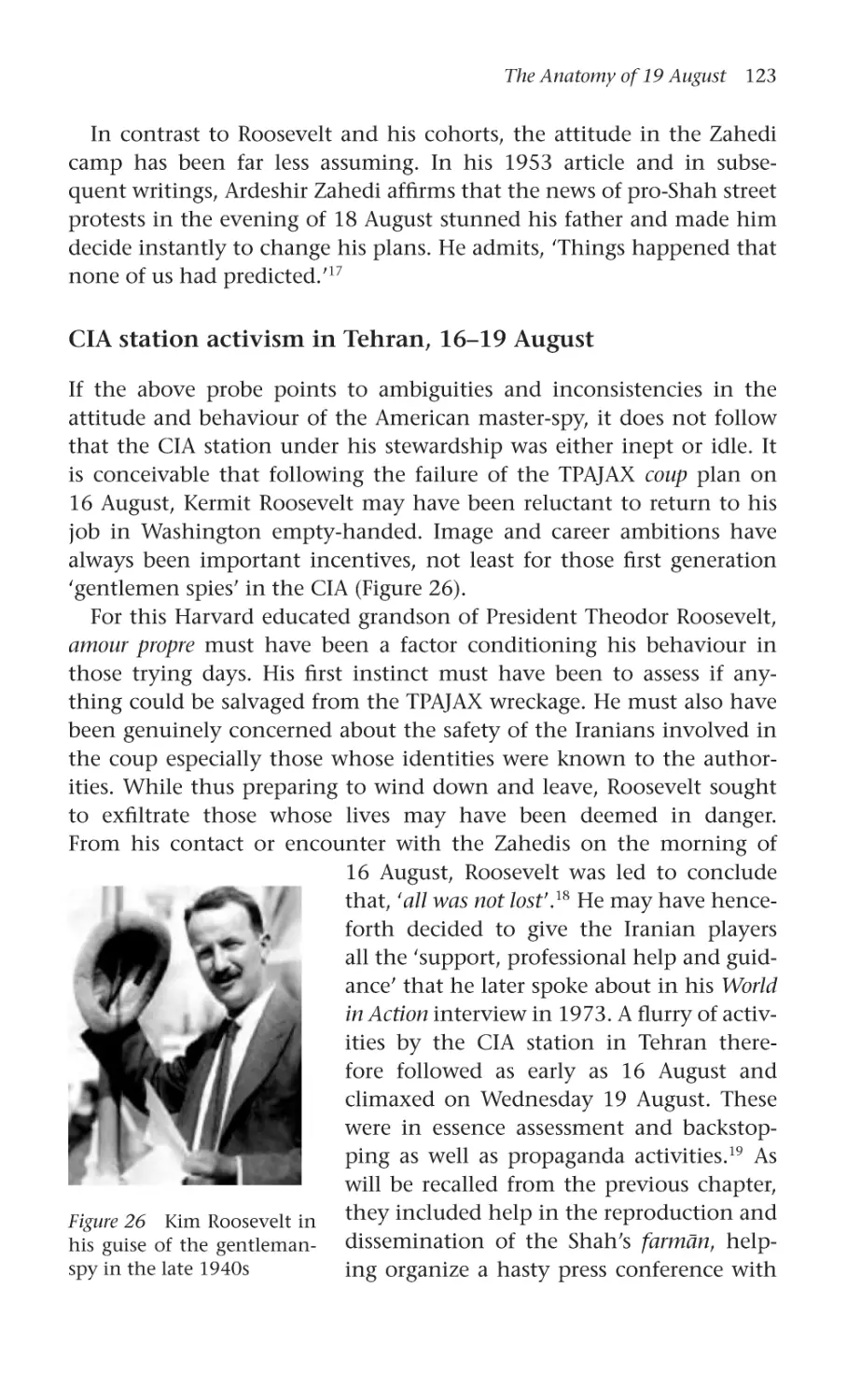



















Текст
                    Iran and the CIA
The Fall of Mosaddeq Revisited

Darioush Bayandor

Iran and the CIA

This page intentionally left blank

Iran and the CIA
The Fall of Mosaddeq Revisited
Darioush Bayandor

© Darioush Bayandor 2010
All rights reserved. No reproduction, copy or transmission of this
publication may be made without written permission.
No portion of this publication may be reproduced, copied or transmitted
save with written permission or in accordance with the provisions of the
Copyright, Designs and Patents Act 1988, or under the terms of any licence
permitting limited copying issued by the Copyright Licensing Agency,
Saffron House, 6-10 Kirby Street, London EC1N 8TS.
Any person who does any unauthorized act in relation to this publication
may be liable to criminal prosecution and civil claims for damages.
The author has asserted his right to be identified
as the author of this work in accordance with the Copyright,
Designs and Patents Act 1988.
First published 2010 by
PALGRAVE MACMILLAN
Palgrave Macmillan in the UK is an imprint of Macmillan Publishers Limited,
registered in England, company number 785998, of Houndmills, Basingstoke,
Hampshire RG21 6XS.
Palgrave Macmillan in the US is a division of St Martin’s Press LLC,
175 Fifth Avenue, New York, NY 10010.
Palgrave Macmillan is the global academic imprint of the above companies
and has companies and representatives throughout the world.
Palgrave® and Macmillan® are registered trademarks in the United States,
the United Kingdom, Europe and other countries.
ISBN-13: 978–0–230–57927–9 hardback
This book is printed on paper suitable for recycling and made from fully
managed and sustained forest sources. Logging, pulping and manufacturing
processes are expected to conform to the environmental regulations of the
country of origin.
A catalogue record for this book is available from the British Library.
A catalog record for this book is available from the Library of Congress.
10 9 8 7 6 5 4 3 2 1
19 18 17 16 15 14 13 12 11 10
Printed and bound in Great Britain by
CPI Antony Rowe, Chippenham and Eastbourne

For my grandchildren Max, Tara, Angelika and Arthur;
hoping this book may serve them as a bridge to their roots

History, unresolved, can be a heavy weight
President Barack Obama

Contents

List of Illustrations

x

Acknowledgements

xii

Preface

xiv

Introduction
How the story evolved
How did a myth about the CIA role develop and prevail?
Why did the CIA files remain unclassified?

1
3
5
9

1 The Context
Foreign influence as a prime mover in Iranian politics
The Tudeh Party
The Azerbaijan Crisis, 1945–46
Shah Mohammad-Reza Pahlavi
The Ulama as a socio-political force
Ayatollah Seyyed Abol’qassem Kashani: the precursor
of clerical activism
Razmara: prelude to the oil nationalization crisis

11
12
13
14
16
18

2 The Advent of Mosaddeq and the Oil Crisis
The rise of the National Front
The nomination of Mosaddeq
Doctor Mohammad Mosaddeq: a sketch
The initial British reaction to oil nationalization
The early American attitude to the oil dispute
Political line-ups in Tehran
Early conduct of the oil dispute
The British complaint to the Security Council
The Washington oil talks
The World Bank proposal
Early forebodings

27
27
29
31
33
35
39
40
43
44
48
50

vii

20
22

viii

Contents

3 Mosaddeq’s Second Government, July 1952 to
August 1953
The Qavam hiatus and the Siy’e Tyr popular uprising
(21 July 1952)
Rift among Mosaddeq supporters
A wedge to break the oil log-jam: the Truman-Churchill
joint offer
Mosaddeq’s reforms and the theory of legitimacy
The British two-pronged strategy: subversion and
engagement
The covert track
The engagement track
Diplomatic relations with Britain are broken off
Final attempts to resolve the oil dispute
A day forgotten in the Iranian collective memory

52
54
57
59
62
64
65
68
69
70
72

4 The Downslide
The clash at the helm; the February 1953 jumble
The Grand Ayatollah Boroujerdi: a retrospective sketch
General Fazlollah Zahedi
Internal conspiracies
The abduction of the police chief
The link-up: TPAJAX and the internal cabal
The summer of all dangers
The taming of the Shah
The failure of the TPAJAX coup

74
75
78
81
82
84
84
87
89
94

5 The Downfall
The gathering storm, 16–18 August 1953
The backlash: events leading to the fall of Mosaddeq on
19 August
Monitoring by the US Embassy
The final hours
The military factor in the fall of Mosaddeq
TPAJAX military planning and the role of Iranian officers

98
99
105
110
111
113
115

6 The Anatomy of 19 August
CIA station activism in Tehran, 16–19 August
The role of Iranian agents
Surprise in Washington
Ambassador Henderson’s last meeting with Mosaddeq
The CIA money

118
123
125
131
133
136

Contents ix

An orphan British secret document
Analysis of the British secret document
A coup d’état, a popular uprising or something else?

140
141
144

7 Where Did the Spark Come From?
The missing link: the Boroujerdi factor

147
150

8 Summary and Conclusions
Power structure and internal dynamics in the early 1950s
Mosaddeq’s rule
The handling of the oil crisis and stalemate
External and internal conspiracies
The TPAJAX coup and its aftermath
The involvement of ulama
The causes of Mosaddeq’s defeat

155
155
158
161
162
165
172
173

Notes

176

Direct Sources of the Study

234

Index

238

List of Illustrations

1 Mohammad-Reza Pahlavi, Shah of Iran (1941–79)
2 Ayatollah Seyyed Abol’qassem Kashani
3 Ayatollah Kashani flanked by Seyyed Navvab-Safavi, the
leader of Fadā’iān Islam terrorist group
4 Prime Minister Razmara, shortly before his assassination
in March 1951
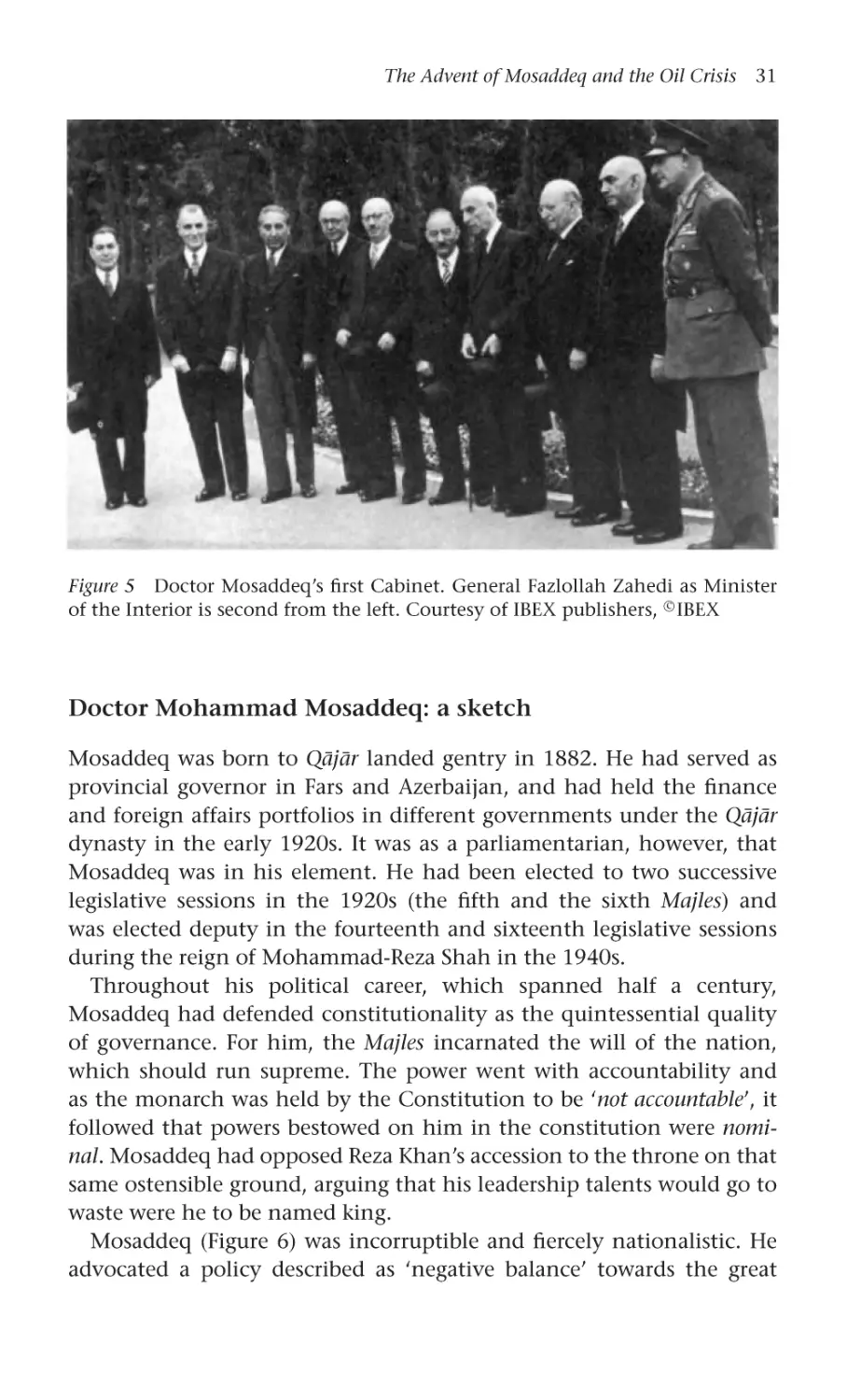
5 Doctor Mosaddeq’s first Cabinet. General Fazlollah Zahedi
as Minister of the Interior is second from the left
6 Mosaddeq’s likeness on the cover of TIME Magazine,
4 June 1951
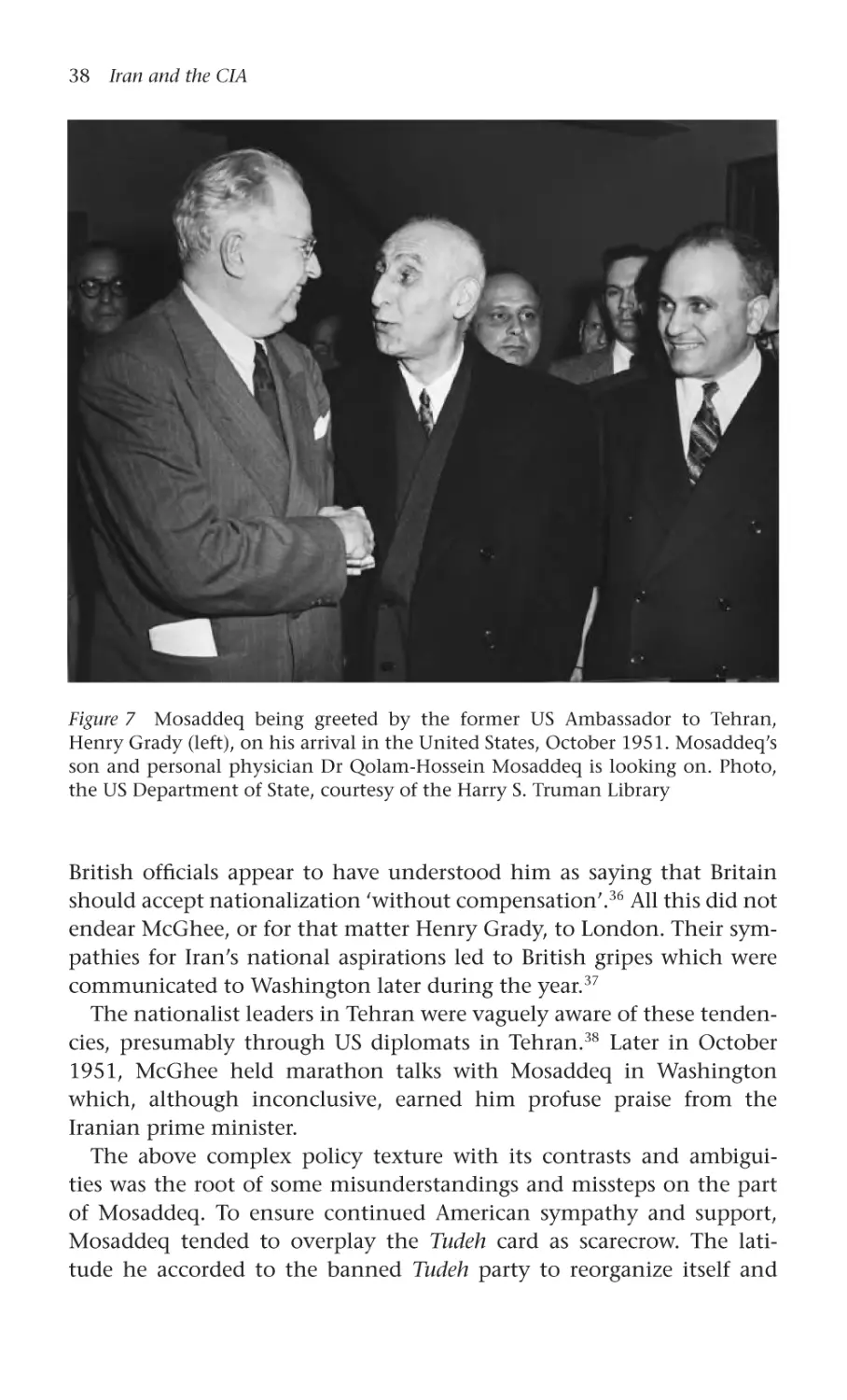
7 Mosaddeq being greeted by Ambassador Henry Grady
(left) on arrival in New York, October 1951. Mosaddeq’s
son and personal physician Dr Qolam-Hossein Mosaddeq
is looking on
8 Harriman’s visit to Tehran in August 1951
9 Mosaddeq being helped by the UN Secretary-General
Trygve Lie to his seat at the Security Council
10 Mosaddeq talking to Under-Secretary George McGhee
11 Mosaddeq being greeted at the White House by President
Truman
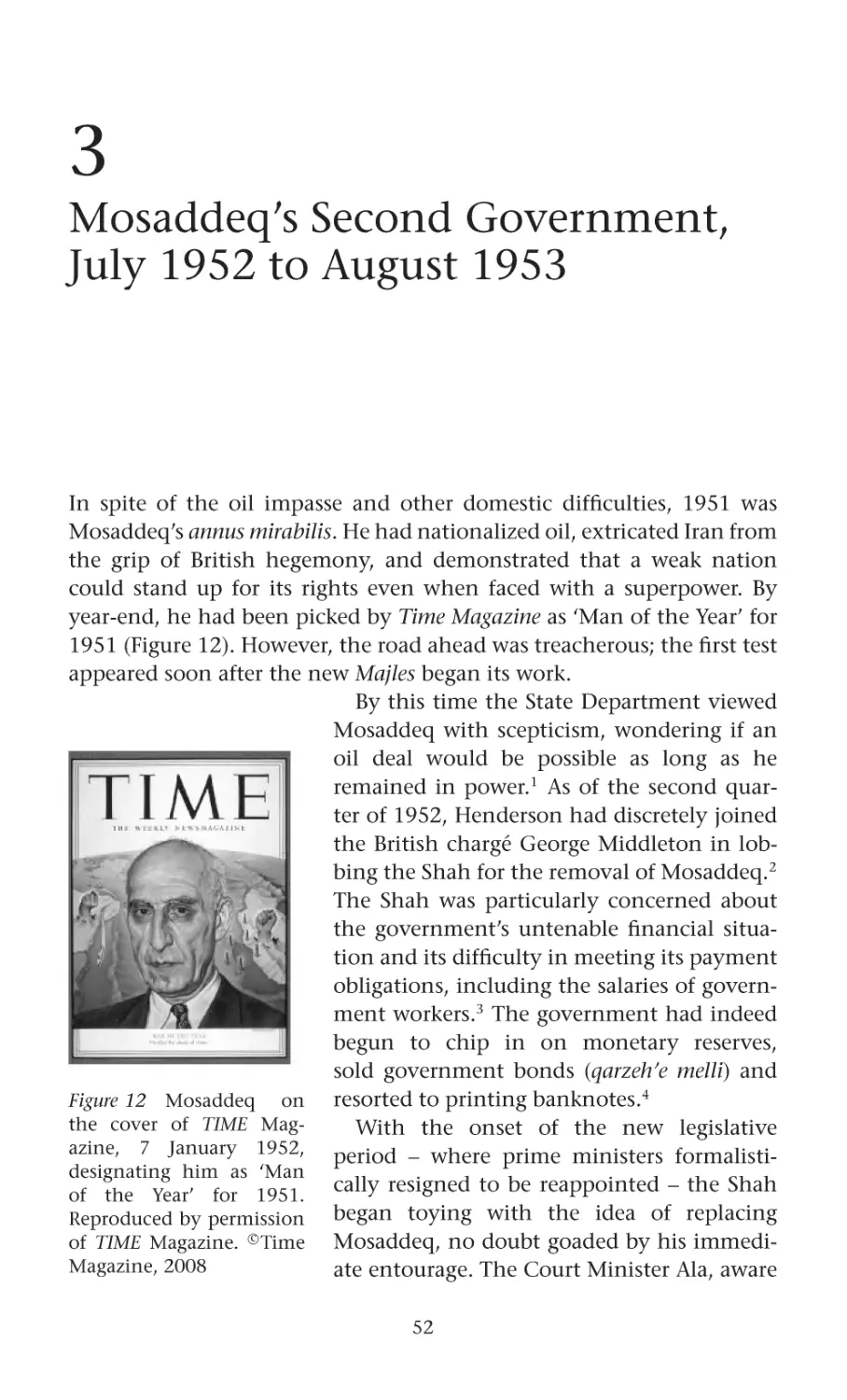
12 Mosaddeq on the cover of TIME Magazine, 7 January
1952, designating him as ‘Man of the Year’ for 1951
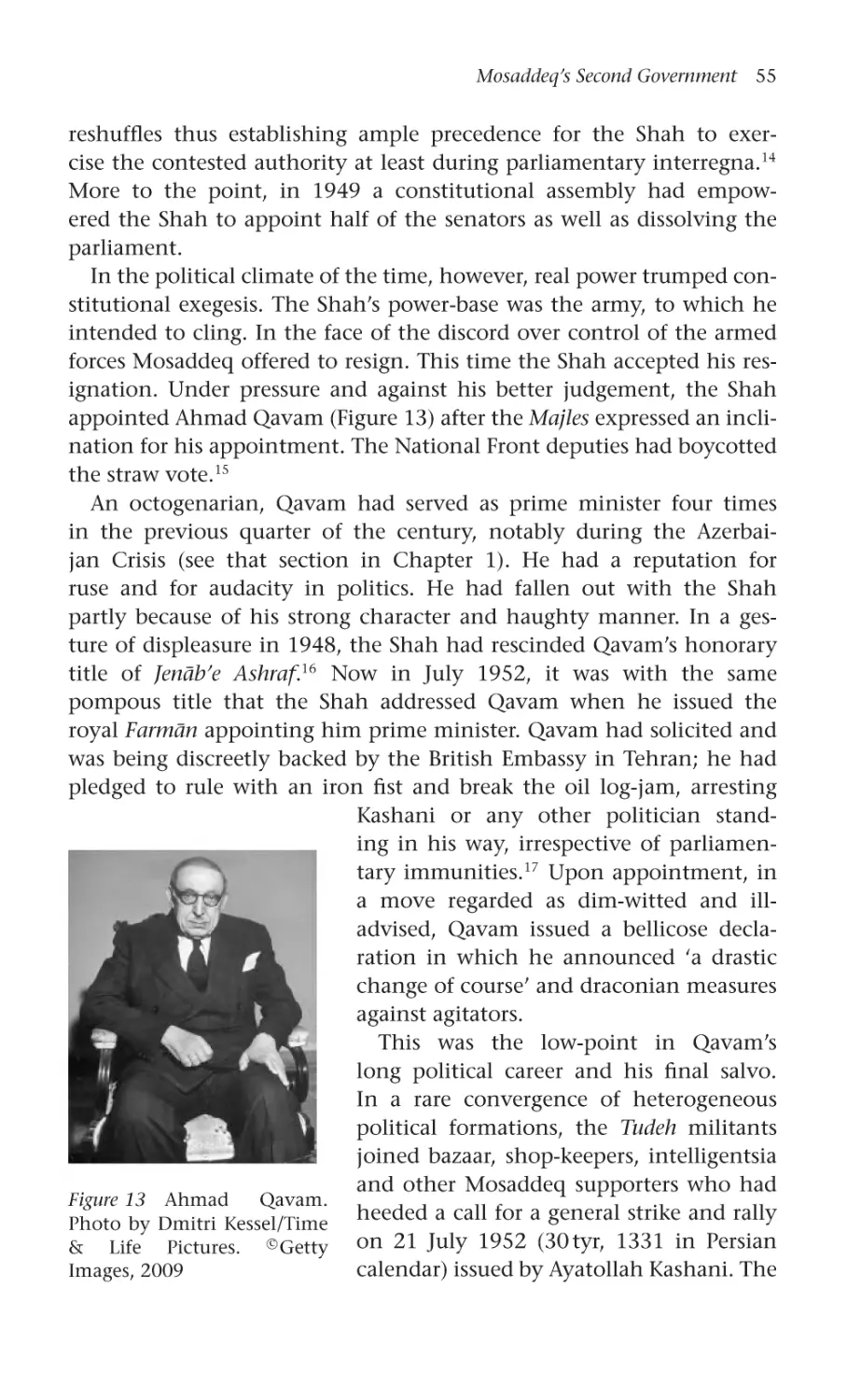
13 Ahmad Qavam
14 Grand Ayatollah Seyyed Mohammad-Hossein Boroujerdi
15 General Fazlollah Zahedi as he emerged from his hideout
on 19 August 1953
16 Court Minister Hossein Ala
17 Princess Ashraf Pahlavi, the Shah’s twin-sister, April 1951
18 Brigadier-General Norman Schwarzkopf
19 Kermit (Kim) Roosevelt, as an oil executive in the 1960s
20 Under-Secretary of State (General) Walter Bedell Smith
21 The Shah and Queen Soraya arriving in Rome,
18 August, 1953
x

17
20
22
24
31
32

38
42
44
45
47
52
55
79
81
83
91
92
93
97
100

List of Illustrations xi

22 Crowds drag down Reza Shah’s statue from Shah-Reza
Square, 17 August, 1953
23 Interior Minister Dr Golam’hossein Sadiqi arriving at
Mosaddeq’s house in the early afternoon of 19 August as
described in his memoirs
24 Mosaddeq waving from his car
25 General Zahedi and close associates shortly after
Mosaddeq’s downfall in 1953
26 Kim Roosevelt in his guise of the gentleman-spy in the
late 1940s
27 Asadolloh Rashidian, successful businessman, in the early
1960s
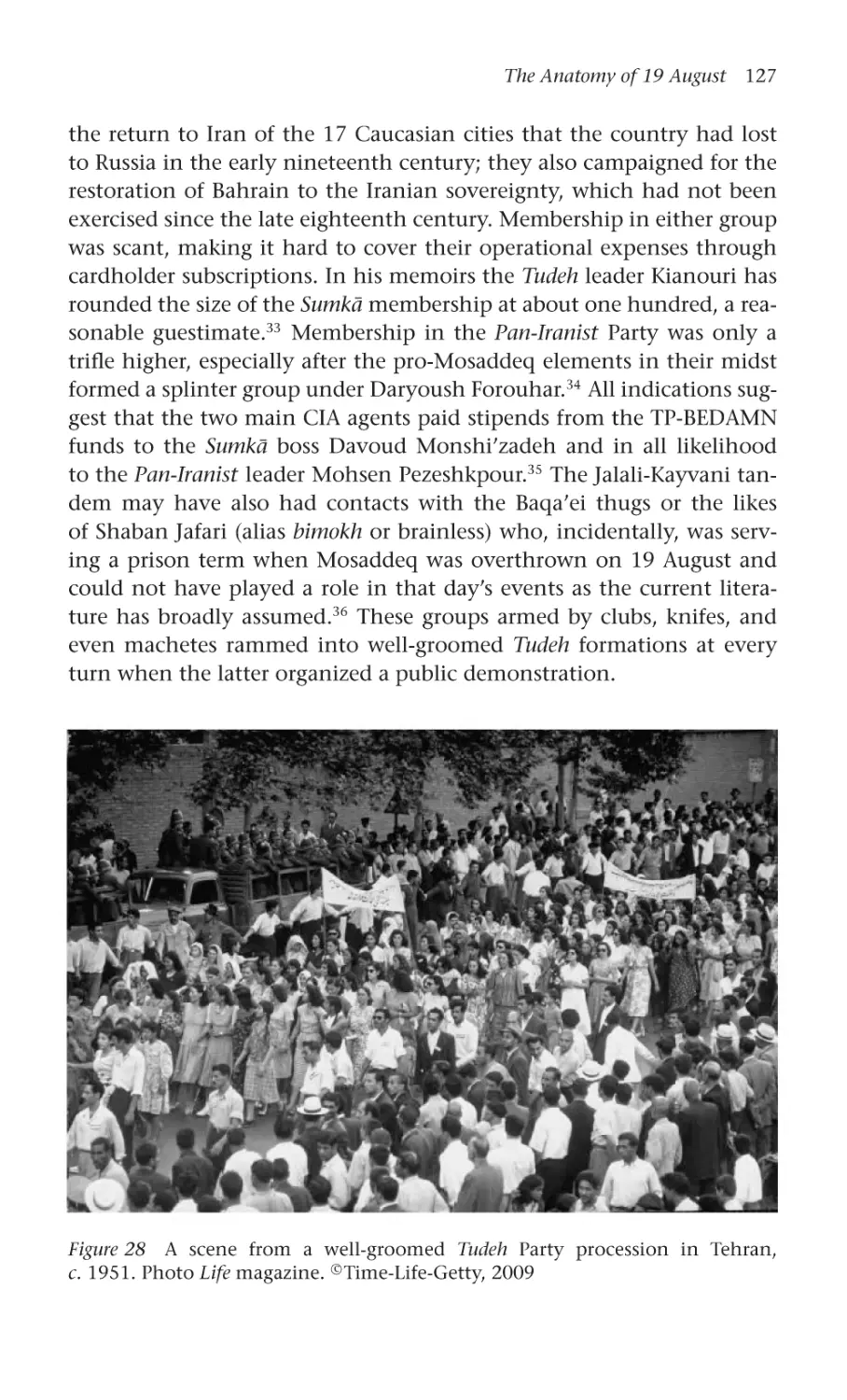
28 A scene from a well-groomed Tudeh Party procession in
Tehran, c. 1951
29 Tudeh boss Noreddin Kianouri in a pose in the early 1980s
30 Loy Henderson US Ambassador in Tehran 1951–55
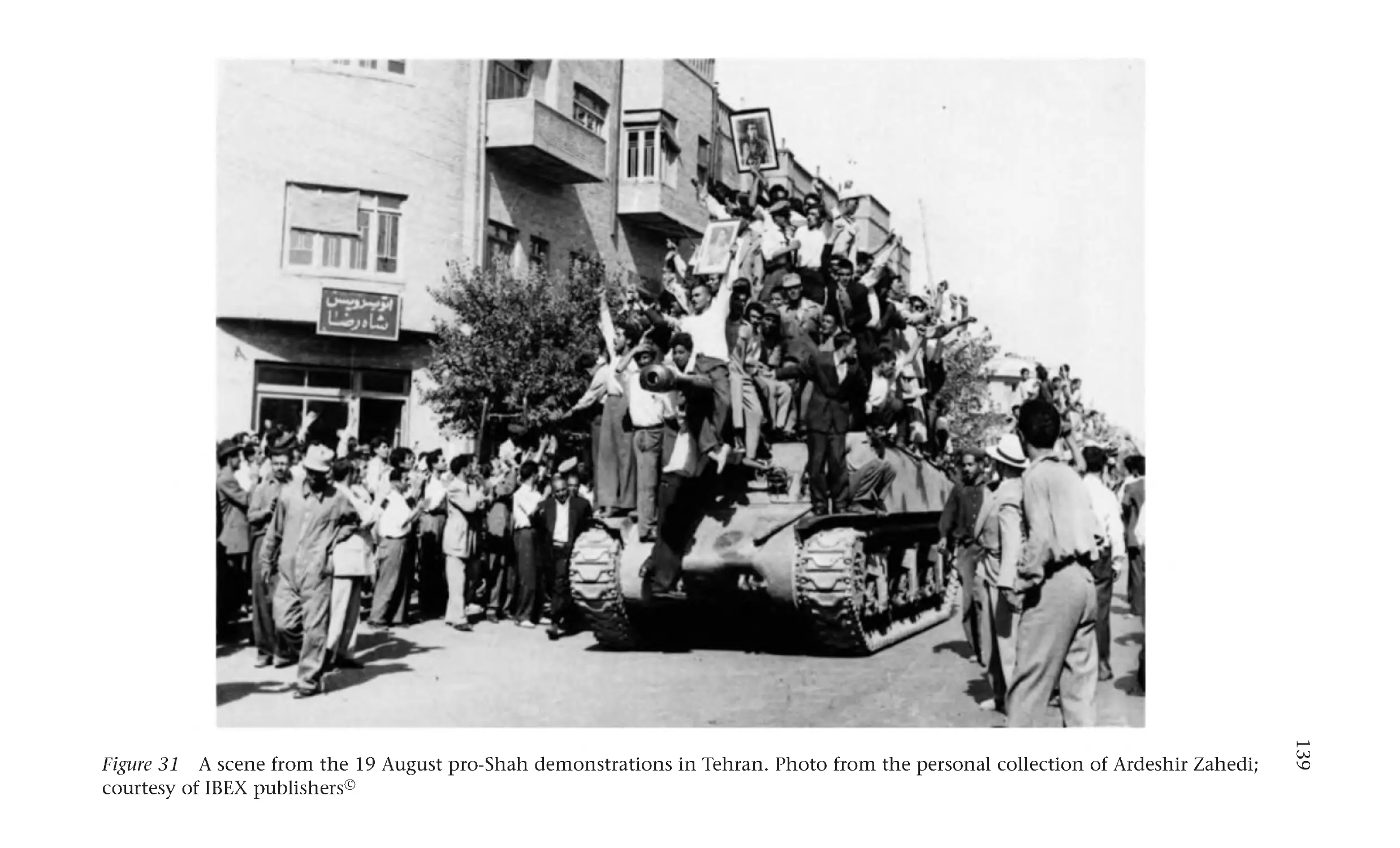
31 A scene from the 19 August pro-Shah demonstrations in
Tehran
32 A sparse group of pro-Shah demonstrators fraternizing
with the military on 19 August while ordinary people
applaud from the balconies of their houses

102

109
112
113
123
126
127
129
134
139

148

Acknowledgements
This project started off as an extension of academic debates and private
discussions in inner Iranian circles. It was expanded to its current form
thanks to encouragement from many friends and scholars who read the
earlier drafts. My special thanks go to Professor Sharam Chubin, Director of Studies, Geneva Centre for Security Policy, and to Charlie Naas,
the former State Department Director for Iran and Chargé d’Affaires in
Tehran, for their encouragement and endorsing the publication of this
book. Professor Houshang Nahavani, former rector, board- director and
professor in Tehran and Paris, provided useful comments and encouragement. Professor Mark Gasiorowski, who should be regarded as the
doyen of historians of this chapter of Iran’s history, was kind enough to
patiently read an early draft and make comments, maintaining, needless
to say, his position as reflected in his extensive and valuable writings.
I wish also to thank Professor Ervand Abrahamian of Baruch College
(CUNY) who, in spite of reservations on certain points, recommended
its publication. Karim Sadjadpour of Carnegie Endowment was most
generous with his time, encouragement and support.
Ardeshir Zahedi, a key player in the events leading to the fall of
Mosaddeq – later the Shah’s foreign minister, ambassador to London
and twice to Washington – was most generous with his time, granting me interviews and some photos from his personal collection for
which I am most grateful. Farhad Shirzad of IBEX publishing house in
Washington kindly authorized reproduction of some historical photos
from the Zahedi memoirs he published in Persian in 2006; also helpful
in this respect was Farrokh Derakhshani from the Agha Khan Foundation in Geneva. My thanks also go to Stephen Langlie who, as an
eyewitness to the events of August 1953, shared his insights as well as a
valuable photo from his personal collections. The Mosaddeq Foundation
Library in Geneva enabled me to have ready access to invaluable material and sources, especially in the Persian language. I wish to address
a warm word of thanks to its distinguished founder/director Professor
Majid Bayat. The Harry S. Truman Presidential Library kindly authorized
publication of a number of archive photos from Doctor Mosaddeq’s trip
to New York and Washington in October–November 1951. I am also
indebted to Chelsea Millner of the Eisenhower Presidential Library for
her help.
xii

Acknowledgements xiii

Friends and former colleagues Iraj Amini, Jamshid Anvar, Said
Amirdivani, Bijan Dolatabadi, Dr Ahmad Minai, Parviz Mohajer, Ali
Seirafi and Dr Ahmad Tehrani read the earlier drafts of this book and
provided useful comments and much encouragement. Last but not least,
Anandi Rasanayagam, a colleague from my UN days and himself author
of a marvellous book on Afghanistan, and Jean Swoyer, a veteran of
the American Foreign Service, provided valuable editorial advice having
read selected chapters of the manuscript. I am indebted to them both.

Preface

This book is an attempt to canvass the 27-month-long premiership of
Doctor Mohammad Mosaddeq in a dispassionate effort to shed further
light on the events which led to his downfall on 19 August 1953. The
event no doubt changed the destiny of Iran and may have had an impact
on the broader scheme of things on the world scene. It surely created
a political fault-line that has divided Iranians for several generations.
For reasons elaborated in the Introduction, its searing effects have not
been effaced. Further, judging by its frequent evocation in the media and
the volume of academic and pseudo-academic publications, the subject
has lost little of its political relevance or intellectual allure. Indeed, few
episodes in Middle East contemporary history have been the subject of
such an incisive probe. A first question, then, is why to rewrite that
chapter of history?
Writing in 2003 for a scholarly work on the downfall of Mosaddeq,
a renowned American historian, Professor William Roger Louis, started
his chapter with a thoughtful caveat: The overthrow of the Mosaddeq
government in August 1953, he wrote: ‘is a subject that invites periodic
reassessment . . . Greater distance and greater access to archive material encourage a more dispassionate view of a subject still riddled with
ideological assumptions’ (emphasis is mine).1
When in the winter of 2006 I began preparing the rudiments of the
present volume, I was animated in part by the same conviction. As an
avid student of Iran’s contemporary history, I was broadly familiar with
the literature on the Mosaddeq era. A perception of foul play causing
his overthrow on 19 August 1953 had grown overwhelming, especially
in the years following the publication in 1979 of a book authored
by Kermit (Kim) Roosevelt, who by then was already reputed to have
engineered the final blow against the Mosaddeq government.2
Spurred by his ‘revelations’, and no doubt by the demise of the
imperial regime in Iran, a large volume of books, articles and treatises emerged in the following two and a half decades. Scholarship in
the United States and Britain was based on extensive and meritorious research, including interviews with former CIA and SIS/MI6 agents
involved in the coup plan in 1953. Memoirs published in Iran and elsewhere by the main protagonists or side-players have also enriched the
xiv

Preface

xv

literature. This impressive body of scholarship, however, had not, to my
mind, escaped the ravages of ideologically-based assumptions. Nor, as
was also noted by Professor Louis, have all Iran files been released in
spite of the lapse of well over half a century.
In 2000, the leak of a secret CIA internal history to The New York Times
produced the first authoritative account of the Agency’s operations in
Iran during 1953.3 The document, written only a year after the event,
was in great part concerned with the operation TPAJAX, a plot which
culminated in a failed coup attempt against Mosaddeq in the late hours
of 15 August 1953. The internal history’s coverage of the events subsequent to that attempt – and their relation to activities carried out by the
CIA Station in Tehran – is decidedly less limpid. The CIA internal history,
in effect, remains inconclusive, even reticent, about the nexus between
the action taken by CIA operatives in Tehran and the happenings that
resulted in the collapse of the Mosaddeq government on 19 August. This
is in spite of the fact that, perforce, the CIA document reflects debriefings by the field operatives, notably Kim Roosevelt. Yet an uninitiated
reader could easily misconstrue the report as an endorsement of what
Roosevelt later came to claim.
To my incredulous mind, something troubling was amiss. The narrative in Roosevelt’s Countercoup had something of the unreal in its
main thrust, not far from screen sagas where a hero single-handedly
(or almost) manages to beat back incredible odds in a hostile environment. In this case, the American hero manages to turn around an initial
setback and snatch victory from the jaws of defeat in less than 48 hours.
On the flipside, the claim by Shah Mohammad Reza Pahlavi and his
regime to the effect that the fall of Mosaddeq was the backwash of a
spontaneous popular uprising (Qı̄ām’e Melli) was hardly convincing.
What was the missing link in the conundrum that was the fall of
Mosaddeq? That was the challenge I set out to explore. This book is the
result of that endeavour. Substantive evidence and analyses on the main
theme are laid out in Chapters 5, 6 and 7, while the first four chapters
provide a schematic description of the background against which the
dramatic events of August 1953 unfolded. The findings of the study are
recapitulated in the Conclusions. The book is primarily based on the US
archive documents, 1946–53, commonly abbreviated as FRUS, backed by
the already tapped British Foreign Office material, covering the period
up to the break-off of diplomatic relations between Iran and Britain in
October 1952. The CIA internal history has been analysed and drawn
on. A British top-secret report (dated 2 September 1953), which to this
date, to the best of my knowledge, has gone unnoticed in history books

xvi

Preface

of this episode, is printed in the State Department’s declassified Iran files
(FRUS 1952–1954, Volume X). Produced barely two weeks after the fall
of Mosaddeq, the eight-page document is fully analysed in Chapter six.
Other than material from governmental sources, memoirs and recollections of major protagonists – Mosaddeq, Kermit Roosevelt, and Ardeshir
Zahedi – and some lesser actors like Qolam-Hossein Sadiqi, Mozaffar
Baqa’ei, Norredin Kianouri, Christopher Woodhouse, Samuel Falle, and
others – have also been thoroughly examined. As usually is the case
with memoirs, they represent a personal baggage, a mix of facts, memory lapses or deliberate spins, leaving it to the historian to sift through
facts and factoids. An effort to this effect has been made through crosschecking the information conveyed. Press coverage by The New York
Times and Time, as well as titbits from the Iranian press and Rouzshomari
(Iranian daily news archive), and also Persian language literature have
been surveyed. Where conclusions are drawn from non-archival sources,
they have invariably been cross-checked for corroborating evidence. The
career paths, character traits and mannerisms of the main protagonists
are sketched-out to the extent that these elements were believed to have
influenced the events.
The narrative is backed up with extensive annotations in reference
notes which provide peripheral information on the specific topics
treated and the background against which the interplay of actors can
better be understood. They should be considered as an adjunct to the
narrative, kept separate only to maintain the flow of the main text
yet essential for a better understanding of the period and the political
context in which events unfolded.
When it comes to the Iranian protagonists of the drama, I have
remained within the strict confines of evidence and archive. No one
is condemned or vindicated. The primary task of the historian is to
produce data and conduct probes; there are no verdicts, only findings.
Those of this study, at any event, are unlikely to satisfy unconditional
supporters of any of the national or religious figures of the time. Yet one
single observation about Mosaddeq might be deemed in order.
Mosaddeq as a historical persona need not be idolized. He is justly
remembered as the man who shed the shackles of the neo-colonialist
hold over Iran’s main source of livelihood, the oil industries. He is also
in the vanguard of third-world awakening in the post-Second World War
period. Yet Mosaddeq was not infallible; his strategic errors contributed
to the ripening of cumulative factors which brought about his downfall.
This reality should not prevent Iranians from proudly cherishing his
memory and lauding his historical accomplishments.

Preface

xvii

A word about transliteration of Persian
The guideline in the Chicago Manual, Edition 14, has been flexibly
applied to all Persian words, exception being made for diacriticals in
proper names. Transliterations, in general, are based on the Persian
pronunciation of the names of Arab origin (Mohammad rather than
Muhammad; Hossein rather than Hussein); composite proper names
have been separated by a hyphen (Mohammad-Hossein); while in cases
of fusion of two elements in a single proper name, the apostrophe (’)
is used to separate the components (Abol’qassem, rather than AbolQassem; Abdol’hossein rather than Abdol-Hossein). The same punctuation mark, combined with the letter (e), is used for vocal liaisons
between the words where applicable, (Khāterāt’e Avalı̄n Sepahbod’e
Iran, rather than Khāterāt-i Avalı̄n Sepahbod-i Iran). Finally, (’ei) rather
than (i) is used for endings of such names as Tabataba’ei or Baqa’ei.
Darioush Bayandor

This page intentionally left blank

Introduction

Well over half a century after the fall of the government of
Dr Mohammad Mosaddeq on 19 August 1953, the topic has not ceased
to stir interest among historians or arouse passion in Iranian circles. The
event has been described by many in Iran and abroad as a CIA-inspired
coup which extinguished national aspirations for democracy and economic emancipation; others have hailed the event as a popular uprising
(Qiām’e Melli) that saved the country from chaos and a drift towards
communism – 19 August 1953 thus remains a fault-line that divides
Iranians. Yet none of the two assumptions, in absolute, stand the test
of a vigorous probe. The present volume is an attempt in hindsight to
embark on such a probe, exploring new angles with the help of data
that, while in public domain, has not been fully tapped.
Why, despite cataclysmic events that followed the Islamic revolution
(1978–79), has the overthrow of Mosaddeq not faded in collective memory? To what could this enduring quality be attributed? The answer may
lie in the fact that two flawed, yet plausible assumptions link that historical episode to present-day events. These assumptions have become
a part of the conventional wisdom on Iran and its relations with the
United States. They have come to take on aspects of a credo or dogma.
The first assumption, to which we alluded above and shall dwell
on at length in this book, maintains that the eviction of Mosaddeq
on 19 August 1953 resulted from a premeditated coup d’état planned,
financed and executed jointly by the CIA and the British Secret Intelligence Service (SIS/MI6) as an integral part and extension of a plan
code-named TPAJAX. To the extent that in this assessment internal factors are unaccounted for, the fall of Mosaddeq has become disconnected
from its indigenous context and historically distorted. The ownership of
this event was, at least implicitly, claimed by, and became a laurel added
1

2

Iran and the CIA

to galloons of the CIA and MI6. We shall shortly discuss factors that
entrenched that belief in public consciousness; what needs to be stressed
here is the fact that the attendant sense of exaltation and bravado was
short-lived. Following the Islamic revolution, the triumphalism associated with Kermit Roosevelt’s Countercoup: The Struggle for the Control of
Iran gradually waned. The fall of Mosaddeq became a sore point and a
burden for anyone to claim credit for.
Following the US Embassy hostage crisis (November 1979–January
1981), a second dogma emerged. The manifest hostility of the Islamic
regime under Ayatollah Khomeini towards the United States was traced
back and blamed on the American cabal in August 1953. The sense of
guilt over the removal of Doctor Mosaddeq, stereotyped as ‘the popular and democratically-elected prime minister of Iran’, became a motive
for self-deprecation and remorse. Yet, as will be seen in the main body
of this study, the core group in the Islamic revolution was in effect
of direct ideological lineage to the clerics who played a key part in
Mosaddeq’s downfall on 19 August 1953. By their own admission, it was
not to Mosaddeq, but to his sworn enemies that leaders of the Islamic
republic profess allegiance.1 After the Islamic Revolution the most ferocious foes of Mosaddeq, namely Ayatollah Kashani and the Fadā’iān
Islam leader, Navvab-Safavi, were idolized and became icons of the
new order.
The fallacy, however, endured. Liberal opinion in America had long
been critical of the privileged relationship between the United States
and the Shah; it now had a platform to assail that geostrategic partnership as ill-conceived and myopic. These relations had developed over
25 years, spanning six administrations. Yet fingers were pointed at two
landmarks: The coup d’état planned and executed by the Eisenhower
administration and the Nixon doctrine, which had given the partnership
its most extravagant expression.2
A range of academic works appeared in America, encompassing
accounts of the overthrow, roots of the Islamic revolution or the failure of American policy in Iran. Invariably they were based on extensive
research and contained a wealth of valuable information; but the flawed
assumptions referred to above cast a shadow over most.3 In some cases,
reliance on recollections rather than on archives fostered falsehoods. In
the less academic and sensational genre, the flawed assumptions were
dramatized to a feverish pitch.4 Uninformed opinion in Iran, the United
States and elsewhere falls for factoids, flat-wrong data and interpretative
accounts nourished by faulty premises in this latter category of publications. Stereotyping and simplification is equally prevalent in American

Introduction

3

media. A CBS/Historical Channel documentary entitled Anatomy of a
Coup: The CIA in Iran is a case in point.5 The logline of this widely
diffused production reads: ‘Documentary about how the stage for the
1979 Iranian revolution was set some thirty years before it happened.
Recently discovered CIA documents reveal America’s role in the military
coup that ousted Iran’s elected prime minister in favor of returning the
Shah to power.’ Irrespective of the merit or demerit of the production,
the message it conveyed to its audiences typifies the fallacy of rooting
the Islamic revolution in the fall of Mosaddeq.
In March 2000, in a conciliatory gesture to the Islamic Republic of
Iran, Secretary Madeleine Albright acknowledged past American meddling in Iran saying: ‘In 1953 the United States played a significant
role in orchestrating the overthrow of Iran’s popular Prime Minister,
Mohammed Massadegh [sic]. The Eisenhower Administration believed
its actions were justified for strategic reasons; but the coup was clearly a
setback for Iran’s political development. And it is easy to see now why
many Iranians continue to resent this intervention by America in their
internal affairs.’6 Many informed Iranians, especially of older generation, surely do hold a grudge for that meddling, but few disagree that
Secretary Albright sought to appease a regime which in its soul was an
accomplice in the overthrow of Mosaddeq.

How the story evolved
In explaining factors that led to the actual downfall of Mosaddeq on
19 August 1953, this study ascribes a larger role to internal dynamics
than is generally admitted in the current literature. To be sure, the focus
on external covert action by Britain, later joined by the United States,
is fully maintained just as the evolution of their open policies during
the oil crisis is thoroughly examined. By March 1953, the Eisenhower
administration had lost all hope of resolving the oil dispute with the
Mosaddeq government. Against the backdrop of McCarthyism and the
Korean War, the fear of a communist takeover of Iran had crept into
the American psych and found a larger-than-life existence. This fear
became the dominant factor in America’s policy thinking under the
Dallas brothers, John Foster and Allen, who as of 20 January 1953 were
in charge of American overt and covert foreign conduct. The administration thus joined Britain in trying to oust Mosaddeq by underhanded
means. He was to be replaced by a prime minister willing to crush the
pro-Soviet leftist party, Tudeh, while resolving the oil dispute amicably.
The plan, code-named TPAJAX, foresaw a propaganda campaign to be

4

Iran and the CIA

culminated in a military coup. In this plan, internal opposition forces,
including Shiite high clerics were to play a pivotal role. The Shah’s
co-operation had been deemed all but indispensable.
The internal opposition was ominously real and willing to act as conditions grew ripe. The oil-less economy had strained the country’s material
and monetary resources and narrowed Mosaddeq’s support base. The
Shah and Mosaddeq were at loggerheads over their respective constitutional prerogatives. The pro-Soviet Tudeh Party was visibility getting
stronger by day. A crescendo cacophony of anti-establishment noises,
from leftist propaganda to an array of anarchist or irreverent tabloids,
street demonstrations and daily mayhem, raised the spectre of chaos
with the implied risk of regime change. Undaunted, Mosaddeq singlemindedly pursued a quixotic anti-colonial drive in parallel with sweeping internal reforms which budded dissension among interest groups.
The politically active clerics were openly defying the government.
Ayatollah Kashani was indeed the iconic figure of the opposition. The
traditionally quietist and by far the more influential segment of the clerical establishment led by the Grand Ayatollah Boroujerdi in Qom also
became alarmed. The purged senior military officers had formed another
group of opposition activists. They were actively plotting to undermine
the government. Some among them gravitated around General Fazlollah Zahedi, a former Mosaddeq cabinet minister who made no secret of
his ambitions to replace him as prime minister.
The external and internal schemers, at a given juncture in summer of
1953, sought one another out and converged. The Shah, while at odds
with his prime minister, was averse to cabalistic methods. He preferred
normal parliamentary procedures as a means to dismiss the government.
Faced with overwhelming Anglo-American pressures, he finally conceded. The TPAJAX coup plan was tried in the night of 15 to 16 August
and failed. The Shah flew off in panic to Baghdad and Mosaddeq was in
full control.
There is little discrepancy between the findings of this study and the
current literature up to this point. Where things become fuzzy and disagreements surface is about the ensuing four days, which ended in a
dramatic reversal of the situation and brought in its wake Mosaddeq’s
downfall. The conventional wisdom, as stated at the outset, is that CIA
operatives, with the help of local MI6 agents, choreographed the move.
This is in essence what Kermit Roosevelt, the CIA field manager of the
TPAJAX, has claimed in his book Countercoup.
The present volume contests this account and maintains that
Roosevelt cunningly twisted a near-fluke to his personal advantage. This

Introduction

5

travesty was made possible by the fact that during the intervening days,
the CIA station in Tehran had not remained idle. It had provided certain support, encouragement and possibly guidance to General Zahedi’s
camp, which had remained defiant and willing to start an armed insurrection from a place outside the capital, a patently mid-term strategy.
Thus, while preparing to leave the country, Roosevelt embarked on a
flurry of activities, essentially support and backstopping, in cahoots with
the Zahedi camp. Against such a background, it was not difficult to later
attribute the end-result, namely the fall of Mosaddeq, to those activities, notwithstanding the reality that the Zahedi camp itself played only
a marginal, if any, role in the ensuing events leading to the downfall. In
Countercoup Roosevelt claimed that he specifically designated Wednesday 19 August as D-Day and went as far as claiming that contacts with
military commanders in Esfahan and Kermanshah (respectively 400 and
600 kilometres from Tehran) were intended to get those garrisons to
march to Tehran in the immediate term.7 Chapters 5 and 6 of this
volume are devoted to exposing all facets of this travesty.

How did a myth about the CIA role develop and prevail?
It has to be underscored that public perception of the CIA role long predates Roosevelt’s account in the Countercoup. It is as such important to
dwell on factors that went into the making of a CIA myth in Iran.
Rumours of the CIA involvement in the downfall of the Mosaddeq
government did indeed spread on impact. In a lengthy commentary on 19 August, the Soviet Communist party mouthpiece, Pravda,
had accused the United States of having engineered the earlier coup
against Mosaddeq. Pravda had accurately implicated Brigadier General
H. Norman Schwarzkopf, a one-time trainer of the Iranian Gendarmerie,
as an American emissary carrying secret orders to Tehran.8 This was
before the news of the actual overthrow had reached Moscow. Radio
Moscow was then quick to blame the fall of Mosaddeq on American
plots. The Tudeh Party, which had been instrumental in foiling the
TPAJAX putsch on 15 August, was now convinced that overthrow of
Mosaddeq was a coup de grâce executed by Western intelligence services
as part of a broader plan.
As early as 21 August the US Ambassador in Tehran, Loy Henderson,
warned Washington of the ‘widespread impression’ that the US government had contributed with ‘funds and technical assistance to overthrow
of Mosadeq [sic]’. Henderson in effect refers to Tudeh and radio Moscow
propaganda but also to public expressions of ‘indebtedness’ by associates

6

Iran and the CIA

of General Zahedi, the new prime minister, which are being ‘given
deeper meaning than intended’. Henderson reported that the Embassy
was doing its utmost to remove that impression because, he went on
presciently, ‘It is not in [the] US interest over the long run to be given
credit for internal political developments in Iran.’9 In this dispatch,
Henderson also referred to a trait in the Iranian political culture, according to which: ‘Iranians [are] unable [to] believe [that] any important
political development can take place in [the] country without foreigners
being involved.’ This valid observation must not be discounted as a factor in the formation of a deeply entrenched conviction among Iranians
that the fall of Mosaddeq on 19 August resulted from the CIA intrigues
and manipulations. The manner in which the oil dispute was eventually
resolved must no doubt have reinforced the impression of American foul
play. MajorAmerican oil companies indeed obtained the lion’s share in
a new oil consortium which was created to operate Iranian oil following
the overthrow of Mosaddeq. The consortium had involved the participation of nearly all oil conglomerates in the production and marketing
of the Iranian oil in a fifty-fifty revenue-sharing partnership with the
state-owned National Iranian Oil Company (NIOC).
Over a year later, on 6 November 1954, an article appeared in The
Saturday Evening Post as part of a series dubbed, ‘The Mysterious Doings
of the CIA.’ The two journalists, Richard and Gladys Harkness, should
have been credited for being among pioneers of investigative journalism in American media were it not for a strong probability that the
CIA deliberately planted the articles as part of an Inside the Beltway
promotional campaign.10 The authors must have been tipped off by an
insider, as their story roughly corresponded to the way the operation
TPAJAX had evolved. However, as in all later accounts, the crucial link
between this plan and the downfall on Wednesday 19 August had been
botched. Many details were either fabricated or wrongly transmitted by
the anonymous informer. Yet, coming as it did from an American source,
the article was taken as gospel. A decade later Richard Cottam, in his
acclaimed book Nationalism in Iran, reproduced the article in extenso,
observing in passing that it had been widely read in Iran. Yet Cottam,
himself an insider, vehemently criticized the article, not just for its
inaccuracies but because it distorted what he then characterized as a
‘spontaneous’ uprising.11 It should be pointed out that Richard Cottam
is arguably unique among American academics to have attributed the
event to internal factors as opposed to CIA foul play. Much later in his
academic career, however, Cottam made a turnabout and contradicted
himself in a piece he published in a Quebec journal in 1980.12

Introduction

7

Another signpost on the road to the CIA myth was The Invisible Government, also published in 1964 by two prominent journalists David
Wise and Thomas .B. Ross.13 The impact of this work on opinion in
the United States was large. This was mainly because it covered the
full breadth of the American intelligence gathering apparatus – the CIA
being the centrepiece – and referred to other similar operations, including the coup against President Arbenz in Guatemala, stories related to
the Bay of Pigs, Burma, Indonesia, Laos and Vietnam, and so on. The
brief chapter on Iran (ibid., pp. 110–12) was again nothing but a rehashing of stories on the TPAJAX coup, which did not clarify its link with
Mosaddeq’s downfall on 19 August 1953. Iranian opposition activists
abroad, however, took to this passage as yet another irrefutable proof.
The big landmark was yet to come. In 1979 Kermit Roosevelt created a sensation by publishing Countercoup: The Struggle for the Control of
Iran. We just outlined the essence of what he had claimed in that book.
The legend was now crystallized. Roosevelt had left the CIA in 1958 to
become an oil executive with Gulf Oil. In the 1970s he was involved in
corporate consultancies and was reputed to be on the Iranian government payroll as well as Northrop’s. Given these sinecures, he was not
about to burn his bridges with the Shah. For publication of his memoirs
he is known to have tried, as of 1976, to obtain the Shah’s clearance.
According to the diaries of the ex-Court Minister, Asadollah Alam, the
Shah reacted blandly to the news of Roosevelt’s memoirs, leaving the
matter to his Court Minister to handle. The latter however had a grimmer view of Roosevelt’s chapters. Relevant entries in Alam’s diaries are
interesting, if only because they reveal a facet of the Shah’s character.14
The fall of the monarchy early in 1979 removed obstacles and scruples
relating to publication of the book.
A main theme in our study is to demonstrate why Roosevelt’s
main claims in that book are disingenuous. In real life, Roosevelt managed to sell his story to the main protagonists. The Shah was reported
to have told him ‘I owe my throne to the Almighty God, my people,
my army and you!’15 Roosevelt was also received by Churchill. A frail
Churchill in his sickbed – in an elated mood nevertheless – reportedly
told him, ‘If I have been a few years younger, I would have loved
nothing better than to have served under your command in this great
venture.’16 President Eisenhower read Roosevelt’s report while still in
Denver, Colorado, and later personally awarded a medal to Roosevelt
who by then had fully earned the lustre attached to his name. But when
he sat to hear Roosevelt in person, the President was not impressed.
According to his biographer, Stephen Ambrose, Eisenhower wrote in

8

Iran and the CIA

his diary on 8 October 1953, ‘I listened to his [Roosevelt] detailed
report and it seemed more like a dime novel than historical fact.’17
Still, Roosevelt’s debriefings then must have been less flamboyant than
his Countercoup narrative, judging by the contents of the more sober
and authoritative CIA internal history Overthrow, drafted in 1954. This
document, to which we shall turn shortly, contains glaring contrasts
with Roosevelt’s tales in Countercoup. In the event, both the SIS/MI6
and CIA headquarters accepted Roosevelt’s account with alacrity, overlooking certain ambiguities and inconsistencies which must have been
apparent, given deficiencies both in the number and substance of messages which Roosevelt transmitted to Washington and London during
the final four days. The SIS boss, Major-General Sinclair, did indeed ask
Roosevelt to take him along to the Foreign Office debriefings so that he
could show results to senior diplomats, who must have been reticent
about spy action as a way to conduct foreign affairs.18 The same mentality prevailed in CIA headquarters. The fledgeling operational wing
of the CIA was striving to break loose from the straightjacket of the
1947 National Security Act; this law had accorded the agency a primarily
intelligence coordination and analyses role, as opposed to a field operation role and, while this handicap was somewhat improved in 1952,
interagency intelligence rivalries were intensified.19 Both Woodhouse
and Richard Helms – one of the longest serving CIA directors – are on
record saying that the CIA deliberately leaked, even exaggerated its role
in Iran in order to enhance its own stature in Washington.20
In June 2000 The New York Times, decided to release an internal CIA
document leaked to it earlier by an unnamed official. Written in March
1954, the report and its annexes constitute a unique authoritative document emanating from official sources on the planning and execution of
the plot to take out Mosaddeq’s government. (See also Chapter 6, section
‘An Orphan British Secret Document’ in this volume). The author of the
report, Donald Wilber, was the main drafter of TPAJAX, together with
a British agent named Norman Darbyshire. The report is essentially a
post-mortem drawn up from the then existing records, cable traffic and
debriefings, notably by Kim Roosevelt, who other than directing the
operation in Tehran was Wilber’s superior in the CIA hierarchy.
While precise about the events leading to the failed coup attempt of
15–16 August, the Wilber account or ‘Overthrow’ – as we shall henceforth refer to it – remains fuzzy about factors that led to the actual
downfall. Nowhere in this report is there an explicit claim that the overthrow of Mosaddeq was a direct result of moves by the CIA station in
Tehran between 16 and 19 August. These activities, however, were fully

Introduction

9

described and will be analysed in the main body of this volume. We
will highlight doubts, if not disclaimers, expressed in Overthrow proper,
about the nexus between CIA station activities and the fall of Mosaddeq.
What merits further reflection here are the circumstances surrounding
the release of this document.

Why did the CIA files remain unclassified?
During the 1990s, three successive CIA directors pledged to review and
release the historically valuable material on Iran and on ten other widely
known covert operations during the Cold War. Documents related to
the overthrow of President Arbenz of Guatemala were declassified in
1997; yet in spite of litigations brought against the agency by various
interested parties under the Freedom of Information Act, the CIA has
doggedly refused to release the documents pertaining to the Mosaddeq
episode.21 In 1998, citing resource restrictions, the then CIA director,
George Tenet, in effect postponed the release of documents promised by
his predecessors. Other officials have cited deliberate destruction of Iran
files in the early 1960s. Still others have claimed that the records were
destroyed in a fire. For his part, the Information Review-Officer for the
CIA’s Directorate of Operations, William McNair, invoked high national
security implications for the release.22
It was against the backdrop of such brouhaha that the Wilber report
was leaked to the New York Times. Was this a deliberate act to put an end
to ongoing squabbles? Was the leak in any way related to the Clinton
administration’s attempt – on the road to mending fences with the
Islamic regime in Tehran – to take the skeletons out of the closet? No
one could be sure.23 What is even more curious is that the Iran files of
1953 do not figure among some 420,000 additional pages that the CIA
declassified in 2007 and released to the National Archives and Records
Administration (NARA).24
While in essence the CIA plot and its involvement in a failed coup
attempt in 1953 is public knowledge, and officially acknowledged, it
is hard to comprehend the CIA obstinacy in holding back the remaining archives, particularly during the eight-year Bush administration
when US ties with the Islamic Republic of Iran were at a low ebb.
One should resist the temptation to speculate on the CIA’s inner reasons, although plausible hypotheses are not lacking. Britain’s MI6 has
been even less generous in releasing its archives; the fact that its key
operatives such as Christopher Woodhouse and Samuel Falle have published their memoirs does not preclude emergence of hitherto untapped

10

Iran and the CIA

material. We all should look forward to full release of the relevant files
by both intelligence agencies. For now, our study attempts to refute
the more talked about fairy-tale aspects of this history and shed new
light on its darker sides, but by no means do we pretend offering the
last word.

1
The Context

The period between 1941 and the advent of Mosaddeq as Prime
Minister in 1951 marked one of the third-world’s early experiments
with democracy. The Allied occupation of Iran in September 1941 ended
the dictatorial reign of Reza Shah – the founder of the Pahlavi dynasty
and the man credited with the rebirth of Iran as a viable nation-state.
His 20-year rule had been rigorous and unrelenting. Amidst profound
reforms and innovations, centrifugal tendencies in ethnic and tribal
regions were crushed; the intelligentsia was silenced or co-opted, while
clerics were assigned a lumpen status. For individuals belonging to these
categories, the abdication of the monarch in September 1941 had meant
deliverance. The eruption of liberties following his downfall spawned
a full spectrum of political parties as well as a plethora of newspapers
and tabloids. Politicians re-emerged from banishment and isolation; the
gild-edged hezār fāmīl (1000 families1 )resurfaced from relative eclipse.
Turncoats, muckrakers and other political fortune hunters found a free
reign. The country had begun experimenting with democracy.2
However, the take-off point in 1941 was an oligarchic structure. The
constitutional revolution in 1906–09 had endowed the nation with a
legislative organ, Majles Shorāy’e Melli (National Consultative Assembly),
short-named Majles. The country was, however, predominantly rural
with a lopsided land tenure structure where the mosque, the Crown, the
government and a tiny group of big landowners possessed close to half
of the cultivating land.3 The landed gentry, provincial dignitaries, local
notables and clerics, in concert with top civilian and military provincial
officials, were in a position to influence the elections. Once elected, the
deputies regrouped along party lines or common socio-political background and outlook and worked through caucuses called ‘fraktion’. The
Shah named prime ministers after the Majles had expressed a preference
11

12

Iran and the CIA

for a candidate through a straw poll. Between 1941 and the rise of
Mosaddeq, 11 politicians formed 16 governments.4

Foreign influence as a prime mover in Iranian politics
Over this oligarchic structure, the British influence cast a large shadow,
while on the opposite side of the spectrum the Hezb’e Tudeh’e Iran (the
party of the masses) gravitated towards the Soviet Union and soon
became its surrogate. These two poles of influence played a critical part
in the events that were to unfold following Mosaddeq’s assumption of
premiership.
Throughout the nineteen century, the British and the Russian Empires
had competed in Iran over strategic and commercial interests. Britain
saw Iran as a buffer state to fend off Russian ambitions over India;
while, inversely, the Russians saw the British hegemony in Persia as a
potential threat to their empire. This rivalry was transformed into an
alliance in the early twentieth century and by 1907, through an infamous accord, the two powers divided Iran into zones of influence.5
Both powers intervened militarily in Iran as of 1911 and remained there
through to the end of the Great War. The Bolshevik Revolution in 1917,
however, changed the nature of Iran’s relations with its northern neighbour. The attitude of the new Soviet rulers was contrary to the rapacious
behaviour of Tsarist Russia. The new Soviet commissar for foreign affairs
cancelled the Tsarist concessions and loans, and a treaty of friendship
was signed in February 1921. An article in that treaty authorized the
Soviet Union to enter Iran should a foreign power antagonistic to the
USSR intervene there. This reflected the USSR’s early-day fears of encirclement, but as a superpower a few decades later the Soviets held on to
this provision as a Damocles sword.
The British focus thenceforth shifted to oil. In 1901, Mozafar’uddin
Shah Qajar had granted to a British entrepreneurs, William Knox D’Arcy,
a 60-year concession to extract oil in Iran’s southern provinces. When
D’Arcy struck oil in 1908, the British government acquired the majority
shares of the Anglo-Persian Oil Company (renamed in 1935 AngloIranian Oil Company, AIOC). As the First Lord of the Admiralty during
the First War, Churchill had switched the royal navy fuel from coal to
oil, something that imparted added strategic importance to Britain’s
interests in Iran. In 1932, Reza Shah Pahlavi made a losing gamble
to cancel the D’Arcy concession. That roused British anger and in the
shadow of gunboat diplomacy, a new oil accord was signed in 1933. As
a partner to AIOC, Iran was now entitled to 4 shillings per ton of oil

The Context

13

extracted as well as 20 per cent of dividends from AIOC’s profits for a
period of 60 years.
Britain assured her influence through a network of stealthy contacts
with Southern tribes, corrupt officials, provincial magnates and rightwing politicians, at times referred to as anglophiles. A curious blend of
reality and perception, British influence was seen as ubiquitous and had
taken on a larger-than-life existence. Across the board, initiated Iranians
believed in the implacable power of Britain to shape the events, even
if most profoundly resented it. Both the Shah and Mosaddeq belonged
to this latter category; with the difference, however, that Mosaddeq’s
attitude was one of open defiance whereas the Shah dissimulated his
resentment and was at times acquiescent.
The phenomenon of ‘Anglophiles’ was also complex in its properties.
It comprised a heterogeneous class of the elite who, with a mix of awe
and admiration, or for reasons of personal expediency, hailed Britain’s
worldwide ascendancy. Many among them genuinely believed that the
best interests of Iran lay in casting its lot in with Britain. The doyen of
this breed of politicians was Seyyed Zia Tabataba’ei who back in 1921
had led a coup d’état and was briefly prime minister before being ousted
by Reza Khan, the founder of the Pahlavi dynasty. After the latter’s
demise in 1941, and under Allied wartime occupation of Iran, Seyyed
Zia had returned to the political limelight wearing the patriarchal mitre
of the anglophile clan. In the early tumults of the oil crisis in 1951,
Seyyed Zia was the British trump card to supplant Mosaddeq.

The Tudeh Party
The communist movement in Iran largely predates the establishment of
the Tudeh Party in 1941.
Both the Democrat Party of Azerbaijan6 and the Edālat (Justice) Party,
dating to the First World War, are in a way the Tudeh precursors.
Reza Shah had outlawed communist activism. Anyone who espoused
communist ideology (marām’e eshterāki) was liable to arrest. A group
of 53 intellectuals suspected of harbouring such a doctrine had been
arrested and sentenced to prison terms.7 Most joined Tudeh when it
was created in October 1941. Membership comprised old communists,
social democrats and a coterie of leftist intellectuals. The party avoided
the communist label for a host of pragmatic as well as for ideological
reasons, something that was not greeted with enthusiasm by the old
cadres.8 Yet the Party grew fast to become, by the mid-1940s, the largest
political grouping in Iran. Tudeh established branches in all major cities

14

Iran and the CIA

and ran an array of newspapers, affiliated labour organizations as well
as an ultra-secret military wing.9 The party peaked in number of adherents and political fortune in 1946 when Prime Minister Ahmad Qavam
added three Tudeh ministers to his cabinet. This was during the height
of the Azerbaijan crisis.

The Azerbaijan Crisis, 1945–46
The episode known as the Azerbaijan Crisis marked the first major interAllied rift which ushered in the Cold War. The crisis was sparked by
Soviet refusal to withdraw its forces from Iran at the expiration of an
agreed deadline set at the outset of Iran’s occupation by Allied forces.10
In the meantime, under the complaisant watch of Soviet troops, two
autonomous movements cropped up in Azerbaijan and Kurdistan. The
insurrectional forces evicted the Tehran-appointed senior officials and
overran the military garrisons in Tabriz, Rezā’ieh and Mahābād.
To mollify the Soviets, Prime Minister Qavam travelled to Moscow and
offered Stalin an oil concession. Qavam’s predecessor, Ebrahim Hakimi,
had already involved the United Nations in defiance of British Foreign Secretary Bevin, who was keen to avoid confrontation between the
wartime Allies: Bevin had proposed that the Azerbaijan crisis be tackled
by a tripartite UK, USSR, USA commission, rather than the UN. Nor, contrary to widely held assumption, was the referral to the United Nations
initially supported by the United States.11 Yet a showdown between
the wartime Allies was looming. In March US Secretary of State James
Byrnes warned Stalin to withdraw his troops from Iran at once.12 Stalin,
unwilling to confront the West – and no doubt lured by Qavam’s oil
concession – decided to withdraw his forces, but not before securing
from Qavam a pledge to pursue in earnest the autonomy talks with rebel
authorities who barely disguised their intimate ties with the USSR.13 In
June 1946, Qavam signed an agreement with the head of the Azerbaijan
insurrectional authority granting all but the totality of their demands.
A by-product of these occurrences was a revolt in the tribal and ethnic regions in southern Iran. This time, many observers, including the
Qavam government itself, saw the British footprint.14 With possible
British encouragement, southern tribes, including Qashqā’eis, Bakhtiārı̄s
and the Boir’ahmadı̄s, demanded the same autonomy rights that Qavam
had granted to insurrectional authorities in the north. The assumption among British officials at working level was that the cessation of
the Azerbaijan Crisis was a fait accompli and the Iranians should try
to make the best of an inevitable situation. The British Ambassador in

The Context

15

Tehran, Sir John Le Rougetel, had no qualms about saying as much
to US Ambassador George Allen in a late September conversation.15
This perverse logic also pushed Britain to take its own precautionary
measures to protect its economic interests. In the oil-rich province
of Khuzestan, Britain attempted to curb the influence of the Tudeh
Party among oil workers and shore up her own dominance.16 Further,
a union of Arab tribes in Khuzestan was making vague noises about
secession of the oil-rich province. A few months earlier the exiled son
of Sheikh Khaz’al, the former Arab semi-autonomous ruler of Mohammarah (renamed Khorramshahr in 1925), had attempted an expedition
against the Khuzestan province.17 There again, British complicity had
been suspected. The scene was reminiscent of the 1907 Anglo-Russian
arrangement to divide Iran into zones of influence, to which we alluded
earlier. The country was on the verge of disintegration.18
Under Soviet pressure, Qavam agreed to hold parliamentary elections
at a time when Azerbaijan was not under government control and tribes
in the southern provinces were in rebellion.19 He further contemplated
a joint venture with the USSR to establish an air route monopoly to the
Northern provinces. This would have tightened the Soviet embrace and
sealed the Soviet sphere of influence in the northern part of Iran.
By October 1946, Qavam was, in the words of a US official, ‘virtually
a prisoner of his own policies of retreating before Soviet pressure and
that Iran is daily losing what remains of its independence’.20 Late in
the game Qavam realized that his policies had taken Iran to the edge
of the abyss. To retract he needed urgent military and financial support
from the United States, which he requested through Ambassador George
Allen but which was not forthcoming.21
The Shah had followed the events of the previous several months
with a mix of anguish and resignation. He had strongly resented the
prime minister’s policy of appeasement towards the Russians, but had
remained mainly acquiescent. By mid-October, however, the Shah was
ready to emerge from his reserve. With possible encouragement from
Ambassador Allen22 and army support, he contemplated a dramatic dismissal of Qavam, taking advantage of the parliamentary interregnum.
Details of this episode are chronicled in the US Department of State
archives. On 17 October, the Shah confronted Qavam and forced his
hand to make a swift policy shift by dropping the three Tudeh ministers
in his cabinet.23 The Shah also demanded that Qavam’s left-leaning and
fiercely anti-Pahlavi deputy Mozafar Firouz be removed.24
Once the policy shift was made Qavam, with the active encouragement of Ambassador Allen who also lobbied Washington, took a firm

16

Iran and the CIA

stand vis-à-vis the Soviets.25 He used the upcoming fifteenth Majles
elections as an alibi to dispatch troops to Azerbaijan, something that
the Shah had urged incessantly.26 In a shrewd move, Qavam informed
the Security Council of the evolving situation and of the implied Soviet
threat to reintervene.
Shortly thereafter government troops secured Azerbaijan and
Kurdistan. Stalin did not react. The insurrectional leaders fled to the
USSR, while the provincial capital Tabriz was liberated by its population before the arrival of Teheran forces.27 Tribal and possibly religious
leaders in Zanjan and Azerbaijan had helped.28
A cunning Qavam took full credit for his ‘under-handed moves’ and
left the impression that all preceding events had indeed been scripted
by him in advance. Many believed him, and to this day some historians praise him for his astute handling of the Azerbaijan Crisis. In
political milieus in Tehran matters were perceived differently. Qavam’s
political fortunes declined and his party soon unravelled. Barely a year
later he was voted out of office after the Majles also turned down the oil
concession he had offered to Stalin.29
The Tudeh leaders had colluded openly with the Azerbaijan and Kurdish insurrections. They paid a heavy cost in terms of party adherence
and prestige. A period of retrospection and purges followed. Before
recovering from this setback, the Tudeh found itself in another morass.
In February 1949 the Shah survived an assassination attempt in which
Tudeh was implicated. Its leadership had prior knowledge of the attempt
but had not, in all likelihood, instigated it.30 This did not prevent Prime
Minister Mohammad Sa’ed from officially implicating and banning the
party. Its leaders either fled or were arrested.
Those who had written off the Tudeh Party, however, were in for disappointment. Barely a year later, under the premiership of General Ali
Razmara – some believe with his complicity – Tudeh staged a spectacular jailbreak; all arrested leaders escaped. The Party regrouped through
several front organizations and newspapers. Its return to the limelight
was helped by the liberal policies of Mosaddeq when the latter became
prime minister late in April 1951. By the end of Mosaddeq’s tenure in
1953, Tudeh may have had an estimated 100,000 card-holders and three
times as many sympathizers.

Shah Mohammad-Reza Pahlavi
The oligarchic structure of the polity in Iran, while tied to the monarchy,
was inherently unreceptive to a strong monarch. Reza Shah had shaken

The Context

17

up that structure. Having alienated much of
the conservative elite, Shiite clerics as well
as the intelligentsia, Reza Shah had left his
successor with few assured loyalties outside
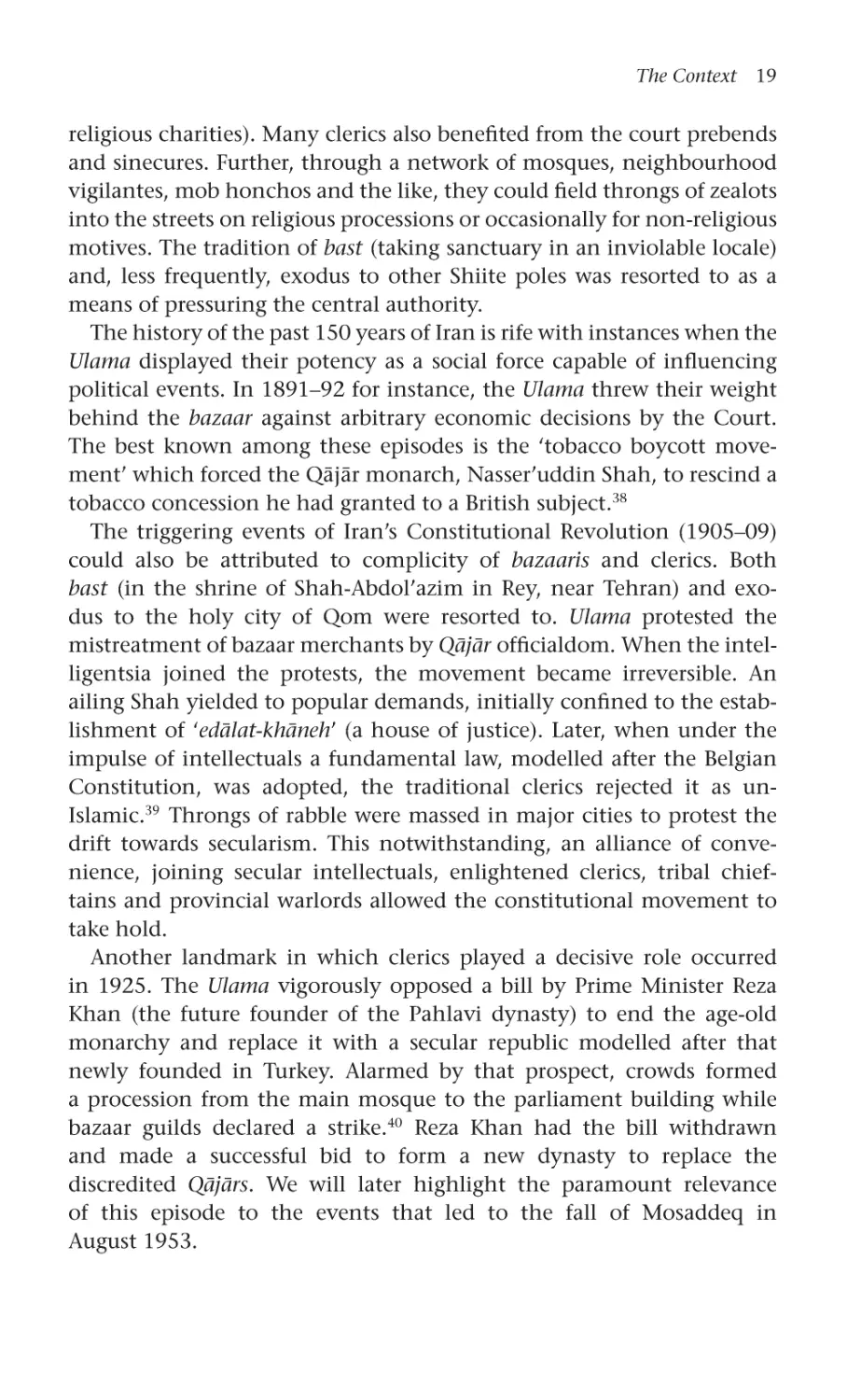
the armed forces. Mohammad-Reza’s debut
as the Shah was, as such, tottery and insecure (Figure 1). The Shah’s psyche was a
product of tumults that had placed him on
the throne in September 1941, at the age of
22. He knew that the British, who had engineered his father’s abdication, were tepid at
best towards him; they came close to disFigure 1 Mohammad-Reza
carding him as heir to the throne in view of
Pahlavi, Shah of Iran (1941–
c AP, 2007
79). Photo
his perceived pro-axis sympathies. A cable
from Eden to the British Minister in Tehran,
Sir Reader Bullard, dated 19 September 1941, reflects the British unwillingness to accept the ascension of Mohammad-Reza to the throne.31
This background nourished the Shah’s fears and suspicions of Britain.
Upon accession to the throne, Mohammad-Reza tried to assuage internal foes and appease the Allied powers which had occupied Iran.32
In the ensuing 12 years, he struggled to remain afloat, overcoming a
myriad of adversities. To avoid British shenanigans, the Shah was complaisant towards anglophile politicians, even known British agents.33
Yet he strived to keep the British influence at bay by discrete support
of personalities known for political integrity or loyalty to his person.
On at least two occasions during this period he offered Mosaddeq the
premiership.34 Yet his sense of insecurity made him chary when faced
with strong or popular prime ministers.
He favoured American entry into Iran’s political arena as a counterweight to both Britain and Russia. The Shah also had a deplorable, if
as yet suppressed, propensity to hold the reins of power in his hands.
The army and foreign affairs were the domains of his predilection.
During the earlier years of his reign when he had not yet cemented
his grip on power, he used cunning methods to collect information or
undercut his prime ministers. He sent private emissaries to British or
American Embassies to feel them out on crucial issues and was attentive
to their views, although not always acquiescent.35 He kept a network
of contacts with deputies, veteran politicians, and tribal chieftains as
well as traditional high clerics. Yet his manipulative moves during this
episode should not be overstated in either scope or effectiveness. He was
fiercely patriotic and capable of cold calculation in what he perceived

18

Iran and the CIA

as the high interests of the Crown and the nation, two notions which
he juxtaposed and frequently confounded. His political realism was
often misconstrued as indecision or timidity, qualities which he did not
nonetheless lack.
The Azerbaijan episode had boosted the Shah’s standing as well as
army morale. Another wave of sympathy came after a failed assassination attempt in February 1949. The Shah took advantage by having the
constitution amended to increase his prerogatives. He was henceforth
empowered to dissolve the parliament and fill half of the senate’s seats
by appointment. Perennial constitutional debates on the nature and
extent of the Crown’s powers did not, however, wane. The National
Front, led by Mosaddeq, in fact challenged the validity of the Constituent Assembly and its amendments. Once in power Mosaddeq
moved acidulously to curb the Shah’s authority. The tug of war between
the two became a factor in Mosaddeq’s fall and the Shah’s subsequent
autocratic rule.

The Ulama as a socio-political force
The rise of the Ulama, or Shiite clerics, as a major social force in
Iranian society can be traced to the declining phase of the Safavid
dynasty (1502–1736) when their influence in the Court reached its vertex. The Sunnite-Shiite rifts had been one among several factors that
led to Afghan revolt and subsequent downfall of the Safavid Empire.36
By the late eighteenth century the influence of the Ulama had decisively grown when, in the internecine Shiite theological clashes, the
Usoulı̄s gained ascendancy over the Akhbārı̄s. This latter school believed
that Shiite Moslems could rely on the Akhbār (reporting), namely the
accounts given of the discourse, the behaviour and the human qualities
of the Prophet and the 12 Imams, without needing the Ulama to act
as intermediaries or interpret the Islamic canon.37 Usoulı̄s, on the other
hand, believed in Ijtı̄had or religious edict by ranking clerics (mojtahı̄d or
ayatollah).
By the mid-nineteenth century a solid alliance between the traditional
urban middle class, mainly bazaar merchants, and the Ulama had been
forged. The bazaaris saw to the pecuniary needs of clerics through religious taxes (Khoms), while Ulama defended the interests of the bazaar
merchants and guilds against the arbitrariness of Qājār monarchs and
their henchmen. The Ulama also wielded economic power through
exploitation of the Vaqf (or property endowment by the pious rich to

The Context

19

religious charities). Many clerics also benefited from the court prebends
and sinecures. Further, through a network of mosques, neighbourhood
vigilantes, mob honchos and the like, they could field throngs of zealots
into the streets on religious processions or occasionally for non-religious
motives. The tradition of bast (taking sanctuary in an inviolable locale)
and, less frequently, exodus to other Shiite poles was resorted to as a
means of pressuring the central authority.
The history of the past 150 years of Iran is rife with instances when the
Ulama displayed their potency as a social force capable of influencing
political events. In 1891–92 for instance, the Ulama threw their weight
behind the bazaar against arbitrary economic decisions by the Court.
The best known among these episodes is the ‘tobacco boycott movement’ which forced the Qājār monarch, Nasser’uddin Shah, to rescind a
tobacco concession he had granted to a British subject.38
The triggering events of Iran’s Constitutional Revolution (1905–09)
could also be attributed to complicity of bazaaris and clerics. Both
bast (in the shrine of Shah-Abdol’azim in Rey, near Tehran) and exodus to the holy city of Qom were resorted to. Ulama protested the
mistreatment of bazaar merchants by Qājār officialdom. When the intelligentsia joined the protests, the movement became irreversible. An
ailing Shah yielded to popular demands, initially confined to the establishment of ‘edālat-khāneh’ (a house of justice). Later, when under the
impulse of intellectuals a fundamental law, modelled after the Belgian
Constitution, was adopted, the traditional clerics rejected it as unIslamic.39 Throngs of rabble were massed in major cities to protest the
drift towards secularism. This notwithstanding, an alliance of convenience, joining secular intellectuals, enlightened clerics, tribal chieftains and provincial warlords allowed the constitutional movement to
take hold.
Another landmark in which clerics played a decisive role occurred
in 1925. The Ulama vigorously opposed a bill by Prime Minister Reza
Khan (the future founder of the Pahlavi dynasty) to end the age-old
monarchy and replace it with a secular republic modelled after that
newly founded in Turkey. Alarmed by that prospect, crowds formed
a procession from the main mosque to the parliament building while
bazaar guilds declared a strike.40 Reza Khan had the bill withdrawn
and made a successful bid to form a new dynasty to replace the
discredited Qājārs. We will later highlight the paramount relevance
of this episode to the events that led to the fall of Mosaddeq in
August 1953.

20

Iran and the CIA

Ayatollah Seyyed Abol’qassem Kashani: the precursor
of clerical activism
The Constituent Assembly that had been called to formalize the formation of a new dynasty included a cleric who was to play a key
role in the oil nationalization movement a quarter of a century later.
He also became a main instrument of its undoing. His name was
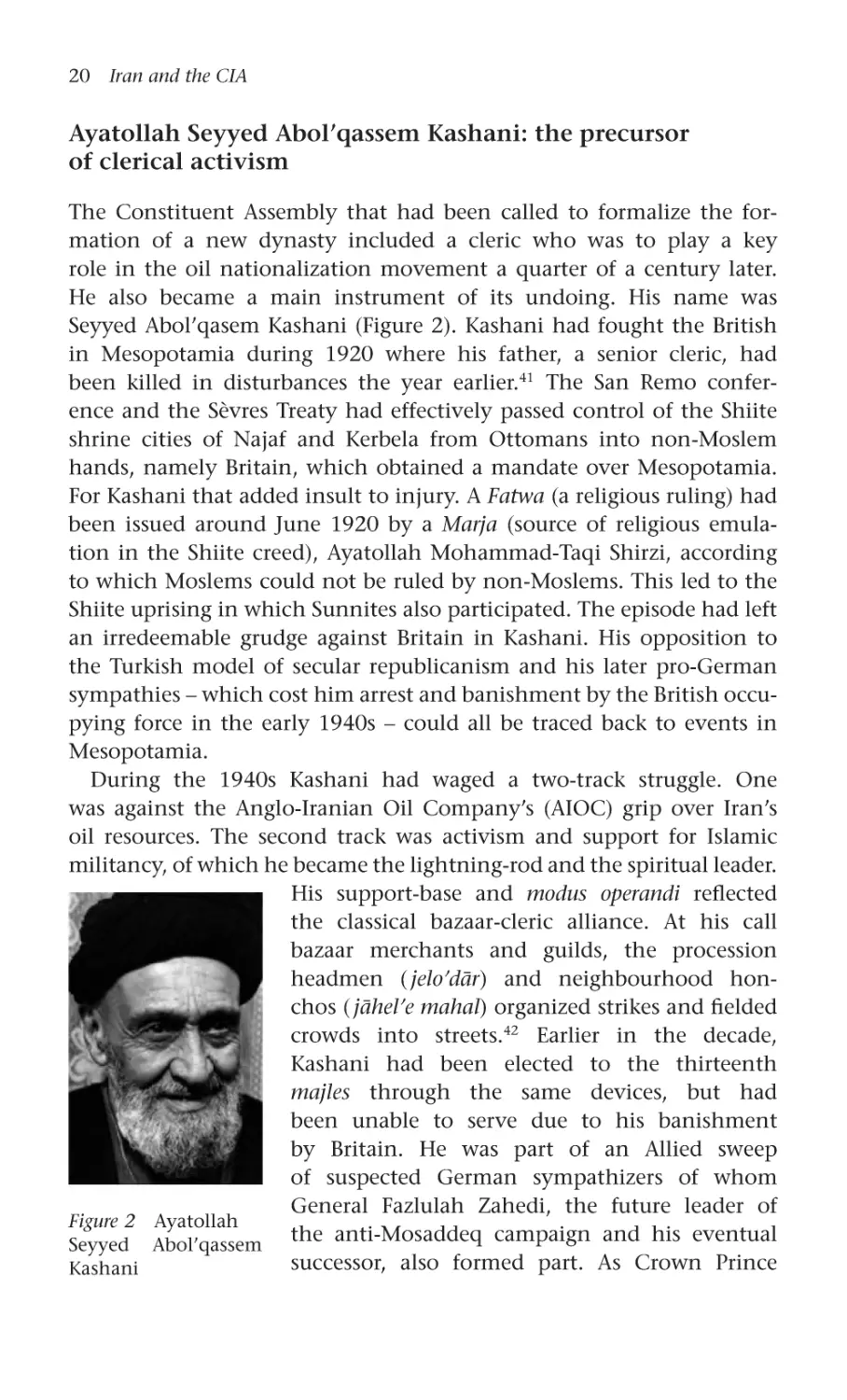
Seyyed Abol’qasem Kashani (Figure 2). Kashani had fought the British
in Mesopotamia during 1920 where his father, a senior cleric, had
been killed in disturbances the year earlier.41 The San Remo conference and the Sèvres Treaty had effectively passed control of the Shiite
shrine cities of Najaf and Kerbela from Ottomans into non-Moslem
hands, namely Britain, which obtained a mandate over Mesopotamia.
For Kashani that added insult to injury. A Fatwa (a religious ruling) had
been issued around June 1920 by a Marja (source of religious emulation in the Shiite creed), Ayatollah Mohammad-Taqi Shirzi, according
to which Moslems could not be ruled by non-Moslems. This led to the
Shiite uprising in which Sunnites also participated. The episode had left
an irredeemable grudge against Britain in Kashani. His opposition to
the Turkish model of secular republicanism and his later pro-German
sympathies – which cost him arrest and banishment by the British occupying force in the early 1940s – could all be traced back to events in
Mesopotamia.
During the 1940s Kashani had waged a two-track struggle. One
was against the Anglo-Iranian Oil Company’s (AIOC) grip over Iran’s
oil resources. The second track was activism and support for Islamic
militancy, of which he became the lightning-rod and the spiritual leader.
His support-base and modus operandi reflected
the classical bazaar-cleric alliance. At his call
bazaar merchants and guilds, the procession
headmen ( jelo’dār) and neighbourhood honchos ( jāhel’e mahal) organized strikes and fielded
crowds into streets.42 Earlier in the decade,
Kashani had been elected to the thirteenth
majles through the same devices, but had
been unable to serve due to his banishment
by Britain. He was part of an Allied sweep
of suspected German sympathizers of whom
General Fazlulah Zahedi, the future leader of
Figure 2 Ayatollah
the anti-Mosaddeq campaign and his eventual
Seyyed Abol’qassem
successor, also formed part. As Crown Prince
Kashani

The Context

21

in 1941, Mohammad-Reza himself had been counted among the
group, something that nearly cost him the throne, as we just
alluded to.
In 1946, Kashani was arrested and banished, this time by Prime
Minister Qavam, for fomenting religious unrest. The climate in
the country was jittery at the height of the Azerbaijan Crisis and
in the wake of the assassination of a secular intellectual, Ahmad
Kasravi, by the newly formed terrorist group Fadā’iān Islam. The latter was known to have links with Kashani and other radical clerics, including the then middle-ranking cleric, Rouhollah Khomeini.43
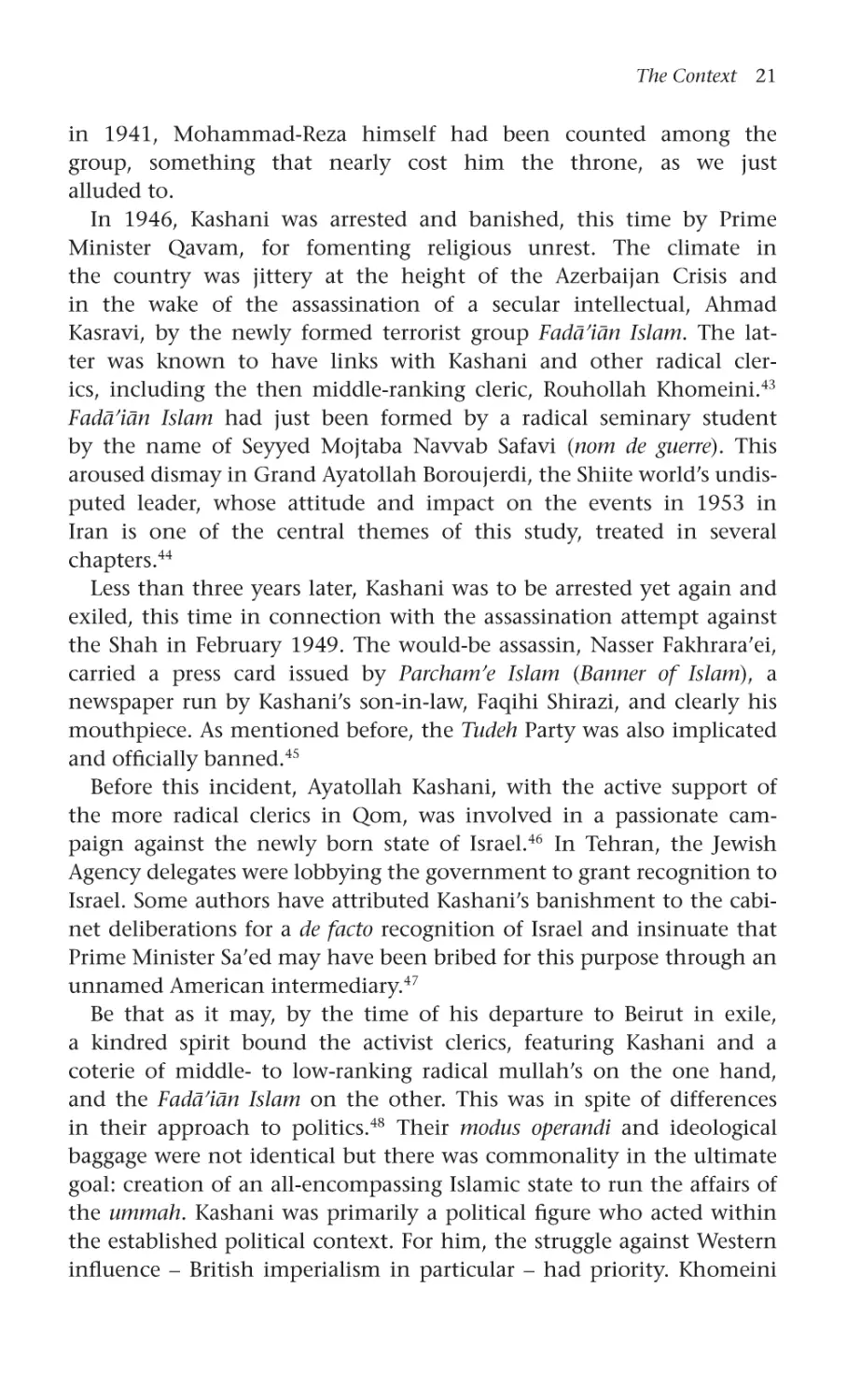
Fadā’iān Islam had just been formed by a radical seminary student
by the name of Seyyed Mojtaba Navvab Safavi (nom de guerre). This
aroused dismay in Grand Ayatollah Boroujerdi, the Shiite world’s undisputed leader, whose attitude and impact on the events in 1953 in
Iran is one of the central themes of this study, treated in several
chapters.44
Less than three years later, Kashani was to be arrested yet again and
exiled, this time in connection with the assassination attempt against
the Shah in February 1949. The would-be assassin, Nasser Fakhrara’ei,
carried a press card issued by Parcham’e Islam (Banner of Islam), a
newspaper run by Kashani’s son-in-law, Faqihi Shirazi, and clearly his
mouthpiece. As mentioned before, the Tudeh Party was also implicated
and officially banned.45
Before this incident, Ayatollah Kashani, with the active support of
the more radical clerics in Qom, was involved in a passionate campaign against the newly born state of Israel.46 In Tehran, the Jewish
Agency delegates were lobbying the government to grant recognition to
Israel. Some authors have attributed Kashani’s banishment to the cabinet deliberations for a de facto recognition of Israel and insinuate that
Prime Minister Sa’ed may have been bribed for this purpose through an
unnamed American intermediary.47
Be that as it may, by the time of his departure to Beirut in exile,
a kindred spirit bound the activist clerics, featuring Kashani and a
coterie of middle- to low-ranking radical mullah’s on the one hand,
and the Fadā’iān Islam on the other. This was in spite of differences
in their approach to politics.48 Their modus operandi and ideological
baggage were not identical but there was commonality in the ultimate
goal: creation of an all-encompassing Islamic state to run the affairs of
the ummah. Kashani was primarily a political figure who acted within
the established political context. For him, the struggle against Western
influence – British imperialism in particular – had priority. Khomeini

22

Iran and the CIA

and the Fadā’iān believed in the
ascendancy of religion and strongly
held that politics must be subordinated to Islamic rules. This led to
a temporary split in 1951–52 when
Khomeini criticized Kashani for
having accepted the Speakership of
the Majles and Fadā’iān threatened
to kill him.49 Kashani for his part
is reported to have said that ‘Agha
Rouholah’ (i.e., Khomeini) was not
50
Figure 3 Ayatollah Kashani flanked cut out to be in politics. Apart
from this year-long hiatus, an ideby Seyyed Navvab-Safavi, the leader
of Fadā’iān Islam terrorist group
ological lineage linked the postwar clerical militancy to the Islamic
Revolution (1978–79). After success of the Islamic Revolution in 1979,
the by-then-defunct Ayatollah Kashani became an iconic and venerated
figure among the revolutionaries. Some of his close associates and immediate family tried to cleanse his legacy – forging letters in the process –
that would distance Kashani from the anti-Mosaddeq cabal in 1953 and
his direct involvement in the latter’s downfall.51 Cleansing efforts, however, were not pursued when it became clear that Ayatollah Khomeini
himself made no bones about his anti-Mosaddeq sentiments.
But back in the late-1940s Islamic radicalism was still a fringe movement and Kashani was revered as a spiritual force buttressing an essentially nationalistic and anti-colonial drive. When he was allowed to
return in June 1950, he was met by delirious welcoming throngs of
supporters.52 Mosaddeq in person was at the airport to welcome him.
In the feverish political climate of the time, marked by popular opposition to the ‘Supplemental Oil Agreement’, the hour of the charismatic
Ayatollah had ineluctably arrived. He immediately sided with Mosaddeq
who, together with his National Front associates, had made a triumphal
return to the Majles a few months earlier.53

Razmara: prelude to the oil nationalization crisis
The return of Kashani to Tehran had coincided with the premiership
of General Ali Razmara. A Saint-Cyrien, erudite former chief of the
army general staff, Razmara had a reputation for hard work and probity. Mosaddeq and his associates, notably Kashani, viewed him as
subservient to Britain and believed his appointment had been imposed

The Context

23

on the Shah in order to obtain the ratification of the unpopular
Supplemental Oil Agreement (SOA) in the Majles. The previous legislative session of the Majles had indeed mandated the government to
obtain from Britain equitable revenue-sharing terms for Iran but the
resulting ‘Supplemental Oil Agreement’, negotiated by the Sa’ed government with the Anglo-Iranian Oil Company (AIOC), fell far short of
public expectations.54
Against the backdrop of drought and severe economic recession Iran
badly needed an immediate infusion of funds, for which the Truman
administration was considering some tentative and patently insufficient
remedies.55 Britain had proposed a series of reforms to the Shah, including redistribution of Crown lands among the peasants but her recipe
for Iran’s short-term ills was the ratification of the Supplemental Oil
Agreement (SOA).56 To be sure, the SOA increased Iran’s oil receipts but
did not address some simple and perfectly legitimate demands by Iran,
such as the right of Iran to look into AIOC accounts, greater Iranian
participation in the management, broader Iranization of the workforce
etc. Many in the Majles expected a fifty-fifty revenue-sharing scheme in
line with the Standard Oil of New Jersey/Creole contract in Venezuela.
The Shah was anxious to get funding for the seven-year development
programme and was pressing the United States to increase its military aid to Iran as the oil revenues en block were earmarked for the
seven-year programme. Both top economists in Iran and US officials in
Washington had urged the Shah to reach an oil settlement with Britain
to ensure the flow of the badly needed funds.57 The Nationalist deputies
in the Majles were not of the same mind. Some of these deputies had
staged a filibuster to block the SOA ratification during the waning days
of the previous legislative term when the bill might have obtained a
majority.
By the end of 1949, British officials at the working level were ready
to bend to a non-interventionist injunction by foreign secretary Bevin
and pressure the Shah to name a ‘strong’ personality as prime minister
to force the hand of the recalcitrant Majles and obtain the ratification
of the SOA.58 The American Embassy in Tehran had a similar analysis of the socio-economic ills that beset the country and the need for
a strong personality to deal with them. Bevin and Acheson discussed
Iran’s urgent needs during the London ministerial meeting in May 1950
where, among other things, the need for early ratification of the SOA
was stressed, in spite of reservations that some in the US administration held about its revenue sharing equity.59 While both powers stressed
the need for strong leadership, neither appears to have gone as far as

24

Iran and the CIA

recommending General Razmara. On the contrary the State Department specifically instructed the embassy in Tehran not to be pinned
down to a given candidate in order to maintain its freedom.60 General
Razmara, however, was perceived by most observers as the personality
with the requisite profile, an impression that may have been reinforced
by individuals on the US embassy staff in Tehran. On his own initiative, the Deputy Chief of Mission, Gerald Dooher, lobbied for General
Razmara. By late May the Shah had decided to name him prime minister although, paradoxically, he was unsure of British support.61 Over the
years the British Embassy had projected a negative image of Razmara,
no doubt preferring his anglophile military rival General Hassan Arfa’,
just as their candidate for the post of prime minister was the veteran
anglophile politician Seyyed Zia Tabataba’ei. To ease British misgivings, Razmara had lobbied the embassy while the Shah assured them
that once appointed prime minister, Razmara would have no say in
military affairs.62 By early June the British Embassy was ready to endorse
Razmara’s nomination.
The nationalist opposition’s assessment about the rise of Razmara to
the premiership, to which we alluded earlier, and assertions made in
published literature about Anglo-American pressures on the Shah to
name Razmara in June 1950 should thus be nuanced in the light of
the above clarifications. While the involvement of the two powers was
partly true, the depiction of Razmara by his Majles foes as ‘subservient’
to foreign interests was unjustified and politically motivated.
When the new prime minister requested the Majles to approve or
reject the Supplemental Oil Agreement, he was upbraided by opposition
deputies and billed a traitor. By year-end the
image of Razmara as the strong prime minister
had faded and the US Embassy had mixed feelings
about his durability. Both the Shah and Razmara,
and indeed ambassador Grady, were disappointed
with the level of US aid to Iran. At one point in
November 1950, US policies in Iran earned the
Shah’s harsh and uncharacteristically public criticism, which angered Washington.63 The volume
of US aid, including the proposed $25 million
loan by EXIMBANK, was manifestly disproportionate to Iran’s dire needs. This further alienated
Figure 4 Prime Minthe Majles and prompted Razmara to adopt a more
ister Razmara, shortly
neutral stance in the raging Cold War by improvbefore his assassinaing ties with the Soviet Union. In November, Iran
tion in March 1951

The Context

25

signed a trade agreement with the Soviet Union. More significantly, in
a gesture to the USSR, Razmara cancelled both the BBC and VOA relay
stations.64
Washington was concerned about the deterioration of its position in
Iran and suspected that Tehran’s flirtations with the USSR were calculated to play one major power against the other to gain concessions.65
This did not prevent the administration from increasing pressure on
Britain to become more forthcoming on the oil negotiations that
Razmara was discreetly conducting with the AIOC representative in
Tehran. Under-Secretary McGhee, whom we will meet in the next chapter, warned Britain of the upcoming ARAMCO concession with the Saudi
government which was also based on equal profit sharing.66 American
pressure may have been one of the two main factors that in February
1951 induced the AIOC to quietly agree to a fifty-fifty deal with Iran (for
more details on this topic see the first section in Chapter 2).
In December, the Tudeh staged a spectacular jailbreak allowing the
party leaders implicated in the assassination attempt against the Shah
to escape. Coming as it did on the heels of improved ties with the USSR,
the jailbreak fed rumour-mongering in Tehran’s political circles. To this
day some older Iranians are convinced that Razmara had a hand in the
jailbreak and may have been somehow involved in the assassination
attempt against the Shah.67
On 7 March 1951, Razmara was assassinated by a Fadā’iān Islam zealot.
Kashani and a few other opposition deputies and politicians openly
defended the crime and lauded the assassin as a hero and patriot.68
A year into Mosaddeq’s tenure as prime minister, the Majles approved
a bill to exculpate Razmara’s killer, just as in 1946 the assassin of
Ahmad Kasravi had been allowed to walk free only to recidivate three
years later, killing the Court Minister Abol’hossein Hazhir. Later, when
Mosaddeq became prime minister, he was given notice by Fadā’iān to
introduce shari’a or face the consequences. Mosaddeq paid no heed,
but had to take extra precautions to avoid assassination. His closest
associate and foreign minister, Dr Hossein Fatemi, was later the target of an assassination attempt from which he escaped with serious
wounds.
The assassination of Razmara caused some trepidation in London and
Washington. Only a few months earlier they had urged the Shah to
select a strong personality for the post of prime minister and had chided
his preference for insipid old-guard politicians. Now, in March 1951, the
two powers categorically advised the Shah to opt for someone whom he
could fully trust and work with. The choice of Hossein Ala to replace

26

Iran and the CIA

Razmara is likely to have been the result of this démarche.69 The fiftyfifty revenue sharing offer by the AIOC was repeated to Ala, but by then
the tidal wave of nationalist fervour had swept the country, as will be
seen in the next chapter. The offer was by then too little too late. This in
essence was what Ala told both Sir Francis Shepherd and Henry Grady.

2
The Advent of Mosaddeq
and the Oil Crisis

This chapter will follow the rise of Mosaddeq to power in late April
1951 and his handling of the crisis during the first nine months of
his premiership. Early British reaction to oil nationalization as well as
the initial American attitude towards Iran and its nationalist movement
will be followed by a brief description of the political climate and the
early signs of vulnerability forecasting the events of August 1953. Special
attention will be given to different phases of the oil negotiations, first in
Tehran, brokered by Averell Harriman, and later in Washington where
Mosaddeq resided for almost a month and met top American leaders.
The chapter also covers the British referral of the oil dispute to the UN
Security Council where the aged and ailing prime minister defended
Iran’s case.

The rise of the National Front
The National Front was officially formed in November 1949, composed
of Mosaddeq and 19 other personalities who had staged a sit-in at
the Shah’s palace in mid-October. The protest was to draw attention
to election irregularities by the government. Contrary to affirmations
made by some US scholars, the protest was not directed against the
Shah, not at least in appearance.1 Hazhir, the Court Minister received
the group with courtesy but the démarche remained inconclusive. The
Constituent Assembly had just granted the Shah the prerogative to
dissolve the parliament, but he chose not to do so on the grounds
that the full composition of the Majles was not yet known. Hazhir
himself was assassinated shortly thereafter by a Fadā’iān zealot as we
just alluded to. The conjunction of events made some of the sit-in
participants potential suspects. In the ensuing witch-hunt some were
27

28

Iran and the CIA

briefly detained. Figuring among detainees was Hossein Makki, who
later played a pivotal role in the oil nationalization campaign and
became one of the historical figures of the National Front. Upon their
release from detention, a Charter for the movement was drawn up and
approved by the group of 20, who thus became the founders of the
National Front. Reforms in electoral law, press law and regulation of
martial law were the three objectives incorporated in the Charter. Paradoxically, the nationalization of oil industries was not mentioned in the
original Charter.
The assassination of Hazhir prompted prime minister Sa’ed to annul
the polling results in the Tehran electoral district thus ceding to the
earlier demand by Mosaddeq and his comrades.2 Helped by the newly
appointed chief of police, General Fazlullah Zahedi, free elections could
then be held in which Mosaddeq received the highest number of votes
cast. Seven other National Front members, including Ayatollah Kashani
who was still in exile in Lebanon, were also elected from Tehran and the
provinces.
While the oil issue had not been included in the National Front
Charter, it became the Front’s rallying cry soon after the sixteenth
legislative session commenced its work in February 1950. Mosaddeq
and his associates vehemently criticized a Supplemental Oil Agreement
(SOA) as it will be recalled from the previous chapter. Mosaddeq now
chaired a Majles Sub-Committee on Oil and managed to block its ratification. A first attempt in late November 1950 by Mosaddeq and his
supporters to present a bill for the nationalization of oil industries failed
to rally enough support in the Majles. However, the idea was gaining
currency among the public and in some political circles, something
that strengthen the hands of Prime Minister Razmara in his discreet
talks with George Northcroft, the AIOC representative in Tehran. In
December Razmara withdrew the SOA from consideration by the Majles;
he had already served notice to Northcroft that the new oil contract
should be aligned with the ARAMCO deal in Saudi Arabia, which was
then in the final phases of conclusion.
It did not take the AIOC and Britain long to realize that their intransigence only fuelled nationalistic sentiments to their detriment. On
10 February 1951, they agreed to Razmara’s proposal for a fifty-fifty
split, with a caveat, however, that the Iranian part of the AIOC operations would thenceforth be detached from the rest of the company
operations.3 This in essence meant that Iran could no longer benefit from the company’s profits in other Middle-Eastern operations. For
reasons that remain obscure, Razmara did not get around to publicly

The Advent of Mosaddeq and the Oil Crisis

29

announcing the breakthrough. It is not clear who in his immediate
entourage was aware of the offer or whether the delay was in any
way related to a more in-depth consideration of the offer. Different
explanations provided subsequently about Razmara’s reticence are all
speculative. Before putting his hand into the fire in the Majles, some
argued, Razmara would have wanted to ensure that the wily old lion,
namely Britain, had not lured him into a scheme no better than the
despised SOA. Others have suggested that he might have been preparing the ground to receive a new mandate from the parliament to renew
negotiations with the AIOC, following which he could announce the
break-through as a personal triumph.4 Be that as it may, his assassination
on 7 March 1951 triggered off an irreversible process which rendered the
British concession stillborn. By then the national fervour for restoration
of Iran’s full control over the oil industry had reached boiling point.
On 15 March, a week after Razmara’s assassination, the Majles overwhelmingly approved the Nationalization Act. The same bill had not
found enough sponsors in the previous November to be placed on the
Majles agenda for consideration, let alone approval.5 Razmara’s killing
became a deciding event in Iran’s march forward. Ayatollah Kashani
and a few cantankerous deputies openly hailed the act and billed the
perpetrator a national hero as we have noted; this fanned the climate of
intimidation and cowed the reluctant deputies. But the passage of the
Nationalization Act above all inspired genuine pride. The nation was in
effervescent mood as jubilant crowds roamed the streets of Tehran and
the provinces in a seething climate of national exaltation. Mosaddeq’s
day had finally arrived. As mentioned in an earlier passage, the successor to Razmara, Hossein Ala, was caught up in the whirlwind and had
to bow out. The immediate reason brought up for his resignation was
a new bill which Mosaddeq proposed on 26 April for the implementation of the Nationalization Act. Ala protested that he had had not been
consulted.

The nomination of Mosaddeq
Events that led to Mosaddeq’s assumption of power in late April 1951 are
chronicled in numerous books and articles in several languages. They
are not the focus of this study. Suffice it to say that provoked by Jamal
Emami, a Majles deputy close to the Shah, Mosaddeq accepted the nomination with the proviso that the parliament ratified beforehand a bill
for the implementation of the Nationalization Act. The bill called for
the expropriation of the AIOC installations and assets.

30

Iran and the CIA

Some Iranian chroniclers have postulated that the Shah played a
subtle role in propelling Mosaddeq to premiership, while thwarting
British pressures to name the anglophile veteran politician Seyyed Zia
Tabataba’ei by the same stroke. This assumption is deduced from an earlier offer made by the Shah to Mosaddeq to become prime minister a
few days before the assassination of General Razmara. The intermediary
who had conveyed that offer was none other than Jamal Emami, the
same deputy who provoked Mosaddeq into accepting the nomination
for premiership in the 26 April session of the Majles. Both Mosaddeq and
his son Dr Qolam-Hossein Mosaddeq have confirmed the Shah’s offer as
well as the identity of the intermediary in their respective memoirs.6
Yet stretching this to suggest that the Shah outplayed Britain by willingly pushing Mosaddeq to the centre stage is somewhat farfetched. The
Shah’s motive in offering the premiership to Mosaddeq while Razmara
was still in office is hard to fathom and any explanation would be speculative. The Shah was averse to strong personalities if he could avoid
them. He did not hesitate to play off politicians one against the other,
but the temperamentally insecure Shah preferred more malleable personalities as prime minister. More to the point, the Shah appears to have
had misgivings about oil nationalization and its security implications,
something that he shared with Ambassador Grady barely a week after
Mosaddeq’s appointment.7 He was anxious to see the quick infusion of
funds into the government coffers that only an agreement with AIOC
could generate; this desire must have been whetted after Britain repeated
the fifty-fifty offer to the government of Ala.
The nationalization, on the other hand, entailed a long drawn out
struggle, with the potential risk of military conflict with Britain, then
still a superpower. Even before the accession of Mosaddeq to power,
Britain had made it a point to show off its naval prowess in the waters
of the Persian Gulf, something that raised concerns in Washington.8
In other words, while the Shah had seemingly attempted some two
months earlier to replace Razmara with Mosaddeq, now in late April
he had misgivings about a heavyweight prime minister who championed the perilous course of oil nationalization. As will be seen in coming
pages, the Shah’s concerns over the security implications of the Nationalization Act were not unfounded. Yet it is also fair to observe that in
spite of those reservations, the Shah preferred Mosaddeq to the British
candidate Seyyed Zia, another heavyweight who, other than having the
backing of Britain, had an axe to grind against the Pahlavis.9 Added to
the Shah’s innate mistrust of Britain it is therefore plausible that he may
have stalled Zia’s nomination till the Majles turned to Mosaddeq.

The Advent of Mosaddeq and the Oil Crisis

31

Figure 5 Doctor Mosaddeq’s first Cabinet. General Fazlollah Zahedi as Minister
of the Interior is second from the left. Courtesy of IBEX publishers, c IBEX

Doctor Mohammad Mosaddeq: a sketch
Mosaddeq was born to Qājār landed gentry in 1882. He had served as
provincial governor in Fars and Azerbaijan, and had held the finance
and foreign affairs portfolios in different governments under the Qājār
dynasty in the early 1920s. It was as a parliamentarian, however, that
Mosaddeq was in his element. He had been elected to two successive
legislative sessions in the 1920s (the fifth and the sixth Majles) and
was elected deputy in the fourteenth and sixteenth legislative sessions
during the reign of Mohammad-Reza Shah in the 1940s.
Throughout his political career, which spanned half a century,
Mosaddeq had defended constitutionality as the quintessential quality
of governance. For him, the Majles incarnated the will of the nation,
which should run supreme. The power went with accountability and
as the monarch was held by the Constitution to be ‘not accountable’, it
followed that powers bestowed on him in the constitution were nominal. Mosaddeq had opposed Reza Khan’s accession to the throne on that
same ostensible ground, arguing that his leadership talents would go to
waste were he to be named king.
Mosaddeq (Figure 6) was incorruptible and fiercely nationalistic. He
advocated a policy described as ‘negative balance’ towards the great

32

Iran and the CIA

Figure 6 Mosaddeq’s likeness on the cover of TIME Magazine, 4 June 1951.
Portrait by Ernest T. Baker, reproduced by permission of TIME Magazine. c Time
Magazine, 2008

powers, meaning in effect that none should be privileged. Contrary to
a widely held view at the time in the West, he was neither xenophobic
nor harboured a hatred for Britain, still less for its citizenry.10
He had opposed their overarching influence and strongly resented the
exploitation of Iran’s natural resources. He openly criticized Britain for
what he saw as the underhanded and contemptuous methods used to
influence the course of events in Iran. This was at odds with Britain’s
self-image as a benevolent power bent on uplifting Iran despite itself.
British diplomats in Tehran and his other detractors stigmatized Mosaddeq. They depicted him as a demagogue, even a lunatic given to
‘prolixity’ and ‘impervious to argument’.11 These hypes were unhelpful
at best as the crisis deepened.
Yet Mosaddeq was also a product of an archaic political and managerial culture. His years of schooling in France and Switzerland had
not fully eradicated certain traits common in Qājār officialdom. In oil

The Advent of Mosaddeq and the Oil Crisis

33

negotiations he received foreign interlocutors alone and often reacted
instantly to long and meticulously prepared proposals without benefit
of expert advice. He was authoritative, distrustful, inflexible and secretive, qualities that had not escaped his foreign interlocutors.12 He was
emotional and, while profusely courteous, was capable of abusive language which he could heap on allies and adversaries alike.13 Mosaddeq’s
poor health no doubt compounded these foibles.14

The initial British reaction to oil nationalization
The news of Mosaddeq’s appointment in late April, coming back-to-back
with the adoption by the Majles of the ordinance for implementation
of the Nationalization Act, confronted the British cabinet with stark
choices. It will be recalled that the Nationalization Act per se had already
been approved by the Majles on 20 March. In between, Sir Francis Shepherd had done his level best to have the Shah appoint the Anglophile
veteran politician Seyyed Zia, but was circumvented in circumstances
that we tried earlier to unravel. Negotiation with Mosaddeq was the logical course of action, but the reporting and analyses from the British
Embassy in Tehran cast doubt over Mosaddeq’s willingness, even ability
to engage in a serious dialogue.15 Both Mosaddeq’s temperament and
the emotional climate that reigned in Iran were seen as impediments to
a successful outcome.
The cabinet was also divided over the issue of ‘intervention’, the
nature and scope of which had yet to be defined. A move contemplating
the seizure of the southern oil fields posed nearly insurmountable logistical challenges. An invasion, moreover, could trigger a Soviet military
reaction in line with the 1921 treaty of friendship between the USSR and
Iran which was explained earlier. The United States was, in particular,
concerned that a British military move could set off a chain of events
leading to an overall war at a time when the Truman administration
weighed its options against a Red China in the Korean theatre.16
However, once the immediate shockwaves were absorbed, Britain petitioned the International Court of Justice (ICJ) and proposed arbitration.
This measure did not foreclose other options. Iran, on the other hand,
argued that the Anglo-Iranian Oil Company (AIOC) and not Britain was
the party to the dispute and hence the ICJ, created by UN Charter to
deal with inter-state disputes, was not competent to adjudicate. The
Nationalization Act required the government to seize the assets of an
oil company, not of a state; and the fact that Britain was the majority

34

Iran and the CIA

share-holder in AIOC could not, in Iran’s view, alter the company’s
non-state character.
When Mosaddeq rejected the ICJ arbitration on these grounds, Britain
began to raise her tone. In an aide-mémoire dated 19 May, Britain threatened that failure to negotiate or any unilateral act will entail ‘most serious consequences’.17 This threat accompanied military gestures. Britain
deployed three brigades of airborne troops to Shaiba base in Iraq, paratrooper were on standby in Cyprus, and naval vessels were dispatched
to adjacent waters off Abadan in the Persian Gulf. To avert logistical
problems inherent in a wider military move, the scope of a possible
‘intervention’ was narrowed. The operation, code-named Buccaneer, was
now aimed at occupying Abadan, the main operation centre of the AIOC
and location of the world’s largest refinery.18 This, the British officials
argued, drastically reduced the chances of a major Soviet offensive in
the north. The Russians would at worse occupy some northern provinces
in a pattern resembling the sinister arrangements foreseen in the 1907
Anglo-Russian treaty. Clearly, resort to brute force was now the preferred
recipe for the British Foreign Secretary Herbert Morrison, his defence
colleague Emanuel (Manny) Shinwell, and a few others in the Labour
cabinet who managed to bring a reluctant Atlee and other ministers
in line. In a June cabinet decision ‘the use of force’ was authorized ‘if
necessary’.19 They both argued that over and above economic losses, a
diplomatic defeat in the face-off with Mosaddeq would deal an insufferable blow to British prestige and its position in the Middle East as
a whole.
The Truman administration was not of the same mind. The Department of State took a serious view of British military deployments. On
16 May, Assistant-Secretary of State McGhee repeated to the British
Embassy in Washington that the United States saw grave dangers in,
and could not contemplate support for, any military action by Britain.20
Acheson, for his part, told Ambassador Sir Olivier Franks that ‘a substantial difference [was] developing between our views on the permissible
use of force in Iran’.21 Truman followed up with a letter to Attlee
on 31 May calling for restraint. The possibility of military intervention was serious enough for Acheson to ask Averell Harriman to invite
Ambassador Frank to his home on 4 July 1951 so that Acheson could
warn him against a military intervention in Iran.22 Under sustained
American pressure, the Atlee government reluctantly desisted in late
July, although the military option was not taken off the table. Attlee personally vetoed the plan on realpolitik grounds, knowing Britain would
not be supported by Washington and that military action would not

The Advent of Mosaddeq and the Oil Crisis

35

end the oil crisis.23 This was in line with and comforted Atlee’s own
non-interventionist leaning but it is reasonable to assume that had it not
been for the American opposition, Britain might have resorted to force,
with unfathomable consequences which may well have included a premature and humiliating end to the oil nationalization movement. The
Anglo-French Operation Musketeer in the Suez Canal in October 1956,
though a Tory venture, is a parallel which attests to this British impulse
during those declining years of the empire.
In the event, short of a military solution, a sequence of direct or USmediated talks failed to produce results. A debate at the UN Security
Council and litigation by the International Court of Justice followed.
These events will be covered briefly in as much as they left an imprint
on policies and perceptions both within and outside Iran. What needs
to be highlighted here is a parallel measure which Britain took to thwart
Mosaddeq’s attempt to sell Iranian oil on the international market.
By summer 1951, a boycott of Iranian oil sales had been decreed and
was being enforced by the British Admiralty. The AIOC officially served
notice in September that any transaction in Iran’s oil products by oil
companies was deemed unlawful and liable to judiciary pursuit by the
AIOC.24 The major oil companies soon joined the boycott, which was
being observed at three levels: oil sales, tanker transport and hiring of
technical personnel needed by Iran to replace the AIOC British technicians. Complicity among the oil companies also resulted in a decision to
ratchet up production in other Middle-Eastern oil fields which, coupled
with an already existing oil glut, rendered the Iranian oil all but unmarketable. This factor by itself was sufficient to make the boycott work, in
spite of occasional escapades by lesser oil company tankers. Finally, to
close the circle, Britain also began plotting covert action to subvert the
Mosaddeq government, a policy that was pursued by Tories when they
came to power in October of the same year and came to be known as
Operation Boot. We will explore this topic in the forthcoming chapters.

The early American attitude to the oil dispute
If Americans were instrumental in fending off British military designs,
their attitude towards Iran and the oil dispute was otherwise shaped by
complex and contrasting tendencies. Foremost was anxiety about Iran
being drawn into the communist fold. Policy documents approved by
President Truman in this period highlight this fear. Because of its key
strategic position, its petroleum resources and different vulnerabilities,
‘Iran must be regarded as a continuing objective of Soviet expansion’,

36

Iran and the CIA

one such document read.25 Opposition to British interventionism was
in part predicated on this concern. Acheson, in particular, viewed a
British military intervention as a licence for the Soviet Union to re-enter
the north of Iran and reclaim the oil concession it had obtained in
1946 from Qavam, then lost in the ensuing political peripety, (see
‘Azerbaijan Crisis’ in Chapter 1). Acheson did not exclude an invitation by Mosaddeq to the USSR to intervene in order to force Britain to
withdraw.26
Equally central to American thinking was the imperative of maintaining strong ties with Britain, America’s staunchest ally as well as the
country that had the highest number of troops in the Korean theatre
next only to the United States and South Korea. The State Department, on the other hand, was aware that a lopsided policy in favour
of Britain could alienate Iran to the possible advantage of the USSR. The
communist scare drove top American diplomats to pressure Britain for
concessions to Iran’s nationalistic aspirations. The Foreign Office under
Morrison viewed American démarches with a galling sense of betrayal, a
sentiment no doubt mirrored by the United Kingdom’s astute ambassador, Sir Olivier Franks. For Washington, the balancing act was not
always easy. In a subtle rebuff to Acheson and McGhee, the National
Security Council moved to balance what must have appeared to some
in the administration as a skewed pro-Iranian view by the State Department. In its 16 May meeting, chaired by Truman, the NSC ruled that:
‘The United States should indeed give vigorous support to the British in
reaching an equitable settlement [with Iran].’ A synthesis emerged in a
public statement in May 1951 by the State Department proclaiming that
the United States was friends with both parties; it had expressed to the
British ‘the need for greater Iranian control over its petroleum resources’
while pointing out to Iran ‘the serious effects of unilateral cancellation of a contract’. The statement ended by expressing the hope that,
through negotiations, the interests of both parties could be realized.27
By early July, the United States was considering a mediation role; this
led to Averell Harriman’s mission to Tehran, discussed in subsequent
chapters.
In its approach to the oil dispute, the US government had to also factor in the economic interests of American oil firms, both as rivals of
the AIOC but also as its accomplices. This was yet another element that
influenced the American attitude in the oil dispute. Both in Venezuela
and Saudi Arabia, American oil conglomerates were operating on a fiftyfifty profit-sharing arrangement; exceeding this threshold was deemed
to be detrimental to American oil concerns. Here was a ‘red line’ that

The Advent of Mosaddeq and the Oil Crisis

37

the American officialdom could not ignore.28 Mosaddeq was aware of
this constraint yet remained adamant in refusing any fifty-fifty profitsharing arrangement.29 As referred to earlier, the US oil conglomerates
soon acted to ramp up the oil output to offset the halt in Iran’s production. To facilitate their task, the Truman administration went out
of its way to grant immunity from prosecution under the anti-trust
law to American oil companies.30 Furthermore the United States had
attempted, by its own admission, to dissuade American oil companies from business discussions with Iran while efforts to bring about a
UK-Iran settlement continued.31 The American oil companies rallied to
the British embargo fearing a similar fate if they shirked solidarity with
the AIOC.
To complicate the picture further, traces of American aversion to colonialism occasionally crept up in the behaviour of the lower echelon
American officials, distorting the real policy thinking in Washington.
The impression had been formed by some sympathetic American diplomats in Tehran such as the fiercely anti-British Gerald Dooher, who as
will be recalled from the previous chapter lobbied for Razmara’s premiership while ensuring that the embassy staff remained in contact
with nationalist leaders.32 The image of benevolent Uncle Sam was
particularly reinforced by Henry Grady (Figure 7), who was appointed
ambassador in Tehran in June 1950 from his post in Athens, coinciding with the appointment of Razmara as prime minister. Henry Grady
had the distinction of having been the first American ambassador to
India; he reputedly fell out with the Department which he regarded as
biased towards Britain.33 Another sympathetic voice was the AssistantSecretary of State for South Asia, Near-East and North Africa, George
McGhee, who had played a key role in warding off British military intervention in May. A scion of the Texas oil industries34 and himself an
Anglophile, McGhee was paradoxically a vocal advocate of fair play in
resolving the oil dispute with Iran. In his talks with British officials in
London and with the UK ambassador in Washington, McGhee invariably pressed his interlocutors to be more forthcoming towards Iran even
if the latter’s demands followed an upward curve. In September 1950,
well before Mosaddeq became prime minister, McGhee had pressed the
Foreign Office to match the ARAMCO fifty-fifty model with Iran, something that might have influenced the British offer to Razmara as we saw
earlier. When in March 1951 the Majles adopted the Nationalization Act
with a crushing majority, McGhee was relentless in urging his British
interlocutors to acquiescence, in some form or another, to the principle
of nationalization, while maintaining the fifty-fifty profit-sharing cap.35

38

Iran and the CIA

Figure 7 Mosaddeq being greeted by the former US Ambassador to Tehran,
Henry Grady (left), on his arrival in the United States, October 1951. Mosaddeq’s
son and personal physician Dr Qolam-Hossein Mosaddeq is looking on. Photo,
the US Department of State, courtesy of the Harry S. Truman Library

British officials appear to have understood him as saying that Britain
should accept nationalization ‘without compensation’.36 All this did not
endear McGhee, or for that matter Henry Grady, to London. Their sympathies for Iran’s national aspirations led to British gripes which were
communicated to Washington later during the year.37
The nationalist leaders in Tehran were vaguely aware of these tendencies, presumably through US diplomats in Tehran.38 Later in October
1951, McGhee held marathon talks with Mosaddeq in Washington
which, although inconclusive, earned him profuse praise from the
Iranian prime minister.
The above complex policy texture with its contrasts and ambiguities was the root of some misunderstandings and missteps on the part
of Mosaddeq. To ensure continued American sympathy and support,
Mosaddeq tended to overplay the Tudeh card as scarecrow. The latitude he accorded to the banned Tudeh party to reorganize itself and

The Advent of Mosaddeq and the Oil Crisis

39

display its political muscles in street rallies was only in part driven by
his bent for democratic values; it equally stemmed from a desire to lead
Americans to believe that he was the bulwark, indeed the only alternative to communism in Iran.39 This double-edged sword worked for a
time, but ultimately turned against him. Furthermore, Mosaddeq supporters and the nationalist press tended to overrate – at least in earlier
days – the perceived anti-colonial strains in the American attitude at the
expense of more earthly factors.40
During his trip to Washington, however, Mosaddeq appears to have
been disillusioned, especially with the attitude of the State Department
which he thought tilted towards Britain. By then the bilateral and
the US-mediated oil talks in Tehran had been tried and failed. On his
return from Washington in November, Mosaddeq publicly attributed
the departure of Henry Grady, as well as the reassignment of McGhee
as ambassador to Turkey, to malice against Iran, which he thought
prevailed in the State Department (see ‘The Washington Oil Talks’
below).41

Political line-ups in Tehran
Back in Iran, the Tudeh Party was denouncing Mosaddeq as an American
lackey and lambasted his oil nationalization as a ploy that allowed the
American oil companies to participate in plundering Iran’s riches.42 At
the opposite end of the spectrum, the Fa’dāiān Islam – defying Kashani –
enjoined Mosaddeq to meticulously follow the shari’a or face their
curse.43 This was not a hollow threat: Mosaddeq had to take extra precautions, including working from his relatively modest house to avoid
exposure. Less than a year later, Mosaddeq’s close associate and firebrand
Foreign-Minister Hossein Fatemi was victim of an assassination attempt
by a Fa’dāiān zealot. Fatemi survived this attack; most Fa’dāiān leaders
were arrested and remained in prison until the end of Mosaddeq’s rule.
The pro-British politician Seyyed Zia who, it will be recalled, failed in
his bid for premiership at the time of Mosaddeq’s nomination, was now
currying favour with the Fa’dāiān in his contacts with the British diplomats in Tehran as a useful political tool to undermined Mosaddeq.44
The group, as will be discussed in Chapter 4, became a part of the
anti-Mosaddeq cabal.
The internal political scene during the first year of Mosaddeq’s government, while agitated, was otherwise marked by a certain degree of
cohesiveness among the main political poles, including the Shiite clerical hierarchy in Qom. If some lesser figures deserted the National Front,

40

Iran and the CIA

Mosaddeq’s main allies, namely the charismatic Kashani, the popular
Majles deputy Hossein Makki as well as the enigmatic and plucky
Mozafar Baqa’ei remained loyal.45 All three were elected to seventeenth
session of the Majles.
The Shah had supported Mosaddeq and his oil policy in spite of
the misgivings and reservations we discussed earlier.46 Initially he was
sceptical about the Mosaddeq government’s durability. Shortly thereafter the Shah realized that the nationalization of oil was irreversible
and Mosaddeq too popular to be replaced. This realization underpinned
the Shah’s attitude towards his prime minister until nearly the end,
disrupted only by spasmodic temptations that were often inspired by
foreign diplomats or his immediate family and entourage.47 One such
episode followed the collapse of the oil talks with Lord Stokes, discussed in the next section. When in September 1951 Mosaddeq decided
to end the contracts of British employees of the AIOC, the British
cabinet bristled. Atlee attempted to elicit the support of Truman, not
just for opposing Mosaddeq’s move but also to join Britain in pressuring the Shah to remove Mosaddeq.48 The United States agreed to
help with the first request, but refused to make common cause with
Britain to remove Mosaddeq. Undeterred, Ambassador Shepherd was
formally instructed to see the Shah, using intimidation and persuasion
tactics to persuade him to dismiss Mosaddeq. Dire consequences were
evoked if Mosaddeq remained in power; conversely, Britain promised
the Shah to reward Mosaddeq’s successor with better terms than those
proposed by Stoke. The Shah was in a quandary as he agreed the situation called for action, but was equally aware of his inability to confront a
nation united behind Mosaddeq. He chose to ignore the British political
strategy.49

Early conduct of the oil dispute
As alluded to earlier, British official were dubious about Mosaddeq’s willingness or ability to engage in a meaningful give and take on the oil
dispute. Mosaddeq believed any negotiations should conform to the
terms of the Nationalization Act, a point that imparted his position a
measure of rigidity. In June he rebuffed a renewed offer of a fifty-fifty
split that an AIOC emissary, Basil Jackson, presented to him.50 With all
the hue and cry that the oil nationalization had caused, he could hardly
be expected to settle now for a solution which had been offered to his
immediate predecessors, Razmara and Ala.

The Advent of Mosaddeq and the Oil Crisis

41

Later Mosaddeq chose to ignore a preliminary restraining order issued
on 5 July 1951 by the International Court of Justice (ICJ), which,
as mentioned before, was petitioned by Britain to adjudicate on the
substance of the dispute. The restraining order was procedural in nature.
It enjoined Iran to refrain from any action that would change the status
quo pending an opinion by the Court on the merit of the case. Legal
arguments presented by either side on the substance of the dispute were
complex but in a nutshell could be stated as follows: Britain argued that
both Iran and Britain had, in time, accepted the compulsory jurisdiction
of the ICJ with respect to international and bilateral agreements and
that Britain, by virtue of its ‘diplomatic protection rights’ vis-à-vis the
AIOC, was a party to the oil dispute. Iran, on the other hand, disputed
the jurisdiction of the ICJ, arguing that it had not recognized the ICJ
jurisdiction on matters arising essentially from its national sovereignty
and that at any rate Iran’s acceptance of the court’s jurisdiction was not
retroactive, that is, did not cover international accords signed prior to
the date of acceptance of the court’s compulsory jurisdiction. Finally,
and more to the point, Iran argued that the ICJ had no jurisdiction in
disputes between a state and a private company.51
With military option now on the backburner, Truman interceded
with Mosaddeq for a negotiated solution. In a letter addressed to the
Iranian prime minister on 8 July, Truman strongly urged Mosaddeq to
accept the ICJ injunction and proposed to send Averell Harriman, a
close friend and advisor, for mediation. Mosaddeq flatly rejected the
president’s appeal to obey the court order, but welcomed the offer of
American mediation.52 Foreign Secretary Morrison was reluctant about
the US mediation role, but went along in view of firm American support for the ICJ restraining order.53 Harriman (Figure 8) arrived in
Tehran on 15 July amidst violent Tudeh demonstrations protesting his
arrival.
Mosaddeq made it clear to the American mediation team that dialogue with Britain was contingent upon recognition by the latter of the
reality of oil nationalization, a position Attlee himself had argued for
since mid-May.54 The Labour government had already hinted its acquiescence in the nationalization ‘in some form’ during the Jackson mission
earlier but now in early August, through Harriman’s midwifery, Britain
formally recognized ‘the principle of oil nationalization in Iran’ on its
own as well as on the AIOC’s behalf. The formula was something of a
compromise to the extent that Iran wished, but could not obtain, recognition by Britain of the terms of the Nationalization Act; this would have
implied British acquiescence to Iranian control over the full gamut of

42

Iran and the CIA

Figure 8 Harriman’s visit to Tehran in August 1951. Seated from left to right
are Hossien Ala, the Court Minister, Col. Vernon Walters, Mosaddeq’s son
Dr Qolam-Hossein Mosaddeq, Averell Harriman, Prime Minister Mosaddeq and
Mrs Harriman (Marie Norton Whitney). In a private chat in 1985, Vernon
Walters, then the US ambassador to the UN, confided tongue-in-cheek to this
author that, in spite of all appearances, Mosaddeq was not insensitive to feminine charm judging by the attention he paid to Mrs Harriman. c Time-Life-Getty,
2009

activities, namely exploration, extraction and exploitation. The British
cabinet decision, however, provided the needed impetus to get substantive talks underway. The Lord Privy Seal, Richard Stokes, was dispatched
to Tehran in early August.
Talks over a three-week period under Harriman’s aegis proved barren. Stokes’s proposal was little more than a convoluted form of equal
revenue sharing which allowed Britain to maintain its control over operational aspects. It contained the following points: Transfer of all AIOC
assets in Iran to the Iranian government’s possession against ‘compensation’. A ‘purchasing company’ would buy the bulk of Iranian oil at
a discount price, leaving a smaller percentage of the produce to be
directly marketed by Iran. The rate of the discount to the purchasing

The Advent of Mosaddeq and the Oil Crisis

43

company had been calculated to keep Iran’s profit share to 50 per cent.
In addition, the creation of an executive firm, responsible for all
operational aspects in Iran, had been mooted. Though placed under
nominal Iranian supervision, practical arrangements would make this
subsidiary a disguised arm of the AIOC. Mosaddeq was not going to let
himself be pinned down to the discussion of practical issues as long as
the British proposals did not square with the terms of the Nationalization Act. In rejecting Stokes’s proposal Iran underscored its objection to
the creation both of a purchasing and an executive arm, and to the proposed profit-sharing scheme through discounts as well as to the terms
for determination of the amount of the ‘compensation’.
By the end of August, a dejected Stokes returned to London. While
agreeing with British stereotyping of Mosaddeq as an eccentric demagogue, Stokes was not unsympathetic to a fairer share of profits for Iran
beyond the generally admitted 50 per cent. In London he shared this
view with Attlee, much to the dismay of the AIOC chairman Sir William
Fraser.55

The British complaint to the Security Council
When the British employees of the AIOC refused to work under
the appointed Iranian management, the government ordered their
departure. The decision met vigorous objection, not just by Britain but
also from Washington.56 Interpreting the expulsion order as a breach of
the ICJ’s restraining order, Britain complained to the UN Security Council in October 1951. It will be recalled that a month earlier in September
an oil boycott had been declared by AIOC with Royal Navy backing. The
oil dispute had reached an impasse.
At the Security Council (Figure 9) Mosaddeq aired Iran’s grievances,
clearly out-playing Sir Goldwyn Jeff who represented Britain.57 He
denied the competence both of the International Court of Justice and
that of the Security Council on the grounds that the dispute arose
from Iran’s sovereign right to nationalize a private firm. Amongst a
host of other points, Mosaddeq contested the validity of the 1933 seeding accord with the AIOC, pointing out that it had been signed under
duress and that the Majles which ratified it lacked legitimacy in view
of the fact that, under Reza Shah’s dictatorial rule, deputies were not
genuine representatives of the people.58 In spite of the US support for
the jurisdiction of the Security Council, voiced by Ambassador Warren
Austin, the British draft resolution failed to obtain sufficient votes. Upon
a motion by France, the Security Council deferred a decision until the

44

Iran and the CIA

Figure 9 Mosaddeq being helped by the UN Secretary-General Trygve Lie to his
seat at the Security Council. In the background from left to right are Doctor
Hossein Fatemi, an unknown official, Dr Mozaffar Baqa’ie (wearing spectacles)
and Dr Qolam-Hossein Mosaddeq; standing against the wall is Dr Mehdi Vakil,
who represented Iran at the UN with distinction in the 1960s. Photo, the US State
R
Department, courtesy of the Truman Library

ICJ awarded its substantive verdict. This was meant to be a face-saving
draw for the parties, but in actual fact it was a victory for Mosaddeq
who had thus blunted the formidable intimidation device Britain had
resorted to.
The Washington oil talks
While the Security Council was discussing Iran, Tories won the elections
in Britain and Churchill became prime minister. By then the British
financial situation had reached a point where the Chancellor of the
Exchequer Richard Butler announced in the Commons that Britain was
on the verge of bankruptcy. The Tories had over the past few months
chided Atlee for being too soft towards Iran. Now back in power in the
wake of the failure of direct talks and a lacklustre performance at the UN

The Advent of Mosaddeq and the Oil Crisis

45

Security Council, they pinned their hopes on undermining Mosaddeq
and bringing about his fall through a range of economic and political pressures. One prerequisite of this approach was to see to it that
Mosaddeq returned from his trip to Washington empty-handed. This
objective underpinned the British attitude during the period of consultations that took place during Mosaddeq’s sojourn in Washington that
lasted a full month to 20 November.
Mosaddeq met twice with President Truman and with Dean Acheson who appointed Under-Secretary George McGhee to pursue the
talks. McGhee had already contacted Mosaddeq while he was still in
New York (Figure 10). He now attempted to resume oil talks from
where it had been left by Harriman some two months earlier. For
that purpose, regular consultations with the Foreign Office were taking place. During the tripartite meeting of foreign minister’s in Paris
in November 1951, Acheson was in close consultation with Antony
Eden. Based on these contacts, McGhee prepared a compromise proposal

Figure 10 Mosaddeq talking to Under-Secretary George McGhee. Photo, the US
R
State Department photo, courtesy of the Truman Library

46

Iran and the CIA

that he thought would be sellable to Mosaddeq. When on 4 November
Acheson shared it with Eden, he summarily rejected it.59 In an analysis of the British attitude, Acheson wrote: ‘The cardinal purpose of
Brit policy is not to prevent Iran from going Commie; the cardinal
point is to preserve what they believe to be the last remaining bulwark of Brit solvency; that is their overseas investment and property
position.’ Acheson went on to quote a British interlocutor who had
remarked to him that if the American appraisal of Iran risking to
go communist is correct, ‘the choice before you [America] is whether
Iran goes commie or Brit goes bankrupt.’ Clearly the British expected
the United States to consider the former a lesser evil. Finally Acheson concluded that the main purpose of Britain was to leave the
United States without any bargaining material until Mosaddeq left
Washington.
As for Mosaddeq, he had accepted the principle of payment of
‘compensation’ but rejected the notion of future losses as a factor in
calculation of the compensation amount. He adamantly rejected any
British role in the management and was no longer keen to keep the
British technicians for the day-to-day running of operations in Abadan
and elsewhere. He would, however, accept nationals from more neutral countries, notably the Dutch, to undertake the ‘management’ as a
subsidiary to the NIOC. He was prepared to allocate a substantial portion of oil revenues against reparations to AIOC. Further, to cater to
British strategic concerns, Mosaddeq agreed to sell Iran’s oil to Britain
as ‘bulk purchaser’ with a reasonable discount (in lieu of profit sharing), provided that Iran was given a free hand to sell a determined
percentage of its oil products to other customers at the going market
rate, including with discounts if needed. Finally, Mosaddeq was keen on
a fair price that could be periodically adjusted to keep up with market
trends.
On 9 November McGhee informed Mosaddeq that the gap in the
position of the parties was too wide to allow hope for an agreement
while Mosaddeq was in Washington (Figure 11). Prime Minister Mosaddeq took note. Before leaving Washington, he wrote a letter to Truman
asking for a loan to help Iran meet a serious budget deficit pending
a settlement of the oil dispute. An interim response was given on 15
November in which Truman confined himself to stating that Mosaddeq’s request would receive careful consideration ‘in accordance with
our well-known desire to assist the people of Iran’.
It is interesting to note a sudden shift in Acheson’s attitude towards
Mosaddeq while he was still in Europe, which may be attributed to

The Advent of Mosaddeq and the Oil Crisis

47

Figure 11 Mosaddeq being greeted at the White House by President Truman.
R
Photo, the US State Department, courtesy of the Truman Library

Eden’s influence. In a strange about-turn he cabled Washington on 16
November, instructing the State Department to make it clear (presumably to Mosaddeq) that ‘any aid by the United States was given to
the Shah and [the] Iranian people’. He went on to say that US concern ‘was for the Shah and [the] Iranian people and not for Mosadeq
[sic]’.60 The State Department assured London that no response in the
immediate term, if at all, would be given to Mosaddeq’s loan request.
This was predicated on an assumption that any policy that could
help keep Mosaddeq afloat would produce a bad impression in the
United Kingdom as Ambassador Gifford had advised the department.61
In the same vein, they declined a request from Mosaddeq for a letter of assurance about the Mutual Security Program (MSP) to Iran.62
Eden had thus succeeded on two counts. Firstly, to stonewall progress
in the oil talks while Mosaddeq was in Washington and, secondly, to
withhold all American aid that could enhance Mosaddeq’s position
back home.

48

Iran and the CIA

Why Acheson bought into this attitude is hard to determine. Britain
at that stage had intensified its efforts at undermining Mosaddeq in
Tehran and was optimistic about their ability to have him removed.
Eden presumably convinced Acheson that those chances were real. Ironically, the State Department and Acheson personally had, only a short
while back, complained about British inaction and had gone out of
their way to bring them into line in order to arrive at a settlement
while Mosaddeq was in Washington. Cable traffic and memoranda
related to this period reflect tense moments in the exchanges between
Acheson and Eden.63 In his otherwise meticulously written memoirs,
Acheson has shed no light on his about-face while confirming the
British rigidity.64 The apparent shift in Acheson’s attitude may have
been the reason why on his return to Tehran, Mosaddeq bitterly complained about the attitude of the State Department even if a few weeks
earlier he had profusely praised US policies, adding that on his return he
would inform the Iranian people of the goodwill shown by the United
States.65

The World Bank proposal
Before leaving Washington, Mosaddeq met World Bank Vice-President
Robert Garner, seemingly to discuss a loan. As a UN-affiliated institution
to which both Britain and Iran were parties, the World Bank (IBRD) was
well-placed to play a role in defusing the crisis. Contrary to common
perceptions, the initiative for the meeting and the Bank’s subsequent
involvement did not come from the US administration; if anything,
American official had some misgivings about IBRD entering into the
intricate world of the oil business. The Bank was nevertheless encouraged to pursue its efforts, especially as Britain appeared favourable to the
approach.66 In the course of November to December 1951, World Bank
officials toured Iran and Britain and tried hard to strike a bargain. The
World Bank proposed a two-year transitional arrangement – renewable
on request by both parties – in which the Bank would independently
operate the Iranian oil on a non-profit basis through a subsidiary group.
This outfit would produce and sell Iranian oil at bulk to the AIOC at
a discount price, with a ten per cent free allotment of the products to
Iran for direct sale in the free market. The Bank would retain a portion
of the sale proceeds as deposit for eventual settlement of the compensation and credit the balance to the Iranian and the UK treasuries on an
equal basis. A key point in the IBRD proposal was the caveat according

The Advent of Mosaddeq and the Oil Crisis

49

to which the transitional arrangements were ‘without prejudice’ to the
positions of either side.
Scrutiny of the World Bank package reveals little substantive difference with proposals presented to Iran in Washington.67 Mosaddeq was
particularly concerned about the IBRD’s pricing structure that foresaw
bulk sale to AIOC at a larger discount rate than Iran was prepared
to concede. The United States in contrast considered the amount of
discount to be too low to make Iranian oil competitive. Furthermore,
according to the proposal, Iran could market no more than 10 per cent
of the oil products independently. Even for this volume, Iran had no
pricing leverage and was required to sell it without a discount; a constraint which, in view of the then existing glut, rendered the sale
impractical.
The World Bank proposal, nevertheless, offered Mosaddeq a badly
needed breathing space to attain economic solvency and consolidate his
hold on power; he appears to have favoured the approach initially yet –
in the politically charged climate of the time – he ended up rebuffing the
World Bank.68 In an ad hominem remark on 20 March 1952, addressing
the nation on the Norouz eve he said, ‘I could not accept this shameful
stain on my honour or on yours.’69
It must be emphasized here that for Mosaddeq and his associates, oil
nationalization was not merely a move to secure the economic interests
of the nation. It had strong anti-imperialistic properties, a dimension
that arguably carried equal weight. If the history of foreign dominance
in much of Iran’s recent past fully justified the weight accorded to this
dimension, the attitude nevertheless lacked realism and was oblivious
of the intricacies of the oil market.
By the last quarter of 1951, increases in oil production in Iraq, Kuwait
and Saudi Arabia had indeed eliminated the need for Iranian oil.70
Mosaddeq’s oil advisors were not sufficiently alive to this reality and
might not have possessed an in-depth knowledge of the market intricacies, as Averell Harriman observed in one of his reports to Washington.71
Mosaddeq’s high-flying goal of breaking the log-jam on his own terms
thus clashed with market realities just as it fretted the Tory’s sense of
grandeur. Not only did Churchill consider Mosaddeq’s nationalization
‘disastrous to a country like ours’, but he toyed with the idea of retracting the acceptance of the principle of oil nationalization which the
Atlee’s labour government had conceded.72 Further elaboration on this
point is given under the heading ‘A wedge to break the oil log-jam’ in
Chapter 3).

50

Iran and the CIA

Early forebodings
On his return from the United States, Mosaddeq set out to organize elections for a new Majles. Reform of electoral law was one of his priorities
but the task had remained unfulfilled. Once embarked on the elections,
he could not overcome the influence of tribal chieftains, big landowners and provincial notables who traditionally determined – often with
the government complicity – the outcome of elections in almost all
electoral districts, with the notable exception of the Capital. Only the
most stringent opposition from the central government could affect this
trend. The fledgling democracy in Iran was too feeble to resist dominant
oligarchic pressures.
A fervent constitutionalist, in earlier years Mosaddeq had acknowledged this reality by whispering that illiterate masses – which comprised
close to 90 per cent of the population – should be disenfranchised.73
Now, in an unprecedented move, Mosaddeq suspended the seventeenth Majles elections after only 79 of 136 seats had been filled.
The National Front candidates had won 30 seats. Mutable old-guard
politicians had won the bulk of the remaining seats. Diehard Mosaddeq opponents formed a minority that grew to 27 deputies over the
following 12 months.
A lame Majles started its session in late April 1952, but Mosaddeq
had clearly lost a crucial test in his quest to consolidate democracy. The
stalemate in the oil dispute was taxing. To buy time Mosaddeq needed
American financial aid but, as described earlier, the United States wanted
to assess Mosaddeq’s survival chances and was in no hurry to come to his
rescue unless the country became visibly prone to fall to communists.
The new American ambassador, the stoic Loy Henderson, unlike his predecessor Henry Grady, was less inclined to seek to bail Mosaddeq out
without concrete concessions on the oil issue. The amounts of aid considered by the United States were at any rate paltry compared to the real
needs.74 Grady had requested a loan for $100 million from EXIMPBAK
before Mosaddeq came to power. Truman agreed to 25 million only, but
the loan could not be paid out due to the onerous conditions attached
to it. Mosaddeq’s own request to Truman for a loan of $10 million a
month was not followed up. Henderson willingly followed the State
Department’s approach to the effect that aid should be linked to an
oil concession by Mosaddeq. Henderson in fact had a negative view
of Mosaddeq from the outset and seemed to be leaning towards the
British position. After the severance of diplomatic relations with Britain

The Advent of Mosaddeq and the Oil Crisis

51

in October 1952, he acted as if he represented the United Kingdom as
well. His zeal earned him praise from Eden; something that did not
escape the vigilance of Mosaddeq who in his memoirs later pointedly
cites Eden’s profuse praise of Henderson.75 The above notwithstanding,
Mosaddeq held on to the illusion of American largess for still some time
to come.

3
Mosaddeq’s Second Government,
July 1952 to August 1953

In spite of the oil impasse and other domestic difficulties, 1951 was
Mosaddeq’s annus mirabilis. He had nationalized oil, extricated Iran from
the grip of British hegemony, and demonstrated that a weak nation
could stand up for its rights even when faced with a superpower. By
year-end, he had been picked by Time Magazine as ‘Man of the Year’ for
1951 (Figure 12). However, the road ahead was treacherous; the first test
appeared soon after the new Majles began its work.
By this time the State Department viewed
Mosaddeq with scepticism, wondering if an
oil deal would be possible as long as he
remained in power.1 As of the second quarter of 1952, Henderson had discretely joined
the British chargé George Middleton in lobbing the Shah for the removal of Mosaddeq.2
The Shah was particularly concerned about
the government’s untenable financial situation and its difficulty in meeting its payment
obligations, including the salaries of government workers.3 The government had indeed
begun to chip in on monetary reserves,
sold government bonds (qarzeh’e melli) and
resorted to printing banknotes.4
Figure 12 Mosaddeq on
the cover of TIME MagWith the onset of the new legislative
azine, 7 January 1952,
period – where prime ministers formalistidesignating him as ‘Man
cally resigned to be reappointed – the Shah
of the Year’ for 1951.
began toying with the idea of replacing
Reproduced by permission
of TIME Magazine. c Time Mosaddeq, no doubt goaded by his immediMagazine, 2008
ate entourage. The Court Minister Ala, aware
52

Mosaddeq’s Second Government 53

of the Shah’s indecision, tried to multiply sources of pressure, resorting
notably to Henderson.5 Yet, indecision as a character-trait in the Shah
rarely impaired his political realism. He opined that if the upcoming
ICJ verdict favoured Mosaddeq, his dismissal would backfire. Secondly,
before embarking on such a perilous course, the Shah wanted to know
whether the Americans were prepared to provide immediate financial
relief to a new prime minister. A replacement government, he argued
with Henderson, would not be able to quickly settle the oil dispute without losing credibility and a solution to the dispute must at any rate be
within the purview of the Nationalization Act.6
Given this attitude and the US Embassy reservations about Seyyed
Zia,7 the British officials discretely fell back on supporting Ahmad
Qavam, careful to dissimulate this support lest he be branded a stooge.
Qavam had directly lobbied British officials – and no doubt the
Americans – to enlist support for his premiership.8 The Americans,
in Henderson’s words, had no particular favourite but the American
Ambassador had informally met Qavam and had been ‘favourably
impressed’.9
At The Hague, Mosaddeq pleaded Iran’s case, helped by the renowned
Belgian jurist Professor Henri Rolin. On his return on 24 June, he told
the Shah that he was optimistic about the ICJ verdict which should
allow Iran ‘to sell its oil freely’.10 In a passionate plea, he urged the Shah
to continue the struggle by supporting him. Respecting a parliamentary
tradition, he then submitted his resignation in early July.
The stage appeared to be set to replace Mosaddeq with Qavam. The
two embassies, the Court Minister Ala, the Queen Mother and the Shah’s
twin-sister Ashraf, as well as top conservative politicians had all pressed
the Shah for this nomination; they now held their breath in a countdown to Mosaddeq’s imminent fall. Contrary to all expectations, the
Shah opted for the reappointment of Mosaddeq and threw his weight
behind him to ensure parliamentary support. According to parliamentary practice in those days, before a prime minister could officially be
named by the Shah, an inclination vote from the Majles and the Senate
was needed. The Shah discretely intervened to obtain such support for
Mosaddeq. He sent Deputy-Court Minister Ahmad Houman to convey
his preference for the reappointment of Mosaddeq to a senate caucus opposed to the outgoing prime minister. The same message was
conveyed through the Speaker, Hassan Emami (Emam Jum’ah), to proShah Majles deputies. Mosaddeq obtained 53 favourable votes in the
Majles (out of 79). In the Senate, he received 14 yes votes (out of 30
seats) with the rest of the senators either absent or abstaining.11 The

54

Iran and the CIA

Shah’s sense of realism had once again prevailed. Middleton, Henderson
and Ala were disappointed. The Queen Mother and the Shah’s twinsister Princes Ashraf, who had urged the Shah to dismiss Mosaddeq,
were reportedly incensed by the Shah’s perceived ‘weakness’. In a postmortem the British chargé, Middleton, and Ambassador Henderson
lamented the fact that their governments had failed to provide the
Shah firm assurances of financial backing or pledge greater flexibility in the oil dispute in order to obtain the Shah’s consent to replace
Mosaddeq.12

The Qavam hiatus and the Siy’e Tyr popular uprising
(21 July 1952)
It was against the backdrop of such events that shortly thereafter the first serious rift between the Shah and his prime minister
occurred. When he presented his new cabinet to the Shah in mid-July,
Mosaddeq had proposed himself as Minister of War, a move intended
to supplant the Shah’s control over the Army. The deep-seated discord on the interpretation of the constitution had burst onto the
surface.
The constitution in effect accorded supreme command of the armed
forces to the Shah, as indeed also the prerogative to appoint or dismiss ministers. For Mosaddeq, those titles and prerogatives were nominal
and the Shah’s functions ceremonial in nature. This interpretation
rested on an article of the constitution according to which ministers, irrespective of the Shah’s orders, were accountable to parliament.
The constitution had indeed exonerated the Shah of any accountability, a provision that led to a degree of semantic confusion. Many
confused the term ‘accountability’ with responsibility for which the
same word, namely ‘mas’ouliat’, is used in the Persian language.13
The Shah’s supporters argued that non-accountability arose from the
monarch’s exalted above-the-fray status and should not deprive him
from exercising his constitutional prerogatives. This did not resonate
well with liberals, who believed that authority goes with accountability. Nor was the jurisprudence on the Shah’s authority strictly uniform. In 1924, the Majles had passed legislation to give the title of
Supreme Commander of the Armed Forces to Reza Khan, then prime
minister. On the other hand, during the long interregnum between
the third and the fourth legislative periods of the Majles, coinciding
mainly with the First World War, Ahmad Shah – or his regent on his
behalf – had appointed and dismissed 11 prime ministers in 14 cabinet

Mosaddeq’s Second Government 55

reshuffles thus establishing ample precedence for the Shah to exercise the contested authority at least during parliamentary interregna.14
More to the point, in 1949 a constitutional assembly had empowered the Shah to appoint half of the senators as well as dissolving the
parliament.
In the political climate of the time, however, real power trumped constitutional exegesis. The Shah’s power-base was the army, to which he
intended to cling. In the face of the discord over control of the armed
forces Mosaddeq offered to resign. This time the Shah accepted his resignation. Under pressure and against his better judgement, the Shah
appointed Ahmad Qavam (Figure 13) after the Majles expressed an inclination for his appointment. The National Front deputies had boycotted
the straw vote.15
An octogenarian, Qavam had served as prime minister four times
in the previous quarter of the century, notably during the Azerbaijan Crisis (see that section in Chapter 1). He had a reputation for
ruse and for audacity in politics. He had fallen out with the Shah
partly because of his strong character and haughty manner. In a gesture of displeasure in 1948, the Shah had rescinded Qavam’s honorary
title of Jenāb’e Ashraf.16 Now in July 1952, it was with the same
pompous title that the Shah addressed Qavam when he issued the
royal Farmān appointing him prime minister. Qavam had solicited and
was being discreetly backed by the British Embassy in Tehran; he had
pledged to rule with an iron fist and break the oil log-jam, arresting
Kashani or any other politician standing in his way, irrespective of parliamentary immunities.17 Upon appointment, in
a move regarded as dim-witted and illadvised, Qavam issued a bellicose declaration in which he announced ‘a drastic
change of course’ and draconian measures
against agitators.
This was the low-point in Qavam’s
long political career and his final salvo.
In a rare convergence of heterogeneous
political formations, the Tudeh militants
joined bazaar, shop-keepers, intelligentsia
and other Mosaddeq supporters who had
Figure 13 Ahmad
Qavam.
heeded a call for a general strike and rally
Photo by Dmitri Kessel/Time
& Life Pictures. c Getty on 21 July 1952 (30 tyr, 1331 in Persian
calendar) issued by Ayatollah Kashani. The
Images, 2009

56

Iran and the CIA

crowds defied the martial law in a bloody showdown with security
forces. Several dozens were killed and scores more were wounded. In
panic the Shah ordered the army to back down.18 By evening, Qavam
had been ousted and Mosaddeq made a triumphal return. The Shah’s
premonitions had been vindicated.19 The US and British Embassies in
Tehran nevertheless described him as ‘the weakling’ for not having
backed Qavam in the face of a popular uprising.20 Others consider
Qavam the victim of his own arrogance and failure to gauge the
prevailing public mood.
As if this was not enough, the next day the International Court of
Justice delivered its verdict. In a landmark nine to five decision, the ICJ
opined that the oil dispute was not within its jurisdiction thus endorsing
the Iranian position. The British judge, Sir Arnold McNair, was among
the nine who voted against the court’s jurisdiction thus refuting the
British position. The court lifted the temporary injunction which it had
issued a year earlier and which called on the parties to maintain the
status quo pending the court’s substantive award.21
The two events constituted a watershed. Mosaddeq had emerged
stronger politically and was vindicated on the international scene. He
had won his bid to sideline the Shah and assume control of the army.
His political opponents were humbled and intimidated. The Tudeh Party,
which up to that point had opposed Mosaddeq, now shifted its stance
and espoused the slogan of ‘united anti-imperialist front’.
On the negative side of the ledger, however, disconcerting handicaps loomed. The treasury was all but empty. Mosaddeq was becoming
disillusioned with America’s bona fide. At his meeting with Henderson on 28 July, Mosaddeq bitterly complained that in the face of the
dire financial situation facing his government – and serious danger of
communism – the United States had turned its back but had offered
funds to Qavam’s government. For the first time, Mosaddeq accused the
United States of opposing an oil deal fair to Iran lest the interests of
US oil companies elsewhere be compromised.22 He had finally understood that as a result of production boosts elsewhere, Iranian oil was no
longer needed or, lacking means of distribution, not sellable in significant quantities.23 This realization led Mosaddeq to entertain the notion
of an ‘oil-less economy for Iran’.24 The notion was serious enough for
Mosaddeq to obtain advisory assistance from the United Nations in
November.25 To attain this goal the government needed a free hand
to carry out sweeping reforms. The Majles composition and the less
pliant Senate could hardly be relied on to allow the prime minister a
smooth ride.

Mosaddeq’s Second Government 57

Rift among Mosaddeq supporters
Mosaddeq, riding on the crest of his victories, obtained emergency
powers from the parliament to legislate for a six-month period, during
which his proposed bills would be allowed a trial run. Many deputies,
including some of his supporters, were reticent. In retrospect, the period
that followed the seismic events of July 1952 proved precursory; they set
the stage for the August 1953 debacle.
The first clear signs of fissure within the ranks of the National Front
appeared in the immediate aftermath of the 21 July uprising. Simmering
resentments fed by personal rivalries, hubris and turf wars compounded
disagreements over substantive issues; they yielded discord and eventual enmity. The most significant was the rift between Mosaddeq and
Ayatollah Kashani. The latter had become the Majles speaker despite
Mosaddeq’s reticence.26 From this platform Kashani began to chart a
separate course. Even before Qavam’s ephemeral reappearance on the
scene in July, Kashani had hinted to the Shah through Court Minister
Hussein Ala that he would not be averse to replacing Mosaddeq with a
suitable candidate. Kashani on that occasion reportedly mentioned the
name of Senator Javad Bushehri.27
Over the previous two years, Kashani had galvanized the bazaar
and traditional middle class in support of Mosaddeq. The culminating
point was the Siy’e Tyr uprising, which brought the triumphal return
of Mosaddeq in its wake. Even if the popular rally had little to do
with Kashani’s own political stature, his call was undeniably the rallying cry. Kashani therefore considered the prime minister indebted to
him and expected reciprocation. He demanded a voice – if not a vetting prerogative – in cabinet appointments.28 He had meddled in the
Majles elections and intervened at different levels to slot his cronies
into public positions.29 Two of his sons, apart from himself, ran for
the seventeenth majles.30 Mosaddeq was secular at heart, polished and
infinitely less Byzantine; he showed little patience for the prelate’s
unruly behaviour and often reacted to his intrusive letters in terse and
dismissive language.31
Breaches of deontology aside, as the Majles speaker, Kashani was legitimately jealous of the prerogatives of the legislative branch. Mosaddeq’s
emergency powers were, in effect, at the expense of the legislators. This
put the two magnates on a collision course. Some vocal deputies in the
opposition had cogently argued that the transfer of their prerogative
to the executive branch had been sanctioned neither by the constitution nor the electorate. Later in the year, when at the expiration of

58

Iran and the CIA

the six-month trial run Mosaddeq asked for renewal of his emergency
powers, the rift between the two burst into the open. The alliance
of convenience had gradually transformed into a vicious enmity. The
National Front became irreparably fractured. But Mosaddeq’s drive to
obtain emergency powers produced other important defections. Chief
among them were Hossein Makki and Dr Mozaffar Baqa’ei.32 Both had
entered the political arena under the wing of Qavam when the latter
formed a political party in 1946 to consolidate his power. A self-made
man with no college education, next only to Mosaddeq, Makki was
the most popular National Front politician.33 He was arguably the closest and most endeared to him.34 During the fifteenth session of the
Majles (1947–48), from which Mosaddeq had been excluded, Makki
kept him up to date with the Majles back-fence talks and rap sessions
and occasionally deputized for him by making his views known to
Majles deputies.35 In the waning days of the fifteenth Majles, Makki had
staged a filibuster to block voting on the unpopular Supplemental Oil
Agreement. He was on Mosaddeq’s side during the October 1949 sitin at the royal palace and hence a founding member of the National
Front, which, as we explained earlier, came into existence shortly
thereafter.36
Makki’s finest hour came when, in June 1951, he led the government
team to Abadan to seize the AIOC facilities and assets in line with the
Nationalization Act. The effective seizure of the company was an ostentatious act of national self-assertion that instantly made Makki a folk
hero. Makki maintained contacts with the Shah and possibly worked
to broker harmonious relationship between the government and the
Crown. He later claimed that this was out of a genuine concern to shield
Mosaddeq against missteps he was being led into by his left-leaning
advisors.37 Makki’s detractors accused him of opportunism, inflated ego
and a disguised inferiority complex.38 Be that as it may, Makki’s open
opposition to Mosaddeq did not become publicly known until early
1953. Makki lost in political lustre and prestige but Mosaddeq lost a
key ally.
The third dissenter among the heavyweights was Dr Mozaffar Baqa’ei.
His career path in politics was somewhat similar to Makki, but the two
men differed in significant ways. Baqa’ei had his own socialist-leaning
political party, Zahmatkeshān (the toilers). He, nonetheless, was fiercely
anti-Tudeh. He had a solid constituency in his home province of Kerman
which had procured him a seat in three consecutive legislative periods.
From this platform, he had lambasted the proponents of the Supplemental Oil Agreement and projected himself as a staunch nationalist

Mosaddeq’s Second Government 59

and Mosaddeq supporter. Despite his French training and academic
credentials, he fraternized with radical clerics and was close to Ayatollah
Kashani; he also maintained contacts with the palace. His wheeling
and dealings, daredevil character, caustic rhetoric and effrontery made
of Baqa’ei something of a political boss who inspired more fear than
respect. Baqa’ei was the first among the top Mosaddeq advisors to break
ranks.39 Like Makki, he had accumulated considerable political capital
as a key figure in the rise of the National Front. Both Makki and he must
have realized that in splitting with the patriarch they risked losing much
of that capital. From this vantage point, it is fair to say that parting ways
with Mosaddeq took a certain political courage. Baqa’ei was particularly
vilified by his opponents who accused him of accepting bribes from the
CIA, other than charges of conspiracy to abduct and murder the Police
Chief, a crime for which he was indicted by the Mosaddeq government
but which he vehemently denies. Whatever the truth of these accusations, Baqa’ei was also a man of certain convictions for which he stood
up in crucial junctures, often at his own peril.40
It is equally undeniable that the fissure in the ranks of the National
Front encouraged those in Britain who advocated subversion rather than
engagement. The split within the NF ranks was invoked by Eden to
dampen American enthusiasm to work in earnest with Mosaddeq in the
immediate aftermath of the 21 July uprising and the latter’s return to
power.41

A wedge to break the oil log-jam: the Truman-Churchill
joint offer
Following his triumphs on both internal and international fronts,
Mosaddeq decided to take a shot at the oil log-jam through direct talks
with Britain. During the latter part of July, he held a number of meetings
with the British Chargé Middleton. He appeared favourable to a British
bid to submit the ‘compensation’ issue to a binding ICJ arbitration.42
For the first time, Mosaddeq had bypassed the American Embassy in
making what both Middleton and Henderson viewed as a positive
signal.
The immediate American reflex was to seize upon this opening
and built around it. A new American proposal, developed with input
from Henderson, foresaw financial and other incentives to Iran; this
was designed to meet immediate cash flow needs if the dispute over
the compensation could be referred to ICJ. Longer-term arrangements
for the production and sale of Iran’s oil could then be worked out
through additional talks. The United States had earmarked $10 million

60

Iran and the CIA

in grant, which was to be added to the cash receipts from the sale of
ready-to-market oil products in storage facilities.
When Acheson submitted this proposal for British approval, the
Foreign Office was initially lukewarm. To blunt the American zeal Eden
argued in effect that Mosaddeq was no barrier against communism, if
anything he was now beholden to the Tudeh and more amenable to
their demands. Furthermore, because of dissensions within the National
Front, Mosaddeq was more vulnerable. The army, Eden went on, was
loyal to the throne and seemed willing to intervene. Then, in a surprising departure from Britain’s earlier recognition of the Nationalization
Act, Eden stated: ‘we agree to arbitration if the terms of reference
were sufficiently wide to permit the introduction during arbitration of
the question of the validity of the Persian Nationalization Act and its
compatibility with the AIOC concession.’ Overall the British reaction,
while ambivalent, revealed a leaning toward a military coup.43 It will
be recalled that similar arguments by Eden the previous November had
resulted in a sudden change of attitude by Acheson towards Mosaddeq. Conditions now were different; Mosaddeq’s ostentatious return
to power must have served as a sobering lesson, rendering American
officials less prone to British temptations.
Mosaddeq rightly regarded the issue of ‘validity of the nationalization’ as Res adjudicate. Acheson was of the same mind. No successor to
Mosaddeq, Acheson retorted, could agree with the British about-turn.44
This time it was Eden who soon realigned his position with Acheson, something that must have been helped by Middleton’s reporting
in mid-August when signs of a new flexibility in Mosaddeq’s attitude
had emerged. The British Chargé in effect considered that Mosaddeq
might be amenable to a new language on the ICJ terms of reference for
determining the compensation amount. The formula which he thought
may appeal to Mosaddeq had been couched in a somewhat ambiguous language that lent itself to different interpretations; it became
the core element of a joint proposal by Churchill and Truman which
was submitted to Mosaddeq on 27 August. The full terms of reference
paragraph read:
There shall be submitted to the ICJ the question of compensation
in respect of nationalization of the enterprise of the AIOC in Iran,
having regard to claims and counterclaims of both parties and the
juridical position of parties prior to 20 March 1951.
The joint proposal called for negotiations between Iran and AIOC aimed
at ‘making arrangements for the flow of oil from Iran to world markets’.

Mosaddeq’s Second Government 61

Further, if Iran agreed to the above, the AIOC would undertake to sell
some two million tons of stored oil products at a price to be agreed
on.45 Britain would relax export and currency restrictions and finally,
the United States would make an immediate grant of $10 million to
help with budgetary problems.
When Henderson and Middleton presented the proposal to Mosaddeq
on 27 August, he instantly and vociferously rejected it. In an
ill-tempered tone, Mosaddeq warned the two that the publication of the
proposal would raise public anger and consternation. Mosaddeq did not
ask for a delay for consideration of the proposal. He called the package a
snare designed to reopen the issue of the validity of the Nationalization Act.
He further dismissed the American offer of $10 million, pointing out
that Iran did not need alms. Instead, he insisted on payment by Britain
of £50 million sterling – an amount which the AIOC had entered in
its ledger as receivable by Iran in case the Supplemental Oil Agreement
should have been ratified by Iran. This, the British officials considered
as water over the dam. The two diplomats pleaded in vain that the joint
proposal had been formulated in good faith and by no means intended
to compromise the Nationalization Act.46
The package, to be sure, was far from perfect. Its acceptability hinged
on the outcome of the foreseen negotiations aiming to determine the
structure and modalities for the flow of the oil to world markets. The
proposal needed to be, and no doubt could have been, amended in a
business-like setting helped by legal experts. Still, its hasty rejection by
Mosaddeq without benefit of sound legal advice and a correct understanding of its sense and implications is puzzling at best. Contrary to
the interpretation given by Mosaddeq, the proposed terms of reference
could not call into question the validity of the Nationalization Act per se
as the object of the referral, namely determination of the amount of compensation, was in itself tantamount to tacit confirmation by the parties
of the validity of the Nationalization Act. In other words the proposed
arbitration would have lost its raison d’être if the act of nationalization
was to be called into question. The summary rejection of the package
by Mosaddeq reinforced the negative image London wished to convey
to Washington to convince the Americans that no solution to the oil
dispute was possible while he was in power.
This is not to say that Britain was acting without ulterior motives.47
The Tory government no doubt hoped to exploit the issue of validity of the nationalization act as a means to obtain compensation for
future losses.48 For their part, Iranians dreaded a court verdict that would
saddle Iran with an onerous debt. The terms of reference allowed enough

62

Iran and the CIA

leeway for each side to argue its case. While each side could present
claims and counterclaims, nothing indicated that such claims by either
side would be retained by the court. Iran had a legitimate case and legal
claims of her own. Nor could reference to ‘juridical positions of parties
prior to 1951’ in the terms of reference override the Labour government’s
formal recognition of the principle of nationalization.
Mosaddeq belatedly submitted a confused and inscrutable counterproposal which was given only cursory consideration by Britain and
the United States. Both governments, however, re-emphasized the fact
that Iran had misunderstood the joint Truman-Churchill proposal of
late August.49
All was not lost, however, as the Truman administration, in its waning
days in office, tried yet again to break the log-jam. Talks were carried
over to the new Eisenhower administration, which took over the White
House as of 20 January 1953. A revised, and as it turned out an ultimate,
proposal was submitted to Mosaddeq on 20 February. We shall return to
this episode shortly. Meanwhile Mosaddeq was grappling with a host of
internal problems.

Mosaddeq’s reforms and the theory of legitimacy
More worldly and disabused, Mosaddeq set out to reform the state apparatus, hoping to prepare the nation for a protracted struggle under his
leadership. These reforms targeted the army, the judiciary and the royal
household as well as land tenure among scores of other fields.50 An
important objective was to eliminate the budget deficit and achieve
trade balance. This was an arduous task in which Mosaddeq and his
ministers remarkably succeeded.51 Reforms also aimed to remedy social
ills and, among other things, attenuate inequalities in the status of
women.52 They were in most part well conceived. The share of farmers from crop yield was increased by 15 per cent and village councils
were set up.
It is worthwhile to dwell briefly on these reforms in view of their relevance to the subject matter of this study. By targeting vested interests,
these reforms perilously enlarged the ranks of the internal opposition.
Admittedly, there was a facet to these reforms that lent itself to legitimate criticism and dissension. Through them, Mosaddeq set out to
firm-up his grip on the state apparatus. He deemed this control essential for the nationalistic enterprise he had embarked on. By mid-August
1953, Mosaddeq had rid himself of both houses of parliament and
was legislating in their place, he had suspended the Supreme Court,53

Mosaddeq’s Second Government 63

curtailed the authority of the Shah, taken the army under his wing,
launched the Societal (National) Security Act to cow his opponents and,
in short, held all levers of power in his hands. As a staunch constitutionalist, he also brought upon himself the onus of self-contradiction.
On the road to an elusive success, legitimacy trumped legality and
institutions were tampered with.
The Senate, having become a hub of conservative opposition to
Mosaddeq, was tossed out by a juridical sleight of hand.54 Regarding
the Majles, his home ground, Mosaddeq planned profound reforms. He
proposed an increase in the Majles seats from 136 to 172. This was seen
by the opposition as a ploy to incapacitate the already crippled Majles,
in as much as the proposed seat numbers could prevent a quorum if
the bill could be applied retroactively.55 The bid to increase seats was
finally approved after the government added a form of words to specify
its non-retroactivity. The dissolution of the Majles had to wait until the
next summer and more compelling reasons, but the episode widened
the fracture in the ranks of the National Front.56
Mosaddeq’s reform of the army took several facets. The first step was
to downsize the armed forces, reducing its budget by 15 per cent. He
then set out to replace the old guard with younger officers in key army
posts. Many army generals and senior officers were prematurely retired.
The army chief of staff, an old-timer and confidant of the Shah, General
Morteza Yazdanpanah, who had refused to sign the retirement orders
decreed by the prime minister, was replaced with a more neutral figure,
General Mahmoud Baharmast. By October 1952, the Society of Retired
Army-Officers had turned into a hotbed of opposition and conspiracy
against Mosaddeq. After the crisis in February 1953 (see ‘The Gathering of the Storm’ in Chapter 5), Mosaddeq opted for a lesser known
but more trusted officer, Brigadier-General Taqi Riahi. A polytechnician, General Riahi belonged to the engineering corps of the army and,
though respected, was not known for his combat experience or skills,
a fact that had not escaped the attention of TPAJAX planners.57 Other
trusted officers were also given command posts in several brigade-level
garrisons around Tehran. The enigmatic Brigadier-General Mahmoud
Afshartous, a diehard Mosaddeq supporter, was appointed chief of the
National Police while Colonel Hassan-Ali Ashrafi was assigned to the key
post of the martial law administrator.58
Other than purging the army of the Shah’s loyalists, Mosaddeq
reduced the budget of the royal household, reclaimed the Crown lands,
closed down the private offices of the Shah’s siblings, and had the Queen
Mother and the Shah’s twin–sister, Princess Ashraf, banished to Europe.

64

Iran and the CIA

The two were known for their anti-Mosaddeq intrigues. He forbade the
army top brass to see or report to the Shah. In the same vein, he discouraged foreign diplomats from frequenting the royal palace and ended up
replacing the Shah’s loyal Court Minister Hossein Ala with one of his
own relatives, whom the Shah distrusted.59 However, in order to reassure the Shah of his bona fides, Mosaddeq volunteered a hand-written
inscription on the back of the Koran, pledging he would never betray
the constitution and would never seek a regime change or accept the
position of president of the republic.60

The British two-pronged strategy: subversion
and engagement
The literature on the subject is rich in spite of the fact that archives
of SIS/MI6 have not been declassified. A wealth of primary material
emanates from the Foreign Office archives kept in the Public Record
Office, mainly minutes prepared by a hybrid British officer, an academic
cum diplomat-spy, by the name of Robin Zaehner. In a seminal work
in 1982, supplemented by subsequent essays, the American historian,
William Roger Louis, has extensively canvassed British archives, notably
minutes of cabinet meetings, contributing a wealth of insights into the
British decision-making processes during the early part of the oil crisis.61
As he noted, the fact that Zaehner was appointed by the Foreign Office –
doing what ordinarily is performed by MI6 officers – has, to a large
extent, revealed the contents of secret British activities through the
declassified Foreign Office archives, which extend roughly to the time
of the rupture of diplomatic relations in October 1952. Archive files ‘FO
371’ and ‘FO 248’ have thus sourced several studies on British subversive
activities in Tehran.
A note of caution is in order, however. Other than being a prodigious
linguist and accomplished intelligence officer – having had extensive
wartime experience in Iran and a mastery of the Persian language –
Zaehner was also a man of psychedelic lifestyle, wont to nocturnal
opium parties where long-tongued Iranian notables, Anglophone or not,
would pontificate about politics and personalities. Ernest Perron was
the Shah’s contact with foreign embassies. He was particularly close to
Zaehner, having known and befriended him from the latter’s war-time
service in Iran. Their Swiss roots added to other common traits. While a
man of unimpeachable loyalty to the Shah, Perron’s well-known foppish
temperament made him prone to tattling. Much court gossip found its
way into the minutes prepared by the British Embassy staff, notably, if

Mosaddeq’s Second Government 65

not uniquely, by Zaehner; their contents were prone to be confused with
the official policy line. This psychedelic climate of intelligence gathering fostered falsehood leading London to believe that in one way or
the other Mosaddeq could be trashed. The embassy minutes bore the
signature of their authors. Here a distinction must be made with the
declassified archive material from the Department of State where reports
to Washington are invariably signed by the chief of mission and often
reflect formal talks with state personalities. Needless to say, this note of
caution is not meant to reflect on the often informative and professional
reporting by British officers.
This caveat aside, a top secret British document declassified, perhaps
inadvertently, by the State Department may have gone totally unnoticed
by authors and historians; it is dealt with separately in the penultimate
section of Chapter 6 of this book. Other sources for British intelligence in this period notably include the published memoirs of such
protagonists as Christopher Montague Woodhouse, the MI6 station
chief in Tehran (August 1951–October 1952), who took over Zaehner’s
functions as of mid-1952 and continued to play a key part in British
covert operations even after the severance of relations in October 1952.
Sam Falle, at the time a junior MI6 officer in the Tehran embassy
who rose to ambassadorial rank and a knighthood in his later career,
has also included his recollection of service in Iran in his memoirs
published in 1996.62 British Chargé George Humphrey Middleton has
also recounted his recollections in the Harvard Oral History project.63
Drawing on the above sources as well as the Department of State
archives, we will follow the evolution of British policy in Iran during
Mosaddeq’s rule along two parallel tracks: Subversion, through various
subterfuges, and diplomacy, in the broad sense of the term that includes
pressure and coercive measures to create leverage for dialogue and
engagement.

The covert track
It will be recalled from an earlier chapter that British knee-jerk reaction
to the Nationalization Act was to resort to force. Under sustained American pressure, Operation Buccaneer, aiming to seize Abadan, was shelved
but interventionism as an approach did not die down. From the early
days of the Mosaddeq government, covert action came to be seen by
British officialdom as an adjunct to other means of pressure such as
sanctions, naval blockades, oil-market manipulations, and recourse to
relevant international bodies. Subversion had indeed been rationalized

66

Iran and the CIA

by veteran Persia-hands such as Doctor Ann (Nancy) Lambton in a
curious analysis based on socio-psychological factors which were being
attributed to Iranian society and the body politic.64 Doctor Lambton had
served as a press attaché at the British Legation in Tehran during the war
and was at the time professor of Persian in the School of Oriental Studies, with connections in the Foreign Office and other high places. The
Foreign Office deferred to her judgement. Her paternalistic conclusion
was that Mosaddeq – considered neurotic – could not be removed by
normal parliamentary means in the highly charged climate that reigned
in Iran. It followed that the more level-headed ‘patriotic’ politicians,
who could not openly oppose Mosaddeq without being stigmatized,
must be helped to power through covert means. Curiously, planners in
Whitehall saw the interests of Iran better served by politicians well disposed towards Britain (see the passage on Anglophiles in the first section
of Chapter 1). They were convinced of Britons’ intrinsic virtue while
unrelenting about the character-flaws of the Iranians. This lowly view
of Iran had gained currency among British officials partly as a result of
the opinion conveyed by the British Ambassador in Tehran, Sir Francis
Shepherd, an old-school diplomat with an unvarnished contempt for
Iran, who was once described by Acheson as an ‘unimaginable disciple
of the whiff of grapeshot’.65 He openly railed about the fact that Iran had
never been colonized thus remained unstraightened ‘at the hands of a virile and civilized nation.’66 Engrossed in a colonial mindset, he failed to
gauge and mirror to London the magnitude of nationalistic fervour that
rendered the archaic ways of the past inoperable. His mainly specious
analyses and assumptions underpinned a subversion plan which was
launched as early as May 1951. As mentioned above Robin Zaehner
was appointed by Foreign Secretary Morrison in May. His specific mandate was to subvert Mosaddeq’s government and have him replaced by
someone amenable to British interests.67
For the attainment of this objective Britain no doubt counted on her
well-entrenched influence and a network of discrete contacts. Initially,
as already dwelled on in this study, the veteran anglophile politician,
Seyyed Zia Tabataba’ei was earmarked as an alternative to Mosaddeq.
While the Iran brains-trust in London invariably touted moral qualities and rectitude in Iran’s Anglophile politicians, no one in London
was overly dismayed when Seyyed Zia made it known to Shepherd
in September 1951 that he expected ‘to be helped with some fairly generous payment’.68 Nor were British planners averse to bribing Iranians
as a method of promoting their political objectives as will be seen in
Chapters 4 and 5.

Mosaddeq’s Second Government 67

A modest journalist turned rich politician, Seyyed Zia had already
in 1921 been helped to power in a coup d’état and was briefly prime
minister before being ousted by Reza Khan, the founder of the Pahlavi
dynasty. After the fall of Reza Shah in 1941, Zia had returned to Iran
from his exile in Palestine, created a political party and continued to
publish a newspaper. He was a deputy and majority leader in the fourteenth session of the Majles. Fiercely anti-communist he was ready to
consort with clerics, even with Fadāiān Islam, for reasons of political expediency. His reputation as a British stooge had discredited him
beyond redemption by the time of the oil nationalization. Early British
attempts to replace Mosaddeq with Seyyed Zia again reveal a certain disconnect on the part of British officialdom with the realities then afoot
in Iran.
When this realization finally came, Britain pinned its hopes on
Qavam, who was not known for his pro-British sympathies yet deemed
robust enough to stem the nationalistic tide. Qavam had discretely
lobbied with the British (and no doubt with the Americans), seeking to reassure them. One of his emissaries, Abbas Eskandari, had
assured Zaehner (and possibly British Chargé George Middleton) that
Qavam wished to work closely with the British and would preserve their
legitimate interest in Persia without jeopardizing Persia’s political and
economic independence.69 A Conservative MP, Julian Amery, was sent
unofficially to Paris in March 1952 to meet with Qavam. They later also
met in London.70 Qavam may have also been in contact with the MI6
agent Samuel Falle, who advocated British support for his premiership.
Qavam had reportedly told him that should he become prime minister
he would establish a dictatorship, arresting Mosaddeq and Kashani and
others, and arrive at a reasonable arrangement on the oil issue.71 When
he was finally voted into office to replace Mosaddeq on 17 July 1952,
his first act was to issue a stern declaration announcing a drastic change
of course. He ordered the arrest of a number of personalities, notably
Ayatollah Kashani. The BBC is said to have prematurely announced the
arrest order on 20 July, something that alerted crowds which prevented
it being carried out.72 The Qavam gambit, as was seen earlier, ended in
failure. Several months of scheming came to a nought.
A disillusioned Zaehner returned to Oxford convinced that clandestine work to undermine Mosaddeq was useless. During his stay in
Tehran he had, however, set up an efficient network of British undercover operatives run by the Rashidian brothers. The latter would play
a significant role in British efforts to unseat Mosaddeq in the coming
months.73 Zaehner’s responsibilities were transferred to MI6, which was

68

Iran and the CIA

then headed in Tehran by Woodhouse. Not long after, Mosaddeq severed
diplomatic relations with Britain. The rupture in October 1952, as we
will come to shortly, followed the announcement of a plot against the
government in which some opposition figures, including the Rashidian
brothers, were briefly detained (for an elaboration see later in this
chapter). See in Chapter 4 ‘The Link-Up’ and Chapter 6 ‘An Orphan
British Secret Document’ for more on this subject.

The engagement track
It should be underscored that the British covert track during much
of this period was essentially a sideshow that ran parallel, but in the
shadow of the diplomatic activities, combining open coercive measures
and engagement. Within the Foreign Office senior officials, notably
Deputy Undersecretary Sir Roger Makins and his successor Pierson
Dixon, favoured diplomacy. As a matter of principle, these top civil servants in the Foreign Office were loath to let MI6’s foolhardy sleuths
conduct Britain’s foreign policy. The Foreign Office under Eden, more
than his predecessor Morrison, strived to present a common front with
the United States with a reasonable measure of success, despite differences on several key points. Americans exhibited a quasi-pathological
fear that Iran could fall into the communist camp. Britain showed little anxiety on that score. Neither would Britain admit, as Americans
often assumed, that Mosaddeq was a bulwark against communism.
A corollary of these assumptions was the British opposition to any
financial aid to Mosaddeq as long as he remained intransigent on the
oil dispute. The United States tended to placate Mosaddeq each time
he appeared invincible in internal showdowns. This led to some tension in the relations between the two allies, including at the highest
level,74 but invariably Britain succeeded in preventing any meaningful
US help to Mosaddeq.75 Britain in turn retreated, in time, from her earlier supercilious attitude where nothing short of AIOC pre-eminence
was being conceded. Notwithstanding her diplomatic setback in Iran,
Britain remained willing to engage in serious talks with the outgoing
Truman administration agreeing to far-reaching concessions that we will
expand on shortly. Dixon himself conducted these talks with the State
Department’s Director of Policy Planning, Paul Nitz.
While hope for a negotiated settlement existed, Britain thus privileged
the engagement track yet, judging by the recollections of Woodhouse,
it is safe to assume that subversion activities continued uninterrupted
during the final weeks of the Truman administration when these

Mosaddeq’s Second Government 69

consultations were taking place in London. Woodhouse and Sam Falle
visited Washington in November and December 1952, and among
aother things raised the possibility of a joint covert operation to overthrow Mosaddeq. It is difficult to judge whether such initiatives were
co-ordinated with and sanctioned by the Foreign Office. Contacts and
exchange of information and views between the two allied intelligence
agencies must have been a matter of routine and it may be excessive
to accord a seminal importance to Woodhouse’s mission as do some
scholars.76 It is more likely that the idea of a joint plot was a MI6
shot-in-the dark without official British sanction. It received, at any
event, a non-committal hearing in the CIA headquarters in Washington
and by Woodhouse’s own admission was cold-shouldered in the State
Department.77 A few months down the road in February 1953, Dixon
reportedly stopped the covert track altogether to give diplomacy a
chance to succeed. This was at a time when, with full American backing,
Britain made a final oil settlement proposal to Mosaddeq.78
It was only after Mosaddeq withdrew from oil talks in March 1953
that Britain revived Operation Boot – as British anti-Mosaddeq activities
were by then codenamed – and reverted full blast to covert means. By
then the new American administration was fully on board. These developments will be covered in some detail in the coming chapters. For
now, we follow the march of events during the second half of 1952
chronologically.

Diplomatic relations with Britain are broken off
As autumn set in, the earlier optimism about the oil dispute faded.
Mosaddeq insisted that compensation to AIOC be calculated according
to the same criteria which had been applied to companies nationalized
in Britain itself. He agreed to arbitration if the award could be based on
such criteria and, furthermore, if Britain agreed to pay immediately to
Iran an amount of £50 million in back payments. Britain denied that
such payment was due.79
On 22 October 1952, Mosaddeq broke off diplomatic relations with
Britain. The rupturewas not, however, a surprise to either the United
States or Britain. Nor was it an ad hominem reaction to an alleged foiled
plot in mid-October, in which the Rashidian brothers among others had
been implicated.80 Mosaddeq had indeed been mulling over the idea of
the break with Britain for some time and had warned Henderson, as
early as late-August, that some such move was inevitable unless Britain
changed its negative attitude.81 The vision of an economy without

70

Iran and the CIA

oil required austerity measures, exposing the government to malicious
attacks by opponents and making it prone to British subversion.82 This
at any rate was the explanation Mosaddeq gave to Henderson when he
apprised him of his decision.83 The opposition labelled the move as a
demagogic act designed to galvanize street crowds. The rupture, as will
be further elaborated on, did not hamper the Anglo-American efforts to
settle the oil dispute.

Final attempts to resolve the oil dispute
Records show that the Truman administration, now in its waning days
in office, made a determined effort to salvage the oil talks. It is equally
noteworthy that Britain did not at any point in this period try to skirt
these efforts or circumvent the Truman administration, and refrained
from taking advantage of its lame-duck status.84 The two governments
in fact worked closely to bridge the gap in their respective positions and
come closer to meeting Iran’s concerns. By the end of 1952 Britain was
ready to share responsibility for the flow of Iranian oil with American
companies and consider cutbacks in production in Kuwait to make
the proposition workable. Britain agreed to the purchase by American
oil companies of some 10 million tons of Iranian oil annually, to be
matched by a 10 million ton off-take by the AIOC as part of the arrangement for the flow of Iranian oil to the international markets; Britain
dropped her objection to direct sale by Iran in oil markets. To help
Mosaddeq’s cash flow problems, it was agreed that the US Defence Materials Procurement Agency (DMPA) would purchase oil from the Iranian
government to the tune of $133 million, of which about $100 million
was to go to the Iranian treasury with immediate effect while the balance would be kept in an escrow account for eventual settlement of
compensation. All this was contingent on Mosaddeq accepting to refer
settlement of the compensation amount to the ICJ or another impartial
arbitration.85 Britain remained adamant on this latter point, hoping that
through such arbitration the amount would be fixed in a way to include
future losses.
Mosaddeq had all along insisted, somewhat paradoxically, that the
determination of the compensation amount by the ICJ should be modelled after settlements that the British government itself had reached
with various nationalized concerns notably in the British Coal Industry
Nationalization Act (BCINA). Mosaddeq assumed – without having thoroughly investigated the cases – that these settlements were based only
on the value of assets of the nationalized entity. Henderson, however,

Mosaddeq’s Second Government 71

had pointed out to him on 26 December that lost profits resulting from
the nationalization act had indeed been a factor in determination of
compensation to the BCINA.86
When, on 15 January, with only five days remaining to the end of the
Truman presidency, a new joint proposal was presented to Mosaddeq, he
raised immediate objections to various passages, including the terms of
reference of the ICJ. The proposed terms of reference had incorporated
Mosaddeq’s own suggestion that the settlement be based on the UK
law applying to British nationalized industries. To Henderson’s surprise,
Mosaddeq later also objected to the use of the British Coal Industry
Nationalization Act as a prototype for determination of the amount of
settlement. Clearly, Mosaddeq had by then realized that his earlier insistence on application of British jurisprudence had been ill advised. The
wording of the terms of reference, however, was deliberately ambiguous. It referred to redressing the NIOC for ‘loss of its enterprise as a
result of Nationalization Act’. Mosaddeq correctly interpreted the wording to imply consideration by the ICJ of future losses. This and other
instantaneous objections by Mosaddeq sent the drafters back to the
drawing board.
It took another month of intense Anglo-American bargaining before a
new – and as it turned out – final settlement proposal could be submitted
to Iran. The bargaining process had not been interrupted by the change
of hands in Washington. When Eisenhower moved to the White House,
he was equally determined to find a satisfactory negotiated settlement
of the oil dispute. The Dulles brothers, more than their predecessors,
believed that the loss of Iran was a matter of time. All had to be done to
gain time for the new administration to develop contingencies if ‘Iran
were to be lost to the free world’.
A new oil proposal, which was submitted to Mosaddeq on
20 February, reflected relatively minor concessions by Britain. It was not,
as some authors have suggested, a joint Anglo-American proposal. In
fact, the Americans had deliberately avoided such linkage. Instead, the
United States gave their blessing and endorsement to the proposal ‘as
fair and final’.
Mosaddeq’s objections to the terms of reference had not been fully
addressed and the language still left the impression that the arbitration body could take into account the future losses of the AIOC as a
result of nationalization. But like previous versions, the terms of reference took account also of Iran’s ‘counterclaims’ against the AIOC, which
were substantial and could potentially balance the company’s claim for
future losses.

72

Iran and the CIA

A day forgotten in the Iranian collective memory
The submission of the new oil proposal had coincided with a new
bout in the long-running showdown between Mosaddeq and the Shah,
culminating in the noh’e esfand crisis. We will turn to this important
episode shortly. Suffice it to say here that the outcome of the showdown
convinced the Dulles brothers that the Shah was finished as a political force and the United States should try to keep Mosaddeq afloat to
avoid a communist takeover.87 As in previous cases, Eden managed to
sooth American anxieties when he met his American opposite number
shortly thereafter.88 Their joint communiqué reiterated US support for
the British proposal of 20 February as ‘reasonable and fair’.89 On the face
of it, the joint communiqué had skirted tactical differences between the
two allies in order to give added weight to the oil proposal. Mosaddeq’s
take was different. He took it as yet another mark of collusion between
the two allies. On 9 March, Mosaddeq called Henderson to announce
that he was putting an end to oil negotiations as the British inflexibility sanctioned by the United States rendered further talks pointless. In
explaining his reasons, Mosaddeq referred to Eden’s position that Britain
stood by its 20 February proposal.
The abrupt end of the dialogue by Iran was no doubt linked to anxieties over the issue of compensation. Although Britain was no longer
demanding participation in the management of Iran’s oil industry or
monopoly rights on purchasing or distribution of Iranian oil, Mosaddeq
remained apprehensive. He remarked to Henderson that Britain insisted
that Iran give the International Court a licence ‘to put Iran under bondage
for at least twenty years’.90 The fixation with the wily British – so much
a part of Iranian political lore – now fed uncertainties and oozed out
stress and fear. Mosaddeq also knew that his opponents in the Majles,
who feigned being against even the principle of compensation, would
be relentless in lambasting the government.
Still, many in his entourage, and certainly the technocrats at the
National Iranian Oil Company (NIOC), were favourable to that oil
proposal.91 Mosaddeq himself was reportedly well-disposed initially and
had ordered preparations for the signing of the accord. Yet, fired up
by two of his advisors, he drifted back to the logic of distrust; ‘You
see? They had again planned to set us up’, remarked Mosaddeq to the
NIOC chairman Mortezaqoli Bayat, who he had summoned to issue
the marching orders, cancelling the signing of the oil agreement. As
a young aide to the NIOC Chairman, Fuad Rouhani – the future
secretary-general of OPEC when the organization was first formed in

Mosaddeq’s Second Government 73

1960 – had accompanied Bayat to the prime minister’s quarters. He later
recited, not without the zest of bitterness, this historical anecdote in
his well-researched biography of Mosaddeq. Entering the prime minister’s quarters, he wrote, they bumped into the two Mosaddeq advisors,
whom Rouhani chose not to identify by name in his book.92
The Mosaddeq decision to withdraw from the oil talks had a major
impact on Eisenhower administration strategic thinking and should
be regarded as a watershed. In the ensuing weeks, as we shall shortly
dwell on, the administration succumbed to the temptation of removing Mosaddeq through coverts means. The change of humour in
Washington was apparent when the National Security Council met on
11 March only hours after news of the break-off had flashed. The NSC
decided that no oil purchase or financial aid to Iran were to be contemplated beyond ‘technical assistance on a modest scale.’ Eisenhower made
a sombre assessment of the United States acting unilaterally in Iran
(i.e. divorced from Britain) saying he had ‘very real doubts’ that such
an approach could succeed. He went on to say that such a deal (with
Mosaddeq) may not be worth the paper on which it is written.93
The Monday 9 March 1953, passes incognito in Iran’s political calendar. Yet the decision Mosaddeq took on that day to break off the oil
talks was portentous in its historical ramifications. Had he not given in
to vague and shapeless fears or vain nationalistic pride, the course of
Iran’s contemporary history may well have been different.

4
The Downslide

Splits in the ranks of the National Front and the rift with the Shah
pushed Mosaddeq further to lean on the left wing of the National
Front. They were composed principally of French- and German-trained
lawyers, and engineers mainly from the elitist Iran party. Formed in
the 1940s, the party blended nationalistic aspirations with a brand of
socialism. Secular and moderate in its outlook, the party lacked mass
appeal. The more radical figures in Mosaddeq’s inner circle included
Dr Ali Shayegan, a former deputy-minister in Qavam’s government in
1946, as well as a journalist-cum-politician named Dr Hossein Fatemi.
Serving as foreign minister in the last leg of Mosaddeq’s tenure, the latter was the most republican among Mosaddeq’s close associates. Fatemi
projected the image of an eminence grise, which he probably was when
it came to repressive aspects of the government’s conduct.1
These politicians did not share the anti-Tudeh fervour of Mosaddeq’s
erstwhile right-wing NF allies.2 As the United States became more
entrenched in a policy of non-assistance to Iran, Mosaddeq and his associates began to look on the socialist camp as potential oil customers.
By the same token, as the Tudeh Party shed its ideological inhibitions
and finally sided with Mosaddeq, it was embraced with no recriminations. Mosaddeq continued to use Tudeh as a scarecrow to enhance his
own appeal to the new American administration. The Tudeh rallies on
the Mayday and the commemoration of the 21 July uprising of the
previous year were resounding triumphs and must have indeed scared
great many observers. The New York Times correspondent, Kennett Love,
refers to these demonstrations as a signpost that alarmed Mosaddeq’s
opponents.3
One voice in Mosaddeq’s circle of remaining allies was constant in
warning him against appeasing Tudeh. Khalil Maleki, the socialist leader
74

The Downslide 75

of the Nı̄roy’e sevvom (The Third Force) Party and himself a former
high Tudeh official, was alive to negative repercussions of flirtation with
Tudeh, both on the domestic and foreign fronts. He was equally critical
of tergiversations on oil issue and on other matters where the lessdiscerning Mosaddeq advisors would lead him astray or acquiesced to
his excesses.4 On one such occasion, giving vent to his frustrations,
Maleki caustically remarked to Mosaddeq, ‘Where you are heading is to
hell, but we shall follow you even there!’ This was during bickering in
July 1953 over Mosaddeq’s decision to dissolve the Majles through a
referendum. Maleki’s remark proved prophetic.

The clash at the helm; the February 1953 jumble
The showdown between the Shah and his prime minister, which culminated in the noh’e esfand (28 February) turmoil, is widely chronicled
in the existing literature. Both the protagonists and many actors on the
sidelines have given their respective versions of these events.5 Reports
from the American Ambassador in Tehran, Loy Henderson, provide valuable insights. But overall, contradictory accounts have not been fully
reconciled; some nooks and crannies are yet to be brought into the light.
It was in a cabalistic climate in February 1953 that mutual mistrust
between the Shah and Mosaddeq took on crisis proportions. The prime
minister saw the Court as a hub of conspiracy. A revolt by a Bakhtiāri
chieftain had just erupted. He suspected the Shah of being involved.6
Other intrigues may have been afoot or trumped up. General Zahedi
had been ordered detained a few days earlier.7
On 19 February, the day before Henderson handed him the amended
version of the oil proposal, Mosaddeq demanded to meet a confidant
of the Shah, through whom he sent word that he intended to resign
shortly and publicly blame the Shah for his decision! A disturbed Shah
sent Court Minister Hussein Ala to persuade Mosaddeq to retract. The
prime minister remained adamant, accusing the Shah of inciting the
Bakhtiāri insurgency. He then complained about the Shah’s distribution of the Crown lands among peasants, presumably believing they
should be transferred to the government.8 He was equally critical of
revenues accrued to the Crown from the Imam Reza Shrine Foundation in Mashad. Ala assured him that the Shah wished him to remain
prime minister at least to the end of the oil dispute, and explained how
Mosaddeq was misplacing the blame for Bakhatiāri insurgency.9 When,
finally, Ala relayed the Shah’s desire to leave the country temporarily,
Mosaddeq initially objected.

76

Iran and the CIA

There is indeed no doubt that it was the Shah who had first raised
the idea of departure abroad. This became the core issue of the crisis.
The Shah cited as his reason medical matters related to sterility in the
royal couple.10 Some Mosaddeq critics, however, have postulated that
he had deliberately stirred up a crisis to force the Shah to leave. Kazem
Hassibi, from Mosaddeq’s inner circle and his principal oil advisor, has
an entry in his (unpublished) diary on 20 February. According to him,
when Mosaddeq informed the inner group that he intended to resign on
24 February, Fatemi retorted, ‘why shouldn’t we rather force the Shah to
depart?’11 The hypothesis of Mosaddeq’s scheming is, however, rather
farfetched.
Mosaddeq ended up nodding to the Shah’s travel plans.12 The two
decided to keep the trip secret given the possibilities of agitation. They
agreed that the Shah would travel by road to Iraq for pilgrimage to
holy shrines, and then proceed to Spain from where a state invitation
had been discretely solicited.13 The royal couple would then proceed to
Switzerland for two months of skiing and medical checks.
The travel plan now scheduled for Saturday 28 February 1953 (noh’e
esfand 1331 in the Iranian calendar) was, however, leaked. The Court’s
chamberlain, Hormoz Pirnia, no doubt fearful that the royal couple’s
departure may be definitive, tipped off two implacable enemies of
Mosaddeq, both his own family relatives.14 The first was Ahmad Qavam,
the disgraced ex-prime minister. The second leak went to the Zahedi
family. The General having been detained just a few days earlier, the
call went to his son Ardeshir Zahedi. Pirnia had just set off the political
sirens.
Qavam called Ayatollah Behbahani, the pro-Shah Shiite prelate of
Tehran with close ties to Grand Ayatollah Boroujerdi in Qom. Ardeshir
Zahedi on his part called Ayatollah Kashani as well as the Majles opposition heavyweights, Makki and Baqa’ei.15 It is possible that Court
Minister Ala may have also informed some key religious figures, as
Queen Soraya later recalled in her memoirs.16
Unlike Behbahani who was alarmed by the news of the Shah’s
impending departure, Kashani saw in the event an opportunity to
avenge Mosaddeq. As the Speaker of the Majles, he addressed a letter to
the Shah and dispatched a parliamentary delegation (the Majles Bureau)
urging him to desist; he promised resounding parliamentary support for
the Shah if things came to a head. But the Shah could not be swayed.
On his part, Behbahani called the Grand Shiite Marja, Ayatollah
Boroujerdi in Qom, who appears to have instructed him to intercede
with the Shah as well as with Mosaddeq to prevent the departure.

The Downslide 77

Contact with, and intervention by, Boroujerdi is asserted by the Zahedi
camp and tacitly confirmed by Mosaddeq himself. Ardeshir Zahedi
recalls in his memoirs that initially, he was assigned to travel overnight
to Qom and deliver a letter that had been prepared to the Grand
Ayatollah; this plan changed, due probably to the imminence of the
event.17 According to him: ‘He [Boroujerdi] was of the opinion that
action must be taken to prevent the Shah from leaving.’ In his memoirs, Mosaddeq also confirms a call from Behbahani enquiring about
the Shah’s departure. Surprised, Mosaddeq had responded that the decision had been taken by the Shah.18 Behbahani subsequently called on
the Shah, telling him bluntly that if he left the country, he might never
be able to return.19
Both Behbahani and Kashani were quick in rallying a crowd of a few
thousand from downtown neighbourhoods and athletic clubs;20 they
were joined by retired army officers and some alerted supporters of
the Shah. Mosaddeq, who had a farewell lunch appointment with the
Shah, was at the Winter Palace, a stone’s throw from Mosaddeq’s own
residence. There he received a message from Henderson for an urgent
meeting.
On his way out of the palace, Mosaddeq noted a hostile crowd in
front of the main gate. He was helped by the Shah’s personal driver and
officers of the Imperial Guard to find his way out through a backdoor
and reach his residence in time to receive Henderson at 13:30.21
In his report of the event to Washington, Henderson confirms that the
news of the departure having been the talk of the town since the previous evening, he felt free to call on Mosaddeq and urge him to prevent
the Shah’s departure.22 Mosaddeq’s own take, in retrospect, is somewhat
different. He was convinced that on that day there had been a plot to
assassinate him in front of the Palace main gate. He implicitly implicates
the US Ambassador in the plot, writing in his memoirs that the ambassador’s request for an urgent meeting was puzzling at best as, ‘he had
nothing important to say.’23
Later in the afternoon, Mosaddeq’s residence came under mob assault
and a few people killed and some wounded in the mayhem.24 Mosaddeq
had to flee through a neighbour’s wall and took sanctuary in Majles.
He was persuaded later to return home, after the deputies pledged that
the outstanding issues between the Shah and the prime minister would
be settled through a parliamentary committee.25
Was there any plot afoot to eliminate Mosaddeq as he has insinuated?
If Mosaddeq’s bad vibes about Henderson were clearly preposterous, the
same could not be said of the Rashidian brothers, the Fadā’iān Islam

78

Iran and the CIA

remnants, or other Kashani supporters. It is, however, unlikely that
Mosaddeq’s foes could have rallied quickly enough for an attempt on
his life. In greater likelihood, Kashani had intended to deal a blow to
the prime minister’s prestige and induce him to resign.
Ayatollah Behbahani, on the other hand, had no axe to grind with
Mosaddeq and his involvement must have been out of a genuine sense
of alarm, shared by him and by his hierarchical superior, Boroujerdi in
Qom, over the consequences of the monarch’s departure. Yet by making common cause with Mosaddeq’s opponents, a crucial threshold had
been crossed: this was the realignment of the quietist Shiite leadership
with the politicized clerics.
In retrospect, the 28 February collision was a prelude – some believe
a dry run – to events that were to unfold between 15 and 19August.
It consolidated the internal opposition, which was now comprised of
right-wing politicians, purged military officers, and the rank-and-file of
the security forces. Most significantly, it tagged along the quietist Shiite
leaders who were now making common cause in an implicit clerical
confederacy.

The Grand Ayatollah Boroujerdi: a retrospective sketch
In Qom, the Grand Ayatollah Mohammad-Hussein Boroujerdi – the
unrivalled and revered leader of world Shiites and the main Marja or
‘source of emulation’ – was in many ways dissimilar to the lesserranking, but politically prominent Ayatollah Kashani. Boroujerdi
(Figure 14) had inherited his mantle from the Grand Ayatollah Haj
Hossein Haeri Yazdi who died in 1941. It took several years before a
successor could be found. Many had their eyes on Boroujerdi who, apart
from undisputed mastery of jurisprudence, was reputed for his qualities of justice and piety. He was also known to be influential among
some tribes, his hometown Boroujerd being perched on the Zagros
mountain range at the heartland of the Lorestān and Bakhtiāri regions.
When in autumn 1944 he travelled to Tehran for prostate surgery, the
Shah in person paid him a visit at the hospital,26 a rare gesture that
may have signalled a preference on the part of the monarch for his
ascendancy to the supreme Shiite dignity. Boroujerdi in turn discretely
supported the Shah and at crucial moments made public gestures of
sympathy. One such occasion was when the Shah survived an assassination attempt in February 1949. Boroujerdi’s message of sympathy
ended with a politically charged phrase: ‘May God Almighty preserve
your Kingdom.’27

The Downslide 79

Figure 14 Grand Ayatollah Seyyed Mohammad-Hussein Boroujerdi. Photo
R
courtesy of Boroujerdi.ir.

Under his tutelage, the Qom seminary students were enjoined to
stay out of politics.28 He vehemently disapproved of methods used by
Fadā’iān Islam and had evicted from the seminary its leader, Seyyed
Mojtabla Mirlohi, alias Navvab-Safavi, as well as his associate Seyyed
Abdol-Hussein Vahedi, the two having formed the movement in the
mid-1940s in the Qom seminary. The future leader of the Islamic Revolution, Ayatollah Rouhollah Khomeini, at that point a mid-level cleric,
fell out with the Grand Ayatollah who considered Khomeini to be the
Fadā’iān’s mentor and possible instigator of the commotions that radical seminarians were causing in the Qom hawza or grand centre of Shiite
Islam learning.29
By the same token, relations between Kashani and Boroujerdi were
initially tepid. Boroujerdi was solicited and may have intervened in 1950
to obtain the lifting of Ayatollah Kashani’s banishment.30 Boroujerdi
is authoritatively reported to have been helping Kashani financially in
later years and may have bailed him out of a financial squeeze at one
crucial point; furthermore, he appears to have again intervened with

80

Iran and the CIA

the Shah to obtain Kashani’s release from prison in 1956 at the time
when Razmara’s assassination dossier was reopened.31
For Kashani, Mosaddeq was the enemy to beat, something that made
his support for the Shah incidental. Boroujerdi on the other hand
saw the monarchy as the antithesis of secular republicanism if not
communist atheism. As long as Mosaddeq did not tamper with the
fundamentals of the constructed state, Boroujerdi was happy to remain
politically aloof. When in late February 1953 the crisis erupted, each of
the two prelates saw the menace through their own prism but a common
denominator had been forged. They became unchartered allies, with the
difference that Kashani was vocal and dauntless while Boroujerdi was
circumspect and unassuming. A political biography of Boroujerdi, published on his official website run from Qom, characterizes Boroujerdi’s
attitude towards Kashani as discreet support.32 Signs of this complicity
could soon be seen in Majles discussions and in political line ups. During
the debate on the Shah’s constitutional powers in early 1953 deputies
who were allied with clerics who sided with opponents of Mosaddeq; a
deputy reputed to be close both to Kashani and to Boroujerdi depicted
the Shiite hierarchy and the Crown as the two pillars of stability along
with good governance.
Yet during the early months of nationalization in 1951, Boroujerdi
had been supportive of Mosaddeq and his anti imperialist struggle to
safeguard the nation’s rights. He had privately urged the Shah to continue his support of Mosaddeq in the face of British adversity and
to keep the nation united.33 This support, however, gradually waned.
Even before the February crisis, according to Dr Mehdi Azar (a close
collaborator of Mosaddeq and his minister of educational and religious endowments), the Grand Ayatollah had had a dispute with the
Mosaddeq government in 1952 and served notice that he might decide
to migrate, presumably to Najaf. This would have been inauspicious for
Mosaddeq who immediately backed down.34 Boroujerdi, however, was
averse to public recriminations. He had discretely intervened to prevent
the Shah’s departure on noh’e esfand (the February 1953 crisis) but to
maintain a façade of neutrality, he issued a declaration in which he
invited Mosaddeq and the Shah to resolve their differences.35 Mosaddeq
in turn tried to placate the prelate by decreeing that insult against the
Grand Ayatollah was a punishable offence.36
By early 1953 therefore, clerical opposition to Mosaddeq was gathering force. On Eid Fetr (13 June 1953) Kashani could reportedly gather a
larger crowd than the pro-Mosaddeq rally a week later.37 Closely allied
with Kashani, a veteran soldier and ambitious politician, the retired

The Downslide 81

Major-General Fazlollah Zahedi had by then emerged as the frontrunner opposition candidate to replace Mosaddeq if the opposition
should prevail.

General Fazlollah Zahedi
A Brigadier-General at the age of 27, Zahedi was the youngest officer to
ascend to that rank in Iran’s modern army. A hero of several pacification campaigns under Reza Shah, Zahedi (Figure 15) had an unrivalled
military track record. Zahedi’s career, however, was bruised by allegations of corruption – vigorously denied by his supporters and immediate
entourage – which dated back to earlier years of his military service and
trailed him long after he stepped down as prime minister in 1955.38
His most impressive feat was to obtain the rendition of Sheikh
Khaz’al of Mohammarah (later Khoramshahr) in 1924. The latter was the

Figure 15 General Fazlollah Zahedi as he emerged from his hideout on 19 August
1953. Picture from the personal collection of Ardeshir Zahedi; courtesy of IBEX
publishersc

82

Iran and the CIA

autonomous ruler of an Iranian Arab sheikhdom in the oil-rich province
of Khuzestan under Britain’s quasi-suzerainty. Khaz’al’s allegiance to the
central government in Tehran was nominal at best. The dissolution of
the sheikhdom assured the central government’s full authority over this
oil-rich province.
As commander of Isfahan garrison in 1942, Zahedi had been abducted
from his residence by a British commando detachment and whisked
to Palestine. Together with some 200 other Iranian politicians, including 50 other ranking Officers, he was suspected of pro-Axis sympathies
and plotting against the Allies.39 The alleged plot, attributed to German
intelligence agents, would have sabotaged the Lend-Lease supply-line to
the USSR with help from Qashqā’ei tribesmen. This was at a time when
the Wehrmacht was poised to enter Caucasia. After his release, Zahedi
was reintegrated into the Army; in 1946, he commanded the expeditionary forces to the south where a revolt was afoot to obtain autonomy
rights for southern provinces. We have already referred to this episode
noting that British manipulation of the southern tribes was strongly
suspected (see ‘The Azerbaijan Crisis’ in Chapter 1).
In 1949, as Chief of the National Police, Zahedi had helped prevent
ballot fraud in the lower house elections in Tehran district. The National
Front ticket headed by Mosaddeq swept those elections.40 When the latter became prime minister in April 1951, Zahedi was his choice for the
sensitive post of interior minister.
Shortly thereafter, he resigned over Mosaddeq’s sharp criticism of the
police crackdown on a Tudeh Party rally on the day Averell Harriman
arrived in Tehran on 15 July 1951.41 Appointed senator by the Shah –
the amended constitution having empowered the monarch to fill half
of the senate’s seats – Zahedi joined Mosaddeq’s opponents and following the Siy’e Tyr (21 July 1952) uprising, he progressively emerged as
the chief contender for premiership.42 In the words of the CIA internal report: ‘General Zahedi stood out as the only major personality in
undisguised opposition to Mossadeq [sic].’43

Internal conspiracies
By end March 1953 Mosaddeq had reached a point of no return. He contemplated selling oil at drastically reduced rates including to the socialist
bloc, and may have obtained a promise from the Soviet government for
$20 million aid.44 As a last straw, he appealed directly to Eisenhower
addressing a letter to him on 28 May.45 He had engaged in a tug of
war with the opposition over the Shah’s constitutional prerogatives and

The Downslide 83

moved to mobilize public opinion in order to
pressure the Majles to ratify their curtailments.
According to Court Minister Ala (Figure 16),
he also attempted to drive a wedge between
the Shah’s supporters.46
The opposition was equally relentless in
seeking to destabilize the government. Opposition groups had secretly contacted the
court minister Ala in March. General Zahedi,
for one, had met him on three occasions.
Through Ala, the opposition hoped to enlist
the Shah’s support and trigger his intervention
Figure 16 Court
to dismiss Mosaddeq, but Ala was unable to
Minister Hossein Ala
convince the Shah who believed Mosaddeq’s
fall was a matter of time in view of his
mismanagement and that he need not intervene.47 After extensive
consultations, Ala devised a plan for a smooth removal of Mosaddeq
which hinged on the Shah’s support. Ala’s plan featured three steps:
1. Prevail upon the opposition deputies to absent themselves from the
Majles and prevent the formation of a quorum.
2. The Majles Speaker Kashani would then address a letter to the Shah
invoking the state of lawlessness, adding that in view of threats
to their safety the deputies could not attend the Majles sessions
rendering the parliament non-functional.
3. Invoking this letter, the Shah would then dismiss Mosaddeq and
appoint a high official to ensure law and order pending the selection
of a new prime minister through the usual parliamentary procedures.
The Shah, however, made it clear to all, including to Henderson, that
he was unwilling to overstep the constitutional bounds. In an intuitive
outburst, he remarked to Ala in mid-April that he did not wish to act as a
‘cat’s paw for ambitious and unscrupulous Iranian politicians on whose
loyalty he could not count’. More significantly, he said he suspected the
British to be responsible ‘for present frictions between the Court and the
Government’.48 On his own initiative Ala personally visited the Grand
Ayatollah Boroujerdi. Boroujerdi was described as sympathetic but noncommittal, promising to convey his reaction at a later stage.49 Other
Iranian political figures were also looking to Boroujerdi for guidance
if not intervention. Deputy Foreign Minister Meftah later recalled in
his memoirs having visited the Grand Ayatollah in June, accompanied

84

Iran and the CIA

by the reputed politician, Abdollah Entezam, to warn him against the
vulnerabilities of the Shah and the increasing influence of the Tudeh
Party.50
The abduction of the police chief
On 20 April, Tehran woke up to the shocking disappearance of the
Chief of Police, Brigadier-General Mahmoud Afshartous. Promoted by
Mosaddeq, he belonged to a new breed of army officers groomed to
replace the old guard. As an army major, Afshartous had served as a
bailiff in the Māzandarān province under the Shah’s father. Having thus
been involved in an enterprise infamous for land grabbing, Afshartous
had been despised in his youth and denounced as a Court henchman.
Now in the sensitive post of national police chief he set out to identify
mid-level pro-Mosaddeq army officers, submitting a list to Mosaddeq.51
Afshartous was snared in a house in mid-town Tehran, where he seemingly had a tryst with an attractive woman whose brother, Hossien
Khatibi, was later said to be linked to Dr Baqa’ei. Be that as it may,
the actual perpetrators – mainly retired army officers including four
brigadiers – were quickly identified and arrested. At least one Iranian
source has implicated the Rashidian brothers.52 An arrest warrant was
routinely issued against General Zahedi as well. The latter had to take
sanctuary in the Majles building, helped by Speaker Ayatollah Kashani.53
Dr Baqa’ei, also implicated, still enjoyed parliamentary immunity which
Mosaddeq then sought to rescind. Baqa’ei has since vehemently denied
any involvement and claims that confessions against him had been
extracted under torture.54

The link-up: TPAJAX and the internal cabal
It will be recalled from an earlier passage (‘The British Two-Prong
Strategy’ in Chapter 3) that the British covert track, Operation Boot,
which had been put in abeyance while the oil negotiations were still
ongoing, was reactivated by mid-March 1953.55 On 18 March, a week
after the breakdown of the oil talks, the CIA director of operations,
Frank Wisner, informed MI6 that the CIA was ready to discuss details
of an overthrow plan which had been raised by Woodhouse and Falle
when they visited Washington a few months earlier.56 The decision to
change course had come from the State Department. General Walter
Bedell Smith, Undersecretary of State, had determined that the US government could no longer approve of Mosaddeq and would prefer a
successor government ‘in which there would be no National Frontists.’57

The Downslide 85

Later in April he formally endorsed the covert approach. Clearly, it is at
this crucial juncture that the internal cabal against Mosaddeq linked up
with the Anglo-American overthrow plans.
It will be recalled that home-grown plots, whether pseudo-legal or
seditious in character had preceded the Anglo-American scheme. Some
ignition attempts by plotters in March had been cold-shouldered by
Henderson. The CIA internal history, Overthrow, confirms that an ex-air
force chief, General Guilanshah, had contacted the American Embassy
with a coup plan which had elicited a non-committal, if mildly encouraging reaction. Similarly, Henderson was impassive when Court Minister
Ala approached him on behalf of unidentified plotters in late March.58
By mid-April, however, Henderson was all ears when Ala outlined his
plan for removal of Mosaddeq.59 The home-grown plans lacked realism,
however, hinging invariably on the Shah’s elusive support.
When in May 1953 MI6 and the CIA finally settled down to practical details of the planning, they were conscious of their shortcomings
in terms of human assets. Those of the British consisted essentially
of the Rashidian brothers and their presumed network of contacts
within influential circles.60 Nonetheless, the CIA station, which had
worked with the brothers since the previous October, believed that
the Rashidians ‘overstated and oversold’ their possibilities.61 This was
roughly the view expressed by their own treating officer, Robin Zaehner
(see ‘The Covert Track in Chapter 3), in a meeting with Eden in late
1952.62 Woodhouse, who regretted Zaehner’s performance in that meeting had, nevertheless, observed the involvement of the brother’s in
currency black-marketeering.63 Long-tongued and corrupt as they were,
the Rashidian brothers were above all political animals infatuated with
Britain and, by the same token, were inveterate foes of Mosaddeq.64 They
also enjoyed a certain social standing and from that stand-point outclassed the two principal US agents who were ordinary journalists and
virtually nameless. They were Farough Kayvani and Ali Jalali.65 Through
the power of the purse they must have managed the small gangs of street
fighters and agitators who rammed into well-groomed Tudeh street formations or, alternatively, may have faked them (for evidence and details,
see ‘The Role of Iranian Agents’ in Chapter 6). Just as the Rashidian
brothers, the Kayvani-Jalali tandem must have aggrandized the extent
and impact of these measures.66 Both the CIA station and MI6 also subsidized an assortment of newspapers with virtually no readership, a topic
to which we shall shortly return.67
Another US asset was Colonel Abbas Farzanegan, a former military
attaché in Washington, who had extensive connections among the

86

Iran and the CIA

uniformed notables; these proved to be consequential. Curiously, in
revealing their assets the British also named Colonel Hossien-Ali Ashrafi
who, other than commanding the Third Mountain Brigade, was the
martial-law administrator, thus a close military aide to Mosaddeq.68 This
turned out to be inaccurate, as we shall come to in Chapter 5, but up to
early August 1953 the TPAJAX military planners had perilously relied on
this bogus asset.
Details of Anglo-American planning have been chronicled and
sourced in several documents and scholarly works and also revealed
in the CIA’s internal history, Overthrow.69 The original plan drawn up
in Nicosia in May 1953 underwent various changes and refinements in
Beirut and London. Towards the end, a major readjustment became necessary as a result of the dissolution of the Majles, which was engineered
by Mosaddeq through a referendum.
In its original conception, the plan was to provide a catalytic framework within which local political and social forces would be unleashed;
the dynamics they generated would lead to the downfall of Mosaddeq.
According to this scheme, in an inseminated crisis, the clerics were to
take sanctuary (bast) in the Majles and deputies were to vote the government down following a censure motion. The military component
of the plan had been conceived as a safeguard against Tudeh or other
recalcitrant pro-Mosaddeq forces. If this pseudo-legal scenario failed,
the military component would then resort to a putsch. As such, the
plan relied on the cooperation of prominent clerics, the support of the
armed forces, and that of a majority of Majles deputies. Further, like
its home-grown homologues, the plan required the Shah’s full cooperation. The budget allocated was $285,000 with the United States covering
$147,000 and Britain $137,000.70 The plan, code-named TPAJAX, was
approved by Churchill and other British official on 1 July. The US hierarchy including President Eisenhower approved the plan on 11 July,
the date from which it became operational.71 To stage that scenario,
the Anglo-American plan called for a campaign of destabilization, aiming to arouse angst and anger among religious leaders. They would also
attempt to bribe some Majles deputies. These measures were to be conducted by CIA-MI6 Iranian assets whose real affiliations would remain
unknown to recipients.
The military component of the plan recognized that MI6-CIA assets
within the armed forces were too limited and, as such, incapable of
assuring military objectives. General Zahedi, the most visible opposition
figure at the time, was hence the natural choice to lead the coup. Another
assumption made by planners was that the army would stand behind

The Downslide 87

the Shah in spite of the firm control of army units by pro-Mosaddeq
officers; later events vindicated this latter assumption.72

The summer of all dangers
As the summer set in, the war of nerves was at full swing and tension
reached fever pitch. The United States was now fully in line to remove
Mosaddeq through covert means. Secretary Dulles skipped Tehran during his tour of the region in the last week of May in order to play
up Mosaddeq’s disfavour with America. A negative response by Eisenhower to Mosaddeq’s plea for aid was deliberately leaked to the press by
American officials.73 Ambassador Henderson left Tehran on an extended
holiday. The Shah’s loyal, if scheming, advisor Ala had to step down
as Court Minister and was replaced by Abol’qassem Amini, of doubtful
loyalties to the Shah.
Frequent lack of a quorum and other procedural obstructions by opposition deputies rendered the Majles all but non-functional. Yet, in a
crucial test of strength at the end of June, Mosaddeq succeeded in stripping Ayatollah Kashani of his Majles speakership and replace him with
Abdollah Mo’azzami, one of his own supporters. General Zahedi, who
had taken sanctuary in the Majles compound, now went into hiding.
Equally significant was the Majles vote to appoint the opposition heavyweight Hossein Makki as a member of the parliamentary supervisory
board of the National Bank.74 A public denunciation by Makki of illicit
banknote printing was now unavoidable. Mosaddeq could ill-afford an
aggravation of economic conditions that such a revelation inescapably
entailed.
As mentioned earlier, the Tudeh rallies dwarfed those of the National
Front, stirring up anxiety among conservative elements including senior
clerics in Qom and Tehran. This was notably the case of the Siy’e Tyr
uprising anniversary on 21 July.75 More to the point, the Rashidian
brothers were bribing some deputies in anticipation of a vote of no
confidence that was to follow a contrived crisis as scripted in TPAJAX.
One opposition deputy, Ali Zohari, had filed a censure motion, while
a ‘fake Tudeh’ hate-mail campaign against clerics must have also commenced. Mosaddeq no doubt had been tipped off about the bribing
efforts of British agents, a fact he brought up in his last meeting with
Henderson on 18 August 76 (see also ‘Ambassador Henderson’s Last
Meeting with Mosaddeq’, in Chapter 6). Only 27 out of 79 deputies were
firm Mosaddeq supporters, while roughly the same number opposed

88

Iran and the CIA

him. The loyalties of others who had voted expediently in the past were
hardy incontrovertible.
To circumvent this gambit, Mosaddeq decided to close down the
Majles. His first step was to obtain the resignation of his own supporters in mid-July. Twenty-seven deputies heeded his call and resigned; 25
others followed suit shortly thereafter. This left only 27 deputies who
had opposed Mosaddeq from the outset. The much-touted bribing campaign under TPAJAX, and other covert operations before it, had yielded
strictly nothing. A rule of thumb analysis in effect shows that the number of deputies voting for Mosaddeq did not really change from July
1952 to August 1953, abstraction being made of the three heavy weight
National Front deputies who joined the opposition during the second
half of 1952.77 For all practical purposes the parliament was now shut
down. Yet Mosaddeq decided to put the dissolution of the Majles to
a nationwide referendum. According to the constitution, as amended
in 1949, only the Shah had the authority to dissolve the parliament.
Mosaddeq had never acknowledged the constitutionality of the 1949
amendments, although their validity, within the confines and shortcomings of Iran’s polity, was incontrovertible. They had been enacted by
an ‘elected’ Constituent Assembly, within the terms of the constitution
itself. Later, a motion by Mosaddeq supporters in the sixteenth Majles to
rescind the 1949 constitutional amendments was not carried; this was
a tacit endorsement by the Majles of the constitutional assembly and
its enactments.78 Against such a background, Mosaddeq did not wish to
resort to the monarch to obtain the dissolution of Majles but indicated
that he would seek a royal decree for new elections once the dissolution was approved. Once more Mosaddeq was leaning on legitimacy to
bypass the constitution.79
As August set in, Tehran was abuzz with premonition and feverish
expectancy. Nocturnal anti-referendum rallies organized by Ayatollah
Kashani at his residence in Pāmenār, a popular neighbourhood in southern Tehran and a Kashani stronghold, were punctuated with mayhem
caused by presumed pro-Mosaddeq crowds. In a move seen as an act
of religious encroachment in politics, Kashani issued a fatwa for the
boycott of the plebiscite, a move that was not sanctioned either by
Boroujerdi or Behbahani but, according to evidence surfaced in later
years, had the blessing of the future founder of the Islamic republic,
Ayatollah Rouhollah Khomeini.80 Boroujerdi avoided any public display
of partisanship. Two of Mosaddeq’s close associates, Dr G. H. Sadiqi and
Dr Karim Sanjabi, recall having warned Mosaddeq that the move could
enable the Shah to dismiss him, given ample precedents set during the

The Downslide 89

Majles interregna earlier in the century.81 Mosaddeq had dismissed the
warnings.82 The plebiscite was carried out in Tehran on 3 August. Separate voting booths for yes and no votes were set up, resulting in a
99.9 per cent Mosaddeq victory. In Seattle, speaking to a gathering of
state governors, Eisenhower digressed to criticize Mosaddeq for closing
down the parliament, an act, he specified, that had been supported by
the communist party.83 Later Woodhouse wrote that the digression had
been an arranged signal to the Shah, fixed by Roosevelt, to convince
the monarch of the US president’s knowledge about and support of
the coup plan.84 A New York Times editorial on 4 August characterized
the exercise as ‘More fantastic and farcical than any ever held under
Hitler or Stalin’, and described it as an effort by Premier Mosaddeq ‘to
make himself unchallenged dictator of the country’. Likewise, Secretary
Dulles said in an interview on 28 July that Mosaddeq’s tolerance of
Tudeh activities made it more difficult for the United States to give aid
to his government.85 In retrospect the referendum could be viewed as
Mosaddeq’s most consequential misstep in that, among other things, it
propelled the Shah to join the ranks of the plotters, unleashing a chain
of events that led to his downfall.

The taming of the Shah
In the midst of the turmoil described above, MI6/CIA planners had set
out to convince the Shah to join their plot. This proved a frustrating
undertaking. The young monarch preferred to bide his time and allow
Mosaddeq to be ousted through legal means.
On 30 May, Ambassador Henderson conveyed a personal message of
support from Churchill to the Shah. The British prime minister intended
to dispel a deep-seated distrust the Shah was known to harbour towards
Britain. This was a first move to enlist the Shah’s cooperation. The Shah
conveyed his gratification with a tinge of irony: the British had always
advised him in the past, he remarked, ‘To conduct himself as constitutional monarch in a European sense; it now seemed their policy in this
regard was changing.’ He went on to say that he was convinced that
unless he played certain role in the political and particularly in military
fields, the country would relapse into ‘confusion and chaos.’86
When Henderson – acting under the TPAJAX scenario – sounded him
on General Zahedi as a choice to replace Mosaddeq, the Shah was less
than enthusiastic. He said he would agree if Zahedi could be appointed
through established legal procedures and if the United States would then
pledge to support the government financially so that it could function.87

90

Iran and the CIA

The Shah, however, believed it was easier to achieve an oil settlement
with Mosaddeq than a successor government.88 In a display of good
faith – ignored by the historians of this episode – the Shah remarked
to Henderson:
Any avenue which might lead towards settlement [of the] oil dispute with Mosadeq [sic] should not be ignored even if an attempt
at settlement might result in prolongation [of the] Mosadeq [sic]
government . . . . [The Shah] hoped in case no settlement of the oil
dispute [was] possible and if Dr Mosadeg [sic] continues in power
[the] US would extend sufficient financial and economic assistance
[to Mosaddeq’s government] to enable Iran to pass through [the]
present crisis.89
In the ensuing weeks, TPAJAX planners showed flare and imagination
in finding ways to bring pressure to bear on the Shah and co-opting him
into their scheme. The first move was to get Princess Ashraf, the exiled
twin-sister of the Shah, to deliver a message to her brother. The CIA
agents spotted the princess in Deauville, France, and managed to convince her to fly to Tehran.90 Her stealthy return on 25 July angered the
pro-Mosaddeq press and fed speculations of a simmering conspiracy. In
a public humiliation of the Shah, the new Court Minister Abol’qassem
Amini issued a declaration warning the members of the royal family
against breaches of protocol.91 The Shah refused to receive his sister,
but received her missive through a court official (named as a British
asset in the CIA report) and may have finally deigned to grant her an
audience.92 From his sister the Shah learned that an American emissary,
General Norman Schwarzkopf (Sr) was to visit him soon on behalf of the
US government. Britain, for her part, began their salvos through their
man in Tehran, Asadollah Rashidian. The latter visited the palace late in
July with the aim of impressing upon the Shah that he was not a mere
lackey, but an authentic mouthpiece for Whitehall. According to the
CIA internal report, he employed signals from the BBC to establish his
credentials. Eisenhower’s digression in his Seattle speech on 4 August,
which we referred to earlier in this chapter, is said by Woodhouse to
have been another signal to reassure in the Shah.93 The Shah must have
been impressed but for now, remained unyielding.
General Schwarzkopf arrived late in July and met the Shah on
1 August. He had previously served in Iran and was credited with having
organized Iran’s rural police, the gendarmerie. As such, he was regarded
as someone the Shah trusted.94 The exact content of his message had

The Downslide 91

Figure 17 Princess Ashraf, the Shah’s twin-sister, April 1951. Photo by Dmitri
Kessel, c Time-Life-Getty, 2009

been scripted in the plan, but was somewhat modified in view of the
impending closure of the Majles. He wished the Shah to sign a Farmān
(royal decree) appointing General Zahedi as the army chief of staff and
another document in which the Shah would denounce Mosaddeq’s
decision to shut down the Majles. The Shah flatly refused to go along
with it. On the other hand, he told Schwarzkopf that should Mosaddeq
carry through his referendum (which had not yet taken place) and dissolve the parliament, he, the Shah, would be empowered under the
constitution to replace him with a prime minister of his choice.95
This resulted in a major change in TPAJAX planning in the ensuing
days. Henceforth, the plan centred on replacing Mosaddeq with General
Zahedi once the dissolution of the Majles was accomplished. The Shah,
nonetheless, remained decidedly noncommittal.
There was nothing new about the Shah’s reaction. Over time, he
had invoked ‘legality’ and parliamentary procedures with remarkable

92

Iran and the CIA

Figure 18

Brigadier-General Norman H. Schwarzkopf Sr. Photo by AP, c AP, 2007

consistency to shield himself against pressures to remove Mosaddeq.
This was the main reason why his foreign interlocutors taxed him with
being ‘wavering and irresolute’. The Anglo-American planners were by
then frustrated with his refusal to bend, but had yet another ace up
their sleeve. Kermit (Kim) Roosevelt, the designated field commander
for TPAJAX had just arrived in Tehran. He made a few secret visits to the
Shah at the Saad’ābād Palace, the monarch’s summer residence on the
upper skirts of Alborz range. Faced with the Shah’s continued tergiversation, Roosevelt shifted to a tough line, making the Shah an offer he
could not refuse. The scene had been scripted out in the coup plan: in
effect TPAJAX had relied on the Shah’s cooperation but had foreseen the
possibility that he may balk. A key passage in the plan read:
should the Shah fail to go along with the US representative or
fail to produce the [required] documents, General Zahedi would be
informed that the United States would be ready to go ahead without
the Shah’s active cooperation . . .

The Downslide 93

Figure 19 Kermit (Kim) Roosevelt, as an oil executive in the 1960s. Photo by AP,
AP, 2007

c


More explicitly, the plan had prescribed that the US Special Representative should, among other things, say the following to the Shah:
If the Shah fails to go along his dynasty is bound to come to an
end soon. In spite of the Shah’s previous misconceptions the United
States and the United Kingdom have been and continue to support
him but if the shah fails now, this support will be withdrawn [emphasis
added].96
On the strength of this provision, Kim Roosevelt decided to make the
Shah understand that if he refused to cooperate he could ultimately be
dispensed with. A plain blackmail was then performed by Roosevelt. In
the CIA internal history Overthrow we read a passage which captures this
historical moment:
On 3 August, Roosevelt had a long and inconclusive session with the
Shah. The latter stated that he was not an adventurer and, hence,

94

Iran and the CIA

could not take the chances of one. Roosevelt pointed out that there
was no other way by which the government could be changed and
the test was now between Mosadeq (sic) and his force and the Shah
and his army, which was still with him, but which would soon slip
away. Roosevelt finally said that he would remain at hand a few days
longer in expectation of an affirmative decision and then would leave
the country; in the latter case the Shah should realize that failure to
act could lead only to a Communist Iran or to a second Korea. He
concluded by saying that his government was not prepared to accept these
possibilities and that some other plan might be carried through (emphasis
added).97
With the Anglo-American juggernaut now on the move, the Shah’s
surrender was a matter of time. Mohammad-Reza must have spent
tormenting days and sleepless nights wavering. His temperament and
judgement kept him from a plunge into adventurism. Yet, at that point
in time, he faced two of the history’s all-time colossuses – Churchill and
Eisenhower – trying to lure him to their side, with an implied warning
that refusal would be at his own peril.
Before the final nod, the Shah considered his options. One was to give
verbal encouragement to officers involved in the plot and then leave
for his Caspian resort lodge at Kalardasht. On 10 August, he received
Colonel Hassan Akhavi, who briefed the Shah on the operation and
no doubt gave him the names of key army officers involved in the
plot.98 The Shah was not reassured. Asdollah Rashidian, whose access
to the palace was less complicated than that of Roosevelt, then went
to see the Shah. According to the CIA’s account, he told the monarch
that Roosevelt would soon leave Iran in disgust if the Shah did not sign
the two farmāns shortly. The Shah had already been served notice of
the implications of a refusal; the blackmail was now consummated. The
Shah’s private secretary Rahim Hirad was given the order to prepare the
texts.99 The Shah signed them on 13 August only after he was a safe
distance away from the capital in his Caspian lodge. It is likely that
his wife Queen Soraya may have goaded him to overcome last minute
hesitations.

The failure of the TPAJAX coup
Early in August Mosaddeq organized the previously heralded referendum. As mentioned earlier, he erred by having separate polling stations
set up for the aye and nay voters, something that further diminished the

The Downslide 95

credibility of the exercise. Only 170 voters ventured to the ‘nay boots’
in Tehran allowing the move to pass with 99.4 per cent overall approval.
The dissolution of the Majles allowed the coup plan to be sanitized and
assume an aura of legality in line with what the Shah had intimated to
General Schwarzkopf a few days earlier.
The focus of the revised Anglo-American plan was thus shifted to the
two royal decrees (farmān) dismissing Mosaddeq and replacing him with
General Zahedi. Equally central to the plan was to ensure that Mosaddeq would not be in a position to counteract. Plans were made for
the commander of the Imperial Guard, Colonel Nematollah Nasiri, to
deliver the dismissal decree late at night, accompanied by an armoured
detachment.100 Simultaneously, the Imperial Guard units were to take
over the main army command post in Sevvom Esfand Avenue as well
as other strategic places. Chief of staff Riahi and some of Mosaddeq’s
left-leaning colleagues, notably Hossein Fatemi, were to be arrested.
This scenario was in effect played out in the late hours of 15 and
early hours of 16 August. It failed. Colonel Nasiri was arrested in front
of the prime minister’s house, where he had delivered the royal fiat
and obtained a handwritten receipt signed and dated by Mosaddeq.101
General Riahi could not be arrested at his residence as planned; he had
returned to his command post in downtown Tehran after Mosaddeq in
person alerted him. He ordered the disarming of Imperial Guard units
in their barracks in bāq’e-shah (literally meaning the shah’s garden) and
possibly the arrest of Nasiri.102 Foreign minister Fatemi and two other
Mosaddeq colleagues who had been picked up by the putschist units at
midnight were released by daybreak and went straight to Mosaddeq’s
residence.
Contradictory accounts given by different participants prevent an
impeachable reconstruction of what went on in the early hours of
16 August. Different actors have provided different explanations for
the failure. What is certain is that the Tudeh secret military network,
which had infiltrated key army units, including the Imperial Guard, had
learned the details of the coup plot. In his memoirs, Noreddin Kianouri,
at the time a key figure in the Tudeh leadership and its future general
secretary, confirms he had personally tipped off Mosaddeq by telephone. The news of an impending coup had been publicly announced
in Tudeh press on 13–14 August, but it was only late in the afternoon of
Saturday 15 August that Kianouri had learned the details of the plot
and could convey it to Mosaddeq. He used a back-channel to the
prime minister’s private quarters, given the fact that the spouses of the
two men were close family relatives.103 Mosaddeq and his army chief,

96

Iran and the CIA

Riahi, were thus alerted enabling them to take the necessary countermeasures.104 Other than Colonel Nasiri, a host of officers involved or
implicated in the coup were also arrested. General Zahedi learned the
news of the failure of the plan on road to the Officer’s Club, which he
had chosen as his temporary headquarters had the coup succeeded.105
The following day, a prize was set for information leading to his arrest.
According to one account, attributed to Mosaddeq’s propaganda chief
Bashir Farahmand, the Prime Minister initially tilted towards compliance and even prepared a farewell address to the nation, but was
dissuaded by his entourage before daybreak.106 Whatever the truth of
this account, an early-morning Tehran radio news bulletin announced
that a coup by units of the Imperial Guard had been foiled and the
plotters arrested.
In later years the issue of legality and nature of the operations has
been raised and debated. Some have postulated that the Shah acted
within his constitutional powers. Others deny that the Shah ever possessed such prerogatives. One thing, however, is clear. The royal decree
was part of a plot hatched by two foreign powers; the head of state had
been co-opted in circumstances which could be characterized as duress.
These factors should divest the operation of all vestiges of legality even
if, in the strictest sense, the removal procedure was in conformity with
precedents established in earlier years of constitutional monarchy.107
Mosaddeq did not reveal the dismissal order outside a small circle of
close advisors. Not even all his cabinet ministers were in the know.108 He
later explained that he had assumed the farmān was a forgery given the
time and the manner in which it had been delivered. In his memoirs, he
postulates that had the dismissal order been delivered through regular
channels he would have abided by it and stepped down.109 Mosaddeq’s
assertions on this subject, however, are somewhat wavering if not contradictory. In response to a query by Ambassador Henderson, whom he
received on the evening of 18 August, Mosaddeq denied having received
any royal decree, adding bluntly that, even if he had, ‘it would have made
no difference as he regarded the Shah’s powers ceremonial in nature.’110 Still,
in another passage of his memoirs, he says he would have gladly stepped
down if he were not convinced that he could resolve the oil dispute in
the best interest of Iran.
In reporting the failure of TPAJAX to President Eisenhower, the UnderSecretary of State (General) Walter Bedell Smith (Figure 20) attributed
the failure of the plan to ‘delay and vacillation by the Iranian generals concerned during which Mosadeg [sic] had found out all that was
happening’. Significantly, General Smith continues: ‘We now have to

The Downslide 97

Figure 20 Under-Secretary of State (General) Walter Bedell Smith. As the CIA
Director under the Truman Administration and deputy to John Foster Dulles in
the Eisenhower administration, he played a key role in shaping US policy towards
Iran in the early 1950s. Photo by AP, c AP 2009

take a new look at the Iranian situation and probably have to snuggle
up to Mossadeg [sic] if we are going to have anything there. I dare say
this means a little added difficulty with the British.’111 General Smith’s
account of the failure of the coup had been taken from the record of the
Shah’s meeting with the US Ambassador in Baghdad where the monarch
had given an account of the events of the previous few days and his
understanding of how the coup had failed. We shall return to this meeting in the course of the next chapter (see the opening section ‘The
Gathering Storm’). It is interesting here to note that the word ‘countercoup’, which later became the title of Kermit Roosevelt’s book, was
first used in General Smith’s brief note to Eisenhower.
This historical document confirms, if confirmation was needed, that
the administration had no back-up plans to dislodge Mosaddeq in case
the original plan failed.

5
The Downfall

This chapter is devoted to a reconstruction of events during the four
critical days from the collapse of the TPAJAX coup in the early hours of
16 August to the actual downfall of the Mosaddeq government late in
the afternoon of 19 August. The main happenings during this interval
are known, but the axiom the devil is in the detail is eminently relevant to this brief episode. This is because, in recounting these events,
some authors have assigned especial significance to certain happenings,
projecting them as evidence of deliberate manipulation by the TPAJAX
plotters to influence the course of events or steer them in a desired direction. Interpretative narratives reflect, at times, a view taken through an
ideological prism or result from preconceived assumptions. In delving
into details of this episode, therefore, we maintain a focus also on the
events which have lent themselves to such interpretations and spins.
A case in point is the emphasis placed on the so called black and grey
propaganda by the TPAJAX agents or the presumed participation of some
military units alleged to have been earmarked under the original coups.
In three sub-sections, the chapter strives to shed light on all the intricate
facets of responsibility versus claims of responsibility for the downfall. Combined with the ensuing Chapter 6, where additional data and
analyses are provided, we strive to a present a comprehensive body of
evidence on the CIA/SIS role in the actual downfall of the Mosaddeq
government. Both chapters lean heavily on the declassified State Department papers as well as on the CIA’s own internal history, Overthrow. Like
other parts of this study it also benefits from the published recollections of primary actors. As in previous chapters, annotations provided
in notes constitute an important source of complementary information.
98

The Downfall

99

The gathering storm, 16–18 August 1953
The news of the coup failure reached the Shah in his Caspian resort
lodge, possibly by his Swiss aide Ernest Perron.1 In panic, he flew off
to Baghdad in his personal Beechcraft, accompanied by his wife Queen
Soraya and two aides. They were received with courtesy in Baghdad and
lodged in the state guest house, but their presence posed an immediate dilemma for the Iraqi government, which was served notice on 16
August by Foreign Minister Fatemi that the presence of the Shah in
Iraq could adversely affect bilateral relations.2 Both the State Department and the Foreign Office were thenceforth cautious in their attitude
vis-à-vis the Shah, now a potential liability.3 The Foreign Office vetoed
a request from Darbyshire and Leavitt in Cyprus to travel to Baghdad
to see the Shah. CIA headquarters informed the Station in Tehran late
on 16 August that ‘the State Department was firmly opposed to any
American effort to contact the Shah and suggested the British do it’;4
yet at the Shah’s request the US Ambassador in Baghdad, Burton Berry,
met him on 16 August. After briefing the ambassador on the events
of the previous few weeks the Shah said he wanted to make a public
statement but before doing so, needed information and advice (presumably through American channels). His proposed statement would say in
essence that he had dismissed Mosaddeq and replaced him with General
Zahedi because Mosaddeq had systematically violated the constitution.
He had left the country to avoid bloodshed, but had not abdicated and
was ready to return when he could serve the nation.5 Before leaving for
Rome (Figure 21), he made the statement on his own initiative, adding
that he was confident about the loyalty of his people.6 In Rome, he
received a message from Dulles, sent through the US Embassy there,
belatedly encouraging him to make a statement. The proposed text by
Dulles was, however, a rephrasing the Shah’s own text; the American
input may, however, have encouraged him to give interviews with an
array of newsmen.7 His departure on 16 August was the tipping point,
unleashing torrents of opposing forces in the streets of Tehran; yet the
Shah himself remained largely in the shadows, his contribution being
confined to his press statements.
In Iran the central issue was the regime change. The Tudeh Party
began a massive campaign to end not just the monarchy but ‘all its
vestiges’, which meant the feudalistic structure of power and ‘bureaucratic capitalism’ of which the monarchy was seen to be the symbol
as well as protector. The four-point declaration issued by the executive committee of the Tudeh on 18 August, including advocacy for a

100

Iran and the CIA

Figure 21 The Shah and Queen Soraya arriving in Rome, 18 August 1953. Photo
by AP, c AP 2009

‘democratic republic’, contained strong Marxist revolutionary properties.8
It marked the ascendancy of the party’s more doctrinaire leaders,
notably Kianouri, who advocated a vanguard role for the party in the
anti-feudal, anti-colonial phase of the struggle. The theoretical concept
was termed, in their Marxist-Leninist parlance, ‘proletarian hegemony’,
which meant the Tudeh Party ascendancy at the expense of the national
bourgeoisie, namely the leadership of Mosaddeq’s National Front.9 The
terrain must have been judged propitious, even by the more moderate
members of the Tudeh executive body, to henceforth pursue a powersharing agenda in the short run that could potentially lead, as it had
in many other models in Eastern Europe, to an eventual takeover of
power. According to some reports on 17–18 August, the Tudeh leadership was in marathon contact with Mosaddeq, or his entourage, urging
him to declare a republic and had requested Mosaddeq to give arms to
Tudeh militants to counter any move by pro-Shah forces.10 This ideological drift could be seen in other features of the Tudeh declaration of
18 August calling for the abolition of martial law and the legalization

The Downfall 101

of the Tudeh Party while proposing to establish the all too familiar
‘united front’ with participation of all other ‘anti-colonial’ forces. In
some provincial capitals, Tudeh militants occupied municipal buildings
and hoisted red flags.11 The declaration also called for the expulsion of
the US military mission, Point Four, and American consulates in the
provinces.12 Some observers later pointed to eerie parallels with the
episode of Edvard Beneš in 1948 when communist coalition partners
ousted the bourgeois nationalist president of Czechoslovakia. The newly
appointed Soviet Ambassador to Tehran, Anatoly Lavrentiev, was a specialist in Eastern European countries who had been rushed from his post
as ambassador in Bucharest – where he had stayed less than a year – to
Tehran. He had been deputy foreign minister in Moscow as well as an
ambassador in Belgrade (during Tito’s rupture with the USSR) and in
Czechoslovakia (after Beneš’s fall), and as such was a very senior ambassador. According to an anecdote, recounted by Abul’hossein Meftah,
Deputy-Foreign Minister in Mosaddeq’s government, and confirmed by
The New York Times, Lavrentiev attempted suicide shortly after the fall
of Mosaddeq and was unceremoniously withdrawn; he was said to have
been blamed for the failure of the Soviet agenda in Iran. This assumption, as indeed the suicide story, is based on circumstantial evidence
only. He was reinstalled and returned to his post in Tehran.13
The Tudeh campaign, which started with a march to the Reza Shah
mausoleum on the morning of 17 August, culminated in the overturning of statues of the Shah and his father in the main Tehran
squares (Figure 22) and continued with the removal of all other Pahlavi
symbols.14 Other pro-Mosaddeq parties also participated in this campaign and it is not excluded that TPAJAX’s Iranian agents may have
zealously participated as agent provocateurs, although it is safe to assume
that these events would have occurred with or without their input.
We shall return to this latter point in Chapter 6. Some of the more
radical Mosaddeq advisors, notably Dr Fatemi, joined the chorus for
ending the monarchy. The latter used scurrilous language in denouncing the Shah in a public rally on 16 August and in an editorial in
Bākhtar-Emrouz, the daily he published. A climate of uncertainty reigned
amidst rumours – unfounded in all likelihood – that the arrested officers
involved in the plot were about to be publicly executed. Furthermore,
a rumour began circulating in town that the coup allegation had been
inspired by the government to blame the Shah and give Mosaddeq
the excuse to move against him. The American Embassy reported the
prevalence of this rumour to Washington.15
Mosaddeq was reticent at best about regime change, yet in the immediate after-shock of the coup had allowed things to slide. He could,

102

Figure 22

Crowds drag down Reza Shah’s statue from Shah-Reza Square on 17 August 1953. Photo by AP, c AP 2008

The Downfall 103

perhaps, ill-afford alienating the by then narrowed support-base of
which Tudeh had become the most visible and vocal component. Yet he
must have also dreaded a plunge into the anarchy that street scenes heralded. Several indices point to Mosaddeq’s acute disquiet on this score.
On his orders Fatemi, as government spokesman, formally denied the
regime change even if he continued his violent anti-Shah diatribe in
his paper. Mosaddeq also banned street rallies as of the morning of 18
August.16 The dispersal order, as will be seen in the coming pages, was
reinforced in the evening and proved consequential as events unfolded
in the following 24 hours. According to the diary of one of his close
associates, Mosaddeq was averse to any change that could alienate the
United States and the West on whose help and support he seemed to
continue to rely for solvency and the resolution of the oil dispute;
Mosaddeq may also have had qualms about alienating the religious
hierarchy, although nothing is documented on this point.17 After some
introspection, Mosaddeq settled for the idea of a ‘Regency Council’
to be endorsed by a nationwide referendum. He never got around to
announcing that decision publicly, however.18
General Zahedi’s camp, after an initial hour of dejection, decided to
fight back. The CIA internal history Overthrow confirms that the will
to fight back was expressed by General Zahedi and his son, and that
Kim Roosevelt indeed followed that lead.19 Details of deliberations, planning, and the immediate actions taken by Zahedi and his circle of close
associates from the late hours of 15 August to the fall of Mosaddeq’s government on the 19 August were chronicled and published by Ardeshir
Zahdi in a 1953 article ‘panj rouz’e bohrāni’ (The Five Days of Crisis) and
later reproduced in his published memoirs with additional explanations
and supporting material.20 The sequence of events provided by him tally
with the main thrust of the CIA internal history, but the two accounts
diverge on one cardinal point as well as on a few less consequential
details.21 The major discrepancy arises from the fact that Roosevelt
broadly hints that events on Wednesday 19 August were pre-planned.
The Zahedi camp refers only to a mid-term plan for military insurgency
out of Kermanshah – a city some 400 miles to the west of Tehran – and
clearly denies any prior knowledge of events that occurred on 19 August.
As we proceed, we shall elaborate on both points of convergence and
divergence.
Both accounts confirm certain preparatory moves in the immediate
aftermath of the coup failure. Firstly, the Zahedi camp wanted the public
to learn that the Shah, in the exercise of his ‘constitutional prerogative’, had removed Mosaddeq and replaced him with General Zahedi.

104

Iran and the CIA

This was accomplished by a dissemination of the photostats of the royal
decree, along with a statement from General Zahedi. The accompanying statement, in a nutshell, declared that by virtue of the attached
Farmān he, General Zahedi, was henceforth the lawful prime minister and Mosaddeq’s orders were as such null and void; those carrying
them out would be liable to sanctions.22 Envelopes containing the two
documents, according to the Zahedi account, were dropped off in the
mailbox of as many government and press offices as feasible. The fact
of the drop-offs has been independently confirmed by other sources.23
In all likelihood, through Farzanegan, the CIA station in Tehran had
also helped in a larger dissemination of Photostats. The general’s son,
Ardeshir Zahedi, according to both accounts, secretly met and briefed
AP, UP, Reuters and The New York Times Tehran correspondents. Kennett
Love refers to this interview in his 17 and 19 August dispatches.24
The CIA internal history, while acknowledging that this idea originated from the Zahedi camp, provides a somewhat different account of
the way the statement was prepared. According to this version, on the
afternoon of 16 August the station was working on a statement by General Zahedi ‘which had been prepared on the direct advise of Ardeshir Zahedi,
the Rashidian brothers and Colonel Farzanegan’.25 The New York Times
correspondent Kennett Love, quoting an AP dispatch, also mentions
another text in which General Zahedi would have called on Iranian military officers to be ready for ultimate sacrifice to preserve the monarchy
and Islam. This language does not appear anywhere in Zahedi’s own narratives – an unlikely oversight if the story was genuine. It may have been
fabricated under Zahedi’s name by TPAJAX agents and fed to foreign
news agencies.26 Be that as it may, Overthrow admits to severe limitations
in their distribution possibilities, forcing them to resort to foreign outlets. The mass-circulation Tehran daily, Kayhan, referred to the Shah’s
farmāns in its inner pages on 16 and 17 August, citing foreign news
dispatches.27 Abdul-Rahman Farmarzi, the publisher of Kayhan, was a
staunch Mosaddeq foe and was in direct contact with the Zahedi camp
even after the coup failure.28 Shā’hed, published by Baqa’ei, printed a
photo of the Shah’s farmān on 18 August. These two opposition heavyweights hardly needed the CIA station to prop them up. A string of
low-circulation Tehran newspapers – some CIA-subsidized – followed
suit on 19 August, the day of Mosaddeq’s fall.29
The second preparatory line was to contact some provincial military
commanders notably in Isfahan and Kermanshah with a view to establishing a base outside Tehran to conduct an armed insurrection. The
proposal to establish a base outside Tehran had come from General

The Downfall 105

Zahedi in the course of an internal meeting with his Iranian advisors
on 16 August in the general’s hideout.30 The plan was predicated on
a grim assessment of human and material resources available to him
in Tehran. According to a verbatim-like account of General Zahedi’s
words – recorded in the 1953 article published by his son – the General said that people he could count on in Tehran did not exceed
15 persons and that all military units and security forces were commanded by officers who were a priori loyal to Mosaddeq.31 This was
the logic of a mid-term strategy of insurrection out of a provincial
capital. The insurrection plan, in substance, is confirmed in the Overthrow account, though the latter assigns the plan a different objective
and provides a different time and setting for its adoption. According to
both accounts, Ardeshir Zahedi travelled to Esfahan where he rallied
the deputy-division commander, Colonel Amir-Qoli Zarghami, while
Colonel Farzanegan travelled to Kermanshah where he met the brigade
commander, Colonel Teymour Bakhtiar, and seemingly obtained his
cooperation.32 In all likelihood the trips received logistical support from
the CIA station; false identity cards may have been issued by the station. What these secret missions reveal is that the Zahedi camp was
focused on that mid-term plan as opposed to an immediate strike as Kim
Roosevelt later claimed.33
In effect, in his post-facto debriefings in Washington, reflected in Overthrow, Kim Roosevelt referred to a different planning meeting, described
as a ‘council of war’, held on the evening of 17 August at the US Embassy
compound with the participation of General Zahedi and other key
Iranian actors, as well as MI6 agents (the Rashidian brothers). According
to Overthrow, following a four-hour deliberation, a comprehensive plan
with military and political components was adopted and at the end,
it was decided that some action would be taken on Wednesday the 19th.
A detailed analysis of these assertions has been provided in Chapter 6
‘Anatomy of 19 August’, we will not therefore dwell on it at this point.

The backlash: events leading to the fall of Mosaddeq
on 19 August
The first hint of a backlash appeared on the evening of 17 August when
security elements that clashed with Tudeh militants reportedly manifested pro-Shah sentiments. Overthrow refers to this incident as the first
encouraging sign. More significantly, for the first time since the departure of the Shah two days earlier, scattered pro-Shah demonstrators
appeared in the streets of the capital on the evening of 18 August and

106

Iran and the CIA

clashed with the Tudeh militants. In his dispatch of 18 August Kennett
Love also refers to a small pro-Shah demonstration in the morning.
Some elements of the security forces again manifested pro-Shah sentiments and the crackdown on the Tudeh demonstrators was particularly
severe. Curiously, the CIA narrative does not seek to link these demonstrations in any manner to the decisions adopted the previous night in
Roosevelt’s ‘council of war.’34 Ardeshir Zahedi for his part says, ‘People
poured out into the streets either on their own initiative or on instructions issued by religious leaders’ (emphasis added).35 Significantly, he
affirms that news of that evening’s happenings boosted General Zahedi’s
morale, who cancelled his plans to move to Kermanshah the following
day (i.e., Wednesday 19 August) from where he had planned to launch
his insurrection.
As of the early hours of Wednesday 19 August, initially sparse crowds
gathered around the Tehran bazaar area, chanting pro-Shah slogans.
Demonstrators soon grew and throngs sprouted as they moved uptown
in the directions of the municipality, the Ministry of the Interior and
the Post Office and later towards Bāhārestān Square where the Majles
was located. A growing crowd, undeterred by the police, sacked the
Tudeh and pro-Mosaddeq newspapers and party headquarters.36 In his
recollections, Mosaddeq’s interior minister, Dr Qolam’hossein Sadiqi,
notes that around 9 a.m. scant pro-Shah groups were roaming in town
and some were in the vicinity of his ministry.37 Chroniclers or eyewitnesses have described the crowds in different, at times contrasting
terms. A secret British document (which is analysed in Chapter 6 of
this study) maintains that the core group of demonstrators, estimated
at 3000, who started the demonstration at 8 a.m. from the bazaar area,
were in most part hired for this purpose, though they may have entertained genuine pro-Shah sentiments. ‘Among them there were many
unemployed people and many well-known hooligans . . . The crowd grew
as time went on and a large number of well-to-do people, who resented
Musaddiq’s [sic] government especially his recent pro-Tudeh policy,
joined the demonstrations.’38 The American weekly Saturday Evening
Post, in an article by Richard and Gladys Harkness, published in its issue
of 6 November 1954 referred to groups of oddball athletes displaying
amusing skills to attract crowds before chanting pro-Shah slogans.39 This
same impression is conveyed by Woodhouse, who later mused about
a ‘grotesque procession’ through Teheran, ‘headed by tumblers turning handsprings, weightlifters turning iron bars, and wrestlers flexing
their biceps’.40 Others, including the US Embassy in Tehran and author
Richard Cottam in his early writings, conveyed the opposite impression

The Downfall 107

to which we have referred under the ‘US Embassy Monitoring’ heading
below and in other passages of this study. These contradictory observations are part of the truth of a complex event that could not be
apprehended unless viewed in its full dimensions. We will try to shed
light on these contrasts and provide a coherent picture as we proceed
through Chapters 6 and 7. The narrative in the present chapter aims to
describe the events through the lenses of several key observers including
the US Embassy.
*

*

*

Mosaddeq had ordered a ban on all demonstrations as of the morning of the previous day, Tuesday 18 August. The police crackdown
on Tudeh militants on Tuesday evening had been particularly severe.
Mosaddeq reinforced his crackdown order possibly after the meeting
with Ambassador Henderson which took place at 6 p.m on 18 August.41
The Tudeh agitations, especially the call for a ‘democratic republic’ (see
the first section of this chapter) had no doubt troubled the quintessentially establishment politician that Mosaddeq was. He also decided on
that day to shake up the top law enforcement ranks, as we shall shortly
come to. On the previous evening the Tudeh militants had gathered
in Sepah Square preparing to hang a gigantic placard over the municipality building calling for the end of monarchy and a democratic
republic when security forces arrived. According to the top Tudeh official Kianouri, some 600 party cadres had been detained.42 Now on this
fateful Wednesday, Tudeh activists remained at home. Kianouri confirms
that a meeting of the party leadership on the morning of 19 August
took the decision to contact Mosaddeq and send a delegation to persuade him to call for public mobilization and the distribution of arms.
Kianouri recalls having called Mosaddeq on the morning of 19 August
offering to send party militants onto the streets if Mosaddeq cancelled
his previous day’s order. Mosaddeq, however, had told him off, citing
the risks of bloodshed. He equally rejected a similar appeal by the Tudeh
delegation which seemingly met him sometime on the morning of 19
August.43 While the accuracy of all the above is hard to certify, it can
safely be assumed that the occurrences of the morning of 19 August
took the Tudeh leadership by surprise and that the party structure was in
a state of disarray.
In those days, it was common to send truckloads of soldiers under
martial-law command to the city’s troubled zones; this standard practice was no doubt followed when riotous demonstrations broke out in

108

Iran and the CIA

various parts in downtown Tehran. When Mosaddeq ordered the dispersal of the crowds, it appeared that law-enforcement officials at various
levels, down to policemen and soldiers deployed in the streets, disobeyed or obstructed the orders. This point is confirmed by Mosaddeq’s
minister of the interior, Dr Sadiqi, who in his published recollections
refers to a telephone conversation (around 11 a.m.) with the outgoing martial-law administrator, Colonel Ashrafi.44 The latter reported to
the minister that units sent to disperse the crowd could not be trusted
and that some had joined the demonstrators.45 There is no doubt that
within the senior police ranks there were many who deplored the turn of
events following the Shah’s departure and genuine pro-Shah sentiments
exited among the law enforcement rank and file. Sensing foul play
or incompetence, Mosaddeq had decided the previous day to replace
both the police chief, General Nasrollah Modabber and the martial law
administrator Colonel Ashrafi. He ended up entrusting both jobs to a
family relative, General Mohammad Daftari, whose loyalties were also
unclear.46
It is widely reported that the disarmed Imperial Guard elements requisitioned trucks and roamed the streets of the capital when the news
of pro-Shah street demonstrations spread. This move might have been
misconstrued by Overthrow, which refers to ‘truckloads of pro-Shah military personnel in all main squares by 10. 15 AM’.47 This latter assertion
is not supported either by the US Embassy monitoring reports or the
digest of press coverage of events published the following day in Tehran
or for whatever they are worth, the recollections of the Tudeh official
Kianouri.48 The US Embassy in a dispatch to Washington characterized
the attitude of the security forces as initially ambiguous. For his part
Dr Sadiqi who drove from his ministry in a tour of the city on his way
to Mosaddeq’s residence in the early afternoon (Figure 23), did not come
across any pro-Shah military units; he had, however, traversed some of
the Tehran’s main arteries and junctions.49
The CIA internal history, Overthrow, provides other dubious specifics
about the presence on the scene of officers purportedly linked to the
earlier TPAJAX coup attempt.50 This subject is treated in depth under
‘The Military Factor in the Fall of Mosaddeq’ below. It will be seen from
evidence presented there that officers earmarked for the 15 August coup
were unknown to General Zahedi or for that matter to the CIA station.
Even the most senior among active officers involved in the 15 August
coup – Colonel Nozari, the commanding officer of the 2nd Armoured
Brigade – was unknown to the CIA station judging by a key passage in
Overthrow.51 If anyone among the officers earmarked under TPAJAX also

The Downfall 109

Figure 23 Interior Minister Dr Golam’hossein Sadiqi arriving at Mosaddeq’s
house in the early afternoon of 19 August as described in his memoirs. Photo
R
from the private collection of Ardeshir Zahedi. Courtesy of IBEX publishers

participated in the 19 August riots it must be regarded as a feature of the
haphazard pattern of events on that day. In reality military intervention in the day’s events did not become visible before early afternoon,
something that is uncharacteristic of planned military coups.
Clearly, when the news of pro-Shah demonstrations spread by word
of mouth, some officers and units from garrisons in the outlying areas
of Tehran, including a few armoured units, spontaneously joined the
action, a point also specified in the American Embassy coverage of the
day’s event. In some accounts it has been mentioned that the armoured
unit which decisively turned against Mosaddeq on Wednesday afternoon was originally earmarked to protect the prime minister and was
sent, on Sadiqi’s urging, to prevent the state radio station from falling
into the hands of pro-Shah forces. Kennett Love, for his part, claimed to
have tipped off the commander of the tank column which had joined
the crowd around the state radio station to move to Mosaddeq’s house,
where pro-Shah crowds were storming the Mosaddeq residence.52 Whatever the truth of these accounts, the entry of military units as of the

110

Iran and the CIA

early afternoon could not have been part of a pre-planned military
coup. The display of élan by the military was rooted not just in the
pro-Shah and anti-Tudeh sentiments then prevalent among officers but
was also nourished by rumours that their arrested comrades-in-arms
were about to be executed by the government. These rumours must
have had an important psychological impact given the ethos of the
Iranian officer corps, a point also made in Overthrow.53 By noon on 19
August, the street movement had gathered momentum. By early afternoon, the crowd had invested the telecommunication (Telegraph and
Telephone) office downtown. Its fall into the hands of the rioters must
have been a factor contributing to the mobilization of pro-Shah forces
in several provinces. As mentioned earlier, the American Embassy in
Tehran closely monitored the situation and dispatched several cables
to Washington. It is interesting to view the day’s subsequent events
through the embassy lens.

Monitoring by the US Embassy
The American Embassy, monitoring the situation hour by hour,
described participants as ‘not of hoodlum types customarily predominant
in recent demonstration in Tehran. They seemed to come from all classes of
people . . .’54 At about 2 p.m. the Embassy reported to Washington that
a large crowd had gathered around the main radio broadcasting facility, blocking the old Shemiran Road, and intended to occupy the state
radio station. Significantly, in the same report the embassy observed,
‘The Embassy has not yet been able to figure out the organization and objectives of these activities.’55 At 4 p.m. the embassy reported that the radio
station was in the hands of the pro-Shah forces and that embassy eavesdropping (presumably by the CIA) had detected that the new Chief of
Police, Daftari, had been trying to draw on elements of his previous
command, presumably to help Mosaddeq.56
The embassy confirmed that military and security forces, whose attitude was unclear at the day’s onset, had now joined the crowds. The
number of officers who ‘individually’ were rallying to crowds was on the
rise.57 Later in the afternoon they were reinforced by armoured vehicles
and a few tanks.
At around 2 p.m., according to the US Embassy, some 3000 hostile
demonstrators gathered near the residence of the prime minister in Kakh
Avenue. The military units which had joined demonstrations began an
assault on Mosaddeq’s residence as of 4 p.m. and were fired upon by
units guarding the house. The US Embassy had sighted some six tanks

The Downfall 111

displaying portraits of the Shah; they must have later taken part in
the assault against the prime minister’s residence.58 In the same dispatch the embassy referred to similar incidents in front of the army’s
main command post in Sevvom-Esfand Avenue and in front of the police
headquarters facing the Foreign Ministry.

The final hours
General Zahedi, who had initially planned a military revolt from
Kermanshah, had seemingly modified his plans and remained in his
hideout in Tehran. As mentioned earlier, the change of plan, according to his son Ardeshir, was occasioned by the news of pro-Shah street
demonstrations the previous evening and the attitude of security forces,
which had clearly shown pro-Shah sentiments. Now in the afternoon
of the 19 August, he left his hideout to assume leadership of the street
uprisings in the Capital.59 Overthrow asserts that Kim Roosevelt twice visited General Zahedi during the day and urged him at the second meeting
to go to Tehran radio station on board a tank that was to be obtained for
that purpose. Ardeshir Zahedi vigorously contests this version of events.
He insists that he personally drove his father to a rendezvous place
near the Old Shemiran Road. A tank procured by Deputy Police Chief
Colonel Ziauddin Khalatbari – who had rallied to the Zahedi camp –
was sent there on which the general rode to the radio station to deliver
his speech.60
Be that as it may, by 3:30 p.m. Tehran radio had fallen into the hands
of the crowd. General Zahedi, riding on the tank, was able to go there
and deliver a victory speech at around 5 p.m. By 4 p.m. a fierce battle was
raging around Mosaddeq’s residence. Casualty estimates vary but could
conservatively be put at several dozen dead, all incidents included.61
According to Kianouri, sometime after 2 p.m. he contacted Mosaddeq
for the third time that day. Only a few hours earlier Mosaddeq had
rejected a Tudeh appeal for public mobilization and distribution of arms,
characterizing it as ‘panic’. But the Prime Minister was now seeking help,
‘Everyone has betrayed me my dear sir’, he is quoted as having complained.
‘If there is anything you can do, go ahead and perform your national duty as
you deem fit.’62 The Tudeh organizational structure had, however, been
dealt a blow the previous night. Kianouri admits in his memoirs that
at that point in time there was nothing the Tudeh Party could have
done to save the day. Mosaddeq’s eleventh-hour SOS signal to Tudeh,
if Kianouri’s testimony is accurate, remained inconsequential. The army
command post appears to have fallen to pro-Shah forces by about the

112

Iran and the CIA

Figure 24 Mosaddeq waving from his car. Photo, the US State Department
R
2008, courtesy of the Truman Library

c


same time. The Chief of Army Staff, General Riahi, reportedly called
Mosaddeq by telephone to urge him to order a cessation of all resistance
and sent an emissary to Mosaddeq’s house to persuade him to follow
that advice.
By 5 p.m. a dejected Mossadeq agreed to raise the white flag over the
roof of the modest house he had used as both office and residence. In a
brief statement he declared he was ‘the lawful prime minister’, but as security forces had ceased to obey his orders, he declared his residence to be a
non-combat zone, urging the assailants to desist from investing it.63 The
ceasefire request hand-carried by Riahi’s emissary (Brigadier Foulanvand)
did not, however, stop the assailants, who continued relentlessly to shell
the house even after the white flag was raised. Accompanied by a few
close associates and helped by his personal guards, Mosaddeq had to
climb over the wall to the adjacent garden from where he took refuge
and stayed the night in a nearby deserted house, before moving the following morning to the house of one of his ministers. His own residence
at 109 Kākh Avenue was ransacked and looted by the mob before being
set on fire. Mosaddeq quickly decided to present himself to the new
authorities but while preparing for surrender, a police search team accidentally arrived at his hideout. The actual act of rendition took place in
a dignified manner and with courtesy to a man who had left an indelible
mark on the history of Iran.64

The Downfall 113

Figure 25 General Zahedi and close associates shortly after Mosaddeq’s downfall in 1953. From left to right: Ardeshir Zahedi, Colonel Abbas Farzanegan
(a CIA agent), General Fazlollah Zahedi, General Nader Batmanqelij and General
H. Guilanshah. Soleiman Behboudi, a MI6 asset, is in the second row just behind
Ardeshir Zahedi. Colonel Nasiri, who delivered Mosaddeq’s dismissal order on
15 August, can be seen second from the left in the last row. Photo from the
R
private collection of Ardeshir Zahedi, courtesy of IBEX publishers

The military factor in the fall of Mosaddeq
The issue of an organic link between the TPAJAX coup of 15 August
and the fall of Mosaddeq on 19 August is central to this study. To the
extent that the existence of such link is at least partly predicated on the
participation of officers and military units presumed to have also been
earmarked in the TPAJAX operations a few days earlier, a closer look
at the probability of such synchronization is called for. Appendix D of
the CIA internal history on military planning (and certain passages of
the main text) in effect imply that some of these officers and units may
have participated in the revolt on 19 August. The proposition by itself is
plausible to the extent that not all potential participants in the coup had
been arrested following its failure. The identity of these officers, however, was unknown to foreign or Iranian plotters and equally unknown
to the Tudeh military network which had successfully foiled the coup and
betrayed the identities of the known putschist officers.65

114

Iran and the CIA

Be that as it may, two observations need to be underscored. Firstly,
there were no known contacts between the CIA station and these officers in the Tehran area following the TPAJAX coup failure on 16 August.
The CIA internal history makes no claim that its main military planner Henry Carroll or General Robert McClure, heading the US military
advisory group, or anyone else for that matter, had contacted anyone
in the Tehran garrison after the coup failure. Contacts with commanders in Esfahan and Kermanshah, to which we referred in detail in
the first section of the chapter, were for the purpose of setting up
an insurrectional authority in a provincial capital. The fact that Kim
Roosevelt in Countercoup and Stephen Kinzer in All the Shah’s Men link
those contacts with an alleged CIA-contrived uprising plan in Tehran
on Wednesday 19 August – overlooking the logistical impossibility of
such a scheme – reveals the kaleidoscopic or Pollyannaish character of
their assertions.66 If anything, Appendix D of the CIA document is specific (p. 14 of Appendix D) in saying that contacts with the line officers
in the Tehran garrison was impossible following the arrest of the key
liaison officer in the wake of the failed TPAJAX coup.67 A copy of General Zahedi’s statement of 16 August is said to have been given to ‘two
key army officers’68 as well as to the friendly press. Overthrow does not
identify the two or the manner in which this text was given to them,
though it can safely be assumed that the two commanders in Kermanshah and Esfahan are meant. The declaration by General Zahedi, as it
will be recalled, announced he was the rightful prime minister by virtue
of the Shah’s decree; his statement had no link whatsoever with plans
for a new uprising. Hence, any participation by Iranian officers and units
from the outlying barracks in the events of Wednesday 19 August must
have been spontaneous upon spread of the news by word of mouth, as
the US Embassy reports also confirm. In the next chapter we will provide
evidence that no one among the plotters, whether American or Iranian,
was aware of or predicted the occurrence of such turmoil.
The second point to be highlighted is that with one single notable
exception, that is, Colonel Abbas Farzanegan, no Iranian officer worked
for or considered himself subordinate to American or other foreign
agents. Appendix E of Overthrow is categorical in stating that no money
was spent or needed to bribe any active Iranian officers (Appendix E,
p. 22, paragraph Q).69 An in-depth examination based on Overthrow’s
own account of military planning in Appendix D and its evaluation in
Appendix E in effect leads us to the conclusion that military input into
the actual downfall of Mosaddeq was primarily, if not exclusively, an
Iranian phenomenon, much as its political component was a product

The Downfall 115

of internal dynamics. Just as the political opposition was in place and
ready to act when the Anglo-American plotters sought them out, so in
the military sphere the ingredients for an armed revolt among active
officers existed before Carroll set out to do his military planning. This
point can be demonstrated graphically through a quick review of how
military planning for the TPAJAX coup was developed, drawing upon
information mainly from the annexes of the CIA history, Overthrow.

TPAJAX military planning and the role of Iranian officers
A network of line officers up to regiment and deputy-brigadecommander level was already in place in the Tehran garrison – shapeless
and unstructured – but looking for an outlet to act. The key figure
among them was Colonel Zand-Karimi, who was in touch with every
infantry battalion commander in Tehran and with most of the company commanders.70 The outlet was found almost accidentally through
a string of personal connections, at one end of which stood Colonel
Farzanegan, a CIA agent. The Tehran garrison in those days was comprised of three mountain and two armoured brigades which were
barracked in Tehran suburbs. Other military units included the Imperial
Guard, a fairly small elite unit, as well as the army transportation branch
(Tarābary), a cavalry squadron and also law and order organs such as
the police, the gendarmerie, and squadrons attached to the martial law
administration; to this cluster the militarily insignificant Custom Armed
Guard could be added. The Pentagon, G2, and British army intelligence
initially lacked data about this configuration and the profile of officers
commanding these units, in spite of the presence of an American military advisory team headed by General McClure, a lacuna grudgingly
admitted in Appendices D and E of Overthrow.71
Before coming into contact with this group, indeed up to early August
1953, the Anglo-American military planners were acting on the basis
of flawed intelligence. A run of the mill coup plan of a Latino variety,
comprising the neutralization of key strategic command and communication posts in Tehran, assorted with an arrest list had been prepared by
Henry Carroll, Major Keen, and SIS military experts but the issue of military resources with which to implement the plan remained dauntingly
unresolved.72 It soon became clear to planners that General Zahedi,
by then retired from the army for several years, had no significant
allies, and none among the brigades. He had indicated that he could
count on help from the Imperial Guard, while mentioning elements
in the police and the Armed Customs Guard as well as some units

116

Iran and the CIA

from the Army Transportation branch. This was patently inadequate.
The SIS in Cyprus, however, claimed ‘several important friends’, among
them Colonel Hossein-Ali Ashrafi. He commanded the Third Mountain
Brigade and was Mosaddeq’s chief martial law administrator; as such
he was the only one among presumed assets deemed to be in a position to make a difference. The initial military planning therefore relied
mainly on him.73 Carroll, however, was conscious that one out of five
brigades was insufficient. He travelled to Tehran in late July hoping to
build up further contacts or to snitch some assets within the brigades,
helped by Colonel Farzanegan. The latter knew a lot of people in active
service, among whom was Colonel Hassan Akhavi. For his part, Akhavi
was closely linked with Colonel Zand-Karimi who was in contact with
younger pro-Shah officers in the Tehran garrison, as we just referred to.
Yet, up until early August the CIA/MI6 planners perilously pinned their
hopes on Colonel Hossein-Ali Ashrafi. Zand-Karimi and Akhavi were
introduced to Carroll in early August and since they knew intimately
the political affiliations of their comrades, they revised Carroll’s plan
and the arrest list. In extremis, Colonel Ashrafi was dropped from the
plan and added to the arrest list. The Iranian officers had just saved the
TPAJAX planners from a premature fiasco.74 That the SIS intelligence on
this asset had proven to be bogus is readily admitted in Appendix D of
Overthrow.75
It is worth noting that at that point this group of active officers had
no link with, and did not know, General Zahedi. It is around this date,
as will be recalled from ‘The Taming of the Shah’ in Chapter 4, that
Colonel Akhavi was received in audience at Sadābād Palace to brief the
Shah on the coup plan and the sentiments of officers in case he repudiated Mosaddeq. The latter’s decision to dissolve the Majles afforded
the Shah the legal artifice to dismiss him and the TPAJAX coup plan was
accordingly readjusted. Colonel Akhavi himself fell seriously sick and
could play no role in the TPAJAX coup. The brunt of the responsibility
fell on the Imperial Guard, but the fact that Colonel Zand-Karimi and
a few other officers from the brigades were arrested following the TPAJAX coup suggests that their units too had been assigned roles which had
not escaped Tudeh vigilance. As for Ashrafi, there is indeed no evidence
that on 19 August or anytime before that he played any role in helping Zahedi or the Shah. Other than the admission by Overthrow that the
SIS claim on Ashrafi was unfounded, empirical evidence absolves him
of involvement in any treacherous conduct. It must be noted that all
officers who had remotely helped or were known to have been sympathetic to the Shah were later generously rewarded by promotions and

The Downfall 117

assignment to sensitive posts. The annual promotion list to the rank
of brigadier-general in September 1953 was unprecedentedly effusive.76
Not only was Ashrafi not on that list but he was arrested on 20 August
and was in detention till mid-November, following which he was purged
from the army and faded away.77 We do not exclude that the Rashidian
brothers may have aggrandized their links with Ashrafi in their usual
boastful projection of their own efficiency.78 This is in contrast to General Daftari – a close relative of Mosaddeq – who, it will be recalled,
was belatedly appointed by him as chief of the national police yet was
confirmed in that same post by Zahedi and later promoted. Zahedi had
already in July flagged Daftari, at that time commanding the Armed
Customs Guard, as one of his allies.
From the forgoing, two conclusions are clear. Firstly, a nucleus of
revolt among the line officers in the Tehran garrison already existed
before CIA/SIS developed a coup plan. These planners did not recruit
anyone from within the Iranian army; they just harvested gratuitously
what was already in place and were indeed saved from premature embarrassment, thanks to the vigilance of this network. Secondly, after the
coup failure, the plotters had no means of direct communication with
those among this group who had remained at large. It is therefore
unsound to presume that an organic link between the two events, that
is, the TPAJAX coup and the fall of Mosaddeq on 19 August, had existed
on account of military participation in both. In the next chapter we
will probe the role claimed by foreign agents in the fall of Mosaddeq on
19 August 1953.

6
The Anatomy of 19 August

From the preceding evidence and analyses it is clear that when the
crunch came on 19 August, neither TPAJAX operatives nor General
Zahedi had been in a position to meaningfully harness the military
resources left in the capital to launch a military coup. We also emphasized that General Zahedi planned to stage an armed revolt from a base
in a strategic place outside Tehran. Kermanshah, a provincial capital
close to Iraqi border, had been selected for this purpose.1
Going by the claim made in Overthrow, a political programme had
also been envisaged by Kim Roosevelt. The relevant part of the conclusions of ‘the council of war’, as Roosevelt’s Monday evening meeting on
17 August is referred to in Overthrow, is quoted below in view of its central relevance to the subject matter of this study. Note that this meeting
was reportedly held at the US Embassy compound without the presence or knowledge of Ambassador Henderson, who had just returned to
Tehran after a long absence.2
The council of war went on for about four hours, and in the end
it was decided that some action would be taken on Wednesday the
19th. As preparation for this effort, several specific activities were to
be undertaken. In the field of political action, it was planned to send
the Tehran cleric [Ayatollah Behbehani] to Qum to try to persuade
the supreme cleric, Ayatollah Borujerdi [sic], to issue a fatwa [religious
decree] calling for a holy war against Communism and also to build up
a great demonstration on Wednesday on the theme that it was time
for loyal army officers and soldiers and the people to rally to the
support of religion and the throne.
In the field of military action, support from outside of Tehran
seemed essential. Colonel Farzanegan was sent off in a car driven by a
118

The Anatomy of 19 August 119

station agent (US national Gerald Towne) to [Kermanshah, a distance
of 400 miles,] to persuade Colonel Timur Bakhtiar, commanding officer of the Kermanshah garrison, to declare for the Shah. Zahedi, with
Carroll, was sent to Brigadier General Zargham [sic]3 at Isfahan with a
similar request. Through station facilities these messengers were provided with identification papers and travel papers which stood up
under inspection. All those leaving the compound were also given
station-prepared curfew passes.4 [All emphasis added.]
The somewhat careless formulation of this passeage lends itself to different readings: According to one, all activities envisaged were preparations
for the for the planned action on Wednesday! This is the explanation that Roosevelt himself provided in Chapter 12 of Countercoup.
If this interpretation is accepted, then a 24-hour time allotment for
preparations – which included a fatwa for holy war not to mention the
rallying of some garrison commanders in Esfahan and Kermanshah –
is bizarrely short. If, however, the alleged plan for the Wednesday
was meant only as the first salvo in a process of destabilization and
undermining, it is still hard to figure out why the planners accorded
themselves only 24 hours to prepare such a complex plan; they could
have opted more reasonably for Friday 21 August, benefiting from
mosque congregations.5 At any event, under the second hypothesis, the
alleged plan for Wednesday would not amount to a deliberate and premeditated scheme to inflict a coup de grâce on Mosaddeq. Finally, it is
not excluded that – if at all true – planning in essence may have had
longer-term connotations, foreshadowing contingencies against a Tudeh
take-over, given the wording for the requested fatwa and military aspects
of the deliberations.
Whatever the intent of the planners, the events of Wednesday made
it possible for Kim Roosevelt to link them with an alleged decision in
that ‘council of war’, of which the Rashidian brothers were said to be
among the participants. Roosevelt later wrote: ‘We advised the brothers
that Wednesday 19 must be the day.’ Overthrow also confirms that on
that evening the two principal agents, Keyvani and Jalali, ‘were reached
and given instructions’.6 In other words, what Roosevelt claimed, in his
London/Washington debriefing and later in his memoirs, was that once
the target day, Wednesday 19 August, was decided on, instructions were
issued to the CIA and MI6 agents and all fell into place as of then; these
agents were able to deliver against all odds where TPAJAX had failed.
A full subsection is devoted to these Iranian agents and their activities
later in this chapter.

120

Iran and the CIA

For reasons explained below, the claim by Roosevelt appears disingenuous and references to Wednesday a possible afterthought. Clearly
no one in London or Washington tried to dig into ambiguities and
inconsistencies in Roosevelt’s account as success was too glowing, too
precious to be spoiled. Eisenhower’s sardonic remark in his diary when
he finally heard Roosevelt’s account first hand, implying he was a fabulist (see the reference to Roosevelt’s debriefings in the Introduction of
this book), is in itself telling. In London the MI6 boss, Major-General Sir
Alexander Sinclair, gleefully embraced Roosevelt’s debriefing, notwithstanding his grudge over Roosevelt’s incommunicativeness during the
interval between the two events. Was Sinclair genuinely convinced of
the bona fides of Roosevelt’s account or was he tight-lipped because of
‘the effect this success had already and would continue to have upon SIS
reputation with superiors’.7 Tom Braden, a director in the CIA’s clandestine operations, later ironized, ‘[That] success gave the CIA its first pair
of pants.’8
Here are the reasons why we believe the D-Day claim by Roosevelt is
questionable:
A. The claim is inconsistent with, and does not fit the pattern of a
military insurrection out of a provincial capital that the Zahedi
camp had planned and which by definition was a mid-term strategy.
It would be even less credible to assume, as Roosevelt claims
in Countercoup, that the dispatch of emissaries to Esfahan and
Kermanshah following the ‘council of war’ was intended to persuade
commanders to march their troops to Tehran on the designated
D-Day, namely Wednesday 19 August, a logistical impossibility.9
B. Roosevelt’s dispatches to Washington and Nicosia during this period
were not consistent with the behaviour of an operative who seriously contemplated a strike. Just before holding the alleged ‘council
of war’ on the evening of 17 August, Roosevelt had sent an assessment to Washington in which he opined that, ‘while Mosaddegh’s
[sic] position will be strengthened in the coming weeks, opposition
to him must continue.’10 In another cable to Washington on the
same date, Roosevelt appears to admit the impasse, at least implicitly; he requested an exfiltration plan for 15 unnamed individuals.
Still in the same frame of mind, he asked CIA headquarters the following day, ‘whether the station should continue with TPAJAX or
withdraw’.11
C. Roosevelt did not ask for even a short extension of his mission
to assess results of the ‘planned action’ for Wednesday 19 August.

The Anatomy of 19 August 121

He had, however, been given an express opportunity to do so. In
effect, on 18 August, in a secret cable to Tehran, CIA headquarters
proposed to call-off the mission ‘in the absence of strong recommendation to the contrary from Roosevelt and Henderson’.12 The
fast-track ‘operational immediate’ line to Washington and the time
difference between the two capitals could have allowed time for
Roosevelt at that moment – or before – to hint to Washington
that something was in the offing requiring a short extension of his
mission.
D. As will be seen in more detail in ‘Surprise in Washington’ and
‘Ambassador Henderson’s Last Meeting with Mosaddeq’ below,
Ambassador Henderson, who had returned to Tehran on 17 August,
is categorical in denying any prior knowledge of events that were to
unfold on 19 August. Henderson, however, was intimately involved
in the TPAJAX scheming from the start and nothing was being
done without his clearance, as Washington’s cable of 18 August
just referred to also illustrates. His new instructions upon his return
to Tehran no doubt reflected the new thinking in Washington
that Under-Secretary Bedell Smith had conveyed to Eisenhower on
16 August.
E. There are glaring inconsistencies between Roosevelt’s account in
his book Countercoup and his Washington debriefing upon return,
reflected in Wilber’s history, Overthrow. For example, there is no mention by Roosevelt of the ‘council of war’ that Wilber reported in
detail in Overthrow and which was said to have taken place in the
Embassy compound on the evening of Monday 17 August. In his
book Roosevelt says that at that point in time, they were idle and
bored with a colleague drinking vodka and irritated by the incessant
chatter of Nossey and Cafron (codenames for the Rashidian brothers)
who had taken refuge in the compound.13 Farzanegan and Ardeshir
Zahedi (whom Roosevelt refers to by their codenames, respectively
Mohsen and Mostafa) were sent to Kermanshah and Esfahan on
Sunday 16 August according to Countercoup; in Overthrow it is stated
that the decision to contact local commanders in those provincial
capitals was taken in the ‘council of war’ as part of the military plan.
Roosevelt claimed he communicated with General Zahedi in broken
German, a language that Zahedi did not have at all according to his
son Ardeshir.14 Finally, Kim Roosevelt paints a vivid description of
his decisive encounter with Zahedi in his ‘basement’ hideout before
they moved out to the street to claim victory. Zahedi is described as
‘pulling on his uniform’ of a general over his ‘heavy woollens’ and

122

Iran and the CIA

buttoning up his tunic.15 Anyone having experienced the August
heat of Tehran would be stunned, especially as the existing photos of the general, the way he emerged from his hideout, show
him in civilian khaki shirt and rolled up sleeves with no military
insignia.
F. It is further noteworthy that in a recorded film interview with World
in Action in 1973, in contrast to his bravado in Countercoup written
a few years later, Roosevelt is more circumspect, almost pedestrian,
in describing the CIA role in the denouement of the 19 August,
although it is also fair to assume that at that juncture he had no
interest in aggrandizing that role.16 There he attributes the success
of the operation to a ‘hardcore Iranian element which was present
on the scene’. He goes on: ‘all they needed was some support and
professional guidance.’ According to Overthrow, the budget allocation for the TPAJAX coup plan was $285,000 (US share $147,000,
UK share $137,000). In the said interview, Roosevelt puts the total
disbursements by the CIA station in Tehran ‘during the course of
operation’ (i.e., 1 July to 19 August) at $10,000 only, while specifying that the number of CIA staff in Tehran was between six to eight
agents.
G. Finally, unless one stretches the notion of job-related character
distortions – or déformation professionnelle – to the extreme, it is hard
to explain why Kermit Roosevelt left Iran surreptitiously – as if having himself exfiltrated – in the US naval attaché’s small plane to
Bahrain on 24 August, from where he was transported by Military
Air Transportation Service to London. Considering his claim that
he had lodged the now all-powerful prime minister of Iran, General
Zahedi for three days in the basement of a CIA house, and considering his claim that he had planned and executed a coup that reversed
the destiny of Iran and placed the now victorious Shah back on his
throne, it’s hard to divine why he should take such an inordinate
risk of a long flight in a flimsy plane, instead of being seen off as a
VIP at Mehrabad Airport on a regular flight, even if that were to be
done discreetly. Yet this is the circumstance of his exit from Tehran
as recorded in Chapter IX of the CIA internal history, Overthrow, and
as also confirmed in Countercoup. Roosevelt had arrived in Tehran
under a false identity from the Iraqi border post on 19 July under
vastly different circumstances. He could now have used that false
passport or any other travel document in full knowledge that the
new regime was far too grateful to do any measure of hairsplitting
over immigration regulations.

The Anatomy of 19 August 123

In contrast to Roosevelt and his cohorts, the attitude in the Zahedi
camp has been far less assuming. In his 1953 article and in subsequent writings, Ardeshir Zahedi affirms that the news of pro-Shah street
protests in the evening of 18 August stunned his father and made him
decide instantly to change his plans. He admits, ‘Things happened that
none of us had predicted.’17

CIA station activism in Tehran, 16–19 August
If the above probe points to ambiguities and inconsistencies in the
attitude and behaviour of the American master-spy, it does not follow
that the CIA station under his stewardship was either inept or idle. It
is conceivable that following the failure of the TPAJAX coup plan on
16 August, Kermit Roosevelt may have been reluctant to return to his
job in Washington empty-handed. Image and career ambitions have
always been important incentives, not least for those first generation
‘gentlemen spies’ in the CIA (Figure 26).
For this Harvard educated grandson of President Theodor Roosevelt,
amour propre must have been a factor conditioning his behaviour in
those trying days. His first instinct must have been to assess if anything could be salvaged from the TPAJAX wreckage. He must also have
been genuinely concerned about the safety of the Iranians involved in
the coup especially those whose identities were known to the authorities. While thus preparing to wind down and leave, Roosevelt sought
to exfiltrate those whose lives may have been deemed in danger.
From his contact or encounter with the Zahedis on the morning of
16 August, Roosevelt was led to conclude
that, ‘all was not lost’.18 He may have henceforth decided to give the Iranian players
all the ‘support, professional help and guidance’ that he later spoke about in his World
in Action interview in 1973. A flurry of activities by the CIA station in Tehran therefore followed as early as 16 August and
climaxed on Wednesday 19 August. These
were in essence assessment and backstopping as well as propaganda activities.19 As
will be recalled from the previous chapter,
they included help in the reproduction and
Figure 26 Kim Roosevelt in
dissemination of the Shah’s farmān, helphis guise of the gentlemanspy in the late 1940s
ing organize a hasty press conference with

124

Iran and the CIA

foreign news agencies and providing hideouts for some coup figures,
if the accounts given in Overthrow are to be taken at face value.20 The
station also advised Washington on 16 August on the press line the
Shah should take while in exile, but by the time Dulles sent the Shah
a message through the US Embassy in Rome the Shah had, on his
own initiative, gone public.21 These activities – plus alleged grey and
black propaganda – have been widely reported and invariably credited
as masterful strokes which underpinned an insidious and well-planned
military coup against Mosaddeq. Where research and analyses conducted
in subsequent years stumbles is the link between these activities and the
actual happenings and their outcome. The CIA internal history Overthrow openly admits that, ‘the extent to which the resulting activity
[i.e., the fall of Mosaddeq on 19 August] stemmed from specific efforts
of all our agents will never be known.’22 Still it is worth delving into this
topic in order to gauge their impact.
Among such activities figure the often-cited grey and black propaganda that supposedly outraged the clerics. This category of activities
had already featured in the TP-BEDAMN programme, way before the
CIA joined hands with Britain’s MI6 to overthrow Mosaddeq; they were
intensified under TPAJAX. If during the earlier phase the aim was to
enhance the ‘commie scare’ among the general public through antiSoviet propaganda, in the later phase the goal shifted to alienating
clerics from Mosaddeq by projecting him as too soft on Tudeh. The
well-known Tudeh animosity towards clerics was thenceforth unremittingly hammered on. Fake Tudeh hate-mail and telephone campaigns
targeting clerics were being resorted to.23 This may have included a
mock bomb explosion near Kashani’s residence in the Pamenar neighbourhood during the latter’s campaigning against the referendum in
late-July, early August and still a stink bomb in a mosque, although no
mention of these incidents is made in the CIA history, Overthrow. The
role said to have been played by Iranian agents of the CIA station in
implementing such measures will be examined in the next section. Suffice it to reiterate here that the animosity between the Shiite hierarchy
and the Mosaddeq government had been cemented well before the grey
and black propaganda under TPAJAX was launched in July. This propaganda line imitated a reality that was already a part of the political
landscape of that period as a reported pre-TPAJAX graffiti on the wall
of the grand Marja Boroujerdi in Qom bears witness.24 The TPAJAX propaganda may have enhanced visual effect and outreach, but it did not
transform a mindset already permeated by fear of republicanism and its
attendant drift towards atheism. The departure of the Shah on 16 August
brought this angst to a paroxysm. Whether such activities continued

The Anatomy of 19 August 125

after the Shah’s flight is a legitimate subject of inquiry to which we shall
shortly turn.
Another line of action by the CIA station was the dissemination of the
news of Mosaddeq’s dismissal and appointment of General Zahedi. This
help could best be characterized as logistical in nature. Overthrow admits
that idea came from the Zahedi camp. The latter took the initiative to
prepare photostats of the Shah’s farmān on 16 August and disseminate
them.25 The station facilities may, however, have been used for wider
reproduction and dissemination among the popular press. As referred to
earlier, a picture of the Shah’s farmān initially appeared on 18 August in
Shāhed, a daily published by Baqa’ei; it was reproduced on 19 August in
a string of low-circulation, often CIA/MI6 suborned, dailies in Tehran,
whose combined readership – Iranians recalling those days would
confirm – hardly exceeded a thousand or two.26 The scoop they carried
could have increased their sale to a limited extent, yet insufficient for a
palpable impact on public opinion. Yet a passage in Overthrow assigns a
decisive role to this move. There we read: ‘Although each of these newspapers had a normal circulation of restricted size, the news they carried
was undoubtedly flashed through the city by word of mouth, for before
0900 hours pro-Shah groups were assembling in the bazaar area.’27 To be
noted that in this – or in any other passage for that matter – Overthrow
does not attribute the gathering of pro-shah groups to crowd manipulations of the type which was later alleged by conspiracy theorists.

The role of Iranian agents
In its narrative the CIA internal history, Overthrow, lauds the Iranian
agents working under the TPAJAX. Their efficiency and ability to act on
their own, making the exact right moves are highlighted.28 This assessment may well be true; it is not excluded that these agents may have
displayed verve and creativity on Wednesday by seeking to direct street
mobs or acting as agents provocateur. Yet like other facets of the CIA role
in the actual downfall of Mosaddeq a closer scrutiny of these activities
is called for.
It will be recalled from a previous chapter (‘The British Two-Prong
Strategy’ in Chapter 3) that the British covert network was handed over
to the Rashidian brothers after Mosaddeq broke off diplomatic ties with
Britain in October 1952. When by May 1953 the Anglo-American coup
plan was being elaborated, the brothers were placed under the supervision of the CIA station in Tehran. They were known by both the
American and British services for unethical business practices. The levelheaded CIA station chief in Tehran, Roger Goiran, and his successor

126

Iran and the CIA

Josef Goodwin both believed their potentials had been exaggerated by their British
handlers; a point seemingly conceded by
[their handler] Robin Zaehener himself
in his meeting with Eden to which we
referred in an earlier chapter (‘The LinkUp’ in Chapter 5). They were, however,
well-connected in Tehran’s society and
as such deemed useful assets. The brothers were also inveterate anti-Mosaddeq
activists in their own right.
The two principal CIA agents recruited
Figure 27 Asadolloh Rashidin
Tehran, on the other hand, were ordiian, successful businessman,
nary
journalists with no particular social
in the early 1960s
standing. Farouq Kayvani and Ali Jalali
were staunch anti-communist activists who had, a couple of years earlier, volunteered their services to Goiran. At the time, the CIA station
chief had noted that the two had a knack for covert tradecraft and ran
some network of their own. This may have come from a background
either in the British or Nazi intelligence.29 They were sent to Washington
for evaluation and training by the CIA. Wilber himself reportedly came
to Tehran on a six-month assignment in January 1952 to work with
Jalali and Kayvani and learn more about their network.30 When their
anti-communist credentials were fully established, they were assigned to
the TP-BEDAMN project for which the station had an allotment of half a
million dollars a year. In April 1953 when the anti-Mosaddeq campaign
was added to the CIA station responsibilities, this budget was raised to
one million, a disproportionately high chunk from the then CIA’s 82
million dollar budget.31
Kayvani and Jalali were by all accounts smart operatives who had
impressed their superiors, both in Tehran and Washington. An angle
barely explored is what their touted network consisted of. Their modus
operandi had little in common with that of the Rashidian brothers, who
had entrée in Tehran’s influential milieus and were capable of sleek political manipulations. Kayvani and Jalali, while journalists by profession,
were operating from a front commercial firm they had created in downtown Tehran.32 From descriptions given of their activities, it could be
concluded that the two had links within Sumkā – a Fascist pack of fanatical anti-Tudeh activists wearing black shirts and Nazi-like insignia – as
well as with a quaint bunch of ultra-nationalists known as Pan-Iranists.
This group, also with a strong anti-communist bent, fantasized about

The Anatomy of 19 August 127

the return to Iran of the 17 Caucasian cities that the country had lost
to Russia in the early nineteenth century; they also campaigned for the
restoration of Bahrain to the Iranian sovereignty, which had not been
exercised since the late eighteenth century. Membership in either group
was scant, making it hard to cover their operational expenses through
cardholder subscriptions. In his memoirs the Tudeh leader Kianouri has
rounded the size of the Sumkā membership at about one hundred, a reasonable guestimate.33 Membership in the Pan-Iranist Party was only a
trifle higher, especially after the pro-Mosaddeq elements in their midst
formed a splinter group under Daryoush Forouhar.34 All indications suggest that the two main CIA agents paid stipends from the TP-BEDAMN
funds to the Sumkā boss Davoud Monshi’zadeh and in all likelihood
to the Pan-Iranist leader Mohsen Pezeshkpour.35 The Jalali-Kayvani tandem may have also had contacts with the Baqa’ei thugs or the likes
of Shaban Jafari (alias bimokh or brainless) who, incidentally, was serving a prison term when Mosaddeq was overthrown on 19 August and
could not have played a role in that day’s events as the current literature has broadly assumed.36 These groups armed by clubs, knifes, and
even machetes rammed into well-groomed Tudeh formations at every
turn when the latter organized a public demonstration.

Figure 28 A scene from a well-groomed Tudeh Party procession in Tehran,
c. 1951. Photo Life magazine. c Time-Life-Getty, 2009

128

Iran and the CIA

The faces of these thugs were familiar to the authorities as well as
to Tudeh itself, something that must have rendered the faking of the
Tudeh crowds all the more complicated. Another facet of the JalaliKayvani work consisted of liaison with suborned the anti-Tude, later
anti-Mosaddeq press, implanting propaganda material and cartoons,
some of which was reportedly produced in Washington. Hate mail and a
telephone campaign against clerics must have been carried out by these
two, helped by a coterie of sub-agents to smear Tudeh. The reality of the
hate-mail campaign against clerics in this period has been confirmed
independently by eye-witness Iranian sources.37 In short, as an important feature of the original coup plan, psychological warfare was carried
out with limited effectiveness till mid-August.
What happened next after the TPAJAX coup failed should be treated
with greater circumspection. In the maze of expedient claims, denials,
enflamed egos and tarnished memories it is hard to tell facts from factoids, some of which have unfortunately crept into serious scholarly
works in the United States. Both the veracity and the impact of these
activities on the final outcome must therefore be probed. In the CIA
internal history Wilber wrote: ‘The extent to which the resulting activity
[i.e. fall of Mosaddeq on 19 August] stemmed from specific efforts of all our
agents will never be known.’38
What did those specific efforts consist of? Were they part of a structured plan with a defined goal or haphazard moves and improvisations?
For starters, Roosevelt was later reported to have threatened Nerren and
Cilley – pseudonyms for Kivani and Jalali – at gun-point when on 16
August they wanted to quit the operations following the failure of the
TPAJAX coup.39 Overthrow obliquely refers to the incident (p. 51), but
elsewhere it makes the point that the station had no contact with the
two agents in the first two days following the failed coup. This contact
would be re-established only on Monday evening (17August). According
to another claim – not corroborated by Wilber’s internal CIA history
Overthrow – these same agents on Sunday 16 August received a sum of
$50,000 from a CIA officer to mobilize fake Tudeh crowds to create negative sentiments towards Mosaddeq and precipitate an uprising. The fake
crowd, according to this narrative, joined by unsuspecting real Tudeh
and nationalist militants attacked the Reza Shah mausoleum and tore
down statues of the Shah and his father.40 Later Kayvani and Jalali
are thought to have led gangs of fake Tudeh to ransack some shops
in Lāleh’zār Avenue, faked threats by telephone to some clerics in the
name of Tudeh, and incited the crowds to ransack or set fire to the Tudeh
newspaper offices on 19 August.41

The Anatomy of 19 August 129

A cross-check of these
assertions with a statement
by the Tudeh leader, Noreddin Kianouri, is edifying.42
For whatever it is worth,
Kianouri flatly denies the
existence of fake Tudeh
crowds or infiltration by
foreign agents in their midst.
Reacting to an article by
Professor Mark Gasiorowski
in the International Journal
Figure 29 Tudeh boss Noreddin Kianouri in a
of the Middle East Studies
pose in the early 1980s
in 1987, Kianouri addressed
the key questions relating to grey and black propaganda and the role
the CIA agents would have played during the crucial days from 16 to 19
August 1953. To the question whether the Tudeh executive committee
had ordered the deployment of Tudeh cadres into streets during these
days, Kianouri responded: ‘After the failure of the 25 August [TPAJAX]
coup and the Shah’s flight the party leadership adopted the slogan of
“Democratic Republic” and instructed the party members to celebrate this
victory [the Shah’s departure] in a militant fashion through widespread
street demonstrations’ [emphasis added].
Kianouri then turns to the issue of ‘fake Tudeh’ saying: ‘Not only
did we not sense the slightest trace of fake Tudeh in our demonstrations or have any report to that effect but, on the contrary, we learned
of the presence of anti-Tudeh groups like Zahmatkeshān [the Baqa’ei
Party], the Pan-Iranists and Sumkā which under the protection and with
the help of the security forces physically assaulted the Tudeh cadres as
reported by Kayhan.’43 Clearly, if the dismantling of the Pahlavi statues in the main squares of Tehran and in the provinces, the desecration
of the Reza Shah mausoleum (see Chapter 5 under ‘The Backlash’) or
the destruction of the Pan-Iranist main office and other acts of vandalism attributed to the CIA Iranian agents had not been sanctioned
by the leadership, a modicum of suspicion would have been aroused,
given the iron-clad discipline for which the Tudeh cadres and its leadership were known.44 What transpires from the Kianouri statement is that
the CIA-subsidized groups did not fake the Tudeh crowds; they assaulted
them as they had done on so many other occasions in previous several
years. Note that at the time he made this statement in the early 1990s,
Kianouri had every reason to try to deflate guilt for the party’s failures,

130

Iran and the CIA

by playing up the presumed CIA manipulations, thus shielding himself
against criticism by the more moderate faction of the party leadershipin
later years.45
Another unsubstantiated claim, which has crept into an otherwise
well-respected scholarly work, concerns the bribing of clerics by the
Rashidian brothers. Based on interviews with former TPAJAX agents,
Professor Gasiorowski chronicles the following from the 19 August
morning activities of the CIA station:
The Rashidians suggested that they seek help from Ayatollah Kashani
and said he could be contacted through their ally Ahmad Aramesh.
In the early morning of August 19, two CIA officers therefore went to
Aramesh’s home and gave him $10,000 to give to Kashani to organize
demonstrations. It is not clear whether Kashani received this money
and, if so, whether he used it for this purpose.46
Apart from the fact that the alleged occurrence is not recorded in the
CIA internal history and is questionable on that ground alone, a critical
fallacy in its main thrust is evident: It is easy to note that by the time
these alleged activities were being contemplated, the fate of the Mosaddeq government was all but sealed. The train had left the station. To try
to reach Ayatollah Kashani on the morning of 19 August through an
intermediary and bribe him to amass crowds is above all an indication –
assuming that the anecdote could have had any basis – that the CIA station was running behind the events, not creating them. The payment
of $10,000 to Kashani is, furthermore, incompatible with Roosevelt’s
recoded interview in World in Action, where, for whatever it is worth, he
estimates the cost of the entire TPAJAX (mid-July to 19 August) to be
$10,000 (see also ‘The CIA Money’ below).
A careful examination of the CIA’s own narrative reveals that the purported activities of the Iranian agents were not part of a structured and
coherent plan foreseen in advance and could at best be characterized
as improvisations. From Overthrow (p. 66) we learn that the CIA Iranian
agents had not expected the pro-Shah crowds in the streets of Tehran
on Wednesday 19 August; the agents had planned a trip outside Tehran
only to change this plan ‘as soon as they noticed that the pro-Shah groups
were gathering.’47 The planned trip to Qazvin was in connection with
rumours of an upcoming fatwa from the grand Shiite magnate, Boroujerdi, about which the agents allegedly intended to print broadsheets.
Equally elucidating is the passage on page 63 of the same CIA narrative. Describing the CIA’s reaction to the initial pro-Shah demonstration

The Anatomy of 19 August 131

on the evening of 18 August, we read: ‘Just what was the major motivating force [behind these demonstrations] is impossible to say, but it
is possible to isolate the factors behind the disturbances.’ Curiously,
Wilber’s ensuing analysis of the crowd’s motivation does not in any way
link these demonstrations to CIA manipulations or other subterfuges.
Clearly, the CIA station appeared puzzled by occurrences which were
not of its making.

Surprise in Washington
The foregoing must logically lead to the conclusion that American
officialdom in Washington at all levels was equally surprised by the endresult. Sceptics may, however, benefit from some irrefutable evidence
that proves this point. Here are the main points to retain:
The first to point to highlight is that following the failure of TPAJAX
on 16 August, CIA headquarters in Washington called off the mission.
In a telling message on 18 August copied to some other CIA stations,
the CIA acknowledged that, ‘the operation has been tried and failed’.48
This was in line with positions adopted by the State Department as
well as the Foreign Office. It will be recalled that Under-Secretary Bedell
Smith recommended to President Eisenhower on the 16 August to ‘snuggle up’ to Mosaddeq even at the risk of annoying Britain. Ambassador
Henderson hurriedly returned to Tehran on 17 August, possibly with
new instructions.49
The CIA headquarters, according to Wilber’s narrative in Overview,
had its first word of what that day (19 August) was to bring just before
9 a.m. ‘when someone burst in from the hall pouring out what at first
seemed to be a bad joke in view of the depression that still hung on from
the day’.50
Other US archive documents confirm that neither CIA headquarters,
nor the State Department or the White House, not even the American
Ambassador in Tehran were aware of events that were to unfold on
19 August or had knowledge of any prior planning to foment trouble
on that day. As will be seen below, the downfall of Mosaddeq came as a
complete surprise to them all.
Confidential reporting by the US Embassy to the State Department
suggests that the US Ambassador and embassy officials in Tehran while
monitoring events of 19 August were at a loss to apprehend ‘the cause
and motives’ of pro-Shah demonstrations.51 In a post-facto confidential
round-up cabled to the State Department on 20 August, for example,
Ambassador Henderson admits among other things that the (19 August)

132

Iran and the CIA

uprising succeeded ‘with high degree of spontaneity’. Significantly, among
the five factors that the embassy moots as motives for the uprising, none
is related to foreign manipulation.52
Equally revealing is Henderson’s affirmations in an Oral History
interview conducted by the Truman Library in 1972. He says:
When I returned to Tehran [17 August 1953], I was under the impression that Mossadegh [sic], at least for a time, had won his long conflict
with the Shah. I was surprised by the events that took place the next
day, and I think that if they are ever published, my telegrams to the
Department will support what I am saying.53
The telegrams to which Henderson refers here were later declassified and
some are quoted in this study; they indeed vindicate what Henderson
said in the above interview.
The most revealing document on this score, however, is a brief ‘secret’
memorandum addressed by the Acting Director of the CIA, General
Charles Cabell to President Eisenhower, clearly filed late on 19 August
(although the document is undated). There we read: ‘An unexpectedly strong upsurge of popular and military reaction to Prime Minister
Mossadeq’s [sic] Government has resulted, according to late dispatches
from Tehran, in the virtual occupation of that city by forces proclaiming
their loyalty to the Shah and his appointed prime-minister Zahedi.’54
He goes on, ‘our sources’ have confirmed press and radio reports that
‘pro-royalist forces [are] in control of city of Teheran . . . ’. General Cabell’s
memorandum to Eisenhower, which is based on press dispatches as
well as the CIA’s own ‘sources’ is remarkable for what it does not say.
It should be recalled that since at least April 1953, the US government
had been engaged in delicate covert operations designed to oust prime
minister Mosaddeq. Now on the day of victory, the acting director of
the agency in charge of this operation reports the event to the president of the United States, but is silent about the role his agents would
have played in that outcome. It would not have been inappropriate
for Roosevelt, who later wrote Countercoup, and by extension, for the
CIA acting director Cabell, to claim at least some credit for this victory. There is no hint of such a claim in General Cabell’s memo to
Eisenhower.55
In later debriefings in London and Washington, Kim Roosevelt
claimed that he deliberately withheld his plans and activities from them
because, he said, ‘had he told everyone what they were up to he would
have been called crazy and asked to stop and return’.56 It is true that

The Anatomy of 19 August 133

following the failure of TPAJAX on 16 August the mood among the
higher officials in both London and Washington was such that they
may not have brooked further tergiversation on the part of Roosevelt.
What Roosevelt has overlooked, however, is the fact that not only had
he made no serious attempt to persuade the two capitals to extend his
mission but, as was shown earlier in this chapter, he himself enquired
whether the ‘the station should continue with TPAJAX or withdraw.’ He also
requested exfiltration plans for up to 15 individuals.57
Many years later Richard Helms, who directed the CIA during the
Johnson and Nixon administrations, reportedly recalled in an interview
that the CIA decided in the early1960s not to deny having played a
major role in Mosaddeq’s downfall because after the Bay of Pigs, the CIA
needed to show victories to justify its soaring budget.58

Ambassador Henderson’s last meeting with Mosaddeq
In most accounts of the collapse of Mosaddeq’s government, a meeting
that Henderson held with the prime minister late on 18 August is cited
as CIA scheming designed to intimidate Mosaddeq and force him to
keep the Tudeh Party off the streets in preparation for the presumed CIA
plan for the following day. Kim Roosevelt in Countercoup does not go as
far as saying that the meeting was a part of the coup plan, but claims
that he had astutely coached and steered the ambassador in a direction
that would serve that purpose. This was to be achieved by strongly warning Mosaddeq about the US reaction to Tudeh harassment of American
citizens. Further, Henderson was to tell Mosaddeq point-blank that the
United States supported the Shah and his departure was a tactical move
in the Moslem tradition of hejrah akin to prophet-Mohammad’s retreat
to Medina.59 This claim – which has largely been echoed in the literature – is not backed by the State Department’s record of the meeting and
Henderson’s own recollections.60 Nor is there any reference in the CIA’s
own internal report Overthrow to this meeting, much less to the alleged
coaching by Roosevelt. It would have been appropriate for the CIA internal history to make a mention of Henderson’s visit to Mosaddeq had the
visit been ingeniously used by Roosevelt to further the objectives of the
plan.61
Reminiscing some 20 years later for the historical records of the Truman Library, Henderson (Figure 30) says, ‘When I talked with Mosaddeq
on the evening of August 18, I had no idea that an attempt would be
made to overthrow him by force.’62

134

Iran and the CIA

To elucidate the point it is important to
reiterate that Henderson had deliberately
absented himself from his post in Tehran
since early June as part of the TPAJAX war
of nerves. Just before the coup attempt on
15 August, he left the Austrian Alps where
he was vacationing, to move to Beirut in
order to remain in contact with events.
When the news of the failure of the coup
arrived, Henderson was urged by the US
Chargé in Tehran, Matisson – and no doubt
by Washington – to return to Tehran immeFigure 30 Loy Henderson
diately. Regular flights to Tehran being scarce
US Ambassador in Tehran
1951–55. Photo, US State in those days, Henderson used a US miliDepartment, courtesy of tary plane to return, something that gives a
R
the Truman Library
measure of the urgency which the Department accorded to his return. It should also
be recalled that the failure of the coup brought an about-turn in Washington, reflected in Undersecretary Bedell Smith’s prop to ‘snuggle up’
to Mosaddeq ‘if we are going to save anything there’. The Department’s
attitude was made known in the field by the end of the working day
on 16 August as Overthrow cheerlessly confirms.63 The United States no
doubt continued to be alarmed by a creeping Soviet intrusion in Iran
through its proxy, the Tudeh Party. To forestall it, they now had to work
through Mosaddeq, at least in the immediate future. This must have
been the brief Henderson was given when he was rushed back to Tehran
on 17 August.
It will also be recalled from an earlier chapter that Mosaddeq, while
suspecting American complicity in the plot, was still anxious to keep in
their good graces. Henderson was met at the airport by Mosaddeq’s son
as well as by a cabinet minister, a treatment way above normal diplomatic practice. In the meantime, Tudeh had stepped up the harassment
of American personnel in Tehran and provinces. This was being done
by threatening phone calls, vandalizing of property as well as physical assaults on individuals. On 16 August, prior to Henderson’s return
to Tehran, Mosaddeq’s office advised the embassy to close down all its
offices, keen as the government was to avoid untoward incidents.64 Just
before Henderson’s arrival the embassy had urged all Americans in Iran
to remain in their residences.65
It was against such a backdrop that Henderson met Mosaddeq on
18 August. The first point to underline is that this meeting started at

The Anatomy of 19 August 135

6 p.m. and lasted an hour and a half. By 10 p.m., Henderson had transmitted his report to the State Department.66 In his report there is no
modicum of a hint that the meeting was a scripted step in preparations
for the following day’s uprising. While in Countercoup, Kim Roosevelt
speaks about ‘the quasi-apologetic tone of a frightened Mosaddeq’.67 This is
contradicted by Henderson’s report to Washington, which depicts the
prime minister as defiant and sardonic. Henderson in effect complained
to Mosaddeq about the widespread insecurity felt by American personnel and citizens given the background just referred to. Mosaddeq had
retorted that such violent behaviour was inevitable as the Iranian people had observed that the US government acted against them. Mosaddeq
clearly wished to seize the occasion to vent a pent-up resentment over
the US attitude over the previous several months and their suspected
involvement in the coup.68 For his part Henderson used the issue of insecurity and harassment, in order to gauge Mosaddeq’s attitude on the
continued functioning of American missions in Iran, and hinted at the
possibility that the United States might withdraw Americans ‘en masse’
if they were not wanted. It will be recalled from ‘The Gathering Storm’in
Chapter 5 that the Tudeh organ Shojā’at had among other things called,
on that very day, for the expulsion of the US military as well as the Point
Four missions from Iran. After some jibes and sarcasm, Mosaddeq had
finally said he did not want the American missions in Iran to leave and
promised to look further into the subject of a better protection. There is no reference in the report of the meeting to a telephone call by Mosaddeq to
the police chief ordering the dispersal of the Tudeh demonstrators as was
later claimed. It is fair to assume that Henderson would have flaunted
such a clear gain, had a call gone out in his presence.69
It could be safely assumed that some time that evening – in great likelihood as a result of the Henderson demarche – Mosaddeq reinforced
his earlier orders for a crack-down on all demonstrations. Independent of Henderson’s demarche, the prime minister was, by all accounts,
alarmed by the extent of agitations and had already decreed a ban on
all street rallies as of the morning of 18 August 18.70 The Tudeh party
secretary, Kianouri, confirms that martial law agents dispersed Tudeh
gatherings ‘as of the morning of 18 August’. The police clampdown, he
goes on, peaked late in the afternoon when some 600 party cadres were
detained.71 The CIA internal account, Overthrow, also records a government bulletin broadcast in the morning of 18 August banning all street
demonstrations.72 The relevant point here, therefore, is not whether
such orders were issued or reinforced during or subsequent to Henderson’s visit, but whether that demarche was part of a prepared plan to

136

Iran and the CIA

clear the streets of Tehran in anticipation of a pro-Shah uprising the following day. Our study does not subscribe to that latter hypothesis; yet it
is also fair to observe that the crack-down order by Mosaddeq that night,
which may have been influenced by Henderson demarche, allowed the
security forces to vent their anger against Tudeh while making a clear
show of support for the Shah; the ripple effects were non-negligible and
no doubt encouraged pro-Shah forces at various levels. From this angle,
the meeting may have had an unintended impact on the events of the
following day, all the more so as the Tudeh activists stayed home on
orders issued by their leadership.
Other than the issue of the security of US citizens, Henderson was
keen to gauge Mosaddeq’s attitude towards recent events, notably the
Shah’s dismissal decree and appointment of Zahedi. Mosaddeq was evasive in his response, denying he had received a dismissal order. He went
on to say that even if he had received such an order, it would not
have made a difference as the Shah’s powers were ceremonial in nature.
Mosaddeq was keen to air his complaints about the deliberate leak of
Eisenhower’s letter to him (see under ‘The Summer of All Dangers’ in
Chapter 4) and the British bribing of the deputies that had prompted
him to close down the Majles. When he asked Henderson’s opinion
about this decision, the ambassador cautiously responded that it would
be best for Iran if state organs foreseen in the constitution could work with
a minimum of harmony. Here was a hint of preference for preservation of the monarchy, the abolition of which was the hottest topic of
the day, given the Tudeh campaign and Mosaddeq’s own deliberations
on the fate of the Shah on that very day, as we reported under ‘The
Gathering Storm’ in Chapter 5.
Finally, Henderson tried to placate Mosaddeq by boasting that he had
set rules to discourage potential political refugees seeking sanctuary in
the US Embassy compound. To this Mosaddeq reacted caustically, saying he did not mind; in fact he urged the ambassador to allow political
refugees to stay at the embassy compound and went as far as saying
that he would be willing, despite his government’s penury, to pick
up the tab!73 This was a rejoinder to a niggardly remark by Henderson who raised the issue of the expense of keeping the refugees at the
compound. Henderson clearly had not expected such spontaneity on
Mosaddeq’s part.

The CIA money
Some commentators have pointed out that CIA money was spent to
recruit crowds, characterizing them as ruffian mercenaries. The CIA

The Anatomy of 19 August 137

crowd-manipulation claim partly emanates from scattered remarks by
some former covert agents interviewed by historians which we analysed
earlier in this chapter. The claim was no doubt implied and may also be
rooted in Richard and Gladys Harkness’s article in the Saturday Evening
Post of November 1954 entitled ‘Mysterious Doings of the CIA’, to which
we also referred in the Introduction.
The most robust evidence refuting this claim emanates from the CIA’s
own internal history, which makes no such claim. This has not prevented two subsequent publications in the United States covering the
CIA role in the overthrow of Mosaddeq from repeating the old claims.
In a similar vein, some Iranian authors have maintained that clerics,
notably Behbahani and Kashani, used CIA money to mobilize thugs
in popular neighbourhoods on the day of Mosaddeq’s fall. There is
little doubt that some manipulation took place along familiar crowdmobilization methods by clerics, a point that we shall take up next
in Chapter 7 under the rubric: ‘Where did the spark come from?’ It
may not be totally excluded – although there is strictly no evidence
to support the contention – that prior to the TPAJAX coup and as
part of its preparations, some CIA or MI6 money may have reached
Kashani or Behbahani through channels created by the Rashidian brothers, who would not disclose the source to the recipients. Needless to
say, anyone could make a payment to a top cleric in the Shiite system of religious taxes or alms for the poor (Khoms, Zakāt, kheyrāt
and Nazr).74 This study contests the prevailing assumption that CIA
money could have been disbursed to recruit crowds after the failed
15 August coup. Here are the reasons why such an assumption is deemed
farfetched:
• As just noted Wilber, who detailed all CIA station activities in Tehran
before and after TPAJAX coup, makes no reference to any payment
made by the CIA for crowd mobilization. This same source, however,
makes mention of bribery attempts to win over the Majles deputies
and efforts by the CIA to plant propaganda material and cartoons
in the popular and subsidized press in Tehran prior to the failed
coup.
• The same CIA account specifically mentions that attempts under
TPAJAX to get the religious leaders to play a specific role, notably
staging bast (taking sanctuary) in the Majles, were inconclusive. These
activities had been envisaged to create a favourable climate for the
putsch. Had Behbahani or Kashani been bribed for that purpose it
would have been recorded in that secret internal document like other
similar activities.

138

Iran and the CIA

• Appendix E of Overthrow (dealing with the evaluation of military
aspects of the plan) categorically states that no money for bribery
was needed or used to recruit Iranian army officers.75
• For whatever it is worth, Kim Roosevelt has put the total CIA disbursement for the entire TPAJAX operations at about $10,000.76
Though Roosevelt’s pronouncement ought to be taken with caution,
even a multiplication of this estimate hardly leaves room for financing a contrived uprising and other ‘master strokes’ that brought the
government down.
• Strictly from an accounting point of view, it is questionable whether
Roosevelt could have disbursed additional funds for undeclared,
hence unauthorized, activities of which the outcome was far from
certain. As noted earlier in this chapter, Kim Roosevelt later claimed
that he had deliberately withheld from the CIA and SIS/MI6 headquarters all information regarding activities he initiated following
the coup failure on 16 August for fear of being disavowed or
reprimanded.
• It must be noted that ruffian types and mercenaries recruited by the
likes of the Rashidian brothers rarely put their lives on the line. As
stated before, the clashes around the Mosaddeq residence and elsewhere resulted in several dozens of dead and many more wounded
among civilians.77 Kennett Love of The New York Times put this figure
at 300 dead in his dispatch of 19 August, which made a banner
headline. Most casualties occurred in front of Mosaddeq’s residence.
While the assailants must have mostly originated from the urban
underclass in southern neighbourhoods – given the fact that they
proceeded to a strip-to-the-wire pillage of Mosaddeq’s house – it
is inconceivable that they risked their lives for the few bucks that
conspiracy theorists claim was their prime motive. Mosque-driven
crowds, on the other hand, have a different behavioural pattern. At
its roots, back in the seventh century, war booty was the flipside of
martyrdom.
• A final point merits reiteration. In their respective reporting, both
Henderson and Wilber – as indeed Richard Cottam in his 1964
book78 – described the crowd in positive terms, differentiating them
from the ‘hoodlum types’ presumably seen in previous day rallies.
While the opposite view has gained currency, a careful examination of evidence reveals a motley crowd from different walks of life.
Among them notorious underworld figures were later identified and
named, but it is incorrect to dismiss the crowds as a whole as ruffian
mercenaries.79

139

Figure 31 A scene from the 19 August pro-Shah demonstrations in Tehran. Photo from the personal collection of Ardeshir Zahedi;
courtesy of IBEX publishersc

140

Iran and the CIA

An orphan British secret document
Our analyses of foreign input in the fall of Doctor Mosaddeq would
not be complete without a close scrutiny of a succinct report from an
unknown British government entity to which we alluded in the preface of this book. Given its purview and content, the document could
be regarded a microcosm, if not the precursor, of the CIA’s Overthrow by
Donald Wilber. Dated 2 September 1953, only two weeks after the fall
of Mosaddeq, the eight-page, top-secret document must be regarded as
the earliest assessment from an official source, though its exact origin
and authoritativeness could not be certified by the State Department
which later declassified it. The FRUS editors are unable to determine by
whom, or through what channel, it had been transmitted to the State
Department and profess to be equally in the dark about the source of
the information it contains.80 To our knowledge, this document has
not been noted or referenced in any published study made on Mosaddeq’s downfall. As the document does not seem to exist in Britain’s
Public Record Office, it could cautiously be assumed that it may not
have originated with the Foreign Office whose files, unlike those of MI6,
are declassified. According to the FRUS editors, however, the document
resembles in format those emanating from the Foreign Office or the
British Embassy in Washington. As the document refrains from directly
implicating the British government and makes only oblique references
to an American role, it may have been a chapter from a broader countryby-country review, possibly intended for high government officials and
key embassies abroad. But these are all conjectures and somewhat secondary in importance. Before probing its substance, we highlight its
salient points described in two phases.
The narrative of ‘Phase 1’, comprising 16 paragraphs, is mainly background information about the events leading up to the TPAJAX coup and
its immediate aftermath. Two elements in this section of the document
contain intelligence then unavailable to the general public. Paragraphs
6 and 8 stated that the trip by Princess Ashraf to Tehran on 27 July
and General Schwartzkopf’s visit and audience with the Shah shortly
thereafter were both linked to a coup plan. Rumours to this effect were
in fact circulating in Tehran at the time, but the British note also contains a piece of intelligence to which only insiders were privy. ‘Certain
personalities who are in very close contact with the Shah’, states paragraph
8, ‘were reported to have stated on 3rd August that the Shah had declared
that great changes would take place shortly.’ The date mentioned corresponded to the time when, following tense discussions with Roosevelt

The Anatomy of 19 August 141

and Assadollah Rashidian, the Shah finally decided to issue the two royal
decrees dismissing Mosaddeq and appointing Zahedi in his place.
The Phase 2 narrative, comprising an additional 16 paragraphs, covers the period from 17 August to Iran’s post-Mosaddeq relations with
the United States and the United Kingdom. Apart from a description of
known events, the document makes the following key points:
• On 17 August General Zahedi had succeeded in winning over the
commander of the motorized regiment as well as the chief of police.
‘It was also established that a second attempt would shortly be made
to overthrow Musaddiq’s [sic] government.’
• The Tudeh leaders warned Mosaddeq that a second military coup
against him was in preparations. They asked for 10,000 rifles and
small arms, which Mosaddeq refused.
• The meeting between Henderson and Mosaddeq on 17 August ended
abruptly. (No explanation is given and a few dots in the released document suggest that words from the text at this point may have been
omitted as is usually the case in FRUS when an explicit reference to
the TPAJAX coup is made.)
• Quoting ‘well-placed sources’, the secret document observes that it
was soon after Henderson’s meeting with Mosaddeq that the plans
for the events of 19 August were put into operation. This is clearly a
reference to the events on Tuesday evening, 18 August, when security forces clashed with Tudeh militants and pro-Shah demonstrations
were reported.
• On this occasion only the chief of the police, commanders of regiments, and Ayatollah Behbahani, who was responsible for organizing
demonstrations, knew of the plan and Tudeh had no chance of
discovering the plot beforehand.
• Most of the crowd of 3000 armed with clubs and sticks, although
possibly inspired by royalist sentiments, had obviously been hired
for the purpose, among them well-known hooligans.
Analysis of the British secret document
A careful examination of this document reveals a mix of some good
intelligence on peripheral issues, but errors and misinformation on crucial points. It will be recalled that following the rupture of diplomatic
relations in October 1952, Britain had no diplomatic representation in
Iran and when, after a short lull, planning for TPAJAX got underway the
Rashidian brothers were placed under the authority of the CIA station

142

Iran and the CIA

in Tehran. Britain, however, had other sources of intelligence, including in high places. In addition to a number of influential Anglophile
politicians and notables who volunteered their views and information
to British officials, there were those who could be described as formal
agents and/or informers. The two most prominent in the latter category were Soleiman Behboudi, the head of the Shah’s household, as
well as another individual seemingly in semi-ministerial position in the
Mosaddeq cabinet, whom the MI6 station chief in Tehran, Christopher
Woodhouse, referred to in his autobiography as ‘Omar’, and who seemingly reported some of the inner circle discussions in the cabinet or
elsewhere to MI6.81
In retrospect, one may venture an educated guess about the sources
of this document, hazardous as such guesswork is. The intelligence
about Princess Ashraf and General Schwarzkopf as well as the Shah’s
indiscretion on August 3 are likely to have been reported by Soleiman
Behboudi, the Rashidian brothers not fitting the description given of
the source, namely personalities in very close contact with the Shah. In
her memoirs, Faces in a Mirror (referred to in ‘The taming of the Shah’ in
Chapter 4), Princess Ashraf identifies the intermediary for her first contact with the TPAJAX agents in Europe as ‘my friend Mr B’; and although
this also must remain a matter of conjecture, it is likely that Behboudi
is the person she refers to, something that justifies the affirmative language in document about the link between Ashraf’s trip to Tehran and
coup plans.
As for the intelligence on events subsequent to the TPAJAX coup of
15 August, the subject requires more careful examination. The part in
the document on intensive Tudeh lobbying with Mosaddeq and his
entourage about the abolition of the monarchy on the days prior to
Mosaddeq’s fall – a reality little known at the time – is likely to have
come from sources close to the cabinet. ‘Omar’ – if he is not a figment
of Woodhouse’s imagination – may be designated as a likely source.
For the rest, information in the British secret document is either flatly
wrong or distorted. To start with, the claim to the effect that on Monday
17 August General Zahedi won over the police chief and the commander
of a motorized regiment seems apocryphal. Apart from the inordinate
risk that contacting the police chief entailed for a political fugitive like
Zahedi or his entourage, factual evidence refutes this claim. Mosaddeq’s chief of police at that point was Brigadier Nasrollah Modabber.
Though Mosaddeq did not fully trust the latter and ended up replacing him on 19 August, there is no doubt that on 17 August he was

The Anatomy of 19 August 143

still in his job. This is known because in his memoirs Mosaddeq’s interior minister, Sadiqi, mentions him by name as the outgoing police
chief with whom he had a telephone conversation on the morning of
Wednesday 19 August. Had Zahedi managed to win Modabber over, the
latter would have received commendation and promotion after the fall
of Mosaddeq, the way other participants and sympathizer’s did. Instead,
when he became prime minister Zahedi had him arrested together with
other pro-Mosaddeq officers.82 As for winning over the commander of a
motorized regiment, there is no reference to any such officer either in
Overthrow and its annexes or in the Ardeshir Zahedi memoirs, the latter
flatly denying this information as well as any material possibility for his
father being able to make recruitment efforts from his hideout.83
The secret document also claims that Tudeh leaders warned Mosaddeq that a second military coup was in preparation and asked for ‘10,000
rifles and small arms which Mosaddeq refused’. According to the Tudeh
leader Kianouri, the party had not predicated a second coup in Tehran
not at least in the immediate future. A passage from his memoirs is
informative in this respect:
We learned about the commencement of the coup d’état only in the
morning of 19 August . . . . Moreover, our previous information was
that the putschist forces planned to establish Zahedi’s government in
Esfahan; this assured us that at least for the days to come nothing
would happen [in Tehran] but all of sudden we learned that the coup
had been started by hooligans from downtown.84
The above passage refutes the claim made in the secret document that
Tudeh warned Mosaddeq about the second coup; but the untruths do
not stop there. The secret document claims that the meeting between
Henderson and Mosaddeq on 17 August ended abruptly. We have
already devoted a substantial part of this chapter to this meeting, laying
out in minute detail its content and possible impact on the events of the
following day. Suffice it to mention here that not only did the meeting
not end abruptly, but Henderson in his report to Washington observed
that ‘Mosadeq [sic] seemed to be in a much better frame of mind when
I left him.’85 Finally, the observation about the role played by Ayatollah
Behbahani in crowd mobilization – and the presence among the core
group of demonstrators of gangs of traditional athletes and/or some
hooligans – tallies with the findings of this study. We, nevertheless, view
this rabble-rousing as a separate act of clerical defiance aimed at arresting the momentum then afoot towards an unwanted regime change,

144

Iran and the CIA

rather than a move scripted in a foreign plot. We have devoted the next
chapter to describing the crucial role played by the clerical leadership in
sparking the events of 19 August.
It is inconceivable that the authors of the secret report would have
knowingly diffused inaccurate, indeed false information in a document
seemingly intended for the consumption of British officials. It is noteworthy that the preparation of the secret document did indeed coincide
with the arrival of Kermit Roosevelt in London on 25 August. The secret
document is dated 2 September. It will be recalled that Roosevelt was
warmly received by the head of MI6 and an array of top officials in
the Foreign Office, including acting Foreign Secretary Lord Salisbury,
before briefing the ailing Churchill. As noted earlier, any attribution
of source in this context is a hazardous act of guesswork. While the
presence of Roosevelt in London is an important indicator, it cannot
be excluded that one of the Rashidian brothers may have been the
source of some misinformation. It will be recalled that the London draft
operational plan for the TPAJAX coup, prepared in early June, stated
that SIS agents could amass a crowd of 3000 for the first phase of the
destabilization campaign, termed ‘religious refuge’ or Bast in the Majles
building.86 That claim had emanated from one of the Rashidian brothers who, in spite of travel restrictions, managed to go to Geneva and
meet with Darbyshire, a TPAJAX planner, about the time the Nicosia
draft was being prepared.87 The same figure of 3000 was now put in the
British secret document as the estimated number of the club wielding
hired crowd that roamed the bazaar area in the morning of Wednesday
19 August, a curious coincidence that may provide another clue about
the source of this information. What is certain is that the line adopted
in this secret report – including the assertion that the coup had been
decided on Monday 17 August – resembles in its main thrust what later
emerged from Roosevelt’s debriefings as reflected in Overthrow, creating
an enduring myth about the CIA role in the actual fall of Mosaddeq on
19 August.

A coup d’état, a popular uprising or something else?
The main point that emerges from the foregoing chapters is that unlike
a military coup where objective and specific moves are meticulously
designed in advance, the fall of Mosaddeq was unplanned. The day’s
events took turns that no one had predicted. It was the product of
a haphazard combination of circumstances and deliberate strokes that

The Anatomy of 19 August 145

achieved the ultimate aim of the TPAJAX coup. When this happened, the
scenario for the assumption of power by General Zahedi, foreseen under
the original coup plan, was put into effect. The latter emerged from his
hideout and drove on board a tank to the Tehran radio station to deliver
a victory speech. General Batmanqelij, released from detention by the
crowds, occupied his post as the army chief of staff and proceeded to
appoint putschist officers to key command posts.
Much, but not all of what happened was spontaneous. The indigenous character of the event was acknowledged not just by Henderson in
his evaluation report to Washington on 20 August but, a week later, also
by Secretary Dulles. He commented on 27 August, in a meeting of the
National Security Council chaired by Vice-President Nixon, that while
what happened in Iran ‘was spontaneous, a number of people in Iran
had kept their heads and maintained their courage when the situation
looked very tough.’88 At the time of this meeting, Kermit Roosevelt was
still in London debriefing the British officials. Having remained proactive during the four crucial days, however, Roosevelt was able to claim
credit.
The second main point in the body of evidence presented in this chapter is that while the political climate following the Shah’s flight was
propitious for manipulation by plotters, neither the TPAJAX machinery
nor the Zahedi camp had such a crowd-rousing capability or the military means to produce a major power permutation in so brief a period of
time. When the objective set for TPAJAX were attained by other means,
intelligence organs in London and Washington took things at face value.
They were too eager to score points. Iranians of all persuasions took the
bait: according to a deep-seated societal credo, the traces of which have
not fully disappeared even to this day, nothing of significance could ever
possibly happen in Iran without a foreign hand. A parallax formed from
an optical illusion came into the vision and anchored in the collective
consciousness of Iranians. It also became a fixture in Western literature
on US-Iranian relations.
Reading between the lines, American protagonists recognize this fact.
The CIA account, Overthrow, tacitly admits – as does Roosevelt himself in
the World in Action interview in 1973 – that the backlash was the result
of specific internal events. On page 48 of Overthrow we read:
It was this statement [Mosaddeq’s announcement of the official dissolution of the Majles], together with the following day’s violently
anti-Shah remarks by Fatemi [16 August rally] and the undisguised
and freely-preached republican propaganda of the Tudeh Party, that

146

Iran and the CIA

was instrumental in persuading the general public that Mosaddeq
was on the verge of eliminating the monarchy.
In a telling retrospective reflection years later, Christopher Woodhouse
(one of the architects of TPAJAX) mused:
There may be reason for not being dogmatic in claiming that the revolution of August 1953 in Tehran was planned and executed by the
one Anglo-American team. We may have done no more than mobilizing forces which were already there, but that was precisely what
needed to be done.89
Yet assuming a pure coincidental gathering of all adverse forces on
Wednesday 19 August is equally naïve. In the next chapter we will dwell
on forces which sparked the event. We will examine the body of evidence, according to which the amassing of crowds was an intuitive
reaction by the Shiite clerical establishment as a gesture of disapproval
of the course Mosaddeq had embarked on.

7
Where Did the Spark Come From?

The issue of spontaneity – or lack thereof – in the events of 19 August
is one of the main topics of our enquiry. There is no doubt that at that
point in history the Shah enjoyed a residual support among ordinary
Iranians. Random, but incontestable evidence, worth glancing at, is the
attitude of people on the balconies (Figure 32) of their houses in the
following snapshot taken on 19 August.
Many Iranians hoped the Shah and the Prime Minister could work
together, and their rift was greeted with desolation. Many tribes, notably
the Afshāris, the Bakhtiāris, the Zolfaqāris and the Shahsavans, as well
as ethnic groups such as Turkmans and Baluchis, were reputed to be
pro-monarchy, while some others such as Qash’qāis and Sanjābis were
Mosaddeq supporters.
The Shiite religious establishment had its own reasons for supporting
the monarchy. The demise of the Ottoman Empire some three decades
earlier had begotten a resolutely secular regime in Turkey, and Egypt
was gravitating towards a similar course following the Free Officers coup
in 1952. This left the staunchly anti-Shiite Wahhabi kingdom in the
Arabian Peninsula as the only traditional pole of Moslem power in the
region outside Iran. The fledging kingdoms in Iraq and Jordan were still
being seen as subservient to Britain.
The Iranian monarchy had been closely associated with Shiism since
the onset of the sixteenth century, leaving aside the brief reign by
Nader Shah in the eighteenth century and Reza Shah’s undisguised hankering for secularism. Among many titles that the Iranian monarchs
tagged along with them was ‘pādeshāh’e shi’eh-panāh’ or ‘the Sovereign
protector of Shiites.’
The all-pervasive fear of a communist takeover was another factor.
Tudeh was being seen by the clerical establishment as the long arm of
147

148
Figure 32 A sparse group of pro-Shah demonstrators fraternizing with the military on 19 August while ordinary people applaud
from the balconies of their houses. Photo from the Steven Langlie Collection, courtesy of Steven Langlie and the Middle-East Centre
Archive, St. Anthony’s College, Oxford University. c Middle-East Centre Archive, 2007

Where Did the Spark Come From? 149

the Comintern and the party’s support for the irredentist campaign in
Azerbaijan had not been reassuring. Added to the mix was the fact that
Tudeh appealed to the downtrodden masses, a social stratum which had
its traditional allegiance to clerics.
For the Shiite hierarchy therefore, monarchy spelled continuity and
traditionalism. The Shah was seen as antipodal to republican secularism of the Turkish variety, and atheism was associated with Tudeh and
its insidious penetration into the hearts and minds of the oppressed
masses. By mid-1953, with minor exceptions, the rank and file Shiite
clerics resented Mosaddeq; by the same token, most ranking ayatollahs supported the Shah. Other than the supreme leader Boroujerdi and
the maverick activist Kashani, the most prominent among the Shah’s
supporters were Ayatollahs Mohsen Hakim Tabatabaei, Mohammad
Behbahani and Kazem Shahrestani.1
For his part, Mosaddeq remained popular among segments of the middle class and the bazaar, the politicized youth and the intelligentsia.
A few lesser clerics also supported him, of whom the most prominent
was Haj Agha Reza (later Ayatollah) Zanjani and Seyyed Mahmoud
(later Ayatollah) Taleqani.2 The Tudeh Party had also shifted its support
to Mosaddeq. To firm his grip on power Mosaddeq had, furthermore,
placed his supporters in key command posts in the army, police and
national gendarmerie.
It was against the backdrop of such polarization and social rifts that
events in August 1953 took shape. The news of the unexpected departure of the Shah on 16 August brought the simmering tensions to a
boiling point. According to a rumour making the rounds in Tehran and
Qom, the news of the military coup had been trumped up by the government in order to rid itself of the Shah and the monarchy.3 The hate-mail
campaign against clerics conducted under TPAJAX had climaxed and
was an added factor of irritation. Another rumour, unfounded in all likelihood, suggested that the arrested officers were to be executed shortly.
These factors awakened the worst fears among Mosaddeq opponents,
notably the clerics and the younger military officers.
It must also be stressed, as it has been also observed in Overthrow
and US Embassy dispatches to Washington, that both the Tudeh Party
and the more radical Mosaddeq supporters overplayed their hands,
stoking up a furnace which was ready to explode. The sight of the
toppled statue of a mounted Reza Shah, a man many Iranians remembered with a mix of admiration and awe, and that of the fouled-up
Sepah square – which in those days still kept its original splendour –
must have incensed many Iranian urbanites. The injurious remarks by

150

Iran and the CIA

Foreign Minister Fatemi at the 16 August rally, and the proclamation by
the Tudeh central committee, calling for a ‘democratic republic’,4 were
all building blocks for a backlash.
However, those ordinary citizens resentful of these excesses were not
the types who would impulsively rise up and put themselves in harm’s
way. The embryo of the pro-Shah crowds which gathered on the evening
of 18 August and early morning of 19 August was made up of frenzied,
vindictive, often club-wielding groups from the urban underclass in the
southern neighbourhoods. That bore the trademark of the clerics. Others from different walks of life, described in the US Embassy round-up
cable of 20 August no doubt joined in and swelled the street throngs
as the morning wore on.5 Yet again the nucleus sparking the event were
bands of dauntless daredevils originating from popular neighbourhoods.
Ayatollah Kashani, the unrelenting political foe of Mosaddeq, and his
peer, the top ranking Tehran ayatollah, Seyyed Mohammad Behbahani,
had between them a formidable crowd mobilization capability, and they
used it. There are no gainsayers among historians of the period on the
role the two played in bringing about the downfall. Traditional scholarship has, however, presumed that the two acted as instruments of
TPAJAX, or were bribed. No evidence either in the CIA’s own history
or other reliable documents allow us to support that claim.
Esoteric inner councils of the Shiite clerical hierarchy, on the other
hand, could create dynamics of frightening potency through mosque
networks, independent of the will and actions of foreign powers. The
rabble-rousing ability of ulama had nothing new to it. It was the same
phenomenon that so many times in the previous 50 years had been
brought into play at crucial cross-roads when the interests of Islam had
been seen to be in peril.6 It was the same clout which a quarter of a
century later ignited the Islamic revolution against the very man ‘their
crowds’ proclaimed on that fateful day in August 1953.7

The missing link: the Boroujerdi factor
As we saw in the two opening sections of Chapter 4, since the previous February, Shiite clerics had closed ranks. The quietist strain led by
the Grand Ayatollah Seyyed Mohammad-Hossein Boroujerdi had tacitly sided with Kashani and other anti-Mosaddeq activists. We noted
that Boroujerdi’s rift with Mosaddeq had indeed predated the February
1953 crisis.8 If the tiff in late 1952 was over trivialities, it must nevertheless be viewed as symptomatic of an underlying resentment felt by
the grand Shiite magnate. Boroujerdi had perceived Mosaddeq as being

Where Did the Spark Come From? 151

too apathetic in matters related to the faith. He used an archaic clerical
jargon, ‘lā’beshart’ (indifferent) to describe the prime minister’s attitude
towards religion.9 Government in a Shiite state, he believed, should not
be ‘lā’beshart’, towards Islam, it should promote it. Mosaddeq’s secular liberalism was an irritant to clerics of all strains. If for Fadā’iān that
spelled rupture and enmity, it inspired mere alienation in most other
clerics. Woodhouse synopsized the phenomenon in his narrative of the
Mosaddeq episode, ‘Since the Tudeh party, still nominally outlawed,
was openly supporting Mosaddeq, the religious leaders turned away
from him to form an alliance with the Shah.’10 What vexed the mildmannered apolitical Boroujerdi was the free sway Mosaddeq had allowed
the Tudeh Party to enjoy. Ayatollah Hossein-Ali Montazeri (heir apparent to Khomeini during the 1980s) describes Boroujerdi as having been
overly sensitive to communism although to shield Boroujerdi from a promonarchy smear in the early days of the Islamic revolution, Montazeri
blamed foreigners and Court intrigues for that sentiment.11 As a younger
cleric in the late 1940s and early 1950s, Montazeri had been a student
as well as a scribe in Boroujerdi seminars, and relatively close to him.
He recalls that just before Mosaddeq’s downfall, presumed Tudeh militants had gone as far as demonstrating in front of Boroujerdi’s summer
residence (in an adjacent village to Qom, called Voshnouh).12 We earlier
referred to a passage from Meftah’s memoirs, which referred to Tudeh
graffiti already on Boroujerdi’s wall in June.
Mosaddeq was alive to the potential risk of alienating Qom, and as
early as March 1953 – well before the TPAJAX black and grey propaganda
campaigns – had passed legislation declaring affronts to Boroujerdi a
felony.13 Clearly such measures could not have been envisaged in a void
and incidents of insult to the top prelate must have been occurring.14
The incident in Voshnouh village has not been disclaimed by Kianouri,
who makes a reference to it in a footnote in his memoirs.15 Nor has the
incident been claimed by Roosevelt in Countercoup, or by Wilber in Overthrow, in spite of its potential significance; the actual truth is unlikely to
ever be known. Regardless of who was responsible for outrages of this
sort, it is wrong to assume that these or similar acts were anything more
than irritants that stirred a more profound malaise in Boroujerdi. Not
even the secularism displayed by Mosaddeq could by itself make the
Grand Ayatollah come out of his quietist reserve.
Since the saga of the Shah’s abortive trip abroad in February 1953,
Qom was watching the developments in Tehran with a mix of anguish
and frustration. The spectre of a fundamental change and a drift towards
republicanism and beyond had suddenly appeared in Iran’s political

152

Iran and the CIA

horizon. The historical context within which such an eventuality was
being viewed has already been explained. It will also be recalled that
Behbahani and other dignitaries such as Ala had been in contact with
the Grand Ayatollah during and in the aftermath of the February crisis
(noh’e esfand).16 In that crisis, the same phenomenon, namely the departure of the Shah, had sparked off a reaction from Qom. At that juncture
the TPAJAX had not yet come into existence to deploy its panoply of
dirty tricks.
The Shah’s precipitous departure on the morning of 16 August
brought things to a head. It must have awakened in the grand Shiite
magnate the same fears that the spectre of a secular republic had set off
among the Shiite ulama a generation earlier in 1924. Reza Khan, then
prime minister, was forced to retract his project for the creation of an
Ataturk-style republic; the clerics had organized massive protest rallies
and managed to tip the balance in their favour.17 The CIA/MI6 planners
of TPAJAX had measured well the potency of faith as an instrument
of political manipulation, and correctly concluded that nearly all religious leaders with a significant following were opposed to Mosaddeq.18
The TPAJAX plan drawn up in London had envisaged contact with
Ayatollahs Boroujerdi through Ayatollah Behbahani, and no doubt
hoped to work indirectly with Ayatollah Kashani. They had further
assumed that through Fadā’iān Islam, the terrorist group led by NavvabSafavi, they could intimidate pro-Mosaddeq deputies and politicians.19
The TPAJAX experiment with clerics proved inconclusive to the extent
that its outcome could not be demonstrated in a tangible way. This is at
least how the CIA post-mortem in Chapter X of Overthrow has recorded
the matter. Under the original plan drawn up in London, Behbahani
was expected to persuade Boroujerdi to issue a religious decree (fatwa) of
some kind against Mosaddeq. The TPAJAX plan subsequently changed.
The core element became an outright Mosaddeq dismissal by the Shah; a
shift resulting from the dissolution of the Majles by Mosaddeq through
the referendum. The royal farmāns were to be backed by enforcement
measures to ensure Mosaddeq’s compliance. After the coup attempt
failed, Roosevelt and the others had seemingly hoped – if affirmations
in Overthrow can be taken at face value – to obtain a Fatwa for a holy
war, this time against the communists.20 In a broad sense, the failure of
plotters to interact with Boroujerdi one way or the other was taken as a
failure by the Grand Ayatollah to act.
Clearly, the TPAJAX planners lacked familiarity with the idiosyncrasies and modus operandi of high Shiite prelates. For years Ayatollah
Boroujerdi had kept a tap on the vast network of clerics with diverse or

Where Did the Spark Come From? 153

contrasting outlooks through an apolitical minimalist approach marked
by restraint and reticence. He would not let himself be used as a pawn
in foreign intrigues. In his own subtle way, however, Boroujerdi used to
act when action was called for.21
Although the evidence is circumstantial, it appears that in the immediate aftermath of the Shah’s flight to Baghdad on 16 August, religious
leaders swiftly moved to forestall a drift towards republicanism. In
response to a query, presumably from Behbahani – and possibly from
some Bazaar dignitaries22 – the Grand Ayatollah had emitted a succinct
opinion, which may not amount to a binding fatwa but was enough
to set the redoubtable clerical apparatus in motion. Mosaddeq or his
immediate entourage, it was presumed, had engineered the coup plot to
abolish the monarchy. In a three-word statement therefore, Boroujerdi
opined, ‘mamlekat Shah mikhahad’ or ‘the country needs a king.23 This
was not a call for holy war and may just have been intended as a preliminary warning to Mosaddeq that a change of regime would not be
brooked. Aware of Boroujerdi’s strong position – and possibly reassured
by this injunction – Ayatollah Behbahani, in tandem with Kashani, must
have signalled the ‘usual crowds’ to move into the streets as of the evening
of 18 August, and followed up on the ensuing day. While close to the
Shah’s Court, Behbahani was quintessentially linked to Qom, much
in the same way as a cardinal is linked to the Vatican. He would not
have taken risky initiatives on his own, especially after the Shah left
the country and the outcome of the political gambit launched against
Mosaddeq was far from certain, just as the monarch’s return was universally deemed improbable.24 It bears a mention in passing that the Qom
hierarchy was not bereft of financial resources that may have been used
on this occasion.
This little-known facet of the drama is, however, a clue to the 19
August jigsaw. The CIA internal report confirms that the agency’s local
contacts had heard about ‘a pro-Shah statement from the ranking Shiite
cleric Boroujerdi 25 in the morning of 19 August and had planned to travel to
Qazvin, some 80 miles away, to prepare broadsheets.’
In his memoirs, Ayatollah Montazeri recounts an historical anecdote
of relevance to this chapter. On 19 August, he writes, ‘we were about
30 or 40 (clerics) in Voshnouh [Boroujerdi’s summer residence] debating Jāmee’ ul ahādı̄s,26 when news came that Mosaddeq’s government
had been overthrown.’ Montazeri does not mention the reaction of
Boroujerdi per se, but writes, ‘One of the acolytes suddenly fell on the
ground prostrating in a gesture of pleasure and good-riddance, thanking the
almighty.’27 Clearly the acolyte must have been aware of the position

154

Iran and the CIA

of the grand ayatollah to venture an ordinarily banned display of
political zeal.
Of relevance also are occurrences in the provinces. On Wednesday
afternoon, even before the outcome of the showdown in Tehran was
sealed, protests broke out in major Iranian cities like Tabriz, Esfahan
and Shiraz. In a pattern similar to Tehran, mixed crowds of military and
civilians poured out into the streets, occupied government offices and
declared allegiance to the Shah through the local radio. The occupation
of the telecommunication building by the crowd in the early afternoon in Tehran had no doubt facilitated contacts with the provinces,
but telegrams by the populous on occasions of this sort were traditionally addressed to community leaders, that is, senior clerics. Needless
to say, such a coordinated onslaught was beyond the means – even
wildest hopes – of the TPAJAX planners. Overthrow refers to these developments without claiming credit.28 The clerical network led from Qom
was, however, in a position to produce such an orchestration. In a less
structured way, the network of pro-Shah officers may also have intervened, although a resort to military communication channels would
have been risky to say the least.
In his memoirs, Ardeshir Zahedi refers, albeit in passing, to the role
played by the religious leaders in rallying the pro-Shah crowds, ‘People
poured out either on their own or following instructions from religious
leaders.’29 In an interview with the author, Zahedi stressed the importance of the role played by these leaders, and emphatically confirmed
the role played by the Grand Ayatollah Boroujerdi in person.30 Americans knowledgeable about the event have also stressed the point. In his
seminal work, Nationalism in Iran, Richard Cottam – then an insider –
emphasizes the role of the clerics, refuting in the same breath, CIA
involvement in the events of that particular day.31
Shortly after the news of the Mosaddeq downfall reached the Shah in
Rome he wired two messages, one was to Grand Ayatollah Boroujerdi
and the other one to Ayatollah Behbahani. In these messages, the Shah
thanked the nation for the support given him and requested all concerned to support the new prime minister, General Zahedi. The response
by Boroujerdi (the Persian wording of which is reproduced in the note
flagged here) reads: ‘I hope the well-augured return of your majesty to Iran
will put an end to [temporal] ills therein and will bring glory to Islam and
welfare to Moslems.’ The telegram then ends with a more familiar tone in
a phrase that more than anything said before reveals his inner thoughts:
‘Do return, as the Shiism and Islam need you. You are the Shiite sovereign.32

8
Summary and Conclusions

The main premise of this study is that internal political dynamics
more than foreign intrigues were responsible for the ultimate blow to
Mosaddeq and his national movement. No significant organic link could
be established between the failed CIA-MI6 plot to oust Mosaddeq in
mid-August and his actual downfall on Wednesday 19 August 1953. The
first part of the book was devoted to understanding the background and
nature of internal forces, namely the power structure and polity in Iran
at the time of Mosaddeq’s rise to power. The study then followed developments in the oil dispute and reviewed reasons for the Eisenhower
administration’s decision to join with Britain to remove Mosaddeq
through covert means. The last part of the study focused on operation TPAJAX and the ensuing events that brought about Mosaddeq’s
downfall on 19 August 1953. Having carefully examined documents and
other relevant sources we have come to conclude that claims by Kermit
Roosevelt and others to have pre-planned and played a decisive role in
the downfall of Mosaddeq borders on prevarication.
In this final chapter we will try to sum up our findings in relation to
each of the above three facets. In so doing we need to underscore the
fact that the world’s political climate and the internal situation in Iran
were vastly different then, making it inconceivable to judge Mosaddeq’s
conduct both on the oil issue and internal reforms, by to-day’s standards
and values.

Power structure and internal dynamics in the early 1950s
The key question to address here is whether Dr Mosaddeq misunderstood or underestimated the complexities of the internal political environment in which he had to wage a campaign against the superpower
155

156

Iran and the CIA

that Britain still was in those days. The study concludes that while
Mosaddeq was a product of the system and familiar with its characteristics, he did not assess obstacles realistically. In retrospect, his parallel
struggles on several fronts appear quixotic, and instrumental in causing his downfall. Let us first recapitulate the broad characteristics of the
system:
1. By the time Mosaddeq became prime minister in the spring of 1951,
the socio-political structure in Iran still retained much of its oligarchic
properties. Tribal chieftains, major landlords, and influential families –
sometimes referred to as Hezār fāmı̄l – coalesced to form the ruling elite.
Some rudiments of democracy existed. Behind the benign façade of a
constitutional monarchy the parliament (Majles) played a pivotal role.
The landed provincial notables or their surrogates got elected by herding
peasants to the polling stations or through other devices.
2. Monarchy as the kingpin of the system was the guarantor of the privileges of that elite, but this reality did not translate into unswerving
loyalty from its various components towards the Crown. Plots, insurgencies, and assassinations were rife. The Shah, in his early thirties at
the time, was the product of tumults that had placed him on the throne
in September 1941, at the age of 21. Still in those days keen to remain a
constitutional monarch, the Shah nevertheless was apprehensive about
the vulnerabilities that beset the country and the Crown. He felt uneasy
about strong prime ministers who he felt could squeeze him out of all
vestiges of power, worse, dethrone him. Yet there is no denial of his
patriotism and pragmatic lucidity in confronting adversities. He tried
to contain the British influence without stepping over the tripwire that
could provoke severe British retributions. These factors shaped his attitude towards Mosaddeq and the oil nationalization drive; they explain
his ambivalence, and his at times unsteady behaviour towards the prime
minister.
3. The military, while below par as a fighting force, was strong enough
to maintain a semblance of law and order. Having been created by the
Shah’s father, its loyalty was by and large to the monarch. Its officer
corps was drawn from middle-class families, though scions of hezār fāmı̄l
were also visible among the top brass.
4. The Shiite clerical hierarchy directed from Qom remained highly
influential. It wielded power through a vast network of mosques, informal neighbourhood associations and alliance with well-to-do bazaar

Summary and Conclusions

157

merchants. Ulama hence had immense crowd-manipulation ability. At
the helm of the hierarchy, the Grand Ayatollah Boroujerdi discouraged
the involvement of clerics in politics. He nevertheless supported, albeit
discreetly, the institution of monarchy as the embodiment of tradition
as well as the antipode of a secular republicanism of the Turkish variety.
By the mid-twentieth century, however, a strain of politicized clerics had
emerged. Although not homogenous – some practising terror – a certain
complicity bound them together. Ayatollah Kashani was their symbol
and the lightning rod. He sided with Mosaddeq’s National Front initially,
but like most right-wingers in this loose alliance, later turned around to
become a venomous foe and an instrument of Mosaddeq’s undoing.
5. A high-voltage British neo-colonial influence ran through and contaminated the system. This influence drew its potency from several
factors. Through the nineteenth and early twentieth century, a debilitated Iran under the Qājār dynasty had had its own brushes with the
British Empire but mostly felt her crushing weight due to geography
and the empire’s enduring presence in the region. Iran was flanked on
three sides by a power which had emerged victorious from all the adversities of the Napoleonic wars in the early nineteenth century to the two
world wars in the first half of the twentieth. Britain, for all practical
purposes, owned Iran’s oil resources and industry, giving Iran a paltry
share. Reza Shah, the first Pahlavi monarch, was humiliated and cowed
when in the early 1930s he gambled to snatch back control of the oil
industry. British officials viewed Britain as a virtuous power with a civilizing mission and regretted that Iran had escaped the rigour of a British
colonial rule that would have straightened its many flaws and blemishes. Some Iranians agreed and without lacking in patriotism believed
that Iran should throw in its lot with Britain. The perceived ubiquitous
presence and overarching influence of Britain overwhelmed Iran’s body
politic. In many ways it was a psychosomatic affliction, exquisitely satirized in later years by an Iranian novelist Iraj Pezeshzad.1 Mosaddeq’s
attempt to stamp out that influence was all the more daring in view of
the prevalence of this psyche.
6. The emerging middle class and intelligentsia drifted either to the proSoviet communist movement, embodied in the Tudeh Party, or to the
centrist National Front. Created in 1941, Tudeh had grown to become
a formidable political force by the time of Mosaddeq’s rise to power
in 1951, having weathered serious adversities and reverses during the
previous decade. The most damning of these reverses came when, during the Azerbaijan crisis, the Tudeh Party sided with the USSR (see ‘The

158

Iran and the CIA

Azerbaijan crisis’, in Chapter 1). The party was also implicated by the
government in an assassination attempt against the Shah and was outlawed only to return in force through a slew of front organizations and
newspapers.
7. For its part, the National Front, comprising secular democrats with
strong anti-imperialistic leanings, formed a loose coalition of parties
and personalities in 1949 around Doctor Mosaddeq, with large mass
appeal but poor political structures (see ‘The Rise of the National Front’
in Chapter 2).

Mosaddeq’s rule
1. A septuagenarian of noble stock, trained in Switzerland, Mosaddeq
was in his element as a parliamentarian, though he had held ministerial
and gubernatorial posts during the 1920s. Mosaddeq as such was first
and foremost a product of the system described above, and his rise to
power in April 1951 had been filtered through this same semi-oligarchic
structure. The Majles that voted Mosaddeq into office was not itself a
democratically elected body in the Western understanding of the term.
Once in power Mosaddeq pursued two objectives: The acquisition of
Iran’s rights over its natural resources through the Nationalization of
the British owned Anglo-Iranian Oil Company, and reforming the state
apparatus.
2. Britain’s knee-jerk reaction to Mosaddeq’s nationalization and seizure
of the company’s assets was to resort to force. In the British Labour
Cabinet two key ministers, Foreign Secretary Morrison and Defence Secretary Shinwell, advocated military means while Prime Minister Attlee
was more circumspect. A plan for the seizure of Abadan, code-named
Operation Buccaneer, was prepared and initial preparatory steps were
taken. The Truman administration firmly opposed the use of force and
succeeded in dissuading Britain. This reality is little noticed in history
books and almost absent in the collective memory of Iranians. Parallel
with military planning, Britain seized the International Court of Justice
and imposed a naval embargo to prevent the sale of Iranian oil. But the
Labour government ended up recognizing, shortly thereafter, ‘the principle of nationalization of the oil industries’ and engaged in dialogue.
These intermittent negotiations spanned a period of 15 months from
June 1951 to March 1953. The conclusions drawn from different phases
of oil talks are discussed under a separate heading below.

Summary and Conclusions

159

3. Riding on the crest of his immense popularity and impressive successes at the UN Security Council and the International Court of
Justice – where he successfully defended the rightfulness of Iran’s cause
and her grievances against Britain – Mosaddeq set out also to reform the
system and its institutions. In so doing, he stepped over the interests of
virtually all elements in the power structure described earlier. His model
was a secular Western-style democracy in which the monarch plays a
ceremonial role and the will of the people, embodied in the parliament,
should rule supreme. This noble, if idealistic, goal was hardly adaptable
to the political system and power structure of the time.
4. Out of power in earlier years, Mosaddeq had always blamed the central government for rigging the Majles elections. Now, as the all-powerful
prime minister, he tried but failed to pull off clean, nation-wide elections
for the seventeenth Majles. He suspended the polls after only 79 out of
136 seats had been decided on. The system just did not lend itself to an
unblemished electoral process.
5. Mosaddeq’s first year in office brought the nation much pride but few
concrete results. With oil talks gridlocked and the economy stagnating,
jittery signs of discontent in higher state echelons and among interest
groups began to emerge. Already by spring of 1952 the US Ambassador,
Loy Henderson, had joined the British chargé in lobbying the Shah to
replace Mosaddeq. The Shah did not cave in, but soon got embroiled in
a dispute with Mosaddeq over the control of the armed forces triggering
the latter’s resignation in July 1952. He was replaced by Ahmad Qavam.
This led to a crisis which culminated in the Sey’e Tyr (21 July 1952) popular uprising (see ‘The Qavam Hiatus and the Si’ye Tyr Popular Uprising’
in Chapter 3).
6. Ahmad Qavam could be regarded a Machiavellian figure in Iran’s contemporary history. He had already managed the Azerbaijan crisis in 1946
when he tried to obtain results by appeasing Stalin. But in so doing
Qavam brought the country to the verge of chaos and disintegration.
Possibly encouraged by Britain, southern tribal regions demanded the
same autonomy rights that Qavam had accorded to the Soviet proxies
in the north. The country seemed to relapse into the wobbling preconstitution state where de facto zones of influence had been created
by Britain and Russia. Qavam reversed course only after a dramatic
face off with the young Shah who, with the possible encouragement
of the American Ambassador in Tehran, brandished the army to force
the hand of his prime minister. Now in early 1952, at the high point

160

Iran and the CIA

of Mosaddeq’s successes, Qavam lobbied with Britain to replace him. He
had promised British officials that as prime minister he would establish
a dictatorship in Iran and settle the oil dispute in a manner compatible
with British and Iranian interests. Once appointed prime minister he
proceeded along that line, only to be thwarted by a national uprising
that forced his resignation.
7. Back in power, Mosaddeq defiantly pursued his domestic agenda and
oil talks. He rightly saw the Siy’e Tyr as a plebiscite that had returned him
to power. He was further vindicated by a landmark International Court
of Justice decision in Iran’s favour. From this unparalleled position of
legitimacy and strength Mosaddeq embarked on a daring programme
of reform. He deemed it fit to circumvent the seventeenth Majles in
which he nevertheless retained an adequate majority. He sought and
obtained emergency powers which allowed him to rule by decree. This
alienated the conservative wing in his National Front coalition and narrowed his support base. Unperturbed, Mosaddeq went on to curb the
Shah’s prerogatives as commander-in-chief, purge the army, close the
Senate, and shake up the judiciary. State institutions were thus tampered with and interest groups disenfranchised. The stakeholders saw
Mosaddeq reforms as a budding threat to their political survival. Compounding this alienation, Mosaddeq also allowed the communist party,
Tudeh, not just to resume its activities and growth, but to become a
formidable political force.
8. Allowing the Tudeh party a free sway was in part a scarecrow tactic vis-à-vis the United States. Mosaddeq counted on American support
and sought to convince the United States that his nationalist enterprise
was the only alternative to communism. This tactic eventually backfired. Tudeh showed no restraint in exhibiting its prowess in Tehran’s
streets. The fiercely anti-communist minuscule parties, some possibly
subsidized by the CIA under the TP-BEDAMN secret project, clashed
with Tudeh cadres in the streets of the capital. Tehran became the scene
of daily unrest, rallies and strikes. People who went about their daily
lives were not amused. Mosaddeq’s efforts to sell the nationalized oil
in the international market had all but failed. The oil-less economy did
not bode well for the country in spite of the valiant strides made by his
government to readjust the economy through austerity measures and a
boost in domestic products.
9. Interest groups bristled; resentments gradually fermented into
conspiracies. An unchartered alliance among Mosaddeq opponents

Summary and Conclusions

161

gradually took shape, comprising his erstwhile National Front allies,
right-wing or anglophile deputies, politicized clerics, and purged army
generals as well as the Shah’s own entourage, including notably the
court minister Hossein Ala. Princess Ashraf, the Shah’s plucky twin sister,
his brother Ali-Reza, and the Queen mother were all among Mosaddeq’s
ferocious foes.

The handling of the oil crisis and stalemate
1. By the time Mosaddeq took office in the spring of 1951, the Supplemental Oil Agreement negotiated by his predecessors was off the
table. Britain had discreetly made an offer of a fifty-fifty deal to Prime
Minister Razmara and, following his assassination in February 1951,
to his immediate successor Prime Minister Ala. Mosaddeq’s nationalization of Iran’s oil industries was intended not just to redeem the
legitimate rights of Iran but also to put an end to the British neo-colonial
influence. The oil nationalization created unanimity among Iranians –
taking no account of initial negative Tudeh Party reaction. The move was
also supported, ostensibly at least, by the quasi-totality of Iran’s body
politic.
2. Initially, Mosaddeq and his advisors did not have an adequate understanding of the intricacies of the oil market including the nexus and
interaction among the Oil Majors. He wrongly assumed that once the
flow of Iranian oil was suspended, the market would face a shortfall
and customers would attempt to circumvent the British naval blockade
to procure it. In actual fact, the Oil Majors quickly increased production elsewhere. Helped by an existing market glut, the hoped-for supply
deficit was quickly offset. Mosaddeq also misjudged the politics of the
Cold War and the nature of the alliance between the United States and
Britain.
3. Over time, several compromise proposals for the resolution of the
oil dispute were presented to Mosaddeq by Britain, by the International Bank for Reconstruction and Development (IBRD), and jointly
by Truman and Churchill. One final proposal, worked out between the
newly installed Eisenhower administration and the Foreign Office, was
presented to Mosaddeq in February 1953. Merits and demerits of these
proposals are examined in the main body of this volume.
The proposal by the IBRD had the advantage of being an interim
arrangement without prejudice to the position of either party. It would
have given Mosaddeq a badly needed breathing space and financial

162

Iran and the CIA

relief. The subsequent Churchill-Truman offer had gone a long way to
meet Mosaddeq’s concerns, but it fell short of Iran’s requirements. By
then the key stumbling block was the issue of compensation to AIOC
resulting from the Nationalization Act. Mosaddeq had agreed to submit the determination of the amount of compensation to arbitration
by the International Court of Justice in The Hague, but had wrongly
assumed that the proposed ‘terms of reference’ for the arbitration would
enable Britain to reopen the issue of validity of the Nationalization Act.
Based on this assumption, he rejected the Truman-Churchill proposal.
Mosaddeq was also concerned – and here he judged correctly – that
Britain sought compensation for ‘future losses’ resulting from the Nationalization Act. He feared that Iran might be saddled with an onerous
long-term debt that would keep the nation under foreign yoke.
4. In reality, Mosaddeq judged oil proposals by two yardsticks. One was
whether they were consistent with the Nationalization Act and satisfied
Iran’s legitimate interests. The second criterion was more complex. It
had to do with the political, even emotional, side of things. Would the
end of the oil dispute with Britain also eradicate its influence in Iran?
Would the terms of settlement measure up to Mosaddeq’s exalted image
and the nationalistic expectations he had aroused? Would he be able to
stand up to abusive tirades of his erstwhile allies or the ‘sell-out’ outcry
by Tudeh if American conglomerates were allowed in as the proposed
packages foresaw? These concerns prevented Mosaddeq from analysing
the situation with the needed serenity.
5. When in March 1953 Mosaddeq rejected the final oil proposal and
put a unilateral end to the oil negotiations, the Eisenhower administration despaired. That, in fact, proved to be the last straw. The US
government shifted to a different line of action; that of joining hands
with Britain to remove Mosaddeq through underhand means.

External and internal conspiracies
1. Britain had followed a two-pronged strategy towards Mosaddeq and
the oil crisis, comprising negotiations and subversion. Sapping the
government started when Labour was still in power. Foreign-Secretary
Morrison in particular was keen to confront Mosaddeq by brute force
and, short of that, to undermine him through covert means. The Foreign Office under Eden had privileged diplomacy, but efforts to sap the
Mosaddeq government hardly ever stopped. By March 1953 the new
American administration was ready to cross the line from diplomatic

Summary and Conclusions

163

engagement to subversion. Diplomacy lost all its allure when the Dulles
brothers reached the conclusion that the rise of communism in Iran was
inescapable while Mosaddeq remained in power. Iran’s rejection of the
American-backed Churchill oil proposal and its withdrawal from negotiations in March 1953 created a watershed. The British needed little
convincing to revert to a one-stroke approach to deal with the ‘nationalist nuisance’ in Iran. The coup plan codenamed TPAJAX thenceforth
became the Anglo-American agenda in Iran.
2. In late February squabbles and tension between the Shah and his
prime minister came to a head. Mosaddeq saw the imperial Court as a
hub of conspiracy and wrongly attributed an insurgency by a Bakhtiāry
tribal chief to court intrigues. He threatened to resign and publicly
blame the Shah for his decision. To what extent this was a genuine
concern or an alibi to further curtail the Shah’s powers it is hard to
gauge. On his part, a forlorn Shah had his heart set on a break from
what must have been felt as a climate of tension and humiliation. His
natural tendency was to escape problems rather than confronting them.
He volunteered to go on extended travel to Europe. Mosaddeq initially
objected or feigned reluctance; he ended up supporting the idea. The
decision to travel abroad was, however, the Shah’s. This was not the
way matters were perceived at the time by Mosaddeq opponents or by
top clerics in Qom and elsewhere. For them the move was a gambit by
Mosaddeq, possibly intended to bring about a regime change. Among
clerics concerned with such a prospect was the Shiite world’s highest
religious authority, the Grand Ayatollah Boroujerdi.
3. Matters were different for Ayatollah Kashani. He saw in the crisis an
opportunity to enfeeble the government or bring about its collapse.
For Boroujerdi, the aim was just to prevent the Shah from leaving.
They both intervened. So did a cohort of right-wing politicians, retired
army officers and a coterie of courtiers and pedigreed elders including
Mosaddeq’s own half-brother, Heshmattol’doleh Valatabar and Ahmad
Qavam. Foreshadowing what was to come in August, a crowd of proShah demonstrators was rushed to the front entrance of the palace. The
Shah finally caved in but Mosaddeq was convinced that the incident
had been orchestrated with a view to assassinating him. He had not
ruled out US connivance in such a plot.
4. The noh’e esfand crisis, as it is known to Iranians, became yet another
watershed. Above all it alerted the quietist Shiite hierarchy in Qom
to a scenario they dreaded: A drift towards secular republicanism, if

164

Iran and the CIA

not communist atheism, inherent in forcing the Shah out. As of that
date faint signs of a rapprochement between Qom and the activist
cleric Kashani could be detected (see ‘The Grand Ayatollah Boroujerdi’
in Chapter 4). The unchartered alliance between different stripes of
right-wing opposition to Mosaddeq was also consolidated.
5. Documents at hand reveal that by then some in the right-wing
politico-military milieus already entertained the idea of a putsch against
Mosaddeq. Even before the United States had come fully on board, a
former Iranian air force chief, General Hedayatollah Guilanshah, had
approached the American Embassy in Tehran with that idea. After the
noh’e esfand crisis, the court minister Ala had his own schemes to bring
about a collapse of the government through an inseminated parliamentary crisis. He had discussed his plan with the American Ambassador,
but had been unable to convince the Shah whose role would have been
pivotal in any such scheme. At some point in the late spring of 1953
internal and external conspiracies merged.
6. A retired general turned politician, Fazlollah Zahedi was known to
harbour political ambitions. He had an unrivalled track record in the
Iranian army. Moreover, as the national police chief he had helped in
the rise of the National Front, something that earned him the Interior
portfolio in Mosaddeq’s first cabinet. He subsequently turned against
Mosaddeq and became one of his daring critics. As such, he was an
obvious choice to lead the coup plan.
7. The Shah had originally hesitated to name Zahedi. The monarch’s
attitude was that of wait-and-see and constitutional expediency. He had
repeatedly voiced his aversion to cabalistic games. Already in June 1952
the Shah had resisted Anglo-American pressures to oust Mosaddeq. As
late as May 1953 the Shah continued to back Mosaddeq in a discussion
he held with Henderson. There was surely no love lost between the Shah
and his prime minister, but the Shah hoped that Mosaddeq would step
down once the oil dispute was successfully resolved; conversely, if the
dispute dragged on, Mosaddeq could be voted down, having eroded his
capital of popularity.
8. The TPAJAX plan for the unseating of Mosaddeq, drawn up in Nicosia
and London in late spring, had a political as well as a military component. The political part foresaw a campaign of destabilization to be
culminated in a sanctuary (or bast) by clergy-led crowds inside the Majles
enceinte where a censor motion and bribing of deputies would have
brought about the fall of Mosaddeq through parliamentary procedures.

Summary and Conclusions

165

The military component was a contingency to protect the outcome
against resistance by Tudeh or Mosaddeq supporters. This plan hinged
on the Shah’s support and active involvement but Mohammad Reza
refused his blessing when solicited by an array of emissaries. The CIA
field manager, Kermit Roosevelt, and the MI6 Iranian agent Assadollah
Rashidian then resorted to blackmailing the Shah according to a line
scripted in the TPAJAX plan. The exact circumstances are detailed in
‘The Taming of the Shah’ in Chapter 4. The Shah finally succumbed.
Once on board, he proposed a different course of action. He postulated
that the Majles dissolution, envisaged by Mosaddeq, empowered him to
dismiss the prime minister in line with established precedents during
parliamentary interregna. The London draft coup plan was readjusted in
its political component accordingly.
9. In effect, Mosaddeq, fearing a manoeuvre designed to unseat him,
had decided to dissolve the parliament through a referendum. He was
aware that the deputies were being bribed to vote him down. Some of his
close advisors warned him against this move and the latitude it accorded
the Shah to dismiss him. Mosaddeq had rebuffed that advice.
10. The Majles disposition towards the prime minister, in spite of the
bribing campaign, showed virtually no change, not on the surface at
least. In late June 1953 deputies voted to oust Ayatollah Kashani as the
Speaker and to replace him with a Mosaddeq loyalist. When in July
Mosaddeq asked the deputies to voluntarily resign, 52 deputies, or a
two-thirds majority, meekly obliged. A year earlier some 40 deputies had
voted in favour of Qavam when Mosaddeq resigned. If these voting patterns could be taken as a yardstick, it should be concluded that TPAJAX
bribing was patently ineffectual, producing no change in the voting pattern. This notwithstanding, Mosaddeq resorted to a highly controversial
referendum to formally close down the seventeenth Majles. By then Kermit Roosevelt had arrived in Tehran and preparations for the TPAJAX
coup were in full swing.

The TPAJAX coup and its aftermath
1. In the main body of this essay, we examined details of the revised
TPAJAX plan and its execution on the night of 15 to 16 August. The Shah
had signed two royal decrees, one dismissing Mosaddeq and the other
appointing General Zahedi in his place. The military component of the
plan had been modified to assume a peremptory character, designed to
forestall any attempt at resistance by Mosaddeq supporters or Tudeh

166

Iran and the CIA

cadres. It had all the trappings of a putsch. In retrospect it is fair to
conclude that even if the Shah’s dismissal order was not stricto sensu
unconstitutional, the fact that it was a feature of a foreign scheme to
bring about a change of government, divested the operation of any vestige of legitimacy. The coup plan unravelled when the commander of
the Imperial Guard who had gone to Mosaddeq’s residence to deliver
the Shah’s dismissal order was arrested and his detachment disarmed.
2. Why the plan failed is clear in hindsight: The Tudeh secret military network had penetrated most military units, including the Imperial
Guard which had been slated under the plan to carry the brunt of the
operation. Tudeh had published the news of an impending putsch in its
official organ and no doubt tipped off Mosaddeq and his army chief of
staff, General Riahi, in a timely fashion. The Shah, who had been following the event from his hunting lodge in the Caspian, flew to Baghdad
in panic.
3. Mosaddeq may have initially hesitated to reject the dismissal order;
he did not publicly announce it. Later, he explained his rejection in different, even contrasting, terms. To Ambassador Henderson he said on
18 August that the Shah was not entitled to dismiss him; he did not
acknowledge having received such an order. In his trial months later,
Mosaddeq said he had presumed the farmān was a forgery, given the
manner in which it had been delivered to him. Elsewhere in his memoirs, Mosaddeq intimated that he would have accepted the royal fiat
had it been delivered through regular channels. Finally, Mosaddeq has
also said he would have accepted it were it not for the fact that he was
confident he could pull off the oil dispute in the best interests of the
nation.
4. Upon the Shah’s flight on 16 August a new political climate set
into the country. Manifestations of unbridled radicalism alarmed the
conservative segments of society, including, notably, the clerical establishment. On the opposite end of the spectrum, the Tudeh leadership
appeared to be veering further to the left. Up to that point they seemed
to be conceding to bourgeois nationalists, led by Mosaddeq and the
leadership of the anti-colonial and anti-feudal mass movement. In an
ideological drift reflected in the Tudeh executive committee’s four-point
declaration on 18 August, the party appeared to be moving to what in
their jargon was later described as the ‘proletariat hegemony’ in the first
phase of the revolution, assorted with a power-sharing agenda in the
short-run. The newly appointed Soviet Ambassador, Anatoly Lavrentiev,

Summary and Conclusions

167

a Balkan and East-European specialist, had been rushed to Tehran a
few month earlier from his post to Bucharest; an indication – surely
no proof – that a scenario similar to Czechoslovakia 1948 was not to
be excluded. Only days after the fall of Mosaddeq in August, Lavrentiev
was mysteriously withdrawn from his post in Tehran amidst strong indications that he had attempted suicide (see ‘The Gathering Storm’ in
Chapter 5).
5. Mosaddeq was not keen on a regime change. He rejected the idea
of a republic partly because he was keen to retain the good will of the
US government. He may also have had the sensitivities of high clerics
in mind, although no evidence to this effect has surfaced. He appears
not to have given up hope until the very end to enlist American financial aid and its help to resolve the oil dispute. Paradoxically, he also
suspected American involvement in the coup. He finally opted for a
Regency Council to be endorsed by a referendum, but did not get around
to publicly announcing this decision. However, he had to explain and
convince his more radical collaborators who were urging the abolition of
the monarchy in concert with the Tudeh Party. Later, Mosaddeq wrote
that he had intended to invite the Shah to return. The rupture with
the monarch, however, had been consummated, and such a retraction
appears in retrospect to have been an afterthought.
6. Mosaddeq banned all rallies as of the morning of 18 August. The
fierce crackdown and the roundup of Tudeh activists, however, peaked
during the later hours of the evening, after Henderson’s call on
Mosaddeq. Some authors – Kim Roosevelt notably – later postulated
that Henderson’s meeting with Mosaddeq in the late afternoon of 18
August was used to lay the ground for the overthrow of Mosaddeq, foreseen for the following day. According to this claim, the meeting became
an instrument to scare Mosaddeq into ordering Tudeh crowds off the
streets, thus paving the way for an unhindered execution of the second phase of TPAJAX. Our evidence, presented in Chapter 5, does not
support this presumption. Undoubtedly when Henderson returned to
Tehran on 17 August from his prolonged absence he must have met
and exchanged views with Roosevelt prior to meeting Mosaddeq. Nothing in his report to Washington or in subsequent communications with
the State Department could remotely be construed as an indication of
prior knowledge by Henderson of the events that were to unfold the
following day. Henderson himself flatly denied any knowledge of a second coup plan when he sat to testify for history, some 20 years later,
in an interview with the Truman Library Oral History Project. There he

168

Iran and the CIA

confidently predicted that if one day his dispatches to Washington were
declassified, the truth of his statement could be seen by all.
7. TPAJAX had no back-up plan. Solid documentary evidence to this
effect exists and was presented in the relevant chapter of this study. In
Washington neither CIA headquarters nor the State Department nor the
White House was aware of any plans for Wednesday 19 August. The
news of Mosaddeq’s fall on Wednesday took everyone in Washington
by surprise. Ample evidence was presented to support our central contention that the fall of Mosaddeq on August 19 had not been scripted
by the CIA or its duty station in Tehran as was later claimed and broadly
accepted. It follows that Kim Roosevelt’s claims in later years were disingenuous. Embassy dispatches to Washington on the day Mosaddeq fell
and subsequently – now declassified – clearly demonstrate not just a lack
of prior knowledge, but an avowal of puzzlement about what was happening in the streets of Tehran on that day. Henderson’s prediction in
the Truman Library interview was fully vindicated.
8. When the TPAJAX coup on 15–16 August failed, the State Department
recommended a rapprochement with Mosaddeq. Later in the week,
in an internal cable, CIA headquarters acknowledged that the subversion plan had been tried and failed and a new policy course was to be
adopted.
9. In the camp of the opposition, General Zahedi was equally in the
dark. His strategy was twofold: to widely disseminate the news of
Mosaddeq’s dismissal and of his own appointment, thus denouncing
Mosaddeq as a usurper. The second part of his plan was to set up a military base in a remote province – Kermanshah was finally selected over
Esfahan – from where he intended to launch an insurrection. This inherently mid-term plan must have been discussed and coordinated with the
CIA station. Colonel Farzanegan, a CIA agent, acted as a military aide
to Zahedi. The former travelled to Kermanshah and obtained the agreement of the garrison commander, Colonel Teymour Bakhtiar. General
Zahedi had reportedly set out to leave for Kermanshah in the early hours
of Wednesday 19 August but the news of pro-Shah street demonstrations
on the evening of 18 August made him change his plans. Roosevelt,
however, claimed that the purpose of contacting the military commanders in Esfahan and Kermanshah was to get these garrisons to move to
Tehran on 19 August, a logistical impossibility.
10. The CIA internal history Overthrow claims that in a ‘council of war’ on
17 August, Kermit Roosevelt planned the Wednesday event.2 The latter

Summary and Conclusions

169

admits that he had kept Washington and London in the dark because he
feared a negative reaction on their part. Since the subject of the credibility of Kim Roosevelt is a central theme of this essay, detailed evidence
and analyses have been provided in Chapter 6. The main conclusions
are recapitulated below:
• If Kim Roosevelt was intent on dealing a fatal blow to Mosaddeq
on Wednesday, 19 August, it is reasonable to expect that he would
have given his team more than 24 hours to prepare such a feat. As
noted, his ‘council of war’ was convened in the evening of Monday,
17 August.
• The dispatch of emissaries, discussed in the ‘council of war’, to Esfahan and Kermanshah, at prohibitive distances from the Capital,
could only have been aimed to establish anti-Mosaddeq-Tudeh insurrectional bases. Further, the purported fatwa to be solicited from the
grand Shiite magnate in Qom, would have called, according to Overthrow’s own wording, for a ‘holy war against communism’, again an
indication of mid- to long-term planning.
• Some of the activities later claimed to have been performed by the
MI6-CIA Iranian agents to prepare the blow were bizarrely tardy. They
are said to have been performed on Wednesday 19 August. If true,
they should have been undertaken at an earlier date if Wednesday
had indeed been set as the target day.
• There is no evidence – certainly no claim in the CIA’s internal history – that any CIA money was disbursed for crowd manipulation or
any other purpose after the failure of TPAJAX. The claim in existing literature that the two principal Iranian CIA agents were given $50,000
on 16 August or any date after that for crowd mobilization, for grey
or black propaganda, or a Tudeh smearing campaign is not supported
by evidence at hand and must be deemed bogus.
• The contents of Roosevelt’s communications with Washington are
inconsistent with the attitude of someone who had planned a second
strike. He did not request any extension of his mission – something
that would have been natural if he had had plans for Wednesday.
Instead, he opined that Mosaddeq’s position had been fortified for
the time being and inquired from Washington if the operations
should be called off. In a separate cable, he asked for exfiltration of
15 unnamed individuals.
• This study independently confirms the existence of a hate-mail campaign to scare and alienate clerics in the period prior to the TPAJAX
coup on 15 August. The study is more circumspect about claims by the

170

Iran and the CIA

Iranian agents of the CIA to have faked the Tudeh crowds – notably
in the days following the coup failure – in an attempt to smear the
Tudeh Party. The study maintains that the two principal CIA agents,
Kayvani and Jalali, were manipulating a network comprising small
fascist and ultra-nationalist gangs and possibly a few mobsters, who
systematically harassed the Tudeh crowds rather than faking them.
The full size of the network did not exceed a few hundred individuals whose faces were known to security authorities as well as to Tudeh
cadres. The Tudeh leader Kianouri has flatly denied the existence of
fake Tudeh in their ranks during that episode. His denial came some
forty years later, in reaction to specific claims in existing American
literature about fake Tudeh moves in the days prior to the fall of the
Mosaddeq government. We noted in this connection that Kianouri
had strong personal reasons to confirm, even aggrandize, the fake
Tudeh phenomenon to shield himself from criticism levelled against
him by his Tudeh peers for his role within the party leadership during
that episode.
• A careful examination of Overthrow shows a high degree of reticence
in crediting the activities of the CIA field station in Tehran for the
final outcome, in preference to internal dynamics. Specific citations
from Overthrow to this effect, has been provided in relevant passages
of this volume. The way they are detailed in the CIA narrative, these
activities could essentially be characterized as support and backstopping in nature. Some may have produced an enhanced visual effect
of an existing condition such as the Tudeh animosity for clerics.
• In his secret evaluation of the event submitted to Washington on 20
August 1953, Ambassador Henderson goes to great length to elucidate the causes of Mosaddeq’s downfall; yet there is no modicum of a
hint that the event may have been linked to or in any way the result
of foreign meddling. Likewise, in his succinct report of the event
to Eisenhower, the Acting CIA director claims no credit whatsoever,
even if the downfall of Mosaddeq was what the administration had
meticulously planned for.
• Finally, it bears repetition here that according to his biographer,
President Eisenhower judged Roosevelt a fabulist when he finally
heard his debriefing. Furthermore, in his earlier pronouncements –
that is to say prior to the publication of his book Countercoup in
1979 – Kim Roosevelt had appeared less assuming, attributing, as it
were, the lion’s share of credit to internal factors, while citing the
incredibly modest sum of $10,000 for expenses of the entire TPAJAX
operation.

Summary and Conclusions

171

11. Limited in scope and impact as the CIA activities in the crucial
four days were, the fact that they existed caused an optical illusion;
they helped create an impression that the CIA had concocted the overthrow on 19 August as a follow-up to its earlier coup. Such claims were
hard to contradict even by American field staff, as the nexus between
those activities and the outcome could never be established or denied.
Washington and London took things at face value. Their intelligence
organs were too eager to score points; no one was willing to pick on
success. Iranians of all persuasions took the bait: According to a deepseated societal credo, nothing of significance could ever happen in Iran
without a foreign hand – as was noted earlier.
12. The issue of an organic link between the TPAJAX coup of 15 August
and the fall of Mosaddeq on 19 August was carefully examined from a
military angle. Some passages from Overthrow imply that officers originally earmarked for the 15 August coup – and still at large – might have
participated in the revolt against Mosaddeq on Wednesday 19 August.
While deemed plausible, our study did not find any evidence of an
organic link between the TPAJAX coup and the participation of some
officers and military units in the events that led to the downfall of
Mosaddeq on 19 August; the study, accordingly, does not sanction such
a hypothesis. The Overthrow narrative in this connection was scrutinized
and its fallacies discussed under ‘The Backlash’ in Chapter 5.
13. This study found that a nucleus of revolt among the line officers in
the Tehran garrison already existed before CIA/SIS developed their plan
for the coup of 15 August. The TPAJAX planners did not bribe or recruit
anyone from within the Iranian army; they harvested gratuitously what
already was in place and managed to establish loose links with this
group of officers through a liaison mechanism. This mechanism was dismantled when the TPAJAX coup failed on the night of 15 to 16 August.
By its own admission, neither the CIA station in Tehran nor the Zahedi
camp knew the identities of, and had no means of communication with,
those among this group of officers who had remained at large. Any participation by such officers/units in the riotous events that resulted in the
downfall on 19 August should therefore be considered unpremeditated.
14. Prior to establishing contact with the leaders of these officers in
early August, the TPAJAX planners had planned their coup on the basis
of flawed intelligence. It was the Iranian network that saved them from a
premature fiasco (see under ‘The Military Factor in the Fall of Mosaddeq’
in Chapter 5). This is not to say that the officers who participated in the

172

Iran and the CIA

revolt had not been influenced by the general climate that reigned following the departure of the Shah and the ensuing chaos, including the
psychological warfare waged against Mosaddeq. In this latter category
of activities the CIA station in Tehran had played a role.
15. To complete the survey of all evidence related to foreign plots and
manipulation in relation to the fall of Mosaddeq, the study has delved
into a top secret document of British origin drafted only two weeks
after the fall of Mosaddeq. While this document contained good intelligence on peripheral issues occurring prior to the TPAJAX coup, it is
seriously flawed on the main lines related to the subject matter of this
study. In all likelihood, the secret document reflected in part a debriefing by Roosevelt, who was in London about the time the document
was prepared. This appears, notably, to be the case in respect of occurrences following the failure of the TPAJAX coup on 16 August. A detailed
analysis of its content can be found under ‘An Orphan British Secret
Document’ in Chapter 6.

The involvement of ulama
1. If the street commotions on Wednesday 19 August were not choreographed by the CIA, does it follow that they were spontaneous manifestations of revolt by a segment of opinion in Iran? The study does not
subscribe to this hypothesis either. To be sure, a segment of opinion was
disillusioned, some were dismayed by the turn of events; among them
the Shah had genuine support. Yet the study maintains that the uprising was sparked by religious leaders, probably as a first warning shot
in an upcoming confrontation with Mosaddeq. This does not suggest
that the clerics had planned a fatal stroke on that day or the crowds
they amassed were tasked to overthrow the government. The evidence
regarding the precise role played by top clerics remains circumstantial;
it may, as such, be seen as interpretative or deductive. But the analytical
assumptions made rely on a body of hard facts; the cumulative evidence
is compelling. The gist could be summarized as follows:
• The study retraced landmarks in Iran’s recent past where the clerics
changed the course of history (‘The Ulama as a Socio-Political Force’
in Chapter 1). Their influence on the masses and their rabble-rousing
capacity cannot be overstated.
• In Chapter 4, ‘The Clash at the Helm’ and ‘The Grand Ayatollah
Boroujerdi’ together with ‘The Missing Link’ in Chapter 7 underscore
the perennial link between the Shiite establishment and the Iranian

Summary and Conclusions

173

monarchy. There we dwelled on reasons why the Shiite hierarchy
in Qom and some of the top clerics in the provinces had became
alarmed by the course of events of February 1953. To them the
removal of the Shah spelled secularism of the Turkish variety, not to
say outright atheism if at the end of the road the communist Tudeh
gained the upper hand. The evidence provided suggests that as of
that date the two main tendencies within the clerical establishment
in Iran, namely the activist faction headed by Kashani and the more
influential quietist strain led by Grand Ayatollah Boroujerdi, tacitly
coalesced, even if their style and public posturing radically diverged.
For different reasons, they had concluded that the course Mosaddeq
had embarked on portended a threat to Islam and/or to their own
socio-political standing.
• The study concludes that the top Shiite leader Boroujerdi, who,
already in the previous February (noh’e esfand) had acted to prevent
the Shah’s trip abroad, again intervened when the Shah left Iran on
16 August. The cacophony about a republic that followed the Shah’s
flight was indeed the clincher; it unleashed forces which only the
clerics were capable of delivering. Ayatollah Behbehani, a clerical
figure widely recognized as having played a pivotal role in mobilizing crowds, was quintessentially linked to Qom and would not have
taken initiatives of his own without the full consent of Boroujerdi at a
time when the return of the Shah was generally deemed improbable.
The study reveals the terms of a succinct pro-Shah opinion issued
by the Grand Ayatollah Boroujerdi following the departure of the
Shah on 16 August. The CIA account also refers, albeit in oblique
terms, to rumours of Boroujerdi’s intervention and fatwa. For his part,
Ardeshir Zahedi, a key player in that episode, emphatically confirmed
the role played by Boroujerdi (discussed under ‘The Missing Link’ in
Chapter 7). In the same vein, the victory of pro-monarchy forces was
heartily hailed by Boroujerdi and the clerical establishment.

The causes of Mosaddeq’s defeat
1. Ignited by religious leaders, the event on 19 August succeeded
through a confluence of disgruntled military and civilian crowds of
diverse profiles and motivations; present among them were some notorious underworld figures but also many ordinary citizens. The blend was
toxic and dealt the final blow. The most important factor in the government’s defeat was the fact that the security forces dispatched to quell the
riots and disperse the crowds refused to do so; some even joined them.

174

Iran and the CIA

From early afternoon, some armoured units from the outlying military
barracks joined the crowed, making the trend irreversible. Unlike the
usual pattern observed in military coups d’état elsewhere, in which military units intervene at dawn to secure strategic localities and pre-empt
resistance, armed units on that day did not come onto the scene before
early afternoon, by which time crowds had already paved the ground
for a final blow. Later the Tudeh leader Kianouri referred to this reality in
order to explain why his party was caught off guard in spite of its vast
military network.
2. In retrospect, strategic misjudgements by Mosaddeq led him astray
and brought upon him a defeat he had not deserved. A dearth of realism, laxity about power structure in Iran, insufficient understanding of
Cold War politics and oil market forces, coupled with a perfectionist
attitude towards the resolution of the oil crisis, aligned internal and
external forces and made his downfall a matter of time. His quest to
reform institutions along unadaptable Western lines against the backdrop of an oil-less economy, and confrontation with the superpower
that Britain still was in those times, was quixotic. His moves to divest
the Shah of all vestiges of power and prestige were short-sighted and
could only have fostered instability in the longer run, independent of
events of August 1953. A monarchy reduced to ceremonial functions is
no doubt a hallmark of a people’s sovereignty in advanced democracies,
but for the Iran of the 1950s it was a recipe for chaos and instability.
Between 1951 and 1970, close to 40 military coups d’état took place in
all continents across the globe. None of Iran’s immediate neighbours
(including eventually the USSR) was spared. While the Shah’s presence
and his role as commander-in-chief of the armed forces was no safeguard per se against militarist or communist coup attempts, his drastically
reduced prestige or total absence of power fostered such eventualities. It
is not excessive to postulate that the humiliation that the Shah suffered
during Mosaddeq’s tenure prodded him to opt for an authoritarian rule
following Mosaddeq’s overthrow.
3. Characteristically, American officials viewed Mosaddeq and his
nationalistic enterprise through the prism of the cold war. The Eisenhower administration had a poor understanding of Iran and its body
politic. Anxieties about communism and an inevitable or impending takeover by Tudeh bordered paranoia even if it was not totally
unfounded. While the post-Stalin leadership in Moscow was certainly
disinclined to engage in an existential face-off with America over Iran,
opportunistic and low-risk adventurism or mere miscalculations by the

Summary and Conclusions

175

Kremlin could not be excluded. The study concluded that after the flight
of the Shah on 16 August, the Tudeh Party moved into a higher gear
for power sharing. The scenario which unfolded some 20 years later in
Afghanistan inevitably flashes though the mind, although drawing such
parallels remains speculative and conjectural.
4. The overthrow on 19 August had essentially an indigenous character and resulted from Iran’s internal dynamics although, viewed from
a different angle, the chain of events emanating from the Shah’s flight
a few days earlier links the downfall inexorably to the TPAJAX plot. To
the extent that the failure of the TPAJAX coup in the early hours of 16
August triggered the Shah’s flight, one could indeed establish a direct
lineage between the Anglo-American plan and the downfall of Mosaddeq on 19 August. The TPAJAX failure set off a chain of events which
led to the downfall. In other words, the CIA indeed had a role in the
Mosaddeq overthrow, but mainly by default.
5. The TPAJAX plot was an inappropriate intrusion into Iran’s politics
that marred America’s image, especially among informed opinion in
Iran. Yet that meddling was never the cause or in any way related to the
hostility that the Islamic Republic of Iran harbours against the United
States, and has displayed since its inception in 1979. It is possible to
trace an ideological lineage, linking the post-war clerical militancy to
the Islamic revolution (1978–79). Activist clerics of the period, including
the future leader of the Islamic Revolution, Ayatollah Khomeini, invariably opposed Mosaddeq. If anything, in that chapter of Iran’s history
the clerical establishment was complicit. After the success of the Islamic
Revolution the by-then-defunct Ayatollah Kashani became an iconic
and venerated figure among the revolutionaries. So were the Fadā’iān
who were sanctified as martyrs. These actors had played a crucial role in
Mosaddeq’s defeat.
6. Mosaddeq was not humiliated by that defeat; he became a legend.
To this day – perhaps more in future – Iranians of all generations
proudly cherish his memory and laud his accomplishments. He certainly deserves great praise, unvarnished by the hero worshipping and
adulations characteristic of his unconditional supporters that at times,
alas, touches on apotheosis.

Notes

Preface
1. William Roger Louis, ‘Britain and the Overthrow of the Mosaddeq Government’, in Mark Gasiorowski and Malcolm Byrne (eds), Mohammad Mosaddeq
and the 1953 Coup in Iran (New York: Syracuse University Press, 2004), p. 126.
2. Kermit was the grandson of President Theodor Roosevelt; his account of the
events was narrated in his book, Countercoup: The Struggle for the Control of
Iran (New York: McGraw- Hill, 1979).
3. This CIA internal report, entitled ‘Clandestine Service History; Overthrow of Premier Mossadeq [sic] of Iran, November 1952–August 1953’ (hereinafter referred
to as Overthrow). The author is Donald Wilber who, as Iran point-man at CIA
headquarters in Washington, had a hand in the drafting of the coup plot
against Mosaddeq codenamed TPAJAX. He was not, however, in Iran at the
time of the events in August 1953.

Introduction
1. On 13 March 1983, commemorating the twenty-first anniversary of the
death of Ayatollah Kashani, Iran’s parliamentary Speaker, later President,
Ali-Akbar Hashemi-Rafsanjani made the following statement: ‘We honour
the memory of the exalted Ayatollah Kashani and request the Iranian nation
to participate in the commemoration ceremonies that will be held tomorrow and in the following days; on the same occasion we should express
indignation over the injustice done to him and to the Islamic movement
by the nationalists [i.e., the Mosaddeq supporters] and the blow inflicted
by them on the Islamic movement in one episode in Iran’s history. On
this historical day, we express our sorrow to his honourable family and to
the Iranian nation and celebrate the life of this great man.’ See, HashemiRafsanjani and Sara Lahooti, Omid va Delvāpasi, kārnameh va khāterāt’e
Hashemi Rafsanjani, sāl’e 1364 (Hope and Preoccupation, the Balance-Sheet and
Memoirs of Hashemi-Rafsanjani, year 1364/1985), (Tehran: Daftar’e Nashr’e
Ma’āref’e Eslami publishers, 2008), p. 446 fn.
2. The Doctrine enunciated in Guam on 25 July 1969 by Richard Nixon stated
that the United States, while respecting its security commitments would
henceforth expect its allies to take care of their own military defence. The
Doctrine argued for pursuit of peace through a partnership with American
allies. The doctrine permitted the Shah to pursue a highly ambitious armament procurement programme and to expand his power and influence,
notably in the Persian Gulf region.
3. In James Bill’s The Eagle and the Lion: The Tragedy of American-Iranian Relations (New Haven, CT: Yale University Press, 1988), we read: ‘This direct
176

Notes to pages 2–7 177

4.
5.
6.
7.
8.
9.
10.

11.

12.

13.
14.

covert operation left a running wound that bled for twenty-five years and
contaminated America’s relations with the Islamic Republic of Iran following
the revolution of 1978–79’, p. 86.
A case in point is Stephen Kinzer’s All the Shah’s Men (Hoboken, NJ, John
Wiley & Son, 2003).
A Tom Seligson and Susan Werbe CBS News production for History Channel
cable TV, 2000, hosted by Arthur Kent.
For the full text, see <http://www.fas.org/news/iran/2000/000317.htm>,
retrieved in May 2007.
Kermit Roosevelt, Countercoup: The Struggle for the Control of Iran (New York:
McGraw- Hill, 1979), ch. 12.
‘Moscow Says U. S. Aided Shah’s Coup’, The New York Times, 20 August 1953.
Foreign Relations of the United States, [FRUS] 1952–54, vol. X, Iran, document 351, p. 759.
Woodhouse wrote in his autobiography (Something Ventured, p. 122) that in
1954 the CIA took active steps publicizing its role in the August 1953 events
in Iran.
Richard Cottam, Nationalism in Iran (Pittsburgh: Pittsburgh University Press,
1964), ch. XIII. Richard Cottam (1925–1997) had studied in Tehran as
a Fulbright scholar before a stint at the American Embassy in Tehran
(probably with the CIA station) in the mid-1950s. He subsequently joined
the faculty of Pittsburgh University and in 1964 published his magnum opus ‘Nationalism in Iran’. Thenceforth he was recognized not just
as an Iran expert, but as a beacon in American academia speaking on
behalf of the pro-Mosaddeq opposition. He became a vocal critic of the
American foreign policy that had cast its lot with the Shah. He befriended
some of the exiled activists including two of the icons of the Islamic
Revolution, Sadeq Qotb’zadeh and Ibrahim Yazdi; see his obituaries in
<http://www.pitt.edu/utimes/issues/30/091197/04.html>.
Reference to this article, entitled ‘Imperial Regime in Iran: Why it Collapsed’
in l’Iran d’Hier et Demain, is taken from a citation by Nikkie Keddie in Roots
of Revolution (Yale University press, New Haven, 1981), p. 289. In the article
referred to by Keddie (as in his subsequent works, Khomeini: The Future and
U.S. Options in 1987 and Iran and the United States: A Cold War Case Study in
1988), Cottam reversed his earlier assessment of the events in August 1953.
The extent to which he might have been influenced by Roosevelt’s Countercoup published in 1979 and/or by his own image as a leading advocate in
American academia of Iran’s nationalist aspirations is hard to assess.
The Invisible Government (New York: Random House, 1964).
Roosevelt first hinted at his project in a handwritten letter to the Shah when
he was in Tehran in February 1976 in connection with his business lobbying for Northrop. He had not obtained an audience from the Shah, but
was received by Court-Minister Alam through whom he submitted a letter
to the Shah. Characteristically, he was less than candid when he casually
raised the subject of his memoirs. He linked it to his wartime experiences
with the Office of Strategic Services (CIA’s precursor), adding, that he had
been asked by ‘several publishers’ to write about his ‘various post-war activities in related fields’. Roosevelt added he did not want to make any decision
before ‘discussing it with, and receiving guidance from, Your Majesty’. In August,

178

15.
16.
17.

18.

19.

20.

21.
22.

Notes to pages 7–9
Alam reported to the Shah that Roosevelt was trying to get his memoirs,
which he characterized as a ‘complete load of nonsense’, published. Alam
entered the following words in his 18 August log, ‘HIM was amused, instructing me to do as I see fit’. It was only when Alam read the manuscript in
May 1977 and reported that Roosevelt was portraying the Shah as a ‘waverer
forced into various crucial decisions’ that the Shah agreed with his minister that they should try to prevent its publication. See, Alinaghi Alikhani,
(ed.) The Shah and I: The Confidential Diary of Iran’s Royal Court, 1969–97
Asadollah Alam (London: I. B. Tauris, 1991), pp. 502 and 540. For a reproduction of Roosevelt’s handwritten letter of 11 February 1976 to the Shah, see
Volume 5 of Alam’s diaries in the Persian language, edited by Alikhani, published by IBEX in the US and Ketabsara in Tehran; pp. 496–97 in the latter
edition.
Roosevelt, Countercoup, see the (unnumbered) Foreword.
Ibid., 207; Wilber, Overthrow, ch. IX, p. 81.
Stephen Ambrose, Eisenhower, vol. II, The President (New York: Simon &
Schuster, 1984), p. 129 n. 73, p. 685. The Eisenhower biographer says that
the president was reluctant about seeing Roosevelt publicly. Roosevelt puts
the date of his White House debriefing as 4 September, contradicted by
Ambrose. What’s more to the point is that Eisenhower appears to have
assessed Roosevelt as a fabulist.
For the way Major-General Sir Alexander Sinclair greeted Roosevelt’s debriefing, see the CIA internal history in Wilber, Overthrow, ch. IX ‘Report to
London’, pp. 78–85. For the Foreign Office attitude towards MI6, see several
references in Woodhouse’s autobiography, Something Ventured (pp. 106–23)
and Chapter 4, section ‘The link-up: TPAJAX and the internal cabal’ as well
as Chapter 6 in this volume.
The four broad tasks assigned to the Agency under its 1947 statute were:
To advise the NSC on matters related to national security; to make recommendations to the NSC regarding the coordination of intelligence activities
of the Departments of State and Defense; to correlate and evaluate intelligence; and provide for its appropriate dissemination. Finally, the agency was
to perform such other functions as the NSC will from time to time direct
it to undertake. In spite of some improvement in 1952, inter-departmental
rivalries continued to impede the CIA from playing a direct role in intelligence gathering and clandestine operations. This was the main reason why
the CIA needed to show gains to boost its clandestine action potential. It is
not farfetched to assume that material in articles and books published on
the CIA in the USA was being deliberately leaked by Agency officials for this
purpose. See also note 23 below.
Woodhouse, 1982: 122. For his part, Richard Helms reportedly admitted in
an interview with the BBC that in the immediate aftermath of the Bay of Pigs
disaster in 1961, the CIA exaggerated its role in the overthrow of Mosaddeq
because it needed feathers in its cap. Quoted by Ardeshir Zahedi, Khāterāt’e
Ardeshir Zahedi (Ardeshir Zahedi’s Memoirs), Vol. I (Maryland: IBEX, 2006),
p. 269.
The National Security Archive filed a lawsuit in 1999.
See the National Archive Electronic Briefing Book no. 28 at the following
link: <http://www.gwu.edu/∼nsarchiv/NSAEBB/NSAEBB28/>.

Notes to pages 9–13 179
23. According to an account given to this author by a credible source, the
report may have been found among personal belongings of its author
Donald Wilber who died in 1997. This version does not explain why the
document was given away three years after Wilber’s death, presumably by
relatives.
24. The declassified CIA records are hosted on the CIA Records Search Tool
(CREST), which is an electronic search and retrieval system. CREST now
includes more than 10 million pages of records declassified under Executive
Order 12958.

1 The Context
1. The term was familiar in pre-Revolution Iran political vocabulary. It referred
to the ruling class, reputed to be interlinked through marriage and/or blood
kinships. It was comprised of old Qājār aristocracy and officialdom as well as
landed bourgeois families. Almost all known political figures and persons in
the top echelon of government bureaucracy belonged to this group. Under
Reza Shah, the group had lost part of its prominence without being totally
sidelined.
2. For an excellent study of this period, see Ervand Abrahamian, Iran between
Two Revolutions ((New Jersey: Princeton, 1983), pp.169–267.
3. Seventy per cent of the population lived in rural areas; 0.2 per cent
of the population possessed 33 per cent of cultivable land., see
Mohammad G. Majd, ‘Reform Policies in Iran’, American Journal of Agricultural Economics, Vol. 69, No. 4 (Nov., 1987), pp. 843–8; Mohammad
Reza Pahlavi, Pāsokh be Tārı̄kh (Answer to History), (privately published in
‘Imprimerie Aubin’, France, 1980), p. 1
4. They were: Mohammad-Ali Forouqi (27 Aug. 1941–9 March 1942); Ali
Sohayli (9 Mar.–9 August 1942); Ahmad Qavam (9 Aug. 1942–15 Feb.
1943); Ali Sohayli (2nd mandate, Feb. 1943–6 Apr. 1944); Mohammad
Sa’ed-Maraqe’i (6 Apr.–25 Nov. 1944); Mortezaqoli Bayat (Dec. 1944–May
1945); Ebrahim Hakimi (May 1945–June 1945); Mohsen Sadr (July–Oct.
1945); Ebrahim Hakimi (2nd mandate Oct. 1945–Jan. 1946); Ahmad Qavam
(2nd mandate, 27 Jan. 1946–Oct. 1947); Ebrahim Hakimi (3nd mandate,
Oct. 1947–June 1948); Abdol’hossein Hazhir (17 June 1948–1 Nov. 1949);
Mohammad Sa’ed (2nd mandate, Nov. 1949–Apr. 1950); Ali Mansour (Apr.
1950–25 June 1950); Ali Razmara (June 1950–7 Mar. 7 1951); Hossein Ala
(Mar. 1951–26 Apr. 1951).
5. For the text, see Sir Percy Sykes, A History of Persia, Vol. II (Basingstoke:
Macmillan, 1963), pp. 410–12.
6. This party was created by a cleric named Sheikh Mohammad Khiabani,
who established an autonomous government in Azerbaijan during the First
World War. For a detailed history of the Tudeh party and its growth, see:
Abrahamian, 1983: 281–325. See also Sepehr Zabih, Communist Movement in
Iran, (Berkeley: University of California Press, 1966). For a useful account
in Persian of the Tudeh Party’s roots, evolution and activities, see Fuad
Rouhani, Zendegui’e Siāsi Mosaddeq dar Matn’e Nehzat’e melli’e Iran (The

180

7.

8.

9.

10.
11.

12.

Notes to pages 13–14
Political Biography of Mosaddeq in the Context of the Iranian National Movement), (Paris: ‘Nehzat’e Moqāvemat’e Melli, 1366/1987), pp. 5–122. For a
well-researched account and review of the background and activities of the
Tudeh in the French language, see Houshang Nahavandi, Iran, le Choc des
Ambitions (London: Aquilion, 2006), pp. 125–52.
The main figure in the group, Dr Taqi Arani, died in hospital in 1939 under
suspicious circumstances. Others were released upon the Allied occupation
of Iran in 1941. Among them, 18 withdrew from political life while the rest
joined the Tudeh Party (Abrahamian, 1983: 158–61).
Since the second Comintern in 1920, the dominant trend in both the USSR
and Iran was that non-industrialized Moslem societies should take account
of the local conditions and privilege pragmatism over ideological purity.
The Tudeh founders also believed the communist label would reduce the
party’s appeal among social-democrats, the less indoctrinated members of
the intelligentsia, and Moslem masses. Finally, they were mindful of the still
unrescinded legislation promulgated by Reza Shah that banned communist
ideology.
The Tudeh Military wing was discovered in 1954. It comprised some 500 officers, of whom 466 were arrested and prosecuted. In all, 27 Tudeh officers
were executed. This included Khosro Rouzbeh who – seemingly unbeknown
to the Tudeh leadership – had committed several politically motivated acts
of murder during the 1940s). The rest received prison terms. All were
released within a few years and helped to reintegrate. While in prison,
their salaries were paid to their families; for this latter point, see Morteza
Zarbakhat and Hamid Ahmadi, Khāterāti az Sāzemān’e Afsarān’e Hezb’e Tudeh
Iran (Recollections from the Military Organization of the Tudeh Party of Iran),
(Tehran: Qoqnous Publishers, 2004), p. 241.
The Trilateral Accord was signed by the USSR, UK and Iran on 29 January
1942.
Assertion by some American scholars (among several others, Keddie, 2003:
112) to the effect that the referral of the matter to the UN was with American encouragement is not supported by archive documents. The initial
American attitude was to resolve the problem through the tripartite arrangement proposed by Bevin, see the record of the Iranian Ambassador’s talk
with Henderson (at the time director of NEA at the State Department), Foreign Relations of the United States (FRUS), Near-East and North Africa, 1946, Vol.
VII, Iran (Washington: United States Printing Office, 1970), pp. 295–8. At the
Moscow Conference late in 1945, Bevin proposed a tripartite UK, USSR, USA
commission, rather than the UN to tackle the Azerbaijan Crisis. The Russians eventually rejected this idea.] Once the US realized that Qavam was
tempted to cede to Soviet pressure to withdraw Iran’s complaint in February/March 1946, the US played a more proactive and supportive role. For
the British attitude related to tripartite commission (see FRUS 1946, Vol. VII,
pp. 299–301).
Byrnes’s speech at the Overseas Press Club, New York, The New York Times,
9 March, 1946. Note that in his memoirs President Truman claimed he
issued an ultimatum to Stalin to withdraw, of which no trace could later be
found in the State or Defense Department files. (This point was underscored
by the author in a study of the Azerbaijan Crisis in 1971 for Columbia

Notes to pages 14–15 181

13.

14.

15.
16.

17.

18.

19.

University/SIA, to which he no longer has access, but the point about the
Truman memoirs was highlighted in the printed edition of FRUS 1946,
vol. VII).
Soviet troops evacuated Iran under pressure from the US and the Security
Council but also because Qavam’s oil concession was an attractive spin-off
to Stalin. Unlike the zealous Soviet Azerbaijan boss, Mir-Jaafar Baqerov, who
dreamed of annexing the Iranian Azerbaijan, Stalin was not keen to risk
confrontations with the West. For some insights on the role of Baqerov,
see Kianouri, Khāterāt’e Noureddin Kianouri (Kianouri Memoirs), (Tehran:
Moasseseh’e tahqiqāti va enteshārāti ‘e Didgah, 1371/1992), pp. 121–5. The
oil concession by Qavam fell through, however, when it was presented to
the Majles (fifteenth session) for ratification. On Mossadeq’s initiative, an
earlier session of the Parliament (the fourteenth session) had passed legislation forbidding governments to grant oil concessions to foreigners without
the express approval of Majles. Deputies used this legislation to vote down
Qavam’s concession to Stalin.
The Iranian government went as far as declaring the British Consul-General
in Ahvaz, A. C. Trott, persona non grata. The British vehemently denied
their involvement and evidence remains circumstantial. See also note 19
below.
See, FRUS 1946, Vol. VII, pp. 517–18.
See, Fuad Rouhani, citing memoirs of Anvar Khameh’ei (a leftist intellectual
and prominent member of Tudeh who later joined the splinter group led by
Khalil Malaki), 1987: 113.
Keddie, 2003:.113; according to Abrahamian, 1983: 174, Sheikh Jasseb the
elder son of Khaz’al had returned to Iran in 1942 and convened a meeting
of (Iranian) Arab Sheikhs making noises about independence of the ‘Emirate
of Arabestan’; see also Nahavandi, 2006: 162.
The cable traffic between the US Embassy in Tehran and the State Department in September–October 1946 (FRUS 1946, Vol. VII) reveals the serious
nature of the risk of dismemberment of the north and south. According to a
policy paper prepared by a senior Foreign Office official, Robert Howe, given
the events in Azerbaijan and the Russian posture, the disintegration of Iran
was inevitable. Howe had recommended a series of measures that would be
tantamount to the creation of a breakaway authority in the south with the
help of southern tribes. For all practical purposes this scenario was the concretization of the model conceived in the Anglo-Russian division of Iran into
two zones of influence in 1907, see William Roger Louis, 1984: 61. While,
according to Louis, Foreign Secretary Bevin did not approve the plan, events
that took place in the south, known as fetneh’e jonoub (or the southern cabal)
corresponded closely to the scenario drawn up by Howe. It is conceivable
that after the Tudeh show of strength in Abadan and Aqājāri in May and
June 1946, Bevin’s initial reservations were overridden or that local British
officials may have acted on their own.
The Soviet haste for elections was to get the oil concession ratified by the
new Majles. Qavam’s nod may have been partly for selfish political reasons. By then he had formed a political party and may have reckoned that
his supporters would sweep seats in Tehran and most provinces under his
complaisant watch.

182

Notes to pages 15–16

20. Director of Near-East and Africa Office (Henderson) to Acting Secretary
of State Acheson, 15 October 1946, FRUS, Vol. VII, p..534. The passage
in Henderson’s memo reads: ‘It has become clear to our Ambassador and
to us that Qavam is virtually a prisoner of his own policies of retreating before Soviet pressure and that Iran is daily losing what remains of its
independence.’
21. Qavam had estimated Iranian needs in military and developmental aid at
$250 million. The US was prepared to consider a loan by EXPORT/IMPORT
bank for $10 million, FRUS 1946, Vol. VII, Ambassador Allen to Secretary of
State, 30 September 1946, pp. 518–19.
22. Although no trace of Allen having goaded the Shah could be found in declassified State Department documents, some authors (possibly based on an
unpublished manuscript by Allen deposited in the Truman Library) have
postulated that Allen in effect encouraged the Shah to confront Qavam and
force his hand. See Bruce R. Kuniholm, The Origins of the Cold War in the Near
East, pp. 324–35, cited in Mostafa Dabiri, Bohrān’e Azerbaijan (The Azerbaijan
Crisis), (Tehran: Parvin Publishers, 1386/2007).
23. Rumours of an impending clash at the top, even a palace coup, spread
around the town. Qavam, who by then had realized his errors and was discontent with the Tudeh ministers’ ‘truculent’ attitude, did not put up any
resistance, especially as the War Minister Amir-Ahmadi warned him that
the army would back the Shah in any face-off. See US Ambassador Allen’s
report to the State Deptartment dated 20 October 1946, FRUS 1946, Vol.
VII, pp. 537–8. For army support of the Shah in confronting Qavam, see
Amir-Ahmadi, Khāterāt Nakhostin Sepahpod’e Iran Amir-Ahmad Amir-Ahmadi
(Memoirs of Iran’s First Lieutenant-General Amir-Ahmad Amir-Ahmadi), (Tehran:
Centre for Research and Cultural Studies, 1378/1999), p. 513.
24. Firouz belonged to a top patrician Qājār family. His father, Nosrat’dolleh
Firouz, was arrested and killed in prison on orders from Reza Shah. His paternal aunt, Mariam Firouz, known as the ‘Red Princess’, married the future
Secretary-General of the Tudeh Party, Noureddin Kianouri. In June 1946,
Firouz had signed (on Qavam’s behalf) an agreement with Pishevari, the
leader of the Azerbaijan insurrection, meeting the bulk of their demands.
The outstanding issue was the reintegration of rebel officers – many of whom
had fled army ranks to join the insurrection – into the Iranian army to which
the Shah violently objected. According to a US embassy report of 20 October
cited earlier, Qavam pleaded and the Shah agreed that Mozafar Firouz be
appointed Ambassador to Moscow.
25. George Allen was instrumental in sensitizing Washington. The US attitude
towards the second phase of the Azerbaijan Crisis could be described as
initially laid-back. Material support to Iran (financial or military hardware)
was next to nil but as a result of vigorous lobbying by Allen, moral support and encouragement was finally given in abundance by Washington
around late-November; see the cable traffic between mid-October to midDecember 1946 in FRUS 1946, Vol. VII, pp. 520–65. Secretary of State
Byrnes recognized Allen’s contribution and sent him a citation (ibid.,
p. 563.
26. Qavam’s War Minister, General Amir-Ahmadi recalled in his published memoirs that Qavam was lukewarm and ambiguous about the dispatch of the

Notes to pages 16–17 183

27.

28.

29.

30.

31.

army to Azerbaijan and ‘when on his majesty’s orders the army moved to
Zanjan, Qavam went to Lāhijān [a town in the Caspian region where Qavam
had a state] pretending he was sick’, 1999: 518. (This statement could not be
cross-checked for accuracy.) The Shah’s preference for military intervention
is widely reflected in Allen’s reporting to Washington, FRUS, 1946, Vol. VII,
May–November.
For a vivid account of the liberation of Tabriz and the climate that reigned in
the city just before the arrival of government troops, see the report of the US
Consul General in Tabriz (Sutten) dated 12 December 1946 (21 Āzar 1325),
FRUS 1946, Vol. VII, p. 561.
According to some authors, the Azari senior cleric Seyyed Kazem
Shariat’madari – who three decades later as a Grand Ayatollah was instrumental in the Islamic revolution – played a part in the Tabriz uprising (see,
Nahavandi, 2006: 176). The Shah, on the other hand, was later categorical
in denying that religious leaders played any role in the public mobilization,
adding that even (the top-ranking Shiite prelate) Boroujerdi, whom he had
personally solicited, refused to take a stand. See, Alam diaries, in Alinaqi
Alikhani (ed.), Yāddāsht’hāy’e Alam, sale 1354 (Diaries of Alam 1975–76), Vol.
5 (Tehran: Ketabsara Publishers, 1382/2003), p. 477.
Qavam’s defeat was in part the result of his own manipulative moves to form
a political party from heterogeneous political figures often with no genuine
loyalty to him. Elections of the fifteenth Majles had been held under Qavam’s
watch and allegedly rigged by him. Some 60 deputies from Qavam’s Democratic Party of Iran were elected, while doctor Mosaddeq, the most popular
politician in Tehran, was excluded. This did not prevent the Majles from voting down his oil deal with Russia in October 1947 and voting him out of
office shortly thereafter.
The circumstances surrounding this assassination attempt were never fully
clarified. The would-be assassin, Nasser Fakhrara’ei, appears to have been a
freakish character who had decided on his own to kill the Shah. He had,
however, revealed his intention to a Tudeh party cadre and the party leadership was accordingly informed. The party secretary Kianouri insists in his
memoirs that Tudeh had not goaded or in any way helped Fakhrara’ei, 1992:
183–5.
A cable from Anthony Eden to the British Minister in Tehran, Sir Reader
Bullard, dated 19 September 1941, reflects the British unwillingness to accept
the ascension of Mohammad Reza to the throne. In this message Eden clearly
states that due to his known pro-German sympathies, the Crown Prince
should be prevented from succeeding his father, something that according
to Eden would result in continuation of anti-Allied policies by Persia. Eden
proposes two alternatives: either one of the younger Pahlavi’s (e.g., one of
the half-brothers from a Qājār mother] or a restoration of the Qājār dynasty.
See Sir Reader Bullard, Letters From Tehran: A British Ambassador in World
War II Persia (I. B. Tauris, 1991), cited from the book’s Persian translation
by Mahmoud Toloui: Pedar va Pesar (Tehran: Elmi publishers, 1372/1992),
p. 521. The British plan to block Mohammad-Reza did not work, due to
the political savvy and agility of Iran’s then prime minister, Mohammad-Ali
Forouqi, (Zoka’olmolk), who speedily arranged the swearing-in ceremony for
the Crown Prince on 17 September 1941, thus presenting the Anglo-Russians

184

Notes to page 17

with a fait accompli. Their envoys refused to attend the parliamentary
swearing-in ceremony, prompting the government to retract invitations
already sent to the diplomatic corps. The aim was to avoid a public show
of displeasure by the occupying powers over Mohammad-Reza’s accession
to the throne, something that would have compromised the succession.
See also the memoirs of General Hussein Fardoust (the childhood friend of
the Shah), Zohour va Soqout’e Saltanat’e Pahlavi; Khāterāt’e Arteshbod’e sābeq
Hossein Fardoust. (The Rise and Fall of the Pahlavi Dynasty; Memoirs of
ex-General Hossein Fardoust), (Tehran: Tehran Political Research Institute,
1369/1990), Vol. 1, pp. 100–1. Fardoust claims that he acted as intermediary with the British Embassy on behalf of Mohammad Reza, but the
Embassy had the details of the Shah’s daily routine, including the fact that
he listened to foreign broadcasts in three languages and had a war map
on his wall, carefully tracing Wehrmacht’s advances in the war front. Note
that the Fardoust memoirs were published in Tehran after the Revolution
under censorship and duress, and its contents must be viewed with caution. Part of the British hesitation about Mohammad-Reza may be related to
a genuine British preference, at that point in time, for restoration of the
Qājār dynasty. British exploratory contacts with the Qājār Prince Hamid
Mirza had revealed little enthusiasm on the latter’s part, compounded by
his inability to speak the Persian language (Nahavandi, 2006: 115); Farmanfarmaian suggests that Bullard had offered the crown to another Qājār
prince, Sarem’odolleh; see Manucher and Roxane Farmanfarmaian, Blood
& Oil: Memoirs of a Persian Prince (New York: Random House, 1997), ch.
VIII, in the Persian translation by Mehdi Haqiqat-Khah (Tehran, 1377/1999),
p. 170.
32. Abrahamian, 2003: 176; Toloui, 1992: 516–20.
33. Asadollah Rashidian, a British agent who played a significant role in Britain’s
sapping efforts against Mosaddeq and was involved in the TPAJAX coup,
had entrée to the Shah’s Court in spite of the fact that he formally presented himself to the Shah as the agent and mouthpiece of the British
government in early August 1953 (see Chapter 4 under the title ‘infra’).
There is little doubt that the Shah knew about the affiliation of this family
with the British Embassy even before that date. Asadollah’s father, Qodratollah, had spent many years in prison during the reign of the Shah’s
father who, unlike his son, had no tolerance for foreign agents. Another
case is Soleiman Behboudi, head of the Shah’s household and a veteran
courtier, who is identified as a British agent in the CIA internal report; see
the CIA internal report by Wilber, ‘Overthrow’, 2000: 23. There are grounds
to believe that the Shah must have known at least of Behboud’s close –
if not organic – links with British officials. Further, reminiscing for the
Harvard Oral History Project, Dr Mozafar Baqa’ei recalled that at one point the
Shah had told him that Qaem-maqam Rafiee, at the time a Majles deputy,
was indeed a British agent (no independent verification could be made).
Baqa’ei was surprised to see that the deputy was later appointed senator by
the Shah after Mosaddeq’s fall, recollections recorded by Habib Ladjvardi:
<http://www.fas.harvard.edu/∼iohp/middleton2.html> tape 17.

Notes to pages 17–20 185
34. The Shah had made two known attempts to make Mosaddeq accept premiership. The first was in early 1945. In his published memoirs Mosaddeq
acknowledges this offer and explains why he brought up excuses to decline
it. See Iraj Afshar (ed.), Khāterāt’e va Ta’alomāt (Recollections and Sorrows),
(Tehran: Elmi Publisher, 1365/1986), pp.133–8). The second attempt – also
confirmed by Mosaddeq – was in early 1951, ibid.: 176–8; see also Toloui,
1992: 633–5. Jalal Matini, negāhi be kārnāmeh’e sīāsi doctor mohammad
mosaddeq (A Glance at the Political Balance-Sheet of Dr. Mohammad Mosaddeq), (Negāhi be Kār’nāmeh’e Sīsasi doctor Mohammad Mosaddeq (A Review of
Dr Mohammad Mosaddeq’s Political Balance-Sheet), (Los Angeles: Sherkat Ketāb
Publishers, 2005).
35. These emissaries included but were not limited to his Swiss confidant Ernest
Perron, his childhood friend Hossein Fardoust, Court Minister Hossein Ala,
Deputy Court Minister Ahmad Houman, and Bahram Shahrokh (a shadowy
figure who during the Second World War had run the Persian Language
broadcasts from Berlin).
36. For the nexus between Sunnite-Shiite rivalry and the Afghan revolt, see Sir
Percy Sykes, 1963: 219.
37. Ahmad Ashraf, Mavāne’e Tārīkhi’e Roshd’e Sarmāyeh-gozāri dar Iran dar doreh’e
Qājārieyeh (Historical Barriers for Growth of Capital Investment in Iran during the
Qājār Period), (Tehran: Peyyam Publishers, 1359/1980), p. 112; Keddie and
Richard, 1981: 21.
38. Accounts of the tobacco boycott are largely chronicled in numerous published studies. For samples, see Ashraf, 1980: 110–12; Keddie-Richard, 1981:
66–7. For a more thorough account in English of bazaar discontent and
reaction to the Qajār Shah’s economic policies, see Abrahamian, 1983:
58–9.
39. The victorious constitutionalists executed Sheikh Fazlullah Nouri, the leader
of the anti-constitutionalist clerical movement. Following the 1979 Islamic
Revolution, some 70 years later, he was rehabilitated and glorified.
40. Abrahamian, 1983: 134.
41. Kashani’s father was a senior cleric by the name of Seyyed Mostafa who had
migrated to Najaf just before the turn of the century. His death, possibly in
1919, took place in circumstances which have not been clarified with precision, but it is presumed he was killed in Shiite protests against the British
Mandate over Mesopotamia. Yann Richard, ‘Ayatollah Kashani: Precursor of
the Islamic Republic?’ in Keddie, 1983: 106. For a succinct sketch of Kashani,
see Fakhroddin Azimi, ‘Unseating Mosaddeq’, in Mark Gasiorowski and Malcolm Byrne (eds): Mohammed Mosaddeq and the 1953 Coup in Iran (New York:
Syracuse University Press, 2004), pp. 56–7.
42. For a folksy account of such interaction, narrated by the notorious mob
honcho Shaban bimokh (Shaban the brainless), see Homa Sarshar, Khāterāt’e
Shabān Jafary (Memoirs of Shaban Jafary), (Tehran: Sāles Publishers,
1381/2002), pp. 77–89. Homa Sarshar’s laid-back account of Shaban’s recollections, supported by an album of photos, provide some interesting insights
into activities carried out on the political fringes, apart from enriching
Persian-language folk literature.

186

Notes to page 21

43. In 1946 Fadā’iān Islam assassinated Ahmad Kasravi, a secular intellectual
and iconoclast historian (epithet used appropriately by Abrahamian, 1983:
258). Kasravi had been publicly denounced as an apostate and mahdoumul-dam (liable to be lynched under Sharia), notably by the future founder
of the Islamic Republic, Rouhullah Khomeini, then a mid-ranking cleric.
This happened shortly after the publication in 1945 of Kasravi’s essay on
Shiism. [See Khomeini’s statement declaring Kasravi as ‘corruptor on earth’,
cited from Khomeini’s book kashf’al’ asrar by Hamid Ahmadi, in Tahqiqi
darbāreh’e tārikh’e enqelāb’e Iran, (A Study on the History of Iran’s Revolution), (Frankfurt: Enghelāb’e Islami Zeitung, 1380/2001), Vol. II, pp. 658–9.
and 653. The charge carries the death penalty in Shiite Islam. Parcham’e Islam
(The Banner of Islam) a daily newspaper, associated with Kashani, became the
instrument of Islamist agitations in the immediate aftermath of the assassination. Kashani and Khomeini links are said to go back to the 1930s when
Kashani would have arranged the marriage of Khomeini with the daughter
of a prominent Shiite scholar (Yann Richard, in Keddie and Richard, 1981:
123). Paradoxically, while Kashani was banished for fomenting religious agitation, the government succumbed to pressure by clerics and freed Kasravi’s
assassin.
44. See the first two sections of Chapter 4 and the first section of Chapter 6.
It bears mentioning here that the Grand Ayatollah strongly disapproved
of this radical group and their terrorist methods. Ayatollah Khomeini and
one of his closest disciples, Morteza Motahhari (also prominent in the
Islamic revolution), fell out with the top Shiite leader because Boroujerdi
viewed them as instigators of Fadā’iān Islam. See the Montazeri memoirs,
pp. 139–44.
45. At the time of the attempt against the Shah’s life and in subsequent years
conspiracy theories abounded. The British Ambassador in Tehran, Le Rougetel, blamed the Tudeh (Louis, 1984: 640). The Shah blamed the British (on
flimsy evidence that the would-be-assassin’s girlfriend was the daughter
of a British Embassy employee). Many, including the Shah himself, suspected the army chief, General Ali Razmara, who became prime minister
in 1950 under possible British lobbying. Those who implicate him claim
Britain wanted to create a dictatorship through Razmara to resolve the oil
issue in a convenient manner. Mohammad Sa’ed, the incumbent prime
minister at the time of the assassination attempt against the Shah, later
disclaimed responsibility for the arrest of Kashani and a few other personalities which, according to him, had been ordered by Razmara, possibly as
a diversion to conceal his own involvement (Tolou’ei, 1992: 605–6). This
hypothesis is not backed by any reliable evidence. Like all conspiracy theories, all blame attributions referred to above should be taken with outmost
caution.
46. In Qom, the seminary students set up a registry for recruiting volunteers to be sent to the war-fronts in Palestine. See Ayatollah HosseinAli Montazeri’s memoirs in Majmoueh’e kāmel’e khāterāt’e Ayatollah
Montazeri (Full Compilation of the Memoirs of Ayatollah Montazeri) at:
<http://www.montazeri.com/>, pp. 146–7.
47. For an account of Prime Mister Sa’ed’s efforts in relation to Israel and
and allegations of bribery, see William Shawcross, The Shah’s Last Ride

Notes to pages 21–22 187

48.

49.

50.
51.

52.
53.

(New York: Simon & Schuster, 1988), pp. 81–2 in the French translation by Françoise Adelstain (édition Stock 1989) In his memoirs, the
Tudeh Party secretary-general, Kianouri, plausibly argues that the banning of the party in 1949 had more to do with the oil negotiations
with Britain (over the Supplemental Oil Agreement) than the failed assassination attempt, which served as an alibi to rid the government of
Tudeh agitations among oil-workers in the South (Kianouri, 1992: 179).
In the same breath, Kianouri opines that Kashani’s arrest and banishment was related to Israel and the bribery scheme later alleged by
Shawcross.
In his autobiography published in his official website in English, the current
Supreme Leader of the Islamic Republic of Iran, Ayatollah Ali Khamenei,
reveals that he was propelled into activism and militancy inspired by Navvab
Sadavi (see <http://www.leader.ir/langs/EN/index.php?p=bio>).
Between 1951 and the better part of 1952, Fadā’iān turned against Kashani.
Khomeini also became critical of Kashani and wrote him a letter expressing disapproval of Kashani’s involvement in temporal affairs at the expense
of militancy for the rule of Islam (direct quote from Ayatollah Khomeini,
cited in Kianouri memoirs, 1992: 254–5; Ahmadi, 2001: 603-4. This changed,
however, when Kashani turned against Mosaddeq by year-end. For confirmation of special relations between Khomeini and Kashani, see the
memoirs of Montazeri, <http://www.montazeri.com/>, pp. 152–3; see also
Yann Richard (Keddie and Richard, 1981: 123) who cites eyewitnesses saying that Khomeini was a frequent visitor to Kashani’s house and was
there on 31 July, 1953 (1 August) when ‘Mosaddeq supporters’ attacked
Kashani’s house. For details of this latter incident, see Kennett Love’s piece
in The New York Times 2 August 1953. For background on Khomeini’s
early support of Fadā’iān Islam, see Hamid Ahmadi, 2001: 653–65. After
the Islamic revolution in 1979, Fadā’iān leaders – who were executed in
1955 – were sanctified as martyrs of Islam; some of the group’s surviving
members – including the would-be-assassin of Mosaddeq’s closest ally and
foreign minister Hossein Fatemi – reached high state positions. The by-thendefunct Ayatollah Kashani became an iconic and venerated figure among the
revolutionaries.
Yann Richard, in Keddie and Richard, 1981: p.123.
One such letter pretends that Kashani, on the eve of Mosaddeq’s fall,
had warned him of the plots lamenting that the prime minister had not
heeded his numerous warnings. For explanations about this forgery, see
Ali Qarib, ‘Kashani, Mosaddeq, Tafāhomāt va Taqābolāt (Kashani and Mosaddeq; Understandings and Confrontations), available on the web: <http://asrenou.net:80/1386/mordad/27/m-kashani-mossadegh.html>. Kashani is on
record as having called for the death penalty for Mosaddeq following the
latter’s detention in August 1953. On this latter point, see Yann Richard, in
Keddie, 1983: 121.
For a spirited eyewitness account of this delirious welcome, see Sarshar, 2002:
80; see also Yann Richard, in Keddie, 1983: 109–10.
Mosaddeq read out a message from the Ayatollah in the Majles a week after
his return, proclaiming that Iranian oil belongs to Iran; cited in Matini,
2005: 211.

188

Notes to pages 23–24

54. In a binding resolution dated 21 October, 1947 the fifteenth Majles mandated the government, then headed by Qavam, to take appropriate action or
enter into negotiations ‘to restore Iran’s national rights in all cases where the
rights of the nation in respect of its national wealth, notably the southern
oil resources, have been infringed on’. Qavam’s successors (see p. 179n.4),
notably Prime Minister Sa’ed, pursued the negotiations with the AIOC. Faustian and myopic, the latter refused meaningful concessions. The country was
in dire economic straits as a result of two successive bad harvests. The cabinet gave the treasury minister Abas-Ali Golshayegan full powers to obtain
the best terms he could. The latter concluded an agreement on 17 July 1949
which was submitted for ratification to the Majles.
55. Iran’s Seven-Year Development programme had been budgeted at $650 million. Government had reckoned to obtain some $250 million through loans.
Two consecutive bad harvests added to a myriad of difficulties. The main
item in the US package of aid was a $10 million loan from EXIMBANK,
which was later raised to $25 million with a 3.2 interest rate and foresaw
a supervisory role for the US.
56. For the British position on a package of reforms proposed to the Shah and
the importance attached to the SOA ratification, see the records of bilateral
Anglo-British discussions in London in May 1950, FRUS, Vol.III, p. 988
(working level) and p. 1030 (ministerial).
57. See memorandum of conversation between Iran’s Ambassador Ala in Washington and Undersecretary McGhee, 1 May, 1950, FRUS, Vol. V, Near East,
pp. 536–8.
58. For a vivid account of internal British debate involving, notably, deputyassistant-secretary of the Foreign Office for the Near-East Michael Wright
and Britain’s Tehran ambassador, Le Rougetel, on the need for pushing the Shah to appoint a strong prime minister, see Louis, 1984:
632–5.
59. There is no reference in the records of the Acheson-Bevin meeting in London
about need for nomination of a strong prime minister but, apart from some
nuances, the two had identical analyses of the situation in Iran. The American side could not persuade the British negotiators at different levels to be
more forthcoming on oil negotiations with Iran and ended up agreeing that
the ratification of the SOA was an essential step in the immediate term. For
the summery record of the discussion in London on Iran, see FRUS 1950, Vol.
III, p. 1030. For reservations of McGhee on SOA, expressed to UK officials,
see the record of the 21 September 1950 discussion between Michael Wright
and Undersecretary McGhee in the Foreign Office, London, FRUS 1950, Vol.
V. pp. 593–5.
60. See the Washington cable to the embassy in Tehran, 22 May 1950, FRUS,
Vol. V. 1950, p. 549. For a reference to Dooher’s interventions, see Bill, 1988:
52–3.
61. Ambassador Wiley reported on 26 May that the Shah intended to appoint
Razmara unless Britain objected! Razamar himself confirmed the Shah’s
decision and the concern over the British attitude to Dooher (FRUS 1950,
Vol. V, p. 558). In an earlier conversation with Wiley, the Shah had referred
to the candidacy of Seyyed Zia, rejecting him off-hand as ineffectual (ibid.:

Notes to pages 24–27 189

62.

63.

64.

65.
66.
67.

68.

69.

p. 557). From this evidence it could be construed, albeit with due caution,
that the UK officials in Tehran may have been lobbying for their favorite
Iranian politician, Seyyed Zia, something that was intensified after Razmara’s
assassination.
For the attitude of the British Embassy and Razmara’s lobbying, see the
British Embassy minutes to the Foreign Office, cited by Abbas Milani, Eminent Persians: The Men and the Women Who Made Modern Iran, 1941–1979
(Syracuse, NY: Persian World Press, 2008),Vol. I., p. 486.
The Shah’s criticism angered Washington: it was voiced in an interview with
Reuter on 27 November 1950, timed to coincide with the departure of Ambassador Grady to Washington for consultations where the latter was expected
to take up the US aid package to Iran (FRUS, Vol. V, pp. 618–20). It is not
inconceivable, although this is a mere conjecture, that the Shah may have
timed his interview to give Grady a boost in his difficult task of persuading
Washington to put Iran on the same aid scale as Greece and Turkey. In his
memoirs Dean Acheson confirms that Grady was unhappy about the volume
of aid the US was willing to dispense (see Present at the Creation: My Years in
the State Department (New York: W. W. Norton, 1969), p. 502).
FRUS, Vol. V, 1950, p. 615 fn. 2. In his book on the Pahlavi dynasty, the
Iranian author/translator Mahmoud Tolou’ei cited a relevant passage of
Rubin’s Paved with Good Intentions (of which, incidentally, he is the Persian
translator), where Rubin refers to Razmara’s disappointment over the EXIMBANK loan and highlights the government decision to restrict travel freedom
for American diplomats (Tolou’ei, 1992: 621–2).
Acheson to Grady, 20 November 1950, FRUS 1950, Vol. V, p. 615.
Acheson to Grady, November 18, 1950, ibid., pp. 613–15.
Razmara may have known some Tudeh leaders through his brother-in-law
Sadeq Hedayat, a renowned Iranian writer who was a Tudeh sympathizer.
Razmara was also reputed to have been close to Khosrow Roozbeh, a radical
Tudeh military officer among the escapees, from his days as a cadet in the
Tehran military academy. These were factors that fed rumour-mongering in
Tehran’s political circles, then, and induced some authors in later years to
implicate him in the failed attempt against the Shah’s life (e.g., Tolou’ei,
1992: 609–10). There is no evidence or reasonable grounds to lend credence
to either accusation.
For samples of such public reactions, see Matini, 2005: 222–4. In 1955
Kashani openly admitted that he had issued the Fatwa authorizing Razmara’s
assassination, cited by Matini from Rouzshomari (i.e., The Countdown),
authored by Baqer Aqeli (ibid.: 382).
Acting-Secretary James Webb to the embassy in Tehran, doc. 4, 7 March
1951, FRUS, Vol. 10, Iran, p. 8.

2 The Advent of Mosaddeq and the Oil Crisis
1. Most authors have projected this move as essentially anti-Shah, implying
that the court had rigged the elections. See Abrahamian, 1983: 251; Kinzer,
2003: 69–70; Kenneth M. Pollack, The Persian Puzzle: The Conflict Between

190

Notes to pages 28–29

Iran and America (New York: Random House, 2005), p. 52. A letter dated
14 October addressed to the Shah by Mosaddeq contradicts this assumption.
He wrote, ‘For people whose rights are violated and infringed on there is
no other recourse but to seek refuge to and beg help from your imperial
majesty’ (full text cited by Matini, 2005: 205). Recollections by some sit-in
participants, such as Makki, Zirakzadeh, Sanjabi and Ahmad Malaki, make
it clear that the protesters wished to publicize their cause and had hoped
to enlist the Shah’s support against the perceived government interference.
Zirakzadeh, in making this point, adds: ‘The court was neither able nor willing to ensure free elections.’ A similar point is made by another participant
in the sit-in (and future leader of the National Front), Dr Sanjabi. He writes
in his memoirs that the reception at the Court was pretty good and the
Shah received and parleyed with Mosaddeq. Then he goes on to say that the
real decision-maker then was not the Shah not even the government but the
court minister Hazhir who, Sanjabi claims, was connected with foreign interests. See, Karim Sanjabi, Khāterāt’e doctor Karim Sanjabi (Memoirs of Dr. Karim
Sanjabi); (Seday’e Mo’āser publisher, 1381–2002, Tehran), p.107. According
to Makki, for the first two nights of the sit-in the group was treated to sumptuous dinners hosted by the court minister Hazhir. Then the group decided
to go on a hunger strike to press for a response to their petition. The official declaration of the group at the end of the inconclusive four-day sit-in,
dated 18 October 1949, speaks of a complaint launched to the Shah (emphasis
added) against government interferences. See, Ahmad Malaki, Tārı̄khcheh’e
Jebhe’e Melli (The History of the National Front); (Stockholm 2005),
pp. 4–8.
2. Here again a point of clarification is called for. By law, Prime Minister Sa’ed
was unable to cancel polling results and acted through the Supervision Commission which alone was able to do so on the grounds of irregularities. Some
authors have wrongly attributed this decision to the Shah.
3. Foreign Secretary Morrison, in the course of a speech before the House of
Commons in July 1951, confirmed that the UK had proposed such a deal to
Prime Minister Razmara on 10 February 1951 (cited by Mostafa Fateh, Panjah
Sāl Naft (Fifty Years of Oil), (Tehran: Kavosh Publishers, 1358/1980), p. 584.
Another authoritative source is Fuad Rouhani, 1987: 182–7. For another
insider’s detailed account of that episode – and confirmation of the 50-50
deal – see Farmanfarmaian, Manucher and Roxane, 1997), Persian translation, pp. 305–6. To be noted that already in 1946 foreign secretary Bevin
had toyed with the idea of 50-50 profit sharing when Qavam signed an oil
agreement with the USSR, based on that principle (Louis, 1984: 69).
4. Britain quietly agreed to a 50-50 deal for two reasons mainly: firstly, the
Truman administration, concerned that political agitation in Iran may benefit the Tudeh and by extension the USSR, was pressing Britain for more
concessions; officials like McGhee openly supported the equal split of revenue in line with the ARAMCO arrangement concluded with Saudi Arabia
on 30 December 1950. The second motive had to do with internal Iranian
politics reflected in the Majles proceedings. Mosaddeq and other nationalist
deputies demanded full and unhindered control of Iran over its oil industries through nationalization or alternatively the cancellation of the 1933
oil agreement, which Mosaddeq argued had been obtained under duress and

Notes to pages 29–32 191

5.

6.

7.
8.
9.

10.

hence legally invalid. This agreement would expire in 1993, whereas if cancelled and returned to its predecessor D’Arcy Concession, it would last only
to 1963. Legal niceties apart, from a strictly political angle these growing
tendencies were galling for Britain and induced it to take a more flexible
line. Prime-minister Razmara skilfully played up these leverages. He did not,
however, reveal the deal in Majles for reasons that remain unclear. Fateh,
a well-respected oil expert and historian, attributes this delay to Razmara’s
desire to find an appropriate opportunity to present this proposal as a
triumph to Majles thus consolidating his own position (1980: 407).
Twelve signatures were necessary for a bill to be receivable and placed on the
Majles agenda. When Mosaddeq first attempted to place the oil nationalization bill on the Majles agenda on 29 November of the previous year, he could
not obtain the requisite 12 signatures.
The deputy in question was Jamal Emami who later became a cantankerous
opposition figure to Mosaddeq. The common assumption is that Emami
challenged Mosaddeq to accept the premiership, hoping he would decline.
This reasoning is plausible and based on Mosaddeq’s own writing; it overlooks, however, a key factual point which has prompted some Iranian
biographers and historians to postulate that the Shah actually engineered
Mosaddeq’s rise to power. In his memoirs, Khāterāt va Ta’alomāt (1986:
176–8 and succinctly on p. 362), Mosaddeq recalls that a few days before
the assassination of Razmara, the Shah offered him, through the same
deputy, the position of prime minister, which he declined. Mosaddeq’s son,
Dr Gholam-Hossein Mosaddeq, in his memoirs, Dar kenār’e pedaram (By
the Side of My Father) confirms the identity of the intermediary as being
Jamal Emami (cited by Matini, 2005: 222; Toloui, 1992: 632–3). According to this hypothesis, the Shah’s support for Mosaddeq’s premiership was
in part designed to thwart British pressures for the appointment of the
anglophile politician Seyyed Zia’uddin Tabataba’ei as prime minister (see the
passage on ‘Anglophiles’ in Chapter 1 in the present volume, and ‘The British
two-pronged strategy’ in Chapter 3).
FRUS 1952–54, Vol, X, Iran, doc. 18, p. 46.
Acheson to McGhee (then on a visit to Cairo), 28 March 1951, ibid.: 26–7.
Zia had led a coup d’état in 1921 with the indispensable help of the Shah’s
father, Colonel Reza Khan, then commander of the Kazak brigade. Shortly
thereafter Reza rid himself of Zia and became Iran’s strongman leading to
the creation of the Pahlavi dynasty in 1925.
Many Western observers at the time confused his anti-British campaign,
which was central to his nationalist struggle, with xenophobia and
hatred. Woodhouse called him a xenophobe, first against the Soviets
(in 1944) and then Britain. This accusation is unfounded. As an indication, when Mosaddeq broke off diplomatic relations with Britain he
treated the British Chargé George Middleton with outmost civility, to
which Middleton himself later testified in his Harvard Oral History Iran
project: <http://www.fas.harvard.edu/∼iohp/middleton2.html> (interview
with Lajvardi, tapes 1 and 2). Abdolhosein Meftah, Mosaddeq’s deputy foreign minister, later complained in his memoirs that Mosaddeq, against all
norms of diplomatic protocol, ordered him to go to Karaj, then a small
town some 50 km outside Tehran, to see Middleton’s convoy off, the latter

192

11.
12.

13.

14.

15.
16.
17.

18.
19.

20.

Notes to pages 32–34
leaving Iran by road: Meftah’s memoirs, Haqiqat Bi’rangue Ast (Truth Has
No Colour) was written in Persian and published in London. A rough
mimeographed English translation of these memoirs was examined by this
author (pp. 25–6). Mosaddeq had also expressed willingness to keep the
AIOC British staff (if they agreed to work under the new Iranian management) and later accepted maintaining the AIOC as bulk purchaser of Iranian
oil in an eventual oil settlement. For another such indication, see the report
of Henderson’s conversation with Mosaddeq, 20 May 1953, FRUS, Vol. X,
p. 726. Mosaddeq confirms Iran would welcome friendly relations with UK
if the latter abandoned its ambition to dominate Iran.
Shepherd to Furlonge, 6 May 1951, cited by Louis, 1984: 652; Woodhouse
called him a ‘wily, theatrical tragic comic figure’, 1982: 106.
In his memoirs Dean Acheson observed: ‘Another of Mosadeq’s [sic] characteristics was his distrust of his own countrymen.’ Acheson goes to
some length, quoting Harriman and McGhee as well, to explain how
Mosaddeq excluded Iranians from his talks with foreigners (Acheson,
1969: 504).
In his book Nour-Mohamad Asgari (not a Mosaddeq sympathizer) cites statements made on record by two of Mosaddeq’s ministers, namely Abdol’ali
Lotfi, Minister of Justice, and Dr Ebrahim Alemi, Minister of Labour; they
criticized Mosaddeq after his fall for his hot and fluctuating temper (Lotfi)
and for dissimulating facts from his cabinet ministers (Alemi). Asgari, Shah,
Mosaddeq, Sepahbod Zahedi (Stockholm, 2000), pp. 146–50. Other evidence
of Mosaddeq having been temperamental is reflected among others in
the sixteenth Majles proceedings (27 and 29 June 1950) and US archive
documents.
Since his student days in Paris, Mosaddeq had developed a not welldiagnosed health problem that in his later years effected his sensory organs
and produced occasional fainting spells.
For a summary of abusive reporting by British diplomats and epithets used
to describe Mosaddeq, see Louis, 1984: 135–6.
For a thorough intra-cabinet discussion of these issues, see Louis, 1984:
670–90.
The arbitration proposal was contained in a note dated 2 May; Mosaddeq
rejected this in his response dated 8 May. The 19 May note contained a
proposal for direct talks, failing which serious consequences may arise. See
Clifton Daniel, The New York Times, 20 May 1951; FRUS, Vol. X, doc. 21,
pp. 51–2, including the fn. on p. 52.
For a detailed account of British war preparations and internal British debate,
see Louis, 1984: 672–3.
See the summary of the British cabinet decisions shared with the State
Department on 21 June 1951, which included the ‘use of force if necessary’
(FRUS, Vol. X, p. 67 fn.). A year later, Churchill, by then prime minister, looking back at that episode lamented, ‘if only a few salvos had been fired, the cabal
would have ended there’ (paraphrased from the citation in Persian by Rouhani,
1987: 236).
FRUS, Vol. X, p. 56 fn., and pp. 59–61; Rouhani, 1987: 236; Barry Rubin,
Paved with Good Intentions (Oxford: Oxford University Press, 1980), p. 65;
Louis, 1984: 672–3. According to the latter source, the Atlee government

Notes to pages 34–37 193

21.
22.
23.
24.

25.
26.
27.
28.

29.

30.
31.
32.

33.

34.

35.

decided to desist from an all-out attack in a cabinet meeting in late July, but
kept open the option of occupying and keeping Abadan.
Acheson memoirs, 1969: 506.
Acheson asked Harriman to arrange a meeting on his hilltop veranda looking
down over Potomac with Sir Olivier on 4 July to discuss Iran (ibid.: 507).
Louis, in Gasiorowski and Byrne, 2004: 133.
For a full and excellent account of the British boycott of Iran’s oil, see Mary
Ann Heiss, ‘International Boycott of Iranian Oil’, in Gasiorowski and Byrne,
ibid.: 178–200.
See, document 32, dated 27 June 1951, entitled: ‘Statement of Policy
Proposed by The National Security Council’, FRUS, Vol X, pp. 71–6.
Acheson, 1969: 507.
Mosaddeq characterized this as interference by the US in Iran’s internal
affairs. See FRUS, Vol X, pp. 56–7.
As an example among several others, see Memorandum of Secretary’s
[Acheson] Conversation with the President dated 10 October 1951, doc.
112, ibid., p. 223; and US comments on the World Bank proposal, doc. 134,
ibid.,p. 288; see also Heiss, in Gasiorowski and Byrne, 2004: 186.
While in New York, Mosaddeq, referring to this constraint, remarked to
McGhee that he believed the US government would not ultimately support a settlement that could jeopardize the interests of American oil firms
in Venezuela and Saudi Arabia. Mosaddeq had assumed that, as was the case
with the British Government, the US had a direct interest in American oil
firms. McGhee did not deny the constraint but pointed out that all American
firms were strictly private. FRUS, Vol. X, doc. 113, p. 229.
Heiss, in Gasiorowski and Byrne, 2004: 187.
Acting Secretary Webb to Acheson, November 6, 1951, FRUS, Vol. X,
doc.121, p. 260.
The Farsi-speaking Dooher, married to an Iranian woman (Zahedi, 2006: 68),
was the deputy chief of mission under Ambassadors Allen and Wiley. For his
anti-British outbursts, see Farmanfarmaian and Farmanfarmaian, 1997: 287;
for the way he arranged regular contacts between embassy staff and National
Front politicians, see Kianouri, 1992: 328–9. Dooher was something of an
unguided missile, having enjoyed wide latitude when Wiley was ambassador
(Bill, 1988: 52–3). He left when Henry Grady arrived in Tehran to become
head of the Middle-East division of the Voice of America.
Among many sources that have referred to this sympathetic envoy, see
Rouhani, 1987: 240–3. Woodhouse (1982: 106) speaks of Grady in a contemptuous tone. For negative British attitude towards him in general, see
Louis, 1984: 654. Mostafa Fateh (1980) adds to the list of sympathetic
Americans the name of Max Thornburg, a rich oilman who was recruited by
Iran and played a key part in developing Iran’s first Seven-Year Development
Programmme in the late 1940s; he was removed under British pressure.
Mc Ghee, other than having married the daughter of Everett De Golyer, a
well-known Texas oil baron, was an oil magnet on his own right before he
made a highly successful career in foreign affairs.
Summary record of McGhee’s talks with the UK ambassador in Washington,
Olivier Franks, 17 April 1951, FRUS, Vol. X, doc. 12, pp. 30–7; see, in
particular, the attachment to this document, pp. 35–6.

194

Notes to pages 38–39

36. Louis, citing a British memorandum from Foreign Office records, 1984: 655.
37. For the attitude of the Foreign Office towards McGhee, see ibid.: 655–6
and 664.
38. For an example, see the memoirs of the National Front leader Karim Sanjabi,
Khāterāt’e Doctor Karim Sanjabi (Memoirs of Dr Karim Sanjabi) (Tehran: Seday’e
Mo’āser Publisher, 1381/2002), p. 113.
39. The first clear signal of this strategy appeared in a background paper that
Iran submitted to Averell Harriman in Tehran in July 1951. The report contains a passage which reads, ‘Should, as a result of disagreement over the full
implementation of the nationalization of the oil industry, the western powers withhold technical assistance to Iran, which would bring oil production
to a halt and cause large-scale unemployment among oil workers . . . the poor,
who constitute over 95 per cent of the population would ineluctably gravitate towards communism in spite of their patriotism and religious bonds’
(cited by Fuad Rouhani, 1987: 291). For another explicit use of this tactic,
see (among many other examples) FRUS, Vol. X, p. 323 f.n. 2. Kim Roosevelt
has also attributed this line to Mosaddeq (1979: 151). The emphasis on this
point is important since some commentators (e.g., End of Empire, BBC film
version) have suggested that Britain inculcated this idea in US policy-makers
to lure them in the coup plot.
40. The pro-Mosaddeq press in Iran constantly highlighted a presumed conflict
of interest between the US and the UK, and expressed the opinion that Iran
should take full advantage of it for her own ends. Fateh, 1980: 507
41. Mosaddeq’s speech in the Majles, 11 December 1951. For an audio record of
this speech, see the National Front website at link: <http://www.jebhemelli.
net/mossadegh/index.html>. Note that Mosaddeq’s intuitive remark about
the departure of Henry Grady from Tehran was inaccurate, although the
British dislike for him was real (Louis, 1984: 654). According to an administrative note printed in FRUS, Vol. X, p. 162, Grady had accepted the
assignment to Tehran for one year only. At the end of May 1951, he signalled to Washington that he would want to be relieved by 15 July. He
left Tehran on 19 September, coinciding with the failed Stokes mission (see
‘Early Conduct of the Oil Dispute’ in Chapter 3); he was replaced three days
later by Loy Henderson, transferred from his post as ambassador in India.
Grady later became a vocal critic of America’s siding with Britain in the oil
dispute.
42. Years later, the Tudeh leadership, which finally abandoned its hostility during
the latter part of Mosaddeq’s tenure, conceded that the party’s earlier analysis of Mosaddeq’s nationalist campaign and their own attitude towards his
government had been an error. In his memoirs, the party Secretary-General,
Kianouri, insists – citing certain evidence – that the Soviet authorities,
as opposed to a few Soviet CPSU apparatchiks and Comintern bureaucrats, did not share Tudeh’s negative analysis of the Mosaddeq government
(1992: 224).
43. Mosaddeq, fearing an attempt against his life, took sanctuary in the Majles
for two weeks at the outset of his government. For a reference to this
threat in British archive documents, see FO371 EP 91460, dated 13 June
1951, cited by two Iranian authors from the original research conducted by
Fakhreddin Azimi.

Notes to pages 39–46 195
44. Minute by R. C. Zaehner, FO 248 1548, dated 1 March 1952, cited by Ahmadi,
2001: 611–13.
45. For more information on the latter two, see Chapter 3 on the, ‘Rift Among
Mosaddeq Supporters’.
46. FRUS, Vol. X, p. 46. As stated in a previous passage, the Shah’s misgivings
were related to potential upheavals, including possible military reaction by
Britain. It was equally due to Mosaddeq’s desire to curtail the Shah’s control
over the army and reduce its budget. For confirmation of this latter point,
see ibid., p. 50 fn. 2.
47. Barring a hiatus in July 1952, he maintained this position up until late
July 1953. When considering a replacement, the Shah favoured someone
from Mosaddeq’s own circle, notably Allah’yar Saleh. For further details, see
Chapter 3 and Chapter 4 on ‘The Taming of the Shah’.
48. See Atlee’s letter of 25 September to Truman, FRUS, Vol. X, doc. 89,
pp. 167–9.
49. For the text of Foreign Office instructions to Ambassador Shepherd, see ibid.,
doc. 92, dated 27 September 1951, pp. 173–4. For the Shah’s reaction, see
Henderson to Acheson, 30 September, ibid., doc. 98, pp. 185–6.
50. Jackson proposed to transfer AIOC assets to the Iranian National Oil Company (NIOC); in return the latter would delegate operational responsibilities to a new London-based company which would produce and sell the
Iranian oil and share profits on a 50-50 basis (Rouhani, 1987: 277–8; Louis,
1984: 676).
51. For a more thorough explanation of the legal position of the two sides (in
the Persian language), see Rouhani, 1987: 331–4.
52. Mosaddeq’s summary rejection of the Truman proposal on the ICJ injunction was not without the zest of bitterness on Mosaddeq’s part, accusing
the US of ‘always taking the British side and giving Iran no aid’; minutes
of Grady’s meeting with Mosaddeq on 11 July 1951 (FRUS, Vol. X, doc. 38,
pp. 86–7). On 11 July, Mosaddeq responded to Truman’s letter welcoming
the mediation proposal.
53. See the text of Morrison’s letter of 7 July 1951, ibid., pp. 82–3.
54. For Attlee’s arguments and debate in the Labour cabinet, see Louis, 1984:
662–3.
55. Ibid.: 680–2.
56. FRUS, Vol. X, doc. 90, pp. 169–70.
57. Acheson, 1969: 510.
58. Mosaddeq presented some documents to the Security Council pointing to
the contrived character of the ninth Majles which had ratified the 1933
accord. See Mosaddeq’s report in the Majles proceedings of 11 December
1951. (The audiotape of this speech can be accessed through The National
Front USA website: <http://www.jebhemelli.net/mossadegh/index.html>,
retrieved in March 2008).
59. Details of the American oil proposal could be found in FRUS, Vol. X,
doc.119, pp. 249–55. In view of its immediate rejection by Eden, we have
not attempted to summarize its substance here. Suffice it say that it covered
the full range of issues, i.e., management, marketing, price structure, etc. The
proposal excluded AIOC from any role in management. For Eden’s reaction,
see ibid., doc. 120, pp. 256–8.

196

Notes to pages 47–50

60. Ibid., doc. 132. p. 284 fn. 2.
61. Telegram 2432, dated November 20, from Clifford is referred to in fn. 2
of doc. 133, ibid., p. 285. Washington responded that, ‘Definitive reply to
Mosadeq’s [sic] recent request for direct financial assistance will not be made
for some time, if at all’ (ibid.).
62. Ibid., doc. 132, p. 284.
63. See Acheson’s record of talks with Eden on 4 November in Paris (ibid., doc.
120, pp. 256–8); and Acheson’s complaint to Eden about ‘British inaction’
on the American oil proposal and its consequences, described by the State
Department as having been expressed in ‘very strong’ terms (ibid., p. 260
fn. 4).
64. Acheson1969: 511.
65. For Mosaddeq’s remarks about US policies, see the record of his talks with
McGhee on 9 November (ibid., doc. 126, pp. 269–72). The profuse praise of
the US is on page 272.
66. Ibid., doc. 134, pp. 287–8.
67. For an excellent and expert analysis (in Persian) of the IBRD package, see
Rouhani, 1987: 319–22. Dr Rouhani (who was the first secretary-general of
OPEC) arrives at the conclusion that the IBRD proposal was lopsided in
favour of Britain and its rejection justifiable.
68. For indication of Mosaddeq’s favourable disposition towards the IBRD
approach, see his remarks to Henderson on 28 November (FRUS,
Vol. X, doc.135, pp. 288–90). See also the minutes of internal discussions in Mosaddeq residence on 9 March 1952 (cited by Rouhani,
1987: 318).
69. The language used in Persian was ‘na’khāstam lakkeh’e nangu’i bedāman’e
khod va shoma begozāram’ (cited in ibid., p. 323).
70. Fateh, 1980: 522 fn.1; Rouhani, 1987: 256–61.
71. It is difficult to pinpoint the moment when Mosaddeq became convinced
that Iranian oil had lost its markets. The American interlocutors had
pounded him with this reality during different phases of talks. In his report
to Washington dated 17 July 1951 (FRUS, Vol. X, doc. 42, p. 93), Harriman
reported that his oil expert Walter Levy gave the two Mosaddeq oil advisors, Hasibi and Saleh, ‘probably their first frank detailed education on the
technical aspects of how the worldwide oil business was conducted’. A second lecture on the same topic came from Mostafa Fateh, an Iranian director
of AIOC, who in a meeting with the prime minister on 16 August 1951
briefed him on the realities of the oil market and the intricate relationship
among major oil companies. See Fateh, 1980: 529–30; cited also by Matini,
2005: 254.
72. For a sample of haughty Tory attitude, see FRUS, Vol. X, doc. 197, pp. 434–5.
73. Abrahamian, 1983: 189.
74. See, FRUS, Vol. X, pp. 336–7. In spite of the country’s dire needs, the total
volume of aid, including amounts under Point Four, did not exceed $50 million in two years. For a summary of US aid during this period, see Rouhani,
1987: 484–7. It is noteworthy that in June 1952, in response to the Shah’s
query about US willingness to support a successor government to Mosaddeq,

Notes to pages 51–54 197
the State Department estimated that the US might be able to come up
with a total of $110 million, encompassing military ($30–35 million), Point
Four ($25 million) and another $60 million against emergency needs (FRUS,
Vol. X, doc. 177, p. 387).
75. Mosaddeq memoirs, 1986: 182.

3 Mosaddeq’s Second Government, July 1952 to
August 1953
1. Note that by this time, Under-Secretary McGhee had been reassigned as
ambassador to Turkey and could no longer exert a moderating influence.
2. FRUS, Vol. X, doc. 181, pp. 396–99.
3. Conversation with Henderson, ibid.: 397.
4. The volume of printing of banknotes during Mosaddeq’s tenure was later
varyingly put between 300 to 400 million Tumāns or about $33 million (at,
by then, increased exchange rates); Rouhani puts this volume at 350 million
Tumāns (1987: 476). Dr Karim Sanjabi, a close associate of Mosaddeq, has
mentioned 300 million, 2002: 218.
5. FRUS, Vol. X, doc. 178, pp. 389–92.
6. See report of the Shah’s conversation with Henderson on 12 June (FRUS,
Vol. X, doc. 181, pp. 396–400). Pressed by Henderson, the Shah mooted three
hypothetical scenarios but ended up opting for none: (A) Appoint someone
from Mosaddeq’s own circle (Allahyar Saleh) to resolve the oil problem honourably. (B) Appoint someone who would be able to understand and work
with Mosaddeq’s National Front. For that, he mentioned the former prime
minister Ali Mansour. (C) Short of the above, a strong figure like Qavam
could take the helm and confront the situation head-on.
7. It will be recalled that Sir Francis Shepherd had unsuccessfully lobbied the
Shah for the appointment of Seyyed Zia, a notoriously pro-British politician.
See the Foreign Office document FO371/91472/73486, cited by Rouhani,
1987: 301; Louis, in Gasiorowski and Byrne, 2004: 139.
8. For details, see in this chapter the section titled ‘The British Two-Prong
Strategy’.
9. Telegram 4812 from Henderson, dated 12 June 1952, cited in FRUS, Vol. X,
p. 392 fn. 3.
10. Ibid.: 404.
11. For a lively post-mortem, see Henderson’s report to Washington, ibid.,
document 185, pp. 409–12.
12. Ibid., doc. 185; and Gifford’s (the US ambassador to the UK) report, ibid.,
doc. 186, pp. 409–12, and 413–14 respectively. For the substance of the US
response on aid to a potential successor to Mosaddeq, see ibid., p. 387.
13. The Persian term used in the constitution in referring to the Shah’s status is ‘maqām’e qeyr’e mas’oul’ (or ‘the unaccountable authority’). The word
‘mas’oul’, of Arabic derivation, has a double-sense: responsible or accountable. Clearly, the first sense would divest the Shah of all state responsibilities
except rubber-stamping and ceremonial functions. The second sense of
‘non-accountability’ could be interpreted as empowering the Shah to

198

14.
15.

16.
17.

18.

19.

20.

21.
22.
23.

24.
25.

26.

27.

Notes to pages 55–57
exercise certain substantive functions within constitutional bounds in as
much as he could maintain harmony with government and Majles.
For the names of prime ministers appointed during this interval, see Matini,
2005: 363.
The Shah’s dislike of Qavam was known. In his book Mission for My Country
(New York: McGraw-Hill, 1961), the Shah effectively confirms his reluctance
and misgivings about naming Qavam. The latter had, however, obtained
40 out of the 42 ballots cast in the Majles inclination vote. Some 30
pro-Mosaddeq deputies had stayed away. In his diaries Kazem Hasibi, the
National Front Majles deputy and Mosaddeq’s oil advisor, recorded that when
on 19 July a team of deputies pleaded with the Shah to restore Mosaddeq, the
monarch replied, ‘look for legal means to unseat Qavam’ (see MohammadAli Movahed, Khāb’e Âshofteh’e Naft: Doctor Mosaddeq va Nehzat’e Melli Iran
(The Oil Nightmare: Dr Mosaddeq and Iran’s National Movement), (Tehran:
Nashr’e Kar’namah, 1378/2000), Vol. I., p. 474. After the revolution in 1979,
Dr Movahed obtained from Hasibi the notes the latter had intermittently
logged on his journal; Movahed has used these notes in his well-documented
two volume work cited above.)
Meaning: ‘Most Exulted Excellency’ or a rough Spanish equivalent of
‘Excelentésimo’.
Diary of Hassan Arsanjani, a close associate of Qavam, quoted by Tolou’ei,
1992: 642. For more details about Qavam’s lobbying and the pledges he had
made to British officials, see ‘The covert track’ later in this chapter.
Nahavandi, 2006: 207. According to another account, the Shah had dispatched his brother prince Ali-Reza to monitor the situation in the streets
and give him a firsthand account. The latter would have been recognized by
the rioting crowds and his car attacked. He would tell the Shah the country
was at the verge of revolution (Tolou’ei, 1992: 642).
As referred to above the Shah had predicted massive popular support for
Mosaddeq and postulated that his replacement would not be tenable in case
of his victory in The Hague (FRUS, Vol. X, doc. 181, pp. 396–400).
For the attitude of the two embassies, see FRUS, vol. X, p. 415. For the Foreign
Office reaction, see Azimi, in Gasiorowski and Byrne, 2004: 54 and p. 292
fn.103.
The New York Times, 23 July 1952.
FRUS, doc. 189, pp. 416–21.
The point had strongly been made by the British Chargé Middleton in the
course of several meetings which he held with Mosaddeq as of 25 July (see
ibid., doc. 190, pp. 423–4).
Ibid., conversation with Henderson, 30 July.
A UN advisory mission headed by Camille Gutt visited Iran during November and December 1952 to make recommendations on requisite measures to
handle the oil-less economy (FRUS, Vol. X, p. 494 fn. 3).
Mosaddeq supporters in the Majles tried to dissuade Kashani from running
for speakership, inflating his ego by flattering remarks (see Movahed, citing
Hasibi’s unpublished diary, 2000: vol. II. p. 566; Matini, 2005: 302).
FRUS, Vol. X, doc. 198, p. 438. Bushehri had played a prominent role during
Harriman’s mission in the previous summer. Some observers did not exclude
Kashani’s own personal ambitions for the job (ibid., doc. 183, pp. 404–6).

Notes to pages 57–59 199
28. Kashani was against three of the Mosaddeq appointees: Foreign Minister
Navvab, Agriculture Minister Akhavi and the deputy-defence minister, General Vosouq (Mosaddeq himself carrying the defence portfolio). Vosouq was
a nephew of Qavam and as such also a relative of Mosaddeq. The general was
accused by his detractors of a harsh crackdown on crowds during the Siy’e
Tyr (21 July) uprising against Qavam.
29. According to a Mosaddeq minister (Amir’ala’ei) about 1500 letters of recommendation in favour of individuals had been written by Kashani and his
sons to various government ministries and structures during the period from
July to December 1952 (see Ali Gharib’s article on the web: <http://asrenou.net:80/1386/mordad/27/m-kashani-mossadegh.html>).
30. In his memoirs, Ayatollah Montazeri confirms Kashani’s meddling in the
Majles elections and relates some anecdotes in connection with the candidacy of one of his sons (<http://www.montazeri.com/>, pp. 153–4). See
also Ahmad Maleki’s history of the National Front, Tārı̄khcheh’e Jebhey’e
Mellı̄ (A History of the National Front), (Stockholm: 2005); Maleki confirms
that Mostafa Kashani (the older son of the Ayatollah) was a candidate from
Abadan, whereas another of his sons was running from Sāveh (ibid.: 46).
31. For an example of such an exchange, see Movahed, 2000: 559.
32. The list of prominent deserters would not be complete without a mention
of Ha’eri-zadeh, Zohari, Qanatabadi, all associated with the right wing of the
National Front.
33. He obtained a record number of popular votes in Tehran’s electoral circuit in
the seventeenth Majles elections, exceeding that of Ayatollah Kashani; this
performance itself was a cause for certain irritations and jealousies within
the Mosaddeq camp.
34. This is the opinion given by Karim Sanjabi, a cabinet minister and close
advisor of Mosaddeq who, as the leader of the National Front in 1978, played
a key role by throwing the Front’s weight behind Ayatollah Khomeini (see,
Sanjabi, 2002: 205).
35. Matini, 2005: 185–7, citing from Hussein Makki’s memoirs, Azimi in
Gasiorowski and Byrne, 2004: 60.
36. See Chapter 1 note 52.
37. In an interview published in Iran in 1997, Makki describes his mediation
efforts (Asgari, 2000: 70–5).
38. See Azimi, in Gasiorowski and Byrne, 2004: 60–2, citing from the Mehdi
Bazargan recollections.
39. In a speech on 28 October, Dr Baqa’ei lambasted the government for laxity
towards the Tudeh Party, leaving it a free hand to conduct propaganda and
allowing its militants to occupy sensitive posts (cited by Rouhani, 1987: 363).
40. In November 1953, when Mosaddeq was being prosecuted by a military
court, Baqa’ei protested a breach of the constitutional provision according
to which crimes attributed to a defendant in the exercise of ministerial
functions could only be prosecuted by the Supreme Court, and hence
supported Mosaddeq’s own line of defence which argued that the military court lacked competence to deal with his case. This is in contrast
to the attitude of Ayatollah Kashani who called for the death penalty for
Mosaddeq. In April 1975, at the height of the Shah’s power, Baqa’ei was
the first Iranian politician to protest at the creation of a unique party

200

41.
42.
43.
44.
45.

46.
47.

48.

49.

50.

Notes to pages 59–62
system, Nehzat’e Rastakhiz, in a telegram to the Shah (Alinaqi Alikhani (ed.),
Yāddāsht’hāy’e Alam, sale 1354 (Diaries of Alam 1975–76), Vol. 5 (Tehran:
Ketabsara Publishers, 1382/2003), p. 52 fn. 20.
FRUS, Vol. X, Eden to Acheson 9 August, doc. 197, p. 435.
Ibid., doc. 190 through 197, pp. 421–37.
Ibid., Eden to Acheson, doc. 197, pp. 434–5.
For Acheson’s reaction to Eden, see, ibid., doc. 199, pp. 439–43.
The tonnage was not mentioned in the text but, according to Rouhani, the
volume of oil products stored and ready for market just before the oil dispute
was two million tons.
FRUS, Vol. X, doc. 211, pp. 464–9.
It is not totally excluded that Eden may still at that stage have entertained
the hope of revisiting the validity of the Nationalization Act based on a
provision in the 1933 accord. If such hope was pinned on the language
in the terms of reference, it only reveals undue optimism on the part of
British lawyers. It is true that, according to the 1933 agreement, Iran forfeited the right to cancel the agreement unilaterally and disputes had to
be referred to arbitration. On the strength of this forfeiture, Mosaddeq (or
his advisors) may have reckoned that ‘having regard to the juridical position prior to 1951’, stated in the terms of reference, could enable Britain
to challenge the validity of the Nationalization Act. The language of the
terms of reference, however, did not take the parties back to the juridical
situation prior to the nationalization. If Britain argued otherwise, she could
have been refuted on three grounds. Firstly, the object of arbitration was
determination of the compensation which arose from the act of nationalization; so the exercise of arbitration by ICJ could not deny its raison d’être.
Secondly, Iran had not cancelled the 1933 agreement, it had nationalized
the AIOC. The ICJ award of 22 July 1952 had already recognized that the
1933 agreement was nothing more than a ‘concessionary contract’ between
Iran and a company and not an international agreement. Companies could
legitimately be nationalized, a measure Britain herself had amply resorted
to. Finally, the Labour government itself had already solemnly recognized
the principle of nationalization and hence the ICJ could not entertain any
retraction.
In his analysis, Faud Rouhani – having not had access to Henderson’s confidential report of the 27 August meeting with Mosaddeq – attributes the
rejection of the Truman-Churchill proposal by Iran to inclusion in the said
proposal of a provision for compensation of future losses. No such provision, in explicit terms, was included in the terms of reference, though future
developments made it clear that such intention was indeed implicit in the
Truman-Churchill proposal. See Rouhani, 1987: 379.
For Iran’s counter-proposal, see FRUS, Vol. X, doc. 216, p. 476–9. For the US
and British separate responses and the follow-up correspondence, see ibid.,
pp. 486–98.
Mosaddeq later estimated that from August 1952 to August 1953
his government decreed some 200 bills under emergency powers
(see Mosaddeq memoirs, 1986: 238). After Mosaddeq’s downfall the
Majles rescinded all his bills on the ground that they were illegally
legislated.

Notes to pages 62–64 201
51. By the end of 1952, the government had succeeded in reversing the negative
non-oil balance of trade, posting a 626 million rials surplus. For details, see
Heiss, in Gasiorowski and Byrne, 2004: 126–7.
52. The Mosaddeq associates in the Majles proposed a bill to enfranchise women.
This provoked vociferous opposition by clerics inside and outside the Majles
(Abrahamian, 1983: p. 276).
53. Under his emergency powers Mosaddeq un-benched some 200 judges. The
commission, set up to implement judicial reforms, however, refused to act
in respect of the seating judges of the Supreme Court (divān’e āli’e keshvar).
A decree under the emergency powers was then issued to dissolve the
Supreme Court and replace it with a new composition (see Matini citing
Dr Mohammad-Hussein Moussavi, a judge involved in Mosaddeq’s judicial
reforms. 2005: 321–3).
54. Senators, according to a law promulgated in 1949, were elected for a sixyear term. The constitution, on the other hand, had anticipated that the
periods of legislation in the Majles and the Senate should be made harmonious. Mosaddeq took advantage of this ambiguous provision to allow the
Majles, which by law had the prerogative of interpreting the constitution, to
pass a law reducing the Senate’s term to two years applied retroactively. The
Shah signed the bill and the senate was dissolved, having already served out
its term.
55. The seventeenth Majles was functioning with only 79 deputies. If applied
retroactively, the provision could prevent the formation of a quorum.
Mosaddeq vigorously denied any intention of foul play. Yet some deputies,
notably Makki and Baqa’ei, introduced a resolution to block the bill.
Their action was polemical in nature, but served as a reminder that nonretroactivity could not be taken for granted given the Senate’s fate (see the
preceding note). Rouhani, 1987: 364; Movahed, 2000: Vol. II, p. 674.
56. Makki, Baqa’ei and Ha’eri’zadeh were formally excluded from the National
Front and formed a rival caucus named ‘The Freedom Front’. Shams Qanatabadi, a cleric-cum-deputy close to Kashani, formed the ‘Fraktion Islami’.
57. See Wilber, Overthrow, 2000: appendix E, p. 9. Note that Mosaddeq’s first
choice for that job, Brigadier-General Mahmud Amini, was universally
respected but opted out due to the guarded attitude of the Shah. He was
made head of the National Gendarmerie and later became Mosaddeq’s
deputy in the defence ministry.
58. According to Overthrow (ibid., appendix D. p. 3): ‘Colonel Ashrafi, military
governor of Tehran and commanding officer of the Third Mountain Brigade,
could be relied upon; this later turned out to be incorrect but for staff planning purposes in June it had to be assumed correct.’ In his memoirs, Ardeshir
Zahedi (2006: 146–7) confirms that during the summer of 1953 both Colonel
Ashrafi and Colonel Naderi, the chief of the police intelligence branch, had
been in secret contact with him. He could not however vouch for their loyalty to the Shah or to his father. Further elaboration on this point has been
provided in Chapter 5 (see ‘The Backlash’), note 18.
59. The designated man was Abol’qassem Amini from a patrician Qājār family
and a relative of Mosaddeq. He was the brother of General Amini, referred
to in note 57 above. Another brother, Dr Ali Amini, had served in a streak
of post-war governments, including that of Qavam and Mosaddeq before

202

60.

61.
62.

63.
64.

65.
66.

67.
68.

69.
70.

71.
72.
73.

Notes to pages 64–67
becoming minister of finance in the Zahedi government, whence he negotiated the Oil Consortium agreement which replaced the AIOC. In spite of a
deep distrust by the Shah towards the family, Ali Amini became prime minister in the early 1960s and initiated certain reforms, including land reforms,
which were reputedly inspired by the Kennedy administration; these reforms
included a mild relaxation of the political climate.
The text (cited by Tolou’ei, 1992: 643) reads: ‘I would be the enemy of the
Koran if I were to act in contravention of the Constitution or accept becoming president of the republic if [others] violated the Constitution by a regime
change.’
Louis, 1984.
Woodhouse (1982); and Sam Falle, My Lucky Life in War, Revolution, Peace and Diplomacy (Sussex: Book Guild, 1996); Brian Lapping, End of Empire (London: Granada, 1985) and the BBC series:
<http://ftvdb.bfi.org.uk/sift/title/436592>; Donald Wilber, Adventures in the
Middle East: Excursions and Incursions. (Darwin Press, Princeton, 1986).
HIOHP, tapes one and two: <http://www.fas.harvard.edu/∼iohp/>.
Dr Lambton was the author of an authoritative book entitled, Landlord and
Peasant in Persia: A Study of Land Tenure and Land Revenue Administration
(Oxford: Oxford University Press 1953; London: I. B. Tauris, 1991). She
died at the age of 96 in July 2008. In a commentary on her death,
published in Middle East Strategy at Harvard (MESH), Martin Kramer
laments that her obituaries in the British press failed to mention her
role in the Mosaddeq episode. See the link: <http://209.85.135.104/
search?q=cache:Q98lynqZAawJ:blogs.law.harvard.edu/mesh/2008/08/miss_
ann_lambton_advice/+Dr.+Ann+K.S.+Lambton+%2B+wm+Roger+louis&
hl=fr&ct=clnk&cd=1&gl=ch>.
Acheson, 1969: 509. Woodhouse also expresses a low opinion of his ambassador (1982: 109).
Cited by Louis, in Gasiorowski and Byrne, 2004: 136. For a sample of opinion from Shepherd, see his report to the Foreign Office: ‘A Comparison
between Persian and Asian Nationalism in General’, 2 October, 1951, FO,
371/91464/EP1015/361, cited by Louis, 1984: 639–40.
Louis, in Gasiorowski and Byrne, 2004: 130–5.
Ambassador Shepherd’s cable in this regard is cited by Louis, ibid.: 140.
Shepherd’s predecessor Sir John le Rougetel back in 1949 had described
Seyyed Zia as ‘one of the few, in fact the only, outstanding personality in
public life who is both competent, honest and sincere’ (ibid.: 139).
Ibid.: 141.
‘Intervention of Mr Julian Amery’, 7 February 1952, FO/371/98683, cited in
Mark Gasiorowski, ‘The 1953 Coup d’état in Iran’, International Journal of
Middle East Study, No. 19 (1987); Amery, the son-in-law of Harold Macmillan
and an MP was influential in the Tory government. He later confirmed contacts with Qavam, saying the latter visited him in his London apartment in
Eaton Square (cited by Lapping, 1985: 214).
Louis, in Gasiorowski and Byrne, 1984: 142; Gasiorowski, 1987: fn. 21.
Richard, in Keddie and Richard, 1981: citing Kashani’s son, ibid.: 111.
For the background of the Rashidian brothers, see p. 184n. 33; see also ‘The
Link-Up’ in Chapter 4.

Notes to pages 68–70 203
74. During talks that led to the joint Truman-Churchill proposal, some
blunt words were exchanged between the two (see FRUS, Vol. X, doc.
202, pp. 445–7). Tension between the two allies was also palpable in
the November–December 1952 bilateral consultations, during which Eden
vehemently objected to an American proposal for the settlement of the compensation through an agreed lump sum. On other related topics, however,
Eden was conciliatory (ibid., p. 556 fn. 2).
75. Eden personally intervened to dump the US efforts to revive a $25 million
loan from IMEXBANK (ibid., doc. 254, p. 556).
76. Gasiorowski and Byrne, 2004: 158 and 227.
77. Wilber, Overthrow, 2000: 1; Woodhouse, 1982: 117.
78. Britain had just submitted its American-backed oil proposal, the final offer to
Mosaddeq as will be seen shortly in this chapter. Woodhouse attributes the
suspension of Operation Boot, of which he was the main architect, to Eden.
Louise (in Gasiorowski and Byrne, 2004: 162ff.) believes the decision came
from Dixon. The two versions are not contradictory. One way or another the
suspension decision was linked to the oil proposal submitted to Mosaddeq
in February 1953.
79. Britain argued that the AIOC had entered this amount in her ledgers in
relation to payments which would have been due under the Supplemental Oil Agreement which was never ratified by the Majles. Iran disputed this
reasoning.
80. The alleged plot, in the light of later evidence, appears to have been exaggerated by the government in order to cow the opposition and potential
conspirators, based on prima facie presumption of plots. Rumours were
then circulating in Tehran, which although imprecise were not totally
unfounded. The Rashidian brothers and General Abdol’hossein Hejazi were
arrested, while an array of civilian personalities from the opposition, including Senator Fazlollah Zahedi, were implicated. The fact that the detainees
were released shortly thereafter suggests that nothing concrete had taken
place. This point was later confirmed by the then Chief of Police, Brigadier
General Kamal (cited in the Zahedi memoirs, 2006: 162–3). According to
General Kamal when he enquired from Dr Fatemi (who as the government
spokesman had announced the discovery of a plot) about the evidence, the
latter responded, ‘it’s all hot air, there is no need for material evidence’.
81. FRUS, Vol. X, doc. 208, pp. 458–9. Mosaddeq referred to this possibility in a
public broadcast (see Rouhani, 1987: 351).
82. While the Mosaddeq government does not seem to have had precise information, plots and subversion at low level continued. Woodhouse recalls that
in July 1952 he flew from Habbanieh base in Iraq with a RAF plane and
brought back a pack of small arms for eventual use by northern tribes (1982:
116). The anecdote by Woodhouse seems strange, as he claims the consignment was destined to northern tribes as a contingency against a USSR
intervention in Iran. He says, however, that the plane got lost in the Zagros
mountain range, which is located in central Iran where some pro-British
tribes were located. It is particularly surprising that Britain, which hardly
believed in the possibility of a direct Soviet intervention in Iran, would take
such an inordinate risk for so little impact on such an improbable contingency. Note that not long thereafter, elements in the Bakhtiāri tribe in South

204

Notes to pages 70–74

93.

Esfahan started a short-lived insurgency against the Mosaddeq government.
We have no way of judging whether the Woodhouse account is accurate or
altered due to memory failures of other motives.
FRUS, Vol. X, doc. 231, pp. 503–4.
As an example of this attitude by Britain, see the report of the meeting of
16 December 1952 between Eden and Acheson, in which the former agreed
with the bulk of American oil proposals submitted earlier by Paul Nitze,
director of policy planning staff at the State Department (ibid:, doc. 250,
pp. 550–1).
When the US proposed a participation in the purchase of Iranian oil to
American firms, they thought Shell and the French oil concerns should also
be invited and that Kuwait should take the brunt of production cutbacks to
reduce the glut (ibid., doc. 249, p. 548).
An incredulous Mosaddeq responded if that was indeed so and the ICJ used
it as a criterion for the settlement of the AIOC compensation, ‘he would not
object’ (ibid., doc. 256, p. 560).
When this opinion was shared with Eden on 6 March, Henderson took
exception and remarked that the Shah ‘might emerge from this crisis with a
certain vestige of influence’ (ibid., doc. 314, pp. 703–4 fn. 4).
In a meeting on 6–7 March in Washington, Secretary Dulles informed an
appalled Eden that if Mosaddeq rejected the current oil proposal, the US
would have to go his own separate way – meaning accommodation. Eden
pleaded that if the US wished to keep Mosaddeq afloat, it was best doing it
in ways ‘not directly related to the oil’(ibid., doc 314, p. 702).
Ibid., p. 704 fn 4.
Ibid., p. 705.
Rouhani, 1987: 375.
Ibid.; while Rouhani has chosen not to disclose the names of the two advisors, circumstantial evidence points to Karim Sanjabi and Kazem Hassibi. In a
dispatch to Washington the same day, Henderson quotes his well-connected
Iranian advisor and interpreter, Ali-Pasha Saleh, naming Sanjabi as one of
Mosaddeq’s oil advisors ‘believed to be against any kind of settlement which
could possibly be accepted by [the] British’ (see FRUS, Vol. X, doc. 317, 11
March 1953, p. 709). Ali-Pasha Saleh was the brother of Allahyar Salleh, a
close ally of Mosaddeq and his Ambassador to Washington. Kazem Hassibi
was also known as a hard-line oil advisor to Mosaddeq.
Ibid., doc. 318, pp. 711–13.

4

The Downslide

83.
84.

85.

86.

87.

88.

89.
90.
91.
92.

1. General Azizollah Kamal, who was Mosaddeq’s Chief of National Police
in1952, designates Fatemi as the person in Mosaddeq’s kitchen cabinet who
advised him on repressive measures. See Kamal’s article in Khāndanı̄hā magazine, cited by Asgari, 2000: 148–9. Kamal is also cited in Ardeshir Zahedi’s
memoirs in connection with arrests made in October 1952, in which
Fatemi’s role is highlighted (ibid.: 149–50). Moharam-Ali Khan, head of the
police censorship unit, is quoted by Matini to the effect that he received
orders for closure of a number of newspapers from Fatemi (ibid.: 318). See

Notes to pages 74–76 205

2.
3.

4.

5.
6.

7.
8.

9.

10.
11.
12.

13.
14.

also, Homa Sarshar, the compiler-editor of Shaban Jafari’s recollections citing the latter to the effect that Dr Fatemi was reputed to be the man behind
the court decisions when Jafari and a group of co-agitators were being prosecuted after the ‘noh’e esfand’ crisis (Sarshar, 2002: 150–1). Note that some
of the comments above may have been politically motivated.
Haeri’zadeh, Qanat’abadi, Baqa’ei, Makki, Kashani.
The New York Times, 17 August 1953; the passage in Kennett Love’s article
reads: ‘According to a completely reliable source, the Shah first became seriously worried about the conduct of the Mossadegh [sic] Government after
the gigantic Tudeh (Communist) demonstration, held with Government
approval in Parliament Square July 21.’
Several sources have recorded Maleki’s position. In the minutes of his
interrogations by SAVAK in August 1965, Maleki, while proudly recalling
his long association with Mosaddeq and while lauding the latter’s contribution and place in history, says he had two differences with him: one
was over his tolerance of, and relations with, Tudeh, and the other over
Mosaddeq’s perfectionist approach to the resolution of the oil dispute.
See Khalil Maleki Be’ravāyat’e Asnād’e SAVAK (Khalil Maleki as Depicted by
SAVAK Archives) (Tehran: Markaz’e Baresy’e Asnād’e Tarikhi, 1379/2000),
p. 388.
Mohammad-Reza Pahlavi, Mission for My Country (New York: McGraw-Hill,
1961), p. 123; Mosaddeq, 1986: 211–13.
The tribal chief in question was Abol-Qassem Bakhtiari, from the same
tribe as Queen Soraya. The Bakhtiari tribes had sustained relations with
the British. It will be recalled from the Woodhouse memoirs, cited earlier,
that he had shipped some small arms for the tribes in a small plane from a
base in Iraq, though Woodhouse is vague about the recipients.
Zahedi, 2006: 121
The Crown lands were mainly properties arbitrarily confiscated by the first
Pahlavi monarch, Reza Shah, from landlords. It is not quite clear why
Mosaddeq objected to their distribution among peasants, but it could have
had something to do with his vision of the Shah’s constitutional functions
or alternatively with the legitimacy of their acquisition, or both.
Ala reminded Mosaddeq in connection with the Bakhtiāri insurgency that
some time back, the pro-Shah Bakhtiāri leaders had urged the government
to prevent Abol-Qassem (the leader of the insurgency then afoot) to return
to the region but the government had not paid attention (FRUS, Vol. X,
doc. 301, pp. 674–7).
Ibid., doc. 305, pp. 681–2.
Movahed, 2000: vol. II, pp. 675–6; Matini, 2005: 331.
Mosaddeq told the Shah on 24 February that it was a good idea for him
to leave after all and to stay away until the situation became calm (FRUS,
Vol. X pp. 681–2). It is not excluded that his initial objection may have
been insincere in the spirit of ‘ta’āroff ’, an Iranian cultural habit that allows
courtesy to take the better of candidness.
Ibid.
At that time the scheming by Prime Minister Reza Khan (the Shah’s father),
which led to Ahmad-shah’s definitive departure from Iran and the change
of dynasty, was still fresh in memories.

206

Notes to pages 76–78

15. Zahedi, 2006: 121; Matini, quoting Behbahani’s son, 2005: 333–4. Ernest
Perron may have tipped-off the American Embassy (FRUS, Vol. X, doc. 306,
p. 683).
16. Cited by Yann Richard (Keddie and Richards, 1981: 113) from the
ex-queen’s memoirs, ‘Ma Vie’.
17. The relevant passage from the Ardeshir Zahedi memoirs (in Persian) is translated in view of its relevance to the main theme of this study: ‘at first I had
been assigned to travel overnight to Qom and inform Ayatollah Boroujerdi.
A letter had also been prepared which I was supposed to deliver. Later there
was a change of plan and they talked to Boroujerdi by telephone. The latter was of the opinion that action must be taken to prevent the Shah from
leaving . . . . He instructed Behbahani to pass on his message to His Majesty’
(Zahedi, 2006: 121–2).
18. Mosaddeq, 1986: 264–5.
19. Reported by Behbahani’s son, Seyyed Jafar, cited by Matini, 2005: 334.
20. In his published memoirs, the mob leader Shaaban Jafari confirms that he
received his marching orders on the morning of 28 February directly from
Kashani; Jafari quotes Kashani as having said that, ‘if the Shah goes so goes
our turbans’ (see Homa Sarshar, 2002: 123–4).
21. Mosaddeq memoirs, 1986: 265.
22. FRUS, Vol. X. doc.308, pp.685–8.
23. Mosaddeq emphatically refers to this matter in two different sections of his
memoirs (1986: 211–13). Judging by his writings, Mosaddeq was convinced
that the 28 February incident was an assassination plot and hints that the
Shah and/or his entourage might also have been involved.
24. For whatever it is worth, the mob-leader Shaban Jafari, who, together
with a quirky army colonel, Aziz Rahimi, rammed his jeep into the gate
of the prime minister’s residence, insists (in his recollections collated by
Homa Sarshar, 2002: 126) that he had no intention whatsoever of harming
Mosaddeq and only wished to plead with him to prevent the Shah’s departure. Mosaddeq’s guards, he goes on, would not let them in so they tried to
force the entrance!
25. An eight-member parliamentary committee subsequently held several
meetings with the Shah and Mosaddeq and made recommendations for
stripping the Shah of the Crown lands, the Mashad-Shrine revenues, and of
his role as army commander-in-chief, save during time of war. In his memoirs Baqa’ei recalls that Mosaddeq had in return agreed to give up part of
the emergency powers he had obtained from the Majles, but later reneged.
Richard Cottam, quoting the New York Times of 17 March 1953, confirms
Baqa’ei’s claim (1964: 281). The commission’s recommendations were never
ratified by the Majles because of obstruction tactics used by Baqa’ei himself prior to the full suspension of the Majles (see Baqa’ei’s oral memoirs,
Harvard Oral History Project, tape 17, pp. 9–13).
26. Ayatollah Montazeri’s memoirs: <http://www.montazeri.com/>, p. 110;
Ahmadi, 2001: 669; A historical picture of the Shah’s 1944 hospital visit is
on display on the Grand Ayatollah’s official website: <WWW. Broujerdi.ir>
(retrieved in December 2008).
27. Cited by Shahrough Akhavi, ‘The Role of the Clergy in Iranian
Politics,1949–54’ in James Bill and William Roger Louis (eds), Musaddiq,
Iranian Nationalism and Oil (London: I. B. Tauris, 1988), p. 93.

Notes to pages 79–80 207
28. Ibid., Akhavi states that shortly after the assassination attempt against
the Shah, Boroujerdi convened a major conference in Qom in which he
enjoined clerics to stay out of politics. In his memoirs, Ayatollah Montazeri
does not refer to this conference, but recalls that in 1948–49 when rumours
circulated in Qom that Iran was about to recognize Israel, there were commotions among seminarians and a registry was established for volunteers
to fight on the side of Arab legions. When a government emissary assured
Boroujerdi that no (de juré) recognition was contemplated, the latter moved
to dampen the enthusiasm of the seminarians and discouraged all political agitations (see Montazeri’s memoirs, <http://www.montazeri.com/>,
pp. 146–7).
29. In his memoirs Montazeri stresses that both Khomeini and his acolyte
Morteza Motahari were maliciously denounced to Boroujerdi as supporting
the Fadā’iān; he himself narrowly escaped denunciation because he worked
as a scribe for Boroujerdi and hence was considered close to him. Montazeri
does not, however, conceal his admiration at that time (and thenceforth)
for the Fadā’iān leaders and their cause, nor does he criticize their terror;
he only refers, disapprovingly, to their insolence and non-reverential attitude towards Boroujerdi and other high clerics in Qom (see ibid.: 142–4).
Later, in 1979, Morteza Motahari, as a jurisprudent close to Khomeini,
occupied a highly revered place within the ranks of revolutionaries; he
was assassinated by an esoteric Islamist group called Forqān in May 1979.
Fadā’iān leaders were sanctified as heroes and martyrs. For background on
Khomeini’s early support of Fadā’iān Islam, see Ahmadi, 2001: 653–65.
30. Akhavi, in Bill and Louis, 1988: 93.
31. Ayatollah Montazeri speaks of a possible financial stipend that Boroujerdi may have allocated to Kashani in ‘later years’, by which he probably
means after the fall of Mosaddeq. In a more precise and affirmative language, Montazeri recounts (quoting a fellow cleric) a concrete case where
Boroujerdi could have accorded Kashani a gratuity of 12,500 Tumāns, a
considerable sum in those days, in order to bail him out of a mortgage debt. According to this account, Kashani had mortgaged his house
to take out a loan from some Mosaddeq supporters who later turned
against him and began to make noises to seize the house (Montazeri,
<http://www.montazeri.com/>: 149–50. Though no precise date for these
episodes is given by Montazeri, it’s likely that they correspond to the period
after the fall of Mosaddeq, possibly in late 1956 or 1957 when Kashani
was arrested in connection with the prosecution of Fedāiān Islam and the
reopening of the Razmara’s assassination file in which Kashani was implicated. See Yann Richard, ‘Ayatollah Kashani’, in Keddie, 1983: 119 n. 46,
where Boroujerdi is quoted as confirming that he had done the necessary
for Kashani (see also Matini, 2005: 381). While support of Boroujerdi could
be explained by sheer clerical solidarity, it is more likely that it was based
on convergence of interests at a crucial political juncture.
32. Mohammad Quchani, Zendegui’nāmeh’e Sı̄āsi Ayatollah Al-ozma Boroujerdi;
Shah va Faqih, (Political Biography of Grand Ayatollah Boroujerdi: The Shah and
the Shiite leader): <www.broujerdi.ir>, Part II (retrieved 14 December 2008).
33. Boroujerdi made his position known to the Shah through an unnamed
emissary on 29 September 1951 when Mosaddeq was about to expel
British employees of the AIOC and was embroiled in a dangerous stand-off

208

34.

35.
36.

37.
38.

39.
40.

41.

42.

Notes to pages 80–82
with Britain. The Shah intimated this to Henderson in a meeting on 30
September 1951 (FRUS, Vol. X, doc. 98, p. 186).
See Dr Mehdi Azar’s recollections in the Harvard Oral History Project, tape
3. pp. 16–17. According to Dr Azar, the Grand Ayatollah requested a passport to leave the country (presumably to Najaf in Iraq) in protest. Mosaddeq
averted the crisis by instructing his minister to ensure the Grand Ayatollah’s
satisfaction on the subject in dispute (explained at length in Dr Azar
recollections): <http://www.fas.harvard.edu/∼iohp/AZAR08.PDF4->.
Akhavi, in Bill and Louis, 1988: 106–7.
Quoted from Etelā’āt daily, 3 March 1953 by Ali Gharib: <http://asrenou.net:80/1386/mordad/27/m-kashani-mossadegh.html>. The daily that
cited him was the semi-official gazette.
Woodhouse, 1982: 125.
See Nour-Mohammad Asgari, 2000: 201 and 214. See also Ahmad Kasravi,
Afsarān’e Mā (Our Military Officers), quoted in Tehran Political Research
Institute,Zohour va Soqout’e Saltanat’e Pahlavi vol. II Tehran 1369/1990,
p. 255, accusing Zahedi of corrupt practices. William Louis wrote in 2005
that Zahedi received one million dollars from the CIA in 1953 but does not
provide a source (Louis, in Gasiorowski-Byrne, 2004: 169). General Zahedi
and his son Ardeshir have vehemently denied any financial wrongdoing
(see Zahedi, 2006: 423–8).
For the list of names of all detainees, see Hossein Makki, Tārı̄kh’e Bı̄st-sāl’eh
Iran, Vol. VIII (Tehran: Elmi Publishers, 1987), pp. 400–2.
General Zahedi’s help to the National Front by ensuring free elections
in Tehran is confirmed by several sources (see Makki’s article dated 26
February 1952 in Khāndanı̄hā (a weekly digest magazine), issue no. 42,
xiii year, February 1952, cited by Zahedi, 2006: 104–7. The fact that
he was named interior minister in Mosaddeq’s first cabinet, confirms
the point.
It will be recalled that Harriman came to Tehran as Truman’s personal representative for oil mediation. By coincidence, on the day of his arrival the
Tudeh Party had organized a rally marking the anniversary of a strike by
oil-workers in Abadan back in 1946 in which several Tudeh militants had
been killed. The fact that it coincided with Harriman’s arrival provided
the Tudeh Party an occasion for anti-American demonstrations (Kianouri
memoirs, 1992: 219). Miniscule anti-Tudeh political formations, including the Baqa’ei’s Toilers Party, the Pan-Iranist Party, the Fascist Sumkā
group, some of them presumably in the CIA payroll under the TPBEDAMN
operation (see ‘The Role of Iranian Agents’ in Chapter 6) were out to
agitate and provoke confrontations. Demonstrations degenerated into violent clashes and security forces fired into the crowd mainly to protect
the Majles premises. Mosaddeq was unhappy. He vented his wrath on
the Chief of Police, but Zahedi as the responsible minister saw himself
targeted.
For an account of Zahedi’s emergence as the opposition leader in1952,
see Nahavandi, 2006: 221–3. Some authors have plausibly postulated that
Zahedi was the key figure in a secret society formed by the retired officers,
called Komite’e Nejat’e Vatan (Committee for Salvation of the Fatherland)
(see Abrahamian, 1983: 278).

Notes to pages 82–84 209
43. Wilber, Overthrow (CIA internal report), 2000: 6.
44. Dwight D. Eisenhower, Mes Années à la Maison Blanche (My Years at the
White House), Vol. I, 1953–56 (Paris: Robert Laffon, 1963), p. 197
45. Ibid. Mosaddeq first raised the possibility of writing to Eisenhower at the
4 April meeting with Henderson when he could not extract a pledge for a
loan from the US. He sent Eisenhower a letter on 28 May. As part of a war of
nerves, Washington decided to delay the response by Eisenhower and when
by the end of June a negative response arrived, its content was allowed to
leak to the press in order to embarrass Mosaddeq.
46. FRUS, Vol. X, doc. 322, p. 719.
47. The Shah’s recorded words were: ‘Mosaddeq has led the country to
bankruptcy and will be losing his political capital without his [the Shah’s]
intervention’ (ibid.: 716).
48. Reported to Henderson by Ala on 15 April (FRUS, Vol. X, doc. 324, p. 723).
49. Ibid.: 720
50. Meftah wrote in his memoirs: ‘Boroujerdi thought the National Front
would not repeat the same mistake [trying to force the Shah out as on
28 February]. After listening carefully to strong warnings by the visitors
about the dangers of Iran going behind the ‘iron curtain,’ a dejected
Boroujerdi said he would see what he could do’ (n.d.: 46–7).
51. This information is based on the author’s personal information obtained
directly from the sources involved. The list was found in Mosaddeq’s safecabinet after the ransack of his residence on 19 August. It is not clear
whether the abduction and subsequent murder of the police chief was
linked to his involvement in cherry picking for Mosaddeq or was an act
designed to destabilize the government. The latter hypothesis is more plausible. Later there were claims, including from Baqa’ei as well as an anecdote
attributed to Afshartous’s son, alleging that Mosaddeq’s relations with his
police chief had soured towards the end. This point must be taken with
utmost caution.
52. Matini, 2005: 347, quoting from the recollections of Parviz Etesami, a
presumed confidant of the Rashidian brothers. Woodhouse (1982: 124)
attributes the murder to private motives, something that reveals either his
ignorance or cynicism.
53. No evidence then and nothing since have linked General Zahedi to the
Afshartous killing. The fact that Dr Mo’azami (a close associate of Mosaddeq
who replaced Kashani as the Speaker of the Majles) personally escorted
Zahedi from his sanctuary in Majles building to his residence in a Tehran
suburb could be taken as a tacit acknowledgement by the Mosaddeq
government of Zahedi’s non-involvement.
54. Baqa’ei’s memoirs, Harvard Oral History Project, tape 17, p. 13. As the
prosecution of the case was suspended after the overthrow of Mosaddeq,
the secrets of this abduction and murder were never brought to full
light.
55. Woodhouse attributes the lifting of the suspension to Eden’s ailment
(which had taken him to Boston for a gall bladder operation and then
to a Mediterranean resort for convalescence), adding that Churchill, who
replaced him in the Foreign Office, had a feel for covert action (see Woodhouse, 1982: 125). Earlier in his narrative Woodhouse acknowledges that

210

56.
57.
58.

59.
60.
61.
62.
63.
64.

65.

66.

67.

68.

69.

Notes to pages 84–86
Operation Boot came back to life when Mosaddeq rejected the final oil
proposal (ibid.: 124). There is no reason to doubt that the resumption of
covert action resulted from the collapse of oil talks and that Eden would
have opted for the same course. See also Louis, in Gasiorowski and Byrnes,
2004: 168.
Ibid.; Woodhouse, 1982: 123; Wilber, Overthrow, 2000: 2.
Wilber, Overthrow, ibid.
Ibid.: 3. Equally on 31 March, when Ala sounded Henderson on behalf
of unidentified conspirators, the ambassador sat on the fence: ‘He [Ala]
should understand [that] United States government could not be associated with a coup d’état.’ He went on to say that Iranians planning a
coup ‘should act on their own responsibility and not expect any foreign
power to become involved in such a venture’ (FRUS, Vol. X, doc. 322,
p. 719).
For details, see the earlier section ‘Internal Conspiracies’ in this chapter.
In Countercoup (1979) Kermit Roosevelt referred to the brothers as Nossey
and Cafron.
Wilber, Overthrow, 2000: 7.
Louis, in Gasiorowski and Byrne, 2004: 162; Woodhouse, 1982: 117.
Ibid.: 112.
Darbyshire confirmed the Brother’s devotion to the anti-Mosaddeq cause to
Wilber during TPAJAX planning. His praise of the brothers was in contrast
to the negative view of Woodhouse (Wilber, Overthrow, 2000: 7).
They were referred to in Roosevelt’s Countercoup as Boscoes brothers. For
more details on the two principal CIA Iranian agents, see ‘The Role of
Iranian Agents’ in Chapter 6.
This will be shown at a later stage of this study in connection with the
result of the bribing campaign under TPAJAX targeting the Majles deputies
among others (see the first two sections of Chapter 5). Both the CIA and
MI6/the FO may have been taken for a ride by their Iranian agents. As in all
bureaucracies, achievement was partly measured by disbursement of funds
which is often confused with results.
These papers, listed in Wilber, Overthrow, 2000: 65, survived by obtaining
paid government advertisement or subscription quotas through favourtrading and other illicit means. Payola from foreign sources was no doubt
an added income which they embraced with no scruples.
See ibid.: Appendix D, p. 3; Ardeshir Zahedi also confirms that Col. Ashrafi
had been in contact with their camp prior to the coup. He also names
Colonel Naderi, head of the police intelligence bureau, although he doubts
his bona fides (Zahedi, 2006: 146–7).
The CIA internal report, Overthrow, is the main source. A scholarly work
‘Mohammad Mosaddeq and the 1953 Coup in Iran, ed. Mark Gasiorowski and
Malcolm Byrne (2004) was published subsequent to the leak and publication by The New York Times of the CIA internal report in 2000. It combines
elements of this document with an impressive volume of earlier research
and publications by various contributing scholars. Numerous other works
and memoirs – some by direct participants (e.g., Kim Roosevelt, Woodhouse) refer to preparations for the coup d’état with varying degrees of detail
and credibility.

Notes to pages 86–88 211
70. The Nicosia plan, May 1953, codenamed TPAJAX comprised of six points:
1.
2.
3.
4.
5.
6.

Destabilization campaign against Mosaddeq.
Creation of a military network under General Zahedi,
Obtaining the Shah’s cooperation,
Shiite ulama taking sanctuary (Bast) in Majles provoking a censure vote.
A military network to prevent Tudeh and Qashqais from intervening.
If the above scheme failed, the military wing would take over through a
putsch.

71. Wilber, Overthrow, 2000: 18.
72. Ibid.: Appendix D: ‘Report on Military Planning Aspect of TPAJAX’, p. 1.
73. Eisenhower’s response took a full month to finally arrive on 29 June. In it
Eisenhower explained why the United States was unable to provide financial aid to Iran or purchase its oil. Later Mosaddeq bitterly complained
about the leak to Henderson, who tried to turn the blame on Iranian
officials (FRUS, Vol. X, doc. 347, 18 August, p. 750).
74. No central bank existed yet and the issue of banknotes as well as foreign currency management and control were functions performed by the National
Bank. Through a watchdog committee, the parliament monitored both the
monetary reserves and issue of banknotes.
75. The New York Times, 22 July and 17 August 1953, article by Kennet Love.
76. FRUS, Vol. X, doc. 347, pp. 748–52. Mosaddeq cites this corrupting of the
deputies as the reason for dissolving the Majles. The CIA internal history
confirms the bribing of many deputies by US agents and the Rashidian
brothers.
77. For the purposes of this study it is interesting to analyse the voting
pattern in the Majles as a means of gauging the effectiveness of the
Anglo-American bribing campaign. Without attempting to engage in a
detailed analysis – lacking sufficient data – one can note that in early July
1952, when Mosaddeq routinely resigned (see the section on the Qavam
hiatus in Chapter 3), 53 Majles deputies cast an ‘inclination vote’ for his
reappointment. Two weeks later, 40 deputies cast an inclination vote for his
political foe, Qavam. Some 30 pro-Mosaddeq deputies boycotted that vote
(three of them from Mosaddeq’s camp, namely Makki, Baqa’ei and Kashani,
subsequently joined the opposition). In July 1953, a month before his
overthrow, when Mosaddeq requested deputies to resign, 52 deputies complied. This very superficial analysis indicates that the number of deputies
voting for Mosaddeq did not really change between July1952 and August
1953. It also confirms the existence of a large floating block of votes which
could easily be swayed in one direction or the other. Although details on
bribery under TPAJAX are not revealed, it is hard to see any major impact
from the bribing campaign in the Majles voting pattern. All this is not to
state that Mosaddeq’s fears of a censure vote by opposition deputies were
unfounded.
78. The constitutional amendments were designed to increase the Shah’s prerogatives. The Shah had adroitly moved to bolster his authority in 1949 in
the aftermath of an assassination attempt in February of that year when he
was at the apex of his popularity.

212

Notes to pages 88–90

79. In his memoirs, Mosaddeq writes how he was confronted with two options:
one was to accept the verdict of a vote of no-confidence in the Majles which
the opposition had prepared. This was against Iran’s interests and spelled
the doom of national aspirations. The second option was to let the people,
namely the real owners of the country, decide whether he should stay or
go. This was the option he retained (see Mosaddeq, 1986: 269–70).
80. Kenneth Love, The New York Times, 2 August 1953. For the involvement
of Khomeini in Kashani’s campaign, see Richard, in Keddie and Richards,
1981: 123, who cites eyewitnesses saying that Khomeini was in Kashani’s
house on 31 July 1953 (1 August) when ‘Mosaddeq supporters’ attacked
Kashani’s house.
81. Between the third and the fourth legislatives, a prolonged interregnum had
occurred during which Ahmad-Shah, the last of the Qajār kings (or the
regent on his behalf) had appointed and dismissed governments at will on
several occasions.
82. Mosaddeq had retorted that the Shah ‘would not dare’ or was not empowered due to a virtual plebiscite given him during the popular uprising of
the previous July (Siy’e Tyr); cited from the original sources by Matini, 2005:
351–5.
83. The New York Times, 5 August 1953.
84. Woodhouse, 1982: 127.
85. FRUS, Vol. X, doc. 339, p. 740; Wilber, Overthrow:, 2000: 29.
86. FRUS, Vol. X, doc. 329, p. 730.
87. Ibid: 730–1.
88. Ibid.
89. Ibid.
90. Wilber, Overthrow, 2000: 23. Several versions of this historical anecdote
have appeared in various narratives including in her own memoirs, Faces in
a Mirror, Memoirs from the Exile (Englewood Cliffs, NJ: Prentice Hall, 1980).
While some details do not tally with the version cited here, the thrust of
the story is confirmed by all sources.
91. Gerard de Villiers, citing Tehran’s French language daily, Journal de Téhéran
of 27 July, in L’Irresistible Ascenssion de Mohammad Reza, Shah d’Iran (Paris:
Plon, 1975), p. 225.
92. The Court official named is Soleiman Behboudi. Behboudi, who is referred
to in Ashraf’s memoirs as my friend ‘Mr B’, may have originally set the
rendezvous between TPAJAX agents and the princess (see Princess Pahlavi,
1980: 135).
93. Wilber, Overthrow, 2000: 24. Woodhouse and his replacement as MI6 Iran
point-man, Norman Darbyshire, arranged the BBC signal; Woodhouse also
claims the Eisenhower digression in Seattle was a prearranged signal to the
Shah (1982: 127); see also Louis, in Gasiorowski and Byrne, 2004: 174.
94. A West Point graduate, General Schwarzkopf had gained fame in the US as
a key figure in the Lindbergh kidnapping case when he was the New Jersey
police chief in 1930’s. His stint in Iran from 1942 to 1946 drew him close
to the Shah, but the claim by Stephan Kinzer in All the Shah’s Men (2003:
66) to the effect that Stalin ‘withdrew his soldiers [from Azerbaijan] as
General Schwarzkopf’s gendarmes marched to Tabriz’ is utterly baseless.
Soviet troops had long before withdrawn from Azerbaijan and the Iranian

Notes to pages 91–95 213

95.

96.
97.
98.

99.

100.

101.

Gendarmerie played only a minor, if any, role in the Azerbaijan expedition
of December 1946.
Wilber, Overthrow, 2000: 30. See also the report of the US Ambassador in
Baghdad dispatched to Washington following his meeting with the Shah
on the evening of 16 August (FRUS, Vol. X, doc. 345, pp. 746–7).
Wilber, Overthrow, 2000: Appendix B, pp. 6–7 and 10.
Ibid., the main text, pp. 33–4.
See ibid.: Annex D, pp. 14–15. Colonel Akhavi, a key figure in the TPAJAX
coup plot could not play a direct role in actual events having fallen sick during the crucial days. This did not prevent him from becoming an influential
cabinet minister in the Zahedi government.
The assertion in the CIA history Overthrow (p. 36) that Rashidian in conjunction with Behboudi, (a UK asset and head of the Shah’s household)
prepared the farmāns is unfounded. These farmāns, like all other royal fiats,
were handwritten in Persian calligraphy by the Shah’s personal secretary
Hirad. Existing photostats of Zahedi’s appointment farmān confirm this
point; for its reprint, see Asgari, 2000: 137. For the manner in which the
Shah instructed Hirad to write the two farmāns, see Zahedi, 2006: 152. The
error in the CIA account (Overthrow) has prompted some authors to suggest
that the two farmāns were actually prepared by the CIA-linked agents. See
Gasiorowski and Byrnes, 2004: 248. The point has some historical relevance
as Mosaddeq later, during his trial, raised the issue of authenticity of his
dismissal farmān (see the explanations given by Mosaddeq in his memoirs
referred to in subsequent passages of this study). Note that the photostat of
a farmān printed in Stephen Kinzer’s All the Shah’s Men and described as the
Zahedi’s appointment farmān (2003: 114–15) is also an error.
Ardeshir Zahedi has provided certain details in his memoirs (2006: 154,
156) about deliberations in their camp on15 August which, according to
him, led to determination of modalities for the delivery of the Shah’s
dismissal farmān to Mosaddeq. According to this narrative, early in the
morning that day General Zahedi convened a meeting in his hideout in
Mostapha Moqdam’s property in Tehran suburbs, where in addition to his
civilian and military aides, some Majles deputies had been invited; they
included opposition deputies Abol’hassan Haeri-Zadeh and Aabdol’rahman
Faramarzi (the publisher of the mass-circulation daily Keyhan). General
Zahedi informed the meeting of his appointment as prime minister and
consulted the group on how best the dismissal order could be delivered
to Mosaddeq, taking into account the possibility that the latter might disobey, leading to serious public disorder. The meeting lasted several hours
and certain decisions were taken. According to this narrative, the timing
for delivery by Colonel Nasiri of the dismissal farmān was fixed at 23: 30
on Saturday 25 August, shortly after the council of ministers in Mosaddeq’s
residence would have ended. From this account, it is not clear whether
or to what extend the CIA team in Tehran had been involved in the
determination of actual operational details. It is reasonable to assume that
coordination with Carol and Roosevelt was being assured by Colonel Abbas
Farzanegan (a CIA asset) who was present at the Zahedi meeting.
A photostat of Mosaddeq’s handwritten receipt was later published in
Iranian press articles and books.

214

Notes to pages 95–96

102. The circumstances of the arrest of Nasiri remain murky. It is not certain that
the arrest was ordered by Mosaddeq, who had no reason to issue a receipt
if he wanted to disobey the Shah’s farmān and arrest the messenger. Tudeh
sources have claimed that a Tudeh officer by the name of Lt. Shoja’eian
took the initiative to arrest him helped by the military unit that was guarding Mosaddeq’s residence/office. Kianouri of the Tudeh Party affirms that
Lt. Shoja’eian changed sides and joined Mosaddeq’s guards (1992: 264–6).
Nasiri attributes the failure to a delay in the arrival of a reinforcement
detachment from the Third Mountain Brigade. The CIA internal report
Overthrow provides accounts by various sources, but admits that contradictions are too flagrant to allow a clear picture (see Wilber, Overthrow, 2000:
ch. VI, pp. 39–43); this is a view that we share.
103. Mosaddeq memoirs, 1986: 379; Kianouri memoirs, 1992: 264–5. In tipping
off Mosaddeq, Kianouri had apparently told him that the imperial guard
detachment was tasked to arrest him; this is confirmed in the memoirs of
both men (Mosaddeq, 1986: 379–80; Kianouri, 1992: 265–6).
104. The Tudeh Party secretary, Kianouri, later recalled that he personally telephoned Mosaddeq to inform him of the coup plan. Kianouri, who had close
family links to Mosaddeq from his wife’s side, had established a discrete
back-channel which Mosaddeq never acknowledged (ibid.).
105. Again, certain details are provided by Ardeshir Zahedi (2006: 156–7).
General Zahedi, who had meanwhile changed his hideout (to Hassan
Kashanian’s property near Shemiran), started a meeting at 7: 30 p.m.
which lasted until 11 p.m.. He was informed at this point, by an Imperial Guard officer by telephone, that Colonel Nasiri was on his way to
Mosaddeq’s residence. General Batmanqelij, the chief of staff-designate,
Colonel Farzanegan (named minister of post and telegram), and the
brigade commander-designate were at hand. Batmanqelij in his military
uniform (he had been retired as major-general in Mosaddeq’s purges)
then headed to Army Headquarters to take up his post, presuming that
the designated units had by then sanitized the place. When he reached
there, he saw the premises surrounded by forces loyal to Mosaddeq and
learned Mosaddeq’s army chief of staff, General Riahi, was present at
his command post. He therefore returned to report to Zahedi. Meanwhile General Zahedi, assuming that all had gone according to the plan,
headed to his own designated headquarters at Tehran’s main Officer’s
Club. They accidentally crossed one another in the after-hours deserted
Pahlavi Road, where Batmanqelij informed Zahedi of the failure of the
plan.
106. Bashir Farahmand recalls that he was called into the prime minister’s house
in the middle of the night when Mosaddeq made him record a valedictory statement for early morning broadcast. According to this account,
Mosaddeq changed his mind when Fatemi (and two other close associates) arrived in pyjamas, having just been released from detention by
pro-government security forces. Fatemi would have convinced Mosaddeq
that he should ignore the farmān and consider himself the rightful head of
government. Bashir Farahmand was reportedly interviewed by an Iranian
journalist, Ahmad Anvari. The anecdote is quoted in Asgari, 2000: 107. In
Mosaddeq’s own memoirs there is no reference to this account. Mosaddeq

Notes to pages 96–99 215

107.

108.

109.
110.
111.

5

in effect says that he would have seized the opportunity of this dismissal
order to step down had it not been for the fact that he was sure to be able
to resolve the oil issue at a 100 per cent gain for Iran.
As discussed earlier in this volume, ambiguities in the language in which
the Constitution of 1906 was redacted allowed for contrasting interpretations of the Shah’s prerogatives in appointing governments. Since his
ascension to the throne, Mohammad-Reza Shah recognized that he could
not appoint and dismiss governments at will and that the prior concurrence of the Majles was required for a nomination. On the other hand,
ample precedents, dating back to the last Qajār king, clearly allowed the
Shah to dismiss the government during parliamentary interregna. This had
its own logic, as a prime minister with a dictatorial bent could procrastinate in holding new elections or rig them to his own advantage. In respect
of Mosaddeq’s dismissal, one legal technicality could, however, be invoked
to dispute the validity of the Shah’s farmān. In fact, since the Shah had
not signed into law the dissolution of the Majles, voted for in the referendum of 4 August, it could be argued that technically the seventeenth Majles
still existed. Mosaddeq formally announced the dissolution of the Majles
only on 16 August, namely after the Shah’s flight to Baghdad. This argument hardly holds water given, among other things, the fact that 52 out of
79 deputies had resigned even before the referendum. For a different view
on juridical niceties related to this issue, see Rouhani, 1987: 522–9.
Dr Alemi, the labour minister in Mosaddeq’s cabinet, later denounced
Mosaddeq’s non-disclosure of the Shah’s farmān. The text of Dr Alemi’s
letter is published in Asgari, 2000: 146–7. Dr Mehdi Azar, minister of education and endowments, also confirmed that he was unaware of the dismissal
order, although in his case he did not criticize Mosaddeq for dissimulation
(see Dr Mehdi Azar, Harvard Oral History Project interviews, 1983).
Mosaddeq, 1986: 294.
FRUS, Vol. X, doc. 347, p. 751.
Ibid., doc. 346, dated 18 August, p. 748. According to a footnote on the
same page, General Smith had attached the report of the Baghdad meeting
to his report to the president.

The Downfall

1. For details of the flight of the royal couple and their arrival in Baghdad
around 10:30 a.m. on16 August, see Gérard de Villiers, L’Irresistible Ascenssion de Mohammad Reza, Shah d’Iran (Paris: Plon, 1975), pp. 231–2; Shawcross,
1988: 68–70.
2. Other than a circular sent to Iranian embassies abroad, specifying that the
Shah had no longer any status, the Iranian Ambassador in Baghdad, Mozafar
Aalam, received direct instructions from Fatemi. The ambassador had called
Deputy-Foreign Minister Meftah to seek instructions about the Shah’s presence; the call was redirected to Foreign Minister Fatemi, who seemingly told
him to warn the Iraqi government (Meftah, n.d.: 65). The cases of Mozafar Aalam and Iran’s ambassador in Rome, Nezamul’molk Khajeh’nouri,
who equally ignored the Shah when he arrived in Rome from Baghdad

216

3.
4.
5.

6.
7.

8.
9.

10.

11.
12.
13.

14.
15.

Notes to pages 99–101
on 18 August, became a cause célèbre in the annals of Iran’s pre-revolution
foreign service.
Wilber, Overthrow, 2000: 51.
Ibid.: 51–2.
Ambassador in Iraq, Berry, to the Department of State, FRUS, vol. X, doc. 345,
pp. 746–8. On a personal note, the Shah confined to Berry that he wished
eventually to settle down in America and, ‘will have to look for work shortly
as he has a large family and very small means outside Iran’. Note that contents of Berry’s cable to Washington appears to have been truncated in the
FRUS probably to delete explicit references by the Shah to the TPAJAX plot.
Wilber, Overthrow, 2000: 53.
For the contents of Dulles message, see Zahedi, 2006: 236, reproducing cable
1790, 18 August, from Dulles to the US Embassy in Rome. For the Shah’s
interview spree in Rome, see Shawcross, 1988: 69.
For a post-facto Tudeh ideological analysis of the role of monarchy and Iran’s
body politic at that juncture, see Kianouri, 1992: 261.
A few months after the fall of Mosaddeq (April 1954), Kianouri wrote an article entitled, ‘The Main Lines of the Cooperation of our Party with Bourgeois
Organizations’, in which he expounded his views about the ‘proletarian
hegemony’. This article was later discussed in the Fourth Plenum of the party
held in Moscow in June–July 1957 and while some aspects of the paper were
criticized, the central concept of ‘proletarian hegemony’ during the anticolonial anti-feudalistic phase of the revolution (i.e., the phase of Iran under
Mosaddeq) was endorsed. Another party paper, analysing the 19 August 1953
events, in which such leadership was deemed to be the legitimate prerogative of bourgeois leadership was now deemed theoretically incorrect (see
ibid.: 372–3).
In his memoirs Kianouri confirms the Tudeh request for arms (ibid.: 277).
A top secret British report, while referring to these contacts, claims the Tudeh
requested 10,000 rifles from Mosaddeq who refused (printed in FRUS 1952–
54, Vol. X, doc. 362, p. 784).
Abrahamian, 1983: 324.
For the full translation in English of the Tudeh declaration, see Kennett Love
in The New York Times, 19 August 1953.
See Robert Doty, ‘Suicide Attempt by Russian Envoy Reported After Red
Defeat’, The New York Times, 31 August 1953; Meftah (n.d.) written in Persian and published in London. A rough mimeographed English translation
of these memoirs was examined by this author. The detailed account of the
Soviet envoy’s apparent suicide attempt – the news first came in a telephone
call from the Soviet Embassy, but was subsequently denied – is given on
p. 68, although Meftah may have confused the actual date of the incident
that he records as on the night of 19 August; see also Nahavandi, who other
than recounting the anecdote (2006: 257–8) observes that Lavrentiev was
presumed to be from the Soviet secret service and known as a specialist in
abrupt and brutal changes of government (p. 214).
Robert Doty, ‘Statues of the Shah Overturned’, The New York Times, 18 August
1953; Kianouri, 1992: 267.
The US Chargé Gordon Matisson cable to the department on 16 August
(see FRUS, Vol. X, doc. 343, p. 745); Overthrow confirms the rumour, using
identical wording as in the embassy cable (Wilber, 2000: 46).

Notes to pages 103–104 217
16. Ibid.: 61; Kianouri, 1992: 268.
17. A tip about the inner councils of Mosaddeq’s advisors and the latter’s
own thinking at that juncture is given in the diary of Dr Kazem Hasibi,
Mosaddeq’s ally and oil advisor. He says Mosaddeq refused to declare
a republic in order not to give the impression that Iran was gravitating towards the left as well as to keep the flow of American aid. Other
items considered in the inner council were the dismissal of the Shah,
the ending of the Pahlavi dynasty and the formation of a regency council through referendum. Mosaddeq finally settled for a regency council.
This passage from Hasibi’s diaries is reproduced in Zahedi, 2006: 227, from
Movahed, 2000.
18. In his memoirs Mosaddeq states that he intended to request the Shah to
return to Iran and if he refused then set up a referendum for deciding on
the composition of a Regency Council as foreseen in the constitution (1986:
272). Interior Minister Dr Sadiqi has on the other hand asserted that early
on 19 August, Mosaddeq issued tentative orders for a nationwide referendum related to the formation of a ‘Regency Council’. The Sadiqi recollections
(published in Ayandeh, in 1367/1988) are fully reproduced in Matini, 2005:
469–88. This particular point is separately mentioned on p. 368. See also the
reference to Hasibi’s diary in note 17 above.
19. In Overthrow we read: ‘Roosevelt drove up to Shimran – the summer resort
section north of Tehran – to hear that Areshir [sic] and his father felt that
there was still hope in the situation. It was immediately decided that a strong
effort must be made to convince the Iranian public that Zahedi was the
legal head of the government and that Mossadeq [sic] was the usurper who
had staged a coup’ (Wilber, 2000: 46). In his memoirs, A. Zahedi describes
in minute detail all action that was being taken, as of the early hours
of that same morning (16 August), to produce photostats of the appointment Farmān for distribution among the press (2006: 175). Overthrow (p. 48
decrypted version) confirms this action but states that the CIA station later
reproduced additional copies, kept the original in its safe, and ensured wider
circulation. In a different passage Overthrow states, ‘The station continued
to feel that the “project was not quite dead” since General Zahedi, General Guilanshah, the Rashidian brothers, and Colonel Farzanegan were still
determined to press action’ (Wilber, Overthrow, 2000: 52).
20. Zahedi’s article ‘panj rouz’e bohrāni’ first appeared in Etela’āt Māhı̄āneh in
1953 and was later reproduced in his memoirs (2006: 169–295). It was written when the author’s memories were fresh and the protagonists named were
all alive and active in public life.
21. On certain details, the CIA account and that of Ardeshir Zahedi diverge:
Where his father and he himself were hiding. Where and at what date the
strategy of resistance was decided on and who the participants were. How
General Zahedi’s statement to the press was drafted and how foreign correspondents were assembled. However, both accounts confirm that these
events actually took place. This point is the subject of thorough investigation
in the main body of this study. Furthermore, Zahedi does not acknowledge
any knowledge of, or contact with, foreign agents even before the failed
TPAJAX coup.
22. In his 17 August article in The New York Times, correspondent Kennett Love
quotes the ending phrase of the message as: ‘Anyway, at the present time

218

23.

24.

25.
26.

27.
28.
29.

30.
31.
32.

33.

Notes to pages 104–105
I am the legal Prime Minister and any action Dr Mossadegh [sic] takes in the
name of the Government is against the law.’
In his memoirs the Tudeh boss, Kianouri, quotes the publisher of DĀD, Amidi
Nouri, who, on 18 August, had received one of those envelopes containing the photostat of the farmān, which he decided to publish the following
day, Kianouri, quoting Amidi Nouri (an erstwhile Mosaddeq ally, turned foe),
1992: 274.
In his 1953 article, later in his memoirs, Ardeshir Zahedi states that the interview was arranged through the Iranian correspondent of Associated Press, a
former classmate of his, Parviz Ra’in, who he located in their hangout at
the Park Hotel. The secret rendezvous place was at Velenjack Heights in the
northern outskirts of Teheran. Youssef Mazandi, the Iranian correspondent
of United Press and an unnamed Reuters correspondent are mentioned, but
Zahedi omits the names of Kennet Love of The New York Times and Donald
Schwind of AP who must have been on the briefing.
Wilber, Overthrow, 2000: 49.
In several of his dispatches on 17, 18 and 19 August, Kennett Love and
AP have referred to another Zahedi statement, this time addressed to officers of the armed forces, saying the time was approaching for them to
make the ultimate sacrifice, ‘even of your lives, to maintain the independence and the monarchy of Iran and preserve the principles of the holy
religion of Islam.’ Overthrow confirms AP had wired this message on 18
August (ibid.: 60). Note that, were it true, the statement would have been
played up by the Zahedi camp in various postmortems; it is mentioned
in none of such narratives. The CIA account separately refers to a bogus
Zahedi interview forged by its two main Iranian agents, Keyvani and Jalali
(ibid.: 50).
See ibid.: 47 and 52.
Zahedi, 2006: 154.
Further details including the list of these newspapers are provided under the
title ‘CIA Station Activities in Tehran, 16–19 August’in Chapter 6. Note that
an arrest warrant against Baqa’ei had been issued. While it cannot totally be
excluded that he may have benefited from CIA money during the previous
12 months, he was more than capable of taking initiatives of his own (such
as publishing the farmān) independent of the CIA or anyone else for that
matter.
Described in the 1953 article as the ‘Residence of a relative, named Seif’ulSaltaneh Afshar’ (Zahedi, 2006).
Ibid.: 208–9.
See Wilber, Overthrow, 2000: 56–7; Zahedi, 2006: 213–14. Colonel Farzanegan
was a military aide to Zahedi appointed under TPAJAX. He was a CIA agent
who later became a cabinet minister in Zahedi’s government. There is no
certainty, however, that at that time either Zahedi or the Shah knew of
Farzanegan’s organic link to the CIA.
Note that if Wednesday 19 August really was designated as the D-Day in Kim
Roosevelt’s ‘council of war’ held on the evening of 17 August, Farzanegan
and Ardeshir Zahedi could not, in the space of one day only, have gone to
the places in their mission and returned in time to report on the military
component of Roosevelt’s plan. Short of having used a plane – something

Notes to pages 106–108 219

34.
35.
36.

37.
38.
39.
40.

41.
42.

43.

44.

45.

46.

that is not claimed in Overthrow or by Zahedi – the distances were prohibitive
for such a time span.
Wilber, Overthrow, 2000: 62.
Zahedi, 2006: 188.
Party headquarters looted and destroyed by the crowd included Hezb’e Iran
(Iran Party), and the Pan-Iranist Party (the pro-Mosaddeq branch). Newspapers ransacked were Besouy’e Āyandeh (the main Tudeh mouthpiece), Bākhtar
Emrouze (published by Dr Fatemi), Neyrouy’e Sevvom (the official organ of the
socialist party of the same name led by Khalil Maleki) Shouresh (a violently
anti-Shah paper published by Karim Pour Shirazi), and Haji-Bābā (a satirical
pro-Mosaddeq daily).
Sadiqi’s recollections are cited in full in several published works in Iran, see
Aqeli, 1997: Annex to vol. II. pp. 419–24; Matini, 2005: Annex 4, pp. 469–88.
FRUS, Vol. X, p. 784. For an analysis of the British Secret document, see ‘An
Orphan British Secret Document’ in Chapter 6.
Reference to this article is already made in the Introduction of this book.
Woodhouse was at the time in post in the Far-East and followed the events
from there. The above description, which resembles that of the Harkness
couple in the Saturday Evening Post is quoted by the Telegraph on Woodhouse’s obituary, who died the 5th Lord of Terrington on 22 November 2001.
For the details and relevance of this meeting to the events of 19 August, see
‘Ambassador Henderson’s Last Meeting with Mosaddeq’ in Chapter 6.
The claim by Kim Roosevelt, echoed by several authors, to the effect that
Mosaddeq acted unwittingly on Ambassador Henderson’s behest is treated
separately in Chapter 6, under the heading, ‘Ambassador Henderson’s Last
Meeting with Mosaddeq’.
The delegation was headed by Mohammad-Reza Qodveh, chairman of the
‘National Committee to Struggle Against Colonialism’ (one of several Tudeh
front organizations), Kianouri, 1992: 276–77.
Mosaddeq had replaced Colonel Ashrafi the previous day, 18 August, with
a family relative General Daftary, but the handover had not fully taken
effect. As mentioned under ‘The Link-Up: TPAJAX and the Internal Cabal’ in
Chapter 4, Colonel Ashrafi had been named in Appendix D, p. 3 of Overthrow
as someone the British planners of TPAJAX considered an ally. This assumption did not prove accurate as Appendix D has noted. For elaboration, see
Chapter 6.
Dr Sadiqi’s recollections are integrally reproduced as Annex IV in Matini,
2005. Reference to this call is on p. 472. While Colonel Ashrafi’s name was
mentioned in Overthrow as an MI6 asset (and later retracted in the same
document (see under ‘The Military Factor in the Fall of Mosaddeq’ below),
nowhere in the CIA account is there the slightest hint that he may have
played a role in the events of 19 August. More to the point Ashrafi was purged
from the army following Mosaddeq’s fall, unlike scores of other officers who
were promoted on the remotest evidence of pro-Shah sentiments.
According to Overthrow, General Zahedi had included Brigadier-General
Daftari among his assets when Carol was drafting the military plan. Daftari
is not mentioned by name in Overthrow but the command he held, i.e., ‘The
Custom’s Guards’, is mentioned in Appendix D. Ardeshir Zahedi implicitly
confirms that Daftari was linked with his father (2006: 154). Dr Sanjabi

220

47.

48.

49.

50.

Notes to page 108
recalls that the army chief, General Riahi, had warned Mosaddeq about
Daftari’s doubtful loyalties but Mosaddeq had been dismissive (cited from
Dr Sanjabi, Harvard Oral History, by Matini, 2005: 370).
The passage from p. 67 (decrypted) reads as follows; ‘By 1015 hours there
were pro-Shah truckloads of military personnel at all the main squares.’
Clearly the CIA account conveys the impression that a military coup was
afoot at that moment. But in its internal history there no hint of any preparations or contacts with the active army rank and file for such a military
coup in the period from 16 to 19 August. In all likelihood, the truckloads
observed were those of the security forces that Ashrafi had been reporting to
the interior minister.
For a digest of Tehran press coverage of the day’s events, see Khāndanı̄’hā,
20 August 1953. Kianouri asserts that it was at 2 p.m. that they received
news of intervention by some military units from the outlying barracks
(1992: 277).
The following passage from Sadiqi’s recollections (Annex IV, in Matini, 2005:
473–5) contradicts the observation in Overthrow that by 10:15 a.m. there
were truckloads of pro-Shah units at all the main squares. It also suggests that
by the time he reached Mosaddeq’s house at Kakh Street around 3:30 p.m.
the major fighting, including the tank duel, had not yet started:
‘At 14.45 hours I left the Interior Ministry compound in an unmarked
car . . . . We took the road from Sepah Avenue passing though Shapour,
then Shahreza Avenue till we reached the Pahlavi Avenue junction. [Note:
All these streets are among Tehran’s main arteries. The trajectory included
two of the Tehran’s principal squares] My intention in making this detour
was to assess conditions in the streets and [to size up] crowds but on
this trajectory we did not come across any group. We were stopped by a
police officer at that [Shahreza-Pahlavi] junction . . . He allowed us to continue when he recognized me. Then at the junction of Pasteur Avenue and
Kakh Street [where both the Shah’s Winter Palace and Mosaddeq’s residence
were located] tanks and soldiers were stationed. A young lieutenant stopped
us and when the driver introduced me, he politely enjoined that no car
could be allowed from this point on. I then decided to walk to Mosaddeq’s
house.’
Overthrow asserts, ‘Fairly early in the morning [Colonel Demavand?], one of
those involved in staff planning, appeared in the square before the Majlis
[sic], with a tank which he had secured from the Second Battalion of the Second Armoured Brigade, a battalion originally committed to the operation.
Lt. Colonel Khosro-Panah and Captain Ali Zand were on hand and were
joined by two trucks from the same battalion, while members of the disbanded Imperial Guard seized trucks and drove through the streets.’ While it
is plausible that some among those named above may have been proactive
on that day, the CIA internal account is utterly silent about prior contacts,
if any, between the plotters and Iranian officers in Tehran during the threeday interval. Colonel Demavand is not named anywhere in the text or the
Annexes of Overthrow; nor does his name appear anywhere subsequent to
the overthrow of Mosaddeq government; we do not exclude a name confusion by Overthrow’s authors or those who decrypted the leaked CIA internal
history.

Notes to pages 108–111 221
51. From p. 54 of Overthrow it is clear that few among the arrested officers
involved in the 15 August coup where known to the CIA station in Tehran.
The list of officers and civilians arrested in connection with the TPAJAX coup,
including Colonel Nozari, is printed there and those previously known to the
station are marked by an asterisk. During the planning phase of TPAJAX, the
name of Colonel Nozari had been mentioned in a cursory way as neutral.
On p. 55 of Overthrow his name is flagged as one of those unknown to the
station (see also Annex D, p. 16 of Wilber, Overthrow, 2000. Nor is there any
mention in Overthrow of Colonels Khajeh’nouri and Navvabi who had been
appointed by Zahedi for specific tasks in connection to the 15 August coup,
as confirmed in Zahedi, 2006: 156, 157.
52. In a 1960 unpublished paper Kennett Love, the NYT correspondent in
Tehran in 1953, wrote that he was responsible, ‘in an impromptu sort of
way’, for speeding the final victory of the royalists. ‘Seeing a half-dozen tanks
parked in front of Tehran’s radio station’, he said, ”I told the tank commanders that a lot of people were getting killed trying to storm Dr Mossadegh’s
house and that they would be of some use instead of sitting idle at the radio
station.’ He added, ‘They took their machines in a body to Kokh [sic] Avenue
and put the three tanks at Dr Mossadegh’s house out of action’ (quoted in
James Risen: ‘C.I.A. Tried, With Little Success, to Use US Press in Coup’, The
New York Times, 16 April 2000).
53. Overthrow has also picked up this point and states on p. 54: ‘Rumors circulated to the effect that the arrested officers were to be hanged on 20 August,
and throughout the unit commands of the Tehran garrison, the police,
and the gendarmerie, officers met to discuss the situation. Several of them
resolved to risk all to attempt to rescue their friends.’
54. The roundup telegram sent by Henderson on 20 August (FRUS, Vol. X, doc.
348, pp. 752–5).
55. A Persian translation of this confidential report, signed by Henderson and
dispatched at 2 p.m. on 19 August and numbered 398, is produced in Zahedi,
2006: 243–4. For unknown reasons this document and a few others produced
by the same source were not included in FRUS, Vol. X, Iran, 1952–1954; they
must have been obtained through other channels; their authenticity is not
to be doubted.
56. Ibid. Upon learning that General Daftari had been confirmed as Chief of
Police in the Zahedi government, the embassy was confounded. It had earlier reported that Daftari was a Mosaddeq appointee as Chief of Police and
martial law administrator and that he was trying to draw on elements of
his previous command to help Mosaddeq. When Zahedi confirmed him, the
embassy sent a correction to Washington saying, ‘either our earlier message
was an error or else Daftari had changed loyalty in the last minute’. As mentioned earlier, the unit under Daftari’s earlier command (the Custom Guard)
had been flagged during TPAJAX planning exercise as a Zahedi asset. Clearly
this point was unknown to the embassy.
57. Report filed at 2 p.m., ibid.: 243–4.
58. This account is fairly consistent with the narrative given in Overthrow. On
p. 68 we read, ‘About noon, five tanks and 20 truckloads of soldiers joined
it, the movement took on a somewhat different aspect. As usual, word
spread like lightning and in other parts of the city pictures of the Shah were

222

59.

60.
61.

62.
63.
64.

65.

66.

Notes to pages 111–114
eagerly displayed. Cars went by with headlights burning as a tangible indication of loyalty to the ruler.’ The New York Times correspondent in Tehran,
Kennett Love, later confided that he personally, but unwittingly tipped off
the tank units around the radio station to move to Mosaddeq’s residence
where people, according to Love, were being fired on by the unit guarding
the residence.
According to Ardeshir Zahedi, at the time of these events his father was
hiding in a relative’s house, Saiful–Saltaneh Afshar. He would have changed
places several times during the time he was a fugitive. Henderson contradicts
the affirmation by Kim Roosevelt according to which Zahedi was harboured
in the house of a CIA agent. See his report to the State Department (FRUS,
Vol. X, doc. 351, p. 759). Roosevelt, on the other hand, claims that he had
withheld from Henderson the fact that he harboured Iranian fugitives.
Zahedi, 2006: pp. 188–9.
The New York Times correspondent, Kennett Love, put the number of dead
at 300, which appears to this author to be an exaggeration. See his article
published on 20 August 1953.
Kianouri, 1992: 277
Dr Sadiqi’s recollections, reprinted in Matini, 2005: 477.
Kennett Love, ‘Mossadegh Quits Teheran Hideout; Is Held for Trial’, The
New York Times, 21 August 1953; Dr Sadiqi, who was by Mosaddeq’s side
during the siege of his residence and the ensuing 24 hours, has provided
minute details from the time Mosaddeq left his residence to the moment
he confronted General Zahedi in the latter’s headquarters in the main Officer’s Club in Sevvom Esfand Avenue. Mosaddeq had spent the night in an
empty house belonging to an Azari merchant in the vicinity of his residence.
From there he moved to the house of his Minister of Post and Telegram
Seyf’ollah Mo’azzami and made arrangements for surrendering to the new
authorities. Sadiqi confirms that the arrival of the search team in the afternoon of 20 August was accidental. He also mentions the courtesies proffered
by the new authorities to Mosaddeq when he was brought to the main police
headquarters and the civil exchange of pleasantries between Mosaddeq and
Zahedi when the two came face to face.
Officers arrested included General Batmanqelij, the Zahedi chief-designate
of army staff Colonel Nasiri (commander of the Imperial Guard), Colonel
Zand-Karimi deputy commander of the Second Mountain Brigade, and
Colonel Nozari commander of the Second Armoured Brigade. It’s significant
that of some 20 military officers arrested, only six were known to the CIA
station as participants in the coup plot (see Wilber, Overthrow, 2000: 54).
Overthrow states that Carroll accompanied Ardeshir Zahedi to Esfahan (some
400 km south of Tehran) to enlist ‘Brigadier General Zarghami’[sic]. In his
memoirs Zahedi confirms the trip and the fact that he met and enlisted
the support of Colonel (Amir-Qoli) Zarqami, deputy division commander,
but denies having been accompanied. In his book All the Shah’s Men, Kinzer
claims, without mentioning his source, that on Sunday 16 August, Roosevelt
sent General McClure with a plane to Esfahan ‘with instruction to try to
enlist the garrison commander there’ (2003: 171). This anecdote appears
to be apocryphal. Such reckless conduct on the part of an accredited head
of military mission in Tehran at the time when the US administration was

Notes to pages 114–116 223

67.

68.

69.
70.

71.
72.
73.
74.
75.

making an about-turn to mend relations with Mosaddeq (see Undersecretary
Smith’s note to Eisenhower earlier under ‘The Gathering Storm’) is unlikely
to say the least. There is at any event no reason why such a mission would
have been omitted from the secret CIA report Overthrow or in Appendix D,
just as McClure’s official visit to the Chief of Army Staff General Riahi on
Roosevelt’s behest on that same date has been noted in that document.
There we read that Roosevelt sent McClure to see Riahi to gauge his attitude
and understood that Riahi was fully loyal to Mosaddeq: ‘It was not until a
number of hours later that McClure reported to Roosevelt on this meeting,
and from the time of the meeting on, McClure seemed disposed to go along
with Riahi in the hope that Riahi himself might eventually try to overthrow
Mossadeq’ (emphasis added). It will be seen from this passage that after meeting Riahi on 16 August, McClure’s attitude was no longer aligned with that
of Roosevelt.
On p. 14 of Appendix D, we read: ‘The weakness in our plan lay in the fact
that the station would not be in a position to contact battalion and company commanders but would have to depend upon Colonel Zand-Karimi to
do the job.’ Zand Karimi’s role was thus pivotal in the operation of TPAJAX
but when he was arrested on 16 August, the possibility of communication
between the CIA station and Iranian officers at regiment and battalion level
vanished. Note that in the General Zahedi camp, neither Colonel Farzanegan
nor Akhavi were privy to the identity of lower echelon officers with whom
Zand-Karimi alone – among the inner circle of putschist officers – was in
contact.
It is also possible, though unlikely, that these two officers may have been
Colonels Khajeh’nouri and Navabi, who Zahedi had designated as brigade
commanders should he have succeeded in the 15 August venture; these two,
however, did not have any command posts in the Tehran garrisons and had
no role in that event.
In Appendix E, p. 22, paragraph Q, we read: ‘In Iran we did not spent one
cent in the purchase of officers.’
Setting aside four fairly senior officers associated with the TPAJAX-Zahedi
coup of 15 August (Colonel Nozari, the commanding officer of the Second
Armoured Brigade; Colonel Hamidi of the Tehran police; Colonel Ordubadi
of the Tehran Gendarmerie district; and Colonel Mansurpur, commanding
officer of the cavalry squadron), Zand Karimi’s friends were regimental and
battalion commanders: Colonel Rohani, deputy commander of the Third
Mountain Brigade; Lt. Colonel Khosro-Panah, commanding officer of the
Second Mountain Brigade Infantry Regiment; Lt. Colonel Yusefi, who was
soon to be named commanding officer of the Third Mountain Brigade’s
Infantry Regiment. Through these officers Colonel Zand-Karimi was in touch
with every infantry battalion commander in Tehran and with most of the
company commanders (see Wilber, Overthrow, 2000: Appendix D, p. 12).
Ibid.: 2; and Appendix E, p. 8.
Ibid.: 6.
Ibid.: 4.
According to Carroll, it was Colonel Akhavi who said he did not trust
Colonel Ashrafi (ibid.: 11).
Ibid.: Appendix D, Military Planning, p. 3

224

Notes to pages 117–120

76. Etelā’āt and Keyhan mass-circulation dailies in Tehran published these lists
on their front page. See issues corresponding to 1 Mehr 1332 in the Iranian
calendar, (23 September 1953).
77. Asharafi was arrested with a number of Mosaddeq military aids including
General Riahi and Colonel Momtaz (see Aqeli, 1997: Vol. II, p. 9).
78. Colonel Ashrafi could have been one of those opportunistic individuals who
would flirt with opposition figures hoping to outplay everyone. Ambiguities in his conduct and discourse may have been the reason why Ardeshir
Zahedi in his memoir also mentions him, without elaboration, as someone
who was in contact with their camp during the summer of 1953 (Zahedi,
2006: 146).

6

The Anatomy of 19 August

1. Wilber, Overthrow, 2000: 54–6. In his memoirs, Ardeshir Zahedi (2006: 187)
provides details of how this decision was reached: on his return in the early
hours of 18 August from Kermanshah where he had obtained the cooperation of the brigade commander, Bakhtiar, Colonel Farzanegan strongly
argued in favour of selecting that province as the locus for establishing an
insurrectional authority. General Zahedi went along and overruled his son,
who had gone to Isfahan and was arguing in favour of that location. The
selection of Kermanshah was based on its contiguity with Iraq, the existence
of an oil refinery, and the fact that Zahedi’s own Hamedan birthplace was in
the vicinity.
2. Overthrow confirms the point that Roosevelt sought to mislead Henderson at
this point (ibid.: 56–7).
3. Note that the commander of the Esfahan garrison then was BrigadierGeneral Davalu and ‘Zargham’, a colonel, was his deputy.
4. Ibid.: 56–7.
5. In his article ‘The 1953 Coup d’État in Iran’, in the International Journal of
Middle East Studies (Number 19, 1987), Mark Gasiorowski attributes this precipitation to a fear by Kim Roosevelt that ‘Mosaddeq’s net would soon close
in around them’. He explains that the Mosaddeq security forces were close to
discovering General Zahedi’s hideout. This does not tally with the claim by
Roosevelt that the general was lodged in Fred Zimmerman’s basement. General Zahedi had decided to launch an insurrection from Kermanshah and
was about to leave Tehran for that destination that same week.
6. Wilber, Overthrow, 2000: 56.
7. Ibid., ch. IX, Report to London.
8. For Sinclair’s reaction, see ibid.: 78–85. Tom Braden’s remark was made in an
interview with World in Action in 1973: <http://www.youtube.com/watch?
v=_y_TjO44Rx0&NR=1>.
9. It will be recalled that the distances between these provincial capitals
(Esfahan and Kermanshah) and Tehran are roughly 400 and 600 km respectively. Given the state of preparedness of the Iranian army and road conditions in those days, it would have taken weeks to prepare such a feat,
assuming that other prerequisites were met. Roosevelt’s own account in
Countercoup is explicit in describing the move as intended to have these

Notes to pages 120–123 225

10.
11.
12.
13.
14.
15.
16.

17.

18.

19.

garrisons storm Tehran on his designated D-Day. ‘The best thing we could
hope for’ [for the success of the 19 August plan], he wrote, was to have
the troops move ‘from offstage either from Isfahan or Kermanshah, if possible both’; when Frazanegan returned from his mission, Roosevelt wrote,
he reported that [Brigade Commander Teymour] Bakhtiar will move his
troops with tanks and armored vehicles at dawn tomorrow 19 August (1979:
181). Even in the CIA internal history, Overthrow, we read a totally fanciful
account to the effect that the Kermanshah brigade commander, Bakhtiar,
upon receipt of a coded message from Farzanegan, started to move his
troops to Tehran on Wednesday 19 August and reached Hamadan in time
to interrupt a Tudeh rally before learning about the fall of Mosaddeq (Wilber,
Overthrow, 2000: 73).
Cable sent by Roosevelt at 1630 hours, 17 August (Wilber, Overthrow,
2000: 56).
Ibid.: 61
Ibid.: 61and 64.
Roosevelt,1979: 180
In his memoirs Ardeshir Zahedi recalls his father had some Turkish and
Russian but no German at all (2006: 267).
Ibid.: 193.
This recorded interview done by World in Action in 1973 is available on the
Internet web in two videos under the title ‘US Overthrows Iranian Government 1953’: <http://www.youtube.com/watch?v=_y_TjO44Rx0&NR=1>.
World in Action was one of Britain’s most prestigious and long-running
(1963–1998) current affairs programmes and a pioneer in investigative TV
journalism. It was produced by Granada TV. The interview referred to here
contains misleading information from both the narrator and some of the
other guests. Kim Roosevelt’s statement in this interview is nevertheless revelatory, though the contents of this interview should be viewed with caution
given the fact that in 1973, the Shah was at the zenith of his power and
Roosevelt may have deliberately understated the impact of the CIA.
The full passage in Zahedi’s memoirs (2006: 188) translates as follows: ‘It
had been convened that we set out to Kermanshah at dawn on Wednesday
19 August, in order to begin the operations; yet while we were discussing
the details, things took an unexpected and unbelievable turn. Things happened that none of us had predicted. On Tuesday evening groups of people,
shaken by the events of the previous three days and no doubt worrying
about the nation’s destiny, either on their own or following instructions from
the religious leaders poured out into the streets and clashed with the Tudeh
militants’(emphases added).
Wilber, Overthrow, 2000: 46; Ardeshir Zahedi denies this encounter and in
fact asserts that his father had never seen Kim Roosevelt till after Mosaddeq’s
fall (Zahedi, 2006: 180).
Overthrow, (p. 46, decrypted version) asserts that as a first step General
McClure, head of the US military advisory mission in Tehran, was sent to
see the Iranian army chief of staff, General Riahi. The purpose was to assess
General Riahi’s attitude in the light of rumours about the Shah’s dismissal
order. This errand was not helpful as Riahi broadly hinted that he and the
army would support Mosaddeq.

226

Notes to pages 124–126

20. In his 1953 article Ardeshir Zahedi provides a more plausible account of
how the interview with foreign news outlets was arranged on 16 August. See
page 218n. 24.
21. Wilber, Overthrow, 2000: 53. In cable 1790, 18 August, Secretary Dulles sent
word to the Shah through the embassy in Rome to issue a public statement
clarifying that he had acted to dismiss Mosaddeq within his constitutional
prerogatives, that he had staged no coup d’état but had been the victim of
one. Washington believed such a statement would strengthen the Shah’s
position ‘if one day he were to return to Iran’. In the meanwhile, the line taken
by Walter Bedell Smith to give concessions to Mosaddeq was re-endorsed
(translated in Persian and cited by Zahedi, 2006: 236). Note that Dulles’s
message is more likely to have been prompted by Ambassador Berry’s cable
of 17 August reporting his conversation with the Shah than by Roosevelt’s
advice (see ‘The Gathering Storm’ in Chapter 5; FRUS, Vol. X, doc. 345).
There the Shah had intimated his intention to make a statement along the
lines that Dulles later adopted.
22. Wilber, Overthrow, 2000: 67.
23. For a thorough description of the CIA/MI6 propaganda campaigns during
this period, see Gasiorowski and Byrnes, 2004: 242–6; Professor Gasiorowski
concludes that the campaign probably played some role in turning the clergy
and others against Mosaddeq, although Kashani, most other leading clergymen and most Iranians in general had already chosen sides by this time
(ibid.: 246).
24. The then Deputy foreign minister Meftah recalled in his memoirs (n.d.: 48)
that coming out of Boroujerdi’s residence in Qom where he had visited the
prelate in early June (i.e., before the TPAJAX launch), he saw a Tudeh slogan written on the wall in front of the gate of Boroujerdi’s house, which
read ‘Tudeh Republic is victorious’; Ayatollah Montazeri has made similar
observations to which we shall refer in Chapter 7.
25. Zahedi, 2006: 175; Wilber, Overthrow, 2000: 46 (decrypted version); see also
page 210n. 67.
26. The Shah’s fiat was published on Wednesday 19 August by Āsı̄ā’ye-Javān,
Ārām, Mard’e Āsı̄ā, Melat’e Mā, Dād and Setāreh’e Islam and the French language daily, Journal de Téhéran. Setareh Islam was the mouthpiece of Fadāiān
Islam. Journal de Téhéran belonged to a large chain of which the publisher
may have been bribed. See Overthrow p. 65 (decrypted version). Some of
the above press was linked through subsidies with CIA/MI6. Dād was being
published by Abol-Hassan Amidi-Nouri, an ex-National Front deputy turned
bitter foe of Mosaddeq. Later he claimed that he had found a copy of the
farmān in the newspaper’s mailbox with a note from Ardeshir Zahedi, a
credible claim since we know a mailbox drop-off effort had taken place.
27. Wilber, Overthrow, 2000: 65.
28. On p. 50 of Overthrow we read: ‘In this instance, as in a number of others,
the high-level [Iranian] agents of the station demonstrated a most satisfying
ability to go ahead on their own and do just the right thing.’
29. Gasiorowski, in Gasiorowski and Byrne, 1987: 236.
30. Ibid.
31. Ibid.: 236; Wilber, Overthrow, 2000: 2; Byrne, in Gasiorowski- Byrne,
2004: 217.

Notes to pages 126–130 227
32. The two were known as syndicated journalists and translators during the late
1940s and early 1950s. They operated out of a fictitious commercial firm in
Lalezar Avenue where Tehran-Mossavar magazine (a fiercely anti-communist
weekly) was also located (see Asgari, 2000: 333). It’s likely that they wrote
some of the anti-USSR propaganda of that weekly. Ali Jalali was also on
the editorial staff of Etelā’āt Māhı̄āneh (a monthly journal published by the
Etelā’āt chain whose publisher Abbas Masoudi is named in Overthrow, p. 26,
as having received a $45,000 loan from the CIA). The two agents faded away
after the fall of Mosaddeq and according to Asgari established a business in
Europe.
33. Kianouri, 1992: 94.
34. The Pan-Iranist party had been split into two segments, a pro-Shah and a
pro-Mosaddeq faction. The pro-Shah faction led by Mohsen Pezeshkpour
obtained a seat in the Majles in the 1970s – while the other faction Hezb’e
Melat’e Iran bar Bonyād’e Pan-Iranism, under Daryoush Forouhar, joined the
revolution with Forouhar becoming minister of labour in the first transitional government formed by Mehdi Bazargan. Forouhar was assassinated in
the late 1990s in the notorious serial murders of intellectuals and dissidents
in Tehran.
35. For certain insights in this respect, see the recollections of Darioush
Homayoon, a prominent journalist and politician in the Shah’s regime, titled
‘Man va Rouze’gāram’ (Me and My Life), a compilation of interviews conducted
by Bahman Amir-Hosseini (Hamburg: Talāsh publishers, 2008). As a young
man in his early twenties Homayoon was a senior member of Sumkā. He confirms that Monshizadeh had been receiving money from Nerren and Cilley
(Ibid.: 45–6), codenames for the Jalali-Kevani tandem.
36. Gasiorowski, 1987: 236; based on interviews with former CIA operatives, the
author confirms TPBEDAMN payments to Sumkā and Pan-Iranist and Baqa’ei
groups and a string of popular news papers. For the situation of Shaban Jafary
during the August 1953 events, see Homa Sarshar, 2002: 160.
37. Montazeri,: <http://www.montazeri.com/>, p. 160; Kianouri, 1992: 252
fn. 45.
38. Wilber, Overthrow, 2000: 63.
39. See ibid.: 49 and 56; Gasiorowski and Byrne, 2004: 250.
40. Gasiorowski, 1987.
41. Wilber, Overthrow, 2000: 63.
42. Kianouri was the general secretary of the Tudeh Party in the late 1970s. He
is the man who maintained a backchannel to Mosaddeq in 1952–53 due to
family ties.
43. Kianouri, 1992: 270–1. He refers to the coverage of events from Keyhan, 20
August 1953.
44. Tudeh was widely known in Iran for order and discipline. For a confirmation
by foreign observers, see Kennett Love’s piece in The New York Times, 22 July
1953; US chargé Mattison’s telegram 142, same date, observed the ‘Tudeh
demonstrations the previous day [21 July] were large and well organized and
that Tudeh masses displayed a high degree of discipline’ (FRUS, Vol. X, p. 838
fn.2).
45. Other historical leaders of Tudeh, like Ehsan Tabari in ‘Kaj’rāheh’ (‘Deviation’), and Fereydoun Keshavarz’s ‘Man Mottaham Mı̄konam’ (‘I Accuse’) as

228

46.
47.

48.
49.

50.
51.
52.
53.

54.
55.

56.
57.
58.
59.

Notes to pages 130–133
well as Iraj Eskandari and Anvar Khamenei in their respective memoirs, have
severely criticized Kianouri in relation to the Tudeh Party’s line notably during Mosaddeq. The party’s Fourth Plenum in 1957 in Leipzig (East Germany)
criticized the party leadership’s conduct during the critical days from 16 to
19 August; Kianouri personally came under fire for errors during those days,
notably the inaction during 19 August (Kianouri, 1992: 373).
See Gasiorowski, 1987; Gasiorowski and Byrnes, 2004: 254.
The passage on p. 66 reads: ‘Their plan was to print broadsheets at this
town [Qazvin], some 85 miles west of Tehran, should it appear that the
Mossadeq [sic] government had increased its attempted stranglehold on the
urban press. As soon as they noticed that the pro-Shah groups were gathering
[Djalali, Majidi, and Rezali, another sub-agent] rushed to supply the needed
leadership.’
Wilber, Overthrow, 2000: 64.
Both Wilber in Overthrow (pp. 51 and 64) and Roosevelt in Countercoup confirm that the State Department had taken the position that the game was
over and all covert operations against Mosaddeq must stop. From his resort
vacation place in the Austrian Alps, Henderson had gone to Beirut in midAugust to follow events and must therefore have been in contact with the
Department after the failure of the TPAJAX coup.
Ibid.: 77.
See cable 398, cited under heading ‘US Embassy Monitoring’ above.
FRUS, Vol. X, doc. 348, pp. 752–5.
See the Truman Library Oral History project, the 1974 interview with
Henderson: <http://www.trumanlibrary.org/oralhist/hendrson.htm>. The
full paragraph by Henderson is quoted here for the record: ‘It has been
charged that the CIA inspired the uprising that started with the march of
the members of the athletic club in Tehran. Whether it did or did not, I honestly don’t know. When I returned to Tehran, I was under the impression
that Mossadegh [sic], at least for a time, had won his long conflict with the
Shah. I was surprised by the events that took place the next day, and I think
that if they are ever published, my telegrams to the Department will support
what I am saying. I am sure of one thing, however. No matter how skilled the
CIA might be, it could not have engineered the overthrow of Mossadegh [sic]
if the people of Iran had not overwhelmingly been in favour of the return of
the Shah.’
FRUS, Vol. X, doc. 349, pp. 755–6.
In his memoirs Eisenhower (1963: 199) later wrote that during those days the
Americans officials in Tehran had done all they could to help. Eisenhower’s
remark here, though tacitly disclaiming responsibility for the outcome,
appears to result from subsequent Roosevelt debriefings which were personally given to Eisenhower on the latter’s request. It should be read against the
backdrop of the comment the president made when he was actually briefed
by Roosevelt, analogizing his account to a dime novel. See the Introduction
and p. 177n. 17.
See Roosevelt, 1979: ch. IX, pp. 78–85.
Ibid.: 61.
Cited in Zahedi, 2006: 269.
Roosevelt, 1979: 183–5.

Notes to pages 133–138 229
60. Many authors have echoed Roosevelt’s claim to the effect that he coached
Henderson before the latter saw Mosaddeq on the evening of 18 August.
In their writings they have underscored the impact of this meeting on the
events of the following day to the extent that, as the result of Henderson’s
demarche, Mosaddeq ordered the police to crack-down on Tudeh demonstrators; this purportedly facilitated the pro-Shah uprising the following day.
(Although not everyone explicitly claims that it was a deliberate move.
See Gasiorowski and Byrne, 2004: 253.) In some narratives this factoid
has taken on melodramatic proportions (e.g., Kinzer, 2003: 174; Villiers,
1975: 241).
61. The passage in Overthrow about the events of Tuesday evening 18 August –
corresponding to the time of Henderson’s visit to Mosaddeq – reads as
follows: ‘Security forces were given orders to clear the streets and serious
fighting resulted. Friends of Colonel [Hamidi] in the Police Department
exceeded instructions in preventing Tudeh vandalism by beating up Tudehites and shouting for the Shah.’ Clearly, if this event was the outcome
of Henderson’s demarche and Roosevelt’s coaching, a mention in the CIA
internal report would have been in order.
62. Henderson’s 1972 Oral History interview with the Truman Library in 1972:
<http://www.trumanlibrary.org/oralhist/hendrson.htm>.
63. Wilber, Overthrow, 2000: 51.
64. Mattison’s cable to the State Department, 16 August, FRUS, Vol. X, doc. 343,
p. 745.
65. Reuters dispatch dated 16 August, carried in The New York Times, 17 August
1953.
66. See FRUS, Vol. X, doc. 347. pp. 748–52.
67. Roosevelt, 1979: 183.
68. In his report to Washington, Henderson had detected in Mosaddeq’s
attitude a certain amount of ‘smouldering resentment’, suspecting AngloAmerican complicity to change the government (FRUS, Vol. X, doc. 347,
pp. 747–52).
69. In his oral history interview 20 years later, Henderson affirmed that Mosaddeq had called the police chief in his presence. Why didn’t he mention it in
his report to Washington? Could that be an oversight or a deliberate omission then or a mix up 20 years later? This is hard to judge. What is known is
that, in the same breath, he disclaims any prior knowledge of plans for the
following day, Wednesday 19 August.
70. Mosaddeq later recalled having ordered the dispersal in the afternoon of 18
August (1986: 273–4).
71. Kianouri, 1992: 268.
72. Wilber, Overthrow, 2000: 61.
73. Ibid.
74. Further, a reasonable presumption could be made that these religious leaders
may have indeed spent money in their crowd-mobilization efforts on 18–19
August, as has always been the case for organizational expenses and incentives. Such traditional methods should not be confused with bribing and a
CIA-funded crowd-mobilization effort.
75. Wilber, Overthrow, 2000: Appendix E, p. 22, paragraph Q. This source was
also citedearlier in the chapter under ‘The Role of Iranian Agents’.

230

Notes to pages 138–143

76. We have already referred to Kim Roosevelt’s World in Action interview,
retrievable from: <http://www.youtube.com/watch?v=QBs8WFNdSdQ&a
NR=1>, video 2.
77. Other death figures cited are: (a) Tehran coroner’s office (pezeshk’e qā’nouni)
which put the death ‘in front of the Mosaddeq house’ at 75 (cited by Matini,
2005: 375). A provisional figure of 35 dead was given by a digest of Tehran
press published on 20 August in Khāndanı̄’hā (reproduced in Zahedi, 2006:
252–60).
78. Cottam, 1964: 228–9; Cottam rejected the characterization of the crowd by
a Saturday Evening Post article in 1954. For his position in later years, see the
explanations given in the Introduction chapter (pp. 6 and 177n. 12).
79. As noted earlier, contrary to a widely held assumption, the notorious mob
leader Shaban Jafari was serving a prison term at that time and could have
played no role in crowd mobilization.
80. A footnote by the FRUS editor while making the above caveats states that
Under-Secretary Henry Byroade had seen and personally inscribed his initials
on the document (see Vol. X, doc. 362, pp. 780–8).
81. Suspicion has long been focused on Abdol’hossein Meftah, the Mosaddeqappointed deputy foreign minister. Mosaddeq’s son and personal physician,
who had known and may have recommended Meftah to his father, later
lamented in family circles that Meftah had betrayed his father and was a
British informer (information obtained in private discussion with a close
family member of Dr Mosaddeq). Author Fakhreddin Azimi also believes that
Meftah’s profile fits the description given by Woodhouse of his high-level
contact ‘Omar’ and regards Meftah as the most likely candidate (Gasiorowski
and Byrne, 2004: 290). As deputy, and frequently acting, foreign minister,
Meftah was a frequent participant in cabinet meetings especially as his minister Fatemi, having escaped an assassination attempt by Fadā’iān Islam in
February 1952 with serious injuries, was occasionally on sick leave and more
interested in internal politics than his role as foreign minister. What makes
the conjecture about Meftah rather lame, however, is the fact that he took
up his post as deputy foreign minister in mid-October 1952, coinciding with
the rupture of diplomatic relations and the departure of British diplomats
including the MI6 chief Woodhouse. Woodhouse claims that ‘Omar’ spontaneously presented himself to him and for several months directly reported to
him (1982: 111–12). Meftah’s memoirs, written in Persian, described the date
and circumstances of his appointment (assigned from his post in Hamburg as
of October 1952; a rough mimeographed English translation of these memoirs was examined by this author), n.d.: 18–21. As memoirs in general are
liable to memory lapses and/or deliberate spin, we refrain from making a
definitive judgement on this issue.
82. The news of Modabber’s arrest is recorded in Aqeli’s chronology (1997: Vol. 2,
p. 17).
83. Interview with Ardeshir Zahedi, Montreux, 31 March 2008; a list of proShah officers who were known to TPAJAX planners is given in note 51 in
Chapter 5. Figuring among them is a Colonel Mansurpour, commander of a
cavalry regiment (which is not the same thing as motorized), yet this officer’s
allegiance was not newly acquired as his name appears in the list prepared
between Carroll, Farzanegan and Zand-Karimi in the TPAJAX context.

Notes to pages 143–151 231
84. Kianouri, 1992: 276.
85. Telegram 788.00/8 by Henderson to the Department of State (FRUS, Vol. X,
doc. 347, p. 752).
86. Wilber, Overthrow, 2000: Appendix B, London draft plan of operations, p. 20.
87. Ibid.: ch. II, p. 10.
88. FRUS, vol. X, doc. 358, pp. 772–3.
89. Woodhouse, 1982: 130. This summing up by Woodhouse is in fact in line
with Kim Roosevelt’s own assessment made in the afore-cited interview
with World in Action: <http://www.youtube.com/watch?v=_y_TjO44Rx0&
NR=1>.

7

Where Did the Spark Come From?

1. Zahedi: 2006: 265 and 273.
2. For a list of clerics who supported Mosaddeq – of whom none then carried
the title of Ayatollah – see Katuzian, in Gasiorowski and Byrne, 2004: 14.
3. Wilber, Overthrow, 2000: 46; the US chargé Mattison to Department of State,
FRUS, Vol. X, doc. 343, p. 745.
4. The proclamation by the Central Committee was published in the 18 August
issue of ‘shojā’at’, which had replaced ‘Besouy’é Āyandeh’ as the party mouthpiece. Kianouri in his memoirs laments this proclamation as an error by the
party leadership (1992: 267).
5. The embassy cable reads, ‘Participants not of hoodlum type customarily predominant in recent demonstrations in Tehran. They seemed to come from all
classes of people including workers, clerks, shopkeepers, students, etcetera’
(FRUS, Vol. X, doc. 348, p. 758).
6. See ‘Ulama as a Socio-Political Force’, in Chapter 1.
7. Some of the more notorious mob leaders such as Tayyeb Haj-Rezaie, known
to have played a role in the 19 August anti-Mosaddeq riots, reappeared in a
pro-Khomeini uprising ten years later on 5 June, 1963 (15 Khordad 1342).
8. See the reference to Dr Mehdi Azar (Chapter 4, section 2)
9. Montazeri memoirs: <http://www.montazeri.com/>, p. 161
10. Woodhouse, 1982: 122.
11. Montazeri: <http://www.montazeri.com/>, p. 160.
12. In the immediate aftermath of the Islamic Revolution, assessments in Iran
tended to shield Boroujerdi from pro-monarchic or anti-Mosaddeq sentiments, shifting the blame to foreign efforts to aggrandize the communist
menace. Ayatollah Montazeri attributes such moves, including a hate-mail
campaign against clerics in the summer of 1953, to complicity between the
Shah’s Court and Tudeh’e Nafti, a term predating TP-BEDAMN in Iran’s political lexicon that referred to disingenuous pro-British parallel Tudeh or other
fake Tudeh groups. In the course of a speech in December 1979, Montazeri
blamed the Shah’s Court for unleashing the fake Tudeh against the clerical establishment to drive a wedge between Mosaddeq and Boroujerdi (cited
from Keyhan, 10 Deymah 1358 (31 December 1979), in Kianouri’s memoirs,
ibid.: 252 fn. 45). Note that at that point in time the revived Tudeh, under
the leadership of Kianouri, had allied itself to Khomeini and the Islamic
revolution.

232

Notes to pages 151–154

13. Etelā’at daily, 3 March 1953; the full citation is given on page 208n. 36.
14. It is far fetched, though not excludable, to assume that TP-BEDAMN, or its
British Operation Boot, may have instigated such insults to smear Tudeh.
15. In footnote 45, p. 252 of his memoir, Kianouri cites Montazeri’s remarks
referred to in note 12 above, but does not confirm or deny the allegation of
fake Tudeh having been launched by the CIA. Elsewhere in his memoirs, he
has flatly denied infiltration of fake Tudeh groups in their ranks at that epoch
(Kianouri, 1992: 270–1).
16. The Ala conversation with Henderson, 30 March 1953, FRUS, Vol. X, doc.
322, pp. 719–20; Zahedi, 2006: 120–1.
17. See ‘The Ulama as a Socio-Political Force’, in Chapter 1.
18. Wilber, Overthrow, 2000: Annex B, pp. 20–1.
19. Ibid.: Annex B, the London Plan.
20. For details, see Chapter 6, ‘Anatomy of 19 August’.
21. See Chapter 4, the section on Boroujerdi.
22. In his account of the events of 19 August, Professor Housahang Nahavandi,
a top official under the Shah writes, ‘Les chefs du Bazar avaient appelé le grand
ayatollah de Qom, Boroujerdi, pour lui demander ce qu’ils devaient faire’ (‘The
Bazaar dignitaries had called upon the grand ayatollah of Qom, Boroujerdi,
in order to ask him what they should do’) (2006: 245).
23. The exact wording was related to this author by a key government official in
post in Qom shortly after the events of 19 August, who had frequent contacts
with the Grand Ayatollah (whose identity I am not at liberty to disclose). See
also Wilber, Overthrow, 2000: 65–6.
24. Behbahani’s support for the Shah and his role in the February and August
1953 events is acknowledged across the board. Professor Mark Gasiorowski
observes: ‘Ayatollah Behbahani apparently played a key role in organizing
the demonstrations of August 19’ (in Gasiorowski and Byrnes, 2004: 254).
See also Azimi, ibid.: p. 67, Bill, 1988: 101; Wilber, Overthrow, 2000: 57; Homa
Katuzian, Musaddiq and the Struggle for Power in Iran (London and New York:
I. B. Tauris 1999), 178–9. Woodhouse, Kianouri, Zahedi and a host of other
authors also refer to the supportive role played by Behbahani, notably during
the 28 February 1953 crisis.
25. Wilber, Overthrow, 2000: 66.
26. A compilation of hadı̄s, or accounts of the sayings and conduct of the
prophet and the 12 Shiite imāms, handed down by word of mouth. Hadı̄s
ranks second only after the Koran and are used as jurisprudence by Marja (or
source of emulation).
27. Montazeri: <http://www.montazeri.com/>, p. 160.
28. The passage on p. 74 of Overthrow reads,’ Reactions were also being reported
from the provinces. At 14.50 hours the regional station at Sanandaj in
Kurdestan suddenly went off the air. At 15.55 hours Radio Tabriz reported
the capture of the station itself by forces loyal to the Shah, and stated that
all of Azerbaijan was in the hands of the army . . . . By 1800 hours the station at Isfahan was on the air with strong statements in favour of the Shah
and Zahedi by such elements as local editors, a member of Baghai’s [sic]
Toilers Party, religious leaders, and staff officers – all groups which we had
hoped would react in this fashion. Not until 2000 hours did the radio station at Kerman proclaim loyalty to the new government. Meshed Radio was

Notes to pages 154–168 233

29.
30.

31.

32.

not heard from at all, but the religious-minded town turned royalist almost
immediately after the news of the change had been sent out over Radio
Tehran. Known Tudehites were pursued and shops of Tudeh sympathizers
looted’. As a personal observation, this author was eyewitness to commotion
in Shiraz by around 1500 on 19 August.
Zahedi, 2006: 188
Interview, Montreux 31 March 2009. Zahedhi’s words in Persian were
‘Sherāfatan agar dekhālat’e rohaniyon naboud in etefāq nemı̄’oftād’ (‘In all
honesty, had it not been for the intervention of religious leaders this occurrence [19 August, 1953] would not have happened’). When asked whether
Ayatollah Boroujerdi had personally played a role the answer was ‘Albateh!
Behbahani bedoun’e ejāzeh’e eı̄shan hich karı̄ nemı̄kard’ (‘Of course! Behbahani
would do nothing without his permission’).
Richard Cottam had been a Fulbright scholar in Iran just before the rise of
the National Front to power. He served at the American Embassy (probably as
part of the CIA station) 1956–57. For reference to Cottam’s modified stance
in later years, see the relevant passage in the Introduction.
Due to its historical relevance, the original wording of the Boroujerdi
response to the Shah is cited here from Etelā’āt (the authoritative Tehran
daily which could be regarded as an official gazette), 25 August, 1953 (cited
in Ali Gharib article, see note 29 in Chapter 3):

Seyyed Mahmoud Kashani (the late Ayatollah Kashani’s son) has made a reference to this message in an article in Sharq reproduced in Nimrouz (London,
no. 827, 18 March 2005/28 Esfand 1383) but does not provide the full text.

8

Summary and Conclusions

1. Iraj Pezeshkzad has lampooned this character trait in his exquisite novel Dā’i
Jān Napoleon (Uncle Napoleon) written in 1970s and available online.
2. Or ‘an event on Wednesday was planned’, depending on how one reads the
passage in the CIA’s account (Wilber, Overthrow, 2000).

Direct Sources of the Study

(Includes material reviewed for data cross-checking.)
Abrahamian, Ervand (1968), ‘The Crowd in Iranian Politics’, Past and Present,
No. 41 (December).
Abrahamian, Ervand (1983), Iran Between Two Revolutions (New Jersey: Princeton
University Press).
Acheson, Dean (1969), Present at the Creation: My Years in the State Department
(New York: W. W. Norton).
Alikhani, Alinaghi, ed. (1991), The Shah and I: The Confidential Diary of Iran’s Royal
Court, 1969–1997 Asadollah Alam (London: I. B.Tauris).
Ambrose, Stephen (1984), Eisenhower, vol. II, The President (New York: Simon &
Schuster).
Ansari, Ali M. (2003), Modern Iran since 1921 (London: Pearson Educational).
Bakhtiar, Shahpour (1982), Ma Fidélité, (Paris: Albin Michel).
Bill, James (1988), The Eagle and the Lion: The Tragedy of American-Iranian Relations
(New Haven, CT: Yale University Press).
Bill, James and Louis, William Roger, eds (1988), Musaddiq, Iranian Nationalism
and Oil (London: I. B. Tauris).
Cottam, Richard (1964), Nationalism in Iran (Pittsburgh: Pittsburgh University Press).
Eisenhower, Dwight (1963), Mes Années à la Maison Blanche (My Years at the White
House), Vol. I, 1953–56 (Paris: Robert Laffon).
Falle, Sam (1996), My Lucky Life in War, Revolution, Peace and Diplomacy (Sussex:
Book Guild).
Farmanfarmaian, Manucher and Roxane (1997), Blood & Oil: Memoirs of a Persian
Prince (New York: Random House).
Gasiorowski, Mark (1987), ‘The 1953 Coup d’État in Iran’, International Journal of
Middle East Study, No. 19 (August).
Gasiorowski, Mark and Malcolm Byrne, eds (2004), Mohammmad Mosaddeq and
the 1953 Coup in Iran (New York: Syracuse University Press).
Griffiths, Sir Eldon (2006), Recollections, Revelations and a Plan for Peace
(California: SLP).
Katuzian, Homa (1999), Musaddig and the Struggle for Power in Iran (London and
New York: I. B. Tauris).
Keddie, Nikki, ed. (1983), Religion and Politics in Iran: Shi’ism from Quietism to
Revolution (London and New Haven, CT: Yale University Press).
Keddie, Nikki (2003), Modern Iran: Roots and Results of the Revolution (London and
New Haven, CT: Yale University Press).
Keddie, Nikki and Yann Richard (1981), Roots of Revolution: An Interpretive History
of Modern Iran (New Haven, CT: Yale University Press).
Kinzer, Stephen (2003), All the Shah’s Men: An American Coup and the Roots of
Middle East Terror (New York: John Wily).
234

Direct Sources of the Study 235
Lapping, Brian (1985), The End of Empire (London: Granada).
Louis, William Roger (1984), British Empire in the Middle-East1941–1951: Arab
Nationalism: The United States and Post-War Imperialism (Oxford: Oxford
University Press).
McGhee, George (1984), Envoy to the Middle World; Adventures in Diplomacy
(New York: Harper & Row).
Milani, Abbas (2008), Eminent Persians: The Men and the Women Who Made Modern
Iran, 1941–1979 (Syracuse, NY: Persian World Press).
Nahavandi, Dr Houshang (2006), Iran, Le Choc des Ambitions (London: Aquilion).
Pahlavi, Mohammad-Reza (1961), Mission for my Country (New York:
McGraw-Hill).
Pahlavi, Princess Ashraf (1980), Faces in a Mirror, Memoirs from the Exile
(Englewood Cliffs, NJ: Prentice Hall).
Pollack, Kenneth M. (2005), The Persian Puzzle: The Conflict Between Iran and
America (New York: Random House).
Roosevelt, Kermit (1979), Countercoup: The Struggle for the Control of Iran
(New York: McGraw-Hill).
Rubin, Barry (1980), Paved with Good Intentions (Oxford: Oxford University Press).
Shawcross, William (1988), The Shah’s Last Ride (New York: Simon & Schuster).
Sykes, Sir Percy (1963), A History of Persia, Vol. II (Basingstoke: Macmillan).
Villiers, Gérard de (1975), L’Irresistible Ascenssion de Mohammad Reza, Shah d’Iran
(Paris: Plon).
Wilber, Donald (1986), Adventures in the Middle East: Excursions and Incursions
(Princeton, NJ: Darwin Press).
Woodhouse, Christopher Montague (1982), Something Ventured (London:
Granada).
Zabih, Sepehr (1982), The Mossadegh Era: Roots of the Iranian Revolution (Chicago,
IL: Lake View Press).

Books and publications in Persian language
Ahmadi, Hamid (1380/2001), Tahqı̄qi darbāreh’e tārikh’e enqelāb’e iran (A Study on
the History of Iran’s Revolution), Vol. II (Frankfurt: Enghelāb’e Islami Zeitung).
Alikhani, Alinaqi, ed. (1382/2003), Yāddāsht’hāy’e Alam, sale 1354 (Diaries of Alam
1975–76), Vol. 5 (Tehran: Ketabsara Publishers).
Amir-Ahmadi, General Amir-Ahmad (1378/1999), Khāterāt Nakhostin Sepahpod’e
Iran Amir-Ahmad Amir-Ahmadi (Memoirs of Iran’s First Lieutenant General),
ed. Gholam-Hossein Zargari-Nejad. Published by ‘Markaz Motāle’āt va
Pazhohesh’hay’e Farhangui’ (Tehran: Centre for Research and Cultural Studies).
Aqeli, Baqer (1376/1997), Rouzshomari’ye Tārı̄kh’e Iran Az Mashroutieh tā Engelab’e
Eslāmı̄ (Chronology of Iranian History from Constitution to the Islamic Revolution),
(Tehran: Nashr’e Goftār).
Asgari, Nour-Mohammad (2000), Shah, Mosaddegh, Sepahbod Zahedi (Stockholm).
Ashraf, Ahmad (1359/1980), Mavāne’e Tārı̄khi’e Roshd’e Sarmāyeh-gozāri dar Iran
dar doreh’e Qājārieyeh (Historical Barriers for Growth of Capital Investment in Iran
during the Qājār Period), (Tehran: Peyyam Publishers).
Dabiri, Mostafa (1386/2007), Bohrān’e Azerbaijan (The Azerbaijan Crisis), (Tehran:
Parvin Publishers).

236

Direct Sources of the Study

Fardoust, General Hossein (1369/1990), Zohour va Soqout’e Saltanet’e Pahlavi;
Khâterât’e Arteshbod’e Sabegh Hossein Fardoust (Memoirs of Ex-General Hossein
Fardoust), (Tehran: Tehran Political Research Institute).
Fateh, Motafah (1358/1980), Panjah Sāl Naft (Fifty Years of Oil), (Tehran: Kavosh
Publishers).
Hashemi-Rafsanjani, Sara Lahooti (2008), Omid va Delvāpasi, kārnameh va
khāterāt’e Hashemi Rafsanjani, sāl’e 1364 (Hope and Preoccupation: The BalanceSheet and Memoirs of [Ali-Akbar] Hashemi – Rafsanjani,1364/1985), (Tehran:
Daftar’e Nashr’e Ma’āref ‘e Eslami Publishers).
Homayoon, Daryoush (2008), Man va Rouze’gāram (Me and My Life), a compilation
of interviews with Homayoon conducted by Bahman Amir-Hosseini (Talāsh
Publishers, Hamburg).
Kianouri, Noureddin (1371/1992), Khāterāt’e Noureddin Kianouri (Kianouri Memoirs), (Tehran: Moasseseh’e tahqiqāti va enteshārāti ‘e Didgah).
Makki, Hossien (1366/1987), Tārı̄kh’e Bı̄st-sāl’eh Iran, Vol. VIII (Tehran: Elmı̄
Publishers).
Malaki, Ahmad (2005), Tārı̄khcheh’e Jebhey’e Mellı̄ (A History of the National Front),
(Stockholm).
Matini, Jalal (2005), Negāhi be Kār’nāmeh’e Sı̄sasi doctor Mohammad Mosaddeq
(A Review of Dr Mohammad Mosaddeq’s Political Balance-Sheet), (Los Angeles:
Sherkat Ketāb Publishers).
Meftah, Abul’hossein (n.d.), Haqiqat Bi’rangue Ast (Truth Has No Colour), (London,
1983). (An unpublished mimeographed English translation of this book was
available to this author for this volume).
Montazeri Ayatollah Seyyed Hassan-Ali, Majmou’eh kāmel’e khāterāt’e Ayatollah
Montazeri (Full Compilation of the Memoirs of Ayatollah Montazeri), online:
<http://www.montazeri.com/>.
Mosaddeq, Doctor Mohammad (1365/1986), Khāterāt’e va Ta’alomāt (Recollections
and Chagrins), ed. Iraj Afshar (Tehran: Elmi Publishers).
Movahed, Mohammad-Ali (1378/2000), Khāb’e Āshofteh’e Naft: Doctor Mosaddeq
va Nehzat’e Melli Iran (The Oil Nightmare: Dr Mosaddeq and Iran’s National
Movement), (Tehran: Nashr’e Karnamah).
Pahlavi, Mohammad-Reza (1980), Pāsokh be Tārı̄kh (Answer to History), (Ligugé,
France: Aubin).
Qarib, Ali, Kashani, Mosaddeq, Tafāhomāt va Taqābolāt (Kashani and Mosaddeq;
Undestandings and Confrontations). Web article: <http://asre-nou.net:80/1386/
mordad/27/m-kashani-mossadegh.html>.
Rouhani, Fuad (1366/1987), Zendegui Siāsi Mosaddegh dar Matn’e Nehzat’e melli
Iran (The Political Biography of Mosaddeq in the Context of the Iranian National
Movement), (Paris: Nehzat’e Moqāvemat’e Melli).
Sanjabi, Karim (1381/2002), Khāterāt’e Doctor Karim Sanjabi (Memoirs of Dr Karim
Sanjabi), (Tehran: Seday’e Mo’āser Publisher).
Sarshar, Homa, ed. (1381/2002), Khāterāt’e Shabān Jafary (Memoirs of Shaban
Jafary), (Tehran: Sāles Publishers).
Toloui, Mahmoud (1372/1992), Pedar va Pesar; Nā’goftehā az Zendegui va
Rouzegār’e Pahlavi’ha (The Father and the Son; Untold Accounts of the Life and
the Epoch of the Pahlavis), (Tehran: Elmi Publishers).
Zahedi, Ardeshir (2006), Khāterāt’e Ardeshir Zahedi (Ardeshir Zahedi’s Memoirs),
Vol. I (Maryland: IBEX).

Direct Sources of the Study 237
Zarbakhat, Morteza and Hamid Ahmadi (2004), Khāterāti az Sāzemān’e Afsarān’e
Hezb’e Tudeh Iran (Recollections from the Military Organisation of the Tudeh Party
of Iran), (Tehran: Qoqnous Publishers), p. 241.

From Iranian archives
Khalil Maleki Be’ravāyat’e Asnād’e SAVAK (Khalil Maleki as Depicted by SAVAK
Archives), (Tehran: Markaz’e Baresy’e Asnād’e Tarikhi, 1379/2000).
Tehran Political Research Institute, Zohour va Soghout’e Saltanat’e Pahlavi (The Rise
and Fall of the Pahlavi Dynasty), Vol. II (Tehran, 1369/1990).

Archive documents, press and periodicals
Foreign Relations of the United States (FRUS, 1970), Near-East and North Africa,
1946, Vol. VII, Iran (Washington: United States Printing Office).
Foreign Relations of the United States (FRUS); Near-East and North Africa, 1950,
Vol. V (Washington: United States Printing Office).
Foreign Relations of the United States (FRUS), Europe, 1950), Vol. III (Washington:
United States Printing Office).
Foreign Relations of the United States (FRUS, 1989), Iran, 1952–54, Vol. X
(Washington: United States Printing Office).
Harvard Oral History Project: Interview with Dr Mehdi Azar, 1983: <http://
www.fas.harvard.edu/∼iohp/AZAR08.PDF4->.
Harvard Oral History Project: Interview with Doctor Mozaffar Baqai’ei Kermani,
1983: <http://www.fas.harvard.edu/∼iohp/baghaie.html>.
Iran files: Public Record Office, London.
National Front website: <http://www.jebhemelli.net/mossadegh/index.html>.
Truman Library Oral History Project: Interview with Loy Henderson (American
Ambassador in Tehran 1951–54): <http://www.trumanlibrary.org/oralhist/
hendrson.htm>.
Wilber, Donald (2000), Clandestine Service History: Overthrow of Premier Mossadeq
[sic] of Iran, November 1952–August 1953. This internal CIA document written in
1954 was published by The New York Times in 2000. <http://cryptome.org/ciairan-all.htm#VIII>.
World In Action, Granada TV channel; ‘US Overthrows Iranian Government
1953’, Interview with Kim Roosevelt, 1973. Available on web in two video
tubes: <http://www.youtube.com/watch?v_y_TjO44Rx0&NR1>.
The New York Times, May 1951–August 1953.

Index

Aalam, Mozafar, 215n.2
Acheson, Dean, 23, 34, 36, 45–6, 48,
60, 66, 182n.20, 188n.59, 189
nn.63–5, 66, 191n.8, 192n.12,
193nn.21, 22, 26, 28, 31, 195n.49,
57, 196nn.63–4, 200n.41, 43, 44,
202n.65, 204n.84, 234
Afshar, Seiful-Saltaneh, 218n.30,
222n.59
Afshāri tribe, 147
Afshartous, Brigadier-General
Mahmoud, 63, 84, 209n.51, 53
Akhavi, Colonel Hassan, 94, 213n.98
Akhbārı̄s (religious sect), 18
Ala, Hossein, x, 25–6, 29–30, 40, 42
(fig. 8), 52–4, 57, 64, 75–6, 83
(fig. 16), 85, 87, 152, 161, 164,
179n.4, 185n.35, 188n.57,
205n.9, 209n.48, 210n.58,
232n.16
Alam, Asadollah, 7, 177n.14, 178n.14,
183n.28, 200n.40, 215n.2,
234n.35
Albright, Secretary Madeleine, 3
Alemi, Doctor Ebrahim, 192n.13,
215n.108
Allen, Ambassador George, 15,
182nn.21, 22, 23, 25, 193n.32
Amery, Julian, 202n.70
Amidi-Nouri, Abol’hassan, 226n.26
Amini, Abol’qassem, 87, 90, 201n.59
Amini, Ali, 201–2n.59
Amini, General Mahmoud,
201nn.57, 59
Amir-Ahmadi, General Ahmad,
182n.23, 235
Anglo-Iranian oil company (AIOC),
12, 13, 20, 23, 25–30, 33–7, 40–6,
48–9, 58, 60–1, 68–71, 162,
183n.54, 192n.10, 195n.50,
196n.71, 200n.47, 202n59,
203n.79, 204n.86, 207n.33

Anglophile, 13, 33, 37, 66, 142,
191n.6
Ārām, newspaper, 226n.26
ARAMCO, 25, 28, 37, 190n.4
Aramesh, Ahmad, 130
Arani, Taqi, 180n.7
Arbenz Guazman, President Jacobo,
7, 9
Arsanjani, Hassan, 198n.17
Ashrafi, Colonel Hossein-Ali, 63, 86,
108, 116–17, 201n.58, 210n.68,
219n.44, 220n.47, 223n.34,
224n.78
Āsiā’ye-Javān, newpaper, 226n.26
Attlee, Clement, 34, 41, 43, 158,
195n.54
Austin Warren, 43
Azar, Doctor Mehdi, 80, 208n.34,
215n.108, 231n.8
Azerbaijan Crisis, vii, 14, 16, 21, 136
and Qavam 55, 82, 157, 158, 159,
180n.11, 180n.12, 182n.22,
182n.25, 235
Baharmast, General Mahmoud, 63
Bakhtiar, Colonel Teymour, 105, 119,
168, 224n.1, 225n.9
Bākhtar Emrouz, newspaper, 101
Bakhtiari Aboul’qassem, 147, 205n.6,
205n.9
Bakhtiāri tribe, 14, 75, 147, 205n.6,
205n.9
Baluchi, ethnic group, 147
Baqa’ei, Dr Mozaffar, xvi, xvii, 40,
58–9, 76, 84, 104, 125, 127, 129,
184n.33, 199nn.39–40,
201nn.55–6, 205n.2, 206n.25,
208n.41, 209n.51, 209n.54,
218n.29, 227n.36
Baqerov, Mir-Jaafar, 181n.13
Batmanqelij, General Nader, 113
(fig. 25), 145, 214n.105, 222n.65

238

Index 239
Bayat Mortezaqoli (Saham-Sultan),
72–3, 179n.4
Behbahani, Ayatollah Seyyed
Mohammad, 76–8, 137, 141, 143,
149, 150, 152–4, 206n.15,
206n.17, 206n.19, 232n.24,
233n.30
Behboudi, Soleiman, 113 (fig. 25),
142, 184n.33, 212n.92, 213n.99
Berry, Ambassador Burton, 99, 216n.5
Besouy’e-āyandeh, Tudeh newspaper,
219n.36, 231n.4
Bevin, Ernest, 14, 23, 180n.11,
181n.18, 188n.59, 190n.3
Boı̄r’ahmadi tribe, 14, 147
Bolshevik Revolution, 12
Boot, UK covert operation, 35, 69, 84,
203n.78, 210n.55, 232n.14
Boroujerdi, Grand Ayatollah
Mohammad-Hossein, viii, ix, x, 4,
21, 76, 78–80, 124, 130, 149,
150–4, 157, 163–4, 172–3,
183n.26, 186n.44, 206n.17,
207nn.28, 29, 31, 32, 39, 209n.50,
226n.24, 231n.12, 232nn.21–2,
233nn.30–3
and Kashani, 79–80, 150
and Khomeini, 79
and Mosaddeq, 80, 124, 150–1
and noh’e esfand crisis (28 Feb.
1953), 76
as Grand Shiite marja’ , 78
attitude towards communism, 151
attitude towards Fada’ian, 79
attitude towards public affairs, 79
emitting an opinion after the Shah’s
departure, 153
monarchy and the Shah, 78, 149,
152
Britain (UK), viii, xiv, xv, 3, 9, 12–15,
20, 25, 28, 29–30, 37, 44, 46, 48,
50, 59–62, 66–7, 71, 73, 122, 124,
125, 131, 147, 155–62, 174
and Azerbaijan crisis, 14–15
and end of diplomatic relations
with Iran, 69
and operation Buccaneer 34, 65, 158
and the Shah, 17, 89

and Supplemental Oil Agreement,
22–3
and TPAJAX, 84–7, see also under
MI6
early reaction to oil nationalisation,
33–5
embassy reporting from Tehran,
64–5
entrenched influence in Iran, 12–13
lobbying the Shah, 24, 30, 52–4,
89, 90
oil talks: Jackson mission, 40;
Stokes, 42, Churchill Truman
proposal, 59, 70, 72–3
stereotyping Mosaddeq, 32, 34
subversion, 65–7, 87, see also Boot,
UK covert operation
top secret evaluation report on the
fall of Mosaddeq, 140–2
British Coal Industry Nationalisation
Act (CBINA), 70–1
Bullard, Sir Reader, 17, 183n.31
Bushehri, Javad, 57, 198n.27
Butler, Baron Richard Austen (British
Chancellor of Exchequer), 44
Byrnes, James Francis, 14, 180n.12,
182n.25
Cabell, General Charles P., 132
Carroll, George, 114–16, 119, 222n.66,
223n.74
Churchill, Winston, viii, 7, 12, 44, 49,
59, 60, 62, 86, 89, 94, 144, 161–3,
192n.19, 200n.48, 203n.74,
209n.55
CIA (Central Intelligence Agency):
activities of agents in Tehran, 103–5,
123–5
and money disbursed, 130, 136–8
and official reaction to coup failure,
99, 121
and release of Iran files, 8–10
and the myth in Iran, 5–7
assets in Iran, 85, 113, 125–7
initial reaction to MI6 coup
proposal, 69
pressuring the Shah, 89–94
scope of responsibilities in early
years, 8, 178n.19

240

Index

CIA (Central Intelligence Agency) –
continued
taking credit (or disclaiming)
Mosaddeq fall, 8, 120, 122, 131,
133, 145, 170
the TPAJAX planning, 84–6
see also vii–viii, xiv–xv, 1–5, 59, 97,
98, 103, 106, 108, 110, 113,
114–18, 120, 128–9, 133, 135,
140, 141, 144, 152–5, 160, 168,
170, 171, 173, 175, 176.n.3,
177nn.10–14, 178nn.18–20,
179n.24, 184n.33,
208nn.38–41, 209n.43,
210.nn.65–9, 211n.76,
213nn.99–100, 214n.102,
217nn.19–21, 218nn.26–32,
219n.45, 220nn.47–50,
221n.51, 222nn.59–65,
223n.67, 225nn.9–16,
226nn.23–6, 227nn.32–6,
228n.53, 229n.61–74,
232nn.15–28, 233n.31, 233n.2
Cottam, Professor Richard, 6, 106,
138, 154, 177nn.11–12, 206n.25,
230n.78, 233n.31, 234
Dād, newspaper, 218n.23,
226n.26
Daftari, General Mohammad, 108,
110, 117, 219n.46, 221n.56
D’Arcy, William Knox, 12,
191n.4
Darbyshire, Norman, 144,
212n.93
Davalu, Brig.Gen. 224n.3
De Golyer, Everett, 193n.34
Defence Materials procurement
Agency (DMPA), 70
Demavand, Colonel, 220n.50
Democrat party of Azerbaijan, 13
Democrat party of Iran, 183n.29
Dixon, Pierson, 68–9, 203n.78
Dooher, Jerry, 24, 37, 188 nn.60–1
Dulles, Allen, 3, 71–2, 163
Dulles, John Foster, 3, 71–2, 87, 89,
97, 99, 124, 145, 163, 204n.88,
216n.7, 226n.21

Edālat Party, 13
Eden, Antony, 17, 45–8, 51, 59–60, 68,
72, 85, 126, 162, 183n.31,
195n.59, 196n.63, 200n.47,
203nn.74–8, 204nn.84–8,
209n.55
Eisenhower, Dwight D., xiii, 2, 3, 7,
62, 71, 73, 82, 86, 87, 89, 90, 94,
96, 97, 120, 121, 131–2, 136, 155,
161, 162, 170, 174, 178n.17,
209n.44–5, 211n.73, 212n.93,
223n.66, 228n.55, 234
Emami, Hassan (Emam’e Jom’eh), 53
Emami, Jamal, 29, 30, 191n.6
Entezam, Abdollah, 84
Eskandari, Abbas, 67
Eskandari Iraj, 228n.45
Etelā’āt (mass circulationTehran daily),
208n.36, 224n.76, 227n.32
Etelā’āt Māhineh, 217n.20, 227n.32
Etesami, Parviz, 209n.52
Fadā’iān Islam, 2, 21–2, 25, 39, 67, 77,
79, 152, 186nn.43–4, 187n.49,
202nn.29–31, 230n.81
Fakhrara’ei, Nasser, 21, 183n.30
Falle, Sir Samuel, xvi, 9, 65, 67, 69, 84,
202n.62, 234
Farahmand, Bashir, 96, 214n.106
Fardoust, General Hossein, 184n.31,
185n.35, 236
Faqihi Shirazi, 21
Farmān, newspaper, 226n.26
Farzanegan, Abbas, 85, 104–5, 113–16,
168, 225n.9
Fateh, Mostafa, 191n.4, 196n.71, 236
Fatemi Hossein, 25, 39, 44, 74, 76, 95,
99, 101, 103, 145, 150, 187n.49,
203n.80, 204n.1, 214n.106,
215.n.2, 209n.36, 230n.81
February 28, 1953 crisis (noh‘e Esfand
1332), 72, 75–8, 80, 152, 163, 164,
173, 205n.1, 206nn.20–3,
209n.50, 232n.24
Firouz, Maryam, 182n.24
Firouz, Mozafar, 15, 182n.24
Firouz, Nosrat’dolleh, 182n.24
Forouhar, Daryoush, 127, 227n.34

Index 241
Forouqi, Mohammad-Ali, 179n.4,
184n.31
Fouladvand, Brigadier-General, 112
Franks, Oliver S, 34, 36, 193nn.22, 35
Furlonge, Geoffrey, 192n.11
Garner, Robert, 48
Gasiorowski, Professor Mark, 129, 130,
210n.69 (plus extensive source
references)
Gifford Walter, S., 47, 197n.12
Goiran, Roger, 125, 126
Goodwin, Joseph, 126
Grady, Ambassador Henry, x, 24, 26,
30, 37, 38 (fig. 7), 39, 50, 189n.63,
193n.33, 194n.41
Guilanshah, General Hedayatollah, x,
24, 26, 30, 37, 38 (fig. 7), 39, 50,
189nn.63–5, 193n.32, 194n.41,
195n.52
Gulf Oil, 7
Gutt, Camille, 198n.25
Haeri’zadeh, Abol’hassan, 192n.32,
201n.56
Haeri-Yazdi, Grand Ayatollah Haj
Hossein, 78
Haj-Rezaie, Tayyeb, 231n.7
Hakim, Ayatollah Mohsen Tabataba’ei,
149
Hakimi, Ebrahim, 14, 179n.4
Hamidi, Colonel, 223n.70, 229n.61
Harkness, Richard and Galdyce, 6,
106, 137, 219n.40
Harriman, William Averell, x, 27, 34,
36, 41–2, 45, 49, 82, 192n.12,
193n.22, 194n.39, 196n.71,
198n.27, 208n.41
Hasibi, Kazem, 196n.71, 198n.15,
198n.26, 217nn.17–18
Hazhir, Abdol’hossein, 27, 179n.4
Hedayat, Sadegh, 189n.67
Hejazi, Gen. Abol’hossein, 203n.80
Helms, Richard, 8, 133, 178n.20
Henderson, Loy, viii, xi, 5, 6, 50–4, 56,
59–61, 69, 70, 71–2, 75, 77, 83,
85, 87, 89, 90, 96, 107, 118, 121,
131–6, 138, 141, 143, 145, 159,
164, 166–7, 170, 180n.11,

182n.20, 192n.10, 194n.41,
195n.49, 196n.68, 197nn.3, 6, 9,
11, 198n.24, 200n.48, 204n.87,
204n.92, 208n.33, 209n.45,
209n.48, 210n.58, 211n.73,
219nn.41–2, 221nn.54–5
Hezār’fāmil, 11
Hirad Rahim, 94, 213n.99
Houman, Ahmad, 53
Import-Export Bank (IMEXBANK), 24,
188n.55, 189n.64, 203n.75
International Court of Justice (ICJ),
33, 35, 41, 43, 44, 53, 56, 59, 60,
70–1, 158, 159, 160, 162,
195n.52, 200n.47, 204n.86
Iran party, 74, 219n.36
Islamic Revolution, 1, 2, 3, 22, 79,
150, 151, 175, 177, 183n.28,
185n.39, 186n.44, 187n.49,
231n.12
Jackson, Basil, 40, 41, 195n.50
Jafari, Sha’ban, 127, 205n.2, 206n.20,
206n.24, 230n.72
Jalali, Ali, 85, 119, 126–8, 170,
218n.26, 227n.32, 267n.35,
228n.47
Jasseb, Sheikh, 181n.17
Jeff, Sir Goldwyn, 43
Journal de Téhéran, newspaper,
212n.91, 226n.26
July 21, 1952 uprising, see Siy’e Tyr
1331
Kamal, Brig. Gen. Azizollah, 203n.80,
204n.1
Kashani, Ayatollah Seyyed
Abol’qassem, vii, x, 2, 4
and Ayatollah Khomeini, 22
and Boroujerdi, 79–80, 164
and Fada’ian Islam, 22
and National Front, 39–40
and noh’e esfand crisis, 76
and Razmara, 25, 28, 29
and Siy’e Tyr uprising, 55
anti-Mosaddeq campaign, 83, 84,
87–8
biographical sketch, 20–2

242

Index

Kashani, Ayatollah Seyyed
Abol’qassem – continued
rift with Mosaddeq, 57–8, 59
role in 19 August 1953, 137, 152–3
see also 124, 130, 149, 150, 152, 157,
163, 164, 165, 176n.1, 185n.41,
186n.43, 186n.45, 187nn.47,
49, 51, 189n.68, 198nn.26–7,
199nn.28, 29, 30, 33, 40,
201n.56, 202n.72, 205n.2,
206n.20, 207n.31, 209n.53,
211n.77, 212n.80, 214n.105,
226n.23, 233n.32
Kashani, Seyyed Mahmoud, 233n.32
Kashani, Seyyed Mostafa, 185n.41
Kashanian, Hassan, 214n.105
Kasravi, Ahmad, 21, 25, 186n.43,
208n.38
Kayvani, Farouq, 85, 119, 126–8, 170,
218n.26, 267n.35
Keen, Major, 115
Keddie, Professor Nikkie, 180n.11
Kennedy administration, the,
201n.59
Keshavarz, Fereydoun, 227n.45
Khajeh‘nouri, Colonel, 215n.2,
221n.51, 223n.68
Khajeh’nouri, Nazamul’molk, 215n.2
Khalatbari, Colonel Ziauddin, 111
Khameh’ei, Anvar, 181n.16
Khāndanı̄‘hā, weekly magazine,
208n.40, 220n.48, 230n.77
Khamenei, Ayatollah Seyyed Ali,
187n.48
Khatibi, Hossein, 84
Khaz’al, Sheikh, 15, 81
Khiabani, Sheikh Mohammad,
179n.6
Khosro-Panah, Lt. Colonel, 220n.50,
223n.70
Khomeini, Ayatollah Rouhollah, 2, 21,
22, 79, 88, 186n.43–4, 187n.49,
199n.34, 207n29, 212n.80,
231nn.7–12
Kianouri, Nour’uddin, xi, xvi, 95, 100,
107, 108, 111, 127, 129 (fig. 29),
135, 143, 151, 170, 174, 182n.24,
183n.30, 186n.7, 186–7n.47,
194n.42, 214n.102, 216nn.9–10,

218n.23, 220n.48, 227n.42–6,
231n.4, 231n.12, 232nn.15–24
see also Tudeh
Kinzer, Stephen, 114, 177n.4, 212n.94,
213n.99, 222n.66, 229n.60
Komite’e Nejat’e Vatan (Committee for
Salvation of the Fatherland),
208n.42
Lambton, Dr Ann (Nancy), 66,
202n.64
Langlie, Stephen, 148
Lavrentiev, Anatoly, 101, 166–7,
216n.13
Levy, Walter, 196n.71
Lotfi, Abdol’ali, 192n.13
Louis, Professor William Roger, xiv,
xv, 64
Love, Kennett, 74, 104, 106, 109, 138
Makin, Sir Roger, 68
Makki, Hossein, 28, 40, 58–9, 76, 87,
189n.1, 199n.37, 201nn.55–6,
205n.2, 298nn.39–40, 211n.77
Malaki, Khalil, 74, 295n.4, 219n.36
Mansour, Ali, 179n.4, 197n.6
Mansurpur, Colonel, 223n.70,
230n.83
Mard’e Āsı̄ā, newspaper, 226n.26
Masoudi, Abass, 227n.32
Mattison, Gordon, 227n.44, 229n.64,
231n.3
Mazandi, Youssef, 218n.24
McGhee, George, 38–9, 45–6, 188n.57,
188n.59, 190n.4, 192n.12,
193n.29, 191n.1
McClure, General Robert, 114–15,
222n.66, 225n.19
McNair, Sir Arnold, 56
McNair, William, 9
Meftah, Abdol’hossein, 101, 191n.10,
230n.81
Melat’e Mā, newpaper, 226n.26
MI6 (External branch of SIS), xiv, 1, 2,
4, 8, 9, 64–5, 67–9, 84–5, 86, 89,
105, 113, 116, 119, 120, 124, 125,
137, 140, 142, 144, 152, 155, 165,
169, 178

Index 243
Middleton, George, 52, 54, 59–61, 65,
67, 191, 198n.23
Mirlohi, Seyyed Mojtabla, 79
Mo’azzami, Abdollah, 87
Mo’azzami, Seyfollah, 222n.64
Modabber, General Nasrollah, 108,
142–3, 230n.82
Moharam-Ali Khan, 204n.1.
Momtaz, Colonel Ezatollah, 224n.78
Monshizadeh, Davoud, 227n.35
Montazeri, Ayatollah Hossein-Ali, 151,
153, 187n.49, 199n.30, 207n.28,
29, 31, 226n.24, 231n.12, 232n.15
Morrison, Herbert, 34, 68, 190n.3
Mosaddeq, Doctor Mohammad:
and approach to Britain, 32–3,
64–8, 158
and clerical establishment, 22, 25,
39, 77, 80, 83, 84, 87–8, 147,
150–4, 157, 163–4, 172–3
and events on Wednesday 19
August, 106–9, 111–12
and ICJ, 33–4, 53, 56
and oil-less economy, 56
and regime change, 56, 64,
100–3, 167
and Security Council, 43–4
and the Shah’s dismissal order, 96
and the US, 37–9, 87, 89, 96–7,
103, 131
and World Bank oil proposal, 48–9
appointment as prime minister, 29
break-off of diplomatic relations
with Britain, 69
break-off of oil negotiations, 69,
72–3
career background, 27–8, 30–1
emergency powers, 57–8, 160,
200n.50, 202n.53, 206n.25
handling of the oil crisis, 40–2,
44–50, 59–62, 70–1, 161–3
last meeting with Henderson,
133–6
legacy, xvi, 175
Man of the Year, 52
oil nationalisation, 28–9
referendum, 75, 86, 88, 89, 91, 94,
103, 124, 165, 167
reform of state institutions, 50, 62–4

relations with the Shah, 17–18, 30,
40, 53–4, 75–7, 83, 88, 90, 91,
163–4 see also under Siy’e Tyr
and Noh’e esfand)
relations with the Tudeh, 38, 39, 74,
95, 107, 100, 111, 160
rift among the allies of, 57–9
surrender to new authorities, 112
trip to US, 44–8
see also vii–ix, x–xi, xii, xiv–xvi,
1–10, 12–13, 16–20, 22, 25, 27,
30, 32–3, 53, 56, 65, 66, 67–9,
82, 84–9, 91–2, 94–5, 98–100,
104–6, 113–17, 119, 121, 125–8,
130–3, 137–40, 146, 155–75
Mosaddeq, Doctor Qolam’hossein, 30,
38 (fig. 7), 42 (fig. 8), 44 (fig. 9)
Mostafa, Seyyed (Kashani’s father),
185n.41
Movahed, Doctor Mohammad-Ali,
198n.15
Nader Shah (Afshar), 147
Naderi, Colonel, 201n.58, 210n.68
Nasiri, Colonel Nematollah, 95–6, 113
(fig. 25), 213n.100, 214nn.102–5,
222n.65
National Front, vii, 18, 22
origins of, 27–8, 39
rift within the ranks of, 57–9, 60–3
seats won in the 17th legistaltive
elections, 50, 55;
the left wing of, 74, 82, 84, 97, 88,
100, 157–8, 160–1, 164,
189n.1, 193n.32, 197n.6,
199n.32, 201n.56, 208n.40,
209n.50, 201n.56, 208n.40,
209n.50
Navvabi, Colonel, 221n.51
Navvab, Hossein, 199n.28
Navvab-Safavi, Seyyed Mojtaba, x, 2,
21, 22 (fig. 3), 79, 152, 187n.48
NIOC, 6, 46, 71–2, 195n.50
Nitze, Paul, 204n.84
Nixon, Richard, 2, 133, 145, 176n.2
Noh’e esfand (28 February 1953 crisis),
72, 75–8, 80, 152, 163, 164, 173,
204n.1
Northcroft George, 28

244

Index

Nouri, Sheikh Fazlollah, 185n.39
Nozari, Colonel, 108, 221n.51,
222n.65, 223n.70
Opposition, (Mosaddeq internal foes),
4, 62–4, 78, 160–1
Ordubadi, Colonel, 223n.70
Overthrow (the CIA internal history),
8–9, 85–6, 93, 98, 103–5, 108,
110–11, 114–16, 118–19, 121–5,
128, 130, 133–5, 138, 140, 143–5,
149, 151–2, 154, 168–71
Pahlavi, Prince Ali-Reza, 161, 198n.18
Pahlavi, Princess Ashraf, x, 63, 90, 91
(fig. 17), 140, 142, 161
Pahlavi, Mohammad-Reza Shah, vi,
viii, x, xi, xv, 2–4, 7, 11, 13,
15–16, 25, 33, 47, 57–8, 89,
103–4, 124, 128–9, 161, 174
accession to the throne, 16, 156,
183n.31
and Ayatollah Boroujerdi, 78–9,
149, 151–4, 163–4, 172–3
and Azerbaijan crisis, 15–17, 159
and internal conspiracies, 83, 85,
164
and Mosaddeq, 27, 29–30, 40, 52–6,
63–4, 90, 159, 163, 167, 174
and Qavam, 14–15, 55–6
and TPAJAX plot, 86, 89–90, 114,
114, 119–20, 123, 125, 133,
140, 164–6
assassination attempt, 16, 183n.30,
18, 21, 25
attitude towards oil nationalisation,
30, 40
blackmailed by Roosevelt, 92–4
character and style, 17–18, 184n.33
constitutional prerogatives of, 18,
54–5, 88, 96, 116, 156, 160
flight to Baghdad-Rome, 99–100
(fig. 21), 166, 172, 175
pro-shah manifestations, 105–6,
108–10, 123, 125, 130, 132,
136, 139 (fig. 31), 147, 148
(fig. 32), 150, 154, 168

Pahlavi, Reza Shah, xi, 11, 12, 13, 16,
17, 43, 67, 81, 101, 102 (fig. 22),
128, 129, 147, 149, 157, 179
Pan-Iranist Party, 126–7, 129, 208n.41,
219n.36, 222nn.34, 36
Parcham’e Islam, newspaper, 21
Perron, Ernest, 64, 99, 185n.35,
205n.15
Pezeshkpour, Mohsen, 127, 227n.34
Pezeshkzad, Iraj, 233n.1
Pirnia, Hormoz, 76
Pishevari, Jaafar, 182n.24
Pravda, 5
Qajar, Ahmad Shah, 54, 212n.81
Qājār dynasty, 19, 31, 157, 183n.31,
183–4n.31
Qajar, Hamid Mirza, 183–4n.31
Qajar, Mozafar’uddin Shah, 12
Qajar, Nasser’uddin Shah, 19
Qajar, Sarem’odolleh, 183–4n.31
Qanatabadi, Shams, 199n.32, 201n.56
Qashqā’ei tribe, 14, 147
Qavam, Ahmad, viii, x
and Azerbaijan crisis, 14–16, 159,
180n.11, 181nn.13, 19,
182nn.22–3, 183n.26
and noh’e esfand (28 Feb. 53) crisis,
76, 163
and Siy’e Tyr uprising, 54, 55
(fig. 13), 56, 159
lobbying for premiership with
Britain, 53, 67, 160
Qodveh, Mohammad-Reza, 219n.43
Qotb’zadeh, Sadeq, 177n.11
Queen Mother (Tajol’molouk
Pahlavi), 53
Queen Soraya, x, 76, 94, 99, 100
(fig. 21), 205n.6
Rafi’ei, Qaem’maqam, 184n.33
Rafsanjani, Ali-Akbar Hashemi,
176n.1
Rahimi, colonel Azizollah, 206n.24
Ra’in, Parviz, 218n.24
Rashidian, Asadollah, 90, 94, 184n.33,
126 (fig. 27), 165

Index 245
Rashidian brothers, 67–9, 77, 84–5,
87, 104–5, 117, 119, 121, 125–6,
130, 138, 141–2, 144
Rashidian, Qodratollah, 184n.33
Razmara, General Ali, vii, x, 22–3, 24
(fig. 4), 25–6, 28–30, 37, 40, 80,
161, 186n.45, 188n.61, 189n.67,
190n.4
Reza Khan, 13, 19, 31, 54, 67, 152
see also Pahlavi, Reza Shah
Riahi, General Taqi, 63, 95–6, 112, 166
Rohani, Colonel, 223n.70
Rolin, Professor Henri, 53
Roosevelt, Kermit, x, xi, xv, 2
and the CIA internal history
Overthrow, 8, 106, 121(E), 170
and TPAJAX assignment, 82, 92, 122
blackmailing the Shah, 93–4, 165
coaching Henderson, 133, 135, 167
contradictions within or disclaimers
by Overthrow (CIA internal
history): 8–9, 106, 121(E), 124,
125, 128, 130, 133, 138, 143,
145, 154, 170
debriefings in London and
Washington, 7–8, 105, 132,
144, 172
Eisenhower’s view of, 7–8, 170,
178n.1
family and career background 7,
123(26)
interview with World in Action,
122(G), 130, 145, 225n.16
managing a setback in Tehran, 105,
111, 118–19, 123–5, 128, 152
obtaining Shah’s clearance for
publishing Countercoup, 7,
177n.14
the issue of credibility of, xv, 4–5,
7–8, 114, 120–2, 138, 155,
168–9
see also 93 (fig. 19), 97, 97, 140, 145,
151, 165
Roozbeh, Khosro, 189n.67
Ross, Thomas B., 7
Rougetel, le, Ambassador Sir John, 15,
186n.45, 188n.58, 202n.68
Rouhani, Fuad, 72–3

Sadiqi, Qolam’hossien, xi, xvi, 88,
106, 109 (fig. 23), 143, 217n.18,
220n.49, 222n.64
Sadr, Mohsen (Sadrol-Ashraf), 179n.4
Safavid dynasty, 18
Saleh, Ali-Pasha, 204n.92
Saleh, Allah’yar, 195n.47, 196n.71,
197n.6
Sanjabi, Karim, 88, 189–90n.1,
194n.38, 197n.4, 199n.33,
204n.92
Sanjābi, tribe, 147
Schwarzkopf, Norman, x, 5, 90–2
(fig. 18), 142, 212n.94
Schwind, Donald, 218n.24
Secret Intelligence Service (SIS)
see MI6
Security Council, UN, vii, x, 16, 27,
35–6, 43, 44 (fig. 9), 45, 73, 145,
159
Seligson, Tom, 177n.5
Setāreh-Islam, newspaper, 226n.26
Shah, the, see Pahlavi, Mohammad
Reza
Shā’hed, newspaper, 104, 125
Shahrestani, Ayatollah Kazem, 149
Shāhsavan, tribe, 147
Shayegan, Doctor Ali, 74
Shariat’madari, Ayatollah Kazem,
183n.28
Shinwell, Emanuel (Manny), 34, 158
Shepherd, Sir Francis, 26, 33, 40, 66
Shirazi, Ayatollah Mohammad-Taqi,
149
Shojā’at, newspaper, 231n.4
Shoja’eian, Lt. Ali-Ashraf, 214n.102
Sinclair, Major-General Sir Alexander,
8, 120, 178n.18
Siy’e Tyr (21 July 1952) uprising, viii,
54, 55, 57, 82, 87, 159, 160,
199n.28, 205n.3, 212n.82
Smith, General Walter Bedell, x, 84,
96, 97 (fig. 20), 121, 131, 134
Society of Retired Army Officers, 63
Sohayly, Ali, 179n.4
Stalin, Joseph, 14–16, 89, 159, 174
Stokes, Richard, 40, 42–3.
Sumkā, political party, 126

246

Index

Supplemental Oil Agreement, 22–4,
28, 58, 61, 161
Sutten (US Consul-General in Tabriz
1946), 183n.27
Tabari Ehsan, 227n.45
Tabataba’ei, Ayatollah Mohsen Hakim,
149
Tabataba’ei, Seyyed Zia’undin, 13, 24,
30, 33, 39, 53, 66–7, 188n.61,
191n.6, 197n.7, 202n.68
Taleqani, Seyyed Mahmoud, 149
Tayyeb Haj-Rezaie, 231n.7
Tenet, George, 9
Tobacco boycott, 19, 185n.38
Towne, Gerald, 119
TPAJAX, viii, ix, xv, 1, 3, 4–8, 63
alteration of, 91, 116
bribing campaign, 87–8, 130, 137,
150, 165
cause of failure, 95
co-opting the Shah, 90–3
cost of, 86, 122(F), 138, 170
Eisenhower learning the failure of,
96–7
failure of, 5, 94–6, 131, 133, 168
grey and black propaganda, 98, 124,
128–9, 149, 151, 169
Iranian assets, 85–6, 101, 125–30
origins of, 68–9, 84–5
planning, 86, 115, 144, 164–5
planning errors, 86, 116, 171(14)
structural link with the actual fall of
Mosaddeq, 1, 113, 117, 130–1,
145–6, 155, 168(7), 171, 175
see also 98, 104, 108, 113–14,
117–18, 120–4, 126, 130, 134,
137, 140–2, 144–6, 163, 167,
169, 171–3, 175
TPBEDAMN, 124, 126, 127, 160,
208n.41, 227n.36, 231n.12,
232n.14
Trott, A. C., 181n.14
Truman Library, 132–3, 167
Truman, President Harry, viii, x, xii,
23, 33–7, 40–1, 46, 47 (fig. 11), 50,
62, 68, 70–1, 97, 158
Churchill-Truman joint oil
proposal, 59–60, 161–2

Trygve Lie, 44 (fig. 9)
Tudeh Party, the, vii, xi, 3–5
activities after the Shah’s flight, 101,
107
and assassination attempt against
the Shah, 16, 21, 183n.30
and Azerbaijan crisis, 15–16
and Mosaddeq dispersal order, 107,
135–6, 167
and Siy’e Tyr uprising, 55
contacts with Mosaddeq on 19
August, 111
early attitude towards Mosaddeq,
39, 161, 162
fake Tudeh, 85,87, 124, 128, 129,
170
growing strength of, 74, 205n.3, 84,
85, 87
ideological drift after the Shah’s
flight, 99–100, 166, 175
Mosaddeq’s use of, 38, 74, 89, 103,
107, 111, 160
origin and foundation of, 13–14,
157
role played in unfolding the
TPAJAX, 5, 95, 166
see also 74–5, 82, 86, 105–6, 108,
113, 116, 119, 126, 127 (fig. 28),
133–5, 141, 143, 145, 147, 149,
150–1, 165, 167, 169, 173, 174
Tudeh Nafti (petro-Tudeh), 231n.12
Turkman, ethnic group, 147
United Kingdom (UK) see Britain
United Nations, x, 14, 33, 35, 43, 44,
56, 159
United States (US), the government of,
viii, xiv, xv, 1–3, 5–7, 9
and Azerbaijan crisis, 14–16
and policy shift ‘snuggling up’ to
Mosaddeq 96–7, 99
and Razmara, 23–5
and US embassy monitoring of 19
August developments, 110–11
calling off TPAJAX, 121
early attitude towards oil dispute,
35–8
early efforts to resolve oil crisis,
40–1, 43, 46–50

Index 247
final attempts to break oil deadlock,
71–2
Henderson meeting Mosaddeq,
133–5
plotting against Mosaddeq, 84–6,
89–90, 92–4
reaction in Washington to fall of
Mosaddeq, 131–4
reporting TPAJAX coup failure to
Eisenhower, 96
restraining British bellicosity
towards Iran, 34
Truman-Churchill oil proposal, 59
see also 56, 61–2, 68–9, 74–5, 82,
103, 128, 141, 145, 160–4, 167,
175 (for CIA station activities in
Tehran 16–19 August 1953, see
CIA; and Roosevelt, Kermit)
Usoulı̄s, 18
USSR, 12, 14–16, 25, 33, 36, 82,
101, 174
Valatabar, Heshmattol’doleh, 163
Voshnouh village, 151, 153
Vosouq, General Ahmad, 199n.28
Vahedi, Seyyed Abdol’hossein, 79
Vakil, Mehdi, 44 (fig. 9)
Werbe, Susan, 177n.5
Wilber Donald, 8, 9, 21, 126, 128, 132,
137, 138, 151
Wisner, Frank, 84
Wise, David, 7
Woodhouse, Christopher, xvi, 8, 9, 65,
68–9, 84–5, 89–90, 106, 142, 146,
151, 191n.10, 192n.11, 193n.33,
202n.65, 203nn.78, 82, 209nn.52,
55, 220n.64, 212n.93, 219n.40,
230n.81
World Bank, vii, 48–9
Yazdanpanah, General Morteza, 63
Yazdi, Ibrahim, 177n.11
Yusefi, Lt. Colonel, 223n.70

Zaehner, Robin, 64–7, 85
Zahedi, Ardeshir, xvi, 76–7, 103–6,
117, 113 (fig. 25), 121, 123, 143,
154, 173, 201n.58, 206n.17,
208n.38, 210n.68, 213n.100,
214n.105, 217n.21, 218nn.23, 33,
222nn.59, 66, 224n.1, 225n.18
Zahedi, General Fazlollah:
and TPAJAX, 89, 91–2, 95–6
assuming power, 111, 145
biographical sketch, 81–2
cabinet minister in the Mosaddeq
government, 31
changing plans, 106
emergence as opposition leader, 82,
83, 86
hideout, 121(E), 122(G), 222n.59
role in the 16th Majles elections,
28, 82
strategy following TPAJAX failure,
103–5
see also vii, x, xi, xvi, 4–6, 20, 28, 31
(fig. 5), 75–7, 81–7, 89, 91, 92,
95, 96, 99, 108, 113 (fig. 25),
114–25, 132, 136, 141–3, 154,
164, 165, 168, 171, 173,
203n.80, 208nn.38, 47,
209n.53, 211n.70,
213nn.99–100, 214n.105,
217nn.19, 21, 228nn.26, 32,
219n.46, 221n.56, 222n.59,
222n.64, 223nn.67–8,
224nn.1, 5
Zahmat’keshān Party (Toiler’s Party),
58, 129 208n.41, 232n.28
Zand-Karimi, Colonel Mahmoud,
115–16, 222n.65, 223nn.67, 70
Zanjani, Ayatollah Reza, 149
Zarqami, Colonel Amir-Qoli, 105
Zirakzadeh, Ahmad, 190n.1
Zohari, Ali, 87, 199n.32
Zolfaqāri, tribe, 147