/






Текст
Digitized by the Internet Archive
in 2023 with funding from
Kahle/Austin Foundation
https://archive.org/details/audia4dieselmar20000unse
BFA
Sy
ig aN
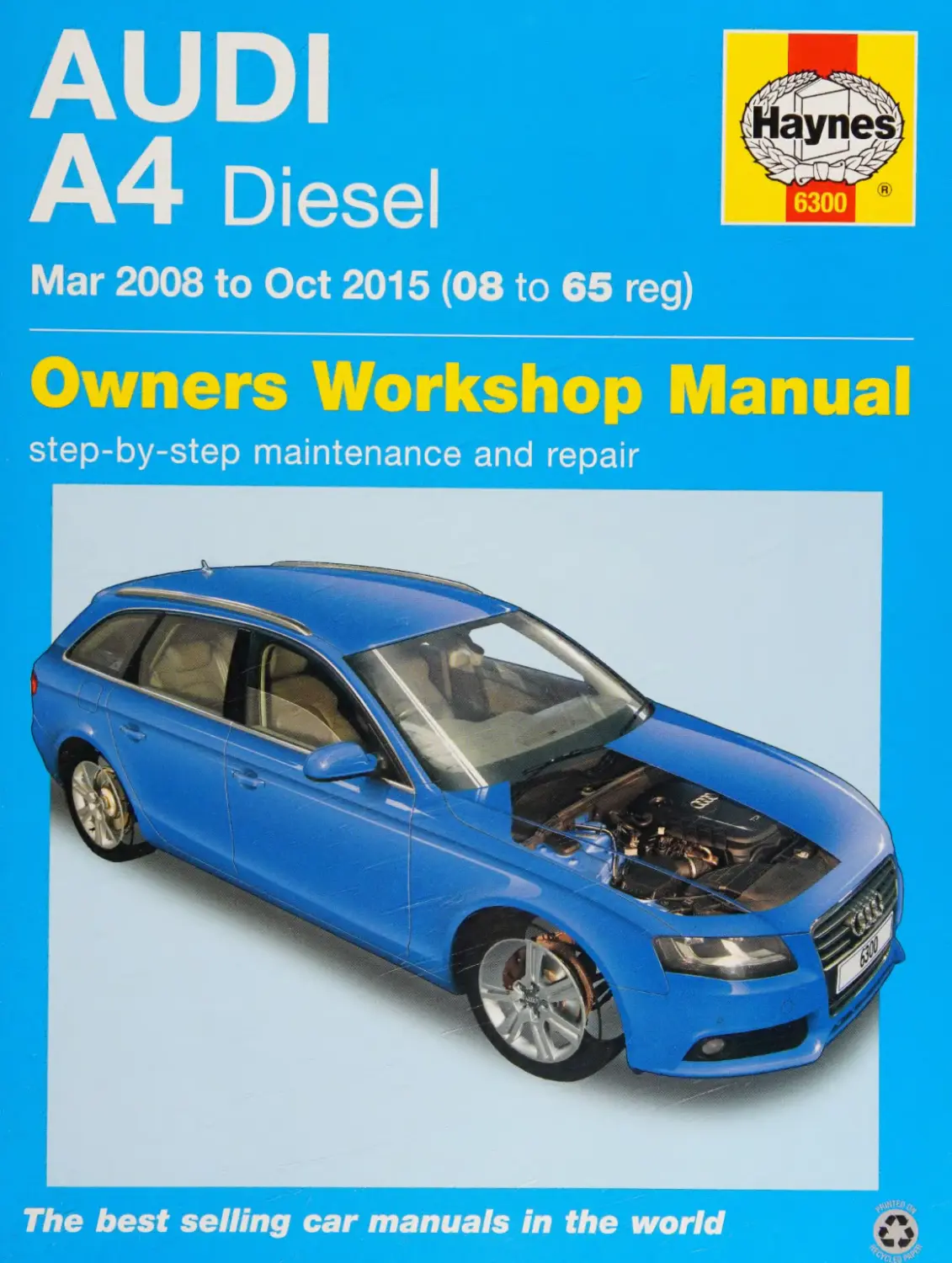
Audi A4 Diesel
Owners Workshop Manual
John S. Mead
Models covered
(6300 - 256)
Saloon & Estate (Avant) with 2.0 litre (1968cc) turbo-diesel engines
Does NOT cover 2.7 or 3.0 litre diesel engines, 7-speed ‘S-tronic’ automatic transmission, petrol models,
Quattro, Allroad, Cabiolet, S4 or RS4 models
Does NOT cover new A4 range introduced November 2015
© Haynes Publishing 2016
A book in the Haynes Owners Workshop Manual Series
PHL
sone
All rights reserved. No part of this book may be reproduced or
transmitted in any form or by any means, electronic or mechanical,
including photocopying, recording or by any information storage
or retrieval system, without permission in writing from the
copyright holder.
Printed in the USA
Haynes Publishing
Sparkford, Yeovil, Somerset BA22 7JJ, England
Haynes North America, inc
ISBN 978 1 78521 300 7
861 Lawrence Drive, Newbury Park, California 91320, USA
British Library Cataloguing in Publication Data
Haynes Publishing Nordiska AB
A catalogue record for this book is available from the British Library.
Box 1504, 751 45 UPPSALA, Sverige
Printed using 33-lb Resolute Book 65 4.0 from Resolute Forest Products Calhoun, TN mill. Resolute is a member of World Wildlife Fund’s Climate
Savers programme committed to significantly reducing GHG emissions. This paper uses 50% less wood fibre than traditional offset. The
Calhoun Mill is certified to the following sustainable forest management and chain of custody standards: SFI, PEFC and FSC Controlled Wood.
Contents
LIVING WITH YOUR AUDI A4
Introduction
Page
O94
Safety first!
Page
0e5
If your car won’t start
Page
096
Jump starting
Page
07
Identifying leaks
Page
028
Towing
Page
0*8
Wheel changing
Page
0*9
Page
0*10
Roadside repairs
Weekly checks
Introduction
Underbonnet check points
Page
0°10
Engine oil level
Page
0Oe11
Coolant level
Page
0°12
Brake/clutch fluid level
Page
0°12
Battery
Washer fluid level
Page
0913
Page
0e13
Tyre condition and pressure
Page
00e14
Electrical systems
Page
0015
Wiper blades
Page
0¢15
Lubricants and fluids
Page 0¢16
Tyre pressures
Page 0*16
MAINTENANCE
Routine maintenance and servicing
Servicing specifications
Page
192
Maintenance schedule
Page
1¢4
Maintenance procedures
Page
1°5
Illegal Copying
It is the policy of Haynes Publishing to actively protect its Copyrights and Trade Marks. Legal action will be taken against anyone who unlawfully
copies the cover or contents of this Manual. This includes all forms of unauthorised copying including digital, mechanical, and electronic in any
form. Authorisation
Beds
ti gait from Haynes Publishing will only be provided expressly lyand in writing. g. Illegal
Illeg copying
pying will also be reported to the appropriate
i
Contents
REPAIRS AND OVERHAUL
Engine and Associated Systems
Engine in-car repair procedures
Page
2Ae1
Engine removal and overhaul procedures
Page
2Be1
Cooling, heating and air conditioning systems
Page
31
Fuel systems
Page
4Ae1
Exhaust and emission control
Page
4Be1
Starting and charging systems
Page
5e1
Transmission
Clutch
Page
66¢1
Manual transmission
Page
7Ae1
Multitronic transmission
Page
7Be1
Driveshafts
Page
8e1
Braking system
Page
9e1
Suspension and steering
Page
10¢1
Brakes and suspension
Body equipment
Bodywork and fittings
Page
11¢1
Body electrical system
Page
12¢1
Wiring diagrams
Page 12°16
REFERENCE
Dimensions and weights
Page
REFe1
Fuel economy
Page
REFe2
Conversion factors
Page
REFe6
Buying spare parts
Page
REFe7
Vehicle identification
Page
REFe7
General repair procedures
Page
REFe8&
Vehicle jacking and support
Page
REFe9
Audio unit anti-theft system — precaution
Page
REFe9
Tools and working facilities
Page REFe10
MOT test checks
Page REFe12
Fault finding
ee
a
Page REFe16
Glossary of technical terms
Page REFe27
Index
Page REFe33
oe4 INtroduction
The Audi A4 (B8) model was launched in March
2008, and is a further development of the existing
A4 model. The A4 is available as a 4-door Saloon
or 5-door Estate (Avant), with a wide range of
petrol and diesel engines. The engine we will be
covering in this manual is the 2.0 litre turbo diesel
unit which features excellent performance with
industry leading standards of fuel consumption
and emissions. The body shape has been
developed to further reduce consumption and
emissions by having a Coefficient of Drag (CD) of
0.28, made possible by the fitment of underbody
panels to smooth the flow of air under the vehicle.
All models are equipped with independent front
and rear suspension.
High standards of safety are achieved
by the standard fitment of driver’s airbag,
passenger’s airbag, side airbags, head
airbags, and seat belt pretensioners. Safety
levels are further enhanced by features
such as, Traction control, ABS, Emergency
brake assist, Electronic stability program,
and Electronic differential lock. All models
are fitted with an immobiliser, alarm, remote
control central locking and air conditioning.
For the home mechanic, the Audi A4 is a
straightforward vehicle to maintain and most
of the items requiring frequent attention are
easily accessible.
Your Audi A4 manual
The aim of this Manual is to help you get
the best value from your vehicle. It can do
so in several ways. It can help you decide
what work must be done (even should
you choose to get it done by a garage).
It will also provide information on routine
maintenance and servicing, and give a
logical course of action and diagnosis when
random faults occur. However, it is hoped
that you will use the manual by tackling
the work yourself. On simpler jobs it may
even be quicker than booking the car into a
garage and going there twice, to leave and
collect it. Perhaps most important, a lot of
money can be saved by avoiding the costs
a garage must charge to cover its labour and
overheads.
The
manual
has
drawings
and
descriptions to show the function of the
various Components so that their layout
can be understood. Tasks are described
and photographed in a clear step-by-step
sequence. The illustrations are numbered by
the Section number and paragraph number to
which they relate — if there is more than one
illustration per paragraph, the sequence is
denoted alphabetically.
Audi A4 Avant
References to the ‘left’ or ‘right’ of the
vehicle are in the sense of a person in the
driver’s seat, facing forwards.
Acknowledgements
Thanks are due to Draper Tools, who
provided some of the workshop tools, and to
all those people at Sparkford who helped in
the production of this manual.
This manual is not a direct reproduction
of the vehicle manufacturer’s data, and its
publication should not be taken as implying
any technical approval by the vehicle
manufacturers or importers.
We take great pride in the accuracy
of information given in this manual, but
vehicle manufacturers make alterations and
design changes during the production run
of a particular vehicle of which they do not
inform us. No liability can be accepted by
the authors or publishers for loss, damage or
injury caused by any errors in, or omissions
from, the information given.
Project vehicles
The main vehicle used in the preparation
of this manual, and which appears in many of
the photographic sequences, was an Audi A4
2.0 litre TDI Estate (Avant).
Safety First! o-s
Working on your car can be dangerous.
This page shows just some of the potential
risks and hazards, with the aim of creating a
safety-conscious attitude.
correctly earthed. Mains power points should
be protected by a residual current device
General hazards
¢ Exhaust fumes are poisonous; they can
contain carbon monoxide, which is
rapidly fatal if inhaled.
Never run the engine in
a confined space such
as a garage with the
doors shut.
e Fuel vapour is
also poisonous,
as are the vapours
from some cleaning
Scalding
¢ Don’t remove the radiator or expansion tank
cap while the engine is hot.
e Engine oil, transmission fluid or power
steering fluid may also be dangerously hot if
the engine has recently been running.
Burning
¢ Beware of burns from the exhaust system
and from any part of the engine. Brake
discs and drums can also be extremely hot
immediately after use.
(RCD) circuit breaker.
Fume or gas intoxication
solvents
thinners.
and
paint
Special hazards
Hydrofluoric acid
e This extremely corrosive acid is formed
when certain types of synthetic rubber, found
in some O-rings, oil seals, fuel hoses etc,
are exposed to temperatures above 4000C.
The rubber changes into a charred or sticky
substance containing the acid. Once formed,
the acid remains dangerous for years. If it gets
onto the skin, it may be necessary to amputate
the limb concerned.
e When dealing with a vehicle which has
suffered a fire, or with components salvaged
from such a vehicle, wear protective gloves
and discard them after use.
The battery
Crushing
Poisonous or irritant substances
e¢ Batteries
e When working under or near
a raised vehicle, always
supplement the jack
¢
e Avoid skin contact with battery acid and
with any fuel, fluid or lubricant, especially
antifreeze, brake hydraulic fluid and Diesel
fuel. Don’t syphon them by mouth. If such a
substance is swallowed or gets into the eyes,
seek medical advice.
e Prolonged contact with used engine oil
can cause skin cancer. Wear gloves or use
a barrier cream if necessary. Change out of
oil-soaked clothes and do not keep oily rags
in your pocket.
e Air conditioning refrigerant forms a
poisonous gas if exposed to a naked flame
(including a cigarette). It can also cause skin
burns on contact.
attacks
with axle stands,
or use drive-on
z=
:
OR
\
ramps.
Never venture
under a car
which is only
supported by
a jack.
e Take care if loosening or tightening hightorque nuts when the vehicle is on stands.
Initial loosening and final tightening should be
done with the wheels on the ground.
contain
clothing,
sulphuric
acid, which
eyes and skin. Take care
when topping-up or carrying the battery.
e The hydrogen gas given off by the battery
is highly explosive. Never cause a spark
or allow a naked light nearby. Be careful
when connecting and disconnecting battery
chargers or jump leads.
Air bags
e Air bags can cause injury if they go off
accidentally. Take care when removing the
steering wheel and trim panels. Special
storage instructions may apply.
Diesel injection equipment
Fire
Asbestos
e Diesel injection pumps supply fuel at very
high pressure. Take care when working on the
fuel injectors and fuel pipes.
e Fuel is highly flammable; fuel vapour is
explosive.
¢ Don’t let fuel spill onto a hot engine.
e Do not smoke or allow naked lights
(including pilot lights) anywhere near a
vehicle being worked on. Also beware of
creating sparks (electrically or by use of tools).
° Fuel vapour is heavier than air, so don’t work
on the fuel system with the vehicle over an
inspection pit.
¢ Another cause of fire is an electrical overload
or short-circuit. Take care when repairing or
modifying the vehicle wiring.
e Keep a fire extinguisher handy, of a type
suitable for use on fuel and electrical fires.
e Asbestos dust can cause cancer if inhaled
or swallowed. Asbestos may be found in
gaskets and in brake and clutch linings.
When dealing with such components
it is safest to assume that they contain
asbestos.
Warning: Never expose the hands,
VIN face or any other part of the body
to injector spray; the fuel can
penetrate the skin with potentially fatal
results.
Electric shock
dangerous,
especially
DO
DON’T
e Do use eye protection when using power
tools, and when working under the vehicle.
e Don’t attempt to lift a heavy component
which may be beyond your capability — get
assistance.
© Do wear gloves or use barrier cream to
protect your hands when necessary.
@ Ignition HT
and
Xenon
headlight
voltages
can
be
Remember...
:
to
people with heart
problems
or
a
pacemaker.
Don’t
work on or near these
systems with the engine running or the ignition
switched on.
e Mains voltage is also dangerous. Make
sure that any mains-operated equipment is
¢ Do get someone to check periodically
that all is well when working alone on the
vehicle.
© Do keep loose clothing and long hair well
out of the way of moving mechanical parts.
e Do remove rings, wristwatch etc, before
working on the vehicle — especially the
electrical system.
¢ Do ensure that any lifting or jacking
equipment has a safe working load rating
adequate for the job.
e Don’t rush to finish a job, or take unverified
short cuts.
¢ Don’t use ill-fitting tools which may slip
and cause injury.
¢ Don’t leave tools or parts lying around
where someone can trip over them. Mop up
oil and fuel spills at once.
e Don’t allow children or pets to play in or
near a vehicle being worked on.
oo Roadside repairs
The following pages are intended to help in dealing with common roadside emergencies and breakdowns. You will find more detailed fault
finding information at the back of the manual, and repair information in the main chapters.
lf your car won’t start and
the starter motor doesn’t
turn
If it’s amodel with Multitronic transmission, make sure the selector
isin PorN.
|_| Gain access to the battery in the luggage compartment and make
sure that the battery terminals are clean and tight.
(_} Switch on the headlights and try to start the engine. If the headlights
go very dim when you’r e trying to start, the battery is probably flat. Get
out of trouble by jump starting (see next page) using a friend’s car.
If your car won’t start even
though the starter motor
turns as normal
(|
From within the luggage compartment
check the condition and security of the
battery connections.
[|]
Is there fuel in the tank?
Is there moisture on electrical components under the bonnet?
Switch off the ignition, then wipe off any obvious dampness with
a dry cloth. Spray a water-repellent aerosol product (WD-40 or
equivalent) on fuel system electrical connectors like those shown
in the photos. (Note that diesel engines don’t normally suffer from
damp.)
Check the fuel injection system air mass
meter wiring is secure.
Check that electrical connections are secure (with the ignition switched off) and spray th
i
wae
em with
jif you
- i
-40
suspect a problem due to damp.
a water-dispersantspra
pray
ya like WD-40
Roadside repairs o-7
PNA ss
HINT
Jump starting will get you out
of trouble, but you must correct
whatever made the battery go
flat in the first place. There are
three possibilities:
The battery has been drained by
repeated attempts to start, or by
leaving the lights on.
The charging system is not working
properly (alternator drivebelt slack
or broken, alternator wiring fault or
alternator itself faulty).
The battery itself is at fault
(electrolyte low, or battery worn out).
Lift up the flap and connect one end of
the red jump lead to the positive (+) jump
start terminal of the flat battery, located
under the plenum chamber cover.
When jump-starting
following precautions:
a car,
observe
Jump starting
the
Note: Remove the key in case the central
locking engages when the jump leads are
connected
/Y Before connecting the booster battery,
make sure that the ignition is switched off.
Y Ensure that all electrical equipment (lights,
heater, wipers, etc) is switched off.
¥ Take note of any special precautions
printed on the battery case.
/ Make sure that the booster battery is the
same voltage as the discharged one in the
vehicle.
Connect the other end of the red lead to
the positive (+) terminal of the booster
battery.
¥ If the battery is being jump-started from the
battery in another vehicle, the two vehicles
MUST NOT TOUCH each other.
/ Make sure that the transmission is in
neutral (or PARK, in the case of Multitronic
transmission).
"YNA\| 4-3
Budget jump leads can be a
HINT
not pass enough current to
false economy, as they often do
start large capacity or diesel
engines. They can also get hot.
Connect one end of the black jump lead
to the negative (-) terminal of the booster
battery
ea
Coooe|.
@)
Connect the other end of the black
jump lead to the earthing point in the
engine compartment on the vehicle to be
started.
Make sure that the jump leads will
not come into contact with the fan,
drive-belts or other moving parts of the
engine.
Start the engine using the booster battery
and run it at idle speed. Switch on the
lights, rear window demister and heater
blower motor, then disconnect the jump
leads in the reverse order of connection.
Turn off the lights etc.
os Roadside repairs
Identifying leaks
Puddles on the garage floor or drive,
or obvious wetness under the bonnet or
underneath the car, suggest a leak that
needs investigating. It can sometimes be
difficult to decide where the leak is coming
from, especially if an engine undershield is
fitted. Leaking oil or fluid can also be blown
rearwards by the passage of air under the car,
giving a false impression of where the problem
lies.
AN
Warning: Most automotive oils
and fluids are poisonous. Wash
them off skin, and change out of
contaminated clothing, without
delay.
Si
The smell of a fluid leaking
from the car may provide
a clue to what’s leaking.
Some fluids are distinctively
coloured. It may help to remove the engine
undershield, clean the car carefully and to
park it over some clean paper overnight
as an aid to locating the source of the
leak. Remember that some leaks may only
occur while the engine is running.
Gearbox oil
Sump oil
a
RINT
HINT
i
beJ
2
Engine oil may leak from the drain plug...
...or from the base of the oil filter.
Gearbox oil can leak from the seals at the
inboard ends of the driveshafts.
Antifreeze
Brake fluid
Power steering fluid
A leak occurring at a wheel is almost certainly
brake fluid.
Power steering fluid may leak from the pipe
connectors on the steering rack.
4
Scie 8
Leaking antifreeze often leaves a crystalline
deposit like this.
Towing
When all else fails, you may find yourself
having to get a tow home - or of course you
may be helping somebody else. Long-distance
recovery should only be done by a garage or
breakdown service. For shorter distances, DIY
towing using another car is easy enough, but
observe the following points:
Use a proper tow-rope — they are not
expensive. The vehicle being towed must
display an ON TOW sign in its rear window.
Always turn the ignition key to the ‘On’
position when the vehicle is being towed,
so that the steering lock is released, and
|_|
|_|
the direction indicator and brake lights
work.
Lashing eyes are provided at the front
and rear of the vehicle as a means of
securing the vehicle onto a breakdown
truck.
Towing eyes are provided front and rear.
Audi state that the towing distance should
not exceed 50 miles, and the towing
speed should be limited to 30 mph.
On Multitronic transmission models,
if it is necessary to tow the vehicle on
two wheels (suspended from a recovery
vehicle), then it is essential that it is
suspended at the front to prevent
damage to the final drive assembly.
Before being towed, release the
handbrake and select neutral on the
transmission.
Note that greater-than-usual pedal
pressure will be required to operate the
brakes, since the vacuum servo unit is
only operational with the engine running.
Greater-than-usual steering effort will also
be required.
The driver of the car being towed must
keep the tow-rope taut at all times to
avoid snatching.
Make sure that both drivers know the
route before setting off.
Only drive at moderate speeds and keep
the distance towed to a minimum. Drive
smoothly and allow plenty of time for
slowing down at junctions.
Roadside repairs oes
Wheel changing
Warning: Do not change a wheel in
a situation where you risk being hit
by other traffic. On busy roads, try
to stop in a lay-by or a gateway. Be wary of
passing traffic while changing the wheel - it is
easy to become distracted by the job in hand.
Preparation
[_] When a puncture occurs, stop as soon as
it is safe to do so.
[] Park on firm level ground, if possible, and
well out of the way of other traffic.
L_} Apply the handbrake and engage first
or reverse gear (or Park on models with
Multitronic transmission).
Use hazard warning lights if necessary,
and display the warning triangle
1 The spare
wheel
and tools are
located under the floor in the luggage
compartment. Where fitted, undo the
retaining bolt and lift out the spare wheel.
Take out the jack from its location in front
of the battery.
supplied.
Chock the wheel diagonally opposite the
one being removed — a couple of large
stones will do for this.
If the ground is soft, use a flat piece of
wood to spread the load under the jack.
Note: Many A4 models are equipped with a
puncture repair kit and do not have a spare
wheel and jack. If your car has a puncture
repair kit, refer to the information contained in
the vehicle handbook.
On Avant models, the tool kit is located
in a separate compartment in front of the
Use the hook provided
wheel bolt covers.
the
spare wheel.
AS
Use the wheel brace to slacken each
wheel bolt half a turn. Use the special
adapter when slackening the locking
wheel bolt.
to remove
Position the jack with the base directly
under the jacking point. Turn the jack handle
clockwise until the head ofthe jack fits snugly
around the centre of the jacking point, then raise
the car until the wheel is clear of the ground.
%
R
%
Remove the wheel bolt nearest the top,
and screw-in the mounting pin provided
in the tool kit. Unscrew the remaining
wheel bolts and remove the wheel.
Finally...
Stow the jack and tools in the correct
locations in the car.
Check the tyre pressure on the wheel just
fitted. If it is low, or if you don’t have a
pressure gauge with you, drive slowly to
the nearest garage and inflate the tyre to
the right pressure.
|_]
Le
Fit the sparewheel and lightly tighten the
bolts with the wheel brace.
Lower the vehicle to the ground and
tighten the wheel bolts in a diagonal
sequence. Refit the wheel bolt cover.
Have the damaged tyre or wheel repaired
as soon as possible.
Have the wheel bolts tightened to
the specified torque at the earliest
opportunity.
Note: /f a temporary ‘space-saver’ spare wheel has been fitted, special conditions apply to its use. This type of spare wheel is only intended for
use in an emergency, and should not remain fitted any longer than it takes to get the punctured wheel repaired. While the temporary wheel is in
use, ensure it is inflated to the correct pressure, do not exceed 50 mph (80 kph), and avoid harsh acceleration, braking or cornering.
o-10 Roadside repairs
Introduction
There are some very simple checks which
need only take a few minutes to carry out, but
which could save you a lot of inconvenience
and expense.
These
checks
require
no great skill or
special tools, and the small amount of time
they take to perform could prove to be very
well spent, for example:
[|] Keeping an eye on tyre condition
pressures,
and
will not only help to stop them
wearing out prematurely, but could also save
your life.
Many breakdowns
are caused
by
electrical problems. Battery-related faults are
particularly common, and a quick check on a
regular basis will often prevent the majority of
these.
[] If your car develops a brake fluid leak,
the first time you might know about it is when
your brakes don’t work properly. Checking the
level regularly will give advance warning of
this kind of problem.
If your car develops a brake fluid leak,
the first time you might know about it is when
your brakes don’t work properly. Checking the
level regularly will give advance warning of
this kind of problem.
(]_ If the oil or coolant levels run low, the cost
of repairing any engine damage will be far
greater than fixing the leak, for example.
Underbonnet check points
A 2.0 litre diesel engine
A Engine oil filler cap
B Coolant expansion tank
C Brake (and clutch) fluid reservoir
D Screen washer fluid reservoir
E Power steering fluid reservoir
Weekly checks o«11
Engine oil level
Before you start
The correct oil
Modern engines place great demands on their oil. It is very important
that the correct oil for your car is used (see Lubricants and fluids).
V Make sure that the car is on level ground.
Car care
V Switch off the warm engine.
V Wait approximately two minutes before checking the oil level.
@ If you have to add oil frequently, you should check whether you have
any oil leaks. Place some clean paper under the car overnight, and
check for stains in the morning. If there are no leaks, then the engine
may be burning oil.
®@ Not all engines are equipped with a dipstick. Where a dipstick is not
provided, the oil level is checked via the sound system or multi-media
interface (MMI).
@ To check the oil level via the MMI, use the function selector button and
select CAR > Oil level. A digital dipstick will appear on the display, showing
the oil level. A message will also appear stating the oil level situation.
PINs
/f the oil is checked immediately after driving the
HINT
vehicle, some of the oil will remain in the upper
engine components, resulting in an inaccurate
reading.
Meo
es
SR
ner
If a dipstick is provided it will be located on the left-hand side of
the engine. It is brightly coloured for ease of location.
Withdraw the dipstick. Using a clean rag or paper towel, wipe all
the oil from the dipstick. Insert the clean dipstick into the tube as
far as it will go, then withdraw it again.
Note the oil level on the end of the dipstick which should be between
the upper (MAX) and lower (MIN) marks. Approximately 1.0 litre of oil
will raise the level from the lower mark to the upper mark.
If topping up is necessary, oil is added through the filler cap on
the top of the engine. Rotate the cap through a quarter-turn anticlockwise and withdraw it. A funnel may help to reduce spillage.
Add the oil slowly, 0.5 litres at a time. Wait 2 minutes then check the
level again using the dipstick, sound system or MMI. Do not overfill.
o12 Weekly checks
Coolant level
AN
Warning: Do not attempt to
remove
the expansion
tank
pressure cap when the engine is
hot, as there is a very great risk
of scalding. Do not leave open
containers of coolant about, as it
is poisonous.
The coolant level varies with the
temperature of the engine. When the
engine is cold, the coolant level should be
between the MIN and MAX mark on the side
of the expansion tank located on the left-hand
side of the engine compartment. When the
engine is hot, the level will rise slightly.
Car care
@ With a sealed-type cooling system, adding
coolant should not be necessary on a regular
basis. If frequent topping-up is required, it is
likely there is a leak. Check the radiator, all
hoses and joint faces for signs of staining or
wetness, and rectify as necessary.
@ It is important that antifreeze is used in the
cooling system all year round, not just during
the winter months. Don’t top up with water
alone, as the antifreeze will become diluted.
If topping-up is necessary, wait until the
engine is cold, then slowly unscrew the
expansion tank filler cap anti-clockwise,
Add a mixture of water and antifreeze
through the expansion tank filler neck,
until the coolant is at the correct level.
Refit the cap, turning it clockwise as far
as it will go until it is secure.
to release any pressure in the system, and
remove it.
Brake (and clutch) fluid level
TAN
Warning: Brake fluid can harm
your eyes and damage painted
Safety first!
surfaces, so use extreme caution
when handling and pouring it.
@ If the reservoir requires repeated topping-up
this is an indication of a fluid leak somewhere
in the system, which should be investigated
immediately.
Warning: Do not use fluid that
has been standing open for some
time, as it absorbs moisture
from
the
air, which
a dangerous
effectiveness.
loss
can
cause
of braking
Nal=-93
HINT
@ If a leak is suspected, the car should not
be driven until the braking system has been
checked. Never take any risks where brakes
are concerned.
Checking the fluid level in the master cylinder reservoir is easier if the
plenum chamber cover is removed
RAR
1 The
brake
reservoir
master
cylinder
are mounted
and
fluid
on the vacuum
servo unit in the engine compartment on
the right-hand side of the bulkhead. With the
plenum
chamber
cover
removed,
the MAX
and MIN marks are visible through the window
in the reservoir metal cover. The fluid level
should be maintained between these marks at
all times.
If topping-up is necessary, wipe the area
around the filler cap with a clean rag
before removing the cap. It’s a good idea
to inspect the reservoir. The fluid should be
changed if dirt is visible.
3 Carefully add fluid, avoiding spilling it
on surrounding paintwork. Use only the
specified hydraulic fluid; mixing different
types of fluid can cause damage to the
system and/or a loss of braking effectiveness.
After filling to the correct level, refit the cap
securely. Wipe off any spilt fluid.
Weekly checks oe«13
Battery
Caution: Before carrying out any work on
the vehicle battery, read the precautions
given in Safety First! at the start of this
manual.
v Make sure that the battery tray is in
good condition, and that the clamp is tight.
Corrosion on the tray, retaining clamp and the
battery itself can be removed with a solution
of water and baking soda, after removing
the affected components from the car (see
Chapter 5, Section 3). Thoroughly rinse all
cleaned areas with water. Any metal parts
damaged by corrosion should be covered
with a zinc-based primer, then painted.
V Periodically (approximately every three
months), check the charge condition of the
battery as described in Chapter 5, Section 2.
A ‘magic eye’ charge indicator is fitted to the
standard battery — if the indicator is green in
colour, the battery is fully charged, however,
if it is colourless, it should be recharged. If
it is yellow in colour, the battery should be
renewed.
V If the battery is flat, and you need to jump
start your vehicle, see Roadside Repairs.
The battery is located under the floor in
the luggage compartment. To gain access
it is necessary to remove the spare wheel
(where applicable), tool kit, spare wheel or tool
kit carrier and battery cover. Refer to Chapter
5, Section 3 for details. The exterior of the
battery should be inspected periodically for
damage such as a cracked case or cover.
If corrosion
3 evident,
(white, fluffy deposits)
remove
the cables
from
is
the
battery terminals, clean them with a small
wire brush, then refit them. Automotive stores
sell a tool for cleaning the battery post...
Check the tightness of the battery
cable clamps to ensure good electrical
connections. You should not be able to
move them. Also check each cable for
cracks and frayed conductors.
..aS well as the battery cable clamps.
Note: Audi state that the terminals should
not be greased.
Washer fluid level
* The underbonnet reservoir also serves the
tailgate washer.
@ Screenwash additives not only keep the
windscreen clean during bad weather, they
also prevent the washer system freezing in
cold weather — which is when you are likely to
need it most. Don’t top-up using plain water,
as the screenwash will become diluted, and
will freeze in cold weather.
Warning: On no account use
VAN coolant antifreeze in the washer
system - this could discolour or
damage paintwork.
The
reservoir for the windscreen and
rear window (where applicable) washer
systems is located in the rear left-hand
corner of the engine compartment.
topping-up is necessary, open the cap.
If
When
topping-up the reservoir a
screenwash additive should be added
in the quantities recommended on the
bottle.
o14 Weekly checks
Tyre condition and pressure
New tyres should be balanced when they
are fitted, but it may become necessary to
re-balance them as they wear, or if the balance
weights fitted to the wheel rim should fall off.
Unbalanced tyres will wear more quickly, as
It is very important that tyres are in good
condition, and at the correct pressure — having
a tyre failure at any speed is highly dangerous.
Tyre wear is influenced by driving style
— harsh braking and acceleration, or fast
cornering, will all produce more rapid tyre
wear. As a general rule, the front tyres wear
out faster than the rears. Interchanging the
tyres from front to rear (“rotating” the tyres)
may result in more even wear. However, if
this is completely effective, you may have the
expense of replacing all four tyres at once!
Remove any nails or stones embedded
in the tread before they penetrate the tyre
to cause deflation. If removal of a nail does
reveal that the tyre has been punctured, refit
the nail so that its point of penetration is
marked. Then immediately change the wheel,
and have the tyre repaired by a tyre dealer.
Regularly check the tyres for damage in
the form of cuts or bulges, especially in the
sidewalls. Periodically remove the wheels,
and clean any dirt or mud from the inside and
outside surfaces. Examine the wheel rims for
signs of rusting, corrosion or other damage.
Light alloy wheels are easily damaged by
“kerbing” whilst parking; steel wheels may
also become dented or buckled. A new wheel
is very often the only way to overcome severe
damage.
Wheel imbalance is normally signified by
vibration, particularly at a certain speed
(typically around 50 mph). If this vibration is
felt only through the steering, then it is likely
that just the front wheels need balancing.
If, however, the vibration is felt through the
whole car, the rear wheels could be out of
balance. Wheel balancing should be carried
out by a tyre dealer or garage.
1 Tread Depth - visual check
a Tread Depth - manual check
3 Tyre Pressure Check
The original tyres have tread wear safety
bands (B), which will appear when the tread
depth reaches approximately 1.6 mm. The
band positions are indicated by a triangular
mark on the tyre sidewall (A).
Alternatively, tread wear can be
monitored with a simple, inexpensive device
known as a tread depth indicator gauge.
Check the tyre pressures regularly with
the tyres cold. Do not adjust the tyre pressures
immediately after the vehicle has been used,
or an inaccurate setting will result.
will the steering and suspension components.
Tyre tread wear patterns
Shoulder Wear
Underinflation (wear on both sides)
Under-inflation will cause overheating of the
tyre, because the tyre will flex too much, and
the tread will not sit correctly on the road
surface. This will cause a loss of grip and
excessive wear, not to mention the danger of
sudden tyre failure due to heat build-up.
Check and adjust pressures
Incorrect wheel camber (wear on one side)
Repair or renew suspension parts
Hard cornering
Reduce speed!
Centre Wear
Uneven
Overinflation
Front tyres may wear unevenly as a result of
wheel misalignment. Most tyre dealers and
garages can check and adjust the wheel
alignment (or "tracking") for a modest charge.
Incorrect camber or castor
Over-inflation will cause rapid wear of the
centre part of the tyre tread, coupled with
reduced grip, harsher ride, and the danger of
shock damage occurring in the tyre casing.
Check and adjust pressures
If you sometimes have to inflate your car’s
tyres to the higher pressures specified for
maximum load or sustained high speed, don’t
forget to reduce the pressures to normal
afterwards.
Wear
Repair or renew suspension parts
Malfunctioning suspension
Repair or renew suspension parts
Unbalanced wheel
Balance tyres
Incorrect toe setting
Adjust front wheel alignment
Note: The feathered edge of the tread which
typifies toe wear is best checked by feel.
Weekly checks oe«15
Electrical systems
HAYNES
V Check all external lights and the horn. Refer
to the appropriate Sections of Chapter 12 for
details if any of the circuits are found to be
inoperative.
v Visually
If a single indicator light, brake light or
headlight has failed, it is likely that a bulb
has blown and will need to be renewed.
Refer to Chapter 12 for details. If both brake
lights have failed, it is possible that the
stop-light switch operated by the brake pedal
has failed. Refer to Chapter 9 for details.
If more than one indicator light or headlight
has failed, it is likely that either a fuse has
blown or that there isa fault in the circuit
(see Chapter 12). The main fuseboxes are
located behind a panel at each end of the facia
and behind the trim panel on the right-hand
side of the luggage compartment. To access a
facia fusebox pull the panel from the end of the
facia after releasing it using a plastic spatula or
similar in the slot provided.
check
all
accessible
wiring
connectors, harnesses and retaining clips for
security, and for signs of chafing or damage.
HINT;
If you need to check your
brake lights and indicators
unaided, back up to a wall or
garage door and operate the
lights. The reflected light should show if
they are working properly.
To renew a blown fuse, pull it out
directly from the fusebox using the pliers
provided (located on the inside of the
facia end panel). Fit a new fuse of the same
rating, available from car accessory shops.
It is important that you find the reason that
the fuse blew (see Electrical fault finding in
Chapter 12).
Wiper blades
PyMaiscy
HINT
Phe
windscreen
should
be
in the
wipers
service
position before removing the
wiper blades. To move the
wipers to the service position using the
MMI, use the function selector button
to select CAR > Windscreen wipers >
Service position > on. The wipers will
move into the service position.
=
Check the condition of the wiper blades.
1 If they are cracked or show any signs of
deterioration, or if the glass swept area
is smeared, renew them. For maximum clarity
of vision, wiper blades should be renewed
annually, as a matter of course.
Pull the blade off the arm to remove.
When fitting the blade, make sure that the
retaining tab fully engages with the arm.
To remove a wiper blade, pull the arm
fully away from the glass until it locks,
then using a small screwdriver, depress
the retaining tab.
To remove the tailgate wiper blade, use a
screwdriver to prise the blade free of the
arm. Push the blade fully into engagement
when refitting.
o-i6 Weekly checks
Lubricants and fluids
Note: Using /ubricants and fluids which do not meet the VAG standard may invalidate the warranty
Engine
Models fitted with a particulate filter...
2. eee eee
Models without a particulate filter:
Standard (distance/time) service interval..................0085
LongLife (variable) service interval..............
0c eee eee eeee
LongLife oil VW 507 00 onlyt
Gooling system .36o
VW G12+ Anti-freeze
ee
ae a.
see ee
eee
Multigrade oil viscosity 5W/30 to 20W/50, VW 505 01 or VW 507 00
LongLife oil VW 507 00*
Manual transmission....................0000c
cece eeens
VW G 052 911 A1 SAE 75W 90 synthetic oil
Multitronic transmission ......................200
eee
VW G 052 180 A2 CVT fluid
Brake and clutch hydraulic systems..................
Hydraulic fluid to DOT 4
Power steering system
VW Hydraulic fluid GOO2 000
..................0..00
2c cee eee
Air conditioning system.........................2.000
R134a
*A maximum of 0.5 litres of standard VW oil may be used for topping-up when LongLife oil is unobtainable
t In an emergency, a maximum of 0.5 litres of WW 506 00/506 07 or VW 505 00/505 071 may be used for topping-up
Tyre pressures
The recommended tyre pressures are shown on a sticker attached to
the edge of the driver’s side front door.
Chapter 1
Routine maintenance and servicing
Contents
Section number
Section number
Aimtiter element renewal:
se ysca ivi cote Soha va acta eneee we Gus esalle oye 2/-.
-Hose:andifluid leak:checkarayin
sis decline sents Saeco i et an
7
Airbagitiniticheck pe) eit un cas nk CRN
ths Slee, Sean
19 WA NtOGUCTION Ache, itvo me rg teatments niin Past ene seta Mirae naeicytere ae
1
PAINE OZOROMOC Katie occas lareielictacode(e teleis evaliciir 8 Gsol ereenemndenabe telals car
9
Manual transmission oil level check...
2.0 .......000
0c eee eee 13
Auxiliary drivebelt check and renewal ............ 60.2200 e eee
8
Multitronic transmission fluid renewal ................-.e0008) 26
BAST VZCIIOCK meters Mate ccisciteee oieitOcean ae areenpeCemy INS Tacs datas 17
Particulate filter ash deposit mass check................0.0055 29
Brake (and.cleten) fluid remewalletj..5,
5... ss ecss ctumeetecn apaaeeteaenene 30;
~Pollenifilter elementirenewalastir..amenticncir
enon. eos aetn seaie 12
Brake hy draulicicireuiticheCks
ond ait:foul. bs oo)
eeineee tain speratslor ae 10
Brake pad checkita-t.
shcscuuhieiamy sake (aaici crowd soi orpusamen tere ntanie meats 22 4
Goolantreme walle dipvie rears eit o'stere quale dcalera weGene Sa beMAO mM Enea eet 31%
DRIVES AlteGalleni Chek ara taste i120. «(cee)chiets(once (ohio apehecemetrce cle ewer 15.
Engine management self-diagnosis memory fault check ......... 21m
Engine oilanaitilterrenewalliccrs
ier. cis sue ¢ <cousrone tornyetney ceoteon ualautistic fs BA
Exhauishsystemcheckees,
oust: ntste.. s’ev0 «store cher carsanmenay hae otala erers 6
Fuel TiterneMmeWalisate cient case sens iets o:re loeiereta: aeabereen ahem sieaatoust Rebs 2A
Feadlight beam adjustment ccc ci «iu etelolreroieteerseste
aunts 11.
HINGE ANCHlOGCKGUUDICATION fate mk eects mscic Aileyol ahtate atanale i see iecactne 18
Power steering hydraulic fluid level check..................0--
25
2Reguiarmatntemancers as taceae tshisses wetalotetsus, oracantreheecaaace araiieetste
sBesetting the semiceynterval display as... .20. cs = secs Here en aeeiere
Road test and exhaust emissions check............00eseeeees
Steenhihg andrSuspensiaMiCheck aware ay. ten cic ie ntde etcetera eee:
MOUNLOOTCHeCK ana dUiDnCatlolip sacred oicsenvarcc ste seeley rae een
Timing belt and tensioning roller renewal................0.0005
MUNAEKDODY DYOLECTIONV CME CK ae nrarersetereicneleucaetera
Min) peed hettea etre ee
Windscreen/tailgate/headlight washer system check............
2
5
23
16
22
28
14
20
Degrees of difficulty
Easy, suitable for
EN Fairly easy, suitable EN Fairly difficult,
novice with little
experience
YS | for beginner with
NS some experience
EN Difficult, suitable
SS | Very difficult,
S| suitable for competent EN for experienced DIY SN suitable for expert
EN DIY mechanic
|
mechanic
|
DIY or professional
SN
NS
12 Servicing specifications
Lubricants and: folds.
cs.
eee
ck koe ance
Refer to Lubricants, fluids and tyre pressures in Weekly checks
Capacities
Engine-oilli(includingifilter)mo ss... 5 6 ie
Be ee
ae eee
GOOllAg SYStEMIsdisfencws
anceiere 0s she een PSE
omen eater ie
FRG RAT aeieee
1 ov ase wsBEOIG asoySoS ane testo gy
cae
ce erate ents
Washerresenolrs tei, Ne atlne ils bce bl cc tae ecu
e one
aests
5.0 litres (approx)
6.0 litres (approx)
65 litres
4.5 litres
Cooling system
Antifreeze mixture:
GOW TAMTNTOSZO®.: seco otro ens steteiace sCaue ataleieenaeacunncpsy Sohal one
aaere re
ORs (Ltt ik=\oo4 = hea ace GRRE ERA Ok RM EREER owe tered 0. Cana accog ERR
Note: Refer to antifreeze manufacturer for latest recommendations.
Protection down to -25°C
Protection down to -35°C
Brakes
Brake pad minimum thickness (including backing plate)............
10.0 mm
Torque wrench settings
Nm
Ibf ft
Manual transmission filler/level plug .........
0.00. eeee eee eens
Oilitiltencap.
Wests teetey. cer
cnn MRSC Moe Suse
eee Gomme
45
25
33
18
Roadwheel boltsis
anc cecitens crefels wi avassb ach renaee ole saat eM
<S{Tna{eye [etn ol|bfe Pasaeue cpeenucichcueier cece
a ie
te
MCS. hata
eee
oxtecgteor
120
89
30
22
Front underbonnet view
ie
3
ZO
Je
aneentee
1 Engine oil filter cap
2 Air cleaner housing
3 Brake/clutch fluid reservoir
4 Power steering fluid reservoir
5 Coolant expansion tank
6 Alternator
7 ABS modulator
8 Screen washer reservoir
Component locations 1-3
Front underbody view
1 Brake caliper
2 Guide link
3 Engine oil drain plug
4 Anti-roll bar
5 Track control link
6 Driveshaft
7 Air conditioning compressor
8 Steering gear
9 Charge air duct
10 Track rod balljoint
11 Oil level sender
12 Transmission undertray
Rear underbody view
1 Lower transverse link
2 Hub carrier
3 Fuel tank
4 Rear silencer
5 Subframe
6 Anti-roll bar
7 Shock absorber lower mounting
8 Underbody cover trim
9 Rear lower link arm (track rod)
10 Coil spring
11 Subframe rear mounting
104 Maintenance schedule
The maintenance intervals in this manual
are provided with the assumption that you, not
the dealer, will be carrying out the work. These
are the minimum intervals recommended
by us for vehicles driven daily. If you wish
to keep your vehicle in peak condition at all
times, you may wish to perform some of
these procedures more often. We encourage
frequent maintenance, since it enhances the
efficiency, performance and resale value of
your vehicle.
When
the
vehicle
is new,
it should
be
serviced by a dealer service department
(or other workshop recognised by the
vehicle manufacturer as providing the same
standard of service) in order to preserve the
warranty. The vehicle manufacturer may reject
warranty claims if you are unable to prove
that servicing has been carried out as and
when specified, using only original equipment
parts or parts certified to be of equivalent
quality.
All models are equipped with a service
interval display indicator in the instrument
panel. Every time the engine is started the
panel will illuminate briefly with service
information. With the standard non-variable
display, the service intervals are in accordance
with specific distances and time periods. With
the LongLife display, the service interval is
variable according to the number of starts,
length of journeys, vehicle speeds, brake
pad wear, bonnet opening frequency, fuel
consumption,
oil level and oil temperature,
however the vehicle must be serviced at least
every two years. At a certain distance before
the next service is due, ‘Service in XXXX miles,
XXX days’ will appear in the instrument cluster
display,
and this figure will reduce
as the
vehicle is used. Once the service interval has
been reached, the display will flash SERVICE
DUE! Note that if the variable (LongLife)
service interval is being used, the engine must
only be filled with the recommended LongLife
engine oil (see Lubricants and fluids in Weekly
checks).
After completing a service, Audi technicians
use a special instrument to reset the service
display to the next service interval, and a
print-out is put in the vehicle service record.
The display can be reset by the owner as
described in Section 5, but note that for
models using the ‘LongLife’ interval, the
procedure will automatically reset the display
to the 10 000 miles ‘distance’ interval. To have
the display reset to the ‘variable’ (LongLife)
interval, it is necessary to take the vehicle to
an Audi dealer or suitably-equipped specialist
who will use a special instrument to encode
the on-board computer.
Every 250 miles or weekly
Every 40 000 miles or 4 years,
|] Refer to Weekly checks.
whichever comes first
Renew the fuel filter (Section 24)
Check the power steering hydraulic fluid level (Section 25)
Renew the Multitronic transmission fluid (Section 26)
SERVICE DUE! on display
Renew the engine oil and filter (Section 3)
Note: Frequent oil and filter changes are good for the engine. We
recommend changing the oil at least once a year.
|_| Check the brake pad thicknesses (Section 4)
Reset the service interval display (Section 5)
Check the condition of the exhaust system and its mountings
(Section 6)
Check all underbonnet components and hoses for fluid and oil
leaks (Section 7)
Check the condition of the auxiliary drivebelt (Section 8)
Check the coolant antifreeze concentration (Section 9)
Check the brake hydraulic circuit for leaks and damage
(Section 10)
Check the headlight beam adjustment (Section 11)
Renew the pollen filter element (Section 12)
Check the manual transmission oil level (Section 13)
Check the underbody protection for damage (Section 14)
Check the condition of the driveshaft gaiters (Section 15)
Check the steering and suspension components for condition
and security (Section 16)
Check the battery condition, security and electrolyte level
(Section 17)
Lubricate all hinges and locks (Section 18)
Check the condition of the airbag unit(s) (Section 19)
Check the-operation of the windscreen/tailgate/head- light
washer system(s) (as applicable) (Section 20)
| Check the engine management self-diagnosis memory for
faults (Section 21)
Check the operation of the sunroof and lubricate the guide rails
(Section 22)
Carry out a road test and check exhaust emissions (Section 23)
Every 60 000 miles
Renew the air filter element (Section 27)
Every 75 000 miles
(_] Renew the timing belt and tensioning roller (Section 28)
Note: Audi specify a timing belt renewal interval of 95 000 miles
and a tensioner roller renewal interval of 190 000 miles. However,
if the vehicle is used mainly for short journeys, we recommend that
this shorter renewal interval be adhered to. The belt and tensioner
renewal interval is very much up to the individual owner but, bearing
in mind that severe engine damage will result if the belt breaks in
use, we recommend the shorter interval.
At 95 000 miles then every
19 000 miles
|_| Check the particulate filter ash deposit mass (Section 29)
Every 2 years
(_] Renew the brake (and clutch) fluid (Section 30)
|_|] Renew the coolant* (Section 31)
Note: “This work is not included in the Audi schedule and should
not be required if the recommended Audi G12+ LongLife coolant
antifreeze/inhibitor is used.
Routine maintenance and servicing 15
1.
Introduction
1 This Chapter is designed to help the home
mechanic maintain his/her vehicle for safety,
economy, long life and peak performance.
2 The Chapter contains a master maintenance
schedule, followed by Sections dealing
specifically with each task in the schedule.
Visual checks, adjustments, component
renewal and other helpful items are included.
Refer to the accompanying illustrations of
the engine compartment and the underside
of the vehicle for the locations of the various
components.
3 Servicing your vehicle will provide a
planned maintenance programme, which
should result in a long and reliable service life.
This is a comprehensive plan, so maintaining
some items but not others will not produce
the same results.
4 As you service your vehicle, you will
discover that many of the procedures can —
and should — be grouped together, because
of the particular procedure being performed,
or because of the proximity of two otherwise
unrelated components to one another. For
example, if the vehicle is raised for any
reason, the exhaust can be inspected at the
same time as the suspension and steering
components.
5 The first step in this maintenance
programme is to prepare yourself before the
actual work begins. Read through all the
Sections relevant to the work to be carried out,
then make a list and gather all the parts and
tools required. If a problem is encountered,
seek advice from a parts specialist, or a dealer
service department.
2
Regular maintenance
1 If, from the time the vehicle is new, the
routine maintenance schedule is followed
closely, and frequent checks are made of fluid
levels and high-wear items, as suggested
throughout this manual, the engine will be
kept in relatively good running condition, and
the need for additional work will be minimised.
2 It is possible that there will be times when
the engine is running poorly due to the lack
of regular maintenance. This is even more
likely if a used vehicle, which has not received
regular and frequent maintenance checks, is
purchased. In such cases, additional work
may need to be carried out, outside of the
regular maintenance intervals.
3 If engine wear is suspected, a compression
test (see Chapter 2A) will provide valuable
information regarding the overall performance
of the main internal components. Such a test
can be used as a basis to decide on the extent
of the work to be carried out. If, for example,
a compression test indicates serious internal
engine wear, conventional maintenance as
described in this Chapter will not greatly
improve the performance of the engine, and
may prove a waste of time and money, unless
extensive overhaul work is carried out first.
4 The following series of operations are those
most often required to improve the performance
of a generally poor-running engine:
Primary operations
a) Clean, inspect and test the battery (See
Weekly checks).
b) Check all the engine-related fluids (See
Weekly checks).
c) Check the condition and tension of the
auxiliary drivebelt (Section 8).
d) Check the condition of the air filter, and
renew if necessary (Section 27).
e) Check the condition of all hoses, and
check for fluid leaks (Section 7).
5 If the above operations do not prove fully
effective, carry out the following secondary
operations:
Secondary operations
WINaias
6 All items listed under Primary operations,
plus the following:
a) Check the charging system (see Chapter 5).
b) Check the preheating system (see Chapter 5).
c) Renew the fuel filter (Section 24) and
check the fuel system (see Chapter 4A).
3
Engine oil and filter renewal
\~’
MZ
1 Frequent oil and filter changes are the
most important preventative maintenance
procedures, which can be undertaken
by the
DIY owner. As engine oil ages, it becomes
diluted and contaminated, which leads to
premature engine wear.
2 Before starting this procedure, gather all
the necessary tools and materials. Also make
sure that you have plenty of clean rags and
newspapers handy, to mop-up any spills.
Ideally, the engine oil should be warm, as it
will drain better, and more built-up sludge will
be removed with it. Take care, however, not
to touch the exhaust or any other hot parts of
3.3 Sump drain plug
the engine when working under the vehicle. To
avoid any possibility of scalding, and to protect
yourself from possible skin irritants and other
harmful contaminants in used engine oils, it is
advisable to wear gloves when carrying out this
work. Access to the underside of the vehicle
will be greatly improved if it can be raised on
a lift, driven onto ramps, or jacked up and
supported on axle stands (see Jacking and
vehicle support). Whichever method is chosen,
make sure that the vehicle remains level, or if
it is at an angle, that the drain plug is at the
lowest point. Undo the retaining screws and
remove the engine undertray, then also remove
the engine top cover.
3 Slacken the sump drain plug about half a
turn. Position the draining container under the
drain plug, then remove the plug completely
(see illustration). Recover the sealing ring
from the drain plug. To drain all oil from the
engine, loosen the cap from the top of the oil
filter housing using a socket or spanner — this
will allow the oil to drain from the filter housing
into the sump.
Keep
the
drain
plug
pressed into the sump while
unscrewing
it by hand the
last couple of turns. As the
plug releases, move it away sharply so
the stream of oil issuing from the sump
runs into the container, not up your
sleeve.
4 Allow some time for the old oil to drain,
noting that it may be necessary to reposition
the container as the oil flow slows to a trickle.
5 After all the oil has drained, wipe off the
drain plug with a clean rag, and fit a new
sealing washer. Clean the area around the
drain plug opening, and refit the plug. Tighten
the plug to the specified torque.
Note: On some engines, the sealing washer is
integral with the drain plug. On these engines,
the drain plug must be renewed.
6 Place absorbent cloths around the oil
filter housing to catch any spilt oil. Where
necessary, unbolt the bracket and unclip the
wiring loom from over the oil filter, or unclip
the solenoid valve from above the filter (see
illustration).
3.6 Where necessary, unclip the solenoid
valve for access to the filter
16 Routine maintenance and servicing
t
el
1
Ce
3.7a Use a 32 mm
|
Se?
aes
cS
3.7c ...then slide the old filter from the cap
r and cap...
socket to unscrew the
filter cap...
7 Fully unscrew the cap from the top of the
oil filter and remove it together with the filter
element. Recover the large sealing ring from
the cap, and the small sealing ring(s) from the
centre rod (where applicable). Unclip the filter
element from the cap and dispose of it (see
illustrations).
8 Using a clean rag, wipe all oil and sludge
from the inside of the filter housing and
cap.
9 Fit new sealing rings, then refit the assembly
and tighten to the specified torque. Make sure
the filter element is engaged with the cap and
the correct way up (see illustrations). Wipe
up any spilt oil before refitting the engine top
cover.
Note: The following photos depict one type of
filter assembly. A filter assembly with only one
small O-ring, or no small O-ring at all, may be
encountered.
10 Remove the old oil and all tools from
under the car then refit the undertray and
lower the car to the ground. Also refit the
engine top cover.
11 Unscrew the oil filler cap from the cylinder
head cover. Fill the engine, using the correct
grade and type of oil (see Lubricants and
fluids in Weekly checks). An oil can spout
or funnel may help to reduce spillage. Pour
in two litres of oil first, and then wait a few
minutes for the oil to run to the sump. Pour
in another
two
litres,
then
refit the
filler
cap.
12 Start the engine and run it until it reaches
normal operating temperature; check for leaks
around the oil filter cap and the sump drain
plug. Note that there may be a few seconds
delay before the oil pressure warning light
goes out when the engine is started, as the
oil circulates through the engine oil galleries
and the new oil filter before the pressure
builds-up.
Warning: Do not increase the
A
engine
speed
above
idling
while the oil pressure light is
illuminated, as considerable damage can
be caused to the turbocharger.
13 Switch off the engine, and wait a few
minutes for the oil to, settle in the sump once
more.
14 Not all engines are provided with a
dipstick, and in this case the oil level is
checked via the sound system or multi-media
interface (MMI). On engines with or without
dipsticks, refer to the engine oil level checking
procedures in Weekly checks.
15 Dispose
of the used
engine
oil
safely, with reference to General repair
procedures.
us
3.9a The new oil filter comes with large
and small O-ring seals
Be
3.9b Fit the three seals to the oil filter cap
in the positions shown...
riy$4
££
sa
3.9d ...no ting ‘TOP’ on the filter for correct
fitting
3.9e Lubricate the O-ring seals with clean
engine oil...
3.9c ...then slide the new filter to the cap...
Routine maintenance and servicing 1-7
4 Brake pad check
Mir
1 On some models, the outer brake pads can
be checked without removing the wheels by
observing the brake pads through the holes
in the wheels (see illustration). If necessary,
remove the wheel trim. The thickness of the
pad (including backing plate) must not be less
than the dimension given in the Specifications.
2 If the outer pads are worn near their limits,
it is worthwhile checking the inner pads as
well. Apply the handbrake then jack up vehicle
and support it on axle stands (see Jacking and
vehicle support). Remove the roadwheels.
3 Use a steel rule to check the thickness of
the brake pads (including the backing plate),
and compare with the minimum thickness
given in the Specifications.
4 For a comprehensive check, the brake
pads should be removed and cleaned. The
operation of the caliper can then also be
checked, and the condition of the brake disc
itself can be fully examined on both sides.
Refer to Chapter 9, Section 4 or 6.
5 If any pad’s are worn to the specified minimum
thickness or less, all four pads at the front or rear,
as applicable, must be renewed as a set.
6 On completion of the check, refit the
roadwheels and lower the vehicle to the
ground.
5 Resetting the service interval 2.
display
SS
ss
1 After all necessary maintenance work has
been completed, the service interval display
must be reset. Audi technicians use a special
dedicated instrument to do this, and a print-out
is then put in the vehicle service record. It is
possible for the owner to reset the display as
described in the following paragraphs, but note
that the procedure will automatically reset the
display to a 10 000 mile interval. To continue
with the ‘variable’ intervals which take into
consideration the number of starts, length of
journeys, vehicle speeds, brake pad wear,
bonnet opening frequency, fuel consumption,
oil level and oil temperature, the display must
be reset by an Audi dealership using the
special dedicated instrument.
2 To reset the standard display manually, use
the function selector button CAR > Service
interval display > Reset oil change interval.
6 Exhaust system check
1 With the engine
cold (at least an hour
after the vehicle has been driven), check the
complete exhaust system from the engine to
the end of the tailpipe. The exhaust system is
4.1 The outer brake pads can be observed
through the holes in the wheels
6.2 Check the condition of the exhaust
rubber mountings
most easily checked with the vehicle raised
on a hoist, or suitably-supported on axle
stands, so that the exhaust components are
readily visible and accessible (see Jacking and
vehicle support).
2 Check the exhaust pipes and connections
for evidence of leaks, severe corrosion and
damage. Make sure that all brackets and
mountings are in good condition, and that
all relevant nuts and bolts are tight (see
illustration). Leakage at any of the joints or in
other parts of the system will usually show up
as a black sooty stain in the vicinity of the leak.
3 Rattles and other noises can often be
traced to the exhaust system, especially the
brackets and mountings. Try to move the
pipes and silencers. If the components are
able to come into contact with the body or
suspension parts, secure the system with new
mountings. Otherwise separate the joints (if
possible) and twist the pipes as necessary to
provide additional clearance.
cooling system components. Hose clips can
pinch and puncture hoses, resulting in cooling
system leaks.
4 Inspect all the cooling system components
(hoses, joint faces, etc) for leaks (see Haynes
Hint). Where any problems of this nature are
found on system components, renew the
component or gasket with reference to Chapter.
5 With the vehicle raised, inspect the fuel
tank and filler neck for punctures, cracks
and other damage. The connection between
the filler neck and tank is especially critical.
Sometimes a rubber filler neck or connecting
hose will leak due to loose retaining clamps or
deteriorated rubber.
6 Carefully check all rubber hoses and metal
fuel lines leading away from the fuel tank.
7
Hose and fluidleak check
&
1 Visually inspect the engine joint faces,
gaskets and seals for any signs of water or
oil leaks. Pay particular attention to the areas
around the camshaft cover, cylinder head, oil
Check
for loose
connections,
deteriorated
hoses, crimped lines, and other damage.
Pay particular attention to the vent pipes and
hoses, which often loop up around the filler
neck and can become blocked or crimped.
Follow the lines to the front of the vehicle,
carefully inspecting them all the way. Renew
damaged sections as necessary.
7 From within the engine compartment,
check the security of all fuel hose attachments
and pipe unions, and inspect the fuel hoses
and vacuum hoses for kinks, chafing and
deterioration.
8 Where applicable, check the condition of
the power steering fluid hoses and pipes.
filter and sump joint faces. Bear in mind that,
over a period of time, some very slight seepage
from these areas is to be expected — what
you are really looking for is any indication of a
serious leak. Should a leak be found, renew the
offending gasket or oil seal by referring to the
appropriate Chapters in this manual.
2 Also check the security and condition of all
the engine-related pipes and hoses. Ensure
that all cable-ties or securing clips are in place
and in good condition. Clips which are broken
or missing can lead to chafing of the hoses,
pipes or wiring, which could cause more
serious problems in the future.
3 Carefully check the radiator hoses and
heater hoses along their entire length.
Renew any hose which is cracked, swollen
or deteriorated. Cracks will show up better if
the hose is squeezed. Pay close attention to
the hose clips that secure the hoses to the
A leak in the cooling system will usually
show
up
as
white-
or antifreeze-
coloured deposits on the area adjoining
the leak.
1s Routine maintenance and servicing
8.9b...and lock the tensioner in position
8 Auxiliary drivebelt check and &.
renewal
WK
Check
1 The auxiliary drivebelt drives the alternator,
air conditioning compressor and, where
applicable, the power steering pump.
2 For access to the drivebelt, apply the hand
brake, then jack up the front of the vehicle and
support it on axle stands (see Jacking and
vehicle support). Remove the engine undertray,
and remove the engine top cover as well.
3 Remove the timing belt upper outer cover
as described in Chapter 2A, Section 6.
4 Examine the auxiliary drivebelt along its
entire length for damage and wear in the form
of cuts and abrasions, fraying and cracking.
The use of a mirror and possibly an electric
torch will help, and the engine may be turned
with a spanner on the crankshaft pulley in
order to observe all areas of the belt.
5 The
drivebelt
tension
is adjusted
automatically by a spring-loaded tensioner.
6 If a drivebelt requires renewal, proceed as
follows:
Renewal
7 Apply the hand brake, then jack up the front
of the vehicle and support it on axle stands
(see Jacking and vehicle support). Remove
the engine undertray, and remove the engine
top cover as well.
8 Remove the timing belt upper outer cover
as described in Chapter 2A, Section 6.
9 Use a spanner on the centre bolt and turn
the tensioner clockwise. Lock the tensioner in
remove it from the crankshaft pulley, alternator
pulley, air conditioning compressor pulley
and, where applicable, power steering pump
pulley..
11 Locate the new drivebelt on the pulleys,
then by holding the pressure of the tensioner
with a spanner, remove the locking pin. Slowly
release the pressure on the spanner so that
the tensioner takes up the slack in the belt.
Check that the belt is located correctly in the
multi-grooves in the pulleys.
12 Start the engine and check that the
drivebelt runs, as it should over the pulleys.
Make sure that all tools and hands are kept
clear of the drivebelt with the engine running.
13
With
the
engine
stopped,
refit
the
components removed for access.
9
Antifreeze check
1 The cooling system should be filled with the
recommended G12+ antifreeze and corrosion
protection fluid, which is designed to last the
life of the vehicle. Do not mix this antifreeze
with any other type apart from G11 or G12.
However, if it is mixed with these other types,
G12+ loses its ‘filled for life’ quality. Over
a period of time, the concentration
(Allen key or similar) through the lug into the
tensioner body (see illustrations).
Note: On certain later engines a modified
tensioner is fitted and it is necessary to turn
the tensioner anti-clockwise to release it.
to allow any pressure to escape.
3 Antifreeze checkers (hydrometers) are
available from car accessory shops. Draw
some coolant from the expansion tank into
the hydrometer and follow the manufacturer’s
10
instructions.
the drivebelt
is routed,
then
NrN
hi
1 Check the entire brake hydraulic circuit
for leaks and damage. Start by checking the
master cylinder in the engine compartment. At
the same time, check the vacuum servo unit
and ABS units for signs of fluid leakage.
2 Raise the front and rear of the vehicle and
support it securely on axle stands (See Jacking
and vehicle support). Check the rigid hydraulic
brake lines for corrosion and damage.
flexible hydraulic hoses to the calipers are not
twisted or chafing on any of the surrounding
suspension components. Turn the steering on
full lock to make this check. Also check that
the hoses are not brittle or cracked.
4 Lower the vehicle to the ground after
making the checks.
of fluid
its released position by inserting a locking pin
how
10 Brake hydraulic circuit check &.
3 At the front of the vehicle, check that the
may be reduced due to topping-up (this can
be avoided by topping-up with the correct
antifreeze mixture — see Specifications) or
fluid loss. If loss of coolant has been evident,
it is important to make the necessary repair
before adding fresh fluid.
2 With the engine cold, carefully remove the
cap from the expansion tank. If the engine is
not completely cold, place a cloth rag over the
cap before removing it, and remove it slowly
Note
4 lf the concentration is incorrect, it will be
necessary to either withdraw some coolant
and add antifreeze, or alternatively drain
the old coolant and add fresh coolant of the
correct concentration (see Section 33).
11 Headlight beam adjustment
&
SN
w~
~
Halogen headlamps
1 Accurate adjustment of the headlight beam
is only possible using optical beam setting
equipment, and this work should therefore
be carried out by an Audi dealer or suitablyequipped workshop.
2 For reference, the headlights can be
adjusted using the adjuster bolts, accessible
at the top of each light unit.
3 Some models are equipped
with
an
Routine maintenance and servicing 19
Yi
Ss
12.2a Undo the three fasteners...
12.2b...and remove the insulation panel
electrically-operated
headlight
beam
adjustment system which is controlled
through the switch in the facia. On these
models, ensure that the switch is set to the
basic 0 position before adjusting the headlight
aim.
Gas discharge headlights
4 The headlamp
range is controlled
dynamically by an electronic control unit
which monitors the ride height of the vehicle
by sensors fitted to the front and rear
suspension. Beam adjustment can only be
carried out using Audi test equipment.
13 Manual transmission oil level 2
check
N
x
1 The oil filler/level plug is located on the
left-hand side of the manual transmission, below
the clutch slave cylinder (see illustration).
2 Apply the handbrake, then jack up the front
and rear of the vehicle and support it on axle
stands (see Jacking and vehicle support). To
ensure an accurate check, make sure that the
vehicle is level.
3 Remove the relevant engine/transmission
undertrays.
12 Pollen filter element renewal
2
xxX
hi
1 The pollen filter is located in the heater unit
and is accessed from inside the car on the
passenger's side.
2 Undo the three fasteners and remove the
insulation panel from beneath the glovebox
(see illustrations).
3 Release the two retaining tabs and slide
the access cover to the left to remove it (see
illustration).
4 Slide the pollen filter element downward
from the heater unit (see illustration).
5 Fit the new element with its angled side
towards the heater blower motor.
6 Refit the access cover followed by the
insulation panel.
12.4 Slide the filter element
downward from the heater unit
;
4 Unscrew and remove the filler/level plug.
The fluid must be level with the bottom of the
hole.
5 If necessary, add the specified oil through
the filler/level hole. If the level requires constant
topping-up, check for leaks and repair.
6 Refit the plug and tighten to the specified
torque. Refit the undertrays, then lower the
vehicle to the ground.
14 Underbody protection check
&
Ss
x
SS
1 Raise and support the vehicle on axle
stands (see Jacking and vehicle support).
Using an electric torch or lead light, inspect
the entire underside of the vehicle, paying
particular attention to the wheel arches. Look
for any damage to the flexible underbody
13.1 Manual transmission oil filler/level
plug
12.3 Release the retaining tabs and slide
out the access cover
coating, which may crack or flake off with
age, leading to corrosion. Also check that
tne wheel arch liners are securely attached
with any clips provided — if they come loose,
dirt may get in behind the liners and defeat
their purpose. If there is any damage to the
underseal, or any corrosion, it should be
repaired before the damage gets too serious.
15 Driveshaft gaiter check
1 With the vehicle raised and securely
supported on stands, slowly rotate the
roadwheel. Inspect the condition of the
outer constant velocity (CV) joint rubber
gaiters, squeezing the gaiters to open out
the folds. Check for signs of cracking, splits
or deterioration of the rubber, which may
allow the grease to escape, and lead to water
and grit entry into the joint. Also check the
security and condition of the retaining clips.
Repeat these checks on the inner joints (see
illustration). If any damage or deterioration
is found, the gaiters should be renewed (see
Chapter 8, Section 3).
2 Atthe same time, check the general condition
of the CV joints themselves by first holding the
driveshaft and attempting to rotate the wheel.
Repeat this check by holding the inner joint
and attempting to rotate the driveshaft. Any
appreciable movement indicates wear in the
joints, wear in the driveshaft splines, or a loose
driveshaft retaining bolt.
15.1 Check the condition of the rubber
driveshaft gaiters
110 Routine maintenance and servicing
16 Steering and suspension
check
ES
x
RR
1 Raise the front and rear of the vehicle,
and securely support it on axle stands (see
Jacking and vehicle support).
2 Visually inspect the track rod end balljoint
dust cover, the lower front suspension balljoint
dust cover, and the steering rack-and-pinion
gaiters for splits, chafing or deterioration. Any
wear of these components will cause loss of
lubricant, together with dirt and water entry,
resulting in rapid deterioration of the balljoints
or steering gear.
3 Where applicable, check the power steering
fluid hoses for chafing or deterioration, and
the pipe and hose unions for fluid leaks. Also
check for signs of fluid leakage under pressure
from the steering gear rubber gaiters, which
would indicate failed fluid seals within the
steering gear.
4 Grasp the roadwheel at the 12 o’clock and
6 o’clock positions, and try to rock it (see
illustration). Very slight free play may be felt,
but if the movement is appreciable, further
investigation is necessary to determine the
source. Continue rocking the wheel while
an assistant depresses the footbrake. If the
movement is now eliminated or significantly
reduced, it is likely that the hub bearings are
at fault. If the free play is still evident with the
footbrake depressed, then there is wear in the
suspension joints or mountings.
5 Now grasp the wheel at the 9 o’clock and 3
o’clock positions, and try to rock it as before.
Any movement felt now may again be caused
by wear in the hub bearings or the steering
track rod balljoints. If the inner or outer balljoint
is worn, the visual movement will be obvious.
6 Using a large screwdriver or flat bar, check
for wear in the suspension mounting bushes
by levering between the relevant suspension
component and its attachment point. Some
movement is to be expected as the mountings
are made of rubber, but excessive wear
should be obvious. Also check the condition
of any visible rubber bushes, looking for splits,
cracks or contamination of the rubber.
7 With the car standing on its wheels,
back-
Pied
, os
eS
wy.
roadwheels.
If this is not the case, closely
observe the joints and mountings previously
described, but in addition, check the steering
column universal joints for wear, and the rackand-pinion steering gear itself.
8 Check for any signs of fluid leakage
around the front suspension struts and rear
shock absorber. Should any fluid be-noticed,
the suspension strut or shock absorber is
defective internally, and should be renewed.
Note: Suspension struts/shock absorbers
should always be renewed in pairs on the
same axle to ensure correct vehicle handling.
9 The efficiency of the suspension strut/shock
absorber may be checked by bouncing the
vehicle at each corner. Generally speaking, the
body will return to its normal position and stop
after being depressed. If it rises and returns
on a rebound, the suspension strut/shock
absorber is probably suspect. Examine also
the suspension strut/shock absorber upper
and lower mountings for any signs of wear.
Sie
a
16.4 Check for wear in the hub bearings by
grasping the wheel and trying to rock it
adjustment.
5 Especially during the winter months, make
sure that the washer fluid frost concentration
is sufficient.
j
21 Engine management selfdiagnosis memory fault ©
check
~w
SN
>
1 This work should be carried out by an Audi
dealer or diagnostic specialist using special
equipment. The diagnostic socket is located
beneath the driver’s side of the facia.
22 Sunroof check and
lubrication
oS
x
x
1 Refer
to the
information
contained
in
Weekly. checks.
18 Hinge and lock lubrication
3&
x
eS
1 Lubricate the hinges of the bonnet, doors
and tailgate with a light general-purpose oil.
Similarly, lubricate all latches, locks and lock
strikers. At the same time, check the security
and operation of all the locks, adjusting them
if necessary (see Chapter 11).
2 Lightly lubricate the bonnet release
mechanism and cable with a suitable grease.
19 Airbag unit check
1 Check the operation of the sunroof, and
leave it in the fully open position.
2
of
to
G
Wipe clean the guide rails on each side
the sunroof opening, then apply lubricant
them. Audi recommend lubricant spray
052 778 A2.
23 Road test and exhaust
emissions check
Will
Instruments and electrical
equipment
1 Check the operation of all instruments and
electrical equipment.
2 Make sure that all instruments read correctly,
and switch on all electrical equipment in turn,
to check that it functions properly.
and suspension
HU Steering
3 Check for any abnormalities in the
1 Inspect the exterior condition of the
airbag(s) for signs of damage or deterioration.
If an airbag shows signs of damage, it must
be renewed (see Chapter 12). Note that it is
not permissible to attach any stickers to the
surface of the airbag, as this may affect the
deployment of the unit.
20 Windscreen/tailgate/
headlight washer system
check
ee a
2 The tailgate jet should be aimed to spray at
the centre of the screen, using a pin.
3 The inner windscreen washer nozzles
should be aimed slightly above the centre
of the screen, and the outer nozzles slightly
below the centre of the screen and towards
the outside. Use a pin to adjust the nozzle
aim.
4 The aim of the headlight jets is set in
the factory and there is no provision for
17 Battery check
have
an assistant turn the steering wheel
:
and-forth about an eighth of a turn each
way. There should be very little, if any, lost
movement between the steering wheel and
<
S~s
1 Check that each of the washer jet nozzles
are clear and that each nozzle provides a
strong jet of washer fluid.
steering,
suspension, handling or road feel.
4 Drive the vehicle, and check that there
are no unusual vibrations or noises which
may indicate wear in the driveshafts, wheel
bearings, etc.
5 Check that the steering feels positive,
with no excessive sloppiness, or roughness,
and check for any suspension noises when
cornering and driving over bumps.
Drivetrain
6 Check the performance of the engine, clutch
(where applicable), gearbox/transmission and
driveshafts.
7 Listen for any unusual noises from the
engine, clutch and gearbox/transmission.
Routine maintenance and servicing 1-11
24.1 Remove the right-hand underbody
panel for access to the fuel filter
24.3 Undo the nuts and remove the filter
bracket
24.5 Withdraw the filter and disconnect the
fuel hoses
8 Make sure that the engine runs smoothly
when idling, and that there is no hesitation
when accelerating.
9 Check that, where applicable, the clutch
action is smooth and progressive, that the
drive is taken up smoothly, and that the pedal
travel is not excessive. Also listen for any
noises when the clutch pedal is depressed.
10 On manual gearbox models, check that
all gears can be engaged smoothly without
noise, and that the gear lever action is smooth
and not abnormally vague or notchy.
11 Listen for a metallic clicking sound from
the front of the vehicle, as the vehicle is driven
slowly in a circle with the steering on full-lock.
Carry out this check in both directions. If a
clicking noise is heard, this indicates wear in a
driveshaft joint, in which case renew the joint
if necessary.
Currently in the UK, exhaust emissions testing
is included as part of the annual MOT test after
the vehicle is 3 years old. In Germany the test
is made when the vehicle is 3 years old, then
repeated every 2 years.
9 Refit the filter bracket and secure with the
retaining nuts.
10 Refit the underbody panel then lower the
vehicle to the ground.
Braking system
12 Make sure that the vehicle does not pull
to one side when braking, and that the wheels
do not lock when braking hard.
13 Check that there is no vibration through
the steering when braking.
14 Check that the handbrake operates
correctly and that it holds the vehicle
stationary on a slope.
15 Test the operation of the brake servo unit
as follows. With the engine off, depress the
footbrake four or five times to exhaust the
vacuum. Hold the brake pedal depressed,
then start the engine. As the engine starts,
there should be a noticeable ‘give’ in the brake
pedal as vacuum builds-up. Allow the engine
to run for at least two minutes, and then
switch it off. If the brake pedal is depressed
now, it should be possible to detect a hiss
from the servo as the pedal is depressed.
After about four or five applications, no further
hissing should be heard, and the pedal should
feel considerably harder.
46 Under controlled emergency braking, the
pulsing of the ABS unit must be felt at the
footbrake pedal.
24 Fuel filter renewal
25 Power steering hydraulic
fluid level check
1 Refer to Chapter 10, Section 17.
1 The fuel filter is located under the car,
approximately half way along on the
right-hand side. To gain access, remove
the large right-hand underbody panel (see
illustration).
2 Position a container underneath the filter
and have rags handy to absorb any fuel that
may be spilt.
3 Undo the filter bracket retaining nuts, then
disengage and remove the bracket (see
illustration).
4 Disengage the fuel return line from the filter
rubber mountings.
5 Withdraw the filter from its location, then
release the retaining clips and disconnect
the fuel hoses from each end of the filter (see
illustration). Remove the filter from under the
car.
6 Fill the new filter with clean diesel to aid
restarting.
7 Connect the two fuel hoses then locate the
filter in position. Note that the arrows on the
filter point in the direction of fuel flow.
8 Locate the fuel return line in the filter rubber
mountings.
a
26 Multitronic transmission fluid a
renewal
SN
x
1 The refilling of this transmission requires
specialist equipment to overfill the casing and
purge any air from the internals. Running the
engine without purging the system could cause
severe damage to the transmission. For this
reason, we recommend entrusting this task to
an Audi dealer or suitably-equipped repairer.
27 Air filter element renewal
A
“
iw
1 Slacken the retaining clamp and detach the
air outlet duct from the air cleaner cover (see
illustration).
2 Unclip the air intake duct from the lock
carrier panel, then pull the ducting from the
top of the air cleaner cover (see illustration).
~
:
a
aR
Exhaust emissions check
17 Although not part of the manufacturer’s
maintenance schedule, this check will normally
be carried out on a regular basis according
to the country the vehicle is operated in.
27.1 Slacken the clamp and detach the air
outlet duct
27.2 Unclip the air intake duct and remove
it from the lock carrier panel and air
cleaner cover.
27.4 Note which way around the filter
element is fitted
3 Undo the retaining screws and lift off the air
cleaner cover (see illustrations). If necessary,
disconnect the wiring connector from the air
mass meter in the air cleaner cover.
4 Remove the air filter element, noting which
way round it is fitted (see illustration).
5 Wipe clean the main body, if necessary
use a vacuum cleaner to remove any debris,
then fit the new air filter, making sure it is the
correct way round.
6 The remainder of refitting is a reversal of
removal.
28 Timing belt and tensioning
roller renewal
1 Refer to Chapter 2A, Section 7 for details
of renewing the timing belt and Chapter
2A, Section 8 for details of renewing the
tensioning roller.
29 Particulate filter ash deposit
mass check
A
S
Ry
1 Eventually, the amount of ash deposited in
the particulate filter by the filtration process
will cause a blockage, and engine running
problems.
2 Audi state that the maximum amount of ash
is 60 g. At this point, the particulate filter must
be renewed.
3 Unfortunately,
the
mass
of the ash
can
only be established using dedicated Audi
diagnostic equipment, connected to the
vehicle through the diagnostic plug under the
driver’s side of the facia. Consequently, we
recommend this task is entrusted to an Audi
dealer or suitably-equipped specialist.
30 Brake (and clutch) fluid
renewal
WK
Warning: Brake hydraulic fluid
can harm your eyes and damage
painted surfaces, so use extreme
caution when handling and pouring it. Do
not use fluid that has been standing open
for some
time, as it absorbs
moisture
from the air. Excess moisture can cause a
dangerous loss of braking effectiveness.
1 The procedure is similar to that for the
bleeding of the hydraulic system as described
in Chapter 9, Section 2, except that the
brake fluid reservoir should be emptied by
siphoning, using a clean poultry baster or
similar before starting, and allowance should
be made for the old fluid to be expelled when
bleeding a section of the circuit. Since the
clutch hydraulic system on manual gearbox
models also uses fluid from the brake system
reservoir, it should also be bled at the same
time by referring to Chapter 6, Section 2.
2 Working as described in Chapter 9, open
the first bleed screw in the sequence, and
pump the brake pedal gently until nearly
all the old fluid has been emptied from the
master cylinder reservoir.
3 Top-up to the MAX
level with new fluid,
and continue pumping until only the new fluid
remains in the reservoir, and new fluid can be
seen emerging from the bleed screw. Tighten
the screw, and top the reservoir level up to the
MAX level line.
4 Work through all the remaining bleed
screws in the sequence until new fluid can
be seen at all of them. Be careful to keep the
master cylinder reservoir topped-up to above
the MIN level at all times, or air may enter the
system and greatly increase the length of the
task.
5 When the operation is complete, check that
all bleed screws are securely tightened, and
that their dust caps are refitted. Wash off all
traces of spilt fluid, and recheck the master
cylinder reservoir fluid level.
6 On models with a manual transmission unit,
once the brake fluid has been changed the
clutch fluid should also be renewed. Referring
to Chapter 6, bleed the clutch until new fluid
is seen to be emerging from the slave cylinder
bleed screw, keeping the master cylinder fluid
level above the MIN level line at all times to
prevent air entering the system. Once the
new fluid emerges, securely tighten the
bleed screw then disconnect and remove the
bleeding equipment. Securely refit the dust
cap then wash off all traces of spilt fluid.
7 On all models, ensure the master cylinder
fluid level is correct (see Weekly checks.) and
thoroughly check the operation of the brakes
and (where necessary) clutch before taking
the car on the road.
31 Coolant renewal
Be
xw~
~
Note: This work is not included in the Audi
schedule and should not be required if the
recommended Audi G12+ LongLife coolant
antifreeze/inhibitor is used. However, if
standard antifreeze/inhibitor is used, the work
should be carried out at the recommended
interval.
Warning: Wait until the engine
is cold before starting this
A
procedure. Do not allow antifreeze
to come in contact with your skin,
or with the painted surfaces of the vehicle.
Rinse off spills immediately with plenty of
water. Never leave antifreeze lying around
in an open container, or in a puddle in the
driveway or on the garage floor. Children
and pets are attracted by its sweet smell,
but antifreeze can be fatal if ingested.
Cooling system draining
1 With the engine completely cold, cover the
expansion tank cap with a wad of rag, and
slowly turn the cap anti-clockwise to relieve
the pressure in the cooling system (a hissing
sound will normally be heard). Wait until any
pressure remaining in the system is released,
then continue to turn the cap until it can be
removed.
2 Release the fasteners and remove the
engine undertray. Position a suitable container
beneath the radiator bottom hose, then undo
the drain tap in the radiator bottom hose and
allow the coolant to drain into the container.
3 If the coolant has been drained for a reason
other than renewal, then provided it is clean, it
can be re-used, but this is not recommended.
4 Once all the coolant has drained, tighten
the drain tap.
Cooling system flushing
5 If coolant renewal has been neglected, or
if the antifreeze mixture has become diluted,
then in time, the cooling system may gradually
lose efficiency, as the coolant passages
Routine maintenance and servicing 1+13
become restricted due to rust, scale deposits,
and other sediment. Flushing the system clean
can restore the cooling system efficiency.
6 The
radiator
should
be
flushed
independently of the engine, to avoid
unnecessary contamination.
Radiator flushing
7 To flush the radiator, disconnect the top and
bottom hoses and any other relevant hoses
from the radiator, with reference to Chapter 3.
8 Insert a garden hose into the radiator top
inlet. Direct a flow of clean water through
the radiator, and continue flushing until clean
water emerges from the radiator bottom
outlet.
9 If after a reasonable period, the water
still does not run clear, the radiator can be
flushed with a good proprietary cooling
system cleaning agent. It is important that
their manufacturer’s instructions are followed
carefully. If the contamination is particularly
bad, insert the hose in the radiator bottom
outlet, and reverse-flush the radiator.
Engine flushing
10 To flush the engine, remove the thermostat
as described in Chapter 3, Section 4, then
temporarily refit the thermostat cover.
11 With the top and
bottom
hoses
disconnected from the radiator, insert a
garden hose into the radiator top hose. Direct
a clean flow of water through the engine, and
continue flushing until clean water emerges
from the radiator bottom hose.
12 On completion of flushing, refit the
thermostat and reconnect
reference to Chapter 3.
the hoses
with
Cooling system filling
13 Before attempting to fill the cooling
system, ensure the drain plug is securely
closed and make sure that all hoses are
connected and are securely retained by their
clips. If the recommended Audi coolant is not
being used, ensure that a suitable antifreeze
mixture is used all year round, to prevent
corrosion of the engine components (see
following sub-Section).
14 Remove the expansion tank filler cap
and slowly fill the system with the coolant.
Continue to fill the cooling system until
bubbles stop appearing in the expansion
tank. Help to bleed the air from the system
by repeatedly squeezing the radiator bottom
hose.
15 When no more bubbles appear, top the
coolant level up to the MAX level mark then
securely refit the cap to the expansion tank.
16 Run the engine at a fast idle speed until
the cooling fan cuts in. Wait for the fan to
stop then switch the engine off and allow the
engine to cool.
17 When the engine has cooled, check the
coolant level with reference to Weekly checks.
Top-up the level if necessary, and refit the
expansion tank cap.
this with any other type of antifreeze, as
severe engine damage may result. If the
coolant visible in the expansion tank is
brown in colour, then the cooling system
may have been topped-up with coolant
containing the wrong type of antifreeze.
If you are unsure of the type of antifreeze
used, or if you suspect that mixing may
have occurred, the best course of action is
to drain, flush and refill the cooling system.
18 If the recommended Audi coolant is not
being used, the antifreeze should always be
renewed at the specified intervals. This is
necessary not only to maintain the antifreeze
properties, but also to prevent corrosion
which would otherwise occur as the corrosion
inhibitors become progressively less effective.
19 The quantity of antifreeze and levels of
protection are indicated in the Specifications.
20 Before adding antifreeze, the cooling
Antifreeze mixture
system should be completely drained,
preferably flushed, and all hoses checked for
condition and security.
21 After filling with antifreeze, a label should
be attached to the expansion tank, stating
the type and concentration of antifreeze
used, and the date installed. Any subsequent
topping-up should be made with the same
type and concentration of antifreeze.
Caution: Do not use engine antifreeze in
the windscreen/tailgate/headlight washer
Caution: Audi specify the use of G12+
antifreeze (purple in colour). DO NOT mix
system, as it will cause
vehicle paintwork.
damage
to the
1014 Notes
2Ae1
Chapter 2 Part A
Engine in-car repair procedures
Contents
Section number
Camshaft and hydraulic tappets — removal, inspection
ANGUeUING waenitenh re ites Se Ae
ny eee oe ahs biacteue a 9
Camshaft cover — removal and refitting..................0008,
4
Camshattioll'seals—Tenewal nha. ec tis ccighod sues emit cdieue Ga seroma 10
Compression and leakdown tests — description and
IRLClDLGtAulON meemmtecscteee re scart uote (aati eae eae eet aliensiweI ne 2
Crankshaft oil seals - renewal .......... OOOO
CS
Se AOE 1S
Crankshaft pulley — removal and refitting......................
Cylinder head — removal, inspection and refitting ...............
Dnveplate'—removaliand retttings
5
11
2c =... «4 ovis sce sisi ca sc ce 12
Section number
Engine assembly and valve timing marks —
general: information| andiusage terns
sis ceteris celeritete
3
Engine oil cooler/filter housing - removal and refitting ...........
Engine/transmission mountings — inspection and renewal ........
GeneraliInfonmation'’: :. etna cee chee: contre eee eo
Oil level/temperature sender — removal and refitting.............
aks)
14
1
i\76
Oil pressure warning light switch — removal and refitting.......... 16
Timing belt — removal, inspection and refitting..................
Timing belt covers — removal and refitting..................0..
Timing belt tensioner and sprockets - removal and refitting.......
Degrees of difficulty
Easy, suitable for
EN Fairly easy, suitable
novice with little
S
experience
for beginner with
some experience
.
NN
<
Fairly difficult,
SN Difficult, suitable
SS
x
~
suitable for competent A
~
for experienced DIY w
DIY mechanic
mechanic
Very difficult,
suitable for expert
DIY or professional
SES
Specifications
General
Manufacturer’s engine codes:
Up to model year 2012:
HoGsgcc(2.0 litre) 16-valve; DOHGAs..
rth sayeth.)
dundee isan aus
From approximately model year 2012 onward:
1968iceG (2:0 litre) 216-valve, DOHC |<. sn
tinct cue esters ae «ce
Maximum outputs:
Engine code CAGA, CMEA, CUCA and CMFA...............00%
Engine.code CAGB tand'GUGB woh mr. «case mee apne elutrvar crete
Engine code: CAG and CICG wae ccesciss ie a)coc aidan ensrsiolieqsneuseerers
Engine Code GARIAGin:
Aerie tyskens 1aeiesel ols)oa) Malcdentarae clei’ us Bist ose
Engine code-CAHMB andiGGLD iti agetotais Rear regatta beara
ENGINe:COde CGUC Trmceian cre eke che cttees-vocramtar arcu) jake ervenre
Engine code GUC ana i
GMIEB sarc teretel fois baustbeyenn) steunialey eisai
late liakereroxe(ey ©)NIEXE ly,ante Sauls ae Mao
6 Goel Tum eth Om mun
EXO)(2); cilcyEARNER POS cacti EN ere CL SE Ros
CR
Pee ee
Stroke
Compression ratio:
Engine codes CAGA, CAGB, CAGC and CMEA ................
IN OnE Cite lhESs An ANS OREM CARR
OMD Meno s Gobobonmonmredas t
CAGA, CAGB, CAGC, CAHA, CAHB and CMEA
CGLC, CGLD, CJUCA, CUCB, CUCC, CUCD, CMBG, CMFA,
CMFB and CMGB
Torque
Power
320 Nm @ 1750 to 2500
105 kW @ 4200 rpm
320 Nm @ 1750 to 2500
100 kW @ 4200 rpm
300 Nm @ 1750 to 2500
88 kW @ 4200 rpm
350 Nm @ 1750 to 2500
125 kW @ 4200 rpm
350 Nm @ 1750 to 2500
120 kW @ 4200 rpm
380 Nm @ 1750 to 2500
130 kW @ 4200 rpm
320 Nm @ 1750 to 2500
110 kW @ 4200 rpm
380 Nm @ 1750 to 2500
130 kW @ 4200 rpm
81.0 mm
95.5 mm
tebe
1625 cal
Compression pressures:
MifaiMUlm COMPKESSION) PlCSSULC sans wie che ake elle otelevate ints) im ers alays) orks
Maximum difference between cylinders................00-000-
Approximately 19.0 bar
Approximately 5.0 bar
1-3-4-2
FAAS} a. 9 SOR ae Sik co ee Bio erbinalong arate cee On oun teen ato ey
Timing belt end
NOMECVIICetslOCationwenrhis
rw rees icicle © ole deo sista desapace eidyegereccens
Note: See ‘Vehicle identification’ in Reference chapter for the location of engine code markings.
Lubrication system
OU CWA
Gilloresstire
Oilipressure
Oil pressure
CVsIEUTIN
Minimum
OIES. soy do cin eed
Oe papier titan Hold d abaeeeatignne:
switch (Green Cap) wre Messed cs alates clhris palate) pe) n tual
SWItCht(DFOWNICAP) cn tive eocics sr itaeislele myers 9+ Wa elos a ace
(oil temperature 80°C):
IGM Gneeaee Veneer ante ests\elstvcz delat Maestro (n!leuentade: a
O00 pminarcrtettaetatc
tic eles cenatere iees atten scta s
Gear type, driven by front balance shaft
0.5 bar
0.7 bar
0.8 bar
1.4 bar
rpm
rpm
rpm
rpm
rpm
rpm
rpm
rpm
NS
7
6
8
2Ae2
Engine in-car repair procedures
Torque wrench settings
Ancillary (alternator, etc) bracket mounting bolts: *
Stage
allisixs OMS) Sere wise etetre eb ee inert ers
Stage:2: (for twollower Dolts)an ceeretec
estan ee cin anette
Stage. i(forfourupperDolts)i i crate
onde ee eee
Auxiliary drivebelt tensioner securing bolt: *
SAGE
ie ear oe baer acres © Sntmachate, Mam Sicko retards
StAQGie corerietey staan oh:oe tonrennin neha peyote oe Maes
Balance shaft drivegear bolts: *
SLAC Ml aren aavs cise Movitesa overaneielcanioneebeire sue eboie tte) ace
SAGO Qe reieverle a cilhibas rk ssmcaeeagate beteeyatet. apevemeie tei Gwe
Nm
Ibf ft
40
30
Angle-tighten a further 180°
Angle-tighten a further 60°
20
18)
Angle-tighten a further 180°
20
15
Angle-tighten a further 90°
13
10
Angle-tighten a further 90°
20
15
Angle-tighten a further 90°
Roe
10 [NelWeed cs ricer
phord cheer renee arycay ere eRe
ah Cd Bart
SUAS Areata
sinmaneral etarthdis"pile oFirsiai eestedGdns ee maemeeeb ele
SLAG SH Reda
ei
aspera
cette sherento tearastehreta oties
SLAC CI ar eee et Mine Maree spatap tance cecaMetter an MaeMed yay nase
Camshaft bearing frame bolts/nut.................--.
@amishahiCOVELDOUS sr: tod ain we ccaraces ira earsire? faye ics
Camshaft sprocket hub centre bolt..................
Camshaft sprocket-to-hub bolts: *
StaQ ed seer ts vera ent mage Raid eee
ered ees
SHAQ C2 wate ratens nienarate ineth nl ews tay re sadoes wsibies aera
Crankshaft oil seal housing bolts.................005
Crankshaft pulley-to-sprocket bolts: *
SUELO | ceviche tyice eenee ERC Dich oySR SOIE SR Arcuta ERE ecedSy 2
STAC cua
te aiae clcmioatelen can Ries tus enche pide win apereerone
90
Angle-tighten a further 90°
30
Angle-tighten a further 90°
20
Angle-tighten a further 45°
15
10
Angle-tighten a further 90°
180
Angle-tighten a further 90°
Angle-tighten a further 45°
30
50
Angle-tighten a further 90°
Angle-tighten a further 90°
SUAS Meme
nas coccemde craistain ceh Wyateus, Pha nod hardest
SAGO eter cin taint car.
tharlare ane ach
eS
Engine/transmission mountings: *
Left- and right-hand engine mountings:
Mounting bracket-to-engine................000Mounting-to-mounting bracket: ................
60
Angle-tighten a further 90°
SLAGGMI ne teers trees harite eet erPer act Monet eel See
SUE
(6 (E721 at Solin IN hes Clits Cn tiloa ataane Sok ELA PROP ke
MoOUnting=tO-SUDTraInG wiermrsrestan.
sta eat ak eena re
mtcleclalfotop{ollett=)| fo]cyun-2 heretolcnats Aleeaeneirinr tea Gre.ccke
Angle-tighten a further 90°
tote)
20
Torque reaction support:
SuUppont-to-cylinderblockssces
1-1 eters ae enreneeee
Torque reaction support crossmember bolts
Transmission mounting:
Transmission crossmember-to-underbody
Transmission mounting bracket-to-transmission
Transmission mounting-to-bracket...............
Transmission mounting-to-crossmember
Fuel pump hub nut
Stage 1
90
Angle-tighten a further 90°
44
Engine in-car repair procedures
Torque wrench settings (continued)
Main bearing cap bolts: *
Stage Mystere
ene cee ee a
CREM rea RS Ee SEH MMP E A eats aeretete
Stage? seca ie ranean frat he
rene tail aN NESS Raa ae 5 Pee
Bistshark oatavaleCMaat ata es
BA Cee a anaes aaa eis
adhe Nee acktere Perera
@HKATOLUG acon crcnaneemetn
eee 2 wage ae a
Oil filter housing-to-cylinder block bolts: *
SLACGSMT TS Bing ia Gre eeu umeate SiMe OOOH «hoe sie Bye Faerie lage gH
Stage 2a
ae Siena
een elele aehanetcete donate Beeh reesye
Ibf ft
65
Angle-tighten a further 90°
11
25
30
48
7
18
22
eee eiarat amet ete Beerans
aye tads Radiameus tena aeBs
uve reps ass AeCN na anantes
OVA RNH enka SOS
15
Angle-tighten a further 90°
25
10
10
20
9
25
18
7
v4
15
6
18
HME ckedenanae toate eae
Boas Mee OneA kA NR
115
85
Angle-tighten a further 90°
THAR
Oil level/temperature sensor-to-sump bolts. . .
Oil pick-up pipe securing bolts
Oil pressure warning light switch. .....
';
Oil pump to balance shaft securing bolts
Pistonoll'sprayjjetibolt ay ce tcinws oe
ees
Subframe mounting bolts: *
StaGger line
ete
Mens tek eee kt a
eerie
Nm
SVS Mata ee a
tees
. ais Hhvkche rede caetgeect
Sump-to-cylinder block bolts............. Siete ee eae MU Geaee
Sump-to-transmission bolts.............. Raat
NOME ESA SUES
Timing belt outer cover bolts............... RO
rites BI
LS
Timing belt tensioner roller securing nut: *
StaGealeirt te
tens ner og arin ana Te aie de Acco RH
poh
Stage ay ae Gees
orl ch Pte etten si ePNCOMES ony ,aeehenede Maines
Timing belt idler pulleys:
Loweridleriroller qutun
24 tesescceet
fescue SINE, etetiwses ae Sele ene ee
Upper idler roller (Small) bolt.............. Pe kere LARS Oees ae
Upper idler roller (large) bolt: *
SLAG Srlbeeees beso hyeis Sead ensuars tater euoinesbe ws EAP NE Aan 5,OES
2Ae3
11
1S
45
10
11
33
7
20
ihe
Angle-tighten a further 45°
20
20
15
15
50
37
Angle-tighten a further 90°
*Use new fasteners
1
General Information
How to use this Chapter
1 This Part of Chapter 2 describes those
repair procedures that can reasonably be
carried out on the engine while it remains in
the vehicle. If the engine has been removed
from the vehicle and is being dismantled
as described in Part B, any preliminary
dismantling procedures can be ignored.
2 Note that while it may be possible physically
to overhaul certain items while the engine is in
the vehicle, such tasks are not usually carried
out as separate operations, and usually require
the execution of several additional procedures
(not to mention the cleaning of components
and of oilways); for this reason, all such tasks
are classed as major overhaul procedures, and
are described in Part B of this Chapter.
Engine description
3 Throughout this Chapter, engines are
referred to by type, and are identified and
referred to by the manufacturer’s code letters.
A listing of all engines covered, together with
their code letters, is given in the Specifications
at the start of this Chapter.
4 The engines are water-cooled, double
overhead
camshafts
(DOHC),
in-line
four-cylinder units, with cast-iron cylinder
blocks and aluminium-silicon alloy cylinder
heads. All are mounted in-line at the front of
the vehicle, with the transmission bolted to
the rear of the engine.
5 The crankshaft is of five-bearing type, and
thrustwashers are fitted to the centre main
bearing to control crankshaft endfloat.
6 Drive for the exhaust camshaft is by a
toothed timing belt from the crankshaft, with
the intake camshaft driven by interlocking
gears at the left-hand end of both camshafts.
The gears incorporate a toothed backlash
compensator element. Each camshaft is
mounted at the top of the cylinder head, and
is secured by a bearing frame/ladder.
7 The valves are closed by coil springs, and
run in guides pressed into the cylinder head.
The valves are operated by roller rocker arms
incorporating hydraulic tappets.
8 A twin, counter-rotating balance shaft
assembly is fitted to the base of the cylinder
block. The rearmost balance shaft is driven by
a gear on the crankshaft, via an intermediate
gear bolted to the balance shaft housing. The
two balance shafts are geared together.
9 The oil pump is driven by the front balance
shaft. Oil is drawn from the sump through a
strainer, and then forced through an externallymounted, renewable filter. From there, it is
distributed
to the cylinder head, where
it
lubricates the camshaft journals and hydraulic
tappets, and also to the crankcase, where it
lubricates the main bearings, connecting rod
big-ends, gudgeon pins and cylinder bores.
A coolant-fed oil cooler is fitted to the oil filter
housing on all engines. Oil jets are fitted to the
base of each cylinder — these spray oil onto the
underside of the pistons, to improve cooling.
10 All engines are fitted with a brake servo
vacuum pump driven by the camshaft on the
transmission end of the cylinder head.
11 On all engines, engine coolant is
circulated by a pump, driven by the timing
belt. For details of the cooling system, refer to
Chapter 3.
Operations with engine in car
12 The following operations
can be
performed without removing the engine:
a) Compression pressure — testing.
b) Camshaft cover - removal and refitting.
c) Crankshaft pulley — removal and refitting.
d) Timing belt covers — removal and refitting.
e) Timing belt - removal, refitting and
adjustment.
f) Timing belt tensioner and sprockets —
removal and refitting.
g) Camshaft oil seals - renewal.
h) Camshafts and hydraulic tappets —
removal, inspection and refitting.
i) Cylinder head - removal and refitting.
j) Cylinder head and pistons — decarbonising.
k) Crankshaft oil seals — renewal.
!) Engine/transmission mountings —
inspection and renewal.
2Ae4
Engine in-car repair procedures
Note: Removal of the sump for access to the
oil pump and the pistons and connecting rods
entails removal of the front subframe. This is an
extremely complicated and involved operation,
requiring numerous Audi special tools and
support jigs and a well equipped workshop
with vehicle jacking and lifting facilities. For
this reason, removal of the engine bottom end
components can realistically only be carried out
with the engine removed from the vehicle. Refer
to the procedures contained in Chapter 2B.
2
Compression and leakdown
tests - description and
interpretation
LS
Mii
Compression test
Note: A compression tester suitable for use
with diesel engines will be required for this test.
1 When engine performance is down, or if
misfiring occurs which cannot be attributed
to the ignition or fuel systems, a compression
test can provide diagnostic clues as to the
engine’s condition. If the test is performed
regularly, it can give warning of trouble before
any other symptoms become apparent.
2 The engine must be fully warmed-up to
normal operating temperature, the battery
must be fully charged, and you will require the
aid of an assistant.
3 Remove the glow plugs as described
in Chapter 5, Section 10, and then fit a
compression tester to the No 1 cylinder glow
plug hole. The type of tester that bolts into the
plug thread is preferred.
Note: As a result of the glow plug wiring
connectors being disconnected and the
engine cranked, faults will be stored in the
ECU memory. These must be erased after the
compression test.
4 Have your assistant crank the engine for
several seconds on the starter motor. After one
or two revolutions, the compression pressure
should build-up to a maximum figure and then
stabilise. Record the highest reading obtained.
5 Repeat the test on the remaining cylinders,
recording the pressure in each.
6 The cause of poor compression is less
easy to establish on a diesel engine than on a
petrol engine. The effect of introducing oil into
the cylinders (wet testing) is not conclusive,
because there is a risk that the oil will sit in
the recess on the piston crown, instead of
passing to the rings. However, the following
can be used as a rough guide to diagnosis.
7 All cylinders should produce very similar
pressures.
Any difference
greater than that
specified indicates the existence of a fault. Note
that the compression should build-up quickly
in a healthy engine. Low compression on the
first stroke, followed by gradually increasing
pressure on successive strokes, indicates worn
piston rings. A low compression reading on
the first stroke, which does not build-up during
successive strokes, indicates leaking valves or
a blown head gasket (a cracked head could
also be the cause).
8 A low reading from two adjacent cylinders
is almost certainly due to the head gasket
having blown between them and the presence
of coolant in the engine oil will confirm this.
9 On completion, remove the compression
i
tester, and refit the glow plugs, with reference
to Chapter 5 Section 10.
10 Reconnect the wiring to the injector
solenoids. Finally, have an Audi dealer or
suitably equipped specialist erase the fault
codes from the ECU memory.
Leakdown
test
11 A leakdown test measures the rate at which
compressed air fed into the cylinder is lost. It is
an alternative to a compression test, and in many
ways it is better, since the escaping air provides
easy identification of where pressure loss is
occurring (piston rings, valves or head gasket).
12 The equipment required for leakdown
testing is unlikely to be available to the home
mechanic. If poor compression is suspected,
have the test performed by a suitably
equipped garage.
3
Engine assembly and valve
timing marks - general
information and usage
Wi
General information
1 TDC is the highest point in the cylinder that
each piston reaches as it travels up-and-down
when the crankshaft turns. Each piston
reaches TDC at the end of the compression
stroke and again at the end of the exhaust
stroke, but TDC generally refers to piston
position on the compression stroke. No 1
piston is at the timing belt end of the engine.
2 Positioning No 1 piston at TDC is an
essential part of many procedures, such as
timing belt removal and camshaft removal.
3 The design of the engines covered in this
Chapter is such that piston-to-valve contact
may occur if the camshaft or crankshaft is
turned with the timing belt removed. For
this reason, it is important to ensure that
the camshaft and crankshaft do not move in
relation to each other once the timing belt has
been removed from the engine.
Setting TDC on No 1 cylinder
:
=) Lael
;
3.7 The alignment mark on the crankshaft
sprocket should be almost vertical
3.8a Fit the tool to the hole in the oil seal
housing...
Note: VAG special too! T10050 is required
to lock the crankshaft sprocket in the TDC
position. Alternatively obtain a tool from
automotive tool specialists.
4 Remove the auxiliary drivebelt as described
in Chapter 1, Section 8.
5 Remove the crankshaft pulley as described
in Section 5.
6 Remove the timing belt outer covers as
described in Section 6.
7 Using a spanner or socket on the
crankshaft sprocket bolt, turn the crankshaft
in the normal direction of rotation (clockwise)
a
3.8b...so the marks on the tool and
sprocket align
3.8c Insert a 6 mm drill bit/rod to lock the
camshaft hub
until the alignment mark on the face of the
sprocket is almost vertical, and the hole in the
camshaft sprocket hub aligns with the hole in
the cylinder head (see illustration).
8 While in this position it should be possible
to insert the VAG tool T10050 to lock the
crankshaft, and a 6 mm diameter rod/drill bit
to lock the camshafts (see illustrations).
Engine in-car repair procedures
2Ae5
D
4.3 Disconnect the vacuum hose and wiring connectors at the
right-hand side of the cover
Note: The mark on the crankshaft sprocket and
the mark on the VAG tool must align, whilst at
the same time the shaft of tool must engage in
the drilling in the crankshaft oil seal housing.
9 The engine is now set to TDC on No 1
cylinder.
4
Camshaft cover -
removal and refitting
HK
Removal
1 Remove the fuel injectors as described
in Chapter 4A, Section 4 and the fuel rail as
described in Chapter 4A, Section 11.
2 Remove the timing belt upper cover as
described in Section 6.
3 On later engines, disconnect the vacuum
hose and the wiring connectors at the
right-hand
side of the camshaft
cover (see
illustration).
4 Squeeze together the sides of the collar,
and disconnect the breather hose from the
camshaft cover (see illustration).
5 Remove the diesel particulate filter pressure
sensor from the bracket on the vacuum pump.
at the rear of the cylinder head
4.4 Squeeze together th e sides of the collar and disconnect the
6 Unclip the pressure sensor pipe and
carefully move it to one side.
7 Remove the pressure sensor bracket from
the vacuum pump.
8 Undo the bolt securing the fuel return hose
to the front of the camshaft cover
9 Undo the two bolts securing the fuel pipes
to the inlet manifold (see illustration).
10 Release the clips and disconnect the
two fuel hoses from the top of the fuel pump.
Suitably plug or cover the disconnected hoses
and unions.
11° Move the fuel pipes to one side, clear of
the camshaft cover.
12 Disconnect the vacuum line at the front of
the camshaft cover, then detach the support
bracket and move it to one side.
13 Unscrew the camshaft cover retaining
bolts and lift the cover away. If the cover
sticks, do not attempt to lever it off — instead
free it by working around the cover and
tapping it lightly with a soft-faced mallet.
14 Recover the camshaft cover gasket.
Inspect the gasket carefully, and renew it if
damage or deterioration is evident — note that
the retaining bolts and seals must be pushed
fully through the cover (see illustrations).
15 Clean the mating surfaces of the cylinder
head and camshaft cover thoroughly,
breather hose
removing all traces of oil — take care to avoid
damaging the surfaces as you do this.
Refitting
16 Refit the camshaft cover by following the
removal procedure in reverse, tightening the
cover retaining bolts to the specified torque
starting with the centre bolts and working
outwards.
5
Crankshaft pulley —
removal and refitting
Mi
Removal
1 Switch off the ignition and all electrical
consumers and remove the ignition key.
2 Chock the front wheels, raise the front
of the vehicle, and support securely on axle
stands (see Jacking and vehicle support).
3 Release the securing fasteners and remove
the engine undertray.
4 Remove the engine torque reaction support
cross member as described in Section 14.
5 Disconnect the wiring connectors, undo the
retaining bolt and remove the electric cooling
fan control unit from the fan shroud.
ed
4.9 Undo the two bolts securing the fuel
pipes to the manifold
4.14a Renew the cover seal if necessary
ae
4.14b Bolts and seals must be pushed fully
through the cover before fitting the gasket
2A°6
Engine in-car repair procedures
c) Refit the engine torque reaction support
cross member as described in Section 14.
6
9 Undo the retaining bolt and remove the rear
hub cover from the end of the camshaft.
10 Slacken and withdraw the retaining
bolts and lift the timing belt inner cover from
the studs on the end of the engine, and
Timing belt covers removal and refitting
‘ remove it from the engine compartment (see
illustrations). It may be required to remove
the coolant pump (Chapter 3, Section 7),
before the rear cover can be removed.
11 Refitting is a reversal of removal.
WV;
Upper outer cover
5.7 Undo the pulley bolts, counterholding it
with a socket on the centre sprocket bolt
6 Detach the cap from the front of the
crankshaft pulley.
7 Slacken the bolts securing the crankshaft
pulley to the sprocket (see illustration). If
necessary, the pulley can be prevented from
turning by counterholding with a spanner or
socket on the crankshaft sprocket bolt.
8 Remove the auxiliary drivebelt, as described
in Chapter 1, Section 8.
9 Unscrew the bolts securing the pulley to the
sprocket, and remove the pulley. Discard the
bolts — new ones must be fitted.
Refitting
10 Refitting is the reverse of removal bearing
in mind the following points:
a) Fit the pulley using new retaining bolts
tightened to the specified torque.
b) Refit the auxiliary drivebelt as described in
Chapter 1, Section 8.
1 Pull the engine top cover upwards to
release the mountings.
2 Release the three clips and remove the
timing belt upper cover (see illustration).
3 Refitting is a reversal of removal, noting that
the lower edge of the upper cover engages
with the cover below.
Lower outer cover
Note: On some engines, the lower outer cover
is in two parts.
4 Remove the upper cover as described
previously.
5 If not already done, remove the crankshaft
pulley as described in Section 5.
6 Unscrew the five bolts securing the lower
cover, and remove it (see illustrations).
7 Refitting is a reversal of removal; noting that
the upper edge of the lower cover engages
with the upper cover.
Rear cover
8 Remove the timing belt, tensioner and
sprockets as described in Section 7 and
Section 8.
7
Timing belt - removal,
inspection and refitting
HV
Removal
1 The primary function of the toothed timing
belt is to drive the camshaft, but it also
drives the coolant pump and high-pressure
fuel pump. Should the belt slip or break in
service, the valve timing will be disturbed and
piston-to-valve contact may occur, resulting
in serious engine damage. For this reason, it
is important that the timing belt is tensioned
correctly, and inspected regularly for signs of
wear or deterioration.
2 Switch off the ignition and all electrical
consumers and remove the ignition key.
3 Set the engine to TDC on No. 1 cylinder as
described in Section 3.
4 Slacken the three bolts securing the
sprocket to the camshaft hub by 90° (see
illustration).
5 Slacken the three bolts securing the
6.6b ...and manoeuvre the lower cover
from place
&
6.10a Remove the retaining bolts...
fa
6.10b ...and remove the rear cover
Engine in-car repair procedures
7.5 Slacken the high-pressure fuel pump
sprocket bolts
7.6 Insert an Allen key, slacken the nut,
and rotate the hub anti-clockwise until a 2
mm rod/drill bit can be inserted to lock the
hub to the pulley
sprocket to the high-pressure fuel pump by
90° (see illustration).
before progressing any further. Check the
belt for signs of wear or damage, particularly
around the leading edges of the belt teeth.
Renew the belt if its condition is in doubt; the
cost of belt renewal is negligible compared with
potential cost of the engine repairs, should the
belt fail in service. The belt must be renewed if
it has covered the mileage given in Chapter 1
Specifications, however, if it has covered less,
it is prudent to renew it regardless of condition,
as a precautionary measure.
11 If the timing belt is not going to be refitted
for some time, it is a wise precaution to hang a
warning label on the steering wheel, to remind
yourself (and others) not to attempt to start
the engine. Have the battery disconnected to
prevent any engine damage.
6 Insert a suitable Allen key into the tensioner
hub, then slacken the retaining nut and rotate
the tensioner hub anti-clockwise until it can
be locked in place using a 2.0 mm pin/drill bit
(see illustration).
7 Leaving the pin in place, now rotate
the tensioner hub clockwise to the stop,
and hand-tighten the retaining nut (see
illustration).
8 If the original timing belt is to be refitted,
mark the running direction of the belt, to
ensure correct refitting.
Caution: If the belt appears to be in good
condition and can be re-used, it is essential
that it is refitted the same way around,
otherwise accelerated wear will result,
leading to premature failure.
9 Slide the belt from the sprockets, taking
care not to twist or kink the belt excessively if
it is to be re-used.
Refitting
12 Ensure that the crankshaft and camshaft
are still set to TDC on No 1 cylinder, as
described in Section 3. The camshaft sprocket
bolts should be renewed, and slackened at
Inspection
this point.
10 Examine
the belt for evidence
of
contamination by coolant or lubricant. If this is
the case, find the source of the contamination
13 Renew the high-pressure fuel pump
sprocket bolts one at a time. They should also
be slackened.
Ws
7
2Ae7
7.7 Rotate the tensioner hub clockwise
until it hits the stop
7.14 Rotate the high-pressure fuel pump
clockwise until a 6 mm drill bit/rod can be
inserted into the housing and hub
14 Using a screwdriver on the bolts heads,
rotate the high-pressure fuel pump clockwise
until a 6.0 mm locking pin/drill bit can be
inserted into the housing adjacent to the
sprocket, locking the pump in place (see
illustration).
15 Rotate the camshaft sprocket and
high-pressure fuel pump sprocket fully
clockwise so that the securing bolts are at the
end of the elongated holes (see illustrations).
i
7.15a Rotate the sprockets fully clockwise until the fuel pump
sprocket...
7.15b ...and camshaft sprocket bolts are at the end of the
elongated holes
2Ae8
Engine in-car repair procedures
7.19b ...until the pointer (arrowed) is just
past the gap in the base plate
7.20a Counterhold the camshaft
sprocket...
7.20b ...and the pump sprocket, while the
bolts are tightened
16 Loop the timing belt loosely under the
crankshaft sprocket.
Note: Observe any direction of rotation
markings on the belt.
17 Fit the belt around the tensioner pulley,
engage the timing belt teeth with the camshaft
sprockets, then manoeuvre it into position
around the coolant pump sprocket and the
fuel pump sprocket. Make sure that the belt
teeth seat correctly on the sprockets.
Note: S/ight adjustment to the position of
the camshaft sprocket may be necessary to
achieve this. Avoid bending the belt back on
itself or twisting it excessively as you do this.
18 Finally, fit the belt around the idler roller
camshaft sprocket and fuel pump sprocket
bolts to 20 Nm (see illustrations).
21 Remove the sprockets’ locking tools and
the crankshaft locking tool (see illustrations).
22 Using a spanner or wrench and socket on
the crankshaft pulley centre bolt, rotate the
crankshaft clockwise through two complete
revolutions. Reset the engine to TDC on No.1
cylinder, with reference to Section 3 and refit
the crankshaft locking tool.
23 Check that the tensioner roller indicator
arm is centred, or within a maximum of 5
mm to the right of the notch in the base plate
(see illustration). If not, hold the tensioner
AS
(see illustration). Ensure that any slack in the
belt is in the section of belt that passes over
the tensioner roller.
19 Loosen the timing belt tensioner securing
nut, and pull out the tensioner locking pin. Turn
the tensioner clockwise with an Allen key until
the pointer is just past the middle of the gap in
the tensioner base plate (see illustrations). With
the tensioner held in this position, tighten the
securing nut to the specified torque and angle.
20 Counterhold the camshaft sprocket and
fuel pump sprocket with a home made tool
to prevent any rotation, and then tighten the
a
7.21a Remove the upper locking pins...
7.23 Check the pointer is centred or within
5mm to the right of the gap in the base
plate
Engine in-car repair procedures
7.24 Slight misalignment of the pump
sprocket timing hole is acceptable
8.3 Ensure the lug on the backplate engages
with the cut-out in the timing belt cover
hub stationary with an Allen key, slacken
the retaining nut and position the arm in the
centre of the notch. Tighten the retaining nut
to the specified torque. Remove the Allen key.
24 Check that the camshaft sprocket locking
pin can still be inserted. Note: /t’s very difficult to
align the locking point of the fuel pump hub again
(see illustration). However, a slight misalignment
of holes will not affect engine performance.
25 If the camshaft sprocket locking pin
cannot be inserted, pull the crankshaft
locking tool slight away from the engine, and
rotate the crankshaft anti-clockwise slightly
past TDC. Now slowly rotate the crankshaft
clockwise until the camshaft sprocket locking
tool can be inserted.
26 If the locating pin of the crankshaft
locking tool is to the left of the corresponding
hole, slacken the camshaft sprocket bolts,
slowly rotate the crankshaft clockwise until
the locking tool can be fully inserted. Tighten
the camshaft sprocket bolts to 20 Nm.
27 If the locating pin of the crankshaft locking
tool is to the right of the corresponding hole,
slacken the camshaft sprocket bolts, rotate
the crankshaft anti-clockwise slightly until the
pin is to the left of the hole, then slowly rotate it
clockwise until the lock tool can be fully inserted.
Tighten the camshaft sprocket bolts to 20 Nm.
28 Remove the crankshaft and camshaft
locking tools, then rotate the crankshaft 2
complete revolutions clockwise and check the
locking tools can be reinserted. If necessary,
repeat the adjustment procedure described
previously.
29 Tighten the camshaft and fuel pump
sprocket bolts to the specified torque.
30 The remainder of refitting is a reversal of
removal.
8
Timing belt tensioner and
sprockets — removal and
refitting
Refitting
3 When refitting the tensioner to the engine,
ensure that the lug on the tensioner backplate
engages with the corresponding cut-out in the
rear timing belt cover, then refit the tensioner
nut (see illustration).
4 Refit the timing belt as described in Section 7.
Idler pulleys
Removal
5 Remove the timing belt as described in
Section 7.
6 Unscrew the relevant idler pulley/roller
securing bolt/nut, and then withdraw the
pulley (see illustration).
Refitting
2Ae9
8.6 Timing belt idler pulleys
15 Refit the timing
Section 7.
belt as
described
Camshaft sprocket
Removal
16 Remove the timing belt as described in
Section 7, then rotate the crankshaft 90° anticlockwise to prevent any accidental piston-tovalve contact.
17 Unscrew and remove the three retaining
bolts and remove the camshaft sprocket from
the camshaft hub.
Refitting
18
Refit the sprocket
ensuring
that
it is
fitted the correct way round, as noted before
removal, then insert the new sprocket bolts,
7 Refit the pulley and tighten the securing
bolt or nut to the specified torque.
Note: Renew the large roller/pulley retaining
bolt (where applicable).
8 Refit and tension the timing belt as
described in Section 7.
and tighten by hand only
19 If the crankshaft has
crankshaft clockwise 90°
20 Refit and tension
described in Section 7.
Crankshaft sprocket
Note: VAG technicians use special tool
T10051 to counter hold the hub, however it is
possible to fabricate a suitable alternative.
Note: A new crankshaft sprocket securing bolt
must be used on refitting.
at this stage.
been turned, turn the
back to TDC.
the timing belt as
Camshaft hub
Removal
Removal
9 Remove the timing belt as described in
Section 7.
10 The sprocket securing bolt must now be
21 Remove the camshaft sprocket as
described previously in this Section.
22 Engage special tool T10051 with the three
locating holes in the face of the hub to prevent
slackened, and the crankshaft must be prevented
from turning as the sprocket bolt is unscrewed.
To hold the sprocket, make up a suitable tool,
and bolt it to the sprocket using two bolts bolted
into two of the crankshaft puiley bolt holes.
11 Hold the sprocket using the tool, then
slacken the sprocket securing bolt. Take
care, as the bolt is very tight. Do not allow the
crankshaft to turn as the bolt is slackened.
12 Unscrew the bolt, and slide the sprocket
from the end of the crankshaft, noting which
way round the sprocket’s raised boss is fitted.
the hub from turning. If this tool is not available,
fabricate a suitable alternative. Whilst holding
the tool, undo the central hub retaining bolt
about two turns (see illustration).
Why
Refitting
Timing belt tensioner
Removal
1 Remove the timing belt as described in
Section 7.
2 Unscrew the timing belt tensioner nut, and
remove the tensioner from the engine.
in
13 Commence refitting by positioning the
sprocket on the end of the crankshaft.
14 Fit a new sprocket securing bolt, then
counter hold the sprocket using the method
employed on removal, and tighten the bolt to
the specified torque in the two stages given in
the Specifications.
8.22 Fabricate a home-made tool to
counterhold the hub. Undo the bolt...
2Ae10
Engine in-car repair procedures
23 Slide
the
hub
from
the camshaft.
If
necessary, attach Audi tool T10052 (or a
similar three-legged puller) to the hub, and
evenly tighten the puller until the hub is free of
the camshaft taper (see illustration).
Refitting
24 Ensure that the camshaft taper and the
hub centre are clean and dry, locate the hub
on the taper, noting that the built-in key in the
hub taper must align with the keyway in the
camshaft taper (see illustration).
25 Hold the hub in this position with tool
T10051 (or similar home-made tool), and
tighten the central bolt to the specified torque.
26 Refit the camshaft sprocket as described
previously in this Section.
Coolant pump sprocket
27 The coolant pump sprocket is integral
with the coolant pump. Refer to Chapter 3,
Section 7 for details of coolant pump removal
and refitting.
9 Camshaft and hydraulic
wy
tappets — removal, inspection
EN
and refitting
EN
Note: A new camshaft oil seal(s) will be
required on refitting. VAG removal tool
T40094 (or similar tool) will be required to refit
the camshafts - this is necessary to prevent
damage to the retaining frame and cylinder
head as the camshafts are refitted.
Removal
1 Remove the camshaft hub as described in
Section 8.
2 Remove the camshaft cover as described in
Section 4.
3 Remove
the
brake
vacuum
pump
as
described in Chapter 9, Section 18.
4 Progressively unscrew the camshaft
retaining frame bolts in the reverse of the
sequence shown in illustration 9.20, and
carefully remove the retaining frame.
ait
:
8.23...and slide the hub from the camshaft
5 Carefully lift the camshafts from the cylinder
head, keeping them identified for location.
Remove the oil seal from the end of the
camshaft and discard it - a new one will be
required for refitting.
6 Lift the rocker arms and hydraulic tappets
from place. Store the rockers and tappets in
a container with numbered compartments
to ensure they are refitted to their correct
locations. It is recommended that the tappets
are kept immersed in oil for the period they
are removed from the cylinder head.
Inspection
.24 Ensure the integral key aligns with the
keyway in the camshaft (arrowed)
the tips of the camshaft lobes, check the
corresponding rocker arm, as it will probably
be worn as well.
9 If the machined surfaces of the camshaft
appear discoloured or blued, it is likely
that it has been overheated
at some
tappets are free from obstructions.
7 With the camshafts removed, examine the
retaining frame and the bearing locations in
the cylinder head for signs of obvious wear
or pitting. If evident, a new cylinder head will
probably be required. Also check that the oil
supply holes in the cylinder head are free from
obstructions.
8 Visually inspect the camshafts for evidence
of wear on the surfaces of the lobes and
journals. Normally their surfaces should
be smooth and have a dull shine; look for
scoring, erosion or pitting and areas that
appear highly polished, indicating excessive
wear. Accelerated wear will occur once the
hardened exterior of the camshaft has been
damaged, so always renew worn items.
Note: /f these symptoms are visible on
Refitting
11 Oil the rocker arms and hydraulic tappets,
and then refit them to their original positions.
p
Warning: After fitting hydraulic
tappets, wait a minimum of 30
minutes (or preferably, leave
overnight) before starting the
engine, to allow the tappets time to settle,
otherwise the valve heads will strike the
pistons.
12 To set up the tool, remove the supports
number 3, 4 and 5, then install the supports
number 1, 2, 9 and 10 as shown (see
illustrations).
13 Position the inlet camshaft as shown with
the cylinder head bolt indent facing outwards,
See,
’
w
oy / i
Ae
4 J,
ee
H48149
9.12a The different elements of tool No T40094
point,
probably due to inadequate lubrication. This
may have distorted the shaft, so have the
camshaft runout and endfloat checked by an
automotive engine reconditioning specialist.
10 Inspect the hydraulic tappets for obvious
signs of wear or damage, and renew if
necessary. Check that the oil holes in the
H48150
> L
9.12b Position tools No 1, 2, 9 and 10 as shown
Engine in-car repair procedures
an
nae
2Ae11
148152
9.13 Position the inlet camshaft on the
tool with the bolt indent (arrowed) facing
outwards, then slide tool No 8 in to the slot in
the end of the camshaft and use a 0.50 mm
feeler gauge to remove any free play
then slide the support number 8 into the slot
in the end of the camshaft and remove any
free play with a 0.50 mm feeler gauge (see
illustration).
14 Position the exhaust camshaft on
supports numbers 9 and 10, and fit the tool
H48155
9.14 Fit tool No 11 into the slot (arrowed) in
the end of the exhaust camshaft
Z
10 Camshaft oil seals - renewal
9.15 Tighten the thumbwheel to align the
gear teeth. Ensure the clamping jaw with
the arrow in seated on the wider gear
N
~
NS
No 11 into the slot in the end of the camshaft
Front oil seal
(see illustration).
15 Fit the clamping tool No T40096 to the
gear on the exhaust camshaft, tightening the
knurled thumb wheel until the faces of the
gear teeth are in alignment. If necessary, use
a 13 mm spanner (see illustration).
16 Slide the exhaust camshaft towards the
inlet camshaft until the gear teeth engage.
17 Ensure the gasket faces of the retaining
frame are clean, then apply a smear of clean
1 Remove the camshaft sprocket and hub, as
described in Section 8.
2 Drill two small holes into the existing oil
seal, diagonally opposite each other. Take
great care to avoid drilling through into the
seal housing or camshaft sealing surface.
\
‘
45154
9.18 Secure the camshafts in place in the
frame using tool No T40095
engine oil to the bearing surfaces and lower
the frame into position over the camshafts.
Ensure the bearing surfaces locate correctly
on the camshafts.
ets
LO)
18 Fit the clamping tool No T40095 over
the camshafts and frame, and tighten the
thumbwheels
to hold the camshafts
in
r |
a
;
4
aN
)
KO}
KO
pee
6
% i|
19 Ensure the sealing surfaces of the cylinder
\ ae
ie
Il
1
(x8
|
a
a
(C
es
He
Ollie
a
be
ae er kee
OF Gk
ae
Le
eer ilaa a oaeeel PART ES
——J
care not to block the oil holes
frarne and tool in place on the cylinder head.
22,9)
PNW)
2
dU
POM anein
I
tetas
OE CE tl Ep
Oo etets
er.
Progressively and carefully, hand-tighten the
Me tos
Ey
es: :
L108 23
4p?
41 Pe
6)°
10) 2,
J
[
frame retaining bolts in the sequence shown,
until the retaining frame makes contact with
Be
49)0| 0114)
the cylinder head over the complete surface,
Lm f |
|_|
Mata
8)
:
La
then tighten the bolts to the specified
torque, again in the correct sequence (see
aS
illustration).
Mo
removal.
(
oa
9.19 Apply a 2.0 mm thick bead of sealant to the area shown by the thick, black line. Take
ah
and the clamping tool (T40095).
22 Renew the camshaft oil seal (Section 10),
then drive in a new sealing cap.
23 The remainder of refitting is a reversal of
ih
KO}
:
4
——
oh
20 Slide out tool No’s 8 and 11, then lift the
camshafts, retaining frame and clamping tool
from the tool No T40094. Place the camshafts,
21 Remove the gear aligning tool (T40096)
\
7)
Pied.
|
AG
position in the frame (see illustration).
head are clean, and then apply a 2.0 mm wide
bead of sealant (D 176 501 A1 or equivalent)
as shown. Take care not to apply too much
sealant, ensuring the oil holes supply holes
are not blocked (see illustration).
Y
CO
}
Ooh
forllo
TESA
Peak PARR
ea
fe) OC7
atest
Gi Dag TA
ae
ie
joa
[ol
}
ole
ee
1]
a
Weaoie
ban
a
Ga
Lonseor
aes
(Meer
a AR
|
\O" “S45) | 0 20)
folvlotl
0
a
aca
a
|
i
|
Ryan "eee
ote
|
YS)
:
9.20 Camshaft retaining frame bolt tightening sequence
2Ae¢12
Engine in-car repair procedures
Thread two self-tapping screws into the holes,
and using a pair of pliers, pull on the heads
of the screws to extract the oil seal (see
illustration).
3 Clean out the seal housing and the sealing
surface of the camshaft by wiping it with a
lint-free cloth. Remove any swarf or burrs that
may cause the seal to leak.
4 Do not lubricate the lip and outer edge of
the new oil seal, push it over the camshaft
until it is positioned in place above its housing.
To prevent damage to the sealing lips, wrap
some adhesive tape around the end of the
camshaft.
5 Using a hammer and a socket of suitable
diameter,
drive the seal squarely
into its
housing.
Note: Select a socket that bears only on the
hard outer surface of the seal, not the inner lip
that can easily be damaged.
6 Refit the camshaft sprocket and its hub, as
described in Section 8.
Rear oil seal
7 The rear camshaft oil seal is formed by the
brake vacuum pump seal, which is fitted to
the cylinder head. Refer to Chapter 9, Section
18 for details of brake vacuum pump removal
and refitting.
11 Cylinder head - removal,
XW
inspection and refitting
EN
x
Note: The cylinder head must be removed
with the engine cold. New cylinder head
bolts and a new cylinder head gasket will be
required on refitting.
Removal
1 Disconnect the battery negative lead as
described in Chapter 5, Section 3.
2 Drain the cooling system (Chapter 1,
Section 31) and engine oil (Chapter 1, Section 3).
3 Pull the plastic cover on the top of the
engine upwards from its mountings.
4 Remove the plenum chamber partition
panel as described in Chapter 11 Section 21.
5 Remove the air cleaner assembly as
described in Chapter 4A, Section 2.
clamps and disconnect the various coolant
10.2 Bolt in a self-tapping screw, then pull
the bolt and seal from place
6 Remove the EGR cooler as described in
Chapter 4B, Section 3.
7 Remove the turbocharger as described in
chapter 4B, Section 5.
8 Remove the exhaust system front pipe as
described in Chapter 4B, Section 8.
9 Remove the camshaft cover as described in
Section 4.
10 Remove the camshaft sprocket and hub
as described in Section 8.
11 Slacken the hose clips and disconnect
the air hose from the throttle valve housing/
module and intercooler air duct (see
illustration).
12 Detach the oil level dipstick guide tube
from the throttle valve housing/module.
13 Slacken the retaining clips and disconnect
the coolant hoses at the rear of the cylinder
head.
14 Undo the two bolts securing the EGR
pipe to the EGR valve. Undo the EGR pipe
retaining nut at the rear of the engine and
move the EGR pipe clear.
15 Release the retaining clips and disconnect
the fuel supply and return hoses at the
right-hand side of the engine compartment.
16 Disconnect the wiring plugs from the
EGR valve and throttle body/intake manifold
flap.
17 Remove the vacuum pump as described
in Chapter 9, Section 18.
18
Disconnect
the
coolant
temperature
sensor wiring plug at the rear of the cylinder
head, and release the wiring loom from any
retaining clips.
19 Note their fitted locations, then release the
hoses from the cylinder head.
20 Undo the bolt securing the timing belt
guard adjacent to the timing belt tensioner,
and the bolt securing the camshaft position
sensor, then remove the tensioner retaining
nut (see illustration).
:
21 Make a final check to ensure all relevant
wiring and vacuum
hoses have been
disconnected. Note the loom/hose routing to
aid refitting.
22 Using an M12
multi-splined
tool
(12-pointed star), undo the cylinder head
bolts, working from the outside-in, evenly
and gradually. Remove the bolts and
recover the washers. Check that nothing
remains connected, and starting at the
transmission end, lift the cylinder head
from the engine block, sliding the belt
tensioner from the mounting stud as the
cylinder head is removed. Seek assistance if
possible, as it is a heavy assembly.
23 Remove the gasket from the top of the
block, noting the locating dowels. If the
dowels are a loose fit, remove them and store
them with the head for safekeeping. Do not
discard the gasket yet -— it will be needed
for identification purposes. If desired, the
manifolds can be removed from the cylinder
head with reference to Chapter 4A, Section 5 (inlet manifold) or Chapter 4B, Section 7
(exhaust manifold).
Inspection
24 Dismantling and inspection of the cylinder
head is covered in Chapter 2B.
Cylinder head gasket selection
Note: A dial test indicator (DTI) will be required
for this operation.
25 Examine the old cylinder head gasket for
manufacturer’s identification markings (see
illustration). These will be in the form of
holes, and a part number on the edge of the
gasket. Unless new pistons have been fitted,
the new cylinder head gasket must be of the
same type as the old one.
26 If new piston assemblies have been fitted
as part of an engine overhaul, or if a new
short engine is to be fitted, the projection of
the piston crowns above the cylinder head
mating face of the cylinder block at TDC must
2
11.11 Slacken the upper and lower clips
and disconnect the air hose
11.20 Undo the bolt securing the timing
belt guard
11.25 The holes identify the thickness of
the cylinder head gasket
|
Engine in-car repair procedures
2Ae13
be measured. This measurement is used to
determine the thickness of the new cylinder
head gasket required.
27 Anchor a dial test indicator (DTI) to the
top face (cylinder head gasket mating face) of
the cylinder block, and zero the gauge on the
gasket mating face.
28 Rest the gauge probe on No 1 piston
crown, and turn the crankshaft slowly by hand
until the piston reaches TDC. Measure and
record the maximum piston projection at TDC
(see illustration).
29 Repeat the measurement
for the
remaining pistons, and record the results.
30 If the measurements differ from piston-topiston, take the highest figure, and use this to
determine the thickness of the head gasket
required as follows.
Piston projection
|Gasket identification
(number of holes)
0.91 to 1.00 mm
1.01 t0 1.10 mm
1.11 to 1.20 mm
31 Purchase a new gasket according to the
results of the measurements.
Refitting
32 The mating faces of the cylinder head and
block must be perfectly clean before refitting
the head. Use a scraper to remove all traces of
gasket and carbon, also clean the tops of the
pistons. Take particular care with the aluminium
surfaces, as the soft metal is easily damaged.
33 Make sure that debris is not allowed
to enter the oil and water passages - this
is particularly important for the oil circuit,
as carbon could block the oil supply to the
camshaft and crankshaft bearings. Using
adhesive tape and paper, seal the water, oil
and bolt holes in the cylinder block.
34 To prevent carbon entering the gap
between the pistons and bores, smear a little
grease in the gap. After cleaning a piston,
rotate the crankshaft to that the piston moves
down the bore, and then wipe out the grease
and carbon with a cloth rag. Clean the other
piston crowns in the same way.
35 Check the head and block for nicks,
deep scratches and other damage. If slight,
they may be removed carefully with a file.
11.28 Measure the piston protrusion using
a DTI guage
11.40 Ensure the dowels are in place, then
fit the new gasket with the part number
uppermost
More serious damage may be
machining, but this is a specialist
36 _ If warpage of the cylinder head
use a straight-edge to check it for
repaired by
job.
is suspected,
distortion, as
described in Chapter 2B, Section 7.
37 Ensure that the cylinder head bolt holes
in the crankcase are clean and free of oil.
Syringe or soak up any oil left in the bolt
holes. This is most important in order that the
correct bolt tightening torque can be applied,
and to prevent the possibility of the block
being cracked by hydraulic pressure when the
bolts are tightened.
38 Turn the crankshaft anti-clockwise all the
pistons at an equal height, approximately
halfway down their bores from the TDC
position (see Section 3). This will eliminate any
risk of piston-to-valve contact as the cylinder
head is refitted.
39 Where applicable, refit the manifolds with
reference to Chapter 4A, Section 5 (inlet manifold)
or Chapter 4B, Section 7 (exhaust manifold).
40 Ensure that the cylinder head locating
dowels are in place in the cylinder block, and
then fit the new cylinder head gasket over
the dowels, ensuring that the part number is
uppermost (see illustration). Note that Audi
recommend that the gasket is only removed
from its packaging immediately prior to fitting.
41 Lower the cylinder head into position on
the gasket, ensuring that it engages correctly
over the dowels. Refit the timing belt tensioner
as the cylinder head is refitted.
42 Fit the washers in place then fit the new
cylinder head bolts to the locations, and bolt
them in as far as possible by hand. Do not oil
the bolt threads.
43 Working progressively, in sequence,
tighten all the cylinder head bolts to the
specified Stage 1 torque (see illustrations).
44 Again working progressively, in sequence,
tighten all the cylinder head bolts to the
specified Stage 2 torque.
45 Tighten all the cylinder head bolts, in
sequence, through the specified Stage 3
angle (see illustration).
46 Finally, tighten all the cylinder head bolts,
in sequence, through the specified Stage 4
angle.
47 The remainder of the refitting procedure
is a reversal of the removal procedure, noting
the following points:
a) Tighten all fasteners to their specified
torque where given.
b) Renew all seals and gaskets.
c) Refill the cooling system, as described in
Chapter 1, Section 37.
d) Refill the engine oil, as described in
Chapter 71 Section 3.
e) Ensure all wiring is correctly routed.
12 Driveplate removal and refitting
WH
Removal
1 On manual transmission models, remove
the transmission as described in Chapter 7A,
Section 3.
i
11.43a Cylinder head bolt tightening
sequence
11.43b Tighten the cylinder head bolts to
the Stage 1 torque
11.45 Use an angle-tightening gauge
2Ae14
yss
Engine in-car repair procedures
C
ae
13.2 Pull the screw and seal from place
using pliers
13.3a Prise the oil seal from the crankshaft
2 On multitronic transmission models, remove
the transmission as described in Chapter 7B,
Section 2.
3 Undo the retaining bolts and remove the
driveplate from the end of the crankshaft.
Discard the bolts as new ones must be fitted.
of suitable diameter. Ensure that the socket
or tube bears only on the hard outer ring of
the seal, and take care not to damage the seal
lips. Press or drive the seal into position until
it is seated on the shoulder in the housing.
Make sure that the closed end of the seal is
facing outwards.
7 If the oil seal housing has been removed,
proceed as follows, otherwise proceed to
Refitting
4 Refitting is a reversal of removal, using new
bolts tightened to the specified torque, then
through the specified angle.
13 Crankshaft oil seals renewal
we
EN
x
Note: The oi! seals are a PTFE (Teflon) type
and are fitted dry, without using any grease
or oil. These have a wider sealing lip and have
been introduced instead of the coil spring type
oil seal.
Timing belt end oil seal
1 Remove the timing belt as described in
Section 7, and the crankshaft sprocket with
reference to Section 8.
2 To remove the seal without removing the
housing, drill two small holes diagonally
opposite each other, insert self-tapping
screws, and pull on the heads of the screws
with pliers (see illustration).
3 Alternatively,
to
remove
the
oil
seal
complete with its housing, proceed as follows.
a) Remove the sump as described in Chapter
2B Section 9. This is necessary to ensure a
satisfactory seal between the sump and oil
seal housing on refitting.
b) Unscrew and remove the oil seal housing.
c) Working on the bench, lever the oil
seal from the housing using a suitable
screwdriver. Take care not to damage
oil seal housing
paragraph 11.
8 Clean all traces of old sealant from the
crankshaft oil seal housing and the cylinder
block, then coat the cylinder block mating
faces of the oil seal housing with a 2.0 to
3.0 mm thick bead of silicone sealant (VW D
176 404 A2, or equivalent). Note that the seal
housing must be refitted within 5 minutes of
applying the sealant.
Caution: DO NOT put excessive amounts of
sealant onto the housing as it may get into
the sump and block the oil pick-up pipe.
9 Refit the oil seal housing, and tighten the
bolts progressively to the specified torque
(see illustration).
10 Refit the sump as described in Chapter
2B Section 9.
11 Refit the crankshaft sprocket with
reference to Section 8, and the timing belt as
described in Section 7.
Driveplate end oil seal
Note: /n these engines, the seal, sealing flange
and sender wheel are a complete unit. Special
13.9 Slide the oil seal housing over the end
of the crankshaft
tools are required to refit the sealing flange,
and press the sender wheel onto the end of
the crankshaft. It is not possible to accurately
fit these parts without the tools, which may
be available from Audi (part No T10134) and
are available from aftermarket automotive tool
specialists.
12 Remove the driveplate as described in
Section 12, then prise the intermediate plate
from the locating dowels on the cylinder
block.
13 Undo the bolts securing the sealing flange
to the cylinder block (see illustration).
14 Insert three 6 x 35 mm bolts into the
threaded holes in the sealing flange. Tighten
the bolts gradually and evenly, and press the
sealing flange and sender wheel from the
crankshaft/cylinder block (see illustration).
The seal, sender wheel and sealing flange are
supplied as a complete unit.
15 Ensure the mating face of the cylinder
block is clean and free from debris. The new
sealing flange/seal/sender wheel assembly
is supplied with a sealing lip support ring,
which serves as a fitting sleeve, and must not
be removed prior to installation. Equally, the
sender wheel must not be separated from the
assembly.
16 If using the Audi tool, proceed as follows.
If using an aftermarket tool specialist’s
product, follow the instructions supplied with
the tool. Rotate the large spindle nut until it’s
level with the end of the clamping surface of
the seal seating in the housing (see
illustration).
4 Thoroughly clean the oil seal seating in the
housing.
5 Wind a length of tape around the end of the
crankshaft to protect the oil seal lips as the
seal (and housing, where applicable) is fitted.
6 Fit a new oil seal to the housing, pressing or
driving it into position using a socket or tube
fe
ff
13.13 Sealing flange bolts
13.14 Bolt in three 6 x 35m mb olts an
draw the sealing flange and sender wheel
from place
Engine in-car repair procedures
13.16a Rotate the nut until it is level with
the end of the clamping surface...
13.16b...then clamp it in a vice
2Ae15
13.17 Rotate the nut until the inner part of
the tool is flush with the housing
the spindle, then clamp the spindle in a vice
(see illustrations).
17 Press the tool housing downwards until it
rests on the nut and washer. Rotate the nut
until the inner part of the tool is at the same
height as the housing (see illustration).
18 Remove the seal securing clip. The hole on
the sender wheel must align with the marking
on the sealing flange (see illustrations).
19
Place the flange outer side down
ona
clean, flat surface, then press the seal guide
fitting sleeve (supplied ready fitted), housing,
and sender wheel downwards until all the
components are flat on the surface. In this
position the upper edge of the sender wheel
should be level with the edge of the sealing
flange (see illustrations).
20 Place the sealing flange on the assembly
tool, so the pin locates in the hole in the
Gj
OG:
13.18a Remove the securing clip...
13.18b...the hole in the sender wheel
should align with the marking on the flange
ae
13.19a Press the assembly downwards on
a clean, flat surface...
;
13.19b...so the upper edge of the sender
wheel is level with the edge of the flange
13.21 With the pin engaged in the hole,
tighten the 3 knurled bolts to secure the
flange to the tool
13.23 Unscrew the nut to the end of the
thread, and push the spindle in as far as
possible
sender wheel (see illustration).
21 Push the sealing flange and guide fitting
sleeve against the tool whilst tightening the 3
knurled bolts. Ensure the pin is still located in
the sender wheel (see illustration).
22 Ensure the end of the crankshaft is clean,
and is locked at TDC on No 1 cylinder as
described in Section 3.
23 Unscrew the large nut to the end of
the spindle threads, then press the spindle
inwards as far as possible (see illustration).
24 Align the flat side of the assembly with
the sump
flange, then
secure
the tool to
13.20 Fit the flange to the tool, ensuring
the pin locates in the hole
2Ae16
Engine in-car repair procedures
13.24 Hand-tighten the Allen bolts to
secure the tool to the crankshaft
the crankshaft using the integral Allen bolts
(see illustration). Only hand-tighten the
bolts.
25 Insert two M7 x 35 mm bolts to guide
the sealing flange to the cylinder block (see
illustration).
26 Using hand-pressure alone, push the tool
assembly onto the crankshaft until the seal
guide fitting sleeve contacts the crankshaft
flange, then push the guide pin (black knob)
into the hole in the crankshaft. This is to
ensure the sender wheel reaches its correct
installation position (see illustration).
27 Rotate the large nut until it makes contact
with the tool housing, then tighten it to 35 Nm
(26 Ibf ft). After tightening this nut, a small
air gap must still be present between the
sealing flange and cylinder block (see illustration).
28 Unscrew the large nut; the two M7 x 35
mm bolts, the three knurled bolts and the
Allen bolts securing the tool to the crankshaft.
Remove the tool, and pull the seal guide fitting
sleeve from place (if it didn’t come out with
the tool).
29 Use a vernier caliper or feeler gauge
to measure the fitted depth of the sender
wheel in relation to the crankshaft flange (see
illustration). The correct depth is 0.5 mm.
30 If the gap is correct, fit the sealing flange
bolts and tighten them to the specified torque.
31 If the gap is too small, re-attach the tool
to the sealing flange and crankshaft, then
refit the two M7 x 35 mm guide bolts to the
flange. Tighten the large spindle nut to 40 Nm
13.25 Use 2 M7 x 35 mm bolts to guide the
sealing flange
13.26 Push the black knob into the hole in
the crankshaft
(30 Ibf ft), remove the tool and measure the air
gap. If the gap is still too small, re-attach the
tool and tighten the spindle nut to 45 Nm (33
lbf ft). Measure the gap again. When the gap
is correct, refit the flange retaining bolts, and
tighten them to the specified torque.
32 The remainder of refitting is a reversal of
removal.
components, excessive wear should be
obvious. If excessive free play is found, check
first that the fasteners are correctly secured,
and then renew any worn components as
described in the following paragraphs.
14 Engine/transmission
mountings - inspection and
renewal
Ae
SN
~
RR
Inspection
1 If improved access is required, jack up the
front of the vehicle, and support it securely on
axle stands (see Jacking and vehicle support).
Remove the engine top cover, then remove
the engine undertray(s).
2 Check the mounting rubbers to see if they
are cracked, hardened or separated from the
metal at any point; renew the mounting if any
such damage or deterioration is evident.
3 Check that all the mountings are securely
tightened; use a torque wrench to check if
possible.
4 Using a large screwdriver or a crowbar,
check for wear in the mounting by carefully
levering against it to check for free play.
Where this is not possible, enlist the aid of
an assistant to move the engine/transmission
back-and-forth, or from side-to-side, whilst
you observe the mounting. While some
free play is to be expected, even from new
Renewal
Note: New mounting retaining bolts will be
required for refitting.
Right- or left hand engine mounting
5 Apply the handbrake, then jack up the front
of the vehicle and support it on axle stands
(see Jacking and vehicle support). Remove
the relevant roadwheel.
6 Remove the engine undertray, then remove
the wheel arch liner as described in Chapter
11 Section 21.
7 Attach a hoist and lifting tackle to the
engine lifting brackets on the cylinder head,
and raise the hoist to just take the weight of
the engine. Alternatively the engine can be
supported on a trolley jack under the engine.
Use a block of wood between the sump and
the head of the jack, to prevent any damage
to the sump.
8 Where applicable, disconnect the wiring
connector from the electro-hydraulic engine
mounting solenoid valve.
9 Undo the retaining plate mounting bolts,
then undo the two bolts securing the mounting
to the subframe and the single bolt securing
the mounting to the engine bracket. Move the
retaining plate to one side then detach the
mounting.
10 Refitting is a reversal of removal, using
new retaining bolts tightened to the specified
torque.
Torque reaction support
13.27 After tightening the spindle nut there
should be an air gap between the sealing
flange and the cylinder block
13.29 Measure the fitted depth of the
sender wheel in relation to the end of the
crankshaft
11 Apply the handbrake, then jack up the
front of the vehicle and support it on axle
stands (see Jacking and vehicle support).
Remove the engine undertray.
12 Undo the three retaining bolts and remove
the torque reaction support from the engine
and crossmember (see illustration).
13 Refitting is a reversal of removal, bearing
in mind the following points:
a) Tighten all retaining bolts to the specified
torque, where given.
b) Before tightening the torque reaction
support retaining bolts, push the support
Engine in-car repair procedures
19 Move the crossmember to the left, lower
it on the right-hand side and remove it from
under the vehicle.
20 Refitting is a reversal of removal, bearing
in mind the following points:
;
a) Tighten all retaining bolts to the specified
torque and, where applicable, through the
specified angle.
b) Remove and renew the subframe
mounting bolts one after the other.
c) Refit the torque reaction support as
described previously in this Section.
14.12 Torque reaction support retaining
bolts
upwards until it makes contact with the
crossmember. The buffer stop must be
free of stress and must lie against the
crossmember without play.
Torque reaction support crossmember
14 Remove the torque reaction support as
described previously in this Section.
15 Undo the nut and bolt and remove the
lock carrier support strut on the left-hand
side,
16 Move the crossmember wiring harness to
one side.
17 Undo the two bolts each side securing the
crossmember to the subframe.
18 Slacken the two subframe mounting
bolts on each side just enough to enable the
crossmember to be moved to the left.
Warning: DO NOT remove the
A
subframe mounting bolts. Only
slacken them very slightly.
Transmission mounting
21 Apply the handbrake, then jack up the
front of the vehicle and support it on axle
stands (see Jacking and vehicle support).
Remove the transmission undertray.
22 Position a trolley jack under the
transmission and take the weight. With the
transmission securely supported, undo
the four bolts securing the transmission
crossmember to the vehicie underbody.
23 Suitably support the transmission
crossmember. Undo the three nuts securing
the transmission crossmember to the
transmission mounting and remove the
crossmember.
24 Undo the three bolts and remove the
tramsmission mounting bracket, together with
the mounting, from the transmission.
25 Undo the two bolts and detach the
stop plate, then undo the retaining nut and
separate the mounting from the mounting
bracket.
26 Refitting is a reversal of removal, using
new retaining bolts tightened to the specified
7
all
be
Zs
CF
sie
15.9a Undo the engine oil cooler retaining
screws
15.10a Disconnect the coolant hoses...
15.10b...release the oil dipstick guide tube
retaining clip...
torque and, where
specified angle.
2Ae17
applicable, through the
15 Engine oil cooler/filter
housing - removal and
refitting
Mill
Removal
Engine codes CAGA, CAGB, CAGC,
CAHA, CAHB and CMEA
1 The oil cooler is mounted on the lower part
of the oil filter housing on the left-hand side of
the cylinder block.
2 Position a container beneath the oil filter
housing to catch escaping oil and coolant.
3 Clamp the oil cooler coolant hoses to
minimise coolant spillage, and disconnect
them from the top of the cooler. If required,
drain the cooling system as described in
Chapter 1, Section 31.
4 Unscrew the oil cooler centre bolt and lower
the oil cooler from oil filter housing. Recover
the O-rings from between the cooler and the
oil filter housing, new ones will be required for
refitting.
5 If required, undo the retaining bolts and
remove the oil filter housing from the cylinder
block.
Engine codes CGLC, CGLD, CJCA,
CJCB, CJCC, CJCD, CMBG, CMFA,
CMFB and CMGB
6 The oil cooler is mounted on the oil filter
housing on the left-hand side of the cylinder
block.
7 Position a container beneath the oil filter
housing to catch escaping oil and coolant.
8 Clamp the oil cooler coolant hoses to
minimise coolant spillage, or drain the cooling
system as described in Chapter 1, Section 31.
9 Unscrew the oil cooler retaining screws and
remove the oil cooler from the front of the oil
filter housing (see illustrations).Recover the
O-rings from between the cooler and filter
housing, new ones will be required for refitting.
10 If required, disconnect the coolant hose,
unclip the dipstick from the side of the
housing, then undo the retaining bolts and
remove the oil filter housing from the cylinder
block (see illustrations).
15.10c...and undo the filter housing
retaining bolts
2Ae18
Engine in-car repair procedures
10 Refit the switch, complete with washer,
and tighten it to the specified torque.
11 Securely reconnect the wiring connector
then check and, if necessary, top-up the
engine oil as described in Weekly checks.
On completion,
refit the engine top
Refitting
11 Refitting is a reversal of removal, bearing
in mind the following points:
a) Use new oil cooler and housing O-rings.
b) Tighten the oil cooler and filter housing
bolts to the correct torque.
cover.
c) On completion, check and if necessary
top-up the oil and coolant levels.
16 Oil pressure warning light
switch — removal and refitting
‘x
~
Removal
Engine codes CAGA, CAGB, CAGC,
CAHA, CAHB and CMEA
1 The oil pressure warning light switch is
fitted to the oil filter housing (see illustration).
Remove the engine top cover to gain access
to the switch.
2 Disconnect the wiring connector and wipe
clean the area around the switch.
3 Unscrew the switch from the filter housing
and remove it, along with its sealing washer.
If the switch is to be left removed from the
engine for any length of time, plug the oil filter
housing aperture.
17 Oil level/temperature sender
— removal and refitting
4 The
renew.
light switch
cylinder
as
6 Undo the two bolts and detach the engine
lifting eye.
7 Disconnect the wiring connector and wipe
clean the area around the switch.
8 Unscrew the switch from its location and
remove it, along with its sealing washer (if
fitted). If the switch is to be left removed from
the engine for any length of time, plug the
switch aperture.
Refitting
warning
the
assembly
described in Chapter 4A, Section 2.
Engine codes CGLC, CGLD, CJCA,
CJCB, CJCC, CJCD, CMBG, CMFA,
CMFB and CMGB
oil pressure
~
16.1 Oil pressure warning light switch on
filter housing
is fitted to the rear of
head.
5 Remove the air cleaner
9 Examine the sealing washer for signs of
damage or deterioration and if necessary
ANN
Removal
1 The oil level/temperature sender is fitted to
bottom of the sump.
2 Drain the engine oil as described in Chapter 1, Section 3.
3 Disconnect the wiring connector from the
sender.
4 Undo the retaining bolts and remove the
sender from the sump.
Refitting
5 Refitting is the reverse sequence to
removal, bearing in mind the following points:
a) Renew the sender unit O-ring seal.
b) Tighten the switch retaining bolts to the
specified torque.
c) Refill the engine with fresh oil.
2Be1
Chapter 2 Part B
Engine removal and overhaul procedures
Contents
Section number
Crankshaft — checking endfloat and inspection.................
CTAagKShialt
ening a-ess rr teectaee eee
eG rte iar te eas ae
Crankshait—nemOValaw
ens
cenit emer niet. Secon ant, Oh ee
Cylinder block/crankcase - cleaning and inspection.............
Cyindennead—cisimantlingmre
se erie: «eit lors
sete teste weeicls
Gylindenhead'—teassembly. vn cutis seen ale so Role knee es Sek
Cylinder head and valves - cleaning and inspection.............
Engine — initial start-up after overhaul and reassembly...........
Phgine—iremovalianc nefits.
cers his ciate at whigis coh wacate pris
Engine overhaul — general information...............00ee
eevee
Engine overhaul — preliminary information.....................
2)
19
12
13
6
8
7
21
4
2
)
Section number
Engine overhaul - reassembly sequence...............0.++055
Engine removal — preparation and precautions .................
Generaliinformationies.
«cat sos em tte ete ea eee eee eee
eee
Main and big-end bearings — inspection and selection...........
Oil pump and balance shaft assembly — removal, inspection and
FOTICUUG a eee ces aeaes wAatyeec eras ee eeallisa1
ee em ec rn
eae
Piston, rings/—‘renitting\:.2v.
scapse ot. eeenate ore ech cae tee tae ame
Piston/connecting rod assemblies — cleaning and inspection......
Piston/connecting rod assemblies - refitting...................
Piston/connecting rod assemblies — removal................+..
Sump. —removaltandirefittingp.
sie
ent
ost te
et et eee
Degrees of difficulty
Easy, suitable for
novice with little
experience
iN
my
Fairly easy, suitable
for beginner with
some experience
<
xX
~
Fairly difficult,
EN
Difficult, suitable
suitable for competent SN for experienced DIY
Ny mechanic
DIY mechanic
x
xs
xs
Very difficult,
suitable for expert
DIY or professional
Specifications
Piston rings
End gaps:
New
0.25 to 0.50 mm
0.25 to 0.50 mm
Wear limit
1.0 mm
1.0 mm
0.06 to 0.09 mm
0.05 to 0.08 mm
0.03 to 0.06 mm
0.25 mm
0.25 mm
0.15 mm
Crankshaft
New
Wear limit
Endfloat
0.07 to 0.17 mm
0.37 mm
POMMLESSIOMMANOS area onus daceinca/eiale warZptv ord oro Ths aera tbato ne Saar
@iILSCKAD EAMG racectuik resdorsushaneey Suavare sslaginh aiovers Him efeips a “epee gineotMala cats
Ring-to-groove clearance:
1st compression ring
AIICCOMPNESSIOMGN GOcgsaxttea yon suctchvcroc cece”: a Sh-yaantelleperteaswcecnrear
OHISChAD CNG pastes gauen ina baile a uatedisy aiyers< ss)dyerecalls tyckbamonen meabianers
Cylinder head
Minimum permissible dimension between top of valve stem and
LODISUMACCONCVIINnderNeade acter. pres eyo aus « sepssetaruayauayencierenyinls
Minimunmncyiinderineadihelgnts teen ccc vias « stalebe ctetledslaisiatececers
Maximum cylinder head gasket face distortion...................
Valves
WAIVEXSLOTINCIAMIOLONe
emetic
he na ies apo reclebe.'s Csuetausnetayeteera tes usis aia
VAIVGtSealvclnGlemremercamtanensticiseysie
msifcictevs ater 0.sustelnun tard (iecoraite seentcs
Torque wrench settings
Refer to Chapter 2A
No reworking permitted
No reworking permitted
0.1 mm
inlet valves
Exhaust valves
5.968 to 5.982 mm
45°
5.958 to 5.972 mm
45°
2Be2
1
Engine removal and overhaul procedures
General Information
How to use this Chapter
1 Included in this Part of Chapter 2 are details
of removing the engine from the car and
general overhaul procedures for the cylinder
head, cylinder block and all other engine
internal components.
2 The information given ranges from advice
concerning preparation for an overhaul
and the purchase of new parts, to detailed
step-by-step procedures covering removal,
inspection, renovation and refitting of engine
internal components.
3 After Section 10, all instructions are based
on the assumption that the engine has
been removed from the car. For information
concerning in-car engine repair, as well as
the removal and refitting of those external
components necessary for full overhaul, refer
to the relevant in-car repair procedure section
(Chapter 2A) and to Section 2 of this Chapter.
Ignore any preliminary dismantling operations
described in the relevant in-car repair sections
that are no longer relevant once the engine
has been removed from the car.
4 Apart from torque wrench settings, which
are given at the beginning of the in-car repair
procedures in Chapter 2A, all specifications
relating to engine overhaul are given at the
beginning of this Part of Chapter 2.
2
Engine overhaul — general
information
1 It is not always easy to determine when, or
if, an engine should be completely overhauled,
as a number of factors must be considered.
2 High mileage is not necessarily an indication
that an overhaul is needed, while low mileage
does not preclude the need for an overhaul.
Frequency of servicing is probably the most
important consideration. An engine, which has
had regular and frequent oil and filter changes,
as well as other required maintenance, should
give many thousands of miles of reliable
service. Conversely, a neglected engine may
require an overhaul very early in its life.
3 Excessive oil consumption is an indication
that piston rings, valve seals and/or valve
guides are in need of attention. Make sure that
oil leaks are not responsible before deciding
that the rings and/or guides are worn. Perform
a compression (or leakdown) test to determine
the likely cause of the problem.
4 Check the oil pressure with a gauge fitted
in place of the oil pressure switch, and then
compare it with that specified (see Chapter 2A
specifications). If it is extremely low, the main
and big-end bearings, and/or the oil pump,
are probably worn.
5 Loss of power, rough running, knocking or
metallic engine noises, excessive valve gear
noise, and high fuel consumption may also point
to the need for an overhaul, especially if they
are all present at the same time. If a complete
service does not remedy the situation, major
mechanical work is the only solution.
6 An engine overhaul involves restoring all
internal parts to the specification of a new
engine. During an overhaul, the pistons and
the piston rings are renewed. New main and
big-end bearings are generally fitted (where
possible); if necessary, the crankshaft may be
renewed to restore the journals. The valves
are also serviced as well, since they are
usually in less-than-perfect condition at this
point. While the engine is being overhauled,
other components, such as the starter and
alternator, can be overhauled as well. The end
result should be an as-new engine that will
give many trouble-free miles.
Note: Critical cooling system components
such as the hoses, thermostat and coolant
pump should be renewed when an engine is
overhauled. The radiator should be checked
carefully, to ensure that it is not clogged or
leaking. Also, it is a good idea to renew the oil
pump whenever the engine is overhauled.
7 Before beginning the engine overhaul, read
through the entire procedure, to familiarise
yourself with the scope and requirements of
the job. Overhauling an engine is not difficult
if you follow carefully all of the instructions,
have the necessary tools and equipment, and
pay close attention to all specifications. It can,
however, be time-consuming. Plan on the
car being off the road for a minimum of two
weeks, especially if parts must be taken to an
engineering works for repair or reconditioning.
Check on the availability of parts and make
sure that any necessary special tools and
equipment are obtained in advance. Most
work can be done with typical hand tools,
although a number of precision measuring
tools are required for inspecting parts to
determine if they must be renewed. Often the
engineering works will handle the inspection
of parts and offer advice concerning
reconditioning and renewal.
Note: Always wait until the engine has
been completely dismantled, and until all
components (especially the cylinder block and
the crankshaft) have been inspected, before
deciding what service and repair operations
must be performed by an engineering works.
The condition of these components will be
the major factor to consider when determining
whether to overhaul the original engine, or to
buy a reconditioned unit. Do not, therefore,
purchase parts or have overhaul work done
on other components until they have been
thoroughly inspected. As a general rule, time
is the primary cost of an overhaul, so it does
not pay to fit worn or sub-standard parts.
8 As a final note, to ensure maximum life and
minimum trouble from a reconditioned engine,
everything must be assembled with care, in a
spotlessly clean environment.
3
Engine removal preparation and precautions
1 If you have decided that the engine must
be removed for overhaul or major repair work,
several preliminary steps should be taken.
2 Locating a suitable place to work is
extremely important. Adequate workspace,
along with storage space for the vehicle, will
be needed. If a workshop or garage is not
available, at the very least a solid, level, clean
work surface is required.
3 If possible, clear some shelving close to
the work area and use it to store the engine
components and ancillaries as they are
removed and dismantled. In this manner, the
components stand a better chance of staying
clean and undamaged during the overhaul.
Laying out components in groups together
with their fixings bolts, screws, etc, will save
time and avoid confusion when the engine is
refitted.
4 Clean the engine compartment and engine
before beginning the removal procedure; this
will help visibility and help to keep tools clean.
5 The help of an assistant is essential; there
are certain instances when one person cannot
safely perform all of the operations required
to remove the engine from the vehicle.
Safety is of primary importance, considering
the potential hazards involved in this kind of
operation. A second person should always be
in attendance to offer help in an emergency.
If this is the first time you have removed an
engine, advice and aid from someone more
experienced would also be beneficial.
6 Plan the operation ahead of time. Before
starting work, obtain (or arrange for the hire
of) all of the tools and equipment you will
need. Access to the following items will allow
the task of removing and refitting the engine
to be completed safely and with relative ease:
a hoist and lifting tackle - rated in excess of
the weight of the engine, complete sets of
spanners and sockets as described at the rear
of this manual, wooden blocks, and plenty
of rags and cleaning solvent for mopping-up
spilled oil, coolant and fuel. A selection
of different-sized plastic storage bins will
also prove useful for keeping dismantled
components grouped together. If any of the
equipment must be hired, make sure that you
arrange for it in advance, and perform all of
the operations possible without it beforehand;
this may save you time and money.
7 Plan on the vehicle being out of use for
quite a while, especially if you intend to
carry out an engine overhaul. Read through
the whole of this Section and work out a
strategy based on your own experience, and
the tools, time and workspace available to
you. Some of the overhaul processes may
have to be carried out by an Audi dealer or
an engineering works — these establishments
often have busy schedules, so it would be
prudent to consult them before removing or
Engine removal and overhaul procedures
dismantling the engine, to get an idea of the
amount of time required to carry out the work.
8 When removing the engine from the vehicle,
be methodical about the disconnection of
external components. Labelling cables and
hoses as they are removed will greatly assist
the refitting process.
9 Always be extremely careful when lifting the
engine from the engine compartment. Serious
injury can result from careless actions. If help
is required, it is better to wait until it is available
rather than risk personal injury and/or damage
to components by continuing alone. By planning
ahead and taking your time, a job of this
nature, although major, can be accomplished
successfully and without incident.
10 On all models
described
in this
manual, the engine is lifted from the engine
compartment, leaving the transmission in
the car. Note that the engine should ideally
be removed with the car standing on all four
roadwheels, but access to the exhaust system
and lower bolts will be improved if the car can
be temporarily raised onto axle stands.
4
Engine - removal and refitting
2Be3
4.10a Remove the cover cap...
RAG
Wh:
4.10c ...and detach the wiring junction box
from the body brace
4.11 Release the wiring connector from the
body brace and disconnect it
6 Remove the air cleaner assembly as
described in Chapter 4A Section 2.
7 Remove the plenum chamber cover as
described in Chapter 11 Section 21.
8 Release the catch and open the cover on
12 Working under the right-hand wheel arch
release the two catches using a 5.5 mm
Removal
Note: The engine is lifted from the engine
compartment, leaving the transmission in the
Car.
1 Disconnect the battery negative lead as
described in Chapter 5, Section 3.
2 Apply the hand brake, then jack up the front
of the vehicle and support it on axle stands
(see Jacking and vehicle support). Remove
the engine undertrays, and the engine top
cover.
3 Remove both front roadwheels, then
remove the front wheel arch liner on both
sides as described:in Chapter 11 Section 21.
4 Remove the exhaust system front pipe and
diesel particulate filter as described in Chapter
4B Section 8.
5 Set the lock carrier, located at the front of the
engine compartment to the Service Position as
described in Chapter 11 Section 21.
4.15 Remove the rubber seal from the top
of the body brace
adjacent to the junction box, from the body
brace, then disconnect the connector (see
illustration).
ring spanner then lift off the wiring harness
protector from above.
13 Release the catch and move the wiring
harness duct forward to open the duct, then
move the wiring harness clear.
14 Undo the retaining nut and swivel the
washer fluid reservoir filler neck slightly
upward. Pull the filler neck together with the
filler. pipe out of the reservoir and out through
the opening in the body.
15 Remove the bonnet seal from the top of
the body brace (see illustration).
16 Undo the body brace retaining nut on the
left-hand side, and the two retaining nuts on
the right-hand side (see illustrations).
17 Undo the two bolts securing the plenum
4.16a Undo the body brace retaining nut on
the left-hand side...
4.16b ...and the two nuts on the right-hand
side
the wiring junction box located in the plenum
chamber.
9 Undo the three nuts and lift off the positive
cable and the two adjacent smaller cables
from the studs in the wiring junction box.
10 Remove the cover cap then unscrew the
wiring junction box retaining bolt. Detach the
wiring junction box from the body brace (see
illustrations).
11 Release the wiring connector, located
2Be4
Engine removal and overhaul procedures
EN
‘
ee
SS
4.17 Undo the two bolts securing the
partion panel to the body brace
4.18a Release the wiring harness cable
ties...
4.18b ...and remove the body brace from
the engine compartment
chamber partition panel to the body brace
(see illustration).
18 Release the cable ties securing the wiring
harness to the body brace, then remove the
brace from the engine compartment (see
illustrations).
19 Undo the three bolts and lift off the cover
from the engine compartment electronics box
(see illustration).
20 Release the catch on each side of the
engine management ECU and lift the ECU out
of the electronics box (see illustrations).
21 Unscrew the retaining nut and disconnect
the wiring connectors from the relay
carrier and fuse holder inside the engine
compartment electronics box.
22 Release the catch on each side and lift
the relay carrier and fuse holder out of the
electronics box.
23 Release any additional retainers where
necessary and disengage the engine wiring
harness from the engine compartment
electronics box. Lay the wiring harness and
engine management ECU over the top of the
engine so it can be removed with the engine.
24 Drain the cooling system as described in
Chapter 1, Section 31.
25 Remove the torque reaction support
crossmember as described in Chapter 2A,
Section 14.
26 Undo the nut and bolt and remove the
remaining lock carrier support strut on the
right-hand side.
27 Release the retaining clips and disconnect
the charge air ducts from the intercooler and
engine connections.
28 Undo the retaining nut and disconnect
the earth cables from the longitudinal
member on the right-hand side of the engine
29 Disconnect the radiator electric cooling
fan wiring harness connector(s) and place the
harness over the engine.
30 Disconnect the vacuum hose from the
rear of the plenum chamber partition panel,
then detach the vacuum connection from the
front of the panel (see illustration).
31 Release the retaining clips and disconnect
the two coolant hoses from the heater matrix
pipe stubs (see illustration).Trace the two
4.19 Undo the bolts and remove the
electronics box cover
4.20a Release the catch on each side of
the ECU...
33 Undo the five upper transmission-toengine retaining bolts which are accessible
from within the engine compartment. Note
that one of the bolts also secures the starter
motor and is fitted with a spacer sleeve. When
refitting, ensure that the spacer sleeve is fitted
between the starter and transmission.
34 Disconnect the coolant hoses from the
coolant expansion tank and move them to
one side.
35 On models fitted with the Multitronic
transmission, turn the retainer catch anticlockwise and disconnect the wiring harness
connector at the transmission.
36 On models equipped with hydraulic power
steering, disconnect the electrical connector
on the steering gear. On models with electromechanical power steering, disconnect the
4.20b ...and lift the ECU out of the
electronics box
4.30 Detach the vacuum connection from
the plenum chamber partition panel
4.31 Disconnect the two coolant hoses
from the heater matrix pipe stubs
compartment.
hoses back to their connections on the engine,
release the retaining clips and disconnect the
hoses.
32 Undo the retaining nut on the right-hand
side of the plenum chamber partition panel,
then remove the partition panel from the
engine compartment.
Engine removal and overhaul procedures
electrical connector at the power steering
control unit on the steering gear.
37 Remove the auxiliary drivebelt as
described in Chapter 1, Section 8.
38 Pull off the cover cap, undo the retaining
bolt and remove the auxiliary drivebelt idler
roller from the engine.
39 Undo the retaining bolt and remove the
auxiliary drivebelt tensioner from the engine.
40 Refer to Chapter 3, Section 10, and unbolt
the air conditioning compressor from the the
engine, without disconnecting the refrigerant
lines. Suspend the compressor to one side of
the engine compartment.
41 Remove the alternator as described in
Chapter 5, Section 5.
42 On models with hydraulic power steering,
refer to Chapter 10, Section 18 and detach the
power steering pump from the engine. Leave
the power steering fluid pipes connected to
the pump and suspend the pump clear of the
engine.
43 Position a trolley jack under the
transmission and take the weight. With the
transmission securely supported, undo
the four bolts securing the transmission
crossmember to the vehicle underbody.
44 Lower the jack slightly so that the
transmission drops by approximately 80 mm.
45 Note their fitted positions and disconnect
all wiring plugs and wiring harnesses from the
transmission.
46 Raise the transmission on the jack and
refit the four transmission crossmember
retaining bolts.
47 Pull off the rubber cover from the lower
left-hand side of the transmission bellhousing.
Using a spanner or socket on the crankshaft
sprocket bolt, turn the crankshaft in the
normal direction of rotation (clockwise) until
one of the three bolts securing the clutch
module to the driveplate on the crankshaft
becomes accessible through the bellhousing
aperture (see illustrations).
48
Undo the first accessible bolt, then turn
the crankshaft 120° each time and remove the
remaining bolts. Note that new bolts will be
required for refitting.
49 Noting their locations, disconnect all
remaining wiring, coolant hoses, vacuum
hoses and fuel lines from the engine,
with reference to the relevant Chapters of
this Manual. Tape over or plug fuel lines
and unions to prevent entry of dust and
dirt.
50 Connect a hoist and lifting tackle to the
engine lifting brackets on the cylinder head.
51 Undo the remaining lower bolts securing
the transmission to the engine.
52 From under the wheel arch, undo the bolt
each side securing the engine mountings to
the engine brackets.
53 Make a final check to ensure that all
relevant wiring, hoses and pipes have been
disconnected, then carefully separate the
engine from the transmission and lift the
engine out of the engine compartment.
4.47a Pull off the rubber cover from the
bellhousing...
2Be5
4.47b ...then turn the crankshaft until
one of the clutch module retaining bolts
becomes accessible
Refitting
54 Refitting is a reversal of removal, bearing
in mind the following points:
a) Smear the splines of the transmission
input shaft with a little high melting-point
grease.
b NS If the crankshaft driveplate is of the type
containing locating pins for the clutch
module, ensure that the locating pins
engage in the large holes in the clutch
module.
c) Hand-tighten the three clutch module-todriveplate retaining bolts first, then tighten
them to the specified torque (see Chapter
7A specifications).
d) Ensure that any brackets noted before
removal are in place on the engine-totransmission bolts.
e) Tighten all fixings to the specified torque,
where given.
f) Ensure that all wiring, hoses and pipes are
correctly reconnected and routed as noted
before removal.
g) Ensure that the fuel lines are correctly
reconnected.
h) Refill the cooling system as described in
Chapter 1, Section 31.
i) Bleed the fuel system as described in
Chapter 4A, Section 10.
5 Engine overhaul preliminary information
1 It is much easier to dismantle and work
on the engine if it is mounted on a portable
engine stand. These stands can often be hired
from a tool hire shop.
Note: Do not measure
cylinder bore
dimensions with the engine mounted on this
type of stand.
2 If a stand is not available, it is possible to
dismantle the engine with it blocked up on
a sturdy workbench, or on the floor. Be very
careful not to tip or drop the engine when
working without a stand.
3 If you intend to obtain a reconditioned
engine, all ancillaries must be removed first,
to be transferred to the new engine (just as
they will if you are doing a complete engine
overhaul yourself). These components include
the following (it may be necessary to transfer
additional components,
such as the oil level
dipstick/tube assembly, oil filter housing, etc,
depending on which components are supplied
with the reconditioned engine:
a) Alternator (including mounting brackets)
and starter motor (Chapter 5).
b a The glow plug/preheating system
components (Chapter 5).
CcNa All fuel system components, including
fuel injectors, all sensors and actuators
(Chapter 4A or or 4B).
d) The brake vacuum pump (Chapter 9).
e) All electrical switches, actuators and
sensors, and the engine wiring harness
(Chapter 4A).
f) Inlet and exhaust manifolds and
turbocharger (Chapter 4A or 4B).
g) Engine mountings (Chapter 2A).
h) Clutch components (Chapter 6).
Note:
When
removing
the external
components from the engine, pay close
attention to details that may be helpful or
important during refitting. Note the fitted
position of gaskets, seals, spacers, pins,
washers, bolts, and other small components.
4 If you are obtaining a short engine (the
engine cylinder block/crankcase, crankshaft,
pistons and connecting rods, all fully
assembled), then the cylinder head, sump, oil
pump, timing belt, (together with tensioner,
idler pulleys and timing belt covers), auxiliary
drivebelt (together with its tensioner), coolant
pump, thermostat housing, coolant outlet
elbows, oil filter housing and oil cooler will
also have to be removed.
5 If you are planning a full overhaul, the
engine can be dismantled in the order given
below:
a) Inlet and exhaust manifolds and
turbocharger (Chapter 4A or 4B).
b) Timing belt, sprockets and tensioner
(Chapter 2A).
c)
d)
e)
f)
g)
Cylinder head (Chapter 2A).
Driveplate (Chapter 2A).
Sump (Section 9).
Oil pump (Section 10).
Piston/connecting rod assemblies
(Section 71).
h) Crankshaft (Section 12).
2Be6
Engine removal and overhaul procedures
6.9a Compress a valve spring with a
compressor tool
6 Cylinder head - dismantling
SS
xy
Note: A valve spring compressor tool will be
required for this operation.
1 With the cylinder head removed, proceed
as follows.
2 Remove the inlet and exhaust manifolds
and turbocharger as described in Chapter 4A
and 4B.
3 Remove the camshaft and hydraulic
tappets as described in Chapter 2A, Section 9.
4 Remove the glow plugs as described in
Chapter 5, Section 10.
5 Remove the fuel injectors as described in
Chapter 4A, Section 4.
6 Unscrew the nut and remove the timing belt
tensioner pulley from the stud on the timing
belt end of the cylinder head.
7 Unbolt any remaining auxiliary brackets
and/or engine lifting brackets from the cylinder
head as necessary, noting their locations to
aid refitting.
‘
8 Turn the cylinder head over, and rest it on
one side.
9 Using a valve spring compressor, compress
_ each valve spring in turn until the split collets
6.9b Remove the spring cap...
6.9c ...and valve spring
over the spring cap, with a light hammer. This
will free the retainer (see illustrations).
10 Using a pair of pliers, or a removal tool,
carefully extract the valve stem oil seal from
the top of the valve guide (see illustrations).
11 Withdraw the valve from the gasket side
of the cylinder head (see illustration).
12 It is essential that each valve is stored
together with its collets, cap, spring and
spring seat. The valves should be kept in their
correct sequences, unless they are so badly
worn that they are to be renewed,
surfaces, taking care not to score or gouge
them. If using emery paper, do not use a
grade of less than 100. Turn the head over
and, using a blunt blade, scrape any carbon
deposits from the combustion chambers
and ports. Finally, wash the entire head
casting with a suitable solvent to remove the
remaining debris.
3 Clean the valve heads and stems using
a fine wire brush (or a power-operated wire
brush). If the valve is covered with heavy
carbon deposits, scrape off the majority of the
deposits with a blunt blade first, then use the
wire brush.
4 Thoroughly clean the remainder of the
components using solvent and allow them to
dry completely. Discard the oil seals, as new
ones must be fitted when the cylinder head is
reassembled.
7 Cylinder head and valvescleaning and inspection
&
w~N
1 Thorough cleaning of the cylinder head and
valve components, followed by a detailed
inspection, will enable you to decide how
much valve service work must be carried out
during engine overhaul.
Note: /f the engine has been severely
overheated, it is best to assume that the
cylinder head is warped. Check carefully for
Inspection
Cylinder head
lift off the spring cap and spring. If, when the
valve spring compressor is screwed down, the
spring cap refuses to free and expose the split
collets, gently tap the top of the tool, directly
2 Using a suitable degreasing agent, remove
all traces of oil deposits from the cylinder
head, paying particular attention to the
camshaft bearing surfaces, hydraulic tappet
bores, valve guides and oil ways. Scrape
off any traces of old gasket from the mating
5 Examine the head casting closely to
identify any damage or cracks that may have
developed. Cracks can often be identified
from evidence of coolant or oil leakage. Pay
particular attention to the areas around the
valve seats and fuel injector holes. If cracking
is discovered in this area, Audi state that the
cylinder head may be re-used, provided the
cracks are no larger than 0.5 mm wide. More
serious damage will mean the renewal of the
cylinder head casting.
6 Moderately pitted and scorched valve
6.10a Use a removal tool...
6.10b ...to remove the valve stem oil seals
6.11 Removing a valve
can be removed. Release the compressor, and
signs of this.
Cleaning
oaths.
Engine removal and overhaul procedures
7.7 Measure the distortion of the cylinder head gasket surface
seats can be repaired by lapping the valves in
during reassembly, as described later in this
Chapter. The valve seats must not be recut.
7 Measure any distortion of the gasket
surfaces using a straight-edge and a set
of feeler blades. Take one measurement
longitudinally on the manifold mating
surface(s). Take several measurements across
the head gasket surface, to assess the level
of distortion in all planes (see illustration).
Compare the measurements with the figures
in the Specifications.
8 If the head is distorted beyond the specified
limit, the head must be renewed.
Camshaft
9 Inspection of the camshaft
Chapter 2A, Section 9.
is covered
in
Valves and associated components
10 Examine each valve closely for signs of
wear. Inspect the valve stems for wear ridges,
scoring or variations in diameter; measure
their diameters at several points along their
lengths with a micrometer, and compare with
the figures given in the Specifications (see
illustration).
11 The valve heads should not be cracked,
badly pitted or charred. Note that light pitting
of the valve head can be rectified by lapping-in
7.10 Measure the diameter of the valve stems using a micrometer
the valves during reassembly, as described in
Section 8.
12 Check that the valve stem end face is
free from excessive pitting or indentation;
this could be caused by defective hydraulic
tappets.
13 Using vernier calipers, measure the free
length of each of the valve springs. As a
manufacturer’s figure is not quoted, the only
way to check the length of the springs is by
comparison with a new component. Note that
valve springs are usually renewed during a
major engine overhaul (see illustration).
14 Stand each spring on its end on a flat
surface, against an engineer’s square (see
illustration). Check the squareness of the
spring visually, and renew it if it appears
distorted.
15 Renew the valve stem oil seals regardless
of their apparent condition.
8
Cylinder head - reassembly
to lap-in (or grind-in) the valves. To complete
this process you will need a quantity of fine/
coarse grinding paste and a grinding tool —
this can either be of the rubber sucker type, or
the automatic type which is driven by a rotary
power tool.
2 Smear a small quantity of fine grinding
paste on the sealing face of the valve head.
Turn the cylinder head over so that the
combustion chambers are facing upwards
and insert the valve into the correct guide.
Attach the grinding tool to the valve head and
using a backward/forward rotary action, grind
the valve head into its seat. Periodically lift the
valve and rotate it to redistribute the grinding
paste (see illustration).
3 Continue this process until the contact
between valve and seat produces an
unbroken, matt grey ring of uniform width,
on both faces. Repeat the operation on the
remaining valves.
4 If the valves and seats are so badly pitted
that coarse grinding paste must be used, bear
in mind that there is a maximum
Note: A valve spring compressor tool will be
required for this operation.
1 To achieve a gas-tight seal between the
valves and their seats, it will be necessary
spring
7.14 Check the squareness of a valve
spring
protrusion
of the end of the valve stem from the valve
guide. Refer to an Audi dealer or engine
reconditioning specialist. If this minimum
dimension is outside the limit due to excessive
grinding-in, the hydraulic tappets may not
ees
7.13 Measure the free length of each valve
2Be7
_
SIE A
8.2 Grinding-in a valve
2Be8
Engine removal and overhaul procedures
8.8a Lubricate the valve stem with clean
engine oil
operate correctly, and the cylinder head must
be renewed.
5 Assuming the repair is feasible, work as
described previously, but use coarse grinding
paste initially, to achieve a dull finish on the
valve face and seat. Wash off the coarse paste
with solvent and repeat the process using fine
grinding paste to obtain the correct finish.
6 When all the valves have been ground in,
remove all traces of grinding paste from the
cylinder head and valves using solvent, and
allow the head and valves to dry completely.
7 Turn the cylinder head on its side.
8 Working on one valve at a time, lubricate
the valve stem with clean engine oil, and
insert the valve into its guide. Fit one of the
protective plastic sleeves (where supplied) to
fit over the end of the valve stem - this will
8.8b Fit a protective sleeve over the valve
stem before fitting the stem seal
8.9 Use a long-reach socket to fit a valve
stem oil seal
protect the oil seal as it is being fitted (see
illustrations).
stem. Refit the split collets. Gradually release
the spring compressor, checking that the
collets remain correctly seated as the spring
extends. When correctly seated, the upper
spring seat should force the collets securely
into the grooves in the end of the valve stem
(see illustrations).
12 Repeat this process for the remaining
sets of valve components, ensuring that
all components are refitted to their original
locations. To settle the components after
9 Dip a new valve stem seal in clean engine
oil, and carefully push it over the valve stem
and onto the top of the valve guide — take care
not to damage the stem seal as it is fitted.
Use a suitable long-reach socket or a valve
stem seal fitting tool to press the seal firmly
into position (see illustration). Remove
the
protective sleeve from the valve stem.
10 Locate the valve spring over the valve
stem, ensuring that the lower end of the
spring seats correctly on the cylinder head
(see illustration).
11 Fit the upper spring seat over the top of the
spring, then using a valve spring compressor,
compress the spring until the upper seat is
pushed beyond the collet grooves in the valve
installation, strike the end of each valve
stem with a mallet, using a block of wood to
protect the stem from damage. Check before
progressing any further that the split collets
remain firmly seated in the grooves in the end
of the valve stem.
13 Refit any auxiliary brackets and/or engine
lifting brackets to their original locations, as
noted before removal.
14 Refit the timing belt tensioner pulley to
the stud on the cylinder head, and refit the
securing nut.
15 Refit the components removed in Section
6 paragraphs 2 to 5.
9
Sump - removal and refitting
Nxs
~
Removal
1 With the engine removed from the
the engine oil if not already done.
2 Unscrew and remove the bolts
the sump to the cylinder block, then
the sump. If necessary, release the
tapping with a soft-faced hammer.
car, drain
securing
withdraw
sump by
Refitting
8.11b ...then compress a valve spring using
a compressor tool
8.11c Use grease to hold the split collets in
the groove
3 Begin refitting by thoroughly cleaning the
mating faces of the sump and cylinder block.
Ensure that all traces of old sealant are
removed.
4 Ensure that the cylinder block mating face
of the sump is free from all traces of old
sealant, oil and grease, and then apply a 2.0
to 3.0 mm thick bead of silicone sealant (VW
D 176 404 A2 or equivalent) to the sump (see
Engine removal and overhaul procedures
illustration). Note that the sealant should
be run around the inside of the bolt holes in
the sump. The sump must be fitted within 5
minutes of applying the sealant.
5 Offer the sump up to the cylinder block,
then refit the sump-to-cylinder block bolts
and lightly tighten them by hand. Use a
straight-edge to check that the sump is flush
with the driveplate end of the cylinder block,
then tighten the retaining bolts to the specified
torque working progressively in a diagonal
sequence.
10 Oil pump and balance
shaft assembly — removal,
inspection and refitting
Oil pump
2 Remove the retaining circlip, then pull the
oil pump shaft out using an M3 bolt (see
illustrations).
3 Undo the retaining bolts, and then detach
le
10.2a Remove the circlip...
*
10.3 Oil pump pick-up pipe bolts
from the balance
illustration).
shaft
assembly
(see
Balance shaft assembly
5 Lock the camshafts and crankshaft at TDC
on No 1 cylinder as described in Chapter 2A,
Section 3.
6 Working gradually and evenly, undo the
retaining bolts and detach the balance shaft
assembly from the base of the cylinder block.
7 At the time of writing, it would appear
that no parts are available for the oil pump
or balance shaft assembly. If defective, the
oil pump or balance shaft assembly must
be renewed. Consult an Audi dealer or parts
specialist.
WYK
1 Remove the sump as described in Section
9
9.4 Apply a bead of sealant around the
inside of the bolt holes
the pick-up pipe from the pump (see
illustration).
4 Undo the bolts and detach the oil pump
Inspection
Removal
H46180
2Be9
Refitting
Oil pump
8 Refit the pump to the balance shaft
assembly and tighten the retaining bolts to the
specified torque.
2Be10
Engine removal and overhaul procedures
10.12a Rotate the balance shaft until the
groove on the end of the rear shaft is
vertical...
9 Refit the oil pick-up pipe using a new
O-ring, then tighten the retaining bolts to the
specified torque (see illustration).
10 Push the driveshaft into place, and secure
it with the circlip.
11 The remainder of refitting is a reversal of
removal.
Balance shaft assembly
Note: /f the original balance shaft assembly
is being refitted, it’s essential that neither the
drivegear on the crankshaft or the crankshaft
itself has been renewed, or the idler gear bolt
has been slackened. If they have, proceed
under the heading for the installation of a new
balance shaft assembly.
Refitting the original assembly
12 Rotate the balance shaft until VAG tool
No 110255 can be fitted into the groove
on the left-hand end of the rear shaft (see
illustrations).
13 Ensure the engine is still locked at TDC for
No 1 cylinder, and then position the balance
shaft assembly over the locating dowels
on the base of the cylinder block. The idler
gear must engage with the drivegear of the
crankshaft, and there must be noticeable
backlash.
14 Fit the new balance shaft assembly
retaining bolts, and working from the centre
outwards, tighten them to the specified
torque. Remove the special tool.
15 The remainder of refitting is a reversal of
removal.
Fitting a new balance shaft assembly
16 New balance shaft assemblies are
supplied with an idler gear with a special
coating. Once fitted, the coating wears down
to give the correct backlash between the
gears.
17 Ensure the engine is still locked at TDC
for No 1 cylinder as described in Chapter 2A,
Section 3.
18 Slacken the idler gear retaining bolt 90°.
19 Position the balance shaft assembly over
the locating dowels on the base of the cylinder
block, ensuring the white mark on the idler
gear is centrally aligned with the crankshaft
drivegear. Idler gears not marked with a white
mark can be installed in any position.
20 Fit the new balance shaft assembly
retaining bolts, and working from the centre
outwards, tighten them to the specified
torque.
21 Rotate the balance shaft until VAG tool
No 110255 can be fitted into the groove
on the left-hand end of the rear shaft (see
illustration 10.12a, 10.12b and 10.12c).
22 Fit the balance shaft drivegear onto the
shaft so the holes in the gear align with the
holes in the shaft. Tighten the retaining bolts
to the specified torque.
23 Have an assistant push the idler gear
between
the
two
gears
to
remove
any
backlash. At the same time, rotate the balance
shaft anti-clockwise slightly, and tighten
the idler gear retaining bolt to the specified
10.12b ...and tool No T10255...
torque. Remove the balance shaft locking
tool.
24 The remainder of refitting is a reversal of
removal.
11 Piston/connecting rod
assemblies — removal
1 Remove the cylinder head as described
in Chapter 2A, Section 11, and the oil pump
and balance shaft assembly as described in
Section 10.
2 Inspect the tops of the cylinder bores for
ridges at the point where the pistons reach
top dead centre. These must be removed
otherwise the pistons may be damaged when
they are pushed out of their bores. Use a
scraper or ridge reamer to remove the ridges.
Such a ridge indicates excessive wear of the
cylinder bore.
3 Check the connecting rods and big-end
caps for identification markings. Both
connecting rods and caps should be marked
with the cylinder number on one side of each
assembly. Note that No 1 cylinder is at the
timing belt end of the engine. If no marks are
present, using a hammer and centre-punch,
paint or similar, mark each connecting rod
and big-end bearing cap with its respective
cylinder number — note on which side of the
connecting rods and caps the marks are
made (see illustration).
4 Similarly, check the piston crowns for
direction markings. An arrow on each piston
crown should point towards the timing belt
end of the engine. On some engines, this
mark may be obscured
by carbon build-up,
in which case the piston crown should be
cleaned to check for a mark. In some cases,
the direction arrow may have worn off, in
which case a suitable mark should be made
on the piston crown using a scriber — do not
re
10.12c ...can be fitted
11.3 Mark the big-end caps and
connecting rods with their cylinder
numbers
deeply score the piston crown, but
that the mark is easily visible.
5 Turn the crankshaft to bring No’s
pistons to bottom dead centre.
6 Unscrew the bolts from No 1 piston
bearing cap. Lift off the cap, and
the bottom half bearing shell. If the
ensure
1 and 4
big-end
recover
bearing
Engine removal and overhaul procedures
11.6a Unscrew the big-end bearing cap
bolts...
11.6b ...and remove the cap
shells are to be re-used, tape the cap and
the bores so that they are positioned clear of
bearing shell together. Note that if the bearing
shells are to be re-used, they must be fitted
to the original connecting rod and cap (see
illustrations).
7 Using a hammer handle, push the piston up
through the bore, and remove it from the top
of the cylinder block. Take care not to damage
the piston cooling oil spray jets in the cylinder
block as the piston/connecting rod assembly
is removed. Recover the upper bearing
shell, and tape it to the connecting rod for
safe-keeping.
8 Loosely refit the big-end cap to the connecting
rod, and secure with the bolts — this will help to
keep the components in their correct order.
9 Remove No.4 piston assembly in the same
the crankshaft journals.
1 Remove the timing belt and crankshaft
sprocket, oil pump and balance shaft
assembly, driveplate and the crankshaft oil
seal housings.
2 Remove the pistons and connecting rods,
or disconnect them from the crankshaft,
as described in Section 11 (see Note at the
beginning of this Section).
3 Check the crankshaft endfloat as described
in Section 15, then proceed as follows.
4 The main bearing caps should be numbered
1 to 5 from the timing belt end of the engine.
If the bearing caps are not marked, mark them
accordingly using a centre-punch. Note the
orientation of the markings to ensure correct
refitting.
5 Slacken and remove the main bearing cap
bolts, and lift off each cap. If the caps appear
to be stuck, tap them with a soft-faced mallet
to free them from the cylinder block (see
illustration). Recover the lower bearing shells,
and tape them to their caps for safekeeping.
6 Recover the lower crankshaft endfloat
control thrustwasher halves from either side
of the No 3 main bearing cap, noting their
orientation.
7 Lift the crankshaft from the cylinder block.
Take care, as the crankshaft is heavy.
8 Recover the upper bearing shells from
way.
10 Turn the crankshaft as necessary to bring
No’s 2 and 3 pistons to bottom dead centre,
and remove them in the same way.
11 Remove
the securing
bolts, and
withdraw the piston cooling oil spray jets
from the bottom of the cylinder block (see
illustrations).
12 Crankshaft — removal
Note: /f no work is to be done on the pistons
and connecting rods, there is no need to push
the pistons out of the cylinder bores. The
pistons should just be pushed far enough up
the cylinder block, and tape them to their
respective caps for safekeeping. Similarly,
11.11b ...and withdraw the piston cooling
oil spray jets
11.11c Piston cooling spray jet and retainer
recover the upper crankshaft endfloat control
thrustwasher halves, noting their orientation.
2Be11
11.11a Remove the securing bolts...
13 Cylinder block/crankcase cleaning and inspection
Ss
w~
x
Cleaning
1 Remove all external components and
electrical switches/sensors from the block,
including mounting brackets, coolant pump, oil
filter housing, oil cooler and EGR cooler, etc. For
complete cleaning, the core plugs should ideally
be removed. Drill a small hole in the plugs, and
then insert a self-tapping screw into the hole.
Extract the plugs by pulling on the screw with a
pair of grips, or by using a slide hammer.
2 Scrape all traces of gasket and sealant from
the cylinder block/crankcase, taking care not
to damage the sealing surfaces.
3 Remove all oil gallery plugs (where fitted).
The plugs are usually very tight - they may have
to be drilled out, and the holes re-tapped. Use
new plugs when the engine is reassembled.
4 If the casting is extremely dirty, it should be
steam-cleaned. After this, clean all oil holes
and galleries one more time. Flush all internal
passages with warm water until the water runs
clear. Dry thoroughly, and apply a light film of oil to
all mating surfaces and cylinder bores, to prevent
rusting. If you have access to compressed air,
use it to speed up the drying process, and to
blow out all the oil holes and galleries.
Warning: Wear eye protection
when using compressed air.
12.5 Slacken and remove the main bearing
cap bolts
2Be12
Engine removal and overhaul procedures
5 lf the castings are not very dirty, you can
do an adequate cleaning job with hot, soapy
water and a stiff brush. Take plenty of time,
and do a thorough job. Regardless of the
cleaning method used, be sure to clean all
oil holes and galleries very thoroughly, and to
dry all components well. Protect the cylinder
bores as described above, to prevent rusting.
6 Where applicable, check the piston cooling
oil spray jets for damage, and renew if
necessary. Check the oil spray hole and the oil
passages for blockage.
7 All threaded holes must be clean, to ensure
accurate torque readings during reassembly.
To clean
the threads,
run the correct-size
tap into each of the holes to remove rust,
corrosion, thread sealant or sludge, and to
restore damaged threads (see illustration).
If possible, use compressed air to clear
the holes free of debris produced by this
operation.
Note: Jake extra care to exclude all cleaning
liquid from blind tapped holes, as the casting
may be cracked by hydraulic action if a bolt is
threaded into a hole containing liquid.
8 After coating the mating surfaces of the
new core plugs with suitable sealant, fit them
to the cylinder block. Make sure that they
are driven in straight and seated correctly, or
leakage could result.
9 Apply suitable sealant to the new oil gallery
plugs, and insert them into the holes in the
block. Tighten them securely.
10 Ifthe engine is not going to be reassembled
immediately, cover it with a large plastic bag to
keep it clean; protect all mating surfaces and
the cylinder bores, to prevent rusting.
Inspection
-11 Visually check the castings for cracks
and corrosion. Look for stripped threads
in the threaded holes. If there has been any
history of internal coolant leakage, it may
be worthwhile having an engine overhaul
specialist check the cylinder block/crankcase
for cracks with special equipment. If defects
are found, have them repaired, if possible, or
renew the assembly.
12 Check each cylinder bore for scuffing and
scoring.
13 If in any doubt as the condition of the
cylinder block have the block/bores inspected
and measured by an engine reconditioning
specialist. They will be able to advise on
whether the block is serviceable, whether
a re-bore is necessary, and supply the
appropriate pistons and rings.
14 Ifthe bores are in reasonably good condition
and not excessively worn, then it may only be
necessary to renew the piston rings.
15 If this is the case, the bores should be
honed, to allow the new rings to bed-in
correctly and provide the best possible seal.
Consult an engine reconditioning specialist
16 The cylinder block/crankcase should
now be completely clean and dry, with all
components checked for wear or damage,
and repaired or overhauled as necessary.
17 Apply a light coating of engine oil to the
mating surfaces and cylinder bores to prevent
rust forming.
18 Refit as many ancillary components as
possible, for safekeeping. If reassembly is not
to start immediately,
cover the block with a
large plastic bag to keep it clean, and protect
the machined surfaces as described above to
prevent rusting.
14 Piston/connecting rod
assemblies - cleaning and
inspection
a
SN
\
Cleaning
1 Before the inspection process can begin,
the piston/connecting rod assemblies must be
cleaned, and the original piston rings removed
from the pistons.
2The
rings
should
have
smooth,
polished working surfaces, with no dull or
carbon-coated sections (showing that the
ring is not sealing correctly against the bore
wall, so allowing combustion gases to blow
by) and no traces of wear on their top and
bottom surfaces. The end gaps should be
clear of carbon, but not polished (indicating a
too-small end gap), and all the rings (including
the elements of the oil control ring) should
be free to rotate in their grooves, but without
excessive up-and-down movement. If the
rings appear to be in good condition, they
are probably fit for further use; check the
end gaps (in an unworn part of the bore) as
described in Section 18.
3 If any of the rings appears to be worn or
damaged, or has an end gap significantly
different from the specified value, the usual
course of action is to renew all of them as a set.
Note: While it is usual to renew piston rings
when an engine is overhauled, they may be
re-used if in acceptable condition. If re-using the
13.7 To clean the cylinder block threads,
run a correct-size tap into the holes
rings, make sure that each ring is marked during
removal to ensure that it is refitted correctly.
4 Carefully expand the old rings over the
top of the pistons. The use of two or three
old feeler blades will be helpful in preventing
the rings dropping into empty grooves (see
illustration). Be careful not to scratch the
piston with the ends of the ring. The rings are
14.4 Old feeler blades can be used to
prevent piston rings from dropping into
empty grooves
brittle, and will snap if they are spread too
far. They are also very sharp — protect your
hands and fingers. Note that the third ring
incorporates an expander. Keep each set of
rings with its piston if the old rings are to be
re-used. Note which way up each ring is fitted
to ensure correct refitting.
5 Scrape away all traces of carbon from the
top of the piston. A hand-held wire brush (or a
piece of fine emery cloth) can be used, once the
majority of the deposits have been scraped away.
6 Remove the carbon from the ring grooves
in the piston, using an old ring. Break the ring
in half to do this (be careful not to cut your
fingers — piston rings are sharp). Be careful
to remove only the carbon deposits — do not
remove any metal, and do not nick or scratch
the sides of the ring grooves.
7 Once the deposits have been removed,
clean the piston/connecting rod assembly
with paraffin or a suitable solvent, and dry
thoroughly. Make sure that the oil return holes
in the ring grooves are clear.
Inspection
8 If the pistons and cylinder bores are not
damaged or worn excessively, and if the
cylinder block does not need to be re-bored,
the original pistons can be refitted.
9 Have the pistons and cylinder bore measure
by an engine reconditioning specialist. They
will be able to advise on possible repairs, and
supply the correct replacement parts.
10 Normal piston wear shows up as even
vertical wear on the piston thrust surfaces,
and slight looseness of the top ring in its
groove. New piston rings should always be
used when the engine is reassembled.
11 Carefully inspect each piston for cracks
around the skirt, around the gudgeon pin
holes, and at the piston ring ‘lands’ (between
the ring grooves).
12 Look for scoring and scuffing on the piston
skirt, holes in the piston crown, and burned areas
at the edge of the crown. If the skirt is scored or
scuffed, the engine may have been suffering from
overheating, and/or abnormal combustion, which
caused excessively high operating temperatures.
The cooling and lubrication systems should be
checked thoroughly.
13 Scorch marks on the sides of the pistons
Engine removal and overhaul procedures
2Be13
i
14.17 Measure the piston ring-to-groove
clearance using a feeler blade
14.20a Use a small flat-bladed screwdriver
to prise out the circlip...
14.20b ...then push out the gudgeon pin and
separate the piston and connecting rod
show that blow-by has occurred.
14 Ahole in the piston crown, or burned areas
at the edge of the piston crown, indicates that
abnormal combustion (pre-ignition, knocking,
or detonation) has been occurring.
15 If any of the above problems exist, the
causes must be investigated and corrected,
or the damage will occur again. The causes
may include incorrect injection pump timing,
inlet air leaks or a faulty fuel injector.
16 Corrosion of the piston, in the form of
pitting, indicates that coolant has been leaking
into the combustion chamber and/or the
crankcase. Again, the cause must be corrected,
or the problem may persist in the rebuilt engine.
17 Locate a new
piston ring in the
appropriate groove and measure the ringto-groove clearance using a feeler blade
(see illustration). Note that the rings are of
pistons and connecting rods can be separated
as follows.
20 Using a small flat-bladed screwdriver, prise
out the circlips, and push out the gudgeon
pin (see illustrations). Hand pressure should
be sufficient to remove the pin. Identify the
piston and rod to ensure correct reassembly.
Discard the circlips - new ones must be used
on refitting. If the gudgeon pin proves difficult
to remove, heat the piston to 60°C with hot
water — the resulting expansion will then allow
the two components to be separated.
21 Examine the gudgeon pin and connecting
rod small-end bearing for signs of wear or
damage. It should be possible to push the
gudgeon pin through the connecting rod bush
by hand, without noticeable play. Wear can
be cured by renewing both the pin and bush.
Bush renewal, however, is a specialist job —
press facilities are required, and the new bush
must be reamed accurately.
22 Examine all components, and obtain any
new parts from your Audi dealer or engine
reconditioning specialist. If new pistons are
purchased, they will be supplied complete
with gudgeon pins and circlips. Circlips can
also be purchased individually.
23 The orientation of the piston with respect
to the connecting rod must be correct when
these recesses must both face the same way as
the arrow on the piston crown (ie, towards the
timing belt end of the engine) when correctly
installed. Reassemble the two components to
satisfy this requirement (see illustrations).
24 Apply a smear of clean engine oil to the
gudgeon pin. Slide it into the piston and
different widths,
so use the correct
ring for
the groove. Compare the measurements with
those listed; if the clearances are outside of
the tolerance band, then the piston must be
renewed. Confirm this by checking the width
of the piston ring with a micrometer.
18 Examine each connecting rod carefully
for signs of damage, such as cracks around
the big-end and small-end bearings. Check
that the rod is not bent or distorted. Damage
is highly unlikely, unless the engine has been
seized or badly overheated. Detailed checking
of the connecting rod assembly can only be
carried out by an Audi dealer or engine repair
specialist with the necessary equipment.
19 The gudgeon pins are of the floating
type, secured in position by two circlips. The
the two are reassembled. The piston crown is
marked with an arrow (which may be obscured
by carbon deposits); this must point towards the
timing belt end of the engine when the piston
is installed. The connecting rod and its bearing
cap both have recesses machined into them
on one side, close to their mating surfaces —
through the connecting rod small-end. Check
that the piston pivots freely on the rod, then
secure the gudgeon pin in position with
two new circlips. Ensure that each circlip is
correctly located in its groove in the piston.
25 Repeat the cleaning and inspection process
for the remaining pistons and connecting rods.
15 Crankshaft - checking
endfloat and inspection
WHY
Checking endfloat
1 If the crankshaft endfloat is to be checked,
this must be done when the crankshaft is still
installed in the cylinder block/crankcase, but
is free to move (see Section 12).
2 Check the endfloat using a dial gauge
in contact with the end of the crankshaft.
Push the crankshaft fully one way, and then
zero the gauge. Push the crankshaft fully the
other way, and check the endfloat. The result
can be compared with the specified amount,
and will give an indication as to whether
new thrustwasher halves are required (see
illustration). Note that all thrustwashers must
be of the same thickness.
N
LA
H31999
14.23a The piston crown is marked with an
arrow which must point towards the timing
belt end of the engine
14.23b The recesses in the connecting rod
15.2 Measure crankshaft endfloat using a
and bearing cap must face the timing belt
end of the engine
dial gauge
2Be14
Engine removal and overhaul procedures
progressively worse as engine speed
increases — and again by loss of oil pressure.
8 Check the bearing journal for roughness
by running a finger lightly over the bearing
surface. Any roughness (which will be
accompanied by obvious bearing wear)
indicates that the crankshaft requires
regrinding (where possible) or renewal.
15.3 Measure crankshaft endfloat using
feeler blades
3 If adial gauge is not available, feeler blades
can be used. First push the crankshaft fully
towards the flywheel end of the engine, and
then use feeler blades to measure the gap
between the web of No 3 crankpin and the
thrustwasher halves (see illustration).
Inspection
4 Clean the crankshaft using paraffin or a
suitable solvent, and dry it, preferably with
compressed air if available. Be sure to clean
the oil holes with a pipe cleaner or similar
probe, to ensure that they are not obstructed.
Warning: Wear eye protection
when using compressed air.
5 Check
the
main
and
big-end
bearing
journals for uneven wear, scoring, pitting and
cracking.
6 Big-end bearing wear is accompanied by
distinct metallic knocking when the engine
is running (particularly noticeable when the
engine is pulling from low speed) and some
loss of oil pressure.
7 Main bearing wear is accompanied by
severe engine vibration and rumble — getting
FATIGUE FAILURE
CRATERS OR POCKETS
SCRATCHED BY DIRT
IMPROPER SEATING
BRIGHT
(POLISHED) SECTIONS
LACK OF OIL
DIRT EMBEDDED INTO
BEARING MATERIAL
OVERLAY WIPED OUT
EXCESSIVE WEAR
TAPERED JOURNAL
OVERLAY WIPED OUT
RADIUS RIDE
H 23306
16.1 Typical bearing failures
9 If the crankshaft has been reground, check
for burrs around the crankshaft oil holes (the
holes are usually chamfered, so burrs should
not be a problem unless regrinding has been
carried out carelessly). Remove any burrs with
a fine file or scraper, and thoroughly clean the
oil holes as described previously.
10 Have the crankshaft measured and
inspected by an engine reconditioning
specialist. They will be able to advise any
possible repairs and supply the correct parts.
11 Check the oil seal contact surfaces at
each end of the crankshaft for wear and
damage. If the seal has worn a deep groove
in the surface of the crankshaft, consult an
engine overhaul specialist; repair may be
possible, but otherwise a new crankshaft will
be required.
12 If the crankshaft journals have not already
been reground, it may be possible to have the
crankshaft reconditioned, and to fit undersize
shells (see Section 19). If no undersize shells
are available and the crankshaft has worn
beyond the specified limits, it will have to
be renewed. Consult your Audi dealer or
engine reconditioning specialist for further
information on parts availability.
16 Main and big-end bearings’
— inspection and selection
4 Dirt and other foreign matter get into the
engine in a variety of ways. It may be left in
the engine during assembly, or it may pass
through filters or the crankcase ventilation
system. It may get into the oil, and from there into the bearings. Metal chips from machining
operations and normal engine wear are
often present. Abrasives are sometimes left
in engine components after reconditioning,
especially when parts are not thoroughly
cleaned using the proper cleaning methods.
Whatever the source, these foreign objects
often end up embedded in the soft bearing
material, and are easily recognised. Large
particles will not embed in the bearing, but
will score or gouge the bearing and journal.
The best prevention for this cause of bearing
failure is to clean all parts thoroughly, and
keep everything spotlessly clean during
engine assembly. Frequent and regular engine
oil and filter changes are also recommended.
5 Lack of lubrication
(or lubrication
breakdown) has a number of interrelated
causes. Excessive heat (which thins the oil),
overloading (which squeezes the oil from the
bearing face) and oil leakage (from excessive
bearing clearances, worn oil pump or high
engine speeds) all contribute to lubrication
breakdown. Blocked oil passages, which
usually are the result of misaligned oil holes in
a bearing shell, will also oil-starve a bearing,
and destroy it. When lack of lubrication is the
cause of bearing failure, the bearing material
is wiped or extruded from the steel backing of
the bearing. Temperatures may increase to the
point where the steel backing turns blue from
overheating.
6 Driving habits can have a definite effect on
bearing life. Full-throttle, low-speed operation
(labouring the engine) puts very high loads
on bearings, tending to squeeze out the oil
film. These loads cause the bearings to flex,
which produces fine cracks in the bearing
face (fatigue failure). Eventually, the bearing
material will loosen in pieces, and tear away
from the steel backing.
7 Short-distance driving leadsto corrosion
of bearings, because insufficient engine heat
is produced to drive off the condensed water
and corrosive gases. These products collect in
the engine oil, forming acid and sludge. As the
oil is carried to the engine bearings, the acid
attacks and corrodes the bearing material.
8 Incorrect bearing installation during engine
assembly will lead to bearing failure as
well. Tight-fitting bearings leave insufficient
bearing running clearance, and will result in
oil starvation. Dirt or foreign particles trapped
behind a bearing shell result in high spots on
the bearing, which lead to failure.
9 Do not touch any shell’s internal bearing
surface with your fingers during re-assembly,
as there is a risk of scratching the delicate
surface, or of depositing particles of dirt on it.
Hii
Inspection
1 Even though the main and big-end bearings
should be renewed during the engine
overhaul, the old bearings should be retained
for close examination, as they may reveal
valuable information about the condition of
the engine (see illustration).
2 Bearing failure can occur due to lack of
lubrication, the presence of dirt or other
foreign particles, overloading the engine, or
corrosion. Regardless of the cause of bearing
failure, the cause must be corrected before
the engine is reassembled, to prevent it from
happening again.
3 When examining the bearing shells, remove
them from the cylinder block/crankcase,
the main bearing caps, the connecting rods
and the connecting rod big-end bearing
caps. Lay them out on a clean surface in
the same general position as their location
in the engine. This will enable you to match
any bearing problems with the corresponding
crankshaft journal. Do not touch any shell’s
internal bearing surface with your fingers
while checking it, or the delicate surface may
be scratched.
10 As mentioned at the beginning of this
Section, the bearing shells should be renewed
as a matter of course during engine overhaul.
To do otherwise is false economy.
Engine removal and overhaul procedures
2Be15
Selection
11 Main and big-end bearings for the engines
described in this Chapter are available in
standard sizes and a range of undersizes to
suit reground crankshafts.
12 Have the crankshaft measured by an
engine reconditioning specialist. They will be
able to supply the correctly sized bearings.
17 Engine overhaul reassembly sequence
H31964
1 Before reassembly begins, ensure that all
new parts have been obtained, and that all
necessary tools are available. Read through
the entire procedure to familiarise yourself
with the work involved, and to ensure that all
items necessary for reassembly of the engine
are at hand. In addition to all normal tools and
materials, thread-locking compound will be
needed. A suitable tube of liquid sealant will
also be required for the joint faces that are
fitted without gaskets.
2 In order to save time and avoid problems,
engine reassembly can be carried out in the
following order, referring to Part A of this
Chapter unless otherwise stated. Where
applicable, use new gaskets and seals when
refitting the various components.
a) Crankshaft (Section 19).
b) Piston/connecting rod assemblies (Section
20).
c) Oil pump and balance shaft assembly
(Section 10).
d) Sump (Section 9).
e) Driveplate.
f) Cylinder head.
g) Timing belt, tensioner and sprockets.
h) Engine external components.
3 At this stage, all engine components should
be absolutely clean and dry, with all faults
repaired. The components should be laid out
(or in individual containers) on a completely
clean work surface.
18 Piston rings - refitting
18.4 Check a piston ring end gap using a
feeler blade
18.9 Piston ring TOP marking
4 Measure the end gap using feeler blades,
insert the wire expander, then fit the ring.
Ensure that the rings are fitted the correct way
up — the top surface of the rings is normally
marked TOP (see illustration). Offset the
piston ring gaps by 120° from each other.
Note: Always follow any instructions
supplied with the new piston ring sets —different manufacturers may specify different
procedures. Do not mix up the top and second
compression rings, as they have different
cross-sections.
and compare the measurements with the
figures given in the Specifications (see
illustration).
5 If the gap is too small (unlikely if genuine
Audi parts are used), it must be enlarged, or
the ring ends may contact each other during
engine operation, causing serious damage.
Ideally, new piston rings providing the correct
end gap should be fitted. As a last resort, the
end gap can be increased by filing the ring
ends very carefully with a fine file. Mount the
file in a vice equipped with soft jaws, slip the
ring over the file with the ends contacting the
file face, and slowly move the ring to remove
material from the ends. Take care, as piston
rings are sharp, and are easily broken.
6 With new piston rings, it is unlikely that the
end gap will be too large. If the gaps are too
large, check that you have the correct rings
for your engine and for the particular cylinder
bore size.
7 Repeat the checking procedure for each
ring in the first cylinder, and then for the rings
in the remaining cylinders. Remember to keep
rings, pistons and cylinders matched up.
8 Once the ring end gaps have been checked
and if necessary corrected, the rings can be
fitted to the pistons.
9 Fit the piston rings using the same
technique as for removal. Fit the bottom (oil
control) ring first, and work up. Note that a
two- or three-section oil control ring may be
fitted; where a two-section ring is fitted, first
19 Crankshaft - refitting
1 Wipe off the surfaces of the bearing shells
in the crankcase and bearing caps.
2 Press the bearing shells into their locations,
ensuring that the tab on each shell engages in
the notch in the cylinder block or bearing cap,
and that the oil holes In the cylinder block and
bearing shell are aligned (see illustration).
Take care not to touch any shells bearing
surface with your fingers.
3 Liberally coat the bearing shells in the
crankcase with clean engine oil of the
appropriate grade (see illustration). Make
sure that the bearing shells are still correctly
seated in their locations.
4 Lower the crankshaft into position so that
No 1 cylinder crankpin is at BDC, ready for
fitting No 1 piston. Ensure that the crankshaft
2
1 Before fitting new piston rings, the ring end
gaps must be checked as follows.
2 Lay out the piston/connecting
rod
assemblies and the new piston ring sets, so
that the ring sets will be matched with the
same piston and cylinder during the end
gap measurement and subsequent engine
reassembly.
3 Insert the top ring into the first cylinder, and
push it down the bore using the top of the
piston. This will ensure that the ring remains
square with the cylinder walls. Position the
ring approximately 15.0 mm the bottom of the
cylinder bore, at the lower limit of ring travel.
Note that the top and second compression
rings are different.
19.2 Bearing shell correctly refitted
A Recess in cylinder block
B Lug on bearing shell
C Oil hole
19.3 Lubricate the upper bearing shells
2Be16
Engine removal and overhaul procedures
14
19.5b...and make sure that the
thrustwashers are correctly seated
fi
19.6 Fitting No 1 main bearing cap
and new thrustwashers have been fitted, then
the endfloat should be within specification.
10 Refit the pistons and connecting rods
or reconnect them to the crankshaft as
described in Section.
11 Refit the crankshaft oil seal housings,
driveplate, oil pump and balance shaft
assembly, sump, crankshaft sprocket and
timing belt.
ee
ME
20 Piston/connecting rod
assemblies - refitting
secs |
19.7a Tighten the main bearing cap bolts
to the specified torque...
endfloat control thrustwasher halves, either
side of the No 3 main bearing location, remain
in position.
5 Lubricate the lower bearing shells in the
main bearing caps with clean engine oil.
Make sure that the crankshaft endfloat
control thrustwasher halves are still correctly
seated either side of No 3 bearing cap (see
illustrations).
6 Fit the main bearing caps in the correct
order and orientation — No 1 bearing cap must
be at the timing belt end of the engine and
the bearing shell tab locating recesses in the
crankcase and bearing caps must be adjacent
to each other (see illustration). Insert the
bearing cap bolts (using new bolts where
necessary), and hand-tighten them only.
7 Working from the centre bearing cap
outwards, tighten the bearing cap bolts
to the specified Stage 1 torque setting,
then go round again, and tighten all bolts
through the Stage 2 angle (see illustrations).
8 Check that the crankshaft rotates freely by
turning it by hand. If resistance is felt, recheck
the bearing running clearances, as described
previously.
9 Check the crankshaft endfloat as described
at the beginning of Section 15. If the thrust
surfaces of the crankshaft have been checked
20.4a Lubricate the pistons...
Note: A piston ring compressor tool will be
required for this operation.
1 Note that the following procedure assumes
that the crankshaft main bearing caps are in
place.
2 Where applicable, refit the piston cooling oil
spray jets to the bottom of the cylinder block,
and tighten the securing bolts to the specified
torque.
3 If new bearing shells are being fitted, ensure
that all traces of the protective grease are
cleaned off using paraffin. Wipe dry the shells
and connecting rods with a lint-free cloth.
4 Lubricate the cylinder bores, the pistons,
piston rings and upper bearing shells with
clean engine oil (see illustrations). Lay out
20.4b...and big-end upper bearing shells with clean engine oil
Engine removal and overhaul procedures
2Be17
each piston/connecting rod assembly in order
on a clean work surface.
5 Start with piston/connecting rod assembly
No 1. Make sure that the piston rings are
still spaced as described in Section 18, then
clamp them in position with a piston ring
compressor tool.
6 Insert the piston/connecting rod assembly
into the top of cylinder No 1. Lower the
big-end in first, guiding it to protect the
cylinder bores. Take particular care not to
damage the oil spray jets when guiding the
connecting rods onto the crankpins.
7 Ensure that the orientation of the piston
in its cylinder is correct - the piston crown,
connecting rod and big-end bearing cap
have markings, which must point towards the
timing belt end of the engine when the piston
is installed in the bore (see illustration) - refer
to Section 14 for details.
8 Using a block of wood or hammer handle
against the piston crown, tap the assembly
into the cylinder until the piston crown is flush
with the top of the cylinder (see illustration).
9 Ensure that the bearing shell is still correctly
installed in the connecting rod, and then
liberally lubricate the crankpin and both
bearing shells with clean engine oil.
10 Taking care not to mark the cylinder bores;
tap the piston/connecting rod assembly down
the bore and onto the crankpin. Oil the bolt
threads and the undersides of the bolt heads.
11 Fit the big-end bearing cap, tightening
its retaining bolts finger-tight at first. The
connecting rod and its bearing cap both
have recesses machined into them on one
side, close to their mating surfaces — these
recesses must both face the same way as
the arrow on the piston crown (i.e. towards
the timing end of the engine) when correctly
installed. Reassemble the two components to
satisfy this requirement.
12 Tighten the retaining bolts to the specified
torque and angle, in the two stages given in
the Specifications (see illustrations).
13 Refit the other three remaining piston/
connecting rod assemblies in the same way.
14 Rotate the crankshaft by hand. Check that
it turns freely; some stiffness is to be expected
if new parts have been fitted, but there should
be no binding or tight spots.
15 If new pistons have been fitted, or if a new
short engine has been fitted, the projection
of the piston crowns above the cylinder head
mating face of the cylinder block at TDC must
be measured. This measurement is used to
determine the thickness of the new cylinder
H46290
20.7 Piston orientation and coding
20.8 Using a hammer handle to tap the
piston into its bore
20.12a Tighten the big-end bearing cap
bolts/nuts to the specified torque...
20.12b...then through the specified angle
head
gasket
required.
This
procedure
is
described in Chapter 2A, Section 11.
16 Refit the oil pump and balance
assembly, sump and cylinder head.
shaft
21 Engine - initial start-up after
&
overhaul and reassembly
EN
x
1 Refit the remainder
of the engine
components in the order listed in Section 5
of this Chapter. Refit the engine to the vehicle
as described in Section 4. Double-check the
engine oil and coolant levels, and make a final
check that everything has been reconnected.
Make sure that there are no tools or rags left
in the engine compartment.
2 Reconnect the battery negative lead as
described in Chapter 5, Section 3.
3 Turn the engine using the starter motor until
the oil pressure warning lamp goes out.
4 If the lamp fails to extinguish after several
seconds of cranking, check the engine oil
level and oil filter security. Assuming these are
correct, check the security of the oil pressure
switch cabling - do not progress any further
until you are satisfied that oil is being pumped
around the engine at sufficient pressure.
5 Bleed the fuel system as described in
Chapter 4A, Section 10 then start the engine.
6 While the engine is idling, check for fuel,
water and oil leaks. Don’t be alarmed if there
are some odd smells and the occasional
plume of smoke as components heat up and
burn off oil deposits.
7 Assuming all is well; keep the engine idling
until hot water is felt circulating through the
top hose.
8 After a few minutes, recheck the oil and
coolant levels, and top-up as necessary.
9 There is no need to retighten the cylinder
head bolts once the engine has been run
following reassembly.
10 If new pistons, rings or crankshaft
bearings have been fitted, the engine must
be treated as new, and run-in for the first
600 miles. Do not operate the engine at fullthrottle, or allow it to labour at low engine
speeds in any gear. It is recommended that
the engine oil and filter be changed at the end
of this period.
2Be18
Notes
3e1
Chapter 3
Cooling, heating and air conditioning systems
Contents
Section number
Air conditioning system — general information and precautions ....10
Coolant pump —- removal and refitting .-...........0.
ee eee eeee 7
Cooling system electrical sensors — removal and refitting.........
6
Cooling system hoses - disconnection and renewal.............
2
Electric cooling fans — removal and refitting ...................
5
Section number
General information and precautions................2-0e0e
aes
Heating and ventilation system — general information............
Heating and ventilation system components - removal and refitting
Radiator — removal, inspection and refitting....................
Thermostat - removal, testing and refitting....................
1
8
9
3
4
Degrees of difficulty
Easy, suitable for
EN
novice with little
experience
SS | for beginner with
some experience
Fairly easy, suitable EN Fairly difficutt,
x
S
S|
EN Difficult, suitable
S
suitable for competentA | for experienced DIY
DIY mechanic
mechanic
SN Very difficult,
x
|
Specifications
Cooling system pressure cap
WOPOMMAGIPLESSLl Cemetery
a eelertettsts ee rvs Hei «ieee
sie as ais)ere aunts
1.4 to 1.6 bar
Thermostat
ISOGINS LOlODEM et peesce esas FOS acettie oa) a tale as cjederabda dls (e's wrasbeate Gey
AUTWACOY OFStAoGaaice EF cae Steg: <r, ENCRO CRON SLCI CROMER ee Pn CcBro cre)oem Se
85°C
105°C
Torque wrench settings
Nm
Ibf ft
25
18
8
Angle-tighten a further 90°
Ie
5
15
6
Air conditioning compressor mounting bolts:
STSCI OLS armen rane tem oe eer elash aiSiei(encs sis“Scee atea eae en ola eigen
Aluminium bolts: *
SLAGCiiles
nem
nae Ch
NEEL, alee yaiccsusig) svnunfrat aNalenehe Wieannie aes
SLAGSI2 Manners eee epeR Peo tet erate is= ccirsbe-aner oiavesSit olepeng ee ustereroralst alot
Goolanteouimpl DOltS ess te-cectote sin coens foee wiende shiaceustouaann awnla eh omnes
RACH GLOMA atom Pere tani ietesue aetoict oes uted viucne geckos elens Peete atdigre, a ekaaee
HMSMtMOStat COV EID ON Stricter retetencseivic: lise ener micuecish rye enete aucvare le cle
*Use new fasteners
11
4
ap
suitable forexpert
DIY or professional
SN
x
W
3°2
1
Cooling, heating and air conditioning systems
General information and
precautions
1 A pressurised cooling system is used,
with a pump, an aluminium crossflow
radiator, electric cooling fans, a thermostat
and a heater matrix, electric coolant
circulation pump, engine oil cooler as well
as the interconnecting hoses. On models
with Multitronic transmission, there is also
a separate transmission oil cooler. The
thermostat is located on the left-hand side of
the cylinder block, in the coolant return from
the radiator.
2 The system functions as follows. Coolant
is circulated through the cylinder block and
head passages by the coolant pump which
is driven by the timing belt. The coolant cools
the cylinder bores, combustion surfaces and
valve seats of the engine.
3 When the engine is cold, the thermostat
is closed and the coolant only circulates
around the engine and the heater matrix in the
passenger compartment, however, when the
engine reaches a predetermined temperature,
the thermostat opens and the coolant passes
through the radiator for additional cooling.
The coolant enters the top of the radiator and
is cooled, as it circulates down through the
cooling tubes, by the inrush of air when the car
is in forward motion. Airflow is supplemented
by the action of the electric cooling fans when
necessary. Upon leaving the bottom of the
radiator, the coolant returns to the engine and
the cycle is repeated.
4 Refer to Section 10 for information on the
air conditioning system.
Precautions
Warning:
A
remove
Do
the
not
attempt
expansion
to
tank
filler cap or disturb any part of
the cooling system while the engine is
hot, as there is a high risk of scalding.
If the expansion
tank filler cap must
be
* removed before the engine and radiator
have fully cooled (even though this is not
recommended) the pressure in the cooling
2.3a On some iedete: prise up the retaining
clip a little, and pull the hose from the
connection...
system must first be relieved. Cover the
cap with a thick layer of cloth, to avoid
scalding, and slowly unscrew the filler cap
until a hissing sound can be heard. When
the hissing has stopped, indicating that the
pressure has reduced, slowly unscrew the
filler cap until it can be removed; if more
hissing sounds are heard, wait until they
have stopped before unscrewing the cap
completely. At all times keep well away
from the filler cap opening.
@ Do not allow antifreeze to come into
contact with skin or painted surfaces of
the vehicle. Rinse off spills immediately
with plenty of water. Never leave
antifreeze lying around in an open
container or in a puddle in the driveway
or on the garage floor. Children and
pets are attracted by its sweet smell.
Antifreeze can be fatal if ingested.
@ If the engine is hot, the electric cooling
fan may start rotating even if the engine is
not running, so be careful to keep hands,
hair and loose clothing well clear when
working in the engine compartment.
@ Refer to Section 10 for additional
precautions
to be observed when
working on models with air conditioning.
are fragile; do not use excessive force when
attempting to remove the hoses. If a hose
proves to be difficult to remove, try to release
it by rotating the hose ends before attempting
to free it.
5 When fitting a hose, first slide the clips
onto the hose, and then work the hose into
position. If clamp type clips were originally
fitted, it is a good idea to use screw type clips
when refitting the hose. If the hose is stiff, use
a little soapy water as a lubricant, or soften
the hose by soaking it in hot water.
6 Work the hose into position, checking that
it is correctly routed, and then slide each clip
along the hose until it passes over the flared
end of the relevant union, before securing it in
position with the retaining clip.
7 Prior to refitting a radiator inlet or outlet
hose, renew the connection O-ring regardless
of condition (see illustration). The connections
are a push-fit over the radiator unions.
8 Refill the cooling system as described in
Chapter 1, Section 31.
9 Check thoroughly for leaks as soon as
possible after disturbing any part of the
cooling system.
3
Radiator
- removal, inspection &
and refitting
2 Cooling system hoses -
WK:
disconnection and renewal
WilyRemoval
Note: Refer to the warnings given in Section 1
of this Chapter before proceeding.
1 If the checks described in Chapter 1 reveal
a faulty hose, it must be renewed as follows.
2 First drain the cooling system as described
in Chapter 1, Section 31. If the coolant is
not due for renewal, it may be re-used if it is
collected in a clean container.
3 To disconnect a hose, release its retaining
clips, then move them along the hose,
clear of the relevant inlet/outlet union (see
illustrations). Carefully work the hose free.
4 In order to disconnect the radiator inlet
and outlet hoses, apply pressure to hold the
hose on to the relevant union, pull out the
spring clip and pull the hose from the union.
Note that the radiator inlet and outlet unions
2.3b...whilst on others, squeezePTS
the ends of the clip to release them
1 Switch off the Gyles and all electrical
consumers.
2 Apply the handbrake then jack up the front
of the car and support it on axle stands (see
Jacking and vehicle support). Remove the
engine undertray.
3 Remove the front bumper and the impact
absorber as described in Chapter 11,
Section 8.
4 Remove the left-hand headlight unit as
described in Chapter 12 Section 8.
5 Remove the intercooler as Gee teee in
Chapter 4B, Section 6.
6 Disconnect the wiring connesene for the
electric cooling fan(s).
7 With reference to Section 2, disconnect the
coolant hoses at the radiator.
2.7 Renew the radiator hose connection
O-rings
Cooling, heating and air conditioning systems
3¢3
3.9 Press in the clip and prise up the
radiator retaining pins.
4.1a Location of thermostat
4.3 Slacken the upper and lower clips and
disconnect the air hose
8 On models with Multitronic transmission, wipe
clean the area around the fluid pipe unions on
the radiator. Slacken and remove the retaining
bolts then carefully ease both pipes out from the
perform a ‘flow test’ on the radiator, to
establish whether an internal blockage exists.
17 A leaking radiator must be referred to
a specialist for permanent repair. Do not
attempt to weld or solder a leaking radiator, as
damage may result.
18 Check the radiator mounting rubbers, and
renew if necessary.
cylinder block (see illustration). There are
two types of thermostat fitted:
a) Single hose to the thermostat cover, and
the thermostat can be renewed separately.
b) Three hoses to the thermostat housing, the
thermostat is part of the housing and can
only be renewed as a complete assembly.
2 Drain the cooling system as described in
radiator. Plug the pipe ends and cooler ports to
minimise fluid loss and prevent the entry of dirt
into the hydraulic system. Discard the sealing
rings from the pipe end fittings and obtain new
sealing rings for refitting.
9 Using a screwdriver, release the upper
retaining pin on each side of the radiator and
remove the retaining pins by pulling them
upward from their locations (see illustration).
10 Enlist the help of an assistant to support
the radiator. From under the car, undo the bolt
each side securing the radiator brackets to
the lock carrier and lower the radiator slightly.
11 Depress the retaining catch on each
side and lift the condenser up and out of its
mountings on the radiator. Move the condenser
forward slightly and suitably support it. DO
NOT disconnect the refrigerant pipes.
12 Remove the radiator from the car.
13 If required, depress the locking tab on
each side of the cooling fan shroud and lift the
shroud and fan(s) off the radiator.
Chapter 1, Section 31. If the coolant is not due
Refitting
19 Refitting is a reversal of removal, bearing
in mind the following points:
a) On models with Multitronic transmission,
fit new sealing rings to the fluid pipe
end fittings, lubricating them with fresh
transmission fluid to ease installation.
Ease both pipes fully into position before
refitting the retaining bolts and tighten
them securely.
b) Make sure all coolant hoses are correctly
reconnected and securely retained by their
(ECDs:
c) Refil the cooling system as described in
Chapter 1, Section 31.
d) On models with Multitronic transmission,
have the transmission fluid level checked
at the earliest opportunity.
Inspection
14 If the radiator has been removed due
to suspected blockage, reverse flush it as
described in Chapter 1, Section 31.
15 Clean dirt and debris from the radiator
fins, using an airline (in which case, wear eye
protection) or a soft brush. Be careful, as the
fins are sharp and easily damaged.
16 If necessary, a radiator specialist can
4.4 Release the retaining clip
for renewal, it may be re-used if it is collected
in a clean container.
3 Slacken the hose clips and disconnect
the air hose from the throttle valve housing/
module and intercooler air duct (see
illustration).
4 Release the securing clip(s) and disconnect
the coolant hose(s) from the thermostat cover/
housing (see illustration).
5 Unscrew the two securing bolts, and
remove the thermostat cover/housing
complete with the thermostat. Note the
locations of any brackets secured by the
bolts. Recover the O-ring if it is loose (see
illustrations).
6 On models with one hose connection to
the thermostat cover, remove the thermostat
by turning it through 90° then pull it from the
cover.
7 On models with three hose connections
4 Thermostat
— removal, testing
and refitting
VW
to the thermostat housing, the thermostat
cannot be removed, renew the complete unit.
Testing
Removal
1 The thermostat is located behind the
alternator on the left-hand side of the engine
Note: /f there is any question about the
operation of the thermostat, it’s best to renew
it — they are not usually expensive items.
4.5a Remove the thermostat housing...
4.5b...and renew the seal
3°4 Cooling, heating and air conditioning systems
d) Refill the cooling system with the correct
type and quantity of coolant as described
in Chapter 1, Section 33.
5
Electric cooling fans removal and refitting
Refitting
6 Refitting is a reversal of
completion, refill the cooling
the correct type and quantity
described in Chapter 1, Section
as described in Weekly checks.
HH Coolant
removal. On
system with
of coolant as
31, or top-up
temperature sensor
Removal
Removal
5.3 Undo the bolts and detach the motor
from the shroud
Testing involves heating in, or over, an open
pan of boiling water, which carries with it the
risk of scalding. A thermostat that has seen
more than five years’ service may well be past
its best already.
8 A rough test of the thermostat, may be
made by suspending it with a piece of string
in a container full of water, but not touching
the container. Heat the water to bring it to the
boil — the thermostat must open by the time
the water boils. If not, renew it.
“9 If a thermometer is available, the precise
opening temperature of the thermostat may
be determined, and compared with the figures
given in the Specifications. The opening
temperature is also marked on the thermostat.
1 Remove the radiator as described in
Section 3.
2 Depress the locking tab on each side of
the cooling fan shroud and lift the shroud and
fan(s) off the radiator.
3 To remove the fan(s) and motor(s) from
the shroud, first disconnect and release the
wiring plugs, then unscrew the three bolts and
remove the units (see illustration).
Refitting
4 Refitting is a reversal of removal.
6
Cooling system electrical
sensors — removal and
refittin
9
Re
as
x
Radiator outlet temperature
sensor
10 A thermostat which fails to close as the
Removal
water cools must also be renewed.
1 The sensor is located in the coolant pipe at
the rear of the engine.
2 The engine should be cold before removing
the sensor. Switch off the ignition and all
electrical consumers.
3 Either drain the cooling system (as
described in Chapter 1, Section 31), or have
ready a suitable plug which can be used to
plug the sensor aperture whilst it is removed.
4 Disconnect the wiring plug from the sensor.
5 Unscrew the sensor from the coolant pipe and
recover the O-ring seals. Check the condition of
the O-ring seals and renew if necessary.
Refitting
11
Refitting is a reversal of removal, bearing
in mind the following points.
a) Refit the thermostat using a new O-ring.
b) Insert the thermostat into the cover
and twist 90° (where applicable). The
thermostat should be fitted with the brace
almost vertical.
c) Ensure that any brackets are in place on
the thermostat cover bolts as noted before
removal.
Fo
in
6.12a Pull out the clip and remove the sensor...
7 The sensor is fitted in the coolant outlet
housing at the rear of the engine.
8 The engine should be cold before removing
the sensor. Switch off the ignition and all
electrical consumers.
9 Either drain the cooling system (as
described in Chapter 1, Section 31), or have
ready a suitable plug which can be used to
plug the sensor aperture whilst it is removed.
10 Remove the braking system vacuum
pump as described in Chapter 9, Section 18.
11 Disconnect the wiring from the sensor.
12 Pull out the retaining clip and withdraw
the sensor from the housing. Recover the
O-ring (see illustrations).
Refitting
13 Refitting is a reversal of removal. Bearing
in mind the following points.
a) Refit the sensor with a new O-ring.
b) Refit the braking system vacuum pump as
described in Chapter 9, Section 18.
c) Refill the cooling system with the correct
type and quantity of coolant as described
in Chapter 1, Section 31, or top-up as
described in Weekly checks.
7
Coolant pump removal and refitting
LL
Belt driven coolant pump
1 Drain the cooling system as described in
Chapter 1, Section 31.
2 Remove the timing belt as described in
Chapter 2A, Section 7.
Cooling, heating and air conditioning systems
oO
7.3a Undo the coolant pump bolts...
7.3c...and renew the O-ring seal
7.7 Disconnect the wiring connector
7.8 Disconnect the coolant hoses
3 Unscrew the coolant pump retaining bolts,
and remove the pump from the engine block.
7 Disconnect the wiring plug connector to the
pump (see illustration).
8 Fit hose clamps to the coolant hoses
connected to the pump, and release the clips
and disconnect the hoses from the pump (see
illustration). Be prepared for some loss of
coolant.
9 Undo the retaining bolt and remove the
pump (see illustration).
Recover the O-ring seal from the groove in
the pump. If the pump is faulty, it must be
renewed (see illustrations).
4 Refitting is a reversal of removal, bearing in
mind the following points.
a) Fit the coolant pump with a new O-ring.
b) Lubricate the O-ring with coolant.
c) Refit the timing belt as described in
Chapter 2A, Section 7.
d) Refill the cooling system as described in
Chapter 1, Section 31.
Electric circulation pump
5 Raise the front of the vehicle and support
is securely on axle stands (see Jacking and
vehicle support).
6 Undo the fasteners and remove the engine
undertray.
10 Refitting is a reversal of removal. Top up
the coolant, as described in Weekly checks.
8
Heating and ventilation
system - general information
the centre and at each end of the facia, and
air ducts to the front and rear footwells.
2 The control unit is located in the facia, and
the controls operate flap valves to deflect and
mix the air flowing through the various parts of
the heating/ventilation system. The flap valves
are contained in the air distribution housing,
which acts as a central distribution unit,
passing air to the various ducts and vents.
3 Cold air enters the system through the
grille at the rear of the engine compartment.
A pollen filter is fitted to filter out dust, soot,
pollen and spores from the air entering the
vehicle.
4 The airflow, which can be boosted by the
blower, flows through the various ducts,
according to the settings of the controls. Stale
air is expelled through ducts beneath the rear
bumper. If warm air is required, the cold air is
passed through the heater matrix, which is
heated by the engine coolant.
5 If necessary, the outside air supply can be
closed off, allowing the air inside the vehicle to
be recirculated. This can be useful to prevent
unpleasant odours entering from outside the
vehicle, but should only be used briefly, as the
recirculated air quality inside the vehicle will
soon deteriorate.
9
Heating and ventilation
- system components -
removal and refitting
1 The heating/ventilation system consists
of a four-speed blower motor (housed in the
passenger compartment), face-level vents in
Note:
The
applicable
information
BS
SN
SN
in this Section
is
to the heating and ventilation
elements of the vehicle. The air conditioning
elements are described in Section 10.
Heater/ventilation/air
conditioning control panel
1 Switch off the ignition and all electrical
consumers.
7.9 Undo the pump bracket retaining bolt
9.2 Removal tool with hooked end
fabricated from a length of welding rod
2 Audi special tool 3438 is available for
removal of the control panel. Essentially this
tool is just a thin wire hook and a suitable
alternative can be fabricated out of a length
of welding rod or similar material (see
illustration).
3 Insert the hooked end of the tool into
one of the two openings at the base of the
control panel facia plate. Pull on the tool to
3°6 Cooling, heating and air conditioning systems
OM
9.3a Insert the removal tool into one of the two openings in the
control panel facia plate, then pull on the tool to release the
control panel from the retaining clips
release the control panel from the retaining
clips in the centre console support bracket.
Once the base of the control panel has been
released, pull the upper edge of the panel
until the unit can be pulled from its location
(see illustrations). If necessary, release the
other side of the control panel in the same
way.
4 Withdraw the control panel from its location,
disconnect the wiring connectors and remove
the panel (see illustration).
5 Refitting is a reversal of removal.
Note
OO
9.3b Once the panel is free, pull it further out by engaging the tool
with the upper edge
that if a new control panel has been fitted it
will be necessary to carry out a basic setting
procedure which necessitates the use of Audi
diagnostic equipment. Consequently, this
task should be entrusted to an Audi dealer, or
suitably-equipped specialist.
Blower motor/control unit
6 Switch off the ignition and all electrical
consumers.
7 Remove the glovebox as described in
Chapter 11, Section 23.
8 Disconnect the wiring connectors at the
blower motor control unit (see illustration).
9 Undo the two bolts securing the control unit
to the blower motor and remove the unit from
the motor (see illustrations).
10 Release the locking tab at the top of the
blower motor, turn the motor anti-clockwise
and withdraw it from the air distribution
housing (see illustration).
Note: On some models there may be a screw
fitted, if so, undo the screw before removal.
11 Refitting is a reversal of removal.
Heater matrix
12 Removal and refitting of the heater matrix
is an extremely complicated operation with
extensive dismantling of the vehicle interior
required. In addition, there are numerous
variations of heater housing and heater matrix
depending on year of manufacture, vehicle
specification and whether the original unit is
still fitted or has been renewed previously.
It is therefore recommended that any work
on the heater matrix or its associated
components should be entrusted to an Audi
9.4 Disconnect the wiring connectors and
remove the control panel
9.8 Disconnect the wiring connectors at
the blower motor control unit
dealer or a suitably equipped
independent
9.9b...then remove the control unit from
the blower motor
9.10 Release the locking tab, turn the
motor anti-clockwise and withdraw it from
the air distribution housing
garage
Cooling, heating and air conditioning systems
Conroe ee
:
9.14a Insert the removal tool into the vent,
engage the tool with the removal hole
and pull on the tool to release the vent
retaining clips
Facia air vents
13 Audi special tool 3438 is available for
removal of the control panel. Essentially this
tool is just a thin wire hook and a suitable
alternative can be fabricated out of a length
of welding rod or similar material (see
illustration 9.3).
14 Insert the hooked end of the tool into the
vent and engage the tool with the removal
nole in the vent. Pull on the tool to release the
vent retaining clips, then withdraw the vent
from the facia. Where applicable, disconnect
the wiring connectors and remove the vent
(see illustrations).
15 To refit the vent, reconnect the wiring
connectors, where applicable, then push the
vent into its location until the retaining clips
engage.
Centre console air vents
16 Proceed as described in paragraphs 13 to
15 for the facia air vents (see illustrations).
10 Air conditioning system
- general information and
precautions
1 Air conditioning is fitted as standard
equipment to all models. It combines a
£
9.14c...then disconnect the wiring
connectors and remove the vent
Zs
9.16a Insert the removal tool into the vent,
engage the tool with the removal hole
and pull on the tool to release the vent
retaining clips
3¢7
is
Be
ee
9.16b Withdraw the vent from the centre
console...
9.16c...and disconnect the wiring
conventional air heating system with an air
cooling and dehumidifying system. This
allows greater control over the temperature
and humidity of the air inside the car, giving
increased comfort and rapid window
demisting.
2 The cooling side of the system works in
the same way as a domestic refrigerator.
Refrigerant gas is drawn into a belt-driven
compressor and passes into a condenser
mounted in front of the radiator, where it
loses heat and becomes liquid. The liquid
passes through an expansion valve to an
evaporator, where it changes from liquid
under high pressure to gas under low
pressure. This change is accompanied
by a drop in temperature, which cools
the evaporator. The refrigerant returns
to the compressor and the cycle begins
again.
line. Any problems with the system should
be referred to an Audi dealer or an air
conditioning specialist.
6 The only operation, which can be carried
out easily without discharging the refrigerant,
connector
is the renewal
of the compressor
drivebelt,
which is covered in Chapter 1, Section 8.
Removal of the evaporator and condenser
requires the evacuation of the refrigerant. If
necessary the compressor can be unbolted
and moved aside, without disconnecting its
flexible hoses, after removing the drivebelt
(see illustration).
3 Air blown through the evaporator passes
to the air distribution unit, where it is mixed
with hot air blown through the heater matrix
to achieve the desired temperature in the
passenger compartment.
4 The heating side of the system operates as
described in Section 8.
5 The operation of the system is controlled
electronically
by coolant temperature
switches, and pressure switches which are
screwed into the compressor high-pressure
10.6 Air conditioning compressor bolted to
the left-hand side of the cylinder block
3°8 Cooling, heating and air conditioning systems
Precautions
7 It is necessary to observe special precautions
whenever
dealing with any part of the air
conditioning system, its associated components
and any items which require disconnection of
the system. If for any reason the system must
be disconnected, entrust this task to your Audi
dealer or an air conditioning specialist.
8 Do not operate the air conditioning system
if it is Known to be short of refrigerant, as this
may damage the compressor.
Caution: The air conditioning compressor
is driven permanently by the auxiliary
drivebelt, and is not fitted with a magnetic
clutch. The engine should not be started
without refrigerant being present in the
system, as the compressor may overheat
causing internal damage.
Warning:
The
refrigeration
A
a
circuit
and
contains
it is therefore
to disconnect
any
refrigerant
dangerous
part
of the
system without specialised knowledge and
equipment. The refrigerant is potentially
dangerous and should only be handled
by qualified persons. If it is splashed onto
the skin it can cause frostbite. It is not
itself poisonous, but in the presence of a
naked flame (including a cigarette) it forms
a poisonous gas. Uncontrolled discharging
of the refrigerant is dangerous and
potentially damaging to the environment.
AAe1
Chapter 4 Part A .
Fuel systems
Contents
Section number
Air cleaner assembly — removal and refitting...................
2
Diesel engine management system — component removal
UICC HIUNG eee Kee eee Re rey
arte
Se tir acc Cc eee ch
[UCL MIRSI ies)CEN
tev cn a ohCoserlur ST AG,3 ei cua ota ae
Fuel lift pump and gauge sender unit - removal and refitting ......
Ruelipuinp—removalvandiretittingmtatssdavse.
as oh. sea eenias
3
6
7
)
Section number
Guel!raili—removaliand (refitting) srena- sisi
eee meee atc tretaner efit
Fuel system, DICOdING ic. Goon ce won rarer there usemcher tere anata yee 10
Fuelitank'= removalanciretittinGierraeie
cmices ne
eur
eet
8
Generaliinformationiand! preGacitiOms armeccycea
cuteus sie-ueate tne neues 1
Injectors — general information, removal and refitting ............
Inletmantiold!=iremovall amc refitting: aes ueemtse ee saetree
4
B}
Degrees of difficulty
Easy, suitable for
S|
Fairly easy, suitable EN Fairly difficult,
novice with little
experience
EN
|
for beginner with
some experience
a
|
EN Difficult, suitable
N
Specifications
General
FUCIIBICCHOMSVSLOMIe
tre nak yeuis telus ccucix Sie tee trie oct
PLRLING elCole Oc
ieee Ay aanitae Maule er aE ame Tek
Maximiumvrengine speeds.
aevje Mitsy.. peta sc ae ee
eity PCr ene: k eatencct tokens organ cttay Me
ee on ane
a ea iosBk
Sere
ee
ENGINE Nash IGlO;SPCCC sr sealer caacsveae ote a <tr eit Cae
MUM OCA
a lerees Be
or
eR
eee
Torque wrench settings
- Camshaft position sensor (Hall sender). .............00
0000 ee eee
EGR pipe flange-to-inlet manifold bolts.................00-000e
EMCI Speed MOS SCN elites ee ute senna Sis ooo Ble syle gaie hate eked
Fi RYo) |anyoiratrd afosUEst
atelina eels
acne Oeaca arate chneeie a Ueerne ay VOR tra neatn ys
FLESIPKESSULS EO UIALITIGNVAIVE so cle e arais teres ac avnians solays Gui, aye fewetare ne
FUCWMFESSUne SOMGCI. «mkt «tours cictula oh Stele 8.Sd iaals-e piwarne-e e acte ways
Fuel pump bolts”:
Two lower bolts (long):
SLAC CM Maratea cys tesa) ie eR en terete ek alate: Sieve wehie. git eave aero
LAGS Pe ere esheets hie: pra em tes aesipa cere ees gr aah ie ear
SLAG hewecay cseen Sete
etn MOM d Resin, eters, set i saa an se RC
SEAS
ity tone Se IS att morte ayhn St AEs, «ATMRRRST Te LRTobetae BME Nis
UTA
Me mater CereeeneA
ores Ser Nfys RR Oi csvares aceuslocetece eaiceveso ote,Se
Ul ToMtrnbor no vimetde Mose o ota cic tie hor eee
eae
eae tert eretnSiteet
UCM DUM PISPKOCKEHDOIS: torte prec’ on bv cac uss aie ere nie aiteleudie a aielienexe
Ch OLeSSlemMel iol OCIUNMONS tnsea ripiesa ety 4.n alate aye oheueiaeersyscnre
pein
Injector clamp/cover mounting:
Engine codes CGLC, CGLD, CJCA, CJCB, CUCC, CUCD, CMBG,
CMFA, CMFB and CMGB:
Clamp bolt*:
SLAG Clie reteterest ee iianerat soy Spebs cakat ome rises. scehuaenn oynemhe AMMO Rates:
STAG CZ eege eiete cies, ents oR ccecapa soll va apace Ue camp cne Aerdot al
Engine codes CAGA, CAGB, CAGC, CAHA, CAHB, and CMEA:
Clamp inutaearerasws
teers erick s aGian air Newpuiticrceenete Ne
GOVINO terest ete
opane pamrics Rice ate.« ahcteaonemeNue chet cuany- seh
Inletimanifolditolcviinder head).
0 we-mcceus. o« stotdeabece
igre ore vba
Oxy denn Lampdamnobe)ISCNSOm tarda euodsis ater rene teMeMerges Mocs cdyis) ol
*Use new fasteners
Very difficult,
suitable for competent & | for experienced DIY
| suitable forexpert
DIY mechanic
EN mechanic
EN DIY or professional
Electronic, direct, common
rail injection
1-3-4-2
N/A (ECU controlled)
N/A (ECU controlled)
Garrett or KKK
Nm
10
8
5
10
80
100
Ibf ft
7
6
4
7
59
74
20
ils
Angle-tighten a further 180°
20
Angle-tighten a further 45°
16
95
20
28
is
70
is
20
8
Angle-tighten a further 270°
6
10
3}
8
55
if
4
6
41
SN
AW
EN
4Ae2
Fuel systems
Warning: Diesel fuel systems
are particularly sensitive to
contamination
from dirt, air
and water. Pay particular attention to
cleanliness when working on any part of
the fuel system, to prevent the ingress
of dirt. Thoroughly clean the area around
fuel unions before disconnecting them.
Only use lint-free cloths and clean fuel for
VAN
component cleansing.
A
2.2 Disconnect the air cleaner vacuum
hose
1
General information and
precautions
General information
1 The engines covered in this Chapter are
fitted with a direct-injection fuelling system,
incorporating a fuel tank, an under-body
mounted fuel filter, fuel supply and return lines
and four fuel injectors.
2 The fuel system is the familiar Common
Rail system, where fuel is supplied from a
timing belt-driven high-pressure pump to
a common fuel rail (or reservoir). The four
injectors are fitted into the cylinder head and
are connected to the fuel rail by rigid metal
pipes. The precise timing of the pre-, main,
and post-injections are controlled by the
engine management ECU and an electrically
operated Piezo crystal incorporated into the
injector design. All engines are fitted with a
turbocharger.
3 The direct-injection fuelling system
is controlled electronically by a diesel
engine management system, comprising
an Electronic Control Unit (ECU) and its
associated sensors, actuators and wiring. In
addition, the ECU manages the operation of
the Exhaust Gas Recirculation (EGR) emission
control system, the turbocharger boost
pressure control system and the glow plug
control system.
4 A flap valve/throttle valve module fitted to the
inlet manifold is closed by the ECU for 3 seconds
as the engine is switched off, to minimise the air
intake as the engine shuts down. This minimises
the vibration felt as the pistons come up against
the volume of highly compressed air present in
the combustion chambers.
5 It should be noted that fault diagnosis
of the diesel engine management system
is only possible with dedicated electronic
test equipment. Problems with the system’s
operation should therefore be referred to an
Audi dealer or suitably equipped specialist
for assessment. Once the fault has been
identified, the removal/refitting sequences
detailed in the following Sections will then
allow the appropriate component(s) to be
renewed as required.
2.4 Lift the air cleaner body upwards and
remove it from the engine compartment
6 The Electronic On-Board Diagnostic (EOBD)
Warning:
Store
dismantled
components in sealed containers
to prevent contamination and the
formation of condensation. |
2 Air cleaner assembly removal and refitting
connector is located under the driver’s side of
the facia.
2S
EN
S
Precautions
Removal
7 Many of the operations described in this
Chapter involve the disconnection of fuel
lines, which may cause an amount of fuel
1 Remove the air filter element as described
in Chapter 1, Section 27.
2 Where fitted, disconnect the bypass flap
valve vacuum hose from the air cleaner body
(see illustration).
3 Disconnect the water drain hose and the
wiring connector from the base of the air
cleaner body.
é
4 Lift the air cleaner body upwards to release
it from the retainer and the two rubber
grommets and remove it from the engine
compartment (see illustration).
spillage. Before commencing
the warnings
Safety first!.
work, refer to
below and the information
in
Warning: When working on any
part of the fuel system, avoid direct
contact skin contact with diesel
fuel - wear protective clothing and gloves
when handling fuel system components.
Ensure that the work area is well ventilated,
to prevent the build-up of diesel fuel vapour.
Warning: Fuel injectors operate at
extremely high pressures and the
jet of fuel produced at the nozzle
is capable of piercing skin, with
potentially fatal results. When working with
pressurised injectors, take care to avoid
exposing any part of the body to the fuel spray.
It is recommended that a diesel fuel systems
specialist should carry out any pressure
testing of the fuel system components.
Warning: Under no circumstances
A
should diesel fuel be allowed to
come into contact with coolant
hoses - wipe off accidental
spillage immediately. Hoses that have been
contaminated with fuel for an extended
period should be renewed.
3.2 Slacken the retaining clip and
disconnect the intake hose
Refitting
5 Refitting is the reversal of removal.
3
Diesel engine management
system — component removal
and refitting
RN
BN
EN
y/
Throttle valve housing/module
1 Carefully pull the engine top cover off the
four retaining pins, one after the other. Do not
jerk the cover away and do not try to pull on
one side only.
2 Slacken the hose clip and disconnect the
air intake hose from the throttle valve housing/
module (see illustration).
3 Disconnect the wiring plug connector, from
the throttle housing/module (see illustration).
3.3 Disconnect the wiring connector
Fuel systems
4Ae3
2
Its ...
3.6 Fit a new seal to the housing on
refitting
4 Undo the retaining bolt and disconnect the
dipstick guide tube from the throttle housing
(see illustration).
5 Unscrew
and remove
the retaining bolts,
then lift the throttle housing/module away
from the inlet manifold (see illustrations).
Recover the O-ring seal; a new one will be
required for refitting.
6 Refitting is a reversal of removal, noting the
following:
a) Use a new throttle housing-to-inlet
manifold seal (see illustration).
b) Tighten the throttle housing bolts evenly to
the specified torque.
c) Ensure that all hoses and electrical
connectors are refitted securely.
Inlet manifold flap motor
Note: On some
engines there is an
electrically operated flap motor located on
3.5b ... and remove the throttle housing
3.8 Disconnect the wiring connector
the inlet manifold, this is not
models.
7 Carefully pull the engine top
four retaining pins, one after the
jerk the cover away and do not
one side only.
8 Disconnect the flap control
plug from the lower part of the
illustration).
fitted to all
cover off the
other. Do not
try to pull on
motor wiring
housing (see
9 Unscrew the bolts securing the flap motor
housing to the manifold (see illustration),
remove the flap housing and recover the
O-ring seal.
10 Refitting is a reversal of removal. Renew
the O-ring seal if it appears damaged.
Air mass meter
11. The air mass meter is located in the air
cleaner assembly cover on the right-hand side
of the engine compartment.
12 Disconnect the wiring plug connector
from the air mass meter (see illustration).
13 Slacken the retaining clamp and detach
the air outlet duct from the air mass meter
(see illustration).
14 Undo the retaining screws securing the
meter to the air cleaner. Withdraw the meter
and recover the O-ring seal.
Caution: Handle the air mass meter carefully
— its internal components are easily damaged.
15 Refitting is a reversal of removal. Renew
the O-ring seal if it appears damaged.
Charge air pressure/
temperature sensor
16 The charge air pressure/temperature
sensor is fitted in the air ducting from the
intercooler to the throttle housing/inlet
manifold, on the left-hand side of the engine
compartment. (see illustration).
ane
3.12 Disconnect the air mass meter wiring
plug
3.13 Slacken the clamp and detach the air
outlet duct
&
:
<
3.16 Charge air pressure sensor location
4Ae4
Fuel systems
a
3.19 Fuel pressure regulating valve location
3.23 Pressure regulating valve fitted to the
rear of the fuel rail
3.26 Disconnect the wiring connector from
the fuel pressure sender
17 Disconnect the wiring then undo the two
retaining screws and remove the sensor from
the intake ducting.
18 Refit the sensor by reversing the removal
procedure, using a new O-ring seal.
the fuel rail and the other end into a container.
There are three checks that can be made, the
first two with the engine running and the third
if the vehicle will not start:
a) Start the engine and run at idle for 30
seconds, there should be approximately
75 ml of fuel in the container.
b) Start engine and increase engine speed
to 2000rpm, there should be no fuel in the
container (allow for a few droplets of fuel).
c) On vehicles that will not run, turn the
ignition key and crank the engine, there
should be no fuel in the container (allow
for a few droplets of fuel).
21 If any of these readings are not attained,
renew the regulating valve.
22 To renew the valve, remove the fuel rail as
described in Section 11.
23 Clean around the valve, then slacken
the valve from the end of the fuel rail (see
illustration) ; counterhold the fuel rail using
the flats on the housing. Plug the end of the
rail to prevent dirt from entering.
24 Fit the new valve by reversing the removal
procedure, making sure that the threads are
all clean before fitting. Check the deformable
seal on the new valve, before fitting, to
check it is not damaged. Apply a small
amount of Molybdenum grease to seal and
threads.
Fuel pressure regulating valve
19 The fuel pressure regulating valve is fitted
to the rear of the fuel rail (see illustration).|f
the valve is removed from the fuel rail, then it
will need to be renewed, as it has a deformable
sealing lip as part of the valve. To gain access
to the valve, carefully pull the engine top cover
off the four retaining pins, one after the other.
Do not jerk the cover away and do not try to
pull on one side only.
20 To check the operation of the regulating
valve, first disconnect the fuel return hose
from the fuel rail and plug the end (see
illustration 11.04). Then fit a piece of hose to
3.27 The fuel pressure sender is fitted to
the front of the fuel rail
Fuel pressure sender
25 The fuel pressure sender is fitted to the
front of the fuel rail. To gain access to the
valve, carefully pull the engine top cover off
the four retaining pins, one after the other. Do
not jerk the cover away and do not try to pull
on one side only. If the engine will not start,
disconnect the fuel pressure sender wiring
connector and see if the engine will start. If
the engine starts, the fuel pressure sender is
faulty. With the connector removed a value is
taken from the control unit, so that the engine
will start, in this mode the maximum engine
speed is limited to 3000 rpm.
:
26 To renew the sender, first disconnect the
wiring plug connector (see illustration).
27 Clean around the sender, then slacken it
from the end of the fuel rail (see illustration);
plug the end of the rail to prevent dirt from
entering.
28 Refit the pressure sender by reversing
the removal procedure, making sure that the
threads are all clean before refitting. Keep the
threads free of oil and grease.
Coolant temperature sensors
29 Refer to Chapter 3, Section 6.
Camshaft position sensor
Bs,aS
. |
bei 3a
gee:
3.32 Disconnect the sensor wiring
connector
3.33 Unbolt the Idler pulley
30 The camshaft position sensor (Hall sender)
is located behind the timing belt cover, below
the camshaft sprocket (see illustration).
31 Remove the timing belt, as described in
Chapter 2A, Section 7.
32 Disconnect the sensor wiring plug
connector, located at the rear of the oil filter
housing against the cylinder block (see
illustration).
33 To make access easier undo the retaining
bolt and remove the timing belt idler pulley
(see illustration).
Fuel systems
4Ae5
~
3.34 Prise up the aperture cover
3.37 Crankshaft position speed sensor
3.39a Undo the retaining bolt...
34 Using a screwdriver prise out the aperture
cover in the rear plastic cover, then withdraw
the wiring plug through the cover, unhooking it
from the rear cover (see illustration).
35 Undo the retaining bolt and remove the
camshaft sensor from the cylinder head.
36 Refitting is a reversal of removal, but
tighten the bolt to the specified torque setting
and fit rubber plugs to the aperture for the
wiring in the rear plastic cover.
48 Undo the bolt securing the accelerator
pedal to the brake pedal bracket.
49 Move the pedal downward to disengage
the lower retainer and remove the pedal
assembly from the footwell.
50 Refitting is a reversal of removal.
40 Refit the sensor by reversing the removal
procedure.
41 All models have a sensor threaded into
the top of the diesel particulate filter (see
illustration).To gain access, carefully pull
the engine top cover off the four retaining
pins, one after the other. Do not jerk the
cover away and do not try to pull on one side
only.
42 Working from the sensor, trace the wiring
harness from the oxygen sensor back to
the connector, and disconnect it. Unclip the
sensor wiring from any retaining clips, noting
how it is routed.
43 Unscrew and remove the sensor, taking
care to avoid damaging the sensor probe as it
is removed.
Note: As a flying lead remains connected to
the sensor after it has been disconnected, if
the correct-size spanner is not available, a
slotted socket will be required to remove the
sensor.
44 Apply a little high-temperature anti-seize
grease to the sensor threads - avoid
contaminating the probe tip.
45 Refit the sensor, tightening it to the
specified torque. Reconnect the wiring;
making sure that the wiring loom is secured in
its retaining clips.
Oxygen (lambda probe) sensor
Throttle pedal/position sensor
Warning: Working on the sensors
is only advisable with the engine
(and therefore the exhaust system)
completely cold. The particulate filter in
particular will be very hot for some time
after the engine has been switched off.
46 Refer to Chapter 11, Section 23 and
remove the trim panel from below the steering
column.
47 Push the release tab upwards and
disconnect the wiring connector from the top
of the accelerator pedal (see illustration).
3.39b...and withdraw the sensor
3.41 Oxygen sensor location in the
particulate filter
Engine speed/TDC sensor
37 The engine speed/TDC
sensor
is
mounted on the left-hand side of the cylinder
block, adjacent to the mating surface of the
block and transmission bellhousing (see
illustration).
38 Access is from beneath the engine
compartment. Apply the handbrake, and then
jack up the front of the vehicle and support
it on axle stands (see Jacking and vehicle
support). Remove the engine undertray.
39 Remove the retaining bolt and withdraw
the sensor from
illustrations).
the cylinder
block
(see
iS
Clutch pedal switch
51 The clutch pedal switch is clipped to the
clutch master cylinder on the pedal bracket.
Remove the master cylinder as described in
Chapter 6, Section 4.
52 Unclip the pedal switch from the bottom
of the master cylinder.
53 Refitting is a reversal of removal.
Electronic control unit (ECU)
Caution: Always wait at least 30 seconds after
switching off the ignition before disconnecting
the wiring from the ECU. When the wiring
is disconnected, all the learned values are
erased, although any Specifications of the
fault memory are retained. After reconnecting
the wiring, the basic settings must be
reinstated by an Audi dealer using a special
test instrument. Note also that if the ECU is
renewed, the identification of the new ECU
must be transferred to the immobiliser control
unit by an Audi dealer.
54 The ECU is located in the engine
compartment eiectronics box at the rear
right-hand side of the engine compartment,
under the plenum chamber cover. To gain
access, remove the plenum chamber cover as
described in Chapter 11, Section 21.
ZZ
3.47 Disconnect the wiring connector from
the accelerator pedal
4Ae*6
Fuel systems
theory
irae” ‘i
%
.
J
2
3.55 Remove the cover from the engine
3.56a Release the catch on each side of
3.56b...and lift the ECU out of the
compartment electronics box
the ECU...
electronics box
55 Undo the three bolts and lift off the cover
from the engine compartment electronics box
(see illustration).
56 Release the catch on each side of the
engine management ECU and lift the ECU out
of the electronics box(see illustrations).
57 Place a piece of cardboard under the ECU
and either drill out the shear bolts that are
holding the wiring connector security cover
together, or cut a slot in them and unscrew
them with a screwdriver. New shear bolts will
ECU by sliding the locking levers outwards,
to release them from the top of the ECU.
Remove the ECU from the vehicle.
60 Refitting is a reversal of removal, using
new shear bolts to secure the wiring cover.
Bear in mind the comments made in the
Caution above - the ECU will not work
correctly until it has been electronically coded.
have any work which involves testing the
be required for refitting. Note that the two
lower bolts that are not screwed into the ECU
are secured with locking fluid and it will be
necessary to heat them with a hot air gun to
assist removal. The two upper bolts which are
screwed into the ECU are not secured with
locking fluid and must not be heated.
58 With the shear bolts removed, separate
the two halves of the security cover.
59 Disconnect the wiring plugs from the
4.5a Hold down the outer tabs, and prise
up the centre piece...
4
Injectors - general
ee
information, removal and
SN
refitting
N
Warning:
Exercise
extreme
caution when working on the
fuel injectors. Never expose the
hands or any part of the body to injector
spray, as the high pressure can cause the
fuel to penetrate the skin, with possibly
fatal results. You are strongly advised to
4.5b...then pull the return hose connector
upwards from the injector
4
4.6a Use two spanners to counterhold the
fuel pipe to the injector...
4.6b...and remove the high pressure fuel
pipes
injectors under pressure carried out by a
dealer or fuel injection specialist. Refer to
the precautions given in Section 1 of this
Chapter before proceeding.
General information
1 Injectors do deteriorate with prolonged use,
and it is reasonable to expect them to need
reconditioning or renewal after 60,000 miles
(100,000 km) or so. Accurate testing, overhaul
and calibration of the injectors must be left to
a specialist.
Removal
Note: Take care not to allow dirt into the
injectors or fuel pipes during this procedure.
Do not drop the injectors or allow the needles
at their tips to become damaged. The injectors
are precision-made to fine limits, and must
not be handled roughly. Keep the injectors
identified for position to ensure correct
refitting.
2 Carefully pull the engine top cover off the
four retaining pins, one after the other. Do not
jerk the cover away and do not try to pull on
one side only. Where fitted, remove the foam
insulation over the injectors.
3 Ensure the area around the injectors and
the pipes/return hoses is clean and free
from debris. The use of a vacuum cleaner is
recommended. Plug all fuel lines when they
have been disconnected to prevent any dirt
ingress.
Engine codes CGLC, CGLD, CJCA,
CJCB, CJCC, CJCD, CMBG, CMFA,
CMFB and CMGB
4 Disconnect the injector wiring plug
connectors.
5 Push the return hose connector downwards
at its outer tabs, then pull up the centre
piece and disconnect them from the top of
the injectors (see illustrations). Plug the
Openings to prevent contamination.
6 Undo the unions and remove
the
high-pressure pipes from between the fuel
rail and the injectors. Counterhold the injector
with an open-ended spanner when releasing
the pipe union (see illustrations).
7 Undo the bolt securing the injector clamp
between the two injectors, note that one
clamp secures two injectors in place.
Fuel systems
4Ae7
4.10 Lever up the clip and disconnect the
injector wiring plugs
4.12 Undo the unions and remove the
high-pressure pipes between the common
rail and the injectors
4.13a Undo the injector clamp cover
bolts...
4.13b ...then lift and rotate it 90°
4.15a We attached an old injector pipe
union onto the end of the slide hammer...
4.15b ...screwed it onto the top of the
injector...
8 Audi technicians use a slide hammer (tool
T10055) and adapter (T10415) to pull the
injector from the cylinder head. If this tool is
not available, it may be possible to fabricate
an equivalent tool to pull the injector out of the
cylinder head.
9 Two injectors will need to be removed
together, as the clamping piece is slotted into
both injectors. Recover the copper seal and
O-rings and discard. New ones must be used
for refitting.
and the pipes/return hoses is clean and free
from debris. The use of a vacuum cleaner
is recommended. Push the return hose
connector downwards at its tabs, then pull
up the centre piece and disconnect them
from the injectors (see illustrations 4.5a
and 4.5b).
12 Undo the unions remove the high-pressure
top of the injector. If this tool is not available,
it is possible to fabricate an equivalent using
a slide hammer with the union from an old
injector pipe brazed/welded onto the end.
Screw the tool onto the top of the injector, and
pull the injector out using a few gently taps.
Recover the clamping piece, copper seal and
O-rings and discard. New ones must be used
for refitting (see illustrations).
Note: The injectors can only be refitted to their
original positions. Mark the injectors to avoid
contusion if refitting the original injectors.
Note: The injectors can only be refitted to their
original positions. Mark the injectors to avoid
confusion if refitting the original injectors.
Engine codes CAGA, CAGB, CAGC,
CAHA, CAHB, and CMEA
10 Disconnect the injector wiring plugs (see
illustration).
11 Ensure the area around the injectors
4.15c ...and pulled it from the cylinder
head
pipes between the common
fuel rail and the
injectors (see illustration). Plug the openings
to prevent contamination.
13 Undo the bolts securing the injector
clamp cover, the slightly lift the cover and
rotate it 90° for access to the injector retaining
nuts (see illustrations).
14 Unscrew the injector retaining nuts.
15 Audi technicians use a slide hammer (tool
T10055) and adapter (T10055/1) to pull the
injector from the cylinder head. This is a slide
hammer with an adapter that screws onto the
4.16a Carefully prise out the seal...
Refitting
16 If required, renew the injector seals in the
top of the camshaft cover. Using a screwdriver,
prise the seal out from the cover; the new seal
can then be pressed firmly into the cover (see
illustrations). There are different size seals
depending on engine code, make sure the
4.16b ...making sure the spring does not
fall into the cover
4Ae8
Fuel systems
4.19a Clean off the carbon around the end
of the injector...
4.18 Slide the new cover plate onto the
injector
i
4 .20 Fit the new return pipe O-ring to th
top of the injector
correct seals are supplied. Also make sure the
spring on the inside lip of the seal does not
drop into the camshaft cover.
17 Ensure the area around the injector
locations in the cylinder head are clean and
free from debris. Use a vacuum cleaner if
available. Clean any carbon deposits from
the injector and sealing surfaces with a cloth
soaked in clean engine oil or rust-releasing
spray.
18
Depending on engine code, if new cover
plates are to be fitted, slide them on now (see
illustration).
19 To remove the copper sealing washer,
spray rust-releasing spray around the injector
nozzle, then clamp the seal in a vice, and use
a twisting motion to pull the injector from the
seal. Push the new copper seal into place (see
illustrations). Do not touch the very end of the
injector, or you could block up the nozzle.
20 Apply a little clean engine oil to the return
m
“aE
rT
7
4.21 Fit a new main O-ring seal without
twisting it
4.22 Slide the new clamping piece onto the
injector
pipe connection on the injector, and fit the
new O-ring (see illustration).
21 To renew the main injector O-ring seal,
Audi specify the use of tool no. T10377. This
tool allows the O-ring to slide over the end
of the injector without twisting. With care,
the seals can be fitted without the tool (see
illustrations).
22 Depending on engine code, slide the new
clamping piece onto injector as shown (see
illustration).
23 Apply a smear of clean engine oil to the
main O-ring seal, and insert the injector into
place in the cylinder head (see illustrations).
Note that if the original injectors are being
refitted, they must go into their original
positions. Tighten the injector clamping bolt/
nut to the specified torque.
24 Depending on engine code, rotate
25 Refit the high-pressure fuel pipes and
tighten the unions to the specified torque.
Note that the pipes may be re-used providing
the tapered seats are undamaged and the
pipes are not deformed, constricted or
corroded. Where applicable, counterhold the
injector with an open-ended spanner when
tightening the pipe union.
26 The remainder of refitting is a reversal of
removal, noting the following:
a) If one or more injectors have been
renewed, the ‘injector delivery calibration
values’ and ‘injector voltage calibration
values’ must be entered into the ECU
using Audi diagnostic equipment. Entrust
this task to an Audi dealer or suitably
equipped specialist.
b) After completion of the work, the fuel
system must be bled as described in
Section 10.
the cover back to position and tighten the
retaining bolt to the specified torque.
1
5
Inlet manifold removal and refitting
Whi
Removal
Plastic manifold
4.23a Lubricate the seal with some clean
oil...
4.23b ...then slide the injectors down into
the cylinder head
1 Remove the throttle valve housing/module,
as described in Section 3 of this Chapter.
2 Remove the fuel rail from the top of the inlet ©
manifold, as described in Section 11 of this
Chapter.
3 Undo the two retaining screws and move
Fuel systems
.
é
:
&
5.3 Undo the coolant pipe retaining screws
the coolant return pipe to one side (see
illustration).
4 Undo the two retaining screws and
move the fuel return pipe to one side (see
illustration).
5 Where fitted, disconnect the wiring plug
connector from the manifold flap motor (see
illustration).
6 Undo the retaining screw and remove
the EGR cooler changeover valve from the
manifold (see illustration).
7 Slacken the retaining clamp and disconnect
the EGR pipe (see illustration).
8 Undo the manifold retaining bolts, starting
from the outside and working inwards in a
diagonal sequence (see illustrations). Lift the
manifold from the cylinder head and retrieve
the gasket seals; discard, as new ones will be
required for refitting.
4Ae9
si
5.5 Disconnect the wiring connector
&
“
5.6 Undo the solenoid valve mounting
a
5.7 Slacken the EGR pipe retaining clamp
bracket securing bolt
Aluminium manifold
9 Remove the throttle valve housing/module
and manifold flap motor (where fitted), as
described in Section 3 of this Chapter.
10 Using thin, long-nosed pliers, carefully
pull the wiring plugs from the top of the glow
plugs (see illustration).
11 With reference to Section 4, disconnect
the fuel return pipes from the injectors, fuel
rail, and high-pressure pump.
12 Undo the retaining nut and remove the
fuel return pipe (see illustration).
13 Undo the unions and disconnect the
5.8c Cover the inlet manifold recess with
tape
5.8b ...and remove the inlet manifold
5.10 Pull the wiring plugs from the glow
plugs
5.12 Fuel return pipe nut
4Ae10
Fuel systems
securing ring
high-pressure fuel pipe between the pump
and fuel rail.
14 Disconnect the wiring plug from the
manifold change-over motor.
15 Where applicable, undo the 2 retaining
bolts and pull the engine oil level dipstick
guide tube upwards from place.
16 Undo the retaining bolts, starting from the
outside and working inwards in a diagonal
sequence, then manoeuvre the manifold from
position.
Refitting
17 Refitting is a reversal of removal, using new
seals and gaskets (see illustration). Remember
to renew any self-locking nuts. Tighten the
manifold retaining bolts to the specified torque
setting, starting from the inside and working
outwards in a diagonal sequence.
6
Fuel filter - renewal
Note: Observe the precautions in Section 1
before working on any component in the fuel
system.
1 Refer to Chapter 1, Section 24.
7
Fuel lift pump and gauge
sender unit - removal and
eS
SS
refitting
EN
Note: Observe the precautions in Section 1
before working on any component in the fuel
system.
Removal
Note: A new securing ring and rubber seal will
be required for refitting.
2 Ensure that the vehicle is parked on a level
surface, then disconnect the battery negative
lead and position it away from the terminal.
Refer to Disconnecting the battery in Chapter
5, Section 3.
3 Remove the rear seat cushion, and lift the
carpet section from the floor panel.
4 Undo the three bolts and lift off the access
cover from the floor.
5 Disconnect the wiring connector from the
top of the lift pump/gauge sender unit.
6 Pad the area around the supply and return
fuel hoses with rags to absorb any spilt
fuel from the fuel lines, and then squeeze
the catches to release the hose clips and
disconnect them (see illustration). Observe
the supply and return arrow markings on the
ports - label the fuel hoses accordingly to
ensure correct refitting later. The supply pipe
is black, and may have white markings, while
the return pipe is blue, or has blue markings.
7 Unscrew and remove the pump/sender unit
securing ring. Use a pair of water pump pliers
(or home-made tool) to grip and rotate the
securing ring (see illustration). The plastic
detent on the threaded ring will break off when
the securing ring is unscrewed, but this can
be disregarded.
8 Lift out the lift pump/gauge sender unit,
holding it above the level of the fuel in the tank
until the excess fuel has drained out. Recover
the rubber seal (see illustration).
9 With the pump/sender unit removed from
Warning: Avoid direct skin contact
A
with
fuel
-
wear
7.7 Use a suitable tool to unscrew the
7.6 Fuel supply and return hoses
5.17 Renew the inlet manifold seals
protective
clothing
and
gloves
when
handling fuel system components. Ensure
that the work area is well-ventilated to
prevent the build-up of fuel vapour.
General information
1 The fuel lift pump and gauge sender unit are
combined in one assembly, which is mounted
in the top of the fuel tank. Access is beneath
the rear seat cushion in the floor panel. The
unit protrudes into the fuel tank, and its
removal involves exposing the contents of the
tank to the atmosphere.
the car, place it on an absorbent card or rag.
Inspect the float at the end of the sender unit
swinging arm for punctures and fuel ingress —
renew the unit if it appears damaged.
10 Inspect the sender unit wiper and track;
clean off any dirt and debris that may have
accumulated, and look for breaks in the track.
11 If required, the sender unit can be
separated from the assembly, as follows.
Disconnect the wiring connector on the
underside of the pump flange, then release the
retaining tabs and slide the unit from the pump.
Refitting
12 Place a new rubber seal in position on
the top of the fuel tank and engage it with the
groove on the tank.
13 Place the pump/sender unit in the tank,
taking care not to bend the float arm as the
unit is fitted. Position the unit so that the lug
on the pump flange is between the two tabs
on the threaded ring.
14 Slip the new securing ring over your left
arm and use your left hand to keep the pump
flange pushed firmly down and in the correct
position. Using your right hand, position the
securing. ring on the tank with the double
ridge on the ribs aligned with the lug on the
flange (approximately the 10 o’clock position).
This will allow the threads on the securing ring
to engage immediately when tightening.
15 Keep the pump flange pushed firmly down
with your left hand and turn the securing ring
with your right hand through approximately
480°. The double ridge on the ribs of the
securing ring should now be in the 2 o’clock
position.
16 Using the tool used for removal, tighten
the securing ring further until the double ridge
on the ribs of the securing ring are between
the 7 o’clock and 8 o’clock position.
17 The remainder of refitting is a reversal of
removal.
8
7.8 Recover the rubber seal from the tank
Fuel tank removal and refitting
ww
SN
x
Note: Observe the precautions in Section 1
before working on any component in the fuel
system.
Fuel systems
4Ae11
ian.
9.2 Disconnect the pump wiring connector
Removal
1 Before the tank can be removed, it must
be drained of as much fuel as possible. As
no drain plug is provided, it is preferable to
carry out this operation with the tank almost
empty.
2 Open the fuel filler flap, and unscrew
the fuel filler cap - leave the cap loosely in
place.
3 Disconnect the battery negative lead and
position it away from the terminal. Refer
to Disconnecting the battery in Chapter 5,
Section 3. Using a hand pump or siphon,
remove any remaining fuel from the bottom of
the tank.
4 Loosen the right-hand rear wheel bolts,
then jack up and securely support the
rear of the car. See Jacking and vehicle
support. Remove the right-hand rear
wheel.
5 Remove the right-hand rear wheel arch liner
as described in Chapter 11 Section 21.
6 From under the wheel arch undo the
two bolts securing the fuel filler neck to the
underbody.
7 Gain access to the top of the fuel lift pump/
sender unit as described in Section 7, and
disconnect the wiring harness from the top
of the pump/sender unit at the multiway
9.3b...and at the fuel rail
9.4 Disconnect the fuel hoses from the
pump
13 Lower the jack and tank away from the
underside of the vehicle.
14 If the tank is contaminated with sediment
or water, remove the fuel lift pump/sender
unit (see Section 7) and swill the tank out
with clean fuel. The tank is injection-moulded
from a synthetic material, and if damaged, it
should be renewed. However, in certain cases
it may be possible to have small leaks or
minor damage repaired. Seek the advice of a
suitable specialist before attempting to repair
the fuel tank.
connector.
Refitting
8 Remove the exhaust system rear section as
described in Chapter 4B, Section 8.
9 Remove the rear subframe as described in
Chapter 10, Section 11.
10 Release the quick-release connectors and
disconnect the fuel tank supply and return
lines at the fuel cooler. Be prepared to collect
escaping fuel.
11 Position a trolley jack under the centre of
the tank. Insert a block of wood between the
jack head and the tank to prevent damage to
the tank surface. Raise the jack until it just
takes the weight of the tank.
12 Unscrew the mounting bolts and detach
the tank retaining straps.
15 Refitting is the reverse of the removal
procedure, noting the following points:
a) When lifting the tank back into position,
make sure the mounting rubbers are
correctly positioned, and take care to
ensure none of the hoses get trapped
between the tank and vehicle body.
b) Ensure that all pipes and hoses are
correctly routed, are not kinked, and
are securely held in position with their
retaining clips.
c) On-completion, refill the tank with fuel, and
exhaustively check for signs of leakage
prior to taking the vehicle out on the road.
9
Fuel pump removal and refitting
WWE
Removal
1 Remove the timing belt as described in
Chapter 2A, Section 7.
2 Disconnect the wiring connector from the
fuel metering valve on top of the fuel pump
(see illustration).
3 Undo the high-pressure fuel pipe unions
at the pump and at the fuel rail (see
illustrations). Undo the high-pressure fuel
pipe retaining clip bolt and remove the
high-pressure fuel pipe. Suitably cover or plug
all disconnected unions.
4 Release the retaining clips and disconnect
the two fuel hoses from the top of the fuel
pump (see illustration).Suitably cover or plug
all disconnected unions.
5 Undo the fuel pipe retaining clip bolts and
move the two fuel pipes to one side.
6 Undo the three bolts and remove the fuel
pump sprocket from the pump hub.
7 Counterhold the pump hub using VAG tool
No. T10051, and undo the pump hub nut. In
the absence of this special tool, counterhold
4Ae12
Fuel systems
ma
9.8a Use a two-legged puller and 8 mm bolts to pull the hub from
the pump shaft
a
Biciae
tabs
9.8b Note the locating peg in the
ump shaft
9.10 The triangles adjacent to the pump apertures indicate fuel
flow
the hub using a suitable C-spanner (see
illustration).
8 Using a suitable two-legged puller and two
8 mm bolts, remove the hub from the pump
shaft (see illustrations).
9 Undo the 8 retaining bolts and remove the
pump.
Refitting
10 Refitting is a reversal of removal, noting
the following points:
a) Ensure all fuel pipes/hose connections are
clean and free from debris.
b) The high-pressure fuel pipe from the
pump to the common rail maybe re-used
providing it’s not been damaged.
c) Tighten all fasteners to their specified
torque where given.
d) Fill the pump with clean fuel through the
fuel supply pipe aperture prior to starting
(see illustration).
e) Bleed the fuel system as described in
Section 10.
mode, and store a fault code. Have the fault
10 Fuel system bleeding
code cleared and road test the vehicle again.
Mi
1 Prime the high pressure fuel pump by filling
it with clean diesel through the fuel supply
aperture (see illustration 9.10), then operate
the starter for shorts bursts (no more than
10 seconds at a time) until the engine starts.
Operate the engine at a fast idle (approx 2000
rpm) for several minutes before allowing it to
return to its normal idle speed.
2 lf the engine fails to start, it must be
filled/bled using Audi diagnostic equipment
(VAS5051 etc.). Using this equipment operates
the electric fuel pumps for 3 minutes.
3 Once the engine has been started, test drive
the vehicle over a distance of at least 15 miles
with at least one period of full acceleration. If
there is any air left in the fuel system, the engine
management ECU may switch to ‘limp home’
11 Fuel rail removal and refitting
Note: Observe the precautions in Section 1
before working on any component in the fuel
system.
Removal
1 Pull the plastic cover on the top of the
engine upwards from it’s mountings and
remove the foam insulation (where fitted).
Ensure the area around the fuel rail and pipes
is clean and free from debris. If available, use
a vacuum cleaner.
2 Disconnect the wiring connector from the
fuel metering valve on top of the fuel pump
(see illustration 9.2).
3 Undo the high-pressure fuel pipe unions at
Fuel systems
4Ae13
8 Undo the multi-spline retaining bolts and
remove the fuel rail (see illustrations).
9 If required, note their fitted positions,
then unscrew the fuel pressure sensor and
pressure regulating valve from the fuel rail, as
described in Section 3.
Note: Audi insist that once removed, the
pressure regulating valve cannot be re-used.
Refitting
11.7b...and fit sealing caps to prevent dirt
ingress
the pump and at the fuel rail (see illustrations
9.3a and 9.3b). Undo the high-pressure
fuel pipe retaining clip bolt and remove the
high-pressure fuel pipe. Suitably cover or plug
all disconnected unions.
4 Release the retaining clip and disconnect
the fuel return hose from the fuel rail (see
illustration).
5 Disconnect the wiring connectors from the
fuel injectors.
6 Disconnect the wiring plugs from the glow
plugs, fuel pressure regulating valve, and the
fuel pressure sensor at each end of the fuel
rail. Unclip the wiring loom retaining bracket
from the top of the fuel rail and move it to one
side.
7 Where necessary, counterhold the injector
with an open-ended spanner when releasing
the pipe union. Undo the unions and remove
the high-pressure pipes from between the fuel
rail and the injectors (see illustrations). Plug
the openings to prevent contamination.
10 Where applicable, refit the fuel pressure
sensor and the new regulating valve to the fuel
rail, and tighten them to the specified torque.
Note that the threads of the sensors must be
clean and free from oil and grease.
11 The remainder of refitting is a reversal of
removal, noting the following points:
a) Refit the high-pressure fuel pipes and
tighten the unions to the specified torque.
Note that the high-pressure fuel pipes may
be re-used providing the tapered seats
are undamaged and the pipes are not
deformed, constricted or corroded.
b) After completion of the work, the fuel
system must be bled as described in
Section 10.
4Ae14
Notes
4Be1
Chapter 4 Part B
Emission control and exhaust systems
Contents
Section number
Crankcase emission system — general information..............
Exhaust Gas Recirculation (EGR) system —- component removal and
REDLING |e BS Shae os eo
© ER IO EE oe ENG Cin ee ny eee
Cra
Exhaust manifold — removal and refitting..................005.
Exhaust system - component renewal.............0.000eeeeue
Generalamiommavms
ctor. cebnaus resyatitus cucituee ei otras ce leh raced se
2
$}
il
8
1
Section number
Intercooler — general information, removal and refitting...........
Particulate filter/catalytic converter — general information and
POCAUTIONS ic... sus aak ts cee ie Gerelet apeaenere oe Tete ona
aon ere
Turbocharger — general information and precautions.............
Turbocharger:—removallandretitting)....<
sails sterner
een one
6
9
4
S)
Degrees of difficulty
Easy, suitable for
SS | Fairly easy, suitable EN Fairly difficult,
novice with little
SS | for beginner with
N
suitable for competent & | for experienced DIY SN suitable for expert
Ww
some experience
|
DIY mechanic
NY
experience
N
Difficult, suitable
EN mechanic
N
Very difficult,
®w | DIY or professional
SN
Specifications
Emission control applications
ALMIMOGCCISHs
terres eet
thane hrc a etore ents Bieta voehp latices eyaie.eiw cea elaaa
Particulate filter, with catalytic converter and oxygen (lambda probe)
sensor, EGR system with exhaust gas temperature sensors and
exhaust gas pressure sensor.
Torque wrench settings
= GA GOOICTAMOLIATIIG OILS zai eus waelsit te ema ie lidharte cerritotweal serewre,niclas
EGRVAN CIrOtalminGiDOlS re cami rusi niet capers cee ai ua nen omeacs
EXMaUSMclampinttSa: cues doce vim: cp eiitteste-< nu wiveheherrn « sun Momeuten 4
Exhaust gas pressure sensors-to-particulate filter.................
Exhaust gas temperature sensors:
POmParticulate filtelieasaractes:
stoekeweaMeree «ledois, » wtendh aeleretel ava uct ere
BOM OCIRANCOle
tote osee amecaves ie aca tisliastno/s, a testereel Metene ivelsealers
ExhaustimanifolditocylimGerineadiinny.
cies e,<» -a)ai0 leva)orel iausie aliens
Exhaustimanitfoldheatishiela mts
sien g kev ci: «tec cclatent: ypaveieiel eeteee
Particulate filter-to-front pipe nuts* ... 6.2... 0. cee
eee
ee eee
Particulate filter-to-turbocharger nuts*.........
0-206 eeee eee
Turbocharger oil return pipe flange bolts* ..............+.20500e,
urbochargen oll return) DamjOiDOlt sea jeie «e's sages erie vie whole wie tly
UrbOChAargEenOll SUDPlY-UMIOMNULS ie: neecacc re!) elsleantayaynite aNertrs: ie lelsa
Turbocharger-to-exhaust manifold* ..... 0.0.6. cece cee
ee eee
*Use new fasteners
Nm
3)
8
25
45
Ibf ft
6
6
18
33
60
45
25
25
23
23
15
40
22
25
44
33
18
18
Ni/
17
11
30
16
18
4Be4
Emission control and exhaust systems
22 Undo the two bolts and remove the
support strut from under the turbocharger.
23 Undo the two upper flange bolts and the
lower union nut and remove the turbocharger
5.20 Slacken the retaining clip and remove
the air intake duct from the turbocharger
16 Apply the handbrake, then jack up the
front of the vehicle and support it on axle
stands (see Jacking and vehicle support).
Remove the engine compartment undertrays.
17
Remove
the right-hand front roadwheel,
then remove the cover for the driveshaft from
under the wheel arch.
18 Remove the exhaust front pipe as
described in Section 8.
19 Unfasten the spring connection, then
undo the retaining bolt and take out the
mounting for the particulate filter.
20 Disconnect the crankcase ventilation
hose from the camshaft
cover
(see
illustration 3.21), then slacken the retaining
clip and remove the air intake duct from the
turbocharger (see illustration).
21 Slacken the retaining clip and disconnect
the intercooler air duct from the turbocharger.
oil return pipe.
24 Disconnect the wiring plug for the exhaust
gas temperature sender and release the wiring
from the cylinder block.
25 Unscrew the exhaust gas temperature
sender from the particulate filter.
26 Remove the oxygen (lambda probe)
sensor as described in Chapter 4A, Section 3. /
27 Undo the pressure differential sender
fill the turbocharger with fresh oil using an
oil can.
c) Tighten all nuts and bolts to the specified
torque, where given.
d) When the engine is started after refitting,
allow it to idle for approximately one minute
to give the oil time to circulate around the
turbine shaft bearings. Check for signs of oil
or coolant leakage from the relevant unions.
6
Intercooler — general
information, removal and
refitting
WH
retaining bolt, move the hoses clear at the
mounting bracket, and move the pressure
differential sender to the rear.
28 Undo the three nuts securing the
particulate filter to the turbocharger and move
the particulate filter to the rear.
29 Undo the oil supply pipe union nut from
the top of the turbocharger.
30 Disconnect the wiring connector and
vacuum pipe from the vacuum unit on top of
the turbocharger.
31 Undo the retaining nuts and remove the
turbocharger from the exhaust manifold.
Refitting
32
Refit the turbocharger
removal
procedure
by following the
in reverse,
noting
the
following points:
a) Renew all disturbed gaskets, sealing
washers and O-rings.
b) Before reconnecting the oil supply pipe,
General information
1 The intercooler is effectively an ‘air radiator’,
used to cool the pressurised inlet air before it
enters the engine.
2 When the turbocharger compresses
the inlet air, one side effect is that the air is
heated, causing the air to expand. If the inlet
air can be cooled, a greater effective volume
of air will be inducted, and the engine will
produce more power.
3 The compressed air from the turbocharger,
which would normally be fed straight into
the inlet manifold, is instead ducted around
the engine to the base of the intercooler. The
intercooler is mounted at the front of the car,
in the airflow. The heated air entering the base
of the unit rises upwards, and is cooled by the
airflow over the intercooler fins, much as with
the radiator. When it reaches the top of the
intercooler, the cooled air is then ducted into
the throttle housing.
Removal
4 The intercooler is located in front of the air
conditioning condenser and the radiator, on
the lock carrier.
5 Remove the front bumper as described in
Chapter 11, Section 8.
6 Release
the
catches
on
the
left-hand
and right-hand air deflectors, swivel the air
6.6a Using a screwdriver, release the
catches on the right-hand air deflector
6.6b...and swivel the air deflector toward
the centre to remove
(shown with air deflector removed)...
oar
_
aeeee
—
Se
deflectors towards the centre of the vehicle
and remove them from each side of the
intercooler (see illustrations).
7 Slacken the retaining clips and disconnect
the air ducts from the elbows on each side of
the intercooler (see illustrations).
Py
ae
a—
-
4a"
6.6c Similarly, release the catches on the
left-hand air deflector...
6.6d...and remove the left-hand air
deflector in the same way
6.7a Slacken the retaining clips and
disconnect the right-hand air duct...
Emission control and exhaust systems
nN
!
os
6.7b...and left-hand air duct from the intercooler
8 Undo
the screw
securing
the left-hand
side of the intercooler to the lock carrier (see
illustration).
9 Push down
on the retaining clip at the
right-hand side of the intercooler, then tip
it forward and remove it from the car (see
illustrations).
10
Examine the intercooler for any damage,
and check the air hoses for splits.
Refitting
11
7
4Be5
Refitting is a reversal of removal.
Exhaust manifold removal and refitting
6.8 Undo the intercooler retaining screw
note that the particulate filter/catalytic
converter runs at very high temperatures.
If there is any chance that the system may
still be hot, wear suitable gloves.
Removal
Note: The following procedures describe the
general work required for component renewal.
Some differences will be experienced
according to model, but the procedures are
essentially the same
1 The original Audi system fitted in the factory
is in multiple sections. The particulate filter
is attached to the exhaust manifold at the
front and has the exhaust system front pipe
attached to it at the rear. Attached to the front
pipe is the centre section which contains the
centre silencer and is combined in one unit
with the rear silencer. The centre section and
rear silencer are available separately for repair
WHE
Removal
1 Remove the turbocharger as described in
Section 5.
2 Undo the bolt securing the turbocharger oil
supply pipe retaining clip.
3 Undo the four bolts and detach the EGR
pipe.
4 Undo the two nuts and remove the exhaust
manifold heat shield.
5 Undo the eight retaining nuts and remove
the exhaust manifold from the cylinder head
studs. Obtain a new gasket and new manifold
retaining nuts for refitting.
purposes.
2 To remove
part of the system, first jack
up the front or rear of the car and support
it on axle stands (see Jacking and vehicle
support). Alternatively, position the car over
an inspection pit or on car ramps. Remove the
engine undertrays as necessary for access.
Particulate filter
3 Carefully pull the engine top cover off the
four retaining pins, one after the other. Do not
jerk the cover away and do not try to pull on
one side only.
4 Drain the cooling system as described in
Chapter 1, Section 31.
5 Remove the plenum chamber partition
panel as described in Chapter 11 Section 21.
6 Remove the air cleaner assembly as
described in Chapter 4A, Section 2.
7 Remove the exhaust system front pipe as
described later in this Section.
8 Unscrew the exhaust gas temperature
sender from the particulate filter.
9 Unfasten the spring connection, then undo
the retaining bolt and take out the mounting
for the particulate filter.
10 Remove the right-hand front roadwheel,
then remove the cover for the driveshaft from
under the wheel arch.
11 Remove the oxygen (lambda probe)
sensor as described in Chapter 4A, Section 3.
12 Undo
the pressure
differential
sender
retaining bolt, move the hoses clear at the
mounting bracket, and move the pressure
differential sender to the rear.
13 Undo the three nuts securing the
particulate filter to the turbocharger and move
the particulate filter to the rear.
14 Undo the nut and bolt securing the
coolant pipe to the rear and right-hand side
of the engine. Slacken the retaining clips,
Refitting
6 Refitting is a reversal of removal tightening
ali nuts and bolts to the specified torque
(where given).
8 Exhaust system component renewal
ae
aS
x
.
Warning: Allow ample time for the
exhaust system to cool before
starting work. In particular,
s
é
6.9a Push down on the retaining clip...
6.9b...and remove the intercooler from the
car
4Be6
Emission control and exhaust systems
c)
d)
e)
f)
be
8.20 Undo the nuts securing the front pipe
to the particulate filter
8.21 Undo the two nuts at the clamp
connecting the front pipe to the centre
section
disconnect the three coolant hoses and
remove the coolant pipe from the engine.
15 Remove the EGR cooler as described in
Section 3.
16 Remove the turbocharger as described in
Section 5.
17 Disconnect the wiring connector, then
unscrew the oil pressure warning light switch
from the rear of the cylinder head.
18 Undo the two bolts and detach the EGR
23 Suitably support the centre section then
release the front and rear mounting rubbers.
Alternatively unbolt the mounting rubber
brackets from the underbody.
24 Withdraw the centre section from under
the car.
pipe.
19 Undo the retaining bolt and retaining nut
and push the rear coolant pipe to one side,
then move the particulate filter forwards and
remove it from the engine compartment.
Front pipe
Caution: Handle the flexible, braided
section of the front pipe carefully, and do
not bend it excessively.
20 Undo the three nuts securing the front
pipe to the particulate filter (see illustration).
21 Undo the two nuts at the clamp
connecting the front pipe to the centre section
(see illustration). Move the clamp to the rear
and remove the front pipe from under the car.
Centre section
22 Undo the two nuts at the clamp
connecting the front pipe to the centre
section. Move the clamp forward to release
the front pipe from the centre section.
Rear pipe and silencers
25 If the factory-fitted Audi centre/rear
section is being worked on, examine the pipe
just forward of the rear silencer for three pairs
of punch marks, or three line markings. The
centre marking indicates the point at which
to cut the pipe, while the outer marks indicate
the position for the ends of the new clamp
required when refitting. Cut through the pipe
using the centre mark as a guide, making the
cut as square to the pipe as possible if either
resulting section is to be re-used.
26 If the factory-fitted rear section has
already been renewed, unscrew the clamp
bolts between the two sections.
Refitting
27 Each section is refitted by a reversal of
the removal sequence, noting the following
points:
a) Ensure that all traces of corrosion have
been removed from the flanges or pipe
ends, and renew all necessary gaskets.
b) The design of the clamps used between
the exhaust sections means that they play
a greater role in ensuring a gas-tight seal
— fit new clamps if they are in less than
perfect condition.
When fitting the clamps, use the markings
on the pipes as a guide to the clamp’s
correct fitted position.
Inspect
the mountings for signs of damage
or deterioration, and renew as necessary.
If using exhaust assembly paste,
make sure this is only applied to joints
downstream of the particulate filter.
Prior to tightening the exhaust system
mountings and clamps, ensure that all
rubber mountings are correctly located
and that there is adequate clearance
between the exhaust system and vehicle
underbody
9 Particulate filter/catalytic
converter — general
information and precautions
1 The particulate filter which incorporates
the catalytic converter needs to be treated
with respect to avoid problems. The unit is
a reliable and simple device which needs
no maintenance
in itself, but there are some
facts of which an owner should be aware if
the converter/particulate filter is to function
properly for its full service life:
a) DO NOT use fuel or engine oil additives these may contain substances harmful to
the particulate filter.
b) DO NOT continue to use the car if the
engine burns (engine) oil to the extent of
leaving a visible trail of blue smoke.
c) Remember that the particulate filter is
FRAGILE — do not strike it with tools
during servicing work, and take care
handling it when removing it from the car
for any reason.
d,~ The particulate filter, used on a wellmaintained and well-driven car, should last
for between 50,000 and 100,000 miles — if
the unit is no longer effective, it must be
renewed.
5e1
Chapter 5
Starting and charging systems
Contents
Section number
Alternator — brush holder/regulator module renewal .............
Alternator — removal and refitting............
2... eeee eee
Alternator/charging system — testing in vehicle.................
Battery — disconnection, reconnection, removal and refitting ......
Batteny— testingrand: CMargunig’:
vas cele te sn ote eyeieeste ape ogyan
6
5
4.
3.
2
Section number
General information and precautions..................00
eee
Glow plugs - testing, removal and refitting ...................starter motor—iremovalianalreritting sate. «crcl siete ieis wee aes
Starter motor — testing and'overhaul.
2... 05.0.6. .....2:-.-205-Otanting: SVStCN— ESTING) cies setts coleerie Ie heten ene nee eee tane
1
10
8
9
if,
Degrees of difficulty
Easy, suitable for
novice with little
x2
SS | Fairly easy, suitable
| for beginner with
experience
some experience
x
|
x
Fairly difficult,
suitable for competent
DIY mechanic
Difficult, suitable
SN
x|
& | for experienced DIY
S
mechanic
x
Very difficult,
suitable for expert
DIY or professional
Specifications
General
SWAGUM eels
Os
Stora ieee
OPT UOC
neo
romeo
oma
tan
12 volt, negative earth
Starter motor
INOS: Siva eePe eee
ieee, ore) Ole Dee
tre ae orga
nicl ncn iad can:ofctone
Pre-engaged
Battery
EUG)
see
tees Ak
aldo
aoviconm omen oma e eee don los fadiodor
44 to 80 Ah (depending on model and market)
Alternator
MamicR RoR hoa ic: ISDS ocntOnIG ENT
TNIS@i 5 sleinis a wicidec esiolo ake ISAO
Os
tite. ncn Pa RONG. CICtiaI NDIeCIO oka. Galan ate
RYEUULASL, "Seachem nc
PiMIrMUNAT OKUSMMCMOUN sree oc eee ces seer ate!oie) artcallelle eyeyeuniedls waa s
Bosch or Valeo
70, 90 or 120 amp
5.0 mm
Torque wrench settings
Nm
Ibf ft
PAIECrinatOle MOUNTING DONS sci tae ciate retcrelstle he «,-ee) oc oeye ole aire nes
KNOW sDIUGS evens reehs kere cia orata chalets leleee ielaie lee bite atBbel we whejotelei fs
23
ai
17
13
otena raced ttn asaieateate cha wD ape’ same
65
48
STATO aL Ot Ola area mete eet
le are ee
SN
Ww
S
5e2
1
Starting and charging systems
General information and
precautions
1 The engine electrical system consists
mainly of the charging, starting, and diesel
preheating systems. Because of their
engine-related functions, these are covered
separately from the body electrical devices
such as the lights, instruments, etc, which are
covered in Chapter 12.
2 The electrical system is of the 12 volt
negative earth type.
3 The battery, which is of the maintenance-free
(sealed for life) type, is charged by the
alternator, which is belt-driven from the
crankshaft pulley. The battery is located under
the floor panel in the luggage compartment.
To enable jump starting or battery charging
to be carried out, separate positive (+) and
negative (-) terminal connectors are located in
the engine compartment.
4 The starter motor is of the pre-engaged
type, with an integral solenoid. On starting,
the solenoid moves the drive pinion into
engagement with the driveplate ring gear
before the starter motor is energised. Once
the engine has started, a one-way clutch
prevents the motor armature being driven by
the engine until the pinion disengages from
the ring gear.
5 To assist cold starting, the engines are fitted
with a preheating system, which comprises
four glow plugs, a glow plug control unit
(incorporated in the ECU), a facia-mounted
warning lamp and the associated electrical
wiring.
6 The glow plugs are miniature electric heating
elements, encapsulated in a metal or ceramic
case with a probe at one end and electrical
connection at the other. Each combustion
chamber has a glow plug threaded into it,
which is positioned directly in line with the
incoming spray of fuel. When the glow plug is
energised, the air in the combustion chamber
is heated, allowing optimum combustion
temperature to be achieved more quickly.
7 The duration of the preheating period is
governed by the ECU which monitors the
temperature of the engine via the coolant
temperature sensor and alters the preheating
time to suit the conditions. Preheating
only takes place at coolant temperatures
below 9°C.
8 A facia-mounted warning light informs the
driver that preheating is taking place. The
light extinguishes when sufficient preheating
has taken place to allow the engine to be
started, but power will still be supplied to the
glow plugs for a further period until the engine
is started. If no attempt is made to start the
engine, the power supply to the glow plugs is
switched off to prevent battery drain and glow
plug burn-out. After the engine is started,
there is a period of post-heating which takes
place irrespective of whether it is preceded
by preheating or not. This period lasts for a
maximum of 4 minutes after the engine has
been started, at engine speeds of under 2500
rpm. The heating is switched off after this
period, or if the engine speed exceeds 2500
rpm. Post-heating reduces combustion noise
and improves idling quality, and additionally
reduces hydrocarbon emissions.
9 The warning light comes on when the
ignition is initially switched on with a cold
engine, and indicates that the glow plugs are
being energised. If the light does not come
on in these conditions, there is a defect
in the glow plug system which should be
investigated. When the engine is warm, the
light may not come on, and the engine can be
started straight away, and any post-heating
will take place automatically.
10 Further details of the various systems are
given in the relevant Sections of this Chapter.
While some repair procedures are given,
the usual course of action is to renew the
component concerned.
Precautions
Warning: It is necessary to take
A
extra care when working on
the electrical system to avoid
damage
to semi-conductor devices
(diodes and transistors), and to avoid the
risk of personal injury. In addition to the
precautions given in ‘Safety first!’, observe
the following when working on the system:
@ Always remove rings, watches, etc,
before working on the electrical system.
Even with the battery disconnected,
capacitive discharge could occur if a
component’s live terminal is earthed
through a metal object. This could cause
a shock or nasty burn.
@ Do not reverse the battery connections.
Components such as the alternator,
electronic control units, or any other
components having semi-conductor
circuitry could be irreparably damaged.
@ Never disconnect the battery terminals,
the alternator, any electrical wiring or
any test instruments when the engine is
running.
@ Do not allow the engine to turn the
alternator when the alternator is not
connected.
@ Never test for alternator output by
‘flashing’ the output lead to earth.
@ Always ensure that the battery negative
lead is disconnected when working on
the electrical system.
@/f the engine is being started using
jump leads and a slave battery, connect
the batteries negative-to-negative and
positive-to-positive. This also applies
when connecting a battery charger.
@ Before using electric-arc welding
equipment on the car, disconnect the
battery, alternator and components such
as electronic control modules to protect
them from the risk of damage.
Caution: The radio fitted as standard
equipment has a built-in security code
to deter thieves. If the power source
to
the unit is cut, the anti-theft system will
activate. Even if the power source is
immediately reconnected, the radio will
not function until the correct security
code has been entered. Therefore, if you
do not know the correct security code for
the radio, do not disconnect the battery
negative terminal or remove the radio from
the vehicle.
2
Battery - testing and charging
WHC:
Testing
Standard and low-maintenance
battery
1 If the vehicle covers a small annual mileage,
it is worthwhile checking the specific gravity
of the electrolyte every three months to
determine the state of charge of the battery.
Use a hydrometer to make the check, and
compare the results with the following table.
Note that the specific gravity readings assume
an electrolyte temperature of 15°C; for every
10°C below 15°C subtract 0.007. For every
10°C above 15°C add 0.007.
[|
[Above
25°C__|Below 25°C_|
70% charged
2 If the battery condition is suspect, first
check the specific gravity of electrolyte
in each cell. A variation of 0.040 or more
between
any cells indicates loss of
electrolyte or deterioration of the internal
plates.
3 If the specific gravity variation is 0.040 or
more, the battery should be renewed. If the
cell variation is satisfactory but the battery is
discharged, it should be charged as described
later in this Section.
Maintenance-free battery
4\n
cases
where
a sealed
for life
maintenance-free battery is fitted, topping-up
and testing of the electrolyte in each cell is
not possible. The condition of the battery
can therefore only be tested using a battery
condition indicator or a voltmeter.
5 Certain models may be fitted with a
maintenance-free battery with a built-in
charge condition indicator. The indicator is
located in the top of the battery casing and
indicates the condition of the battery from
its colour. If the indicator shows green, then
the battery is in a good state of charge.
If the indicator turns darker, eventually to
black, then the battery requires charging, as
described later in this Section. If the indicator
shows clear/yellow, then the electrolyte level
in the battery is too low to allow further use,
and the battery should be renewed. Do not
Starting and charging systems
attempt to charge, load or jump start a battery
when the indicator shows clear/yellow.
3
Battery - disconnection,
reconnection, removal and
All battery types
6 If testing the battery using a voltmeter,
connect the voltmeter across the battery and
note the voltage. The test is only accurate if
the battery has not been subjected to any
kind of charge for the previous six hours. If
this is not the case, switch on the headlights
for 30 seconds, then wait four to five minutes
before testing the battery after switching off
the headlights. All other electrical circuits
must be switched off, so check that the doors
and tailgate are fully shut when making the
test.
7 If the voltage reading is less than 12.2
volts, then the battery is discharged, whilst
a reading of 12.2 to 12.4 volts indicates a
partially-discharged condition.
refitting
WU
Note: /f the vehicle has a security-coded
radio, check that you have a copy of the code
number before disconnecting the battery
cable; refer to the caution in Section 1.
Disconnection and reconnection
1 On Saloon models, open the boot lid,
then-lift the luggage compartment floor and
hook it onto the body. On Avant models,
open the tailgate and take out the luggage
compartment floor.
2 Where fitted, remove the subwoofer located
at the rear of the battery.
5e3
3 Undo the centre retainer and either lift out
the spare wheel (if fitted) or lift off the cover
over the tool kit (see illustration).
4 Remove the tool kit or the jack (as
applicable) (see illustration).
5 Undo
the four bolts and lift out the
mounting frame for the tool kit cover or spare
wheel (see illustration).
6 Using a screwdriver, release the two
catches and remove the cover over the
battery negative terminal (see illustration).
7 Loosen the clamp nut and disconnect the
battery negative (-) lead from the terminal (see
illustration).
8 Lift the plastic flap where fitted, then
loosen the clamp nut and disconnect the
battery positive (+) lead from the terminal (see
illustration).
Charging
Note: The following is intended as a guide
only. Always refer to the manufacturer’s
recommendations (often printed on a label
attached to the battery) before charging a
battery.
Standard and low-maintenance
battery
8 Charge the battery at a rate equivalent
to 10% of the battery capacity (eg, for a 45
Ah battery charge at 4.5 A) and continue
to charge the battery at this rate until no
further rise in specific gravity is noted over a
four-hour period.
9 Alternatively, a trickle charger charging
at the rate of 1.5 amps can safely be used
overnight.
10 Specially rapid boost charges which are
claimed to restore the power of the battery in
1 to 2 hours are not recommended,
3.3 Undo the centre retainer and lift out the
spare wheel, or lift off the tool kit cover (as
applicable)
3.4 Lift out the tool kit or the jack from the
battery location
as they
can cause serious damage to the battery
plates through overheating.
11 While charging the battery, note that the
temperature of the electrolyte should never
exceed 38°C.
Maintenance-free battery
12 This battery type takes considerably
longer to fully recharge than the standard
type, the time taken being dependent on the
extent-of discharge, but it can take anything
up to three days.
13 A constant voltage type charger is
required, to be set, when connected, to 13.9
to 14.9 volts with a charger current below 25
amps. Using this method, the battery should
be useable within three hours, giving a voltage
reading of 12.5 volts, but this is for a partiallydischarged battery and, as mentioned, full
charging can take far longer.
14 Ifthe battery is to be charged from a fullydischarged state (condition reading less than
12.2 volts), have it recharged by your local
automotive electrician, as the charge rate
is higher and constant supervision during
charging is necessary.
3.5 Remove the mounting frame for the
tool kit cover or spare wheel
3.7 Loosen the clamp nut and disconnect
the battery negative (-) lead
3.6 Remove the cover over the battery
negative terminal
nut and disconnect the battery positive (+)
lead
5e4 Starting and charging systems
voltmeter reading remains steady; the reading
should be approximately 12 to 13 volts, and
no more than 14 volts.
7 Switch on as many electrical accessories
as possible (eg, the headlights, heated rear
window and heater blower), and check that
the alternator maintains the regulated voltage
at around 13 to 14 volts.
8 If the regulated voltage is not as stated,
this may be due to worn brushes, weak brush
7
3.13 Unscrew the battery retainer plate
retaining bolt
9 Reconnection is a reversal of disconnection,
ensuring the battery positive (+) lead is
reconnected first.
10 After both leads have been reconnected,
note the following:
a) Re-activate the radio by inserting the
security code.
b) Open the electric windows, then pull and
hold each window switch until the window
is fully closed. Release the switch, then
pull it again for at least one second. This
will restore the one-touch open and close
function of the window.
Cc~~ The ESP warning light on the instrument
panel may illuminate until the vehicle has
be driven several metres.
Removal
11 Disconnect the battery terminals as
described previously in this Section.
12 Disconnect the vent pipe from the side
of battery. Note on some models the vent
incorporates a flashback arrester.
13 Unscrew the bolt from the battery retainer
plate and lift out the plate and bolt (see
illustration).
14 Lift up the battery and remove it from the
luggage compartment.
Refitting
15 Clean the battery mounting, then refit the
battery in position and refit the retainer plate.
Tighten the retainer plate bolt securely.
16 Refit the vent pipe to the battery.
17 Reconnect the battery terminals as
described previously in this Section.
&
5.6 Disconnecting the alternator wiring
plug connector
springs, a faulty voltage regulator, a faulty
diode, a severed phase winding or worn
or damaged slip-rings. Have the alternator
checked and tested by an auto-electrician.
at
5.2 Remove the air intake hose
4
Alternator/charging system
— testing in vehicle
‘xX
5
Alternator removal and refitting
HH
«“
Note: Refer to Section 1 of this Chapter
before starting work.
1 If the charge warning light fails to illuminate
when the ignition is switched on, first check
the alternator wiring connections for security.
Check the condition of the auxiliary drivebelt.
lf all is satisfactory, the alternator maybe at
fault and should be renewed or taken to an
auto-electrician for testing and repair.
2 Similarly, if the charge warning light comes
on with the ignition, but is then slow to go out
when the engine is started, this may indicate
an impending alternator problem. Check all
the items listed in the preceding paragraph,
and refer to an auto-electrical specialist if no
obvious faults are found.
3 If the charge warning light illuminates when
the engine is running, stop the engine and
check that the drivebelt is correctly tensioned
(see Chapter 1, Section 8) and that the
alternator connections are secure. If the fault
persists, the alternator should be renewed,
or taken to an auto-electrician for testing and
repair.
4 If the alternator output is suspect even
though the warning light functions correctly,
the regulated voltage may be checked as
follows.
5 Connect a voltmeter across the battery
terminals, and start the engine.
6 Increase the engine speed until the
|
ir
|
5.7 Pull the plastic cover off and undo the
retaining nut
Removal
1 Disconnect the battery negative lead
and position it away from the terminal, as
described in Section 3.
2 Slacken the retaining clips and remove
the air intake hose from the throttle housing
(see illustration). To give more access to the
alternator, also undo the retaining bolts and
lower the plastic air ducting away from the
rear of the alternator.
3 Disconnect the wiring connector from the
electric coolant circulation pump.
4 Undo the electric coolant circulation pump
bracket retaining bolt and move the pump
to one side. Do not disconnect the coolant
hoses.
5 Remove the auxiliary drivebelt as described
in Chapter 1, Section 8. Mark the drivebelt for
direction to ensure it is refitted in the same
position.
6 Release the retaining clip and disconnect
the wiring connector from the alternator (see
illustration).
7 Remove the protective plastic cap, unscrew |
and remove the nut (washer), then disconnect
the battery positive cable from the alternator
terminal. Where applicable, unscrew the nut
and remove the cable guide (see illustration).
8 Unscrew and remove the lower, then upper
bolts, then lift the alternator away from its
bracket (see illustrations).
Ca
Eg
ee
+7
5.8 Alternator mounting bolts
Starting and charging systems
5.9 Tap the spacer down slightly to aid
refitting
6.3 On the Bosch type, remove the outer
9 Refitting is a reversal of removal. Refer to
Chapter 1, Section 8, for details of refitting
the auxiliary drivebelt. Tighten the alternator
mounting bolts to the specified torque. Before
fitting the alternator, it may be necessary to
tap the sliding sleeve in the alternator housing
back a couple of millimeters (see illustration),
so that it can be refitted to the mounting
bracket easier.
Alternator - brush holder/
regulator module renewal
2 Place the alternator on a clean
surface, with the pulley facing down.
work
Bosch
3 Undo the screw and the two retaining nuts,
and lift away the outer plastic cover (see
illustration).
4 Unscrew
and remove
illustrations).
the
three
securing
the voltage
screws,
regulator
(see
Removal
the alternator,
Inspection
8 Measure the free length of the brush
contacts (see illustration). Check the
measurement with the Specifications; renew
the module if the brushes are worn below the
minimum limit.
9 Clean and inspect the surfaces of the
slip-rings (see illustration), at the end of
the alternator shaft. If they are excessively
worn, or damaged, the alternator must be
renewed.
Valeo
5 Prise off the spring clips, and remove the
outer plastic cover (see illustration).
6 Undo the two screws and single nut,
and remove the voltage regulator (see
illustrations).
7 Slide off the brush cover by depressing the
lugs on each side.
WHHL
1 Remove
Section 5.
6.4a...undo the screws...
cover...
Refitting
6
5¢5
as described
in
Refitting
Bosch
10 Refit the voltage regulator using a reversal
of the removal procedure, tightening the
screws securely. On completion, refer to
Section 5 and refit the alternator.
f
ig
6.6a...undo the two bolts and single nut...
regulator
6.5 On the Valeo type, remove the outer
plastic cover...
6.6b...and remove the voltage regulator
6.8 Measure the brush length
6.9 Clean and inspect the surfaces of the
slip-rings
6.4b...and remove the brush holder/
5e6 Starting and charging systems
8.7 Disconnecting the starter wiring plug
8.8a Remove the plastic cap, undo the
8.8b...and disconnect the wiring from the
connector
nut...
starter motor
voltmeter or test light to check that full battery
voltage is available at the battery positive lead
connection to the solenoid, and that the earth
is sound.
4 |f the battery and all connections are in good
down the release catch and disconnect the
wiring connector from the solenoid (see
Valeo
11 Depress the carbon brushes into the
housing, then refit the voltage regulator and
tighten the screws and nut securely. Slide on
the brush cover until it is heard to engage. On
completion,
refer to Section
5 and refit the
alternator.
7
Starting system - testing
Note: Refer to Section
1 of this Chapter
before starting work.
1 If the starter motor fails to operate when
the ignition key is turned to the appropriate
position, the following possible causes may
be to blame:
a) The battery is faulty.
b) The electrical connections between the
switch, solenoid, battery and starter
motor are somewhere failing to pass the
necessary current from the battery through
the starter to earth.
c) The solenoid is faulty.
d) The starter motor is mechanically or
electrically defective.
2 To
check
the
battery,
switch
on
the
headlights. If they dim after a few seconds,
this indicates that the battery is discharged —
recharge (See Section 2) or renew the battery.
If the headlights glow brightly, operate the
ignition switch and observe the lights. If they
dim, then this indicates that current is reaching
the starter motor, therefore the fault must lie in
the starter motor. If the lights continue to glow
brightly (and no clicking sound can be heard
from the starter motor solenoid), this indicates
that there is a fault in the circuit or solenoid —
see following paragraphs. If the starter motor
turns slowly when operated, but the battery
is in good condition, then this indicates that
either the starter motor is faulty, or there is
considerable resistance somewhere in the
circuit.
3 If a fault in the circuit is suspected,
disconnect the battery leads (including the
earth connection to the body), the starter/
solenoid wiring and the engine/transmission
earth strap. Thoroughly clean the connections,
and reconnect the leads and wiring, then use a
condition, check the circuit by disconnecting
the wire from the solenoid blade terminal.
Connect a voltmeter or test light between the
wire end and a good earth (such as the battery
negative terminal), and check that the wire is
live when the ignition switch is turned to the
start position. If it is, then the circuit is sound
— if not the circuit wiring can be checked as
described in Chapter 12 Section 2.
5 The solenoid contacts can be checked by
connecting a voltmeter or test light between
the battery positive feed connection on the
illustration).
8 Unclip the plastic cover from the wiring
connector and unscrew the nut to disconnect
the battery positive lead from the starter
motor (see illustrations).
9 Unscrew the mounting bolts noting the
fitted position of the spacer sleeve on the
upper bolt, then guide the starter motor out of
the bellhousing aperture and out of the engine
compartment.
Refitting
10 Refit the starter motor by following the
removal procedure in reverse. Tighten the
mounting bolts to the specified torque.
starter side of the solenoid, and earth. When
9 Starter motor -
the ignition switch is turned to the start
position, there should be a reading or lighted
testing and overhaul
bulb, as applicable. If there is no reading or
lighted bulb, the solenoid is faulty and should
be renewed.
6 If the circuit and solenoid are proved sound,
the fault must lie in the starter motor. Remove
the starter motor, and have it inspected by an
auto-electrician.
8
Starter motor removal and refitting
1 Disconnect the battery negative lead as
described in Section 3
2 Apply the handbrake, then jack up the front
of the vehicle and support it on axle stands
(see Jacking and vehicle support). Remove
the engine undertray.
3 Release the diesel particulate filter
sufficiently to allow access to the starter
motor.
4 Remove the right-hand engine mounting
and the mounting bracket on the cylinder
block as described in Chapter 2A, Section 14.
5 Undo the two bolts and remove the
turbocharger support bracket.
6 Undo the bolt securing the engine wiring
harness retainer and move to one side.
7 Slide the locking element to the rear, press
SN
x
1 If the starter motor is thought to be
defective, it should be removed from the
vehicle and taken to an auto-electrician for
assessment. In the majority of cases, new
starter motor brushes can be fitted at a
reasonable cost. However, check the cost of
repairs first as it may prove more economical
to purchase a new or exchange motor.
Why
Removal
~w
10 Glow plugs testing, removal and refitting
Why
Testing
1 If the
ultimately
but some
described
system malfunctions, testing is
by substitution of known good units,
preliminary checks may be made as
in the following paragraphs.
2 Before testing the system, check that the
battery voltage is at least 11.5 volts using a
voltmeter. Switch off the ignition.
3 Carefully pull the engine top cover off the
four retaining pins, one after the other. Do not
jerk the cover away and do not try to pull on
one side only.
4 Disconnect the wiring plug from the coolant
temperature sender at the rear of the engine.
Disconnecting the sender in this way simulates
Starting and charging systems
a cold engine, which is a requirement for the
glow plug system to activate.
5 Disconnect the wiring connector from the
most convenient glow plug, and connect
a suitable voltmeter between the wiring
connector and a good earth.
6 Have an assistant switch on the ignition.
Battery voltage should be displayed for
approximately 20 seconds - note that the
voltage will drop to zero when the pre- and
post-heating periods end.
7 If no supply voltage can be detected at
the glow plug, then either the glow plug relay
(where applicable) or the supply wiring must
be faulty. Also check that the glow plug fuse
or fusible link (usually located on top of the
battery) has not blown - if it has, this may
indicate a serious wiring fault; consult an Audi
dealer or specialist for advice.
8 To locate a faulty glow plug, first disconnect
the battery negative lead as described in
Section 3.
9 Disconnect the wiring plug from the
glow plug terminal. Measure the electrical
resistance between the glow plug terminal
and the engine earth. Ceramic glow plugs
should have a resistance of no more than 1
ohm, and as a guide on metal glow plugs,
more than a few ohms indicates that the plug
is defective. Ceramic glow plugs are identified
by a white or silver seal around the top of the
plug. Metal plugs have a red seal around the
top of the plug.
10 If a suitable ammeter is available, connect
it between the glow plug and its wiring
connector, and measure the steady-state
current consumption (ignore the initial current
surge, which will be about 50% higher). As a
guide, high current consumption (or no current
draw at all) indicates a faulty glow plug.
11 As a final check, remove the glow plugs
and inspect their stems for signs of damage.
Nee.
5¢7
aa
10.14a Using lon g nose pliers...
10.14b...pull the connectors from the top of
the glow plugs
A badly burned or charred stem may be an
indication of a faulty fuel injector.
Removal
12 Ceramic or metal glow plugs may be
fitted, depending on engine code. Ceramic
glow plugs are identified by a white or
silver seal at the top of the plug. Due to the
materials used in their construction, special
rules must be followed regarding their
handling:
a) Do not remove the plugs from the
packaging until you are ready to fit them.
b) Ceramic plugs are very delicate. Protect
them from knocks. Audi claim that plugs
which have been dropped (even from 2
cm) must not be fitted
c) Damaged glow plugs may cause engine
damage. Remove any fragments of
damaged ceramic heater tips from the
combustion chamber.
d) The software within the ECU is specific to
ceramic plugs. Therefore, these type of
plugs are not interchangeable with metal
plugs.
13 Carefully pull the engine top cover off the
four retaining pins, one after the other. Do not
jerk the cover away and do not try to pull on
one side only.
14 Pull the connectors from the top of the
glow plugs and move the wiring loom to one
side. Be sure to only pull on the underside of
the ridge at the top of the connectors (see
illustrations).
15 Clean the area around the glow plugs;
use a vacuum cleaner if possible. Spray brake
cleaner (or similar) around the glow plug
opening, letting it penetrate briefly, and then
blow out with compressed air.
16 Using a universal joint, extension and a
deep 10 mm socket, unscrew and remove the
glow plug(s) from the cylinder head. Note that
the plug must be kept ‘straight’ when being
removed -— if the ceramic heater tip touches the
cylinder head, etc, it may easily be damaged.
Refitting
17 Ensure the threads in the cylinder head
and glow plugs are clean, then refit the plugs
to the cylinder head.
18 Tighten the plugs to the specified torque.
19 Reconnect the glow plug wiring plugs.
20 The remainder of refitting is a reversal of
removal.
508
Notes
6e1
Chapter 6
Clutch
Contents
Section number
Clutch friction disc, pressure plate and flywheel — removal, inspection
EAE MELTING SS Ae he ccc ay Mh gare eS
ae
ee
Clutch module —- removal and refitting....................008.
Clutch pedal - removal and refitting..............
0000. cee eee
Generaltintonmationierasester
crtat imc = iain soem stan Shan aieoateno leyvies
Easy, suitable for
SS
novice with little
SS | for beginner with
experience
|
7
6
3
1
Section number
Vole SVC) — lollesrelliole Sy ae tinds Agee
eno as Hono oe or
Master cylinder - removal, overhaul and refitting ...............
Release bearing and lever — removal, inspection and refitting......
Slave cylinder — removal, overhaul and refitting.................
EN Fairly difficult,
Fairly easy, suitable
|
N
some experience
EN Difficult, suitable
SN Very difficult,
suitable for competent& | for experienced DIY &Q|
suitable for expert
DIY mechanic
DIY or professional
EN
mechanic
N
2
4
8
5
SN
AW
N
Specifications
General
BEVISOM MMe
ODCANOM
ert cccintee Mionstaen fim tie ictal: ojo %uyd Whack Ratton a casa ttett vy
Ma
re Ore cet ces
tc cn ie care siete Mtahtos: Mate orbs
Single dry friction disc, diaphragm spring with spring-loaded hub, selfadjusting pressure plate
Hydraulic with slave and master cylinders
Torque wrench settings
Nm
Ibf ft
Clutchislave cylinder:mountingDolt® 2 -sh gress 6. teach syed syeye alaes « jaus
Pressure plate-to-flywheel bolts: *
SLAC OR err
e seciceats he tetioe Sy MA
ral Sart a esere. w wide elleoo ale
SLAG See petehre eete dses Gik Sietop ate esac dm orale voBaghbits:Coens ns ensalttag eeater
20
13)
22
Angle-tighten a further 90°
16
*Use new fasteners
1
General Information
1 The clutch assembly consists of the clutch
oe
;
:
:
friction disc, diaphragm spring pressure plate
and a dual-mass flywheel. These components
form what Audi refer to as a ‘clutch module’
(see illustration). This clutch module is
,
:
in turn bolted to a driveplate attached to
é
é
the engine crankshaft. The arrangement is
;
ite
unusual in that the clutch module remains in
place on the transmission input shaft when
the transmission is removed from the car and
is then removed from the input shaft with the
transmission on the bench.
2 The clutch pressure plate is bolted to the
rear face of the flywheel, and the friction disc
is located between the pressure plate and
the flywheel friction surface. The disc hub is
splined to the trarismission input shaft and is
1 Clutch module
2 Oil seal
3
4
5
6
7
Needle bearing
Dual-mass flywheel
Meh
hae
Friction disc
Pressure plate
Bolt
1.1 Clutch module components
6e2
Clutch
free to slide along the splines. Friction lining
material is riveted to each side of the disc and
the disc hub incorporates cushioning springs
to absorb transmission shocks and ensure
a smooth take-up of drive. The flywheel is
manufactured in two parts instead of the
conventional single unit; the friction surface
has a limited buffered movement in relation
to the main flywheel mass bolted to the
rear of the crankshaft. This has the effect of
absorbing the initial clutch engagement shock
and makes for a smoother gearchange.
3 When the clutch pedal is depressed, the
slave cylinder pushrod moves the release
lever forwards, and the release bearing is
forced onto the diaphragm spring fingers. As
the centre of the spring is pushed in, the outer
part of the spring moves out and releases the
pressure plate from the friction disc. Drive then
ceases to be transmitted to the transmission.
4 When
the clutch
pedal
is released,
the
diaphragm spring forces the pressure plate
into contact with the linings on the friction
disc, and at the same time pushes the disc
slightly forward along the input shaft splines
into engagement with the flywheel. The friction
disc is now firmly sandwiched between the
pressure plate and flywheel. This causes drive
to be taken up.
5 An over-centre spring is fitted to the clutch
pedal to equalise the. operating effort over the
full pedal stroke.
6 As the linings wear on the friction disc, the
pressure plate rest position moves closer to
the flywheel resulting in the ‘rest’ position of
the diaphragm spring fingers being raised.
This is compensated for by means of a selfadjusting clutch. On these units, as the friction
plate wears, an adjustment ring of varied
thickness within the pressure plate assembly
rotates slightly to compensate. This should
ensure a more consistent feel to the clutch
pedal.
7 The
hydraulic
system
requires
no
adjustment since the quantity of hydraulic fluid
in the circuit automatically compensates for
wear every time the clutch pedal is operated.
2
Hydraulic system - bleeding
2
HE
Warning:
A
Hydraulic
fluid
is
poisonous, thoroughly wash off
spills
delay.
from
Seek
bare skin without
immediate medical
advice if any fluid is swallowed or gets
into the eyes. Certain types of hydraulic
fluid are inflammable and may ignite when
brought into contact with hot components.
Hydraulic fluid is also an effective paint
stripper. If spillage occurs onto painted
bodywork or fittings, it should be washed
off immediately, using copious quantities
of cold water. It is also hygroscopic (i.e. it
can absorb moisture from the air) which
then renders it useless. Old fluid may have
2 Extract the retaining pin securing the
master cylinder push rod to the clutch pedal.
3 Depress the clutch pedal and use Audi
special tool T40025 to retain the over-centre
spring in the tension position. Release the
pedal and remove the over-centre spring,
:
noting its fitted position.
4 Extract the retaining clip from the clutch
pedal pivot pin, then withdraw the pivot pin
from the pedal mounting bracket.
5 Withdraw the clutch pedal from the
mounting bracket.
2.3 Clutch slave cylinder location on the
left-hand side of the transmission
suffered contamination, and should never
be re-used.
Note: Suitable pressure-bleeding equipment
will be required for this operation.
1 If any part of the hydraulic system is
dismantled, or if air has accidentally entered
the system, the system will need to be bled.
The presence of air is characterised by the
pedal having a spongy feel and it results in
difficulty in changing gear.
2 The design of the clutch hydraulic system
does not allow bleeding to be carried out
using the conventional method of pumping
the clutch pedal. In order to remove all air
present in the system, it is necessary to use
pressure bleeding equipment. This is available
from auto accessory shops at relatively low
cost.
3 The pressure bleeding equipment should
be connected to the brake/clutch hydraulic
fluid reservoir in accordance with the
manufacturer’s instructions. The system is
bled through the bleed screw of the clutch
slave
cylinder,
which
is located
on
the
left-hand upper side of the transmission (see
illustration).
4 Bleed the system until the fluid being
ejected is free from air bubbles. Close the
bleed screw, then disconnect and remove the
bleeding equipment.
5 Check the operation of the clutch to see
that it is satisfactory. If air still remains in the
system, repeat the bleeding operation.
6 Discard any fluid that is bled from the
system, even if it looks clean. Hydraulic
fluid absorbs water and its re-use can cause
internal corrosion of the master and slave
cylinders, leading to excessive wear and
failure of the seals.
3
Clutch pedal removal and refitting
WH
Removal
Note: Audi special tool
required for this operation.
T40025
will be
1 Remove the brake pedal mounting bracket,
complete with clutch and brake pedals as
described in Chapter 9, Section 12.
Refitting
6 Refitting is a reversal of removal, bearing in
mind the following points:
a) Apply VAG special grease G 000 450 02 to
all bearings and contact surfaces.
b) Ensure that the over-centre spring is fitted
with the black side towards the clutch
pedal.
c) Refit the brake pedal mounting bracket as
described in Chapter 9, Section 12.
4
Master cylinder - removal,
overhaul and refitting
Note: Refer to the warning at the beginning
of Section 2 regarding the hazards of working
with hydraulic fluid.
Removal
Note: Audi special too! 3355 (32 mm open ring
spanner) and T40025 or suitable alternatives
will be required for this operation.
1 Disconnect the battery negative lead
and position it away from the terminal, as
described in Chapter 5, Section 3.
2 Remove
the
engine
compartment
electronics box as described in Chapter 12
Section 16.
3 Place cloth rags beneath the clutch master
cylinder fluid supply hose, then fit a hose
clamp to the hose and disconnect it from the
master cylinder. Plug the open end of the hose
to prevent dirt ingress. The hose supplies
the master cylinder with fluid from the brake
master cylinder reservoir. Be prepared for fluid
spillage.
4 Using
a small
screwdriver,
release
the
retaining clip and pull it out to its limit stop,
then remove the fluid pressure pipe from the
clutch master cylinder.
5 From inside the car, refer to, Section and
remove the trim panel from below the steering
column.
6 Undo the retaining bolt and remove the
footwell vent over the pedal assembly.
7 Extract the retaining pin securing the
master cylinder push rod to the clutch pedal.
8 Depress the clutch pedal and use Audi
special tool T40025 to retain the over-centre
spring in the tension position. Release the
pedal and remove the over-centre spring,
noting its fitted position.
9 Engage Audi special tool 3355 over the
Clutch 6¢3
master cylinder and turn the tool clockwise to
release the master cylinder from its location.
10 From within the engine compartment,
withdraw the master cylinder, release and
disconnect the wiring connector, then remove
the cylinder from the car.
flange end and use the slide hammer to draw
the flange out.
4 lf available, attach Audi special tool T40176
to the dual-mass flywheel and secure it in
place with the retaining nut. This special tool is
essentially just a handle for you to hold when
lifting the clutch module off the transmission
Overhaul
input shaft. In the absence of the Audi tool,
11 At the time of writing, it would appear
repair kits are not available. Check with your
local Audi dealer or parts specialist.
H32637
Refitting
12 Refitting is a reversal of removal, bearing
in mind the following points:
a) Locate the master cylinder in position and
turn it anti-clockwise using Audi tool 3355
to retain it in position.
b) Apply VAG special grease G 000 450 02 to
all bearings and contact surfaces.
c) Refit the engine compartment
electronics box as described in Chapter 12
Section 16.
d) Bleed the clutch hydraulic system as
described in Section 2 on completion.
5
Slave cylinder — removal,
OS
overhaul and refitting
SN
x
Note: Refer to the warning at the beginning
of Section 2 regarding the hazards of working
with hydraulic fluid.
Removal
1 The slave cylinder is located on top of the
transmission on the left-hand side.
2 Apply the handbrake, then jack up the front
of the vehicle and support it on axle stands
(see Jacking and vehicle support). Remove
the engine undertray.
3 Clamp the rubber section of the hydraulic
hose leading from the master cylinder to the
slave cylinder using a brake hose clamp, to
prevent loss of hydraulic fluid.
4 Using a small screwdriver, release the
retaining clip and pull it out to its limit stop,
then remove the fluid pressure pipe from the
slave cylinder. Tape or plug the end of the pipe
and the slave cylinder aperture.
5 Unscrew the mounting bolt and remove the
slave cylinder.
Caution: Do not depress the clutch pedal
with the slave cylinder removed.
Overhaul
6 At the time of writing, it would appear that
slave cylinder overhaul kits are not available.
Check with your local Audi dealer or spare
parts specialist.
Refitting
7 Refitting is a reversal of removal, but smear
a little lithium-based grease to the outer
surface of the rubber boot before locating the
slave cylinder in the transmission aperture
(see illustration). Tighten the mounting
5.7 Apply a thin layer of lithium grease to
the area (a) of the slave cylinder before
inserting it into the transmission housing
bolt to the specified torque and finally
bleed the hydraulic system as described in
Section 2.
8 The end of the pushrod which contacts the
release lever should be lightly lubricated with
a molybdenum disulphide grease and care
must be taken to ensure that the pushrod
actually engages with the depression in the
lever. The slave cylinder must be pressed into
the transmission casing before the mounting
bolt can be inserted. Due to the limited access
and the fact that the slave cylinder must be
pushed against the considerable force of the
internal return spring, refitting should be made
in stages.
9 First fully insert the cylinder, ensuring
that the bolt hole is correctly aligned. With
the cylinder held in this position, insert the
mounting bolt and tighten to the specified
torque.
10 Upon completion, check the action of the
clutch pedal. If unusually strong resistance
is felt, it is possible that the slave cylinder
operating rod has been guided past the
release lever. Do not apply excessive pressure
on the clutch pedal — Audi state that the
slave cylinder will be damaged if the applied
a long bolt secured to the flywheel with two
nuts could be used instead.
5 Turn the clutch module so that the holding
tool is at the top. Take hold of the tool with
one hand, and using your other hand to keep
the clutch module upright, carefully pull the
module off the transmission
input shaft. As
the module is being removed, take care not
to damage the oil seals and needle bearing in
the dual mass flywheel.
Caution: The clutch module weighs
approximately 20 kg. Ensure that the
module is adequately supported as it slides
off the input shaft.
6 With the clutch module removed, lay it
down
flange
could
clutch
with the dual-mass flywheel driveplate
facing upward. The driveplate flange
become distorted if the weight of the
module is allowed to rest on it.
Refitting
7 Refitting is the reverse sequence to
removal, bearing in mind the following points:
a) Apply a thin coating of VAG special grease
G 000 100 to the transmission input shaft
splines.
b — Slide the guide flange into the transmission
keeping it level as it enters the differential
inner oil! seal.
Ccns Tighten all nuts and bolts to the specified
torque (where given).
d) Refit the manual transmission as described
in Chapter 7A, Section 3.
ours
. OR,
1
force exceeds 300 N — normal pedal force is
approximately 115 N.
6
\
Clutch module removal and refitting
ee
Oy
[=
Ss
6
©
Us
Removal
1 Remove the manual transmission as
described in Chapter 7A, Section 3. With the
transmission removed, position it in such a
way that it is inclined slightly to the rear.
2 Undo the three bolts securing the left-hand
drive flange mounting bracket to the
transmission casing.
3 Pull the drive flange out of the transmission,
taking care not to damage the differential inner
oil seal as the splines on the inner end of the
drive flange pass through it (see illustration).
If the drive flange cannot be removed by
hand, attach a suitable slide hammer
to the
6300 06-06.03 HAYNES
6.3 Drive flange removal
7 Dual-mass flywheel
2 Drive flange splines
3 Differential inner oil seal
6e4
Clutch
A
VW 402
[8208 0SORO EANES?)
7.2 Arrangement of Audi special tools for
clutch friction disc and pressure plate
removal
1 Pressure plate
A Bearing washer
2 Retaining bolts
3 Dual-mass flywheel
X = 8.0 to 9.0mm
B Drive plate flange
7.7 Examine the fingers of the diaphragm
spring for wear or scoring
7.9 Examine the friction disc linings for
wear and cracking
dual-mass flywheel in relation to each other.
Note that on some models, Audi used a white
spot on the flywheel and pressure plate cover
to indicate the correct assembly position.
5 Undo the six bolts, % of a turn at a time,
securing the pressure plate to the dual-mass
flywheel, then release the press. Remove all
the bolts, noting that new bolts will be required
for refitting, then lift the clutch pressure plate
and friction disc from the flywheel.
the distortion of the friction surface exceeds
1.0 mm, renew it.
9 Examine the friction disc linings for wear
and cracking, and for contamination with oil
or grease (see illustration). The linings are
worn excessively if they are worn down to,
or near, the rivets. Check the disc hub and
splines for wear by temporarily fitting it on the
transmission input shaft. Renew the friction
disc as necessary.
Inspection
7
Clutch friction disc, pressure
2
Friction disc and pressure plate
plate and flywheel — removal,
inspection and refitting
EN
EN
Note: Due to the amount of work necessary
to remove and refit clutch components, it is
usually considered good practice to renew the
clutch friction disc, pressure plate assembly and
release bearing as a matched set, even if only
one of these is actually worn enough to require
renewal. It is also worth considering the renewal
of the clutch components on a preventative
basis if the engine and/or transmission have
been removed for some other reason.
6 Clean the pressure plate friction surface,
clutch friction disc and flywheel. Do not inhale
the dust, as it may contain asbestos which is
dangerous to health.
7 Examine the fingers of the diaphragm
spring for wear or scoring (see illustration). If
the depth of wear exceeds half the thickness
of the fingers, a new pressure plate assembly
must be fitted.
8 Examine the pressure plate for scoring,
cracking, distortion and discoloration. Light
scoring is acceptable, but if excessive, a new
pressure plate assembly must be fitted. If
Warning: Dust created by clutch
wear and deposited on the
clutch components may contain
asbestos, which is a health hazard. DO NOT
blow it out with compressed air or inhale
any of it. DO NOT use petrol or petroleumbased solvents to clean off the dust. Brake
system cleaner or methylated spirit should
be used to flush the dust into a suitable
receptacle. After the clutch components
are wiped clean with clean rags, dispose
of the contaminated rags and cleaner in a
sealed container.
Removal
Note: Access to an hydraulic press and
numerous Audi special tools will required for
this operation.
1 Remove the clutch module as described in
Section 6.
2 Place the Audi special tools on the press
bed, then position the clutch module so that
the thrust pad (Audi tool VW 510) makes
contact with the bearing washer in the centre
of the dual-mass flywheel (see illustration).
Caution: If the dual-mass flywheel is
supported on the drive plate flange, rather
than on the bearing washer, the drive plate
flange will become distorted and renewal of
Dual-mass flywheel
10 The
following are guidelines only,
but should indicate whether professional
inspection is necessary. The dual-mass
flywheel should be checked as follows:
Warpage
11 There should be no cracks in the drive
surface of the flywheel. If cracks are evident,
the flywheel may need renewing.
12 Place a straightedge across the face of the
drive surface, and check by trying to insert a
feeler gauge between the straightedge and the
drive surface (see illustration). The flywheel
will normally warp like a bowl — i.e. higher on
the outer edge. If the warpage is more than
0.40 mm, the flywheel may need renewing.
Free rotational movement
13 This is the distance the drive surface of the
flywheel can be turned independently of the
flywheel primary element, using finger effort
alone. Move the drive surface in one direction
and make a mark where the locating pin aligns
with the flywheel edge. Move the drive surface
in the other direction (finger pressure only) and
make another mark (see illustration). The total of
the dual-mass flywheel will be necessary.
3 With the Audi tools in position on the
diaphragm spring fingers, operate the press
through a distance of travel of approximately
8.0 to 9.0 mm.
4 Mark the clutch pressure plate and
7.12 Flywheel warpage - see text
7.13 Flywheel free rotational movement
check alignment marks - see text
Clutch
6¢5
(AX,
mais
46262
H46261
7.15 Flywheel lateral movement check
7.18 Insert three 8 mm bolts from the
flywheel side, and secure with nuts
7.20 Move the adjuster ring anti-clockwise
to the stop
bolts make contact with the press bed, then
place a circular spacer over the ends of the
makes contact with the dual-mass flywheel.
26 Insert the new pressure plate retaining
bolts and tighten them progressively and in
a diagonal sequence to the specified Stage
1 torque setting. When all the bolts have
been tightened to the Stage 1 torque setting,
tighten them progressively and in a diagonal
sequence through the specified Stage 2
angle.
27 Release the hydraulic press and remove
all of the special tools.
28 Check the release bearing in the
transmission
bellhousing
for smooth
operation, and if necessary renew it with
reference to Section 8.
29 Refit the clutch module as described in
Section 6.
marks - see text
free movement should not exceed 20.0 mm. If it’s
more, the flywheel may need renewing.
Total rotational movement
14 This is the total distance the drive surface
can be turned independently of the flywheel
primary element. Insert two bolts into the
clutch pressure plate/damper unit mounting
holes, and with the crankshaft/flywheel held
stationary, use a lever/pry bar between the
bolts and use some effort to move the drive
surface fully in one direction - make a mark
where the locating pin aligns with the flywheel
edge. Now force the drive surface fully in the
opposite direction, and make another mark.
The total rotational movement should not
exceed 44.0 mm. If it does, have the flywheel
professionally inspected.
Lateral movement
15 The lateral movement (up and down) of the
drive surface in relation to the primary element
of the flywheel should not exceed 2.0 mm. If
it does, the flywheel may need renewing. This
can be checked by pressing the drive surface
down on one side into the flywheel (flywheel
horizontal) and making an alignment mark
between the drive surface and the inner edge
of the primary element. Now press down on
the opposite side of the drive surface, and
make another mark above the original one.
The difference between the two marks is the
lateral movement (see illustration).
Refitting
16 Ensure that all parts are clean, and free of
oil or grease, before reassembling. Note that
new pressure plates and clutch covers may
be coated with protective grease. It is only
permissible to clean the grease away from
the friction disc lining contact area. Removal
of the grease from other areas will shorten the
service life of the clutch.
17 Where a new friction disc is fitted, but the
pressure plate is to be re-used, it is necessary
to reset the pressure plate adjusting ring prior
to assembly as follows.
18 Insert three 8 mm bolts into the pressure
plate mounting holes at intervals of 120°. The
bolts should be inserted from the flywheel
side, and retained by nuts (see illustration).
19 Place the pressure plate face down on the
hydraulic press so that only the heads of the
diaphragm springs fingers.
20
Use 2 screwdrivers to attempt to rotate
the adjuster ring anti-clockwise. Apply just
enough pressure with the hydraulic press until
it’s just possible to move the adjuster ring
(see illustration).
21 Once the adjuster ring is against its stop,
relieve the pressure on the press and remove
the three nuts and bolts from the pressure
plate.
Note: New pressure plates are supplied in this
reset position.
22 Commence reassembly by placing the
Audi special tools on the press
bed, then
position the dual-mass flywheel so that the
thrust pad (Audi tool VW 510) makes contact
with the bearing washer in the centre of the
dual-mass flywheel.
23 Locate the friction disc on the flywheel,
with the raised side of the hub facing
towards the pressure plate (normally marked
‘Getriebeseite’ or ‘Gearbox side’).
24 Place the pressure plate over the friction
disc and engage it with the dowels on the
flywheel. If refitting the original pressure
plate, make sure that the previously made
marks are aligned. Centralise the friction disc
by inserting the centring mandrel (Audi tool
T40171) through the diaphragm spring fingers
and into the friction disc hub.
25 Place the Audi tool T10254/3 over the
centring mandrell, then apply pressure with
the hydraulic press until the pressure plate just
8.2a Push the spring clip to release the
arm from the pivot stud
8
Release bearing andlever
— removal, inspection and
refittin
SX
SN
S
Removal
1 Remove the transmission as described in
Chapter 7A, Section 3.
2 Use a screwdriver to prise the release lever
from the ball-stud inside the transmission
bellhousing. If this proves difficult, push the
spring clip from the pivot end of the release
lever by pushing it through the hole. This will
release the pivot end of the lever from the
ball-stud. Now withdraw the lever together
with the release bearing from the guide sleeve
(see illustrations).
8.2b Release lever and bearing removed
from the transmission
6e6
Clutch
3 Use a screwdriver to depress the plastic
tabs and separate the bearing from the lever
(see illustrations).
Inspection
4 Spin the release bearing by hand, and
check it for smooth running. Any tendency
to seize or run rough will necessitate renewal
of the bearing. If it is to be re-used, wipe
it clean with a dry cloth; on no account
should the bearing be washed in a liquid
solvent, otherwise the internal grease will be
removed,
8.3a Depress the plastic tabs...
8.3b...and remove the bearing from the
lever
bearing surface which contacts the diaphragm
spring fingers and the release lever, and also
on the guide sleeve. Wipe off any excess
7 Fit the spring onto the release lever. Refit
the lever together with the bearing and press
the release lever onto the ball-stud until the
spring holds it in position (see illustrations).
Refitting
5 Apply VAG special grease G 000 150 to all
bearings and contact surfaces.
6 Commence refitting by lubricating the
ball-stud and pivot with VAG special grease.
Also smear a little grease on the release
8.7a Locate the spring over the end of the
release lever...
grease.
8.7c...then press the release lever onto the
ball-stud until the spring clip holds it in
position
7Ae1
Chapter 7 Part A
Manual transmission
Contents
Section number
Gearchange linkage - adjustment ......0000
cece cue eeee
.....0
Genera pnOnmallonaweente
am teteeel Miwa ne
Seay 0k) 4Ny ME
he
Manual transmission — removal and refitting ...................
Section number
2
Wy
Sm
Manual transmission overhaul - general information.............
KOMSeals = TEMSWal ire 35; laces cuz aiplcheat alee pene peenon ener ea
eransmission switches = renewalls a; cau eieninersomeatel
Leute aera
Degrees of difficulty
Easy, suitable for
S|
novice with little
SS | for beginner with
experience
Fairly easy, suitable
Keisome
experience
RS&S]
S
KR
Fairly difficult,
S
x
Difficult, suitable
S
Very difficult,
suitable for competent & | for experienced DIY S|
suitable for expert
DIY mechanic
DIY or professional
mechanic
Specifications
.
General
TINY
BSY Sin BA
SN
BS
REL
BP earpiece
NiAMSMISSOMICOO Omens s.r
ues AEM
ee 0 aig GNESI en RE
BUPTICAalnnCAD ACIS aon. eice nla ut aie A seacgS ais.scat tone ovate means Mies
Transmission mounted on rear of engine, with drive flanges to front
wheels. Six forward speeds and reverse, synchromesh on all gears,
integral final drive
0B1
See Chapter 1, Section 0
Torque wrench settings
Nm
Ibf ft
Clintchimodile-to-driveplate:bolts® <.su0. 5 ab smo Gey hile Leki wie cme
Clutchislavercylincdermounting Doltt &gers phic oe «eee aieae ys wee
Driveshaft left-hand drive flange mounting bracket bolts: *..........
Driveshaft-to-transmission flange socket-head bolts*..............
Engine-to-transmission bolts:
MaplOpsteelOOli me cre tneetouern incyeescaa a clece a ace oeouwsnie oaehn dd eae
M10 aluminium bolt: *
SU EETOTES Pata
ae neeryCec see ENS Seo ROR PORTER OF caeBice ee i ete
SHAG Coe rt ey ret Re alae lat pa edniia acshee acl a eae mcrae een as eects
M12 aluminium bolts: *
STAG CMI netee M ee eeu bpd feeloi aoldenac nrc ESR critnnee,fycoat Weiieus
STAGG:2m
a eter
rao mnyaes MAL LCs Ayla Ac eee ewe eet ene
EXNAUStSYSTSIMCIAMNDINUES tiers ten atesace mibiiate fclastue cies cha)einen nlsf
Gearchange linkage push rod and connecting rod bolts............
Gear detection sensor retaining bolt: *
SUPEYCTEN SMM
EY Bod hace a hay ACP ee RI Ste Rr oA Pe sf bres CPE
STAGE! 2 sul vescheceve aren cme T Ne helGly ein Weta a:aNehenin aoiactes) eta arSubl's ceecaPals
GeamactectonrSwitchweycedasve.cistar
sure ae Gece) <laveuntete ete corpiclee gebeeaoa
Neutral position sender retaining bolt: *
SLAG SM aye suerte cua
tee aeMae EE faye os:a's bss chpten eer Rnaon wromertaes
SlAG Sierra
oh crite RAI GEM, «stra CRa Mts offen ayescstage aMaceimanaeneet.
ONG OIC ietrea yok Gach
Rae
MS pata turtaucy mer ats yest oc:
CORP TES efel te FR 5 eae
eat ar Oa
ure nor A IRAE rari
Right-hand driveshaft heat shield bolts..................0...05.
Selector lever-to-selector shaft retaining nut.....................
StantenmMolonimountingiDOltSs) accom Nc eypes <P? opt) sre eee ee te
Steering column universal joint pinch-bolt: *
SHAG Sulit syed lesceleste Meta Aaucaanari dialiteal AGI a SD ended ataulevalniaetnreasieliny tte
STAG C2 Hy
costes metal MMT
pth ens sii olb's etakelldga tee HaLsMepellsneasabata
Subframe cross-brace guard plate bolts.............0...e
ce eae
60
20
24
70
44
16
18
52
65
48
15
Angle-tighten a further 90°
“hI
30
Angle-tighten a further 90°
23
20
Ce
10
Angle-tighten a further 45°
20
vA
10
Angle-tighten a further 45°
45
45
23
i
20
65
30
Angle-tighten a further 90°
20
lve
15
15
33
33
17
US
48
22
di
xW
S
4
6
5
7Ae2
Manual transmission
Torque wrench settings (continued)
Subframe cross-brace retaining bolts: *
Vehicles with hydraulic power steering:
Sean eames oe enn crmem aan oc ccc mak murkace
Slevin
errr a Rake cram tgs, 5. oD nigh duces OIG ome
Ameren eye
STs Sails
Vehicles with electro-mechanical power steering:
Front bolts (2):
RRR eae ee ete
Stage AN, are aie esse ake ee iso Sse ee
bs CeCe IE
Ica s.7 Otole'S Sanwa Gono aot
aeRO
1 Ele [21a
Rear bolts (4):
Staged
Fas Se Pea
cc: ess osc ee tes ests htecaleee
emer eater tc
mO me
S110 [7 oie SOA EER eM PE SEEM cE H SISO AIAN'A Gost
00
eee
eee
Torque reaction support-to-engine bolts ................
Transmission crossmember retaining bolts ............-...00005-
Nm
Ibfft
90
Angle-tighten a further 135°
66
.
90
Angle-tighten a further 90°
66
90
66
Angle-tighten a further 135°
40
70
30
52
*Use new fasteners
1
General Information
1 The transmission is bolted to the rear of
the in-line engine. The front-wheel-drive
configuration transmits the power to a
differential unit located at the side of the
transmission,
through
driveshafts,
to the
front wheels. All gears, including reverse,
incorporate a synchromesh engagement.
2 Gearchange is by a floor-mounted lever. A
selector rod connects the bottom of the gear
2.2 Carefully prise up the gear lever gaiter
from the centre console
2.3a Pull the MMI control panel up at the
rear to disengage the retaining clips...
lever to a selector lever which protrudes from
the side of the transmission.
2
Gearchange linkage -
adjustment
oS
EN
x
1 Remove
the
heater/ventilation/air
conditioning control panel as described in
Chapter 3, Section 9.
2 Ensure the transmission is in the neutral
position, then prise up the gear lever gaiter
fromthe centre console using a plastic
spatula or similar tool (see illustration). Pull
the gaiter up around the gear lever knob.
3 Reach through the gear lever gaiter
aperture in the MMI control panel and pull the
panel up at the rear to disengage the retaining
clips. Lift the panel up and feed the gear lever
gaiter through the panel aperture. Disconnect
the wiring connectors and remove the MMI
control panel (see illustrations).
4 Undo the two bolts securing the front
ashtray to the centre console. Move the ashtray
2.4a Undo the two bolts...
2.4b...disengage the front mounting lugs...
¢
6
iy
a
,
2.3b...feed the gear lever gaiter through
the panel aperture...
:
2.3c...then turn the panel over and
disconnect the wiring connector
rearwards to disengage the front mounting
lugs, then disconnect the wiring connector and
remove the ashtray (see illustrations).
5 At the base of the gear lever knob, open the
ae
2.4c...then disconnect the wiring
connector and remove the ashtray
Manual transmission
retaining clip and lift the knob, together with
the gaiter, off the gear lever.
6 Lift out the foam insulation from around the
gear lever.
7 Release the retaining tab on each side of
the gear lever boot, and lift the boot at the
rear. Disengage the locating tabs at the front
and slide the boot up and off the gear lever.
8 Measure the distance between the rear
internal edge of the gear lever housing
mounting bracket and the protrusion on the
side of the housing (see illustration). If the
dimension is not as specified, slacken the
adjustment bolt in the front of the housing.
Move the housing forward or backward as
necessary until the specified dimension is
obtained, then tighten the adjustment bolt.
9 Slacken the selector rod bolt, located
below and to the left of the gear lever housing
adjustment
Manual transmission —
removal and refitting
VK
i)
‘aaaaaaa
H46196
2.9 Position the lever 3° from vertical
bolt and position the gear lever
in the dead centre of the ball socket. Now
move the lever slightly to the right, so that
it is approximately 3° from the vertical (see
illustration). Hold the lever in this position
and tighten the selector rod bolt securely.
10 Check the correct operation of the
selector mechanism, then refit all the
components removed for access, using the
reverse of the removal procedure..
3
cea
7Ae3
2.8 Gear lever housing adjustment details
X= 25.0 mm
guard plate from the front of the subframe
cross-brace.
11 Undo the steering column intermediate
shaft universal joint pinch-bolt, then
disengage the universal joint from the
steering gear pinion (see illustration). Do
not alter the position of the roadwheels or
the steering wheel whilst the universal joint is
disconnected.
12 Pull off the rubber cover from the lower
left-hand side of the transmission bellhousing.
Using a spanner or socket on the crankshaft
sprocket bolt, turn the crankshaft in the
normal direction of rotation (clockwise) until
All models
one
10 Undo the six retaining bolts and remove
the cross-brace from the front subframe (see
illustration).
module to the driveplate on the crankshaft
of the three bolts securing
the clutch
becomes accessible through the bellhousing
aperture (see illustrations).
Removal
1 Select a solid, level surface to park the
vehicle upon. Give yourself enough space to
move around it easily.
2 Apply the handbrake, then jack up the front
of the vehicle and support it on axle stands
(see Jacking and vehicle support). Remove
the engine and transmission undertrays.
3 Set the front roadwheels in the straightahead position and select 6th gear with the
gear lever.
4 Disconnect the battery negative lead as
described in Chapter 5, Section 3.
5 Carefully pull the engine top cover off the
four retaining pins, one after the other. Do not
jerk the cover away and do not try to pull on
one side only.
6 Attach an engine compartment crossbrace
or hoist to the cylinder head to steady the
engine when the transmission is removed.
3.10 Undo the retaining bolts and remove
the front subframe cross-brace
3.11 Undo the universal joint pinch-bolt
and disengage the joint from the steering
gear pinion
Models with hydraulic power steering
7 From under the front of the car, undo the
retaining bolt and release the power steering
fluid line from the left-hand side of the front
subframe cross-brace.
Models with electro-mechanical
power steering
8 From under the front of the car, detach the
wiring harness from the left-hand side of the
front subframe cross-brace.
9 If fitted, undo the five bolts and remove the
3.12a Pull off the rubber cover from the
bellhousing...
3.12b...then turn the crankshaft until one of
the clutch module retaining bolts becomes ~
accessible
7Ae4
Manual transmission
13 Undo the first accessible bolt, then turn
the crankshaft 120° each time and remove the
remaining bolts. Note that new bolts will be
required for refitting.
14 Refer to Chapter 4B and remove the
exhaust front pipe and catalytic converter/
particulate filter. Take care not to excessively
bend the flexible section of the front pipe.
15 If fitted, undo the retaining bolts and
remove the left-hand and right-hand subframe
shields.
16 Using an Allen key, undo the three
retaining bolts and remove the heat shield
from
over the inner end
of the right-hand
driveshaft.
17 Remove the left- and right-hand driveshafts with reference to Chapter 8, Section 2.
Note that it is permissible to disconnect the
shafts from the transmission drive flanges and
tie them to one side.
18 Undo the bolt securing the clutch
slave cylinder to the left-hand side of the
transmission (see illustration). Withdraw the
slave cylinder from its location and tie it up to
a convenient place on the underbody.
19 Undo the nut securing the gearchange
selector lever to the transmission selector
shaft. Using a small puller, pull the selector
lever off the shaft.
Caution: Do not attempt to remove the
selector lever by prising or knocking it off
as damage to the selector shaft may occur.
Always use a puller when removing the
selector lever.
20 Undo the accessible lower bolts securing
the transmission to the engine.
21 Position a trolley jack under the
transmission and take the weight. With the
transmission securely supported, undo
the four bolts securing the transmission
crossmember to the vehicle underbody.
22 Lower the jack slightly so that the
transmission drops by approximately 80 mm.
23 Note their fitted positions and disconnect
all wiring plugs and wiring harnesses from the
transmission.
24 Undo the bolt securing the gearchange
linkage push rod and the connecting rod to
the transmission.
25 Unbolt the starter motor from the engine
and move it to one side. There is no need to
disconnect the starter wiring.
26 Ensure the transmission is adequately
supported, then remove the remaining bolts
securing the transmission to the engine.
27 Enlist the help of an assistant, then
slowly and carefully lower the transmission
and manoeuvre it from the underside of the
vehicle. Note that the transmission is heavy.
Refitting
28 Before refitting the transmission, make
sure that the location dowels are correctly
positioned in the engine cylinder block rear
face. It is recommended that the clutch
friction disc, pressure plate and release
bearing are checked as described in Chapter
6, and renewed if necessary.
29 Refitting the transmission is a reversal of
the removal procedure, but note the following
points:
a) If the crankshaft driveplate is of the type
containing locating pins for the clutch
module, ensure that the locating pins
engage in the large holes in the clutch
module.
b Hand-tighten the three clutch module-todriveplate retaining bolts first, then tighten
~
them to the specified torque.
Tighten all nuts and bolts to the specified
torque where given.
d,— On completion, refer to Section 2 and
check the gearchange linkage adjustment.
more experienced mechanic to overhaul the
transmission if the special tools are available
and the job is carried out in a deliberate
step-by-step manner, to ensure that nothing is
overlooked.
3 The tools necessary for an overhaul include
internal and external circlip pliers, bearing
pullers, a slide hammer, a set of pin punches,
a dial test indicator and possibly a hydraulic
press. In addition, a large, sturdy workbench
and a vice will be required.
4 During dismantling of the transmission,
make careful notes of how each component
is fitted to make reassembly easier and
accurate.
5 Before dismantling the transmission, it
will help if you have some idea of where the
problem lies. Certain problems can be closely
related to specific areas in the transmission
which can make component examination
and renewal easier. Refer to the Fault finding
Section in this manual for more information.
5 Transmission switches -—
renewal
oS
x
RX
CcSS
4
Manual transmission
w
overhaul - general information SN
x
1 Overhauling a manual transmission unit is
a difficult and involved job for the DIY home
mechanic. In addition to dismantling and
reassembling many small parts, clearances
must be precisely measured and, if necessary,
changed by selecting shims and spacers.
Internal transmission components are also
often difficult to obtain and in many instances,
extremely expensive. Because of this, if the
transmission develops a fault or becomes
noisy, the best course of action is to have the
unit overhauled by a specialist repairer or to
obtain an exchange reconditioned unit.
2 Nevertheless, it is not impossible for the
Gear detector switch
Note: A gear detector switch is only fitted to
vehicles up to model year 2012.
1 The gear detector switch is located on the
upper right-hand side of the transmission.
2 Apply the handbrake, then jack up the front
of the vehicle and support it on axle stands
(see Jacking and vehicle support). Remove
the engine and transmission undertrays.
3 Undo the three bolts and detach the
torque reaction support from the engine (see
illustration).
4 Undo the nuts, remove the two bolts and
slide the exhaust system clamp rearwards
to release the exhaust front pipe from the
intermediate pipe (see illustration). Suitably
tie up the front pipe to one side of the
intermediate pipe.
5 Position
a trolley jack under the
transmission and take the weight. With the
transmission securely supported, undo
the four bolts securing the transmission
crossmember to the vehicle underbody.
ek
het
4
3.18 Undo the retaining bolt and withdraw
the slave cylinder from the transmission
5.3 Torque reaction support retaining bolts
5.4 Undo the nuts, remove the bolts and
slide the exhaust system clamp rearwards
Manual transmission
7Ae5
17 The neutral position sender is located on
the left-hand side of the transmission, above
the clutch slave cylinder.
18 Apply the handbrake, then jack up the
front of the vehicle and support it on axle
stands (see Jacking and vehicle support).
1 Retaining bolt
2 Wiring connector
3 Gear detection sensor
4 O-rings
Remove
6300 07a-05.15 HAYNES
5.15 Gear detection sensor details
6 Lower the jack slightly so that the
transmission drops by approximately 80 mm.
7 Disconnect the wiring connector, then
unscrew the gear detector switch using a 24
mm socket.
8 Refit the switch using the reverse of the
removal procedure, tightening all nuts and
bolts to the specified torque (where given).
Gear detection sensor
Note: A gear detection sensor is fitted to
vehicles from model year 2013 onward
9 The gear detection sensor is located on the
upper right-hand side of the transmission.
10 Apply the handbrake, then jack up the
front of the vehicle and support it on axle
stands (see Jacking and vehicle support.
Remove the engine and transmission
undertrays.
11 Undo the nuts, remove the two bolts and
slide the exhaust system clamp rearwards
to release the exhaust front pipe from the
intermediate pipe (see illustration 5.4).
Suitably tie up the front pipe to one side of the
intermediate pipe.
12 Position a trolley jack under the
transmission and take the weight. With the
transmission securely supported, undo
*
6.5 Screw a bolt through the driveshaft
fiange and onto a distance piece placed
against the transmission casing
the four bolts securing the transmission
crossmember to the vehicle underbody.
13 Lower the jack slightly so that the
transmission drops by approximately 80 mm.
14 Disconnect the gear detection sensor
wiring connector.
15 Undo the retaining bolt and pull the
sensor out of its location in the transmission
(see illustration). Recover the two O-rings
from the sensor.
16 Refit the sensor using the reverse of
the removal procedure, bearing in mind the
following points:
a) Renew the two O-rings and lubricate them
with gear oil.
b) If the sensor is a tight fit in the
transmission casing, carefully push it in
using a suitable tool such as a hammer
handle. Do not knock the sensor in or
attempt to draw it in by tightening the
retaining bolt.
c) Renew the sensor retaining bolt.
d) Tighten all nuts and bolts to the specified
torque (where given).
Note: A neutral position sender is only fitted to
vehicles with a start/stop system
ge
engine
and
transmission
6 Oil seals — renewal
WME
Driveshaft flange oil seal right-hand side
1 Apply the handbrake, then jack up the front
of the vehicle and support it on axle stands
(see Jacking and vehicle support). Remove
the right-hand
roadwheel,
then
remove
the
engine and transmission undertrays.
2 Using an Allen key, undo the three retaining
bolts and remove the heat shield from over
the inner end of the right-hand driveshaft.
3 Remove the right-hand drive- shafts with
reference to Chapter 8, Section 2. Note that
it is permissible to disconnect the shaft from
the transmission drive flange and tie it to one
side.
4 Position a suitable container beneath the
transmission to catch spilled oil.
5 The drive flange is held in the differential
sun gear by an internal circlip, and the flange
Neutral position sender
o
the
undertrays.
19 Place the transmission in 4th gear.
20 Disconnect the neutral position sender
wiring connector.
21 Undo the retaining bolt and pull the
sender out of its location in the transmission.
Recover the O-ring from the sender.
22 Refit the sender using the reverse of
the removal procedure, bearing in mind the
following points:
a) Renew the sender O-ring.
b) Renew the sender retaining bolt.
c) Tighten all nuts and bolts to the specified
torque (where given).
<e
6.6 Note the depth of the fitted seal, then
prise it out using a flat-bladed screwdriver
must be pulled outwards to release the circlip.
To do this, locate a suitable distance piece
(such as a Chisel) between the flange and
the transmission casing, then screw a bolt
through the flange onto the distance piece. As
the bolt is tightened, the flange will be forced
outwards and the circlip released from its
groove (see illustration). If the flange is tight,
turn it 180° and repeat the removal procedure.
6 With the flange out, note the fitted depth
of the oil seal in the housing, then prise it out
using a large flat-bladed screwdriver (see
illustration).
7 Clean all traces of dirt from the area around
the oil seal aperture, then apply a smear of
grease to the lips of the new oil seal.
8 Ensure the seal is correctly positioned,
with its sealing lip facing inwards, and tap
it squarely into position, using a suitable
tubular drift (Such as a socket) which bears
7Ae6
Manual transmission
only on the hard outer edge of the seal (see
illustration).
9 It is recommended that the circlip on
the inner end of the drive flange is renewed
whenever the flange is removed. To do this,
mount the flange in a soft-jawed vice, then
prise off the old circlip and fit the new one
(see illustration). Lightly grease the circlip.
10 Insert the drive flange through the oil seal
and engage it with the differential gear. Using
a suitable drift, drive the flange fully into the
gear until the circlip is felt to engage.
11 The remainder of reassembly is the
reverse of the removal procedure. Refit the
driveshaft as described in Chapter 8, Section 2, and check the transmission oil level as
described in Chapter 1, Section 13.
Driveshaft flange oil seal left-hand side
12 To gain access to the driveshaft flange oil
seal on the left-hand side, the transmission
must be removed from the engine and
the differential must be removed from
the transmission. This is an involved and
complicated operation requiring numerous
Audi special tools and is considered beyond
the scope of this manual. For this reason oil
seal renewal should be entrusted to an Audi
dealer or suitably equipped independent
garage.
Input shaft oil seal
13 The transmission must be removed for
access to the input shaft oil seal. Refer to
Section 3 of this Chapter.
14
Remove the clutch module as described
in Chapter 6, Section 6.
15 Remove the clutch release bearing and
lever as described in Chapter 6, Section 8.
H32647
6.8 Using a suitable tubular drift (such as a
socket), tap the seal squarely into position
6.9 Fit a new circlip (arrowed) to the
groove in the transmission’s drive flange
16 Using a suitable hooked tool, carefully
prise the oil seal out of the transmission
shaft. Using a small puller, pull the selector
lever off the shaft.
Note: Do not attempt to remove the selector
lever by prising or knocking it off as damage
to the selector shaft may occur. Always use a
puller when removing the selector lever.
23 Using a small screwdriver, carefully prise
the oil seal from the housing, taking care not
to damage the surface of the selector shaft or
housing.
24 Wipe clean the oil seal seating and
selector shaft, then smear a little multipurpose
grease on the new oil seal lips and locate the
casing.
17 Wipe clean the oil seal location in the
transmission.
18 Smear a little multipurpose grease on the
lips of the new oil seal, and locate the seal in
the transmission with the open side facing
inward. Tap the seal squarely into position,
using a suitable drift which bears only on the
hard outer edge of the seal, until it is against
the stop.
19 Refit the clutch release bearing and lever
as described in Chapter 6, Section 8.
20 Refit the clutch module as described in
Chapter 6, Section 6.
Selector shaft oil seal
21 Apply the handbrake, then jack up the front
of the vehicle and support it on axle stands
(see Jacking and vehicle support). Remove the
engine and transmission undertrays.
22 Undo the nut securing the gearchange
selector lever to the transmission selector
seal over the end of the shaft. Make sure the
closed side of the seal faces outwards.
25 Tap the seal squarely into position, using a
suitable drift which bears only on the outer edge
of the seal. The seal should be inserted until it is
2.0 mm below the surface of the transmission.
26 Refit the selector lever to the shaft and
tighten the nut to the specified torque.
27 Refit the engine and transmission
undertrays, then lower the vehicle to the
ground.
7Be1
Chapter 7 Part B
Multitronic transmission
Contents
Section number
Dual-mass flywheel — removal, inspection and refitting...........
CenetcaiormaiOn ciocen Mersey) setae. « Sivk ssoeloivs uc Pe ae
Multitronic transmission - removal and refitting.................
4
1
2
Section number
Multitronic transmission overhaul - general information ..........
Selector cable — removal, refitting and adjustment ..............
3
5
Degrees of difficulty
Easy, suitable for
EN Fairly easy, suitable EN Fairly difficult,
novice with little
SN for beginner with
S
suitable for competent&Q | for experienced DIY &|
experience
“|
some experience
|
DIY mechanic
EN Difficult, suitable
N
Very difficult,
»
suitable for expert
AW
EN DIY or professional
NS mechanic
NS
Specifications
General
LDA
BTEY tse,chSead RE
ri re ute Oo
AR scat. aa
a a
A
crerAte
ue
EE
ct
Constantly variable transmission with multilink steel belt and multiplate
clutch, in a magnesium casing
DWESIGMAHOM
mere
eee cia tr cana cn ete
os bytog! Aaa
stn aera n cere, fo ahh
BUDTICAMEGADAGIICS: Wrenn
Cua
Torque wrench settings
Driveshaft left-hand drive flange mounting bracket bolts: *
STAGCR Pt epee MeL
ie cites tec crabrein ha dus Beece
Gae aE
SLAG (rd iosco ito Bleich cnc Acie eaetarcei: ROSEN arsAEN REE eeSet ee are
Driveshaft-to-transmission flange socket-head bolts*..............
Dual-mass flywheel-to-driveplate bolts* ............ 0.000.
e aes
Engine-to-transmission bolts:
Mil Osteoel ool ie mereertens ch were seine carter aiele sles Sos,s eameisls Sir ensue
M10 aluminium bolt: *
ae
DLA OMe
Aas her, AKER
ae acs alata: ema
SLAG OU Re rere Ae ie SRN Yn EES oy aren gone eel
M12 aluminium bolts: *
SLAC CMTE er ete a Pre Scien: tine alae Stale ate eae wntainlege a eve urang tego
eel its,ci ores, ob etnies 6 Mende
SLAC reese ee en eee cna
EXMAUISUSYSLCH ClAMMP AIULS na teacterniel tse ehdiebeoh ace eutlevel opslost cyoteache emt
GANAAKVEVON THIETACVEM PUIG ese ere eletes GayotoreonSwveuatsterm, wha jade eee leven
Right-hand driveshaft heat shield bolts..............
2. ee eee eee
SlantenmovommountiniGiOOltSiep.. Myce
-eaisks secre win ied nns/e
Steering column universal joint pinch-bolt: *
er
hee
Teri eiaae wing arrih eieoune pueda Rlegs
ey
STAC alert
STAGES Bray earner ce niece Fasten tes ee Miers. bsahevapeley eiwikce = abeieie ohare
eee eee
Subframe cross-brace guard plate bolts..............-.0
Subframe cross-brace retaining bolts: *
Vehicles with hydraulic power steering:
Stagociie
wince nee Maree em lee, Moca inninGtesls> siliduetnistrers aud maceeen ttc
ee oes Rec Tele pe istancfede Potts Sil etsy eater ouseges
STAG OW Res aera
Vehicles with electro-mechanical power steering:
Front bolts (2):
STAGeu sewn earch sete etka Bed aii Sin nalsietanchs Sietelaps prravar abe
LACS ree
eye here a detnee petegerere SiiPats cr.s niagara ings esteyeyes ioswks Riiters
Rear bolts (4):
re hat
SURG (Th Roles aaee he Seaho haholenh Ek PA aepee, Ben B AEC teen
SHEE AN buathaprolehae, Ghaan Hy Tcechic OrOER RE ORCSOcc he crane Eerie
ee eee eee
Torque reaction support-to-engine boltS..............:
eee
Transmission crossmember retaining bolts ..............2000
Transmission guid fillerslevelhOlUGi sere attare nt «2m cheba teee msctu ates wie
Transmission mounting to crossmember nuts............-.0.+05*Use new fasteners
OAW
Lubricants and fluids in Weekly checks
Nm
Ibf ft
10
Angle-tighten a further 90°
70
60
if
65
48
15
Angle-tighten a further 90°
ala}
30
Angle-tighten a further 90°
23
30
23
22
65
48
30
Angle-tighten a further 90°
20
22
90
Angle-tighten a further 135°
66
90
Angle-tighten a further 90°
66
90
Angle-tighten a further 135°
40
70
30
20
66
52
44
17
22
17
15
30
52
22
ike
7Be2
1
Multitronic transmission
General Information
1 The
Multitronic
transmission
is a
continuously variable transmission, with a
steel link-plate chain running under tension
between two pairs of hydraulically adjustable
pulley halves. As the pulley halves move
towards or away from each other, the ratio
between them changes. This provides a
wide range of effective ratios that transfers
the engine
power
in a seamless
manner,
and allows the engine to always operate
in its most economical speed range. Drive
between the engine and transmission input
shaft is controlled by a multiplate clutch,
and the differential is enclosed in the same
transmission casing. The operation of the
whole system is controlled electronically by
a dedicated electronic control unit (ECU)
located within the transmission end cover.
2 Due to the complexity of the transmission
and its control system, major repairs and
overhaul operations should be left to an
Audi dealer or transmission specialist, who
will be equipped to carry out fault diagnosis
and repair. The information in this Chapter is
therefore limited.
Caution: The Multitronic transmission
is fitted into a casing made from a
magnesium alloy. In order to eliminate the
possibility of contact corrosion, only renew
fasteners with those approved by Audi consult you dealer or spares specialist.
2
Multitronic transmission removal and refitting
2.12 Undo the retaining bolts and remove
the front subframe cross-brace
2.13 Undo the universal joint pinch-bolt
and disengage the joint from the steering
gear pinion
jerk the cover away and do not try to pull on
one side only.
5 Remove the plenum chamber partition
panel as described in Chapter 11, Section 21.
6 Undo the retaining bolt and move the
bracket containing the exhaust gas pressure
sensor and pressure differential sender to one
side.
7 Undo the four upper bolts securing the
transmission to the engine. Note that one of
the bolts also secures the starter motor and
contains an additional spacer sleeve.
8 Attach an engine compartment crossbrace
or hoist to the cylinder head to steady the
engine when the transmission is removed.
the cross-brace from the front subframe (see
illustration).
13 Undo the steering column intermediate
shaft universal joint pinch-bolt, then
disengage the universal joint from the
steering gear pinion (see illustration). Do
not alter the position of the roadwheels or
the steering wheel whilst the universal joint is
disconnected.
14 Undo the bolt securing the automatic
transmission fluid pipes to the side of the
transmission.
15 Be prepared for fluid spillage, then undo
the remaining bolts and disconnect the
transmission fluid pipes from the transmission.
Suitably plug all disconnected pipes and
unions to prevent further fluid loss and protect
against dirt ingress.
16 Pull off the rubber cover from the lower
left-hand side of the transmission bellhousing.
Using a spanner or socket on the crankshaft
sprocket bolt, turn the crankshaft in the
normal direction of rotation (clockwise) until
one of the three bolts securing the dual-mass
flywheel to the driveplate on the crankshaft
becomes accessible through the bellhousing
aperture (see illustrations).
17 Undo the first accessible bolt, then turn
the crankshaft 120° each time and remove the
remaining bolts. Note that new bolts will be
Models with hydraulic power steering
9 From under the front of the car, undo the
retaining bolt and release the power steering
fluid line from the left-hand side of the front
subframe cross-brace.
Models with electro-mechanical
Hh power
Removal
Note: The removal and refitting of the
Multitronic
transmission
entails
the
disconnection of the transmission fluid
supply and return lines which will result in
the loss of a quantity of transmission fluid.
As it is not possible to fill or top-up the
transmission without the use of a dedicated
Audi transmission fluid filling aparatus and
diagnostic test equipment, the contents of this
Section is intended to be for information only,
or for use if the Audi equipment is available.
1 Select a solid, level surface to park the
vehicle upon. Give yourself enough space to
move around it easily.
2 Apply the handbrake, then jack up the front
of the vehicle and support it on axle stands
(see Jacking and vehicle support). Set the
front wheels in the straight-ahead position
then remove the engine and transmission
undertrays.
3 Disconnect the battery negative lead as
described in Chapter 5, Section 3.
4 Carefully pull the engine top cover off the
four retaining pins, one after the other. Do not
steering
10 From under the front of the car, detach the
wiring harness from the left-hand side of the
front subframe cross-brace.
11 If fitted, undo the five bolts and remove
the guard plate from the front of the subframe
cross-brace.
All models
12
Undo the six retaining bolts and remove
2.16a Pull off the rubber cover from the
bellhousing...
required for refitting.
18 Refer to Chapter
4B,
Section
8 and
2.16b...then turn the crankshaft until one
of the dual-mass flywheel retaining bolts
becomes accessible
Multitronic transmission
remove the exhaust system front pipe. Take
care not to excessively bend the flexible
section of the front pipe.
19 If fitted, undo the retaining bolts and
remove the left-hand and right-hand subframe
shields.
20 Using an Allen key, undo the three
retaining bolts and remove
the heat shield
from over the inner end of the right-hand
driveshaft.
21 Remove the left- and right-hand driveshafts with reference to Chapter 8, Section 2.
Note that it is permissible to disconnect the
shafts from the transmission drive flanges and
tie them to one side.
22 Using a suitable forked tool carefully prise
the ball socket on the end of the selector
cable off the transmission selector lever. Undo
the two bolts securing the selector cable
support bracket to the transmission and move
the selector cable to one side.
23 Disconnect the wiring harness at the
end of transmission by rotating the locking
element anti-clockwise.
24 Position a trolley jack under the
transmission and take the weight. With the _
transmission securely supported, undo
the four bolts securing the transmission
crossmember to the vehicle underbody. Undo
the three nuts securing the transmission
crossmember to the transmission mounting
and remove the crossmember.
25 Note their fitted positions and disconnect
or remove any remaining wiring, hoses
brackets or components likely to impede
transmission removal.
26 Unbolt the starter motor from the engine
and move it to one side. There is no need to
disconnect the starter wiring.
27 Ensure the transmission is adequately
supported, then remove the remaining bolts
securing the transmission to the engine.
28 Enlist the help of an assistant, then
slowly and carefully lower the transmission
and manoeuvre it from the underside of the
vehicle. Note that the transmission is heavy.
Refitting
29 Before refitting the transmission, make
sure that the location dowels are correctly
positioned in the engine cylinder block rear
face. It is recommended that the clutch
friction disc, pressure plate and release
bearing are checked as described in Chapter
6, and renewed if necessary.
30 Refitting the transmission is a reversal of
the removal procedure, but note the following
points:
a) Renew all self-locking nuts and bolts,
seals, O-rings and gaskets.
b) Hand-tighten the three dual-mass
flywheel-to-driveplate retaining bolts first,
then tighten them to the specified torque.
c) Tighten all nuts and bolts to the specified
torque where given.
d) Bearing in mind the information contained
in the note at the start of this Section,
check the final drive oil level and
7Be3
> ~OR 1
transmission fluid level as described in
Chapter 1 Section 26.
e) On completion, refer to Section 5 and
check the selector cable adjustment.
3
Multitronic transmission
overhaul - general information
HV}
1 In the event of a fault occurring, it will be
necessary to establish whether the fault is
electrical, mechanical or hydraulic in nature,
before repair work can be contemplated.
Diagnosis requires detailed knowledge of the
transmission’s operation and construction, as
well as access to specialised test equipment,
and so is deemed to be beyond the scope
of this manual. It is therefore essential that
problems with the automatic transmission
are referred to an Audi dealer or specialist for
assessment.
2 Note that a faulty transmission should
not be removed before the vehicle has been
assessed by a dealer, as fault diagnosis is
carried
4
out with
the transmission
6300 06-06.03 HAYNES
4.3 Drive flange removal
1 Dual-mass flywheel
2 Drive flange splines
3 Differential inner oil seal
in situ.
Dual-mass flywheel removal, inspection and
refitting
Removal
1 Remove the multitronic transmission as
described in Section 2. With the transmission
removed, position it in such a way that it is
inclined slightly to the rear.
2 Undo the three bolts securing the left-hand
drive flange mounting bracket to the
transmission casing.
3 Pull the drive flange out of the transmission,
taking care not to damage the differential inner
oil seal as the splines on the inner end of the
drive flange pass through it (see illustration).
If the drive flange cannot be removed by
hand, attach a suitable slide hammer to the
flange end and use the slide hammer to draw
the flange out.
4 If available, attach Audi special tool T40176
to the dual-mass flywheel and secure it in
place with the retaining nut. This special tool
is essentially just a handle for you to hold
when lifting the flywheel off the transmission
input shaft. In the absence of the Audi tool,
a long bolt secured to the flywheel with two
nuts could be used instead.
5 Turn the dual-mass flywheel so that the
holding tool is at the top. Take hold of the tool
with one hand, and using your other hand to
keep the flywheel upright, carefully pull the
flywheel off the transmission input shaft. As
the flywheel is being removed, take care not
to damage the oil seals and needle bearing in
the flywheel.
6 With the flywheel removed, lay it down
with the driveplate flange facing upward. The
driveplate flange could become distorted if
the weight of the flywheel is allowed to rest
on it.
Inspection
7 Carry out a thorough inspection of the
dual-mass flywheel as described in Chapter 6,
Section 7.
Refitting
8 Refitting
is the
reverse
sequence
to
removal, bearing in mind the following points:
a) Apply a thin coating of VAG special grease
G 000 100 to the transmission input shaft
splines.
b) Slide the guide flange into the transmission
keeping it level as it enters the differential
inner oil seal.
c) Tighten all nuts and bolts to the specified
torque (where given).
d) Refit the transmission as described in
Section 2.
5
Selector cable - removal,
refitting and adjustment
xs
y
Removal
1 Ensure the handbrake is fully applied, then
move the selector lever to position D.
2 Prise up the selector lever gaiter retaining
frame from the centre console using a plastic
spatula or similar tool (see illustration 2.2 in
Chapter 7A). Pull the gaiter up around the
selector lever knob.
3 Using Audi special tool 140031
or
alternatively a suitable long-reach bit,
7Be4
Multitronic transmission
T40031
-
H48117
\
[B00 076-05. HAYNES
5.3 Using the Audi tool or a long-reach bit,
slacken the selector cable clamping bolt
approximately 1 turn
slacken the clamping bolt at the rear end of
the selector cable approximately 1 turn (see
illustration).
4 Apply the handbrake, then jack up the front
of the vehicle and support it on axle stands
(see Jacking and vehicle support). Remove
the engine and transmission undertrays.
5 On some models, a noise insulation panel is
fitted below the selector lever housing. Prise
free the 4 washers securing the panel and
slide it forwards. Note that the washers must
be renewed.
6 Slide out the clip securing the cable to the
housing, and pull the cable forwards from the
housing (see illustration).
7 Using a suitable forked tool carefully prise
the ball socket on the end of the selector cable
off the transmission selector lever. Undo the
two bolts securing the selector cable support
bracket to the transmission and remove the
cable from under the car.
5.6 Securing clip (1), outer cable O-ring (2) and inner cable (3)
Refitting and adjustment
8 Slide the selector cable through the hole in
the noise insulation panel (where fitted). Fit a
new O-ring to the outer cable then engage the
cable with the selector lever housing.
9 Secure the selector cable with the retaining
clip. Note that the angled end of the retaining
clip must be towards the selector lever housing.
10 Where applicable, attach the noise
insulation panel to the lever housing using
new washers.
11 Move
the selector
lever on the
transmission as far rearwards as possible.
This should place the transmission in park P.
Make sure that both front wheels are locked
by attempting to turn them in the same
direction at the same time.
Note: Even though the transmission is locked,
it will still be possible to turn the front wheels
in opposite directions, since the differential
gears are able move in relation to each other.
12 Now move the selector lever on the
transmission forward by three notches to
place the transmission in position D.
13 Check that the selector lever inside the
car is also still in position D.
14 Carefully press the ball socket on the
selector cable back onto the transmission
selector lever.
15 Attach the selector cable support bracket
to the transmission and secure with the two
bolts tightened securely.
16 Tighten the lock nuts to secure the cable
to the support bracket.
17 Using Audi special tool T40031
or
alternatively a suitable long-reach bit, tighten
the clamping bolt at the rear end of the
selector cable (see illustration 5.3).
18 Refit the undertrays and lower the car to
the ground.
19 Refit the selector lever gaiter to the centre
console.
8e1
Chapter 8
Driveshafts
Contents
Section number
Driveshaft overhaul — general information..................00Driveshattsioverhalllyeymeceane
rene ste. eSee «oe Soe.aesSoke
Ss
4
3=
Section number
Driveshafts — removal and refitting.........:..:c0+.+0+++ssere
‘Generalilnformationitt.:
#2). setae acnens «seuneteccrttee neni wee omen eae
2
1
Degrees of difficulty
Easy, suitable for
novice with little
experience
SS
EN
&
Fairly easy, suitable
for beginner with
N
some experience
EN
yj
Fairly difficult,
suitable for corpses
DIY mechanic
EN
N
N
x
SN
Difficult, suitable
Very difficult,
for experienced DIY EN suitable for expert
mechanic
DIY or professional
Specifications
Lubrication
Type:
Outemconstant VElOCiLVHOINIS As cay ac soc, sy ee a ie ockswiacco oe os
IMMER COMStamMMVElOGIEVMONNIS eons aorscsicks cher«takciayslags stacks Syuseehe.# Ol
Amount per joint:
Outer joint:
85 mm diameter joint:
PAMOUBE MTGE ION tirrecaten so. yencccteareaoauret
aa eeha seer eres er
/ANTATOLUTRLMTADL ATS 0 [=LK plea weep earaott are ac ionetean Com rvherr Ae acres hie
88 mm diameter joint:
AAIMIOUM ENERO MOMMU ers obs here ahite ore ate ie, i sid beans SMohonaiete soe ahaa
AVINOUNITATI RUNES AILCT atest oraye tie ovenetesees c ele eeeeee REA HO late
94 mm diameter joint:
PAIMOUNIENTMUTS NOM Geoonaloheicieseysas. cp whens tolalererecsiee: amare hae anon
PAIMOUNIENMMEM ESaltelensesyaljctes cet neo
0 « eenesero case epetece tee eee
99 mm diameter joint:
ZAIMOUMAT UE EM ON Ganere cyclase atn pare oh cyaiple APTCate ays aultoss eyeairaaa
PFACHOUNMIN Ee Caltelsencaan
ten @cslamerite craa « Moyshanetay cragavene eh aga
100 mm diameter joint:
PAMIOUIMENM RINE ONA tise een, aes achat Saw causa seeene oycite ta ke ienee
AMOUN tthe: Galtetaret.-.ncmntsskrdcinceie
are scalepe tule cee tiacceee
106 mm diameter joint:
ATOUN inthe JOM Gereeaitet ieiscclehn ssaieale ocsayeneeniiehe
elses toaetoplelas
ATOUN triMMt
LOAN cartes vices diets euselie afcteslor dhs e/sia vues rsaspapanion
Inner joint:
AMOUNT
teMOlitt: nemo k tenons oitveats. reer abelalaiaks iste cists opsietoecets
AMOUNTAIMES Galletieycmereccnettet
densi <y eiecre cot eaten yacledepn tact 5%
G 000 603 grease
G 000 605 grease
64g
60g
50g
40g
100g
94g
100g
180g
80g
60g
100g
180g
80g
80g
Torque wrench settings
Nm
Ibfft
Driveshaft-to-transmission flange socket-head bolts*..............
Hub bolt: *
70
52
STAG Coll amr
Myce nna teu esbtcien stone toss uns 3 latsganee chemiieer nears one slecee 6 ec
SLAGS OMe,
Seas
shecetodove aera taohaolach oye Seeksheanes e Wiouleicn ahaa
RoadwWheelibolisumerper
aati tacts custo iiercestieie teareata heleee Pyeersthiie ive!bbe
Upper suspension link arm pinch-bolt/nut®... 2.6.0.0...
eee eee eee
200
Angle-tighten a further 180°
120
40
148
*Use new fasteners
89
30
N
8e2
1
Driveshafts
General Information
1 Drive is transmitted from the differential
to the front wheels by means of two steel
driveshafts. Both driveshafts are splined at
their outer ends, to accept the wheel hubs,
and are secured to the hub by a large bolt.
The inner end of each driveshaft is bolted to
the transmission drive flanges.
2 Constant velocity (CV) joints are fitted to the
driveshafts, to ensure the smooth and efficient
transmission of drive at all the angles possible
as the roadwheels move up-and-down
with the suspension, and as they turn from
side-to-side under steering. The outer joint is
of the ball-and-cage type, and the inner joint
is of the tripod type.
3 Rubber or plastic gaiters are secured over
both CV joints with steel clips. These contain
the grease that is packed into the joint, and
also protect the joint from the ingress of dirt
and debris.
2
Driveshafts removal and refitting
Hh
2.1 Prise out the cap in the centre of the
wheel
3 Remove the retaining fasteners and remove
the transmission undershield to gain access
to the driveshafts.
4 Remove the hub bolt. If the bolt was not
slackened with the wheels on the ground,
refit at least two roadwheel bolts to the front
hub, tightening them securely, then have an
assistant firmly depress the brake pedal to
prevent the front hub from rotating, whilst you
slacken and remove the hub bolt.
5 Slacken and remove the bolts securing the
inner driveshaft joint to the transmission drive
flange. Support the driveshaft by suspending
it with wire or string — do not allow it to hang
under its weight, or the joint may be damaged.
6 Depending on the model, it may now be
possible to pull the inner end of the driveshaft
downwards, and slide it from the wheel hub.
2.6 If necessary, remove the pinch-bolt and
pull up the two balljoints
driveshafts
removed,
as damage
to the
wheel bearings may result. If moving the
vehicle is unavoidable, temporarily insert
the outer end of the driveshaft in the hubs
and tighten the driveshaft bolts. Support
the inner ends of the driveshafts to avoid
damage.
Refitting
7 Thoroughly clean the driveshaft outer joint
and hub splines and the mating surfaces of
the inner joint and transmission flange. Check
that all gaiter clips are securely fastened.
8 Manoeuvre
the driveshaft
into position,
1 Where fitted, remove the cap from the
centre of the wheel, then slacken the hub bolt
90° (one quarter of a turn) with the vehicle
resting on its wheels (see illustration). Also
slacken the wheel bolts.
2 Chock the rear wheels, firmly apply the
handbrake, then jack up the front of the car
and support it on axle stands (see Jacking
and vehicle support). Remove the appropriate
front roadwheel. Whilst the wheel is removed,
refit at least one of the wheel bolts to ensure
remove the upper link arms pinch-bolt, and
pull out both upper link arms’ balljoints from
the hub carrier (see illustration). It should
now be possible to pull the upper end of the
hub carrier outwards slightly, and slide the
driveshaft from place. Discard the pinch-bolt
and nut, new ones must be fitted.
Caution: Do not unbolt the steering track
engaging the splines with those of the hub,
and slide the outer joint into position. Fit the
new hub bolt, tightening it by hand only at this
stage (see illustration).
9 Align the driveshaft inner joint with the
transmission flange then refit the retaining
bolts. Tighten all bolts by hand then, working
in a diagonal sequence, tighten them to the
specified torque (see illustration).
10 Where applicable, refit the front and rear
upper suspension links arms to the top of the
hub, insert the new pinch-bolt, then fit the new
retaining nut and tighten it to the specified
rod from the hub carrier.
torque.
the brake disc remains correctly positioned on
the hub.
Caution: Do not allow the vehicle to
rest on its wheels with one or both
Removal
However, where there is insufficient clearance,
Ff
11 Tighten the new hub bolt to the stage one
torque setting. Prevent the driveshaft/hub
£
2.8 Fit a new driveshaft retaining bolt
2.9 Tighten the inner joint-to-transmission flange bolts to the
specified torque
Driveshafts
from rotating, by having an assistant depress
the brake pedal.
12 Refit the roadwheel then lower the vehicle
to the ground and tighten the wheel bolts to
the specified torque.
13 With the vehicle resting on its wheels,
tighten the hub bolt to the specified Stage 2
torque angle, using an angle-measuring gauge
to ensure accuracy. If an angle gauge is not
available, use white paint to make alignment
marks between the bolt head and hub/wheel
prior to tightening; the marks can then be
used to check that the bolt has been rotated
through the correct angle. Where applicable,
refit the cap to the centre of the wheel.
3
Driveshafts — overhaul
NAO
1 Remove the driveshaft from the vehicle
as described in Section 2 and proceed as
described under the relevant sub-heading
(see illustration).
Outer joint
8e3
1 Gaiter
2 Clip
3 Circlip (where
fitted)
4 Dished washer
(where fitted)
5 Spacer (where
fitted)
6 Circlip
7 Outer constant
velocity joint
8 Hub bolt
9
10
11
12
13
Clip
Gaiter
Clip
Driveshaft
Circlip
14 Triple roller
tripod
15 Circlip
16 Multipoint
socket head
bolts
17 Joint housing
18 Clip
2 Secure the driveshaft in a vice equipped
with soft jaws, and release the gaiter retaining
clips. If necessary, the retaining clips can be
cut to release them.
3 Fold back the rubber gaiter to expose the
outer constant velocity joint. Scoop out the
excess grease and dispose of it. If necessary,
cut the boot from the shaft.
4 Use a hammer and suitable soft metal drift
to sharply strike the inner member of the
outer joint to drive it off the end of the shaft,
taking great care not to damage the joint (see
illustration).
5 Once the joint assembly has been removed,
remove the circlip from the groove in the
driveshaft splines, and discard it. A new circlip
must be fitted on reassembly.
6 If still in place, slide the rubber gaiter off the
end of the driveshaft.
7 With the constant velocity joint removed
from the driveshaft, thoroughly clean the joint
using paraffin, or a suitable solvent, and dry it
thoroughly. Carry out a visual inspection of the
joint.
8 Move the inner splined driving member
from side-to-side, to expose each ball in turn
at the top of its track. Examine the balls for
cracks, flat spots, or signs of surface pitting.
9 Inspect the ball tracks on the inner and
outer members. If the tracks have widened,
the balls will no longer be a tight fit. At the
same time, check the ball cage windows for
wear or cracking between the windows.
10 If the constant velocity joint is found to
be worn or damaged, it will be necessary to
renew the joint as a complete unit. If the joint
is in satisfactory condition, obtain a repair kit;
the genuine Audi kit consists of a new gaiter,
circlips, retaining clips, and the correct type
and quantity of grease.
41 Tape over the splines on the end of the
3.1 Driveshaft details
driveshaft, then fit the retaining clip to the
small diameter, and slide the new gaiter onto
the shaft (see illustration). Remove the tape.
12 Fit the new circlip, making sure it is
correctly located in the driveshaft groove (see
illustration).
13 Work the specified quantity of the grease
supplied well into the ball tracks of the outer
joint then fill the gaiter with the remaining
grease (see illustration).
14 Locate the outer joint on the driveshaft
splines and slide it on until the inner member
3.4 Drive the inner member of the outer
joint from the end of the driveshaft
3.12 Fit a new circlip to the shaft
3.13 Work the grease well into the ball
tracks of the outer joint
8e4
Driveshafts
3.15 Lift the inner lip of the gaiter to
equalise air pressure
3.16c...until it looks like this
abuts the circlip. Compress the circlip into
the outer shaft groove with screwdrivers or
pliers, and at the same time tap the joint outer
member sharply with hammer and soft-metal
drift to force the inner member over the circlip
and fully onto the driveshaft. Pull on the joint
assembly to make sure the joint is securely
retained by the circlip.
15 Locate the outer lip of the gaiter in the
groove on the joint outer member and lift
the inner lip of the gaiter to equalise the air
pressure inside (see illustration).
16 Fit the outer retaining clip to the gaiter and
secure both clips in position by compressing
its raised section. In the absence of the
special tool, carefully compress each clip
using a pair of side-cutters taking great care
3.21 Work the grease well into the bearing
tracks and rollers
3.16a Fit the new clip to the gaiter...
3.19 Check the inner joint rollers and
bearings for wear
not to cut through the clip (see
17 Check that the constant
moves freely in all directions,
driveshaft to the vehicle as
Section 2.
illustrations).
velocity joint
then refit the
described in
Inner joint
18 Remove the outer constant velocity joint
as described above in paragraphs 2 to 6, then
release the retaining clips and slide the inner
gaiter from the driveshaft. If necessary, cut the
gaiter to release it from the shaft. Note that
the joint cannot be dismantled without access
to an hydraulic press and special pullers.
19 Thoroughly clean the joint using paraffin,
or a suitable solvent, and dry it thoroughly.
Check the tripod joint bearings and joint outer
3.23a Tape over the splines and slide the
inner gaiter into position...
3.16b...and compress its raised section...
member for signs of wear, pitting or scuffing
on their bearing surfaces. Check that the
bearing rollers rotate smoothly and easily
around the tripod joint, with no traces of
roughness (see illustration).
20 If on inspection the tripod joint or outer
member reveal signs of wear or damage, it will
be necessary to renew the complete driveshaft
assembly, since the joint is not available
separately. If the joint is in satisfactory
condition, obtain a repair kit consisting of
a new gaiter, retaining clips, and the correct
type and quantity of grease. Although not
strictly necessary, it is also recommended
that the outer constant velocity joint gaiter is
renewed, regardless of its apparent condition.
21 On reassembly, pack the inner joint with
the grease supplied. Work the grease well into
the bearing tracks and rollers, while twisting
the joint (see illustration).
22 Clean the shaft, using emery cloth to
remove any rust or sharp edges which may
damage
the gaiter. Tape
over
the splines
on the end of the driveshaft and grease the
driveshaft ridges to prevent possible damage
to the inner gaiter on installation.
23 Ease the inner gaiter and small clip onto
and along the driveshaft and carefully lever it
over the driveshaft ridge, taking care not to
damage it (see illustrations).
24 Locate the outer lip in the groove on the
joint outer member and seat the inner lip
correctly on the driveshaft.
3.23b...levering it carefully over the
driveshaft ridge
Driveshafts
Secure each clip in position using the method
described in paragraph 16.
26 Refit the outer constant velocity joint as
described in paragraphs 11 to 17.
27 Check that both constant velocity joints
move freely in all directions, then refit the
driveshaft to the vehicle as described in
Section 2.
4
Driveshaft overhaul general information
25 Lift the inner lip of the gaiter to equalise
the air pressure inside then fit both the inner
and outer retaining clips (see illustration).
tight, refit the centre cap and repeat the check
on the other hub bolt.
2 Road test the vehicle, and listen for a
metallic clicking from the front as the vehicle
is driven slowly in a circle on full-lock. If a
clicking noise is heard, this indicates wear in
the outer constant velocity joint; this means
that the joint must be renewed.
3 If vibration, consistent with roadspeed,
is
1 If any of the checks described in Chapter 1
reveal wear in any driveshaft joint, first remove
the roadwheel centre cap (where fitted) and
check that the hub bolt is tight. If the bolt is
loose, obtain a new bolt and tighten it to the
felt through the car when accelerating, there
is a possibility of wear in the inner constant
velocity joints.
4 To check the joints for wear, remove the
driveshafts, then dismantle them as described
in Section 3 ; if any wear or free play is found,
the affected joint must be renewed. Refer
to your Audi dealer or parts specialist for
information on the availability of driveshaft
specified torque (see Section 2). If the bolt is
components.
3.25 Lift the inner lip to equalise the
pressure
8e5
8e6
Notes
ge}
Chapter 9
Braking system
Contents
Section number
Section number
Anti-lock braking system (ABS) - general information............ 16
Anti-lock braking system (ABS) components - removal and refitting 17
Braxe)pedali— removal andirefitting . 2% 6.1... 04 scat. . os av vee 12
Master cylinder — removal, overhaul and refitting ...............
Rear brake caliper - removal, overhaul and refitting .............
Rear brake caliper piston - retracting .....:....:...-.++----+-
11
10
5
ESP system components — removal and refitting ...............
Rear brake disc — inspection, removal and refitting..............
8
19
Front brake caliper — removal, overhaul and refitting.............
Front brake disc — inspection, removal and refitting .............
Rronepraketpads;— rene walleresn .icares osivial seis cretathe ere ams die teas
Generals mfOnmalOmeyacne
suet, cartels ate:Sele unc ccs sates. wcaaecancte:
Hydraulic pipes and hoses — renewal..............
00000 eeee
VORA SY Stem
DISCGING sr sth wetattew wiceic eoaeecaatey tel, atebd eae
9.-- Rear brake:pads-remeWalll- a0 os, 2.) awa sk sus near uneitlionn cheveuameu eters
7 ~~ Stop-light switch — removal and refitting......................
4— Vacuum pump = removal and )iretittimg): sc.
e see este aievoneiees
1
Vacuum servo unit — testing, removal and refitting ..............
3
Vacuum servo unit check valve —- removal, testing and refitting ....
2
6
15
18
13
14
Degrees of difficulty
Easy, suitable for
EN Fairly easy, suitable SS Fairly difficult,
novice with little
experience
SS | for beginner with
x
some experience
|
EN
EN Difficult, suitable
N
Very difficult,
suitable for competent& | for experienced DIY AQ | suitable for expert
DIY mechanic
~ mechanic
oN DIY or professional
Specifications
Front brakes
Type
Disc, with single-piston FN3 or FBC sliding calipers
Disc diameter:
RINGICAIDSLS: -crmittein baka sme aries eerie foSatie Monetane anions
EBCGicalipers sme reie senate oie. kere
ine Se acres
314.0 mm
320.0 or 345.0 mm
Disc thickness:
FNS calipers:
NIV eee
NCW
enix sean nia r city srreoribe j shkyMeansns habeus Cushe wrobunetecs bslate fttces
etna nen Sen
owas
Meera htt s Pine vail aia desta tapite arerosie oe arieloes
Maxitan lini
SGuUiN-OUb tans we apse Me Gate she,uiGunea are eee cteseloeeiaeet eta, Sees
Brake pad wear limit (including backing plate)....................
25.0 mm
23.0 mm
30.0
28.0
0.05
10.0
mm
mm
mm
mm
Rear brakes
Type
DOSCRCLATTO LOIN CNG Aer cae coe cee Tee aAteas spake s lace ra Aran ean naan etaceeseos
Disc thickness:
New:
Disc, with single-piston sliding caliper and integral electronic
handbrake
300.0 or 330.0 mm
stake alcosiace alcly atecn atece me mlbeceans elaieaes
were icmia ely aaa: cok oa eppRe a enemet ame naduaiaiecniccs.
12.0 mm
22.0 mm
SOOOIMm: diametet diSG tesa. «mvae od abe re cs catacetetaeenend
aranditcnee ars
SEOOMMcliameterGisG emcee ea cnn stro a ara ateca inner ares akaeer
IMEI GSC nUM-OUb a tics sab anor tr «beccuesns once obra aie htenceatere tewks
20.0 mm
0.05 mm
Brake pad wear limit (including backing plate)..................-.
7.0 mm
SOOOMiMm clamMeterdiSGwien
SS OVOMMinMMrClamletenCiSGn
Minimum:
ABS systems
Type
10.0 mm
‘
Bosch 8.1, with EBD and ESP
SN
W
EN
9e2
Braking system
Torque wrench settings
Nm
eine recets
ABS wheel sensor retaining bolts............ 2 ASL
ESP lateral acceleration sensor, longitudinal acceleration sensor
oe aco
and the yaw rate sensor nuts............. Rd
10
Ibf ft
if
10
ii
otra. rg Hoke
tierra ae
SR eee
Bree anit Oats ceeioge
BRT VA Daioh. tierra ee
pete We
ered o's
30
196
20
14
49
22
145
15
10
36
ae
35
26
100
Angle-tighten a further 100°
120
20
74
89
15
30
22
Front brake caliper:
GUI STDONS seein
ee connote
Re oataie eet OR
Mounting bracket bolts
Hydrauli¢: hose unions .....02..0.5...25.5FYArAulIC PIPE UMIONMULS: pk ere cee eet tte
Master cylinder retaining nuts ..............
Rear brake caliper:
GuHGep(MiDOltS mivesrn wea ee ere ee ener
Mounting bracket bolts: *
aca ORICON
er pane Sena
StAGS Yl ces ote
siento totes oees cetiereuse Ee.
ABTA et ence
SLAG
ra Patron rae eis racer Coste) Guanes aro RO
Rio MCT Sto)[are
Aina taein Staion
©reo ceca: re coh tink SRP AReh eae a
Steering column mounting bolts ............ LAS teAPO ete, Coat
Steering column shaft universal joint clamp bolt: *
ee Ros, o aySt koLA
SACS
eatin rch sonalias ater e basigatae Catala, Uno aeae PRA
STAQG 2 ec rate ante RN i yceecoieuaht Pucua tects Gye antete MRNA Ro re ore orkita
Vacuum pump retaining bolts............... Eee oats DO CNET
Vacuum servo unit retaining bolts ........... ete Brace ad AA OIE
Angle-tighten a further 90°
10
25
if
18
“Use new fasteners
1
General information
1 All models have disc brakes fitted at the
front and rear wheels as standard. ABS
(Anti-lock Braking System) is also fitted as
standard on all models (refer to Section 16 for
further information on ABS operation).
2 The front and rear disc brakes are actuated
by single-piston sliding type calipers, which
ensure that equal pressure is applied to each
disc pad.
3 The electronic handbrake mechanism
is built into the rear calipers and provides
an independent mechanical (rather than
hydraulic) means of rear brake application.
4 Because the diesel engines have no throttle
valve,
there
is insufficient
vacuum
in the
inlet manifold to operate the braking system
servo effectively at all times. To overcome
this problem, a vacuum pump is fitted to
these models, to provide sufficient vacuum to
operate the servo unit. The vacuum pump is
mounted on the rear of the cylinder head and
driven by the camshaft.
5 ESP (Electronic Stability Program) is fitted
to all models. The ESP (Electronic Stability
Program)
incorporates the ABS, EBS
(Electronic Brake Assist) system and TCS
(Traction Control System). It stabilises the
vehicle when oversteering or understeering
by applying the brake, or applying increased
power to the relevant roadwheel, to increase
the driver’s control of the vehicle. In order for
the ESP system to function, it utilises sensors
which provide data concerning the speed of
the vehicle around a vertical axis, the lateral
movement of the vehicle, the brake pressure
and the angle of the front wheels.
Note: When servicing any part of the system,
work carefully and methodically; also observe
scrupulous cleanliness when overhauling any
part of the hydraulic system. Always renew
components (in axle sets, where applicable)
if in doubt about their condition, and use
only genuine Audi parts, or at least those of
known good quality. Note the warnings given
in ‘Safety first!’ and at relevant points in this
Chapter concerning the dangers of asbestos
dust and hydraulic fluid.
2
Hydraulic system - bleeding
x
x
~
Warning:
Hydraulic
fluid is
poisonous; wash off immediately
and thoroughly in the case of
skin contact, and seek immediate medical
advice if any fluid is swallowed or gets into
the eyes. Certain types of hydraulic fluid
are inflammable, and may ignite when
allowed into contact with hot components;
when servicing any hydraulic system,
it is safest to assume that the fluid is
inflammable,
and
to
take
precautions
against the risk of fire as though it is petrol
that is being handled. Hydraulic fluid is also
an effective paint stripper, and will attack
plastics; if any is spilt, it should be washed
off immediately, using copious quantities
of fresh water. Finally, it is hygroscopic (it
absorbs moisture from the air) — old fluid
may be contaminated and unfit for further
use. When topping-up or renewing the
fluid, always use the recommended type,
and ensure that it comes
from a freshly-
opened sealed container.
Note: /f the hydraulic circuit upstream of
the ABS modulator has been disturbed,
the system may need to be bled using Audi
diagnostic equipment. Entrust this task to an
Audi dealer or suitably-equipped specialist.
General
1 The correct operation of any hydraulic
system is only possible after removing all
air from the components and circuit; this is
achieved by bleeding the system.
2 During the bleeding procedure, add
only clean, unused hydraulic fluid of the
recommended type; never re-use fluid that
has already been bled from the system.
Ensure that a sufficient quantity of new fluid is
available before starting work.
3 If there is any possibility of incorrect
fluid being already in the system, the brake
components and circuit must be flushed
completely with uncontaminated, correct
fluid, and new seals should be fitted to the
various components.
4 \f hydraulic fluid has been lost from the
system, or air has entered because of a
leak, ensure that the fault is cured before
proceeding further.
5 Park the vehicle on level ground, securely
chock the wheel then release the handbrake.
6 Check that all pipes and hoses are secure,
unions tight and bleed screws closed. Clean
any dirt from around the bleed screws.
7 Unscrew the master cylinder reservoir
cap, and top the master cylinder reservoir
up to the MAX level line; refit the cap loosely,
and remember to maintain the fluid level at
least above the MIN level line throughout
the procedure, or there is a risk of further air
entering the system.
8 There is a number of one-man, do-ityourself brake bleeding kits currently
available from motor accessory shops. It is
recommended that one of these kits is used
Braking system
whenever possible, as they greatly simplify
the bleeding operation, and also reduce the
risk of expelled air and fluid being drawn back
into the system. If such a kit is not available,
the basic (two-man) method must be used,
which is described in detail below.
9 If a kit is to be used, prepare the vehicle
as described previously, and follow the kit
manufacturer’s instructions, as the procedure
may vary slightly according to the type being
used; generally, they are as outlined below in
the relevant sub-section.
10 Whichever method is used, the same
sequence must be followed (see paragraphs
11 and 12) to ensure the removal of all air from
the system.
Bleeding
Sequence
11 If the system has been only partially
disconnected, and suitable precautions
were taken to minimise fluid loss, it should
be necessary only to bleed that part of the
system (ie, the primary or secondary circuit).
12 If the complete system is to be bled, then
it should be done working in the following
sequence:
Left-hand front brake.
Right-hand front brake.
Left-hand rear brake.
Right-hand rear brake.
a)
b)
c)
d)
Basic (two-man) method
13 Collect a clean glass jar, a suitable length
of plastic or rubber tubing which is a tight fit
over the bleed screw, and a ring spanner to fit
the screw. The help of an assistant will also be
required.
14 Remove the dust cap from the first screw
in the sequence. Fit the spanner and tube to
the screw, place the other end of the tube in
the jar, and pour in sufficient fluid to cover the
end of the tube.
15 Ensure that the master cylinder reservoir
fluid level is maintained at least above the MIN
level line throughout the procedure.
16 Have the assistant fully depress the brake
pedal several times to build-up pressure, then
maintain it on the final downstroke.
17 While pedal pressure is maintained,
unscrew the bleed screw (approximately one
turn) and allow the compressed fluid and air to
flow into the jar.
18 The assistant should maintain pedal
pressure, following it down to the floor if
necessary, and should not release it until
instructed to do so. When the flow stops,
tighten the bleed screw again, have the
assistant release the pedal slowly, and
recheck the reservoir fluid level.
19 Repeat the steps given in paragraphs 16
to 18 inclusive until the fluid emerging from
the bleed screw is free from air bubbles. If the
master cylinder has been drained and refilled,
and air is being bled from the first screw in the
sequence, allow approximately five seconds
between cycles for the master cylinder
passages to refill.
20 When no more air bubbles appear, tighten
the bleed screw securely, remove the tube
and spanner, and refit the dust cap. Do not
overtighten the bleed screw.
21 Repeat the procedure on the remaining
screws in the sequence, until all air is removed
from the system and the brake pedal feels firm
again. On completion, lower the vehicle to the
ground (where necessary).
Using a one-way valve kit
22 As their name implies, these kits consist
of a length of tubing with a one-way valve
fitted, to prevent expelled air and fluid being
drawn back into the system; some kits
include a translucent container, which can
be positioned so that the air bubbles can be
more easily seen flowing from the end of the
tube.
23 The kit is connected to the bleed screw,
which is then opened (see illustration). The
user returns to the driver’s seat, depresses
the brake pedal with a smooth, steady stroke,
and slowly releases it; this is repeated until the
expelled fluid is clear of air bubbles.
24 Note that these kits simplify work so much
that it is easy to forget to watch the master
cylinder reservoir fluid level; ensure that this
is maintained at least above the MIN level line
at all times, otherwise air will be reintroduced
into the system.
Using a pressure-bleeding kit
25 These kits are usually operated
by the
reservoir of pressurised air contained in the
spare tyre. However, note that it will probably
be necessary to reduce the pressure to a lower
level than
normal;
refer to the instructions
supplied with the kit.
26 By connecting a pressurised, fluid-filled
container to the master cylinder reservoir,
bleeding can be carried out simply by opening
each screw in turn (in the specified sequence),
and allowing the fluid to flow out until no more
air bubbles can be seen in the expelled fluid.
27 This method has the advantage that the
large reservoir of fluid provides an additional
safeguard against air being drawn into the
system during bleeding.
28 Pressure-bleeding is particularly effective
when
bleeding
difficult systems,
or when
2.23 Connect the brake bleeding kit hose
to the caliper bleed screw, then use a
spanner to open the screw
9e3
bleeding the complete system at the time of
routine fluid renewal.
All methods
29 When bleeding is complete, and firm
pedal feel is restored, wash off any spilt fluid,
tighten the bleed screws securely, and refit
their dust caps.
30 Check the hydraulic fluid level in the
master cylinder reservoir, and top-up if
necessary (see Weekly checks).
31 Discard any hydraulic fluid that has been
bled from the system;
it will not be fit for
re-use.
32 Check the feel of the brake pedal.
If it feels at all spongy, air must still be
present in the system, and further bleeding
is required. Failure to bleed satisfactorily
after a reasonable repetition of the bleeding
procedure may be due to worn master
cylinder seals.
33 Because the clutch hydraulic system
shares the same
fluid reservoir, we
recommend that the clutch is bled at the
same time (See Chapter 6, Section 2).
3
Hydraulic pipes andhoses
— renewal
&
aS
x
Note: Before starting work, refer to the
warning at the beginning of Section 2
concerning the dangers of hydraulic fluid.
1 If any pipe or hose is to be renewed,
minimise fluid loss by first removing the
master cylinder reservoir cap, then tightening
it down onto a piece of polythene to obtain
an airtight seal. Alternatively, flexible hoses
can be sealed, if required, using a proprietary
brake hose clamp; metal brake pipe unions
can be plugged (if care is taken not to allow
dirt into the system) or capped immediately
they are disconnected. Place a wad of rag
under any union that is to be disconnected, to
catch any spilt fluid.
;
2 If a flexible hose is to be disconnected,
unscrew the brake pipe union nut and remove
the spring clip which secures the hose to its
mounting bracket (see illustration).
3 To unscrew the union nuts, it is preferable
3.2 Undo the union nut and remove the
spring clip
9e4
Braking system
to obtain a brake pipe spanner of the correct
size; these are available from most large motor
accessory shops. Failing this, a close-fitting
open-ended spanner will be required, though
if the nuts are tight or corroded, their flats
may be rounded-off if the spanner slips. In
such a case, a self-locking wrench is often
the only way to unscrew a stubborn union,
but it follows that the pipe and the damaged
nuts must be renewed on reassembly.
Always clean a union and surrounding area
before disconnecting it. If disconnecting a
component with more than one union, make
a careful note of the connections before
disturbing any of them.
4 If a brake pipe is to be renewed, it can be
obtained, cut to length with the union nuts
and end flares in place, from Audi dealers. All
that is then necessary is to bend it to shape,
following the line of the original, before fitting it
to the car. Alternatively, most motor accessory
shops can make up brake pipes from kits, but
this requires very careful measurement of the
original, to ensure that the new one is of the
correct length. The safest answer is usually to
take the original to the shop as a pattern.
5 On refitting, do not overtighten the union
nuts. It is not necessary to exercise brute
force to obtain a sound joint.
6 Ensure that the pipes and hoses are
correctly routed, with no kinks, and that they
are secured in the clips or brackets provided.
After fitting, remove the polythene from the
reservoir, and bleed the hydraulic system as
described in Section 2. Wash off any spilt
fluid, and check carefully for fluid leaks.
Potur
es
4
Front brake pads - renewal
SS
S
y/
Warning: Renew both sets of
front brake pads at the same
time - never renew the pads on
only one wheel, as uneven braking may
result. Note that the dust created by wear
of the pads may contain asbestos, which
is a health hazard. Never blow it out with
compressed air, and don’t inhale any of
it. An approved filtering mask should be
worn when working on the brakes. DO NOT
use petrol or petroleum-based solvents
to clean brake parts; use brake cleaner or
methylated spirit only.
1 Chock the rear wheels, firmly apply the
handbrake, then jack up the front of the car
and support it on axle stands (see Jacking
and vehicle support).
roadwheels.
both
front
FN3 calipers
2 Follow
the
accompanying
photos
(illustrations 4.2a to 4.2t) for the actual pad
renewal procedure. Be sure to stay in order
and read the caption under each illustration,
and note the following points:
a) The inner pad (with a spring) is marked
with an arrow. The arrow must point in the
direction of brake disc rotation.
b) New pads may have an adhesive foil on
the backplates. Remove this foil prior to
installation.
c) Thoroughly clean the caliper guide
surfaces, and apply a little brake assembly
(polycarbamide) grease.
d) When pushing the caliper piston back to
accommodate new pads, keep a close eye
on the fluid level in the reservoir.
4
Brees
4.2a Use a screwdriver to prise out the
ends of the retaining spring...
4.2b...and remove it from the caliper
4.2d Use a 7 mm Allen bit to undo both
guide bolts
4.2e Using a small screwdriver to release
the clip...
he
Sate
4.2c Prise out the rubber caps over the guide
bolts at the top and bottom of the caliper
*
4.2f...disconnect the pad wear sensor
wiring plug
Remove
ae
ie
wo
4.2g Turn the connector 90° and slide it up
from the mounting bracket
tl
4.2h Slide the caliper from the brake disc
Braking system
4.21 Remove the outer pad from the
caliper...
4.2j...then pull the inner pad from the
piston
:
4.21 Measure the thickness of the pad’s
friction material
ot
a
a
‘gfe
:
a
=
eo
|
_4.2k Use wire to suspend the caliper from
the hub carrier, so as not to strain the
brake hose
ee
4.2m If new pads are to be fitted, use a
retraction tool to push the piston back
into the caliper. Check the fluid level in the
master cylinder reservoir doesn’t overflow
|
os
95
<<
:
4.2n Fit the outer pad to the caliper
mounting bracket, ensuring the friction
material is against the disc face...
id
4.20...then clip the inner pad into the
piston
4.2p Slide the pad wear sensor wiring
connector into the bracket, and rotate it
90° to lock it in place
4.2r...then refit the guide bolts, tighten
4.2s Insert the ends of the retaining spring
4.2t Don’t forget to reconnect the pad wear
them to the specified torque, and refit the
into the holes in the caliper body, then use
sensor wiring plug
rubber caps
pliers to ease the ‘ears’ of the spring in
front of the lugs on the mounting bracket
9e6 Braking system
Caution: New pads will not give full braking
efficiency until they have bedded-in. Be
prepared for this, and avoid hard braking
as far as possible for the first hundred
miles or so after pad renewal.
5
Rear brake caliper pistonretracting
x
SY
1 The design of the electronic handbrake
is such that the rear brake caliper piston is
applied and retracted by an actuator motor
1
2
3
4
5
6
7
8
9
10
11
12
Brake pads
Caliper mounting bracket
Mounting bracket retaining bolts
Guide bolts
Brake pipe
Bolt
Caliper
Spring clip
Brake pad locating pin
Brake pad locating lug
Brake disc
Brake disc retaining screw
6300-09-04.03 HAYNES
4.3 FBC front brake caliper components
FBC calipers
3 The brake pad renewal procedure for the
FBC calipers is very similar to the procedure
for the FN3 calipers. Use the procedures
shown in illustrations 4.2a to 4.2t as a guide
but refer to the accompanying illustration
of the FBC caliper for details of differences
between
the two caliper types (see
illustration). Also note the following points:
a) New pads may have an adhesive foil on
the backplates. Remove this foil prior to
installation.
b) Thoroughly clean the caliper guide
surfaces, and apply a little brake assembly
(polycarbamide) grease.
c) When pushing the caliper piston back to
accommodate new pads, keep a close eye
on the fluid level in the reservoir.
All calipers
4 Depress the brake pedal repeatedly, until
the pads are pressed into firm contact with
the brake disc, and normal (non-assisted)
pedal pressure is restored.
5 Repeat the above procedure on the
remaining front brake caliper.
6 Refit the roadwheels, then lower the vehicle
to the ground and tighten the roadwheel bolts
to the specified torque.
7 Check the hydraulic fluid level as described
in Weekly checks.
on the caliper, every time the handbrake is
applied and released.
2 Before any repair work can be carried out on
the caliper (including brake pad renewal) the
caliper piston must be retracted further, into the
service position. On completion of the work the
piston is then returned to its original position.
3 To enable the piston to be retracted and
returned to its original position, Audi diagnostic
equipment or a suitable alternative will be
required. A relatively inexpensive alternative to
the Audi equipment is a unit available from SP
Diagnostics (www.spdiagnostics.com). This was
the tool used in the Haynes workshop during
the compilation of this manual and the following
is a brief description of the operation of the tool.
4 Chock the front wheels, then jack up the rear
of the vehicle and support it on axle stands
(see Jacking and vehicle support). Ensure that
the electronic handbrake is fully released.
5 With the ignition switched off, connect the
tool to the diagnostic socket located under
the facia on the drivers side (see illustration).
6 Switch the ignition on and set the tool to the
correct mode for EPB retraction. To do this,
follow the instructions supplied with the tool
and use the buttons on the tool screen (see
illustration). As the caliper piston retracts
the sound of an electric motor turning will be
heard at the brake caliper.
7 Once the caliper piston has been retracted,
the ignition can be turned off and work on the
caliper can commence.
8 On completion of the work the caliper
piston is returned to its original position by
once again following the instructions supplied
with the tool.
9 Check the operation of the electronic
parking brake, then refit the roadwheels
and lower the car to the ground. Tighten the
roadwheel bolts to the specified torque, then
remove the diagnostic tool.
6
Rear brake pads - renewal
SS
S
Nss
5.5 Connect the diagnostic tool to the
diagnostic socket under the facia
5.6 Set the tool to the correct mode using
the buttons on the screen
Warning: Renew both sets of rear
brake pads at the same time A
never renew the pads on only one
wheel, as uneven braking may
result. Note that the dust created by wear
of the pads may contain asbestos, which
Braking system
is a health hazard. Never blow it out with
compressed air, and don’t inhale any of
it. An approved filtering mask should be
worn when working on the brakes. DO NOT
use petrol or petroleum-based solvents
to clean brake parts; use brake cleaner or
methylated spirit only.
1 Retract the rear brake caliper piston as
described in Section 5. Do not attempt to
Carry out any work on the rear brakes until the
piston has been retracted.
2 Follow the accompanying photos (see
illustrations 6.2a to 6.2n) for the actual pad
renewal procedure. Be sure to stay in order,
read the caption under each illustration, and
note the following points:
a) If re-installing the original pads, ensure
they are fitted to their original positions..
b) New guide pins and protective caps are
available as a repair kit.
c) Thoroughly clean the caliper guide
surfaces, and apply a little brake assembly
(polycarbamide) grease.
d) If new pads are to be fitted, use a piston
retraction tool to push the piston back into
the caliper — keep an eye on the fluid level
in the reservoir whilst retracting the piston.
e) Fit new caliper guide pin bolts — included
in the Audi repair kit.
f) On completion, return the caliper piston
to its original position as described in the
previous Section.
9e7
y,
6.2a Remove the caliper guide pin bolts at
the top and bottom of the caliper - use an
open-ended spanner to prevent the guide
pin from rotating
as
6.2b Slide the caliper from position, and
use wire to suspend it from the vehicle
bodywork - don’t strain the brake hose
ih
6.2c Pull the inner pad from the mounting
bracket...
6.2d...and the outer pad
a
6.2e Remove the upper and lower pad
retainers from the caliper mounting
bracket
6.2f If new pads are to be fitted, push the
piston back into the caliper housing using
a piston retracting tool
6.2g Thoroughly clean the caliper and
mounting bracket
6.2h Refit the upper and lower pad
retainers
6.2i Fit the inner pad, ensuring the friction
material is against the disc face...
6.2j...followed by the outer pad
9°8
Braking system
6.2k Check the condition of the guide pin
gaiters - renew them if they show signs of
deterioration or damage
6.21 Refit the caliper to the mounting
bracket, ensuring it locates correctly over
the ends of the guide pins
6.2m Fit new guide pin bolts...
6.2n...and tighten them to the specified
torque. Use an open-ended spanner to
prevent the guide pins from rotating
3 Depress the brake pedal repeatedly, until
the pads are pressed into firm contact with
the brake disc, and normal (non-assisted)
pedal pressure is restored.
4 Repeat the above procedure on the
remaining brake caliper.
5 Return the caliper pistons to their original
position as described in Section 5.
6 Refit the roadwheels, then lower the vehicle
to the ground and tighten the roadwheel bolts
to the specified torque.
7 Check the hydraulic fluid level as described
in Weekly checks.
Caution: New pads will not give full braking
efficiency until they have bedded-in. Be
prepared for this, and avoid hard braking
as far as possible for the first hundred
miles or so after pad renewal.
Note: /f either disc requires renewal, BOTH
should be renewed at the same time, to
ensure even and consistent braking. New
brake pads should also be fitted.
1 Apply the handbrake, then jack up the front
of the car and support it on axle stands (see
Jacking and vehicle support). Remove the
7.1 Refit at least one of the wheel bolts to
retain the disc
thickness of the disc
7
Front brake disc — inspection,
removal and refitting
RN
Ss
xyz
Note: Before starting work, refer to the
warning at the beginning of Section 4
concerning the dangers of asbestos dust.
Inspection
appropriate front roadwheel. Whilst the wheel
is removed, refit at least one of the wheel bolts
to ensure the brake disc remains correctly
positioned on the hub; if necessary fit spacers
to the wheel bolts to clamp the disc firmly in
position (see illustration).
2 Slowly rotate the brake disc so that the full
area of both sides can be checked; remove
the brake pads if better access is required to
the inboard surface. Light scoring is normal in
the area swept by the brake pads, but if heavy
scoring or cracks are found, the disc must be
renewed.
3 It is normal to find a lip of rust and brake
dust around the disc’s perimeter; this can be
scraped off if required. If, however, a lip has
formed due to excessive wear of the brake
pad swept area, then the disc’s thickness
must be measured using a micrometer. Take
measurements at several places around the
disc, at the inside and outside of the pad
swept area; if the disc has worn at any point
to the specified minimum thickness or less,
the disc must be renewed (see illustration).
4 |f the disc is thought to be warped, it can °
be checked for run-out. Secure the disc firmly
to the hub by refitting at least two roadwheel
bolts — fit plain washers to the roadwheel bolts
to ensure that the disc is properly seated on
the hub.
5 Either use a dial gauge mounted on any
convenient fixed point, while the disc is slowly
rotated, or use feeler blades to measure
(at several points all around the disc) the
clearance between the disc and a fixed point,
such as the caliper mounting bracket (see
illustration). If the measurements obtained
are at the specified maximum or beyond,
the disc is excessively warped, and must be
renewed, however, it is worth checking first
that the hub bearing is in good condition.
6 Check the disc for cracks, especially
around the wheel bolt holes, and any other
wear or damage, and renew if necessary.
Removal
7 Unscrew and remove the two bolts securing
the brake caliper mounting bracket to the hub
carrier. Slide the whole caliper assembly off
the hub and away from the disc and tie the
assembly to the front coil spring, using a piece
7.5 Use a DTI gauge to measure disc
run-out
Braking system
of wire or string, to avoid placing any strain on
the hydraulic brake hose (see illustrations).
8 Remove all the wheel bolts and washers
used to secure the disc in position, then undo
the disc retaining screw. Remove the disc
from the wheel hub. If it is tight, lightly tap its
rear face with a hide or plastic mallet to free it
from the hub.
Refitting
9 Refitting is the reverse of the removal
procedure, noting the following points:
a) Ensure that the mating surfaces of the disc
and hub aré clean and flat.
b) If anew disc has been fitted, use a suitable
solvent to wipe any preservative coating
from the disc, before refitting the caliper.
Note that new brake pads should always
be fitted when the disc is renewed.
CG~~ Prior to installation, renew the caliper
mounting bracket bolts. Slide the caliper
into position, making sure the pads pass
either side of the disc, and tighten the
caliper bracket bolts to the specified
torque setting.
d,~~ Refit the roadwheel then lower the vehicle
to the ground and tighten the whee!
bolts to the specified torque. Apply the
footbrake several times to force the pads
back into contact with the disc before
driving the vehicle.
8 Rear brake disc - inspection,
removal and refitting
&
as
x
Note: Before starting work, refer to the
warning at the beginning of Section 6
concerning the dangers of asbestos dust.
Refitting
7 Refitting
is the reverse
of the removal
procedure, noting the following points:
a) Ensure that the mating surfaces of the disc
and hub are clean and flat.
b) If anew disc has been fitted, use a suitable
solvent to wipe any preservative coating
from the disc, before refitting the caliper.
Note that new brake pads should always
be fitted when the disc is renewed.
c) Prior to installation, renew the caliper
bracket mounting bolts. Slide the caliper
into position, making sure the pads pass
either side of the disc, and tighten the
caliper bracket bolts to the specified
torque.
d, Return the rear brake caliper piston to its
original position as described in Section 5.
e) Refit the roadwheel then lower the vehicle
to the ground and tighten the wheel
bolts to the specified torque. Apply the
footbrake several times to force the pads
back into contact with the disc before
~~
driving the vehicle.
Inspection
Note: /f either disc requires renewal,
caliper piston on the side concerned as
described in Section 5.
4 Unclip the brake hydraulic hose and the
wiring harness from the bracket on the hub
Carrier.
5 Unscrew the two bolts securing the brake
caliper mounting bracket in position, then
slide the whole caliper, bracket and pads off
the disc. Using a piece of wire or string, tie the
caliper to a suitable place on the underbody,
to avoid placing any strain on the hydraulic
brake hose.
6 Undo the screw securing the brake disc
to the wheel hub, then remove the disc. If it
is tight, lightly tap its rear face with a hide or
plastic mallet to free it from the hub.
BOTH
should be renewed at the same time, to
ensure even and consistent braking. New
brake pads should be fitted also.
1 Retract the rear brake caliper piston on the
side concerned as described in Section 5.
2 Inspect the disc as described in Section 7.
9 Front brake caliper removal, overhaul and refitting
Removal
1 Apply the handbrake, then jack up the front
of the vehicle and support it on axle stands
(see Jacking and vehicle support). Remove
the appropriate roadwheel.
2 Minimise fluid loss by first removing the
master cylinder reservoir cap, and then
tightening it down onto a piece of polythene,
to obtain an airtight seal. Alternatively, use a
brake hose clamp to clamp the flexible hose.
3 Clean the area around the union, then
loosen the brake hose union nut.
4 Remove the brake pads as described in
Section 4.
5 Unscrew the caliper from the end of the
brake hose, then remove it from the vehicle.
Overhaul
Note: At the time of writing, it would appear
that caliper overhaul kits are available.
However, it would be prudent to check with
an Audi dealer or parts specialist prior to
commencing work.
6 With the caliper on the bench, wipe away all
traces of dust and dirt, but avoid inhaling the
dust, as it is injurious to health.
7 Withdraw the partially ejected piston from
the caliper body, and remove the dust seal. If
the caliper piston is reluctant to move, apply
low air pressure (eg, from a foot pump) to the
fluid inlet, but note that the piston may be
ejected with some force.
8 Using a soft flat-bladed instrument, such as
a plastic spatula, extract the piston hydraulic
seal, taking great care not to damage the
caliper bore (see illustration).
9 Thoroughly clean all components, using
only methylated spirit, isopropyl alcohol or
clean brake fluid as a cleaning medium. Never
use mineral-based solvents such as petrol
or paraffin, as they will attack the hydraulic
system’s rubber components.
Dry the
components immediately, using compressed
air or a clean, lint-free cloth. Use compressed
blow
VK;air10 toCheck
3 If not already done, retract the rear brake
Note: Before starting work, refer to the
warning at the beginning of Section 2
concerning the dangers of hydraulic fluid, and
to the warning at the beginning of Section 4
concerning the dangers of asbestos dust.
7.7a Undo the caliper mounting bracket
bolts
7.7b Slide the caliper and mounting
bracket from the hub carrier
Removal
9e9
clear the fluid passages.
all components, and renew any
that are worn or damaged. Check particularly
the cylinder bore and piston; these should
be renewed if they are scratched, worn or
corroded in any way (note that this means
the renewal of the complete body assembly).
9.8 Use a small screwdriver to extract the
caliper piston hydraulic seal
9e10
Braking system
Similarly check the condition of the guide bolts
and the bushes in the caliper body; both bolts
should be undamaged and (when cleaned)
a reasonably tight sliding fit in the bushes. If
there is any doubt about the condition of any
component, renew it.
11 If the caliper is fit for further use, obtain
the appropriate repair kit. All rubber seals
should be renewed as a matter of course;
these should never be re-used.
12
On
commencement
of
re-assembly,
ensure that all components are clean and dry.
13 Soak the seals in the special fluid provided
in the overhaul kit for at least 45 minutes —
check with the instructions provided in the
kit. Smear some of the special fluid on the
cylinder bore surface.
14 Fit the new piston (fluid) seal, using only
your fingers (no tools) to manipulate it into the
cylinder bore groove.
15 Fit the new dust seal to the rear of the piston
and seat the outer lip of the seal in the caliper
body groove. Carefully ease the piston squarely
into the cylinder bore using a twisting motion.
Press the piston fully into position and seat the
inner lip of the dust seal in the piston groove.
16 If the guide bushes are being renewed,
push the old bushes out from the body and
press the new ones into position, making sure
they are correctly seated.
17 Prior to refitting, fill the caliper with fresh
hydraulic fluid by unscrewing the bleed screw
and pumping the fluid through the caliper until
bubble-free fluid is expelled from the union
hole.
Refitting
18 Screw the caliper fully onto the flexible
hose union.
19 Refit the brake pads as described in
Section 4.
20 Securely tighten the brake pipe union nut.
21 Remove the brake hose clamp or
polythene,
as applicable,
and bleed
the hydraulic system as described in
Section 2. Note that, providing the precautions
described were taken to minimise brake fluid
loss, it should only be necessary to bleed the
relevant front brake.
22 Refit the roadwheel, then lower the vehicle
to the ground and tighten the roadwheel bolts
to the specified torque.
Be
10 Rear brake caliper - removal,
overhaul and refitting
ww
SN
hi
~
Note: Before starting work, refer to the
warning at the beginning of Section 2
concerning the dangers of hydraulic fluid, and
to the warning at the beginning of Section 6
concerning the dangers of asbestos dust.
loss, it should only be necessary to bleed the
relevant front brake.
13 Refit the roadwheel, then lower the vehicle
to the ground and tighten the roadwheel bolts
to the specified torque.
11 Master cylinder - removal,
overhaul and refitting
Why
Removal
1 Chock the front wheels, then jack up the
rear of the vehicle and support it on axle
stands (see Jacking and vehicle support).
Remove relevant rear wheel.
2 Retract the rear brake caliper piston on the
side concerned as described in Section 5.
3 Minimise fluid loss by first removing the
master cylinder reservoir cap, and then
tightening it down onto a piece of polythene,
to obtain an airtight seal. Alternatively, use a
brake hose clamp, a G-clamp or a similar tool
to clamp the flexible hose.
4 Disconnect the wiring connector from the
electronic handbrake actuator motor.
5 Clean the area around the caliper brake
hose then slacken the union.
6 Remove the brake pads as described in
Section 6.
7 Unscrew the caliper from the end of the
brake hose, then remove it from the vehicle.
Overhaul
8 No overhaul procedures or parts were
available at the time of writing. Check the
availability of spares before dismantling the
caliper. Do not attempt to dismantle the
handbrake mechanism inside the caliper. If
the mechanism is faulty, the complete caliper
assembly must be renewed.
Refitting
9 Screw the caliper fully onto the flexible hose
union.
10 Refit the brake pads as described in
Section 4.
11 Securely tighten the brake pipe union nut.
12 Remove the brake hose clamp or
polythene, as applicable, and bleed the
hydraulic system as described in Section
2. Note that, providing the precautions
|
11.3 Disconnect the wiring plug from the
brake fluid level warning switch
described were taken to minimise brake fluid
Note: Before starting work, refer to the
warning at the beginning of Section 2
concerning the dangers of hydraulic fluid. A
new master cylinder O-ring will be required on
refitting.
Removal
1 Disconnect the battery negative lead as
described in Chapter 5, Section 3.
2 Remove the plenum chamber partition
panel as described in Chapter 11, Section 21.
3 Remove the master cylinder reservoir
cap (disconnect the wiring plug from the
brake fluid level warning switch), and siphon
the hydraulic fluid from the reservoir (see
illustration).
Note: Do not siphon the fluid by mouth, as it
is poisonous; use a syringe or an old poultry
baster.
4 Undo the retaining bolt at the front and
lift off the steel cover over the brake fluid
reservoir (see illustration).
5 On
manual
transmission
models,
disconnect and plug the clutch master
cylinder supply hose from the master cylinder
reservoir (see illustration).
6 Place absorbent rag beneath the master
cylinder to catch any escaping brake fluid,
then pull out the retaining pin at the bottom of
the fluid reservoir. Lift the reservoir up and off
the master cylinder.
7 Wipe clean the area around the brake pipe
unions on the side of the master cylinder.
Make a note of the correct fitted positions of
the unions, then unscrew the union nuts and
carefully withdraw the pipes. Plug or tape over
the pipe ends and master cylinder orifices,
to minimise the loss of brake fluid, and to
prevent the entry of dirt into the system. Wash
off any spilt fluid immediately with cold water.
a
11.4 Remove the cover over the brake fluid
reservoir
x
11.5 Clutch fluid supply hose and union
Braking system
9e11
8 Unscrew and remove the two nuts securing
the master cylinder to the vacuum servo
unit, then withdraw the unit from the engine
compartment. Remove the O-ring from the
rear of the master cylinder, and discard it.
Overhaul
9 If the master cylinder is faulty, it must be
renewed. Repair kits are not available from an
Audi dealer, so the cylinder must be treated as
a sealed unit.
10 The only items which can be renewed are
the mounting seals for the fluid reservoir; if
these show signs of deterioration, prise them
out with a screwdriver. Lubricate the new
seals with clean brake fluid, and press them
into the master cylinder ports.
Refitting
11 Remove all traces of dirt from the master
cylinder and servo unit mating surfaces, and
fit a new O-ring to the groove on the master
cylinder body.
12 Fit the master cylinder to the servo unit,
ensuring that the servo unit pushrod enters
the master cylinder bore centrally. Refit the
master cylinder mounting nuts and tighten
them to the specified torque.
13 Wipe clean the brake pipe unions, then
refit them to the master cylinder ports and
tighten them securely.
14 Place the fluid reservoir in position on the
master cylinder and secure with the retaining pin.
15 On
manual
transmission
models,
reconnect the clutch master cylinder supply
hose to the reservoir.
16 Refit the steel cover to the reservoir and
tighten the retaining bolt securely. Reconnect
the wiring plug to the brake fluid level warning
switch.
17 Reconnect the wiring to the brake
level sender unit and brake light switch as
applicable.
18 Refit the plenum chamber partition panel
as described in Chapter 11, Section 21, then
reconnect the battery negative lead.
19 Refill the master cylinder reservoir with
new fluid, and bleed the complete hydraulic
system as described in Section 2.
12 Brake pedal removal and refitting
12.4a The end of the servo pushrod is
shaped as a ball and engages in the back
of the lever
12.4b Improvised special tool constructed
from a modified exhaust clamp, used to
release the brake lever from the servo
pushrod
back of the operating lever. To release the clip
a special Audi tool is available (T40136), but a
suitable alternative can be improvised as shown.
Note that the plastic lugs are very stiff, and it will
not be possible to release them by hand. Using
the tool, release the securing lugs and pull the
lever from the servo pushrod (see illustrations).
5 Remove the plenum chamber partition
panel as described in Chapter 11, Section 21.
6 Undo the retaining bolt at the front and
lift off the steel cover over the brake fluid
reservoir (see illustration 11.4).
7 Undo the two long through-bolts securing
the master cylinder and vacuum servo unit to
the pedal mounting bracket.
8 Undo the two nuts securing the lower
corners of the pedal mounting bracket to the
bulkhead (see illustration).
9 Turn the steering wheel to set the
roadwheels in the straight-ahead position
then use the full range of steering column
adjustment to move the steering wheel out as
far as possible towards the driver’s seat.
10 Undo the clamp bolt securing the steering
column shaft to the intermediate shaft
universal joint (see illustration).
11 Remove the upper and lower steering
column shrouds as described in, Chapter 11,
Section 23.
12 Undo the hex bolt and the socket headed
bolt each side securing the steering column to
the facia crossmember.
13 Detach the wiring harness guides from the
steering column.
14 Support the steering column from below
and unscrew the four socket headed bolts
securing the upper part of the steering column
to the facia crossmember.
15 Disengage the steering column shaft from
the intermediate shaft universal joint and lay
the column down on the floor of the driver’s
footwell.
16 From inside the car, undo the remaining
two retaining bolts and manipulate the
pedal mounting bracket out from under the
facia.
17 Undo the pedal pivot pin retaining bolt and
remove the retaining clip from the left-hand
end of the pivot pin. Pull the pivot pin out to
the right and remove the brake pedal.
18 Examine all components for signs of wear
or damage, renewing them as necessary.
Refitting
—
19 Refitting is the reverse of the removal
procedure, bearing in mind the following
points:
a) Tighten all nuts and bolts to the specified
torque (where given).
b) Refit the upper and lower steering column
shrouds as described in Chapter 11
Section 23.
c) Refit the plenuin chamber partition panel
as described in Chapter 11, Section 21.
d) Refit the stop-light switch as described in
Section 15.
e) Refit the clutch master cylinder as
described in Chapter 6, Section 4.
HF:
Removal
1 Remove the clutch master cylinder as
described in Chapter 6, Section 4.
2 Remove the stop-light switch as described
in Section 15.
3 Disconnect the wiring connector from the
accelerator pedal module.
4 The brake pedal pivot pin is connected to a
remote operating lever to the left of the clutch
pedal, which then acts upon the brake servo
pushrod. The end of the pushrod is shaped as
a ball, and engages with a retaining clip in the
12.8 Left-hand pedal mounting bracket-tobulkhead retaining nut
12.10 Steering column shaft clamp bolt
9e12
Braking system
Refitting
13 Vacuum servo unit - testing,
removal and refitting
*
xX
~
11 Refitting is the reverse of the removal
procedure, bearing in mind the following
points:
}
the specified torque.
1 To test the operation of the servo unit,
depress the footbrake several times to
exhaust the vacuum, then start the engine
whilst keeping the pedal firmly depressed.
As the engine starts, there should be a
noticeable give in the brake pedal as the
vacuum builds-up. Allow the engine to
run for at least two
minutes,
off. If the brake pedal is now
should
feel normal,
then switch
it
depressed
it
but further applications
should result in the pedal feeling firmer,
with the pedal stroke decreasing with each
application.
2 If the servo does not operate as described,
first inspect the servo unit check valve as
described in Section 14. Also check the
vacuum pump as described in Section 18.
3 If the servo unit still fails to operate
satisfactorily, the fault may lie within the unit
itself. Repairs to the unit are not possible — if
faulty, the servo unit must be renewed.
Removal
4 Remove the brake master
described in Section 11.
5 From
cylinder
as
inside the car, refer to, Chapter
11,
Section 23 and remove the trim panel from
below the steering column.
6 Undo the retaining bolt and remove the
footwell vent over the pedal assembly.
7 Remove the stop-light switch as described
in Section 15.
8 Release the servo
unit push rod from the
brake pedal as described in Section 12,
paragraph 4. |
9 Carefully ease the vacuum hose connection
.
b) Refit the stop-light switch as described in
Section 15.
c) Refit the trim panel below the steering
column.
d) Refit the brake master cylinder as
described in, Section 117.
14 Vacuum servo unit check
oS
valve — removal, testing and
SS
refitting
~N
Note: The valve is an integral part of the
servo unit vacuum hose and is not available
separately.
Removal
1 Remove
chamber
cover
as
described in Chapter 11, Section 21.
2 Carefully pull the engine top cover off the
four retaining pins, one after the other. Do not
jerk the cover away and do not try to pull on
one side only.
3 Disconnect the wiring connector from
the vacuum servo pressure sensor (see
illustration).
4 Carefully ease the pressure sensor and
vacuum hose connection out from the servo
unit, taking care not to damage the grommet.
5 Work back along the hose, freeing it from
all the relevant retaining clips whilst noting its
correct routing.
6 Slacken the retaining clip then disconnect
the vacuum hose from the vacuum pump and
remove it from the vehicle.
Testing
damage the grommet.
10 Undo the long through-bolts
and
manoeuvre the servo unit from its location.
Recover the gasket which is fitted between
the servo and bulkhead. Examine the gasket
for signs of wear or damage and renew if
necessary.
¢
See
Lo
dt
14.3 Vacuum servo pressure sensor wiring
connector
15.3 The stop-light switch is located on the
pedal mounting bracket
unit, taking care
not to
Missi
f
or deterioration,
and
renew
as
necessary.
9 Ensure the sealing grommet is in position in
the servo unit then carefully ease the vacuum
hose end fitting into position, taking care not
to displace or damage the grommet.
10 Ensure the hose is correctly routed then
connect it to the pump and securely tighten
the retaining clip.
41 Oncompletion, start the engine and check
the check valve-to-servo unit connection for
signs of air leaks.
15 Stop-light switch removal and refitting
Wi
Removal
the plenum
7 Examine the vacuum hose for signs of
damage, and renew if necessary. The valve
may be tested by blowing through it in both
directions. Air should flow through the valve
in one direction only —- when blown through
from the servo unit end of the valve. Renew
the valve if this is not the case.
8 Examine the servo unit rubber sealing
out from the servo
of damage
Refitting
a) Tighten the servo unit mounting bolts to
Testing
grommet and hose(s) linking the main hose
to the manifold/pump (as applicable) for signs
}
,
Mitte,
Vs
Note: Audi special too! T40168 will be required
to release the switch from its location.
1 From
inside the car, refer to, Section and
remove the trim panel from below the steering
column.
2 Undo the retaining bolt and remove the
footwell vent over the pedal assembly.
3 The stop-light switch is located on the
pedal mounting bracket under the facia (see
illustration).
4 Disconnect the wiring connector from the
switch body.
5 Press the switch plunger in with one finger,
then with the plunger still pressed in, turn the
coloured catch on the sensor body fully anticlockwise to release the switch.
6 Release the switch plunger.
7 Insert the Audi tool between the brake pedal
operating lever and the switch plunger so the
tapered part of the tool faces the driver’s seat
and the slot on the tool corresponds with the
recess on the switch. Press the tool against
the switch to release the three retaining tabs
and withdraw the switch from the mounting
bracket.
Refitting and adjustment
8 Insert the switch into its location in the
pedal mounting bracket and push it in until
the three retaining tabs audibly engage. While
doing this, bear in mind the following:
a) The plunger adjusts itself automatically
when the switch is inserted.
b) The brake pedal must remain in the normal
position as the switch is fitted and must
not be depressed.
c) The brake pedal must be connected to the
servo unit.
9 With the switch in position, turn the
coloured catch fully clockwise to secure the
switch.
10 Reconnect the switch wiring connector
and check the operation of the stop-lights.
11 Pull the plunger fully out of the switch,
Braking system
then, with the brake pedal released, guide the
plunger through the hole against the pedal,
and secure by turning it 45° clockwise.
12 Reconnect the wiring connector, and
check the operation of the stop-lights.
13 Refit the footwell vent and the trim panel
below the steering column.
16 Anti-lock braking system
(ABS) - general information
1 ABS is fitted as standard to all models in
the range. The system comprises a hydraulic
unit, an electronic control unit (ECU) and four
roadwheel sensors. The hydraulic unit contains
the eight hydraulic solenoid valves (two for
each brake — one inlet and one outlet) and the
electrically-driven return pump. The purpose of
the system is to prevent the roadwheels locking
during heavy braking. This is achieved by
automatic release of the brake on the relevant
wheel, followed by re-application of the brake.
In the case of the rear wheels, both rear brakes
are released and applied at the same time.
2 The solenoid valves are controlled by the
ECU, which itself receives signals from the
four wheel sensors (front sensors are fitted
to the hubs and the rear sensors are fitted
signal or low battery voltage is detected, the
ABS system is automatically shut down, and
the warning light on the instrument panel is
illuminated to inform the driver that the ABS
system is not operational. Normal braking
should still be available, however.
7 On all models, the ABS system also
includes electronic differential lock and
traction control/anti-slip regulation functions.
If under acceleration the ECU senses that a
wheel is spinning, it uses the hydraulic unit to
gradually apply the brake on that wheel until
traction is regained. Once the wheel regains
traction, the brake is released.
8 The ESP (Electronic Stability Program)
function is a further expansion of the ABS
system which takes into consideration
the angle of the steering wheel, using a
steering angle sender and yaw rate sender.
Additionally, the system monitors lateral
acceleration with a lateral acceleration sender.
9 If a fault does develop in the ABS system,
the vehicle must be taken to an Audi dealer
or suitably-equipped specialist for fault
diagnosis and repair.
17 Anti-lock braking system
(ABS) components - removal
and refitting
to the rear axle), which monitor the speed of
rotation of each wheel. By comparing these
signals, the ECU can determine the speed
at which the vehicle is travelling. It can then
use this speed to determine when a wheel is
decelerating at an abnormal rate, compared
to the speed
of the vehicle,
and therefore
predicts when a wheel is about to lock. During
normal operation, the system functions in the
same way as a non-ABS braking system.
3 If the ECU senses that a wheel is about
to lock, it closes the relevant outlet solenoid
valves in the hydraulic unit, which then
isolates the relevant brake on the wheel which
is about to lock from the master cylinder,
effectively sealing-in the hydraulic pressure.
4 lf the speed of rotation of the wheel
continues to decrease at an abnormal rate,
the ECU opens the inlet solenoid valves on the
relevant brake and operates the electricallydriven return pump which pumps the hydraulic
fluid back into the master cylinder, releasing
the brake. Once the speed of rotation of
the wheel returns to an acceptable rate, the
pump stops; the solenoid valves switch
again, allowing the hydraulic master cylinder
pressure to return to the caliper, which then
re-applies the brake. This cycle can be carried
out many times a second.
5 The action of the solenoid valves and return
pump creates pulses in the hydraulic circuit.
18 Vacuum pump —
OS
removal and refitting -
x
RR
Removal
Note: A new pump O-ring seal will be required
for refitting.
1 Carefully pull the engine top cover off the
four retaining pins, one after the other. Do not
jerk the cover away and do not try to pull on
one side only.
2 The vacuum pump is located at the rear
of the cylinder head and is driven by the
camshaft.
3 Remove the diesel particulate filter pressure
sensor from the bracket on the vacuum pump.
4 Unclip the pressure sensor pipe and
carefully move it to one side.
5 Remove the pressure sensor bracket from
the vacuum pump.
6 Unclip the adjacent coolant
bracket and move aside.
pipe at the
7 Detach the vacuum hose from the pump.
8 Undo the retaining bolts and remove the
pump from the cylinder head. There are no
HH
serviceable parts within the pump. If the pump
is faulty, it must be renewed (see illustration).
Refitting
9 Fit the new O-ring seal to the vacuum pump,
and apply a smear of oil to aid installation.
10 Manoeuvre the vacuum
pump into
position, making sure the slot in the pump
drive gear engages with the slot on the pump
driveshaft.
11 Refit the pump retaining bolts and tighten
them to the specified torque.
12 The remainder of refitting is a reversal of
removal.
Hydraulic unit
1 Removal and refitting of the hydraulic
unit is best entrusted to an audi dealer, as a
fault diagnosis check must be performed on
completion using specialist equipment.
Electronic control unit (ECU)
2 The ECU is mounted underneath the
hydraulic unit and these two components
must not be separated.
19 ESP system componentsremoval and refitting
Wheel sensors
Removal
3 Apply the handbrake, then jack up the front
or rear of the vehicle, as appropriate, and
support it on axle stands (see Jacking and
vehicle support). To improve access, remove
the roadwheel.
4 Disconnect the sensor wiring connector.
5 Undo the retaining bolt, then carefully pull
the sensor out from the relevant hub carrier
assembly and remove it from the vehicle.
1 The ESP system comprises
sensor
surfaces
with a
the system responding to any inaccurate
signals, a built-in safety circuit monitors all
signals received by the ECU. If an inaccurate
torque.
x
of the ABS,
systems rely on the ABS system components
for measuring and reducing wheel speed.
In addition to the wheel speed sensors and
Refitting
lubricate the wheel
&
EN
TCS and EDL system. The ESP, TCS and EDL
6 Ensure that the mating faces of the sensor
and hub carrier are clean and dry then
small quantity of copper-based grease.
7 Ensure the sensor wiring is correctly positioned
then push the sensor firmly into position until it
is fully home in the hub carrier, and tighten the
retaining bolt to the specified torque.
8 Reconnect the wiring connector.
9 Refit the roadwheel then lower the vehicle
and tighten the wheel bolts to the specified
When the ABS system is functioning, these
pulses can be felt through the brake pedal.
6 The operation of the ABS system is entirely
dependent on electrical signals. To prevent
9°13
©
*
18.8 Vacuum pump retaining bolts
9e14
Braking system
(yaw rate). Testing of the various system
components should be entrusted to an Audi
dealer or specialist.
Lateral acceleration sensor,
longitudinal acceleration sensor
and yaw rate sensor
Warning: Handle the sensor with
great care. Severe shakes/jolts
can destroy the sensors.
2 The lateral acceleration sensor, longitudinal
sensor
acceleration sensor and the yaw rate sensor
are integrated in one housing, located
under the left-hand front seat. Remove
the seat as described in Chapter 11, Sec-
brake pressure sensors, the ESP receives
information concerning the steering wheel
angle, lateral acceleration, longitudinal
acceleration and vehicle rotational speed
tion 24.
3 Disconnect the wiring plug, unscrew the
two retaining nuts and remove the housing
(see illustration). No further dismantling is
possible.
19.3 Undo the two nuts and remove the
4 Refitting is a reversal of removal. Ensure
the housing is correctly seated tightening the
retaining nuts to the specified torque.
Brake pressure sensor
5 The brake pressure sensor is fitted to
the ABS hydraulic control unit. These two
components must not be separated.
Steering angle sensor
6 The steering angle sensor is incorporated
into the airbag contact unit between the
steering wheel and column switch. To remove
the sensor, refer to Chapter 12, Section 18,
and remove the contact unit. Note that if the
contact unit has been renewed, specialist
equipment is required to perform a ‘zero
comparison’. This must be entrusted to an
Audi dealer or specialist.
1001
Chapter 10
Suspension and steering
Contents
Section number
Front anti-roll bar — removal and refitting...................05.
Front hub bearings and hub carrier - renewal................05
Front suspension strut — removal, overhaul and refitting..........
Front suspension transverse arms — removal, overhaul and refitting
Genoralunionmnaonane
rein ew erate heceis telah ne ccreheas Rae
Hub carrier lower arm balljoint - renewal..................0055
Power steering pump — removal and refitting ..................
Power steering system — level check and bleeding..............
Rear anti-roll bar — removal and refitting .................-.0..
Rear coil spring — removal and refitting ...................005.
ReatentioanGd MCAS —TENCWaAl a tie <4) eimai srssaests + ye tssiahens tuete elscale
6)
2
3
4
1
5
18
iif
13
10
7
Section number
(Rear hubicarrien=removaland refitting =. «sys = eisonnae
Rear shock absorber — removal and refitting...................
Rear subframe — removal and refitting..................0.000Rear suspension link arms - removal and refitting...............
Steering gear assembly —- removal, overhaul and refitting.........
Steering gear rubber gaiters - renewal ..................-000,
Steering wheel — removal and refitting..................00008,
Shack rod'—iremovalananetittinG, 2 .cte..2.0e)
cor Cee eee ee ee
Track rod balljoint - removal and refitting .....................
Wheel alignment and steering angles — general information.......
8
9
stil
12
15
16
14
20
19
21
Degrees of difficulty
Easy, suitable for
EN Fairly easy, suitable EN Fairly difficult,
novice with little
experience
LS | for beginner with
NS some experience
EN Difficult, suitable
S Very difficult,
<8 | suitable for competent& | for experienced DIY SN suitable for expert
EN DIY mechanic
> mechanic
|
DIY or professional
SN
AW
EN
Specifications
Front suspension
TINA
CYS oc.o5diese cs Bie ca Bo CN
OS EE CREE
On sour Eero
arco
Independent, with four transverse arms and a solid upright (or hub
carrier) in an unequal-length, double-wishbone configuration. Coil
spring-over-telescopic shock absorber struts and anti-roll bar
IV DOLE
Panett ne Lpoiete cecknieuce ohare cali soscoc e aen@ pew dye Mao
onalaeushe whe
Independent, with a lower transverse link, upper transverse link and
lower track rod. Telescopic shock absorbers coil springs and anti-roll
bar
Steering
TING
STS) 1818 Bianca ioehc ree jlogalre arene
arc
Pekar ct
alr
Cac ere
Rack-and-pinion with hydraulic or electro-mechanical power
assistance, depending on model year
10°2
Suspension and steering
Torque wrench settings
Nm
Ibf ft
40
30
Front suspension
Anti-roll bar:
Drop link:
Lower joint-to-anti-roll bar bolt: *
Stage dl.G 9k. s,tveeah tacit ere
Stage Ase
cece teen Geer eee
Angle-tighten a further 90°
Stage slice
mares ate, sais aver eee ee es
StAgG) 27. eil anes OR eon
Mounting clamp nuts? secures
sears cos2
Hub bearing housing-to-hub carrier: *
StaGe i takss sats caefaneeo wma oe hada ive Mcrae
StagezZhr ase
aeataaie mere Couture
Hub bolt: *
Stage ane cstsianiese shtauleeabee amare ese
SLAG 2 cttateeah ae Pets ih tikoie.rikPele Rranol axons
Hub carrier balljoint clamp bolt*........ re
Lower suspension arms:
Lower arm-to-hub carrier balljoint nut: *
M12 hexagon flange nut, 21 mm AF ..
M12 hexagon nut with washer, 18 MMAF.............00000-
40
30
Angle-tighten a further 90°
Zo
80
Angle-tighten a further 90°
200
Angle-tighten a further 180°
40
M12 hexagon nut with washer, 21 MMAF............--+-06M14 hexagon nut with washer, 21 MMAF..........0000e
eee
Lower arm-to-subframe bolt/nut: *
Stagen |b
SLAG Zeer
70
rm ttn Nine Selnieces
are ei
eee nical
Angle-tighten a further 180°
Subframe cross-brace bolts: *
Vehicles with hydraulic power steering:
3)F(0( va nge Bate eRacth rh Soma Rane er ce
Stage 2 ere 2 utatatabanncs
este cater totam:
Vehicles with electro-mechanical power steering:
Front bolts (2):
Stag Cul yere
prea onte dba atecnemeetees
SlAGO aie hs wets Seine 1 ah cakes
SILAGE UIP ccstataais ens awh
SIAGdS
Reeasena aeuere
eles uee erase we eon eee
Suspension strut:
Lower mounting nut-to-suspension arm: *
Sager eto a ssts awe ces Pama
STtAGQCt eae eemniae de iAae ile sare Sct
..............
90
Angle-tighten a further 135°
Angle-tighten a further 90°
66
90
66
Angle-tighten a further 90°
90
90
66
Angle-tighten a further 90°
50
37
40
30
Stage le-gencrsieee
users tibacr te etek
Stage :2it tants nite eae
ca alex
Angle-tighten a further 180°
Stages lithe,
ie thane Makes te:Mea CAEP nabs
SlaG Ore saris tme ners ee ain eee
Angle-tighten a further 90°
Upper suspension arms:
Hub carrier-to-upper arm clamp bolt/nut*
Upper arm-to-bracket nut: *
66
Angle-tighten a further 135°
40
30
40
30
50
37
Angle-tighten a further 90°
Rear suspension
Anti-roll bar:
Clamp bolts: *
Sta GaliBcroci
tow use Wein tsensuy Mawel e ate
SAG e ante, SiSanity ce tats siecle
SHAS Picea eat witness
Sladek
vient sks Mein
eS st
Hub carrier:
Lower mounting bolts/nuts: *
2172
(01 i PRUE
rat pe Brine TER ota
Stage LA
aero
ee oe
Hee
25
18
Angle-tighten a further 90°
40
Angle-tighten a further 90°
30
120
Angle-tighten a further 360°
89
sls
70
Suspension and steering
Torque wrench settings (continued)
Ibf ft
Rear suspension (continued)
Lower transverse link inner mounting bolts/nuts: *
SHETOTE ING SN OTe ainet SRCCa ah tnt aLNUT EI Ne
Re LOSE
SLAQGYZ AEN. Wiemere Mane ie ate arta, MOuuane J Maahmeliadhat altty
Stage ulna th. suber s cient
STAG SOE ae hircnt Petes nee tea
Shock absorber:
Lower mounting bolt: *
STAG OMIA as cys.ctoiectne: Meni
SLAG CIA
SPSh ceuntae
PCE) ware eA centre! wie
ere NERA
hae) | oben
A
Angle-tighten a further 180°
aah renee ten PIES
eek iie: LNA ER
Angle-tighten a further 180°
gah a aacaces
SRM Ra ca
SLEEPING
CR SPRRer Cen Pe DUN Sera ie Emeh be oer Keeani maeearta
SLAC CR eek a nc ehee ee eaicgn Weide THe oy. We siopeht cain et Aid
Subframe mountings:
Front mounting bolts: *
OUEST OILS Smet
Inner bolts:
70
ekcacatlns noeod, see ShSaaose RW FIs
EEE S
SlAGS wlanretremcarnas
GSA cepts uhcth ees Sean verdsueatons
SLAGC step ey nacht cM eattsbssionnd acme MB
NOTES
SVE CE Gh etd Seat oe ae eeas Hn Ca EPS DET cote creme ae
STAG Gee cnet Rp Ra Ie Senet rs ickhsavahan rant cuctatal amen oe
Track rod mounting bolts: *
INDehAMOLINtinGuOOl/ MUL seta wesc s sSuepard ec amearaeeecpalies
Outer mounting bolt:
SrA Cute cee We es cb cepeye taper Vala anata nk ele ech manne
LAGS: ewes cretainek sestceel ke seekers clans sapakanhie waht
52
Angle-tighten a further 180°
200
150
148
111
35
26
50
37
Angle-tighten a further 45°
So
41
iis
85
Angle-tighten a further 90°
Tass
85
Angle-tighten a further 90°
95
85
Angle-tighten a further 90°
70
Angle-tighten a further 180°
Steering
Power steering pump pressure pipe union nut ...........
Power steering pump pressure pipe flange retaining bolts
Power steering pump mounting bolts ..................
Power steering pump pulley bolts ...................5.
Steering column:
NAGUIILIMOPOOIES treet ee eo nratacaim sree) cua bs ea eo ee oe
Universal joint clamp bolt: *
SLAG Gul aereeieert eet ote Ee NaeM apse igtoteda ssalae ete
STAC aes
eer ese ei he orpak witsgs ade Lgaveycue oialas Gas
Steering gear:
Hydraulic pipe union retaining bolts: .......... athens
Mounting bolts: *
SUE OES cc So ace enie Cen
SUC (EWA Sth ict NES
EIEIO acct eae eM
ON Por en
ioe oe
ee RRR Lee fon eres
SLACE Blew
eerie Chaeieninbe e nastnas penadua ce uahavtiN Soe:o.fuieg cies
SLAC CUZ a ae reine eee ee irate 1,Hans ahimca esPuass oi” aug
aentan
Track rod:
BalhOinlocknut vs,cab eumuaet ae eRe Unoteelars 0 stereuelerutersns
Balljoint-to-hub carrier retaining nut: *
Hexagon flange nut:
STAQu lietaneee tatecns eee atelier tee Shee wove, ohatetotarerets
SIAGG02 Bate patie: tea Raia aiehetsfacie, a:ste) eek ere
Twelve-point nut with washer.............+0.0005FISXAGOMMMULWIThT WASIMEN ile-tn cia wieke ins custenellseeteailertee
MACK OGIO ISTE CHING Galiano
winds wastes a)a icletalenern teres
Roadwheels
WING DOTS teen
*Use new fasteners
itd an TeNE tet trae mic
rea eekGusts Senile Iepteaties Gases
30
Angle-tighten a further 90°
20
80
Angle-tighten a further 180°
30
Angle-tighten a further 90°
80
20
Angle-tighten a further 90°
100
110
100
120
89
10¢3
10°4
1
Suspension and steering
General Information
Front hub bearings
Separate the front and rear upper transverse
arm balljoints from the top of the hub carrier,
but do not force the slots apart with a
screwdriver or similar, in an attempt to free
the balljoint pins (see illustration). Take care
to avoid damaging the balljoint rubber gaiters.
Discard the nut and bolt, new ones must be
Note: The bearing is a sealed, pre-adjusted
and pre-lubricated, double-row roller type,
and is intended to last the car’s entire service
life without maintenance or attention. Never
overtighten the hub bolt in an attempt to
adjust the bearing.
Note: A hydraulic press will be required to
dismantle and rebuild the assembly; if such
fitted.
9 Pull the hub carrier assembly outwards, and
at the same time pull the end of the driveshaft
from the wheel hub. Tie the driveshaft to the
vehicle body and do not let it hang down or
the driveshaft joints may be damaged.
10 Unscrew the 4 multi-splined bolts, and
detach the hub bearing housing from the
a tool is not available, a large bench vice and
spacers (such as large sockets) may serve as
carrier (see illustration).
11 Press the hub from the bearing. If the
bearing’s inner race remains on the hub,
remove it using a bearing puller. Note that new
bearings are supplied integral with the bearing
housing.
12 Press the new bearing assembly on to the
hub, using a tubular spacer which bears only
on the inner bearing race.
13 Fit the hub bearing assembly to the hub
carrier, then insert the bolts and tighten them
to the specified torque.
14 The remainder of refitting is a reversal of
removal, noting the following points:
a) Tighten the new driveshaft bolt to the
Stage 7 torque setting with the vehicle on
axle stands, but only carry out the Stage 2
angle-tightening setting once the vehicle is
back on its wheels (see Chapter 8,
Section 2).
b) Tighten all fasteners to their specified
torque where given.
2
Front hub bearings and hub
carrier — renewal
SxX
w
1 The front suspension is fully independent,
utilising four transverse arms (two upper and
two lower) and a solid upright (or hub carrier)
in an unequal-length, double-wishbone
configuration. Coil spring-over-telescopic
shock absorber struts are connected between
the front lower transverse arm and upper
transverse arm mounting bracket. The hub
carriers house the wheel bearings, brake
calipers and the hub/disc assemblies, and are
connected to the upper and lower transverse
arms by means of balljoints. A front anti-roll
bar is fitted to all models; the anti-roll bar is
rubber-mounted onto the subframe, and
is connected to the front lower transverse
arms by drop links. The subframe provides
mountings for all the lower suspension
components as well as the engine and
transmission mountings.
2 The rear suspension is fully independent,
with a lower transverse link, upper transverse
link, and a lower track rod which are
connected to the body by rubber bushes. A
telescopic shock absorber and separate coil
spring !s fitted between the hub carrier and
rear subframe each side. A rear anti-roll bar
is incorporated into the rear axle design to
reduce body roll.
3 The suspension type code is stamped on
the vehicle identification (VIN) plate and on the
identification label in the spare wheel well, or
luggage compartment floor.
4 The steering column has a flexible coupling
at its lower end and is secured to the steering
gear pinion by means of a clamp bolt.
5 The steering gear is mounted onto the
subframe and is connected by two track rods,
with balljoints at their outer ends, to bosses
projecting forward from the suspension hub
carriers. The track rod balljoints are threaded,
to facilitate adjustment. Power assistance for
the steering gear is hydraulic on early models
and electro-mechanical on later models. The
hydraulic steering system is powered by a
belt-driven pump, which is driven off the
crankshaft pulley.
F
yes
an adequate substitute. The bearing’s inner
races are an interference fit on the hub; if
the inner race remains on the hub when it is
pressed out of the hub carrier, a knife-edged
bearing puller may be required to remove it.
1 Where fitted, remove the cap from the
centre of the wheel, then slacken the hub bolt
90° (one quarter of a turn) with the vehicle
resting on its wheels (see illustration). Also
slacken the wheel bolts.
2 Chock the rear wheels, firmly apply the
handbrake, then jack up the front of the car
and support it on axle stands (see Jacking
and vehicle support). Remove the appropriate
front roadwheel.
3 Remove the hub bolt. If the bolt was not
slackened with the wheels on the ground,
refit at least two roadwheel bolts to the front
hub, tightening them securely, then have an
assistant firmly depress the brake pedal to
prevent the front hub from rotating, whilst you
slacken and remove the hub bolt.
4 On vehicles equipped with gas discharge
headlamps, release the clip and disconnect
the vehicle level sensor connecting rod from
the front lower transverse arm.
5 Remove the brake disc as described in
Chapter 9, Section 7.
6 Remove
the
ABS
wheel
sensor
as
Hub carrier
15 Proceed as described in paragraphs 1 to
8 of this Section.
16 Loosen the nut securing the steering track
rod balljoint to the hub carrier. To do this, fit
a ring spanner to the nut, and then hold the
balljoint pin stationary using an Allen key.
With the nut removed,
it may be possible to
described in Chapter 9, Section 17.
7 Undo the bolts and detach the brake disc
shield from the hub carrier.
8 Undo the securing nut and extract the
clamp bolt from the top of the hub carrier.
release the balljoint from the hub carrier by
turning the balljoint pin with an Allen key. If
not, leave the nut on by a few turns to protect
the threads, then use a universal balljoint
separator to release the balljoint. Remove
2.8 Undo the nut, remove the clamp bolt
and pull up the two balljoints
2.10 Undo the 4 bolts and detach the Rub
from the carrier
é
2.1 Prise out the cap in the centre of the
wheel
Suspension and steering
10¢5
the nut completely once the taper has been
released noting that a new nut will be required
for refitting.
17 Undo the retaining bolt and detach the
brake hose and wiring harness support
bracket from the hub carrier.
18
Undo
the securing
nuts, then separate
the front and rear lower transverse arms
from the base of the hub carrier, with the aid
of a balljoint splitter (see Section 4). Avoid
damaging the rubber gaiters.
19 Grasp the hub carrier and gradually
draw it off the driveshaft. Use a hub puller if
the driveshaft is a tight fit in the hub. Tie the
driveshaft to the vehicle body and do not let
it hang down or the driveshaft joints may be
damaged.
20 If required, undo the 4 countersunk bolts
and detach the hub bearing housing from the
hub carrier.
21 Refitting is a reversal of removal, noting
the following points:
a) Renew all nuts and bolts securing the
driveshaft and suspension components
to the hub carrier. Note that their are
different versions of the retaining nuts.
Refer to an Audi parts stockist for latest
recommendations.
b) Tighten the new driveshaft bolt to the
Stage 1 torque setting with the vehicle on
axle stands, but only carry out the Stage 2
angle-tightening setting once the vehicle is
back on its wheels (see Chapter 8,
Section 2).
c) Tighten all fasteners to their specified
torque where given.
da) Have the front wheel alignment checked at
the earliest opportunity.
3
Front suspension strut -
oe
removal, overhaul and refitting
N
x
Note: On vehicles with Dynamic Ride Control
the DRC system must be discharged and
recharged using specialist Audi equipment.
Removal and refitting of the front suspension
strut on vehicles with DRC should therefore
be entrusted to an Audi dealer.
Removal
,
Note: New retaining nuts and bolts will
be required for all suspension component
attachments, disturbed in this procedure.
1 Before commencing work, use a tape
measure to measure the distance from
the wheel centre to the lower edge of the
wheel arch. Record this dimension as it will
be used to position the suspension at the
normal vehicle ride height when refitting the
suspension strut.
2 Chock the rear wheels, firmly apply the
handbrake, then jack up the front of the car
and support it on axle stands (see Jacking
and vehicle support). Remove the appropriate
front roadwheel, then remove the engine
undertrays.
3.7 Undo the nut and remove the
suspension strut lower mounting bolt
3.8 Unscrew the nut and remove the
suspension strut fork clamp bolt
3 From within the engine compartment,
remove the rectangular rubber cover directly
above the wheel arch on the side being
worked on. Insert a strap, length of rope or
something similar down through the opening,
wrap it around the top of the hub carrier and
feed it up back through the opening. Place a
suitable block of wood over the opening and
tie the strap or rope around the wood. This
will retain the hub carrier when the suspension
components are disconnected.
4 On vehicles equipped with gas discharge
headlamps, undo the nut and disconnect the
vehicle level sensor connecting rod from the
front lower transverse arm.
5 Undo the bolts securing the anti-roll bar
drop link to the anti-roll bar and suspension
strut fork and remove the drop link.
6 Loosen the nut securing the steering track
rod balljoint to the hub carrier. To do this, fit
a ring spanner to the nut, and then hold the
balljoint pin stationary using an Allen key.
With the nut removed, it may be possible to
release the balljoint from the hub carrier by
turning the balljoint pin with an Allen key. If
not, leave the nut on by a few turns to protect
the threads, then use a universal balljoint
separator to release the balljoint. Remove
the nut completely once the taper has been
securing the suspension strut fork to the
bottom of the strut (see illustration).
9 Undo the nut then remove the bolt securing
the inboard end of the front lower transverse
arm to the subframe (see illustration). Pull
the arm from its location in the subframe and
swivel it forwards.
10 The suspension strut fork must now be
released from the bottom of the strut. To do
this, Audi technicians insert a special tool
into the split in the suspension strut fork, and
turn it through 90° to open up the clamp. A
similar tool such as an Allen key can be used,
or alternatively a suitable cold chisel can be
driven into the split as a wedge. Once the split
has opened sufficiently, pull the suspension
strut fork down and off the base of the strut,
then remove it from under the wheel arch.
11 Undo the securing nut and extract the
clamp bolt from the top of the hub carrier.
Separate the front and rear upper transverse
arm balljoints from the top of the hub carrier,
but do not force the slots apart with a
screwdriver or similar, in an attempt to free the
balljoint pins(see illustration 2.8). Take care
for refitting.
7 Undo the nut and remove the suspension
strut fork lower mounting bolt from the front
lower transverse arm (see illustration).
8 Note which way round it is fitted, then
unscrew the nut and remove the clamp bolt
to avoid damaging the balljoint rubber gaiters.
12 Remove the plenum chamber cover as
described in Chapter 11, Section 21.
13 If removing the suspension strut on the
right-hand side, undo the three bolts and
remove the lid on the engine compartment
electronics box (see illustration).
14 If removing the suspension strut on the
left-hand side, undo the two retaining nuts, lift
the coolant expansion tank from its location
and move to one side.
3.9 Undo the nut and remove the front
lower arm-to-subframe mounting bolt
3.13 Undo the bolts and lift off the
electronics box lid
released noting that a new nut will be required
10°6
Suspension and steering
suspension strut fork using the same method
as for removal and engage the base of the
strut in the fork. Push the fork fully onto
the strut ensuring that the peg on the strut
engages with the slot on the fork.
20 Fit the new suspension strut fork clamp
bolt, screw on the new nut and tighten the nut
to the specified Stage 1 torque, then through
the specified Stage 2 angle.
21
Using a new
bolt, attach the strut fork
lower mounting to the lower transverse arm,
fit a new securing nut but hand-tighten it only
at this stage. Note the bolt is inserted from the
6300 10-03.15 HAYNES
3.15 Strut upper mounting bolts (left-hand
side)
15 Undo the four strut upper mounting bolts
(see illustration), then withdraw the strut,
complete with upper mounting bracket,
from under the wheel arch, taking care not
to damage the driveshaft or steering rack
gaiters.
Overhaul
16 To ensure that the upper mounting bracket
is correctly positioned, the suspension strut
must be mounted in the Audi suspension
strut alignment fixture during reassembly.
For this reason, overhaul of the suspension
strut must be carried out by an Audi dealer
or independent garage with access to the
specialist equipment.
Refitting
17 Offer up the suspension strut to the wheel
front.
22 Using a new bolt, attach the inboard end
of the lower transverse arm to the subframe.
Fit a new securing nut but hand-tighten it only
at this stage.
23 Position a trolley jack under the hub carrier
and raise the suspension to the position
recorded in paragraph 1. Take care not to lift
the car off the axle stand as the suspension is
being raised.
24 With the suspension positioned at the
normal vehicle ride height, tighten the lower
transverse arm inboard mounting nut and the
suspension strut lower mounting nut to the
specified Stage 1 torque, then through the
specified Stage 2 angle.
25 Using a new nut of the correct type,
connect the steering track rod balljoint to the
hub carrier as described in Section 19.
26 Using new bolts, attach the anti-roll bar
drop link to the anti-roll bar and suspension
strut fork. Tighten the bolts to the specified
Stage 1 torque, then through the specified
Stage 2 angle.
27 The remainder of refitting is a reversal of
removal. On completion have the front wheel
alignment checked at the earliest opportunity.
arch and refit the new upper mounting bolts.
Tighten the bolts progressively in a diagonal
sequence to the specified Stage 1 torque,
then through the Stage 2 angle.
18 Reconnect the upper transverse arms to
the top of the hub carrier. Refit the new clamp
bolt, together with a new retaining nut and
tighten it to the specified torque. Press down
on both transverse arms as you tighten the
nut, to ensure that the balljoints are properly
seated in the hub carrier.
19 Open the clamp in the top of the
es)
eee
|
4.4a Front upper transverse arm inner
mounting...
4
Front suspension transverse
mw
arms - removal, overhaul and
refittin
SN
9
NS
Upper arms
Removal
Note: New retaining nuts and bolts will
be required for all suspension component
attachments, disturbed in this procedure.
1 Before commencing work, use a tape
measure to measure the distance from the
wheel centre to the lower edge of the wheel
arch. Record this dimension as it will be used
to position the suspension at the normal
vehicle ride height when tightening the
transverse link inner mounting bolt.
2 Chock the rear wheels, firmly apply the
handbrake, then jack up the front of the car
and support it on axle stands (see Jacking
and vehicle support). Remove the appropriate
front roadwheel.
3 Undo the securing nut and extract the
clamp bolt from the top of the hub carrier.
Separate the front and rear upper transverse
arm balljoints from the top of the hub carrier,
but do not force the slots apart with a
screwdriver or similar, in an attempt to free the
balljoint pins (see illustration 2.8). Take care
to avoid damaging the balljoint rubber gaiters.
4 Undo the securing nut and remove the bolt
securing the appropriate upper transverse arm
to the mounting bracket (see illustrations).
Withdraw the. arm from the bracket and
remove it from under the wheel arch.
Overhaul
5 Thoroughly clean the arm and the area
around the arm mountings, removing all
traces of dirt, thread-locking compound and
underseal if necessary, then check carefully
for cracks, distortion or any other signs of
wear or damage, paying particular attention
to the inner pivot bush and outer balljoint.
The balljoint is an integral part of the arm and
cannot be renewed separately. If the arm or
balljoint are damaged then the complete
assembly must be renewed.
6 Renewal of the inner pivot bush will require
the use of a bush renewal tool or preferably
an hydraulic press and several spacers, and
is therefore best entrusted to an Audi dealer
or garage with access to the necessary
equipment. If such equipment is available,
press out the old bush and install the new
one using a spacer which bears only on the
bush outer edge. Ensure the bush is correctly
positioned
so that the cavities are aligned with
the centre axis of the arm (see illustration).
Refitting
7 Offer up the relevant transverse arm to the
mounting bracket, insert a new securing bolt
ke:
4.4b...and rear upper arm inner mounting
4.6 Align the cavities in the bush with the
centre axis of the arm
Suspension and steering 10¢7
and screw on a new securing nut. Only tighten
the nut hand-tight at this stage.
8 Reconnect the upper transverse arms to
the top of the hub carrier. Refit the new clamp
bolt, together with a new retaining nut and
tighten it to the specified torque. Press down
on both transverse arms as you tighten the
nut, to ensure that the balljoints are properly
seated in the hub carrier.
9 Position a trolley jack under the hub carrier
and raise the suspension to the position
recorded in paragraph 1. Take care not to lift
the car off the axle stand as the suspension is
being raised.
10 With the suspension
positioned at the
normal vehicle ride height, tighten the upper
transverse arm inboard mounting nut to the
specified Stage 1 torque, then through the
specified Stage 2 angle.
11 Refit the roadwheel and lower the car to
the ground. Tighten the roadwheel bolts to the
specified torque.
Rear lower arm (guide link)
Removal
Note: New retaining nuts and bolts will
be required for all suspension component
attachments, disturbed in this procedure.
12 Before commencing work, use a tape
measure to measure the distance from the
wheel centre to the lower edge of the wheel
arch. Record this dimension as it will be used
to position the suspension at the normal
vehicle ride height when tightening the nut on
the guide link inboard retaining bolt.
13 Chock the rear wheels, firmly apply the
handbrake, then jack up the front of the car
and support it on axle stands (see Jacking
and vehicle support). Remove the appropriate
front roadwheel and the engine undertrays.
14 Undo the guide link balljoint securing nut
until it’s flush with the end of the threads (use
a 4 mm Allen key to counter-hold the balljoint
shank), then separate the link from the base
of the hub carrier, with the aid of a universal
balljoint separator - avoid damaging the
rubber gaiter (see illustration).
15 Undo the nut and remove the retaining
bolt at the inboard end of the guide link (see
illustration). Withdraw the guide link from the
subframe and remove it from under the wheel
arch.
=
4.14 Undo the guide link balljoint securing
nut
4.15 Undo the nut and remove the guide
link inboard bolt.
that on later models, the inner bush has a
hydraulic action; fluid leakage indicates that
the bush has been damaged and must be
renewed. The balljoint is an integral part of the
lower arm and cannot be renewed separately.
If the arm or balljoint are damaged then the
complete assembly must be renewed.
17 Renewal of the inner pivot bush will
require the use of a hydraulic press and
several spacers and is therefore best
entrusted to an Audi dealer or garage with
access to the necessary equipment. If such
equipment is available, press out the old bush
and install the new one using a spacer which
bears only on the bush outer edge. Ensure the
bush is correctly positioned in the guide link
(see illustrations).
Stage 1 torque, then through the specified
Stage 2 angle.
22 Refit the engine undertrays and roadwheel
then lower the car to the ground. Tighten the
roadwheel bolts to the specified torque.
Refitting
18 Offer up the guide link to its location in
the subframe, insert a new securing bolt and
screw on a new securing nut. Only tighten the
nut hand-tight at this stage.
19 Engage the guide link balljoint with the
hub carrier, screw on a new nut and tighten
the nut to the specified torque.
20 Position a trolley jack under the hub carrier
and raise the suspension to the position
recorded in paragraph 12. Take care not to lift
the car off the axle stand as the suspension is
being raised.
21 With the suspension positioned at the
normal vehicle ride height, tighten the guide
link arm inboard mounting nut to the specified
Front lower arm (track control
link)
Removal
Note: New retaining nuts and bolts will
be required for all suspension component
attachments, disturbed in this procedure.
23 Before commencing work, use a tape
measure to measure the distance from the
wheel centre to the lower edge of the wheel
arch. Record this dimension as it will be used
to position the suspension at the normal
vehicle ride height when tightening the nut on
the track control link inboard retaining bolt.
24 Chock the rear wheels, firmly apply the
handbrake, then jack up the front of the car
and support it on axle stands (see Jacking
and vehicle support). Remove the appropriate
front roadwheel and the engine undertrays.
25 On vehicles equipped with gas discharge
headlamps, undo the nut and disconnect the
vehicle level sensor connecting rod from the
front lower transverse arm.
26 Undo the nut and remove the suspension
strut fork lower mounting bolt from the front
lower transverse arm (see illustration 3.7).
27 Loosen the nut securing the steering track
rod balljoint to the hub carrier. To do this, fit
Overhaul
Note: Early models were fitted with a 65
mm conventional bonded rubber bush at the
guide link inboard mounting. From model year
2010, 75 mm hydraulic bonded rubber bushes
were gradually introduced. If the bush is to
be renewed, ensure that the correct type is
obtained.
16 Thoroughly clean the guide link and the
area around the mountings, removing all
traces of dirt, thread-locking compound and
underseal if necessary, then check carefully
for cracks, distortion or any other signs of
wear or damage, paying particular attention
to the inner pivot bush and balljoint. Note
6300 10-04.17a
HAYNES
H32662
4.17a Correct positioning of the
conventional bonded rubber bush in the
4.17b Correct positioning of the hydraulic
bonded rubber bush in the guide link
guide link
Ensure the arrows on the bush (1) or the
central groove (2) point towards the balljoint
A =90°
10°8
Suspension and steering
a ring spanner to the nut, and then hold the
balljoint pin stationary using an Allen key.
With the nut removed, it may be possible to
release the balljoint from the hub carrier by
turning the balljoint pin with an Allen key. If
not, leave the nut on by a few turns to protect
the threads, then use a universal balljoint
separator to release the balljoint. Remove
the nut completely once the taper has been
released.
28 Undo the nut then remove the bolt
securing the inboard end of the front lower
transverse arm to the subframe. Pull the arm
from its location in the subframe and swivel it
towards the rear.
29 Undo the securing nut until it’s flush with
the end of the balljoint shank threads, then
separate the front lower transverse arm from
the base of the hub carrier, with the aid of a
universal balljoint separator (avoid damaging
the rubber gaiter). If necessary, use a 4 mm
Allen key to counter-hold the nut.
30 Position a trolley jack under the hub
carrier to prevent the suspension extending
to far and damaging the upper link arms.
Remove the nut securing the transverse arm
balljoint to the hub carrier, then remove the
arm from the vehicle.
Overhaul
31
Thoroughly clean the arm
around
the
arm
mountings,
and the area
removing
all
traces of dirt, thread-locking compound and
underseal if necessary, then check carefully for
cracks, distortion or any other signs of wear
or damage, paying particular attention to the
bushes and balljoint. If necessary, the balljoint
can be renewed as described in Section 5.
32 Renewal of the two bonded rubber
bushes will require the use of a hydraulic press
and several spacers and is therefore best
entrusted to an Audi dealer or garage with
access to the necessary equipment. If such
equipment is available, the renewal procedure
is the same as described previously for the
bonded rubber bush in the guide link.
specified Stage 1 torque, then through the
specified Stage 2 angle.
38 Using a new nut of the correct type,
connect the steering track rod balljoint to the
hub carrier as described in Section 19.
39 The remainder of refitting is a reversal of
removal. On completion have the front wheel
alignment checked at the earliest opportunity.
5
Hub carrier lower arm
balljoint - renewal
1 Remove the front lower arm as described in
Section 4.
2 Undo and remove the balljoint clamp bolt
from the base of the hub carrier.
3 Insert a washer, or similar item into the slot
in the hub carrier. Preferably choose a washer
of the same thickness as the slot.
4 Screw the previously removed clamp bolt
into the hub carrier, this time from the rear,
until it makes contact with the washer.
5 Widen the slot in the hub carrier by
screwing in the clamp bolt a further half a turn,
approximately.
6 Lift the balljoint out of the hub carrier.
7 Fit the new balljoint using the reverse of
the removal procedure, bearing in mind the
following points:
a) Ensure that the balljoint is fully inserted
into the hub carrier.
b) Use a new clamp bolt to secure the
balljoint.
c) Tighten all nuts and bolts to the specified
torque.
d) Refit the front lower arm as described in
Section 4.
e) Have the front wheel alignment checked at
the earliest opportunity.
6
transverse
arm,
fit
a new
securing
are perished or worn.
Refitting
6 Manoeuvre the anti-roll bar into position
and engage it with the ends of the drop
links. Insert the new securing bolts and nuts,
tightening them lightly only at this stage.
7 Refit the mounting clamps to the anti-roll
bar mounting bushes. Ensure both clamps are
correctly located on the bushes then fit the
new retaining nuts. Tighten the retaining nuts
lightly only at this stage.
8 Rock the vehicle from side-to-side, to settle
the anti-roll bar in position. Tighten the drop
link nuts to the specified torque settings. Also
tighten the anti-roll bar mounting clamp nuts
to the specified torque.
9 Refit the undertray and tighten the fixings
securely.
7
Front anti-roll bar removal and refitting
Rear hub and bearings -
~
renewal
®
~
~
Note: The rear wheel hub bearings
Wi housed
in the rear hub unit. The bearings
Refitting
33 Engage the transverse arm balljoint with
the hub carrier, screw on a new nut and
tighten the nut to the specified torque.
34 Using a new bolt, attach the suspension
strut fork lower mounting to the lower
attachments, disturbed in this procedure.
41 The anti-roll bar must be removed/refitted
with the vehicle resting on its wheels. For this
reason the following operation will be much
easier if the vehicle can be positioned over an
inspection pit. Alternatively drive the vehicle
onto ramps to increase the clearance between
the front of the vehicle and the ground.
2 Release the fasteners and remove the
undertray from beneath the engine to gain
access to the anti-roll bar mounting clamps.
3 Undo the nut and remove the bolt securing
the anti-roll bar drop link to the anti-roll bar on
each side (see illustration).
4 Slacken and remove the nuts securing
both the anti-roll bar mounting clamps to the
subframe (see illustration). Lower the anti-roll
bar, and remove it from under the vehicle.
5 Renew the anti-roll bar if it is damaged or
distorted. Renew the mounting bushes if they
Removal
Note: New retaining nuts and bolts will
be required for all suspension component
are
are
an integral assembly with the hub, and are
maintenance-free.
If defective, the bearings
must be renewed with the hub as a complete
unit.
nut but
hand-tighten it only at this stage. Note the bolt
is inserted from the front.
35 Using a new bolt, attach the inboard end
of the lower transverse arm to the subframe.
Fit a new securing nut but hand-tighten it only
at this stage.
36 Position a trolley jack under the hub carrier
and raise the suspension to the position
recorded in paragraph 23. Take care not to lift
the car off the axle stand as the suspension is
being raised.
37 With the suspension positioned at the
normal vehicle ride height, tighten the lower
transverse arm inboard mounting nut and the
suspension strut lower mounting nut to the
i
6.3 Undo the nut and remove the anti-roll
bar drop link bolt
6.4 Undo the nuts securing the anti-roll bar
mounting clamps to the subframe
Suspension and steering
10°9
Nie
7.2 Use a chisel to prise off the grease cap
7.4 Use a 17 mm Allen bit to slacken the
hub bolt
1 Chock the front wheels, then jack up the
rear of the car and support it on axle stands
(see Jacking and vehicle support). Remove
the appropriate rear roadwheel.
2 Prise off the grease cap from the hub (see
illustration).
3 Refit the roadwheel and lower the vehicle to
the ground.
4 Slacken the hub flange bolt 90° (a quarter of
a turn) (see illustration).
5 Raise the vehicle, remove the roadwheel
again, then remove the rear brake disc as
described in Chapter 9, Section 8.
6 Completely unscrew the flange bolt and pull
the hub and bearing from the hub carrier stub
brake backplate, then refit the backplate
and additional seal. Tighten the backplate
retaining bolts securely.
9 Fit the hub bearing unit into position. Fit
the new flange bolt, but only tighten it to the
specified Stage 1 torque at this stage.
10 Refit the roadwheel, lower the vehicle
to the ground, and tighten the flange bolt
through the Stage 2 angle-tightening setting.
11 Raise the vehicle and remove the
roadwheel again, then drive in the new grease
cap.
12 The remainder of refitting is a reversal of
removal.
axle. If the hub is reluctant to move, undo the
four bolts securing the brake backplate to the
hub carrier. Use the backplate to pull the hub
and bearing slightly off the stub axle. When
sufficient clearance exists, reach behind the
additional seal on the stub axle and use the
seal to pull the hub and brake backplate off
the stub axle.
Caution: If the hub unit is to be re-used,
when it is removed from the car always lay
it down on the brake disc mating face, so
that the bearing is pointing upward. Failure
to do this may cause damage to the ABS
wheel sensor magnetic trigger elements
located in the bearing oil seal.
7 Remove the additional seal from the stub
axle.
8 Clean the stub axle, additional seal and
8
Rear hub carrier -
removal and refitting
WK
Removal
Note:
New
retaining
nuts
and
bolts
will
be required for all suspension component
attachments, disturbed in this procedure.
8.6 Undo the retaining bolt and detach the
support bracket from the hub carrier
2 If the hub and bearing unit are to be
removed from the hub carrier, proceed as
described in paragraphs 1 to 7 of Section 7.
3 If the hub and bearing unit are to remain on
the hub carrier, begin by jacking up the rear of
the vehicle, and supporting it securely on axle
stands (see Jacking and vehicle support).
4 Disconnect the wiring connector, then undo
the retaining bolt, and pull the ABS wheel
sensor from the hub carrier.
5 Disconnect the wiring connector from the
electronic handbrake actuator on the brake
caliper.
6 Undo the retaining bolt and detach the
brake hose and wiring loom support bracket
from the hub carrier (see illustration).
7 Remove the rear brake disc as described in
Chapter 9, Section 8.
‘
8 Remove the coil spring as described in
Section 10.
9 Using a felt-tip pen or paint, mark the
position of the upper transverse link eccentric
bolt in relation to the hub carrier. Undo the nut,
remove the eccentric washer, then remove the
1 Before commencing work, use a tape
measure to measure the distance from the
wheel centre to the lower edge of the rear
wheel arch. Record this dimension as it will be
used to position the suspension at the normal
vehicle ride height when tightening the link
arm mounting bolts.
eccentric bolt (see illustration).
10 Undo and remove the bolt securing the
track rod to the hub carrier (see illustration).
11 Unclip the stone deflector surround
around the shock absorber lower mounting,
then undo the lower mounting bolt (see
illustration). Collect the inner washer as the
bolt is removed.
12 Undo the nut from the bolt securing the
8.10 Undo the bolt securing the track rod
to the hub carrier
8.11 Unclip the stone deflector around the
shock absorber lower mounting
wt
8.9 Undo the nut, remove the eccentric
washer, then remove the upper transverse
link eccentric bolt
a
10°10
Suspension and steering
b) Transfer the alignment mark on the upper
transverse link eccentric bolt to the
new bolt, then set the bolt to its original
position when fitting.
8.12 Undo the nut and remove the lower
transverse link-to-hub carrier retaining bolt
lower transverse link to the hub carrier (see
illustration). Remove the bolt and collect the
spacer tube.
13 Withdraw the hub carrier from under the
wheel arch.
c) Initially tighten the hub carrier attachments
hand-tight only. Position a trolley jack under
the hub carrier and raise the suspension to
the position recorded in paragraph 1. Take
care not to lift the car off the axle stand
as the suspension is being raised. With
the suspension positioned at the normal
vehicle ride height, tighten the hub carrier
mountings to the specified Stage 1 torque,
then through the specified Stage 2 angle.
d,~~“ Have the rear wheel alignment checked at
the earliest opportunity.
9
Rear shock absorber —
removal and refitting
Vi
Overhaul
14 Renewal of the bonded hub carrier bush
requires access to a hydraulic press and a
number of specially-shaped extraction/fitment
tools. Fabrication of alternative tools is not
recommended due to the risk of damage
to the bush mountings. For this reason, it’s
best to entrust bush renewal work to an Audi
dealer or suitably-equipped specialist.
Refitting
15 Refitting is a reversal of removal, noting
the following points:
a) Obtain new nuts and bolts for all disturbed
fastenings.
Removal
Note:
Jo maintain
characteristics,
the vehicle’s
shock
absorbers
handling
should
always be renewed in pairs.
Note: New retaining nuts and bolts will be
required for all component attachments,
disturbed in this procedure.
1 Before commencing work, use a tape
measure to measure the distance from the
wheel centre to the lower edge of the rear
wheel arch. Record this dimension as it will be
used to position the suspension at the normal
vehicle ride height when tightening the shock
absorber mounting bolt.
2 Chock the rear wheels, firmly apply the
handbrake, then jack up the front of the car
and support it on axle stands (see Jacking and
vehicle support). Remove the appropriate rear
roadwheel.
3 Remove the relevant rear wheel arch liner
as described in Chapter 11, Section 21.
4 Position a trolley jack underneath the
rear hub carrier and raise it until the shock
absorber starts to compress.
5 Unclip the stone deflector surround around
the shock absorber lower mounting, then
undo the lower mounting bolt (see illustration
8.11). Collect the inner washer as the bolt is
removed. Note that a new bolt will be required
for refitting.
6 Undo and remove the two shock absorber
upper mounting bolts from under the wheel
arch.
7 Compress the shock absorber and
manoeuvre it from the vehicle.
8 With the shock absorber on the bench,
remove the cap, then unscrew the nut from
the top of the piston rod and remove the upper
mounting bracket, followed by the bump stop
and protective tube (see illustrations).
9 If necessary, the action of the shock
absorber can be checked by mounting it
upright in a vice. Fully depress the rod, and
then pull it up fully. The piston rod must move
smoothly over its complete length.
Refitting
10
Locate
the components
removed
from
the top of the shock absorber in their correct
order, and screw on a new nut. Tighten the nut
and fit the cap.
11 Locate the shock absorber in the rear
wheel arch, then insert the new upper
mounting bolts and tighten to the specified
torque.
9.8b...unscrew the nut while holding the
piston rod...
12 Extend the shock absorber if necessary,
and fit the spacer and new lower mounting:
bolt. Do not tighten the lower mounting bolt at
this stage.
13 Raise the suspension to the position
recorded in paragraph 1. Take care not to lift
the car off the axle stand as the suspension is
being raised. With the suspension positioned
at the normal vehicle ride height, tighten the
shock absorber lower mounting bolt to the
specified Stage 1 torque, then through the
specified Stage 2 angle.
14 Refit the wheel arch liner.
15 Refit the roadwheel and lower the vehicle
to the ground.
10 Rear coil spring removal and refitting
Warning:
to
9.8c...remove the upper mounting
bracket...
9.8d...and bump stop
remove
Before
the
attempting
coil
spring,
a
suitable tool to hold the coil
spring in compression must be obtained.
Adjustable coil spring compressors are
readily available, and are essential for this
Suspension and steering 10°11
10.2 Compress the coil spring
10.4 The pin on the base of the spring seat
engages with a hole in the hub carrier
11.13 Right-hand rear subframe mounting
bolt
operation. Any attempt to dismantle the
strut without such a tool is likely to result
in damage or personal injury.
be required for all suspension component
attachments, disturbed in this procedure.
1 Before commencing work, use a tape
measure to measure the distance from the
wheel centre to the lower edge of the rear
wheel arch. Record this dimension as it will
be used to position the suspension at the
normal vehicle ride height when tightening the
14 Manoeuvre the assembly from under the
vehicle.
15 If the subframe hydro-bushes are worn,
they must be renewed. This task can only
be performed with the help of special Audi
tools. For this reason, we recommend the task
be entrusted to an Audi dealer or suitablyequipped specialist.
Removal
1 Chock the front wheels, jack up the rear
of the vehicle and support it securely on axle
stands (see Jacking and vehicle support).
Remove the rear roadwheel to improve
access.
2 Fit the spring compressor, and compress
the coil spring evenly and progressively until
tension is relieved from the spring seats (see
illustration). Take care not to damage the hub
carrier.
3 Continue compressing the spring until the
stone deflector and lower spring seat can
be taken out, then remove the compressed
spring from the vehicle. Remove the upper
spring seat.
Refitting
4 Refit the lower spring seat to the hub
carrier. Note that the seat has a locating pin,
which engages in a corresponding hole in the
hub carrier (see illustration).
5 Fit the upper spring seat, then place
compressed spring into position Ensure the
end of the spring contacts the limit stop in the
lower seat.
6 Refit the stone deflector, then slowly
decompress the spring. Guide the upper seat
into place as the coil is released.
7 Refit the roadwheel, lower the vehicle to
the ground, and tighten the wheel bolts to the
specified torque.
11 Rear subframe —
removal and refitting
Note: The following procedure details
removal of the subframe complete with link
arms and hub carriers. If required, remove
these components as described elsewhere
in this Chapter, then unbolt and remove the
subframe using the relevant information from
this Section.
Removal
Note:
New
retaining
nuts
and bolts
will
mounting bolts of any bonded rubber bush
attachment.
2 Chock the front wheels, jack up the rear
of the vehicle and support it securely on axle
stands (see Jacking and vehicle support).
Remove the rear roadwheels.
3 Release the fasteners and remove the rear
and side underbody covers.
4 Remove the rear section of the exhaust
system as described in Chapter 4B, Section 8.
5 Remove both rear coil springs (see
Section 10).
6 Undo the retaining bolt and detach the
brake hose and wiring loom support bracket
from the hub carrier (see illustration 8.6).
7 Disconnect the wiring connectors at the
ABS wheel sensors, electronic handbrake
actuators and, where fitted, from the vehicle
level senders on each side.
8 Unclip the wiring harness from the subframe
on both sides.
9 Unclip the stone deflector surround around
the shock absorber lower mounting, then
undo the lower mounting bolt (see illustration
8.11). Collect the inner washer as the bolt is
Refitting
16 Refitting is a reversal of the removal
procedure, noting the following points:
a) Obtain new nuts and bolts for all disturbed
fastenings.
b) Before tightening any retaining bolt at a
bonded rubber bush mounting, position a
trolley jack under the hub carrier and raise
the suspension to the position recorded
in paragraph 18. Take care not to lift the
car off the axle stand as the suspension
is being raised. With the suspension
positioned at the normal vehicle ride
height, tighten the mounting bolt to the
specified Stage 1 torque, then through the
specified Stage 2 angle.
c) On completion, have the rear wheel
alignment checked at the earliest
opportunity.
12 Rear suspension link arms
— removal and refitting
removed.
10 Undo the bolts and slide the brake caliper
and mounting bracket from the hub carrier.
Suspend the caliper from the vehicle body
using string or wire, to prevent the brake hose
from any strain.
11 Position a suitable workshop trolley jack
with the necessary wooden blocks under the
subframe, and take its weight.
12 Engage the help of an assistant and
ensure that the subframe is well supported
and stable on the trolley jack, then undo the
three retaining bolts from the subframe front
attachment on each side. Collect the support
plates.
13 Undo the subframe rear mounting bolt on
each side, then carefully lower the subframe
(see illustration).
x
SS
NS
Upper transverse link
Removal
Note: New
be required
attachments,
1 In order to
retaining nuts and bolts will
for all suspension component
disturbed in this procedure.
remove the transverse link inner
mounting bolt, the subframe must be removed
as described in Section 11.
2 Using a felt-tip pen or paint, mark the
position of the upper transverse link eccentric
bolt in relation to the hub carrier. Undo the nut,
remove the eccentric washer, then remove the
eccentric bolt.
3 Unscrew and remove the inner mounting
bolt, and remove the transverse link.
10°12
Suspension and steering
12.16 Lower transverse link rear mounting
Refitting
4 Bolt the transverse link loosely to the
subframe using a new bolt and nut, then
obtain a suitable straight-edge (such as a
long strip of wood). Lay the straight edge on
the transverse link inner mountings on each
side. so that the end of the wood is directly
above the outboard mounting of the link being
worked on.
5 Lift the transverse link so that a dimension
of 8.0 mm is obtained between the underside
of the straight edge and the upper surface of
the link, directly above the outboard mounting.
Hold the link in this position and tighten the
inner mounting nut to the specified Stage 1
torque, then through the specified Stage 2
angle.
6 Transfer the alignment mark on the
transverse link eccentric bolt to the new bolt.
Reconnect the link to the hub carrier, aligning
the previously-made marks, and tighten the
nut to 20 Nm (15 Ibf ft) only at this stage.
7 Refit the subframe as described in Section
12.21 Track rod inner mounting nut and
eccentric washer
suspension at the normal vehicle ride height
when tightening the transverse link mounting
bolts.
12 Remove the rear suspension coil spring
as described in Section 10.
13 Where applicable, undo the bolt securing
the vehicle level sender bracket to the lower
transverse link.
14 Undo the bolt securing the anti-roll bar
drop link to the lower transverse link.
15 Undo the nut from the bolt securing the
lower transverse link to the hub carrier (see
illustration 8.12). Remove the bolt and collect
the spacer tube.
16 Undo the bolt securing the lower
transverse link rear mounting to the subframe
and the nut and bolt securing the front
mounting to the subframe, then manoeuvre
the link out from under the vehicle (see
illustration).
Refitting
the earliest opportunity.
17 Refitting is a reversal of removal, noting
the following points:
a) Obtain new nuts and bolts for all disturbed
fastenings.
b — Initially tighten the lower transverse link
mountings hand-tight only. Position a
trolley jack under the hub carrier and raise
the suspension to the position recorded
in paragraph 11. Take care not to lift the
car off the axle stand as the suspension
is being raised. With the suspension
positioned at the normal vehicle ride
height, tighten the transverse link
mountings to the specified Stage 1 torque,
then through the specified Stage 2 angle.
CcSNS On completion, have the rear wheel
alignment checked at the earliest
opportunity.
Lower transverse link
Track rod
Removal
Removal
11, but leave the vehicle raised and supported
with the rear roadwheels removed.
8 With the subframe installed, raise the
suspension to the position recorded prior to
subframe removal. Take care not to lift the
car off the axle stand as the suspension is
being raised. With the suspension positioned
at the normal vehicle ride height, slacken the
transverse link-to-subframe retaining bolt
nut, then tighten it to the specified Stage 1
torque, then through the specified Stage 2
angle.
9 On completion, refit the roadwheels and
lower the vehicle to the ground. Tighten the
wheel bolts to the specified torque.
10 Have the rear wheel alignment checked at
Note:
New
retaining
nuts
and
bolts
will
be required for all suspension component
attachments, disturbed in this procedure.
11 Before commencing work, use a tape
measure to measure the distance from the
wheel centre to the lower edge of the rear
wheel arch (see illustration 3.1). Record this
dimension as it will be used to position the
Note: New retaining nuts and bolts will
be required for all suspension component
attachments, disturbed in this procedure.
18 Before commencing work, use a tape
measure to measure the distance from the
wheel centre to the lower edge of the rear
wheel arch (see illustration 3.1). Record this
dimension as it will be used to position the
suspension at the normal vehicle ride height
when tightening the track rod mounting
bolts.
s
49 Chock the rear wheels, firmly apply the
handbrake, then jack up the front of the car
and support it on axle stands (see Jacking and
vehicle support). Remove the appropriate rear
roadwheel.
20 Undo and remove the bolt securing
the track rod to the hub carrier (see illustration 8.10).
21 Using a felt-tip pen or paint, mark the
position of the track rod eccentric bolt in
relation to the subframe. Undo the nut,
remove the eccentric washer, then remove the
eccentric bolt (see illustration).
22 Manipulate the track rod from its location
and remove it from under the vehicle.
Refitting
a) Obtain new nuts and bolts for all disturbed
fastenings.
b) The track rod must be fitted with the
triangular mark on the outside and with the
tip of the marking pointing upward.
c) Transfer the alignment mark on the
track rod eccentric bolt to the new bolt.
Reconnect the track rod to the subframe
and align the previously-made marks.
d~ Initially tighten the track rod mountings
hand-tight only. Position a trolley jack
under the hub carrier and raise the
suspension to the position recorded in
paragraph 18. Take care not to lift the
car off the axle stand as the suspension
is being raised. With the suspension
positioned at the normal vehicle ride
height, tighten the track rod mountings to
the specified Stage 1 torque, then through
the specified Stage 2 angle.
e ~~ On completion, have the rear wheel
alignment checked at the earliest
opportunity.
13 Rear anti-roll bar removal and refitting
WHY
Removal
Note: New retaining nuts and bolts will
be required for all suspension component
attachments, disturbed in this procedure.
1 Before commencing work, use a tape
measure to measure the distance from the
wheel centre to the lower edge of the rear
wheel arch. Record this dimension as it will
be used to position the suspension at the
normal vehicle ride height when tightening the
anti-roll bar and drop link retaining bolts bolts.
2 Chock the front wheels, then jack up the
rear of the vehicle and support it securely on
axle stands (see Jacking and vehicle support).
3 Release the fasteners and remove the rear
underbody trim.
4 Undo the bolt securing the anti-roll bar drop
link to the lower transverse link, and the nut
Suspension and steering 10°13
and bolt securing the drop link to the anti-roll
bar (see illustration).
5 Undo the 2 bolts each side securing the
anti-roll bar clamps to the subframe, and
manoeuvre the anti-roll bar from under the
vehicle (see illustration).
6 Note that the clamps and rubber bushes
must not be removed from the anti-roll bar.
If any signs of wear or damage are evident, it
will be necessary to obtain a new anti-roll bar
assembly.
Refitting
ni
13.4 Anti-roll bar drop link attachments
7 Manoeuvre the bar into position, and
refit the clamps and retaining bolts. Only
hand-tighten these bolts at this stage.
8 Attach the drop links to the anti-roll bar,
fit the upper and lower mounting bolts and
hand-tighten them only.
9 Position a trolley jack under the hub carrier
steering wheel off the column splines, taking
care not to damage the contact unit wiring. Do
not rotate the contact unit whilst the wheel is
removed.
and
Refitting
raise the suspension
to the
position
recorded in paragraph 1. Take care not to lift
the car off the axle stand as the suspension is
being raised. With the suspension positioned
at the normal vehicle ride height, tighten the
anti-roll bar clamp bolts and drop-link bolts to
the specified Stage 1 torque, then through the
specified Stage 2 angle.
10 The remainder of refitting is a reversal of
removal.
14 Steering wheel removal and refitting
Cr
5 Refitting is a reversal of removal, noting the
following points:
a) Use the markings made during removal
to ensure that the alignment between the
steering wheel and column is correct.
b) Fit anew steering wheel securing bolt
and tighten it to the specified torque, then
through the specified angle.
c) On completion, refit the airbag unit as
described in Chapter 12 Section 18.
a
eS
15 Steering gear assembly removal, overhaul and refitting
Warning: Refer to the precautions
given in Chapter 12 Section 17
before handling airbag system
Removal
1 Remove
in
Chapter 12 Section 18.
2 Position the front wheels in the straightahead position and engage the steering lock.
3 Slacken and remove the steering wheel
securing bolt, then mark the steering wheel
and steering column shaft in relation to each
other (see illustrations). Discard the securing
bolt, a new one must be fitted.
4 Disconnect the wiring plug, and lift the
Z
in the straight-ahead
position. To prevent unintentional turning,
secure the steering wheel in the straightahead position using adhesive tape across
the top of the airbag and onto the steering
column upper shroud.
3 Using brake hose clamps, clamp both
the supply and return hoses near the power
steering fluid reservoir. This will minimise fluid
loss during subsequent operations.
4 Working on one side at a time, loosen the
nut securing the steering track rod balljoint to
the hub carrier. To do this, fit a ring spanner
to the nut, and then hold the balljoint pin
stationary using an Allen key. With the nut
removed, it may be possible to release the
balljoint from the hub carrier by turning the
balljoint pin with an Allen key. If not, leave the
nut on by a few turns to protect the threads,
then use a universal balljoint separator
to release the balljoint. Remove the nut
completely once the taper has been released
noting that a new nut will be required for
Removal
the airbag unit as described
2 Set the steering
WUh/
Hydraulic steering gear
components.
13.5 Undo the bolts and detach the
anti-roll bar clamps
Note: New retaining nuts and bolts will be
required for all suspension and steering
component attachments, disturbed in this
procedure.
1 Chock the rear wheels, firmly apply the
handbrake, then jack up the front of the
car and support it on axle stands (see
Jacking and vehicle support). Remove the
front roadwheels, then remove the engine
undertrays.
refitting.
5 Undo the nut securing the fluid supply pipe
to the rubber mounting.
6 Remove the front anti-roll bar as described
in Section 6.
7 Undo the retaining bolt and release the
power steering fluid line from the left-hand
side of the front subframe cross-brace.
8 Undo the six retaining bolts and remove
the cross-brace from the front subframe (see
illustration).
9 Mark the unions to ensure that they are
correctly positioned on reassembly, then
a
14.3a Undo the steering wheel retaining
bolt
15.8 Undo the retaining bolts and remove
wheel and the shaft
the front subframe cross-brace
10°14
Suspension and steering
unscrew the feed and return pipe union bolts
from the steering gear assembly; be prepared
for fluid spillage, and position a suitable
container beneath the pipes whilst unscrewing
the union bolts. Disconnect both pipes and
recover the sealing rings; discard the rings
— new ones must be used on refitting. Plug
the pipe ends and steering gear orifices, to
prevent fluid leakage and to keep dirt out of
the hydraulic system.
10 Disconnect the wiring connector from
the solenoid valve on the steering gear
housing.
11 Unscrew the pinch-bolt securing the
universal joint at the base of the steering
column shaft to the steering gear.
12 Pull the steering column universal joint off
the steering gear pinion and move it to one
side.
13 Undo the nut and bolt each side securing
the steering gear to the subframe and
withdraw the steering gear from under the car.
- Refitting
14 Refitting is a reversal of the removal
procedure, noting the following points:
a) Obtain new nuts and bolts for all disturbed
fastenings.
b) Tighten all nuts and bolts to the specified
torque and, where applicable, through the
specified angle.
c) Top-up the power steering fluid and bleed
the hydraulic system as described in
Section 17.
d) Have the front-wheel alignment checked at
the earliest opportunity.
16 Set the steering
in the straight-ahead
position.
unintentional
To prevent
turning,
secure the steering wheel in the straightahead position using adhesive tape across
the top of the airbag and onto the steering
column upper shroud.
17 Working on one side at a time, loosen the
nut securing the steering track rod balljoint to
the hub carrier. To do this, fit a ring spanner
to the nut, and then
hold the balljoint pin
stationary using an Allen key. With the nut
removed,
it may be possible to release the
balljoint from the hub carrier by turning the
balljoint pin with an Allen key. If not, leave the
nut on by a few turns to protect the threads,
then
use
a universal
balljoint
separator
to release the balljoint. Remove the nut
completely once the taper has been released
noting that a new nut will be required for
refitting.
18 Slacken and remove the nuts securing
both the anti-roll bar mounting clamps to
the subframe and lower the anti-roll bar (see
illustration 6.4).
19 Undo the six retaining bolts and remove
the cross-brace from the front subframe (see
illustration 15.8).
20 Unscrew the pinch-bolt securing the
universal joint at the base of the steering
column shaft to the steering gear.
21 Pull the steering column universal joint off
the steering gear pinion and move
side.
it to one
16 Steering gear rubber gaiters
- renewal
Ry
~
eS
hi
1 The steering gear gaiters can be removed
and refitted with the steering gear unit in situ
or removed from the vehicle.
2 Measure
the exposed
amount
of
adjustment thread showing on the inboard
side of the track rod end balljoint locknut. This
will act as a guide to the adjustment position
when refitting the balljoint to the rod. Loosen
off the locknut, and detach the track rod end
from the track rod as described in Section 19.
3 Unscrew and remove the locking nut from
the track rod.
4 Release the retaining clips and withdraw
the gaiters, from the steering gear and track
rod (see illustrations).
5 Refit in the reverse order of removal. Smear
the inner bore of the gaiter with lubricant prior
to fitting to ease its assembly. Renew the
balljoint locknuts. Use new clips to retain the
gaiters and ensure that the end of the gaiter
locates correctly in the groove machined into
the track rod, without twisting.
i
6 On completion, have the front wheel
alignment checked and if necessary adjusted
(see Section 21).
17 Power steering system level check and bleeding
Removal
22 Disconnect the two wiring connectors
at the electronic control unit on the steering
gear.
23 Undo the nut and bolt each side securing
the steering gear to the subframe and
withdraw the steering gear from under the
Car.
Note: New retaining nuts and bolts will be
required for all suspension and steering
component attachments, disturbed in this
procedure.
15 Chock the rear wheels, firmly apply
the handbrake, then jack up the front of
the car and support it on axle stands (see
Jacking and vehicle support). Remove the
front roadwheels, then remove the engine
undertrays.
24 Refitting is a reversal of the removal
procedure, noting the following points:
a) Obtain new nuts and bolts for all disturbed
fastenings.
b) Tighten all nuts and bolts to the specified
torque and, where applicable, through the
specified angle.
c) Have the front wheel alignment checked at
the earliest opportunity.
1 Position the vehicle on level ground with the
front wheels straight-ahead and the engine
stopped. The level check may be made with
the hydraulic fluid cold or hot.
2 The power steering fluid reservoir is
located on the left-hand side of the engine
compartment. Slowly unscrew and remove
the filler cap, which incorporates a fluid level
dipstick (see illustration).
3 Wipe clean the dipstick with a clean cloth,
then screw it fully onto the reservoir and
unscrew it again. Read off the fluid level on
the dipstick.
together the ends of the outer gaiter clip
17.2 Unscrew and remove the power
steering fluid reservoir cap -
Electro-mechanical steering
gear
Refitting
16.4a Prise/cut off the inner gaiter clip
Wi
Level check
Suspension and steering
19 Start the engine and leave it running for
2 to 3 minutes, without turning the steering
wheel.
20 Check the fluid level, and if necessary
top-up.
21 Any remaining air in the system will
dissipate after the vehicle has been driven 7
to 15 miles, so check the fluid level again after
this distance.
6300 10-17.04 HAYNES
18 Power steering pump removal and refitting
Bleeding
6 The bleeding procedure varies depending
on the extent of the work carried out to the
steering hydraulic system.
If the steering gear has been removed
7 Check and if necessary top-up with the
specified fluid with reference to the previous
sub-Section.
8 Jack up the front of the vehicle and support
it on axle stands to remove the weight from the
front wheels (See Jacking and vehicle support).
9 With the engine
switched
off, turn the
steering wheel from lock to lock 10 times.
10 Without turning the steering wheel, start
the engine and allow it to idle for 2 seconds,
then switch it off. Wait 30 seconds, then
check the fluid level and top-up if necessary.
11 Repeat the procedure in paragraph 10,
until the fluid level remains constant.
12 With the engine switched off, turn the
steering wheel from lock-to-lock 10 times,
then check the fluid level and top-up if
necessary.
13
Start the engine and allow it to idle, then
turn the steering wheel from lock to-lock 10
times, then switch off the engine.
14 Check
top-up.
the fluid level, and
if necessary
15 Any remaining air in the system will
dissipate after the vehicle has been driven 7
to 15 miles, so check the fluid level again after
this distance.
If anything else has been removed
16 Check and if necessary top-up with the
specified fluid with reference to paragraphs 1
to"5:
;
17 Start the engine and allow it to idle for 2
seconds, then switch it off. Wait 30 seconds,
then check the fluid level and top-up if
necessary.
18 Repeat the procedure in paragraph 17,
until the fluid level remains constant.
pump orifice, to minimise fluid leakage and to
keep dirt out of the hydraulic system.
13 Slacken the clip and disconnect the
fluid supply hose from the rear of the power
steering pump. Plug the end of the hose
and cover the pump fluid port to prevent
contamination.
14 Slacken and remove the three front
mounting bolts and the rear mounting bolt
and withdraw the pump from its bracket.
15 If the power steering pump is faulty it
must be renewed. The pump is a sealed unit
and cannot be overhauled.
WK Refitting
17.4 Power steering fluid dipstick marks.
4 If the fluid is cold (ambient temperature
about 20° C), the level should be within the
area ‘A’. If the fluid is at operating temperature
(above 80° C), the level should be within the
area ‘B’ (see illustration).
5 Where topping-up is required, add the
specified type of fluid as necessary. On
completion refit and tighten the cap.
10¢15
Removal
1 Firmly apply the handbrake then jack up
the front of the vehicle and support it on axle
stands (See Jacking and vehicle support).
2 Carefully pull the engine top cover off the
four retaining pins, one after the other. Do not
jerk the cover away and do not try to pull on
one side only.
3 Undo the retaining fasteners and remove
the undertray from beneath the engine.
4 Move the lock carrier at the front of the
engine compartment to the service position as
described in Chapter 11, Section 21.
5 Slacken the retaining clips and remove
the air intake hose from the throttle housing.
To give more access to the pump, also undo
the retaining bolts and lower the plastic air
ducting: away from the rear of the alternator.
6 Using paint or a marker pen, make an
alignment mark on the pump pulley and the
pulley hub. This will be used to align the
pulley with the retaining bolt holes in the hub
when refitting. Due to the limited space, it is
not possible to see the positions of the holes
in the pulley relative to the holes in the hub
during installation.
7 Slacken (but do not remove) the two
accessible pump pulley retaining bolts. With
reference to Chapter 1, Section 8, release the
tension in the auxiliary drivebelt and turn the
pulley so that the remaining retaining bolt is
accessible. Slacken this bolt also.
8 Refer to Chapter 1 Section 8 and remove
the auxiliary drivebelt.
9 Remove the three previously slackened
pulley retaining bolts and take off the pump
pulley.
10 Using brake hose clamps, clamp both
the supply and return hoses near the power
steering fluid reservoir. This will minimise fluid
loss during subsequent operations.
11 Wipe clean the area around the power
steering pump fluid pipe unions and hose
connections.
12 Depending on pump type, either unscrew
the union nut or undo the two retaining bolts
16 If a new pump is to be fitted, it must be
primed with fluid prior to fitting, to ensure
adequate lubrication during its initial stages of
operation. Failure to do this could cause noisy
operation and may lead to early pump failure.
To prime the pump, pour the specified grade
of hydraulic fluid (see Lubricants and fluids
in Weekly checks) into the fluid supply port
on the pump, and simultaneously rotate the
pump pulley. When the fluid exits from the fluid
delivery union, it is primed and ready for use.
17 Manoeuvre the pump into position, then
refit its mounting bolts and tighten them to the
specified torque.
18 Place the pulley on the pump, aligning
the marks made on removal. Refit the three
retaining bolts and tighten them to the
specified torque.
19 Fit anew sealing ring to the hydraulic fluid
pressure pipe end fitting, reconnect the pipe
to the pump and screw in the union bolt or the
two retaining bolts, as applicable. Ensure the
pipe is correctly routed then tighten the fixings
to the specified torque.
20 Reconnect the supply hose to the pump
and secure it in position with the retaining clip.
Remove the hose clamps used to minimise
fluid loss.
21 Refit the auxiliary drivebelt as described in
Chapter 1, Section 8.
22 Refit the air intake hose to the throttle
housing.
23 Return the lock carrier to the normal
position as described in Chapter 11, Section 21.
24 Refit the engine top cover.
25 Refit the engine compartment undertray,
ensuring it is securely held by all its retaining
bolts and fasteners.
26 On completion, top-up and bleed the
hydraulic system as described in Section 17.
19 Track rod balljoint removal and refitting
WH
and disconnect fluid pressure pipe from the
pump; be prepared for fluid spillage, and
Removal
position a suitable container beneath the pipe.
Disconnect the pipe and recover the sealing
ring; discard the ring, a new one must be used
on refitting. Plug the pipe end and steering
1 Apply the handbrake, then jack up the front
of the vehicle and support it on axle stands
(see Jacking and vehicle support). Remove
the appropriate front roadwheel.
10°16
Suspension and steering
2 Measure
the exposed
amount
of
adjustment thread showing on the inboard
side of the track rod balljoint locknut. This
will act as a guide to the adjustment position
when refitting the balljoint to the rod.
3 Loosen the nut securing the track rod
balljoint to the hub carrier. To do this, fit a
ring spanner to the nut, and then hold the
balljoint pin stationary using an Allen key.
With the nut removed, it may be possible to
release the balljoint from the hub carrier by
turning the balljoint pin with an Allen key. If
not, leave the nut on by a few turns to protect
the threads, then use a universal balljoint
separator to release the balljoint. Remove
the nut completely once the taper has been
released noting that a new nut will be required
for refitting.
4 Hold the track rod adjustment flats, and
unscrew the balljoint locknut by a quarter
of a turn. Do not move the locknut from this
position, as it will serve as a handy reference
mark on refitting.
5 Counting the exact number of turns
necessary to do so, unscrew the balljoint
assembly from the track rod.
6 Carefully clean the balljoint and the threads.
Renew the balljoint if its movement is sloppy
or too stiff, if excessively worn, or if damaged
in any way; carefully check the stud taper and
threads. If the balljoint gaiter is damaged, the
complete balljoint assembly must be renewed;
it is not possible to obtain the gaiter separately.
Refitting
7 Screw the balljoint onto the track rod
by the number of turns noted on removal.
This should bring the balljoint to within a
quarter of a turn from the locknut, with the
alignment marks that were made on removal
(if applicable) lined up. Counter-hold the track
rod adjustment flats and tighten the locknut
securely.
8 Locate the balljoint shank in the hub carrier
and fit the new locknut. Tighten the locknut to
the specified torque.
9 Refit the roadwheel, then lower the vehicle
to the ground and tighten the roadwheel bolts
to the specified torque.
10 Have the front wheel alignment checked
at the earliest opportunity.
Steering axis
20 Track rod removal and refitting
WH
inclination
Removal
sagt
FRONT
1 Remove the track rod balljoint as described
in Section 19.
2 Release the retaining clips and slide the
rubber bellows towards the outboard end of
the track rod; this will expose the large integral
hex nut at the inner end of the track rod.
3 Hold the track rod hex nut securing using a
large open-ended spanner, and unscrew the
ec
track rod from the end of the steering gear.
Toe-out
H23815
eee
21.1 Wheel alignment and steering angle
measurements
Refitting
4 Refitting is a reversal of removal noting the
following points:
a) Tighten the track rod to the specified
torque, using a suitable ‘crow’s foot’
adapter.
b) Refit the track rod ballioint as described in
Section 19.
c) Ensure that the rubber bellows is securely
refitted, using new clips where necessary.
d) Have the front wheel alignment checked at
the earliest opportunity.
21 Wheel alignment and
steering angles — general
information
wy
SN
Ww
RR
Definitions
1 Acar’s steering and suspension geometry
is defined in four basic settings — all angles
are expressed in degrees; the steering axis
is defined as an imaginary line drawn through
the axis of the suspension strut, extended
where necessary to contact the ground (see
illustration).
2 Camber is the angle between each
roadwheel and a vertical line drawn through its
centre and tyre contact patch, when viewed
from the front or rear of the car. Positive
camber is when the roadwheels are tilted
outwards from the vertical at the top; negative
camber is when they are tilted inwards. The
front wheel camber cannot be adjusted. The
rear wheel camber can be adjusted by altering
the position of the eccentric bolt on the upper
transverse link.
3 Castor is the angle between the steering
axis and a vertical line drawn through each
roadwheel’s centre and tyre contact patch,
when viewed from the side of the car. Positive
castor is when the steering axis is tilted so that
it contacts the ground ahead of the vertical;
negative castor is when it contacts the ground
behind the vertical. The castor angle is not
adjustable.
4 Toe is the difference, viewed from above,
between lines drawn through the roadwheel
centres and the car’s centre-line. Toe-in is
when the roadwheels point inwards, towards
each other at the front, while toe-out is when
they splay outwards from each other at the
front.
5 The front wheel toe setting is adjusted
by screwing the track rods in or out of their
balljoints, to alter the effective length of the
track rod assembly. The rear wheel toe setting
can be altered by repositioning the eccentric
bolt on the track rod.
Checking and adjustment
6 Due to the fact that Audi insist that the
alignment of all four wheels is checked at the
same time, and special measuring equipment
necessary to check the wheel alignment and
steering angles, and the skill required to use
it properly, the checking and adjustment of
these settings is best left to an Audi dealer
or similar expert. Note that most tyre-fitting
shops now possess sophisticated checking
equipment.
1161
Chapter 11
Bodywork and fittings
Contents
Section number
Body exterior fittings —- removal and refitting...................
Bonnet and support strut — removal, refitting and adjustment. .....
Bonnet lock and release cable — removal and refitting ...........
BOOMING —remOovalancirettunG eanccas sanucm nis aeealar sich. eincne
BoOoulclock—removal ang Tetttings..c
00-0. 0 as eee wales ones cars
Bumpers —removaliand refitting 2. ..cehciee:
- eos us oe wee oes
Centre console — removal and refitting..................-20005
Door handles and lock cylinder — removal and refitting...........
DOOMOCK—TeMmOoval QncrentuinG 00. samc. 3 2suleavs oc as othe
Door trim panel — removal and refitting ..................0005,
Door window glass, regulator and motor — removal and refitting
...
Doors removalrancirentting at. .coeie.s see wis,cele (pains.s
Exterior mirrors and associated components — removal and refitting
Facia panels and trim — removal and refitting ..................
Section number
2h.
Generali descriptioniies,
2 5 atemeeneeteels
ee ek ee aa
1
Ges interion trim —removal-and renittimG|e-se
sele ac hectare estan arene
ae 25
7
Maintenance - bodywork and underframe..................002
9
Maintenance — upholstery and carpets ......................3
10)
=eMajorbodyidamage==ireballea sje traresnsmic ces eet trast
ee ne
5
8*iMinoribody damage:— repaittic cise st. o... qier! oie
ne oe eae
4
22
Seat belt tensioning mechanism — general information........... 26
15
Seat belts - general information, removal and refitting ........... 27
t4
soeats —removalandiretitting sae trnsanytm a pees
eres oi ares 24
13)"
SUNTOOT= General: stam daeicmare sas rae a. Senin ad Meg Secee am Rae 19
16
Tailgate and support struts (Avant models) — removal and refitting. . 11
17
Tailgate lock and handle (Avant models) —- removal and refitting... . 12
20
Windscreen, rear window glass and rear side window glass — general
23
INTONMALON Gye ek «ho ated ebeitar Lene edmcie Re Late. cums ed ee
18
Degrees of difficulty
Easy, suitable for
EN Fairly easy, suitable SS | Fairly difficult,
novice with little
experience
EN for beginner with
XS some experience
w&
EN
EN Difficult, suitable
N
Very difficult,
suitable for competent& 7 for experienced DIY SX | suitable for expert
DIY mechanic
> mechanic
EN DIY or professional
Specifications
Torque wrench settings
Nm
Ibf ft
BOM taMCE UitSuenee,
tackewekslrrea ieea yeni ievciod acer. omeddtialont rsSabla e nai's aol
BOnnenocksboltSiaenms
aeieinet eerie cyare seers 6 syalademle sie c/aha cn vaieue
BootidhSaloon)imountiig.DOlts vi
waste eet
ae eel ales te Be
DOOMIOCKIDOltSme
aise npter aakr Miele es«Sectors hela le Sabateudieesere ces,a sucsebe-m
DOOM TOMOOl Sup enc ca aren patients hair en lieMelielcoca MUA eyehuee ow es
SEAR DEI AhCMOl DOMSuam
tereusd cask dpe epetna shateee-care Rub cyune lime sre cew tenn
SeatibeltiromustalkalmOuntiG sOOlt eae tete eles ewe -xaue lowers see ip tereiwia. «(0.0
SCA Del DIMOnUAISE DOI tarae saneiansoroAdtasede a Oiswegeleis iedormMetemtiene csscat cliedj ee
SSatal valli COGS are melee eeBites cuir ter Bycarenofeica otters ayate a Wetauare vaydestheader
Naiigate (Avantimounting DOltS/MUtSw eye ents chen sheleslemserets
(elars etelale
21
10
22
20
10
45
33
45
50
15
Tf
16
15
7
33
24
sie)
Sif
22
16
SN
&
NY
11¢2
1
Bodywork and fittings
washed down, and any damage to the wax
coating repaired. Ideally, a completely fresh
General description
coat should be applied. It would also be worth
1 Two body types
— the four-door
Avant. The body
and incorporates
zones
are covered by this manual
Saloon and the five-door
is of all-steel construction,
calculated impact crumple
at the front and
rear, with
a central
safety cell passenger compartment.
2 During
treated
manufacture,
with
underseal
the underbody
and,
as
is
a further
anti-rust aid, some of the more exposed body
panels are galvanised. The bumpers and
wheel arch liners are plastic mouldings, for
durability and strength.
2
Maintenance -—
bodywork and underframe
oS
SS
x
1 The general condition of a vehicle’s
bodywork is the one thing that significantly
affects its value. Maintenance is easy, but
needs to be regular. Neglect, particularly after
minor damage, can lead quickly to further
deterioration and costly repair bills. It is
important also to keep watch on those parts of
the vehicle not immediately visible, for instance
the underside, inside all the wheel arches, and
the lower part of the engine compartment.
2 The basic maintenance routine for the
bodywork is washing — preferably with a lot
of water, from a hose. This will remove all
the loose solids which may have stuck to the
vehicle. It is important to flush these off in
such a way as to prevent grit from scratching
the finish. The wheel arches and underframe
need washing in the same way, to remove any
accumulated mud which will retain moisture
and tend to encourage rust. Paradoxically
enough, the best time to clean the underframe
and wheel arches is in wet weather, when the
mud is thoroughly wet and soft. In very wet
weather, the underframe is usually cleaned of
large accumulations automatically, and this is
a good time for inspection.
3 Periodically, except on vehicles with a
wax-based underbody protective coating, it is a
good idea to have the whole of the underframe of
the vehicle steam-cleaned, engine compartment
included, so that a thorough inspection can
be carried out to see what minor repairs and
renovations are necessary. Steam cleaning is
available at many garages, and is necessary for
the removal of the accumulation
of oily grime,
which sometimes is allowed to become thick
in certain areas. If steam-cleaning facilities are
not available, there are some excellent grease
considering the use of wax-based protection
for injection into door panels, sills, box sections,
etc, as an additional safeguard against rust
damage, where such protection is not provided
by the vehicle manufacturer.
4 After washing paintwork, wipe off with a
chamois leather to give an unspotted clear
finish. A coat of clear protective wax polish
will give added protection against chemical
pollutants in the air. If the paintwork sheen
has dulled or oxidised, use a cleaner/polisher
combination to restore the brilliance of the
shine. This requires a little effort, but such
dulling is usually caused because regular
washing has been neglected. Care needs to
be taken with metallic paintwork, as special
non-abrasive cleaner/polisher is required to
avoid damage to the finish. Always check that
the door and ventilator opening drain holes and
pipes are completely clear, so that water can
be drained out. Brightwork should be treated
in the same way as paintwork. Windscreens
and windows can be kept clear of the smeary
film which often appears, by proprietary glass
cleaner. Never use any form of wax or other
body or chromium polish on glass.
3
Maintenance upholstery and carpets
KU
1 Mats and carpets should be brushed or
vacuum-cleaned regularly, to keep them free
of grit. If they are badly stained, remove them
from the vehicle for scrubbing or sponging, and
make quite sure they are dry before refitting.
Seats and interior trim panels can be kept
clean by wiping with a damp cloth. If they do
become stained (which can be more apparent
on light-coloured upholstery), use a little
liquid detergent and a soft nail brush to scour
the grime out of the grain of the material. Do
not forget to keep the headlining clean in the
same way as the upholstery. When using liquid
cleaners inside the vehicle, do not over-wet
the surfaces being cleaned. Excessive damp
could get into the seams and padded interior,
causing stains, offensive odours or even rot. If
the inside of the vehicle gets wet accidentally,
it is worthwhile taking some trouble to dry it
out properly, particularly where carpets are
involved. Do not leave oil or electric heaters
inside the vehicle for this purpose.
4
Minor body damage - repair
the bottom of the scratch with a penknife,
then apply rust-inhibiting paint to prevent
the formation of rust in the future. Using a
rubber or nylon applicator, fill the scratch with
bodystopper paste. If required, this paste can
be mixed with cellulose thinners to provide a
very thin paste which is ideal for filling narrow
scratches. Before the stopper-paste in the
scratch
hardens,
wrap
a piece of smooth
cotton rag around the top of a finger. Dip the
finger in cellulose thinners, and quickly sweep
it across the surface of the stopper-paste in
the scratch; this will ensure that the surface
of the stopper-paste is slightly hollowed. The
scratch can now be painted over as described
earlier in this Section.
Dents
4 When deep denting of the vehicle’s
bodywork has taken place, the first task is to
pull the dent out, until the affected bodywork
almost attains its original shape. There is little
point in trying to restore the original shape
completely, as the metal in the damaged area
will have stretched on impact, and cannot
be reshaped fully to its original contour. It
is better to bring the level of the dent up to
a point which is about 3 mm below the level
of the surrounding bodywork. In cases where
the dent is very shallow anyway, it is not worth
trying to pull it out at all. If the underside of
the dent is accessible, it can be hammered
out gently from behind, using a mallet with
a wooden or plastic head. Whilst doing this,
hold a suitable block of wood firmly against
the outside of the panel, to absorb the impact
from the hammer blows and thus prevent
a large area of the bodywork from being
‘belled-out’.
5 Should the dent be in a section of the
bodywork which has a double skin, or some
other factor making it inaccessible from
behind, a different technique is called for. Drill
several small holes through the metal inside
WH: the
area — particularly in the deeper section.
solvents available which can be brush-applied;
the dirt can then be simply hosed off. Note that
these methods should not be used on vehicles
with wax-based underbody protective coating,
or the coating will be removed. Such vehicles
should be inspected annually, preferably just
before Winter, when the underbody should be
LS
the scratch with a paintwork renovator or a
very fine cutting paste to remove loose paint
from the scratch, and to clear the surrounding
bodywork of wax polish. Rinse the area with
clean water.
2 Apply touch-up paint to the scratch using
a fine paint brush; continue to apply fine
layers of paint until the surface of the paint
in the scratch is level with the surrounding
paintwork. Allow the new paint at least
two weeks to harden, then blend it into the
surrounding paintwork by rubbing the scratch
area with a paintwork renovator or a very fine
cutting paste. Finally, apply wax polish.
3 Where the scratch has penetrated right
through to the metal of the bodywork, causing
the metal to rust, a different repair technique
is required. Remove any loose rust from
Minor scratches
1 If the scratch is very superficial, and does
not penetrate to the metal of the bodywork,
repair is very simple. Lightly rub the area of
Then screw long self-tapping screws into the
holes, just sufficiently for them to gain a good
purchase in the metal. Now the dent can be
pulled out by pulling on the protruding heads
of the screws with a pair of pliers.
Bodywork and fittings 11¢°3
6 The next stage of the repair is the removal
Sections on dent, deep scratch, rust holes
of the paint from the damaged area, and
from an inch or so of the surrounding ‘sound’
bodywork. This is accomplished most easily by
using a wire brush or abrasive pad on a power
drill, although it can be done just as effectively
by hand, using sheets of abrasive paper. To
complete the preparation for filling, score the
surface of the bare metal with a screwdriver
and gash repairs.
15 Many types of bodyfiller are available,
or the tang of a file, or alternatively, drill small
holes in the affected area. This will provide a
good ‘key’ for the filler paste.
7 To complete the repair, see the Section on
filling and respraying.
Rust holes or gashes
8 Remove all paint from the affected area,
and from an inch or so of the surrounding
‘sound’ bodywork, using an abrasive pad or
a wire brush on a power drill. If these are not
available, a few sheets of abrasive paper will
do the job most effectively. With the paint
removed, you will be able to judge the severity
of the corrosion, and therefore decide whether
to renew the whole panel (if this is possible) or
to repair the affected area. New body panels
are not as expensive as most people think,
and it is often quicker and more satisfactory to
fit a new panel than to attempt to repair large
areas of corrosion.
9 Remove all fittings from the affected area,
except those which will act as a guide to the
original shape of the damaged bodywork (eg
headlight shells etc). Then, using tin snips or
a hacksaw blade, remove all loose metal and
any other metal badly affected by corrosion.
Hammer the edges of the hole inwards, to
create a slight depression for the filler paste.
10 Wire-brush the affected area to remove
the powdery rust from the surface of the
remaining metal. Paint the affected area with
rust-inhibiting paint; if the back of the rusted
area is accessible, treat this also.
11 Before filling can take place, it will be
necessary to block the hole in some way. This
can be achieved with aluminium or plastic
mesh, or aluminium tape.
12 Aluminium or plastic mesh, or glass-fibre
matting, is probably the best material to use
for a large hole. Cut a piece to the approximate
size and shape of the hole to be filled, then
position it in the hole so that its edges are
below the level of the surrounding bodywork.
It can be retained in position by several blobs
of filler paste around its periphery.
13 Aluminium tape should be used for small
or very narrow holes. Pull a piece off the roll,
trim it to the approximate size and shape
required, then pull off the backing paper
(if used) and stick the tape over the hole;
it can be overlapped if the thickness of one
piece is insufficient. Burnish down the edges
of the tape with the handle of a screwdriver
or similar, to ensure that the tape is securely
attached to the metal underneath.
Filling and respraying
14
Before
using
this
Section,
see
the
but generally speaking, those proprietary kits
which contain a tin of filler paste and a tube of
resin hardener are best for this type of repair
which can be used directly from the tube. A
wide, flexible plastic or nylon applicator will
be found invaluable for imparting a smooth
and well-contoured finish to the surface of the
filler.
16 Mix up alittle filler on a clean piece of card
or board —- measure the hardener carefully
(follow the maker’s instructions on the pack),
otherwise the filler will set too rapidly or
too slowly. Using the applicator, apply the
filler paste to the prepared area; draw the
applicator across the surface of the filler to
achieve the correct contour and to level the
surface. When a contour that approximates to
the correct one is achieved, stop working the
paste — if you carry on too long, the paste will
become sticky and begin to ‘pick-up’ on the
applicator. Continue to add thin layers of filler
paste at 20-minute intervals, until the level
of the filler is just proud of the surrounding
bodywork.
17 Once the filler has hardened, the excess
can be removed using a metal plane or file.
From then on, progressively-finer grades of
abrasive paper should be used, starting with
a 40-grade production paper, and finishing
with a 400-grade wet-and-dry paper. Always
wrap the abrasive paper around a flat rubber,
cork,
or
wooden
block
—-
otherwise
the
surface of the filler will not be completely flat.
During the smoothing of the filler surface, the
wet-and-dry paper should be periodically
rinsed in water. This will ensure that a very
smooth finish is imparted to the filler at the
final stage.
18 At this stage, the ‘dent’ should be
surrounded by a ring of bare metal, which
in turn should be encircled by the finely
‘feathered’ edge of the good paintwork. Rinse
the repair area with clean water, until all the
dust produced by the rubbing-down operation
has gone.
19 Spray the whole area with a light coat of
primer — this will show up any imperfections
in the surface of the filler. Repair these
imperfections with fresh filler paste or
bodystopper, and again smooth the surface
with abrasive paper. If bodystopper is used,
it can be mixed with cellulose thinners, to
form a thin paste which is ideal for filling small
holes. Repeat this spray-and-repair procedure
until you are satisfied that the surface of the
filler, and the feathered edge of the paintwork,
are perfect. Clean the repair area with clean
water, and allow to dry fully.
20 The repair area is now ready for final
spraying. Paint spraying must be carried
out in a warm,
dry, windless
and dust-free
atmosphere. This condition can be created
artificially if you have access to a large indoor
working area, but if you are forced to work in
the open, you will have to pick your day very
carefully. If you are working indoors, dousing
the floor in the work area with water will help
to settle the dust which would otherwise be in
the atmosphere. If the repair area is confined
to one body panel, mask off the surrounding
panels; this will help to minimise the effects of
a slight mismatch in paint colours. Bodywork
fittings (e.g. chrome strips, door handles etc)
will also need to be masked off. Use genuine
masking tape, and several thickness of
newspaper, for the masking operations.
21 Before starting to spray, agitate the
aerosol can thoroughly, then spray a test area
(an old tin, or similar) until the technique is
mastered. Cover the repair area with a thick
coat of primer; the thickness should be built up
using several thin layers of paint, rather than
one thick one. Using 400 grade wet-and-dry
paper, rub down the surface of the primer until
it is smooth. While doing this, the work area
should be thoroughly doused with water, and
the wet-and-dry paper periodically rinsed in
water. Allow to dry before spraying on more
paint.
22 Spray on the top coat, again building up
the thickness by using several thin layers of
paint. Start spraying at one edge of the repair
area, and then, using a side-to-side motion,
work until the whole repair area and about 2
inches of the surrounding original paintwork is
covered. Remove all masking material 10 to
15 minutes after spraying on the final coat of
paint.
23 Allow the new paint at least two weeks to
harden, then, using a paintwork renovator or a
very fine cutting paste, blend the edges of the
paint into the existing paintwork. Finally, apply
wax polish.
Plastic components
24 With the use of more and more plastic body
components by the vehicle manufacturers
(e.g. bumpers, spoilers, and in some cases
major body panels), rectification of more
serious damage to such items has become
a matter of either entrusting repair work to a
specialist in this field, or renewing complete
components. Repair of such damage by the
DIY owner is not feasible, owing to the cost
of the equipment and materials required for
effecting such repairs. The basic technique
involves making a groove along the line of the
crack in the plastic, using a rotary burr in a
power drill. The damaged part is then welded
back together, using a hot air gun to heat up
and fuse a plastic filler rod into the groove.
Any excess plastic is then removed, and the
area rubbed down to a smooth finish. It is
important that a filler rod of the correct plastic
is used, as body components can be made of
a variety of different types (e.g. polycarbonate,
ABS, polypropylene).
25 Damage of a less serious nature
(abrasions, minor cracks etc) can be repaired
by the DIY owner using a two-part epoxy filler
repair material which can be used directly from
the tube. Once mixed in equal proportions,
this is used in similar fashion to the bodywork
11°4
Bodywork and fittings
filler used on metal panels. The filler is usually
cured in twenty to thirty minutes, ready for
sanding and painting.
26 If the owner is renewing a complete
component himself, or if he has repaired
it with epoxy filler, he will be left with the
problem of finding a suitable paint for finishing
which is compatible with the type of plastic
used. At one time, the use of a universal
paint was not possible, owing to the complex
range of plastics met with in body component
applications. Standard paints, generally
speaking, will not bond to plastic or rubber
satisfactorily, but professional matched
paints, to match any plastic or rubber
finish, can be obtained from some dealers.
However, it is now possible to obtain a plastic
body parts finishing kit which consists of a
pre-primer treatment, a primer and coloured
top coat. Full instructions are normally
supplied with a kit, but basically the method
of use is to first apply the pre-primer to the
component concerned, and allow it to dry for
up to 30 minutes. Then the primer is applied,
and left to dry for about an hour before finally
applying the special-coloured top coat. The
result is a correctly coloured component,
where the paint will flex with the plastic or
rubber, a property that standard paint does
not normally possess.
5
Major body damage - repair
N
.
hi
1 Where serious damage has occurred, or
large areas need renewal due to neglect,
it means that complete new panels will
need
welding-in,
and
this
is best
left to
professionals. If the damage is due to impact,
it will also be necessary to check completely
the alignment of the bodyshell, and this can
only be carried out accurately by a Audi dealer
using special jigs. If the body is left misaligned,
it is primarily dangerous, as the car will
not handle properly, and secondly, uneven
stresses will be imposed on the steering,
6
Bonnet and support strut
— removal, refitting and
adjustment
Refitting
11
MiG
7
Refitting is a reversal of removal. -
Bonnet lock and release
cable - removal and refitting
Bonnet
‘xX
~
Removal
1 Fully open the bonnet, then place some
cardboard or rags beneath the corners by the
hinges to protect the bodywork.
2 Prop the bonnet open using two stout
lengths of wood, one positioned at each
corner.
Alternatively,
enlist the help of an
assistant to support the bonnet.
3 Disconnect the gas strut from the bonnet,
with reference to the information given later in
this Section.
4 Mark the location of the hinges with a pencil,
then slacken the four hinge-to-bonnet retaining
nuts (two each side) (see illustration).
5 Support the bonnet as the retaining nuts
are unscrewed,
then
withdraw
the bonnet
from the car.
Refitting and adjustment
6 Refitting is a reversal of removal. Ensure
that the hinges are adjusted to their original
positions. Close the bonnet very carefully
initially; misalignment may cause the edges
of the bonnet to damage the bodywork. If
necessary, adjust the hinges to their original
positions and check that the bonnet is level
with the surrounding bodywork. If necessary,
adjust the height of the bonnet front edge by
screwing the rubber buffers in or out.
7 Check that the bonnet lock operates in a
satisfactory manner. In particular, check that
the safety catch holds the bonnet after the
bonnet release cable has been pulled.
Support strut
Removal
suspension and possibly transmission,
causing abnormal wear, or complete failure,
particularly to such items as the tyres.
8 Prop the bonnet open using two stout
lengths of wood, one positioned at each
corner. Alternatively, enlist the help of an
assistant to support the bonnet.
9 Slightly lift the retaining clips in the
mountings at each end of the strut, using a
suitable screwdriver (see illustration).
10 Pull the strut mounting from the pivot pin.
6.4 Undo the bonnet retaining nuts each
side
6.9 Lift the retaining clips and pull the end
of the strut from the pivot pin
Bonnet lock
Removal
41 Extract the four plastic rivets, lift the lock
carrier cover up at the rear, disengage it from
the radiator grille at the front and remove it
from the lock carrier (see illustration).
2 Using a felt-tip pen or paint, make alignment marks around the bonnet lock to aid
refitting.
3 Slacken and withdraw the three securing
bolts and move the lock mechanism away
from the lock carrier. Disconnect the wiring
plug as the assembly is withdrawn.
4 Disengage the release cable end fitting and
remove the bonnet lock.
Refitting
5 Reconnect the cable end fitting and wiring
plug.
6 Position the lock mechanism on the lock
carrier, aligning the previously-made marks,
and tighten the retaining bolts to the specified
torque.
7 Check the action of the release cable/lock,
then refit the lock carrier cover.
Release cable
Removal
8 Using a small screwdriver, slightly pull out
the retaining clip from the top of the front
facing side of the release handle.
9 Pull the release handle to the rear (this
releases the bonnet) and hold it in this
position. Detach the release handle from its
mounting by moving it towards the centre of
the vehicle.
10 Remove the front side sill trim panel on
the driver’s side with reference to Section 25.
11 Undo the bolt and detach the release
handle mounting, then disconnect the cable
from the mounting.
7.1 Remove the lock carrier cover
Bodywork and fittings 11¢5
12 From within the engine compartment
locate the cable connector near the bonnet
lock assembly. Open the cable joiner
and disengage the rear cable from the
joiner.
13 Free the release cable from all its retaining
clips in the engine compartment and vehicle
interior.
14 Attach a suitable length of. strong cord
to the end of the release cable at the release
handle end, then carefully draw the cable
through into the engine compartment.
15 Undo the cord from the cable, and
leave the cord ends exposed in the engine
compartment and footwell.
8.4 Disconnect the wiring connectors for
the bumper electrical attachments
8.5 Undo the bumper upper retaining bolt
each side
8.6 Undo the bumper lower retaining bolt
on each side
outwards from the guides on each side...
Refitting
16 Refit in the reverse order of removal. Tie
the inner end of the cable to the exposed cord
in the engine compartment, carefully pull the
cable through to the release handle, then untie
the cord.
17 When positioning the cable in the engine
compartment, ensure that it is re-routed
correctly to avoid kinks, sharp bends and
chafing. Check for satisfactory operation
of the cable and the lock before closing the
bonnet. Ensure that the bonnet locks properly
when closed, and also that the safety catch
operates correctly when the bonnet release
cable is actuated.
8
Bumpers removal and refitting
each side, and withdraw it from the front of
the car (see illustrations).
MilRefitting
Front bumper
Removal
1 Jack up the front of the vehicle and support
it securely on axle stands (see Jacking
and vehicle support). Remove the front
roadwheels. Undo the fasteners and remove
the front section of the engine undertray.
2 Remove the front wheel arch liner on each
side as described in Section 21.
3 Extract the four plastic rivets, lift the lock
carrier cover up at the rear, disengage it from
the radiator grille at the front and remove it
from the lock carrier (see illustration 7.1).
4 Disconnect the wiring connectors for
the ambient temperature sensor, parking
aid. sensors and foglights, depending on
equipment fitted (see illustration).
5 Undo the bumper upper retaining bolt
each side, adjacent to the headlights (see
illustration).
10 Refitting is a reversal of removal. On
completion, check for satisfactory operation
of the accessory components as applicable.
Rear bumper
Removal ©
11 Remove the rear light cluster as described
in Chapter 12 Section 8.
12 Where fitted, disconnect the parking
sensors wiring plugs at the control unit and
release the cable tie. Push the grommet and
wiring through to the outside.
13 Working inside the luggage compartment,
undo the nut each side.
8.9a Pull the ends of the front bumper
14 From under the bumper, undo the three
central securing bolts (see illustration).
15 Undo the fasteners and pull forwards
the wheel arch liners where they contact the
edges of the bumper.
16 From under the wheel arch, undo the three
bolts each side securing the bumper edge.
17 Working in the rear light cluster aperture,
pull out the pin each side securing the bumper
to the bumper guide.
18 With the help of an assistant, release the
ends of the rear bumper from the guides on
each side, and withdraw it from the rear of the
car.
Refitting
19
Refit
in the
reverse
Loosely fit all retaining
tightening them.
order
of removal.
bolts before fully
6 Undo the bumper lower retaining bolt and
quick-release fastener on each side (see
illustration).
7 From under the wheel arch undo the two
bolts each side securing the bumper to the
lock carrier.
8 Disconnect the fog light wiring connectors.
9 With the help of an assistant, pull the ends
of the bumper outwards from the guides on
8.9b...and withdraw it from the front of the
car
8.14 Retaining bolts on the underside of
the bumper
11°6 Bodywork and fittings
sae
9.2 Release the clips and remove the
warning triangle holder
9
Boot lid - removal and refitting
‘
iad
10.2a Pull away the plastic cover...
<
w~
»
Removal
1 Raise the boot lid, then remove warning
triangle from its holder.
2 Release the two retaining clips and detach
the warning triangle holder from the boot lid
(see illustration).
3 Pull away the plastic cover over the lock
catch mechanism (see illustration).
4 Undo the trim retaining bolt from the hand
grip recess, then carefully pull away the trim.
If necessary, use a wide-blade screwdriver to
prise the clips from the boot lid.
5 Unplug the wiring connectors from the
lock switch and number plate light units, then
release the grommet and withdraw the wiring
harness from the boot lid.
6 Mark the relationship between the boot lid
and the hinges by drawing around the outside
of each hinge with a marker pen.
7 Place cloths or pieces of cardboard over
the surfaces of the rear wings, to prevent
damage during removal.
8 Enlist the aid of an assistant to support
the boot lid, then unscrew and remove the
hinge-to-boot lid retaining nuts, and lift the lid
clear.
Refitting
9 Refit in the reverse order of removal. Check
the lid for correct alignment, and if necessary
Ss
ogee
10.2b...and detach the cable
10.3 Undo the nuts and remove the lock
loosen off the hinge bolts to adjust, then
retighten them; there should be an even gap
between the outside edge of the boot lid and
the surrounding bodywork.
and withdraw the lock unit from the boot lid
(see illustration). Disconnect the wiring plug
as the lock is withdrawn.
Refitting
4 Refit in the reverse order of removal.
10 Boot lid lock —
removal and refitting
MU
11 Tailgate and support struts
(Avant models) - removal and
refitting
“
N
Removal
1 Remove the trim from inside the boot lid, as
described in Section 9.
2 Pull away the plastic cover, then pull the
cable outer downwards, and disengage
the cable end fitting from the lock (see
illustrations).
3 Mark the fitted position of the lock with a
marker pen, then unscrew the retaining nuts
1 Open the tailgate and remove the warning
triangle (see illustrations).
11.1b...then remove the warning triangle
from the tailgate
11.2 Carefully prise out and remove the
Tailgate
Removal
2 Carefully prise out the luggage compartment
light unit, disconnect the wiring connector and
remove the light (see illustration).
i
frepick
11.1a Remove the cover over the warning
triangle...
luggage compartment light unit
Bodywork and fittings 11¢7
11.4 Unclip and remove the access covers
from the tailgate trim panel
3 Where applicable, carefully prise out the
switch for closure of the tailgate, disconnect
the wiring connector and remove the switch.
4 Using a plastic spatula or similar tool, unclip
and remove the rear bulb access covers from
each side of the tailgate trim panel (see
illustration).
5 Undo the retaining bolt in the rear light
cluster aperture on each side, and the two
bolts located in the warning triangle aperture
(see illustrations).
6 Firmly pull the lower part of the trim panel
away from the tailgate to release the lower
retaining clips, then reach in with a large
screwdriver and release the upper clips.
Remove the trim panel from the tailgate (see
illustrations).
7 Using a plastic spatula or similar tool
release the tailgate upper trim starting at
the sides, then releasing it at the top (see
illustration).
8 Disconnect the wiring from all the tailgate
components at their relevant connectors.
Note the routing and attachment locations of
the wires.
9 Disconnect the hose for the rear screen
washer jet.
10 Mark the relationship between the tailgate
and its hinges using a felt tip pen.
11 Enlist the aid of an assistant to help
support the tailgate, then detach the tailgate
struts as described later in this Section.
12 Unscrew and remove the tailgate-to-hinge
securing bolts, and lift the tailgate clear of the
vehicle (see illustration).
11.7 Release the tailgate upper trim
starting at the sides, then at the top
11.5a Undo the bolts in the rear light
cluster aperture...
Refitting
13 Refit in the reverse order of removal.
Check that the tailgate is correctly aligned
before fully tightening the tailgate hinge bolts.
14 The fit and closing tension of the tailgate
can be adjusted by altering the positions of
the rubber buffers at the upper and lower
edges of the tailgate.
Support struts
Removal
15 Open the tailgate and support it in its
open position, or have an assistant hold it
open.
16 Disconnect the strut(s) at the upper and
lower balljoints by lifting (not removing) the
spring clips, and prising the joint free (see
illustration).
17 If a strut is defective in operation, it must
11.5b...and the two bolts in the warning
triangle aperture
be renewed. Do not attempt to dismantle and
repair the strut. Note that the struts are filled
with pressurised gas, and so should not be
punctured or disposed of by incineration.
Refitting
18
Refit
in the reverse
order
of removal.
Ensure that the strut is engaged
balljoints.
with the
12 Tailgate lock and handle
AS
(Avant models) - removal and EN
refitting
~
RR
Lock unit
Removal
1 Remove the tailgate trim panel as described
in Section 11.
11.6a Pull the lower part of the trim panel
away to release the lower clips...
11.6b...then use a large screwdriver to
release the upper clips
11.12 Tailgate-to-hing securing bolts
11.16 Prise up the strut balljoint spring clip
11°8 Bodywork and fittings
2 Disconnect the wiring connector from the
lock.
3 Release the retaining clip and remove the
cover over the lock unit (see illustration).
4 Mark the fitted position of the lock with a
marker pen, then unscrew the retaining nuts
and withdraw the lock unit from the tailgate
(see illustration).
Refitting
5 Refitting is a reversal of removal.
Handle
12.3 Remove the plastic cover over the
Removal
lock
6 Remove the tailgate trim panel as described
in Section 11.
7 Disconnect the wiring connector from the
handle.
8 Undo the retaining nuts, depress the clips
and remove the handle.
Refitting
9 Refitting is a reversal of removal.
13 Door trim panel -
removal and refitting
Mil
a
13.1 Carefully prise up the panel centre
trim
13.2b...then move the panel to the rear to
disengage the tabs at the front
13.2a Disengage the hooks on the panel
centre trim...
13.3 Insert a screwdriver into the hole and
release the armrest trim at the rear
13.4a Carefully release the trim retaining clips...
Removal
1 Using a plastic spatula or similar tool,
carefully prise free the rear edge of the panel
centre trim (see illustration).
2 Release the remainder of the retaining clips,
disengage the hooks, then move the panel to
the rear to disengage the tabs at the front (see
illustrations).
3 Insert a screwdriver into the hole in the
armrest trim and release the rear of the trim
from the door (see illustration).
4 Using a plastic spatula or similar tool, prise
free the trim, then remove it from the door
(see illustrations).
5 Undo the five screws securing the trim
panel to the door (see illustrations).
6 Release the door trim panel studs, carefully
13.4b...and remove the trim from the door
Bodywork and fittings 11¢9
13.5a Undo the retaining screw at the
bottom of the trim panel...
13.5b...the screw in the centre of the
13.5c...the screw at the top of the
armrest...
armrest...
13.5d...and the two screws at the top of
the panel
13.6a Carefully lever the trim panel...
13.6b...and remove it from the door
levering between the panel and door with a
flat-bladed lever. Work around the outside of
Support the panel away from the door (see
illustrations).
7 Lift the locking lever and disconnect the
BoSS8
the panel, and when all the studs are released,
lift the panel upwards and off the window slot.
Pe
wiring connector from the electronics module
in the door (see illustratioh).
8 Release the interior handle operating cable
from the trim panel, then disengage the
inner cable end from the handle lever (see
illustrations).
9 If removing a rear door trim panel,
disconnect the wiring connector for the treble
loudspeaker (where fitted).
13.7 Disconnect the wiring connector from
the door electronics module
13.8a Release the interior handle operating
cable from the panel...
b) Renew any damaged retaining clips.
c) When reconnecting the interior handle
operating cable, ensure the hook on the
end of the cable is facing upwards.
14 Door lock removal and refitting
WHE
Removal
Refitting
1 Remove the door trim panel as described in
10 Refit in the reverse order of removal,
noting the following point:
a) Ensure that the wiring and connections
are secure and correctly routed, clear
of the window regulator and latch/lock
Section 13.
2 Remove the lock cylinder as described in
Section 15.
3 Release the wiring from the clip on the door
panel cover (see illustration).
4 Starting at the top disengage the door panel
components.
13.8b...then disengage the inner cable end
from the handle lever
14.3 Release the wiring from the door
panel cover
11°10
Bodywork and fittings
‘
detached by prising up the outer cable fitting,
rotating the inner cable fitting 90°, and lifting it
from place.
Refitting
reversal of the removal
that the door striker enters
when the door is closed,
adjust the position of the
9 Refitting is a
procedure. Check
the lock centrally
and if necessary
striker.
14.4a Disengage the door panel cover from
the door...
14.4b...release the grommet from the
cover...
15 Door handles and lock
cylinder — removal and
refitting
WH
Lock cylinder
Removal
a
14.4c...and withdraw the cover from the
operating cable
cover from the door. Release the grommet
and withdraw the door panel cover from the
operating cable (see illustrations).
5 Undo the bolt securing the door lock cover
15.1 Prise out the blanking cap from the
edge of the door
to the lock. Press the fastener together and
detach the door lock cover from the lock,
towards the rear.
6 Disconnect the lock operating cable from
the door lock.
7 Undo the two retaining bolts at the edge
of the door, and manoeuvre the lock from
position (see illustration). Disconnect the
lock wiring plug as it’s withdrawn.
8 If required, the interior handle cable can be
1 Open the door and carefully prise out the
blanking cap from the rear edge of the door to
gain access to the handle locking screw (see
illustration).
2 Insert a screwdriver into the hole and
unscrew the handle locking screw as far as it
will go (see illustration).
3 Pull the exterior door handle outwards and
hold it in the open position.
4 Press the retainer on the lock cylinder
inwards. The door handle is now locked in the
open position.
5 Pull the lock cylinder out of its mounting
bracket.
Refitting
6 Refitting is a reversal of removal.
Interior handle
Removal
7 Remove the door
Section 13.
8 Disconnect the
locking switch (see
9 Where
fitted,
Bs
trim panel as described in
wiring from the central
illustration).
pull the illumination
i
central locking switch
Bodywork and fittings
11¢11
15.9 Pull the bulbholder out of the interior
handle
15.10a Undo the retaining screws...
15.10b...and remove the interior handle
bulbholder out of its location in the handle
(see illustration).
10 Undo the six retaining screws and remove
the interior handle from the door trim panel
(see illustrations).
2 Remove the front door loudspeaker as
described in Chapter 12 Section 15.
3 Remove the door panel cover as described
in Section 14.
4 Temporarily reconnect the door trim panel
wiring connector, then lower the window
so that the window glass attachments to
the regulator lifting channel are accessible
9 Remove the door trim panel as described in
Section 13.
10 Remove the door panel cover as
described in Section 14.
11 Using a plastic spatula or similar tool,
carefully release the window frame inner trim
from the door, starting at the bottom front
Refitting
11
Refitting is a reversal of removal.
Exterior handle
Removal
through the holes in the regulator frame.
’
12 Remove the lock cylinder as described
previously in this Section.
13 Move the exterior handle to the rear then
swivel the rear portion of the handle outwards.
14 Disengage the front of the handle from
the door and withdraw the handle. Where
applicable, disconnect the wiring connector
from the handle.
Refitting
15
Refitting is a reversal of removal.
16 Door window glass,
regulator and motor removal and refitting
seal from the top of the door panel.
13 Insert tool T40231 on both sides of the
glass at its attachment to the regulator.
Press down on the tool to open the regulator
mounting.
14 Lift the window glass out of the regulator
and remove it from the door.
5 Insert a screwdriver or similar tool through
one of the holes in the regulator frame and
through the corresponding hole in the window
glass to make contact with the window glass
retainer (see illustration).
6 Using the screwdriver, push back the
window glass retainer while at the same time
lifting the glass upward until it releases from
the retainer. Hold the glass in that position and
release the other retainer in the same way.
7 Once the glass has been released from
both retainers, tilt it towards the front and lift
it up and out from the outside of the door (see
illustration).
Front door window regulator
Refitting
Removal
8 Refitting is a reversal of removal, ensuring
that the window glass positively engages with
the retainers on the regulator.
16 Remove the front door window glass as
described previously in this Section.
17 Remove the window regulator motor as
described later in this Section.
18 Using an 11 mm socket bit fitted over the
regulator motor threaded plugs in the door.
Push on the socket to release the retaining
tabs and remove the plugs from the door
panel (see illustration).
Whi
Front door window glass
Rear door window glass
Removal
Removal
1 Remove the door trim panel as described in
Section 13.
Note: Audi special too!
required for this procedure.
16.5 Use a screwdriver to release the
window glass retainer
corner.
12 Carefully prise off the door inner waist
T40231
will be
16.7 Lift the window glass up and out from
the outside of the door
Refitting
15
Refitting is a reversal of removal, ensuring
that the window glass positively engages with
the retainers on the regulator.
16.18 Use an 11 mm socket to release the
retaining tabs and remove the threaded
plugs from the door panel.
11°12
Bodywork and fittings
AS
ie
16.22 Slacken the two lower regulator
retaining bolts
16.20 Remove the three sealing grommets
from the door panel
16.21 Undo the regulator upper retaining
16.33 Disconnect the motor wiring
16.34a Undo the motor retaining bolts...
16.34b...and remove the motor from the
door panel
27 Using an 11 mm socket bit fitted over the
regulator motor threaded plugs in the door.
Push on the socket to release the retaining
tabs and remove the plugs from the door
panel (see illustration 16.18).
28 Release the cable guide retaining clip
from the upper part of the door panel.
29 Slacken the regulator upper retaining nut.
30 Undo the regulator lower retaining nut and
remove the regulator from the door.
34 Undo the three retaining bolts and
remove the motor from the door panel (see
illustrations).
nuts
connector
19 Release the cable guide retaining clip
from the upper part of the door panel.
20 Remove the three sealing grommets from
the inner door panel (see illustration).
21 Unscrew the two regulator retaining
nuts at the top of the door panel (see illustration).
22 Slacken the two lower regulator retaining
bolts (see illustration).
23 Lift the regulator up and out of the door.
Refitting
Refitting
24
31
Refitting is a reversal of removal.
Rear door window regulator
Refitting is a reversal of removal.
Window regulator motor
Removal
Removal
25 Remove the rear door window glass as
described previously in this Section.
26 Remove the window regulator motor as
described later in this Section.
32 Remove the door trim panel as described
in Section 13.
33 Disconnect the motor wiring connector
(see illustration).
sS.
7
i.
;
:
ay:
“
Refitting
35
Refitting is a reversal of removal.
17 Doors
— removal and refitting
SS
Removal
1 Pull up the locking catch and disconnect
the wiring connector from the door (see
illustration).
:
2 Undo the retaining bolt and release the door
check strap from the door (see illustration).
3 Detach the caps from the door hinge
retaining studs (see illustration).
2
BG
17.1 Disconnect the door wiring connector
a)
17.2 Undo the door check strap retaining
bolt
17.3 Detach the caps from the door hinge
retaining studs
Bodywork and fittings 11°13
4 Undo the retaining studs from the upper
and lower hinges, then lift the door up and off
the hinge pins.
Refitting
5 Refitting is a reversal of the removal
procedure. On completion, shut the door and
check it for closure and alignment. Check the
depth at which the striker enters the lock. If
adjustment is required, slacken the securing
bolts and reposition the striker plate.
18 Windscreen, rear window
glass and rear side window
glass — general information
aw
’
Shi
1 The windscreen, rear window glass, and
rear side window glass are directly bonded
to the metalwork. Their removal and refitting
requires the use of special tools not readily
available to the home mechanic. This work
should therefore be left to an Audi dealer, or a
specialist glass renewal company.
roof panel at the leading edge. The rear edge
must be level with, or no more than 1.0 mm
higher than, the roof panel at the rear.
2 Removal and refitting, and adjustments to
the roof panel, are best entrusted to an Audi
garage, as specialised tools are required.
3 If the sunroof water drain hoses become
blocked, they may be cleared by probing
them with a length of suitable cable (an old
speedometer drive cable is ideal), or it mat be
worth trying a jet of air.
4 The front drain tubes terminate just below
the A-pillars, between the pillar and the door —
cable cleaning is carried out from the sunroof
end. The rear drain tubes terminate in front of
the rear wheel arch. Cable cleaning is carried
out from the bottom end of the hose.
20 Exterior mirrors and
associated components removal and refitting
HH
Removal
Exterior mirror
19 Sunroof - general
1 Remove the door trim panel as described in
Section 13.
2 Disconnect the wiring for the exterior mirror
at the door electronics module.
3 Using a small screwdriver carefully
LLL
1 A sliding/tilting sunroof is fitted to some
models. When fitted correctly, the roof panel
in the fully closed position should be level
with, or no more than 1.0 mm lower than, the
prise free the treble loudspeaker trim (see
illustration).
4 Release the treble loudspeaker retaining
20.3 Carefully prise free the treble
loudspeaker trim
20.4 Release the loudspeaker frame from
the door seal
20.6 Release the door mirror wiring
grommet
20.8 Remove the exterior mirror glass...
,
:
frame from the door seal, disconnect the
speaker wiring connector and remove the
frame (see illustration).
5 Prise out the two blanking caps from the
door to gain access to two of the three mirror
retaining bolts (see illustration).
6 Release the wiring grommet from the door
and free the mirror wiring from any relevant
cable ties (see illustration).
7 Undo the three retaining bolts and remove
the mirror from the door, guiding the wiring
through the hole.
Mirror glass
Note: The mirror glass is clipped into place.
Removal of the glass without the Audi special
forked tool is likely to result in breakage of the
glass. Wear protective gloves and glasses to
prevent personal injury.
8 Press in the top of the mirror glass so that
the bottom edge is furthest from the housing.
Protect the edge of the housing with masking
tape (or a cloth), then insert the special tool
and lever the mirror glass from its mounting
clips. Take great care when removing the
glass; do not use excessive force, as the glass
is easily broken. If the Audi special tool is not
available, use a flat-bladed lever with tape
around to prevent any damage to the mirror
housing (see illustration).
9 Disconnect the wiring connectors from the
mirror heating element (see illustration).
Mirror adjustment unit
10 Remove the mirror glass as described in
paragraphs 8 and 9.
20.5 Prise out the blanking caps for access
to the mirror retaining bolts
“
20.9...and disconnect the wiring
11°14
11
Bodywork and fittings
Undo
the
bolt
in the
centre
of the
adjustment unit.
12 Release the retaining tabs and remove the
adjustment unit from the mirror body.
Mirror housing
13
Remove
the mirror adjustment
unit as
described in paragraphs 10, 11 and 12.
14 Undo the two retaining screws and unclip
the trim panel from the bottom of the mirror
housing using a plastic spatula.
15 Using a plastic spatula carefully work
round the housing to release the securing
clips and withdraw it from its mounting.
21.1 Removing a typical body under-panel
Refitting
21.6 Lift off the plenum chamber cover
front section
16 Refitting is the reverse of the relevant
removal procedure. When refitting the mirror
glass, press firmly at the centre taking care
not to use excessive force, as the glass is
easily broken.
21 Body exterior fittings removal and refitting
WH
Wheel arch liners and body
under-panels
bees
1 The various plastic covers fitted to the
underside of the vehicle are secured in
position by a mixture of screws, nuts and
retaining clips and removal will be fairly
obvious on inspection. Work methodically
around the panel removing its retaining
screws and releasing its retaining clips until
the panel is free and can be removed from
the underside of the vehicle (see illustration).
Most clips used on the vehicle are simply
prised out of position. Remove the wheels to
ease the removal of the wheel arch liners.
2 On refitting, renew any retaining clips that
may
have
been
broken
on
removal,
and
ensure that the panel is securely retained by
all the relevant clips and screws.
Body trim strips and badges
3 The various body trim strips and badges
are held in position with a special adhesive
tape and locating lugs. Removal requires
the trim/badge to be heated, to soften the
adhesive, and then carefully lifted away from
nS
i
¢
21.7 Release the retaining clips from the
plenum chamber cover rear section
21.9 Removing the plenum chamber cover
rear section
the surface. Due to the high risk of damage to
the vehicle’s paintwork during this operation,
it is recommended that this task should be
entrusted to an Audi dealer.
9 Starting at the edge of the windscreen,
carefully pull the plenum chamber cover rear
section vertically up and out of the retainer at
the windscreen (see illustration).
Plenum chamber cover
Refitting
10 Refitting is a reversal of removal.
Removal
4 Remove the wiper arms as described in
Chapter 12 Section 10.
5 Undo the retaining bolt at each end of the
plenum chamber cover front section.
6 Release the central retaining clip and lift off
the plenum chamber cover front section (see
illustration).
7 Release the retaining clip at each end of
the plenum chamber cover rear section (see
illustration).
8 Apply a small quantity of soap solution to
the transition between the windscreen and the
plenum chamber cover rear section.
Plenum chamber partition panel
Removal
11 Drain the cooling system as described in
Chapter 1, Section 31.
12 Remove the plenum chamber cover
front section as described previously in this
Section.
13 Remove the cover cap then unscrew the
wiring junction box retaining bolt. Detach the
wiring junction box from the body brace (see
illustrations).
14 Release the wiring connector, located
4
hi
21.13a Remove the cover cap...
5
fs
Lee
21.13b...unscrew the wiring junction box
retaining bolt...
21.13c...and detach the junction box from
the body brace
Bodywork and fittings 11¢15
21.14 Release the wiring connector from
the body brace, then disconnect the
connector
21.15 Remove the rubber seal from the top
of the body brace
®
21.16a Undo the body brace retaining nut
on the left-hand side...
ZS
21.16b...and the two retaining nuts on the
right-hand side
21.17 Undo the two bolts securing the
partion panel to the body brace
21.18a Release the wiring harness cable
ties...
adjacent to the junction box, from the body
brace, then disconnect the connector (see
illustration).
15 Remove the bonnet seal from the top of
the body brace (see illustration).
16 Undo the body brace retaining nut on the
left-hand side, and the two retaining nuts on
the right-hand side (see illustrations).
17 Undo the two bolts securing the plenum
chamber partition panel to the body brace
(see illustration).
18 Release the cable ties securing the wiring
harness to the body brace, then remove the
20 Release the retaining clips and disconnect
the two coolant hoses from the heater
matrix pipe stubs (see illustration).Pull the
disconnected hoses out through the partition
panel.
21 Undo the retaining nut on the right-hand
side of the plenum chamber partition panel,
then remove the partition panel from the
will be required. Alternatively, fabricate two
home-made tools using two 8 mm diameter,
300 mm lengths of threaded rod and a
selection of hex nuts.
23 The lock carrier is the name given to the
section of bodywork that is mounted across
the front of the engine compartment.A
number of major components, including
engine compartment.
the bonnet
brace
from
the engine
compartment
(see
illustrations).
19 Disconnect the vacuum hose from the
rear of the plenum chamber partition panel,
then detach the vacuum connection from the
front of the panel (see illustration).
Refitting
22 Refitting is a reversal of removal. On
completion, refill the cooling system as
described in 1 Section 31.
Setting the lock carrier to the
service position
Note: Jo carry out this procedure, Audi
special tools T10093 (or suitable alternatives)
lock mechanism,
front bumper,
radiator, condenser, intercooler and front light
units are mounted on the lock carrier. The
construction of the Audi A4 bodywork is such
that the lock carrier can be moved forward
several centimetres to a ‘service position’
without having to disconnect the various
hoses, pipes and wiring harnesses that
serve the components mounted on it. In this
position, access to components at the front of
the engine is greatly improved.
s
21.18b...then remove the body brace from
the engine compartment
21.19 Detach the vacuum connection from
the front of the partition panel
21.20 Disconnect the two coolant hoses
from the heater matrix pipe stubs
11°16
Bodywork and fittings
nuts
24 Remove the front bumper as described in
Section 8.
25 From within the engine compartment
locate the bonnet release cable connector
near the bonnet lock assembly. Open the
cable joiner and disengage the rear cable from
the joiner.
26 Unscrew the cooling system expansion
tank retaining nuts (see illustration).Lift the
expansion tank out of its lower mounting
grommet.
27 Disconnect the wiring connectors at the
headlight units.
28 Refering to Chapter 4B, Section 6,
slacken the retaining clips and disconnect the
air ducts from the elbows on each side of the
intercooler.
29 Unscrew the bolts at the bottom left-hand
and right-hand sides of the longitudinal
member and screw in the Audi tools (guide
pins) or home-made
alternatives (see
y
21.29 Audi special tools screwed into the
longitudinal member
22.2 Carefully prise up the gear lever gaiter
from the centre console
illustration).
30 Undo the remaining bolts, then pull the
lock carrier forwards on the guide pins. Take
from the centre console using a plastic spatula
or similar tool (see illustration). Pull the gaiter
up around the gear lever knob.
3 Reach through the gear lever gaiter
aperture in the MMI control panel and pull the
care not to overstretch hoses and wiring as
you do this.
31 Returning the lock carrier to the fitted
position is a reverse of this procedure, taking
care not to trap any wiring as you do so.
22 Centre console —
aS
removal and refitting
SS
xX
~
Removal
1 Remove
the _ heater/ventilation/air
conditioning
control panel as described
in
Chapter 3, Section 9.
2 Ensure the transmission is in the neutral
position, then prise up the gear lever gaiter
at
ae
x
panel up at the rear to disengage the retaining
clips. Lift the panel up and feed the gear lever
gaiter through the panel aperture. Disconnect
the wiring connectors and remove the MMI
control panel (see illustrations).
4 Undo the two bolts securing the front
ashtray to the centre console. Move the ashtray
rearwards to disengage the front mounting
lugs, then disconnect the wiring connector and
remove the ashtray (see illustrations).
5 Remove the centre console air vents as
described in Chapter 3, Section 9.
6 Working through the air vent aperture, undo
the retaining bolt on the left-hand side of the
centre console.
7 Starting at the bottom, use a plastic spatula
=
Bs
22.3a Pull the MMI control panel up at the
rear to disengage the retaining clips...
22.3b...feed the gear lever gaiter through
the panel aperture...
22.3c...then turn the panel over and
disconnect the wiring connector
oad
Me
22.4a Undo the two bolts...
22.4b...disengage the front mounting lugs...
22.4c...then disconnect the wiring
connector and remove the ashtray
Bodywork and fittings 11°17
22.7a Unclip the centre console rear trim...
22.7b...then remove the trim and
disconnect the wiring connector
or similar tool to unclip the centre console rear
trim (see illustrations).
8 Remove the duct for the air vent from the
rear of the centre console (see illustration).
9 Undo the two bolts securing the centre
console to the armrest frame (see illustration).
10 Undo the four nuts securing the armrest
frame to the floor (see illustration).
11 Undo the two nuts securing the top of
the centre console to the armrest frame (see
illustration).
12 Detach the wiring connectors from the
base of the armrest frame (see illustration).
13 Lift the centre console up at the rear and
take out the armrest frame (see illustration).
14
22.9 Undo the bolts securing the console
to the armrest frame
Lift the centre console up, move it to the
rear to disengage the facia, then lift it over the
gear/selector lever (see illustration).
Refitting
15
Refitting
is the
reversal
of removal.
23 Facia panels and trim removal and refitting
Vth
Glovebox
S84
Removal
1 Disconnect the battery negative lead as
described in Chapter 5, Section 3.
2 On models with a storage box inside the
glovebox, release the retaining hooks on each
side using a screwdriver, and pull out the
storage box.
i:
22.13 Lift the console up and take out the
armrest frame
22.11 Centre console upper rear retaining
nuts
3 Where fitted, remove
the CD/DVD
changer as described in Chapter 12 Section 14.
4 Using
a plastic spatula
or similar tool,
22.12 Detach the wiring connectors from
the armrest frame
remove the side panel from the left-hand end
of the facia.
5 Undo the glovebox retaining bolt from the
left-hand end of the facia (see illustration).
j
22.14 Lift the console up and over the
gear/selector lever to remove
23.5 Undo the glovebox left-hand retaining
bolt
11°18
Bodywork and fittings
oS
23.6a Undo the three fasterers...
es
:
os
23.6b...and remove the insulation panel
aos
23.8a Undo the three upper retaining
bolts...
6 Undo the three fasteners and remove the
insulation panel from beneath the glovebox
(see illustrations).
7 Undo the two glovebox lower retaining
bolts (see illustration).
23.8c...and disconnect the wiring
23.8b...withdraw the glovebox...
connector
8 Undo
withdraw
the three
upper
retaining
bolts,
the glovebox from the facia and
Refitting
disconnect the main wiring connector (see
9 Refitting
removal.
is the
reverse
sequence
illustrations).
Right-hand lower trim panel
to
Removal
10 Using a plastic spatula or similar tool,
remove the side panel from the right-hand end
of the facia (see illustration).
11 Undo the panel upper retaining bolt
from the right-hand end of the facia (see
illustration).
12 Undo the trim panel lower retaining bolts
on the left-hand and right-hand side (see
illustrations).
ss
ay
7
23.10 Remove the side panel from the end
of the facia
23.11 Undo the trim panel upper retaining
bolt
23.12a Undo the trim panel lower left-hand
retaining bolt...
23.12b...and lower right-hand retaining bolt
13 Using a plastic spatula or similar tool
carefully prise free the top edge of the
panel and withdraw it from the facia (see
illustrations).
=
23.13a Carefully prise free the top edge of
the panel...
Bodywork and fittings 11°19
2
23.13b...and withdraw the panel from the
facia
-
is
23.14a Disconnect the wiring connector at
the footwell illumination light...
23.14b...and diagnostic socket
14 Disconnect the wiring connectors at the
footwell illumination light and diagnostic
socket, then remove the
footwell (see illustrations).
panel
from
the
Refitting
15 Refitting
removal.
is the
reverse
sequence
to
Steering column shrouds
Removal
16 Using the rake and reach adjuster, move
the steering column down, and as far to the
rear as possible.
17 Carefully unclip the trim cover
for the
:
ei
ce
e
;
23.17 Unclip the instrument panel surround
trim cover
23.19a Carefully prise the steering column
upper shroud off the lower shroud...
23.19b...to release the tabs at the rear...
23.19c...and the hooks at the front (Shown
23.21a Undo the shroud lower bolt...
23.21b...and remove the shroud
instrument panel surround from the steering
column upper shroud (see illustration).
18 Turn the steering half a turn to the left or
right from the straight-ahead position.
19 Using the plastic spatula, carefully prise
the upper shroud off the lower shroud, then
move it to the rear to disengage the lower
shroud hooks (see illustrations).
20 Undo the screw each side securing
the lower steering column shroud to the
multifunction switch (see illustration).
21 Undo the lower bolt securing the shroud
to the steering column and remove the shroud
from the car (see illustrations).
fittin
fe
22
; 9g
Refitting
is the
reverse
sequence
to
a
:
ok
with shrouds removed)
removal.
23.20 Undo the two screws securing the
lower shroud to the multifunction switch
11°20
Bodywork and fittings
‘NS
24 Seats - removal and refitting
~
Front seat
Warning: Both front seats are
equipped with side airbags. Prior
to disconnecting the airbag wiring
plug, it is essential you are electrostatically
discharged by touching a door lock or
vehicle body briefly.
1 Move the seat rearwards to the extent of its
travel.
2 Undo the multipoint bolt at the front of each
seat rail securing the seat to the vehicle body
(see illustration).
3 Move the seat fully forwards.
4 Disconnect the battery negative lead (see
Chapter 5, Section 3).
5 Undo the bolt at the rear of the each seat
rail (see illustration).
A
6 Lift up the cover in the floor then unplug
the airbag wiring plug (See warning above),
and where fitted, disconnect the wiring plugs
for the seat heating and motor systems and
remove the seat from the vehicle. If required,
prise up the seat belt anchor plastic cover,
lever out the retaining clip, and push the
seat belt anchor downwards to disconnect it
from the seat (see illustrations). Due to the
risk of injury or component failure, no further
dismantling of the seats is recommended.
Note: Whilst the seat is removed from the
vehicle, Audi insist that the side airbag should
still be earthed. This can be achieved with an
Audi adapter/loom (VAG 6281) plugged into
"2
iS
:
LARS
=
SSS
SS
3
24.5...and the ones at the rear
24.2 Undo the bolts at the front of the seat
rails...
the connector on the seat and the connector
to the airbag module. In the absence of the
Audi adapter/loom, connect a cable from the
yellow connector under the seat to a good
chassis earth point.
7 Refit the seat in the reverse order of
removal.
Note: After refitting the seat(s), the airbag
warning light on the dash may signal a fault.
Take the vehicle to an Audi dealer or suitablyequipped specialist to have the self diagnosis
from the floor during the seat removal and
discarded -— fit new ones before installing the
seat bench (see illustration).
10 Push the seat cushion rearwards firmly
to detach the retainers, then slide the seat
bench forward and remove it from the vehicle.
Disconnect the airbag wiring plug as the seat
is removed (where applicable).
11 Refit the seat bench in the reverse order
of removal, using new seat plastic sockets.
system interrogated and the fault code erased.
Rear seat backrest
Rear seat bench
Folding rear seats
8 On models with rear seat side airbags,
disconnect the battery negative lead (see
12 Remove the rear bench seat as described
previously in this Section.
13 Undo the centre seat belt anchorage bolt.
14 Where applicable, disconnect the wiring
connector for the backrest heating element.
15 Fold down both backrests, then prise
up the trim from the centre hinge (see
illustration).
Chapter 5, Section 3).
9 Grasp the front lower edge of the seat on
one side and pull it upwards, to release the
retaining pins from their plastic sockets.
Pull the other side up in the same way. Note
that the plastic sockets should be removed
e |
24.6a Lift up the cover and disconnect the
seat wiring plugs
24.6c...lever out the clip...
nie
24.9 Renew the plastic sockets
seat
Cea
ce
Se
Ea
ee
24.15 Prise up the trim from the centre
hinge...
Bodywork and fittings 11¢21
been removed or released before attempting
to withdraw a panel.
5 Refitting is the reverse of the removal
procedure; secure the fasteners by pressing
them firmly into place and ensure that all
disturbed components are correctly secured
to prevent rattles.
Carpets
24.16...then undo the bolt and lift out the
backrest
16 Undo the retaining bolt, lift out the clip
and remove the backrest, disengaging the
backrest from the locating pin on the vehicle
body (see illustration).
17 Refit the seat backrest in the reverse order
of removal.
6 The passenger compartment floor carpet
is in one piece and is secured at its edges
by bolts or clips, usually the same fasteners
used to secure the various adjoining trim
panels.
7 Carpet removal and refitting is reasonably
straightforward but very time-consuming
because all adjoining trim panels must be
removed first, as must components such as
the seats, the centre console and seat belt
lower anchorages.
Fixed rear seats
Headlining
18 Remove the rear bench seat as described
previously in this Section.
19 Undo the three backrest retaining bolts
in the luggage compartment, and the two
retaining bolts at the base of the backrest in
8 The headlining is clipped to the roof and
can be withdrawn only once all fittings such
as the grab handles, sunvisors, sunroof (if
fitted), windscreen, rear quarter windows
and related trim panels have been removed,
and the door, tailgate and sunroof aperture
sealing strips (as applicable) have been prised
Clear.
9 Note that headlining removal requires
considerable skill and experience if it is to be
carried out without damage and is therefore
the passenger compartment.
20 Where applicable, disconnect the wiring
connector for the backrest heating element.
21 Pull the backrest upwards and forwards at
its bottom edge and remove it from the car.
22 Refit the seat backrest in the reverse order
of removal.
best entrusted to an expert.
26 Seat belt tensioning
25 Interior trim ‘removal and refitting
mechanism - general
Mitt
Interior trim panels
1 The interior trim panels are secured using
either bolts or various types of trim fasteners,
usually studs or clips.
2 Check that there are no other panels
overlapping the one to be removed; usually
there is a sequence that has to be followed,
and this will only become obvious on close
inspection.
3 Remove all obvious fasteners, such as
bolts. If the panel will not come free, it is held
by hidden clips or fasteners. These are usually
situated around the edge of the panel and can
be prised up to release them; note, however
that they can break quite easily so new ones
should be available. The best way of releasing
such clips without the correct type of tool is
to use a large flat-bladed screwdriver. Note
in many cases that the adjacent sealing
strip must be prised back to release a
panel.
4 When removing a panel, never use
excessive force or the panel may be
damaged; always check carefully that all
fasteners or other relevant components have
information
1 All models are fitted with seat belt
pretensioners that are integrated into
the airbag control system. The system is
designed to instantaneously take up any
slack in the seat belt in the case of a direct
or oblique frontal impact, therefore reducing
the possibility of injury to the occupants.
Each front seat inertia reel is fitted with its
own tensioner, which is triggered by a frontal
impact above a predetermined force. Lesser
impacts and impacts to the rear of the vehicle
will not trigger the system.
Warning: Do not expose the
tensioner
mechanism
to
temperatures in excess of 100°C.
Warning:
If the
tensioner
mechanism is dropped, it must be
renewed, even it has suffered no
apparent damage.
Warning: Do not allow any
solvents to come into contact
with the tensioner mechanism.
Warning: Do not attempt to open
the tensioner mechanism as it
contains explosive gas.
Warning: Tensioners must be
discharged before
they are
>PBbBb
BBR
disposed of, but this task should
be entrusted to an Audi dealer.
27 Seat belts — general
information, removal and
refittinng
a
x
x
Note: Refer to the warnings in Section 26
before working on the front seat belts.
General
1 Periodically check the belts for fraying or
other damage. If evident, renew the belt.
2 If the belts become dirty, wipe them with
a damp cloth, using a little liquid detergent
only.
3 Check the tightness of the anchor bolts,
and if they are ever disconnected, make
quite sure that the original sequence of fitting
of washers, bushes, and anchor plate is
retained.
4 Access to the front belt height adjuster
and inertia reel units can be made by
removing the trim from the B-pillar on the side
concerned.
5 The rear seat belt anchorages can
be checked by removing the rear seat
bench. Access to the rear seat inertia reel
units is made by removing the rear seat
backrest, parcel shelf and luggage area side
trim.
6 The torque wrench settings for the seat
belt anchor bolts and other attachments are
given in the Specifications at the start of this
Chapter.
7 Never modify the seat belts, or alter the
attachments to the body, in any way.
2 When the system is triggered, the explosive
gas in the tensioner mechanism retracts and
locks the seat belt. This prevents the seat
belt moving and keeps the occupant firmly
in position in the seat. Once the tensioner
has been triggered, the seat belt will be
permanently locked and the assembly must
be renewed, together with the impact sensors.
3 Always disconnect the battery negative
lead (see Chapter 5, Section 3) before working
on the pretensioners.
4 Note the following warnings before
contemplating any work on the front seat
belts.
Removal
Front belt
8 Disconnect the battery negative lead as
described in Chapter 5, Section 3.
9 Remove the upper and lower B-pillar trims
with reference to Section 25.
10 Detach the outer seat belt anchorage
point, and release the belt from the
guide on the side of the seat (see illustration 24.6d).
11. Undo the inertia reel mounting bolt and
manoeuvre the reel from the pillar. Disconnect
11°22
Bodywork and fittings
=
27.11 Undo the inertia reel mounting bolt
27.12 Undo the seat belt upper anchorage
bolt
27.14 Seat belt stalk mounting bolt
13 Undo the two bolts and remove the seat
belt guide, then remove the belt from the car.
19 Note the orientation of any spacers/
washers, then undo the lower anchorage
point bolt.
20 Working in the luggage compartment,
undo the bolt on the underside of the inertia
reel.
21 Remove the seat belt from the vehicle.
14 To remove the front seat belt stalk, first
remove the front seat as described in Section
24. Unscrew the bolt, remove the washer, and
withdraw the stalk from the seat. On models
with a buckle sensor, disconnect the wiring
plug and release the cable from the retaining
clip (see illustration).
Rear side belt
:
Z,
ms
27.16 Slacken the rear side seat belt
inertia reel mounting bolt from the luggage
compartment
the pretensioners wiring plug by prising up the
locking element, and disconnecting the plug
(see illustration).
12 Undo the bolt at the upper seat belt
anchorage point (see illustration).
15 Remove the relevant trim panels as
necessary for access with reference to
Section 25.
16 Working in the luggage compartment,
undo the bolt on the underside of the inertia
reel (see illustration).
17 Undo the lower seat belt anchorage point
bolt and remove the belt.
Centre belt - parcel shelf-mounted
18 Remove
applicable).
the
parcel
shelf
(where
Centre belt — backrest-mounted
22 Where the inertia reel is located inside
the seat backrest, the backrest trim must be
removed and the backrest must be completely
dismantled. This is a complex operation and
considerable expertise is needed to remove
and refit the seat upholstery and internal
components without damage. Therefore, any
problems with the seat belt and reel should be
referred to an Audi dealer.
Refitting
23 Refitting is a reversal of removal, ensuring
all bolts are tighten to their specified torque
where given.
1201
Chapter 12
Body electrical systems
Contents
Section number
Airbag system — general information and precautions............
Airbag system components - removal and refitting..............
Anti-theft alarm system — general information..................
Electrical fault finding - general information ...................
Engine compartment electronics box — removal and refitting ......
Exterionlight'bulbs/=irenewal fin. 5 bas. cue
u edie ees ol
Exterior light units — removal, refitting and beam adjustment ......
Fuses and relays — general information ..................0008:
General information and precautions... .......
0.20. ceee ees
Ons
removal andi retitting acts sneer ois oe eles wcegs lsMieinra chal
qf
18
19
2
16
6
8
3
1
13
Section number
Instrument panel - removal and refitting ....................-.
interior light bulbs’ ='renewal: 5.0.5 42. oo). osc oo elle rere site oe ok ee
Radio/CD player/autochanger — removal and refitting............
Speakers - removal and refitting ..............0ccc
cee eecees
Steering column combination switch — removal and refitting ......
Switches - removal and refitting ..............
0c cece eee eeee
Tailgate wiper motor — removal and refitting ...................
Washer'system'= general: i252
Sir. Sie ene, contol crore cbensesseyccs
Windscreen wiper components — removal and refitting...........
Degrees of difficulty
Easy, suitable for
Ss
Fairly easy, suitable EN Fairly difficult,
novice with little
S
for beginner with
experience
some experience
x
S&S
NS Very difficult,
EN
Difficult, suitable
EN
for experienced DIY Ww
mechanic
suitable for competent
DIY mechanic
x
Specifications
OMRON
eet
oe rae
sce died neat betes Pak as
Bulbs
POT CCUONIMCICALONS ryea steeatedenen chescatailate callereigeriaiss telomeseaaleh tug) auia\fs (apne
Foglight:
Front
ee
Rear
Headlight:
DDDOCI
aatrer eerie eerie ieee ate nieeie oir ook score astro extuamneiaeers
ose ule Velie: iss) \s) 1!\es).6) 16. mlia\-s\a) e/a) pus a: 8),8).6| ¢16) 8.0 0' 6 6.18) 81s 6) 86 8 SKE tee:
Main
FGM ICVElDIAKGuIGhrtet
sets mec tensteltyuarete toler e-saehaye. slinaciate olenatstalic. &
NUDE IIDlatel ig liteeeren stceayst tone sijendeicesl ae io ec. ove ovalopty citer susatheh cle «ya
MUGGAGe COMPAreMeMUNGit raysie siete stekage nse thsis) cxene o's oho ala @axeinie steal
REVERSING IGM ss Memiscre mectret trie Sealeoelelo!allo Vs neleheceieysuelsreeieitnerats;'c
Sole lelnteiwis oes a Sale contol Sb Hie DS ePein blo ara ORDER
ccna ONG iacaikc
SIGN terete aes ater eel Le Let Seats otetee!© sare tertatoce vor etattiatiale bala eas
Tail light
Torque wrench settings
Reaawindow: wiberannm) mutica
eesct es cies sociale veslew oisieteieters ss wl as
Windscreen wiper arm) MUtS: (nrowrtat. ss oll. siete cin ele witie etoile susie bss
Windscreen wiper linkage bolts... 1.6.0.6...
eee cece eee eee eee
12 volt, negative earth
Power rating (watts)
21
55 H11
21
55 H7
55 H7
LEDs
6)
5 capless
lof ft
suitable for expert
DIY or professional
9
7
14
15
4
5
12
11
10
12¢2
1
Body electrical systems
an
General information and
precautions
Warning: Before carrying out any
work on the electrical system, read
through the precautions given in
Safety first! and in Chapter 5.
1 The electrical system is of 12 volt negative
earth type. Power for the lights and all
A
electrical accessories is supplied by a
lead-acid type battery which is charged by the
alternator.
2 This Chapter covers repair and service
procedures
for
the
various
electrical
components not associated with the engine.
Information on the battery, alternator and
starter motor can be found in Chapter 5.
3 It should be noted that prior to working on
any component in the electrical system, the
ignition and all electrical consumers must be
switched off. Additionally, where stated, the
battery negative lead must be disconnected
as described in Disconnecting the battery in
Chapter 5, Section 3.
2
Electrical fault finding general information
Note: Refer to the precautions given in Safety
first! and in Chapter 5 before starting work.
The following tests relate to testing of the
main
electrical circuits,
and should not be
used to test delicate electronic circuits (such
as anti-lock braking systems), particularly
where an electronic control unit is used.
Caution: The Audi A4 electrical system is
extremely complex. Many of the ECus are
connected via a ‘Databus’ system, where
they are able to share information from
the various sensors, and communicate
with each other. Due to the design of the
Databus system, it is not advisable to
backprobe the ECUs with a multimeter,
in the traditional manner. Instead, the
electrical systems are equipped with a
sophisticated self-diagnosis system, which
can interrogate the various ECUs to reveal
stored fault codes, and help pin-point
faults. In order to access the self-diagnosis
system, specialist test equipment (fault
code reader/scanner) is required.
General
1 Typically, electrical circuit consists of an
electrical component, any switches, relays,
motors, fuses, fusible links or circuit breakers
related to that component,
and connectors
which
and the wiring
link the component
to both the battery and the chassis. To help
to pinpoint a problem in an electrical circuit,
wiring diagrams are included at the end of this
Chapter.
2 Have a good look at the appropriate wiring
diagram, before attempting to diagnose
electrical
fault,
to obtain
a complete
understanding of the components included
in the particular circuit concerned. The
possible sources of a fault can be narrowed
down by noting if other components related
to the circuit are operating properly. If several
components
or circuits fail at one time, the
problem is likely to be related to a shared fuse
or earth connection.
3 An electrical problem will usually stem from
a simple cause, such as loose or corroded
connections, a faulty earth connection, a
blown fuse, a melted fusible link, or a faulty
relay (refer to Section 3 for details of testing
relays). Visually inspect the condition of all
fuses, wires and connections in a problem
circuit before testing the components. Use the
wiring diagrams to determine which terminal
connections will need to be checked in order
to pinpoint the trouble-spot.
4 The basic tools required for electrical fault
finding include a circuit tester or voltmeter (a
12 volt bulb with a set of test leads can also
be used for certain tests); a self-powered
test light (Sometimes known as a continuity
tester); an ohmmeter (to measure resistance);
a battery and set of test leads; and a jumper
wire, preferably with a circuit breaker or fuse
incorporated, which can be used to bypass
suspect wires or electrical components.
Before attempting to locate a problem with
test instruments, use the wiring diagram to
determine where to make the connections.
5 Sometimes, an intermittent wiring fault
(usually caused to a poor or dirty connection,
or damaged wiring insulation) can be
pin-pointed by performing a wiggle test on
the wiring. This involves wiggling the wiring by
hand to see if the fault occurs as the wiring is
moved. It should be possible to narrow down
the source of the fault to a particular section
of wiring. This method of testing can be used
in conjunction with any of the tests described
in the following sub-Sections.
6 Apart from
problems
due to poor
connections, two basic types of fault can
occur in an electrical circuit: open-circuit, or
short-circuit.
7 Largely, open-circuit faults are caused by a
break somewhere in the circuit, which prevents
current from flowing. An open-circuit fault will
prevent a component from working, but will’not
cause the relevant circuit fuse to blow.
8 Low resistance or short-circuit faults are
caused by a ‘short’; a failure point which
allows the current flowing in the circuit
to ‘escape’ along an alternative route
somewhere
in the circuit. This typically occurs
when a positive supply wire touches either
an earth wire, or an earthed component such
as the bodyshell. Such faults are normally
caused by a breakdown in wiring insulation,
A short circuit fault will normally cause the
relevant circuit fuse to blow.
9 Fuses are designed to protect a circuit from
being overloaded. A blown fuse indicates that
there may be problem in that particular circuit
and it is important to identify and rectify the
problem before renewing
renew a blown fuse with
current rating; fitting a fuse
may cause an overloaded
and even catch fire.
the fuse. Always
one of the correct
of a different rating
circuit to overheat
Finding an open-circuit
10 One of the most straightforward ways
of finding an open-circuit fault is by using a
circuit test meter or voltmeter. Connect one
lead of the meter to either the negative battery
terminal or a known good earth. Connect the
other lead to a connector in the circuit being
tested, preferably nearest to the battery or
fuse. Switch on the circuit, bearing in mind that
some circuits are live only when the ignition
switch is moved to a particular position. If
voltage is present (indicated either by the
tester bulb lighting or a voltmeter reading, as
applicable), this means that the section of the
circuit between the relevant connector and the
battery is problem-free. Continue to check the
remainder of the circuit in the same fashion.
When a point is reached at which no voltage
is present, the problem must lie between that
point and the previous test point with voltage.
Most problems can be traced to a broken,
corroded or loose connection.
Warning: Under no circumstances
may live measuring instruments
such as ohmmeters, voltmeters
or a bulb and test leads be used to test
any of the airbag circuitry. Any testing of
these components must be left to an Audi
dealer or specialist, as there is a danger
of activating the system if the correct
procedures are not followed.
Finding a short-circuit
11 Loading the circuit during testing will
produce false results and may damage your
test equipment, so all electrical loads must
be disconnected from the circuit before it can
be checked for short circuits. Loads are the
components which draw current from a circuit,
such as bulbs, motors, heating elements, etc.
12
Keep
under
both the ignition and the circuit
test switched
off, then
remove
the
relevant fuse from the circuit, and connect
a circuit test meter or voltmeter to the fuse
connections.
13 Switch on the circuit, bearing in mind that
some circuits are live only when the ignition
switch is moved to a particular position. If
voltage is present (indicated either by the
tester bulb lighting or a voltmeter reading, as
applicable), this means that there is a shortCircuit. If no voltage is present, but the fuse
still blows with the load(s) connected, this
indicates an internal fault in the load(s).
Finding an earth fault
14 The battery negative terminal
is
connected to ‘earth’: the metal of the engine/
transmission and the car body — and most
systems are wired so that they only receive
a positive feed, the current returning through
the metal of the car body. This means that the
Body electrical systems
12°3
component mounting and the body form part
of that circuit. Loose or corroded mountings
can therefore cause a range of electrical
faults, ranging from total failure of a circuit,
to a puzzling partial fault. In particular, lights
may shine dimly (especially when another
circuit sharing the same earth point is in
operation), motors (eg, wiper motors or the
radiator cooling fan motor) may run slowly,
and the operation of one circuit may have an
apparently unrelated effect on another. Note
that on many vehicles, earth straps are used
between certain components, such as the
engine/transmission and the body, usually
where there is no metal-to-metal contact
between components due to flexible rubber
mountings, etc.
15 To check whether a component is
properly earthed, disconnect the battery and
connect one lead of an ohmmeter to a known
good earth point. Connect the other lead to
the wire or earth connection being tested.
The resistance reading should be zero; if not,
check the connection as follows.
16 If an earth connection is thought to be
faulty, dismantle the connection and clean
back to bare metal both the bodyshell and
the wire terminal or the component earth
connection mating surface. Be careful to
remove
all traces
of dirt
and
corrosion,
then use a knife to trim away any paint, so
that a clean metal-to-metal joint is made.
On reassembly; tighten the joint fasteners
securely; if a wire terminal is being refitted,
use serrated washers between the terminal
and the bodyshell to ensure a clean and
secure connection. When the connection is
remade, prevent the onset of corrosion in the
future by applying a coat of petroleum jelly or
silicone-based grease or by spraying on (at
regular intervals) a proprietary ignition sealer
or a water dispersant lubricant.
3
Fuses and relays —
general information
Fuses and fusible links
ees
is
3.2 Unclip the fusebox trim cover
3.3 Removing a fuse from the facia fusebox
concerned (or the ignition), and then pull the
fuse out of its terminals (see illustration).
4 The wire within the fuse should be visible; if
the fuse has blown it will be broken or melted.
5 Always renew a fuse with one of the correct
rating; never use a fuse with a different rating
from that specified.
6 Refer to the wiring diagrams for details of
the fuse ratings and the circuits protected.
The fuse rating is stamped on the top of
the fuse; the fuses are also colour-coded as
follows.
operate the system. If the relay is functioning,
it should be possible to hear it click as it is
energised. If this is the case, the fault lies
with the components or wiring of the system.
If the relay is not being energised, then either
the relay is not receiving a main supply or a
switching voltage, or the relay itself is faulty.
Testing is by the substitution of a known good
unit, but be careful - while some relays are
identical in appearance and in operation, others
look similar but perform different functions.
Colour
4
To remove a relay, first ensure
that the
Steering column
combination switch —
removal and refitting
X
WK:
Removal
7 Never renew a fuse more than once without
tracing the source of the trouble. If the new
fuse blows immediately, find the cause before
renewing it again; a short to earth as a result
of faulty insulation is most likely. Where a fuse
protects more than one circuit, try to isolate
the fault by switching on each circuit in turn
(where possible) until the fuse blows again.
Always carry a supply of spare fuses of each
relevant rating on the vehicle.
1 Fuses are designed to break a circuit when
Relays
a predetermined current is reached, in order
8 A relay is an electrically-operated switch,
which is used for the following reasons:
a) Arelay can switch a heavy current
remotely from the circuit in which the
current is flowing, allowing the use of
lighter-gauge wiring and switch contacts.
b) A relay can receive more than one control
input, unlike a mechanical switch.
c) Arelay can have a timer function — for
to protect the components and wiring, which
could be damaged by excessive current flow.
Any excessive current flow will be due to a
fault in the circuit, usually a short-circuit (see
Section 2).
2 The main fuseboxes are located behind
a panel at each end of the facia and behind
the trim panel on the right-hand side of
the luggage compartment. To access a
facia fusebox pull the panel from the end
of the facia after releasing it using a plastic
spatula or similar in the slot provided (see
illustration).Additional fuses are located in
the engine compartment electronics: box, and
adjacent to the battery.
3 To remove a fuse, first switch off the circuit
11
relevant circuit is switched off. The relay can
then simply be pulled out from the socket, and
pushed back into position.
example, the intermittent wiper relay.
9 Most of the relays are located on the relay
plate behind the driver’s side facia; however,
additional
relays are located in the engine
compartment
electronics
box, and
on the
right-hand side of the luggage compartment.
10 If a circuit or system controlled by a relay
develops a fault, and the relay is suspect,
1 Disconnect the battery negative lead (see
Disconnecting the battery in Chapter 5,
Section 3).
2 Remove the steering wheel as described in
Chapter 10, Section 14. Apply self-adhesive
tape to the rotary contact unit to prevent
accidental rotation.
3 Remove the steering column shrouds as
described in Chapter 11, Section 23.
4 Prior to disconnecting the combination
switch wiring connectors, it is essential you
are electrostatically discharged by touching a
door lock or vehicle body briefly.
5 Disconnect the two wiring connectors from
the combination switch.
6 Remove
the clamp
combination
switch
bolt and
remove
the
from
the
assembly
steering column. Do not turn the spring
contact assembly whilst the steering wheel is
removed.
7 Undo the lower retaining bolt, release the
two hooks and remove the rotary contact unit
from the combination switch. If necessary, the
direction indicator switch and wiper switch
can now be detached from the combination
switch.
Refitting
8 Refitting is a reversal of removal.
12°4
Body electrical systems
&
5.2b...and withdraw the fusebox
5.2a Release the retaining clip...
5
(see illustration). Disconnect the wiring
connector and remove the switch.
4 Refitting is a reversal of removal.
Switches removal and refitting
WeiGlovebox
Facia-mounted light switch
1 Remove the trim panel from the right-hand
end of the facia after releasing it using a
plastic spatula or similar in the slot provided
(see illustration 3.2).
2 Release the retaining clip and withdraw
the fusebox from the end of the facia (see
illustrations).
3 Reach in through the opening in the facia
and push the light switch out from its location
5.3 Reach through the opening and push
the light switch out of the facia
light switch
10 Detach the wiring connector, then carefully
release the retaining clips and remove the
switch from the door trim (see illustrations).
11 Refitting is a reversal of removal.
5 Remove the trim panel from the left-hand
end of the facia after releasing it using a
plastic spatula or similar in the slot provided.
6 Working through the end of the facia,
disconnect the switch wiring plug, and pull
out the switch pivot pin.
7 Swivel the switch in an anti-clockwise
direction, and remove it from position.
8 Refitting is a reversal of removal.
Electric window switch/module
Door mirror adjuster
15 Open the sunglasses compartment in the
roof console and undo the retaining screw
(see illustration).
9 Remove the door trim panel, as described
in Chapter 11, Section 13.
12 Remove the door trim panel as described
in Chapter 11, Section 13.
13 Insert a small screwdriver between
the switch and surround in the area of the
retaining tabs and pull the switch out of the
panel (see illustrations).
14 Refitting is a reversal of removal.
Sunroof control
5.10a Release the clips retaining clips...
5.10b...and remove the mirror adjuster
switch
5.13b...and pull the switch out of the panel
5.15 Undo the roof console retaining bolt
me
5.13a Release the switch retaining tabs...
Body electrical systems
12¢5
5.16a Pivot the console down at the front...
5.16b...to disengage the rear retaining tabs
5.20 Release the clip and press the central
locking switch from the door trim panel
16 Pivot the console down at the front
to disengage the rear retaining tabs (see
illustrations).
Disconnect
the wiring
connectors and remove the console.
17 Undo the three retaining bolts and remove
the control switch from the roof console.
18 Refitting is a reversal of removal.
separately. If defective,
assembly must be renewed.
carefully prise off the cover for the MMI screen
(see illustrations). Disconnect the hazard
warning light switch wiring connector and
remove the cover.
30 Depress the retaining tabs and remove
Central locking switch
19 Remove the door trim panel as described
in Chapter 11, Section 13.
20 Disconnect the wiring connector from the
switch, release the retaining clip, then press
the switch from the panel (see illustration).
21 Refitting is a reversal of removal.
courtesy
light are
controlled
door
lock
Centre console switches
23 Remove the MMI control panel as
described in Chapter 11, Section 22.
24 From the underside of the panel undo
the switch retaining screw (if fitted) (see
illustration).
25 Release the retaining tabs and remove the
relevant switch from the control panel (see
illustrations).
26 Refitting is a reversal of removal.
Stop-light switch
27
Refer to Chapter 9, Section 15.
Steering column switches
Courtesy light switches
22 The
the
by
microswitches incorporated into the door
locks. The switches are not available
28
Refer to Section 4.
Hazard warning switch
29
Using a plastic spatula or similar tool
the switch (see illustration).
Seat heating switches
31 The front seat heating switches are integral
with the heating/air conditioning control panel,
and cannot be renewed separately. Removal
of the panel is described in Chapter 3,
Section 9.
32 To remove the rear seat switches, first
remove the centre console rear trim as
described in Chapter +1, Section 22.
33 Release the retaining clips and remove
the relevant switch from the panel.
34 Refitting is a reversal of removal.
oO.
¢
i
5.25b...and remove the relevant switch
5.24 Where fitted, undo the switch
retaining screw
ES
5.29a Carefully prise free the cover for the
MMI screen...
5,29b...then disconnect the wiring
connector and remove the cover
5.30 Depress the tabs and remove the
switch
Body electrical systems
6.3 Remove the cover from the headlight
‘unit
6
Exterior light bulbs
-renewal
2
x’
fi
1 Whenever a bulb is renewed, note the
following points:
a) Remember that if the light has just been in
use, the bulb may be extremely hot.
b) Do not touch the bulb glass with the
fingers, as the small deposits can cause
the bulb to cloud over.
c) Always check the bulb contacts and
holder, ensuring that there is clean metalto-metal contact. Clean off any corrosion
or dirt before fitting a new bulb.
d) Wherever bayonet-type bulbs are fitted,
ensure that the live contacts bear firmly
against the bulb contact.
e) Always ensure that the new bulb is of the
6.4 Push the bulb sideways and remove it
from the light unit
correct rating and that it is completely
clean before fitting it.
Headlight dipped beam
2 Remove the headlight unit as described in
Section 8.
3 Release the cover from the rear of the
headlight (see illustration).
;
4 Push the bulb sideways against spring
pressure and pull it, together with the wiring
connector. out of the headlight unit (see
illustration). If the bulb is to be refitted, do not
touch the glass with the fingers. If the glass is
accidentally touched, clean it with methylated
spirit.
5 Pull the wiring connector from the bulb (see
illustration).
6 Press the new bulb into the connector,
then push the bulb into the light unit until it is
retained by the spring clips.
7 Refit the cover to the rear of the headlight unit,
then refit the headlight as described in Section 8.
Headlight main beam
8 The procedure for renewal of the headlight
main beam bulb is identical to that for the
dipped beam bulb described previously in this
Section.
Gas discharge headlights
(Xenon bulbs)
6.11 Release the fasteners and remove the
foglight surround
Warning: The headlight bulb
contains
gas
at very high
pressure, and it is recommended
that gloves and eye protection be worn to
prevent potential personal injury.
9 Due to the high pressure of gas in this
type of bulb, it is recommended that this
2
6.5 Disconnect the wiring connector from
the bulb
type of bulb be renewed by an Audi dealer or
specialist workshop.
Caution: After refitting a gas discharge
headlight, the basic setting of the automatic
range control system should be checked.
Because of the requirement for specialised
equipment, this can only be carried out by an
Audi dealer or suitably equipped specialist.
Sidelight and direction indicator
10 Renewal of the sidelight and direction
indicator bulb modules entails cutting open
the headlight unit for access to the bulbs.
This carries a very great risk of irreparably
damaging the headlight unit and wiring and
for this reason it is recommended that this
work is carried out by an Audi dealer.
Front foglight
11 Insert a thin screwdriver into the slots in
the foglight surround and release the fasteners
(see illustration). Withdraw the inner edge of
the surround, disengage the retaining tabs on
the outer edge and remove the surround.
12 Undo the two bolts (three bolts on later
models) and withdraw the foglight from the
bumper (see illustration). Disconnect the
wiring connector and remove the foglight.
13 Rotate the bulbholder anti-clockwise and
pull it from the foglight (see illustration). Note
that the bulb is integral with the bulbholder.
14 Fit the new bulb using a reversal of the
removal procedure.
Tailgate/boot lid-mounted lights
15 Open the tailgate/boot lid and prise
open the cover from the trim panel (see
illustration).
Nae
$
QR
6.12 Undo the bolts and withdraw the
6.13 Rotate the bulbholder anti-clockwise
foglight from the bumper
to remove
aH
oie
ae
6.15 Prise open the cover...
Body electrical systems
6.16a Press the retainer tab sideways and
pull the bulbholder from the rear light
12¢7
6.16b Disconnect the wiring connector and
remove the bulbholder
6.17 Depress and twist the bulb anticlockwise
a5
6.19 Undo the light unit retaining nut using
the removal tool from the tool kit
—
:,
<
6.20 Swivel the light unit outward and
disengage the retaining pins
16 Press the retainer tab sideways and
withdraw the bulbholder from the light unit.
Disconnect the wiring connector and remove
the bulbholder (see illustrations).
17 Depending on model, either press and
twist the relevant bulb anti-clockwise, and
withdraw it from the bulbholder, or pull out the
push-fit bulb (see illustration).
18
Fit the new bulb using a reversal of the
removal procedure.
Body-mounted rear lights
19 Prise open the cover and undo the nut
retainer using the removal tool from the toolkit
(see illustration).
20 Swivel the light unit outward and
disengage the retaining pins from the body
(see illustration).
21 Disconnect the wiring connector and
remove the light unit.
22 Undo the three nuts and remove the
buibholder (see illustrations).
23 Depending on model, either press and
twist the relevant bulb anti-clockwise, and
withdraw it from the bulbholder, or pull out the
push-fit bulb (see illustration).
24 Fit the new bulb using a reversal of the
removal procedure.
Number plate light
25
Insert
a screwdriver
into
the
slot
on
the light unit and push it to the right (see
illustration).
6.22a Undo the three nuts...
26 Disconnect the wiring connector
remove the light unit (see illustration).
and
6.23 Removing a push-fit bulb from the
6.25 Use a screwdriver to release the
6.26 Disconnect the wiring connector and
bulbholder
number plate light
remove the light unit
12°8
Body electrical systems
a) Remember that if the light has just been in
use, the bulb may be extremely hot.
b) Always check the bulb contacts and
holder, ensuring that there is clean metalto-metal contact between the bulb and its
live and earth. Clean off any corrosion or
dirt before fitting a new bulb.
c) Wherever bayonet-type bulbs are fitted,
ensure that the live contact(s) bear firmly
against the bulb contact.
d) Always ensure that the new bulb is of the
correct rating and that it is completely
clean before fitting it.
6.27 Pull the festoon bulb from the
7.2 Unclip the trim for the hands-free
contacts
microphone
27 Remove the festoon-type bulb from its
holder (see illustration).
28 Fit the new bulb using a reversal of the
removal procedure.
34 Insert a screwdriver through the wiring
hole in the tailgate, and slide the retaining rail
to the right. Note that this will cause the five
retaining clips, and the retaining rail to detach
from the rear of the light unit.
35 Starting on the left-hand side, carefully prise
the light unit from the outside of the tailgate,
disconnecting the wiring plug as it’s withdrawn.
36 Recover the retaining clips and rail,
and reset them on the rear of the light unit.
Reconnect the wiring plug, and refit the light
unit into the tailgate. It should engage with an
audible click.
‘
High-level stop-light
Note: The light is of LED design; therefore if
faulty the complete unit must be renewed.
Saloon models
29 Remove the D-pillar trim then detach the
headlining from the body in the vicinity of the
high-level stop-light.
30 Pull off the light unit by moving the cover
evenly towards the rear of the vehicle.
31 Disconnect the wiring connector
remove the stop-light unit.
32 Refitting is a reversal of removal.
and
7
Interior light bulbs — renewal
Interior/reading lights
aS
Front reading lights
5 Remove the roof console as described in
paragraphs 15 and 16 of Section 5.
6 Twist the bulbholder anti-clockwise to
remove it, then pull the bulb from the holder
(see illustrations).
7 Fit the new bulb using a reversal of the
removal procedure.
Rear lights
Avant models
33 Remove the tailgate trim panels
described in Chapter 11, Section 11.
Front interior lights
2 Using a plastic spatula or similar tool,
carefully unclip the trim for the hands-free
microphone (see illustration).
3 Unclip the lens, and pull the festoon bulb
from the spring contacts (see illustrations).
4 Fit the new bulb using a reversal of the
removal procedure.
as
1 Whenever
a bulb
is renewed,
note
the
following points:
8 Carefully prise free the lens from the light
unit, then remove the relevant push-fit bulb
(see illustrations).
“
7.3b...and pull the festoon bulb(s) from the
7.6a Twist the bulbholder anti-clockwise to
contacts
remove...
7.8a Prise free the lens from the rear light
unit...
7.8b... then remove the relevant bulb
Body electrical systems
7.10 Prise out the end of the glovebox light
lens
7.15 Prise the luggage compartment light
from the panel...
9 Fit the new bulb using a reversal of the
removal procedure.
extract the capless bulb from its holder (see
illustration).
17 Fit the new bulb using a reversal of the
removal procedure.
Glovebox light
10 Insert a flat-bladed screwdriver behind the
end of the lens, depress the retaining clip and
prise free the light lens/unit (see illustration).
Pull the capless bulb from its holder.
11 Fit the new bulb using a reversal of the
removal procedure.
Sunvisor/vanity mirror light
12 Insert a screwdriver into the slot in
the lens, and prise free the lens from the
headlining above the sunvisor. Detach the
cover and the festoon bulb can be extracted
from its holder.
13 Fit the new bulb using a reversal of the
removal procedure.
Instrument panel bulbs
14 On all models covered by this Manual, it
is not possible to renew the instrument panel
bulbs individually as they are of LED design
and soldered to a printed circuit board. Where
an LED is not functioning, the complete
instrument panel must be renewed.
Luggage compartment light
Saloon models
15 Insert a flat-bladed screwdriver behind the
end of the lens, depress the retaining clip and
prise free the light lens/unit (see illustration).
16 Prise the reflector from place and
7.18 Carefully prise out the light unit
Avant models
18 To remove
the tailgate mounted
bulb, insert a screwdriver into the recess
and carefully prise out the light unit (see
illustration).
19. Disconnect the wiring connector and
remove the light unit.
20 Release the tab and lift off the cover (see
illustration).
21 Extract the push-fit bulb from the holder.
22 Fit the new bulb using a reversal of the
removal procedure.
23 To remove the remainder of the luggage
compartment bulbs, proceed as described
previously for Saloon models.
7.16 ...and prise free the reflector
Door handle illumination
26 Remove the door trim panei as described
in Chapter 11, Section 13.
27 Pull the bulb from the holder.
28 Refitting is a reversal of removal.
Door courtesy light
29 Use a screwdriver to depress the retaining
clip at the end of the lens, and prise the unit
from the door.
30 Disconnect the wiring and remove the
courtesy light unit.
31 Prise off the cover (where fitted) and pull
the bulb from the contacts.
32 Fit the new bulb using a reversal of the
removal procedure.
8
Exterior light units — removal,
refitting and beam adjustment
Switch illumination
24 Switch illumination bulbs are usually built
into the switch itself, and cannot be renewed
separately. Refer to Section 5 and remove
the switch — bulb renewal should then be
self-evident, if it is possible; otherwise, renew
the switch.
12¢9
S
xx
Headlight unit
Heater/air conditioning control
panel illumination
Caution: On models equipped with gas
discharge headlights, disconnect the
battery negative lead as described in
Chapter 5, Section 3 prior to working on
the headlights.
1 Extract the four plastic rivets, lift the lock
25 The control panel is illuminated by
non-renewable LEDs. If defective, the control
panel may need to be renewed.
carrier cover up at the rear, disengage it from
the radiator grille at the front and remove it
from the lock carrier (see illustration).
7.20 Release the tab and lift off the cover
8.1 Extract the plastic rivets and remove
the lock carrier cover
12°e10 Body electrical systems
Se
8.2 Disconnect the headlight wiring
8.3 Remove the bolt at the top of the
connector
headlight
2 Disconnect the headlight wiring connector
(see illustration).
3 Remove the bolt at the top of the headlight,
and the two bolts at the rear of the headlight
(see illustration).
4 Slide the headlight unit forwards until the
headlight guides have been guided out of
mountings on mounting support. Swivel the
headlight towards the wing and detach it from
the mounting support (see illustration).
5 Refitting is a reversal of the removal
procedure. On completion check for satisfactory
operation, and have the headlight beam
adjustment checked as soon as possible.
Front foglight
6 The procedure is as described
renewal in Section 6.
for bulb
Tailgate/boot lid-mounted lights
7 Remove the bulbholder from the light unit
as described in Section 6.
8 Undo the nut and remove the retainer (see
illustration).
9 Swivel the light unit outwards and remove it
from the tailgate/boot lid (see illustration).
10 Refitting is a reversal of removal, but
tighten the mounting bolt securely, and ensure
that the seal is correctly positioned.
Number plate light
8.4 Withdraw the headlight from its
mountings
9
12 The procedure is as described for bulb
renewal in Section 6.
Instrument panel removal and refitting
Whi
High-level stop-light
13 The procedure is as described for bulb
renewal in Section 6.
Beam adjustment
Note: On models with automatic (self-levelling)
headlights, adjustment is only possible using
dedicated Audi diagnostic equipment VAS
5051B. Entrust this task to an Audi dealer or
suitably-equipped specialist.
14 Accurate adjustment of the headlight
beam is only possible using optical beam
setting
equipment,
and
this work
should
therefore be carried out by an Audi dealer or
suitably-equipped workshop. Tyre pressures
must correct, the car must be loaded with
the driver (or equivalent of 75 kg), and the
fuel tank should be at least 90% full. If the
fuel tank is only half-full, an additional weight
of 30 kg must be positioned in the luggage
compartment.
Note: The instrument panel includes the
immobiliser contro! module and its function
is included in the vehicle’s self-diagnosis
program. If the instrument panel has a fault,
it would be prudent to have the vehicle’s fault
code memory interrogated by an Audi dealer
or specialist, prior to removing the panel.
Note: /f the instrument panel is being
substituted with a new or exchange module,
the assistance of an Audi dealer or specialist
is required to initialise/adapt the various
instrument panel functions.
Removal
1 Using the procedure described in Chapter
3, Section 9 remove the air vent on the driver’s
side.
2 Using a plastic spatula or similar tool
carefully prise off the cover for the MMI
screen (see illustrations 5.29a and 5.29b).
Disconnect the hazard warning light switch
11 The procedure is as described for bulb
renewal in Section 6.
15 Some models are equipped with an
electrically-operated
headlight
beam
adjustment system which is controlled through
the switch in the facia. On these models,
ensure that the switch is set to the basic O
position before adjusting the headlight aim.
wiring connector and remove the cover.
3 Fully extend the steering column, and move
it to its lowest position.
4 Using a plastic wedge or similar tool,
carefully prise free the trim panel below the
instrument panel and fold it back over the
steering column shroud (see illustration).
8.8 Undo the nut and remove the retainer
8.9 Swivel the light unit outwards
9.4 Prise free the trim panel below the
Body-mounted rear lights
instrument panel
Body electrical systems
=
ie
=
BS
» ed
—
9.5a Undo the instrument panel upper
right-hand retaining bolt...
5 Undo the three bolts securing the instrument
panel to the facia (see illustrations).
6 Withdraw the instrument panel from the facia.
As the panel is withdrawn, release the locking
catches and disconnect the wiring plugs.
Refitting
7 Refitting is a reversal of removal, but see
the notes at the beginning of this Section.
10 Windscreen wiper
components - removal and
itting
refittin
Wiper blades
1 Refer to Weekly checks.
10.3a Prise off the plastic cover...
12011
Ae
SS
EN
9.5b ...uppe r left-hand retaining bolt...
9.5c ...and lower centre retaining bolt
Wiper arms
Wiper motor and linkage
2 If the wipers are not in their parked position,
switch on the ignition, and allow the motor to
automatically park.
3 Before removing an arm, mark its parked
position on the glass with a strip of adhesive
tape. Prise off the cover and unscrew the
spindle nut (see illustrations). Note that on
Avant models with a tailgate wiper, prise apart
the two cover sides slightly and pull the cover
from place. Pull out the washer jet and undo
the spindle nut (see illustrations). Remove
the washer and ease the arm from the spindle
by rocking it slowly from side-to-side.
4 Refitting is a reversal of removal, but before
tightening the spindle nuts, position the wiper
blades as marked before removal.
5 Remove the wiper arms as described in the
previous sub-Section.
10.3b ...and undo the spindle nut
6 Remove the plenum chamber cover front
section as described in Chapter 11, Section 21.
Note: The following procedure describes
removal of the wiper motor and linkage
leaving the plenum chamber cover rear
section in position. If difficulty is experienced
manipulating the wiper motor and linkage from
their location, remove the plenum chamber
cover rear section as described in Chapter 17,
Section 27.
7 Pull the water drain channel off the linkage
(see illustration).
8 Undo the three linkage retaining bolts (see
illustrations).
10.3c Pull the two sides apart, and remove
the cover
2
10.3d Prise the washer jet hose from the wiper spindle
Z
:
2
10.7 Pull the water drain channel off the linkage
12°12
Body electrical systems
Se
10.8c ...and left-hand retaining bolt
10.8a Undo the wiper linkage right-hand
retaining bolt...
Su
10.9 Disconnect the motor wiring
10.10a Lift the plenum chamber cover...
10.10b ...and manipulate out the motor and
linkage
2 The fluid reservoir for the windscreen/
headlight washer is located under the wheel
arch on the left-hand side. The windscreen
washer fluid pump is attached to the side of
the reservoir body, as is the level sensor (see
illustrations) and where headlight washers
are fitted, a lift cylinder/accumulator is located
in the supply tube, behind the front bumper.
Access to the reservoir, pump and lift cylinder
is achieved by removing the roadwheel and
the wheel arch liner.
3 The tailgate washer is fed by the same
reservoir and pump, operating in the reverse
direction.
4 The reservoir fluid level must be regularly
topped-up with windscreen washer fluid
containing an antifreeze agent, but not cooling
system antifreeze - see Weekly checks.
5 The supply hoses are attached by rubber
couplings to their various connections, and if
required, can be detached by simply pulling
them free from the appropriate connector.
6 The windscreen washer jets can be adjusted
by inserting a pin into the jet and altering the
aim as required. To remove a washer jet, open
the bonnet, and pull down the rear edge of the
connector
9 Disconnect the motor wiring connector
(see illustration).
10 Lift up the plenum chamber cover as
much as possible and manipulate the motor
and linkage out from the plenum chamber
(see illustrations).
11 Refitting is a reversal of removal.
11 Washer system - general
1 All models are fitted with a windscreen
washer system. Avant models also have a
tailgate washer, and some models are fitted
with headlight washers.
SEE.
v
11.2a Washer fluid reservoir lower retaining bolt...
plastic cover under the jet.
7 Pull off the hose, disconnect the wiring
plug, and remove the jet.
8 The headlight washer jets are best adjusted
using the Audi tool, and should therefore be
entrusted to an Audi garage to set.
sy
"
11.2b ...and upper retaini ng bolt
Body electrical systems
Bete
12¢13
tas
12.3a Detach the washer hose...
12.3b...then disconnect the wiring
12.4 Tailgate wiper motor retaining nuts
connector
12 Tailgate wiper motor removal and refitting
Wi
Removal
1 Make sure the tailgate wiper is switched
off and in its rest position, then remove the
tailgate trim panel as described in Chapter 11,
Section 11.
2 Remove the wiper arm and blade as
described in Section 10.
3 Detach
the washer jet hose, then
disconnect the wiring connector from the
wiper motor (see illustrations).
4 Undo the three wiper motor mounting nuts
and remove the wiper motor from the tailgate
(see illustration). Check the condition of the
spindle rubber grommet in the tailgate, and if
necessary, renew it.
Refitting
5 Refit in the reverse order of removal.
Refit
the wiper arm and blade so that the arm is
parked correctly.
13 Horns - removal and refitting
eee
WU
Removal
1 The horns are located at the front end of the
vehicle, behind the front bumper. Remove the
bumper as described in Chapter 11, Section
8.
2 Disconnect the horn wiring plug, undo the
mounting nut and remove the horn from the
vehicle.
provided on the lower, or upper and lower
edges of the radio/CD player unit (depending
on model).
3 Slide the removal tools fully into the slots
until they locate.
4 Withdraw the radio/CD player from the facia
Refitting
(see illustration), then disconnect the wiring
3 Refit in the reverse order of removal. Check
for satisfactory operation on completion.
plugs as the unit is withdrawn. Note that some
radio units also have a fuse fitted on the rear
face.
Autochanger
14 Radio/CD player/
autochanger - removal and
refitting
5 Open the passenger’s glovebox, and insert
the special Audi tools into the slots in the front
face of the autochanger.
6 Pull the autochanger from position, then
Wii
disconnect the wiring plugs.
Note: This Section applies only to standard-fit
audio equipment.
Radio/CD player
Removal
Radio/CD player
Note:
Numerous
radio/CD_
player
combinations may be fitted, according to
model year and trim level. The following
information applies to the more commonly
encountered versions.
1 The radio/CD player is fitted with special
mounting clips, requiring the use of special
removal tools (Audi T10057), which should be
supplied with the vehicle, or may be obtained
from an in-car entertainment specialist.
Alternatively, it may be possible to make up
some removal tools (see illustration).
2 Insert the removal rods in the
Refitting
7 Refitting is a reversal of removal, but push
the radio fully into its case until the spring
clips are engaged. If the radio is of the security
code type, it will be necessary to enter the
code number before using the radio.
Autochanger
8 Reconnect the wiring plugs, and push the
unit fully into position, until the retaining clips
engage.
15 Speakers removal and refitting
holes
Wi
1 The audio system speakers are fitted in the
front and rear doors, the facia panel, under the
rear parcel shelf (Saloon models), and behind
the luggage compartment side trim panel
(Avant models). Separate mid-range and high
frequency units are fitted in the front and rear
door trim panels.
Door speakers
Low frequency speaker
14.1 Audi unit removal tool
14.4 Fully insert the tools and pull the unit
from the facia
2 To remove a door-mounted speaker,
remove the appropriate door trim panel as
described in Chapter 11, Section 13.
3 Disconnect the speaker wiring plugs, then
12°14
Body electrical systems
Warning:
Do
not
allow
any
solvents or cleaning agents to
contact the airbag assemblies.
They must be cleaned using only
a damp
cloth.
Warning: The airbags and control
VIN unit are both sensitive to impact.
be
15.7 Removing the treble speaker from the
mounting panel
15.3 Removing a low frequency door
speaker
undo the retaining bolts and remove
speaker (see illustration).
4 Refit in the reverse order of removal.
the
Front door high frequency (treble)
speaker
5 Gain access to the speaker as described in
Chapter 11, Section 13.
6 Starting at the front edge, carefully prise the
speaker trim panel from the door trim.
7 Disconnect the wiring plug to the speaker,
then release the retaining clips and detach
the speaker from the mounting panel (see
illustration).
8 Refit in the reverse order of removal.
Rear door high frequency speaker
9 Remove the door trim panel as described in
Chapter 11, Section 13.
10 Disconnect the wiring plug, then release
the retaining lugs and turn the speaker anticlockwise until it can be removed from the
trim panel..
11 Refit in the reverse order of removal.
Facia speaker
12 Carefully prise up the loudspeaker trim
from the facia.
13 Prise the sensor from the facia.
Disconnect the wiring plug as the sensor
is removed, and tape the wires to one side
to prevent them disappearing into the facia
recess.
14
Undo
the
two
retaining
bolts,
and
manoeuvre the speaker from the facia.
Disconnect the speaker wiring plug as it’s
withdrawn.
15 Refitting is a reversal of removal.
21 Undo the four bolts and detach
speaker from the resonator.
22 Refitting is a reversal of removal.
16 Engine compartment
electronics box - removal and
refitting
the
Hi
Removal
1 Remove the enginé management ECU as
described in Chapter 4A, Section 3. Note that
it is not necessary to completely remove the
ECU, just lift it out of the electronics box.
2 Note the locations of the wiring connections
inside the electronics box and disconnect
them.
3 Release the catches and detach the fuse
holder from the electronics box.
4 Disengage the engine wiring harness from
the electronics box and move it clear.
5 Undo the four electronics box retaining
bolts.
6 Lift the electronics box from its location and
disconnect the remaining wiring connectors.
7 Disengage the engine wiring harness from
the electronics box, then release the retaining
clips and press the engine management ECU
retaining frame to one side.
8 Remove the electronics box from the
plenum chamber.
Refitting
9 Refitting is the reversal of removal.
17 Airbag system - general
information and precautions
Parcel shelf speaker
16 Remove the parcel shelf.
17 The speaker is secured
above
the
parcel
shelf
by two bolts
bracket, and one
below. Undo the bolts, disconnect the wiring
plug and remove the speaker.
18 Refitting is a reversal of removal.
Luggage compartment speaker
19 Remove the right-hand side luggage
compartment side panel trim.
20 Disconnect the wiring plugs, then undo
the four bolts and remove the speaker
complete with the resonator box.
If either is dropped or damaged
they should be renewed.
Warning: Disconnect the airbag
Av
control unit wiring plug prior to
using arc-welding equipment on
the vehicle.
2 Both a driver’s and passenger’s airbag
are fitted as standard equipment to models
in the Audi A4 range. The driver’s airbag is
fitted to the centre of the steering wheel.
The passenger’s airbag is fitted to the upper
surface of the facia, above the glovebox. The
airbag system comprises the airbag unit(s)
(complete with gas generators), an impact
sensor, the control unit and a warning light
' in the instrument panel. Seat-mounted side
airbags and overhead curtain airbags are
also fitted on certain models, and seat belt
tensioners are incorporated in the front seat
belt reels.
3 The airbag system is triggered in the event
of a direct or offset frontal impact above a
predetermined force. The airbag is inflated
within milliseconds, and forms a safety
cushion between the driver and the steering
wheel or (where applicable) the passenger and
the facia. This prevents contact between the
upper body and the steering wheel, column
and facia, and therefore greatly reduces the
risk of injury. The airbag then deflates almost
immediately through vents in the side of the
airbag.
4 Every time the ignition is switched on, the
airbag control module performs a self-test.
The self-test takes approximately 3 seconds,
and during this time the airbag warning light
on the facia is illuminated. After the self-test
has been completed, the warning light should
go out. If the warning light fails to come on,
remains illuminated after the initial 3-second
period, or comes on at any time when the
vehicle is being driven, there is a fault in
the airbag system. The vehicle should then
be taken to an Audi dealer or specialist
for examination at the earliest possible
opportunity.
18 Airbag system components
— removal and refitting
1 Before carrying out any operations on
the airbag system, disconnect the battery
negative lead see (see Chapter 5, Section 3).
When operations are complete, make sure no
one Is inside the vehicle when the battery is
reconnected.
Warning: Note that the airbag(s)
When
must
not be subjected
to
temperatures in excess of 90°C.
the airbag is removed, ensure
2
EN
x
1 Refer to the warnings in Section 17 before
Carrying out the following operations.
2 Disconnect the battery negative terminal
(see Disconnecting the battery in Chapter 5,
Section 3.
Driver’s airbag
that it is stored with its padded surface
Bolted on version - removal
uppermost to prevent possible inflation.
3 Set the steering wheel to straight-ahead,
Body electrical systems
Se
Ses
18.4a Prise out the plastic caps on the
reverse side of the steering wheel...
:
62
on)
12¢15
18.4b...and use a Torx bit to slacken the
airbag retaining bolts
XS
18.5b...prise up the yellow locking catches
and disconnect the wiring plugs from the
airbag...
then turn it 90° to the left or right. Release the
steering column adjustment lever, and pull the
wheel out and down as far as possible.
4 Locate the access hole in the reverse side
of the steering wheel (on some models, the
hole is covered by a plastic cap), and slacken
the Torx bolt securing the airbag to the
steering wheel (see illustrations). Turn the
airbag 180° and slacken the second Torx bolt
on the opposite side.
5 Temporarily touch the striker plate of the
front door to discharge any electrostatic
electricity. Return the steering wheel to the
straight-ahead position, then carefully lift the
airbag assembly away from the steering wheel
and disconnect the wiring connector from
the rear of the unit along with the horn button
wiring plug (see illustrations). Note that the
airbag must not be knocked or dropped, and
should be stored with its padded surface
uppermost.
Pushed-on version — removal
6 The procedure is essentially the same as for
the bolted-on version, but instead of retaining
bolts, there are retaining clips. These are
released by inserting a screwdriver into the
holes in the rear of the steering wheel and
releasing the clips.
All versions - refitting
7 On refitting, reconnect
the wiring
connectors and locate the airbag unit in
the steering wheel, making sure the wire
fui
18.5c...then disconnect the horn contact
wiring plug from the right-hand side...
does not become
trapped, and tighten the
retaining bolts (where applicable) securely.
Switch on the ignition, then reconnect the
battery negative lead (see Chapter 5, Section
3). Ensure no-one is in the vehicle when the
battery is reconnected.
Passenger airbag
8 Remove the passenger’s glovebox as
described in Chapter 11, Section 23.
9 Slide back the locking catch, then
disconnect the airbag wiring plug.
10 Undo the four airbag retaining nuts (see
illustration).
11. Lower the airbag from position. Note that
the airbag must not be knocked or dropped,
and should be stored with its hinged surface
uppermost.
12
Refitting is a reversal of removal. Note that
if the airbag unit has been triggered, the bolts
should be renewed. Ensure that the wiring
18.5d...and left-hand side
entrusted to an Audi dealer. Either extensive
dismantling, or the use of specialist diagnostic
equipment is required to calibrate and initiate
all renewed components and this work is
considered to be beyond the scope of this
manual.
19 Anti-theft alarm system general information
1 An anti-theft alarm and immobiliser system
is fitted as standard equipment. Should the
system become faulty, the vehicle should
be taken to as Audi dealer or specialist for
examination. They will have access to a
special diagnostic tester which will quickly
trace any fault present in the system.
connector is securely reconnected. Ensure
that no-one is inside the vehicle. Switch
on the ignition, then reconnect the battery
negative lead.
Airbag wiring contact unit
13 The airbag contact unit is part of the
steering column combination switch. Refer to
Section 4 for removal and refitting details.
All other airbag units and
sensors
14 Further removal and refitting of the
remaining airbag components should be
18.10 Passenger’s airbag location
Na
Nd
= |z
uae
AMSLLVE
=
YALINSI
NolLvios!
ZNOILONAr
ONIMIM Rios
0€ IVNIWYAL
3udNS
NOISS
|]|
ya
sa
bATL
OILSONOVIG
ya
3JOVIUSINI
llzvS
2 AW13Y
JequiaA
LLOg
Bulpieys
pue
BuiBseyo
0}
dn
LINN JONLNOD SNIDN3
(pyran
62
1
N@
£
ei
Ne
oe
See
See
1gHO)NOLLNG
JOULNsOD
AlddN
} : {) \dOLsiLuvis
HOLOW
gl.
=tc,
Lee
yaLuv
+Ore
By) is
auvogNo
4907 NWINTOO
TONLNOO
LINN
Os
ONINSALS DINOYLOA1S
|)
LA
au
l|6aS
/
Gu
uoRONpoqu! JENPEID +,
¢,
woly
Aew
600z
6002 Iudy 9 dp Z,
penuguoosip Ayenped |,
1oO iado
noive
doysueys
waits
au
9.
laps)
'
1/
——\)
ies|
HM}
ng}
foo
oveulv
77777
S.
Body electrical systems
12°16
dOLS/LYVLS
NOILVaadO
NOLLNG
pelecel
GYVOENO
TOYLNOD
LINN
easi
48
a
1A
ya
I
;
:
ge:
Vb
‘
az as’
woLlow
} LZ]
AWS
Z
/
yg
[ape]
yg
Qu
/
au
/
Dts]
Dts!
Gy
6gS ll
Guy
/
S8
TOYLNOS
LINN
ad
Bueys
pue
ay
iar
HM,
ve"
MALYVLSval vel
YoOLOW LZ)1)
YSALYVLS
419
/
Na
92
AW134
SNIDNA
AVIay
Alddns
]f]|
Stee
0s
;
(W)
eg)
a=
4
Waa
4equiaAoN
LLOz
a
LX
AISVLIOA
WNIWYaSL 2
Buibseyo
Wo.
St
SA
if
yg
7A
IWNINMSL
0€
ONIMIM
NOLLONAL
Z
foe
AYAaLlVd
NOILV1OSI
YALINS!
au
doiseis
9/291
AlddNs
IONLNOO
LINN YOs
SINOYLOAIAONIYASLS
NWN109
49071
/ 1A
49
1,
au
/
61) Z8{
viva sna
SILSONOVIG
SOVAYSLNI
W
AYALLVE
bs
au
|
au
[ee
UW
[sq
ovauv
Body electrical systems
12¢17
NOISS3udNs
Ysa
Ng
yd
Ng
Body electrical systems
12°18
:
ie
uaGNas
;
Z Mana
Z AINE
ates
SUNLVeadNAL
iiele
TNAMLOOS LHOIY
oy
z Ma/Na
YaqNas
Na
ean
eee
yy)
dnd
eee
ot
ees See
eee
MOSNaS
SuNLWeadN3L
LN3A LS3HO
AHO! LNOYS
are
1457 INOW
ht
4
Ea
‘
:+
fyosNASOLOHd)
LHOFINNS
|NOLLWYL3N3d
HERE
oe
zi)
INA
BYVLNI
Elis
||
|
YOSNAS 7
ALITwnd /
lV
a
c
a
mallee!
uly HSau
Y |
| |
yamo1g
ame eee
HS3UJ NI | +20
yaqNas || ~ >
MLUGIWNH (UE
6s
PLLL
Na
Na
g[peg
| sing NOLLWNIWNT1I
e
aunivisawals i)
D]___z]peei)
PLLL|
ge
|
HOLIMS NOILWINOSY
'
Ne
;
es
ieee
Toe |
rast
;
?Sali
i
i
:
Sorat
:
© 6l
ERs
St
TWNINNSL ?
Alddns
LINN TONLNOD
au
YAaMOTE YIV HSSeS
|
'
1
1
LNVS_|
eam
)
:
S
|
[
LLOZ JOQUIeAON WO, 6,
LLOz JeqWeron 0} dN 8.
DuoHeUND DISeg L,
9,
S,
+.
€,
=
PSP]
=
|
==.
—
||
|
HM
= Oa
= /
|
yuawdinba jeuogdo |,
uogonpogu! jenpesS Z,
oquoqewld Aunxny
600z Aew wos
600z Aew 9} dn
Penuguoosip AjjenpesS
YOSNAL
) SunLweadWaL
aNV
)
| aunssaud
INVYS9INI3ey
8.
YOSNSS
SUN LWeSdWAL
HOSEA
3uIM
3AILVD3N
NIALL
AONANDTUS
(wa)
jOLLVINGOW
NIMs
oon eee
AONSNOSYS
MOGNIM
uvay
gaLV3H
3yIM
>
ir a a
AAILISOd
i
ysis
9
NOISSSuddNS
AONANDSYS |
NOLLWINGON
J
J[
SAA
WSitanees
YOssaudWOo
YSNOILIGNOO
Avia
MOON
fas
GBIV3H yal
re
=
:
NSQNA3S |
ALIQINNH
OILANOWN
Lvs
——__——
[if
eee
,
ao |
Palenare ei
is oe
4
Nall
:
:
a
NaNO
1
a TTS
ng}
'
'
1
HM!48|BA
be
aU
|
|
|
|
I
||
|
|
|
HM) ay] Na
Ta
|
Zi 9t_8
nee ce
1
abiccen ge
ulV
9.
=
Cnet
|
dv1s
/IOYLNOD
NOLLWINOYIOSY
cl
YOLOW
Ree
eeeyae
auniwesdwaL
38#AlveadWal
(W) are
9.
wy |
BYLNIO
YOLOW
dys
a4leer
eee
f;
||
fuausgudad
eG dv14
+ —OxLNOO
Nalaa|
|
e* z|——-
otWEaeleed
(ines
ia ae
Sa Romie
LNAA 1S3HO
a
ati
|| yOLon
come
MO14Leas UV) teal el
|
[TONLNOO |
| dvd |
SOLOW TOUINOD
dvd TSMLOOS
v
au
ry
iat
F
(w) TONLNOO
wy | _LNSA
Ye
Paoys1 eis
dv14 ¥3LSO8s3d2,
YOLOW 1OY¥LNOS
mae
(ime
il +
na] au
age
diuosjeul|D Aunxny pue diseg - Buljooo pue Buneey ‘Hburuoipuod sy
a
es
MEIC
|
HSI
ee
pe
Ce Se
FJ
“avs | (w)
Somes
7 | YOLOW
+
a
(w) | TOYLNOD
dvi
{|
| _YyOLOW
MNOS Se 8wiatlen
Sea
ay} Na
BRUNER)
LHOTY |) LE
YOLOW
JOULNOO
=b
NS
[| igen
- cy
NSS nt aEto,
dV14 MO14 UlV 4+
|
wouow
souINoO
9x
LINN TONLNOO SINOMLYNITO
NOILWINOUIO
4Nv1009
ea
(w)
MOLVMOAVAD aale Cary |eeeNS
SUNLVYSdAL
indino
t
yaqNnas
Ee
T1AMLOOS
le
Leu
v
au
=
fe
Na|au
ST
i+
aE
(w)
ee learner
|
ty
os +
=
JOULNOD dv | (wi)
|SunLveadW3L
LHO
oy
YOLOW
ES Wed INHM
Nae
| xOLOW
4
- | yoion | |
ZuMvaadNaL 4g
HM!3A]04] sun yesawar
eae
iNaA
el
;
:a |as(wn)
‘
: au) Ne
Rh
* — NOLLWINOMIOSY Ul 2+
JOYLNOO dv14
2 ee 2 es + |
‘oi
SL
es
ena
AO3
cy
os
Cw) NOYLNOO d¥14
w{ aUNLVeadW3L
nalay
oatil
dL
Body electrical systems
KE
Ng
a
=
eerie
aud:
SYN
YOSNAS
LVYSdW3L
2
13n4
vA
feces
YSLVSH
AAA
LIND
ga
NOLLSNEWOO
TONLNOO
ySMO78E
Ag
SOE
NTS
12¢19
YALVSH HIV
AYWITIXNY
Os
AYVIIIXNV
YOdAYVLNSW3
eL b
NS
8
oI
taen
HWE
zvS
au
ei
Tei0€
Ng
Buljooo
-
dwnd
/ aalna
|
ay
/
Ng
oe
ieee
re
i
ES
S id
gel
ADSVLIOA
sy.
GNV AWIdaV
NOILVOIAWN
NO/GY
au
oo
/
nS
WU
ay
/
ist
NO
zi} 2
tape
a
SNOHd3
clave
7
WSLSAS
LINN
7a
TONLNOOD
sy
rs
Nd
eel
ee
1A
ay
AlddNS ay
IVNINYAL
AW143y Olas
:
AD
‘BUIUOIPUO
Buneay
D pue
|
/
eo 99
YSAISO3SY
ya
ay
ONINSLSW
YO4
AYVIIXNV
TOULNOD
YSLV3H
rlfieor
v
aWS elf! y
>
|
NOILVIOSI v0ZS
MALLVE
YALINO!
NV3
Quy
WM u
ay
a
NG
tart
NOvVIavY
tape
Saari
Nv
=
phere
Z
be NVA
JO}eEIPEJ
Ue}
LvS
dnd
M\009
94S
pes/UO
dy
NOLLVINOUIO
!
1,
au
Guy
uojjejno419
duind
Ma
9NId
VAH
MOTD
Seagate
ONILVSH
Z
NOSNAS
dds
GNV
if
Body electrical systems
12°20
Was
YOSNaS
z_ ZNO
/|
Ng
vas
| aNiaz
Eee
G3LV3H
iszuyove|
Juvaiuos
inom
Ry}
Hora
NO
-
aa
Na
-z—z
BJ
AL
NINE
ae
Lt
SS
EE ibe
Na
ogL
recat
na|
| | BOSNSS |
na
dor
pea
v
NolHsno
G3lWaH
KU
juoz
be
na|
ng|
'3)
dol
See
Na
S|
Nar
(ee
ie
a
|
|
zz
9
]
28
=—|[Z1-/)
9]
na] ya
na} ya
ZOvLIOA
AWAY AlddNs -
ae
€€
ONILVSH Las
IHOIM YVSY HOS NOLLNE|S99L_
git
Tamed
WANG NO
:
=
=
NEADS
Pye, pooNs
auNnLveadWwa3
1vas
1437 uvau
uvay YOs ¢|
Soe
1vas LHOIY_,
GaLV3H Na
issoMovE z L
LWas LHOIY
perlite
HONaa
ads ig
Q31V3H
Ng
2fe
na]
pd Et
|
|
s-N@
iad
b
LLOZ JeqUSAON WOs3 F,
|}L0Z JequieAon 0} dr ¢.
s]eas 120) payeay YIM Sjepow JO} AIUO Z,
BSuneay Je}s|0g Jeas YM Sjepol JOY AjUO 1,
YOSN3AS
1437 uvau
vas
Nous No sosnas| JTaunivuadWw3l
AdIS YSONASSVd
a3ldNd90
zie.
G91
2NG
RO
Mate
Yo
hia
MMI
AUmn
no
meg
oe
|
ei
lk
ares
cee
aaa
Nae
SERIO
ee
a
oa
OR
ara
aha
Shwe
}
td
eept fade
Lvas uvau
BAy
YOLVINDAY HLIM HOLIMS LVAS LHOIN Yay GSLVSH
{Zfezy
ng)}
Ne
aeeeese
YOSN3S
daldNd00
ey)
ONILW3H LVS
1437 YVaY YO NOLLNG |OIL N/A
=
My A cee
/
TG)
NOIHSNO
INE
eee a
ETE
ivas
HONaa
E
ivas 1457
uvay YOs
NOINS.
“baz
Gu/LA
ee
fat pr el 2Vac
PRNS
ya}Hm; : | Ne
Gna NS|
NO
3A} SA
a
al uMie
m
eye
eek
YL
Na
—<—a
lt
aunivasdwaL[
Set
BTa NS “coe
SI
LSauove
uvayuod]
lel |Lvas 1431—
galv3H
coz,,CNAING
neLX
=
eaten
|
|
| oS
iw3s 1439
era
np
SIighont
YaONaSSWdSvauuosd|
na
INOUS
NOs
/
isaynova
a3vaH
ng] 1SSunove
en]
z}) GaLWaH
ng
sa
N8/AD
YOLVINDSY HLIM HOLIMS LVAS 1457 YVay GSLV3H
ha/
AO
panna
Bulesy yeas - Buljooo pue Buljesy ‘Huluonipuod sy
ion!
|
Ng@/AD
SYP
ivas HONaS
ic uwauuos
Y\
fgg, |NODE
LEBEN AE
pers
NOME
*
Le
LINN IONLNOO ONILWSH LVaS
:
|
at |
Zh yazeL
/
me
Leip
hot
ywatau!
=
sep A De NCKER Ehime SOUR
Maire
MSLVSH = -SLVSH
1NOddNS 1LYOddNS
Wuslv1
Wwes.v1
NOIHSNO ~—sLas
I9L IvaS
YAONASSWd
MSANG
LNOWS
=
aut
1!
LINN IONLNOD AlddNS GYVOSNO
tert
SOS
ee
issuyova
G3.LW3H
AGING Gaz,
I}
NOIHSNO
[|
Vv
gaivaH
og,
LL
11
iW
pol
au
i
ivasHONas
Ie. 248
ss
ra Cot
eaves taka
s/|]
a
SI
ue:
glf! se. 3
{6
<
4
—
lag
je
St IWNIWYSL
|Ws
Aljenpesd
|enPeO
€, dr 0}
p,
Woy
penunuossip
4oquenon
LLOZ
Jequisron
LOZ
L
uononpaniul
Y3AING
eee
MOGNIM
4
yOLWINOSY
YOLOW
YV3Y 143517
yood
MOGNIM
oes
oo
‘HOLIMS
|e)
f
Gel
r.
|
SMOPUIM
MOGNIM
YOLVINOSY
YOLOW
+,
4¥ood
INOW
NES]
NED
HOLIMS
NI
LHOIY
yood
*
SS
oi
au]
bay
gL
!
!
.
:
;
¢,
NO 2
el|iozL Shee
ay
YOLVINOSY
ee
YOLOW
!
1'
!
i
!
:
!
f
!
1
'
inlautau!
ee
Ca
|HM\ ya Hm!
:
TONLNOD
LINN
MOQNIM
yolwinosy
'HOLIMS
NI
Yvay LHOIY YOOd
MOQNIM 4
YOLVINOSY
YOLOW
UVa
LNOUS
YSONASSWd
3als
MOGNIM
MOGNIM
YOLVINOSY
YOLOW
YOLVINOSY
YV>UE,1451
J8M0dg
No 3,|
elfuozl)
[eis
!
BL
{2
au / 3A
yvay 1437 YOOd
Na
;
Y3SAINGYOO”
¢
8,
22Z4
JONLNOD
LINN
a
Pe
&) & &) ©)
6
Na
aeee
Z,
Se iy
Ng
1]
Ses
ee
+.
i
L]
:
!
yang
LA HM
1A/ ya el] al
ay / NO 61
[6021]
NOLLVeadO
LINN 4¥O3
MOGNIM
YOLVINDAY
NI
& Y3AINa
Make
SST
9
3A ng]
1
aES
1,
Jals YOLVINOAY
%
=
SS (
Heat
On
€;
3GIs YyOLVINOSY
YOLOW
z
ezza
Lit. a
80S
' 1 i] 1 ! ! 1
\
L
ae
au / NO etl] al
au/ NO
/
LLOS
“a
tl
ay / 3A aul]al
au / 3A ighies
NO
gees
:
/
|
/
LEAS
NO
/
io
/
au
au
1
64S
JOULNOD
LINN
ae
Mee
i
na|NO
au au
} \ : !
3A
8
yg
au
aus HM aul]a / BA
oe
Q!ct fe
iewecl
YAONASSvd
YOOd
eee
LNOYS
:
; t
1
ve
See 4 4 ' :
Ng
evs
LHOIY
MOGNIM
YOLVINOSY
~
YOLOW
YV3e
Body electrical systems
12¢21
”
=
(aby
.
SS
n
Bos
a)
ion
S
YOLVNLOV ONINOO7
JWHLN3O LHOIY uv
SS
acai
wGGhaS
f
3A
I
|
INA
JOULNOO YOO LHOIY Yvay
OZ
Neate
Saad
SGieEIe
fos
SCENE,
TESTS
ee
NO
YOLVNLOV ONINOOT
TWYLNAO LHO LNOYS
\
doe)
oven
YOLVNLOW ONIMOO7
TWYLN39 1437 LNOYS
NO
/
au
a
‘|
awt|
AINA
JONLNOOD YOOG 1457 ¥v3y
8b [yozd)
6l]__
Oz
No} 3A
/
/
au} ay
Na
JOVINOOg,
SJIONVH
4ooa
YOMsLXa
4437 uvay
Na
|
]
=
oz
|
TF
+
a
an uvau
oo
ae
stONaA
a
ezLi eZZL
a
S420] JOOP JOMOd
Na
INA XOO1 SNIXDO7
TWYIN39 3dIS Y3SAINd
=
*
1OWLNOO
SIGNVH YOOG
YOIMALXS 1457 ¢z|
=}
wOsYOSNaS
ai}
cl} ever
Xo)
Na
au
ez
a
:
a
a
enon
rer
’
;
\
:
ee
HOLIMS
ZOE
als
NAAN
a
HINT ROUINCS MOOG SAN
a
QJOZPL] [Sb] Sijecel)
StfaziL
SALA
a
ze[ozel)
au
Ree
Fue
8 iI}
Ey Fra
BA
/
ay
|
WeVviv
YOSN3S
Te Aa),
:
pies:
MOISLNI
/ |}
HM,
ell) e2zL
a
NO
/
au
6
:
NO
/
ay
|Cee
NYOH
ZLOS
juawdinbe 0} Buipsosoy ¢,
¥ Tae
aba
ya
uonouny YOOTAAVS 104 Z.
uooles |.
fncnamas- ct 1ISSHL-ILNV
~~
ae
avS
cia)
(DUIS FRR: Hm
it
os
Oey
AiR
IWNIWYSL
SOVLIOASL
7) Addans
fa
ante
orypcel oFysceL
z|
Rate
ya!
tie
a
rp]
LZV
aulay}Z
a
ST
LEE
Qt fOZtL
ay
|
au
/
3A
rH
I]
J ObAS
au
3A
/
au
Gtlozii
Z
WA3LSAS LYVLS
|
Sea uae
€l] pljeceil
YOLOW ONIMOOT
ay
/
na
la
|
|
]
|
ONY AMLN3 YO4
L Tilda MOINSLNI
dv14 U3LT4 INVL
AO] ya
ra
|
|
|
|
na
]
|
WALSAS LYVLS
NW AMLN3 8OS TWI8av
INSWLYVdWOO 39v99NT
ae
zeleze
/
|)
WI8SV
:
||
LINN TOULNOD WYLNAO WSLSAS SONSINSANOO
Le
INS | ND
!
ef
el qzi
i
NO
3A
4221 YOs YOSNAS eS
MS
Na
€Z\|
|
S
NO
mc
isl {zt |)azz
5
i
[
LES
ool eacileaae
ig
|
|
MOdTyiay Lig)
..
NOLWSTEOR
pee aNY fees € YaldNdNV
|
epee uy] ebfecely uh
4
ez{{]|
in
LINN TONLNOO
YOOd YSAONASSWd LNOYS
61 oz
st]
Oc]
3A] NO
/
/
au} ay
ell) eu)
8 y 6
1
HM! a
eon
Gaui i 1A
Nal Na
YOSNAS
SIGNVH
yooa
YOIMALXA
IHOIN HOS
y
BA
NO
om
‘
ell) zn
au
f
_NO
o€
4yO4 NOLIN
be
"eee
YSGNMAD
fp» |4OOT GN wVvay
LOVILNOO
&
) YOLOW ONIND07
| WYLNIO
an uvay
oO
ra)
—
om
>
‘
is
12)
12)
a
ao
—N
fat
ra
e
Lar
iINAW314
NE
Ng
jYBbijpeayJoysem Wa}shs
Je}eay
S}UsWEIa
JO}
JeYSeM
Sjef
1431
YSHSVM
£x
uvad
N@
‘SIOCIAA
SJOYSEM
YOSNSS
TOULNOO
ANISNA
LINN
MOQNIM
YadIM
YOLOW
TOYLNOOD
LINN
GYVOENOAlddNS
es (Ww)
Zz
A\UO
sjapow
UM
AjUC
sjapow
YM
JURAY
Ng
ULL ZbY
|
L
OM
|
z
be
2b
ONIMAALS NWN109
SOINOYL93
TOYLNOOD
LINN
2
|,
Z,
€,
Na
Wd
P 2b
14
LNALLINYALNI
Yad|IM
ee
ral
N3SYNOSCNIM
YSHSVM
gina
13A31
YSON3S
LHOMGVAH
ySHSvM
Body electrical systems
YALVSH
YSIHSVM
LHO!Y
+,
uoo|es
12¢23
N@
JOYNLNOD
YOLOW
Yad|IM
Na
LINN
Body electrical systems
/
v
_{
|
FOVLIOA
TWNIWYSL
Mddns
| f
TONLNOO
NWN109
LHONMGVSH
Na
LHOIY
St
SOINOYLOATA
ONINSSLS
j
| ||TVNOIS
LNOYS
ca
vi]
e] -fAOVLION
TWNIWMSL
Alddns
AVISYN
YO4
NING
dNV1
LHONuvEN VL
!
HOLIMS
DIVES
AHOIT
anes
ee
LHSLHOIY
ging
Be!
ptper me | |}
ia
a
ONISHSASY
ging 9.
ry'
aor
117
retpee
nie
\49 ' '
1
afl
pe
SU
LHON
IOYNLNOD
LINN
Oo
Re
<Y (2
c|PceL
BIEZEL!
!
ay
TOYLNOO
ya] patie!
Ao
8
aah
YOLOW
eh
al
Br
On
\
\
!
:
1
49!Rn
i i) 1 !
addid
LHOMGV3H
437
aA
ere
calc
' 1 fe}
{'
H
yay ome
Wvag
ging
pe
Ot area
ame
ONV
LHOIY
Na
a
anes
LHOMTIVL
ayvua
WL
414357
TVNOIS
ana1437
Ng
uvSay
9.
zi
bh]
Ss]
YASWNN
@
LHOM
YASWNN
9.
LHOI
Ne)NYNL
WNOIS
Yuva
gina
SWIBSENGS
gingiHon
H
141
HOM
ging
TIWL
rages
ers
143
o WVL
GMa
904
WiGNV
1437
S,
3LV1d
4LHOI
1457
LHOM
yvay
THON:
4457
9.
hese
3yVua
GNV
1NYO
(&X)
|Ng
TRY
aLW1d
LHON
Na
Ng
AJUO S,
WOJY 7,
0} dr ¢,
wos Z.
600z wdy 0} dry 1.
1430
aie
IWLHON
z
LHOIY
s)y6y Buruuns awinAep ym sjepow
LL0Z JeQUeAON
10z Jequieaon
600z Aew
Y 62
HON
aaa
ae.
S
aHoMav3H | 3WiLAva
b
dz1
FEY
QTGZtL
(by
OLfozbay
[et]
21]
i]
[LL
OLtL
eb]
3ZEL
11
Zi
Eid
SE
s0N0)x3146i
ZLHONM
GYVOENOAlddNS
| as 62)
TIVLLHOIY
QNV 904
LHS!
IWNOILIGAV
Sve
ETN
al) rl
t
!
SINOSLYINITS
tHo
WL HON
el
LHOM
g1ng
SUE
b
VCR
YOLVOIGNI
a
ena
selves
oS 62
Me
oO
fe a iatnoHt 14it tM 14| |
!---------------------~-----|} 44TOE Td
Leeroy I |
Na
Wvaa ging
OLportl6] q9bt)stl
sLfeze.
31ONV
Nd
aaddid
62 WYSENIVN 6
iHonawaH & iHoNMav3H
LHOY
LHOIY
=
| | EGRESS
ONIMASLS
¢
nye Oe
|
-——44
HM! JH;
|
HOLIMS
no|n@
NYNL
HM
12°24
uogIes
9,
1)
a
SA
epi
x —
QIepL
/
pwudGL
HMMs
bee
IA:
ee
0
4
:
‘
5
:
=
4
2
5
;
ya
;
=
:
'
:
:
‘
:
:
:
:
'
ging
db _
ya.
Na
1HON
T
4
z|
pepL Ziti
OML
aN ]
6,
:
'
1
1
1
HM!
ne
i
ya}
'
'
i
'
,
1
i
1
'
'
Giee
a
PevL tit
LHOIT
gina
eee
y+
ONINNAY
HOM
GNV 3als
8
/
Z
aging
IVNOISKA
KD
Rice onpiuva
on
sine 29
Ee
14312.
G31
S1NGOW
4Os
AWILAVG
HM:AD]
I]
(Aa
Se «)
3OYVHOSIG
1431 sv9
‘
:
‘
ry
5
Z
a
5
;
ioe
'
:
;
:
:
‘
:
:
'
*
a
ging
YSEVN
SD)
€
Pert £LL
yaad
ee
Sais.
1A
ya
€}
/
[9
quj;au
oes
U
7]
dpe
lee
fit
|
Ie]
te
ya Na|
Na
‘|
5
Na
bQpvbu
pipe
YSaNaS
i
aig
IOYLNOOYOLOW
LHOIY
OIWWNAG
ONINANYOO
HOM
HM
NO}
4
9,
'
‘
t
1
1
ET@INETS <
i
\
!
;
!
1
H
ATOIHSATAAST H
LH
LHOMGV3H
SONVY
TOULNOD
YOLOW
JOQUISAON
LLOZ
(cram75
Na
{
1
STOIH3A4337 {|
\
'
ust Sti
LNdLNO SINGOW
(4
als
aie
ALE
Mace Sel
JADIAO:
AD
Wahl
|NOHM,
a
ibe
| T
UVay 1437
TOYLNOD
LINN
@----=--b--+---
,
AO" AS
ore
HMMs NO
8. 6
LHOMGWSH
JONVY
1
TONLNOD
LINN
90]90
eT
mae
NWO
9921 €]_2]
€z|a9z. pz|
Se
“EM
Uousy-1g
s}y6i
dn 0}
Na
[+t
Ng
1437
IHOMGVSH
SONVY
JOYNLNOD
YOLON
LNdLNO SINGOW
YO4
aa
eG
Sleiy
OIWWNAG
SNINSNYOO
ILHSI7
Se
ay
ya
*
IONLNOD]YOLOW
1431
29S
ke
ZvS
|
YaLLv
GYVOENOAlddNS
1LHOIN
HOLIMS
tL
0
/
/
au}
AS}
ay
AD}
cb
eal
|Z
ZL!
()
SS
y+
ging
LHO
Rese
ONINNAY
LHONGNV
LHOINZ.
G37
JINGOW
yOs
aWILAVG
3dIs 4HONM
HM|
Ci
[Zz
Ng
+
SOYVHOSIG
LHOIYSVS
1A
AD
1A
AD
LL
/
/
6
oT]
ging
biel
Els
1HONM
sais OS
LNOUSe|]]
efieey,t
1A
ees
/
2
KDTIVNOISKA
UDEV
SA)
z/]]
Zeer
oeMi
NO
ieee
Qonpuvd
nuns OD
L
tipeers
/
OL
Body electrical systems
$}y461|
Bujuuns
awiAep
sjapow
YM
AjUO
Jo}
Z,
Buipsoooy
juawdinba
1,
0} jeioeds
¢,
juawdinbe
12¢25
JOUNLNOO SONVY
=
NOUS
“
|
[
LHOMOWSH LHOIY
AD
YOSN3S
NOILISOd S1NGOW
T3AIMS LHORY
HOTON
OULWLS
1431
ya
[ [ | |
als
3aIs
IHOMM
W13Y
YOLOW
AlddNs
TONLNOO
SONVHOSIG
Ss
|
ging
|
4HOM
=«4
Sv9
LHOIY
SWILLAVG
ONINNAY
LHON
(GNV
HOI
S9VIIOA
SNINANYOO
zVieepis,
lel
OINVNAG LHOIY vali
Lo | JHOMGVSH LHOIY HOS SINGOW LAdLNO
1437
SONVY
Eien
ONINSNYOO
OILWLS LHOIY
F
ya
Z]__b+ObrL
|
7
}
AS|AS*
LHONMGVSH
TOYNLNOSD
LNdLNO FINGOW
¥Os
14357
[eal &
ging
LHONMOV3SH
1437
sv9
(NONAX)
YOLOW
i Ms YO.LOW ae a Ci
SOYVHOSIG
LHOMGVSH
UOUsX-Ig
szYyb1I| Wo.
LNOYS LHOIY
@1Ng IWNOIS
(X) Nuns 1HOR
4HONM Sais GNV LHOI
ONINNAY SWILAVG
¢O4 SINGOW G37 LHI,
[
—
1431
TBAIMS
JINGOW NOILISOd
LNOYS
1437
JAOQUIaAON
LLOZ
HOM Maye
Adis LHOIY NOS
SINGOW LNdLNO z,
/
xa
i
;MOA.
ice!
RS
yo
ASW
ort
i
Wyiee
NO|HM!
;
teas
OIWVWNAG
ONIMANYO
HOM
Nant
WNOISg1Nd
¥O4S
1437
dals
Na
/ |Na@
gy
OL
JHOIM YOS LIND TONLNOD,
|
ZI i
/
Lae:
NO|HM:
FA
AD} AD!
ped AOE
safe
1437
YayyVWLHONM
LAdLNO SINGOW
llBae
||
YaMyVW 30lS
LHOIY LNOYAz,
1A
11437
IONLNOD
LINN
NOS
|i
14357
Viens
epay
HM\)
|
LHOIT
GNV
SdIS
LHONM
1YOs
1337
G37
FINGOW
|,
Z,
¢,
+,
S,
ya
|
/
ya
LINN TONLNOD AlddNS GYVOENO
Zeezti] S.azZt1 [st oP wZt1
gals
1HON
|
SWILAVG
oe
au
€.
Spee
HON
ONIMANNOO
YOSN3S
SL IWNINUSL
YaONaS
Wee
au}au
STOIHSA
TaAaS1
[St]
IGNV
v
SWILAVG
ONINNAY
JHOMGVSH 1437 LNOYS
ONINNAY
LHOIT
2] ebfizty]
YvaHy
AjUO40}
sjapow
uM
awyAep Guluunss}y61)
|eloads
juawdinbe
ssoi9 uonsas
spuadep
uo
juawdinbe
AIUO
Sjapow
YIMOU
diu0j99}9 Buldwepjojuoo
BuuiAA inojoo
spuadap
uo
juawdinbe
LNOYS
44571
TAaAS1
STOIHSA
LL
z,1437
LNOYS
ya] LA; ;8
et AD
3A|HM!
:
SdIS
ging
YSGNAS
aA
)
mn
;
YSHYVW
ies
iea Lee
Body electrical systems
12°26
uousX s}yhi;
dn 0}
Ng
HOLON
are
v
AD
eres
TONLNOOD SONVY
IHOMGWSH 1337
et
Bae
ae Se
er
aing
i
aing
re
191 301s
a
eS
e
eebm
er cene
Poe
Swi ny,
oC
yOs
aJ1NGOW
371337
a
pen ee
OND
1437
|
eee
perl
2 te
RR
Ter
tt)
SOUYVHOSIG
sv9 14351
aunAep Buiuunss}y61
AOQUISAON
LLOZ
arb
einem
aifere peor) eee)
feb 1
epi
sjepouw
YM
Ng
Z
| RE)
atl vot
Bulpsosoy
1,
juawdinbe
0}
Z,
AjUOJoJ
2
2
Ae
1Hon3ais
BOIOR
OR
X+ | |TJOYLNOO SONV
LHONMGVSH LHOIY
gee
TONLNOD
LINN
aing
veo || A
aina
SOUYVHOSIG
SV9 LHOIY
gt
cleo
!
3A] Gu} Na
ES
RETENERS
TAA31 SOIHSA
4437 YVay 4
cd ard CA
LINN TONLNOO SONVY LHOMGVSH
Se liccherk hci
'Sz
1A] 1A] 1A
RETENES
TAAS1 STOIHSA
4437 LNOYS 1
HOLIMS
a
GYVOENOAlddNS
aing
g
“Sai ava
uOs
a1nGoW
37 LHOIY
ging
EQUDEIM EQERGO iron ten
6
CY 30s
> ony <P OND
LHOIY
LHOIY
L
eff] inow4
2/f)
LNOYA
lca
;
elfeeri
zifjeer.
ti] cep
[sb
!
1
1
i]
Un
1
1
i)
—-N@} 4a
DNs
90}90
lim
Nor
oh
i]
1
i
\
i
'
1
1
i)
'
!
|
TuZ
aia
=
NVO |
HMi
Pel
"7
1A|NO} au
0
ys] ya}ng
[rl
¢, UOHONPONU!
jeloeds
juewdinba
4,
|ENP2ID
12¢27
Body electrical systems
LNOYS LHOIY
YAaMYVW
ACIS
z,LHOIY
LNOYS
LHOMGVSH
LHOIYAGIS
yO
ging
YayyVWLHON
LAdLNOCz,|FINGOW
Body electrical systems
IQNV
LHOIY
LHOIT
YOsS
ONINNOAY
LINN
3OUYVHOSIG
aging
LHOIYSV9
(NON3X)
TOMLNOD,,)
3dIS
LHI
AWILAVG)
LHONMOVSH
TOULNOS
SONVY
LHOIYYOLOW
LHOMGVSH
juauidinbe
juawidinbe
d1u0}938/9 Buidwepjoquoo
uo
spuedap
spuadap
uo
Buu, snojoo
uog.es
sjepow
YUMOU
ssalD
A|UO
ait
€|
¢,
YOLOW
LHOMOGVSH
1537
SONVY
TOYNLNOD
P,
1ST)ee a]
SA
Na]
AD]
N9O|N9D|NO|NO
syy6y Guiuury auunXep YIM Sapo Jo} AJUO |,
2
S,
1,1457
TONLNOD
LIND
YOS
AWILAVG
ONINNNY
LHOI
NV
ging
SOYVHOSIG
S0IS
LHS!
1437 G37
40s
(NON3X)
eerie
oer
tecys
3INGOW
Os
|
LHOIN
HOLIMS
UoUsX
S}4b1]
WO.
4eqUIaAO
LLO?
LNOYS143357
AWILAVG ONINNNY
nunsCY
S2)pwnois}
|
SdIS
YSyYVW
z,1437
LNOUS
Y3a0N3
1437
YVvsay
ATOIHSA
TaA31
YSayyVvn
LHONM
1431404
3dis
YS0N3aS
4431
LNOYS
ATDIHSA
7aA31
1437 sv9
12°28
jeeds
quawdinbe
Z,
Ooze. 2]
el
vay
1437
SONAINSANOO
WALSAS
TWeLN3d TONLNOSD
LINN
ZtL
;
ooagais
ONINNVM
dv
ITe NEN
SANE
os
Ng
ay
Ne
me
pe
/
Ng/SO0
es ay
eet
YSNadO
NOILWNIWATH
ging
yaAINa—;
yood
TISMLOOS|
en
/
el
JONLNOOD
bt]
N9/90 eZ
/
Se
a
NOING
BH
eee ae ie
be
gina
Vs
LHON
=Py2)ssai
=
|LNSWLeVdNOO
ging
tae
NOILVNIWATNII
LNOYS1437
TNSMLOO4
|
T1AMLOOA
é
°
|
eT
z
2
Sra
Me
=
ALINVA
YONI
LOVLNOS
vb
SCE
vl
iii
L
Cx
SEN yam
NS
let]
/yf
ene
NG
jour oz]
YSaONASSVd
ALINVA YOMMIW
LOVLNOO
e+|
|S
981)+]
UV3Y ‘LHOIY
AMINA
> @)
4HON
opie
YONMIN
LHON ana
1,ALINVA
ex
eens
Oe
Soba
ee
ededilBese
ging
AMLNA
1HON
be
¥3AING3dIS—
oniavse
®)
iHoI
NOLLNG
ONIGWSY
|).
JHOM \,
YSAIYC)
AIS
=
LHS,
NOLIN
YSONaSSWd
ONiavay
1NO¥S
INOYS
LNOUS
@&)yowsi.ni ySONaSSVd
LHON——
JHOMONIGVSE
HOLIMS
yOINSLNI
|)
Ho| aais
Uvay JHOIY
wood
YSNadO
NOLLWNINIATII
ging
YSNadO
NOILYNINA7AI
uvay 4437
ging
AOYLNOD
ee
BsSi
geld
TONLNOO
LINN
aval
ONINSVM
GLAKA
Bean
uvay
YSAING
LNOYS
&e
401L90}U]$1461
=
nom
TONLNOOD
LINN
ef
1,
ALINVA
YONXIN
LHOM ging
GYVOENOAlddNS
|e Sera)ae
INOS
YSONaSSVd
|
3alIs_ 400d
ONINNYM
dNV1
Ce
me
Na/OO 577, Na/SO
mam
Boer Ser
zz)
Pose
NOUS
YSONISSWd
YOOG
IOYLNOO
LINN
|
Na no}
male
90
90
YVv3y 1437 YOOd
Nt
0)
Bulpioooy
1 Ajjenpel5
Z,
penuguoosip
¢,
jenpeld
uononposjus
LHS
7,
uoo|es
dA
Joquianon
LLOZ
SG,
0}
9,
WOl4
[6L]
Ib
yuauidinba
JequUaAON
LL0Z%
Ng
141J
|
AMLNA
—{
:
HON
L|
LNOYS z|_
NS
SANG 3,]
/
lizei|gt
YSAINaYOOG
L OZ
es
-S
imal
NVO
Body electrical systems
LHOIY
LNOYS
NOILLVNINATH
12¢29
®
IHOI
LHOIYNOLLNG
oNiawaal yowsin,
YVvad LHS}Yvay
®
\;
NOLINg
145yorwaini
1437
ONIGV3Y
LHOITvay
KE
Fane
Ne
Na
Na
Na
=
ya
ls
|S
|
| Ir
na}
oh)
9
ay
BALA
/
ere
Pie
3a)
elhipliizth
i|7
najng
eC
TT
Litlz
nolya]
lugL
ya
[zo
:yay
NO
uvaN
ids
UV3y
1457
alee
qWwuisiasank
;le
BA]
LA
:
Na
HNo}
nal
xa
xe
9aul
yg
YOS
IWNYSLX3
inet
qalnalaa|
|
HM’
pty
ADTAO
H
;
‘
/
3A
ng
Ng
JOUN} AL YIM Sjapow Aju p,
T
o1seg |W Z.
sJOOp-p UJIM sjepow AIUO |,
Ng
9130
'SOVaRINI
tee:
‘vert
ILSONOVIG
Viva
:sng
faa:
6921
gigegy
_ILH
FiyZH
eps
|eLLigt
pftyaesi)
Ahizis
fy
fs}
fois
gti
ONILVYadO
WALSAS
Wid
TONLNOD
LINN
ANV AV1dSI0 NOILVWYONI Tan
WATSAS
ONIIVEAdO
‘Oldvy
3NOHd373!
AW1dSIG
LINN
HOS
INOY4
WIGAN
id
wwe
St
€Sty
StS]
8vif
Jordon
et
;
9,
plepuejs 8
wa}sAs punos
semen
enes
JOOS NI-XNy-Se0sNOS OlpNne jeWa}Xe JO} UONDSUUOD YIM Sjapow AIUD 8,
2,
AjUO
sjepow
YM
yjoojanig
JANVd TOYLNOOD NOILYWYOSNI GNV AV1dSIG LNOYS YOd LINN TONLNOD
oR)
XOZL
olava
3193yL
3193uL
zt
ALM 3Lvs
ef
a}
I?LLIb
Lil |
6 Ea a) a
= | NOILVSIAVN ONV
o1Seq
dn 0}
J9qWaAON
LLOZ
Ys4V3adsanot
ssvg GNV
—-1437
ZONVe-GIIN
LNOUS
to
WessYIM JWI
vayygasqno1
syinows
bo
ed
SA
NOILOANNOOg
7
ee
NE |ND]
1
ADI
punos
ZONVECIN
LHOIM
LNOUS
ssva GNV
YANVAdSTNO
Ts augqgnoy YSV3dSANCT
3183uL
ONVSONVY
-GIW
SYLN309- Horm iNous
Pepa
ary
;
Net
:
!
ee
!
LINN TONLNOD 39VOVd GNNOS IW_LI9IG
‘
1A
of
8]
6]
orf
tty
[zu]
byez
zy
ey
by]
sy
2
t@
HLOOLaMa
Spada
ie
1A
:
NS
ee.
ee
i
SNOHd313L
13yOVuE
l,j
713M 733HM
a
S.
‘yas00mans
‘NO
d1SHS
Qu:
|HM
NO
NOILOANNOO
YOSS30uYNOS
TWNYSLX3
OIGNV
3uyVvds NI
(RR
:
pzzu| bo |
yyay NI
y34OOMENS
HM:
;le
LI
Na
1A
Ev
SION
SAGES
«Sake
RENEE
sericarton)
wey
eSelton!
}HM'
SNOHdSTSL
YALLINSNVYL
GNV
YSAISO3Y
LINN
NG
9v}
s1NdoW
4OOY LNOUS NI
LIN SNOHdONOIN
SSVEGNV
SNe
CaN,
uayavad
ierruvay.
_
2)
SAVE
19
wa
eo
NO}NS'
Ssvg GNV
37931
|NO]
AD
GY]
LA}
Nd}
4a
Md]
OO]
HB}
48]
NG]
31931
S|
cy
Spl
trl
6y]
Ze}
¥Lv
LS
a
Body electrical systems
12°30
0}
¢,
Buipsosoy
juawdinba
A|UO
A|UCJoy
g,
Z,
juewidinba
Bui
inojoo
spuadap
uo punos
¢,
piepuels
we}shs
AjUO
SjepoOW
UM
BulsiaAoJ
+7,
wa}shs
esawed
G,
AjUO
Sapo
UJIM
SJOOP-Z
9,
jeer
1,
jooy
ajigoW
[ey!HIp Oped
sjapow
YIM
sjapow
YUM
auoydeja}/auoydeja}
GNV
punos
GNV
Yayvadsanoy
SONVY-CIN
SSVd
puz
1
LNOS LHOIY
LNOYS LHS Na
tone ise
YAaNVSdSGNOT
WassYIM [IWIN WO
YayVadSGNO7
SONVe-CIN
ssvd
na
Gy
z|6eg1|
YayvadsSanol
/
8b-Beov (ELT
oldavyu
4|6e0;
21
:Puz
1431.LNOYS
d1gael
a]
Na
na
lel]
NO}
Bega il=
HM.
4OqQUISAON
LLOZ
tL
NOLLYSIAVN
WALSAS WIYAV
WIdavIdWV Yala
€
WIMAV
YalsaldNV
é
SJOOP-G
bo
6
2
IpeppryqgtS
,
ONV
SOINOYLDATA
LINN
TIOYLNOOD
VYANVO
WALSAS
YOS
NOILVWHYOSNI
¢.
TOYULNOD
LLIND
_
4,
ONISUSARY
AL
aa a
Sjepow
Y}IM
T1AM Zz
i
SALOWSY JOYLNOOS
YSAISO3Y
YOs
AYVITIXAVYALVAH
8
AjUO
ipuzt----'
yvay: -dCIN
SYLN39
Ni
easOOMEsns
-GIW
SSVd
SONVY
SONVY
GNV SSVd
GNV
YVaY ‘ATSHS
NI
YsayVadSGnol d1ssyL
SeVdS TSSHM
=
YayMV3adSGnol
YayVadSGnol
i
yg
YANNL
Pwr
an
|NS Qu
PF
1A IA}
eluzpiy}
Lb]
au
|,
SONVY
GNV
YVSY
5LHOIY
d1gsyl
Plead
Yvayd 14357
aldsyl
YayVadsanol
Body electrical systems
12¢31
TS
¢.‘OIGVY
SNOHd3S
+'Q0Z1_
_|é
/
ea
21A
ugt
[io je
3
ps,
'OIGVY
ONISHSAZY
TONLNOO
LINN
9 VYSNVO
WALSAS
AL
YANNL
|
xe
|
SNOHdOYOIN
eat
NOLLOANNOO
[HOS
NaNa
z1uze.
::
'
;
buzel
F
3
‘
;
:
’
'
:
a
a ir
Zfaert
9]
nate!
|
AD
3A
NaINO]
au
‘py
SY
IWLIDIG GNNOS
|
SoNva-cIW
fo) |
HM,
eg
NO!
Z
‘y"
OS} 2b] €¢] [9p]
:
[ral
YayvadsanoT
Kae /
na|na
nalay
b}90cL
ONILVaadO
LINN
WALSAS
VIGAWILINW
La
ae
za
LNOUS1457
=
ssva
PZLL|
uSyVadSGN01
up
HMIHMi
NI
wands
ZUy
AMISH
|/ |/
SL
cs
YV3Y
le
‘ua4OOMEsNS
ATAHS
uasoomans
estilo
NI
SYLN39
CIWauYvdS
J43S7LNOUS
|
133HMSM
a193yL
3ONVONY
YayvadSaN01
J437INOYS
SJONVE-CIN
Le
HMitHMt
ae
wands
Zu
2b|=
AD AD]
Body electrical systems
ye
OSs
ya]
De
eso
ya
wajsKs esawed Bulssanas OU UM Sjepow AJUO /,
wajsks esawes BuisiaAas YIM Sjapow AUD 9,
Jeuee joo S,
600z AeW Wold >,
6002 Iudy 0} dn e.
SJOOP-G YIM SjepOw A|UO Z,
SJOOP-p YUM SJepow AIUD |,
[zo3
tO
td
i
vont
et
4ANOYS
3INGOW
eed
YPWVAdSGNOT
au[2]Na}
|
LHOIM
NO|NO!
SONVerOIN
| Po|
f
}|HM! na
i
HMIHM!
eae
Zp oy
Vay
WNYSLXa
OlaNV
||
S30uNOS
LINN
NI
400u
39VyAOWd TOYLNOD
LINN
7]
See
Renee
anwadsanor|ed
2]
Na}aY Ft
Na}HM;
yi feel
/
AD|AD
NO
Oz]_8
PLZLA
ee
:
S
uvay 4437
1A
/
i
2/71)02
HM:
ire
au Na}
|
Na
Hort
1
sit ort
HMIHMi
rau
3A BA]
O2e1)
/
7s
|
|
HMIHMt
aaa[ay }
|
UT,{2H
yaingi
faehopey
N@iGyi
toh
eek
5
:
:
.
ere bo'|
|
;
L ers
|
Xa
AD
GY]
LA}
NO}JHM|
Xe
NG}
NS]
|DO
Malan
LHOIN
=
LHOINNLONS
=
LNOYNS) LHOIN
=
=LHOINVSHY
=
LHOINLNOYS
NVSN LHOIN-GIN
=
VSN JHOIM
3ONVU-GIW
31934
ssva
SONVY-GIN
gS
SSVEGNVSONVY
3193yL
YayMvadsano7 YayvadSGNo1 YayXV3dSGNO1 YAaMVadSGNOT ~YSNVSdSGNOT YaNWAdSGNOT
=
YaMVadSGNO1
3
NWS
ANOHdSATAL
YALLINSNVYL
GNV
YSAISZ03Y
LINN
NO
1,
SLITISLVS]
OldvY
5c
/|NE
yaCLL
ZL
igh]
zlepsi
xeL)
a
Ys Na]
JOON | {
3INGOW
|
‘
A
90}|90
PONE
a
NG]
ax
Na
NO
Q013n78
yyLNOYS
LINO
NI
LA
ie
ed
SR
fe
ae
ANOHdSA TAL
away|
L3xOVes
|ANOHd3TSL
12°32
ANOHdaT3L
{LO
ZO
cjush
WALSAS
TWIYAV
1OYLNOS
LINN
AAG
HLIM
Gd
NOILLVOIAVN
WALSAS
YUM
|WIN
Bueg
9
Uasjni¢C
punos
49qWSdAO
LLOZ
WaysAs
0}
dn
1 NOILVSIAWN
GNV
ya]
a
WId3V
NV
ZYAS
YAAISOSY
Os
JOULNOD
AMVITIXAVYALVSH
SLOWS
WIdav
AL
NOLLVSIAVN
WALSAS
SNOHd3
ONV
tenes Hope
YSNNL
NOLLWWHO-ANI
SOINOYLOATA
TONLNOD
LINN
L
é YAlsIdNV
WIdAaV
4,
NO4
‘OI0Ve
731
9,
punos
H
We}sKs
YUM JINN
Bueg
y
aalaa
OL zz]
9
/
na
ay
SL
1
1
\
st
UasyNiC
WO’
h
Naina
eh
|
/
BA
ay
fa
:
Nd
3A
61
/
ZL
NO,
zl
HM!
fs
NO!
|Pzz1z.
oa]
a
UVae
:
NI
Yas0OMENS
TAM
AaqUIDAON
LLOZ
TRAN
NI
‘J1SHS
SONVYGNV
SSVd
uayvadsanot
Yvay 1437 -GIW
Puz
i
—_
yayV3dSano7
319341
uvay 1457
é
:
HM}
No:
Wea
NO
ng
SSVd
Yayvadsanot
usyvadsano1:
/
NS
Ae
ay
NO
zd
OL
ng
/
Zi}
HM|HM}
rity
Noma]!
Vay LHOIM-GIW
SDNVYGNV
i
os
Lt
yaings
sae
HMIHMt
LL
37a3uL
uanvadsanot
SYLN39
-GIW
SONVYGNvV
hs iat
St
LHOIN
1
3193
evecare
tra
S|
Yvay
Nonint
| 02
SKING
a
NaI
ip
HMI
HMI
Lb
OLZL
| Lee| OAL
: *¢
* Zana
Z
Ear)
nih
{
C
al!
nN
|azz12.
| oa
/
au
ADVNOVd IONLNOD
LINN
€
H
yas
nai
aus
iL
et
i
HM1
HM1
HMt
eZZL pel] Jozznoz ZLL) StL
: ve
2,
ng
Na
mn
NO
[Lt
gh
/
/
Na
AONVY
YayVadsano7
~7,[0z7-
LNONS LHOIN“GIN
|
i]
IW._ISIG GNNOS
ow
jouer
dS SaN
SONVY
LHOIY-CINW
ba,
SONAINSANOO
WHYLNAO
TOXLNOS
LINN
WALSAS
Ne
Na/ad
anen “tl
ay Na}
bl
Na}au
(ale
49 AO]
YVSaY
6
eet
or SONVY
ipa Sea
==
YVay 13571 -GIW
es
NOHdONDIN
TAI
Na}au
Na|au
nai
au
iyi
fol
pe
/
nalna
na|na
HMi
NO
jezzeoa} lzzi|
jozzs|oa}
jezzsizzl| rel prt stl
ae
lu
Lee
YsawVadsGnol
YawVadsSGnol
a
SONVY
i
ole
YaNVadSGNOTYSNVadSaGno7
1
yayVvadsano7 ‘
{
Dz
1
i
bo
ssva
a1d3ayL
d1dsyl
ssva
LNOYSA
LNOUS1437 -GIW
14357
LNOYS HOM
LNOYS
LNOYS1457
LHOIY
Body electrical systems
SJOOP-G
sjapow
YIM
Z,
juawdinbe
€,
Buu
inojoo
uo Bulpsoooy
juaudinba
py,
0} AL
9,
jeuojdo
juawdinbs
SG,
AjUO
Jo}
Sapo
UM
JUN}
juswdinba
|,
SSOJD
uoNdas
spuadap
uo spuedap
AjUO
12°33
Aen
LL0z
JequieAon
7},
WOs4
EL, AJUO
tL. dr 0}
8.
ig
ay}90}50
ae
siprih
JO}
|EUWJa}XeOIPNe
jeWa}xaOlpNe
JO}
UONDSUUOD
S1OOp-p
Sjapow
YIM
SJOOP-S
4equueron
LL0z
ee ue Soibhe
peniieos
pcre
Sapo!YIM
JOON JBUBE
nist
awe
YIM
Sjepolw
AJUO
G,
7. AIUD
£,
a
eas
‘Ls
90
/
=
(ab
HHL
[Ze
wawadsanol
[SL
zqo
z]_Z]_tsZhn
Ot
er
StL
pozL
viva
sng
OILLSONOVIG
30VSYSLNI
|
LNOWS
INOS
LHOIY
1437
LNOUS
HOI
EPR
Ea eeA
fs
TWNYSLX3
Males
N8
131
!
}
YSAIZO3y
LINN
YSLLINSNVYL
ONY
SNOHd3
ge SPR
nalna
zefezia]
fol
Ao|Nolaa Na
=
Na
(fd
ya
s39unos
IPNY-S8diNOS
DISNW
SOBLSIUI
J@00S
NI-XN\y-SedNOS
GUA
olany
NOLLOSNNOO,
YO4
Hore
ae
ea
oe
ee
Met
At:
+
ne
Tima
iastiin
ex
ae
ING
Ne
=
ya.NO}
Nd.
oipeypue
sSaoNNOS
TWNYSLXS
OlGAY
YOs
NOILOANNOO
ek
|NO|ND|
NB HM. HM:
TM
AAt AO] ya] Ng] SA}
]HM Ca ND}
E;
u
YalsNdNV
€
:
YVae ATAHS
Twieav
IA
aiasyl
=
Doz!
ee
wia}sAs
YAlsNdNV
é
Trea
ae
;
:
YELL
Hh
{mort
t zt
avaY
als
‘
Hl
NO
na
ya
AvIdsid
GNV
INA
HMIHM1
AY
JOYLNOD
vata
NOILVWYOSNI
[or]
aulsa|
StS
SU
BRINSCI
d1834L
—fu
HM!HM!
ed
ay
ria
See
ie
A i
NOLLWY3dO
LINN
LNOYS
Z|
(OziaeS
yang
evTozts|z
AU
; / ! /
| S| 9] 2] 8] 6]
INOTNG
AD
9
AV1dSId
LINN HOS
IA Hi
/
na
la
Ean
SSV8
uayvadsanot
YVvay LHOIY-GIW
}
NO
na
Ysayvadsano7
LHold
na
“4
et
SONVYNV
L
_za|iet.
Vole
J1a34l
Nees
HM:
a)
}
—
teeeee
a2|
l
spor)2] e]
ya
TRBR
er. od]
HM. a
yg!
f+
aLMSLVs
1,
WId3av
8
Z
HM!
|) od
[|pzz 02
SONVYGNV SSV8
uayvadsanot
Sey
me
;
YsayVadsano7 :
Y¥VaY 41437
moze
NIN3SOOMENS
YVay 1437 -GIW
[I
fo|
/
piepuelspunos
|
4
QZ) oz fhe
HM
1437
et
tz
||NOIHM
{Ng}
|.
Abo
200)
yy
fe"Tet}(orl
wa
Ng/90
ee)
LNOYS
IN/SO
:
ikea
Hee
ezh sz] zl pz{ ezl oel be" 6c’ z]
Yayvadsano7
a a
uayvadsanot
uawvadsanot
uayvadsano7
31g3yL
q1gSyL
a1gaul
3193yL
SONVY
ONY
SSV8
-GIW
LNOUS
1437
suit paps
s
poh
YayvadSGno7
prhzetl
etl
YayVvadsano
SSVd
SONVY
GNV
NA)
-dIW
=
SONVY
GNV
-GIWsSva
LNOUS
LHOIY
|
Yayvadsanol
e/ZL
INOS LHOWY-GIW
Mares)
SONVY
GNV
SSvd
12°34
Body electrical systems
SES
tia
YAAISZO3eY
LINN
fi
Scie
|)
Yaldidnv
YSXVadSGNOT
YaMVAdSGNOT
a183ayL
ssvd ONV SDNVY
x
©YSlsIdNV
ane
LNOdS LHS
YsAwVAadSdNO1
YAMVAdSGNO)T
a19d3yl
Y¥vaHy
1431
Yvay
LHOWY
YVae
LHOIY
“GIN
SNOHdATSL
YALLINSNVYL
GNV
WIYAV
Dazi
LHOIY
SONVE-CIN
a193ul
LNOYS
ee
[BSd)]
Ce
|
|NO]HM:
ela
bes
"Ne‘
;
adsl
E
YayVadsSGnol
Na
Ng|AD|NO}
af
wayWvadSano1
nal
eZz4
oz]
Las|
|
|
na
eas |
ay
au
14371NOUS
Ng
Sieenie /
edZ1
GY
||
pT)
au
au
Viva
sng 30VSYSLNI
SILSONSVIG
juawdinbea oj Bulpsoooy Z,
oz]pozs
SJOOp-p YyIM sjepow A[UO €,
|
/ Na orf
SSVa ONV
f3)
O
eB
YSWVAdSGNOT }eEwdinbe jeuondo 1,
6]igtt)
SONVY-GIN
4437 LNOUS
NA] Obf
1A
@
NO} [st]
ay}90]90
LIN
od)
Y3ayVv3adsano1
SONI
4457 LNOUS
[ez
[2 eae
INSO
iz)
NEDO
LL0Z Jequieron 04 dA 2,
SBIEPa}U! DISNW IPN\y-SEOiNOS OlpNe |eL9}xe JO} UOI}O@UUOD YIM SjepOW AjUO 9,
JOOS NI-XNV-S8oNOs Olpne |eUJaX9 4Oj UOI}OSUUOD YIM S[apoWw AJUO S,
| &
SLL]
pecs lees, ssvg GNV
|
SA
(aan ies,
Iz
~/|
Ie
au
ssva ONV
once
xa
|
ify 2
=|
fe
LNOWS1437
31a3uL
b
YayVvadsanot
|Na Ng
oS)
SONVY-GIN
4451 LNOUS
T_]
for
6b:
oiseq snid
OIlpeYyYM
Zbfiorr
elie|]
ey
apt—
INOW
eb]
bheZ.?
Na
ya
sh
ee
{hold
SONVY-CIW
if
NG
«others
2)
'3
TLL]
‘oIlseqpue
el
au|ng}na:
INOY4 LHOIY
ya Ha
2]
fit
Wnopres
ul
GY
MOLL
wayvadsanot
Yayv3dSan07
Zl
x8
ng
1A]
Z|
nal
2
INOSaNY
|
Cx
pinovi|
zvs
LYS
|
punos
LHOW
SONVY-GIN
ssva
|
fo
bi
|=
wia}SAs
AHO YaNWSdSGNO1
3193uL
|
Do} LNOYS
NOILVWYHOSNI
AV1dSIG
GNV
TONLNOD
LINN
LNOYS
NOILVYaAdO
LINN
AVIdSId
LIND HOS
Teal
GNV
SSV8
YsayVadSGno7 Ysayvadsdno1
-GIW
YVaY
1457
Ssvd
SONVY
GNV
NVO ah
12¢35
WIMAV
Body electrical systems
8,
WOLy
JoqUeAoN
LLOZ
p,
JOoY
JEUee
LNOY4
zz
ng
Ng
N@
3183[t
LNON4 be)
TWNUAZLNI
Y
=
suzel
be __
ge
fuztaloz
gt
na
ezzu
|
na
|
D2)
au
]
Gu
ea
LHOIN
GNV
4437
SONVY-GIN
Z
LNOYS
INO]
|
ouza
a,
li NO
LHOIY
ER-Eroa
Beet
ae
Feria
:
/
1,
aLIMALVS
8
tht
5
IA
°
See
aL
Ne
SONVY
uvay
qWIdav
/ IA
HM;HM.N&}ND|NO|ND
HSANg:
bey
ree ts eiteee
omaewae,
xd
6z'
oer= oy poate
I) <4
8zl
a
=
3A BA]
1€"
gz}
te
oc]
SO" .NO} yayvadsanot
yayvadsano1
mae
HaMVAdSaNo}
ish
3A}
Oriel
yi na]
ly5
olgval
a
| Se| }
3A/3a}
[HMevipe' Bl
Gil Na
War
na
OL
I SAF
ea
||
hasooman
:
fg
2
Oo}
S|]
b>]
ce]
zc]
NOLLOSNNOO
oIpeYy
ym
9Bueg
uasjnic
punos
wa}shs
ter
SNOHd3T13L
ines
|}
TWNYALXS
ZI
|
Yayvadsano7
usayvadsanor
uayvadsano7
NSuayWadsano1
Yayvadsano7
oha POLL
]
!1
a | es
HM|HAAI
4 1
eT
vf
i)
a|/Ve
au
Na]
|| Ha]
| AO]
y|HM)
laid
sz
rd
ph
najng
pz
syuuy
02
|
|cay
SL
ze|]
zz|
oz
'
Ne
exes
an
1437
GNV
/|
zzfoz|) ozs)
najyng
najng
HMtHM)
Sub ui] sf
anes
Lapel
/ele!
qWwidav
a
iaalevad
pura)suf) |)
fecznezi{oz|
vt |it
(ere
=Ne
Nea}
Rad
bo
au
ngiet
i!
ene
-GIW-SYLN3O
7a3uL
ssva
a19auL
a1g3uL
a3g3uL
uayvadsanot
yYayVvadSanot
uayvadsanor
ea,
i
as
J457LNOYS
LNOYS
JHOIM
41437
FONVY
ONV
SONVY
GNV
*
LJAOLL
SDNVY
YVay
HM:
ls NO!
LIMOLL
LHOIM
GNV
-GIWSSV@
||
LNOYS 1437 -GIW
LINN
GNV
AVIdSIC
AVI1dSIG
0
ay
NOILVYSdO
YOS
NAIHM
02]
[et
MALLY
{eee
afd
Ng
s30unos
SOPL9}U!
HOS
8490S
NOLLOSNNOQ
olanv
ISN
NI-XN\y-S8OJNOs
IPNy-SeoJNOS
Olpne
OIPNe
jeUsa}x9
|ELUE}Xe
be
bd
Z,
+, Ss,
SJOOP-G
JaquiaAon
LLOz
S O1D
Wol4
AjUO
jooy
AJUO
AjUO
AjUO
UORISS
ZL,
Viva
sna
:
Sjapow
UJIM
YIMUMYIM
SOVIYSLNI
Ol] SILSONSVIG
Sjepow
sjapow
SjapoW
EvOHTO jeuse
Oz|POZL
Jequisaon
LLOZ
yo
spuisdep
uewudinDer
EL,
livs
jueuidinbe
JO}JO}
UODSUUOD
UONOBUUOD
SJOOP-p
LL. dr 0}
af
yal
JOYLNOD
NOILLVWYOSNI
na| lol]
au]
6
3A| |_8| LINN
fat
aA LNOYS
SONVY
LNOYS
/ 98
uu|
INOS LHOIY-GIW
aaa Pr
Doz
==
-CIWSSV8
LHO
-GIWSSVd
Doz:
LNOWS1457
37931
uayvadsanot
HOI
SONVE-GIN
2
/ na
veAD|
AD
ae Pe
LNONS LHOIM
3193
uayvadsanot
ADIAD|
Na|au
Rava
tz]
6
Daz)
LNOUS1437 -GIW
JONVYGNV SSVd
uawvadsano7
Body electrical systems
een
12°36
, apenpuo-ets
|
oiciaiok
onnidw
O04]
TWNYSLX3
YSLLINSNVYL
GNV
LINN
pee
eee
ess
WIY¥3AVv
NdNV
€Yala
YAlsIdNV
Z0}
iz
eS
Oa
YSAISO34
LINN
OIGNY
SAOUNOS
oe6marcha
[yes
pret ase
_
WIdav
NV
Jepupes bpup2L
Yala
€
Ng
12°37
WIA
YAlsaIdNV
é
AONAINSANOOD
WALSAS WULNAD
TOYLNOS
LINN
Body electrical systems
qWiNav
A
4
JOQUISAON
LLOZ
SLOWSY
YO
YSAISO3SY
AYVITIIXNV
YALVSH
Zz]
punos
eae
STE tee Jk
ALL
IWIMAV
eeLL
ALL
YOS
ANEOW
SANOHd]3
TAL
ANOHdATALL3yOVes
HLOOLSN
py, 1a
Th
1
qwiuay
AYMVIUIXAY
YOs
WIMAV
WId3av
naSOINOYLOATS
YalaldWV
LAMOVes
ANOHd3
131
Alddns
TONLNOO
INN
QuvOgNoO
Na
TOYNLNOD
LNOWS 1457
LNOYS
| [A]LHOIY
SNOHdONDIN
O
NO
|
LIND
[99u]
+
YOS
slxziilzpjoegt
6|__
/A\SNOHdSTa
aLMaLvs
Sd9_
qWidav
NOILVWYOSNI
YJOOJEN]|g
WO.
Bey
UbL
Wa}sAs
YUM
pt]
UVIUIXAV
ANOHdONOIN
eeerey
TOYULNOD
TOYULNOD
OIped
SLOWSY
~YOs
YSAISOSY
AXVITIXNV
YALVSH
UM
sjepow
AjUuO
Z,
euoyd
LSOW)
(sng
¢,
JeoYoojanig
fF, Jo}
AjUuO
sjepow
YM
SG,
Uoneiedald
ajiIqoW
auoydaja}
|,
juawdinba
Bulpiosoy
0} Yoojenig
Tans
dWAd
[ce
Nd
LUcel
YASINEAVLS ADVLION
Na]
/
ay
au
dWnd
Sa9NVS 14N4
WALSAS
TOYLNOOD
Body electrical systems
12°38
NOILVSINNSS3uYd
Gd
duind jang
u ¢ANd
YSQNH3S
GNV
DLL
SSVLIOA
IWNINYSL
0€
AlddNS
AW14¥Y
v6l)
LLOZ JeqWweAoN WOs4 €,
GOVO ‘VOVO sepod sulbue Joy Z.
W4WO ‘Goro ‘99rd ‘Bora ‘Word ‘A199 ‘97199 sepos suibue Jo4 p,
6002. AeW Woy Gord ‘VAWO ‘BHV9 ‘VWHVO DOVO
200Z JeqUIeAON WOY WAND ‘BHVD ‘VHVO ‘OOVO 'BDVO ‘VO ‘W4VO sepod sulBua 404 |,
Body electrical systems
Fuse and relay box in engine compartment
FUSE/RELAY
VALUE
STAN
5A
DESCRIPTION
Mass airflow meter Glow plug control unit Secondary air pump relay
Throttle control motor with position sensor Inlet manifold valve control
motor Low-output heating relay High-output heating relay Turbo pressure
control solenoid Crankcase heater Canister
Valve lift solenoid Continued coolant circulation relay Relay, additional
coolant pump Turbo pressure control solenoid Canister purge solenoid Left
electro-hydraulic engine mounting solenoid Right electro-hydraulic engine
mounting solenoid Camshaft timing
Relay, additional fuel pump Oxygen sensor behind the catalytic converter
Oxygen sensor 2 behind the catalytic converter (SA also used) (15A also
Primary heated oxygen sensor Secondary heated oxygen sensor Oxygen
sensor behind the catalytic converter (10A also used)
12
pea cea
SA
ee
Mass airflow meter Automatic transmission control unit Mechatronic unit
for the dual-clutch gearbox
Glow plug control unit Or Power supply relay
ee
ee NULL
a
NULL
:
Secondary air pump relay or not used
Terminal 30 voltage supply relay Or Motronic power supply relay
Fuel pump relay Relay , additional fuel pump Gearbox cooling relay Or
Continued coolant circulation relay Relay, additional coolant pump Power
supply relay 2 Brake servo relay
Secondary air pump relay 2 or not used
No information is available
NULL
No information is available
NULL __| No information is available
Fuses and relays
12¢39
12°40
Notes
Reference rere1
Dimensions and weights ........... ........ REFe1
Fuel economy.................++.0++++... REFe2
Conversion factors....... patie
et ee veneered)
Audio unit anti-theft system - precaution ...... REFe9
Tools and working facilities ......... etree analclic?i)
“MOT testichecksunce Cause
ae aie oe
REFe12
Buying spare parts...... ee ae
AO Shera Fire ec Palit, TINGING.es oeed saree
eh erate en ee ete
Vehicle identification numbers ...... ROE rca . REFe7
Glossary of technical terms ................ REFe27
General repair procedures .................. REF SS s Index...) se
ee
hen a
eae
Jacking and vehicle support ........... ..... REFed
Dimensions and weights
Note: Ail figures are approximate, and may vary according to model. Refer to manufacturer's data for exact figures.
Dimensions
OVGErAalemcthiei
ects este ere. wea sleiasohfianecs buarelvenatimimmeme anontalafinae
Overall WictniiMClUCiiG MHTOKS) siege c eeyale « «oe eiatnereinaneleys
leleyerwial.
Overall height (unladen, including roof rails) ..................04.
Wuitallate helixGrae pee tent, cic cic
Go St DR
(Chnnene Outen ecnen hE
4703 mm
2006 mm
1427 mm
11.1m
Weights
Kerbiweighttaers
serie tera wrekeds oia-6 seyetern inl«(wisi a)sateyspehensmameaunt™
ilena)yse
Maximum towing weight:
MPAllerwWithOUt DFAKOS aye: guscstsiets: wller'chenaio by> co\refocouRease’ searoniafedstisra. oa niet
ranlerawithw DrAak@Sin sin vnetccrenchtre eavia meoie ere sireuenelec etaueresaretaha lara /o/<te/a
MaxiimulmitOolmackilOainaserarrccuoun:
rasta oases cternae antheMateimm Sisoslace ave
1540 kg to 1635 kg
750 kg
1800 kg
100 kg
rere2 Fuel economy
Fuel economy
Although depreciation is still the biggest part of the cost of motoring for most car owners, the cost of fuel is more immediately noticeable.
These pages give some tips on how to get the best fuel economy.
Working it out
display fuel consumption, both instantaneous
and average. Refer to the owner’s handbook
for details of how to use these.
To calculate consumption yourself (and
maybe to check that the trip computer is
accurate), proceed as follows.
Manufacturer’s figures
Car manufacturers are required by law to
provide fuel consumption information on all
new vehicles sold. These ‘official’ figures
are obtained by simulating various driving
conditions on a rolling road or a test track.
Real life conditions
are different, so the fuel
1. Fill up with fuel and note the mileage, or
zero the trip recorder.
2. Drive as usual until you need to fill up
again.
ide). Note the amount of fuel required to refill the
tank, and the mileage covered since the
previous fill-up.
& . Divide the mileage
by the amount of fuel
used to obtain the consumption figure.
consumption actually achieved may not bear
much resemblance to the quoted figures.
How to calculate it
Many cars now have trip computers which will
in litres, measure distances in miles and talk
about fuel consumption in miles per
There are two ways round this: the
to convert the litres to gallons before
the calculation (by dividing by 4.546,
Table 1). So in the example:
gallon.
first is
doing
or see
48.6 litres + 4.546 = 10.69 gallons
443 miles + 10.69 gallons = 41.4 mpg
The second
way is to calculate the
consumption in miles per litre, then multiply
that figure by 4.546 (or see Table 2).
So in the example, fuel consumption is:
443 miles + 48.6 litres = 9.1 mpl
9.1 mpl x 4.546 = 41.4 mpg
For example:
Mileage at first fill-up (a) = 27,903
Mileage at second fill-up (b) = 28,346
Mileage covered (b - a) = 443
Fuel required at second fill-up = 48.6 litres
The half-completed changeover to metric
units in the UK means that we buy our fuel
Table 1: conversion of litres to Imperial gallons
litres
gallons
0.44
3
4
5
1
0.66
0.88
1.10
2.24
Table 2: conversion of miles per litre to miles per gallon
miles per litre
5
6
miles per gallon
23
27
tee
Table 3: conversion of litres per 100 km to miles per gallon
litres per 100 km
miles per gallon
The rest of Europe expresses fuel consumption
in litres of fuel required to travel 100 km (1/100
km). For interest, the conversions are given
in Table 3. In practice it doesn’t matter what
units you use, provided you know what your
normal consumption is and can spot if it’s
getting better or worse.
Fuel economy rere3
Maintenance
A well-maintained car uses less fuel and
creates less pollution. In particular:
Filters
Change air and fuel filters at the specified
intervals.
Oil
Use a good quality oil of the lowest viscosity
specified by the vehicle manufacturer (see
Lubricants and fluids). Check the level often
and be careful not to overfill.
Spark plugs
When applicable,
intervals.
renew
Tyres
Check tyre pressures regularly. Under-inflated
tyres have an increased rolling resistance. It
is generally safe to use the higher pressures
specified for full load conditions even when
not fully laden, but keep an eye on the centre
band of tread for signs of wear due to overinflation.
When buying new tyres, consider the ‘fuel
saving’ models which most manufacturers
include in their ranges.
at the specified
Driving style
Acceleration
Acceleration uses more fuel than driving at
a steady speed. The best technique with
modern cars is to accelerate reasonably
briskly to the desired speed, changing up
through the gears as soon as possible without
making the engine labour.
Air conditioning
Air conditioning absorbs quite a bit of energy
from the engine — typically 3 kW (4 hp) or so.
The effect on fuel consumption is at its worst
in slow traffic. Switch it off when not required.
Anticipation
Drive smoothly and try to read the traffic flow
so as to avoid unnecessary acceleration and
braking.
Braking
Automatic transmission
Braking converts the car’s energy of motion
into heat - essentially, it is wasted. Obviously
some braking is always going to be necessary,
but with good anticipation it is surprising how
much can be avoided, especially on routes
that you know well.
When accelerating in an automatic, avoid
depressing the throttle so far as to make the
transmission hold onto lower gears at higher
speeds. Don’t use the ‘Sport’ setting, if
applicable.
When stationary with the engine running,
select ‘N’ or ‘P’. When moving, keep your left
foot away from the brake.
Carshare
Consider sharing lifts to work or to the shops.
Even once a week will make a difference.
rerea eile
Fuel eae
economy
aah mana
Are
la
vi
er eRe
es ee
DEN
Electrical loads
Electricity is ‘fuel’ too; the alternator which
charges the battery does so by converting
some of the engine’s energy of motion
into electrical energy. The more electrical
accessories are in use, the greater the load
on the alternator. Switch off big consumers
like the heated rear window when not
required.
Freewheeling
Freewheeling (coasting) in neutral with the
engine switched off is dangerous. The effort
required to operate
power-assisted
brakes
and steering increases when the engine is
not running, with a potential lack of control in
emergency situations.
In any case, modern fuel injection systems
automatically cut off the engine’s fuel supply
on the overrun (moving and in gear, but with
the accelerator pedal released).
Gadgets
Bolt-on devices claiming to save fuel have
been around for nearly as long as the motor
car itself. Those which worked were rapidly
adopted as standard equipment by the vehicle
manufacturers. Others worked only in certain
situations, or saved fuel only at the expense
of unacceptable effects on performance,
driveability or the life of engine components.
The most effective fuel saving gadget is the
driver’s right foot.
Journey planning
Combine (eg) a trip to the supermarket with a
visit to the recycling centre and the DIY store,
rather than making separate journeys.
When possible choose a travelling time
outside rush hours.
Load
The more heavily a car is laden, the greater
the energy required to accelerate it to a given
speed. Remove heavy items which you don’t
need to carry.
One load which is often overlooked is the
contents of the fuel tank. A tankful of fuel (65
litres / 12 gallons) weighs 45 kg (100 Ib) or so.
Just half filling it may be worthwhile.
Lost?
At the risk of stating the obvious, if you’re
going somewhere new, have details of the
route to hand. There’s not much point in
achieving record mpg if you also go miles out
of your way.
Parking
If possible, carry out any reversing or turning
manoeuvres when you arrive at a parking
space so that you can drive straight out when
you leave. Manoeuvering when the engine is
cold uses a lot more fuel.
Driving around looking for free on-street
parking may cost more in fuel than buying a
car park ticket.
Premium fuel
Most major oil companies (and some
supermarkets) have premium grades of fuel
which are several pence a litre dearer than
the standard grades. Reports vary, but the
consensus seems to be that if these fuels
improve economy at all, they do not do so by
enough to justify their extra cost.
Roof rack
When loading a roof rack, try to produce a
wedge shape with the narrow end at the front.
Any cover should be securely fastened - if it
flaps it’s creating turbulence and absorbing
energy.
Remove roof racks and boxes when not
in use — they increase air resistance and can
create a surprising amount of noise.
Fuel economy reres
Short journeys
The engine is at its least efficient, and wear
is highest, during the first few miles after a
cold start. Consider walking, cycling or using
public transport.
Speed
The engine is at its most efficient when running
at a steady speed and load at the rpm where it
develops maximum torque. (You can find this
figure in the car’s handbook.) For most cars
this corresponds to between 55 and 65 mph
in top gear.
Above the optimum cruising speed, fuel
consumption starts to rise quite sharply. A
car travelling at 80 mph will typically be using
30% more fuel than at 60 mph.
Supermarket fuel
It may be cheap but is it any good? In the UK
all supermarket fuel must meet the relevant
British Standard. The major oil companies
will say that their branded fuels have better
additive packages which may stop carbon
and other deposits building up. A reasonable
compromise might be to use one tank
of branded fuel to three or four from the
supermarket.
Switch off when stationary
Switch off the engine if you look like being
stationary for more than 30 seconds or so.
This is good for the environment as well as for
your pocket. Be aware though that frequent
restarts are hard on the battery and the starter
motor.
Windows
Driving with the windows open increases
air turbulence around the vehicle. Closing
the windows promotes smooth airflow and
reduced resistance. The faster you go, the
more significant this is.
And finally ...
Driving techniques
associated
with good
fuel economy tend to involve moderate
acceleration and low top speeds. Be
considerate to the needs of other road users
who may need to make brisker progress; even
if you do not agree with them this is not an
excuse to be obstructive.
Safety must always take precedence
over economy, whether it is a question of
accelerating hard to complete an overtaking
manoeuvre, killing your speed when confronted
with a potential hazard or switching the lights
on when it starts to get dark.
reFege Conversion factors
Length (distance)
Inches (in)
Feet (ft)
Miles
x 25.4
=
reDSOloy
=
Xa bOee—
Inches (in)
Feet (ft)
Miles
Millimetres (mm)
Metres (m)
Kilometres (km)
Volume (capacity)
Cubic inches (Cu in; in*)
Imperial pints (Imp pt)
Imperial quarts (Imp qt)
Imperial quarts (Imp qt)
US quarts (US qt)
Imperial gallons (Imp gal)
Imperial gallons (Imp gal)
US gallons (US gal)
Cubic centimetres (cc; cm‘)
16.387
Litres (I)
0.568
Litres (I)
1.137
Sal US quarts (US qt)
th:
1.201 Hee
Litres (I)
0.946
Litres (I)
4.546
US gallons (US gal)
1.201
ue
lou Litres (I)
ou
Mites
otal
oR
aia
Dn3.785
@
°woee)
ye)a
wo
ial
OK
PK
SESS
OR)
DK
DS
My
Cubic inches (Cu in; in’)
Imperial pints (Imp pt)
Imperial quarts (Imp qt)
Imperial quarts (Imp qt)
US quarts (US qt)
Imperial gallons (Imp gal)
Imperial gallons (Imp gal)
ou US gallons (US gal)
tou
att
eats
eS
Mass (weight)
Ounces (02)
Pounds (Ib)
28.35
x 0.454
2 °oa
Grams (g)
Kilograms (kg)
x
Ounces (02)
oi Pounds (Ib)
Force
Newtons (N)
Newtons (N)
Kilograms-force (kgf; kg)
Pounds-force (Ibf; Ib)
6 (Thee
x 4.448
=
=
Newtons (N)
xe04)
=
x 0.070
x 0.068
= Kilograms-force per square
centimetre (kgf/cm?*; kg/cm’)
= Atmospheres (atm)
Pounds-force per square inch
(psi; lbf/in?; Ib/in?)
Pounds-force per square inch
(psi; lbf/in?; Ib/in?)
Kilopascals (kPa)
x 0.069
= Bars
X16:895)
=
Xn OLON
Millibar (mbar)
Millibar (mbar)
x 100
aes Kilograms-force per square
centimetre (kgf/cm’*; kg/cm’)
= Pascals (Pa)
Ounces-force (ozf; 02)
ZStonma
Ounces-force (ozf; 02)
Pounds-force (Ibf; |b)
a Newtons (N)
nou
Pressure
Pounds-force per square inch
(psi; Ibf/in?; Ib/in?)
Pounds-force per square inch
Pounds-force per
(psi; Ibf/in?; |b/in?)
Pounds-force per
(psi; Ibf/in’; Ib/in?)
Pounds-force per
(psi; Ibf/in?; Ib/in’)
Pounds-force per
(psi; Ibf/in’; |b/in’)
Kilopascals (kPa)
xX
(psi; lbf/in?; Ib/in’)
Millibar (mbar)
Millibar (mbar)
Xx
0.535
PSS
ON
0.036
=
=
square inch
square inch
square inch
Millibar (mbar)
Millibar (mbar)
x 0.0145= Pounds-force per square inch
(psi; Ibf/Ain?; Ib/in?)
OOo
e= Millimetres of mercury (mmHg)
0.401 = Inches of water (inH,O)
Millimetres of mercury (mmHg)
Inches of water (inH,O)
Kilopascals (kPa)
square inch
=
=
Millibar (mbar)
Millibar (mbar)
Inches of water (inH»O)
Millimetres of mercury (mmHg)
Pounds-force per square inch
Inches of water (inH,O)
(psi; Ibf/in?; Ib/in?)
Torque (moment of force)
Pounds-force inches
(Ibf in; Ib in)
Pounds-force inches
(Ibf in; Ib in)
Pounds-force inches
Mele)
x 0.113
= Kilograms-force centimetre
(kgf.cm; kg cm)
= Newton metres (Nm)
MEOWSSae=
Pounds-force inches
(Ibf in; Ib in)
Pounds-force inches
(Ibf in; Ib in)
Pounds-force inches
(Ibf in; Ib in)
Pounds-force feet (lbf ft; Ib ft)
Pounds-force feet (Ibf ft; Ib ft)
(Ibf in; Ib in)
Pounds-force feet (Ibf ft; Ib ft)
Pounds-force feet (Ibf ft; Ib ft)
Newton metres (Nm)
x 0.138
x
x
1.356
0.102
= Kilograms-force metres
(kgf m; kg m)
Newton metres (Nm)
Kilograms-force metres
Pounds-force feet (lbf ft; Ib ft)
Newton metres (Nm)
(kgf m; kg m)
Power
Horsepower (hp)
Xf AS
si Watts (W)
0.0013 =
Horsepower (hp)
Velocity (speed)
Miles per hour (miles/hr; mph)
x 1609 5 = Kilometres per hour (km/hr; kph) x 0.621
Miles per hour (miles/hr; mph)
Fuel consumption*
Miles per gallon, Imperial (mpg)
Miles per gallon, US (mpg)
x 01354
=
Xx 0.425
=
Kilometres per litre (km/I)
Kilometres per litre (km/I)
21020) |=
2302
Miles per gallon, Imperial (mpg)
Miles per gallon, US (mpg)
Temperature
Degrees Fahrenheit = (°C x 1.8) + 32
Degrees Celsius (Degrees Centigrade; °C) = (°F - 32) x 0.56
“It is common practice to convert from miles per gallon (mpg) to litres/100 kilometres (I/100km), where mpg _x I/100 km
= 282
Buying spare parts rere7
Spare parts are available from many
sources, including maker’s appointed
garages, accessory shops, and motor factors.
To be sure of obtaining the correct parts, it will
sometimes be necessary to quote the vehicle
identification number. If possible, it can also
be useful to take the old parts along for
positive identification. Items such as starter
motors and alternators may be available
under a service exchange scheme - any parts
returned should be clean.
Our advice regarding spare parts is as
follows.
Officially appointed garages
This is the best source of parts which
are peculiar to your car, and which are not
otherwise generally available (eg, badges,
interior trim, certain body panels, etc). It is
also the only place at which you should buy
parts if the car is still under warranty.
sold by a reputable shop are usually of the
same standard as those used by the car
manufacturer.
Besides components, these shops also
sell tools and general accessories, usually
have convenient opening hours, charge lower
prices, and can often be found close to home.
Some accessory shops have parts counters
where components needed for almost any
repair job can be purchased or ordered.
Motor factors
Good factors will stock all the more
important components which wear out
comparatively quickly, and can sometimes
supply individual components needed for the
overhaul of a larger assembly (eg, brake seals
and hydraulic parts, bearing shells, pistons,
valves). They may also handle work such as
cylinder block reboring, crankshaft regrinding,
etc.
Accessory shops
Engine reconditioners
These are very good places to buy materials
and components needed for the maintenance
of your car (oil, air and fuel filters, light bulbs,
drivebelts, greases, brake pads, touch-up
paint, etc). Components of this nature
These specialise in engine overhaul and can
also supply components. It is recommended
that the establishment is a member of the
Federation of Engine Re-Manufacturers, or a
similar society.
Tyre and exhaust specialists
These outlets may be independent, or
members of a local or national chain. They
frequently offer competitive prices when
compared with a main dealer or local garage,
but it will pay to obtain several quotes before
making a decision. When researching prices,
also ask what extras may be added - for
instance fitting a new valve, balancing the
wheel and tyre disposal all both commonly
charged on top of the price of a new tyre.
Other sources
Beware of parts or materials obtained from
market stalls, car boot sales, on-line auctions
or similar outlets. Such items are not invariably
sub-standard, but there is little chance of
compensation if they do prove unsatisfactory.
In the case of safety-critical components such
as brake pads, there is the risk not only of
financial loss, but also of an accident causing
injury or death.
Second-hand components or assemblies
obtained from a car breaker can be a good
buy in some circumstances, but this sort of
purchase is best made by the experienced
DIY mechanic.
Vehicle identification numbers
Modifications are a continuing and
unpublicised process in vehicle manufacture,
quite apart from major model changes. Spare
parts manuals and lists are compiled upon
a numerical basis, the individual vehicle
identification numbers being essential to
correct identification of the component
concerned.
When ordering spare parts, always give as
much information as possible. Quote the car
model, year of manufacture, body and engine
numbers as appropriate.
The Vehicle Identification Number (VIN)
is visible from the outside of the vehicle,
through the left-hand lower corner of the
windscreen and is also stamped on the top
of the right-hand inner wing in the engine
compartment.
The engine number is stamped on the
left-hand side of the cylinder block. The
engine code can also be found on the vehicle
data sticker in the luggage compartment.
Other identification numbers or codes are
stamped on major items such as the gearbox,
etc. These numbers are also printed on the
Vehicle data sticker located in the luggage
compartment adjacent to the spare wheel
(see illustration).
Vehicle data sticker in the luggage
compartment
reres General repair procedures
Whenever servicing, repair or overhaul work
is carried out on the car or its components,
observe the following procedures and
instructions. This will assist in carrying out
the operation efficiently and to a professional
standard of workmanship.
Joint mating faces and gaskets
seal housing is shouldered, drive the seal
down to the shoulder. If the seal housing is
unshouldered, the seal should be fitted with
its face flush with the housing top face (unless
otherwise instructed).
Screw threads and fastenings
Seized nuts, bolts and screws are quite a
common occurrence where corrosion has set
in, and the use of penetrating oil or releasing
fluid will often overcome this problem if the
offending item is soaked for a while before
attempting to release it. The use of an impact
driver may also provide a means of releasing
such stubborn fastening devices, when used
in conjunction with the appropriate screwdriver
bit or socket. If none of these methods works,
it may be necessary to resort to the careful
application of heat, or the use of a hacksaw or
nut splitter device. Before resorting to extreme
methods, check that you are not dealing with
a left-hand thread!
Studs are usually removed by locking two
nuts together on the threaded part, and then
using a spanner on the lower nut to unscrew
the stud. Studs or bolts which have broken off
below the surface of the component in which
they are mounted can sometimes be removed
using a stud extractor.
Always ensure that a blind tapped hole is
completely free from oil, grease, water or
other fluid before installing the bolt or stud.
Ensure that all orifices, channels or pipes
Failure to do this could cause the housing to
are clear, and blow through them, preferably
crack due to the hydraulic action of the bolt or
using compressed air.
stud as it is screwed in.
For some screw fastenings, notably cylinder
Oil seals
head bolts or nuts, torque wrench settings are
Oil seals can be removed by levering them
no longer specified for the latter stages of
out with a wide flat-bladed screwdriver or
tightening, “angle-tightening” being called up
similar implement. Alternatively, a number of
instead. Typically, a fairly low torque wrench
self-tapping screws may be screwed into the
setting will be applied to the bolts/nuts in the
seal, and these used as a purchase for pliers
correct sequence, followed by one or more
or some similar device in order to pull the seal
stages of tightening through specified angles.
free.
When checking or retightening a nut or
Whenever an oil seal is removed from its © bolt to a specified torque setting, slacken the
working location, either individually or as part
nut or bolt by a quarter of a turn, and then
of an assembly, it should be renewed.
retighten to the specified setting. However,
The very fine sealing lip of the seal is easily
this should not be attempted where angular
damaged, and will not seal if the surface it tightening has been used.
contacts is not completely clean and free from
Locknuts, locktabs and washers
scratches, nicks or grooves. If the original
sealing surface of the component cannot
Any fastening which will rotate against
be restored, and the manufacturer has not
a component or housing during tightening
made provision for slight relocation of the seal
should always have a washer between it and
relative to the sealing surface, the component
the relevant component or housing.
should be renewed.
Spring or split washers should always be
Protect the lips of the seal from any surface
renewed when they are used to lock a critical
which may damage them in the course of
component such as a big-end bearing retaining
fitting. Use tape or a conical sleeve where
bolt or nut. Locktabs which are folded over to
possible. Where indicated, lubricate the seal
retain a nut or bolt should always be renewed.
lips with oil before fitting and, on dual-lipped
Self-locking nuts can be re-used in nonseals, fill the space between the lips with
critical areas, providing resistance can be
grease.
felt when the locking portion passes over the
Unless otherwise stated, oil seals must
bolt or stud thread. However, it should be
be fitted with their sealing lips toward the
noted that self-locking stiffnuts tend to lose
lubricant to be sealed.
their effectiveness after long periods of use,
Use a tubular drift or block of wood of the
and should then be renewed as a matter of
appropriate size to install the seal and, if the
course.
When separating components at their
mating faces, never insert screwdrivers or
similar implements into the joint between the
faces in order to prise them apart. This can
cause severe damage which results in oil
leaks, coolant leaks, etc upon reassembly.
Separation is usually achieved by tapping
along the joint with a soft-faced hammer in
order to break the seal. However, note that this
method may not be suitable where dowels are
used for component location.
Where a gasket is used between the mating
faces of two components, a new one must be
fitted on reassembly; fit it dry unless otherwise
stated in the repair procedure. Make sure that
the mating faces are clean and dry, with all
traces of old gasket removed. When cleaning
a joint face, use a tool which is unlikely to
score or damage the face, and remove any
burrs or nicks with an oilstone or fine file.
Make sure that tapped holes are cleaned
with a pipe cleaner, and keep them free of
jointing compound, if this is being used,
unless specifically instructed otherwise.
Split pins must always be replaced with
new ones of the correct size for the hole.
When thread-locking compound is found
on the threads of a fastener which is to be
re-used, it should be cleaned off with a wire
brush and solvent, and fresh compound
applied on reassembly.
Special tools
Some repair procedures in this manual
entail the use of special tools such as a
press, two or three-legged pullers, spring
compressors, etc. Wherever possible,
suitable readily-available alternatives to the
manufacturer’s special tools are described,
and are shown in use. In some instances,
where no alternative is possible, it has
been necessary to resort to the use of a
manufacturer’s tool, and this has been done
for reasons of safety as well as the efficient
completion of the repair operation. Unless
you are highly-skilled and have a thorough
understanding of the procedures described,
never attempt to bypass the use of any
special tool when the procedure described
specifies its use. Not only is there a very
great risk of personal injury, but expensive
damage could be caused to the components
involved.
Environmental considerations
When disposing of used engine oil, brake
fluid, antifreeze, etc, give due consideration
to any detrimental environmental effects. Do
not, for instance, pour any of the above liquids
down drains into the general sewage system,
or onto the ground to soak away, as this is
likely to pollute your local environment. Many
local council refuse tips provide a facility for
waste oil disposal, as do some garages. You
can find your nearest disposal point by calling
the Environment Agency on 03708 506 506 or
by visiting www.oilbankline.org.uk.
OIL CARE’
Note; It is illegal and anti-social to dump oil
down the drain. To find the location of your
local oil recycling bank, call 03708 506 506
or visit www.oilbankline.org.uk.
Jacking and vehicle Support reres
The jack supplied with the vehicle tool
kit should only be used for changing the
roadwheels — see Wheel changing in Roadside
Repairs. When carrying out any other kind
of work, raise the vehicle using a hydraulic
trolley jack, and always supplement the jack
with axle stands positioned under the vehicle
jacking points.
Do not attempt to jack the vehicle under the
front crossmember, the sump, or any of the
suspension components.
Warning: Never work under,
A
around,
or near
a raised
car
unless it is adequately supported
in at least two places.
Vehicle jacking points under the sills
Audio unit anti-theft system - precaution
The audio unit fitted as standard equipment
by Audi may be equipped with a built-in
security code to deter thieves. If the power
source to the unit is cut, the anti-theft system
will activate. Even if the power source is
immediately reconnected, the unit will not
function until the correct security code has
been entered. Therefore, if you do not know
the correct security code for the unit, do
not disconnect the battery negative lead, or
remove the unit from the vehicle.
reFei0 TOOIS and working facilities
Introduction
A selection of good tools is a fundamental
requirement for anyone contemplating the
maintenance and repair of a motor vehicle.
For the owner who does not possess any,
their purchase will prove a considerable
expense, offsetting some of the savings made
by doing-it-yourself. However, provided that
the tools purchased meet the relevant national
safety standards and are of good quality, they
will last for many years and prove an
extremely worthwhile investment.
To help the average owner to decide which
tools are needed to carry out the various tasks
detailed in this manual, we have compiled
three lists of tools under the following
headings: Maintenance and minor repair,
Repair and overhaul, and Special. Newcomers
to practical mechanics should start off with
the Maintenance and minor repair tool kit, and
confine themselves to the simpler jobs around
the vehicle. Then, as confidence
and
experience grow, more difficult tasks can be
undertaken, with extra tools being purchased
as, and when, they are needed. In this way, a
Maintenance and minor repair tool kit can be
built up into a Repair and overhaul tool kit over
a considerable period of time, without any
major cash outlays. The experienced do-ityourselfer will have a tool kit good enough for
most repair and overhaul procedures, and will
add tools from the Special category when it is
felt that the expense is justified by the amount
of use to which these tools will be put.
Maintenance and :
minor repair tool kit
The tools given in this list should be
considered as a minimum requirement if
routine maintenance, servicing and minor
repair operations are to be undertaken. We
recommend the purchase of combination
spanners (ring one end, open-ended the
other); although more expensive than openended ones, they do give the advantages of
both types of spanner.
L] Combination spanners:
Metric - 8 to 19 mm inclusive
(] Adjustable spanner - 35 mm jaw (approx.)
(J Spark plug spanner (with rubber insert) petro! models
(Spark plug gap adjustment tool petrol models
L]_ Set of feeler gauges
1) Brake bleed nipple spanner
1 Screwdrivers:
Flat blade - 100 mm long x 6 mm dia
Cross blade - 100 mm long x 6 mm dia
Torx - various sizes (not all vehicles)
Combination pliers
Hacksaw (junior)
Tyre pump
Tyre pressure gauge
Oil can
Oil filter removal tool
Fine emery cloth
Wire brush (small)
Funnel (medium size)
Sump drain plug key (not all vehicles)
oF
a
aOS
ee
Repair and overhaul tool kit
These tools are virtually essential for
anyone undertaking any major repairs to a
motor vehicle, and are additional to those
given in the Maintenance and minor repair list.
Included in this list is a comprehensive set of
sockets. Although these are expensive, they
will be found invaluable as they are so
versatile - particularly if various drives are
included in the set. We recommend the halfinch square-drive type, as this can be used
with most proprietary torque wrenches.
The tools in this list will sometimes need to
be supplemented by tools from the Special list:
Sockets (or box spanners) to cover range
in previous list (including Torx sockets)
Reversible ratchet drive (for use with
sockets)
Extension piece, 250 mm (for use with
sockets)
Universal joint (for use with sockets)
Flexible handle or sliding T “breaker bar”
(for use with sockets)
Torque wrench (for use with sockets)
Self-locking grips
Ball pein hammer
Soft-faced mallet (plastic or rubber)
ed
Polls
(ei
le
SEES
Sel Screwdrivers:
sia
Flat blade - long & sturdy, short (chubby),
O
and narrow (electrician’s) types
Cross blade — long & sturdy, and short
(chubby) types
Pliers:
Long-nosed
Side cutters (electrician’s)
Circlip (internal and external)
Cold chisel - 25 mm
Scriber
Scraper
Centre-punch
Pin punch
Hacksaw
Brake hose clamp
Brake/clutch bleeding kit
Sockets and reversible ratchet drive
Torx key, socket and bit
Brake bleeding kit
Selection of twist drills
Stee! rule/straight-edge
Allen keys (inc. splined/Torx type)
Selection of files
Wire brush
Axle stands
Jack (strong trolley or hydraulic type)
Light with extension lead
CHEE
BVGVE
Brie
EE
hepaUniversal electrical multi-meter
Angular-tightening gauge
Tools and working facilities rere11
Special tools
Buying tools
The tools in this list are those which are not
used regularly, are expensive to buy, or which
need to be used in accordance with their
manufacturers’ instructions. Unless relatively
Reputable motor accessory shops and
superstores often offer excellent quality tools
at discount prices, so it pays to shop around.
Remember, you don’t have to buy the most
expensive items on the shelf, but it is always
advisable to steer clear of the very cheap
tools. Beware of ‘bargains’ offered on market
stalls or at car boot sales. There are plenty of
good tools around at reasonable prices, but
always aim to purchase items which meet the
relevant national safety standards. If in doubt,
ask the proprietor or manager of the shop for
advice before making a purchase.
difficult mechanical jobs are undertaken
frequently, it will not be economic to buy
many of these tools. Where this is the case,
you could consider clubbing together with
friends (or joining a motorists’ club) to make a
joint purchase, or borrowing the tools against
a deposit from a local garage or tool hire
specialist. It is worth noting that many of the
larger DIY superstores now. carry a large
range of special tools for hire at modest
rates.
The following list contains only those tools
and instruments freely available to the public,
and not those special tools produced by the
vehicle manufacturer specifically for its dealer
network. You will find occasional references
to these manufacturers’ special tools in the
text of this manual. Generally, an alternative
method of doing the job without the vehicle
manufacturers’ special tool is given. However,
sometimes there is no alternative to using
them. Where this is the case and the relevant
tool cannot be bought or borrowed, you will
have to entrust the work to a dealer.
Angular-tightening gauge
Valve spring compressor
Valve grinding tool
Piston ring compressor
Piston ring removal/installation tool
Cylinder bore hone
Le
es
(os)
se
a Balljoint separator
Coil spring compressors (where applicable)
Two/three-legged hub and bearing puller
Impact screwdriver
Micrometer and/or vernier calipers
elt
|
Dial gauge
Stroboscopic timing light
Dwell angle meter/tachometer
Fault code reader
Cylinder compression gauge
Hand-operated vacuum pump and gauge
Clutch plate alignment set
Brake shoe steady spring cup removal tool
Bush and bearing removal/installation set
Stud extractors
Tap and die set
a
ee
es
aEE
ea Lifting tackle
Trolley jack
Strap wrench
Care and maintenance
Working facilities
of tools
Having purchased a reasonable tool kit, it is
necessary to keep the tools in a clean and
serviceable condition. After use, always wipe
off any dirt, grease and metal particles using a
clean, dry cloth, before putting the tools away.
Never leave them lying around after they have
been used. A simple tool rack on the garage
or workshop
wall for items such
as
screwdrivers and pliers is a good idea. Store
all normal spanners and sockets in a metal
box. Any measuring instruments, gauges,
meters, etc, must be carefully stored where
they cannot be damaged or become rusty.
Take a little care when tools are used.
Hammer heads inevitably become marked,
and screwdrivers lose the keen edge on their
blades from time to time. A little timely
attention with emery cloth or a file will soon
restore items like this to a good finish.
Not to be forgotten when discussing tools
is the workshop itself. If anything more than
routine maintenance is to be carried out, a
suitable working area becomes essential.
It is appreciated that many an ownermechanic is forced by circumstances to
remove an engine or similar item without the
benefit of a garage or workshop. Having done
this, any repairs should always be done under
the cover of a roof.
Wherever possible, any dismantling should
be done on a clean, flat workbench or table at
a suitable working height.
Any workbench needs a vice; one with a
jaw opening of 100 mm is suitable for most
jobs. As mentioned previously, some clean
dry storage space is also required for tools, as
well as for any lubricants, cleaning fluids,
touch-up
paints
etc,
which
become
necessary.
Another item which may be required, and
which has a much more general usage, is an
electric drill with a chuck capacity of at least
8 mm. This, together with a good range of
twist drills, is virtually essential for fitting
accessories.
Last, but not least, always keep a supply of
old newspapers and clean, lint-free rags
available, and try to keep any working area as
clean as possible.
a2
Dial test indicator (“dial gauge”)
Compression tester
Fault code reader
rerei2 MOT test checks
This is a guide to getting your vehicle through the MOT test.
Obviously it will not be possible to examine the vehicle to the same
standard as the professional MOT tester. However, working through
the following checks will enable you to identify any problem areas
before submitting the vehicle for the test.
It has only been possible to summarise the test requirements here,
based
on the regulations
in force at the time of printing. Test
standards are becoming increasingly stringent, although there are
some exemptions for older vehicles.
An assistant will be needed to help carry out some of these checks.
The checks have been sub-divided into four categories, as follows:
1 Checks carried out
FROM THE DRIVER’S
SEAT
2 Checks carried out
WITH THE VEHICLE
ON THE GROUND
3 Checks carried out
WITH THE VEHICLE
RAISED AND THE
WHEELS FREE TO
4. Checks carried out on
YOUR VEHICLE’S
EXHAUST EMISSION
SYSTEM
TURN
1 Checks carried out
- FROM THE DRIVER’S SEAT
Handbrake
[] Test the operation of the handbrake.
Excessive travel (too many clicks) indicates
incorrect brake or cable adjustment.
[] Check
that
the
handbrake
cannot
be
released by tapping the lever sideways. Check
the security of the lever mountings.
eee
et Mme)
te
(] Check that the brake pedal is secure and in
good condition. Check also for signs of fluid
leaks on the pedal, floor or carpets, which
would indicate failed seals in the brake master
cylinder.
Check the servo unit (when applicable) by
operating the brake pedal several times, then
keeping the pedal depressed and starting the
engine. As the engine starts, the pedal will
move down slightly. If not, the vacuum hose
or the servo itself may be faulty.
movement of the steering wheel, indicating
wear in the column support bearings or
couplings.
Windscreen, mirrors and sunvisor
The windscreen must be free-of cracks or
other significant damage within the driver’s
field of view. (Small stone chips are acceptable.) Rear view mirrors must be secure,
intact, and capable of being adjusted.
uy
Steering wheel and column
Footbrake
(] Depress the brake pedal and check that it
does not creep down to the floor, indicating a
master cylinder fault. Release the pedal, wait
a few seconds, then depress it again. If the
pedal travels nearly to the floor before firm
resistance is felt, brake adjustment or repair is
necessary. If the pedal feels spongy, there is
air in the hydraulic system which must be
removed by bleeding.
Examine the steering wheel for fractures or
looseness of the hub, spokes or rim.
Move the steering wheel from side to side
and then up and down. Check that the
steering wheel is not loose on the column,
indicating wear or a loose retaining nut.
Continue moving the steering wheel as before,
but also turn it slightly from left to right.
(_] Check that the steering wheel is not loose
on the column, and that there is no abnormal
The driver’s sunvisor must be capable of
being stored in the “up” position.
MOT test checks rere13
Electrical equipment
L] Switch
on
the
ignition
and
check
the
operation of the horn.
(.] Check the windscreen washers and wipers,
examining the wiper blades; renew damaged
or perished blades. Also check the operation
of the stop-lights.
Lj Inspect both front brake flexible hoses for
cracks or deterioration of the rubber. Turn the
steering from lock to lock, and ensure that the
hoses do not contact the wheel, tyre, or any
part of the steering or suspension mechanism.
With the brake pedal firmly depressed, check
the hoses for bulges or leaks under pressure.
Seat belts and seats
Note: The following checks are applicable to
all seat belts, front and rear.
[J Examine
the webbing
of all the
belts
(including rear belts if fitted) for cuts, serious
fraying or deterioration. Fasten and unfasten
each belt to check the buckles. If applicable,
check the retracting mechanism. Check the
security of all seat belt mountings accessible
from inside the vehicle.
[] Seat
belts
with
pre-tensioners,
once
activated, have a “flag” or similar showing on
the seat belt stalk. This, in itself, is not a
reason for test failure.
[|] The front seats themselves must be
securely attached and the backrests must
lock in the upright position.
Doors
L] Both front doors must be able to be opened
and closed from outside and inside, and must
latch securely when closed.
(] Check the operation of the sidelights and
number plate lights. The lenses and reflectors
must be secure, clean and undamaged.
(J Check the operation and alignment of the
headlights. The headlight reflectors must not
be tarnished
undamaged.
and
the
lenses
must
be
L] Switch on the ignition and check the
operation of the direction indicators (including
the instrument panel tell-tale) and the hazard
warning lights. Operation of the sidelights and
stop-lights must not affect the indicators - if it
does, the cause is usually a bad earth at the
rear light cluster.
(J Check the operation of the rear foglight(s),
including the warning light on the instrument
panel or in the switch.
(J The ABS warning light must illuminate in
2 Checks carried out
WITH THE VEHICLE ON THE
GROUND
Vehicle identification
(J Number plates must be in good condition,
secure and legible, with letters and numbers
correctly spaced — spacing at (A) should be at
least twice that at (B).
1] The VIN plate and/or homologation plate
must be legible.
accordance with the manufacturers’ design.
For most vehicles, the ABS warning light
should illuminate when the ignition is switched
on, and (if the system is operating properly)
extinguish after a few seconds. Refer to the
owner’s handbook.
Steering and suspension
(| Have your assistant turn the steering wheel
from side.to side slightly, up to the point
where the steering gear just begins to transmit
this movement to the roadwheels. Check for
excessive free play between the steering
wheel and the steering gear, indicating wear
or insecurity of the steering column joints, the
column-to-steering gear coupling, or the
steering gear itself.
Have your assistant turn the steering wheel
more vigorously in each direction, so that the
roadwheels just begin to turn. As this is done,
examine
all the
steering
joints,
linkages,
fittings
and
attachments.
Renew
any
component that shows signs of wear or
damage. On vehicles with power steering,
check the security and condition of the
steering pump, drivebelt and hoses.
Check that the vehicle is standing level,
and at approximately the correct ride height.
Footbrake
LJ Examine the master cylinder, brake pipes
and servo unit for leaks, loose mountings,
corrosion or other damage.
LJ The fluid reservoir must be secure and the
fluid level must be between the upper (A) and
lower (B) markings.
Shock absorbers
Depress each corner of the vehicle in turn,
then release it. The vehicle should rise and
then settle in its normal position. If the vehicle
continues to rise and fall, the shock absorber
is defective.
A shock absorber which has
seized will also cause the vehicle to fail.
rereia MOT test checks
Exhaust system
[1] Start the
engine.
With
your
assistant
holding a rag over the tailpipe, check the
entire system for leaks. Repair or renew
leaking sections.
Front and rear suspension and
wheel bearings
Starting at the front right-hand side, grasp
the roadwheel at the 3 o’clock and 9 o’clock
positions and rock gently but firmly. Check for
free play or insecurity at the wheel bearings,
suspension balljoints, or suspension mountings, pivots and attachments.
Now grasp the wheel at the 12 o’clock and
6 o’clock positions and repeat the previous
inspection. Spin the wheel, and check for
roughness or tightness of the front wheel
bearing.
CJ The same general checks apply to vehicles
fitted with other suspension types, such as
torsion bars, hydraulic displacer units, etc.
Ensure that all mountings and attachments are
secure, that there are no signs of excessive
wear, corrosion or damage, and (on hydraulic
types) that there are no fluid leaks or damaged
pipes.
[] Inspect the shock absorbers for signs of
serious fluid leakage. Check for wear of the
mounting bushes or attachments, or damage
to the body of the unit.
Driveshafts
(fwd vehicles only)
Rotate each front wheel in turn and inspect
the constant velocity joint gaiters for splits or
damage. Also check that each driveshaft is
straight and undamaged.
3 Checks carried out
WITH THE VEHICLE RAISED
AND THE WHEELS FREE TO
TURN
Jack up the front and rear of the vehicle,
and securely support it on axle stands.
Position the stands clear of the suspension
assemblies. Ensure that the wheels are
clear of the ground and that the steering
can be turned from lock to lock.
Steering mechanism
If excess free play is suspected at a
component pivot point, this can be confirmed
by using a large screwdriver or similar tool
and levering between the mounting and the
component attachment. This will confirm
whether the wear is in the pivot bush, its
retaining bolt, or in the mounting itself (the
bolt holes can often become elongated).
|_| Have your assistant turn the steering from
lock to lock. Check that the steering turns
smoothly, and that no part of the steering
mechanism, including a wheel or tyre, fouls
any brake hose or pipe or any part of the body
Braking system
L] lf possible without dismantling, check
brake pad wear and disc condition. Ensure
that the friction lining.material has not worn
excessively, (A) and that the discs are not
fractured, pitted, scored or badly worn (B).
structure.
(_] Examine the steering rack rubber gaiters
for damage or insecurity of the retaining clips.
If power steering is fitted, check for signs of
damage or leakage of the fluid hoses, pipes or
connections.
Also check for excessive
stiffness or binding of the steering, a missing
split pin or locking device, or severe corrosion
of the body structure within 30 cm of any
steering component attachment paint.
Carry out all the above checks at the other
front wheel, and then at both rear wheels.
Springs and shock absorbers
L] Examine
the
suspension
struts
L] Examine
(when
applicable) for serious fluid leakage, corrosion,
or damage to the casing. Also check the
security of the mounting points.
If coil springs are fitted, check that the
spring ends locate in their seats, and that the
spring is not corroded, cracked or broken.
Ll lf leaf springs are fitted, check that all
leaves are intact, that the axle is securely
attached to each spring, and that there is no
deterioration of the spring eye mountings,
bushes, and shackles.
all the rigid brake
pipes
underneath the vehicle, and the flexible
hose(s) at the rear. Look for corrosion, chafing
or insecurity of the pipes, and for signs of
bulging under pressure, chafing, splits or
deterioration of the flexible hoses.
|_| Look for signs of fluid leaks at the brake
calipers or on the brake backplates. Repair or
renew leaking components.
[] Slowly spin each wheel, while your
assistant
depresses
and
releases
the
footbrake. Ensure that each brake is operating
and does not bind when the pedal is released.
MOT test checks rere1s
CO emissions (mixture)
The MOT tester has access to the CO
limits for all vehicles. The CO level is
measured
at idle speed,
and
at ‘fast idle’
(2500 to 3000 rpm). The following limits are
given as a general guide:
At idle speed — Less than 0.5% CO
At ‘fast idle’ —- Less than 0.3% CO
Lambda reading — 0.97 to 1.03
If the CO level is too high, this may point to
poor maintenance, a fuel injection system
problem, faulty lambda (oxygen) sensor or
[] Examine
the handbrake
mechanism,
checking for frayed or broken cables,
excessive corrosion, or wear or insecurity of
the linkage. Check that the mechanism works
on each relevant wheel, and releases fully,
without binding.
CL] It is not possible to test brake efficiency
without special equipment, but a road test can
be carried out later to check that the vehicle
pulls up in a straight line.
Fuel and exhaust systems
LJ Inspect the fuel tank (including the filler
cap), fuel pipes, hoses and unions. All
components must be secure and free from
leaks.
L_] Examine the exhaust system over its entire
length, checking for any damaged, broken or
missing mountings, security of the retaining
clamps and rust or corrosion.
and type on each axle, and that the pressures
are correct.
Check the tyre tread depth. The legal
minimum at the time of writing is 1.6 mm over
at least three-quarters of the tread width.
Abnormal tread wear may indicate incorrect
front wheel alignment.
Body corrosion
Check the condition of the entire vehicle
structure for signs of corrosion in load-bearing
areas. (These include chassis box sections,
side sills, cross-members, pillars, and all
suspension, steering, braking system and
seat belt mountings and anchorages.) Any
corrosion which has seriously reduced the
thickness of a load-bearing area is likely to
cause the vehicle to fail. In this case
professional repairs are likely to be needed.
(_] Damage or corrosion which causes sharp
or otherwise dangerous edgesto be exposed
wili also cause the vehicle to fail.
4 Checks carried out on
YOUR VEHICLE’S EXHAUST
EMISSION SYSTEM
Petrol models
[] The engine should be warmed up, and
running well (ignition system in good order, air
filter element clean, etc). *
Before testing, run the engine at around
2500 rpm for 20 seconds. Let the engine drop
Wheels and tyres
(J Examine the sidewalls and tread area of
each tyre in turn. Check for cuts, tears, lumps,
bulges, separation of the tread, and exposure
of the ply or cord due to wear or damage.
Check that the tyre bead is correctly seated
on the wheel rim, that the valve is sound and
properly seated, and that the wheel is not
distorted or damaged.
(J Check that the tyres are of the correct size
for the vehicle, that they are of the same size
to idle, and watch for smoke from the
exhaust. If the idle speed is too high, or if
dense blue or black smoke emerges for more
than 5 seconds, the vehicle will fail. Typically,
blue smoke signifies oil burning (engine wear);
black smoke means unburnt fuel (dirty air
cleaner element, or other fuel system fault).
LJ An exhaust gas analyser for measuring
carbon monoxide (CO) and hydrocarbons
(HC) is now needed. If one cannot be hired or
borrowed, have a local garage perform the
check.
catalytic converter. Try an injector cleaning
treatment, and check the vehicle’s ECU for
fault codes.
HC emissions
The MOT tester has access to HC limits for
all vehicles. The HC level is measured at ‘fast
idle’ (2500 to 3000 rpm). The following limits
are given as a general guide:
At ‘fast idle’ - Less then 200 ppm
Excessive HC emissions. are typically
caused by oil being burnt (worn engine), or by
a blocked crankcase ventilation system
(‘breather’). If the engine oil is old and thin, an
oil change may help. If the engine is running
badly,
codes.
check
the vehicle’s
ECU
for fault
Diesei models
The only emission test for diesel engines is
measuring exhaust smoke density, using a
calibrated smoke meter. The test involves
accelerating the engine at least 3 times to its
maximum unloaded speed.
Note: On engines with a timing belt, it is
VITAL that the belt is in good condition before
the test is carried out.
With the engine warmed up, it is first
purged by running at around 2500 rpm for
20 seconds. A governor check is then
carried out, by slowly accelerating the
engine to its maximum speed. After this, the
smoke meter is connected, and the engine is
accelerated quickly to maximum speed three
times. If the smoke density is less than the
limits given below, the vehicle will pass:
Non-turbo vehicles: 2.5m-1
Turbocharged vehicles: 3.0m-1
If excess smoke is produced, try fitting a
new air cleaner element, or using an injector
cleaning treatment. If the engine is running
badly, where applicable, check the vehicle’s
ECU for fault codes. Also check the vehicle’s
EGR system, where applicable. At high
mileages,
the
injectors
may _ require
professional attention.
rereie Fault finding
Braking system
Engine
Vehicle pulls to one side under braking
Noise (grinding or high-pitched squeal) when brakes applied
Excessive brake pedal travel
Brake pedal feels spongy when depressed
Excessive brake pedal effort required to stop vehicle
Judder felt through brake pedal or steering wheel when
braking
Pedal pulsates when braking hard
Brakes binding
Rear wheels locking under normal braking
|_| Engine fails to rotate when attempting to start
_| Engine rotates, but will not start
Engine difficult to start when cold
Engine difficult to start when hot
Starter motor noisy or excessively-rough in engagement
[_| Engine idles erratically
|_] Engine misfires at idle speed
Engine misfires throughout the driving speed range
Engine hesitates on acceleration
(|
Engine lacks power
Oil pressure warning light illuminated with engine running
Engine runs-on after switching off
Engine noises
Fuel and exhaust systems
Driveshafts
Cs
Excessive fuel consumption
Fuel leakage and/or fuel odour
Excessive noise or fumes from exhaust system
Steering and suspension
Cooling system
Vehicle pulls to one side
Wheel wobble and vibration
Overheating
Overcooling
External coolant leakage
Internal coolant leakage
Corrosion
Cc.
(| Pedal travels to floor — no pressure or very
|_| Clutch fails to disengage (unable to select
|_|] Clutch slips (engine speed increases, with
speed)
Judder as clutch is engaged
Noise when depressing or releasing clutch
Vibration when accelerating or decelerating
Clicking or knocking noise on turns (at slow speed on
full-lock)
little resistance
gears)
no increase in vehicle
pedal
Manual transmission
Noisy in neutral with engine running
Noisy in one particular gear
Difficulty engaging gears
Jumps out of gear
Vibration
Lubricant leaks
Multitronic transmission
Fluid leakage
General gear selection problems
(_] Transmission will not downshift (kickdown) with accelerator
pedal fully depressed
(_} Engine will not start in any gear, or starts in gears other than Park
or Neutral
|_| Transmission slips, shifts roughly, is noisy, or has no drive in
forward or reverse gears
] Jj
Excessive pitching and/or rolling around corners, or during
braking
Wandering or general instability
Excessively-stiff steering
Excessive play in steering
Lack of power assistance
Tyre wear excessive
Electrical system
Battery will not hold a charge more than a few days
Ignition/no-charge warning light remains illuminated with engine
running
Ignition/no-charge warning light fails to come on
Lights inoperative
Instrument readings inaccurate or erratic
Horn inoperative, or unsatisfactory in operation
Windscreen/tailgate wipers inoperative, or unsatisfactory in
operation
Windscreen washers inoperative, or unsatisfactory in
operation
Electric windows inoperative, or unsatisfactory in operation
Central locking system inoperative, or unsatisfactory in
operation
!
Fault finding rere17
Introduction
The vehicle owner who does his or her own
maintenance according to the recommended
service schedules should not have to use this,
Section of the manual very often. Modern
component reliability is such that, provided
those items subject to wear or deterioration
are inspected or renewed at the specified
intervals, sudden failure is comparatively rare.
Faults do not usually just happen as a result
of sudden failure, but develop over a period
of time. Major mechanical failures in particular
are
usually
preceded
by
characteristic
symptoms over hundreds or even thousands
of miles. Those components which do
occasionally fail without warning are often
small and easily carried in the vehicle.
With any fault-finding, the first step is
to decide where to begin investigations.
Sometimes this is obvious, but on other
occasions, a little detective work will be
necessary. The owner who makes half a dozen
naphazard adjustments or replacements
may be successful in curing a fault (or its
symptoms), but will be none the wiser if the
fault recurs, and ultimately may have spent
more time and money than was necessary.
A calm and logical approach will be found
to be more satisfactory in the long run.
Always take into account any warning signs
or abnormalities that may have been noticed
in the period preceding the fault — power
loss, high or low gauge readings, unusual
smells, etc — and remember that failure of
components such as fuses or spark plugs
may only be pointers to some underlying fault.
The pages which follow provide an
easy-reference guide to the more common
problems which may occur during the
operation of the vehicle. These problems
and their possible causes are grouped under
headings denoting various components or
systems, such as Engine, Cooling system,
etc. The general Chapter which deals with the
problem is also shown in brackets; refer to
the relevant part of that Chapter for systemspecific information. Whatever the fault,
certain basic principles apply. These are as
follows:
Verify the fault. This is simply a matter of
being sure that you know what the symptoms
are before starting work. This is particularly
important if you are investigating a fault for
someone else, who may not have described it
very accurately.
Don’t overlook the obvious. For example,
if the vehicle won’t start, is there fuel in the
tank? (Don’t take anyone else’s word on this
particular point, and don’t trust the fuel gauge
either!) If an electrical fault is indicated, look
for loose or broken wires before digging out
the test gear.
Cure the disease, not the symptom.
Substituting a flat battery with a fully-charged
one will get you off the hard shoulder, but if
the underlying cause is not attended to, the
new battery will go the same way. Similarly,
changing oil-fouled spark plugs for a new set
will get you moving again, but remember that
the reason for the fouling (if it wasn’t simply
an incorrect grade of plug) will have to be
established and corrected.
Don’t take anything for granted. Particularly,
don’t forget that a new component may itself
be defective (especially if its been rattling
around in the boot for months), and don’t
leave components out of a fault diagnosis
sequence just because they are new or
recently-fitted. When you do finally diagnose a
difficult fault, you’ll probably realise that all the
evidence was there from the start.
Diesel fault diagnosis
The majority of starting problems on small
diesel engines are electrical in origin. The
mechanic who is familiar with petrol engines
but less so with diesel may be inclined to view
the diesel’s injectors and pump in the same
light as the spark plugs and distributor, but
this is generally a mistake.
When investigating complaints of difficult
starting for someone else, make sure that the
correct starting procedure is understood and
is being followed. Some drivers are unaware
of the significance of the preheating warning
light - many modern engines are sufficiently
forgiving for this not to matter in mild weather,
but with the onset of winter, problems begin.
Glow plugs in particular are often neglected
— just one faulty plug will make cold-weather
starting very difficult.
As arule of thumb, if the engine is difficult to
start but runs well when it has finally got going,
the problem is electrical (battery, starter motor
or preheating system). If poor performance
is combined
with
difficult
starting,
the
problem is likely to be in the fuel system. The
low-pressure (Supply) side of the fuel system
should be checked before suspecting the
injectors and high-pressure pump. The most
common fuel supply problem is air getting into
the system, and any pipe from the fuel tank
forwards must be scrutinised if air leakage is
suspected.
Engine
Engine fails to rotate when attempting to start
Engine difficult to start when cold
(|
Oo
Battery terminal connections loose or corroded (see Weekly
checks).
Battery discharged or faulty (Chapter 5, Section 2).
Broken, loose or disconnected wiring in the starting circuit
(Chapter 5, Section 7).
Defective starter solenoid or switch (Chapter 5, Section 7).
Defective starter motor (Chapter 5, Section 8).
Starter pinion or driveplate ring gear teeth loose or broken
(Chapter 2A, Section 12).
Engine rotates, but will not start
Fuel tank empty.
Battery discharged (engine rotates slowly) (Chapter 5, Section 2).
Battery terminal connections loose or corroded (see Weekly
checks).
Preheating system fauity (Chapter 5, Section 10).
Air in fuel system (Chapter 4A, Section 10).
Lt Major mechanical failure (e.g. timing belt) (Chapter 2A).
E
Battery discharged (Chapter 5, Section 2).
Battery terminal connections loose or corroded (see Weekly
checks).
Preheating system faulty (Chapter 5, Section 10).
Low cylinder compressions (Chapter 2A, Section 2).
ngine difficult to start when hot
Air filter element dirty or clogged (Chapter 1, Section 27).
Low cylinder compressions (Chapter 2A, Section 2).
Starter motor noisy or excessively-rough in
engagement
Starter pinion or driveplate ring gear teeth loose or broken
(Chapter 5 and 2A).
Starter motor mounting bolts loose or missing (Chapter 5,
Section 8).
Starter motor internal components worn or damaged (Chapter 5,
Section 8).
rereig Fault finding
Se
Re
ee
ee
ee
Engine (continued)
Engine idles erratically
|
[|
|_|]
|_|]
|_|
Air filter element clogged (Chapter 1, Section 27).
Uneven or low cylinder compressions (Chapter 2A, Section 2).
Camshaft lobes worn (Chapter 2A, Section 9).
Timing belt incorrectly fitted (Chapter 2A, Section 7).
Faulty injector(s) (Chapter 4A, Section 4).
Engine misfires at idle speed
[|
|]
Faulty injector(s) (Chapter 4A, Section 4).
Uneven or low cylinder compressions (Chapter 2A, Section 2).
Disconnected, leaking, or perished crankcase ventilation hoses
(Chapter 4B, Section 2).
Engine misfires throughout the driving speed
range
Fuel filter choked (Chapter 1, Section 24).
Faulty injector(s) (Chapter 4A, Section 4).
Uneven or low cylinder compressions (Chapter 2A, Section 2).
Engine hesitates on acceleration
[|
Faulty injector(s) (Chapter 4A, Section 4).
Engine lacks power
Timing belt incorrectly fitted or tensioned (Chapter 2A, Section 7).
[_] Fuel filter choked (Chapter 1, Section 24).
Uneven or low cylinder compressions (Chapter 2A, Section 2).
Faulty injector(s) (Chapter 4A, Section 4).
Brakes binding (Chapter 1, Section 10 and Chapter 9, Section 1).
1) Clutch slipping (Chapter 6, Section 6).
Air filter element clogged (Chapter 1, Section 27).
Oil pressure warning light illuminated with engine
running
Low oil level, or incorrect oil grade (Weekly checks).
Faulty oil pressure switch (Chapter 2A, Section 16).
Worn engine bearings and/or oil pump (Chapter 2B, Section 16).
High engine operating temperature (Chapter 3).
Oil pressure relief valve defective (Chapter 2A, Section 15).
Oil pick-up strainer clogged (Chapter 2B, Section 10).
Engine runs-on after switching off
Excessive carbon build-up in engine (Chapter 2B, Section 7).
High engine operating temperature (Chapter 3).
Engine noises
Whistling or wheezing noises
Leaking exhaust manifold gasket or pipe-to-manifold joint
(Chapter 4B).
Leaking vacuum hose (Chapter 4A or Chapter 4B).
Blowing cylinder head gasket (Chapter 2A, Section 11).
Tapping or rattling noises
Worn valve gear or camshaft (Chapter 2A, Section 9).
Ancillary component fault (coolant pump, alternator, etc).
A nocking or thumping noises
Worn big-end bearings (regular heavy knocking, perhaps less
under load) (Chapter 2B, Section 15).
Worn main bearings (rumbling and knocking, perhaps worsening
under load) (Chapter 2B, Section 16).
Ancillary component fault (coolant pump, alternator, etc).
Fuel and exhaust systems
Excessive fuel consumption
_|
Air filter element dirty or clogged (Chapter 1, Section 27).
[_] Faulty injector(s) (Chapter 4A, Section 4).
[_] Tyres under-inflated (see Weekly checks).
Fuel leakage and/or fuel odour
r=
Damaged fuel tank, pipes or connections (Chapter 4A, Section 8).
Excessive noise or fumes from exhaust system
Leaking exhaust system or manifold joints (Chapter 4B, Section 7).
Leaking, corroded or damaged silencers or pipe (Chapter 4B,
Section 8).
Broken mountings causing body or suspension contact
(Chapter 4B, Section 8).
Fault finding rere19
Cooling system
Overheating
nsufficient coolant in system (Weekly checks).
Thermostat faulty (Chapter 3, Section 4).
Radiator core blocked, or grille restricted (Chapter 3, Section 3).
Electric cooling fan or thermostatic switch faulty (Chapter 3,
Section 5, 6).
Airlock in cooling system Chapter 1, Section 31.
Expansion tank pressure cap faulty Chapter 3, Section 3.
Radiator core or heater matrix leaking (Chapter 3, Section 3 or 9).
II
1C Pressure cap faulty (Chapter 3, Section 3).
Coolant pump internal seal leaking (Chapter 3, Section 7).
Coolant pump-to-housing seal leaking (Chapter 3, Section 7).
Boiling due to overheating (Chapter 3, Section 1).
LI Core plug leaking (Chapter 2B, Section 13).
1fJt
Internal coolant leakage
Leaking cylinder head gasket (Chapter 2A, Section 11).
Cracked cylinder head or cylinder block (Chapter 2B,
Section 7, 13).
Overcooling
Thermostat faulty (Chapter 3, Section 4).
Inaccurate temperature gauge sender unit (Chapter 3, Section 6).
External coolant leakage
(|
Deteriorated or damaged hoses or hose clips (Chapter 3,
Section 2).
Corrosion
|_|
|]
infrequent draining and flushing (Chapter 1, Section 31).
Incorrect coolant mixture or inappropriate coolant type
(Chapter 1, Section 31).
fea
Clutch disc linings contaminated with oil or grease (Chapter 6,
Section 7).
Faulty pressure plate or weak diaphragm spring (Chapter 6,
Section 7).
Clutch
Pedal travels to floor - no pressure or very little
resistance
Faulty master or slave cylinder (Chapter 6, Section 4, 5).
Faulty hydraulic release system (Chapter 6, Section 1).
Broken clutch release bearing or arm (Chapter 6, Section 8).
Broken diaphragm spring in clutch pressure plate (Chapter 6,
Section 7).
Clutch fails to disengage (unable to select gears)
|_}
Faulty master or slave cylinder (Chapter 6, Section 4, 5).
Faulty hydraulic release system (Chapter 6, Section 1).
Clutch disc sticking on gearbox input shaft splines (Chapter 6,
Section 7).
Clutch disc sticking to driveplate or pressure plate (Chapter 6,
Section 7).
Faulty pressure plate assembly (Chapter 6, Section 7).
Clutch release mechanism worn or incorrectly assembled
(Chapter 6, Section 8).
Clutch slips (engine speed increases, with no
increase in vehicle speed)
[_]
Faulty hydraulic release system (Chapter 6, Section 1).
Clutch disc linings excessively worn (Chapter 6, Section 7).
Judder as clutch is engaged
Clutch disc linings contaminated with oil or grease (Chapter 6,
Section 7).
Clutch disc linings excessively worn (Chapter 6, Section 7).
Faulty or distorted pressure plate or diaphragm spring (Chapter 6,
Section 7).
Worn or loose engine or gearbox mountings (Chapter 2A,
Section 14).
Clutch disc hub or gearbox input shaft splines worn (Chapter 6,
Section 7).
Noise when depressing or releasing clutch pedal
Worn clutch release bearing (Chapter 6, Section 8).
Worn or dry clutch pedal pivot (Chapter 6, Section 3).
Faulty pressure plate assembly (Chapter 6, Section 7).
Pressure plate diaphragm spring broken (Chapter 6, Section 7).
Broken clutch friction plate cushioning springs (Chapter 6,
Section 7).
reFe20 Fault finding
Manual transmission
Noisy in neutral with engine running
=
L]
Input shaft bearings worn (noise apparent with clutch pedal
released, but not when depressed) (Chapter 7A, Section 4).
*Clutch release bearing worn (noise apparent with clutch pedal
depressed, possibly less when released) (Chapter 6, Section 8).
Noisy in one particular gear
Vibration
Worn bearings (Chapter 7A, Section 4).*
Lubricant leaks
Leaking oil seal (Chapter 7A, Section 6).
Leaking housing joint (Chapter 7A, Section 4).
*Leaking input shaft oil seal (Chapter 7A, Section 6).
(_] Worn, damaged or chipped gear teeth (Chapter 7A, Section 4).*
Difficulty engaging gears
Clutch fault (Chapter 6).
eae
7
(| Worn or damaged gear linkage (Chapter 7A, Section 2).
(ei Worn synchroniser units (Chapter 7A, Section 4).*
*Although the corrective action necessary to remedy the symptoms
described is beyond the scope of the home mechanic, the above
information should be helpful in isolating the cause of the condition, so
that the owner can communicate clearly with a professional mechanic.
Jumps out of gear
Worn or damaged gear linkage (Chapter 7A, Section 2).
Worn synchroniser units (Chapter 7A, Section 4).
“Worn selector forks (Chapter 7A, Section 4).*
Multitronic transmission
Fluid leakage
Note: Due to the complexity of the Multitronic transmission, it is
difficult for the home mechanic to properly diagnose and service
this unit.
For problems other than the following, the vehicle should be
taken to a dealer service department or automatic transmission
specialist.
Do not be too hasty in removing the transmission if afaultis
_
suspected, as most of the testing is carried out with the unit still
fitted.
Automatic transmission fluid is usually dark in colour.
Fluid leaks should not be confused with engine oil, which can
easily be blown onto the transmission by airflow.
To determine the source of a leak, first remove all built-up dirt and
grime from the transmission housing and surrounding areas using
a degreasing agent, or by steam-cleaning.
Drive the vehicle at low speed, so airflow will not blow the leak far
from its source.
Raise and support the vehicle, and determine where the leak is
coming from.
General gear selection problems
al Chapter 7B, Section 5 deals with checking and adjusting the
L
selector mechanism on Multitronic transmissions.
The following are common problems which may be caused by a
poorly-adjusted mechanism:
a)
b)
Engine starting in gears other than Park or Neutral.
Indicator panel indicating a gear other than the one actually
being used.
c) Vehicle moves when in Park or Neutral.
d) Poor gear shift quality or erratic gear changes.
Refer to Chapter 7B, Section 5 for the selector mechanism
adjustment procedure.
Transmission will not downshift (kickdown) with
accelerator pedal fully depressed
{_] Low transmission fluid level (Chapter 1, Section 28).
|] Incorrect selector mechanism adjustment (Chapter 7B, Section 5).
Engine will not start in any gear, or starts in gears
other than Park or Neutral
|_| Incorrect selector mechanism adjustment (Chapter 7B, Section 5).
Transmission slips, shifts roughly, is noisy, or has
no drive in forward or reverse gears
(_] There are many probable causes for the above problems, but
unless there is a very obvious reason (such as a loose or corroded
wiring plug connection on or near the transmission), the car
should be taken to a franchise dealer or specialist for the fault to
be diagnosed.
|_| The transmission control unit incorporates a self-diagnosis facility,
and any fault codes can quickly be read and interpreted by a
dealer with the proper diagnostic equipment.
Fault finding rere21
Braking system
Vehicle pulls to one side under braking
es
Note: Before assuming that a brake problem exists, make sure
that the tyres are in good condition and correctly inflated, that the
front wheel alignment is correct, and that the vehicle is not loaded
with weight in an unequal manner.
Apart from checking the condition of all pipe and hose
connections, any faults occurring on the anti-lock braking system
should be referred to a Audi dealer for diagnosis.
Worn, defective, damaged or contaminated front or rear brake
pads on one side (Chapter 1, Section 4).
Seized or partially-seized front or rear brake caliper (Chapter 9,
Section 9 or 10).
A mixture of brake pad lining materials fitted between sides
(Chapter 9, Section 4 or 6).
Brake caliper mounting bolts loose (Chapter 9, Section 9 or 10).
Worn or damaged steering or suspension components (Chapter 1,
Section 16).
Noise (grinding or high-pitched squeal) when
brakes applied
L Brake pad friction lining material worn down to metal backing
LJ
(Chapter 1, Section 4).
Excessive corrosion of brake disc — may be apparent after the
vehicle has been standing for somtime).
Foreign object (stone chipping, etc) trapped between brake disc
and shield.
Deteriorated flexible rubber brake hoses (Chapter 1, Section 10).
Master cylinder mountings loose (Chapter 9, Section 11).
Faulty master cylinder (Chapter 9, Section 11).
Excessive brake pedal effort required to stop
vehicle
Faulty vacuum servo unit (Chapter 9, Section 13).
Disconnected, damaged or insecure brake servo vacuum hose
(Chapter 9, Section 14).
Faulty vacuum pump (Chapter 9, Section 18).
Primary or secondary hydraulic circuit failure (Chapter 1,
Section 10).
Seized brake caliper (Chapter 9, Section 9 or 10).
Brake pads incorrectly fitted (Chapter 9, Section 4 or 6).
Incorrect grade of brake pads fitted (Chapter 9, Section 4 or 6).
Brake pads contaminated (Chapter 9, Section 4 or 6).
Judder felt through brake pedal or steering wheel
when braking
Excessive run-out or distortion of brake disc(s) (Chapter 9, Section
7 or 8).
Brake pad linings worn (Chapter 1, Section 4).
Brake caliper mounting bolts loose (Chapter 9, Section 9 or 10).
Wear in suspension or steering components or mountings
(Chapter 1, Section 16).
Pedal pulsates when braking hard
Normal feature of ABS — no fault
Excessive brake pedal travel
Faulty master cylinder (Chapter 9, Section 11).
Air in hydraulic system (Chapter 9, Section 2).
Faulty vacuum servo unit (Chapter 9, Section 13).
Faulty vacuum pump, where fitted (Chapter 9, Section 18).
Brake pedal feels spongy when depressed
Brakes binding
Seized brake caliper piston(s) (Chapter 9, Section 9 or 10).
Faulty master cylinder (Chapter 9, Section 11).
Rear wheels locking under normal braking
Rear brake pad linings contaminated (Chapter 9, Section 6).
Rear brake discs warped (Chapter 9, Section 8).
Air in hydraulic system (Chapter 9, Section 2).
Driveshafts
Vibration when accelerating or decelerating
Worn inner constant velocity joint (Chapter 8, Section 3).
Bent or distorted driveshaft (Chapter 8, Section 2).
Clicking or knocking noise on turns (at slow speed
on full-lock)
LI
L
Worn outer constant velocity joint (Chapter 8, Section 3).
Lack of constant velocity joint lubricant, possibly due to damaged
gaiter (Chapter 8, Section 3).
rere22 Fault finding
Steering and suspension
rence pulls to one side
Note: Before diagnosing suspension or steering faults, be sure
that the trouble is not due to incorrect tyre Plessuiesn mixtures of
tyre types, or binding brakes.
]
hee)
Broken or incorrectly adjusted auxiliary drivebelt (Chapter 1,
Section 8).
Incorrect front wheel alignment (Chapter 10, Section 21).
Steering gear damaged (Chapter 10, Section 15).
Excessive play in steering
Defective tyre (see Weekly checks).
Excessive wear in suspension or steering components (Chapter 1,
Section 16).
Incorrect front wheel alignment (Chapter 10, Section 21).
Accident damage to steering or suspension components
(Chapter 1, Section 16).
Wheel wobble and vibration
Front roadwheels out of balance (vibration felt mainly through the
steering wheel) (Chapter 10).
Rear roadwheels out of balance (vibration felt throughout the
vehicle) (Chapter 10).
Roadwheels damaged or distorted (Chapter 10).
Faulty or damaged tyre (Weekly checks).
Worn steering or suspension joints, bushes or components
(Chapter 1, Section 16).
Wheel bolts loose (Chapter 1).
Excessive pitching and/or rolling around corners,
or during braking
Defective shock absorbers (Chapter 1, Section 16).
Broken or weak coil spring and/or suspension component
(Chapter 10, Section 3, 10).
Worn or damaged anti-roll bar or mountings (Chapter 10,
Section 6).
Wandering or general instability
Incorrect front wheel alignment (Chapter 10, Section 21).
Worn steering or suspension joints, bushes or components
(Chapter 1, Section 16).
Roadwheels out of balance (Chapter 10).
Faulty or damaged tyre (Weekly checks).
Wheel bolts loose (Chapter 10).
Defective shock absorbers (Chapter 10, Section 3, 9).
Excessively-stiff steering
Seized track rod end balljoint or suspension balljoint (Chapter 10,
Section 5, 19).
Worn steering column universal joint(s) (Chapter 10, Section 15).
Worn steering track rod end balljoints (Chapter 10, Section 19).
Worn steering gear (Chapter 10, Section 15).
Worn steering or suspension joints, bushes or components
(Chapter 1, Section 16).
Lack of power assistance
Broken or incorrectly-adjusted auxiliary drivebelt (Chapter 1,
Section 8).
Incorrect power steering fluid level (Weekly checks).
Restriction in power steering fluid hoses (Chapter 10, Section 17).
ay Faulty power steering pump (Chapter 10, Section 18).
Faulty steering gear (Chapter 10, Section 15).
Tyre wear excessive
Ty res worn on inside or outside edges
Incorrect camber or castor angles (Chapter 10, Section 21).
Worn steering or suspension joints, bushes or components
(Chapter 1, Section 16).
Excessively-hard cornering.
Bye Accident damage.
=
y re treads exhibit feathered edges
Bie,Incorrect toe setting (Chapter 10, Section 21).
= y res
worn in centre of tread
Tyres over-inflated (Weekly checks).
y res worn on inside and outside edges
ett
Tyres under-inflated (Weekly checks).
Worn shock absorbers (Chapter 10, Section 3, 9).
Ty res worn unevenly
Tyres/wheels out of balance (Weekly checks).
Excessive wheel or tyre run-out (Chapter 10, Section 21).
Worn shock absorbers (Chapters 1 and 10).
[_] Faulty tyre (Weekly checks).
Fault finding rerezs
Electrical system
rs tad will not hold a charge more than a few
ays
_|
|_|
Note: For problems associated with the starting system, refer to
the faults listed under Engine earlier in this, Section.
Battery defective internally (Chapter 5, Section 2).
Battery electrolyte level low — where applicable (Weekly checks).
Battery terminal connections loose or corroded (Weekly checks).
Auxiliary drivebelt worn — or incorrectly adjusted, where applicable
(Chapter 1, Section 8).
Alternator not charging at correct output (Chapter 5, Section 4).
Alternator or voltage regulator faulty (Chapter 5, Section 4).
Short-circuit causing continual battery drain (Chapter 5,
Section 2).
Fuel or temperature gauges give continuous maximum
reading
{_] Faulty gauge sender unit (Chapter 4A, Section 7).
Wiring short-circuit (Chapter 12, Section 2).
Faulty gauge (Chapter 12, Section 9).
Horn inoperative, or unsatisfactory in operation
Horn operates all the time
(_] Horn contacts permanently bridged or horn push stuck down
(Chapter 12, Section 5).
Horn fails to operate
Blown fuse (Chapter 12, Section 3).
Cable or cable connections loose, broken or disconnected
(Chapter 12, Section 2).
Faulty horn (Chapter 12, Section 13).
Ignition/no-charge warning light remains
illuminated with engine running
|_|
Auxiliary drivebelt broken, worn, or incorrectly adjusted
(Chapter 1, Section 8).
Internal fault in alternator or voltage regulator (Chapter 5,
Section 4).
|_|]
Cable connections loose (Chapter 12, Section 2).
Horn mountings loose (Chapter 12, Section 13).
Faulty horn (Chapter 12, Section 13).
Broken, disconnected, or loose wiring in charging circuit
(Chapter 5, Section 4).
Ignition/no-charge warning light fails to come on
Broken, disconnected, or loose wiring in warning light circuit
(Chapter 12, Section 2).
|]
Horn emits intermittent or unsatisfactory sound
Alternator faulty (Chapter 5, Section 4).
Lights inoperative
Bulb blown (Chapter 12, Section 6).
Corrosion of bulb or bulbholder contacts (Chapter 12, Section 6).
Blown fuse (Chapter 12, Section 3).
Faulty relay (Chapter 12, Section 3).
Broken, loose, or disconnected wiring (Chapter 12, Section 2).
Faulty switch (Chapter 12, Section 5).
Instrument readings inaccurate or erratic
Fuel or temperature gauges give no reading
Faulty gauge sender unit (Chapter 4A, Section 7).
Wiring open-circuit (Chapter 12, Section 2).
Fauity gauge (Chapter 12, Section 9).
Windscreen/tailgate wipers inoperative, or
unsatisfactory in operation
Wipers fail to operate, or operate very slowly
[_]
Wiper blades stuck to screen, or linkage seized or binding (Weekly
checks and Chapter 12, Section 10).
Blown fuse (Chapter 12, Section 3).
Cable or cable connections loose, broken or disconnected
(Chapter 12, Section 2).
Faulty relay (Chapter 12, Section 3).
Faulty wiper motor (Chapter 12, Section 10).
Wiper blades sweep over too large or too small an area of
the glass
Wiper arms incorrectly positioned on spindles (Chapter 12,
Section 10).
Excessive wear of wiper linkage (Chapter 12, Section 10).
Wiper motor or linkage mountings loose or insecure (Chapter 12,
Section 10).
rereoa Fault finding
Electrical system (continued)
Wiper blades fail to clean the glass effectively
[]
C
CO
Wiper blade rubbers worn or perished (Weekly checks).
Wiper arm tension springs broken, or arm pivots seized (Chapter
12, Section 10).
Insufficient windscreen washer additive to adequately remove road
film (Weekly checks).
Window glass fails to move
Blown fuse (Chapter 12, Section 3).
Faulty relay (Chapter 12, Section 3).
Broken or disconnected wiring or connections (Chapter 12,
Section 2).
Faulty motor (Chapter 11, Section 16).
Windscreen washers inoperative, or
unsatisfactory in operation
Central locking system inoperative, or
unsatisfactory in operation
One or more washer jets inoperative
Complete system failure’
Blocked washer jet (Chapter 12, Section 11).
Disconnected, kinked or restricted fluid hose (Chapter 12, Section
alal)):
Insufficient fluid in washer reservoir (Weekly checks).
Washer pump fails to operate
Broken or disconnected wiring or connections (Chapter 12,
Section 2).
Blown fuse (Chapter 12, Section 3).
Faulty washer switch (Chapter 12, Section 4).
Faulty washer pump (Chapter 12, Section 11).
Blown fuse (Chapter 12, Section 3).
Faulty relay (Chapter 12, Section 3).
Broken or disconnected wiring or connections (Chapter 12,
Section 2).
Latch locks but will not unlock, or unlocks but will not lock
Faulty switch (Chapter 12, Section 5).
Broken or disconnected latch operating rods or levers (Chapter
11, Section 14).
Faulty relay (Chapter 12, Section 3).
2) ne lock fails to operate
Electric windows inoperative, or unsatisfactory in
Broken or disconnected wiring or connections (Chapter 12,
operation
Section 2).
Window glass will only move in one direction
Faulty motor (Chapter 11, Section 14).
Broken, binding or disconnected lock operating rods or levers
O
Faulty switch (Chapter 12, Section 5).
Window glass slow to move
O
Regulator seized or damaged, or in need of lubrication (Chapter
L
Door internal components or trim fouling regulator (Chapter 11,
Section 13).
Faulty motor (Chapter 11, Section 16).
11, Section 16).
O
(Chapter 11, Section 14).
Fault in door lock (Chapter 11, Section 14).
Notes rere25
rere2s Notes
Glossary of technical terms rere27
A
would tend to clog the radiator and coolant
ABS (Anti-lock brake system) A system,
usually electronically controlled, that senses
incipient wheel lockup during braking and
relieves hydraulic pressure at wheels that are
about to skid.
Air bag
An inflatable bag hidden in the
steering wheel (driver’s side) or the dash or
glovebox (passenger side). In a head-on
collision, the bags inflate, preventing the driver
and front passenger from being thrown
forward into the steering wheel or windscreen.
Air cleaner
A metal or plastic housing,
containing a filter element, which removes
dust and dirt from the air being drawn into the
engine.
Air filter element The actual filter in an air
cleaner system, usually manufactured from
pleated paper and requiring renewal at regular
intervals.
passages and reduce cooling efficiency.
Anti-seize compound
A coating
that
reduces the risk of seizing on fasteners that
are subjected to high temperatures, such as
exhaust manifold bolts and nuts.
Bearing The curved surface on a shaft or ina
bore, or the part assembled into either, that
permits relative motion between them with
minimum wear and friction.
Big-end bearing The bearing in the end of
the connecting rod that’s attached to the
crankshaft.
Bleed nipple
A valve on a brake wheel
cylinder, caliper or other hydraulic component
that is opened to purge the hydraulic system
of air. Also called a bleed screw.
Anti-seize compound
Asbestos A natural fibrous mineral with great
heat resistance, commonly used in the
composition of brake friction materials.
Asbestos is a health hazard and the dust
created by brake systems should never be
inhaled or ingested.
Axle A shaft on which a wheel revolves, or
which
revolves
with a wheel.
Also, a solid
beam that connects the two wheels at one
end of the vehicle. An axle which also
transmits power to the wheels is known as a
Brake bleeding
live axle.
Brake bleeding Procedure for removing air
from lines of a hydraulic brake system.
Air filter
Brake disc The component of a disc brake
Allen key A hexagonal wrench which fits into
a recessed hexagonal hole.
Alligator clip A long-nosed spring-loaded
metal clip with meshing teeth. Used to make
temporary electrical connections.
Alternator
A component in the electrical
system which converts mechanical energy
from a drivebelt into electrical energy to
charge the battery and to operate the starting
system,
ignition
system
and _ electrical
accessories.
Axle assembly
Axleshaft A single rotating shaft, on either
side of the differential, which delivers power
from the final drive assembly to the drive
wheels. Also called a driveshaft or a halfshaft.
B
Alternator (exploded view)
Ampere (amp) A unit of measurement for the
flow of electric current. One amp is the
amount of current produced by one volt
acting through a resistance of one ohm.
Anaerobic sealer
A substance used to
prevent bolts and screws from loosening.
Anaerobic means that it does not require
oxygen for activation. The Loctite brand is
widely used.
Antifreeze A substance (usually ethylene
glycol) mixed with water, and added to a
vehicle’s cooling system, to prevent freezing
of the coolant in winter. Antifreeze also
contains chemicals to inhibit corrosion and
the formation of rust and other deposits that
Ball bearing
An anti-friction bearing
consisting of a hardened inner and outer race
with hardened steel balls between two races.
that rotates with the wheels.
Brake drum The component of a drum brake
that rotates with the wheels.
Brake linings The friction material which
contacts the brake disc or drum to retard the
vehicle’s speed. The linings are bonded or
riveted to the brake pads or shoes.
Brake pads The replaceable friction pads
that pinch the brake disc when the brakes are
applied. Brake pads consist of a friction
material bonded or riveted to a rigid backing
plate.
Brake shoe The crescent-shaped carrier to
which the brake linings are mounted and
which forces the lining against the rotating
drum during braking.
Braking systems For more information on,
braking
systems,
consult
the
Haynes
Automotive Brake Manual.
Breaker bar A long socket wrench handle
providing greater leverage.
Bulkhead The insulated partition between
the engine and the passenger compartment.
C
Caliper The non-rotating part of a disc-brake
assembly that straddles the disc and carries
the brake pads. The caliper also contains the
hydraulic components that cause the pads to
Bearing
pinch the disc when the brakes are applied. A
caliper is also a measuring tool that can be
set to measure inside or outside dimensions
of an object.
rere2s Glossary of technical terms
Camshaft A rotating shaft on which a series
of cam lobes operate the valve mechanisms.
The camshaft may be driven by gears, by
sprockets and chain or by sprockets and a
belt.
Catalytic converter A silencer-like device in
Canister
A container in an evaporative
emission control system; contains activated
charcoal granules to trap vapours from the
fuel system.
Catalytic converter
Canister
Carburettor A device which mixes fuel with
air in the proper proportions to provide a
desired power output from a spark ignition
internal combustion engine.
Circlip A ring-shaped clip used to prevent
endwise movement of cylindrical parts and
shafts. An internal circlip is installed in a
groove in a housing; an external circlip fits
into a groove on the outside of a cylindrical
piece such as a shaft.
Clearance The amount of space between
two parts. For example, between a piston and
a cylinder, between a bearing and a journal,
space.
Compression ratio The relationship between
Carburettor
Diagnostic code Code numbers obtained by
accessing the diagnostic mode of an engine
management computer. This code can be
used to determine the area in the system
where a malfunction may be located. Disc brake A brake design incorporating a
rotating disc onto which brake pads are
squeezed. The resulting friction converts the
energy of a moving vehicle into heat.
Double-overhead cam (DOHC) An engine
that uses two overhead camshafts, usually
one for the intake valves and one for the
exhaust valves.
Drivebelt(s)
The belt(s) used to drive
accessories such as the alternator, water
pump, power steering pump, air conditioning
compressor, etc. off the crankshaft pulley.
etc.
Coil spring A spiral of elastic steel found in
various sizes throughout a vehicle, for
example as a springing medium in the
suspension and in the valve train.
Compression
Reduction in volume, and
increase in pressure and temperature, of a
gas, caused by squeezing it into a smaller
Castellated Resembling the parapets along
the top of a castle wall. For example, a
castellated balljoint stud nut.
Crocodile clip See Alligator clip
the exhaust system which converts certain
pollutants in the exhaust gases into less
harmful substances.
Accessory drivebelts
Driveshaft
Any shaft used to transmit
motion. Commonly used when referring to the
axleshafts on a front wheel drive vehicle.
cylinder volume when the piston is at top
dead centre and cylinder volume when the
piston is at bottom dead centre.
Constant velocity (CV) joint
A type of
universal joint that cancels out vibrations
caused by driving power being transmitted
through an angle.
Core plug A disc or cup-shaped metal
device inserted in a hole in a casting through
which core was removed when the casting
was formed. Also known as a freeze plug or
expansion plug.
Crankcase
The lower part of the engine
block in which the crankshaft rotates.
Crankshaft The main rotating member, or
shaft, running the length of the crankcase,
with offset “throws” to which the connecting
rods are attached.
Driveshaft
Drum brake A type of brake using a drumshaped metal cylinder attached to the inner
surface of the wheel. When the brake pedal is
pressed, curved brake shoes with friction
linings press against the inside of the drum to
slow or stop the vehicle.
Castellated nut
Castor |n wheel alignment, the backward or
forward tilt of the steering axis. Castor is
positive when the steering axis is inclined
rearward at the top.
Crankshaft assembly —
Drum brake assembly
Glossary of technical terms rer-29
E
EGR valve A valve used to introduce exhaust
gases into the intake air stream.
Feeler blade A thin strip or blade of hardened
steel, ground to an exact thickness, used to
check or measure clearances between parts.
electrode in a spark plug. Also refers to the
spacing between the points in a contact
breaker assembly in a conventional pointstype ignition, or to the distance between the
reluctor or rotor and the pickup coil in an
electronic ignition.
Gasket Any thin, soft material - usually cork,
cardboard, asbestos or soft metal - installed
between two metal surfaces to ensure a good
seal. For instance, the cylinder head gasket
seals the joint between the block and the
cylinder head.
EGR valve
Electronic control unit (ECU) A computer
which controls (for instance) ignition and fuel
injection systems, or an anti-lock braking
system. For more information refer to the
Haynes Automotive Electrical and Electronic
Systems Manual.
Electronic Fuel Injection (EFI) A computer
controlled fuel system that distributes fuel
through an injector located in each intake port
of the engine.
Emergency brake
A braking system,
independent of the main hydraulic system,
that can be used to slow or stop the vehicle if
the primary brakes fail, or to hold the vehicle
stationary even though the brake pedal isn’t
depressed. It usually consists of a hand lever
that actuates either front or rear brakes
mechanically through a series of cables and
linkages. Also known as a handbrake or
parking brake.
Endfloat
The amount
of lengthwise
movement between two parts. As applied toa
crankshaft, the distance that the crankshaft
can move forward and back in the cylinder
block.
Engine management system (EMS)
A
computer controlled system which manages
the fuel injection and the ignition systems in
an integrated fashion.
Exhaust manifold
A part with several
passages through which exhaust gases leave
the engine combustion chambers and enter
the exhaust pipe.
Feeler blade
Firing order The order in which the engine
cylinders fire, or deliver their power strokes,
beginning with the number one cylinder.
Flywheel A heavy spinning wheel in which
energy is absorbed and stored by means of
momentum. On cars, the flywheel is attached
to the crankshaft to smooth out firing
impulses.
Free play The amount of travel before any
action takes place. The “looseness” in a
linkage, or an assembly of parts, between the
initial application
of force and actual
movement. For example, the distance the
brake pedal moves before the pistons in the
master cylinder are actuated.
Fuse An electrical device which protects a
circuit against accidental overload. The
typical fuse contains a soft piece of metal
which is calibrated to melt at a predetermined
current flow (expressed as amps) and break
the circuit.
Fusible link
A circuit protection device
consisting of a conductor surrounded by
heat-resistant insulation. The conductor is
smaller than the wire it protects, so it acts as
the weakest link in the circuit. Unlike a blown
fuse, a failed fusible link must frequently be
cut from the wire for replacement.
G
Gap The distance the spark must travel in
jumping from the centre electrode to the side
Gauge An instrument panel display used to
monitor engine conditions. A gauge with a
movable pointer on a dial or a fixed scale is an
analogue gauge. A gauge with a numerical
readout is called a digital gauge.
H
Halfshaft
A rotating shaft that transmits
power from the final drive unit to a drive
wheel, usually when referring to‘a live rear
axle.
Harmonic balancer A device designed to
reduce torsion or twisting vibration in the
crankshaft. May be incorporated in the
crankshaft pulley. Also known as a vibration
damper.
Hone
An abrasive tool for correcting small
irregularities or differences in diameter in an
engine cylinder, brake cylinder, etc.
Hydraulic tappet
A tappet that utilises
hydraulic
pressure
from
the
engine’s
lubrication system to maintain zero clearance
(constant contact with both camshaft and
valve stem). Automatically adjusts to variation
in valve stem length. Hydraulic tappets also
reduce valve noise.
Ignition timing The moment at which the
spark plug fires, usually expressed in the
number of crankshaft degrees before the
piston reaches the top of its stroke.
Exhaust manifold
Inlet
F
Fan clutch A viscous (fluid) drive coupling
device which permits variable engine fan
speeds in relation to engine speeds.
Gasket
Adjusting spark plug gap
manifold
A tube
or housing
with
passages through which flows the air-fuel
mixture (carburettor vehicles and vehicles
with throttle body injection) or air only (port
fuel-injected vehicles) to the port openings in
the cylinder head.
reFe3x0 Glossary of technical terms
JJump
start Starting the engine of a vehicle
with a discharged or weak battery by
attaching jump leads from the weak battery to
a charged or helper battery.
L
Load Sensing Proportioning Valve (LSPV)
A brake hydraulic system control valve that
works like a proportioning valve, but also
takes into consideration the amount of weight
carried by the rear axle.
Locknut A nut used to lock an adjustment
nut, or other threaded component, in place.
For example, a locknut is employed to keep
the adjusting nut on the rocker arm in
position.
Lockwasher A form of washer designed to
prevent an attaching nut from working loose.
M
Overhead cam (ohc) engine An engine with
the camshaft(s) located on top of the cylinder
head(s).
Overhead valve (ohv) engine An engine with
the valves located in the cylinder head, but
with the camshaft located in the engine block.
Rocker arm A lever arm that rocks on a shaft
or pivots on a stud. In an overhead valve
engine, the rocker arm converts the upward
movement of the pushrod into a downward
movement to open a valve.
Rotor Ina
distributor, the rotating device
Oxygen sensor A device installed in the
engine exhaust manifold, which senses the
oxygen content in the exhaust and converts
inside the cap that connects the centre
electrode and the outer terminals as it turns,
distributing the high voltage from the coil
secondary winding to the proper spark plug.
Also, that part of an alternator which rotates
inside the stator. Also, the rotating assembly
of a turbocharger, including the compressor
wheel, shaft and turbine wheel.
Runout The amount of wobble (in-and-out
movement) of a gear or wheel as it’s rotated.
The amount a shaft rotates “out-of-true.” The
out-of-round condition of a rotating part.
this information into an electric current. Also
called a Lambda sensor.
p
Phillips screw A type of screw head having a
cross instead of a slot for a corresponding
type of screwdriver.
Plastigage A thin strip of plastic thread,
available in different sizes, used for measuring
clearances. For example, a strip of Plastigage
is laid across a bearing journal. The parts are
assembled and dismantled; the width of the
crushed strip indicates the clearance between
journal and bearing.
MacPherson
strut
A type of front
suspension
system
devised
by Earle
MacPherson at Ford of England. In its original
form, a simple lateral link with the anti-roll bar
creates the lower control arm. A long strut an integral coil spring and shock absorber - is
mounted between the body and the steering
knuckle. Many modern so-called MacPherson
strut systems use a conventional lower A-arm
and don’t rely on the anti-roll bar for location.
Multimeter An electrical test instrument with
the capability to measure voltage, current and
resistance.
N
NOx Oxides of Nitrogen. A common toxic
pollutant emitted by petrol and diesel engines
at higher temperatures.
an automatic tensioner.
Propeller shaft The long hollow tube with
universal joints at both ends that carries
power from the transmission to the differential
on front-engined rear wheel drive vehicles.
Proportioning valve
A hydraulic control
valve which limits the amount of pressure to
the rear brakes during panic stops to prevent
wheel lock-up.
R
O
Ohm
=,
Plastigage
S
Sealant A liquid or paste used to prevent
leakage at a joint. Sometimes used in
conjunction with a gasket.
Sealed beam lamp
An older headlight
design which integrates the reflector, lens and
filaments into a hermetically-sealed one-piece
unit. When a filament burns out or the lens
cracks, the entire unit is simply replaced.
Serpentine drivebelt A single, long, wide
accessory drivebelt that’s used on some
newer vehicles to drive all the accessories,
instead of a series of smaller, shorter belts.
Serpentine drivebelts are usually tensioned by
The unit of electrical resistance. One
volt applied to a resistance of one ohm will
produce a current of one amp.
Ohmmeter
An instrument for measuring
electrical resistance.
O-ring A type of sealing ring made of a
special rubber-like material; in use, the O-ring
is compressed into a groove to provide the
sealing action.
Rack-and-pinion
steering
A _ steering
system with a pinion gear on the end of the
steering shaft that mates with a rack (think of
a geared wheel opened up and laid flat).
When the steering wheel is turned, the pinion
turns, moving the rack to the left or right. This
movement
is transmitted through the track
rods to the steering arms at the wheels.
Radiator A liquid-to-air heat transfer device
designed to reduce the temperature of the
coolant in an internal combustion engine
cooling system.
Refrigerant Any substance used as a heat
transfer agent in an air-conditioning system.
R-12 has been the principle refrigerant for
many years; recently, however, manufacturers
have begun using R-134a, a non-CFC
substance that is considered less harmful to
the ozone in the upper atmosphere.
Serpentine drivebelt
Shim Thin spacer, commonly used to adjust
the clearance or relative positions between
two parts. For example, shims inserted into or
under
bucket
tappets
control
valve
clearances.
Clearance
is adjusted
by
changing the thickness of the shim.
Slide hammer A special puller that screws
into or hooks onto a component such as a
shaft or bearing; a heavy sliding handle on the
shaft bottoms against the end of the shaft to
knock the component free.
Sprocket A tooth or projection on the
periphery of a wheel, shaped to engage with a
chain or drivebelt. Commonly used to refer to
the sprocket wheel itself.
Glossary of technical terms reres1
Starter inhibitor switch On vehicles with an
automatic
transmission,
a switch
that
prevents starting if the vehicle is not in Neutral
or Park.
Strut See MacPherson strut.
7
Tappet
A cylindrical component which
transmits motion from the cam to the valve
stem, either directly or via a pushrod and
rocker arm. Also called a cam follower.
Thermostat
A heat-controlled valve that
regulates the flow of coolant between the
cylinder block and the radiator, so maintaining
optimum engine operating temperature. A
thermostat is also used in some air cleaners in
which the temperature is regulated.
Thrust bearing The bearing in the clutch
assembly that is moved in to the release
levers by clutch pedal action to disengage the
clutch. Also referred to as a release bearing.
Timing belt A toothed belt which drives the
camshaft. Serious engine damage may result
if it breaks in service.
Timing chain
A chain which drives the
camshaft.
Toe-in
The amount the front wheels are
closer together at the front than at the rear.
On rear wheel drive vehicles, a slight amount
of toe-in is usually specified to keep the front
wheels running parallel on the road by
offsetting other forces that tend to spread the
wheels apart.
Toe-out The amount the front wheels are
closer together at the rear than at the front.
On front wheel drive vehicles, a slight amount
of toe-out is usually specified.
Tools For full information on choosing and
using tools, refer to the Haynes Automotive
Tools Manual.
Tracer A stripe of a second colour applied to
a wire insulator to distinguish that wire from
another one with the same colour insulator.
Tune-up A process of accurate and careful
adjustments and parts replacement to obtain
the best possible engine performance.
Turbocharger A centrifugal device, driven by
exhaust gases, that pressurises the intake air.
Normally used to increase the power output
from a given engine displacement, but can
also be used primarily to reduce exhaust
emissions (as on VW’s “Umwelt” Diesel
may be started, stopped, or regulated by a
movable part that opens, shuts, or partially
obstructs one or more ports or passageways.
A valve is also the movable part of such a
device.
Valve clearance The clearance between the
valve tip (the end of the valve stem) and the
rocker arm or tappet. The valve clearance is
measured when the valve is closed.
Vernier caliper
A precision measuring
instrument that measures inside and outside
dimensions. Not quite as accurate
micrometer, but more convenient.
as
a
Viscosity The thickness of a liquid or its
resistance to flow.
Volt
A unit for expressing electrical
“pressure” in a circuit. One volt that will
produce a current of one ampere through a
resistance of one ohm.
engine).
U
Universal joint or U-joint A double-pivoted
connection for transmitting power from a
driving to a driven shaft through an angle. A
U-joint consists of two Y-shaped yokes and a
-cross-shaped member called the spider.
V
Valve A device through which the flow of
liquid, gas, vacuum, or loose material in bulk
W
Welding
Various processes used to join
metal items by heating the areas to be joined
to a molten state and fusing them together.
For more information refer to the Haynes
Automotive Welding Manual.
Wiring diagram A drawing portraying the
components and wires in a vehicle’s electrical
system, using standardised symbols. For
more
information
refer to the Haynes
Automotive Electrical and Electronic Systems
Manual.
Notes ee
e
nee
Index reres3
Note: References throughout this index are in the form “Chapter number” « “Page number”. So, for example, 2C15 refers to page 15 of Chapter 2C.
A
Air cleaner assembly — 4Ae2
Air conditioning system — 3°7
Air filter element — 1¢11
Airbag system - 1°10, 12°14
Alternator and charging system - 5¢4, 55
Anti-lock braking system (ABS) - 9e13
Anti-roll bar — 10¢8, 10°12
Anti-theft alarm system - 12¢15
Antifreeze — 1°8 (see also Coolant)
Audio unit anti-theft system — REFe9
Auxiliary drivebelt - 1¢8
B
Battery — 0°10, 1°13, 5e2, 5e3
Blower motor and control unit — 3¢6
Body electrical systems — 12¢1 et seq
Bodywork and fittings - 11¢1 et seq
Bonnet and support strut -— 11¢4
Bonnet lock and release cable - 11°4
Boot lid — 11°6
lock - 11°6
Braking system —- 9e1 et seq
caliper — 9e9, 9e10
disc - 9¢8, 9e9
fault finding - REFe21
fluid — 0°12, 1¢12
hydraulic circuit — 1¢8
hydraulic system bleeding — 92
master cylinder - 9°10
pads — 1°7, 9e4, 9e6, 9e11
pipes and hoses — 993
piston — 9°6
Bumpers - 11¢5
Cc
master cylinder - 6¢2
module — 6¢3
pedal - 6e2
release bearing and lever - 6¢5
slave cylinder - 6¢3
Compression and leakdown tests — 2Ae4
Conversion factors — REFe6
Cooling, heating and air conditioning systems — 3¢1 et seq
coolant — 0°12, 1°12 (see also Antifreeze)
electrical sensors — 3¢4
fault finding - REFe19
hoses — 3¢2
pump — 3e4
Crankshaft — 2Be11, 2Be13, 2Be15
oil seals — 2A°14
pulley —2Ae5
Cylinder block/crankcase— 2Be1
Cylinder head and valves— Shot, 2Be6, 2Be7
D
Diesel engine management system - 4Ae2
Dimensions and weights — REFe1
Doors — 11°12
handles and lock cylinder — 11°10
lock - 11°9
trim panel — 11°8
window glass, regulator and motor — 11¢11
Driveplate — 2Ae13
Driveshafts — 8¢1 et seq
fault finding - REFe21
gaiter - 1¢9
Dual-mass flywheel -— 7Be3
E
Electric cooling fans — 3°4
Electrical system fault finding — 12¢2, REFe23
Electrical systems — 0¢15
Emission control and exhaust systems - 4Be1 et seq
Engine component electronics box — 12°14
Engine fault finding — REFe17
Camshaft and hydraulic tappets — 2A°10
Camshaft cover - 2Ae5
Camshaft oil seals — 2Ae11
Centre console — 11°16
Clutch — 6e1 et seq
fault finding - REF*19
fluid - 0°12, 1°12
friction disc, pressure plate and flywheel —
hydraulic system bleeding — 6e2
Engine in-car repair procedures — 2Ae1 et seq
Engine oil and filter - 0e11, 1¢5
Engine oil cooler/filter housing — 2A¢17
Engine removal and overhaul procedures — 2Be1 et seq
Engine/transmission mountings — 2A¢16
ESP system - 9°13
Exhaust Gas Recirculation (EGR) system — 4Be2
Exhaust manifold - 4Be5
Exhaust system - 1¢7, 4Be5
Reresaan
INGEX
a
ten
CNP ares pO eee
PE
a
Note: References throughout this index are in the form “Chapter number” « “Page number”. So, for example, 2Ce15
refers to page 15 of Chapter 2C.
r
Facia panels — 11°17
Fault finding — REFe16 et seq
braking system — REFe21
clutch — REFe19
cooling system — REFe19
driveshafts — REFe21
electrical — 12e2, REFe23
engine — REFe17
fuel and exhaust systems — REFe18
manual transmission — REFe20
multitronic transmission — REFe20
steering and suspension — REFe22
Front anti-roll bar — 10¢8
Front hub bearings and hub carrier — 10¢4
Front suspension strut — 10¢5
Front suspension transverse arms — 10°6
Fuel systems — 4Ae1 et seq
bleeding — 4Ae12
economy — REFe2
fault finding - REFe18
filter -— 1°11, 4A*10
lift pump and gauge sender unit — 4Ae¢10
pump — 4Ae11
rail -— 4Ae12
tank — 4Ae10
Fuses and relays — 12¢3
G
Gear detection sensor — 7Ae5
Gear detector switch - 7A*4
Gearchange linkage — 7A*2
Glovebox — 11°17
Injectors — 4Ae6
Inlet manifold — 4Ae8
Instrument panel — 12¢10
Intercooler - 4Be4
Interior trim — 11¢21
Introduction — 0¢4
J
Jacking and vehicle support — REFe9
Jump starting — 0°7
L
Leaks — 0e8, 1¢7
Light bulbs — 12¢6, 12¢8
Light units — 12¢9
Lubricants and fluids — 0°16
M
Main and big-end bearings - 2Be14
Manual transmission — 7A®1 et seq
fault finding — REFe20
oil level — 1¢9
Mirrors —- 11°13
MOT test checks — REFe12
Multitronic transmission - 7Be1 et seq
fault finding - REFe20
fluid - 1°11
N
Glow plugs — 5°6
Neutral position sender — 7Ae5
H
O
Headlight beam adjustment - 1¢8
Heater matrix — 3°6
Horns — 12¢13
Hub carrier lower arm balljoint — 10¢8
Oil
Oil
Oil
Oil
level/temperature sender — 2Ae18
pressure warning light switch — 2Ae¢18
pump and balance shaft assembly — 2Be9
seals - 7Ae5
INdexX REF35
Note: References throughout this index are in the form “Chapter number” ¢ “Page number”. So, for example, 2Ce15
7
p
Particulate filter ash deposit mass check — 1°12
Particulate filter/catalytic converter - 4Be6
Piston/connecting rod assemblies — 2Be10, 2Be12, 2Be16
Piston rings — 2Be15
Pollen filter — 1¢9
Power steering pump —- 10°15
Power steering system - 10°14
R
Radiator — 3e2
Radio/CD player/autochanger — 12°13
Rear anti-roll bar —- 10¢12
Rear coil spring - 10°10
Rear hub and bearings — 10°8
Rear hub carrier — 10°9
Rear shock absorber — 10°10
Rear subframe - 10¢11
Rear suspension link arms — 10¢11
Resetting the service interval display — 1°7
Routine maintenance and servicing -— 1°1 et seq
refers to page 15 of Chapter 2C.
Tailgate and support struts — 11°6
Tailgate lock and handle — 11°7
Tailgate wiper motor - 12°13
Thermostat — 3¢3
Timing belt — 2Ae¢6
covers — 2A*¢6
tensioner and sprockets — 2A¢9
Towing — 0°8
Track rod — 10°16
balljoint — 10e15
Turbocharger — 4Be3
Tyres — 0°14, 0°16
V
Vacuum pump — 9¢13
Vacuum servo unit — 9e¢12
check valve — 9e¢12
Valve timing marks — 2Ae4
Vehicle identification numbers — REFe7
S
Safety First — 0¢5
Seats - 11°20
belts -
11¢21
Selector cable - 7Be3
Speakers — 12¢13
Starter motor — 5°6
Steering column switch - 12¢3
Steering gear assembly — 10°13
Steering gear rubber gaiters — 10°14
Steering wheel - 10°13
Stop-light switch — 9¢12
Sump - 2Be8
Sunroof - 1¢10, 11°13
Starting and charging systems — 5e1 et seq
Suspension and steering -— 10e1 et seq
check — 1°10
fault finding - REFe22
Switches — 12¢4
W
Washer fluid - 0°13
Washer system —- 1°10, 12°12
Wheel alignment and steering angles — 10¢16
Wheel changing — 0°9
Windscreen — 11°13
wiper components — 12¢11
Wiper blades —- 0°15
Wiring diagrams — 12°16 et seq
reress Notes
Notes rere37
Haynes Manuals — The Complete UK Car List
Title
Book No.
Title
Book No. _ Title
5634
Fiat Punto Petrol (Oct 99 - 07) V to 07
0292
ALFA ROMEO Alfasud/Sprint (74-88) up to F *
Book No.
3016
Land Rover Discovery Petrol & Diesel (89 - 98) G to S
4606
AlfaRomeo Aleta (73-87) uptoE*
0531
Fiat X1/9 (74 - 89) up to G*
0273
Land Rover Discovery Diesel (Nov 98- Jul 04) Sto04
Petrol (79—Nov 88) up to F
AUDI 80, 90&CoupePe
0605
FORD Anglia (69 - 68) up to G*
0001
Land Rover Discovery Diesel (Aug 04—Apr 09) 04to09
5562
Audi 80, 90 & Coupe Petrol (Oct 86 - 90) D to H
1491
Ford Capri ll(& Ill) 1.6 & 2.0 (74 - 87) up to E *
0283
Land Rover Freelander Petrol & Diesel
3929
1309
agoo
_(97 — Sept 03) R to 93
_Land Rover Freelander (97 — Oct 06) R to 96
5571
4884
Ford Escort Mk! 1100&1300 (68 - 74) up to N *
0171
Land Rover Freetander Diesel (Nov 06 — 14) 56 to 64
5636
0139
ne nibiIA & I 4-cyl Petro
cabs
i ae I, IA & Il Petrol & Diesel
5568
MAZDA 323 (Mar 81 — Oct 89) up to G
1608
Audi 100 & AG Petrol & Diesel (May 91-May97)HtoP
Audi A3 Petrol &Diesel (96 — May 03) P to 03
Audi A3 Petrol& Diesel (June 03 — Mar 08) 03 to 08
3504 — Ford Capri li Ill2.8 & 3.0 V6 (74 - 87) up to E
4253 Ford C-Max Petrol & Diesel (03 - 10) 53 to 60
Audi Ad Petrol & Diesel(95- 00) M toX
3575
pile Aa Metro &: Diesel (D1=04) X10 54
ca
4885
Ford Escort Mk llMexico, RS 1800 & RS 2000
AUSTINA35 & A40 (56-67) up to F *
0118
_(75-80) up to WW"
Mini (69- 01)up to X
Austin Healey 100/6 & 3000 (66 ~
gals,
0049
Audi Ad Petrol & Diesel (Jan 05 — Feb 08) 64 to57
Mini (69-69) up to H*
Ford Escort Mk |Mexico, RS 1600 & RS 2000
eer
fey,
68) up to G*
BEDFORD/Vauxhall Rascal & Suzuki Supercarry
ot
3015
(86—Oct94) C to M
BMW 1-Series 4-cyl Petrol &Diesel (04—Aug 11)
LL
4918
Oh
ee
0735
0280
fuobeunifetnl Bente soa ey
— Ford Escort & Orion Petrol (Sept 90 - 00) H to X
0885
1737
(58 — 85) up to C
Mazda 323 (Oct 9-98) GtoR
3455
Mazda
B1 600, B1800 &82000 Pick-up Petr
(72 - 88) uptoF
0267
Ford Escort & Orion Diesel (Sept 90 — 00) H to X
4081
Mazda MX-5 (89 — 05) G to 05
5565
Ford Fiesta Petrol (Feb 89 — Oct 95) F to N
1595
Mazda RX-7 (79 - 85) up to C *
0460
Ford Fiesta Petrol & Diesel (Oct 95-Mar02)Nto02
3397
MMERCEDES-BENZ 190, 190E & 1900 Petrol & Diesel
3450
Ford Fiesta Petrol & Diesel (Apr 02 — 08) 02 to 58
4170
(83 - 98) AtoL
BMW 316, 320 & 320i(4-cyl(75—Feb 83)up toY*
0276
~—_—Ford Fiesta Petrol & Diesel (08-11) 58 to 11
4907
Mercedes-Benz 200D, 240D, 2407D, 3000 & 3001D 123 1114
BMW3- & 5- Series Petrol (81-91) up toJ
1948
Ford Focus Petrol & Diesel (98-01) $ to Y
3759
_ Series Diesel (Oct 76 ~ 85) up to C
BMW 3-Series Petrol (Apr 91-99) HtoV
BMW 3-SeriesPetrol (Sept 98 - 06) $ to 56
3210
4067
Ford Focus Petrol & Diesel (Oct 01 - 06) 51 to 05
Ford Focus Petrol (05-11) 54 to 61
4167
4785
Mercedes-Benz 250 & 280 (68 - 72) up to L”
Mercedes-Benz 250 & 280 123 Series Petrol
BMW 5-Series 6-oyPetrol (Api i“Aug 03) Nto.03
4151
Ford Focus Petrol &Diesel (11 - 14) 60 to 14
BMW 3-Series Petrol &Diesel (05—Sept 08)541058
4782
Ford Focus Diesel (05-11) 54 to 61
a0?
CmtsRastoeila sere
=
4748
BMW 5-Ser
5-Series Diesel (Sept 03 - 10) 53 to 10
4901
Ford Fusion Petrol & Diesel (02-11) 02 to 61
5566
BMW 1500, 1502, 1600, 1602, 2000 & 2002
0240
Ford Galaxy Petrol & Diesel (95 — Aug 00) M to W
3984
(69-77) uptoS*
_
Les
0346
0677
|
ra we are Petrol & Diesel
(48-04) $ 0.54
Ford Galaxy Petrol & Diesel (00 — 06) X to 06
5556
CHRYSLERPTCruiser Petrol (00-09) W to09
4058
Ford Granada Petrol (Sept 77 — Feb 85) up to B *
0481
CITROEN 2CV, Ami & Dyane (67-90) uptoH
0196
Ford Ka (96 - 08) P to58
5567
Mercedes-Benz C-Class (00 - 07) X to 07
Citroen
AXPetrol & Diesel (87- 97) D toP
3014
Ford Ka Petrol (09 - 14) 58 to 14
5637
Mercedes-Benz E-Class Diesel (Jun 02 -Feb 10) 02to59 5710
Citroen Berlingo & Peugeot Partner Petrol & Diesel
(96—10) P to.60
4281
d
Ford Mondeo Petrol (93 — Sept 00) K to X
Ford Mondeo Petrol & Diesel (Oct 00 — Jul 03) X to 03
1923
3990
Mercedes-Benz Sprinter Diesel (95 — Apr 06) M to 06
MGA (55 - 62)
4902
0475
CitroenC1 Petrol (05-11) 05 to 11
Citroen C2 Petrol &Diesel (03-10) 53to 60
Citroen C3 Petro! & Diesel (02-09)51 to 59
4922
5635
4890
Ford Mondeo Petrol & Diesel (July 03 - 07) 03 to 56
Ford Mondeo Petrol & Diesel (Apr 07 - 12) 07 to 61
Ford Mondeo Diesel (93 - Sept 00) L to X
4619
5548
3465
MGB (62-80) up toW
MGB 1962 to 1980 (special edition) *
MG Midget & Austin-Healey Sprite (58-80) uptoW*
0111
4894
0265
Citroen C4 Petrol & Diesel (04 10) 54 to 60
CitroenC5 Petrol & Diesel (01-08) Yto 08
5576
4745
Ford Transit Connect Diesel (02 - 11) 02 to 11
Ford Transit Diesel (Feb 86 - 99) C to T
4903
3019
MINI Petrol (July 01 - 06) Y to 56
MINI Petrol & Diesel (Nov 06 - 13) 56 to 13
4273
4904
Ford Transit Diesel (00 - Oct 06) X to 56
4775
MITSUBISHI Shogun & L200 Pick-ups Petrol
1944
:
Citroen C15 VanPetrol & Diesel (89~Oct 98) Ft
3509
CitroenCXPetrol(75— 88) up to F
0528
Citroen Saxo Petrol & Diesel (96 — 04) N to 54
Citroen Xantia Petrol & Diesel (93-01) K to Y
Citroen XM Petrol & Diesel (89—00) G to X
Citroen Xsara Petrol & Diesel (97—Sept 00)R to W
Citroen Xsara Picasso Petrol & Diesel (00-02)Wto52
Citroen Xsara Picasso (Mar 04-08) 04to58
3506 = Ford 1.6.& 1.8 litre Diesel Engine (84 - 96) A to N
3082
HILLMAN Imp (63 - 76) up to R *
3451
HONDA Civic (Feb 84 - Oct 87) Ato E
3751
Honda Civic (Nov 91 - 96)J toN
3944
Hignda Civic Petrol (Mar 95 - 00) M to X
4784
Honda Civic Petrol & Diesel (01 - 05) X to 55
1922
Honda CR-V Petrol& Diesel (02-06) 51 to 56
Citroen ZX Diesel (91-98) JtoS
Citroen 2X Petrol (91 ~ 98) H to S
1881
FIAT |: 26 (73 -87) up to E*
Fia 500(57—73) up to M*
a.
Fiat 500 & Panda (04—12) 53to61 at
0305
0090
5558
Fia Bravo & Brava Petrol (05—00) NtoW
Fiat Cinquecento (93-98) K toR
____ 3572
______
; al.— Punto, Punto Evo & Punto Petrol (06 — 15)
eee
Fiat
Panda (81 —95) up to M
Fiat Punto Petrol & Diesel (94—Oct 99) LtoV
Fiat Punto Petrol (Oct 99 — July 03) V to 03
Fiat Punto Petrol (03- 07) 03 to 07
e232
Ford Transit Diesel (Nov 06 - 13) 56 to63
Honda Jazz (02 to 08) 51t058
iD
=JaGUARE- -Type (61-72) up to L*
Jaguar Mk |& ll,240 & 340 (65-69) up to H*
Jaguar XJ6, XJ & Sovereign, Daimler Sovereign
0140
0098
0242
‘OPEL Ascona & Manta (B-Series) (Sept 75 — 88) up to F *
‘Apel Ascona Petrol (81—88)
ike
Opel Ascona Petrol (Oct 91 - Feb 98)
5956
= Jaguar XJ12, XS & Sovereign, Daimler Double Six
0478
0793
Jaguar X Type Pettrol& Diesel (01 - 10)V to 60
3251
JEEP Cherokee Petrol (93-96) K to N
LAND ROVER 90, 110 & Defender Diesel (83-07)
hye
1851
Nissan Qashqai Petrol &Diesel (07-12) 561062
3261
(72-88) uptoF
0024
4053
4612
0931
3254
4734
4735
(68- Oct 86) up to D
upto56
4780
1172
MORRIS Minor 1000 (56 — 71) up to K
0022
NISSAN Almera Petrol (95 ~ Feb 00) N to V
1226
Nissan Almera & Tino Petrol (Feb 00 - 07) V to 56
3199
‘Nissan Micra (83-Jan 93) up to K
4050 _ Nissan Micra (93—02) K to 52
4611
Nissan Micra Petrol (03—Oct 10) 52 to 60
4747
Nissan Primera Petrol (90-Aug 99) HtoT
Jaguar XJ6 & Sovereign (Oct 86 - Sept 94) D to M
4746
3511
(93 - Aug 00) L to W
5629 ©_(83-94) up toM
3501
4066
Mercedes-Benz C-Class Petrol & Diesel
5610
0316
3215
3156
Opel Corsa Petrol (83 ~ Mar 93)
3160
Opel Corsa Petrol (Mar 93 — 97)
3189
Opel KadlettPetrol (ct 84 — Oct 91)
3196
5631
Opel Vectra Petrol (Oct88—Oct 95)
3158
1943
PEUGEOT 106 Petrol & Diesel (@1-04) J1o53)
__
3017
Opel Omega & SenatorPetrol (Nov86-94 sss
Peugeot 107 Petrol
(05-11) 05 to11)
205Petrol(@3-97)AtoP.
Peugeot
1857
‘1882
4923
nga
“ Classic reprint
Title
Book No.
Title
BookNo.
Peugeot 206 Petrol & Diesel (98 — 01) $ to X
3757
Skoda Felicia Petrol & Diesel (95 — 01) M to X
__ Title
3505 — Vauxhall/Opel Vectra Petrol & Diesel
Peugeot 206 Petrol & Diesel (02 - 09) 51 to 59
4613
Skoda Octavia Petrol (98 — April 04) R to 04
4285
Peugeot 207 Petrol & Diesel (06 — July 09) 06 to 09
4787 —_ Skoda Octavia Diesel (May 04 - 12) 04 to 61
5549 ~~ Vauxhall/Opel Vivaro Diesel (01 - 11) Y to 11
5552
Peugeot 306 Petrol & Diesel (93 - 02) K to 02
3073
0995
4792
Peugeot 307 Petrol & Diesel (01 - 08) Y to 58
4147
Peugeot 308 Petrol & Diesel (07 — 12) 07 to 12
5561
Peugeot 405 Diesel (88 — 97) E to P
3198
Peugeot 406 Petrol & Diesel (96 — Mar 99) N to T
Peugeot 406 Petrol & Diesel (Mar 99 — 02) T to 52
3394
3982
Peugeot 407 Diesel (04 -11) 53 to 11
PORSCHE 911 (65 — 85) up to C
Porsche 924 & 924 Turbo (76 — 85) up to C
RANGE ROVER V8 Petrol (70 — Oct 92) up to K
5550
‘TOYOTA Avensis Petrol (98 — Jan 03) R to 52
0264 — Toyota Aygo Petrol (05 - 11) 05 to 11
0397
—Toyota Carina E Petrol (May 92 - 97) J to P
0606
‘Toyota Corolla (Sept 83 — Sept 87) A to E
Kitten (73
—83)up to A*
RELIANT Robin &
0436
‘Toyota Corolla (Sept 87 — Aug 92) E to K
1683
_ (74-84) up toA
RENAULT 4 (61 — 86) up to D *
Renault 5 Petrol (Feb 85 — 96) B to N
Renault 19 Petrol (89 — 96) F to N
0072
1219
1646
Toyota Corolla Petrol (Aug 92 - 97) K to P
Toyota Corolla Petrol (July 97 0 Feb 02) P to 51
Toyota Corolla Petrol & Diesel (02 — Jan 07) 51 to 56
3259
4286
4791
VW Golf & Jetta Mk 1 Diesel (78 — 84) up to A
0451
1081
VW Golf & Jetta Mk 2 Petrol (Mar 84 — Feb 92) A to J
VW Golf
&Vento Petrol & Diesel (Feb 92-Mar 98) JtoR 3097
Renault Clio Petrol (91 - May 98) H to R
1853
Toyota Hi-Ace & Hi-Lux Petrol (69 - Oct 83) up to A
Renault Clio Petrol & Diesel (May 98—May01)RtoY
3906 +— ‘Toyota RAV4 Petrol & Diesel (94 - 06) L to 55
Renault
Renault
Renault
Renault
Renault
Renault
Renault
Clio Petrol & Diesel (June 01 — 05) Y to 55
Clio Petrol & Diesel (Oct 05 - May 09)55to09
Espace Petrol & Diesel (85 - 96) C to N
Laguna Petrol & Diesel (94 - 00) L to W
Laguna Petrol & Diesel (Feb 01 - May 07)Xto07
Megane
&Scenic Petrol & Diesel (96-99) NtoT
Megane & Scenic Petrol & Diesel
(Apr 99 - 02) T to 52
Renault Megane Petrol & Diesel (Oct 02-08) 521058
4168
4788
3197
3252
4283
3305
3916
4284
SUBARU 1600 & 1800 (Nov 79 - 90) up to H*
— SUNBEAM Alpine, Rapier & H120 (68 - 74) up to N *
SUZUKI SJ Series, Samurai & Vitara 4-cyl Petrol
Triumph TR7 (75 - 82) up to Y *
VAUXHALL Astra Petrol (Oct 91 - Feb 98) J to R
5955 — Vauxhall/Opel Astra & Zafira Petrol
4297
(Feb 98 — Apr 04) R to 04
5551 ~—-Vauxhall/Opel Astra & Zafira Diesel
1830
(Feb 98 — Apr 04) R to 04
3399.
Vauxhall/Opel Astra Petrol (04 — 08)
Rover 414, 416 & 420 Petrol & Diesel
(May 95 - 99) M to V
Rover 45 / MG ZS Petrol & Diesel (99 - 05) V to 55
Rover 618, 620 & 623 Petrol (93 - 97) K to P
Rover 75 / MG ZT Petrol & Diesel (99 - 06) S to 06
Rover 820, 825 & 827 Petrol (86 - 95) D to N
Rover 3500 (76—87) up to E *
SAAB 95 & 96 (66 — 76) up to R*
Saab 90, 99 & 900 (79 - Oct 93) up toL
Saab 900 (Oct 93 - 98) L to R
Saab
Saab
Saab
Saab
9000 4-cyl (85 — 98) C to S
9-3 Petrol & Diesel (98 - Aug 02) R to 02
9-3 Petrol & Diesel (92 — 07) 52 to 57
9-3 Petrol & Diesel (07-on) 57 on
3453
4887
(Oct 05 — Oct 08) 55 to 58
Vauxhall/Opel Zafira Petrol & Diesel (05 -09) 05 to 09
— Vauxhall/Opel 1.5, 1.6 & 1.7 litre Diesel Engine
1222
(82 - 96) up to N
VW Beetle 1200 (64 — 77) up to S
0036
3015
VW Beetle 1300 & 1500 (65 — 75) up to P
W 1302&13028 (70 - 72) up to L *
0039
0110
4264
4921
3256
1024
WBeetle 1303, 1303S & GT (72 — 75) up to P
VW Beetle Petrol & Diesel (Apr 99 - 07) T to 57
VW Golf & Jetta Mk 1 Petrol 1.18&1.3(74-84)uptoA
\WGolf, Jetta & Scirocco Mk 1 Petrol 1.5, 1.6 & 1.8
0159
3798
0716
0726
0304
WW Golf & Bora Petrol & Diesel (Apr 98 - 00) R to X
3727
4750
VW Golf
&Bora 4-cyl Petrol & Diesel (01-03) Xto53
4169
Toyota Yaris Petrol (99 - 05) T to. 05
4265
VW Golf & Jetta Petrol & Diesel (04 — 09) 53 to 09
VW Golf Petrol & Diesel (09-12) 58 to 62
‘TRIUMPH GT6 & Vitesse (62 0 74) up to N *
0112
Triumph Herald (69 —.71) up to K *
0010 — VWLT Petrol Vans & Light Trucks (76 — 87) up to E
0113
VW Passat 4-cyl Petrol & Diesel (May 88 - 96) E to P
Triumph Spitfire (62 — 81) up to X
-78)up to T *
‘Triumph Stag (70
0441 WW Passat 4-cyl Petrol & Diesel (Dec 96-Nov00)PtoX
Triumph TR2, TR3, TR3A, TR4 & TR4A (62-67) uptoF* 0028
VWPassat Petrol & Diesel (Dec 00-May05)Xto05
‘Triumph TRO & TRG (67 - 75) up to P*
0031
WW Passat Diesel (June 05 - 10) 05 to 60
Renault Scenic Petrol & Diesel (Sept 03 — 06) 53 to 06
Renault Trafic Diesel (01 — 11) Y to 11
ROVER 216 & 416 Petrol (89 — 96) G to N
Rover 211, 214, 216, 218 & 220 Petrol & Diesel
4145
1942
(82 — 97) up to P
Suzuki Supercarry & Bedford/Vauxhall Rascal
(86 — Oct 94) C to M
Renault Megane Petrol & Diesel (Oct08-14)58to64
(Dec 95 — 99) N to V
Rover 25 & MG ZR Petrol & Diesel (Oct 99-06)Vto06
0051
Book No.
0322
1832
VWPolo Petrol (Nov 90 — Aug 94) H to L
WW Polo Hatchback Petrol & Diesel (94 - 99) M to S
3758
VW Polo Hatchback Petrol (00 - Jan 02) V to 51
3797.
4732
Vauxhall/Opel Astra Diesel (04 — 08)
4733
—Vauxhall/Opel Astra Petrol & Diesel (Dec 09-13) 59to 13 5578
YW
—_VW
\W
\W
4610
5633
0637
3498
3917
4279
4888
3245
3500
4150
Polo Petrol & Diesel (02 — Sep 09) 51 to 59
Polo Petrol & Diesel (Oct 09 — Jul 14 (69 to 14)
Transporter 1600 (68 — 79) up to V
Transporter 1700, 1800 & 2000
(72 - 79) up to V*
VW Transporter (air cooled) Petrol (79 — 82) up to Y *
4608
5638
0082
0226
0638
Vauxhall/Opel Calibra (90 - 98) G toS
Vauxhall Cavalier Petrol (Oct 88 0 95) F to N
\auxhall/Opel Corsa Diesel (Mar 93 - Oct 00) K to X
3502
1570
4087
Vauxhall Corsa Petrol (Mar 93 - 97) K to R
\/auxhall/Opel Corsa Petrol (Apr 97 - Oct 00) P to X
1985
3921
VW Type 3 (63-73) up toM*
VOLVO 120 & 130 Series (& P1800) (61-73) uptoM*
Vauxhall/Opel Corsa Petrol & Diesel
(Oct 03 — Aug 06) 53 to 06
—_\auxhall/Opel Corsa Petrol & Diesel
Sept 06 —10) 56 to 10
4617
0365
0198
0765
Volvo 142, 144 & 145 (66 - 74) up to N*
Volvo 240 Series Petrol (74 — 93) up to K
Volvo 440, 460 & 480 Petrol (87 - 97) D to P
&760 Petrol (82 - 91) up to J
Volvo 740
3512
Vauxhall/Opel Corsa Petrol & Diesel (00 - Aug 06) Xto06
5577 — Volvo 850 Petrol (92 - 96) J to P
3260
3454.
3249
3569
4731
5684
4384
3257
4292
1380
4886
WW Transporter (water cooled) Petrol (82-90) uptoH
VWT4 Transporter Diesel (90 — 03) H to 03
VW15 Transporter Diesel (July 03 - 14) 03 to 64
1686
Vauxhall/Opel Frontera Petrol & Diesel
4614
91 — Sept 98) J to S
4749
\auxhall/Opel Insignia Petrol & Diesel (08-12) 08 to61
5569 — Vauxhall/Opel Meriva Petrol & Diesel
5563
4893
Volvo
Volvo
oly.
Volvo
_ (03 May 10) 03 to 10
Vauxhall/Opel Omega Petrol (94 — 99) L to T
3510
Volvo $60 Petrol & Diesel (01 — 08) X to 09
Volvo $70, V70 & C70 Petrol (96 — 99) P to V
Saab 9-5 4-cyl Petrol (97 — 05) R to 55
Saab 9-5 (Sep 05 — Jun 10) 55 to 10
4156
4891
SEAT Ibiza & Cordoba Petrol & Diesel
3571
(Oct 93 — Oct 99) L to V
3452
5711
5743
0084
0203
0129
0270
1691
1258
940 Petrol (90 - 98) H to R
S40 & V40 Petrol (96 — Mar 04) N to 04
S40. & V50 Petrol & Diesel (Mar 04 - Jun 07) 04 to07
S40 & V50 Diesel (July 07 - 13) 07 to 13
4793
3573
Vauxhall/Opel Vectra Petrol & Diesel (95—Feb99)NtoS
3396 =— Vivo. 70. $80 Petrol & Diesel (98 - 07) S to 07
4263
Vauxhall/Opel Vectra Petrol & Diesel
3930
Volvo V70 Diesel (June 07 — 12) 07 to 61
5557
Volvo XC60 / 90 Diesel (03 ~ 12) 52 to 62
5630
Seat Ibiza & Malaga Petrol (85 — 92) B to K
Seat Ibiza Petrol & Diesel (May 02 — Apr 08) 02 to 08
(Mar 99 — May 02) T to 02
1609
4889 — Vauxhall/Opel Vectra Petrol & Diesel
SKODA Fabia Petrol & Diesel (00 - 06) W to 06
4376
4618
(June 02 - Sept 05) 02 to 55
* Classic reprint
All the products featured on this page are available through most motor accessory shops, cycle shops and book stores. Our policy of continuous
updating and development means that titles are being constantly added to the range. For up-to-date information on our complete list of titles,
please telephone: (UK) +44 1963 442030 © (USA) +1 805 498 6703 © (Sweden) +46 18 124016 ¢ (Australia) +61 2 8713 1400
CL 07.05.15
Preserving Our Motoring Heritage
<
The Model J Duesenberg
Derham Tourster.
Only eight of these
magnificent cars were
ever built — this is the
only example to be found
outside the United States
of America
Almost every car you've ever loved, loathed or desired is gathered under one roof at the Haynes Motor
Museum. Over 300 immaculately presented cars and motorbikes represent every aspect of our motoring
heritage, from elegant reminders of bygone days, such as the superb Model JDuesenberg to curiosities like the
bug-eyed BMW Isetta. There are also many old friends and flames. Perhaps you remember the 1959 Ford
Popular that you did your courting in? The magnificent ‘Red Collection’ is a spectacle of classic sports cars
including AC, Alfa Romeo, Austin Healey, Ferrari, Lamborghini, Maserati, MG, Riley, Porsche and Triumph.
A Perfect Day Out
Each and every vehicle at the Haynes Motor Museum has played its part in the history and culture of
Motoring. Today, they make a wonderful spectacle and a great day out for all the family. Bring the kids, bring
Mum and Dad, but above all bring your camera to capture those golden memories for ever. You will also find
an impressive array of motoring memorabilia, a comfortable 70 seat video cinema and one of the most
extensive transport book shops in Britain. The Pit Stop Cafe serves everything from a cup of tea to
wholesome, home-made meals or, if you prefer, you can enjoy the large picnic area nestled in the beautiful
rural surroundings of Somerset.
>
John Haynes O.B.E.,
Founder and
Graham Hill’s Lola
Cosworth Formula 1
Chairman of the
museum at the wheel
car next to a 1934
ofaHaynes Light 12.
Riley Sports.
A303,
EXETER
TO MS J 25
TAUNTON
\
wortoscate | NO,
The Museum is situated on the A359 Yeovil to Frome road at Sparkford, just off the A303 in Somerset. It is about 40 miles south of Bristol, and
25 minutes drive from the M5 intersection at Taunton.
Open 9.30am - 5.30pm (10.00am - 4.00pm Winter) 7 days a week, except Christmas Day, Boxing Day and New Years Day
Special rates available for schools, coach parties and outings Charitable Trust No. 292048
Inside this Manual
ISBN 978 1 78521 300 7
UPC CODE
Saloon & Estate (Avant) with 2.0 litre (1968cc) turbo-diesel
engines
Does NOT cover 2.7 or 3.0 litre diesel engines, 7-speed ‘S-tronic’
automatic transmission, petrol models, Quattro, Allroad, Cabriolet,
S4 or RS4 models
9"781785"213007
Does NOT cover new A4 range introduced November 2015
Haynes Publishing, Sparkford, Yeovil, Somerset BA22 7JJ England
6
| 01235
oO
ABCDEFGHIJK