/




Текст
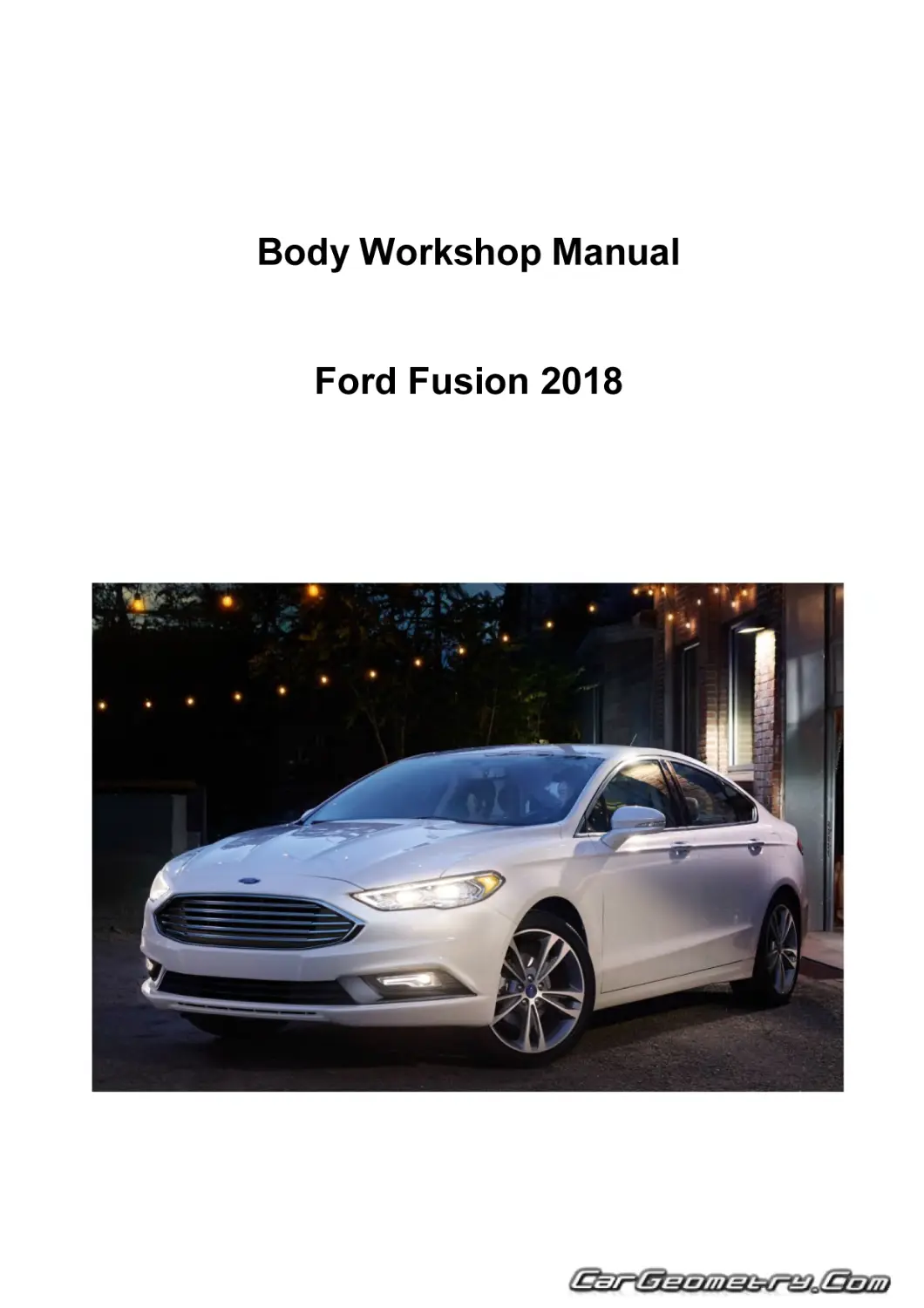
Body Workshop Manual
Ford Fusion 2018
Identification Codes
Vehicle Identification Number (VIN)
VIN Locator
The VIN is a 17-digit combination of letters and numbers. The VIN is stamped on a metal tab riveted to the instrument
panel, top upper left of the dash. The VIN is also found on the VC label. If the VIN plate requires replacement, authorized
dealers must contact their respective regional office.
VIN
Item
Description
1
WMI (World Manufacturer Identifier)
2
Restraint-type code
3
Vehicle line, series, body-type code
4
Engine-type code
5
Computer-generated check digit
6
Model year code
7
Assembly plant code
8
Production sequence number
World Manufacturer Identifier
The first 3 VIN positions are the WMI (World Manufacturer Identifier).
3FA - Ford Motor Company, Mexico, passenger car
Restraint Type
The fourth VIN position is the vehicle restraint type code.
6 - Active safety belts (all positions), driver and front passenger air bags, driver and front passenger side
impact air bags, driver knee bolster
Vehicle Line, Series and Body Type
Positions 5 through 7 indicate vehicle line, series and body type.
P0D - Fusion Titanium, AWD
P0G - Fusion S, FWD
P0H - Fusion SE, FWD
P0K - Fusion Titanium, FWD
P0L - Fusion SE, HEV, FWD
P0P - Fusion SE, PHEV, FWD
P0R - Fusion Titanium, HEV, FWD
P0S - Fusion Titanium, PHEV, FWD
P0T - Fusion SE, AWD
P0U - Fusion, S, FWD, HEV
P0V - Fusion, Sport, AWD
Engine Type
The eighth VIN position identifies the engine type, displacement and number of cylinders.
7 - 2.5L DOHC, 4-cylinder, gasoline
9 - 2.0L GTDI (gasoline turbocharged direct injection)
D - 1.5L GTDI (gasoline turbocharged direct injection)
P - 2.7L GTDI (gasoline turbocharged direct injection)
T - 2.5L DOHC, flex fuel
U - 2.0L DOHC, 4-cylinder, gasoline/electric
Check Digit
The ninth VIN position is a government-assigned, computer-generated check digit.
0-9
Model Year
The tenth VIN position is the model year code.
J - 2018
Assembly Plant
The eleventh VIN position is the assembly plant code.
R - Hermosillo Assembly, Mexico
Production Sequence Number
The last 6 VIN positions are a numeric code for the vehicle build sequence. This is also the vehicle serial and warranty
number. The serial number can also be found on the engine block, transmission and frame.
A00001-L99999
VC Codes
VC Label Locator
The VC label contains the manufacturer name, the month and year of manufacture, the certification statement and the
VIN. It also includes GVW and tire information. If a vehicle requires replacement of the VC label and is 4 years old or less,
an authorized dealer must submit the VIN to their respective regional office. The regional office will submit a web form to
the assembly plant for the replacement label. Once the label has been printed, a representative from the regional office
will deliver the label to the dealer and witness installation on the vehicle. If a vehicle is more than 4 years old and requires
a replacement label, the dealer must submit a request to the Department of Motor Vehicles.
VC Label
Item
Description
1
Exterior paint code
2
Region code
3
Domestic special order code
4
Interior trim code
5
Tape/paint stripe code
6
Radio code
7
Axle code
8
Transmission code
9
Spring code
10
Powertrain calibration information
Paint Code
Paint codes are listed as a 2-part code. The first set of paint code numbers/letters indicate the vehicle primary body color.
The second set of letters/numbers (if applicable) indicate a 2-tone or accent body color. All paint codes are a base
coat/clear coat finish.
G1 - Shadow Black
GN - White Gold
J7 - Magnetic
N6 - Blue Lightening
R3 - Burgundy Velvet Metallic (tinted clear-coat)
FT - Blue Metallic
RR - Ruby Red Metallic (tinted clear-coat)
UG - White Platinum Metallic (tri-coat)
UX - Ingot Silver
YZ - Oxford White
Interior Trim Codes
Interior trim codes are listed as a 2-part code. The first digit listed indicates the seat and fabric style. The second digit
listed indicates the interior trim color.
B - Salerno leather
C - Salerno leather #2
D - Axis cloth
K - Micro-perforated leather
M - Axis vinyl
P - Salerno with MIKO leather
Q - Luxury leather #3
Interior Trim Color Codes
C - Cocoa
E - Ebony/Medium Light Stone
M - Medium Soft Ceramic
Q - Medium Light Stone
S - Dark Earth Gray
T - Ebony
Tape/Paint Stripe Codes
Tape and paint stripe codes do not apply.
Radio Codes
The following lists available radio codes:
B - AM/ FM stereo, CD player, SDARS (Satellite Digital Audio Receiver System)
F - AM/ FM stereo, CD player
M - AM/ FM stereo, CD player, SDARS (Satellite Digital Audio Receiver System), HD (high-definition)
Transmission Codes
Available transmissions are as follows:
C - 6-speed automatic (6F55)
J - eCVT (electronic constant variable transmission), Powersplit automatic
W - 6-speed automatic (6F)
Spring Codes
Spring codes are listed as a 2-part code. The first set of characters identify the front springs. The second set of characters
identify the rear springs.
Front Spring Codes
Base part number - 5310
Rear Spring Codes
Base part number - 5560
Powertrain Calibration Information
NOTE: Powertrain calibration information is limited to a maximum of 5 characters per line on the VC label. Because of
this, calibration identification consisting of more than 5 characters will wrap to the second line on the VC label.
Powertrain calibration information is printed in the lower right corner of the VC label. Only the base calibration information
is printed. Revision levels will not appear, however, they can be obtained through a scan tool using the most current
software revision.
Item
Description
1
Model year (year in which the calibration strategy was first introduced).
2
Vehicle code
3
Transmission code
4
Unique calibrations (designates different hardware to similar vehicles), example: tires or drive ratios
5
Fleet code (describes fleet to which the vehicle belongs), example: 6 - EVAP
6
Certification region (lead region where multiple regions are included in one calibration), example: A - U.S. federal
7
Revision level (will advance as revisions occur), obtained through scan tool
Model Year
D - 2013
E - 2014
F - 2015
G - 2016
H - 2017
J - 2018
Vehicle Code
CC - Fusion
Transmission Code
1 - Automatic transmission
Unique Calibration
The Emission/Corporate Average Fuel Economy/CO2 Compliance Department is responsible for assigning these
calibration numbers. Unique identifications are assigned to cover similar vehicles to differentiate between tires, drive
configurations, final drive ratios and other calibration-significant factors. These 2 characters are chosen by the analyst to
provide identifiable information unique to each calibration. For example, using the number 2 to denote a 2- valve engine
versus using the number 4 to denote a 4-valve engine provides an easily identifiable difference.
Fleet Coding
0
1
2
3
4
5
6
7
8
9
- Certification (U.S. 4K, final sale in export markets)
- Heavy duty gas engine/Dyno
- Fast Automobile Manufacturers' Association, U.S.
- Alternative durability protocol, U.S.
- Not assigned
- Not assigned
- EVAP
- Mileage accumulation aging endurance durability
- OBD
- Not assigned
Certification Region
5 - U.S. 50 states
A - U.S. federal, including altitude, may include Canada and/or Mexico
B - U.S. California standard, includes U.S. green states
C - Canada
D - China
E - European Community - Austria, Belgium, Denmark, Finland, France, Germany, Greece, Ireland, Italy,
Luxembourg, Netherlands, Portugal, Spain, Sweden and UK (United Kingdom)
F - ECC (European Extended Community) - E-plus Croatia, Czech Republic, Estonia, Hungary, Norway,
Poland, Romania, Russian Federation, Slovakia, Slovenia, Switzerland and Yugoslavia
G - GCC (Gulf Cooperative Council) - Bahrain, Kuwait, Oman, Qatar, Saudi Arabia and UAE (United Arab
Emirates)
H - Hong Kong
J - Japan
K - Korea
L - Malaysia
M - Mexico
N - New Zealand
P - Australia
Q - South America (Brazil)
S - Singapore
T - Taiwan
U - South America (unleaded fuel regions)
V - Vietnam
X - Rest Of World
Y - Military
Z - Israel
Revision Level (not printed on label)
91-99 - Hardware and certification levels
01-04 - Preliminary levels
00 - Job 1 production (initial certification)
05-09 - Pre-job 1 revisions to calibrations
10-89 - Post-job 1 revisions to calibrations
0B - Durability test level
BD - OBD intermediate level (pre-05)
Specifications
General Specifications
Item
Specification
Plug Weld hole
8 mm (0.315 in)
Weld Wire ER70S-3
0.9 mm (0.0354 in) - 1.1 mm (0.0433 in)
Weld Wire ER70S-6
0.9 mm (0.0354 in) - 1.1 mm (0.0433 in)
Weld Nugget Chart
Test Thickness of Metal
Nugget Size
0.7 mm (0.0276 in) + 0.7 mm (0.0276 in)
4.3 mm (0.1693 in)
0.7 mm (0.0276 in) + 0.7 mm (0.0276 in) + 0.7 mm (0.0276 in)
4.3 mm (0.1693 in)
0.9 mm (0.0354 in) + 0.9 mm (0.0354 in)
4.7 mm (0.185 in)
0.9 mm (0.0354 in) + 0.9 mm (0.0354 in) + 0.9 mm (0.0354 in)
4.7 mm (0.185 in)
1 mm (0.0394 in) + 1 mm (0.0394 in)
5.2 mm (0.2047 in)
1 mm (0.0394 in) + 1 mm (0.0394 in) + 1 mm (0.0394 in)
5.2 mm (0.2047 in)
2 mm (0.0787 in) + 2 mm (0.0787 in)
7.1 mm (0.2795 in)
2 mm (0.0787 in) + 2 mm (0.0787 in) + 2 mm (0.0787 in)
7.1 mm (0.2795 in)
3 mm (0.1181 in) + 3 mm (0.1181 in)
8.7 mm (0.3425 in)
3 mm (0.1181 in) + 3 mm (0.1181 in) + 3 mm (0.1181 in)
8.7 mm (0.3425 in)
3 mm (0.1181 in) + 0.7 mm (0.0276 in)
4.3 mm (0.1693 in)
0.7 mm (0.0276 in) + 3 mm (0.1181 in) + 1 mm (0.0394 in)
5.2 mm (0.2047 in)
2 mm (0.0787 in) + 2 mm (0.0787 in) + 0.7 mm (0.0276 in)
4.3 mm (0.1693 in)
0.9 mm (0.0354 in) + 0.9 mm (0.0354 in) + 2 mm (0.0787 in)
4.7 mm (0.185 in)
2 mm (0.0787 in) + 0.9 mm (0.0354 in) + 1 mm (0.0394 in)
5.2 mm (0.2047 in)
1 mm (0.0394 in) + 3 mm (0.1181 in) + 1 mm (0.0394 in)
5.2 mm (0.2047 in)
3 mm (0.1181 in) + 1 mm (0.0394 in) + 2 mm (0.0787 in)
7.1 mm (0.2795 in)
0.9 mm (0.0354 in) + 0.7 mm (0.0276 in) + 0.9 mm (0.0354 in)
4.3 mm (0.1693 in)
a
Cold repairs can be performed if damage excludes kinks. May section only if approved procedure in workshop manual.
Metal Inert Gas (MIG) braze allowed for non-structural applications only.
c
Dual phase steels DP 700 class, DP 900 class and DP 1,000 class must be replaced at factory joints, no sectioning unless
approved procedure in workshop manual.
d
For DP 900, 1,000 and Boron use Metal Inert Gas (MIG) plug welding only, no stitch welding.
e
Boron and Ultra High Strength Steel (UHSS)-Mortensite components must be replaced at factory joints, no sectioning allowed.
b
Ford Recommended Steel Repairability Matrix
Grade
Trade Descriptions
Welding Method
MIG
SqueezeType
Resistance
Spot
Welding
(STRW)
Cold
Use of Temperature Maximum
Repairs Heat
Range
Heat
MIG
for
Braze
Repair
Mild Steel
Mild
Yes
Yes
N/A
Yesa
Yes
Up to 650° C
(1,200° F)
90
seconds x
2
Laminate Steel
Quiet Steel
No
Yes
No
Yesa
b
NA
NA
Yes
Up to 650° C
(1,200° F)
90
seconds x
2
Bake Hardened
Steel (BH)
Bake Hardened Steel (BH)
180, 200, 210, 220, 250,
280
Yes
Yes
Yes
Solid Solution
Strengthened
-
Yes
Yes
Yesb
Yesa
Yes
Up to 650° C
(1,200° F)
90
seconds x
2
High-Strength
Low Alloy
(HSLA)
High-Strength Low Alloy
Yes
(HSLA) 200, High-Strength
Low Alloy (HSLA 250, HighStrength Low Alloy (HSLA
260, High-Strength Low
Alloy (HSLA 300, HighStrength Low Alloy (HSLA
340, High-Strength Low
Alloy (HSLA 350, HighStrength Low Alloy (HSLA
500, High-Strength Low
Alloy (HSLA) 550
Yes
Yesb
Yesa
Yes
Up to 650° C
(1,200° F)
90
seconds x
2
Dual Phase
Steel (DP)
Dual Phase Steel (DP) 500, Yes
Dual Phase Steel (DP) 600
Yes
Yesb
Yesa
No
NA
NA
Dual Phase
Steel (DP)c
Dual Phase Steel (DP) 700, Yesd Yes
Dual Phase Steel (DP) 900
and Dual Phase Steel (DP)
1,000
Yesb
No
No
NA
NA
Ultra High
Strength Steel
(UHSS)
(Martensitic,
Boron)e
Boron, Martensitic
Yesa Yes
Yesb
No
No
NA
NA
Transformation
Induced
Plasticity Steel
(TRIP)
Transformation Induced
Plasticity Steel (TRIP) 590,
Transformation Induced
Plasticity Steel (TRIP) 780,
Transformation Induced
Plasticity Steel (TRIP) 980
NA
NA
NA
NA
NA
NA
NA
Yes
NA
a
Plastic Repairs
Plastic Components
The following illustration(s) are not all-inclusive of trim levels available. The actual trim level of the vehicle will determine
the viability of carrying out a plastics repair. Typically components with moulded-in color or a textured finish are not
considered repairable components.
Exterior Plastic Components - Front
Item
Service Part Number
Description
Torque
Material Name
Notes
1
17D957
Front bumper cover
-
TPO (Thermoplastic
Olefin)
-
2
5410176 Right Hand (RH) /5410177 Left Hand
(LH)
Rocker panel
moulding
-
TPO (Thermoplastic
Olefin)
-
Exterior Plastic Components - Rear
Item
Service Part Number
Description
Torque
Material Name
Notes
1
17K835
Rear bumper cover
-
TPO (Thermoplastic Olefin)
-
2
44210
Rear spoiler
-
ABS (Acrylonitrile Butadiene Styrene)
-
3
43400
Luggage compartment handle
-
TPO (Thermoplastic Olefin)
-
4
423A400
Lower finish panel
-
TPO (Thermoplastic Olefin)
-
Repair Considerations
Several considerations will determine viability of plastic repair procedure(s):
Is the damage cosmetic or structural?
Can the repair be carried out on the vehicle?
Is the part readily available?
Is component repair the most cost effective method?
Will the repair provide for the fastest, highest quality repair?
Several types of plastic are in use for automotive application. However, all plastics will fall into 2 primary categories of
thermoplastic or thermosetting plastic.
Thermosetting Plastic
Generally, thermosetting plastics are made with 2-part thermosetting resins. When mixed together, heat is generated,
producing a cure that is irreversible. Because of this, thermosetting plastics will require the use of a 2-part adhesive for
repair.
SMC (Sheet-Molded Composite):
SMC (Sheet-Molded Composite) is a type of thermosetting plastic that uses glass fibers or nylon fibers in
combination with thermosetting polyester resins. When fully cured, SMC (Sheet-Molded Composite) is strong
and rigid.
SMC (Sheet-Molded Composite) is similar to, but not identical to fiberglass. Ford Motor Company uses SMC
(Sheet-Molded Composite) in components such as fenders, hoods and liftgates.
Thermoplastic Compounds
Thermoplastic compounds are manufactured by a process that is reversible. Thermoplastics can be remolded repeatedly
by reheating. This characteristic of thermoplastics makes plastic welding a possible repair alternative. A repair of
thermoplastic compounds is still possible through the use of a 2-part adhesive and filler repair materials and
reinforcements as needed. Thermoplastics are widely used in interior trim components, wheel flares, body side cladding
and bumper covers.
Polyolefin
Polyolefins fall into the family of thermoplastics with one unique characteristic: an oily or waxy feel to the material when
sanded or ground. Polyolefin lends itself very well to remolding through the use of heat. Because of this, components
made of this material lend themselves well to the possibility of plastic welding. Most adhesive repair materials and paint
will not bond to the surface of a polyolefin unless an adhesion promoter specially formulated for plastic is first applied to
the exposed raw surface. Otherwise, polyolefins are repaired like most other thermoplastics. Polyolefins are used in
bumper covers, fan shrouds and wheel housings.
Proper identification of the various types of plastic is necessary to select the appropriate repair method(s) to carry out high
quality plastic repairs.
For additional information, refer to: Plastic Repairs (501-25 Body Repairs - General Information, General Procedures).
Sealer, Underbody Protection Material and Adhesives
Adhesives
NOTE: The following illustrations are examples of structural adhesive application and are not all inclusive.
Body Side Outer to Body Side Inner
NOTE: Left Hand (LH) side shown, Right Hand (RH) side similar.
Hood
Front Door
Rear Door
Luggage Compartment
The correct adhesive bonding is essential to repairing the vehicle correctly. Adhesives are used in many areas of the body
structure in place of welding. In addition to providing a structural bond between component, adhesives can also help
prevent wind noise, water leaks, exhaust fumes and dust from entering the vehicle. They also provide anti-corrosion
barriers.
Sealers
NOTE: The following illustrations are examples of sealer application and are not all inclusive.
Roof Panel
NOTE: Roof panel without roof opening panel shown, roof with roof opening panel is the same.
Hood
Front Door
Rear Door
Luggage Compartment Lid
Floor Pan
The correct sealing of joints is essential to repairing the vehicle correctly. Sealers are used to prevent wind noise, water
leaks, exhaust fumes and dust from entering the vehicle. They also provide anti-corrosion barriers. Sealers are applied to
areas such as door and rear compartment hem flanges, wheelhouse, quarter outer, floor, cowl, roof and other panel-topanel attaching points. The following joint sealers are recommended for use depending upon the application:
Seam Sealer - Heavy-bodied, non-sag adhesive/sealer for use on standing cosmetic seams, truck bed seams,
tooled door skin seams and floor pans.
Sealers should remain flexible after curing and must be paintable. Follow the manufacturer's directions for correct
application of these materials.
Any damage to originally sealed joints should be repaired by resealing. Along with attaching points of new panels, open
joints that require bridging of sealer to close a gap should be sealed using a heavy-bodied sealer.
Noise, Vibration and Harshness
Sound Deadeners and Insulators
NOTICE: Mastic is made of a combustible material and should be removed prior to carrying out welding
procedures to the area. Heat zones from welding near mastic may cause the mastic material to burn.
NOTICE: Corrosion protection must be restored to the area after the mastic material is applied. Corrosion
protection products may be wax based and loss of adhesion may occur if applied prior to mastic installation.
NOTE: The following illustrations serve as a reference to indicate mastic patch (butyl) locations. Additional insulators and
sound deadeners are used beyond those indicated in these illustrations.
Floor Pan
Roof Panel
Roof Panel with Roof Opening Panel
Front Door
Rear Door
Body and Frame
Body
WARNING: Never install used or reconditioned parts (as specified below) from pre-owned, salvaged or
damaged vehicles. The use of such parts could lead to serious injury. Never use non-Ford parts or accessories
for completing repairs. Ford Motor Company does not approve or recognize body and structural repair
procedures, tools, parts or anything but new genuine Ford equipment. Ford cannot attest to the safety, quality,
durability or legality of non-Ford parts or accessories. Use of such parts could lead to serious personal injury as
they may contain damage which is not visible. Ford does not approve use of the following: Salvaged or used
parts Major body clips or assemblies from salvage vehicles Aftermarket structural or body components Salvaged
or reconditioned wheels Used Supplemental Restraint System (SRS) components air bags restraint system
modules safety belts, buckles or retractors crash sensors Returning a vehicle to pre-accident condition can only
be assured if repair procedures are carried out by skilled technicians using new genuine Ford parts and Fordapproved methods. Structural component repair procedures approved by Ford, using genuine Ford parts, have
been validated by Ford Motor Company engineers. Ford Motor Company does not endorse, cannot attest to, and
makes no representations regarding structural repairs (frames, rails, aprons and body panels) carried out using
non-genuine Ford Motor Company parts or non-Ford-approved methods. In particular, Ford makes no
representations that the vehicle will meet any crash safety or anti-corrosion performance requirement. Such
parts and methods have not been tested by Ford, and may not meet Ford's requirements for safety, performance,
strength, quality, durability and corrosion protection. Ford Motor Company bears no responsibility or liability of
any kind if repairs are performed using alternative structural component repair procedures and/or parts.
The body consists of the following:
High-Strength Low Alloy (HSLA), high-strength, ultra high strength steel (UHSS) and mild steels
Roof outer panel constructed of bake hardened (BH) steel
Aluminum hood
Steel luggage compartment lid
Body side outer panels constructed of mild steel
Dual Phase Steel (DP) in select body structure components
Bolted, removable front fenders, hinged doors and hood
Dent resistant steel fenders
Front and rear subframe assemblies housing suspension and steering components
Underbody components constructed of mild, dual-phase and high-strength steels
Mastic pad material used on floor pan and roof panel for sound deadening
Body Dimensions
Body Margins - Front Panels
NOTE: All margins must be parallel within 1.0 mm unless otherwise noted for sheet metal-to-sheet metal interfaces only.
NOTE: Unless otherwise indicated, margin dimensions apply to RH and LH side of vehicle.
Item
1
Description
Margin Specification
Flushness Specification
Hood-to-fascia
3.5 mm ± 2.0 mm (Parallelism within 0.0 mm ±
2.0 mm)
0.75 mm ± 2.2 mm
2
Headlamp-to-hood
5.0 mm
1.9 mm ± 2.2 mm
3
Hood-to-fender
3.0 mm ± 1.7 mm
(Hood overflush to fender) 0.3 mm ± 1.8
mm
4
Hood-to-fender
3.0 mm ± 1.7 mm
(Hood underflush to fender) 2.4 mm ±
1.8 mm
5
Hood-to-A-pillar
4.1 mm ± 1.9 mm
0.5 mm ± 1.8 mm
6
Hood-to-A-pillar
3.2 mm ± 1.9 mm
0.5 mm ± 2.4 mm
7
Fender-to-A-pillar
3.0 mm ± 1.5 mm
—
8
Fender-to-front door
3.4 mm ± 1.5 mm
0.75 mm ± 1.5 mm
9
Headlamp-to-front
fender
2.0 mm ± 1.9 mm
0.0 mm ± 2.0 mm
10
Fascia-to-fender
0.0 mm ± 0.5 mm
0.75 mm ± 1.5 mm
11
Headlamp-to-fascia
2.0 mm ± 1.2 mm
—
Body Margins - Fender Triangle
NOTE: All margins must be parallel within 1.0 mm unless otherwise noted for sheet metal-to-sheet metal interfaces only.
NOTE: Unless otherwise indicated, margin dimensions apply to RH and LH side of vehicle.
Item
1
Description
A-pillar-to-fender
triangle
Margin Specification
2.0 mm (Margin varies 8.6 mm to 9.1 mm
between point A and point B)
Flushness Specification
Flushness varies from 4.6 mm to 3.1 mm
between point A and point B
2
Glass run-to-division bar 0.7 mm ± 0.0 mm
—
3
A-pillar-to-glass run
channel
9.0 mm ± 2.7 mm
2.7 mm (Flushness varies 3.1 mm to 1.3 mm
between point C and point D)
4
Fender triangle-to-glass
run channel
3.0 mm ± 1.7 mm
0.0 mm ± 2.7 mm
5
Fender triangle-to-fixed
glass
4.5 mm ± 2.7 mm
1.5 mm ± 2.7 mm
6
Fender triangle-to-belt
moulding
4.5 mm ± 2.7 mm
0.0 mm ± 2.7 mm
Body Margins - Side Panels
NOTE: All margins must be parallel within 1.0 mm unless otherwise noted for sheet metal-to-sheet metal interfaces only.
NOTE: Unless otherwise indicated, margin dimensions apply to RH and LH side of vehicle.
Item
Description
Margin Specification
Flushness Specification
1
Front door-to-bodyside
9.0 mm ± 2.7 mm
1.0 mm ± 2.7 mm
2
Bodyside-to-roof
—
6.0 mm (Reference)
3
Front door glass run-to-rear door glass run
4.5 mm ± 2.7 mm
0.0 mm ± 2.7 mm
4
Rear quarter glass moulding-to-rear glass run
4.5 mm ± 2.7 mm
0.0 mm ± 2.7 mm
5
Rear door C-pillar applique-to-quarter glass
4.5 mm ± 2.7 mm
5.0 mm ± 2.7 mm
6
Rear door belt moulding-to-rear quarter glass moulding
4.5 mm ± 2.7 mm
0.0 mm ± 2.7 mm
7
Rear door-to-bodyside quarter panel
3.4 mm ± 1.5 mm
0.0 mm ± 1.5 mm
8
Rear door-to-rocker moulding
6.0 mm (Reference)
- 3.0 mm (Reference)
9
Front door-to-rear door
3.4 mm ± 1.5 mm
0.75 mm ± 1.5 mm
10
Front door belt moulding-to-rear door belt moulding
4.5 mm ± 2.7 mm
0.0 mm ± 2.7 mm
11
Front door applique-to-rear door applique
4.5 mm ± 2.7 mm
0.0 mm ± 2.7 mm
12
Front door-to-rocker moulding
6.0 mm (Reference)
- 3.0 mm (Reference)
Body Margins - Rear Panels
NOTE: All margins must be parallel within 1.0 mm unless otherwise noted for sheet metal-to-sheet metal interfaces only.
NOTE: Unless otherwise indicated, margin dimensions apply to RH and LH side of vehicle.
Item
Description
Margin Specification
Flushness Specification
1
Bodyside-to-decklid
3.0 mm ± 1.5 mm
0.75 mm ± 2.0 mm
2
Luggage compartment lid-to-applique
0.7 mm + 1.2 mm / -0.7 mm 0.0 mm ± 1.4 mm
3
Rear closure applique-to-rear closure chrome applique
1.0 mm ± 1.0 mm
3.2 mm ± 1.4 mm
4
Luggage compartment lid-to-fascia
6.0 mm ± 3.5 mm
—
5
Luggage compartment lid lower finish panel-to-fascia side
5.0 mm ± 3.3 mm
2.0 mm ± 3.5 mm
Body Margins - Rear Spoiler and Lamps
NOTE: All margins must be parallel within 1.0 mm unless otherwise noted for sheet metal-to-sheet metal interfaces only.
NOTE: Unless otherwise indicated, margin dimensions apply to RH and LH side of vehicle.
Item
Description
Margin Specification
Flushness Specification
1
Rear lamp-to-bodyside
1.5 mm ± 1.2 mm
—
2
Spoiler-to-luggage compartment lid
1.1 mm ± 1.0 mm
2.5 mm ± 2.0 mm
3
Spoiler-to-luggage compartment lid
0.5 mm
3.2 mm ± 2.0 mm
4
Luggage compartment lid upper-to-luggage
compartment lid lamp
1.5 mm ± 1.2 mm
—
5
Rear closure chrome applique-to-luggage
compartment lid lamp
1.6 mm ± 1.6 mm
0.0 mm ± 1.6 mm
6
Rear closure chrome applique-to-luggage
compartment lid lamp
1.0 mm ± 1.0 mm
—
7
Luggage compartment lid handle-to-luggage
compartment lid lamp lens
1.3 mm + 1.4 mm / 1.3 mm
—
8
Luggage compartment lid lamp-to-luggage
compartment lid lower finish panel
2.0 mm ± 2.0 mm
—
9
Luggage compartment lid lamp-to-rear lamp
3.5 mm ± 2.8 mm
1.5 mm ± 2.7 mm (Luggage
compartment lid lamp underflush)
10
Luggage compartment lid lamp-to-rear lamp
3.5 mm ± 2.8 mm
1.0 mm ± 2.7 mm
11
Bodyside lower-to-luggage compartment lid
3.3 mm ± 1.5 mm
1.0 mm ± 2.0 mm
12
Rear lamp-to-rear fascia
2.0 mm ± 1.9 mm
—
13
Bodyside-to-rear fascia
0.5 mm
0.75 mm ± 1.5 mm
14
Fuel door-to-bodyside
2.2 mm ± 1.2 mm
1.0 mm ± 1.4 mm
Under Hood Dimensions
NOTE: All measurements are on center unless otherwise indicated.
Front Door Opening Dimensions
NOTE: All measurements are on center unless otherwise indicated.
Luggage Compartment Opening Dimensions
NOTE: All measurements are on center unless otherwise indicated.
Under Body Measurements
NOTE: All measurements are on center unless otherwise indicated.
Datum Height Dimensions
NOTE: Measurements indicated below door frame openings obtained from center floor rail.
Vehicle Specific Body Construction
Before cutting or welding,
For additional information, refer to: Specifications (501-25 Body Repairs - General Information, Specifications).
Bumper Beams
Bumper beams are typically constructed of HS (high-strength) or stronger class steel. If the bumper beam shows
evidence of a kink or tear it is not repairable and must be replaced. The use of heat to repair these components is not
allowed and will result in weakening the component. Minor damage made be corrected through cold straightening only.
Steel Type Legend
Item
Steel Type
Color
1
Mild Steel
Yellow
2
Bake Hardened (BH)
Light Blue
3
Solid Solution Strength
Pink
4
High Strength Low Allow (HSLA)
Dark Blue
5
Dual Phase (DP) 500, 600 Class Steel
Green
6
Dual Phase (DP) 700, 800, 900, 1000 Class Steel
Fuchsia
7
Laminate Steel
Teal
8
Ultra High Strength Steel (UHSS) Martensitic, Boron
Red
9
Transformation Induced Plasticity Steel (TRIP)
Gold
10
Aluminum
Purple
Hood
Item
Description
Steel Type
1
Hood inner panel
Aluminum
2
Hood outer panel
Aluminum
Roof Panel
Item
Description
Steel Type
1
Windshield header reinforcement
DP (Dual Phase) 780 steel
2
Roof panel
BH (Bake Hardened) 210 steel
3
Rear header reinforcement
HSLA (High-Strength Low Alloy) 350 steel
4
Center roof reinforcement
Martensitic steel
Roof with Roof Opening Panel
Item
Description
Steel Type
1
Windshield header reinforcement
DP (Dual Phase) 780 steel
2
Roof panel
BH (Bake Hardened) 210 steel
3
Rear header reinforcement
HSLA (High-Strength Low Alloy) 350 steel
4
Roof opening panel reinforcement
Boron steel
Front Door
Item
Description
Steel Type
1
Door outer panel
BH (Bake Hardened) 210 steel
2
Intrusion beam (part of door shell)
Boron steel
3
Door shell
Mild steel
Rear Door
Item
Description
Steel Type
1
Door outer panel
BH (Bake Hardened) 210 steel
2
Intrusion beam (part of door shell)
Boron steel
3
Door shell
Mild steel
Luggage Compartment Lid
Item
Description
Steel Type
1
Luggage compartment lid inner panel
Mild steel
2
Luggage compartment lid outer panel
Mild steel
Front Structure
Item Description
Steel Type
1
Bumper bracket
HSLA (high strength low alloy) 350 steel
2
Brace (part of front apron assembly)
DP (Dual Phase) 800 steel
3
Reinforcement (part of front apron assembly)
HSLA (High-Strength Low Alloy) 350 steel
4
Apron assembly inner reinforcement
BH (bake hardened) 210 steel
5
Apron assembly outer reinforcement
HSLA (High-Strength Low Alloy) 350 steel
6
Front fender bracket
BH (bake hardened) 210 steel
7
Inner reinforcement (part of front side member assembly)
DP (Dual Phase) 600 steel
8
Strut tower (part of front apron assembly)
Solid Solution Strength Steel and mild steel
9
Outer reinforcement (part of front side member assembly)
DP (Dual Phase) 600 steel
10
Reinforcement (part of front side member assembly)
DP (Dual Phase) 600 steel
11
Bracket
HSLA (High-Strength Low Alloy) 300 steel
12
Cross member assembly
Mild steel
Bodyside Inner Panels
Item
Description
Steel Type
1
A-pillar reinforcement
DP (Dual Phase) 600 steel
2
Roof reinforcement
DP (Dual Phase) 1000 steel
3
Reinforcement
HSLA (High-Strength Low Alloy) 350 steel
4
B-pillar reinforcement
HSLA (High-Strength Low Alloy) 350 steel
5
Reinforcement
HSLA (High-Strength Low Alloy) 350 steel
6
Quarter panel inner reinforcement
DP (Dual Phase) 600 steel
7
B-pillar reinforcement
DP (Dual Phase) 800 steel
8
B-pillar reinforcement
DP (Dual Phase) 800 steel
9
Rocker panel inner reinforcement
DP (Dual Phase) 600 steel
10
Rocker panel inner reinforcement
DP (Dual Phase) 600 steel
11
Rocker panel inner reinforcement
DP (Dual Phase) 600 steel
12
A-pillar inner reinforcement
DP (Dual Phase) 600 steel
13
Cowl side panel reinforcement
DP (Dual Phase) 600 steel
14
Cowl side panel reinforcement
DP (Dual Phase) 600 steel
15
A-pillar upper reinforcement
DP (Dual Phase) 600 steel
16
B-pillar inner reinforcement
HSLA (High-Strength Low Alloy) 350 steel
17
B-pillar inner reinforcement
DP (Dual Phase) 800 steel
Quarter Panel and Rear Panel
Item
Description
Steel Type
1
Quarter panel and wheelhouse
Mild steel
2
Reinforcement
Mild steel
3
Reinforcement
Mild steel
4
Tail lamp panel
Mild steel
5
Rear panel reinforcement
Mild steel
6
Rear panel
Mild steel
7
Rear panel inner
Mild steel
8
Luggage compartment drain trough
Mild steel
9
Inner wheel house
Mild steel
Front Floor
Item Description
Steel Type
1
Floor pan assembly
Mild, HSLA (High-Strength Low Alloy) 350, DP (Dual Phase) 800 steel and BH (Bake
Hardened) 280 steel
2
Center floor
reinforcement
BH (Bake Hardened) 280 steel
3
Center floor
reinforcement
DP (Dual Phase) 600 steel
4
Center floor
reinforcement
DP (Dual Phase) 600 steel
5
Center floor
reinforcement
BH (Bake Hardened) 280 steel
Rear Floor
Item Description
Steel Type
1
Floor pan reinforcements (part of floor pan
assembly)
HSLA (High-Strength Low Alloy) 350, DP (Dual Phase) 600 and DP
(Dual Phase) 800 steel
2
Floor side member
DP (Dual Phase) 600 steel
3
Floor pan
Mild steel
4
Floor side member
DP (Dual Phase) 600 steel
Body Panel Sectioning
Special Tool(s) / General Equipment
Resistance Spotwelding Equipment
Spherical Cutter
Plasma Cutter
Air Body Saw
MIG/MAG Welding Equipment
Spot Weld Drill Bit
Materials
Name
Specification
Seam Sealer
TA-2-B, 3M™ 08308, LORD Fusor® 805DTM
Repair
NOTICE: Do not begin to removal of the vehicle body side until the replacement panel is available for reference.
1.
WARNING: Before beginning any service procedure in this section, REFER to Safety Warnings in
section 100-00 General Information. Failure to follow this instruction may result in serious personal
injury.
Follow the health and safety precautions.
Refer to: Health and Safety Precautions (100-00 General Information, Description and Operation).
2. Detrim the vehicle as necessary and remove spot welds from the damaged area.
Use the General Equipment: Spot Weld Drill Bit
3. Body side replacement panels are released as 2-part panels. Only remove as much of the body side as
necessary.
Refer to: Body and Frame (501-26 Body Repairs - Vehicle Specific Information and Tolerance Checks) .
Use the General Equipment: Air Body Saw
Use the General Equipment: Plasma Cutter
4. As a general rule, sectioning cut points should be chosen to result in the smallest repair area possible.
Use the General Equipment: Air Body Saw
Use the General Equipment: Plasma Cutter
Use the General Equipment: Spherical Cutter
5. NOTE: Use resistance spotwelding equipment where possible. This will produce a higher quality repair.
NOTE: When welding overlapping surfaces or substrates, apply a high quality weld-through primer between
the surfaces prior to welding.
Where possible, create a lap-joint backer plate using a portion of the old panel. This will create a stronger joint.
Use the General Equipment: Resistance Spotwelding Equipment
Use the General Equipment: MIG/MAG Welding Equipment
6. Rough finish all sectioning joints with a fibre-based body filler, final finish sectioning joints and plug welds with a
conventional body filler.
7. Properly seal all horizontal joints to prevent moisture intrusion. Water and moisture migrate toward horizontal
joints and corrosion tends to occur more rapidly in these areas.
Material: Seam Sealer / TA-2-B, 3M™ 08308, LORD Fusor® 805DTM
8. Proceed with the refinishing process using a Ford approved paint system and manufacturers
recommendations.
9. Restore corrosion protection.
Refer to: Corrosion Prevention (501-25 Body Repairs - General Information, General Procedures).
10. Reapply vehicle trim as necessary.
Front Side Member Section
Special Tool(s) / General Equipment
Resistance Spotwelding Equipment
Air Body Saw
8 mm Drill Bit
MIG/MAG Welding Equipment
Spot Weld Drill Bit
Locking Pliers
Materials
Name
Specification
Seam Sealer
TA-2-B, 3M™ 08308, LORD Fusor® 805DTM
Removal
NOTE: The required partial replacement sections need to be cut out from the outer side member with apron panel or from
the inner side member.
1.
WARNING: Before beginning any service procedure in this section, refer to Safety Warnings in
section 100-00 General Information. Failure to follow this instruction may result in serious personal
injury.
Follow the health and safety precautions.
Refer to: Health and Safety Precautions (100-00 General Information, Description and Operation).
2. Remove the following items.
Refer to: Fender Apron Panel Reinforcement (501-27 Front End Sheet Metal Repairs, Removal and
Installation).
Refer to: Front Bumper (501-19 Bumpers, Removal and Installation).
Refer to: Engine (303-01C Engine - 2.5L Duratec (125kW/170PS), Removal).
Refer to: Radiator (303-03B Engine Cooling - 2.0L EcoBoost (184kW/250PS) - MI4, Removal and Installation).
Refer to: Radiator (303-03C Engine Cooling - 2.5L Duratec (125kW/170PS), Removal and Installation).
NOTICE: Due to the positions of inner reinforcements and laser weld seams it is important to follow indicated
dimensions of cut points.
3. NOTE: Sectioning cut locations apply to right hand (RH) and left hand (LH) side.
NOTE: Overview of possible sectioning locations. Do not cut within 40 mm of laser welded seam.
1. Long section measurement.
2. Short section measurement.
3. Laser welded seam.
4. Carefully cut the front side member frame rail.
Use the General Equipment: Air Body Saw
5. Drill out the spot welds.
Use the General Equipment: Spot Weld Drill Bit
6. Drill out the spot welds and remove the front side member section.
Use the General Equipment: Spot Weld Drill Bit
Installation
WARNING: Before beginning any service procedure in this section, refer to Safety Warnings in section 10000 General Information. Failure to follow this instruction may result in serious personal injury.
NOTE: The required partial replacement section needs to cut out from the service replacement part.
1. Cut replacement assembly to fit repair.
Use the General Equipment: Air Body Saw
2. NOTE: Indicated holes will be used for puddle welding.
1. Install the spot welds.
Use the General Equipment: 8 mm Drill Bit
3. Install and properly position the component and install spot welds.
Use the General Equipment: Resistance Spotwelding Equipment
Use the General Equipment: Locking Pliers
4. Seam weld as indicated.
Use the General Equipment: MIG/MAG Welding Equipment
5. Install spot welds.
Use the General Equipment: Resistance Spotwelding Equipment
Use the General Equipment: MIG/MAG Welding Equipment
6. Install the bumper bracket and spot weld.
Use the General Equipment: Resistance Spotwelding Equipment
7. Finish the repair area using typical metal finishing procedures.
8. Sealing work: All areas must be sealed to production level.
Material: Seam Sealer / TA-2-B, 3M™ 08308, LORD Fusor® 805DTM
9. Refinish using a Ford approved paint system.
10. Restore corrosion protection.
Refer to: Corrosion Prevention (501-25 Body Repairs - General Information, General Procedures).
11. Install the following items.
Refer to: Fender Apron Panel Reinforcement (501-27 Front End Sheet Metal Repairs, Removal and
Installation).
Refer to: Front Bumper (501-19 Bumpers, Removal and Installation).
Refer to: Engine (303-01C Engine - 2.5L Duratec (125kW/170PS), Installation).
Refer to: Radiator (303-03B Engine Cooling - 2.0L EcoBoost (184kW/250PS) - MI4, Removal and Installation).
Refer to: Radiator (303-03C Engine Cooling - 2.5L Duratec (125kW/170PS), Removal and Installation).
Fender Apron Panel Reinforcement
Special Tool(s) / General Equipment
Resistance Spotwelding Equipment
Spherical Cutter
Grinder
8 mm Drill Bit
MIG/MAG Welding Equipment
Spot Weld Drill Bit
Locking Pliers
Materials
Name
Specification
Seam Sealer
TA-2-B, 3M™ 08308, LORD Fusor® 805DTM
Removal
1.
WARNING: Before beginning any service procedure in this section, refer to Safety Warnings in
section 100-00 General Information. Failure to follow this instruction may result in serious personal
injury.
Follow the health and safety precautions.
Refer to: Health and Safety Precautions (100-00 General Information, Description and Operation).
2. Remove the following items.
Refer to: Fender (501-02 Front End Body Panels, Removal and Installation).
Refer to: Battery Tray (414-01 Battery, Mounting and Cables, Removal and Installation).
Refer to: Front Bumper Cover (501-19 Bumpers, Removal and Installation).
Refer to: Front Door (501-03 Body Closures, Removal and Installation).
3. Drill out the spot welds.
Use the General Equipment: Spot Weld Drill Bit
4. Grind welds at rear flange of the apron reinforcement panel and remove the spot welds.
Use the General Equipment: Spot Weld Drill Bit
Use the General Equipment: Grinder
5. Remove the fender apron reinforcement panel.
6. Drill out the spot welds.
Use the General Equipment: Spot Weld Drill Bit
7. Remove the fender apron reinforcement and bracket.
Installation
1. Drill plug welds holes in replacement panel.
Use the General Equipment: 8 mm Drill Bit
2. Install and plug weld the fender apron reinforcement bracket.
Use the General Equipment: MIG/MAG Welding Equipment
Use the General Equipment: Locking Pliers
3. Drill plug weld holes and cut seam weld grooves in replacement panel.
Use the General Equipment: 8 mm Drill Bit
Use the General Equipment: Spherical Cutter
4. Install the fender apron reinforcement panel and plug welds.
Use the General Equipment: Locking Pliers
Use the General Equipment: MIG/MAG Welding Equipment
5. Install spot welds.
Use the General Equipment: Resistance Spotwelding Equipment
6. Sealing work: All areas must be sealed to production level.
Material: Seam Sealer / TA-2-B, 3M™ 08308, LORD Fusor® 805DTM
7. Refinish the repair area using a Ford approved paint system.
8. Restore corrosion protection.
Refer to: Corrosion Prevention (501-25 Body Repairs - General Information, General Procedures).
9. Install the following items.
Refer to: Fender (501-02 Front End Body Panels, Removal and Installation).
Refer to: Battery Tray (414-01 Battery, Mounting and Cables, Removal and Installation).
Refer to: Front Bumper Cover (501-19 Bumpers, Removal and Installation).
Refer to: Front Door (501-03 Body Closures, Removal and Installation).
Refer to: Front Door Alignment (501-03 Body Closures, General Procedures).
Front Side Member and Fender Apron Panel LH
Special Tool(s) / General Equipment
Resistance Spotwelding Equipment
Hot Air Gun
Air Body Saw
8 mm Drill Bit
MIG/MAG Welding Equipment
Spot Weld Drill Bit
Materials
Name
Specification
Metal Bonding Adhesive
TA-1, TA-1-B, 3M™ 08115, LORD Fusor® 108B
Seam Sealer
TA-2-B, 3M™ 08308, LORD Fusor® 805DTM
-
Removal
1.
WARNING: Before beginning any service procedure in this section, refer to Safety Warnings in
section 100-00 General Information. Failure to follow this instruction may result in serious personal
injury.
Follow the health and safety precautions.
Refer to: Health and Safety Precautions (100-00 General Information, Description and Operation).
2. Remove the following items.
Refer to: Fender Apron Panel Reinforcement (501-27 Front End Sheet Metal Repairs, Removal and
Installation).
Refer to: Engine (303-01 Engine - 2.5L Duratec (125kW/170PS)) .
Refer to: Radiator (303-03 Engine Cooling - 1.6L EcoBoost (132kW/180PS) - Sigma) .
Refer to: Radiator (303-03 Engine Cooling - 2.0L EcoBoost (184kW/250PS) - MI4) .
Refer to: Radiator (303-03C Engine Cooling - 2.5L Duratec (125kW/170PS), Removal and Installation).
Refer to: Instrument Panel (501-12 Instrument Panel and Console) .
Refer to: Front Impact Severity Sensor (501-20 Supplemental Restraint System) .
Refer to: A-Pillar Trim Panel (501-05 Interior Trim and Ornamentation) .
Refer to: Restraints Control Module (RCM) (501-20B Supplemental Restraint System, Removal and
Installation).
Refer to: Front Seat (501-10A Front Seats, Removal and Installation).
3. Reposition the carpet and wiring harness away from the working area.
4. Drill out the spot welds.
Use the General Equipment: Spot Weld Drill Bit
5. Drill out the spot welds.
Use the General Equipment: Spot Weld Drill Bit
6. Drill out the spot welds and remove the front side member.
Use the General Equipment: Spot Weld Drill Bit
7. Drill out the spot welds.
Use the General Equipment: Spot Weld Drill Bit
8. NOTE: A partial section needs to be cut out at the apron panel to remove side member with the apron panel.
Carefully cut the partial section from the apron panel.
Use the General Equipment: Air Body Saw
9. Remove the fender apron reinforcement panel.
Use the General Equipment: Hot Air Gun
Installation
1. Assure correct placement of all components.
Refer to: Body and Frame (501-26) .
2. Drill plug welds holes in replacement panel.
Use the General Equipment: 8 mm Drill Bit
3. NOTE: A partial section needs to be cut out at the apron panel to enable installation of the side member.
Carefully cut the partial section from the apron panel.
Use the General Equipment: Air Body Saw
4. Drill plug welds holes in replacement panel.
Use the General Equipment: 8 mm Drill Bit
5. Install the front side member and properly position.
6. Refer to: Body and Frame (501-26) .
7. Apply adhesive at the cut portion.
Material: Metal Bonding Adhesive / TA-1, TA-1-B, 3M™ 08115, LORD Fusor® 108B
8. Install spot welds.
Use the General Equipment: MIG/MAG Welding Equipment
Use the General Equipment: 8 mm Drill Bit
9. NOTE: In order to ensure that complete sealing is achieved, the remaining openings on the mount tube for the
instrument panel bracket need to be sealed with body sealant.
Seam weld and apply sealant as indicated.
Use the General Equipment: MIG/MAG Welding Equipment
Material: Seam Sealer / TA-2-B, 3M™ 08308, LORD Fusor® 805DTM
10. Install plug welds.
Use the General Equipment: MIG/MAG Welding Equipment
11. Install spot welds.
Use the General Equipment: Resistance Spotwelding Equipment
12. Install plug welds.
Use the General Equipment: MIG/MAG Welding Equipment
13. Install spot welds.
Use the General Equipment: Resistance Spotwelding Equipment
14. Install spot welds.
Use the General Equipment: Resistance Spotwelding Equipment
15. Install the bumper bracket and spot weld.
Use the General Equipment: Resistance Spotwelding Equipment
16. Finish the repair area using typical metal finishing procedures.
17. Sealing work: All areas must be sealed to production level.
Material: Seam Sealer / TA-2-B, 3M™ 08308, LORD Fusor® 805DTM
18. Refinish using a Ford Motor Company approved paint system.
19. Restore corrosion protection.
Refer to: Corrosion Prevention (501-25 Body Repairs - General Information, General Procedures).
20. Reposition the carpet and wiring harness.
21. Install the following items.
Refer to: Fender Apron Panel Reinforcement (501-27 Front End Sheet Metal Repairs, Removal and
Installation).
Refer to: Engine (303-01 Engine - 1.6L EcoBoost (132kW/180PS) - Sigma) .
Refer to: Engine (303-01 Engine - 1.6L EcoBoost (132kW/180PS) - Sigma) .
Refer to: Engine (303-01 Engine - 2.5L Duratec (125kW/170PS)) .
Refer to: Radiator (303-03 Engine Cooling - 1.6L EcoBoost (132kW/180PS) - Sigma) .
Refer to: Radiator (303-03 Engine Cooling - 2.0L EcoBoost (184kW/250PS) - MI4) .
Refer to: Radiator (303-03C Engine Cooling - 2.5L Duratec (125kW/170PS), Removal and Installation).
Refer to: Instrument Panel (501-12 Instrument Panel and Console) .
Refer to: Front Impact Severity Sensor (501-20 Supplemental Restraint System) .
Refer to: A-Pillar Trim Panel (501-05 Interior Trim and Ornamentation) .
Refer to: Restraints Control Module (RCM) (501-20B Supplemental Restraint System, Removal and
Installation).
Refer to: Front Seat (501-10A Front Seats, Removal and Installation).
Roof Panel
Special Tool(s) / General Equipment
Resistance Spotwelding Equipment
Spherical Cutter
Grinder
Knife
Spot Weld Drill Bit
Locking Pliers
Materials
Name
Specification
Metal Bonding Adhesive
TA-1, TA-1-B, 3M™ 08115, LORD Fusor® 108B
Seam Sealer
TA-2-B, 3M™ 08308, LORD Fusor® 805DTM
-
Flexible Foam Repair
3M™ 08463, LORD Fusor® 121
-
Removal
1. NOTICE: Before beginning any service procedure in this section, refer to Safety Warnings in section
100-00 General Information. Failure to follow this instruction may result in serious personal injury.
NOTICE: Adequately protect all glass, exterior finish and interior trim from contamination during entire
repair procedure.
Remove the following items:
1. Refer to: Health and Safety Precautions (100-00 General Information, Description and Operation).
2. Depower the SRS.
Refer to: Supplemental Restraint System (SRS) Depowering and Repowering (501-20B Supplemental
Restraint System, General Procedures).
3. Remove the headliner.
Refer to: Headliner (501-05 Interior Trim and Ornamentation, Removal and Installation).
4. Remove the side air curtains.
Refer to: Side Curtain Airbag (501-20B Supplemental Restraint System, Removal and Installation).
5. Remove the windshield and rear window glass.
Refer to: Fixed Glass (501-11 Glass, Frames and Mechanisms, General Procedures).
6. Remove the audio unit antenna.
Refer to: Audio Unit Antenna (415-00C Information and Entertainment System - General Information Vehicles With: Sony Audio System, Removal and Installation).
Refer to: Audio Unit Antenna (415-00A Information and Entertainment System - General Information Vehicles With: SYNC, Removal and Installation).
Refer to: Audio Unit Antenna (415-00B Information and Entertainment System - General Information Vehicles With: SYNC 3/Touchscreen Display, Removal and Installation).
2. NOTE: Cut the outer panel only.
Carefully cut the the inner edge of the roof panel ditch on each side.
Use the General Equipment: Spherical Cutter
3. Remove the spot welds at the windshield opening.
Use the General Equipment: Spot Weld Drill Bit
4. Remove the spot welds at the rear window glass opening area.
Use the General Equipment: Spot Weld Drill Bit
5. NOTE: Leave as much NVH foam as possible intact on the roof bows.
Separate the roof panel from the roof reinforcements.
Use the General Equipment: Knife
6. With the help of an assistant, remove the roof panel.
7. Remove the remaining portion of the outer roof panel flange.
Use the General Equipment: Grinder
8. Clean area and remove any remaining residue.
Installation
1. Abrade flange roof panel mating area.
Use the General Equipment: Grinder
2. With the help of an assistant, install the roof panel to the vehicle.
3. Properly align and index mark the roof panel to the vehicle.
4. With the help of an assistant, remove the roof panel.
5. Abrade flange mating area of replacement roof panel.
6. Apply adhesive and sealant as indicated.
1. Flexible foam sealant.
Material: Flexible Foam Repair / 3M™ 08463, LORD Fusor® 121
2. Metal bonding adhesive
Material: Metal Bonding Adhesive / TA-1, TA-1-B, 3M™ 08115, LORD Fusor® 108B
7. NOTE: Do not lift the panel from the body once installed. If the panel requires repositioning, slide the panel to
correct alignment location.
NOTE: To assure complete bonding, check all locations for full adhesive contact. Add additional adhesive as
necessary.
With the help of an assistant, install and align the roof outer panel.
8. Tightly clamp (without damaging) the roof outer panel.
Use the General Equipment: Locking Pliers
9. Resistance spot weld the windshield opening flange.
Use the General Equipment: Resistance Spotwelding Equipment
10. Resistance spot weld at the rear window glass opening area.
Use the General Equipment: Resistance Spotwelding Equipment
11. Install NVH pads.
12. Apply seam sealer.
Material: Seam Sealer / TA-2-B, 3M™ 08308, LORD Fusor® 805DTM
13. Refinish the roof panel using a Ford approved paint system.
14. Install the following items:
1. Install the audio unit antenna.
Refer to: Audio Unit Antenna (415-00C Information and Entertainment System - General Information Vehicles With: Sony Audio System, Removal and Installation).
Refer to: Audio Unit Antenna (415-00A Information and Entertainment System - General Information -
Vehicles With: SYNC, Removal and Installation).
Refer to: Audio Unit Antenna (415-00B Information and Entertainment System - General Information Vehicles With: SYNC 3/Touchscreen Display, Removal and Installation).
2. Install the fixed glass.
Refer to: Fixed Glass (501-11 Glass, Frames and Mechanisms, General Procedures).
3. Install the side air curtains.
Refer to: Side Curtain Airbag (501-20B Supplemental Restraint System, Removal and Installation).
4. Install the headliner.
Refer to: Headliner (501-05 Interior Trim and Ornamentation, Removal and Installation).
5. Repower the SRS.
Refer to: Supplemental Restraint System (SRS) Depowering and Repowering (501-20B Supplemental
Restraint System, General Procedures).
Roof Panel - Vehicles With: Roof Opening Panel
Special Tool(s) / General Equipment
Resistance Spotwelding Equipment
Spherical Cutter
Grinder
Spot Weld Drill Bit
Locking Pliers
Materials
Name
Specification
Metal Bonding Adhesive
TA-1, TA-1-B, 3M™ 08115, LORD Fusor® 108B
Seam Sealer
TA-2-B, 3M™ 08308, LORD Fusor® 805DTM
-
Removal
1. NOTICE: Before beginning any service procedure in this section, refer to Safety Warnings in section
100-00 General Information. Failure to follow this instruction may result in serious personal injury.
NOTICE: Adequately protect all glass, exterior finish and interior trim from contamination during entire
repair procedure.
Remove the following items:
1. Refer to: Health and Safety Precautions (100-00 General Information, Description and Operation).
2. Depower the SRS.
Refer to: Supplemental Restraint System (SRS) Depowering and Repowering (501-20B Supplemental
Restraint System, General Procedures).
3. Remove the headliner.
Refer to: Headliner (501-05 Interior Trim and Ornamentation, Removal and Installation).
4. Remove the side air curtains.
Refer to: Side Curtain Airbag (501-20B Supplemental Restraint System, Removal and Installation).
5. Remove the fixed glass.
Refer to: Fixed Glass (501-11 Glass, Frames and Mechanisms, General Procedures).
Refer to: Fixed Glass (501-11 Glass, Frames and Mechanisms, General Procedures).
Refer to: Fixed Glass (501-11 Glass, Frames and Mechanisms, General Procedures).
6. Remove the audio unit antenna.
Refer to: Audio Unit Antenna (415-00C Information and Entertainment System - General Information Vehicles With: Sony Audio System, Removal and Installation).
Refer to: Audio Unit Antenna (415-00A Information and Entertainment System - General Information Vehicles With: SYNC, Removal and Installation).
Refer to: Audio Unit Antenna (415-00B Information and Entertainment System - General Information Vehicles With: SYNC 3/Touchscreen Display, Removal and Installation).
7. Remove the roof opening panel frame.
Refer to: Roof Opening Panel Frame (501-17 Roof Opening Panel, Removal and Installation).
2. NOTE: Cut the outer panel only.
Carefully cut the the inner edge of the roof panel ditch on each side.
Use the General Equipment: Spherical Cutter
3. Remove the spot welds at the windshield opening.
Use the General Equipment: Spot Weld Drill Bit
4. Remove the spot welds at the rear window glass opening area.
Use the General Equipment: Spot Weld Drill Bit
5. NOTE: Leave as much NVH foam as possible intact on the roof bows
Separate the roof panel from the roof reinforcements.
6. With the help of an assistant, remove the roof panel.
7. Remove the remaining portion of the outer roof panel flange.
Use the General Equipment: Grinder
8. Clean area and remove any remaining residue.
Use the General Equipment: Grinder
Installation
1. Abrade flange roof panel mating area.
Use the General Equipment: Grinder
2. With the help of an assistant, install the roof panel to the vehicle.
3. Properly align and index mark the roof panel to the vehicle.
4. With the help of an assistant, remove the roof panel.
5. Abrade flange area of replacement roof panel.
6. On Both Sides: Apply adhesive the entire length of the roof ditch channel.
Material: Metal Bonding Adhesive / TA-1, TA-1-B, 3M™ 08115, LORD Fusor® 108B
7. NOTE: Do not lift the panel from the body once installed. If the panel requires repositioning, slide the panel to
correct alignment location.
NOTE: To assure complete bonding, check all locations for complete adhesive contact. Add additional
adhesive as necessary.
With the help of an assistant, install and align the roof outer panel.
8. Tightly clamp (without damaging) the roof outer panel.
Use the General Equipment: Locking Pliers
9. Resistance spot weld the windshield opening flange.
Use the General Equipment: Resistance Spotwelding Equipment
10. Resistance spot weld at the rear window glass opening area.
Use the General Equipment: Resistance Spotwelding Equipment
11. Install NVH pads.
12. Apply seam sealer.
Material: Seam Sealer / TA-2-B, 3M™ 08308, LORD Fusor® 805DTM
13. Refinish the roof panel using a Ford approved paint system.
14. Install the following items:
1. Install the roof opening panel frame.
Refer to: Roof Opening Panel Frame (501-17 Roof Opening Panel, Removal and Installation).
2. Install the audio unit antenna.
Refer to: Audio Unit Antenna (415-00C Information and Entertainment System - General Information Vehicles With: Sony Audio System, Removal and Installation).
Refer to: Audio Unit Antenna (415-00A Information and Entertainment System - General Information Vehicles With: SYNC, Removal and Installation).
Refer to: Audio Unit Antenna (415-00B Information and Entertainment System - General Information Vehicles With: SYNC 3/Touchscreen Display, Removal and Installation).
3. Install the windshield and rear window glass.
Refer to: Fixed Glass (501-11 Glass, Frames and Mechanisms, General Procedures).
4. Install the side air curtains.
Refer to: Side Curtain Airbag (501-20B Supplemental Restraint System, Removal and Installation).
5. Install the headliner.
Refer to: Headliner (501-05 Interior Trim and Ornamentation, Removal and Installation).
6. Repower the SRS.
Refer to: Supplemental Restraint System (SRS) Depowering and Repowering (501-20B Supplemental
Restraint System, General Procedures).
A-Pillar Outer Panel
Special Tool(s) / General Equipment
Resistance Spotwelding Equipment
Hot Air Gun
Air Body Saw
MIG/MAG Welding Equipment
Spot Weld Drill Bit
Materials
Name
Specification
Metal Bonding Adhesive
TA-1, TA-1-B, 3M™ 08115, LORD Fusor® 108B
Seam Sealer
TA-2-B, 3M™ 08308, LORD Fusor® 805DTM
-
Removal
1. Restore vehicle to pre-accident dimensions.
Refer to: Body and Frame (501-26 Body Repairs - Vehicle Specific Information and Tolerance Checks,
Description and Operation).
2. Reposition the carpeting and the wiring harness away from the repair area.
3. Remove the following items:
Refer to: Front Door (501-03 Body Closures, Removal and Installation).
Refer to: Fender (501-02 Front End Body Panels, Removal and Installation).
Refer to: Fixed Glass (501-11 Glass, Frames and Mechanisms, General Procedures).
Refer to: Rocker Panel Moulding (501-08 Exterior Trim and Ornamentation, Removal and Installation).
Refer to: A-Pillar Trim Panel (501-05 Interior Trim and Ornamentation, Removal and Installation).
4. Remove the bolts and the front door hinges.
5. Carefully cut the A-pillar outer panel section.
Use the General Equipment: Air Body Saw
6. Drill out the spot welds.
Use the General Equipment: Spot Weld Drill Bit
7. Drill out the spot welds.
Use the General Equipment: Spot Weld Drill Bit
8. Break the adhesive bond and remove the A-pillar outer panel.
Use the General Equipment: Hot Air Gun
Installation
1. Apply adhesive as indicated.
Material: Metal Bonding Adhesive / TA-1, TA-1-B, 3M™ 08115, LORD Fusor® 108B
2.
Install and weld the replacement A-pillar outer panel.
Use the General Equipment: MIG/MAG Welding Equipment
Apply sealer as indicated.
Material: Seam Sealer / TA-2-B, 3M™ 08308, LORD Fusor® 805DTM
3. Spot weld the door opening portion of the A-pillar panel.
Use the General Equipment: Resistance Spotwelding Equipment
4. Spot weld the windshield flange area.
Use the General Equipment: Resistance Spotwelding Equipment
5. Finish the repair area using typical metal finishing procedures.
6. Sand and prime repair area using a Ford approved paint system.
7. Sealing work: All areas must be sealed to production level.
Material: Seam Sealer / TA-2-B, 3M™ 08308, LORD Fusor® 805DTM
8. Refinish using a Ford approved paint system.
9. Restore corrosion protection.
Refer to: Corrosion Prevention (501-25 Body Repairs - General Information, General Procedures).
10. Install the front door hinges and the bolts.
Torque:
Upper hinge fasteners: 22 lb.ft (30 Nm)
Lower hinge fasteners: 22 lb.ft (30 Nm)
11. Reposition the carpeting and the wiring harness.
12. Install the following items:
Refer to: Fixed Glass (501-11 Glass, Frames and Mechanisms, General Procedures).
Refer to: Front Door (501-03 Body Closures, Removal and Installation).
Refer to: Fender (501-02 Front End Body Panels, Removal and Installation).
Refer to: Rocker Panel Moulding (501-08 Exterior Trim and Ornamentation, Removal and Installation).
Refer to: A-Pillar Trim Panel (501-05 Interior Trim and Ornamentation, Removal and Installation).
13. Align the front door.
Refer to: Front Door Alignment (501-03 Body Closures, General Procedures).
Rocker Panel
Special Tool(s) / General Equipment
Resistance Spotwelding Equipment
Hot Air Gun
8 mm Drill Bit
MIG/MAG Welding Equipment
Spot Weld Drill Bit
Locking Pliers
Materials
Name
Specification
Metal Bonding Adhesive
TA-1, TA-1-B, 3M™ 08115, LORD Fusor® 108B
Seam Sealer
TA-2-B, 3M™ 08308, LORD Fusor® 805DTM
-
Removal
1. NOTE: Cut lines depend on damage and service part.
Possible cutlines depending on damage.
2. Restore vehicle to pre-accident dimensions.
Refer to: Body and Frame (501-26 Body Repairs - Vehicle Specific Information and Tolerance Checks,
Description and Operation).
3. Depower the SRS.
Refer to: Supplemental Restraint System (SRS) Depowering and Repowering (501-20B Supplemental
Restraint System, General Procedures).
4. Remove the following items:
Refer to: Fender (501-02 Front End Body Panels, Removal and Installation).
Refer to: Rocker Panel Moulding (501-08 Exterior Trim and Ornamentation, Removal and Installation).
Refer to: Rear Outer Seatbelt Upper Retractor - Vehicles With: Inflatable Seatbelts (501-20A Seatbelt Systems,
Removal and Installation).
Refer to: A-Pillar Trim Panel (501-05 Interior Trim and Ornamentation, Removal and Installation).
Refer to: B-Pillar Trim Panel (501-05 Interior Trim and Ornamentation, Removal and Installation).
Refer to: C-Pillar Lower Trim Panel (501-05 Interior Trim and Ornamentation, Removal and Installation).
Refer to: Front Door (501-03 Body Closures, Removal and Installation).
Refer to: Rear Door (501-03 Body Closures, Removal and Installation).
5. Reposition the carpet and the wiring harness away from the repair area.
6. Drill out the spot welds from rocker panel.
Use the General Equipment: Spot Weld Drill Bit
7. Break the adhesive bond and remove the outer rocker panel section.
Use the General Equipment: Hot Air Gun
Installation
1. Drill plug weld holes in the replacement rocker panel.
Use the General Equipment: 8 mm Drill Bit
2. Apply adhesive as indicated.
Material: Metal Bonding Adhesive / TA-1, TA-1-B, 3M™ 08115, LORD Fusor® 108B
3. Install, clamp and weld the replacement rocker panel.
Use the General Equipment: Resistance Spotwelding Equipment
Use the General Equipment: Locking Pliers
4. Seam and plug weld the rocker panel.
Use the General Equipment: MIG/MAG Welding Equipment
5. Finish all joints using typical metal finishing techniques.
6. Sand and prime repair area using a Ford approved paint system.
7. Sealing work: All areas must be sealed to production level.
Material: Seam Sealer / TA-2-B, 3M™ 08308, LORD Fusor® 805DTM
8. Refinish the repair area using a Ford approved paint system.
9. Restore corrosion protection.
Refer to: Corrosion Prevention (501-25 Body Repairs - General Information, General Procedures).
10. Reposition the carpeting and the wiring harness.
11. Install the following items:
Refer to: Rocker Panel Moulding (501-08 Exterior Trim and Ornamentation, Removal and Installation).
Refer to: Fender (501-02 Front End Body Panels, Removal and Installation).
Refer to: A-Pillar Trim Panel (501-05 Interior Trim and Ornamentation, Removal and Installation).
Refer to: B-Pillar Trim Panel (501-05 Interior Trim and Ornamentation, Removal and Installation).
Refer to: C-Pillar Lower Trim Panel (501-05 Interior Trim and Ornamentation, Removal and Installation).
Refer to: Front Door (501-03 Body Closures, Removal and Installation).
Refer to: Rear Door (501-03 Body Closures, Removal and Installation).
12. Align the doors.
Refer to: Front Door Alignment (501-03 Body Closures, General Procedures).
Refer to: Rear Door Alignment (501-03 Body Closures, General Procedures).
13. Repower the SRS.
Refer to: Supplemental Restraint System (SRS) Depowering and Repowering (501-20B Supplemental
Restraint System, General Procedures).
Rocker Panel Inner Reinforcement
Special Tool(s) / General Equipment
Resistance Spotwelding Equipment
Hot Air Gun
Spot Weld Drill Bit
Locking Pliers
Materials
Name
Specification
Metal Bonding Adhesive
TA-1, TA-1-B, 3M™ 08115, LORD Fusor® 108B
Seam Sealer
TA-2-B, 3M™ 08308, LORD Fusor® 805DTM
-
Removal
1.
WARNING: Before beginning any service procedure in this section, refer to Safety Warnings in
section 100-00 General Information. Failure to follow this instruction may result in serious personal
injury.
Refer to: Health and Safety Precautions (100-00 General Information, Description and Operation).
2. Remove the following items:
Refer to: A-Pillar Outer Panel (501-29 Side Panel Sheet Metal Repairs, Removal and Installation).
Refer to: A-Pillar Outer Panel Section and Reinforcement (501-29 Side Panel Sheet Metal Repairs, Removal
and Installation).
Refer to: Rocker Panel (501-29 Side Panel Sheet Metal Repairs, Removal and Installation).
3. Refer to the following items:
Refer to: Vehicle Specific Body Construction (501-26 Body Repairs - Vehicle Specific Information and
Tolerance Checks, Description and Operation).
4. Drill out the spot welds from rocker panel inner reinforcement.
Use the General Equipment: Spot Weld Drill Bit
5. Break the adhesive bond.
Use the General Equipment: Hot Air Gun
6. Remove the rocker panel inner reinforcement.
Installation
1.
WARNING: Before beginning any service procedure in this section, refer to Safety Warnings in
section 100-00 General Information. Failure to follow this instruction may result in serious personal
injury.
Refer to: Health and Safety Precautions (100-00 General Information, Description and Operation).
2. Apply adhesive as indicated in the new rocker panel inner reinforcement.
Material: Metal Bonding Adhesive / TA-1, TA-1-B, 3M™ 08115, LORD Fusor® 108B
3. Install, clamp and spot weld the rocker panel inner reinforcement.
Use the General Equipment: Resistance Spotwelding Equipment
Use the General Equipment: Locking Pliers
4. Sealing work: All areas must be sealed to production level.
Material: Seam Sealer / TA-2-B, 3M™ 08308, LORD Fusor® 805DTM
5. Install the following items:
Refer to: A-Pillar Outer Panel Section and Reinforcement (501-29 Side Panel Sheet Metal Repairs, Removal
and Installation).
Refer to: Rocker Panel (501-29 Side Panel Sheet Metal Repairs, Removal and Installation).
Refer to: B-Pillar and Reinforcement (501-29 Side Panel Sheet Metal Repairs, Removal and Installation).
B-Pillar Outer Panel
Special Tool(s) / General Equipment
Resistance Spotwelding Equipment
Spherical Cutter
Hot Air Gun
8 mm Drill Bit
MIG/MAG Welding Equipment
Spot Weld Drill Bit
Locking Pliers
Materials
Name
Specification
Metal Bonding Adhesive
TA-1, TA-1-B, 3M™ 08115, LORD Fusor® 108B
Seam Sealer
TA-2-B, 3M™ 08308, LORD Fusor® 805DTM
-
Removal
1. Cut lines depend on damage and service part
2. Dimensionally restore the vehicle to a pre-accident condition.
Refer to: Body and Frame (501-26 Body Repairs - Vehicle Specific Information and Tolerance Checks,
Description and Operation).
3. Depower the SRS.
Refer to: Supplemental Restraint System (SRS) Depowering and Repowering (501-20B Supplemental
Restraint System, General Procedures).
4. Remove the following items:
Refer to: B-Pillar Trim Panel (501-05 Interior Trim and Ornamentation, Removal and Installation).
Refer to: Headliner (501-05 Interior Trim and Ornamentation, Removal and Installation).
Refer to: Side Curtain Airbag (501-20B Supplemental Restraint System, Removal and Installation).
Refer to: Seatbelt Shoulder Height Adjuster (501-20A Seatbelt Systems, Removal and Installation).
Refer to: Seatbelt Retractor and Pretensioner (501-20A Seatbelt Systems, Removal and Installation).
Refer to: Rear Door (501-03 Body Closures, Removal and Installation).
Refer to: Rocker Panel Moulding (501-08 Exterior Trim and Ornamentation, Removal and Installation).
5. Reposition the carpeting and the wiring harness away from the repair area.
6. Remove the bolts, door striker and the door hinges.
7. Drill out the spot welds from the B-pillar panel.
Use the General Equipment: Spot Weld Drill Bit
8. NOTICE: Cut through outer panel only.
Carefully cut the outer B-pillar as indicated.
Use the General Equipment: Spherical Cutter
9. NOTICE: Cut through outer panel only.
Carefully measure and cut the outer B-pillar as indicated.
Use the General Equipment: Spherical Cutter
10. Break the adhesive bond and remove the B-pillar.
Use the General Equipment: Hot Air Gun
Installation
1. Drill plug weld holes in the new B-pillar panel.
Use the General Equipment: 8 mm Drill Bit
2. Apply adhesive as indicated.
Material: Metal Bonding Adhesive / TA-1, TA-1-B, 3M™ 08115, LORD Fusor® 108B
3. Install, clamp and spot weld the replacement B-pillar outer panel.
Use the General Equipment: Locking Pliers
Use the General Equipment: Resistance Spotwelding Equipment
4. Plug and seam weld the replacement B-pillar outer panel.
Use the General Equipment: MIG/MAG Welding Equipment
5. Finish the repair area using typical metal finishing procedures.
6. Sand and prime the repair area using a Ford approved paint system.
7. Sealing work: All areas must be sealed to production level.
Material: Seam Sealer / TA-2-B, 3M™ 08308, LORD Fusor® 805DTM
8. Refinish the repair area using a Ford approved paint system.
9. Restore corrosion protection.
Refer to: Corrosion Prevention (501-25 Body Repairs - General Information, General Procedures).
10. Install the door hinges, striker and the bolts.
Torque:
1: 35 lb.ft (48 Nm)
2: 22 lb.ft (30 Nm)
11. Reposition the carpeting and the wiring harness.
12. Install the following items:
Refer to: Side Curtain Airbag (501-20B Supplemental Restraint System, Removal and Installation).
Refer to: Seatbelt Shoulder Height Adjuster (501-20A Seatbelt Systems, Removal and Installation).
Refer to: Seatbelt Retractor and Pretensioner (501-20A Seatbelt Systems, Removal and Installation).
Refer to: Headliner (501-05 Interior Trim and Ornamentation, Removal and Installation).
Refer to: B-Pillar Trim Panel (501-05 Interior Trim and Ornamentation, Removal and Installation).
Refer to: Rear Door (501-03 Body Closures, Removal and Installation).
Refer to: Rocker Panel Moulding (501-08 Exterior Trim and Ornamentation, Removal and Installation).
13. Repower the SRS.
Refer to: Supplemental Restraint System (SRS) Depowering and Repowering (501-20B Supplemental
Restraint System, General Procedures).
B-Pillar and Reinforcement
Special Tool(s) / General Equipment
Resistance Spotwelding Equipment
8 mm Drill Bit
MIG/MAG Welding Equipment
Spot Weld Drill Bit
Locking Pliers
Materials
Name
Specification
Seam Sealer
TA-2-B, 3M™ 08308, LORD Fusor® 805DTM
Flexible Foam Repair
3M™ 08463, LORD Fusor® 121
-
Removal
1. Restore vehicle to pre-accident dimensions.
Refer to: Body and Frame (501-26 Body Repairs - Vehicle Specific Information and Tolerance Checks) .
2. Remove the following items:
1. Refer to: B-Pillar Outer Panel (501-29 Side Panel Sheet Metal Repairs, Removal and Installation).
3. Drill out the spot welds from the B-pillar inner panel.
Use the General Equipment: Spot Weld Drill Bit
4. NOTE: Remove NVH foam to access lower reinforcement.
To facilitate access to lower reinforcement spot welds, it is recommended to cut and remove the old B-pillar
reinforcement 50-75 mm above the rocker panel.
Drill out the spot welds from the lower reinforcement.
Use the General Equipment: Spot Weld Drill Bit
5. Remove the B-pillar reinforcement.
Installation
1. Drill plug weld holes in the upper portion of the replacement panel.
Use the General Equipment: 8 mm Drill Bit
2. Drill plug weld holes in the lower portion of the replacement panel.
Use the General Equipment: 8 mm Drill Bit
3. Drill 8 mm plug weld holes.
Use the General Equipment: 8 mm Drill Bit
4. Install, clamp and plug weld the upper portion of the B-pillar inner panel.
Use the General Equipment: MIG/MAG Welding Equipment
Use the General Equipment: Locking Pliers
5. Install, clamp and plug weld the lower portion of the B-pillar inner panel.
Use the General Equipment: MIG/MAG Welding Equipment
Use the General Equipment: Locking Pliers
6. Plug weld the lower reinforcement.
Use the General Equipment: MIG/MAG Welding Equipment
7. Finish the repair area using typical metal finishing procedures.
8. Apply foam to cavity as indicated.
Material: Flexible Foam Repair / 3M™ 08463, LORD Fusor® 121
9. Spot weld the upper portion of the B-pillar inner panel.
Use the General Equipment: Resistance Spotwelding Equipment
10. Finish the repair area using typical metal finishing procedures.
11. Sand and prime repair area using a Ford approved paint system.
12. Sealing work: All areas must be sealed to production level.
Material: Seam Sealer / TA-2-B, 3M™ 08308, LORD Fusor® 805DTM
13. Refinish the repair area using a Ford approved paint system.
14. Restore corrosion protection.
Refer to: Corrosion Prevention (501-25 Body Repairs - General Information, General Procedures).
15. Install the following items:
1. Refer to: B-Pillar Outer Panel (501-29 Side Panel Sheet Metal Repairs, Removal and Installation).
A-Pillar Outer Panel Section and Reinforcement
Special Tool(s) / General Equipment
Resistance Spotwelding Equipment
Hot Air Gun
8 mm Drill Bit
MIG/MAG Welding Equipment
Spot Weld Drill Bit
Locking Pliers
Materials
Name
Specification
Seam Sealer
TA-2-B, 3M™ 08308, LORD Fusor® 805DTM
Flexible Foam Repair
3M™ 08463, LORD Fusor® 121
-
Removal
1.
WARNING: Before beginning any service procedure in this section, refer to Safety Warnings in
section 100-00 General Information. Failure to follow this instruction may result in serious personal
injury.
Refer to: Health and Safety Precautions (100-00 General Information, Description and Operation).
2. Reposition the carpeting and the wiring harness away from the repair area.
3. Remove the A-pillar outer panel.
Refer to: A-Pillar Outer Panel (501-29 Side Panel Sheet Metal Repairs, Removal and Installation).
4. Refer to the following:
Refer to: Vehicle Specific Body Construction (501-26 Body Repairs - Vehicle Specific Information and
Tolerance Checks, Description and Operation).
5. Drill out the A-pillar reinforcement spot welds.
Use the General Equipment: Spot Weld Drill Bit
6. Break the adhesive bond and remove the A-pillar reinforcement.
Use the General Equipment: Hot Air Gun
Installation
1.
WARNING: Before beginning any service procedure in this section, refer to Safety Warnings in
section 100-00 General Information. Failure to follow this instruction may result in serious personal
injury.
Refer to: Health and Safety Precautions (100-00 General Information, Description and Operation).
2. Drill plug weld holes in the new A-pillar reinforcement.
Use the General Equipment: 8 mm Drill Bit
3. Apply foam as indicated.
Material: Flexible Foam Repair / 3M™ 08463, LORD Fusor® 121
4. Install, clamp and plug weld the new A-pillar reinforcement.
Use the General Equipment: MIG/MAG Welding Equipment
Use the General Equipment: Locking Pliers
5. Clamp and spot weld the new A-pillar reinforcement.
Use the General Equipment: Resistance Spotwelding Equipment
Use the General Equipment: Locking Pliers
6. Finish the repair area using typical metal finishing procedures.
7. Sealing work: All ares must be sealed to production level.
Material: Seam Sealer / TA-2-B, 3M™ 08308, LORD Fusor® 805DTM
8. Refinish using a Ford Motor Company approved paint system.
9. Install the A-pillar outer panel.
Refer to: A-Pillar Outer Panel (501-29 Side Panel Sheet Metal Repairs, Removal and Installation).
10. Restore corrosion protection.
Refer to: Corrosion Prevention (501-25 Body Repairs - General Information, General Procedures).
Front Door Skin Panel
Special Tool(s) / General Equipment
Grinder
Knife
MIG/MAG Welding Equipment
Materials
Name
Specification
Metal Bonding Adhesive
TA-1, TA-1-B, 3M™ 08115, LORD Fusor® 108B
Seam Sealer
TA-2-B, 3M™ 08308, LORD Fusor® 805DTM
-
Flexible Foam Repair
3M™ 08463, LORD Fusor® 121
-
Removal
NOTE: Left Hand (LH) side shown, Right Hand (RH) side similar.
1.
WARNING: Before beginning any service procedure in this section, refer to Safety Warnings in
section 100-00 General Information. Failure to follow this instruction may result in serious personal
injury.
Refer to: Health and Safety Precautions (100-00 General Information, Description and Operation).
2. Inspect the upper and lower door hinges for wear or damage, install new or rebuild as necessary.
3. Remove the exterior mirror.
Refer to: Exterior Mirror (501-09 Rear View Mirrors, Removal and Installation).
4. Remove the window glass.
Refer to: Front Door Window Glass (501-11 Glass, Frames and Mechanisms, Removal and Installation).
5. Remove the front door.
Refer to: Front Door (501-03 Body Closures) .
6. Remove the front door handle.
Refer to: Exterior Front Door Handle (501-14 Handles, Locks, Latches and Entry Systems, Removal and
Installation).
7. Remove the front door upper moulding.
Refer to: Front Door Upper Moulding (501-08 Exterior Trim and Ornamentation, Removal and Installation).
8. Carefully cut through the outer panel only.
Use the General Equipment: Grinder
9. Remove the outer door panel.
10. Remove the remaining portion of the front door panel hem flange.
Use the General Equipment: Knife
Installation
NOTE: Left Hand (LH) side shown, Right Hand (RH) side similar.
1.
WARNING: Before beginning any service procedure in this section, refer to Safety Warnings in
section 100-00 General Information. Failure to follow this instruction may result in serious personal
injury.
Refer to: Health and Safety Precautions (100-00 General Information, Description and Operation).
2. Remove the e-coat from the mating surface.
3. Remove all adhesive and foreign materials from the door shell to outer door panel mating surfaces.
4. NOTE: Hem closing and panel alignment must be completed before the adhesive has begun to cure.
Apply adhesive to the door shell mating surface.
Material: Metal Bonding Adhesive / TA-1, TA-1-B, 3M™ 08115, LORD Fusor® 108B
5. Install the new outer door panel and using a door panel installation tool or hammer and dolly method, partially
close the door hem flange around the perimeter of the door assembly.
6. Install the door and check for proper alignment and adjust as necessary.
7. Carefully open the door and tack weld to lock panel in place.
Use the General Equipment: MIG/MAG Welding Equipment
8. Remove the door from the vehicle.
9. Using a door panel installation tool or hammer and dolly method, finish closing the door hem flange around the
entire perimeter of the door assembly. Smooth any residual adhesive squeeze-out in to the seam to act as a
seam sealer.
10. NOTE: Outer door panel removed for illustration purpose.
Apply foam sealant as indicated.
Material: Flexible Foam Repair / 3M™ 08463, LORD Fusor® 121
11. Sand and clean the door hem flange.
12. Apply seam sealer as indicated.
Material: Seam Sealer / TA-2-B, 3M™ 08308, LORD Fusor® 805DTM
13. Prime the flange seam using a Ford approved primer.
14. Refinish the door seam using a Ford approved paint system.
15. Install the front door.
16. Refinish the door using a Ford approved paint system.
17. Install the exterior front door handle.
Refer to: Exterior Front Door Handle (501-14 Handles, Locks, Latches and Entry Systems, Removal and
Installation).
18. Install the window glass.
Refer to: Front Door Window Glass (501-11 Glass, Frames and Mechanisms, Removal and Installation).
19. Install the exterior mirror.
Refer to: Exterior Mirror (501-09 Rear View Mirrors, Removal and Installation).
20. Install the front door upper moulding.
Refer to: Front Door Upper Moulding (501-08 Exterior Trim and Ornamentation, Removal and Installation).
21. Restore corrosion protection.
Refer to: Corrosion Prevention (501-25 Body Repairs - General Information, General Procedures).
Rear Door Skin Panel
Special Tool(s) / General Equipment
Grinder
Knife
MIG/MAG Welding Equipment
Materials
Name
Specification
Metal Bonding Adhesive
TA-1, TA-1-B, 3M™ 08115, LORD Fusor® 108B
Seam Sealer
TA-2-B, 3M™ 08308, LORD Fusor® 805DTM
-
Flexible Foam Repair
3M™ 08463, LORD Fusor® 121
-
Removal
1.
WARNING: Before beginning any service procedure in this section, refer to Safety Warnings in
section 100-00 General Information. Failure to follow this instruction may result in serious personal
injury.
Refer to: Health and Safety Precautions (100-00 General Information, Description and Operation).
2. NOTE: Left hand (LH) side shown, right hand (RH) side similar.
Inspect the upper and lower door hinges for wear or damage, install new or rebuild as necessary.
3. Remove the rear door window glass.
Refer to: Rear Door Window Glass (501-11 Glass, Frames and Mechanisms, Removal and Installation).
4. Remove the rear door.
Refer to: Rear Door (501-03 Body Closures) .
5. Remove the rear door upper moulding.
Refer to: Rear Door Upper Moulding (501-08 Exterior Trim and Ornamentation, Removal and Installation).
6. Remove the exterior rear door handle.
Refer to: Exterior Rear Door Handle (501-14 Handles, Locks, Latches and Entry Systems, Removal and
Installation).
7. Carefully cut through the outer panel only.
Use the General Equipment: Grinder
8. Remove the outer door panel.
9. Remove the remaining portion of the rear door panel hem flange.
Use the General Equipment: Knife
Installation
NOTE: Left hand (LH) side shown, right hand (RH) side similar.
1.
WARNING: Before beginning any service procedure in this section, refer to Safety Warnings in
section 100-00 General Information. Failure to follow this instruction may result in serious personal
injury.
Refer to: Health and Safety Precautions (100-00 General Information, Description and Operation).
2. Remove the e-coat from the mating surface.
3. Remove all adhesive and foreign materials from the door shell to outer door panel mating surfaces.
4. NOTE: Hem closing and panel alignment must be completed before the adhesive has begun to cure.
Apply adhesive to the door shell mating surface.
Material: Metal Bonding Adhesive / TA-1, TA-1-B, 3M™ 08115, LORD Fusor® 108B
5. Install the outer door panel and using a door panel installation tool or hammer and dolly method, partially close
the door hem flange around the perimeter of the door assembly.
6. Install the rear door, check for proper alignment and adjust as necessary.
7. Carefully open the door and tack weld to lock panel in place.
Use the General Equipment: MIG/MAG Welding Equipment
8. Remove the door from the vehicle.
9. Using a door panel installation tool or hammer and dolly method, finish closing the door hem flange around the
entire perimeter of the door assembly. Smooth any residual adhesive squeeze-out in to the seam to act as a
seam sealer.
10. NOTE: Outer door panel removed for illustration purpose.
Apply foam sealant as indicated.
Material: Flexible Foam Repair / 3M™ 08463, LORD Fusor® 121
11. Sand and clean the door hem flange.
12. Prime the door flange area using a Ford approved paint system.
13. Apply seam sealer as indicated.
Material: Seam Sealer / TA-2-B, 3M™ 08308, LORD Fusor® 805DTM
14. Refinish the door seam using a Ford approved paint system.
15. Install the rear door.
Refer to: Rear Door (501-03 Body Closures) .
16. Refinish the door using a Ford approved paint system.
17. Install the window glass.
Refer to: Rear Door Window Glass (501-11 Glass, Frames and Mechanisms, Removal and Installation).
18. Install the rear door handle.
Refer to: Exterior Rear Door Handle (501-14 Handles, Locks, Latches and Entry Systems, Removal and
Installation).
19. Install the rear door upper moulding.
Refer to: Rear Door Upper Moulding (501-08 Exterior Trim and Ornamentation, Removal and Installation).
20. Restore corrosion protection.
Refer to: Corrosion Prevention (501-25 Body Repairs - General Information, General Procedures).
Back Panel and Reinforcement
Special Tool(s) / General Equipment
Hot Air Gun
8 mm Drill Bit
MIG/MAG Welding Equipment
Spot Weld Drill Bit
Locking Pliers
Materials
Name
Specification
Metal Bonding Adhesive
TA-1, TA-1-B, 3M™ 08115, LORD Fusor® 108B
Seam Sealer
TA-2-B, 3M™ 08308, LORD Fusor® 805DTM
-
Removal
1.
WARNING: Before beginning any service procedure in this section, refer to Safety Warnings in
section 100-00 General Information. Failure to follow this instruction may result in serious personal
injury.
Remove the following items.
Refer to: Health and Safety Precautions (100-00 General Information, Description and Operation).
Refer to: Rear Bumper (501-19 Bumpers, Removal and Installation).
Refer to: Rear Lamp Assembly - 4-Door (417-01 Exterior Lighting, Removal and Installation).
2. Remove the luggage compartment trim.
3. Reposition the carpet and wiring harness away from the work area.
4. Drill out the spot welds.
Use the General Equipment: Spot Weld Drill Bit
5. Break the adhesive bond.
Use the General Equipment: Hot Air Gun
6. Remove the back panel and reinforcement.
Installation
1.
WARNING: Before beginning any service procedure in this section, refer to Safety Warnings in
section 100-00 General Information. Failure to follow this instruction may result in serious personal
injury.
Refer to: Health and Safety Precautions (100-00 General Information, Description and Operation).
2. Drill holes in the replacement back panel reinforcement for plug welding.
Use the General Equipment: 8 mm Drill Bit
3. Apply the adhesive, install the back panel and reinforcement and clamp in position.
Use the General Equipment: Locking Pliers
Material: Metal Bonding Adhesive / TA-1, TA-1-B, 3M™ 08115, LORD Fusor® 108B
4. Install the plug welds.
Use the General Equipment: MIG/MAG Welding Equipment
Use the General Equipment: Locking Pliers
5. Finish the repair area using typical metal finishing procedures.
6. Seam sealing: All seams must be sealed to production level.
Material: Seam Sealer / TA-2-B, 3M™ 08308, LORD Fusor® 805DTM
7. Refinish using a ford approved paint system.
8. Restore corrosion protection.
Refer to: Corrosion Prevention (501-25 Body Repairs - General Information, General Procedures).
9. Reposition the wiring harness and carpet.
10. Install the following items.
Refer to: Rear Bumper (501-19 Bumpers, Removal and Installation).
Refer to: Rear Lamp Assembly - 4-Door (417-01 Exterior Lighting, Removal and Installation).
Rear Side Member Section
Special Tool(s) / General Equipment
Resistance Spotwelding Equipment
Plasma Cutter
Air Body Saw
8 mm Drill Bit
MIG/MAG Welding Equipment
Spot Weld Drill Bit
Materials
Name
Specification
Seam Sealer
TA-2-B, 3M™ 08308, LORD Fusor® 805DTM
Removal
1.
WARNING: Before beginning any service procedure in this section, refer to Safety Warnings in
section 100-00 General Information. Failure to follow this instruction may result in serious personal
injury.
Follow the health and safety precautions.
Refer to: Health and Safety Precautions (100-00 General Information, Description and Operation).
2. If required, dimensionally restore the vehicle to a pre-accident condition.
3. Remove the following items.
Refer to: Wheel and Tire (204-04A Wheels and Tires, Removal and Installation).
Refer to: Back Panel and Reinforcement (501-30 Rear End Sheet Metal Repairs, Removal and Installation).
4. Reposition the carpeting and the wiring harness away from the working area.
5. NOTE: Cut locations depend on severity of damage.
Carefully measure and cut the rear side member section.
Use the General Equipment: Air Body Saw
Use the General Equipment: Plasma Cutter
6. Remove the spot welds.
Use the General Equipment: Spot Weld Drill Bit
7. Remove the rear side member section.
Installation
1.
WARNING: Before beginning any service procedure in this section, refer to Safety Warnings in
section 100-00 General Information. Failure to follow this instruction may result in serious personal
injury.
Follow the health and safety precautions.
Refer to: Health and Safety Precautions (100-00 General Information, Description and Operation).
2. Cut the replacement panel to fit repair and drill plug weld holes.
Use the General Equipment: Air Body Saw
Use the General Equipment: 8 mm Drill Bit
3. Install the rear bumper bracket and spot welds.
Use the General Equipment: Resistance Spotwelding Equipment
4. Install the replacement panel, properly position and plug weld.
Refer to: Vehicle Specific Body Construction (501-26 Body Repairs - Vehicle Specific Information and
Tolerance Checks, Description and Operation).
Use the General Equipment: MIG/MAG Welding Equipment
5. Seam weld the section.
Use the General Equipment: MIG/MAG Welding Equipment
6. Finish all sectioned areas using typical metal finishing techniques.
7. Sealing Work: All seams must be sealed to production level.
Material: Seam Sealer / TA-2-B, 3M™ 08308, LORD Fusor® 805DTM
8. Refinish using a Ford approved paint system.
9. Restore the corrosion protection.
Refer to: Corrosion Prevention (501-25 Body Repairs - General Information, General Procedures).
10. Reposition the carpet and wiring harness.
11. Install the following items.
Refer to: Back Panel and Reinforcement (501-30 Rear End Sheet Metal Repairs, Removal and Installation).
Refer to: Wheel and Tire (204-04A Wheels and Tires, Removal and Installation).
Rear Floor Panel Section
Special Tool(s) / General Equipment
Spherical Cutter
Plasma Cutter
Air Body Saw
8 mm Drill Bit
MIG/MAG Welding Equipment
Spot Weld Drill Bit
Locking Pliers
Materials
Name
Specification
Seam Sealer
TA-2-B, 3M™ 08308, LORD Fusor® 805DTM
Removal
1.
WARNING: Before beginning any service procedure in this section, refer to Safety Warnings in
section 100-00 General Information. Failure to follow this instruction may result in serious personal
injury.
Follow the health and safety precautions.
Refer to: Health and Safety Precautions (100-00 General Information, Description and Operation).
2. If required, dimensionally restore the vehicle to a pre-accident condition.
Refer to: Vehicle Specific Body Construction (501-26 Body Repairs - Vehicle Specific Information and
Tolerance Checks, Description and Operation).
3. Remove the following items.
Refer to: Back Panel and Reinforcement (501-30 Rear End Sheet Metal Repairs, Removal and Installation).
4. Carefully cut the rear floor panel only as indicated and remove.
Use the General Equipment: Air Body Saw
Use the General Equipment: Plasma Cutter
5. Drill out the spot welds.
Use the General Equipment: Spot Weld Drill Bit
6. Carefully measure and mark the cut section panel as necessary.
7. NOTE: Leave minimum 25.4 mm of existing floor panel along sides of floor for overlap flange.
Carefully cut the rear floor panel and remove.
Use the General Equipment: Plasma Cutter
Use the General Equipment: Spherical Cutter
Installation
1.
WARNING: Before beginning any service procedure in this section, refer to Safety Warnings in
section 100-00 General Information. Failure to follow this instruction may result in serious personal
injury.
Follow the health and safety precautions.
Refer to: Health and Safety Precautions (100-00 General Information, Description and Operation).
2. Carefully cut the sectioning piece from service part.
Use the General Equipment: Air Body Saw
3. Drill plug welds holes in replacement panel.
Use the General Equipment: 8 mm Drill Bit
4. Install the rear floor panel section clamp in position and stitch weld seams and plug weld.
Use the General Equipment: Locking Pliers
Use the General Equipment: MIG/MAG Welding Equipment
5. Metal finish as required using typical metal finishing techniques.
6. Install butyl mastic NVH pads (obtain locally) in original locations.
7. Install the back panel and reinforcement.
Refer to: Back Panel and Reinforcement (501-30 Rear End Sheet Metal Repairs, Removal and Installation).
8. Seam sealing: All seams must be sealed to production level.
Material: Seam Sealer / TA-2-B, 3M™ 08308, LORD Fusor® 805DTM
9. Refinish using a Ford approved paint system.
10. Restore corrosion protection.
Refer to: Corrosion Prevention (501-25 Body Repairs - General Information, General Procedures).
11. Install the following items.
Refer to: Back Panel and Reinforcement (501-30 Rear End Sheet Metal Repairs, Removal and Installation).
Quarter Panel LH
Special Tool(s) / General Equipment
Resistance Spotwelding Equipment
Hot Air Gun
Air Body Saw
8 mm Drill Bit
MIG/MAG Welding Equipment
Spot Weld Drill Bit
Locking Pliers
Materials
Name
Specification
Seam Sealer
TA-2-B, 3M™ 08308, LORD Fusor® 805DTM
Flexible Foam Repair
3M™ 08463, LORD Fusor® 121
-
Removal
1. Remove the following items.
Refer to: Rear Door (501-03 Body Closures, Removal and Installation).
Refer to: Fixed Glass (501-11 Glass, Frames and Mechanisms, General Procedures).
Refer to: Rear Bumper (501-19 Bumpers, Removal and Installation).
Refer to: Rear Lamp Assembly - 4-Door (417-01 Exterior Lighting, Removal and Installation).
Refer to: Fuel Tank Filler Pipe (310-01C Fuel Tank and Lines - 2.5L Duratec (125kW/170PS), Removal and
Installation).
Refer to: Rear Seat Cushion (501-10B Rear Seats, Removal and Installation).
2. Reposition carpeting and wiring harness away from the working area.
3. Carefully cut the outer panel only as indicated.
Use the General Equipment: Air Body Saw
4. Drill out the spot welds.
Use the General Equipment: Spot Weld Drill Bit
5. Drill out the spot welds.
Use the General Equipment: Spot Weld Drill Bit
6. Drill out the spot welds.
Use the General Equipment: Spot Weld Drill Bit
7. Break the adhesive bond and remove the quarter panel section.
Use the General Equipment: Hot Air Gun
Installation
1.
WARNING: Before beginning any service procedure in this section, refer to Safety Warnings in
section 100-00 General Information. Failure to follow this instruction may result in serious personal
injury.
Refer to: Health and Safety Precautions (100-00 General Information, Description and Operation).
2. Cut the replacement panel to fit repair.
3. Drill plug welds holes in replacement panel.
Use the General Equipment: 8 mm Drill Bit
4. Drill plug welds holes in replacement panel.
Use the General Equipment: 8 mm Drill Bit
5. Apply adhesive.
Material: Flexible Foam Repair / 3M™ 08463, LORD Fusor® 121
6. Install the quarter panel section, clamp in position and spot weld.
Use the General Equipment: Locking Pliers
Use the General Equipment: Resistance Spotwelding Equipment
7. Install the plug welds.
Use the General Equipment: MIG/MAG Welding Equipment
8. Install the plug welds.
Use the General Equipment: MIG/MAG Welding Equipment
9. Install the spot welds.
Use the General Equipment: Resistance Spotwelding Equipment
10. Stitch weld seams as indicated.
Use the General Equipment: MIG/MAG Welding Equipment
11. Metal finish as required using typical metal finishing techniques.
12. Sealing work: All areas must be sealed to production level.
Material: Seam Sealer / TA-2-B, 3M™ 08308, LORD Fusor® 805DTM
13. Refinish using a Ford approved paint system.
14. Restore corrosion protection.
Refer to: Corrosion Prevention (501-25 Body Repairs - General Information, General Procedures).
15. Reposition carpeting and wiring harness.
16. Install the following items.
Refer to: Rear Seat Cushion (501-10B Rear Seats, Removal and Installation).
Refer to: Fuel Tank Filler Pipe (310-01C Fuel Tank and Lines - 2.5L Duratec (125kW/170PS), Removal and
Installation).
Refer to: Rear Lamp Assembly - 4-Door (417-01 Exterior Lighting, Removal and Installation).
Refer to: Rear Bumper (501-19 Bumpers, Removal and Installation).
Refer to: Fixed Glass (501-11 Glass, Frames and Mechanisms, General Procedures).
Refer to: Rear Door (501-03 Body Closures, Removal and Installation).
Inner Quarter Panel and Wheelhouse
Special Tool(s) / General Equipment
Resistance Spotwelding Equipment
Spherical Cutter
Air Body Saw
8 mm Drill Bit
MIG/MAG Welding Equipment
Spot Weld Drill Bit
Locking Pliers
Materials
Name
Specification
Seam Sealer
TA-2-B, 3M™ 08308, LORD Fusor® 805DTM
Flexible Foam Repair
3M™ 08463, LORD Fusor® 121
-
Removal
1.
WARNING: Before beginning any service procedure in this section, refer to Safety Warnings in
section 100-00 General Information. Failure to follow this instruction may result in serious personal
injury.
Follow the health and safety precautions.
Refer to: Health and Safety Precautions (100-00 General Information, Description and Operation).
2. Remove the following items.
Refer to: Quarter Panel LH (501-30 Rear End Sheet Metal Repairs, Removal and Installation).
Refer to: Rear Seatbelt Retractor - Vehicles Without: Inflatable Seatbelts (501-20A Seatbelt Systems, Removal
and Installation).
Refer to: Back Panel and Reinforcement (501-30 Rear End Sheet Metal Repairs, Removal and Installation).
Refer to: Rocker Panel (501-29 Side Panel Sheet Metal Repairs, Removal and Installation).
3. Reposition the carpet and wiring harness away from the work area.
4.
1. Carefully cut the outer panel only as indicated.
Use the General Equipment: Air Body Saw
5. Drill out the spot welds.
Use the General Equipment: Spot Weld Drill Bit
6. Drill out the spot welds.
Use the General Equipment: Spot Weld Drill Bit
7. Drill out the spot welds.
Use the General Equipment: Spot Weld Drill Bit
8. Drill out the spot welds.
Use the General Equipment: Spot Weld Drill Bit
9. Remove the inner quarter panel and wheelhouse.
Installation
1.
WARNING: Before beginning any service procedure in this section, refer to Safety Warnings in
section 100-00 General Information. Failure to follow this instruction may result in serious personal
injury.
Follow the health and safety precautions.
Refer to: Health and Safety Precautions (100-00 General Information, Description and Operation).
2. Carefully cut the replacement panel to fit repair.
Use the General Equipment: Spherical Cutter
3. Drill plug welds holes in replacement panel.
Use the General Equipment: 8 mm Drill Bit
4. Drill plug welds holes in replacement panel.
Use the General Equipment: 8 mm Drill Bit
5. Install the inner quarter panel and wheelhouse, clamp in position and spot weld.
Use the General Equipment: Locking Pliers
Use the General Equipment: Resistance Spotwelding Equipment
6. Install the plug welds.
Use the General Equipment: MIG/MAG Welding Equipment
7.
1. Stitch weld seams.
Use the General Equipment: MIG/MAG Welding Equipment
8. Apply NVH material in original locations.
Material: Flexible Foam Repair / 3M™ 08463, LORD Fusor® 121
9. Install the LH quarter panel.
Refer to: Quarter Panel LH (501-30 Rear End Sheet Metal Repairs, Removal and Installation).
10. Finish all joints using typical metal finishing techniques.
11. Sealing work: All areas must be sealed to production level.
Material: Seam Sealer / TA-2-B, 3M™ 08308, LORD Fusor® 805DTM
12. Refinish the repair area using a Ford approved paint system.
13. Restore corrosion protection.
Refer to: Corrosion Prevention (501-25 Body Repairs - General Information, General Procedures).
14. Reposition the carpet and the wiring harness.
15. Install the following items.
Refer to: Quarter Panel LH (501-30 Rear End Sheet Metal Repairs, Removal and Installation).
Refer to: Back Panel and Reinforcement (501-30 Rear End Sheet Metal Repairs, Removal and Installation).
Refer to: Rocker Panel (501-29 Side Panel Sheet Metal Repairs, Removal and Installation).
Refer to: Rear Seatbelt Retractor - Vehicles Without: Inflatable Seatbelts (501-20A Seatbelt Systems, Removal
and Installation).
Rear Lamp Mounting Panel
Special Tool(s) / General Equipment
Hot Air Gun
8 mm Drill Bit
MIG/MAG Welding Equipment
Spot Weld Drill Bit
Materials
Name
Specification
Seam Sealer
TA-2-B, 3M™ 08308, LORD Fusor® 805DTM
Removal
1.
WARNING: Before beginning any service procedure in this section, refer to Safety Warnings in
section 100-00 General Information. Failure to follow this instruction may result in serious personal
injury.
Follow the health and safety precautions.
Refer to: Health and Safety Precautions (100-00 General Information, Description and Operation).
2. Remove the following items.
Refer to: Back Panel and Reinforcement (501-30 Rear End Sheet Metal Repairs, Removal and Installation).
3. Drill out the spot welds.
Use the General Equipment: Spot Weld Drill Bit
4. Drill out the spot welds.
Use the General Equipment: Spot Weld Drill Bit
5. Break the adhesive bond and remove the rear lamp mounting panel.
Use the General Equipment: Hot Air Gun
Installation
1.
WARNING: Before beginning any service procedure in this section, refer to Safety Warnings in
section 100-00 General Information. Failure to follow this instruction may result in serious personal
injury.
Follow the health and safety precautions.
Refer to: Health and Safety Precautions (100-00 General Information, Description and Operation).
2. Drill holes in the replacement panel for plug welding.
Use the General Equipment: 8 mm Drill Bit
3. Install the rear lamp mounting panel and plug welds.
Use the General Equipment: MIG/MAG Welding Equipment
4. Install plug welds.
Use the General Equipment: MIG/MAG Welding Equipment
5. Finish repair area using typical metal finishing techniques.
6. Sealing work: All areas must be sealed to production level.
Material: Seam Sealer / TA-2-B, 3M™ 08308, LORD Fusor® 805DTM
7. Refinish using a Ford approved paint system.
8. Install the following items.
Refer to: Back Panel and Reinforcement (501-30 Rear End Sheet Metal Repairs, Removal and Installation).
Refer to: Quarter Panel LH (501-30 Rear End Sheet Metal Repairs, Removal and Installation).
9. Restore corrosion protection.
Refer to: Corrosion Prevention (501-25 Body Repairs - General Information, General Procedures).
Rear Wheelhouse Outer
Special Tool(s) / General Equipment
Resistance Spotwelding Equipment
Air Body Saw
Materials
Name
Specification
Seam Sealer
TA-2-B, 3M™ 08308, LORD Fusor® 805DTM
Removal
1.
WARNING: Before beginning any service procedure in this section, refer to Safety Warnings in
section 100-00 General Information. Failure to follow this instruction may result in serious personal
injury.
Follow the health and safety precautions.
Refer to: Health and Safety Precautions (100-00 General Information, Description and Operation).
2. Remove the following items.
Refer to: Quarter Panel LH (501-30 Rear End Sheet Metal Repairs, Removal and Installation).
3. Drill out the spot welds.
4. Carefully cut the rear wheelhouse outer panel only and remove.
5. A residual flange in the joining area of approximately 12 mm is needed for welding in the components with an
overlap.
Use the General Equipment: Air Body Saw
Installation
1. Cut repair panel so that it will overlap by approximately 12 mm in the joining area.
2. Install the rear wheelhouse outer panel, clamp in position and spot weld.
Use the General Equipment: Resistance Spotwelding Equipment
3. Install the spot welds.
Use the General Equipment: Resistance Spotwelding Equipment
4. Finish the repair area using typical metal finishing procedures.
5. Sealing work: All ares must be sealed to production level.
Material: Seam Sealer / TA-2-B, 3M™ 08308, LORD Fusor® 805DTM
6. Refinish using Ford approved paint system.
7. Install the LH quarter panel.
Refer to: Quarter Panel LH (501-30 Rear End Sheet Metal Repairs, Removal and Installation).
8. Restore the corrosion prevention.
Refer to: Corrosion Prevention (501-25 Body Repairs - General Information, General Procedures).
Paintwork Defects and Damage
Materials
Name
Specification
Motorcraft® Detail Wash
ZC-3-A
ESR-M14P4-A
Motorcraft® Acid Neutralizer
ZC-1-A
-
Motorcraft® Alkaline Neutralizer ZC-2-A
Repair
NOTE: Refinishing - Environmental Damage
1. NOTICE: Never paint over iron particles as rust spots will reoccur. Use only the recommended
decontamination procedure detailed below.
Rinse any dust, dirt and foreign material from the vehicle body with cold water. Flush liberally.
2. Prepare the acid neutralizer by mixing 8 parts of water to 1 part neutralizer in a bucket.
Material: Motorcraft® Acid Neutralizer / ZC-1-A
3. NOTICE: To avoid paint failure, do not allow the product to dry on the vehicle.
NOTE: Use a separate clean twisted lambs wool wash mitt for each product applied to the vehicle. Rinse
frequently to remove any particles trapped in the fibers.
Working quickly and beginning at the top of the vehicle and working to the sides, apply the neutralizer mix to
the entire vehicle. Keep the vehicle wet with the solution and lightly agitate for 5 to 7 minutes. Continue around
the vehicle 4 to 5 times. For severe conditions, work the product for up to 8 minutes.
4. Rinse the vehicle completely with cold water to remove the product.
5. Dry only the horizontal surfaces of the vehicle, do not dry the glass at this time.
6. NOTICE: To avoid damage to the paint surface, do not apply the alkaline neutralizer directly to the
vehicle plastic trim.
NOTE: Use a separate clean twisted lambs wool wash mitt for each product applied to the vehicle. Rinse
frequently to remove any particles trapped in the fibers.
NOTE: Alkaline neutralizer is a ready-to-use product. Do not mix with water.
Pour the alkaline neutralizer into a squirt bottle and apply the solution to a clean closed-loop wash mitt.
Material: Motorcraft® Alkaline Neutralizer / ZC-2-A
7. NOTICE: To avoid paint failure, do not allow the alkaline neutralizer to dry on the vehicle.
Apply the product to the vehicle keeping the solution wet and lightly agitate for 5 to 7 minutes. For severe
conditions, work the product for up to 8 minutes.
8. Rinse the vehicle completely with cold water to remove the product.
9. Prepare the detail wash by mixing 29.5 ml (1 fl. oz) with 3.78 L (1 gal) of water.
Material: Motorcraft® Detail Wash / ZC-3-A (ESR-M14P4-A)
10. Using a clean closed-loop wash mitt, shampoo the entire vehicle and rinse with cold water. Dry the vehicle
completely.
11. Visually inspect the paint surface for any remaining evidence of ferrous metal particles. Repeat procedure as
necessary.
12. NOTICE: When attempting to affect a repair by buffing, polishing or color sanding, do not remove an
excess of 0.3 mil of paint film or refinishing will be required.
NOTE: Acid rain discoloring or etching may require color sanding in addition to buffing and polishing. In
extreme cases, refinishing may be required if the following procedure does not restore the vehicle finish.
NOTE: Do not intermix buffing products. Use only one manufacturer’s product.
NOTE: Always follow the manufacturer’s product usage sequence. Use the appropriate buffing or polishing pad
at the recommended buffing speed as specified by the product manufacturer.
Apply rubbing compound to the vehicle surface as recommended by the product manufacturer.
13. Apply machine glaze to the vehicle surface as recommended by the product manufacturer.
14. Use an alcohol and water mixture (1 to 1) to clean the buffed and polished areas. Verify removal of scratches
and swirls before the application of the final polish.
15. Apply a final polish material by hand, with a dual-action sander and foam pad, or with an orbital polisher and
appropriate polishing bonnet.
16. Wash and dry the vehicle.
Material: Motorcraft® Detail Wash / ZC-3-A (ESR-M14P4-A)
Repair
NOTE: Refinishing - Manufacturing Damage
1. Wash the repair area with pH-neutral soap and water.
Material: Motorcraft® Detail Wash / ZC-3-A (ESR-M14P4-A)
2. Remove any trim, emblems and hardware from the area to be repaired.
3. NOTE: All delamination must be removed.
Sand or media blast the damaged surface, keeping the repair area as minimal as possible.
4. Treat any bare metal surface to prevent flash corrosion, and prime and block sand as necessary prior to
refinishing.
5. Mask the adjacent panels to protect from overspray.
6. NOTICE: The HVTB (High Voltage Traction Battery) in electric vehicles can be affected and damaged by
excessively high temperatures. The temperature in some body shop paint booths can exceed 60°C
(140°F). Therefore, during refinishing operations, the paint booth temperature must set at or below
60°C (140°F) with a bake time of 45 minutes or less. Temperatures in excess of 60°C (140°F) or bake
durations longer than 45 minutes will require the HVTB (High Voltage Traction Battery) be removed
from the vehicle prior to placing in the paint booth.
Spot repair the base coat as necessary, following the paint manufacturer's prescribed procedures.
7. Following the paint manufacturer's prescribed procedure, apply clear coat to the entire panel.
8. Reapply any trim, emblems and hardware previously removed from the repair area.