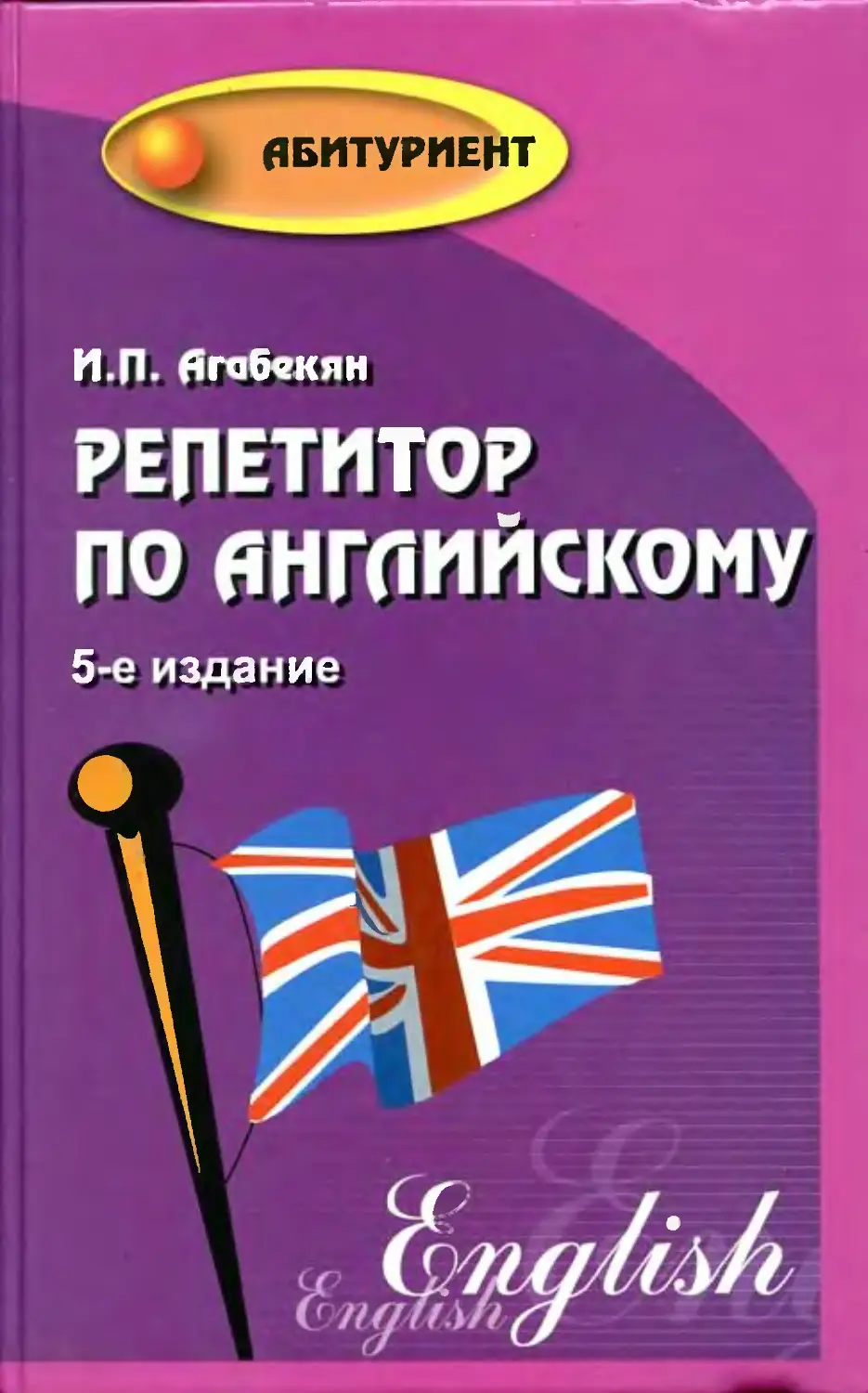


Автор: Агабекян И.П.
Теги: общее школьное образование общеобразовательная школа английский язык учебники и учебные пособия по английскому языку языкознание изучение языков издательство феникс серия абитуриент репетиторство
ISBN: 978-5-222-17952-9
Год: 2011



                    АБИТУРИЕНТ
И.П. Агабекян
РЕПЕТИТОР
ПО английскому
5-е издание
Серия «Абитуриент»
И.П. АГАБЕКЯН
РЕПЕТИТОР
ПО АНГЛИЙСКОМУ
Издание 5-е,
стереотипное
Ростов-на-Дону
«ФЕНИКС»
2011
УДК 373.167.1:811.111
ББК 81.2Англ-9
КТК 441
А23
Рецензент: ПИ. Коваленко
Консультант издания Т.Ф. Повалюхина
Агабекян И. П.
А23 Репетитор по английскому / И. П. Агабекян. —
Изд. 5-е, стер. — Ростов н/Д: Феникс, 2011. — 318 с. —
(Абитуриент).
ISBN 978-5-222-17952-9
Репетитор предназначен для подготовки к вступитель-
ному экзамену по английскому языку в высшие учебные
заведения, а также для самостоятельной подготовки и
дополнительного чтения. Целью пособия является повто-
рение грамматики английского языка, экзаменационных
устных тем, развитие навыков чтения и перевода.
ISBN 978-5-222-17952-9 УДК 373.167.1:811.111
ББК 81.2Англ-9
© Агабекян И. П., 2011
© Оформление: ООО «Феникс», 2011
ОГЛАВЛЕНИЕ
От автора..............................................5
Вводный фонетический курс..............................7
Правила чтения........................................10
Урок 1..............................................  23
Grammar: Местоимения. Личные местоимения.
Притяжательные местоимения. Указательные местоимения.
Oral Topics: About Myself. My Friend
Урок 2................................................40
Grammar: Вопросительные местоимения. Возвратные местоимения.
Повелительное наклонение.
Oral Topics: Му Working Day. Му Day-Off
Урок 3............................................    48
Grammar. Порядок слов в английском предложении. Числительные.
Дни недели, месяцы. Обозначения времени.
Oral Topic: Му School. Му School Holidays
Урок 4................................................65
Grammar: Множественное число существительных.
Притяжательный падеж существительных. Безличные
и неопределенно-личные предложения.
Интернациональные слова. Сложные существительные..
Oral Topics: Seasons and weather. Sports
Урок 5................................................81
Grammar: Неопределенный и определенный артикли.
Географические названия и артикль.
Oral Topics: Moscow. Russia
Урок 6................................................96
Grammar: 1. Оборот there is / there are. 2. Местоимения little / few
и местоименные выражения a little/ a few. 3. Much/ many.
Oral Topics: London. Great Britain
Урок 7...............................................108
Grammar: Степени сравнения прилагательных и наречий.
Предлоги, обозначающие место. Предлоги, обозначающие
движение. Предлоги времени.
Oral Topics: Education in Russia. Education in Great Britain
3
Урок 8..................................................130
Grammar: Основные типы вопросов. Общий вопрос.
Специальный вопрос. Альтернативный вопрос.
Разделительный вопрос.
Oral Topics: Meals in England. Ehglish Weather
Урок 9..................................................143
Grammar: Местоимения some, any, no и их производные.
Oral Topics: Travelling. Learning foreign languages
Урок 10.................................................151
Grammar: Времена английского глагола: Группа Indefinite (Simple).
Группа Continuous. Группа Perfect.
Oral Topics: The United States of America. New York
Урок 11.................................................179
Grammar. Согласование времен в главном и придаточном
предложениях. Словообразование: наиболее
употребительные суффиксы и префиксы.
Oral Topics: Washington D.C. Holidays in the USA
Урок 12.................................................191
Grammar: Страдательный залог (Passive Voice) Модальные глаголы
и их заменители. Модальные глаголы can, may, must, would, need.
Oral Topics: Mass media. The Protection of Environment
Урок 13........................................................208
Grammar: Сложное дополнение( Complex object.) Придаточные
предложения условия и времени, действие которых отнесено
к будущему. Причастие и герундий. Их отличие. Причастие I
(Participle I). Причастие II (Participlell).
Oral Topics: University Education in Great Britain. Famous English
Scientists. Isaak Newton
Урок 14.......................................224
Grammar: Прямая и косвенная речь. Условные предложения.
Oral Topics: Sports in Great Britain. My Favourite Writer Arthur Conan
Doyle
Приложение 1. Программа no иностранным
языкам........................................238
Приложение 2. Additional Texts for Reading
(Дополнительные тексты	для чтения)....244
Приложение 3..................................316
ОТ АВТОРА
Перед Вами учебное пособие, предназначенное для
подготовки к вступительному экзамену по английско-
му языку в высшие учебные заведения а также для са-
мостоятельной подготовки и дополнительного чтения.
Целью пособия является повторение грамматики ан-
глийского языка, повторение экзаменационных уст-
ных тем, развитие навыков чтения и перевода, обра-
ботки и передачи информации на английском языке.
Пособие состоит из вводного курса, содержащего
коррективный курс фонетики с правилами чтения
букв и буквосочетаний, и основного повторительного
курса грамматики с упражнениями, тестами для са-
мопроверки и устными темами в соответствии с тре-
бованиями программы по английскому языку для по-
ступающих в вузы.
Каждый урок содержит кратко изложенный грам-
матический материал по обязательным разделам
грамматики с закрепляющими упражнениями и тес-
тами и устные темы, которые требуются на вступи-
тельных экзаменах в вузах. Так, рассматриваются
такие обязательные темы, как: About myself, Му
working day, Му day off, My friend, Travelling, Sport,
My Favourite Writer, Seasons and Weather а также
страноведческие темы — London, Great Britain, Mos-
cow, Russian Federation, New York, USA, и др.
В приложение 2 включены тексты в порядке воз-
растания сложности, предназначеные для чтения и
5
Репетитор по английскому
перевода, развития навыков работы со словарем и
передачи содержания на английском языке. При-
ложение 3 — таблица неправильных глаголов.
Пособие можно также использовать для аудитор-
ных и внеаудиторных занятий по английскому языку
в старших классах средней школы, колледжах, на
подготовительных курсах и факультетах дополни-
тельного образования.
Good luck!
Вводный ФОНЕТИЧЕСКИЙ КУРС
Особенности английского
произношения
В английском языка и системе его письменности
имеется значительное расхождение между написани-
ем слова и его произношением. Это требует специаль-
ную запись звукового образа слова — фонетическую
транскрипцию. Знание знаков транскрипции — это
ключ к правильному чтению и произношению слова.
Транскрипционные значки звуков заключаются в
квадратные скобки:
а) гласные
[i:] — долгий й
[i] — краткий, открытый и
[е] — эв словах этот, экий.
[ае] — более открытый, чем э
[а:] — долгий, глубокий а
[о] — краткий, открытый о
[о:] — долгий о
[о] — закрытый, близкий к у звук о
[и] — краткий у со слабым округлением губ
[и:] — долгий у без сильного округления губ
[л] — краткий гласный, приближающийся к русско-
му а в словах варить, бранить
[а] — безударный гласный, напоминающий русский
безударный гласный в словах: нужен, молоток
[а:] — в русском отсутствует, средний между о и э
7
Репетитор по английскому
б) двугласные (дифтонги)
[ei] — эй
[ои] — оу
[ai] — ай
[ап] — ау
[oi] — ой
[io] — на
[еэ] — эа
[иэ] — уа
в) согласные
[р] —и
[Ь]-б
[т] — м
[w] — звук, образующийся с положением губ, как
при б, но с маленьким отверстием между губами, как
при свисте
[fj-ф
[v] — в
[0] (без голоса) \
I оба звука образуются при помощи
1 языка, кончик которого помещается
/ между передними зубами как в ше-
I пелявом русском з
[S] (с голосом) /
[S] — С
[z] —3
[t] — т, произнесенное не у зубов, а у десен
[d] — д, произнесенное не у зубов, а у десен
[п] —н
[1]-л
[г] — звук произносится без вибрации кончика языка
в отличие от русского р
8
Вводный ФОНЕТИЧЕСКИЙ КУРС
Щ — мягкий русский ш
[3] — мягкий русский ж в слове вожжи
[tn- ч
[dj] — озвонченный ч
[к]-к
[д] —г
[д] — заднеязычный н, произнесенный задней частью
спинки языка
[h] — простой выдох
Ш — й
Некоторые английские согласные имеют двойное
чтение, сочетания двух согласных могут передавать
один согласный звук, а 6 гласных букв передают 20
гласных звуков в зависимости от положения гласной
в слове (ударное или неударное) и от типа слога (от-
крытый или закрытый).
Рекомендуется выучить три основных правила про-
изношения английских слов:
1.	Краткость или долгота гласных звуков в рус-
ском языке не влияет на смысл слова. В англий-
ском же языке долгота или краткость произнесенно-
го гласного звука меняет смысл слова. Так, [fip] —
корабль, а [/!:р] — овца.
2.	В отличие от русского языка в английском язы-
ке согласные звуки не оглушаются в конце слова. Ог-
лушение согласных отражается на смысле слова. На-
пример: [baeg] — сумка, [back] — спина.
3.	Гласная буква е в конце слова не читается. Чте-
ние гласной буквы в английском языке зависит от ее
положения в слове (ударное или неударное) и от
типа слога (открытый или закрытый).
Правила чтения
Правила чтения букв а, е, i, о, и, у и их сочетаний
Чтение гласных букв а, е, i, о, и, у зависит от
1.	типа слога, в котором они стоят
2.	ударные они или безударные
3.	от того, какие буквы стоят впереди или позади них
Типы слогов
I	I	II
Открытый	Условно-открытый	Закрытый
Слог оканчи- вается на гласную	Слог оканчивается на согласную, за которой следует непроизносимая буква е	Слог оканчивается на одну или несколько согласных
he, she, me	make, note, time	sit, but, test
Правила чтения гласных а, е, i, о, и, у
в ударных и безударных слогах
	Типы слога
	I	п	Ш	IV
1	2	3	4	5	6
Глас- ные	открытый ударный тип слога	закрытый ударный тип слога	гласная+г ударный тип слога	гласная+r+e ударный тип слога	безудар- ный слог
А а	[ei] plate	[X] lamp	[R] саг	share	ago
Е е	we	ten	[W] her	[iq] here	[q] [Ч absent forest
ю
Правила чтения
1	2	3	4	5	6
li Yy	[ai] fine byte	[Ц bit mystic	[W] girl	[aiq] fire tyre	[П music copy
Uu	[jH] tube	[A] cut	[W] turn	[juq] cure	[q] [JH] success unite
Оо	[ou] bone	[0] not	[L] short	[L] more	[q] [ou] confer retro
Правила чтения буквосочетаний
Сочетания согласных
Буквосочетание	Звук	Пример
ch	[C]	chair
sh	[S]	she
th	[T]	thin
th	[D]	this
wh wh	[w] [h]	what who
ng	[N]	long
ck	[k]	lock
Непроизносимые согласные
Буквосочетание	Произношение	Пример
igh	[ai]	high light
kn	[n]	know
wr	[r]	write
gn	[n]	sign
Звуки [i], [i:]
Гласный звук [i]
При произнесении краткого гласного звука [i] кон-
чик языка находится у основания нижних зубов:
11
Репетитор по аигяийскому
оттенок русского звука [И] в словах шить, шило
практически совпадает с английским [i]: it, sit, in
Гласный звук [i:]
При произнесении долгого гласного [i:] язык про-
двинут вперед, кончик языка касается нижних зубов,
губы несколько растянуты и слегка обнажают зубы.
Оттенок русского звука [и] в словах ива, иго, игры,
избы практически совпадает с англий-ским звуком [i:].
Сочетания ее, еа читаются [i:]. Например, meet,
peat.
Долгота звука влияет на лексическое значение
слова.
Например: feet (ноги) — fit (вмещаться), steel
(сталь) — still (все еще)
Exercise А
[i]	[i:]
lead — lid
beat — bit
kill — keel
did — deed
pit — peat
it — eat
mill — meal
steel — still
bean — bin
pill — peel
sit — seat
feel — fill
fit — feet
lid — lead
fit — feat
Exercise В
be — been — bean
see — seat — seed
pea — Pete — peat
bee — been — feet
me — meet — meat
meal — seal — mean
sea — see — meet
mean — lean — keen
meet — meat — ill
bill — steel — feel
12
Правила чтения
Exercise С
I see a sea. I see lean meat. I eat meat. I like meat.
I like tea. I make tea. I take tea. I like fine tea. I like
fine meals.
Звуки [e], [ae]
Гласный звук [e]
При произнесении гласного [е] масса языка на-
ходится в передней части ротовой полости. Кончик
языка находится у нижних зубов. Губы слегка рас-
тянуты. Звук близок к русскому звуку [э] в словах
эти, жесть.
Гласный звук [ае]
При произнесении звука [ае] губы несколько растя-
нуты, нижняя челюсть сильно опущена, кончик язы-
ка касается нижних зубов, а средняя спинка языка
немного выгибается вперед и кверху.
Exercise А
[е]	[ae]
ат — Ann — lamp	man -	- can — cat
sat — hat — bat	Pat -	 rat — cam
Exercise В
tan — ten	pan —-	pen
bad — bed	land -	- lend
tanned — tent	fan —	fen
man — men	pat —	pet
Exercise C
bat — bet	pet —	net — red
let — met	ten —	pen — men — hen
13
Репетитор по английскою
Звуки [а:], [л], [еэ], [ei]
Гласный звук [а:]
При произнесении английского гласного [а:] рот
отрыт почти как для русского звука, но язык отодви-
гается дальше назад и книзу и лежит плоско. Кончик
языка оттянут от нижних зубов. Губы не растянуты и
не выдвинуты вперед.
Гласный звук [л]
При произнесении звука язык несколько отодвинут
назад, задняя спинка языка приподнята к передней
части мягкого неба, губы слегка растянуты. Звук по-
хож на русский предударный звук [а] в словах: ка-
кой, посты, басы.
Гласный звук [еэ]
Ядро звука — гласный похожий на русский звук в
слове это. Скольжение происходит в направлении
нейтрального гласного [а] с оттенком звука а.
Гласный звук [ei]
Дифтонг, ядром которого является гласный,
а скольжение происходит в направлении гласного.
Произнося дифтонг необходимо следить за тем,
чтобы ядро не было таким широким, как русский
гласный [э], а второй элемент не превращался в
русский звук [й].
Exercise А
саг — far — bar
part — park — fart
spark — bath — mark
half — calf — bath
cart — barter — shark
park — raft — plant
14
Правила чтения
Exercise В Магу — air — pair fare — fair — hair	care — dare — rare
Exercise C
tape — hate — bate	mate — plate — Kate
late — fate — rate	brave — maple — main
pain — name — day lay — hay — Ray	date — may — pay
Звуки [и:], [и], [л]
Гласный звук [и:]
При произнесении долгого гласного звука [и:] губы
напряжены и сильно округлены, но гораздо меньше
выдвинуты вперед, чем при русском звуке у: moon.
На письме передается буквосочетанием двойное О,
за исключением случаев перед буквой k.
Например: soon — скоро, вскоре, moon — луна
Исключение: book — книга, краткое [и].
Гласный звук [и]
При произнесении краткого гласного звука [и] губы
заметно округлены, но не выдвинуты вперед, язык
оттянут назад, но несколько меньше, чем для и: (и
долгого). Звук напоминает безударный русский звук
[у] в словах пустой, тупой, произнесенный без выд-
вижения губ вперед:
hook — крюк look — взгляд
Запомните слова, в которых в качестве исклю-
чения произносится [и]:
Put — класть, pull — тянуть, push — толкать,
full — полный
15
РНТКГИТОР ITO АНГЛИЙСКОМУ
Гласный звук [л]
При произведении краткого гласного [л] губы не-
множко растянуты, язык отодвинут назад, несколько
глубже, чем для русского звука [а]. Кончик языка
находится у нижних зубов, напоминает русский звук
[а] в словах камыш, сады, валы.
Exercise А too — tooth — food soon — spoon — tooth	boot — fool — foot boot — mood — shook
Exercise В took — shook — nook	hook — look — cook
Exercise C fool — pool — hook cook — boot — loop	fool — too — book foot — cool — mood
shook — soon — spoon — moon
Exercise D
pull (тянуть) — pool (бассейн)
tool (инструмент) — full (полный)
soon (вскоре) — sun (солнце) [sAn]!
Exercise E
us — bus	tub — mud
must — sum	humble — tumble
sun — hunt	trust — lust
Звуки [э:], [э], [ou]
Гласный звук [э:] — долгий гласный
Для того, чтобы правильно произнести звук, сле-
дует придать органам речи положение, как при про-
16
Правила чтения
изнесении звука [а:], затем значительно округлить
губы и несколько выдвинуть их вперед.
Гласный звук [о]
Для того, чтобы произнести, следует исходить из
положения органов речи при произнесении звука [а:],
затем слегка округлить губы и произнести краткий
звук [о].
Гласный звук [ои]
Звук представляет собой нечто среднее между рус-
скими звуками [о] и [э]. Губы при произнесении на-
чала этого дифтонга слегка растянуты и округлены.
Скольжение происходит в направлении гласного [и].
Exercise А more — score dawn — hawk — because	floor — for — form fork — pork — sport
Exercise В
not — top — hot	Rostov-on-Don
dot — mop — mob
Exercise C
tone — note — smoke	cone — loan — moan
code — hope — cope	lobe — mould — gold
boat — soap — coat
Звуки [ia], [ai], [h]
Дифтонг [ia]
Ядро звука — гласный [i], а скольжение проис-
ходит в направлении нейтрального гласного, имею-
щего оттенок звука [л].
17
Репетитор по английскому
Дифтонг [ai]
Ядро дифтонга — гласный звук, похожий на рус-
ский звук [а] в слове чай. Скольжение происходит
в направлении звука р], однако его образование пол-
ностью не достигается, в результате чего слышится
лишь начало звука р].
Согласный звук [Ь]
Этого звука в русском языке нет. В английском
языке он встречается только перед гласным и на слух
представляет собой легкий, едва слышный выдох.
В отличие от русского [х] английский [h] образует-
ся без всякого участия языка, поэтому необходимо
следить за тем, чтобы задняя спинка языка не под-
нималась близко к мягкому нёбу.
Exercise A year — hear — ear tear — peer — beer	here — near — fear rear — leer — mere
Exercise В mile — pile — kite height — light — fight pike — hike — hide	site — side — ride might — right — tight
Exercise C hope — heap — hat	heal — heel — heal
health — height — hear hood — his — ham
her — here — hate
Exercise D
hit — heat — head hall — hollow — hammer
hand — happy — hard
18
Правила чтения
Звуки [0], [3]
Согласный звук [0]
В русском языке подобного звука нет. Звук [0] —
глухой. При его произнесении язык распластан и не-
напряжен, кончик языка образует узкую плоскую
щель, неплотно прижимаясь к нему. В эту щель с си-
лой проходит струя воздуха. Кончик языка не должен
сильно выступать за верхние зубы или слишком плот-
но прижиматься к губам. Зубы должны быть обнаже-
ны, особенно нижние, так, чтобы нижняя губа не ка-
салась верхних зубов и не приближалась к ним.
Согласный звук [3]
При произнесении звука [3] органы речи занима-
ют такое же положение, как и при произнесении зву-
ка [0]. Звук [3] отличается от звука [3] только звонко-
стью.
Exercise А
through — fifth — myth thief — booth — tooth
thank — think — thought theatre — theory — theft
Exercise В
thermometer — thick — thin
thirst — thirty — thorough
threat — three — thunder
threw — throat — thumb
faith — hearth — path
bath — booth — broth
Exercise C
this — that — those there — though — these
them — they — the
19
Репетитор по английскому
Звуки [w], [г)]
Согласный звук [w]
При произнесении губы округлены и значительно
выдвинуты вперед, а задняя часть языка занимает
примерно такое же положение, как при произнесении
русского [у]. Струя выдыхаемого воздуха с силой
проходит через образованную между губами круг-
лую щель. Губы энергично раздвигаются.
Согласный звук [р]
При произнесении согласного задняя спинка язы-
ка смыкается с опущенным мягким небом, и воздух
проходит через носовую полость. Для того, чтобы до-
биться нужного положения органов речи, можно сде-
лать вдох через нос с широко открытым ртом, затем
следить за тем, чтобы ни кончик языка, ни его пере-
дняя и средняя часть не касались нёба.
Exercise А
what — why — where whip — wheat — while
Exercise В
war — wharf — water wedding — wage — wait
waitress — waist — waist weather — woman — wind
Exercise C
wall — wallet — walk walnut — waltz — won
Exercise D
wing — king — ping
sing — nothing — something
nothing — anything — ring
20
Правила чтения
Звуки [au], [dr], [br], [gr], [tr], [fr], [Or]
Exercise A
now — how — brown out — now — house
louse — mouse — cows out — loud — without
Exercise В
draw — dribble — draft
drag — drab — drank
drain — dragon — drama
drape — dreadful — drugs
Dresden — dress — dry
drill — drop — drink
drive — drown — drum
drift — drier — droopy
Exercise C
brown — bread — brace
brain — brakes — bran
brunch — branch — brave
Brazil — breach — breast
breath — broth — breathe
Exercise D
treasure — trainer — trench
track — trade — traffic
troops — trend — trail
translate — transmit — trance
Exercise E
France — French — fruit
fry — frame — free
three — thread — throat
threat — through — thrill
thirty — throne — threaten
21
Р£П£ТИТОР ПО АНГЛИЙСКОМУ
English alphabet
(Английский алфавит)
Буква	Название	Буква	Название
А а	[ei]	N n	[en]
ВЪ	[bi=]	0 о	[ou]
Сс	[si:]	Pp	[Pi:]
Dd	[di:]	Qq	[kju:]
Ее	[i=]	Rr	[a:]
Ff	[ef]	S s	[es]
Gg	[dji;]	Tt	[ti:]
Hh	[eitj]	Uu	[ ju:]
li	[ai]	Vv	[vi:]
Jj	[cfeei]	W w	['dAblju:]
Kk	[kei]	Xx	[eks]
LI	[el]	Yy	[wai]
M m	[em]	Z z	[zed]
Урок 1
Grammar: Местоимения.
Личные местоимения.
Притяжательные местоимения.
Указательные местоимения.
Oral Topics: About Myself
.	My Friend
МЕСТОИМЕНИЯ
(The pronouns)
Местоимения употребляются в предложении вме-
сто имени существительного или имени прилага-
тельного. Местоимение называет людей, предметы
или признаки уже упомянутые ранее. Например:
Peter gave Kate a book. She took it.
Петя дал Кате книгу. Она ее взяла.
You have a good dictionary. I want to buy such a
dictionary.
У вас хороший словарь. Я хочу купить такой сло-
варь.
Слова, обозначающие мужчин (man, boy, son,
husband, king), относятся к мужскому роду и заменя-
ются местоимением he (он)
Не is a boy. Не is a son. Не is a king.
23
Репетитор по английскому
Слова, обозначающие женщин (girl, woman,
daughter, queen) относятся к женскому роду и за-
меняются местоимением she (ойа)
She is a girl. She is a daughter. She is a queen.
Слова, обозначающие вещи (table, chair, book, clock)
относятся к среднему роду, и заменяются местоиме-
нием it
It is a book. It is a picture. It is an apple.
Местоимение they (они) относится ко всем трем родам
They are boys. They are daughters. They are apples.
ЛИЧНЫЕ МЕСТОИМЕНИЯ
(Personal pronouns)
Единственное	число	Множественное число
I (я),	we (мы),
you (ты),	you (вы),
he (он), she (она), it (оно) they (они)
Личные местоимения в английском имеют два па-
дежа:
именительный падеж (the nominative case)
объектный падеж (the objective case), заменяющий
собой все падежи русского.
Склонение личных местоимений
Число	Лицо	Именительный падеж	Объектный падеж
Ед.	1	1(я)	те (мне)
	2	you (ты)	you (тебе)
	3	he(он) she (она) it (оно)	him (ему) her (ей) it (ему) неодуш.
24
Урок 1
Число	Лицо	Именительный падеж	Объектный падеж
Мн.	1	we (мы)	us(нам)
	2	you (вы)	you (вам)
	3	they(они)	them (им)
Примечание. После местоимения you глагол-сказу-
емое всегда стоит во множественном числе.
You are a student. Ты студент.
ПРИТЯЖАТЕЛЬНЫЕ МЕСТОИМЕНИЯ
(Possessive pronouns)
Единственное число	Множественное число
ту (мой, моя, мое, мои)	our (наш, наша, наше, наши)
your (твой, твоя, твое, твои) your (ваш, ваша, ваше, ваши)
his (его), her (ее), its (его)	their (их)
Притяжательные местоимения имеют две фор-
мы: основную и абсолютную.
Формы притяжательных местоимений
Чис- ло	Ли- цо	Основная форма (перед существительным)	Абсолютная форма (без существительного)
	1	ту	mine
	2	your	yours
Ед.		his	his
	3	her	hers
		its	its
	1	our	ours
Мн.	2	your	yours
	3	their	theirs
Основная форма употребляется в тех случаях,
когда за притяжательным местоимением стоит су-
ществительное.
25
Репетитор по английскому
This is my book and that is your book. Это моя
книга, а то твоя книга.
Абсолютная форма употребляется в тех случаях,
когда за притяжательным местоимением не стоит су-
ществительное.
This is my book and that is yours. It is not mine. Это
моя книга, а то твоя. Она не моя.
УКАЗАТЕЛЬНЫЕ МЕСТОИМЕНИЯ
(Demonstrative pronouns)
This (этот, эта, это), that (тот, та, то), such (та-
кой, такая, такое, такие).
Указательные местоимения this и that имеют един-
ственное и множественное число.
Единственное число
this [Sis] (этот, эта, это)
that [3aet] (тот, та, то)
Множественное число
these [3i:z] (эти)
those [douz] (те)
Запомните, -this is these are <.
that is — those are
there is — there are*
it is — they are
This is my house and that is yours. Это мой дом,
а то — твой.
These are my books. Take those books. Эти книги
мои. Возьми те книги.
Указательное местоимение such имеет одну неизме-
няемую форму. I like such books. Мне нравятся такие
книги.
26
Урок 1
Упражнение 1. Напишите по-английски.
Моя книга, ее ручка, наша комната, его собака, ваш
портфель, их комната, твоя машина.
Упражнение 2. Переведите на английский язык:
1. Та книга — не моя. 2. Эта книга — моя. 3. Это —
моя книга, а то — его. 4. Это ее карандаши, — а те —
мои. 5, Возьми те карандаши 6. Я люблю такие руч-
ки, они хорошие. 7. Ваша ручка плохая, возьмите
мою.
Упражнение 3. Замените выделенные слова лич-
ными местоимениями.
1. Peter helped the pupils to translate the text.
2. Mother asked Mary to wash the plates. 3. My friend
writes a letter to his sister. 4. Jane took 3 books from
the library (there). 5. His cousins live in Moscow. 6. Our
grandfather and grandmother will come tomorrow.
7. Mary works in a shop.
Упражнение 4. Переведите на русский язык
This is a pen and that is a pencil. These are tables and
those are chairs.
This is a plate and that is a lamp. This is a bed and
that is a sofa.
This is a cap and that is a hat. This is my book and
that is your copybook.
This is my house and that is yours. That house is mine.
Упражнение 5. Выберите правильные притяжа-
тельные местоимения.
1.	Is this (your / yours) book?
2.	It’s (their / theirs) door, not (our / ours).
27
Репетитор по английскому
3.	They’re new pupils andl don’t know their I theirs
names.
4.	(My I Mine) flat is bigger than (her / hers), but
(her / hers) is nicer.
5.	That’s not (my / mine) book. (My / Mine) is new.
6.	They took (our / ours) books and we took (their /
theirs).
7.	Are these pencils (her / hers)?
8.	Is this (your / yours) house or (their / theirs)?
Грамматика
Спряжение глагола to be
Число	Утвердительная форма	Вопросительная форма	Отрицательная форма
	Настоящее время (Present Indefinite)
Ед.	I am. You are. He (she, it) is.	Am I? Are you? Is he (she, it)?	I am not. You are not. He (she, it) is not.
Мн.	We (you, they) are.	Are we (you, they)?	We (you, they) are not.
	Прошедшее время (Past Indefinite)
Ед.	I (he, she, it) was. You were.	Was I (he, she, it)? Were you?	I (he, she, it) was not. You were not.
Мн.	We (you, they) were.	Were we (you, they)?	We (you, they) were not.
	Будущее время (Future Indefinite)
Ед.	I shall be. You (he, she, it) will be.	Shall I be? Will you (he, she, it) be?	I shall not be. You (he, she, it) will not be.
Мн.	We shall be. You (they) will be.	Shall we be? Will you (they) be?	We shall not be. You (they) will not be.
28
Урок 1
Сокращения
Единственное число Множественное число
1	лицо I ат — Гт	1 лицо we аге — we’re
we are not — we aren’t
2	лицо you are — you’re
you are not — you aren’t
3 лицо they are — they’re
they are not — they aren’t
3	лицо he is — he’s
he is not — he isn’t
3 лицо she is — she’s
she is not — she isn’t
3 лицо it is — it’s
it is not — it isn’t
Упражнение 6. Прочтите, переведите и перепиши-
те, используя, где возможно, сокращения.
I am a student. Am I a student? Yes, you are.
We are students. Are we students? Yes, we are.
He is a doctor. Is he a doctor? No, he is not. He is not a
doctor.
Are you doctors? Yes, you are. You are doctors.
She is a teacher. They are teachers. He is a teacher.
It is a dog. Is it a dog? Yes, it is.
Ann is a first-year student. She has a book. She has an
English book. Her book is good. It is interesting.
I am a first-year student, too. But I have no English
book.
Has Pete an English book? No, he has not.
Have you an English book? No, I have not. I have not
a good English book. My English book is old.
29
Репетитор по английскому
Упражнение 7. Письменно поставьте предложе-
ния в вопросительную форму и дайте краткие ут-
вердительные или отрицательные ответы.
Образец: She is his sister. Is she his sister? Yes,
she is. No, she isn’t.
1. My father is a worker. 2. He is an engineer now.
3. These children are little. 4. You are my best friend.
5. His daughter is a pupil. 6.1 am a student. 7. They are
good boys. 8. Our mother is a teacher.
Упражнение 8. Составьте предложения из данных
слов.
1. Have, no, book, I. 2. They, по, good, have, room.
3. Have, yes, I. 4. Room, Ann, a, has. 5. Pen, has, a, she?
6. Little, dog, our, is. 7. Is, pencil, his, old. 8. Lamp, is, good,
her? 9. Book, give, please, me, your. 10. Bag, good, is, my.
Упражнение 9. Заполните пропуски нужной фор-
мой глагола to be и переведите.
1. Не... born in 1985. 2. We... students now. 3. We...
good friends in our class. 4. It... an interesting book.
5. Who... absent today? 6. He... a student. 7. What...
he? 8. ... he a doctor? 9. These... my pencils.
10. Where... this book? It... on the table. 11. What...
their names? 12. Mary... a girl. 13. Who... he?
14. What... you? 15. This man... in the room.
16. How... she? 17. How... you? I... fine. 18. How...
your friend? 19. ...he your son? 20. Tomorrow we...
at home. 21. ...you a sportsman? 22. There... no book
on the table. 23. It... my parents’ car. 24. There... 25
pupils in our class now.
30
Урок 1
Упражнение 10. Переведите на английский
язык.
1. Она — учитель? — Да. 2. Вы — не дети. Вы —
студенты. 3. Они сейчас в классе? — Нет. 4. Кто вы? —
Я — студент. 5. Она — мой друг. 6. Он — не доктор.
7. Это мои дети. 8. Что это? Это — новая книга. 9. Где
он был на прошлой неделе? 10. Мы — друзья.
Тест 1
ФОРМЫ ГЛАГОЛА ТО BE
А ат В is С аге

1.	Where ... you from?
2.	How old ... you? How old ... your brother?
3.	What... your name?
4.1... glad to see you. How ... you?
5.	The dog ... in the garden.
6.	My parents ... workers.
7.	... your father a teacher? — No, he... a doctor.
8.	He ... not an engineer, he ... a doctor
9.	That book ... not very interesting.
10.	The book ... on the table.
11.	London ... the capital of Great Britain.
12.	... you students?
13.	What... the weather like today?
14.	What... there on the table?
15.	... Igor a good chess player?
Тест 2
ФОРМЫ ГЛАГОЛА TO BE
A am В is C are
1.	It... nice to see you. How... you?
31
Репетитор по английскому
2.	What... your name? How old... you?
3.	Where... they from?
4.	How old... your sister?
5.	... you a pupil?
6.	Michael’s parents... doctors.
7.	Peter... not a student, he... a pupil.
8.	Those books ... not very interesting.
9.	Your book... in your bag.
10.	What... your address?
11.1... not cold. Don’t close the window, please.
12.	What... the story about?
13.	This news... very interesting.
14.	... these good pens?
15.	The children... in the garden.
16.	Moscow... the capital of Russia.
Ответы
ТЕСТ 1
l.C	6. С	11. В
2. CB	7. В	12. С
3. В	8. В	13. В
4. AC	9. В	14. В
5. В	10. В	15. В
ТЕСТ 2
1. ВС	7. В	13. В
2. ВС	8. С	14. С
3. С	9. В	15. С
4. В	10. В	16. В
5. С	11. А
6. С	12. В
32
Урок 1

ABOUT MYSELF
Му name is Tanya Sokolova. I am 16. I was born
on the 5th of March, 1985 in Rostov-on-Don. Now I
live in Rostov with my parents and my grandmother.
My family is not very large. We have five people in
our family. My father’s name is Igor Petrovich He is for-
ty years old. He is a doctor and he works in a hospital.
My mother’s name is Lyudmila Leonidovna. She is thir-
ty nine years old. She is a housewife. My younger sister
is a pupil. She is in the seventh form. My grandmother
lives with us. She doesn’t work. She is a pensioner. I love
my family. We are all friends and we love each other.
I have one aunt and two uncles. Their children are my
cousins.
We live in a big flat in a new house. There are four
rooms in our flat: a living room, a study, a kitchen,
a bathroom and two bedrooms. We have all modern
conveniences: gas, hot water, running water, elec-
tricity and telephone.
I have my duties about the house. I must go shop-
ping and I help my Mother to clean the rooms. It’s not
difficult for me. I like our home to be clean and tidy.
I am a pupil now. We have many good teachers at
our school. I try to be a good pupil and I do well in all
subjects. But my favourite subject is English. I spend
much time on it. I like reading. I like detective stories
but I prefer to read historical novels or modern writers.
I have many friends. Many of them are my class-
mates. We spend much time together, go for a walk,
talk about lessons or music.
2. Зак. 686
33
Репетитор по английскому
I like to listen to modern music, but sometimes I
like to listen to some classical music. My favourite
composer is Tchaikovsky. I haven’t much time to watch
TV but sometimes I spend an hour or two watching
an interesting film or a news programme. In the
evening I often read newspapers or an interesting
book. I like fresh air and exercises, but I have not
much time to go in for sports. I do not go in for
sports now because I prepare for my exams.
This year I am going to enter the University after I
leave my school. My dream is to become an economist. I
hope my dream will come true.
Words
parents — родители
a housewife — домохозяйка
younger — младшая
a pensioner — пенсионер
an aunt — тетя
an uncle — дядя
a cousin — кузен, кузина
living room — жилая комната
a study — кабинет
a bathroom — ванная, туалет
a bedroom — пальня
modern — современный
conveniences — удобства
running water — холодная вода
duties — обязанности
to go shopping — ходить за покупками
tidy — опрятный
to try — стараться, пытаться
34
Урок 1
favourite — любимый
to do well — зд. успевать
favourite — любимый
to prefer — предпочитать
to spend — проводить, тратить
sometimes — иногда
an hour — час
fresh — свежий
to go in for sports — заниматься спортом
to prepare — готовить(ся)
dream — мечта
to come true — исполняться
Questions
1.	What is your name?
2.	Where and when were you born?
3.	How old are you?
4.	Where do you live?
5.	Have you got a family?
6.	How large is your family?
7.	Do you have brothers, sisters, grandparents in your
family?
8.	What are your father and mother?
9.	How many rooms are there in your flat?
10.	What modern conveniences have you got in your flat?
11.	What are your duties about the house?
12.	What is your favourite subject at school?
13.	What books do you like to read?
14.	What music do you like to listen to?
15.	Do you go in for sports?
16.	What sport do you go in for?
17.	Who are your friends?
2'
35
Репетитор по английскому
topicr
MY FRIEND
I have many friends. Most of them are my former
classmates but my best friend is Peter. He is fifteen. Now
he is a student of a college. He is a good student because
he studies hard and is very diligent. He wants to become
a good specialist and he is especially interested in com-
puters. He often helps me with my English lessons and
I’m grateful to him for that.
Now I want to tell you about his appearance. He is
rather tall and strong. He has an oval face, straight nose,
dark-brown hair, blue eyes and a nice smile. People find
him good-looking.
Peter goes in for sports. He plays football and basket-
ball well. His basketball team is very popular at the col-
lege.
We made friends with Peter when he and his family
moved to our house. We have very much in common: we
like the same music, we both like reading. In general my
friend is a very interesting person: he is intelligent and
well-read.
But the most important thing is that Peter is honest
and kind. I can fully rely on him and trust everything to
him. Peter has a great sense of humour and I like to spend
my free time with him.
I have another friend. Her name is Natasha. She is a
schoolgirl and she lives next door. I like her very much.
She is a blonde with blue eyes, she is slim and pretty.
Her hair is long and she has a nice complexion. I like all
my friends very much. I think they are all my faithful
friends.
36
Урок 1
Words
former — бывший
strong — сильный
classmates — одноклассники
dark-brown — темно-коричневый
to study hard — усердно учиться
diligent — прилежный
especially — особенно
grateful — благодарный
appearance — внешний вид
rather — довольно
tall — высокий
straight — прямой
team — команда
to move — зд. переехать
in common — общего
same — тот же
both — оба
intelligent — умный
well-read — начитанный
honest — честный
kind — добрый
fully — полностью
to rely — полагаться
to trust — доверять
sense — чувство
blonde — блондин(ка)
faithful — верный
slim — стройный
pretty — красивая
hair — волосы
complexion — цвет лица
37
Репетитор по английскому
Questions
1.	Who is your best friend?
2.	Where does your friend study?
3.	How does your friend look like?
4.	What kind of sport does your friend like?
5.	How did you make friends?
6.	What do you have much in common?
7.	Do you like to spend your free time with your friends?
8.	Can you call all your friends faithful?
9.	Is the sense of humour important in friendship?
10.	What are the hobbies of your friends?
Упражнение 11. Составьте короткий рассказ о
внешности и характере какого-нибудь человека (ва-
шего друга, соседа по парте), используя слова, при-
веденные ниже:
tall [to:l] — высокий
short [Jo:t] — маленького роста
stout [staut] — приземистый, коренастый
fat [fact] — толстый
plumpy [plAmpi] — полный
fair hair [feo' Ьеэ'] — светлые волосы
brunette [bru: net] — брюнет(ка)
gray hair — седые волосы
bold headed [bauld] — лысый
short sighted — близорукий
smart, clever, bright — умный (ая)
stupid ['stju:pid] — тупой, глупый
boring — скучный(ая)
quiet ['kwaiat] — спокойный
impulsive [im'pAlsiv] — порывистый, импульсивный
aggressive [o'gresiv] — агрессивный
38
Урок 1
rude [ru:d] — невежливый, грубый
shy [Jai] — застенчивый
active ['aektiv] — активный
talkative ['to:kotiv] — разговорчивый
At the shop
Mother: I sent my little boy for two pounds of apples
and you sent only a pound and a half.
Salesman: My scales are all right, madam. Have you
weighed your little boy?
a salesman — продавец
a pound — фунт (англ, мера веса = 454 г)
scales — весы
to weigh [wei] — взвешивать
First day at school
Mary had been to school for the first time.
«Well, darling, what did you learn?» asked her mother.
«Nothing», sighed Mary hopelessly. «I’ve got to
go back again tomorrow.»
failure — неудача
to sigh — вздыхать
hopelessly—безнадёжно
darling — дорогой, -ая
I’ve got to... — мне нужно
Урок 2
Grammar' Вопросительные местоимения.
Возвратные местоимения.
Повелительное наклонение.
Oral Topics: Му Working Day
Му Day-Off
k_____________________________________________J
Грамматика *	.. '  "j
ВОПРОСИТЕЛЬНЫЕ МЕСТОИМЕНИЯ
Эти местоимения употребляются для построения
вопросительного предложения.
Who (кто)
Who is this man? Кто этот человек?
What (что, какой, какая, какое, какие)
What is it? Что это такое?
What book is it? Какая это книга?
Whose (чей)
Whose pencil is it? Чей это карандаш?
Which (который)
Which of these books is yours? Которая из этих
книг твоя?
Вопросительное местоимение who относится к сло-
вам, обозначающим людей.
Вопросительное местоимение what относится к
словам, обозначающим вещи.
40
Урок 2
Однако, обратите внимание:
Who is he? Кто он? (как его зовут) Не is Mr Johnson..
What is he? Кто он?(по профессии) He is a teacher.
Местоимение who имеет два падежа: именительный
падеж who и объектный падеж whom (кому, кого).
Who is here? Кто здесь? Здесь местоимение who сто-
ит в именительном падеже, является подлежащим.
Whom do you see there? Кого ты там видишь?
Whom did you give my book? Кому ты дал мою кни-
гу? Здесь местоимение whom стоит в объектном паде-
же, является дополнением.
Упражнение 12. Переведите на русский язык
Whose pencil is it? — This (it) is my pencil.
Who is this man? — This man is our teacher.
What books are these? — These are good books.
Whose pencil is it? — It is hers.
Which of these books is ours? — They are all yours.
Who is here? — All pupils are here.
ВОЗВРАТНЫЕ МЕСТОИМЕНИЯ
Возвратные местоимения употребляются в пред-
ложении для того, чтобы сказать, что предмет, на-
званный подлежащим предложения:
(а)	сам совершает действие или,
(б)	сам совершает действие и испытывает его на
себе.
Как правило, они переводятся глаголом с частицей
-сь (-ся), которая присоединяется к глаголам. Например:
They washed and dressed themselves.— Они умы-
лись и оделись.
41
Репетитор по английскому
Do it yourself. — Сделайте это сами.
Do not cut yourself! — He порежьтесь!
В английском языке возвратные местоимения об-
разуются от личных:
I — myself
you — yourself
she — herself
we — ourselves
you — yourselves
they — themselves
he — himself
it — itself
Возвратное местоимение oneself образуется от нео-
пределенного местоимения one + self.
Упражнение 13. Употребите нужное возвратное
местоимение.
1. I shall ask him. ... 2. Не wants to do it. ... 3. She
washed. ... 4.You will answer the letter. ... 5. I looked
at... in the mirror. 6. We shall tell her. ... 7. They have
done the task. ... 8. She doesn’t like to speak about. ...
9. The story... is very good, but not the translation.
10. Children, do it. ...
Упражнение 14. Переведите на английский язык.
1. Утром я умываюсь и одеваюсь. 2. Идите домой
сами. 3. Читайте книгу сами. 4. Не пораньтесь! (hurt).
5. Они ходят в школу сами. 6. Причешитесь! (comb).
Повелительное наклонение
Повелительное наклонение выражает приказ,
просьбу или запрет на совершение действия. Предло-
жение обычно начинается глаголом-сказуемым в
форме инфинитива без частицы to.
42
Урок 2
Например: Take this book. Возьмите эту книгу.
Don’t take this book. He берите эту книгу
Упражнение 15. Попросите по-английски
1. идти домой 2. дать вам ваш карандаш 3. дать ей
ручку 4. не давать ей эту книгу 5. не брать вашу ручку
6. говорить по-английски
Упражнение 16. Прочтите, переведите и выпол-
ните действия.
1. Take the book. 2. Open it. 3. Give me the book,
please. 4. Bring him the book. 5. Look at the book.
6. Open these books and do not close them, please.
Упражнение 17. Попросите по-английски:
1. Дайте мне эту книгу. 2. Принесите нам ту руч-
ку. 3. Дайте ему эти карандаши. 4. Откройте эту кни-
гу и читайте текст. 5. Говорите по-английски, пожа-
луйста. 6. Не говорите по-русски, пожалуйста 7. Зак-
ройте книгу и принесите ее мне. 8. Не открывайте это
окно, пожалуйста.
MY WORKING DAY
Му typical working day usually begins at 7 o’clock.
I get up, make my bed, open the window and make my
morning exercises. Then I go to the bathroom. I clean
my teeth and wash myself.
Usually I have breakfast at home. I go to the kitchen and
make breakfast for myself. For breakfast I usually have a
cup of tea or coffee, cheese or eggs, bread and butter.
43
Репетитор по английскому
After that I get dressed, take my bag and go to school.
I live not far from my school and it takes me ten min-
utes to get there. The lessons begin at eight o’clock and
we usually have five or six lessons every day. We have
many subjects at school, but my favourite subjects are
English, Russian, Physical Training and Mathematics.
After classes I go home and have dinner at two
o’clock. After dinner I have a short rest, watch TV and
then I do my homework. We have many subjects at
school and it takes me one or even two hours to do my
homework. If the hometasks are big I do them in the
evening, too. Sometimes I go for a walk with my friends.
Sometimes I go to the library if I need some books for
my studies.
When my parents come home from work in the evening
we have supper. After supper we go to the sitting room
and watch TV or read something. Twice a week I go to
the swimming pool. As a rule I haven’t much free time
on my week-days.
At about eleven o’clock I begin to feel sleepy, so I go
to my bedroom and go to bed.
Words
typical — типичный
get dressed — одеваться
it takes me — у меня уходит
to get — зд. добираться
subjects — предметы
twice — дважды
swimming pool — плавательный бассейн
week-day — рабочий день
as a rule — как правило
sleepy — сонный
44
Урок 2
Questions
1.	When do you usually get up?
2.	When does your working day begin?
3.	Do you do your morning exercises?
4.	Who makes breakfast for you?
5.	What time do you go to school?
6.	How much time does it take you to get to your school?
7.	When do your lessons at school begin?
8.	When do you have dinner?
9.	Do you usually have dinner at home or at your school
canteen?
10.	How long does it take you to prepare your homework?
11.	Do you have a rest after school?
12.	Do you sometimes go to the library to get ready for
classes?
13.	What do you usually do in the evening?
14.	What time do you usually go to bed?

MY DAY-OFF
I want to tell you about my typical day-off. Usual-
ly people work five days a week and have a rest on
Saturdays and Sundays, but students and pupils study
six days a week. They have their day-off on Sunday.
I like this day very much. I mustn’t go to school and
I can go any place I like. On this day I can sleep till
nine or ten o’clock.
When I get up I make my bed and do my morning ex-
ercises. Then I have breakfast and wash the dishes after
the breakfast. Sometimes I do my homework on Sun-,
day. It doesn’t take me long and soon I’m free.
45
Репетитор по английскому
On Sundays I often meet my friends. If the weath-
er is bad they come to my place. We listen to music or
watch some film on TV. In fine weather our family
likes to be out of town. We go to some nice place in
the country and have a picnic there.
Sometimes on Sundays I help my mother to tidy up
the room. I like to do it with the vacuum-cleaner. On Sun-
days we usually have dinner at three o’clock. The whole
family usually gets together. Then we go to the sitting-
room and watch TV, read books or discuss the latest news.
At about eleven o’clock I go to bed.
Words
typical — типичный
day-off — выходной
to wake up — просыпаться
later — позже
dish — блюдо, тарелка
soon — вскоре
free — свободный
about — около
picnic — пикник
whole — весь, целый
to discuss — обсуждать
the latest — самые последние
Questions
1.	Which day of the week do you like more and why?
2.	What time do you get up on Sunday?
3.	What do you do in the morning?
4.	How do you usually spend your days off?
5.	Do you often go to see your friends?
6.	Do you often go to the country on your days off?
46
Урок 2
7.	Do your friends often come to your place?
8.	How often do you spend the weekend with your par-
ents?
9.	How do you usually spend the evenings on your days
off?

Bad grammar
Voice on the phone: Are your father and mother at
home?
Schoolboy: They was, but they isn’t now.
Voice: They was, but they isn’t? — Where’s your
grammar!
Schoolboy: She is out too.
grammar ['graema] — грамматика
grandma ['graenma:] —бабушка
Unexpected answer
teacher: What do elephants have that no other animals
have?
pupil: Little elephants.
unexpected — неожиданный
an elephant — слон
Урок 3
----------------------------------------------
Grammar". Порядок слов в английском
предложении.
Числительные.
Дни недели, месяцы.
Обозначения времени
Oral Topics: Му School
Му School Holidays.
Ik.----------------------------------,——  ——-л
Грамматика
ПОРЯДОК СЛОВ В АНГЛИЙСКОМ ПРЕДЛОЖЕНИИ
В английском предложении каждый член пред-
ложения, как правило, имеет свое определенное
место. Так, в простом распространенном повество-
вательном предложении на первом месте стоит
1.	подлежащее, за ним следует
2.	сказуемое, далее идет
3.	дополнение (косвенное, прямое) и затем
4.	обстоятельства (образа действия, места, вре-
мени).
1) I 2) gave 3) ту brother 4) a book 5) yesterday.
Упражнение 18. Составьте и напишите предложе-
ния, обращая внимание на порядок слов.
1. Is, best, she, friend, my.
2. Learn, different, students, our, subjects.
48
Урок 3
3. The, is, Russia, of, the, in, country, the, largest,
world.
4. In, the, we, city, live, a, flat, in, of, center, the.
5. Reading, is, my, of, best, son’s, fond, friend.
I gave	the book	to Dan,
	прямое	косвенное
	дополнение	дополнение
I gave	Dan	the book
	косвенное	прямое
	дополнение	дополнение
Упражнение 19. Перепишите предложения, по-
местив косвенное дополнение после глагола и убрав
предлог. Переведите предложения.
Образец: Peter gave a book to his friend.
Peter gave his friend a book.
1.	Mary showed the photographs to me.
2.	I’ll send the books to you.
3.	My sister sent a game to my daughter.
4.	He brought the telegram to her this morning.
5.	Mary wrote a letter to her brother.
6.	They wrote a letter to us.
7.	Peter drew a lovely picture for his mother.
8.	She gave a bookcase to her cousin.
9.	That teacher taught grammar to us last year.
Упражнение 20. Перепишите предложения, поме-
стив прямое дополнение после глагола и поставив пра-
вильный предлог. Переведите предложения.
Образец: The workers built them a house in four weeks.
The workers built a house for them in four
weeks.
49
Репетитор по английскому
1.	John gives his friend the money.
2.	My friends sent me a bouquet of flowers.
3.	The shop assistant sold me the shoes.
4.	They found him a good car.
5.	Picasso painted his wife a beautiful portrait.
6.	My father reads us the newspaper.
7.	Pass me the salt, please.
8.	She bought him a red jacket.
9.	The boys want to show us their bicycles.

ЧИСЛИТЕЛЬНЫЕ
(The Numerals)
Числительные обозначают количество предметов
или порядок предметов при счете.
Числительные делятся на количественные, отвеча-
ющие на вопрос «сколько?» и порядковые, отвечаю-
щие на вопрос «который?».
Количественные числительные от 13 до 19 образу-
ются прибавлением суффикса -teen к основе.
Числительные, обозначающие десятки, имеют суф-
фикс -ty. Порядковые числительные кроме первых
трех (first, second, third) образуются прибавлением
суффикса -th или -eth к соответствующим количе-
ственным числительным. Они всегда употребляются
с определенным артиклем.
Количественные числительные	Порядковые числительные
СКОЛЬКО	КАКОЙ ПО СЧЕТУ?
1 one — один 2 two — два	the first первый the second второй
50
Урок 3
Количественные числительные	Порядковые числительные
3 three — три	the third третий
4 four	the fourth
5 five	the fifth
6 six	the sixth
7 seven	the seventh
8 eight	the eighth
9 nine	the ninth
10 ten	the tenth
11 eleven	the eleventh
12 twelve	the twelfth
13 thirteen	the thirteenth
14 fourteen	the fourteenth
15 fifteen	the fifteenth
16 sixteen	the sixteenth
17 seventeen	the seventeenth
18 eighteen	the eighteenth
19 nineteen	the nineteenth
20 twenty	the twentieth
Десятки:	Составные числительные:
20 twenty—the twentieth 30 thirty — the thirtieth 40 forty — the fortieth 50 fifty — the fiftieth 60 sixty — the sixtieth 70 seventy—the seventieth 80 eighty — the eightieth 90 ninety — the ninetieth	twenty-two—the twenty-second thirty-three — the thirty-third forty-four — the forty-fourth fifty-five — the fifty-fifth sixty-six — the sixty-sixth
51
Репетитор по английскому
Числительные от 100 и больше:
100 — a (one) hundred
101 — a (one) hundred and one
100th — the hundredth
101st — the one hundred
and first
200th — the two hundredth
1000th — the thousandth
200 — two hundred
1000 — (one) thousand
1001 — a (one) thousand and one
5,550 — five thousand five hundred and fifty
5,000,000 — five million
1500 — fifteen hundred
Заметьте, что числительные hundred, thousand,
million не имеют окончания -s, когда перед ними сто-
ит другое числительное. Когда числительные обозна-
чают неопределенное количество, они употребляются
во множественном числе с окончанием -s, за которым
следует предлог of. Сравните:
hundreds of books
thousands of books
millions of people
two hundred books
five thousand books
2 million people
Номера страниц, домов, квартир, транспорта, обо-
значаются не порядковыми, а количественными чис-
лительными. В этих случаях существительные упот-
ребляются без артикля: page 15, house 40, flat 13,
bus 72.
Упражнение 21. Прочтите по-английски:
1. Количественные числительные:
3, 5,11,12, 13, 24, 69, 325,1005, 530425, 1.745.033.
2. Порядковые числительные:
1, 2, 15, 23, 84, 149, 150, 208, 1000, 2.000.000.
52
Урок 3
Как читать даты?
Числительное, обозначающее год, делится на две
части — число сотен, а затем — число десятков и
единиц.
1900 — nineteen hundred, in (the year) nineteen
hundred
2000 — two thousand, in (the year) two thousand
1905 — nineteen five, in (the year) nineteen five
Даты читаются следующим образом:
April 12, 2001 1) on the twelfth of April, two
thousand one
2)	on April the twelfth, two
thousand one
Упражнение 22. Напишите цифрами следующие
даты:
a)	The first of March nineteen seventy-six.
b)	The fifth of December two thousand.
c)	The sixteenth of May nineteen five.
d)	The third of July nineteen hundred.
in (the year) nineteen ninety-seven
in (the year) nineteen hundred eighty-one
in (the year) two thousand five.
Упражнение 23. Напишите по-английски:
1) 7 марта 1999 года; 2) 1 сентября 1974 года;
3)	22 апреля 1911 года; 4) 11 марта 1951 года;
5) 12 декабря 2024 года.
Как читаются дробные числительные?
Простые	Десятичные
1/2 — a (one) half; 0.1 — O[ou] point one
53
Репетитор по английскому
1/4 — a (one) quarter 2.45 — two point four five
2/3 — two thirds 35.25 — three five (или: thirty-
five) point two five
1.5 — one and a half
Упражнение 24. Напишите цифрами дробные
числа:
Простые:
1) A (one) half 2) two thirds 3) a (one) quarter 4) three
fourths 5) two and a (one) half 6) five and one sixth
7) a (one) fifth.
Десятичные:
1) Zero (nought/ou) point two 2) two point four five
3) four point five 4) three four (thirty four) point one
zero two 5) nought point nought one 6) six point three
five 7) fifty eight point three nought five.
Для обозначения времени:
Если минутная стрелка (the long hand) находится в
правой части циферблата (a face) — используется пред-
лог past:
It’ ten past eleven. 10 минут двенадцатого.
It’ a quarter past eleven. Четверть двенадцатого.
It’s half past eleven. Половина двенадцатого.
Если минутная стрелка находится в левой части
циферблата, то используется предлог to:
It’s ten to twelve. Без десяти двенадцать.
It’s a quarter to twelve. Без четверти двенадцать.
It’s twenty minutes to twelve. Без двадцати минут
двенадцать.
It is eleven sharp. Ровно одиннадцать.
54
Урок 3
Время до полудня обозначается а.ш. (от лат. ante
meridiem), а после полудня р.ш (от лат. post meridiem).
Например: 10 a.m. — Десять часов утра.
6 р.ш — Шесть часов вечера.
Упражнение 25. Скажите по-английски время:
А)8.05, 8.10, 8.15, 8.20, 8.25, 8.30
8.35,	8.45, 8.50, 8.55, 9.00
Б) 1. Без двадцати двенадцать.
2.	Без четверти три.
3.	Половина пятого.
4.	Четверть седьмого.
5.	Десять минут второго.
6.	Ровно двенадцать часов.
Упражнение 26. Скажите, который час?
1. It is eleven sharp. 2. It is five minutes past three.
3.1t is ten past two. 4. It is a quarter past twelve. 5. It is
three o’clock. 6. It is half past eight. 7. It is twenty five
minutes to four. 8. It is three fifteen. 9. It is two thirthy.
10. It is a quarter to nine.
Отрезки времени
second [sekand] — секунда
minute ['minit] — минута
hour ['aua] — час
week — неделя
month [тлпб] — месяц
year [ja:] — год
century ['sentjari] — век (столетие)
Дни недели (употребляются с предлогом on)
Monday ['mAndi] — понедельник
55
Репетитор по английскому
Tuesday ['tju:zdi] — вторник
Wednesday ['wenzdi] — среда
Thursday [0a:zdi] — четверг
Friday ['fraidi] — пятница
Saturday ['satadi] — суббота
Sunday ['sAndi] — воскресенье
Месяцы (употребляются с предлогом in)
January ['djenjuari]
February ['februari]
March [ma:tj]
April [eipril]
May [mei]
June [d$u:n]
July [dju'lai]
August [a:gast]
September [sep'temba]
October [ak'touba]
November [no'vemba]
December [di'semba]
Времена года (употребляются с предлогом in)
spring [sprig] — весна
summer [sAma] — лето
autumn ['a:tarn] — осень
winter [winta] — зима
Запомните следующие слова и выражения:
a watch — часы (наручные, карманные)
a clock — часы (стенные, настольные)
an alarm-clock — будильник
Му watch is five minutes fast. — Мои часы спешат
на 5 минут.
56
Урок 3
Му watch is five minutes slow. — Мои часы от-
стают на 5 минут.
What day is it today? — Какой сегодня день (недели)?
What date is it today? — Какое сегодня число?
What time is it now? — Который час?
What is the time? — Который час?
Выражения, связанные со временем:
Yesterday — вчера
The day before yesterday — позавчера
Today — сегодня
Tonight — сегодня вечером
Tomorrow — завтра
The day after tomorrow — послезавтра
A fortnight — две недели
from 10 till 12 — c 10 до 12
half an hour — полчаса
10 days ago — 10 дней назад
It’s time to... — пора (делать что-либо)
in an hour’s time — в течение часа
in time — вовремя (не слишком поздно; так, чтобы
успеть)
on time — вовремя (точно по плану)
in the middle of... — в середине
this week (month, year) — на этой неделе ( в этом
месяце, году)
next week — на следующей неделе
last week — на прошлой неделе
Упражнение 27. Скажите время по-английски.
It is... 11.30; 20.00; 12.00; 9.10; 8.50; 17.40; 10.15;
10.45; 18.30.
57
Репетитор по английскому
Упражнение 28. Скажите по-английски.
♦	Который сейчас час? — Сейчас...
♦	Какое сегодня число? — Сегодня...
♦	Мои часы спешат на 10 минут.
♦	Зимой, летом, весной, осенью.
♦	В октябре, в ноябре, в мае, в августе.
♦	Какой сегодня день (недели)?
♦	На этой неделе ( в этом месяце, году).
♦	10 дней назад.
♦	На прошлой неделе.
♦	С 12 до 14.
♦	Две недели назад.
Упражнение 28. Переведите на английский язык.
А. 1) 220 дней; 2) 1500 человек; 3) 20545 книг;
4) около 100 страниц; 5) почти 300 тетрадей.
В. 1) первый автобус; 2) вторая страница; 3) мил-
лионный посетитель; 4) часть первая; 5) номер де-
сятый.
С. 1. Два миллиарда человек. 2. Миллионы книг.
3. Триста восемьдесят пять страниц. 4. Двадцать пер-
вое декабря 1997 года. 5. Двенадцатое марта 2000 го-
да. 6. Одна четвертая. 7. Три пятых. 8. Ноль целых,
двадцать пять сотых. 9. Четыре целых и пять шестых.
10. Две целых, сто пять тысячных.
Упражнение 30. Напишите цифрами:
1) Fifteen twenty one; 2 ) the eleventh of March;
3) two fifths; 4) seventeen point four two; 5) eight-
een hundred five; 6) a (one) sixth; 7) one tenth;
8) the first of January; 9) sixteen thirty three;
10) nought point two four.
58
Урок 3
MY SCHOOL
This year I have finished school number 92. The
building of my school is not new and modern but it is
big and comfortable and I like it very much. It is the
second home for pupils who study there. It has three
floors. The classrooms are light and high. There are
classrooms for practically all the subjects: Physics,
English, History, Geography, Literature, Mathemat-
ics, Chemistry, etc. There is a computer class in our
school, where pupils learn how to work on computer.
Nowadays it is one of the most important subjects.
Our school has a large school hall, too. We. had meet-
ings, conferences and concerts there.
Our school has a gymnasium and a sports-ground be-
hind the school. Many pupils are fond of sports and they
go in for different kinds of sports there.
I like my school. I entered my school when I was seven
years old. Now I am 16 and I’m going to enter the univer-
sity. I am very grateful to my school and to my teachers.
The teachers in my school are very kind and clever, they
give all their knowledge and all their love to the pupils.
Our school has a good tradition. Every year the former
pupils come to school to meet their teachers and class-
mates. These meetings are very interesting.
I will always remember my school, my favourite teach-
ers and my classmates. It was the happiest time in my life.
Words
building — здание
modern — современный
59
Репетитор по английскому
floor — этаж, пол
practically — практически
subject — предмет
nowadays — в наше время
most — самый
important — важный
meeting — собрание
gymnasium — спортзал
to be fond of — увлекаться
kind — род, вид
to enter — поступать
knowledge — знания
grateful — благодарный
kind — добрый
clever умный
former — бывший
classmate — одноклассник
always — всегда
to remember — помнить
favourite — любимый
period — период
the happiest — самый счастливый
Questions
1.	When did you finish your school?
2.	Is your school new or old?
3.	How many floors are there in your school?
4.	Are there classrooms for different subjects?
5.	Did you have a computer class in your school?
6.	Is there a gymnasium and a sports-ground in your
school?
7.	Did you like your school?
8.	At what age did you enter your school?
60
Урок 3
9.	What can you say about your teachers?
10.	Did you have any traditions in your school?
MY SCHOOL HOLIDAYS
I like winter because I have my long winter holi-
days. The weather is usually fine. Sometimes the sun
shines brightly and there is a lot of snow everywhere.
During my holidays I spend a lot of time in the open
air. It is not necessary to get up early. I have breakfast
and then I’m free. Sometimes my friends ring me up and
we go for a walk or to the yard.
When it is cold I stay at home, read books and watch
TV or videos. Sometimes my friends come to my place,
we discuss the latest news, watch some film on TV or play
computer games. I like my winter holidays because the
New Year’s day is on the first of January. We usually
buy a New Year’s tree and I like to decorate it.
English pupils have their winter school holidays be-
ginning from the 25th of December. This day is Christ-
mas in England.
I like my summer holidays very much too. It is warm
and I spend a lot of time in the open air. Sometimes my
family spends summer vacations at the seaside. We usu-
ally go to the Black Sea coast.
When the weather is fine and it is hot I like to swim in
the sea and try to get sun-tanned.
Sometimes at the end of summer I go to the coun-
try to see my grandmother and grandfather. They
have a big house and I like to help them. There is
always much work to do. I water the plants, feed the
61
Репетитор по английскому
animals and help my Granny about the house. I usual-
ly have a nice time in the country. I like summer and
my summer holidays very much.
Words
fine — прекрасный
to shine — зд. светить
brightly — ярко
everywhere — повсюду
necessary — необходимый
to ring up — звонить
videos — видеофильмы
to discuss — обсуждать
latest news — зд. свежие новости
to decorate — украшать
beginning from — начиная c
Christmas — Рождество
vacations — отпуск, каникулы
seaside — побережье
coast — берег
sun-tanned — загорелый
to water — поливать
Questions
1.	Why do you like winter?
2.	When do you have your holidays?
3.	Do your friends often come to you on holidays?
4.	Do you usually buy a New Year’s tree?
5.	When do English pupils have their holidays?
6.	Where do you usually spend your summer holi-
days?
7.	Do you like your summer holidays?
8.	Do you do any sports during your school holidays?
62
Урок 3
9.	Did you travel to other cities or countries during
your school holidays?
10.	What was the most interesting event during your
school holidays?
Ah Unusual Answer
The teacher told the pupils about the bear sleeping
in winter. After explaining it to the children, she said:
«Can anyone tell me of any other animal that sleeps in
winter? »
A little boy’s hand went up, and the teacher said:
«Well, Peter, you may tell us of one.»
«Santa Claus,» said Tommy, «only he does it in the
summer time.»
An Unusual Answer
The grocer was busy serving customers but he noticed
a small boy standing near the open box of sweet biscuits.
— «Well, my boy,» said the grocer, «what are you up to? »
— «Nothing.»
— «Nothing? Well, it looks as if you were trying to
take a biscuit.»
— «You are wrong, mister. I’m trying not to.»
to notice ['noutis] — замечать
biscuits — печенье
a grocer — бакалейщик
what are you up to? — что ты замышляешь?
to serve — обслуживать
a customer — покупатель
63
Репетитор ПО АНГЛИЙСКОМУ
it looks as if you were trying... — похоже будто
ты пытаешься...
Не knew it
The teacher of geography was trying to teach a
small boy the points of the compass.
He explained: «On your right is the East, your left is
the West, and in front of you is the North. Now what is
behind you? »
The boy thought a moment, and then cried: «I knew
it. I told Mother you would see the patch on my pants.»
geography — география
the points of the compass — части света по компасу
would see — увидите
a patch — заплата
pants [paents] — штаны
Урок 4
Grammar:	Множественное число существительных. Притяжательный падеж существительных. Безличные и неопределенно- личные предложения. Интернациональные слова. Сложные существительные.
Oral Topics:	Seasons and weather. Sports
k			J
Множественное число существительных = един-
ственное число + s (es)
Множественное число существительных образу-
ется путем прибавления к основе окончания -в:
a boy — boy8,
a book — books,
a pen — pens,
a girl — girls.
Множественное число существительных, основа
которых оканчивается на -ch, -s, -ss, -sh, -x, а также
существительных, имеющих окончание -о, образует-
ся путем прибавления окончания -ев;
3. Зак. 686
65
Репетитор по английскому
a bench скамейка — benches,
a bus автобус — buses,
a glass стакан — glasses,
a box коробка — boxes,
a potato картошка — potatoes.
Существительные, оканчивающиеся на -у (пос-
ле согласной) во множественном числе имеют окон-
чание -ies:
a baby младенец — babies,
a fly муха — flies,
a lady леди — ladies.
Если слово оканчивается на f (-fe), то во множе-
ственном числе f меняется на v и добавляется -(es)
a life жизнь — lives,
a knife нож — knives,
a shelf полка — shelves,
a wife жена — wives,
(исключение; roof крыша — roofs').
Как читаются окончания существительных
во множественном числе?
-	s читается как [s] после глухих согласных: books,
cats
-	s читается как [z] после звонких согласных и глас-
ных; pens, boys
-	es читается как [iz] после s, ss, sh, ch, x, z: boxes,
у после согласных переходит в i+es: city — cities,
lady — ladies
Ряд существительных образует множественное чис-
ло не по общим правилам:
66
Урок 4
а)	изменяется корневая гласная:
a man мужчина — теп
a woman женщина — women
a foot нога — feet
a tooth, зуб — teeth
a goose гусь — geese
a mouse мышь — mice
б)	добавляется окончание -еп:
ап ох бык — oxen,
a child, ребенок — children
в)	заимствуются формы единственного и множе-
ственного числа из латинского и греческого языков:
a formula — formulae (formulas)
a crisis — crises
a criterion — criteria
an index — indices
a bacterium — bacteria
В английском языке есть существительные, кото-
рые имеют одну (общую) форму для единственного и
множественного числа:
a deer (олень) — deer (олени),
a sheep (овца) — sheep (овцы),
a fish (рыба) — fish (рыбы),
swine(свинья) — swine (свиньи).
Некоторые существительные могут употребляться
в форме только единственного либо множественного
числа.
В единственном числе употребляются неисчисляе-
мые существительные, такие как:
money — деньги
sugar — сахар
3'
67
Репетитор по английскому
hair — волосы
business — дело
information — информация, сведения
fruit — фрукты
progress — прогресс, успехи
news — новость, новости
peace — мир
love — любовь
knowledge — знание, знания
advice — советы
furniture — мебель
luggage — багаж
Только во множественном числе употребляются
обозначения предметов, состоящих из двух и более
частей:
trousers — брюки
glasses — очки
scissors — ножницы
shorts — шорты
Только во множественном числе употребляются
слова:
clothes — одежда
goods — товары
riches — богатства
thanks — благодарности
manners — манеры
looks — взгляды
Упражнение 31. (А) Выберите правильный вари-
ант, обращая внимание на исчисляемые и неисчисля-
емые существительные.
68
Урок 4
1.	I’m going to buy new sunglass / sunglasses.
2.	He’s going to buy some new trouser / trousers,
3.	They are going to buy some new furniture / furni-
tures.
4.	His hair / hairs is fair.
5.	He’s got much information / informations about his
travel.
6.	They gave us some advice / advices.
(В) Перепишите исчисляемые и неисчисляемые су-
ществительные в 2 столбика и переведите их.
Time, water, machine, music, snow, word, coffee,
money, idea, family, knowledge, sea, hour, tree, silver,
meat, happiness, information, speed, book, news, house,
friend, milk, student, pen, paper, clothes, picture, air.
Упражнение 32. Напишите следующие существи-
тельные во множественном числе.
Box, sheep, place, library, photo, mouse, lady, glasses,
bush, dress, country, bus, party, wife, day, knife,
knowledge, month, pen, hero, goose, company, life, deer,
tomato, city, man, play, news, child, fruit, shelf, leaf,
foot, fish, woman, money, information.
Упражнение 33. Поставьте следующие существи-
тельные во множественное число (обратите внимание
на артикли: неопределенный артикль во множествен-
ном числе опускается, определенный артикль сохра-
няется).
the star, a mountain, a tree, a waiter, the queen, a man,
the woman, an eye, a shelf, a box, the city, the boy,
a goose, a watch, a mouse, a dress, a toy, a sheep,
a tooth, a child, an ox, a deer, the life, a tomato.
69
Репетитор по английскому
Упражнение 34. Поставьте следующие словосо-
четания во множественное число (обратите внима-
ние на изменения в указательных местоимениях).
this man, that match, this tea-cup, this egg, that wall,
that picture, this foot, that mountain, this lady, that
window, this knife
Упражнение 35. Поставьте существительные в
следующих предложениях во множественное число
(обратите внимание на изменения в указательных ме-
стоимениях).
1. A new house is in our street. 2. This story is very
interesting. 3. A woman, a man, a boy and a girl are the
room. 4. In the farm-yard we see an ox, a sheep, a cow
and a goose. 5. Put this knife on that table. 6. Is this
worker an Englishman or a German? — He is a French-
man. 7. What is your name? 8. He keeps his toy in a box.
9. This man works at our office. 10. This is my stocking.
11. He has a new suit. 12. The plate was on the table.
13. This town is very large. 14. Is that girl your sister?
15.1 shall give you my book. 16. This story is good. 17. Is
this a good match? 18. The boy put his book on the desk.
19. That house is new. 20. The pupil put his book into
the bag. 21. Is this a good student?
ПРИТЯЖАТЕЛЬНЫЙ ПАДЕЖ СУЩЕСТВИТЕЛЬНЫХ
The child’s toys — The children’s toys
The boy’s books — The boys’ books
Упражнение 36. Употребите притяжательный па-
деж существительных.
Образец: The friends of my parents.
(My parents’ friends).
70
Урок 4
1. The toy of their children. 2. The questions of my
son. 3. The wife of my brother. 4. The table of our teach-
er. 5. The life of animals. 6. The voice of this girl. 7. The
new book of the pupils. 8. The letter of Peter. 9. The car
of my parents. 10 The room of my friend. 11. The hand-
bags of these women. 12. The flat of my sister is large.
13. The children of my brother are at home. 14. The room
of the boys is large.
Упражнение 37. Вставьте слова в скобках, исполь
зуя или притяжательный падеж -’в, или of.
1.	...is yellow.
2.	What was...?
3.	When is...?
4.	Do you like...?
5.	Look at the number at..
6.	What is...?
7.	For me summer is...
8.	...is near the market.
9.	...is very good.
10.	What is..?
11.	...very light.
12.	The post-office is at...
13.	I need...
14.	...is very tasty.
(colour I wall)
(Granny / the profession)
(birthday / your mother)
(the taste / this ice-cream)
(the bottom / the page)
(the address / Mike)
(the best time I the year)
(the house / my parents)
(the work / Mary)
(the name / this man)
(the room / my sister)
(the end / the street)
(the help / my friend)
(the filling / this pie)
Упражнение 38. Переведите на английский
язык, употребляя притяжательный падеж сущест-
вительных.
1.	Это семья моего друга. Отец моего друга ин-
женер. Мать моего друга учитель. 2. Она взяла кни-
ги своего брата. 3. Дайте мне тетради ваших учеников.
4. Это книга нашего учителя? 5. Чья это сумка? —
71
Репетитор по английскому
Это сумка Петра. 6. Чьи это словари? — Это слова-
ри студентов. 7. Возьмите игрушки детей.
Упражнение 39. Найдите эквиваленты интерна-
циональных слов и напишите их парами
hospital ['hospitl]
profession [pra'fejn]
medicine ['medsn]
hobby ['hobi]
guitar [gi'ta:]
veteran ['veteran]
patriotic ['paeitri'otik]
heroism ['herouizm]
pensioner ['penjana]
medical ['medikl]
engineer ['endji'nia]
student ['stju:dant]
technician [tek'nijn]
technical ['teknikl]
league [li:g]
radio ['reidio]
result [ri'zAlt]
cousin ['клгп]
медицина
любимое занятие
ветеран
героизм
медицинский
инженер
технический
лига, союз
больница
72
Урок 4
радио
техник
результат
кузина
патриотический
пенсионер
студент
профессия
гитара
Упражнение 40. Образуйте сложные существи-
тельные и переведите их.
Образец: English, a man — Englishman — англичанин
1) a schQol, a girl
2)	a week, an end
3)	a bed, a room
4)	a birth, a day
5)	news, paper
6)	a class, a room
7)	a tape, a recorder
8)	a chair, a man
9)	an air, a craft
10)	a text, a book
11)	a house, a wife
12)	rain, a coat
13)	a rail, a way
14)	a sea, a man
15)	a post, a man
16)	a class, a mate
Безличные и неопределенно-личные предложения
Английские предложения отличаются от русских
тем, что в них всегда есть подлежащее и сказуемое.
73
Репетитор по английскому
Поэтому в безличных предложениях, когда нет под-
лежащего, используется в качестве формального под-
лежащего местоимение it.
It is cold today. Сегодня холодно.
It rains. Идет дождь
Как видим, безличные предложения такого типа
состоят из местоимения it, которое не переводится,
глагола-связки в нужном по смыслу времени и имен-
ной части сказуемого, выраженного чаше всего име-
нем прилагательным. Именная часть может быть так-
же выражена именем существительным или именем
числительным.
It’s nice to meet you. Приятно познакомиться.
It is nine o’clock now. Сейчас девять часов.
Очень часто безличные предложения описывают
явление природы, состояние погоды, обозначают вре-
мя, расстояние.
Вопросительная и отрицательная формы безлич-
ных предложений образуются по тем же правилам, что
и вопросительные и отрицательные формы предложе-
ний с именным составным сказуемым.
Is it cold? — Холодно?
Wasn’t it interesting? — Разве это не было интерес-
но?
Isn’t it funny? — Разве это не смешно?
Частица not ставится после первого вспомогатель-
ного глагола.
Упражнение 41. Переведите на английский язык
Сегодня холодно. 2. Идет снег целый день. 3. Сей-
час утро. 4. Было приятно познакомиться с вашим
другом. 5. Поздно. Пора спать. 6. Разве это не смеш-
но? 7. Сейчас уже 10 часов утра. 8. На улице холодно?
74
Урок 4
9. Сейчас ранняя весна, но уже тепло. 10. Это дале-
ко отсюда?
SEASONS AND WEATHER
There are four seasons in a year: winter, spring,
summer and autumn. Each of them lasts three months.
Summer is my favourite season. June, July and Au-
gust are summer months. When summer comes, the
weather gets warmer and sometimes it can be very hot.
In summer people spend much time in the open. They find
time to go to the forest or to swim in the river. School-
children like their summer holidays.
Autumn comes in September with the beginning of the
school years It is the time when fruit and vegetables be-
come ripe. It is a very beautiful time of the year when
the weather is still warm and the leaves change their col-
our from green to yellow and red. But then it gets colder.
The leaves fall from the trees and cover the ground. Birds
fly away to warm countries. Then winter comes.
Winter is usually a cold season. It often snows, rivers
and lakes are frozen. The sun sets early and rises late —
especially in December and January. The days are short,
the sky is often grey. Every New Year begins in winter
on the first of January. It’s a holiday and people deco-
rate their flats with New Year trees.
Spring begins in March. The weather gets better and
the sun shines more brightly. The days become longer.
The birds return from the South and make their nests. It
sometimes rains but the sky is usually bright-blue and it
is warm.
75
Репетитор по английскому
Words
season — время года
each — каждый
to last — длиться
in the open — на воздухе
fruit — фрукты
vegetables — овощи
ripe — спелый
still — все еще
warm — теплый
cold — холодный
to fall — падать
to cover — покрывать
to set — садиться
to rise — вставать
to decorate — украшать
New Year tree — елка
frozen — замерзший
to return — возвращаться
nest — гнездо
Ответьте на вопросы:
1.	How many seasons are there in a year?
2.	Do people try to spend more time in the open air in
summer?
3.	Why do we like spring so much?
4.	Is summer the best season for tourism?
5.	Where did you go last summer?
6.	What is the weather like in winter?
7.	Do you like winter? Why?
8.	Do you go in for skating or skiing in winter?
9.	What do you usually do when the weather is bad in
autumn and winter?
76
Урок 4
10.	What is good and what is bad in each season?
11.	Why do most people prefer summer to any other
season of the year?
12.	What is your favourite season?
13.	What are the hottest and the coldest seasons in our
country?
 --Ч	V;
SPORTS
Sport is very popular among people in all the coun-
tries of the world. Sport makes people healthy, keeps
them fit, more organised and better disciplined. It unites
people of different classes and nationalities. Many peo-
ple do sports on their personal initiative. They go in for
skiing, skating, table tennis, swimming, volleyball, foot-
ball, basketball, body-building etc.
All necessary facilities are provided for them: stadi-
ums, sport swimming-pools, skating-rinks, football
fields. But, of course, one have to pay for these services.
Sport is paid much attention to in our schools and col-
leges. Physical training is a compulsory subject. Differ-
ent sports and games are popular with my classmates.
All my friends go in for different kinds of sport, such as
water sports (that is swimming, sailing, rowing), gym-
nastics, horse-racing, wrestling, fencing, weightlifting,
boxing, football, basketball, volleyball, etc.
Physical training lessons at our school were held out-
of-doors in summer. When it was cold outside the les-
sons were held indoors in our school gymnasium.
Professional sport is also paid much attention to
in our country. There are different sport societies,
77
Репетитор по английскому
clubs and sport schools in our town. Practically all
kinds of sports are popular in our country, but gym-
nastics and tennis enjoy the greatest popularity.
The most popular kinds of sports in the United States
are baseball, basketball and American football. In Eng-
land popular kinds of sports are golf and rugby. Eng-
lishmen like football too. It is their national kind of sports.
Words
healthy — здоровый
fit — в форме
personal initiative — личная инициатива
skiing — лыжный спорт
skating — коньки
body-building — культуризм
facilities — оборудование, помещения
swimming-pool — плавательный бассейн
skating-rink — каток
attention — внимание
compulsory — обязательный
sailing — парусный спорт
rowing — гребля
wrestling — борьба
fencing — фехтование
weightlifting — штанга
were held — прроводились
out-of-doors — на воздухе
indoors — в помещении
sport societies — спортивные общества
Questions
1.	Why do people all over the world are fond of sports
and games?
78
Урок 4
2.	What аге summer sports and what are winter
sports?
3.	What kinds of sport are popular with your friends?
4.	Are there any sports facilities, such as stadiums,
swimming pools and tennis courts in your town?
5.	Did you like physical training lessons at your school?
6.	What kinds of sport are the most popular in our coun-
try?
7.	What favourite sport teams in our country do you know?
8.	What are the most popular kinds of sport in
America and England?
9.	What other American or English kinds of sport do
you know?
10.	Are American football and baseball popular in
Russia? Why and why not?
How to raise children
— Daddy, do you think Mother knows how to raise
children?
— What makes you ask that?
— Well, she makes me go to bed when I’m wide
awake—and she makes me get up when I am awfully
sleepy!
to raise [reiz] — зд. воспитывать
I’m wide awake — мне нисколько не хочется спать
daddy — папочка
awfully sleepy — совсем сонный
The twins
Two brothers were twins. It was bathing time and
from the twins’ bedroom came sounds of laughter and
79
Репетитор по английскому
loud crying. Their father went up to find out the cause.
What’s the matter up here?» he asked. The laughing
twin pointed to his crying brother. «Nothing,» he
giggled, «only Nurse has given him two baths and
hasn’t given me any at all.»
lucky — счастливый, удачливый
cause — причина
twins — близнецы
to point (to) — указывать (на)
bathing time — время купания
to giggle — хихикать
a sound — звук
Nurse — няня
laughter — смех
to give a bath — выкупать
loud crying — громкий плач
at all — совсем
Урок 5
Grammar: Неопределенный и определенный
артикли.
Географические названия и артикль.
Oral Topics: Moscow.
Russia.
ь. ................ ................——_——
НЕОПРЕДЕЛЕННЫЙ И ОПРЕДЕЛЕННЫЙ АРТИКЛИ
Неопределенный артикль а (ап) происходит от чис-
лительного one (один), определенный — от указатель-
ного местоимения that (тот).
Артикль употребляется:
— перед каждым нарицательным существитель-
ным.
Артикль не употребляется если перед существи-
тельным стоит:
•	указательное или притяжательное местоиме-
ние — This is ту book.
•	другое существительное в притяжательном па-
деже — It’s teacher’s book.
•	количественное числительное — She has one pen.
•	отрицание no — He has no book.
Упоминая предмет впервые, мы употребляем перед
ним неопределенный артикль а(ап). Упоминая этот же
предмет вторично, мы ставим перед ним определенный
81
Репетитор по английскому
артикль the. Например: This is a book. The book is
interesting.
Неопределенный артикль a (an)
Употребляется перед единичным, отдельным
предметом, который мы не выделяем из класса ему
подобных. Неопределенный артикль ап обычно стоит
перед существительным, которое начинается с глас-
ного звука: ап apple, an egg.
Например: I bought a book yesterday. Я купил вче-
ра книгу (одну из многих ей подобных). I have ап
apple. У меня есть яблоко (одно, какое-то).
Неопределенный артикль a (azi) может употреб-
ляться только с исчисляемыми существительны-
ми, стоящими в единственном числе. Перед неис-
числяемыми существительными или существитель-
ными во множественном числе неопределенный.
' артикль опускается.	• .
Неопределенный артикль не употребляется:
а)	с неисчисляемыми и «абстрактными» существи-
тельными:
I like coffee and tea. Friendship is very important in
our life.
б)	с существительными во множественном числе:
The books are on the table.
в)	с именами собственными:
I told Jane about that.
г)	с существительными, перед которыми стоят при-
тяжательные или указательные местоимения:
This car is better than that.
That bike is old.
82
Урок 5
д)	с существительными, за которыми следует ко-
личественное числительное, обозначающее номер:
Read the text on page eight.
Неопределенный артикль а необходим в кон-
струкциях:	''
I have a... This is a,I am a... What a fine day!
Г see a... There is a... He is a... What a good boy!
Определенный артикль the
Определенный артикль the выделяет предмет или
предметы из класса им подобных:
The book I bought yesterday was interesting — Кни-
га, которую я купил вчера, была интересной (это —
конкретная книга, которую говорящий выделяет из
класса ей подобных).
Определенный артикль the употребляется как с
исчисляемыми, так и с неисчисляемыми существи-
тельными, как с единственным, так и с множествен-
ным числом.
Например: This is a book. The book is interesting.
(исчисляемое в единственном числе)
This is meat. The meat is fresh, (неисчисляемое)
These are books. The books are good, (множествен-
ное число)
Определенный артикль употребляется:
а) когда известно (из контекста, из окружающей
обстановки) о каком предмете (предметах, явлениях)
идет речь: Open the door, please. I am going to the
college.
6i) когда речь идет о единственном в своем роде пред-
мете или явлении: The moon is bright this night.
83
Репетитор по английскому
в)	когда существительное имеет ограничивающее
определение, чаще всего с предлогом of.
I don’t know the name of this pupil.
г)	в словосочетаниях типа in the north, to the west,
at the cinema, the same, in the country, the rest of the...
д)	если перед существительным стоит прилагатель-
ное в превосходной степени
This is the most interesting book.
Географические названия и артикль
С географическими названиями и с именами соб-
ственными, артикль, как правило, не употребляется,
кроме следующих случаев:
а)	с названиями морей, рек, океанов, горных хреб-
тов, групп островов используется определенный ар-
тикль: the Pacific Ocean, the Black Sea, the Thames,
the British Isles.
б)	определенный артикль используется с несколь-
кими названиями стран, областей и городов:
the Ukraine, the Crimea, the Caucasus, the Nether-
lands, the Hague, the Riviera, the Congo, the West
Indies
в)	определенный артикль используется с названи-
ями стран, состоящими из 2 и более слов:
the Russian Federation, the United States of Ame-
rica, the United Kingdom.
г)	перед собирательным именем семьи The Pet-
rovs — Петровы
Запомните: артикль не нужен в сочетаниях со сло-
вами next и last типа:
next week, next year, last month, last Tuesday
84
Урок 5
Упражнение 42. Переведите следующие предло-
жения и объясните наличие или отсутствие артикля
перед существительными.
1. Last week I met my friend. He was with a young
girl. The girl was a student of our Academy. 2. This is a
pencil. The pencil is red. 3. She is a teacher. She is our
teacher of English. 4. It is a lake. The lake is deep. It’s
one of the deepest lakes in the world. 5. There are many
flowers in your garden. The flowers are beautiful. 6. Did
you write a plan? Give me your plan, please. 7. The Black
Sea is in the South of Russia. 8. This is Nick. He works
as an engineer. He is a good engineer. 9. There are some
schools in our street. The schools are new. 10. Yury
Gagarin was the first cosmonaut of the world. 11. In sum-
mer the sky is blue and the sun shines brightly. 12. The
Petrovs are very friendly. 13.This is Ann’s book. I don’t
like such books. 14. Winter begins in December.
Упражнение 43. Вставьте артикль the, где он не-
обходим.
1.	Do you live near school?
2.	What is largest city in world?
3.	This street is longest in town.
4.	Next year we’ll go to Black Sea coast.
5.	Who was first man to fly into space?
6.	What city is capital of United States?
7.	What did you have for lunch?
8.	Take pen and make exercise in written form.
9.	In spring sky is blue and sun is shining..
10.	Peter is tallest in class.
11.	Dictionaries cannot be used at examination.
12.	We came into nearest shop.
13.	Spring is best time for planting.
85
Репетитор по английскому
14.	Rostov is situated on right bank of Don.
15.	What do you usually have for breakfast?
16.	Who is man at table? — He is teacher.
17.1 don’t remember name of girl.
18.1 like coffee without sugar.
19. My father is teacher.
Упражнение 44. Вставьте артикли a, an, the где
необходимо:
1. What ... fine day it is today! 2. ... History and ...
Computer Science were... my favourite subjects at...
school. 3. I don’t know ... way to... station. 4. He is...
engineer by... profession. 5. Usually I get up at ...
7 o’clock in... morning. 6.... Rostov is on ... right bank of
... Don. 7. Will you have... cup of... tea? 8. ... Warsaw is
... capital of Poland. 9. We shall go to...cinema together
with... our friends. 10. This is... book,... book is very
interesting. 11. Do you see... sun in... sky today? 12.1
went to... Smirnovs, but they were not at... home.
Упражнение 45. Вставьте, где необходимо, артик-
ли a /an или the
1.	Go to blackboard, take piece of chalk and write
sentence.
2.	Can I ask question?
3.	How far is railway station?
4.	Who is best player in your team?
5.	United States of America is most powerful country
in western hemisphere.
6.	Has he already bought ticket for plane?
7.	What is name of teacher of English?
8.	Petrovs have two children, boy and girl. Boy is five
and girl is three.
86
Урок 5
9.	I bought apple and orange. Apple was cheap but
orange was expensive.
Упражнение 46. Вставьте артикли и переведите
на русский язык со словарем
William Shakespeare
William Shakespeare,... greatest English playwright,
was born in 1564 in... Stratford-on-Avon in... England.
... Stratford is... small country town in... farming dis-
trict near... centre of... England. ... Avon, which is...
pretty river with... grass and... trees all along its banks,
runs through... Stratford. Not much is known of...
Shakespeare’s father. He was... farmer who, at... differ-
ent times of his life, sold... meat and bought and sold...
wool. He was poor and was often in... money difficulties.
Very little is known about... life of his only son William
also. ... little house in which... great writer was bom still
stands. It is now... museum. William went to... school
in... Stratford. In 1586 he went to... London. Probably...
first work he did there was at one of the two theatres that
there were in... London at that time. Then he became...
actor and soon began to write... plays for... company of
actors to which he belonged. Shakespeare bought... larg-
est house in his home town in 1597, but he did not spend
much time there till 1610.
He spent... last years of his life in it.
Упражнение 47. Вставьте артикли и переведите
на русский язык со словарем
Charles Dickens
At.	.. beginning of... 19th century... little boy was
born in... family of John Dickens,... clerk at... office
87
Репетитор по английскому
in... Portsmouth, and was named Charles. He had...
sister who was older than he, and there were several
other children in... family. When Charles was seven, he
was sent to... school. He was not... strong child. He did
not like to play... cricket or... football and spent all his
free time reading. In 1821... family went to... London,
and little Charles left behind him... happiest years of
his childhood. His father was in... money difficulties,
and... family became poorer and poorer. ... boy had to
give up his studies. Mr. Dickens was put into... debtors’
prison. Little Charles learned to know all... horrors and
cruelty of... large capitalist city. He had to go to work
at... blacking factory. He worked there from... morning
till... night. When his father came out of prison, Charles
was sent to... school for some time. Soon he got work
as... clerk. Then he learned... stenography and became...
reporter in Parliament. In 1836 at... age of 24 Charles
Dickens published his first book. It was... collection of...
stories. ... title of... book was «Sketches by Boz.» These
were followed by «Pickwick Papers» and «Oliver Twist»
and many other famous novels. Charles Dickens is one
of... greatest writers of... 19th century. His novels are
now translated into most languages of... world.
Тест 1
A a В an
1.	They haven’t got... mistakes in the dictation.
2.	Don’t put... sugar in my tea.
3.	Is ... Britain ... island?
4.	What... fine weather is today!
5.	My ... sister doesn’t like ... meat.
6.	Plants need ... water.
7.	Do you like sandwiches with ... cheese?
88
Урок 5
8.	Do you want ... cup of ... coffee?
9.	There is no ... water in the bottle.
10..	.. Jane always takes ... umbrella with her.
11	.Don’t make ... mistake in the dictation.
12	.I’m going to buy ... pair of new shoes.
13	.Can you drive ... car?
14	.He is ... very good pupil.
15	.What... beautiful weather we have today!
16	.He is not... Russian.
17	.His... family is large.
18	.He has... wife and... daughter.
19	.His... sister’s name is... Maryna.
20	.This boy has no... parents.
21	.Mr. McGee is... professor.
Тест 2
A a В an C the
1.	This... pencil is broken. Give me that... pencil, please.
2.1 have ... ten programmes on my TV.
3. My friend has... car. ... car is broken now.
4.	1 got... letter from my friend yesterday. ... letter was
very long.
5.	She has two... daughters and one... son. Her... son
is... student.
6.	My... brother’s... friend has no... dog.
7.	This is... house. ... house is white.
8.	They have... party. ... party is... birthday party.
9.	I read ... good book yesterday. ... book was interest-
ing and funny.
10.	Yesterday I saw... new film, but... film wasn’t very
interesting.
11.	Moscow is sitiated on ... Moskva river and Lon-
don is situated on... Thames.
89
Репетитор по английскому
12.	Yuri Gagarin was... first man to fly over... Earth
in spaceship.
13.	My sister will go to school... next year.
14.	In... summer we went to ... Black Sea.
15.	... New York is one of the biggest business centers
in the world.
16.	... Lomonosov was... great Russian scientist. He was
born in... small village on... shore of... White Sea.
17.	... Peter’s brother is... worker and we are... students.
18.	What... strange man he is!
19.	In... summer ... schoolchildren have... long holidays.
20.	... Russia is one of... largest countries in the world.
21.	Is your dress made of... wool or... cotton? — It’s
made of ... silk.
Ответы
ТЕСТ 1
1. —	8. A, —	15. A
2. —	9. —	16. —
3. —,B	10. —, В	17. —
4. A	11. A	18. A, A
5. —, —	12. A	19. —, -
6. —	13. A	20. —
7. —	14. A	21. A
ТЕСТ 2
1. —, —	8. A, C, A
2.—	9. A, C
3. A, C	10. A, C
4. A, C	11. C, C
5. —,	, A	12. С, C
6.	--	13. —
7. A, C	14. —, C
15.	—
16.	—, A,A,C,C
17.	—, A, —
18.	A
19.	—, —, —
20.	—, C
21.	—, —, —
90
Урок 5
MOSCOW
Moscow, the capital of Russia, is one of the largest
cities in the world. It was founded in 1147 by the prince
Yuri Dolgoruky. It stands on the banks of the Moskva
river. About eight million people live in the city.
Moscow is famous for its historical and architectural
monuments that were built by outstanding architects. The
Red Square is the central and the most beautiful square in
Moscow. It is the place of parades, meetings and demon-
strations. There is a Cathedral of St. Basil built in 1552.
It is a masterpiece of Russian architecture.
The heart of Moscow is the Kremlin. There is a won-
derful architectural ensemble with 3 cathedrals, the Bell
tower of Ivan the Great, palaces, fortress walls and 20
towers. The most famous of the towers is the Spasskaya
Tower with a big clock. The Kremlin with golden domes
and towers makes a strong impression on tourists.
Several skyscrapers decorate Moscow, including Mos-
cow University and the Ministry of Foreign Affairs.
Moscow is a scientific and cultural centre with a
lot of institutes, universities, libraries, museums. The
city leads a vast cultural life. It has a lot of cinemas,
clubs, concert halls, more than 40 drama and musical
theatres, including the Bolshoi Theatre, the Art The-
atre, the Maly Theatre, the Vakhtangov Theatre.
Moscovites are proud of their museums: the Tretyak-
ov Gallery, Pushkin Museum of Fine Arts and many
literary museums. Crowds of people visit Tretyakov Gal-
lery admiring beautiful pictures of Russian painters.
91
Репетитор по английскому
There are a lot of stadiums, swimming pools, courts
and sport grounds in Moscow.
There are a lot of big plants and factories in Moscow that
produce cars, lorries, home electrical appliances and so on.
Words
capital — столица
prince — князь
bank — берег
monument — памятник
outstanding — выдающийся
architect — архитектор
cathedral — собор
masterpiece — шедевр
ensemble — ансамбль
palace — дворец
fortress — крепость
Bell tower — колокольня
dome — купол
skyscraper — небоскреб
Ministry of Foreign Affairs — министерство иност-
ранных дел
scientific — научный
vast — обширный
Questions
1.	When was Moscow founded?
2.	Who founded Moscow?
3.	What is Moscow famous for besides that it is the
capital of Russian Federation?
4.	What are the places of interest in Moscow?
5.	What are the world-famous theatres of Moscow?
6.	What are the most famous museums of Moscow?
92
Урок 5
RUSSIA
I live in Russia. Russia is my native country. The Rus-
sian Federation is the largest country in the world. It occu-
pies one seventh of the Earth’s surface. It is situated both
in Europe and Asia. The total area is about 17 million
square kilometres. The country is washed by 12 seas and 3
oceans: the Pacific, the Arctic and the Atlantic oceans.
Our neighbours in the south are China, Mongolia,
Korea, Kazakhstan, Georgia and Azerbaijan. In the west
we have borders with Norway, Finland, Belarus and the
Ukraine.
There is no country in the world like Russia, with the
steppes in the south, plains and forests in the midland,
tundra and taiga in the north, highlands and deserts in
the east. There is a great number of rivers in Russia. The
Volga, the longest in Europe river, flows into the Cas-
pian Sea. The main Siberian rivers — the Ob’, the Yeni-
sey and the Lena flow from the south to the north. The
Amur in the Far East flows into the Pacific ocean. The
deepest lake in the world is Baikal. The water in the lake
is so clear, that you can see the stones on the bottom.
Because of the vast territory there are various types
of climate in the country. The climate varies greatly in
different regions.
Russia is very rich in oil, coal, iron ore, natural
gas, copper, nickel and other mineral resources.
Russia is a parliamentary republic with the strong
power of the President who is the head of the state.
The State Duma and the Council of Federation are the
legislative branch of the government.
93
Репетитор по английскому
The capital of Russia is Moscow. It is the largest
political, cultural and industrial centre. It is one of
the oldest Russian cities.
The national banner of Russia is a tricolour with
white, blue and red stripes.
Words
native country — страна рождения, Родина
to occupy — занимать
surface — поверхность
to flow — течь
vast — обширный
copper — медь
legislative branch — законодательная ветвь (вла-
сти)
national banner — государственный флаг
stripes — полосы
Questions
1)	What is the size of Russia?
2)	What oceans is Russia washed by?
3)	What are the neighbouring countries of Russia?
4)	What are the main rivers of Russia?
5)	What are the natural resources of Russia?
6)	What does the national banner of Russia look
like?
He khew another word
Bob: Have you noticed that in the English language
there is only one word in which «su> at the beginning of
the word are pronounced as [Ju]?
94
Урок 5
Bill: Really? What is the word?
Bob: Sugar.
Bill: Are you sure?
to pronounce [pra'nauns] — произносить
really? — зд.: вот как?
The professor could not answer it
Old Mr. Johnson is a very clever man. He has a lot of
degrees. Yet the other day he could not answer his
granddaughter’s question.
«Grandpa,» she said, «I saw something so funny
running across the kitchen floor without any legs. What
do you think it was?»
Grandpa thought and thought, but at last he had to
give it up. «What was it?» he asked. «Water,» replied
the little girl triumphantly.
a degree — учёная степень
to give up — сдаться, отказаться от чего-либо
the other day — на днях
across — через
triumphantly — торжествующе
Урок 6
F	—1
Grammar. 1. Оборот there is / there are.
2. Местоимения little / few
и местоименные выражения
a little / a few
3. Much/ many
Oral Topics: London
Great Britain
hk_____________________________________________
ОБОРОТ there is / there are
Оборот there is / there are служит для выраже-
ния наличия (отсутствия) какого-либо предмета в
определенном месте или в определенное время.
Present Indefinite
There is a picture on the wall. На стене картина.
Is there a picture on the wall? На стене есть кар-
тина?
There are pictures on the wall. На стене картины.
Are there pictures on the wall? На стене есть кар-
тины?
Past Indefinite
There was a picture on the wall. На стене была кар-
тина.
Was there a picture on the wall? На стене была кар-
тина?
96
Урок б
There were pictures on the wall. На стене были
картины.
Were there pictures on the wall? На стене были кар-
тины?
Future Indefinite
There will be pictures on the wall. На стене будут кар-
тины.
Will there be pictures on the wall? На стене будут кар-
тины?
Выбор формы глагола to be зависит от числа суще-
ствительного, следующего сразу за ним:
There is a chair and two armchairs in the room.
There are two armchairs and a chair in the room.
Вопросительные предложения с оборотом there is I
there are строятся следующим образом
Общий вопрос: Is there anything in the bag? Will
there be lessons tomorrow?
Специальный вопрос: What is there in the bag?
Разделительный вопрос. There are some pupils in
the classroom, aren’t there?
Упражнение 48. Вставьте to be в нужной форме:
1. There... a telegram on the table. 2.... there any tele-
grams from Moscow? Yes, there... some. 3. ... there ... a
flight for Moscow tomorrow? Yes, there..4. There...
much snow last winter. 5. There... a lot of stars and planets
in space. 6. ... there... a lift in your future house? Yes,
there....7. Some years ago there... many old houses in
our street. 8. ... there any lectures yesterday? No, there...
9.... there a lamp over the table? Yes, there.... 10.... there
any interesting stories in this book? 11. ... there a test last
lesson? No, there.... 12. Soon there...... a new film on.
4. Зак. 686
97
Репетитор по английскому
Упражнение 49. Поставьте вопросы к следую-
щим предложениям:
1. There are some new pupils in our group. 2. There
is no book on the table. 3. There were many old houses
in our street. 4. There are 4 seasons in a year. 5. There
will be a conference next week. 6. There are many large
cities in our country. 7. There was nobody in the room.
8. There are 7 days in a week. 9. There is something on
the shelf. 10. There are many places of interest in Lon-
don. 11. There are many beautiful flowers in our garden.
12. There was much work last week.
Упражнение 50. Напишите следующие предложе-
ния в прошедшем и будущем временах:
1. There is much snow in winter. 2. There are 5 thea-
tres in our city. 3. There is no lift in our house. 4. There
are many new books in our library. 5. There is little milk
in the bottle. 6. There are 3 rooms in our flat. 7. There is
a map on the wall.
Местоимения little и few
и местоименные выражения a little и a few
Местоимение little и местоименное выражение a
little употребляются с неисчисляемыми существи-
тельными, местоимение few и местоименное выраже-
ние a few — с исчисляемыми:
Give me a little water, please.
There is little milk in the bottle.
I have a few friends in Minsk.
I’ve got only few pencils in the box.
Местоимения few и little означают «мало», а место-
именные выражения a few и a little — «немного».
98
Урок 6
Much (много) употребляется с неисчисляемыми
существительными, many (много)- с исчисляемыми.
Упражнение 51. Вставьте much, many, little, few,
a little, a few.
1. Have you got... time before the lesson? 2. She gave
him... water to wash his hands and face. 3. He had...
English books at home, so he went to the library. 4. Af-
ter the lesson everybody felt... tired. 5.1 like it here. Let’s
stay here... longer. 6. There were... new words in the text
and Peter spent... time learning them. 7. There was...
sugar in the bowl, and we had to put... sugar there. 8.1
know French... and I can help you with the translation
of this text. 10. When we walked ... farther down the road
we met another group of pupils. 11.1 want to say... words
about my travelling.
Упражнение 52. Переведите на английский язык
следующие пары слов.
Много тетрадей, много молока, много воды, много
дней, много газет, много мела, много снега, много лет,
много картин, много музыки, много сахара, много чая,
много лимонов, много мяса, много комнат, много учи-
телей, много работы, много воздуха, много птиц, мно-
го машин.
Упражнение 53. Вставьте much или many.
1. Please don’t ask me... questions. 2. How ... mon-
ey have you got? 3. I never eat... bread with soup.
4. Why did you eat so... ice-cream? 5. She wrote us...
letters from the country. 6. ... of these students don’t
like to look up words in the dictionary. 7. ... in this
work was too difficult for me. 8. He spent ... time
4*
99
Репетитор по английскому
writing his composition in Literature. 9. There were...
plates on the table. 10. Thank you very ...! 11. ... of
my friends are preparing for their entrance examina-
tions now. 12. I don’t like ... sugar in my tea.
Упражнение 54. Переведите на английский язык.
1.	В стакане есть немного молока. 2. В тетради ос-
талось мало чистых страниц. 3. У тебя много кофе? —
Нет, очень мало. 4. Немногие из англичан говорят по-
русски. 5. У них здесь очень мало друзей. 6. У него
очень мало времени для чтения. 7. У Петра много рус-
ских книг и мало английских книг. 8. У меня есть не-
много времени вечером, чтобы закончить эту работу.
9. Я провожу много времени в библиотеке, потому что
я готовлюсь к экзаменам.
Тест 1
MUCH/MANY
A many В much
1.1 enjoyed reading detective stories very. ...
2.	Do you have... friends in your class?
3.	How... money did you need?
4.	There isn’t... water in the bottle.
5.	Thank you very. ...
6.	Have you seen... films in English?
7.	There weren’t... students in the reading hall of the
library yesterday.
8.	As a rule I don’t make... mistakes in dictations.
9.	1 don’t spend... time on my homework.
10.	You have... time before the examination.
11.	Was there... milk in the bottle?
12.	Do you take... textbooks to school?
13.	This flower likes... water.
100
Урок 6
14.	Do you have... lessons every day?
15.	Don’t make... noise at the lesson.
16.1 haven’t got... time to prepare for my examina-
tions.
Ответы
1. в	7. A	13. В
2. A	8. A	14. A
3. В	9. В	15. В
4. В	10. В	16. В
5. В	11. В
6. A	12. A
LONDON
London is the capital of Great Britain, its politi-
cal, economic and commercial centre. It is one of the
largest cities in the world and the largest city in Eu-
rope. Its population is about 8 million.
London is situated on the river Thames. The city is
very old. It has more than 20 centuries old history. Tra-
ditionally it is divided into several parts, the City, West-
minster, the West End and the East. End. They are very
different from each other.
The City is the oldest part of London, its financial
and business centre. Numerous banks, offices and firms
are concentrated here. Few people live in the City but
over a million come to work here. There are two places
of interest in the City: St. Paul’s Cathedral and the
Tower of London. St. Paul’s Cathedral was built in the
17th century by the architect Christopher Wren. The
101
Репетитор по английскому
Tower of London was built in the 15th century. It was used
as a fortress, a palace and a prison. Now it’s a museum.
Westminster is the aristocratic official part of Lon-
don. There are Buckingham Palace where the Queen lives
and the Houses of Parliament along the north bank of
the Thames.
The clock tower of the Houses of Parliament is
famous for its big hour bell known as «Big Ben».
Westminster Abbey is the place where the corona-
tion of nearly all kings and queens has taken place.
Many of them are buried here as well as some other
famous people of the country.
The West End is the richest and most beautiful part
of London. The best hotels, restaurants, shops, clubs,
parks and houses are situated there. There are many tour-
ists there from different countries of the world.
Trafalgar Square is the geographical centre of Lon-
don, it was named in the memory of Admiral Nelson’s
victory in the battle of Trafalgar in 1805. The tall Nel-
son’s Column stands in the middle of the square.
The East End is an industrial district of London. There
are many factories there. The region is densely populat-
ed by working class families.
Words
capital — столица
centre — центр
numerous — многочисленный
palace — дворец
fortress — крепость
cathedral — собор
hotel — гостиница
prison — тюрьма
102
Урок 6
clock tower — колокольня
monument — памятник
memory — память
museum — музей
residence — резиденция
official — официальный
densely — плотно
populated — населено
Questions
1.	What is the capital of Great Britain?
2.	Is London a big city?
3.	What is London’s population?
4.	On what river does London stand?
5.	Into what parts is London divided?
6.	Why is the City called the business centre of London?
7.	What places of interest does Westminster include?
8.	Who was buried in Westminster Abbey?
9.	What is the West End famous for?
10.	Why is the central square in London named Trafal-
gar Square?
11.	Who lives in the East End?
GREAT BRITAIN
The United Kingdom of Great Britain and Northern
Ireland is situated on the British Isles. It consists of four
parts: England, Wales, Scotland and Northern Ireland.
England, Wales and Scotland occupy the territory of
Great Britain and Northern Ireland is situated in the
northern part of Ireland. The territory of the United
103
Репетитор по английскому
Kingdom is about 244000 square kilometres. The pop-
ulation is over 56 million people. The capital of the
United Kingdom is London.
The surface of the United Kingdom varies greatly. The
northern and the western parts of the country are moun-
tainous and are called the Highlands. All the rest is a vast
plain which is called the Lowlands. The mountains are
not very high. The rivers are not very long. The most
important of them are the Severn and the Thames. There
are many beautiful lakes in the mountainous part of the
country.
The mountains, the Atlantic Ocean and the warm wa-
ters of the Gulf Stream influence the climate of Great
Britain. It is mild the whole year round. Winters are not
cold and summers are not hot.
Great Britain is a highly developed industrial coun-
try. It is known as one of the world’s largest producers
and exporters of iron and steel products, machinery and
electronics, chemicals and textile. One of the industries
is shipbuilding.
Great Britain is a country with old cultural traditions
and customs. The most famous educational centres are
Oxford and Cambridge universities. They are considered
to be the intellectual centres of Europe. The education is
not free, it is very expensive.
The United Kingdom is a monarchy and the Queen is
the head of the state. But in practice it is ruled by the
government with the Prime Minister at the head. The
British Parliament consists of two chambers: the House
of Lords and the House of Commons.
There are three main political parties in Great Brit-
ain: the Labour party, the Conservative party and the
Liberal party.
104
Урок б
Words
to be situated — быть расположенным
British Isles — Британские острова
to occupy — занимать
surface — поверхность
to vary — меняться
high — высокий
low — низкий
land — земля, страна
plain — равнина
vast — огромный
lake — озеро
mountainous — гористый
shipbuilding — кораблестроение
education — образование
free — бесплатный
expensive — дорогой
to influence — влиять
climate — климат
mild — мягкий
industry — промышленность
population — население
develop — развивать
to produce — производить
to export — экспортировать
chemicals — продукты химической промышленности
textile — текстиль
government — правительство
chamber — палата
to rule — править
Questions
1.	What is the official name of Great Britain?
105
Репетитор по английскому
2.	Where is it situated?
3.	What parts does it consist of?
4.	What is the territory and the population of Great Brit-
ain?
5.	What city is the capital of Great Britain?
6.	What is the surface of the country?
7.	Are there any big rivers and lakes in Great Britain?
8.	What is the climate on the British Isles?
9.	Is Great Britain a highly developed industrial coun-
try?
10.	What goods does the British industry produce?
11.	Are there any big educational establishments in
Great Britain?
12.	Is Great Britain is a constitutional monarchy?
13.	What is the name of the Queen of Great Britain?
14.	How many chambers does the British Parliament
consist of? What are they?
15.	What are the main political parties in Great Brit-
ain?

He kept the promise
«Mother,» asked Billy after his birthday party,
«Мау I have a piece of cake, only a small piece,
please?»
«No,» replied his mother, «you’ve had quite
enough.»
«Well, may I sleep with a bit under my pillow?»
asked the boy.
«Very well, here you are, and remember to keep it
under your pillow. Now run along to bed.»
When she came to Billy’s room some time later,
she saw Billy sleeping peacefully with the pillow over
his stomach.
106
Урок 6
promise — обещание
here yon are — вот тебе
to keep (kept, kept) — держать
a bit — кусочек
a stomach — живот
a pillow — подушка
Cheering up
Mother (in a low voice): Jimmy, your grandfather
is very sick. Can’t you say something nice to cheer
him up a bit?
Jimmy: Grandfather, wouldn’t you like to have soldiers
at your funeral?
to cheer up — подбадривать
wouldn’t you like... — не хотел бы ты...
to be sick — болеть
a bit — немного
funeral —похороны
Урок 7
Grammar'. Степени сравнения прилагательных
и наречий.
Предлоги, обозначающие место.
Предлоги, обозначающие движение.
Предлоги времени.
Oral Topics: Education in Russia.
Education in Great Britain
*k_________________________________________J
Грамматика
СТЕПЕНИ СРАВНЕНИЯ ПРИЛАГАТЕЛЬНЫХ
И НАРЕЧИЙ
Прилагательные обозначают признаки предметов
и отвечают на вопрос какой?
A wide road. Широкая дорога.
A tall tree. Высокое дерево.
An interesting book. Интересная книга.
Наречия отвечают на вопрос как?
Не speaks English well. Он говорит по-английски
хорошо.
Прилагательные и наречия имеют три формы сте-
пеней сравнения:
положительную (positive degree),
сравнительную (comparative degree),
превосходную (superlative degree).
108
Урок 7
Формы сравнительной и превосходной степеней
образуются двумя способами:
Способ 1. Если прилагательное односложное, фор-
ма его сравнительной степени образуется при помощи
суффикса -ег, а форма превосходной степени — при
помощи суффикса -est
Полож. степень	Сравн.степень	Превосх. степень
strong (сильный)	stronger (сильнее)	the strongest (сильнейший)
cold (холодный)	colder (холоднее)	the coldest (самый холодный)
Некоторые двусложные прилагательные, оканчи-
вающиеся на -у, -er, -ow образуют степени сравнения
так же, как и односложные, с помощью суффиксов -
ег и -est.
easy легкий
easier более легкий, легче
the easiest самый легкий, легчайший
clever умный
cleverer более умный, умнее
the cleverest самый умный, умнейший
narrow узкий
narrower более узкий, уже
the narrowest самый узкий
Способ 2. От двусложных прилагательных и при-
лагательных состоящих из трех или более слогов, срав-
нительная степень образуется при помощи слова more
(less), а превосходная степень — при помощи слова
most (least)
famous знаменитый
more(less) famous более (менее) знаменитый
109
Репетитор по английскому
the most famous самый знаменитый, знаменитейший
interesting интересный
more (less) interesting более (менее) интересный,
интереснее
the most interesting самый интересный, интерес-
нейший
Запомните исключения при образовании степе-
ней сравнения прилагательных:
Положительная степень	Сравнительная степень	Превосходная степень
good (хороший)	better (более хороший, лучше)	the best (самый хороший, лучший)
bad(плохой)	worse (более плохой, хуже)	the worst (самый плохой, худший)
little (маленький)	less (меньше, меньший)	the least (самый маленький)
much (many) (много)	more (больше)	most (больше всего, самый большой)
far (далекий) far (далеко)	farther (более далекий) further (дальше)	the farthest (самый далекий) the furthest (дальше всего)
Существительное, определяемое прилагательным
в превосходной степени, всегда имеет определенный
артикль the.
В предложениях со степенями сравнения прилага-
тельных и наречий используются следующие союзы
и способы выражения сравнения:
такой же..., как
не такой..., как
не такой..., как
в два раза больше
в три раза длиннее, чем
as... as
not so... as
not such (a)... as
twice as much as
three times as long as
110
Урок 7
three times as high as в три раза выше, чем
ten times as much as в десять раз больше
half as much/many вдвое меньше
half the size/the weight в два раза меньше по разме-
half the length much better/worse much more/less the... the	ру/по весу в два раза меньше по длине намного лучше/хуже гораздо болыпе/меныпе чем... тем
Запомните выражение: The more we learn the
more we know.
Чем больше мы учим, тем больше мы знаем.
Наиболее употребительные наречия
Наречия места и направления:
here — здесь, тут
there — там
inside — внутри
outside — снаружи
down — внизу
back — сзади, назад
away — вдали, вон, прочь
downward — вниз
upward — вверх
Наречия времени:
now — сейчас, теперь
before — до, перед, прежде
ever — когда-либо
never — никогда
always — всегда
111
Репетитор по английскому
often — часто
usually — обычно
seldom — редко
still — все-еще
already — уже
just — только-что, только
yet — еще, уже
sometimes — иногда
today — сегодня
tomorrow — завтра
yesterday — вчера
recently — недавно
lately — в последнее время
commonly — обычно
Наречия образа действия:
slowly — медленно
quickly — быстро
easily — легко
calmly — спокойно
brightly — ярко
hardly — с трудом, едва
Наречия меры и степени:
much — много, сильно
little — немного, мало
enough — достаточно
too — слишком
almost — уже, почти
very — очень
Упражнение 55. Образуйте сравнительную и пре-
восходную степень от следующих прилагательных
и наречий.
112
Урок 7
1. large, tall, long, easy, hot, big, cold, nice, bad,
strong, short, wide, good, happy, high, low, busy, well,
little, many, far.
2. wonderful, necessary, quickly, interesting, com-
fortable, popular, active, famous, pleasant, beautiful,
slowly, clearly,
Упражнение 56. Переведите предложения на рус-
ский язык.
(А)
1. This book is not so interesting as that one. 2. The
Baltic Sea is not so warm as the Black Sea. 3. The more
you read, the more you know. 4. My brother is not as tall
as you are. 5. The earlier you get up, the more you can
do. 6. Today the wind is as strong as it was yesterday.
7. Your room is as light as mine. 8. John knows Russian
as well as English. 9. Mary is not so lazy as her brother.
10. The longer the night is, the shorter the day. 11. The
less people think, the more they talk.
(B)
1.	The mor el learn English, the better I can speak it.
2.	The more people know about the nature, the better
they control it.
3.	The longer you stay in the sun, the more sun tanned
you are.
4.	The louder you speak, the better they can hear you.
5.	The more you read, the more you like this book.
6.	The darker the night, the brighter the Moon in the
sky.
7.	The farther from school you live, the more time
you spend to get there.
8.	The sooner you come, the better.
113
Репетитор по английскому
Упражнение 57. Раскройте скобки, употребив
нужную степень прилагательного/наречия.
1. Winter is (cold) season of the year. 2. Moscow is
(large) than St.Petersburg. 3. Which is (long) day of the
year? 4. The Alps are (high) mountains in Europe. 5. Even
(long) day has an end. 6. It is one of (important) ques-
tions of our conference. 7. Your English is (good) now.
8. Who knows him (well) than you? 9. We have (little)
interest in this work than you. 10. Health is (good) than
wealth. 11. Your son worked (well) of all. 12. Today you
worked (slowly) than usually.
Упражнение 58. Поставьте прилагательные в скоб-
ках в нужную форму.
1.	Winter is (cold) season.
2.	Moscow is (old) than St. Petersburg.
3.	What is (short) month in the year?
4.	Where is it (beautiful), in the mountains or near the
sea?
5.	It was (bad) mistake I’ve ever made.
6.	In spring the days are (long) than in winter.
7.	It is (cold) today than it was yesterday.
8.	The Russian grammar is (difficult) than the English
one.
9.	It was (good) pen I’ve ever had.
10.	Steel is (strong) than wood.
11.	Your house is not so (new) as mine.
Тест 1	<—<—<—
DEGREES OF COMPARISON
Степени сравнения прилагательных.
1.	I’m (old) than my little sister.
2.	Football is the (popular) summer sport.
114
Урок 7
3.	It’s the (good) pen I have.
4.	His answer is (correct) than yours.
5.	This exercise is (difficult) than that one.
6.	Peter is as (tall) as his father.
7.	She is (talanted) girl I know.
8.	You should be (careful).
9.	He makes (little) mistakes than you do.
10.	You must be (active) at the lesson.
11.	Yesterday the patient felt (well).
12.1 spent (little) time on my hometask than I expected.
13.	Tell me, please, (short) way to the station.
14.	He said that English was (important) subject for
him.
15.	You are to come (early) next time
16.	London is (old) than Moscow.
Тест 2
DEGREES OF COMPARISON
Степени сравнения прилагательных.
1.1 met my (good) friend yesterday.
A goodest В better C best
2.1 am (young) in my class.
A the youngest В the younger C young
3.1 am not (tall) my elder brother.
• A so strong as В strong as C stronger
4.	It’s cold today. It was (warm) yesterday.
A more warm В warmer C the warmest
5.	You look (well) today than yesterday.
A the best В better C most good
6.	Tell me the way to (near) post-office, please.
A the nearest В the next C nearer
7.1 have many friends but Peter is (good) of them.
A a good В the goodest C the best
115
Репетитор по английскому
8.	This book is (expensive) than that.
A the expensivest В the most expensive C more
expensive
9.	The 22nd of December is (short) day in the year.
A the short В the shorter C the shortest
10.	The 22nd of June is (long) day in the year.
A the long В the longer C the longest
11.	My Grandfather is (old) in our family.
A an older В the oldest C the eldest
12.	Winter is (cold) of all the seasons.
A the coldest В a coldest C a colder
13.	My (old) brother has two children.
A older В elder
14.	This house is (old) that one.
A as old as В older C the oldest
15.	Read (far), please.
A farther В further C farer
16.	Your house isn’t (far) I thought.
A farther В so far as C as farther as
17.	The dictation today is (easy) ever.
A so easy as В more easy than C easier than
18.	Moscow is (large) city in Russia.
A the largest В largest C larger
19.	He fell ill (seriously) we expected.
A more seriously than В seriouser than
20.	To go by train is much (cheap) than by plane.
A cheap В cheaper C the cheapest
21.	Is he (tall) than you?
A taller В tall C as tall as
22.	I have (little) money than he.
A littler В more little C less
23.	You have... time to do your homework.
A bigger В much C more
116
Урок 7
24.	The (early) I get up the (much) I can do.
A early В more early C earlier
A more В most C many
25.	(long) the night is, the (short) is the day.
A The longest, the shortest
В The longer, the shorter
C Long, short
26.	The (much) you read, the (much) you know.
A many В more C the most
Ответы <—<—<—<—<—
TESTI
1.	older 2.	most popular 3.	best 4.	more correct 5.	more difficult 6.	tall 7.	most talanted 8.	more careful TEST 2 l.	C	10. c 2.	A	11. C 3.	A	12. A 4.	В	13.В 5.	В	14. В 6.	А	15. В 7.	С	16. В 8.	С	17. С 9.	С	18. А	9.less 10.	more active 11.	better 12.	less 13.	the shortest 14.	the most important 15.	earlier 16.	older 19.	A 20.	В 21.	A 22.	C 23.	C 24.	CA 25.	В 26.	В
117
Репетитор по английскому
ПРЕДЛОГИ
Предлоги, обозначающие место
above — над
Местонахождение над другим предметом:
There is a lamp above the table. — Над столом висит
лампа.
across — через
I live across the street. — Я живу через дорогу.
around — вокруг
местонахождение одного предмета вокруг другого
предмета:
We are sitting around the table. — Мы сидим вокруг
стола.
at — у, в, возле, рядом
местонахождение у чего-либо, местонахождение
там, где протекает определенный процесс:
I am sitting at the table. — Я сижу у стола.
I study at school. — Я учусь в школе.
The pupils are at the lesson. —Ученики на уроке.
behind — за, позади, сзади
местонахождение предмета (лица) позади друго-
го предмета (лица),
There is a sport ground behind our school. — За на-
шей школой спортплощадка.
between — между
Between the tables. — Между столами.
118
Урок 7
down — вниз
Down the river. — Вниз по реке.
in — в
местонахождение внутри чего-либо:
Не is in the office. — Он в офисе.
The books are in the bag. — Книги в портфеле.
on — на
местонахождение на поверхности:
The book is on the desk. — Книга на столе.
under — под
местонахождение под другим предметом:
The book is under the table. — Книга под столом.
in front of — впереди, перед
местонахождение предмета (лица) впереди другого
предмета (лица)
There is a telephone in front of him. — Перед ним сто-
ит телефон.
near — вблизи, около, рядом с, возле, за
She is sitting near the table. — Она сидит за столом.
over г- над, через, сверх
There is a bridge over the river. — Над рекой мост.
up — вверх
Up the river. — Вверх по реке.
Упражнение 59. Заполните пропуски предлогами.
1. The book is... the table. 2. The lamp is... the
table. 3. The girl is... the table. 4. The man is... the
119
Репетитор по английскому
chair. 5. The book is... the bag. 6. The pencil is... the
desk. 7. My house is... the street. 8. The blackboard is
...the classroom. 9. The chair is... the table. 10. We sit
... the table. 11. There is a lamp... the desk. 12. Please,
sit down... the table. 13. A sport ground is... our
school. 14. Pushkin street is ... Lenin street and
Sadovaya street. 15. We have lunch... 11 o’clock and
12 o’clock. 16. The bridge is... the Don River.
Упражнение 60. Вставьте подходящий по смыс-
лу предлог.
1. There is a picture... the wall. 2. What street do
you live...? 3. ... Sunday we often swim... the river.
4. Last week he went... Moscow. 5.They will go... the
college tomorrow. 6. She goes... work... bus. 7. My
brother stayed... home... the evening. 8. Many people
travel... train. 9. I see many books... the table and
...the bookcase. 10. I was born... the first... October.
11. Our lessons begin... nine o’clock... the morning.
12. He took some books... the table and put them... his
bag. 13. We went... home... foot. 14. They often go...
a walk... the park. 15. My father works... the plant.
16. I don’t like to sit... the window. 17. She stood...
and went... the room. 18. Usually I get up... 7 o’clock,
put... my dress and go... the kitchen. 19. My friend
goes....sports and I am fond... music. 20. ... sum-
mer we spend much time... the open.
Предлоги, обозначающие движение
to — к
движение по направлению к предмету (лицу), про-
текающему процессу:
Come to те. — Подойдите ко мне.
120
Урок 7
from— от, из, со
движение от предмета (лица), удаление от проте-
кающего процесса:
Take this book from the table.— Убери книгу co стола.
I come from Russia. — Я из России.
into — в, внутрь.
движение внутрь ограниченного пространства:
Put the book into the bag. — Положи книгу в портфель.
out of — из
движение из ограниченного пространства:
Take the book out of the table. — Возьми книгу из
стола.
on(to) /onto — на
движение на поверхность:
Snow fell onto the ground. — Снег падал на землю.
through — через, сквозь
Не came in through the door. — Он вошел внутрь
через дверь.
Упражнение 61. Заполните пропуски предлогами.
Go ... the table. Take the book ... the table. Open it
... page six. Look ... the book. Put it ... the bag. Take
the pen and the pencil ... the table. Put them ... the
bag. Take the bag ... the table and go ... your desk.
Упражнение 62. Заполните пропуски нужными по
смыслу предлогами.
(above, across, around, at, behind, from, in front
of, in, into, on, out of, over, through, to, under)
121
Репетитор по английскому
1. There is a garden... our house. 2. The bridge
is... the river. 3. All students are... the lesson now. 4.
Where are the boys? They are... the park. 5. Our flat
is... the centre. 6. There was a lamp... the table. 7. He
will sit... you. 8. Usually we go... school together. 9.
He came... the house. 10. I come home... school very
late. 11. Take my book... him, please. 12. Come... the
room. 13. He took us... the forest. 14. Children, take
your books... your bags and put them... the tables. 15.
The box was... the bed. 16. He looks ... the window.
Предлоги времени
in — в
внутри временного отрезка:
In April, in 2000. — В апреле, в 2000 году.
in — через
через некоторое время:
in an hour, in two days — через час, через два дня
at — в
(точка во времени):
at 5 o’clock, at midnight — в 5 часов, в полночь
on — в
в (с названием дней недели, датами):
on Monday, on the 10th of February- в понедельник,
10 февраля
by — к
к определенному моменту: by 8 o’clock tomorrow —
к 8 часам завтра
122
Урок 7
from... till / from... to... — от... do
from 5 till 6 o’clock — с 5-ти до 6-ти
from 5 to 6 o’ clock — с 5-ти до 6-ти
for — в течение
в течение (отрезок времени):
for an hour — в течение часа
during — во время (чего-либо)
during the lesson— во время урока
after — после (чего-либо)
after work — после работы
before — перед (чем-либо)
before the lesson — перед уроком
within — внутри, в рамках
within a month — в течение месяца
Прочие предлоги
Ьу
при, около, посредством:
by the window, by plane— около окна, самолетом
with — вместе с:
with a friend — с другом
for — для:
I’ll do it for you. — Я сделаю это для тебя.
Упражнение 63. Переведите предложения на ан-
глийский язык.
123
РГПГТИТОР ПО АНГЛИЙСКОМУ
1. В воскресенье о нас нет уроков. 2. Мы живем в
Самаре, на улице Чехова. 3. Переведите этот текст с
английского на русский. 4. Уроки начинаются в 9 ча-
сов. 5. Возьмите эту книгу у него. 6. Дайте эту книгу
ему. 7. На столе была книга. 8. Мы работаем с 8 утра
до 6 вечера. 9. Ученик вошел в класс, взял книгу со
стола и вышел. 11. Мы работали в течение урока.
Л Oral topic
EDUCATION IN RUSSIA
People in our country have the right for education. It is
our Constitutional right. But it is not only a right, it is a
duty, too. Every boy and every girl in Russia must go to
school, that is, they must get a full secondary education.
So, when they are 6 or 7 years old they begin to go to school.
There are thousands of schools in Russia. There are schools
of general education, where the pupils study Russian (or a
native language), Literature, Mathematics, History, Biolo-
gy, Music, Arts, Foreign Languages. There is also a number
of specialised schools, where the pupils get deep knowledge
of foreign languages, or Maths, or Physics.
After finishing 9 classes of secondary school young
people can continue their education at different kinds of
technical schools or colleges. They not only learn general
subjects, but receive a speciality there. Having finished a
secondary school or a technical school, the young people
can start working, or they may enter an Institute or a
University. Professional training makes it easier to get a
higher education. As for high schools, there are a lot of
them in our country. Some of them train teachers, oth-
ers — doctors, engineers, architects, actors and so on. Many
124
Урок 7
institutes have evening and extra-mural departments. That
gives the students an opportunity to study at an institute
without leaving their jobs at plants or factories.
Words
right — право
duty — обязанность
secondary — зд. среднее
deep — глубокий
general — общий
to receive — получать
training — обучение
higher — высшее
extra-mural — заочный
opportunity — возможность
Questions
1.	Is education in our country free?
2.	Is education in Russia a right or a duty?
3.	What kinds of schools are there in Russia?
4.	What are the possible ways to continue education
after finishing the secondary school?
5.	What are the main types of educational institutions
in our country?
6.	What are the types of higher educational institutions
in Russia?

Education in Great Britain
The system of education in any country is aimed at
developing a personality for the good of the individ-
ual and society as a whole.
125
Репетитор по английскому
Pre-school education in England begins at the age
of 3 or 4. Around half of the children at this age
attend nursery schools. Children of this age need care
as well as education. That’s why kids play a lot, learn
to listen attentively and to behave.
Compulsory primary education begins at the age
of five in England, Wales and Scotland and at four
in Northern Ireland. Children start their school ca-
reer in an infant school. Lessons start at 9 a. m. and
are over at 4 p.m. They are taught «3 R’s»: reading,
writing, arithmetic. Pupils have a lot of fun at school,
drawing, reading, dancing or singing.
When they are 7 pupils move to a junior school, which
lasts four years till they are 11. They study a lot of sub-
jects: English, Mathematics, Science, History, Geogra-
phy along with Technology, Music, Art and Physical ed-
ucation.
Most of children (over 90 per cent) go to state schools
where education is free. Only a small proportion of them
attend private (Public) or independent schools. Parents
have to pay for the education at these schools. The
fees are high and only some families can afford it. So
such schools are for the representatives of the high
class of England. The most notable Public schools are
Eton, Harrow, Winchester, Rugby.
Secondary education begins at 11. The majority of
secondary schools are Comprehensive schools where boys
and girls study together. Besides, parents can take their
sons and daughters to Grammar schools or Secondary
Modem Schools.
Grammar schools provide an academic course from
11 to 18. They prepare pupils for colleges and universi-
ties.
126
Урок 7
Many children of working class families go to Mod-
ern schools. They give a very limited education. Pu-
pils get instruction in woodwork, metalwork, sewing,
shorthand, typing and cooking. After finishing such
a school a pupil becomes an unskilled worker.
The Comprehensive Schools have their own «Gram-
mar school» classes and «Modern classes».
Every pupil has to choose a set of subjects to learn. If
he takes up Art he will study English Literature, Music,
Art, Drama and foreign languages. If he is good at exact
and natural sciences, he will learn Science: Mathemat-
ics, Physics, Chemistry. Biology. Geography, Econom-
ics and Technical Drawing.
The British government encourages careers education
in the country. That’s why secondary schools try to con-
nect education and business. They set up close links with
firms so that students take part in business.
At around 16 years old teenagers take some exams and
coursework to get General Certificate of Education.
Those who choose to stay on at school usually study for
two further years to pass A level (Advanced level)
exams. These exams will give them a chance to enter
the university.
%
to be aimed to — преследовать цель
pre-school — дошкольное
to attend — посещать
nursery school — детский сад
compulsory — обязательный
primary education — начальное образование
infant school — подготовительная школа
127
РГПГТИТОР ПО АНГЛИЙСКОМУ
junior school — начальная школа
science — естествознание
secondary education — среднее образование
limited — ограниченный
sewing — шитье
shorthand — стенография
typing — машинопись
unskilled — неквалифицированный
to encourage — поощрять
to connect — соединять
link — связь
Questions
1.	What is a system of education aimed to?
2.	When does the pre-school education begin in Eng-
land, Wales and North Ireland?
3.	When does the compulsory education begin in Eng-
land?
4.	What are «3R’s» of the infant school?
5.	What are the most famous Public schools in Eng-
land?
6.	What are Grammar and Comprehensive schools?
7.	What are Modern schools?
8.	Are there any compulsory subjects in UK schools?
9.	What exams must be taken to enter the University?
Short stories .
He was punished
— «Doctor,» called the small boy, «come up to our
house quick.»
— «Who is sick at your house?» asked the doctor.
128
Урок 7
— «Everybody but me. I had been naughty, so they
didn’t give me any of the nice mushrooms that Daddy
had picked in the forest».
reward — награда
naughty — шаловливый, капризный
virtue — добродетель
but — зд. кроме
a mushroom —гриб
to pick — собирать
Emergency call
Over the doctor’s telephone came a call from a man
who said that his small son had swallowed his pen.
The doctor said: «1’11 come at once. What are you doing
in the meantime? »
«I’m using my pencil,» the man answered.
emergency call — неотложный вызов
to swallow — глотать
in the meantime — тем временем
5. Зак. 686
Урок 8
Г---------------- -----  ------------------
Grammar: Основные типы вопросов.
Общий вопрос.
Специальный вопрос.
Альтернативный вопрос.
Разделительный вопрос.
Oral Topics: Meals in England.
Ehglish Weather,
к___________________________________________J
Грамматика
ОСНОВНЫЕ ТИПЫ ВОПРОСОВ, ИСПОЛЬЗУЕМЫЕ
В АНГЛИЙСКОМ ЯЗЫКЕ
1.	Общий вопрос (General Question)
Общий вопрос относится ко всему предложению
в целом, и ответом на него будут слова yes или по:
Do you like ice-cream? — Yes, I do.
Can you speak English? — Yes, I can.
Are you a schoolboy? — No, I am not.
Have you bought a text book? — Yes, I have.
Порядок слов в общем вопросе.
1)	вспомогательный (модальный, глагол-связка)
глагол,
2)	подлежащее (существительное или местоиме-
ние),
3)	смысловой глагол (или дополнение).
130
Урок 8
2.	Специальный вопрос
Специальный вопрос относится к какому-нибудь
члену предложения или их группе и требует конкрет-
ного ответа:
What is your name? — My name is Peter.
Where do you live? — I live in Rostov.
Специальный вопрос всегда начинается со специ-
ального вопросительного слова:
who (кто)	where (где)
whom (кого)	why (почему)
what (что)	how long (как долго)
which (который)	how many (сколько)
whose (чей)	how much (сколько)
when (когда)	how (как)
Порядок слов в специальном вопросе.
1)	вопросительное слово (what, where, who, when,
how и. т. д.),
2)	вспомогательный (модальный, глагол-связка)
глагол,
3)	подлежащее,
4)	смысловой глагол,
5)	дополнения,
6)	обстоятельства (места, времени, образа действия
ит. д.)
В специальных вопросах, обращенных к подлежа-
щему в формах Present и Past Indefinite, не употреб-
ляется вспомогательный глагол to do (did) и сохра-
няется прямой порядок слов:
Who wants to go to the cinema?
Whose pen is it?
Who lives here?
5*
131
Репетитор по английскому
3.	Альтернативный вопрос
Альтернативный вопрос предполагает выбор из
двух возможностей:
Do you like coffee or tea? — Вы любите кофе или чай?
Альтернативный вопрос начинается как общий
вопрос, затем следует разделительный союз or и
вторая часть вопроса.
4.	Разделительный вопрос (Tail Question)
Разделительный вопрос состоит из двух частей.
Первая часть — это повествовательное предложение
(утвердительное или отрицательное), вторая, отделен-
ная запятой от первой — краткий вопрос (tail —
«хвост»), который на русский переводится не правда
ли? не так ли?
You are a pupil, aren’t you? — Вы ученик, не прав-
да ли?
You aren’t a pupil, are you? — Вы не ученик, не
правда ли?
В кратком вопросе повторяется вспомогательный,
модальный или связочный глагол предложения, со-
держащего заявление. Если сказуемое предложения
выражено глаголами to be или to have, то повторяют-
ся эти глаголы.
Не is reading, isn’t he? Он читает, не так ли? (По-
вторяется вспомогательный глагол.)
Не can read, can’t he? Он умеет читать, не так ли?
(Повторяется модальный глагол сап.)
Не is a good pupil, isn’t he? Он хороший ученик, не
так ли? (Повторяется связочный глагол to be.)
Не has a book, hasn’t he? У него есть книга, не
так ли? (Повторяется глагол to have, употребляе-
мый как смысловой глагол.)
132
Урок 8
Если в повествовательной части разделительного
вопроса содержится утверждение, то во второй —
отрицание.
Если в повествовательной части — отрицание,
то во второй части, как правило, — утверждение:
Не is there, isn’t he? Он там, не так ли?
Не isn’t there, is he? Он не там, не так ли?
Упражнение 64. Прочтите и переведите на русский
язык. Поставьте к каждому предложению раздели-
тельный вопрос.
1.	She is a student.
— Is she a student?
— Yes, she is. I No, she isn’t.
2.	He speaks English well.
— Does he speak English well?
— Yes, he does. I No, he doesn’t.
3.	They have many books.
— Have they many books?
— Yes, they have. I No, they haven’t.
4.	The weather was fine yesterday.
— Was the weather fine yesterday?
— Yes, it was. I No, it wasn’t.
5.	We saw a new film yesterday.
— Did we see a new film yesterday?
— Yes, we did. / No, we didn’t.
6.	You can read well.
— Can you read well?
— Yes, you can. / No, you can’t.
7.	There will be five lessons tomorrow.
— Will there be five lessons tomorrow?
—Yes, there will. / No, there will not (won’t).
133
Репетитор по английскому
Упражнение 65. Переведите предложения с
альтернативными вопросами на русский язык.
1.	Our family lives in a three-room flat.
— Does your family live in a three-room flat or in
a house?
— It lives in a three-room flat.
2.	They went to the same school.
— Did they go to the same school or to different
schools?
• — They went to the same school.
3.	He will read this book tomorrow.
— Will he read this book tomorrow or next week?
— He will read it tomorrow.
4.	They are playing football now.
— Are they playing football or tennis now?
— They are playing tennis.
5.	Our teacher has told us to write.
— Has our teacher told us to write or to read?
— He has told us to write.
Упражнение 66. Поставьте к следующим предло-
жениям вопросы:
1.	общие
2.	специальные
3.	разделительные
1.	There is a book on the table. 2. He must work hard
today. 3. We are leaving for Moscow next week. 4. We
were reading the whole evening. 5. They don’t go to work
on Sunday. 6. It is not cold today. 7. Ann has already
begun to read a new book. 8. We learn English at
school. 9. They will show you how to get there.
Упражнение 67. Переведите предложения на ан-
глийский язык.
134
Урок 8
1.	Вам нравится больше английский язык или
французский?
2.	Он живет в Ростове или в Москве?
3.	Она его младшая или старшая сестра?
4.	Студенты уже сдали экзамены или нет?
5.	Петровы поедут летом на юг или на север?
6.	Ваш друг учится в колледже или в университете?
7.	Он знает ее лучше или вы?
Упражнение 68. Составьте письменно общие воп-
росы к следующим предложениям.
1. Our teacher knows several foreign languages. 2. He
has graduated from our University last year. 3. We shall
go to Samara next week. 4. They are working in our gar-
den. 5.1 have just read this book. 6.1 took this book from
my friend. 7. He likes reading books. 8. She has many rel-
atives abroad. 9. They were in many countries. 10. Rus-
sia is the largest country in the world.
Meals
Прочитайте и запомните слова по теме Meals (Еда),
restaurant ['restararj] — ресторан
cafeteria [kaefi'tina] — кафетерий
canteen [kaen'tim] — столовая (студенческая,
школьная)
cafe ['kaefei] — кафе
breakfast — завтрак
lunch — второй завтрак
dinner — обед
supper — ужин
to have breakfast — завтракать
to have dinner — обедать
to have supper — ужинать
135
Репетитор по английскому
Названия продуктов и блюд:
bread [bred] — хлеб
butter ['bAta] — сливочное масло
jam [djaem] — джем, варенье
cheese [tji:z] — сыр
cornflakes — кукурузные хлопья
sugar [Juga] — сахар
meat [mi:t] — мясо
fish — рыба
eggs — яйца
eggs and bakon — яичница с ветчиной
boiled eggs — вареные яйца
omelette — омлет
sausage ['sosid3] — колбаса
frankfurters ['fraerjkfutaz] — сосиски
ham — окорок, ветчина
porridge — каша
cream — сливки, сметана
soup [su:p] — суп
steak [steik] — бифштекс
mutton chops — котлеты из баранины
chicken ['tfikm] — курица
chips — чипсы
pudding — пудинг
rice [rais] — рис
salad — салат
pie [pai] — пирог
cake [keik] — торт, кекс, пирожное
ice-cream [ais kri:m] — мороженое
sweets — конфеты
salt [salt] — соль
pepper — перец
mustard ['mAStad] — горчица
136
Урок 8
vinegar ['vmiga] — уксус
sauce [so:s] — coyc
Drinks — напитки
soft drinks — безалкогольные напитки
strong drinks — спиртные напитки
mineral water — минеральная вода
fruit juice [fru:t d3u:s] — фруктовый сок
cocoa [koukou] — какао
coffee — кофе
tea — чай
wine ['wain] — вино
beer ['bio] — пиво
Vegetables — овощи
cabbage ['kaebidj] — капуста
carrots ['kaerats] — морковь
onions ['Anjanz] — лук
cucumber ['kjuzkamba] — огурцы
tomatoe [to'maztou] — помидор
beans [bi:nz] — фасоль, бобы
Fruit — фрукты
apples — яблоки
pears [pea] — груши
plums [plAmz] — сливы
oranges — апельсины
grapes [greips] — виноград
strawberries ['strazbariz] — клубника
cherries ['tjeriz] — вишня
Названия предметов сервировки стола:
plate [pleit] — тарелка
spoon [spurn] — ложка
137
Репетитор ПО АНГЛИЙСКОМУ
tea spoon — чайная ложка
fork [fo:k] — вилка
knife [naif] — нож
glass [gla:s] — стакан
cup — чашка
saucer ['so:sa] — блюдце
bottle — бутылка
teapot — чайник (заварной)
ash-tray [aejtrei] — пепельница
napkin [naepkin] — салфетка

MEALS IN ENGLAND
The usual meals in England are breakfast, lunch,
tea and dinner or, in simpler houses, breakfast, din-
ner, tea and supper.
For breakfast Englishmen often have porridge or corn-
flakes with milk or cream and sugar, bacon and eggs, jam
with buttered toasts and tea or coffee. For a change they
can have a boiled egg, cold ham, or fish.
English people usually have lunch about one o’clock.
At lunch time in a London restaurant you can have a
mutton chop, or steak and chips, or cold meat or fish with
potatoes and salad, then a pudding or fruit.
Afternoon tea can hardly be called a meal. It is a
substantial meal only in well-to-do families. It is be-
tween five and six o’clock. It is rather a sociable sort
of thing, as friends often come for a chat (поболтать)
while they have their cup of tea, cake or biscuit.
In some houses dinner is the biggest meal of the day.
But in great many English homes, the midday meal is the
138
Урок 8
chief one of the day, and in the evening there is usu-
ally a much simpler supper — an omelette, or sausag-
es, sometimes bacon and eggs and sometimes just bread
and cheese, a cup of coffee or cocoa and fruit.
Составьте примерное меню вашего завтрака, обеда
и ужина.
Начните так: For breakfast I usually have...

ENGLISH WEATHER .
The weather in England is very changeable A fine
morning can change into a wet afternoon and evening.
And a nasty morning can change to a fine afternoon.
That is why it is natural for the English to use the com-
parison «as changeable as the weather» of a person who
often changes his mopd or opinion about something.
«Other countries have a climate, in England we have
weather.» This statement is often made by the Eng-
lish to describe meteorological conditions of their
country.
The English also say that they have three variants of
weather: when it rains in the morning, when it rains in
the afternoon or when it rains all day long.
The weather is the favourite conversational topic
in England. When two Englishmen meet, their first
words will be «How do you do?» or «How are you?»
And after the reply «Very well, thank you; how are
you?» the next remark is almost certain to be about
the weather. When they go abroad the English often
surprise people of other nationalities by this tendency
139
Репетитор по английскому
to talk about the weather, a topic of conversation that
other people do not find so interesting.
The best time of the year in England is spring (of
course, it rains in spring, too). The two worst months
in Britain are January and February. They are cold,
damp and unpleasant. The best place in the world
then is at home by the big fire in the fireplace.
Summer months are rather cold and there can be a lot
of rainy days. So most people who look forward to sum-
mer holidays, plan to go abroad in summer to France or
somewhere on the Continent.
The most unpleasant aspect of English weather is fog
and smog. This is extremely bad in big cities and espe-
cially in London. The fog spreads everywhere, it is in the
streets and it creeps into the houses. Cars move along
slowly, but still street accidents are frequent in the fog.
People cannot see each other. They creep along the hous-
es touching them with their hands not to lose their way
or not to be run over by a car.
Words
changeable — изменчивый, неустойчивый
wet — сырой, мокрый
nasty — мерзкий, противный
comparison — сравнение
mood — настроение
opinion — мнение
statement — утверждение
meteorological — метеорологический
remark — замечание
to go abroad — поехать за границу
damp — сырой, мокрый
nationality — национальность
140
Урок 8
fireplace — камин
to look forward to — с нетерпением ждать
the Continent — континент (Европа)
aspect — аспект, сторона
fog — туман
smog (smoke + fog) — смог
extremely — чрезвычайно
to spread (spread, spread) — расстилать(ся)
to creep (crept, crept) — ползти, красться
accident — несчастный случай
frequent — частый
to lose way — заблудиться
to be run over by a car — попасть под машину
Questions
1.	Is the weather in England very changeable?
2.	How often does it rain in England?
3.	What do Englishmen often say to describe the
weather of their country?
4.	Englishmen often talk about weather. Do you find
this topic of conversation interesting?
5.	What is the worst time of the year in England?
6.	When do Englishmen prefer to stay at home by the
big fire?
7.	How do the English spend their short English sum-
mer?
8.	What are London smogs?
9.	What kind of weather do you like best of all?
10.	Which do you like better: when it’s cold or hot?
11.	What is the weather like today?
12.	What is the weather forecast for tomorrow?
13.	What is the weather like in your town in winter
(summer, autumn, spring)?
141
Репетитор по английскому
There is nothing to worry about
Mistress: Did my son get in any trouble while I was
out?
Maid: Nothing, except that he swallowed a bug, but
I gave him some of that insect powder at once, so
there’s nothing to worry about, Madam.
to worry — беспокоиться
a mistress — хозяйка
a maid — горничная
to get in(to) trouble — попасть в беду
while — в то время как, пока
except [ik'sept] — если не считать (того)..., за исклю-
чением (того)...
a bug — клоп
insect powder — порошок против насекомых
What can Johnny do?
Mother sent Johnny and the baby into the garden to
play, but it was not long before she heard cries.
— «Johnny, what is the matter with the baby, now?»
she asked from the kitchen.
— «I don’t know what to do with him, Mother,» an-
swered John. «He has dug a hole and he wants to bring it
into the house.»
a cry — крик
Урок 9
Grammar: Местоимения some, any, no и
их производные
Oral Topics: Travelling
Learning foreign languages.
________________________________________
НЕОПРЕДЕЛЕННЫЕ МЕСТОИМЕНИЯ SOME, ANY,
ОТРИЦАТЕЛЬНОЕ МЕСТОИМЕНИЕ NO
И ИХ ПРОИЗВОДНЫЕ
Употребление some и any, а также их производ-
ных определяется типом предложения.
В утвердительном предложении употребляются,
как правило, местоимение some и его производные:
Give те something to read, please. Дайте мне
что-нибудь почитать, пожалуйста.
I met him somewhere before. Я встречал его где-
то раньше.
В вопросительных и отрицательных предложени-
ях обычно используются местоимение any и его про-
изводные:
Have you seen him anywhere? Вы видели его
где-нибудь?
Is there anything I can do for you? Могу ли я
что-нибудь для вас сделать?
В отрицательных предложениях используется либо
местоимение any и его производные.
143
Репетитор по английскому
I cannot find this book anywhere. Я не могу
нигде найти эту книгу.
либо отрицательное местоимение по
There is nobody in that room. В той комнате
никого нет.
There isn’t anybody in that room. В той комна-
те никого нет.
Различия между местоимениями any и some — в
степени неопределенности, поэтому иногда местоиме-
ние any можно встретить и в утвердительных предло-
жениях:
You can find this book anywhere. — Эту книгу вы
можете найти где угодно.
Упражнение 69. Образуйте производные место-
имения и переведите их
Образец: some + body = somebody — кто-то, кто-ни-
будь
some	body
any	one
no	thing
every	where
Упражнение 70. Вставьте somebody, anybody,
nobody или everybody.
1. The question is so difficult that... can answer it.
2. ... left his bag in our classroom yesterday. 3. Has... in
this group got a dictionary? 4. It is too late. I think there
is... in the office now. 5. ... knows that plants like water.
6. Is there... here who knows English? 7. You must find...
who can help you. 8. ... knew anything about our home
task. 9. The question is very easy. ... can answer this
question. 10. There is... in the next room. I don’t know
144
Урок 9
him. 11. Please, tell us the story. ... knows it. 12. Is
there... you want to tell me? 13. Has... here got a red
pencil?
Упражнение 71. Переведите на английский язык,
употребляя неопределенные (или отрицательные) ме-
стоимения и их производные.
1. Есть кто-нибудь здесь? 2. В саду никого нет.
3. В нашей комнате есть кто-нибудь? 4. В классе есть
кто-то. 5. В саду есть кто-нибудь? — Там никого нет.
6. На столе есть что-нибудь? — Нет, там ничего нет.
7. В сумке что-то есть. 8. В этой книге есть что-нибудь
интересное? 9. На стене есть какие-нибудь картины? —
Да, там есть несколько. 10. В комнате есть кто-ни-
будь? — Нет, там никого нет. 11. В нашей библиотеке
есть какие-то книги на английском языке. 12. В ва-
шей библиотеке есть какие-нибудь книги на англий-
ском языке? 13. Мой друг не хочет мне ничего ска-
зать. 14. Возьмите что-нибудь почитать для меня в
библиотеке. 15. Если вы голодны (to be hungry), по-
ищите (look for) что-нибудь в холодильнике (fridge).
16. Расскажите нам всё о вашем путешествии.
17. Никто нигде не помог ему.
TRAVELLING
Travelling became a part of our life. Thousands of
people travel every day either on business or for pleas-
ure. They travel by road, by train, by air or by sea.
Of course, travelling by air is the fastest and the
most convenient way, but it is the most expensive,
145
Репетитор по английскому
too. Travelling by train is slower than travelling by
plane, but it is less expensive. You can see many in-
teresting places of the country through the window.
Modern trains have more comfortable seats. There
are also sleeping cars and dining cars that make even
the longest journey more pleasant. Speed, comfort
and safety are the main advantages of trains and
planes. That is why many people prefer them to all
other kinds of travelling.
Travelling by sea is popular mostly for pleasure
trips. Tourists can make voyages on large ships to
foreign countries. The trips on the Volga, the Don
and the Black Sea are very popular today.
As for me I prefer travelling by car. I think it’s more
convenient because you don’t buy tickets, you can stop any
place and spend as much time as you like at any place.
Words:
either ... or — или ... или
business travel — деловая поездка, командировка
advantages — преимущества
train — поезд
fast — быстрый
slow — медленный
convenient — удобный
way — путь, способ
sleeping car — спальный вагон
dining car — вагон ресторан
expensive — дорогой (о стоимости)
sleeping саг — спальный вагон
dining саг — вагон-ресторан
journey — путешествие, поездка
mostly — главным образом
146
Урок 9
voyage — путешествие (по воде)
trip — путешествие
to prefer — предпочитать
pleasant — приятный
plane (airplane) — самолет
kind — вид, род, сорт
Questions
1.	Do you think modern life is impossible without
travelling?
2.	Why do people travel?
3.	What are the means of travelling?
4.	How do you prefer to travel and why?
5.	What is the fastest kind of travelling?
LEARNING FOREIGN LANGUAGES
The problem of learning foreign languages is very
important today. Students should learn foreign languag-
es. They became important especially at the present time.
Foreign languages are needed as the main and most effi-
cient means of information exchange between the peo-
ple of our planet.
Today English is the language of the world. Over 350
(three hundred and fifty) million people speak it as a
mother tongue. The native speakers of English live in
Great Britain, in the United States of America, Austral-
ia and New Zealand. English is one of the official lan-
guages in the Irish Republic, Canada and South African
Republic. As a second language it is used in the former
British and US colonies.
147
Репетитор по английскому
It is the major international language for commu-
nication in such areas as science, technology, busi-
ness and mass media. English ought to be used as one
of the official languages of the United Nations Or-
ganisation and other political organisations. It is the
language of computer software, literature, education,
modern music, international tourism.
Learning a foreign language is not an easy thing.
It is a long and slow process that takes a lot of time
and patience. But every educated person, every good
specialist has to know English.because it is absolutely
necessary nowadays.
It is well known that reading books in the original,
talking with the English speaking people will help a lot.
When learning a foreign language you are to learn the
culture and history of the native speakers. You may any
foreign language. They are all important.
Words
especially — особенно
efficient — эффективный
major — главный
means — средство
exchange — обмен
area — область
software — компьютерные программы
patience — терпение
necessary — необходимый
native speakers — носители языка (те, для кого язык
родной)
Questions
1.	Why do we need to learn foreign languages now?
148
Урок 9
2.	How many people in the world speak English?
3.	What are English-speaking countries?
4.	In what areas is English mostly used?
5.	What are the difficulties in learning foreign
languages?
6.	Is the knowledge of English necessary nowadays
and why?
A bicycle
Parents gave their son a bicycle and were watching
proudly as he rode around and around the block.
On his first round he shouted: «Look, Morn, no
hands.»
The second time around: «Look, Mom, no feet.»
At the third time: «Look, Mom, no teeth.»
a block — квартал
on his first round — проезжая первый круг
around — вокруг
Mom — мама
Leading questions
— «Billy,» said the teacher, «what does c-a-t spell?»
— «Don’t know, sir,» said Billy.
— «What does your mother keep to catch mice?»
— «A trap, sir.»
— «No, no. What animal is very fond of milk?»
— «The baby, sir.»
— «You stupid! What was it that scratched your
sister’s face?»
149
Репетитор по английскому
— «Му nails, sir.»
— «I am out of patience. There, do you see that animal
in the yard? Then tell me, what does c-a-t spell? »
— «Kitten, sir.»
leading — зд. наводящий
stupid — глупый
what does c-a-t spell? — какое слово состоит из
букв c-a-t?
to scratch — царапать
nails — ногти
patience — терпение
a trap — мышеловка
Урок 10
~ Grammar'. Времена английского глагола: '
Группа Indefinite (Simple).
Группа Continuous.
Группа Perfect.
Oral Topics'. The United States of America.
New York
k________________________________________________J

ВРЕМЕНА АНГЛИЙСКОГО ГЛАГОЛА
Таблица временных форм глагола
Время	Простое Indefinite (Simple)	Длительное Continuous	Завершенное Perfect
Настоящее	I write Я пишу (вообще, обычно)	I am writing Я пишу (сейчас)	I have written Я (уже) написал
Прошедшее Past	I wrote Я (на) писал (вчера)	I was writing Я писал (в тог момент)	I had written Я написал (уже к тому моменту)
Будущее Future	I shall/will write Я напишу, буду писать (завтра)	I shall/will be writing Я буду писать (в тот момент)	I rfiall/will have written Я напишу (уже к тому моменту)
151
Репетитор по английскому
Группа временных форм Indefinite (Simple)
Формы глагола в Present Indefinite
Число	Утвердительная форма	Вопросительная форма	Отрицательная форма
Ед.	I (you) ask. Не (she, it) asks.	Do I (you) ask? Does he (she, it) ask?	I (you) do not ask. He (she, it) does not ask.
Мн.	We (you, they) ask.	Do we (you, they) ask?	We (you, they) d о not ask.
Глаголы в формах Indefinite (Simple) описывают
обычные, повторяющиеся действия как факт — бе-
зотносительно к их длительности или к результату
действия:
I go to school every day. — Я хожу в школу каждый
день. В этом высказывании интересует не время, потра-
ченное на дорогу, не процесс движения, не результат по-
ходов, а сам факт: я хожу в школу, а не на работу. То же
самое относится к прошедшему времени и к будущему:
I went to school when I was a boy. — Я ходил в шко-
лу, когда был мальчиком.
I shall go to school when I grow up. — Я буду хо-
дить в школу, когда вырасту.
Для указания на повторный характер действия ча-
сто употребляются слова
every day / week, month, year (каждый день / каж-
дую неделю, месяц, год), often (часто), seldom (ред-
ко), always (всегда),usually (обычно), never (никогда).
Наречия often, seldom, always, never, usually обыч-
но ставятся перед глаголом.
В предложениях с глаголом to be эти наречия
обычно ставятся после глагола.
152
Урок 10
Не is never late for the lessons. — Он никогда не
опаздывает на уроки.
Формы глагола в Past Indefinite
Число	Утвердительная форма	Вопросительная форма	Отрицательная форма
Ед. и МН.	I (you, he, she, it, we, they) asked.	Did I (you, he, she, it, we, they) ask?	I (you, he, she, it, we, they) did not ask.
Отрицательная и вопросительная формы в Indefi-
nite образуются при помощи вспомогательных гла-
голов do, does, did с частицей not, краткая форма:
don’t, doesn’t, didn’t. Порядок слов прямой. Вопроси-
тельные предложения образуются, как правило, про-
стой перестановкой подлежащего и вспомогательно-
го глагола. Вопросительные местоимения при этом
стоят всегда впереди.
Не is a student. — Is he a student?
We do not write much. — Do we write much?
You have a computer. — Have you a computer? —
What do you have?
She does not live in Moscow. — Does she live in
Moscow?
He didn’t like the film. — Did he like the film? —
What film he didn’t like?
Особую группу составляют разделительные вопросы,
которые переводятся как утверждения плюс «не так
ли?» Они применимы к любому времени. Например:
You speak English, don’t you? Вы говорите по-
английски, не так ли?
Но: Let us speak English, shall we? Давайте гово-
рить по-английски, хорошо?
153
Репетитор по английскому
Правильные и неправильные глаголы
(Regular and irregular verbs)
По способу образования прошедшего времени все
глаголы в английском языке можно разделить на две
группы: правильные и неправильные. У правильных
глаголов вторая и третья формы (Past Indefinite Tense
и Past Participle — простое прошедшее время и при-
частие прошедшего времени) совпадают между собой
и образуются путем прибавления к основе глагола
окончания -ed (-d):
to ask — asked	to change — changed
to receive — received to work— worked
При этом существует ряд особенностей:
а)	если глагол оканчивается на -у с предшествую-
щей согласной, то буква у меняется на i и добавляется
окончание -ed
to supply — supplied to apply — applied
если глагол оканчивается на -у с предшествую-
щей гласной, то буква у не меняется и добавляется
окончание -ed
to stay — stayed to play — played
б)	если глагол оканчивается на согласную с пред-
шествующим кратким гласным звуком, то соглас-
ная на конце удваивается:
to stop — stopped
После звонких согласных и гласных звуков окон-
чание -ed или -d произносится как [d] loved, said, а пос-
ле глухих согласных как [t] looked.
154
Урок 10
После звуков [d] и [t] на конце слова окончание -
ed (-d) произносится как [id] landed, started.
Неправильные глаголы образуют вторую и тре-
тью формы различными способами, без четких пра-
вил. Это наиболее часто употребляемые глаголы.
В конце книги приведен список часто встречающих-
ся неправильных глаголов.
Формы глагола в Future Indefinite
Число	Утвердительная форма	Вопросительная форма	Отрицательная форма
Ед.	I shall ask. You (he, she, it) will ask.	Shall I ask? Will you (he, she, it) ask?	I shall not ask. You (he, she, it) will not ask.
Мн.	We shall ask. You (they) will ask.	Shall we ask? Will you (they) ask?	We shall not ask. You (they) will not ask.
Группа временных форм Continuous
Формы глагола в Present Continuous
Число	Утвердительная форма	Вопросительная форма	Отрицательная форма
Ед.	I am asking. You are asking. He (she, it) is asking.	Am I asking? Are you asking? Is he (she, it) asking?	I am not asking. You are not asking. He (she, it) is not asking.
Мн.	We (you, they) are asking.	Are we (you, they) asking?	We (you, they) are not asking.
Present continuous употребляется для выраже-
ния действия, длящегося в настоящий момент или
период. Указание на время типа now (сейчас), at
the moment (в данный момент) может быть либо
выражено, либо подразумеваться.
155
Репетитор по английскому
С глаголами, которые обозначают не действие, а со-
стояние, Present Continuous обычно не употребляется:
to feel (чувствовать)
to be (быть, находиться)
to live (жить)
to stay (оставаться)
to hear (слышать)
to see (видеть)
to know (знать)
to remember (помнить)
to think (думать)
to want (хотеть)
to like (любить, нравиться)
to love (любить)
Формы глагола в Past Continuous
Число	Утвердительная форма	Вопросительная форма	Отрицательная форма
Ед.	I (he, she, it) was asking. You were asking.	Was I (he, she, it) asking? Were you asking?	I (he, she, it) was not asking. You were not asking.
Мн.	We (you, they) were asking.	Were we (you, they) asking?	We (you, they) were not asking.
Past continuous обычно употребляется для выра-
жения конкретного действия, длившегося в точно
указанный момент или период в прошлом.
Формы глагола в Future Continuous
Число	Утвердительная форма	Вопросительная форма	Отрицательная форма
Ед.	I shall be asking. You (he, she, it) will be asking.	Shall I be asking? Will you (he, she, it) be asking?	I shall not be asking. You (he, she, it) will not be asking.
156
Урок 10
Число	Утвердительная форма	Вопросительная форма	Отрицательная форма
Мн.	We shall be asking. You (they) will be asking.	Shall we be asking? Will you (they) be asking?	We shall not be asking. You (they) will not be asking.
Future Continuous употребляется для выражения
действия, которое будет длиться в точно указан-
ный момент или период в будущем.
Глаголы в формах Continuous описывают действие
как процесс, как длительность — в определенный
момент в прошлом, настоящем или будущем:
I am going to school (now). — Я иду в школу (сей-
час, в настоящий момент).
I was reading a book yesterday at 5 o’clock. — Я чи-
тал книгу вчера в 5 часов.
/ will be watching TV tomorrow at 7 o’clock. — Я буду
смотреть телевизор завтра в семь часов.
Помимо этой функции, глаголы в Present Conti-
nuous выражают действие, отнесенное в ближайшее
будущее:
We are leaving for Moscow in July. —Мы уезжаем в
Москву в июле.
Группа временных форм Perfect
Present perfect
Present perfect образуется при помощи вспомога-
тельного глагола to have в настоящем времени (have,
has) и третьей формы смыслового глагола. В вопро-
сительном предложении вспомогательный глагол
ставится перед подлежащим. В отрицательном
157
Репетитор по английскому
предложении после вспомогательного глагола ста-
вится отрицание not.
Формы глагола в Present Perfect
Число	Утвердительная форма	Вопросительная форма	Отрицательная форма
Ед.	I (you) have asked. He (she, it) has asked.	Have I (you) asked? Has he (she, it) asked?	I (you) have not asked. He (she, it) has not asked.
Мн.	We (you, they) have asked.	Have we (you, they) asked?	We (you, they) have not asked.
Past Perfect
Формы глагола в Past Perfect
Число	Утвердительная форма	Вопросительная форма	Отрицательная форма
Ед. и MH.	I (you, he, she, it, we, they) had asked.	Had I (you, he, she, it, we, they) asked?	I (you, he, she, it, we, they) had not asked.
Past Perfect употребляется:
а)	для выражения действия, завершившегося до
какого-либо момента или другого действия в про-
шлом: Не had read the book by 10 o’clock yesterday.
Он прочел книгу до десяти часов (к десяти ча-
сам) вечера
When we came to the airport the plane had already
landed.
Когда мы приехали в аэропорт, самолет уже при-
землился
б)	в предложениях, в которых одно действие завер-
шилось до другого действия, длящегося в прошлом:
Не had read the book and was watching TV when I came.
158
Урок 10
Когда я пришел, он уже прочитал книгу и смотрел
телевизор.
Future Perfect
Формы глагола в Future Perfect
Число	Утвердительная форма	Вопросительная форма	Отрицательная форма
Ед.	I shall have asked. You (he, she, it) will have asked.	Shall I have asked? Will you (he, she, it) have asked?	I shall not have . asked. You (he, she, it) will not have asked.
Мн.	We shall have asked. You (they) will have asked.	Shall we have asked? Will you (they) have asked?	We shall not have asked. You (they) will not have asked.
Future Perfect употребляется для выражения дей-
ствия, которое будет происходить до определенного
момента или другого действия в будущем и завер-
шится или прекратится до него.
Глаголы в формах Perfect выражают действие за-
вершенное, приведшее к определенному результату
(или к отсутствию результата). Можно сказать, что
с помощью форм Perfect мы подводим итоги опре-
деленному периоду времени, определенных дей-
ствий. Время подведения итогов — либо настоящий
момент Present Perfect, либо момент в прошлом
Past Perfect, либо — в будущем Future Perfect.
I have written the letter. (Present Perfect) — Я (толь-
ко что) написал письмо (передо мной письмо как
результат).
I had written the letter when he came. (Past Per-
fect) — Я написал письмо, когда он пришел. (2 дей-
ствия, одно завершилось раньше другого).
159
Репетитор по английскому
I will have written the letter by 10 o’clock tomorrow.
(Future Perfect) — Я напишу письмо к 10 часам
завтра, (действие завершится к определенному мо-
менту времени в будущем).
Упражнение 72. Вставьте to write в нужной
форме.
l.	We often... letters to our parents.
2.	What... you... now?
3.	Yesterday they... tests from 10 till 12 o’clock.
4.	Who... this letter?
5.	I... some letters last week.
6.	What... you... tomorrow at 10?
7.	When I came to her, she... a letter.
8.	...you... letters tomorrow?
9.	I... not... this letter now. I.it in some days.
10.	... he... his hometask now?
11.	What... she... in the evening yesterday?
12.	As a rule, he... tests well.
Упражнение 73. Раскройте скобки, укажите вре-
мя глагола.
1. Не (know) several foreign languages.
2.	1 (learn) English at school.
3.	Usually the lessons (begin) at 9 o’clock.
4.	Our grandparents (live) now in Moscow.
5.	He often (visit) them last year.
6.	As a rule I (go) to my school by bus.
7.	She (work) abroad next year.
8.	She (not like) loud music.
9.	Your children usually (ask) many questions.
10.	At present he (work) at school.
160
Урок 10
11.	Му brother (like) music.
12.	What you (do) yesterday?
13.	His sister (go) to the seaside next July.
14.	Soon we (leave) the school.
15.	Who (take) his book yesterday?
Упражнение 74. Определите время сказуемого в
следующих предложениях.
1)	Present Indefinite
2)	Past Indefinite
3)	Future Indefinite
1. His sister studies at school. 2. You will see him
tomorrow. 3. I went to the college at 7 o’clock. 4. Who
took my book? 5. They work every day. 6. I shall read
this book next week. 7. We translated this text last les-
son. 8.What books does he usually read? 9. She will visit
you soon. 10. We shall be good specialists in some years.
11. My father went to Moscow yesterday. 12. Who knows
him? 13. At last she opened the window. 14. You’ll take
this book in the library. 15. Do you often visit your par-
ents? 16. He knew these words well. 17. Shall I read this
text? 18. His children like music. 19. Did they go to the
village? 20. Tomorrow we’ll go to the cinema.
Упражнение 75. Поставьте предложения в воп-
росительную и отрицательную формы.
1. Не studies at the college. 2. They play football well.
3. We usually watched TV in the evening. 4. Our teacher
asks many questions. 5. Nick worked at school last year.
6. We shall go to St Petersburg in summer. 7. They went
to Moscow. 8. He will visit us some day. 9. They study
English. 10. My sister finished her work.
6. Зак. 686
161
Репетитор по английскому
Упражнение 76. Поставьте глаголы, данные в
скобках, в нужную форму.
1. Peter and Ann (go) away five minutes ago. 2.1 (write)
the letter but I (not send) it. 3. He just (go) away. 4. She
already (answer) the letter. 5. She (answer) it on Tuesday.
6. I just (tell) you the answer. 7. I (read) that book in my
summer holidays. 8. I (not see) him for three years. I (be)
glad to see him again some time. 11. What you (do)? I
(copy) the text from the text-book now. 12. He (go) to
Moscow next week? 13. He (not smoke) for a month. He is
trying to give it up. 14. When he (arrive)? — He (arrive)
at 2.00. 15. You (switch off) the light before you left the
house? 16. I (read) these books when I was at school. I
(like) them very much. 17. I can’t go out because I (not
finish) my work. 18.1 already (tell) you the answer yester-
day. 19. What you (do) tomorrow In the morning? 20. I
(not meet) him last week. 21. I usually (leave) home at
seven and (get) here at twelve. 22. Here is your watch. I
just (find) it. 23. You (not have) your breakfast yet?
Упражнение 77. Переведите предложения на ан-
глийский язык, обращая внимание на форму гла-
гола сказуемого.
1. Я никогда об этом не слышал. 2. Я только-что
прочитал ваше письмо. 3. Вы уже купили новую квар-
тиру? 4. Вы сделали много ошибок в диктанте. 5. Вы
когда-нибудь видели этого человека? 6. В этом меся-
це я прочитал две новых книги. 7. Мой друг уехал в
Москву неделю назад и еще не писал мне. 8. Я не
видел новых фильмов за последнее время (lately).
9. Вы читали сегодня в газете о нашем новом театре?
10. Вы были когда-нибудь в Лондоне? — Нет, я поеду
туда в этом году. 11. Вы уже прочитали эту книгу? —
162
Урок 10
Как она вам понравилась? 12. Я хотел посмотреть
этот фильм на прошлой неделе, но смог посмотреть
его только вчера. 13. В будущем году я собираюсь
поступать в институт. 14. Ваш сын уже окончил ин-
ститут? 15. Его дочь окончила школу в прошлом году.
Упражнение 78. Переделайте следующие предло-
жения в вопросительно-отрицательные и дайте крат-
кие ответы.
Образец: They аге at home. — Aren’t they at home? —
Yes, they are. — No, they aren’t.
Они дома. — Разве они не дома? —
Да, дома. — Нет, не дома.
1.	They left for Moscow.
2.	He has finished his work.
3.	She will visit us on Sunday.
4.	She has many relatives.
5.	His father works here.
6.	You know his address.
7.	We shall go home together.
8.	He can play chess.
9.	I am listening to you.
10.	His friends were playing football.
11.	You have done the task.
Упражнение 79. Переведите на английский язык
используя Past Continuous.
1. Он писал письмо, когда я пришел к нему. 2. Он
делал свою работу, пока его братья играли в футбол.
3. Я упал, когда играл в футбол. 4. Мы делали уро-
ки, когда пошел дождь. 5. Когда учитель писал на
доске, новая ученица вошла в класс. 6. Когда зазво-
нил телефон, я работал в саду. 7. Я увидел своих
6*
163
Репетитор по английскому
одноклассников, когда я шел по улице. 8. Начался
дождь, когда мы наблюдали за игрой.
Упражнение 80. Поставьте глаголы в скобках в
одно из прошедших времен.
1. When I (came) the lecture already (start). 2 They
(go) to Moscow some days ago. 3. When I came he (leave),
so we only had time for a few words. 4. When we (come)
to the airport, the plane already (land). 5. He suddenly
(understand) that he (travel) in the wrong direction.
6. Our teacher (speak) many foreign languages. 7. Who
(speak) now? 8. Where is Bob? He (play) tennis. 9.1 (go)
home when we met. 10. Listen, my son (play) the piano.
11. They already (translate) this text last lesson. 12.
You (do) this exercise next week. 13. We (discuss) your
plan tomorrow at 10 o’clock. 14. It (rain) when I went
for a walk. 15. What you (do) here? 16. I (not, write) at
the moment. 17. Students (translate) this text the whole
lesson yesterday. 18. He already (come) here? 19. She
said that she (not like) this book and (try) to find a more
interesting one. 20. The train (leave) in some minutes.
21. When I (see) him he (cross) the street. 22. While he
(water) the garden it (begin) to rain. 23. When Ann
(finish) her homework she (turn) on TV.
Упражнение 81. Определите временную форму
глаголов и переведите на английский язык.
1. Вчера в 9 часов вечера я смотрел телевизор. 2. Она
сказала, что еще не выполнила домашнее задание.
3. Когда пришел мой друг, я еще завтракал. 4. Когда я
встретил ее впервые, она работала в школе. 5. Все
студенты выполнили задание после того, как препода-
ватель рассказал им, как его делать. 6. Когда мы вышли
164
Урок 10
на улицу, ярко светило солнце. 7. Мой друг сказал,
что его брат уже приехал. 8. Я читал книгу, когда
услышал телефонный звонок. 9. После того, как врач
осмотрел (to examine) больного, он поговорил с его род-
ственниками, 10. Когда мы пришли на остановку (bus
stop), автобус уже ушел. 11. Он смотрел телевизор,
когда пришел его друг. 12. Почтальон обычно прихо-
дит в девять часов утра. Сейчас уже половина десято-
го, а он все еще не пришел. 13. Каждый вечер я смот-
рю телевизор. 14. Служащие (the clerks) заканчивают
работу в шесть часов вечера. 15. Разве она не знала об
этом? 16. Разве вы не видели этот фильм? 17. Она еще
не брала своего маленького сына в театр. 18. Он обыч-
но очень внимательно слушает учителя, но сейчас он
не слушает, у него болит голова. 19. Я не играл в фут-
бол с прошлого года. 20. Маленькая девочка часто по-
могает своей матери. 21. Автор (author) еще (still) мо-
лодой человек. Он написал свою первую книгу в
1989 году. 22. Сейчас 8 часов утра и ребенок уже про-
снулся. Вчера утром он проснулся раньше. 23. В шко-
ле он играл в футбол.
Упражнение 82. Приведены способы образова-
ния утвердительных и отрицательных форм крат-
ких ответов типа « Я тоже». Переведите предло-
жения.
1. Не doesn’t understand anything. — Neither do I.
2. She can swim well. — So, can I.
3.	1 didn’t see this film. — Neither did he.
4.	You like to read. — So do I.
5.	They haven’t had breakfast. — Neither have I.
6.	He is lucky. — So am I.
7.	I don’t work at the office. — Neither does he.
165
Репетитор по английскому
Тест 1
PRESENT INDEFINITE
1.1... a nice flat in a new house.
A have got
В am
C has got
2.	Where... he live?
A do he live?
В is he live?
C does he live?
3.	Our pupils... good marks.
A does
В has got
C have got
4.	We (not/know) this man.
A don’t know
В isn’t know
C doesn’t know
5.	— ...he help you? — No, he...
A Do / don’t
В Does I do not
C Does / does not
6.	...Nick... any brothers or sisters?
A Have Nick got
В Does Nick have
C Does Nick has
7.	... Mike (speak) English?
A Is... speak
В Does... speak
C Do... speaks
8.	They... a nice flat in the center of the city.
A has got
В have got
166
Урок 10
9.	...you (like) reading?
A Do you like
В Does you like
C Are you like
10.	...you often (go) to the cinema?
A Do... go
В Does... go
C Do... goes
11	You have a new suit. It (look) very nice.
A look
В looks
12.	He... a bicycle, and he is going to buy it.
A don’t have
В isn’t have
C doesn’t have
13.	...the pupils (know) what to read?
A Do I knows
В Does / knows
C Do I know
14.	They can’t write because they... pens.
A have got
В aren’t have
C don’t have
15.	He is our neighbour but we (not / see) him often.
A not see
В doesn’t see
C don’t see
16.	The baby is too little. He (not / walk).
A isn’t walk
В doesn’t walk
C don’t walk
17.	I’m not ready for the lesson. I (not / know) the
new words.
167
Репетитор по английскому
А ат not know
В not know
С don’t know
18.	...Mary... anything interesting to tell?
A Does I have
В Do I has
C Have got
19.	She (not / like) Mathematics, but she likes English.
A not likes
В don’t likes
C doesn’t like
Тест 2
PRESENT INDEFINITE
1.	You... a pupil, aren’t you?
2.	... pupils study Mathematics at school?
3.	—... he like reading books? — Yes, he. ... He
(like) to read books.
4.	—... you (live) in Moscow? — No, I... not. I (live) in
Rostov.
5.	There... many mistakes in your written work.
6.	Where... the train station, please?
7.	—... the lessons begin at 8 o’clock? — Yes, they ....
8.	She (look) fine.
9.	She... kind and friendly.
10.	They ... not think they... wrong.
11.	When it... warm, we ... not put on warm clothes.
12.	... that book interesting?
13.	The weather... nice, the sky ... blue.
—>	—>	Тест 3
PRESENT CONTINUOUS
1.	— Where are the children? — They (play) in the yard.
168
Урок 10
2.	— What they (do) now? — They (write) a dictation.
3.	Look! Somebody (try) to open the door.
4.	Why you (write) here? It’s dark here.
5.	Don’t be noisy. The children (sleep).
6.	Why you (wait for) him? He’s busy now.
7.	The weather is fine. It (not / rain) now.
8.	Don’t be late. They (wait) for you.
9.	He (write) on the blackboard now.
10.	They (have) their breakfast now.
11.	This year she (take) her English lessons.
12.	At the moment we (try) to solve the problem.
13.	Have some hot tea. It (get) colder.
14.	The pupils (listen to) the teacher attentively.
Тест 4
PRESENT INDEFINITE / PRESENT CONTINUOUS
1.	Don’t take your umbrella. It (not / rain) outside.
A rains В is not raining
2.	It (often / rain) in autumn.
A is often raining В often rains
3.	Mother is in the kitchen. She (make) breakfast now.
A is making В makes
4.	She (often / make) sandwiches for breakfast.
A is often making В often makes
5.	Can you come later, please? Peter (sleep).
A is sleeping В sleeps
6.	There is a telegram for you. The postman (wait) at
the door.
A is waiting В waits
7.	1 don’t know French. I (learn) it now.
A am learning В learn
8.	Children (still / play) in the garden.
A are still playing В still play
169
Репетитор по английскому
9.	People don’t (usually /work) on holidays.
A are usually working В usually wonk
10.	Usually I (have coffee) in the morning, but today I
(drink) tea.
A am having coffee A. am drinking
В have coffee	В drink
11.	We sometimes (go) to the cafe to have lunch.
A are sometimes going В sometimes go
12.	— What he (do)? — He is a manager at the firm.
A is he doing В he does C does he .do
13.	Why you (not /write) the exercise?
A Why you are not writing
В Why don't you write
C Why aren’t you writing
14.	We bought our tickets, and we (go) to the cinema
tomorrow.
A go В are going
15.	— ...you (do) anything now? — I (write) my
hometask.
A Are you doing
В Do you do
C am writing
D write
Тест 5
PRESENT INDEFINITE / PRESENT CONTINUOUS
1.	Granny (look for) her glasses. Where are they?
2.	He (speak) several languages.
3.	Nick is in his room. He (play) the piano.
4.	John is so tired that he (sleep) now.
5.1 (not understand) what he (speak) about.
6.	He (not like) reading at all.
7.	I (look out) of the window, but I (not see) him.
170
Урок 10
8.	The film (begin) at half past seven.
9.	What you (think) about now?
10.	What you (think) of that film?
11.	How much it (cost) to fly to New York?
12.	1 (listen to) you very attentively.
Тест 6
FUTURE INDEFINITE
1.	I don’t feel well. I (go) to bed.
2.	I’m afraid I (miss) the train. I think, I (take) a taxi.
3.	Who (answer) this question?
4.	You don’t know the new words. What you (do)?
5.	It (not / take) you long to get to my place if you
go by Metro.
6.	I’m sure they (wait) for us.
7.	He (be) fourteen next year.
8.	You (not / write) the dictation tomorrow.
9.	You (remember) this rule if you learn it.
10.	They (buy) a new house next year.
11.	He (come) to school tomorrow?
12.	I’m not sure I (come) to you tomorrow.
13.	We (not I go) to the seaside this summer.
14.	I’m sure it (rain), so I took my umbrella.
15.	They say they (get) married in August.
16.	There (not/be) any interesting films on TV tonight.
17.	You (take part) in the conference?
18.	The pupils (be allowed) to use the dictionaries?
Ответы
ТЕСТ 1
1. A	4. A	7. В
2.C	5. C	8. В
3. C	6. В	9. A
171
Репетитор по английскому
10. A	14. C	18. A
11. В	15. C	19. C
12. C	16. В
13. C	17. C
ТЕСТ 2
1. Are	8. Looks
2. Do	9. Is
3. Does, likes	10. Do, are
4. Do, do, live	11. Is, do
5. Are	12. Is
6. Is	13. Is
7. Do, do
ТЕСТ 3
1.	are playing
2.	are they doing, are writing
3.	is trying
4.	are you writing
5.	are sleeping
6.	are you waiting
7.	is not raining
8.	are waiting
9.	is writing
10.	are having
11.	is taking
12.	are trying
13.	is getting
14.	are listening to
ТЕСТ 4
1. В	3. A	5. A
2. В	4. В	6. A
172
Урок 10
7.	A	10.	BB 8.	A	11.	В 9.	В	12.	С	13. С 14. В -	15. АС
ТЕСТ 5
1.	Is looking for
2.	Speaks
3.	Is playing
4.	Is sleeping
5.	Do not understand, is speaking
6.	Does not like
7.	Am looking out, do not see
8.	Begins
9.	Are you thinking
10.	Do you think
11.	Does it cost
12.	Am listening
ТЕСТ 6
1.	Shall go
2.	Shall miss, shall take
3.	Will answer
4.	Wiil you do
5.	Will not take
6.	Will wait
7.	Will be
8.	Will not write
9.	Will remember
10.	Will buy
11.	Will he come
12.1 shall come
13.	Shal not go
14.	Will rain
173
Репетитор по английскому
15.	Will get
16.	Will not be
17.	Will you take part
18.	Will the pupils be allowed
THE UNITED STATES OF AMERICA
The United States of America lies in the central part of
the North American Continent between the two oceans: the
Atlantic ocean in the East and the Pacific Ocean in the West.
Canada in the North and Mexico in the South are
the only countries that have borders with the USA.
The USA consists of three separate parts. They are the
Hawaiian Islands in the Pacific Ocean, Alaska and the main
part. There are fifty states in the USA. They are very dif-
ferent in size, population and economic development. The
smallest state is Rhode Island and the biggest is Texas. The
total area of the USA is about 9 million square kilometres.
The population is about 230 million people.
The USA is a big country and the climate condi-
tions are very different in different places.
There are many big cities in the United States: New
York, Philadelphia, Houston, Chicago, Detroit, Los An-
geles are the biggest of them.
The USA economically is the most powerful country
in the world.
The USA is a parliamentary republic. The government
has three branches: the Congress, the President and the
Supreme Court.
There are two political parties in the United States:
the Democratic Party, their Symbol is a donkey, and
174
Урок 10
the Republican Party, their symbol is an elephant.
The president is elected for a 4-year term and not
more than two times.
The Congress has two houses; the Senate and the
House of Representatives. The Supreme Court is the
highest court in the country.
Words
borders — границы
separate — отдельные
climate conditions — климатические условия
parliamentary republic — парламентская республика
branches — ветви
donkey — осел
term — срок
House of Representatives — палата представителей
Supreme court — Верховный суд
Questions
1.	What is the size of United States?
2.	What is the smallest state in United States?
3.	What is the largest state in US?
4.	What are the biggest cities of the Unites States?
5.	What are the three branches of US’ government?
6.	What is the political system of United States?
ШШШШШЖШЛКЯВ
New York
New York, one of the largest cities in the world,
was founded three hundred years ago in the mouth of
the Hudson River.
175
Репетитор по английскому
The centre of New York is Manhattan Island. In
1626 it was bought from the Indians for a sum of
twenty-four dollars. Today Manhattan is the centre
of business and commercial life of the country. There
are many skyscrapers, banks and offices of busi-
nessmen in Manhattan. Broadway begins here, the
Stock Exchange is located here. Very few people
live in Manhattan, although the majority work here.
Numerous bridges link Manhattan Island with the
other parts of New York.
New York is inhabited by people of almost all na-
tionalities. It is even called «Modern Babylon». At
the turn of the 2O-th century a lot of people came to
the USA from different countries of the world. They
entered the USA through New York — the Gateway
of America.
New York is one of the leading manufacturing
cities in the world. The most important branches of
industry are those, producing paper products, ve-
hicles, glass, chemicals, machinery. The city traffic
is very busy.
Words
mouth — устье
Stock Exchange — Нью-Йоркская фондовая биржа
majority — большинство
numerous — многочисленный
to link — соединять
to inhabit — населять
Babylon — Вавилон
vehicles — средства передвижения (автомобили и т. п.)
gateway — ворота
176
Урок 10
skyscrapers — небоскребы
branches of industry — отрасли промышленности
city traffic — городской транспорт
Questions
1.	When was New York founded?
2.	What was the price of Manhattan Island in 1626?
3.	What is Manhattan today?
4.	Do many people live in Manhattan?
5.	What is Broadway famous for?
6.	Why is New York called «Modern Babylon»?
7.	What are the most important branches of industry
in New York?
Following the advice
The teacher stood with his back to the fireplace on
a winter morning. He decided to give good advice to
the pupils before starting the lesson.
«Before you speak, think. Count fifty before you say
anything important and count a hundred, if it is very
important.»
The lips of his pupils began moving in unison, and
suddenly they cried loudly: «Ninety-nine, one hun-
dred! Your coat tails are on fire, sir!»
to follow — следовать
advice — совет
a fireplace — камин
to count — считать
coat tails — фалды фрака, смокинга
177
Репетитор по английскому
in unison — в унисон
аге on lire — загорелись
Pass it!
Boss: (sending the office boy on an errand). On the
way you’ll pass a baseball park.
Boy: Yes, sir.
Boss: Well, pass it!
a boss — хозяин
an office boy — рассыльный
on an errand — с поручением
a baseball — бейсбол
to pass — проходить мимо
Its favourite dish
FOR SALE: A bulldog two years old. Will eat any-
thing. Very fond of children.
for sale — продается
anything — зд. что угодно
bulldog ['buldog] — бульдог
Урок 11
Grammart Согласование времен в главном
и придаточном предложениях.
Словообразование: наиболее
употребительные суффиксы
и префиксы.
Oral Topics: Washington D.C.
Holidays in the USA.
СОГЛАСОВАНИЕ ВРЕМЕН В ГЛАВНОМ
И ПРИДАТОЧНОМ ПРЕДЛОЖЕНИЯХ
В английском сложноподчиненном предложении
с придаточным дополнительным (вопрос «что?»,
«кто?», «чего?» и т. д.) соблюдаются правила со-
гласования времен в главном и придаточном пред-
ложениях. Эти правила сводятся к следующему:
1. Если глагол-сказуемое главного предложения
стоит в настоящем или будущем времени, то глагол-
сказуемое придаточного дополнительного предложе-
ния может стоять в любой временной форме, требуе-
мой смыслом, например:
Не says you are right. — Он говорит, что ты прав.
Не will tell why he was not at school yesterday. —
Он скажет, почему он не был в школе вчера.
179
Репетитор по английскому
2. Если глагол-сказуемое главного предложения
стоит в прошедшем времени (обычно — в Past Inde-
finite), то и глагол дополнительного придаточного
предложения должен стоять в одном из прошедших
времен, в том числе — в будущем с точки зрения
прошедшего (Future in the Past).
He said he would not go to school tomorrow. — Он
сказал, что не пойдет в школу завтра.
При этом для обозначения действия, одновре-
менного с действием, выраженным сказуемым
главного предложения, употребляется Past Continuous
(в русском языке — настоящее время) или Past
Indefinite.
Не told те he was preparing for his exam. — Он ска-
зал мне, что готовится к экзамену.
Для обозначения действия, предшествующего дей-
ствию, выраженному сказуемым главного предложе-
ния, обычно употребляется Past Perfect. На русский
язык глагол-сказуемое придаточного в данном случае
переводится глаголом в прошедшем времени:
I didn't know he had left for Moscow. — Я не знал,
что он уехал в Москву.
При указании определенного времени (in 1980,
yesterday) предшествующее время выражается при
помощи Past Indefinite. Например: I thought you were
born in 1980.
Для выражения будущего времени с точки зрения
прошедшего времени употребляется форма Future in
the Past где вспомогательный глагол will меняется на
would, которая на русский язык переводится будущим
временем:
180
Урок 11
Не told те that he would meet me at the college. —
Он сказал мне, что встретит меня в колледже.
Упражнение 83. Составьте предложения, исполь-
зуя слова из колонок.
He thinks He said that He says He thought	he would go to Moscow tomorrow. he will be an engineer. he knows mathematics well. he would be a good specialist. he has translated the text. he had passed his exams. he knew English well.
Упражнение 84. Поставьте глаголы в нужную
временную форму, соблюдая правило согласования
времен. Переведите предложения.
1. I did not know that you already (to read) this
book 2. He did it better than we (to expect). 3. He
said that the bus (to be) here soon. 4. He told us that
he (to do) this work himself 5. They decided that
they (to bring) us all the books we need. 6. He said
that he (can) not do it without my help. 7. I decided
that next year I (to go) to the Black Sea coast. 8. It
was decided that we (to begin) our work at eight
o’clock. 9. I told them that I (to leave) for Minsk
next day. 10. The boy did not know that he already
(to receive) a good mark. 11. The students wanted to
know when they (to pass) their examinations. 12.
We saw that our teacher just (to go out) and he (to
come back) soon. 13. He said we (may) keep the books
as long as we (to like). 14. We knew that he not (to
be able) to make his work in time and (to decide) to
181
Репетитор по английскому
help him. 15. We understood at once that this con-
trol work (to be) a difficult one.
Тест
SEQUENCE OF TENSES
Согласование времен.
1. He knew that Mary (be) the student but he wasn’t
sure about it.
A was В is C had been
2.1 expected that my friend (help) me with my car.
A would help В will help C helped
3.	Granny said that she (loose) her glasses.
A has lost В had lost C lost
4.	We knew that our friend (be ill) for several days.
A was ill В has been ill C is ill
5.	He didn’t answer the phone because he (sleep).
A was sleeping В slept C is sleeping
6.	He said he (come) later.
A would come В came C had come
Ответы
l	.A	3. В
2	. A	4. A
5. A
6. A

СЛОВООБРАЗОВАНИЕ
Наиболее употребительные суффиксы
и префиксы существительных
Суффиксы существительных
-ег/ог — teacher, writer, actor, doctor
182
Урок 11
-ist — scientist, artist
-ment — movement, development, government
-ess — fortress, hostess, actress
-ian — musician, technician, politician
-ahce — distance, importance, appearance
-(t)ion — revolution, translation, operation
-ity/-ty — popularity; honesty, morality, ability
-hood — childhood, neighbourhood
-y — energy, assembly
-ship — friendship, leadership
-age — passage, marriage
-ism — heroism, socialism, capitalism
-ant — assistant, cousultant
-ence — conference, silence, difference
-ure — culture, picture, agriculture
-ing — building, reading, meeting
-dom — freedom, kingdom, wisdom
-sion/ssion — revision, session, discussion,
-ness — happiness, illness, darkness
(-s)ure — pleasure, treasure, measure
II. Префиксы существительных
re — reconstruction,
co — cooperation, coexistence
dis — disadvantage, discomfort, distaste
in — inaccuracy, independance
mis — misunderstanding, misprinting, misinforma-
tion
im — impossibility, impatience
un — unemployment, unconcern, unreality
il — illegality, illiteracy.
183
Репетитор по английскому
Наиболее употребительные суффиксы
и префиксы глаголов.
Суффиксы глаголов
ей — deepen, lighten, strengthen;
fy — classify, electrify, specify
ize — organize, characterize, mechanize
ate — indicate, activate, translate
Префиксы глаголов
co — cooperate, coexist, collaborate
de — decode, decompose, demobilize
dis — disbelieve, disapprove, disapear
in — input, inlay, incut, indraw
im — immigrate, impart, implant;
inter — interact, interchange, interdepend
ir — irradiate, irrigate, irritate
over — overcome, overheat, overhear, overlook
re — readjust, rebuild, reconstruct,rewrite
mis — misprint, misunderstand, miscount.
Наиболее употребительные суффиксы
и префиксы прилагательных
Суффиксы прилагательных
-ful — careful, beautiful, useful, powerful
-ant — distant, important, resistant
-ous — famous, dangerous, various
-ed — talented, developed, interested
-ing — interesting, disappointing
-al — natural, cultural, territorial
-ent — dependent, transparent, different
-ish — Spanish, British, boyish, Irish
-ible — possible, terrible, visible, convertible
184
Урок 11
-able — comfortable, miserable
-ic — atomic, historic, poetic, heroic
-y — rainy, busy, sunny, windy, dirty
-less — hopeless, lifeless, useless, homeless
-ary — ordinary, revolutionary, necessary
-ive — inventive, effective, impressive, detective
-ian — Russian, Canadian, Romanian
Префиксы прилагательных
un — unhappy, unable, uncomfortable
in — independent, indirect, invisible
dis — disappointing, discouraging, disconnectng
im — impossible, imperfect, immoral, immaterial
non — non-ferrous, non-governmental
ir — irregular, irresponsible, irrational
post — post-war, post-operational
inter — interdependent, interchangeable, interna-
tional
il — illegal, illiberal, illimitable.
Упражнение 85. Прочитайте следующие суще-
ствительные, укажите, от каких слов они образованы,
определите суффиксы.
Russian, construction, direction, concentration,
collection, heroism, popularity, musician, boyhood,
agreement, kingdom, drawing.
Упражнение 86. Используя известные вам суф-
фиксы и префиксы, образуйте существительные от
следующих слов и переведите их на русский язык.
1)	to sail, to connect, to educate, to build, to dance
2)	friend, leader, fellow
3)	dark, weak, mad, cold, bright
185
Репетитор по английскому
Упражнение 87. Образуйте прилагательные от сле-
дующих слов, используя суффиксы и префиксы, и
переведите их на русский язык.
hope, truth, beauty, rain, peace, help, colour, power,
joy, pain, care, use
Oral topic -	-
WASHINGTON D.G
Washington, the capital of the United States is situ-
ated on the Potomac River in the District of Columbia.
The district is a piece of land which does not belong to
any one state but to all the States. The district is named
in honour of Christopher Columbus, the discoverer of
America. It is very interesting that Americans never
say simply «Washington». They always add «D.C.» as
the indication of the location. It is important because
there are many towns with the same name all over the
country and even one large state in far north-west.
Washington was founded in 1791 as the capital of the
United States of America. Washington is quite a new
city. The population of the city is nearly one million peo-
ple. It is not a very large city, but it is very important as
the capital of the USA. There is a law in Washington
against building structures higher than the Capitol.
Washington has many historical places. The larg-
est and tallest is the Capitol, where the Congress meets.
It is a very beautiful building with white marble col-
umns. Not far from the Capitol is the Library of Con-
gress. It holds five million books.
186
Урок 11
The White House, the residence of the president is
the oldest public structure in the capital and one of
the most beautiful. It was built in 1799. It is a two
storeyed white building. Not far from the Capitol is
the Washington monument, which looks like a very
big pencil. It rises 160 metres and it is empty inside.
A special lift brings visitors to the top in 70 seconds,
from where they can enjoy the view of the city.
The Jefferson Memorial was built in memory of
the third President of the USA Thomas Jefferson,
who was also the author of the Declaration of Inde-
pendence. The Memorial is surrounded by cherry trees.
The Lincoln Memorial is devoted to the memory of
the sixteenth President of the USA, the author of the
Emancipation Proclamation, which gave freedom to
Negro slaves in America.
Words
District of Columbia — округ Колумбия
piece of land — участок земли
nearly — около, приблизительно
marble — мраморные
two storeyed — двухэтажный
Declaration of Independence — декларация незави-
симости
Questions
1.	When was Washington D.C. founded?
2.	Where is Washington situated?
3.	What state does District of Columbia belong to?
4.	What are the most important places of interest in
Washington?
5.	What is the nickname of the Washington memorial?
187
Репетитор по английскому
6.	What is the design of Lincoln memorial?
7.	What is the population of Washington?
8.	Are there any specific laws about the height of the
buildings in Washington, D.C.?
HOLIDAYS IN THE USA
Every country has its own holidays. They reflect the
history of the country and its cultural and religious
traditions. Some religious holidays are common in dif-
ferent countries. They are Christmas and Easter.
Americans celebrate Christmas on the 25th of De-
cember. They buy a lot of presents for each other, for
their parents, children and friends.
The New Year’s day, the lat of January is not so wide-
ly celebrated in the United States as we do it in Russia.
Of course, the most important holiday in America is
the 4th of July, The Independence Day. People like to
watch colourful fireworks in the evening. The 4th of July
is the day-off and people don’t go to work.
The holidays when people don’t go to work are: Martin
Luther King’s day on the 20th of January, Labour Day on
the 7th of September and Thanksgiving on the last Friday
of November. On Thanksgiving Americans usually eat tur-
key. This holiday reminds the time when the first colonists
(pilgrims) from England came to America in 1620 and could
survive in the unknown land. There is still a big white stone
on the shore in Plymouth in Massachusetts, that the
pilgrims landed on. It is called «The Plymouth Rock».
The 31st of October is the children’s most favour-
ite holiday — Halloween. On this day children, dressed
in funny dresses visit their neighbours and say «Trick
or treat!» and get sweets.
188
Урок И
The rest of the holidays are usually on weekends.
They are: the Flag’s Day, Mother’s Day, Armed Forc-
es Day. Americans also celebrate Lincoln’s birthday,
Washington’s birthday, President’s Day in February.
The 14th of February is Valentine’s day or as it is
called «All lovers day».
Words
to reflect — отражать
Christmas — Рождество
Easter — Пасха
widely celebrated — широко празднуется
day-off — выходной
fireworks — фейерверк
turkey — индейка
to remind — напоминать
to survive — выживать
Questions:
1.	What do the holidays reflect?
2.	When do Americans celebrate Christmas?
3.	Is 1st of January widely celebrated?
4.	What is the most important holiday in USA?
5.	What are the holidays when people stay off work?
6.	What is and where is Plymouth Rock?
7.	What’s children most favourite holiday?
A fine room
Landlady: How do you like the room as a whole?
Visitor: As a hole it’s fine; as a room, not so good.
189
Репетитор по английскому
a landlady — хозяйка дома
as a whole — в целом
a hole — дыра
Не did not want it
An old cowboy went to the city and stopped at a
hotel for the first time in his life. The clerk asked
him if he wanted a room with running water.
«No,» the cowboy said. «What do you think I am, a
trout? »
a cowboy ['kauboi] — ковбой
a hotel — гостиница
a clerk [kla:k] — служащий
running water — 1) водопровод; 2) проточная вода
a trout — форель
Урок 12
Grammar: Страдательный залог (Passive Voice)
Модальные глаголы и их заменители.
Модальные глаголы can, may, must,
would, need.
Oral Topics: Mass media.
.	The Protection of Environment.
-..................  —.	 ...........-..... idl

СТРАДАТЕЛЬНЫЙ ЗАЛОГ
(Passive Voice)
Формы страдательного залога английских глаго-
лов образуются с помощью вспомогательного глаго-
ла to be в соответствующем времени, лице и числе и
причастия II (Participle II) смыслового глагола:
Present Indefinite: The letter is written.
Past Indefinite:	The letter was written.
Future Indefinite: The letter will be written.
Present Continuous: The letter is being written.
Past Continuous:	The letter was being written.
Future Continuous: The letter will be being written.
Present Perfect:	The letter has been written.
Past Perfect:	The letter had been written.
Future Perfect:	The letter will have been written.
191
Репетитор по английскому
Глагол-сказуемое в страдательном залоге показы-
вает, что подлежащее предложения является объек-
том действия со стороны другого лица или предмета.
Сравните: I bought a book. — Я купил книгу.
The book was bought (by-me). — Кни-
га была куплена (мной).
Глаголы в страдательном залоге на русский язык
переводятся:
1. глаголом быть + краткая форма причастия стра-
дательного залога:
The letter was sent yesterday. Письмо было посла-
но вчера.
1. глаголом с частицей -ся (-сь):
This problem was discussed last week. Эта проблема
обсуждалась на прошлой неделе.
3. неопределенно-личным оборотом, т. е. глаголом
в действительном залоге 3 лица множественного чис-
ла, типа «говорят», «сказали»:
English is spoken in many countries. На английском
языке говорят во многих странах.
4. глаголом в действительном залоге (при наличии
исполнителя действия):
Pupils are taught at school by the teachers. Учени-
ков учат в школе учителя.
Упражнение 88. Переведите и определите залог и
время сказуемого.
1. Не left for Moscow. 2. The news will be of great
interest. 3. They were speaking to him. 4. She studied
many subjects. 5. The film was much spoken about.
6. New subjects will be studied next year. 7. I am work-
ing now. 8. The text has been already written by them.
9. He studies at our college. 10. You are working, aren’t
192
Урок 12
you? 11. The text is being translated at the moment.
12. Do you work at this office? 13. When I saw him,
he was going home. 14. They will have passed their
exams by 3 o’clock. 15. This book was written by our
teacher. 16. We shall be writing our tests at 10 o’clock.
17. The work will have been done when he comes.
18. We translated this text. 19. The letter had been writ-
ten before we came. 20. We shall inform you. 21. These
toys are made by children. 22. Does he work here? 23.
Is he working now? 24. The conference will be held in
May. 25. Rostov was named after Dmitry Rostovsky.
26. What are you doing here? 27. This work must be
done at once. 28. You may take my book. 29. I am
often asked at the lessons by the teacher.
Упражнение 89. Переведите и определите залог и
время сказуемого.
l.They can be seen in our library every day. 2. The
delegation was met at the airport. 3. The child was often
left home alone. 4. These houses were built last year.
5. All letters had been written when we came. 6. This film
is much spoken about. 7. The machine is being tested now.
8. His work has been already finished. 9. I was told to
wait in the reception room. lO.Your letter will have been
answered by Monday.
Упражнение 90. Раскройте скобки, поставьте гла-
голы в нужные формы страдательного залога.
1. I’m not reading these books today. They (return)
to the library. 2. The paintings (exhibit) till the end
of the month. 3. Why your home task (not do)? 4. The
patient (take) to the hospital today, and (operate) to-
morrow morning. 5. This room (use) only on special
7. Зак. 686
193
Репетитор по английскому
occasions. 6. Bicycles must not (leave) here. 7. This
newspaper (not read) because the pages (not cut).
8. Dictionaries may not (use) at the examination.
9. Usually the floor (sweep) every day, but it (not
sweep) yesterday. 10. This book (leave) in the class-
room yesterday. 11. Thousands of new houses (build)
every year. 12. This room (not use) for a long time.
13. The children (take) to the circus tomorrow.
Упражнение 91. Переведите предложения на анг-
лийский язык.
1. Эта книга была прочитана всеми. 2. Письмо бу-
дет отправлено завтра. 3. Ее часто спрашивают? 4. На
ваш вопрос ответят завтра. 5. Текст переводился вче-
ра с двух до трех. 6. Работа только что закончена нами.
7. Эти книги будут использоваться до конца года.
8. Телеграмма уже получена? 9. О новой книге будут
много говорить. 10. В нашем городе сейчас строится
много новых зданий. 11. Ключи были утеряны вчера.
12. Мальчика возьмут в кино. 13. Вам сказали об этом?
Упражнение 92. Переведите на английский язык.
1. Этот текст будет переведен к 10 часам завтра.
2. Все картины, которые вы здесь видите, написаны
знаменитым художником. 3. Письмо будет отправле-
но завтра. 4. Работа будет закончена вовремя. 5. За
доктором послали? (to send for). У ребенка высокая
температура. 6. Эта книга была написана давно.
7. Сотни новых домов будут построены к концу этого
года. 8. Эта история давно забыта всеми. 9. Мне пред-
ложили очень интересную работу. 10. На него всегда
можно положиться. 11. Ему не сказали об этом.
12. Нам показали прекрасный фильм. 13. Его пригла-
194
Урок 12
сили на вечеринку. 14. Делегацию нужно встретить
завтра в 9 часов утра в аэропорту.
Тест
PASSIVE VOICE
1.	Yesterday we ... to the party by our friends.
A are invited В were invited C invite
2.	Our house ... now.
A is being repaired В is been repaired C has being
repaired
3.	The message ... by e-mail tomorrow by 10 o’clock.
A will be sent В will have been sent C will be
sended
4.	Nick ... to be a very interesting person.
A has been known В is known C is been known
5.	Our school conferences ... once a year.
A were held В are being held C are held
6.	Your results ... and found correct.
A have been studied В has being studied C were
studied
7.	This book ... soon.
A would been published В will have been publi-
shed C will been published
8.	Lomonosov ... in a small Russian village not far from
the White Sea.
A was borne В am born C was born
9.	All the participants of the conference ... about the
time-table.
A should have been told В should be told
C should been told
10.	All tasty things ... at once. There is nothing on
the plates.
A have been eaten В has being eaten C were eaten
7*
195
Репетитор по английскому
11.	Му suitcase ... when my friends came to see me off.
A was already being packed В had already
been packed C was packed
12.	The text... translated.
A was already В is already C had been already
Ответы
1. в	5. С	9. В
2. А	6. А	10. А
3. В	7. В	11.В
4. В	8. С
• Грамматика
МОДАЛЬНЫЕ ГЛАГОЛЫ И ИХ ЗАМЕНИТЕЛИ
Модальные глаголы показывают отношение гово-
рящего к действию, выраженному инфинитивом. На-
пример, сравните:
You can speak English. Вы можете (умеете) говорить
по-английски.
You must speak English. Вы должны говорить по-
английски. You may speak English. Вы можете гово-
рить по-английски. (Вас поймут.)
Как видим, в одном и том же предложении измене-
ние модального глагола меняет смысл всего предло-
жения, т. е. меняется отношение к действию, выра-
женному инфинитивом.
Модальные глаголы не имеют форм во всех време-
нах, для этого употребляются их эквиваленты (заме-
нители).
Вопросительные и отрицательные предложения
с модальными глаголами строятся без вспомогатель-
196
Урок 12
ных глаголов: Can you help те? — Yes, I can.—
No, I can’t. Вы можете помочь мне? — Да. —Нет.
К основным модальным относятся глаголы:
Модальный глагол сап
сап — мочь, быть в состоянии, could — прошед-
шее время
предполагает наличие физической, умственной и
прочих возможностей, позволяющих сделать что-
либо:
I can swim. — Я могу (я умею) плавать.
I could translate this text. — (Я мог, был в состоя-
нии) перевести этот текст.
Вежливую просьбу можно начинать с модального
глагола could:
Could you help me, please! — He могли бы вы по-
мочь мне, пожалуйста!
В будущем времени у глагола сап есть замени-
тель — конструкция to be able to (быть в состоянии
что-либо сделать): I shall be able to help you when I am
free. — Я смогу помочь тебе, когда освобожусь.
Модальный глагол may
may — иметь возможность, получить разрешение
(делать что-либо),
прошедшее время —might
May I help you? — Можно вам помочь? — Yes, you
may. — Да, можно.
В будущем времени у модального глагола may есть
заменитель — конструкция to be allowed to (получить
разрешение сделать что-либо).
Не will be allowed to take the book. Ему разрешат
взять книгу.
197
Репетитор по английскому
Модальный глагол must
must — должен, обязан.
You must write it down now. — Вы должны напи-
сать это сейчас.
Заменителями глагола must являются глаголы to
have to и to be to, которые имеют некоторые допол-
нительные оттенками значения. Глагол to have to
означает долженствование, вызванное обстоятель-
ствами, вынужденную необходимость, в то время как
глагол to be to — долженствование, связанное с рас-
писанием, планом или заранее сделанной договорен-
ностью.
She had to stay at home. — Она вынуждена была
(ей пришлось) остаться дома.
The train was to arrive at 8 in the evening— Поезд
должен был прибыть в 8 вечера. (По расписанию).
После модальных глаголов и некоторых их эквива-
лентов инфинитив употребляется без частицы to.
Заменителями модального глагола must являются
также модальные глаголы ought to, should (в значе-
нии совета, рекомендации, упрека) и shall (испраши-
вается разрешение на совершение действия).
Children ought to obey their parents. — Дети долж-
ны слушать своих родителей.
You should enter the Institute. Вам следует посту-
пить в институт (рекомендация, совет),
В сочетании с перфектным инфинитивом глагол
should выражает сожаление о невыполненном дей-
ствии и переводится «следовало бы».
You should have helped them. Вам следовало бы по-
мочь им. (Но вы не сделали этого).
Shall I read? Мне следует читать?
198
Урок 12
Модальный глагол would
Модальный глагол would может иметь следую-
щие значения:
1)	Вежливая просьба. Would you help те? Не по-
можете ли вы мне?
2)	Повторяемость действия в прошлом. Не would
often help те. Он, бывало, часто помогал мне.
3)	Стойкое нежелание совершать какие-либо дей-
ствия. Не wouldn’t listen to те. Он никак не хотел слу-
шать меня.
Модальный глагол need
Модальный глагол need — «нужно, надо» упот-
ребляется, в основном, в отрицательных предло-
жениях. You needn’t do it now. Вам не нужно де-
лать это сейчас.
Упражнение 93. Переведите предложения. Про-
анализируйте употребление модальных глаголов в сле-
дующих предложениях.
1.	Who can answer my question?
2.	Nobody could translate this text.
3.	He ought to do this task at once.
4.	Must I attend this meeting? — No, you needn’t.
5.	You should have shown your notes to the teacher.
6.	1 asked him, but he wouldn’t listen to me.
7.	They should visit her, she is in the hospital.
8.	Last summer we would often go to the country.
9.	Your son can do this work himself.
10.	Would you tell me the way to the station?
11.	Your friend might have informed us.
12.	May I leave for a while? — Yes, you may.
199
Репетитор по английскому
13.	She should be more attentive at the lessons.
14.	You needn’t come so early.
Упражнение 94. Переведите предложения на рус-
ский язык.
1. We have to stay at home. 2. He was allowed to
take this book. 3.Who is able to do this work? 4. He
had to leave for Moscow earlier. 5.We are to take
exams in June. 6.Am I allowed to visit you? 7. They
were able to do this work in time. 8. I shall be able to
pass my examinations. 9. She will be allowed to watch
TV. 10. I have to come in time. 11. The train is to
come soon. 12. Are you able to drive a car?
Упражнение 95. Замените модальные глаголы со-
ответствующими эквивалентами.
1. Не couldn’t explain anything. 2. You must not
stay here. 3. Can you swim? 4. You may take these
books. 5. They can run quickly. 6. She might work in
our room. 7. Who can read this text? 8. They must go
there tomorrow. 9. May I go to the cinema? 10. We
must meet at 7 o’clock.
Упражнение 96. Вставьте необходимые модальные
глаголы.
1. I... not go to the theatre with them last night, I...
revise the grammar rules and the words for the test.
2. My friend lives a long way from his office and... get
up early. 3. All of us... be in time for classes. 4. When
my friend has his English, he... stay at the office after
work. He (not)... stay at the office on Tuesday, Thurs-
day and Saturday and... get home early. 5. ... you...
work hard to do well in your English? 6. «... we discuss
200
Урок 12
this question now?» «No, we. ... We... do it tomorrow
afternoon.» 7. I’m glad you... come. 8. «... you... come
and have dinner with us tomorrow?» «I’d love to.»
9. «Please send them this article.» «Oh, ...I do it now?»
Упражнение 97. Переведите на английский язык,
используя модальные глаголы.
1. Мы обязательно должны писать диктант се-
годня? — Да, завтра мы будем учить новые слова.
2. Вчера мне пришлось ответить на все эти письма.
3. Виктора тоже пригласить на обед? — Да, сде-
лайте это, пожалуйста. 4. Вам пришлось остаться
дома, потому что была плохая погода? 5. Вы обя-
зательно должны прийти и посмотреть нашу новую
квартиру.— С удовольствием. 6. Я рад, что мне не
пришлось заканчивать эту работу вчера. 7. Я не
люблю поздно ложиться спать, но иногда мне при-
ходится. 8. Можно мне пойти погулять сейчас? —
Нет, нельзя. Ты должен скоро ложиться спать. 9. Вам
следует навестить вашего друга. Он вчера не пришел
на урок. 10. Почему ты не пришла? — Я не могла, я
должна была помочь маме по дому. 11. Вам не нуж-
но идти в библиотеку, у нас много книг дома, и вы
можете взять любую, какую хотите.
Упражнение 98. Заполните пропуски соответству-
ющими модальными глаголами.
(must, should, would, ought to, needn't, can, could,
may, might)
1. They... not do this work themselves 2. You...
take my dictionary. 3. You don’t look well, you... con-
sult the doctor. 4. Why... I give you my money?
5. She... not speak any foreign language. 6. He... to help
201
Репетитор по английскому
them, they need his help. 7. ... you tell me the time?
8. ... I go with you? No, you. ... 9. Your daughter... have
told about it. 10. In winter we... often skate. 11. You...
not miss your classes. 12. ... you play the piano before?
Тест
MODAL VERBS
1. You will... speak English better if you communicate
with Englishmen more often.
A can В have C be able to D ought
2.1 want... speak English fluently.
A to can В to be able to C to have to D could
3.	1... get up early not to be late for my lesons..
A am able В have to C must D may
4.	I... have called you before coming.
A should to В ought to C had to D could
5.	Small children ... obey their parents.
A ought to В need to C must D may
6.	Nobody answers the phone. They... be away.
A should В would C can D must
7.	You... worry about yuor examination because you
are well prepared for it..
A needn’t В needn’t to C couldn’t D mustn’t
8.	... you, please, close the door?
A will В should C could D would
9.	You ... not smoke here.
A may В have to C must D ought to
10.	You ... consult the dictionary to translate this word.
A should В must C can D have to
11.	... I speak to Mr Collins, please?
A could В shall C must D ought
12.	You ... take so many heavy books to school with you.
A needn’t В mustn’t C ought not D shouldn’t
202
Урок 12
13.	You ... take care of your health!
A may В ought to C must D should
14.	The passengers ... come in time not to miss the
plane.
A should В must C might D needn’t
Ответы
l.C	6. D	11. A
2. В	7. В	12. A
3. В	8. C	13. D
4. A	9. A	14. A
5. A	10. A
MASS MEDIA
Mass media (that is the press, the radio and television)
play an important role in the life of society. They inform,
educate and entertain people. They also influence the way
people look at the events and sometimes make them change
their views. Mass media usually create public opinion.
Millions of people watch TV and read newspapers in
their spare time. People listen to the radio while driving
a car. On the radio one can hear music, plays, news and
various discussions of current events. Lots of radio or
TV games and films attract large audience.
Newspapers give more detailed reviews of political
life, culture and sports. Basically they are read by the
people who are subscribers and those who are interested
in politics.
There is a lot of advertising in mass media. Many
TV channels, radio stations and newspapers are owned
203
Репетитор по английскому
by different corporations. The owners can advertise
whatever they choose.
But we cannot say that mass media do not try to
raise the cultural level of people or to develop their
tastes. Mass media bring to millions of homes not
only entertaiment and news but also cultural and edu-
cational programs.
There is a great number of TV channels, cable TV, sat-
ellite TV and lots of radio stations and newspapers now
in the Russian Federation.
Words
mass media — средства массовой информации
society — общество
entertain — развлекать
to influence — влиять
events — события
view — точка зрения
create — создавать
spare time — свободное время
current events — зд. новости
audience — аудитория
detailed review — подробный обзор
subscribers — подписчики
advertising — реклама
to own — владеть
satellite — спутник
Questions
1.	What is mass media?
2.	How does mass media influence people?
3.	What is the difference between radio and TV
programmes?
204
Урок 12
4.	Does the audience of TV and radio differ?
5.	Do you think that advertising is useful?
THE PROTECTION OF ENVIRONMENT
Since ancient times Nature was the source of people’s
life. For thousands of years people lived in harmony
with environment and they thought that natural riches
were unlimited. The development of civilisation
increased man’s harmful interference in nature.
Large cities with thousands of smoky industrial
enterprises pollute the air we breathe and the water we
drink. Every year world industry pollutes the atmosphere
with about 1000 million tons of dust and other harmful
substances. Many cities suffer from smog. Beautiful
old forests disappear forever. Their disappearance
upsets the oxygen balance. As a result some rare
species of animals, birds, fish and plants disappear
forever, a number of lakes and rivers dry up.
The pollution of air and destruction of the ozone layer
are the results of man’s attitude towards Nature.
The protection of the environment is a universal
concern. We must be very active to create a serious
system of ecological security.
Words
ancient — древний
source — источник
natural riches — природные богтства
to increase — увеличиваться
205
Репетитор по английскому
harmful interference — вредное воздействие
industrial enterprises — промышленные предпри-
ятия
to pollute — загрязнять
substances — вещества
suffer — страдать
to upset — зд. нарушать
rare — редкий
species — виды
to dry up — высыхать
ozone layer — озоновый слой
attitude — отношение
universal concern — всеобщая забота
Questions
1.	What is the main reason of ecological problems?
2.	What are the main ecological problems?
3.	Why are the ecological problems a universal concern?
4.	What steps are taken to fight ecological
problems?
Short stories
He Did His Duty
John became a policeman. On the very first day his
lieutenant told him, «John, I am giving you an easy beat
to start with—just from the station house to that red
light and back. John disappeared for two days.
«Where the devil were you?» shouted the lieutenant
when John came back. «Didn’t I tell you your beat
was just from here to that red light?»
«You did, but that red light was on the back of a car.»
206
Урок 12
duty — долг
a station house — зд. полицейский участок
a lieutenant [lef' tenant] —лейтенант
to disappear — исчезать
a beat —участок обхода
to start with —для начала
the devil ['devl] — зд. чёрт возьми!
Over the fields
'the train came to a sudden stop. All the passengers
jumped up.
— «What has happened, conductor?» cried a nervous
old woman.
— «Nothing much, we ran over a cow,» said the
conductor.
— «Was it on the track?»
— «No,» replied the conductor, «we chased it into
a barn.»
nervous —нервный
a track — рельсовый путь, рельсы
to run over — переехать, задавить
to chase — гнаться, загонять
a barn — коровник, хлев
Урок 13
Grammar:	Сложное дополнение (Complex object). Придаточные предложения условия и времени, действие которых отнесено к будущему. Причастие и герундий. Их отличие. Причастие I (Participle I). Причастие II (Participlell).
Oral Topics:	University Education in Great Britain. Famous English Scientists. Isaak Newton.
k	.	. .		Л
Грамматика
СЛОЖНОЕ ДОПОЛ Н ЕН И Е
(Complex object.)
Сложное дополнение — это сочетание существи-
тельного или местоимения в объектном падеже (напр.
те, him, us, them) с инфинитивом или причастием I.
Существует в трех основных вариантах:
1. С инфинитивом без частицы to или с причасти-
ем 1 после глаголов восприятия
see I saw him drive the car. I saw them working in
the lab.
208
Урок 13
watch We watched the plane land. We watched the
children playing in the yard.
notice Nobody noticed him go out. He didn't notice that
happen.
feel She felt somebody touch her hand. They didn’t feel
the train start.
hear I didn’t hear you come into the room. I heard her
playing piano.
I saw him enter the house. — Я видел, как он вошел
в дом.
I saw him entering the house. — Я видел, как он
входил в дом.
В первом случае (вышеперечисленные глаголы с
инфинитивом без частицы to) подчеркивается факт
действия, во втором (эти же глаголы с причастием I) —
процесс действия.
2. С инфинитивом без частицы to после глаголов
to let:	Don’t let them play in the street.
to make: Don’t make me laugh.
3. С инфинитивом с частицей to после глаголов
to want	I want you to help me.
to expect	I expect you to come in time.
to believe	I believe her to be a very good teacher.
to know	I know him to be a good student.
to advise	I advise you to enter the institute.
to consider	English climate is considered to be mild.
to order	He is ordered not to be late.
to allow	They allow to use dictionaries at the exam.
to like	I would like you to finish your work.
to find	I find your story to be very interesting.
209
Репетитор по английскому
Упражнение 99. Раскройте скобки.
1. Не made me (do) it all over again. 2. Her father
made her (learn) the lessons. 3. If you want us (make)
the work quickly you should let us (start) at once.
4. Would you like me (read) now? 5. They won’t let us
(leave) the classroom till our control work has been
checked. 6. He wouldn’t let the children (play) in his
study. 7. Please let me (know) the results of your exam
as soon as possible. 8. He made us (wait) for two hours.
9. I let him (go) early as he had done his task. 10. I’d
like him (enter) the university but I can’t make him
(do) it. 11. I want her (learn) English. 12. I heard the
door (open) and saw my friend (come) into the room.
13. I heard her (play) the piano. 14.1 saw him (go out)
of the house. 15. The teacher advised us (use) diction-
aries. 16. Her father doesn’t allow her (go) to the cine-
ma alone. 17. We expect our basketball team (win) next
game. 18. We don’t want you (tell) anything. 19. I saw
them (open) the window. 20. That is too difficult for
you to do, let me (help) you.
Упражнение 100. Переведите на английский
язык.
1. Вы ожидаете, работа будет сделана скоро? 2. Вы
хотите, чтобы мы встретились сегодня? 3. Вы хотите,
чтобы дети играли здесь? 4. Мы ожидаем, что они хо-
рошо проведут у нас время. 5. Я хочу, чтобы он закон-
чил эту работу. 6. Мы слышали, что она знает, когда
мы сдаем экзамен. 7. Вы хотите, чтобы мы обсудили
этот вопрос сегодня? 8. Мы ожидаем, что на этом мес-
те будет построен новый дом. 9. Вы хотели бы, что-
бы работа была сделана сегодня?
210
Урок 13
ПРИДАТОЧНЫЕ ПРЕДЛОЖЕНИЯ УСЛОВИЯ
И ВРЕМЕНИ, ДЕЙСТВИЕ КОТОРЫХ ОТНЕСЕНО
К БУДУЩЕМУ
В придаточных предложениях условия и време-
ни с союзами
if (если),
when (когда),
after (после),
before (перед тем, как),
as soon as (как только),
unless (если не),
until (до тех пор, пока не),
будущее время заменяется формой настоящего вре-
мени, но на русский язык переводится будущим, на-
пример:
If you help те (придаточное предл. условия), I shall
do this work on time (главное предл.). — Если ты помо-
жешь мне, я сделаю эту работу вовремя.
As soon as I am free, I’ll come to you. — Как только я
освобожусь, я приду к тебе.
We shall not begin until you come. — Мы не начнем,
пока ты не придешь.
Упражнение 101. Раскройте скобки.
1. Не (go) out when the weather (get) warmer. 2. I
(wait) for you until you (come) back from school. 3. I’m
afraid the train (start) before we (come) to the station.
4. We (go) to the country tomorrow if the weather (to be)
fine. 5. We (not pass) the examination next year if we
not (work) much harder. 6. If you (not drive) more
carefully you (have) an accident. 7. You (be) late if
you (not take) a taxi. 8. I (finish) reading this book
211
Репетитор по английскому
before I (go) to bed. 9. You must (send) us a telegram as
soon as you (arrive). 10. We (have) a picnic tomorrow if
it (be) a fine day. 11. We (go) out when it (stop) raining.
12. We (not to have) dinner until you (come). 13. I’m
sure they (write) to us when they (know) our new address.
Тест
1.	I can give you that book as soon as I (see) you.
A will see В see
2.	If the weather (be) fine tomorrow, we are going to
the country.
A is В will be
3.	If you (catch) a taxi, you (be) late.
A catch, will not be В will catch, will not be
C will catch, will be
4.	As soon as I (arrive) to Moscow, I (phone) you.
A will arrive, will phone В will arrive, phone
C arrive, will phone
5.	If he (buy) a car, he (go) to the Black Sea this
summer.
A buy, will go В buys, will go C will buy, go
6.	You should consult the doctor if you (feel) worse.
A will feel В feels C feel
7.	We (go) for a walk if I (finish) my work earlier.
A go, shall finish В will go, shall finish
C shall go, finish
8.	You (stay) at home tonight if the weather is bad?.
A will stay В stay C would stay
9.	If you (help) me, I (go on) working.
A will help, go on В will help, shall go on
C help, shall go on
10.	If she (not / be) busy tomorrow, she probably
(visit) you.
212
Урок 13
A isn't busy, will visit В won’t be, will visit
C won’t be, visits
11.	If they (want) to see you, they (come).
A will want, will соте В want, will come C want,
come
12.	We (have) enough time if you (come) early.
A will have, will come В have, will come
C shall have, come
13.	If you (be) late, I can do the work myself.
A will be В are
14.	If you don’t (send) the letter, you (lose) it.
A send, will lose В will send, will lose C will send,
lose
15.	If Mike (go in for sport), he (forget) about his
illness.
A goes in for sport, will forget В will go in for
sport, forgets C go in for sport, will forget
16.	I’ll give you my notes if I (see) you tomorrow.
A see В will see
17.	If you don’t (work) hard, you (not / pass) the
examination.
A will work, won’t pass В works, won’t pass
C work, won’t pass
18.	You (miss) the train, if you (be) so slow.
A will miss, will be В are miss, will be C will miss,
are
19.	If I (find) his address, I (phone) you.
A will find, will phone В will find, phone C find,
will phone
Ответы
1. В	3. A
2. A	4. C
5. В
6. C
213
Репетитор по английскому
7. С	12. С	17. С
8. А	13. В	18. С
9. С	14. А	19. С
10. А	15. А
11. В	16. А
ПРИЧАСТИЕ И ГЕРУНДИЙ.
ИХ ОТЛИЧИЕ
Причастие — неличная форма глагола, проме-
жуточная между глаголом и прилагательным:
The boy playing in the yard is my brother. — Маль-
чик, (какой?) играющий во дворе — мой брат.
Причастие I
(Participle I)
Причастие I (причастие настоящего времени), об-
разованное при помощи окончания -ing, имеет актив-
ную и страдательную формы:
активная (несовершенный вид) — asking,
активная (совершенный вид) — having asked.
страдательная (несовершенный) — being asked,
страдательная (совершенный) — having been
asked.
Причастие I употребляется я функции:
1. Определения:
The man sitting at the table is our teacher. — Чело-
век, сидящий за столом — наш учитель.
The houses being built in our town are not very high. —
Дома, строящиеся в нашем городе, невысоки.
214
Урок 13
2. Обстоятельства:
Going home I met an old friend. — Идя домой, я
встретил старого друга.
Having finished work I went home. — Закончив ра-
боту, я пошел домой.
Причастие II
(Participle II)
Причастие II (причастие прошедшего времени) все-
гда пассивно. Образуется оно прибавлением суффикса
-ed к основе правильного глагола или путем чередо-
вания звуков в корне неправильного глагола.
Причастие II употребляется в функции:
1. Определения:
The book translated from English is very interest-
ing. — Книга, переведенная с английского языка, ин-
тересная.
2. Обстоятельства (причины и времени):
Given the task he began to work. — Когда ему дали
Упражнение он начал работать.
Употребление герундия и его отличие
от причастия I
Причастие — неличная форма глагола, промежу-
точная между глаголом и прилагательным.
Герундий является неличной формой глагола, про-
межуточной между существительным и глаголом:
Smoking is harmful. — Курение (что?) вредно.
Иными словами, причастие — в большей степе-
ни «прилагательное» по своим функциям, герун-
дий — «существительное».
215
Репетитор по английскому
Герундий употребляется:
1.	в качестве подлежащего:
Reading is useful. Чтение полезно.
2.	как часть сказуемого после глаголов to finish,
to start, to continue, to go on, to keep и др.
He started reading the book. Он начал читать книгу
3.	как предложное дополнение: I am fond of
reading. Я люблю читать
4.	как прямое дополнение: Do you mind ту reading
here? Вы не против моего чтения здесь?
5.	как обстоятельство времени: After reading he
closed the book. После чтения он закрыл книгу.
6.	как обстоятельство образа действия: Instead of
reading he went to the movies. Вместо чтения он по-
шел в кино.
Активная форма герундия: giving, beating и т. д.
Пассивная форма герундия: being given, being beaten
И т. д.
Упражнение 102. Раскройте скобки, используя ге-
рундий, переведите предложения.
1. The soil in the flower-pot is very dry, it needs (wa-
ter). 2. You don’t need (put on) your coat because it’s very
warm outside. 3. My flat wants (repair). 4. Famous ac-
tors needn’t (introduce) themselves. 5. The blackboard
is dirty, it needs (wipe). 6. The shoes need (polish).
7. Your shirt has a hole, it wants (mend). 8. You room
needs (tidy). 9. The room needed (clean). 10. (learn) for-
eign languages is very useful. 11. My hair wants (cut)
but I never have time to do it 12. Students need (cheer
up) before their exams.
216
Урок 13
Oraliopic4 ,
UNIVERSITY EDUCATION IN GREAT BRITAIN
There are more than 60 universities in Britain. But not
all universities are equal. They differ from one another in
history, tradition, academic organisation. Not all British
universities have a well-known reputation. Oxford and
Cambridge, the oldest universities, are world-known for
their academic excellence. The University of London has
the size and breadth to rank among the UK’s top universi-
ties. A university usually consists of colleges. The depart-
ments of the colleges are organised into faculties.
University teaching in the UK differs greatly at
both undergraduate and postgraduate levels from that
in many other countries. An undergraduate pro-
gramme consists of a series of lectures, seminars, tu-
torials and laboratory classes which in total account
for about 15 hours per week.
Following a particular programme students take se-
ries of lecture courses which may last one academic term
or the whole year. Associated with each lecture course
are seminars, tutorials, laboratory classes which illus-
trate the topics presented in the lectures.
Lectures are given to large groups of students (from
20 to 200). Seminars and tutorials are much smaller than
lecture classes and in some departments can be on a one-
to-one basis (one member of staff and one student).
Students prepare work in advance for seminars and
tutorials. And this can take the form of a topic for dis-
cussion by writing essays or by solving problems.
Lectures, seminars and tutorials are all one hour
in length, laboratory classes last two or three hours.
217
Репетитор по английскому
Each student has a tutor whom he can consult on any
matter whether academic or personal.
The academic year is split into three terms. Formal
teaching takes place in the first two terms which last for
twenty four weeks in total. The third term is reserved
for classes and examinations and lasts for six weeks.
Universities teach in all major subject areas: arts, sci-
ence, law, engineering, medicine, social sciences.
University staff are chosen for the best knowledge in
their subject. The teaching encourages students to learn
in the most effective way. University degree courses ex-
tend from three to four years. After three years of study
at the University graduates will leave with the Degree of
Bachelor of Arts or Science. They can continue to take
their Master’s Degree and then the Doctor’s Degree.
Words
equal — равный
breadth — широта
rank — ранг
undergraduate — студенческий уровень обучения
postgraduate — аспирантский (магистерский) уро-
вень обучения
levels — уровни
tutorials — индивидуальные консультации с пре-
подавателем
per week — в неделю
account — счет
following — следующие
series — зд. ряд
particular — определенный, конкретный
in advance — заранее
staff — зд. профессорско-преподавательский состав
218
Урок 13
length — длительность, протяженность
to last — длиться
tutor — репетитор, наставник
to be split into — делиться на
to encourage — поощрять, стимулировать
to graduate — оканчивать учебное заведение
Degree — степень
Bachelor of Arts — бакалавр искусств
Bachelor of Science — бакалавр наук
Master’s Degree — степень магистра
Doctor’s Degree — степень доктора
Questions
1.	How many universities are there in UK?
2.	What are two the most famous universities in Brit-
ain?
3.	What are two levels in university teaching?
4.	What are the forms of study in British universi-
ties?
5.	What subjects areas do universities teach?
6.	How many degrees do British universities offer?
ISAAK NEWTON
The great English scientist Isaac Newton was born
in the village of Woolthorpe, not far from the uni-
versity town Cambridge on December 25. 1642. Little
Isaac was left to the care of his mother, grandmother
and uncle who sent him to school. In his early years
young Isaac made various things. He made a clock
that worked by water. He also made a sun-dial. When
219
Репетитор по английскому
Isaac grew older, he took a considerable interest in
mathematics. His ability as mathematician and phys-
icist was very important. His first physical experi-
ment was carried out when he was sixteen years old.
On June 5, 1661 Newton entered the University of
Cambridge where he studied mathematics. Soon he be-
came famous for his contribution to mathematics by the
time he was twenty-one. When Newton was twenty-two
years old he began studying the theory of gravitation. In
1665, while he was on a visit in his native village, he saw
an apple fall from a tree and began wondering what force
made the apple fall.
At Cambridge Newton read with great interest the
writings of Galileo, he knew the geometry of Descartes,
he worked out the methods of calculus. So when he be-
gan to think «of gravity extending to the orbit of the
moon» he immediately put this idea to the test of calcu-
lation. Newton performed many experiments with light
and found that white light was made up of rays of differ-
ent colours. He invented a reflecting telescope, that was
very small in diameter but magnified objects to forty di-
ameters. Newton developed a mathematical method
which is known as the Binomial Theorem and also dif-
ferential and integral calculus.
In 1669 Newton was appointed professor and began
lectures on mathematics and optics at Cambridge and con-
tinued his work on the problem of gravitation. In 1673
Newton, gathered together all his earlier calculations and
succeeded in completing his whole theory. He examined
the attraction of one mass by another. He showed that a
massive sphere attracts another as if the whole mass were
in the centre. This was of great importance. It enabled
Newton to treat the problems of the sun, the moon and
220
Урок 13
earth like problems of geometry. He at last justified the
method of treatment which he had first adopted for the
problem of the Earth and Moon. The proof of his universe
square law was not complete. He had demonstrated that
the gravitation of the earth extends as far as the moon
and keeps it in its orbit. He demonstrated that this pull is
in accordance with the same law as that by which a stone
falls to the ground, namely gravity. Newton’s great work
«Elements of Natural Philosophy» was published only in
the middle of 1687.
Newton’s law of universe squares joined in one sim-
ple mathematical statement the behaviour of the plan-
ets. It was the first synthesis of physical knowledge. As
such his contribution to science is unique. Isaac Newton
died in 1727 at the age of 85. He was buried with hon-
ours as a national hero. It was the first time that nation-
al honours of this kind had been accorded in England to a
man of science.
Words
Isaac Newton — Исаак Ньютон
Galileo — Галилео
Descartes — Декарт Рене, французский ученый,
1596-1650
calculus — исчисление
to put smth, to test — подвергнуть что-либо ис-
пытанию, проверить
reflect — отражать
Binomial Theorem — бином Ньютона
the differential and integral calculus — диффе-
ренциальное и интегральное исчисление
universe square law — закон равенства действия и
противодействия
in accordance with — в соответствии с
221
Репетитор по английскому
«Elements of Natural Philosophy» — «Математи-
ческие начала натуральной философии»
the law of gravitation — закон тяготения
Questions
1.	Was Isaac Newton a bright child?
2.	When did Newton begin to study theory of gravita-
tion?
3.	What did Newton find about white light?
4.	How did Newton demonstrate his discovery?
5.	What did Newton’s law of universe square join?
6.	Where was Newton buried?
Sbort stories
He wanted a horse
Customer: Can I rent a horse?
Groom: How long do you want it?
Customer: As long one as you have, laddie. There are
five of us.
a customer — клиент
a groom — конюх
how long — 1) на сколько времени; 2) какой длины
to rent — взять напрокат
a laddie — паренёк
A pleasant night
Mr. Brown, a travelling man, was a very light sleeper.
One night he stopped at a small hotel, and after some
time he got into a sound sleep. Suddenly he heard some
loud knocks on his door and nervously sat up in bed.
222
Урок 13
— «What is the matter?» he asked
— «Package downstairs for you, sir.»
— «Well, let it stay there: it can wait till morning, I
think.»
The boy went down the corridor, and after a long time
the guest fell into a sound sleep again. Then another
knock came at the door.
— «Well, what is up now?» asked Mr. Brown.
— «It is not for you, that package,» said the boy.
a light sleeper — человек, который чутко спит
to get (fall) into a sleep — заснуть
sound — зд. крепкий
loud — громкий
a knock —стук
nervously — беспокойно
a package — пакет
downstairs — внизу
a guest [gest] — гость
What is up? — что случилось?
Урок 14
Grammar'. Прямая и косвенная речь.
Условные предложения.
Oral Topics:Sports in Great Britain.
My Favourite Writer
Arthur Conan Doyle
Грамматика
ПРЯМАЯ И КОСВЕННАЯ РЕЧЬ
Прямая речь может быть либо передана так, как
она была произнесена, либо описана с помощью
сложноподчиненного предложения (косвенная речь).
Например:
Прямая речь	Косвенная речь
Не says, «We’ll have Не says (that) we’ll have to
to take a taxi.»	take a taxi.
Он говорит, что нам
придется взять такси.
Прямая речь вводится словами... say /says/said, за
которыми ставится запятая, и берется в кавычки.
В косвенной речи запятая, как правило, не ставит-
ся и союз that часто не употребляется.
Согласование времен в косвенной речи
Если вводящий косвенную речь глагол стоит в
прошедшем времени, то в придаточном предложе-
224
Урок 14
нии происходит замена временных форм по сравне-
нию с временными формами в прямой речи.
Прямая речь	Косвенная речь
Не said, «I am busy Не said he was busy
tonight.»	that day.
He said, «I was busy He said had been busy
last night,»	that day.
He said, «I will be busy He said would be busy
tomorrow.»	that day.
Косвенная речь
He said he was busy
that day.
He said had been busy
that day.
Он сказал, что занят/
был занят/будет занят
в тот день.
Следовательно:
Вместо Present употребляется Past Indefinite/ Past
Continuous
вместо Past употребляется Past Perfect
вместо Future употребляется would + инфинитив
(Future-in-the Past «будущее в прошедшем»).
Неизменяемыми остаются формы сослагательного
наклонения, модальные глаголы could, might, must,
ought to, should, used to:
He said, «She might He said she might
come later.»	come later.
Он сказал, что она,
возможно, придет позже.
При переводе прямой речи в косвенную могут про-
исходить следующие замены:
I / we — he (she) / they
my /our — his (her) / their
this / these — that / those
here здесь — there там
8. Зак. 686
225
Репетитор по английскому
now сейчас — then тогда
today сегодня — that day в тот день
tonight сегодня вечером — that night в тот вечер
tomorrow завтра — the next day I the following
day на следующий день
yesterday вчера — the previous day I the day before в
предыдущий день
last night прошлой ночью — the night before нака-
нуне вечером / ночью
the day before yesterday позавчера — two days before
за два дня до этого
the day after tomorrow послезавтра — in two days’
time через два дня
last week на прошлой неделе — the previous week
the next month в след, месяце — the following month
Общие вопросы в косвенной речи водятся союзами
if/whether (ли):
Не asked, «Аге you	Не asked me if/whether I
a student? »	was a student.
Он спросил меня, студент
ли я.
В специальных вопросах в косвенной речи сохра-
няется прямой порядок слов:
Не asked, «When do you He asked me when I usual-
usually go to school? »	ly goto school.
Он спросил меня, когда я
обычно иду в школу.
Упражнение 103. Раскройте скобки.
1. Не said that they (will not be allowed) to use
dictionaries at the examination. 2. He said he (not know)
226
Урок 14
what exercise to do. 3 He said that he (be) not afraid of
dogs. 4. She said she (know) that it (be) going to rain.
5. They told us that they (have seen) him (yesterday).
6. He said we (can) meet (tomorrow). 7. The pupils said
the teacher (not explain) that rule. 8. The pupils said
the teacher (will explain) this rule at the next lesson.
УСЛОВНЫЕ ПРЕДЛОЖЕНИЯ
Условные предложения могут быть следующими:
1. предложения реального условия;
2. предложения нереального условия. Употребле-
ние глагольных форм в этих предложениях зависит от
степени реальности и времени действия, выраженно-
го глаголом.
Предложения реального условия:
(Изъявительное наклонение)
а)	условие относится к будущему:
If the weather is fine he will go to the country. Если
погода будет хорошей, он поедет за город.
If I learn his address I shall write to him. — Если я
узнаю его адрес, я ему напишу.
б)	условие относится к прошлому:
If the weather was fine he went to the country. Если
погода была хорошей, он ездил за город.
Предложения нереального условия:
(Сослагательное наклонение)
Сослагательное наклонение выражает возмож-
ность, нереальность, предположительность действия.
8*
227
Репетитор по английскому
Предложения нереального условия:
а)	действие относится к настоящему или будущему:
If I knew his address I would write to him. —
Если бы я знал его адрес (сейчас), я написал бы ему
(сейчас или в ближайшем будущем).
If the weather were fine he would go to the country.
Если бы погода (сейчас) была хорошей, он бы по-
ехал за город.
Глагол в придаточном предложении — в форме Past
Indefinite, в главном — в форме Future in the Past.
б)	действие относится к прошлому:
If the weather had been fine yesterday he would have
gone to the country.
Если бы погода была вчера хорошей, он бы поехал
за город.
В случае, если действие, описываемое сослагатель-
ным наклонением, относится к прошедшему времени,
в главном предложении используется форма будуще-
го совершенного с точки зрения прошедшего Future
Perfect in the Past, а в придаточном — прошедшее со-
вершенное Past Perfect.
If I had known his address I would have written to
him. — Если бы я знал его адрес (в прошлом), я напи-
сал бы ему (в прошлом же).
I wish I lived not far from here, (настоящее вре-
мя). — Жаль, что я не живу поблизости.
I wish I had lived not far from here (прошедшее вре-
мя). — Жаль, что я не жил поблизости.
Упражнение 104. Переведите на русский язык
следующие предложения.
If I came later I would be late for the lesson. 2. If
he had known the time-table he wouldn’t have missed
228
Урок 14
the train. 3. It would be better if you learned the oral
topics. 3. I wish I had known this before the examina-
tion. 4. I would have come to you if you had not lived
so far away. 5. If I had seen you yesterday I would
have given you my text-book. 6. If I were in your place
I wouldn’t buy the tickets beforehand. 7. If I had known
that you needed help I would have helped you.
Тест
Употребите необходимый предлог:
1.	The delegation arrived... Wednesday.
2.	At home they spoke... their work.
3.	Our friends will visit us... some weeks.
4.	As a rule I get up... 7 o’clock.
1)	about	2) after	3) at	4) in
5)	from	6) on	7) with
Употребите нужную форму глагола be или have.
5.	All my friends... students.
6.	Tomorrow we... several classes.
7.1... born in Rostov on Don.
8.	Last week my father... much work.
9.	... you any English books at home?
10.	He... an engineer after the Institute.
1) am	5) were	9) has
2) is	6) shall	10)had
3) are	7) will be	11) shall have
4) was	8) have	12) will have
Выберите правильный вариант перевода сказуемог
11.	Every year our plant produces a lot of various
machines.
12.	New models will be produced in the nearest future.
229
Репетитор по английскому
13.	These cars have been produced by our plant
this year.
14.	What machines has your plant produced recently?
15.	This model is being produced now.
16.	Last year during October the plant was producing
new machines.
1)	выпускать
2)	выпускается
3)	выпускает
4)	выпустил
5)	выпускал
6)	были выпущены
7)	выпускаются
8)	выпустим
9)	будут выпущены
Употребите нужный модальный глагол или его эк-
вивалент:
17.	According to the time-table the lessons in our
school... begin at 8 o’clock.
18.	... I come in?
19.	After the War Rostov... be rebuilt.
20.	Who... answer my question?
21.	... you be so kind to tell me the way to the station?
1)	can	4) is to	7) shall have to
2)	may	5) are to	8) would
3)	must	6) had to
Выберите соответствующий вариант перевода -ing
формы:
22.	What are you reading?
23.	My brother is fond of reading.
24.	While reading books I usually make some notes.
230
Урок 14
1) читать
2) читал
3) читая
4) читальный
5) прочел
6) читаете
Выберите соответствующий вариант перевода -ed
формы:
25.	Yesterday we received important information.
26.	The information received was very interesting.
27.	Is any new information received?
1)	получать	4) полученная
2)	получаем	5)получена
3)	получили	6) будет получена
Употребите необходимый союз:
28.	Не works... much... you do.
29.	... the task was difficult I did it.
30.	We know less... he.
31.	You should visit them... they need your help.
32.	I’ll ask him... we meet.
1) althogh	2) as...as
3) because	4) if
5) so... that	6)than
Ответы
1. 6	10. 7	19. 6
2. 1	11. 3	20. 1
3. 4	12. 9	21. 8
4. 3	13. 6	22. 6
5. 3	14. 4	23. 1
6. 11	15. 2	24. 3
7. 4	16. 5	25. 3
8. 10	17. 5	26. 4
9. 8	18. 2	27. 5
231
Репетитор по английскому
28. 2	30. 6
32. 4
29. 1	31. 3
.	: ' - Oral topic
SPORTS IN GREAT BRITAIN
The British are known to be great sports-lovers, so
when they are neither playing, nor watching games, they
like to talk about them. Many of the games we play now
have come from Britain.
One of the most British games is cricket. It is often
played in schools, colleges, universities and by club teams
all over the country. Summer isn’t summer without
cricket. To many Englishmen cricket is both a game and
a standard of behaviour. When they consider anything
unfair, they sometimes say «That isn’t cricket».
But as almost everywhere else in the world, the game
which attracts the greatest attention is football, or soc-
cer. Every Saturday from late August till the beginning
of May, large crowds of people support their favourite
teams in football grounds. True fans will travel from one
end of the country to the other to see their team play.
International football matches take place at Wembley.
Rugby is also very popular, but it is played mainly by
amateurs. Next to football, the chief spectator sport in
British life is horse-racing. A lot of people are interest-
ed in the races and risk money on the horse which
they think will win. The Derby is perhaps the most
famous single sporting event in the whole world.
Britain is also famous for motor-car racing, dog-
racing, boat-racing, and even races for donkeys. The
famous boat-race between the teams of Oxford and
Cambridge attracts large crowds of people.
232
Урок 14
A great number of people play and watch tennis.
Tennis tournaments at Wimbledon are known all over
the world. The innumerable tennis courts of Britain
are occupied by people between the ages of 16 and 60
who show every degree of skill — from practically
helpless to the extremely able.
The British also like to play golf, baseball, hockey,
grass-hockey. Various forms of athletics, such as run-
ning, swimming, boxing are also popular. You can some-
times hear that there are no winter sports in England.
Of course the English weather is not always cold enough
to ski, skate, or toboggan, but winter is a good season for
hunting and fishing.
Words
Wembley — стадион Уэмбли в Лондоне
the Derby — Дерби
Wimbledon — Уимблдон
cricket — крикет
unfair — нечестный, несправедливый
to attract attention — привлекать внимание
crowd — толпа
to support — поддерживать, болеть
football ground — футбольное поле
fan — болельщик
amateur — любительский
rugby football — регби
next to football — на следующем месте после футбола
chief — главный, основной
spectator sport — зрелищный вид спорта
racing — бега (конские, собачьи и пр.)
boat-race — гребные гонки
tournament — турнир
233
Репетитор по английскому
innumerable — бесчисленный
degree — степень, уровень
skill — умение
helpless — беспомощный
extremely — чрезвычайно
able — умелый
to toboggan — кататься на санях, санках
Questions
1.	Are the British fond of watching sport games?
2.	What kind of sport is especially associated with
Britain?
3.	What is cricket for an Englishman?
4.	What is the most popular game in the world?
5.	Where do the Cup finals take place?
6.	Is rugby played by professionals?
7.	What kinds of racing are popular in Britain?
Oral topic
MY FAVOURITE WRITER
ARTHUR CONAN DOYLE
I love reading English classical literature. But I.am
especially fond of English detective and adventure sto-
ries. I like Agatha Christie’s books but my favourite au-
thor is Arthur Conan Doyle. I like him because his
fiction is very realistic and helps to develop one’s
thinking and knowledge.
Arthur Conan Doyle was bom in Scotland in the family
of Irish. He was a doctor. In 1882 he moved from Scot-
land to England to set up a practice. His medical knowl-
edge was a great help to him in his detective stories.
234
Урок 14
Conan Doyle was one of the first writers who start-
ed the fashion of detective story. Today the fashion
goes on with the stories of other writers.
Conan Doyle created his famous character, Sher-
lock Holmes, in 1885. Six years later, when Conan
Doyle wrote some stories about this detective, the
name of Sherlock Holmes became the name that eve-
rybody knew. Sherlock Holmes first appeared in a
book called «Study in Scarlet» (Этюд в багровых
тонах). «The Adventures of Sherlock Holmes» made
him famous all over the world.
Conan Doyle was a famous writer. He became popular
because of his love for people.
Words
classical literature — классическая литература
especially — особенно
detective story — детективный рассказ
adventure story — приключенческий рассказ
to move — переезжать
Irish — ирландец
to set up — основать
fashion — мода
to go on — продолжаться
to create — создавать
character — персонаж
to appear — появляться
Questions
1.	Where was Arthur Conan Doyle born?
2.	What did he go to England for?
3.	What helped him in writing detective stories?
4.	What fashion did he start?
235
Репетитор по английскому
5.	Who were Sherlock Holmes and Doctor Watson?
6.	Why are detective stories so popular today?
.. .. Sbortstories
A wonderful talker
A sailor walked into an auction shop as the
auctioneer was asking for bids on a parrot. «Fifteen
dollars,» said the sailor.
«Twenty,» said another bidder.
«Twenty-five,» said the sailor.
«Forty,» said the other bidder.
«Forty-live,» said the sailor. No further bids were
heard, and the auctioneer said, «Sold.»
The sailor took the bird and the cage, gave the money,
and said: «I have paid a lot of money for the parrot. Can
he talk?»
«Can he talk!» said the auctioneer. «Why, sailor, he
was bidding against you.»
wonderful — удивительный
a sailor — моряк
an auction — аукцион, торги
a bid — предлагаемая цена
a parrot — попугай
further — дальнейший
a cage — клетка
to bid (bid, bid) against — набавлять цену
He confirmed it
Big boaster: Yes, when I was in Africa I met a lion,
t had no gun in my hand, so I took a pail of water and
poured it over his head, and he ran away.
236
Урок 14
Listener: I can confirm that. I was in Africa at
that time, and the lion ran into me, and when I stroked
him he was still quite wet.
to confirm — подтверждать
a boaster — хвастун
a lion — лев
a pail — ведро
to pour — выливать
to run into... — наткнуться
to stroke — гладить
Приложение 1
Программа по иностранным языкам
Поступающий в высшее учебное заведение должен
иметь следующий объем знаний, навыков и умений по
иностранным языкам.
Устная речь. Понимать иностранную речь в преде-
лах тематики, пройденной в средней школе, правиль-
но отвечать на вопросы по прочитанному тексту и вес-
ти беседу по темам, предусмотренным данной про-
граммой.
Чтение и перевод. Уметь правильно читать, знать
основы грамматики и словосочетания изучаемого язы-
ка, обладать запасом слов, необходимых для понима-
ния иностранного текста средней трудности.
Поступающие в высшее учебное заведение должны
уметь:
1. читать и переводить с помощью словаря с целью
получения информации адаптированную художе-
ственную литературу, содержащую 6-8% незнакомой
лексики при скорости чтения 1000-1200 знаков за
один академический час. Понимание прочитанного
проверяется на основании чтения текста и (письмен-
ного) перевода и ответов на вопросы по содержанию
всего текста.
2. логично и последовательно изложить свои мыс-
ли и ответить на вопросы экзаменаторов в соответ-
ствии с предложенной ниже разговорной тематикой.
238
Приложение 1
1.	О себе (семья, квартира, мои домашние обя-
занности, интересы).
2.	Мой лучший друг (внешность, чем занимается,
интересы, черты характера). •
3.	Школа (здание, местонахождение, любимые
предметы и учителя).
4.	Страна изучаемого языка — Великобритания
(географическое положение, климат, население, эко-
номика, столица, крупные города, политическое уст-
ройство).
5.	Страны изучаемого языка (США, Австралия,
Канада) (географическое положение, климат, населе-
ние, экономика, столица, крупные города, политичес-
кое устройство).
6.	Россия (географическое положение, климат, на-
селение, экономика, столица, политическое устрой-
ство).
7.	Москва.
8.	Лондон (население, достопримечательности, эко-
номическая и культурная роль).
9.	Вашингтон
10.	Мой родной город.
11.	Охрана окружающей среды (проблемы окружа-
ющей среды, пути их решения).
12.	Мой любимый писатель (биография, основные
произведения, мое отношение к ним).
13.	Выдающиеся люди стран изучаемого языка
(биография, заслуги).
14.	Мой любимый фильм (содержание, актеры,
режиссер)
15.	Времена года и погода (описание, сравнение вре-
мен года, любимое время года).
16.	Путешествия и каникулы.
239
Репетитор по английскому
17.	Праздники и традиции России. Мой люби-
мый праздник.
18.	Кино (театр). Жанры, любимые актеры, ре-
жиссеры, фильмы, спектакли.
19.	Спорт (виды спорта, спорт в нашей стране, в
стране изучаемого языка и в моей жизни).
20.	Праздники и традиции в странах изучаемого
языка.
21.	Роль иностранных языков в нашей жизни.
22.	Виды труда и профессии. Выбор профессии.
23.	Средства массовой информации (газеты, ра-
дио, ТВ).
Навыки произношения, владение лексическим
минимумом, знание грамматики и правил чтения про-
веряются в процессе 1) чтения и перевода текста и
2) устной беседы на вышеприведенные темы.
Необходимые навыки формируются на основе сле-
дующего лексико-грамматического материала, пре-
дусмотренного Типовой программой по иностранным
языкам.
Английский язык
Лексический материал: для продуктивно-рецеп-
тивного ( двустороннего) владения -700 лексических
единиц, для понимания текста при чтении со слова-
рем — не менее 1000 лексических единиц. Слова, об-
разованные от известных корней с помощью суффик-
сов: имен существительных -er, -ing, -ment, -tion
(sion), -ness, -ity;
имен прилагательных -less, -ful, -able, -y ;
числительных -teen; -ty, -th;
наречий -ly;
240
Приложение 1
префиксов глаголов -ге;
имен прилагательных un-, dis-.
Грамматический материал
А. Для устной речи.
Синтаксис. Употребление простого (нераспростра-
ненного, распространенного) предложения с глаголь-
ным, именным и составным глагольным сказуемым.
Употребление безличных предложений типа It is
warm. It is raining. Употребление сложного дополне-
ния типа I want him to help me.
Морфология. Имя существительное. Употребление
имен существительных во множественном числе, при-
тяжательном падеже.
Артикль. Основные случаи употребления неопреде-
ленного, определенного и нулевого артиклей.
Имя прилагательное. Употребление имен прилага-
тельных в сравнительной и превосходной степени,
образованных с помощью суффиксов и вспомогатель-
ных слов.
Глагол. Употребление Present Indefinite для выра-
жения обычных действий, происходящих постоянно,
регулярно, а также для выражения следующих друг
за другом действий. Употребление:
Past Indefinite для выражения действий, проис-
шедших в законченный период времени в прошлом;
Future Indefinite для выражения действий в бу-
дущем;
Present Continuous для выражения действия, про-
исходящего в момент речи;
Present Perfect для выражения действий, завер-
шенных в прошлом, результат которых ощущается в
настоящем.
241
Репетитор по английскому
Употребление Present Indefinite в условных пред-
ложениях для обозначения будущего действия после
союзов if, when. Употребление Present, Past, Future
Indefinite Passive.
Наречие. Употребление наречий в сравнительной и
превосходной степенях сравнения с помощью суффик-
сов и вспомогательных слов.
Б. Для чтения.
Морфология. Поступающие должны узнавать и
понимать при чтении предложения, содержащие Past
Continuous Tense, Perfect Tense, Future-in-the-Past
Indefinite Passive, формы на -ing (герундий, причас-
тие I).
Синтаксис. Поступающие должны узнавать и по-
нимать при чтении условные предложения, содержа-
щие Subjunctive II (нереальные, невозможные дей-
ствия).
Устные темы
для проверки навыков устной речи
по английскому языку
1.	О себе (семья, квартира, мои домашние обязан-
ности, интересы).
2.	Мой друг (внешность, чем занимается, интере-
сы, черты характера).
3.	Школа (здание, местонахождение, любимые
предметы и учителя).
4.	А. Великобритания (географическое положение,
климат, население, экономика, столица, крупные го-
рода, политическое устройство).
или В. США (географическое положение, кли-
мат, население, экономика, столица, крупные города,
политическое устройство).
242
Приложение 1
5.	Россия (географическое положение, климат, на-
селение, экономика, столица, политическое устрой-
ство).
6.	Москва.
7.	А. Лондон (население, достопримечательнос-
ти, экономическая и культурная роль).
или Б. Вашингтон.
8.	Мой родной город.
9.	Охрана окружающей среды (проблемы окружа-
ющей среды, пути их решения).
10.	Мой любимый писатель (биография, основные
произведения, мое отношение к ним).
11.	Выдающиеся люди стран изучаемого языка
(биография, заслуги).
12.	Времена года и погода (описание, сравнение вре-
мен года в России и стране изучаемого языка, мое лю-
бимое время года).
13.	Путешествия и каникулы
14.	Праздники и традиции России. Мой любимый
праздник.
15.	Кино (театр). (Жанры, любимые актеры, режис-
серы, фильмы, спектакли.)
16.	Спорт (виды спорта, спорт в нашей стране, в
стране изучаемого языка и в моей жизни).
17.	Праздники и традиции в Англии или Америке.
18.	Средства массовой информации.
19.	Мой любимый фильм.
20.	Выбор профессии.
21.	Изучение и роль иностранных языков в нашей
жизни.
22.	Жизнь молодежи в нашей стране и за рубежом.
23.	Моя любимая книга.
243
Приложение 2
Additional Texts for Reading
(Дополнительные тексты для чтения)
LAZY JACK
Once upon a time there was a boy whose name was Jack
and he lived with his mother in a little cottage.
They were very poor and the old woman had to work
from early morning till late at night. She was a washer-
woman.
Her son Jack was so lazy that he didn’t want to work
at all. He only lay in the sun in hot weather and sat by
the fire in the winter time. So they called him Lazy Jack.
His mother couldn’t make him work. At last she got an-
gry and said to him one Monday:
«Look here,» Jack. You are a big fellow. You are very
strong and can work for your living,» I am old and I don’t
feel well. You must begin to work, or I shall turn you out
of the house. Everybody says it is a shame that I must
work for you day and night.»
Jack sighed and said nothing. What could he say? He
had to begin to work for his living and help his mother.
There was no other way out for him.
So next morning, it was Tuesday, he went to a farm-
er, worked all day and got a penny. But to have money
was an unusual thing for Lazy Jack. He didn’t know
where to put it and lost his penny on his way home.
244
Приложение 2
«You silly,» said his mother, «how could you lose
your money? Why didn’t you put it in your pocket?»
«1’11 do so another time,» answered Jack. On Wednes-
day Jack went to the farmer again. This time the farm-
er gave him a jug of milk for his day’s work. Jack put
the jug of milk in his big pocket and, of course, there
was no milk in the jug when he came home.
«Dear me!» said the old woman. «What a silly boy
you are! Why didn’t you put it on your head?» —
«Г11 do so another time,» said Jack. Now, on Thurs-
day he got from the farmer a large piece of butter for
his day’s work. He immediately put the piece of but-
ter on his head and — well, you can imagine what
happened!
When he came home and didn’t bring anything again,
his mother got very angry.
«What a misfortune it is to have such a silly son!» she
said. «Why didn’t you carry it carefully in your hands?» —
«1’11 do so another time,» answered Jack.
Jack was tired of his work for the farmer, so on
Friday he went to a baker. The baker didn’t give him
anything for his work but a big cat. Jack took the cat
very carefully in his hands and started on his way home.
But the cat didn’t want to go with Jack at all. In a short
time it scratched him so badly that he had to let it go.
When he came home, his mother was terribly angry again.
«Oh, what shall I do with you, you silly boy! Why
couldn’t you tie the cat with a string and pull it after
you?» she said. «1’11 do so another time,» said Jack.
On Saturday Jack went to a butcher, who gave him
a leg of mutton for his day’s work. Jack tied the leg
of mutton with a string and pulled it after him along
the dirty road. You can imagine how it looked when
245
Репетитор по английскому
he came home. Of course nobody could eat it. This
time his mother was very sad.
«Oh, dear, oh, dear!» she cried. «I am the most
unhappy woman in the world! My sun can’t do any-
thing properly. You big silly, why didn’t you carry
the leg of mutton on your shoulder?»
«1’11 do so another time,» answered Jack. On Monday,
Jack worked for a miller and the miller gave him — a
donkey! It was rather difficult for Jack to lift the don-
key on to his shoulders. He tried very hard. At last the
donkey was on his shoulders and Jack was greatly
pleased. He started on his way home and walked very
slowly because the donkey was heavy.
On his way he passed the house of a rich man, who had
a beautiful daughter. This man was very unhappy. His
only daughter could neither hear nor speak. And the
young girl never laughed in her life. When her father
asked the doctors’ advice, all the doctors said:
«She will neither hear nor speak till somebody makes
her laugh.»
Now it happened that the poor girl was at her window
when Jack went slowly by with the donkey on his shoul-
ders. He looked so strange and so funny that the girl burst
out laughing. From that moment she could hear and
speak. She asked Jack to stop at her window for a mo-
ment because she wanted to thank him. Jack complained
of his life.
«I am very unhappy,» he said, «because I can’t do an-
ything properly.»
The girl listened to him, and was very sorry for him.
The young people liked each other at first sight. And the
father of the beautiful girl was so delighted that he
decided to marry his daughter to Jack.
246
Приложение 2
Jack’s wife was not only beautiful, she was very kind
too. She asked Jack’s mother to live together with them,
and the old woman did not have to work so hard any more.
Jack’s wife was not only beautiful and kind, she was very
clever too. She gave Jack good advice and he learned to do
everything properly. They lived happily for many, many
long years, and nobody called Jack lazy any more.
PICKWICK PAPERS
(After Charles Dickens)
On a sunny morning of the thirteenth of May, one
thousand eight hundred and twenty-seven Mr. Samuel
Pickwick rose from his bed, opened the window and
looked out at the world before him. Goswell Street was
at his feet, Goswell Street was on his right, Goswell Street
was on his left, Goswell Street lay in front of him. Mr.
Pickwick was not happy to see only Goswell Street. He
wanted to see life in other places surrounding the street.
Soon after breakfast Mr. Pickwick with a bag in his
hand, a telescope and a note-book in his pocket was ready
to meet adventures. He took a cab and went to «Golden
Cross», an inn where his friends were waiting for him.
On the way there Mr. Pickwick began his studies of Lon-
don life.
«How old is that horse, my friend?» asked he. «Forty-
two,» answered the cabman. «What!» said Mr. Pickwick
laying his hand upon the note-book. The cabman repeated
the answer and Mr. Pickwick wrote it down in his note-
book. «And how long do you keep him out at a time?».
«Two or three weeks,» answered the cabman. «Weeks!»
said Mr. Pickwick in surprise and he took out his note-
book again. «We seldom take him out of the cab,» said the
247
Репетитор по английскому
cabman. «Не is old, not very strong, and always falls
down when we take him out of it. So we tie him to the cab,
the cab runs after him and pushes him.» Mr. Pickwick
wrote down every word told by the cabman in his note-
book. He wanted to use the information at a club meeting.
THE PRINCE AND THE PAUPER
In the old city of London on a cold autumn day in
the second quarter of the sixteenth century, a boy was
born to a poor family of the name of Canty. The fam-
ily did not want this boy.
On the same day another English child was born. He
was born to a rich family of the name of Tudor, who want-
ed him very much. All England wanted him. People
talked only about the new baby, Edward Tudor, Prince
of Wales who lay in silk and did not know that all Eng-
land wanted him so much.
But there was no talk about the other baby, Tom Can-
ty, who lay in his dirty rags and did not know that no-
body wanted him.
A few years passed. London was fifteen hundred years
old and was a great town.
The street where Tom’s family lived was not far from
London Bridge and was called Offal Court. It was dirty,
and the houses were of wood, with small windows. Can-
ty’s family lived in one room on the third floor of one
of these houses. The mother and the father had a bed,
but Tom, his grandmother, and his two sisters, Bet and
Nan slept on the floor and covered themselves with rags.
Bet and Nan were fifteen years old. They were twins.
They were always dirty and in rags, but they were
kind-hearted girls. Their mother was like them. But
248
Приложение 2
the father and the grandmother were very bad peo-
ple. They often got drunk and then they fought each
other and beat the children.
Tom’s father, John Canty, was a thief, and Tom’s grand-
mother was a beggar, and they made the children beg.
Every day Tom went out to beg in the streets. If no-
body gave him any money, his father and grandmother
beat him at night and sent him to bed hungry.
But there were some good things in Tom’s life. Among
the people that lived in the house there was a kind old
man who taught Tom a little Latin and how to read and
write. He also told him many stories about kings and
princes. Tom liked to listen to his stories. He also read
the books that the old man gave him.
Tom was a clever boy, he knew so much! And he could
do and say such interesting things! When the children
played, Tom was always a prince and the boys were lords
of his court.
At night when he lay in the dark on his dirty rags, he
forgot his hunger and his father’s beatings. He thought
about kings and princes, who were clean and well dressed
and lived in beautiful palaces. Tom wanted to be clean
and well dressed too. But in the morning he had to go out
in his rags to beg. At night he dreamed that he lived in a
palace among lords and ladies. Oh, how he wanted to see
a real prince with his own eyes! This wish became stronger
and stronger day by day and at last he could think of
nothing else.
TREASURE ISLAND
Squire Trelawney, Dr. Livesey and the rest of them have
asked me to write down the whole story of Treasure
249
Репетитор по английскому
Island from the beginning to the end. I take up my
pen in the year 17... and go back to the time when my
father kept the «Admiral Benbow» inn and the old
seaman first came under our roof.
I remember him as if it were yesterday, a tall, strong,
heavy man, with black, broken nails and a cut across one
cheek. I remember him singing the old sea-song:
«Fifteen men on the dead man’s chest,
Yo-ho-ho and a bottle of rum.»
I remember how he asked for a glass of rum from my
father when he first came and how he slowly drank it.
«This is a fine house,» he said, «and not a bad grog-
shop. Is there much company here?» My father told him
there was very little company. «Well then,» he said, «this
is a good place for me. I’ll stay here a bit,» he continued.
«I’m a plain man. Rum and bacon and eggs is what I want.
How can you call me? You can call me captain.»
He was badly dressed, but he did not look like a common
sailor; he seemed more like a mate or skipper. Then he took
three or four gold pieces from a big sea chest which he had
and threw them to my father. «You can tell me when you
have finished with that,» said he to my father.
THE DIFFICULTIES OF A FOREIGN LANGUAGE
There are numerous anecdotes about the difficul-
ties of people travelling in foreign countries without
a knowledge of the language of that country. Here’s
the story of a Frenchman travelling in the United
States who, while eating in a restaurant, wished to
order some mushrooms. Unable to make himself un-
derstood, he asked for a pencil and paper and care-
250
Приложение 2
fully drew a picture of a mushroom. His drawing,
however, was not too good, for the puzzled waiter
returned in about ten minutes, not with an order of
mushrooms, but with a large man’s umbrella.
Another similar story concerns two Americans trav-
elling in Spain. They were both unable to speak a word of
Spanish and one day, while eating in a restaurant in a
small village, they were having considerable difficulty in
explaining to the waiter what they wanted. One of them
wanted a glass of milk. The waiter seemed unable to un-
derstand. Finally, on the back of the menu the man drew a
picture of a cow. The poor waiter, however, still seemed
puzzled. Finally he left and was gone from the restaurant
for half an hour or so. He returned very pleased with
himself. There were two tickets for a bullfight in his hand.
THE BLIND MAN AND THE GREAT ARTIST
Every day in one of the streets of Vienna you could
see a blind man playing the violin. His dog sat near him
with a cap in its mouth. People, who were passing them,
dropped coins into the cap.
 One day, when the weather was very cold, the man
was playing for a long time, but nobody wanted to
give him anything. The poor man thought that he
would have to go to bed without supper. He was so
tired and so weak that he stopped playing.
At the moment a young man came up to him and
asked him why he had stopped playing. The blind
man said he had played for two hours but nobody had
given him anything. «Give me your violin. I shall
help you», said the man. And with these words he
began to play. He played so well that people began to
251
Репетитор по английскому
gather and soon there was a big crowd. Everybody
was eager to listen to the fine music and to thank the
young man for the pleasure.
Soon the cap was full of money.
«I don’t know how to thank you», said the blind man.
«Who are you? »
«I am Paganini», was the answer.
A WISE JUDGE
Once there lived two brothers. They worked togeth-
er on their father’s farm. They were very honest and
got along together very well. One day their father
died leaving his property to his two sons. In his last
will he told them to divide the property between them.
But the brothers could not agree now. Each wanted to
have the better part for himself. After some time they
even did not speak to each other. At last they went to the
judge who was very wise and always knew how to settle
such difficult matters.
The judge listened to them attentively and then he
said: «The matter is very simple. We shall divide the
property in this way. One of you will divide it in the way
he thinks is best and the other one will then have the
right to choose whichever of the two parts he prefers».
In this way the case was settled.
DUMB WIFE
Once there was a man whose wife was dumb, and
this made him very sad because he loved her very
much. After some time he went to see a doctor and
said. «Can you make my wife speak?» «Perhaps I
252
Приложение 2
сап», said the doctor, «the operation is difficult, but
if I try, I’ll do my best». «Of course, you may try»,
said the husband, «1’11 bring her tomorrow».
The next day the doctor made the operation and
the dumb wife began to speak. She spoke so much and
so loudly that in a few hours her husband ran back to
the doctor and said, «Can you make my wife dumb
again?» «No», said the doctor, «there are many ways
to make a dumb woman speak, but no ways to make a
woman stop talking». «What must I do?» said the
man, «I shall soon die if I have to listen to her all day
long». «Well», said the doctor, «I can’t make her
dumb, but I can make you deaf and you will not have
to listen to her». «Very well», said the man, «you
may do so. It will be better than the other way».
A SLAVE
Murillo was a great painter in Spain. He painted
beautiful pictures and he had many students.
Once he came to his studio and found a very beauti-
ful picture there. He asked his students who had painted
that picture but nobody answered. Then he asked his
slave Sebastian if he had seen somebody in the studio
the night before. The slave did not answer. When the
night came and everybody went away Sebastian began
to paint. He did not think of the time. Suddenly he
heard a noise behind him. When he turned round he
saw Murillo and his students watch him quietly.
«Sebastian», cried Murillo, «you are very good
painter. How did you learn to paint?»
«I took my lessons from you, master», the slave
answered.
253
Репетитор по английскому
«From me? I have never given you lessons», said
Murillo.
«But you gave lessons to your students, and I heard
them», answered the slave. Murillo was a very honest
man. He understood that the slave was a very gifted
painter, so he gave him freedom and began to work with
his «slave» who was not a slave any longer.
THE KING AND THE CRITIC
There was a king who thought that he could paint
very well. His pictures were bad, but the people to
whom he showed them were afraid of the king. They
all said that they liked his pictures very much.
One day the king showed his pictures to a great paint-
er who lived in his country and asked:
«I want to know what you think of my pictures. Do
you like them? Am I a good painter or not?»
The painter looked at the king’s pictures and said:
«My king, I think that your pictures are bad, and
that you will never be a good painter.»
The king got very angry and sent the painter to
prison.
After two years the king wanted to see the painter
again.
«I was angry with you», he said, «because you did
not like my pictures. Now forget all about it. You are
a free man again and I am your friend.»
For many hours the king talked with the painter, and
even asked him to dine. After dinner the king showed
his pictures to the painter and asked: «Well, how do you
like them now? »
254
Приложение 2
The painter did not answer anything. He turned to
the soldier who was standing near him and said:
«Take me back to prison.»
A BROKEN VASE
One young man was going to marry a beautiful
girl. One day the girl said to him that the next day
she would celebrate her birthday and invited him to
her birthday party. The young man was eager to make
her a present, so he went to a gift shop. There he
saw many beautiful things. Of all the things he par-
ticulary liked the vases. But they were very expen-
sive, and as he had very little money, he had to leave
the shop without buying anything. Walking tothe
door he suddenly heard a noise: one of the vases fell
on the floor and broke to pieces. A brilliant idea
came to his mind. He came up to the counter and
asked the salesman to wrap up the broken vase he
wanted to buy. The salesman got a little surprised
but did what the young man had asked him to do.
The young man took the parcel and went straight to
the girl’s place. By the time he entered the room the
guests had already gathered. Everybody was enjoying
the party. Some of the people were dancing, others
were talking, joking and laughing. Saying «Many hap-
py returns of the day», the young man told the girl
that he had bought a small present for her. With these
words he began to unwrap the parcel. Suddenly he got
pale and said. «I am afraid, I have broken it. There
were so many people in the bus...» But when he un-
wrapped the parcel, he saw that the salesman had
wrapped up each piece of the vase separately.
255
Репетитор по английскому
ENGLISH HOUSES
The climate of a country is one of the factors that
influence the style of its architecture. It can be best
illustrated by British residential buildings. The weather
in England is often cloudy and there are few sunny
days in the winter season, therefore, as a rule, the
windows in an English house are of a large size to
catch as much light and sunshine as possible. In the
houses built in the past century the windows, besides
being large, opened upwards, which is very conven-
ient on windy days.
Since there is much rain in England, typical British
houses have high, steep roofs where rain water and melt-
ing snow can easily flow down.
Most of the houses have a fireplace which forms
the most characteristic feature of an English home
and is seldom seen in other European countries.
The plan of an English house also differs from that of
the houses where we live. English architects plan some
apartments vertically instead of planning them horizon-
tally, so that an English family having a separate apart-
ment lives on two or sometimes three floors with rooms
connected with a narrow staircase. They find it the most
convenient style of apartment.There are usually three
rooms in each apartment besides a kitchen and a bath-
room: a living room, a bedroom and a dining room.
FROM THE HISTORY OF LONDON
In the year 55 before our era a Roman legion headed
by Julius Cesar crossed the English Channel that divides
the British Isles from the continent of Europe. Having
256
Приложение 2
landed in Britain the Romans founded a military station
on the northern bank of the river Thames. Being skilled
in the art of building they started fortifying1 their settle-
ments with thick massive walls and laying roads across
the country leading to the sea coast. After staying in
Britain for two centuries the Romans returned to the
continent having left behind excellent roads and strong
fortifications. One of Roman settlements was called Lond-
inium Augusta. Four centuries later, according to some
historians, the capital of Britain was founded in its lo-
cality, part of the Roman wall still lying deep under the
ground beneath modern London.
No other ancient monuments of Roman times have
remained in the city. The earliest historical monu-
ment of English architecture is the so called Tower of
London which has retained its name up to the present
day. Being erected on the ruins of a Roman fortress,
it consists of parts belonging to different periods of
English history, its central and most ancient part be-
ing the huge square tower four storeys high. It was
called the White Tower, deriving its name from the
white stone it was built of. The White Tower was sur-
rounded with a double row of walls with smaller tow-
ers forming the inner and outer court with the scaf-
fold in the back of it.
THE TOWER
Looking at the Tower you feel its close connection to
the historical past of England with its constant and
cruel fighting for power. Since the time of its erection
the Tower of London has served many purposes: first a
king’s palace, then a fortress and a political prison.
Now it is a museum.
9. Зак. 686
257
Репетитор по английскому
Several kings of England found protection within
its walls both against foreign enemies and their own
people fighting for their liberties and privileges. The
White Tower was the royal residence, all the kings of
England spending the first days of their reign there
according to an ancient custom. From the White Tow-
er kings went to their coronation and out of it some of
them came down to the scaffold lying in the outer court,
forced to surrender their power to new pretenders.
All the towers in the walls surrounding the White
Tower served as places of imprisonment, each of them
keeping some dark and tragic secret. Narrow galler-
ies, steep staircases, secret passages and dark cells
formed in the thickens of the walls exist up to the
present day. Among the numerous prisoners were kings
of England, France and Scotland, princes and noble-
men, protestants and catholics, scientists and public
leaders. Shakespeare mentioned many of their tragic
fate in his historical plays.
ENGLISH UNIVERSITIES
All English universities except Oxford and Cam-
bridge are fairly new. London University is the big-
gest of the modern English universities and has many
colleges and schools.
A university usually has both faculties and depart-
ments. The faculties are arts, law, medicine, science and
theology. The departments include engineering, econom-
ics, commerce, agriculture, music and technology.
At the head of each faculty there is a professor. A staff
of teachers called lecturers help him. Professors and lec-
turers give lectures to large numbers of students or
258
Приложение 2
study with small groups, and here the students have
a chance to discuss.
All universities admit men and women, but within
some universities there are colleges specially for one sex.
Most of the universities provide hostels for their stu-
dents. There are many types of colleges in England. There
are colleges within universities. There are teachers’
training colleges. There are also technical colleges of
various types, colleges of arts and commerce. Colleges
give a specialized training.
Those who wish to become teachers spend three years at
a teachers’ training college. They study various subjects
and learn how to teach, they have practice lessons at schools.
CHARLES DARWIN
A hundred years ago people believed that plants
and animals had always been as they are now. They
thought that all the different sorts of living things,
including men and women, were put in this world by
some mysterious power a few thousand years ago.
It was Charles Darwin, bom at Shrewsbury on the 12th
of February, 1809, who showed that this was just a leg-
end. As a boy Darwin loved to walk in the country-side,
collecting insects, flowers and minerals. He liked to
watch his elder brother making chemical experiments.
These hobbies interested him much more than Greek and
Latin, which were his main subjects at school.
His father, a doctor, sent Charles to Edinburgh Uni-
versity to study medicine. But Charles did not like this.
He spent a lot of time with a zoologist friend, watching
birds and other animals, and collecting insects in the
country-side.
9*
259
Репетитор по английскому
Then his father sent him to Cambridge to be trained
as a parson. But Darwin didn’t want to be a doctor or
a parson. He wanted to be a biologist.
In 1831 he set sail for South America to make
maps of the coastline there. Darwin went to see the
animals and plants of other lands. On his voyage
round the world he looked carefully at thousands of
living things in the sea and on land and came to a
very important conclusion. Later he wrote his fa-
mous work «The Origin of Species».
A LITTLE ABOUT SNOBS
Snobbery is not so common in England today as it
was at the beginning of the century. It still exists,
however, and advertisers know how to use it in order
to sell their goods.
A snob, the dictionaries tell us, is a person who pays
too much respect to social position or wealth. The pop-
ular newspapers know that many of their readers are
snobs. That is why they give them unimportant and
useless information about persons of high social posi-
tion, photographs of «Lady X and her friends» at a
ball or «Lord Y and his friends» at the races.
It is a snobbery that makes some men feel annoyed
when on the envelopes of letters addressed to them they
find Mr. before their names instead of Esq. after their
names. Snobbery explains why many people give their
suburban house a name, such as The Oaks, The Pines,
The Cedars, even though there are no oak trees, pine trees
or cedar trees in their gardens. People of high social
position have country houses with names, because a
house with a name seems «better» than a house with a
260
Приложение 2
number. Numbers make the postman’s work much eas-
ier, but that is not important.
The advertisers are very clever in their use of snob-
bery. Motor-car manufacturers, for example advertise
the colours of their cars as «Embassy Black», though this
is ordinary black, or «Balmoral Stone». Balmoral Stone
is the grey colour of ordinary stone, but Balmoral is also
the name of the residence in Scotland of the British
Royal family.
THANKSGIVING
One day the people of the village suddenly saw a
tall Indian who was walking along the street. They
were frightened very much, but this Indian came up
to them, smiled and said, «Hallo, Yankee!»
Few days later this Indian came to the village again
together with some other Indians. They came as friends
and helped the white men very much. But white men for-
got about this help very quickly, a few years later when
many people from Europe came to America, they began to
take the land away from the Indians and to kill them.
At last spring came. The people of New Plymouth
began to plant corn, and the Indians showed them
how to plant maize. In autumn the crops were very
good and the people of New Plymouth wanted to make
a holiday dinner. They asked the Indians to this din-
ner, and the Indians brought some wild turkeys as a
present. The turkey was an American bird. Very few
people in Europe had ever heard about it but when
they ate it at this dinner they liked it very much. The
people of New Plymouth called their holiday «Thanks-
giving Day».
261
Репетитор по английскому
Since that time Thanksgiving Day has been a great
holiday in the United States of America, and since
that day Americans have always had turkeys for the
Thanksgiving Day.
MAYFLOWER
It was in 1620, in the time of King James the First.
English people did not like their king and they called
him «The foolish King of England». Many of them
even left England and went to live in other countries.
In November, 1620 a a small ship, the Mayflower, left
England. There were about one hundred people aboard
the ship. For seven long weeks the Mayflower was in the
waves and storms of the Atlantic Ocean, and at last
the people saw land. It was America.
It was already autumn. It was raining and a cold
wind was blowing. Sixteen men left the Mayflower and
went ashore. In the evening they came back to the ship
and brought some maize with them. When the people
on board the Mayflower tried it they liked it very
much.
Next day was Sunday and everybody on the Mayflow-
er had a rest. On Monday some men went ashore again
and this time they took some women with them. The wom-
en had to wash the clothes. Since that time Monday has
been a wash-day in America.
During the next five weeks the men from the Mayflow-
er left the ship every day. Sometimes they did not come
back for many days; they were looking for a good place
to live. There was a good harbour for ships there,
some field aad forests near it and even a small river.
The people began to build a village there.
262
Приложение 2
On January, 1621 there were already two streets in
this village, and they called it «New Plymouth».
One day the people of the village suddenly saw a tall
Indian who was walking along the street. They were
frightened very much, but this Indian came up to them,
smiled and said, «Hallo, Yankee!»
Few days later this Indian came to the village again
together with some other Indians. They came as
friends and helped the white men very much. But
white men forgot about this help very quickly; a few
yeas later when many people from Europe came to
America, thay began to take the land away from the
Indians and to kill them.
At last spring came. The people of New Plymouth
began to plant corn.
In autumn the crops were very good and the people of
New Plymouth wanted to make a holiday dinner. They
asked the Indians to this dinner and the Indians brought
some wild turkeys as a present. The turkey was an Amer-
ican bird. Very few people in Europe had ever heard aboat
it, but when they ate it at this dinner they liked it very
much. The people of New Plymouth called their holiday
«Thanksgiving Day».
NEWTON’S DINNER
Sir Isaac Newton was often so deeply interested in dif-
ficult problems that he became quite absent-minded. One
day a gentleman came to see him, but was told that Sir
Isaac was busy in his study and that nobody was al-
lowed to disturb him.
As it was dinner-time, the visitor sat down in the
dining-room to wait for the scientist. The servant came
263
Репетитор по английскому
in and placed on the table a boiled chicken under a
cover. An hour passed, but Newton did not appear.
The gentleman, feeling hungry, ate chicken, and cov-
ering up the skeleton, asked the servant to prepare
another one for his master.
Before the second chicken was ready, however, the
scientist entered the room, apologizing for his delay.
Then he added: «As I feel rather tired and hungry, I hope
you will excuse me a little longer, while I take my din-
ner, and then I will be at your service». With these words
he lifted the cover, and without emotion turned round to
the gentleman and said: «See, what a strange people we
scientists are. I quite forgot that I had dined already».
At this moment the servant brought in the other
chicken. The visitor explained how matters stood. After
a hearty laugh, the hungry scientist sat down to dine.
A LESSON IN POLITENESS
%
Jonathan Swift, the famous English writer and the
author of «Gulliver’s Travels» was not very generous.
He seldom gave anything to the servants or those who
sent him presents. But once he received a lesson from a
boy who very often carried him hares, partridges, and
other game.
One day the boy arrived with a heavy basket contain-
ing fish, fruit, and game. He knocked at the door and
Swift by chance opened it himself. «Here,» said the boy
gruffly, «my master has sent you a basket full of things.»
Swift, feeling displeased at the boy’s rude manner,
said to him: «Come here, my boy, and I will teach you
how to deliver a message a little more politely; come,
imagine yourself Jonathan Swift, and I will be the boy.»
264
Приложение 2
Then taking off his hat very politely, and addressing
himself to the boy, he said «Sir, my master sends you
a little present, and begs you will do him the honour
to accept it.»
«Oh, very well, my boy,» replied the boy, «tell your
master I am much obliged to him, and there is half a
crown for yourself.» Swift laughed heartily, and gave
the boy a crown for his wit.
ENGLISH CHARACTER
One of the most striking features of English life is
the self-discipline and courtesy of people of all class-
es. There is little noisy behaviour, and practically no
loud disputing in the street. People do not rush excit-
edly for seats in buses or trains, but take their seats
in queues at bus stops in a quiet and orderly manner.
Englishmen are naturally polite and are never tired
in saying «Thank you», «I’m sorry», «Beg your pardon».
If you follow anyone who is entering a building or a room,
he will hold a door open for you. Many foreigners have
commented on a remarkable politeness of the English
people.
English people don’t like displaying their emotions
even in dangerous and tragic situations, and ordinary
people seem to remain good-tempered and cheerful un-
der difficulties.
The Englishman does not like any boasting or show-
ing off in manners, dress or speech. Sometimes he con-
ceals his knowledge: a linguist, for example, may not
mention his understanding of a foreigner’s language.
The Englishman prefers his own house to an apart-
ment in a block of flats, because he doesn’t wish his
265
Репетитор по английскому
doing to be overlooked by his neighbours. «An Eng-
lishman’s house is his castle».
Many Englishmen help their wives at home in many
ways. They clean the windows on Saturday afternoon,
they often wash up the dishes after supper in the
evening.
Sunday is a very quiet day in London. All the shops are
closed, and so are the theatres and most of the cinemas.
Londoners like to get out of town on Sundays. The
sea is not far — only fifty or sixty miles away and
people like to go down to the sea in summer or some-
where to the country for skiing in winter.
AMERICAN CHARACTER
American society seems to be much more informal
than the British and, in some ways, is characterised by
less social distinction. Students do not rise when a teach-
er enters the room. One does not always address a person
by his title, such as «Major» or «General» or «Doctor».
The respectful «Sir» is not always used in the northern
and western parts of the country.
However, it is best to use a person’s title when first
meeting him/her, and then allow the person to tell you
how he/she wishes to be called.
They use first names when calling each other, slap on
the back, joke and are much freer in their speech, which
is more slangy than the conventional British English.
You will often hear the word «Hi» (a form of greet-
ing among friends) used instead of the usual «Hel-
lo», and «Howdy» instead of «How do you do?».
Yet, in spite of all the informality, Americans, even
in the way they address each other, show conscious-
266
Приложение 2
ness of social distinction. For example, one is likely
to use somewhat more formal language when talking
to superiors. While the informal «Hello» is an ac-
ceptable greeting from employee to employer, the em-
ployee is more apt to say «Hello, Mr. Ferguson», while
the employer may reply «Hello, Jack».
Certain other forms of politeness are observed on so-
cial occasions. Women may wear hats in church, in res-
taurants, and often when attending luncheons in public
places and other public social functions expect those that
take place in the evening. Men who do wear hats ordi-
narily remove them in elevators, churches, restaurants,
private homes, business offices - in fact, in most pub-
lic situations when they wish to show respect.
WILLIAM SHAKESPEARE
The last half of the XVI and the beginning of the
XVII centuries are known as the golden age of English
literature. It was the time of the English Renaissance,
and sometimes it is even called «the age of Shakespeare».
William Shakespeare, the greatest and most famous
of English writers, and probably the greatest playwright
who has ever lived, was born in Straford-on-Avon. We
know very little about his life. The things that we know
about Shakespeare’s life begin with the date when he was
baptised in the church of Stratford, on April 26, 1564,
when he was only a few days old. So he is believed to
have been born on April 23.
Though little is known about William’s childhood,
there is every reason to believe that he was educated
at the local Grammar School. When little over eight-
een he married Anne Hathaway of Shottery.
267
Репетитор по английскому
William lived in Stratford until he was about twen-
ty-one, when he went to London. We do not know why
he left Stratford-on-Avon.
There is a story that Shakespeare’s first job in Lon-
don was holding rich men’s horses at the theatre door.
But nobody can be sure that this story is true.
Later, Shakespeare became an actor and a member of
one of the chief acting companies. Soon he began to write
plays for this company and in a few years became a well-
known author.
Shakespeare’s experience as an actor (although he
usually acted only small parts, like the Ghost in Ham-
let) helped him greatly in the writing of his plays.
His knowledge of the stage and his poetical genius
made his plays the most wonderful ones ever written.
Shakespeare’s wrote 37 plays. Among them there are
deep tragedies, such as Hamlet, King Lear, Othello,
Macbeth, light comedies, such as All’s Well That Ends
Well, Twelfth Night, historical dramas, such as Henry
IV, Richard III.
Most of Shakespeare’s plays were not published in his
lifetime. So some of them may have been lost in the fire
when the «Globe» burned down in 1613.
Shakespeare spent the last years of his life at Strat-
ford, where he died in 1616. He was buried in the church
of Stratford. A monument was erected to the memory of
the great playwright in the Poets Corner in Westmin-
ster Abbey.
CHRISTOPHER COLUMBUS
In the fifteenth century people knew only three con-
tinents: Europe, Asia and Africa. They knew nothing
about such a big continent as America.
268
Приложение 2
The man who was thought to be the discoverer of
America was born in 1451 in Italy. His name was
Christopher Columbus. He probably worked as a weav-
er before going to sea.
At that time the life of a sailor was full of adventure
and danger, so Columbus had many exciting experienc-
es. Once during a battle with a vessel off the coast of Por-
tugal, he had to leave his boat and swim to the shore a
long distance away. He afterwards lived in Portugal a
number of years, and while there, he married the
daughter of a sea captain. For some time he earned
his living, partly by making sea voyages, and partly
by drawing maps and selling them.
Knowing that the earth was round, he decided to reach
India by sailing to the west. It was very difficult for him
to organise his expedition as nobody wanted to help him.
Many years after, the Spanish government gave him
some money for his expedition.
In 1492 he sailed with three small ships into the At-
lantic Ocean. They had been sailing for more than two
months. At last they saw land.
When they landed they saw strange trees and flow-
ers. Men and women with olive coloured skins gath-
ered around them and looked at them with great sur-
prise.
Columbus was certain that the lands he discovered
were part of India, and he called these islands the
West Indies. The people living there have been called
Indians since then, though they have nothing in com-
mon with the real Indians — inhabitants of India.
His last voyage was made in 1502-1504. After that,
seriously ill, he remained in Spain until his death. He died
believing that Cuba was part of Asia.
269
Репетитор по английскому
ACID RAINS
Every year more and more plants and animals dis-
appear never to be seen again. Strangely, it is the most
intelligent but most thoughtless animal that is causing
most of the problems — man. Nature is Very carefully
balanced and if this balance is disturbed, animals can
disappear alarmingly fast. Every day, thousands of
species of animals draw closer to extinction.
In many lakes fish are dying. Fishermen are wor-
ried because every year there are fewer fish and some
lakes have no fish at all. Scientists are beginning to
get worried too. What is killing the fish?
The problem is acid rain. Acid rain is a kind of air pol-
lution. It is caused by factories that burn coal or oil or
gas. These factories send smoke high into the air. The
wind often carries the smoke far from the factories. Some
of the harmful substances in the smoke may come down
with the rain hundreds of miles away.
The rain in many places isn’t natural and clean any more.
It’s full of acid chemicals. When it falls in lakes, it changes
them too. The lakes become more acidic. Acid water is like
vinegar or lemon juice. It hurts when it gets in your eyes. It
also kills the plants and animals that usually live in
lake water. That is why the fish are dying in lakes.
But dead fish may be just the beginning of the prob-
lem. Scientists are finding other effects of acid rain. In
some large areas trees are dying. Not just one tree here
and there, but whole forests. At first scientists couldn’t
understand why. There were no bugs or diseases in these
trees. The weather was not dry. But now they think that
the rain was the cause. Acid rain is making the earth more
acidic in these areas. Some kinds of trees cannot live
in the soil that is very acidic.
270
Приложение 2
THE STARS AND STRIPES
The history of Old Glory goes back to early coloni-
al days. The first banner used in the colonies was, of
course, the standard English flag, consisting of a red
cross on a white field. The flags of the separate colo-
nies followed the same lines except that occasionally
a pine tree, or a hemisphere, was figured in the upper
left quarter of the cross.
The beginning of the Revolution brought a flood of
suggestions as to the design for a new standard. But it
was not until June 14, 1777, that official action was tak-
en, when the Continental Congress passed a resolution
fixing the design as thirteen alternate red and white
stripes, and thirteen white stars on a blue field. Each star
and each stripe represented a state. As each new state
was admitted to the Union, a star and a stripe were add-
ed, but it was soon realized that the addition of many
more stripes would make the flag too bulky. Consequent-
ly, after having been increased to fifteen, the number of
bars was reduced to the original number. But the number
of stars steadily increased, until the present number
of 50 equals the same number of states. The story
goes that Betty Ross sewed the first flag, and it was
at her suggestion that five-pointed, instead of six-
pointed, stars were used.
While controversy continues as to why Congress se-
lected this design, there is good reason to believe that
the coat of arms of the Washington family, which con-
tains both stars and stripes, furnished the inspiration.
It is interesting to note that, prior to the adoption
of an official flag, a banner frequently used bore the
figure of a rattlesnake, coiled to strike, with the mot-
to, «Don’t tread on me.»
271
Репетитор по английскому
WHAT QUALITY MEANS
Even the dictionary finds it difficult to explain the
meaning of the word quality. It has to use other words
like excellence. Why is quality so hard to define? Is it
because it is such an abstract word and can mean so
many different things? Or because its meaning depends
so much on what it describes? How can you define high
quality when applied to the things you buy, for example,
a pop record, a pair of shoes, a meal in a restaurant?
You’ll probably have three different definitions of quali-
ty for the three different things. Quality is also hard to
define because it can be such a subjective word — it
means quite different things to different people, even
when they use the word to describe the same tiling. A
Pink Floyd album may in your view have quality, but
your friend may consider that the same album is a waste
of good money. Yet another problem is that the meaning
of quality changes over the years. Things which you think
have quality may not be seen in the same way by older
people. Just ask your grandmother what she thinks of
the Stones? For example, consider the two ads. Both ad-
vertise clothes for men. Advertisers stress the points
which they think sell quality to prospective buyers. The
selling points that are stressed in 1897 ad are durability,
craftsmanship, dependability, tradition. What about the
ideas of quality in the present-day ad? Present-day ads
do not talk about tradition or craftsmanship, dependa-
bility or durability. They stress the virtues of newness,
of being different, sometimes of being way out. Cheap-
ness may be emphasized too, the fact that almost every-
one can afford the product. Does this mean that quality
in manufactured goods is disappearing now that most
things are mass-produced?
272
Приложение 2
DICTIONARIES
We all know the saying of a wise man who lived
more than two thousand years ago: «Of making many
books there is no end». If he had been living today,
he might have said the same of dictionaries, for sev-
eral new ones appear every year. They are needed for
various purposes. Even in our own language we often
find it necessary to look up a word, sometimes for the
spelling, sometimes for the pronunciation, or it may
be for the meaning or origin of the word.
In the twentieth century, with the remarkable increase
in scientific and other knowledge, special dictionaries
have to be made for special groups of words — commer-
cial, technical, psychological, medical etc. There are
some very large dictionaries which are supposed to con-
tain all the words of the language, but they are not con-
venient to use. They are too heavy and take too much
room. If you are studying one subject, it is much bet-
ter to have a dictionary which is no bigger than an
ordinary book.
Students of a foreign language need a dictionary
which contains all the words in common use in their
own language and the one they are trying to learn, that
is, the words they are likely to hear in conversation, and
on the radio, and those they will meet in the books and
newspapers they read. Such dictionaries usually give
the meaning of a word by translating it; and, some-
times, but not always, they give translations of phrases
and structures. Dictionaries of this kind are useful to
translators, but less useful to earnest students of lan-
guage than dictionaries which give meanings and ex-
planations and examples in the foreign language itself.
273
Репетитор по английскому
THE ENGLISH ALPHABET
Are you one of those unfortunate people who speak
English very well but at once become worried when your
teacher asks you to write? Don’t be worried. Remember
that a lot of English people have the same problem.
Near my home there are at least two notices wrongly
spelt and a lot of English people who are otherwise
quite clever have to use dictionaries. What is wrong
with this, for example: «Quid cars bought here»? The
problem is this silly spelling, of course. As all those
who read, know it just isn’t logical.
Why isn’t English spelling logical? The answer is that
it isn’t really spelling that is «wrong». Hundreds of years
ago the English pronounced wolds as they spelt them.
In many cases it is the pronunciation that has changed.
Why not change the spelling to fit the new pronunci-
ation? Of course we have thought of that too.
In 1843 Isaac Pitman, who invented shorthand, pro-
posed a new alphabet of forty symbols. To make spelling
fit pronunciation you need a different symbol for each
sound. But you can use the same alphabet with just a few
new symbols. Then leaving out silent letters like k in
knife you just write the words as they sound. Kat for cat,
etc. This is what Pitman wanted to do. Another idea is to
use a completely different alphabet — phonetic alphabet.
This what George Bernard Shaw wanted. When he
died he left money to pay for this, and in 1962 An-
drocles & the Lion came out in a phonetic alphabet
using forty-eight symbols.
But a hundred years after Isaac Pitman the Eng-
lish alphabet hasn’t changed. It would need a lot of
money to change it. Think of all the books in schools
274
Приложение 2
and libraries and the printing machines. Then too
there are those who really like our ridiculous spell-
ing. There is in fact one new alphabet in use, the
LT.A or Initial Teaching Alphabet. The idea behind
this is that children learn to read more quickly with-
out the problems of English spelling. Reading early
is important because by reading we can learn about
other things. In many of our schools children learn to
read with this new alphabet and learn the old alpha-
bet later.
Some teachers don’t like it. They say that the chil-
dren will never learn to spell «properly».
Meanwhile the latest news is that the Simplified
Spelling Society of Britain and the Simplified Spelling
Association of USA have put their hands together.
They think that English is becoming the most impor-
tant language in the world and so we need logical spell-
ing. They hope to publish a book explaining their ideas
and proposing another new alphabet of forty-four sym-
bols. The name of the book? «World English.»
O. HENRY
O. Henry is the pen-name of the American writer
William Sydney Porter (1862-1910).
In his youth he changed many professions: he was a
cowboy, a reporter, a clerk in a bank; he travelled about
America trying to find a job. He met many common peo-
ple, and that helped him later in his literary work.
O. Henry is a great master of short story. Common
people, whose life he knew very well, are the main
characters of his stories.
Here is a humorous story about two tramps who
wanted to get money by kidnapping the son of rich
parents and demanding a ransom for him.
275
Репетитор по английскому
The Ransom of Red Chief
I
It looked a good thing; but wait till I tell you. We
were in the south, in Alabama — Bill and myself. We
had about six hundred dollars, and we needed two
thousand dollars more and did not know how to get
them. It was then that we had that idea of kidnap-
ping someone and demanding a ransom. There was a
little town there, which was called Summit. We decid-
ed to kidnap the only child of a prominent rich man
named Ebenezer Dorset. The child was a boy of ten,
with bright red hair. Bill and I thought that if we
kidnapped him, his father would agree to pay a ran-
som of two thousand dollars. But wait till I tell you.
About two miles from the town of Summit there
was a little mountain, covered with wood. On the slope
of the mountain there was a cave. In that cave we
stored provisions.
In a village three miles away we hired a horse with
a little cart. In the evening, after sunset, we drove in
that cart past Dorset’s house. The boy was in the street.
He was throwing stones at a kitten which was sitting
on the fence across the street.
«Hey, little boy,» said Bill, «would you like a bag
of candy and a nice ride?»
The boy threw a stone at Bill and hit him in the
eye. That boy fought with us like a bear, but, at last,
we put him in the bottom of the cart and drove away.
We took him up to the cave.
After dark I drove to the village to return the horse
and cart, and then walked back to the mountain.
>When I returned, there was a fire burning behind a
big rock at the entrance of the cave. Bill was sitting on
276
Приложение 2
the grass. The boy was watching a pot of boiling coffee.
Two buzzard tail-feathers were stuck in his red hair. He
pointed a stick at me when I came up and said:
«How cursed pale-face do you dare to enter the
camp of Red Chief, the terror of the plains?»
«He is all right now,» said Bill. «We’re playing
Indian.» I’m Red Chief’s captive, and I shall be
scalped in the morning.»
Yes, sir, that boy was enjoying himself. He liked living
in the cave so much, that he had forgotten that he was a
captive himself. He immediately named me Snake-eye the
Spy, and announced that I should be burnt at sunrise.
Then we had supper; and he filled his mouth full of
bacon and bread, and began to talk. He made a long
speech, something like this: «I like this very much.
I never camped out before. I was nine last birthday.
I hate to go to school. Rats ate up sixteen of Jimmy’s
aunt’s hen’s eggs. Are there any real Indians in these
woods? I want some more bacon. Does the wind blow
because the trees move? We had five puppies. Why is
your nose so red, Bill? My father has lots of money. Are
the stars hot? I don’t like girls. Have you beds in this
cave? A parrot can talk, but a monkey or a fish can’t.»
Every few minutes he remembered that he was a red
skin and took his stick, which he called his rifle, and
went to the mouth of the cave to see if there were any
spies of the pale-faces. Now and then he let out a war-
whoop, which made Bill shiver. He was simply terror-
ized by that boy.
«Red Chief,» said I to the boy, « would you like to
go home?» «No,» said he. «I don’t have any fun at
home. I hate to go to school. I like to camp out. You
won’t take me back home, Snake-eye, will you?»
277
Репетитор по английскому
«Not now,» said I. «We shall stay here in the cave
for some time.» «All right,» said he. «That’ll be fine.
I never had such fun in my life.»
П
We went to bed about eleven o’clock. We slept on
the ground on some blankets. We put Red Chief be-
tween us. We were not afraid that he would run away.
We could not fall asleep for three hours because eve-
ry now and then he jumped up and shouted in our
ears that the pale-faces were coming. At last I fell
asleep and dreamed that I had been kidnapped and
tied to a tree by a pirate with red hair.
Just at daybreak I woke up because Bill was screaming.
I jumped up to see what the matter was. Red Chief was
sitting on Bill’s chest, holding him by the hair with one
hand. In the other hand he had the sharp knife which we
used for cutting bacon. He was trying to take Bill’s scalp.
I took the knife from the child and made him lie
down again. But Bill could not sleep. I slept a little,
but then I woke up. I remembered that Red Chief was
going to burn me at sunrise. I was not afraid, but I
sat up and lit my pipe.
«Why did you get up so early, Sam?» asked Bill.
«Oh, I don’t want to sleep,» said I.
«That’s a lie!» said Bill. «You are afraid. He was go-
ing to burn you at sunrise, and you are afraid he will do
it. And he will, if he finds a match. Isn’t it awful, Sam?
Do you think anybody will pay money to get such a boy
back home?»
«Of course,» said I. «Now you and the Chief get up
and cook breakfast, and I shall go to the top of the
mountain and look around.»
278
Приложение 2
I went up to the top of the little mountain and looked
down at the town. I thought there would be many peo-
ple in the streets, talking about how a boy was kid-
napped and how to find, him. But the streets of the
little town were quiet, there were almost no people,
nobody was excited. «Perhaps,» I said to myself, «they
don’t know yet that a child has been kidnapped.»
Ill
When I came back to the cave, I saw that Bill was
standing with his back to the wall, breathing hard. The
boy was standing in front of him, ready to strike him with
a big stone.
«He put a hot potato down my back,» explained Bill,
«and then mashed it with his foot; and I boxed his ears.
«Have you a gun, Sam?»
I took the stone away from the boy. «If you don’t
behave, « I said, «1’11 take you straight home. Now,
are you going to be good or not?»
«It was a joke,» said he. «I didn’t want to hurt him.
I’ll behave, Snake-eye, if you don’t send me home and if
you let me play the Black Scout today.»
«I don’t know the game,» said I. «I’m going away,
and you will play with Bill.»
I thought that it was time to send a letter to old man
Dorset, demanding the ransom and dictating how that
ransom must be paid. Bill asked me, with tears in his eyes,
to make the ransom fifteen hundred dollars instead of
two thousand. I agreed, and we wrote this letter:
Ebenezer Dorset, Esq.
We have your boy in a place far from Summit. It is
useless for you to try to find him. You can have him back
only if you pay a ransom. We demand fifteen hundred
279
Репетитор по английскому
dollars for his return. If you agree, send the money
tonight at half-past eight o’clock. After crossing the riv-
er on the road to P., there are three large trees near a
fence. At the bottom of the middle tree your messenger
will find a small box. The messenger must put the mon-
ey into that box and immediately return to Summit.
If you pay the money, your son will be returned to
you safe within three hours. If you don’t pay the ran-
som, you will never see your boy again.
Two Desperate men.
I put the letter into my pocket. As I was going to start,
the boy came up to me and said:
«I say,» Snake-eye, you said I could play the Black
Scout today.» «Play it, of course,» said I. «Mr. Bill will
play with you. What kind of game is it?»
«I’m the Black Scout,» said Red Chief, «and I must
ride to the fort to tell the people there that the Indi-
ans are coming. I’m tired of playing Indian myself.
I want to be the Black Scout.» — «All right,» said I.
«I think Mr. Bill will help you.» «What must I do?»
asked Bill, looking at the boy. «You are the horse,»
said the Black Scout. «Get down on your hands and
knees. How can I ride to the fort without a horse?»
Bill got down on his hands and knees. In his eyes there
was a look that a rabbit has when you catch it in a trap.
«How far is it to the fort?» he asked.
«Ninety miles,» said the Black Scout and jumped on
Bill’s back. «Please,» said Bill to me, «come back, Sam,
as soon as you can.»
IV
I went to the village and sent the letter. When I
came back to the cave, Bill and the boy were not there.
280
ПРИЛОЖ£ИИ£2
I walked around but did not see them. So I lit my pipe
and sat down to wait.
In about half an hour Bill came out of the bushes.
Behind him was the boy. He was walking noiselessly,
like a scout, there was a broad smile on his face. Bill
stopped, took off his hat and wiped his face with a red
handkerchief. The boy stopped about eight feet behind
him. «Sam,» said Bill, «I suppose you will be angry,
but I couldn’t help it. The boy has gone, I have sent
him home.» «What’s the matter, Bill?» I asked him.
«He rode me,» said Bill», «the ninety miles to the fort.
Then, when the people were saved, I was given oats. And
then, for an hour, I had to try to explain to him why there is
nothing in holes, how a road can run both ways, « and what
makes the grass green. I tell you, Sam, I could not stand it.
I took him down the mountain, and showed him the way
home, and kicked him. I’m sorry we lose the ransom.»
«Bill,» said I, «you have no heart diseases?» «No,»
said Bill, «why?»
«Then you may turn around,» said I, «and see
what’s behind you.» Bill turned and saw the boy. Bill
turned pale and sat down on the ground. Then I told
him that I had already sent the letter, and that we
should get the ransom and go away by midnight. So
Bill cheered up a little and promised the boy that he
would play the Russian in the Japanese war with him.
I had a plan to get that ransom without danger. I had
to be sure that Mr. Dorset would not send policemen to
those trees. So I went to that place beforehand, and at
half-past eight I was already sitting in one of those trees.
A young man on a bicycle appeared on the road,
rode up to the trees, found the box, put a parcel into
it and rode away.
281
Репетитор по английскому
I waited an hour and then climbed down. I took the
parcel and hurried back to the cave. We opened the
parcel and found a note, which said:
Two Desperate Men.
Gentlemen: I have received your letter in which you
demand a ransom for the return of my son. I think you
demand, too much, so I make you another propostion,
which, I think, you will accept. You bring Johnny home
and pay me two hundred and fifty dollars, and I agree
to take him back. I advise you to come at night, because
the neighbours believe he is lost, and I don’t know what
they would do to you if they saw that you had brought
him back.
Ebenezer Dorset.
«Sam,» said Bill, «what’s two hundred and fifty dol-
lars, after all?. We have the money. One more night with
this child will send me to the madhouse.»
«To tell you the truth, Bill,» said I, «he is getting
on my nerves,» too. We’ll take him home, pay the
ransom and go away.» We took him home that night.
We told him that his father had bought a rifle and a
pair of moccasins for him, and that the next night we
should go to hunt bears.
It was just twelve o’clock when we knocked at Eben-
ezer’s front door. We counted our two hundred and fifty
dollars into Dorset’s hand.
When the boy understood that we were leaving him at
home, he started up a howl and caught hold of Bill’s leg.
With much difficulty his father tore him off. «How long
can you hold him?» asked Bill. «I am not as strong as
I was,» said old Dorset, «but I think I can promise
you ten minutes.» «Enough,» said Bill.
282
ПрИЛОЖ£ИИ£2
And though it was very dark, and though Bill was fat,
and though I am a good runner, he was a good mile and a
half out of Summit before I could catch up with him.
Spreading the word
Many people say that the British read millions of
books, newspapers and magazines each day. Most of us
read at least one newspaper a day and often pick up a copy
of a book that is being read by hundreds of people, per-
haps at the same time in the same language. I wonder
how many people stop and think back to that day in
the not-so-distant past when the first sheet of printed
paper came off the first printing press used in Eng-
land. That was in the year 1477 when William Cax-
ton brought his printing press from Flanders, set it
up at Westminster in the shadow of the old Abbey
and set to work to produce the first books in English.
Canterbury Tales by Chaucer, who lived from 1340
to 1400, was among the books he printed, together
with many translations from Latin and French.
Canterbury Tales was very popular among the people
who could read at that time. These educated people who
lived mainly in London could easily understand the lan-
guage of Canterbury Tales because it was written in the
dialect of London. But people from other parts of Eng-
land couldn’t understand very much because at that time
each county had its own dialect. So the people of Kent,
the West Country, the Midlands, London, the North and
other parts of England could not easily understand
each other.
Because Caxton printed his book in one dialect, the
educated English had a common dialect, and as education
spread, this dialect became the language of England.
283
Р£П£ТИТОР ПО АНГЛИЙСКОМУ
Of course, if you read one of Caxton’s original books
you won’t understand it very well because of the great
changes in English grammar and spelling since Cax-
ton lived. Caxton himself wrote in one of his books
about the many changes in his lifetime.
«And certainly our language now vsed varyeth ferre
from that whiche was vsed'and spoken when I was
bourne.»
As you can see it varies very much in spelling and
structure from the English you are reading, but you cer-
tainly recognize it as English of Caxton to whom we
owe so much.
THE SKYLIGHT ROOM
(after O. Henry)
First Mrs.Parker would show you the double par-
lours. She would describe the gentleman who had lived
here for eight years. Then you would stammer that
you were neither a doctor nor a dentist, and Mrs.
Parker would give you a cold look.
Next you went up one flight of stairs’ and looked at
the second floor room. Again you stammered that you
wanted something cheaper.
At last Mrs. Parker would take you to look at Mr. Skid-
der’s large room on the third floor. Mr. Skidder’s room
was not vacant. He wrote plays and smoked cigarettes in
it all day long. But every person who was looking for a
room was made to visit his room to have a look at his
curtains. After each visit Mr. Skidder, afraid of be-
ing turned out, would pay a small part of his rent.
Then — oh, then — if you still stood there, with only
three dollars in your pocket, Mrs.- Parker would cry loud-
284
ПРИЛОЖЕНИЕ 2
ly the word «Clara!»,, show you her back and walk
downstairs. Then Clara, the coloured maid, would take
you up and show you the Skylight Room.
The room was very small. In it was an iron bed, a
wash-stand and a chair. A shelf was the cupboard. Its
four bare walls seemed to close jn upon you like the
sides of a coffin. For a moment you felt you could not
breathe. Then you looked up as from a well — and
breathed once more. Through the glass of the little
skylight you could see the blue sky. «Two dollars, sir,»
Clara would say. One day Miss Leeson came to look for
a room, She carried a typewriter which was made for a
much larger lady. She was a very little girl, with eyes
and hair that kept on growing after she had stopped.
Mrs. Parker showed her the double parlours. «In
this closet you could keep a skeleton or anaesthetic or
coal». «But I am neither a doctor nor a dentist,» said
Miss Leeson. Mrs. Parker gave her the cold look she
kept for those who were neither doctors nor dentists,
and moved to the second floor back room.
«Eight dollars?» said Miss Leeson. «Dear me! I’m just
a poor little working girl. Show me something higher and
lower.»
Mr. Skidder jumped up and dropped his cigarettes
when he heard the knock on the door.
«Excuse me, Mr. Skidder,» said Mrs. Parker, with her
demon’s smile. «I didn’t know you were in.» «I asked the
lady to have a look at your curtains.» — «They are beau-
tiful,» said Miss Leeson with a sweet bmile.
After they had gone, Mr. Skidder began to replace
his tall, black-haired heroine from his latest play by a
small, fair, long-haired girl with big eyes.
285
Репетитор по английскому
Soon the call «Clara» was heard. The coloured maid
took Miss Leeson up the ladder to the Skylight Room
and said: «Two dollars!»
«Г11 take it,» sighed Miss Leeson, sinking down upon
the iron bed.
Every day Miss Leeson went out to work. At night she
brought some papers with handwriting on them and made
copies with her typewriter. Sometimes she had no work
in the evening, and she would sit on the steps of the
porch with the other lodgers. Miss Leeson was a sweet,
gay creature. She was kind to everybody. Once she let
Mr. Skidder read to her three acts of his great (un-
published) comedy.
The gentlemen lodgers were always pleased when
Miss Leeson had time to sit on the steps for an hour
or two. But Miss Longnecker, the tall blonde who taught
at school and said, «Well, really!» to everything you
said, sat on the top step and sniffed. And Miss Dorn,
who worked in a department store, sat on the bottom
step and sniffed. Miss Leeson sat on the middle step
and the men would quickly group around her.
Especially Mr. Skidder. And especially Mr. Hoover,
who was forty-five, fat, red-faced and foolish. And espe-
cially young Mr. Evans. The men said she was the funni-
est and joiliest girl they had ever seen, but the ladies on
the top step and the lower step kept on sniffing.»
WWW
One summer evening Mrs. Parker’s lodgers were
sitting on the porch when Miss Leeson looked up into
the sky and cried gaily:
«Oh, there is Billy Jackson! I can see him from
here, too.»
286
Приложение 2
All looked up, thinking there was a plane guided by
some pilot Jackson. But there was no plane in the sky.
«It’s that star,» explained Miss Leeson, pointing
with a thin finger. I can see it every night through
my skylight. I named it Bill Jackson.»
«Well, really I» said Miss Longnecker. «I didn’t
know you were an astronomer, Miss Leeson.» «Yes,
I am,» said Miss Leeson.
«Well, really!» said Miss Longnecker. «The star
you are pointing to is Gamma, of the constellation
Cassiopeia.»
«Oh,» said Mr. Evans, «I think Billy Jackson is a much
better name for it.»
«You can’t see him very well from down here,» said
Miss Leeson. «You must see him from my room. You
know you can see stars even in the day-time from the bot-
tom of a well. At night my room is like a well, and it makes
Billy Jackson look like the big diamond pin that Night
fastens her gown with.»
* ★ ★
There came a time after that when Miss Leeson
brought no papers home to copy. And when she left
home in the morning, instead of working, she went
from office to office and got cold refusals from of-
fice boys. This went on for many days.
One evening she wearily climbed Mrs. Parker’s porch
at the hour when she always returned from her dinner at
the restaurant. But she had had no dinner.
As she entered the hall, Mr. Hoover came up to
her. He was pleased there was nobody in the hall. He
asked her to marry him; She moved away from him,
and caught the balustrade. He tried to take her by the
287
Репетитор по английскому
hand and she raised it and struck him weakly on the
face. Step by step she went up. She passed Mr. Skid-
der’s door. At last she crawled up the ladder and
opened the door of the skylight room. She was too
weak to light the lamp or to undress. She fell upon
the iron bed, slowly raised her heavy eyelids, and
smiled. For Billy Jackson was shining down on her,
calm and bright, through the skylight.
As she lay on her back she tried twice to raise her
arm. The third time she touched her lips with two
thin fingers and blew a kiss out of the black well.
Then her arm fell back.
«Good-bye, Billy,» she murmured faintly. «You are
millions of miles away. But you kept where I could
see you most of the time, when there wasn’t anything
else but darkness around me. Millions of miles... Good-
bye, Billy Jackson.»
Clara, the coloured maid, found the door locked at
ten next morning, and they forced it open. The girl
was unconscious and someone ran to phone for an
ambulance.»
Soon it arrived, and a young doctor, in his white
linen coat, quick and active, climbed the steps. «Am-
bulance call to 49,» he said. «What’s the trouble?».
«Oh, yes, doctor,» sniffed Mrs. Parker. She was not
pleased that there was trouble in the house. «I can’t un-
derstand what can be the matter with her. She is uncon-
scious and we can’t bring her to. It’s a young woman,
Miss Elsie Leeson. Never before in my house—»
«What room?» cried the doctor in a terrible voice.
Mrs. Parker had never heard such a voice before. «The
skylight room. It —»
Evidently the ambulance doctor knew the way to sky-
light rooms. He ran up the stairs, four at a time.» Mrs.
Parker followed slowly; she was not used to hurrying.
288
Приложение 2
On the first landing she met the doctor who was coming
back. He was carrying the astronomer in his arms. He
stopped for a moment and said something to Mrs. Parker
that was evidently not very pleasant to hear.
The ambulance doctor walked with his burden
through the crowd of curious gapers that had gath-
ered in the street. His face was pale and grave.
They noticed that he did not lay down the girl upon
the bed in the ambulance, and that all he said to the
driver was: «Drive like hell!»
That is all. In the next morning’s newspaper I saw a
little item, and the last sentence of it may help you (as it
helped me) to understand the story better.
«A young woman has been brought to Bellevue Hospi-
tal from No. 49... Street. She is suffering from by star-
vation. The ambulance doctor William Jackson who at-
tended the case, says the patient will recover.»
BILLIARDS
The game of billiards has destroyed my naturally
kind temper. Once, when I was an underpaid reporter
in Virginia City, whenever I wished to play billiards I
went out to look for an easy mark One day a stranger
came to the town and opened a billiard parlor. I looked
him over carelessly. When he proposed a game, I an-
swered, «All right».
«Just knock the balls around a little so that I can get
your gait,» he said; and when I had done so, he remarked
«I will be perfectly honest with you. I’ll play you left-
handed.» I felt hurt, for he was cross-eyed, freckled,
and had red hair, and I decided to teach him a lesson.
He won first shot, ran out, and took my half-dollar.
10. Зак. 686
289
Репетитор по английскому
«If you can play like that with your left hand,» I
said, «I’d like to see you play with your right.». «Can-
not play at all,» he said, «I’m left-handed.»
WALTER SCOTT
The famous English writer Walter Scott (1771 —
1832) is the founder of the historical novel in Eng-
lish literature. He was greatly interested in the past
of his country and studied it by documents, history
and legends.
Among the historical novels of Walter Scott Ivanhoe
is one of the best. It describes the events of the 12th cen-
tury during the reign of Richard I the Lion-Hearted. The
power in England at that time was in the hands of the
Normans, who oppressed the native Anglo-Saxon popula-
tion. There were serious conflicts between the Anglo-Sax-
on nobility and the Normans. In his novel Walter Scott
wanted to show how, as years passed, the Anglo-Sax-
ons and the Normans became one nation.
Ivanhoe
Parti
In that pleasant district of merry England which lies
on both sides of the river Don, in old times there was a
large forest. Parts of this forest still exist. It was the
home of the brave outlaws, who were so popular.
Our story describes the time towards the end of the
reign of Richard I, when he was abroad. The barons, in
the king’s absence, strengthened their castles and acted
like little kings. Prince John, the king’s brother, with
the help of the barons, tried to seize the throne. Com-
mon people were cruelly oppressed.
290
ПРИЛОЖСИИС 2
A hundred years had passed since the Conquest of
England by Duke William of Normandy. But in these
hundred years the language and the interests of the Nor-
mans and Anglo-Saxons were not yet united. These two
peoples remained enemies. Only a few of the Saxon princes
were still masters of the land which had belonged to their
fathers. After the Conquest, William the Conqueror had
taken the greater part of the land from its Saxon owners
and given it to the Norman barons. At court and in the
castles of the great nobles Norman-French was the only
language spoken. Anglo-Saxon was spoken only by com-
mon people and the few remaining Saxon nobles who had
not yet bent under the Norman rule.
The sun was setting upon one of the glades of that
forest which we have spoken about. There were two
men in the glade. The elder of these men had a seri-
ous look. He was wearing a long shirt made of the
skin of some animal, and reaching down to his knees.
On his feet he had sandals. Round his neck there was
a metal ring, like a dog’s collar; on the ring there
were such words: «Gurth», the born slave of Cedric
of Rotherwood.» Gurth was a swineherd.
The other man was sitting on the ground beside Gurth.
He looked about ten years younger. His clothes, in form,
were like those of his companion, but his shirt was of
better materials and of brighter colours. Over his shirt
he was wearing a short red cloak. Round his neck there
was a collar of the same metal, with these words: «Wamba
the born slave of Cedric of Rotherwood.» On his head he
had a cap with bells round it. This cap, and his bright
clothes, showed that he was a domestic jester.
The swineherd looked serious and sad. Wamba’s
eyes were merry. The two men were talking in Anglo-
10'
291
Репетитор по английскому
Saxon, which, as we said before, was spoken by all
common people, except the Norman soldiers. Gurth,
with the help of his dog, was trying to gather his
swine together, but could not.
«Stand up, Wamba, if you are a man,» he said,
«and help me, or wolves on two legs will catch some
of them before night.»
«Really,» said Wamba without standing up, «I have
asked my legs, and they think that it is not good for me
to run about and cover my wonderful clothes with dust.
That’s why, Gurth, I advise you to leave the herd alone:
because if they meet a group of travelling soldiers, or of
outlaws, the only thing that can happen to them is that
they will be turned into Normans before morning.»
«The swine will be turned into Normans!» repeated
Gurth. «Explain that to me, Wamba, I don’t under-
stand you.»
«Why, what do you call these animals which are run-
ning about on-their four legs?» asked Wamba.
«Swine, fool, swine,» said the herd, «every fool knows
that.» «And swine is a good Anglo-Saxon word,» said the
jester; «but what do you call the swine when it is killed
and washed and cut into pieces and cooked?» «Pork,»
answered the swineherd.
«I am very glad every fool knows that too,» said
Wamba, «and pork, I think, is a Norman-French word.
And so, when this animal lives, and a Saxon slave takes
care of it, it goes by its Anglo-Saxon name; but when it is
carried to the dinner-table in the castle, it becomes a Nor-
man and is called pork, what do you think of this, friend
Gurth, ha?» «It is true, friend Wamba. How did it get
into your fool’s head?» «I can tell you more,» said Wamba
in the same tone; «the old Ox goes by its Anglo-Saxon
292
Приложение 2
name while serfs like you take care of it; but becomes
a Norman and is called Beef when it arrives at table.»
«You speak sad truths,» answered Gurth. «Little
is left to us, except the air which we breathe. All that
is best goes to the Normans» our bravest men become
their soldiers and go to die in distant lands; very few
remain here who have either the will or the power to
protect the poor Saxons. God bless our Master Ce-
dric; he always stands by us. Here, here! Well done!»
he exclaimed, as his dog appeared driving the swine
before it. «You have gathered all of them now! Now,
quick, Wamba, because a terrible storm of thunder
and lightning is coming. Let’s hurry home before the
storm begins, because the night will be terrible.»
And they walked quickly down the forest path, driv-
ing the swine before them.
П
Gurth and Wamba were soon overtaken by a group
of ten horsemen, two of which seemed to be impor-
tant persons, and the others their servants,
One of the important persons was a monk of high rank
dressed in rich clothes. His companion was a man over
forty, thin, strong and tall, with a very suhburnt face.
He had a long red cloak over his shoulders, with a white
cross on it. Under it he was wearing a chain.
In the first of the two horsemen Gurth and Wamba
recognized Prior Ayrner, of the nearest Abbey, a rich
Norman, well-known in the neighborhood. But they did
not know his companion and were surprised that he
looked half a monk, half a soldier.
«My children,» said the Prior to Gurth and Wamba,
«we are looking for a place where we and our servants
293
Репетитор по английскому
could spend the night. Can you show us the way to
the house of Cedric the Saxon?»
«It will be difficult to find the road,» said Gurth,
«and the family of Cedric go to bed early.»
«You must tell us the way,» said the Prior. «This
reverend brother is of the order of Knights Templars;
he is half a monk, half a soldier. He has been all his
life fighting with the Saracens. It will soon be night,
and we are tired and hungry.»
«Well, then,» said Wamba, «you must ride along this
path till you come to a cross; four paths, meet at that cross;
you take the path to the left, and I think you will reach the
house of Cedric of Rotherwood before the storm begins.»
The Prior thanked him, and the group rode quickly
on. When they disappeared, Gurth said to Wamba,
«If they go as you have told them, I think they will
not reach Rotherwood this night.» «I think not,» said
Wamba smiling, «and it will be good.» «You are right,»
said Gurth. «It will be bad enough if Prior Ayrner
sees the Lady Rowena, and it will be worse if Cedric
quarrels with this military monk.»
Ill
As the horsemen were moving on, they talked in Nor-
man-French, the language used by the upper classes.
«What do you call the man to whose house we are
riding?» said the Templar to his companion.
«Cedric of Rotherwood,» answered the Prior, «and
remember: he is very proud. He stands up for his Sax-
ons’ so sternly, that he is called by everybody Cedric the
Saxon.»
«This Lady Rowena, his daughter, is very beauti-
ful, I think?» said the Templar.
294
Приложение 2
«Cedric is not her father,» replied the Prior, «she
is his distant relation; he is her guardian, and loves
her as his own child. She is really very beautiful, you
will see it yourself. But be careful, brother Brian,»
how you look at Rowena and how you talk to her: if
Cedric the Saxon does not like it, we are lost men.
People say that he turned his own son out of the house
because the young man fell in love with her. But here
is the cross, and the night is so dark, that it is very
difficult to see the paths. Which way did he tell us to
turn? To the left?» «To the right,» said Brian. «To
the left, I think,» said the Prior.
They were in a difficulty, but here they noticed a
young man sleeping at the foot of the cross. They woke
him up and asked if he could tell them the way to
Rotherwood.
«I am going there myself,» said the stranger. «I know
the way very well, and if you give me a horse, I can be
your guide.»
A horse was given to the stranger, and he led the group
along a path through the forest. The way was difficult,
they had to cross some streams and turn in many places,
but at last they came to a wide road, at the end of which
they saw a large low building. The young man pointed to
it and said, «This is Rotherwood, the house of Cedric the
Saxon.»
THE TIME MACHINE
(Abridged )
(One evening a prominent scientist—the author calls
him the Time Traveller—was talking to a group of
his friends about the problem of travelling in time.
295
Репетитор по английскому
Не showed them a small-model of a machine which he had
built and which he called a Time Machine. He said that he
was going to send that model into the future. After the
friends had examined the model carefully, the Time Trav-
eller pressed a button on it, and the model disappeared.
The scientist said that the big Time Machine was
almost ready and that in a week’s time he was going
to travel into the future himself.
The next Thursday, which was the day when they usu-
ally gathered in the scientist’s house, his friends came
again, but they did not find the scientist at home. There
was a note asking them to begin dinner without him.
In the middle of the dinner the door of the dining-
room opened, and the Time Traveller came in. He
looked very tired. He explained to his friends that he
had just returned from the remote future, and told
them the following story.)
Part I
I
The Time Machine was ready at ten o’clock this
morning, I sat down in the saddle.
I took the starting lever in one hand and the stopping
lever in the other. Then I pressed the starting lever.
I felt as if I were falling. Almost immediately I pressed
the stopping lever. Looking round, I saw the labora-
tory exactly as before. Had anything happened? Then
I noticed the clock. Before I started, it had shown ten
o’clock. Now it was nearly half past three!
I took the starting lever with both hands and
pressed it. The laboratory became dark, Mrs. Watch-
ett came in and walked, without seeing me, towards
the garden door, I suppose it took her a minute to
296
Приложение 2
cross the room, but to me it seemed that she shot
across the room like a rocket. I turned the lever to its
extreme position. Night came at once, and in another
moment came tomorrow. Tomorrow night came at once,
then day again, night again, day again, faster and
faster. The laboratory disappeared and I saw the sun
moving very quickly across the sky, every minute
marking a day. I supposed the laboratory had been
destroyed, and I had come into the open air.
The speed of the Machine became greater and great-
er. I could not see the sun any more; the change of day
and night had turned into one continuous grayness.
I was still on the hillside, on which this house now
stands. I saw trees growing and changing colour: now
brown, now green, as the seasons changed; they grew,
then became old and died. I saw how huge buildings
appeared and disappeared.
On my Machine I had dials which registered my
speed. Now, looking at them, I saw that I was moving
at a speed of a year a minute.
As I was moving further arid further into the fu-
ture, I felt more and more curiosity. What should I
see when I stopped? How had humanity changed? What
wonderful progress had been achieved? I saw splen-
did architecture passing before my eyes, and I no-
ticed that the climate had changed, as there were no
more winters.
The desire to stop was growing more and more,
and finally I pressed the stopping lever. The stop was
so sudden, that the Machine overturned, and I was
thrown out of it on the grass.
П
I was suddenly afraid. I jumped to my feet, ran up
to the Machine and tried hard to turn it over. I man-
297
Репетитор по английскому
aged to do it with a great difficulty. Now I felt safer,
I looked at the dials of my Machine and saw that I
had arrived in the year 802,701.
I looked round me. I was on a little lawn in a beauti-
ful rich garden. A very big figure of a stone sphinx
stood before me on a bronze pedestal. The figure was so
large that a birch-tree growing near it was a little lower.
In the distance I saw huge buildings with columns.
Then I heard voices. Through the bushes I saw the
heads and shoulders, of men. One of them came out
of the bushes and approached me. He was small—
perhaps four feet high—dressed in a pink tunic, with
a leather belt. On his feet he had sandals. He looked
very beautiful. He came straight up to me and laughed.
Then he turned to two others, who were following
him, and spoke to them in a language which I did not
understand. Other little people were coming, and soon
a little group of perhaps eight or ten were around me.
They were like children. They talked to me and touched
me with their little hands. Some of them were inter-
ested in my Machine and began to touch it. I under-
stood the danger, I quickly unscrewed the levers,
which set the Machine in motion, and put them into
my pocket.
Then I turned to the little people again and tried to
talk to them. I pointed to the Time Machine and to
myself. I did not know how to express Time. I pointed
to the sun. All the little people pointed to the sun too
and imitated the sound of thunder.
I was astonished and disappointed. Were these peo-
ple fools? You see, I had always thought that the people
of the remote future would be greatly in front of us in
knowledge, art, everything. And here one of them asked
298
Приложение 2
me a question which showed that he was not cleverer
than our five-year-old children—asked me, in fact, if I
had come from the sun in a thunderstorm! For a mo-
ment I felt that I had built the Time Machine in vain.
Ill
One of the little people came up to me, laughing,
and put a chain of beautiful flowers around my neck.
The others liked the idea and began running about
and throwing flowers at me. Then they took me by the
hands and led to the nearest building.
The building was very large, very old and partly
destroyed. The big doorway led into a great hall with
a stone floor. The large windows were partly broken.
Everything was covered with dust. There were very
many low tables made of polished stone, with a lot of
cushions scattered between them. On the tables I saw
heaps of fruits, which I did not know. The little peo-
ple began eating, and I followed their example, be-
cause I was hungry and thirsty. By the way, these
people of the remote future ate only fruit, and while I
was with them, I also ate nothing else. I found later,
that in this world there were no horses, cattle, sheep
or dogs. But the fruits were excellent.
I was surprised to see that these people had very
little interest in me. They were, indeed, like children:
they came up to me, looked at me and said something,
but very soon they got tired of me and walked away
to find some other toy.
I tried to learn their language, pointing at things
and asking them to say the words for them. But it
was a very slow and difficult process because they
were not interested.
I left the building and walked up a hill to get a
better view of the surrounding world. Here and there
299
Репетитор по английскому
I saw large palaces, very beautiful, but partly de-
stroyed. In some places there were ruins of buildings;
but there were no small houses at all. That was one
more thing that surprised me in this world. All the
people were dressed in the same way and had the same
long curly hair. I could not say which of them were
men and which were women. The children looked very
much like grown-ups. Another thing that surprised
me was that I saw no old people. I thought and thought,
but I could not understand this world.
IV
The sun had set, and the full moon, large and yel-
low, came up in the north-east. I decided to go down
and find a place where I could sleep.
I looked down at the building I knew. Then my eyes
travelled to the little lawn and the figure of the White
Sphinx on the pedestal of bronze. Then—you cannot im-
agine the horror that I felt. The Time Machine was not
there!
I ran down the slope of the hill. I fell and cut my face,
but I had no time to stop the blood. I ran and ran until I
was near the Sphinx. I ran round it, half hoping to
see the Time Machine behind it, but it was not there.
I was sure that the little people were too weak to be
able to move the Machine. So it was some other power,
which I did not know, that had moved it. I was afraid.
Only one thought comforted me: the starting and stop-
ping levers were in my pocket, so nobody could move the
Machine in time. Somebody had moved the Machine
and hidden it—but only in space.
I was in despair. I remember that I was running
around the Sphinx, crying, beating the bushes and
300
Приложение 2
cutting my fingers. Then I went into the big palace.
The great hall with tables was dark and empty. Behind
it I found another great hall covered with cushions, on
which many of the little people were sleeping. I struck
a match and roared, «Where is my Time Machine?»
They woke up and were surprised to see the match,
because they had forgotten about matches. Some of
them laughed, some were afraid. When I saw them
standing round me, I understood that I was behaving
like a fool. It was clear that they knew nothing about
my Machine and did not understand what I wanted.
I dropped the match and went across the big din-
ing-hall again, out under the moonlight. I don’t re-
member all I did. I walked about, looked among the
bushes trying to find my Machine, and cried. I felt
hopelessly cut off from my own world. At last I lay
on the ground and fell asleep.
Part II
I
When I woke up, it was morning. Now, in the day-
light, I was able to think clearly and talk to myself
quietly. «Even if the worst has happened,» I said, «sup-
pose the Machine is lost—perhaps destroyed? I must be
calm. I must study this world and these people. Per-
haps, I shall be able to get materials and tools, so that
in the end I can make another machine.» It was a poor
hope, of course, but better than despair. And, after all,
it was a beautiful world, as it seemed to me then.
I went up to the Sphinx again and carefully exam-
ined the ground. And there I found tracks which led
to the pedestal. I looked at it attentively. Then I
knocked on it. The pedestal was hollow. It was clear
301
Репетитор по английскому
now that my Time Machine was inside the pedestal.
But I could not understand how to open it.
Two little people came up to me. Pointing to the
pedestal, I showed that I wanted to open it. But they
behaved in a very strange way. They turned and walked
away, looking at me as if I was doing something
shameful. I could not understand it. I tried to break
the walls of the pedestal with my fists and stones, but
could not do it. At last, hot and tired, I stopped.
«Patience,» said I to myself. «You must leave the
Sphinx alone. Watch this world, and in the end you
will understand things.»
П
Watching these little people, I thought at first that
they were not afraid of anything, that they did not
know what fear was. But by and by I found out that
fear had not left the world. They were fearless enough
in the daylight. But they were afraid of the dark,
afraid of shadows, afraid of black things. It seemed
strange to me. After dark they gathered in great houses
and slept together. I never found one of them out-of-
doors after dark. Yet I was fool enough not to under-
stand the reason of that fear.
I slept in an empty room. One night I dreamed that
I was drowned, and some sea-weeds were touching my
face. I woke and it seemed to me that some grey ani-
mal was running out of the room. I got up and went
out of the palace. The moon was setting, the bushes
were black, the ground was grey, the sky colourless.
And up the hill I thought I could see ghosts. I stood
and watched. I saw white figures moving among the
bushes. Near the ruins I noticed several of them. They
were carrying some dark thing.
302
Приложение 2
As it grew lighter, the white figures disappeared. I
was telling myself that those white figures were sim-
ply the play of my imagination. But I was thinking
about them all the morning.
While I was walking about, I saw some wells with
roofs over them against the rain. They were very deep.
Looking down into them I could see no water. But in all
of them I heard some noise, like the work of a big engine.
At first I did not connect these wells with the white fig-
ures of the night, but then one episode made this connec-
tion clear to me.
One very hot morning I was walking about in some
old ruins. Looking for a place where I could hide from
the sun, I found a dark passage and walked along it.
It was very dark in it. Suddenly I stopped; two bright
eyes were looking at me out of the darkness.
I was afraid. I remembered that strange fear which
the little people had of the dark. Still I stepped for-
ward, put out my hand and touched something soft.
At once something white rushed past me. I turned and
saw a strange little ape-like figure With its head down.
It quickly crossed the open space and disappeared down
one of the wells which I have told you about.
I ran up to the well, struck a match and looked
down. The white figure, which looked strangely like a
man, was climbing down. And now I saw for the first
time a number of metal bars, which made a kind of
ladder down the well.
Ill
I do not know how long I sat looking down into
that well. It became clearer and clearer to me that the
figure I had seen was human. Gradually, I began to
see the truth: that as hundreds of centuries passed,
Man had not remained what he was; he had developed
303
Репетитор по английскому
along two lines. Now there were two different kinds of
human beings: the beautiful little people of the Upper
World, and these white people of the night, that lived
in the Underground World.
What did these white people do under the ground,
I wondered. What was hidden down there?
I was thinking hard, trying to understand the so-
cial system of this world. Maybe, these underground
people did the work there that was necessary for the
comfort of the daylight race? It seemed reasonable
enough, and I began thinking about how it had come
to that.
At first, I thought, beginning with the problems of
our own age, it seemed clear that the social difference
was the key to the whole position. Already in our time
there is a tendency to use more and more underground
space for Industry, and our workers spend more and
more time under the ground. Evidently, I thought,
this tendency had increased till all industry had com-
pletely gone under the ground.
Again, the growing tendency of richer people in
our time is to make more and more of the land their
private property, thus closing it to the common peo-
ple. So, in the end, above ground you must have the
Haves who enjoy pleasure, comfort and beauty; and
below ground the Havenots: the workers.
So this future world was not so beautiful. I did not see
the great triumph of Humanity which I had dreamed about.
Instead, I saw a real aristocracy, whose triumph was not
simply a triumph over nature, but also over the fellow-man.
However, now, in the year 802,701, this civiliza-
tion was dying. Signs of decay could be seen every-
where. The Upperworlders—the Eloi as they called
themselves—had degraded in size, strength and in-
telligence. That I could see clearly enough. What had
304
Приложение 2
happened to the Undergrounders—or the Morlocks,
such was the name of this race — I did not know yet.
Then came questions. Why had the Morlocks taken
my Time Machine? Because I felt sure it was they who
had taken it. Why, too, if the Eloi were masters, could
they not return the Machine to me? And why were
they so terribly afraid of the dark?
IV
I decided to go down into one of the wells and see
with my own eyes what was there. I did not want to
go, and at the same time I felt that I must go if I
wanted to get back my Time Machine.
Early in the morning I went up to one of the wells
and began to climb down by the bars which formed a
ladder. I had to be very careful, because this ladder
was made for people who were much smaller and light-
er than me. One of the bars bent suddenly under my
weight, and I nearly fell into the blackness below.
After that I did not dare to rest any more. I was
climbing down a long time. Looking up, I saw a small
blue disk of the sky. Everything around me was quite
dark. I was soon terribly tired. At last I saw an open-
ing in the wall, from which a horizontal tunnel be-
gan. I got into the tunnel and lay down to rest.
I don’t know how long I lay. Suddenly I felt a soft
hand touching my face. I quickly took out my match-
es and struck one. I saw three white figures like the
one I had seen in the ruins. Their eyes were very large.
I am sure they could see me well in the darkness and
they were not afraid of me. But as soon as I struck a
match, they ran away along the tunnel.
I got up and walked along the tunnel. The noise of
the engines that I had heard from the top of the well,
305
Репетитор по английскому
was much louder here. Soon I came to a large open
space. I struck another match and looked around.
Of course, in the light of a burning match I could
see very little. I saw some big machines. The smell of
freshly shed blood was in the air. On a metal table I
saw big pieces of meat, and I was surprised because I
had not seen any large animals in this world. Then
the match burned down, and it was dark again.
While I was standing in the dark, a hand touched my
arm, cold fingers touched my face. I thought I heard the
breathing of a crowd of these dreadful little beings around
me. Some of them were pulling at my clothes, others
were trying to take the match-box out of my hand.
I shivered and shouted loudly. They stepped back but
immediately approached me again. I was terribly fright-
ened. I struck a match and quickly moved back along the
tunnel. In the middle of the tunnel my match burned
down, and they caught me again. I struck another match,
waved it in their faces and then ran on. At last I reached
the opening into the well. I lay down on the edge and
found the bars. At that moment they seized my feet and
pulled me back. But my hands were already on the bars.
I kicked the Morlocks off and began to climb.
It seemed to me that my climbing would never fin-
ish. When at last I got out of the well, I fell on my
face and did not move for a long time.
TWO HUNDRED HORSE-POWER SCENT
(by Jerome K. Jerome)
I remember a friend of mine buying a couple of
cheeses at Liverpool. Splendid cheeses they were with
a two hundred horse-power scent about them. I was
306
Приложение 2
in Liverpool at the time, and my friend said that if
I didn’t mind he would get me to take them back
with me to London.
I called for the cheeses, and took them away in a
cab, I put the cheeses on the top, and we started off.
Our horse was walking rather than trotting, but when
the wind carried a whiff from the cheeses on to him,
our horse dashed off at three miles an hour.
It took two porters as well as the driver to hold the
horse at the station: and I do not think they would have
done it, even then, had not one of the men had the pres-
ence of mind to put a handkerchief over his nose.
I took my ticket, and marched proudly up the plat-
form with my cheeses, the people falling back respect-
fully on either side. The train was crowded, and I had to
get into a carriage where there were already seven other
people. One old gentleman objected, but I got in, not-
withstanding; and, putting my cheeses upon the rack,
squeezed down with a pleasant smile, and said it was a
warm day. A few moments passed, and then the old
gentleman began to fidget. «Very close in here,» he said.
«Quite oppressive,» said the man next him. And then
they both began sniffing, and, at the third sniff, they
rose up without another word and went out. And then a
stout lady got up, and said it was disgraceful that a
respectable married woman should be harried about in
this way, and gathered up a bag and eight parcels and
went. The remaining four passengers sat on for a while,
until a solemn-looking man in the corner who, from his
black dress and general appearance, seemed to belong
to the undertaker class, said it put him in mind of a
dead baby; and the other three passengers tried to get
out of the door at the same time, and hurt themselves.
307
Репетитор по английскому
I smiled at the black gentleman, and said I thought
we were going to have the carriage to ourselves. But
soon even he grew strangely depressed. So, when we
reached Crewe, I asked him to come and have a drink.
He accepted, and we forced our way into the buffet.
But after he had drunk some brandy he got into
another carriage, which I thought mean.
At last, I took the cheeses down to my friend’s house.
When his wife came into the room she smelt round for
an instant. Then she said: «What is it? Tell me the worst.»
I said, «It’s cheeses. Tom bought them in Liverpool.»
Three days later my friend’s wife called on me.
She said, «What did Tom say about those cheeses?»
I replied that he had directed they were to be kept
in a moist place, and that nobody was to touch them.
She said, «Nobody’s likely to touch them. Has he smelt
them? »
I thought he had, and added that he seemed greatly
attached to them.
«You think he would be upset,»she asked, «if I gave a
man a sovereign to take them away and bury them?»
I answered that I thought he would never smile again.
An idea struck her. She said, «Do you mind keep-
ing them for him?»
«Madam,» I replied, «for myself I like the smell of
cheese, but, in this world, we must consider others.
The lady under whose roof I have the honour of resid-
ing would, I instinctively feel, regard the presence of
your husband’s cheeses in her house as an offence.»
«Very well, then,» said my friend’s wife, rising, «All
I have to say is, that I shall take the children and go to
an hotel until those cheeses are eaten. I decline to live
any longer in the same house with them.»
308
Приложение 2
She kept her word.
The hotel bill came to fifteen guineas; and my friend,
after reckoning everything up, found that the cheeses
had cost him eight-and-sixpence a pound. He said he dear-
ly loved a bit of cheese, but it was beyond his means; so
he determined to get rid of them. He threw them into the
canal; but had to fish them out again, as the bargemen
complained.
My friend got rid of them, at last, by taking them down
to a seaside town, and burying them on the beach. It
gained the place quite a reputation. Visitors said they
had never noticed before how strong the air was, and
weakchested and consumptive people used to throng
there years afterwards.
MR. WINKLE ON ICE
(by Charles Dickens)
On a fine winter afternoon Mr. Wardle proposed
to his friends an hour on the ice.
«You skate, of course, Winkle, don’t you?» said War-
dle. «Ye—yes, oh, yes,» answered Mr.Winkle. «I should
be very happy. I’m sure, if I had skates.»
«We can get over that difficulty, I’ll lend you
mine.» And soon the company went to the ice.
«Sit down here, Mr. Winkle, Sam will screw the
skates on for you in no time.»
«Really! How kind of you! But I’m so out of practice.»
«This is the one for the right foot, sir! And now
the other foot, please.»
«You must help me to stand up, Sam, you must not
leave me!»
«Now, sir, start off!»
309
Репетитор по английскому
«Stop an instant, Sam,» said Mr. Winkle, «I find
I’ve got some old coats at home. If you help me, I’ll
give them to you, Sam!»
«Thank you, sir,» replied Sam.
«Never mind, Sam, you needn’t take your hand away
to touch your hat. I’ll give you five shillings, Sam.
I should have given them to you in the morning had I
not forgotten it.»
«You are very good, sir,» replied Sam.
«Just hold me at first, Sam, will you? » said Mr. Winkle.
«There—that’s right. I shall soon get in the way of
it, Sam. Not too fast, Sam; not too fast!»
At that moment Mr. Pickwick called from the oppo-
site bank, «Sam!»
«Sir,» said Sam.
«Неге. I want you!»
«Let me go, sir,» said Sam, «Don’t you hear that Mr.
Pickwick is calling me? Let me go, sir!»
With great difficulty Sam disengaged himself from
Mr. Winkle, and ran towards Mr. Pickwick. Poor Mr.
Winkle made a few awkward movements and almost im-
mediately ran against another member of the company,
Mr. Bob Sawyer, who was just then describing a beauti-
ful figure of eight on the ice. Both fell down heavily. But
in a moment Bob Sawyer had already risen to his feet,
while Mr. Winkle sat on the ice and tried to smile. «Are
you hurt?» asked another member of the party.
«Not much,» Mr. Winkle answered.
«I wish you would let me help you.»
«Thank you,» replied Mr. Winkle. «I’d (I would) rath-
er not.»
Mr. Pickwick approached Mr. Winkle. Mr. Pickwick
was very angry. He immediately called Sam Weller to him.
310
Приложлиил 2
«Таке Mr. Winkle’s skates off!»
«I want to try a little more,» protested Mr. Winkle.
«Take his skates off!» replied Mr. Pickwick. When
Mr. Weller had done it, Mr. Pickwick said again: «Now
help him up!» Sam helped Mr. Winkle to rise.
Then Mr. Pickwick said to Mr. Winkle: «You are an
impostor, sir, if you had never skated before, you should
have said so.»
With these words Mr. Pickwick left him and re-
joined his friends. Mr. Wardle and the others were
still skating on the ice, others were sliding.
«It looks a nice warm exercise, doesn’t it?» asked Mr.
Pickwick.
«Oh, it does, indeed!» replied Wardle.
«Do you slide?»
«I used to do so when I was a boy,» replied Mr. Pick-
wick.
«Try it now,» said Wardle.
«I should be very happy to do it, if I could. But I
haven’t done such a thing these thirty years.»
«Pooh! Pooh! Nonsense!» said Wardle. «Come along,
I’ll keep you company.»
They went down to slide, and in a very short time Mr.
Pickwick was gayly sliding on the ice among his friends.
Suddenly a loud crack was heard and a large piece of ice
disappeared in the water, and in a moment only Mr. Pick-
wick’s hat and gloves were seen on the surface; and this
was all of Mr. Pickwick that anybody could see. Mr. Wardle
and Sam Weller turned pale and tried to approach the
place where Mr. Pickwick had disappeared.
«Keep yourself up for an instant, — only one in-
stant,» shouted Mr. Snodgrass. With the help of his
friends, Mr. Pickwick was soon taken out.
311
Репетитор по английскому
At home Mr. Pickwick was at once put to bed. Sam Weller
brought him dinner and a bottle of wine. All the members
of the Pickwick club were afraid for the health of their
president. But next morning Mr. Pickwick got up safe and
sound. Such was the happy ending of an unhappy day.
THE UNIVERSITY OF OXFORD
One of the largest and most ancient aristocratic uni-
versities in England was founded in the city of Oxford
in the 12th century. Practically it is not a single uni-
versity, but a collection of colleges, each self-govern-
ing and independent. The University is merely an ad-
ministrative body that organizes lectures, arranges
examinations, gives degrees, etc. The earliest college
erected there was the «Univer- sity College», founded
in the year 1249. Subsequent progress must have been
very rapid as we may find many indications of it.
The colleges are the real living Oxford and each
has its own character and individuality. For example
the students of one college have high reputation for
rugby football (rugger), those of the others for asso-
ciation football (soccer) or tennis, or rowing and so
on. There are students of different specialities in each
college. Every college has its art men and its science
men, its medical students and its engineers.
Every student naturally follows his own course of
study, but it is supposed that he gains a lot from living
among those who represent all other branches.
Admission to the Oxford Colleges is somewhat re-
stricted. Many of the Oxford students are those, who
have been educated at private schools, for the rich,
such as Eton, Harrow and others.
312
Приложение 2
Much attention at Oxford University is paid to the
development of sports and formation of the «Charac-
ter» of each student, which is often done at the ex-
pense of his studies.
The students pay for their education, examinations,
living accommodations, the use of libraries, laborato-
ries, etc.
Very few students, however, hold scholarship from
public or private funds.
The Oxford University as presented to the world to-
day consists of 16 faculties (sections) including theolo-
gy, medicine, humanitarian and natural sciences, Orien-
tal Science, foreign languages, engineering and many oth-
er specialities. It consists of 25 autonomous independent
colleges, including 3 colleges mainly for women students.
The University has laboratories and research institutes
in all branches of science and engineering and many oth-
er educational facilities. The Oxford University also boasts
of several well stocked museums, a botanical garden, sev-
eral parks, a theatre, a fine Art Gallery, the well-known
Bodleian libraries (old and new) containing about
2,000,000 volumes and over 40,000 manuscripts.
The University, though a self-governing institu-
tion, receives aid from the State, mainly in the form
of direct grants from the Treasury which are made on
the advice of the University Grants Committee, a com-
mittee appointed by the Chancellor of the Exchequer
and consisting of people with experience of universi-
ty administration and education. Formerly the Uni-
versity used to depend for its development only upon
private benefactors and even now, though the Uni-
versity gets grants from the State, the generosity of
private benefactors means much for it.
313
Репетитор по английскому
The highest honorary officer of the University is
the Chancellor who is elected for life from among the
most distinguished dignitaries of the country. The
vice-chancellor, who is in practice the head of the
University, is nominated annually by the Chancellor.
The two proctors are also appointed annually by two
of the colleges in rotation. The proctor’s job is to
maintain discipline.
So the Chancellor, vice-chancellor, proctors, masters
and scholars of the University of Oxford form a corpo-
rate body, within which the colleges are individual cor-
porations.
As lectures are organized not by the colleges but by
the University, so any member of the University students
may attend them and all the students are members of a
college and of the University. The result of this is that
the lecture- room of a famous professor will be over-
crowded, while that of a dull professor may have only a
handful of students.
The Oxford University is known for its tutorial sys-
tem. The individual tuition provided by Oxford colleges
is, perhaps, one of the main reasons why admission there
is so eagerly sought after.
Every student has a tutor, so one of the first things
when a student comes to Oxford is to see the tutor, who
is attached individually to every student and practically
guides him through the whole study course. The tutor
more or less plans the student’s work, suggests the books
he should read and sets the work for him to do, for exam-
ple, lectures to attend, an essay to write, etc. Each week
the student goes to his tutor in his room, perhaps
with two or three other students, and the tutor dis-
cusses with him the work he has done, criticizes in
314
Приложение 2
detail the essay he has written and sets him the next
week’s work.
A characteristic feature of the Oxford University
is that many traditions of the Middle Ages are still
current there now. Many eminent, well-known schol-
ars and scientists have been educated at Oxford.
Thousands of tourists flock to this European Mec-
ca, to see the University and its colleges and the town
itself, where not only the buildings are historical, but
each stone in the town has a history of its own.
ROSTOV-NA-DONU
Rostov-na-Donu, or Rostov, is the city in south-
west of Russia. Rostov is the capital of Rostov Ob-
last. It is situated on a high right bank of the River
Don near its mouth on the Sea of Azov. Rostov is an
important commercial, industrial, and transport cen-
tre. It is connected by a deep canal to the Sea of Azov,
and by the Volga-Don Canal to the Caspian, Baltic,
and White seas. The city is also linked by pipeline to
the petroleum fields of the Caucasus. Industries in-
clude shipbuilding and the manufacture of chemicals,
agricultural machinery, electrical equipment, and
building materials. Several institutions of higher learn-
ing, including a University, are in Rostov-na-Donu.
In 1749 a customs house was established on the site of
the present-day city. A fortress was built here in 1761,
and in 1797 the settlement achieved city status. In the
19th century it grew as an important trading port. Dur-
ing World War II the city was twice occupied by German
forces, and was considerably damaged. The population
of Rostov is more than 1 million people.
Приложение 3
ТАБЛИЦА НЕПРАВИЛЬНЫХ ГЛАГОЛОВ
1 форма	2 форма	3 форма	4 форма	Перевод
to be	was/were	been	being	быть, находиться
to bear	bore	bom	bearing	нести
to beat	beat	beaten	beating	бить
to begin	began	begun	beginning	начинать(ся)
to bend	bent	bent	bending	гнуть
to bind	bound	bound	binding	переплетать
to bite	bit	bitten/bit	biting	кусать
to blow	blew	blown	blowing	дуть
to break	broke	broken	breaking	ломать
to bring	brought	brought	bringing	приносить
to build	built	built	building	строить
to burn	burnt	burnt	burning	гореть, жечь
to buy	bought	bought	buying	покупать
to catch	caught	caught	catching	ловить
to choose	chose	chosen	choosing	выбирать
to cut	cut	cut	cutting	резать, рубить
to dive	dived/dove	dived	diving	нырять
to do	did	done	doing	делать
to draw	drew	drawn	drawing	рисовать, тащить
to drink	drank	drunk	drinking	пить
to drive	drove	driven	driving	вести
to eat	ate	eaten	eating	есть, кушать
to fall	fell	fallen	falling	падать
to feel	felt	felt	feeling	чувствовать
to feed	fed	fed	feeding	кормить
to fight	fought	fought	fighting	бороться, драться
to fly	flew	flown	flying	летать
to forbid	forbade	forbidden	forbidding	запрещать
to forget	forgot	forgotten	forgetting	забывать
to forgive	forgave	forgiven	forgiving	прощать
to freeze	froze	frozen	freezing	замораживать
to get	got	got	getting	получать, становиться
to give	gave	given	giving	давать
to go	went	gone	g°ing		идти,ехать
316
ПРИЛОЖЕНИЕ 3
1 форма	2 форма	3 форма	4 форма	Перевод
to grow	grew	grown	growing	расти, выращивать
to hang	hung	hung	hanging	висеть, вешать
to have	had	had	having	иметь
to hear	heard	heard	hearing	слышать
to hit	hit	hit	hitting	ударять
to hold	held	held	holding	держать
to hurt	hurt	hurt	hurting	повредить
to know	knew	known	knowing	знать
to lay	laid	laid	laying	накрывать
to lead	lead	lead	leading	вести
to leap	leapt/leaped	leapt/leaped	leaping	прыгать, скакать
to leave	left	left	leaving	покидать, оставлять
to lend	lent	lent	lending	давать взаймы
to let	let	let	letting	позволять
to lie	lay	lain	lying	лежать
to light	lit	lit	lighting	зажигать
to lose	lost	lost	losing	терять
to make	made	made	making	делать
to meet	met	met	meeting	встречать(ся)
to pay	paid	paid	paying	платить
to put	put	put	putting	класть, ставить
to read	read	read	reading	читать
to ride	rode	ridden	riding	ехать (верхом)
to ring	rang	rung	ringing	звонить, звенеть
to rise	rose	risen	rising	поднимать
to run	ran	run	running	бежать
to say	said	said	saying	говорить, сказать
to see	saw	seen	seeing	видеть
to sell	sold	sold	selling	продавать
to send	sent	sent	sending	посылать, отправлять
to shake	shook	shaken	shaking	трясти
to shine	shone	shone	shining	светить, сиять
to shoot	shot	shot	shooting	стрелять, снимать фильм
317
Репетитор по английскому
1 форма	2 форма	3 форма	4 форма	Перевод
to show	showed	shown	showing	показывать
to sing	sang	sung	singing	петь
to sink	sank	sunk	sinking	тонуть
to sit	sat	sat	sitting	сидеть
to sleep	slept	slept	sleeping	спать
to speak	spoke	spoken	speaking	говорить, разговаривать
to spend	spent	spent	spending	тратить, про- водить время
to stand	stood	stood	standing	стоять
to steal	stole	stolen	stealing	воровать, украсть
to stick	stuck	stuck	sticking	прилипать
to strike	struck	struck	striking	бить, ударять
to swear	swore	sworn	swearing	клясться
to sweep	swept	swept	sweeping	мести, подметать
to swim	swam	swum	swimming	плавать
to take	took	taken	taking	взять, брать
to teach	taught	taught	teaching	учить, обучать
to tear	tore	tom	tearing	рвать
to tell	told	told	telling	сказать, сообщать
to think	thought	thought	thinking	думать
to throw	threw	thrown	throwing	бросать, кидать
to wake	woke	woken	waking	будить, просыпаться
to wear	wore	wakened	wearing	носить
to weep	wept	wept	weeping	плакать
to win	won	won	winning	побеждать, выигрывать
to write	wrote	written	writing	писать
318
Серия «Абитуриент»
Агабекян Игорь Петрович
Репетитор по английскому
Ответственный
редактор
Редактор
Кузнецов В.
Корректор
Художник
Коваленко П.
Коваленко П.
Тимофеева Е.
Сдано в набор 5.08.2010 г. Подписано в печать 5.09.2010 г.
Формат 84х108’/32. Бумага типографская.
Гарнитура Школьная.
Тираж 2 500. Заказ № 686.
ООО «ФЕНИКС»
344082, г. Ростов н/Д,
пер. Халтуринский, 80
Отпечатано с готовых диапозитивов в ЗАО «Книга».
344019, г. Ростов-на-Дону, ул. Советская, 57.
Качество печати соответствует предоставленным диапозитивам.