/


Автор: Агабекян И.П. Коваленко П.И.
Теги: учебники и учебные пособия по английскому языку английский язык
ISBN: 5-222-05168-4
Год: 2004



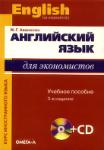
Текст
                    И.П. Агабекян, П.И. Коваленко
АНГЛИЙСКИЙ
ДЛЯ экономистов
I
ВЫСШЕЕ
ОБРАЗОВАНИЕ
ч>
Серия
«Высшее образование»
c s
zc
. Агабекян
. Коваленко
' для экономистов
Издание 4-е,
переработанное и дополненное
Ростов-на-Дону
«Феникс»
2004
ББК 81.2Англ-92
А23
Рецензент:
Смирнова МЛ.
Агабекян И.П., Коваленко П.И.
А2' Английский язык для экономистов. Издание
4-е. Серия «Высшее образование». Ростов н/Д:
«Феникс», 2004 - 416 с.
Учебное пособие соответствует государственному об-
разовательному стандарту и требованиям программы по
английскому языку для неязыковых вузов. Оно рассчи-
тано на 4-6 семестров работы. Может также частично
использоваться в средних специальных учебных заведе-
ниях (содержит повторительный курс грамматики). В по-
собии рассматриваются основные экономические систе-
мы, макро- и микроэкономические теории, действие эко-
номических законов в реальной жизни.
Для студентов высших учебных заведений с экономи-
ческой направленностью, подготовительных курсов и фа-
культетов, а также для самостоятельного обучения.
ISBN 5-222-05168-4
ББК 81.2Англ-92
© Агабекян И.П., Коваленко П.И., 2004
© Оформление, из-во «Феникс», 2004
От авторов
Перед вами учебное пособие, рассчитанное на 4-6
семестров работы в высшем учебном заведении с эко-
номической направленностью. Пособие также может
быть частично (первая часть и приложения) исполь-
зовано в средних специальных учебных заведениях,
на подготовительных курсах и факультетах, а также
для самостоятельного обучения.
Пособие состоит из четырех частей и приложений.
Первая часть - это корректировочный курс фонетики
и правила чтения. Вторая часть предназначена для
вчерашних выпускников средних школ — студентов
первого курса. Она носит общий характер, содержит
повторительный курс грамматики в соответствии с
требованиями программы по английскому языку для
неязыковых вузов.
Каждый из уроков второй части содержит темати-
ческий текст, являющийся также полно изложенной
устной темой. Так, во второй части рассматриваются
такие обязательные вузовские темы, как: About my-
self, Student’s working day, My University, My future
profession и цикл страноведческих тем - Great
Britain, USA, Russian Federation, Moscow.
Второй текст урока предназначен для классного и
внеаудиторного чтения, развития навыков работы со
словарем и передачи содержания на английском язы-
ке. Каждый урок завершается блоком кратко изло-
женной грамматики по обязательным разделам с зак-
репляющими упражнениями.
4 I Английский для экономистов
Третья часть предназначена для аудиторных и вне-
аудиторных занятий по английскому языку в тре-
тьем-четвертом семестре.
Третья и четвертая части представляют собой само-
стоятельные, структурно независимые пособия для раз-
вития навыков чтения, извлечения и обработки ин-
формации по специальности. В целях универсализа-
ции пособия каждый урок в третьей и четвертой части
самостоятелен. При составлении пособия мы исходи-
ли из принципа «от общего к частному», логически
переходя от более от общих тем к более специализиро-
ванным разделам (например, от -Defining Economics к
Management, Marketing).
В четвертой части пособия — Applied Economics (При-
кладная экономика) - рассматриваются основные эко-
номические системы, экономические законы, мак-
ро- и микроэкономические теории. Все тексты явля-
ются оригинальными. Некоторая сложность использо-
ванных текстов обусловлена установкой авторов на их
оригинальный характер, так как основная цель — раз-
вить у студентов навыки извлечения, обработки и пе-
редачи экономической информации на английском
языке.
Пособие завершают ряд полезных, как для учебно-
го процесса, так и для практической работы, прило-
жений:
Appendix А:	Тексты для дополнительного чтения.
Appendix В:	Frequently used business abbreviations. —
Словарь наиболее часто встречающихся сокращений
в литературе по экономической тематике.
Appendix С:	Таблица неправильных глаголов.
PART 1
I Фонетика.
I Особенности
I английского произношения
В результате сложного исторического развития анг-
лийского языка и системы его письменности возникло
значительное расхождение между написанием слова и
его произношением. Это привело к системе специаль-
ной записи звукового образа слова — фонетической
транскрипции. Знание знаков транскрипции - это ключ
к правильному чтению и произношению слова. Транс-
крипционные значки звуков заключаются в квадрат-
ные скобки.
Звуки английского языка
Гласные
[i:] - долгий и
[i] - краткий, открытый и
[е] - э в словах этот, экий
[ае] - более открытый, чем э
[а:] - долгий, глубокий а
[о] - краткий, открытый о
[о:] - долгий о
[о] - закрытый, близкий к у звук о
[и] - краткий у со слабым округлением губ
[и:] - долгий у без сильного округления губ
б I Английский для экономистов
[л] - краткий гласный, приближающийся
к русскому а в словах варить, бранить
[а] - безударный гласный, напоминающий рус-
ский
безударный гласный в словах:
нужен, молоток
[а:] - в русском отсутствует, средний между о и э
Двугласные (дифтонги)
[el] - эй
[ои]-оу
[al] - ай
[аи] - ау
[oi] - ой
[ia] - иа
[еа] - эа
[из] - уа
Согласные
[р]-н
[Ь]-о
[т] —м
[w] - звук, образующийся с положением губ, как
при б, но с маленьким отверстием между
губами, как при свисте
[Л-0
[v]-e
[d] - (с голосом) \
[0] - (безголоса) / оба звука образуются при
помощи языка, кончик которого легко
касается верхних передних зубов, как
в шепелявом русском з
[s]-c
[z]-3
Part I. Фонетика I 7
[t] - m, произнесенное не у зубов, а у десен
[d] - д, произнесенное не у зубов, а у десен
[п] - н
[1]-л
[г] - звук произносится без вибрации кончика
языка в отличие от русского р
[J] - мягкий русский ш
[3] - мягкий русский ж в слове вожжи
[tn-ч
№] - озвонченный ч
[к]-к
[g] - г
[ij] - заднеязычный и, произнесенный задней
частью спинки языка
[h] - простой выдох
Ы-й
Некоторые английские согласные имеют двойное
чтение, сочетания двух согласных могут передавать
один согласный звук, а 6 гласных букв передают 20
гласных звуков в зависимости от положения гласной в
слове (ударное или неударное) и от типа слога (откры-
тый или закрытый).
Рекомендуется выучить три основных правила про-
изношения английских слов:
1.	Краткость или долгота гласных звуков в русском
языке не влияет на смысл слова. В английском же
языке долгота или краткость произнесенного глас-
ного звука меняет смысл слова. Так, [Jip] - корабль,
a [fi:p] - овца.
2.	В отличие от русского языка в английском языке
согласные звуки не оглушаются в конце слова. Ог-
лушение согласных отражается на смысле слова. На-
8 I Английский для экономистов
пример: [Ьагд] — сумка, [bask] - спина.
3.	Гласная буква е в конце слова не читается. Чтение
гласной буквы в английском языке зависит от ее
положения в слове (ударное или неударное) и от
типа слога (открытый или закрытый).
Правила чтения
Правила чтения букв а, е, i, о, и, у
и их сочетаний
Чтение гласных букв а, е, i, о, и, у зависит от:
1)	типа слога, в котором они стоят;
2)	ударные они или безударные;
3)	от того, какие буквы стоят впереди или позади
них.
Типы слогов
I	I	II
Открытый	Условно- открытый	Закрытый
Слог оканчивается на гласную	Слог оканчивается на согласную, за которой следует непроизносимая буква е	Слог оканчивается на одну или несколько согласных
he, she, me	make, note, time	sit, but, test
Правила чтения гласных а, е, i, о, и, у
в ударных и безударных слогах
	Типы слога
	I	II	Ш	IV
Глас- ные	открытый ударный тип слога	закрытый ударный тип слога	гласная+т ударный тип слога	гласная+т+е ударный тип слога	безударн ый слог
А а	Iе’] plate	[®] lamp	[а:] саг	[«) share	[э] ago
Part I. Фонетика I 9
	Типы слога
	I	II	III	IV
Глас- ные	открытый ударный тип слога	закрытый ударный тип слога	гласная+г ударный тип слога	гласная^г+е ударный тип слога	безудар- ный слог
Е е	П=] we	[е] ten	[э:] her	[19] here	[Э] [I] absent forest
li Yy	[ai] fine byte	[I] bit mystic	[*] girl	[aia] fire tyre	[I] music copy
Uu	D'u:] tube	[Л] cut	[э:] turn	[jus] cure	[9] [ju:] success unite
Оо	[ou] bone	not	[□:] short	M more	[9] [OU] confer retro
Правила чтения буквосочетаний
Сочетания согласных
Буквосочетание	Произношение	Пример
ch	[tj]	chair
sh	[JI	she
th	[0]	thin
th	[3]	this
wh	[w]	what
wh	[h]	who
ng	И	long
ck	[k]	clock
Непроизносимые согласные
Буквосочетание	Произношение	Пример
igh	[ar]	high light
kn	[n]	know knife
wr	И	write wrong
gn	[n]	sign
10 I Английский для экономистов
Звуки [i], [i:]
Гласный звук [i] При произнесении краткого глас-
ного звука [i] кончик языка находится у основания
нижних зубов: оттенок русского звука и в словах шить,
шило практически совпадает с английским [i] - it, sit,
in.
Гласный звук [i:]. При произнесении долгого глас-
ного [i:] язык продвинут вперед, кончик языка касает-
ся нижних зубов, губы несколько растянуты и слегка
обнажают зубы. Оттенок русского звука и в словах ива,
иго, игры, избы практически совпадает с английским
звуком [i:].
Сочетания ее, еа - читаются [i:]. Например, meet,
peat.
Долгота звука влияет на лексическое значение сло-
ва.
Например, feet (ноги) — fit (вмещаться), steel (сталь)-
still (все еще)
Exercise А
[I], [i;]
if - it
is - bit
tip - kit
did - bill
mill - meal
pill - peel
keel - kill
sit - seat
Exercise В
[i], [i:]
lip - leap
did - deed
Part I. Фонетика I 11
pit - peat
fit — feet
it — eat
lid — lead
Exercise C
И, [i:]
bin — bean — seem
beat — bin - keen
sit — seat - least
steel - still — steal
feel - fill - feet
fit - eat - bean
simple - Pete - ease
feel — peel - reel
meet - meat - knit
ill — bill — will
steel - feel - clear
Exercise D
И, [iG
be — been - bean
me - meet - meat
see - seat - seed
meal -seal - mean
pea - Pete - peat
sea - see - meet
bee - been - feet
mean — lean - keen
Exercise E
[i], [i:]
I see a sea. I see lean meat. I eat meat. I like meat.
I like tea. I make tea. I take tea. I like fine tea I like
fine meals.
12 I Английский для экономистов
Звуки [е], [ае]
Гласный звук [е]. При произнесении гласного [е]
масса языка находится в передней части ротовой по-
лости. Кончик языка находится у нижних зубов. Губы
слегка растянуты. Звук близок к русскому звуку [э] в
словах эти, жесть.
Гласный звук [ае]. При произнесении звука [ае] губы
несколько растянуты, нижняя челюсть сильно опуще-
на, кончик языка касается нижних зубов, а средняя
спинка языка немного выгибается вперед и кверху.
Ф Exercise А
[ае]
am - Ann — lamp
man - can - cat
sat - hat - bat
Pat - rat - cam
Exercise В
[c], [ae]
tan - ten
pan - pen
bad - bed
land - lend
ban - bent
fan - fence
man - men
pat - pet
Exercise C
[e], [ae]
bat - bet
pat - pet
rad — red
lap - met
Part I. Фонетика I 13
ten — pen
men - hen
Звуки [а:], [га], [ei]
Гласный звук [a:]. При произнесении английского
гласного [а;] рот отрыт почти как для русского звука,
но язык отодвигается дальше назад и книзу и лежит
плоско. Кончик языка оттянут от нижних зубов. Губы
не растянуты и не выдвинуты вперед.
Гласный звук [л]. При произнесении звука язык
несколько отодвинут назад, задняя спинка языка при-
поднята к передней части мягкого неба, губы слегка
растянуты. Звук похож на русский предударный звук
а в словах: какой, посты, басы.
Гласный звук [гэ]. Ядро звука — гласный, похо-
жий на русский звук в слове это. Скольжение проис-
ходит в направлении нейтрального гласного с оттен-
ком звука а.
Гласный звук [ei]. Дифтонг, ядром которого явля-
ется гласный [е], а скольжение происходит в направ-
лении гласного [i], Произнося дифтонг, необходимо сле-
дить за тем, чтобы ядро не было таким широким, как
русский гласный э, а второй элемент не превращался
в русский звук й.
Exercise А
[а:]
саг — far — bar
half - calf - bath
part — park - tart
cart — barter — shark
spark — bath — mark
park - raft — plant
14 I Английский для эконом
Exercise В
[ЕЭ]
Mary — air
pair — parents
care - dare
rare - hare
fare — fair
hair - stair
Exercise C
[ei]
tape - hate - bate
mate - plate - Kate
late - fate - rate
brave — maple — main
pain — name - day
date — may - pay
lay - hay - Ray
Exercise D
Ы. [a:]
cup - car
sun — part
us - art
bus - bath
tub - tart
mud - mark
must - marble
but — barter
hunt - harm
trust - drama
[a:]
far - bar
half - calf
Part I. Фонетика I 15
park — tart
spark - bath
park - raft — plant
cart - barter - shark
Звуки [u:], [u]
Гласный звук [u:]. При произнесении долгого глас-
ного звука [и:] губы напряжены и сильно округлены,
но гораздо меньше выдвинуты вперед, чем при рус-
ском звуке у.
На письме передается буквосочетанием двойное О,
за исключением случаев перед буквой к. Например,
soon — скоро, вскоре, moon — луна
Исключение: book — книга (краткое и).
Гласный звук [и]. При произнесении краткого глас-
ного звука [и] губы заметно округлены, но не выдви-
нуты вперед, язык оттянут назад, но несколько мень-
ше, чем для [и:] (и долгого). Звук напоминает безудар-
ный русский звук у в словах пустой, тупой, произне-
сенный без выдвижения губ вперед.
Например, hook — крюк, look — взгляд
Запомните слова, в которых в качестве исклю-
чения произносится [и]:
put — класть pull — тянуть
push — толкать full — полный
Exercise А
[и:], [и]
pool (бассейн) — pull (тянуть)
tool (инструмент) — full (полный)
too - took
tooth - hook
16 I Английский для экономистов
food - cook
boot - look
fool - full
Exercise В
[u:]
fool - pool - hook
fool — too — book
cook - boot - loop
foot — cool — mood
shook - soon - boot
spoon - moon - foot
Звуки [о:], [о], [ou]
Гласный звук [о:J - долгий гласный. Для того, что-
бы правильно произнести звук, следует придать орга-
нам речи положение, как при произнесении звука а,
затем значительно округлить губы и несколько вы-
двинуть их вперед.
Гласный звук [о]. Для того, чтобы произнести звук
[о], следует исходить из положения органов речи при
произнесении звука [а:], затем слегка округлить губы
и произнести краткий звук [о].
Гласный звук [ои]. Начало звука представляет со-
бой нечто среднее между русскими звуками о и э. Губы
при произнесении начала этого дифтонга слегка рас-
тянуты и округлены. Скольжение происходит в направ-
лении гласного [и].
ЯН Exercise А
[*]
more — score — poor
floor — for — form
fork — pork — sport
dawn - hawk - because
Part I. Фонетика I 17
Exercise В
[о]
not — top - hot
Rostov-on-Don
dot — mop - mob
Exercise C
[OU]
tone — note - smoke
cone — loan — moan
code — hope - cope
lobe - mould - gold
boat - soap - coat
Звуки [is], [ai], [au]
Дифтонг [is]. Ядро звука - гласный [i], а скольже-
ние происходит в направлении нейтрального гласного,
имеющего оттенок звука [л].
Дифтонг [ai]. Ядро дифтонга - гласный звук, похо-
жий на русский звук а в слове чай. Скольжение проис-
ходит в направлении звука и, однако его образование
полностью не достигается, в результате чего слышит-
ся лишь начало звука и.
Exercise А
[1Э]
year — hear — ear
here — near — fear
tear - peer - beer
rear — leer — mere
Exercise В
[ai]
mile - pile — kite
site - side — ride
18 I Английский для экономистов
height — light — fight
might - right - tight
pike - hike - hide
Exercise C
[au]
now — how — brown
out — now — house
louse - mouse - cows
out - loud — without
Звуки [0], [d]
Согласный звук [0]. В русском языке подобного
звука нет. Звук [0] - глухой. При его произнесении
язык распластан и ненапряжен, кончик языка обра-
зует узкую плоскую щель, неплотно прижимаясь к
нему. В эту щель с силой проходит струя воздуха.
Кончик языка не должен сильно выступать за верх-
ние зубы или слишком плотно прижиматься к губам.
Зубы должны быть обнажены, особенно нижние, что-
бы нижняя губа не касалась верхних зубов и не при-
ближалась к ним.
Согласный звук [3]. При произнесении звука [3]
органы речи занимают такое Же положение, как и при
произнесении звука [0]. Звук [3] отличается от звука
[3] только звонкостью, то есть произносится с голосом.
Exercise А
[9], [3]
through - fifth - myth
thief - tooth — thunder
thank — think — thought
theatre - theory - theft
Part I. Фонетика I 19
Exercise В
[6], [S]
thermometer — thick -• thin
thirst — thirty — thorough
threat - three —booth
threw — throat — thumb
faith - hearth — path
bath — booth — broth
this — that - those
there — though — these
them — they - the
Звуки [w], [ij]
Согласный звук [w]. При произнесении губы ок-
руглены и значительно выдвинуты вперед, а задняя
часть языка занимает примерно такое же положение,
как при произнесении русского у. Струя выдыхаемого
воздуха с силой проходит через образованную между
губами круглую щель. Губы энергично раздвигаются.
Согласный звук [р]. При произнесении согласного
задняя спинка языка смыкается с опущенным мягким
нёбом, и воздух проходит через носовую полость. Для
того, чтобы добиться нужного положения органов речи,
можно сделать вдох через нос с широко открытым ртом,
затем следить за тем, чтобы ни кончик языка, ни его
передняя и средняя часть не касались нёба.
Exercise А
[w]
what — why — where
whip - wheat — while
war — wharf - water
wedding — wage — wait
waitress - waist - waste
20 I Английский для экономистов
weather — woman — wind
wall — wallet — walk
walnut — waltz — won
Exercise В
[о]
wing - king - being
sing — nothing — something
nothing - anything - ring
Согласный звук [h].
Этого звука в русском языке нет. В английском язы-
ке он встречается только перед гласным и на слух пред-
ставляет собой легкий, едва слышный выдох. В отли-
чие от русского звука х английский звук [h] образует-
ся без всякого участия языка, поэтому необходимо
следить за тем, чтобы задняя спинка языка не подни-
малась близко к мягкому нёбу.
Exercise А
[h]
hit — heat — head
hall — hollow - hammer
hand - happy - hard
hope - heap - hat
heal — heel — heal
health - height — hear
hood - his — ham
her - here - hate
Звуки [dr], [br], [gr], [tr], [fr], [Or]
Эти сочетания согласных произносятся слитно, без
деления на отдельные звуки.
Part I. Фонетика I 21
Exercise A
[dr]
draw — drum — draft
drink - drank - drunk
drain — dragon — drama
drift— dreadful - drugs
Dresden - dress - dry
drill — drop — drag
drive - drove — driven
Exercise В
[br]
brown - bread — bracelet
brain - brakes — bran
brunch - branch — brave
Brazil - breach — breast
breadth — broth — breathe
Exercise C
[tr]
treasure - trainer - trench
track - trade - traffic
troops - trend — trail
translate — transmit - trance
Exercise D
[fr], [er]
France - French - fruit
fry - frame — free
three - thread — throat
threat - through - thriller
thrifty — throne — threaten
22 I Английский для экономистов
English alphabet
(Английский алфавит)
БУКВА	НАЗВАНИЕ	БУКВА	НАЗВАНИЕ
А а	[ei]	N n	[en]
вь	[bi=]	Oo	[ou]
Сс	[si:]	PP	[Pi;]
Dd	[di:]	Qq	[kju:]
Ее		Rr	[a:]
Ff	[ef]	Ss	[es]
Gg	№i:]	Tt	[ti:]
Hh	[eitf]	Uu	[ Ju;]
li	[ai]	V V	[Vi:]
JJ	[4?ei]	W w	['(hblju:]
Kk	[kei]	Xx	[eks]
LI	[el]	Yy	[wai]
M m	[em]	Zz	(zed]
PART 2
I REVISION COURSE
LESSON 1
^Text 1
LET ME INTRODUCE MYSELF
Hello, friends. Let me first introduce myself. My name
is Vera. My surname or last name is Voronina. I was
born on the 13th of October in Sochi, Krasnodarsky Krai.
This is the most beautiful city in Russia situated on the
Black Sea coast. Now I am a first-year student at the
Faculty of Economics of Rostov State University.
Now let me describe my appearance. I am tall and
slim and have fair hair and blue eyes. My friends say
that I am pretty. I love sports and music. I was very
serious about a career in gymnastics when I was in the
4th form. But then I broke my arm and doctors didn’t let
me to go in for gymnastics. I love to listen to the modern
music and dance. I dance a lot and I hope I am good at it.
I also love swimming. I always swim in the Black sea
when I visit my parents.
I would like to tell you about my family. There are five
people in our family. My father’s name is Mil'hail
Evgenyevich. He is a mathematician by education but
works at a bank now. My mother’s name is Natalya
Yakovlevna. She works as a chief accountant at the hotel
«Zhemchuzhina». She also has much work about the house
after she gets home from work. But my sister and I always
24 I Английский для экономистов
help her. Yes, let me introduce my younger sister. She is
still a pupil. Her name is Tanya and she is in the fifth
form. She is very pretty and a great dancer. We are good
friends with my sister. My grandmother, my mother’s
mother, lives with us. She is very kind and helps us a lot.
Our family is very friendly, we have many friends. In
summer many relatives come to visit us. And of course
they use a chance to spend several weeks in beautiful Sochi.
In May I have finished school No5 in Sochi. I did well
in all the subjects but my favourite subjects at school
were Computer Science and English. I also enjoyed
Geography lessons.
I am very interested in learning English because I
always wanted to become an economist or a manager at
some joint venture. That is why I think it is necessary to
know at least one foreign language. Besides, knowledge
of foreign languages helps in everyday life.
As you see, my biography isn’t very long yet. But
we’ll meet again in the next lesson and I’ll tell you more
about myself. See you later...
Vocabulary:
introduce [.intra'dju:s] -
представлять,' знакомить
Black Sea coast [koust] -
побережье Черного моря
a first-year student -
студент(-ка) первого
курса
appearance [a'piarans] -
внешность
slim - стройная
gymnastics [djim'naestiks] -
гимнастика
kind — добрый
broke my arm - сломала
руку
mathematician
[,maeOima'tifan] - мате-
матик
chief accountant - [tjrf
a'kauntant] главный
бухгалтер
several [ sevral] - несколь-
ко
to do well - зд. успевать
joint venture - совместное
предприятие
Part II. Revision Course. Lesson 1 I 25
Add to your active vocabulary
(Пополни свой активный словарь):
tall [tod] - высокий
short [Jo:t] - маленького
роста
stout [staut] - приземис-
тый, коренастый
slim - стройный
fat [fast] - толстый
plump [pkmp] - полный
fair hair [fea' hea] - свет-
лые волосы
blonde [blond] - блондин(ка)
brunette [bru/net] - брю-
нетка)
gray hair - седые волосы
bald headed [bo:Id] - лысый
short sighted — близору-
коссть
smart, clever, bright -
умный
stupid [ stju:pid] — тупой,
глупый
boring — скучный
fun to be with — веселый
человек
easy to go along — легкий
в общении
quiet ['kwaiat] — спокойный
impulsive [im'pAlsiv] —
порывистый, импуль-
сивный
aggressive [a'gresiv] —
агрессивный
rude [ru:d] - невежливый,
грубый
shy Lfai] — застенчивый
active ['asktiv] - активный
talkative ['toikativ] -
разговорчивый
1.1. Представьтесь, ответив на следующие во-
просы:
1.	What is your name?
2.	Where and when were you born?
3.	How old are you?
5.	Have you got a family?
6.	How many people are there in your family?
7.	Do you have brothers, sisters, grandparents in your
family?
8.	Where do you live?
9.	Did you study well at school?
10.	What school did you finish?
26 I Английский для экономистов
11.	Did your teachers help you to choose your future
profession?
12.	What were your favourite subjects at school?
13.	What do you like to read?
14.	What sport do you go in for?
15.	What are you going to be?
16.	Do you still live with your parents?
17.	Do you have a many friends?
Kg=1.2. Напишите рассказ о своем друге (внешность,
интересы, характер).
|£§=1.3. Опишите внешность какого-либо вашего зна-
комого, используя активный словарь урока.
1.4.	Работа в парах. Спросите соседа по парте о
его!ее:
•	family
•	hobbies
•	friends
•	favourite films
•	favourite actor
•	favourite book
•	favourite food
•	places he/she visited
T ГРАММАТИКА
ОСНОВНЫЕ ПОНЯТИЯ В ГРАММАТИКЕ
Части речи
Все слова, входящие в язык, делятся на разряды,
называемые частями речи.
Part II. Revision Course. Lesson 1 I 27
Различаются следующие части речи:
1)	существительное (noun, n);
2)	прилагательное (adjective, а);
3)	числительное (numeral, num);
4)	местоимение (pronoun, pron);
5)	глагол (verb, и);
6)	наречие (adverb, adv);
7)	предлог (preposition, prep);
8)	союз (conjunction, cj);
9)	междометие (interjection, inter]).
1.	Существительным называется часть речи, обо-
значающая предметы. Предметами в грамматике на-
зывают все то, о чем можно спросить: кто это? или
что это?
Например: Кто это? — a doctor, a man, a girl
Что это? — a tree, a house, freedom
Существительные имеют два артикля: а (ап) — нео-
пределенный и the - определенный.
Существительные имеют два числа: единственное
— a boy, a tree и множественное — boys, trees.
Существительные имеют два падежа: общий — ту
sister и притяжательный — ту sister’s. Притяжа-
тельный падеж, как правило, имеют одушевленные су-
ществительные.
2.	Прилагательным называется часть речи, обозна-
чающая признаки предметов и отвечающие на вопрос:
какой? Например: red, interesting, Russian и т.д.
Прилагательные не изменяются по родам, числам и
падежам.
Прилагательные имеют три степени сравнения:
положительную, сравнительную и превосходную.
3.	Числительным называется часть речи, обо-
значающая количество или порядок предметов при
28 I Английский для экономистов
счете. Числительные делятся на количественные и
порядковые.
4.	Местоимением называется часть речи, которая
употребляется вместо имени существительного или
прилагательного. Имеются также личные, притяжа-
тельные, указательные, вопросительные и др. место-
имения.
5.	Глаголом называется часть речи, которая обозна-
чает действие или состояние, представленное в виде
действия.
Глаголы в английском языке имеют четыре основ-
ные формы:
1)	инфинитив (неопределенная форма);
2)	прошедшее время (Past Indefinite);
3)	причастие прошедшего времени (Past Participle);
4)	причастие настоящего времени (Present Participle).
С помощью этих форм образуются все сложные вре-
менные формы действительного и страдательного за-
лога.
6. Наречием называется часть речи, указывающая
на признак действия или на различные обстоятельства,
при которых протекает действие (как, где, когда и т.д.):
Существительное, прилагательное, числительное,
местоимение, глагол и наречие являются самостоя-
тельными частями речи. Они обозначают предметы,
их качества, действия и т.п. и являются членами пред-
ложения.
Предлоги и союзы являются служебными частями
речи. Они показывают различные отношения между
членами предложения или предложениями.
Part II. Revision Course. Lesson 1 I 29
Члены предложения
Предложением называется сочетание слов, выра-
жающее законченную мысль.
Слова, входящие в состав предложения и отвечаю-
щие на какой-нибудь вопрос, называются членами
предложения. Члены предложения делятся на глав-
ные и второстепенные.
Главные члены предложения: подлежащее и ска-
зуемое; второстепенные члены предложения: допол-
нение, определение и обстоятельства.
Подлежащим называется член предложения, обо-
значающий предмет или лицо, о котором что-либо го-
ворится в предложении. Подлежащее отвечает на воп-
рос кто? или что?
Сказуемым называется член предложения, обозна-
чающий то, что говорится о подлежащем. Сказуемое
отвечает на вопросы: что делает подлежащее?, что
делается с подлежащим?, кем или чем является под-
лежащее?
Дополнением называется второстепенный член пред-
ложения, который обозначает предмет и отвечает на воп-
росы, соответствующие в русском языке вопросам кос-
венных падежей как с предлогом, так и без него: кого?
чего?, что?, кому?, чему?, кем?, чем?, о ком?, о чем?.
Обстоятельствами называются второстепенные чле-
ны предложения, которые обозначают, как' или при
каких обстоятельствах (т.е. где, когда, почему, зачем
и т.п.) совершается действие.
Обстоятельства могут обозначать:
1)	время
2)	место
3)	образ действия
4)	причину
5)	цель
6)	степень
30 I Английский для экономистов
МЕСТОИМЕНИЯ
(Pronouns)
Местоимения употребляются в предложении вмес-
то имени существительного или имени прилагатель-
ного. Местоимение называет людей, предметы или
признаки, уже упомянутые ранее.
Например:
Peter gave Kate a book. She took it.
Петя дал Кате книгу. Она взяла ее.
You have a good dictionary. I want to buy such a
dictionary.
У вас хороший словарь. Я хочу купить такой сло-
варь.
Личные местоимения
(Personal pronouns) Единственное число		Множественное число
1лицо	1(я)	1 лицо	we (мы)
2 лицо	you (ты)	2 лицо	you (вы)
3 лицо	he (он) she (она) it (оно)	3 лицо	they (они)
Примечание: после местоимения you глагол-ска-
зуемое всегда стоит во множественном числе: You
are a student. Ты студент.
Склонение личных местоимений
Личные местоимения в английском имеют два па-
дежа:
1) именительный падеж (the nominative case);
2) объектный падеж (the objective case), заменяющий
собой все падежи русского.
Part II. Revision Course. Lesson 1 I 31
Число	Лицо	Именительный падеж	Объектный падеж
Ед	1 лицо	1(я)	те (мне, меня)
	2 лицо	you (ты)	you (тебе, тебя)
	3 лицо	he (он) she (она) it (оно)	him (ему, его) her (ей, ее) it (ему) неодуш
Мн.	1 лицо 2 лицо 3 лицо	we (мы) you (вы) they (они)	us (нам, нас) you (вам, вас) them (им, их)
Притяжательные местоимения
(Possessive pronouns)
Единственное число
1 лицо my (мой, моя, мое, мои)
2 лицо your (твой, твоя, твое, твои)
3 лицо his (его), her (ее), its (его)
Множественное число
1 лицо our (наш, наша,
наше, наши)
2 лицо your (ваш, ваша,
ваше, ваши)
3 лицо their (их)
Притяжательные местоимения имеют две формы:
основную и абсолютную.
Основная форма употребляется в тех случаях, когда
за притяжательным местоимением стоит существитель-
ное.
This is ту book and that is your book. Это моя кни-
га, а то твоя книга.
Абсолютная форма притяжательных местоимений
употребляется в тех случаях, когда за местоимением
не стоит существительное.
This is ту book and that is yours. Это моя книга, a
то твоя.
It is not mine. Она не моя.
32 I Английский для экономистов
Абсолютные формы
притяжательных местоимений
	Единственное число	Множественное число
1 лицо 2 лицо 3 лицо	mine (мой, моя, мое, мои) yours (твой, твоя, твое, твои) his (его), hers (ее), its (его)	ours (наш, наша, наше, наши) yours (ваш, ваша, ваше, ваши) theirs (их)
Указательные местоимения
(Demonstrative pronouns)
Указательные местоимения имеют единственное и
множественное число.
Единственное число	Множественное число
this [3is] (этот, эта, это)	these [Si:z] (эти)
that [3aet] (тот, та, то)	those [3ouz] (те)
This is ту house and that is yours. Это мой дом,
а то — твой.
These are my books. Take those books. Эти книги
мои. Возьми те книги.
Указательное местоимение such имеет одну неиз-
меняемую форму.
I like such books. Мне нравятся такие книги.
*§=1.5. Переведите на английский язык:
l.Ta книга не моя. 2. Эта книга — моя. 3. Это моя
книга, а то — его. 4. Эти - ее карандаши, а те — мои. 5.
Возьми те карандаши. Они новые. 6. Я люблю такие
Part II. Revision Course. Lesson 1 I 33
ручки, они хорошие. 7. Ваша ручка плохая, возьмите
мою.
1.6.	Замените выделенные слова личными место-
имениями.
1. Peter helped the pupils to translate the text.
2. Mother asked Mary to wash the plates. 3. My friend
writes a letter to his sister. 4. Jane took 3 books from
the library. 5. His cousins live in Moscow. 6.
Grandfather and grandmother will come tomorrow. 7.
Mary works in a shop.
1.7. Напишите предложения во множественном
числе.
1.	This is my pen and that is your pencil.
2.	This is our office and that is yours.
3.	This is his desk and that is hers.
4.	This is my book and that is theirs.
5.	This is my letter and that is his.
6.	Is this is my book?
7.	Is that house yours? That house is mine.
^1.8. Выберите правильные притяжательные мес-
тоимения:
1.	Is this (your / yours) book?
2.	It’s (their / theirs) door, not (our / ours).
3.	They’re new pupils and I don’t know (their / theirs)
names.
4.	(My / Mine) flat is bigger than (her / hers), but (her /
hers) is nicer.
5.	That’s not (my / mine) book. (My / Mine) is new.
34 I Английский для экономистов
6.	They took (our / ours) books and we took (their /
theirs).
7.	Are these pencils (her I hers)?
8.	Is this (your / yours) house or (their I theirs)?
Вопросительные местоимения
и вопросительные слова
Эти местоимения употребляются для построения
вопросительного предложения.
What (что, какой, какая, какое, какие)
What is it? Что это такое? What book is it? Какая
это книга?
Who (кто)
Who is this man? Кто этот человек?
Whose (чей)
Whose pencil is it? Чей это карандаш?
Which (который)
Which of these books is yours? Которая из этих книг
твоя?
When (когда)
When does the lesson begin? Когда начинается урок?
Why (почему, зачем)
Why did you come here? Почему вы пришли сюда?
How (как)
How are you? Как поживаете?
How many (much) (сколько)
Вопросительное местоимение what относится к сло-
вам, обозначающим вещи, предметы, явления.
Вопросительное местоимение who относится к сло-
вам, обозначающим людей.
Однако, обратите внимание:
Who is he? Кто он? (как его зовут) Не is Mr. Johnson.
What is he? Кто он? (по профессии) Не is an
economist.
Part II. Revision Course. Lesson 1 I 35
Местоимение who имеет два падежа:
1. Именительный падеж who
2. Объектный падеж whom (кому, кого).
Who is here? Кто здесь?
Whom do you see there? Кого ты там видишь?
Whom did you give my book? Кому ты дал мою книгу?
1.9. Переведите на английский язык:
1.	Чье это письмо? - Это наше письмо.
2.	Чей это компьютер? — Это ее.
3.	Кто этот человек? - Этот человек наш профессор.
4.	Какие это книги? - Это хорошие книги.
5.	Которые из этих книг наши? - Они все ваши.
6.	Кто м-р Джонсон? - Он менеджер большой фирмы.
7.	Кого вы встречаете сегодня? — Мы встречаем иност-
ранную делегацию.
8.	Которая из этих ручек твоя? - Эта моя.
9.	Почему вы пришли рано? - У меня много работы.
10.	Когда вы идете на работу? - Я иду на работу в
понедельник.
Возвратные местоимения
Возвратные местоимения употребляются в предло-
жении для того, чтобы сказать, что предмет, назван-
ный подлежащим предложения,
(а) сам совершает действие, или
(б) сам совершает действие и испытывает его на себе.
Как правило, они переводятся глаголом с частицей
-сь (-ся), которая присоединяется к глаголам.
Например:
Do it yourself.	Сделайте это сами.
Do not cut yourself! He порежьтесь!
36 I Английский для экономистов
we - ourselves
you - yourselves
they - themselves
В английском языке возвратные местоимения обра-
зуются от личных:
I — myself
you - yourself
he - himself
she - herself
it - itself
Возвратное местоимение oneself образуется от нео-
пределенного местоимения one + self.
<^1.10. У потребите нужное возвратное местоиме-
ние:
1.1 shall ask him ... . 2. They want to do it .... 3. She
washed ... . 4.You will answer the letter ... . 5. I looked
at... in the mirror. 6. We shall tell her ... . 7. They have
done the task ... . 8. She doesn’t like to speak about ... .
9. The story ... is very good, but not the translation. 10.
Children, do it ... .
^’l.ll. Переведите на английский язык:
1. Утром я умываюсь и одеваюсь. 2. Идите домой
сами. 3. Читайте книгу сами. 4. Не nopaHbTecbl(hurt).
5. Они ходят в школу сами. 6. Причешитесь! (comb).
^®=1.12. Выберите нужное местоимение:
1. I invited my friends to ... place.
a) me b) his c) my d) mine
2. It’s easy, you can do it ... .
a) you b) your c) yours d) yourself
Part П. Revision Course. Lesson 1 I 37
------- СПРЯЖЕНИЕ ГЛАГОЛА to be----
Число	Утвердительная форма	Вопросительная форма	Отрицательная форма
Настоящее время (Present Indefinite)
Ед. ч	I am. You аге. Не (she, it) is.	Am I? Are you? Is he (she, it)?	I am not. You are not. He (she, it) is not.
Мн. ч	We (you, they) are.	Are we (you, they)?	We (you, they) are not.
Прошедшее время (Past Indefinite)
Едч	I (he, she, it) was. You were.	Was I (he, she, it)? Were you?	I (he, she, it) was not. You were not.
Мн.ч	We (you, they) were.	Were we (you, they)?	We (you, they) were not.
Будущее время (Future Indefinite)
Ед.ч	I shall be. You (he, she, it) will be.	Shall I be? Will you (he, she, it) be?	I shall not be. You (he, she, it) will not be.
Мн.ч	We shall be. You (they) will be.	Shall we be? Will you (they) be?	We shall not be. You (they) will not be.
38 I Английский для экономистов
Г ЛАГОА to have
Глагол to have (иметь)
утверждение	отрицание	вопрос
I have	1 have no .	have I?
he has	he has no	has he?
she has	she has no ..	has she?
it has	it has no .	has it?
we have	we have no...	have we?
you have	you have no. .	have you?
they have	they have no..	have they?
Глагол to have означает «иметь», «обладать» и пе-
реводится на русский язык «у меня (тебя и т. д.) есть».
Вопросительная форма образуется постановкой гла-
гола-сказуемого перед подлежащим.
В отрицательных предложениях ставится отрица-
тельное местоимение no: I have по watch. Не has по
books.
В кратких отрицательных ответах после глагола
следует отрицание not: I have not или (в разговорной
речи) I haven’t, he has not или he hasn’t.
1.13.	Выберите правильную форму глагола to have:
Mr. Johnson stayed at his office till late at night
because he ... a lot of work.
a) has b) have c) will have d) had
1.14.	Вставьте глагол to have в нужной форме:
a)	We ... an examination tomorrow.
b)	We ... not much time to prepare for the examination.
c)	He ... many friends.
d)	I hope you ... a good time at the party yesterday.
Part II. Revision Course. Lesson 1 I 39
Запомните:
this is — these are
that is — those are
there is — there are
it is — they are
C_^ 1.15. Вставьте нужную форму глагола to be и
переведите предложения.
1. Не ... born in 1985. 2. We ... students now. 3. We
... good friends in our group. 4. It ... an interesting
book. 5. Who ... absent today? 6. He ... a student. 7.
What ... he? 8. ... he a doctor ? 9. These ... my pencils.
10. Where ... this book? It ... on the table. 11. What ...
their names? 12. Mary ... a girl. 13. Who ... he? 14.
What ... you? 15. This man ... in the room. 16. How ...
she? 17. How ... you? I ... fine. 18. How ... your friend?
19. ... he your son? 20. Tomorrow we ... at home. 21. ...
you a sportsman? 22. There ... no book on the table. 23.
It ... my parents’ car. 24. There ... 25 students in our
group now.
1.16. Выберите правильную форму глагола to be:
1) He ... a student of the first course.
a) is b) are c) am d) were
2) He ... an economist in five years.
a) is b) was c) will be d) were
НЕОПРЕДЕЛЕННЫЙ И ОПРЕДЕЛЕННЫЙ
АРТИКЛИ
Неопределенный артикль а (ап) происходит от чис-
лительного one (один), определенный - от указатель-
ного местоимения that (тот).
Артикль употребляется: перед каждым нарицатель-
ным существительным.
40 I Английский для экономистов
Артикль не употребляется если перед существи-
тельным стоит:
•	указательное или притяжательное местоимение,
•	другое существительное в притяжательном паде-
же,
•	количественное числительное,
•	отрицание по.
Например: This Is ту book. I have no book. It’s
teacher’s book.
Упоминая предмет впервые, мы употребляем перед
ним неопределенный артикль а(ап). Упоминая этот же
предмет вторично, мы ставим перед ним определен-
ный артикль the. Например: This is a book. The book is
interesting.
Неопределенный артикль a (an)
Употребляется перед единичным, отдельным пред-
метом, который мы не выделяем из класса ему подоб-
ных. Неопределенный артикль ап обычно стоит перед
существительным, которое начинается с гласного зву-
ка: an apple, an egg.
Например: I bought a book'у ester day. Я купил вчера
книгу (одну из многих ей подобных). I have an apple. У
меня есть яблоко (одно, какое-то).
Неопределенный артикль а (ап) может употреб-
ляться только с исчисляемыми существительными, сто-
ящими в единственном числе. Перед неисчисляемыми
существительными или существительными во множе-
ственном числе неопределенный артикль опускается.
Неопределенный артикль а/ап не употребляется:
а)	с неисчисляемыми и «абстрактными» существи-
тельными:
I like coffee and tea. Friendship is very important in
our life.
Part II. Revision Course. Lesson 1 I 41
б)	с существительными во множественном числе:
Children like lollypops (chupa-chups).
в)	с именами собственными:
Jane is a student of the first course.
г)	с существительными, перед которыми стоят при-
тяжательные или указательные местоимения:
This car is better than that. That house is old.
д)	с существительными, за которыми следует коли-
чественное числительное, обозначающее номер:
I have read page eight already.
Неопределенный артикль а необходим в конст-
рукциях:
I have a...	This is a...	What a fine day!
I see a...	There is a...	He is a...
I am a... He is such a good boy!
Определенный артикль the
Определенный артикль the выделяет предмет или
предметы из класса им подобных:
The book I bought yesterday was interesting. - Кни-
га, которую я купил вчера, была интересной (это —
конкретная книга, которую говорящий выделяет из
класса ей подобных).
Определенный артикль the употребляется как с
исчисляемыми, так и с неисчисляемыми существитель-
ными, как с единственным, так и с множественным
числом.
Например:
This is a book. The book is interesting (исчисляемое в
единственном числе).
This is meat. The meat is fresh, (неисчисляемое)
These are books. The books are good, (множественное
число).
42 I Английский для экономистов
Определенный артикль употребляется:
а)	когда известно (из контекста, из обстановки) о
каком предмете (предметах, явлениях) идет речь: Open
the door, please. I am going to the University.
б)	когда речь идет о единственном в своем роде пред-
мете или явлении: The Moon is shining brightly. The
Sun is a star.
в)	когда существительное имеет ограничивающее
определение, чаще всего с предлогом of.
I don’t know the name of this student.
г)	в словосочетаниях типа in the north, to the west,
at the cinema, the same, in the country, the rest of
the ...
д)	если перед существительным стоит прилагатель-
ное в превосходной степени
This is the most interesting book.
Географические названия и артикль
С географическими названиями и с именами соб-
ственными, артикль, как правило, не употребляется,
кроме следующих случаев:
а)	с названиями морей, рек, океанов, горных хреб-
тов, групп островов используется определенный ар-
тикль: the Pacific Ocean, the Black Sea, the Thames, the
British Isles;
б)	определенный артикль используется с несколь-
кими названиями стран, областей и городов, (хотя обыч-
но с этими типами названий артикль не использует-
ся): the Ukraine, the Crimea, the Caucasus, the
Netherlands, the Hague, the Riviera, the Congo, the West
Indies;
в)	определенный артикль используется с названия-
ми стран типа: the Russian Federation, the United States
of America, the United Kingdom;
Part II. Revision Course. Lesson 1 I 43
г)	перед собирательным именем семьи The Petrovs —
Петровы.
1.17. Вставьте артикль где он необходим:
1. This ... pencil is broken. Give me that ... pencil,
please. 2. I have ten programs on my computer. My
favourite is ... Microsoft Word. 3. My friend has ... car.
... car is broken now. My ... friend has no ... motorcycle.
4. Our flat ... is large. 5. I received a ... letter from my
friend yesterday. ... letter was very long. 6. She has two
... daughters and one ... son. Her ... son is ... lawyer. 7.
My ... brother’s ... friend has no ... dog. 8. This is ...
house. ... tree is green. 9. They have ... party. ... party is
... a birthday party.. 10. I read a book on marketing
yesterday. ... book was interesting and useful.
1.18. Используйте артикли где необходимо:
1. Yesterday I saw ... new film, but ... film wasn’t
very interesting. 2. ... Washington is sitiated on ...
Potomac River, and ... London is situated on ... Thames.
3. Yuri Gagarin was ... first man to fly over ... Earth in
... spaceship. 4. My younger sister will go to school ...
next year. 5. In ... summer we went to ... Black Sea coast.
6. ... New York is one of ... biggest business centers in ...
world. 7. Lomonosov was ... great Russian scientist. He
was born in ... small village on ... shore of ... White Sea.
8. My mother is ... accountant. I don’t want to be ...
accountant. I want to be ... manager. 9. Is your dress
made of ... silk or ... cotton? 10. ... Peter’s brother is ...
student. He will be ... economist soon. 11. One of my
neighbours is ... student of ... faculty of Philosophy.
Philosophy is ... very difficult discipline.
44 I Английский для экономистов
(Йк 1.19. Используйте артикли где необходимо:
1. ... Germany is ... most developed country in Europe.
2. ... History and ... Computer Science were ... my
favourite subjects at... school. 3.1 don’t know ... nearest
way to ... bank. 4.... Economics is one of ... most difficult
disciplines at ... University. 5. Usually I get up at ... 7
o’clock in ... morning. 6. ... Rostov is situated on ...
Don. 7. Will you have ... cup of ... tea? 8. Warsaw is ...
capital of ... Poland. 9.1 shall go to ... cinema with my ...
girlfriend. 10. This is ... book,... book is very interesting.
11. Do you see ... sun in ... sky today?
МНОЖЕСТВЕННОЕ ЧИСЛО
СУЩЕСТВИТЕЛЬНЫХ
Множественное число существительных, кроме тех,
основа которых оканчивается на -ch, -s, -ss, -sh, -x, a
также существительных, имеющих окончание -о, об-
разуется путем прибавления к основе окончания -s:
a boy - boys
a book — books
a pen - pens
a girl - girls
Множественное число существительных, основа ко-
торых оканчивается на -ch, -s, -ss, -sh, -x, а также
имеющих окончание -о, образуется путем прибавле-
ния окончания -es:
a bench скамейка - benches
a bus автобус - buses
a glass стакан - glasses
a box коробка - boxes
a potato картошка - potatoes
Существительные, оканчивающиеся на -у (после
согласной) во множественном числе имеют окончание
-ies:
Part II. Revision Course. Lesson 1 I 45
a baby младенец — babies
a fly муха — flies
a lady леди- ladies
Существительные, оканчивающиеся на -у (после глас-
ной) во множественном числе имеют окончание -s:
a boy — boys
a toy - toys
Если слово оканчивается на f (-fe), то во множе-
ственном числе f меняется на v и добавляется -(es)
a life жизнь — lives
a knife нож — knives
a shelf полка — shelves
a wife жена — wives
(исключение: roof крыша — roofs).
Как читаются окончания существительных
во множественном числе?
-	s читается как [s] после глухих согласных: books, cats
-	s читается как [z] после звонких согласных и глас-
ных: pens, boys
-	es читается как [iz] после s, ss, sh, ch, x, z: boxes,
у после согласных переходит в i+es: city — cities, lady
— ladies
Ряд существительных образует множественное чис-
ло не по общим правилам:
а)	изменяется корневая гласная:
a man мужчина — теп мужчина
a woman женщина - women женщины
a foot нога — feet ноги
a tooth зуб — teeth зубы
a goose гусь — geese гуси
a mouse мышь — mice мыши
б)	добавляется окончание -еп:
ап ох бык — oxen быки
a child ребенок — children дети
46 I Английский для экономистов
в)	заимствуются формы единственного и множествен-
ного числа из латинского и греческого языков:
a formula — formulae (formulas)
a crisis — crises
a criterion — criteria
an index — indices
a bacterium - bacteria
В английском языке есть существительные, кото-
рые имеют одну (общую) форму для единственного и
множественного числа:
a deer олень - deer олени
a sheep овца - sheep овцы
a fish рыба — fish рыбы
a swine свинья - swine свиньи
Некоторые существительные могут употребляться
в форме только единственного либо множественного
числа.
Употребляются только в единственном числе
money — деньги
sugar — сахар
hair — волосы
business — дело
information — информация, сведения
fruit — фрукты
progress — прогресс, успехи
news — новость, новости
peace — мир
love — любовь
knowledge — знание, знания
advice - советы
furniture — мебель
luggage — багаж
Part II. Revision Course. Lesson 1 I 47
Только во множественном числе
употребляются слова:
clothes — одежда
goods — товары
riches — богатства
thanks — благодарности
manners — манеры
money — деньги
Только во множественном числе употребляются
названия предметов,
состоящих из двух и более частей:
trousers — брюки
glasses — очки
scissors — ножницы
shorts — шорты
pliers — плоскогубцы
1.21. (А) Выберите правильный вариант, обра-
щая внимание на исчисляемые и неисчисляемые
существительные.
1.	I’m going to buy new sunglass / sunglasses,
2.	He’s going to buy some new trouser / trousers.
3.	They are going to buy some new furniture / furnitures.
4.	His hair / hairs is fair.
5.	He’s got much information / informations about this
firm.
6.	They gave us some advice / advices.
(В) Перепишите исчисляемые и неисчисляемые суще-
ствительные в 2 столбика и переведите их.
Time, water, machine, music, snow, word, coffee,
money, idea, family, knowledge, sea, hour, tree, silver,
meat, happiness, information, speed, book, news, house,
friend, milk, student, pen, paper, clothes, picture, air.
48 I Английский для экономистов
1.22.	Напишите следующие существительные во
множественном числе.
Box, sheep, place, library, photo, mouse, lady, glasses,
bush, dress, country, bus, party, wife, day, knife,
knowledge, month, pen, hero, goose, company, life, deer,
tomato, city, man, play, news, child, fruit, shelf, leaf,
foot, fish, woman, money, information.
1.23.	Поставьте следующие существительные во
множественное число (обратите внимание на ар-
тикли: неопределенный артикль во множествен-
ном числе опускается, определенный артикль со-
храняется).
The star, a mountain, a tree, a waiter, the queen, a
man, the woman, an eye, a shelf, a box, the city, the boy,
a goose, a watch, a mouse, a dress, a toy, a sheep, a
tooth, a child, an ox, a deer, the life, a tomato.
1.24.	Поставьте следующие словосочетания во
множественное число (обратите внимание на из-
менения в указательных местоимениях).
This man, that match, this tea-cup, this egg, that wall,
that picture, this foot, that mountain, this lady, that
window, this knife.
1.25.	Поставьте существительные в следующих
предложениях во множественное число (обрати-
те внимание на изменения в указательных и при-
тяжательных местоимениях и формах глаголов
to be и to have).
1. This is my computer. 2. He has a new suit. 3. This
metal is very hard. 4. A new house is in our street. 5.
This story is very interesting. 6. A man, a woman, a boy
and a girl are the room. 7. Put this book on that table. 8.
Part II. Revision Course. Lesson 1 I 49
What is your name? 9. This town is very large. 10. This
man works at our office. 11. He has a new suit. 12. The
plate was on the table. 13. I heard her voice. 14. Is that
girl your sister? 15. Г11 give you my book. 16. This story
is good. 17. Is this a good match? 18. The student put
his book on the desk. 19. That house is new. 20. Is this a
good student? 21. The pupil put his book into the bag.
22. Is she coming with us, too? 23. The woman didn’t
say anything. 24. Does she speak English?
-------------ТРАНСЛИТЕРАЦИЯ-----------------
Транслитерация — это передача букв одного языка
буквами и буквосочетаниями другого языка. Русские
имена пишутся по-английски путем транслитерации,
т.е. передачи их буквами и буквосочетаниями англий-
ского языка. Ниже приводятся соответствия русских
звуков и английских букв:
Русские	Английские
звуки	буквы
е, ё	е, уо	Klenov, Klyonov
ж -	zh	Zhilin
3	z или S	Kozlov, Kuz’min
и	i	Silin
й	ei, ai или iy	Leikin, Maikov, Vyazemskiy
X	kh или h	Khokhlov
ц	ts	Tsiolkovsky
ч	ch, tch	Chernov, Tchaikovsky
ш	sh	Shishkin
Щ	sch	Schepkin
ы	У	Krylov
ь		Mal’kov, Igor’
ю	iu или yu	Yudin
я	ia или ya	Petrosian, Yakovlev
50 I Английский для экономистов
1.26.	Напишите по английски свое имя и имена
членов вашей семьи.
ИНТЕРНАИИОНАЛИЗМЫ
В английском языке, как и в других языках, есть
довольно большое количество слов, которые имеют, в
основном, латинские и греческие корни и понятны без
перевода.
Например: radio, telephone, computer и т.д.
Такие слова называются интернационализмами. Они
часто используются как термины, т.е. слова, обозна-
чающие определенные понятия в науке, технике, ис-
кусстве. Сами названия наук также являются интер-
национализмами.
Например: Physics, Mathematics, Biology и т.д. Зна-
ние интернационализмов облегчает чтение, понимание
и перевод текстов. Однако не все интернационализмы
имеют одинаковое значение в английском и в русском
языках.
Например:
cabinet шкафчик, корпус прибора (и кабинет)
accurate точный
fabric ткань
mixture смесь (мед. микстура) и т.д.
^1.27. Найдите русские эквиваленты интернацио-
нализмов:
1.	profession [pra'fejn]
2.	medicine ['medsm]
3.	hobby ['hobi]
4.	guitar [дГ ter.]
5.	veteran ['veteran]
6.	patriotic [,pa;tri'atik]
7.	heroism ['herouizm]
а.	медицина
b.	любимое занятие
с.	ветеран
d.	героизм
е.	медицинский
f.	инженер
g.	технический
Part II. Revision Course. Lesson 1 I 51
8.	pensioner 'penfana]
9.	medical ['medikl]
10.	engineer [^endji'nia]
11.	student ['stjurdant]
12.	technician [tek'nijh]
13.	technical ['teknikl]
14.	league [li:g]
15.	radio ['reidiou]
16.	result [n'zAlt]
17.	cousin ['клгп]
18.	hospital ['hospitl]
h.	лига, союз
i.	больница
j.	радио
к.	техник
1.	результат
m.	кузина
п. патриотический
о.	пенсионер
р.	студент
q.	профессия
г. гитара
1.28.	Прочитайте следующие слова, пользуясь зна-
ками транскрипции, и найдите их русские экви-
валенты:
music ['mju:zik]
sport [spoit]
Academy [a'kasdami]
economist [I'kanamist]
profession [,end3i'nia]
cafe ['kasfei]
coffee ['kafi]
visit ['vizit]
comedy ['kamedi]
park ['pa:k]
sphere ['sfia]
experiment [iks'perimant]
diploma [di'plouma]
^1.29. Найдите в каждом ряду слово, не подходя-
щее по смыслу.
1.	driver, doctor, teacher, corner, engineer
2.	train, car, river, tram, bus
3.	week, year, yesterday, month, day
52 I Английский для экономистов
4.	man, woman, girl, postman, boy
5.	student, professor, lecture, hospital, examination
6.	wide green, brown, white, black
7.	Febiuary, November, March, Monday, July
8.	winter, summer, year, autumn, spring
9.	body, arm, leg, head, hand
10.	hand, head, leg, arm, foot, shoe
11.	Tuesday, Thursday, Wednesday, August, Sunday
12.	Moscow, Tver’, Paris, Samara, Novosibirsk
ПРИТЯЖАТЕЛЬНЫЙ ПАДЕЖ
СУЩЕСТВИТЕЛЬНЫХ
(Possessive Case of Nouns)
 Examples: The child’s toys — The children’s toys
The boy’s books — The boys’ books
G^ 1.30. Перепишите предложения, используя при-
тяжательный падеж существительных:
Example:
The poems of Lermontov. (Lermontov’s poems).
1. The books of my friends. 2. The teacher of my
brother. 3. The wife of my brother. 4. The table of our
teacher. 5 The life of businessmen. 6. The voice of this
girl. 7. The new tool of the workers. 8. The letter of the
President. 9. The car of my parents. 10 The room of my
friend. 11. The handbags of these women. 12. The flat of
my sister is large. 13. The children of my brother are at
home. 14. The room of the boys is large.
G^ 1.31. Переведите на английский.
1.Это семья моего друга. Отец моего друга — инже-
нер. Мать моего друга — учитель. 2. Она взяла книги
Part II. Revision Course. Lesson 1 I 53
своего брата. 3. Покажите мне его сестру. 4. Вы виде-
ли книгу нашего преподавателя английского языка?
5. Вчера дети моего брата ходили в кино. 6. Он пока-
зал мне письмо своей сестры. 7. Чья это сумка? — Это
сумка Петра. 8. Чьи это словари? — Это словари сту-
дентов. 9. Прочтите книгу вашего преподавателя.
LESSON 2
<^Text 1
MY WORKING DAY
Hi again... As you already know, I am a first-year
student of the Faculty of Economics of the State Univer-
sity. My parents live in Sochi and I study in Rostov-on-
Don so I need some housing. There are two opportuni-
ties for me: I can live in a dormitory (a students hostel),
or to rent a flat (an apartment).
I decided to rent a room. To make the rent smaller, I
also decided to share my room with another girl — Olya
Alyokhina. She studies at the University, too, and she is
my best friend now.
Now, let me describe my usual working day. My classes
begin at 8:30. So on week-days I have to get up at 7:15.
I don’t have an alarm clock and usually my roommate
wakes me up and my working day begins. I turn on the
radio and do my morning exercises while Olya takes a
shower. I don’t take a bath in the morning because I
don’t have enough time for it. I take a cool shower (that’s
when I completely wake up), brush my teeth. After that
I go back to our room and get dressed. I brush my hair
and put on a light make-up. Then we have breakfast.
Olya makes breakfast every Monday, Wednesday and
Friday. I have to serve breakfast on Tuesdays, Thursdays
and Saturdays. I love to listen to the latest news on the
radio while I am eating and Olya prefers light music.
Part II. Revision Course. Lesson 2 I 55
We leave the house around eight and walk to the
nearest bus stop. We live rather close to the University
and it usually takes us about ten-fifteen minutes to get
there by bus. Sometimes when the weather is fine and we
have enough time we walk to the University. It is very
healthy to walk much.
Our classes begin at 8.30 in the morning and they end
at 6:00 p.m. We have lectures in different subjects. As a
rule we have three or four classes a day. Sometimes it is
very hard to wait till they end.
Usually I don’t miss my classes because I want to pass
my exams successfully. But sometimes I do, especially
when the weather is fine and the classes are boring.
At one o’clock we have a big break. It lasts for half an
hour. That’s my favourite time. That is the time to share
the latest news and to gossip. My friends and I prefer
not to go to the canteen and we often have lunch in a
small cafe not too far from the University. At one thirty
we have to be back to our classes. During the working
day we also have several short breaks that last for fifteen
minutes.
Occasionally I have to stay at the University till 6 or
even 7 o’clock in the evening because I go to the library
to get ready for my practical classes or to write a report.
As a rule I have no free time on week-days. So by the end
of the week I get very tired.
When we come home in the evening, we have supper
together and share the news.
After supper we wash dishes, drink coffee or tee and
watch TV. I prefer old comedies and Olya likes soap-operas
or films about travelling. Sometimes Olya and I go for a
walk in the park or visit our friends.
At about eleven at night I go to bed. I like to read
something before going to bed and Olya likes to listen to
some music. Sometimes I fall asleep while I am reading
56 I Английский для экономистов
and Olya gets up and switches off the light and says
Good night!
Vocabulary:
housing — жилье
opportunity — возможность
dormitory, students hostel -
студенческое общежитие
to rent a flat (an
apartment) - снимать
квартиру
to share - делить(ся)
week-days - будние дни
alarm clock - будильник
usually ['ju*.3U31i] обычно
roommate - сосед no
комнате
rather ['ra:3a] довольно
to turn on - включать
enough [fruf] - достаточно
completely [kam'plrtli] -
полностью, совершенно
to get dressed ~ одеваться
make up - макияж
to serve [saw] - обслужи-
вать
while [wail] - пока, в то
время как
to prefer [pn'fa] предпочи-
тать
healthy ['helQi] - здоро-
вый, полезный
to miss - пропускать
successfully [sak'sesfali] -
успешно
boring ['bo:nrj] - неинте-
ресный, скучный
to gossip ['gosip] — бол-
тать, беседовать, сплет-
ничать
have to be back - должны
вернуться
break [breik] — перерыв
report [n'po:t] — доклад
Add to your active vocabulary:
tape-recorder __ магнитофон
to switch on == to turn on -
включать (радио и т.п.)
to switch off = to turn off -
выключать
to brush one’s hair - приче-
сывать волосы
it takes me ... minutes to get
to the University by bus -
у меня уходит ... минут,
чтобы добраться в Уни-
верситет на автобусе
cloackroom — гардероб
upstairs [Ap'steaz] наверху,
вверх по лестнице
downstairs fdaun'straz] вни-
зу, вниз по лестнице
to miss classes — пропускать
занятия
to pass exams - сдать эк-
замены
Part IL Revision Course. Lesson 2 I 57
to do well — делать успехи,
хорошо учиться
for the first (second) course —
на первое (второе) блюдо
to get ready - подготовиться
as a rule - как правило
to get tired - устать
to wait for - ждать
to take pleasure in - полу-
чать удовольствие от...
to look forward to - ждать
с нетерпением
acquaintance [a'kwemtans] -
знакомый
СЗЧ 2.1. Напишите одно предложение с каждым словом:
1.	Usual — usually - as usual - unusual
2.	occasion — occasional - occasionally
3.	to end — -to finish - to be over
4.	to start — to begin — to get ready for
5.	on Sunday - at five o’clock - in cafeteria ...
6.	full time student - part time student
7.	freshman — second year student - school graduate
2.2.	Переведите на английский:
•	быть студентом(студенткой) дневного отделения;
•	рассказать вам о...
•	в будние дни;
•	просыпаться - вставать в 7 часов утра;
•	включать магнитофон;
•	принимать душ;
•	чистить зубы,
•	одеваться;
•	слушать последние новости;
•	У меня уходит час, чтобы добраться до института;
•	ездить на автобусе (троллейбусе, трамвае);
•	опаздывать на занятия;
•	заканчиваться в 15.50 вечера
•	пропускать занятия
•	сдать экзамены успешно
•	время от времени;
•	подготовиться к занятиям
58 I Английский для экономистов
•	как правило;
•	устать;
•	приходить домой;
•	быть дома;
•	иметь свободное время
S' 2.3. Расскажите о своем типичном рабочем дне,
ответив на следующие вопросы:
1.	Do you get up early?
2.	Is it easy for you to get up early?
3.	Do you wake up yourself or does your alarm clock
wake you up?
4.	Do you do your morning exercises?
5.	What do you prefer: a hot or cold shower in the
morning?
6.	How long does it take you to get dressed?
7.	What do you usually have for breakfast?
8.	Some people look through newspapers or listen to the
latest news on the radio while having breakfast. What
about you?
9.	When do you usually leave your house?
10.	Do you work? If yes, where?
11.	How long does it take you to get to your University
(Institute)?
12.	Do you go there by bus/trolley-bus or walk?
13.	Where do you usually have lunch (dinner)?
14.	What time do you come home?
15.	How long does it take you to do your homework?
16.	How do you usually spend your evenings?
17.	Do you have a lot of free time?
18.	Do you play any musical instrument?
19.	Are you fond of listening to music?
20.	What kind of music do you prefer?
21.	Do you collect anything (stamps, records, postcards,
coins, matchboxes, etc.)?
Part II. Revision Course. Lesson 2 I 59
22.	What time do you usually go to bed?
2.4.	Расскажите о:
a)	the working-day of your father or mother
b)	the usual weekend at home
c)	the best day of your life
d)	a holiday spent with your friends or relatives (New
Year’s day, Christmas, 8th of March)
e)	the working day of famous people (writers, artists,
politicians — the President, Governor, Head of the
Ministry)
^Text 2
NICK'S USUAL WORKING DAY
Hi, nice to meet you all!
My name is Nick Price. I am a freshman at College of
Business at Western Carolina University. It is a very
small school situated in the mountain region of North
Carolina. I am not from North Carolina myself. I was
born in Vermilion, Ohio, in the suburbs of Cleveland.
But my grandpa and grandma live in North Carolina.
And I like mountains more than plains.
My family is not very rich that is why I can’t afford
to live on campus. But it is a rule, that every student
must spend his or her freshman year on campus. To cover
some of the expenses I’ve got to work part-time on the
campus. I work in cafeteria.
Now let me tell you about my usual working day. I
wake up at seven in the morning. My alarm clock radio
is tuned to my favorite radio station. My roommate
Todd Hall is a football player. He jogs every morning
at 6:30. He is still out jogging when I get up. First I
take a cold shower and brush my teeth. Then I dress
60 I Английский для экономистов
myself up and rush to work — to the University
cafeteria. I wash dishes and clean the tables. It is not a
very interesting job, I know that, but soon I’ll be a
waiter at the small Italian Restaurant and will earn
more. My boss Suzie is a very strict lady but very nice
when you do your job properly.
My first class starts at 11:15. The professor is never
late for his classes. The lecture hall we sit in has about
100 seats. WCU (Western Carolina University), like I
said, is a very small school. But I think that it is one of
the best schools of business in the North Carolina.
At 2 PM I eat lunch at school cafeteria. The food is
free for me because I work there. I am a vegetarian and
I don’t like drinks with caffeine. I prefer cool filtered
water or juice.
Then I have two more classes. I need to go to the
library right after the classes to do my homework. There
I meet my friends and we talk. Twice a week I play
basketball with my friends. I swim once a week. Usually
after library we go out to the cafe or just sit outside and
talk.
I have dinner at 6 PM at the little Chinese restaurant
not too far from the dormitory. Or I cook myself in the
kitchen in my dorm. My favorite food is pizza and potato
salad.
After dinner I watch TV or play ping-pong with my
friends. When it is Friday, we go to see the football game.
I spend most of my weekends visiting my grandmother
and my grandfather. They are always glad to see me and
take me out for picnics and golf.
I usually read before I go to bed. It calms me down
after the long day. My favourite author is Stephen King.
Well, I guess that’s enough for one time.
See you later!
Part II. Revision Course. Lesson 2 I 61
Vocabulary:
freshman - первокурсник
sophmore — второкурсник
junior — третьекурсник
senior — четверокурсник
(выпускник)
suburbs — пригород
downtown - центр города
plain - равнина
cover some of the expenses
— чтобы покрыть часть
расходов
to jog — бегать трусцой,
делать пробежку
to rush — спешить, торо-
питься
campus — студенческий
городок
jogging ~ пробежка
cafeteria — студенческая
столовая
waiter - официант
to work part-time - рабо-
тать неполный день
to work full-time - рабо-
тать полный рабочий
день
properly - должным
образом, правильно
to go out - гулять, отды-
хать
dormitory (dorm) - обще-
житие
to calm down — успокаи-
ваться)
*^2.5. Ответьте на вопросы:
1.	Where does Nick Price study?
2.	What year of study is he in?
3.	Is Nick from North Carolina?
4.	Is Nick’s family a rich one?
5.	What is Nick’s job? Do you think he enjoys it?
6.	What do we know about Western Carolina University
from Nick’s story?
7.	What is Nick’s roommate name? What do we know
about him?
8.	Where does Nick spend his evenings?
9.	What does Nick usually do on Friday nights?
62 I Английский для экономистов
FORMS OF ADDRESS
Формы обращения
В англоязычных странах наиболее часто использу-
ются обращения:
Mr ['mists] - к мужчине
Mrs ['misiz] - к замужней женщине
Miss [mis] - к незамужней женщине
Эти формы обращения используются когда челове-
ка, с которым говорят, не очень хорошо знают.
Эти обращения следует использовать только вместе
с фамилией, иначе это звучит невежливо.
Например:
Mr Howard, Mrs Allen, Miss Turner (как правило, с
фамилией ).
В последнее время в официальном английском язы-
ке появилась новая форма обращения к женщине, не
подчеркивающая et семейное положение: Ms ['miz] -
Ms Jones.
Обращения Sir! [sa:] Madam! ['maedam] или [maem]
используются обычно обслуживающим персоналом:
Другие обращения:
Ladies and Gentlemen! - формальное начало речи при
выступлении.
Mr President! - к президенту.
Officer - к полицейскому любого ранга.
Father - к священнику.
Doctor - к врачу.
Dr. Brown - к ученому со степенью доктора филосо-
фии.
Professor (без фамилии), или Professor Brown - к пре-
подавателю университета.
Waiter / Waitress - к официанту / официантке.
Porter - к носильщику.
Nurse - к медсестре, няне.
Part II. Revision Course. Lesson 2 I 63
Иногда вместо конкретного обращения британцы
предпочитают говорить «Excuse те (please)?» — (Изви-
ните).
Эта же фраза (в американском английском «Pardon»)
используется для того, чтобы привлечь внимание не-
знакомого человека.
С близко знакомыми людьми:
Daddy (Dad) - папа, папочка.
Old man - старик.
Му dear — мой(-я) дорогой (-ая).
Darling - дорогой, любимый, голубчик.
Honey (Hon) - дорогая (обращение к жене).
Attracting someone’s attention
(Чтобы привлечь чье-то внимание):
Excuse me... [iks'kju:z mi] — Извините... (Простите...)
Pardon me... ['po:dn mi] - Извините...
I say... [ai sei] - Послушайте...
Look here! [luk 'hia] - Послушайте! (Минутку!)
Ответ (Reply):
Yes? — Да? (Я вас слушаю.)
Thanks (Благодарности):
Thank you ['Gaeijk ju:] Thanks [Oaeijks] - Спасибо. (Если
кто-то сделал для вас что-нибудь не очень значи-
тельное).
Thank you very much ['Oaeijk ju: ven 'mAtJ] Thanks very
much. — Больщое спасибо. (Если кто-то сделал что-
нибудь очень важное для вас).
Thank you for doing it. - Спасибо, что вы это сделали.
Thank you for coming. - Спасибо, что вы пришли.
That is (was) very kind of you. - Это очень мило с
вашей стороны. Вы очень любезны.
64 I Английский для экономистов
Replies for thanks
(Ответы на благодарности):
You’re welcome [ju: a: welkom] — Пожалуйста. (He сто-
ит благодарности ).
Dont mention it [dount menfn it] — He за что. (He стоит
благодарности. Пожалуйста).
Not at all. [not st o:t] — He за что.
No trouble at all. [nou trAbl at o:l] - Да что вы, какое
это беспокойство.
That was a pleasure. [Sae t woz а р1езэ] —’Мне было при-
ятно (это сделать).
GREETINGS
Приветствия
Форма приветствия зависит от ситуации, в которой
находятся говорящие, от их отношений.
В официальных ситуациях (деловые встречи, офи-
циальные приемы, конференции) используются такие
приветствия, как:
How do you do? ['hau du: ju: 'du:] Здравствуйте! Отве-
том будет: How do you do?
Good morning, [gud 'mo:nir)] Доброе утро! (до обеда).
Good afternoon. [gud'cr.ftanu:n] Добрый день! (до 5 - 6
часов вечера).
Good evening, [gud 'i:vnir)] Добрый вечер! (до 10—11
часов вечера ).
Приветствуя знакомых или близких людей, можно
сказать:
Hello, [helou] (Hallo, Hullo) - Привет! (полуофициаль-
ное приветствие).
Hallo, everybody. Здравствуйте! (при обращении ко всем
присутствующим)
Part II. Revision Course. Lesson 2 I 65
Morning. / Afternoon. / Evening. — Неофициальное
приветствие.
Hello. I haven’t seen you for ages. — Привет! Я не ви-
дел тебя сто лет.
Hi. [hal] - Привет! (американский вариант).
©©©
- I’m glad to see you. [aim 'glaed tu'si: ju:] Рад вас
видеть.
- So am I. [sou aem 'ai] Я тоже.
©©©
— How are you? [hau 'a: ju:] Как вы поживаете?
- I am fine, thank you. [ai aem 'fain '0aeqk ju:] — Спа-
сибо, прекрасно.
©@©
- How are you getting on? ['hau a: ju: 'getir, on] Как
дела?
- Not so bad, thank you. [not sou 'baed 'Qaerjk ju:] Спа-
сибо, неплохо.
©©©
- How is it going? ['hau iz it 'gouirj] Как дела?
- So — so. [sou sou] Так себе.
WHEN PARTING
При прощании
Good-bye. [gud bai] — До свидания.
Bye! [bai] (или Bye-Bye!) — До свидания (в неформ. об-
становке)
See you later, [si: ju: leita] — Еще увидимся. (Я проща-
юсь.)
66 I Английский для экономистов
See you soon, [si: ju: su:n] - До скорой встречи.
All the best, (неформ.) - Всего наилучшего!
I must be going. (I must be off.) - Я должен идти.
I really must (have to) go now. - Сейчас я действи
тельно должен идти.
I have an appointment (a date) in a few minutes (in
half an hour, in an hour). - У меня назначена встреча
(свидание) через несколько минут (через полчаса,
через час).
It’s (It has) been nice meeting you. - Приятно было
познакомиться с Вами (увидеть Вас).
Hope to see you again. - Надеюсь еще с Вами увидеть-
ся.
See you later, (неформ.) - До встречи.
See you tomorrow (next year). — До завтра (следующе-
го года).
Give my love to your parents. - Передайте от меня
наилучшие пожелания своим родителям.
Please, remember me to your mother. - Пожалуйста,
передай от меня привет своей маме.
Thank you for coming. — Спасибо, что пришли.
Thank you for enjoyable evening. - Спасибо за прият-
ный вечер.
I’m sorry to part with you. - Мне жаль расставаться с
вамп.
So long. (Разг.) - Пока.
Good luck to you! - Желаю удачи!
INTRODUCING PEOPLE
Представление и знакомство
Британцы, в отличие от русских и американцев,
редко жмут руку, приветствуя друг друга. Обычно они
это делают, когда встречаются с человеком впервые
или если человека долго не видели.
Part II. Revision Course. Lesson 2 I 67
Представление обычно происходит следующим об-
разом :
Хозяин: Mr. Brown, let me introduce you to Mr. White
He is an expert in finance.
Host: М-р Браун, позвольте мне представить вас м-ру
Уайту. Он специалист по финансам.
Далее Браун и Уайт приветствуют друг друга:
- Mr. Brown: How do you do? - Здравствуйте.
- Mr. White: How do you do? - Здравствуйте.
- Mr. Brown: (Glad) Pleased to meet you. — Рад по-
знакомиться с вами.
- Mr. White: So am I. (разг. Me too.) - Я тоже.
APOLOGIES
Извинения
Sorry. - Извините! (Если вы причинили кому-либо не-
значительное неудобство ).
I’m (I am) terribly sorry. — Я очень сожалею (Если вы
действительно сожалеете о чем-либо).
Excuse me. - Извините (перед тем, как побеспокоить
кого-л.)
Sorry?/Pardon? (с восходящим топом и вопроситель-
ной интонацией) используется, чтобы попросить
кого-либо повторить сказанное, если вы не расслы-
шали или не поняли.
ANSWERS ТО APOLOGIES
Ответы на извинения
Not at all. - Нисколько !(Совсем нет).
Don’t mention it. - Ничего. (Пустяки).
It’s all right. It’s OK. - Пожалуйста. (Все в порядке).
That’s nothing. - Ничего.
68 I Английский для экономистов
Don t worry. - He беспокойтесь.
Don’t bother. — He беспокойтесь.
Never mind. - He беда. He обращайте внимания.
*§=2.6. Переведите диалоги:
©©©
- Good morning, Mr Brown, I’m so pleased you could
come.
- Good morning! It was very kind of you to invite me.
©@©
— Good afternoon, Mr Howard!
- Good afternoon, Mr Jones!
— How’s life?
- No complaints. Thank you. How are things with
you?
— I am doing fine. Thanks.
- Glad to hear it.
©©©
- Hello, everybody.
— Hello, Peter.
- Excuse my being late. I was delayed by the traffic.
— Never mind.
©©©
- Hi, Nick.
— Hi, Pete! What a pleasant surprise.
— Never expected to meet you here.
- This is a small world.
Part II. Revision Course. Lesson 2 I 69
"'Г ГРАММАТИКА
СТЕПЕНИ СРАВНЕНИЯ
ПРИЛАГАТЕЛЬНЫХ И НАРЕЧИЙ
Прилагательные обозначают признаки предметов и
отвечают на вопрос какой?
A wide road. Широкая дорога.
A tall tree. Высокое дерево.
An interesting book. Интересная книга.
Наречия отвечают на вопрос как?
Не speaks English well. Он говорит по-английски
хорошо.
Прилагательные и наречия имеют три формы сте-
пеней сравнения:
•	положительную (positive degree),
•	сравнительную (comparative degree),
•	превосходную (superlative degree).
Формы сравнительной и превосходной степеней
образуются двумя способами:
Способ 1. Односложные (и некоторые двусложные с
окончаниями -у, -er, -ow) прилагательные и наречия
образуют степени сравнения с помощью суффиксов
-ег и -est.
easy легкий
easier более легкий, легче
the easiest самый легкий, легчайший
clever умный
cleverer более умный, умнее
the cleverest самый умный, умнейший
narrow узкий
narrower более узкий, уже
the narrowest самый узкий
70 I Английский для экономистов
Прилагательные и наречия, оканчивающиеся на
-у, меняют окончание на -ier и -iest.
Конечная согласная у односложных прилагательных
и наречий удваивается.
Например: happy - happier — the happiest
hot - hotter - the hottest
Способ 2. У прилагательных состоящих из двух, трех
или более слогов и наречий, оканчивающиеся на -1у,
сравнительная степень образуется при помощи слова
more (less), а превосходная степень — при помощи
слова most (least).
famous знаменитый
more (less) famous более (менее) знаменитый
the most famous самый знаменитый, знаменитейший
interesting интересный
more (less) interesting более (менее) интересный,
интереснее
the most interesting самый интересный, интерес-
нейший
easily легко
more (less) easily более (менее) легко
most (least) easily наиболее (наменее) легко
2. Некоторые прилагательные и наречия образуют
степени сравнения не по правилам. Запомните эти ис-
ключения:
Положительная степень	Сравнительная степень	Превосходная степень
good хороший (ярил.) well хорошо (нар.)	better лучше better лучше	the best самый хороший best лучше всего
Part II. Revision Course. Lesson 2 I 71
Положительная степень	Сравнительная степень	Превосходная степень
bad плохой	worse хуже	the worst самый плохой
little маленький (прил.) little мало (нар.)	less меньше less меньше	the least наименьший меньше всего
many много much много	more больше тоге больше	the most больше всего the most больше всего
far далекий (прил.) far далеко (нар.)	farther дальше further дальше	the farthest самый дальний the furthest дальше всего
Существительное, определяемое прилагательным в
превосходной степени, всегда имеет определенный ар-
тикль: the largest building.
В предложениях со степенями сравнения прилага-
тельных и наречий используются следующие союзы и
способы выражения сравнения:
as ... as такой же ... , как
not so ... as не такой ... , как
not such (а) ... as не такой ... , как
twice as much as в два раза больше
three times as long as в три раза длиннее, чем
three times as high as в три раза выше, чем
ten times as much as в десять раз больше
half as much/many вдвое меньше
half the size/the weight в два раза меньше по разме-
ру/по весу
half the length в два раза меньше по длине
much better/worse намного лучше/хуже
much more/less гораздо болыпе/меныпе
the ... the чем ... тем
72 I Английский для экономистов
НАИБОЛЕЕ УПОТРЕБИТЕЛЬНЫЕ НАРЕЧИЯ
Наречия места и направления:
here - здесь, тут.
there - там
inside — внутри
outside - снаружи
down - внизу
back - сзади, назад
away - вдали, вон, прочь
downward — вниз
upward — вверх
Наречия времени:
now — сейчас, теперь
before - до, перед, прежде
ever - когда-либо
never - никогда
always - всегда
often - часто
usually — обычно
seldom - редко
still - все-еще
already - уже
just — только-что, только
yet - еще, уже
sometimes - иногда
today - сегодня
tomorrow - завтра
yesterday - вчера
recently - недавно
lately - в последнее время
commonly - обычно
Part II. Revision Course. Lesson 2	1	73
Наречия образа действия:
slowly — медленно
quickly - быстро
easily — легко
calmly — спокойно
brightly - ярко
hardly - с трудом, едва
Наречия меры и степени:
much — много, сильно
little — немного, мало
enough - достаточно
too — слишком
almost - уже, почти
very - очень
0^ 2.7. Напишите прилагательные в сравнительной
и превосходной степени:
1. large, tall, long, easy, hot, big, cold, nice, bad,
strong, short, wide, good, happy, high, low, busy, well,
little, many, far.
2. wonderful, necessary, quickly, interesting,
comfortable, popular, active, famous, pleasant, beautiful,
slowly, clearly, early.
0^ 2.8. Раскоройте скобки:
1. Winter is (cold) season of the year. 2. Moscow is
(large) than Tula. 3. Which is (long) day of the year? 4.
The Alps are (high) mountains in Europe. 5. Even (long)
day has an end. 6. It is one of (important) questions of
our conference. 7. Your English is (good) now. 8. Who
knows him (well) than you? 9. We have (little) interest
74 I Английский для экономистов
in this work than you. 10. Health is (good) than wealth.
11. Victor worked (well) of all. 12. Today you worked
(slowly) than usually.
2.9. Переведите на русский:
1. This book is not so interesting as that one. 2. The
Baltic Sea is not so warm as the Black Sea. 3. The more
you read, the more you know. 4. My brother is not as tall
as you are. 5. The earlier you get up, the more you can
do. 6. Today it is as warm as it was yesterday. 7. Your
room is as light as mine. 8. John knows Russian as well
as English. 9. Mary is not so lazy as her brother. 10. The
longer the night is, the shorter the day. 11. The less
people think, the more they talk.
(Йч 2.10. Переведите на английский:
1. Майкрософт - одна из самых известных фирм в мире.
2. Этот роман интереснее, чем тот.
3.	Ваш дом выше нашего? — Нет, он такой же высо-
кий, как и ваш.
4.	Это самая прекрасная картина во всей коллекции.
5.	Население Российской Федерации примерно в два
раза больше населения Великобритании.
6.	Он выполнил работу быстрее, чем вы.
7.	Австралия - одна из наименее населенных стран.
8.	Его работа лучше вашей, но работа Анны — самая
лучшая.
9.	Россия — самая большая страна в мире.
10.	Я живу не так далеко от Университета, как мой
ДРУГ.
11.	Я зарабатываю больше, чем мама, но меньше, чем
папа.
12.	Хороший мотоцикл быстрее плохой машины.
Part II. Revision Course. Lesson 2 I 75
 ПОРЯДОК слов
В АНГЛИЙСКОМ ПРЕДЛОЖЕНИИ
В английском предложении каждый член предло-
жения, как правило, имеет свое определенное место.
Так, в простом распространенном повествовательном
предложении следующий порядок:
1)	подлежащее;
2)	сказуемое;
3)	дополнение (беспредложное, прямое, предложное)
4)	обстоятельства (образа действия, места, времени).
Например:
1) I 2) gave 3) my brother 3) a book 4) yesterday.
£^2.11. Составьте предложения из следующих слов:
1.	is, best, she, friend, my
2.	learn, different, students, our, subject
3.	the, is, Russia, in, country, the, largest, world
4.	in, the, we, city, live, a, flat, in, of, center, the
5.	of reading, is fond, my, best, son’s, friend
6.	computer, better, his, is, than, my
7.	two, have, to, I, want, children
8.	people, to, Black Sea coast, go, in, people, summer,
many
----- ОСНОВНЫЕ ТИПЫ ВОПРОСОВ, -------------------
ИСПОЛЬЗУЕМЫЕ В АНГЛИЙСКОМ ЯЗЫКЕ
Обший вопрос
General Question
Общий вопрос относится ко всему предложению в
целом, и ответом на него будут слова yes или по:
Do you like ice cream? — Yes, I do.
Can you speak English? -Yes, I can.
76 I Английский для экономистов
Are you a schoolboy? — No, I am not.
Have you bought a textbook? — Yes, I have.
Порядок слов в общем вопросе.
1)	вспомогательный глагол (модальный, глагол-связ-
ка),
2)	подлежащее (существительное или местоимение),
3)	смысловой глагол (или дополнение).
Специальный вопрос
Special Question
Специальный вопрос относится к какому-нибудь
члену предложения или их группе и требует конкрет-
ного ответа:
What is your name? - My name is Peter.
Where do you live? - I live in Rostov.
Порядок слов в специальном вопросе.
1)	вопросительное слово (what, where, who, when,
how и т. д.),
2)	вспомогательный глагол (модальный, глагол-связ-
ка),
3)	подлежащее,
4)	смысловой глагол,
5)	дополнения,
6)	обстоятельства (места, времени, образа действия
и т.д.).
В специальных вопросах, обращенных к под-
лежащему в формах Present и Past Indefinite, не упот-
ребляется вспомогательный глагол do (did) и сохра-
няется прямой порядок слов: Who wants to go to the
cinema? Who lives in this house?
Альтернативный вопрос
Alternative Question
Альтернативный вопрос предполагает выбор из двух
возможностей:
Part II. Revision Course. Lesson 2 I 77
Do you like coffee or tea? — Вы любите кофе или
чай?
Альтернативный вопрос начинается как общий воп-
рос, затем следует разделительный союз or и вторая
часть вопроса.
Разделительный вопрос
Disjunctive (or Tail) Question
Разделительный вопрос состоит из двух частей. Пер-
вая часть — это повествовательное предложение (ут-
вердительное или отрицательное), вторая, отделенная
запятой от первой — краткий вопрос (tail — «хвос-
тик»):
Your are a pupil, aren’t you? — Вы ученик, не правда
ли?
Если в повествовательной части разделительного
вопроса содержится утверждение, то во второй - от-
рицание. Если в повествовательной части - отрица-
ние, то во второй части, как правило, - утверждение:
You are a student, aren’t you?
You don’t go to school every day, do you?
®^=2.12. Составьте три вопроса к каждому предло-
жению:
1.	General общий
2.	Special специальный
3.	Disjunctive разделительный
1.There is a book, on the table. 2. He must work hard
today. 3. We are leaving for Moscow next week. 4. We
were reading the whole evening. 5. They don’t go to work
on Sunday. 6. It is not cold today. 7. Ann has already
begun to read a new book. 8. We learn English at school.
9. They will show you how to get there. 10. They finished
78 I Английский, для экономистов
the translation before the end of the lesson. 11. I didn’t
feel well that evening. 12. It wasn’t difficult to do this
task.
*2.13. Поставьте общие вопросы к следующим пред-
ложениям:
1.	Our family lives in a three-room flat.
2.	They went to the same school.
3.	He will read this book tomorrow.
4.	They are playing chess now.
5.	Our friend is working now.
6.	Her mother is an accountant.
2.14.	Переведите на английский:
1.	Вам нравится больше английский язык или фран-
цузский?
2.	Он живет в Москве или в Петербурге?
3.	Она его младшая или старшая сестра?
4.	Студенты уже сдали экзамены или нет?
5.	Петровы поедут летом на юг или на север?
6.	Ваш друг учится в академии или в университете?
2.15.	Напишите все возможные вопросы к следу-
ющим предложениям:
1. Our teacher knows several foreign languages. 2. He
has graduated from our University last year. 3. We shall
go to Samara next week. 4. They are working in our
garden. 5. I have just read this book. 6. I took this book
from my friend. 7. He likes reading books. 8. She has
many relatives abroad. 9. They were in many countries.
10. Russia is the largest country in the world.
LESSON 3
Text 1
MY UNIVERSITY
Hello again! This is Vera and this time 1*11 tell you
about my University and my studies.
I am very happy that I study here. It is one of the
finest country’s higher educational institutions. Many
famous people have graduated from my University, and
not only economists or scientists, but many outstanding
writers, actors, showmen and politicians. Studying at
our University gives a solid background in all spheres
of knowledge and prepares for practical work.
Our University is quite large but not very old,
compared to other national institutio'ns. It was founded
at the beginning of the 20th century. In 1915, during the
World War I the university of Warsaw was evacuated to
Rostov-na-Donu. First it had only three faculties, but
later it became the largest University in the region and
it gave birth to other Institutions in the region. Nowadays
it is a large school where more than 9000 students are
currently enrolled. The majority are full-time students,
like me, and the rest are part time-students. There are
also about 150 graduate students - aspirants and
doctorants. They conduct independent research work and
have pedagogical practice.
The course of study at my University lasts five years.
There are many faculties at my University. Here are some
of them: the faculty of banking and finance and, the
80 I Английский для экономистов
faculty of management, the faculty of business law and
the faculty of accounting.
Our University is large and we have several building.
One of the buildings is for lectures and seminars only.
There are many large halls there so that students of 3-4
groups together can fit in there. And that is more than
100 people. The acoustics in such large halls is very good
but sometimes it is very noisy when students chat during
the lecture.
We have two other buildings for library, computer
center, gym, and other facilities. Many students from
my group want to do their own research work in the
future and these facilities will certainly help them.
There are several cafes at the University. My favourite
one is situated in a separate one-storeyed building and
people say that this is the oldest canteen or student’s
cafe. The food there is tasty and very affordable.
There are also several dormitories or hostel buildings
where students from other cities or countries live. But
you know already that I don’t live in a dormitory — I
rent an apartment.
Vocabulary:
solid background - солид-
ная база (образования)
currently - в настоящее
время
to be enrolled - числиться
в списках студентов
full-time students -
студенты дневного
отделения
nart time-students -
студенты вечернего
отделения
to conduct - проводить
course of study — курс
обучения
banking - банковское дело
finance — финансы
management - управле-
ние, менеджмент
business law — коммерчес-
кое право
accounting — бухгалтерс-
кий учет
noisy - шумный
Part II. Revision Course. Lesson 3 I 81
to chat - беседовать,
болтать
computer center — вычис-
лительный центр
gym [dsim]” спортивный
зал
facilities [fo'silitiz] - служ-
бы, помещения, приспо-
собления
research [n'so:t[] work —
исследовательская
работа
one-storeyed — одноэтаж-
ный
tasty [' teisti] - вкусный
affordable — доступный (to
afford — позволять)
Add to your active vocabulary:
a)	classroom - класс, ауди-
тория
lecture hall - лекционный
зал
laboratory - лаборатория
gym (gymnasium) — спорт-
зал
b)	semester (term) -
семестр
school year - учебный год
course of studies - курс
обучения
Academy — академия
University — университет
Institute - институт
faculty, college, department
- факультет ( напр.
College of physics - фа-
культет физики)
department, chair of... —
кафедра
head of the department,
chief of the department,
chair (man/woman) -
зав. кафедрой
c)	Professor — профессор
teaching instructor (TI) —
преподаватель
Dean - декан
Rector — ректор
teaching staff, faculty
members — преподава-
тельский состав
d)	full-time student —
студент(ка) дневного
отделения
part-time student — сту-
дентка)-«вечерник»
student of distant (extra-
mural) education -
студент(ка) «заочник»
student of preparatory
courses — слушатель
подкурсов, «подкурс-
ник»
undergraduate student —
студент 1—4(5) курсов
graduate student - студент
5-6 курсов, аспирант
master student — магист-
рант (магистер)
Ph.D. student - докторант
82 I Английский для экономистов
3.1.	Дайте описание:
a)	your secondary school (college)
b)	the faculty of your university
c)	your favourite teacher at school.
3.2.	Знаете ли вы?
1)	When was your Institute or University established?
2)	Who was its first Rector?
3)	Were there any famous scientists, engineers,
politicians, ministers among the graduates?
4)	How many people are currently enrolled?
5)	What is the most popular faculty in your University?
3.3.	Согласны ли вы, что:
a)	Larger schools are better than smaller ones.
b)	It is impossible to enter the university if you haven’t
attended preparatory courses.
c)	The best professors deliver the most interesting lec-
tures.
d)	It is more fun to live in a dormitory or a student
hostel than to rent an apartment.
e)	Professors and teaching instructors always know more
than students.
Text 2
MOSCOW STATE UNIVERSITY
Moscow State University is the oldest, autonomous,
self-governing and state-supported institution of higher
learning, founded in 1755 by the scientist Mikhail
Vasilyevich Lomonosov. Located in Moscow, the university
Part П. Revision Course. Lesson 3 I 83
is composed of faculties of biology, chemistry,
computational mathematics and cybernetics, economics,
foreign languages, fundamental medicine, geography,
geology, history, journalism, law, mechanics and
mathematics, physics, psychology, sociology, and soil
sciences, as well as an institute of Asian and African
Studies. Several museums, colleges, and a number of
institutes are affiliated with Moscow University, and a
preparatory faculty teaches the Russian language and
other subjects to foreign students.
Except for the science faculties and some of the arts
faculties—which are situated in south-western Moscow—
the remainder of the faculties are located in the older
university buildings in the centre of the city. A diploma
in a given field of study is awarded after five or five and
a half years of study. After three additional years and
the completion of a thesis, the kandtdat nauk degree is
awarded. The highest degree, the Doctor of Sciences, may
be attained upon completion of a thesis based on
independent research.
3.4.	Ответьте на вопросы.
1.	When was Moscow State University founded?
2.	What faculties is it composed of?
3.	When, according to the article, the degree of kandi-
dat nauk is awarded?
4.	When of Sciences degree can be attained?
T ГРАММАТИКА
БЕЗЛИЧНЫЕ И НЕОПРЕДЕЛЕННО-ЛИЧНЫЕ
ПРЕДЛОЖЕНИЯ
Английские предложения отличаются от русских
тем, что в них всегда есть подлежащее и сказуемое.
84 I Английский для экономистов
Поэтому в безличных предложениях, когда нет подле-
жащего, используется в качестве формального подле
жащего местоимение it .
It is cold today. Сегодня холодно.
Как видим, безличные предложения такого типа
состоят из местоимения it, которое не переводится,
глагола-связки в нужном по смыслу времени и имен-
ной части сказуемого, выраженного чаще всего име-
нем прилагательным. Именная часть может быть так-
же выражена именем существительным или именем
числительным.
It’s nice to meet you. Приятно познакомиться.
It is nine o’clock now. Сейчас девять часов.
Очень часто безличные предложения описывают
явление природы, состояние погоды, обозначают вре-
мя, расстояние.
Вопросительная и отрицательная формы безличных
предложений образуются по тем же правилам, что и
вопросительные и отрицательные формы предложений
с именным составным сказуемым.
Is it cold? — Холодно?
Wasn’t it interesting? - Разве это не было интерес-
но?
Частица not ставится после первого вспомогатель
ного глагола.
3.5	Переведите на английский.
1.	Сегодня холодно. 2. Идет снег. 3. Сейчас утро. 4.
Было приятно познакомиться с вами. 5. Поздно. 6.
Пора спать. 7. Сейчас уже 10 часов утра. 8. На улице
холодно? 9. Сейчас ранняя весна, но уже тепло. 10.
Это недалеко отсюда/
Part II. Revision Course. Lesson 3 I 85
Неопределенные местоимения some, any,
отрицательное местоимение no
и их производные
Употребление some и any, а также их производных
определяется типом предложения.
В утвердительном предложении употребляются, как
правило, местоимение some и его производные:
Give те something to read, please.
I met him somewhere before.
В вопросительных и отрицательных предложениях
обычно используются местоимение any и его произ-
водные:
Have you seen him anywhere?
Is there anything I can do for you?
В отрицательных предложениях используется либо
местоимение any и его производные,
I cannot find this book anywhere.
либо отрицательное местоимение no:
There is nobody in that room.
There isn’t anybody in that room.
Иногда местоимение any употребляется и в утвер-
дительных предложениях:
You can find this book anywhere. — Эту книгу вы
можете найти где угодно.
3.6.	Образуйте 16 местоимений и переведите
их:
Образец:
some + body = somebody — кто-то, кто-нибудь
some	body
any	one
no	thing
every	where
86 I Английский для экономистов
3.7.	Вставьте somebody, anybody, nobody или
everybody:
l.The question was so difficult that ... could answer
it. 2. ... forgot to switch off the light in the classroom
yesterday. 3. Has ... got a dictionary? 4. I am afraid
there is ... in the office now. It is too late. 5. ... knows
that water is necessary for plants. 6. Is there ... here? 7.
You must find ... who can help you. 8. ... knew anything
about our home task. 9. ... can answer this question. It is
very easy. 10. There is ... in the next room. I don’t know
him. 11. Please tell us the story. ... knows it. 12. Is there
...in my group who lives in the hostel? 13. Has ... here
got a red pencil?
3.8.	Переведите на английский:
1.	Тут есть кто-нибудь? 2. В саду никого нет. 3. В
нашей комнате есть кто-нибудь? 4. В классе есть кто-
то. 5. Там никого нет. 6. В саду есть кто-нибудь? 7. На
столе есть что-нибудь? - Нет, там ничего нет. 8. В
сумке что-то есть. 9. В этой книге есть что-нибудь ин-
тересное? 10. На стене есть какие-нибудь картины? —
Да, там есть несколько. 11. В кабинете директора есть
кто-нибудь? - Нет, там никого,нет. 12. В нашей биб-
лиотеке есть какие-то книги на английском языке. 13.
В вашей библиотеке есть какие-нибудь книги на анг-
лийском языке? 14. Мой друг не хочет мне ничего ска-
зать. 15. Я хочу провести летние каникулы где-нибудь
на берегу Черного моря.
LESSON 4
^Text 1
SOCHI -MY NATIVE CITY
Hello, everyone! Here is Vera again. This time I’ll tell
you about my lovely hometown - Sochi. I am sure everyone
knows where Sochi is. For those who are not really sure
I remind that it is situated on the Black Sea coast about
1500 km south from Moscow.
But what makes this city so special? Sochi is called
the city of three seasons because there’s no winter here.
As we usually say, «the golden autumn slowly turns into
the early spring.» When golden leaves slowly fall down
on the earth the first flowers begin to blossom. Sochi is
the only northern subtropical city in Russia. One can
bathe in the Black Sea from May till October because the
water of the Black Sea is still warm. The water of the
Black Sea contains many chemical substances such as
iodine, chlorine, bromine, sulphates, carbonates, sodium,
potassium, etc. All of them react with your body and
make you healthier. There are many mineral water springs
in Sochi and its area.
Have you heard the name the Big Sochi? Sochi is one
of the most stretched cities along the sea coast. - it is
148 km long! Small towns and cities Adler, Khosta,
Kudepsta, Dagomys and Lazarevskoye belong to Big
Sochi.
The history of this area goes back to the ancient times.
One can call this area «the Cradle of Mankind». People
88 I Английский для экономистов
came here from the Asia Minor 400-350 thousand years
ago. There are more than 150 historical places of interest
in the area. Here the camps and caves of pre-historic
people have been found.
The dolmens — massive prehistoric grave structures
from the 2nd thousand BC are the features of the Bronze
era. The most ancient five-stone dolmens are found in
the Sochi area. Travellers of the 19th century called
dolmens «the houses of the giants» because each grave
stone weighs from 500 to 3000 kg. It is still uncertain
what technical developments made it possible to construct
such structures.
The rich lands of Caucasus always attracted invaders:
Greeks, Romans, Arabs, Genuese, and Turks.
In the Vlth century B.C. the Black Sea coast attracted
Greek colonists, who have based a number of trade-settle-
ments, such as Dioscuria (modern city of Sukhumi),
Pitiunt (Pitsunda), Triglif (Gagra).
Christian religion was brought over from the
Byzantynne three centuries earlier than to Russia. In
the end of Xth - beginning of the XI centuries A.D. the
first known Christian constructions were built in Loo,
Galitsino and Veseloye.
During XVIII—XIX centuries Russia conducted long
wars with Turkey for the exit to the Black sea. In 1829,
after the end of Russian-Turkish war, by the peace treaty
the Black Sea coast of Caucasus, from the mouth of the
river of Kuban up to a fort St.Nicholas (to the south of
modern city Poti), has departed to Russia.
Symbol of the victory of the Russian weapon in the
war of 1829 is the monument near modern hotel
«Leningrad» — «Anchor and Cannon».
The end of Russian-Turkish war has not solved all the
problems of strengthening Russia on the Black Sea coast.
Part II. Revision Course. Lesson 4 I 89
The Black Sea coastal line consisting of 17 forts was
created with this purpose.
On April 21st, 1838 small wooden fortress was
established in the Sochi river area to protect this land
from local tribes. It was named Alexandria in honour of
emperess Alexandra. It was renamed one year later, on
May 18, 1839 and became Navaginskoye. But in 1854,
because of the beginning of the Crimean war, the fortress
was destroyed by Russian army. Russians left this area.
Only 10 years later, in March 25th, 1864 the new fortress
named Dakhovskiy was established on the place of the
Navaginskiy fortress.
In 1896 by the decision of the Tsarist government
fortress Dakhovskiy was renamed in the settlement of
Sochi, after the name of the river Sochi.
In the end of XIX th century the Black Sea coast was
intensively occupied by the immigrants from central parts
of Russia, Moldova, Ukraine, Byelorussia, Georgia and
Armenians and Greeks from Turkey. The Sochi district
becomes multinational area of Russian empire.
In Soviet times Sochi was the. fast developing port,
industrial and resort city on the Black sea. The fast
development of the city and construction of modern houses
was due to the Joseph Stalin’s sympathy to this place.
Many streets in the center of Sochi look like center of
Moscow built in 30s and 50s.
Until now the favourite residence of Russian Presidents
is Bocharov creek (ручей). Ski resorts of Krasnaya
Polyana, warm blue waters of Black sea, luxurious tennis
courts create irresistable atmosphere around the place.
I guess I took a lot of your attention already. You
know yourself what a popular resort Sochi is nowadays.
Just buy the ticket and have your suitcases packed!
90 I Английский для экономистов
Vocabulary:
to remind - напоминать
to turn into - превращать-
ся во что-либо
blossom - цвести
chemical substances -
химические вещества
iodine ['aioudi:n] - йод
chlorine ['kkxrrn] — хлор
bromine ['bro:mi:n] ~ бром
sulphate fsAlfeit] - сульфат
carbonates [kcrbaneits]-
карбонаты
sodium ['soudiam] — натрий
potassium [pa'taesiam] -
калий
to be stretched - быть
вытянутым
events ~ события, мероп-
риятия
«the Cradle of Mankind» -
«колыбель человечества»
ВС (Before Christ) до н.э.
Asia Minor - п-ов Малая
Азия
camp [kaemp] лагерь
cave [keiv] пещера
Bronze era - бронзовый век
pre-historic - доисториче-
ский
grave structures — могиль-
ники
dolmens - дольмены
feature - особен-
ность
to weigh [wei] - весить,
взвешивать
uncertain [An'sa:tn] —
неопределенный
to construct - возводить,
строить
to attract [a'trsekt] привле-
кать
invader [in'veida] захват-
чик
trade-settlements - торго-
вые поселения, факто-
рии
Byzantine [bi'zaentam] -
Византия
A.D. — (Anno Domini) -
нашей эры (н.э.)
to conduct — проводить
exit fcksit] - выход
peace treaty [ trirti] —
мирный договор
mouth of the river - устье
реки
weapon ['wepan]— оружие
anchor ['aerjkaJ - якорь
cannon “ пушка
purpose ['pampas] - цель
fortress [ fo^tris] - форт,
укрепление, крепость
in honour of emperess's
Alexandra - в честь
императрицы Александ-
ры
to be occupied ['okjupaid] -
быть занятым, заселен-
ным
due to [dju:] - благодаря
(кому-либо, чему-либо)
luxurious [kg'zjuanas] -
роскошный
irresistible [ irf zistabl] -
неотразимый
Part II. Revision Course. Lesson 4 I 91
Add to your active vocabulary:
a)	village - село, деревня
Cossack s settlement -
станица
town - небольшой город
suburbs ['sAbobz] - приго-
род
city - крупный город
center of the region -
районный центр
capital of the republic -
столица республики
capital of the federal
district - столица
федерального округа
b)	ancient history ['einfont] -
древняя (античная)
история
medieval history — средне-
вековая история
Tsarist's Russia - царская
Россия
Dark ages - средние века
Great October revolution —
Великая октябрьская
революция
Great Patriotic War -
Великая отечественная
война
WWII (World War II) -
вторая мировая война
Soviet times — советские
времена
former USSR — бывший
СССР
c)	historical center —
исторический центр
cultural center - культур-
ный центр
trade center - торговый
центр
transport center - транс-
портный центр
Ответьте на вопросы:
1.	Do you study in your hometown or you just live here
while studying?
2.	Do you like the city where you study? Why and why
not?
3.	Do you know the history of your hometown?
4.	Do you know when was your hometown founded?
5.	Do you know any famous people who were born in
your hometown?
6.	What are the places of interest in your hometown?
7.	What is your favourite place in your hometown?
92 I Английский, для экономистов
4.2.	Образуйте прилагательное от существитель-
ного:
•	history - historical
•	culture -
•	science —
•	industry —
•	agriculture —
•	administration —
•	politics -
•	trade —
T ГРАММАТИКА
Местоимения little и few
и местоименные выражения a little и a few
Местоимение little и местоименное выражение
a little употребляются с неисчисляемыми существи-
тельными, местоимение few и местоименное выраже-
ние a few — с исчисляемыми:
Give те с, little water, please.
There is little milk in the bottle.
I have a few friends in Minsk.
I’ve got only few pencils in the box.
Местоимения few и little означают «мало», а место-
именные выражения a few и a little — «немного».
Much (много) употребляется с неисчисляемыми
существительными, many (много) - с исчисляемыми.
4.3.	Вставьте much, many, little, a little, few, a few:
1.	I’d like to say ... words about my traveling. 2. There
was not ... water in the lake because it was shallow.
3. He had ... English books at home, so he had to go to
Part 11. Revision Course. Lesson 4 I 93
the library. 4. After the lesson everybody felt ... tired. 5.
Let’s stay here ... longer. I like it here. 6. There were ...
new words in the text and Peter spent ... time learning
them. 7. There was ... sugar in the bowl, and we had to
put ... sugar there. 8. My mother knows German ... and
she can help you with the translation of this text. 10.
When we walked ... farther down the street we saw the
entrance of the Metro station. 11. Have you got ... time
before the lesson?
GjSI 4.4. Переведите на английский:
Много тетрадей, много молока, много воды, много
дней, много газет, много мела, много снега, много лет,
много картин, много музыки, много сахара, много чая,
много лимонов, много мяса, много комнат, много учи-
телей, много работы, много воздуха, много птиц, мно-
го машин.
(гХ 4.5. Вставьте much or many:
1. Please don’t ask me ... questions. 2. How ... money
have you got? 3. I never eat ... bread with soup. 4. Why
did you eat so ... ice-cream? 5. She wrote us ... letters
from the country. 6. ... of these students don’t like to
look up words in the dictionary. 7. ... in this work was
too difficult for me. 8. He spent ... time writing his
composition in Literature. 9. There were ... plates on the
table. 10. Thank you very ...! 11. ... of my friends are
preparing for their entrance examinations now. 12.1 don’t
like ... sugar in my tea.
4.6. Переведите на английский:
1. В стакане есть немного молока. 2. В тетради ос-
талось мало чистых страниц. 3. У тебя много кофе? —
Нет, очень мало. 4. Немногие из англичан говорят по-
94 I Английский для экономистов
русски. 5. У них здесь очень мало друзей. 6. У него
очень мало времени для чтения. 7. У Пола много рус-
ских книг и мало английских книг. 8. У меня есть
немного времени вечером, чтобы закончить эту рабо-
ту. 9. Я провожу много времени в библиотеке, потому
что я готовлюсь к экзаменам.
---------- ОБОРОТ there is / there are----------
Оборот there is / there are служит для выражения
наличия (отсутствия) какого-либо предмета в опреде-
ленном месте или в определенное время. Формы про-
шедшего и будущего времени: there was, there were и
there will be.
There are some pictures on the wall. На стене не-
сколько картин.
There was nobody in the room. В комнате никого не
было.
Выбор формы глагола to be зависит от числа суще-
ствительного, следующего сразу за оборотом:
There is a chair and two armchairs in the room.
There are two armchairs and a chair in the room.
Вопросительные предложения с оборотом there is /
there are строятся следующим образом
Общий вопрос: Is there anything in the bag? Will
there be lessons tomorrow?
Специальный вопрос: What is there in the bag?
Разделительный вопрос. There are some pupils in
the classroom, aren’t there?
0^ 4.7. Вставьте в нужной форме:
1. There ... a telegram on the table. 2. ... there any
telegrams from Moscow? Yes, there ... some . 3. ... there
... a flight for Moscow tomorrow? Yes, there .... 4. There
Part II. Revision Course. Lesson 4 I 95
... much snow last winter. 5.There ... a lot of stars and
planets in space. 6. ... there ... a lift in your future house?
Yes, there......7. Some years ago there ... many old
houses in our street. 8. ... there any lectures yesterday?
No, there ... 9. ... there a lamp over the table? Yes, there
... . 10. ... there any interesting stories in this book? 11.
... there a test last lesson? No, there ... . 12. Soon there
....a new film on.
4.8. Поставьте общие вопросы к следующим пред-
ложениям:
1. There are some new pupils in our group. 2. There is
no book on the table. 3. There were many old houses in
our street. 4. There are 4 seasons in a year. 5. There will
be a conference next week. 6. There are many large cities
in our country. 7. There was nobody in the room. 8.
There are 7 days in a week. 9. There is something on the
shelf. 10. There are many places of interest in London.
11. There are many beautiful flowers in our garden. 12.
There was much work last week.
[&. 4.9. Перепишите предложения в прошедшем и бу-
дущем временах:
1. There is much snow in winter. 2. There are 4 theatres
in our city. 3. There is no lift in our house. 4. There are
many new books in our library. 5. There is little milk in
the bottle. 6. There are 3 rooms in our flat. 7. There is a
map on the wall.
4.10. Прочитайте следующие слова, пользуясь зна-
ками транскрипции, и найдите их русские экви-
валенты:
problem ['problam]
information [jnfa'meijan]
96 I Английский для экономистов
planet ['plasnit]
official [a'fijal]
colony ['kolani]
technology [tek'noladji]
organisation [,o:g9nai'zei[an]
literature ['litantfa]
tourism ['tuanzm]
process ['prouses]
specialist ['spejalist]
culture ['kAltfa]
certificate [sa'tifikit]
gymnasium [dsim'neizjam]
technical ['teknikal]
professional [pra'fejanl]
system ['sistim]
technician [tek'nijan]
programme ['prougrsem]
million ['miljan]
equivalent [fkwivalant]
stipend ['staipend]
candidate ['kasndidit]
dissertation [,disa'teijan]
discipline ['disiplin]
^^4.11. Найдите пары слов, имеющих протие
ные значения.
1. absent	A. closed
2. cheap	B. cold
3. deep	C. dull
4. difficult	D. easy
5. high	E. expensive
6. hot	F. far
7. interesting	G.huge
8. long	H. last
9. near	I. low
Part II. Revision Course. Lesson 4 I 97
10.	next
11.	open
12.	rich
13.	small
14.	wide
15.	young
J. narrow
K.old
L. poor
M. present
N. shallow
0. short
№1.12 . Найдите в каждом ряду слово, общее по смыс-
лу.
1.	wall, roof, floor, house, door
2.	teacher, lesson, exercise, pupil, school
3.	meals, supper, dinner, lunch, breakfast
4.	car, bus, tram, vehicle, lorry
5.	summer, season, winter, spring, autumn
6.	seven, eleven, number, one, eight
7.	chair, bed, sofa, table, furniture
8.	monitor, mouse, computer, programme, scanner
9.	snow, ice, water, rain, fog
10.	second, time, minute, hour, day
11.	daughter, son, family, father, mother
12.	education, school, institute, college, university
LESSON 5
^Text 1
THE RUSSIAN FEDERATION
I am a citizen of the Russian Federation or Russia.
The Russian Federation is the largest country in the world.
It occupies about 1/7 (one seventh) of the Earth surface.
The country is situated in Eastern Europe, Northern and
Central Asia. Its total area is over 17 million square km.
Our land is washed by 12 seas, most of which are the
seas of three oceans: the Arctic, the Atlantic and the
Pacific. In the south and in the west the country borders
on fourteen countrees. It also has a sea-border with the
USA.
There is hardly a country in the world where such a
great variety of flora and fauna can be found as in our
land. Our country has numerous forests, plains and
steppes, taiga and tundra, highlands and deserts. The
highest mountains in our land are the Altai, the Urals
and the Caucasus. There are over two thousands rivers
in the Russian Federation. The longest of them are the
Volga, the Ob, the Yenisei, the Lena and the Amur. Our
land is also rich in various lakes with the deepest lake in
the world, the Baikal, included.
On the Russian territory there are 11 time zones. The
climate conditions are rather different: from arctic and
moderate to continental and subtropical. Our country is
Part II. Revision Course. Lesson 5 I 99
one of the richest in natural resources countries in the
world: oil, natural gas, coal, different ores of ferrous
and non-ferrous metals and other minerals.
The Russian Federation is a multinational state. It
comprises many national districts, several autonomous
republics and regions. The population of the country is
over 140 million people.
Moscow is the capital of our Homeland. It is the largest
political scientific, cultural and industrial center of the
country and one of the most beautiful cities. Russian is
the official language of the state. The national symbols
of the Russian Federation are a double headed eagle and
a white-blue-red banner.
The Russian Federation is a constitutional republic
headed by the President, the country government consists
of three branches: legislative, executive and judicial. The
President controls only the executive branch — the
government, but not the Supreme Court and Federal
Assembly.
The legislative power belongs to the Federal Assembly
comprising two chambers: the Council of Federation
(upper Chamber) and the State Duma (lower Chamber).
Each chamber is headed by the Speaker. The executive
power belongs to the government (the Cabinet of
Ministers) headed by the Prime Minister. The judicial
power belongs to the system of Courts comprising the
Constitutional Court, the Supreme Court and federal
courts.
Our country has a multiparty system. The foreign
policy of the Russian Federation is that of international
cooperation, peace and friendship with all nations
irrespective of their political and social systems.
I am proud of being a citizen of Russia.
100 I Английский для экономистов
Vocabulary:
citizen ['sitizn] гражданин
to occupy ['okjupai] зани-
мать
surface ['sa.fis] поверхность
total ['toutl] area ['еэпэ]
общая площадь
to border on... граничить
c...
numerous ['nju:moras]
многочисленный
steppes степи
taiga ['taiga:] тайга
highlands возвышенности,
горная местность
flora [71э:гэ] флора
fauna [7э:па] фауна
the Urals ['juaralz] Уральс-
кие горы
the Caucasus ['ko:kasas]
Кавказ
climate ['klaimit]
conditions [kan'dijanz]
климатические условия
moderate ['madarat] уме-
ренный
ore [о:] руда
non-ferrous metals цвет-
ные металлы
ferrous metals черные
металлы
state государство
to comprise включать,
охватывать
banner знамя, флаг
legislative ['ledjislativ]
законодательная
executive [ig'zekjutiv]
исполнительная
judicial [dju/dijl] судебная
Federal Assembly Феде-
ральное Собрание
the Council [ kaunsl] of
Federation Совет Феде-
рации
State Duma Государствен-
ная дума, нижняя
палата парламента
Российской Федерации
Supreme [sju'pri m] Court
[ko:t] Верховный суд
influential [jnflu'enfal]
влиятельный
foreign [ form] policy
международная полити-
ка
irrespective of [,ins'pektiv]
независимо от
to be proud of ['praud]
гордиться чем-либо
5.1.	Ответьте на вопросы:
1.	Is Russia the largest country in the world?
2.	What oceans wash the borders of Russian Federation?
3.	How many countries have borders with Russia?
4.	Are Russian flora and fauna various?
Part II. Revision Course. Lesson 5 I
5.	What are the highest mountains in Russia?
6.	What is lake Baikal famous for?
7.	What is the climate in Russia like?
8.	What are the national symbols of Russia?
9.	What does the Federal Assembly consist of?
10.	What do we call the head of each Chamber of the
Federal Assembly?
5.2.	Переведите на английский:
1.	Общая площадь Российской федерации составляет
более 17 миллионов километров.
2.	В мире вряд ли есть еще одна страна с такой разно-
образной флорой и фауной.
3.	Озеро Байкал — самое глубокое озеро на земном шаре.
4.	Н а территории Российской федерации существует
11 часовых поясов.
5.	Россия является конституционной республикой с
президентской формой правления.
6.	Законодательная власть принадлежит Федерально-
му Собранию, состоящему из двух палат.
7.	Законодательная и судебная власти прямо не под-
чиняются Президенту.
5.3.	Знаете ли вы?
What is/are:
•	the biggest Russian lake?
•	the longest Russian river (in European and Asian parts
of the Russian Federation)?
•	a city with subtropical climate?
•	cities with arctic climate?
•	agricultural regions?
•	old historical cities?
•	places of recreation and tourism?
102 I Английский для экономистов
^5 Text 2
MOSCOW -
THE CAPITAL OF OUR COUNTRY
Moscow was founded in 1147 by the prince Yuri
Dolgoruky. Moscow is the capital and the largest city of
Russia. It is also the capital of Moscow region. It stands
on the banks of the Moskva River. More than nine million
people live in the city. Moscow is the economic, political
and cultural centre of Russia. Railways and numerous
airlines link the city with all parts of Russia. Moscow
Canal, Moskva River, and Volga-Don Canal link Moscow
with the Baltic Sea, the White Sea, the Black Sea, the
Caspian Sea and the Sea of Azov.
Moscow covers the area of about 880 square kilometres.
Concentric boulevards divide the city into several sections.
At the centre of the concentric circles are the fortress
Kremlin and the Red Square.
The Kremlin has the shape of a triangle with one side
along the north bank of the Moskva River. A stone wall,
up to 21 m in height with 19 towers, surrounds this
triangular complex of former palaces, cathedrals, and
other monuments. The Great Kremlin Palace, completed
in 1849, is the most impressive structure inside the
Kremlin. Other famous Kremlin palaces are the
Granovitaya Palace (built in 1491) and the Terem (built
in 1636).
Among many cathedrals, now used mainly as museums,
are the Cathedral of the Assumption [a'sAmpjn] (Успе-
ния) and the Archangel [,a:k'eind3al] Cathedral
[ka'0i:dral], each with five gilded domes, and the
Cathedral of the Annunciation [a,nAnsi'aiJan] (Благове-
щения) (built in 13th-14th century), with nine gilded
Part II. Revision Course. Lesson 5 I 103
domes. The bell tower of Ivan the Great has the height
of 98 metres. On a nearby pedestal there is the Tsar Bell
(nearly 200 tons), one of the largest in the world. A
recent addition to the Kremlin is the Palace of
Congresses, completed in 1961.
St Basil’s Cathedral, a masterpiece of Russian
architecture with coloured domes, stands at one end of
Red Square and at the other end there is Historical
Museum.
Other points of interest in Moscow include the
Central Lenin Stadium, comprising about 130 buildings
for various sports and the tall Ostankino TV tower,
which contains a revolving restaurant and an
observation platform. Moscow has a modern railway
underground system (Metro) famous for its marble-
walled stations.
Moscow is a scientific and cultural center with a lot of
institutes, universities, libraries and museums. The city
leads a vast cultural life. It has a lot of cinemas, clubs,
concert halls, more than 40 drama and musical theatres,
including the Bolshoi Theatre, the Art Theatre, the Maly
Theatre, the Vakhtangov Theatre.
Muscovites are proud of their museums: the Tretyakov
Art Gallery, the A. S. Pushkin Museum of Fine Arts and
the State Historical Museum. Crowds of people visit
Tretyakov Gallery admiring beautiful pictures of Russian
painters.
There are a lot of big plants and factories in Moscow.
Among the products are aircraft, high-quality steel, ball
bearings, cars and other motor vehicles, machine tools,
electrical equipment, precision instruments, radios, chem-
icals, textiles, shoes, paper, furniture. Food processing,
printing, and the repair of rail equipment are important
industries.
104 I Английский для экономистов
Vocabulary:
airline ['calam] авиалиния
capital ['каерП1]столица
prince [prins] князь
bank [baeijk] берег (реки)
cathedral [ka'0i:dral] ка-
федральный собор
masterpiece ['mastspis]
шедевр
palace ['paelis] дворец
fortress ['fo:tns] крепость
tsar [zo:] царь
bell tower ['taus] колоколь-
ня
dome ['doum] купол
crowd ['kraud] толпа
scientific [ysaion'tifik]
научный
marble ['mcrbl] мрамор
vast [vo:st] обширный
printing ['pnntnj] печата-
ние, печать
machine tool [ma'jkn tu:l]
станок
precision instruments
[pn'si3on] точные прибо-
ры
repair [п'рсо] ремонт
observation [pbzafveijan]
наблюдение
rail ['red] рельс, ж.-д. путь
ball bearing [ Ьеогщ]
шарикоподшипник
processing ['prousesnj]
обработка
furniture ['famitja] мебель
3.7.	Ответьте на вопросы.
1.	When was Moscow founded?
2.	Who founded Moscow?
3.	Where is Moscow located?
4.	Is Moscow a port city?
5.	What is known about Moscow Metro?
6.	What are the places of interest in Moscow?
7.	Why the Kremlin is the most important place of interest
for tourists?
8.	What cathedrals are situated inside the Kremlin?
9.	What is Palace of Cangresses used for at present time?
3.8.	Где находятся эти достопримечательности?
•	Granovitaya Palace
•	Terem
Part II. Revision Course. Lesson 5 I 105
•	the Red Square
•	the Kremlin
•	the Great Kremlin Palace
•	the Cathedral of the Assumption
•	the Archangel Cathedral
•	the Cathedral of the Annunciation
•	the Tower of Ivan the Great
'• the Tsar’s Bell
•	the Palace of Congresses
•	St Basil’s Cathedral
V ГРАММАТИКА
ВРЕМЕНА АНГЛИЙСКОГО ГЛАГОЛА
Таблица временных форм глагола
Время	Простое Indefinite (Simple)	Длительное Continuous	Завершенное Perfect
Настоящее Present	[ write Я пишу (вообще, обычно)	I am writing Я пишу (сейчас)	I have written Я (уже) написал
Прошедш. Past	I wrote Я (на) писал (вчера)	I was writing Я писал (в тот момент)	I had written Я написал (уже к тому моменту)
Будущее Future	I shall/will write Я напишу, буду писать (завтра)	I shall/will be writing Я буду писать (в тот момент)	I shall/will have written Я напишу (уже к тому моменту)
106 I Английский для экономистов
Группа временных форм
Indefinite (Simple)
Формы глагола в Present Indefinite
Число	Утвердительная форма	Вопросительная форма	Отрицательная форма
Ед	I(you)ask Не (she, it) asks	Do I (you) ask9 Does he (she, it) ask9	I(you) do not ask He (she, it) does not ask
Мн	We (you, they) ask	Do we (you, they) ask9	We (you, they) do not ask
Глаголы в формах Indefinite (Simple) описывают
обычные, повторяющиеся действия как факт — бе-
зотносительно к их длительности или к результату дей-
ствия:
I go to school every day. — Я хожу в школу каждый
день.
I went to school when I was a boy. - Я ходил в шко-
лу, когда был мальчиком.
I shall go to school when I grow up. - Я буду ходить
в школу, когда вырасту.
Для указания на повторный характер действия
часто употребляются слова
every day / week, month, year (каждый день / каж-
дую неделю, месяц, год), often (часто), seldom (редко),
always (всегда),usually (обычно), never (никогда).
Наречия often, seldom, always, never, usually обыч-
но ставятся перед глаголом.
В предложениях с глаголом to be эти наречия обыч-
но ставятся после глагола.
Не is never late for the lessons. - Он никогда не опаз-
дывает на уроки.
Part II. Revision Course. Lesson 5 I 107
Формы глагола в Past Indefinite
Число	Утвердительная форма	Вопросительная форма	Отрицательная форма
Ед и мн	1 (you, he, she, it, we, they) asked	Did I (you, he, she, it, we, they) ask9	I (you, he, she, it, we, they) did not ask.
Отрицательная и вопросительная формы в Indefinite
образуются при помощи вспомогательных глаголов do,
does, did с частицей not, краткая форма: don’t, doesn’t,
didn’t. Порядок слов прямой. Вопросительные предло-
жения образуются, как правило, простой перестанов-
кой подлежащего и вспомогательного глагола. Вопро-
сительные местоимения при этом стоят всегда впереди.
Не is a student. - Is he a student?
We do not write much. — Do we write much?
You have a computer. — Have you a computer? — What
do you have?
She does not live in Moscow. — Does she live in Moscow?
He didn’t like the film. — Did he like the film? — What
film he didn’t like?
Особую группу составляют разделительные вопросы,
которые переводятся как утверждения плюс «не так
ли?» Они применимы к любому времени. Например:
You speak English, don’t you? Вы говорите по-анг-
лийски, не так ли?
Но: Let us speak English, shall we? Давайте говорить
по-английски, хорошо?
108 I Английский для экономистов
_ПРАВИЛЬНЫЕ И НЕПРАВИЛЬНЫЕ ГЛАГОЛЫ_
(REGULAR AND IRREGULAR VERBS)
По способу образования прошедшего времени все
глаголы в английском языке можно разделить на две
группы: правильные и неправильные. У правильных
глаголов вторая и третья формы (Past Indefinite Tense
и Past Participle — простое прошедшее время и прича-
стие прошедшего времени) совпадают между собой и
образуются путем прибавления к основе глагола окон-
чания -ed (-d):
to ask - asked to change - changed
to receive — received to work— worked
При этом существует ряд особенностей:
а)	если глагол оканчивается на -у с предшествую-
щей согласной, то буква у меняется на i и добавляется
окончание -ed
to supply — supplied to apply — applied
если глагол оканчивается на -у с предшествующей
гласной, то буква у не меняется и добавляется оконча-
ние -ed
to stay — stayed to play — played;
б)	если глагол оканчивается на согласную с предше-
ствующим кратким гласным звуком, то согласная на
конце удваивается:
to stop — stopped
После звонких согласных и гласных звуков оконча-
ние -ed или -d произносится как [d] loved, said, а после
глухих согласных как [t] looked.
После звуков [d] и [t] на конце слова окончание -ed
(-d) произносится как [id] landed, started.
Неправильные глаголы образуют вторую и третью фор-
мы различными способами, без четких правил. Это
наиболее часто употребляемые глаголы. В конце кни-
ги приведен список часто встречающихся неправиль-
ных глаголов.
Part II. Revision Course. Lesson 5 I 109
Формы глагола в Future Indefinite
Число	Утвердительная форма	Вопросительная форма	Отрицательная форма
Ед.	I shall ask. You (he, she, it) will ask.	Shall I ask? Will you (he, she, it) ask?	I shall not ask. You (he, she, it) will not ask.
Мн.	We shall ask. You (they) will ask.	Shall we ask? Will you (they) ask?	We shall not ask. You (they) will not ask.
Группа временных форм
Continuous
Формы глагола в Present Continuous
Число	Утвердительная форма	Вопросительная форма	Отрицательная форма
Ед.	I am asking. You are asking. He (she, it) is asking.	Am I asking? Are you asking? Is he (she, it) asking?	I am not asking. You are not asking. He (she, it) is not asking.
Мн.	We (you, they) are asking.	Are we (you, they) asking?	We (you, they) are not asking.
Present Continuous употребляется для выражения
действия, длящегося в настоящий момент или период.
Указание на время типа now (сейчас), at the moment
(в данный момент) может быть либо выражено, либо
подразумеваться.
110 I Английский для экономистов
С глаголами, которые обозначают не действие, а со-
стояние, Present Continuous обычно не употребляется:
to feel (чувствовать)
to be (быть, находиться)
to live (жить)
to stay (оставаться)
to hear (слышать)
to see (видеть)
to know (знать)
to remember (помнить)
to think (думать)
to want (хотеть)
to like (любить, нравиться)
to love (любить)
Формы глагола в Past Continuous
Число	Утвердительная форма	Вопросительная форма	Отрицательная форма
Ед.	I (he, she, it) was asking. You were asking.	Was I (he, she, it) asking? Were you asking?	I (he, she, it) was not asking. You were not asking.
Мн.	We (you, they) were asking.	Were we (you, they) asking?	We (you, they) were not asking.
Past Continuous обычно употребляется для выраже-
ния конкретного действия, длившегося в точно ука-
занный момент или период в прошлом.
Формы глагола в Future Continuous
Число	Утвердительная форма	Вопросительная форма	Отрицательная форма
Ед.	I shall be asking. You (he, she, it) will be asking.	Shall 1 be asking? Will you (he, she, it) be asking?	I shall not be asking. You (he, she, it) will not be asking
Part II. Revision Course. Lesson 5	1111
Число	Утвердительная форма	Вопросительная форма	Отрицательная форма
Мн.	We shall be asking. You (they) will be asking.	Shall we be asking? Will you (they) be asking?	We shall not be asking. You (they) will not be asking.
Future Continuous употребляется для выражения
действия, которое будет длиться в точно указанный
момент или период в будущем.
Глаголы в формах Continuous описывают действие
как процесс, как длительность — в определенный мо-
мент в прошлом, настоящем или будущем:
I am going to school (now). — Я иду в школу (сейчас,
в настоящий момент).
I was reading a book yesterday at 5 o’clock. — Я чи-
тал книгу вчера в 5 часов.
I will be watching TV tomorrow at 7 o’clock. - Я буду
смотреть телевизор завтра в семь часов.
Помимо этой функции, глаголы в Present Continuous
выражают действие, отнесенное в ближайшее будущее:
We are leaving for Moscow in July. -Мы уезжаем в
Москву в июле.
Группа временных форм
Perfect
Present perfect
Present Perfect образуется при помощи вспомога-
тельного глагола to have в настоящем времени (have,
has) и третьей формы смыслового глагола. В вопроси-
тельном предложении вспомогательный глагол ставит-
ся перед подлежащим. В отрицательном предложении
112 I Английский для экономистов
после вспомогательного глагола ставится отрицание
not.
Формы глагола в Present Perfect
Число	Утвердительна я форма	Вопросительная форма	Отрицательная форма
Ед.	I(you) have asked. Не (she, it) has asked.	Have I (you) asked? Has he (she, it) asked?	I (you) have not asked. He (she, it) has not asked.
Мн.	We (you, they) have asked.	Have we (you, they) asked?	We (you, they) have not asked.
Формы глагола в Past Perfect
Число	Утвердительная форма	Вопросительная форма	Отрицательная форма
Ед, и мн.	I (you, he, she, it, we, they) had asked.	Had I (you, he, she, it, we, they) asked?	I (you, he, she, it, we, they) had not asked.
Past Perfect употребляется:
а)	для выражения действия, завершившегося до
какого-либо момента или другого действия в прошлом:
Не had read the book by 10 o’clock yesterday. Он
прочел книгу до десяти часов (к десяти часам) вечера
When, we came to the airport the plane had already
landed. Когда мы приехали в аэропорт, самолет уже
приземлился.
б)	в предложениях, в которых одно действие завер-
шилось до другого действия, длящегося в прошлом:
Не had read the book and was watching TV when I
came. Когда я пришел, он уже прочитал книгу и смот-
рел телевизор.
Part II. Revision Course. Lesson 5 I 113
Формы глагола в Future Perfect
Число	Утвердительна я форма	Вопросительная форма	Отрицательная форма
Ед.	I shall have asked. You (he, she, it) will have asked.	Shall 1 have asked? Will you (he, she, it) have asked?	1 shall not have asked. You (he, she, it) will not have asked.
Мн.	We shall have asked. You (they) will have asked.	Shall we have asked? Will you (they) have asked?	We shall not have asked. You (they) will not have asked.
Future Perfect употребляется для выражения дей-
ствия, которое будет происходить до определенного
момента или другого действия в будущем и завершит-
ся или прекратится до него.
Глаголы в формах Perfect выражают действие за-
вершенное, приведшее к определенному результату
(или к отсутствию результата).
I have written the letter. (Present Perfect) — Я (толь-
ко что) написал письмо (передо мной письмо как ре-
зультат).
I had written the letter when he came. (Past Perfect)
— Я написал письмо, когда он пришел. (2 действия,
одно завершилось раньше другого)
I will have written the letter by 10 o’clock tomorrow.
(Future Perfect) — Я напишу письмо к 10 часам завтра,
(действие завершится к определенному моменту вре-
мени в будущем).
5.6.	Вставьте to write в нужной форме:
l.	We often ... letters to our parents.
114 I Английский для экономистов
2.	What ... you ... now?
3.	Yesterday we.....tests from 10 till 12 o’clock.
4.	Who......this letter?
5.	I....some letters last week.
6.	What ... you ... tomorrow at 10?
7.	When I came to her, she.....a letter.
8.	... you ... letters tomorrow?
9.	I ... not ... this letter now. I.it in some days.
10.	... he ... his hometask now?
11.	What ... she ... in the evening yesterday?
12.	As a rule, he ... tests well.
5.7.	Раскройте скобки, укажите время глагола:
1.	Не (know) several foreign languages.
2.	I (learn) English at school.
3.	Usually the lessons (begin) at 9 o’clock.
4.	Our grandparents (live) now in Moscow.
5.	He often (visit) them last year.
6.	As a rule I (go) to my school by bus.
7.	She (work) abroad next year.
8.	She (not like) loud music.
9.	Your children usually (ask) many questions.
10.	At present he (work) at school.
11.	My brother (like) music.
12.	What you (do) yesterday?
13.	His sister (go) to the seaside next July.
14.	Soon we (leave) the school.
15.	Who (take) his book yesterday?
0-^ 5.8. Поставьте глаголы, данные в скобках, в нуж-
ную форму:
1. Peter and Ann (go) away five minutes ago. 2. I
(write) the letter but I (not send) it. 3. He just (go) away.
Part П. Revision Course. Lesson 5 I 115
4. She already (answer) the letter. She (answer) it on
Tuesday. 5. I just (tell) you the answer. 6. I (read) that
book during my summer holidays. 7. I (not see) him for
three years. I (be) glad to see him again some time. 8.
What you (do)? I (copy) the text from the text-book now.
9. He (go) to Moscow next week? 10. He (not smoke) for
a month. He is trying to give it up. 11. When he (arrive)?
— He (arrive) at 2.00. 12. You (switch off) the light before
you left the house? 13.1 (read) these books when I was at
school. I (like) them very much. 14. I can’t go out because
I (not finish) my work. 15. I already (tell) you the answer
yesterday. 16. What you (do) tomorrow in the morning?
G^. 5.9. Переведите предложения на английский язык,
обращая внимание на форму глагола сказуемого:
1. Я никогда об этом не слышал. 2. Я только-что
прочитал ваше письмо. 3. Вы уже купили новую квар-
тиру? 4. Вы сделали много ошибок в диктанте. 5. Вы
когда-нибудь видели этого человека? 6. В этом месяце
я прочитал две новых книги. 7. Мой друг уехал в Мос-
кву неделю назад и еще не писал мне. 8. Я не видел
новых фильмов за последнее время (lately). 9. Вы про-
читали сегодня в газете о нашем новом театре? 10. Вы
были когда-нибудь в Лондоне? — Нет, я поеду туда в
этом году. 11. Вы уже прочитали эту книгу? 12. Я
хотел посмотреть этот фильм на прошлой неделе, но
смог посмотреть его только вчера.
G^. 5.10. Переделайте следующие предложения в воп-
росительно-отрицательные и дайте краткие от-
веты:
Образец:
They are at home. — Aren’t they at home? — Yes, they
are. — No, they aren’t.
116 I Английский для экономистов
Они дома. - Разве они не дома? — Да, они дома. —
Нет, они не дома.
1.	They left for Moscow.
2.	He has finished his work.
3.	She will visit us on Sunday.
4.	She has many relatives.
5.	His father works here.
6.	You know his address.
7.	We shall go home together.
8.	He can play chess.
9.	His friends were playing football.
10.	You have done the task.
5.11.	Переведите на английский язык используя
Past Continuous:
1.	Он писал письмо, когда я пришел к нему. 2. Он
делал свою работу, пока его братья играли в футбол. 3.
Я упал, когда играл в футбол. 4. Мы делали уроки,
когда пошел дождь. 5. Когда учитель писал на доске,
новая ученица вошла в класс. 6. Когда зазвонил теле-
фон, я работал в саду. 7. Я увидел своих одноклассни
ков, когда я шел по улице. 8. Начался дождь, когда
мы наблюдали за игрой.
5.12.	Поставьте глаголы в скобках в одно из про-
шедших времен:
1.	When I (came) the lecture already (start). 2 They
(go) to Moscow some days ago. 3. When I came he (leave),
so we only had time for a few words. 4. When we (come)
to the airport, the plane already (land). 5. He suddenly
(understand) that he (travel) in the wrong direction. 6.
Our teacher (speak) many foreign languages. 7. Who
(speak) now? 8. Where is Bob? He (play) tennis. 9. I (go)
Part П. Revision Course. Lesson 5	1117
home when we met. 10. Listen, my son (play) the piano.
11. They already (translate) this text last lesson. 12. You
(do) this exercise next week. 13. We (discuss) your plan
tomorrow at 10 o’clock. 14. It (rain) when I went for a
walk. 15. What you (do) here? 16. I (not, write) at the
moment.
5.13.	Определите временную форму глаголов и пе-
реведите на английский язык:
1.	Вчера в 9 часов вечера я смотрел телевизор. 2.
Она сказала, что еще не выполнила домашнее Зада-
ние. 3. Когда пришел мой друг, я еще завтракал. 4.
Когда я встретил ее впервые, она работала в школе. 5.
Все студенты выполнили задание после того, как пре-
подаватель рассказал им, как его делать. 6. Когда мы
вышли на улицу, ярко светило солнце. 7. Мой друг
сказал, что его брат уже приехал. 8. Я читал книгу,
когда услышал телефонный звонок. 9. После того, как
врач осмотрел (to examine) больного, он поговорил с
его родственниками, 10. Когда мы пришли на оста-
новку (bus stop), автобус уже ушел. 11. Он смотрел
телевизор, когда пришел его друг. 12. Каждый вечер я
смотрю телевизор. 14. Служащие (the clerks) заканчи-
вают работу в шесть часов вечера.
5.14.	Приведены способы образования утверди-
тельных и отрицательных форм кратких отве-
тов типа « Я тоже». Переведите предложения.
1.	Не doesn’t understand anything. — Neither do I.
2.	She can swim well. — So, can I.
3.	I didn’t see this film. — Neither did he.
4.	You like to read. — So do I.
5.	They haven’t had breakfast. - Neither have I.
6.	He is lucky. - So am I.
7.	I don’t work at the office. - Neither does he.
118 I Английский для экономистов
Согласование времен
в главном и придаточном предложениях
В английском сложноподчиненном предложении с
придаточным дополнительным (вопрос «что?» «кто?»,
«чего?» и т.д.) соблюдаются правила согласования вре-
мен в главном и придаточном предложениях. Эти пра-
вила сводятся к следующему:
1. Если глагол-сказуемое главного предложения сто-
ит в настоящем или будущем времени, то глагол-ска-
зуемое придаточного дополнительного предложения
может стоять в любой временной форме, требуемой
смыслом, например:
Не says you are right. —Он говорит, что ты прав.
Не will tell why he was not at school yesterday. - Он
скажет, почему он не был в школе вчера.
2. Если глагол-сказуемое главного предложения сто-
ит в прошедшем времени (обычно — в Past Indefinite),
то и глагол дополнительного придаточного предложе-
ния должен стоять в одном из прошедших времен, в
том числе — в будущем с точки зрения прошедшего
(Future in the Past).
He said he would not so to school tomorrow. - Он
сказал, что не пойдет в школу завтра.
При этом для обозначения действия, одновремен-
ного с действием, выраженным сказуемым главного
предложения, употребляется Past Continuous (в рус-
ском языке — настоящее время) или Past Indefinite.
Не told те he was preparing for his exam. - Он ска-
зал мне, что готовится к экзамену.
Для обозначения действия, предшествующего дей-
ствию, выраженному сказуемым главного предложе-
ния, обычно употребляется Past Perfect. На русский
язык глагол-сказуемое придаточного в данном случае
переводится глаголом в прошедшем времени:
Part II. Revision Course. Lesson 5 I 119
I didn’t know he had left for Moscow. — Я не знал,
что он уехал в Москву.
При указании определенного времени (in 1980,
yesterday) предшествующее время выражается при
помощи Past Indefinite. Например: I thought you were
born in 1980.
Для выражения будущего времени с точки зрения
прошедшего времени употребляется форма Future-in-
the Past где вспомогательный глагол will меняется на
would , которая на русский язык переводится будущим
временем:
Не told те that he would meet me at the college. — Он
сказал мне, что встретит меня в колледже.
5.15. Составьте предложения, используя слова из
колонок: He thinks He said that He says He thought	he would go to Moscow tomorrow. he will be an economist. he knows mathematics well. he would be a good specialist. he has translated the text. he had passed his exams. he knew English well.
С2Ч 5.16. Поставьте глаголы в нужную временную
форму, соблюдая правило согласования времен. Пе-
реведите предложения.
1. I did not know that you already (to read) this book
2. He did it better than we (to expect). 3. He said that
the bus (to be) here soon. 4. He told us that he (to do)
this work himself. 5. They decided that they (to bring)
us all the books we need. 6. He said that he (can) not do
it without my help. 7. I decided that next year I (to go)
120 I Английский для экономистов
to the Black Sea coast. 8. It was decided that we (to
begin) our work at eight o’clock. 9. I told them that I (to
leave) for Minsk next day. 10. The boy did not know that
he already (to receive) a good mark. 11. The students
wanted to know when they (to pass) their examinations.
12. We saw that our teacher just (to go out) and he (to
come back) soon. 13. He said we (may) keep the books as
long as we (to like). 14. We knew that he not (to be able)
to make his work in time and (to decide) to help him. 15.
We understood at once that this control work (to be) a
difficult one.
5.17. Прочитайте следующие слова, пользуясь зна-
ками транскрипции, и найдите их русские экви-
валенты:
address [a'dres]
association [a^sousfeijn]
attack [a'task]
banana [ba'nama]
platform ['plaetfoim]
tropical ['tropikal]
territory ['tentari]
flora ['tentari]
fauna ['fo:na]
zone ['zounj
climate ['klaimit]
arctic ['mktik]
continent ['kontinent]
subtropical [zSAb,tropikal]
metal ['metl]
orbit ['o:bit]
autonomous [,o:'tonamas]
political [pa'litikal]
cultural ['kAltfaral]
Part II. Revision Course. Lesson 5 I 121
official [a'fijal]
electrical [flektrikal]
constitutional [ y kon st i' tju: Jan 1]
national ['паеJani]
symbol ['simbal]
federation [,feda'reijan]
cooperation [kou,apa'reijan]
mineral ['minaral]
architecture ['mkitektja]
architect ['crkitekt]
monument ['manjumant]
ocean ['oujan]
textile [tek'stail]
LESSON 6
15 Text 1
THE UNITED KINGDOM
The United Kingdom, officially the United Kingdom
of Great Britain and Northern Ireland, is an island nation
and constitutional monarchy in north-western Europe.
Great Britain is the largest of the British Isles. It
comprises, together with numerous smaller islands,
England and Scotland, and the principality of Wales.
Northern Ireland, also known as Ulster, occupies the
north-eastern part of the island of Ireland.
The United Kingdom is bordered to the south by the
English Channel, which separates it from continental
Europe, to the east by the North Sea, and to the west by
the Irish Sea and the Atlantic Ocean. The only land border
is between Northern Ireland and the Republic of Ireland.
The total area of the United Kingdom is 242,752 sq km.
The capital and largest city is London.
The names «United Kingdom», «Great Britain», and
«England» are often used interchangeably. The use of
«Great Britain», often shortened to «Britain», to describe
the whole kingdom is common and widely accepted,
although strictly speaking it does not include Northern
Ireland.
However, the use of «England» to mean the «United
Kingdom» is not acceptable to members of the other
constituent countries, especially the Scots and the Welsh.
Part II. Revision Course. Lesson 6 I 123
England and Wales were united administratively,
politically, and legally by 1543. The crowns of England
and Scotland were united in 1603, but the two countries
remained separate political entities until the 1707 Act
of Union, which formed the Kingdom of Great Britain
with a single legislature. From 1801, when Great Britain
and Ireland were united, until the formal establishment
of the Irish Free State in 1922, the kingdom was officially
designated the United Kingdom of Great Britain and
Ireland.
Hong Kong, which has 200,000 of the 6 million
combined population of the dependencies, was returned
to China in 1997.
The maximum overall length of the United Kingdom
is 1,264 km: the most northerly point is Out Stack in the
Shetland Islands. The most southerly is St Agnes in the
Scilly Isles. The kingdom’s maximum width is 670 km.
The mainland of the island of Great Britain is 974 km at
its longest and 531 km at its widest; however, the highly
indented nature of the island’s coastline means that
nowhere is more than about 120 km from the sea.
Relative to its size, the scenery of the United Kingdom
is very diverse and can change dramatically within short
distances. This diversity reflects in part the underlying
rocks, which range from the ancient mountains of the
Highlands of Scotland to the recent deposits in eastern
England.
All of the United Kingdom, except the area of England
south of the Thames, was covered with ice during the ice
age, and glaciation shaped its most spectacular scenery,
including the English Lake District, the loughs of
Northern Ireland, the Welsh valleys, and most of
Scotland, including the lakes.
The cliriiate of the United Kingdom is mild relative to
its latitude, which is the same as that of Labrador in
124 I Английский для экономистов
Canada. The mildness is an effect of the warm Gulf
Stream. This current brings the prevailing south-westerly
winds that moderate winter temperatures and bring the
depressions which are the main day-to-day influence on
the weather. The western side of the United Kingdom
tends to be warmer than the eastern; the south is warmer
than the north. The mean annual temperature is 6' C in
the far north of Scotland; 1ГС in the south-west of
England. Winter temperatures are seldom below —10*C
and summer temperatures rarely higher than 32*C . The
sea winds also bring plenty of moisture; average annual
precipitation is more than 1,000 mm.
Rain tends to fall throughout the year, frequently
turning to snow in the winter, especially in Scotland, the
mountains of Wales, and northern England. The western
side of Britain is much wetter than the eastern: average
rainfall varies from more than 5,000 mm in the western
Highlands of Scotland, to less than 500 mm in parts of
East Anglia in England.
The population of United Kingdom is more than 56
mln people, but it is one of the world’s leading commercial
and industrialized nations. In terms of gross national
product (GNP) it ranks fifth in the world, with Italy,
after the United States, Japan, Germany, and France.
Vocabulary:
island nation островное
государство
constitutional monarchy
конституционная монар-
хия
European Union Европей-
ский союз
to comprise включать
numerous многочисленные
principality княжество
North Sea Северное море
interchangeably взаимоза-
меняемо
to accept принимать,
допускать
strictly speaking строго
говоря
include включать
Part II. Revision Course. Lesson 6 I 125
constituent составляющий
administratively админист-
ративно
entities зд. субъекты
single зд. единая
dependencies находящийся
в зависимости
overall length [IcijO] общая
протяженность
maximum width [widO]
максимальная ширина
indented зд. изрезанная
scenery [zsi:nan] пейзаж
dramatically резко
diversity [dai'varsiti] разно-
образие
deposits [di'pozits] отложения
glaciation обледенение
shape форма
spectacular впечатляющий
valley долина
latitude['laetitju:d] широта
геогр.
prevailing преобладающий
moderate [pri'veilirj] уме-
ренный
depressions циклоны
mean средний
average annual precipita-
tion среднегодовое
количество осадков
in terms of говоря о чем-
либо
GNP (Gross National
Product) валовой нацио-
нальный продукт.
6.1.	Переведите на английский.
1.	Официальное название Великобритании — Соединен-
ное Королевство Великобритании и Северной Ир-
ландии.
2.	Соединенное королевство является конституцион-
ной монархией.
3.	Северная Ирландия занимает северо-восточную часть
острова Ирландия.
4.	Ла-Манш отделяет Соединенное Королевство от кон-
тинентальной Европы.
6.2.	Используйте следующие выражения для пе-
ресказа текста:
1.	As I understood from the text ...
2.	According to the text ...
3.	According to the author ...
126 I Английский для экономистов
4.	As it is described in the text ...
5.	As it is said in the text ...
6.	As the author puts it ...
7.	According to the figures (data, information, opinions)
from the text ...
^Text 2
THE ECONOMY OF GREAT BRITAIN
The United Kingdom has a developed mixed private-
and public-enterprise economy and ranks among the
top industrial countries in growth rates, productivity,
and competitiveness. The gross national product (GNP)
is growing faster than the population. The GNP per capita
is among that of most other European countries.
The state sector was reduced during the 1980s and
1990s owing to policies of privatization, or denational-
ization, of publicly owned corporations. There was also
an improvement in the standard of living. Unemploy-
ment and inflation rates were gradually reduced but
remained high.
Nowadays, government policies include the close
monitoring and frequent adjustment of interest rates;
a gradual reduction in the level of direct personal taxa-
tion; a reduction in the levels of power and influence of
national trade unions in national labour negotiations;
the encouragement of wider home ownership and of
individuals’ share holdings in companies. Considerable
emphasis is placed on increased exposure of the economy
to market forces. The government controls the production
of coal, steel, and ships, it also runs certain utilities, the
railways, and most civil aviation.
Manufacturing industries account for one-fifth of
the GNP. Small companies predominate, though
Part II. Revision Course. Lesson 6 I 127
companies with 500 or more employees employ a larger
percentage of the work force. Major manufactures include
motor vehicles, aerospace equipment, electronic data-
processing and telecommunication equipment, metal
goods, precision instruments, petrochemicals, and other
chemicals. High-technology industries are being
developed.
Agriculture accounts for less than 2 percent of the
GNP and employs some 2 percent of the work force.
Farming is highly mechanized, though farms are not
extremely large, and is dominated by the raising of sheep
and cattle. The United Kingdom is not agriculturally self-
sufficient. Chief crops include barley, wheat, sugar beets,
and potatoes.
The mineral industry accounts for approximately 6
percent of the GNP but employs less than 1 percent of
the work force. Production from oil fields in the North
Sea has allowed the United Kingdom to become virtually
self-sufficient in petroleum. The United Kingdom’s coal
industry, despite its steady decline since the early 1950s,
remains one of the largest and most technologically
advanced in Europe.
Public revenues ordinarily fall short of expenditures
and are chiefly derived from income taxes, which are
highly progressive, and excises. A single graduated
income tax was introduced in 1973. Deficits are offset
by public borrowing. The country (as well as its capital)
is a major world financial and banking centre.
Chief imports of Great Britain are: metallic ores, except
iron ore, food. Chief exports are: china, automobiles and
other vehicles, wooden goods, steel, electrical and
mechanical machinery, tractors, scientific instruments,
chemicals, petroleum.
Just under half of the total population is in the labour
force. The highest proportion of employees (more than
128 I Английский для экономистом
two-thirds) are in the service sectors, financial services
and distribution. Manufacturing, although it has declined,
employs more than one-fifth of all workers. Smaller
numbers are in construction, energy, agriculture,
forestry, and fishing.
Vocabulary
to account for составлять
долю
adjustment регулирование
approximately приблизи-
тельно
as much as целый (о
большом количестве)
banking centre банковский
центр
barley ячмень
beets (sugar beets) сахар-
ная свекла
to borrow занимать, брать
в долг
public borrowing государ-
ственный заем
but зд. кроме, за исключе-
нием
competitiveness конкурен-
тоспособность
considerably значительно
crop культура; урожай
to debilitate ослаблять
decline спад (о производ-
стве)
to derive происходить
to emerge зд. выйти из
to encompass зд. включать
в себя
equipment оборудование
electronic data processing
equipment электронное
оборудование для обра-
ботки информации
to exceed превышать
excise акциз
expenditure расход
exposure зд. непринятие
защитных мер от воз-
действия чего-л.
to fall short не хватать
to fall short of expenditures
зд. быть меньше расхо-
дов
forefront передний край
frequent частый, обычный
gross national product
(GNP) (per capita)
валовой национальный
продукт (ВНП) (на душу
населения)
share holdings акции
lag зд. меньше
manufacturing industry
обрабатывающая про-
мышленность
marine морской
merchant торговый
mixed смешанный
navy флот
Part II. Revision Course. Lesson 6 I 129
negotiations переговоры
labour negotiations перего-
воры об условиях труда
to offset зд. покрывать
owing to благодаря
petrochemicals продукты
нефтехимии
precision instrument
прецизионный (точный)
инструмент
to predominate преобла-
дать, господствовать
to prevail преобладать,
господствовать
private-and public-
enterprise economy -
экономика, основанная
на частной и государ-
ственной собственности
productivity производи-
тельность
prosperity процветание,
благосостояние
to rank занимать опреде-
ленное место, быть в
одном ряду с
in growth rates по темпам
роста
interest rate процентная
ставка
unemployment and
inflation rates уровень
безработицы и инфля-
ции
revenue доход
self-sufficient самостоя-
тельный, независимый
экономически
share доля, акция
to shrink (shrank, shrunk)
уменьшаться, сокра-
щаться
significant значительный
standard of living уровень
жизни
steady устойчивый
tax налог
graduated tax прогрессив-
ный подоходный налог
taxation налогообложение
direct personal taxation
прямое налогообложе-
ние физических лиц
utilities зд. коммунальные
услуги, услуги обще-
ственного пользования
virtually фактически, в
сущности
wheat пшеница
6.3.	Ответьте на вопросы:
1.	What is the rank of the UK in the world in terms of
the GNP?
2.	How did the GNP of the UK changed in years 1993-
94?
130 I Английский для экономистов
3.	What are the major industries in the UK?
4.	When did Great Britain become a member of the EU?
5.	What are the major economic problems of Great
Britain?
6.	What is the British government economic policy since
1979?
7.	What is said in the text about the unemployment in
the UK?
6.4.	Используя информацию из текста докажи-
те, что:
1.	The United Kingdom is an attractive country for
foreign investors.
2.	UK has many natural resources for its developed
industry.
3.	UK is a large market for national producers.
4.	UK is a perfect place for international trade.
^^6.5. Согласны ли Вы co следующими утверждени-
ями?
1.	The economy of Great Britain is among the less developed
countries in growth rates and competitiveness.
2.	The United Kingdom has a developed mixed private-
and public enterprise economy.
3.	The state sector increased considerably during the
1980s and 1990s.
4.	A gradual reduction in the level of direct personal
taxation is one of the actual policies of the British
government.
5.	Small companies predominate in the economy of the
UK.
6.	Agriculture accounts for more than 50 per cent of the
GNP.
7.	The United Kingdom’s coal industry remains one of
the largest and most technologically advanced in
Europe.
Part II. Revision Course. Lesson 6 I 131
6.6.	Переведите на английский:
Государственный сектор в Великобритании был
уменьшен в течение 1980-х и 1990-х вследствие поли-
тики приватизации или денационализации корпора-
ций, находящихся в публичной собственности.
Имелось также улучшение уровня жизни.
Безработица и рост инфляции были постепенно
уменьшены, но оставались высокими.
В настоящее время, правительственная политика
включают в себя контроль и частое регулирование про-
центных ставок, постепенное сокращение уровня пря-
мого персонального налогообложения; сокращение
уровней власти и влияния национальных профсоюзов,
поддержку более широкого владения собственными
домами и акциями в компаниях у отдельных лиц.
Т ГРАММАТИКА
МОДАЛЬНЫЕ ГЛАГОЛЫ
И ИХ ЭКВИВАЛЕНТЫ
Модальные глаголы показывают отношение говоря-
щего к действию, выраженному инфинитивом. Напри-
мер, сравните:
You can speak English. Вы можете (умеете) говорить
по-английски.
You must speak English. Вы должны говорить по-
английски. You may speak English. Вы можете гово-
рить по-английски. (Вас поймут.)
Как видим, в одном и том же предложении измене-
ние модального глагола меняет смысл всего предложе-
ния, т.е. меняется отношение к действию, выраженно-
му инфинитивом.
132 I Английский для экономистов
Модальные глаголы не имеют форм во всех вре-
менах, для этого употребляются их эквиваленты (за-
менители).
Вопросительные и отрицательные предложения с
модальными глаголами строятся без вспомогательных
глаголов: Can you help те? — Yes, I can.— No, I can’t.
Вы можете помочь мне? — Да. —Нет.
К основным модальным глаголам относятся:
Модальный глагол сап
сап — мочь, быть в состоянии,
could - прошедшее время
предполагает наличие физической, умственной и
прочих возможностей, позволяющих сделать что-либо:
I can swim. — Я могу (я умею) плавать.
I could translate this text. — (Я мог, был в состоя-
нии) перевести этот текст.
Вежливую просьбу можно начинать с модального
глагола could:
Could you help me, please! — He могли бы вы помочь
мне, пожалуйста!
В будущем времени у глагола сап есть заменитель —
конструкция to be able to (быть в состоянии что-либо
сделать): I shall be able to help you when I am free. — Я
смогу помочь тебе, когда освобожусь.
Модальный глагол may
may - иметь возможность, получить разрешение (де-
лать что-либо),
May I help you? — Можно вам помочь? - Yes, you
may. — Да, можно.
Форма прошедшего времени might употребляется
для выражения предположения:
Че might know about it. - Он, вероятно, знал об этом.
Part II. Revision Course. Lesson 6 I 133
В будущем времени у модального глагола may есть
заменитель — конструкция to be allowed to (получить
разрешение сделать что-либо).
Не will be allowed to take the book. Ему разрешат
взять книгу.
Модальный глагол must
must - должен, обязан.
You must write it down now. - Вы должны написать
это сейчас.
Заменителями глагола must являются глаголы to
have to и to be to, которые имеют некоторые до-
полнительные оттенки значения. Глагол have to озна-
чает долженствование, вызванное обстоятельствами,
вынужденную необходимость, в то время как глагол
to be to — долженствование, связанное с расписанием,
планом или заранее сделанной договоренностью.
She had to stay at home. — Она вынуждена была (ей
пришлось) остаться дома.
The train was to arrive at 8 in the evening. - Поезд
должен был прибыть в 8 вечера. (По расписанию).
После модальных глаголов и некоторых их эквива-
лентов инфинитив употребляется без частицы to.
Заменителями модального глагола must являются
также модальные глаголы ought to, should (в значе-
нии совета, рекомендации, упрека).
Children ought to obey their parents. — Дети должны
слушать своих родителей.
You should enter the Institute. Вам следует посту-
пить в институт (рекомендация, совет),
В сочетании с перфектным инфинитивом глагол
should выражает сожаление о невыполненном действии
и переводится «следовало бы».
You should have helped them. Вам следовало бы по-
мочь им. (Но вы не сделали этого).
134 I Английский для экономистов
Модальный глагол should
Модальный глагол should в сочетании с перфект-
ным инфинитивом should hove done выражает дей-
ствия, которые должны были произойти в прошлом,
но по каким-то причинам не произошли, переводится
на русский язык «следовало», «нужно было».
You should have helped them.
Вам следовало помочь им.
You should have done this.
Вам следовало это сделать, (упрек)
This work should have been done yesterday.
Эту работу нужно было сделать вчера.
Модальный глагол would
Модальный глагол would может иметь следующие
значения:
1)	Вежливая просьба. Would you help те? Не помо-
жете ли вы мне?
2)	Повторяемость действия в прошлом. Не would
often help те. Он, бывало, часто помогал мне.
3)	Стойкое нежелание совершать какие-либо дей-
ствия. Не wouldn’t listen to те. Он никак не хотел слу-
шать меня.
Модальный глагол need
Модальный глагол need - «нужно, надо» употреб-
ляется, в основном, в отрицательных предложениях.
You needn’t do it now. Вам не нужно делать это сейчас.
Модальный глагол shall
Модальный глагол shall употребляется в тех случа-
ях, когда испрашивается разрешение на совершение
какого-либо действия, и является иногда заменителем
модального глагола must. Shall I help you? Вам по-
мочь? Shall we translate the text? Нам переводить текст?
Part II. Revision Course. Lesson 6 I 135
6.7.	Переведите предложения. Проанализируйте
употребление модальных глаголов в следующих
предложениях:
1.	Who is to answer my question?
2.	Nobody could translate this text.
3.	He has to do this task at once.
4.	Must I attend this meeting? - No, you needn’t.
5.	You should have shown your notes to the teacher.
6.	I asked him, but he wouldn’t listen ro me.
7.	They should have visited her, she was in the hospital.
8.	Last summer we would often go to the country.
9.	He could do this work himself.
10.	Would you tell me the way to the station?
11.	Your friend might have informed us.
12.	May I leave for a while? — Yes, you may.
13.	She should be more attentive to her parents.
14.	You needn’t come so early.
6.8.	Переведите предложения на русский язык:
1.	We have to stay at home. 2. He was allowed to take
this book. 3. Who is able to do this work? 4. He had to
leave for Moscow earlier. 5.We are to take exams in June.
6. Are they allowed to visit you? 7. They were able to do
this work in time. 8. Г11 be able to pass my examinations.
9. She’ll be allowed to watch TV. 10. I have to come in
time. 11. The train is to come soon. 12. Will you be able
to drive a car?
6.9.	Замените модальные глаголы соответству-
ющими эквивалентами:
1.	Не couldn’t explain anything. 2. You must not stay
here. 3. Can you swim? 4. You may take these books.
5. They can run quickly. 6. She might work in our room.
7. Who can read this text? 8. They must go there
136 I Английский для экономистов
tomorrow. 9. May I go to the cinema? 10. We must meet
at 7 o’clock.
6.10.	Вставьте необходимые модальные глаголы:
(must, should, would, ought to, have to, needn’t, can,
could, may)
1. I ... not go to the theatre with them last night, I ...
revise the grammar rules and the words for the test. 2.
My friend lives a long way from his office and ... get up
early. 3. All of us ... be in time for classes. 4. When my
friend has his English, he ... stay at the office after work.
He (not) . . stay at the office on Tuesday, Thursday and
Saturday and ... get home early. 5. ... you ... work hard
to do well in your English? 6. «... we discuss this question
now?» «No, we ... . We ... do it tomorrow afternoon.» 7.
I’m glad you ... come. 8. «... you ... come and have dinner
with us tomorrow?» «I’d love to.» 9. «Please send them
this article.» «Oh, ... I do it now?»
6.11.	Заполните пропуски соответствующими мо-
дальными глаголами:
(must, should, would, ought to, have to, needn’t, can,
could, may)
1.	They ... not do this work themselves
2.	You ... take my dictionary.
3.	You don’t look well, you ... consult the doctor.
4.	Why ... I give you my money?
5.	She ... not speak any foreign language.
6.	He ... to help them, they need his help.
7.	... you tell me the time?
8.	... I go with you? No, you ... .
9.	Your daughter ... have told about it.
10.	In winter we ... often skate.
11.	You ... no. miss your c.asses.
12.	... you play the piano before?
Part II. Revision Course. Lesson 6 I 137
6.12.	Переведите предложения:
1.	This building should have been constructed a year ago.
2.	The letter should have been sent long ago.
3.	The preventive measures should have been taken long
before.
4.	We should not have used that sort of paper for this
model of printer.
5.	This phenomenon should be explained by economic laws.
6.13.	Переведите предложения:
1.	Письмо нужно было отправить вчера. Но этого сде-
лано не было.
2.	Вам следовало упомянуть об этом в вашем ответе.
3.	Этот документ следовало направить на подпись вче-
ра.
4.	Вам нужно было связаться с фирмой немедленно.
5.	Им не следовало отправлять документ на имя уп-
равляющего фирмой.
'Т ГРАММАТИКА
ЧИСЛИТЕЛЬНЫЕ
(THE NUMERALS)
Числительные обозначают количество предметов или
порядок предметов при счете.
Числительные делятся на количественные, отвеча-
ющие на вопрос «сколько?» и порядковые, отвечаю-
щие на вопрос «который?»-
Количественные числительные от 13 до 19 образу-
ются прибавлением суффикса -teen к основе.
Числительные, обозначающие десятки, имеют суф-
фикс -ty. Порядковые числительные кроме первых трех
138 I Английский для экономистов
(first, second, third) образуются прибавлением суффик-
са -th или -eth к соответствующим количественным
числительным. Существительные с порядковыми чис-
лительными всегда употребляются с определенным ар-
тиклем.
Количественные	Порядковые
СКОЛЬКО?	КАКОЙ ПО СЧЕТУ?
1 one — один	the first первый
2 two - два	the second второй
3 three - три	the third третий
4 four - четыре	the fourth четвертый
5 five	the fifth
6 six	the sixth
7 seven	the seventh
8 eight	the eighth
9 nine	the ninth
10 ten	the tenth
11 eleven	the eleventh
12 twelve	the twelfth
13 thirteen	the thirteenth
14 fourteen	the fourteenth
15 fifteen	the fifteenth
16 sixteen	the sixteenth
17 seventeen	the seventeenth
18 eighteen	the eighteenth
19 nineteen	the nineteenth
20 twenty	the twentieth
Десятки:	Составные числительные:
20 twenty—the twentieth	twenty-one — the twenty-first
30 thirty - the thirtieth	twenty-two -
40 forty - the fortieth	the twenty-second
50 fifty - the fiftieth	thirty-three — the thirty-third
60 sixty — the sixtieth	forty-four — the forty-fourth
Part II. Revision Course. Lesson 6 I 139
70 seventy-the seventieth fifty-five — the fifty-fifth
80 eighty - the eightieth sixty-six - the sixty-sixth
90 ninety — the ninetieth
и
больше:
100th — the hundredth
101st — the one hundred
and first
,200th - the two hundredth
1000th — the thousandth
Числительные от 100
100 - a (one) hundred
101 - a (one) hundred
and one
200 - two hundred
1000 - (one) thousand
1001 - a (one) thousand and one
5,550 - five thousand five hundred and fifty
5,000,000 - five million
1500 — fifteen hundred
Числительные hundred, thousand, million не имеют
за которым следует предлог of.
two hundred books
five thousand books
2 million people
окончания -s, когда перед ними стоит другое числи-
тельное. Когда числительные обозначают неопределен-
ное количество, они употребляются во множественном
числе с окончанием -s,
hundreds of books
thousands of books
millions of people
Номера страниц, домов, квартир, транспорта, обо-
значаются не порядковыми, а количественными числи-
тельными. В этих случаях существительные употреб-
ляются без артикля: page 15, house 40, flat 13, bus 72.
6.14.	Прочтите по-английски:
1. Количественные числительные:
3, 5, 11, 12, 13, 24, 69, 325, 1005, 530425, 1.745.033.
2. Порядковые числительные:
1, 2, 15, 23, 84, 149, 150, 208, 1000, 2.000.000.
140 I Английский для экономистов
Как читаются даты?
Числительное, обозначающее год, делится на две ча-
сти — число сотен, а затем — число десятков и единиц.
1900 - nineteen hundred, in (the year) nineteen
hundred
2000 — two thousand, in (the year) two thousand
1905 — nineteen five, in (the year) nineteen five
Даты можно читать так:
April 12, 2001
1) on the twelfth of April, two thousand one
2) on April the twelfth, two thousand one
В английских деловых письмах дата (день, месяц,
год) печатается справа. Обычно дата печатается полно-
стью, а не в цифровом выражении, напр. 12 Apr. 2003.
Названия месяцев можно писать в сокращении, кроме
Мау.
В американских деловых письмах дата пишется
иначе, так как в США обозначается сначала месяц,
затем день и год. Например: 2 сентября 2000 года в
американском варианте лучше написать September 2,
2000.
6.15.	Напишите цифрами следующие даты:
a)	The first of March nineteen seventy-six.
b)	The fifth of December two thousand.
c)	The sixteenth of May nineteen five.
d)	The third of July nineteen hundred.
6.16.	Напишите по-английски:
1)	7 марта 1999 года; 2) 1 сентября 1974 года; 3) 22
апреля 1911 года; 4) 11 марта 1951 года; 5) 12 декабря
2024 года.
Part II. Revision Course. Lesson б I 141
Как читаются дробные числительные?
Простые	Десятичные
1/2—a (one) half;	0.1 -O[ou] point one
1/4 - a (one) quarter 2.45 - two point four five
2/3 - two thirds 35.25 - three five
(или thirty- five) point
two five
1.5- one and a half
0^. 6.17. Напишите цифрами дробные числа:
Простые:
1) A (one) half 2) two thirds 3) a (one) quarter 4) three
fourths 5) two and a (one) half 6) five and one sixth 7) a
(one) fifth.
Десятичные:
1) Zero (zero /ou) point two 2) two point four five 3)
four point five 4) three four (thirty four) point one zero
two 5) zero point zero one 6) six point three five 7) fifty
eight point three zero five.
Обозначения времени:
Если минутная стрелка находится в правой частг
циферблата - используется предлог past,
It’s ten past eleven. 10 минут двенадцатого.
It’s a quarter past eleven. Четверть двенадцатого.
It’s half past eleven. Половина двенадцатого.
Если минутная стрелка находится в левой части ци
ферблата, то используется предлог to
It’s ten to twelve.	Без десяти двенадцать.
It’s a quarter to twelve. Без четверти двенадцать.
It’s twenty minutes Без двадцати минут
142 I Английский для экономистов
to twelve.	двенадцать.
It is eleven sharp.	Ровно одиннадцать.
Время до полудня обозначается а.т. (от лат. ante
meridiem), а после полудня р.т (от лат. post meridiem).
Например:
10 а.т. — Десять часов утра.
6 р.т — Шесть часов вечера.
6.18. Скажите по-английски время:
А)
8.05, 8.10, 8.15, 8.20, 8.25, 8.30
8.35, 8.45, 8.50, 8.55, 9.00
Б)
1.	Без двадцати двенадцать.
2.	Без четверти-три.
3.	Половина пятого.
4.	Четверть седьмого.
5.	Десять минут второго.
6.	Ровно двенадцать часов.
Дни недели (употребляются с предлогом on)
Monday ['mAndi] - понедельник
Tuesday ['tju:zdi] — вторник
Wednesday ['wenzdi] - среда
Thursday ['0a:zdi] - четверг
Friday ['fraidi] - пятница
Saturday ['satadi] - суббота
Sunday ['sAndi] - воскресенье
Месяцы (употребляются с предлогом in)
January ['djenjuan]
February ['februan]
Part II. Revision Course. Lesson б I 143
March [ma:tf]
April [eipnl]
May [mei]
June [djuin]
July [cfeu'lai]
August [o=gast]
September [sep'temba]
October [ok'touba]
November [nou'vemba]
December [di'semba]
Времена года (употребляются с предлогом in)
spring [sprip] весна
summer ['saitis] лето
autumn ['o:tam] осень
winter [winta] зима
yesterday — вчера
Запомните следующие слова и выражения:
a watch — часы (наручные, карманные)
a clock — часы (стенные, настольные)
Му watch is five minutes fast. - Мои часы спешат на
5 минут.
Му watch is five minutes slow. — Мои часы отстают на
5 минут.
What day is it today? - Какой сегодня день (недели)?
What date is it today? - Какое сегодня число?
What time is it now? — Который час?
What is the time? — Который час?
Выражения, связанные со временем
yesterday - вчера
the day before yesterday - позавчера
144 I Английский для экономистов
today — сегодня
tonight — сегодня вечером
tomorrow - завтра
the day after tomorrow — послезавтра
a fortnight — две недели
from 10 till 12 - c 10 до 12
half an hour — полчаса
10 days ago — 10 дней назад
It’s time to ... — пора (делать что-либо)
in an hour’s time - в течение часа
in time - вовремя (не слишком поздно; так, чтобы ус-
петь)
on time — вовремя (точно по плану)
in the middle of ... - в середине
this week (month, year) - на этой неделе (в этом меся-
це, году)
next week - на следующей неделе
last week — на прошлой неделе
6.19.	Переведите на английский язык.
А.	220 дней; 1500 человек; 20545 книг; около 100
страниц; почти 300 тетрадей.
В.	первый автобус; вторая страница; миллионный
посетитель; часть первая; номер десятый.
С.	два миллиона человек, миллионы книг, триста
восемьдесят пять страниц, двадцать первое декабря 1997
г., двенадцатое марта 2003 г., одна четвертая, три пя-
тых, ноль целых двадцать пять сотых, четыре целых и
пять шестых, две целых и сто пять тысячных.
6.20.	Read and translate the text:
Numerals
Numerals are signs or symbols for graphic represen-
tation of numbers. The earliest forms of numerical nota-
Part II. Revision Course. Lesson 6 I 145
tion were simply groups of straight lines, either vertical
or horizontal, each line corresponding to the number 1.
Such a system was inconvenient when dealing with large
numbers.
Roman Numerals
The system of number symbols created by the Romans
expresses all numbers from 1 to 1,000,000 with the help
of seven symbols:
I = 1
V = 5
X = 10
L = 50
C = 100
D = 500
M = 1,000
Roman numerals are read from left to right. The
symbols are usually added together. For example:
IV = 4
VI = 6
LX = 60
XL = 40
MMII = 2002
MCMLVII = 1957
A small bar placed over the numeral multiplies the
numeral by 1,000.
Thus, theoretically, it is possible, by using an infinite
number of bars, to express the numbers from 1 to infinity.
In practice, however, one bar is usually used; two are
rarely used, and more than two are almost never used.
Roman numerals are still used today, more than 2,000
years after their introduction. The Roman system’s only
drawback is that it is not suitable for rapid written
calculations.
146 I Английский для экономистов
Arabic Numerals
The Arabic system of numerical notation is used in
most parts of the world today. This system was first
developed in India in the 3rd century BC. At that time
the numerals 1,4, and 6 were written in the same form
as today. The important innovation in the Arabic system
was the use of positional notation, in which individual
number symbols assume different values according to their
position in the written numeral. Positional notation is
made possible by the use of a symbol for zero. The symbol
0 makes it possible to differentiate between 11, 101, and
1,001 without the use of additional symbols, and all
numbers can be expressed in terms of ten symbols, the
numerals from 1 to 9 plus 0.
Binary System of Numerals
The binary system plays an important role in computer
technology. For example, he first 20 numbers in the binary
notation are 1, 10, 11, 100, 101, 110, 111, 1000, 1001,
1010, 1011, 1100, 1101, 1110, 1111, 10000, 10001,
10010, 10011, 10100.
Arithmetic operations in the binary system are
extremely simple. The basic rules are: 1 + 1 = 10, and 1 x
xl — 1. Zero plays its usual role: 1x0 = 0, and 1 + 0 = 1.
Because only two digits (or bits) are involved, the
binary system is used in computers, since any binary
number can be represented by, for example, the positions
of a series of on-off switches. The on position corresponds
to 1, and the off position corresponds to 0. Instead of
switches, magnetized dots on a magnetic disk or small
dots on a laser CD-ROM disk also can be used to represent
binary numbers: a dot stands for the digit 1, and the
absence of a dot is the digit 0.
Part II. Revision Course. Lesson 6 I 147
Дополнительный словарь:
to assume [э sju:m] прини-
мать
binary system ['bainari]
двоичная система
decimal system ['desimal]
десятичная система
binary number двоичное
число
bit бит
dot точка
sign ['sain] знак
numerical notation
[nju'merikal nou'teijan]
Roman ['rouman] римский
bar [ba;] черта
infinite ['infinit] бесконеч-
ный
positional notation позици-
онное представление
6.21.	Ответьте на вопросы:
1.	Are Roman numerals still used today?
2.	What is the only drawback of Roman system of nu-
merical notation?
3.	Who developed the Arabic system of numerical nota-
tion?
4.	How many symbols are necessary to express all num-
bers in the Arabic system of numerical notation?
5.	How can any number be expressed in the binary sys-
tem?
6.	Where is the binary system used?
How to Read Mathematical Expressions
(x) — multiply, times
(:) — divide, divided by
(+) — add, sum up, plus
(-) — subtract, minus
(=) — equals, is equal, makes
22 — two in the second power
Addition [a'dijn] сложение
12 + 15 = 27 Twelve plus fifteen is (makes, equals)
twenty-seven.
148 I Английский для экономистов
addend [«xdend] слагаемое
sum [зАт]сумма
Subtraction [sab'traekjn] вычитание
41 - 24 = 17 Forty-one minus twenty-four is (equals,
seventeen.
minuend ['mmju:end] уменьшаемое
subtrahend ['sAbtrahend] вычитаемое
remainder, difference [n'meinda] разность
to do subtraction вычитать
Multiplication [,mAltiplfkeiJan] умножение
7 x 4 = 28 Seven times four is twenty-eight (seven
multiplied by four is twenty-eight)
multiplicand [,mAltiph'kaend] множимое
multiplier ['nultiplaia] (factor) множитель
product ['prodAkt] произведение
multiplication table таблица умножения
Division [di'vijn] деление
60 : 10 = 6 Sixty divided by ten is six.
dividend ['dividend] делимое
divisor [di'vaiza] делитель
quotient ['kwaujant] частное
division with remainder деление с остатком
without remainder без остатка
PRACTICAL WORK
Write in words and solve:
a) -3 + 4 =•	b) -5 : 2 -
c) 0,05 x 1,5 -	d) 3/8 x 5 -
e) 78 : 0,23 x -5 = 10; x = ? f) X2 x X4 =
LESSON 7
^Text 1
USA
The United States of America is the 4th largest country
in the world after Russia, Canada and China. It occupies
the central part of the North American continent.
The United States of America is a federal republic,
consisting of 50 states including the states of Alaska and
Hawaii. Outlying areas include Puerto Rico, American
Samoa, Guam, and the US Virgin Islands.
The northern boundary is partly formed by the Great
Lakes and the St Lawrence River; the southern boundary
is partly formed by the Rio Grande. United States also
has a sea-border with Russia.
The total area of the United States (including the
District of Columbia) is 9,809,155 sq km, of which
1,700,139 sq km are in Alaska and 28,313 sq. km are in
Hawaii. Inland waters cover 507,788 sq km of the total
area.
The country is washed by 3 oceans: the Arctic, the
Atlantic and the Pacific. The country has many lakes,
with the Great Lakes included. There are also many rivers
on the US territory. The longest of them are the
Mississippi, the Missouri, the Columbia, the Rio Grande
and some others. On the US territory there are mountains
and lowlands. The highest mountains are the Rocky
Mountains, the Cordillera and the Sierra Nevada. The
highest peak, Mount McKinley, is located in Alaska.
150 I Английский для экономистов
The climate conditions are rather different. The
country is rich in natural and mineral resources: oil,
gas, iron ore, coal and various metals.
The USA is a highly developed industrial and
agricultural country. The main industrial branches are
aircraft, rocket, automobile, electronics, radio-engineer-
ing and others.
Americans are made up from nearly all races and
nations. The country population is over* 250 mln. The
national symbol of the USA is its national flag «Stars
and Stripes», having 50 white stars and 13 white and
red stripes on its field, symbolising the number of the
original and present day states.
Officially the country comprises 50 states and one
District of Columbia. The states differ in size, population
and economic development. Each state has its own capital.
The capital of the USA is Washington. It is situated in
the District of Columbia on the banks of the Potomac
river and is named after the 1st US President - George
Washington. There are many large cities in the country:
New York, Los Angeles, Chicago, Philadelphia, Detroit,
San-Francisco, Cleveland and some others.
The United States of America is a federal state, headed
by the President. According to the US Constitution the
powers of the Government are divided into 3 branches:
legislative, executive and judicial.
The legislative power belongs to the Congress
consisting of the Senate and the House of Representatives.
The Senate represents the states while the House of
Representatives - the population. The executive power
belongs to the President and his Administration (Vice-
President and Cabinet of Ministers). The judicial power
belongs to the Supreme Court and the system of Federal,
state and district courts.
Part II. Revision Course. Lesson 7	1151
There are several political parties in the USA, the
largest of them are the Republican (symbolised by a
donkey) and the Democratic (symbolised by an elephant).
Vocabulary:
outlying areas внешние
территории
District of Columbia округ
Колумбия
inland waters внутренние
водоемы
to pass проходить через
frontier граница
to include включать
lowlands низины
peak вершина, пик
Add to your
a)	Great Plains Великие
равнины
Appalachian mountains
Аппалачские горы
Rocky mountains Скалис-
тые горы
b)	driveway проезд, выезд
sidewalk тротуар
drive-thru shop магазин,
покупки в котором
производятся через окно
автомобиля
toll-road платная дорога
(магистраль)
toll-free road бесплатная
дорога
highway, parkway,
thruway автомагистрали
turnpike ['tampaik] главная
магистраль
to be located располагаться
aircraft воздушное судно
to be made up from быть
составленным, состоять
из
stripe полоса
to symbolize символизиро-
вать
to represent представлять
to belong принадлежать
donkey осел
vocabulary:
c)	shopping-mall торговый
центр
shopping plaza открытая
торговая площадь,
торговый ряд
free delivery бесплатная
доставка
telephone order телефон-
ный заказ
sale распродажа
discount скидка
seasons sale сезонная
распродажа
clearance ['kharans] sale
распродажа залежей
товаров
discount coupon [ ku:pon]
купон на скидку
free gift бесплатный
подарок
152 I Английский для экономистов
^=7.1. Переведите на английский:
1.	США - четвертая по размеру страна после России,
Канады и Китая.
2.	Внешние границы включают в себя Пуэрто Рико,
Американское Самоа и Виргинские острова.
3.	48 Штатов граничат на севере с Канадой, а на юге с
Мексикой.
4.	США имеет морскую границу с Российской Федера-
цией.
5.	Поверхность внутренних вод США составляет около
507 тысяч квадратных километров.
6.	США омывается тремя океанами: Северным Ледо-
витым, Атлантическим и Тихим.
7.	США - высокоразвитое промышленное государство
со множеством отраслей.
8.	Аэрокосмическая и электронные отрасли промыш-
ленности США занимают особое место в экономике
США.
9.	Каждый штат имеет свою столицу.
^Text 2
ECONOMY OF THE USA
The United States has been the world’s leading indus-
trial nation since early in the 20th century. Until the
second half of the 19th century, agriculture remained
the dominant US economic activity. After the Civil War,
great advances were made in the production of basic in-
dustrial goods. By World War I, exports of manufac-
tured goods had become more important than the export
of raw materials; as manufacturing grew, agriculture
became increasingly mechanized and efficient, employ-
ing fewer and fewer workers. The most important devel-
opment in the economy since World War II has been the
Fart II. Revision Course. Lesson 7 I 153
tremendous growth of service industries, such as gov-
ernment services, professional services, trade, and finan-
cial activities. Today, service industries are the most
important sector of the economy, employing almost three-
quarters of the workforce. Manufacturing employs ap-
proximately 17 per cent of the labour force and agricul-
ture less than 3 per cent of the workers.
Beginning in the 1930s, the government of the Unit-
ed States played an increasingly active role in the econo-
my. Even though the US economy in the 1990s was based
on free enterprise, the government regulated business in
various ways. Some government regulations were drawn
up to protect consumers from unsafe products and work-
ers from unsafe working conditions; others were designed
to reduce environmental pollution.
The federal budget for fiscal year 1993-1994 included
estimated expenditures of $1.48 trillion, or about one-
quarter of the nation’s gross national product (GNP).
Revenue in 1991-1992 was estimated at $1.08 trillion.
The United States has consistently recorded annual bud-
get deficits of $100 billion or more since the early 1980s.
In 1993 the United State’s annual GNP was more than
$6.4 trillion. With a per-capita GNP of nearly $24,700,
the people of the United States had one of the highest stan-
dards of living. The GDP in 1994 was over $6.7 trillion.
The US economy consists of three main sectors-the
primary, secondary, and tertiary.
Primary economic activities are those directly involving
the natural environment, including agriculture, forestry,
fishing, and mining, and usually contribute about 4 per
eent of the yearly GDP.
Secondary economic activities involve processing or
combining materials into new products, and include
manufacturing and construction, this sector accounts for
approximately 23 per cent of the GDP.
154 I Английский для экономистов
Tertiary economic activities involve the output of
services rather than goods. Examples of tertiary activities
include wholesale and retail trade, banking, government,
and transport. The tertiary is the most important sector
by far and accounts for almost 73 per cent of the annual
GDP.
®^7.2. Ответьте на вопросы:
1.	When, according to the author, the US became a world’s
leading industrial nation?
2.	What tendency took place by the end of the Civil War?
3.	What is said in the text about the development of the
service industry?
4.	What is said about the size of the manufacturing sec-
tor of the economy?
5.	What role does the government play in the modern
economy of the USA?
6.	What was the US GNP in 1993?
7.	What, according to the text, are the three major sec-
tors of American economy?
8.	What are the examples of tertiary activities?
ГРАММАТИКА
Согласование времен
в главном и придаточном предложениях
В английском сложноподчиненном предложении с
придаточным дополнительным (вопрос «что?”, «кто?»,
«чего?» и т.д.) соблюдаются правила согласования вре
мен в главном и придаточном предложениях. Эти пра-
вила сводятся к следующему:
Part II. Revision Course. Lesson 7 I 155
1.	Если глагол-сказуемое главного предложения
стоит в настоящем или будущем временй, то глагол-
сказуемое придаточного дополнительного предложения
может стоять в любой временной форме, требуемой
смыслом, например:
Не says you are right. — Он говорит, что ты прав.
Не will tell why he was not at school yesterday. - Он
скажет, почему он не был в школе вчера.
2.	Если глагол-сказуемое главного предложения сто-
ит в прошедшем времени (обычно — в Past Indefinite),
то и глагол дополнительного придаточного предложе-
ния должен стоять в одном из прошедших времен, в
том числе — в будущем с точки зрения прошедшего
(Future in the Past).
He said he would not go to school tomorrow. — Он
сказал, что не пойдет в школу завтра.
При этом для обозначения действия, одновремен-
ного с действием, выраженным сказуемым главного
предложения, употребляется Past Continuous (в рус-
ском языке — настоящее время) или Past Indefinite.
Не told те he was preparing for his exam. — Он ска-
зал мне, что готовится к экзамену.
Для обозначения действия, предшествующего дей-
ствию, выраженному сказуемым главного предложе-
ния, обычно употребляется Past Perfect. На русский
язык глагол-сказуемое придаточного в данном случае
переводится глаголом в прошедшем времени:
I didn’t know he had left for Moscow. - Я не знал,
что он уехал в Москву.
При указании определенного времени (in 1980,
yesterday) предшествующее время выражается при
помощи Past Indefinite. Например: I thought you were
born in 1980.
Для выражения будущего времени с точки зрения
прошедшего времени употребляется форма Future in
156 I Английский для экономистов
the Past где вспомогательный глагол will меняется на
would , которая на русский язык переводится будущим
временем:
Не told те that he would meet me at the Institute. —
Он сказал мне, что встретит меня в институте.
7.3. Расскройте скобки, переведите предложе-
ния.
1.1 did not know that you already (to read) this book 2.
He did it better than I (to expect). 3. He said that the bus
(to be) here soon. 4.1 think it all happened soon after the
meeting (to end). 5. They decided that they (to bring) us
all the necessary books. 6. He said that he (can) not do it
without my help. 7. He asked the students whether they
ever (to see) such a book. 8. It was decided that we (to
start) our work at eight o’clock. 9. I told you that I (to
leave) for Minsk on the following day. 10. The boy did not
know that he already (receive) a good mark. 11. He wanted
to know what (to become) of the books. 12. The visitors
were told that the secretary just (to go out) and (to come
back) in half an hour. 13. He said we (may) keep the books
as long as we (to like). 14. We thought that he not (to be
able) to make his work in time and therefore (to offer) to
help her. 15. When I came they (to tell) me that he (to
leave) half an hour before. 16. It was soon clear to the
teacher that the control work (to be) a difficult one. 17. I
decided that next year I (to go) to see my old friend again.
I not (to see) him since he (to go) to Moscow.
СТРАДАТЕЛЬНЫЙ ЗАЛОГ
(Passive Voice)
Формы страдательного залога английских глаголов
образуются с помощью вспомогательного глагола to be
Part II. Revision Course. Lesson 7 I 157
в соответствующем времени, лице и числе и Причас-
тия II (Participle II) смыслового глагола:
Present Indefinite: The letter is written.
Past Indefinite:	The letter was written.
Future Indefinite: The letter will be written.
Present Continuous: The letter is being written.
Past Continuous: The letter was being written.
Future Continuous: The letter will be being written.
Present Perfect:	The letter has been written.
Past Perfect:	The letter had been written.
Future Perfect:	The letter will have been written.
Глагол-сказуемое в страдательном залоге показы-
вает, что подлежащее предложения является объек-
том действия со стороны другого лица или предмета.
Сравните:
I bought a book. — Я купил книгу.
The book was bought (by me). — Книга была куплена
(мной).
Глаголы в страдательном залоге на русский язык
переводятся
1. глаголом быть + краткая форма причастия стра-
дательного залога:
The letter was sent yesterday. Письмо было послано
вчера.
1. -глаголом с частицей -ся (-сь):
This problem was discussed last week. Эта проблема
обсуждалась на прошлой неделе.
3. неопределенно-личным оборотом, т.е. глаголом в
действительном залоге 3 лица множественного числа,
типа «говорят», «сказали»:
English is spoken in many countries. На английском
языке говорят во многих странах.
158 I Английский для экономистов
4. глаголом в действительном залоге (при наличии
исполнителя действия):
Pupils are taught at school by teachers. Учеников учат
в школе учителя.
7.4. Переведите предложения. Укажите место и
зилоз злазолсь*
1. Не left for Moscow. 2. The news will be of great
interest. 3. They were speaking to him. 4. She studied
many subjects. 5. He was much spoken of. 6. New subjects
will be studied next term. 7. I am working now. 8. The
text has already been written by them. 9. He studies at
our school. 10. You are playing chess, aren’t you? 11.
The text is being translated at the moment. 12. Do you
work at this lab? 13. When I saw him, he was going
home. 14. They will have passed their exams by 3 o’clock.
15. This book was written by our teacher. 16. We shall
be writing our tests at 10 o’clock. 17. The work will have
been done when he comes. 18. We translated this text.
19. The letter had been written before we came. 20. We
shall inform you. 21. These toys are made in Japan. 22.
Does he work here? 23. Is he working now? 24. The
conference will be held in May. 25. Rostov was named
after archbishop Dmitry Rostovsky. 26.What are you
doing here? 27. This work must be done at once. 28. You
may take my book. 29. I am often asked at the lessons.
30. This article was being translated when I came.
7.5. Переведите предложения. Укажите место и
залог глагола:
l.They can be seen in our library every day. 2. The
delegation is headed by the Prime Minister. 3. The child
was often left home alone. 4. These houses were built
last year. 5. All letters had been written when we came.
Fait II. Revision Course. Lesson 7 I 159
6. This film is much spoken about. 7. The machine is
being tested now. 8. His work has been already finished.
9. I was told to wait for him. lO.Your letter will have
been answered by Monday. 11. The experiment was being
carried out from ten till twelve o’clock. 12. Children under
sixteen will not be admitted here.
7.6. Раскройте скобки:
1. These books (return) to the library yesterday. 2.
The books must (return) to the library till the end of this
month. 3. Why your home task (not do)? 4. The patient
was taken to the hospital today, and (operate) tomorrow
morning. 5. This room (use) only on special occasions. 6.
Litter must not (leave) here. 7. The children (take) to the
circus this ^afternoon. 8. Dictionaries may not (use) at
the examination. 9. Usually this street (sweep) every day,
but it (not sweep) yesterday. 10. This book (leave) in the
classroom yesterday; it (find) by me. 11. Thousands of
new houses (build) every year. 12. This room (not use)
for a long time.
0^ 7.7. Переведите на английский:
1. Эта книга была прочитана всеми. 2. Письмо бу-
дет отправлено завтра. 3. Ее часто спрашивают? 4. На
ваш вопрос ответят завтра. 5. Текст переводился вчера
с двух до трех. 6. Работа только что завершена нами.
7. Эти книги уже будут опубликованы к концу года. 8.
Наша контрольная работа сейчас проверяется? 9. О
новой книге будут много говорить. 10. В нашем городе
сейчас строится много новых зданий. 11. Ключи были
утеряны вчера. 12. Нам показали прекрасный фильм.
13. Вам сказали об этом? 14. Телеграмма уже получе-
на? 15. Работа будет закончена в срок. 16. Делегацию
нужно встретить завтра в 9 часов утра в аэропорту.
160 I Английский для экономистов
17. Мне предложили очень интересную работу. 18. Вам
объяснят, как добраться до железнодорожного вокза-
ла. 19. Вам зададут несколько вопросов на экзамене.
20. Сотни новых домов будут построены к концу этого
года.
7.8. Прочитайте следующие слова, пользуясь зна-
ками транскрипции, и найдите их русские экви-
валенты:
monarchy ['monaki]
automatic [,0:ta'maetik]
temperature ['tempntja]
cyclone ['saikloun]
partner ['pcutna]
equator [i'kweita]
continent ['kontment]
export ['ekspo:t]
import ['unpo:t]
automobile ['o:tamaubi:l]
electronics [ilek'troniks]
business ['biznis]
finance [fai'nasns]
automatic [,o:ta'maetik]
gas [gaes]
continental [,kontfnentl]
commerce ['koma:s]
commercial [ko'ma^al]
LESSON 8
^Text 1
HIGHER EDUCATION IN THE UK
Education after 16 is voluntary in United Kingdom.
Students, who live in England, Wales, and Northern
Ireland must take at the age of 16 the examinations for
the General Certificate of Secondary Education (GCSE).
In Scotland students receive the Scottish Certificate of
Education. After this exam students can choose to stay
on in school or attend colleges of further education.
British universities are self-governing and are
guaranteed academic independence. Funding for
education and research is provided by funding councils
set up by Parliament. The number of universities jumped
in 1992 when polytechnics and some other higher
education establishments were given the right to become
universities. By the end of 1994, there were some 90
universities, almost half of them former polytechnics,
including the Open University.
Many of the colleges of Oxford and Cambridge
universities were founded in the 12th and 13th centuries.
All other universities in Britain were founded in the
19th and 20th centuries. The Open University, based in
Milton Keynes, England, was founded in 1969. It uses
extension techniques of correspondence courses,
television and radio programmes, and videocassettes,
supported by local study centres and residential summer
162 I Английский для экономистов
schools, to provide higher education opportunities to a
wide variety of people.
During the 1960s there was a significant increase in
the number of new universities, reflecting a fast growth
in student numbers, which was made possible by an
expansion in grant facilities. During the 1980s, an
expansion in higher education places led to another large
jump in student numbers. In the 1992-1993 academic
year there were more than 1.4 million students in full-
er part-time higher education in Great Britain, compared
with just under 850,000 a decade earlier. About one
quarter of young people are in higher education in
England, Wales, and Scotland; one third in Northern
Ireland. About 90 per cent of students get state grants
to cover tuition fees and living costs.
The size of the grant is determined by parents income.
Since the late 1980s, however, grants have been frozen;
students can apply for a student loan.
Vocabulary:
voluntary ['volsntori]
добровольное
attend посещать
self-governing самоуправ-
ляемый
funding финансирование
funding councils советы no
финансированию
to set up основывать
significant значительный
polytechnics политехниче-
ские институты
extension techniques
технологии дистанцион-
ного образования
to reflect отражать
parents income доход
родителей
student loan [bun] студен-
ческий заем
Add to your active vocabulary:
a) high-school dipoma graduation ceremony
школьный аттестат	выпускной экзамен
Part II. Revision Course. Lesson 8 I 163
Bachelor of Science (B.S.)
бакалавр естественных
наук
Bachelor of Art (B.A.)
бакалавр гуманитарных
наук
Master of Arts (M.A.)
магистр гуманитарных
наук
Master of Science (M.Sc.)
магистр естественных
наук
Doctor of Philosophy
(Ph.D.) доктор филосо-
фии
undergraduate student
студент 1-4(5) курсов
graduate student студент
5—6 курсов
graduate school of robotics
магистратура (аспиран-
тура) по специальности
робототехника
b) room (lodging) and
board проживание и
питание
personal expenses личные
расходы
books and supplies книги
и материалы
с) to be eligible for
admission быть подхо-
дящей кандидатурой
для поступления
to enrol зачислять
enrollment зачисление
tuition fee плата за обуче-
ние
admissions office приемная
комиссия
student services office
департамент по работе
со студентами
university bursar’s ['bg:sg]
(казначей)
bursar’s office бухгалтерия
университета (офис
казначея)
Переведите на английский:
1.	В возрасте 16 лет каждый житель Великобритании
обязан сдать экзамены на получение Сертификата о
среднем образовании.
2.	Экзамены продвинутого уровня являются необходи-
мым требованием для поступления в университет.
3.	Британские университеты являются полностью са-
моуправляемыми.
4.	В 1992 году Политехническим институтам была
предоставлено право стать университетами.
164 I Английский для экономистов
5.	Открытый университет, широко известный своими
технологиями дистанционного обучения, был осно-
ван в 1969 году.
6.	В 60-е годы в Соединенном королевстве наметился
значительный рост числа университетов.
7.	Размер гранта на обучение определяется исходя из
дохода родителей.
Questions for discussion:
1)	Do you think that higher education should be free?
Do you think that the quality of education in private
universities and institutes is better because
professors and teachers are paid more?
2)	Do you think that the paid higher education with a
system of grants is better than entry exams?
ГРАММАТИКА
COMPLEX OBJECT
Сложное дополнение
Сложное дополнение — это сочетание существитель-
ного или местоимения в объектном падеже (напр. те,
him, us, them) с инфинитивом или причастием I. Су-
ществует в трех основных вариантах:
1.	С инфинитивом без частицы to или с причастием
I после глаголов восприятия:
see I saw him drive the car. I saw them working in the
lab.
hear I didn’t hear you come Into the room. I heard her
playing the piano.
watch We watched the plane land. We watched the
children playing in the yard.
Part II. Revision Course. Lesson 8 I 165
notice Nobody noticed him go out. He didn’t notice
that happen.
feel
I saw him enter the house. — Я видел, как он вошел в
дом.
I saw him entering the house. — Я видел, как он
входил в дом.
Если используются (вышеперечисленные глаголы с
инфинитивом без частицы to), то подчеркивается факт
действия, если (эти же глаголы с причастием I) - про-
цесс действия.
2.	С инфинитивом с частицей to после глаголов
to believe верить, считать I believe her to be a very
good teacher.
to know знать I know him to be a good student.
to want хотеть I want you to help me.
to expect ожидать I expect you to come in time.
to advise советовать I advise you to enter the institute.
to consider считать English climate is considered to be
mild.
to order приказывать He is ordered not to be late.
to allow разрешать They allow to use dictionaries at
the exam.
to find находить I find your story to be very interesting.
would like хотеть, желать I like you to finish your
work.
3.	С инфинитивом без частицы to после глаголов:
to let Don’t let them play in the street.
to make Don’t make me laugh.
166 I Английский для экономистов
(Jj^ 8.2. Раскройте скобки:
1. Не made me (do) it all over again. 2. Her father
made her (learn) the lessons. 3. If you want us (make)
the work quickly you should let us (start) at once. 4.
Would you like me (read) now? 5. They won’t let us (leave)
the classroom till our control work has been checked. 6.
He wouldn’t let the children (play) in his study. 7. Please
let me (know) the results of your exam as soon as possible.
8. He made us (wait) for two hours. 9.1 let him (go) early
as he had done his task. 10. I’d like him (enter) the
university but I can’t make him (do) it. 11. I want her
(learn) English. 12. I heard the door (open) and saw my
friend (come) into the room. 13. I heard her (play) the
piano. 14.1 saw him (go out) of the house. 15. The teacher
advised us (use) dictionaries. 16. Her father doesn’t allow
her (go) to the cinema alone. 17. We expect our basketball
team (win) next game. 18. We don’t want you (tell)
anything. 19. I saw them (open) the window. 20. That is
too difficult for you to do, let me (help) you.
8.3.	Переведите на английский:
1.	Вы хотели бы, чтобы работа была сделана сегод-
ня? 2. Мы ожидаем, что они хорошо проведут у нас
время. 3. Вы ожидаете, что дипломная работа будет
сделана скоро? 4. Вы хотите, чтобы мы встретились
сегодня? 5. Я хочу, чтобы он закончил эту работу. 6.
Мы слышали, что она знает, когда мы сдаем экзамен.
7. Вы хотите, чтобы мы обсудили этот вопрос сегодня?
8. Мы ожидаем, что на этом месте будет построен но-
вый дом. 9. Вы хотите, чтобы дети играли здесь?
Part II. Revision Course. Lesson 8 I 167
COMPLEX SUBJECT
Субъектный инфинитивный оборот
Субъектный инфинитивный оборот (сложное под-
лежащее) состоит из
1.	существительного в общем падеже или местоиме-
ния в именительном падеже и
2.	глагола (обычно в страдательном залоге) +
инфинитив.
Оборот переводится на русский язык придаточны-
ми предложениями.
Не is known to be a good engineer. Известно, что он
хороший инженер.
Не is said to have graduated from the University.
Говорят, что он закончил университет.
The experiments were reported to be successful. Сооб-
щили, что эксперименты были успешны.
В субъектном инфинитивном обороте могут упот-
ребляться глаголы;
to see	видеть
to hear	слышать
to say	сказать
to expect	ожидать, полагать
to think	думать, полагать, считать
to report	сообщать
to suppose	предполагать
to believe	полагать
to consider	считать, полагать
to assume	допускать
to know.	знать
которые могут	стоять в любом времени в страда
тельном залоге.
Неопределенно-личным предложениям русского
языка в английском языке чаще всего соответствуют
пассивные обороты, как например:
168 I Английский для экономистов
It is reported that... Сообщается, что ...
It was supposed that... Предполагали, что ...
Субъектный инфинитивный оборот употребляется
также в сочетании с некоторыми глаголами, которые
могут стоять в действительном залоге, а именно с гла-
голами:
to prove, to appear, to seem казаться
to turn out	оказаться
to happen	случаться
This exercise turned out to be very difficult. Оказа-
лось, что упражнение очень трудное.
The weather appeared to have improved. Казалось, что
погода улучшилась.
8.4.	Переведите следующие предложения:
1.	Advertising is considered to be the most important
marketing tool.
2.	Mobile phone appears to be the most universal means
of communication.
3.	Tungsten is believed to be the most heat resistant metal.
4.	He was seen to come to work early.
5.	You are supposed to be able to read English texts
without a dictionary.
6.	The carbon content in steel is assumed not to exceed
standard values.
'Г ГРАММАТИКА
Причастие настоящего времени
(Participle I)
Причастие I (причастие настоящего времени), об-
разованное при помощи окончания -Ing, имеет актив-
ную и пассивную (страдательную) формы:
Part II. Revision Course. Lesson 8 I 169
	несовершенный вид	совершенный вид
Active активная	asking	having asked
Passive страдательная	being asked	having been asked
Причастие I употребляется я функции:
1. Определения:
The man sitting at the table is our teacher. - Чело-
век, сидящий за столом — наш учитель.
The houses being built in our town are not very high.
- Дома, строящиеся в нашем городе, невысоки.
2. Обстоятельства:
Going home I met an old friend. - Идя домой, я встре-
тил старого друга.
Having finished work I went home. — Закончив рабо-
ту, я пошел домой.
ПРИЧАСТИЕ ПРОШЕДШЕГО ВРЕМЕНИ
Причастие II (Participlell)
Причастие II (причастие прошедшего времени) все-
гда пассивно. Образуется оно прибавлением суффикса
-ed к основе правильного глагола или путем чередова-
ния звуков в корне неправильного глагола.
Причастие II употребляется в функции:
1. Определения.
The book translated from English is very interesting.
— Книга, переведенная с английского языка, интерес-
ная.
2. Обстоятельства (причины и времени):
Given the task he began to work. — Когда ему дали
задание, он начал работать.
170 I Английский для экономистов
If mailed, a bank transfer is known as a mail transfer. —
Если банковский перевод отправляется почтой, он из-
вестен как почтовый перевод.
Если перед причастием прошедшего времени в фун-
кции обстоятельства стоят союзы if, when, то оно пере-
водится на русский язык обстоятельственным прида-
точным предложением.
Если причастия настоящего и прошедшего времени
стоят перед определяемыми существительными, то они,
утрачивая свое отглагольное значение, выражают ка-
чество и имеют значение к обычного прилагательного:
a collecting bank - инкассирующий банк
sold goods — проданный товар
Если причастия настоящего и прошедшего времени
стоят после определяемого существительного, то они,
как правило, не выражают качества, а имеют лишь
глагольное значение. При переводе такие причастия
могут быть заменены определительным придаточным
предложением.
all parties concerned — все заинтересованные сторо-
ны (все стороны, которых это касается)
instructions received — полученные инструкции (ин-
струкции, которые были получены)
8.5. Переведите причастия:
writing — written
drawing - drawn
accompanying — accompanied
notifying - notified
signing - signed
8.6. Переведите предложения, обращая внимание
на причастные обороты:
1.	We enclose the letter received yesterday requesting
the details of the above transfer.
Part II. Revision Course. Lesson 8 I 171
2.	The letter mentioned above should be sent to us
3.	The payment order referred to in your previous letter
has been received by the customer.
4.	We hope the amount transferred to your bank will be
received.
THE GERUND
Герундий
Герундий - это неличная форма глагола, которая
выражает действие как процесс, и образуется прибав-
лением окончания -ing к основе глагола. Герундий яв-
ляется промежуточной формой между глаголом и су-
ществительным и поэтому обладает свойствами и гла-
гола и существительного.
Свойства глагола у герундия
1. Герундий имеет следующие формы времени и за-
лога:
	Active	Passive
Indefinite	writing	being written
Perfect	having written	having been written
Indefinite Gerund выражает процесс в наиболее об-
щем виде и действие, одновременное с действием гла-
гола в личной форме.
We prefer using new metods of work.
Мы предпочитаем использовать новые методы работы.
We prefer new metods of work being used.
Мы предпочитаем, чтобы использовались новые ме-
тоды работы.
172 I Английский для экономистов
Perfect Gerund выражает действие, которое обыч-
но предшествует действию, выраженному глаголом в
личной форме.
I remember having given this instruction.
Я помню, что дал (давал) это указание.
I remember having been given this instruction.
Я помню, что мне давали это указание.
Чаще всего формы пассивного герундия на русский
язык переводятся придаточными предложениями.
2. Герундий может иметь прямое дополнение:
We are interested in improving working conditions.
Мы заинтересованы в том, чтобы улучшить условия
работы (в улучшении условий работы).
3. Герундий может определяться наречием:
We have to insist on your replying promptly. Мы вы-
нуждены настаивать, чтобы вы ответили немедленно.
Свойства существительного
у герундия
1. Герундий может определяться притяжательным
местоимением или существительным в притяжатель-
ном падеже:
I insist on his (the inspector’s) coming as soon as
possible. Я настаиваю на том, чтобы он (инспектор) при-
ехал как можно скорее.
2. Перед герундием может стоять предлог:
On receiving a letter we shall immediately take action.
По получении письма мы немедленно примем меры.
Употребление герундия
1.	После следующих глаголов без предлогов:
a)	to begin, to start, to finish, to stop, to continue,
to keep (продолжать) и др.
Part II. Revision Course. Lesson 8 I 173
Please keep sending us letters at this address. Пожа-
луйста, продолжайте посылать нам письма по этому
адресу.
b)	to like, to enjoy, to prefer, to mind, to excuse, to
remember, to forget, to suggest, to avoid, to need, to
want, to require и др.
The results need being checked. Результаты необхо-
димо проверить.
2.	После глагола с предлогами:
to apologize for, to thank for, to look forward to to
congratulate on, to insist on, to depend on, to object
to, to be interested in, to be responsible for и др.
We insisted on continuing the experiment. Мы наста-
ивали на продолжении эксперимента.
3.	После существительного с предлогом: way of,
programme of, reason for, process of и др.
The way of using is indicated in the instructions.
Способ использования указан в инструкциях.
4.	После составных предлогов и словосочетаний:
on account of — ввиду, из-за
because of — из-за
due to — благодаря, из-за
with a view to — с целью (для того чтобы)
despite — несмотря на
We could not continue the work because of no "aw
materials being supplied.
Мы не смогли продолжать работу из-за отсутствия
поставки сырья.
Герундий употребляется:
1.	В качестве подлежащего:
Reading is useful. Чтение полезно.
2.	Как часть сказуемого после глаголов to finish, to
start, to continue, to go on, to keep и др.
He started reading the book. Он начал читать книгу.
174 I Английский для экономистов
3.	Как предложное дополнение:
I am fond of reading. Я люблю читать
4.	Как прямое дополнение:
Do you mind ту reading here? Вы не против моего
чтения здесь?
5.	Как обстоятельство времени:
After reading he closed the book. После чтения он
закрыл книгу.
6.	Как обстоятельство образа действия:
Instead of reading he went to the movies. Вместо чте-
ния он пошел в кино.
Перевод герундия на русский язык
Герундий может переводиться на русский язык:
1.	Существительным
We are interested in buying these goods. Мы заинте-
ресованы в покупке этих товаров.
2.	Инфинитивом
Everybody went on working. Все продолжали рабо-
тать.
3.	Деепричастием
On coming to the laboratory he got down to work.
Придя в лабораторию, он принялся за работу.
4.	Придаточным предложением
We regretted having done it. Мы сожалели о том,
что сделали это.
8.7.	Переведите предложения с герундием:
1.	Would you please stop writing to us at this address.
2.	What are your reasons for refusing to pay this amount?
3.	We are grateful to you for sending us the books we
needed.
4.	Please excuse us for causing all this trouble.
5.	The customer thanked the bank for giving him a loan
(заем).
Part II. Revision Course. Lesson 8 I 175
6.	I like your way of doing it.
7.	Who is responsible for keeping the records?
8.	We are interested in buying these goods.
9.	We insist on being sent the documents.
®^8.8. Найдите в предложениях герундий и опреде-
лите время, залог и его функцию. Переведите пред-
ложения:
1.	What is the purpose (цель) of going there? What is
the purpose of his going there?
2.	I am grateful (благодарен) for his helping me. I am
grateful for his having helped me.
3.	We inform you of the bank’s crediting your account
with the sum of $100.
4.	We inform you of crediting your account with the
sum of $100.
5.	We thank you for sending us your catalogues.
6.	We would greatly appreciate your sending us your
offer as soon as possible.
7.	Our hotel looks forward to being of service to you.
8.	I cannot remember ever taking this book from you.
9.	We look forward to hearing from you in the future.
10.	We authorize you to make payment by sending us a
signed cheque.
11.	We would appreciate your considering the matter
urgently.
LESSON 9
^Text 1
MY PLANS FOR FUTURE
Hi, there! Here is Vera again. I am afraid this will be
my last meeting with you because I need to get ready for
my trip home. I am leaving for Sochi tonight. Not only
to enjoy our warm southern sun and to swim in blue
waters of the Black Sea, but to see my family. Besides, I
have nothing to do here anymore: I have passed all the
exams successfully and I’m free till the 1st of September.
As I have already told you, my father works at the
bank. He makes good money, but I never wanted to have
a job like his. I think it is so boring and unhealthy to sit
all day at the desk. It takes so much of nerves, because it
is a great responsibility to work with large amounts of
money. Especially when this money is not yours and
belongs to thousands of other people. Sometimes my father
spends a whole night at work, preparing his reports.
But anyway, I want to talk about my plans for future
and not about my father. I would really want to work
with people rather than with figures and numbers. I
want to travel much and see other places and meet
different people. One of the opportunities for this is to
work for a foreign enterprise in Russia or to work abroad
for a big company. You also travel much if you work for
the travel agency. And, as far as I know, this kind of job
is well paid.
Part II. Revision Course. Lesson 9 I 177
Of course, it is quite difficult to qualify for such a
job. You need to have a very good educational level and
a good command of spoken and written foreign language,
computer skills, and, finally, some experience.
As I said before, my school gives a very good
background knowledge of subject. But this knowledge is
too general. Most graduates are prepared for work only
theoretically. We didn’t have much practice. The only
opportunity to work somewhere is that during the summer
vacation. But of course one wants to rest a little after a
whole year of studies and a hard exam session. But in my
opinion, practice is the only opportunity to gain practical
knowledge of subject.
I think that it is quite impossible to have a good
command of English after finishing secondary school.
Two or four hours of English a week is not enough. It is
necessary to have classes outside the University. One more
factor which really helps to have a good command of
English is the communication with native speakers, and
of course reading much in English. It is especially useful
to read books on economics, business, marketing and
management in the original. When one knows the special
vocabulary or terminology it will be much easier to
communicate with your colleagues from other countries.
As you know, English is world recognized as an
international business language. But, of course, English
only is not enough. There are still countries and people
who prefer to use their native language. And how many
businesses in your city, for instance, have English-
speaking staff? This situation is the same in many
European countries.
I don’t think I’ll be unemployed. Firms need specialists
in finance, management and marketing. Employers need
young and energetic employees who have computer skills.
Bye for now!
178 I Английский для экономистов
Vocabulary:
besides кроме того
successfully успешно
unhealthy нездорово,
вредно для здоровья
large amounts of money
большие суммы денег
to belong принадлежать
but anyway разг, в любом
случае, все равно
rather than нежели
figure ['figa] цифра, сумма
enterprise предприятие
to qualify for годиться для
чего-либо, иметь доста-
точные основания для
чего-либо
educational level (level of
education) уровень
образования
a command of ... уровень
владения чем-либо
general общий
to gain приобретать
sufficient достаточный
native speakers носители
языка; те для кого язык
родной
staff персонал
unemployed безработный(-ая)
employee служащий;
работающий по найму
Я®3 9.1. Переведите на английский:
1.	Я думаю, что работа банкира скучная и нездоровая.
2.	Работа с большими суммами ь денег - это большая
ответственность.
3.	Я не хотел(а) бы проводить ночи на работе, как мой
отец.
4.	Работу в рекламном агентстве найти очень трудно.
5.	Трудно соответствовать стандартам, предъявляемым
работникам иностранных компаний.
6.	Работа менеджера хорошо оплачивается.
7.	Практически невозможно иметь хороший уровень
английского после окончания средней школы.
8.	Знания одного иностранного языка недостаточно для
успешной карьеры в туристическом бизнесе.
9.2.	Какой вы видите свою будущую работу?
Ответьте на вопросы:
1)	What kind of job are you interested in:
Part IL Revision Course. Lesson 9 I 179
a)	well paid
b)	interesting
c)	large and famous company
d)	quiet
e)	in an industry which has a future
f)	prestigious
g)	not to sit the whole day in the office
h)	to travel a lot
2)	What position would you like to have:
a	) to manage people - manager
b	) to work for someone else - an employee
c	) to be your own boss — self-employed, businessman
d	) to be responsible for everything — top manager,
director
e	) to work for the state - state employee
Add to your active vocabulary:
a)	accountant бухгалтер
manager управляющий,
заведующий; глава,
директор, руководитель
marketer специалист по
маркетингу
P.R. specialist (Public
Relations) специалист
по связям с обществен-
ностью
sales manager менеджер
по продажам
supply manager менеджер
по снабжению
b)	prestigious job (work)
престижная работа
well-paid job высокоопла-
чиваемая работа
employee наемный рабочий
employer наймодатель
entrepreneur, businessman
предприниматель,
бизнесмен, делец
state-employed государ-
ственный служащий
white-collar worker «белый
воротничок», работник
умственного труда
blue-collar worker «синий
воротничок», работник
физического труда
skilled worker квалифици-
рованный рабочий
unskilled worker неквали-
фицированный рабочий
experienced worker опыт-
ный работник
180 I Английский для экономистов
с) to be hired for a job
быть нанятым на работу
to look for a new job
(work, position) искать
новую работу
to apply for a new job
претендовать на какую-
либо должность
resume резюме
application for a position
of заявление о приеме на
какую-либо должность
C.V. (curriculum vitae)
автобиография
to be fired быть уволенным
to retire уходить на пенсию
to be unemployed быть
безработным
Practical application:
DESIGNING A CURRICULUM VITAE
OR RESUME
A resume, sometimes called a Curriculum Vitae or CV,
is a summary of your career history, the skills and
experiences you have gained during the course of it.
A good resume should:
•	attract attention
•	create a positive impression
•	present your skills and qualities clearly and concisely
The purpose of the resume is to tell an employer why
you should be hired. Consider it as your personal
marketing instrument. A good resume will help you to
open the door to a job interview.
There are two kinds of resume: employment and
academic. The employment resume is typically shorter.
Academic resume generally includes several additional
sections such as:
•	Conferences, seminars attended
•	Papers given
•	Publications
•	Professional affiliations (профессиональные объе-
динения)
Fart 11. Revision Course. Lesson 9 I 181
The academic resume is used when applying to research
bodies, international or educational organizations, NGOs
(non-governmental organizations), etc.
The resume, as a standard summary of information,
may be photocopied and sent off to many employers,
changing sections of the contents according to the
different needs of the organizations contacted.
Resume writing tips
As you write your resume, keep in mind the following:
•	Use concise language
•	Minimize or omit everything which is irrelevant
•	Select and order the major categories so that the
most relevant information is placed near the top of your
resume where it will receive the majority of the reader’s
attention
•	Your resume must be free of typographical and
grammatical errors
•	Have your resume critiqued by an experienced person
•	Print your resume on white paper
An example of Curriculum Vitae
Ann Jackson decides to apply for a new job. Study her
CV carefully to see how she has presented the information
about herself.
1.	Personal Details
Ann Jackson
52 Hanover Street
Edinburgh EH2 5LM
Scotland
Phone - 01957487004
E-mail: ann jackson@mid.net
2.	Education
1981-1988 Broadfield School, Brighton.
A levels in German (A), English (B), History (B)
and Geography (C).
182 I Английский для экономистов
198-1991 University of London.
BA (Honours) in Journalism and Media Studies
(Class II).
1991-1998 London Chamber of Commerce and
Industry.
Diploma in Public Relations.
3.	Professional Experience
1998 - present Public Relations Officer, Scottish
Nature Trust.
Responsible for researching and writing articles on
all aspects of the Trust’s
activities and ensuring their distribution to the
press.
Editor of the Trust’s monthly journal.
In charge of relations with European environmental
agencies.
1999-2000 Press Officer, Highlands Tourist Board.
Preparation of promotional materials and brochures.
Co-ordination of media coverage.
Summers of The News Herald newspaper.
1990 and 2000 Two three-month training periods as
assistant to the Sports Editor.
Arranging and conducting interviews.
Preparation of articles covering local community
sports events.
4.	Skills
Office 2000 and Windows, Excel, Internet, Powerpoint.
Languages - Fluent German and proficient in French.
Additional Driving licence.
5.	Activities.
Skiing and swimming.
Ski Instructor (grade II).
6.	References.
Herbert Lindsay
Professor of Journalism
London University
Diane Swans
Sports Editor
The News Herald
Part II. Revision Course. Lesson 9 I 183
9.3.	Ответьте на вопросы:
1.	What is a resume?
2.	What should be mentioned in a good resume?
3.	What are the rules of resume-writing?
9.4.	Практическое задание:
Write your own resume for positions of:
1)	manager, 2) salesperson, 3) accountant:
a)	A branch of a big foreign corporation in your city
with foreign top managers (Coca Cola, Procter&
Gamble, McDonalds,etc.)
b)	A small computer shop.
c)	A big supermarket.
T ГРАММАТИКА
WORDBUILDING
Словообразование
В английском языке существуют следующие спосо-
бы словообразования: словосложение, словопроизвод-
ство с помощью суффиксов и префиксов, и конверсия
- переход слов из одной части речи в другую без изме-
нения формы слова.
1.	Словосложение — это соединение двух слов в одно
с образованием нового слова:
Примеры сложных существительных:
schoolchildren школьники
postman почтальон
newspaper газета
Примеры сложных прилагательных:
waterproof водонепроницаемый
red-hot накаленный докрасна
first-class первоклассный
184 I Английский для экономистов
Примеры сложных местоимений:
something что-нибудь
anywhere везде
somehow как-нибудь
2.	Словопроизводство — это образование нового сло-
ва с помощью суффиксов и префиксов.
Наиболее употребительные
суффиксы и префиксы существительных
Суффиксы
-er/or — teacher преподаватель, writer писатель, actor
актер, doctor доктор
-ist - scientist ученый, artist художник
-ment - movement движение, development развитие,
government правительство
-ance — distance расстояние importance важность,
appearance внешность
-(t)ion - revolution революция, translation перевод,
operation действие
-ity/-ty - popularity популярность? honesty честность,
ability способность
-hood - childhood детство, neighbourhood окрестность
-ship - friendship дружба, leadership лидерство
-age - passage проход, breakage поломка
-ence - conference конференция, difference различие
-dom - freedom свобода, wisdom мудрость
-sion/ssion - revision пересмотр, discussion обсужде-
ние
-ness - happiness счастье, illness болезнь, darkness тем-
нота
Префиксы
re - reconstruction реконструкция
co — cooperation сотрудничество, coexistence сосуще-
ствование
dis - disadvantage неудобство, discomfort дискомфорт
in — inaccuracy неточность, independence независимость
Part II. Revision Course. Lesson 9 I 185
mis — misunderstanding недоразумение? misinformation
дезинформация
im — impossibility невозможность, impatience нетерпе-
ние
un — unemployment безработица, unreality недействи-
тельность
il — illegality незаконность, illiteracy неграмотность.
Наиболее употребительные
суффиксы и префиксы глаголов
Суффиксы
-en — deepen углубить, lighten осветить, strengthen уси-
лить
-fy — classify классифицировать, electrify электризо-
вать, specify определить
-ize - organize организовать, characterize характери-
зовать, mechanize механизировать
-ate — indicate указать, activate активизировать
Префиксы
со — cooperate сотрудничать
de — decode расшифровать, decompose разложиться
dis — disappear исчезнуть
in — input вводить
inter — interact взаимодействовать, interchange взаи-
мозаменять
over — overheat перегревать, overhear подслушивать
re - reconstruct восстановить, rewrite переписать
Наиболее употребительные
суффиксы и префиксы прилагательных
Суффиксы
-able — comfortable удобный
-al - natural естественный, cultural культурный,
territorial территориальный
-ant - distant отдаленный, resistant стойкий
186 I Английский для экономистов
-ent - dependent зависимый, different различный
-ful - careful осторожный, useful полезный, powerful
мощный
-ible — possible возможный, visible видимый
-ic - atomic атомный, historic исторический
-ive - inventive изобретательный, effective эффектив-
ный
-less — hopeless безнадежный, useless бесполезный,
homeless бездомный
-ous - famous известный, dangerous опасный, various
различный
-у — rainy дождливый, unny солнечный, dirty грязный
Префиксы
un — unhappy несчастный, unable неспособный,
uncomfortable неудобный
in - independent независимый, indirect косвенный,
invisible невидимый
im — impossible невозможный, imperfect несовершен-
ный
ir - irregular нерегулярный, irrational иррациональ-
ный
il - illegal незаконный, illimitable неограниченный
non - non-ferrous цветной
3.	Конверсия
Конверсией называется совпадение формы и произ-
ношения слов, относящихся к различным частям речи:
water - вода (существительное) to water — поливать
(глагол)
limit — предел (существительное) to limit — ограни-
чивать (глагол)
hand — рука (существительное) to hand — вручать
(глагол) и т.д.
Part II. Revision Course. Lesson 9 I 187
9.5.	Образуйте новые слова с помощью суффиксов
и префиксов переведите их:
-ег/ог
to teach обучать - teacher учитель
to write -
to borrow -
to lend -
-sion/ssion/tion
to produce производить — production производство
to discuss -
to include -
-ment
to move двигать(ся) — movement движение
to develop -
to replace -
-ing
to build строить - building здание
to meet -
to write —
-ness
happy счастливый - happiness счастье
ill -
dark -
9.6.	Прочитайте следующие существительные,
укажите, от каких слов они образованы, опреде-
лите суффиксы.
pressure, construction, direction, concentration,
collection, necessity, agreement, difference, drawing
9.7.	Используя известные вам суффиксы и пре-
фиксы, образуйте существительные от следую-
щих слов и переведите их на русский язык.
1)	to sail, to connect, to educate, to build, to create
188 I Английский для экономистов
2)	friend, leader, fellow
3)	dark, weak, cold, bright, free
9.8.	Образуйте прилагательные от следующих
слов, используя суффиксы и префиксы, и переве-
дите их на русский язык.
hope, truth, beauty, rain, peace, help, colour, power,
joy, care, use
9.9.	Сопоставьте префиксы с соответствующи-
ми им определениями и составьте с ними новые
слова:
1.	inter- 2. post- 3. bi- 4. pre- 5. multi- 6. ex-
a)	more than one; many
b)	later than; after
c)	before; in preparation
d)	former and still living
e)	between; among a group
f)	two; twice; double
1.	...lingual
2.	...date
3.	...arranged
4.	...national
5.	...director
6.	...graduate
7.	...personal
8.	...husband
9.	...annual
10.	...date
Part II. Revision Course. Lesson 9 I 189
Функции и перевод
слова ONE
1. Слово one, если оно стоит перед личной формой
глагола, является формальным подлежащим неопре-
деленно-личного предложения. В таких предложениях
one на русский язык не переводится:
One must know for certain what to do.
Нужно точно знать, что делать.
2. Слово one (мн. ч. ones) может употребляться как
заменитель ранее упомянутого исчисляемого существи-
тельного. В этом случае one переводится словом, кото-
рое заменяет, или совсем не переводится:
I have lost ту pen. I must buy one.
Я потерял ручку. Я должен купить ручку.
Here are some pens. Which ones would you like to buy?
Вот несколько ручек. Какие (ручки) вы хотели бы
купить?
Перед one (ones) может стоять артикль the one или
определяющие местоимения this one, another one, the
blue ones. В этом случае на русский язык one обычно
не переводится:
I don’t like this pen, show me another one.
Мне не нравится эта ручка, покажите мне другую.
What pens will you buy? - The blue ones.
Какие ручки вы купите? - Синие ручки.
Слово one в притяжательном падеже переводится
на русский язык местоимением свой, своя, свое.
One should always keep one’s word. Надо всегда дер-
жать свое слово,
One часто употребляется в сочетании с модальными
глаголами:
190 I Английский для экономистов
One should be attentive when working with financial
documents.
Нужно быть внимательным при работе с финансо-
выми документами.
One may work in this laboratory only observing certain
rules.
В этой лаборатории можно работать только при
соблюдении определенных правил.
Функции и перевод
местоимения that
l.	That (those) является указательным местоимени-
ем и переводится тот, та, то, те или этот, эта, это,
эти:
That book was published long ago.
Та книга была опубликована давно.
2.	That в функции подлежащего или дополнения
переводится это:
That is not right. We understood that.
Это не правильно. Мы поняли это.
3.	That (those) как заместитель ранее упомянутого
существительного либо переводится этим существи-
тельным, либо совсем не переводится:
The height of this new house is larger than that of the
old one.
Высота этого нового дома больше, чем (высота) ста-
рого.
4.	That в качестве относительного местоимения
присоединяет определительные придаточные предло-
жения, заменяет which, who, whom и переводится ко-
торый, которая, которое, которые:
The man that is sitting at the table is our teacher.
Человек, который сидит за столом, наш учитель.
Part II. Revision Course. Lesson 9 I 191
5.	That в качестве союза присоединяет дополнитель-
ные придаточные предложения и переводится что:
Не said that he would finish his report tomorrow.
Он сказал, что закончит сбой доклад завтра.
6.	В качестве союза, присоединяющего придаточ-
ные предложения подлежащие и сказуемые, that пе-
реводится то, что:
That he refused any help didn't surprise anybody.
To, что он отказался от любой помощи, никого не
удивило.
7.	That в качестве союза, вводящего обстоятельствен-
ное придаточное предложение цели, обычно в сочета-
нии с so или in order, переводится для того, чтобы
или чтобы*.
Enough time was given so that (in order that) everyone
could get ready for the examination.
Было дано достаточно времени для того, чтобы все
смогли подготовиться к экзамену.
9.	That в сочетании с наречием now, переводится'
теперь, когда:
Now, that I have passed my examinations, I’m free.
Теперь, когда я сдал экзамены, я свободен.
9.10.	Переведите следующие предложения, обра-
щая внимание на значения слов one (ones).
1.	These shoes are too large; show me smaller ones, please.
2.	One should be very attentive when crossing the street.
3.	One never knows the result of the experiment.
4.	This computer is less powerful than the one we need.
5.	This computer programme allows one to work with
financial documents.
6.	One can expect better weather in two days.
7.	We want to buy a big TV for the sitting room and a
smaller one for the kitchen.
192 I Английский для экономистов
8.	One must study hard to pass the examinations.
9.	That is clear without explanation.
10.	The methods they use are not the ones that lead to
success.
11.	The more one reads, the more one knows.
12.	This dictionary is too small; I’ll need a bigger one.
9.11.	Переведите следующие предложения, обра-
щая внимание на значения слов that (those).
1.	They knew that the advertising campaign was a fail-
ure.
2.	That was the work that they continued to do.
3.	That he wanted to stay at his friends a little more
wasn’t a news.
4.	She said that she wouldn’t buy the dress that she liked.
5.	The problem is that they haven’t answered the enqui-
ry.
6.	The question that was discussed at the meeting yester-
day was very important.
7.	Those buildings belong to our University.
8.	We didn’t expect that all those things were so impor-
tant.
9.	What was that he wanted?
10.	The signature on this cheque is different from that
in the letter.
11.	The advice that you gave me is very important.
12.	The requirements for a new party of goods are the
same as those of the previous one.
----------УСЛОВНЫЕ ПРЕДЛОЖЕНИЯ---------------------
Условные предложения могут быть следующими:
1.	Предложения реального условия;
2.	Предложения нереального условия. Употребле-
ние глагольных форм в этих предложениях зависит от
Fart II. Revision Course. Lesson 9 I 193
степени реальности и времени действия, выраженного
глаголом.
Придаточные предложения реального условия
и времени, действие которых отнесено к будущему
В придаточных предложениях условия и времени с
союзами
if (если),
when (когда),
after (после),
before (перед тем, как),
as soon as (как только),
unless (если не),
until (до тех пор, пока не),
будущее время заменяется формой настоящего вре-
мени, но на русский язык переводится будущим, на-
пример:
If you help те (придаточное предл. условия), I shall
do this work on time (главное предл.) . - Если ты помо-
жешь мне, я сделаю эту работу вовремя.
As soon as I am free, I’ll come to you. — Как только я
освобожусь, я приду к тебе.
We shall not begin until you come. — Мы не начнем,
пока ты не придешь.
Предложения нереального условия
(Сослагательное наклонение)
Сослагательное наклонение выражает возможность,
нереальность, предположительность действия.
а)	действие относится к настоящему или будущему:
If I knew his address I would write to him.
Если бы я знал его адрес (сейчас), я написал бы ему
(сейчас или в ближайшем будущем).
If the weather were fine he would so to the country.
Если бы погода (сейчас) была хорошей, он бы по-
ехал за город.
194 I Английский для экономистов
Глагол в придаточном предложении - в форме Past
Indefinite, в главном - в форме Future in the Past.
б)	действие относится к прошлому:
If the weather had been fine yesterday he would have
gone to the country.
Если бы погода была вчера хорошей, он бы поехал
за город.
В случае, если действие, описываемое сослагатель-
ным наклонением, относится к прошедшему времени,
в главном предложении используется форма будущего
совершенного с точки зрения прошедшего Future
Perfect-in-the Past, а в придаточном - прошедшее со-
вершенное Past Perfect.
If I had known his address I would have written to
him.
Если бы я знал его адрес (в прошлом), я написал бы
ему (в прошлом же).
Сослагательное наклонение
после глагола wish
Для выражения сожаления, относящегося к буду-
щему, употребляются сочетания с глаголом could; для
выражения пожелания на будущее, а также жалобы,
просьбы или раздражения, употребляется would.
I wish I lived not far from here, (настоящее время).
I wish I could live not far from here, (будущее вре-
мя).
Жаль, что я не живу поблизости.
I wish I had lived not far from here, (прошедшее вре-
мя).
I wish I would live not far from here, (будущее вре-
мя).
Жаль, что я не жил поблизости.
Part II. Revision Course. Lesson 9 I 195
Примеры:
I wish it were not so cold. Мне бы хотелось, чтобы не
было так холодно.
I wish I knew their address. Мне бы хотелось знать
их адрес.
I wish I had made decision yesterday. Жаль, что я не
принял решение вчера.
I wish you could send the answer as soon as possible.
Мне бы хотелось, чтобы вы послали ответ как можно
скорее.
We wish you would accept our offer. Нам бы хоте-
лось, чтобы вы приняли наше предложение.
9.12. Переведите на русский язык следующие пред-
ложения.
1. If I came later I would be late for the lesson. 2. If
he had known the time-table he wouldn’t have missed
the train. 3. It would be better if you learned to drive a
car. 4. I wish I had known this before. 5. I would have
sent a letter to you if I had known your address. 6. If I
had met you yesterday I would have told you about it. 7.
If I were in your place I wouldn’t buy the tickets
beforehand. 8. If I had known that you needed help I
would have helped you. 9. We wish you would visit us on
Saturday.
^9.13. Переведите на русский язык.
1.	I wish the customers were not late as usual.
2.	I wish the letter hadn’t been so long.
3.	I wish you wouldn’t be slow.
4.	I wish I could go to my work by car.
5.	I wish it would stop raining.
19b | Английский для экономистов
9.14. Раскройте скобки.
Не (go) out when the weather (get) warmer. 2. I (wait)
for you until you (come) back from school. 3. I’m afraid
the train (start) before we (come) to the station. 4. We
(go) to the country tomorrow if the weather (to be) fine.
5. We (not pass) the examination next year if we not
(work) much harder. 6. If you (not drive) more carefully
you (have) an accident. 7. You (be) late if you (not take)
a taxi. 8.1 (finish) reading this book before I (go) to bed.
9. You must (send) us a telegram as soon as you (arrive).
10. We (have) a picnic tomorrow if it (be) a fine day. 11.
We (go) out when it (stop) raining. 12. We (not to have)
dinner until you (come). 13. I’m sure they (write) to us
when they (know) our new address.
Часть 3
I Defining Economics
UNIT 1
^Text 1
ECONOMICS AS A SCIENCE
Although the content and character of economics
cannot be described briefly, numerous writers have
attempted that. An especially useless, though once
popular, example is: «Economics is what economists do.»
Similarly, a notable economist of the last century
Alfred Marshall called economics «a study of mankind in
the ordinary business of life.» Lionel Robbins in the 1930s
described economics as «the science of choice among
scarce means to accomplish unlimited ends.»
During much of modern history, especially in the
nineteenth century, economics was called simply «the
science of wealth.» Less seriously, George Bernard Shaw
was credited in the early 1900s with the witticism that
«economics is the science whose practitioners, even if
all were laid end to end, would not reach agreement.»
We may make better progress by comparing economics
with other subjects. Like every other discipline that
attempts to explain observed facts (e.g., physics,
astronomy, meteorology), economics comprises a vast
collection of descriptive material organized around a
central core of theoretical principles. The manner in which
theoretical principles are formulated and used in
198 I Английский для экономистов
applications varies greatly from one science to another.
Like psychology, economics draws much of its theoretical
core from intuition, casual observation, and «common
knowledge about human nature.» Like astronomy,
economics is largely nonexperimental. Like meteorology,
economics is relatively inexact, as is weather forecasting.
Like particle physics and molecular biology, economics
deals with an array of closely interrelated phenomena
(as do sociology and social psychology). Like such
disciplines as art, fantasy writing, mathematics,
metaphysics, cosmology, and the like, economics attracts
different people for different reasons: «One person’s meat
is another person’s poison.» Though all disciplines differ,
all are remarkably similar in one respect: all are meant
to convey an interesting, persuasive, and intellectually
satisfying story about selected aspects of experience. As
Einstein once put it: «Science is the attempt to make the
chaotic diversity of our sense-experience correspond to a
logically uniform system of thought.»
Economics deals with data on income, employment,
expenditure, interest rates, prices and individual activities
of production, consumption, transportation, and trade.
Economics deals directly with only a tiny fraction of the
whole spectrum of human behavior, and so the range of
problems considered by economists is relatively narrow.
Contrary to popular opinion, economics does not normally
include such things as personal finance, ways to start a
small business, etc.; in relation to everyday life, the
economist is more like an astronomer than a
weatherforecaster, more like a physical chemist than a
pharmacist, more like a professor of hydrodynamics than
a plumber.
In principle almost any conceivable problem, from
marriage, suicide, capital punishment, and religious
Part III. Unit 1. Defining Economics 1 199
observance to tooth brushing, drug abuse, extramarital
affairs, and mall shopping, might serve (and, in the case
of each of these examples has served) as an object for
some economist’s attention. There is, after all, no clear
division between «economic» and «noneconomic»
phenomena. In practice, however, economists have
generally found it expedient to leave the physical and
life sciences to those groups that first claimed them,
though not always. In recent years economists have
invaded territory once claimed exclusively by political
scientists and sociologists, not to mention territories
claimed by physical anthropologists, experimental
psychologists, and paleontologists.
Vocabulary
numerous многочисленный
to attempt попытаться
notable примечательный
scarce скудный, ограничен-
ный
witticism ['witisizm] острота,
шутка
practitioner [praek'tijns] те-
рапевт
to comprise включать в себя
vast обширный, громадный
core ядро
casual observations зд. по-
вседневные наблюдения
weather forecasting прогноз
погоды
array массив, масса, множе-
ство
closely interrelated тесно
взаимосвязанные
phenomena явления
to convey передавать
income доход
employment занятость
expenditure затраты, из-
держки, расход(ы)
interest rate процентная
ставка
range ряд
pharmacist фармацевт
plumber водопроводчик
conceivable мыслимый, ве-
роятный, возможный
expedient целесообразный
(-о), соответствующий,
подходящий, надлежа-
щий
to claim приписывать себе,
претендовать
to invade вторгаться
200 I Английский для экономистов
General understanding
1.	Is there a common opinion on the content and character
of economics?
2.	What definition of economics is referred to as
«especially useless»?
3.	With what sciences does the author compare economics?
Why?
4.	What similarities with economics have the following
sciences: a) psychology b) astronomy c) meteorology
4) particle physics and molecular biology 5) art, fantasy
writing, mathematics, metaphysics, cosmology, and the
like
5.	What is the scope of economics? What does economics
deal with?
6.	What does the author refer to as «popular opinion»?
7.	According to the text, can such problems as marriage
and extramarital affairs be the subject of economists’
attention? Is there a division between «economic» and
«noneconomic» problems?
8.	What fields have economists «invaded» in recent
years?
1.	Defining economics.
A.	Use the text to fill in the spaces:
PERIOD OF TIME	PERSON	DEFINITION
19m century		«a study of mankind in the ordinary business of life.»
	George Bernard Shaw
1930s		«the science of choice among scarce means to accomplish unlimited ends.»
B.	What other two definitions could be found in the
text? How does the author refer to each of them?
Part III. Unit 1. Defining Economics I 201
2.	Similarities and differences:
SCIENCE(ES)	SIMILARITY	DIFFERENCE
psychology
astronomy
meteorology
particle physics and molecular biology
art, fantasy writing, mathematics, metaphysics, cosmology, «and the like»
3.	Which of the following is not true about
economics and economists:
A.	There is no brief description of the content and
character of economics.
B.	Alfred Marshall and Lionel Robbins agreed that:
«Economics is what economists do.»
C.	In the 19th century economics was called «the science
of wealth».
D.	Economics is only a theoretical science.
E.	Einstein once said, «One person’s meat is another
person’s poison».
F.	Economics deals with the problems of income,
employment, and interest rates.
G.	Economics also deals with weather forecasting,
psychology and fantasy writing.
H.	In recent years economists switched to the new fields,
such as political science and sociology.
4.	Say in your own words what each of the following
outstanding people thought of economics and econo-
mists:
a)	George Bernard Show
b)	Alfred Marshall
c)	Lionel Robbins
202 I Английский для экономистов
5.	What is the profession of people who work in the
field of:
(example): Those working in the field of economics
are economists.
a)	physics
b)	astronomy
c)	meteorology
d)	psychology
e)	astronomy
f) meteorology
g) sociology
h) mathematics
UNIT 2
Adam Smith and J.M. Keynes.
^Text 1
ADAM SMITH
Economics, like every other intellectual discipline, has
its roots in early Greece and Rome; but economics was
first considered as a branch of domestic science (home
economics) dealing with such matters as the management
of slaves and the allocation of manure among alternative
agricultural uses. In the revival of learning that followed
the Middle Ages, economics emerged as a branch of moral
philosophy concerned with such issues as the ethics of
loan interest and the «justness» of market-determined
wages and prices.
By the beginning of the eighteenth century, the subject
had lost most of its theological overtones and had taken
shape as an academic discipline, largely as a branch of
political theory dealing with problems of government
intervention in economic affairs.
Then in 1776 the Scottish moral philosopher Adam
Smith published the first edition of his monumental
«Inquiry into the Nature and Causes of the Wealth of
Nations», and economics soon became an independent
science.
The Vision of Adam Smith
Smith lived in an age when the right of rulers to impose
arbitrary and oppressive restrictions on the political and
204 I Английский для экономистов
economic liberties of their subjects was coming under
strong attack throughout the civilized world. As other
men of that time were arguing that democracy could
and should replace autocracy in the sphere of politics, so
Adam Smith argued that laissez-faire could and should
replace government direction and regulation in economics.
The «should» was so mixed with the «could» portion of
Smith’s analysis that much of his book seemed almost as
much a political tract as a work of science. What gave
the book lasting significance was the Smith’s strong
arguments that the economic activities of individuals
would be more effectively coordinated through the
indirect and impersonal action of natural forces of self-
interest and competition than through the direct and
frequently ill-considered actions of government
authorities. Smith opened minds to the existence of a
«grand design» in economic affairs similar to that which
Newton had earlier shown to exist in the realm of phy-
sical phenomena. The impact of Smith’s ideas upon his
contemporaries was widespread and immediate. As one
modern scientist observed: «Before Adam Smith there
had been much economic discussion; with him we reach
the stage of discussing economics.»
That Smith’s vision of the economy should ever have
been considered original might seem strange to modern
minds, but that would be because we now see economic
phenomena in the light of his conception. As two leading
scholars recently remarked, «The immediate «common
sense» answer to the question, «What will an economy
motivated by greed and controlled by a large number of
different agents look like?» is probably: There will be
chaos.» That is certainly the answer that would have
been given by most of Smith’s contemporaries — before
they read his book. The greatness of Smith’s accomplish-
ment lies precisely in the fact that he, unlike his prede-
Fart III. Unit 2. Adam Smith and J.M. Keynes I 205
cessors, was able to think away extraneous complica-
tions and so perceive an order in economic affairs that
common sense did not reveal.
It is one thing, of course, to say that Smith’s concep-
tion of economic phenomena is original, another to sug-
gest that it corresponds to contemporary experience.
According to Smith, society in its economic aspect is a
vast concourse of people held together by the desire of
each to exchange goods and services with others. Each
person is concerned directly only to further his own self-
interest, but in pursuing that aim each «is led by an
invisible hand» to promote the interests of others. For-
bidden by law and social custom to acquire the property
of other people by force, fraud, or stealth, each person
attempts to maximize his own gains from trade by spe-
cializing in the production of goods and services for which
he has a comparative advantage, trading part of his pro-
duce for the produce of others on the best terms he can
obtain. As a consequence, the «natural forces» of mar-
ket competition - the result of each person attempting
to «buy cheap and sell dear» — come into play to estab-
lish equality between demand and supply for each com-
modity at rates of exchange (prices).
The economic system (so Smith and later writers
argued) is a self-regulating mechanism that, like the
human body, tends naturally toward a state of equilibrium
if left to itself.
Vocabulary
allocation of manure - зд.
распределение органи-
ческих удобрений
revival — возрождение,
возобновление
wages - заработная плата
to emerge — появляться,
всплывать
loan interest - процентная
ставка по займу
intervention - вмешатель-
ство
206 I Английский для экономистов
affair - дело
impose — налагать, нало-
жить
arbitrary - произвольный
restrictions - ограничения
to argue - спорить
significance - значимость,
значительность
ill considered - необдуман-
ный
realm — область, сфера
impact - воздействие
contemporaries - совре-
менники
perceive - воспринимать
predecessors — предшест-
венники
reveal - обнаруживать,
открывать
laissez-faire — невмеша-
тельство
forbidden - запрещенный
acquire - приобретать
fraud - мошенничество
stealth - кража
to attempt - пытаться
obtain ~ доставать, полу-
чать
consequence - последствие
equilibrium — равновесие
commodity — товар, продукт
General understanding:
1)	What was economics first considered to be?
2)	A branch of what discipline did economics become in
the Middle ages?
3)	What changes had happened by the beginning of the
18th century?
4)	When did economics, according to the text, become
♦an independent science»?
5)	In what «age» did Adam Smith live?
6)	What was Smith’s point of view on the role of
government in economics?
7)	Why does the author refer to Smith’s work as a
«political tract»?
8)	What was Smith’s great «accomplishment»?
9)	What, according to the author, gave the book «lasting
significance»?
10)	What was Smith’s vision of «society», «each person»,
♦economic system»?
Fart III. Unit 2. Adam Smith and J.M. Keynes I 207
1. Economics through the history. Which of the
following statements are true/false?
A.	Economics is an intellectual discipline because it has
it’s roots and branches in early Greece and Rome.
B.	First it was considered as a branch of home economics.
C.	The allocation of manure among alternative agricul-
tural uses once was one of the questions of economics.
D.	The ethics of loan rates and management of slaves
were among the most important problems of econom-
ics during the Middle Ages.
E.	Scottish moral philosopher Adam Smith published the
first edition of his monumental work in 1767.
F.	Adam Smith argued that laissez-faire could and should
replace government direction and regulation in eco-
nomics.
G.	According to the author, Smith and Newton «opened
minds» to the existence of a «grand design» in the
fields of their studies.
H.	Modern economists don’t find Smith’s vision of eco-
nomics revolutionary.
I.	According to Smith, people are motivated by «greed,
fraud and stealth».
2.	Explain in your own words the following:
a)	home economics
a) moral philosophy
b)	«justness»
c)	economic affairs
d)	independent science
e)	political and economic liberties
f)	common sense
3.	How do you understand Adam Smith’s concept of:
a) laissez-faire
b)	«natural forces of self-interest and competition»
208 I Английский для экономистов
с)	«grand design»
d)	society
e)	rate of exchange (prices)
4.	Explain the difference between the following:
a)	branch of science - academic discipline
b)	firs edition — first volume
c)	authorities - government
d)	common - frequent
,e) to acquire — to obtain*- to gain
5.	Give more synonyms and write 1—2 sentences with
each to illustrate the differences in lexical meaning.
a)	issue-subject...
b)	vast-widespread-...
c)	vision-sight...
d)	immediate-sudden...
b) shape-form...
c) obtain-acquire...
6. Do you agree or disagree with the following
opinions? Why and why not? Write an essay of 150-
200 words to support your opinion.
1. «Before Adam Smith there had been much economic
discussion; with him we reach the stage of discussing
economics.»
2. «The immediate «common sense» answer to the
question, «What will an economy motivated by greed
and controlled by a large number of different agents
look like?» is: There will be chaos.»
^Text 2
THE CHALLENGE
OF LORD JOHN MAYNARD KEYNES
Smith’s version of the economic system as a naturally
self-organizing and self-adjusting «social mechanism»
Part III. Unit 2. Adam Smith and J.M. Keynes I 209
- known latterly as classical or neoclassical economic
doctrine (or sometimes, more shortly and perhaps
satirically, as orthodox or conventional wisdom) - was
never confirmed by factual evidence, as Newton’s laws
of motion were; all the same, classical doctrine dominated
economic thinking and national economic policy in all
advanced economies for the next 150 years, and it plays
a prominent role in many countries to this day.
Whether right or wrong, classical theory was first
seriously challenged by the great English statesman and
economist Lord John Maynard Keynes, who claimed to
see in the Great Depression of the 1930s evidence that
the economic system was not self-adjusting, and whose
followers argued that without continued government
intervention the economic system would typically operate
at levels of activity substantially lower than required to
achieve full employment of labor and other resources.
Exactly what Keynes said, or what he meant, or what he
really meant, has been hotly disputed among economists
for more than 50 years, conveying to many noneconomists
the notion that economists as a group are uniquely
quarrelsome and doubtfully competent. There is no merit
in this notion. What is true, as the great English
economist Joan Robinson once observed, is that «in a
subject where there is no agreed procedure for knocking
out error, doctrine has long life.»
Perhaps time and further study will some day reveal
whether the classical or the Keynesian conception of
economic life accords more closely with experience.
Meanwhile, the great worry is that, in the absence of
professional competence to make valid diagnoses, we will
treat cases of economic toothache as cases of lockjaw
and kill our patient: or, no less seriously, we will leave
apparently minor economic lumps untreated and so,
through inaction, fail to cure problems that turn out to
210 I Английский для экономистов
be terminal. On a brighter note we may recall Lord
Keynes’s wistful observation: «If economists could
someday manage to get themselves thought of as humble,
competent people, on a level with dentists, that would he
splendid!» Perhaps that time will one day come. If it
does, and if economists are then able accurately to
diagnose and prescribe cures for economic ills, they will
have little reason to feel humble.»
Vocabulary
self-organizing - самоорга-
низующаяся
self-adjusting — саморегули-
рующаяся
latterly — недавно, в после-
днее время
to confirm — подтверждать
laws of motion — законы
движения
advanced - развитой, про-
грессивный
prominent - выдающийся
evidence - свидетельство
to require - требовать
required - требуемый
full employment - полная
занятость
to dispute - спорить, оспа-
ривать
notion — понятие
merit - достоинство
to knock out — выбросить
valid - действительный
lockjaw — столбняк
apparently - по всей види-
мости
wistful — тоскливый
General understanding:
1.	What is a classical economic doctrine?
2.	What does the author say about Newton’s and Smith’s
laws or doctrines?
3.	Who first challenged the classical economics? When
was that? Under what circumstances?
4.	What were Keynes’ and his followers’ arguments
against the self-adjusting market doctrine?
5.	How had the noneconomists’ opinion changed toward
the economist? How does the author comment that
common opinion?
Part III. Unit 2. Adam Smith and J.M. Keynes	I 211
6.	According to the author, which concept or doctrine
accords more closely with experience?
7.	What is author’s «great worry»?
8.	Why should economists feel «humble»?
1.	Adam Smith vs. Keynes. What of the following
is true:
A.	Smith’s version of the economic system was proved to
be right for the advanced economies.
B.	Keynes challenged both classical and neoclassical eco-
nomic doctrines.
C.	Lord John Maynard Keynes was not alone in his be-
liefs.
D.	The reason why Smith’s theory of self-organizing and
self-adjusting «social mechanism» had been criticized
was the Great Depression of the 1930s.
E.	According to the Keynes and his colleagues, continued
government intervention is necessary to achieve
required employment of labour and other positive
results.
F.	Keynes works were proved to be true and that was the
reason why no one disputed them during the follow-
ing 50 years.
G.	Keynes himself wasn’t really sure that economics is
an accurate science.
H.	Keynes thought that dentists are more competent eco-
nomists than Adam Smith followers.
2.	Find the equivalents in Russian:
a)	uniquely quarrelsome and doubtfully competent
b)	intellectual discipline
c)	concerned with such issues
d)	government intervention in economic affairs
e) to impose arbitrary and oppressive restrictions
f) strong arguments
212 I Английский для экономистов
g) an economy motivated by greed and controlled by a
large number of different agents
3.What did they really mean? Choose the answer
and prepare arguments to support your choice.
1.	By stating «in a subject where there is no agreed pro-
cedure for knocking out error, doctrine has long life»
great English economist Joan Robinson meant that:
a) there is too little agreement between economists
b) the subject of economics is too widespread
c) economics is too empirical
d) errors happen because humans are imperfect.
2.	«If economists could some day manage to get them-
selves thought of as humble, competent people, on a
level with dentists, that would he splendid!» — wrote
sir Keynes, implying that:
a)	economists at Keynes’ time were not competent
b)	Keynes thought that dentists are very competent
people
c)	Keynes thought that dentists are humble and
economists aren’t.
3.	«Perhaps that time will one day come.» - continued
Lord Keynes, — « If it does, and if economists are
then able accurately to diagnose and prescribe cures
for economic ills, they will have little reason to feel
humble.» He wanted to say that:
a)	he believed in economics of the future
b)	he thought that economics should «learn to cure
ills» from medicine
c)	he was sure that if future economists would be as
skilled as doctors (dentists) they should be proud
of themselves.
Part III. Unit 2. Adam Smith and J.M. Keynes I 213
Questions for discussion. Why and why not:
1.	Was the Great Depression the only reason for Keynes’
criticism? Do we have to wait till the next crisis to
come up with the new theory or it could be proved
experimentally?
2.	Why did it take 150 years for economists to realize
that Smith’s theory was not correct?
3.	Do you agree with the author that the «great worry»
is that there is a lack of professional competence to
make valid diagnoses? Is it a problem of economics as
a science?
UNIT 3
Theories of economics
<^Text 1
CLASSICAL LIBERALISM
In the seventeenth century, liberalism emerged as the
radical philosophy that attacked authoritarianism and
paternalism in the political sphere by defending the rights
of the individual against the commands of monarchs and
other rulers. The seventeenth-century philosopher John
Locke questioned claims to political authority based on
birth, social status, privilege, and divine right. Political
authority either derived from the consent of the governed
or else was illegitimate.
Later in the eighteenth century, liberals added the
notion of the «rule of law,» the idea that government in
its legislative capacity had to enact general rules that
apply to all citizens equally. The substitution of the rule
of people for the rule of law created a capricious,
uncertain, and sometimes cruel community life. This early
variety of liberalism - often termed «classical liberalism»
- stimulated the development of the social sciences by
insisting that what holds society together and promotes
an orderly commercial economy is the mutual interplay
of the passions and interests of ordinary citizens in the
market.
A basic principle of liberal thought is that individuals
are the best and most accurate judges of their own
interests and can be relied upon to pursue those interests
Part III. Unit 3vTheories of economics I 215
with great dedication and creativity. The mighty arm of
the state with its web of regulations and bureaucratic
agents often does more harm than good when trying to
substitute administrative methods of organization for
impersonal market processes that spring out of self-
interested individual action.
The philosopher and American revolutionary, Thomas
Paine, wrote that «society is created by our wants,
government by our wickedness.»
Classical liberals are not anarchists and at the very
least recommend a minimal state: a state that protects
lives, defines property rights, and enforces private
contracts. A great many classical liberals (such as Adam
Smith and the later classical school of economists) went
somewhat further and requested that the state build and
maintain certain public works (bridges, canals, highways,
harbors, recreational parks, and so on), maintain
standing armies, provide basic education, promote
invention and innovation, and intervene in the market
on a limited scale for specific humane purposes such as
the enactment and enforcement of child labor laws.
Generally, the classical liberal believes in the general
rule of laissez-faire and wants to preserve self-regulating
market processes as much as possible. The classical liberal
is confident that with the enactment of strict
constitutional safeguards and the elimination of monopoly
and the never-ending varieties of special-interest
legislation, peace and material progress are within the
reach of all societies and all social classes.
The leading works of classical liberalism include Adam
Smith’s Wealth of Nations (1776), Herbert Spencer’s The
Man versus the State (1892), Friedrich A. Hayek’s
Constitution of Liberty (1960), Ludwig von Mises’s
Liberalism: A Socio-Economic Exposition (1962), and
Milton Friedman’s Capitalism and Freedom (1962).
216 I Английский для экономистов
Vocabulary
authoritarianism - автори-
таризм
paternalism - патернализм
rulers - правители
privilege ~ привилегия
divine right - божественное
право
derived — производное
illegitimate - не легитим-
ный
to enact - вводить
capricious — прихотливый,
капризный
to rely on (upon) - пола-
гаться на кого-либо (что-
либо)
dedication - посвящение
spring out “ происходить из
wickedness - злобность
harbo(u)r - бухта
recreational parks - парки
отдыха
intervene ~ вмешиваться
to enforce — следить за со-
блюдением
confident - уверенный
General understanding:
1)	When and why did liberalism emerge?
2)	What did John Locke claim?
3)	What notion had been added to the liberalism in 18th
century?
4)	What is the basic principle of liberal thought?
5)	How does the author refer to the state?
6)	What was Thomas Paine’s vision of society and
government?
Classical liberals
1.	The classical liberal believes in:
a)	... the general rule of laissez-faire.
b)	... Karl Marx.
c)	... the state that protects rights, defines property
rights and enforces private contracts.
d)	... near end of Capitalism.
e)	... the leading works of classical liberalism.
2.	The classical liberal is confident that:
a)	... monopolies should be eliminated.
Fart III. Unit 3. Theories of economics I 217
b)	... material progress is more important than public
education.
c)	... constitution should work properly.
d)	... everyone can be rich and live in a peace.
3.	Classical liberal recommends:
a)	... a minimal state.
b)	... invention of new weapons.
c)	... children to work.
d)	... maintain bridges, canals, harbours because water
is nice.
4.	Suggest Russian equivalents for:
a)	liberalism emerged as the radical philosophy that
attacked authoritarianism and paternalism in the
political sphere
b)	political authority based on birth, social status,
privilege, and divine right
c)	derived from the consent of the governed or else was
illegitimate
d)	government in its legislative capacity had to enact
general rules
e)	to substitute administrative methods of organization
f)	enactment of strict constitutional safeguards and -the
elimination of monopoly
g)	maintain standing armies, provide basic education,
promote invention and innovation
h)	special-interest legislation, peace and material progress
5.	Explain the difference in English:
a)	paternalism - pattern
b)	common — ordinary
c)	holy — divine
d)	invention - innovation
e)	human - humanity
f)	confident - sure
218 I Английский для экономистов
6.	Summarize the text paying special attention to
personality and quotations.
Questions for discussion:
1.	Do you think that liberalism is/was «radical» in post-
Soviet Russia? Give one or two examples of radicalism.
2.	Do you agree that classical liberalism «stimulated the
development of the social sciences»?
3.	Can you agree with Thomas Paine that: «society is
created by our wants»?
^Text 2
NEOCLASSICAL ECONOMICS
The most remarkable feature of neoclassical economics
is that it reduces many broad categories of market
phenomena to considerations of individual choice and, in
this way, suggests that the science of economics can be
firmly grounded on the basic individual act of subjectively
choosing among alternatives.
Neoclassical economics began with the so-called
marginalist revolution in value theory that emerged
toward the end of the nineteenth century. Strictly
speaking, neoclassical economics is not a school of thought
(in the sense of a well-defined group of economists
following a single great master) but more a loose amal-
gam of subschools of thought, each revolving around
such acknowledged masters as Alfred Marshall in
England, Leon Walras in France, and Carl Menger in
Austria. What these subschools have in common is the
importance they attach to explaining the coordinating
features of market processes in terms of plans and
subjective evaluations carried out by individuals in the
market subject to the constraints of technological
Part III. Unit 3. Theories of economics I 219
knowledge, social custom and practice, and scarcity of
resources.
The Subschools
In England, Marshall’s appointment to the chair of
political economy at Cambridge University in 1885 marked
the start of the Cambridge school - a variant of
neoclassical economics that stressed continuity with the
past achievements of the classical school, especially the
economics of David Ricardo and John Stuart Mill. In
1890 Marshall published his Principles of Economics,
which demonstrated how the forces that determine the
normal prices of commodities can be explained by means
of supply and demand in the context of firms struggling
to survive within industries. Marshall’s disciples included
A. C. Pigou, D. H. Robertson, Ralph Hawtrey, and to
some extent the controversial John Maynard Keynes.
(During the 1930s, Keynes turned against his old master
by explaining how subjective evaluations can lead to
discoordinating market processes and the unemployment
of labor and disuse of capital.)
In France, Walras founded the general equilibrium
school with the publication of his Elements of Pure
Economics (1874). This school would eventually take root
in Lausanne, Switzerland, through the contributions of
Vilfredo Pareto, especially in his Cours d’economic
politique (1896—1897). Some of Walras’s teaching
reached England by way of A. L. Bowley’s Mathematical
Groundwork of Economics (1924). Like Marshall, Walras
and his followers were concerned with a supply and
demand account of market pricing, but Walras went
somewhat beyond Marshall and investigated the
mathematical conditions under which all markets could
be in equilibrium simultaneously.
In Austria, Carl Menger founded the Austrian school
with the publication of his Principles of Economics (1871).
220 I Английский для экономистов
Subsequent professors at the University of Vienna, such
as Friedrich von Wieser, Eugen von Bohm-Bawerk, and
later Ludwig von Mises and Friedrich A. von Hayek,
focused on the essential problems of economic organization
by starting with Monger’s insights about the importance
of economizing action in shaping economic institutions
in the market. Among Austrians, the important task of
economic reasoning is to disaggregate economic pheno-
mena so that the events can be made intelligible in terms
of basic market forces of supply and demand operating
through the decisions of individuals.
Vocabulary
remarkable feature - отли-
чительная черта
to suggest - предлагать,
предполагать
to be firmly grounded -
твердо основываться на
чем-либо
to revolve — вращаться
to acknowledge - подтвер-
ждать, признавать
attach — прикреплять, при-
лагать
struggling to survive - борь-
ба за выживание (суще-
ствование)
controversial — противоре-
чивый
beyond - сверх, больше,
дальше
simultaneously - одновре-
менно
subsequent - последующий
to disaggregate economic
phenomena - расчленять-
(нить) экономические яв-
ления
General understanding:
1.	What is the most remarkable feature of the neoclassical
economics?
2.	When did neoclassical economics begin?
3.	How does the author refer to the neoclassical economics
and neoclassical economists?
4.	What subschools and names are mentioned in the text?
5.	What economists worked in:
a) England b) France c) Austria
Part III. Unit 3. Theories of economics I 221
1. Complete the table:
COUNTRY	PERSONALITY	TITLE OF WORK	YEAR
Austria	Carl Menger	«Principles of economics»	1871


2. What is not true about the neoclassical economics
and economists:
A.	Neoclassical economists simplified many broad
categories of market’phenomena.
B.	Neoclassical economics began when Adam Smith died.
C.	Neoclassical economics is not a school of thought.
D.	Marshall’s appointment to the chair of political
economy at Oxford University was the beginning of
the neoclas-sical economics.
E.	A.C.Pigou, D.H. Robertson and Ralph Hawtrey were
followers of Alfred Marshall.
F.	Vilfredo Pareto took root in Lausanne, in France.
G.	«Principles of economics» was written in 1871 by Carl
Menger.
H.	Ideas of Sir Walras were promoted in England by
A.L. Bowley.
3.	Translate into Russian:
a)	reduces many broad categories of market phenomena
b)	the importance they attach to explaining the coordi-
nating features of market processes
c)	appointment to the chair of political economy at
Cambridge University
d)	firms struggling to survive within industries
222 I Английский для экономистов
е)	general equilibrium school
f)	his followers were concerned with a supply and demand
account of market pricing
g)	importance of basic market forces of supply and demand
operating through the decisions of individuals.
h)	economizing action in shaping economic institutions
in the market
4.	Write one sentence with each word:
a)	attach - attachment
b)	evaluate - evaluation
c)	appoint - appointment
d)	achieve - achievement
Questions for discussion:
1.	Do you agree with the author that «the most remarkable
feature of neoclassical economics is that it reduces many
broad categories of market phenomena to considerations
of individual choice»? Why and why not?
2.	Do you think that neoclassical economics is a «loose
amalgam of subschools of thought»?
3.	Whose works are of the most importance for the
development of economics?
^Text 3
CRITICISM OF NEOCLASSICAL ECONOMICS
In the 1970s neoclassical economics came under attack
for a variety of reasons. Reform liberals contend that
the efficiency criterion ignores considerations of equity
because market prices already imply a particular
underlying distribution of wealth which the neoclassical
writers take as a given. A complete policy analysis must
start with an analysis of who ought to own wealth and
for what purposes.
Part III. Unit 3. Theories of economics I 223
Another group of critics, the neo-Ricardian school,
claims that neoclassical economics has betrayed the
mission of the older classical school because of the
neoclassical school’s insistence on the supply and demand
model. According to Piero Sraffa and his disciples, relative
demand or utility plays virtually no role in defining
relative commodity prices in long-run equilibrium and,
therefore, plays little part in determining the social
distribution of wealth. Here the technological conditions
that surround the production of certain types of goods,
especially those consumed by the working class, affect
the distribution of income, and, therefore, the task of
economic theory is to explain how surplus value is
extracted from the working class and used by others.
According to the Sraffa group, neoclassical economics
represents an aberration from the more profound analysis
allegedly offered by David Ricardo and further developed
by Karl Marx. The Sraffa-neo-Ricardian school is quite
content to do away with individual, valuation in the
marketplace and concentrate instead on the objective or
technological conditions of long-run equilibrium. The
attempt is to show that the distribution of income after
some basic subsistence allotment to the workers is
politically determined and therefore plays no part in the
reproduction of annual output within the framework of
capitalist social institutions.
Among neoclassical writers, the modern Austrian
school adherents such as Israel Kirzner, Murray N.
Rothbard, and Ludwig Lachmann are less concerned with
the details of equilibrium positions such as described at
length in Paul Samuelson’s Foundations of Economic
Analysis (1948) and more concerned with the process by
which markets adjust or fail to adjust to change. Modern
Austrians challenge attempts to measure opportunity costs
by claiming that it is illegitimate to assume that market
224 I Английский для экономистов
prices are equilibrium prices. They therefore reject the
methodological basis of cost-benefit analysis.
In summary, the neoclassical school offers a remarkably
diverse body of concepts to explain the operation of the
market in terms of the twin forces of supply and demand.
In terms of its admittedly limited concept of economic
efficiency (estimated in econometric studies by assuming
that market prices are indexes of costs and benefits),
neoclassical economics offers a basis for criticizing the
most wasteful of government policies by showing that
less expensive alternatives existence their expanding
needs and wants against the limited resources available
to satisfy them.
The peoples of the nations of the world continually
seek to supplement and maximize their welfare by a wide
variety of interactions and exchanges across boundaries.
Differences in aspirations (human, natural) and capital
resources; technology: culture; social and political
systems; and other factors are always apparent and lay
the foundation for mutually advantageous economic
relationships and conflicts.
Vocabulary
contend ~ утверждать
distribution of wealth - рас-
пределение богатств
to take as a given - прини-
мать за должное
purposes ~ цели
to betray ~ предавать
virtually — практически,
фактически
profound “ глубокий
allegedly - якобы
to be content - быть доволь-
ным чем-либо
to do away with - расстать-
ся с чем-либо
subsistence - существова-
ние, пропитание
allotment - доля
adherents - приверженцы
to adjust ~ приспосабли-
ваться
to reject - отвергать, откло-
нять
Part III. Unit 3. Theories of economics I 225
diverse body of concepts -
разнообразие концепций
to admit — допускать
across boundaries — через
границы
aspirations — устремления
mutually — взаимно
General understanding:
1.	When did neoclassical economics come under attack?
2.	What were the reasons for the criticism?
3.	What did neo-Ricardian group claim?
4.	What were visions of Kirzner, Murray and Lachmann?
5.	Who was the author of «Foundation of Economic
Analysis»?
6.	What does neoclassical school pretend to do?
1. Complete the table:
SUBSCHOOL	PERSONALITIES	CRITICISM OF NEOCLASSICA L ECONOMICS	VISIONS


2.	Translate into Russian:
a)	Neoclassical economics came under attack for a variety
of reasons.
b)	Neo-Ricardian school, claims that neoclassical
economics has betrayed the mission of the older
classical school.
c)	Relative demand or utility plays virtually no role in
defining relative commodity prices in long-run
equilibrium.
d)	Neoclassical economics represents an aberration from
the more profound analysis
e)	The attempt is to show that the distribution of income
to the workers is politically determined.
226 I Английский для экономистов
f)	Some scientists were more concerned with the process
by which markets adjust or fail to adjust to change
g)	The peoples of the nations of the world continually
seek to supplement and maximize their welfare
3.	Find equivalents in Russian for:
a)	the efficiency criterion ignores considerations of equity
b)	surplus value
c)	distribution of wealth
d)	supply and demand model
e)	profound analysis
f)	long-run equilibrium
g)	the reproduction of annual output
h)	opportunity costs
i)	a wide variety of interactions and exchanges
4.	Explain the difference between the following
words. Write one sentence with each to illustrate it:
a)	disciples - followers
b)	theory — concept
c)	adjust — reject
d)	attempt - attain
e)	dear - expensive
f)	needs — wants
g)	illegal - illegitimate
Questions for discussion:
1.	Do you agree that new economic theories emerge in
the periods of stagnation and decline?
2.	It has been not mentioned in the text any Russian
economists. Why? Are there any modern prominent
Russian economists?
3.	Do you think that complicated economic processes could
be explained in terms of «the twin forces of supply
and demand»?
UNIT 4
Levels of economics
^Text 1
MACROECONOMICS
The word macroeconomics means economics in the
large. The macroeconomist’s concerns are with such global
questions as total production, total employment, the
rate of change of overall prices, the rate of economic
growth, and so on. The questions asked by the
macroeconomist are in terms of broad aggregates — what
determines the spending of all consumers as opposed to
the microeconomic question of how the spending decisions
of individual households are made; what determines the
capital spending of all firms combined as opposed to the
decision to build a new factory by a single firm; what
determines total unemployment in the economy as opposed
to why there have been layoffs in a specific industry.
Macroeconomists measure overall economic activity;
analyze the determinants of such activity by the use of
macroeconomic theory: forecast future economic activity;
and attempt to formulate policy responses designed to
reconcile forecasts with target values of production,
employment, and prices.
An important task of macroeconomics is to develop
ways of aggregating the values of the economic activities
of individuals and firms into meaningful totals. To this
end such concepts as gross domestic product (GDP),
national income, personal income, and personal
disposable income have been developed.
228 I Английский для экономистов
Macroeconomic analysis attempts to explain how the
magnitudes of the principal macroeconomic variables are
determined and how they interact. And through the
development of theories of the business cycle and
economic growth, macroeconomics helps to explain the
dynamics of how these aggregates move over time.
Macroeconomics is concerned with such major policy
issues as the attainment and maintenance of full
employment and price stability. Considerable effort must
first be expended to determine what goals could be
achieved. Experience teaches that it would not be possible
to eliminate inflation entirely without inducing a major
recession combined with high unemployment. Similarly,
an overambitious employment target would produce labor
shortages and wage inflation.
During the 1960s it was believed that unemployment
could be reduced to 4 percent of the labor force without
causing inflation. More recent experience suggests that
reduction of unemployment to 5.5 percent of the labour
force is about as well as we can do.
VOCABUALARY
total production - общая
производительность
total employment - общая
занятость
the rate of change of
overall prices - коэффи-
циент изменений пре-
дельных цен
rate of economic growth -
темпы экономического
роста
broad aggregates - масш-
табные совокупности
individual households - ин-
дивидуальные хозяйства
layoff - увольнение
economic activity - эконо-
мическая активность
determinants - показате-
ли, определители
values — ценности
meaningful totals — значи-
мые итоги
gross domestic product
(GDP) “ валовой внут-
ренний продукт (ВВП)
Part III. Unit 4. Levels of economics I 229
national income — нацио-
нальный доход
personal income — личный
доход
personal disposable income —
личный доход после
уплаты налогов
business cycle - экономи-
ческий цикл
economic growth — эконо-
мический рост
attainment — достижения
maintenance - поддержа-
ние, содержание
price stability — стабиль-
ность цен
eliminate — ликвидиро-
вать, исключать
labor shortage - нехватка
рабочей силы
reduction - уменьшение
General understanding
1.	What does the word macroeconomics mean?
2.	What are the concerns of a macroeconomist?
3.	What is the difference between the questions asked by
macroeconomists and microeconomics?
4.	What is, according to the text, the important task of
macroeconomist?
5.	What does macroeconomic analysis attempt to explain?
6.	What are the concepts of macroeconomics?
7.	What are the most important theories of
macroeconomics ?
8.	What is said about the correlation between the inflation
and unemployment?
1,	Macroeconomics vs. microeconomics. Fill in the
table to show the difference between:
MACROECONOMICS	MICROECONOMICS


2.	Which of the following statements are true about
macroeconomics and macroeconomists:
A. Macroeconomics deals with global questions only.
230 I Английский для экономистов
В.	Macroeconomics means economics in the large because
it asks more questions than microeconomics.
C.	Macroeconomist analyzes activities of families and large
firms.
D.	Such concepts as gross domestic product, national
income and personal disposable income serve as
meaningful totals.
E.	Macroeconomic analysis shows the development of the
economic theory.
F.	Theory of business cycles concerns business. That is
why this is a microeconomic theory.
G.	Inflation could not be eliminated without some negative
changes in economics.
H.	More recent experience proves that macroeconomists
of 60s were wrong.
3.	Translate into Russian:
A.	The questions asked by the macroeconomist are in
terms of broad aggregates.
B.	What determines the capital spending of all firms
combined as opposed to the decision to build a new
factory by a single firm?
C.	Macroeconomists measure overall economic activity',
analyze the determinants of such activity by the use
of macroeconomic theory.
D.	Macroeconomic analysis attempts to explain how the
magnitudes of the principal macroeconomic variables
are determined.
E.	Considerable effort must first be expended to determine
what goals could be achieved.
F.	More recent experience suggests the reduction of
unemployment to 5.5 percent of the labor force.
G.	Experience teaches that it would not be possible to
eliminate inflation entirely.
Part III. Unit 4. Levels of economics I 231
4.	Explain in your own words the importance and
practical applications of the following concepts. (Give
Russian equivalents):
a)	total production
b)	total employment
c)	the rate of change of overall prices
d)	GDP
e)	national income
f)	personal income
g)	personal disposable income
5. Are you able to answer the following macro-
economic questions (If not, explain why it is impos-
sible):
1.	What determines the spending of all consumers?
2.	What determines the capital spending?
3.	What determines the capital spending of all firms?
Questions for discussion:
1.	Was there a difference between macroeconomics
and microeconomics in the Soviet economics? In 18th
century? In 19th century?
2.	What is more important for economy in general -
microeconomics or macroeconomics?
3.	Is there a difference in analyzing macroeconomic
and microeconomic problems?
^Text 2
MICROECONOMICS
The word «micro» means small, and microeconomics
means economics in the small. The optimizing behavior
of individual units such as households and firms provides
the foundation for microeconomics.
232 I Английский для экономистов
Microeconomists may investigate individual markets
or even the economy as a whole, but their analyses are
derived from the aggregation of the behavior of individual
units. Microeconomic theory is used extensively in many
areas of applied economics. For example, it is used in
industrial organization, labor economics, international
trade, cost-benefit analysis, and many other economic
subfields. The tools and analyses of microeconomics
provide a common ground, and even a language, for
economists interested in a wide range of problems.
At one time there was a sharp distinction in both
methodology and subject matter between microeconomics
and macroeconomics.
The methodological distinction became somewhat
blurred during the 1970s as more and more macro-
economic analyses were built upon microeconomic
foundations. Nonetheless, major distinctions remain
between the two major branches of economics. For
example, the microeconomist is interested in the
determination of individual prices and relative prices (i.e.,
exchange ratios between goods), whereas the macro-
economist is interested more in the general price level
and its change over time.
Optimization plays a key role in microeconomics. The
consumer is assumed to maximize utility or satisfaction
subject to the constraints imposed by income or income
earning power. The producer is assumed to maximize
profit or minimize cost subject to the technological
constraints under which the firm operates. Optimization
of social welfare sometimes is the criterion for the
determination of public policy.
Opportunity cost is an important concept in
microeconomics. Many courses of action are valued in
terms of what is sacrificed so that they might be
undertaken. For example, the opportunity cost of a public
Part III. Unit 4. Levels of economics I 233
project is the value of the additional goods that the private
sector would have produced with the resources used for
the public project.
Theory of the Consumer
The individual consumer or household is assumed to
possess a utility function, which specifies the satisfaction,
which is gained from the consumption of alternative
bundles of goods. The consumer’s income or income-
earning power determines which bundles are available to
the consumer. The consumer then selects a bundle that
gives the highest possible level of utility. With few
exceptions, the consumer is treated as a price taker —
that is, the consumer is free to choose whatever quantities
income allows but has no influence over prevailing
market prices. In order to maximize utility the consumer
purchases goods so that the subjective rate of substitution
for each pair of goods as indicated by the consumer’s
utility function equals the objective rate of substitution
given by the ratio of their market prices. This basic utility-
maximization analysis has been modified and expanded
in many different ways.
Theory of the Producer
The individual producer or firm is assumed to possess
a production function, which specifies the quantity of-
output produced as a function of the quantities of the
inputs used in production. The producer’s revenue equals
the quantity of output produced and sold times its price,
and the cost to the producer equals the sum of the
quantities of inputs purchased and used times their prices.
Profit is the difference between revenue and cost. The
producer is assumed to maximize profits subject to the
technology given by the production function. Profit
maximization requires that the producer use each factor
to a point at which its marginal contribution to revenue
equals its marginal contribution to cost.
234 I Английский для экономистов
Under pure competition, the producer is a price taker
who may sell at the going market price whatever has
been produced. Under monopoly (one seller) the producer
recognizes that price declines as sales are expanded, and
under monopsony (one buyer) the producer recognizes
that the price paid for an input increases as purchases
are increased.
A producer’s cost function gives production cost as a
function of output level on the assumption that the
producer combines inputs to minimize production cost.
Profit maximization using revenue and cost functions
requires that the producer equate the decrement in
revenue from producing one less unit (called marginal
revenue) to the corresponding decrement in cost (called
marginal cost). Under pure competition, marginal revenue
equals price. Consequently, the producer equates marginal
cost of production to the going market price.
Vocabulary
behavior — поведение
to investigate - исследовать
applied economics - при-
кладная экономика
distinction - отличие
subject - предмет, субъект
matter - вопрос, материал
to blur - затуманивать, раз-
мывать
to remain — оставаться
exchange ratio - ставка (со-
отношение) обмена
optimization - оптимизация
utility - полезность
utility function - функция
полезности
satisfaction - удовлетворение
constraints - ограничение,
стеснение
monopsony - монопсония
(рынок, на котором вы-
ступает лишь один поку-
патель товара, услуги или
ресурса)
opportunity cost - альтер-
нативные издержки
to sacrifice - пожертвовать,
приносить в жертву
to undertake - взять на себя
to allow - позволять, разре-
шать
to influence - влиять
to maximize - максималь-
но увеличивать
revenue - доходы
Part III. Unit 4. Levels of economics к 235
General understanding:
1.	What is, according to the text, microeconomics?
2.	What is meant by «economics in the small»?
3.	What economic phenomena are of microeconomists
attention?
4.	Where is microeconomic theory used?
5.	What is «optimization»?
6.	What is the concept of the theory of consumer?
7.	What is the major difference between the theory of
consumer and the theory of producer?
1.	Find equivalents in Russian:
a)	optimizing behavior of individual units
b)	industrial organization
c)	labor economics
d)	international trade
e)	cost-benefit analysis
f)	sharp distinction in both methodology and subject
matter
g)	subjective rate of substitution
2.	Translate into Russian:
A.	Microeconomic theory is used extensively in many
areas of applied economics.
B.	Their analyses are derived from the aggregation of
the behavior of individual units.
C.	The consumer then selects a bundle that gives the
highest possible level of utility.
D.	The consumer is free to choose whatever quantities
income allows but has no influence over prevailing
market prices.
E.	The producer equates marginal cost of production to
the going market price.
F.	The producer recognizes that price declines as sales
are expanded.
236 I Английский для экономистов
g) Under pure competition, the producer is a price
taker who may sell at the going market price whatever
has been produced.
3.	Give definition to the following:
a)	microeconomics
b)	applied economics
c)	optimization
d)	opportunity action
e)	utility maximization
Questions for discussion:
1.	What areas of applied economics are of the most
importance?
2.	What distinction in methodology between macro- and
microeconomics is the most distinctive?
3.	Does the author’s concept of theories of consumer and
producer comply with your own?
UNIT 5
The laws of economics
^Text A
THE LAW OF DEMAND
Demand is a key concept in both macroeconomics and
microeconomics. In the former, consumption is mainly a
function of income; whereas in the latter, consumption
or demand is primarily, but not exclusively, a function
of price. This analysis of demand relates to microeconomic
theory.
The theory of demand was mostly implicit in the
writings of classical economists before the late nineteenth
century. Current theory rests on the foundations laid by
Marshall (1890), Edgeworth (1881), and Pareto (1896).
Marshall viewed demand in a cardinal context, in which
utility could be quantified. Most contemporary economists
hold the approach taken by Edgeworth and Pareto, in
which demand has only ordinal characteristics and in
which indifference or preferences become central to the
analysis.
Much economic analysis focuses on the relation between
prices and quantities demanded, the other variables being
provisionally held constant. At the various prices that
could prevail in a market during some period of time,
different quantities of a good or service would be bought.
Demand, then, is considered as a list of prices and
quantities, with one quantity for each possible price. With
price on the vertical axis and quantity on the horizontal
238 I Английский для экономистов
axis, the demand curve slopes downward from left to
right, signifying that smaller quantities are bought at
higher prices and larger quantities are bought at lower
prices. The inverse relation between price and quantity
is usually called the law of demand. The law rests on two
foundations. One is the theory of the consumer, the logic
of which shows that the consumer responds to lower prices
by buying more. The other foundation is empirical, with
innumerable studies of demand in actual markets having
demonstrated the existence of downward-sloping demand
curves.
Exceptions to the law of demand are the curiosa of
theorists. The best-known exception is the Giffen effect
— a consumer buys more, not less of a commodity at
higher prices when a negative income effect dominates
over the substitution effect.
Another is the Vehien effect - some commodities are
theoretically wanted solely for their higher prices. The
higher these prices are, the more the use of such
commodities fulfills the requirements of conspicuous
consumption, and thus the stronger the demand for them.
Vocabulary
in the former ~ в прошлом
implicit “ подразумеваю-
щийся
hold the approach - придер-
живаться взглядов
approach - подход
provisionally ~ временно
list — список, перечень
vertical - вертикальный
demand curve - кривая
спроса
to slope down - спускаться
to signify - означать, выра-
жать
substitution effect - эффект
замещения
conspicuous consumption —
потребление заметное
Part III. Unit 5. The lows of economics I 239
General understanding:
1.	What is «demand»?
2.	What is the current theory of demand based on?
3.	What prominent economists contributed to the
development of the theory of demand?
4.	How is it possible to show the interrelation of price
and quantities consumed?
5.	What is «Giffen effect»?
6.	What is Vehien effect?
1.	Find equivalents in Russian and write two
sentences with each:
a)	key concept
b)	consumption
c)	empirical foundation
d)	curiosa of theorists
e)	of a commodity at higher prices
f)	strong demand
g)	quantities of a goods
h)	ordinal characteristics
i)	conspicious consumption
2.	Complete the table:
PERSONALITY	YEAR	IDEAS


3.	Which is not true about the law of demand:
A.	Consumption is the key concept of microeconomics.
B.	Classical economists contributed a lot to the
development of the theory of demand.
3. Translate into Russian:
A. Much economic analysis focuses on the relation between
prices and quantities demanded.
240 I Английский для экономистов
В.	Marshall viewed demand in a cardinal context, in which
utility could be quantified.
C.	Consumption or demand is primarily, but not
exclusively, a function of price.
D.	With price on the vertical axis and quantity on the
horizontal axis, the demand curve slopes downward
from left to right.
E.	A consumer buys more, not less of a commodity at
higher prices when a negative income effect dominates
over the substitution effect.
F.	Innumerable studies of demand in actual markets
having demonstrated the existence of downward-
sloping demand curves.
2.	Explain the difference and write one sentence
with each:
a)	sign - signify
b)	list - page
c)	quantity - quality
d)	effect - effective
e)	substitute - restitute
f)	conspicuous - curious
3.	Find antonyms to the following:
a)	negative -
b)	possible -
c)	numerable -
d)	vertical -
4.	Think of examples of exceptions to the Law of
Demand in the contemporary Russia. Write an essay
of 100—150 words.
Questions for discussion:
1)	Do you agree that «conspicuous consumption» plays
the great role in the economy of Russia?
Fart III. Unit 5. The lows of economics I 241
2)	Do you think that the economic crisis and instant and
immediate raise of prices in September 1998 in Russia
was provoked by a) producers b) consumers c) whole-
salers d) traders?
3)	Do you think it is logical that «consumer responds to
lower prices by buying more»? Think of an example
when consumer believes that prices would go even lower
and doesn’t react immediately in the expected way.
^Text В
CHANGES IN CONSUMER DEMAND
Increases or decreases in demand are changes in the
quantities that would be bought at any of the possible
array of prices. Changes in demand are shifts or
movements of the entire demand curve. A shift to the
right means an increase in demand. It can come from any
one or a combination of the following: a change in
consumer desire or taste, sometimes augmented by
volumes of advertising; a rise in consumers income; a
rise in the prices ©^substitutes; or a fall in the prices of
complements. Of course, opposite changes in these factors
cause a decrease in demand, i.e.. a leftward shift of the
entire demand curve. An exception here applies to inferior
goods, which are defined as those goods and services
bought in smaller amounts as consumer incomes rise.
In an uncertain economy, especially an inflationary
one, price expectation can affect demand. For storable
commodities, when consumers believe that expected
future prices will be higher, buyers tend to increase their
current demand and thus tend to make their expectations
self-fulfilling.
The demands for durable goods can fluctuate widely
over time, as consumers’ incomes vary. A durable good
242 I Английский для экономистов
has both a stock demand and a flow demand. The stock
demand is for the amount that consumers want to hold
over a period of years. The flow demand in a given year
consists of replacement demand, i.e., for purchases to
maintain the stock at some level, and of expansion
demand, i.e., for purchases to increase the stock.
Vocabulary
array - массив, множество
shifts - движение, сдвиг,
перемена
entire - целый
to augment — увеличивать
volume — объем, количество
to substitute — заменять
substitutes - заменители
complements - дополнители
inferior goods - низшие бла-
га, товары низкого каче-
ства
amounts - количества
inflationary - инфляцион-
ный
to affect - влиять
storable commodities - то-
вары длительного хране-
ния
self-fulfilling - самовыпол-
няющиеся
to fluctuate- колебаться
stock demand - биржевой
спрос
flow demand - текущий
спрос
General understanding:
1.	What are increases or decreases in demand?
2.	What does the shift to the right of the demand curve
mean?
3.	What are possible causes of the process?
4.	What does the shift to the left of the demand curve
mean?
5.	Are there exceptions to the general rule?
6.	How does price expectation affect demand?
7.	What is said about demand fluctuations?
1.	Find equivalents in Russian and write two
sentences with each:
a)	array of prices
Part III. Unit 5. The lows of economics I 243
b)	increase in demand
c)	a fall in the prices of complements
d)	price expectation
e)	current demand
f)	replacement demand
g)	flow demand
2.	Translate into Russian:
1)	Changes in demand are shifts or movements of the
entire demand curve.
2)	Inferior goods are those goods and services bought in
smaller amounts as consumer incomes rise.
3)	In an uncertain economy, especially an inflationary
one, price expectation can affect demand.
4)	The stock demand is for the amount that consumers
want to hold over a period of years.
3.	Explain the difference between the following
words. Write one sentence with each to illustrate the
lexical meaning:
a)	able — willing
b)	occur - happen
c)	exceed - prevail
d)	affect — effect
e)	dependent — interdependent
f)	relate — relative - relations
4.	The following table shows how words are formed
around the verb to produce:
	e	r
produc	t	iv(e) 			Ity
		ion
Fill the gaps with the words:
a)	The publishing house’s new  is a color daily
newspaper.
; Английский для экономистов
b)	Т1 е plant a new model of car every spring.
c)	The_____of this worker has gone down over the last 5
years.
d)	486 computer is not as_____as Pentium III.
e)	The_____of computers make huge investments in their
industries.
f)	The Board of Governors of State of New York has
come to a decision to decrease the___________of cheap
products.
Questions for discussion:
1.	What products could be referred to as inferior?
2.	Do you think that the tern inferior goods could be
applied to the products of some countries, i.e. China,
Turkey, etc.
3.	Do you think that it has become traditional in Russia
to have a stock of such storable commodities as salt,
sugar, soap and matches?
^Text C
LAW OF SUPPLY
Supply is a fundamental concept in both macro- and
microeconomic analysis. In macroeconomic theory,
aggregate supply is mainly a function of expected sales
to consumers, businesses, and governments. In
microanalysis supply is mainly a function of prices and
costs of production. A more complex view of the supply
curve for a commodity is its relation between quantities
forthcoming and the possible current prices of that
commodity, its expected future prices, the prices of
alternative goods and services, the costs of the producer,
and time.
Part III. Unit 5. The lows of economics I 245
Opportunity Costs
Incorporated in the supply curve of goods and services
are opportunity costs. Economists differ from accoun-
tants and from the Internal Revenue Service by including
both explicit and implicit costs, or opportunity costs.
Implicit costs are mainly business costs for wages, rents,
and interest, whereas opportunity costs are the alternative
costs of doing something else. A sole proprietor or the
owners of businesses should calculate what they forgo
in wages, rents, and interest by not working for someone
else, or by renting the property they use to others, or by
the possibility of converting plant and equipment to
alternative investment projects.
The Shape and Position of Supply Curves
(see pp. 324-328)
In competitive markets the shape, or elasticity of
supply, reflects time in the production process, such as
the immediate or market period, the short run, and the
long run. Elasticity of supply is the relative change in
price that induces a relative change in quantity supplied.
The supply curve is a line on a diagram where the vertical
axis measures price and the horizontal axis is quantity.
Usually the coefficient of elasticity is positive, meaning
that a rise in price induces an increase in the quantity
supplied. In the immediate or market period, a given
moment, time is defined as too short to allow for a change
in output. The supply curve is vertical, and the coefficient
of elasticity is zero.
The short run is defined as a* period sufficiently
long to permit the producer to increase variable
inputs, usually labor and materials, but not long enough
-to permit changes in plant and equipment. The supply
curve in the short run is less inelastic or more elastic
than in the immediate period. The long run permits
sufficient time for the-producer to increase plant and
246 I Английский для экономистов
equipment. The longer the time, the greater the
elasticity of supply.
Changes in supply are shifts in the position of supply
curves. An increase in supply is a rightward movement
of a supply curve, with more of the commodity being
offered for sale at each possible price. Conversely, a
decrease in supply shifts the supply to the left. An increase
in supply can occur because sellers expect lower prices in
the future, or, as in the agricultural sector, because of
bountiful crops. The reverse is true of a decrease in
supply. Over periods of time long enough for production
processes to change, improvements in technology and
changes in input prices and productivities are the main
causes of changes in supply.
Vocabulary
aggregate supply - совокуп-
ное предложение
complex ~ сложный, комп-
лексный
forthcoming - предстоя-
щий, ожидаемый
opportunity costs - альтер-
нативные издержки
accountant - бухгалтер
explicit — явный, откровен-
ный
implicit - подразумеваю-
щийся
to calculate ~ подсчитывать,
вычислять, рассчитывать
for(e)go ~ предшествовать
(по времени или в про-
странстве)
to convert - обращать, пре-
образовывать
shape - форма
given moment - данный мо-
мент
sufficiently - достаточно, в
достаточной мере
to permit - позволять, раз-
решать
variable - переменный, из-
менчивый;
a variable - переменная
rightward movement “ дви-
жение вправо
conversely - наоборот
bountiful crops - обильный
урожай
Part III. Unit 5. The lows of economics I 247
General understanding:
1.	What is the difference of the concept of supply in
macro— and microeconomics?
2.	What are opportunity costs?
3.	What are implicit costs?
4.	What, according to the text, a sole proprietor or the
owners should do?
5.	What does the elasticity of supply show?
6.	What is the difference between the short-time and
long-time supply?
7.	Why do changes in the supply affect the position of
the supply curve?
1.	Which of the following is not true:
A. Supply is a concept of macroeconomics.
B.	Economists differ from bookkeepers and tax-gatherers
because they include also opportunity costs.
C.	The shape of the supply curve provides specialist with
the information on elasticity of supply and the
reflection of the shareholder.
D.	The supply curve is a line on a diagram where the
vertical axis measures price and the horizontal axis is
quantity.
E.	Bountiful crops is a cause of increase in supply.
F.	Improvements in technology and changes in input
prices and productivities are the main causes of the
changes in elastic demand.
2.	Find equivalents in Russian:
a)	fundamental concept
b)	current prices
c)	business costs for wages,
d)	sole proprietor
e)	alternative investment projects.
f)	coefficient of elasticity
248 I Английский для экономистов
g)	a decrease in supply
h)	improvements in technology
3.	Find antonyms for the following words. Write
one sentence with each:
a)	expected —
b)	complex -
c)	possible —
d)	future -
e)	competitive -
4.	Find the synonyms of the following:
a)	accountant -
b)	calculate —
c)	permit -
d)	expect -
e)	complex -
f)	opportunity -
g)	businessman -
5.	Define the following terms in English:
a)	aggregate supply
b)	opportunity costs
c)	sole proprietor
d)	elasticity of supply
e)	coefficient of elasticity
Questions for discussion:
1.	How do you understand: «Economists differ from
accountants and from the Internal Revenue Service»?
2.	In what sphere can a person with the economic
education work?
3.	What is a better-paid job for economist: applied
economics or theoretical research? Give examples to
support your opinion.
UNIT 6
Competitive and monopolistic markets
<^Text 1
COMPETITIVE MARKET
Competition refers to the nature of the conditions
under which individuals may trade property rights. It
assumes a definition of property rights that individuals
may trade among themselves as well as a description of
the trading process. A competitive equilibrium is the
outcome of competition. The very existence of such an
equilibrium depends on the nature of the property rights.
These aspects of competition are especially important in
connection with the development of new technology and
new products and with the use of low-cost, large-scale
methods of production and distribution.
The simplest situation in an analysis of competition is
a market where individuals have initial endowments of
commodities that they own and that they may trade
among themselves. All trades occur at the same time and
place. The essential characteristics remain valid when
trades do not all occur at the same time and place.
However, individuals would have incomplete knowledge
relevant for their decisions. This complication changes
the nature of the outcome of competition. Incomplete
knowledge is inevitable partly because the future is
unknown. Even so, it is often less costly to take current
actions that will have future consequences without
knowing that these will be than to respond only to
250 I Английский для экономистов
momentary events of the present. The advantages of
planning and the resulting exposure to hazards that may
occur alter the effects of competition.
These basic considerations help explain the nature of
production and why the quantities of goods offered will
change over time in response to the expectations and
information firms have. They also explain why some
common notions about competition are inadequate. Among
the inadequate notions about competition is the belief
that a necessary condition for competition is a lack of
power by any firm to affect the prices of its products.
Sometimes this is put in another form, that competition
can exist in an industry only if the demand curves-facing
the individual firms in that industry are infinitely elastic
so that changes in the quantities sold by a single firm
cannot affect the product price. This condition is not
necessary for competition. Nor is it necessary for
competition that the number of firms be so large that
each one is of negligibly small size relative to the total
market for the commodities made by firms in the industry.
Finally, it may be consistent with competition that some
or all firms in an industry have obtained very high profit
rates.
Pure Exchange
Assume there is a market where there are individuals,
each of whom starts with given amounts of various
commodities. Each one would like to make trades that
will result in the acquisition of goods preferred to those
goods to be exchanged. The theory assumes that for each
trader the purpose of trade is to improve the trader’s
position. Hence, the trader would not willingly leave the
market with a bundle of goods worth less than his or her
initial holdings. The theory also assumes that each trader
owns the commodities to be traded, that they can be traded
Part Ш. Unit 6. Competitive and monopolistic... I 251
on terms that are mutually acceptable to the parties
directly involved in an exchange, and that each trader
may accept or reject the terms offered. Underlying the
possibility of exchange is the existence of property rights
in the goods. Competition requires voluntary exchange
so that no trader is compelled to accept or reject offers
without freely given consent. The very notion of exchange
implies, therefore, a voluntary agreement among those
who are directly involved in the transaction on the terms
that each one willingly accepts.
In pure exchange, although the total quantities of the
commodities exchanged among the parties is constant,
each one must regard the obtained goods as worth more
than the exchanged goods. If the parties can reach
agreement on mutually beneficial terms of exchange, the
result is an allocation of the commodities among the
individuals that must make at least one of them better
off than before and cannot make anyone worse off than
before.
The theory assumes that no individual accepts terms
that would leave that individual in a worse position than
if no trades at all were made. The existence of a state of
competition in pure exchange allows the participants to
seek the best terms that they can obtain from the others.
Competition does not requires the presence of a very large
number of traders nor does it require that each of the
Individual traders in the market must be of such a small
relative size that none can affect the terms of trade.
Traders can make tentative agreements with each other
subject to the condition that these agreements become
binding only if none can obtain better terms from others.
The final outcome is a set of exchanges among the traders
such that no individual or group of individuals can obtain
better terms. The set of outcomes with these attributes
need not be unique. All possible outcomes with these
252 I Английский для экономистов
attributes represent the state of competition. The set of
all possible trades that can satisfy these conditions is
known as the core of a market. Therefore, the set of
trades induced by competition in a market is in the core
of a market.
Vocabulary
to trade property rights —
обменивать права на соб-
ственность
competitive equilibrium -
равновесие конкуренции
outcome - исход, результат
initial - начальный
endowment - вклад
commodities - 1) предмет
потребления 2) часто мн.;
экон.товар, продукт для
продажи
relevant - соответствую-
щий, релевантный
inevitable - неизбежный
respond - ответ
hazard - опасность
exist - существовать
quantities of goods offered -
объемы (количество)
предлагаемых товаров
infinitely elastic — бесконеч-
но эластичный
acquisition - приобретение
to improve - улучшать
hence — следовательно
voluntary exchange - доб-
ровольный обмен
to compel - вынуждать
constant - постоянный
to regard as - рассматри-
вать, как (в качестве)
tentative — предварительный
unique — уникальный, ис-
ключительный
core of a market — основа
экономики
General understanding:
1.	What is competition?
2.	What is a competitive equilibrium?
3.	What is the simplest situation in the analysis of
competition?
4.	What, according to the text, are the basic considerations
of the competition and what do they explain?
5.	What are the «inadequate» notions about competition?
6.	What does the competition require?
7.	What are the features of pure exchange?
Fart III. Unit 6. Competitive and monopolistic... I 253
1.Which of the following is true:
A.	Competition refers to both the trade of property rights
and the description of the trading process.
B.	A competitive equilibrium is the result of competition.
C.	Goods are infinitely elastic when the demand for them
is elastic.
D.	Some or all firms may have high profits under
competition.
E.	Competition is only possible when people are willing
to exchange commodities.
F.	In pure exchange each participant exchanges bad goods
for better ones.
G.	Core market is the set of all possible trades that can
satisfy these conditions.
2. Define the following terms in English:
h)	competition
i)	property rights
j)	competitive equilibrium
k)	infinitely elastic demand curves
1)	pure exchange
m)	individual trader
n) description
S.Translate into Russian:
A.	Competition refers to the nature of the conditions
under which individuals may trade property rights.
B.	The very existence of such an equilibrium depends on
the nature of the property rights.
C.	The essential characteristics remain valid when trades
do not all occur at the same time and place.
D.	The theory assumes that for each trader the purpose
of trade is to improve the trader’s position.
E.	Underlying the possibility of exchange is the existence
of property rights in the goods.
F.	Traders can make tentative agreements with each other.
254 I Английский для экономистов
5. Questions for discussion:
1) Under what circumstances competition is impossible?
2) Under what circumstances is pure exchange possible?
3) Do you think that competition stimulates the
production of better goods? What role does advertising
play in competition?
^Text 2
MONOPOLY
Monopoly is a market structure with only a single
seller of a commodity or service dealing with a large
number of buyers. When a single seller faces a single
buyer, that situation is known as bilateral monopoly.
The most important features of market structure are
those, which-influence the nature of competition and price
determination. The key element in this segment of market
organization is the degree of seller concentration, or the
number and size distributions of the sellers. There is
monopoly when there is only one seller in an industry,
and there is competition when there are many sellers in
an industry. In cases of an intermediate number of sellers,
that is, something between monopoly and competition,
there can be two sellers (duopoly), a few sellers (oligopoly),
or many sellers (atomistic competition).
Today the term monopoly is usually extended to include
any group of firms, which act together to fix prices or
levels of production. Complete control of all output is
not necessary to exercise monopoly power. Any
combination of firms, which controls at least 80 percent
of an industry’s production, can dictate the prices of the
remaining 20 percent.
Aside from private monopolies, there are public
monopolies. One example of a public monopoly in the
Part III. Unit 6. Competitive and monopolistic... I 255
United States is the nonprofit postal service. There is
also the «natural» monopoly, which exists when it is
more efficient, technically, to have a single seller.
Although the precise definition of monopoly — a market
structure with only a single seller of a commodity or
service — cannot he applied directly to a labor union
because a union is not a seller of services, labor unions
have monopolistic characteristics. For example, when a
union concludes a wage settlement, which sets wage rates
at a level higher than that acceptable to unorganized
workers, the union clearly contributes to monopolistic
wage results. In effect, the price of labor (wages) is set
without regard to the available supply of labor.
Monopolies versus Competition
Pure monopoly is a theoretical market structure where
there is only one seller of a commodity or service, where
entry into the industry is closed to potential competitors,
and where the seller has complete control over the quantity
of goods offered for sale and the price at which goods are
sold. Pure monopoly is one of two limiting cases used in
the analysis of market structure. The other is pure
competition, a situation in which there are many sellers
who can influence neither the total quantity of a
commodity or service offered for sale nor its selling price.
Hence, monopoly is the exact antithesis of competition.
It is generally agreed that neither of these two limiting
cases is to be found among existing market structures.
The monopolist establishes market position by ability
to control absolutely the supply of a product or service
offered for sale and the related ability to set price.
Theoretically, profit maximization is the primary
objective, and it is often possible to achieve this by
restricting output and the quantity of goods offered for
sale. Levels of output are held below the quantity that
256 I Английский для экономистов
would be produced in a competitive situation. Hence,
monopoly is of interest to economic policymakers
because it may impede the most efficient possible
allocation of a nation’s economic resources.
Monopolies held by individuals or organizations may
begin by the granting of a patent or a copyright, by the
possession of a superior skill or talent, or by the ownership
of strategic capital. The huge capital investment necessary
to organize a firm in some industries raises an almost
insurmountable barrier to entry in these monopolistic
fields and, thus, provides established corporations in these
industries with potential monopoly power.
The use of such monopoly power may lead to the
development of substitute products, to an attempt at entry
into monopolistic fields by new firms (if profits are high
enough), or to public prosecution or regulation. The
antitrust policy of the federal government has prevented
the domination of an industry by one firm or even a few
firms. Moreover, with the growth of international trade
and investment, it is no longer possible to determine
whether an effective monopoly exists by studying market
shares. The recent competitive pressures from Japanese
sellers of autos and electronic products have resulted in
more competition and less monopoly power on the part
of U.S. manufacturers. Thus, the trend during the last
40 years or so in the United States has been away from
monopolies in many industries and toward oligopolies.
Vocabulary
bilateral monopoly - двусто-
ронняя монополия
degree - степень
aside from - помимо
nonprofit - некоммерческий
efficient - эффективный
«natural» monopoly - есте-
ственная монополия
precise - точный
to conclude - заключать
entry - вход, вступление
to impede - затруднять
Part III. Unit 6. Competitive and monopolistic... I 257
limiting cases - ограничи-
вающие случаи
antithesis — антитезис, про-
тивоположность
to establish - учреждать,
устанавливать
economic policymakers -
стратеги экономики
to grant - выдавать
superior - превосходящий
insurmountable — непреодо-
лимый
domination — преобладание,
доминирование
competitive pressures - кон-
курентное давление
General understanding:
1.	What is a monopoly, duopoly, oligopoly, atomistic
competition?
2.	What is a bilateral monopoly?
3.	Is full control necessary for the monopoly?
4.	What is an example of a public monopoly?
5.	What is a «natural» monopoly?
6.	What are the two «limiting cases» used in the analysis
of market structures?
7.	How do the monopolies begin?
1.	Which of the following is wrong:
A.	When two buyers meet two sellers it is called bilateral
monopoly.
B.	The degree of sellers concentration is the number and
size distributions of monopolists.
C.	Any group of firms which act together to fix prices or
levels of production is a monopoly.
D.	Monopoly is a 100% different thing than competition.
E.	Economic policymakers are interested in monopolies
on markets.
2.	Find the equivalents in Russian:
a)	market structure
b)	segment of market
c)	public monopolies
258 I Английский для экономистов
d)	labor unions
e)	entry into the industry
f) profit maximization
g) substitute products
h) antitrust policy
3.	Translate into Russian:
A.	Monopoly is a market structure with only a single
seller of a commodity or service dealing with a large
number of buyers.
B.	The key element in this segment of market organization
is the degree of seller concentration.
C.	Complete control of all output is not necessary to
exercise monopoly power
D.	Pure monopoly is a theoretical market structure where
there is only one seller of a commodity or service.
E.	Monopoly is the exact antithesis of competition.
F.	The use of monopoly power may lead to the development
of substitute products.
G.	The trend during the last 40 years or so in the United
States has been away from monopolies in many
industries and toward oligopolies.
4.	Give definitions in English to the following:
a)	monopoly
b)	bilateral monopoly
c)	duopoly
d)	atomistic competition
e)	«natural» monopoly
f)	public monopoly
3.	Questions for discussion:
1)	Are there any examples of bilateral monopolies on the:
a) world market b) domestic market c) local market
2)	Think of an example of a public monopoly. Is postal
Part III. Unit 6. Competitive and monopolistic... I 259
service in Russia also a public monopoly as it is in
USA?
3)	What are the criteria for defining a monopoly
«natural»? Give an example.
^Text 3
WHAT IS OLIGOPOLY
4.	An oligopoly exists when a few sellers of a
commodity or service deal with a large number of buyers.
When a few sellers face a few buyers, that situation is
known as bilateral oligopoly. In the case of oligopoly a
small number of companies supply the major portion of
an industry’s output. In effect the industry is composed
of a few large firms which account for a significant share
of the total production. Thus, the actions of the individual
firms have an appreciable effect on their competitors.
5.	However, it does not follow as a consequence of the
presence of relatively few firms in an industry that
competition is absent. Although there are few firms in
an industry, they may still act independently, and the
outcome of their actions is consistent with competition.
With few firms in an industry, each takes into account
the likely repercussions of its actions. For example, each
seller knows that if he or she lowers prices, the few
competitors will immediately follow suit and lower their
prices, leaving the seller with roughly the same share of
the total market but lower profits. However, the seller
may be reluctant to raise prices because competitors might
not follow this lead.
6.	One feature of markets with few sellers is that prices
are often stable, except during periods of very rapid
inflation. Also, prices of oligopolistic industries generally
fluctuate less widely than in more competitive industries.
260 I Английский для экономистов
Vocabulary
to exist - существовать
to deal with - иметь дело t
чем-либо(кем-либо)
bilateral - двусторонний
portion - часть, доля, пор-
ция
to be composed of — состо-
ять из
appreciable — значительный
consistent - последователь-
ный
repercussions - последствия
roughly the same - практи-
чески такой же
reluctant — неохотный
stable — стабильный
General understanding:
1)	When does oligopoly exist?
2)	What is bilateral oligopoly?
3)	Is absent of competition a common phenomenon?
4)	What is known to happen if one competitor lowers
the price?
5)	What is the feature of the market with few sellers?
1.	Translate into Russian:
a)	When a few sellers face a few buyers, this situation is
known as bilateral oligopoly.
b)	The actions of the individual firms have an appreciable
effect on their competitors.
c)	Although there are few firms in an industry, they
may still act independently
d)	One feature of markets with few sellers is that prices
are often stable.
e)	Prices of oligopolistic industries generally fluctuate
less widely.
2.	Compose sentences using the following expres-
sions:
a)	to deal with smth.
b)	to face smth.
c)	to be composed of smth.
Part III. Unit 6. Competitive and monopolistic... I 261
d)	to be reluctant to smth.
e)	in case of smth.
3.	Write an occupation of a person. Compose one
sentence with each word:
a)	produce -
b)	consume —
c)	trade —
d)	purchase —
e)	sell —
f)	observe —
4.	Find equivalents in Russian:
a)	act independently
b)	take into account
f)	not follow this lead
d) fluctuate less widely
Questions for discussion:
1)	How can policymakers influence the economics via
oligopolies?
2)	Is price stability a good trend in economy? What about
the 60s-70s in the history of USSR?
3)	Why in your opinion there are no such institutions as
natural and public oligopolies?
UNIT 7
Philosophy of market
^Text 1
DEFINING MARKETING
A prominent economist Philip Kotler defines marketing
as «a social and managerial process by which individuals
and groups obtain what they need and want through
creating and exchanging products and values with
others.» Marketing research is used to assess the market’s
response to the firm’s marketing inputs which include
promotional activities such as price discounting,
placement of in-store displays, multimedia advertising,
and couponing; expanding distribution; and product
development and enhancement. The goal of marketing
research is to assist the firm in determining the most
effective, i.e. most profitable, mix of marketing inputs
given knowledge of the marketplace.
As a formal scientific discipline marketing research
began in the early twentieth century with most analyses
being based on survey data. In the 1930s, the A. C.
Nielsen Company began collecting in-store data using
manual audits. Today, with the advent of scanning
technology, the amount of timely data available from
stores and household panels has grown exponentially.
Coincident with this data explosion, the data delivery
systems and the techniques used to analyze the data have
become increasingly sophisticated. Marketing research
is an integral part of organizations in both the consumer
Part III. Unit 7. Philosophy of market I 263
durable and nondurable goods sectors, and.in recent years
•the use of marketing principles has become increasing
prevalent among nonprofit and government sectors.
Marketing research is interdisciplinary requiring the
knowledge of economists, operations researchers,
psychologists, and statisticians. For the economist, the
economic theory of consumer behavior and the theory of
the firm provide basic building blocks. Marketing research
can be viewed as an operational or tactical activity and
as a strategic activity. Although both activities require
knowledge of the workings of the marketplace at both
the macroeconomic and microeconomic levels, tactical
-analyses focus on monitoring a product’s performance
and testing the effectiveness of marketing programs
relative to competitors. Strategic research involves
selecting and optimizing marketing opportunities.
In order to understand the marketplace, the researcher
must define the market in terms of both the geographic
unit and the product class and collect data. Data on
consumer purchases permit an analyst to determine what
was sold and how particular brands performed relative
to each other. In addition to sales and price information,
causal data assist the analyst in understanding the reason
that sales took place. Examples of causal data an-
newspaper advertising, which indicates the extent >’
retailer advertising support, display activity, and coupor.
ads. Another important source of information for
understanding the source of sales is television advertising.
Measuring the effects of television advertising is relatively
difficult owing to the dynamic effects such advertising
has on consumer behavior, however.
Once the data are collected, the analyst may choose to
evaluate the information by simply looking at the raw
series together over time or compute straightforward
measures such as market share in order to arrive at a
264 I Английский для экономистов
qualitative assessment of market activity. Statistical
models might be estimated in order to address issues
such as temporary price reduction, effectiveness, the
extent of cannibalization due to promotional activity,
i.e. the extent to which sales of one specific product
decline as a result of promoting another similar product
produced by the same manufacturer, the competitive
effects of promotions, differences between markets,
competitive pricing points, and long-term price
elasticities.
Forecasting is an activity likely to be undertaken by a
business economist working in a marketing research
department. Conventionally, business economists have
been responsible for producing forecasts for the
macroeconomic environment or for activity within
industry groups. More recently, forecasting movements
in mature product categories, in segments within
categories, and in brands has increased in importance.
Forecasting the success or failure of new product
introductions is also important. New product
introductions require a considerable amount of a firms
resources, and failure to read the marketplace correctly
and early in the development process can lead to costly
errors. The development of a new brand begins with the
identification of new market opportunities. Consumer
survey research directed at identifying the market
response to the brand concept and elements of the
marketing mix, e.g., pricing, is typically conducted. On
the basis of the survey a firm may decide to continue
with the development plans for the brand, revise current
plans in response to the survey results and retest, or
cancel development plans completely. Comparisons may
also be made between attitudes toward the new concepts
and existing products.
Part III. Unit 7. Philosophy of market I 265
Vocabulary
managerial - управленчес-
кий
to assess - оценивать
promotional activities —
действия по продвиже-
нию товара
price discounting - ценовые
скидки
placement — размещение
couponing - использование
купонов
enhancement - увеличение,
улучшение
survey data - данные осмот-
ра, оценки
audits - проверки
advent — появление
coincidence - совпадение
sophisticated — изощренный
prevalent - преобладаю-
щий, превалирующий
competitors - конкуренты
extent - зд. масштаб
source — источник
market share ~ доля рынка
temporary price reduction -
временное снижение цен
effectiveness - эффектив-
ность
long-term price elasticities -
долгосрочная эластич-
ность цен
success - успех
failure - провал
to cancel - отменять
comparison — сравнение
General understanding:
1.	How does Philip Kotler define marketing?
2.	What is marketing research used for?
3.	What is the goal of marketing research?
4.	When did marketing research begin as a «formal
scientific discipline»?
5.	What knowledge does marketing research require?
6.	What are basic steps of marketing research?
7.	According to the text, how can marketing research be
viewed?
8.	What are the sources of information of marketing
researcher?
1.	What is not true about marketing research:
A.	Marketing as a formal scientific discipline has its roots
in Greece and Rome.
266 I Английский для экономистов
В.	Philip Kotler, a prominent economist, defined
marketing research as «a social and managerial
process».
C.	Marketing research began in the early twentieth
century.
D.	Marketing research requires the knowledge of
economists, operation researchers, psychologists and
statisticians.
E.	The research must understand the location and product
class of a certain market in order to understand it.
F.	A person working in a marketing research department
is a good forecaster.
2.	Give definitions to the following:
a)	marketing
b)	promotional activities
c)	couponing
d)	tactical activity
e)	strategic activity
f)	statistical models
g)	business economist
h)	macroeconomic environment
3.	Translate into Russian:
A.	Marketing is a social and managerial process by which
individuals and groups obtain what they need and want
through creating and exchanging products and values
with others.
B.	Marketing research is used to assess the market’s
response to the firm’s marketing inputs.
C.	Coincident with this data explosion, the data delivery
systems and the techniques used to analyze the data
have become increasingly sophisticated.
D.	Marketing research can be viewed as an operational or
tactical activity and as a strategic activity.
Part Ш. Unit 7. Philosophy of market I 267
E.	Forecasting the success or failure of new product
introductions is very important.
4.	Find equivalents in Russian for:
a)	managerial process
b)	promotional
c)	activities
d)	placement of in-store displays
e)	multimedia advertising
f)	durable and nondurable goods sectors
g)	product class
Questions for discussion:
1.	Is it reasonable to use independent marketing research
in small business?
2.	What skills are of the most use for specialist in
marketing?
3.	How could marketing research be made less expensive?
^Text 2
CHANNELS OF MARKETING
Individual consumers and corporate/organizational
buyers are aware that thousands of goods and services
are available through a very large number of diverse
channel outlets. What they may not be well awaie of is
the fact that the channel structure, or the set of
institutions, agencies, and establishments through which
the product must move to get to them, can be amazingly
complex.
Usually, combinations of institutions specializing in
manufacturing, wholesaling, retailing, and many other
areas join forces in marketing channel arrangements to
268 I Английский для экономистов
make possible the delivery of goods to industrial users or
customers and to final consumers. The same is true for
the marketing of services. For example, in the case of
health care delivery, hospitals, ambulance services,
physicians, laboratories, insurance companies, and
drugstores combine efforts in an organized channel
arrangement to ensure the delivery of a critical service.
All these institutions depend on each other to cater
effectively to consumer demands.
Therefore, marketing channels can be viewed as sets
of interdependent organizations involved in the process
of making a product or service available for use or
consumption. From the outset, it should be recognized
that not only do marketing channels satisfy demand by
supplying goods and services at the right place, quantity,
quality, and price, but they also stimulate demand through
the promotional activities of the units (e.g., retailers,
manufacturers’ representatives, sales offices, and
wholesalers) comprising them. Therefore, the channel
should be viewed as an orchestrated network that creates
value for the user or consumer through the generation
of form, possession, time, and place utilities.
A major focus of marketing channel management is
on delivery. It is only through distribution that public
and private goods can be made available for consumption.
Producers of such goods (including manufacturers of
industrial and consumer goods, legislators framing laws,
educational administrators conceiving new means for
achieving quality education, and insurance companies
developing unique health insurance coverage) are
individually capable of generating only form or structural
utility for their «products». They can organize their
production capabilities in such a way that the products
they have developed can, in fact, be seen, analyzed,
debated, and. by a select few perhaps, digested. But the
Part III. Unit 7. Philosophy of market I 269
actual large-scale delivery of the products to the
consuming public demands different types of efforts which
create time, place, and possession utilities- In other words,
consumers cannot obtain a finished product unless the
product is transported to where they can gain access to
it, stored until they are ready for it, and digested,
exchanged for money or other goods or services so that
they can gain possession of it. In fact, the four types of
utility (form, time, place, and possession) are inseparable:
there can be no «complete» product without incorporating
all four into any given object, idea, or service.
Vocabulary
diverse - разнообразный
to be aware of — остерегать-
ся чего-либо
channel structure - струк-
тура канала
establishment ~ установле-
ние, учреждение
to join - (при)соединять(ся)
health care delivery - ока-
зание медицинских услуг
physician — терапевт
drugstores - аптеки
insurance companies - стра-
ховые компании
to ensure — обеспечивать
can be viewed as — могут
быть рассмотрены, как...
interdependent — взаимоза-
висимый
orchestrated network - сла-
женная сеть
legislators — законодатели
to develop ~ развивать
to digest — переваривать
General understanding:
1.	What are individual consumers and corporate buyers
aware of?
2.	What combinations of institutions specializing in
manufacturing, wholesaling, retailing usually do to
maximize their profits?
3.	What is an example of health care delivery used for?
4.	What is the major focus of marketing channel
management concentrated on?
5.	What the verb «to digest» is used for in the text?
270 I Английский для экономистов
1. Which of the following is false:
1.	Channel structure could be very complex.
2.	Many partners coordinate their efforts to make possible
the delivery of goods.
3.	Channels of marketing are of the most importance and
effectiveness in health care delivery.
4.	Marketing channels stimulate demand through the
promotional activities of the units.
5.	Public and private goods could be available for
consumption only through distribution.
6.	According to the author, legislators also use the
channels of marketing to distribute their products -
laws.
7.	The only way to use marketing channels is to digest
them.
1.	Define the following in English:
a)	channels of marketing
b)	channel structure
c)	channel outlets
d)	channel arrangement
e)	marketing channel management
2.	Find equivalent in Russian for:
a)	consumer demand
b)	ambulance services
c)	interdependent organizations
d)	network
e)	public and private goods
f)	four types of utility
3.	Use the following to write sentences on channels
of marketing in the sphere which is of interest and
importance to you:
a)	can be viewed as. ...
Part III. Unit 7. Philosophy of market I 271
b)	to be well aware of ...
c)	to make smth. possible
d)	it should be recognized as ...
e)	a major focus of ... is on ...
4.	Summarize the text in 8—10 sentences. Use the
word patterns of the text. Dwell on the strong and
weak points of the theory.
Questions for discussion:
1.	Does channel structure for individual consumers differ
from that of organization? In what way?
2.	Do you agree that laws of marketing could be applied
to the sphere of politics? Why and why not? Give an
example.
3.	Do you agree that theory of marketing could be used
in the field of medicine? Does it come into contradiction
with ethics or morals?
UNIT 8
Management: Six steps to the success
^Text 1
FIRST STEPS IN PROBLEM SOLVING
Step 1: Define the Problem
Decisions do not occur in a vacuum. Many come about
as part of the firm’s planning process. Others are
prompted by new opportunities or new problems. It is
natural to ask: What brought about the need for the
decision? What is the decision all about? In all kinds of
textbooks examples, the decision problem is stated and is
reasonably well defined. In practice, however, managerial
decisions do not come so neatly packaged; rather, they
are messy and poorly defined. Thus, problem definition
is a prerequisite for problem management.
A key part of problem definition is identifying the
setting or context.
Identifying the decision context and the decision maker
represents a large step toward understanding the choice
process. The particular setting has a direct bearing on
both the decision maker’s objectives and the available
courses of action. The next two steps consider each of
these aspects in turn.
Step 2: Determine the Objective
When it comes to economic decisions, it is a truism
that «you can’t always get what you want.» But to make
any progress at all in your choice, you have to know
Part III. Unit 8. Management: Six steps... I 273
what you want. In most private sector decisions, the
principal objective of the firm - and barometer of its
performance - is profit: the difference between the firm’s
total revenues and its total costs. Thus, among alternative
courses of action, the manager will select the one that
will maximize the profit of the firm. Attainment of
maximum profit worldwide is the natural objective of
the multinational steel company, the drug company, and
the management and shareholders of Disney, Canon, Time
Inc., Texaco, and Pennzoil. Sometimes the manager
focuses on the narrower goal of minimizing cost. For
instance, the firm may seek to produce a given level of
output at the least cost or to obtain a targeted increase
in sales with minimal expenditure on advertising. In a
host of settings, measures that reduce costs directly serve
to increase profits.
The objective in a public sector decision, whether it be
building an airport or regulating a utility, is broader
than the private profit standard. In making its choice,
the government decision maker should weigh all benefits
and costs, not solely those that accrue as revenue or are
incurred as expenses. According to this benefit-cost
criterion, the airport may be worth building even if it
fails to generate a profit for the government authority.
The optimal means of regulating the production decisions
of the utility depend on a careful comparison of benefits
(mainly in the form of energy conservation) and costs (in
material and environmental terms).
In practice, profit maximization and benefit-cost
analysis are not always unambiguous guides to decision
making. One difficulty is posed by the timing of benefits
and costs. Should a firm (the drug company, for example)
make an investment (sacrifice profits today) for greater
profits five or ten years from now? Are the future benefits
to air travelers worth the present capital expense of
274 I Английский для экономистов
building the airport? Both private and public investments
involve trade-offs between present and future benefits
and costs. Thus, in pursuing its profit goal, the firm
must establish a comparable measure of value between
present and future monetary returns.
Uncertainty poses a second difficulty. In many
economic decisions, it is customary to treat the outcomes
of various actions as certain. For instance, a fast-food
chain may know that it can construct a new outlet in 21
days at a cost of $90 per square foot. The cost and timing
of construction are not entirely certain, but the margin
of error is small enough to have no bearing on the
company’s decisions and thus can be safely ignored. In
contrast, the cost and date of completion of a nuclear
power plant are highly uncertain (due to unanticipated
design changes, cost overruns, schedule delays, and the
like). At best, the utilities that share ownership of the
plant may be able to estimate a range of cost outcome''
and completion dates and assess probabilities for these
possible outcomes. (With the benefit of hindsight, one
now wishes that the utilities had recognized the risks
and safety problems of nuclear plants 10 and 20 years
ago, when construction on many plants was initiated.)
The presence of risk and uncertainty has a direct
bearing on the way the decision maker thinks about his
or her objective. The drug company seeks to maximize
its profit, but there is no simple way to apply the profit
criterion to determine its best R&D choice. The company
cannot use the simple rule «choose the method that will
yield the greater profit,» because the ultimate profit from
either method cannot be pinned down ahead of time. In
each case, there are no profit guarantees; rather, the
drug company faces a choice between two risky options.
Similarly, public programs and regulatory policies will
generate future benefits and costs that cannot be predicted
with certainty.
Part III. Unit 8. Management: Six steps... I 275
What is the decision maker’s goal? What end is he or
she pursuing? How should the decision maker value
outcomes with respect to this goal? What if he or she is
pursuing multiple, conflicting objectives?
Vocabulary
to prompt — подсказывать,
приглашать
to state - констатировать
reasonably - разумно, при-
емлемо
neatly packaged - аккурат-
но упакованный
messy - неряшливый
prerequisite - предпосылка,
необходимое условие
particular setting - конк-
ретная постановка
in turn — в свою очередь
truism — банальность
hindsight - оценка прошед-
ших событий
attainment - достижение
shareholder - акционер,
пайщик
target - цель, мишень
to weigh - весить
solely ~ только
benefit-cost criterion - кри-
терий издержек и прибы-
лей
means - средства
unambiguous - недвусмыс-
ленный
trade-off - компромисс
customary — обычный, тра-
диционный
yield — прибыль
to be pinned down - быть
просчитанным, опреде-
ленным
to predict - предсказывать
General understanding:
1.	What is, according to the author, the difference
between the book examples and practice?
2.	What role does the problem of definition play for the
problem management?
3.	What role does context play for problem definition?
4.	What is «truism», according to the author?
5.	What is the difference between the objective in a public
and private sector decision?
6.	What are the difficulties of the decision making?
276 I Английский для экономистов
1.	Which of the following is not true:
A.	Decisions come as a part of the planning process.
B.	In practice problems are very hard to recognize.
C.	Identifying context is a key part of problem definition.
D.	Profit is the aim of any firm’s transaction.
E.	Maximizing profits and minimizing yields is the
primary problem of any manager.
F.	Ultimate profit from either method cannot be pinned
down ahead of time.
2.	Define the following in English:
a)	profit
b)	shareholders
c)	particular setting
d)	attainment of maximum profit
e)	means of regulating the production
f)	objective
3.	Give an example of truism. What truisms make
it hard to come up with a sound solution in economics?
Questions for discussion:
1.	Give an example of a «messy and poorly defined»
problem which you had to solve. What was your first
step?
2.	Do you agree that problems in textbooks are «neatly
packaged»? Is it reasonable to use the examples if one
cannot use the solutions in practice?
3.	Do you agree that the objective of any firm is profit?
What about the image and reputation? What is more
important for the development of a firm? Give an
example of a situation when a) profit is the objective
b) reputation and image are the objectives.
Part III. Unit 8. Management: Six steps... I 277
^Text 2
BE ANALYTICAL
Step 3: Explore the Alternatives
After addressing the question «What do we want?»,
it is natural to ask, «What are our options?» The ideal
decision maker, if such a person exists, would lay out all
the available courses of action and then choose the one
that would best achieve his or her objective. Given human
limitations, decision makers cannot hope to identify and
evaluate all possible options. The cost of doing so simply
would be too great. Still, one would hope that attractive
options would not be overlooked or, if discovered, not
mistakenly dismissed. No analysis can begin with all the
available options in hand. However, a sound decision
framework should be able to uncover options in the course
of the analysis.
Most managerial decisions involve more than a once-
and-for-all choice from among a set of options. Typically,
the manager faces a sequence of decisions from among
alternatives.
At the outset, management at Time Inc. had to decide
whether or not to develop Picture Week for market
testing. The whole point of the development and testing
program was to provide information on which
management could base its main decision: whether or
not to undertake a full-fledged, nationwide launch of
the magazine. Notice that the company could have
launched the magazine without extensive market testing.
However, it rejected this riskier strategy in favor of a
contingent plan of action: to undertake the testing
program and then launch the magazine if and only if the
test results and economic forecasts were both favorable.
278 I Английский для экономистов
Sequential decision making also lies at the heart of
the negotiation dilemma which many firms face. Each
side must formulate its current negotiation stance (how
aggressive or conciliatory an offer to make) in light of
current court results and the offers (both its own and its
opponent’s) made to date. Thus, a commonly ac-
knowledged fact about negotiation is that the main
purpose of an opening offer is not to have the offer
accepted (if it were, the offer probably was far too
generous); rather, the offer should direct the course of
the offers to follow.
Step 4: Predict the Consequences
Depending on the situation, the task of predicting th.
consequences may be straightforward or formidable.
Sometimes elementary arithmetic suffices. For instance,
the simplest profit calculation requires only subtracting
costs from revenues. Or suppose the choice between two
safety programs is made according to which saves the
greater number of lives per dollar expended. Here the
use of arithmetic division is the key to identifying the
preferred alternative.
MODELS
In more complicated situations, however, the decision
maker often must rely on a model to describe how options
translate into outcomes. A model is a simplified
description of a process, relationship, or other
phenomenon. By deliberate intent, a model focuses on a
few key features of a problem to examine carefully how
they work while ignoring other complicating and less
important factors. Of course, the main purposes of models
are to explain and to predict - to account for past
outcomes and to forecast future ones.
The kinds of predictive models are as varied as the
decision problems to which they are applied. Many models
rest on economic relationships.
Part III. Unit 8. Management: Six steps... I 279
Suppose the multinational steel company predicts that
a 10 percent price cut will increase unit sales by 15 percent
in the foreign market. The basis for this prediction is the
most fundamental relationship in economics: the demand
curve.
Other models rest on engineering, statistical, legal,
and scientific relationships.
So far as prediction is concerned, a key distinction
can be drawn between deterministic and probabilistic
models. A deterministic model is one in which the outcome
is certain (or close enough to a sure thing that it can be
taken as certain).
For instance, a soft-drink manufacturer may wish to
predict the numbers of individuals in the 10-to-25 age
group over the next ten years. There are ample
demographic statistics with which to make this prediction.
’Obviously, the numbers in this age group five years from
now will consist of those who today are between ages 5
and 20, minus a predictable small number of deaths. Thus,
a simple deterministic model suffices for the prediction.
However, the forecast becomes much less certain when it
comes to estimating the total consumption of soft drinks
by this age group or the market share of a given product.
Obviously, the market share of a particular drink- say,
one with ten percent or more real juice - will depend on
many unpredictable factors, including the advertising
promotion, and price decisions of the firm and its
competitors, as well as consumer tastes. As the term
suggests, a probabilistic model accounts for a range of
possible future outcomes, each with a probability attached.
For instance, the five-year market-share forecast for the
natural-juice soft drink might take the following form: a
30 percent chance of less than a 3 percent share, a 25
percent chance of a 3 to 6 percent share, a 30 percent
chance of a 6 to 8 percent share, and a 15 percent chance
of an 8 to 15 percent share.
280 I Английский для экономистов
Vocabulary
options - варианты, опции
to lay out - разложить,
скомпоновать
to identify - определять,
идентифицировать
to evaluate - оценивать
to overlook - упускать из
ВИДУ
to dismiss - прекращать,
отбрасывать
sound decision framework -
система взвешенного уп-
равления
once-and-for-all - на все
случаи жизни, однажды
и на всегда
full-fledged - зд. полноцен-
ный
negotiation stance - пози-
ция на переговорах
conciliatory — примиритель-
ный
acknowledged - признан-
ный, подтвержденный
purpose - цель
generous - щедрый
straightforward - простой,
прямолинейный
formidable - трудный, гроз-
ный
to suffice - хватать (чего-
либо)
complicated - сложный
to examine - исследовать
account for — брать в рас-
чет, считаться с чем-либо
legal - юридические
outcome - итог, результат
ample - обильный, доста-
точный
obviously - очевидно
probabilistic model - веро-
ятностная модель
General understanding:
1.	What is according to the author natural logic of a
manager?
2.	What would an ideal decision maker do?
3.	What is a sequential decision making?
4.	What is, according to the text, a « commonly
acknowledged fact about negotiation»?
5.	When does elementary arithmetics suffice?
6.	When must decision maker rely on models?
7.	What is a model in general?
8.	What types of predictive models are mentioned in the
text?
Fart III. Unit 8. Management: Six steps... I 281
1.	Define the following in English:
a)	human limitations
b)	sound decision
c)	once-and-for all choice
d)	negotiation stance
e)	engineering relationships
f)	legal relationships
g)	scientific relationships
h)	probabilistic model
2.	Answer the following questions judging from your
own experience:
A.	What are the alternative courses of action?
B.	What are the variables under the decision maker’s
control?
C.	What constraints limit the choice of options?
D.	What are the consequences of each alternative action?
E.	Should conditions change, how would this affect
outcomes?
F.	If outcomes are uncertain, what is the likelihood of
each?
G.	Can better information be acquired to predict outcomes?
^Text 3
MAKE A DECISION
Step 5: Make a Choice
In the vast majority of decisions we may encounter,
the objectives and outcomes are directly quantifiable. Thus,
the private firm, such as the steel-maker, can compute the
profit results of alternative price and output plans.
Analogously, a government decision maker may know the
computed net benefits (benefits minus costs) of different
282 I Английский для экономистов
program options. Given enough time, the decision maker
could determine a preferred course of action by
enumeration, that is, testing a number of alternatives
and selecting the one that best meets the objective. This is
fine for decisions involving a small number of choices,
but it is impractical for more complex problems.
For instance, what if the steel firm drew up a list of
two dozen different pricing and production plans,
computed the profits of each, and settled on the best of
the lot? How could management be sure this choice is
truly «optimal,» that is, the best of all possible plans?
What if a more profitable plan, say, the twenty-fifth
candidate, was overlooked? Expanding the enumerated
list could reduce this risk, but at considerable cost.
Fortunately, the decision maker need not rely on the
painstaking method of enumeration to solve such
problems. A variety of methods can identify and cut
directly to the best or optimal decision. These methods
rely to varying extents on marginal analysis, linear
programming, decision trees, and benefit-cost analysis.
These approaches are important not only for computing
optimal decisions but for checking why they are optimal.
Step 6: Perform Sensitivity Analysis
In tackling and solving a decision problem, it is
important to understand and be able to explain to others
the «why» of your decision. The solution, after all, did
not come out of thin air. It depended on your stated
objectives, the way you structured the problem (including
the set of options you considered), and your method of
predicting outcomes. Thus, sensitivity analysis considers
how an optimal decision would change if key economic
facts or conditions were altered.
Here is a simple example of the use of sensitivity analysis.
Senior management of a consumer products firm is
conducting a third-year review of one of its new products.
Fart III. Unit 8. Management: Six steps... I 283
Two of the firm’s business economists have prepared an
extensive report that projects significant profits from the
product over the next two years. These profit estimates
suggest a clear course of action: continue marketing the
product. As a member of senior management, would you
accept this recommendation uncritically? Probably not. You
naturally would want to determine what is behind the profit
projection. After all, you may be well aware that the product
has not yet earned a profit in its first two years. (Although
it sold reasonably well, it also had high advertising and
promotion costs and a low introductory price.) What is
behind the new profit projection? Larger sales and/or a
higher price? A significant cost reduction? The process of
tracking down the basic determinants of profit is one aspect
of sensitivity analysis.
As one would expect, the product’s future revenues
and costs may be highly uncertain. As a consequence,
management should recognize that the revenue and cost
projections come with a significant margin of error
attached.
It is natural to investigate the profit effects if outcomes
differ from the report’s forecasts. What if sales are 12
percent lower than expected? What if projected cost
reductions are not realized? What if the price of a
competing product is slashed? By answering these «what-
if» questions, management can determine the degree to
which its profit projections, and therefore its marketing
decision, are sensitive to the uncertain outcomes of key
economic variables.
Sensitivity analysis is useful in:
(1)	providing insight into the key features of the
problem that affect the decision;
(2)	tracing the effects of changes in variables about
which the manager may be uncertain; and
(3)	generating solutions in cases of recurring decisions
under slightly modified conditions.
284 I Английский для экономистов
After all analysis is done, what is the preferred course
of action? For obvious reasons, this step (along with step
4) occupies the lion’s share of the analysis and discussion.
Once the decision maker has put the problem in context,
formalized the objectives, and identified available
alternatives, how does he or she go about finding a
preferred course of action?
What features of the problem determine the optimal
choice of action? How does the optimal decision change
if conditions in the problem are altered? Is the choice
sensitive to key economic variables about which the
decision maker is uncertain?
Vocabulary
to encounter - встречаться,
сталкиваться
quantifiable ~ измеримый
analogously — аналогично
enumeration — перечисление
to settle on smth. ~ остано-
виться на чем-либо
truly - искренне
fortunately — к счастью
painstaking — доскональ-
ный, кропотливый, скру-
пулезный
optimal decision — оптималь-
ное решение
did not come out of thin air -
не берутся «с потолка»
to tackle ~ энергично, с
усердием браться, прини-
маться (за что-л.)
sensitivity analysis - анализ
чувствительности
to alter - изменять(ся)
extensive report ~ разверну-
тый доклад
estimates - оценки
to earn - зарабатывать
recognize - распознавать,
различать
attached - прикрепленный,
присоединенный
insight — понимание
lion’s share — львиная доля
General understanding:
1.	Under what circumstances can a private firm compute
the profit results?
2.	What is, according to the author, impractical for
solving complex problems?
3.	What are methods of identifying the problems?
Part III. Unit 8. Management: Six steps... I 285
4)	What is important in understanding and explaining
the problem?
5)	What is sensitivity analysis?
6)	How, according to the author, do the projections of
revenue and costs come?
7)	When is sensitivity analysis useful?
1.	Define the following:
a)	net benefits
b)	sensitivity analysis
c)	basic determinants of profit
2.	Translate into Russian:
A.	The objectives and outcomes are directly quantifiable
B.	A government decision maker may know the computed
net benefits (benefits minus costs) of different program
options.
C.	The decision maker need not rely on the painstaking
method of enumeration to solve such problems.
D.	Sensitivity analysis considers how an optimal decision
 would change if key economic facts or conditions were
altered.
E.	It is natural to investigate the profit effects if outcomes
differ from the report’s forecasts.
Questions for discussion:
1.	Do you agree that the method of enumeration is
ineffective in solving massive problems?
2.	In your opinion, should a decision maker rely on the
data provided. What sources of information could be
referred to as more reliable and less reliable?
3.	Could press publications be used as sources of
information for making a decision? Give an example
of a) international b) federal c) local press which is
a) completely reliable b) completely unreliable.
UNIT 9
International economy and economic institutions
^Text 1
IMF MEANS
INTERNATIONAL MONETARY FUND
The purpose of the International Monetary Fund (IMF)
is to promote international monetary cooperation through
a permanent institution that provides the machinery for
consultation and collaboration on international monetary
problems. Specifically, the function of the IMF is to
facilitate the expansion and balanced growth of
international trade, to promote orderly and stable foreign
currency exchange markets, and to contribute to balance
of payments adjustment. To further these objectives, the
IMF monitors members’ macroeconomic policies, makes
financial resources available to them in times of balance
of payments difficulties, and provides them with technical
assistance in a number of areas.
Much of the IMF’s work is centered on annual
consultations with each member country to ensure that
its national policies in the area of economic growth, price
stability, financial conditions, and exchange rates take
into account their consequences for the world economy
and avoid unfair exchange policies. To ensure compliance
with these basic tenets, the Fund is empowered to exercise
firm surveillance over the exchange rate policies of
member countries.
Part III. Unit 9. International economy... I 287
History
The IMF’s charter, embodied in the Articles of
Agreement, was agreed upon at the International
Monetary and Financial Conference held at Bretton
Woods, New Hampshire, in July 1944. In December 1945
the required number of countries had ratified the
agreements, and in March 1946 the first meeting of the
Board of Governors was held. The IMF commenced
operations on March 1, 1947, at its headquarters in
Washington, D.C. Other milestones in the history of the
IMF include:
-	May 1948. first drawing of foreign exchange by a
member country;
—	January 1962, adoption of the general agreements
to borrow (GAB), which constituted an important
supplement to the IMF’s financial resources;
-	February 1963, establishment of the compensatory
financing facility, designed to assist countries that
experience a temporary shortfall in export earnings;
-	June 1969, inception of the buffer stock financing
facility, which can be used to finance commodity
stockpiles;
-	July 1969, adoption of the first amendment to the
Articles of Agreement, providing for the allocation of
special drawing rights (SDRs) to member countries, with
the first allocation of SDRs made on January 1, 1970;
-	September 1974, implementation of the extended
fund facility, which provides medium-term assistance to
member countries seeking to overcome structural balance
of payments problems
-	April 1975, establishment of an oil facility to help
oil-importing countries finance the increase in petroleum
prices;
—	February 1976, establishment of the Trust Fund,
funded by revenues from gold sales, to aid developing
countries with low-interest assistance;
288 I Английский для экономистов
-	August 1977, establishment of the supplementary
financing facility to make additional resources available
to member countries requiring balance of payments
financing in larger amounts and for longer periods;
-	April 1978, adoption of the second amendment to
the articles providing for liberalized exchange
arrangements, the legalization of floating exchange rates,
steps designed to eliminate the role of gold in the
international monetary system, and enunciation of the
goal to make the SDR the central international monetary
reserve asset;
-	March 198@, establishment of a structural adjust-
ment facility to provide balance of payments assistance
to qualifying members in support of macroeconomic and
structural adjustment programs;
-	December 1987, the establishment of the Enhanced
Structural Adjustment Trust to provide loans on
concessional terms to eligible members to support
programs to strengthen substantially and in a sustainable
manner their balance of payment position;
-	August 1988. expansion of the compensatory
financing facility to include a contingency financing
element under which additional financing may be provided
to support adjustment programs that might be thrown
off track by adverse exogenous developments.
Vocabulary
permanent — постоянный
machinery — оборудование,
механизм
collaboration - сотрудниче-
ство
to facilitate - способствовать
to monitor - наблюдать,
контролировать
annual - ежегодный
to avoid - избегать, остере-
гаться
tenet - основополагающий
принцип
embodied — воплощенный,
содержащийся в чем-
либо
Part III. Unit 9. International economy...
surveillance — патрулирование
to ratify ~ ратифицировать
to commence — приступать,
начинаться
milestones — вехи
shortfall — недостаток
inception - открытие, осно-
вание
I 289
stockpiles - запасы
amendment - поправка
to seek — искать
supplementary - дополни-
тельный
enunciation — изложение
contingency — возможность
exogenous - экзогенный
General understanding:
1.	What is the function of International Monetary Fund?
2.	What do IMF monitor’s members do?
3.	What are the daily affairs if IMF?
4.	When was IMF established?
5.	What are the most important milestones in the history
of IMF?
1.	Translate into Russian:
A.	The IMF’s charter was agreed upon at the International
Monetary and Financial Conference.
B.	Inception of the buffer stock financing facility, which
can be used to finance commodity stockpiles
C.	Adoption of the first amendment to the Articles of
Agreement, providing for the allocation of special
drawing rights (SDRs) to member countries
D.	Establishment of the supplementary financing facility
to make additional resources available to member
countries
E.	Expansion of the compensatory financing facility to
include a contingency financing element under which
additional financing may be provided to support
adjustment programs
290 I Английский для экономистов
2.	Make some research to make the modern (80s-
90s) history of IMF complete (Use Internet as a source
of information):
DATE	ACTIVITY	IMPACT ON THE WORLD ECONOMY


3.	Complete the table revealing the impact of IMF
on Russia.
DATE	DECISION	IMPACT ON THE ECONOMY OF RUSSIA


Questions for discussion:
1. What events in World history took place when IMF
had been founded?
2. What events in the latest history of IMF had the
greatest impact on Russia’s modern history?
<^Text 2
IMF'S ANATOMY
As of December 1991 the IMF was composed of 156
member countries; in addition, a number of republics of
the former U.S.S.R. were in the process of joining the
organization. Each member is represented by a governor
on the IMF’s Board of Governors, most of whom are
ministers of finance, presidents of the country’s central
bank, or persons of similar rank. Virtually all day-to-day
policy decisions are delegated to the Executive Board,
Fart III. Unit 9. International economy... I 291
which is made up of 22 representatives of the member
countries. The Executive Board is presided over by the
managing director, elected for a 5-year term, who is also
chief of staff of the IMF.
Each member has a quota which is based on a complex
formula that takes account of the country’s size and its
general importance in world trade and finance. The quota
determines the amount of financial resources the member
has to make available to the IMF (subscription) and its
access to the Fund’s facilities, its entitlement to SDR
allocations, as well as its voting power. Part of each
member’s subscription is paid in reserve assets, and the
remainder in the member’s own currency.
Operations
IMF member countries may utilize the Fund’s resources
if they find themselves in balance of payments difficulties.
Drawings normally will be in the context of policy
measures - an adjustment program - intended to correct
the balance of payments position and are linked to
progress under that program. Technically, use of the
Fund’s resources takes the form of a member using its
own currency to purchase other currencies (or SDRs} held
by the IMF. Drawings on the Fund’s resources that do
not exceed 25 percent of the member’s quota normally
require that the member make a reasonable effort to
overcome its balance of payments problem. Purchases
beyond that amount — i.e. drawings in the so-called upper
credit tranches — usually are made in the context of an
adjustment program. Repayments to the IMF are normally
to be made within 3 to 5 years, but under the extended
facility the country may have up to 10 years to repay the
financing provided by the Fund.
292 I Английский для экономистов
Vocabulary
rank - ранг
to preside — председатель-
ствовать
quota - квота
to entitle — давать право
кому-нибудь
remainder - остаток
to correct - корректировать,
исправлять
to link — соединять
reasonable effort - разумное
усилие
tranche - транш, порция
General understanding:
1.	What countries was IMF composed of on December
1991?
2.	Who are the governors of IMF’s Board of Governors?
3.	Who presides over Executive Board?
4.	How is the managing director elected?
5.	What importance has «quota» for the members of IMF?
6.	What operations could be carried out through IMF?
7.	How have the total subscriptions changed over time?
1.	Explain the role (meaning) and functions of the
following. Write 2 sentences with each one:
a)	member countries
b)	Board of Governors
c)	Executive board
d)	managing director
e)	quota
2.	Which of the following is true:
A.	IMF is composed of 22 Governors.
B.	Executive board makes all decisions on the Republics
of former USSR.
C.	The quota determines the amount о financial resources
the member has to make available to the IMF.
D.	IMF member countries may utilize the Fund’s resources.
Part III. Unit 9. International economy... I 293
e) Borrowing countries have to pay the loans back within
3-5 years.
Questions for discussion:
1. Do you find the structure of IMF reasonable?
2. Do you know how the credits obtained from the IMF
are utilized? Is IMF in control of funds utilization?
^Text 3
WORLD BANK
The World Bank is the world’s foremost intergovern-
mental organization concerned with the external
financing of the economic growth of developing countries.
The official title of the institution is the International
Bank for Reconstruction and Development (IBRD).
Before recommending a Bank loan, the staff of the
Bank must be reasonably satisfied that the productivity
of the borrowing country will be increased and that the
prospects for repayment are good. A country must be
judged creditworthy. Engineering investigations are
frequently carried out to determine the probable relation
of a proposed project to benefits and costs. Increasingly,
however, the Bank has shifted somewhat away from
project lending (e.g., for a dam or a highway or a port);
it has become concerned with education and other human
services, the environment, and, through structural
adjustment loans, the modification of governmental
policies that are thought to have impeded long-run
growth. The Bank has also paid increasing attention to
the evaluation of previous lending. Recently, moreover,
it has acceded to the requests of the American secretary
of the treasury to help to ease the huge, outstanding,
largely commercial-bank debt.
294 I Английский для экономистов
Voting power in the Bank (as well as in the Fund) is
determined by the size of each member nation’s
subscription. Subscriptions, in turn, are based on a formula
that takes into account such variables as the value of
each nation’s foreign trade and its total output. Ultimate
power, through weighted voting, rests with the Board of
Governors of the Bank (and the Fund). The governors
meet annually in September. The day-to-day affairs of
the Bank are determined, however, by executive directors
who live permanently in Washington, D.C. They hire a
president, who, in turn, hires a staff. By tradition, rather
than law, the president of the Bank is an American, usually
a banker, proposed by the President of the United States.
Because of the size of their subscriptions, five nations
— the United States, Japan, Germany, the United King-
dom, and France - are entitled to appoint executive
directors; the remaining seventeen directors are elected
by some combination of the votes of the other nations.
There are 156 member nations, but, with the independence
of the Baltic states and the devolution of the Soviet Union
into separate republics, the membership could increase
to over 170, thereby including all the independent nations
in the world.
The Soviet Union was one of the forty-four
governments whose representatives signed the original
Bretton Woods agreements, but along with the other
members of the Warsaw Pact, it chose not to join the
Bank or the Fund when these organizations were formally
incorporated in 1946. (Poland and Czechoslovakia joined
the Bank and the Fund initially but withdrew when the
cold war began in earnest and a loan to Poland was blocked
by the United States.)
World Bank Group
In 1954, an International Finance Corporation was
established to supplement the World Bank by participating
Part III. Unit 9. International economy... I 295
in equity financing in member countries, and in 1960, a
third organization, the International Development
Association (IDA), was created. These three organizations
constitute the World Bank Group. The IDA has the same
officers and staff as the World Bank, but its separate
charter enables it to offer loans to low-income member
countries repayable at 0.75 percent interest over 50 years
(including 10 years’ grace).
Soft or concessionary assistance is made possible by
contributions to (replenishments of) the IDA by the
governments of high-income (industrial) countries. The
management of the World Bank Group is thus enabled to
offer rates of interest and loan maturities which take
into account the nature of the projects financed and the
presumed ability of borrowing governments to service
their debt. The initial capitalization of IDA for the 5
years 1960 to 1964 was less than $1 billion in hard
currencies. By 1992, the ninth replenishment for 3 years
will be over $11 billion.
Today, the World Bank Group is a far cry from what
it was when the World Bank began in 1946 under
President Eugene Meyer- with three floors of rented
office space at 1818 H Street NW and a few dozen
employees. Even in the final days of the presidency of
George Woods, in 1968, the group had fewer than 1500
employees and four buildings. As of August 31, 1991,
however, on the eve of the accession to the presidency
of Lewis Preston, former chairman of the board of J. P.
Morgan & Co., the World Bank Group had 3 senior vice
presidents, 14 vice presidents, and 6500 employees
scattered through 18 separate buildings in Washington,
D.C.; 2 large offices in Paris and Tokyo; and 50 regional
offices.
The World Bank Group has had a significant positive
effect on the flow of capital to the poorer countries of
296 I Английский для экономистов
the world, both directly and indirectly, and knowledge
of Third World problems has increased enormously. Still,
the record of growth is spotty. In much of East Asia, per
capita income is rising rapidly, but in Africa south of
the Sahara, in South Asia, and in much of Latin America,
the growth of per capita income has been discouragingly
slow.
Vocabulary
foremost intergovernmen-
tal - наиболее межправи-
тельственный
prospects for repayment -
перспективы выплаты
долга
to be carried out — произво-
диться, осуществляться
dam - дамба, плотина
accede - удовлетворять, со-
глашаться
subscription - подписка
to take into account - при-
нимать в расчет
day-to-day affairs - повсед-
невные дела
to hire - нанимать
to appoint - назначать
to join - присоединять (ся)
to supplement - добавка,
приложение
equity - справедливость
to constitute - являться, со-
ставлять
to grace - удостаивать
concessionary — льготный
replenishments - пополнения
a far cry - разг. абсолютно
другая вещь
dozen - дюжина
eve of the accession — нака-
нуне прихода к власти
to be scattered - быть раз-
бросанным
enormously — чрезвычайно
spotty - зд. подпорчен
General understanding:
1.	What is World Bank?
2.	What is the procedure of getting a loan from the World
Bank?
3.	What are the latest trends in the policy of the World
bank?
4.	How is the voting power determined?
5.	What are the largest subscribers of the world Bank?
Part III. Unit 9. International economy... I 297
1.	Define the following:
a)	intergovernmental organization
b)	borrowing country
c)	prospects for repayment
d)	member’s subscription
e)	day-to-day affairs
f)	concessionary assistance
g)	Third World
2.	Translate into Russian:
A.	The official title of the institution is the International
Bank for Reconstruction and Development (IBRD).
B.	A country must be judged creditworthy.
C.	They hire a president, who, in turn, hires a staff.
D.	The Soviet Union was one of the forty-four
governments whose representatives signed the original
Bretton Woods agreements.
E.	The IDA has the same officers and staff as the World
Bank.
F.	Today, the World Bank Group is a far cry from what
it was when the World Bank began in 1946 under
President Eugene Meyer—with three floors of rented
office space at 1818 H Street NW and a few dozen
employees.
3.	Complete the table to show the present (last 10
years) record of the World Bank:
DATE	ACTION	IMPORTANCE


4.	Explain the abbreviations. Write two sentences
with each:
a)	IBRD
b)	IDA
298 I Английский для экономистов
Questions for discussion:
1.	What influence had World Bank on Russian economy?
2.	Has the membership of the World Bank increased since
the break up of the Soviet Union?
3.	Do you think that World Bank is an economic
instrument by which it’s major subscribers influence
the world economy in a whole and economies of poor
countries in particular? Why and why not? Give
examples.
PART IV
I Applied Economics
LESSON 1
^Text 1
WHAT IS ECONOMICS?
One of the things that people discover every day is
that you can’t have everything. You are reminded of it
every time you shop. Although you may see twenty or
thirty items that you would really like to buy, you know
that you will have to limit your selection to one or two.
Everyone goes through life having to make choices.
Every business, even sports teams, must pick and
choose from among the things they would like to have
because they cannot have everything. Governments, too,
cannot have everything. Every year the most important
political debates concern questions about spending
taxpayers’ money.
Neither individuals nor societies can have all the things
they would like to have. There simply is not enough of
everything. Economists note that there is no limit to the
amount or kinds of things that people want. There is,
however, a limit to the resources, things used to produce
goods and services, available to satisfy those wants. Once
that limit is reached, nothing else can be produced. In
other words, when nation’s resources (all its workers,
factories, farms, etc.) are fully employed, the only way it
300 I Английский для экономистов
will be able to increase the production of one thing will
be by reducing the production of something else.
To summarize: human wants are unlimited, but the
resources necessary to satisfy those wants are limited.
Thus, every society is faced with the identical problem,
the problem of scarcity.
Text 2
ECONOMICS: THE STUDY OF SCARCITY
AND CHOICE
Since there is not enough of everything, everyone-
individuals, business firms, and government— needs to
make choices from among the things they want. In the
process they will try to economize, to get the most from
what they have. With this in mind, we can define economics
as the social science that describes and analyzes how society
chooses from among scarce resources to satisfy its wants.
The need to choose is imposed on us all by our income,
wealth and ability to borrow. Individuals and families
are limited by the size of their personal income, savings
and ability to borrow. Similarly, business firms are limited
by their profits, savings and borrowing power, and
governments by their ability to tax and borrow.
Income, savings, profits and taxes enable people,
institutions and government to purchase goods, products
you can see or touch, and services, work performed for pay
that benefits others. The problem that each must face,
however, is that once the decision has been made to choose
one set of alternatives, one loses the opportunity to choose
the other. Economists describe these kinds of trade-offs as
opportunity costs. The opportunity cost of something is its
cost measured in terms of what you have to give up to get it.
Business is also faced with the problem of choices and
opportunity costs.
FART IV. Applied Economics. Lesson 1 I 301
^Text 3
WHAT DO ECONOMISTS DO?
Economics deals with the problems of scarcity and
choice that have faced societies and nations throughout
history, but the development of modern economics began
in the 17th century. Since that time economists have
developed methods for studying and explaining how
individuals, businesses and nations use their available
economic resources. Large corporations use economists
to study the ways they do business and to suggest methods
for making more efficient use of their employees,
equipment, factories, and other resources.
Vocabulary
to impose — наложить, накладывать
trade-off — зд. замена
opportunity costs — цена альтернативы, альтернативные
издержки
to give up - отказываться
Задание 1.1. Answer the questions:
1.	What is the problem of scarcity?
2.	How can we define economics?
3.	What is the opportunity cost of something?
4.	What problems are dealt with by econon ics?
5.	What do economists do?
MICROECONOMICS VS. MACROECONOMICS
Economists have two ways of looking at economics
and the economy. One is the macro approach, ai d th-3
302 I Английский для экономистов
other is the micro. Macroeconomics is the study of the
economy as a whole; microeconomics is the study of
individual consumers and the business firm.
Macroeconomics examines questions such as how fast
the economy is running; how much overall output is being
generated; how much total income. It also seeks solutions
to macro-economic problems such as how employment can
be increased, and what can be done to increase the output
of goods and services. Microeconomics examines cause-
and-effect relationships that influence choices of indi-
viduals, business firms and society.
It is concerned with things such as scarcity, choice and
opportunity costs, and with production and consumption.
Principal emphasis is given by microeconomists to the study
of prices and their relationship to units in the economy.
Factors Of Production
The resources that go into the creation of goods and
services are called the factors of production. The factors
of production include natural resources, human resources,
capital and entrepreneurship. Each factor of production
has a place in economic system, and each has a particular
function. People who own or use a factor of production
are expecting a «return or reward.» This generates income
which, as it is spent, becomes a kind of fuel that drives
the economy.
Natural Resources or «Land»
Natural resources are the things provided by nature
that go into the creation of goods and services. They
include such things as minerals, wildlife and timber
resources. Economists also use the term «land» when they
speak of natural resources as a factor of production. The
price paid for the use of land is called rent. Rent becomes
income to the owner of the land.
PART IV. Applied Economics. Lesson 1 I 303
Human Resources or «Labor»
Economists call the physical and mental effort that
people put into the creation of goods and services labor.
The price paid for the use of labor is called wages. Wages
represent income to workers, who own their labor.
Capital
To the economist, physical capital (or «capital» as it is
commonly called) is something created by people to
produce other goods and services. A factory, tools and
machines are capital resources because they can be used
to produce other goods and services. The term capital is
often used by business people to refer to money they can
use to buy factories, machinery and other similar
productive resources. Payment for the use of someone
else’s money, or capital, is called interest.
Entrepreneurship
Closely associated with labor is the concept of
entrepreneurship, the managerial or organizational skills
needed by most firms to produce goods and services. The
entrepreneur brings together the other three factors of
production. When they are successful, entrepreneurs earn
profits. When they are not successful, they suffer losses.
The reward to entrepreneurs for the risks, innovative
ideas and efforts that they have put into the business,
they obtain the money that remains after the owners of
land, labor and capital have received their payments.
^Text 5
THE BASIC ECONOMIC PROBLEM
The central problem of economics is to determine the most
efficient ways to allocate the factors of production and solve
the problem of scarcity created by society’s unlimited wants
304 I Английский для экономистов
and limited resources. In doing so, every society must provide
answers to the following three questions:
1.	What goods and services are to be produced, and in
what quantities are they to be produced?
2.	How are those goods and services to be produced?
3.	Who will receive and consume (get to use) those
goods and services?
The solution of these questions depends on the economic
system of each particular society.
Vocabulary
overall output — общий
объем производства
cause-and-effect relation-
ships - причинно-след-
ственные связи
production and consumption
— производство и потреб-
ление
factors of production - фак-
торы производства
natural resources - природ-
ные ресурсы
human resources — челове-
ческие ресурсы
capital and entrepreneur-
ship - капитал и пред-
принимательство
return or reward - доход
или вознаграждение
wildlife and timber resources
- живая природа и ресур-
сы древесины
to allocate the factors of
production - размещать
факторы производства
to postpone — откладывать
^’Задание 1.2. Answer the questions:
1.	What’s the difference between macroeconomics and
microeconomics? What questions does macroeconomics
examine? What questions does microeconomics
examine?
2.	What are the factors of production?
3.	What is the fuel that drives the economy?
4.	What are the natural resources?
5.	What is called «the price paid for the use of labor»?
6.	What is the capital?
7.	What is the role of entrepreneurship in production?
LESSON 2
Text 1
ECONOMIC SYSTEMS
An economic system is the way in which a country
Uses its available resources (land, workers, natural
resources, machinery etc.) to satisfy the demands of its
inhabitants for goods and services. The more goods and
services that can be produced from these limited resources,
the higher the standard of living enjoyed by the country’s
citizens. There are three main economic systems:
1. Planned economies
Planned economies are sometimes called «command
economies» because the state commands the use of
resources (such as labour and factories) that are used to
produce goods and services as it owns factories, land and
natural resources. Planned economies are economies with
a large amount of central planning and direction, when
the government takes all the decisions; the government
decides production and consumption. Planning of this
kind is obviously very difficult, very complicated to do,
and the result is that there is no society, which is
completely a command economy. The actual system
employed varies from state to state, but command or
planned economies have a number of common features.
Firstly, the state decides precisely what the nation is
to produce. It usually plans five years ahead. It is the
intention of the planners that there should be enough
goods and services for all.
306 I Английским для экономистов
Secondly, industries are asked to comply with these
plans and each industry and factory is set a production
target to meet. If each factory and farm meets its target,
then the state will meet its targets as set out in the five-
year plans. You could think of the factory and farm
targets to be objectives, which, if met, allow the nation’s
overall aim to be reached.
A planned economy is simple to understand but not
simple to operate. It does, however, have a number of
advantages:
•Everyone in society receives enough goods and services
to enjoy a basic standard of living.
•	Nations do not waste resources duplicating
production.
•The state can use its control of the economy to divert
resources to wherever it wants. As a result, it can ensure
that everyone receives a good education, proper health
care or that transport is available.
Several disadvantages also exist. It is these
disadvantages that have led to many nations abandoning
planned economies over recent years:
•	There is no incentive for individuals to work hard in
planned economies.
•	Any profits that are made are paid to the government.
•	Citizens cannot start their own businesses and so new
ideas rarely come forward.
•	As a result, industries in planned economies can be
very inefficient.
A major problem faced by command or planned
economies is that of deciding what to produce. Command
economies tend to be slow when responding to changes in
people’s tastes and fashions. Planners are likely to
underproduce some items as they cannot predict changes
in demand. Equally, some products, which consumers
regard as obsolete and unattractive, may be overproduced.
PART IV. Applied Economics. Lesson 2 I 307
Planners are afraid to produce goods and services unless
they are sure substantial amounts will be purchased. This
leads to delays and queues for some products.
Vocabulary
inhabitants - жители, на-
селение
to own — владеть
natural resources — природ-
ные ресурсы
a large amount - большой
объем
central planning and
direction - центральное
планирование и руко-
водство
consumption - потребление
obviously — очевидно
complicated - сложный
to have a number of common
features — иметь ряд об-
щих черт
intention - намерение
to comply with - подчи-
няться
a production target to meet
- производственная за-
дача (задание), которую
надо выполнить
an objective - цель, задача
an overall aim ~ общая цель
to enjoy a basic standard of
living - иметь основной
уровень жизни
to duplicate production -
дублировать производ-
ство
to divert — отвлекать (напр.,
ресурсы на другие цели)
to abandon - отказываться
от чего- либо
a major problem faced by
command or planned
economies - основная
проблема, стоящая перед
командной или плановой
экономикой
changes in tastes and
fashions - изменения
вкусов и моды
to underproduce - недопро-
изводить
to regard smth as - воспри-
нимать что- либо, отно-
ситься к чему- либо
как...
obsolete (syn. out of date) -
устарелый, вышедший из
употребления
to overproduce - перепро-
изводить
delays and queues — зд. пере-
бои (с товарами) и очереди
Задание 2.1. Answer the questions:
1.	What is an economic system?
2.	What does a standard of living depend on?
3.	What is a planned economy?
308 I Английский для экономистов
4.	What are the main features of a planned economy?
5.	What are the advantages of a planned economy?
6.	What are the disadvantages of a planned economy?
7.	What causes delays and queues for some products?
8.	What are other advantages and disadvantages of a
planned economy?
^ПЗадание 2.2. Find Russian equivalents to the
following:
1.	each factory is set a production target to meet
2.	to divert resources to wherever it wants
3.	new ideas rarely come forward
4.	tend to be slow when responding to changes
^ПЗадание 2.3. Find synonyms for the words in italics:
Obsolete products; it can ensure that; it can be very
inefficient.
There is no incentive for individuals to work hard in
planned economies.
It led to many nations abandoning planned economies
over recent years.
^’Задание 2.4. Find in the text English equivalents
for the following:
1.	имеющиеся в распоряжении ресурсы
2.	управлять использованием ресурсов
3.	управление экономикой
4.	отказываться от плановой экономики
5.	иметь высокий жизненный уровень
6.	иметь общие черты
7.	подчиняться 5-летнему плану
8.	значительное количество
9.	ставить производственные задачи
10.	полученная прибыль
PART IV. Applied Economics. Lesson 2 I 309
11.	стимул к эффективной работе
12.	перебои и очереди
13.	реагировать на изменения спроса
14.	предсказывать изменения спроса
15.	основная проблема, стоящая перед...
Задание 2.5. Translate into English:
1.	Если хозяйство плановое, то работа промышлен-
ности подчиняется плану, в котором государство опре-
деляет производственные задачи и планирует разви-
тие на 5 лет вперед.
2.	В плановой экономике покупатели лишены воз-
можности влиять на производство товаров.
3.	Поскольку значительная доля полученной при-
были должна быть выплачена государству, то в усло-
виях плановой экономики стимулы работать эффек-
тивно невелики.
4.	Промышленность часто выпускает непривлека-
тельные и старомодные товары, поскольку невозмож-
но предсказать изменения моды на 5 лет вперед.
5.	Государство в условиях плановой экономики мо-
жет гарантировать своим гражданам образование и
медицинское обслуживание.
6.	Все крупные решения, касающиеся объема ис-
пользуемых ресурсов, структуры и распределения про-
дукции, производства и потребления, принимаются
центральным плановым органом.
^Text 2
ECONOMIC SYSTEMS
2. Market economies
In a true market economy the government plays no
role in the management of the economy, the government
does not intervene in it. The system is based on private
310 I Английский для экономистов
enterprise with private ownership of the means of
production and private supplies of capital, which can be
defined as surplus income available for investment in
new business activities. Workers are paid wages by
employers according to how skilled they are and how
many firms wish to employ them. They spend their wages
on the products and services they need. Consumers are
willing to spend more on products and services, which
are favoured. Firms producing these goods will make more
profits and this will persuade more firms to produce these
particular goods rather than less favoured ones.
Thus, we can see that in a market economy consumers
decide what is to be produced. Consumers will be willing
to pay high prices for products they particularly desire.
Firms, which are privately owned, see the opportunity of
increased profits and produce the new fashionable and
favoured products.
Such a system is, at first view, very attractive. The
economy adjusts automatically to meet changing demands.
No planners have to be employed, which allows more
resources to be available for production. Firms tend to
be highly competitive in such an environment. New
advanced products and low prices are good ways to
increase sales and profits. Since all firms are privately
owned they try to make the largest profits possible. In a
free market individual people are free to pursue their
own interests. They can become millionaires, for example.
Suppose you invent a new kind of car. You want to make
money out of it in your own interests. But when you
have that car produced, you are in fact moving the
production possibility frontier outwards. You actually
make the society better-off by creating new jobs and
opportunities, even though you become a millionaire in
the process, and you do it without any government help
or intervention.
PART IV. Applied Economics. Lesson 2 I 311
Not surprisingly there are also problems.
Some goods would be underpurchased if the
government did not provide free or subsidized supplies.
Examples of this type of good and service are health and
education. There are other goods and services, such as
defence and policing, that are impossible to supply
individually in response to consumer spending. Once
defence or a police force is supplied to a country then
everyone in this country benefits.
A cornerstone of the market system is that production
alters swiftly to meet changing demands. These swift
changes can, however, have serious consequences. Imagine
a firm, which switches from labour-intensive production
to the one where new technology is employed in the
factory. The resulting unemployment could lead to many
social as well as economic problems.
In a market economy there might be minimal control
on working conditions and safety standards concerning
products and services. It is necessary to have large-scale
government intervention to pass laws to protect
consumers and workers.
Some firms produce goods and then advertise heavily
to gain sufficient sales. Besides wasting resources on
advertising, firms may also duplicate one another’s
services. Rival firms, providing rail services, for example,
could mean that two or more systems of rail are laid.
Finally, firms have to have confidence in future sales
if they are to produce new goods and services. At certain
times they tend to lack confidence and cut back on
production and the development of new ideas. This
decision, when taken by many firms, can lead to a
recession. A recession means less spending, fewer jobs
and a decline in the prosperity of the nation.
312 I Английский для экономистов
Vocabulary
to own and run (to
manage, to operate)
businesses - владеть и
управлять бизнесом
to intervene - вмешиваться
private enterprise
(entrepreneurship) -
частное предпринима-
тельство
private ownership
(property) of the means
of production ~ частная
собственность на сред-
ства производства
public property, common
ownership - обществен-
ная собственность
personal property - лич-
ная собственность
state-owned property, state
ownership - государ-
ственная собственность
private supplies of capital
- частный капитал
surplus income available
for investment in new
business activities -
дополнительный доход
(излишек дохода),
который можно вло-
жить (инвестировать) в
новое дело (бизнес)
to employ - использовать;
предоставлять работу,
нанимать
employer - работодатель
employee - служащий
employment - занятость
unemployment - безрабо-
тица
to persuade - убеждать
at first view (at first sight)
- на первый взгляд
to adjust automatically -
автоматически приспо-
сабливаться; приводить-
ся в соответствие
competitive — конкурентос-
пособный
to make the largest profits
possible - получить
наибольшую возможную
прибыль
to pursue one’s own
interests - преследовать
свои интересы
to make money out of it -
заработать деньги на
этом
to move the production
possibility frontier
outwards - продвинуть
вперед предел производ-
ственных возможностей
to make the society better-
off - сделать общество
более состоятельным
to create new jobs and
opportunities - создать
новые рабочие места,
новые возможности
to underpurchase - недо-
статочно раскупать
to provide free or
subsidized supplies -
обеспечить бесплатное
или субсидированное
(дотированное) предос-
тавление (товаров,
услуг)
PART IV. Applied Economics. Lesson 1 I 313
in response to (in answer
to) — в ответ на
a cornerstone — краеуголь-
ный камень
to alter swiftly - быстро
меняться
consequences — последствия
labour-intensive
production - трудоем-
кое производство
working conditions -
условия работы
safety standards - нормы
техники безопасности
large-scale intervention -
широкомасштабное
вмешательство
to pass laws — принимать
законы
to gain sufficient sales -
добиться достаточного
объема продаж
rival firms — фирмы-
конкуренты, соперники
to have confidence - иметь
уверенность
to lack confidence - не
хватать уверенности
Задание 2.6. Answer the questions:
1.	What is a market economy?
2.	What is the mechanism of producing goods and services
in a market economy?
3.	In what way do changing demands affect production
in a market economy?
4.	What is the main difference between a market economy
and a planned economy?
5.	What are the advantages of a market economy?
6.	What are the disadvantages of a market economy?
Задание 2.7. Find the Russian equivalents to the
following:
1.	new advanced products;
2.	products which are favoured;
3.	they try to make the largest profits possible;
4.	provide free or subsidized supplies;
5.	produce goods and then advertise heavily;
6.	a firm which switches from labour-intensive production
to a new one;
7.	a decline in the prosperity of the nation
314 I Английский для экономистов
^З^Задание 2.8. Find the synonyms for the words in
italics:
businesses owned and run by the state;
products and services, which are favoured;
at first view;
production alters swiftly.
Задание 2.9. Find in the text English equivalents
for the following:
1.	процветание нации
2.	управление экономикой
3.	быстро меняться
4.	широкомасштабное вмешательство правительства
5.	принимать законы
6.	конкурирующие фирмы
7.	автоматически изменяться (приспосабливаться)
8.	быть конкурентоспособным
9.	частные фирмы
10.	фирмы, принадлежащие государству и управля-
емые им
11.	краеугольный камень
12.	иметь серьезные последствии для ...
13.	трудоемкое производство
14.	сокращать производство
15.	быть уверенным в ...
16.	не хватает уверенности в ...
17.	дорого платить за что-либо
^^Задание 2.10. Translate into English:
1.	В рыночной экономике невелика или очень мала
необходимость в планировании, контроле и широко-
масштабном вмешательстве со стороны государства
(правительства) в экономический процесс.
2.	В условиях рыночной экономики изменения по-
требительского спроса играют заметную роль в фор-
мировании политики фирм.
PART IVe Applied Economics. Lesson 2 I 315
3.	Чтобы быть конкурентоспособными и увеличи-
вать доходы, фирмы должны постоянно изучать спрос
и менять свою деятельность в ответ на его изменения.
4.	Чем более модный товар, тем более высокую цену
надо за него платить.
5.	Некоторые виды услуг, например здравоохране-
ние и образование, не могут быть полностью обеспече-
ны только частными фирмами.
6.	Рыночная экономика характеризуется частной соб-
ственностью на ресурсы и использованием системы рын-
ков и цен для управления экономической деятельностью.
7.	В такой системе каждый ее участник волен пре-
следовать свои собственные интересы; каждая эконо-
мическая единица стремится получить наибольший
возможный доход на основе индивидуального приня-
тия решений.
^Text 3
ECONOMIC SYSTEMS
3. Mixed economies
Command and market economies both have significant
faults. Partly because of this, an intermediate system
has developed, known as mixed economies.
A mixed economy contains elements of both market
and planned economies. At one extreme we have a
command economy, which does not allow individuals to
make economic decisions, at the other extreme we have a
free market, where individuals exercise considerable
economic freedom of choice without any government
restrictions. Between these two extremes lies a mixed
economy. In mixed economies some resources are
controlled by the government whilst others are used in
response to the demands of consumers.
316 I Английский для экономистов
Technically, all the economies of the world are mixed.
Some countries are nearer to command economies, while
others are closer to free market economies.
The aim of mixed economies is to avoid the
disadvantages of both systems while enjoying the benefits
that they both offer. So, in a mixed economy the
government and the private sector interact in solving
economic problems. The state controls the share of the
output through taxation and' transfer payments and
intervenes to supply essential items such as health,
education and defence, while private firms produce cars,
furniture, electrical items and similar, less essential
products.
The UK is a country with mixed economy. Some
services are provided by the state (for example, health
care and defence) whilst a range of privately owned
businesses offer other goods and services.
Vocabulary
significant faults - значи-
тельные недостатки
at one extreme... at the
other extreme - на
одном полюсе... на
другом
to exercise considerable
economic freedom of
choice - иметь значи-
тельную экономическую
свободу выбора
restriction - ограничение
whilst [wails t] — while - в
то время как, пока
state-controlled industry -
промышленность, конт-
ролируемая государством
to avoid disadvantages —
избегать недостатков
to enjoy the benefits - иметь
преимущества, пользо-
ваться преимуществами
to interact - взаимодейство-
вать
to solve economic problems
— решать экономические
проблемы
a share of the output - доля
в объеме производства
essential items - товары и
услуги первой необходи-
мости
a range of businesses - зд.
ряд компаний, фирм
PART IV. Applied Economics. Lesson 2 I 317
^’Задание 2.11. Answer the questions:
1.	Do really pure examples of planned and market
economies exist in the world?
2.	What is a mixed economy? What is its aim?
3.	What type of economy has the UK?
4.	What type of economy is in Russia now?
^’Задание 2.12. Find Russian equivalents to the
following:
an intermediate system has developed;
to supply essential items;
the government controls a share of the output
^"’Задание 2.13. Find synonyms to the words in italics:
significant faults,
a range of products;
whilst others are used
in response to the demands of consumers
^’Задание 2.14. Find in the text English equivalents
for the following:
1)	избегать недостатков
2)	частный сектор
3)	налогообложение
4)	централизованно принимать экономические решения
; 5) на одном полюсе — на другом ...
6)	без ограничений
7)	взаимодействовать в решении проблем
8)	пользоваться благами
9)	правительство, возглавляемое ...
^=3адание 2.15. Translate into English:
1. В реальной действительности экономические систе-
мы находятся где-то между чисто рыночной и
318 I Английский для экономистов
плановой экономикой. Смешанная экономика — это
система, при которой частная собственность и ры-
нок, а также правительство и общественные инсти-
туты, энергично участвующие в обеспечении эконо-
мической стабильности и перераспределении дохо-
дов, взаимодействуют в решении экономических про-
блем.
LESSON 3
MAIN ECONOMIC LAWS
^Text 1
SUPPLY, DEMAND AND MARKET PRICE
What? How? Who?
Every society must provide answers to the same three
questions:
•What goods and services will be produced?
•	How will those goods and services be produced?
•	Who will receive them?
Societies and nations have created different economic
systems to provide answers to these fundamental
questions. Traditional economies look to customs and
traditions for their answers while others, known as
command economies, rely upon governments to provide
the answers. In free enterprise systems, market prices
answer most of the What, How and Who questions.
Because market prices play such an important part in
free enterprise systems, those systems are often described
as «price directed market economies.» Supply and demand
are the forces that determine what prices will be.
Prices In A Market Economy
Prices perform two important economic functions: They
ration scarce resources, and they motivate production.
As a general rule, the more scarce something is, the higher
its price will be, and the fewer people will want to buy it.
Economists describe this as the rationing effect of prices.
320 I Английский для экономистов
In a market system goods and services are allocated, or
distributed, based on their price.
Price increases and decreases also send messages to
suppliers and potential suppliers of goods and services.
As prices rise, the increase serves to attract additional
producers. Similarly, price decreases drive producers out
of the market. In this way prices encourage producers to
increase or decrease their level of output. Economists
refer to this as the production-motivating function of
prices. But what causes prices to rise and fall in a market
economy? The answer is Demand!
^Text 2
THE LAW OF DEMAND
Demand is a consumer’s willingness and ability to
buy a product or service at a particular time and place.
The law of demand describes the relationship between
prices and the quantity of goods and services that would
be purchased at each price. It says that all else being
equal, more items will be sold at a lower price than at a
higher price.
Demand behaves the way it does for some of the
following reasons:
More people can afford to buy an item at a lower price
than at a higher price.
Let’s see the law of demand from the point of ice-
cream selling
At a lower price some people will substitute ice-cream
for other items (such as candy bars or soft drinks), thereby
increasing the demand.
At a higher price some people will substitute other
items for ice cream.
How many ice-creams can a man eat? One, two, more?
Some people will eat more than one if the price is low
PART IV. Applied Economics. Lesson 3 I 321
enough. Sooner or later, however, we reach the point
where enjoyment decreases with every bite no matter how
low is the cost. What is true of ice-cream applies to most
everything. After a certain point is reached, the
satisfaction from a good or service will begin to diminish.
Economists describe this effect as diminishing marginal
utility. «Utility» refers to the usefulness of something.
Thus «diminishing marginal utility» is the economist’s
way of describing the point reached when the last item
consumed will be less satisfying than the one before.
Diminishing marginal utility helps to explain why
lower prices are needed to increase the quantity demanded.
Since your desire for a second ice-cream is less than it
was for the first, you are not likely to buy more than
one, except at a lower price. At even lower prices you
might be willing to buy additional ice-creams and give
them away.
^Text 3
Elasticity Of Demand
The shape and slope of demand curves for different
products are often quite different. If, for example, the
price of a quart of milk were to triple, from $.80 to
$2.40 a quart, people would buy less milk. Similarly, if
the price of all cola drinks were to jump from $1 to $3 a
quart (an identical percent increase), people would buy
less cola. But even though both prices changed by the
same percentage, the decrease in milk sales would probably
be far less than the decrease in cola sales. This is because
people can do without cola more easily than they can do
without milk. The quantity of milk purchased is less
sensitive to changes in price than is the quantity of cola.
Economists would explain this by saying that the demand
for cola is more elastic than the demand for milk.
322 I Английский для экономистов
Elasticity describes how much a change in price affects
the quantity demanded.
How Elasticity is Measured
When the demand for an item is inelastic, a change
in price will have a relatively small effect on the quantity
demanded. When the demand for an item is elastic, a
small change in price will have a relatively large effect
on the quantity demanded.
Elasticity can also be measured by the «revenue test.»
Total revenue is equal to the price multiplied by the
number of units sold.
If, following a price increase, total revenue falls, the
demand would be described as elastic. If total revenue
were to increase following a price increase, the demand
would be be inelastic. Similarly, if total revenue increased
following a price decrease, demand would be elastic. If
the price decrease led to a decrease in total revenue, the
demand for the item would be described as inelastic.
Why the Demand for Some Goods and Services
Is Inelastic
The demand for some goods and services will be
inelastic for one or more of the following reasons:
•They are necessities.
•	It is difficult to find substitutes. Cola drinkers can
switch to other soft drinks, but there are few substitutes
for milk.
•	They are relatively inexpensive. People are less apt
to change their buying habits when the price of something
that is relatively inexpensive is increased or decreased.
If, for example, the price of an item were to double from
10 cents to 20 cents, it would have less of an effect on
demand than if the price had gone from $250 to $500.
•	It is difficult to delay a purchase. When your car is
running out of gas you will buy it at the nearest gas
station at any price.
PART IV. Applied Economics. Lesson 3 I 323
Changes in Demand
Until now, we have been describing the relationship
between an item’s price and the quantity of an item people
will purchase. Sometimes things happen that change the
demand for an item at each and every price. When this
occurs, we have an increase or a decrease in demand.
What are some of the factors that would cause the
demand for ice cream, or any other product, to increase
or decrease at each and every price?
Substitutes
When two goods satisfy similar needs, they are
described as substitutes. A change in the price of one
item will result in a shift in the demand for a substitute.
Black and brown shoes are close substitutes. If the
price of black shoes goes up, then people will tend to
substitute brown shoes for black shoes, and the demand
curve for brown shoes will shift out at every price. If the
price of black shoes goes down, then people will tend to
substitute black shoes for brown shoes, and the demand
curve for brown shoes will shift in at every price.
Complementary goods
Goods that are often consumed together, like peanut
butter and jelly, are complements.
If the price of peanut butter should increase, the
quantity of peanut butter consumed will decrease. Since
peanut butter and jelly are consumed together, the
quantity of jelly demanded at each and every price will
also decline, and the demand curve for jelly will shift in.
What are some other factors that might cause the
demand to increase or decrease? How would these changes
be reflected in the demand curve? The following is a
brief list of factors that might affect the curve:
•	Change in the environment.
•	Change in the item’s usefulness.
324 I Английский для экономистов
•	Change in income.
•	Change in the price of a substitute product.
•	Change in the price or availability of complementary
products.
•	Change in styles, taste, habits, etc.
If any of these events occurred, the demand schedule
would change in such a way that the quantity demanded
at any particular price would be higher or lower.
Here is a chart of supply-demand curves. The point of
their intersection is the market price.
^Text 4
SUPPLY
Thus far we have only spoken about the effects of
prices on buyers. But it takes two parties to make a sale:
buyers and sellers. To the economist, supply refers to the
number of items that sellers will offer for sale at different
prices at a particular time and place.
The Law of Supply
The law of supply states that sellers will offer more of
a product at a higher price and less at a lower price.
Why does the quantity of a product supplied change
if its price rises or falls? The answer is that producers
PART IV. Applied Economics. Lesson 3 I 325
supply things to make a profit. The higher the price, the
greater the incentive to produce and sell the product.
Changes in Supply
When supply changes, the entire supply curve shifts
either to the right or to the left. This is simply another
way of saying that sellers will be offering either more (if
supply has increased) or less (if supply has decreased) of
an item at every possible price. Any or all of the following
changes are likely to affect the quantities supplied:
— Changes in the cost of production. If it costs sellers
less to produce their products, they will be able to offer
more of them for sale. An increase in production costs
will have the opposite effect - supply will decrease.
— Other profit opportunities. Most producers can make
more than one product. If the price of a product they
have not been producing (but could if they choose to)
increases, many will shift their output to that product.
— Future expectations. If producers expect prices to
increase in the future, they may increase their production
now to be in position to profit later. Similarly, if prices
are expected to decline in the future, producers may
reduce production, and supply will fall.
Equilibrium
Supply and demand schedules tell us how many items
buyers would purchase and how many items sellers would
offer at different prices. By themselves they do not tell
us at what price goods or services would actually change
hands. When the two forces are brought together,
however, something quite significant takes place. The
interaction of supply and demand will result in the
establishment of an equilibrium or market price.
The market price is the one at which goods or services
will actually be exchanged for money. The price at which
supply exactly equals demand is known as the market
price, or the point of equilibrium.
326 I Английский для экономистов
Perfect Competition Conditions
The market price is the only price that can exist for any
length of time under perfect competition conditions. Perfect
competion exists when the following conditions prevail:
— Buyers and sellers have full knowledge of the prices
quoted in the market.
— There are many buyers and sellers so that no
individual or group can control prices.
— The products are identical with one another.
Therefore, it would not make sense for buyers to pay more
than the market price, nor for sellers to accept less.
— Buyers and sellers are free to enter or leave the
market at will.
But why is the equilibrium price the only one that can
exist for any length of time? The reason is: Because of
Excess Quantity Demanded or Excess Quantity Supplied.
The process of changes of demand and supply would
continue until the quantity supplied exactly equaled the
quantity demanded.
We may conclude that an excess quantity supplied will
result in price decreases until a new equilibrium is
reached.
Equilibrium Price and Quantity
As long as supply and demand remain unchanged, the
equilibrium or market price will remain constant.
PART IV. Applied Economics. Lesson 3 I 327
^Text 4
SUPPLY, DEMAND AND MARKET PRICE
Summary
Market economies are directed by prices. As the price
of an item rises, sellers are encouraged to increase
production, and consumers are discouraged from
purchasing the item. When the price falls, the opposite
is true. In this way prices send out «signals» to buyers
and sellers, keeping the economy responsive to the forces
of supply and demand.
In a free market economy, prices are determined by
the interaction of the forces of supply and demand.
Perfectly competitive markets are those in which many
buyers and sellers, with full knowledge of market
conditions, buy and sell products that are identical to
one another.
Demand is the quantity of goods or services that buyers
would purchase at all possible prices. Demand varies
inversely with price. That is, at a higher price fewer
items would be bought than at a lower one. The degree to
which price changes affect demand will depend upon the
elasticity of demand for a particular item.
A decrease in demand will result in a
decrease in the market price.
328 I Английский для экономистов
An increase in demand will result
in an increase in the market price.
A decrease in supply will result
in an increase in the market price.
An increase in supply will result
in a decrease in the market price.
Supply, which is the quantity of goods or services that
sellers would offer for sale at all possible prices at a
particular time and place, varies directly with price. In
PART IV. Applied Economics. Lesson 3 I 329
other words,’at a higher price, more goods and services
will be offered for sale than at a lower one, and vice
versa.
The price at which goods and services actually change
hands is known as the equilibrium, or market price. It is
the point at which the quantity demanded exactly equals
the quantity supplied. Market price can be represented
graphically as the point of intersection of the supply and
demand curves.
Shifts in demand or supply will affect market price.
When everything else is held constant, an increase in
demand will result in an increase in market price, and
vice versa. Similarly, an increase in supply will result in
a decrease in price, and vice versa.
Vocabulary
to ration scarce resources —
нормировать недостаточ-
ные ресурсы
to motivate production - мо-
тивировать производство
rationing effect of prices —
нормирующий эффект
цен
level of output — уровень
производства
to encourage - поощрять
production-motivating fun-
ction of prices — мотиви-
рующая производство
функция цен
to substitute for - заменять
diminishing marginal utility
— уменьшение крайней
полезности
shape and slope - форма и
наклон
to triple - утроить
have a relatively large effect
- иметь относительно
большое влияние
revenue test - тест на до-
ходность
item’s price — цена изделия
shift — сдвиг, смещение
peanut butter and jelly -
арахисовое масло и желе
complements - дополнения
availability - зд. наличие
occurred — имел место
incentive — стимул
expectations - ожидания
to profit - получать прибыль
to decline - снижаться
actually — фактически
point of equilibrium - точ-
ка равновесия
to prevail — преобладать
inversely — обратно пропор-
ционально
330 I Английский для экономистов
^^Задание 3.1. Give answers to the following questions:
1.	What roles do prices play in a market economy?
2.	What affects the demand for goods and services in a
market economy?
3.	What affects the supply of a particular good or service?
4.	How do demand and supply interact to determine
prices?
5.	How do shifts in demand and supply affect prices?
Задание 3.2. Translate into Russian:
1.	В экономике цены определяются взаимодействи-
ем сил спроса и предложения.
2.	Совершенные конкурент'ные рынки — это те, где
много покупателей и продавцов, с полным знанием
конъюнктуры рынка, покупают и продают друг другу
изделия, которые являются идентичными.
3.	Спрос - это количество товаров или услуг, кото-
рые покупатели купили бы по всем возможным це-
нам.
4.	Спрос изменяется обратно пропорционально с
ценой, то есть, при более высокой цене меньшее коли-
честве изделий было бы куплено, чем при более низ-
кой.
5.	Предложение — это количество товаров или ус-
луг, которое продавцы предложили бы для продажи
по всем возможным ценам в определенное время и
место, и, которое изменяется непосредственно с ценой.
6.	Большее количество товаров и услуг будет пред-
лагаться для продажи по более высокой цене, чем по
более низкой, и наоборот.
7.	Цена, по которой фактически продаются товары
и услуги, известна как равновесие, или рыночная цена.
Это - точка, при которой требуемое количество точно
равняется предложенному количеству.
LESSON 4
Text 1
MONEY AND ITS FUNCTIONS
The main feature of money is its acceptance as the
means of payment or medium of exchange. Nevertheless,
money has other functions. It is a standard of value, a
unit of account, a store of value and a standard of deferred
payment.
The Medium of Exchange
Money, the medium of exchange, is used in one-half
of almost all exchange. Workers work for money. People
buy and sell goods in exchange for money. We accept
money not to consume it directly but because it can
subsequently be used to buy things we wish to consume.
Money is the medium through which people exchange
goods and services.
In barter economy there is no medium of exchange
Goods are traded directly or swapped for other goods. In
a barter economy, the seller and the buyer each must
want something the other has to offer. Each person is
simultaneously a seller and a buyer. There is a double
coincidence of wants.
Trading is very expensive in a barter economy. People
must spend a lot of time and effort finding others with whom
they can make mutually satisfactory swaps. Since time and
effort are scarce resources, a barter economy is wastefill.
Money is generally accepted in payment for goods,
services, and debts and makes the trading process simpler
and more efficient.
332 I Английский для экономистов
Other Functions of Money
Money can also serve as a standard of value. Society
considers it convenient to use a monetary unit to
determine relative costs of different goods and services.
In this function money appears as the unit of account, is
the unit in which prices are quoted and accounts are
kept.
To be accepted in exchange, money has to be a store of
value. Money is a store of value because it can be used to
make purchases in the future.
Houses, stamp collections, and interest-bearing bank
accounts all serve as stores of value. Since money pays
no interest and its real purchasing power is eroded by
inflation, there are almost certainly better ways to store
value.
Finally, money serves as a standard of deferred
payment or a unit of account over time. When you borrow,
the amount to be repaid next year is measured in money
value.
Different Kinds of Money
Golden coins are the examples of commodity money,
because their gold content is a commodity.
A token money is a means of payment whose value or
purchasing power as money greatly exceeds its cost of
production or value in uses other than as money.
A $10 note is worth far more as money than as a 3x6
inch piece of high-quality paper. Similarly, the monetary
value of most coins exceeds the amount you would get by
melting them down and selling off the metals they contain.
By collectively agreeing to use token money, society
economizes on the scarce resources required to produce
money as a medium of exchange. Since the manufacturing
costs are tiny, why doesn’t everyone make $10 notes?The
essential condition for the survival of token money is the
PART IV. Applied Economics. Lesson 4	1 333
restriction of the right to supply it. Private production
is illegal.
Society enforces the use of token money by making it
legal tender. The law says it must be accepted as a means
of payment. In modem economies, token money is
supplemented by IOU money.
An IOU money is a medium of exchange based on the
debt of a private firm or individual.
A bank deposit is IOU money because it is a debt of
the bank. When you have a bank deposit the bank owes
you money. You can write a cheque to yourself or a third
party and the bank is obliged to pay whenever the cheque
is presented. Bank deposits are a medium of exchange
because they are generally accepted as payment.
Vocabulary
the means of payment сред-
ство платежа
medium of exchange сред-
ство обращения
a standard of value мера
стоимости
a unit of account единица
учета
a store of value средство сбе-
режения (сохранения сто-
имости)
a standard of deferred pay-
ment средство погашения
долга
subsequently впоследствии
a barter economy бартерная
экономика
to swap (to exchange, to
barter) обменивать, ме-
нять
to hand over in exchange пе-
редать, вручить в обмен
a double coincidence of
wants двойное совпаде-
ние потребностей
a monetary unit денежная
единица
to remind of напоминать
to be worthless обесцени-
ваться
an interest-bearing bank ac-
count счет в банке с вы-
платой процентов
to pay interest приносить
процентный доход
to erode зд. фактически
уменьшаться
hard currency твердая (кон-
вертируемая) валюта
soft currency неконвертиру-
емая валюта
invariably неизменно, посто-
янно
commodity money деньги —
товар
334 I Английский для экономистов
token money символические
деньги (дензнаки, жето-
ны, и т.п.)
to melt down расплавить
tiny costs мизерные затраты
to supplement дополнять
legal tender законное пла-
тежное средство
IOU money (I Owe You-я вам
должен) деньги — долго-
вое обязательство
a bank deposit вклад в банке
Задание 4.1. Give Russian equivalents to the
following:
1.	exchange labour services for money
2.	you must hand over in exchange a good or service
3.	a double coincidence of wants
4.	spend a lot of time and effor
5.	make mutually satisfactory swap
6.	a barter economy is wasteful;
7.	commodity generally accepted in payment for goods
8.	prices are quoted and accounts are kept
9.	its purchasing power is eroded by inflation
10.	it’s usually but not invariably convenient
11.	cut back on other uses
12.	exceeds its cost of production
13.	by collectively agreeing
14.	the survival of token money
15.	society enforces the use of token money
16.	token money is supplemented by IOU money
17.	interest-bearing bank accounts
^’Задание 4.2. Replace the words in Italics by syno-
nyms:
sometimes payment can be put off till later,
the vital feature of money;
its purchasing power is worn away,
the money is without value,
it is not always convenient;
time and effort are rare resources;
private production of money is against the law
PART IV. Applied Economics. Lesson 4 I 335
^^Задание 4.3. Find in the text English equivalents
for the following
1.	средство платежа
2.	средство обращения
3.	мера стоимости
4.	средство сбережения (средство сохранения сто-
имости)
5.	единица учета
6.	средство погашения долга
7.	в обмен на
8.	может быть впоследствии использовано
9.	обмениваться товарами и услугами
10.	бартерная экономика
11.	измеряться
12.	обесцененный
13.	платить проценты
14.	покупательная способность
15.	промышленное использование
16.	потребительское использование
17.	деньги — товар
18.	денежные знаки (символические деньги)
19.	денежная стоимость
20.	ограничение права
21.	вклад в банке
22.	банковская ссуда
23.	законное платежное средство
24.	долговое обязательство
Задание 4.4. Answer the questions:
1.	Why do people accept money?
2.	What are the functions of money?
3.	What are different kinds of money?
4.	What’s a barter economy?
5.	What does IOU stand for?
336 I Английский для экономистов
Задание 4.5. Translate into English:
Существует несколько функций денег. Во-первых и
прежде всего, деньги являются средством платежа, или
обращения; деньги можно использовать при покупке и
продаже товаров и услуг. Деньги выступают также мерой
стоимости. Общество’считает удобным использовать де-
нежную единицу в качестве масштаба для соизмерения
относительных стоимостей различных благ и ресурсов.
Деньги служат средством сбережения. Поскольку
деньги являются наиболее ликвидным товаром, то есть
таким, который можно без проблем продать (обменять),
то они являются очень удобной формой хранения бо-
гатства. Это, однако, не единственная форма хранения
богатства. Во время упадка в экономике, при высокой
инфляции и обесценении денег, население, скорее все-
го, будет хранить богатство в виде недвижимости или
других дорогостоящих товаров — предметах искусст-
ва, драгоценностях.
Деньги, которые, являются долговыми обязательства-
ми государства, коммерческих банков и сберегательных
учреждений, имеют стоимость благодаря товарам и ус-
лугам, которые приобретаются за них на рынке.
^^Задание 4.6. Translate the text using a dictionary.
^Text 2
MONEY AS A MEDIUM OF EXCHANGE
Money is a medium of exchange in economy. It is a
means of payment for goods and services and in settlement
^f debts. Money is also a standard of value for measuring
the relative economic worth of different goods and
services. The price of the commodity is the number of
PART IV. Applied Economics. Lesson 4 I 337
units of money required to buy this commodity. The main
functions of money are a medium of exchange and the
measure of value. Without the use of money, trade would
be reduced to barter, that is to direct exchange of one
commodity for another. Barter trade was the means used
by primitive peoples, and it is still practised in some
parts of the world. In a barter economy, a person having
something to trade must find another who wants it and
has something acceptable to offer in exchange. In a money
economy, the owner of a commodity may sell it for money
and buy anything he wants for this money. So money
may be regarded as a keystone of modern economic life.
Types of Money
The most important types of money are commodity
money, credit money, and fiat money. The value of
commodity money is about equal to the value of the material
contained in it. The principal materials used for this type
of money have been gold, silver, and copper. Credit money
are documents with promises by the issuer to pay an
equivalent value in the standard monetary metal. Fiat money
is paper money the value of which is fixed by government.
Most minor coins in circulation are also a form of fiat money,
because the value of the material of which they are made is
usually less than their value as money.
Both the fiat and credit forms of money are generally
made acceptable through a government decree that all
creditors must take the money in settlement of debts.
Fiat money in the form of banknotes is referred to as
legal tender.
Banknotes are usually made from special high-quality
paper, with watermarks, metallic strips, and other
features against forgery. Highly sophisticated printing
techniques are used, and banknote designs have elements
that are hard to copy. Fronts and backs of notes are
printed separately, and serial numbers are added later.
LESSON 5
^Text 1
THE SOURCES OF INCOME
Before people can consume anything, however, they
must do two things. First they must earn the income to
buy the things they want. Then they must decide how
the money will be spent. There are two ways to earn
income: from work and from the use of wealth.
Income From Work
Most of the income comes from work. In return for
working, people receive a wage or a salary. The term
♦wage» typically refers to the earnings of workers paid
by the hour or unit of production. «Salary» refers to
earnings paid on a weekly or monthly basis. How much
you earn will depend on the kind of job, the abilities, the
performance, and a number of other factors.
Income From Wealth.
Wealth can be expressed as the value of the things
you own. Adding the value of all your possessions, bank
accounts, savings, and the like will give you the total
amount of your wealth.
Used in certain ways, wealth can earn income. If you
owned a house, you might be able to let others use it for
a fee. In that instance economists would say that you
used your wealth to earn «rent.» Wealth, in the form of
money that is loaned to others or deposited in a savings
account, will earn interest. As you can see, interest and
rent are two forms of income that can be earned by wealth.
FART IV. Applied Economics. Lesson 4 I 339
Other types of income are dividends and capital gains
that can be generated from the wealth.
Vocabulary
to consume - потреблять
earn the income — зарабатывать доход
earnings - заработки
dividends - дивиденды
capital gains - прирост капитальной стоимости
^ПЗадание 5.1. Give answers to the following questions:
1.	What are two ways to earn income?
2.	Who gets wages?
3.	Who gets salaries?
4.	What is wealth?
5.	How can wealth earn income?
6.	What is «rent»?
7.	What is interest?
8.	What are other types of income?
^Text 2
WHERE DO PEOPLE PUT THEIR SAVINGS
IN THE UNITED STATES?
Most of the nation’s personal savings are held by the
commercial banks, different types of savings institutions,
and credit unions. The deposits held by these institutions
are insured by agencies of the federal government. Savings
institutions offer one or more of the following kinds of
accounts:
• Passbook and statement savings accounts. The safety
of your money and high liquidity are the most important
advantages of these accounts. Minimum balance
requirements are usually quite low, and your savings can
be withdrawn at any time The disadvantage of passbook
340 I Английский для экономистов
and statement savings accounts, however, is that they
pay relatively low interest rates.
•	NOW (Negotiable Order of Withdrawal) accounts.
NOW accounts pay interest and allow the depositor to
write checks. NOW accounts generally offer a slightly
lower rate of return than savings accounts.
•	Money-market accounts. These insured accounts allow
you to write a limited number of checks while participa-
ting in the «money market» where banks and other
businesses buy and sell short-term credit instruments,
notes and other kinds of lOU’s that come due in a year or
less. The rate of return for money market accounts is
usually higher than for passbook savings accounts.
•	Certificates of deposit. Certificates of deposit, or CD’s,
pay the highest rates of interest offered by banks and
savings institutions. They require the money to be left on
deposit for a specified period of time that can run from a
few weeks to five or more years. The money can be
withdrawn early, if necessary, but not without a penalty.
•	Credit-union accounts. Credit unions, associations
of people with some thing in common, often serve people
who have the same employer, work in the same industry,
or belong to a particular church, labor union, or club.
Credit unions offer insured savings plans similar to those
offered by other savings institutions. In most instances,
however, the rate of return offered by credit unions is
higher than that of the other institutions.
•	US savings bonds. U S savings bonds can be purchased
at most savings institutions. Guaranteed by the United
States government, they are one of the safest investments
one can make. Since 1986 the bonds pay no less than 6
percent interest when held for five years. After five years
bonds earn a variable rate adjusted every six months.
•	Money-market funds. Money market funds use the
resources of their investors to buy money-market
PART IV. Applied Economics. Lesson 5 I 341
certificates. Money-market funds generally pay a higher
rate of return than savings and NOW accounts. Unlike
other accounts at savings institutions, money-market fund
accounts are not insured nor do they provide check-
writing privileges.
Vocabulary
savings institutions сберега-
тельные учреждения
passbook and statement
savings accounts сбер-
книжка и сберегательные
счета
Negotiable Order of With-
drawal текущий счет,
приносящий доход
money-market accounts сче-
та денежного рынка
short-term credit instru-
ments документы
краткосрочного кредита
rate of return ставка дохода
come due зд. подлежат оп-
лате
certificates of deposit свобод-
ные обращающиеся депо-
зитивные сертификаты
penalty штраф, пеня
credit-union accounts счета
общества взаимного кре-
дита
US savings bonds сберега-
тельные облигации США
money-market funds фонды
денежного рынка
Задание 5.2. Give answers to the following questions:
1.	Where are personal savings held in the USA?
2.	What are the types of savings accounts?
3.	What savings accounts give the highest interest and
offer the highest rate of return?
^Text 3
CONSUMER CREDIT
Consumer credit provides cash, goods, or services now,
while spreading repayment into the future. In this way
credit enables you to enjoy your purchase even before
you have paid for it.
342 I Английский для экономистов
But there are two important things attached to every
credit purchase: credit costs something, and the principal,
the original amount borrowed, must be paid back. If you
are thinking of borrowing money or buying something
on credit, you will want to know how much that credit
will cost you and whether or not you can afford it. Then
you can look for the best terms.
The Finance Charge and the Annual Percentage Rate
(APR).
Credit costs vary from one lender to another, so think
before you sign anything. Federal law requires that the
lender tell you the total finance charges and the annual
percentage rate or APR.
The finance charge is the total amount you pay to use
credit. It includes interest costs and any other fees (such
as service charges and insurance) that the seller or lender
may be entitled to add to the loan.
The annual percentage rate, or APR, is the cost of
credit calculated as a percent on an annual basis. For
example, if someone lends you money at «only» 2.5
percent per month, the APR would be 30 percent (because
2.5 x 12 months = 30 percent).
Assume that a person borrowed $1000 at 10 percent
interest. He agreed to pay the principal and interest back
in 10 monthly installments. Calculate the APR with the
following formula:
дрр = m.x ch ,
AFK	P(n+1)
m is the number of payment periods per year (12 if
the payments are made monthly; 52 if made weekly).
ch is the carrying charge or interest (the cost of the
loan beyond the amount borrowed).
P is the principal (the amount borrowed).
n is the actual number of payments made.
т XV	2 X 12 X $100	_O0/
Inthlscase:”$T5w^iT-28%-
PART IV. Applied Economics. Lesson 5 I 343
^Text 4
OBTAINING AND USING CREDIT
Credit is an arrangement that enables us to receive
cash, goods or services now, with the understanding that
we will pay for them in the future. Charge accounts,
credit cards, installment plans, car loans and household
mortgages are some of the best known forms of credit.
Like so many things, credit has its advantages and
disadvantages.
The principal advantages of credit are:
•	Immediate possession. Credit enables us to enjoy
goods and services immediately.
•	Flexibility. Credit allows us to time our purchases
so as to take advantage of sale items or other bargains
even when our funds are low.
•	Safety. Credit cards and charge accounts provide a
safe and convenient means of carrying our purchasing
power with us while we are shopping or travelling.
•	Emergency funds. Credit gives us a cushion in an
emergency (like an automobile breakdown when money
is needed to get back on the road).
Here are some of the disadvantages of buying on credit:
•	Overspending. Sometimes, credit cards and
chargeaccounts make it too easy to spend money. Then,
as the debts mount, it is often difficult to make the
necessary monthly payments.
•	Higher cost. It usually costs more to buy on credit
than for cash. One reason is that stores offering credit
often charge more than those that sell only for cash.
Another is that interest or other charges are often added
to the cost of goods sold on credit.
•	Untimely shopping. Credit shoppers often ignore sales
and special prices because they can buy what they want
on credit whenever they want it.
344 I Английский для экономистов
Who Can Borrow?
Lenders expect their money to be repaid along with
the interest and other fees they charge for the use oi
their money. For that reason lenders will investigate the
credit history of all loan applicants to determine that
they are credit worthy. A credit history is the record of
how individuals pay their bills and repay loans.
The Three C’s
In judging an individual’s credit worthiness, lenders
often look at the «three C’s» of credit: character, capacity
and capital.
•	Character refers to personal qualities- honesty and
willingness to repay debts. If the record shows that bills
were paid on time in the past, lenders will assume this
will continue in the future.
•	Capacity is a measure of the ability to repay debts.
Creditors will want to know about the sources of income,
how much the person earns and his other financial
obligations.
•	Capital refers to the things that people own- money
in the bank, or property. In general, the more one owns,
the easier it will be to repay one’s debts. Lenders may
also ask that some capital be offered as collateral,
something pledged as security for the loan.
^Text 5
WHAT KINDS OF CREDIT ARE AVAILABLE?
Credit for consumers falls into two categories: loan
credit and sales credit.
Loan credit enables you to borrow money which can
then be used to finance a purchase. Sales credit enables
you to buy goods and services now and pay for them
later. Here are some examples of each.
PART IV. Applied Economics. Lesson 5 I 345
Home mortgages. Home mortgages are long-term loans
(repayable in 10 to 30 years) used to finance the purchase
of a home or apartment. Banks, savings and loans and
other thrift institutions are the most likely sources of
mortgage money. Home mortgages are repaid with
interest, in equal monthly installments, over the life of
the loan.
Auto and other consumer loans. Loans for financing
the purchase of specific items like automobiles, or other
goods and services, are available from a variety of thrift
institutions and lending agencies. Auto and other
consumer loans are usually repaid in equal monthly
installments over the life of the loan.
Charge accounts. Charge accounts enable consumers
to make purchases up to a specified limit, without paying
cash. There is usually no charge for the use of a charge
account if the balance is paid in full at the end of the
month. However, interest is likely, to be charged on
balances that are not paid at the end of one month.
Credit cards. A credit card is a kind of charge account
that entitles its holders to shop at many different places.
Master Card, Visa, American Express and Diner’s Club
are four of the most widely used credit cards. Credit
card purchases are billed monthly. Like charge accounts,
there is usually no charge for credit card purchases that
are paid in full when billed. However, there is an
additional charge levied on unpaid balances.
^Text 6
HOW TO ESTABLISH CREDIT
People frequently have difficulty borrowing or buying
on credit because they have no credit history. To establish
a «credit» people must prove that they are willing and
able to handle financial obligations.
principal основная сумма
finance charges зд. оплата
кредита
service charges плата за
обслуживание
annual percentage rate
ставка годового процента
installments взносы
arrangement договорен-
ность
charge accounts кредиты
по открытому счету
household mortgage жи-
лищная ипотека
credit history досье заем-
щика
capacity способность
346 I Английский для экономистов
They might, for example, open a charge account in a
department store or apply for a gasoline credit card.
Prompt payment of the bills on these kinds of accounts
will help establish a positive credit rating. If persons has
a savings account, they may already be eligible to apply
for a passbook loan against the balance in that account.
Here again, prompt repayment will add to credit rating.
If necessary, it is possible to borrow before you have
established a credit rating if you can find a co-signer. A
co-signer is a person with an acceptable credit rating
who guarantees to repay the loan if you are unable to do
so. The point is that a good credit rating is a valuable
financial tool. While it may take some time to acquire
and maintain, it will increase your financial options.
Vocabulary
credit worthy кредитоспо-
собный
pledged as security for the
loan заявленное, как
обеспечение займа
loan credit and sales credit
ссудный кредит и ком-
мерческий кредит
consumer loan потребитель-
ская ссуда
thrift institutions and
lending agencies сберега-
тельные учреждения и
кредитные агентства
good credit rating хорошая
кредитоспособность
^^Задание 5.3. Give answers to the following questions:
1. What is the convenience of consumer credit?
2.	What is included in the finance charge?
PART IV. Applied Economics. Lesson 5 I 347
3.	What is APR?
4.	What is credit?
5.	What are the best known forms of credit?
6.	What are the principal advantages of credit ?
7.	What are the disadvantages of credit ?
8.	What is the credit history?
9.	How do lenders decide whether to give or not to give
credits?
10.	What are the kinds of credit?
11.	What credit cards in Russia do you know?
12.	What are the most widely used credit cards abroad?
13.	What is necessary to establish a credit?
LESSON 6
l*?Text 1
INFLATION
Inflation is generally defined as a persistent rise in
the general price level with no corresponding rise in
output, which leads to a corresponding fall in the
purchasing power of money.
In this section we shall look briefly at the problems
that inflation causes for business and consider whether
there are any potential benefits for anicnterprise from
an inflationary period.
Inflation varies considerably in its extent and severity.
Hence, the consequences for the business community differ
according to circumstances. Mild inflation of a few per
cent each year may pose few difficulties for business.
However, hyperinflation, which entails enormously
high rates of inflation, can create almost insurmountable
problems for the government, business, consumers and
workers. In post-war Hungary, the cost of hving was
published each day and workers were paid daily so as to
avoid the value of their earnings falling.
Businesses would have experienced great difficulty in
costing and pricing their production while the incentive
for people to save would have been removed.
Economists argue at length about the causes of, and
«cures» for, inflation. They would, however, recognize
that two general types of inflation exist:
•	Demand-pull inflation
•	Cost-push inflation
PART IV. Applied Economics. Lesson 6 I 349
Demand-pull Inflation
Demand-pull inflation occurs when demand for a
nation’s goods and services outstrips that nation’s ability
to supply these goods and services. This causes prices to
rise generally as a means of limiting demand to the
available supply.
An alternative way that we can look at this type of
inflation is to say that it occurs when injections exceed
withdrawals and the economy is already stretched (i.e.
little available labour or factory space) and there is little
scope to increase further its level of activity.
Cost-push Inflation
Alternatively, inflation can be of the cost-push variety.
This takes place when firms face increasing costs. This
could be caused by an increase in wages, the rising costs
of imported raw materials and components or companies
pushing up prices in order to improve their profit margins.
Vocabulary
a persistent rise неуклон-
ный, постоянный подъем
with no corresponding rise
in output не сопровожда-
ющийся подъемом произ-
водства
briefly коротко, кратко
potential benefits потенци-
альные выгоды
varies considerably in its
extent and severity бы-
вает разной по длитель-
ности и остроте
hence следовательно
mild inflation мягкая, низ-
кая инфляция
may pose few difficulties
особых проблем не пред-
ставляет
entails enormously nigh
rates of inflation влечет
за собой громадный рост
инфляции
insurmountable неисчисли-
мые, колоссальные
at length и сейчас
to pull тянуть
demand-pull inflation инф-
ляция спроса, вызванная
превышением спроса над
предложением
350 I Английский для экономистов
cost-push inflation инфля-
ция издержек, вызванная
ростом издержек произ-
водства
to occur происходить
to outstrip обгонять, опере-
жать, превосходить
to stretch натягивать, на-
прягать
little available labour мало
рабочей силы
there is little scope мало воз-
можностей
in order to improve their
profit margins чтобы уве-
личить прибыль (размеры
прибыли)
Задание 6.1. Give Russian equivalents for the
following:
1.	inflation varies considerably in its extent and severity;
2.	mild inflation of a few %;
3.	rate of inflation;
4.	insurmountable problems;
5.	demand-pull (cost-push) inflation;
6.	the economy is already stretched.
Задание 6.2. Find the synonyms to the words in
italics:
a persistent rise;
may pose few difficulties;
which entails enormously high rates;
at length, inflation occurs when;
little scope to increase its level of activity;
firms face increasing costs.
^’Задание 6.3. Find in the text English equivalents
for the following:
1.	повышение (падение) спроса (покупательной способ-
ности) ит. д.;
2.	гиперинфляция;
3.	запросы опережают возможности экономики;
4.	предложить товары и услуги;
5.	уровень прибыли.
PART IV. Applied Economics. Lesson 6 I 351
Задание 6.4. Translate into English:
Следует отличать инфляцию спроса от инфляции,
обусловленной ростом издержек. Суть инфляции спроса
иногда объясняют одной фразой: «Слишком много де-
нег охотятся за слишком малым количеством товаров».
Теория инфляции, обусловленной ростом издержек,
объясняет рост цен такими факторами, которые при-
водят к увеличению издержек на единицу продукции.
^Text 2
INFLATION AND BUSINESS
Inflation can adversely affect business in a number of
ways:
1.	Accounting and financial problems.
Significant rates of inflation can cause accounting and
financial problems for businesses. They may experience
difficulty in valuing assets and stocks, for example. Such
problems can waste valuable management time and make
forecasting, comparisons and financial control more
onerous.
2.	Falling sales.
Many businesses may experience falling sales during
inflationary periods for two broad reasons. Firstly, it
may be that saving rises in a time of inflation. We would
expect people to spend more of their money when prices
are rising to avoid holding an asset (cash), which is falling
in value. However, during the mid-1970s, when
industrialized nations were experiencing high inflation
rates, savings as a proportion of income rose! It is not
easy to identify the reason for this, but some economists
suggest that people like to hold a relatively high
proportion of their assets in a form which can tie quickly
converted into cash when the future is uncertain.
352 I Английский для экономистов
Whatever the reason, if people save more they spend less
and businesses suffer falling sales. The economic model
predicts that if savings rose the level of activity in the
economy would fall. Clearly, if this happened we would
expect businesses to experience difficulty in maintaining
their levels of sales.
Businesses may be hit by a reduction in sales during a
time of inflation for a second reason. As inflation
progresses, it is likely tliat workers’ money wages (that
is, wages unadjusted for inflation^ will be increased
broadly in line with inflation. This may well take a worker
into a higher tax bracket and result in a higher percentage
of his or her wages being taken as tax. This process,
known as fiscal drag, will cause workers to have less
money available to spend on firms’ goods and services.
The poverty trap has a similar impact. As money wages
rise, the poor may find that they no longer qualify for
state benefits to supplement their incomes and at the
same time they begin to pay income tax on their earnings.
Again, this leaves less disposable income to spend on the
output of firms. Finally, it may be that the wages of
many groups are not index-linked and so they rise less
quickly than the rate of inflation, causing a reduction in
spending power and demand for goods and services.
Once again, the economic model can be used to predict
that increases in the level of taxation will increase
withdrawals, lowering the level of economic activity and
depressing firms’ sales.
Not all businesses will suffer equally from declining
demand in an inflationary period. Those selling essential
items, such as food, may be little affected whilst others
supplying less essential goods and services, such as foreign
holidays, may be hard hit.
3.	High interest rates.
Inflation is often accompanied by high interest rates.
PART IV. Applied Economics. Lesson 6 I 353
High interest rates tend to discourage investment by
businesses as they increase the cost of borrowing funds.
Thus, investment may fall. Businesses may also be
dissuaded from undertaking investment programmes
because of a lack of confidence in the future stability
and prosperity of the economy. This fall in investment
may be worsened by foreign investment being reduced as
they also lose some confidence in the economy’s future.
Such a decline in the level of investment can lead to
businesses having to retain obsolete, inefficient and
expensive means of production and cause a loss of
international competitiveness. Finally, a fall in investment
can lower the level of economic activity, causing lower
sales, output and so on. Thus, to some extent, businesses
can influence the economic environment in which they
operate.
4.	Higher costs.
During a bout of inflation firms will face higher costs
for the resources they need to carry on their business.
They will have to pay higher wages to their employees to
compensate them for rising prices. Supplies of raw
materials and fuel will become more expensive as will
rents and rates. The inevitable reaction to this is that
the firm has to raise its own prices. This will lead to
further demands for higher wages as is called the wage-
price spiral. Such cost-push inflation may make the goods
and services produced by that enterprise internationally
less competitive in terms of price. An economy whose
relative or comparative rate of inflation is high may find
that it is unable to compete in home or foreign markets
because its products are expensive. The economic model
tells us that a situation of declining exports and increasing
imports will lower the level of activity in the economy
with all the consequent side-effects.
354 I Английский для экономистов
Vocabulary
impact удар, влияние, воз-
действие
waste valuable management
time может уходить мно-
го драгоценного времени
make more onerous сделать
более затруднительным
to avoid holding an asset
чтобы избавиться от на-
личности
whatever the reason како-
ва бы ни была причина
businesses may be hit by
фирмы (предприятия) мо-
гут пострадать от...
wages unadjusted for infla-
tion заработная плата без
учета уровня инфляции
a higher tax bracket следу-
ющая категория при
группировке налогопла-
тельщиков по доходу
fiscal drag финансовый тор-
моз экономического рос-
та с помощью налоговых
изъятий
they по longer qualify for
они больше не подпада-
ют под...
to supplement their incomes
что является дополнени-
ем к их доходу
this leaves less disposable
income из-за этого оста-
ется меньше средств
index-linked индексирован-
ный
a reduction in spending
power снижение покупа-
тельной способности
declining demand падение
спроса
tend to discourage invest-
ment не способствуют ин-
вестированию
may also be dissuaded from
могут также отказаться
от...
a lack of confidence недоста-
ток (отсутствие) уверен-
ности
this fall in investment may
be worsened by foreign
investment being reduced
это падение уровня инве-
стирования может стать
еще сильнее, если сокра-
тятся иностранные инве-
стиции
can lead to businesses having
to retain может привес-
ти к тому, что фирмам
(предприятиям) придется
сохранить
a bout (period, spell) of
inflation период инфля-
ции
less competitive in terms of
price менее конкурентос-
пособный в смысле цены
PART IV. Applied Economics. Lesson 6 I 355
Задание 6.5. Find Russian equivalents to the
following word combinations:
1.	difficulty in valuing assets and stocks;
2.	to avoid holding an asset;
3.	wages unadjusted for inflation;
4.	increased in line with inflation;
5.	this may well take a worker into a higher tax bracket;
6.	fiscal drag;
7.	poverty trap;
8.	wages are not index-linked;
9.	spending power;
10.	the cost of borrowing funds;
11.	the wage-price spiral;
12.	in terms of price.
Зад	ание 6.6. Find synonyms for the words in italics:
broad reasons;
to identify the reason for this;
businesses may be hit by a reduction in sales;
wages unadjusted for inflation;
will increase withdrawals depressing firms’ sales;
may be dissuaded from undertaking ...
Задание 6.7. Find in the text English equivalents
for the following:
1.	делать что-либо затруднительным
2.	периоды инфляции
3.	назвать причину чего-либо
4.	превратить в наличные
5.	распространяться на кого-либо (о государственных
льготах)
6.	доход, остающийся после уплаты налогов
356 I Английский для экономистов
7.	товары первой необходимости
8.	компенсировать кому-либо что-либо
Задание 6.8. Translate into English:
Концепция инфляции спроса предполагает, что если
экономика стремится к высокому уровню производства
и занятости, то умеренная инфляция необходима. Од-
нако, сторонники концепции инфляции издержек ут-
верждают, что умеренная инфляция, которая может
сначала сопутствовать оживлению экономики, потом,
нарастая как снежный ком, превратится в более жес-
токую гиперинфляцию (чрезвычайно быстрые темпы
роста инфляции, которая оказывает разрушительное
действие на объем национального производства и за-
нятость).
LESSON 7
^Text 1
ECONOMIC STABILITY
AND BUSINESS CYCLES
When people speak of business cycles, they think of
things like «prosperity» and «depression.» «Prosperity»
is ordinarily used to describe an extended period of high
employment, an improved standard of living and stable
prices.
By contrast, «depression» refers to an extended period
of general underemployment of our economic resources.
Factories are idle, millions of workers are unable to find
jobs, and the rate of business failure is high. The worst
depression in American history, now known as the Great
Depression, lasted from 1930 to 1940. There were, for
example, 13 million people, about one of every four
workers, unemployed in 1933. That same year businesses
failed at a record rate, and numbers of people lost their
savings because more than 4,000 privately owned banks
closed' permanently.
More common, however, are much shorter and less
dramatic changes in business activity. These changes can
be described in a number of different ways, but for
convenience they are called the periods of boom,
contraction, recession and expansion. The way to smooth
out economic fluctuations was not found yet.
358 I Английский для экономистов
The Business Cycle
At the peak of the business cycle the economy is
booming. Business is producing at or near capacity, and
those looking for work can generally find jobs. During
peak times, business investment and consumer spending
are at very high levels. But because the economy is at or
near full employment and the demand for goods and
services is increasing, prices are also increasing. This
sets the stage for the next phase of the business cycle.
Contraction
For any number of reasons, consumers and businesses
begin to reduce their spending levels. Businesses may
lay off workers, reduce their purchases of raw materials
and reduce production because they have built up excess
inventories. Some businesses may decide to continue to
use old factories and equipment rather than investing in
new machines and buildings. Some businesses and
consumers will even reduce spending because economists
predict that business will be slowing down in the next
few months. Whatever the reason, reductions in business
and consumer spending mark the beginning of a
contraction in the business cycle.
PART IV. Applied Economics. Lesson 7 I 359
With the reduction in spending, other business firms
begin to cut back their activities. Their production is
reduced and more workers are laid off. Because of the
layoffs, workers, who are also consumers, spend less.
This leads to still more reductions in production and
additional worker layoffs.
Recession
With factories operating at less than capacity and
unemployment at very high levels, total output of goods
and services enters a long-term decline. This is the bottom
phase of the business cycle, or as economists describe it,
the period of recession.
Times are hard during recessions. Unemployment is
very high, jobs are difficult to find and many businesses
fail. A very severe and long-lasting recession is called a
«depression.*
Expansion
After a period of recession the economy eventually
begins to recover, entering the expansion phase of the
business cycle. During a period of expansion the conditions
are about to improve, business begins to expand its
activities. Unemployment declines as additional workers
are hired. This, in turn, leads to higher levels of consumer
spending and still further expansion of employment,
output and consumption.
WHAT CAUSES BUSINESS CYCLES?
For many years economists struggled to find a theory
that would explain all business cycles.
In explaining business cycle fluctuations, today’s
economists often distinguish between external and
internal events. External events are those outside the
economic system that explain fluctuations in the business
360 I Английский для экономистов
cycle. Internal events are those occurring within the
economy itself.
External Causes
External factors affect the economy because of
population changes, inventions and innovations, and other
significant political and social events.
Population changes. Changes in population affect the
demand for goods and services. Population increases can
lead to increased production and employment levels that
trigger expansion and boom. Population decreases are
likely to have the opposite effect.
Inventions and innovations. Major changes in
technology, such as the development of the automobile,
the airplane and the computer, have led to bursts of
business activity and investment. This, in turn, was
followed by increased employment opportunities and a
period of expansion and boom.
Internal causes
Internal causes of fluctuations are factors within the
economy likely to start an expansion or contraction of
the business cycle. Three of these internal factors have
to do with consumption, business investment, and
government activity.
Consumption
Business firms try to provide consumers with the goods
and services they want. When consumer spending is on
the increase, business firms hire additional help and
increase their level of production. As production,
employment and sales increase, the business cycle enters
a period of expansion and boom. When consumer spending
decreases, the opposite occurs. Production is reduced,
workers are laid off, and he economy enters a period of
contraction and recession.
PART IV. Applied Economics. Lesson 7 I 361
Business investment
Investment in capital goods like plant, tools and
equipment, creates additional jobs, thereby increasing
consumer purchasing power. The increase in spending
generated by the initial increase in investment leads to
still further investment, consumption and total
production. When investment decreases, the opposite
occurs and the economy enters a period of contraction.
Government activity
Governmental policies can give the business cycle an
upward or downward nudge. Government does this in
two ways. One is through the use of its power to tax and
spend. The other is by regulating the supply of money
and credit in circulation. Economists describe
government’s ability to tax and spend as its fiscal powers,
and its ability to regulate the supply of money and credit
as its monetary powers.
Vocabulary
prosperity процветание
depression депрессия
business failure банкротство
economic fluctuations эко-
номические колебания
spending levels уровни рас-
ходов
excess inventories избыток
материальных запасов
contraction сокращение
laid off временно уволенный
layoffs временные увольнения
long-term decline долгосроч-
ное снижение
recession спад
eventually в конечном счете
to recover оправляться
expansion расширение
^’Задание 7.1. Answer the questions:
1.	What happens during each of the phases of the business
cycle?
2.	How do we measure business cycles?
3.	How does the government try to stabilize the ups and
downs of the economy?
362 I Английский для экономистов
^Text 2
IMPORT - EXPORT
International trade is the exchange of goods and
services between different countries. Depending on what
a country produces and needs, it can export (sell goods
to another country) and import (buy goods from another
country). Governments can control international trade.
The most common measures are tariffs (or duties) and
quotas. A tariff is a tax on imported goods, and a quota
is the maximum quantity of a product allowed into a
country during a certain period of time. These measures
are protectionist as they raise the price of imported goods
to «protect» domestically produced goods.
International organisations such as the WTO (World
Trade Organisation) and EFTA (European Free Trade
Association) regulate tariffs and reduce trade restrictions
between member countries.
Companies can choose from various methods to
establish their products in a foreign market. One option
is to start by working with local experts such as sole
agents or multi-distributors, who have a specialist
knowledge of the market and sell on behalf of the
company. This often leads to the company opening a local
branch or sales office. Another option is to sell, or give
permission to use, patents and licences for their products.
Companies may wish to start by manufacturing in the
export market, in which case they can either set up a
local subsidiary or a joint venture with a local partner.
Vocabulary
tariffs тарифы	sole agents отдельные аген-
duties пошлины	ты
quotas квоты	multi-distributors дистрибу-
protectionist протекциони-	торы
стские	joint venture совместное
local subsidiary филиал	предприятие,	СП
PART IV. Applied Economics. Lesson 7 I 363
Задание 7.2. Answer the questions:
1.	What is international trade?
2.	What is export?
3.	What is import?
4.	What are the measures to control international trade?
5.	What is a tariff?
6.	What is a quota?
7.	What are the methods to establish products in a foreign
market?
^Text 3
MARKETING MANAGEMENT
Management is a function of planning, organizing,
coordinating, directing and controlling. Any managerial
system, at any managerial level, is characterized in terms
of these general functions.
Management is a variety of specific activities.
Marketing management refers to a broad concept covering
organization of production and sales of products, which
is based on consumer requirements research. All
companies try to look beyond their present situation and
develop a long-term strategy to meet changing conditions
in their industry. Marketing management, therefore,
consists of evaluating market opportunities, selecting
markets, developing market strategies, planning
marketing tactics and controlling marketing results.
Strategic planning includes defining the company’s
long-term objectives as well as specific objectives, such
as sales volume, market share, profitability and
innovation, and deciding on financial, material and other
resources necessary to achieve those objectives.
In problems of market selection and product planning
one of the key concepts is that of the Product Life Cycle.
That products pass through various stages between life
364 I Английский для экономило*
and death (introduction - growth — maturity — decline)
is hard to deny. Equally accepted is the understanding
that a company should have a mix of products with
representation in each of these stages. Companies can
make far more effective marketing decisions if they take
time to find out where each of their products stands in
its life cycle.
However, the concept of the product life cycle seems
frequently forgotten in marketing planning, which leads
to wrong decision-making. This may well be seen in the
following story.
A supplier of some light industrial equipment felt that
the decline in the sales of his major product was due to
the fact that it was not receiving the sales support it
deserved. In order to give extra sales support to this
problem case, a special advertising campaign was run.
This required cutting into marketing budgets of several
promising products that were still in their «young»
growth phase. In fact, the major product has long since
passed the zenith of its potential sales, and no amount of
additional sales support could have extended its growth.
This became quite clear in the end-of-year sales results
which showed no improvement. The promising products,
however, went into gradual sales decline. In short,
management has failed to consider each product’s position
in its life cycle.
^’Задание 7.3. Answer the questions:
1.	What is strategic planning?
2.	Why is the Product Life Cycle considered one of the
key concepts in marketing?
3.	What is marketing management?
PART IV. Applied Economics. Lesson 7 I 365
^Text 4
ADVERTISING
Advertising is one of the largest industries. In 1986,
for example, American business spent over $100 billion
to advertise its products.* Since consumers are the
principal targets of these sales campaigns, we ought to
know something about the services advertisers perform,
as well as some of the techniques they use.
The Benefits of Advertising
Advertising benefits consumers and the economy in a
number of ways:
•	It provides us with information about prices, recent
improvements in certain goods and services, and the
availability of new ones.
•	Advertising often results in lower prices. Large-
scale production can reduce costs. By creating mass
markets, advertising enables producers to reduce the costs
of their products and pass those savings on to the
consuming public.
•	Advertising stimulates competition, and competition
benefits us all. Advertising by one firm puts pressure on
others within the industry to do at least as well to attract
the consumer’s money.
•	Advertising pays most of the cost of magazines and
newspapers, and all of the cost of commercial radio and TV.
Advertising helps the economy as a whole by
stimulating consumer demand. Consumer spending has a
direct effect on the health of the economy. Advertising
helps to keep that spending at healthy levels.
The Price We Pay for Advertising.
Not everyone agrees that advertising benefits the
economy. Critics list the following points of its disadvan-
tages'.
366 I Английский для экономистов
•	The information contained in advertising does not
inform and often misleads the consumer.
•	Because it costs money to advertise, this cost adds
to the price consumers pay.
•	Consumers are tempted to spend money for products
they do not really need.
•	Radio and TV are not really free because the cost of
advertising on them is also passed on to the consumer.
Advertising Strategies
Three strategies that have been especially popular with
advertisers can be classified as slogans, rational appeals,
and emotional appeals.
Slogans. Advertisers often use slogans that sound great
but mean little or nothing. Yet, advertisers seem to feel
that such slogans, when repeated often enough, do
increase sales.
Rational Appeals. Rational appeals rely upon logic or
reason to convince the consumer to buy a product.
«Our Cookies Contain 25% Fewer Calories Than the
Next Leading Brand.» This is an example of an
advertisement that appeals to reason. Ads for health foods,
pain relievers and home remedies tend to use this
technique.
Emotional Appeals. Emotional appeals rely upon the
use of psychology. The following is a sampling of such
strategies:
•	Testimonials. These are the advertisements in which
famous people claim they use and enjoy a particular
product. Ads for sports equipment frequently rely on
this strategy.
•	The Bandwagon. The bandwagon appeal implies that
everybody is using a particular product, and that if you
don’t, you will be left out. The term derives from the
practice, during nineteenth-century circus or political
PART IV. Applied Economics. Lesson 7 I 367
parades, of jumping on or following behind the wagon
carrying the band. Soft drink and automobile ads use
this appeal.
• Popularity. Some advertisements suggest that simply
by using the advertised product you will be popular or
find romance. Toothpaste ads showing moments of
romance between handsome young men and women are
typical of these kinds of campaigns.
Every day you as a consumer are the object of the
marketing efforts of American and foreign companies
that want your business. The advertising on television
and radio and in the newspaper flyers that come to your
house are just some of the ways that sales promotions
reach you. Can you think of other ways? Most of these
marketing strategies represent honest efforts to convince
you to buy a product or service. Nevertheless, you are
responsible for evaluating advertising directed at you,
separating fact from emodon, and deciding whether or
not to buy the product.
Задание 7.4. Answer the questions:
1.	In what way do consumers and the economy benefit
from advertising?
2.	What are the disadvantages of advertising?
3.	What are the methods of advertising?
4.	Does advertising influence your personal decisions to
buy or not to buy?
5.	What is your attitude to TV advertising?
6.	What kinds of ads do you like?
Appendix A
I Texts for additional reading
THE FIRST MODERN ECONOMISTS
The Mercantilists
Between the 16th and 18th centuries, the major
countries of Europe believed in the economic theory of
mercantilism. Mercantilists argued that nations should
behave as if they were merchants competing with one
another for profit. Accordingly, governments should
support industry by enacting laws designed to keep labor
and other production costs low, and exports (sales to
foreign countries) high. In this way the nation could
achieve what was called a favorable balance of trade.
«Favorable balance of trade» described a situation in
which exports exceeded imports. The excess, which was
like profits to a merchant, would result in an increase in
the nation’s supply of gold or silver. And, as most people
agreed in those days, the true measure of a nation’s wealth
was its hoard of gold or silver.
To achieve favorable trade balances, the major
European powers sought to acquire colonies. Colonies, it
was thought, could provide the «mother country» with
cheap labor, raw materials and a market for its
manufactured goods. In an effort to attain these goals in
their American colonies, the British, for example, enacted
the Navigation Acts.
The Navigation Acts protected British industry by
prohibiting the colonies from producing certain goods
like hats, woolen products and wrought iron. The laws
Texts for additional reading I 369
also listed certain «enumerated articles» (mostly raw
materials) which could not be sold to buyers in countries
other than England. Resentment towards the Navigation
Acts was so great that they are regarded as one of the
principal causes of the Revolutionary War.
Today there are people who still argue that our country
should promote a «favorable balance of trade,» that the
federal government should do what it can to restrict
imports and promote exports. For that reason, they are
often described as neo-mercantilists or «new»
mercantilists.
The Physiocrats
For one group of 18th-century French philosophers
and economists, the suggestion that nations should go
out of their way to protect business and industry made
no sense at all. These were the physiocrats. The physiocrats
argued that the products of agriculture and other natural
resources were the true source of wealth. Since these
were God-given, it made little sense for government to
go out of its way to help business and industry increase
profits. For similar reasons, they opposed government
efforts to promote a «favorable balance of trade.» In other
words, since real wealth came from the land, it followed
that the wisest thing government could do would be to
keep its hands off business and let nature take its course.
This idea was expressed in the slogan «laissez faire,» (let
people do as they choose).
Interestingly, the 200-year-old argument between those
favoring regulation of the economy and those supporting
laissez. faire is still with us. Whether the problem involves
individuals (like those living in poverty and
unemployment) or institutions (such as a rising tide of
business or bank failures), there are those who find the
solution in government intervention, and others who favor
370 I Английский для экономистов
«laissez fatre,» letting natural economic forces take their
course.
ADAM SMITH
AND THE WEALTH OF NATIONS
Seventeen seventy-six, the year that we associate with
the signing of the Declaration of Independence, also
marked the publication in England of one of the most
influential books of our time, The Wealth of Nations.
Written by Adam Smith, it earned the author the title
«The father of economics.»
Smith objected to the principal economic beliefs of his
day. He differed with the physiocrats who argued that
land was the only source of wealth. He also disagreed
with the mercantilists who measured the wealth of a
nation by its money supply, and who called for government
regulation of the economy in order to promote a «favorable
balance of trade.»
In Smith’s view, a nation’s wealth was dependent upon
production, not agriculture alone. How much it produced,
he believed, depended upon how well it combined labor
and the other factors of production. The more efficient
the combination, the greater the output, and the greater
the nation’s wealth.
The heart of Smith’s economic philosophy was his belief
that the economy would work best if left to function on
its own without government regulation. In those
circumstances, self-interest would lead business firms to
produce only those products that consumers wanted, and
to produce them at the lowest possible cost. They would
do this, not as a means of benefitting society, but in an
effort to outperform their competitors and gain the greatest
profit. But all this self-interest would benefit society as a
whole by providing it with more and better goods and
Texts for additional reading I 371
services, at the lowest prices. To explain why all society
benefits when the economy is free of regulation, Smith
used the metaphor of the «invisible hand»:
«Every individual is continually exerting himself to
find the most advantageous employment for whatever
capital he can command. It is his own advantage, and not
that of society, which he has in mind, . .but he is in this,
as in many other cases, led by an invisible hand to promote
an end which was no part of his intention, for the pursuit
of his own advantage necessarily leads him to prefer that
employment which is most advantageous to society.»
The «invisible hand» was Smith’s name for the
economic forces that we today would call supply and
demand, or the marketplace. He sharply disagreed with
the mercantilists who, in their quest for a «favorable
balance of trade,» called for regulation of the economy.
Instead, Smith agreed with the physiocrats and their
policy of «laissez-faire,» letting individuals and businesses
function without interference from government regula-
tion or private monopolies. In that way, the «invisible
hand» would be free to guide the economy and maximize
production.
The Wealth of Nations goes on to describe the principal
elements of the economic system. In a famous section,
Smith turned to the pin industry to demonstrate how the
division of labor and the use of machinery increased
output.
«One man draws out the wire, another straights it, a
third cuts it, a fourth points it, a fifth grinds it at the
top for receiving the head; to make the head requires
two or three distinct operations...»
Although modern technology has improved the
methods by which pins are produced, the principles
pertaining to the division of labor remain unchanged.
Similarly, other sections dealing with the factors of
372 I Английский для экономистов
production, money and international trade are as
meaningful today as when they were first written.
DAVID RICARDO (1772-1823)
Classical Champion of Free Trade
David Ricardo is one of history’s most influential
economists.
Born in England, Ricardo made a fortune on the
London Stock Exchange. This wealth gave him the time
to write and to serve in Parliament’s House of Commons.
His most famous work, Principles of Political Economy
and Taxation (1817), marked him as the greatest
spokesman for classical economics since Adam Smith.
Ricardo is especially famous in international economics
for demonstrating the advantages of free trade. Free trade
is a policy in which tariffs and other barriers to trade
between nations are removed. To prove his point, Ricardo
developed a concept we now call the principle of
comparative advantage. Comparative advantage enabled
him to demonstrate that one nation might profitably
import goods from another even though the importing
country could produce that item for less than the exporter.
Ricardo’s explanation of comparative advantage went
as follows:
Portugal and England, both of whom produce wine
and cloth, are considering the advantages of exchanging
those products with one another.
Let’s assume that:
•	x barrels of wine are equal to (and therefore trade
evenly for) у yards of cloth.
•	In Portugal 80 workers can produce x barrels of
wine in a year. It takes 120 English workers to produce
that many barrels.
Texts for additional reading I 373
•	90 Portuguese workers can produce у yards of cloth
in a year. It takes 100 English workers to produce у
yards of cloth.
We can see, Ricardo continued, that even though
Portugal can produce both wine and cloth more efficiently
than England, it pays them to specialize in the production
of wine and import English cloth. This is so because by
trading with England, Portugal can obtain as much cloth
for 80 worker-years as it would take 90 worker-years to
produce themselves.
England will also benefit. By specializing in cloth, it
will be able to obtain wine in exchange for 100 worker-
years of labor rather than 120.
As a member of Parliament, Ricardo pressed the
government to abandon its traditional policy of protection.
Though he did not live to achieve that goal, his efforts
bore fruit in the 1840s when England became the first
industrial power to adopt a policy of free trade. There
followed 70 years of economic growth during whichthe
nation became the world’s wealthiest industrial power.
ALFRED MARSHALL (1842-1924)
Price Theory Pioneer
His textbook Principles of Economics (1890), and the
doctrines that it discussed, became the standard for the
teaching of that subject until well into the 1940”s.
Marshall spent most of his adult life as a professor of
economics at Cambridge University. His most famous
pupil, John Maynard Keynes, described Marshall as «the
greatest economist of the 19th century.» Interestingly,
Keynes went on to become the most influential economist
of the 20th century.
Marshall is best known for the order that he made out
of the theories of the earlier «classical economists» like
374 I Английский для экономистов
Adam Smith, David Ricardo and John Stuart Mill.
(«Classical» is the name given by modern economists to
the theories of those whose views were most widely held
during the 75 years following the publication of The
Wealth of Nations.) Despite the passage of 100 years
since the publication of his Principles, his analysis of
market forces is still relied upon to explain economic
events.
In Marshall’s world, economic events could be explained
in terms of the equilibrium market price resulting from
the interaction of supply and demand. One of Marshall’s
lasting contributions was differentiating between supply
and demand in the short run and the long run. Comparing
the two forces to the blades of a scissors, he argued that
neither could function without the other. But, just as
(depending on how the scissors is held) one blade can be
more active than the other, so supply and demand vary
in importance in the long and short run. In the short
run, the quantity of available goods is more or less fixed
(because crops have been planted, production schedules
set, etc.). Therefore it is the demand for those items that
will be most influential in determining their price. In
the long run, he went on, the opposite is true. Both
farmers and businesses can add to or reduce their
production facilities as the needs dictate. In that way the
supply side of the market becomes most influential in
determining price.
JOHN MAYNARD KEYNES (1883-1946)
Theorist Who Brought Economics
into the Twentieth Century
John Maynard Keynes stands with Adam Smith and
Karl Marx as one of the world’s most influential
economists. The son of a noted British economist, Keynes
amassed a fortune through speculation in stocks and
commodities. He served the British government as a
Texts for additional reading I 375
financial adviser and treasury official through most of
hisadult life and was a key participant in the negotiations
following both World Wars I and II.
Although Adam Smith had written The Wealth of
Nations about the time of the American Revolution, by
the 1930”s little had changed in the thinking of
mainstream economists. Most would have agreed with
Smith, that the best thing government could do to help
the economy would be to keep its hands off. They reasoned
that as long as the economy was free to operate without
interference, the forces of supply and demand would come
into balance. Then, with total supply and demand in
equilibrium, everyone looking for work could find a job
at the prevailing wage, and every firm could sell its
products at the market price.
But the 1930”s was the period of the Great Depression.
Despite the assurances of the classical economists, the
fact was that unemployment and business failure had
reached record proportions in the United States and the
rest of the industrialized world. It was at this time (1936)
that Keynes’ General Theory of Employment, Interest,
and Money was published. The General Theory
transformed economic thinking in the 20th century, much
the way that The Wealth of Nations had in the 18th.
Keynes demonstrated that it was possible for total
supply and demand to be at equilibrium at a point well
under full employment. What is more, Keynes
demonstrated that unemployment could persist
indefinitely, unless someone stepped in to increase total
demand.
The «someone» Keynes had in mind was government.
He reasoned that if, for example, government spent money
on public works, the income received by formerly idle
workers would lead to increased demand, a resurgence of
business activity and the restoration of full employment.
376 I Английский для экономистов
The suggestion that government abandon laissez faire
in favor of an active role in economic stabilization was
regarded as revolutionary in the 1930”s. Since then,
however, the ideas advanced by the «Keynesian
Revolution» have become part of conventional wisdom.
Now, whenever a nation appears to be entering into a
period of recession or inflation, economists and others
immediately think of steps the government might take
to reverse the trend.
THOMAS ROBERT MAFTHUS (1766-1834)
Prophet of the «Dismal Science»
Standards of living in many developing nations
continue to decline because the growth in population is
greater than economic growth. If world economic growth
continues to average about two percent annually, nearly
half the world’s people will live in countries where
population growth exceeds economic growth.
This was foretold by an 18th-century English
.economist, Thomas Malthus. In his Essay on Population
(1798) Malthus warned of the dire consequences of
uncontrolled population growth. His argument was direct
and simple. While food supplies can be increased through
the addition of land and labor, the rate of growth is in an
arithmetic progression (2, 4, 6, 8, 10 and so on). But
population growth expands in a geometric progression
(2, 4, 8, 16, 32, 64 and so on).
Given the difference between the rate of populatior
growth and that of food production, Malthus concludes
that a large portion of humanity was doomed to a life of
misery. Worse yet, as the arithmetically increasing food
production fell short of satisfying the geometrically
increasing population, malnutrition and disease would
Texts for additional reading I 377
take their toll until the rising death rate restored the
balance between food and population.
Other than urging the poor to have fewer children,
there was nothing that society could do to reduce
starvation or suffering, Malthus thought. For that reason,
he opposed legislation to provide relief and housing for
those living in poverty. In his view, such aid would simply
encourage the poor to have more children and worsen
their lot. It is little wonder that after reading the Essay
on Population, Thomas Carlyle, a contemporary British
writer, called economics the «dismal [depressing] science.»
Since Malthus’s day several factors have prevented
the fulfillment of his prophecies. The most visible of these
has been the enormous increase in food production, on
the one hand, and declining birthrates in the
industrialized nations on the other. Food production
increased .far beyond anything he could have foreseen,
owing to scientific and technical advances in farming.
Meanwhile, declining birthrates have brought several
European countries near zero population growth.
Critics of Malthusian theory argue that the focus on
population misses the main causes of hunger and
starvation.The fact is that the agricultural nations grow
enough to feed themselves and the rest of the world.
However, not enough food reaches those in need because
poor nations do not have the international currency with
which to purchase it from world suppliers.
Thomas Malthus, a controversial figure in his own
time, remains one today. To some he was a great prophet
whose theories are still relevant. To others, his opinions
are as shortsighted and inappropriate today as they were
nearly two hundred years ago.
378 I Английский для экономистов
IRVING FISHER (1867-1947)
Pioneer In Monetary Theory
Irving Fisher spent most of his adult life as a professor
of economics at Yale University. An accomplished
mathematician, he used those skills to explain many of
his theories. In his best known formulation, the equation
of exchange, Professor Fisher showed the relationship
between the quantity of money in circulation and the
level of prices.
The equation of exchange is stated as follows:
MV = PQ, where:
M = money supply
V = velocity of circulation
P = average price of goods and services
Q = quantity of units sold
Simply stated, the equation of exchange tells us that
total spending is equal to the total value of the goods
and services produced by the economy. Let’s see why. M
is the total amount of money in circulation, and V is its
velocity. Velocity is simply the number of times that
money turns over in a year. In other words, the amount
of money in circulation, multiplied by the number of
times it is spent (MV) is equal to the total amount of
money spent by the economy in the course of the year. To
illustrate, let’s suppose that each student in your class
produced a product for sale, and that the selling price of
each item is $1. Your teacher buys the product from the
student sitting in the first row, first seat. That student
uses the dollar to buy the product from the student in
the second seat.
The process continues around the room as each student
uses the dollar from the preceding student to buy the
product of the next student. Assuming that there are 30
class members (including the teacher), 30 items will be
sold. One dollar bill will be exchanged 30 times. Applying
Texts for additional reading I 379
the equation of exchange, the total amount of money in
circulation will be $30 because:
M = $1; V = 30; and MV = $1 x 30 = $30.
The equation of exchange helps to explain why prices
(and therefore the value of money) fluctuate. Since MV
= PQ, it follows that when V and Q are constant, any
change in the money supply will directly affect prices. In
otherwords, when the money supply increases, so will
prices, and vice versa. We can also see that increases in
the money supply will not result in price increases if the
output of goods and services is increased at the same or
a faster rate.
KARL MARX (1818-1883)
Prophet of Socialism and Communism
For more than half of Europe and a third of the world’s
population, history’s greatest economist was Karl Marx.
Born in Germany, Marx’s revolutionary activities got him
into trouble with the authorities, and from 1842 until
his death in 1883 he lived his life in exile.
In 1849, Marx moved to London, England, where he
studied, wrote, and produced his greatest work ’’Capital”.
Marx’s single-minded dedication to his studies made
it all but impossible for him to earn a living. Were it not
for the financial help he received from his friend Frederick
Engels, a wealthy textile manufacturer from Manchester,
England, he and his family might have starved to death.
As it was, they lived a life of poverty.
In 1845, the League of the Just (later to change its
name to the Communist League) asked Marx and Engels
to prepare a statement of beliefs. They wrote The
Communist Manifesto. The Manifesto, which contains
some of the most memorable lines of revolutionary
literature, concludes with:
380 I Английский для экономистов
«... Let the ruling classes tremble at a Communistic
revolution. The proletarians [workers] have nothing to
lose but their chains. They have a world to win. Working
men of all countries unite!»
The Economic Theories of Karl Marx
It is not possible to summarize briefly everything that
Karl Marx had to say about the world in which he lived.
However, the following paragraphs describe some of his
more important theories.
The economic interpretation of history. In Marx’s view,
the course of history has been determined almost solely
by economic forces. Forget about things like great men
and women, religion, patriotism, and the like. Look
instead, he said, at the economic events of the time to
find the real reasons why people and states behaved the
way they did.
He also asserted that history has been a series of
struggles between economic classes. For example, in
Ancient Rome the landed aristocracy struggled for power
with small farmers and city workers. In medieval times,
guildmasters and journeymen, nobles and serfs struggled
with one another for economic supremacy. Similarly, the
French Revolution could be explained in terms of a
struggle between merchant classes and the agrarian
(agricultural) aristocracy.
The exploitation of labor. According to Marx, goods
and services had value because of the efforts of laborers.
But according to the economic theory of the day, workers
were only paid enough to enable them to stay, alive.
Whatever was left over (profits) was pocketed by the
factory owner—the capitalist. Profits, therefore,
represented surplus value which should belong to those
who created it: the workers.
The inevitability of capitalism’s collapse. Under this
Texts for additional reading I 381
system, the rich would get richer and the poor, poorer.
Because workers were underpaid, Marx went on, they
would be unable to buy the goods and services they
produced. Even tually, the system’s excesses would lead
to the final class struggle. In this, workers would
overthrow the capitalists who had been exploiting them.
In the new order that would follow, Marx concluded,
class struggle would no longer be necessary, and the state
could simply «wither away.» Each worker would perform
«according to his ability» and be rewarded «according to
his needs.»
Appendix В
 Frequently used business
abbreviations
A
Al первый класс, первоклассный
AA (Advertising Association) рекламная ассоциация
AAA первоклассные ценные бумаги (условное
обозначение)
AAR (against all risks) против всех рисков (в
страховании)
АС 1. (average costs) средние издержки, 2. (account
current) текущий банковский счет (в Англии),
открытый счет (в США), 3. (assistant cashier)
помощник кассира
а/с или ACC (account) счет
асе 1. (acceptance) акцепт, тратта, 2. (accepted)
принятый,3. (accidental) случайный
АСЕ (active corps of executives) корпус действующих
должностных лиц
AD (aggregate demand) совокупный спрос
ad 1. (advertisement) рекламное объявление, 2. (adminis-
tration) администрация, 3. (advice) извещение, авизо
а/d (after date) от сего числа
ADP (automatic data processing) автоматическая обработка
данных
adt (advertisement) рекламное объявление
Adv. (advance) кредит
AFC (average fixed costs) средние постоянные издержки
Frequently used business abbreviations I 383
AFL (American Federation of Labor) Американская
федерация труда (АФТ)
AGM (annual general meeting) ежегодное общее собрание
акционеров
agt (agreement) соглашение, договор
АМА (American Management Association) Американская
ассоциация по совершенствованию методов
управления
AMEX (American Stock Exchange) Американская
фондовая биржа
amt (amount) сумма, количество
А.О. (account of) за счет кого-л.
АОВ (any other business) «Разное» в повестке дня
АРС (average propensity to consume) средняя доля
потребления в доходе
APR (annual percentage беспроцентная ставка в
годовом исчислении-
APS (average propensity to save) средняя доля
сбережений в доходе
AR 1. (average revenue) средний доход,
2. (annual returns) отчетные данные, итоги за год
ARR (accounting rate of return) расчетная норма
прибыли
arrgt (arrangement) соглашение, договоренность
AS (aggregate supply) совокупное предложение
a/s (after sight)noMe предъявления
asap (as soon as possible) как можно быстрее, срочно
AVC (average variable costs) средние переменные
издержки
AW (airway) авиалиния
A/W (actual weight) фактическая масса
В
b/d (barrels per day) баррелей в день
BIS (Bank for International Settlements) Банк
международных расчетов
bal (balance) баланс, сальдо
384 I Английский для экономистов
b.b. 1. (bank book) банковская книжка, 2. (bear bonds)
предъявительские облигации, 3. (bill book) вексель-
ная книга
bn (billion) биллион
BOP (balance of payments) платежный баланс
ВОТ (balance of trade) торговый баланс
BP 1. (bill of parcels) фактура, накладная, 2. (bills
payable) векселя к уплате
Вг. 1. (branch) отрасль, отделение, 2. (British)
британский
Bu (bureau) бюро, отдел, управление
bus (business) бизнес, дело, предпринимательство
С
СС (costs consumption) потребительские расходы
С.А. или С/А (current account) текущий счет
СА 1. (charted accountant) дипломированный бухгалтер,
ревизор, 2. (Consumers’ Association) ассоциация
потребителей, 3. (chief accountant) главный бухгалтер
CAD I. (cash against documents) наличные против
документов, 2. (computer-aided design)
автоматизированное проектирование
C.A.F. (cost and freight) стоимость и фрахт
САМ (computer-aided manufacturing)
автоматизированное производство
CAR (compound annual return) сложные поступления за
год
CAT (computer-assisted trading) автоматизированная
система торговли
C.B.D. (cash before delivery) оплата наличными до доставки
товара
C.B.D. (central business district) центральный деловой
район
сс (copies) копии (надпись на письме)
CCA (current-cost-accounting) учет текущей стоимости
C.D. (cash discount) скидка при сделке за наличные
Frequently used business abbreviations I 385
C/D (certificate of deposit) депозитный сертификат
CEC (Common European Currency) единая европейская
валюта
CEO (амер, chief executive officer)
президент; управляющий высшего ранга
СЕТ (Common External Tariff) Единый внешний тариф
CGT (capital-gains tax) налог на реализованный прирост
рыночной стоимости капитала
С.Н.1. (clearing house) расчетная палата, 2. (custom house)
таможня
CHIPS (Clearing House Inter-Bank Payments System)
Система межбанковских электронных клиринговых
расчетов («Чипе»)
CIA (cash in advance) оплата наличными вперед, аванс
C.I.F. (cost, insurance, freight) стоимость, страхование,
фрахт
CIO (Congress of Industrial Organizations) Конгресс
производственных профсоюзов, КПП
CIS (Commonwealth of Independent States) Содружество
независимых государств
CMV (current market value) текущая рыночная стоимость
CNAR (compound net annual rate) сложная чистая годовая
ставка
С/О (care of) на адресе письма лицу, которое живет там
временно
Со (company) компания
СО (cash order) приказ об оплате наличными
COD или C.O.D. (cash on delivery) оплата наличными в
момент поставки, наложенный платеж
COLA (cost-of-living-adjustment) поправка на рост
стоимости жизни, надбавка на дороговизну
СОМЕХ (Commodity Exchange) Нью-Йоркская товарная
биржа
cont. или cont’d (continued) продолжение следует
corp(n) (corporation) корпорация
С.Р. (carriage paid) провоз оплачен
386 I Английский для экономистов
CPAF (cost-plus-award-fee) оплата издержек производства
плюс периодические премии
c.p.d. (Charterers pay dues) пошлины подлежат оплате
фрахтователем
CPFF (cost-plus-fixed-fee) оплата издержек плюс твердая
прибыль
CPI (consumer price index) индекс потребительских цен
СРМ (critical-path method) метод критического пути
СРР (current purchasing power) текущая покупательная
способность
c.r. (current rate) текущая ставка; курс дня, существующий
тариф
CRC (cost-reimbursement contract) контракт с возмещением
издержек
CS (capital stock) акция, акции, акционерный капитал
(convertible) обратимый, конвертируемый
C.W.O., c.w.o. (cash with order) наличный расчет
при выдаче заказа
D
D/А 1. (documents against acceptance) документы против
акцепта, 2. (deposit account) депозитный счет, 3.
(documents attached) документы прилагаются
DAF (delivery at frontier) поставка (товара) на границе
DBA, d.b.a. (doing business as...) действующий как...
DBMS (database management system) система
управления базами данных
de (direct costs) прямые издержки
DCF (discounted cash flow) дисконтированные будущие
наличные поступления
det (document) документ
dd. 1. (dated) датированный, 2. (delivered) доставленный
DC (demand curve) кривая спроса
dept или dep (department) отдел, министерство
DI (disposable income) наличный / располагаемый доход
D.M. (decision maker) лицо, принимающее решение
Frequently used business abbreviations I 387
DMU (decision-making unit) хозяйственная единица с
правом принятия решений
DMUC (decision making under certainty) принятие
решения в условиях определенности
DMUR (decision making under risk) принятие решения в
условиях риска
DMUU (decision making under uncertainty) принятие
решения в условиях неопределенности
DOC (direct operating cost(s)) прямые эксплуатационные
расходы
DP (data processing) обработка данных
D/P 1. (documents against presentation) документы
против предъявления, 2. (documents against payment)
документы против оплаты
DPI (disposable personal income) располагаемый личный
доход
DPS (data processing system) система обработки данных
DS (directing staff) руководящий персонал
DSR (debt service ratio) коэффициент обслуживания
долга
E
E & OE (errors and omissions excepted) ошибки и пропуски
исключены (надпись на бланках счетов-фактур)
EBB (extra best best) самого высшего качества
EBIT (earnings before interest and taxes) доходы до вычета
процентов и налогов
ЕС 1. (European community) Европейское сообщество, 2.
(eurocheque) еврочек, 3. (executive committee)
исполнительный комитет
EDD (estimated delivery date) предполагаемая дата
поставки
EDP (electronic data processing) электронная обработка
данных
Е.Е. или е.е. (errors excepted) исключая ошибки
EEC (European Economic Community) Европейское
экономическое сообщество
388 I Английский для экономистов
ЕЕО (equal employment opportunity) равенство
возможностей в области занятости
EGM (Extraordinary general meeting) чрезвычайное I
внеочередное общее собрание
emb. (embargo) эмбарго, запрещение
епс. или encl, (enclosure) вложение, приложение (на
письме, содержащем документ)
e.o.d. (every other day) раз в два дня, через день
E.P.D. (excess profits duty) налог на сверхприбыль
EPIC (electronic price information computer) компьютерная
система ценовой информации
EPOS (electronic point of sale) электронный пункт
продажи
eps (earnings per share) прибыль компании в расчете на
одну акцию
Е.Р.Т. (excess profits tax) налог на сверхприбыль
ERM (Exchange Rate Mechanism) Механизм валютных
курсов
ESOP (employee share-ownership plan) план
приобретения акций служащими компании
ETF (electronic transfer of funds) электронная система
платежей
F
faa (free of all average) свободно от всякой
аварии
Fac (facsimile) факсимиле
fas (free alongside ship) франке вдоль борта судна
FC (Fixed cost) фиксированные издержки
FIFO (first in, first out) первым прибыл —
первым обслужен I обслуживание в порядке
поступления
FMCG (fast-moving consumer goods) потребительские
товары постоянного спроса
FMS (flexible manufacturing system) гибкая
производственная система
FTC (Federal Trade Commission) Федеральная торговая
комиссия
Frequently used business abbreviations I 389
FOB (free on board) франко-борт
FOQ (free on quay) франко-набережная
FOR (free on rail) франко-вагон
f.o.t. (free of tax) освобожденный от обложения налогом
Four Ps (product, place, promotion and price) четыре
составных части маркетинга
FP (fixed price) фиксированная цена
f.p. (fully paid) полностью оплаченный
FPA (free of particular average) свободный о частной
аварии
f.v. (folio verso Лат.) на обороте листа
F.W. (full weight) общая масса
G
GA (general average) общая авария
GATT (General Agreement on Tariffs and Trade)
Общее соглашение о тарифах и торговле
GDP (gross domestic product) валовой
внутренний продукт (ВВП)
GNI (gross national income) валовой национальный
Доход
GNP (gross national product) валовой национальный
продукт (ВНП)
G.O. (general office) главная контора
GP (general purpose) общего назначения
GS (government stocks) государственные бумаги
GSS (Government Statistical Service) Правительственная
статистическая служба
GW или g.w. (gross weight) масса брутто
Н
hon sec (honorary secretary) почетный секретарь
HP (hire purchase) покупка в рассрочку
HRIS (human resources information system)
информационная система по трудовым ресурсам
390 I Английский для экономистов
I (investment) инвестиции
IBRD (International Bank for Reconstruction and Develop-
ment) Международный банк реконструкции и развития
ICC (International Chamber of Commerce) Международная
торговая палата
ICCH (International Commodities Clearing House)
Международная товарная клиринговая палата
IDA (International Development Association)
Международная ассоциация развития
IDC (industrial development certificate) сертификат/
разрешение на промышленное строительство
IFC (International Finance Corporation) Международная
финансовая корпорация
III (investors in industry) инвесторы в промышленность
I/L (import license) лицензия на импорт
ILO (International Labour Organization) Международная
организация труда
IMF (International Monetary Fund) Международный
валютный фонд
Inc, inc (incorporated) акционерный
IOU (I owe you) я вам должен (начало деловой
переписки)
IPO (initial public offering) первый выпуск акций
IRR (internal rate return) внутренняя ставка дохода
м
MS (money supply) предложение денег
М.Т. (mail transfer) перевод по почте
MU (monetary unit) денежная единица
M.U. или MU (marginal utility) предельная /
маржинальная полезность
m.v. (market value) рыночная стоимость
N
n (net) нетто; чистый вес
NAV (net asset value) стоимость чистых активов
Frequently used business abbreviations I 391
NB (new bonds) новые облигации / закладные
NBV (net book value) первоначальная стоимость
капитального актива
NC (no charge) без оплаты
N/C (numerical control) цифровое программное
управление
N.C.I, (no common interest) без обычных процентов
NCT (National Chamber of Trade) Национальная
торговая палата
NCV (no commercial value) не имеет коммерческой
ценности
N.D. или n.d. (по date) без даты
NDP (net domestic product) чистый внутренний продукт
n/e (not exceeding) не превышающий, не более,
максимум
NE (net export) чистый экспорт
NEW (net economic welfare) чистое экономическое
благосостояние
N.F. или n/f (no funds) «без покрытия»
NGO (non-government organization) неправительственная
организация
N.L или N1 (national income) доход
NIP (normal investment practice) нормальная
инвестиционная практика
NL (no liability) без всякой ответственности
n/n (non-negotiable) без права передачи (о документе)
NNI (net national income) чистый национальный доход
NNP (net national product) чистый национальный продукт
NOC (notice of completion) уведомление об окончании работ
NOD (notice of dispatch) уведомление об отгрузке
NOR или N/R (Notice of readiness) уведомление о
готовности к отправке
NP (national product) национальный продукт
п.р. 1. (notes payable) векселя к оплате, 2. (net proceeds)
чистый доход
n/p (nonpayment) неуплата
NPD (new product development) разработка нового
продукта
392 I Английский для экономистов
npv (по par value) без номинала
NPV (net present value) чистая текущая стоимость
NRV (net realizable value) чистая цена реализации
N.S.F. (not sufficient funds) не обеспечено денежным
покрытием
NTB (non-tariff barrier) нетарифный барьер
nt.wt. (Net weight) вес нетто
N.V (nominal value) номинальная стоимость
NYSE (New York Stock Exchange) Нью-Йоркская
фондовая биржа
О
О/a 1. (Old account) старый счет, 2. (on account) в счет
причитающейся суммы, 3. (outstanding account)
неоплаченный счет
О/A (open account) открытый счет
ОАА (old-age assistance) пособие престарелым
ОАР (old-age pension) пенсия по старости
о/с (overcharge) завышенная цена; завышенный расход
OCR (optical characters recognition) оптическое
распознавание знаков
O.D. или O/D или о/d (on demand) по требованию
OD (overdraft) превышение кредита
OGP (original gross premium) первоначальная валовая
премия
o/h (overhead) накладные расходы
OMS (output per manshift) выработка за человеко-смену
OPEC (Organization of Petroleum Exporting Countries)
Организация стран — экспортеров нефти, ОПЕК
O.R. (owner’s risk) на риск владельца
orgn (Organization) организация
О/S или o/s 1. (on sale) в продаже, 2. (out of stock)
распродано, 3. (outstanding) неуплаченный,
просроченный
ОТ или o/t (old terms) прежние условия
ОТС market (over-the counter market) внебиржевой
рынок ценных бумаг
Frequently used business abbreviations I 393
P
P.A., p.a или P/A 1. (private account) счет частного
лица или фирмы, 2. (per annum) за год, 3. (particular
average) частная авария, 4. (power of attoney)
доверенность
PA (personal assistant) личный секретарь-референт
PABX (private automatic branch exchange) частная
автоматическая телефонная станция с выходом в
общую сеть
РАС 1. (planning advisory committee) плановый
консультативный комитет, 2. (planning, analysis and
con-troll) планирование, анализ и контроль, 3. (put
and call) опцион «пут и кол»
Рас, р.а.с. или Р.а.С (put and call) двойной опцион, стел-
лажная сделка
part, (participant / participating) участник / принимаю-
щий участие
PAS (Production Advisory Service) производственно-кон-
сультативная служба
PAYE (pay-as-you-earn) уплата налогов при получении
заработанных денег
Р.В (passbook) банковская расчетная книжка
PC 1. (paid cash) уплачено наличными, 2. (private contract)
частное соглашение / договор, 3. (personal computer)
персональный компьютер
p^c.l. (per centum) (Лат.) процент, 2. (partly cash) часть
платежа производится наличными, 3. (petty cash) мел-
кие деньги, разменная монета
Р.С 1. (particular charges) особые расходы, 2. (pay card)
карточка на выплату зарплаты, расчетный лист
р/с (priced catalogue) прейскурант
РСЕ (personal consumption expenditures) затраты на лич-
ное потребление
pchs (purchase) покупка, закупка
PD (pickup and delivery) вывоз и доставка
p.d. (per day) на день, в день
394 I Английский для экономистов
PDE (producer durable equipment) капитальное
оборудование с длительным сроком службы
PDR или P/D ratio (price-divident ratio) отношение цены
акции к доходу по ней
РЕ (planned expenditure) планируемые расходы
Р.Е. (permissible error) допустимая ошибка
Р/Е (price / earnings) отношение цены к прибыли на акцию
PEP (personal equity plan) личный план инвестирования
per ап. или per апп. (Лат. per annum) в год, ежегодно
per cap. (Лат. per capita) на душу населения, на человека
per рго(с) или рр (Лат. per procurationem) по доверенности
PERT (project evaluation-and-review technique) методика
анализа и оценки проекта
pf(d) (preferred) привилегированный (об акциях)
PFU (prepared for use) готовый к употреблению
PI (personal income) личный доход
PIMS (profit impact of market strategy) воздействие
рыночной стратегии на прибыль
PIN (personal identification number) личный
идентификационный номер (кредитной или наличной
карточки)
Р & L а/с (profit-and-loss account) счет прибылей и убытков
P.L. или P/L (profit and loss) прибыль и убыток
PLC (public limited company) публичная / открытая
компания с ограниченной ответственностью
pmh (production per man-hour) производительность за
человеко-час
P.O. (Payment Order) платежное поручение
P.O.D. (pay on delivery) наложенный платеж, наложенным
платежом
POS (point of sale) торговая точка
P.P.l. (postage paid) почтовые расходы оплачены, 2.
(purchase price) покупная цена
P/p (partial pay) частичная оплата
PPD или ppd (prepaid) предоплаченный
P.P.F (Production-possibility frontier) граница
производственных возможностей
PPI (producer price index) индекс цен производителей
Frequently used business abbreviations I 395
PPP (purchasing power parity) паритет покупательной
способности
PR (public relations) связи фирмы с отдельными
лицами, организациями, общественностью
PRO (public relations officer) сотрудник по связям с
общественностью
ргох. (Лат, proximo) в следующем (месяце, году)
PRT (petroleum revenue tax) налог с дохода от продажи
нефти
Р/S или P.S. (public sale) аукцион
PSBR (Public Sector Borrowing Requirement)
потребность государственного сектора в заемных
средствах
PSL (private-sector liquidity) ликвидность частного
сектора
PTN (public telephone network) государственная
телефонная сеть
Q
Q. (quarter) четверть, квартал
Q.	или q. (quantity) количество
QARAM (Quality, Reliability Assurance and
Maintainability) гарантия качества,
надежности и ремонтопригодности
QP (quality products) качественные продукты
QUEST (Quantitative Utility Estimate for
Science and Technology) количественная
оценка полезности для науки и техники
Q.w.Q (quantity with quality) количество и качество
R
RA (repurchase agreement) соглашение об обратном
выкупе
г. & a (rail and air) перевозки по железной дороге и
воздуху
R & D (Research and development) научные исследования
и опытно-конструкторские разработки
396 I Английский для экономистов
г & о (rail and ocean) перевозки по железной дороге и
морем
R.E. (real estate) недвижимое имущество
R.M.D. (ready money down) уплата наличными немедленно
ROA (return on assets) доход на активы
ROC (return on capital) прибыль на капитал
ROE (return on equity) доход на долю собственников / на
акционерный капитал
R.	of Е. (rate of exchange) валютный / обменный курс
ROI (return on investment) прибыль на инвестированный
капитал
R.P. (retail price) розничная цена
RPI (Retail Price Index) индекс розничных цен
RPM (resale price maintenance) поддержание розничной
цены
RRP (recommended retail price) рекомендуемая
розничная цена
S
S.A. (savings account) срочный сберегательный счет
S.	and Н.е. (Sundays and Holidays excepted) исключая
воскресенья и праздничные дня
SB (savings bond) сберегательная облигация
S.	B. 1. (savings bank) сберегательный банк, 2. (short bill)
краткосрочный вексель
SE (shareholders’ equity) акционерный капитал
SEAF (Stock Exchange Automatic Exchange Facility)
система автоматической покупки и продажи ценных
бумаг
SEAQ (Stock Exchange Automatic Quotation System)
электронная система биржевых котировок
sec (secretary) секретарь
secs (securities) ценные бумаги
S/N (shipping note) уведомление об отгрузке
S.	P.l. (starting price) начальная / отправная цена, 2.
(stop of payment) приостановка платежей
Frequently used business abbreviations I 397
s.p. (selling price) продажная цена
SQC (statistical quality control) статистический контроль
качества
S.R. (short rate) краткосрочная процентная ставка
SRO (self-regulatory organization) саморегулирующаяся
организация
SWIFT (Society for Worldwide Interbank Financial Tele-
communications) Международная межбанковская
электронная система платежей, СВИФТ
Т
Т.А. (transferable account) переводной счет
t. & d. (time and date) время и число
ТВ (Treasury bill) казначейский вексель
ТС 1. (total cost) общая стоимость, общие издержки, 2.
(traveller’s check) дорожный чек
TD или T/D (time deposite) срочный депозит
ТЕ 1. (tax exempt) освобожденный от налога, 2. (trade
expenses) торговые расходы
TFO (total fixed outlay) общие постоянные издержки
ТМ (trademark) торговый знак, фабричная марка
ТМО (telegraphic money order) телеграфное платежное
поручение
ТО (total outlay) общие издержки
TOC (total ordering cost) общая стоимость выполнения
заказа
TP (total profit) общая прибыль
ТРС (total purchasing cost) общие затраты на
приобретение
TPI (tax and price index) индекс налогов и цен
ТРРС (total package procurement contract) комплексный
всеобъемлющий контракт
TR (total revenue) совокупный доход
trans (transaction) сделка, операция
TRC (total resource cost) общие издержки ресурса
Тг.Со. (trust company) траст-компания
ТТ (telegraphic transfer) телеграфный перевод
398 I Английский для экономистов
TU или T.U. 1. (trade(s) union) тред-юнион, профсоюз,
2. (total utility) общая полезность
T.U.C. (Trades Union Congress) Конгресс тред-юнионов
T.W. (total weight) общая масса
и
UCC (uniform commercial code) единый коммерческий
кодекс
UNO (United Nations organization) Организация
Объединенных аций, ООН
USM (unlisted securities market) рынок некотируемых
ценных бумаг
USP (unique selling proposition) уникальное качество
u.t. (usual terms) обычные условия
u.u.r. (under usual reserve) с обычной оговоркой
V
vac. (vacation) отпуск
VAT или V.A.T (value-added tax) налог на добавленную
стоимость
VC 1. (valuable cargo) ценный груз, 2. (variable cost)
переменные издержки
V.C.I. (vice-chairman) вице-председатель
VIMC (vertically integrated marketing channel)
вертикально интегрированный маркетинговый канал
VIP (very important person) очень важная персона
w
WA (with average) включая частную аварию
W.C. или w/c (without charge) без оплаты / накладных
расходов
WFTU (World Federation of Trade Unions) Всемирная
федерация профсоюзов, ВФП
w.g. (weight guaranteed) гарантированная масса
whs (warehouse) товарный склад
WI (when issued) после выпуска (ценной бумаги)
WIP (work in progress) незавершенное производство
Frequently used business abbreviations I ^99
wkly (weekly) еженедельно
W/M (without margin) без оплаты разницы
W.P.A. или w.p.a. (with particular average) включая
частную аварию
WPI (wholesale price index) индекс оптовых цен
W/R (warehouse receipt) товарная квитанция / расписка
W/W (warehouse warrant) складской варрант
X
X. (exclusive) исключая, без
X (extension) после телефонного номера
Х.С. (ex coupon) без купона
XD или X-d (ex dividend) без дивиденда
X.I или x.i. (ex interest) без начисления процентов
Y
У. (year) год
YLD (yield) доходность
Y.O. (yearly output) годовой объем
производства
YOB (year of birth)rofl рождения
YOD (yeai of death) год смерти
Appendix С
I Таблица неправильных глаголов
1 ФОРМА	2 ФОРМА	3 ФОРМА	4 ФОРМА	ПЕРЕВОД
to be	was/were	been	being	быть, находиться
to bear	bore	born	bearing	нести
to beat	beat	beaten	beating	бить
to begin	began	begun	beginning	начинать(ся)
to bend	bent	bent	bending	гнуть
to bind	bound	bound	binding	переплетать
to bite	bit	bitten/bit	biting	кусать
to blow	blew	blown	blowing	Д/гь
to break	broke	broken	breaking	ломать
to bring	brought	brought	bringing	приносить
to build	built	built	building	строить
to burn	burnt	burnt	burning	гореть, жечь
to buy	bought	bought	buying	покупать
to catch	caught	caught	catching	ловить
to choose	chose	chosen	choosing	выбирать
to cut	cut	cut	cutting	резать, рубить
to dive	dived/dove	dived	diving	нырять
to do	did	done	doing	делать
to draw	drew	drawn	drawing	рисовать, тащить
to drink	drank	drunk	drinking	пить
to drive	drove,	driven	driving	вести
to eat	ate	eaten	eating	есть, кушать
Таблица неправильных глаголов I 401
1 ФОРМА	2 ФОРМА	3 ФОРМА	4 ФОРМА	ПЕРЕВОД
to fall	fell	fallen	falling	падать
to feel	felt	felt	feeling	чувствовать
to feed	fed	fed	feeding	кормить
to fight	fought	fought	fighting	бороться, драться
to find	found	found	finding	искать, находить
to fly	flew	flown	flying	летать
to forbid	forbade	forbidden	forbidding	запрещать
to forget	forgot	forgotten	forgetting	забывать
to forgive	forgave	forgiven	forgiving	прощать
to freeze	froze	frozen	freezing	заморажива ть
to get	got	got	getting	получать, становиться
to give	gave	given	giving	давать
to go	went	gone	going	идти, ехать
to grow	grew	grown	growing	расти, выращивать
to hang	hung	hung	hanging	висеть, вешать
to have	had	had	having	иметь
to hear	heard	heard	hearing	слышать
to hit	hit	hit	hitting	ударять
to hold	held	held	holding	держать
to hurt	hurt	hurt	hurting	повредить
to know	knew	known	knowing	знать
to lay	laid	laid	laying	накрывать
402 I Английский язык для экономистов
1 ФОРМА	2 ФОРМА	3 ФОРМА	4 ФОРМА	ПЕРЕВОД
to lead	lead	lead	'	leading	вести
to leap	leapt/leaped	leapt/leaped	leaping	прыгать, скакать
to leave	left	left	leaving	покидать, оставлять
to lend	lent	lent	lending	давать взаймы
to let	let	let	letting	позволять
to lie	lay	lain	lying	лежать
to light	lit	lit	lighting	зажигать
to lose	lost	lost	losing	терять
to make	made	made	making	делать
to meet	met	met	meeting	встречать (ся)
to pay	paid	paid	paying	платить
to put	put	put	putting	класть, ставить
to read	read	read	reading	читать
to ride	rode	ridden	riding	ехать (верхом)
to ring	rang	rung	ringing	звонить, звенеть
to rise	rose	risen	rising	поднимать
to run	ran	run	running	бежать
to say	said	said	saying	говорить, сказать
to see	saw	seen	seeing	видеть
to sell	sold	sold	selling	продавать
to send	sent	sent	sending	посылать, отправлять
Таблица неправильных глаголов
I 403
1 ФОРМА	2 ФОРМА	3 ФОРМА	4 ФОРМА	ПЕРЕВОД
to shake	shook	shaken	shaking	трясти
to shine	shone	shone	shining	светить, сиять
to shoot	shot	shot	shooting	стрелять, снимать
to show	showed	shown	showing	показывать
to sing	sang	sung	singing	петь
to sink	sank	sunk	sinking	тонуть
to sit	sat	sat	sitting	сидеть
to sleep	slept	slept	sleeping	спать
to speak	spoke	spoken	speaking	говорить, разговарива ть
to spend	spent	spent	spending	тратить, проводить время
to stand	stood	stood	standing	стоять
to steal	stole	stolen	stealing	воровать, украсть
to stick	stuck	stuck	sticking	прилипать
to strike	struck	struck	striking	бить, ударять
to swear	swore	sworn	swearing	клясться
to sweep	swept	swept	sweeping	мести, подметать
to swim	swam	swum	swimming	плавать
to take	took	taken	taking	взять, брать
to teach	taught	taught	teaching	учить, обучать
to tear	tore	torn	tearing	рвать
404 I Английский язык для экономистов
1 ФОРМА	2 ФОРМА	3 ФОРМА	4 ФОРМА	ПЕРЕВОД
to tell	told	told	telling	сказать, сообщать
to think	thought	thought	thinking	думать
to throw	threw	thrown	throwing	бросать, кидать
to wake	woke	woken	waking	будить, просыпатьс я
to wear	wore	worn	wearing	носить
to weep	wept	wept	weeping	плакать
to win	won	won	winning	побеждать, выигрывать
to write	wrote	written	writing	писать
Литература
1.	Applied Economics. Junior Achievement. Princeton,
USA, 1990.
2.	Marketing for dummies. A. Hiam. IDG Books World-
wide. 1998.
3.	Воронцова И.И. и др. Английский язык для студен-
тов экономических факультетов. М., 1998.
4.	Lookianova N.A. The businessman’s companion. M.:
«ГИС», 1998.
5.	Синецкий Б. И. Внешне-торговые операции. Моск-
ва. 1989.
6.	Robinson Р.В. Import/Export. London, 1979.
Doing Business in the United Kingdom. Ernst & Whin-
ney International. England, 1988.
Содержание
От авторов.......................................3
PART 1.	ФОНЕТИКА................................5
Особенности английского произношения...........5
Звуки английского языка........................5
Правила чтения.................................8
Звуки [i], [i:]..........................10
Звуки [е], [ж]...........................12
Звуки [а:], [еэ], [ег]...................13
Звуки [и:], [и]..........................15
Звуки [о:], [о], [ои]....................16
Звуки [хэ], [ai], [аи]...................17
Звуки [0], [3]...........................18
Звуки [w], [р]...........................19
Согласный звук [h].......................20
Звуки [dr], [br], [gr], [tr], [fr], [0r].20
English alphabet (Английский алфавит) ........22
PART 2.	REVISION COURSE........................23
Lesson 1......................................23
Text 1. Let me introduce myself............23
Грамматика.................................26
Основные понятия в грамматике............26
Части речи...............................26
Члены предложения........................29
Местоимения (Pronouns)...................30
Содержание I 407
Личные местоимения ..............30
Притяжательные местоимения
(Possessive pronouns)............31
Указательные местоимения
(Demonstrative pronouns) ........32
Вопросительные местоимения ......34
Возвратные местоимения...........35
Спряжение глагола to be.............37
Глагол to have......................38
Неопределенный и определенный
артикли.............................39
Неопределенный артикль а (ап)....40
Определенный артикль the.........41
Географические названия и артикль ... 42
Множественное число существительных .. 44
Транслитерация......................49
Интернационализмы...................50
Притяжательный падеж
существительных.....................52
Lesson 2.................................54
Text 1. Му working day ...............54
Text 2. Nick’s usual working day......59
Формы обращения.......................62
Грамматика ...........................69
Степени сравнения прилагательных
и наречий ........................69
Наиболее употребительные наречия....72
Порядок слов в английском
предложении.........................75
Основные типы вопросов, используемые
в английском языке................75
Общий вопрос (General Question) .75
Специальный вопрос
(Special Question) ..............75
408 I Английский язык для экономистов
Альтернативный вопрос
(Alternative Question) ............76
Разделительный вопрос
(Disjunctive (or Tail)	Question)...77
Lesson 3................................ 79
Text 1. My University..................79
Text 2. Moscow State University........82
Грамматика.............................83
Безличные и неопределенно-личные
предложения..........................83
Неопределенные местоимения some, any,
отрицательное местоимение по
и их производные...................85
Lesson 4.................................87
Text 1. Sochi — Му	native city.........87
Грамматика.............................92
Местоимения little и few
и местоименные выражения a little
и a few............................92
Оборот there is / there are..........94
Lesson 5.................................98
Text 1. The Russian Federation.........98
Text 2. Moscow — The capital of our country 102
Грамматика............................. 105
Времена английского глагола.......... 105
Группа временных форм
Indefinite (Simple).............. 106
Правильные и неправильные
глаголы ......................... 108
Группа временных форм Continuous.. 109
Группа временных форм Perfect.... Ill
Согласование времен в главном
и придаточном предложениях.......... 118
Содержание I 409
Lesson 6.................................. 122
Text 1. The United Kingdom.............. 122
Text 2. The Economy of Great Britain ... 126
Грамматика.............................. 131
Модальные глаголы и их эквиваленты .. 131
Числительные (The Numerals).......... 137
Как читаются даты?................. 140
Как читаются дробные
числительные?...................... 141
Обозначения времени ............... 141
Mathematical Expressions........... 147
Lesson 7.................................. 149
Text 1. USA ............................ 149
Text 2. Economy of the USA.............. 152
Грамматика.............................. 154
Согласование времен в главном
и придаточном предложениях.......... 154
Страдательный залог (Passive Voice) . 156
Lesson 8.................................. 161
Text 1. Higher Education in the UK..... 161
Грамматика.............................. 164
Сложное дополнение (Complex object).... 164
Субъектный инфинитивный оборот...... 167
Причастие настоящего времени
(Participle I) ...................... 168
Причастие прошедшего времени........ 169
Причастие II (Participlell).......... 169
Герундий (The Gerund) ............... 171
Lesson 9.................................. 176
Text 1. My plans for future ............ 176
Грамматика.............................. 183
Словообразование..................... 183
410 I Английский язык для экономистов
Наиболее употребительные
суффиксы и префиксы
существительных................. 184
Наиболее употребительные
суффиксы и префиксы глаголов ... 185
Наиболее употребительные суффиксы
и префиксы прилагательных....... 185
Конверсия........................ 186
Функции и перевод слова ONE......... 189
Функции и перевод местоимения that... 190
Условные предложения................ 192
Придаточные предложения реального
условия и времени, действие которых
отнесено к будущему............... 193
Сослагательное наклонение........... 193
Сослагательное наклонение
после глагола wish................ 194
ЧАСТЬ 3. Defining Economics................ 197
Unit 1.................................. 197
Text 1. Economics as a science........ 197
Unit 2. Adam Smith and J.M. Keynes....... 203
Text 1. Adam Smith.................... 203
Text 2. The Challenge of Lord John
Maynard Keynes........................ 208
Unit 3. Theories of economics........... 214
Text 1. Classical Liberalism.......... 214
Text 2. Neoclassical economics........ 218
Text 3. Criticism of Neoclassical Economics . 222
Unit 4. Levels of economics............. 227
Text 1. Macroeconomics................ 227
Text 2. Microeconomics................ 231
Содержание
411
Unit 5. The laws of economics............. 237
Text A. The law of Demand.............. 237
Text B. Changes in Consumer Demand......241
Text C. Law of Supply.................. 244
Unit 6. Competitive and monopolistic markets. 249
Text 1.	Competitive market............. 249
Text 2.	Monopoly....................... 254
Text 3.	What is oligopoly.............. 259
Unit 7. Philosophy of market.............. 262
Text 1.	Defining marketing............. 262
Text 2.	Channels of marketing.......... 267
Unit 8. Management: Six steps to	the	success.. 272
Text 1. First steps in problem	solving.. 272
Text 2. Be analytical................... 277
Text 3. Make a decision................ 281
Unit 9. International economy and- economic
institutions ............................. 286
Text 1. IMF means International
Monetary Fund .......................... 286
Text 2. IMF’s anatomy ................. 290
Text 3. World Bank..................... 293
PART IV. Applied Economics...................299
Lesson 1...................................299
Text 1. What is Economics?..............299
Text 2. Economics: The Study Of Scarcity
and Choice.............................. 300
Text 3. What Do Economists Do?......... 301
Text 4. Microeconomics vs. Macroeconomics .. 301
Text 5. The Basic	Economic Problem .... 303
Lesson 2...................................305
Text 1. Economic	Systems............... 305
Text 2. Economic	Systems............... 309
Text 3. Economic	Systems............... 315
412 I Английский язык для экономистов
Lesson 3. Main Economics Laws.............. 319
Text 1. Supply, Demand and Market price ... 319
Text 2. The Law of Demand .............. 320
Text 3. Elasticity of Demand.............321
Text 4. Supply ......................... 324
Text 5. Summary..........................327
Lesson 4....................................331
Text 1. Money and Its Functions......... 331
Text 2. Money as a medium of exchange ...336
Lesson 5....................................338
Text 1. The Sources Of Income .......... 338
Text 2. Where Do People Put Their Savings
In The United States?................... 339
Text 3. Consumer Credit................. 341
Text 4. Obtaining And Using Credit...... 343
Text 5. What Kinds Of Credit
are Available?............................344
Text 6. How To Establish Credit......... 345
Lesson 6....................................348
Text 1. Inflation........................348
Text 2. Inflation and Business...........351
Lesson 7....................................357
Text 1. Economic Stability and Business
Cycles................................... 357
Text 2. Import - Export..................362
Text 3. Marketing Management.............363
Text 4. Advertising .....................365
Appendix A.	Texts for additional reading....368
The First Modern Economists............. 368
Adam Smith and the Wealth Of Nations ... 370
David Ricardo (1772-1823) .............. 372
Alfred Marshall (1842-1924)............. 373
Содержание I 413
John Maynard Keynes (1883—1946) ...... 374
Thomas Robert Malthus (1766—1834) .... 376
Irving Fisher (1867-1947)............. 377
Karl Marx (1818-1883)................. 379
Appendix B.	Frequently used business
abbreviations.............................. 382
Appendix С.	Таблица неправильных глаголов ... 400
Литература..................................405
Серия
«Высшее образование»
Игорь Петрович Агабекян
Петр Игоревич Коваленко
АНГЛИЙСКИЙ
ДЛЯ ЭКОНОМИСТОВ
Ответственный редактор:	Баранчикова Е.
Редактор: Корректор: Художник: Верстка:	Летов И. Агабекян И. Лойкова И. Патулова А.
Сдано в набор 25.06.2004 г. Подписано в печать 25.07.2004 г.
Формат 84x108 ’/32. Бумага типографская.
Гарнитура Школьная.
Тираж 5 000. Заказ №516
Издательство «Феникс»
344082, г. Ростов-на-Дону,
пер. Халтуринский, 80
Отпечатано с готовых диапозитивов в ЗАО «Книга»
344019, г. Ростов-на-Дону, ул. Советская, 57
Качество печати соответствует предоставленным диапозитивам.