/






Текст
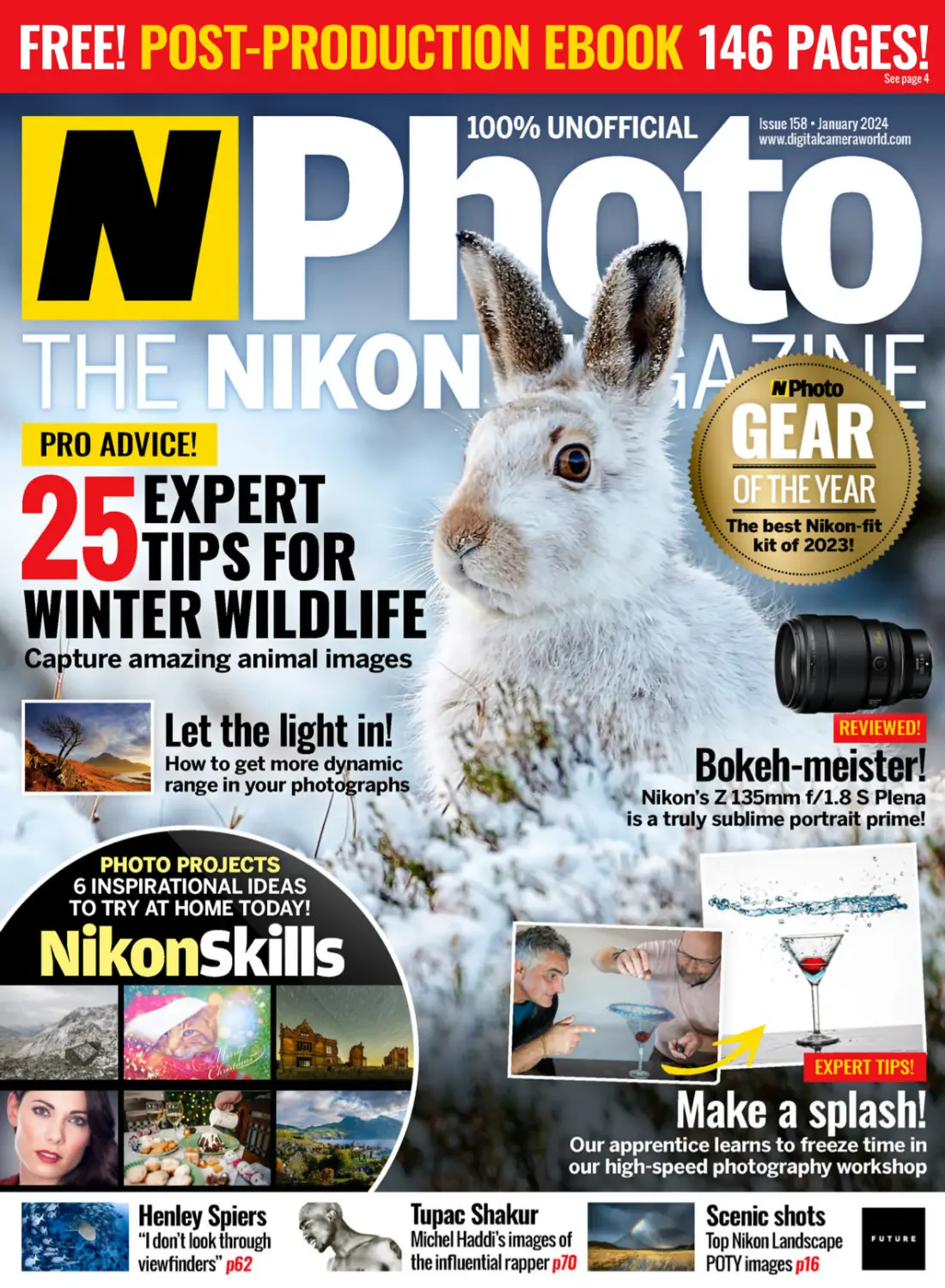
                    FREE! POST-PRODUCTION EBOOK 146 PAGES!
See page 4

FROM THE EDITOR

The best Nikon images from
the Landscape Photographer of
the Year contest, see page 16.

This issue’s special
contributors…
Iain Afshar
PAGE 6

Iain shows our apprentice how to
freeze water drops and bursting
balloons with high-speed flash in
a splash photography workshop.

PAGE 26

Wildlife photographer Andrew
shares 25 tips for capturing
great animal images as the
temperatures plummet.

Tom Mason
PAGE 40

Tom finds an excuse to splash
out on yet another technical
jacket as he photographs polar
bears in the Arctic wilderness.

Henley Spiers
PAGE 62

Marine photographer Henley
tells how he got bitten by the
underwater bug in this issue’s
N-Photo interview.

Michel Haddi
PAGE 70

Michel explains how he came
to photograph legendary rap
artist Tupac in the prime of
his tragically all-too-short life.

Andrew Corless
PAGE 86

N-Photo reader Andrew shares
the story of his once-in-a-lifetime
wildlife-watching trip in the US
frontier state of Alaska.

Image: © Terry Gibbins

Andrew Mason

Welcome to issue 158
Winter is coming. And while that’s the cue for most
folks to crank up the central heating, draw the
curtains and sup on a cup of cocoa, it sees wildlife
photographer Andrew Mason wrapping up warm
and heading out into the elements. He shares 25 tips
for stunning shots of animals in the harshest – but
arguably most photogenic – season of them all.
But it was the warmth of the studio that was certainly favoured
by our apprentice as he learned to capture images of splishes and
splashes far faster that the blink of an eye, courtesy of pro
It’s also the time for our annual Gear of the Year awards, where we
past 12 months. And with the January sales just around the corner, it
could be the perfect time to pick your next photographic purchase. We
also bring you the N-Photo verdict on Nikon’s stunning ‘Plena’ portrait
lens, which quite possibly boasts the most beautiful bokeh ever seen.
Our seasonal projects selection includes astro, festive food photos,
winter scenes and last-minute greetings cards. Merry Christmas!
Adam Waring, Editor
adam.waring@futurenet.com

WORTH

SUBSCRIBE TO N-PHOTO & GET
£95
YOUR FREE LOWEPRO ADVENTURA
GO BP 150 CAMERA BACKPACK
Take out a subscription to N-Photo and get the magazine delivered to your door plus a free bag! SEE PAGE 24

www.digitalcameraworld.com

3

Contents
70
Winter wildlife
Wrap up warm and brave the cold to
capture ace images of animals in this
unforgiving but oh-so-photogenic season

06
16 Lightbox
Winter wildlife
26
Gurushots
38
Wild Life
40

Apprentice Our apprentice dives into

a high-speed flash splash workshop

The best Nikon images from
Landscape Photographer of the Year
25 top tips for
capturing amazing images of animals
The 23 best-rated images
from the online photo-sharing contest
Tom Mason photographs
polar bears and lives to tell the tale

43
62 Interview
On Assignment
70
Nikopedia
72
N-Photo POTY
78

4

16

Our fave shots from one
of the most prestigious
photo comps around

Nikon Skills Our latest bunch of

delivered to the N-Photo mailbox

Underwater photographer
extraordinaire Henley Spiers speaks

A reader documents
a tour group excursion with his Nikon

Michel Haddi recalls
a shoot with legendary rapper Tupac

Just what is dynamic
range? Plus your questions answered
It’s the final winterthemed round of our photo competition

84
86 Your Stories
Back Issues
99
Next Issue
100
Parting Shot
114

Letters Your latest missives

practical projects to try your hand at

Free! The Ultimate Guide to
Photography Post-Production
This brilliant 146-page ebook shows you how
to integrate editing into your photo workflow,
from basic adjustments and retouching to
advanced compositing techniques and
special effects. Download your copy today!
https://bit.ly/photopostprod

26

Michel Haddi shares
unseen shots of rapper
Tupac, 30 years on…

Plug the gaping holes
in your N-Photo library right here
What treats will you
find in the first issue of 2024?

Mike Harris rambles
on about photography competitions

SUBSCRIBE!
Massive subscription savings!
Plus a free Lowepro Adventura
Go BP 150 backpack!

SEE
PAGE

24

WORTH

£95

www.digitalcameraworld.com

CONTENTS

NikonSkills
Master your Nikon today!
62

Henley Spiers gave up the rat race to
become a pro marine photographer

44 Reach for the stars

46 Deck the table

50 Let it snow!

52 Whisker wonderland

Shoot spectacular circular star trails

Tom Mason reports
on his polar bear
trip in Manitoba

Set the scene for festive food photos

40
Advice for shooting winter wonderlands

Gear Zone
New Gear
92
94 Nikon Z 135mm f/1.8 S Plena
Voigtländer D23mm f/1.2
96
Gear of the Year
101
Buyer’s Guide
108

BEFORE

Transform photos into Christmas cards

AFTER

The latest selection of goodies
to spend your hard-earned cash on…
Sublime portrait prime with luscious bokeh

Manual
fast wide prime for DX-sensor mirrorless

54 Auto portrait masking
Mask faces in ACR and Lightroom

The very best kit
we’ve seen over the past 12 months

VIEW THE

Every current Nikon
camera, plus lenses to put on ’em

VIDEO

www.digitalcameraworld.com

56 Ridiculous resolutions

Stitch and shoot a multi-row panorama

Whenever you see this logo you’ll know
there’s an accompanying video that
you can watch online.
The videos and information provided are 100% independent and not
endorsed or sponsored by Nikon Corporation or Adobe Systems Incorporated

5

APPRENTICE

THE PRO

NAME: Iain Afshar
CAMERA: Nikon Z 7II
Iain is a fully qualified teacher who now
splits his time between photography
and adventuring. He runs photography
workshops through his business The
Photography Project and is the founder of
the Adventurous Activity Company. As an
International Mountain Leader, his travels
allow him to capture some of the most
remote places in the world. He started
capturing splashes during the off season,
with water-themed workshops proving a
hit: www.thephotographyproject.co.uk

Photo tutor Iain Afshar introduces our
apprentice to the world of high-speed splash

I
6

ain runs The Photography Project
from a unit in Bristol’s historic
Underfall Yard. The little
boatyard is situated on the city’s
19th-century Floating Harbour,
not far from Brunel’s SS Great

Britain. “Don’t mind the paddling pool,” said
Iain as Chris set his kit bag down. “Splash
photography tends to get a bit messy –
I might have to go empty it once or twice.”
“At least you don’t have to travel far,” said
Chris as he nodded towards the harbour,
www.digitalcameraworld.com

HIGH-SPEED FLASH

THE APPRENTICE
NAME: Chris Haliburton
CAMERA: Nikon D810

Cornwall-based Chris is a retired aircraft
mechanic who rekindled his passion for
photography. He swapped Minolta for
Nikon years ago, when he picked up the
D200 and hasn’t looked back since. He
now owns a plethora of Nikon DSLR and
mirrorless cameras and has even put
together a little home studio so he can
keep shooting during the cold winter
months; Iain’s splash-themed product
shots are right up Chris’s street.

www.digitalcameraworld.com

7

APPRENTICE

TECHNIQUE
ASSESSMENT
1

PRO KIT
WATER DROPLET DEVICE
DIM THE LIGHTS

Iain says… I use Manual mode to keep
each shot consistent. The shutter
speed matches my camera’s sync
speed and I select a narrow aperture to
render as much of the subject in focus
as possible. I use a low ISO to eliminate
ambient light, occasionally tweaking
the aperture to compensate, if needed.

2

SPLASH THE FLASH

Iain says… I shoot Raw to capture the
largest and most detail-rich files. Raws
are more pliable in the edit, allowing for
drastic changes in colour temp. This
means nailing the white balance isn’t
crucial. Still, I like to get as much right
in-camera as possible. The Flash
preset’s neutral tones are my go-to.

3

LIGHT SHOW

Iain says… I use three off-camera
flashguns, controlled independently
via a transmitter. I capture a completely
black image to cancel out the ambient
light and then determine the flash
power required for the background
light. I then set up the subject lights,
which are usually the same power.

8

Iain says… I use the SplashArt Kit MKII (available from www.phototrigger.co.uk).
This comprises a retort stand, solenoid, pump reservoir, camera cable and controller.
The device connects to the camera so the shutter is fired precisely when the droplet
hits the water and the splash is formed. You can alter the size of the first or second
droplet, the delay between each droplet and at what point the camera’s shutter is fired.
right out the door. Iain had already
prepared the first setup. In the middle of
the paddling pool was a tall side table,
covered with a black ceramic tile to provide
a reflective surface. A full tumbler of water
was placed on top and flanked by two flash
heads on light stands. A third was set
beneath the table and directed towards
a large white backdrop behind.
“We control the light, so we won’t have
to alter it much once it’s set up,” said Iain.
He began by ensuring that Chris’s D810
was set to Manual mode and Raw shooting,
before inviting the apprentice to put the
camera on a tripod and frame the tumbler.
As Chris adjusted the framing created by
his Sigma Macro 105mm f/2.8 EX DG OS
HSM, Iain offered a couple of pointers:
“The splash will be rising high above the

glass, so a vertical composition will afford
you a little more room. It’ll also allow you
to frame more of the reflection on the tile.”

BACK TO BLACK

The next step was to dial in the exposure
settings. Iain asked his apprentice to dial
in ISO100, f/16 and 1/250 sec, before firing
the shutter. “Great,” said Iain. “Those
settings will ensure low noise, an adequate
depth of field to render as much of the
subject sharp as possible – since we’re
using a macro lens – and a shutter speed
that matches the D810’s sync speed.”
Iain then explained the concept
of ‘slapback’ from a reflex mirror to Chris
and they set the camera to Mirror-up mode
to ensure the moving mirror didn’t cause
any vibrations. “Locking the mirror

EXPERT INSIGHT ROLL THE DICE
Iain says… I’ve built up a large collection of cheap
props over time. All of the vessels are plastic. I started
off using glass, but they limited the objects I could
chuck into the water as they had a tendency to crack.
I’m always on the lookout for new implements I can
use to cause splashes. You can’t go wrong with a few
clear, reusable plastic ‘ice’ cubes. I also like to use
dice, since they can add a pop of colour and work well
with anything drink themed. I’ve found a faux crystal
is extremely useful when using a cocktail glass, as
it’s the same shape, which forces the water up and
outwards, creating that incredible-looking halo of
liquid. My most recent addition was the circular metal
implement, riddled with holes, and used in Super Shot
#1. It’s actually the end of a meat mincer. Once
I thought of the idea, I went online and found plenty
of spare parts available. It works a treat!

www.digitalcameraworld.com

SUPER
SHOT #1
Camera:

Nikon D810

Lens:

105mm f/2.8

Exposure:

1/250 sec, f/22, ISO200

APPRENTICE

SUPER
SHOT #2
Camera:

Nikon D810

Lens:

105mm f/2.8

Exposure:

1/250 sec, f/22, ISO200

HIGH-SPEED FLASH

PRO KIT
STUDIO SETUP
Iain says… You don’t need
an expensive studio setup
to photograph splashes and water
droplets. The main concern
is water damage – you’ll literally
be throwing water around! I help
avoid spillages by covering the
floor with a tarpaulin and placing
my table within a paddling pool.
A sheet of clear plastic on top of
the table creates a skirt that
protects the background flash. My
three flashguns (Yongnuo YN-560 IV) aren’t super expensive, but work perfectly. I do
have a dedicated studio background, but you could use a bedsheet or some foam board.
Finally, the shiny black surface on the table is a sample floor tile, I have a white one too.
up also helps your timing,” said the pro.
“When you press the shutter button the
camera can fire the shutter immediately,
without flipping the mirror up first.”
Once Chris had dialled in Iain’s preferred
Flash white balance preset, they were
ready to lock focus. Iain laid a pen across
the top of the tumbler, so it sat right in the
middle of the glass: “Manually focus on the
pen – where it says SS Great Britain.”
“Couldn’t you just focus on the side
of the glass?” asked Chris.
“You could,” said Iain, “but you wouldn’t
maximize your depth of field. By focusing
in the centre of the glass, you maximize the
sharpness of the splash by capturing
droplets within the depth of field behind,
but also in front of your point of focus.”

WATER, WATER EVERYWHERE

Chris took a test shot. “The screen
is completely black,” he said, bemused.
“Excellent,” said Iain. “That’s exactly
what we want. We’ve neutralized the
ambient light so the lighting is entirely
controlled via the flash heads.”
“Ah, that makes sense,” said Chris as Iain
slid a transmitter into the D810’s hotshoe.
“Let’s sort the background first,” said
Iain. “We want it to be a perfectly white.”
Chris fired the shutter and a pop of flash
illuminated backdrop.
“This looks quite good, actually. We’re on
1/8 power, so let’s try 1/4.”
The pair nodded to each other as they
reviewed the Playback screen, before
moving onto the subject lighting.
“That’s flooded the subject with light,”
said Iain after Chris fired the shutter, “so
this time we need to reduce the power.”
They eventually settled on 1/64 for both

www.digitalcameraworld.com

lights and began capturing the first setup.
This involved dropping a plastic ‘ice’ cube
and a red die into the tumbler to create
splashes. Timing was everything. Chris
had to ‘prime’ the camera first, by pressing
the shutter button to lock the mirror. Only
the second press would fire the shutter.
A remote shutter release enabled Chris
to activate the shutter while standing next
to glass of water. After a few successful
attempts, Iain appeared with a shallow
bowl of water in one hand and a small,
circular metal disc in the other . “Let’s try
these,” he said as he set down the bowl and
laid the pen across it as a focusing aid.
“It’s the end of a meat mincer,” he said,
as Chris inspected the circular implement.
“The holes create an incredible-looking
splash, try it out.” The apprentice primed

the shutter and dropped the metal disc
into the bowl of water. A huge wave flew
up into the air as the flashes popped and
the shutter fired.
“That looked like a good one,” said Iain
as they checked the rear LCD. “The splash
looks great, but I reckon we should
experiment with a lower flash power.
This will create a faster flash that will freeze
more motion, because some of the
droplets look a little blurry”
They set the two subject flashes to 1/128
and narrowed the aperture to f/22 to gain
a little extra depth of field. They then
bumped the ISO up to 200 to compensate.
Chris took a test shot to confirm that they
were happy with the exposure, while Iain
sourced a blue vial of food colouring.
“This’ll add a pop of colour,” he said
as he stirred a couple of drops into the
bowl. It only took two tries for Chris
to capture Super Shot #1, a beautiful
tulip-shaped wave of water, frozen in time.

SHAKEN, NOT STIRRED

“Now we’ve nailed down our settings, the
fun really begins. Let’s try this,” said Iain as
he placed a cocktail glass onto the table.
He then held a red, diamond-shaped object
up to the light. “This is what we’ll be using
to create the splash. It’s the same shape as
the cocktail glass. If it falls correctly, it will
slide into the bottom of the glass and plug
it, forcing all of the water out of the sides.
This can create a really lovely looking halo
of water, suspended in midair.”
Chris held the diamond above the
aqua-coloured water and let go. The red
prop bounced off the edge of the glass and
sent it tumbling off the table and into
the paddling pool. The apprentice

EXPERT INSIGHT PLANE SAILING
Iain says… Once you nail the technique, you’re really only limited by your own creativity.
I’m always looking for new props to include in my splash images and this little model of a
Red Arrows Hawk has proven a great alternative to the darts I usually use. I attached a
small pin to the nose so
it pops the balloons. I
secure the aircraft on a
length of fishing wire
and then line it up with
the balloon and swing it
directly towards it.
Timing the shot is a
little more challenging
than prodding the
balloon with the dart on
a stick, but the results
are certainly worth the
trial and error.

11

APPRENTICE

HOW TO:

EDIT WATER DROPS
1

CROP IT LIKE IT’S HOT

EXPERT INSIGHT
WATER COLOURS
Iain says… Beyond the shape of your droplets or
splashes, you can add variety by experimenting with
colour. The easiest change to make is the water itself; I find
that a few drops of food colouring
works well. Changing the colour of
the background is another option.
You can either place a colourful
background behind your subject or
place a gel over your background
light and fire it at a white background.

Iain says… I always leave a bit of space
around the subject when composing
due to the unpredictable spread of
each splash. If the frame is too tight,
you risk losing parts of the splash.
Some cropping or straightening is
therefore necessary at the editing
stage to frame the shot perfectly.

2

NAIL THE BASICS

Iain says… I keep things simple and do
most of my editing in Adobe Lightroom.
I tend to reduce highlights, lift shadows
and add minor tweaks to whites and
blacks. Increasing the Texture and
Clarity sliders looks fantastic with
water splashes. I may also increase the
Vibrance or Saturation sliders slightly.

recoiled with horror, only to realize that the
convincing glass was actually plastic. Iain
laughed: “I used to use glass, but after one
too many cracks I switched to plastic.”
They repositioned the cocktail glass, but
before Chris could try again, Iain offered a
tip. “If you dip the diamond in the water and
hold it above the glass, drips will fall into the
water. I use this a little bit like a reticle, so I
can aim directly in the middle of the glass.”
Chris tried this technique and the
diamond fell directly in the centre of the
glass. “Good,” said the pro. “But I reckon
we can get a better splash.” Time and
again they dropped the diamond into the
water, before refilling the cocktail glass.
Suddenly, Chris hit the jackpot. A perfect

halo of water momentarily rose into the air,
before crashing back down.
“Please tell me I captured that,” said
Chris as he rushed over to his D810.
“Yes!”, said Iain, “That’s Super Shot #2.”

DROP SHOT

The next shot would require a rather
complicated-looking setup, comprising a
stand, pump and controller. “This is my
SplashArt water droplet kit,” said Iain.
“We’ll be creating an umbrella splash
today. This forms when the first droplet
creates a rising stem, which the second
droplet hits to form an umbrella-shaped
splash. The camera is connected to the kit,
so it fires automatically. This all amounts

3

HEALING POWERS

Iain says… I like to tidy up distracting
water drops using the Healing panel’s
Heal tool. Some setups require the
subject to be suspended by fishing
line or cord, like water balloons, and
it’s often necessary to remove these
distractions in post-production.

12

www.digitalcameraworld.com

SUPER
SHOT #3

to an incredible level of precision that you
couldn’t replicate with a pipette.”
Iain explained how the controller’s four
dials worked (see Pro Kit: Water droplet
device). “I found these settings following
much trial and error,” said the pro, “so in
the interest of time, I’ve set everything up
for you. But what we can do is get creative
with the colour of the water or backdrop.”
“Let’s change the backdrop,” said Chris.
“Can we try green?”
“Yes, the easiest way to change the
backdrop is to put a coloured gel over the
background flash,” said the pro as he held
www.digitalcameraworld.com

out a pack of gels. “These are super-cheap,
I think they only cost about £10.”
Once again, they used the pen as a
focusing aid. “The trick is to position it right
in the path of the falling droplets,” said Iain.
“You’ll know when it’s in the right
position, because this will happen,” he
activated the dropper and a water droplet
fell directly onto the pen. They then turned
their attention towards the lighting. Iain
had set every flash to 1/128. This lowpower setting would provide enough light
for the tiny droplets, while omitting a fast
blip of flash to freeze the moment. Chris

Camera:

Nikon D810

Lens:

105mm f/2.8

Exposure:

1/250 sec, f/22, ISO100

moved his camera much closer to the
table, while Iain directed him to crop out as
much of the water bowl as possible.
“We can leave the aperture at f/22,” said
the pro, “but I reckon we’ll be able to drop
the ISO back down to 100.”
“Aren’t you worried about diffraction at
very narrow apertures?” asked Chris.
“Good question. Normally, you would be,
but I find it’s hardly noticeable with this
type of photography. Personally, I think the
larger depth of field is worth a small
reduction in overall sharpness.”
Chris activated the setup by

13

APPRENTICE

SUPER
SHOT #4
Camera:

Nikon D810

Lens:

105mm f/2.8

Exposure:

1/250 sec, f/16, ISO100

pressing a button on the SplashArt
controller. In a blink-and-you’ll miss it
moment the droplets fell and the shutter
fired. “1/128 is working on the subject, but
I reckon we could do with brightening the
backdrop. 1/64 should do it,” said Iain.
With that, Chris fired the shutter a
second time and captured Super Shot #3.

BURST SHOOTING

Chris swings Iain’s modified Red Arrows model into
a dangling water balloon, so it harpoons it mid-air.

14

The pair’s final trick would be an image
of a water balloon the exact moment
it burst. Iain replaced the water droplet kit
with a bucket, before suspending a length
of string from a hook that was screwed into
a beam, directly above. The pro then
brought in a bucket full of water balloons,
before attaching one to the length of
string. It dangled just above the bucket.
“Am I throwing a dart at it?”said Chris
with a knowing smile.“You know, I used to
do that,” said Iain. “Not only was it difficult
www.digitalcameraworld.com

HIGH-SPEED FLASH

PRO
PORTFOLIO
IAIN AFSHAR

BEAUTIFUL BLUE

BE OUR NEXT
APPRENTICE!

As an International Mountain Leader and
expedition guide, I travel all over the world
to remote places. This shot of Gokyo Lake
in Nepal was taken at an altitude of
around 5500m, from the summit of
Gokyo Ri. At these altitudes, carrying
camera equipment becomes much
harder work! It’s a real privilege to capture
places that very few people get to see.

We’re looking for future apprentices to
accompany N-Photo on exciting
adventures! So, if you would like to
appear on these pages and get top
one-to-one professional tuition thrown
into the bargain, fill out our Apprentice
form at: https://bit.ly/npapprentice
Please fill out the form in its entirety
and be as detailed as possible with
your answers. Finger’s crossed; the
next N-Photo apprentice could be you!

FROZEN IN MOTION

The two flashguns fire as Chris uses Iain’s
improvised dart to burst a water balloon, while
simultaneously activating the remote shutter.

to time, but I ended up with tiny holes all
over the place… so, I came up with this,”
the pro handed his apprentice a dart on
the end of a long stick.
“You can prod the balloon with this and
then we can easily edit out the stick.”
Iain rolled up the white backdrop and
pulled down a black one, before positioning
a flash on either side of the balloon. “We
don’t need a background light,” he said.
“The flashes are set to 1/128 as we really
want to freeze the water.”
Chris took a test shot: “A bit dark?”
“Yeah, let’s widen the aperture by a stop
to let in a little more light.”
Chris lined up the balloon with his
improvised dart and popped it, while
simultaneously activating the shutter.
“What went wrong there?” asked Iain.
“I forgot to lock the mirror,” said Chris.
Iain hung another water balloon, while
Chris made sure he primed the shutter.
www.digitalcameraworld.com

The second shot fared much better,
with the balloon captured mid-burst.
“Great,” said the pro. “But what we really
want is to capture the dart inside the orb of
water.” It only took another couple of
balloons for Chris to get it right. He capture
the very moment the dart was thrust into
the balloon to land Super Shot #4.

I photographed this beautiful violet
sabrewing humming bird in Costa Rica.
With its wings beating at around 50 times
per second, the only way to freeze it in
motion is to use high-speed flash in much
the same way as splash photography,
with similar camera settings.

CHRIS’S COMMENT

I’ve set up a home studio for the
winter months, so this has been
a great introduction to flash
photography. Neutralizing the
ambient light was a really interesting tip.

IAIN’S VERDICT

Chris learned a lot during the
setup, but the most difficult bit
is timing the shots. He took to
this immediately, so we had
loads of keepers to choose from in post.

PEEK-A-BOO!

I love using macro lenses as they enable
you to focus really close to your subject.
This tiny Costa Rican glass frog was only
about 3cm long. They often sit perfectly
still, allowing you to move around to find
an interesting composition. This was shot
handheld using a single off camera flash.

15

© Richard Bowden / Landscape Photographer of the Year

Our favourite Nikon images from the Landscape
Photographer of the Year 2023 competition

16

Arkle Rainbow
RICHARD BOWDEN
Classic View – Highly Commended

Intense light shining through a rainbow arch
onto the base of Arkle mountain in the
Scottish Highlands.
Camera:

Nikon Z 7

Lens:

24-120mm f/4

Exposure:

1/6 sec, f/16, ISO64

LANDSCAPE PHOTOGRAPHER OF THE YEAR

17

LIGHTBOX

© Terry Gibbins / Landscape Photographer of the Year

Blizzard London
TERRY GIBBINS
Expressions & Impressions of
the Landscape – Winner

A three-image in-camera multiple exposure of
a black cab driving home through the streets
of London during a snowstorm.

18

Camera:

Nikon D850

Lens:

24-70mm f/4

Exposure:

1/8 sec, f/5.6, ISO400

Elders
EDD ALLEN
Black & White – Highly Commended

Taken on a wonderful day spent walking through
the sand dunes on Newborough beach, Anglesey,
with the old skeletal trees still standing tall among
the blowing grass and the mountains of Wales in
the background. Hours disappear as the light
comes and goes, while sand is whipped up into the
air. Such a fantastic place to visit.
Camera:

Nikon D610 (infrared converted)

Lens:

18mm f/3.5

Exposure:

1/160 sec, f/9, ISO100

www.digitalcameraworld.com

© Edd Allen / Landscape Photographer of the Year

LANDSCAPE PHOTOGRAPHER OF THE YEAR

© Adam Burton / Landscape Photographer of the Year

LIGHTBOX

LANDSCAPE PHOTOGRAPHER OF THE YEAR

© Jamie Fielding / Landscape Photographer of the Year

Pinpoint
ADAM BURTON
Coastal View – Commended

As sea stacks go, North Gaulton Castle on the
west coast of Orkney’s main island is hard to
beat – at 52m (170ft) it’s a monster. For
such an incredibly strong subject, the obvious
arrangement was to place it centrally within
the frame. I used a long exposure to soften the
background water and make the stack stand out.
Camera:

Nikon D850

Lens:

24-70mm f/2.8

Exposure:

30 secs, f/11, ISO125

www.digitalcameraworld.com

Apocalypse Now
JAMIE FIELDING
Coastal View – Highly Commended

I could see there was a large storm moving up from
France towards the Sussex coast. I started to track
it on my lightning app and knew it was going to
make landfall near Littlehampton. As the storm
edged closer, I took multiple shots to capture the
lightning strike. I was delighted to capture this epic
bolt, which then revealed the ominous shelf cloud.
Camera:

Nikon D750

Lens:

20mm f/1.8

Exposure:

33 secs, f/8, ISO400

21

LIGHTBOX

© Nick Green / Landscape Photographer of the Year

Role Reversal
NICK GREEN
Black & White – Winner

A well-photographed tree on Dartmoor taken
from a new point of view and then converted
to a black-and-white image.
Camera:

Nikon D90

Lens:

50mm f/1/8

Exposure:

1/125 sec, f/8, ISO200

With a prize fund worth over £20,000, Landscape Photographer of the Year celebrates all that is great about the British
landscape. The competition showcases the work of talented photographers, and a selection of winning and commended
images will be shown at a travelling exhibition at railway stations throughout the United Kingdom, as well as in the fullcolour hardback book, Landscape Photographer of the Year - Collection 16 (£35, Ilex Press). See www.lpoty.co.uk

22

www.digitalcameraworld.com

for just £51.99
FREE LOWEPRO
ADVENTURA GO BP 150
• £51.99

PRINT ONLY
(bag included)

• £42.99

DIGITAL ONLY
(no bag included)
WORTH

£95
Compatible with
Nikon DSLR &
mirrorless cameras

Water bottle/
tripod pocket with
compression strap

Part of LowePro
Green Line, made
with recycled fabrics

Great reasons
to subscribe
• Free LOWEPRO

ADVENTURA GO BP 150

• Enjoy 13 issues worth of
N-Photo is the only magazine
for Nikon enthusiasts by
Nikon enthusiasts!

Adam Waring, Editor, N-Photo

N-Photo for just £51.99 –
that’s just £4 an issue

• Delivered direct
to your door

• The gift that keeps
on giving

SUBSCRIBE NOW

ONLINE magazinesdirect.com/NPHXMAS23
PHONE 0330 333 1113 and quote code XG53
Terms and conditions: Offer closes 31 January 2024. Offer open to new subscribers only, and only available on print purchases. Direct Debit offer is available to UK subscribers only. Your gift will be delivered separately within 60 days

.
.
.
or
f
s
p
25 top ti

Winter wildlife
You won’t catch Andrew Mason hibernating. Inclement weather
and freezing temperatures bring additional challenges but
dustings of frost and snow, seasonal visitors and gorgeous light
can transform your portfolio into a wildlife winter wonderland
26

www.digitalcameraworld.com

S

All images: © Andrew Mason

Andrew Mason

Andrew has worked as a full-time
professional wildlife photographer
since 2009. He’s supplied images
for a wide range of clients,
including the RSPB, and leads
photography tours for Naturetrek.
To find out more, visit:
www.andrewmasonphoto.com

imon & Garfunkel’s A Hazy Shade of Winter,
originally released in 1966 and covered by
of the most iconic songs of all time. It
how everything can change in an instant.

give ideal conditions for a wide range of images. In their
winter coats, animals look spectacular and can be far
more approachable. Winter also brings migratory birds
to our shores and incredible gatherings of wildlife.
Winter is a time to be prepared for whatever

resonates now more than ever. Winter

throughout the day, whatever the conditions. Storms

make the most of the opportunities we’re given and even
make use of what might otherwise be perceived as
misfortune. While it might be cold outside, you really
can’t stay inside. It’s time to put on your warm winter

temperatures and snow can transform the landscape

snow glows white on the mountainside, get out and go!

www.digitalcameraworld.com

27

1
2

3

r
he
t
a
e
w
&
t
gh
i
l
Win ter

Finding the right subject is one thing, but great wildlife photographers pay just as
much attention to weather and lighting conditions so they can adapt accordingly

1

WINTER LIGHT
With the sun low in the sky for more of the day, the light

2
28

MAKE THE MOST OF DAYLIGHT
At the height or winter, there are just under eight hours of

www.digitalcameraworld.com

WINTER LIGHT & WEATHER

Be prepared
By being prepared and equipped
for all that Mother Nature will
throw at you, you will be able to make the
most of the wintry conditions. A layered
clothing system – consisting of a wicking
base layer, insulating mid layers, a
waterproof and windproof shell, and an
insulated outer layer – will keep you
warm and dry. I have tried many different
photography gloves and swear by
SealSkinz’s Water Repellent All Weather
Gloves (www.sealskinz.com), which are
warm down to -10ºC. I over-layer them
with The Heat Company’s Shell Mittens
(www.theheatcompany.com), which open
to allow the operation of equipment.
While many Nikon cameras and lenses
have some form of weather sealing, care
needs to be taken in cold weather. When
the temperature is hovering around
freezing, snow can melt and then freeze
on lenses, which can be problematic, but
the colder the temperature the less likely
this is to occur. Batteries don’t last long
in extreme cold but can be kept warm
inside your clothes. Lenses can be
protected with a lens cover and a
microfibre cloth is useful for mopping up
water. To avoid having to change lenses
when it is snowing or raining, carry an
extra camera body if you have one, with
a lens attached. To avoid condensation,
remove batteries and memory cards and
allow your equipment to slowly warm up
inside a camera bag when taking it
from a cold environment.

5

4

If the forecast is uncertain, go out
and play the numbers game, you’ll
have a better chance of nailing a
winter shoot than if you stay in bed
up early and in position ready to start shooting

[1] On overcast
days, set your
camera’s white
balance to Cloudy.
This adds warmth to
bring out the best
of the winter light.
[2] With the sun
low in the sky
during a winter’s
day, make the most
of directional light.
[3] In snowy
conditions, the
colours at sunrise
and sunset can be
spectacular.

3

WATCH THE FORECAST

4

EMBRACE BAD WEATHER
Alfred Wainwright famously wrote in his 1973

[4] A blizzard
can add a totally
different dimension
to your winter
wildlife images.

5

[5] Waterproof
and warm clothing
isn’t just a safety
essential, it’ll allow
you to focus on the
photography and
not the cold.

www.digitalcameraworld.com

29

25 top tips for...

Snow lying on the ground acts
illuminating the underside of
6

s
t
c
je
b
u
s
e
if
l
d
Wil

While some animals migrate or hibernate, there’s certainly no shortage of wildlife to
photograph. Seasonal visitors even provide the opportunity to diversify your portfolio

6

URBAN WILDLIFE

8

BIRDS IN FLIGHT

9

SPECTACULAR WILDLIFE GATHERINGS

important home for our wildlife. A wide range of mammals,

7

30

WINTER VISITORS

www.digitalcameraworld.com

WILDLIFE SUBJECTS
[6] With their red
winter coats, foxes
make great subjects
in snowy conditions.

7

[7] During a
waxwing winter,
large numbers of
waxwings can be
found in the UK
feeding on berries
in urban locations.
[8] Capturing birds
in flight during a
snowstorm is
technical, but the
images can be
spectacular.
[9] Overexposing
cloudy skies can
make for simple yet
dramatic images.

8

9
10

Garden wildlife
Gardens, whatever their size and location, have
a wide variety of wildlife visiting them. In winter,
by providing supplemental food, we can help our
wildlife through these lean times and in return enjoy
photographing them. Set up a few photogenic perches
– small branches and old spade handles work well –
where they catch the best light with a clean background
near to bird feeders. You can photograph them from the
comfort of your home, a shed, or a small pop-up hide
that can be moved around the garden as needed. Robins
were voted Britain’s national bird (taking 34 per cent of
the vote from a shortlist of 10) and there is no better
garden bird to photograph in winter than these beautiful
little creatures with their striking red breasts.

10

[10] Small details,
like the snow on
the robin’s bill, can
elevate your images
to a higher level.

31

25 top tips for...

12
13

11

n
o
i
t
a
c
o
l
r
ou
y
A d ap t to

It doesn’t matter whether you’re visiting the coast, heading into the hills or shooting close
to home, each location presents a number of challenges and a wealth of opportunities
11

SHOOT LOCAL

13

12

32

HEAD UP INTO THE HILLS

HEAD TO THE COAST

www.digitalcameraworld.com

ADAPT TO YOUR LOCATION

14

There’s no better place to capture
winter wildlife than the Cairngorms.
They’re home to some of the most
iconic wildlife in the UK

14

USE A HIDE

[11] Red deer are
one of the most
accessible wildlife
subjects; they can
be found in parks
throughout the UK.
[12] Grey seal pups
are born with white
coats, a throwback
to the last ice age.
[13] Mountain hares
look resplendent
during the winter
months in their
white coats.
[14] Hides don’t
just allow you to
get closer, they’re
a great option in
winter when the
weather is very cold.

Go north
With winters becoming generally milder in the
UK, a trip north to colder areas that have
more guaranteed winter conditions can pay
dividends. There are excellent hides set up in
Norway and Finland to photograph a wide range
of animals, including golden and white-tailed eagle.
It is even possible to see puffins in the snow on
Hornoya Island in the Varanger Peninsula, Norway.
For the ultimate winter photography, a multi-day
boat trip around Svalbard, such as the ones run
by WildPhoto Travel (https://wildphoto.com) offers
the opportunity to photograph polar bear, reindeer,
walrus, Arctic fox and a wide range of Arctic birds.
Wintry conditions can be found around Svalbard
all year round, so summer is a great time to
photograph polar bears in the Arctic sea ice.

15

[15] Polar bears are
the ultimate land
predator, inhabiting
the far north. This
image was captured
in Svalbard.

www.digitalcameraworld.com

33

25 top tips for...

16

Ca me ra se tt in gs

Snowfall can confuse autofocus systems and bright white conditions can disrupt your
camera’s metering, so taking back control is vital when shooting in wintry conditions
16

METER FOR THE SNOW

any

17
34

AUTOFOCUS SETTINGS

and

www.digitalcameraworld.com

CAMERA SETTINGS
17

18
19

18

MANUAL EXPOSURE

[16] Boost
exposures to keep
snow white, allowing
just enough detail
in your images.
[17] Short-eared
owls look amazing,
when photographed
backlit against the
setting winter sun.
[18] Switch off Auto
ISO and meter for
snow for consistent
exposures when
using Manual mode.

19

MANUAL FOCUSING

[19] Prefocus in
challenging
conditions to
greatly help AF lock
onto your subject.
[20] Set your
camera to its
highest burst rate,
so you’re ready for
any encounter.

Burst mode
When photographing wildlife in falling snow –
particularly when it is moving – there is the risk
of having the animal’s eye(s) fully or partially obscured
by a snowflake. In these conditions, shooting a burst of
images at your camera’s fastest frame rate will give the
best opportunity of capturing the animal in the most
photogenic pose with a clear shot of its eye. Shooting
bursts of images at high frame rate can assist when
manually focusing in really challenging conditions. One
technique is to shoot a burst of images whilst ‘rocking’
the manual focus ring back and forwards, this should
produce at least one sharp image in your burst.

20

20

Setting ISO manually and metering
for the snow, the scene will remain
correctly exposed irrespective
of the colour and size of the animal
www.digitalcameraworld.com

35

25 top tips for...

21

Crea t i ve id eas

From high-key portraits to long exposures of birds in flight, never be afraid to exercise
your creative muscles once you’ve bagged enough keepers – you might surprise yourself!
21

22

GET DOWN LOW

23

GET CREATIVE

24

SHOW THE ENVIRONMENT

HIGH-KEY IMAGES

image of the wildlife you are photographing on a pure white

36

www.digitalcameraworld.com

CREATIVE IDEAS
22

25

Shoot backlit
A variety of focal lengths will give a
much greater diversity of images
and will allow you to show the
animal in its wintry environment
[21] Make the
most of ambient
light sources.
This image was
captured in
front of a red
traffic light.

[22] A bright
exposure has
simplified this
image; the red
squirrel ‘pops’
against the
white backdrop.

[23] A long,
four-second
exposure
blurred the
water the
golden plovers
were roosting in.

[24] Wider focal
lengths (this
was shot at
70mm) allow
you to show
your subject in
its environment.
23

24

[25] When
shooting
backlit, look for
compositions
that work as
silhouettes, like
this crested tit.

With the sun low in the sky, winter
is a great time to photograph
backlit wildlife. Owls, particularly barn
owls and short-eared owls (with their pale,
almost-translucent wing feathers) look
spectacular as they hunt low over the
ground with the sun behind them.
Mammals (such as mountain hares) that
have a good coat of fur when backlit can
have a beautiful rim light. Some degree
of underexposure will be required when
shooting animals backlit, the amount will
depend on the overall effect you want to
achieve and how much detail you want to
have in the animal.

25

XXXXXXX XXXXXXXXX XXXXX

Sanja Bosnia and Herzegovina

GuruShots
We joined up with online photo game GuruShots to print the winning
images from the ‘Still Life’ challenge, and here are the winners!
GuruShots is billed as the world’s leading photo game. It’s an
online platform conceived to give global exposure to people
who love taking photographs. GuruShots members start out
as ‘Newbies’ and compete with other photographers to win
challenges, increase their ranking on the site, and eventually

Monika Ginter Poland

Helkoryo United Kingdom
38

progress to coveted ‘Guru’ status. Challenges are voted on by
Gurus and the wider GuruShots community, and there’s a fresh
challenge – like ‘Still Life’ – daily. Winners receive prizes from
GuruShots’ sponsors, including Lowepro, BlackRapid and
Lensbaby. Check out www.gurushots.com to find out more.

Neo Sky Croatia (Hrvatska)

lena Feldmans Sweden

Yana Raaga Latvia

www.digitalcameraworld.com

ADVERTORIAL

Lu Boes Germany

Nathan Russell United States

Pauline Zipper Czechia

Nijole Byer United States

Rod Shantz Canada

Mario Congreve United States

Nahal Tabatabai-Chury Austria

Amy Underwood Canada

Dominica DeAngelo United States
Karen Elphick Australia

Scott Greywacz United States

Meadow Fox United States

Bryony Herrod-Taylor United Kingdom
Maria Fremming Denmark

Marij Laurijssen Belgium

www.digitalcameraworld.com

Carmen Walters Germany

Ashley Levinson United States

39

Tom
Mason
Wild Life

Pro wildlife photographer and
Nikon Europe Ambassador
Tom has worked around the
globe on assignments to
capture photographs of all
creatures great and small,
from the Falkland Islands
to the Amazon rainforest.
www.tommasonphoto.com

On thin ice
My cheeks are tingling, my feet are on fire and
my hands are like ice… so I’m loving my parka
he fur trim of my rather
wonderful Shackleton
the wind… and yes, that
is another new coat!

northern wind is
constant and harsh.

frostbite and hypothermia,

of Churchill, Manitoba, with my Nikon

Ursus
maritimus
nine-year-old self, who told Mr Fiennes,

Bear necessities
with the fantastic team at Churchill

temperature, well, other than my hands.

It’s a life-long dream
realized, shared with
someone I love. Life
doesn’t get much better

Ranulph Fiennes’ memoirs – and shaken
true frostbite – to know one mustn’t be
complacent in these conditions. But still,

passes, but our bear seems a little

pockets as I maintain my watch
If nine-year-old Tom were here, he’d

knows of our presence, as you don’t want

All images: © Tom Mason

myself and a polar bear… well, this

40

our scent. This process happens almost
hardiest and most incredible wildlife on

that perfect

www.digitalcameraworld.com

Above: Working on foot gave me
the opportunity to get low when
photographing the bear. With
the guide standing behind me
to maintain my outline, I could
drop down onto one knee and
remain fairly safe while getting
some low-angled images.
Left: For a shoot like this I knew
I would be working at distance,
so my 600mm f/4 TC was an
essential tool for getting closer
to the action.

www.digitalcameraworld.com

41

Ingenious recipes for stunning shots

44
Reach for the stars
Follow our tried-and-tested techniques for
shooting spectacular circular star trails

46
Deck the table
Set the scene for a festive food photography
spread that looks good enough to eat

56

50

Ridiculous resolutions

Let it snow!

See the bigger picture by stitching and shooting a multi-row panorama with insane levels of detail

Advice for shooting winter wonderlands that
will have you dreaming of a white Christmas

VIEW THE

VIDEO

52

54

Whisker wonderland

Auto portrait masking

Transform your photographs into stunning
Christmas cards with Affinity Photo layers

Make the most of the face-masking tools
in Adobe Camera Raw and Lightroom

www.digitalcameraworld.com

Whenever you see this logo, it
means there’s a video to accompany
the tutorial, taking you through
things step-by-step. If a tutorial has
accompanying project files, there will
be an accompanying download link too.

43

P rojec t one: S tar trails

Reach for the stars
Astro aficionado Nigel A Ball shares a triedand-tested technique for shooting star trails
My first attempt at star-trail photography
was on film. I used ‘bulb’ to leave the shutter
open, my ISO was low and I hoped for the
best. Modern digital cameras provide
instant feedback and afford you the ability
to capture thousands of shots, so you can
experiment freely, but there are still a few
basic rules you need to follow. To form
classic, concentric circles of star trails, the

44

camera needs to face due north (in the
northern hemisphere). But all points of the
compass can be used to create different
patterns. Perfectly clear skies aren’t always
a necessity either; clouds passing through
can add to the mood of an image.
While I will use my Nikon D810A for star
trails, I favour my trusty D3S. Its lower pixel
count produces thicker trails, which I prefer.

Expert Tip
Focusing on stars can be
tricky as you need to do it
manually. Find a bright star
and zoom into it as much as
possible using Live View.
Carefully twist the focus ring
until the star is sharply
focused. A good tip when
trying to gauge the star’s
sharpness is to twist the
focus ring until it’s as small
and bright as you can get it.

www.digitalcameraworld.com

STAR TRAILS

How to shoot star trails
the pole star
1 Find
I recce locations in daylight to get my
shooting positions ironed out. For circular
star trails, you’ll need to frame your image
towards the necessary pole star (Polaris, if
you’re in the northern hemisphere). Apps
like Stellarium can help you locate it. Pole
stars are roughly aligned with the Earth’s
axis, which is why the trails look circular.

patterns
2 Weather
You don’t have to shoot north. Look
west and you can capture the stars setting,
look south and trails above the equator
curve upwards, contrasting with those
below. Weather can add interest, too. Near
the end of this star-trail sequence, clouds
blew in from the south while the glow of
light pollution illuminated them.

NPF Rule
3 The
I tend to shoot with the slowest
shutter speed that will still give me pinpoint
stars. I use PhotoPills’ NPF Rule calculator
to determine the exposure length. I can
then pull individual frames from my startrail sequence if, for example, a meteor has
been captured. A good starting point is 10
secs, a wide-open aperture and ISO3200.

Camera:

Nikon D810A

Lens:

14-24mm f/2.8

Exposure:

Multiple exposures

After shooting the main star-trail
sequence, Nigel set a five-minute
exposure to light-paint the building.

4 Intervalometer
I tend to shoot star trails for
a maximum of 40 minutes; this gives
a good length to the trails with a 14mm
focal length. A longer time can, in my
opinion, get too busy. I use Interval Timer
Shooting to capture a series of shots and
set the interval to slightly longer than my
exposure setting, usually a second longer.

Photography: © nigelaball.com

your stars
5 Stack
I pre-process Raws in Lightroom;
any frames that contain aircraft or satellite
trails are marked for correction. I use a
Photoshop plug-in to stack the images
(Advanced Stacker PLUS). StarStaX is a
great free option with a useful gap-filling
mode to make trails look more consistent.

www.digitalcameraworld.com

45

46

www.digitalcameraworld.com

FESTIVE FOOD

P rojec t two: Festive food

Deck the table
Mike Harris shoots a feast for
the eyes; learn how to capture
a classic Crimbo food photo

VIE W THE

VIDEO

Christmas might be the most wonderful time of year
– especially if you’re showered with photography goodies
– but it can very often prove difficult to find the time to head
out with your camera, while you feign Christmas cheer
when visiting relatives, shop for last-minute gifts on
Christmas Eve or fall asleep while watching Miracle on 34th
Street for the 34th time. If only there was an easily
accessible subject that you could quietly photograph
among all the Crimbo chaos. Well, maybe there is...
In-keeping with the festive season’s penchant for feasting
excess, there’s no better time to try your hand at a little
food photography. Not only are props – such as crackers,
ornaments and lights – readily available, but you really don’t
need much camera equipment beyond a kit lens and a
tripod. You don’t even have to cook; shop-bought food will
look the part. Best of all, you don’t have to brave the winter
weather and when you’re finished, you can tuck in!

www.bit.ly/np158food

www.digitalcameraworld.com

47

48

the table
1 Set
Diffused or indirect window light is a

and lens
2 Tripod
Food shots hinge on the arrangement.

great way to illuminate food photography. If you
find the light is lacking, consider illuminating
your setup with an LED panel or even a
household lamp. You could also use a reflector
to bounce the natural light back onto the
arrangement to fill shadows. Begin by setting
up empty plates and adding a few Christmas
decorations to ‘sketch’ your composition
without spoiling the food. We laid a tablecloth
partially across the wooden table to provide
multiple textures to add interest to the image.

We put our camera on a tripod to roughly gauge
the framing and keep it consistent, while we
tweaked the arrangement of the food. If you’re
shooting a static food display, use Exposure
Delay Mode to avoid camera shake and mirror
slap. If you’re capturing movement, like pouring
cream or a dusting of flour, a remote shutter
release and burst mode is preferred. We used
the Nikon Z 35mm f/1.8, but a ‘nifty fifty’ is a
great alternative, like our DSLR-friendly AF-S
50mm f/1.4G. A kit lens would work well, too.

the food
3 Add
Once you’ve put together a rough
layout and framed a rudimentary composition,
you can begin to add in cold food items. If you’re
photographing food that’s still cooking, try
using similar-sized props in its stead. We
elected to keep our Christmas pudding in its tub
– prior to heating – so there was no danger of it
collapsing while we were moving items around.
Try not to make your arrangement look too
uniformed; it should resemble a real Christmas
spread that invites the viewer to sit at the table.
Framing a chair or two reinforces this.

www.digitalcameraworld.com

Crimbo close-up
After you’ve shot your festive spread,
try capturing some frame-filling
close-ups. Our flaming figgy pud was
shot with a 70-200mm f/2.8. Place the
pud against a dark background to make
the flames really pop and set your
camera on a tripod. Use single-point AF
to focus on the pudding and switch to
manual focus to prevent hunting. The
flames burn brightest as soon as the
pudding is lit, so enlist a friend to light it
while you fire off a high-speed burst. We
used 1/125 sec to freeze the flickering
flames and a wide-open aperture to
separate the pudding from the
background. Always take great care
when lighting a Christmas pudding.

big bokeh
4 IThelike
festive season gives you an
excellent excuse to add lots of bokeh to the
background of your food shots. We put a
Christmas tree behind our spread and opted for
a simple string of white lights, so as not to
distract too much from the food. There are a
myriad of ways to increase the size of bokeh: a
wider aperture, longer focal length, physically
moving the tree further back or placing the
camera closer to the point of focus. But bigger
doesn’t always mean better. If the bokeh is too
intrusive, it may detract from the subject.

www.digitalcameraworld.com

settings
5 Camera
We used single-point AF to focus on
the Christmas pudding. If you’re shooting a
completely static food display, you can select
your base ISO and dial in any shutter speed to
compensate. We captured a hand pouring
cream over our pudding, so we settled on
1/100 sec to freeze the movement, requiring us
to up our ISO to 200. We found that the Flash
white balance preset provided a neutral colour
temperature, which we tweaked in post. Being
able to freely alter white balance is one of many
reasons why shooting Raw is always preferred.

the grade
6 Make
Colour grading allows you to tweak
individual colours within your image. After
inputting general tonal edits in Adobe
Lightroom, we added magenta (+4) via the Tint
slider and then headed into the Color Mixer’s
Hue panel. We increased the intensity of Greens
(+35), added red to Yellows (-20) and Oranges
(-12), while using the Saturation panel to boost
Reds, Oranges and Greens. We then used the
Color Grading panel to add red to Midtones,
orange to Highlights and blue to Shadows. Reds
and greens really add to the festive vibe.

49

P rojec t three: Winter landscapes

Let it snow!
Carmen Norman’s advice
on winter wonderlands
will have you dreaming
of a white Christmas
Winter is my favourite time for photography; the
Lake District never disappoints in winter and I love
to be up a mountain or by a lake to capture the frosty
scenes. The light is softer and sunrise is at a much
more civilized time. The snow brings new life to an
otherwise dull scene, with new textures and patterns.

up warm
1 Wrap
When you are planning on some winter
photography, the most important thing is to wrap up
warm. Wear fingerless gloves under some mittens,
when you take off the mittens to work the camera,
your hands still have some protection. Waterproof
boots, a warm jacket, layers and a hat are all vital.

camera and gear
2 Your
Do not place your camera under your coat,
the warmth of your body can cause the lens to fog
as soon as it’s re-exposed to the cold. Do keep spare
batteries warm as cold batteries drain quicker.
Always have microfibre lens cloths to wipe smudges.
A polarizer can help minimize glare from the snow.

3 Exposure
It is a good idea to slightly overexpose your
image to compensate for your camera’s metering,
which is standardized for middle grey. Overexpose
to let more light into your scene, to avoid muddied
exposures, ensuring the snow stays white in your
shot. Rely on the histogram readout, not the LCD.

balance
4 White
Finding the correct white balance while
photographing snow can be tricky to master.
Snow usually reads on the blue side of the
colour spectrum. Use a warmer white balance
to compensate for the blue, such as Flash or
Shade to warm up your snow-filled image.

and light
5 Composition
The composition of snowy scenery works best
when vast white areas include contrast or a bright
colour. Check where you walk to avoid shooting your
footprints. If snow is falling, try a fast shutter speed.
Light changes quickly; you won’t have as much time
to capture multiple images with the same light!

50

www.digitalcameraworld.com

WINTER
Warnscale Bothy looks over the
deep-frozen landscape of the Lake
District in a perfect winter picture.

www.digitalcameraworld.com

Camera:

Nikon D850

Lens:

14-24mm f/2.8

Exposure:

1/125 sec, f/10, ISO64

51

BEFORE

P rojec t four: Affinity Photo

Whisker wonderland

VIE W THE

James Paterson shows you how to transform your photos
into stunning Christmas cards with Affinity Photo layers
What better way to send season’s greetings
to friends and family than with a homemade
Christmas card? In this project we’ll show
you how to craft a vibrant festive effect in
Affinity Photo, bringing together
snowflakes, colourful bokeh and
eye-catching sparkles with simple layer
skills, before capping it off with a Christmas
message. To speed up the process, we’ve
supplied a range of images amongst the
project files that we can bring together with
simple layer skills. We’ve also included our

52

furry friend for you to practise on, but of
course the idea here is to use your own
festive portrait. Try shooting a person or pet
in a Christmas hat or carrying a present,
then follow the steps to transform it into a
merry masterpiece.
We’ll begin here by cutting out the
subject, which is a simple task if we use a
combination of Affinity Photo’s Selection
Brush and the Refine command. After
removing the original background we can
add a new one of bold green. From here, we

VIDEO

www.bit.ly/np158card

can blend our bokeh photos and sparkles to
add depth and colour to the effect. Then
comes the snow. Thanks to a handy brush
tool setting, we can paint a blizzard of snow
in seconds. There’s an ‘Ink Spatter’ brush
tip that handily looks like flurries of
snowflakes, especially if we blur it slightly
with the Motion Blur filter. Finally, we can
add a line of text using Affinity Photo’s
text tools. These might be little-used
by photographers, but they create
a surprisingly powerful addition.

www.digitalcameraworld.com

AFFINITY PHOTO

background
1 Remove
You need to cut the background.
Open the image into Affinity Photo. Grab
the Selection Brush, check ‘Snap to edges’
in the options and paint the subject to
select it. Click the Refine button at the
top, increase Border Width then choose
Output: Mask and hit Apply.

some colour
2 Add
Make a new pixel layer and drag it
below the other layer, then go to Edit > Fill.
Choose a colour (we used #439a3e). Next
grab the Dodge tool. Set Tonal Range:
Midtones then use a large soft brush to
lighten the centre of the background to
create a vignette effect.

the bokeh
3 Blend
Open the supplied bokeh images.
Hit Cmd/Ctrl+C to copy then go back to
the main image and hit Cmd/Ctrl+V to
paste it in. Go to the Layers panel and
change the blend mode from Normal to
Screen. Use the Move tool to position,
resize and rotate the bokeh.

the snow
4 Paint
Grab the brush tool then go to the
Brush panel (Window > Brushes). Click
the dropdown and choose the Sprays and
Spatters set, then select the ‘Ink Spatter
Tilting’ brush. Paint with white over the
image. Go to Filter > Blur > Motion Blur to
blur the snow slightly. Duplicate the layer
and enlarge it to create a few larger blobs.

Expert Tip

sparkles
5 Add
Open the tree image, and copy and
paste it in. Change the layer blend mode
to Lighten. Use the Move tool to enlarge
and position the sparkles. Next, highlight
the cat layer and go to Filter > New Live
Filter Layer > Blur > Depth of Field Blur. Set
Mode: Elliptical and increase Radius.

www.digitalcameraworld.com

your message
6 Write
Click the adjustment icon in the Layers
panel, choose Recolour and set Hue 235. Set
blend mode to Overlay and layer opacity 15%.
Grab the Artistic Text tool. Choose a font and
type, using the top bar for style and colour.

Affinity Photo might be
geared towards photo
editing, but it still offers a
powerful array of text tools.
After adding your text with
the Artistic Type tool, go to
Window > Text > Character
to adjust the sizing, change
the colour and tweak things
like kerning, tracking and
leading. The Glyph Browser
(Window > Text > Glyph
Browser) can also be
very useful.

53

BEFORE

AFTER

P rojec t five: Adobe CC

Auto portrait masking
Discover the face-masking tools in Camera
Raw and Lightroom with James Paterson
Introduced back in 2021 and having seen
a raft of updates since, the Masking panel
has been one of the best improvements
to Lightroom and Camera Raw in recent
years. Intelligent AI-powered tools allow
us to isolate intricate objects or
backgrounds with a couple of clicks,
without any need to spend time
painstakingly masking out areas by hand.
In particular, portrait lovers have been
treated to an array of masking features
that enable us to target parts of a face or
body with ease.
Enhancing portraits is often about
making delicate changes to different

54

parts of a face, perhaps to lift the whites
of the eyes, boost the iris or soften the
skin. Previously, these kind of local
adjustments would require manual
masking with a brush, but now we’re
offered a list of attributes that can be
targeted automatically, like hair, skin or
eyes. Once targeted, we can make
changes to the area using an array of
tonal tools that now include Curves. As
such, we can make a series of powerful
local adjustments to our portraits, and
like all Raw edits made in Camera Raw or
Lightroom, these changes remain
non-destructive and endlessly editable.

VIE W THE

VIDEO

www.bit.ly/np158face

Expert Tip
Rather than working over
the whole image as normal
presets do, Adaptive Presets
use the power of AI masking
to target specific parts of an
image. To coincide with
People Masking tools, you’ll
find a set of Adaptive Presets
for common portrait fixes
like teeth whitening and hair
smoothing. Click the Preset
icon in the toolbar, then
scroll down to the Adaptive
Portrait set to experiment.

www.digitalcameraworld.com

ADOBE CC
people
1 Target
If using Photoshop, right-click a
portrait in Adobe Bridge and choose Edit
in Camera Raw, or import the image into
Lightroom and head to the Develop module.
Click the circular masking icon in the toolbar
on the right to open the Masking panel, then
go to the People panel. You’ll find a list of all
the people in the image. If your image has
several people in it, you can target and
adjust each one individually.

an attribute
2 Select
Click on the thumbnail of the person

your changes
3 Make
Once you’ve defined an area for your

to target. This opens masking options that
target different parts of the face or body.
Hover over each to see a preview overlay.
You can choose a single attribute, or check
several boxes to combine them into a single
mask. Alternatively, to create several
individual masks at once, check the ‘Create
separate masks’ box. Once done, click
Create to generate your masks.

mask, you can alter it using the tonal sliders.
We can apply a softening effect by reducing
the value of Texture slider, and target and
alter other areas in the same way. Click the
Create Mask icon to go back to the People
Mask options. We’ve chosen Lips, then
reduced the saturation of the lips slightly.
Next, we were able to lift the sclera (the
whites of the eyes).

3
1

4
2
6

5

your masks
4 Combine
With the Masking panel, we can
combine our local adjustments with other
tools, so after making a people mask we
can subsequently go ahead and alter it.
Here, the skin softening mask has affected
a mole on the face, so we can click the
Subtract button next to the mask, choose
Brush, then paint over it. Alternatively, you
can use Alt+K to paint a ‘subtract’ mask,
and Shift+K to paint an ‘add’ mask.

www.digitalcameraworld.com

curves
5 Local
Also available in more recent
editions of Camera Raw is the option to tone
your masks with Curves, so you can utilize
them in specific areas. Simply make a mask,
then scroll down to the Curve section.
Dragging up on the curve line lightens, and
dragging down darkens. You can also make
an S-shaped curve to boost contrast, or
target the red, green and blue channels for
creative colour shifts.

the background
6 Alter
The Background button in
the Masking panel lets us target the
background. Here, it’s too bland so we’ve
reduced saturation. Like all masks, we can
combine it with other tools. We’ve also
made a vignette – to do so, click the Create
Mask button, choose Select Background,
click the Subtract button and choose Radial
Filter. Drag a circle over the image and drag
down on Exposure to darken edges.

55

The Swiss village of Spiez
on the banks of Lake Thun
– with the added detail
of a stitched panorama.

P rojec t six: The big projec t

Ridiculous
resolutions
Shoot and stitch a multi-row
panorama for insane levels
of detail with James Paterson
If you love lots of fine detail in your photos, then you simply
have to try multi-row panoramas. Essentially, the technique
involves shooting the scene in a series of overlapping
segments just as you would with a regular panorama. But
instead of a single row you do several rows to create an
entire grid of photos. The longer the lens and the wider the
grid, the more resolution you can achieve. The individual
images are stitched together in Photoshop or a pano
stitcher like PTGui. This can give you an astonishing level of
detail and allows you to make a huge print or a wall mural.
We’ll begin here by looking at the basics of multi-row
panoramas, from camera settings to shooting technique.
The fundamentals are simple, but it gets more advanced
depending on what you’re shooting. Essentially, if you
decide to include objects that are close to the camera then
things can get more complicated, as you have to account
for parallax when rotating and tilting the camera, which can
lead to misalignment between frames. As such, we’ll delve
into parallax correction and nodal points over the page.
But if you’re shooting a relatively distant scene like the
Swiss village of Spiez here, then parallax has minimal effect,
which makes the technique a little easier as there’s no
need to find the optical centre of the lens, you can just
stick the camera on a tripod and eyeball it.

VIE W THE

VIDEO

www.bit.ly/np158stitch

56

www.digitalcameraworld.com

MULTI-ROW PANORAMAS

www.digitalcameraworld.com

57

Shoot a multi-row panorama
tripod
1 Level
A tripod isn’t essential for multi-row
panoramas, but it greatly improves accuracy
and allows you to shoot longer shutter speeds.
The key thing is to keep the tripod level, so that
the top plate is perfectly horizontal. A spirit level
in the tripod head can help. This will ensure the
camera will stay horizontal during panning.

CAPTURE A LANDSCAPE IN A SERIES OF OVERLAPPING
SEGMENTS FOR MIND-BLOWING RESOLUTION

head
2 Pan-and-tilt
You can spend vast sums on panorama
heads, but if you’re on a budget a simple pan
and tilt head is ideal. First ensure the head is
level, either by adjusting the legs or – even
better – using a levelling base. Once done,
you can lock off the tilt axis and pan each row
in the sequence, before tilting up or down.

3

4

exposure
3 Consistent
Keep exposure consistent for the entire
sequence, and switch to manual focus to lock it
in place. Set Manual mode then use a mid-range
aperture like f/8. If you want maximum quality
use ISO100, but you might want to prioritize a
faster shutter speed and use a higher ISO. Here
we had ISO200 with a 1/160 sec shutter speed.

6

5

2

1

a grid
4 Shoot
Think of the scene as a grid and decide
where the edges will be, noting details to use as
markers (the edges of the window frame here
formed to boundary our grid). Start in one
corner then shoot a horizontal row before tilting
and shooting the next. Shoot quickly to keep
cloud motion to a minimum.

58

by a third
5 Overlap
Overlap each column and row in the
panorama grid by a third of a frame. It might be
helpful to mark out each segment in the pan
with tape, or use the markings on your tripod
– but it’s easy enough to eyeball it. Note a detail
a third of the way into the frame, then pan until
your camera is on the other third.

position
6 Elevated
An elevated position, like the window
here, is ideal. There’s no need to worry about
parallax (misalignment caused by the camera
movement) as there’s no close foreground in
the frame (the nearest objects are about 30
metres away). Parallax only really causes a
problem when you include close-up details.

www.digitalcameraworld.com

MULTI-ROW PANORAMAS

Shoot and stitch
extra around edges
1 Shoot
It can be difficult to visualize how the aspect ratio
of the final panorama will look, so it’s usually best to
shoot more around the edges than you think you’ll need.
Shoot frames further to the right, left, up and down
as this will give you more wiggle room for cropping
and choosing an aspect ratio later.

orientation?
2 Which
The advice for panoramas is usually
to shoot with the camera in a vertical
orientation, but this only really applies to
single row panos (and then only if you
need maximum resolution). For a
multi-row, you can shoot horizontally or
vertically, whichever works best for you.

your level
3 Use
Turn on the virtual horizon in your
camera. It’s far more accurate than the
bubble level fitted in the tripod or nodal
rail, and it will help you to shoot more
quickly. You might also find it helpful to
turn on a rule of thirds grid to help you
judge where to place your overlaps.

automated head
4 An
A motorized panorama head, like
the Nodal Ninja Mecha, lets you shoot
multi-row panoramas with minimum effort
and is especially useful for 360 degree
images. Many gimbals used primarily for
video work, like the DJI Ronin RS2 here,
also have a handy panorama feature.

in Photoshop
5 Merge
Open Photoshop and go to File >

PTGui
6 Try
A dedicated panorama stitcher like

Automate > Photomerge then select your
set of images and choose a layout (we
used Auto here). If you want even more
resolution, consider running your set of
images through the Super Resolution
command in Camera Raw beforehand
(right-click and select Enhance).

PTGui gives you more options for setting
different projections and correcting
undetected images. Sometimes segments
that lack discernible detail, like blue skies,
can cause problems in a multi-row stitch.
PTGui lets you manually add control
points to link parts from different photos.

www.digitalcameraworld.com

59

Fix parallax error

is parallax?
1 What
Parallax occurs when two overlapping
objects – one close, another further away –
shift position depending on the viewpoint. Hold
a finger up to your nose and close one eye then
the other to see parallax. If you use the tripod
thread, the rotation of the camera causes
parallax, which can affect panorama stitching.

MAKE THE PERFECT PANORAMA STITCH BY ROTATING
YOUR CAMERA AROUND THE CORRECT AXIS

the camera
2 Shift
If your panorama includes close
foreground details you need to shift the camera
back to prevent parallax, so that the horizontal
axis of rotation is matched with the optical
centre of the lens (usually near the centre of
the lens). A long Arca-Swiss tripod plate called
a nodal slide lets you shift backwards.

for tilt
3 Correct
With multi-row panos you need to tilt
up and down, which can throw off the optical
centre unless you align the vertical axis. Use
a gimbal or panorama head and move the
centre point of the lens up so that it’s in line
with the pivot point on the gimbal. This way,
it matches the vertical axis of rotation.

Find the optical centre
SET UP A SIMPLE EXPERIMENT AT HOME TO FIND THE OPTICAL CENTRE OF EACH OF YOUR LENSES
Often – if not correctly
– referred to as the nodal
point, the optical centre
of the lens is a point where
the rays of light converge,
and if we pan around this
point we can prevent
parallax. You can find the
optical centre in your own
lenses by setting up a simple
experiment. Place a long,
thin object, like a light stand,
dead centre of the frame
about a metre away, with
plenty of space beyond it.
Take note of the background
details that lie beyond its tip
(use Live View and zoom in).
Next rotate the camera so
that the stand is at the left
edge of the frame, then shift
the camera backwards using
a nodal rail until the stand
and background detail are
aligned. Test it by shifting to
the right edge. Make a note
of the point or mark it on the
plate so that you can find
it later when you shoot.

60

www.digitalcameraworld.com

ON
SALE
NOW!

T
N
I
R
P
E
N
I
L
N
O
DIGITAL
SUBSCRIBE TODAY AND SAVE!

www.magazinesdirect.com/whi

THE N-PHOTO INTERVIEW

62

www.digitalcameraworld.com

Henley
Spiers
Profile

All images: Henley Spiers

HENLEY SPIERS

● A renowned diving pro, writer and
expedition leader, Henley Spiers has
fast become one of the most lauded
wildlife photographers in the world.
● He began as a dive instructor in the
Philippines, Indonesia and St Lucia,
before becoming a full-time
photographer less than 10 years ago.
● Since then, Henley’s images have been
awarded top prizes by HIPA,
Underwater Photographer of the Year,
Wildlife Photographer of the Year and
other contests.
● His photographs have been published
in The Sunday Times, The Economist,
BBC Wildlife, Der Spiegel, The
Guardian, Terre Sauvage and many
other major titles.
● The author of two books, in April 2023
Henley was appointed Oceanographic
magazine’s first Storyteller in
Residence.
www.henleyspiers.com

While diving has been part of his life since
childhood, Henley Spiers came late to
photography. Now he is one of the world’s
celebrated underwater photographers.
Keith Wilson flipped a few questions to him…
www.digitalcameraworld.com

63

THE N-PHOTO INTERVIEW

ack in October,
the British
underwater
photographer
Henley
Spiers
stepped
up at the last
minute to give
the keynote
address to the
annual festival run
by the German Society
of Nature Photographers. The
advertised speaker, an Oscarnominated filmmaker, pulled out
with barely 24 hours’ notice, so
Henley took the plunge. He didn’t
display any nerves or trip up on any
words; instead, he glided through
45 minutes of personal stories and
breathtaking pictures that kept the
800-strong audience suspended in
awe as if they were swimming
beneath the waves with him.
But no one should have been
surprised that he made it look so
easy – when it comes to making the
big life choices, Henley also favours
diving in at the deep end. “The only
wisdom I have to offer,” he says, “is to
follow your heart and gut over your
head when it comes to these big
decisions.” That’s how it was 12 years
earlier when the recently promoted
corporate executive decided to quit
his well-paid role at a leading London
marketing agency to follow his desire
to be a dive professional. “Things
were going pretty promisingly but
I was very unhappy and very
stressed,” he explains. “However,
I had a passion for diving, I had

a passion for travel and I had
promised myself that I would take
a year out by the time I was 25, so
I resigned my post two weeks after
getting a promotion.” His bosses
were taken aback and offered a gap
year, thinking their rising star would
return to the fold once he got his
fantastical idea out of his system.
That’s not how it turned out…
After resigning from a marketing
role, what did you do next?
I had this dream that I was going to
be a dive professional on a tropical
island, and at that point I still had the
security of being able to go back if I
wanted to do so.
Where was the tropical island,
somewhere you had been before?
No, it was deliberately somewhere
that I hadn’t been. I had never visited
the Philippines, so I just googled
‘Philippines dive master’ and the top
result was this dive shop on
Malapascua Island, a small island
with no cars and a world-famous site
for thresher sharks. So, that’s where
I went. So it was a year of changing
everything in my life.

Previous page:
An elusive
blue-footed booby
rises with its catch
from a vast shoal
of sardines in the
waters of Los
Islotes, a group
of islands near
Baja California
Sur, Mexico.
Right: A striped
marlin striking a
shoal of baitfish
in the waters of
Magdalena Bay,
Baja California Sur.
Below: Fish scatter
from the path of
a nurse shark
in Vavau Atoll,
Maldives.

The diving became
entirely about
photography and that’s
when I really became
a photographer
When did photography become
a primary reason for going
underwater?
Photography came so late. I was not
a photographer, full stop! I became
a dive pro, a dive instructor and I also
felt myself in that environment. If I
spend too much time indoors, I start
to go stir crazy and the ocean is what
keeps me sane. It was my salvation
and suddenly I could breathe again.
I loved it so much that even when
I took a break from being a dive pro,
I’d go diving! It just seemed natural.
Until you found photography…
Yeah, so I went on holiday to Lembeh
Strait in Indonesia, which is off
Sulawesi, and it was famous for
what’s called muck diving.
www.digitalcameraworld.com

HENLEY SPIERS

Is that like it sounds?
It’s a form of diving where you go
over dark sand and look for small,
strange life, like octopus or frog fish.
I went there because I’d heard
everybody talk about it. I showed up
and 90 per cent of the divers had big
cameras. This was an underwater
photography place, apparently.
What did you have?
I had a little compact camera but it
was something I did for fun. I wasn’t
thinking of myself as a photographer
in any shape or form. After a few
days of diving around with these
photographers and seeing their
images, I was getting curious.
Fortunately, the dive centre hired out
cameras so I rented one and had

www.digitalcameraworld.com

Below: A school
of uniquely
patterned eagle
rays pass beneath
the photographer
in the waters of
South Malé Atoll,
Maldives.

BLACK & WHITE MERITS
UNDERWATER PHOTOGRAPHERS RARELY CONVERT THEIR
IMAGES TO BLACK AND WHITE, BUT HENLEY OFTEN DOES…
What makes you decide that an image will look better in black and white?
I am getting stricter with myself about the
conversions so I do fewer and fewer. There are
three types of black-and-white images: there’s
the rescue job, which is black and white applied
to an image you don’t like in colour – that’s the
one that gives black and white a bad name; there
is the picture that looks good in both colour
and black and white, which I think absolutely
has merit; then the ultimate, for me, is to take
a good picture in colour but for black and white
to elevate it to something far greater.

65

THE N-PHOTO INTERVIEW

a little intro from the centre manager
and then I took this serious camera,
which was an Olympus DSLR in
a housing with a single strobe. It was
the most serious set-up I had ever
held and I took it underwater and
started taking photos.
How did you react to your
first underwater results?
Having that flash bringing out all the
colours and the crispness of these
things underwater was a light-bulb
moment, like wow! I thought: ‘This is
cool and it is showing these animals
that I care so much about in a way
that I have never considered.’ In
some instances, because we lose
colour underwater, the photograph
is more real than what you see with
your own eyes because we can bring
back the light with the strobe.
Exactly, that is a point that
can so often be missed.
And social media was around and
I could share those photos. I think
there is something really nice about
sharing what you have and your
friends being nice and supportive.
Especially when you’re starting
out, you want that encouragement.
Exactly, as a pat on the back for
mediocre results, it’s very nice! That
was the first seed. So, for my next job
as a dive pro, which was in the
Caribbean in St Lucia, I invested in
that very same camera and that
became my first rig. I was the dive
team manager and took the camera
to take photos for mapping sites and
I would spend my days off getting
back on the dive boat with the
camera. That was when it just took
over; I was deriving so much
enjoyment that the diving became
entirely about photography – that’s
when I became a photographer.
And this career change was
only about eight years ago?
Yeah. I reached a moment where
I was sitting on the dive boat wishing
I was down there shooting photos.
I took a second leap of faith and
I decided I want to stay with the
ocean but I want to be a professional
underwater photographer.
Have you had any mentors or
people who have inspired you?
Certainly. I considered my university
degree in underwater photography

66

to be signing up for two workshops
with Alex Mustard. As well as being
a world-class underwater
photographer, Alex is almost
certainly the pre-eminent
underwater photo teacher that we
have. I learned enormous amounts
being around him. He gave me a
good technical grounding, and then
a couple of years later, I went to
Mexico for the first time and met
an underwater photographer called
Christian Vizl. He specializes in
black-and-white underwater
photography.
Yes, I notice black and white is a
significant part of your portfolio.
I really looked up to Christian and we
shot side by side for 10 days and I
learned a lot from him and took a lot
of inspiration. Christian is almost the
opposite of Alex.
How do you mean?
I was probably more technically
competent than Christian, which

I probably do 90 per cent
of my photography
shooting from the hip,
so I don’t look through

Above: With this
image of a
northern gannet
diving rapidly
through a hail of
air bubbles to hunt
for fish, Henley
was named the
Grand Prize Winner
of the 2022 HIPA
photography
contest.
Right: A red-eared
slider turtle, an
invasive species,
swims peacefully
among the water
lilies in the Aktun
Ha cenote, Mexico.

came as a surprise, but Christian’s
great talent is his eye and his artistic
sense. To spend time with him was to
learn how to feel a scene, to feel an
image, so then I was blending
technical and artistic and putting
them together. I would say the last
big influence – and it continues to
this day – is Laurent Ballesta.
Hasn’t he just won Wildlife
Photographer of the Year?
Yes, but I feel he is still very underappreciated considering his
achievements. What inspires me
about him is the quality of the work
and the ambition of it. Laurent and
I are friends and we have done a
project together that hasn’t been
released yet. It’s not any specific
thing that Laurent teaches me, it’s
more that I love the scale of his
ambition, to make these ridiculous
sounding projects and images come
to life. I find that hugely inspiring and
I sometimes use it as a stick at my
back to say, ‘well, what would
Laurent say about what you’re doing
now? Is it good enough? Are you
pushing yourself hard enough?’
You began with an Olympus in a
housing, but what do you use now?
Today, I shoot mostly with a Nikon
D850. Underwater, the physical
properties of water change the way
that we shoot, which means you
can’t shoot far and you lose all

www.digitalcameraworld.com

HENLEY SPIERS

www.digitalcameraworld.com

67

the colour and you lose all the
contrast, so everything has to be
close to the camera.
Does that necessity of closeness
determine your lenses of choice?
If you just put a very expensive lens
behind a glass window, it’s not going
to perform in the same way, so some
of the lenses that we use are quite
different. Some of the Nikon vintage
lenses, such as the Nikonos 13mm,
are still very relevant – it’s the lens
that Laurent won the overall title of
Wildlife Photographer of the Year
with. It is glass designed to shoot in
water and always outperforms a land
lens behind a glass or acrylic window.
So would you say that the Nikonos
13mm is your go-to lens?
My two favourite lenses right now are

68

that and a Nikon 28-70mm, which
they don’t even make any more,
paired with a Nauticam WACP-1
(Wide-angle Correct Port 1). It turns
that kit lens into one of the most
versatile, sharpest options you could
use underwater. It’s a big chunk of
glass but it’s not just a window; it’s a
lens that goes with the lens on your
camera, then widens it and sharpens
it for shooting underwater.

Snorkelling is the route
to another world, it’s a
route into underwater
photography

Left: A Californian
sea lion makes
direct eye contact
in the waters of
the Espiritu Santo
National Park, Baja
California Sur.
Top right: An olive
ridley turtle cruises
idly along the
sandy ocean
bottom while being
tended by a group
of cleaner fish.
Right: Britain is
home to some of
the world’s largest
populations of grey
seals, so Henley
didn’t have to
travel far to
capture this
waking pup.

What strobes do you use?
I’d always have two on the camera
housing and I’ve used some Retra
strobes, UW strobes… flash
photography is a vital part of
underwater photography, so those
strobes are a key part of the kit.
Absolutely. What’s your view of
mirrorless cameras underwater?
I bought the Sony A7R V because
I ran out of time waiting for the Nikon
Z 8 to come out! I was waiting for it
but it was just too late. I was very
curious to shoot it.
I’m sure when they read this there
will be one heading your way!
Well, that would be nice. The lenses
are very different underwater so, for
example, that vintage Nikonos lens is
adapted to go on a DSLR right now.

www.digitalcameraworld.com

HENLEY SPIERS

SNORKELLING RULES!
SCUBA DIVING OR SNORKELLING?
FOR HENLEY IT’S DEFINITELY NOT A CHOICE
OF ONE OVER THE OTHER…
You started snorkelling in the bathtub, where does
it fit in with your underwater photography work now?
I absolutely love snorkelling. It gives me better light,
it gives me more time in the water, it gives me more
elements to play with in terms of the surface,
reflections, so snorkelling plays a huge part. What’s
strange is that many underwater photographers started
off as scuba divers and they can be unusually snobbish
about snorkelling. I see people retiring from diving and
therefore selling their underwater set-ups and I think,
‘okay, maybe you’ve got some physical issues that stop
you from diving, but why aren’t you snorkelling?’ So
many people are capable of snorkelling, it’s the route
to another world, it’s a route to underwater photography.

How do you focus when you’re
shooting underwater?
Autofocus is critical to the work that
I do underwater, especially with very
fast-moving animals. I am not yet
convinced about the autofocus of
mirrorless versus DSLR. When you
trust a camera, it’s such a great
feeling because you click and you
just know what you’re going to get.
That’s what I need from a mirrorless
set-up for me to completely drop the
D850. I need to be sure that it’s
going to focus because I probably
do 90 per cent of my photography
shooting from the hip, so I don’t
look through viewfinders.
So you always use autofocus?
I have to really trust the autofocus.
My reasons are threefold. One, we’re
using very wide lenses, so there’s

www.digitalcameraworld.com

a lot of forgiveness in the scenes that
you’re framing. Two, the golden rule
of underwater photography is always
get closer and I can always be closest
when I am holding the camera by
reaching my hands out. Often
underwater subjects look best with a
straight or slightly upward angle and
if I’m shooting from the hip I can
unlock new angles so much quicker
than if I’ve pushed in my whole body
looking through that viewfinder.
Three, I can track action so much
better, I see the scene and I can
pre-empt the peak of the action far
better looking at it up with my
camera away from the face than I
can through a viewfinder. I enjoy it
more doing it that way, I’m not a
photographer lost in his viewfinder.
Do you have favourite locations
that you never tire of seeing again?
I’m not sure I ever tire of anywhere
underwater. I’ve been going to
Shetland for the past few years, I’ve
been going to Mexico and Costa Rica
– those are the three places where
I’ve been working a fair amount for
very different reasons. To go to
Shetland, I don’t even need to take
my passport, it’s still part of my
country even though it feels like a
group of remote islands out in the
middle of the ocean, which they are!
You have that sense of remoteness
and I can drive around and there’s all
these bays and I think, ‘okay I’ll go
diving there’, and I can lose myself in

nature up there. The people are
great, the wildlife is special and the
water is pretty clear for Britain, so
Shetland is a part of my life for good.
Where will you go next?
I’m sussing out whether to go back
to Mexico and the Baja Peninsula
before the turn of the year because
I’ve just been and the water was
green, murky and 32ºC. That
extreme temperature was a recipe
for hurricanes and we had two
storms while I was there. This is a
place I have been going to for the
past six years of my life in the same
season and this year it was unlike any
other year, in a very worrying sense.
You once said: “I believe diving is
much more akin to meditation
than a sport.” Is that meditative
state something that you try to
express in your images?
I hadn’t thought about that. So,
consciously, no, but… some people
call diving a sport, but it doesn’t feel
like a sport to me. What I do is a far
more organic feeling of just being
part of an environment.
Do you find it immersive?
Yeah, immersive. One thing that
has always turned me on is the art
of nature, and even if my image has
a troubling message to it, I still like
it to be artistic in some sense. If we
can say that artistry has a soothing,
meditative effect, then maybe… I
believe the intangible in every picture
is the emotion of the moment, which
a photographer is able to put into a
picture and then moves someone
else. With all my best or most
recognized images in the moment,
I felt fantastic taking them.

Next Month
Shooting the
night sky with
Swedish astro
photographer
Göran Strand

Was there a feeling of euphoria?
It’s absolutely a high. The thing I
struggle with is that my profession
and my passion deliver such
enormous highs that it’s probably
like being a professional athlete or
a musician. To have those highs and
then go back to doing the school
and grocery run, it really messes
with your mind. I very much want
both of those worlds. I want my
family and I also want this oceannomadic adventurous life, but when
I move from one world to the other
there are usually a few days where
I feel a bit funny about it.

69

Images: © Michel Haddi

Headshot image: © Sarah Coldron

ON ASSIGNMENT

Meeting the legend
Michel Haddi reminisces on photographing
legendary rapper Tupac at the height of his
fame, just three years before his untimely death
ack when I lived in America,
I worked for all the best glossy
magazines. One day I got a
call to photograph Tupac for
the release of Poetic
Justice, a movie he was
starring in. I had never
worked with a rapper before,
but I liked him very much, and
he reminded me of a young
Martin Luther King.
I had read before about Tupac’s mother
and she was a true activist, back in the day,
with the Black Panthers. I also had the
pleasure to work with the daughters of
Malcolm X, so I thought it would be a smart
move to have Tupac moving away from the
rap style and giving him a chic styling
tweak, in maybe a suit and maybe
something to bring out his aura.
More than anything – I wanted to show
that, in my world, a young black man,
handsome and well versed in the art of
poetry, has the right to be or to dress like
a young lion coming out of an Armani show.
The photos were taken over a single day
in a Los Angeles studio – a very large one

70

with all the necessary comforts. One thing
you need to know: Americans do it better!
When they open a studio, you have four
assistants, lights galore. They know how to
put a show together, and the show happens
the minute you go in the studio; you feel like
a million dollars, baby. You have a sense of a
movie studio, everything is there to cater
for all your fantasies. I could have asked for
an elephant, it would have been done!

True artist

This is one of the reasons why I love working
in California, and if you work with a star like
Tupac, you better be on point. But the shoot
was not without its challenges. They are
always the same, it is more about human
behaviour – never the talent but always the
people around them that give you advice on
everything. I am still flabbergasted why so
many people on a shoot like to tell you how
to work, and it did happen, with the friend of
our dear, late Tupac: it was the director of
the movie, John Singleton, and he didn’t
want to see Tupac as a young and glorious
Martin Luther King. So I simply said: “John,
here is my camera, I am going…” Here is

when a true artist comes to the rescue,
as Tupac said: “Let the man work, John.”
I used the old-school film Nikon F2 with
the original Nikon 58mm Noct. The Nikon
F2 is a fabulous beast, and the lens was very
sharp and was made especially for Apollo
moon missions. I have been working with
Nikon since the late ’70s and to this day, I
use the digital Nikons. They are spectacular.
The studio shoot was just three years
before Tupac was killed. Fast forward to last
year when I discovered long-lost images of
Tupac. The timing just felt right for a book,
and I have a list of stars I have worked with,
from which I created The Legend series of
coffee table books. The concept of The
Legend is to see who becomes a legend.
I shoot some of the most incredible artists
of our time; they deserve a place in the
pantheon of the legends.
Tupac The Legend (£100,
MHS Publishing) is a
limited-edition, signed,
glossy coffee table book
featuring exclusive and
unseen shots by Michel
Haddi, along with quotes
from Tupac. www.mhspublishing.com.

I thought it would be
a smart move to have
Tupac moving away from
the rap style and giving
him a chic styling tweak
www.digitalcameraworld.com

MICHEL HADDI

Far left: Michel set out to depict
Tupac as a true American hero,
so added the Stars and Stripes.
Above left: When Tupac decided
to get stoned, Michel found
himself in an interesting
atmosphere but was still
able to capture the shot.
Top right: Posing like a young
boxer – complete with his Rolex,
Tupac was always dapper.
Above right: In this image,
Tupac is praying, which
Michel found utterly spiritual.
Left: The tryptic transforms
Tupac into a ’60s soul man
and evokes memories of a
young Martin Luther King.

www.digitalcameraworld.com

71

The only camera manual you’ll ever need...
72 Nikon Know-How Learn to
squeeze more light into your images

76 Ask Matthew Queue up your

questions, Uncle Matty has the answers…
Understand dynamic range and
you’ll know how to capture detail
in the brightest skies and deepest
shadows in every shot.

NIKON KNOW-HOW

What is dynamic range?

Dynamic range is a measure of the amount of light captured an your image
Dynamic range can be a confusing concept,
but only because it can mean two different
things. In principle, ‘dynamic range’
describes the brightness range of the scene
you’re photographing. A scene with high
dynamic range will have a large difference in
brightness between the darkest zones and
the brightest. Photographers often discuss
a scene’s ‘contrast’ or ‘contrast range’,
which is the same thing.
Camera makers, such as Nikon, also talk
about the ‘dynamic range’ of their sensors.
In this case, it’s the ability of the sensor to
record these very high brightness ranges.
In both cases dynamic range is measured
as EV values, or ‘stops’, and the secret of
exposure measurement is to try to make
sure the dynamic range of the scene you’re

72

shooting isn’t greater than the dynamic
range of your camera. You also need to
learn what you can do to fix things if it is.
Fortunately, you don’t have to get caught
up with f-stops and exposure values and
complicated calculations, because your
camera’s histogram display can tell you
everything you need to know at a glance.
Our diagram opposite shows you how to
interpret what your histogram is telling you.

OLD METHODS & PROBLEMS

Nikon digital cameras come with a selection
of metering modes to help you get the
exposure right. Matrix mode will analyse the
whole scene, Centre-weighted mode will
average the light but pay more attention to
the centre of the scene, while Spot mode

lets you base the exposure on a small area.
All three metering modes have their uses,
but they’re all designed to achieve a
balanced-looking exposure – they don’t
measure dynamic range. They can all
produce shots where the highlights and/or
shadows in the scene are lost.
In a way, these metering modes are a
throwback to a pre-digital age, whereas we
can now measure and see dynamic range of
a scene very easily. So you can stick to your
current ways of working out the exposure
by all means, and most of the time they’ll
work fine. But there will be situations where
an understanding of dynamic range, and
how to read it digitally, can produce pictures
with a range of tones that you might not
have been able to achieve otherwise.

www.digitalcameraworld.com

NIKON KNOW-HOW
READING THE HISTOGRAM

See dynamic range in action

The dynamic range of the scene and of your camera are two different things
The image histogram on your
camera’s LCD display tells you
everything you need to know
about the brightness range in
your subject and whether your
camera can capture it.

3

1

1

The histogram is a graphical
representation of the tones in your
picture, showing the number of pixels at
different brightness levels from pure
black (on the left of the scale) to pure
white (on the right).
2

The ‘shadows’ in your picture are
roughly the left quarter of the overall
brightness range.

4

3

With average subjects the histogram
peaks in the midtones, though histogram
shapes will vary wildly (see overleaf).

2

4

The ‘highlights’ are in the right
quarter of the brightness range.

5

5

The dynamic range of the scene
you’re photographing is shown by the
width of the histogram.

6

6

The dynamic range your camera can
record is shown by the width of the
histogram scale. If the histogram won’t
fit, it’s a warning sign.

TAKE CONTROL

How to use Active D-Lighting

Balance high-contrast scenes in-camera using exposure and processing together

1
Raw or JPEG?

With Active D-Lighting, the
exposure is adjusted so the
camera captures the brightest
parts of the scene, then it
processes the shot to bring
out the shadows, so you’ll
need to shoot JPEG.

www.digitalcameraworld.com

2
Matrix metering

It’s best to use Matrix metering
mode, so the camera will be able
to identify the brightest areas.
The Centre-weighted and Spot
modes are more selective and
the camera may not expose
properly for the highlights.

3
Active D-Lighting

You can choose the strength of
the D-Lighting setting manually,
or select Auto if you’re not sure
how much compensation is
needed. High settings are good
for very high-contrast scenes,
but results can look unnatural.

4
Bracketing options

To compare an uncorrected shot
and one with Active D-Lighting
applied, find the Auto Bracketing
option in the Shooting or Custom
Setting menu and change the
Auto bracketing set from AE
bracketing to ADL bracketing.

73

NIKOPEDIA

NIKON KNOW-HOW

Dynamic range problems

Here are four common shooting situations where dynamic
range may become an issue – and what you can do about it

1

2

LANDSCAPES:
DOUBLE PEAKS

In landscapes, the sky is
often much brighter than
the landscape itself, and
no single exposure can
capture both.

OUTLINE = BEFORE CORRECTION
SOLID = AFTER CORRECTION

The solution: Landscape
photographers use
graduated filters to block
some light and bring the
bright sky back into the
camera’s dynamic range.

3

SUN AND SHADE:
HIGH CONTRAST

Bright sun under a clear
sky can produce a
difference between light
and shade that’s just too
large for the camera to
cope with.

PORTRAITS: FACE
IN SHADOW

Backlighting will either
leave your subject’s face
in shadow or, if you
increase the exposure,
leave the background
blown out.

OUTLINE = BEFORE CORRECTION
SOLID = AFTER CORRECTION

The solution: Use fillflash to lighten the face
and bring the scene
back into the camera’s
dynamic range.

OUTLINE = BEFORE CORRECTION
SOLID = AFTER CORRECTION

The solution: Raw files
contain extra highlight
and shadow detail that
you can recover later on
your computer.

4

DAWN AND DUSK:
HUGE CONTRAST

At sunset and twilight,
the sky is often so much
brighter than the rest of
the scene that you can’t
capture the full range,
even with Raw.

OUTLINE = BEFORE CORRECTION
SOLID = AFTER CORRECTION

The solution: Use HDR.
Shoot the scene at
different exposures and
use software to merge
them into one image.

Step by step Using the built-in HDR mode

This handy feature on some Nikons combines two separate exposures into a single merged image

1
JPEG not Raw

Nikon’s in-built HDR option uses
in-camera processing, so you
need to set the image quality to
JPEG not Raw, or the HDR
option will be greyed out.

74

2
HDR mode

Find HDR in the Shooting menu.
The camera will take the two
exposures needed with a single
press of the shutter button. It
resets to ‘Off’ after each shot.

3
HDR strength

HDR mode comes in different
strengths. Use Auto if you’re not
sure how much to apply or pick
a manual setting if you know the
effect you’re after.

4
HDR software

To merge exposures using HDR
software, set Auto Bracketing to
AE Bracket. Try three shots with
an increment of +/-2EV. Some
Nikons have a BKT button.

www.digitalcameraworld.com

NIKON KNOW-HOW

Dynamic range and ISO

Higher ISOs reduce the degree of dynamic range
that your camera is able to capture

DYNAMIC RANGE IN EV (stops)

When you set a higher ISO, you’re effectively underexposing
the sensor and then amplifying a weaker signal. It lets you
shoot with faster shutter speeds in low light, but it means the
camera is capturing a reduced brightness range. The N-Photo
camera testing procedure includes dynamic range testing at
different ISO values, and here are the results from a typical
Nikon camera, which has excellent dynamic range at ISO100,
but this changes further up the scale.

PUTTING IT INTO PRACTICE

JPEG vs Raw

Set your Nikon to shoot both JPEG and
Raw files to show the difference in the
dynamic range available
Many photographers shoot both formats with the aim of
using the JPEG file if it turns out fine, but keep the Raw file in
reserve in case there are problems with the exposure. You’ll
find the Raw+JPEG setting in the Image Quality options on
the Shooting Settings menu.

14
12

JPEG
HISTOGRAM
This histogram shows
that the highlights are
clipped – the right end
of the is chopped off.
This is a JPEG file, and
the problem can’t be
fixed. What you see is
what you get!

1

10
8
6
4
2
0
100

200

400

800

1600

3200

6400 12800 25600

ISO
How dynamic range changes with ISO: for the maximum
dynamic range from your camera, use its lowest ISO setting.

Dynamic range vs
exposure latitude

RAW VERSION
It is possible to
recover some of the
highlight detail in the
Raw file. The histogram
looks the same as the
JPEG’s, but that’s
because it’s currently
being displayed ‘as shot’.

2

Exposure latitude isn’t a feature of the camera or
sensor – it depends on the scene’s dynamic range
LOW CONTRAST
‘Exposure latitude’ is the
amount of leeway you have for
over- or under-exposure. In a
low-contrast scene there’s
plenty of exposure latitude
because the histogram is
narrow and there’s lots of
leeway at either end.
HIGH CONTRAST
The histogram for a highcontrast scene will be much
wider and will probably fill the
full width of the histogram
scale. This means there’s
no exposure latitude at all,
because even a slight shift
will clip either the shadows
or the highlights.

www.digitalcameraworld.com

EXPOSURE
COMPENSATION
To recover the lost
highlights, use the
Exposure Compensation
slider. It’s too late to
change the exposure,
so Nikon NX Studio uses
the extra highlight data
in the Raw file instead.

2

A low-contrast scene like this could let
you change the exposure by as much
as one stop (EV) either way.

SHADOW
PROTECTION
This can make the rest
of the picture dark, but
the Shadow Protection
slider can fix this. In
effect Nikon NX Studio
is selecting the darker
tones only, and then
lightening them.

4

A high-contrast scene, however,
generates a wide histogram. Here,
you’ve got no exposure latitude at all.

75

YOUR QUESTIONS ANSWERED

Ask Matthew...

Our resident Nikon expert Matthew Richards answers your
questions and solves your problems. If you have a Nikon-related
question, email it to mail@nphotomag.com

considering the
Q I’m
Z 180-600mm for

wildlife photography but
would the Sigma or Tamron
150-600mm with an FTZ
adapter give similar
performance at a lower
purchase price?
Andrew Pearce
I’m a big fan of the Nikon Z
180-600mm f/5.6-6.3 VR
(£1799/$1697). I’d definitely go
with this lens if you can afford it. It’s supersharp with great handling, and takes full
advantage of the Z-mount system for
mirrorless cameras.
For a more budget-friendly option, I’d buy
the Sigma 150-600mm f/5-6.3 DG OS HSM
| C (£849/$939) with an FTZ or FTZ II
mount adapter. I’ve used this lens many

A

times and think it’s the best lower-price
option for all-round performance and
advanced handling characteristics, and
it’s comparatively lightweight too. It can’t
match the Z 180-600mm for image quality,
but it remains a smart budget buy at about
half the price in many world regions.

Z f looks like my
Q The
ideal camera, apart

from the lack of a proper
sculpted handgrip. Can
you tell me more about the
SmallRig grip, mentioned
in issue 156?
Fred Fellowes

A

I know exactly what you mean!
I have a Z fc which has no sculpted
grip at all and can feel quite

A bonus of the
SmallRig Z f grip is
that it has an Arca-Swiss style
base plate, which can slot directly
into compatible tripod heads.

slippery in the hand. I’ve solved that issue
with a tailor-made SmallRig grip which
makes the camera feel much more secure,
and facilitates natural handheld shooting.
As we mentioned, Nikon UK and various
independent retailers offered the SmallRig
L-Shape Grip for Nikon Z f as a free
accessory with early orders of the Z f.
Unlike the Z fc grip, it doesn’t have an
additional threaded socket that enables
it to work as an L-bracket. Even so, it’s really
nicely made, with a black aluminium base
plate and textured grip area to seamlessly
match the finish of the Z f. It’s also great
value at around £45/$40.

torn between
Q I’m
the budget-friendly

Z 70-180mm and pricey
Z 70-200mm lenses for
my Z 6II. Is the latter really
worth the extra outlay?
Which would you go for?
Claire Davies
We recently covered both lenses
in issue 156’s big test of ‘fast
telephoto lenses’. Personally,
I feel that a 70-200mm f/2.8 is the most
essential zoom lens to have in my kit bag,
and the Nikon Z 70-200mm f/2.8 VR S

A

Even under very gloomy lighting at its longest 600mm focal length, the Z 180-600mm
delivers sharp, punchy results with an excellent hit rate in the toughest of conditions.

76

www.digitalcameraworld.com

YOUR QUESTIONS ANSWERED

Secondhand superstar
after a ‘travel zoom’ with
Q I’m
a big range for my D7100.

What would you recommend
as a secondhand buy?
Steve Watts

Taken with the Z 70-180mm at 180mm, f/2.8, this wildlife shot has excellent
sharpness and clarity, along with lovely bokeh that highlights the subject.

is the best I’ve ever owned, although it
is pricey at £2339/$2397.
The handling characteristics of the
Nikon Z 70-180mm f/2.8 are more
basic, without any function buttons or
an OLED display. Even so, I don’t mind
the slightly shorter zoom range, while
big plus points are that it’s only about
half the price and weight, at
£1299/$1247 and 795g. It lacks
optical VR but in practice, when
coupled with the IBIS of the Z 6II, I get
consistently sharp shots that also
have really nice bokeh. With money
no object, I’d go with the Z 70-200mm
S-line lens but the Z 70-180mm is a
great performer and excellent value.

bought some
Q I’ve
‘dumb lenses’ on

eBay for my Z 5 and
have found that VR is
greyed out in the
camera menu. Does

this mean I can’t get
any stabilization?

Matthew recommends…
The Nikon AF-S DX 18-200mm is one of
my all-time favourite superzoom lenses
and one that I used for many years. It’s been
discontinued but makes a great used buy.

A

Phil Osborne
So-called ‘dumb lenses’ are
fully manual so you have
to adjust the aperture as well
as the focus via the lens’s control
rings, and there’s no electronic
communication between the lens
and the camera body. They’re
officially known as ‘non-CPU’ lenses.
Because the camera can’t
recognize the attached lens, in-body
stabilization is disabled by default,
as there’s no way of communicating
the focal length and aperture rating.
However, you can make IBIS available
by going into the camera’s Setup
menu and selecting the ‘Non-CPU
lens data’ option. Here, you can
register the focal length and widest
aperture for up to 20 different fully
manual lenses, after which in-body
stabilization will work if you switch
it on in the ‘i’ menu.

A

Nikon AF-S DX 18-200mm f/3.5-5.6G ED VR II
LIKE A LOYAL TRAVEL COMPANION, THIS LENS
HAS BEEN AROUND THE WORLD WITH ME
RELEASED: 2009
PRICE NEW: £479/$647
SECONDHAND PRICE:
‘Excellent’ £180/$220
‘Good’ £150/$180

features Normal and Active
modes, the former with
auto panning detection
and the latter coping
with larger vibrations.

This is the Mark II edition of
Nikon’s classic superzoom
lens for DX format DSLRs.
With an ‘effective’ range of
27-300mm, it covers
everything from useful
wide-angle coverage to
serious telephoto reach
with the twist of a zoom
ring, avoiding the need to
swap the lens.
Upmarket features
include dual-mode Normal/
Active VR, ring-type
ultrasonic autofocus, and
a focus distance scale.
The Mk II adds a zoom lock
switch and has a revised
mechanism to reduce the
possibility of zoom creep.

2. M/A autofocus
Ring-type ultrasonic
autofocus comes with a
manual-priority mode.

Key points
For purely mechanical lenses with no central processing unit, you can set up
‘Non-CPU lens data’ to enable a camera’s in-body stabilization.

www.digitalcameraworld.com

1. Dual-mode VR
The switchable VR system

3. Focus distance scale
Unlike the Nikon DX 18140mm and the smaller of
the two DX 18-300mm
zooms, this lens has a focus
distance scale.
Full-frame compatible: No
Effective focal length
(DX): 27-300mm
Min focus distance: 0.5m
Maximum magnification:
0.22x
Autofocus: Ultrasonic
(ring type)
Diaphragm blades: 7
Filter size: 72mm
Dimensions: 77x97mm
Weight: 565g

77

PHOTOGRAPHER OF THE YEAR 2023
78

The search for the world’s best Nikon photographer
of 2023 is almost at an end! Each issue the monthly
N-Photo POTY 2023 photo contest’s top 10 images are
selected by the N-Photo team. The final round has
the theme of Winter photography...

NPOTY is powered by
www.digitalcameraworld.com

WINTER

2

1

3

1. On the Edge

2. Sombre Moods

3. Ice Illumination

This image of the Cadini di Misurina, Italy, is proof
a panorama doesn’t have to conform to letterbox
dimensions. The sheer amount of detail produced
by a combination of four telephoto images has
created a medium-format look, enhanced by the
lack of barrel distortion. Including the tiny hiker
in the midground was genius, amplifying the
immense scale of the surrounding landscape.

The wreck of a US Navy Douglas DC-3 aircraft
at Sólheimasandur is one of Iceland’s most
photographed landmarks and this image is a fine
example. We like the use of an ultra-wide 14mm
focal length – while framing as little of the beach
as possible – to capture a large portion of the
brooding sky, which matches the mood created
by the wrecked aircraft. A striking image.

A frame within a frame has been created by the ice,
drawing the viewer straight to the caver. This
subject stands out even more thanks to their
yellow jacket and orange helmet, which contrasts
against the cool hues. The torch is a clever touch.
Again, it draws the viewer’s gaze, while helping
to illuminate both the subject and their
immediate surroundings.

BY PAWEL ZYGMUNT

BY TREVOR COLE

BY HAGEE

Camera:

Nikon D810

Camera:

Nikon D800

Camera:

Nikon D750

Lens:

100-400mm f/5-6.3

Lens:

14-24mm f/2.8

Lens:

16-35mm f/4

Exposure:

0.5 secs, f/19, ISO64

Exposure:

1/160 sec, f/13, ISO250

Exposure:

4 secs, f/11, ISO400

WIN! A WhiteWall Photo Lab voucher Worth £100!

Witness your work as a glorious gallery-quality print from award-winning online photo laboratory WhiteWall. The winner,
as judged by the N-Photo team, will receive a £100 WhiteWall voucher to have their entry printed in a range of stylish
options including acrylic, aluminium, giclée and canvas in a huge array of sizes. See www.whitewall.com/uk

www.digitalcameraworld.com

79

PHOTOGRAPHER OF THE YEAR 2023

4

4. Out of the Trees
BY ERIC BROWETT

This magnificent eagle owl has been captured midflight. The 1/800 sec shutter speed was a great
choice. It’s rendered the bird’s face sharp, while
allowing for a sense of movement in the wings.
Camera:

Nikon D7100

Lens:

80-400mm f/4.5-5.6

Exposure:

1/800 sec, f/5.6, ISO400

5. The Fight

BY KNUT M SELMER
These fighting mountain hares have been
illuminated with a couple of cleverly placed LED
lights. Backlighting has created a contre-jour
effect, accentuating their boxing stances.
Camera:

Nikon Z 9

Lens:

100-400mm f/4.5-5.6

Exposure:

1/1000 sec, f/5.6, ISO3200

5

6. The Shepherd
BY SEYED ALI HOSEINIFAR

This image of a shepherd, driving their flock in a
blizzard, is a lovely example of documentary
photography. The mono conversion allows the
viewer to focus entirely on the moment.

80

Camera:

Nikon D500

Lens:

150-600mm f/5-6.3

Exposure:

1/2000 sec, f/8, ISO1800

6
www.digitalcameraworld.com

WINTER

7. The Frosty Rabbit
BY FREDERIKGUSTAVSSON

What really makes this close-up portrait of a rabbit
is the dusting of snowflakes on the little mammal’s
head. The morning light has added a pink glow to
the subject and its surroundings, while the shallow
depth of field and tack sharpness makes the rabbit
pop against the background. Eye contact is the
finishing touch, which captures and holds the
viewer’s attention.
Camera:

Nikon D500

Lens:

200-500mm f/5.6

Exposure:

1/100 sec, f/5.6, ISO2200

8. Light up the Night
BY ROBERT JUVET

This is a fine example of an aurora; it sweeps
across the entire sky and is framed via the
reflection below. The punchy green tones have
been captured beautifully, while the rule of thirds
has been used to place the horizon on the bottom
third, giving more weight to the incredible natural
phenomenon, hanging in the night sky.

7

Camera:

Nikon D850

Lens:

15-30mm f/2.8

Exposure:

20 secs, f/2.8, ISO200

8

www.digitalcameraworld.com

81

PHOTOGRAPHER OF THE YEAR 2023

9
10

82

www.digitalcameraworld.com

NPOTY 2023

9. Winter Lagoon

10. Loneliness

This magnificent landscape was created by
stitching together six vertical images to create
a seamless pano. Not only is the image technically
very impressive, but it’s hard to imagine better
conditions. The warm sunset contrasts beautifully
with the cool hues. Light sweeps across the range
and a still lake provides a glassy reflection.

A blanket of white snow provides an excellent
opportunity to photograph minimalist
compositions like this lone tree. The layers
in the snow provide additional interest, without
detracting from the main subject, while the rest
of the frame is devoid of all distractions. The way
the hill rises on the left helps to balance the shot.

BY FARY AFSHAR

How to enter

BY MARTA

Camera:

Nikon D850

Camera:

Nikon D90

Lens:

14-24mm f/2.8

Lens:

18-105mm f/3.5-5.6

Exposure:

0.4 secs, f/9, ISO64

Exposure:

1/500 sec, f/5.3, ISO100

NIKON Z 9 WINNER REVEALED NEXT ISSUE!
NIKON’S FLAGSHIP MIRRORLESS – A PHOTO & VIDEO POWERHOUSE
The Nikon Z 9 features some truly ferocious specs,
befitting a pro-grade, full-frame, flagship mirrorless
camera and then some. It boasts a stacked 45.7Mp
CMOS sensor, the latest EXPEED image-processor and
Nikon’s most advanced AF system. Not only is it the
most powerful Nikon camera on the market, it was the
first pro-grade camera to debut an all-electronic shutter,
allowing for 120fps burst speeds and a max shutter
speed of 1/32,000 sec. It’s a bonafide video behemoth
too. It can capture 8K 60p and 4K 120p footage,
as well as 4K 60p UHD video oversampled from 8K.

www.digitalcameraworld.com

T
WOR

H

9!
9
2
£5

HOW OUR COMPETITION WORKS
● Next issue, we award the overall winner
of N-Photo Photographer of the Year
2023 the grand prize of a Nikon Z 9!
● We also have a brand-new competition,
and a great new prize (revealed next
issue). NPOTY 2024 is open now!
● The first round of NPOTY 2024 has
the theme of still life. You can enter
at www.photocrowd.com/npoty24still
● The deadline for entries is 18 January
2024 and the top 10 gallery will appear
in N-Photo 160, on-sale 15 February 2024
● Here are our upcoming competitions:
Portraits Opens: 11 Jan Closes: 15 Feb
www.photocrowd.com/npoty24portraits
Wildlife Opens: 08 Feb Closes: 14 Mar
www.photocrowd.com/npoty24wildlife
● Images must be shot on Nikon cameras!
● 12 competitions will appear throughout
2024, and the overall N-Photo
Photographer of the Year 2024 –
and winner of the grand prize – will be
crowned in the issue that goes on sale
in January 2025. Good luck!

83

READERS’ LETTERS

Readers’ letters

We’d love to hear your thoughts on the mag and all things photographic! You can write
to us, message us or share your images in the following ways:
mail@nphotomag.com
twitter.com/nphotomag
facebook.com/nphotomag
instagram.com/nphotomag

Star Letter
Mind the gap

A

fter reading the
November 2023 issue
(N-Photo 156), Mike
Harris’s Parting Shot
column struck a
chord. I’m left-handed
and, for some strange
reason, I always start with
Parting Shot on the back
page and work backwards
through the magazine!
We were on a cruise ship
in the Canaries when news
reached us of the demise of

the Sycamore Gap tree
– how news travels! We live
in Northumberland, by the
way, and the tree is – or
was – a great favourite.
I think a local blacksmith
could create a replica in
metal to fill the gap. It would
be a great thing to look at
and bring the tourists back.
A fundraising appeal would
work, I am sure. Any leftover
money could go to The
National Trust.
Moving to the front of the
magazine, I read about the

red squirrels in your
Apprentice feature. I was
photographing there a few
months ago as we have a
caravan not far away.
Another great article.
A great magazine – many,
many thanks – two very
special articles surpassed
only by Gareth Cattermole’s

incredible image of the
Queen’s coffin in the
N-Photo interview.
I’m a volunteer at
The Alnwick Garden in
Northumberland. It’s a great
place to photograph, with
locations such as the Poison
Garden and Cherry Orchard.
I have 20 years of images.
A good Apprentice location
idea? Just a thought!

Images: © Margaret Whittaker

Margaret Whittaker

The November edition of N-Photo inspired Margaret to share her shots of Sycamore Gap and red
squirrels – as well as Alnwick Garden, which she reckons should be our next Apprentice location.

WORTH

£49

Thanks for sharing your
shots – and your kind words
Margaret! We tend to be
guided by the professional
photographers we work with
for our Apprentice locations,
but Alnwick does indeed look
very photogenic. We always
need new apprentices, and
applying is really easy, via:
www.bit.ly/npapprentice

WIN! A copy of Affinity Photo 2

Write our star letter and you’ll win a copy of the amazing Affinity Photo* for Mac or PC from Serif. This
feature-packed software is just as powerful as programs that retail for many times its price – and all
without having to pay a monthly subscription fee. With full support for Raw files, layers and ‘professional’
features such as Curves and live filters, it also boasts top-class focus stacking, HDR merging, panorama
stitching and batch processing. Affinity Photo is available for Mac, PC and iPad, and files can be easily shared
between devices so you can continue editing on the move. It opens Photoshop files, too. www.affinity.serif.com

*Winners will need to create an Affinity user account to download the app. The prizes are issued in accordance with the standard Affinity EULA and there’s no cash alternative.

84

www.digitalcameraworld.com

READERS’ LETTERS

www.DigitalCameraWorld.com

Image: ESA / A.Romeo

The best from our companion website

Auto ISO or not Auto ISO when shooting
birds – that is the question on John’s mind.

John Gore
Ask two different
photographers how to shoot
the same subject and, more
often than not, you’ll get two
different answers! The case
for Auto ISO when shooting
fast-moving birds is that you
can determine both the
aperture and shutter speed,
while the case against is that
if your subject is moving
against a changing
background, then the
exposure can be radically
different between images.
Ultimately, it’s down to
finding the method that works
best for you.

We have had difficulty getting
hold of review samples of
Voigtländer lenses in the
past, but this issue we bring
you the review of the
manufacturer’s 23mm f/1.2
lens for DX mirrorless Nikons,
and promise that it’ll be
the first of many…

www.digitalcameraworld.com

Will the Nikon Z 9 be the next mirrorless camera on the moon? Judging from
pictures recently released by the European Space Agency, we think it may
well be. The images show the Handheld Universal Lunar Camera being put
through its paces, ahead of it being used on the Artemis III mission, which is
due to land on the south pole of the moon in 2025. https://bit.ly/3QHOtok

2. It’s a small world for Photomicrography winners

Under the lens of a microscope, the world looks very different; abstract
patterns, unusual shapes and vibrant colours create beautiful works of
art the naked eye cannot see. Now in its 49th year, the Nikon Small World
Photomicrography competition showcases life’s beautiful complexities, from
the ignition of a matchstick to pollen on a needle. https://bit.ly/40JaJ5R

3. The Nikon Z f rekindles my love affair with the FM2…

I must confess to feeling a distinct twinge in the wallet area when I saw the
Nikon Z f. It looks sensational – especially with the coloured inserts – and
does a pretty convincing job of creating a digital-era representation of the
FM2. Under the skin, the two cameras are poles – and over 40 years of
camera technology – apart, but you get the picture. https://bit.ly/47AhgSu

What’s the
alternative?
I am a subscriber to N-Photo
and would like to respectfully
ask why – as an independent,

1. Nikon Z 9 to be the next camera on a lunar mission?

Image: Qambari Hassanain

I’ve been a reader of N-Photo
from the very first issue and
I am a subscriber. I am a bit
confused by the advice given
in the Summer 2023 issue
(N-Photo 154) regarding
photographing birds in flight.
I wonder if you would say
which is your ‘best’ advice?
In the Wildlife section of the
Shoot the Great Outdoors
feature, Tip 13 is Avoid Auto
ISO when photographing
birds in flight. However, in the
Apprentice section on
shooting red kites, Gary
Jones said: “I shoot… with
Auto ISO”. So which is best?

unofficial magazine that
reviews lenses by other
manufacturers than Nikon
– why lenses made by
Voigtländer do not seem to
get reviewed or listed in the
at-a-glance guide to current
Nikon-fit lenses? I believe
there are 14 lenses in the F or
Z mount format that seem to
be reasonably well respected
by other reviewers. I would
like to see your reviews
alongside comparisons with
their contemporaries, please.
I enjoy reading your
magazine and have been
a reader since its initial
publication but feel that
this is an oversight in not
reviewing this manufacturer.

Image: Future

Bird brains

We’re righting the wrong
of not having reviewed any
Voigtländer lenses from this
very issue, see page 96.

Sign up to our newsletter for the latest
Nikon news! Simply scan this QR code
or go to https://bit.ly/dcwnews

85

YOUR STORIES
Who needs a drone when you
can capture images like this
from a commercial airliner?

1

I’ll be your guide
Andrew Corless went on his first tour group
holiday and, despite a few photo-thwarting
misgivings, found ways to make it work
MISSION: Turn a holiday tour of Alaska
into a red-letter photography trip
PHOTOGRAPHER: Andrew Corless
LOCATION: Oxfordshire, UK
KIT USED: Nikon Z 7II, Z 24-200mm f/4-6.3 VR
FLICKR: www.flickr.com/photos/travelphoto588

in my arms even to lift my Nikon D800.
Thankfully, after some time with a compact
camera, I’m back. Armed with a Z 7II and
a 24-200mm lens, my wife and I decided
to head off to Alaska. I like to travel
independently, but we now felt we needed
the security of joining some group tours.

’ve been travelling at every
opportunity all of my life. My
parents used to drag me off
across Europe in the early
’50s, before roll-on/roll-off
ferries. Cars were craned into the ship’s
hold – even going to France was an
adventure. Unfortunately, 10 years ago
I had a stroke. Lying in hospital, I imagined
that at least I would now have more time for
photography. Imagine my dismay when I got
home to find that I didn’t have the strength

Photo tour tips and tricks

I

86

This curtailed many photo opportunities of
course, but it wasn’t a complete disaster as
it opened up many others. I spent some
time considering this dilemma and came up
with some constructive ideas so that we
returned home with some credible images,
not just factual reminders of our trip.
Alaskans describe their state as the last
frontier; every day was an adventure with
photographic opportunities abounded.
Firstly, I always like to go for a window

Camera:

Nikon Z 7II

Lens:

24-200mm f/4-6.3

Exposure:

1/640 sec, f/10, ISO100

seat on a plane; seat reclined, beer in one
hand and camera in the other. It’s surprising
what you can capture as the world flies by
and what comes along may be a complete
surprise. It’s certainly easier than battling
the elements so you can position yourself,
ready for that planned dawn shot.
As we crossed over Greenland, the
mountain peaks towered above the valleys,
filled with hundreds of years’ worth of
snowfall, compacted to form glaciers [1].
And flying over the ‘Rockies’ I got a
bird’s-eye view of the peaks [2], enabling an
image that is not normally available to us.
Photography via train and coach trips can
obviously cause problems; you can’t plan or
prepare your mission for one. But they do
take you to the heart of the attraction that
you want to see. Always be prepared to grab
a quick shot from a coach window; you’ll be
surprised what opportunities might come
your way if you’re prepared. I travel with my
Z 7II at the ready: Shutter Priority

Alaskans describe their state
as the last frontier, every day
was an adventure with photo
opportunities abounded
www.digitalcameraworld.com

TOUR GROUP PHOTOGRAPHY

Andrew’s
Top Tips
• I suggest travelling as light as possible.
I have a gilet with large pockets – this
enables me to ‘wear’ my daily
equipment. A versatile superzoom lens,
such as my 24-200mm, also allows you
to shoot multiple genres.

2

• Travelling with a tour group does limit
your freedom but opportunities will
occur. Be prepared by keeping your
camera at the ready, as you often only
have a split second to grab an image.
• If you have a choice, plan activities
carefully. For example, opt for nature
tours in the early morning or late
afternoon for the best chance of
catching animals in action.

[2] Andrew didn’t wait around to start
capturing photos; this landscape was taken
from the window of a plane!

3
4

[3] A rest stop turned into an impromptu
landscape opportunity, once Andrew
managed to avoid crowds of selfie-takers.
[4/5] A whale-watching trip turned into a
once-in-a-lifetime experience, and Andrew’s
Z 7II was on hand to capture every moment.
[6] Organized animal-viewing tours are a
great way to see and photograph some
truly magnificent subjects.
[7] Andrew used DX mode to increase the
reach of his zoom lens while capturing this
salmon-hunting brown bear.

6

5

7

YOUR STORIES
8

If it wasn’t for the coach driver’s local
knowledge, Andrew might never have
captured this rare view of North
America’s tallest mountain.

Camera:

Nikon Z 7II

Lens:

24-200mm f/4-6.3

Exposure:

1/320 sec, f/10, ISO160

selected and set at, say, 1/400 sec, Auto
ISO activated and on single-point AF with
focus prioritized so that the shutter only
fires when the subject is in focus. This is
usually successful, and I have collected
some interesting travel images using this
formula. I’m also confident that with the
Z 7II’s 45Mp ability there is plenty of scope
to crop and still have a printable image.
When travelling on a bus, I like to select
a window seat on the opposite side to the
driver. This way, I don’t have to shoot across
another lane of traffic. I’ve found that by
pushing a finger hard onto the window and,
an inch further up, a finger onto the lens
hood, I can absorb some of the vibrations
caused by the vehicle, while getting close
enough to the glass to avoid reflections.
One bonus is that modern coach and train
windows are tinted, which I’ve found can
work like a polarizer. This chocolate-box
landscape image [3] was made available at

By walking just 20 yards
away down the path, I was
able to dodge the crowd
and capture the shot
88

a comfort stop on the bus tour. While some
rushed to the loo, others waved their
phones about taking selfies, crowding
around each other for the best vantage
point. By walking just 20 yards away down
the path, I was able to dodge the crowd and
capture the shot, still leaving time enough
to use the facilities!
On a very rough whale-watching tour
– everyone looked very green – we were
lucky enough to see four whales diving and
forcing their prey up to the surface [4/5].
It was a tremendous opportunity for my
Nikon, just like a David Attenborough
documentary. Despite our good luck, we
couldn’t stand up safely for the rolling boat.
I was able to get to the very stern of the
craft and, by forcing one foot on the port
side (left) of the boat, the other on the
transom (rear) and pushing my back into a
fixed seat, I was able to transform my body
into a tripod, leaving my hands to fire away.
We joined a small group on a brown bear
viewing tour. Along with our guide, we
ventured along a salmon river and, once
again, we were in luck. Not only did we see
bears [6], but we witnessed one chasing
after a salmon [7]. I only had my trusty
24-200mm zoom lens and getting closer
wasn’t an option, so I swapped to DX crop
mode, which effectively turned the lens into
a 300mm, while sacrificing some pixels.

SUBMIT
YOUR IMAGES!

To see your images here,
send a small portfolio to
mail@nphotomag.com
with ‘Your Stories’
as the subject
Mount Denali (once referred to as Mount
McKinley), is the highest mountain in North
America, but the peak is rarely visible as it’s
usually covered in cloud. This view is so
occasional that the bus driver made an
unscheduled stop at the nearest lay-by and
let passengers off for photos [8]. Even the
driver joined in capturing this rare
photographic opportunity.
This time I set my camera to Aperture
Priority and once again changed the crop
mode from FX to DX. This wasn’t solely to
fill more of the frame with the mountain, but
to bring in more forest, because I liked the
contrast between the green trees, white
snow and beautiful blue sky.
Tours can be limiting to those with an
interest in photography, but there are
plenty of opportunities to be found if you
are flexible in your approach. And, at my
stage of life, it’s so nice not to have to lug
a suitcase around everywhere!

www.digitalcameraworld.com

Subscribe to Golf Monthly
for great savings
THE
BIGGEST
NAMES

golfmonthlysubs.co.uk

Your favourite
golfers in
every issue

JOIN
THE DEBATE
In-depth comment
on golf’s biggest
talking points

PLAY
BETTER GOLF
With help from Golf
Monthly’s Top 50
Coaches

PLAN
A GOLFING
GETAWAY
Our experts travel far
and wide to provide
inspiration for
your next trip

THE BEST
NEW GEAR
Keep up to date with
the hottest new
products

MORE WAYS TO CONNECT

GOLFMONTHLY.COM

Everything you need
to live the Apple life

NEW ISSUE ON SALE NOW!
Ava i l a b l e f ro m w w w. m a g a zi n e s d i r e c t . co m /m a c

New gear, buying advice and the world’s toughest tests
Lab tests explained
Sharpness
A chart with multiple sharp boundaries
is photographed, the extent of blur at
the centre, mid and edges showing how
many line widths per picture height the
lens can resolve. Simply put, the bigger
the numbers the sharper the lens.

REVIEW

N-PHOTO AWARDS

101

Gear of the Year

The very best kit we’ve had the
pleasure to test over the past 12 months

94

Nikon Z 135mm
f/1.8 S Plena

A portrait prime that’s so sublime it’s
engraved with its own special name

Fringing
Chromatic aberration is visible as
purple or green fringing around
high-contrast boundaries, caused by
different wavelengths being focused on
different areas of the sensor. The larger
the number, the worse the score.

NEW GEAR

92

REVIEW

Nikon-fit kit

The latest selection of goodies to
spend your hard-earned cash on…

BUYER’S GUIDE

108

Nikon cameras
& F/Z-fit lenses

96

Voigtländer D23mm f/1.2

Retro-styled, fully manual fast wide
prime for DX-sensor mirrorless Nikons

BEST ON
TEST

www.digitalcameraworld.com

A lens that bulges towards the edges of
the frame produces barrel distortion,
shown as a negative score. Pincushion
distortion produces a positive score.
A score of zero indicates no distortion.

Every current Nikon camera,
plus an exhaustive round-up
of lenses to put on ’em

Our scoring system

Our awards in a nutshell
The best
performance,
design and value

Distortion

GREAT
VALUE

A product that
gives you more
for your money

GOLD
AWARD

The very best kit
that really sets
the standard

1.0

Forget about it!

2.0

Below average

3.0

Good for the money

4.0

Excellent product

5.0

Best-in-class

91

GEAR ZONE

New gear

Here’s what caught our eye this month
Nikon Z 600mm f/6.3 VR S
£4999/$4799 www.nikon.co.uk

ikon has added
a new premium
super-telephoto
prime lens to its range,
which is designed to offer handheld
shooting for wildlife, sports and
aviation photographers.
The Nikon Z 600mm f/6.3 VR S
is just 278mm (11ins) long and
weighs 1390g (3lbs), which Nikon
says makes it the lightest in its
class. The supertele prime becomes
the third in the Nikon Z lens line-up
to offer a focal length of
600mm – and in terms
of pricing falls in between
that of the Nikon Z
600mm f/4 TC VR S and
the Nikon Z 180-600mm
f/5.6-6.3 VR.
As used on previous
Nikon lenses, a Phase
Fresnel (PF) lens element
has been used in the
design to lead to a
significantly smaller
overall size and weight,
reducing the need for a

N

tripod. The Vibration Reduction (VR)
system provides up to 5.5 stops of
stabilization in normal mode.
Synchro VR offers a boost to six
stops of image stabilization with a
compatible body
Unusually for a lens of this focal
length, the new 600mm is designed
to take video recording into
consideration “with quiet operation,
stable exposure and a focusbreathing suppression function”.
Interestingly, the lens was not one

that features on the Nikon Z lens
roadmap – which tallies with
rumours that Nikon is no longer
going to pre-announce new lenses in
this way, now that it has 36 different
Z-mount options on offer.
With a maximum aperture of
f/6.3, it is around a stop and a
quarter slower than the flagship
Z 600mm f/4 TC VR S, which costs
£15,000/$15,500 and comes with a
built-in 1.4x teleconverter. But the
new lens does not offer any speed
advantage over the significantly

more affordable Z 180-600mm
f/5.6-6.3 VR zoom (which retails at
£1700/$1700). As such the new lens
will have to impress optically when
we get a chance to test it in order to
be a viable choice for the price.
FIRST IMPRESSIONS
The Nikon Z 600mm f/6.3 VR S is
a third of the price of the monster
Nikon Z 600mm f/4 TC VR S, but
it is still not cheap at nearly three
times the price of the Z 180600mm f/5.6-6.3 VR. We’ll have
the full review next issue!

MC-LS Universal L-Set

£TBA/$140 https://reallyrightstuff.com

eally Right Stuff (RRS)
has released a new
premium L-bracket
designed to be
compatible with most DSLR and
mirrorless cameras.
If you’re unfamiliar with this type
of accessory, the best L-brackets are
particularly useful when using a
tripod and switching from portrait
to landscape orientation, as they
enable you to do so without
repositioning the tripod head, and
you can maintain the same focal
plane and weight distribution. Extra
mounting points on the bracket

R

92

itself also allows for easy fitment
of accessories, this L-bracket ideal
for videographers.
The MC-LS Universal L-Set
incorporates an anti-twist flange
plate with up to 29.9mm of lateral
adjustment, enabling it to fit around
the vast majority of camera shapes.
The plate also allows 5mm of
fore-aft adjustment, so it can be set
against the front or back of the
camera, while also allowing you to
fine-tune the optical centre to adjust
for a camera’s articulating screen.
The two-piece L component has
a 28.1mm-wide cut-out for cable

pass-through, it can also be slid
away from the camera, or even
removed entirely.
The L-bracket will attach to any
Arca-Swiss tripod head via RRS’s
Dovetail Standard mount, and it
incorporates RRS-Lock, enabling
lens-centred indexing while also
ensuring a secure attachment in
Really Right Stuff’s Lever-Release
Photo Clamp.
While the MC-LS has been
designed to fit most cameras, it
won’t be suitable for dual-grip
designs like the Nikon Z 9, or a
camera equipped with an

optional battery grip, as the
L component would block the
camera’s side ports.
FIRST IMPRESSIONS
This universal L-bracket
is designed to fit almost
any camera, making it a
breeze to switch from
portrait to landscape
orientation during
tripod shoots if you own
multiple Nikon bodies.

GEAR ZONE

Meyer Optik Görlitz Biotar 75mm f/1.5 II
€1399 (approx £1230)/$1399 www.meyer-optik-goerlitz.com

he Biotar 75mm f/1.5
lens is on sale once
again! Pioneered by
legendary German lens
designer Willi Merté in the 1930s,
the short telephoto lens was at the
time renowned for being one of the
fastest portrait lenses available,
with a characteristic swirly bokeh
that earned the title the Vortex King.
Meyer Optik Görlitz has now
brought the lens back to life, using
the same Double-Gauss
construction with six lenses in four
groups. With high image sharpness
in the centre, coupled with a strong
swirly bokeh at open aperture, the
legendary imaging characteristics of
the Biotar 75 f/1.5 II live once again.
The Biotar 75mm was one of the
lenses first promised by the iconic
company when it was itself brought

T

back to life in 2021. “We are very
excited to be able to bring this
wonderful lens to market, after
some unforeseen circumstances
that have caused several delays,”
said Marco Pfeiffer, Managing
Director Meyer Optik/OPC Optics.
The lens follows the launch of the
Biotar 58mm f/1.5 II last year and
again will be handmade in Hamburg.
The manual focus prime will be
available in practically every current
lens mount you could name,
including both Nikon F and Z mounts
for DSLR and mirrorless cameras.

Elinchrom THREE

£979/$999 www.elinchrom.com

power source to continue shooting
regardless of the battery’s power
level. You can also carry on shooting
while charging the THREE, enabling
more versatility so you’re ready to
go faster. Shooting can be extended
with an additional battery pack if
you need to remain mobile.
The light is operated via a
touchscreen interface and the ease
of control is further aided by the
Bridge companion app that allows
you to control all features of the
THREE and other Elinchrom units
from a smartphone or computer.

FIRST IMPRESSIONS
The Meyer Optik Görlitz Biotar
75mm f/1.5 is somewhat
legendary, so it’s exciting to see
it reborn for today’s generation
of digital cameras.

he Elinchrom THREE is
a new battery-powered
off-camera flash,
adding to the already
established Elinchrom ONE and
Elinchrom FIVE. The THREE’s
addition to the line-up provides
extra features and price points,
and delivers more options for
multi-light photographers.
The THREE weighs only 1.6kg,
yet still packs a punch by providing
261Ws of power. Powered by its
integrated Li-ion battery, it provides
525 full-power flashes from a single
charge. With fashion photography
in mind, it offers a very fast recycle
time of just 1.2 seconds at full power.
However, if the need for more
power does come, perhaps from a
particularly extensive shoot, the
THREE can connect to a USB-C

alongside its range of travel
backpacks. Following customer
feedback Peak Design has added
two new sizes to the collection
– X-Small (£41/$50) and Smedium
(£58/$70) – alongside existing sizes
Small (£49/$60), Medium
(£74/$90) and Large (£90/$110).
Camera Cubes are an ultraprotective, easy-access packing
solution for travel photographers
and videographers and cure the
worry of transporting expensive kit
on the move. Whether you travel

with a single mirrorless camera
and a couple of lenses or multiple
camera bodies, a drone, a flashgun
and all the accessories, there should
be a perfect cube for your needs.
The new V2 Cubes benefit from an
expanded main opening so you can
see everything you have and access
it easily. Medium and Large cubes
also feature dual-side zips so you
can access your kit using the side
pockets if you have the Peak Design
45L Travel Backpack, while the
smaller cubes have a designated

pocket for storing small accessories
such as filters, lens caps, SD cards
or spare batteries. All cubes feature
weatherproof #8 Ultra Zips,
weatherproof taping on external
seams and are made from a
recycled, 160D nylon canvas shell.

T

FIRST IMPRESSIONS
The Elinchrom THREE is small,
powerful and can be operated with
ease. It will appeal to established
photographers and those looking
to try off-camera flash.

Peak Design
Camera Cubes V2

From £41/$50 www.peakdesign.com

eak Design has just
launched a set of
upgraded Camera
Cubes with enhanced
protection, better organization and
more sizes to choose from.
For travel photographers, making
sure kit is safe and easily accessible
is the number one priority, but all
the better if it can look stylish too.
Known for making some of the best
camera backpacks, bags and cases,
Peak Design’s Camera Cubes can be
used as standalone cases or used

P

www.digitalcameraworld.com

FIRST IMPRESSIONS
Now available in five sizes, Peak
Design’s newest camera cases
offer better protection and
more versatility than the
original Camera Cubes.

93

REVIEW
4

1

3

2

5

Nikon Z 135mm
f/1.8 S Plena
£2699/$2499 www.nikon.co.uk

The Nikon Z 135mm f/1.8 S Plena is practically
perfect in every way, super-sharp yet
deliciously blurry and utterly fabulous
he Nikon Z 135mm f/1.8 S
Plena has a tough act to
follow. We were highly
impressed with the
Nikon Z 85mm f/1.2 S,
but the Plena sets out to
take everything to a new
level. Naturally, it doesn’t
have such a fast aperture
rating (which would be
impractical) but the longer
focal length still enables a really
tight depth of field. We love the way the
Plena is perfectly suited to tight head-andshoulders portraiture but it’s equally epic
for still-life photography and pretty much
any time you want to compress perspective
with a medium telephoto focal length, while
isolating the main subject within a scene by
blurring its surroundings.

Key features

As we’ll come to later, the performance of
the Plena is absolutely top-drawer. That’s

94

thanks to an impeccable design that puts
great glass at the top of the features list.
The optical path incorporates 16 elements
in total and includes four ED (Extra-low
Dispersion) elements, one aspherical
element and one SR (Short-wavelength
Refractive) element. Nikon’s ED glass has
long been renowned for delivering excellent
sharpness, contrast and colour accuracy,
even at wide apertures, while reducing
chromatic aberrations. The newer SR glass
further reduces chromatic aberration at the
blue end of the spectrum, while the use of
an aspherical element can also reduce
aberrations as well as the physical size.
Building on the quality of the glass itself,
the lens features ARNEO coating, which is
particularly effective at minimizing ghosting
and flare, as well as Meso Amorphic Coat,
which is even more effective at minimizing
reflections from light entering the lens from
just about any angle.
The overall design aims for scintillating
levels of sharpness, across the whole frame,

Specifications
Mount: Nikon Z FX
Construction: 16 elements/14 groups
Angle of view: 18.2 degrees
Diaphragm blades: 11
Min aperture: f/16
Min focusing distance: 0.82m/2.69ft
Max magnification ratio: 0.2x
Filter size: 82mm
Dimensions: 98x139.5mm/3.9x5.5in
Weight: 995g/2.2lb
along with beautiful bokeh, which we’ll
come back to later. A particularly wellrounded 11-blade aperture diaphragm
helps to maintain top quality bokeh when
stopping down.

Build and handling

As we’ve come to expect from Nikon’s
S-line lenses for its Z-system cameras,
build quality feels robust and solid. For
a full-frame compatible lens that combines
a 135mm telephoto focal length with a fast
f/1.8 aperture, it’s not overly large and
squeaks in at just under a kilogram.
Although the autofocus system is fast
and ultra-precise, there’s a wide manual
focus ring, if you prefer to be in control.
As usual with Nikon Z lenses, you can
customize the action of this to take on other
functions while in autofocus mode, or to
enable the usual full-time manual override.
A secondary control ring is also on hand,
which is useful for stepless aperture control
when shooting video, or for adjusting the

www.digitalcameraworld.com

NIKON Z 135MM F/1.8 S PLENA
Sharpness

It’s a testament to the Plena’s design that
wide-open sharpness is so excellent right
across the entire image frame. Stop down
to apertures between f/2.8 and f/11 and the
lens is scary-sharp from edge-to-edge and
corner-to-corner.
Weighing in a shade under a kilogram, it’s a large and weighty lens, but not excessively so.

Out-of-focus highlights are rendered
into delightful circular discs of bokeh.

The long 135mm focal length and fast f/1.8
aperture combine for a tight depth of field.

likes of exposure compensation or ISO.
Given the suitability of the lens for
portraiture, there’s a customizable L-fn
(Lens-function) button, which is duplicated
so that it neatly falls under the thumb in
landscape or portrait orientation shooting.
Typical uses include AF-ON and AF-Hold.

of bokeh can be even more important
as far as discerning photographers are
concerned. And that’s where the Plena
comes into its own. The smooth silkiness of
bokeh is absolutely gorgeous, with a really
natural-looking roll-off in the transition
between focused and defocused areas. But
that’s not all. Bokeh discs (typically caused
by defocused small areas of light) are
completely devoid of the dreaded onionring effect and remain amazingly wellrounded even out towards the edges and
corners of the frame, rather than taking on
the more common cat’s-eye shape. Bokeh
discs also have a fairly soft outline, despite
the lens lacking an apodization filter.

Performance

While the features, specifications, build
quality and handling of the Plena are all very
impressive in their own right, everything
comes together to make this lens more than
the sum of its parts. Autofocus is fast and
incredibly accurate, ensuring that it really
hits the spot with excellent reliability. But it
does slow down in really tricky conditions,
such as very low-contrast scenes or
extreme close-ups.
Fast glass can be somewhat notorious for
being less than sharp, especially at the
widest aperture and towards the edges and
corners of the frame. The Plena dispels any
such concerns with spectacular sharpness
and contrast across the entire image frame,
even at f/1.8. Sharpness gets even better if
you stop down a little. Longitudinal or ‘axial’
chromatic aberration is another common
problem with fast lenses but the Plena
excels here as well, with negligible colour
fringing around high-contrast edges just
in front of or behind the plane of focus.
Naturally, it’s not just about sharpness.
For this type of lens in particular, the quality

www.digitalcameraworld.com

Features
1

There’s an 82mm filter thread, and lens
coatings minimize optical anomalies.

2 11 rounded aperture blades ensure truly

exquisite bokeh, even when stopping down.

3 The L-fn button is duplicated for ease of

handling in landscape and portrait shooting.

4 The ‘Plena’ name is etched onto the barrel,

signifying that this is something special.

5 Inside, 16 elements, including some pretty

exotic ones, result in razor-sharp images.

Fringing

There’s remarkably little axial chromatic
aberration, even wide-open at f/1.8,
while lateral chromatic aberration (more
commonly noticeable towards the edges
and corners of the frame) is also minimal.
And that’s without any automatic correction.

Distortion

There’s a slight touch of pincushion
distortion but it’s of such a low order that
you’ll generally not notice it in real-world
shooting, compared with taking shots of
test charts. Either way, automatic in-camera
correction is available.

N-Photo verdict

The Collins English Dictionary gives one definition
of the word Plena as ‘the condition or quality of
being full’. This lens is packed with top-quality
glass, high-tech coatings, a super-fast autofocus
and a really well-rounded 11-blade diaphragm.
Build quality is robust, handling is refined and
image quality is absolutely exquisite, making
it one of the best Nikon lenses of all time.
Features
Build &
handling
Performance
Value

5

Overall

95

REVIEW
3

1

2

6

5
4

Voigtländer D23mm
f/1.2 Nokton Z Aspherical

Mount: Nikon Z (DX)
Full-frame: No
Autofocus: No

£649/$699 www.voigtlaender.de

Stabilization: No

The Voigtländer D23mm f/1.2 Nokton Z adds
extra nostalgia and some rich heritage to the
Nikon Z fc and other Z DX system cameras

Angle of view: 63.3 degrees

he Voigtländer D23mm f/1.2
Nokton Z Aspherical is
steeped in history.
Voigtländer started
making lenses all the
way back in 1840, more
than 180 years ago. The
D23mm builds on a
pioneering spirit and great
attention to detail, being a
thoroughly modern lens with
real retro charm. Factoring the
1.5x crop factor of Nikon Z DX (APS-C
format) camera bodies into the equation,
the lens has the same field of view as using
a 35mm lens on a full-frame camera. This
‘effective’ focal length is widely favoured
by street photographers, who pride
themselves on capturing definitive
moments. Indeed, manual focusing is the
convention for this type of photography,

96

Specifications

so you can set the focus distance in
advance and shoot from the hip, so to
speak. We’ll come back to that later.
Nikon recently launched its first Z DX
format prime lens, in the diminutive and
very affordable shape of the Z DX 24mm
f/1.7. Another cut-price contender is the
excellent Viltrox AF 23mm f/1.4 Z. Both of
these lenses are autofocus lenses, although
the Viltrox adds an aperture control ring
and has an all-metal rather than all-plastic
build. The Voigtländer beats them both for
aperture speed and has definite handling
benefits if manual focusing is your thing.

Key features

Although it’s a manual focus lens, it’s not
a fully manual ‘dumb lens’. It has electronics
for data communication with the camera
body. Even so, unlike most electronically
equipped lenses with a manual aperture

Lens build: 10 elements in 6 groups
Diaphragm blades: 12
Minimum aperture: f/16
Minimum focusing distance: 0.18m
Maximum magnification ratio: 0.2x
Filter size: 46mm
Dimensions: 66x45mm
Weight: 240g
ring, you can’t control the aperture from
the camera body when the ring is set to its
narrowest setting (f/16 in this case).
You can therefore only effectively shoot in
aperture-priority and manual modes, but
not in Program AE or shutter-priority
shooting modes.
At the time of writing this review, there
were no foreseeable Z DX cameras on the
horizon with in-body image stabilization.
However, electronic coupling lets you shoot
on a Z FX (full-frame) body in DX crop mode
and take advantage of 3-axis IBIS without
the need to dial in ‘non-CPU lens data’.
Typically for Voigtländer lenses, the
D23mm looks something of a retro item but

www.digitalcameraworld.com

VOIGTLÄNDER D23MM F/1.2
Sharpness

Wide-open sharpness is lacklustre but there
are advantages. For example, you might not
want to draw attention to every tiny blemish
in portraiture. Sharpness picks up well at
f/2.8, especially in the central region of the
frame and at the extreme edges and corners.
With its stylish retro looks and clickable aperture ring, this is a perfect match for a Z fc.

Fringing

de-click option, favoured by videographers.
The Z-mount edition has its aperture ring at
the rear rather than at the front of the
barrel, like old-school Nikon lenses. Focus
distance scales are shown in both feet and
metres as well as colour-coded Depth of
Field markers for apertures of f/4, f/8, f/11
and f/16 engraved on the lens.

This tight crop of a shot taken at f/1.2
reveals ‘bokeh fringing’ is well controlled.
the optical design is bang up to date. There
are 10 optical elements, featuring a complex
double-sided aspherical element and two
‘abnormal partial-dispersion’ glass
elements to minimize chromatic aberration.
The f/1.2 aperture rating is a key feature,
enabling relatively fast shutter speeds even
when shooting under very low lighting
conditions without the need to bump up the
ISO setting. Despite the fairly short 23mm
focal length, the super-fast aperture also
enables a tight depth of field at close
shooting distances. And to maintain
high-quality bokeh when stopping down,
the lens features a very well-rounded
12-blade aperture diaphragm.

Build and handling

The build quality of the D23mm feels deeply
satisfying, based on a precision-engineered
metal casing, metal control rings, metal
mounting plate and even a screw-in metal
hood. Ideal for candid street photography,
as well as making the lens very easy to live
with, it’s very compact for such a ‘fast’ lens
with a super-bright f/1.2 aperture,
measuring just 66x45mm and weighing a
mere 240g. However, the construction
doesn’t include any weather-seals.
Handling is simply sublime. As you’d hope
for in a manual focus lens, the focus control
ring has a long, rotational travel and a
smooth, fluid feel. The aperture ring works
in 1/3rd f-stop click steps but lacks a

www.digitalcameraworld.com

Performance

If you’re after the sharpest tool in the box,
this Voigtländer lens isn’t for you. In our
real-world testing and lab tests, we found
sharpness to be a bit lacklustre at apertures
wider than f/2.8. That’s not unusual for
lenses with such a super-fast aperture.
Either way, image quality is very satisfying
overall. There’s good contrast and clarity
even when shooting wide-open at f/1.2,
with lovely colour rendition.
Summing up performance on the whole,
the Voigtländer D23mm is capable of
delivering gorgeous image quality and, for
our money, its creamy bokeh more than
makes up for any lack in razor-sharpness
at really wide aperture settings.

Features
1 Precision engineered and immaculately

finished, it’s a beautiful to behold bit of kit.

2 Knurled focus and aperture rings enhance

the excellent handling characteristics.

3 Wide open the lens boasts a fast f/1.2

aperture, but it’s not particularly sharp.

4 Colour-coded markers show approximate

depth of field in feet and metres.

5 The aperture ring, positioned towards the

rear of the barrel, works in 1/3 f-stop steps.

6 The 23mm focal length on a DX body

equates to about 35mm in full-frame terms.

Lateral chromatic aberration can be a little
noticeable but this is automatically taken
care of with in-camera correction in Nikon
Z-system cameras in JPEG and Raw quality
settings. The lens also does very well to
minimize ‘bokeh fringing’ at wide apertures.

Distortion

There’s a slight touch of barrel distortion,
for which automatic in-camera correction
can be switched on but has no effect.
Even so, it will generally go unnoticed
in the vast majority of images.

N-Photo verdict

Designed exclusively for the latest Nikon Z DX
(APS-C) format mirrorless cameras, this lens
builds on a rich Voigtländer history that stretches
back to the dawn of photography itself. It looks
that way too, with a beautiful retro design that
fits right in with the Nikon Z fc camera, and it
works equally well on other Z DX bodies. This
Voigtländer looks and feels a top-quality lens,
a great buy at the price for a lens that’s ideal for
traditional street photography and more besides.
Features
Build &
handling
Performance
Value

4.5

Overall

97

BACK ISSUES

Missed an issue? All our back issues are available digitally and selected
issues in print at www.magazinesdirect.com/nph/singleissues
Available on the following platforms:

● Android, PC or Mac: N-Photo is available on the following:

Zinio: www.bit.ly/nphoto_Zinio
Pocketmags: www.bit.ly/nphoto_pocket
● Other options:N-Photo is also available for Kobo, Kindle, Nook.
It can be found on the all-you-can read Readly magazine app,
and it’s available on Magzter, Pocketmags and PressReader.

● Apple iPad, iPhone or iPod Touch: Get the free N-Photo app

for your device at www.bit.ly/nphoto_app, which has a 30-day
free subs trial, then browse through our back issues or buy
a digital subscription using the app.

Issue 157

Issue 156

Issue 155

Issue 154

Issue 153

Issue 152

●

●

●

●

●

●

Nikon Z f full review!
● 20 tips for portrait pics
● How to shoot forests

Best British landscapes
● Fast tele-zooms on test
● Autumn wildlife

Autumn landscape tips
● Best mirrorless for you
● Shoot fantasy portraits

100 outdoor photo tips
● Filter holder systems
● Birds of prey Apprentice

Shoot dramatic scenes
● Music photography tips
● Standard zooms on test

Inspiring travel images
● Shoot summer scenes
● Fast budget Z primes

FREE! RADIANT PHOTO TRIAL WORTH £30!
100% UNOFFICIAL

Issue 146 • February 2023
www.digitalcameraworld.com

THE NIKON MAGA
EXPERT ADVICE!

WIN a Nikon

MASTER

RAW
Perfect your post-processing
with just 10 essential edits

Z 9 worth
£5299!

BIG TEST!

8 great photo printers
Get gallery-quality prints with
these A4 & A3+ inkjets

FREE VIDEOS
5 PHOTO PROJECTS
TO TRY AT HOME TODAY!

NikonSkills
PRO TIPS!

Capture character!
Our apprentice learns to shoot
pro-look environmental portraits

Shirlaine Forrest

“Always be self-critical,
always be learning” p60

The winner is…
Our NPOTY contest
winner revealed! p86

Big Tom!

Monster 600mm &
840mm in one! p98

Issue 151

Issue 150

Issue 149

Issue 148

Issue 147

Issue 146

●

●

●

●

●

●

Wildlife skills revealed
● Nikon Z 8 review
● Fine art flowers

25 landscape tips
● Macro lens test
● Trend-setting portraits

Master landscape filters
● Wide-angle lens test
● Tasty food photography

20 tips for spring shots
● Budget telephoto lenses
● How to shoot flowers

Best photo software
● All-weather landscapes
● Urban portraiture

Binders for your
print issues

Take an in-depth
masterclass

Prefer print? Keep your
mags together with our
binder, which neatly holds
a year’s worth of issues.
We also sell back issues…

If you’re keen to explore a
topic in much greater depth,
check out our complete
range of books, video
courses and more!

Perfect post-processing
8 great photo printers
● Portraits with character
●

www.magazinesdirect.com/nph/singleissues
www.digitalcameraworld.com

99

Don’t miss9
5
1
o
t
o
h
P
N
e 24 for
See pag bag
our free r!
subs offe

NEW NIKON SKILLS

24 things to
shoot in ’24!

Kick-start your New
Year photography
with our inspirational
shooting ideas to
get your creative
juices flowing

Street photography
Speedlights on test
Natural light portraits
Nikon Z 600mm f/6.3 S VR

ON SALE THURSDAY 18 JANUARY
•Contents subject to change

Image: © James Paterson

ALSO NEXT ISSUE

his year, perhaps more than any other, we’ve
been truly amazed. N-Photo has been running
for 12 years now and, for each and every one of
them, we’ve had a sparkling stream of new kit
passing through our hands and our test lab.
Some cameras, lenses and accessories have
always shined more brightly than others, but over
the past 12 months, we’ve tested and reviewed kit that has a

T

www.digitalcameraworld.com

real wow-factor. Not just once or twice, but over and over again.
All in all, it’s been a bumper year for new launches, while other
recent products have also resurfaced in big tests. Two new
camera launches over the past year really stand out but the
emphasis in 2023 has been on lenses. Z-mount glass has
mightily impressed us right from the start, but everything
just keeps getting better, with new lenses to suit every need
and budget. Here’s the kit that’s really bowled us over…

101

AWARDS

2023

BEGINNER/BUDGET

WINNER: PANCAKE
PRIME LENSS

Nikon Z
26mm f/2.8

£529/$497 Tested in issue 150
WHAT WE LOVE
Tiny but mighty, we love that
the Z 26mm truly qualifies as
a ‘pancake lens’, being just
under an inch thick. You’d be
forgiven for thinking that
Nikon can’t really squeeze
much quality glass into such
a small package, but we’ve
been hugely impressed by
the image quality from this
lens. It’s a superb optic for
walkabout and travel
photography with fullframe Z cameras, and also
works a treat on DX format
bodies, where it has a very
natural 39mm effective
focal length.

WINNER:
DX PORTRAIT
PRIME LENS

Viltrox AF
56mm f/1.4 Z

£260/$329 Tested in issue 149
WHAT WE LOVE
Viltrox currently makes four
f/1.4 fast primes for Z DX
format cameras and we love
them all. The 23mm, 33mm
and 56mm are all virtually the
same size and weight, have the
same filter thread and feature
an aperture control ring. The
ultra-wide-angle 13mm is a
little larger. We particularly
like the way the aperture ring
works so well with the Z fc’s
hands-on approach to
controls, and we love that the
56mm works so well for
portraiture, with its 84mm

102

WHAT’S MISSING?
You can only fit filters via the
circular HB-111 hood, which is
supplied with the lens.
WHY UPGRADE?
If you’re after a versatile, fairly
fast prime lens that you can
slip into a spare pocket, look
no further.

WINNER:
DX STANDARD
PRIME LENS

Nikon Z
DX 24mm f/1.7

£289/$277 Tested in issue 153
WHAT WE LOVE
Nikon’s first DX format prime
lens for Z-system cameras is
literally a small wonder. We
love that it’s so compact and
lightweight, making it a
perfect fit for street
photography and candid
shooting with a slimline Z 30,
Z 50 or Z fc. The focal length is
ideal for wide-ranging
scenarios, equating to 36mm
in full-frame terms, while the
fast f/1.7 aperture enables
sufficiently fast shutter
speeds to freeze motion, even
in dull lighting. It’s also great
for bokeh with close-ups.

WHAT’S MISSING?
There’s no optical VR, which
can be an issue as there are
currently no DX format Z
cameras with IBIS.
WHY UPGRADE?
A fast prime is a must-have for
most photographers, and the
combination of this lens’s field
of view and aperture make it
very versatile.

effective focal length, but
they’re all equally appealing
for different scenarios, the
23mm is excellent for street
photography, while the 33mm
is a great ‘standard prime’.
WHAT’S MISSING?
There are no
weather-seals
but build
quality is
very good,
with a
metal
barrel and
mounting
plate.
WHY
UPGRADE?
For portraiture
and still-life
photography on a
Z DX format
camera, this lens
ticks all the right
boxes.

www.digitalcameraworld.com

GEAR OF THE YEAR 2023

WINNER:
BUDGET TELEPHOTO
ZOOM LENS

Tamron 70300mm f/4.5-6.3
Di III RXD

stepping motor-based
autofocus system for tracking
action, and the weatherresistant build quality, wrapped
up in a conveniently lightweight
package. It’s full-frame
compatible and naturally gives
a mightier effective zoom
range of 105-450mm on DX
format Z cameras.

WHAT’S MISSING?
There’s no optical VR, which
can be a problem when
shooting on DX format Z
cameras in dull lighting.

for anyone wanting a generous
zoom range with serious
telephoto reach, in a
reasonably compact and
lightweight lens.

WHY UPGRADE?
This is a smart choice

£649/$599 Tested in issue 147
WHAT
WE LOVE
Call us oldfashioned but
we’ve had a
soft spot for 70300mm telephoto
zooms since the
days of Nikon film
cameras. This
Tamron is anything
but ‘soft’ and puts a
modern twist on the
classic zoom range.
We love the fast and
virtually silent linear

WINNER:
VLOGGING /
VIDEO LENS

WINNER:
DX WIDE-AANGLE
PRIME LENS

Nikon Z DX
12-28mm
f/3.5-5.6 PZ VR

Sigma 16mm f/1.4
DC | C
£4
449/$499 Tested in issue 154

WHAT WE LOVE
Whereas the Nikon Z DX 24mm
lens gives a very natural, if
slightly wide, viewing angle,
this Sigma 16mm lets you see
the bigger picture. With an
‘effective’ focal length of
24mm, it’s a great wide-angle
prime for DX format Z
cameras. As one of Sigma’s
‘Contemporary’ lenses, it’s
built to be compact and
lightweight, and we really
like that it’s so travel-friendly.
Better still, we’re impressed
by its edge-to-edge sharpness,
even when shooting at f/1.4.

www.digitalcameraworld.com

£379/$357 Tested in issue 152

WHAT’S MISSING?
There’s no VR, nor an onboard
switch for swapping between
autofocus and manual focus
modes, but it does come with
a hood.
WHY UPGRADE?
This is a seriously smart
lens for landscape and
architectural photography,
as well as for getting a tight
depth of field in close-ups.

WHAT WE LOVE
Last year we gave a gong to
the Nikon Z 30, a practically
perfect camera for vlogging.
That perfection is completed
by the compact but highly
capable Z DX 12-28mm. We
love that the wide angle of
view lets you literally put
yourself in the scene, ideal for
travel vlogs and any time you
want to include your
surroundings while putting
yourself centre-stage. The
motorized zoom works

brilliantly well for shooting
video, and the VR is highly
effective.
WHAT’S MISSING?
The petal shaped HB-112 lens
hood is sold separately and it
doesn’t come cheap, at around
£35/$42.
WHY UPGRADE?
It enables a much more
expansive viewing angle than
the Z DX 16-50mm lens, ideal
for close-range vlogging.

103

AWARDS

2023

MID-RANGE

WINNER:
ENTHUSIAST
CAMERA

Nikon Z f

£2
2299
99/$1997 (body only)
Tested in issue 157

WHAT WE LOVE
On a personal note, I love the
styling of the Z fc so much that
I leave mine on the mantelpiece
when I’m not using it, as an
objet d’art. We love that the
new Z f has almost identical
handling characteristics and is
barely any bigger or heavier,
despite being a full-frame
rather than DX format camera.
Despite its classic retro looks,
the Z f is bang up to date with
an EXPEED 7 image processor
and the very latest deeplearned AI autofocus system.
When it comes to performance,
the Z f certainly isn’t a case of
style over substance. We’d add

a SmallRig grip
(originally bundled with the
camera) to enhance handling.
WHAT’S MISSING?
The Z f doesn’t come with a
battery charger but EN-EL15c

WINNER: BUDGET
FX PORTRAIT
PRIME LENS

Nikon Z
17-28mm f/2.8

£320/$345 Tested in issue 148

104

WHY UPGRADE?
For photographers who

WINNER: COMPACT
TRINITY WIDEANGLE ZOOM LENS

Yongnuo YN85mm
f/1.8 DF DSM Z
WHAT WE LOVE
The Nikon Z 85mm f/1.8 S is
a cracking lens that’s perfect
for portraiture. But there’s no
denying it’s pretty pricey for
an f/1.8 prime. We love that
this Yongnuo only costs half as
much to buy but is really well
turned out, with a tough metal
barrel and mounting plate,
gold-plated electronic
contacts, a customizable L-fn
button and AF/M focus mode
switch. It also features a
USB-C port for applying
firmware updates. Best of all,
it simply performs really well

(and EN-EL15b) batteries can
be charged in-camera.

£11
199/$997 Tested in issue 145
and delivers crisp sharpness
along with beautiful bokeh.
WHAT’S MISSING?
Yongnuo’s 50mm lens doubles
up on L-fn buttons, so they’re
more easily accessible in both
portrait and landscape
orientation shooting.
WHY UPGRADE?
If you’re after a classic portrait
prime for your full-frame
Z camera, with an eye on
budget, this lens will do
you proud.

WHAT WE LOVE
Last year, we gave an award to
the Nikon Z 28-75mm f/2.8.
It’s a superb standard zoom
with that all-important fast
and constant f/2.8 aperture,
although it’s a little lacking
in wide-angle potential. The
Z 17-28mm puts that to rights,
delivering an expansive field
of view for landscape and
architectural shoots. We
love that it’s so compact,
lightweight and easy to live
with for a lens that really
takes the blinkers off in
terms of viewing angles.

appreciate retro design and
want the very latest in
technical excellence and
overall performance, the
Z f really delivers.

WHAT’S MISSING?
There’s no AF/M focus mode
switch but, as usual, the lens
has a customizable focus/
control ring.
WHY UPGRADE?
An ultra-wide-angle lens
can really give a different
perspective to your
photography. This one’s
relatively compact,
lightweight and
reasonably
priced.

www.digitalcameraworld.com

GEAR OF THE YEAR 2023

WINNER: COMPACT
TRINITY TELEPPHOTO
ZOOM LENS

Nikon Z
70-180mm f/2.8
£1299/$1247
Tested in issue 155

WHAT’S MISSING?
There’s no optical VR so
handheld telephoto shooting
is more of a challenge on DX
format cameras that lack IBIS.
WHY UPGRADE?
This telephoto zoom with its
fast f/2.8 aperture works
brilliantly well for portraiture,
action, sports and wildlife,
without breaking the bank.

WHAT WE LOVE
One of Nikon’s most exciting
lens launches of the year, the
Z 70-180mm f/2.8 completes
the lightweight ‘trinity’ of
f/2.8 zooms. Building on the
success of the Z 17-28mm and
Z 28-75mm f/2.8, this takes
the same constant aperture
rating into telephoto territory.
Conventional 70-200mm f/2.8
lenses tend to be big, heavy
and very expensive, which
makes this lens very easy
to live with and relatively
affordable to buy, and we find
that we don’t really miss the
extra 20mm in zoom range.

WINNER:
SUPER-TTELEPHOTO
ZOOM LENS

Nikon Z
180-600mm
f/5.6-6.3 VR

£17799/$1697 Tested in issue 157

WINNER:
TRAVEL TRIPO
OD

3 Legged Thing
Punks Corey 2.0

£169
69/$199 Tested in issue 151
WHAT WE LOVE
The Corey 2.0 was the winner
in our recent big test of travel
tripods. Bypassing the
common choices of carbon
fibre or aluminium, it’s
actually made from
magnesium alloy. We love that
it’s genuinely travel-friendly,
shrinking down to just 36cm
and being able to stow away
inside a camera bag or
daypack, instead of being
strapped to the outside of it.
Even so, it stretches to a
useful maximum operating
height of 146cm and, despite
weighing just 1.78kg, it’s really
solid with a load rating of 14kg.
WHAT’S MISSING?
There’s no D-ring on the

subject as you might like, the
Z 180-600mm makes all the
difference. Sure, it’s relatively
big and heavy but we find it
easily manageable even for long
periods of handheld shooting,
where the 5.5-stop VR comes
in really useful. We also love
that the pro-grade controls,
image quality and all-round
performance come with a
very competitive price tag.

It’s not a top-flight S-line lens
but the image quality is epic,
nonetheless.
WHAT’S MISSING?
There’s nothing really missing
but purists might prefer an
aperture rating that remains
constant throughout the
zoom range.

head’s quick-release mounting
plate, so you need to use a
coin or the supplied tool.
WHY UPGRADE?
We all need a little support
from time to time. This tripod
is small and light enough to
take pretty much anywhere,
but is rock-solid.

WHY UPGRADE?
It’s a must-have lens for any
photographer who wants to
shoot birds and other small
wildlife, aircraft and the like,
without blowing the budget.

WHAT WE LOVE
Much as we love the
Z 70-180mm,
sometimes its
telephoto
zoom range
simply doesn’t
cover the
distance. For
birds in flight,
air shows and
sporting events
when you
physically can’t
get as close to the

www.digitalcameraworld.com

105

AWARDS

2023

PRO/TOP-SPEC

WINNER:
BOKEH LENS

Nikon Z 135mm
f/1.8 S Plena
£2699/$2497
Tested in issue 158

WHAT WE LOVE
85mm might be the classic
focal length for full-frame
portraiture but 135mm is a
better fit for really tight headand-shoulders shots, and for
shooting from a more discreet
distance. Nikon bills this lens
as the first to maximize the
potential of the Z-mount
flange’s large diameter and
close proximity to the image
sensor. The result is a medium
telephoto focal length with a
fast f/1.8 aperture that’s great
in itself, but we’re most
impressed by the beauty of

WINNER:
PROFESSIONALGRADE CAMER
RA

Nikon Z 8

£39
999/$3997 Tested in issue 151
WHAT WE LOVE
The comparatively veteran Z 6II
won out as our ‘everyman’
camera in issue 155’s big test
but, money no object, the Z 8 is
a phenomenon. It packs all of
the best bits of the mighty Z 9
into a comparatively compact
and lightweight build. We love
the pro-style control layout that
gives the Z 8 superb handling
characteristics for creative
photography, along with its
intuitive 4-axis tilting
touchscreen. The combination
of 45.7MP FX format stacked
BSI CMOS sensor and EXPEED
7 processor deliver spectacular
performance and image quality,

106

the bokeh and the relative
absence of vignetting.
WHAT’S MISSING?
As with the Z 85mm f/1.2,
there’s no optical VR but that’s
essentially unnecessary and
bokeh quality is maximized.
WHY UPGRADE?
This is a fabulous lens for full
creative freedom for both stills
and video.

WINNER:
FILTER HOLDER

Cokin NX-Series
Filter Holder

£100/$90 Tested in issue154
WHAT WE LOVE
It’s pretty rare to find a fully
professional-grade bit of kit
for just £100/$90. Naturally
though, that’s the price of just
the filter holder in this case,
not including any filters. You’ll
also need aluminium frames
for slotting your filters into the
holder. However, we love the
way the whole system comes
together, using ball bearings
to smoothly slot one or two
square or rectangular filters
into the low-profile housing,
as well as accommodating
a circular polarizing filter,
complete with a control
wheel built into the holder.

WHAT’S MISSING?
You need to buy the relevant
aluminium frames separately
for mounting square or
rectangular filters.
WHY UPGRADE?
There are plenty of filter
holders and complete filter
systems on the market but
the Cokin NX Series works
particularly well.

for both stills and video. There’s
no denying that it’s a little bulky
compared with the Z 6II and
Z 7II, but handling is altogether
excellent, and the camera feels
very natural when using larger,
heavier lenses.
WHAT’S
MISSING?
Being 30 per
cent smaller
than the Z 9,
it doesn’t
feature a builtin vertical grip
with duplicate
shooting
controls.
WHY
UPGRADE?
It’s twice the price
of the Z 6II but for
the ultimate in allround performance,
the Z 8 is a
powerhouse.

www.digitalcameraworld.com

GEAR OF THE YEAR 2023

WINNER:
TRINITY TELEPHOTO
ZOOM LENS

Nikon Z 70-200mm
f/2.8 VR S
£2499/$2397 Tested in issue 156

WHAT WE LOVE
Many of the most demanding
photographers tend to only
shoot with prime lenses.
A 70-200mm f/2.8 is often the
exception to the rule, seen as
the only really essential zoom
lens to earn a place in the kit
bag. And they don’t get any
better than this. As with Nikon’s
other top-flight 14-24mm and
24-70mm f/2.8 trinity zooms,
we love this lens’s highly
sophisticated controls and
OLED info screen. But it’s
the sheer image quality of the

WINNER:
SUPER-TELEPHOTO
PRIME LENS

Nikon Z 600mm
f/4 TC VR S
£15
5,499/$15,497
Tested in issue 146

WHAT WE LOVE
If you’re going to spend as
much on a lens as many of us
would pay for a family car, it
needs to be something
special. And this one certainly
is. Its built-in teleconverter
gives the options of 600mm
and 840mm focal lengths and

www.digitalcameraworld.com

70-200mm that really
dazzles, backed up
by super-fast
autofocus and
highly
effective
stabilization.
The lens
works
supremely
well for
everything
from sports
and wildlife to
portraiture, wedding
and event photography.
WHAT’S MISSING?
Tipping the scales at
1360g, it’s getting on for
twice the weight of the
Z 70-180mm f/2.8, and is
about twice the price.
WHY UPGRADE?
If you want the best 70-200mm
zoom on the planet, look no
further. It’s an absolute classic.

it’s compatible with Nikon’s
separate 1.4x and 2.0x
Z-mount teleconverters. We’re
impressed that the lens is
scary-sharp but we love most
that the ultra-fast ‘Silky Swift
Voice Coil Motor’ autofocus
system and 5-stop optical VR
deliver an amazing hit rate.
WHAT’S MISSING?
It would be nice if an interestfree loan was part of the
overall package.
WHY UPGRADE?
When you simply have to
nail the decisive moment
in action, sport and wildlife
photography, this monster
of a lens won’t let you down.

WINNER:
PORTRAIT
PRIME LENS

Nikon Z
85mm f/1.2 S
£2999/$2797
Tested in issue 151

WHAT WE LOVE
Ultra-fast prime lenses are
notorious for being a bit soft,
especially when shooting
wide-open. The Z 85mm f/1.2
S rewrites the rule book,
delivering scintillating
sharpness throughout its
entire aperture range, along
with negligible colour fringing.
But photographic quality isn’t
just about sharpness. What we
really love about this lens is
that the combination of focal
length and f/1.2 aperture
enables a really tight depth of

field, and that the quality of
bokeh is so deliciously soft
and dreamy. It’s a portrait
prime to rule them all.
WHAT’S MISSING?
It’s not the least bit surprising
that such a fast lens lacks
optical VR, but it can take full
advantage of the IBIS in all
full-frame Z cameras.
WHY UPGRADE?
It’s an undeniably expensive
lens but if you want the very
best portrait prime on the
market, it’s well worth the
asking price.

107

BUYER’S GUIDE

Nikon cameras

The current range of Nikon DSLR,
Coolpix & Z-series mirrorless cameras

NIKON D7500

TESTED IN ISSUE 155 • £1049/$897

DX DSLRS

THE D7500 SHOEHORNS the best bits from the
now discontinued pro-grade D500 into a smaller
more affordable body. The control layout makes
everything is easy to get at, and there’s a top-plate
info LCD, 51-point autofocus system, fast 1/8000
sec shutter speed and 8fps continuous drive rate.
Video resolution stretches to 4K.

Sensor

EXPEED 5

Viewfinder

Pentaprism, 0.94x, 100%

ISO
AF
LCD
Max burst (buffer)
Memory card

Sensor

51-point (15 cross-type)
3.2-inch, tilt, touch
8fps (50 Raw)
SDXC UHS-I

24.5Mp, FX (6048x4024)

Processor

EXPEED 6

Viewfinder

Pentaprism, 0.7x, 100%

ISO
AF
LCD
Max burst (buffer)
Memory card

NIKON D850

100-51,200 (50-204,800 expanded)
51-point (15 cross-type)
3.2-inch, 2359k, tilt, touch
7fps (68-100 Raw)

Two SDXC UHS-II

TESTED IN ISSUE 155 • £2339/$2497

THE D850 GOES extra-large in megapixel count with
a 45.7Mp image sensor. Further attractions include a
high-spec 153-point autofocus system and fairly recent
EXPEED 5 processor. For live view and video capture,
however, the contrast-detection autofocus system is
massively inferior to that of Nikon’s mirrorless cameras
and the D780.

Sensor

45.7Mp, FX (8256x5504)

Processor

EXPEED 5

Viewfinder

Pentaprism, 0.75x, 100%

ISO
AF
LCD
Max burst (buffer)
Memory card

NIKON D6

64-25,600 (32-102,400 expanded)
153-point (99 cross-type)
3.2-inch, 2359k, tilt, touch
7fps (29-200 Raw)
One XQD/CFexpress, one SDXC UHS-II

TESTED IN ISSUE 155 • £6799/$6497

THE D6 HAS the best autofocus module of any DSLR
in Nikon’s history, based on a 105-point system in
which all of the points are cross-type. Eye-detection is
also available in 3D tracking mode and the 14fps burst
rate is impressive. The flipside is that the D6 only has a
20.8Mp image sensor. One significant advantage over
the Z 9 is a 3,580-shot battery life.

COOLPIX

SMALLER & LIGHTER than the
P1000, the P950 has broader
appeal, but a smaller full-frame
equivalent zoom range of
24-2000mm. Like all bridge
cameras, image quality is the
pay-off for unrivalled versatility.
£849/$697

Sensor

20.8Mp, FX (5568x3712)

Processor

EXPEED 6

Viewfinder

Pentaprism, 0.72x, 100%

ISO
AF
LCD

100-102,400 (50-3,280,000 expanded)
105-point (105 cross-type)
3.2-inch, 2359k, touch

Max burst (buffer)

14fps (105-186 Raw)

Memory card

Two XQD/CFexpress

NIKON P1000

ANOTHER BRIDGE CAMERA,
the P1000 offers a zoom range
equivalent to 24-3000mm in
full-frame terms, so it’s ready
for any shooting situation. The
camera has a 16Mp sensor and
supports Raw photography.
£1049/$997

NIKON Z 30

DX Z-SERIES

108

100-51,200 (50-1,640,000 expanded)

TESTED IN ISSUE 155 • £2029/$1897

THE D780 TAKES the D750’s winning design and
handling cues, but adds on-sensor phase-detection
autofocus and EXPEED 6 processing, inherited
directly from the Z 6, resulting in a capable and
natural-feeling DSLR for shooting stills in viewfinder
mode, coupled with the same kind of performance
as a mirrorless camera in live view.

FX DSLRS

Current market prices are checked regularly with reputable stores to serve as a guideline. Body-only prices quoted unless stated. Different lens bundles are available. Prices correct at time of going to press.

NIKON D780

NIKON P950

20.9Mp, DX (5568x3712)

Processor

TESTED IN ISSUE 155 • £599/$607

THE Z 30 LOOKS and feels like the Z 50 with the
viewfinder lopped off, and the tilting rear screen
replaced by the vari-angle screen of the Z fc. The
rangefinder style makes the camera about 20mm
shorter and 40g lighter. The Z 30 is good value for
vloggers, with little difference in image or video
quality between it and the Z 50/Z fc.

Sensor

20.9Mp, DX (5568x3712)

Processor

EXPEED 6

Viewfinder

None

ISO
AF
LCD
Max burst (buffer)
Memory card

NIKON Z 50

100-51,200 (100-204,800 expanded)
209-point
3-inch, 1040k, vari-angle, touch
11fps (30-35 Raw)
SDXC UHS-I

TESTED IN ISSUE 155 • £759/$757
Sensor

WITH ITS DOWNSIZED DX format image sensor,
the Z 50 nevertheless inherits the same oversized
lens mount from full-frame Z system bodies. The
slimline build makes the most of the mirrorless
design ethic. The 20.9Mp image sensor matches the
megapixel count of the later Z fc and Z 30. It’s a real
joy to use and very travel-friendly.

20.9Mp, DX (5568x3712)

Processor

EXPEED 6

Viewfinder

OLED, 2360k, 0.39-inch, 100%

ISO
AF
LCD
Max burst (buffer)
Memory card

100-51,200 (100-204,800 expanded)
209-point
3.2-inch, 1040k, tilt, touch
11fps (30-35 Raw)

SDXC UHS-I

www.digitalcameraworld.com

NIKON CAMERAS

NIKON Z FC

TESTED IN ISSUE 155 • £789/$857

DX Z-SERIES

Sensor

IT’S NOT JUST the retro chic styling that make the Z fc
so alluring. The direct-access shutter speed, exposure
compensation and ISO dials, as well as the usual
command dial for aperture control, enable a really
hands-on approach to creative shooting. It features
highly competent people/animal autofocus modes,
along with a vari-angle touchscreen.

Processor

EXPEED 6

Viewfinder

OLED, 2360k, 0.39-inch, 100%

ISO
AF
LCD
Max burst (buffer)
Memory card

NIKON Z 5

100-51,200 (100-204,800 expanded)
209-point
3-inch, 1040k, vari-angle, touch
11fps (30-35 Raw)
SDXC UHS-I

TESTED IN ISSUE 155 • £1029/$997

THE MOST ‘AFFORDABLE’ FX format mirrorless
Nikon camera, the Z 5 costs much less than the Z
6II, although it lacks a top-panel OLED display. Dual
card slots enable instant backups while you shoot.
Like all other FX format Z-system cameras, the Z 5
features 5-axis IBIS, which is a major plus point over
the DX format cameras.

Sensor

24.3Mp, FX (6016x4016)

Processor

EXPEED 6

Viewfinder

OLED, 3690k, 0.5-inch, 100%

ISO
AF
LCD

100-51,200 (50-102,400 expanded)
273-point
3.2-inch, 1040k, tilt, touch

Max burst (buffer)

4.5fps (100 Raw)

Memory card

Two SDXC UHS-II

NIKON Z 6II

TESTED IN ISSUE 155 • £1639/$1597

THE Z 6II HAS a pair of late-generation EXPEED 6
processors, a superb 3690k OLED electronic
viewfinder and tilting 2100k touchscreen, as well as
an identical control layout to the Z 7II. But with fewer
megapixels to process, the Z 6II beats the Z 7II with
a 14fps rather than 10fps drive rate, and the buffer
holds around twice as many Raw files.

Sensor

24.5Mp, FX (6048x4024)

Processor

Dual EXPEED 6

Viewfinder

OLED, 3690k, 0.5-inch, 100%

ISO
AF
LCD
Max burst (buffer)
Memory card

NIKON Z F

100-51,200 (50-204,800 expanded)
273-point
3.2-inch, 2100k, tilt, touch
14fps (19-200 Raw)
One XQD/CFexpress, one SDXC UHS-II

TESTED IN ISSUE 157 • £2299/$1997

FX Z-SERIES

ITS RETRO DESIGN may be heavily inspired by the
classing Nikon FM2 film camera, complete with
brass dials for inputting exposure settings, but this
stylish full-frame mirrorless Nikon is crammed with
the latest tech. With an EXPEED 7 processor at its
heart, it has better ISO, AF and subject tracking
capabilities than the Z 6II, and a trick pixel-shift
mode for super-hi-res images.

Sensor

24.5Mp, FX (6048x4024)

Processor

EXPEED 7

Viewfinder

OLED, 3690k, 0.5-inch, 100%

ISO
AF
LCD
Max burst (buffer)
Memory card

NIKON Z 7II

100-64,000 (50-204,800 expanded)
299-point
3.2-inch, 2100k, tilt, vari-angle
7.8fps Raw (35 Raw), 30fps JPEG
One SDXC UHS-II, one MicroSD

TESTED IN ISSUE 155 • £2449/$2297

A MASSIVE 45.7MP super-high-res image sensor and
astonishing 493 phase-detection AF points in its hybrid
autofocus system are the chief enhancements over the
Z 6II. Dual XQD/CFexpress and SDXC memory card
slots are a big bonus over the single XQD slot of the
original Z 7, and the bigger memory buffer enables
much longer bursts.

Sensor

45.7Mp, FX (8256x5504)

Processor

Dual EXPEED 6

Viewfinder

OLED, 3690k, 0.5-inch, 100%

ISO
AF
LCD
Max burst (buffer)
Memory card

NIKON Z 8

64-25,600 (32-102,400 expanded)
493-point
3.2-inch, 2100k, tilt, touch
10fps (46-82 Raw)
One XQD/CFexpress, one SDXC UHS-II

TESTED IN ISSUE 155 • £3789/$3697

SHARING THE SAME new-generation EXPEED 7
image processor as the Z 9, the Z 8 is step ahead of
the Z 6II and Z 7II, boasting ‘intelligent’ autofocus
recognition and tracking for vehicles in addition to
people and animals. Its fully electronic shutter
matches the Z 9’s 1/32,000 sec max shutter speed
and 20-120fps burst rate.

Sensor

45.7Mp, FX (8256x5504)

Processor

EXPEED 7

Viewfinder

OLED, 3690k, 0.5-inch, 100%

ISO
AF
LCD
Max burst (buffer)
Memory card

NIKON Z 9

64-25,600 (32-102,400 expanded)
493-point
3.2-inch, 2100k, v/h tilt, touch
20fps Raw (79-1000 Raw), 120fps JPEG
One XQD/CFexpress, one SDXC UHS-II

TESTED IN ISSUE 155 • £4849/$5497

HEADLINE ATTRACTIONS INCLUDE shutter
speeds up to 1/32,000 sec and a 120fps continuous
drive rate in JPEG mode – dropping to 20fps Raws,
albeit with a massive 1000-shot buffer. A built-in
vertical grip offers duplicated shooting controls and
houses an EN-EL18d battery with sufficient stamina
for 700-770 shots.

www.digitalcameraworld.com

20.9Mp, DX (5568x3712)

Sensor

45.7Mp, FX (8256x5504)

Processor

EXPEED 7

Viewfinder

OLED, 3690k, 0.5-inch, 100%

ISO
AF
LCD
Max burst (buffer)
Memory card

64-25,600 (32-102,400 expanded)
493-point
3.2-inch, 2100k, v/h tilt, touch
20fps Raw (79-1000 Raw), 120fps JPEG
Two XQD/CFexpress

109

BUYER’S GUIDE

Nikon AF-P DX 10-20 mm f/4.5-5.6G VR
Nikon AF-S DX 10-24mm f/3.5-4.5G ED
Nikon AF-S 14-24mm f/2.8G ED
Nikon AF-S 16-35mm f/4G ED VR
Nikon Z DX 12-28mm f/3.5-5.6 PZ VR
Nikon Z 14-24mm f/2.8 S
Nikon Z 14-30mm f/4 S
Nikon Z 17-28mm f/2.8
Sigma 12-24mm f/4 DG HSM | A
Sigma 14-24mm f/2.8 DG HSM | A
Tamron SP AF 10-24mm f/3.5-4.5 Di II VC HLD
Tamron SP 15-30mm f/2.8 Di VC USD
Tokina atx-i 11-16mm f/2.8 CF Plus
Tokina atx-i 11-20mm f/2.8
Tokina Opera 16-28mm f/2.8 FF
Nikon AF-S 24-70mm f/2.8E ED VR

STANDARD ZOOMS

Nikon AF-S 24-85mm f/3.5-4.5G ED VR
Nikon AF-S 24-120mm f/4G ED VR
Nikon Z DX 16-50mm f/3.5-6.3 VR
Nikon Z 24-50mm f/4-6.3
Nikon Z 24-70mm f/2.8 S
Nikon Z 24-70mm f/4 S
Nikon Z 24-120mm f/4 S
Nikon Z 28-75mm f/2.8
Sigma 24-70mm f/2.8 DG OS HSM | A
Sigma 24-105mm f/4 DG OS HSM | A
Tamron SP AF 24-70mm f/2.8 Di VC USD G2
Nikon AF-S 70-200mm f/2.8E FL ED VR
Nikon AF-P DX 70-300mm f/4.5-6.3G ED VR
Nikon AF-P 70-300mm f/4.5-5.6E ED VR
Nikon AF-S 80-400mm f/4.5-5.6G ED VR
Nikon AF-S 120-300mm f/2.8E FL ED SR VR
Nikon AF-S 200-500mm f/5.6E ED VR

TELEPHOTO ZOOMS

Nikon Z DX 50-250mm f/4.5-6.3 VR
Nikon Z 70-180mm f/2.8
Nikon Z 70-200mm f/2.8 VR S
Nikon Z 100-400mm f/4.5-5.6 VR S
Nikon Z 180-600mm f/5.6-6.3 VR
Sigma 50-100mm f/1.8 DC HSM | A
Sigma 60-600mm f/4.5-6.3 DG OS HSM | S
Sigma 70-200mm f/2.8 DG OS HSM | S
Sigma 100-400mm f/5-6.3 DG OS HSM | C
Sigma 120-300mm f/2.8 DG OS HSM | S
Sigma 150-600mm f/5-6.3 DG OS HSM | C
Sigma 150-600mm f/5-6.3 DG OS HSM | S
Tamron SP 70-200mm f/2.8 Di VC USD G2
Tamron 70-300mm f/4.5-6.3 Di III RXD
Tamron SP AF 70-300mm f/4-5.6 Di VC USD
Tamron 100-400mm f/4.5-6.3 Di VC USD
Tamron SP 150-600mm f/5-6.3 Di VC USD G2

SUPERZOOMS

Nikon AF-S DX 18-140mm f/3.5-5.6G ED VR
Nikon AF-S DX 18-300mm f/3.5-6.3G ED VR
Nikon Z DX 18-140mm f/3.5-6.3 VR
Nikon Z 24-200mm f/4-6.3 VR
Sigma 18-200mm f/3.5-6.3 DC Macro OS HSM | C
Tamron 16-300mm f/3.5-6.3 Di II VC PZD Macro
Tamron AF 18-200mm f/3.5-6.3 Di II VC
Tamron AF 18-400mm f/3.5-6.3 Di II VC HLD
Irix 15mm f/2.4 Blackstone
Laowa 20mm f/4 Zero-D Shift

WIDE PRIMES

110

LENS NAME
Nikon AF-S 8-15mm f/3.5-4.5E ED

WIDE ZOOMS

KEY: ■ BEST ON TEST ■ GOLD AWARD ■ GREAT VALUE Ratings/awards based on most recent review or Big Test. Current market prices are checked regularly with reputable stores to serve as a guideline. Prices correct at time of going to press.

Nikon-fit lenses

Nikon AF-S 20mm f/1.8G ED
Nikon AF-S 24mm f/1.8G ED
Nikon AF-S 24mm f/1.4G ED
Nikon PC-E 24mm f/3.5D ED (tilt & shift)
Nikon AF-S 28mm f/1.8G
Nikon AF-S 35mm f/1.8G ED
Nikon AF-S DX 35mm f/1.8G
Nikon AF-S 35mm f/1.4G
Nikon Z 20mm f/1.8 S

Pri

ce

£1449/$1246
£299/$308
£949/$900
£1619/$1749
£1149/$1097
£329/$357
£2169/$2497
£1069/$1347
£1099/$1200
£1259/$1299
£1169/$1299
£459/$500
£1169/$1300
£480/$449
£500/$529
£700/$700
£2099/$2400
£579/$500
£1069/$1097
£329/$307
£449/$397
£1899/$2300
£949/$997
£899/$1097
£849/$897
£1149/$1299
£639/$899
£1199/$1200
£2199/$2350
£385/$397
£629/$597
£2299/$2297
£10499/$9500
£1399/$1397
£289/$377
£1199/$1247
£2149/$2600
£2199/$2697
£1799/$1697
£999/$1100
£1699/$2000
£1099/$1380
£699/$699
£2699/$3600
£849/$939
£1429/$2000
£1369/$1200
£649/$699
£325/$450
£799/$799
£1279/$1399
£579/$500
£629/$700
£599/$650
£729/$900
£275/$400
£409/$630
£208/$250
£699/$650
£625/$480
£1179/$1100
£799/$720
£749/$680
£1999/$2000
£2099/$2200
£699/$700
£529/$530
£169/$177
£1799/$1700
£999/$1047

Mo

F
F
F
F
F
Z
Z
Z
Z
F
F
F
F
F
F
F
F
F
F
Z
Z
Z
Z
Z
Z
F
F
F
F
F
F
F
F
F
Z
Z
Z
Z
Z
F
F
F
F
F
F
F
F
Z
F
F
F
F
F
Z
Z
F
F
F
F
F
F
F
F
F
F
F
F
F
F
Z

un

t

/
DX

FX
DX
DX
FX
FX
DX
FX
FX
FX
FX
FX
DX
FX
DX
DX
FX
FX
FX
FX
DX
FX
FX
FX
FX
FX
FX
FX
FX
FX
DX
FX
FX
FX
FX
DX
FX
FX
FX
FX
DX
FX
FX
FX
FX
FX
FX
FX
FX
FX
FX
FX
DX
DX
DX
FX
DX
DX
DX
DX
FX
FX
FX
FX
FX
FX
FX
FX
DX
FX
FX

FX

Ma

x

zo o

1.9x
2x
2.4x
1.7x
2.5x
2.3x
1.7x
2.1x
1.65x
2x
0.19x
2.4x
2x
1.5x
1.8x
1.7x
2.9x
3.5x
5x
3.1x
2x
2.9x
2.9x
5x
2.7x
2.9x
4.4x
2.9x
2.9x
4.3x
4.3x
5x
2.5x
2.5x
5x
2.6x
2.9x
4x
3.3x
2x
10x
2.9x
4x
2.5x
4x
4x
2.9x
4.3x
4.3x
4x
4x
7.8x
16.7x
7.7x
8.3x
11.1x
18.8x
11.1x
22.2x
None
None
None
None
None
None
None
None
None
None
None

m

St a

No
Yes
No
No
Yes
Yes
No
No
No
No
No
Yes
Yes
No
No
No
Yes
Yes
Yes
Yes
No
No
No
No
No
Yes
Yes
Yes
Yes
Yes
Yes
Yes
Yes
Yes
Yes
No
Yes
No
Yes
No
Yes
Yes
Yes
Yes
Yes
Yes
Yes
No
Yes
Yes
Yes
Yes
Yes
Yes
Yes
Yes
Yes
Yes
Yes
No
No
No
No
No
No
No
No
No
No
No

b

e
iliz

Your at-a-glance guide to the
current crop of Nikon-fit lenses

r

Au

to

u
fo c

s

Ultrasonic
Pulse
Ultrasonic
Ultrasonic
Ultrasonic
Stepping
Stepping
Ultrasonic
Stepping
Ultrasonic
Ultrasonic
Modulated
Ultrasonic
Electric
Ultrasonic
Electric
Ultrasonic
Ultrasonic
Ultrasonic
Stepping
Stepping
Ultrasonic
Stepping
Stepping
Stepping
Ultrasonic
Ultrasonic
Ultrasonic
Ultrasonic
Stepping
Ultrasonic
Ultrasonic
Ultrasonic
Ultrasonic
Stepping
Stepping
Stepping
Stepping
Stepping
Ultrasonic
Ultrasonic
Ultrasonic
Ultrasonic
Ultrasonic
Ultrasonic
Ultrasonic
Ultrasonic
Stepping
Ultrasonic
Ultrasonic
Ultrasonic
Ultrasonic
Ultrasonic
Stepping
Stepping
Ultrasonic
Ultrasonic
Electric
HLD
None
None
Ultrasonic
Ultrasonic
Ultrasonic
None
Ultrasonic
Ultrasonic
Ultrasonic
Ultrasonic
Stepping

ig
We

ht

485g
230g
460g
1000g
680g
205g
650g
485g
450g
1150g
1150g
440g
1100g
555g
560g
940g
1070g
465g
710g
135g
195g
805g
500g
630g
565g
1020g
885g
905g
1430g
415g
680g
1570g
3250g
2300g
405g
795g
1140g
1355g
1955g
1490g
2700g
1805g
1160g
3390g
1930g
2860g
1500g
580g
765g
1115g
2010g
490g
550g
315g
570g
430g
540g
400g
710g
653g
747g
355g
355g
620g
730g
330g
305g
200g
600g
505g

Min

us
foc

0.16m
0.22m
0.24m
0.28m
0.28m
0.19m
0.28m
0.28m
0.19m
0.24m
0.26m
0.24m
0.28m
0.3m
0.28m
0.28m
0.38m
0.38m
0.45m
0.2m
0.35m
0.38m
0.3m
0.35m
0.39m
0.37m
0.45m
0.38m
1.1m
1.1m
1.2m
1.5m
2m
2.2m
0.5m
0.27m
0.5m
0.75m
1.3m
0.95m
0.6m
0.95m
1.6m
1.5-2.5m
2.8m
2.6m
0.95m
0.8-1.5m
1.5m
1.5m
2.2m
0.45m
0.48m
0.2m
0.5m
0.39m
0.39m
0.49m
0.45m
0.28m
0.17m
0.2m
0.23m
0.25m
0.21m
0.25m
0.25m
0.3m
0.3m
0.2m

Ma

g

ic
nif

ati

0.34x
0.17x
0.2x
0.15x
0.25x
0.21x
0.13x
0.16x
0.19x
0.2x
0.19x
0.19x
0.2x
0.09x
0.12x
0.19x
0.27x
0.22x
0.24x
0.2x
0.17x
0.22x
0.3x
0.39x
0.34x
0.21x
0.22x
0.2x
0.21x
0.22x
0.25x
0.2x
0.16x
0.22x
0.23x
0.48x
0.2x
0.38x
0.25x
0.15x
0.3x
0.21x
0.26x
0.12x
0.2x
0.2x
0.16x
0.11-0.2x
0.25x
0.28x
0.26x
0.23x
0.32x
0.33x
0.28x
0.33x
0.34x
0.25x
0.34x
0.1x
0.17x
0.23x
0.2x
0.18x
0.37x
0.22x
0.24x
0.24x
0.2x
0.23x

on
Fil

te

iz
rs

None
72mm
77mm
None
77mm
67mm
112mm
82mm
67mm
None
None
77mm
None
77mm
82mm
None
82mm
72mm
77mm
46mm
52mm
82mm
72mm
77mm
67mm
82mm
82mm
82mm
77mm
58mm
67mm
77mm
112mm
95mm
62mm
67mm
77mm
77mm
95mm
82mm
105mm
82mm
67mm
105mm
95mm
105mm
77mm
67mm
62mm
67mm
95mm
67mm
67mm
62mm
67mm
62mm
67mm
62mm
72mm
95mm
82mm
77mm
72mm
77mm
77mm
67mm
58mm
52mm
67mm
77mm

e

s
de
ed
bla
iew
v
e
r
e
r
u
g
ue
ert
ti n
Ap
Iss
Ra

7
7
7
9
9
7
9
7
9
9
9
7
9
9
9
9
9
7
9
7
7
7
7
9
9
9
9
9
9
7
9
9
9
9
7
9
9
9
9
9
9
11
9
9
9
9
9
7
9
9
9
7
7
7
7
7
7
7
7
9
14
7
7
9
9
7
7
7
9
9

149
149
77
122
149
152
149
149
145
149
149
135
142
32
135
101
138
88
153
153
153
138
153
153
153
153
153
88
156
148
148
157
156
157
148
156
156
157
157
72
127
156
157
156
157
137
156
148
109
157
157
27
136
136
136
99
115
136
136
142
138
116
116
59
25
87
125
111
25
149

a
Aw

rd s

■

■
■■
■■
■■
■■

■■

■■■
■
■
■

■
■■
■■
■

■■
■
■
■
■

■■

■

■

■

www.digitalcameraworld.com

LENS NAME

Pri

ce

Mo

u

nt

/
DX

FX

Ma

x

zo o

m
St a

b

e
iliz

r
Au

t

c
ofo

us

ig
We

ht

Min

us
foc

Ma

g

ic
nif

ati

on
Fil

te

iz
rs

e

s
de
ed
bla
iew
v
e
r
e
r
u
g
ue
ert
ti n
Ap
Iss
Ra

Tamron SP 35mm f/1.8 Di VC USD

£289/$279
£959/$1000
£479/$499
£229/$300
£789/$850
£299/$280
£429/$400
£359/$349
£559/$800
£899/$730
£349/$350
£499/$580
£559/$550
£599/$800
£499/$500
£1399/$1599
£599/$610
£449/$499
£779/$900
£629/$850
£449/$500
£349/$399
£649/$800
£829/$900
£585/$600

Z
Z
Z
Z
Z
F
F
F
F
F
F
F
F
F
F
F
F
Z
F
F
F
Z
F
F
F

DX
FX
FX
FX
FX
FX
DX
FX
FX
FX
FX
FX
FX
FX
FX
FX
FX
DX
FX
FX
DX
DX
FX
FX
FX

None
None
None
None
None
None
None
None
None
None
None
None
None
None
None
None
None
None
None
None
None
None
None
None
None

No
No
No
No
No
No
No
No
No
No
No
No
No
No
No
No
No
No
No
No
No
No
No
No
Yes

Stepping
Stepping
Stepping
Stepping
Stepping
None
None
None
None
None
None
None
None
None
None
Ultrasonic
Electric
Stepping
Ultrasonic
Ultrasonic
Ultrasonic
Stepping
Ultrasonic
Ultrasonic
Ultrasonic

135g
450g
125g
160g
370g
435g
600g
810g
474g
791g
560g
488g
680g
680g
660g
1170g
370g
405g
950g
665g
435g
265g
665g
805g
480g

0.18m
0.25m
0.2m
0.19m
0.25m
0.3m
0.25m
0.28m
0.2m
0.28m
0.28m
0.2m
0.25m
0.2m
0.3m
0.27m
0.15m
0.25m
0.28m
0.25m
0.25m
0.3m
0.3m
0.3m
0.2m

0.19x
0.18x
0.19x
0.2x
0.19x
N/S
N/S
0.08x
0.15x
0.08x
N/S
N/S
N/S
N/S
0.2x
0.1x
0.26x
0.1x
0.14x
0.19x
0.15x
0.14x
0.19x
0.3x
0.4x

42mm
72mm
52mm
52mm
62mm
None
None
None
None
None
None
None
77mm
82mm
77mm
None
None
67mm
77mm
77mm
62mm
52mm
67mm
72mm
67mm

7
9
7
7
9
6
6
6
7
9
6
7
8
8
8
9
7
9
9
9
9
9
9
9
9

153
116
150
134
125
12
113
142
105
142
70
116
104
25
125
149
12
154
116
116
111
152
125
111
125

Viltrox AF 13mm f/1.4 Z

£349/$459

Z

DX

None

No

Stepping

420g

0.22m

0.1x

67mm

9

142

Viltrox AF 23mm f/1.4 Z

Samyang MF 85mm f/1.4 Z

£230/$320
£210/$279
£649/$699
£2190/$2300
£1160/$1200
£450/$349
£1799/$2050
£229/$220
£459/$450
£1699/$1600
£259/$280
£499/$700
£2099/$2099
£8299/$7999
£649/$950
£449/$499
£399/$550
£250/$299
£345/$359
£1245/$1200
£489/$430
£1699/$1600
£2099/$2200
£1799/$2000
£12999/$11200
£10999/$10300
£3279/$3600
£12999/$12300
£699/$800
£2799/$2797
£2699/$2499
£13499/$14000
£2899/$3250
£15499/$15497
£5499/$6500
£550/$530
£319/$399

Z
Z
Z
F
F
Z
F
F
F
F
Z
Z
Z
Z
F
Z
F
Z
Z
F
F
F
F
F
F
F
F
F
Z
Z
Z
Z
Z
Z
Z
F
Z

DX
DX
DX
FX
FX
FX
FX
FX
FX
FX
FX
FX
FX
FX
FX
DX
FX
DX
FX
FX
FX
FX
FX
FX
FX
FX
FX
FX
FX
FX
FX
FX
FX
FX
FX
FX
FX

None
None
None
None
None
None
None
None
None
None
None
None
None
None
None
None
None
None
None
None
None
None
None
None
None
None
None
None
None
None
None
None
None
None
None
None
None

No
No
No
No
No
No
No
No
No
No
No
No
No
No
No
No
Yes
No
Yes
No
No
No
No
Yes
Yes
Yes
Yes
Yes
No
No
Yes
Yes
Yes
Yes
Yes
No
No

Stepping
Stepping
None
None
None
None
None
Ultrasonic
Ultrasonic
Ultrasonic
Stepping
Ultrasonic
Stepping
Stepping
Ultrasonic
Stepping
Ultrasonic
Stepping
Stepping
None
Ultrasonic
Ultrasonic
Ultrasonic
Ultrasonic
Ultrasonic
Ultrasonic
Ultrasonic
Ultrasonic
Ultrasonic
Ultrasonic
Stepping
SSVCM
Stepping
Stepping
Stepping
None
None

300g
270g
240g
675g
650g
606g
740g
185g
280g
385g
170g
415g
1090g
2000g
815g
280g
540g
320g
417g
875g
350g
595g
985g
755g
3800g
3090g
1460g
3810g
470g
1160g
995g
2950g
1245g
3260g
2385g
480g
730g

0.3m
0.4m
0.18m
0.25m
0.3m
0.57m
0.25m
0.45m
0.45m
0.58m
0.29m
0.4m
0.45m
0.5m
0.4m
0.5m
0.29m
0.6m
0.45m
0.45m
0.8m
0.85m
1m
1.4m
2.6m
3.6m
3m
4.4m
0.8m
0.85m
0.82m
2.5m
2.5m
4.3m
5m
0.9m
1.1m

0.1x
0.1x
0.2x
0.1x
0.19x
0.13x
0.5x
0.15x
0.15x
0.13x
0.17x
0.15x
0.15x
0.19x
0.18x
0.14x
0.29x
0.1x
0.15x
0.15x
0.12x
0.12x
0.13x
0.24x
0.14x
0.15x
0.18x
0.14x
0.12x
0.11x
0.2x
0.17x
0.16x
0.14-2x
0.16x
0.11x
0.09x

52mm
52mm
46mm
77mm
58mm
58mm
77mm
58mm
58mm
72mm
52mm
62mm
82mm
82mm
77mm
55mm
67mm
52mm
58mm
67mm
67mm
77mm
82mm
77mm
40.5mm
40.5mm
95mm
40.5mm
67mm
82mm
82mm
Drop-in
95mm
Drop-in
Drop-in
77mm
72mm

9
9
12
9
9
13
9
7
9
9
9
9
9
11
9
9
9
9
9
9
7
9
9
9
9
9
9
9
9
11
11
9
9
9
9
9
8

144
152
158
116
87
152
25
130
130
40
140
140
122
108
130
152
130
152
152
130
140
124
124
63
143
143
143
143
124
151
158
143
143
146
141
140
152

Sigma 85mm f/1.4 DG HSM | A

£929/$949

F

FX

None

No

Ultrasonic

815g

0.85m

0.12x

86mm

9

124

Sigma 105mm f/1.4 DG HSM | A

£1249/$1600
£4699/$6000
£209/$229
£345/$379
£510/$495
£569/$499
£569/$499
£299/$280
£459/$557
£549/$647
£909/$1047
£429/$490
£424/$429

F
F
F, Z
Z
F
Z
F, Z
F
F
Z
Z
F
F

FX
FX
FX
FX
FX
FX
FX
DX
DX
FX
FX
FX
FX

None
None
None
None
None
None
None
None
None
None
None
None
None

No
Yes
No
Yes
No
No
No
No
Yes
No
Yes
No
No

Ultrasonic
Ultrasonic
None
Stepping
None
None
None
Ultrasonic
Ultrasonic
Stepping
Stepping
None
Electric

1645g
3310g
355g
405g
831g
619g
650g
235g
355g
260g
630g
715g
515g

1m
3.5m
1.15m
0.8m
0.35m
0.21m
0.25m
0.16m
0.29m
0.16m
0.29m
0.31m
0.3m

0.12x
0.15x
0.4x
0.13x
1x
2x
2x
1x
1x
1x
1x
1x
1x

105mm
46mm
67mm
58mm
77mm
67mm
67mm
52mm
52mm
46mm
62mm
67mm
55mm

9
9
None
7
11
13
7, 13
7
9
9
9
9
9

124
143
148
152
150
150
150
110
150
150
150
110
150

Nikon Z DX 24mm f/1.7
Nikon Z 24mm f/1.8 S
Nikon Z 26mm f/2.8
Nikon Z 28mm f/2.8
NIkon Z 35mm f/1.8 S
Samyang 8mm f/3.5 IF MC CSII Dh Circular Fisheye
Samyang 10mm f/2.8 ED AS NCS CS
Samyang MF 14mm f/2.8 Z
Samyang 14mm f/2.8 AF
Samyang 14mm f/2.4 XP
Samyang 14mm f/2.8 IF ED UMC

WIDE PRIMES

Samyang 20mm f/1.8 ED AS UMC
Samyang 24mm f/1.4 ED AS UMC
Samyang T-S 24mm f/3.5 ED AS UMC (tilt & shift)
Samyang 35mm f/1.4 AS UMC AE
Sigma 14mm f/1.8 DG HSM | A
Sigma 15mm f/2.8 EX DG Diagonal Fisheye
Sigma 16mm f/1.4 DC CN | C
Sigma 20mm f/1.4 DG HSM | A
Sigma 24mm f/1.4 DG HSM | A
Sigma 30mm f/1.4 DC HSM | A
Sigma 30mm F1.4 DC DN | C
Sigma 35mm f/1.4 DG HSM | A
Tamron SP 35mm f/1.4 Di USD

Viltrox AF 33mm f/1.4 Z
Voigtländer D23mm f/1.2 Nokton Z Aspherical
Zeiss Milvus 18mm f/2.8 ZF.2
Zeiss Milvus 35mm f/2 ZF.2
7Artisans 50mm f/1.05
Nikon PC-E Micro 45mm f/2.8D ED (tilt & shift)

STANDARD PRIMES

Nikon AF-S 50mm f/1.8G
Nikon AF-S 50mm f/1.4G
Nikon AF-S 58mm f/1.4G
Nikon Z 40mm f/2
Nikon Z 50mm f/1.8 S
Nikon Z 50mm f/1.2 S
Nikon Z 58mm f/0.95 S Noct
Sigma 50mm f/1.4 DG HSM | A
Sigma 56mm f/1.4 DC DN | C
Tamron SP 45mm f/1.8 Di VC USD
Viltrox AF 56mm f/1.4Z
Yongnuo YN50mm f/1.8Z DF DSM
Zeiss Milvus 50mm f/1.4 ZF.2
Nikon AF-S 85mm f/1.8G
Nikon AF-S 85mm f/1.4G
Nikon AF-S 105mm f/1.4E ED
Nikon AF-S 300mm f/4E PF ED VR
Nikon AF-S 400mm f/2.8E FL ED VR
Nikon AF-S 500mm f/4E FL ED VR

TELEPHOTO PRIMES

Nikon AF-S 500mm f/5.6E PF ED VR
Nikon AF-S 600mm f/4E FL ED VR
Nikon Z 85mm f/1.8 S
Nikon Z 85mm f/1.2 S
Nikon Z 135mm f/1.8 S Plena
Nikon Z 400mm f/2.8 TC VR S
Nikon Z 400mm f/4.5 VR S
Nikon Z 600mm f/4 TC VR S
Nikon Z 800mm f/6.3 VR S
Samyang AF 85mm f/1.4 F

Sigma 500mm f/4 DG OS HSM | S
Tokina SZX Super Tele 400mm f/8 Reflex MF
Yongnuo YN85mm f/1.8Z DF DSM
Irix 150mm f/2.8 Macro 1:1 Dragonfly
Laowa 90mm f/2.8 2:1 Ultra Macro APO

MACRO

Laowa 100mm f/2.8 2:1 Ultra Macro APO
Nikon AF-S DX 40mm f/2.8G Micro
Nikon AF-S DX 85mm f/3.5G ED VR Micro
Nikon Z MC 50mm f/2.8
Nikon Z MC 105mm f/2.8 VR S
Samyang 100mm f/2.8 ED UMC Macro
Tokina atx-i 100mm f/2.8 FF Macro Plus

www.digitalcameraworld.com

a
Aw

rd s

■
■
■■

■■

■■■

■
■■
■
■

■
■■

■■
■

■
■
■
■■
■
■
■
■■■
■■

■■
■■
■

■■■

111

PARTING SHOT

Future PLC Quay House, The Ambury, Bath BA1 1UA
Editorial
Editor Adam Waring
adam.waring@futurenet.com • 0330 390 6026
Senior Art Editor Rebecca Shaw
Deputy Editor Mike Harris
Production Editor Chris McGine
Lab Manager Ben Andrews
Contributors
Iain Ashfar, Nigel A Ball, Andrew Corless, Michel Haddi,
Catherine Kirkpatrick, Andrew Mason, Tom Mason,
Carmen Norman, James Paterson, Matthew Richards,
Henley Spiers, Keith Wilson

Illustration: © Getty

Cover image
Getty
Photography
Future Photo Studio, Getty. All copyrights and
trademarks are recognised and respected
Advertising
Media packs are available on request
Account Director Matt Bailey
matt.bailey@futurenet.com • 0330 390 6272
Account Director Chelsea Speakman
chelsea.speakman@futurenet.com • 0330 390 6065
Head of Advertising Matthew Johnston
matthew.johnston@futurenet.com

Awards season
As NPOTY 2023 draws to an end, Mike
Harris provides a few reasons why you
might like to enter next year’s comp
n this issue we launched N-Photo
Photographer of the Year 2024
(page 83) and it seems like
just yesterday that we
launched NPOTY 2023 back
in issue 145. I can’t wait for the big reveal next
issue, when one of our 12 monthly contest
winners will be taking home a beautiful Nikon
Z 9. But choosing the winner of a single
contest, let alone an overall winner, can
feel like an insurmountable task.

I

It’s a win-win situation

This year’s competition garnered well over
15,500 entries, which is a lot of photographs.
And when the team has whittled down so
many quality entries, it can often be very hard
to split the difference between two, three
or even more potential winners.
Art is entirely subjective. Nobody has ever
entered a photography competition certain
of victory. But submitting your finest photos
is about so much more than emerging
victorious. Entering competitions is a great
way to add a sense of purpose to your
photography, as you work to meet closing
date deadlines or push yourself to capture
a better image than last time.
Consistently entering competitions is
a great way to improve your photography

114

skills and challenge yourself by trying out new
techniques and genres. Many competitions
also boast healthy communities. We host
NPOTY via Photocrowd, where you’ll find
a great community of like-minded Nikon fans.
So, if you haven’t entered NPOTY before,
why not get stuck in during 2024? If you make
the top 10, you’ll get your image published
in your favourite international magazine. And
if you top the round, you’ll take home a £100
WhiteWall voucher and be in with a chance of
winning our soon-to-be-revealed grand prize.
You’ve got to be in it to win it, as they say,
but to better your chances, there are a few
things you can do – beyond taking a cracking
photo – that will make your entry stand out.
Firstly, ensure that you have supplied all
necessary EXIF data: exposure settings, the
lens and Nikon camera. Make sure your image
has a resolution of at least 3000px on the
longest edge. And write a detailed description
– it doesn’t have to be long – about your
entry: how, when and why it was taken.
Finally, please refrain from submitting
photographs with watermarks, as we are
unable to print these in the magazine. Beyond
that, enjoy the process. Whether you win
or lose, it really doesn’t matter, you’ll emerge
a better photographer. After all, it’s the
taking part that counts...

International Licensing
N-Photo is available for licensing. Contact the Licensing
team to discuss partnership opportunities
Head of Print Licensing Rachel Shaw
licensing@futurenet.com
Subscriptions
Email enquiries help@magazinesdirect.com
UK orderline & enquiries 0330 333 1113
Overseas order line & enquiries +44(0)330 333 1113
Online enquiries www.magazinesdirect.com
CRM Director Louise Dudfield
SUBSCRIPTION DELAYS
Disruption remains within UK and International delivery
networks. Please allow up to seven days before contacting
us about a late delivery to help@magazinesdirect.com
Circulation
Head of Newstrade Tim Mathers
Production
Head of Production Mark Constance
Senior Production Manager Matthew Eglinton
Senior Advertising Production Manager Joanne Crosby
Digital Editions Controller Jason Hudson
Production Manager Vivienne Calvert
Management
Senior Vice President Kevin Addley
Managing Director Stuart Williams
Global Head of Design Rodney Dive
Content Director Chris George
Art Director Dean Usher
Printed by Buxton Press Limited,
Palace Rd, Buxton SK17 6AE
Distributed by Marketforce, 5 Churchill Place, Canary
Wharf, London, E14 5HU www.marketforce.co.uk
Email: mfcommunications@futurenet.com
ISSN 2048370
We are committed to only using magazine paper which is derived from
responsibly managed, certified forestry and chlorine-free manufacture.
The paper in this magazine was sourced and produced from sustainable
managed forests, conforming to strict environmental and socioeconomic
standards.
All contents © 2023 Future Publishing Limited or published under
licence. All rights reserved. No part of this magazine may be used, stored,
transmitted or reproduced in any way without the prior written permission of the publisher.
Future Publishing Limited (company number 2008885) is registered in England and Wales.
Registered office: Quay House, The Ambury, Bath BA1 1UA. All information contained in this
publication is for information only and is, as far as we are aware, correct at the time of going to
press. Future cannot accept any responsibility for errors or inaccuracies in such information.
You are advised to contact manufacturers and retailers directly with regard to the price
of products/services referred to in this publication. Apps and websites mentioned in this
publication are not under our control. We are not responsible for their contents or any other
changes or updates to them. This magazine is fully independent and not affiliated in any way
with the companies mentioned herein.
If you submit material to us, you warrant that you own the material and/or have the
necessary rights/permissions to supply the material and you automatically grant Future
and its licensees a licence to publish your submission in whole or in part in any/all issues
and/or editions of publications, in any format published worldwide and on associated
websites, social media channels and associated products. Any material you submit is sent
at your own risk and, although every care is taken, neither Future nor its employees, agents,
subcontractors or licensees shall be liable for loss or damage. We assume all unsolicited
material is for publication unless otherwise stated, and reserve the right to edit, amend,
adapt all submissions.
N-Photo (ISSN 2048-3708) is published monthly with an extra issue in July by Future
Publishing, Quay House, The Ambury, Bath, BA1 1UA, UK
The US annual subscription price is $181.87 Airfreight and mailing in the USA by
agent named World Container Inc., c/o BBT 150-15 183rd St, Jamaica, NY 11413, USA
Application to Mail at Periodicals Postage Prices is Pending at Brooklyn NY 11256.
POSTMASTER: Send address changes to N-Photo,
World Container Inc., c/o BBT 150-15 183rd St, Jamaica, NY 11413, USA
Subscription records are maintained at Future Publishing, c/o Air Business Subscriptions,
Rockwood House, Perrymount Road, Haywards Heath, West Sussex, RH16 3DH. UK

9000

9001