/
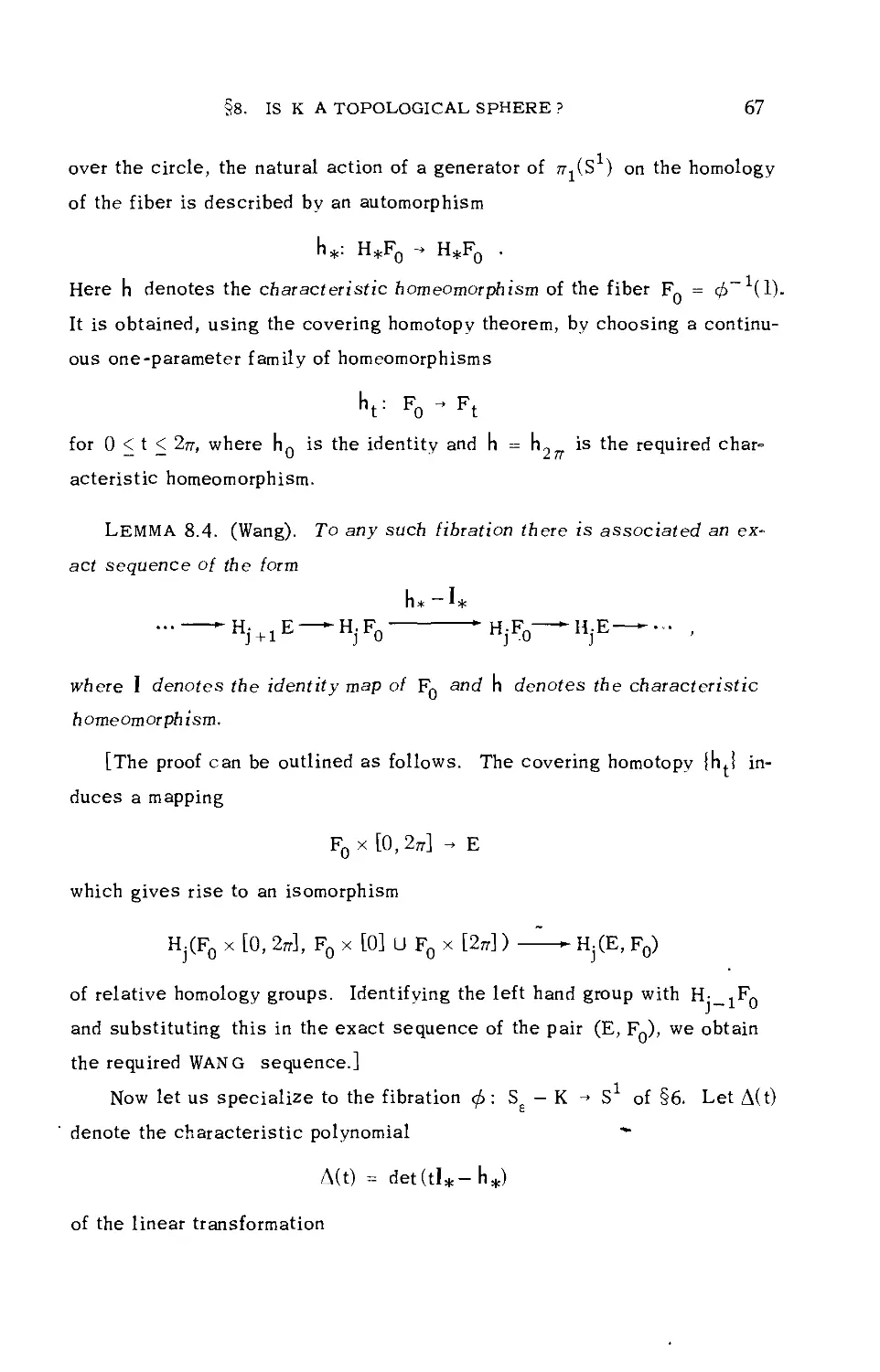
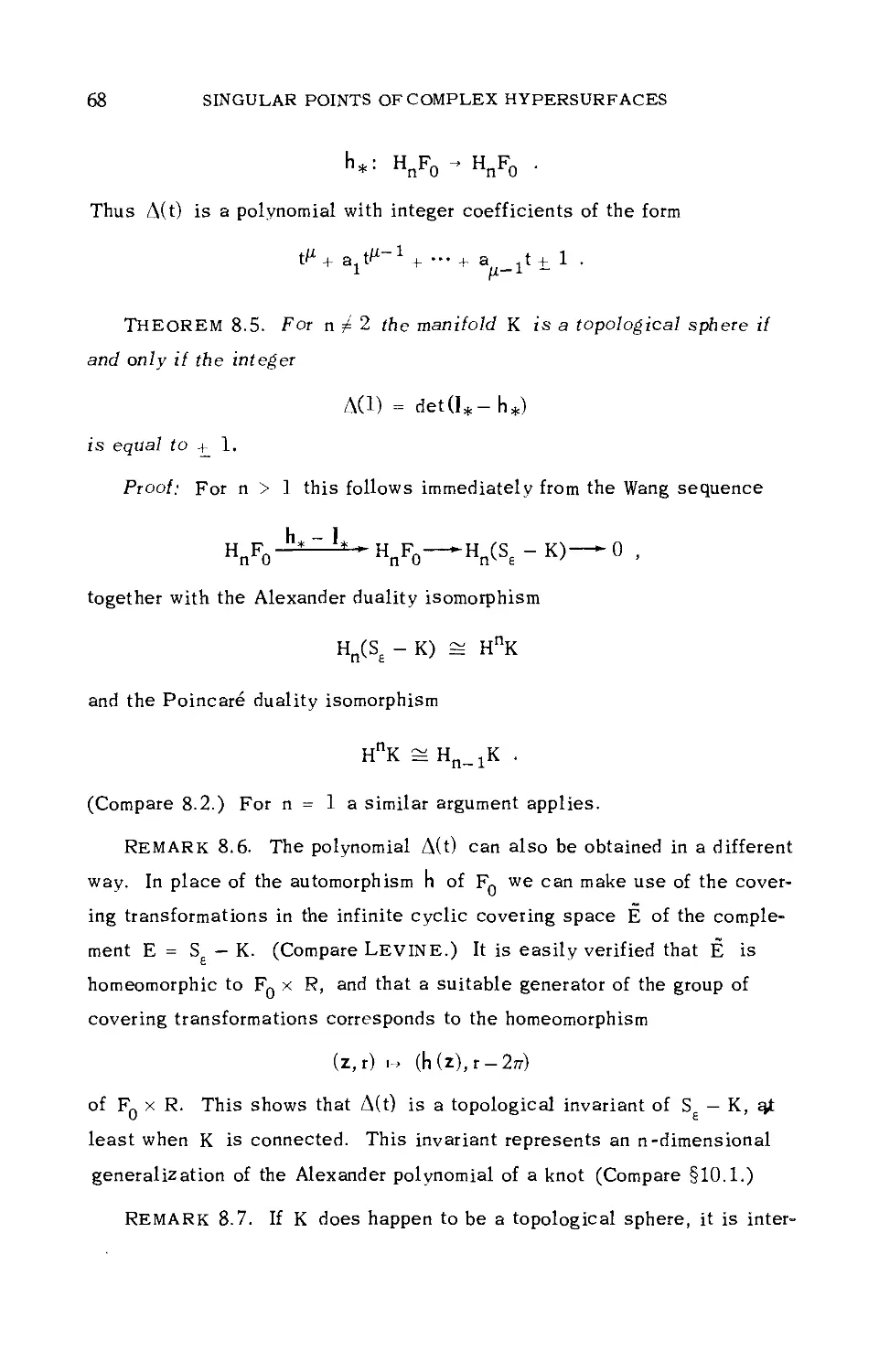
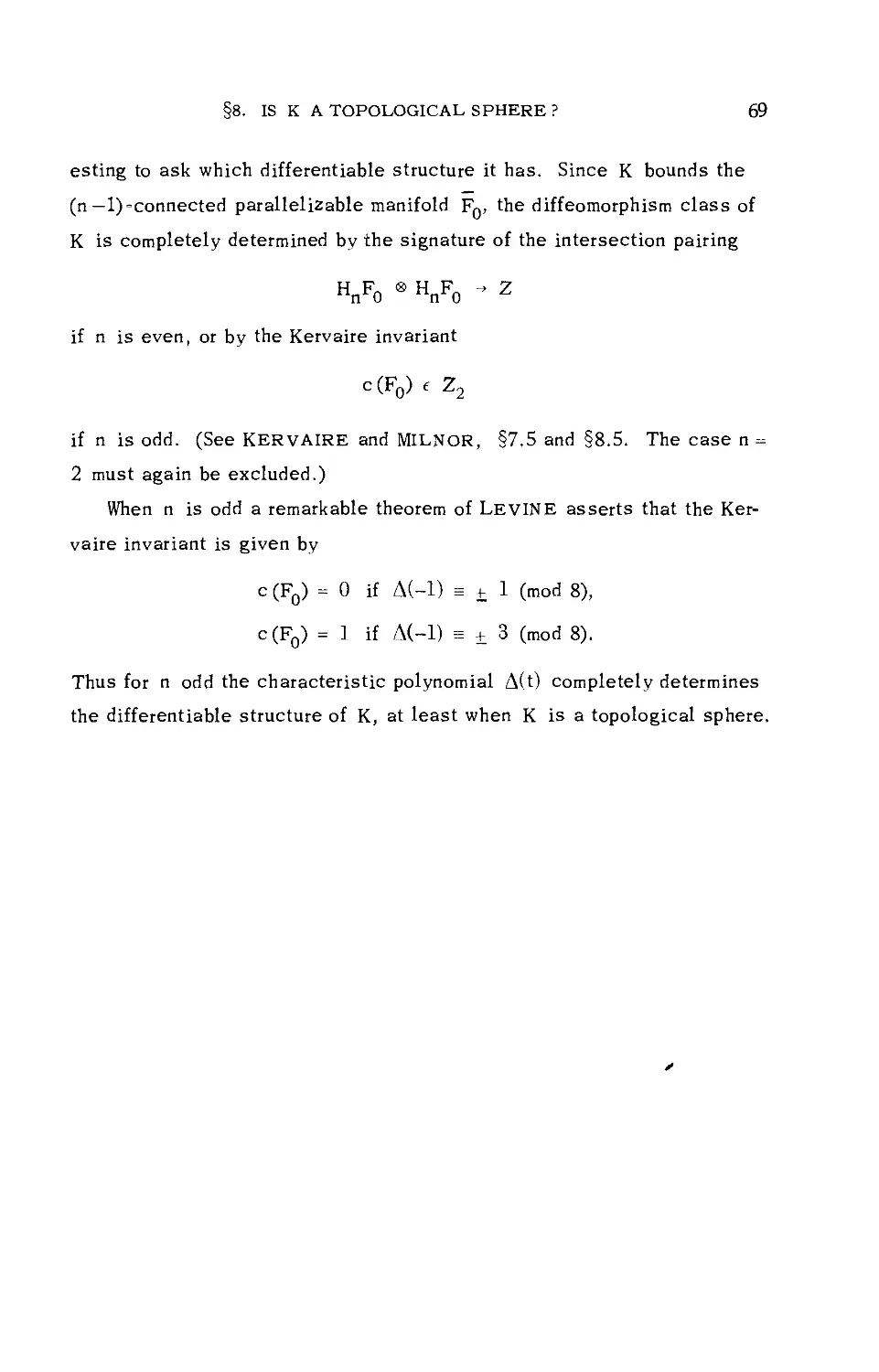
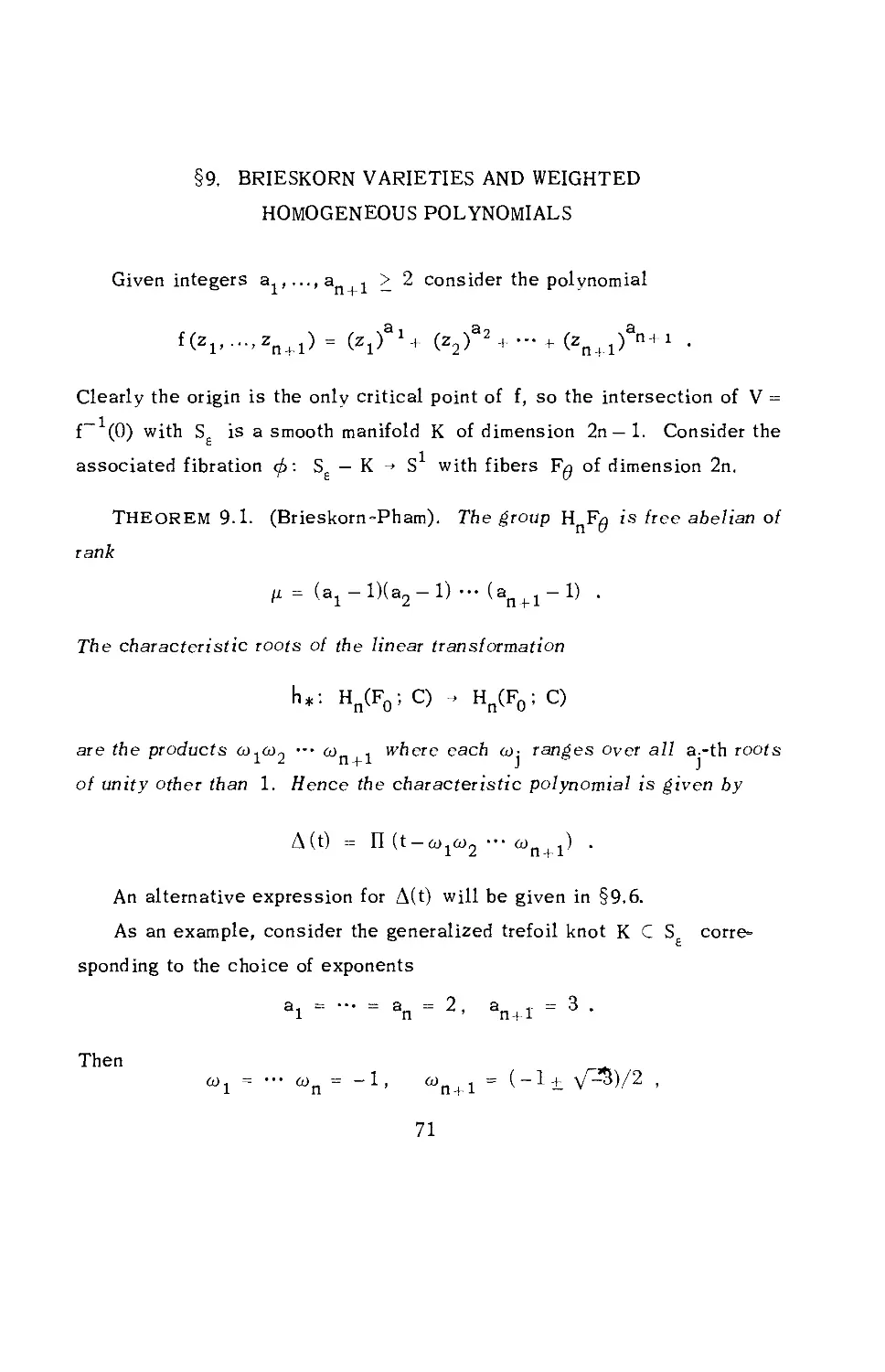
Текст
                    SINGULAR POINTS
OF
COMPLEX HYPERSURFACES
BY
John Milnor
PRINCETON UNIVERSITY PRESS
AND THE
UNIVERSITY OF TOKYO PRESS
PRINCETON NEW JERSEY
1968

Preface
The topology associated with a singular point of a complex curve has
fascinated a number of geometers, ever since K. BRAUNER* showed in
1928 that each such singular point can be described in terms of an asso
ciated knotted curve in the 3-sphere. Recently E. BRIESKORN has brought
new interest to the subject by discovering similar examples in higher dimen-
sions, thus relating algebraic geometry to higher dimensional knot theory
and the study o=f exotic spheres.
This manuscript will study singular points of complex hypersurfaces
by introducing a fibration which is associated with each singular point.
As prerequisites the reader should have some knowledge of basic al-
gebra and topology, as presented for example in LANG, Algebra or VAN
DER WAERDEN, Modern Algebra, and in SPANIER, Algebraic Topology.
I want to thank E. Brieskorn, W. Casselman, H. Hironaka, and J. Nash
for helpful discussions; and E. Turner for preparing notes on an earlier
version of this material. Also I want to thank the National Science Foun-
dation for support. Work on this manuscript was carried out at Princeton
University, the Institute for Advanced Study, The University of California
at Los Angeles, and the University of Nevada.
See the Bibliography. Proper names in capital letters will always indicate
a reference to the Bibliography.

CONTENTS
§ 1. Introduction ............................................. 3
§2. Elementary facts about real or complex algebraic sets ........ 9
§3. The curve selection lemma ................................ 25
§4. The fibration theorem .................................... 33
§5. The topology of the fiber and of K ......................... 45
§6. The case of an isolated critical point ....................... 55
§7. The middle Betti number of the fiber ........................ 59
§8. Is K a topological sphere? ................................
§9. Brieskorn varieties and weighted homogeneous polynomials .... 71
§10. The classical case: curves in C 2 ......................... 81
§11. A fibration theorem for real singularities .................... 97
Appendix A. Whitney's finiteness theorem for algebraic sets ....... 105
Appendix B. The multiplicity of an isolated solution of
analytic equations ............................... 111
Bibliography ................................................ 117

§1. INTRODUCTION
Let f(z 1 .... , zn+l) be a non=constant polynomial in n + 1 complex
variables, and let V be the algebraic set consisting of all (n+ 1)=tuples
z = (z I ..... Zn+l)
of complex numbers with f(z) = 0. (Such a set is called a complex hyper=
sur[ace.) We want to study the topology of V in the neighborhood of some
point z °.
We will use the following construction, due to BRAUNER. Intersect
the hypersurface V with a small sphere S t centered at the given point z 0.
Then the topology of V within the disk bounded by S t is closely related
to the topology of the set
K= VS E .
(Compare §2.10 and §2.11.)
As an example, if z 0 is a regular point of f (that is if some partial
derivative Of/0zj does not vanish at z 0) then V is a smooth manifold of
real dimension 2n near z 0. The intersection K is then a smooth (2n- 1)
dimensional manifold, diffeomorphic to the (2n- 1)-sphere, and K is em-
bedded in an unknotted manner in the (2n+ 1)-sphere S t . (See §2.12.)
By way of contrast, consider the polynomial
f(z 1,z 2) = zip + z2q
in two variables, with a critical point (0f/0z 1 = 0f/0z 2 = 0) at the origin.
Assume that the integers p, q are relatively prime and > 2.

SINGULAR POINTS OF COMPLEX HYPERSURFACES
ASSERTION (Brauner). The intersection of V = f-l(0) with a sphere
S E centered at the origin is a knotted circle of the type known as  torus
knoof type (p, q)" in the 3osphere SE .
[Proof: It is easily verified that the intersection K lies in the torus
consisting of all (z 1, z2) with IZll = #, lz21 = 7 where # and N are ¢
positive constants. In fact, K consists of all pairs (#e qi0, 7 ePi0+ vi/q),
as the parameter 0 ranges from 0 to 2v: Thus K sweeps around the torus
q times in one coordinate direction and p times in the other.]
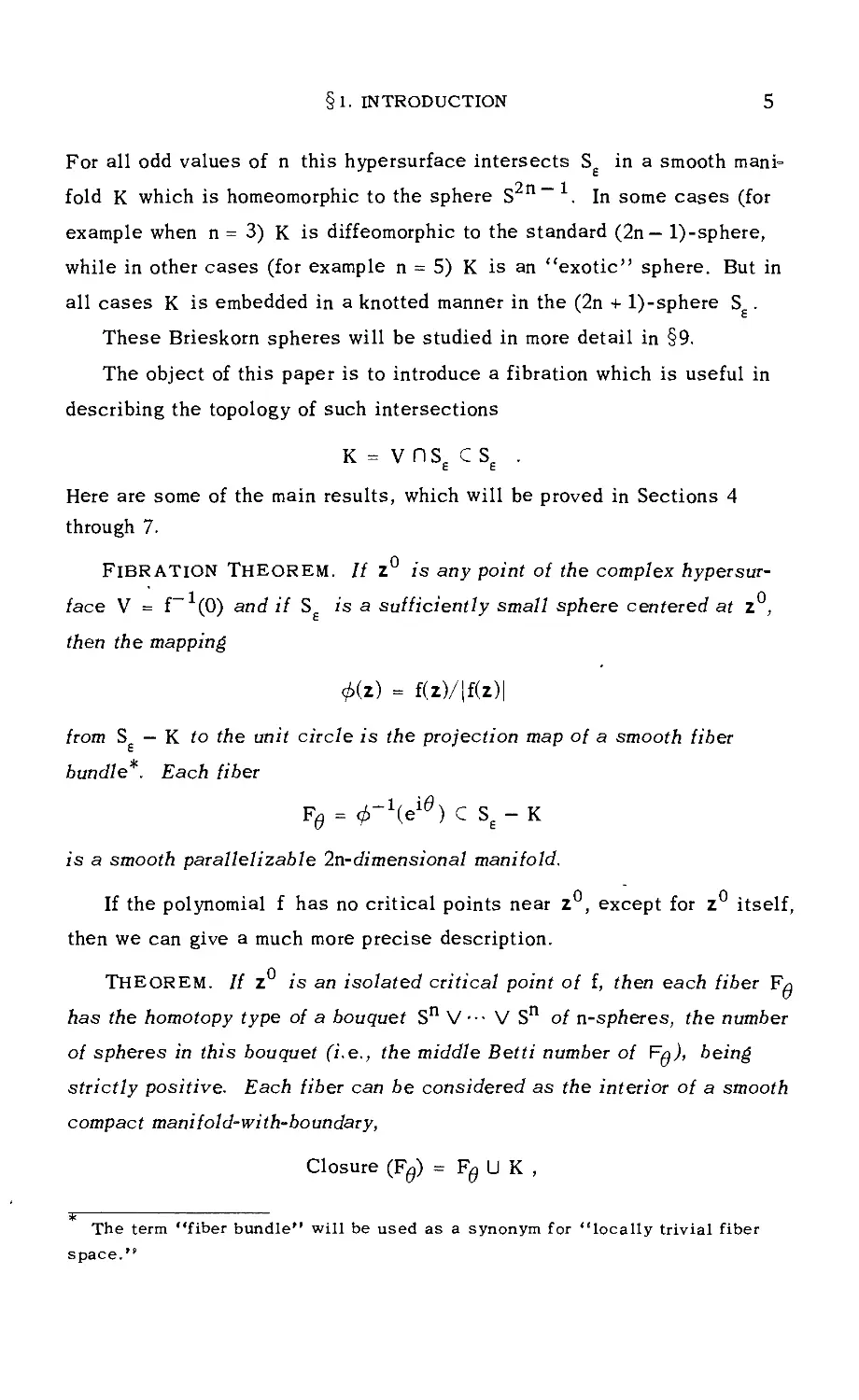
For example the torus knot of type (2, 3) is illustrated in Figure 1.
Figure 1. The torus knot of type (2, 3).
(By using more complicated polynomials one can of course arrive at much
more complicated knots. Compare §10.11.)
BRIESKORN has studied higher dimensional analogues of these torus
knots. For example let V (3, 2, 2 ..... 2) be the locus of zeros of the poly-
nomial
f(z 1 .... ,zn+ 1) = z13 + z22 + ... + Zn+l 2

§ i. INTRODUCTION 5
For all odd values of n this hypersurface intersects Se in a smooth mani
fold K which is homeomorphic to the sphere S 2n- 1 In some cases (for
example when n = 3) K is diffeomorphic to the standard (2n- 1)-sphere,
while in other cases (for example n = S) K is an "exotic" sphere. But in
all cases K is embedded in a knotted manner in the (2n + 1)-sphere S e .
These Brieskorn spheres will be studied in more detail in §9.
The object of this paper is to introduce a fibration which is useful in
describing the topology of such intersections
K = VDS e CS
Here are some of the main results, which will be proved in Sections 4
through 7.
FIBRATION THEOREM. 1[ Z 0 is any point of the complex hypersur-
face V = f-l(0) and if Se
then the mapping
is a sufficiently small sphere centered at z 0,
¢(z) :
from S e - K to the unit circle is the projection map o[ a smooth Hber
bundle*. Each fiber
F 0 = @-l(ei0) C S e -K
is a smooth parallelizable 2n-dimensional manifold.
If the polynomial f has no critical points near z 0, except for z 0 itself,
then we can give a much more precise description.
THEOREM. I[ Z 0 is an isolated critical point o[ f, then each fiber F 0
has the homotopy type o[ a bouquet S n V... V S n o[ n-spheres, the number
o[ spheres in this bouquet (i.e., the middle Betti number o[ FO), being
strictly positive. Each Hber can be considered as the interior o[ a smooth
compact manifold-with-boundary,
Closure (F0) = F 0 U K ,
The term "fiber bundle ' will be used as a synonym for "locally trivial fiber
space. P

6 SINGULAR POINTS OF COMPLEX HYPERSURFACES
where the common boundary K is an (n- 2)-connected mani[old.
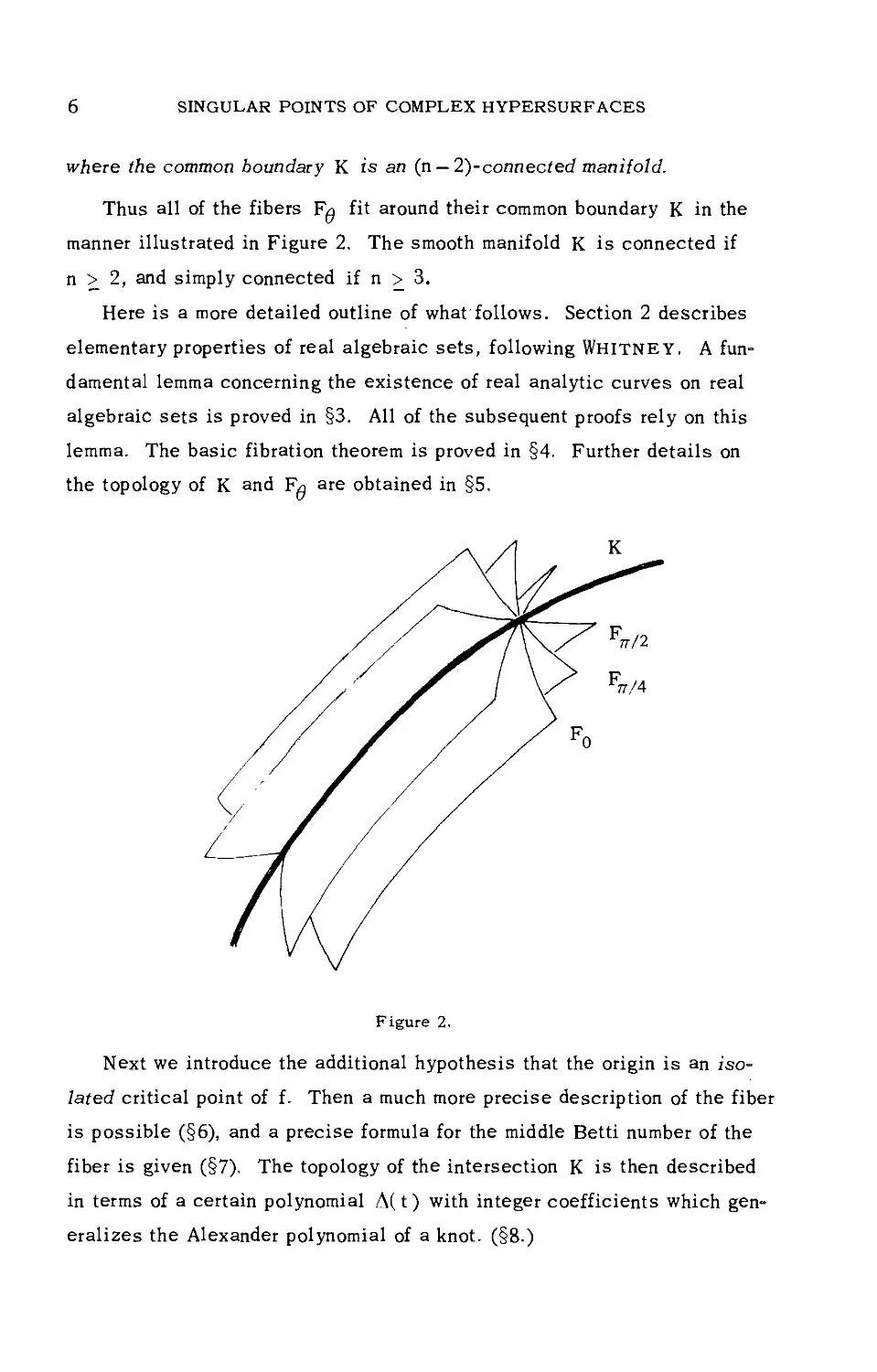
Thus all of the fibers F 0 fit around their common boundary K in the
manner illustrated in Figure 2. The smooth manifold K is connected if
n > 2, and simply connected if n > 3.
Here is a more detailed outline of what follows, Section 2 describes
elementary properties of real algebraic sets, following WHITNEY, A fun°
damental lemma concerning the existence of real analytic curves on real
algebraic sets is proved in §3. All of the subsequent proofs rely on this
lemma. The basic fibration theorem is proved in §4. Further details on
the topology of K and F 0 are obtained in §5.
Figure 2.
Next we introduce the additional hypothesis that the origin is an iso-
lated critical point of f. Then a much more precise description of the fiber
is possible (§6), and a precise formula for the middle Betti number of the
fiber is given (§7). The topology of the intersection K is then described
in terms of a certain polynomial A(t) with integer coefficients which gen-
eralizes the Alexander polynomial of a knot. (§8.)

§1. INTRODUCTION 7
The Brieskorn examples of singular varieties which are topologically
manifolds are described in §9, and the classical theory of singular points
of complex curves is described in §10. The last section proves a general-
ization of the fibration theorem to certain systems of real polynomials. As
an example, a polynomial description of the Hopf fibrations is given.
Two appendices conclude the presentation.

§2. ELEMENTARY FACTS ABOUT REAL
OR COMPLEX ALGEBRAIC SETS
Let q) be any infinite field, and let qlm be the coordinate space con-
sisting of all m-tuples x = (xl, ...,.Xm) of elements of qb. (We are princi-
pally interested in the case where qb is the field R of real numbers or the
field C of complex numbers.)
DEFINITION. A subset V C qb m is called an algebraic set* if V is
the locus of common zeros of some collection of polynomial functions on
The ring of all polynomial functions from gpm to qb will be denoted by
the conventional symbol qb Ix 1 ..... Xm]. Let
I(V) c [x I ..... x m]
be the ideal consisting of those polynomials which vanish throughout V.
The Hilbert "basis" theorem asserts that every ideal is spanned (as
 Ix1,..., Xm]-module) by some finite collection of polynomials. It follows
that every algebraic set V can be defined by some finite collection of
po!ynomial equations.
An important consequence of the Hilbert basis theorem is the following:
2.1 Descending chain condition. Any nested sequence V 1 3 V 2 3 V 3
3 ... of algebraic sets must terminate or stabilize (V i = Vi+ 1 = Vi+ 2 .... )
after a finite number of steps.
It is customary in algebraic geometry to allow as "points" of V also
motuples of elements belonging to some fixed algebraically closed exten-
sion field of (D; but I do not want to allow this..
9

10 SINGULAR POINTS OF COMPLEX HYPERSURFACES
Note that the union V U V" of any two algebraic sets V and V'in m
is again an algebraic set.
A non-vacuous algebraic set V is called a variety or an irreducible
algebraic set if it cannot be expressed as the union of two proper algebraic
subsets. Note that V is irreducible if and only if I(V) is a prime ideal.
If V is irreducible, then the field of quotients f/g with f and g in the
integral domain
• Ix 1 ..... Xm]/I (V)
is called the [ield o[ rational [unctions on V. Its transcendence degree
over qb is called the algebraic dimension of V over .
If W is a proper subvariety of V, note that the dimension of W is less
than the dimension of V. (See for example LANG, Algebraic Geometry,
p. 29.)
Now let V C qb m be any non-vacuous algebraic set. Choose finitely
many polynomials fl .... ' fk which span the ideal I (V) and, for each x  V,
consider the k × m matrix (0fi/0x j) evaluated at x. Let p be the largest
rank which this matrix attains at any point of V.
DEFINITION. A point x  V is called non*singular or simple if the
matrix (0fi/xj) attains its maximal rank p at x; and singular* if
rank (fi(x)/xj) < p .
Note that this definition does not depend on the choice of {fl .... ' fk ]"
(For if we add an extra polynomial fk+l = glfl +''" + gkfk the resulting
new row in our matrix will be a linear combination of the old rows.)
LEMMA 2.2. The set (V) o[ all singular points o[ V [orms a proper
algebraic subset (possibly vacuous) o[ V.
This definition is certainly the correct one whenever V is a variety, or a union
of varieties all of which have the same dimension. In other cases it does not
correspond too well to intuitive expectations. For example if V is the union of a
point and a line, then only the point is non-singular.

§2. ELEMENTARY FACTS ABOUT ALGEBRAIC SETS II
Forapoint x of V belongs to E(V) if and only if every p×p minor
determinant of (0fi/0x j) vanishes at x. Thus E(V) is determined by
polynomial equations.
Now let us specialize to the case of a real or complex algebraic set.
THEOREM 2.3 (Whitney). I[ gP is the Held o[ real (or complex) hum o
hers, then the set V-E(V) o[ non-singular points o[ V [orms a smooth,
nonovacuous mani[old. In [act this mani[old is real (or complex) analytic,
and las dimension m- p over
The reader is referred to WHITNEY, Elementary Structure o[ Real Al-
gebraic Varieties, for the elegant proof of 2.3.
In the case of an irreducible V, Whitney shows that the dimension
the analytic mani[old V-E(V) over gP is precisely equal to the algebraic
dimension o[ V over
Here is another basic result.
THEOREM 2.4 (Whitney). For any pair V 3 W o[ algebraic sets in a
real or complex coordinate space, the di[[erence V-W las at most a [i-
nite number o[ topological components.
For example, V itself has only finitely many components; and the
smooth manifold V- E (V) has only finitely many components.
A proof of 2.4, only slightly different from WHITNEY'S proof, will be
given in Appendix A.
Here are three examples. (Compare Figure 3.) Each example will be
a curve in the real plane having the origin as unique singular point.
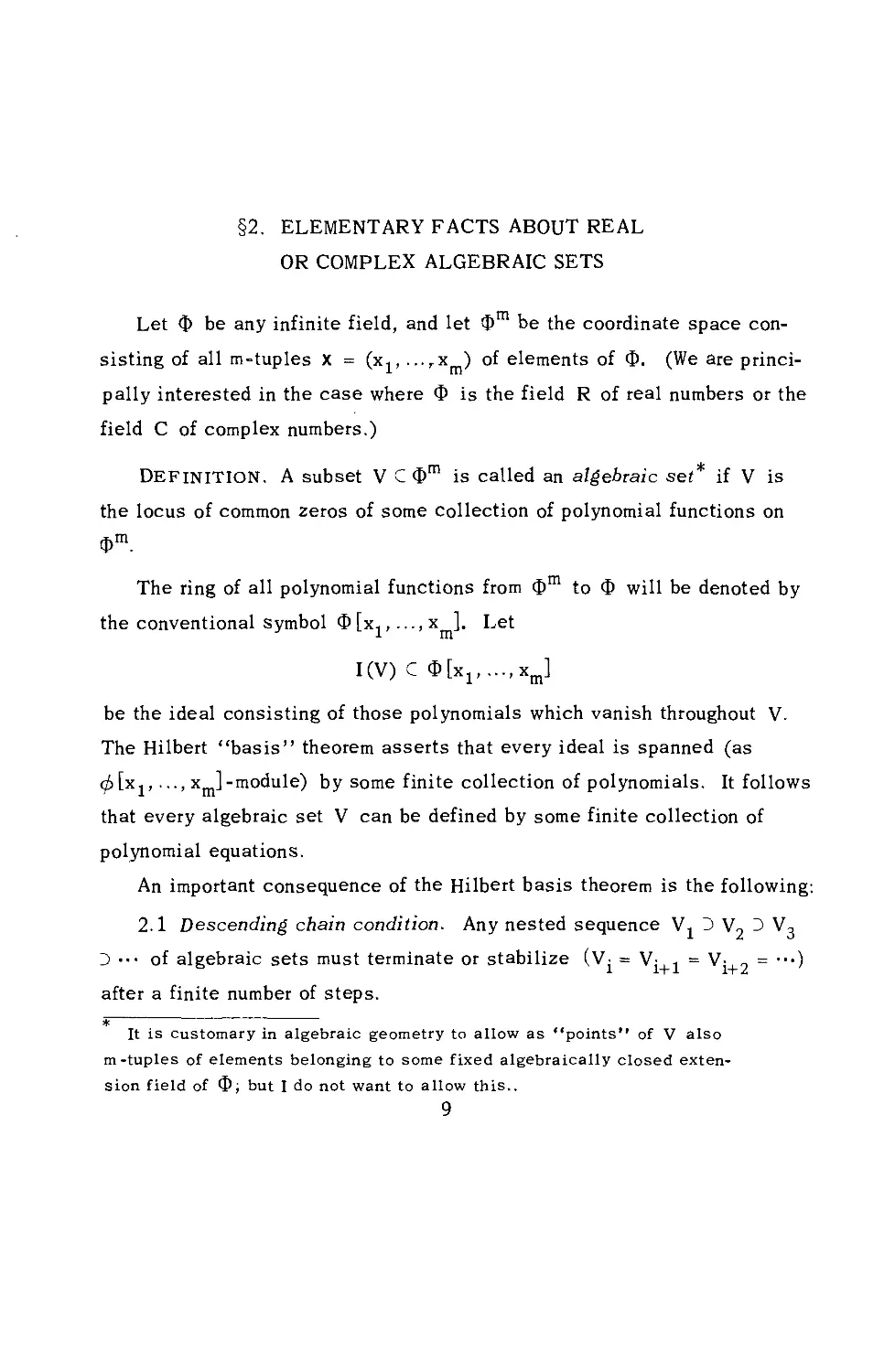
EXAMPLE A. The variety consisting of all (x, y) in R 2 with
y2_x2(l_x 2) = 0
illustrates the most well behaved and easily understood type of singular
point, a "double point" at which two real analytic branches with distinct
tangents (namely y = x V/ -x 2 and y = -x) cross each other.*
This can also be seen from the parametric representation x -- sin 0, 2y = sin 20
(which shows that the curve is a "Lissajous figure").

12 SINGULAR POINTS OF COMPLEX HYPERSURFACES
(Figure 3A. For a definition of the term "branch" see §3.3,)
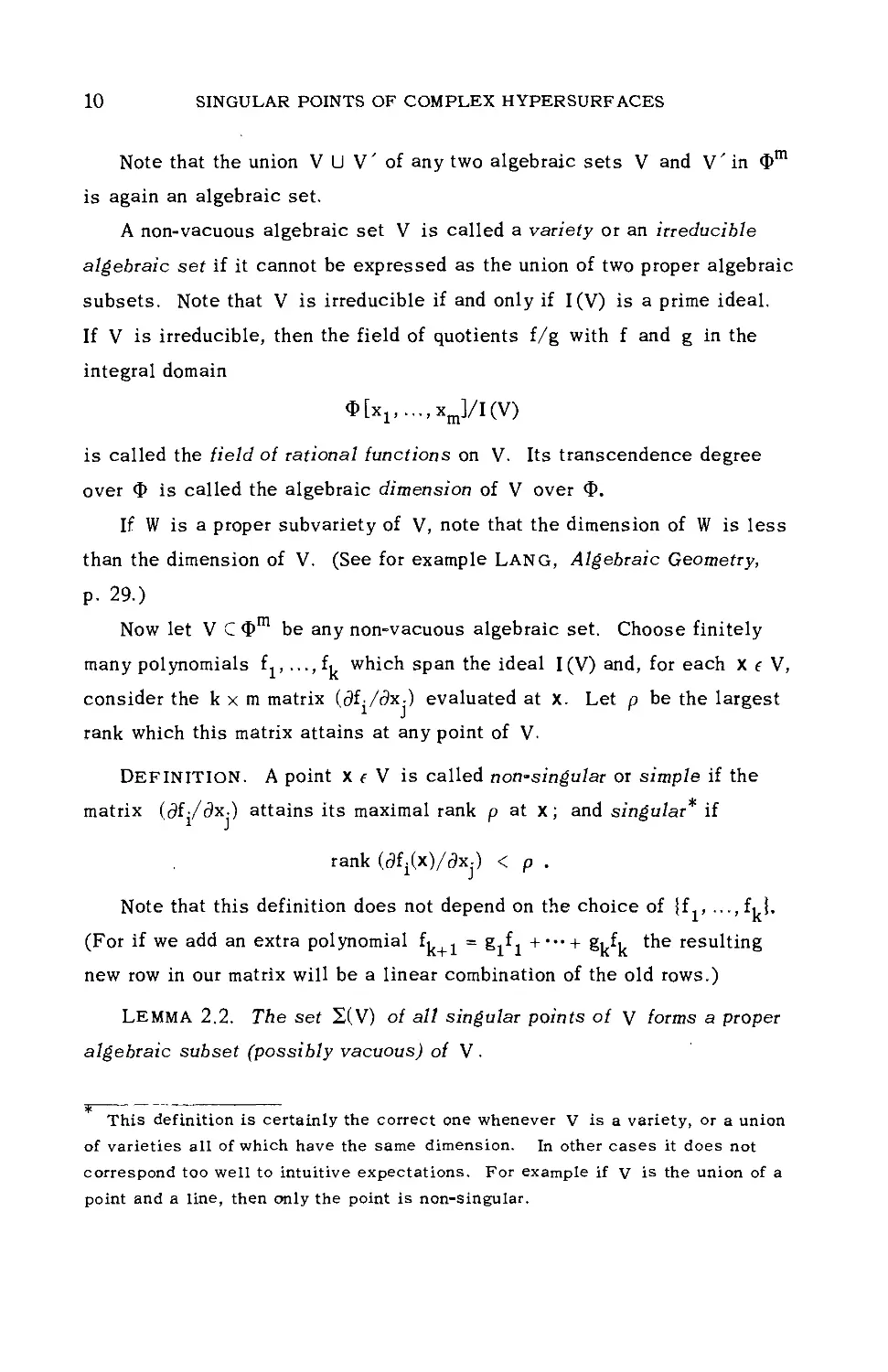
EXAMPLE [. The cubic curve
y2 _ x2(x_l) = 0
of Figure 3 13 has an isolated point at the origin; yet this curve is also
irreducible.
(REMARK. Over the field of complex numbers, examples of this type
cannot occur. In fact a theorem of RITT implies that the manifold of simo
ple points of a complex variety V is everywhere dense in V. Compare
VAN DER WAERDEN Zur algebraische Geometrie Iil, or Algebraische Geo
metrie, p. 134.)
Figure 3A. The curve
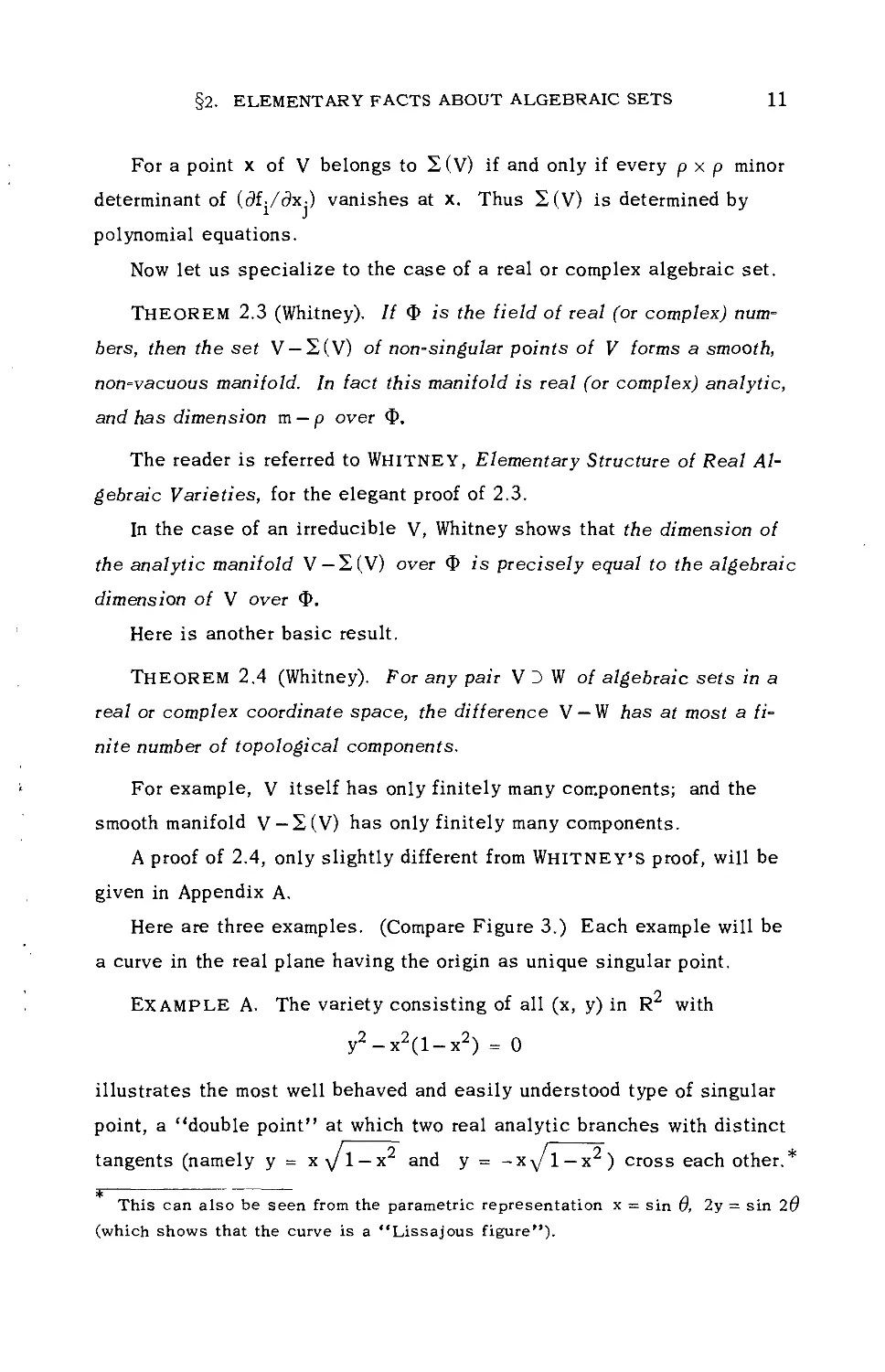
Figure 3oC. The curve
x2= y(l+ V-TV)
Figure 3 oB, The curve
EXAMPLE C. The equation y3 = xl00 can be solved for y as a 33
times differentiable function of x, yet this equation defines a variety V C R 2
which has a singular point at the origin. The equation y3 + 2x2y_ x 4 = 0,
which is illustrated in Figure 3- C, can actually be solved for y as a real

§2. ELEMENTARY FACTS ABOUT ALGEBRAIC SETS 13
analytic function*of x, but this equation also defines a variety having a sin-
gular point at the origin.
If we allow x and y to vary over the complex numbers, then the phenom-
enon becomes easier to understand. In fact, the complex curve y3 = xlOO
is *'knotted" near the origin (compare §1), and the complex curve y2 + 2x2y
= x 4 has three distinct non-singular branches passing through the origin.
REMARK. A complex variety can never be a smooth manifold throughout
a neighborhood of a singular point.
Proof: Suppose that the complex variety V were a differentiable mani-
fold of class C 1 throughout a neighborhood U of the origin in C m. The
tangent space of this smooth manifold U  V at any simple point is clear°
ly a vector space over the complex numbers. Since the simple points are
dense (see the Remark above), it follows by continuity that the (real) tan*
gent space T z C C m of U f3V at an arbitrary point z is actually a com
plex vector space. (That is, T z  iTz. ) Now replacing U by a smaller
neighborhood U 1, and renumbering the coordinates if necessary, the implicit
function theorem shows that U / f3 V can be considered as the graph of a
Clsmooth mapping F from an open subset of the (z I .... , Zn) coordinate
space into the (z n+l .... , Zm) coordinate space. The derivative of F at
each point is complex linear, hence the Cauchy-Riemann equations are sat°
isfied, and F is complex analytic. This proves that U" f3 V is a complex
manifold. Next let h () be any complex analytic function, defined in a
neighborhood of 0, which vanishes on V, and let fl ..... fk be polynomials
which span the prime ideal I (V) C C [z 1 ..... Zm]. The local analytic Nullo
stellensatz (see for example, GUNNING and ROSSI, p. 90) asserts that
some power h s can be expressed as a linear combination all 1 +... + akf k
where a 1 .... , a k are germs of analytic functions. Passing to the larger
ring C [[]] consisting of all formal power series at the origin, it follows
afortiori that h s belongs to the corresponding ideal C[[z]] IV). But this
Proof: Solve for x2 as a function x2 _-((y)= y+ y lk/- ' and note that -I
is defined and analytic throughout the interval [0,

14 SINGULAR POINTS OF COMPLEX HYPERSURFACES
ideal can be expressed as an intersection of prime ideals (see LEF$CHETZ,
Algebraic Geometry, p. 91). Therefore h itself must belong to the ideal
C [[z]] I(V); which is spanned by fl' '"' fk in C [[z]]. Taking derivatives,
this implies that the covector dh (0) can be expressed as a complex linear
combination of the covectors dfl(0) .... , dfk(0). Now it follows easily that
the matrix (0fi,/cz j) has rank m-n at 0 ; which proves that the origin
cannot be a singular point of V.
The reader should have no difficulty in checking that Examples A, B
and C do have the properties ascribed to them, making use of the following.
LEMMA 2.5. Let V be the real or complex algebraic set de[ined by a
single po. lynomial equation f(x) = 0; with f irreducible. In tle real case
make the additional hypotlesis that V contains a regular point* o[ f.
Then every polynomial wlich vanishes on V is a multiple o[ f.
Hence V is irreducible, and the singular set E(V) is precisely the
intersection of V with the set of critical points of f.
Proof: In the complex case this follows immediately from the Hilbert
Nullstellensatz. In the real case, express V C R m as a union V 1 U... U V k
of varieties. Since a neighborhood of the regular point in V is an (m- 1)o
dimensional manifold, a topological argument shows that at least one of
the Vj must have dimension m- 1. Hence, according to Whitney, the quo
tient domain R[x 1 ..... Xm]/I(Vj) has transcendence degree m-1 over R.
But the quotient of R[x 1 .... , x m] by the principal prime ideal (f) clearly
also has transcendence degree m- 1 over R. Since
(f) C I(Vj),
a standard argument shows that (f) = I (Vj). (See for example LANG,
troduction to Algebraic Geometry, p. 29.)
Therefore the set of zeros of f coincides with the variety Vj. This
proves that V = Vj, and hence that I(V) is equal to the principal ideal (f).
This hypothesis is needed to avoid examples such as x 2 + y2 + z 2 = 0.

§2. ELEMENTARY FACTS ABOUT ALGEBRAIC SETS 15
(REMARK. The analogous statement is true over any locally compact
field, but not over an arbitrary field. For example the irreducible polynomio
al x 2 - y - y3 over the field of rational numbers has no critical points in
the rational plane, and has just one rational zero.)
Now let us draw further consequences from Whitney's two theorems.
COROLLARY 2.6. Any real or complex algebraic set V can be expreso
sed as a [inite disjoint union
V = M1U M2U...UM p ,
where each Mj is a smooth mani[old with only [initely many components.
Similarly any difference V-W o[ varieties can be expressed as such a
[inite union.
Proo[: Let M 1 = V-E(V) be the set of simple points of V, let M 2 =
E(V) -- E(E(V)) be the set of simple points of E(V), and so on. This con°
struction must stop after finitely many stages, since the sequence
V 3 E(V) 3 E(E(V)) 3 ...
must terminate by 2.1. Clearly V is the disjoint union of the manifolds M i.
Similarly V-W can be expressed as the disjoint union M1 U M U o..
U M where each
M = M i-(wI3Mi)
is a smooth manifold with finitely many components by 2.4.
The following lemma is frequently useful. As usual let (I) denote the
real or complex numbers.
Let M 1 = V - E(V) be the manifold of simple points of an algebraic
set V C qb m, and let g be a polynomial function on gpm.
LEMMA 2.7. The set o[ critical points* o[ the restricted [unction glM 1
[rom M 1 to cb is equal to the intersection o[ M 1 with the algebraic set W
consisting o[ all points x e V at which the matrix
A critical point of a smooth mapping between smooth manifolds is a point of the
first manifold at which the induced linear mapping between tangent spaces fails to
be surjectiv¢.,, ..

16 SINGULAR POINTS OF COMPLEX HYPERSURFACES
I os/oxl
• .. Og/Ox m -
0fl/0X 1 •.. 0fl./0x m
0fk/0X 1 •.. Of'k/OXm_ A
has rank <_ p; where fl ..... fk denote polynomials spanning I(V).
Proof: Near any point of M 1 we can choose a (real or complex) ana-
lytic system of local coordinates u 1,..., u m for gpm so that M 1 corre-
sponds to the locus u 1 ..... up = 0. Then up+ 1, ..., u m can be taken as
local coordinates on M 1. Note that cfi/0uj, evaluated at a point of M 1 ,
is zero for j >_ p + 1 (since fi vanishes on M1). Since the matrix (0fi/0u j)
is column equivalent to the matrix (cfi/0x g) and therefore has rank 9, it
follows that the first p columns of (0fi/0u j) must be linearly independent.
Now the enlarged matrix
Ofl/Ou
0fk/0U 1 •
will have the same rank p if and only if
cg/cup+ 1 ..... cg/c)u m = 0 ;
or in other words if and only if the given point is a critical point of g]M 1.
Since this new matrix is column equivalent to the matrix given in 2.7, this
completes the proof.
COROLLARY 2.8. A polynomial [unction g on M 1 = V-(V) can
have at most a [inite number o[ critical values.
(A critical value g(x) e gP is the image under g of a critical point.)
Proo[: The set of critical points of g lM1 can be expressed as a difo
ference W-E(V) of algebraic sets, and hence can be expressed as a finite
union of smooth manifolds,

§2. ELEMENTARY FACTS ABOUT ALGEBRAIC SETS 17
W-:(V) : M I'U "'. U Mp',
where each M i" has only finitely many components.
Each point x e M i" is a critical point of the smooth function g]M1, so
a fortiori it is a critical point of the restricted function g l Mi" Since all
points of M i" are critical, it follows that g is constant on each component
of Mi'. Therefore the image g(Mi" ) is a finite set. But the union
g(Ml') U "" U g(Mp')
is precisely the set of all critical values of g IM1. This completes the
proof.
Again let V be any real or complex algebraic set. Let x 0 be either a
simple point of V or an isolated point of the singular set :(V).
COROLLARY 2.9. Every su[[iciently small sphere S e centered at x 0
intersects V in a smooth mani[old (possibly vacuous).*
Proof: In the real case this follows by applying 2.8 to the polynomial
function
rCx) = llx - x°',l
If g2 is smaller than any positive critical value of r I(V-(V)) then 5 2
will be a regular value, hence its inverse image
r-l() n(V-(V))= S n (V-(V))
will be a smooth manifold K. But if g is small enough then S e will not
meet :(V), hence K will equal S e F] V.
The corresponding statement in the complex case follows immediately,
since every complex variety in C m can be thought of as a real variety in
R 2m.
Let D e denote the closed disk consisting of all x with lx-x°il <_ g.
Again let x 0 be either a simple point or an isolated singular point of V.
The proof will actually show that the intersection is transverse : that is every
vector based at a point of V ["IS can be expressed as the sum of a vector tangent
to V and a vector tangent to S e.

18 SINGULAR POINTS OF COMPLEX HYPERSURFACES
THEOREM 2.10. For small  tle intersection of V with D is
homeomorphic to the cone over K= V NS E. In [act the pair (D e, V ND e)
is homeomorphic to the pair consisting o[ the cone over S e and the cone
over K.
Here, by the cone over K, denoted Cone (K), we mean the union of all
line segments
tk+(1-t)x °, 0< t < 1
joining points k e K to the base point x 0. The set Cone (S e), defined
similarly, is of course precisely equal to D .
Thus if we can identify the manifold K, and the way in which K is
embedded in S e , then we will have completely determined the topology of
V, and the embedding of V in its coordinate space, throughout a neighbor-
hood of x 0. As an example, if K is a topological sphere, then V must be
a topological manifold near x 0.
We will give the proof in some detail since similar methods will be
important later, in Sections 4, 5, and 11.
Proof of 2.10. Again it is only necessary to consider the real case.
Again let . be small enough so that the disk D e contains no singular
points of V, and no critical points of r I(V- E(V)), other than x 0 itself.
We will construct a smooth vector field v(x) on the punctured disk
D e - x 6 with two properties: The vector v(x) will point "away" from x 0
for all x ; that is the euclidean inner product
<v(x), x-x°>
will be strictly positive. And the vector v(x) will be tangent to the mani-
fold M 1 = V-Y.(V) whenever x belongs to M 1.
First let us construct such a vector field locally. Given any point x a
of D e - x 0 we will construct a vector field va(x) throughout a neighborhood
U a of x a so that these two properties are satisfied.
If x a does not belong to V then we can simply set
va(x) -- x - x °

§2. ELEMENTARY FACTS ABOUT ALGEBRAIC SETS 19
for all x in some neighborhood U a C R m- V.
If x a belongs to V, and hence belongs to M 1, choose a system of lo
ca1 coordinates Ul, ...,u m throughout a neighborhood of x a so that M 1
corresponds to the locus u I ..... Up = 0. Since x a is not a critical
point of the function r] M1, where r(x) = llx-x°II 2, it follows that at least
one of the partial derivatives
Or/OUp + 1 ..... 0r/0Um
must be nonozero at x a. (Compare the proof of 2.7.) If for example 0r/0u h
is non-zero at x a, then let U a be a small connected neighborhood through°
out which Or/Ou h  O, and let va(x) be the vector
+ (C)Xl/OU h .... , CXm/Cu h) ; 'I'
tangent to the UhoCOordinate curve through x; choosing the plus sign or
the minus sign according as Or/0u h is positive or negative. This vector
va(x) is certainly tangent to M 1, whenever x e M1, since the entire UhO
coordinate curve is contained in M 1. Furthermore
2<va(x),x-x0> =  2(xi-xi0)vi a
=  (0r/0xi)(+ 0xi/cu h)
is equal to +_ 0r/0u h > 0 for all x e U a.
Now choose a smooth partition of unity* Ih a] on D
Support (h a) C U a. Then the vector field
-x ° , with
v(x) =  h(x)v(x)
That is choose smooth real-valued functions h a on D a -- X 0 so .that
ha(x)>0, Eaha(x) = 1,
and so that each point of Da -- X° has a neighborhood within which only finitely
many of the .a are non-zero. See for example DE RHAM, Varietes differentiables
or LANG, Di[[erentiable mani[olds.

2O
•
SINGULAR POINTS OF COMPLEX HYPERSURFACES
on D e - x ° clearly has the required properties.
Normalize by setting
w(x) = v(x)/< 2(x -x°), v(x) >
and consider the differential equation
dx/dt = w(x) .
That is, look for smooth curves x = p(t), defined say for a < t </3, which
satisfy
dp(t)/dt = w(p(t)).
Given any solution p(t), note that the derivative of the composition r(p(t))
is given by
dr/dr =  (c)r/c)xi)wi(x)
= <2(x-x°),w(x)> = 1
where x = p(t)), So the function r(p(t)) must be equal to t ÷ constant.
Thus, subtracting a constant from the parameter t if necessary, we may
assume that
r(p(t)) : IIp(t)-x°II 2 : t.
This solution p(t) can certainly be extended throughout the interval
0<t< E 2 .
[Proot: We may assume that the vector field w(x) has been constructed
over an open set slightly larger than D e - x 0, so that the boundary points
of D e will not cause any trouble. By Zorn's lemma the given solution p(t)
can be extended* over some maximal open interval a'< t < /3". Suppose
for example that /3"<_ E2. Then we will extend the solution p(t) over a
slightly larger irlterval, thus contradicting the definition of /3", Since the
points p(t) with a'< t < /3" all belong to the compact set D e, there exists
at least one limit point x" of lp(t) as t-./3"; and clearlyr(x') = /3" 0
This use of Zorns lemma could easily be eliminated.

§2. ELEMENTARY FACTS ABOUT ALGEBRAIC SETS 21
so that x 'e D e - x °. We will use the local existence, uniqueness and
smoothness theorem* for the differential equation dx/dt = w(x) near x'.
This theorem asserts that for each x'" in some neighborhood U of x" and
each t'" in some arbitrarily small open interval I containing J3" there exo
ists a unique solution
x = q(t), t e I,
satisfying the initial condition q(t") = x "'; and furthermore, that q(t) is
a smooth function of x", t" and t. To apply this theorem, choose t" e
(a', J3 ') V11 and let x" equal p(t"). Using the local uniqueness theorem
we can verify that p(t) = q(t) for all t in the common domain of definition
(a',/')  I. So the solutions p and q can be pieced together to yield a
solution which is defined for all t in the larger interval (a', J3') U I. This
contradiction proves that J3" > : 2 ; and a similar argument shows that
a'= 0.]
Note also that the solution p(t), 0 < t <_ G2 is uniquely determined
by the initial value
For each a e S e let
p(.-) e S e •
p(t) = P(a,t) , 0 < t <_ 2,
be the unique solution which satisiies the initial condition
p(2) = P(a, e 2) = a.
Clearly this function P maps the product S e × (0, E2] diffeornorphicalo
ly onto the punctured disk D e - x °. Furthermore, since the vector field
w(x) is tangent to M 1 for all x e M 1, it follows that every solution curve
which touches M 1 must be contained in M 1. Hence P maps the product
K × (0, .2] diffeomorphically onto V V1 (D e - x°).
Finally, note that P(, t) tends uniformly to x 0 as t  0. Therefore
the correspondence
See for example GRAVES, Real Variables, or LANG, Di[[erentiable Mani[olds.

22 SINGULAR POINTS OF COMPLEX HYPERSURFACES
ta + (1-t)x °  P(a,t ¢2) ,
defined for 0 < t K_ 1, extends uniquely to a homeomorphism from Cone (S a)
to Da. Furthermore, this homeomorphism carries Cone (K) onto V A D a.
This completes the proof of Theorem 2.10.
REMARK 2.11. It seems likely that Theorem 2.10 remains true even
when x ° is not an isolated singular point of V. Certainly it is known that
every algebraic set can be triangulated, and hence that a suitably chosen
neighborhood of any point is homeomorphic to the cone over something.
See for example LOJASIEWICZ, Triangulation o[ Semianalytic Sets.
The rest of §2 will study the rather dull case of a non-singular point
of V, just to make sure that nothing unexpected happens.
LEMMA 2.12. If X ° is a simple point o[ V, then the intersection K =
V f S t is an unknotted sphere in Sa, [or all sufficiently small g.
Proof: Clearly the smooth function r(x) = ,Ix-x°Ii 2 restricted to M 1 =
V-E(V) has a nonodegenerate critical point at x °. Hence, by a lemma of
MARSTON MORSE, there exists a system of local coordinates u 1 .... , u k
for lI 1 near x ° so that
2
fix) = ul 2 +'"+ u k
(See for example MILNOR, Morse Theory, §2.2.) It follows immediately
that K = V f Sa is diffeomorphic to the sphere consisting of all (u I ..... Uk)
with ul 2 +-.-+ u 2 ¢2
But Morse's argument can be applied also the the pair of manifolds
M 1 C R m. That is: there exist local coordihates u 1 .... ,um for R m near
x ° so that
2
r(x) = ul 2 +.-.+ u m ,
and so that V corresponds to the locus Uk+ 1 ..... u m = 0. The proof of
this sharpened form of Morse's lemma is a straightforward generalization,
and will be left to the reader.

§2. ELEMENTARY FACTS ABOUT ALGEBRAIC SETS 23
Thus the pair (SE, K) is diffeomorphic to the pair consisting of a sphere
and a great sub-sphere in the uocoordinate space. This proves 2.12.
Now consider the special case of a simple point z ° of a complex hy-
persurface
V = f-l(0) C C n+l
(Compare §1.) We want to study the set
F 0 = ¢-1(1) = f-l(R+) n S e ,
where ¢: S e - K-* S 1 is defined by ¢(z) -- f(z)/]f(z)l.
LEMMA 2.13. I[ the center z 0 o[ S t is a regular point o[ f, then this
Hber" F 0 is di[[eomorphic to R 2n.
Proo[: Applying Morse's argument to the pair of manifolds V C f-l(R)
near z ° we obtain local coordinates u 1, ..., U2n+l for -I(R) so that
= 2
ilz-zOil 2 u +-..+ U2n+l ,
and so that V corresponds to the locus u I = O. Then
--1(]) = f-l(R+) n S e
will correspond to the open hemisphere
2 2
+_ u I > 0, Ul 2 + u22 +...+ U2n+l = E
which is clearly diffeomorphic to R 2n. This completes the proof.
Once we have proved the Fibration Theorem in §4, it will follow that
the mapping
¢: St-K-* S 1
is the projection map of a trivial fiber bundle. In fact a theorem of T. E.
Stewart implies that every smooth orientable bundle over S 1 with fiber dif-
feomorphic to euclidean space is trivial. See STEWART, Corollary 1; or
note that any smooth bundle over $1 is characterized by a certain diffeo-
morphism of the fiber (§8.4), and note that every diffeomorphism of euclidean

24 SINGULAR IOINTS OF COMILEX HYIERSURFACES
space is smoothly isotopic either to the identity or to a reflection (STEW-
ART, Theorem 1, or MILNOR, Topology from the Dillerentiable Viewpoint,
p. 34.)
This c m..0.let.s the discussion in the case of a regular point.

§3. THE CURVE SELECTION LEMMA
The object of this section will be to prove the following.
Let VCR m be a real algebraic set, and let UCR m be an open set
defined by finitely many polynomial inequalities:
U = {x e Rmlgl(x) > 0, ..., g(x) > 0/ .
LEMMA 3.1. It U  V contains points arbitrarily close to the origin
(that is i[ 0  Closure (U f V)) then there exists a real analytic curve
p: [0, E) -, R m
with p(0) = 0 and with p(t) , U nV for t > O.
[Compare BRUHAT and CARTAN as well as WALLACE, Algebraic
Approximation, §18.3.]
Proof: First suppose that the dimension of V is > 2. Then we will
construct a proper algebraic subset V 1 C V so that 0  Closure(U fV1).
This procedure can then be iterated inductively until we find an algebraic
subset Vq of dimension <_ 1 with 0 , Closure (U f Vq).
We may assume that V is irreducible. For if V is the union of two
proper algebraic subsets, then one of these subsets will serve as V 1.
Also we may assume that the open set U does not contain any points
of the singular set E(V), within some neighborhood D7 of 0. For other°
wise we could choose V 1 to be X(V).
It will be convenient to use the language of differentials. By definio
tion the differential dr(x) of a polynomial f at x is the element of the
25

26 SINGULAR POINTS OF COMPLEX HYPERSURFACES
dual vector space
HOmR(Rm, R)
which corresponds to the row vector
(cf/cx I ..... cf/cx m )
evaluated at x.
Let fl .... ' fk span the ideal I(V). Recall that the singular set E (V)
is the set of all x e V for which
rankldfl(x), ..., dfk(x)l < p ;
where the dimension of the variety V is m-p.
We will make use of two auxiliary functions:
r(x) , 2
= ]xll , g(x) = gl(X) g2(x).., g[(x) .
Let V" be the set of all x e V with
rank{dfl(x ) ..... dfk(x), dr(x), dg(x)l <_ p + 1 .
We will prove:
LEMMA 3.2.
close to O.
The intersection U N V" also contains points arbitrarily
Prool: By hypothesis there exist arbitrarily small spheres Se centered
at 0 which contain points of U V. Choose any such sphere S t and con°
sider the compact set consisting of all x e V  Se with
g.(x) >_ o, ..., gl(x) >_ o .
The continuous function g must be maximized at some point x" of this
compact set; and clearly x' e U.
We will show that x e
Note first that S intersects U  V in a smooth manifold of dimension
m-p-l; and that
rank{dfl(x) ..... dfk(X),dr(x)l = p + 1

§3. THE CURVE SELECTION LEMMA
27
at every point × of U  V  S. This follows immediately from the proofs
of 2.9,and 2.7, and the fact that U  S contains no singular points of V,
providing that g is small.
Now, proceeding as in §2.7, we see that the critical points of g[ U
V S E are just those points of U V S which lie in V'. But glU
V  S attains its maximum at ×'. So ×' is certainly a critical point; and
therefore belongs to V'.
This completes the proof of 3.2.
Thus, if V" is a proper subset of V, then it satisfies our requirements.
There remains the question of what to do in case V = V'.
We can also carry out the above construction using the function
(x 1 ..... x m) - xig(Xl, ..., x m)
in place of g. Let V." be the set of all x eV with
1
ranktdfl(X) , ..., dfk(X) , dr(x), d(xig)(x)/ _< p + ] .
Then a similar argument shows that 0 e Closure (U  Vi').
Thus we have found a suitable algebraic subset V 1 C V except in the
case
V = V" = Vl'= .... Vr
ASSERTION: This case can only occur when the dimension m-p of V
is equal to 1.
Proo[: We can certainly choose a point x" e U  V so that
rankldfl(x') ..... dfk(x'),dr(x')/ = p + 1 .
(Compare the proof of 3.2.) If V = V', then x'e V" and hence the differeno
tial dg(x ") must belong to the p + ] dimensional vector space spanned by
{dfl(x ") .... , dfk(x "), dr(x ")/ •
Similarly, if V = V i' then d (xig)(x ") must belong to this vector space.
Using the identity
IVAT00030267215

28 SINGULAR POINTS OF COMPLEX HYPERSURFACES
d(xig) = (dxi)g + xi(dg)
and the fact that g(x')  0 (since x'e U) it follows that dxi(x') also
belongs to this p + 1 dimensional vector space. But the differentials
dx 1, ..., dx m form a basis for the entire modimensional vector space of
differentials at x " So the subspace spanned by dft(x'),..., dfk(x'), and
dr(x') must be the whole space; and its dimension p + 1 must be equal
to m. This proves that the dimension m-p of V is equal to 1.
Now we can make use of the classical local description of lodimension
al varieties:
LEMMA 3.3. Let x 0 be a non-isolated point oi a real (or complex)
ldimensional variety V. Then a suitably chosen neighborhood o[ x 0 in
V is the union o[ [initel.__.___y many "branches ' which intersect only at x 0.
Each branch is homeomorphic to an open interval o[ real numbers (or to an
open disk o[ complex numbers) under a homeomorphism x = p (t) which is
given by a power series
p(t = x ° +I]lt+ 112t2 +I3 t3 + "',
convergent [or Itl <
NOTE. Let k be the smallest index so that V is not contained in a
coordinate hyperplane x k = constant. Then the parametrization p can
ways be chosen so that x k = Pk(t) is a polynomial function of the form,
Pk(t) = constant + ttt,
with* bt > 1. Furthermore p can always be chosen so that the collection
li!,a i ¢ 0/ of exponents has greatest common divisor equal to 1. The
power series p is then uniquely determined up to the sign of the parameter
t (or up to multiplication of t by roots of unity in the complex case).
Closely related is the Puiseux fractional power series expansion
X = p((±(x k-x:))l//z) .

§3. THE CURVE SELECTION LEMMA 29
Proof: For a complex curve in C 2 this is proved, for example, in VAN
DER WAERDEN, Algebraizche Geometrie, §14. The case of a complex
curve in C m, with m > 2, can be handled in exactly the same way.
The case of a real 1-dimensional variety V C R m can then be treated
as follows. Let V C be the smallest complex algebraic set in C m which
contains V. It is easily verified that V C is irreducible, of complex dio
mension 1, and that the set R m rqV C of real points in V C is equal to V.
Now for each branch of V C we can form the complex parametrization
x = p(t) = x°+(0 ..... 0, tA t, .ak+l,iti ..... . amiti) .
i i
We must then ask: for which values of the complex parameter t will the
vector p(t) be real? Clearly the k oth component t is real if and only if
t can be expressed as the product of a 2oth root of unity : and a real
number s. But, for each choice of :, substituting t = :s in the power ser
ies p, we obtain a new complex power series x 0 + E(a i:i)si in the real
variable s. If the coefficients eli :i are all real, then clearly p(-s) e R m.
But if some coefficient vector r i :i is not real, then p (s) ¢' R m for all
small non-zero values of s. Therefore each branch of V C intersects R m
in at most a finite number of branches (actually in at most one branch) of
the real variety V. This proves Lemma 3.3.
[REMARK. Presumably 3.3 remains true over any locally compact field;
although the present proof does not apply.]
Now we are ready to finish the proof of the curve selection Lemma 3.1.
Suppose that V contains points x arbitrarily close to 0 with x e U, that
is with
gl(x) > 0 .... ,g(x) > 0 ;
and suppose that V has dimension 1. Then one of the finitely many branches
branches of V through 0 must contain points of U arbitrarily close to 0.
Let
x : p(t), Ill < 5

30 SINGULAR POINTS OF COMPLEX HYPERSURFACES
be a real analytic parametrization of this branch. For each gi note that
the real analytic function gi(P(t)) must be either > 0 for all t in some
interval 0<t< ', or < 0 for all t with 0<t < g" So the half-branch
p (0, ') is either contained in U or disjoint from U, for g" sufficiently
small. Similarly the half-branch p (- ', 0) is contained in U or disjoint
from U.
But we have assumed that p (- , ) contains points of U arbitrarily
close to 0, so at least one of these two halfobranches must be contained
in U. This completes the proof of 3.1.
To conclude §3 let me give a typical application of Lemma 3.1 which
will be useful in §11.
COROLLARY 3.4. I[ f >_ 0 and g >_ 0 are nononegative polynomial
[unctions on R m which vanish at x 0, then [or x belonging to some neigh°
borhood D e o[ x 0, the two differentials df(x) and dg(x) cannot point in
exactly opposite directions unless at least one o[ them vanishes.
Proof: Let U be the open set consisting of all x for which the inner
product
 (Of(x)/Oxi)(Og(x)/Ox i)
i
is negative, and let V be the algebraic set consisting of all x for which
rankldf(x), dg(x)} <_ l .
Thus U /3V is the set of all x for which df(x) and dg(x) point in exactly
opposite directions.
If U fl V contained points arbitrarily close to x 0, then there would exist
an entire real analytic curve
x = p(t), 0_< t < a,
which consisted entirely of such points, except for x 0 = p (0).
For every x e U note that f(x) > 0 and g(x) > 0. For if the non-
negative function f were to vanish at x then the differential dr(x) would

§3. THE CURVE SELECTION LEMMA 31
have to vanish also, hence x could not belong to U. Therefore
f(p(t)) > 0 for t > 0 ;
and since f o p is real analytic this implies that df(p (t))/dt > 0 also for
small positive values of t. Similarly dg (p (t))/dt is positive for small
positive t. But
dr/dr  (cf/'cxi)dPi/dt , dg/dt , (cg/cxi)dPi/dt
where the row vector (cf/cx 1 ..... cfs"cx m) is a negative multiple of
(cg/cx 1 ..... cg/CXm) , for all t > O. Hence df/dt and dg/dt must have op -
posite sign.
This contradiction shows that the original premise must be false: x 0
cannot be a limit point of U  V.

§4. THE FIBRATION THEOREM
Define the gradient of an analytic function f (z 1 ..... Zm) of m complex
variables to be the m-tuple
grad f = (f/z 1 ..... cf/cz m)
whose j =th component is the complex conjugate of cf/czj. This definition
is chosen so that the chain rule for the derivative of f along a path z =
p(t) takes the form
df(p(t))/dt = <alp/tit, grad f> ,
using the hermitian inner product
<a,b> : 2 aj-j
In other words the directional derivative of f along a vector v at the point
z is equal to the inner product <v, gradf(z)>.
Now let K denote the intersection of the set of zeros of f with the
sphere S, consisting of all z in C m with tlzl = E o Map the complement
S - K to the unit circle S 1 by the correspondence
?5(z) = f(z)/,f(z)l .
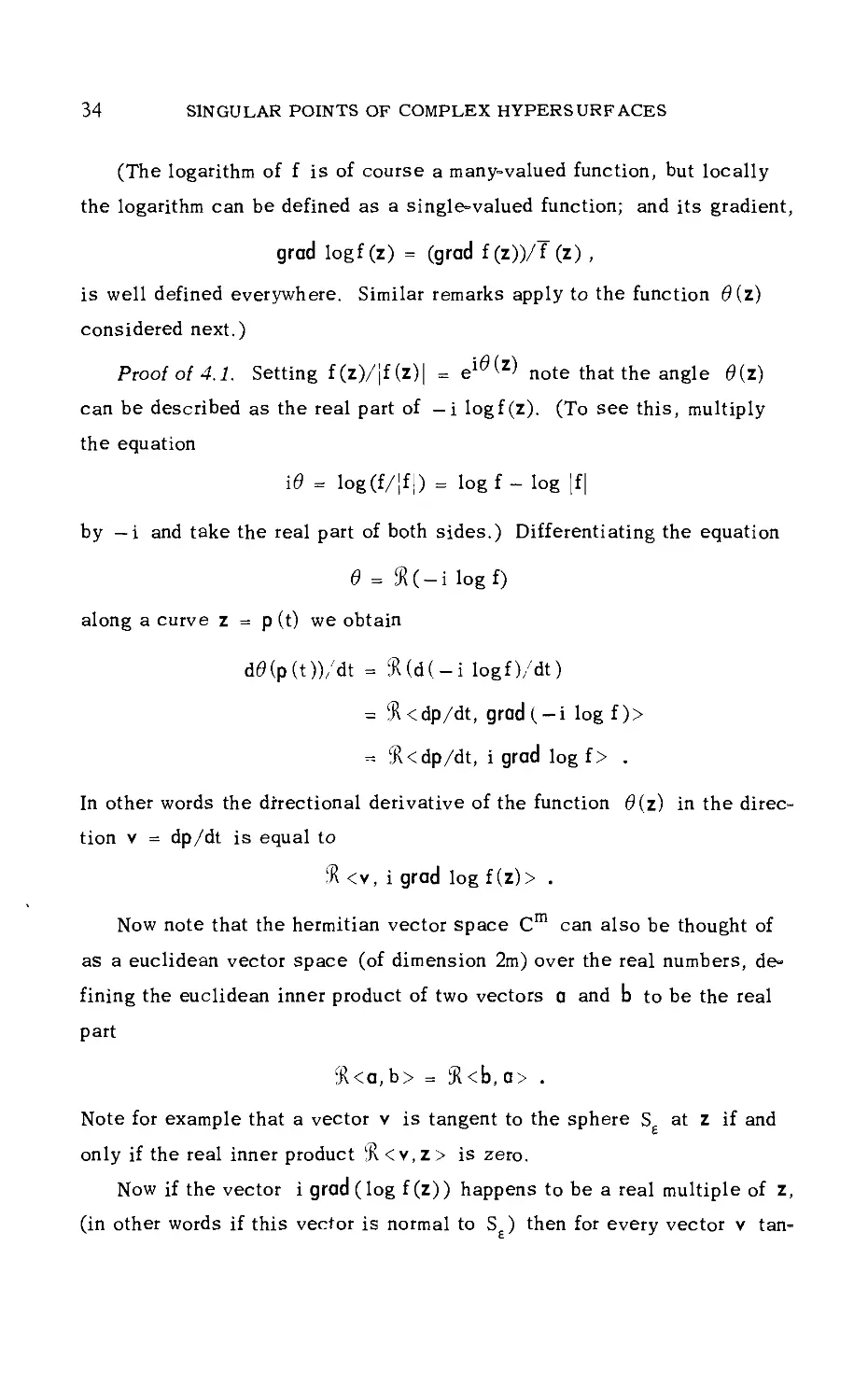
LEMMA 4.1. The critical points of this mapping q5 : Sa - K - S 1 are
precisely those points z  Sa - K for which the vector i grad log f (z) is a
real multiple o[ the vector z.
33

SINGULAR POINTS OF COMPLEX HYPERS URFACES
(The logarithm of f is of course a manyovalued function, but locally
the logarithm can be defined as a single-valued function; and its gradient,
grad logf (z) = (grad f (z))/- (z),
is well defined everywhere. Similar remarks apply to the function 0 (z)
considered next. )
Proof ol 4.1. Setting f(z)/if(z) ] = e i0(z) note that the angle 0(z)
can be described as the real part of -i logf(z). (To see this, multiply
the equation
i0 = log(f/f[) = log f - log If[
by -i and take the real part of both sides.) Differentiating the equation
0 = (-i log f)
along a curve z = p (t) we obtain
dO (p (t))/dr =  (d ( - i log f)/dt )
= <dp/dt, gr0d(-i log f)>
= <dp/dt, i grad log f>
In other words the drectional derivative of the function 0(z) in the direc
tion v = dp/dt is equal to
R<v, i grad log f(z)> .
Now note that the hermitian vector space C m can also be thought of
as a euclidean vector space (of dimension 2m) over the real numbers, de
fining the euclidean inner product of two vectors a and b to be the real
part
<a,b> = <b,a> .
Note for example that a vector v is tangent to the sphere Sa at z if and
only if the real inner product <v,z> is zero.
Now if the vector i grad(log f(z)) happens to be a real multiple of z,
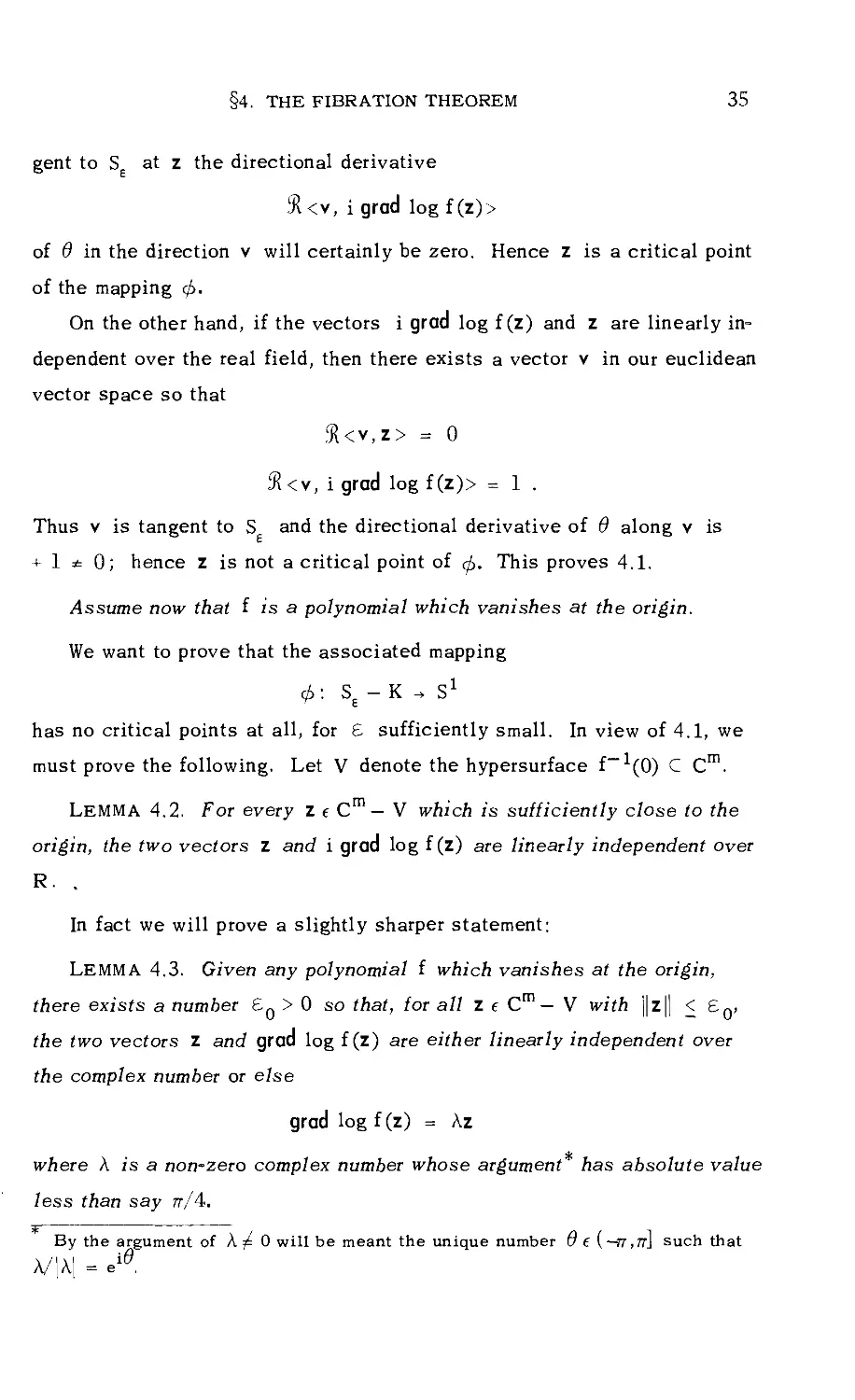
(in other words if this vector is normal to Sa) then for every vector v tan-

§4. THE FIBRATION THEOREM 35
gent to Sa at z the directional derivative
,<v, i grad log f(z)>
of 0 in the direction v will certainly be zero. Hence z is a critical point
of the mapping qS.
On the other hand, if the vectors i grad log f(z) and z are linearly ino
dependent over the real field, then there exists a vector v in our euclidean
vector space so that
<v,z> = 0
<v, i grad log f(z)> : 1 .
Thus v is tangent to Se and the directional derivative of 0 along v is
* 1 , O; hence z is not a critical point of q. This proves 4.1.
Assume now that f is a polynomial which vanishes at the origin.
We want to prove that the associated mapping
: S-K- S 1
has no critical points at all, for  sufficiently small. In view of 4.1, we
must prove the following. Let V denote the hypersurface f-l(0) C C m.
LEMMA 4.2. For every z e C m- V which is sufficiently close to the
origin, the two vectors z and i grad log f(z) are linearly independent over
R.
In fact we will prove a slightly sharper statement:
LEMMA 4.3. Given any polynomial f which vanishes at the origin,
there exists a number 0 > 0 so that, for all z e C m- V with ilzll _ 0'
the two vectors z and grad log f(z) are either linearly independent over
the complex number or else
grad log f(z) = kz
where k is a non-zero complex number whose argument* has absolute value
less than say /4.
By the argument of h  0 will be meant the unique number   (-,z] such that

36 SINGULAR POINTS OF COMPLEX HYPERSURFACES
In other words  lies in the open quadrant of the complex plane which
is centered about the positive real axis. It follows that
(;0 > O;
so that h cannot be pure imaginary. Hence Lemma 4.2 will follow from
4.3.
The proof of 4.3 will depend on the curve selection lemma of §3 and
on the following.
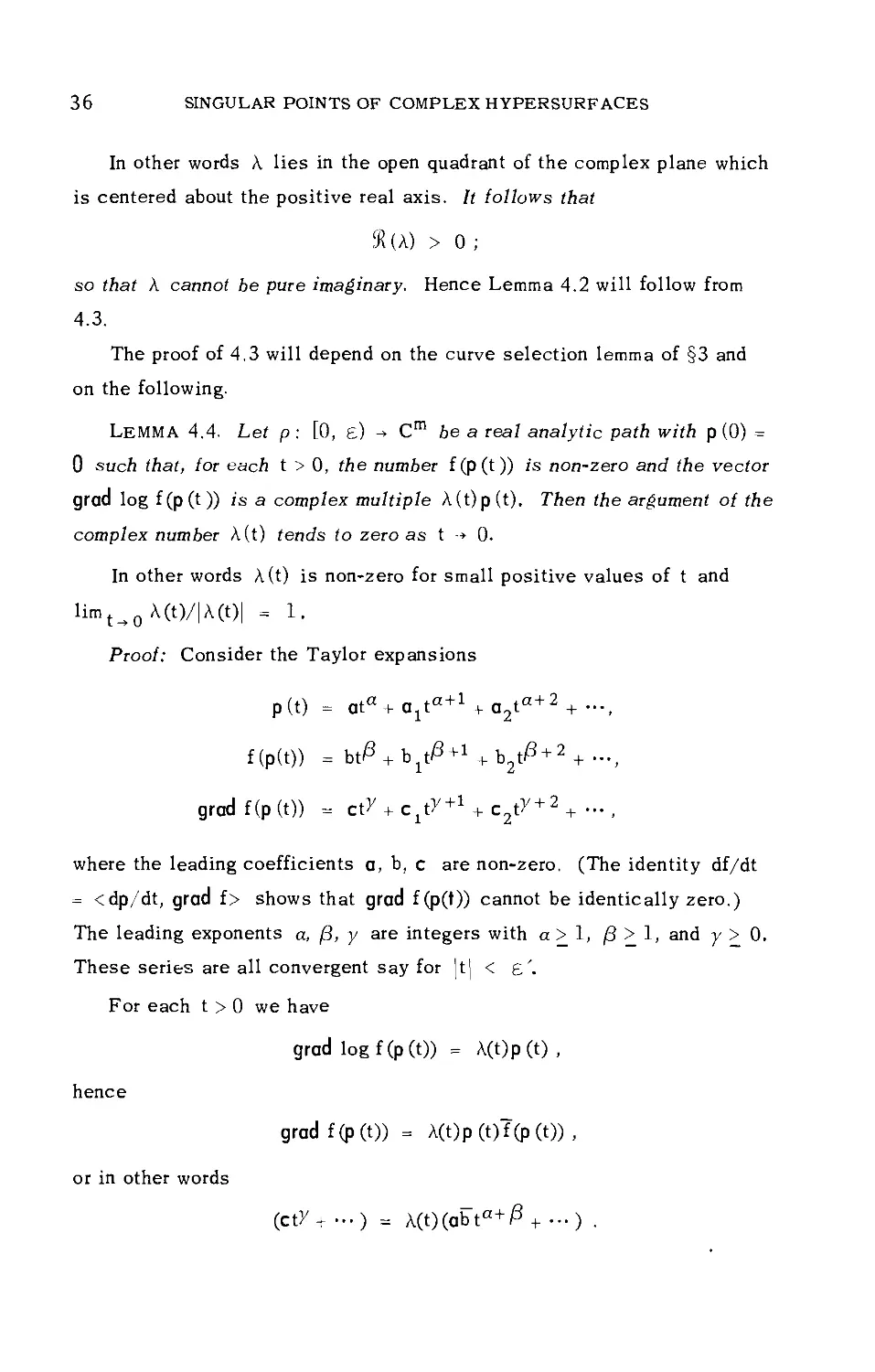
LEMMA 4.4. Let p : [0, E) -, C m be a real analytic path with p (0) =
0 such that, lot each t > O, the number f (,p (t)) is non-zero and the vector
grad log f (p (t)) is a complex multiple h (t)p (t). Then the argument ol the
complex number h(t) tends to zero as t -+ O.
In other words h(t) is non-zero for small positive values of t and
limt_,o £(t)/[£(t)[ = 1.
Proof: Consider the Taylor expansions
p(t) = at a+ alta+l+ a2ta+2 + "",
f(p(t)) = bt 3 + blt/3+l + b2t/3+2 + .-.,
grad f(p (t)) = ctY + clty+l + c2ty+2 + ...,
where the leading coefficients a, b, ¢ are non-zero. (The identity dr/dr
= <alp/dr, grad f> shows that grad f(p(t)) cannot be identically zero.)
The leading exponents a, /3, y are integers with a >_ 1, /3 >_ 1, and y >_ 0.
These series are all convergent say for
For each t > 0 we have
grad log f (p (t)) = h(t)p (t),
hence
or in other words
grad f(p (t)) = ,(t)p (t)-(p (t)),
(ctY + ...) = ?v(t)(a-ta+/3 + -..) .

§4. THE FIBRATION THEOREM 37
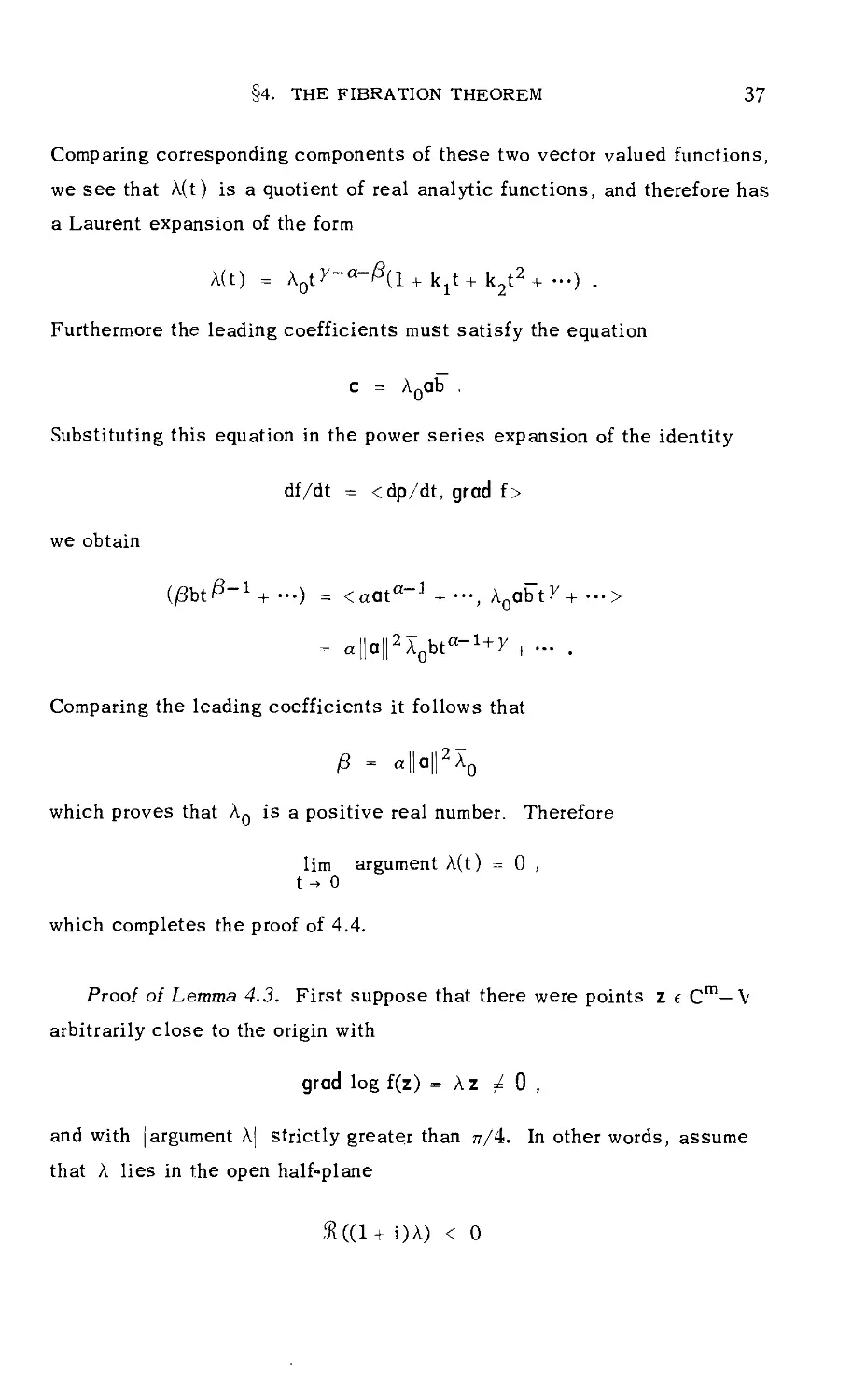
Comparing corresponding components of these two vector valued functions,
we see that )(t) is a quotient of real analytic functions, and therefore has
a Laurent expansion of the form
h(t) = )otY-a-/(] + klt + k2t2 + ...) .
Furthermore the leading coefficients must satisfy the equation
c  hoa.
Substituting this equation in the power series expansion of the identity
df/dt = <dp/dt, grad f>
we obtain
(/bt/-I + ...) = <eat a- + ..., 0ab-tY + ...>
- allall2X0bta-i+y + .-..
Comparing the leading coefficients it follows that
which proves that k 0 is a positive real number. Therefore
lim argument k(t) = 0 ,
t-0
which completes the proof of 4.4.
Proof of Lemma 4.3. First suppose that there were points z e C m-'v
arbitrarily close to the origin with
grad log f(z)= h z  O,
and with j argument k I strictly greater than zz/4. In other words, assume
that h lies in the open half-plane
((1 + i)h) < 0

38 SINGULAR POINTS OF COMPLEX HYPERSURFACES
or the open half-plane
((1-i)h) < 0.
We want to express these conditions by polynomial equalities and inequali-
ties, so as to apply the curve selection lemma of §3.
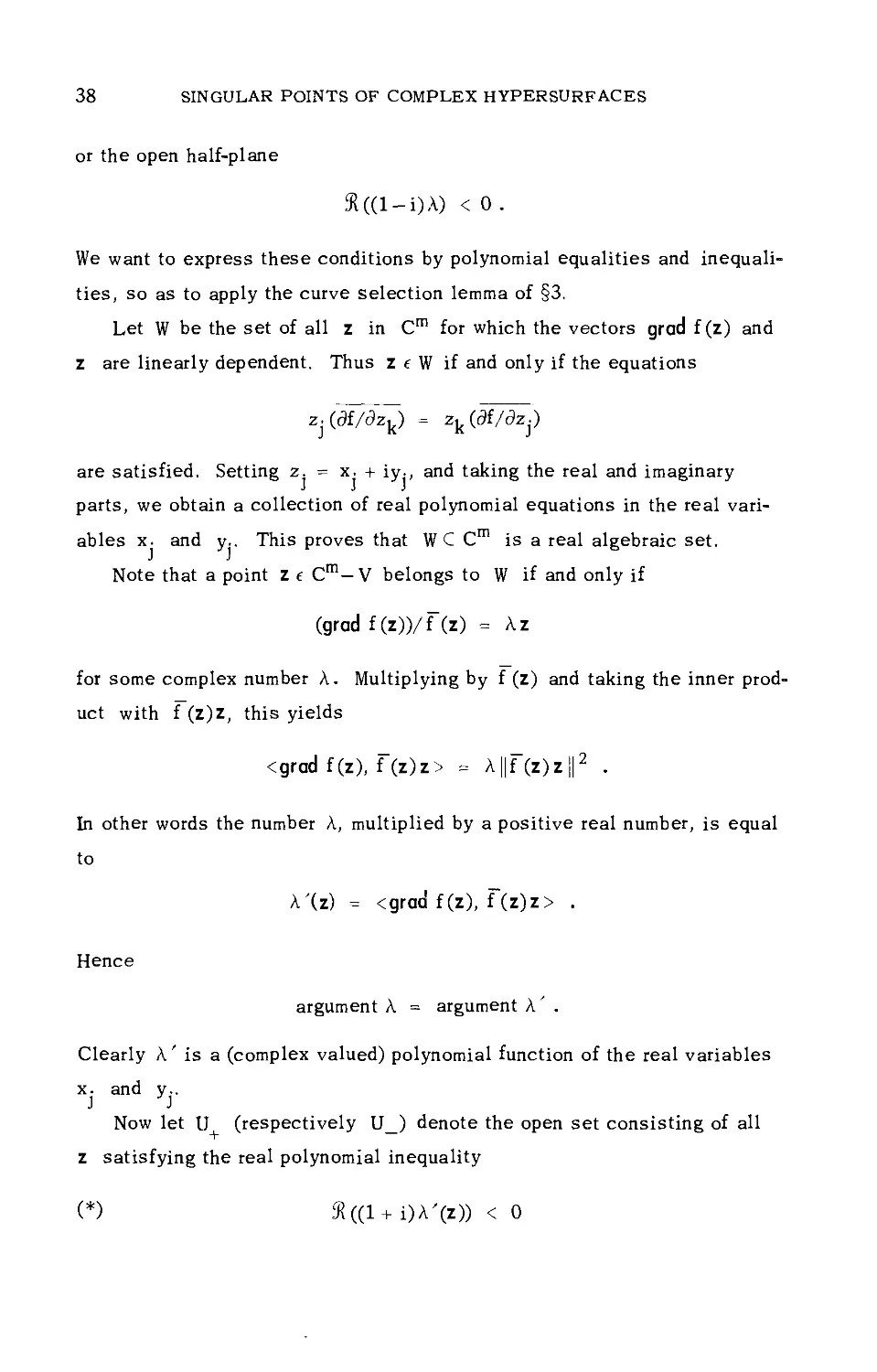
Let W be the set of all z in C m for which the vectors grad f(z) and
z are linearly dependent. Thus z e W if and only if the equations
zj (Of/Ozk) = z k (0f/0zj)
are satisfied. Setting zj  xj + iyj, and taking the real and imaginary
parts, we obtain a collection of real polynomial equations in the real vari-
• and yj. This proves that W C C m is a real algebraic set.
ables xj
Note that apoint ze C m-V belongs to W if and only if
(grad f (z))/(z) - Xz
for some complex number h. Multiplying by (z) and taking the inner prod-
uct with (z)z, this yields
<grad f(z), (z)z> - hll-(z)z112
In other words the number h, multiplied by a positive real number, is equal
to
Hence
h'(z) = <grad f(z), '(z)z> .
argument h = argument h" .
Clearly " is a (complex valued) polynomial function of the real variables
xj and yj.
Now let U+ (respectively U_) denote the open set consisting of all
z satisfying the real polynomial inequality
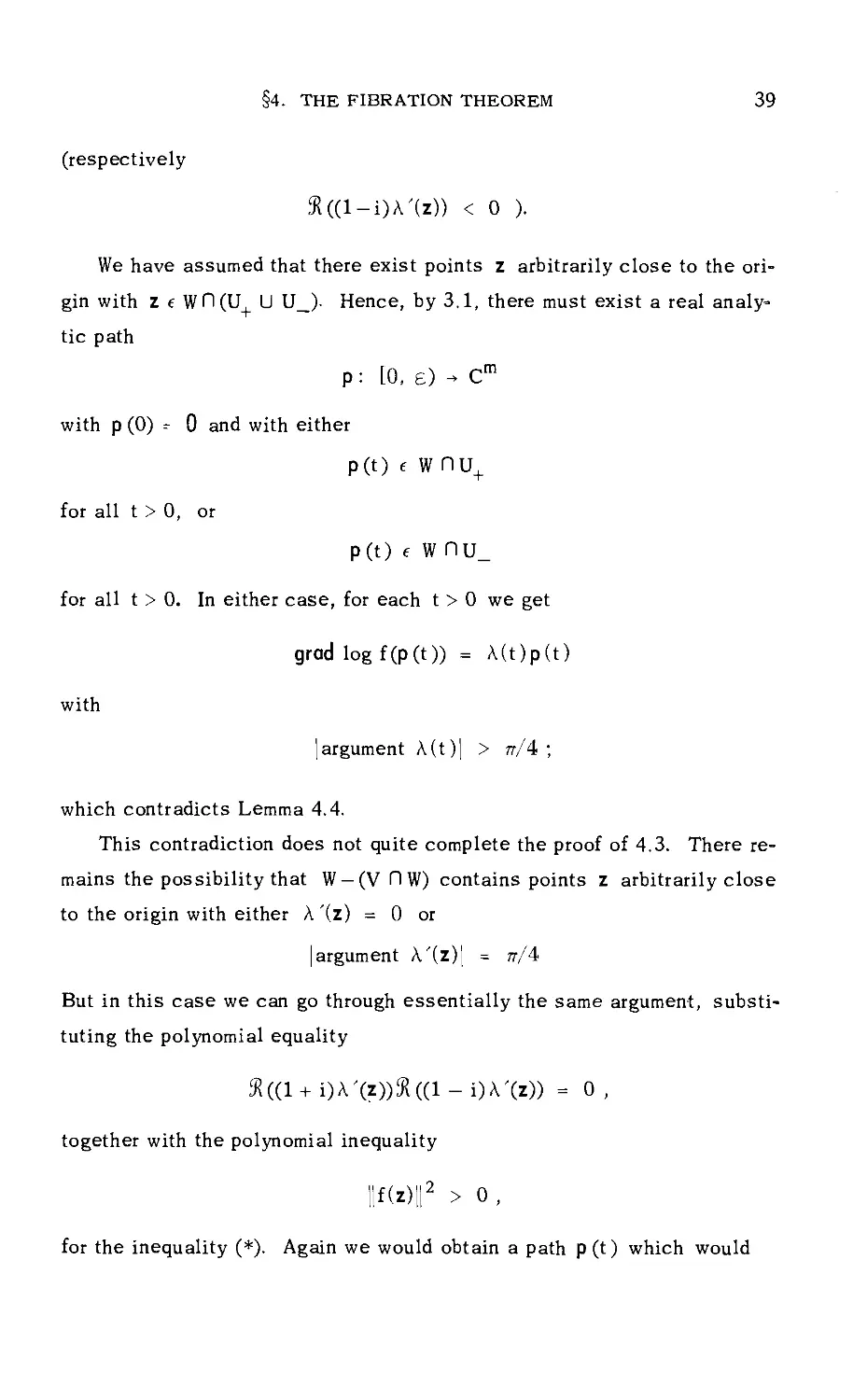
(*) ((1 + i)h'(z)) < 0

§4. THE FIBRATION THEOREM 39
(respectively
((1-i)k'(l)) < 0 ).
We have assumed that there exist points z arbitrarily close to the ori-
gin with z ¢ Wf (U+ U U_). Hence, by 3.1, there must exist a real analyo
tic path
p: [0, a) -* C m
with p(O) : 0 and with either
p(t) e W nU+
for all t > O, or
p(t) e W VU_
for all t> 0. In either case, for each t>0 we get
9tad logf(p(t)) = £(t)p(t)
with
l argument k(t)l > /4 ;
which contradicts Lemma 4.4.
This contradiction does not quite complete the proof of 4.3. There re-
mains the possibility that W- (V n W) contains points z arbitrarily close
to the origin with either h'(z) = 0 or
[argument A'(Z) I = n/4
But in this case we can go through essentially the same argumen.t, substi-
tuting the polynomial equality
((1 + i)k'(Z))((1 - i)k'(z)) = 0 ,
together with the polynomial inequality
IIt(z)ll 2 > o,
for the inequality (*). Again we would obtain a path p (t) which would

40 SINGULAR POINTS OF COMPLEX HYPERSURFACES
contradict Lemma 4.4. This contradiction completes the proof of Lemmas
4.3 and 4.2.
Now, combining 4.1 and 4.2 we have proved:
COROLLARY 4.5. [[  <_ 0 then the map
q: SE--K- S 1
has no critical points at all.
It follows that, for each e i0 e S 1, the inverse image
F 0 = q-l(ei0) C S-K
is a smooth (2m-2)-dimensional manifold.
In order to prove that q is actually the projection map of a locally
trivial fibration we will need to make sharper use of 4.3 in order to care°
fully control the behavior of q(z) as z tends to the set K where q is
not defined.
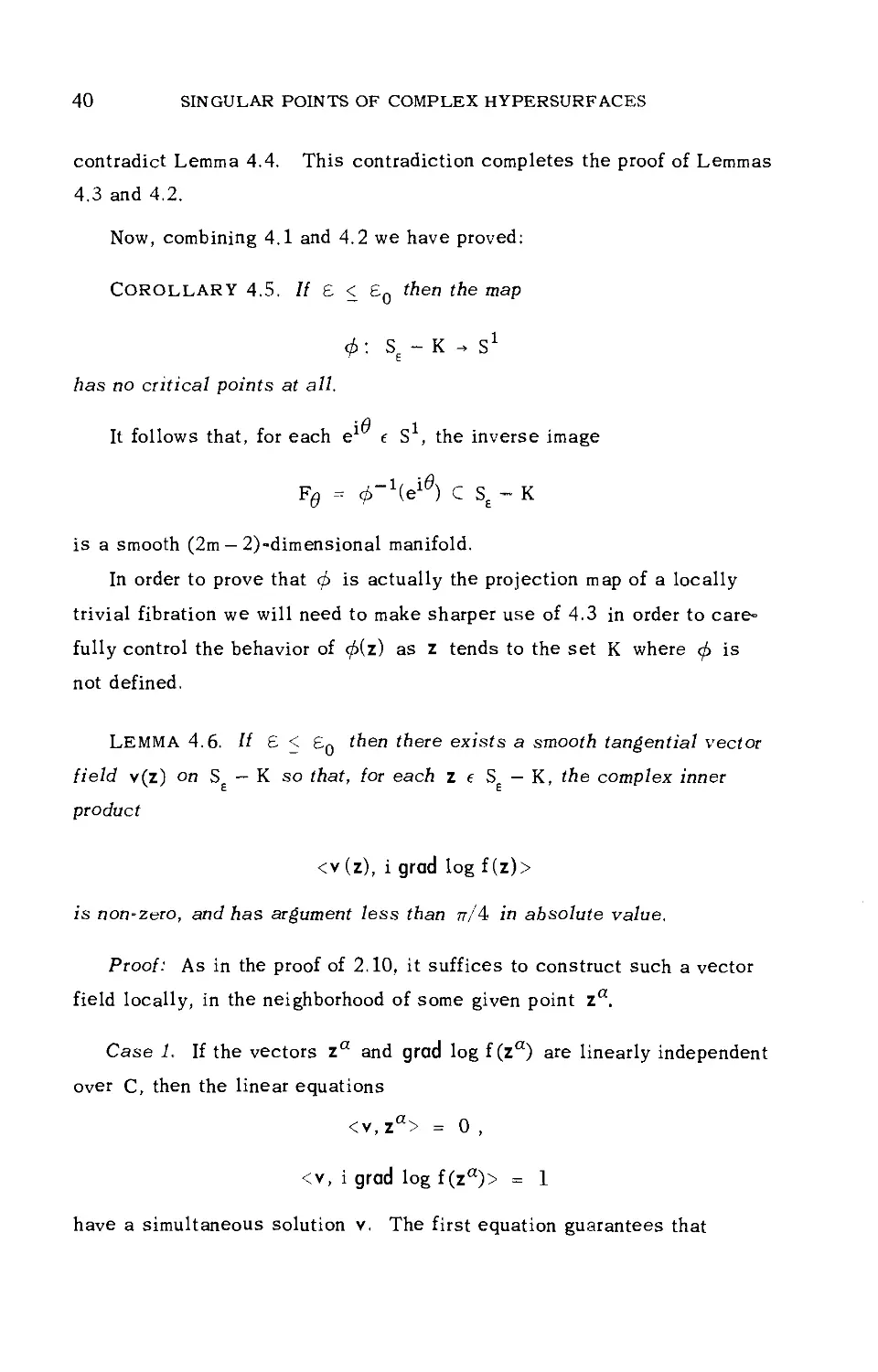
LEMMA 4.6.
field v(z) on S
product
then there exists a smooth tangential vector
- K so that, for each z e S -K, the complex inner
<v(z), i grad log f(z)>
is nomzero, and has argument less than /4 in absolute value.
Proof: As in the proof of 2.10, it suffices to construct such a vector
field locally, in the neighborhood of some given point z a.
Case i. If the vectors z a and grad log f(z a) are linearly independent
over C, then the linear equations
<v, za> = 0 ,
<v, i grad log f(za)> = ]
have a simultaneous solution v. The first equation guarantees that

§4, THE FIBRATION THEOREM
<v, za> = 0, so that v is tangent to S e at z a.
Case 2. If grad log f (z a) is equal to a multiple h z a, then set v =
iz a. Clearly
41
<iz a, za> - 0 ;
and by 4.3 the number
<iz a, i grad log f(za)> = Xllzall 2
has argument less than r/4 in absolute value.
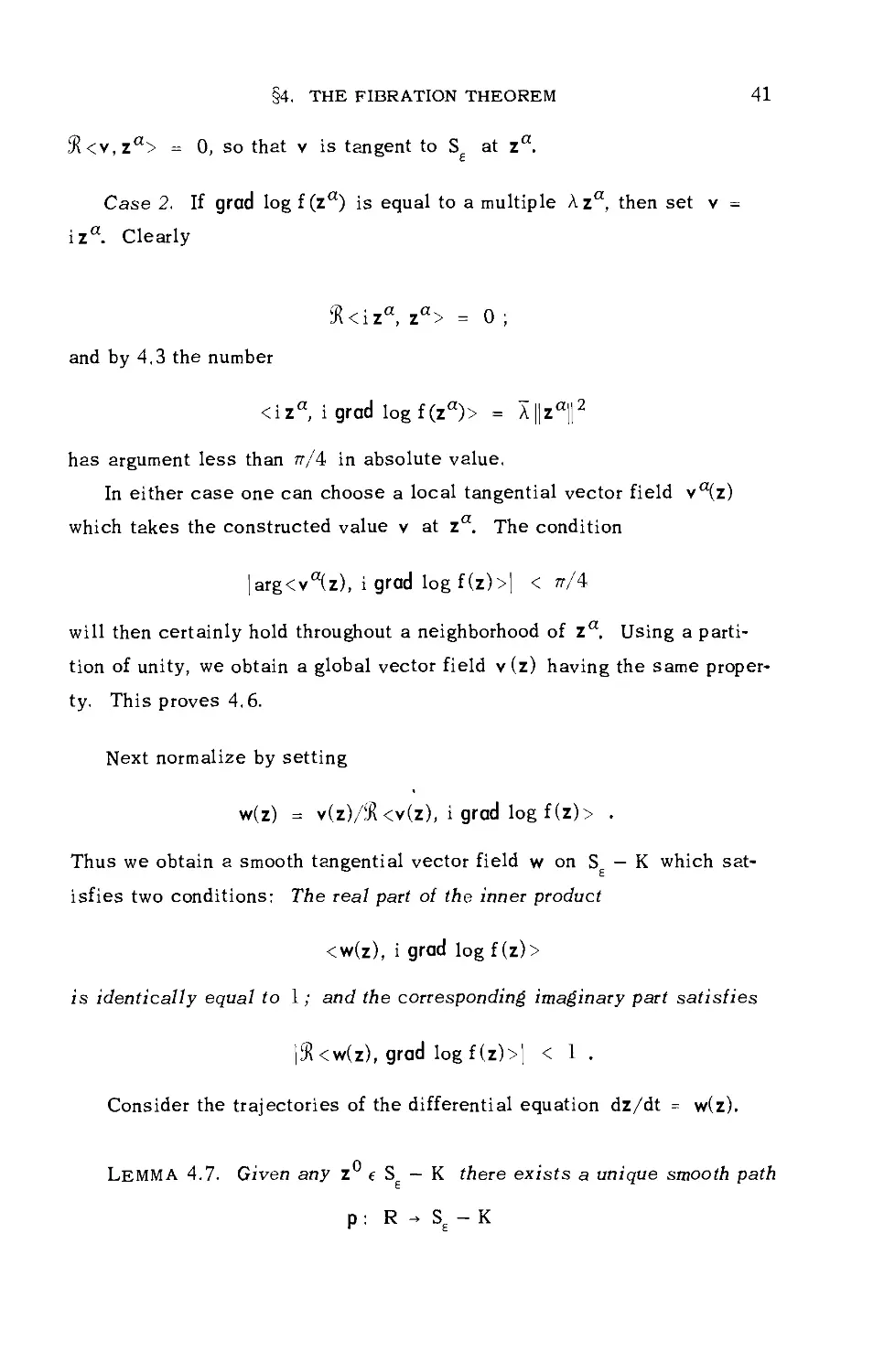
In either case one can choose a local tangential vector field va(z)
which takes the constructed value v at z a, The condition
larg<va(z), i grad log f(z)> 1 < rr/4
will then certainly hold throughout a neighborhood of z a. Using a parti-
tion of unity, we obtain a global vector field v (z) having the same proper-
ty. This proves 4.6.
Next normalize by setting
w(z) = v(z)/<v(z), i grad log f(z)>
Thus we obtain a smooth tangential vector field w on S E - K which sat-
isfies two conditions: The real part of the inner product
<W(Z), i grad log f(z)>
is identically equal to 1 ; and the corresponding imaginary part satisfies
I<w(z), grad logf(z)>l < 1 .
Consider the trajectories of the differential equation dz/dt = w(z).
LEMMA 41.7. Given any z °  S - K there exists a unique smooth path
p: R - S-K

42 SINGULAR POINTS OF COMPLEX HYPERSURFACES
which satis[ies the di[[erentiaI equation
dp/dt = w(p(t))
with initial condition p(0) = z °.
Proo[: Certainly such a solution z = p(t) exists locally, and can be
extended over some maximal open interval of real numbers. The only prob
lem, which arises since S E - K is nonocompact, is to insure that p(t) can°
not tend towards K as t tends toward some finite limit t o . (Compare the
proof of 2.10.) That is we must guarantee that f (p (t)) cannot tend to zero,
or
' log, f (p (t)) .- oo ,
as t - t o . But the derivative
d logf/dt = <dp/dt, grod logf>
= <w(p(t)), grad log f>
has absolute value less than 1. Hence If(p(t))l is bounded away from
zero as t tends to any finite limit. This proves 4.7.
Setting 5(z) = e i0(z), as in the proof of 4.1, note that
d0(p(t))/dt = <dp/dt, i grad log f>
is identically equal to 1. Hence
0(p(t)) = t + constant .
In other words the path p (t) projects under q to a path which winds
around the unit circle in the positive direction with unit velocity.
Clearly the point p (t) is a smooth function both of t and of the initial
value
z°= p(O) .

§4. THE FIBRATION THEOREM 43
Let us express this dependence by setting
p(t) = h t(z °) .
Then each h t is a diffeomorphism mapping S a -
each fiber F 0 = qs-l(e i0) onto the fiber F+ t.
in proving the Fibration Theorem:
K to itself, and mapping
We now have no difficulty
THEOREM 4.8. For   E 0 the space Sa - K is a smooth fiber
bundle over S 1, with projection mapping (z) =
Proof. Given e i0  S 1 let U be a small neighborhood of e i0. Then
the correspondence
(e i(t+0), z) ,-. ht(z) ,
for !t I < constant, and z e F 0, maps the product U × F 0 diffeomorphicl-
ly onto 5-1(U). This proves 4.8.

§5. THE TOPOLOGY OF THE FIBER AND OF K
We continue to study the locally trivial fibration
95: S-K , S 1
associated with a complex polynomial f(z 1 .... , z m) which vanishes at
the origim Setting m = n  1 > 1 it follows from §4 that each fiber
F 0 := qS- 1(oi0)
is a smooth m;anifold of (real) dimension 2n. This section will apply
Morse theory to study the topology of F 0 and of K. The two principal
results will be:
THEOREM 5.1. Each fiber F 0 is parallelizable, and has the homo°
topy type of a finite CW complex of dimension n.
THEOREM 5.2. The ,space K : V f3,, S is (n- 2)oconnected..
Thus for n  2 the space K is connected, and for n  3 it is simply
connected. (For n 1 a similar argument shows only that K is non
vacuous.)
The section concludes with an alternative description of the fibers:
Each F 0 is diffeomorphic to an open subset of a non-singular complex
hypersurface, consistin of all z with []zl,] < 2 and /(z) = constant.
The proof of 5.1 will depend on a study of the Morse theory associated
with the smooth realvalued function [fl on F 0. The proof of 5.2 will de
pend on a parallel study of the smooth function If i on the entire total
45

46 SINGULAR POINTS OF COMPLEX HYPERSURFACES
space S t - K. In each case we will show that the Morse index* of If/ at
any critical point is > n.
As a first step it is recessary to identify the critical points. It will
be convenient to work rather with the smooth functions a0: F 0 -, R and
a: S -K - R, defined by
aO(z)  a(z) -- lo if(z)[
Clearly the critical points of a are the same as those of ifl on S e- K,
and similarly the critical points of a 0 are the same as those of /fl reo
stricted to F 0 .
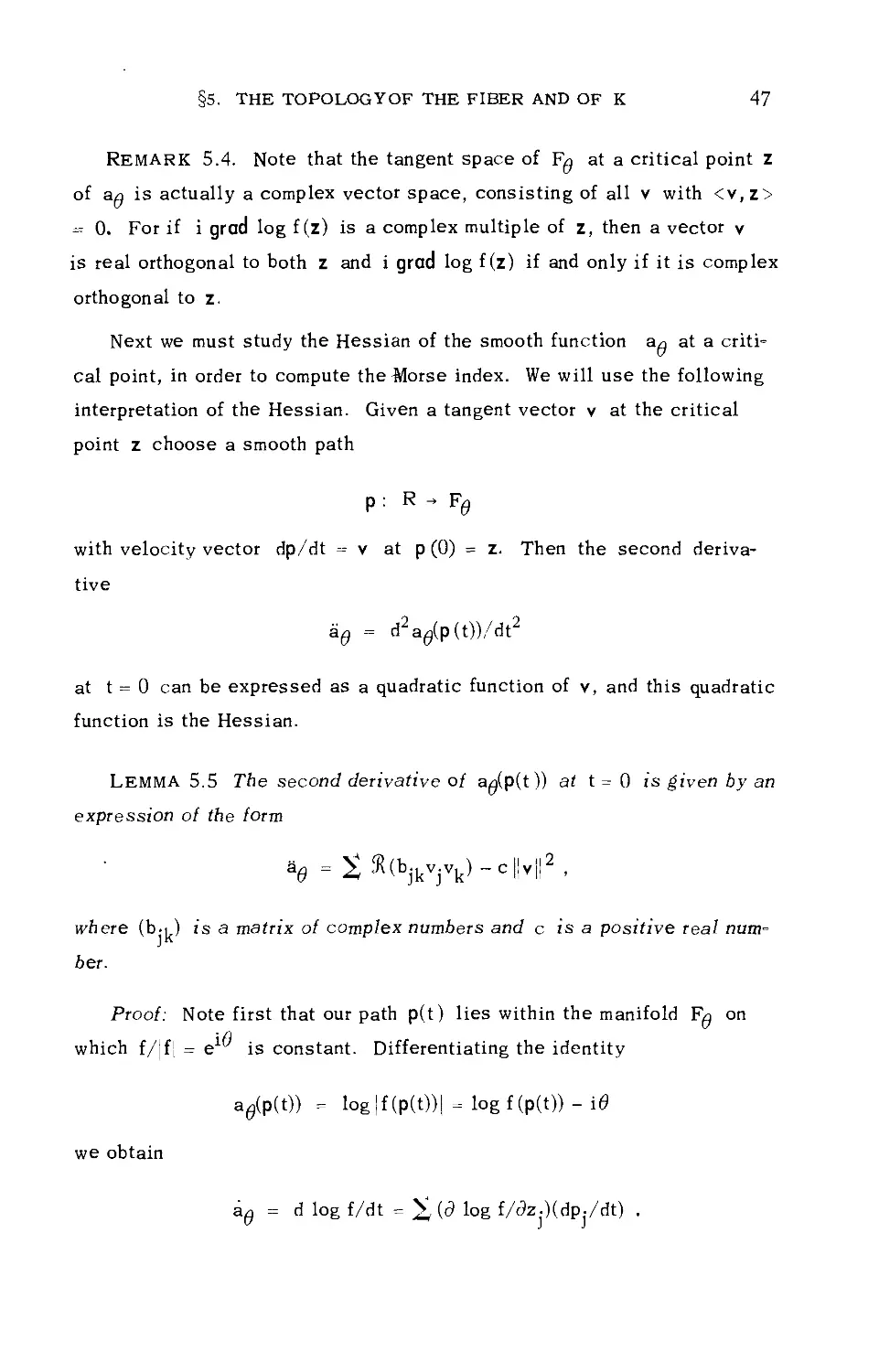
LEMMA 5.3. The critical points o[ the smooth realovaiued [unction
a0(z) = log!f(z) i on F 0 are those points z e F 0 [or which the vector
grad log f (Z) is a complex multiple o[ z,
Proof: Proceeding as in the proof of 4.1 note that the directional de
rivative of the function
lolf(z)'   , lo
in any direction v is equal to the real inner product
<v, grad lo f(z)> .
Thus z will be a critical point of this function, restricted to FO, if and
only if the vector grad log f(z) is normal to F 0 at z. (Here "normal"
means "orthogonal to all tangent vectors," using the real inner product.)
BuL comparing the proof of 4.1, we see that the space of normal vec
tors to the submanifold F0 C C m, of real codimension 2, is spanned by
the two independent vectors z and i grad log f(z). Thus z is a critical
point of a 0 if and only if there is a real linear relation between the veco
tots grad log f(z), z and i grad log f(z). Clearly this proves 5.3.
See for example MILNOR, Morse Theory, §2.

§5. THE TOPOLOGYOF THE FIBER AND OF K 47
REMARK 5.4. Note that the tangent space of F 0 at a critical point z
of a 0 is actually a complex vector space, consisting of all v with <v, z>
=: 0. For if i 9tad log f(Z) is a complex multiple of z, then a vector v
is real orthogonal to both z and i grad log f(z) if and only if it is complex
orthogonal to z.
Next we must study the Hessian of the smooth function a 0 at a critio
cal point, in order to compute the-Morse index. We will use the following
interpretation of the Hessian. Given a tangent vector v at the critical
point z choose a smooth path
with velocity vector
tive
dp/dt = v at p (0) = z. Then the second deriva-
fi0 = d2aO(p (t))/dt2
at t = 0 can be expressed as a quadratic function of v, and this quadratic
function is the Hessian.
LEMMA 5.5 The second derivative of a0(P(t)) at t = 0 is given by an
expression of the form
0 :  (bjkVjVk) - c Ilvll ,
where (bjk) is a matrix o[ complex numbers and c is a positive real hum:
bey.
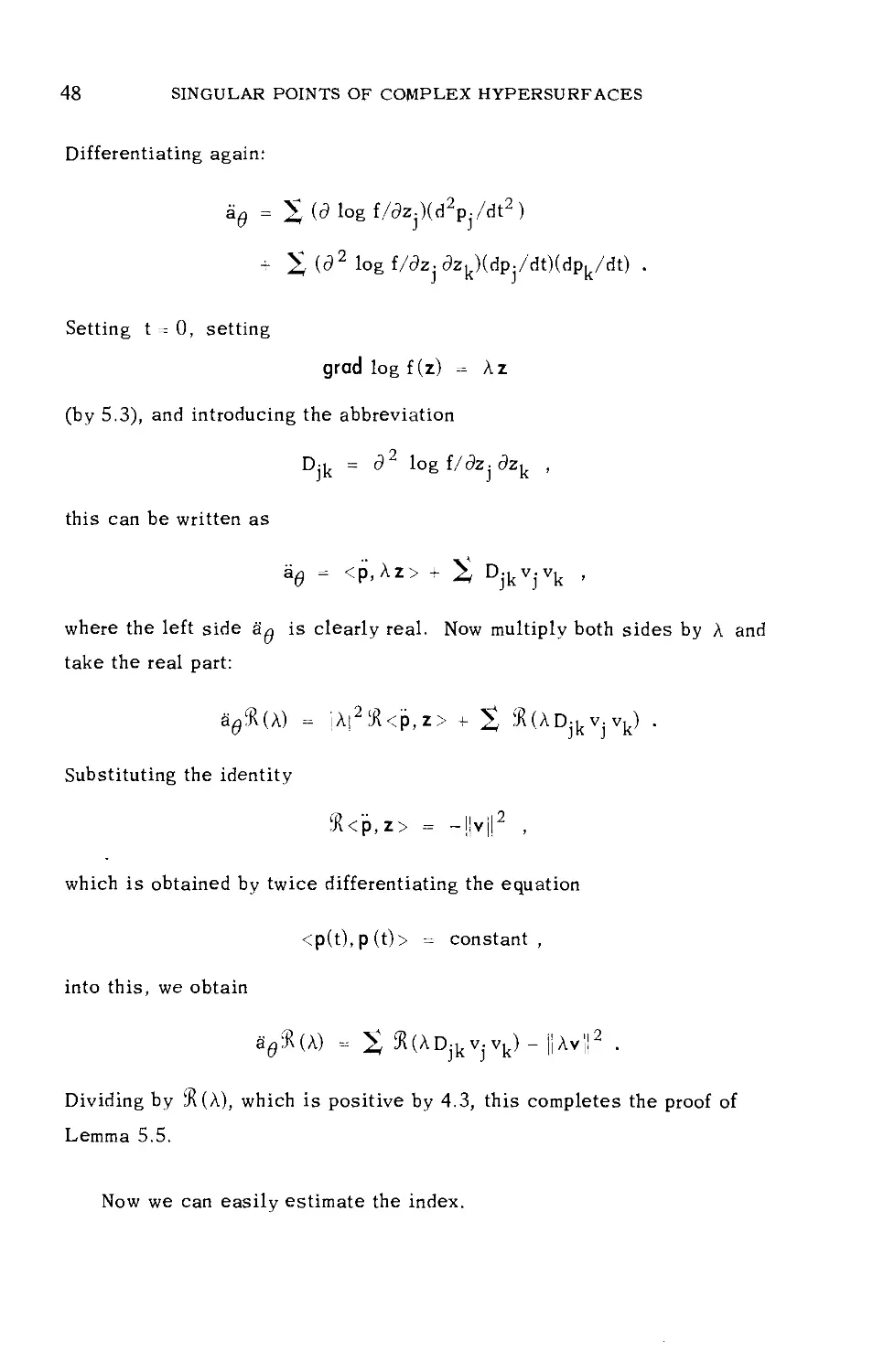
Proof: Note first that our path p(t) lies within the manifold F 0 on
which f/[fl = e i0 is constant. Differentiating the identity
a0(P(t))  loglf(p(t)) I = log f(p(t)) - i0
we obtain
log f/dt = N (0 log f/0zj)(dpj/dt) .

48 SINGULAR POINTS OF COMPLEX HYPERSURFACES
Differentiating again:
S 0 = .. (0 log f/Ozj)(d2pj/dt 2 )
+  (2 log f/0zj 0Zk)(dpj/dt)(dPk/dt) .
Setting t = 0, setting
grad log f(z) = hz
(by 5.3), and introducing the abbreviation
Dj k = 2 logf/OzjOz k
this can be written as
0 : <h'Az> + X DjkVjVk ,
where the left side 0 is clearly real. Now multiply both sides by h and
take the real part:
O(h) = iht2<,:'> + . (hDjkVjV k) .
Substituting the identity
: ,
which is obtained by twice differentiating the equation
<p(t),p(t)> = constant ,
into this, we obtain
O(h) =  (hDjkVjV k) -l]l 2
Dividing by (h), which is positive by 4.3, this completes the proof of
Lemma 5.5.
Now we can easily estimate the index.

§5. THE TOPOLOGY OF THE FIBER AND OF K 49
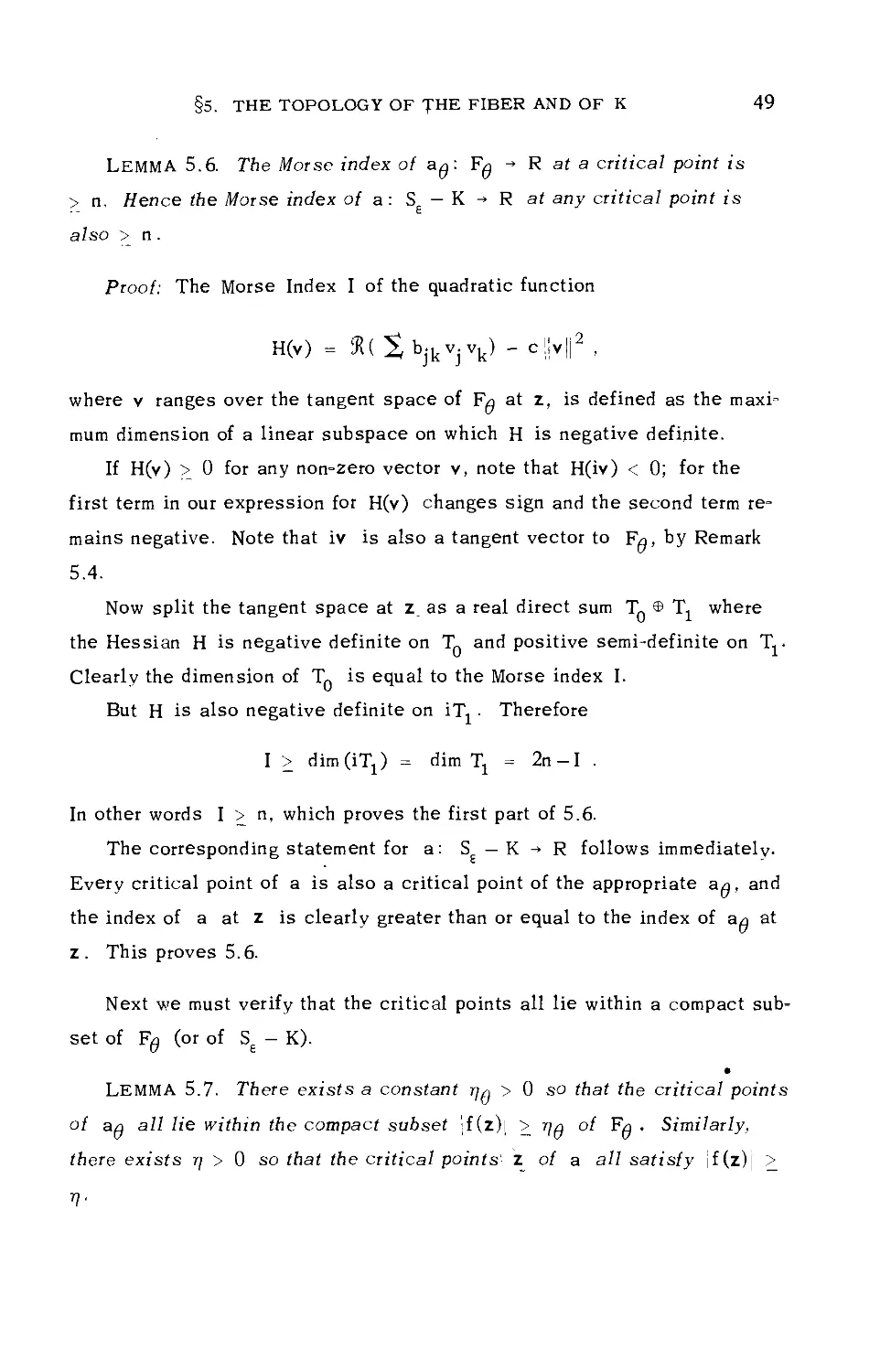
LEMMA 5.6. The Morse index of a0: F 0 - R at a critical point is
.> n. Hence the Morse index of a: S - K - R at any critical point is
also > n.
Proof: The Morse Index I of the quadratic function
H(v) : ( bjkVjV k) - clivl[ 2 ,
where v ranges over the tangent space of F 0 at ,, is defined as the maxi
mum dimension of a linear subspace on which H is negative definite.
If H(v) > 0 for any nonozero vector v, note that H(iv) ( 0; for the
first term in our expression for H(v) changes sign and the second term re
mains negative. Note that iv is also a tangent vector to F0, by Remark
5.4.
Now split the tangent space at z_ as a real direct sum T o  T 1 where
the Hessian H is negative definite on T o and positive semidefinite on T 1.
Clearly the dimension of T o is equal to the Morse index I.
But H is also negative definite on iT 1. Therefore
I  dim(iT1) = dim T 1 = 2n-I .
In other words I > n, which proves the first part of 5.6.
The corresponding statement for a: S - K - R follows immediately.
Every critical point of a is also a critical point of the appropriate ao, and
the index of a at ' is clearly greater than or equal to the index of ao at
,. This proves 5.6.
Next we must verify that the critical points all lie within a compact sub
set of F 0 (or of S-K).
LEMMA 5.7. There exists a constant lO > 0 so that the critical*points
of a 0 all lie within the compact subset if(z)! .> /0 of F 0 . Similarly,
there exists 7 > 0 so that the critical points. Z of a all satisfy if(z) i >_

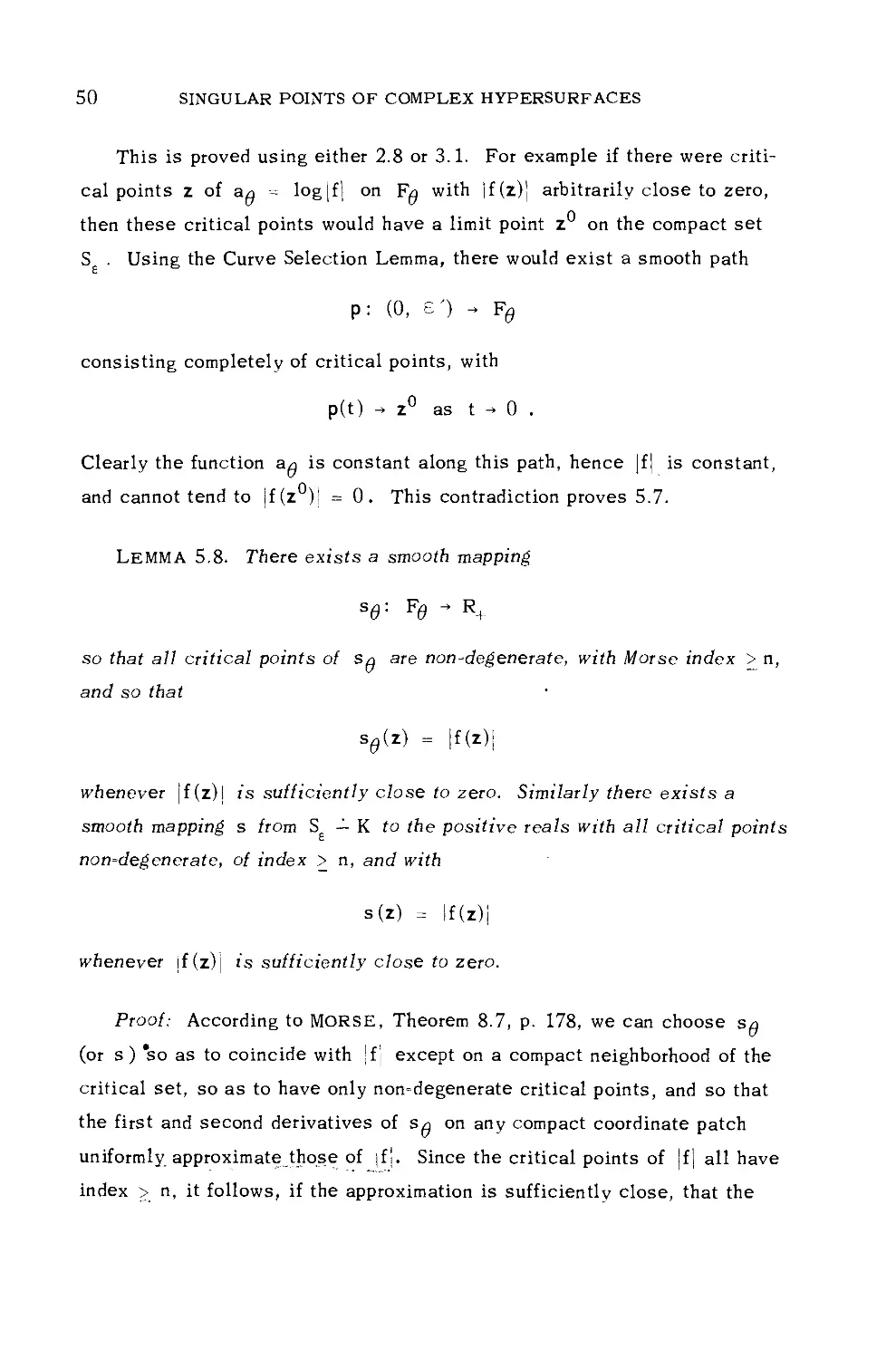
50 SINGULAR POINTS OF COMPLEX HYPERSURFACES
This is proved using either 2.8 or 3.1. For example if there were criti
cal points z of a 0  loglf ! on F 0 with if(z) I arbitrarily close to zero,
then these critical points would have a limit point z ° on the compact set
S t . Using the Curve Selection Lemma, there would exist a smooth path
p: (0, 5') - F 0
consisting completely of critical points, with
p(t) - z ° as t -, 0 .
Clearly the function a 0 is constant along this path, hence [f] is constant,
and cannot tend to If(z°). = 0. This contradiction proves 5.7.
LEMMA 5,8. There exists a smooth mapping
sO: F 0  R+
so that all critical points of s o are nonMegenerate, with Morse index > n,
and so that
s0(z)
whenever [f(z)] is sufficiently close to zero. Similarly there exists a
smooth mapping s from S t " K to the positive reals with all critical points
nonodegenerate, of index > n, and with
s(z) = If(z)]
whenever !f(z)] is sufficiently close to zero.
Proof: According to MORSE, Theorem 8.7, p. 178, we can choose s O
(or s ) "so as to coincide with Ill except on a compact neighborhood of the
critical set, so as to have only nono.degenerate critical points, and so that
the first and second derivatives of s o on any compact coordinate patch
uniformly_ approximat.tbqs .o.f..!.!. Since the critical points of Ifl alI have
index > n, it follows, if the approximation is sufficiently close, that the

§5. THE TOPOLOGY OF THE FIBER AND OF K 51
critical points of s O also have index 7_ n. (See for example MILNOR,
Morse Theory, §22.4.) This completes the proof of 5.8.
Note that the critical points of s O are isolated, and all lie within a
compact set. Hence there are only finitely many critical points.
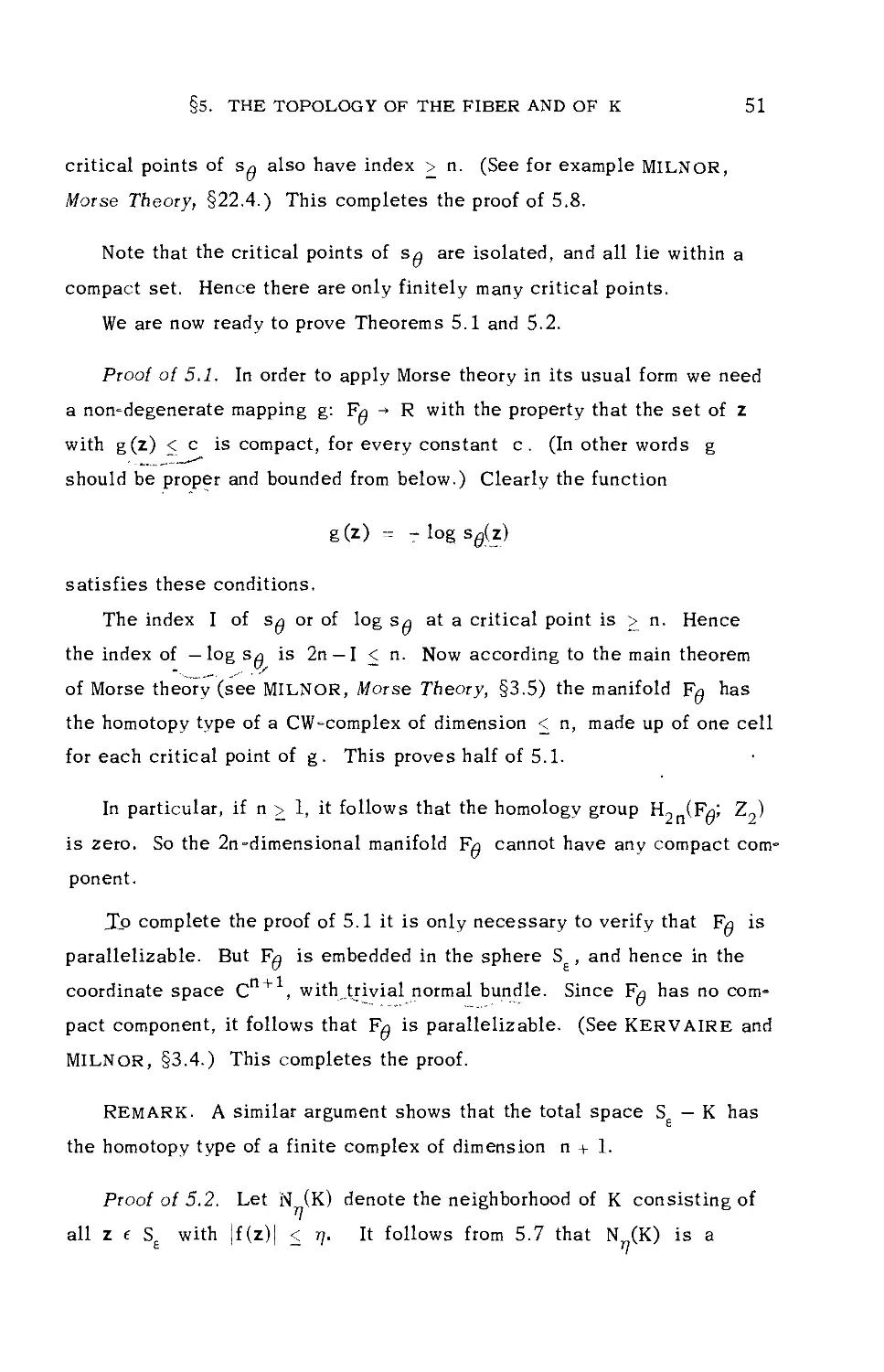
We are now ready to prove Theorems 5.1 and 5.2.
Proof of 5.1. In order to apply Morse theory in its usual form we need
a non-degenerate mapping g: F 0 - R with the property that the set of z
with g(z) < c is compact, for every constant c. (In other words g
should be prompter and bounded from below.) Clearly the function
g (z) = - lo so! )
satisfies these conditions.
The index I of s o or of log s O at a critical point is 7 n. Hence
the index of -log s is 2n-I _< n. Now according to the main theorem
of Morse theory (see MILNOR, Morse Theory, §3.5) the manifold F 0 has
the homotopy type of a CWocomplex of dimension < n, made up of one cell
for each critical point of g. This proves half of 5.1.
In particular, if n  1, it follows that the homology group H2n(F0; Z2)
is zero. So the 2nodimensional manifold F 0 cannot have any compact como
ponent.
379 complete the proof of 5.1 it is only necessary to verify that F 0 is
parallelizable. But F 0 is embedded in the sphere St, and hence in the
coordinate space C n+l with trivial normal bundle. Since F 0 has no com-
pact component, it follows that F 0 is parallelizable. (See KERVAIRE and
MILNOR, §3.4.) This completes the proof.
REMARK. A similar argument shows that the total space S t - K has
the homotopy type of a finite complex of dimension n + 1.
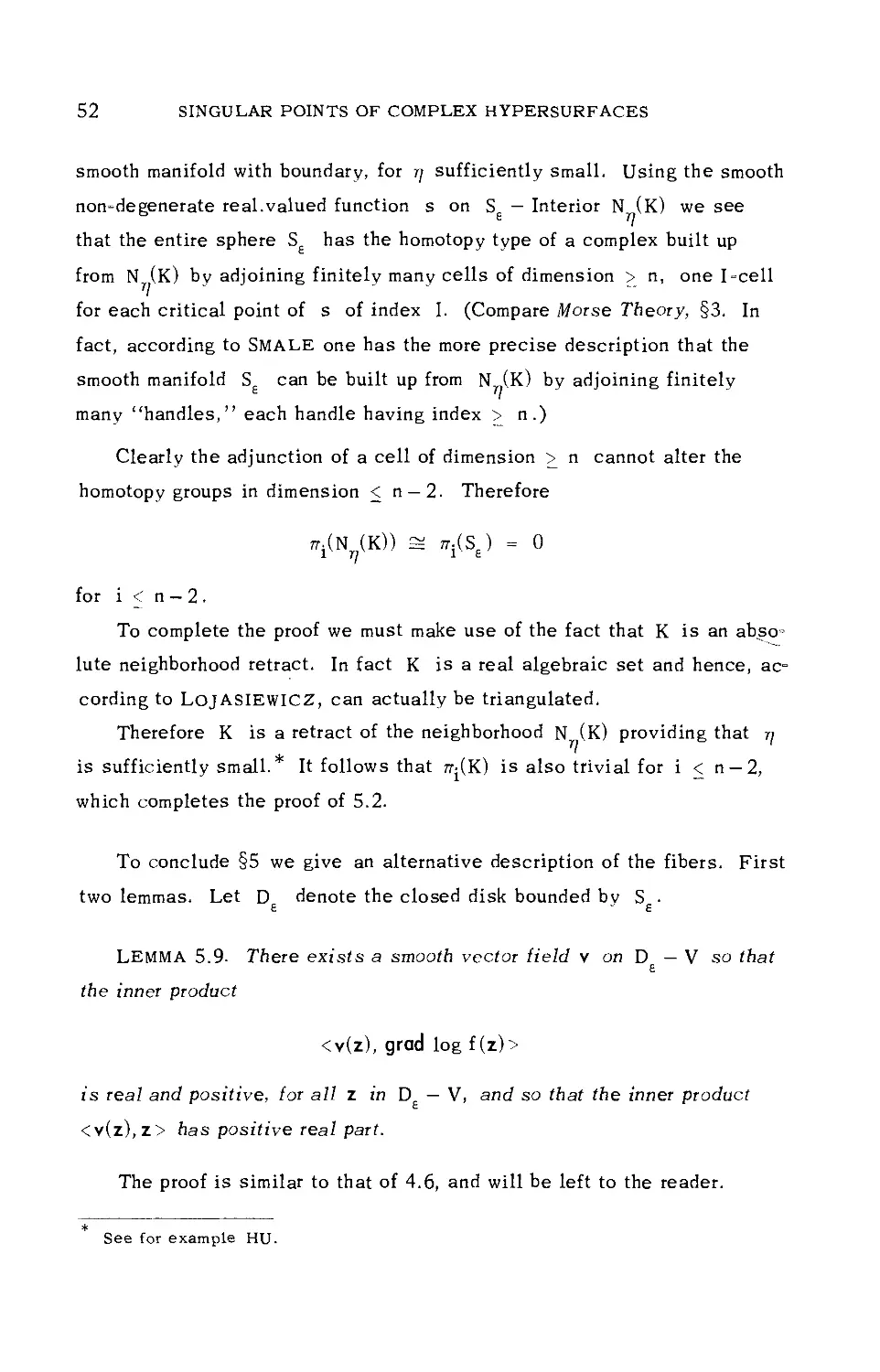
Proof of 5.2. Let N/(K) denote the neighborhood of K consisting of
all z e S t with If(z)I _< 7. It follows from 5.7 that N/(K) is a

52 SINGULAR POINTS OF COMPLEX HYPERSURFACES
smooth manifold with boundary, for r] sufficiently small. Using the smooth
non=degenerate real.valued function s on S e - Interior Nr](K) we see
that the entire sphere S t has the homotopy type of a complex built up
from Nq(K) by adjoining finitely many cells of dimension .> n, one Icell
for each critical point of s of index I. (Compare Morse Tteory, §3. In
fact, according to SMALE one has the more precise description that the
smooth manifold S t can be built up from Nq(K) by adjoining finitely
many "handles," each handle having index > n.)
Clearly the adjunction of a cell of dimension > n cannot alter the
homotopy groups in dimension _< n-2. Therefore
vi(Nr](K))  vi(Se) = 0
for i <n-2.
To complete the proof we must make use of the fact that K is an abso=
lute neighborhood retract. In fact K is a real algebraic set and hence, ac o
cording to LOJASIEWICZ, can actually be triangulated.
Therefore K is a retract of the neighborhood N/(K) providing that
is sufficiently small.* It follows that zri(K) is also trivial for i  n- 2,
which completes the proof of 5.2.
two lemmas. Let
To conclude §5 we give an alternative description of the fibers. First
D denote the closed disk bounded by S •
LEMMA 5.9.
the inner product
There exists a smooth vector field v on D - V so that
<v(z), grad log f(z)>
is real and positive, [or all z in D e - V, and so that the inner product
<v(z), z> has positive real part.
The proof is similar to that of 4.6, and will be left to the reader.
See for example HU.

§5. THE TOPOLOGY OF THE FIBER AND OF K 53
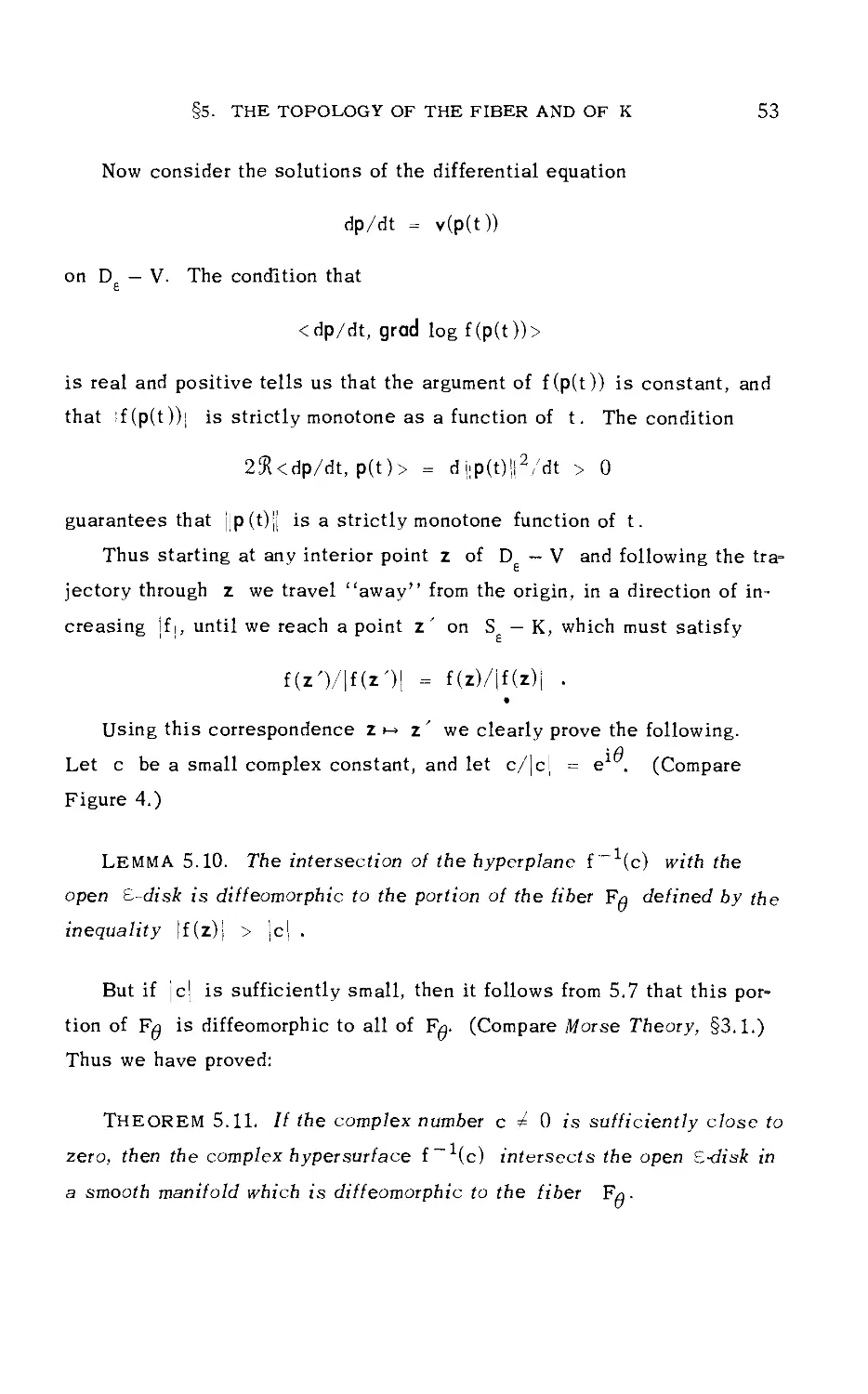
Now consider the solutions of the differential equation
dp/dt = v(p(t))
on D - V. The condition that
<dp/dt, grad log f(p(t))>
is real and positive tells us that the argument of f(p(t)) is constant, and
that :f(p(t)) I is strictly monotone as a function of t. The condition
2<dp/dt, p(t)> = di,,p(t) '2ii/,L"* > 0
guarantees that ilP(t)ii is a strictly monotone function of t.
Thus starting at any interior point z of D - V and following the tra-
jectory through z we travel "away" from the origin, in a direction of in
creasing if until we reach a point z" on S - K, which must satisfy
f(z')/If(z')l : f(z)/if(z)I
Using this correspondence z  z" we clearly prove the following.
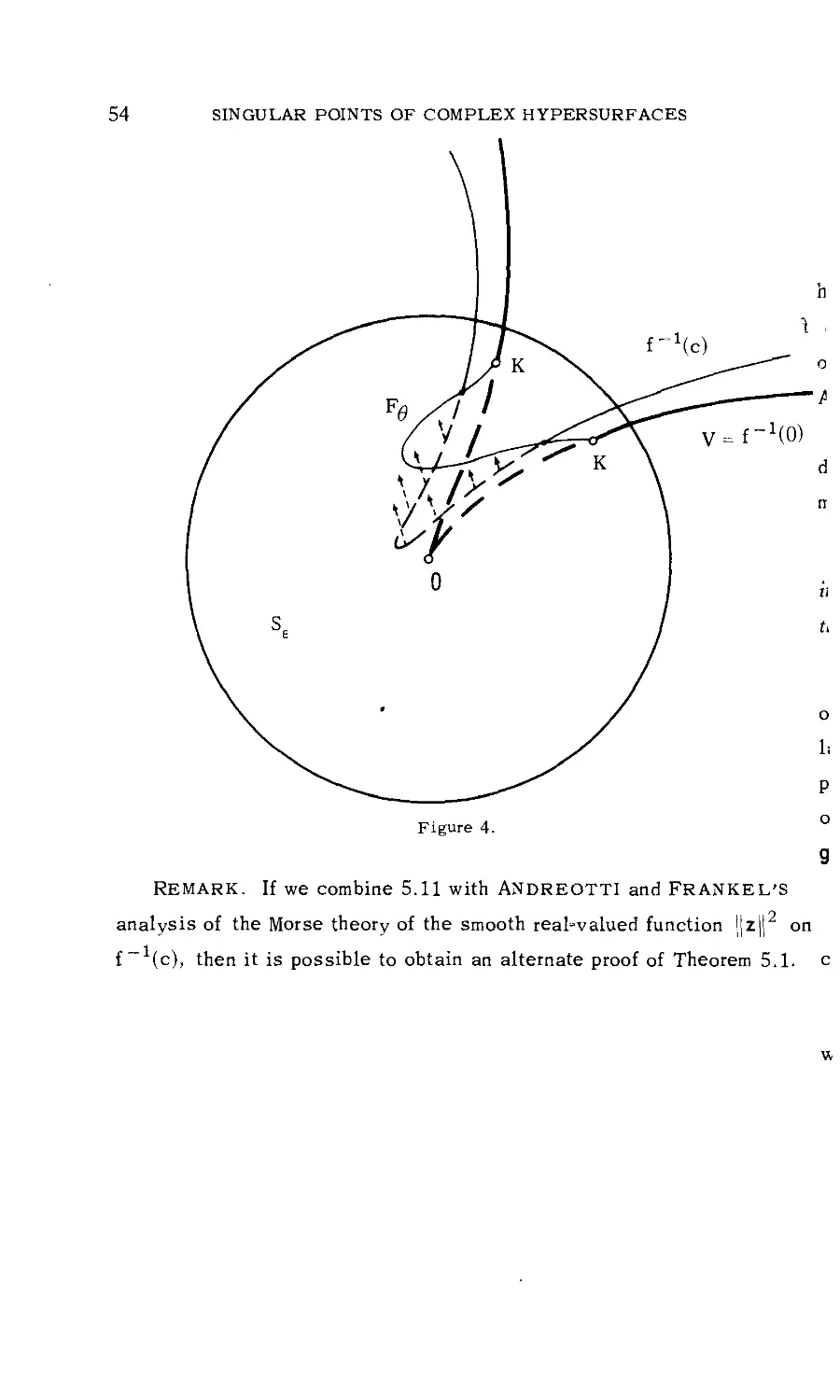
Let c be a small complex constant, and let c/lc ! = e i0. (Compare
Figure 4.)
LEMMA 5.10. The intersection o[ the hyperplane f-l(c) with the
open 5-disk is diffeomorphic to the portion o[ the [iber F 0 de[ined by the
inequality [f(z) I > [c I .
But if icl is sufficiently small, then it follows from 5.7 that this por-
tion of F 0 is diffeomorphic to all of F0. (Compare Morse Theory, §3.1.)
Thus we have proved:
THEOREM 5.11. I[ the complex number c g 0 is sufficiently close to
zero, then the complex hypersur[ace f-l(c) intersects the open a<lisk in
a smooth manifold which is di[[eomorphic to the [iber F O.

54
SINGULAR POINTS OF COMPLEX HYPERSURFACES
f-l(c)
K
v = f-(o)
Figure 4.
REMARK. If we combine 5.11 with ANDREOTTI and FRANKELS
of the Morse theory of the smooth real-valed function I/zl/2
analysis
on
f-l(c), then it is possible to obtain an alternate proof of Theorem 5.1.

§6. THE CASE OF AN ISOLATED CRITICAL POINT
Now make the additional hypothesis that the polynomial f(zl, ..., zn+l)
has no critical points in some neighborhood of the origin, except possibly
 or the origin itself. Thus the origin is either an isolated singular point,
or a nonosingular point, of the hypersurface V = f-l(0). (Compare §2.5.)
-'--Assume also that n > 1.
(0) According to §2.9 the intersection K = V  Se is a smooth (2n- 1) o
dimensional manifold, providing that  is sufficiently small. This state°
ment can be sharpened as follows.
LEMMA 6.1. For  sufficiently small, the closure of each fiber F 0
in S is a smooth 2n °dimensional manifold with boundary, the interior of
this manifold being F 0 and the boundary being precisely K.
Proof: First note that the mapping f l S to C has no critical points
on K, for E sufficiently small. (In other words, the number zero is a reguo
lar value of f[ S.) This can be derived from the proof of 2.9, or can be
proved as follows, using the Curve Selection Lemma. The critical points
of f[S are clearly those points z in S at which the (nonozero) vector
grad f (z) is a complex multiple of z. Given a non-smooth path
p: [0, a')  C n +
consisting exclusively of such points, with
we would have
p(0) = 0 and
<dp/dt, grad f> =
f(p(t)) - 0,
df(p(t))/dt  0
55

56 SINGULAR POINTS OF COMPLEX HYPERSURFACES
hence
2<dp/dt, p(t)> = d/ip(t)i]2/dt - 0
and therefore p(t ) 0, which contradicts the hypothesis.
Now let z 0 be any point of K. Choose (real) local coordinates Ul, ...,
u2n+l for S in aneighborhood U of z 0 so that
f(z) - Ul(Z)+ iu2(z)
Note that a point of U belongs to the fiber F 0 : -1(]) if
for all ze U.
and only if
Ul >0, u 2 = 0.
Hence the closure N 0 intersects U in the set
Ul >_0, u 2 = 0.
Clearly this is a smooth 2ndimensional manifold, with F 0 0 U as interior
and with K N U as boundary.
This discussion for other fibers F 0 is similar. This completes the
proof.
COROLLARY 6.2. The compact maniloldwithoboundary 0 is embed°
ded in S in such a way as to have the same lomotopy type as its compleo
merit S - N O.
For the complement is a locally trivial fiber space over the contractible
manifold S 1- (ei0). Hence Se - 0 has any other fiber FO,, as deforma-
tion retract. But FO, is diffeomorphic to FO, and so has the same homo°
topy type as 1 .
COROLLARY 6.3. The fiber FO has the homology of a point in dimeno
sions less than n.
(Compare FARY, p. 31.)

§6 THE CASE OF AN ISOLATED CRITICAL POINT 57
This follows from the Alexander duality theorem which says that the
reduced* homology group ti(S e - 0) is isomorphic to the reduced coho-
mology group I2n-i(0) , which is zero for 2n-i > n by 5.1.
The statement can be sharpened as follows:
LEMMA 6.4. The fiber F 0 is actually (n-1)oconnected,
Proof: In view of 6.3 we need only verify that F 0 is simply connected,
provided that n > 2.
For n > 3 this can be proved using Lemma 5.8. Using the smooth
function s o on 0 note that N 0 can be constructed, starting with a
neighborhood K × [0, /] of its boundary by adjoining handles of index > n,
there being one handle corresponding to each critical point of s o . (Com-
pare the proof of 5.2.) Since the adjunction of such handles cannot change
the homotopy groups in dimensions < n-2, it follows that
i(P0)  i(K×[0,/]) = 0
for i < n- 2, making use of Theorem 5.2.
Here is a better argument, which works also in the case n = 2. Using
the Morse function -s O on 0' note that 0 can be built up by starting
with a disk D 02n and successively adjoining handles of index <_ n. All of
these handles can be attached within the containing space Se. But the
2n
complement S t - D o is certainly simply connected, and the adjunction
of handles of index _<_ dim (Se)- 3 = 2n- 2 cannot change the fundamental
group of the complementary set. So it follows inductively that the comple-
ment S t - 0 is also simply connected, provided that n < 2n-2. Too
gether with 6.2, this completes the proof.
THEOREM 6.5. Each [iber has the homotopy type o[ a bouquet S n V
S n V "' V S n of spheres.
* The reduced group II iX is defined to be the kernel of the naturai homomorphism
H iX  Hi(point ) . Similarly IiX is the cokernei of Hi(point) - H1X .

58 SINGULAR POINTS OF COMPLEX HYPERSURFACES
Proof: The homology group* Hn(F0) must be free abelian, since any
torsion elements would give rise to cohomology classes in dimension n + 1,
contradicting 5.1. Hence Zzn(F0)  Hn(F0) is free abelian, using the
Hurewicz theorem and assuming n > 2; so we can choose finitely many
maps (S n, base point) --> (F 0, base point)
representing a basis. These combine to yield a map
S nk/ '" VS n - F 0
which induces an isomorphism of homology groups and hence, by White°
head's theorem, is a homotopy equivalence. This completes the proof for
the case n>_2, The proof for n= 1 will be left to the reader.
We will see in §7 that the number of spheres in this bouquet is never
zero, unless the origin is a regular point of f.
For n 4 2 a still sharper statement is possible
THEOREM 6.6. For n  2 the manifold 0 is diffeomorphic to a
bandlebody, obtained from the disk D 2n by simultaneously attaching a
number of bandies o[ index precisely equal to n.
Proof: This follows from SMALE, "On the structure of 5omanifolds,"
§1,2, together with our 5.2 and 6.4.
For a thorough discussion of such handlebodies, the reader is referred
to WALL.
It may be conjectured that Theorem 6.6 remains true when n - 2,
All homology groups are to have integer coefficients, unless otherwise
specified,

§7. THE MIDDLE BETTI NUMBER OF THE FIBER
An isolated critical point z 0 of a complex polynomial f(z 1 .... , Zm) is
called non-degenerate if the Hessian matrix (ct2f/ctzjctz k) at z 0 is non-
singular. Otherwise z ° is a degenerate critical point.
We will introduce a positive integer # which measures the amount of
degeneracy at the critical point z °. This integer # will be described as
the multiplicity of z ° as solution to the collection of polynomial equa-
tions
cf/cz I ..... f/cz m : 0 .
Consider first a somewhat more general situation. Let
gl(z) ..... gm(Z)
be arbitrary analytic functions of m complex variables, and let z 0 be an
isolated solution to the collection of equations
gl(z) ..... gm(Z) = 0 .
Briefly we will say that z 0 is an isolated "zero" of the mapping g : C m
C m"
De[inition. The multiplicity # of the isolated zero z ° is the degree
of the mapping
z
from a small sphere S e centered at z ° to the unit sphere of C m.
59

60 SINGULAR POINTS OF COMPLEX HYPERSURFACES
Presumably this definition agrees with the various definitions used by
algebraic geometers. (See for example VAN DER WAERDEN, Alge-
braische Geometrie, §38, or HODGE and PEDOE, p. 120-129.) But the
topological definition is more convenient for our purpose.
The following result helps to justify this definition.
THEOREM 7.1 (Lefschetz). The multiplicity # is always a positive
integer.
The proof of 7.1, and further discussion of #, will be given in Appen-
dix B. (See also LEFSCHETZ, Topology, p. 382.)
Now let us return to the situation of §6. Let the origin be an isolated
critical point, and a zero, of the polynomial f(zl, ..., Zn+l). Thus the equao
tions
cf/cz I ..... cf/czn+ 1 = 0
have an isolated solution z = 0. Let # be the multiplicity of this solu-
tion. As in the preceding sections, we consider the associated fibration
having the 2nomanifold
F 0 = Iz S If(z) > O}
as a typical fiber. The main result of this section will be:
THEOREM 7.2. The middle Betti number of the fiber F 0 is equal to
the multiplicity tz. Hence the middle homology group H n F 0 is free abelian
o[ rank #.
(REMARK. Brieskorn has recently given a simple proof of Theorem 7.2
which is quite different from the one presented here.)
Since # > 0 by 7.1, this implies:
COROLLARY 7.3. If the origin is an isolated critical point of f, then
the fibers F 0 are not contractible, and the manifold K = V OSe is not an
unknotted sphere in Se .

§7. THE MIDDLE BETTI NUMBER OF THE FIBER 61
(This contrasts with §2.13 and §2.12 which showed that F 0 is contract-
ible, and that K C Se is an unknotted sphere, whenever the origin is a reg-
ular point of f.)
For if K were a topologically unknotted sphere in S, then Se - K
wotfld have the homotopy type of a circle. The homotopy exact sequence
.... Zrn+l(S 1) - Zrn(F 0) -* Zrn(S e - K) ....
of the fibration would then lead to a contradiction (even when n = l).
In order to prove 7.2 we will need a device for computing the degree of
a smooth map
v: S k- S k
of a sphere into itself in terms of the fixed points of v. Let M be a com-
pact region with smooth boundary on the sphere S k C R k+l, and for each
boundary point x of M let rt (x) denote the inward normal vector, the unique
unit vector which is tangent to S k and normal to 0M at x, and points into
M.
LEMMA 7.4. I[ (1) every fixed point ol the mapping v : S k - S k lies in
the interior of M, i! (2) no point x o! M is mapped into its antipode -x by
v, and il (3) the euclidean inner product <v(x),n(x)> is positive/or every
x e OM, then the euler number x(M) is related to the degree d ol v by th
equality
x(M) = ]+(-1)kd.
Proof: After perturbing v slightly we may assume that the fixed points
of v are all isolated. According to the Lefschetz fixed point theorem one
can assign an index e (x) to each fixed point so that the sum of the indices
is equal to the Lefschetz number
(-1)J Trace(v,: Hj(S k)- Hj(S k)) = 1+(-1) kd .
(Compare ALEXANDROFF and HOIF.)

62 SINGULAR POINTS OF COMPLEX HYPERSURFACES
Consider the one-parameter family of mappings
v t : M - S k
defined by
vt(x) = ((1-t)x+ tv(x))/ll(l-t)x + tv(x)ll
This formula makes sense since v(x)  -x for x e M. Clearly v 0 is the
identity and v t maps M into itself, by a mapping homotopic to the identity,
for small values of t. So the Lefschetz number of
vt: M- M
must be equal to the euler number x(M), say for 0 < t <_ .
But the fixed points of v t are precisely the same as the fixed points
of v: S k-* S k, for t > 0. Since the Lefschetz index of the fixed point x
of v t is an integer which varies continuously with t, it follows that the
Lefschetz number x(M) of ve must be equal to the Lefschetz number
1 + (-1)kd of v. This proves Lemma 7.4.
Proof of Theorem 7.2. Let M be the region consisting of all points
z e S which satisfy the inequality
f(z) > 0.
In other words, M is the union of the fibers F 0 as 0 ranges over the inter-
val [-zz/2, zz/2], together with the common boundary K. Clearly
cM = F_zz/2 tA KJ Fv/2
is a smooth manifold. (Compare the proof of 6.1.)
Note that M has the homotopy type of F 0. In fact the interior of M is
fibered over an open semi-circle with F 0 as fiber.
Consider the smooth function
v(z) :  grad f(z)/llgrad f(z)l[
from the sphere S e to itself. We will show that v satisfies the three
hypotheses of Lemma 7.4.

§7. THE MIDDLE BETTI NUMBER OF THE FIBER 63
Hypothesis (1). Clearly z is a fixed point of v =  grad f/llgrad fll if
and only if grad f(z) is a positive real multiple of z. But if
grad f(z) : cz, c > 0,
then f(z)  0 (compare the proof of 6.1), and
grad log f(z) = cz/'(z)
where the coefficient c/-(z) must have positive real part by §4.3. Hence
f(z) > 0, and z is an interior point of M.
Hypothesis (2) is verified by a similar argument.
Hypothesis (3). Given any boundary point z of M we can choose a
smooth path p (t) crossing into M with velocity vector dp/dt = n (z) at
p(0) = z. Clearly the derivative of f(p(t)) is positive, at t = 0, bythe
definition of M. So the identity
d f/dt = <dp/dt, grad f>
shows that the euclidean inner product <n(z),v(z)) is positive.
Hence 7.4 applies, and we have the formula
(1) x(F0) = x(M) = 1 - degree (v) ,
since the dimension 2n + 1 of S E is odd.
But the degree of the mapping v is equal to (-1) n+l times the multi-
plicity # of the origin as solution to the set of polynomial equations
cf/cz 1 ..... cf/CZn+ 1 = 0 .
For # was defined as the degree of the mapping
z
on S e where g(z) is the complex conjugate of grad f(z). And the conju-
gation map
(gl ..... gn+l )  ('1'""n+1)
clearly carries Se into itself with degree (-1) n+l.

6 SINGULAR POINTS OF COMPLEX HYPERSURFACES
Substituting this fact into the formula (1) we obtain
x(F0) = 1+ (-1)n .
But by definition the euler number x(F0) is equal to
 (-1) j rank Hi(F0) = 1 + (-1) n rank Hn(F0) .
Therefore
# = rank Hn(F0)
which completes the proof.

§8. IS K A TOPOLOGICAL SPHERE?
Again assume that the origin is an isolated critical point of the poly
nomial f(zl, ...,zn+l) , with n _>_ 1. How can we decide whether or not the
compact (2n- 1)odimensional manifold K = f-l(0) f3 S E is a topological
sphere?
LEMMA 8.1. II n  2 then K is homeomorphic to the sphere S 2n-1
il and only il K has the homology ol a sphere.
For if n >_ 3 then K is simply connected by §5.2, and has dimension
>_ 5, so we can apply the generalized Poincar6 hypothesis, as verified by
SMALE and STALLINGS. Since the statement is trivially true for n = 1,
this completes the proof.
REMARK. For n = 2 the corresponding statement is definitely false.
In fact MUMFORD has shown that the fundamental group nl(K) can never
be trivial in this case. (See also HIRZEBRUCH, The Topology o[ Normal
Singularities.) As an example, consider the polynomial
5
f(Zl,Z 2,z3) = z + z23 + z 3
of the type considered by Brieskorn. Hirzebruch points out that the corre-
sponding 3omanifold K is a homology sphere; but that nl(K) is the per-
fect group with 120 elements, isomorphic to SL(2, ZS). (Compare §9.8.)
This Poincar6 manifold K is familiar to knot theorists as the p-fold
branched covering of the 3-sphere, branched along a torus knot of type
(q, r), where p, q, r is any permutation of 2, 3, 5.
65

66 SINGULAR POINTS OF COMPLEX HYPERSURFACES
The criterion 8.1 can be sharpened as follows.
LEMMA 8.2. For n  2 the manifold K is a topological sphere if and
only if the reduced homology group In_lK is trivial.
For if this group is trivial, then, using Poincar duality and the fact
that K is (n-2)-connected, we easily verify that K is a homology sphere.
Now choose an orientation for the 2n-dimensional orientable manifold
F 0 and note that any two n-dimensional homology classes a,/ of F 0 have
a welldefined intersection number s(a,/).
LEMMA 8.3. The manifold K is a homology sphere if and only if the
intersection pairing
has determinant
s: HnF ®HnF 0  Z
of the pair (0' K), where the first group is known to be free abelian of
rank . It follows from the Poincar6 duality theorem that Hn(0, K) is al-
so free abelian of rank # and that the intersection pairing
has determinant + 1. Using the identity
it follows that j, is an isomorphism if and only if s has determinant + 1.
This proves 8.3.
Here is a different approach to the group In_lK. Given any fiber
bundle
Proof: This follows from the homology exact sequence

§8. IS K A TOPOLOGICAL SPHERE ? 67
over the circle, the natural action of a generator of ZZl(S 1) on the homology
of the fiber is described by an automorphism
h,: H,F 0 -, H.F 0 •
Here h denotes the characteristic homeomorphism of the fiber F 0 = 6-1(1).
It is obtained, using the covering homotopy theorem, by choosing a continu-
ous one-parameter family of homeomorphisms
ht: F 0 - F t
for 0 < t < 2, where h 0 is the identity and h = h2; r is the required char=
acteristic homeomorphism.
LEMMA 8.4. (Wang). To any such [ibration there is associated an ex
act sequence o[ the [orm
h, -I,
.... Hj +IE''- Hj F 0 ' nj FO---- Hj E .... ,
where | denotes the identity map o[ F 0 and }1 denotes the characteristic
homeomorphism.
[The proof can be outlined as follows. The covering homotopy Ih t} in-
duces a mapping
F 0× [0,2;z]  E
which gives rise to an isomorphism
Hj(F 0 × [0, 2;r], F 0 × [0] U F 0 × [2;r] ) - Hi(E, F0)
of relative homology groups. Identifying the left hand group with Hj_IF 0
and substituting this in the exact sequence of the pair (E, F0), we obtain
the required WANG sequence.]
Now let us specialize to the fibration ¢: Se - K  S 1 of §5. Let
• denote the characteristic polynomial
A(t) = det(t|.-
of the linear transformation

68 SINGULAR !°OINTS OF COMPLEX HY!°ERSURFACES
h,: HnF 0 - HnF 0
Thus A(t) is a polynomial with integer coefficients of the form
t + alt#-I + ... + a#_lt + 1
THEOREM 8.5. For n  2 the mani[old K is a topological sphere
and only i[ the integer
A(1) = det(|,- h,)
is equal to + 1.
Proo[: For n > 1 this follows immediately from the Wang sequence
HnF0 h,- |  HnF0__.Hn(S e _ K)_._ 0 ,
together with the Alexander duality isomorphism
Hn(S e- K)  HnK
and the Poincar6 duality isomorphism
HnK _ Hn_l K •
(Compare 8.2.) For n = 1 a similar argument applies.
REMARK 8.6. The polynomial A(t) can also be obtained in a different
way. In place of the automorphism h of F 0 we can make use of the cover-
ing transformations in the infinite cyclic covering space I of the comple-
ment E = S - K. (Compare LEVINE.) It is easily verified that I is
homeomorphic to F 0 × R, and that a suitable generator of the group of
covering transformations corresponds to the homeomorphism
(z, r) , (h (z), r - 2zz)
of F 0 × R. This shows that A(t) is a topological invariant of S E - K, t
least when K is connected. This invariant represents an n-dimensional
generalization of the Alexander polynomial of a knot (Compare §10.1.)
REMARK 8.7. If K does happen to be a topological sphere, it is inter-

§8. IS K A TOPOLOGICAL SPHERE ? 69
esting to ask which differentiable structure it has. Since K bounds the
(n-1)oconnected parallelizable manifold 0' the diffeomorphism class of
K is completely determined by the signature of the intersection pairing
HnF 0 ® HnF 0 - Z
if n is even, or by the Kervaire invariant
c (F 0)  Z 2
if n is odd. (See KERVAIRE and MILNOR, §7.5 and §8.5. The case n =
2 must again be excluded.)
When n is odd a remarkable theorem of LEVINE asserts that the Ker-
vaire invariant is given by
c(F0) = 0 if A(-1) --- + 1 (rood 8),
c(F0) = 1 if A(-1) -= +_ 3 (rood 8).
Thus for n odd the characteristic polynomial A(t) completely determines
the differentiable structure of K, at least when K is a topological sphere.

§9. BRIESKORN VARIETIES AND WEIGHTED
HOMOGENEOUS POLYNOMIALS
Given integers al, ..., an+ 1 >_ 2 consider the polynomial
f(z 1 ..... Zn+ 1) = (Zl)al + (z2)a2 + .-. + (Zn+l)an+l
Clearly the origin is the only critical point of f, so the intersection of V =
f-l(0) with S E is a smooth manifold K of dimension 2n- 1. Consider the
associated fibration q: S e - K -* S 1 with fibers F 0 of dimension 2n.
THEOREM 9.1. (BrieskornoPham). The group HnF 0 is [ree abelian ol
rank
# = (a 1 - 1)(a 2- 1) ".. (an+ 1- 1)
The characteristic roots o[ the linear transformation
h,: Hn(F 0; C) -* Hn(F 0; C)
are the products (.Ola 2 .-. an+ 1 wlere eacl aj ranges over all a.-th roots
of unity other than 1. Hence the characteristic polynomial is given by
A(t) = II (t--ala 2 ..- an+l) -
An alternative expression for A(t) will be given in §9.6.
As an example, consider the generalized trefoil knot K C S corre-
sponding to the choice of exponents
Then
a 1 = ... = a n
01 .... 0 n = --I,
71
= 2, an+ I = 3.
On+ 1 = (-1 + X/-)/2 ,

72 §9. BRIESKORN VARIETIES
so that
A(t) = t 2- t + 1 for n odd
A(t) = t2+ t + 1 for n even.
Thus for n odd we have A(I) = l, so that K is a topological sphere of
dimension 2n-1 = 1, 5, 9, 13 ..... If the dimension of K is 1 or 5, then
of course K is diffeomorphic to the standard sphere since there are no ex-
otic spheres in these dimensions. But if 2n- 1 = 9 then the manifold K
is diffeomorphic to KERVAIRE'S exotic 9-sphere. (Compare §8.7.)
Similar examples of exotic and non-exotic spheres in the other dimen-
sions 7, 11, 15, ... have been given by HIRZEBRUCH and BRIESKORN.
Every exotic sphere which embeds in codimension 2 can be obtained in this
way.
Theorem 9.1 raises several question. Is there an algorithm for comput-
ing the characteristic polynomial A(t) associated with an arbitrary isolated
critical point ? Is A(t) always a product of cyclotomic polynomials ?* Can
the structural group of the fiber bundle always be reduced to a finite group
(or at least to a compact group)?
(In the classical case n = 1 the Alexander polynomial has been como
puted by ZARISKI when the knot K is connected, and by BURAU when K
has at most two components. In these cases A(t) is always a product of
cyclotomic polynomials.)
Proof of Theorem 9.1. It is convenient to set m = n + 1.
Note first (using the special form of the polynomial f) that the fibra-
tion q : S E - K - S 1 extends to a locally trivial fibration
¢s: C m-v- S 1 ,
where ¢s, like qS, is defined by the formula
(z) =
Addendum: A proof that (t) is necessarily a product of cyclotomic polynoffals
has recently been given by A. Grothendieck. Related results were described by
Grothendieck in the S.G.A. Seminar at Bures, 1968.

§9. BRIESKORN VARIETIES 73
It is easy to verify that b is locally trivial, making use of the one-parame-
ter group of diffeomorphisms
h t: c m-V- c m-V
defined by
• -, (eit/a i it/am
ht(Zl,. Zm) = z 1 .... ,e Zm) .
Note that h t carries each fiber -l(y) diffeomorphically onto the fiber
-l(eit y). We will be particularly concerned with the characteristic homeo-
morphism h2r r.
Note also that each fiber b-l(y) is diffeomorphic to qb-l(y) x R under
the correspondence
(er/a 1 r/am
(z, r) .- z1,... , e Zm) ,
for z  S E - K, r e R. Thus the new fibration has the same fiber homotopy
type as the old one.
Let 2 a denote the finite cyclic group consisting of all a-th roots of
unity, and let J denote the join
= * fa2 * * C C m
J a 1 "- am
consisting of all linear combinations
(tla 1 , t2a 2 , ..., tma m)
with
t I >_ 0 ..... tm >_ O, tl+-"+tm = 1,
and with oj e aj' Note that J is contained in b-l(1).
LEMMA 9.2 (Pham).
This join J is a de[ormation retract o[ the fiber
Proot: Given any point z e -1(1), first deform each coordinate zj
along a path in C which is chosen so that the aj-th power of zj moves in
a straight line to the nearest point  (zj aj) of the real axis. Thus the

74 SINGULAR POINTS OF COMPLEX HYPERSURFACES
vector Z moves to a vector Z" which satisfies (zj') aj e R for each j. It
is clear that the function value f(z) > 0 does not change during this de-
formation; so that we remain within the fiber ¢-1(1). Next for, each j
such that (z;') aj < 0 move zj' along a straight line to zero, leaving zj"
J
fixed if (z;') aj > 0. Thus the vector z" moves in a straight line to a vec-
j --
tot z'' e b-l(1) which satisfies (zj") aj >_ 0 for all j. It follows that
each coordinate zj is of the form tjoj for some tj >_ 0 and some oj e
aj" Finally move z" along a straight line to the point
Z "/(t 1 + "" + tn+ 1) e J
Since points of J remain fixed throughout the deformation, this como
pletes the proof of 9.2.
The homology of any join A * B is naturally isomorphic to the direct
sum of tensor products:
I k (A B)
+1
providing that I,A has no torsion.
Bundles, IL ) Since each
find inductively that
lm_J
. I-]iA ®
i+j=k
(See for example MILNOR, Universal
has homology only in dimension zero, we
I0f/al ® ... ® I0f/am '
the reduced homology groups of J being trivial in all other dimensions.
Now recall that the characteristic homeomorphism
h : hr: ¢-(1) -
is given by the formula
h2r(z ) = (e 2ri/a 1 Zl ' ..., e2Zri/am Zm )
Evidently, this homeomorphism carries J into itself, and h2zrl J can be
described as the join

§9. BRIESKORN VARIETIES 75
* * : j-j,
ral •.. ram
where r a denotes the rotation of a through an angle of 2rr//a given by
the formula
ra(03) = e2ZZi/a03 .
Consider the induced homomorphism
ra,: fi0(fla; C) - fi0(fla; C)
of reduced homology groups. The eigenvalues of ra, are clearly the aoth
roots of unity, other than 1. [Proof: For each integer v between 1 and
a- 1 the homology class in I0( a ; C) which associates the coefficient
03 6 C to each point 03 of fla is an eigenvector of ra,, corresponding
to the eigenvalue e -2rriv/a.]
Hence the eigenvalues of the tensor product homomorphism
(hrrlJ) , = ra,,® '" ®ram *
are the products 031032 "" 03m' where each 03j ranges over all a.-th roots
of unity other than 1. This completes the proof of Theorem 9.1.
There is a much larger class of polynomials which are almost as easy
to work with as the Brieskorn polynomials. Let a 1 ..... a m be positive ra-
tional numbers.
Definition 9.3. The polynomial f(z 1 .... , Zm) is weighted homogeneous
of type (.a 1 .... , .am) if it can be expressed as a linear combination of mono-
lm
mials z11 1 ... Zm for which
il/a 1 + ... + im/a m = 1 .
This is equivalent to the requirement that
f(e c/ax Zl,..., e c/amzm) = eCf(zl ..... z m)
for every complex number c.

76 SINGULAR POINTS OF COMPLEX HYPERSURFACES
LEMMA 9.4. If the polynomial f is weighted homogeneous then the
tiber F of §4 is diHeomorphic to the non-singular hypersurface.
F'= {/ecm/f(z)= 11.
As characteristic homeomorphism [rom F" (or F) to itself one can choose
the periodic unitary transformation
(e2rri/a 2i/am
h(z 1 .... ,Zm) = lZ 1 ..... e Zm) .
The proof is straightforward.
Let hi: F" - F" denote the composition of h with itself j times. The
fixed point set of h j is clearly the intersection of F" with a linear sub-
space Lj of C m which is defined by equations of the form z i i .... = zi k
= 0. It is not difficult to verify that this fixed point set F" f3 Lj is itself
a non-singular hypersurface in Lj.
LEMMA 9.5. The Letschetz number of the mapping hi: F" - F" is
equal to the euler number ol the fixed point manifold ol h j.
We will denote this euler (or Lefschetz) number by k'j •
Proof: First note the more general principal that the Lefschetz number
of any isometry of a compact Riemannian manifold is equal to the euler
number of its fixed point manifold. (Compare KOBAYASHI,) For the Lefo
schetz number of any map f of a compact manifold into itself depends only
on the behavior of f in a neighborhood ef the fixed point set. Hence, in
the special case of an isometry, we can first replace the whole manifold by
a tubular neighborhood T of the fixed point set, and then apply the Lef-
schetz formula to the restricted mapping fiT.
The proof now proceeds as follows. As compact manifold, use the inter-
section of F" with a large disk D centered at the origin*. Using §2.8 it
can be verified that D f3 F" is a deformation retract of F" Similarly the
This is of course a manifold with boundary. But, with a little care, the boundary
points do not cause any difficulty.

§9. BRIESKORN VARIETIES 77
fixed point set D I F' I Lj is a deformation retract of F "  Lj.
sertion of Lemma 9.5 now follows easily.
The as-
Next consider the Weil zeta function
(t) = expj=l xjtJ/j
of the mapping h. (Compare MILNOR, In[inite Cyclic Coverings.) Since
the mapping h is periodic, with period say p, a straightforward computa-
tion shows that (t) can be expressed as a product
(t) : II dl p (1-td) -rd
where the exponents -r d can be computed inductively from the formula
Xj =  d]j drd '
(It turns out that r d is an integer which vanishes unless d divides the
period p .)
According to WEIL the zeta function can be expressed as an alternat-
ing product of polynomials
(t) = P0(t) -1Pl(t) P2(t)-I "'" Pm_l(t) +1
where Pi(t) is the determinant of the linear transformation
(l,-th,): HiF" -, HiF'
Assume that the origin is an isolated critical point of the polynomial
f, so that the fiber F" has homology only in dimensions 0 and m- 1.
Then clearly P0(t) = 1-t, and up to sign Pm-1 (t) is just the characteris-
tic polynomial A (t) of §8. (This depends on observing that the coeffi-
cients of Zk (t) are symmetric, which is clear since Zk (t) is the characteris-
tic polynomial of a periodic linear transformation.) Thus we obtain:
THEOREM 9.6. The euler numbers Xd o[ the [ixed point manitolds

78 SINGULAR POINTS OF COMPLEX HYPERSURFACES
of the various iterates h d : F" -* F" are related to the characteristic poly-
nomial Zk(t) by the formula
A(t) (t 1) -1 (t d- 1) rd
= _ Ildl p
if m is odd, or
ZX(t) = (t- 1) Ildlp(td- 1) -rd
if m is even; where Xj = dl j dr d •
Here are two examples.
EXAMPLE 9.7. The polynomial
is weighted homogeneous of type (8/3, 4). Setting u = e 2zzi/s, the linear
transformation
h (Zl,Z2) = (UaZl ,u2z2)
has period 8. Note that h and h 2 have no non-trivial fixed points, but that
h 4 has four fixed points on F" (the four solutions to the equations z?z 2 +
z2 4 = 1, z 1 = 0). Computation shows that # = 5, so the euler number
of the fixed point set F" of h 8 is equal to -4. Therefore
and
so that
REMARK.
the sphere S,
X = O, X2 = O, X4 = 4, Xs = -4,
r 1 = 0, r 2 = 0, r 4 = 1, r 8 = -1,
A(t) = (t-1)(t 4-1)-l(t s-l) = (t-1)(t 4+ 1) ,
The manifold K, consisting of all zeros of Zl2Z 2 + z2 4 on
consists of a trefoil knot linked by a circle with linking hum-

§9. BRIESKORN VARIETIES 79
bet equal to 2. The Alexander polynomial of this link is equal to t13t2 + 1.
(Compare §10.1.)
EXAMPLE 9.8. (Compare KLEIN, HIRZEBUCH, CARTAN.) Let G be
any finite subgroup of the special unitary group SU (2). Then G operates
on the coordinate space C 2 with no fixed points other than the origin.
Assertion: The ring consisting of all polynomials in two variables which
are invariant under the action of G is generated by three polynomials, say
Pl' P2' P3' which are homogeneous of various degrees. These polynomials
are related by a single polynomial equation
f(Pl' P2' P3 ) = 0 ,
where f is weighted homogeneous. The resulting function p : C 2 - C 3 maps
the orbit space C2/G homeomorphically onto the hypersurface V = f-l(0)
C C 3.
It follows easily that the 3-dimensional manifold S3/G, with fundamen-
tal group isomorphic to G, is mapped homeomorphically onto a submanifold
of V which is diffeomorphic to the intersection K = V f S E •
As an example, if G is the binary icosahedral group (the inverse image
of the icosahedral group under the surjection SU (2) - SO(3)), then the poly-
nomials Pl' P2' P3 are homogeneous of degrees 30, 20, and 12 respectively.
The zeros of P3' in the projective space consisting of all complex lines
through the origin in C 2, form the twelve vertices of a regular icosahedron;
the zeros of P2 form the midpoints of the twenty faces of this icosahedron;
and the zeros of pl form the midpoints of the thirty edges. These three
polynomials are related by the equation
Pl +P +P3 = 0 ,
Hence the orbit space C2/G is isomorphic to the Brieskorn variety V(2, 3, 5),
and the Poincar manifold S3/G is diffeomorphic to the intersection K =
V(2, 3, 5) I S, (Compare §8.)
(It is amusing to note that each non-trivial orbit of G in C 2 can be

80 SINGULAR POINTS OF COMPLEX HYPERSURFACES
considered as the set of vertices of a certain regular polytope with six
hundred faces, each face being a regular tetrahedron. Compare COXETER
Regular Polytopes, New York, 1963, Plates IV, VII.)
Similarly if G is cyclic of order k then the lens space S3/G is diffeo-
morphic to the manifold V(2, 2, k) f3Se ; if G is the quatemion group, then
S3/G --" V(2, 3, 3)  Se ; and if G is the binary tetrahedral group, then
Sa/G  V(2,3,4) f3S.
For the binary octahedral group with 48 elements, the orbit space C2/G
is isomorphic to the variety defined by the weighted homogeneous equation
Finally, for the binary dihedral group with 4k elements, we obtain the va-
riety
Zl 2 + z22z 3 + z3k+l = 0 .
(In the special case k  2 note that this variety is isomorphic to V (2, 3, 3).)
This completes the description for all of the finite subgroups of SU (2).
REMARK. Not'e that the weighted homogeneous polynomials which are
listed above all have type (al, a 2, a3) satisfying the inequality 1/a 1 + 1/a 2
+ 1/a a > 1. If 1/a 1 + 1/a 2 + 1/a a <_ 1, then it is conjectured that the 3-
manifold K = V r Se has infinite fundamental group, and has an open 3-cell
as universal covering space. It is conjectured that this infinite group is
nilpotent only if 1/a 1 + 1/a 2 + 1/a 3 = 1. This occurs for the Brieskorn
varieties V(3, 3, 3), V(2, 4, 4) and V(2, 3, 6). (Compare BRIESKORN, Ra-
tionale Singularitten komplexer Flchen, Inventions math., 4 (1968), 336-
358.)

§ 10. THE CLASSICAL CASE: CURVES IN C 2
This section will compare the algebraic geometry associated with a
singular point of a complex curve with the corresponding knot theory.
(Compare BRAUNER, K/HLER, ZARISKI, BURAU, REEVE.) In particu-
lar it will compare the Alexander polynomial of the link K = V  S with
the characteristic polynomial Zk(t) of §8, and will prove an equality
23 = #+r-l,
which relates the "number of double points" a at the origin to the multi-
plicity /z studied in §7 and the number r of branches of V passing through
the origin.
Let f(z 1, z2) be a square-free* polynomial in two complex variables
which vanishes at 0. The singular set E(V) of the curve V = f-1(0) con-
sists of all points in V at which
cf/cz 1 = cf/cz 2 = 0 .
(See §2.5.) Since every irreducible constituent of V contains at least one
simple point which does not lie on any other irreducible constituent, it fol-
lows that £(V) has dimension less than one, and therefore is finite. So
the origin is either a simple point or an isolated singular point, and the re-
suits of §§ 6, 7, 8 apply.
Let r be the number of local analytic branches of V passing through
the origin. (Compare §3.3.) Then the intersection K = V 1Se is a smooth
compact 1-manifold with r components, or in other words a link, in the
In other words, f should be either irreducible or the product of distinct irre-
ducible polynomials.
81

82 SINGULAR POINTS OF COMPLEX HYPERSURFACES
3-sphere S t . (Compare §2.9, 2.10. A link with one component is called
a knot.)
LEMMA 10.1. If r = ] then the characteristic polynomial A(t) ot §8
is equal to the Alexander polynomial ot the knot K. It r > 2 then A(t)
is related to the Alexander polynomial A(tl, ..., t r) ot K by the identity
+ t iA(t) = (t-1) A(t ..... t) .
(The factor +_ t i must be included since A(t 1 .... , t r) is only well-
1 r
defined up to multiplication by monomials +tll I -.- t r .)
The proof of 10.1 will be given at the end of this section.
Example. The algebraic set
ZlP+ z2Pq = 0
consists of p non-singular branches, any two of which intersect at the ori-
gin with intersection multiplicity q. (Each branch can be defined by a
polynomial equation of the form z I = oz2q , with o p = -1.) The corre
sponding K = V 1Se is a torus link consisting of p unknotted circles,
5. The link K associated with z13+z26 =
Figure
0.

§10. THE CLASSICAL CASE: CURVES IN C 2 83
any two of which have linking number q. (Compare Figure 5, where the
case p = 3, q = 2 is illustrated.) Computation shows that
A(t I .... ,tp) -- ((t 1 "" tp) q- 1)P-1/(tl ''' tp-1)
providing that p >_ 2. Hence
A(t.) = (t- 1)(t pq- 1)P-X/(t p- 1) ,
with degree /z equal to (p- 1)(pq- 1). This statement agrees of course
with §9.1 and §9.6.
Fibrations of the complement of a knot have been thoroughly studied
by STALLINGS and by NEUWIRTH. * They prove the following.
NEUWIRTH-STALLINGS THEOREM. For a tame knot k in the 3osphere,
the following three conditions are equivalent:
(1) The complement S 3 - k is the total space of a fiber bundle over
the circle, the fiber F being a connected surface.
(2) The commutator subgroup G" of the knot group G = ZZl(S3 - k) is
free group.
(3) The commutator subgroup G" is a finitely generated group.
Furthermore, if a knot k satisfies these conditions, then:
(4) the Alexander polynomial of k has leading coefficient + 1 and has
degree, say #, equal to the rank of the free group G ;"
(5) the fiber F is an orientable surface of genus It/2 with just one
end**; and
(6) the integer tz/2 is equal to the genus of the knot.
Similar results in higher dimensions have been obtained by B R O WD E R and
LEVINE.
** In other words F can be obtained from a compact surface of genus t/2 by
removing a single point. The proof that F has only one end depends on noting
that otherwise a suitably chosen finite cyclic covering of S3--k would also
have more than one end, which is impossible.

84 SINGULAR POINTS OF COMPLEX HYPERSURFACES
(By definition, the genus of a knot k is the minimum genus of an orio
entable surface spanning k in $3.)
Applying this result to our fibration we obtain.
COROLLARY 10.2. If only one branch of the complex curve V passes
through the origin, then K = V  Sa is a lVeuwirth-Stallings knot. The com-
mutator subgroup of Zrl(S  -K) is free of rank 11, and the genus of K is
equal to the genus tl/2 of the spanning surface N 0.
(It follows immediately that this integer 11 coincides with the multiplici-
ty 11 of §7.2.)
REMARK. Not every NeuwirthoStallings knot can be obtained in this
way. For example, the "figure eight knot" (41 in the ALEXANDER-
BRIGGS table) is a Neuwirth-Stallings knot, but cannot arise as the knot
V  Sa of a complex singularity since its Alexander polynomial t 2- 3t + 1
is not a product of cyclotomic polynomials. (Compare the discussion in
§9.)
Without attempting to prove the Neuwirth-Stallings theorem, let me out-
line the easy part of the argument, namely the proof that
(1) =-> (2)=> (3), (4) .
If S 3- k fibers over S 1 with connected fiber F, then the exact sequence
zr2(S 1) -* Zrl(F) -* Zrx(S3-k)-zrl(S 1) - 1
shows that Zrl(F) can be identified with the commutator subgroup G" of
G = Vl(S 3- k). Since the fundamental group of any open surface is
free, this verifies (2). According to RAPAPORT and CROWELL, the
abelianized commutator group G'/G" of any knot group is torsion free of
finite rank.* Hence (2) implies (3). In fact they show that the rank of
G'/G" is equal to the degree of the Alexander polynomial; but that this
group is actually finitely generated only if the leading coefficient of the
Alexander polynomial is + 1. Hence (2) implies (4).
The rank of a torsion free abelian group is the maximum number of linearly inde-
pendent elements.

§10. THE CLASSICAL CASE: CURVES IN C 2 85
Now let us look at the algebraic geometry of our singular point. To
any singular point z of a curve V C C 2 there is associated an integer
z > 0 which intuitively measures the number of double points of V con-
centrated at z. (Compare 10.9.) For a precise definition the reader is re-
ferred to SERRE, p. 68.
For our purposes this integer z can be characterized by two proper-
ties.
PROPERTY 10.3. The integer z is a local analytic invariant. That
is, if a complex analytic homeomorphism defined in an open neighborhood
of z carries V locally to some other algebraic curve V' and carries z to
z', then the integer z(V) is equal to z ,(V'). In fact the same is true if
V" is related to V only by a formal power series change of coordinates.
PROPERTY 10.4. If 17 is an irreducible curve of degree d and genus
g in the complex projective plane, then
_l(d_l)(d_2) : g+E $z ,
2
to be summed over all singular points z of I .
These two properties are proved by SERRE (pages 68 and 74 respec-
tively).
REMARK. The "genus" of a curve to an algebraic geometer means a
certain invariant of the field of rational functions which a priori looks very
different from the "genus" of a topologist. But a classical theorem as-
serts that the two definitions coincide in the case of a non-singular com-
plex curve. (See for example SPRINGER or CHEVALLEY.)
THEOREM 10.5. Suppose that r branches of the curve V pass through
the origin. Then the integer  = g0(V) is related to the multiplicity tz o[
§7 by the equation
22 = /+r-1 .

86 SINGULAR POINTS OF COMPLEX HYIERSURFACES
For example, when r = 1, this says that 2g = /4 so that g is equal
to the genus of the knot K = V ASe,
REMARK. The statement of 10.5 is purely algebraic, and should sure-
ly hold for curves over other fields of characteristic zero. But the proof
will be topological, and applies only to the complex case.
Proo[ ol 10.5: Let f(z 1, z2) generate the ideal of polynomials which
vanish on V. If the degree of f(z 1, z 2) is d, then the corresponding homo-
geneous equation
z0df(zl/z 0,z2/z0) = 0
defines a curve Q in the complex projective plane, the intersection of Q
with the finite plane C 2 being equal to V.
Case 1. Suppose that the completed curve Q is irreducible and has no
singular points other than the original singular point 0 e V.
Then the Pl(icker formula 10.4 reads
(1) 1 (d- 1)(d-2) = g +  ,
where g is the genus of  and $ = g0(V).
Now choose a small constant c and let V c denote the variety
I(Zx,Z2) I f(zl,z 2) = cl .
It follows from Sard's theorem or Bertini's theorem that V c has no singu-
lar points at all, for almost every choice of c. Clearly the completed va-
riety c also has no singular points, hence
1 (d- 1)(d- 2) = gc
(2)
where gc denotes the genus of c" Subtracting (i) from (2) we obtain
(3)  = gc- g •
Now look at the topology of the situation. Recall that V intersects a
suitable sphere S e transversally in a smooth manifold K consisting of r

§10. THE CLASSICAL CASE: CURVES IN C 2 87
disjoint circles. If c is sufficiently small, then clearly V c also inter-
sects S t transversally, and the intersection K c also consists of r dis-
joint circles.
Recall from §5.11 that the intersection of V c with the open g-disk is
diffeomorphic with the fiber F 0. So the manifold-with-boundary V c A D
is connected, with first Betti number equal to /z, and with euler number
X(V c AD e) = l-/z .
Since the two manifolds V c f] D and c - intD have union c and in-
tersection Kc, the euler number 2-2g c of c must be equal to
(V c nD) + X(V c - int D) - X(K c) .
Therefore
(4)
2-2g c = 1-+X(c-intD) .
Before making a similar computation for the genus g of  we must
choose a non-singular model, say 1TM, for the singular curve . Thus 1  is
a non-singular projective curve (perhaps in a higher dimensional projective
space) and there is a map 1  -  which is one-one except that r distinct
points of 1  map into the one singular point of . Therefore
2-2g = X(I ) = X() + r-i .
Expressing  as the union of two subsets  VD and  - int D e with
intersection K, and noting that  f D e is contractible by 2.10, we have
X() = l+X(-intD) ,
and therefore
(5)
2-2g = X(-intD) + r
But clearly the manifold ( - int D) is diffeomorphic to (c- int D ), if
the number c is sufficiently small. Therefore, subtracting (4) from (5) and
comparing with (3), we obtain the required formula

85 SINGULAR POINTS OF COMPLEX HYPERSURFACES
28 = 2(gc-- g) = g + r--1 .
This proves Case 1 of Theorem 10.5.
Case 2. Suppose that the projective curve  is reducible, or has
other singular points in addition to the origin.
Then we will modify f(z 1, z2) by adding to it a homogeneous polyo
nomial
h(z) = cOzle + ClZle-lz 2 + ..- + CeZ2 e
of degree e >_ d. Let V" be the curve f(Zl,Z2)+ h(Zl,Z2)= 0 in C 2,
and let Q j be the corresponding projective curve
z 0ef(zl/z0, z2/z0) + h(Zl, z2) = 0 .
We will prove two lemmas.
LEMMA 10.6. If the degree e of the correction term is sufficiently
large, then the integers 8 ;  ; r" associated with the singular point 0 of
V" are equal to the corresponding integers 8, , r associated with the
singular point 0 of V.
LEMMA 10.7. If e is sufficiently large, then, for almost every choice
of the complex coefficients c 0, Cl, ..., c e, the projective curve " will be
irreducible, and will have no singular points other than the origin z 1 = z 2
= Oo
Combining these two lemmas, we clearly obtain a proof of Theorem 10.5.
For the equation
 +r'-i
is true by Case 1 of 10.5, and the equation 28 : /t + r- 1 certainly follows.
The proo'fs of 10.6 and 10.7 will be based in turn on the following.

§10. THE CLASSICAL CASE: CURVES IN C 2 89
LEMMA 10.8. Let f and g be complex* analytic functions of m vari-
ables. If f has an isolated critical point at 0 and if g- f vanishes to
sufficiently high order at O, then there exists a formal power series of the
form
so that
w(z) = z + . {ljkZiZ j + (higher terms)
f (w (z)) = g
REMARK. John Mather has proven the much sharper statement that
w(z) can be chosen as a convergent power series. (Unpublished.) This
would be much more convenient for our purpose, but I will only prove the
weaker statement given above.
Proof of 10.8: Since the analytic equations
¢f/CZ 1 ..... Cf/0Z m = 0
define an analytic set with an isolated point at the origin, it follows from
kj
the local analytic version of the Nullstellensatz that some power z. of
the joth coordinate function zj belongs to the ideal spanned by f/Oz 1 .... ,
0f/0z m in the ring of locally convergent power series. (See GUNNING and
ROSSI.) Setting k = k 1 + -" + k m, it follows that every monomial Zl 1''"
zlm of degree i I + -.. + i > k belongs to this ideal.
m m =
Now pass to the ring C[[z 1 .... , Zm]] of formal power series. Elements
of this ring will be denoted by symbols such as f = f(z). Let I be the
maximal ideal, spanned by z 1 .... , z m . Clearly we have established the
following.
ASSERTION, If e > k, then every element of the ideal I e
pressed as a linear combination
can be ex-
The corresponding statement for real analytic functions is false, for example
when f(xl, x2)= (x+ x) 2.

90 SINGULAR POINTS OF COMPLEX HYPERSURFACES
with coefficients
a 1 0f/0z 1 + ... + a m0f/oz m
al,..., a m e I e-k
Suppose that f  g rood 12k+l. Setting
g(z) - f(z) =  ajl(z) Of/Ozj
with aj 1 e I k+l, we can form the Taylor expansion
f(z + al(z)) = f(z) +  ajl(z) Of/Ozj
+ 1  ail(z)ajl(z) c)2f/OziOzj + ...
 g(z) rood 12k+2
Suppose by induction that we can find elements
aj2 e ik+2,..., aj s e I k+s
so that
f(z+ aX(z)+.-.+ aS(z)) m g(z) modI 2k+s+l
Denoting the left side of this equation by f'(z), a similar argument con-
structs elements bj e I k+s+l so that
f'(z+ b(z)) _-- g(z) mod 12k+2s+2
Setting
S
aS+l(z) = b(z) ÷ E
it follows that
(a'(z+ b (z)) - a'(z)) ,
f(z+al(z) + ... + aS+l(z)) = f((z+b(z)) + al(z+b(z)) + ... + aS(z+b (z)))
= f'(z+b(z)) --- g(z) modI 2k+s+2

§10. THE CLASSICAL CASE: CURVES IN C 2 91
Since ajS+l(z) e I k+s+l, this completes the induction.
Now, passing to the limit as s - , we obtain the required equation
f(z+al(z) +a2(z)+...) = g(z) .
This completes the proof of Lemma 10.8.
Proo[ o[ I/emma 10.6. The equation 3"=  is an immediate conse-
quence of 10.8 together with 10.3. The equation r'= r also follows from
10.8, since '"branches" of an algebraic curve can be defined in terms of
formal power series parametrizations. (See for example VAN DER WAER o
DEN Algebraische Geometrie, p. 52.)
The equality /'=/z will be proved by a rather different argument. We
will work with a function of m variables, since the proof is no more diffi
cult. Since the real polynomial function Ilgrad fll 2 has an isolated zero at
the origin, an inequality of HRMANDER and LOJASIEWICZ implies that
this function is bounded away from zero by a power of Ilzll, say
Ilgrad f(z)ll >_ cllzll r > 0
for 0 < Ilzll < £. (This inequality can also be derived from the local
alytic Nullstellensatz.)
Now if the homogeneous polynomial h has degree >_ r + 2, then
Ilgrad h(z)ll < cllzll r
for small z. Using Rouch's Principle it follows easily that the degree
of the mapping
(0(f+ h)/Oz 1 .... , O(f+ h)/OZm)/ll (O(f+ h)/Oz 1 ..... 0(f+
on the sphere Se is equal to the degree  of the mapping
( Of/ Oz I ..., Of / OZm) / ll ( Of / Ozl, . . ., Of/O
on Se. (Compare Appendix B.) This completes the proof of Lemma 10.6.

92 SINGULAR POINTS OF COMPLEX HYPERSURFACES
Proof o[ Lemma 10.7: If the degree e of the homogeneous correction
term is > d, then it follows immediately from Bertini's theorem that the
modified curve " has no singular points other than the origin, for almost
every choice of coefficients. (Compare VAN DER WAERDEN, Algebraische
Geometrie, p. 201.)
Suppose that the modified polynomial f(zl, z2)+ h(Zl, z2) is reduci-
ble, splitting as the product of two factors with degrees d 1 and d 2 adding
up to e. By Bezout's theorem the two corresponding projective curves
must intersect, with total intersection multiplicity equal to did 2.
These curves can intersect only at the origin since their union " has
no singular points other than 0. But intersection multiplicities at 0 are
clearly invariant under a formal power series change of coordinates. So it
follows from 10.8 that the r branches of V through 0 can be partitioned
into two subsets with intersection multiplicity equal to did 2 >_ e- 1. For
e sufficiently large this is clearly impossible, so the polynomial f(z 1, z2)
+ h (z 1, z2) must be irreducible. This completes the proof of Lemma 10.7
and Theorem 10.5.
REMARK 10.9. It would be nice to have a better topological interpre-
tation of the integer /. It can be shown that the link K  V V S e bounds
a collection of r smooth 2ocells in the disk D e having no singularities
other than  ordinary double points. Question: Is  perhaps equal to
the "0berschneidungszahl" of K: the smallest number of times which K
must be allowed to cross itself during a smooth deformation so as to trans-
form K into a collection of r unlinked and unknotted circles? (Compare
WENDT.)
REMARK 10,10. Here is an explicit formula for  in the case r = 1.
Describe the curve V locally in terms of a parameter w by the power ser-
ies
a 0
Zl =W
Z 2 hl wal + h2 wa2
a 3
= + h3w + .... ,

§10. THE CLASSICAL CASE: CURVES IN C 2 93
where the exponents aj are positive integers with greatest common divisor
one and with a I ( a 2 ( a 3  .,., and where the coefficients hj are non-
zero. (Compare §3.3.) Let D] denote the greatest common divisor of la 0,
a I .... ,aj_l/ so that a 0= D 1 >_ D 2 >_ .-.>_ D k-- 1 for large k. Then
# = 2a =  (aj-1)(Dj-Dj+I) •
The proof will be omitted.
In the case r > 1 the integer  can be described as a sum
 = 3(1)+"" +(r) +  ij
where (i)  0 denotes the integer  associated with the i-th branch, and
ij > 0 denotes the intersection multiplicity between the i-th branch and
the j-th branch. (Thus  >_ r(r- 1)/2, and hence / = 2-r+ 1 >_ (r- 1)2.)
REMARK 10.11. Here is a somewhat more explicit description of the
knot K, following BURAU and KHLER. The parametrization above can
always be chosen so that a 0 < a 1. Then K is a "compound cable knot"
which can be constructed, starting with an unknotted circle k0, by choos-
ing a knot kl in the boundary of a tubular neighborhood of k 0, then choos-
ing k 2 in the boundary of a tubular neighborhood of k 1, and so on; the
construction being iterated as many times as there are non-zero summands
in the above formula for / = 2.
To conclude this section, here is a proof of 10.1. First recall the de-
finition of the ALEXANDER polynomial of a link (due to FOX when r >_ 2).
Given any group G, let X be a connected complex with fundamental
group G. Any normal subgroup N C G determines a regular covering )
with nl() = N. Let X 0 be abasepoint in X and let )0 be its fullin-
verse image in :. Then the homology H10 , :0) can be thought of as a
module over the integral group ring ZIG/N] of the group of covering trans-
formations. The isomorphism class of this module depends only on G and
N.

94 SINGULAR POINTS OF COMPLEX HYPERSURFACES
In particular, given a presentation of G with p generators and q re-
lations, we can choose X to be a 2-dimensional complex with a single
vertex, with a 1-cell corresponding to each generator, and with a 2-cell
corresponding to each relation. The exact sequence
H2(), )1)  H1()1, 0) - HI(), )0) - 0 ,
where the first two modules are free, then shows that the module HI(: , :0)
has a presentation with p generators and q relations. (Here :1 denotes
the 1-skeleton.)
If the group G/N of covering transformations is commutative, then the
(p-i) × (p- i) minor determinants of a corresponding relation matrix span
an ideal i N C ZIG/N] which is an invariant of the module nl(: , )0).
(Compare ZASSENHAUS.) In particular, if G' is the commutator subgroup
of G then the ideals i G are certainly defined.
If G is the group of a knot and N is the commutator subgroup G', then
the "order ideal" 2 p turns out to be zero; and 2" is a principal ideal.
A generator of 1 G" is called the Alexander polynomial of the knot.
If G is the group of a link with r >_ 2 oriented components, then G/G"
is free abelian with generators tl, ..., t r corresponding to the various corn o
portents. In this case also  = 0; and the ideal  is equal to the
fundamental ideal (t I - 1, ..., t r- 1) multiplied by a principal ideal. Again
a generator of the principal ideal is called the Alexander polynomial.
To prove 10.1 we must study the infinite cyclic covering 1 of E =
S - K which arises from the universal covering of the base space S 1.
This covering corresponds to a certain normal subgroup N of G =
1(S - K). Clearly the natural homomorphism
Z [G/G'] - ZIG/N]
maps all of the generators tl, ..., t r of G/G" to the single generator, say t,
of G/N. Evidently the ideals
i N C Z[G/N]

§i0. THE CLASSICAL CASE: CURVES IN C 2 95
are the images under this homomorphism of the corresponding ideals i G .
In particular, assuming that r >_ 2, the ideal
i G = (t 1-1,...,t r-1) A(t 1 ..... t r)
must map onto 1 N, hence
; = ((t - ) a(t ..... t)).
Now consider the exact sequence
(Compare CROWELL, "Corresponding group and module sequences.") It
is easily verified that H01 0 is a free ZIG/N] module on one generator,
say :, and that 0HI(I, g0) is the free submodule generated by (t- 1):.
Hence
HI(I,I 0) =" HI • ZIG/N] •
So the first elementary ideal
51N(H1(I, 0)) = ((t- 1)a (t, ..., t))
is clearly equal to the order ideal GoN(Hlt,).
But this order ideal is clearly spanned by the characteristic polynomial
& (t) of the linear transformation which carries each element a of the free
abelian group Hll --" H1F 0 onto t,(a). (Compare §8.6.) Thus we obtain
the required formula
((t-1) a(t,...,t)) = (A(t)),
in the case r > 2.
Since the discussion for r = 1 is completely analogous, this completes
the proof.

§11. A FIBRATION THEOREM FOR REAL SINGULARITIES
Let [ : R m -R k be a polynomial mapping which takes the origin to
the origin, and satisfies the following.
HYPOTHESIS 11.1. There should exist a neighborhood U o[ the ori-
gin in R m so that the matrix (0fi/0x j) has rank k [or all x in U other
than x = O.
It follows that the equations
fi(x) ..... fk(x) = 0
define an algebraic set V which is a smooth manifold of dimension m-k
throughout U NV-{0I. Furthermore the intersection K = V NS -1 is a
smooth manifold of dimension m- k- 1, for small E. (Compare §2.9. Note
that K may be vacuous.)
Assume also that k > 2.
THEOREM 11.2. The complement o[ an open tubular neighborhood o[
m--1 is the total space o[ a smooth fiber bundle over the sphere
K in S t
S k-l, each [iber F being a smooth compact (m-k)-dimensional manilold
bounded by a copy o[ K.
Proof: Using 2.9 or 3.1 one can verify that the origin is a regular val-
ue of the mapping
m-1 -1 R k
: m
k consisting exclusively of regular val-
Hence there exists a small disk Dr/
ues. It follows that the inverse image
97

98 SINGULAR POINTS OF COMPLEX HYPERSURFACES
k with typical fiber K. (Compare EHRESMANN.) Since
is fibered over DV
the base space is contractible, it follows that T is diffeomorphic to the
product K × Dk. We will refer to T as a tubular neighborhood of K in
1 k-1
Now consider the set E = De m N f- (S T ). (Compare Figure 6.)
Note that E is a smooth manifold with ¢qE = 0T. An argument similar to
that of Ehresmann shows that
fi E : E- S k-1
is also the projection map of a smooth fiber bundle. A typical fiber,
Fy = D m N f-l(y) ,
is a compact manifold bounded by the set
m-1  f-(y)
0Fy = S
which is diffeomorphic to K (since it is a fiber of the fibration T - Dk?).
Figure 6.

§11. A FIBRATION THEOREM FOR REAL SINGULARITIES 99
LEMMA 11.3. The total space E -- D C f-I(s-I) ol this bundle
is diffeomorphic to the complement (S m- 1 _ int T) of the open tubular
" E
neighborhood.
In other words E is diffeomorphic to the manifold E" consisting of a11
x e S m-1 with II[(x)li >_ ?. The proof is similar to that of 5.10. One
first needs to construct a vector field v(x) on D m- V so that the euclide-
an inner products <v (x), x > and <v (x), grad IIf (x)ll 2 > are both positive.
This is possible since the two vector fields
grad IIf (x)ll 2
and
2x : grad llxll 2
are non-zero throughout D m - V, and cannot point in opposite directions
by §3.4.
Now pushing out along the trajectories of this vector field v, we map
E diffeomorphically onto El This proves Lemma 11.3.
Thus E', the complement of an open tubular neighborhood of K in
, k-1 This completes the proof of 11.2.
sern-1 can also be fibered over S/ .
REMARKS. With a little more effort one can prove that the entire com-
plement S-I _ K also fibers over S k-l, each fiber being the interior of
a compact manifold bounded by K.
However it is not true that the obvious mapping
x
from Se m-1 - K to S k-1 is the projection map of a fibration. [This direct
construction breaks down, for example, in the case
f (XI,X2} : (XI, X + X2(XI 2 + X2 2)) • ]
Note that any polynomial mapping Rm- R k satisfying II.I can be
composed with the proiection R k  R k-I to obtain a new mapping

100 SINGULAR POINTS OF COMPLEX HYPERSURFACES
R m  R k-1 which certainly also satisfies 11.1. Conjecture: The fiber of
the fibration associated with this new mapping is homeomorphic to the
product of the old fiber with the unit interval.
The major weakness of Theorem 11.2 is that the hypothesis is so strong
that examples are very difficult to find.
Problem. For which dimensions m >_ k >_ 2 do non-trivial examples
exist?
It is not quite clear what "non-trivial" should mean here. Certainly
the projection f (Xl, ..., Xm) = (x I ..... Xk) is a trivial example. Here is a
tentative definition: An example will be called trivial if and only if the
fiber F of the fibration E"  S k-1 is diffeomorphic to the disk D m -k
(This implies that K, which is isotopic to OF in Se m-1 , must be an un-
knotted sphere.)
There are many non-trivial examples with k = 2. In fact all of the fi
brations of §6 occur as examples: Every complex polynomial f(zl, ..., Zm)
with an isolated critical point at the origin gives rise to a polynomial map°
ping R 2m -R 2 which clearly satisfies the hypothesis 11.1.
Problem° Are there other, essentially different, examples when k -- 2?
For example can the figure-eight knot occur as the intersection V V] S t aso
sociated with a polynomial mapping R 4 -, R 2 ? Are there non-trivial exo
amples with m odd and k = 2?
If m < 2(k- 1) it may be conjectured that all examples are trivial. (In
contrast we will exhibit non-trivial examples, due to Kuiper, with m =
2(k- 1) = 4, 8, 16.)
LEMMA 11.4. If m < 2(k- 1) then the fiber F is necessarily contrac-
tible.
Proof: The sphere Se rn-1 can be obtained from the subspace E" =
S m-1 - int T by adjoining a number of ceils of dimension > k, one (k+ i)o
cell for each i-cell of K . Hence

§11. A FII3RATION THEOREM FOR REAL SINGULARITIES ]-0]-
TIE'--" i Sm-1 = 0
for i  k-2.
Since the fibration E" - S k- 1 has a cross section S k- 1 - 0E'C E',
it follows that the sequence
0  i F  i E"  i Sk- 1 - 0
is split exact. Hence the fiber F is also (k-2)-connected.
Now suppose that m ( 2(k- 1). Then k >_ 3, hence F is simply con-
nected. As in §6.2 there is an Alexander duality isomorphism
IiF  Im-i-2 F .
So if the dimension m-k of F is less than half of m- 2, it follows that
F has the homology of a point. And a simply connected space with the
homology of a point is certainly contractible.
1 2) is equivalent to the hypothesis
Since the condition m-k  (m-
m < 2(k- 1) of Lemma 11.4, this completes the proof.
Thus if m  2(k- 1) then F is contractible, and it follows easily that
K is a homology sphere. If the dimension m-k of F is _< 2, then F is
an actual cell, and the example is a "trivial" one. But if m-k > 3, I
cannot prove that Fis acell; and if m-k _ 4, I cannot prove that K is
simply connected.
Next I will show that K cannot be an exotic or knotted sphere provid-
ing that the codimension k is >_ 3, and providing that m-k >_ 6.
LEMMA 11.5. If the codimension k is >_. 3, and if K has the homology
of a sphere, then the fiber F must be contractible.
So if K is actually a homotopy sphere of dimension m-k- 1 > 5, then
it follows from SMALE that F is diffeomorphic to a disk, and hence that
the example is "trivial." I do not know whether this is true for m-k- 1
= 2,3,4.

102 SINGULAR POINTS OF COMPLEX HYPERSURFACES
Proof: As in the proof of 11.4, the fiber F is (k-2)oconnected. Since
K is a homology (m-k- 1)-sphere it follows by Alexander duality that the
space E" is a homology (k- 1)-sphere. Using the WANG sequence
.... HIF - Hk_IF - Hk_IE" - H0F  Hk_2F ....
of the fibration, it then follows easily that F has the homology of a point;
which completes the proof.
To conclude this section let me describe some examples suggested by
N. Kuiper. First I will show that the Hopf fibrations S 2p-1 - sp ' p = 2,
4, 8, can be obtained from Theorem 11.2. (Compare P. Baum, Illinois J.
Math. 11, p. 586.)
Let A denote either the complex numbers, the quatemions, or the Cay-
ley numbers. Define
by
f: A×A- A×R
f(x,y) = (2xg, [yl 2-1x12) .
LEMMA 11.6. This mapping f carries the unit sphere ot A x A to the
unit sphere of A x R by a Hopt libration.
Proof: The identity [[(f(x, y)[I
shows that f carries the unit sphere of A x A to the unit sphere of A x R.
Now follow f by the stereographic projection
(z,t) = z/(l+ t)
which carries the unit sphere of A x R with the point (0,-1) removed dif-
feomorphically onto A. Then
err(x, y) = 2x/(1 + lyl2-lx[ 2)
- 2x'/2Iy[2 : xy -1
(assuming that Ix[ 2 + [y[2 = 1).

APPENDIX A
WHITNEY'S FINITENESS THEOREM FOR ALGEBRAIC SETS
This appendix will present a proof, only slightly different from Whit-
ney's, of Theorem 2.4, which asserted that any difference V-W of real
or complex algebraic sets has at most a finite number of topological com-
ponents.
It is sufficient to consider the real case, since any complex algebraic
set in C TM can be thought of as a real algebraic set in R 2m.
(REMARK: If V is complex and irreducible, one can actually make the
sharper statement that V-W is connected. Compare LEFSCHETZ, Algeo
braic Geometry, p. 97.)
The proof will be based on the following. Let V be an algebraic set
in the m-dimensional coordinate space over any infinite field, and let fl,
.... fm be polynomials which vanish throughout V.
LEMMA A. 1. l[ the matrix (0fi/0xj) is non-singular at a point x 0
V, then, removing x 0 [rom V, the complement V-Ix0/ will still be an
gebraic set.
In the real case it follows of course that x 0 is an isolated point of V.
(But the converse is false: compare Example 2 of §2.)
Proo[: We may assume that x 0 = 0. Since the polynomial fj vanishes
at the origin, it is easy to choose polynomials gjk so that
fj(x)  gj I(X) X 1 + "'" + gjm(×) x m
105

106 SINGULAR POINTS OF COMPLEX HYPERSURFACES
Let W denote the algebraic set consisting of all points x E V which satis-
by the polynomial equation
det (gjk (x)) = 0 .
Then the origin is not a point of W, since the matrix
(c)fj(O)/OXk) = (gjk(0))
is non-singular. But at any point x ¢ 0 of V the linear dependence rela-
tion
gml(x) ) Xl \gmim(X) / Xm
shows that det(gjk(X)) = 0. So V- 101 = W, which proves that V-{01 is
an algebraic set.
Now let us specialize to the field R of real numbers.
COROLLARY A.2. I[ an algebraic set V C R m has topological dimen-
sion zero ([or example, i[ V consists only o[ isolated points), then V is
a [inite set.
Proof: Let fl .... ' fk span the ideal I(V). It is enough to show that
every zero-dimensional algebraic set V contains at least one point ×0 at
which the matrix (dfi/Ox j) has rank m, For then the point ×0 can be re-
moved by A. 1, yielding a proper algebraic subset V 1 = V- Ix°l. Iterating
this construction, we will obtain a chain
V 1 D V 2 D V 3 D ...
of nested algebraic subsets. Since every such chain must terminate by
§2.1, this will prove that V is finite.
But if the matrix (0fi/c)x j) had rank at most p <_ m-1 at all points of
V, then Theorem 2.3 would imply that V contained a smooth manifold

AIIENDIX A 107
V-(V) of dimension m-p >_ 1. Since this would contradict the hypo-
thesis that V has topological dimension zero, this completes the proof of
A.2.
LEMMA A.3. Any non-singular algebraic set V C R m has the "homo-
topy type ot a Hnite complex.
Proof: Given any point a e R m let
ra: V-*R
denote the squared distance function
ra(X) = IIx-all  .
A lemma of ANDREOTTI and FRANKEL asserts that, for almost every
choice of a, the function r a on V has only non-degenerate critical points.
Let F £ V denote the set of all critical points of r a . According to
Lemma 2.7, F is an algebraic set. But non-degenerate critical points are
clearly isolated, so it follows from A.2 that F is a finite set.
An elementary argument now shows that V has only finitely many com-
ponents. Every component V (i) of V must intersect the critical set F.
For the distance from a must be minimized at some point x of the closed
set V (i), and clearly this closest point x will belong to F. Therefore V
can have only a finite number of components.
Alternatively, recall the main theorem of Morse theory which states that
the manifold V has the homotopy type of a cell complex with one cell for
each critical point of the non-degenerate, proper, non-negative function r a.
(Compare MILNOR, Morse Theory, §3.5 as well as §6.6.) Then the finite-
ness of F implies the much sharper statement that V has the homotopy
type of a finite complex. This proves A.3.
COROLLARY A.4. For any real algebraic set V, i[ W is an algebraic
subset containing the singular set (V), then V-W has the homotopy type
ot a tinite complex.

108 SINGULAR POINTS OF COMPLEX HYPERSURFACES
Proof: Suppose that W is defined by polynomial equations fl(x) ....
= fk(X) = 0. Setting
S(X) = fl(X) 2 + "-'+ fk(x) 2 ,
note that 9/ can also be defined* by the single polynomial equation s(x)
= 0.
Now let G be the graph of the rational function 1/s from V to R.
That is, let G be the set of all
(X,y) e Vx R< R m+l
for which s(x) y = 1.
Then clearly G is an algebraic set, and is homeomorphic to V-W.
Since an easy computation shows that G has no singular points, this
proves A.4.
THEOREM. For any pair V > W of real algebraic sets, the dillerence
V- W has at most a finite number ot path-components.
Proof: According to §2.5 the set V can be expressed as a finite union
M 1 U .-. U Mp, where the manifold M 1 is the set of non-singular points of
V 1 = V, the manifold M 2 is the set of non-singular points of V 2 = E(V1),
and so on. Therefore
where each
V-W = (M l-w) U --- U (Mp-W)
M i- W = V i-((V i) U W)
is a manifold which has only finitely many (path-)-components by A.4.
It follows that the union V-W has only finitely many path-components.
This completes the proof of Theorem 2.4.
It is essential for this proof that we are working over the real numbers.

APPENDIX A 109
REMARK 1. Sharper estimates of the connectivity of an algebraic set
have been given by THOM, "L'homologie des varit6s algebriques relles"
and MILNOR, "On the Betti numbers of real varieties."
REMARK 2. It seems natural to conjecture that every difference V-W
actually has the homotopy type of a finite complex.

APPENDIX B
THE MULTIPLICITY OF AN ISOLATED
SOLUTION OF ANALYTIC EQUATIONS
Given analytic functions gl' "'" gm of m complex variables with an
isolated common zero at z 0, we have defined the multiplicity t to be the
degree of the associated mapping
z  g(z)flllg(z)ll
from the -sphere centered at z 0 to the unit sphere. (Compare §7.) This
appendix will justify this definition by verifying several elementary prop-
erties. First the following,
LEMMA B.1. I[ the Jacobian (cgj/CZk) is non-singular at z °ttmn
Proo[: Consider the Taylor expansion with remainder:
g(z) = L(z-z °) + r(z) ,
where the linear transformation L is non-singular by hypothesis, and
where
Ilrtz) ll/llz-z°ll
tends to zero as z - z 0. Choose  small enough so that
[Ir(z)l[ < [IL(z-z°)ll
whenever llz-z01I = . Then the one-parameter family of mappings
111

112 SINGULAR t:'OINTS OF COMPLEX HYt:'ERSURFACES
ht(z) = (L(z-z °) + tr (z))/llL(z-z °) + tr (z)jl, 0 <t < l,
from S t (z 0) to the unit sphere demonstrates that the degree /z of h 1 is
equal to the degree of the mapping L/!]LI[ on S t (z°).
Note. The fact that the degree of (L + r)/llL + r[[ on S t is equal to
the degree of L/IILII whenever [IrII < IILll throughout Se will be used
frequently. We will refer to this fact as "Rouch'a Principle."
Now deform L continuously to the identity within the group GL (m, C)
consisting of all non-singular linear transformations. This is possible
since the Lie group GL (m, C) is connected. It follows easily that the
degree of the mapping L/IILI! on s t (z °) is + 1. This completes the proof.
Next consider a compact region D with smooth boundary in C m. As-
sume that g has only finitely many zeros in D, and no zeros on the bound-
ary.
LEMMA B.2. The number ot zeros of g within D, each counted with
its appropriate multiplicity, is equal to the degree ot the mapping
z
from OD to the unit sphere.
(REMARK. For functions of one complex variable this statement is
called the "principle of the argument." See for example HILLE, §9.2.2.)
Proo[: Remove a small open disk about each zero of g from the region
D. Then the function g/l[gll is defined and continuous throughout the re-
maining region D 0. Since cD is homologous to the sum of the small bound-
ary spheres within Do, it follows that the degree of g/IIgII on cD is equal
to the sum, /z, of the degrees on the small spheres. [Compare MILNOR,
"Topology from the differentiable viewpoint," p. 28, 36.] This completes
the proof.
Again let z 0 be an isolated zero of g with multiplicity

APPENDIX B 113
LEMMA B.3. I[ D e is a disk about z 0 containing no other zeros of 9
then, for almost all points Q e C m sufficiently close to the origin, the
equation g (z) = Q has precisely tz solutions z within D e.
In particular this certainly implies:
COROLLARY B.4. The inequality tz >_ 0 is always satisHed.
Proof of B.3. According to the theorem of SARD, almost every point
 of C m is a regular value of the differentiable mapping
g : C m _ C m
(Compare DE RHAM, p. 10.) In other words for all a not belonging to
some set of Lebesgue measure zero, the matrix (0gj/c?z k) is non-singular
at every point z in the inverse image 9-1().
Given any such regular value , note that the solutions z of the sys-
tem of analytic equations 9 (z)- = 0 are all isolated, with multiplicity
+ 1. (Lemma B. 1.)
Choose any regular value Q of 9 which is close enough to the origin
so that
Ilall < IIg(z)ll
for all z  :?D e . Then according to Lemma B.2 the number of solutions
of the equation g(z) -  = 0 within D is equal to the degree of the map
(g-a)/llg-oll on 0D:. (Each solution must be counted with a certain
multiplicity, but we have just seen that these multiplicities are all + 1.)
By Rouch's Principle the degree of this mapping (g-o)/l19-o[I is
equal to the degree z of 9/11911. This completes the proof of B.3.
REMARK. It is perhaps worth interpreting these lemmas in the special
case gj(z) = 0f/c?zj of §7. Lemma B.1 says that in the case of a non-
degenerate critical point of f, where the Hessian matrix (02f/0zj 0z k) is
non-singular, the integer /z is + 1. Lemma B.3 says that if we perturb f,
by subtracting almost any "small" linear polynomial alz 1 + --- + amZ m

114 SINGULAR POINTS OF COMPLEX HYIERSURFACES
from it, then the isolated critical point z 0 will split up into a cluster of
/z nearby critical points, all non-degenerate.
Now we are ready to prove Theorem 7.1.
THEOREM. The multiplicity i ot an isolated solution ot m polyno-
mial equations in m variables is always a positive integer.
Proot: Given a disk D e about z 0 containing no other zeros of g,
choose a number r/ which is small enough so that
for all z  0D, and which is distinct from all eigenvalues of the matrix
(0gj(z°)/0Zk). Then the perturbed function
g'(z) = g(z)-(z-z °)
has a zero of multiplicity + 1 at z 0, since the matrix
(ggf/0z k)  (0gj/0z k-7/jk)
is non-singular at z °. Therefore, assuming that g " has only finitely many
zeros within D e , the algebraic number  t" of zeros of g " within D is
certainly >_ 1. (All summands being >_ 0 by B.4.) This sum is equal to
the degree of g "/[Ig "n on OD e , which is equal to the degree t of g/llgll
on OD e by Rouch6's Principle. Hence t >_ 1.
There remains, theoretically atleast, the possibility that g" has infi-
nitely many zeros within D e (Compare Problem 1 below.) But in that case
we could subtract a small constant vector Q from g', where Q is a regular
value of g'. (Compare B.3.) Then the zeros of g'-a are isolated, and
hence there are only finitely many zeros of g'-o within D. To guarantee
that g'-a has at least one zero, we use the Inverse Function Theorem to
choose a neighborhood U of z 0 in D so that g" maps U diffeomorphically
onto an open neighborhood of the origin. Choosing  within g'(U) the
equation g'(z)-o = 0 certainly has a solution z within U C D. This com-
pletes the proof that  >_ 1.

AttENDIX B 115
To conclude this discussion here are three problems for the reader.
The first two can be established using the methods above, but the third
is more difficult.
Problem 1. If g has no zeros on cD, show that it has only finitely
many zeros within D.
Problem 2. If the matrix (0gj/cz k) is singular at z 0, show that /z >_ 2.
Problem 3. The ring C[[z-z 0 ]] of formal power series in the variables
zj - zj 0 can be considered as a module over the subring C Jig1 .... , gm ]]"
This module is free of rank /z. Hence, if I denotes the ideal spanned by
gl ..... gm in C [[z-z 0 ]], then the quotient ring C [[z-z°]]/I has dimen-
sion /z over C. (I am told that these statements can be proved by showing
first that the map g : C m - C m induces a proper and flat map from a small
neighborhood U of the origin to a small neighborhood V of the origin; and
then that the direct image under g of the sheaf ©U of germs of holomor-
phic functions on U is locally free over the corresponding sheaf ©V ")

BIBLIOGRAPHY
J. /. Alexander and G. B. Briggs, On types of knotted curves, Annals o[
Math., 28 (1927), 562-586.
J. /. Alexander, Topological invariants of knots and links, Trans. Amer.
Math. Scc., 30 (1928), 275-306.
P. Alexandroff and H. Hopf, Topologie, Springer, 1935.
A. Andreotti and T. Frankel, The Lefschetz theorem on hyperplane sec-
tions, Annals ot Math., 69 (1959), 713-717.
K. Brauner, Zur Geometrie der Funktionen zweier komplexen Vernder-
lichen III, IV, Abh. Math. Sere. Hamburg, 6 (1928), 8-54.
E. Brieskom Examples of singular normal complex spaces which are topo-
logical manifolds, Proc. Nat. Acad. Sci. U.S.A., 55 (1966), 1395-1397.
, Beispiele zur Differentialtopologie von Singularitten, Inven-
tiones Math., 2 (1966), 1-14.
W. Browder and J. Levine, Fibering manifolds over a circle, Comment. Math.
Heir., 40 (1965-66), 153-160.
F. Bruhat and H. Cartan, Slur la structure des sous-ensembles analytiques
rels, C. R. Acad. Sci. Paris, 244 (1957), 988-990.
W. Burau, Kennzeichnung der Schlauchknoten, Abh. Math. Sere. Hamburg, 9
(1932), 125-133.
__, Kennzeichnung der Schlauchverkettungen, Abh. Math. Sere. Ham-
burg, 10 (1934), 285-397.
117

118 SINGULAR POINTS OF COMPLEX HYPERSURFACES
H. Cartan, Quotient d'un espace analytique par un groupe d'automorphis-
rues, Algebraic Geometry and Topology (Lefschetz symposium volume),
Princeton Univ. Press 1957, 90-102.
C. Chevalley, Introduction to the theory of algebraic functions of one vario
able, Amer. Math. Soc. Surveys #6, 1951.
R. H. Crowell, Corresponding group and module sequences, Nagoya Math.
J., 19 (1961), 27-40.
__, The group G'/G'" of a knot group G, Duke Math. J., 30 (1963),
3490354.
and R. H. Fox, Introduction to Knot Theory, Ginn, 1963.
P. Du Val, On isolated singularities of surfaces which do not affect the
conditions of adjunction, Proc. Cambridge Phil. Soc., 30 (1934), 453-
459.
C. Ehresmann, Sur les espaces fibres differentiables, Compt. Rend. Acad.
Sci. Paris, 224 (1947), 1611-1612.
I. Fry, Cohomologie des varits algbriques, Annals of Math., 65 (1957),
21-73.
R. H. Fox, Free differential calculus, II. The isomorphism problem, Annals
of Math., 59 (1954), 196-210.
L. M. Graves, The Theory of Functions of Real Variables, McGraw-Hill,
1956.
R. Gunning and H. Rossi, Analytic Functions ol Several Complex Variables,
Prentice-Hall, 1965.
G.-H. Halphen, Etude sur les points singuliers des courbes algbriques
planes, Oeuvres, Tome 4, 1-93.
E. Hille, Analytic Function Theory, vol. 1, Ginn, 1959.
F. Hirzebruch, The topology of normal singularities of an algebraic sur-
face (d'aprs Mumford), Sbminaire Bourbaki, 15 e annie, 1962/63, No.
250.

BIBLIOGRAPHY 119
F. Hirzebruch, Singularities and exotic spheres, S6minaire Bourbaki, 19 e
annie, 1966/67, No. 314.
, O(n)oMannigfaltigkeiten, exotische Sphren, kuriose Involutionen,
(preliminary draft), March 1966.
, and K. H. Mayer, O(n)-Mannigfaltigkeiten, exotische Sphren und
Singularitten, Springer Lecture Notes in Mathematics, 57 (1968),
132 pages.
W. V. D. Hodge and D. Pedoe, Methods ol Algebraic Geometry, vol. 2,
Cambridge U. Press, 1952.
L. H6rmander, On the division of distributions by polynomials, Ark. Mat. 3,
(1958), 555°568.
S. T. Hu, Theory ol Retracts, Wayne State Univ. Press, 1965.
W. E. Jenner, Rudiments of Algebraic Geometry, Oxford U. Press, 1963.
K. Khler, 0ber die Verzweigung einer algebraischen Funktion zweier
Vernderlichen in der Umgebung einen singulren Stelle, Math° Zeit.,
30 (1929), 188-204.
M. Kervaire, A manifold which does not admit any differentiable structure,
Commentarii Math. Helv., 34 (1960), 257-270.
 and J. Milnor, Groups of homotopy spheres I, Annals of Math., 77
(1963), 504°537.
F. Klein, Lectures on the icosahedron and the solution of equations of the
fifth degree, Dover 1956.
S. Kobayashi, Fixed points of isometries, Nagoya Math. J., 13 (1958), 63
68.
S. Lang, Introduction to Algebraic Geometry, Interscience, 1958.
, Introduction to Diflerentiable Manifolds, Interscience, 1962.
, Algebra, Addison-Wesley, 1965.
S. Lefschetz, Algebraic Geometry, Princeton Univ. Press, 1953.

120 SINGULAR POINTS OF COMPLEX HYPERSURFACES
S. Lefschetz, Topology (2rid ed.), Chelsea, 1956.
J. Levine, lolynomial invariants of knots of codimension two, Annals o[
Math., 84 (1966), 537-554.
S. Lojasiewicz, Sur le problme de la division, Rozprawy Mat., 22 (1961),
57 pp., or Studia Math., 18 (1959), 87-136.
 , Triangulation of semi-analytic sets, Annall Scu. Norm. Sup. Pisa,
Sc. Fis. Mat. Set. 3, v. 18, fasc. 4 (1964), 449-474.
J. Milnor, Construction of universal bundles II, Annals of Math., 63 (1956),
430 -436.
, Morse Theory, Annals Study #51, Princeton Univ. Press, 1963.
 , On the Betti numbers of real varieties, Proc. Amer. Math. Soc.,
15 (1964), 275-280.
 , Topology from the Differentiable Viewpoint, Univ. Virginia
Press, 1965.
, Infinite cyclic coverings, to appear.
M. Morse, The calculus of variations in the large, Amer. Math. Soc. Colloq.
Publ. 18, (1934).
D. Mumford, The topology of normal singularities of an algebraic surface
and a criterion for simplicity, Publ. math. No 9 l'Inst, des hautes tu-
des sci., Paris 1961.
L. Neuwirth, The algebraic determination of the genus of knots, Amer. Jo
Math., 82 (1962), 791-798.
, On Stall.ings fibrations, Proc. Amer. Math. Soc., 14 (1963), 380-
381.
F. Pham, Formules de Picard-Lefschetz gn6ralises et ramification des
int6grales, Bull. Soc. Math. France, 93 (1965), 333-367.
E. S. Rapaport, On the commutator subgroup of a knot group, Annals of
Math., 71 (1960), 157-162.

BIBLIOGRAPHY 121
j. E. Reeve, A summary of results in the topological classification of
plane algebroid singularities, Rendiconti Sere. Mat. Torino, 14 (1954-
55), 159o 187.
G. de Rham, Varietes Diflrentiables, Hermann, 1955.
J. F. Ritt, Differential equations from the algebraic standpoint, Amer. Math.
Soc. Colloq. Publ., 14, New York, 1932. (See p. 91.)
A. Sard, The measure of the critical values of differentiable maps, Bull.
Amer Math. Soc., 48 (1942), 883-897.
J. P. Serre, Groupes algbriques et corps de classes, Hermann, Paris, 1959.
S. Srnale, Generalized Poincar's conjecture in dimensions greater than four,
Annals ol Math., 74 (1961) 391-406.
, On the structure of 5-manifolds, Annals o[ Math., 75 (1962), 38-46.
E. Spanier, Algebraic Topology, McGraw-Hill, 1966.
G. Springer, Introduction to Riemann Surfaces, Addison-Wesley, 1957.
J. Stallings, Polyhedral homotopy spheres, Bull. Amer. Math. Soc.,66 (1960),
485 -488.
, The piecewise linear structure of euclidean space, Proc. Cambr.
Philo Soco, 58 (1962), 481-488.
, On fibering certain 3-manifolds, Topology of 3 omanifolds and
Related Topics, (M. K. Fort Jr., ed.) Prentice-Hall, 1962, 95-100.
N. Steenrod, The Topology of Fibre Bundles, Princeton Univ. Press, 1951.
T. E. Stewart, On groups of diffeomorphisms, Proc. Amer. Math. Soc., 11
(1960), 559-563.
R. Thorn, Sur l'homologie des vari6t&s alg6briques reles,, Differential and
Combinatorial Topology (Morse symposium, S. Cairns ed.), Princeton
Univ. Press, 1965, 255-265.
B. L. van der Waerden, Zur algebraische Geometric III; Iber irreduzible
algebraische Mannigfaltigkeiten, Math. Annalen, 108 (1933), 694-698.

122
SINGULAR POINTS OF COMPLEX HYPERSURFACES
B. L. van der Waerden, Einffihrung in die algebraische Geometrie, Springer,
1939 (also Dover 1945).
, Modern Algebra, Ungar, 1950.
C. T. C. Wail, Classification of (n- 1)-connected 2n-manifolds, Annals o[
Math., 75 (1962), 163-198.
A. H. Wallace, Homology Theory o[ Algebraic Varieties, Pergamon Press,
1958.
, Algebraic approximation of cu:ves, Canad. J. Math., 10 (1958),
242 -278.
H. C. Wang, The homology groups of the fibre bundles over a sphere, Duke
Math. J., 16 (1949), 33-38.
A. Weil, Numbers of solutions of equations in finite fields, Bull. Amer.
Math. Soc., 55 (1949), 497-508.
H. Wendt, Die gordische Aufl6sung yon Knoten, Math. Zeitschr., 42 (1937),
680 - 696.
O. Zariski, On the topology of algebroid singularities, Amer. J. Math., 54
(1932), d53-465.
H. Zassenhaus, The Theory o[ Groups, Chelsea, 1958.