/




Текст
                    A
liA JJ V
r
«-* r^
i I
'" NJALX J *
r
t \
£
-^n%.
*"-."
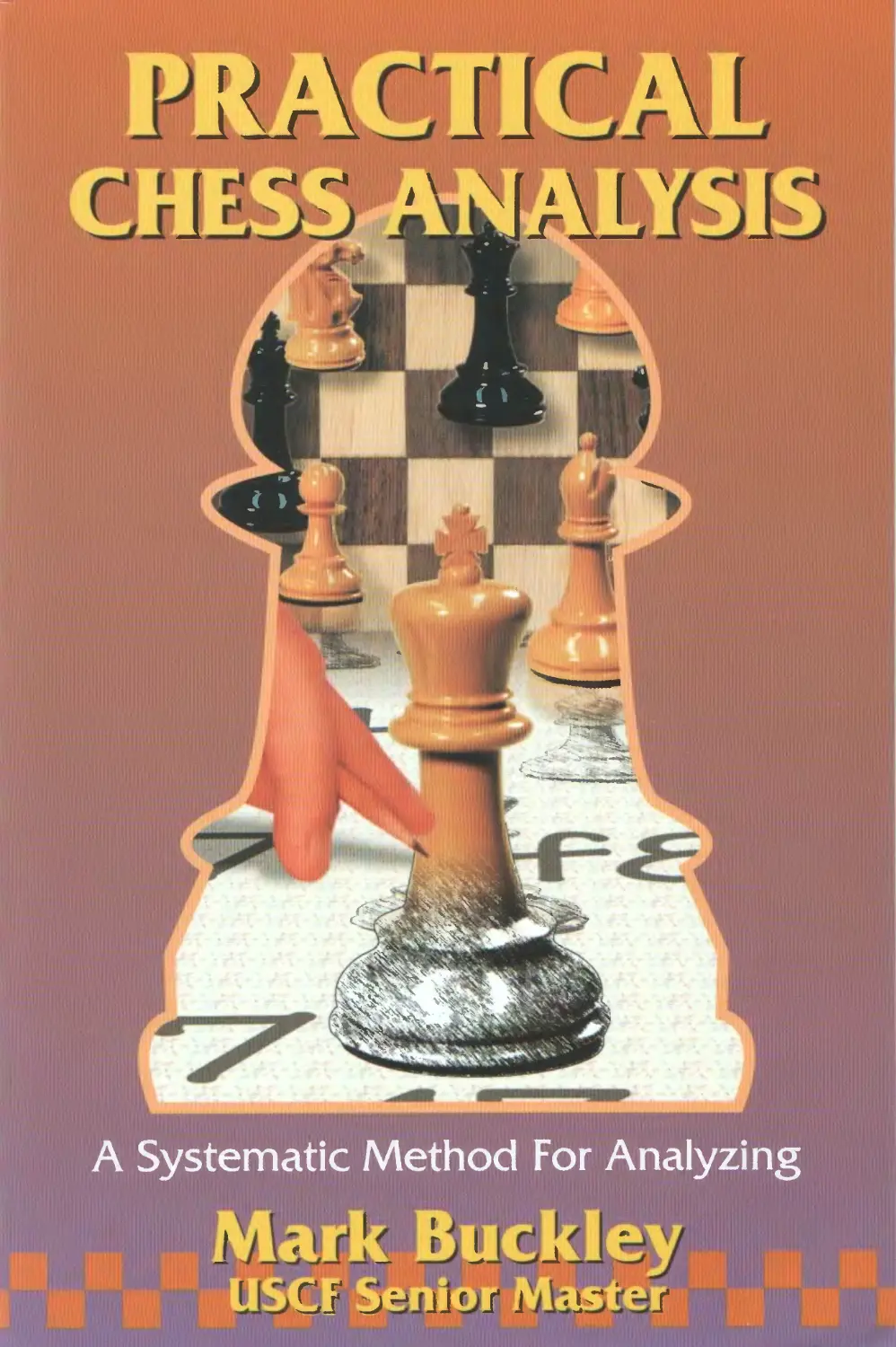
A Systematic Method For Analyzing
I
r
_i
Ci u
IK J" J *
J"

Practical Chess Analysis
A Systematic Method for Analyzing
Mark Buckley, Senior Master
Thinkers' Press, Inc.
Davenport, Iowa
1999

Practical Chess Analysis
Copyright © 1999 by Mark Buckley
All rights reserved. No part of this work may be reproduced
nor transmitted in any form nor by any means, electronic nor
mechanical, including photocopying and recording, nor by
any information storage nor retrieval system, except as may
be expressly permitted by the 1976 Copyright Act or in
writing from the publisher. Included in these reserved rights are
publishing on the Internet or in annotated databases.
Practical Chess Analysis
First printing: June 1987
Second printing: November 1989
Third printing: February 1999
ISBN: 0-938650-88-2
Requests for permissions and republication rights should be addressed in
writing to:
Bob Long, Editor-in-Chief
Thinkers' Press, Inc.
P.O. Box 8
Davenport, IA 52805-0008 USA
phone: 319-884-4027
e-mail: blong@chessco.com
Practical Chess Analysis
CONTENTS
Methodology 4
Instead of a Preface 5
Introduction 6
One
Training The Mind's Eye 13
Two
Developing Your Intuition 27
Three
Preparing to Analyze 49
Four
Pawn Structure 63
Five
Placement of the Pieces 82
Six
Open Lines 99
Seven
Attack and Defense 114
Eight
Endgame 135
Nine
The Maneuvering Game 147
Ten
Study Hints 161
Index 183
Colophon 189

Practical Chess Analysis
Methodology
On occasion I have been asked to describe my study
methods, how I look at a particular position, and so on. In
trying to convey useful answers to these questions, I come
back again and again to method. For only with a workable
technique can a player hope to improve his analysis — the
approach must be applicable to any particular position.
This book is the result of my wish to share what I have
learned about chess analysis: how to see ahead, how to judge a
position, how to study. I have tried my best to present the
essentials, the heart of the matter, trusting that you may apply
these suggestions and develop your own analytic tools.
As a result, my explanations may seem a bit uneven:
here, detailed notes, there, a terse hint. This is deliberate,
to keep you thinking. Over the board you are self-sufficient
and cannot rely on the opponent to query poor moves. The
analytic punctuation appears only after the game. So look
upon my omissions as your chance to forge ahead with your
own analysis.
Mark Buckley
Practical Chess Analysis
Instead of a Preface
When I took my first steps in chess, I had no thought of
method or system. Everything was new, and it did not
occur to me that a systematic approach to mastery would be
needed. But later, out of need — I had meantime discovered I
wasn't quite World Champion — I began to search for order
on the board. I found that more experienced players were
either unwilling or unable to give me any clues to guiding my
further steps. And chess books, while interesting, seemed
increasingly general and lacking any information on proper
thinking. The key to using the chess literature eluded me.
My solution to this problem seemed reasonable enough at
the time: to study everything that I misunderstood or disliked.
The all-around master was my model. I reckoned that if
something was mysterious, I would unravel it; if it was unpleasant,
I would learn to like it.
Because I disliked endgames (leftovers!) I paid special
attention to them, and soon, aiming for the better ending
became my favored strategy. Other weak spots were attacked
similarly, with more or less success. For instance, if an anno-
tator claimed that a certain attacking line should win, I would
try all defenses that seemed plausible, seeking to refute the
master. Only after every resource was exhausted would I
admit the notes were correct.
In this way I learned what underlay the published
analysis. By my tackling the tough questions and correcting my
own misconceptions, the game slowly revealed some of its
secrets. I still use the same approach today to further
strengthen my game.
5

I'nutical Chess Analysis
Introduction:
What Is Analysis?
A game from the 1962 USSR Championship:
1. e4 c5 2. Nf3 d6 3. d4 cxd4 4. Nxd4 Nf6 5.
Nc3 a6 6. Bg5 e6 7. f4 Qb6 8. Qd2 Qxb2 9.
Rbl Qa3 10. Bxf6 gxf6 11. Be2 Nc6 12. Rb3
Qa5 13. Nxc6 bxc6 14. f5 exf5 15. 0-0 Be6 16.
Rb7 fxe4 17. Rxf6.
White's forces dominate the open lines, while the two
missing pawns are hardly felt. Black's uncastled King and
backward development quickly lead to the conclusion that a
crushing blow must soon fall.
17... 0-0-0 18. Rfxf7 Bxf7 19. Rxf7 d5 20. Khl
Kb8 21. Nxe4 Qxd2 22. Nxd2 Re8 23. Bxa6
Re It 24. Nfl Bc5 25. g4 Rf8 26. Rxf8 Bxf8 27.
Kg2 h6 28. Kf3 Bd6 29. Bd3 Ral 30. Ne3 Bxh2
31. Nf5 c5 32. Nxh6 c4 33. Bf5 d4 34. g5 Be5
35. g6 Rxa2 36. Nf7 Bg7 37. Nd6 d3 38. cxd3
c3 39. d4 Bxd4 40. Bbl c2 41. Bxc2 Rxc2 42.
Nf5 Bf6, 0-1.
I'racikal Chess Analysis
Surprisingly, the diagrammed position (from Novopashin—
Korchnoi) favors Black, whose free development and active
Queen are just enough to avert the attack and bring the
material plus to bear. But only a clear analysis of the game, as
opposed to intuition, could discover in time that Black stood
better and allow Korchnoi to aim for this position.
What Is Analysis?
Essentially, analysis is an evaluation of the prospects for both
sides in a given position. This evaluation may range from
pointing out a winning one-move threat to detailed suggestions
regarding lengthy and obscure complications. An analysis
should indicate general strategies, plans for executing those
strategies, and most important, tactical lines. In short,
analysis points out who stands better and what should be done about it.
In the example above, White chose a sharp attacking
system but missed the moves 15. exf5 and 17. Qd4. By failing to
unpin his Knight, White doomed his attack; his Rooks alone
were not enough to win. After 15. exf5 Korchnoi gives 15...
Qe5 16. 0-0 d5 17. Bd3 Bc5f 18. Khl Be6 with unclear
complications. And instead of White's 17. Rxf6, he suggests 17.
Qd4 Qe5 18. Qb6 Qxc3 19. Rb8t Rxb8 20. Qxb8t Ke7 21.
Qc7t Bd7 22. Bg4 Bh6 23. Bxd7 Kf8 24. Be8 Kxe8 25. Qc8t
Ke7 26. Qxh8 with a slight plus for Black. Such involved
calculations are typical of this gambit variation of the Sicilian
Defense. You may also have noticed the inaccuracies in this
endgame. Perhaps because of time pressure, Black's 24th (he
should play 24... c5) and White's 32nd move (32. Ne7!) were
errors.
Situations in which an obvious advantage fails to win tend
to puzzle us. Why didn't White's superior mobility triumph?
How did the position differ from many others that White has
won using this Poisoned Pawn line? The answer is everything
depends on the specific setting. True, this is not a very useful
answer, but for White's attack to win, all of Black's resources
must be destroyed. And whenever the balance of power is fairly
level in a sharp position, analysis becomes the only way to tell
who stands better. In order to understand what is involved
7

I'riictical Chess Analysis
here, let's look at the more general question of what makes a
good player-analyst.
Differences Between Experts And Novices
Studies show that the great difference between experts and
novices lies with their intuitive judgment, the knowledge they
bring to the board. The master sees numerous strategic and
tactical patterns that the beginner misses. For example, in the
Benoni Defense Black would be loath to offer the exchange
Bg7xNc3 without substantial compensation, because of the
Bishop's special value; in contrast, the exchange Bb4xNc3
often favors Black in the Nimzo-Indian Defense. The difference
is in the pawn structure, a major element in any positional
evaluation. Experts are adept at just such pattern recognition.
You may recall, as a beginner, the unlimited number of moves
that seemed plausible at each turn. With experience, you
learned to discard most of these moves because you knew that
they were wrong. Similarly, a typical master player has
contested a vast number of quick games (five-minute and the like)
in addition to his serious tournament battles. This experience
develops the intuition because many common problems are
seen and solved repeatedly. Over time, scores of games may
be played focusing on the same theme, so the master tends to
think in terms of ideas well known to him.
As Fischer wrote (My 60 Memorable Games), referring to a
win against Larsen's Sicilian Dragon played at Portoroz
1958: "I'd won dozens of skittles games in analogous
positions and had it down to a science: pry open the KR-file,
sac, sac ... mate!"
I'r.uiiial Chess Analysis
From the diagram, the attack crashed through as expected:
16. Bb3 Rc7 17. h4 Qb5 18. h5 Rfc8 19. hxg6
hxg6 20. g4 a5 21. g5 Nh5 22. Rxh5 gxh5 23.
g6 e5 24. gxf7t Kf8 25. Be3 d5 26. exd5 Rxf7
27. d6 Rf6 28. Bg5 Qb7 29. Bxf6 Bxf6 30. d7
Rd8 31. Qd6T, 1-0.
Thus, refinement takes precedence over originality. The modern
master is eclectic, borrowing schemes and adapting them to
his purpose. Among world-class players, Capablanca, Fine,
Reshevsky, and Fischer all derived invaluable benefit from their
speed-chess apprenticeships. They mastered the principles of
sound chess through actual play.
The essence of this immersion technique is in directly
confronting specific problems. When the player fails to grasp a
particular endgame stratagem today, and loses, he will surely
get another chance tomorrow. Considering the limited
number of themes (as distinct from settings), the active player soon
sees most everything several times. And each time a familiar
situation is repeated, the determined student tries to perfect his
mastery. Ambitious players also seek out new problems to
round out their game: the quiet position player attempts some
wilder, tactical chess, for instance. Herein lies the difference
between the would-be master and the enthusiast who
concentrates solely on positions he enjoys.
To parallel the development of a player who uses the
intense immersion technique — constant play and analysis —
without matching the great investment of time, the reader
can take on specific faults and correct them. For instance,
suppose you suffer from time pressure; how would you cure this
trouble?
Well, you could try Botvinnik's suggestion, playing practice
clock games with the primary goal of reaching the time
control. The training would continue (says Botvinnik) until you
managed your minutes efficiently and played at your usual
level of skill.
Perhaps this rather mechanical method would work, but it
9

Practical Chess Analysis
might well produce unpleasant side effects. Rushing your
moves can lead to superficial judgment, carelessness, and lack
of confidence — problems just as serious as time trouble. A
more subtle technique would seek the underlying causes. Does
the trouble stem from inadequate preparation, lack of
practice, indecision, or something else? Maybe deeper opening
study would allow you to reach a familiar middlegame
without delays; perhaps you wait for the clock to goad you into
action. In any case, Botvinnik's proposal implies that the
student cannot discover these causes for himself, but must
simply exert his will in order to alter the result.
Errors And Action
My premise is that the aspiring player must find the causes of his
errors and take action. Learning from experience is fine, and
necessary, but it is also time-consuming and costs many points
on the tournament table. By looking at your past efforts, you
will definitely see that most errors fall into categories.
Random blunder is not the main cause of defeat. For instance, do
you remember how many games in which you entered the
endgame by playing a careless waiting move? If the advantage
seems to disappear in the ending, maybe the "beginning of
the end" is to blame. Noting such a weakness may well save
some valuable points.
Applying our confront-the-problem method to the general
analytic process, we aim to improve the basic skills of
foresight and judgment. The ability to see ahead depends on the clarity
of the image held by our mind's eye. By practicing in the
fundamentals of calculation, this image can be strengthened step-
by-step. The specific exercises will be fully explored in the
following section, "Training the Mind's Eye."
Judgment in chess obviously constitutes the core of
analysis. Because intuitive judgment is too vast a subject to be
tackled in full, we try to sharpen our thinking by degrees. Over
time, these specific studies coalesce to improve our overall
judgment.
Suppose you have just lost a game in which the two
Bishops figured prominently, and you want to hone your technique
PriKtk.il Chess Analysis
using these pieces (or fighting against them). Start by looking
through books and magazines and find three or four games
that illustrate the power of the Bishops. Most any positions
featuring the Bishops can be analyzed, but games annotated
by masters work best. Then you have a guide for your trek.
The task is to answer all pertinent questions about the two-
Bishop stratagem, examining not only what was played in the
games, but all the important alternatives.
Focus on moves that puzzle you, because your questions are
the crucial ones for learning — even if the annotator fails to
address them. We call this study of related games the typical-
position method and cover it in Chapter 2.
Schematic Thinking
A third skill brings together your foresight and judgment:
schematic thinking. Aim to see the game in terms of multi-
move sequences and plans in conflict. For, after all, chess is a
battle of ideas. For example, the stock combination against h7
(Bd3xh7t, Ng5t, Qh5) is a scheme. Though hackneyed, it
appears as a unit. We merely check to see whether the
sacrifice is "on."
In the diagram (Schlechter—Wolf, Vienna 1894), White wins:
1. Ng5 fxg5 2. Bxh7t Kxh7 3. hxg5t Kg8 4. Rh8t Kf7 5.
Qh5t
Other plans can benefit from similar treatment. Moreover,
haphazard jumping from one idea to another, a common
failing in analysis, is avoided when you think schematically.
Schematic thinking also helps you decide in advance if an
jj

Practical Chess Analysis
idea is sensible, long before you must commit yourself to a
specific tactical line. For example, a point that you can attack
twice, but which is guarded three times, is probably not a likely
target in the absence of a concrete reason to the contrary. If
you believe that special reason exists, proceed with the
analysis — but with a substantially narrower scope for the search.
A more detailed study of this topic is given in the section on
schematics, starting with Chapter 7.
1: Training
the Mind's Eye
What is the essence of a
chess master's art?
Fundamentally it consists of the
ability to analyze chess
positions.
— M.M. Botvinnik
Perhaps the most baffling question to the beginning chess
player (and not only to him) is "how do you see ahead?"
There is great mystery in a skill that enables the expert to
clearly see a situation that is far different from the one on the
board. Even more amazing is blindfold chess, played without
even looking at a board. Clearly, foresight cannot be mastered
by reading about it. Practice is needed.
Because calculation hinges on our skill in holding the
chessboard's image, we must somehow sharpen our mind's
eye. If, for instance, during lengthy calculation your pieces
begin to stray from their squares, you know the problem.
Suppose the combination you contemplate appears successful in
gaining material. Yet an unpleasant doubt arises: you are not
sure that your King is safe from counterattack; the picture in
your mind is not quite clear enough. So you face a dilemma.
Do you gamble boldly, holding that fortune favors the brave,
or do you retreat in the belief that chess is not poker? In
either event, you are relying on guesswork rather than
calculation. And while such situations cannot be avoided entirely,
the range of your vision can be extended.
Know The Board
In order to predict what may happen on the board, you
must be familiar with the ranks, files, and diagonals that form
the chess terrain. The name and color of each square should

Practical Chess Analysis
be known without recourse to the board — yes, literally
memorized. Otherwise, during analysis you will not be
certain where the pieces can move. Too much time will be lost
in merely finding legal moves to consider. Therefore, reliable
foresight begins with knowing the most permanent feature
of the game — the board.
To simplify the task of memorization, take the board one
quarter at a time, starting with the al corner. Look at the long
diagonal, the squares al, b2, c3, and d4. Think of them as a
unit. Adjacent to this line are the short diagonals a3-b4 and
cl-d2. Note also the crossing diagonals, a3-b2-cl and a5-b4-
c3-d2-el. The grid of dark squares can be reinforced in your
mind if you conduct a Bishop's tour of these squares. On an
empty board, place an imaginary Bishop on cl and mentally
play the piece successively to a3, b4, a5, c3, al, b2, and cl.
With practice, the interconnection of the squares will become
etched in your memory. Use the same method to memorize
the light-square diagonals, the ranks, and files. Incidentally,
the great blindfold expert George Koltanowski recommends
this memorization technique to anyone interested in playing
without sight of the board.
The Clarity Of The Mind's Eye
Once the board is committed to memory, each square can
be named, identified by color, and located on the lines
intersecting it. For example, c5 is a dark square at the intersection
of the a3-f8 and a7-gl diagonals. The coordinate notation
designates the ranks and files, so we know that c5 is on the c-file
and fifth rank. In practice, the clarity of your mind's eye should
rival your direct eyesight, functionally if not visually. This
means that connections are precise: you know without
looking that a Bishop on cl strikes h2 and not g2. Because
tournament rules prohibit moving the men for analysis, when you look ahead
you are effectively playing blindfold. You can still refer to the board,
of course, but the future position must be held just as firmly
in mind.
After the board, we naturally consider the pieces and how
they move. The novice player learns how to make legal moves
14
Training the Mind's liyc
and soon does not bother about such elementary matters. What
more is there to learn about how the men move? Well, to see
ahead you first need to know the squares to which a piece
may move. In your mind's eye, these possible moves must be
as obvious as when the actual position is set on the board.
These potential moves enliven the piece, giving it an "aura."
The aura refers to the array of squares available to the piece.
Beginners' books indicate these to show how the pieces move.
For example, the King occupies the center of a nine-square
array. A Rook on d4 produces an aura on the d-file and fourth
rank.
The aura is unaffected by obstructions. Think of the piece
as if it were on an open board. Try to fuse the piece to its aura.
The idea is simply that potential moves determine the value
of any piece, and the aura comprises just those moves. In the
next example (Portisch—Karpov, Moscow 1977), the black Queen
move to g5, which seemed so unlikely a few turns earlier,
shatters White's peaceful encampment.
1. Nf3 Nf6 2. g3 b6 3. Bg2 Bb7 4. 0-0 e6 5. d3
d5 6. Nbd2 Nbd7 7. Rel Bc5 8. c4 0-0 9. cxd5
exd5 10. Nb3 Bb4 11. Bd2 a5 12. Nbd4 Re8
13. Rcl c5 14. Nf5 Nf8 15. d4 Ne4 16. dxc5
Nxd2 17. Nxd2 Qg5 18. Nd6 Bxd2 19. Nxb7
Bxel 20. Qxel Rxe2 21. Qxe2 Qxclt 22. Qjfl
Qd2 23. cxb6 Rc8, 0-1.
The blocked, well defended square g5 proved useful after
all. The point to note is that such squares cannot be ignored
simply because they are presently unavailable.
Let's exercise your analytic ability without moving the pieces.
Set up the board as in the next diagram, and imagine the
continuation 33. gxf5 gxf5 34. Nxf5. Determine who stands
better and write down your variations, starting with Black's 34th
move. Try to fix the future position in mind, first removing
the captured pieces and adjusting the auras of the pieces that
move. Let each new position soak into your imagination.
15

Practical Chens Analysis
The diagrammed position is a possible variant from an
exhibition game Larsen—Fischer, Stockholm 1962. Black wins
after 33. gxf5 gxf5 34. Nxf5 Qb7t 35. Rf3 Qxf3t 36. Qxf3 Rblf.
Notice in particular the easily missed opening of the g-file:
the Rook's aura bursts forth there. Accustom yourself to
finding such nuances by taking every opportunity to solve
published chess problems and quizzes, emphasizing speed when
solving the easy ones.
When studying annotated games, it is a good practice to
examine all the notes at least twice: first, without moving the
pieces, critically follow the analysis; second, play through the
note to check the accuracy of the analysis and the clarity of
your mental image. Compare what you imagined on the first
pass to the board position as you play out the moves. Make
note of what you failed to see. For instance, it is quite easy to
miss horizontal Rook moves because we are accustomed to
the Rook traveling vertically until it reaches the seventh or
eighth ranks.
Be Aware Of Faulty Thinking
For maximum benefit after tournament games, retrace
your thinking to check your analysis of the critical points.
You may discover that you imagined nonexistent dangers or
overlooked some sharp tactic. Always be alert to patterns of
faulty thinking.
As you look ahead, the image of the future position becomes
increasingly vague and renders judgment difficult. To extend
the range of your "radar," look at the board position and re-
Trtuning the Mind's V.ye
trace the sequence of moves to the forward position. At each
move, trace the auras of all the significant pieces and pawns
that figure in the battle. This process sharpens the vision by
fixing in mind any changes that occur. You don't as easily
forget which pieces have been captured or moved. Tracing the
auras can also strengthen your awareness of tactical surprises.
Blindfold players practice the reinforcement technique by
replaying the game mentally. After each move while the game
progresses, they replay the game from the first move in order
to keep the image fresh and accurate. (With practice, these
replays can actually take only a few seconds.) You can borrow
this idea when you analyze: run through your intended line
several times until your mind's eye retains a clear picture of
the future position. Over time, you will get clear images with
only one or two tracings of the move sequence. Then you are
able to confidently assess the position that follows your
intended line.
Exercise Your Mind's Eye
Begin exercising your mind's eye with moderately difficult
problems. Steadily build your strength — like the weight lifter
who gradually increases the weight of the barbell. Calculation
need not be many moves deep (although that helps), but it
should be practiced frequently. Korchnoi, the foremost
exponent of play by calculation, has said that he requires 100 games
a year simply to maintain this skill. He also suggests you study
chess books without using a board, doing all the analysis in
your head — excellent practice if you are up to it. And if this
regimen seems excessive, consider by what other means the
skill of calculation can be learned. Why not practice during
home study and casual games, then show your tournament
opponents what you have achieved?
17

Practical Chess Analysis
To get a feel for what is involved in training the mind's eye,
let's examine a line of play from the diagrammed position
(Landau—Fine, Amsterdam 1936) after Black's 24th move. Black
is a pawn up and trying to rip open a path to White's King.
White has all his forces developed, including the King, while
Black is still backward in this respect. Therefore, the first player
may have some chances for counterplay against Fine's King.
The position is sharp.
In order to improve your vision, you may like to try
following the analysis without moving the pieces. On each move,
carefully examine the new position, noting changes such as
newly opened lines, captures, and piece movement. (Speed in
calculation is not important yet.) When the changes are fixed
in the mind, analyze the possible moves. General
characteristics in the position should be used to find specific variations.
Let's now return to the diagram.
Fine's analysis begins: 25. fxe3 N2xe3. Now the R/dl is
attacked; White can respond by moving the Rook or taking
(26. Bxg4). For simplicity we look only at the obvious capture
26. Nxe3.
Black has two recaptures, with the Queen or the Knight.
Taking the Knight move first, Fine gives 26... Nxe3 27. Rdel
Qg5. Do you see the veiled threats, Q/g5 vs. K/d2, and R/gl
vs. Q/g5? Concentrate on these auras.
28. Ne4. A surprising discovery. If your mind's eye is out of
focus, run through the move sequence again from the
diagram: 25. fxe3 N2xe3 26. Nxe3 Nxe3 27. Rdel Qg5 28. Ne4.
Black's Queen is attacked by the R/gl and the N/e4. The
Training the Mind's i'yc
Knight also threatens in some cases to land on f6, winning
the exchange. Thus 28. Ne4 is logical in that it prepares the
most dangerous attack. Retrace the auras of Black's Q/g5 and
N/e3 as well as White's Rooks and Knight.
The next move is hard to foresee: 28... NflJ. The double
check saves the Queen and removes the defense of the R/gl.
There follows 29. Kdl. Now the configuration of pieces is:
White — K/dl, B/e2, R/el, R/gl, N/e4, and unmoved,
Q/c3, Ps/a3, b4, c5, d4, with the P/f2 and N/fl captured;
Black — Q/g5, N/fl, and unmoved, K/g8, B/c8, R/e8, R/a8,
Ps/a6, b7, c6, d5, g6 with the N/g2 and P/e3 captured.
Such bookkeeping helps maintain a clear image when you
analyze.
White's Rook hangs, so 29... Qxgl is natural (although as
an additional exercise you might study 29... Ne3t 30. Kcl).
Fine gives 30. Rxfl with an "attack which is not so easy to
meet." Let's see: the Q/gl is under fire from the R/fl;
moreover White intends Nf6t winning back the Exchange. If
necessary, run through the move sequence from the diagram again
to refresh the image: 25. fxe3 N2xe3 26. Nxe3 Nxe3 27. Rdel
Qg5 28. Ne4 NflJ 29. Kdl Qxgl 30. Rxfl.
Who Is Ahead In Material?
Count up the material. It is vital to know at all times who is ahead.
In the diagram, Black was a pawn up. Meanwhile, a pair of
pawns have been traded along with a pair of horses (e3); and
the black N/fl has been lost for the R/gl. So Black is now the
exchange and a pawn up. When many pieces have been
captured, it is easiest to keep in mind only the material
imbalance. That is, as soon as a piece is recaptured, consider the
material even. Don't bother keeping the entire list of exchanges
in your head. When one side gains material, note only how much he
is ahead.
Analysis Continues Until The Position Is Quiet
In general, analysis continues until a quiet position is
reached. Evaluation is difficult while pieces stand attacked
(unless all the loose pieces are on one side). In our exercise, it
19 —

Practical Chess Analysis
is Black's move and he must apparently hasten the Queen to
either g2 or h2. Check to see that these are the only available
flight squares: f2 and hi are guarded by the R/fl, e3 by the
Queen, g3 and g5 by the Knight, and g4 by the Bishop. On the
reply 30... Qh2 there can follow 31. Nf6t- If the King protects
the R/e8, then the discovered check 32. Ng4 (unveiling the
R/fl) wins the Queen.
If 30... Qg2 31. Nf6f Kf7 32. Nxe8 Kxe8 33. Qe3f Qe4
34. Qxe4t dxe4 35. Rhl with a winning bind. If the position
is clear enough, see whether Black can escape.
Let's return to Black's 30th move. To stop both of White's
threats, 31. Rxf 1 and 31. Nf6t, Black has the logical 30... Qxfl t
31. Bxfl Rxe4 repelling the attack with a winning advantage.
A nice resource that begs the question: Can't White play 30.
Nf6t before taking Black's N/fl?
Returning to the diagram once more, let's consider the
alternate capture on Move 26: 25. fxe3 N2xe3 26. Nxe3 Qxe3f.
This is simpler than 26... Nxe3 because it's more forcing. Fine
concludes with 27. Qxe3 Nxe3 28. Rdel Nf5 and writes,
"Blacks remaining difficulties are purely technical." Note that
now the pawns on d5 and g6 restrict the dangerous N/g3-
R/gl battery. Black's scheme could run as follows: ...Nxg3-
Bf5-Kg7, and after forcing off a pair of Rooks on the e- or
h-files comes the advance of the g-pawn.
What To Do When The Image Is Too Vague
In the attempt to follow written notes blindfold, the
possible moves (auras) of all involved pieces should be constantly
traced in order to fix each new position in mind. When the
image is too vague, advance the board position one move
toward the desired forward position to help you analyze.
Before leaving the subject of mind's-eye training, another
exercise in following published analysis may be useful. In the
next case, we trace the thought of Mikhail Tal (White) in his
6th match game versus Larsen in 1965.
1. e4 Nf6 2. e5 Nd5 3. d4 d6 4. Nf3 dxe5 5.
Nxe5 e6 6. Qf3 Qf6 7. Qg3 h6 8. Nc3 Nb4 9.
Trmning the Mind's iiye
Bb5t c6 10. Ba4 Nd7 11. 0-0 Nxe5 12. dxe5
Qg6 13. Qf3 Qf5 14. Qe2 Be7 15. a3 Nd5.
The Danish grandmaster has played in his usual
provocative style, tempting Tal to attack. A deep combination is
launched with 16. Nb5. Strategically, this move redeploys
the Knight so that 16... 0-0 is answered by 17. Nd4 Qh7 18.
c4 Nb6 19. Bc2.
Therefore, the main variation begins with 16... cxb5 17.
Qxb5t. Now we can reject both 17... Kf8 18. Qe8 mate and
17... Bd7 18. Qxd7t, mentally playing 17... Kd8.
Tal wants to clear the d-file, so his next threat is 18. c4.
The Knight can flee to b6, c7, or f4. (On 18... a6, 19. Qa5t b6
20. Qd2 regains the piece with continuing threats.) If the
Knight alights on c7, 19. Rdlt wins outright. And 18... Nb6
19. Qa5 leads to:
1) 19... Bd7 20. Be3Kc7 21.c5;
2) 19... Kc7 20. c5 Kb8 21. cxb6 axb6 22. Qb5 Ra5
23. Qb3.
with good winning chances, according to Tal. Nevertheless,
Larsen should have tried this last line. Instead, he gave back
the piece at once (18... Qxe5), after which White's attack
broke through.
Our interest lies in the line beginning 18... Nf4. The
obvious continuation is 19. Rdlt Kc7.
A little reflection will lead you to conclude that 20. Rd7f
is the only follow-up: 20... Bxd7 21. Qxd7t Kb8 (21...
- - 21 —

Practical Chess Analysis
Kb6 22. Be3f mates) 22. Qxe7. So far we have the line 16.
Nb5 cxb5 17. Qxb5t Kd8 18. c4 Nf4 19. Rdlt Kc7 20. Rd7t
Bxd7 21. Qxd7t Kb8 22. Qxe7. Now 23. Qd6t threatens, hence
22... Qxe5 is the answer.
White wants his other pieces in play, and 23. Be3 presages
24. Rdl-d8t; for instance, 23... f6 24. Rdl Qc7 25. Rd7. Tal's
analysis continues 23... Ng6 24. Qxf7 Qf6. From the
diagram we have this line: 16. Nb5 cxb5 17. Qxb5f Kd8 18. c4
Nf4 19. Rdlt Kc7 20. Rd7t Bxd7 21. Qxd7t Kb8 22. Qxe7
Qxe5 23. Be3 Ng6 24. Qxf7 Qf6. The forced nature of the
position aids our analysis.
White now has a serious problem. His Queen faces eviction
(25. Qd7 Rd8). Tal's foresight (he had to see all of this before
venturing 16. Nb5) uncovered 25. Be8. Observe that the Q/f7
is defended, the N/g6 attacked, and on 25... Ne5 26. Bf4
White's Queen guards the Bishop. The threats are 27. Qd7
and 27. Rel. Black cannot escape by trading Queens, the usual
defensive procedure, because 25... Qxf7 26. Bxf7 Nf8 27. Bf4t
Kc8 28. Rdl entombs his pieces. And on 25... Ne7, 26. Rdl
(not 26. Bf4t e5) leads to a position in which the Bishops
dominate Black's Rooks and Knight. One can marvel at the
analytic skill necessary to unearth 25. Be8 ten moves in
advance.
Finally, Tal gives 25... Qe7 (25... Qd8 26. Qxg6 Rxe8 27.
Qxg7) 26. Qxg6 Rxe8 (26... Qxe8 27. Qxg7 with a material
plus positional advantage).
27. Bc5 (yet another beautiful point: 27... Qxc5 28. Qxe8t
Qc8 29. Qf7 Qxc4 30. Qxg7) Qd7 28. Bd6t Kc8 29. c5.
Tal says that the Bishop is stronger than a Rook. The freeing
attempt 29... b6 succumbs to 30. Qe4 Qb7 31. c6. After 29.
c5, White need only add his Rook to the fray.
Retracing The Combination
Now retrace the combination's main line from 16. Nb5 and
assure yourself of its soundness. Try any defense that seems
plausible and, without moving the pieces if possible, find the
proper continuation for White. If the image becomes too vague,
simply advance the position on the board until your mind's
— 22
Training the Mind's Hye
eye can retain a clear picture. The ideal is to hold the entire
tactical operation in mind just as we did earlier with the stock
combination Bxh7t, Ng5t, and Qh5. When you finish with
the mental analysis, play the moves out on the board to clarify
any unresolved points. You will probably find a few oversights.
Strengthening the foresight takes time, so don't despair!
If you are able to see that all the moves of the combination are
legal and reasonable, that will be a good first step. The
exercise's main object is to force an extra effort.
In learning to calculate several moves deep, the first task is
to follow lengthy notes, mentally recording the moves (as in
Tal—Larsen). Later, you can trace the annotations more
critically, examining lines not considered in the notes and trying
out possible improvements. By using the written notes as a
crutch, you can gradually take on more of the analytic burden
until you are analyzing on your own. The benefit to over-the-
board creativity is limited only by the effort you expend on
improving your analytic skill.
Before we close this chapter, let's look at two practical tips
to sharpen the tools of analysis. Probably all players have
experienced the unpleasant feeling that they "saw" a surprise
move that they somehow did not stop to examine; they just
let it pass by without a critical look, only later realizing what
was missed. As someone once said, in genius we see our own
rejected thoughts.
Obviously Unplayable Moves
A simple technique can catch some of these slippery fish.
First, as you look at the position briefly consider only the most
bizarre and surprising moves: sacrifices, pawn breaks, and
other desirable but "obviously unplayable" moves. If it seems
that your Knight would be active on f5, analyze the move even
if it cannot be correct. You can discover many interesting ideas
using this technique. Just a quick glance, looking for this kind
of move, is required.
23

Practical Chess Analysis
The Doublecheck
Our second tip comes into play when you look ahead
toward an intricate position. Slow down your thinking and give
"normal" moves a momentary double check. Maybe you don't
need that last preparatory move before your combination
begins, maybe a sharper move will work better. The alertness
that comes from the extra check is well worth the few seconds
invested. Remember: beautiful themes often lie quietly in the
most tranquil settings, waiting for the patient player to
discover them. Don't cheat yourself with hasty analysis.
— 24
Twining the Mind's lye
EXERCISES
Question: After 19. Qh5 Qf5 how does White continue?
Answer: From Alekhine's notes to Alexander—Tylor,
Nottingham 1936: 19. Qh5 Qf5 20. Re5 Qg6 [Ed.: This facilitates White's
quick win. 20... Qh7 is more troublesome. Then, 21. Rxg5 f6! slows
White.] 21. Rxg5 Qxh5 22. Nf6t mates.
Question: After 10. Ng5, does ...Bg4 refute the attack?
Answer: From Alekhine—Lowenfisch, St. Petersburg 1914: No,
11. Nxf7 Rxf7 12. Qc4 (not 12. Bxf7t Kxf7 13. Qc4t Be6 14.
Qxc6 Bd5) wins the Exchange.

I'nutual ( /ic.s.s Analysis
Question: Why didn't Black play the simplifying 27... Ne7?
Answer: From Smyslov—Letelier, Venice 1950: 28. Nxd5 Nxd5
29. Rxe6 Rxc5 30. Rxf6 Rxc3 (30... Nxf6 31. dxc5 Nd7 32.
Kd3-c4) 31. Rd6 with a pawn.
Question: Analyze 23. Nxf7 and 23. Nc4. Which is stronger?
Answer: From Tal—Hubner, Montreal 1979: If 23. Nxf7 e5!
24. Nxh8 exf4 25. Rxf4 Rd8 26. Rc4 Qd7 27. Ng6 Qd5 regains
one pawn with active pieces and no real weaknesses. The game
went 23. Nc4! Ne8 (23... e5 24. Bxe5 Re6 25. Bxc7 Rxe2 26.
Nb6#) 24. Rg4 Qe7 leaving Black's pawns weak.
2: Developing
Your Intuition
When I am trying to find
the best move, I just look
at the position, trying to
find a general idea. I
follow my intuition. After
that, when I think that this
is the best move, I start to
calculate variations. You
must calculate and you
must also use your
intuition.
— B. Spassky
The planning process draws heavily on your experience.
As you look at the board, you know what opening system
was used, where the main theaters of action lie, and can
without doubt name half a dozen general principles that might
apply to your situation. The question is: how do experience
and intuition evaluate ideas over the board? And how can a
stronger intuition be developed?
Pattern Recognition Is The Answer
The answer is in learning to see patterns — landmarks —
such as isolated pawns, misplaced pieces, and stock
combinations. Pattern recognition is the heart of intuition. The pattern
represents something familiar, something already evaluated.
Because the experienced player has often already studied a
similar position to the one set before him, he largely knows what
to do without much thinking. His judgment is sound; he
refines and confirms, in most cases, what the pattern tells him.
This experience saves time and effort over the board and lets
the player concentrate on the position's unique features. For
instance, the standard procedure for coping with the
opponent's backward pawn is common property: keep the pawn
from advancing, pile up pressure on the file, then win the pawn

Practktil I'.lwss Annlysis
or switch fronts before the defense can react. Or, as Nimzo-
vich put it, "restrain, blockade, destroy." Similarly, if you know
a stock combination such as Black's c3 Exchange sacrifice in
the Sicilian (Rc8xNc3), your play is stronger, more confident
should the opportunity for this attack arise.
How Do You Develop Your Intuition?
To develop your intuition, analyze typical positions from
your favorite openings and middlegames, as well as from
common endings. By typical positions, I mean those which
feature clearly one or more themes that govern planning:
isolated d-pawns, bad Bishops, offside Knights, weak Rooks, and
so on. For each theme, study three or four games to improve
your understanding of the problems that occur.
Consider the group of games to embody a strategic idea.
For example, studying several games featuring the well-known
two-Bishop sacrifice (Bxh7t, Bxg7) will quickly show you why
this attack is a stock combination. The prerequisites for its
success become obvious.
We divide these study positions into two categories:
1) the dynamically equal situations where there are chances
for both sides, and
2) positions that are known to be advantageous.
Studying equal positions benefits your theoretical
knowledge, understanding of pawn structure, and awareness of likely
combinations. Studying advantageous positions improves your
technique of winning the won game. You discover how to make
use of material and how to neutralize counterplay.
Because the number of strategic themes is limited, you can
study problems that will certainly occur in future games. (An
analogous idea is found in sports when teams practice
predetermined plays for a later game.) A look at the games of Petro-
sian suggests that he has thoroughly mastered the ending
Rook+Knight versus Rook+Bishop, especially those cases in
which the Knight is the stronger minor piece. Think of the
comfort this knowledge gave him when planning the game.
He could enter the ending confident that all its problems were
28
/VvWo/k'hj; Your Intuition
known to him. And, of course, this endgame was not the only
one he knew profoundly, it was merely one of his favorites.
In the opening, a player has a deceptively easy time using
his experience. The accepted moves and strategy are often
widely published. Large numbers of games, played and
analyzed by top masters, do wonders for the self-confidence. But
this trust in the ideas of others can lead to trouble. You may
very well leave the opening certain of your advantage, yet
lacking any idea of how to proceed. So examine the openings you
play in connection with the ensuing middlegame. Recognize
that omniscient theory is no more than a haphazard collection
of lightly annotated games.
The following position you may know as stemming from
the Dutch Defense, Leningrad variation. In this game (Tai-
manov—Tal, USSR 1969), White characteristically plays to
exploit e6.
1. c4 g6 2. g3 f5 3. d4 Bg7 4. Bg2 d6 5. d5 c5 6.
Nh3 Nf6 7. Nc3 Na6 8. 0-0 Nc7 9. Bd2 0-0 10.
Qc2 Rb8 11. a4 Bd7 12. Nf4 a6 13. a5 Qe8 14.
Rbl b5 15. axb6 Rxb6 16. b3 Rb8.
The game resembles a King's Indian except for the advanced
f-pawn. A typical struggle has arisen over the value of this
advance: is Black's extra control of e4 worth the weakening of
e6? The continuation will confirm that Black has lost the battle
here. On the queenside, Tal tried 14... b5 to create a weakness
on c4 and open the b-file. This plan was frustrated because
13. a5 and 15. axb6 indirectly guarded c4; thereafter the b3-
29 —

I'raitiail Chess Analysis
pawn was easily protected. A standoff in this sector meant
that White could turn his attention to the center, where the
primary target lay.
Looking at the diagram, we see that an advance and
exchange of White's e-pawn will clear the e-file and expose the
backward pawn. The f5-pawn does not halt e2-e4, and a
potential counterattack in the center is limited to ...e7-e6. But
that push simply lays bare new targets after d5xe6. Hence Tal
must remain quiet in the center.
Finally, no serious plans come to mind for Black on the king-
side. For instance, chasing White's Knight with ...g6-g5
simply increases the strength of the inevitable break e2-e4. Tal is
left with the slender hope that Taimanov's gradual
preparations and the remoteness of e6 might allow time for defense.
Therefore, White has a free hand to set up the decisive blow.
So what should Tal have done to avoid these problems? Other
than choosing the Nimzo-Indian (his solid defense), he could
have created a more reliable Dutch setup by reserving the
c-pawn to pressure White's center (c7-c6). By keeping the front
fluid, Tal could distract attention from e6. A standard
position is shown in the next diagram; White must play resolutely
to maintain a slight initiative. Compare this to Tal's rigid plan,
in which he clarified the center and allowed Taimanov to
secure the queenside.
White was able to direct the gravity of the battle to the
center, where he held the advantage. Especially important to
White's smooth development was the Knight on f4. Tal was
so impressed by this maneuver that he subsequently avoided
Developing Your Intuition
the Dutch fianchetto unless Ngl-f3 had already been played.
Chief Differences In Positions
Conclusion: The positions of Black's c-pawn and White's
King Knight form the chief difference between the two diagrams,
between a playable defense and disaster. When you study
typical positions, look for these crucial (and often subtle)
differences amid the obvious similarities. Study the concrete plans
you might consider were you facing the same situation over
the board. Understanding the source of each advantage is your
goal.
Returning to Taimanov—Tal, the remainder of the game sees
imaginative tactical play from Taimanov in converting his
positional plus into material gain.
17. e4 e5 18. dxe6 Nxe6 19. Nxe6 Qxe6 20.
Rbel Kh8 21. Bh3 Ng4 22. Nd5 Bd4 23. Bc3
Bxc3 24. exf5 Qxel 25. Rxel Bxel 26. Bxg4
Kg8 27. Qb2 Bxf5 28. Bxf5 gxf5 29. Nf6f Kg7
30. Nd7t and 1-0 in 44 moves.
Depending on the depth of your preparation, a typical
position from an opening may occur after (say) 10 or 15 moves.
Better preparation pushes back the point at which concrete
variations give way to general planning. At the highest levels,
the endgames which might plausibly arise from openings are
subject to intense study. For example, in preparing for the
1963 World Championship, Tigran Petrosian analyzed an
endgame flowing from a Griinfeld variation Botvinnik was known
to favor. That very ending appeared in Game 5 and brought
Petrosian victory.
Look Carefully At Book Verdicts
To begin your own study, simply examine a point where
your favorite opening monograph renders its verdict: +—,
—h, T, ±, or = (assuming there is anything left to analyze).
Try to turn the promised advantage into something
material. Or see if you can convert the opponent's plus into
31 -

Practiail Chess Analysis
nothing. Work out specific plans. Look especially at those
moves the book recommends hesitantly, citing many
alternatives. At those points you can find effective continuations
that take the opponent into uncharted territory.
If you challenge the book lines and test a few of them in
quick games with a friend, you will familiarize yourself with
the problems of the opening. Realize that merely memorizing
the opening lines produces a brittle style easily upset by
nonbook moves. Be thankful such a style is commonplace.
A position typical of the Ruy Lopez, Open Variation, is found
below. Not being sharp or critical, the position illustrates the
opening all the clearer. White has a spatial plus (e5) and
chances to dominate the dark squares (d4, c5); Black has fine
development and queenside prospects if he can advance his
c-pawn. Black to move considers two ideas:
Black to move.
1) immediate queenside play with 12... Na5, and
2) bolstering the center with 12... Qd7.
White naturally opposes any attempt to equalize. He can
try to pressure d5 by 13. Radl or attack h7 via 13. Bc2 and 14.
Qd3. The h7 threat would encourage g7-g6 in reply, and the
dark squares then might prove weak (Bg5 or Bh6). More subtle,
after Black's 12... Qd7, is the immediate exchange of Bishops
with 13. Bg5 — subtle because no time is lost provoking g7-g6.
Counterplay would have less time to develop. Let's look at
some specific lines.
IVwInpiiij; Your Intuition
1) 12... Na5 13. Bc2 Nc4 (interesting is ...c5 14. Bh6) 14.
Qd3 g6 15. Bh6 Re8 16. Qd4 f6. Black exchanges on e5 and
seems to weather the attack. A position to be tested (e.g.,
15... Nxb2 16. Qe2 Re8 17. Nd4).
2) 12... Na5 13. Nd4 Nc4 14. Bxc4 dxc4 15. f4 Bd7 16. f5 c5
17. f6 cxd4 18. Bxd4 Re8 19. fxe7 Qxe7. This position is
apparently equal, though White's 20. Rf3 poses some problems.
Black can defend with 20... Rac8, intending ...Rc6-g6.
3) 12... Qd7 13. Radl Rad8 14. Qd3 Rfe8 15. Rfel g6 16.
Bg5 Na5 17. Bf6 Nxb3 18. axb3 Bg4. Again the balance is not
disturbed, and a characteristic late middlegame appears.
4) 12... Qd7 13. Bg5 Rad8 14. Rfel Rfe8 15. Nd4 Na5 16.
Bxe7 Qxe7 17. f4 c5 18. Nxe6 Nxb3 19. axb3 Qxe6. In this
line, the kingside pressure was nicely neutralized by the
queenside expansion.
By concentrating on what happens when the adversaries
clash, the opening as a whole is clarified. One analytic session
with several typical positions from an opening gives an
excellent grasp of the tactical problems likely to arise in the game.
In the example above, the positions following the four lines
are the points of departure. Together they constitute typical
positions that stem from the last diagram. The important point
to remember is that comparisons must be made; otherwise,
the typical position or positions become merely individual
games unrelated to any specific theme or variation.
A careful analysis of any position means knowing the past
moves and the future possibilities: the position is simply a
snapshot of an ongoing process. Landmarks such as bad
Bishops or weak pawns are important only in that they suggest
and shape future actions. These actions determine who stands
better.
In the last example, the "weak" square c5 should have
beckoned White. But just try finding a way to exploit that square.
Not easy. On the other hand, White's kingside chances may
initially appear somewhat abstract. They become concrete if you
analyze more deeply the first suggested line.
When examining selected positions related to a certain
theme, you refine your intuition because you actually see what
33

Practical Chess Analysis
typical advantages mean and how to exploit them. (Study of
typical positions is a shortcut to general strategic understanding.) In
an analogous way, most endgame books contain little more
than analysis of typical endings. The player interested in
finding where he went wrong looks up the appropriate chapter
(say, Two Bishops v. Bishop & Knight) to discover the general
plan to follow. The next time a similar ending arises, he knows
what to do. The same approach can be applied to other phases
of the game — the difference is that middlegames have not
been catalogued like the ending; you must create your own
catalog.
Specific Landmarks
The second kind of typical position involves one or more
specific landmarks. These may include weak pawns or squares,
misplaced pieces, passed pawns, and spatial advantages. The
next example, from Smyslov—Denker, USSR—USA 1946, serves
to clarify some of the mysteries of backward pawns and bad
Bishops.
1. e4 c5 2. Nc3 Nc6 3. g3 g6 4. Bg2 Bg7 5. d3
e6 6. Be3 Nd4 7. Nce2 d6 8. c3 Nc6 9. d4 cxd4
10. Nxd4 Nxd4 11. Bxd4 e5 12. Be3 Ne7 13.
Ne2 0-0 14. 0-0 Be6 15. Qd2 Qc7 16. Rfcl f5
17. c4 fxe4 18. Nc3 Nf5 19. Nxe4 Nxe3 20.
Qxe3 h6 21. Rdl Rfd8 22. Racl Rac8 23. b3
b6.
Smyslov's first thought was probably, "Can I win the back-
34
Orveloi>uif> Your Intuition
ward d-pawn?" No subtlety is required to find White's plan, a
pile-up with the Rooks. Therefore:
1) 24. Rd3 d5 is a feeble "try";
2) 24. Rc3 Rd7 25. Rcd3 Rcd8 26. Qd2 Bf5 27. Rxd6 Rxd6
28. Nxd6 Kh7 precludes a saving check on d5 and prepares
...Bf8 winning the wayward horse.
So the direct attack fails. What next? Well, the pawn
structure fairly begs White to trade light-squared Bishops. d6 would
be even weaker (no nettlesome threats to the Knight), and
without hope of ...d6-d5 Black would be quite passive.
Thus 24. Nc3 is a natural move, intending 25. Bd5 forcing
off the Bishops. If Black resists the trade by 24... Kh7, the
white Bishop goes to e4. Smyslov indicates two plans after 24.
Nc3 Kh7 25. Be4 26. h4 with h4-h5 soon to come, and 26.
Nb5 followed by 27. Qd3. In both cases, White combines
threats to the kingside and center.
Returning to the position in the diagram, Black has scant
hope of avoiding the exchange of Bishops. Thereafter, he would
be tied to d6 and unable to offer resistance to further pressure
such as h4-h5 or c4-c5. To sidestep this throttling, Denker
attempted counterattack, surrendering the d6-pawn for some
freedom. Smyslov thus found himself in a well-known
situation: having lost the positional battle, the opponent sacrifices
something, reluctantly turning the game into a sort of gambit.
24. Nc3 Qe7 25. Bd5 Kh7 26. Bxe6 Qxe6 27.
Rd3 Rc7 28. Rcdl Rf7 29. Ne4 Bf8 30. Rd5
Qg4.
9
m
if i
m
H
m 1
m m
£ *
mim
Ȥt a
£«
n
mm,
m m
i m
35

Practical Chess Analysis
Again the d-pawn is dead but won't lie down. I don't think
you will have much trouble refuting 31. Nxd6. Smyslov
actually played 31. Rld3 and gives the possible defense 31... Qe6
32. Qd2 Rfd7 33. c5 bxc5 34. Nxc5. As stated before, Denker
has already decided on counterattack as the best chance, and
he made a quiet move, 31... Be7, preparing ...Rdf8. Now
White had to calculate whether taking the pawn would grant
too much counterplay. If so, Smyslov would have to maneuver
further, perhaps inflicting another weakness on Black (for
instance, a4-a5) or driving back the active Queen (say, Kg2 and
h2-h3). There is no sense in capturing a pawn if the opponent
gets enough play to cloud the issue.
Let's now analyze the problem facing Smyslov: 32. Nxd6
Bxd6 — this time there is no choice — 33. Rxd6. Black can
now play 33... Rdf8 or 33... Rxd6.
The second line is simpler, we look at it first: 33... Rxd6 34.
Rxd6; now 34... Qf5 35. Kg2 and 34... e4 35. Qd4 are clear. So
Black must play 33... Rdf8, attacking f2. Smyslov can try the
direct defense 34. Rd2 or the aggressive 34. Qxe5, intending
to maintain the initiative. The reply must be (34. Qxe5) 34...
Rxf2. Then comes 35. Rd7t R(either)f7 36. Rxf7f Rxf7 37.
Rd8 aiming for mate. Does Black have a check? No, White's
King is safe. Black must try 37... g5 or 37... Rg7. The first
allows 38. Qh8T Kg6 39. Rd6t Kf5 40. Qc8t
The second defense is more stubborn: (37... Rg7) 38. Qe8
g5 39. Qh8t Kg6 40. Rd6t Kf7 41. Qxh6. Now look carefully.
(Try to analyze this second position in your mind's eye with
your chessboard set before White's 32nd move. The sequence
is 32. Nxd6 Bxd6 33. Rxd6 Rdf8 34. Qxe5 Rxf2 35. Rd7t (R)f7
36. Rxf7t Rxf7 37. Rd8 Rg7 38. Qe8 g5 39. Qh8t Kg6 40.
Rd6t Kf7 41. Qxh6.) Black must defend with 41... Qf5. Now
the obvious 42. Qh5t Ke7 43. Rdl is not so easy after 43...
Rf7. But 42. Rdl Qc5t 43. Kg2 is fine. The checks are ended,
and the second wave of attack can be prepared. All seems in
order; the pawn can be taken.
32. Nxd6 Bxd6 33. Rxd6 Rdf8 34. Qxe5 Rxf2
35. Rd7t Rf7 (either Rook) 36. Rxf7t Rxf7 37.
Developing Your Intuition
Rd8 Rg7 38. Qe8 g5 39. Qh8t Kg6 40. Rd6t
Kf7 41. Qxh6 Qf5 42. Rdl Qc5t 43. Kg2 Qe7
44. Rflt Kg8 45. Qf6 Qe8.
White must regroup his pieces to win. Extra material does
not eliminate the need for planning, so Smyslov decides to
put his Rook on e2 and Queen at e4. This setup defends the
white King (especially along the a8-hl diagonal) and allows
threats such as Qd5t and Qe8f. Observe how Smyslov achieves
his ideal configuration.
46. Qf5 g4 47. Rf2 Qe7 48. Qd3 Rg5 49. Re2
Qf8 50. Qe4 Rg7 51. Qd5t Qf7 52. Re6, 1-0.
Black has not a single decent move — zugzwang.
A Straightforward Method for Comparative Study
We now examine some typical positions and a
straightforward method for comparative study. The following position,
typical of the Semi-Tarrasch Defense, portrays White's
classical development — a broad pawn center and centralized Rooks.
Such a position in general form may also arise from other
Queen's Gambit variations.
37

I'mcdail Chess Analysis
The center pawns will advance, creating kingside attacking
chances or a passed pawn. Black's prospects are longer term:
his swift deployment aims to repel the attack, and his
queenside majority can advance. Because the attackers are so
active, the defender must play precisely in such positions —
usually he knows before the game which plan he will try. So
we will consider the diagram favorable to White even if theory
claims equality. Our study therefore focuses on White's plan.
The tempo of attack (whether directed centrally or kingside)
depends on the opponent's counterplay. If the defender
cannot undertake anything, the attack may proceed slowly;
otherwise, no time can be lost. Black's Knight is heading for c4.
Ideally for Black, this piece leads the queenside counterplay
while covering e3 and e5. And if Bxc4 is played, simplification
reassures Black's King.
Black would like to play 16... Nc4 17. Qf4 Nb2 18. Rd2
Nxd3 19. Rxd3 Rc2. White gains nothing on 16... Nc4 17.
Qe2 b5. If White fails to attack with his impressive forces, a
few exchanges will grant Black a comfortable game. A look at
the defender's plan gives White an idea of the limited time for
preparing the attack.
Let's consider first White's kingside chances. His Bishop,
Queen, and Knight must bear on the target; hence, the e-pawn
will advance. There are two means: e4-e5 directly, and d4-d5,
e6xd5, e4-e5. The virtues of the pawn sacrifice include
denying d5 to Black, preventing Bb7xNf3, weakening f5, clearing
d4, and opening the e-pawn's path.
It's time for specific lines:
Developing Your Intuition
1) 16. e5 Bxf3 17. gxf3 Nc4 18. Bxc4 Rxc4 19. d5 exd5 20.
Qxd5 Qg5t 21. Khl Rc2 is fine for Black;
2) 16. d5 exd5 17. e5, and now:
a) 17... h6 18. Nd4 (intending Nf5, e5-e6, or Qf4) Nc4
19. Qf4 Qg5 defends — so sharper is 17... h6 18. Qf4 Nc4 19.
Qf5 g6 20. Qh3 Kg7 21. e6. Compare 18. Nd4 and 18. Qf4 for
a practical definition of "sharper."
b) 17... Nc4 18. Qf4 Nb2. Now 19. Rd2 is
spineless: 19... Nxd3 20. Rxd3 Rc4. 19. Bxh7t is the only way to
test White's setup. 19... Kxh7 20. Ng5t Kg6 (else 21.
Qh4-h7 wins) 21. h4. Black can oppose the threat 22. h5t
with:
• 21... f6 22. h5T Kxh5 23. g4t Kh6 24. Qh2t Kg6 25.
Qh5#.
• 21... f5 22. Rd4 Rh8 23. g4 Qf8 24. h5t
• 21... Rc4 with lasting complications. We follow the
game Polugaevsky—Tal, USSR 1969. 22. h5t Kh6 (22... Kxh5
23. g4t Kh6 24. Qh2t) 23. Nxf7J Kh7 24. Qf5t Kg8 25.
e6 Qf6 26. Qxf6 gxf6 27. Rd2 (27. Nd6 is probably
better) Rc6 (on 27... Rb4, 28. a3 angles for 29. Rd4-g4) 28.
Rxb2 Re8 (here 28... Bc8 29. Nh6t Kh7 30. Nf5 Rxe6 31.
Rcl is only slightly better) 29. Nh6t Kh7 30. Nf5 Rcxe6
31. Rxe6 Rxe6 32. Rc2 Rc6 33. Re2 Bc8 34. Re7t
Kh8 35. Nh4 f5 36. Ng6? Kg8 37. Rxa7, 1-0.
Clearly, the latter stages of this combinative attack are hardly
calculable from the diagram; the continuation must be
estimated or prepared beforehand. Knowing Polugaevsky's
penchant for deep opening study, one must suspect he laid a snare
39 _....

Practical Chess Analysis
for Tal.
The foregoing analysis of the diagrammed position is
naturally not exhaustive. The 19. Bxh7f combination contains many
pitfalls and will repay study, especially in connection with the
next game.
Similar in strategy to the first game is Keres—Fine, Ostend
1937. The Estonian recommends 18. e5, with three branches:
1) 18... Nd5 19. Ng5 h6 20. Ne4 Nc3 (else 21. Nd6 or
21.Rd3) 21.Nf6f;
2) 18... Bxf3 19. exf6 Bxdl 20. Qg5 Kf8 21. Qxg7f Ke8
22. Rxe6f;
3) 18... Nd7 19. Ng5 Nf8 20. Ne4 Bxe4 21. Qxe4 with
advantage. Black can't force a Queen trade and must allow
d4-d5 in conjunction with f4-f5 or kingside Rook lift. Black's
queenside advance is too slow and his Knight is passive.
Instead, the game continued 18. Re3 b5 19. Rlel a5
(19... h6!) 20. a4 b4 (after 24... bxa4 21. Bxa4 h6 Black has
a plus, i.e., if 22. h3 then White's long prepared for kingside
attack is halted and Black can advance on the queenside: 22...
Rb8 [intends ...Ba6/Ba8 and ...Rb4]. If 23. g4 Qf4 or 23. e5
Nd5 24. Re4 Ne7! [24... Nc3 25. Rg4 is risky] 25. Rg4 Nf5
defends while hitting d4. If White doesn't attack, Black
advances the a-pawn later.) 21. d5 exd5 22. e5 (deja vu) Nd7
(Keres gives 22... Ne4 23. e6 fxe6 [Black should consider 23...
f5!? as he isn't lost yet—MB] 24. Rxe4 dxe4 25. Ng5 Qc3 26.
Bxe6f Kf8 27. Rfl as winning. However, White's mate after
— 40
Dvvvhfriiig Your Intuition
21... Rb8 is not evident while Black's b-pawn favors him in
any ending.) 23. Ng5 Nf8 (On 23... h6 24. e6 hxg5 25. exf7f
Kxf7 26. Re7f Keres gives two continuations:
After 26. Re7t (analysis)
1) 26... Kg6 27. Qd4 Qc3 28. Bc2f [Ed.: Keres' analytical
(intuitive?) powers at times can be amazing. As proof, a possible
continuation: 28... Kh5 29. Qdlfg4 30. h3! Rc4! 31. hxg4f Rxg4 32.
Rle3 Qd4! 33. Rd3! and soon to mate.];
2) 26... Kg8 27. Qxg5 Qc3 28. h4 Qf6 29. Bxd5t Bxd5
30. Qxd5f Kh8 31. Rxd7. [But, Black improves with 28... Rc5
so White should play 28. Bxd5f with at least a draw.—MB])
24. Nxh7 Nxh7 25. Rh3 Qcl 26. Qxh7T Kf8 27.
Re3 d4 28. Qh8t Ke7 29. Qxg7 Rf8 30. Qf6t Ke8
31. e6 (now 31... dxe3 32. exf7f Rxf7 33. Bxf7f Kd7 34.
Qe6f), 1-0.
Apply Selective Study To Any Group Of Positions
Together, these games and notes give a good picture of
White's attacking chances in the Semi-Tarrasch. They also
demonstrate kingside attacking techniques in general. You can
apply the method of selective study to any group of positions.
Find a problem that puzzles you, then collect a few similar
specimens and analyze them as a group. Simply seeing the
games together tends to reinforce your understanding of the
themes in question.
Before leaving this Semi-Tarrasch study, let's not forget
41

I'ractiail Chess Analysis
White's alternate strategy, the creation of a passed pawn.
Rather than provide detailed analysis, we merely note the
classic instance of this plan, Spassky—Petrosian, Game 5, 1969.
1. c4 Nf6 2. Nc3 e6 3. Nf3 d5 4. d4 c5 5. cxd5
Nxd5 6. e4 Nxc3 7. bxc3 cxd4 8. cxd4 Bb4t 9.
Bd2 Bxd2t 10. Qxd2 0-0 11. Bc4 Nc6 12. 0-0
b6 13. Radl Bb7 14. Rfel Re8 15. d5 exd5 16.
Bxd5 Na5 17. Qf4 Qc7 18. Q£5 Bxd5 (18... h6)
19. exd5 Qc2 (19... Nb7) 20. Qf4 Qxa2 21. d6
Rcd8 22. d7 Qc4 23. Qf5 h6 24. Rcl Qa6 25.
Rc7 b5 26. Nd4 Qb6 27. Rc8 Nb7 (27... a6 28
Re8 Qxd4 29. Rxf8t Rxf8 30. Rxf8t Kxf8 31. Qc5t)
28. Nc6 Nd6 29. Nxd8 Nxf5 30. Nc6, 1-0.
Look For Unique Tactical Elements In Each Attack
Analogous games (see Alekhine—Euwe, 1937 in the
supplemental section) are readily available and have instructional
value. These games differ markedly in execution, yet are
strategically similar. Study the unique tactical elements in each
attack; the next time a roughly equivalent position confronts
you, workable plans more readily spring to mind.
The most practical study centers on typical positions from
your opening repertory. If you find attack burdensome,
analyze thoroughly several attacking games featuring your
favorite system. Test every defense that you think might refute the
attacks. Leave no question unanswered. Afterwards, the
combinations will seem more coherent, more convincing.
Deepen Your Attacking Technique
If you fancy yourself an attacking wizard, try your hand at
defending against the systems you favor. Find games in which
the defender repels your pet attack. This uncompromising
approach can only deepen your attacking technique — or force
you to change systems!
The study of endings can follow a procedure similar to that
shown above. You gather examples of the theme or technique
you want to examine and analyze them as a group. The next
/VvWofwu,' Your Intuition
two examples concern the exploitation of an endgame
weakness, a weak pawn. In both cases, Black has a vulnerable pawn
on c5 and White maneuvers to increase the pressure. Note
the preventive tacking that allows White to maintain his edge
while he gains new advantages.
Example 1: Alekhine—Zvetcoff, Buenos Aires 1939.
White's formal assets include the more active Rook and
Bishop as well as an obvious pawn target. The general plan
begins with restraint of Black's pieces (tethering them to c5)
and pawns (preventing the formation f5, e5).
24. Rdl Ke7 25. Na5 Be5 26. Rd3 Rc7 (26...
Bxb2 27. Rb3 results in swapping the b-pawn for the a-
pawn: bad business for Black) 27. Rb3 Nd7 28. f4
Bd6 29. Kf2 Nb6 30. Kf3 Kd7 31. Rd3 Ke7
(Black must watch for the combinative breakthrough
b3-b4, c5xb4, c4-c5. Alexander gives 32. b4, but 32...
cxb4 33. Rxd6 Kxd6 34. c5t Kd5 is good for Black.
Alekhine blocks the kingside before striking.) 32. g4 f6
33. h4 Na4 34. Rb3 Nb6 35. Rb5 Kd7 36. h5
Ke7 37. a3 (Now White protects the c-pawn with his
King and renews the attack on a7 and c5 by bringing
the Knight around to b5. Observe the inflexibility of
Black's forces in their attempts to guard the pawns. In
particular, the Bishop cannot reach a more useful
defensive square, b6.) Kd7 38. Ke4 Ke7 39. Kd3 Kd7
40. Nb3 Na4 41. Nd2 Kc6 42. b3 Nb6 43. Ne4
43

Practical Chess Analysis
Nd7 44. Ra5 Be7 45. Nc3 Rb7 46. Nb5 Kb6
47. b4 a6 48. Nc3 Kc7 49. Rxa6 cxb4 50. Nb5t
Kd8 51. axb4 Bxb4 52. Rxe6 Bc5 53. Bd2 Nf8
(As an exercise, find and analyze the threat that forced
this dismal retreat.) 54. Rc6 Nd7 55. Ke4 Ke7 56.
Kd5 Bgl 57. Bb4t Kd8 58. Ke6, 1-0.
Example 2: Korchnoi—Karpov, Game 29, 1978.
This ending holds some similarity to Alekhine—Zvetcoff.
The significant differences lie in the kingside pawn array and
the less active role for White's Rook. Korchnoi therefore plays
to open the kingside enough to mobilize his Rook. Black should
not lose, although the defensive task is beset with difficulty,
chiefly that there is no counterplay.
28. Kf2 Ke8 29. Ke2 g6 30. Nc3 a6 (Note the
relative security of Black's pawns in contrast to the
previous game.) 31. Na4 Rc6 32. Rhl Bd6 33. Bf2
Nd7 34. g4 (The only reasonable pawn break;
preparing b3-b4 would merely lead to the exchange of
Black's weakling.) hxg4 35. Rh8t Ke7 36. fxg4
g5 37. Be3 f6 38. Nc3 Kf7 39. Rh7t Ke8 40.
Ne4 Be7 41. Rh6 (Probably more effective was the
immediate 41. Bd2 [R. Keene] with the idea of tying
the opposing minor pieces to f6 so that a later Rh8f
cannot be parried by ...Nf8. In such a case, the Rook
would reach its preferred square a7 without allowing
the enemy Knight to settle on e5.) Kf7 42. Rh7t Kf8
44
Developing Your Intuition
43. Rh8t Kf7 44. Bd2 (According to Keene, 44. Ra8
Ne5 45. Ra7 Ke8 46. Nf2 f5 47. Bd2 Bf6 48. Ba5 Nd7 is
probably tenable for Black. So Korchnoi tacks about
some more, hoping to provoke Karpov into weakening
himself.) Nf8 45. Rhl Kg6 46. Rdl f5 47. Nf2
Bd6 48. Bc3 Nd7 49. gxf5t exf5 50. g4 Nb6
51. Kf3 Be7 52. Ba5 Rf6 53. Kg2 fxg4 54. Nxg4
Re6 55. Kf3 Bf6 56. Nxf6 (Else the Bishop goes to
d4.) Rxf6t 57. Kg4 Nc8 58. Bd8 Rf4t 59. Kg3
Rf5 60. a4 (White is handicapped by having a Bishop
of the "wrong" color for his Rook pawn. Black can
simplify to a position of B + RP and still draw.) Kf7 61.
Rd3 Re5 62. Kg4 Kg6 63. a5 Re4t 64. Kf3 Rf4t
(Keene gives 64... Kf5 65. Bxg5 Na7 and 65. Rd5t Re5
as drawing. Now the Knight never gets free.) 65. Ke3
Rh4 66. Rd5 Rh3t 67. Kd2 Rxb3 68. Rxc5 Rb8
69. Rc6t Kf5 70. Rxa6 g4 71. Rf6t Ke4 72.
Bc7 Rb2t 73. Kc3 Rb7 74. Bh2 Rh7 75. Bb8
Rb7 76. Bg3 Rbl 77. Rf4t Ke3 78. Rf8 Ne7
79. a6, 1-0.
So Karpov need not have lost. The strain was just too much,
apparently. Comparing both games once again, the importance
of White's active Rook becomes clear. Who would have thought
the b3-pawn (in Korchnoi—Karpov) could reduce White's
winning chances? But when you consider Alekhine's
maneuver in the other game, such a difference is almost obvious.
Simply playing through a series of similar games helps you
understand them; closer analysis brings many subtleties to
light.
Typical Positions, Experience, and Planning
As already mentioned, the endgame books contain typical
positions from the main categories: Rook and Pawn, Bishop
versus Knight, and so on. Over the board, knowledge of basic
endings determines in part the depth of your planning. For
instance, a novice knowing that two Bishops can force mate
45

Practical Chess Analysis
might mistakenly play for the drawn position K+2N versus K.
Admittedly primitive, this example makes the point: unless
you know what is advantageous (especially where exchanges
irrevocably alter the balance) in the ending, your planning is
vague and hesitant.
To give a more positive instance of endgame knowledge,
let's turn to the famous game Botvinnik—Fischer, Varna 1962.
The World Champion is aware that the basic ending R+2
Rook pawns versus Rook is generally a draw if one pawn is
blocked by the defender's King and the other is attacked from
behind. Hence Botvinnik's problem is to destroy the b-pawn.
52. h5 Ra3t 53. Kg2 gxh5 54. Rg5t Kd6 55.
Rxb5 h4 56. f4 Kc6 57. Rb8 h3t 58. Kh2 a5
59. f5 Kc7 60. Rb5 Kd6 61. f6 Ke6 62. Rb6t
Kf7 63. Ra6 Kg6 64. Rc6 a4 65. Ra6 Kf7 66.
Rc6 Rd3 67. Ra6 a3 68. Kgl, 1/2-1/2.*
Consider for a moment the confusion White would have
faced if he lacked basic endgame knowledge. He would have
had to either guess which setup of pawns was best or rely
solely on over-the-board calculation. Neither choice is
appealing because of the uncertainty. No, in such endings,
experience and theoretical study must be used with calculation to
ensure success.
* [Ed. Note: Further information about Geller's input and Botvinnik's thoughts
may be found in Botvinnik's Achieving the Aim.]
46
Developing Your Intuition
Facing Smyslov (Black) in the 1951 USSR Championship, Keres
relies on his experience to reach a winning position. He
overlooks a sharp chance to dispatch Smyslov, but this error
highlights the value of intuition and knowledge: knowing the
simple endgame is won, Keres steers "unerringly" for it,
ignoring, because of time pressure, some quicker, more
complicated solutions.
Black's plan aims for a light-square Bishop ending that is
won because White's queenside pawns are weak and Black's
King can invade. The procedure is straightforward and
schematic. First, by attacking the queenside pawns he ties down
the enemy Bishop. Second, his King advances to the center.
Third, after effecting a pawn exchange on the kingside, Black
puts White in zugzwang. Fourth, the King invades on the flank,
winning material.
Again, the winning scheme for Black is commonly known.
His problem over the board is twofold: 1) can the book
endgame be reached? 2) is the ending really won using the
standard scheme? For instance, even if the white Bishop can
be tied down, the whole plan is useless if Black's King is
unable to break through. Keres must see the entire process
before trading down to the endgame.
In the diagram, 30... c5 wins for Black. Keres gives:
1) 31. Bxf6 Relf 32. Kh2 (32. Kg2 Ne3f) Rxdl 33.
Bxdl Qd2;
2) 31. Bb2 Relf 32. Rxel Qxelf 33. Kg2 Bd3 34. g4
Ne3f 35. Kh2 g5. Instead, the previously described ending
arose.
47

Practical Chess Analysis
30... Re It 31. Rxel Qxelt 32. Kh2 (32. Kg2
Qd2) b6 (Again, 32... c5 33. Bxc5 b6 34. Bd4 Qd2 is
faster.) 33. Qf4 c5 34. Be3 Nxe3 35. Qxe3 Qxe3
36. fxe3 Bbl 37. a3 a5 38. Bdl Kg6 39. Kg2
Kf5 40. Kf3 Ke5 (White can only move his King.
Black intends "phase three," the pawn-roll ...g5, ...f5,
...f4, opening the royal road to d4 and f4.) 41. a4 g5
42. Ke2 Bf5 43. g4 Bbl 44. Kf3 f5 45. gxf5
Kxf5 46. Kf2 Be4 47. Kg3 Kg6 48. Kf2 (Keres
notes 48. h4 h5 49. Kh3 Bd3 50. Kg3 with ...Bf5 zug-
zwang.) h5 49. Kg3 h4t 50. Kf2 Bf5 51. Kg2 Kf6
52. Kh2 Ke6 (Now 53. Kg2 Ke5 54. Kh2 Bbl 55. Kg2
Ke4 56. Kf2 Kd3 wins, so ...), 0-1.
Now retrace Black's reasoning from the diagram and try to
foresee the basic endgame. The idea is analogous to the
tactical tracing we did earlier; try to hold Black's strategic line of
play in mind.
To summarize this chapter:
Intuition develops from repeated experiences. Learning from
those experiences and drawing correct conclusions helps
refine your judgment. In order to concentrate and accelerate this
refinement, learn to focus on specific problems that obstruct
your progress. Set a definite goal for each study session.
Master a particular attacking technique or study the situations
that favor the isolated Queen's pawn, for instance. After you
explore the position, look at it again to see how your strategic
judgment has changed. A thorough analysis should have
produced a fresher, more accurate impression of the position.
3: Preparing to Anal}
In the art of chess, there are
no unalterable laws
governing the struggle which
are appropriate to every
position; otherwise, chess
would lose its
attractiveness and eternal character.
— Vassily Smyslov
Analysis has certain prerequisites. We have already
covered two vital skills (in outline) that precede any
calculation at the board — foresight and judgment. Two other
techniques are explained in this chapter: 1) how to avoid vague
thinking and play by general principles, and 2) how to order
your search for moves, beginning with the sharpest ideas, to
swiftly reach the heart of a position.
The first section, Linking the General and the Specific,
examines the relation between specific variations and the
general principles that describe a position. The idea is to
encourage a critical analysis of unsupported assumptions, delaying
your final judgment when necessary until the evidence arrives.
Our second section, The Threat Hierarchy, proposes a
technique for looking at the most significant themes. Essentially,
this guideline suggests that you search for the strongest
conceivable threats to gauge the relative sharpness of the
position. Experience shows that it's easier to first refute over-sharp
plans before proceeding to analyze "natural" ideas.
Linking the General and the Specific
In the diagrammed position (Lilienthal—Boleslavsky, USSR
1941), White has just played 17. d5-d6. In notes to similar
games we read comments such as "this pawn cuts Black's
ze

Practical Chess Analysis
position in two" or "White's pawn thrust smothers the
opponent."
With statements like these, the annotators summarize their
positional judgment. Rather than present lengthy variations
as proof (which for many reasons is often difficult), they merely
indicate conclusions. Serious readers then know where to
investigate, casual readers know what is happening, and editors
save space.
Let's now see the game continuation:
17... Qa5 (17... Qc6 18. Ne5 Qxa4 19. d7 Nxd7 20.
Be7 Qb5 21. Nxf7 Re8 22. Nd6) 18. Qxc4 Bd7 19.
Qh4 Bc6 20. Bb4 Qf5 21. Nd4 Qd5 22. Nxc6
Qxc6 23. Ra3 a5 24. Bc3 (24. Rg3 Ne4 25. Rh3
h6) Ne8 25. Bxa5 Rxd6 with advantage to Black.
White has weak pawns and no attack. 26. Bb4 Rd7
27. Bc3 Rad8 28. h3 Rdl 29. Ral RxflT 30.
Rxfl Rc8 31. Bd2 Nf6 32. a5 Qd5 33. Qb4 h6
(33... Rxc2 34. a6) 34. Rbl Ne4 35. Be3 Nd6 36.
Qa4 Nc4 37. Bb6 Rc6 38. c3 f5 39. Rdl Qe5
40. Rbl (40. Qb4) Qxc3 41. Bd8 Nd2 42. Rdl
Qd3 43. Bb6 Rc4 44. Qal f4 45. Kh2 Kh7 46.
Rel Re4 47. Rxe4 Qxe4 48. a6 bxa6 49. Qxa6
Qbl 50. g4, 0-1.
A confusing game. In his annotations, Mikhail Botvinnik
mentioned no major improvements for White. Apparently, the
strong pawn conferred no advantage. So White's bind never
50 —
/Vr/wrmj; to Aiuilyzc
existed? To answer this riddle, we must look into the
relationship between particular chess positions and the
generalizations used to describe them.
Many things are happening in the diagrammed position
above. Starting with points favoring White, we list an advanced
pawn, lead in development, and capture on c4 restoring
material equality. Black's assets include a compact pawn position
and pawn targets (a4, c2) in the ending. The analyst must
weigh these compensating advantages to determine which are
most important.
In the first parenthetical note (beginning 17... Qc6 18. Ne5),
Black attempts to avoid the weak a4-pawn at once. The
resulting line demonstrates White's potential: the lead in
development and the advanced pawn combine to refute 17...
Qc6. Instead, Boleslavsky chose to catch up in development.
Lilienthal regained the pawn, but remained with no attack.
He was forced to exchange his active Knight and enter an
inferior endgame. Finally, only Black's structural plusses were
left. In keeping with the prime tenet of positional play,
Boleslavsky maintained those elements favorable to himself
while neutralizing those useful to the opponent.
Returning to the opening comments about the strength of
d6, we see that Black wasn't cut in half. His game was nicely
coordinated, not smothered. Fairly simple analysis revealed
the inaccuracy of these offhand conclusions. Yet a
grandmaster misread the position, overestimating the strength of the
pawn. (To be fair, Botvinnik's notes indicate that the
diagrammed position does favor Black.)
The problem of valuation centers on the linkage of specific
variations with generalizations. Perhaps Lilienthal assumed
that he could build up a kingside attack before Black's
reinforcements arrived. Perhaps in his calculations he overlooked
something. Whatever the cause, the point is clear: the only
sure way to verify a generalization is to examine the lines that
support it.
The next game is a clear example of general play met with
sharp tactics (Hubner—Korchnoi, Solingen 1973):
51 -

Practical Chess Analysis
1. Nf3 Nf6 2. c4 g6 3. Nc3 d5 4. cxd5 Nxd5 5.
g3 Bg7 6. Bg2 e5 7. 0-0 Ne7 8. d3 Nbc6 9. Bd2
0-0 10. Rcl Nd4 11. Nxd4 exd4 12. Ne4 h6 13.
Qb3.
White starts a thematic queenside attack. He has open lines
and several active pieces in that sector — promising a mild
initiative at least. Korchnoi replied 13... b6, an
extraordinarily provocative move based on a simple idea. Try to find the
point of this move before proceeding.
Obviously Hubner thought that his Queen, g2-Bishop, and
Knight (Ne4-c5) converging on b7 would force a passive move
like 13... c6. We have all seen similar attacks succeed; but here,
the "weakness" simply moves! Korchnoi calculated and found
that White's general scheme had a flaw — the Queen is
unsafe on b3:
1) 14. Nf6t Bxf6 15. Bxa8 Be6 16. Qa3 Qxa8 and the N/e7
cannot be touched;
2) 14. Nc5 bxc5 15. Bxa8 Be6 with ...Qxa8 to follow
The alert reader will note there are no quiet Knight
moves on White's 14th; the Knight must be sacrificed to
get at the Rook.
Black's strategy with 13... b6 (actually starting a little
earlier) is to repel the spurious attack while gaining space queen-
side. Then his development is easy, and further advances are
possible. The game continued:
14. Qc4 c6 15. Bb4 Bd7 16. Qa6 c5 17. Ba3
52
fteparing to Analyze
Bc8 18. Qa4 a5 19. Qc2 (Mission accomplished?)
Nd5 20. Reel Re8 21. b3 Ra7 (The Rook is finally
persuaded to move, not from fear but in search of
opportunity) 22. Bb2 Rae7 23. Qdl f5 24. Nd2 b5
25. Bxd5t Qxd5 26. f3 a4 and Black won in 72
moves.
Korchnoi evidently discovered 13... b6 because he noticed
that his Queen could be unmasked if the c8-Bishop moved
with sufficient threat; Bc8-e6 attacked the Queen, giving White
no time to save his Bishop. It only remained for Korchnoi to
examine possible counterthreats such as 16. Qa3-17. Qxe7
and determine their inadequacy. Only after finding this last
point could one confidently state "White's Queen is unsafe,"
as if the fact were obvious.
When annotators give general conclusions without
accompanying analysis, the reader is often misled: it appears that
intuitive judgment alone solved the problem. The truth is
that the generalization is probably the result of some tactical
analysis — assuming that the annotations are done
competently. Following exploration of the tactics, the commentator
looks for a common thread that links them, using phrases
such as "the Knight is misplaced" or "the pawn is weak."
With the position solved, a bare-bones assessment is all the
reader may get.
In practical play, many planning decisions begin with a
general idea which is then corroborated with specific lines. Your
intuition suggests a move, and you analyze it. If you are
writing annotations, the phrase "Black is lost" may be the only
part of the analysis that gets printed. In any case, failure to
procure the tactical evidence can easily result in vigorous
defense of an unsound strategy.
An interesting dispute arose around the evaluation of the
following position (Euwe—Smyslov, World Championship 1948):
53

Practical Chess Analysis
Paul Keres, in the tournament book, upheld the supremacy
of White's game because of the famous two Bishops. Along
with Euwe, he believed that the b3-pawn would be won back
with good prospects. The battle continued:
21... Na6 22. Rhbl Nac5 23. Bd4 (Smyslov
demonstrates the pawn's vitality, giving two possibilities:
1) 23. Bb5 Ne5 24. Bxc5 Rxc5 25. Rxb3 NxBf 26. Ke3
Rxb5 27. Rxa3 Rxbl 28. KxB f6 29. Rc3 h5 30. Rc7
Kf8 with winning chances; 2) 23. Bdl Ra2 24. Rxa2
bxa2 25. Ral Ra8 26. Kc3 e6 27. dxe6 fxe6 28. Bc2 b6
29. Kb2 Ne5 with advantage.) e5 24. dxe6 (Here Keres
recommends 24. Be3 f5 25. exf5 gxf5 26. d6, to which
Smyslov adds 26... f4 27. Bc4t Kg7 28. Bxc5 Rxc5 29.
Bxb3 Rc6 winning the d-pawn. After 24. Bc3, White
has similar problems.) Nxe6 25. Be3 Ndc5 26.
Bxc5 (Keres still assumes ecclesiastic superiority with
26. Bc4, seemingly overlooking Smyslov's winning 26...
Nxe4f 27. fxe4 Rxc4 28. Kd3 Rb4 29. f3 f5 30. Kc3 Rb5
31. exf5 gxf5 32. Rxb3 Rbxb3f 33. Rxb3 Rxb3f 34.
Kxb3 f4 35. Bd2 Kf7, heading for f5.).
The spell of the two Bishops led to an inaccurate
assessment by Keres and Euwe. Smyslov analyzed, valued rightly,
and won.
26... Nxc5 27. Kc3 Ra4 28. Kd2 Kg7 29. Ke3
Rd8 30. Rcl b6 31. Bc4 Rda8 32. Bd5 Ra2 33.
54
Preparing to Amilyzv
Rcbl R8a4 34. Kd2 Rd4t 35. Ke2 Na4 36. Rxa2
bxa2 37. Ral (37. Bxa2 Nc3f 38. Ke3 Ra4 39. Bb3
Ra3 — Smyslov) Nc3t 38. Ke3 Rdl, 0-1.
If you run across a generalization, either in written notes or
as a result of your judgment, try to find specific variations
that support the idea. For instance, if some game notes state
that a certain pawn sacrifice gains the initiative, analyze
several lines to verify the claim. Retrace the annotator's work
and judge his conclusions. You may find varying degrees of
support, ranging from complete acceptance to rejection.
Underlying variations are needed, for unsupported
generalizations may be suspect.
The Threat Hierarchy
Rapid calculation depends in part on an orderly study of the
threats in a position. Just as pieces are ranked according to
their value, threats can be arranged hierarchically. When you
study a position, the first task is to find any immediate
dangers. Does either side win outright? If the player to move can
force mate, everything else is irrelevant. Similarly, from an
otherwise equal position, winning a piece is overwhelming.
Less compelling, although usually decisive, is winning a pawn
or the Exchange. Next on the hierarchy are less immediate
positional threats such as gaining space, disarranging
opposing pawns, creating passed pawns, and so on. Of course, some
positional threats are worth considerable material — no clear
line divides material from positional danger. The ranking
criterion is the threat's severity.
By ranking the threats, strongest to weakest, you discover
where the critical battle will be fought. For instance, you pass
over a hanging pawn in your calculations if there is any chance
of mate for either side. Only after assuring yourself there is
nothing better should you analyze the pawn win. Thus no time
is lost. The most dangerous ideas are always checked first,
and found wanting, before any minor threat is even
considered.
55 -

Practical Chess Analysis
Contrary to ideas held by some amateurs, the expert looks
at mating attacks and material threats carefully before
embarking on any positional maneuver. Nobody tacks about when
victory is in sight. Instead, the master finds the sharpest idea
available, then begins to evaluate plans and calculate
variations. He abhors analysis that fails to consider a significant
threat. Your analysis, too, must be based on knowledge of the
most powerful plans.
The top-down search for threats catches sharp moves and
helps ensure against surprise. Let's take a simple example.
No mates or similar terrors are apparent in Alekhine—Euwe,
Game 2, 193 7. Black has one material threat, 32... Nxc3, but in
general his game is rather passive: his Rook attacks nothing,
his pawn majority cannot rapidly advance, and his kingside is
vulnerable.
White to move looks at 32. Bxd5 and 32. Rcl. Frown. The
first gives up a nice Bishop, the second tethers the Rook. What
about counterattack? If the c3-pawn burdens White, perhaps
some aggressive move exists, something worth at least a pawn.
Seeking to even the match score, Alekhine needs to find the
best winning chance.
Black's kingside invites attack by Bc4-d3, Kf3-g4-h5, and
g3-g4-g5, or some such general advance. Plowing ahead with
g4-g5 might work, although the pawns lack support. Black
could play ...h7-h6 and force the exchange of two pawns after
g4-g5. White's remaining pawn could be vulnerable. We start
with the direct 32. Bd3, hoping for 32... Nxc3 33. Bxh7 and
the march of the h-pawn. Clearly, White's infantry moves faster
56
Preptm>i£ to Analyze
than Black's. After 32. Bd3, ...h7-h5 is useless because of 33.
Bg6; hence, 32... h6 is forced.
Now White sees that 33. Kg4 Ne7 34. Kh5 f5 is messy. So
33. Bf5t comes first, and after 33... Kd8, 34. Kg4. If now
34... Nxc3, White's pawns are again faster: 35. Kh5 Nxa4 36.
Kxh6. The Bishop operates on both sides of the board, and
Black's King is denied transit on the e-file. Therefore, Euwe
played 34... Ne7 and resigned after 35. Bbl Ke8 (35...
Rd5 36. f5) 36. Kh5 Kf7 37. Ba2t Kf8 38. Kxh6 Rd2
(Alekhine gives 38... Nf5t 39. Kg6 Nxg3 40. f5 with 41. h5 to
follow.) 39. Be6 Rd3 40. g4 Rxc3 41. g5.
In this example, Alekhine saw that his attack was stronger
than the c3 threat. Returning to the diagram, it is easy to see
that 32. Bxd5 or 32. Rcl would be irrelevant and lacking
initiative. For example, 32. Rcl Nb6 33. Bb3 Rd3f gives coun-
terplay. Alekhine foresaw his kingside attack and had no
intention of holding c3; he worked out the winning idea before
reaching the ending.
Once you have discerned a threat for either side, create a
plan to parry (or execute) it. Normally, an attack comprises
several tactical threats. So when your position offers such chances,
you first search for ways to incorporate separate threats into
your strategy. Try to group the individual threats, executing
them simultaneously if possible. Multiple attacks can more
easily overwhelm the defense.
To show how ranking threats can aid planning, we turn to
the game Byrne—Portisch, San Antonio 1972:
57

Practical Chess Analysis
Several pieces are clustered around d5, indicating the value
of that point. Black-to-move seeks an aggressive idea. A quick
glance reveals that the d5-pawn is inedible: 21... Rd8 22. d6.
This thrust alerts Black to the danger. If he tries to post his
Queen actively, he's in for a shock: 21... Qf6 22. d6 cxd6 (22...
Qxd6 23. Bxb7 Rxb7 24. Rdl) 23. Bxb7 Rxb7 24. Rfl.
Obviously, White owns a lively pawn.
The conclusion: Black should cover his back rank to
neutralize the d5-d6 advance. He can try ...Nc8-d6 or, as in the
game, Ng8-f6 with Qf8-d6. The finale is now understandable.
21... Ng8 22. Bg2 Nf6 23. e4 Qd6 24. Kh2 h6
25. Qb2 Rf8 26. Qe2 Qb6 27. Rfl Bc8 28. Rf3
Bd7 29. Ndl Re8 30. Nf2 a5 31. Qb2 axb4 32.
axb4 Qd6, 1/2-1/2.
The ineffectiveness of natural moves told Black to beware.
Look at the diagrammed position once more: did you guess
that White's threats were so dangerous?
Finding and evaluating threats is essential to defensive play.
You must know your weak points and the precise strength of
the enemy attack. Only then can you plan your defense.
Discover the threat first, then decide what to do. Facing Castaldi
(Black) in the 1937 Stockholm tournament, World Champion
Euwe handled the problems of defense skillfully:
Although it is Black's move, the defender finds threats by
assuming that the attacker has the move. Black must see what
Preparing to Analyze
troubles loom ahead and what happens if he does nothing. In
the diagram, g7 is a likely target, assailed by three pieces. A
reasonable move is 32. Bh6, forcing 32... g6. The follow-up
could be 33. Rd6 Qc4 (or 33... Qe8 34. Qg5) 34. Qdl with
back-rank mates in the offing. Also, 32. Rd6 immediately
promises a strong attack. As a rule, you should examine attacking
moves in varying orders to exhaust the possibilities. Simple
transpositions often make a surprising difference.
Looking closer, we find that 32. Bh6 relies on 33. Rd6 to
intensify the attack. Without the Rook incursion, White's plan
is more annoying than lethal. Hence, Black must either stop
the Rook move or neutralize its effect. Line blocking with 31...
Bd4 suggests itself; then 32. Bh6 g6 33. Qg5 Re2 is safe enough.
The combination 31... Rac8 32. Rd6 Qxd6 also suffices. With
31... Rac8, Black aims to swap Rooks (protecting his back row)
and prepare a kingside attack.
Before turning to the game continuation, let's consider some
unsuccessful ideas that highlight the defender's plight. From
the diagram, Euwe gives:
1) 31... g6 32. Nh6 Kg7 (32... Qxg4 33. Bf6#) 33. Qxe6
fxe6 34. Rd7f;
2) 31... Rg8 32. Nh6 gxh6 33. Qxe6 fxe6 34. Bf6f mates;
3) 31... f6 32. Bh6 g6 33. Bg7f Kg8 34. Nh6t
These variations illustrate an old rule of defense: unless
required, don't advance pawns in front of the King. The only
common exception occurs when the advance is part of a plan to
gain the initiative. For instance, the pin-breaking sequence 1.
h2-h3 Bh5 2. g2-g4, freeing an f3-Knight.
Euwe played 31... Rac8 but still faced some
discomfort: 32. Bh6 g6 33. Qg5 Bd4 34. Bg7t Kg8 35.
Bf6 R2c7 36. h4 (examine 36. Be7 Be3 and 36. Rfl
Qc4) Bc5 37. Nh6t Kf8 38. Rd5 Be3 39. Qxe3
Qxf6 40. g3 Qflt (41. Kh2 Rcl), 0-1.
Black's first problem in that game was to determine White's
59 -

Practical Chess Analysis
attacking idea. The threat to g7 wasn't decisive, but the Rook
move threatened to drive Euwe's Queen from the defense.
Therefore, the primary danger had to be dealt with
immediately. Black's choices were ...Bd4 and ...Rac8; Euwe played the
more aggressive Rook move.
Remember that in defense the analytic process always starts
by evaluating the opponent's threats, even if the defender is
on the move. Simply assume your adversary has the move and
try to find a threat for him. After discovering the attacking
plan, a counterplan can be devised that answers any threats
and prepares to take over the initiative.
60
Preparing to Analyze
EXERCISES
Describe: How the threats to e5 (for White) and f3 (for
Black) guide the play. Give variations.
Answer: From Tal—Keres, Latvia/Estonia 1954: White's
threat to e5 cannot be parried directly. For instance, 24... Qe6
25. Nc3 Raf8 26. cxd5 cxd5 27. Bxa6 Qxa6 28. Qxe5 is equal.
Swapping e5 for B is also fruitless: 24... Rxf3 25. Rxf3 Qxf3
26. Rfl Qxd3 27. Qxe7 with at least a draw. And 24... Raf8 25.
Qxe5 Rxf3 26. Nd4 is weak. The weaklings on e5 and f3
cancel out, so Black creates another target, c4. Keres played 24...
dxc4 25. Bxc4 (or bxc4 Rd8) Bxc4 26. bxc4 Rf8 27.
Qxe5 Re6 28. Qh2 Re3 29. Ng3 Qxc4. Now f3 remains:
30. Ne4 Qd4 31. Radl Rd3| 32. N£2 Rfxf3 and 0-1 in
43 moves.
Find: White's strongest threat.
Answer: From Smyslov—Kasparov, Vilnius 1984: Black's
lineup on the c-file suggests 27. Rcl. Makarichev gives 27... Ne4
— 61 -

Practical Clicss Analysis
28. Rfdl Nxg3f 29. Kh2 Ne2 30. Nxe2 Rxe2 31. Bxb6 axb6
32. b3 winning; and 27... Rc7 28. Nc6 with good chances to
win. The finish saw Kasparov escape: 27. Bxb7 Rc7 28.
Rcl Nxb2 29. Rxc7 Bxc7 30. Nc6 Re2 31. Nd4 Re5
32. Nf5 Bb6 33. Nxh6 Ra5 34. Bxb6 axb6 35. Nf5
Rxa3 36. Kh2 Nc4 37. g4 Ra7 38. Bhl Ne5 39. g5
Nh5 40. Rel Ra5, 1/2-1/2.
62
In any book on strategy, you can find a list of elements
covering various pieces and pawn configurations, along with
detailed examples. Because analysis consists basically of
variations, breaking a position into the separate strategic elements
for study risks inaccuracy. No analyst judges a position solely
by weighing formal elements. Instead, he notices, say, a
backward pawn, decides which attack or maneuver is promising,
and then finds lines of play to vindicate his impression. He
combines all available evidence without caring particularly
what category it comes from.
Nevertheless, taking positional themes separately seems the
only way to clearly convey the scope of analysis. So, following
convention, we will in turn consider the basic elements of
planning — pawn structure, placement of the pieces, and open
lines. The inclusion of open lines into such a fundamental
grouping may look odd, but the linkage of strategy and tactics
requires plenty of practice. And I have found that this can be
aided by seeing specifically how lines are used. Hence the
formal presentation of lines as a topic.
The pawn position tells us a great deal about the prospects
for both sides. Among other things, the pawns indicate which
King is safer, who has more space, which squares are likely
outposts, and which endgames can easily arise. The pawns
count for so much because they are the most permanent
feature on the board. Most long-term positional advantages are
based on superior pawn structure. Misplaced or threatened
pieces can be withdrawn, but the pawns' limited range en-

Practical Chess Analysis
sures a certain stability — a clear benefit to accurate planning,
for we can rely on what is permanent.
Let's now consider the major topics: 1) weak pawns and
weak squares, 2) pawn breaks, and 3) passed pawns. We
examine these with over-the-board planning in mind.
Weak Pawns, Weak Squares
The idea of a weak square stems from Steinitz. Simply put,
a weak square is one that can be exploited. The description
normally applies to squares within the "victim's" half of the board.
Generally, there are two kinds of weaknesses:
1) a hole in the pawn structure (that is, a square which can
no longer be protected by pawns);
2) a square subject to overwhelming, often sacrificial
pressure.
You may begin your search for ideas by looking for weak
squares. Sometimes the weakness appears in the opening; you
can then arrange your development accordingly. Observe in
the next game the relentless exploitation of c4
(Donner—Fischer, Santa Monica, 1966). The innocent fianchetto of White's
Bishop weakens that square, and later Donner forgets this,
preferring instead to forge ahead with 10. b4. Fischer's
campaign is based on simple, classical logic.
1. d4 Nf6 2. c4 g6 3. g3 Bg7 4. Bg2 0-0 5. Nc3
d6 6. Nf3 Nbd7 7. 0-0 e5 8. e4 c6 9. Rbl (A
better plan, indicated by Donner, is to play 9. Rel,
waiting to develop with Bf4 after e5xd4. 10. Rbl should
only be played to discourage ...Qb6 or ...Qa5 with the
reply b2-b4.) a6 10. b4 (Often seen in the English
opening, this plan fails because of Black's strong
central pressure.) exd4 11. Nxd4 Re8 12. h3 Ne5
13. Qe2 b5 14. cxb5 cxb5 (Much more useful than
14... axb5.) 15. Rdl Bb7 16. f4 Nc4 17. Qd3 Rc8
18. Kh2 Qc7 19. Rb3 Re7 20. Rel Rce8 21.
Nc2 Qc8 22. Ne3 Nxe3 23. Rxe3 Nxe4 24. Bxe4
- - 64
I'awn Structure
Bxe4 25. Qxd6 Rd7 26. Qc5 Rc7 27. Nxe4 Rxc5
28. Nxc5 Bd4, 0-1.
It is worth pointing out that the weakening of c4 was
eventually decisive because White got nothing in return for his
concession. While Fischer aimed single-mindedly to occupy
the hole, Donner's plan produced no threats. Note in
particular Black's tenth move, which drew White's Knight away from
e5 and c4. The follow-up pressure on e4 and the c-file gave
Donner no chances.
Evaluating Pawn Positions
A serious problem in evaluating pawn positions arises when
you come under attack. How do you decide which points are
worth defending? And if you must concede something, what
method governs your choice of moves?
A defender can often choose among weaknesses to accept.
Three basic criteria for the decision are:
1) the consequences of capture or occupation of the
weakness;
2) the defensibility of the weakness; and
3) the compensation that is available.
First, when faced with an unclear defensive task, analyze the
consequences of doing nothing — carefully assess the threats. If
the opponent must concede something in order to take a pawn
or control a square, perhaps he has no genuine threat. In that
case, you hardly want to play a protective move.
The tournament situation and the opponent's style can be
considered in your calculation. Someone who dislikes defense
will not often seize a pawn tainted by counterattack. But if the
threat to your game is real, deduce its strength from the
tactical lines you've worked out.
Second, analyze a direct defense of the weakness (if needed). The
defense should be economical, for unnecessary moves lead to
passivity. Select a scheme that is as active as possible, that
allows counterchances without being foolhardy. If passive play
is required, examine the resulting position with care: further
65

Practical Chess Analysis
threats may be crushing. Weaknesses that are doomed should
be surrendered or masked with counterplay before the entire
game is spoiled. Know when to jettison ballast to keep the
game alive. The time it takes to capture a weak pawn often
gives some compensation.
Third, search for compensation to offset the weakness.
Compensation may be in material, initiative, or complications.
Material is best, of course; a swap rids you of your worry. And
naturally you aim to trade your bad pawns for the opponent's good.
A counterinitiative may deter capture of the weakness, or it
may compensate for material loss. The initiative can be a king-
side attack, the harassment of an exposed piece, or a nettlesome
passed pawn — anything roughly equivalent to what you are
giving up.
Compensation
The last resort in the realm of compensation is to complicate.
Effective threats need not be genuinely dangerous, but they
must at least give the opponent fair chances to go wrong.
Tailor your play to the adversary: impatient players can often be
felled by tactical traps; timid souls should be attacked directly,
for they are more likely to retreat and concede something
important. Transposing into the endgame frequently lures an
opponent into careless thinking — he relaxes because the game
is "easily won" (a mistake we avoid, of course). In general,
provoking a sudden change in the game's character can be an
effective defense. The middle-to-endgame transition is fertile
ground for blunder.
To sum up, the need for compensation varies inversely with
the resources of defense: strong counterplay (or material plus)
is needed to hold together a shattered pawn position, whereas
a solid fortress may not demand any significant activity.
The next example illustrates a difficult planning decision.
Steinitz must choose between protecting a weak, though
apparently tenable, pawn or conceding a hole in the pawn wall
to get some counterplay (Lasker—Steinitz, 9th Game, 1894). Two
points behind in the match, the Champion plays aggressively.
- 66
I'awn Structure
1. e4 e5 2. Nf3 Nc6 3. Bb5 d6 4. Nc3 a6 5. Bc4
Be6 6. Bxe6 fxe6 7. d4 exd4 8. Nxd4 Nxd4 9.
Qxd4 Ne7 10. Bg5 Nc6 11. Bxd8 Nxd4 12.
0-0-0 Nb5 13. Nxb5 axb5 14. Bxc7 Rxa2 15.
Bb6 Be7 16. c3 Kf7 17. Kc2 Rha8 18. Kb3 R2a4
19. f3 R8a6 20. Bd4 g6.
Before we weigh the choices facing Black, we look at his
problem from White's viewpoint. Lasker has two groups of
connected pawns (called "islands") to Steinitz's three. Fewer
islands mean, in general, that the structure is easier to
defend. Compare, for instance, Black's unified pawn "continent"
in the Benko Gambit to his position here. One set of pawns is
virtually self-defending, the other requires constant nursing.
In the diagram, the d6-pawn fetters Black, ceding the
initiative to White.
All this tells us that an attack must commence on d6. The
planner decides how to carry out this attack. A glance reveals
that Lasker has three pieces (2R+B) and one pawn that can
strike d6. Black may easily guard the point three times as well
(K+R+B), and answered e4-e5 with the bypass ...d6-d5.
So the question becomes: what configuration for White can
tie down Black to d6 while leaving enough room for a
breakthrough or change of front? Lasker plans to double Rooks on
the d-file and play his Bishop to g3. Then he may attempt
further threats on the kingside.
Why the kingside? Look at the opposing Rooks. They cover
the left wing, and because the center is blocked for the mo-
67

Practical Chess Analysis
ment, only one theater remains. With his Rook at d3, White
can try a later f3-f4, opening the third rank. Another follow-
up could be h2-h4-h5, exposing g6 and h7 while preparing to
invade along the soft h-file. Black probably would have to
withdraw either his Rook (...Ra8) or King (...Kg7) to protect the
entry squares. In both cases, d6 would suffer. White can be
satisfied that doubling Rooks on the d-file leaves plenty of
play once d6 is defended directly.
Steinitz does not like to sit by passively, and he conceives a
counterattack. He plays e6-e5 to slow the tempo of White's
build-up, hoping to start a minority attack on the kingside
(...g5, ...h5, ...g4). The continuation was:
21. Rd3 Ke8 22. Rhdl e5?! (Now d5 is a weak
square. The purely defensive plan consisted of 22... Rc6
23. Bf2 Kd7 24. Bg3 Kc7 25. Rd4 — so far, Fine and
Reinfeld's analysis — ...Rca6. Black resists further
encroachment at least temporarily. White retains his
earlier mentioned options on the kingside.) 23. Be3 Kd7
24. Bc5 Ral 25. Rld2 (Swapping Rooks makes it
easier for Black to defend, because one white Rook
cannot attack and guard the hinterland simultaneously.
Lasker now aims to use d5 to mop up the isolated,
doubled b-pawns.) Ke6 26. Ba3 g5 27. Rd5 Rb6
28. Kb4 g4 29. Ka5 (Lasker's 29. fxg4 is superior:
29... Rel 30. Ka5 Bd8 31. Rxb5 Ra6t 32. Kb4 Rxe4t
33. Kb3.) Ra6t 30. Kxb5 h5 (Here, it seems, his
best chance was 30... Rhl, keeping an unruly Rook in
White's camp. Black would have serious drawing
prospects.) 31. Rdl Rxdl 32. Rxdl gxf3 33. gxf3
Ra8 34. Kb6 Rg8 35. Kxb7 Rg2 36. h4 Rh2 37.
Kc6 Bxh4 38. Rxd6t Kf7 39. Kd5 Bf6 (Lasker
gives 39... Rd2t 40. Kxe5 Bg3t 41. f4 Rxd6 42. Bxd6
h4 43. Bc5 h3 44. Bgl winning.) 40. Rd7t Kg6 41.
Ke6 h4 42. Rdl h3 43. Rglt Rg2 44. Rxg2t
hxg2 45. Bc5 Bd8 46. b4 Kg5 47. Kd7 Bf6 48.
b5 Kf4 49. b6, 1-0.
68
I'awn Structure
In his effort to win, Steinitz weakened his pawns, giving
Lasker a clear plan of action. Exploiting such gifts is a
necessary part of the technique — winning the won game.
(Progressively, the improving player learns to work his way
backwards from mate, mastering in turn simple combinations,
taking advantage of weakness, inflicting weakness, and, finally,
seizing a positional edge.)
Avoid Psychological Pressure
Similarly, the defender in such positions should avoid
giving in to the psychological pressure that demands activity at
any price. In practice, the player under attack usually lashes
out, easing the aggressor's task. Try to bear the difficulties
and, most importantly, stay alert. Don't let your opponent play
cat-and-mouse: meet any move repetitions, for example, with
good-humored dourness. Be satisfied with holding your own
and making small improvements in your position. You will be
surprised how often a few calm moves can unnerve an attacker who
expects to win smoothly.
Returning to our theme, weak pawns, we examine how such
weaknesses are created. Generally, the target pawn that we
want to cripple should be relatively important and not readily
protected. Place your pieces flexibly, preferably where they help
frustrate the opponent's freeing attempts.
In Spassky—Bronstein, Soviet Zonal 1964, White aims for a
central pawn advance. Black responds with pressure on e4 (to
stop the march) and c4 (to seize the initiative). Note how the
pawn structure dominates the play. The permanent features of a
game determine the strategy.
1. d4 Nf6 2. c4 e6 3. Nc3 Bb4 4. Nf3 d6 5.
e3 Nbd7 6. Bd2 b6 7. Bd3 Bb7 8. Qc2 e5 9.
e4 0-0 10. 0-0 Re8 11. Rael Nf8 12. a3 Bxc3
13. Bxc3 Ng6 14. Nd2 Nf4 15. g3 exd4 (Try
to figure out why Bronstein exchanges pawns before
playing ...Nxd3.) 16. Bxd4 Nxd3 17. Qxd3 Nd7
18. Re3 (Karklins shows that 18. f4 is premature:
— 69

Practical Chess Analysis
...a5 19. b3 Nc5 with e4 pressure.) Ne5 (Bronstein
does not fear the central push, and begins his own
queenside play against c4: ...a5-a4, ...Qd7, ...f6,
...Qf7.) 19. Qe2 Qd7 20. f3 a5 21. b3 Rad8 (A
shrewd move, intending a later c-pawn advance. After
White's next move, 22... a4 is not ripe: 23. b4 c5 24.
bxc5 dxc5 25. Bxe5 Rxe5 26. Nbl Qd4 27. Nc3 —
Karklins. Thus Bronstein restrains the white center
pawns once more and renews the threat on c4.) 22.
Rel f6 23. Qfl a4 24. b4 c5 25. Bal cxb4 26.
axb4 Rc8 (Black's subtle play has nearly succeeded.
Spassky regroups to defend his exposed pawns, and a
balance is struck.) 27. b5 Qe6 28. Rcl f5 29.
exf5 Qxf5 30. Bd4 Rf8 31. Rcc3, 1/2-1/2.
The weaknesses canceled out: f3 and c4 versus b6 and a4.
Pawn targets determined where each player set his pieces,
typical of a strategic position. Essentially, the stress on pawn
play came about because of the conservative opening
strategy. No real concessions were made, and this led to a war of
maneuver.
Pawn Breaks
Attack is impossible until files and diagonals are cleared.
Pawn breaks (or exchanges) are the principal means of
opening lines. These breaks carry such strategic weight that
Hans Kmoch, in his classic Pawn Power in Chess, called them
"levers."
Quite often, the player with more levers than his opponent
has the better prospects. He can open lines at will and choose
his point of attack. Where the pawns have already been cleared
away, levers are less important because the pieces have enough
room to maneuver.
To find a feasible pawn break, consider a likely pawn push,
then evaluate the resulting position (the hard part) to see if
the break is promising. Do your pieces become more active?
And are enemy targets exposed by the line clearing? Suppose
70
I'awn Structure
the opponent, castled kingside, has played his g-pawn forward
one square. You might examine the consequences of pushing
your h-pawn (h2-h4-h5xg6). The benefits, opening the h-file
and weakening g6, are weighed against the drawbacks, a loss
of time and future weaknesses along the g-file. The analyst
would concentrate on finding serious counterplay for Black
using the two free moves granted by h2-h4 and h4-h5.
In our next example, the defender is so lacking in proper
development that the pawn breaks stand out clearly,
unsullied by murky counterplay (Nimzovich—Roselli, Baden Baden,
1925).
White enjoys five possible levers, an unusually high
number. Left to right, we consider first b3-b4. This move lacks
punch because b4xc5 on the next move is answered simply by
...Bxc5. The second lever, c2-c3, ties a defender to d4 and thus
must be a serious choice. Our third break, e4-e5, obviously
threatens to tear Black apart. Three lines open up: d3-g6, B-
c6, and the e-file. The fourth lever, g2-g3, practically forces
Black to allow gxf4 because f4xg3 clears the f-file for a lethal
attack. Finally, h3-h4 strikes the support of f4, shaking Black's
whole kingside.
So Nimzovich need only choose from this cornucopia. He
decides on the sequence c2-c3, e4-e5, h3-h4; observe that this
order is vital to White's attack.
18. c3 Rd8 19. Rael Ne7 20. e5 Nf5 21. cxd4
Nxd4 (On 21... cxd4, 22. exf6 Kxf6 23. Qe4.) 22. Qe4
71

Practical Chess Analysis
Be7 (If 22... f5, Nimzovich gives the amusing 23. Qb 1
Ke6 24. Qd3 and 25. Nd6.) 23. h4 Qd7 24. exf6
Bxf6 25. hxg5, 1-0. After 25... Bg7 26. Ne5t Bxe5
27. Qxe5, "Black's King is a pathetic figure in his
helplessness."
— Nimzovich.
Pawn Breaks "Leverage"
Because pawn breaks determine which lines are opened (and
often who controls them), they influence the prospects for both
sides. The player holding a potential break can choose the time
to strike, carefully preparing the blow for maximum effect.
His massed pieces can then pour through the breach.
In contrast, the player whose pawn breaks are stymied finds that
his pieces lack scope. The pawns restrict too much of the board.
Rooks and Bishops especially suffer from want of space.
In such cases, preventive tactics and watchful maneuver
predominate — the defender walks the treacherous line between
unsound counterattack and hopeless passivity. Because this
sort of defense is difficult, pawn breaks can confer a lasting
strategic initiative. The game Spassky—Geller, Soviet Zonal 1964,
illustrates these points.
1. e4 e5 2. Nf3 Nc6 3. Bb5 a6 4. Ba4 Nf6 5. 0-0
Be7 6. Bxc6 dxc6 7. d3 Nd7 8. Nbd2 0-0 9.
Nc4 Bf6 10. Bd2 Re8 11. a4.
Here Spassky could prevent the easy development of Black's
queenside by 11. Bc3, stabling the N/d7 to e5. The natural
follow-up, based on the pawn position, could be 12. h3 and
13. Nh2-g4, attacking the kingside. White need not fear b7-
b5 because of Nc4-a5 in reply. After 11. a4, Geller completes
his deployment and sets out to pressure the dark squares d4
and f4.
11... Nf8 12. a5 b5 13. Ne3 c5.
Black now eyes d4 for his Knight. This long-range plan is
72
I'awn Structure
feasible because White is passive, having no points to attack
and no pawn breaks.
14. b3 Be6 15. Bc3 Ng6 16. Nd2 Qd7 17. g3
Bh3.
This Bishop post stifles Spassky's f-file counterplay (f2-
f4xe5). And a later pawn push to f5 followed by g4-g5 is
thwarted, consigning White to defense across the board.
18. Ng2 Be7 19. Rel Rad8 20. Ne3 Bg5 21.
Qf3 f6 22. Qe2 Nf8 23. f3 Ne6 24. Qf2 Nd4 25.
Ndfl Qf7.
Geller wants to ossify White's kingside with the threat 26...
Qh5, forcing 27. g4.
26. f4 Bh6 27. Bxd4.
On 27. fxe5 fxe5 28. Qxf7t Kxf7 29. Bxd4 cxd4 30. Nd5
Rd7 the Knights crave open space, while Black still holds his
c5-c4 breakthrough and f-file pressure as trumps.
27... cxd4 28. Nf5 Qg6 29. Nxh6| Qxh6 30.
Nd2 c5 31. Racl Rd7.
With enemy counterplay neutralized, the advance c5-c4
becomes visible. Executing this required doubled Rooks and
maybe the Bishop at e6. Spassky finally rids himself of the
73

Practical Chess Analysis
terrible Bishop and hopes to find a haven in the heavy-piece
ending.
32. Qf3 Qg6 33. f5 Qg5 34. Qf2 Rc8 35. Khl
Rdc7 36. c3.
The kingside attempt with 36. Rgl is smothered by 36...
Bg4 37. Rgfl Rc6 and 38... g6 (according to Karklins). And if
36. Nf3, then 36... Qh5 37. Ngl c4. Therefore, Spassky wants
to attack c5 and get some air for his Rooks, which haven't had
a breath in hours. If he can place a Rook in Black's backyard,
real counterplay will develop.
36... dxc3 37. Rxc3 Rd8 38. Nf3 Qg4 39. Ngl
h5 40. Nxh3 Qxh3 41. Qe2.
On 41. Rxc5 Rxc5 42. Qxc5 Rxd3 and 43... Rd2, Black wins.
Geller intends to swap White's active Queen (...Qg4), then
harvest the pawns. The surprise capture on Move 46 is
absolutely typical.
41... Rd4 42. Kgl Kh7 43. Reel Rcd7 44. Rdl
Qg4 45. Qxg4 hxg4 46. Rxc5 Rxe4 47. Kf2 Rb4
48. Rc3 Kh6 49. Ke3 Kg5 50. Rc6 Rxb3 51.
Rxa6 Kxf5 52. Rb6 Ra7 53. Rflt Kg6 54. Ral
Rd7 55. Rdl Rd4 56. a6 Ra4 57. Rd2 Rba3 58.
Rxb5 Rxa6 59. Rb4 R6a4 60. Rbb2 Kg5 61.
Ke2 g6, 0-1.
Passed Pawns
An important element in pawn play is the passed pawn.
The overpowering potential of the "passer" (to use another
Kmoch term) commands respect, and it can easily dominate
the game's strategy. Even if promotion is denied, the passed
pawn's value as a decoy makes a defender loath to commit
himself elsewhere. Similarly, a timely passer is an excellent means
of cooling an attacker's ardor.
74
Pawn Structure
For these reasons, when a passed pawn appears, you must
assess its impact in much the same way you would check to
see whether the two Bishops constitute a plus in a given
position. The possibility of blockade and capture creates some risk
to the owner of a passed pawn. A blocked advanced pawn may
often become a fatal weakness. In this sense, the pawn serves
to sharpen the game, producing risk for both sides.
The Passer's Power
On occasion, a passer is so powerful, its path has been
prepared so well, that coronation must be stopped by sacrifices.
We witness a rare, if well-known, instance (Smyslov—Keres,
Zurich 1953). The score is given without notes, and you may
like to play through the game twice. The first time, just note
the scheme which sweeps all obstacles from the pawn's path.
On the second time through, try to analyze tactically, looking
for alternatives.
22. Bf4 Rfd8 23. d6 Qe4 24. Rel Qf5 25. d7 h5
26. Re8t Kh7 27. h4 Ra6 28. Bg5 Rxd7 29.
Bxd7 Qxd7 30. Rael Rd6 31. Bxf6 Rxf6 32.
Qb8 Rf5 33. Rh8t Kg6 34. Rd8 Qb5 35. Rd6t
Kh7 36. Rd8 Qc5 37. Re3 Bd5 38. Rh8t Kg6
39. Qd8 Bf3 40. Rxf3 Rxf3 41. gxf3, 1-0.
More often, the threat to promote must be combined with
other attacks because skillful defense cannot be overrun
directly. In Euwe—Smyslov from the same tournament, the passed
pawn acts as a strategic pivot. The tactical complexity typifies
75

Practical C'lic-ss Analysis
this positional motif.
15. d6 Bd3 16. Bxb7 (Bronstein, in his superb
tournament book, gives as a better try 16. a5 Bxfl 17. Kxfl
Nd7 18. Bxb7 Rb8 19. a6.) Rb8 17. Bg2 Bxfl 18.
Kxfl Nd7 19. Nc4 Ne5.
Black plans to return another pawn in order to develop his
pieces and seize the initiative. Smyslov wants to attack the
passer, not merely blockade it. To be effective, the blockade
must occur in conjunction with threats to the pawn;
otherwise, considering his spatial deficit, the defender smothers.
20. Nxe5 Bxe5 21. Bxc5 Qa5 (Preventing 22. Nb5
and bringing the f-Rook into play, Black is now better.)
22. Be3 Rfd8 23. Ne4 Bxd6 24. Nf6| Kh8? 25.
Bd4 Be5 26. Nd7
Now Bronstein gives:
I. 26... Rxd7 27. Bxe5t Qxe5 28. Qxd7 Qxb2 29. Rel;
II. 26... Bxd4 27. Qxd4t Kg8 28. Nf6T Kh8 29. Nd5t Kg8
30. Ne7t Kf8 31. Qh8t Kxe7 32. Relt (although 32... Kd7
holds—MB). Observe the astuteness of 24... Kg7.)
26... f6 27. Bxe5 fxe5 28. Qd2 (Better, says
Bronstein, is 28. Qd6 Qa6t 29. Qxa6 Nxa6 30. Nxb8
Rxb8 31. Rel, when Black is in trouble.) Rbc8 29.
Kgl Qc5 30. Bh3 Qe7 31. Qe2 Rxd7, and 0-1
in 58.
— 76
/'(ivvn Structure
In our previous examples, we've seen the adversaries
truggle over the passed pawn. The possessor seeks to drive
iack the defender's pieces and destroy their effectiveness. Then
he pawn may promote, or an attack can be launched using
he pawn as cover. Naturally, the opponent tries to halt the
iawn and render it weak. He wants to take over the initiative
nd eventually win the pawn. So the battle rages.
Less thematic, but nonetheless instructive, is this position
rom Suetin—Spassky, Soviet Zonal 1964. White has two a-pawns
or the Exchange. To find out whether the pawns are strong or
^eak, we use the threat hierarchy and begin the search for
nate and material wins.
Both Kings are safe, and nothing looms for the moment. It
3 Black's move, so he looks for a threat from White. Black
i^ants to see if compensation for the Exchange exists beyond
hose jewels on the a-file. Following our method precisely, he
igures rightly that it's best to disallow any surprises. If no
langers show up, Black will proceed with his own ideas.
White's compensation in material rests on a5. Let's see what
lappens if White (remember, we're giving him a free move
or analytic purposes) plays 25. a6, intending to stroll to a8.
"he threat 26. a7 apparently forces 25... d5. Then if 26. Bxd5
£xa6, Spassky turns his attention to a3. If 26. a7, ...Ra8 27.
>xd5 Rxa7 is similar: White must fall back.
The sharp-eyed analyst will notice that the trouble stems
rom the time lost with 25. a6; the real threat is 25. Bc6. This
rafty move gains time to push the a-pawn: 25. Bc6 Re2 26.
4e4 Qf5 27. a6 Rxe4 (27... Qa5 28. Bb7) 28. a7. Black would
77

Practical Cluvss Analysis
have to return the exchange, remaining a pawn down. So the
game is not dull after all.
Luckily for Black, this is all hypothetical. He can plan 24. d5
25. Bxd5 Rb5 26. Bf3 Rxa5, liquidating the gangster on a5. If
White varies with 26. c4 Rxa5 27. a4, then 27... Qa6, the key
move, begins the attack. In this line, 27. Nb3 fails against
...Rxa3.
The game continued 24... d5 25. Bxd5 Rb5 26. Bf3 Rxa5
27. a4 Qa6 28. Qc2 c5 29. dxc5 (29. d5 Ra8) Bxc5 30. Qb3.
From now on White has a wearisome defense, though he is
not without a few chances. Nearly 60 moves later, he secured
a draw. For the instructive finale, see Andrew Karklins'
excellent work Modern Grandmaster Chess, a deeply annotated
account of the 1964 USSR Zonal Tournament.
It is worth noting that Karklins' method of appreciably
improving his own play. He analyzed complex grandmaster games
until he had answered all his questions. A simple idea, really.
Just look at the game until it is clear, until you know what
happened. Such work is demanding, yet gives great creative
satisfaction. Try it.
Now a few words in summary: pawn structure is a crucial
strategic element of any position, generally second only to King
safety as a planning concern. Holes in the pawn structure can
be occupied directly, but normally draw enough defenders.
Your main study should center on indirect exploitation of holes,
simply because opportunities for this are so common (see
Lasker—Steinitz given earlier, in which d6 fell much later than
the auxiliary weaknesses on the b-file).
Pawn breaks form the basis of many plans. The open lines
which result should be assessed, along with subsequent
attacks. In essence you are unmasking enemy targets, so
consider the pawn break as a transition rather than an
autonomous strategy. Always calculate the follow-up.
Passed pawns are prized for their great potential, each one a
possible Queen. Whether for attack or counterplay, these
pawns weigh heavy on the table of chess elements. The
central problem is in deciding whether the advance of the pawn
will strengthen or weaken it. The initiative is everything here.
78
Pawn Structure
SUPPLEMENTAL GAMES, EXERCISES, ANSWERS
1) Fischer—Reshevsky, Santa Monica 1966
1. e4 e5 2. Nf3 Nc6 3. Bb5 a6 4. Ba4 Nf6 5. 0-0
Be7 6. Rel b5 7. Bb3 0-0 8. c3 d6 9. h3 Nd7
10. d4 Nb6 11. Nbd2 exd4 12. cxd4 d5 13. Bc2
Be6 14. e5 Qd7 15. Nb3 Bf5 16. Bg5 Re8 17.
Bxe7 Rxe7 18. Rcl Nb4.
Question: Analyze 19. Nc5 and 19. Bxf5.
Which is better, and why?
Answer: 19. Nc5, as Fischer played, is sharper and trickier:
Black's Queen must retreat, and he has chances to err. But 19.
Bxf5 Qxf5 20. a3 Nd3 21. Qc2 Qg6 22. Nh4 Qh5 23. Qxd3
Qxh4 also is -I—.
19. Nc5 Bxc2 20. Qd2 Qe8 (20... Qf5 21. Qxb4
and 22. Nxa6) 21. Qxb4 a5 22. Qc3 Bg6 23. Nh4
Na4 24. Qb3 Nxc5 25. Rxc5 c6 26. Reel Re6
27. f4 f5 (27... Be4 28. f5 Rh6 29. Qg3 Kh8 30. f6
gxf6 31. Rxc6 or 31. Qf4 — Reshevksy) 28. a4 bxa4
29. Qxa4 Rb8 30. Qa3 Qd8 31. Nxg6 hxg6 32.
Rxc6 Rxc6 33. Rxc6 Qh4 34. Rxg6 Kh7 35.
Rg5 Rb4 36. Qf3 Kh6 37. g3 Qxh3 38. Qxd5,
1-0.
79 -

Pr.k'lk'.il Chess Analysis
2) Geller—Korchnoi, USSR Zonal 1964
1. d4 d5 2. c4 dxc4 3. Nf3 Nf6 4. e3 e6 5. Bxc4
c5 6. 0-0 Nc6 7. Qe2 a6 8. a4 cxd4 9. Rdl Be7
10. exd4 Nd5 (Better than 10... 0-0 11. Nc3 Nd5 12.
Bd3 or 10... Nb4 11. Bg5 0-0 12. Nc3.) 11. Nc3 Ncb4
12. Ne5 0-0 13. Ne4 Nb6 (13... b6 14. Ra3) 14.
Ra3 f6 15. a5 Nxc4 16. Nxc4.
Question : Can Black play 16... Nc6 17. Rh3 Nxa5?
Answer: Doubtful. 18. Qh5 Nxc4 19. Qxh7t Kf7 20. Rg3
Rg8 (on 20... Ke8, 21. Rxg7 with threats of d5 and Qg6+—)
21. Qg6t Kf8 22. Bh6 wins, according to Karklins.
16... Nd5 17. Rb3 (17. Nc5; 17. Rh3) Qc7 18. Nc3
Bd7 19. Nxd5 exd5 20. Nb6 Rae8 21. Nxd5
Bd6 22. Qf3? (22. Qxe8 Qc2 23. Ne3 Qxdlf 24. Nxdl
Rxe8 25. Ne3t=) Qxa5 23. Ne3 Ba4 24. Bd2 (24.
Rxb7) Bxh2f 25. Khl Qd8 26. Nf5 Bc7 27. Bh6
Rf7 28. Rcl Bxb3 29. Qxb3 g6 30. Ne3 f5 31.
Kgl Qd7 32. Nd5 Qe6 33. g3 f4 34. Qxb7 fxg3
35. fxg3 Bf4, 0-1.
3) Botvinnik—Petrosian, Game 2, World Ch. 1963
1. d4 d5 2. c4 dxc4 3. Nf3 Nf6 4. e3 c5 5. Bxc4
e6 6. 0-0 a6 7. a4 Nc6 8. Qe2 cxd4 9. Rdl Be7
10. exd4 0-0 11. Bg5 Nd5 12 Bxe7 Ncxe7 13.
Ne5 Bd7 14. Nd2 Bc6 15. Ne4 Nf4 16. Qf3 Bxe4
80
Pawn Structure
17. Qxe4 (17. Qxf4 Bd5 18. Bd3 Ng6) Nfd5 18. Ra3
Rc8 19. Rh3 Ng6 20. Bxd5.
Question : How should Black recapture on d5?
Answer: After 20... Qxd5, 21. Qxd5 exd5 22. Rb3 Rc7 23.
Nd3+— with the threat of Nc5.
20... exd5 21. Qf5 Qd6 22. Rb3 Rc7 23. g3 b6
(23... Nxe5) 24. Rel Ne7 (24... Nxe5 25. Qxe5) 25.
Qf4 Rc2 (The threat was 26. Ng6.) 26. Nd3 Qd8
27. Qg5 Nc8! 28. Qxd8 Rxd8 29. a5 (29. Nb4
Rc4 30. Nxd5 Rxa4=) bxa5 30. Rb8 Rf8 31. Ral
Ne7 32. RxfSf Kxf8 33. Rxa5 Rd2 34. Rxa6
Rxd3 35. Ra8f Nc8, 1/2-1/2.
81 —

Besides the structural features of a position, the placement
of individual pieces figures in your planning. Pieces vital
for attack or defense, as well as misplaced and unprotected
pieces, all suggest ideas. Who does not think of striking f7,
for instance, when his Bishop stands on c4? Who passes up
the chance for a Knight-versus-bad-Bishop ending when
facing the French or Dutch defenses? Any unusual piece
position must be scoured for a tactical or strategic motif.
The Misplaced Piece
A favorite motif is the misplaced piece — a Knight on the
edge, an exposed Queen are examples commonly seen. To take
advantage of your opponent's largesse (or perhaps your own
brilliant play?) in creating a wayward piece, look for a direct
attack. Because the victim's mobility is suspect, flight can
often be prevented. And, of course, a prime rule of attack is to
fix a target before striking — the sort of ruthlessness Machi-
avelli would applaud. The crippled piece saves you the effort
normally exerted to force a weakness.
The misplaced piece may also be ignored while an attack
commences on the opposite wing. The defender will then be
caught short, his static piece unable to cross the board in time.
You achieve a local material superiority on one side. The
following battle features both strategies to exploit the then World
Champion's errant Knight (Portisch—Petrosian, Santa Monica
1966):
Plmement of the Pieces
1. c4 g6 2. d4 Bg7 3. Nf3 d6 4. Nc3 Nf6 5. g3
0-0 6. Bg2 Nc6 7. 0-0 a6 8. d5 Na5.
In this well-known line, Black hopes to profit from White's
fianchetto by attacking c4. But this requires placing the Knight
at a distant outpost.
9. Nd2 c5 10. Qc2 Rb8 11. b3 b5 12. Bb2 bxc4
(12... e6 or 12... e5) 13. bxc4 Bh6?! 14. f4 e5.
An alternative, from Korchnoi—Bilek, Stockholm 1962, 14...
Ng4 15. Ndl Rxb2 16. Qxb2 Bg7 17. Qcl Bxal 18. Qxal, led
to White's advantage.
15. Rael exf4 16. gxf4 Nh5.
Botvinnik—Donner, Wageningen 1958, continued 16... Re8, but
the finish was similar. We note only that Portisch considers
himself a student of Botvinnik.
17. e3 Re8 18. Nce4.
White now begins to punish Petrosian's mistakes. The
Bishop is brought to c3 and the Queen to a4, forcing the Knight
into dismal retreat. The pawns on e3 and f4 block any
counterattack and will later advance, completing the pincer.
18... Bf5 19. Bc3 Nb7 20. Qa4 a5 21. Rbl
(inviting 21... Bxe4 22. Nxe4 f5 23. Rxb7) Qe7 22. Rfel
Bd7 23. Qc2 Bf5 24. Qa4 Kf8 (24... Bd7 25. Qa3)
25. Rb6 Rbd8 26. Qb3 Bc8 27. Nfl Rd7 (Better,
if insufficient, was 27... f5 28. Nf2 with 29. Ng3 and
e3-e4.) 28. Nfg3 Nxg3 29. hxg3 (29. Bf6 Nxe4)
Bg7 30. Qb2 f5 31. Bxg7f Qxg7 32. Nf6, 1-0.
83

I'r.ic tu.il Chess Analysis
The position of White's Queen at the finale illustrates the
motifs in microcosm: the Knight is exploited directly (b7) and
obliquely (f6). Portisch displayed systematic play and crisp
tactics, a good definition of technique.
Usually a misplaced piece can be moved to safety, so the
liability is temporary. The momentarily displaced piece must
be punished by sharper methods than the siege of the
permanent cripple.
In contrast to Petrosian's Knight, which could hardly be
brought into active play, Black's King in the following game
needed a mere tempo to skirt the danger. Unfortunately,
the opponent was not known to be forgiving of error.
Alekhine's combinative gifts expose the flimsiness of an
apparently normal and placid defensive position (Alekhine—
Junge, Prague 1942):
1. d4 d5 2. c4 e6 3. Nf3 Nf6 4. g3 dxc4 5. Qa4f
Nbd7 6. Bg2 a6 7. Qxc4 b5 8. Qc6 Rb8 9. 0-0
Bb7 10. Qc2c5 11. a4.
A sacrifice that is best declined by 11... b4. Black's
backward development cannot bear handing over open lines to
Alekhine.
11... Bxf3 12. Bxf3 cxd4 13. axb5 axb5 14. Rdl
Qb6.
Placement of the Pieces
Alexander mentions 14... Bc5 15. Bf4 Rc8 (15... e5 16. Bxe5)
16. Bb7 d3 17. Qxd3 Bxf2t 18. Kfl as good for White.
15. Nd2 e5 16. Nb3 Nc5 (16... Be7) 17. Nxc5
Bxc5.
18. Ra6 Qxa6 19. Qxc5 Qe6 (19... Nd7 20. Bc6 f6
21. Qd6) 20. Bc6f Nd7 (20... Kd8 21. Bd2 b4 22.
Qa5t) 21. Bxd7f Kxd7 22. Qa7f Kc6.
Fine now gives as best 22... Kd6 23. f4 f6 24. fxe5t fxe5 25.
Bf4 exf4 26. Qxd4| Ke7 (...Kc6 27. Rclt Kb7 28. Qxg7t Ka6
29. Rait Kb6 30. Qd4t) 27. Qxg7t Qf7 28. Rd7t Kxd7 29.
Qxf7t Kc6 30. Qf6t- And on 22... Kc8, 23. Bd2 and 24. Rcl
wins. But Black's fatal error comes later.
23. Bd2 Rhc8 24. e4 Qb3? (24... dxe3 [Black seems
to defend after 24... b4, 25. Ral Kb5! 26. Qa4t Kc5 27.
Rclt Kd6 28. Bxb4t Rxb4 29. Qxb4t Kd7.—MB] 25.
Bxe3 threatens 26. Qc5t Kb7 27. Rd7t) 25. Ral b4
26. Ra6f Kb5 27. Ra5f Kc6 28. Qc5f Kd7 29.
Ra7f, 1-0. This imaginative attack will repay study.
Sometimes a piece is misplaced even though it stands in
the center. Generally, such problem pieces duplicate the
function of another piece and merely congest the game. With
instructive carelessness, Black neglects the light squares by two
innocent Knight moves (Karpov—Parma, Caracas 1970):
85

Practical Chess Analysis
1. c4 Nf6 2. Nc3 e6 3. d4 Bb4 4. Qc2 0-0 5. N£3
c5 6. dxc5 Na6 7. Bd2 Nxc5 8. e3 b6 9. Be2
Bb7 10. 0-0 d6 11. Rfdl a6 12. b3 e5 13. a3
Bxc3 14. Bxc3 Qe7 15. Nel Rac8 16. Racl.
According to Karpov, Black should dissolve the backward
pawn and ensure light-square control with 16... d5 17. Qb2
dxc4 18. Bxc4 Rfe8. Instead of equalizing, Parma played 16...
Nfe4, perhaps striving too hard for a draw.
17. b4 Nxc3 18. Qxc3 Ne6.
"I think that it was because of this mistake that Black lost.
On e6 the Knight has nothing to do." (Karpov.) Notice this
piece guards squares that are inaccessible to White anyway.
The minor pieces should complement the pawns and cover the
light squares. Clearly, after the b7-Bishop is exchanged d5 will
be weak and d6 a fixed target.
Earlier Parma had played e6-e5, rightly conceding a small
weakening (d5, f5) to gain spatial equality. In response,
Karpov withdrew the f3-Knight. So Black ought to be satisfied
with that and attend to rectifying his previous concession (12...
e5). Considering all this, 18... Ne4 makes sense. Even were
White to follow the same plan as in the game, Black would
save several moves.
19. Qd3 Rfd8 20. Bf3 Bxf3 21. Nxf3 g6 22.
Nd2 Nc7 23. Ne4 Ne8 24. Qd5 Kg7 25. h3 Nf6
26. Nxf6 Kxf6 27. Qe4 Kg7 28. Rd5 Qc7.
86
Placement of the Pieces
Significantly, Karpov notes that the "stereotyped" plan Qd3,
e4, etc., is hardly decisive. In this position, he must force
another weakness or gain another weapon before a siege wins;
otherwise, deadlock results because Black can defend a single
weakness.
29. f4 Re8 30. fxe5 dxe5 31. c5.
The passed pawn constricts the black Rooks. Pressure on
e5 soon obliged Parma to play f7-f6, producing more
problems. After lengthy maneuvers, White won in 66 moves. For
an instructive ending of this type, look at Alekhine—Eliskases,
Buenos Aires 1939, (see end of chapter).
Observe that the misplacing of Parma's Knight led more or
less directly to the inferior and eventually lost heavy-piece
endgame. The time lost with the trek ...Ne6-c7-e8-f6 did not
help matters; characteristically, the bad piece must be
reassigned while other tasks are left unfinished. See, for instance,
Ivkov—Spassky, Santa Monica 1966, for the tale of White's poor
Knight, (see also end of chapter).
In the earlier analyzed Smyslov—Denker game (page 34),
Black was additionally handicapped with a bad Bishop that
resulted in the loss of a pawn. Here the Knights were
exchanged, and Karpov turned to his c-pawn for the decision: an
example of the revered "exchange of advantages."
Be Careful of the Overloaded Piece
Pieces that perform multiple functions can be valuable. But
too many functions can lead to overload. The opponent forces
the piece to execute one of its duties, leaving something else
unprotected.
87

Practical Clu-ss Analysis
In Tolush—Keres, Leningrad Moscow 1939, Black has a
problem with his offside Knight. 23. Qe4 is imminent, and no
obvious counter is discernible. For instance, 22... e4 23. Qfl
Rc5 24. Qf4 fails to alter the balance. The trick is to see that
the white Queen can be overloaded by forcing it to defend
the B/a4.
Keres gives 22... b5 23. Bxb5 e4 24. Qfl Rc5, threatening
25... Nxf5. White can then try 25. Bb4 Rc2 or 25. Bc4 Qc8 26.
g4 Nf3t, neither of which is appealing. Also playable for Black
is 22... b5 23. Bxb5 Qb6 24. Rfl Rc5 25. Bc4 e4 26. Qe2 Bxd5.
Tolush answered 22... b5 with 23. Bb3. Black then
had gained control of d7, partly solving his Knight's
predicament: 23... e4 24. Qfl Qd7 25. Qf4 Nxf5
26. Rfl. Again White hits the Knight, hoping to
refute 26... g6 or 26... Nh6 with 27. Bxf6. Keres simply
removed the troublemaker: 26... Rxc3 27. bxc3. The
sacrifice secures e5 and produces a weakness at c3.
According to Keres, the game is approximately equal
— Tolush believed that White held the advantage.
27... Re5 28. a4 (Better is 28. c4 b4 29. a3 bxa3 30.
Rxa3 Qc7.) Qc7 29. axb5 Qxc3 30. Rxa7 Nxe3
31. Rxb7 Nxfl 32. Qxfl (Now 32. Qg4 or 32. Rb8|
would draw.) Qxb3 33. Qcl h5 34. h4 e3 35. Kh2
e2 36. Qc7 Qg3f 37. Kxg3 el=Qj% 0-1.
The tactical operation beginning 22... b5 required 26... Rxc3
— 88
I'liunnttit of (lie IHncs
to finally break White's grip. And to play the Exchange
sacrifice, Keres had to see at least another five moves. Thus the
combination encompassed more than ten moves — and what
moves! Try to follow the combination in your mind's eye from
the diagram.
Returning to our theme, piece placement, this game's
strategic clash becomes clearer: White hounded the Knight while
Black activated his forces, maintaining dynamic equality. In
such positions, the enforcer of principle (White here) must
be careful not to underestimate the resources of the apparent
violator of principle, whose planning relies on the unique
tactical features of the game.
It is disconcerting to be playing strategically when the
opponent springs a nasty surprise. As always, strategy and
tactics must be mutually supportive; analysis links the general
and the specific. Of course, Tolush realized all this after the
game.
Exchanging
One technique that is sometimes helpful in planning is the
hypothetical exchange. Simply stated, you imagine an instant
trade of a pair of pieces, remove them from the board, and
then reevaluate the game. The exchange may be immediately
playable or a distant hope; it makes no difference, because
you are searching for ideas first. Only when the swap is near to
hand do concrete variations arise.
Let's say an unclear position occurs in your game, a Rook
and two minor pieces per side. No plan springs to mind, but
you want to find some positional basis for a plan before
resorting to a coin flip or ouija board.
At this point you could remove two Knights from the board
(preferably one from each side). Then you judge the game: is
your situation in general better or worse than prior to the
trade? If the balance has shifted, you know that one of those
Knights bears watching. Maybe the piece covers an important
square you'd not properly valued. Perhaps it is blocking a cru-
89

I'r.Klic'iil Chess Aiuilysis
cial file. In any case, you look for a "hook" on which to base a
plan. A favorable hypothetical swap is the first step toward
engineering an actual exchange on the board.
If no change in the balance of power is obvious, search for
other possible trades until an idea turns up. Quite often, for
example, holding the initiative depends on the specific effect
of a single piece. The swapping method can help discover that
piece in time to alert you to opportunity or danger.
By trying various combinations of pieces to exchange, you
get a better picture of the terrain, even if the desired trade
cannot be achieved. Once the favorable swap is found, you
have begun to shape the game, to impose your will on the
situation.
Lest you think that searching for chances to cut wood is
merely spineless, consider the next example. Beneath the
combinative overlay that is characteristic of Alekhine, the
strategic motif is a simple exchange (Alekhine—Eliskases,
Podebrad 1936):
Evaluate the following exchanges first by mentally
removing the desired pieces, second by studying the lines that
feature the exchange. First, look at the obvious trade 19. Bxc6
Rxelt 20. Qxel Qxc6 21. d5 Qd7. Black stands well. Now try
pairing the Knights: 19. Ne5 (intending Nxc6) Bxe5 20. dxe5
Qxdl 21. Rxdl Bb7 22. Rd7 Rad8. Nothing there.
Mentally removing the Queens is good, but there is no
evident line: 19. dxc5 clearly fails. So try trading dark-square
Bishops. White would clear his back rank, allowing dxc5. But most
90
I'tiKCtnent of the Pieces
interesting is the denuding of Black's kingside. This is a
definite possibility, 19. Bg5.
Alekhine gives 19. Bg5 Bxd4 20. Bf5 (offering to
graciously "remove the guard") Rxelt 21. Qxel Qd6 22.
Qe8t Qf8 23. Bxh7| winning. And 19... Bxg5 20. Nxg5
g6 (or 20... h6 21. Qh5) 21. dxc5. Hence Eliskases tried
19... Rxe4 20. Rxe4 Bxd4 21. Nxd4 Nxd4. As
Alekhine notes, White must act quickly, else there is
a long road to victory. 22. Qh5 (intending 22... Bb7
23. Rh4 h6 24. Bxh6 Nf5 25. Bxg7) Bb7 23. Rh4
Qf5 24. Be3 (hoping for 24... Qxh5 25. Rxh5 Nc2
26. Rdl Nxe3 27. fxe3 c4 28. Rc5 and 29. Rd7 —
Alekhine) Rd8 25. Rxd4, 1-0.
Many examples of such clear strategy backed by crisp
tactics can be found in the games of leading grandmasters. A
more positional treatment is offered by the future World
Champion Karpov versus Korchnoi (White) in their game from the
Moscow 1971 tournament.
White's Knights are well placed, but his Bishops, on close
examination, are not so active. Black sets out to exchange the
Knights, thereby gaining the initiative. Crucial to the plan is
the altered pawn position (13... cxd4) which grants Karpov a
queenside spatial edge and vitiates the response Nd2-c4.
12... Nd4 13. Nxd4 cxd4 14. Nf3 (aiming for
d3, dampening Black's B/g7) Qb6 15. Ne5 (sounder
- 91

Practical Clu-ss Analysis
is Qd2 first) Bxe5 16. Bxe5 f6 17. Bf4 Rac8
18. Qa4.
18. Qd2 g5 19. Bxg5 fxg5 20. Qxg6| Qg6 — a hard-to-fore-
see aura, Qb6-g6, that Karpov must have had in mind before
his 12th; otherwise, 18. Qd2 would give White good
prospects. Black's pieces now show great activity.
18... g5 19. Bel Be2 20. Rel d3 21. Bfl.
Offering this sacrifice: 21... Qb4 22. Qxb4 Nxb4 23. Bxe2
Nc2 24. Bxd3.
21... Bxfl 22. Rxfl Rc2 23. Be3 Nc5 24. Qd4
e5 25. dxe6 Qxe6 26. Racl (26. b4) Rc8 27. b4
Nxe4 28. Rxc2 (28. Qxd3 Nxf2) dxc2 29. Rcl b6
30. f3 Nd6 31. Qd3 Rc6 32. a4 Qc4 33. Qd2
Nf7 34. f4 g4 35. b5 Rc8 36. Qd7 h5 37. Kf2
Qc3 38. Qf5 (38. Qd4—Ed.) Re8, 0-1.
When the pawn structure is rigid, the strategic plans for
both sides tend to be better defined as well. Certain squares
are inaccessible, while others dominate the play. The battle
centers on the effort to arrange the pieces to complement the
static pawns. This point is illustrated in our next example.
Black's doubled c-pawns are the static element. White seeks
to exploit their weakness, Black to benefit from their central
control (Portisch—Fischer, Sousse 1967):
1. Nf3 Nf6 2. g3 g6 3. c4 Bg7 4. d4 0-0 5. Bg2
d6 6. Nc3 Nbd7 7. 0-0 e5 8. e4 c6 9. h3 Qb6
10. Rel Re8 11. d5 Nc5 12. Rbl a5 13. Be3
Qc7 14. Bxc5 dxc5 15. dxc6 bxc6.
Portisch executed his threat, doubling the pawns. White
can conceivably follow up with an attack on c5, using his Queen
and Knights. If Fischer were forced to defend passively, he
might place his Queen on a7, Bishop on f8, and Knight on d7.
92
I'hucmcnt of the I'iixcs
Portisch could then play his Bishop to h3 and swap the vital
d7-Knight.
Fischer refuses to agree to this. d4 beckons his Knight:
Nf6-h5-g7-e6, incidentally guarding c5. Once on d4, the
Knight dominates the game because an exchange creates a
passed pawn. It remains to look at lines that pit these plans
against one another. On 16. Na4 Bf8 17. Qb3 Nh5 18. Qe3
Qa7 19. Nd2 Ng7 20. Nb3 Ne6, Black's scheme triumphs.
Portisch's idea is a bit too slow to achieve a direct plus.
Alternate plans for White are difficult to find: the black
pawns (c6, c5, e5) restrict White's cavalry, and invasion on
the d-file is impractical while entry squares are easily covered.
Pawn breaks such as f2-f4 and h3-h4-h5 seem unlikely to
damage Black.
Portisch decides to attack c5, occupying the defenders, then
exchange his passive Bishop. Next, he opens a kingside file
(h3-h4-h5) which frees his Rooks for duty (eventually) against
Fischer's King. Observe that exchange of major pieces favors
White. In the endgame 2Ns versus B + N, Portisch has the
advantage over Black's bad Bishop and isolated pawns.
In spite of all this potential for White, the simple idea of
...Nd4 gives Fischer some initiative. His plan is more rapid
and more threatening, the stack of c-pawns notwithstanding.
16. Na4 Bf8 17. Qb3 Nh5 18. Qe3 Qa7 19. h4
Ng7 20. Kh2 f6 21. Bh3 Bxh3 22. Kxh3 Ne6
23. h5 gxh5.
This capture fights White's kingside expansion. Unopposed,
Portisch would play his Rook to the h-file and encourage at
least a favorable trade. Although the open d-file looks
inviting, both sides have shunned it: Portisch has no entry point,
and Fischer wants to avoid a Rook swap. By playing 23... gxh5,
Fischer diverts one white Rook, enabling him to control the
d-file.
24. Rhl Rad8 25. Kg2 Qg7 26. Kfl Qg4 27.
Rh4 Qg6 28. Qe2 Bh6 29. b3 Rd7.
93

Practical Chess Analysis
Larsen gives 29... Bg5 30. Nxg5 fxg5 31. Rxh5 Rd2 with
Black as better. Note the difference in the game continuation.
30. Rdl Rxdlt 31. Qxdl Rd8 32. Qe2 Bg5 33.
Nxg5 fxg5 34. Rxh5 Rd2 35. Qg4 h6 36. Rh2
Kg7.
White's Knight now begins a trek to f5. If Fischer tried 36...
Rxa2, then 37. Nc3 helps the steed on its way. Black does
succeed in stopping the Knight (after 36... Kg7), but Portisch
responds with a drawing combination.
37. Nc3 Rd3 38. Ndl Qf7 39. Kg2 Qd7 40. Qf5
(40. Ne3?) Rxdl 41. Qxe5f Kg8 42. Rxh6 Ng7
43. Rg6 g4 44. Rxg7t Qxg7 45. Qe8f Kh7 46.
Qh5f Kg8, 1/2-1/2.
This game shows the importance of intentions. Fischer's
Knight never reached d4, yet the battle centered on that
possibility. Had White remained passive, he clearly would have
encountered serious trouble. As Tartakower wrote: There is
an art in obtaining a draw from a critical position.
Psychologically, it is a question not only of nerve, but also of recognizing
in good time that the situation is serious before it is definitely
beyond repair.
Portisch knew he was in trouble.
A good study exercise consists of searching for the point at
which the decisive combination must have been foreseen. (In
this respect, the quiet Move 36 deserves some attention.) Not
only do you acquire a sharper idea of a game's tactical depth,
but the plan in question receives a thorough analysis —
finally, you know where plans begin.
In general, tactical calculation ends with a relatively quiet
position. Assessment of indeterminate positions is difficult.
To ensure sound analysis, check at least one move beyond the end of a
combination — to avoid any stinger.
Sometimes, as in the Tolush—Keres game, a player sees a
94
Placement of the Pieces
forced line, estimates the following move or two, then
calculates another forced line. Although the middle of the
operation is not certain, this technique makes long calculations
possible. In fact, this linking of small plans gives the
impression of inevitability found in well-played games.
To summarize this section:
• Badly situated pieces may suffer exploitation, directly or
indirectly.
• Even centralized pieces can prove misplaced.
• Be aware of each piece's function. Ask what your pieces
can do for you.
• When you lack ideas, try mentally exchanging a pair of
pieces. The resulting position may give you a clue.
• Finally, a fixed pawn structure often requires the pieces
to conform; certain squares become permanent outposts which
guide planning.
95

I'r.Kiiciil Chess Analysis
SUPPLEMENTAL GAMES AND EXERCISES
Tal—Bilek, Miskolcs 1963
1. e4 d6 2. d4 g6 3. Nc3 Bg7 4. Nf3 c6 5. Bc4
Nf6 6. e5?! dxe5 7. Nxe5 0-0 8. 0-0 Nbd7 9. f4
Qc7 10. Qf3 a6 (10... c5 11. Nb5 Qb8 12. Nxf7) 11.
Rel e6 12. Bb3 c5 13. Be3 cxd4 (13... b6!) 14.
Bxd4 Nxe5 15. fxe5 Nd7 16. Ne4 Bxe5 17.
Bxe5 Qxe5 18. Radl Kg7 19. Nd6 Qc5f 20.
Khl Ne5 21. Qf4 f6 22. Rfl a5 23. h4.
Question: Tal says that 24. Ne8t is threatened.
Is he bluffing?
Answer: Yes. He gives 24. Ne8t Rxe8 25. Qxf6f Kg8
26. Rd8 Rxd8 (26... Bd7? 27. Bxe6t) 27. Qxd8f Kg7
28. Qf6t Kg8 29. h5 gxh5? 30. Qg5| Kh8 31. Rf7 Nxf7
32. Qxc5. But 29... Bd7 forces White to give perpetual
check: 30. Bxe6| Bxe6 31. Qxe6t Kg7 32. Qf6|.
23... Ra6 24. Ne4 Qe7 25. h5 h6 26. Qg3 a4
27. Rxf6 Rxf6 28. Qxe5 axb3 29. axb3 b6 (29...
gxh5 30. Nxf6 Qxf6 31. Qc7t Kg6 32. Qxc8) 30. b4
(30... Kf7 31. Nxf6 Qxf6 32. Qc7t), 1-0.
- 96 -
Placement of the Pieces
Portisch—Schmidt, Bath 1973
1. d4 Nf6 2. c4 g6 3. Nf3 Bg7 4. g3 0-0 5. Bg2
d5 6. 0-0 Nc6 7. cxd5 Nxd5 8. Nc3 Nb6 9. e3
e5?! (...a5) 10. d5 Na5?! 11. e4 c6 12. Bg5 f6
13. Be3 cxd5 14. Bxb6 Qxb6 15. Nxd5 Qd8
16. Rcl Nc6 17. Qb3 Rf7 18. Rfdl Be6 19. Qa4
Rd7.
Question: White played 20. h4. What is the point?
Answer: By swapping Bishops with Bh3, the N/d5 is
secured; also, the h-file can be opened for attack. See
Portisch—Fischer, Sousse 1967, analyzed earlier.
20. h4 Bf8 (20... Ne7, given by Varnusz as adequate,
is refuted by 21. Nc7) 21. Kh2 Kg7 22. Bh3 Bxh3
23. Kxh3 Qe8 24. Kg2 Rad8 25. h5 Qf7 (25...
gxh5 26. Nh4) 26. hxg6 hxg6 27. Rhl Kg8 28.
Qc4 Bg7 (28... Kg7 29. Rh3) 29. b4 Ne7 30. Nxe7f
Rxe7 31. Qe2 Red7 32. Rc2 a6 33. Nh4 Rd4
34. Qg4 f5 (34... g5 35. Nf5 Rd2 36. Rxd2 Rxd2 37.
Nxg7 Kxg7 38. Qc8 — Varnusz) 35. Qxg6 Qxg6 36.
Nxg6 fxe4 37. Ne7f Kf7 38. Nf5 R4d7 39. Rel
Kf6 40. Nxg7 Kxg7 41. Rxe4 Kf6 42. Rh4 Rd4
43. Rh6f Kf5 44. Rb6 Rd2 45. Rxd2 Rxd2 46.
a4 Rd7 47. a5 e4 48. b5 (48... axb5 49. Rxb5| Kg4
50. Re5 Rd4 51. Rxe4T), 1-0.
97

Practical ("lic-ss Analysis
Alekhine—Eliskases, Buenos Aires 1939
1. e4 c6 2. d4 d5 3. exd5 cxd5 4. c4 Nf6 5. Nc3
e6 6. Nf3 Be7 7. cxd5 Nxd5 8. Bb5t Bd7 9.
Bxd7t Nxd7 10. Nxd5 exd5 11. Qb3 Nb6 12.
0-0 0-0 13. Bf4 Bd6 14. Bxd6 Qxd6 15. Rfel
Rac8 16. Racl h6 17. Ne5 Rc7 18. g3 Rfc8 19.
Rxc7 Rxc7 20. Qb5 Nd7 21. Nxd7 Rxd7 22.
Re8f Kh7 23. h4 a6 24. Qe2 Rd8 25. Re7 Rd7
26. Re5 g6 27. h5 Qf6 28. Qe3 Rd6 29. Qb3
Rb6 30. hxg6f Qxg6 31. Qxd5 Rxb2 32. Rf5
Rb5 33. Rxf7f Kg8 34. Rf6t Rxd5 35. Rxg6f
Kh7 36. Rb6 Rxd4 37. Rxb7f Kg8 38. Rb6 Ra4
39. Rxh6 Rxa2 40. Kg2 a5 41. Ra6 a4 42. Ra7
a3 43. g4 Kf8 44. g5 Kg8 45. Kg3 Ral 46. Kg4
Rglf 47. Kf5 Rg2 48. f4 a2 49. Kf6, 1-0.
Ivkov—Spassky, Santa Monica 1966
1. d4 Nf6 2. c4 e6 3. Nf3 b6 4. g3 Bb7 5. Bg2
Be7 6. 0-0 0-0 7. Nc3 Ne4 8. Nxe4 Bxe4 9.
Nel Bxg2 10. Nxg2 d6 11. e4 Nd7 12. Be3 Qc8
13. Nf4 c6 14. Rcl Re8 15. Nd3 c5 16. f3 Qa6
17. a4 Bf6 18. Nf2 cxd4 19. Bxd4 Bxd4 20.
Qxd4 Nc5 21. Qxd6 Qxa4 22. Qdl Qb4 23. Qc2
Red8 24. Rfdl h6 25. Rxd8f Rxd8 26. Rdl
Rxdlf 27. Nxdl Qelt 28. Kg2 a5 29. h4 Kf8
30. h5 Ke7 31. Nf2 Qe3 32. Qdl f6 33. Kfl
Nb3 34. Kg2 Nd2 35. Nh3 Nxc4 36. Nf4 Qxf4,
0-1.
98
6: The Elements of
Planning
Open Lines
Analysis is closely linked with the proper use of open
lines. Lines provide the terrain on which the chess battle
is fought. You need lines to move your forces into hostile
territory as well as within your own camp. And because these
highways are so important, the struggle often flares over who
will dominate them.
Recognizing open lines is fairly simple. It is often enough
to see a clear file to find the move Rel. In general, however,
you must consider a variety of open and potentially open lines
— evaluation is needed. To value a line, we consider the
tactical or strategic options with it, the specific plans that exploit
the positional artery.
In the absence of tactical reasons, you should occupy lines
that prevent enemy encroachment. If you are unable to
undertake positive action, at least frustrate the opponent's scheme.
One more point: open files, ranks, and diagonals are merely
pathways, means to an end. By themselves they represent only
potential value.

Practical Chess Analysis
In the above position, from Karpov—Korchnoi, 1978, Black
has just played ...Nb6. Karpov must decide which diagonal
best suits his Bishop; the moves are Bd3 and Bb3. The first
allows the queenside majority to march unhindered, but
surrenders any real kingside pressure. The second Bishop move
keeps d5 and f7 under surveillance, but retards any queenside
push. Because the battle is not yet joined, specific variations
give way to general considerations and logic.
The question reduces to: which side of the board should
White play on? The pawn structure favors queenside
expansion, because Black's kingside battalions cannot forcibly
create a passed pawn in the endgame — a situation analogous to
the Ruy Lopez, Exchange variation. Korchnoi's kingside pawns
also discourage White from playing for mate. The extra
detachment on f6 looks solid. Opening other lines on that wing
seems difficult in view of the many defenders.
White retains more chances with Bd3, as chosen by Karpov.
He can slowly prepare the pawn advance without risk, although
Black's game is defensible. Later in the game, an error by
Korchnoi allowed the white Bishop to settle on f3, further
supporting the queenside push. Karpov was soon winning, but
achieved a draw after some spectacular play.
The power of a Rook on the seventh rank is familiar to
everyone. The strength of that maneuver comes from the
numerous targets available as the Rook moves laterally, feasting
on pawns or chaining the victim to passive defense.
Rubinstein convincingly demonstrates how to arrive at such a
favorable position. By simply controlling the e-file, he builds pres-
100
Open Lines
sure that eventually threatens White's entire game (Duras—
Rubinstein, St. Petersburg 1909):
1. e4 e5 2. Nf3 Nc6 3. Bb5 a6 4. Ba4 Nf6 5. d3
d6 6. c4 g6 7. d4 exd4 8. Nxd4 Bd7 9. Nxc6
Bxc6 10. 0-0 Bg7 11. Nc3 0-0 12. f3 Nd7 13.
Be3 Ne5 14. Bb3 b6 15. f4 Nd7 16. Bd4 Nc5
17. Bxg7 Kxg7 18. Bc2 a5 19. Qg4 Nxe4 20.
Nxe4 f5 21. Qf3 fxe4 22. Bxe4 Bxe4 23. Qxe4
Qf6 24. R£2 Rae8 25. Qd5 Qf5 26. Rdl Re4
27. g3 Rfe8 28. Kg2.
To begin analyzing, we rank the threats. Both Queens
prevent the opponent from causing much trouble on the
diagonals, so the Kings are fairly safe. No material dangers are
evident; everything seems rather well protected. Next on our list:
positional threats.
Black's Queenside majority is restrained by d-file pressure,
forcing him to look toward the center and kingside. His task
is to "materialize" the e-file control. Because playing a Rook
into el or e2 would only lead to exchanges, Rubinstein
decided to advance his h-pawn. A sequence h7-h5-h4xg3
promises to weaken g3 and open the h-file. But before clearing the
h-file, Black brings his own King to relative safety.
Rubinstein's slow plan is feasible because of Duras'
passivity. Yes, passivity. The best White can do is swap Queens. His
Rooks appear free enough, yet actually do little, inasmuch as
the only open file is off limits. The major problems are caused
by White's f4-pawn; it would be much happier on £2.
101

Practical Chess Analysis
28... h5 29. b3 Re3 30. Rd4 Kf6 31. h3.
Lasker mentions in the tournament book that this makes it
easier for Black, but he adds that the game was already lost:
31. Rdd2 h4 32. Qxf5| gxf5 33. Rf3 hxg3 34. hxg3 Re2| 35.
Rf2 Rxd2 36. Rxd2 Re3. In this new position, Black threatens
...a5-a4 — those Rook pawns! — and White must either
move his b-pawn or face a4-a3 and eventually ...Rb2. You may
find it of interest to work out the variations. White's
passivity is striking.
31... h4 32. Qxf5t gxf5 33. gxh4 Rg8t 34. Kfl
Rxh3 35. Ke2 Re8t 36. Kd2 Rxh4 37. Rg2
Reh8 38. Kc3 Rh3t 39. Rd3 Rxd3t 40. Kxd3
Rh3t 41. Kd4 Rf3 42. Kd5 Rxf4 43. Kc6 Rg4
44. Rf2 Rg7 and Duras resigned on the 65th move.
This instructive fight illustrates a valuable principle in play
with the heavy pieces (Queens and Rooks): purely passive
defense of weak pawns generally loses. A single weakness may
be held by simple protective moves, but multiple trouble spots
cannot. Unfortunately for Duras (and most of Rubinstein's
opponents), the previous play resulted in the exchange of his
active forces.
Passive Defense
Let's look into the difficulties of passive defense. Commonly,
the attacker focuses on a point, say, a weak pawn, which the
defense clusters to protect. Given the mobility of major pieces,
the aggressor can switch fronts quickly. (In the last game, Black
successively attacked g3 and b3.) The defenders, often cramped
behind or alongside the weakness, respond clumsily. The
attacker's secondary targets usually prove to be fatal because
the defense cannot match the first player's half-move
advantage. Finally, considering the major pieces' firepower, the
defender's best chance is frequently a sacrifice. In such
positions, the loss of a pawn counts for less than fighting for the
initiative. The leitmotif with the major pieces is active play
-102
Opi'n Lines
The Isolated Queen Pawn
The Isolated Queen Pawn (IQP) is important in the study
of open lines. A skilled player can handle both sides of this
complex situation, taking the pawn and an active game or
fighting against the "isolani." Two openings that often produce the
isolated Queen pawn are the Queen's Gambit and the French
Defense. For simplicity, we examine positions stemming from
the Queen's Gambit with White having the pawn.
As we know, the IQP offers its owner two files (c and e) and
two outposts (c5 and e5). Offhand you might think that the
attacker should occupy the files straightaway, yet normally this
does not happen. The problem with Rcl is ...Rc8; exchanges
tend to favor Black. Fewer pieces mean that White's dynamic
plus is minimized while the d5 hole remains.
Therefore, as long as the IQP is exposed, the c-file is usually
neglected by White if he wants to attack kingside. He husbands the
Rooks, playing them to dl and el, or a3 and el. Only when
Black captures e6xd5, covering the IQP, do both files become
operative. Then White may be able to transform his lead in
development into a positional advantage. (See the
supplemental game Botvinnik—Alekhine, AVRO 1938.)
In his famous work, My System, Nimzovich recommends a
solid, centralized setup in the Queen's Gambit, aiming for
d4-d5 and queenside play rather than mate. From the diagram,
he would suggest 1. Be3 2. Qe2 3. Rfdl 4. Racl. Against proper
defense, however, this method gives few chances for the ini-
103

Practical Chess Analysis
tiative. Black develops easily, and his King is in no particular
danger.
An example of what can happen when White's dynamic edge
is squandered appears in Uhlmann—Karpov, Leningrad 1973.
1. c4 c5 2. Nf3 Nf6 3. Nc3 d5 4. cxd5 Nxd5 5.
e3 e6 6. d4 Nc6 7. Bd3 cxd4 8. exd4 Be7 9. 0-0
0-0 10. Rel Nf6 11. a3 b6 12. Be3 Bb7 13. Rcl
Rc8 14. Bbl Rc7 15. Qd3 Rd7 16. Qc2 (Hardly a
sign of success.) g6 17. Ba2 Ng4 18. Rcdl Nxe3
19. fxe3 Bf6 20. Qf2 Bg7 21. Rd2 Ne7 22. e4
h6 23. Redl Qb8 24. Qe3 Rfd8 25. h3 Kh7 26.
Khl a6 (While White can do nothing, Black may
tighten his grip by ...Ba8 and ...b5-b4, seizing the b-file)
27. Rf2 Ng8 28. Rdfl b5 29. h4 (Better was 29.
d5, but there are too many holes to defend. The game
looks like a Grixnfeld gone wrong for White.) Nf6 30.
Ne5 (30 Nh2) Rxd4 31. Rxf6 Qxe5 32. Rxf7
R8d7 33. Rxd7 Rxd7 34. Qh3 Rd6 35. Bbl Rd2
36. h5 (Hopeless, but it does hold e4 temporarily.)
gxh5 37. Ndl Bc6 38. Qf3 Be8 39. b4 Bg6 40.
Nf2 Qd4 41. Nh3 e5 42. Nf2 Rb2 43. Kh2 Qc4
44. Rdl Rb3 45. Nd3 Qxe4, 0-1.
Of course, Nimzovich's suggested development is not that
bad. But it pays to play more aggressively. Uhlmann never had
any threats; the outposts at c5 and e5 were neglected, and the
e3-Bishop merely fodder for exchange. Furthermore, White's
Rooks shuffled about, malcontent, whereas the Queen
belonged on e2 in this system. Apparently, Uhlmann played
natural moves hoping that solid nonaggression would secure a draw.
Contrast all this with Karpov's sharp-witted maneuver
Rc8-c7-d7, which virtually neutralized White's queenside play.
Black prepared his siege and opened the lines (by threatening
b5-b4 and e6-e5) on his schedule. As usual, the player with
the pawn breaks dictated the line openings — and this extra
flexibility amounted to a lasting initiative.
— 104- -
Open Lines
Returning to the last diagram, a generally more active
formation for White results from Qd3, Rel, Rdl, Bg5, Bb3 (or
Bbl). The sharpness of this setup is clear. The B/g5 can assist
in a mate on h7. In addition, the advance d4-d5 is hardly
abandoned, and sacrificial possibilities force Black to defend with
extreme care.
Possibilities became reality in the game Browne—Zuckerman,
Atlantic Open 1973. Although White used a formation
somewhat different from that sketched above, the open lines figure
similarly.
1. d4 d5 2. c4 e6 3. Nc3 Be7 4. Nf3 Nf6 5. Bg5
0-0 6. e3 Nbd7 7. Bd3.
This move encourages a clearance in the center, White
relinquishing a tempo to reach a position from the Queen's
Gambit Accepted. This approach has also found favor with
those chess fighters, Botvinnik and Korchnoi. The usual move
is 7. Rcl.
7... dxc4 8. Bxc4 c5 9. 0-0 a6.
An attempt to play with pieces only (9... Nb6) proved weaker
in Botvinnik—Vidmar, Nottingham 1936. White avoided
creating a target with 10. a4 and pressed his kingside attack.
10. a4 cxd4 11. exd4 Nb6 12. Bb3 Bd7 13. Ne5.
Browne gives a good alternative, 13. a5 Nbd5 14. Nxd5 Nxd5
15. Bxd5 exd5 16. Bxe7, and says he aimed for more.
13... Bc6 14. Bc2 (14. Nxc6?) Nbd5 15. Bbl Nb4.
This move constricts White's B/bl but may allow Ra3-h3;
the Rook can do serious damage from the third rank. See, for
instance, the QGA games 2 (see page 80) and 8 (see page
113) from Botvinnik—Petrosian 1963.
105

Practical Chess Analysis
16. Rel g6 17. Bh6.
Note the Bishop's new mission: because the h7-mate threat
is parried, White tries to weaken f7. Mate on g7 is still far off,
so White prepares a new attack with the aid of his al-Rook.
17... Re8 18. Ra3 Qd6.
Disturbing Browne's buildup with 18... Nbd5 seems
preferable: 19. Nxd5 Qxd5 20. Rg3 Rad8 or 19. Rb3 Nxc3 20. Rxc3
Rc8. Now the R/a3 enters the battle.
19. Ne2 Rad8 20. Rh3 Qd5 21. Nf3 Qa5 22.
Nc3 Nbd5.
Rather nonchalant. Black intends to annex the a-pawn,
assuming that the kingside needs no further protection.
Perhaps more tenacious was the imbroglio 22... Ng4, trying to
uproot the attackers: 23. Bf4 Nd5 24. Nxd5 Bxd5 25. Ne5 (25.
Ng5 Nf6) Nxe5 26. Bxe5 f6 27. Rxh7 Qxelt 28. Qxel Kxh7
seems at least tenable. Zuckerman's move obliges Browne to
throw everything at the King.
23. Ne5 Nxc3 24. bxc3 Bxa4 25. Qe2.
Browne now suggests 25... Bb5 26. c4 Bd7, opening the el-a5
diagonal to observe the el-Rook.
25... Bd7 26. Bg5 Nd5 (26... Kg7 27. Qd2).
After 26... Nd5
106
O/'t'M lines
27. Nxf7 Bxg5 28. Rxh7 Nf6 29. Bxg6 Nxh7
30. Qh5 Qxc3 31. Qxh7t Kf8 32. Rfl Qxd4
33. Ne5 Qf4 34. Nxd7t Rxd7 35. Qh8t Ke7
36. Qxe8t Kf6 37. Qxd7.
As usual, GM Browne charges unbearable interest when
collecting his material loans. The finish is routine.
37... Kxg6 38. Qxe6t Bf6 39. Qe8t Kh6 40. g3
Qb4 41. Rel a5 42. Re6 Qb2 43. Qf7 Kg5 44.
h4f Kg4 45. Qg6t Kh3 46. Qf5#.
Let's recap the lines used by the various pieces. White's
Queen stayed on the light squares (dl-h5), because, before
the breakthrough, the dark squares were less accessible: e2
proved a safe, active post. The white Rooks contributed heavily;
open files and the lift Ra3-h3 fed the necessary firepower into
the attack.
This opening often turns on whether White's heavy pieces
participate, for Black's defenses can usually repulse threats
from the minor pieces alone. Browne got maximum benefit
from his Rooks, while Black's went unnoticed. Recall that the
attack crystallized after Ral-a3.
Another crucial element in these IQP positions is control of
d5 and the a2-g8 diagonal. Black concentrated on barring d4-d5
by keeping minor pieces trained on d5. Nevertheless, early in
the game the b3-Bishop was available for a favorable
simplification. Thus, although unused, the a2-g8 line remains a
critical one for the light-square Bishop in assisting d4-d5 and
threatening f7.
The dark-square Bishop for White had a limited yet vital
mission. On g5 it generated threats to h7 and more or less
forced g7-g6. After that, the move to h6 further annoyed Black,
weakening f7 and hemming in the King. A point of interest:
Black must be careful in countering Bh6 with a move like ...Bf8,
because the exchange frees h6 for a later Queen invasion.
In the game, Zuckerman might have tried to contest the
initiative on Moves 18 and 21. Instead, he chose to capture
— 107

Practical Chess Analysis
material and rely on his castled position. This strategy often
works — here, Black cut the margin of safety too thin.
One practical reason for the defender's trouble in the IQP
game is that he must arrange his pieces to increase pressure
on the pawn. Blockade and assault are two different
strategies. For instance, withdrawing the f6-Knight to allow ...Bf6
exposes the kingside. Such redeployments risk great danger
when the attacker is well placed but lacking a decisive blow.
The very movement of a defensive piece can shatter the
delicate balance.
How many times have we seen a defender patiently build
up a solid fortress only to ruin everything with a premature
punitive raid? It is more than a matter of timing; it involves
recognizing the latent threats within an apparently stalemated
attack. The tendency to relax after repelling the first wave
often proves fatal to the defense, as perusal of the games of
Alekhine or Tal will confirm.
To summarize this chapter: pawn structure is largely
responsible for your choice of open lines.
• Although pawn breaks and sacrifices can open new files
and diagonals, you have to plan on using existing lines.
• Long before a combination is visible, decisions must be
made on where to place each piece. The watchword is
cohesion: the pieces should complement one another. Setups based
on a hoped-for surprise raid or trap ought to be avoided.
A characteristic trap is prepared with three dubious moves
and parried by a simple reply. Another common trap consists
of delaying a necessary move, waiting for a blunder, in hopes
of scoring a quick win. The result is generally a free tempo
presented to the opponent. If the other player seems likely to
overlook such pitfalls, you will probably win anyway — so why
risk fouling your development against what may turn out to be an
alert adversary? Playing a few extra moves for the sake of
soundness is surely a worthwhile investment.
Choosing which lines to occupy is often difficult in the
absence of a tactical motif. It is sometimes helpful to analyze
108
Open Lines
from the opponent's viewpoint. Alekhine himself took this
advice literally when he would look at the position while
standing behind the other player's chair. Not only would this
technique help improve his opponent's composure, it just might
have given Alekhine a sporting chance to see more objectively
There's nothing like discovering an enemy threat to enliven
the game. So if you have trouble finding a move, look at the
board as if you were the opponent. You may be surprised at
what you find.
109

IV.utk.il C'Ik-ss An.ilysis
SUPPLEMENTAL GAMES AND EXERCISES
Botvinnik—Vidmar, Nottingham 1936
1. c4 e6 2. Nf3 d5 3. d4 Nf6 4. Nc3 Be7 5. Bg5
0-0 6. e3 Nbd7 7. Bd3 c5 8. 0-0 cxd4 9. exd4
(9. Nxd4 Ne5) dxc4 10. Bxc4 Nb6 (10... a6 11. a4
Nb6) 11. Bb3 Bd7 12. Qd3 Nbd5 (12... Nfd5 13.
Bc2 g6; 13. Ne4 Ba4) 13. Ne5 Bc6 14. Radl Nb4
(14... Qa5 15. Bel Nxc3 16. Nxc6 bxc6 17. bxc3± —
Botvinnik; 14... Rc8 15. Qh3 Nxc3 16. bxc3 Be4 —Ale-
khine) 15. Qh3 Bd5 16. Nxd5 Nbxd5 (16... Nfxd5
17. f4 f5; 17. Bel Rc8±) 17. f4.
Question: Can Black play 17... Ne4,
intending 18... Bxg5 or 18... f5?
Answer: No. 17... Ne4 18. Nxf7:
1) 18... Rxf7 19. Qxe6;
2) 18... Kxf7 19. Rdel — Botvinnik.
17... Rc8 (17... g6 18. Bh6 Re8 19. Ba4) 18. f5 exf5
(18... Qd6 19. fxe6 Qxe6 20. Qf3) 19. Rxf5 Qd6 (19...
Rc7 20. Rdfl a6 21. Nxf7; 20... Nb6 21. Qh4 Nbd5 22.
Nxf7 Rxf7 23. Bxd5 Nxd5 24. Rxf7 Bxg5 25. Qxg5 —
Panov) 20. Nxf7 Rxf7 21. Bxf6 Bxf6 (21... Nxf6
22. Rxf6) 22. Rxd5 Qc6 23. Rd6 (23. Rc5?) Qe8
24. Rd7, 1-0.
110
Open I.hies
Botvinnik—Alekhine, AVRO 1938
1. Nf3 d5 2. d4 Nf6 3. c4 e6 4. Nc3 c5 5. cxd5
Nxd5 6. e3 Nc6 7. Bc4 cxd4 (7. . Nf6=) 8. exd4
Be7 9. 0-0 0-0 10. Rel b6 11. Nxd5 exd5 12.
Bb5 Bd7 13. Qa4.
Question: How does White answer 13... Rc8?
Answer: After 13... Rc8,14. Bd2! a6 (14... a5 15. Racl)
15. Bxc6 Bxc6 16. Qxa6 wins. But 14. Bxc6 Bxc6 15.
Qxa7 Bb4 and ...Ra8 gives White a headache.
13... Nb8 14. Bf4 Bxb5 15. Qxb5 a6 16. Qa4
Bd6 17. Bxd6 Qxd6 18. Racl Ra7 19. Qc2 Re7
20. Rxe7 Qxe7 21. Qc7 Qxc7 22. Rxc7 f6 23.
Kfl (23. Rb7 Rc8 24. Kfl b5) Rf7 24. Rc8t Rf8
25. Rc3 g5 (25... Nd7 or 25... Re8, 26. Rc7) 26. Nel
h5 27. h4 Nd7 (27... Kf7 28. Nf3 g4 29. Nel-d3-f4)
28. Rc7 Rf7 29. Nf3 g4 30. Nel f5 31. Nd3 f4
32. f3 gxf3 33. gxf3 a5 34. a4 Kf8 35. Rc6 Ke7
36. K£2 Rf5 37. b3 Kd8 38. Ke2 Nb8 39. Rg6
(39. Rxb6 Kc7 and ...Nc6) Kc7 40. Ne5 Na6 41.
Rg7t Kc8 42. Nc6 Rf6 43. Ne7t Kb8 44. Nxd5
Rd6 45. Rg5 Nb4 46. Nxb4 axb4 47. Rxh5 Rc6
(47... Rxd4 48. Rf5 Kb7 49. Rf6 and 50. h5) 48. Rb5
Kc7 49. Rxb4 Rh6 50. Rb5 (50. Kd3 Re6) Rxh4
51. Kd3, 1-0.
ill

Practical Chess Analysis
Kasparov—Andersson, Tilburg 1981
1. d4 Nf6 2. c4 e6 3. Nf3 b6 4. a3 Bb7 5. Nc3
Ne4?! 6. Nxe4 Bxe4 7. Nd2 Bg6 8. g3 Nc6?!
(8...c5!? then ...Nc6) 9. e3 a6 10. b4 b5 11. cxb5
axb5 12. Bb2 (12. Bxb5 Nxb4) Na7 (12... Rb8) 13.
h4 h6 14. d5 (played before ...c6) exd5 15. Bg2 c6
16. 0-0 f6 17. Rel Be7 18. Qg4 Kf7 19. h5 Bh7
20. e4 dxe4 21. Bxe4 Bxe4 22. Nxe4.
Question: Analyze both 22... Re8 and ...RfB.
Answer:
1) 22... Re8 23. Qxg6|: a) 23... Kf8 24. Ng5 hxg5
25. h6 gxb.6 26. Rxe7; b) 23... Kg8 24. Bxf6 Bxf6 25.
Nxf6t
2) 22... RfB 23. Qg6| Kg8 24. Ng5 hxg5 25. h6 Rf7
26. h7|. Kasparov's moves are perfectly timed
throughout.
22... Nc8 23. Radl Ra7 24. Nxf6 gxf6 25. Qg6t
Kf8 26. Bel d5 (26... Qe8 27. Bxh6| Rxh6 28. Qxh6t
Kf7 [28... Kg8 29. Rd4 f5 30. Qg5t] 29. Rd4 Qg8 30.
Qe3 Qg5 31. Qf3 and 32. Rg4) 27. Rd4 Nd6 28.
Rg4 Nf7 29. Bxh6t Ke8 (29... Nxh6 30. Qg7|) 30.
Bg7, 1-0.
112
Open Lines
Botvinnik—Petrosian, Moscow (8), 1963
1. d4 d5 2. c4 dxc4 3. Nf3 Nf6 4. e3 e6 5. Bxc4
c5 6. 0-0 a6 7. a4 Nc6 8. Qe2 Be7 9. dxc5 Bxc5
10. e4 Ng4 11. e5 Nd4 12. Nxd4 Qxd4 13. Na3
Bxa3 14. Rxa3 Nxe5 15. b3 Qc5 16. Ra2 Nxc4
17. bxc4 Bd7 18. Ba3 Qf5 19. Rd2 Bc6 20. Rel
h5 21. Qe3 f6 22. Qxe6T Qxe6 23. Rxe6t Kf7
24. Re7t Kg6 25. a5 Rad8 26. Bd6 Rhe8 27.
Rxe8 Rxe8 28. f3 Re It 29. Kf2 Ral 30. Bb4
Rbl 31. Ba3 Rb3 32. Bd6 Rc3 33. Rd4 Rc2t
34. Kg3 Bd7 35. h4 Be6 36. c5 Bc4 37. Kf4
Bb5 38. g4 Rc3 39. Re4 Bc6 40. Re3 Rc4t 41.
Kg3 Ra4 42. Bc7 hxg4 43. fxg4 Bd7 44. Bf4
Kf7 45. Rb3 Bc8 46. g5 fxg5 47. hxg5 Rxa5
48. Be3 Kg6 49. Rb6t Kf5 50. c6 bxc6 51. Rxc6
Ra3 52. Rc5t Kg6 53. Rc6t Kh5 54. Kf4 Ra4t
55. Kg3 1/2-1/2.
113

Because simply adding up tactical lines fails to adequately
describe a position, a schematic is needed. The search for
specific lines should be guided into predetermined areas. For
example, if you believe that your positional edge entitles you to
a kingside attack, direct your analysis toward finding and
destroying the weakest point of the castled position.
In order to guide the tactical search, a framework or
tentative plan is helpful. Essentially, this means that you draw up a
"wish list" containing plausible piece setups. Recall the
Portisch—Fischer game (page 92) in which both players fought
over c5. White's scheme, Na4-Qe3-Nb3, was opposed
successfully by Black's Bf8-Qa7-Ne6. Calculation showed that
Fischer's plan was more concise. In general, then, the process
begins with an objective achieved by a particular scheme, which
is finally checked tactically. The following sections are devoted
to schematic thinking in attack and defense, the ending, and
during maneuvers.
A crucial underpinning to schematic thinking is Steinitz's
idea of the balance of position. Briefly, this means that material
and positional advantages weigh against one another on a kind
of scale. When enough of an edge accumulates, the scale is
tipped decisively. But until the game is unbalanced, no attack
or maneuver, however cunning, may succeed if the opponent
plays correctly. He will be able to maintain the balance.
Hence, when considering a schematic setup, keep in mind
how much advantage you are aiming for and on what basis
your idea rests. These precautions help you avoid groundless
plans. For instance, if your game seems won, ask yourself why
Attack ami Defense
the opponent is defenseless and what sequence of moves
constitutes the winning plan. There is a great difference between an
active, pleasant position with the initiative and a clearly won game.
Many pitfalls await the prospective victor.
Attack and Defense
The thought which gives life a combination is called the idea,
the thought behind position play is called the plan.
— Lasker
Much has been written about attack, but rather little on
defense. Attack is exciting and promising — defense seems
dull and tedious. Yet for every attacker who enjoys the
initiative, a dutiful defender must absorb the blows. So although
superficially different, attack and defense are really only two views
of the same position. This is a vital distinction, because an
analyst considers both views when evaluating a game. That is the
only way to reach an accurate appraisal.
Planning attack requires foresight; you must see ahead to a
favorable position before committing yourself. Overlook a trifle, and the
game is ruined. So first, the ability to calculate variations
underlies attacking skill, the "intuitive" combination
notwithstanding. As we stated earlier, training the mind's eye is necessary
to develop calculative ability.
Reliance solely on variations produces a style lacking in strategic
vision. Transitions are missed, and planning becomes wooden.
You tend to remain with plans that have already produced
maximum concessions from the opponent. Therefore, balance
between calculation and intuition is essential.
When defending, your goal is to find out whether the
attack is truly dangerous. You need not analyze every line if the
threats are strong — knowing that the attacking scheme must
be countered is enough. For instance, if allowing the enemy
Queen to invade the first rank results in several mate threats,
you concentrate on ways to prevent that inroad, not on
carefully counting the number of ways that the opponent can win.
115

Practical Chess An.ilysis
Composure versus Panic
Psychologically, the defender must maintain his composure.
Panic routs all orderly thought and ensures catastrophe;
experience shows that most games are lost by avoidable errors, not won
by brilliant play (although the most widely published
specimens comprise many sacrifices). A study of annotations will
confirm the resources of defense. The phrases "better was ..."
or "the last chance was ..." often appear shortly before
resignation. Had these opportunities been seized, many games
could be saved.
Keeping your composure makes possible a stubborn
defiance. By throwing every obstacle in the attacker's path, you
force him to think, you frustrate him by avoiding his traps.
Once he knows that the game won't win itself, that his
initiative must still be turned to account, he often becomes
demoralized — all that work and still no win! When the attacker
realizes his day has just begun, be alert for inaccuracies and
prepare for counterattack. The moment an error occurs, you
should be ready for action.
Real versus Phantom Threats
Practical defense begins by separating real from mythical
threats. A panic-stricken player invariably sees phantoms and
reacts impulsively. So, accurately analyze the attack to know
what you are up against. One trump of the defender is his limited
goal: he need only find a single line that successfully holds. In
contrast, the attacker must analyze and refute every
reasonable defense — unless he speculates. Learn to punish such
gamblers with precise tactics.
After appraising the attack, form a general plan. Threatened
points may be guarded either directly or indirectly. Direct
defense should be economical: protect the weakness securely
actively, and with the smallest concession available. Example:
with Black's pieces thus, K/g8, N/d7, Ps on f7, g7, h7, and
mate threatened on the bl-h7 diagonal, look at the defenses.
l)Nd7-f6 is active, but may leave the Knight vulnerable to
exchange.
116
Attack and Defense
2)Nd7-f8 is more secure, yet also more passive, because the
Knight has no aggressive function.
3)g7-g6 leaves the Knight free at the cost of weakening f6
and h6. You choose among the possibilities to fit your general
plan. For example, if White had sacrificed to obtain his attack
position, the Nd7-f8 would concede little and would bolster
the kingside. The material plus is equivalent to active counter-
play here.
Counterattacks or Traps
Indirect defense means a counterattack or trap.
Counterattack aims at the enemy's weakest point. Sometimes this
amounts to harrying various targets with petty threats;
sometimes the weak point can only be reached after a few
preparatory moves. Whether the target comes under pressure
immediately or not matters little — you need to find the attack that
causes the most trouble overall.
Because some players are loath to capture material if they
must submit to a dangerous (but not necessarily strong) check
or two, kingside attack attracts the counterpuncher. Realize
that such operations take time to set up, and that indirectly
guarded points often fall — deterrence doesn't always work.
For this reason, be ready to sacrifice for the sake of
counterattack.
The Sicilian Defense commonly features indirect means of
protecting weaknesses. For such play to succeed, Black must
accurately weigh White's initiative. Ideally, the counterblow
falls just when the opponent's forces are poised for attack and
unable to guard their hinterland. Playing Black against Tal
(Niksic 1983), Laps Portisch demonstrates superb technique in
defense.
1. e4 c5 2. Nf3 d6 3. d4 cxd4 4. Nxd4 Nf6 5.
Nc3 a6 6. Bg5 e6 7. f4 Be7 8. Qf3 Qc7 9. 0-0-0
Nbd7 10. Qg3 Nc5 11. Bd3 h6 12. Bh4 0-0 13.
Rhel Nh5 14. Qg4 Bxh4 15. Qxh4 Nxf4.
117 —

Practical Chess Analysis
Judicious simplification to counter Tal's combinative
tendencies; nevertheless, the former Weltmeister conjures some
complications.
16. Qxf4 e5 17. Qh4 exd4 18. Nd5 Qd8 19.
Ne7t Kh8 20. Rfl.
Tal intends 21. Rf6, then Rxh6|. Portisch uses the shaky
state of White's Knight to develop his queenside pieces. The
key to Black's counterplay is an Exchange sacrifice that
eliminates the advanced Knight, thereby considerably slowing
White's attack. In outline, the scheme is Bg4-Nxd3t-Rc8, but
everything had to be calculated to the last detail.
20... Bg4 21. Rf6 Kh7 22. Rdfl.
On 22. e5f Nxd3| 23. Rxd3 dxe5 24. Rg3 g6, Black stops
Rxh6t and threatens the Knight. After 25. Qxg4 Qxe7, 26.
Rxg6 fails to topple the King.
22... Nxd3? 23. cxd3.
Even this needs to be foreseen: 23. Kbl Ne5 defends.
23... Rc8t!
Not falling for a typical Tal pitfall: 23... Be2 24. Rxh6| gxh6
25. Rf6 Qc7f 26. Nc6, stopping the expected 26. Kd2 Qa5t
and ...Qg5.
24. Nxc8 Qc7t.
The Queen must remain on a dark square for counterplay.
This color-consciousness of the Queen occurs quite often.
25. Kbl Rxc8 26. R6f2 Be6 27. Qh5 b5 28.
Qdl Qa5 29. b3 Rc3 30. Rxf7.
118
Attack and Defense
30. Rc2 leaves Black with the only winning chances after
30... b4. The passed c-pawn guarantees at least a draw.
Observe how the loss of White's Knight affects the initiative:
without the steed, Tal has no obvious way to continue his
attack. A few moves would be required to regroup. But,
having seen enough, Tal decides to force the draw.
30... Bxf7 31. Rxf7 Qa3 32. Qfl Rc5 33. Rf5
Rc7 34. Qel Rc3 35. Qfl Rc7 36. e5 Qc5 37.
exd6, 1/2-1/2.
Portisch's sacrifice took the pressure off his kingside by
destroying the key attack piece. Then his counterplay against
White's King prevented Tal from getting a second wind.
The other form of indirect defense, trap play, relies on
deception and deterrence. If the opponent is deceived, he
captures material (or makes some other attractive move) and falls
into the trap; if he sees the trap, he is deterred from attacking.
Because it's less forcible, trap play lacks the initiative of
counterattack and should be incorporated into a more positive
strategy. Otherwise, your planning deteriorates, becoming scarcely
more than a series of one-move threats. Play solely for traps
only as a last resort.
In difficult positions, defense means postponing defeat; the
longer your loss is delayed, the saving chances accumulate,
because the opponent's opportunity to err increases. The art of
attack is a hard one to master, so as a defender you often face a
poor imitation: the attacker simply lays traps for you, without
creating any scheme for victory. By sidestepping these snares,
you may delay defeat until a draw appears. The importance of
move-by-move defense can hardly be overstated.
The Playability of Inferior Variations
Besides postponing a loss, you have another weapon when
pressed by difficulty: the playability of many inferior
variations. The confident adversary wants to win easily and clearly.
The type of plan he chooses indicates what he will "settle for."
119

I'r.Kliiiil Chess Analysis
Example: your opponent has passed up a pawn-ahead
endgame in order to play for mate; this means that you may well
offer to play those inferior endings. The opponent has
implicitly said that a pawn up is not enough, he insists on more.
Your new "minimum" is the level of disadvantage disdained
by the enemy rather than formal equality. This psychological
method of play can at least keep you in the game longer —
and occasionally, it can save the game altogether.
Both attack and defense require analysis of the position.
The attacking scheme and counterplan must be found by both
players. The following description roughly parallels the thinking
process in attack. An experienced player might omit some steps,
but the attacking scheme is clearer if we assume no special
skills and give the process explicitly.
The Process of Attack
OWhen you think an attack is in prospect, the first step is
to find a target. Vaguely defined objectives hamper the
assault, so be precise. The weakness may be a square, a pawn, or
piece. The attack should strike the weakest link of the
defense, the point hardest to protect. (Though at times, when
the defense stakes everything on one square, attack on a strong
point can be effective. Recall Petroff's Defense, wherein White
battles to erase Black's e4 grip.) As an example of the attack
process, we turn to the game Portisch—Reshevsky, Petropolis
1973.
Black to Move
120
Attiuk and Defense
White's kingside space edge confers chances for attack. The
analyst's job is to turn this abstract generalization into a
concrete line of play. e7, f7, and h7 are possible targets; breaking
through any of these points should give excellent mating
prospects. Note: when pursuing the King, the attacker searches for
squares on which to place his pieces to force mate. At this
early stage, it doesn't matter whether Black's King is on g8 or
h8 — we look for a weak point near the King.
This brings us to our second step: reckon the amount
of force required to break through. A rather obvious
idea, true, but one which indicates promising targets far in
advance. For instance, h7 must be attacked twice and the f6-
Knight removed for the attack to succeed; in contrast, f7 must
be threatened by three pieces after both the N/f6 and the B/
e6 are removed. Therefore, h7 seems the weaker square.
Our third analytic step is to find the "path" of each
attacking piece to the target. e7 can be assaulted by 1.
Nd5 2. Qf2 3. Qh4 4. e5; f7 by 1. Nd5 (to clear the f-file) 2.
Rf3 3. Rcfl 4. f5 5. fxg6; h7 by 1. Qf2 2. Qh4 3. Rf3 4. Rh3.
This pathfinding process uncovers and confirms useful
information. For example, it is clear that the N/f6 is the prime
defender of Black's kingside. It protects h7, masks f7 and e7.
For any attack to succeed, that Knight must be driven off or
captured.
We have already outlined the movements of White's Queen
and Knight. The Bishops seem well-placed presently, so let's
consider more carefully the Rooks and center pawns. Until
we know which lines are to be opened by the pawn breaks,
the Rooks are difficult to place. This problem, knowing where the
Rooks should go, is familiar to all players.
If we choose f7 as our target, the pawn advance f4-f5xg6
will open the f-file. And if Black answers f4-f5 with g6xf5, the
e-file opens. That looks promising. On the other hand, the
alternate push, e4-e5, is less effective, because after d6xe5
f4xe5, f7 and e7 remain heavily protected. At this point we
consciously downgrade e7 as the prime target because White's
©
©
121

1'i.u ik.iI CIk-vn Analysis
artillery cannot easiiy bear on it.
Assuming the Rooks maneuver according to the f4-f5 break,
we double them on the f-file while eyeing h3 for attack on h7.
Significantly, the pawns need not be touched until the Rooks
settle in. As a rule, play your least committal moves first: ideally,
you reveal your true plan at the last moment.
©Thus far we have not thought of any defensive moves,
simply because the attack scheme must be clear in your
mind first. Otherwise, the analytic clutter can overwhelm you.
Therefore, the fourth step is: draw up a sequence of moves
which overcome the weak point. The skeleton of the attack
should now be visible. In Portisch—Reshevsky, we might have
1. f5 2. Qf2 3. Qh4 4. Rf3 5. Rh3 6. Nd5 against h7, and 1. f5
2. RB 3. Rcfl 4. Nd5 5. Qf2 versus f7, although this fails to
win outright. Recall step two above: now see the wisdom of
schematically weighing the attacking chances. At each step,
h7 grows more attractive as a target.
Concentrating on h7, we come to our fifth step: find
exact lines which incorporate the previous logical
analysis. The scheme against h7 can begin with a variety of
moves. If we start with 1. Nd5, our Queen suffers. So either 1.
f5, to reduce pressure on d5, or 1. Qf2, safeguarding the Queen,
is plausible.
(As the diagram made clear, it's
Black's move, and from his
viewpoint we are in effect discovering
the threat hierarchy of the
position. If you were playing Black, the
analytic process would commence
with White to move — because he
has the attacking chances. So we
are examining the attack as a
scheme [for White] and as a threat
[to Black]. Both sides must
analyze the h7 attack.)
- -- — — — — -122
©
Black to Move
Attaik (tml Defense
Let's begin the attack with 1. f5
After the Bishop retreat (1. f5 Bd7),
2. Nd5 is logical. Look at the simple, direct scheme first. (In
contrast, when calculating sacrifices, look at the more violent moves
first.) Now 2... Nxd5 3. exd5 removes a key defender and opens
lines. There are various ideas for White, but 4. Reel now seems
a strong threat. For instance, 4... Re8 5. fxg6 fxg6 6. Bxg6
hxg6 7. Qxg6. Observe that we have not yet considered Black's
third move, because we are still trying to determine whether
White actually has a threat at all. Only in response to a threat can
a defensive move be contemplated; this point cannot be stressed
enough.
Following 1. f5 Bd7 2. Nd5 Nxd5 3. exd5 ... 4. Reel (our
threat), 4... Be5, in place of 4... Re8, is interesting. Try to
evaluate the position in your mind's eye after 5. Rxe5 dxe5 6. f6 e6
7. Qf2 exd5 8. Qh4 h5 9. cxd5 (or 9. Bxg6). Even if such direct
attacks fail, White retains excellent chances.
Perhaps Black's safest reply on the third move would be 3...
f6. But his game is clearly enfeebled, and we can sum up the
first few moves: White can play 1. f5 Bd7 2. Nd5 with the idea
3. Qf2-h4, while Black cannot play 3... Nxd5 with any
assurance. Notice in this line that we have "in passing" created the
opportunity to double Black's f-pawns, producing an isolated
d-pawn as well. Black must try to avert both threats; thus the
simple 1. f5 and 2. Nd5 constitute a real danger.
Now it's time for the sixth step: modify the attack to
cope with changes in the defense. Our last line,
switching the attack to f6, is a good example of the multiple threats
123-
@

Practical Chess Analysis
the aggressor must use. Single threats arc usually not enough, for
they give the defense time to react. In the game, Black really has
no way to stop White's scheme, so he seeks to slow down the
attack by Bd7-c6xd5, eliminating the Knight. Then he plays
his own Knight to f8 to avoid its exchange — there is no other
way to guard h7. The actual game continuation shows how
Portisch copes with this alteration of the defense.
Now that the attacking scheme is clear, we reach the
seventh step: reassess the position based on the threats
from the attack scheme. Black looks for a means of escaping
White's pressure. We now revert to tactical analysis with Black
to move, realizing that rapid counterplay is needed. Defensive
prospects will be bleak in the absence of some counterthreats.
To start, Black has some play against c3, the focus of his
Rook and Bishop. A hint of this threat was seen with the
failure of 1. Nd5: the answer was 1... Nxd5 2. exd5 Bxd5. The
c-pawn is pinned, and this suggests (using the game
numbers) 17... b5 18. cxb5 Nxe4. Taking the idea further, we find
17... b5 18. Nxb5 d5 thematic although insufficient: 19. exd5
Bxd5 (or 19... Nxd5) 20. Qe2. White's central pressure and
queenside majority are substantial advantages.
Still, the counterblow d6-d5 feels right. After all, everyone
knows the classical response to a wing attack — a thrust in the
center! The audacious push 17... d5, recommended by Benko,
whose analysis follows, gave chances of drawing. For the sake
of brevity, we present only his conclusions: 17... d5 18. exd5
(18. e5 dxc4) Nxd5 19. Nxd5 Bxd5 20. Qe2 Be6 21. f5 gxf5
22. Bxf5 Bxf5 23. Rxf5 Qd7 (or 23... Rc7) 24. Rd5 Qe6 25.
Qxe6 fxe6 26. Rd7 b5 "with good drawing chances" (Benko).
The game continued instead 17... Qa5 18. f5 Bd7 19.
Nd5 Qd8.
White just gained two moves, a decisive shift in the balance
of position. Portisch now plumps for the sequence 20. Qf2,
21. Qh4, 22. Rf3, 23. Rh3. Then h7 collapses. Reshevsky
counters by playing 20... Bc6, 21... Bxd5, 22... Nd7, 23... Re8,
24... Nf8, ridding himself of the nettlesome Knight and
covering h7. But of course White's plan is faster. Moreover, f7 is
©
124
Attack and Defense
weakened, Black's major pieces are sealed off from the battle,
and, finally, the f8-Knight is still not safe from exchange.
Particularly note the pin on the e7-pawn, which does the
"sealing."
Let's see how in the rest of the game Portisch completes his
attack.
20. Qf2 Bc6 21. Qh4 Bxd5 22. exd5 Re8.
Obviously, answering Rf3-h3 with h7-h5 surrenders g6.
23. Rf3 Nd7 24. Rcfl.
Portisch first increases the pressure before playing Rh3. Now
he intends 25. fxg6 fxg6 26. Rh3 Nf8 27. Rxf8t Kxf8 28. Qxh7
with the threat 29. Rf3t Bf6 30. Bh6#. Try to refute all
possible defenses in the position after 28. Qxh7. Then analyze the
threat (after 24. Rcfl) beginning with 24... Nf8; analyze
mentally before moving the pieces. You will see the defense
becoming overloaded.
Reshevsky blocks the f-file, yet he's unable to protect both
h7 and h8. There followed:
24... Bf6 25. Rh3 Nf8 26. fxg6 fxg6 27. Bxg6
hxg6 28. Rxf6, 1-0. Make sure you find the mate.
Portisch's attacking setup functioned quite smoothly after
Reshevsky's 17th move. Usually, the defender is not so
obliging, and instead of a single scheme the attacker tries two or
three before overcoming the weakness.
An example of multiple schemes is found in Taimanov—
Averbakh, Zurich 1953.
-125

Practical Chess Analysis
Again employing the schematic method, we start with the
search for a target. An obvious soft spot is h7. And if we can
open the long diagonal, the implications (g7) are clear to the
naked eye. Focusing on h7 first, we need to add a Rook to the
attack (Rh3). An obvious sequence is 26. e4 27. Rld3 28.
Rh3. (In fact, White could have played similarly when he chose
Ral-dl instead of e3-e4.) Other ideas, suggested by Bronstein,
are e3-e4 with Bcl-g5-f6 or f2-f4-f5.
Considering specific lines, we must initially find a defense
to the brutal 26. Rxd7; either exchange (25... Rxd6 26. exd6)
or protection (25... Bc6). The first awakens the malevolent
b2-Bishop, the second is flaccid with respect to e3-e4. Averbakh
decided to exchange Rooks, block the long diagonal, and
surround the advanced d-pawn. He plans 25... Rxd6 26. exd6 f6
and 27... Qd7, when he will begin to extricate himself.
In the position following 26... f6, Taimanov needs a new
attacking scheme, since the Rook lift to h3 is parried by ...Qd7
or ...Rf7. The fresh idea is h4-h5xg6. But for it to work, Qd7-
g7 must be prevented. On 27. d7 the pawn is indeed lost after
27... Bc6 28. h4 Bxd7 29. h5, but White has a threat to g6.
Averbakh would have two choices, 29... g5 and 29... gxh5.
Let's have a look:
a) 29... g5 30. Bxf6 Qxf6 31. Qxf6 Rxf6 32. Rxd7 exploits
the overloaded Queen and wins for White. If 30... Rxf6, 31.
Qxg5t Kf7 32. h6 e5 (32... Qe7 33. Rxd7) 33. Rd6 wins,
according to Bronstein.
b) 29... gxh5 30. e4 (back to the old stand, angling for Rd3-
126
Attack and Defense
h3) e5 (covering the g-file but fixing a target on e5) 31. f"4
Qe7 (31... exf4 32. Rd6) 32. fxe5 fxe5 33. Rd5.
This all looks grim for Black. Perhaps he can improve on 27.
How about 27... Rf7? There could follow Bronstein's
impressively thematic line 28. Qh3 f5 29. Qh6 Rxd7 30. Qg7t!
Actually, after 27. d7 White threatens 28. Qxf8t Kxf8 29. Bxf6.
The move 27... Bc6 neutralized this attractive possibility, for
on Move 29 Black can play 29... Qxd7 (after 28. Qxf8t Kxf8
29. Bxf6). You may remember the threat hierarchy: Find
tactical threats first!
In any case, the Queen sacrifice is an incidental point that
gains time for the real schemes against the King to take effect.
Despite all this bad news, Black is not bereft of resources.
From the diagram, after 25... Rxd6 26. exd6 f6 27. d7
Bronstein suggests 27... e5 as the most logical. Black prepares
to play ...Qxd7 or ...Rf7, renewing his attack on d7. With the
long diagonal closed, Averbakh has just enough time to parry
the kingside attack.
A plausible line is: 27... e5 28. h4 (or 28. f4) Rf7 29. h5
Rxd7 30. Rxd7 Qxd7 31. hxg6 hxg6 32. Qxg6| Qg7 with the
prospect of a draw. Thus the opposing schemes deadlock in
honorable equality. The game concluded:
27... Bc6 28. h4 Bxd7 29. h5 gxh5 30. e4 e5
31. f4 (Bronstein christens this Taimanov's version of
the King's Gambit!) exf4 32. Rd6 Qe8 33. Bxf6
Rf7 34. Rd5, 1-0. An attack displaying admirable
persistence and imagination.
Time to recap the process of finding an attacking scheme.
Though these steps often merge in practice, they are given
discretely for clarity. We assume the attacker moves first.
The Attack Schematic
1) Decide on a point to attack.
2) Find what pieces and pawns are required to break through
that point and which defenders must be removed.
3) Determine the path of each attack piece — don't include
127

I'r.utkal Chess Analysis
any defensive moves, but be flexible; the scheme should be
malleable.
4) Solve the weak-point problem by coming up with a
sequence of moves.
5) Calculate lines of play that include defenses to the scheme.
Try to find efficient refutations of your attack.
6) Modify the attack to cope with the new defenses. Try
various move orders; add to or change the composition of the
attack force.
7) Reassess the position, restarting the schematic process
at whichever step required. Impose your will on the
opponent. Choose a new target if necessary and go through the
process again.
Using this method of analysis forces you to alternate
between general and specific material: a scheme is invented, then
a variation calculated, finally a new modification added. The
process is natural because the eye cannot easily catch all the
strategic and tactical ideas in a single pass. With each
adjustment of the scheme, more of the position's secrets are
revealed, giving you greater confidence in your analysis.
The Taimanov—Averbakh game illustrated White's dual
attack plan: threats to h7 and promotion of the d-pawn.
Frequently, such multiple schemes are needed to maintain the
initiative. Commonly, a scheme encourages a defensive move
which, nevertheless, thwarts your plan. Rather than continue
with a plan which promises only diminishing returns, you start
a fresh attack (see Move 31 in Taimanov—Averbakh). Ideally,
the accumulation of advantages results in a decisive attack.
The point to watch for, naturally, is that substantial
concession. Sticking with a plan too long is no better than
abandoning it too soon. The next game includes some partially
completed schemes, for attack and defense, that nonetheless
work effectively.
-128- -
Attack untl Defense
In Tal—Botvinnik 1960 (Game 11), Black suffers from lack of
counterplay; he must reckon with possibilities of d4-d5 and
e4-e5 as well as attacks on the King. Black's Rooks sit stifled,
the e-pawn cannot move, and the Queen sulks in her room.
White has a pleasant game, but he needs a plan for attack;
otherwise, as we all know from personal experience, the
advantage inevitably wanders away. With such a central edge,
Tal will seek a kingside target. f7 is a natural: the scheme Qf4,
Rd3-f3, and Be7 (uprooting a R/f8 that might appear) strikes
one as a reasonable starting place.
This scheme may not overwhelm Black, although the threats
are serious enough. The central advances remain possible; in
particular, the c-pawn is pinned after Qf4, so d4-d5 enhances
the kingside attack as an incidental threat. Assuming White
moves (in keeping with our method), we begin to develop an
actual tactical line:
23. Qf4 Rf8 — a natural idea, protecting f7 and intending
f7-f6. Now White can reply with 24. Be7, 24. Bf6, or 24. e5.
a) 24. Be7 Rfe8 25. Bd6 Nb5 26. Be5 Bxe5 27. Qxe5 Qb8
28. Qxb8 Rxb8 29. d5 Rbd8 is harmless to Black.
b) 24. Bf6 (threat: 25. Bxg7 Kxg7 26. d5 exd5 27. exd5 Nxd5
28. Qd4t) Bxf6 25. Qxf6 Rcd8 26. Bg4 (26. f4!?) Rd6 27. h4
Qd8 holds nicely.
c) 24. e5 Nd5 25. Qe4. White plans f2-f4, g3-g4, f4-f5 with
a rolling kingside attack. Control of d5 is not enough
compensation for Black.
Still, 24. e5 appears convincing: why did White lose a move
129

Practical Chess Analysis
by allowing his Queen to be threatened? Why not 23. e5
immediately? Whether the opponent's Rook stands on e8 or f8
seems unimportant: and the N/d5 looks more like a well-placed
spectator than the vanguard of counterattack. (You may care
to challenge this generalization.) White's last move before the
diagram was 22. Qel-d2, which Tal labeled hackneyed and
instead favored 22. e5 with possibilities akin to "c" above.
In view of this gathering turbulence, Black is obliged to form
a counterplan. He would like to attack in the center, to meet
the wing threats and tether White's Rooks. Yet without
control of d8, the idea is impractical. Other plans spring from
various pawn advances: c6-c5, e6-e5, and f7-f5.
The c-pawn push takes time to prepare (b6-b7, Nc7-a6,
c6-c5), affects the kingside only obliquely, and may be
answered simply by d4-d5. The second charge, with the e-pawn,
also demands setup time (to unpin) and risks the same White
reply, d4-d5.
The third pawn move, f7-f5, seems odd, even a trifle
desperate. But its logic is clear: White's f7 scheme disappears
along with the e4-pawn. Furthermore, White must forget any
gradual advance on the kingside and fight in the center, where
Black is better able to acquit himself.
If White plays (22... f5) 23. e5, he says goodbye to his
kingside attack because any line opening takes too long. On
23. f3, Nb5-d6 awakens the defense. If 23. exf5 exf5 24. g4
fxg4 25. Bxg4 Nd5 (Tal) 26. Bxc8 Qxc8, Black's threat ...Qg4
grants equality at least. Switching move order in this last line
gives 23. g4 fxe4 24. Rel Nb5 25. Bf4 Rcd8 26. Rxe4 Nd6 27.
Bxd6 Rxd6 and the weaklings at d4 and e6 glow with equal
pride.
These lines show that after 22... f5, Black foils the e4-e5
attack and begins to challenge White's center. The Q/a8 must
reenter the game, though, and this gives Tal time to stir up
some trouble. The continuation was:
22... f5 23. Bh6 Bxh6 (confident that the
unsupported Queen will soon retreat) 24. Qxh6 Re7 (24...
fxe4? 25 Rel) 25. Rel Rf8 26. Rc5 Qd8 27. Re5
- -130
Attack and Defense
Ref7 28. Qd2 Qd6 29. Bfl Rd7 30. exf5 Rxf5!
31. R5e4 (Tal offers as stronger 31. Rxf5 exf5 32. Bc4t
Kg7 33. Qc3, "preserving a positional edge." Botvinnik's
next move was played quickly because he had only nine
minutes to reach the time control. 31... Rd5, swapping
e6 for d4, draws; this would have completed Botvinnik's
superb defense and vindicated 22... f5. Remember, the
best compensation for weakness: an "exchange of
prisoners.") Rf6 32. h4 Kg7 (32... c5 33. Qg5 Rf5 34.
dxc5 preserves the e6 delinquent) 33. h5 gxh5 34.
Rh4 Kg8 (Here Tal mentions 34... h6 and says it
"would have been more difficult to break through ...")
35. Bd3 Rg7 36. Re5 Rff7 37. Qh6 Qe7 38.
R5xh5 Nd5 39. Qd2 Nf6 40. Rh6 Qd6 (40... Nd7-
f8 was more stubborn) 41. Rf4 QflB 42. Qe3 Nd5
43. Rxf7 Qxf7 44. Qe5 Nc7 45. Qc5 (Alternating
threats in typical fashion; now 45... a6 46. Qb6 Ne8 47.
Rxe6 is hopeless.) Qf3 46. Bxh7t Rxh7 47. Qg5t
Kh8 48. Qd8t Kg7 49. Rxh7t Kxh7 50.Qxc7t
Kg6 51. Qxb7 and 1-0 in 72 moves.
In this game, the schemes of attack and defense are
indistinct because of their even balance. The moment Tal began a
threat to f7 (22. Qd2), Botvinnik responded with a
counterblow in the center (f7-f5). Only Black's errors in time
pressure allowed the second wave to break.
In summary, then, to play positions in which attack and
defense are roughly balanced, you must be ready to abandon a
scheme the moment it achieves maximum concessions. After
the opponent compromises his game and substantially defends
against your threat, you embark on a new plan. Otherwise,
the attempt to finish the original attack costs you more than
it does the adversary.
When attacking, create an orderly scheme containing
various threats which stands up to reasonable defense. When
defending, remain composed, analyze the attack, then choose
the necessary countermeasures. Remember that active defense
131

Practical Chess Analysis
is not always possible; sometimes you must simply protect what
is attacked.
Much can be learned about schematic play from studying
older games, roughly the period 1880-1920. You often see
grandiose plans, executed with flawless logic. The clash of schemes
is clear, because the loser is occupied with his own ideas and
only defends when it's too late. Thus you see the entire
development of each plan.
In more modern games (since 1950), schemes are sharper
and more tactical. These plans guide play for a few moves,
become obsolete, and must be replaced. Intuition, foresight,
and imagination are demanded to knit together multiple
schemes. Such fluency is usually called the skill of exchanging
advantages. Fischer provides ample study material here.
Editor's Note: I asked Mark how we answer the inevitable
question of retention, not repeating analyses, and finding good
tactical possibilities before we are a master and he replied:
As with other disciplines, the process consists of emulating
masters as best we can, examining the results, then trying to do
better. What makes chess difficult is the intertwining of tactics and
strategy. It's nearly impossible to find good tactics without
understanding the whole position. Along with the methods
advocated here, a player can use fixed opening systems (Colle, KIA,
Bird, Benko) which provide a framework upon which to hang
tactics. Also useful are exhaustive studies of 'typical positions'
arising from favorite openings.
Regarding repeating analysis, Kotov's ideal "one line, one look"
method may work in purely tactical situations—say, a King
hunt—but it falls short when other positional elements are present;
hence my iterative approach.
132
At tat k and Defense
SUPPLEMENTAL GAMES AND EXERCISES
Miles—Korchnoi, Wijk aan Zee 1978
1. d4 Nf6 2. Nf3 e6 3. g3 b6 4. Bg2 Bb7 5. c4
Be 7 6. 0-0 0-0 7. Nc3 Ne4 8. Qc2 Nxc3 9. Qxc3
f5 10. b3 Bf6 11. Bb2 Nc6 12. Radl (12. Ne5
Nxd4) Qe7 13. Qd2 Nd8 14. d5 Bxb2 15. Qxb2
d6 16. dxe6 Nxe6 17. b4 (17. e3) f4 18. Rd2
Rf6 19. Qc3 Raf8 20. a3 Qe8 21. Qd3 Qh5 22.
Rddl Kh8 23. Nh4 Bxg2 24. Kxg2 (24. Nxg2 f3)
g5 25. Nf3 Rh6.
Describe: Black's scheme after 26. Rhl Qh3t 27. Kgl.
Give variations.
Answer: To clear the f-file Black exchanges on g3, plays
g5-g4, then doubles Rooks and invades with his Knight:
27... fxg3 28. fxg3 g4 29. Nh4 (29. Nd2 Rhf6 30. Qc3
Nf4) Rhf6 30. Qc3 Nf4 31. Qel Qg2t 32. Nxg2 Nh3#.
26. h4 gxh4 27. Qc3t Kg8 28. gxh4 (28. Nxh4
f3t 29. exf3 Nf4t 30. Kh2 Qf5) Qg4t 29. Kh2 Ng5
30. Nxg5 f3 31. Qxf3 Rxh4t 32. Qh3 Qxg5,
0-1.
133

I'r.K'ticil (llii'ss Aii.ilysis
Pfleger—Korchnoi, Hastings 1971-72
1. c4 e5 2. Nc3 Nf6 3. g3 Bb4 4. Bg2 0-0 5. Nf3
Re8 6. 0-0 e4 7. Nd4 Bxc3 8. bxc3 Nc6 9. d3
exd3 10. exd3 h6 11. Rel Rxelt 12. Qxel
Nxd4 13. cxd4 d5 14. Ba3?! Be6 15. Rbl b6
16. Rcl Qd7 17. Qd2 Re8 18. c5 Bh3 19. cxb6
axb6 20. Bb4.
Question: How does Black thwart White's c-file attack?
Threats are Qc3 and Bxh3.
Answer: Black's scheme is a King attack with Nh7-
g5. Targets lie on d4, e2, f3, and h3. Study the game
finale.
20... Nh7 21. Bxh3 (21. Qf4 Ng5 22. Rxc7 Qa4
23. Qd2 Ne6) Qxh3 22. Rxc7 Ng5 23. Qdl Ne6
24. Re7 Rc8 25. Bd2 Nxd4 26. Re3 h5 27. Qa4
Qg4 28. Kg2 b5 29. Qa6 Rc2 30. h3 Qf5 (33...
Qg6) 31. Qa7 Nc6 32. Qa8t Kh7 33. Rf3 Qg6
34. Bf4 Nd4 35. Re3 Ne6 36. Rf3 h4 37. Qxd5
Nxf4t, 0-1.
-134
8: Schematic Thinking-
Endgame
To make effective use of a
superiority in material is
one of the most important
things which a student has
to learn. He cannot
practice himself enough in it.
— Nimzovich
In order to illustrate the power of schematic thinking in
the ending, consider for a moment the amount of material
left on the board. In the opening, for instance, a Knight
constitutes less than one tenth of your arsenal, according to the
chess table of values. Following many exchanges, this ratio
may climb to one third, in a position with a Knight and two
pawns apiece. Upon reaching the endgame, then, each piece
must assume a greater role in executing your strategy.
Who has not made the mistake of sending a minor piece on
a faulty pawn hunt only to discover that the entire endgame
has been spoiled? The "certain" pawn win proves chimerical;
your Knight is abroad on a distant square, without material
support. It takes two moves merely to get back where you
started — alas, the win is gone.
There is no mystery to this if we think of the time lost and
the proportion of our forces put out of play. For maximum
effect, pieces and pawns should participate in a coordinated,
gradual advance. If your forces are isolated or scattered, rally
them into a unit. Look carefully before abandoning group
cohesion for individual heroics.
Neglecting such a cohesive scheme led to defeat in Ivkov—
Larsen, Santa Monica 1966.

I'r.ulic'.il ("lii-ss An.ilysis
Admittedly short of time, Larsen passed up the natural 35...
Nb7 36. Kc3 Nd6 — the ideal square — 37. Kd4 Re8 holding
back the strong center pawns. The Danish GM then adds this
probably drawing line: 38. Kd3 Nf5 39. Ng2 Ng3 40. Rf2 Ne4
41. R2fl Ng3 with repetition. Risky would be 41... Nc5T,
allowing the pawns to advance.
In that line, Black's pieces combine nicely to contain the
pawn mass. Instead, Larsen tried 35... g5, with the game
ending 36. Nh5 Rd6 37. e4 f5 38. hxg5 hxg5 39. Ng3
fxe4 40. fxe4t Ke8 41. Nf5 Rg6 42. Rhl Nb7 43.
Rh8t Kd7 44. Rh7t Kc8 45. Ne7t Rxe7 46. Rxe7
g4, 1-0.
Just as the aggressor unifies his forces to increase their
effect, so the defender reacts with a scheme. He covers
weaknesses actively while reserving chances for counterplay in the
form of an attack or pawn advance. In this way the attacker is
checked, his smooth development thwarted by continual
skirmishing. And should the attacker slip, counterplay is ready.
In an example of a cool-headed defense, Black prevents the
World Champion from landing the decisive blow (Alekhine—
Sultan Khan, Prague Olympics 1931).
136
Undgamc
White's advantage consists of his superior pawn structure
and two Bishops. Black responds by skillfully placing his
already active forces. Sultan Khan uses the threat to swap
Bishops (removing one of Alekhine's trumps) to centralize his
pieces. White either concedes important lines or allows
favorable trades. Thus Black prevents the space-gaining strategic
scheme that is a key feature of the two-Bishop edge.
You may recall the Steinitzian method of using the Bishops:
1) with selected pawn advances, the opponent's minor pieces
are restricted;
2) a weakness (either a pawn or misplaced piece) is fixed;
3) finally, the attacker simplifies and breaks through.
By keeping the Rooks on, and other active measures, Black
never lets White restrict him or fix a weakness:
21... Nd6 (21... Nc5 boxes in the Rook: 22. Bf6t Kc8
23. Bfl Rb4 24. a3 Rg4 25. Rcl. Here Black's forces do
not cooperate.) 22. a4 (22. Rdl Bxg2 23. Rxd6t
Ke7 is equal) Rf5 (The defense perimeter is Black's
fourth rank. 22... Rb3 restricts the Rook, and 22... Rb4
loses outright.) 23. Bd4 b5 24. Bfl (Trading
Bishops leaves the B/d4 with nothing to capture.) Kd7 25.
axb5 axb5 26. Be3 h5.
Sultan Khan now has stopped the pawn moves f2-f3 and
g3-g4 which would have constricted his pieces; he has also
moved closer to eliminating the queenside pawns, a step to
137

Practical Chess Analysis
further reduce the two-Bishop danger. For once the play is
confined to the kingside, the Bishops' long range is not felt.
Black's setup is at once safe and active: he holds his half of the
board against gradual encroachment; the Rook avoids exchange
and guards the sentinel pawns. Perhaps key to the scheme is
the Knight — doubtless on its best square.
Attack on the a-file is precluded, f7 is guarded, and a frontal
assault (Rdl, Bd5) leads to exchanges at best. In general, Black
wants to trade Bishops and keep his Rook (to hold h5). To
demonstrate this schematically, remove the light-square
Bishops from the board. Black's troubles disappear. Now replace
the Bishops and remove the Rooks — quite a different result
in prospect! Back to the game:
27. f4 (Tartakower points out a threat: 28. Bh3 Rd5
29. Kf2 Rd3 30. Ke2 Rb3 [observe that Black improves
with 30... Be4, holding comfortably] 31. Bd4,
displacing the Rook. Actually, Sultan Khan intended 27... Bf3,
smothering White's B/fl and King. After 27... Bf3, 28.
Ra7| Kc6 [or 28... Ke8] and 28. Bd3 Rd5 are
ineffective.) Be4 28. Ra7t Ke8 29. Kf2 Rd5 (Note the
Rook's guardians, the B/e4 and the b5-pawn, which
discourage the lurking fl-Bishop. Sultan Khan keeps
his Rook happy along its narrow front.) 30. Be2 Bd3
31. Bf3 Be4 32. Be2 (Tartakower mentions 32. Ra8|
Ke7 33. Rh8 Bxf3 34. Kxf3 Nc4 35. b3 Nxe3 36. Kxe3
Rc5 as equal: the wizard of attack stymied by
coldblooded centralization.), 1/2-1/2.
The attacker never got his scheme emplaced. He resorted to
separate tactical threats because Black's pieces interfered with
White's strategy. Frequently, however, the player with the
initiative tries one, then another plan in the effort to breach
the defenses.
The attack's first wave disrupts the opponent rather than
knocks him out; the second assault may not be so forgiving.
Our next game shows Lasker applying the method of succes-
138
lindgtimc
sive attack versus Rubinstein (Black), St. Petersburg 1914.
The battle began with a Ruy Lopez, Open variation, in which
the World Champion crippled Black's queenside pawn
majority (the backward c6) and tied down his heavy pieces. White
wants to advance his own majority, but doing so would
expose his King to a draft. Therefore, Lasker aims for a Queen
trade. Then, with the board swept clean of danger, the King
will boldly join the fight.
White's ideal scheme, without Queens, is to post the King
at d3 and the Bishop at e5; the Rook then supports the
advance f3-f4, g2-g4, f4-f5 creating a passed pawn. Under this
plan d4 is safe, and should the B/e5 be exchanged, a strong
pawn takes its place. Meanwhile, c6 remains weak and
severely hampers Rubinstein's attempts at counterplay
To implement his scheme, Lasker first must convincingly
propose a Queen trade. He does this by attacking Black's King.
Here is what might happen if Rubinstein avoids the exchange:
42. Qf5| Rf6 43. Qe5 Qd7 44. Bh4 Rf5 45. Qe3 Kg8 46. Bg3
Rf8 47. Be5, with an increasing spatial plus on the kingside.
Black agrees to swap Queens, but in return he demands a
concession: the white Bishop must not take the pulpit (e5).
Nevertheless, White makes progress because of Black's
structural passivity, his weakling on c6.
42. Qf5T Rf6 43. Qe5 Re6 44. Qxd6 Rxd6 45.
Ke2 Ke7 46. Kd3 Rg6 (Forcing g2-g3, for if 47.
g2-g4, then 47... Rf6 48. Ke2 Re6| is unproductive.)
47. g3 Rf6 48. f4 Kd7 49. Rel.
139

Practical Chess Analysis
Lasker's new scheme consists of advancing his pawns as far
as possible without tying himself down to their defense. Then
his Rook can harry Black's pawns, and later the majority will
render a passed pawn. It is not quite clear this should win,
but neither is Black's drawing line apparent.
49... Rf8 50. Ral h5 51. Be3 g6 52. Rfl Kd6
(on 52... Ra8, 53. f5 Rf8 54. fxg6.) 53. g4 hxg4 54.
hxg4.
Time again to reckon up. Black's pawn majority still rests,
awaiting orders; c6-c5 at any point grants White an outside
passed pawn: 54... c5 55. dxc5| Bxc5 56. Bxc5| Kxc5 57. f5.
Then Black faces a grim choice, either allow the pawn to
advance or the King to invade. There could follow 57... gxf5 58.
gxf5 Rf6 59. Rf4 b4 60. b3 and the white King reaches d4
triumphantly.
Still, Black need not push the c-pawn. Perhaps a quiet move
suffices? Say, 54... Rf7 55. f5 gxf5 56. gxf5 Kd7 — avoiding
57. Bf4| and 58. Be5. The f5-pawn needs additional
protection, maybe by a lengthy royal march to f4. Even so, Black
looks all right.
Is all well then? No, Lasker really threatens to probe
another weakness with 55. Rhl-h6. A possibility is 55. Rhl Ke6
56. Rh6 Kf6 57. f5. White has shrewdly freed his Rook for
attack without allowing counterplay
Black can stop 55. Rhl with 54... Rh8 gaining counterplay:
55. f5 gxf5 56. Rxf5 Bd8 57. Bf4| Ke6 58. Be5 Rh4. Repeated
exchanges have stymied Lasker's scheme.
Rubinstein lost patience, however: 54... c5 55. dxc5t
Bxc5 56. Bxc5t Kxc5 57. £5 gxf5 58. gxf5 Rf6
59. Rf4 b4 60. b3 — zugzwang — Rf7 61. f6 Kd6
62. Kd4 Ke6 63. Rf2 Kd6 64. Ra2 Rc7 65. Ra6t
Kd7 66. Rb6, 1-0.
-140
lindgamv
Let's recap the events of this battle. Initially, the black pieces
were tethered to c6. Then a threat of attack led to the
exchange of Queens. With the Be5 plan halted, Lasker cautiously
advanced his pawns, keeping everything protected to inhibit
counterplay. Finally, threats of Rook invasion and the march
of the pawn encouraged the decisive error. As so often, the
leitmotif of Lasker's play was pawn structure. He created a
passed pawn, while his opponent could not.
A more complicated ending, with several motifs, appears
below. White's strong Bishops, secure pawns, and superior
development stand against Black's pawn mass.
Yates—Em. Lasker, New York 1924
Based on sheer number of advantages, White ought to be
doing well. Apparently, he should use his mobile forces to
attack the unwieldy pawn army. Looking closer, we see two
unguarded black pawns (b4, c6) and several anemic dark
squares. The most obvious target available is b4, although
protection of e4 must preface Bc5.
Playing to blockade the e6-pawn in Nimzovich style, Bd4,
f2-f4, Rhel, fails to control c5 and e4. Black exploits these
drawbacks with a timely ...Ne4. The failure of the attack on e5
indicates that the struggle over c5 is crucial. White must
somehow restrain c6-c5 or go over to a dismal defense.
Returning to the Bc5 idea, observe the need for f2-f3 (19.
Bc5 Ne4). A schematic approach suggests 19. f3 20. Bc5 21.
Rd4 or 21. Rhel. The threat to b4 gains some time and en-
141

I'r.uiii.il Clti-ss Analysis
courages undeveloping moves such as ...Nd7 and ...Rb8.
White's intentions become clearer; the "strong Bishops" and
"superior development" taken on a more concrete meaning.
Meanwhile, Black is not asleep. He will try to complete his
mobilization and smother the Bishops. A plausible plan is
...0-0, ...Bd7, ...Rfc8, ...c5. (Note that the obvious ...Ba6 leaves
c6 and e6 exposed while affecting White but little). One
drawback to this scheme is the blockage of d7, denying the Knight
a fine square for guarding the sensitive central points.
Trying to remedy this defect by modifying the sequence,
...0-0, ...Nd7, ...c5, runs into a nasty retort: 18... 0-0 19. B
Nd7 20. Rhel c5 21. Rxd5 exd5 22. Bxd5|. Certainly a clear
example of piece pressure. Moreover, White can insist that
Black delay castling: 18... 0-0 19. Bc5 Rf7 20. Bxb4 Ne4 21.
Rhel Nxf2 22. Rd4 and 23. c4. This line gives White freedom
to maneuver, so Black might want to begin with 18... Bd7 or
18... Nd7 instead of 18... 0-0.
After 18... Bd7 19. f3 Black castles, answering 20. Bc5 with
20... Rfb8. Then both sides finish their schemes in the
possible line 21. Rhel (21. Rd4?! Rb5 22. Bxb4 c5) Ra5 22. Bd6
Rb7 23. a3 bxa3 24. Bxa3 c5, leading to Black's advantage.
White definitely needs some additional threat or refinement.
A reasonable idea after 18... Bd7 is 19. Bc5 Ne4 20. Bd4 0-0
21. B Nf6 22. c4 bxc3 23. bxc3, seeking to open the game for
the long-legged Rooks and Bishops. Though the King may
become exposed, the enemy minor pieces stand far away. You
might like to examine this position after 23. bxc3: White will
exchange his c-pawn while protecting his King with those
active pieces; Black will aim (still) to push his c-pawn.
In view of White's insistence on opening the game, which
must be opposed, Black can again try the scheme ...0-0, ...Nd7,
...c5 with a vital change. Instead of playing 20... c5, falling
into the trap, he substitutes 20... Ra6. The Rxd5 combination
is foiled, and White must counter the threat c6-c5-c4. In fact,
this was Lasker's continuation. Let's now look at the game.
18... Nd7 19. Rhel 0-0 20. f3 Ra6 21. Bd2 c5
22. c4 bxc3.
142
amigainc
Here, you can appreciate the depth of White's plan if you
analyze what happens when Black plays 22... Nb6. Seemingly,
with c4 conquered, Lasker would seize the initiative. But the
answer 23. cxd5 exd5 24. Bg5 c4 25. Bc2 Rxa2 26. Be7 wins
back the pawn. Once more the better development and lively
Bishops upset the siege; the pawn army advances, yet fails to
crush the enemy.
(By the way, 22... d4 would be met with Re2, Bel-g3, Rdel.
The d-pawn constitutes no immediate danger, whereas the
e-pawn is backward.)
In the game, Lasker avoided premature clarification and Yates
unexpectedly became careless:
23. Bxc3 Nb6 24. a3 Bd7 25. Be5 Rc8 26. Rd2
Bb5.
Alekhine opines that Lasker's pawn mass gives Black the
better game, an advantage squandered because of the slow
maneuver initiated by 26... Bb5. You may care to test the
annotator's assertion and search for another approach.
27. f4 Bc4 28. Bc2 d4 29. f5 Nd7 30. fxe6 Bxe6
31. Bg3 Nf8 32. Re5 Rb6 33. Bh4 Bf7 34. Bg3
Bg6 35. Re7 Re6 36. Rxe6 Nxe6 37. Bxg6 hxg6.
Now White can draw by eliminating the d-pawn. Alekhine
recommends a straightforward scheme — Bf2, Kc2-d3, b4.
Analyze this idea, and try to maintain Black's d-pawn. See
how Yates delayed this attack on d4 and thereby allowed Lasker
143

I'raakal CIk\ss Analysis
to bring up his King and Rook.
38. Be5 Rf8 39. b3 (39. b4 Rf5 40. Bg3 c4) RflT
40. Kc2 Kf7.
White draws easily, according to Alekhine, by playing the
King to d3 on this or the next move.
41. Bg3 Ke7 42. a4 Kd7 43. Kd3 Rcl 44. Rc2
Rbl 45. Kc4 Kc6 46. Re2 Rclt 47. Kd3 Rc3t
48. Kd2 Kd7 49. b4 cxb4 50. Kdl b3 51. a5
Nc5 52. a6 Na4 53. Re5 b2, 0-1.
In the analysis of this game, the point to understand (with
respect to schemes) is that general descriptions of a position must
direct the search for moves, not substitute for those moves. The
opposing schemes should be tested against one another. Once
the plan is tested, its failings are exposed, and you can modify
it and try again.
Examine Your Plan Constantly
In tournament play, examine your plan at each move,
checking for miscalculations. Generally it is unwise to play out several
moves without pause, even if those moves follow your scheme
precisely. Recheckyour intended line — it's worth the time to ensure
accuracy.
In the endgame, because of the limited material, arrange your
pieces into a cohesive unit. That way, your pieces yield
maximum benefit from minimum resources. Aim for a scheme that
focuses on critical squares, whether for attack, defense, or the
advance of pawns.
Before entering the endgame, try to have a concrete plan for
winning or drawing. Many apparently easy wins are in fact
difficult to achieve. So discover the opponent's scheme and
look for ways to preempt it. Prepare yourself for the middle-
to-endgame transition. The extra alertness will help prevent
many errors resulting from inertia.
144-
Kndgume
EXERCISES
Fashion a Plan: White has several plusses: an active Rook
and Knight at d6, Black's passive Bishop and blocked,
isolated d5-pawn. Fashion a plan from this material, focusing on
Black's weakest point, whatever that may be.
Answer: Alekhine—Cukiermann, Paris 1933: the stalemated
Bishop is the prime objective; the scheme is Ra7 and Nc8-b6.
24. Nc8 (too slow is 24. a3) Nxb4 25. Nxb6 Rb8 26.
Nd7 Rd8 27. a3 Nd3 28. Ra7 Rc8 29. Kfl, 1-0.
Assess/Point/Counter: Black played 47... f5. Assess this
move, its point, and how White should counter.
Answer: Korchnoi—Karpov, 1974 (11). This was a poor move;
it rids White of a weak pawn and frees his King and Rook.
Opening the game actually favors White. The game went 48.
exf5| gxf5 49. Bf2 Bg7 50. Re3|, and after some checks White
played 54. Kb3, soon putting Black in danger. Karpov was able
to draw by inventive play, however. Timman suggests Black's
145

I'r.uiii.il Chess Analysis
correct move was 47... Bg7 with a balanced position, as White
can undertake little against the Bishop's zealous crossfire.
Question: Black, playing to win, must push his pawns and
open lines for his Rooks. After ...Rfd8, though, where does
his King go?
Answer: Znosko-Borovsky—Alekhine, Paris 1933. Following
the Rook swap, Black placed his King on e6: ...Rfd8, f7-f5,
Kf7-e6, Bd6 led to a classic Alekhine victory. See his My Best
Games for the instructive conclusion.
146- -
9: Schematic Thinking—
The Maneuvering Game
After analysis of the so-
called technical games of
Capablanca and Smyslov,
I concluded that they are
based on the combinative
element and on far-seeing
and accurate analysis.
— Bronstein
In a war of movement, it is essential to guard against
surprises. Before deciding on a strategic maneuver, you should
be certain that no immediate dangers (or opportunities)
exist. By overlooking such precautions, you may face
unpleasant threats during regrouping, when you are least prepared.
Therefore, a thorough analysis is the necessary prelude to a
maneuvering game.
As Tartakower put it: Tactics is knowing what to do when
there is something to do; strategy is knowing what to do when
there is nothing to do. Make sure that there is "nothing" to do
before you decide on maneuvers.
After finding no tactical motif, you then draw up a scheme to
guide your play. The setup should contain various attacking
prospects; schemes based on single tactical threats (that is, traps)
are more easily repulsed and can lead to a strategic impasse.
When in doubt, pass up committal moves in favor of the sound,
necessary move. In general, place your forces centrally, if
possible, ready to switch from attack to defense rapidly.
Coordination, King safety, and sound pawn structure are the
watchwords.
Maneuver centers first on preventing the opponent from
carrying out his ideas — to parry his attack, to stop or delay his
pawn advances, to restrict his movement, and so forth. Only

Practical Chess Analysis
when the enemy cannot act decisively may you slip in a move
or two of an offensive scheme — then it's back to prevention.
Whenever you force the adversary to regroup, you gain time for
advancement or consolidation.
The aggressive side to the scheme involves a gradual accretion
of threats. As the scheme develops, the tactics and layout of
your forces become more specific. Ideally, as you emplace the
last piece your attacking potential explodes and overwhelms
the unsuspecting defender. The purpose of quiet play is to
gain advantages which later are exploited via combination.
Stealth is achieved by flexibly posting the pieces to disguise
your intentions. In quiet positions, too much clarity aids the
defense, because the defender knows more certainly where
and how the blow will fall. Therefore, the required positional
moves come first, saving the most committal steps till after
the strategic foundation has set.
For a concrete discussion, let's turn to an example from
tournament play (Karpov—Timman, Montreal 1979).
1. e4 d6 2. d4 Nf6 3. Nc3 g6 4. g3 Bg7 5. Bg2
0-0 6. Nge2 e5 7. 0-0 Na6 8. Rel c6 9. h3 Re8
10. Bg5 h6 11. Be3 Qc7.
Karpov mentions in the tournament book that there is no
need to determine the Queen's position so early: "Black should
perhaps have restricted himself to the prophylactic 11... Kh7
— since all the same this move will have to be made sooner
or later!"
The Maneuvering Game
Note also the typical preventive move 9. h3 and the
provocative 10. Bg5, with its implied threat 11. Qd2, which
encouraged the small weakness to appear on h6. Karpov's next
few moves centralize his game. After that, he will decide on a
specific scheme.
12. Qd2 Kh7 13. Radl Bd7 14. g4.
Again demonstrating the value of making necessary moves
first. The immediate 14. f4 neither threatens nor consolidates:
"It would be illogical to increase the tension right away...
White will subsequently have to play g3-g4, so why not first
utilize a resource for strengthening the position, such as g3-
g4 and Ng3." (Karpov.) The e-pawn is protected further
before action (f2-f4) is taken.
14... Rad8 15. Ng3 Bc8 16. f4.
White's space advantage hems in Black's pieces. Timman
has no play in the center and finally resorts to a desperate
wing attack. Black's N/a6 is badly placed, since e5xd4
(surrendering the center) is the price paid to clear c5. But if Timman
does nothing, Karpov quietly tightens his grip without any
concessions: 17. Qf2 is a plausible way. a7 comes under
indirect fire, the Queen stands safer, and a further advance by
g4-g5 is possible. Notice that the secure e-pawn allows White's
pieces to attack on the kingside, for instance, 17. Qf2 b6 18.
dxe5 dxe5 19. f5 g5 20. Bf3 Rh8 21. h4 gxh4 22. Nfl.
16... b5 17. a3 b4.
This move breaks up Timman's pawns, favoring White in
the endgame.
18. axb4 Nxb4 19. Nce2.
According to Karpov, Black's scheme, a7-a5, Ba6, e5xd4,
and c6-c5, is refuted quite simply. Instead of Timman's next,

Practical Che-ss Analysis
19... a5 20. c3 and 19... c5 20. fxe5 dxe5 21. d5 were dismal
for Black.
19... exd4 20. Nxd4 a5 21. c3 Na6 22. Qc2.
Again prevention, this time versus 22... Nc5 23. b4 Nb7 24.
b5 cxb5 25. Nxb5 Qc4 26. Na7, aiming for 27. Bb6 Rd7 28.
Bfl-b5. The e4-pawn is also covered once more.
22... Bd7 23. Nf3 (preparing to push e4-e5 and add
c6 to the list of weaklings) Re7 24. Bf2 Be8 25.
Qd3 Qb7 26. Ral.
Black has guarded d6 and c6 with the Bc8-d7-e8 maneuver,
but now a5 falls cleanly and the harvest begins.
26... Nc7 27. Rxa5 Rdd7 28. b4 Ne6 29. Be3.
Karpov warns that care is still required: 29. Qd2 d5 30. e5
Ne4 31. Nxe4 dxe4 32. Nd4 c5 "with complications;" the
former World Champion always steered for clear waters in
such positions.
29... c5 30. f5 Nd8 31. b5 Kh8 32. Bf2 Qc7
(32... Nxe4 33. Nxe4 and 34. Ng5|) 33. Ra4 Qb8
34. c4 Ra7 35. Rxa7 Rxa7 36. e5 dxe5 37. Nxe5
Ra2 38. Bxc5, 1-0.
Karpov held firm his central space edge until Black lashed
out with ...b5-b4. White's d4-pawn vis-a-vis the N/a6 was
perhaps key to the position. If Timman played 16... e5xd4, his
game looked precarious; if he didn't capture, he had no
counterplay
Superior pawn structure often confers the advantage in a
maneuvering game. The better pawns secure your position,
while the opponent's weaknesses offer you permanent
targets. Liberating pawn breaks are the bane of your "guaran-
150
the Maneuvering Game
teed" advantage: the opponent acquires open lines which can
free his pieces. For this reason, your scheme normally should
encompass most of the board, clamping down on the enemy.
If the target is on a wing, the center and opposite side must be
kept quiet. You have no time for subtle persuasion when the
neighbors raise a fuss.
From Petrosian—Spassky 1969 (Game 20), we get an example
of the Armenian GM's talent for producing crushing effects
by apparently simple means.
1. c4 e6 2. d4 d5 3. Nf3 Be7 4. Nc3 Nf6 5. Bg5
0-0 6. e3 h6 7. Bxf6 Bxf6 8. Qd2 b6 9. cxd5
exd5 10. b4 Bb7 11. Rbl c6 12. Bd3 Nd7 13.
0-0 Re8 14. Rfcl a5 15. bxa5 Rxa5.
Perhaps Spassky was hoping with 14... a5 to lead the game
along the lines of Benko—Petrosian, Los Angeles 1963. In that
game, Black seized the initiative after White tried to maintain
his pawn on b4 with a2-a3. Here (i.e., Petrosian—Spassky)
the open queenside lines favor White, who can bombard the
pawns on the clear files.
Generally, a fixed pawn center assists your calculation,
because most attacks through the middle are discouraged. Long-
range maneuver and planning become more reliable when the
opponent's options are thus reduced. In the diagrammed
position, White's solid d4-pawn weakens the effect of a possible
c6-c5. The B/b7 is relegated to passive defense, and after
c6-c5xd4 or c6-c5-c4 Black's pawns are weaker. With no
active breaks and no targets, Spassky must defend.
151

Practical Chess Analysis
Petrosian's first target, b6, easily comes under fire from the
open file, but the stalwart N/d7 prevents Rxb6. So the Knight
must be removed. Observe that White can't simply play Na4,
and that without a2-a4 Black will prepare b6-b5 and Nd7-b6-
c4 — the winning plan in the cited Benko-Petrosian game.
Opposing Black's N/d7 will be Petrosian's Bishop or Knight.
In either case, the threat to exchange should be executed only
after the pressure is built up: 16. Bf5 Ra6 17. Bxd7 Qxd7 and
...Bd8 merely dissipates the edge White has.
Schematically, White intends something like this: preempt
kingside counterplay with g2-g3 and h2-h4, double Rooks on
the b-file, and play the Bishop to f5 or h3. In response, Spassky
has several choices:
1) block the exchange with g7-g6 and f7-f5, which weakens
Black's kingside;
2) defend b6 with the Bishop, which congests the position
and tempts e3-e4;
3) exchange light-square Bishops, which secures b6 at the
expense of c6. The second option possibly is best. Spassky
decided on the logical trade of Bishops.
16. Bf5 Ra6 17. Rb3 g6 18. Bd3 (18. Bh3 Nf8 19.
Rcbl Qc7 20. Qb2 Bd8 leads to an impasse) Ra7 19.
Rcbl (19. e4 c5 is unclear. Petrosian feels no need to
give Black counterchances.) Bg7 20. a4 Qe7 (20...
Bf8-d6 looks more flexible) 21. Bfl Ba6.
This move forces White into a new scheme: double Rooks
on the c-file, Qb3, and Nb4 or Nf4; the whole queenside will
be threatened. Black's remaining "minor" guard at d7 cannot
cover both c6 and b6.
22. h4 Bxfl 23. Rxfl h5 24. Rel (a feint) Raa8
25. g3 Qd6 26. Kg2 Kf8 27. Rebl Kg8 28. Qdl
Bf8 29. R3b2 Bg7 (perhaps heading for d8 or c7
was better) 30. Rc2 Ra7 31. Rbcl Nb8 32. Ne2
Rc7 33. Qd3 Ra7 34. Qb3 Ra6 (no better was
...Rb7 because a later Nc5 wins) 35. Nf4 Rd8 36.
152
The Maneuvering dame
Nd3 B£8 37. Nfe5 Rc8 (The c-pawn is pinned, and
the Knights charge into action.) 38. Rc3 Be7 39.
Nf4 Bf6 40. Ned3 (40. Nxd5 Bxe5 is unclear, but
now with the text Nb4 and Nxd5 are threats; examine
the following combination, which had to be foreseen
from at least this move.) Ra5 41. Qxb6 Rxa4 42.
Rc5 Ra6 43. Rxd5 Qxf4 44. Qxa6 Qe4T 45. f3
Qe6 46. Qc4 Qxe3 47. Ne5 Rf8 48. Rc5 Be7
49. Rbl Bxc5 50. Rxb8, 1-0.
Fundamentally White controlled the game because Black
had pawn weaknesses and no compensating counterplay. The
rigid pawn center provided Petrosian the certainty he needed
to proceed with a lengthy maneuver.
At several points during the game, you might ask whether
another move would have saved Black. The answer is that Black
had to play something, and whatever he played, the opponent
would tailor his own plan to the new configuration. Spassky
simply had no way to make Petrosian's edge disappear.
Steinitz's description is apt here: because positional
evaluation is based on the weight of various objective factors, when
the balance swings far enough to one side, the defender
cannot (barring error) change the situation by willpower or
cunning. The result turns not so much on this or that move as on
the relative superiority of one set of pieces over another.
Quite often it's necessary to maneuver where coherent
planning is difficult. The positional themes may be unclear or
contradictory. In such cases, try to be especially rigorous, culling
facts from the positional landmarks and fitting the
information together. Take the time to ensure all the tactical mines
have been cleared from the area.
The following vague position illustrates the tactics which
underlie the schematic approach to maneuver. Our analytic
method is that described in the chapters on The Elements of
Planning (Chapters 4-6). The game was played in the return
match for the World Championship between Emanuel Lasker
(White) and Wilhelm Steinitz in 1896 (2).
153

Practical Chess Analysis
1. e4 e5 2. Nf3 Nc6 3. Bb5 Bc5 4. c3 Nge7 5.
0-0 Ng6 6. d4 exd4 7. cxd4 Bb6 8. Nc3 0-0 9.
a4 a6 10. Bc4 h6 11. h3 d6 12. Be3 Nce7 13.
Rel c6 14. Qb3 Bc7 15. Nd2 Rb8 16. Racl b5
17. axb5 axb5 18. Bd3 Kh8 19. Ne2 f5 20. exf5
Bxf5 21. Bxf5 Rxf5 22. Ng3 Rf8 23. Qe6 Qc8
24. Qxc8.
Before recapturing, Black had to consider a scheme on which
to base his play. He wants to take with the right Rook. Let's
have a try at evaluating the game.
The position might be called a Queenless middlegame.
Employing the threat hierarchy, we first look for immediate
tactical opportunities for both sides. After either Rook captures
the Queen, there seem no direct dangers, no hanging pieces
or pawns. The very absence of threats can make such quiet
positions hard to assess.
The pawn structure should provide some clues: White's
isolated d-pawn and Black's backward c-pawn attract attention.
The holes at e6 and d5 beckon various pieces. So we have
some plausible targets, though nothing is genuinely
vulnerable as yet. Still, d5 looks like a fine post for Black's Knight, if
he can move it there. For the moment, Steinitz's cavalry is
rather boxed in.
The problem in moving the N/e7 to d5 is precisely the kind
of task that a scheme can be designed to solve. After all, if
Black can guard his pawns, a Knight on d5 is surely a basis for
further advances. So our job becomes more specific: find a
way to cover c6 so that the N/e7 may move.
154
The Maneuvering Game
On general grounds, the recapture 24... Rbxc8 is the more
active, since the R/f8 remains on station protecting f4 and f5.
Taking with the other Rook is sensible if the R/b8 will then
play to a8 — offhand, not an effective idea (...Ra8, Ral). In
any case, we need a Rook on c8. So let's begin with 24... Rbxc8.
The sequence ...Bb6, ...Nd5, and maybe ...Nge7 or ...Ngf4 is
feasible. The difference between schemes for direct attack and
for maneuver is in the degree of sharpness and exactitude of
the threats. In a maneuvering game, you frequently must
satisfy yourself with trifling advantages: here, the Knight is more
effective on d5 than e7. The N/d5 carries no striking threat;
nevertheless, it signals the beginning of a coordinated
rallying of the pieces, the precursor of more insistent attacks.
Rather than hope for a quick win, the position player
expects to outplay his adversary over many moves. In the
diagrammed position, note that direct attack on d4 is as yet
unprofitable because White can easily hold the pawn. No, this
situation demands patience from both sides.
To counter Black's proposed scheme (...Bb6, ...Nd5, etc.),
White considers two approaches. First, an attempt to frustrate
the plan with pressure on c6 (Rc2, Reel) or d6 (Nde4/Nge4).
Second, a separate plan to exploit some other factor in the
position, halting Black with a counterattack (h3-h4-h5). In this
last suggestion, the aura Rel-e8 and the shaky state of the
N/e7 give us the idea to remove the N/g6 sentry. Incidentally,
the a-file provides White no help at present: 25. Ral Nd5 26.
Ra7 Ngf4.
Taking the attempt to refute Black's
scheme with 25. Rc2, we face the
problem of increasing the pressure after
25... Bb6 26. Reel. The solution is 27.
Nde4; for instance, 26... Nf4 (hoping
to settle on d5, completing the setup
on schedule) 27. Nde4 Rcd8 28. Rxc6
is better for White.
Black prefers not to suffer passively: .
25. Rc2 Bb6 26. Reel Rfd8 27. Nge4. Analysts after 24- Rbxc8
Here White has more possibilities (Nb3 with Bd2-b4 and
155

Practical Chess Analysis
g2-g3, h3-h4-h5) and stands marginally stronger. If Black
modifies his plan — 25. Rc2 Ba5 26. Reel Nf4 27. Nde4 Bb4 —
defense is simpler and more active, Black would be slightly
better. Another alteration, 25. Rc2 Bb8 26. Reel (else 26...
Nd5) Nf4 27. Nb3 Nfd5 28. Na5 Nb4, is playable.
Again, a different scheme for White, shown in the line 25.
Nge4 Rfd8 26. g3 (stronger is Rc2) Bb6 27. h4 Nd5 28. h5
Nge7, is ineffective. Black's development impresses one with
its dynamic compactness, whereas White's is rather static —
an instance of how the isolated pawn affects strategy.
Finally, we look at the sharp try 25. h4. In practice, this
line would be analyzed first because it's the most aggressive.
Is the move actually dangerous? 25. h4 Nxh4 26. Bxh6 Nhf5
27. Bg5 Ba5 seems fine for Black. Ignoring the cheeky pawn
push also suffices: 25. h4 Ba5 — remember: try all move
orders! — 26. h5 Nh4 or 26... Nf4. We may conclude that 25.
h4 is harmless, although the idea of uprooting the N/g6
demands attention.
The players would keep this threat in mind during the next
few moves, for the h-pawn advance may prove dangerous in
some circumstances. In the given position, Black merely
modifies his scheme with the powerful ...Ba5, which nails down
the B/e3, thereby indirectly canceling the Rook's e7 threat.
The upshot of all this? White apparently has no clear way
to improve his game after 24... Rbxc8. Black holds a mild
strategic initiative.
The game continued differently. Steinitz played 24... Rfxc8
and proceeded to centralize his King (...Kd7). With the King
thus placed, all his pieces would presumably come alive from
their dreary defense. And were those lively pieces exchanged,
the bold King could stroll forward (Kd7-e6-d5). But all this is
rather fanciful: Black's King becomes a target because there
are too may pieces left on the board.
24... Rfxc8 25. Nb3 Kg8 26. Ne4 Kf7 27. g3
Ke8.
156
The Maneuvering Game
As the King marches regally to his command post, Lasker
seems unable to create anything. But actually, White, not
wishing to alert his great adversary, is making the necessary moves
before doubling Rooks on the e-file. Lasker plans to push his
h-pawn, driving off the N/g6 and leaving the N/e7, as well as
the King, vulnerable. The tactical problem is how to clear the
e-file in time. Sacrifice is the answer.
28. Re2 Kd7 29. Reel.
Now the obvious reply 29... Nd5 steps into a spectacular
crossfire: 30. Bxh6 gxh6 31. Nec5t mating. The King's own
attendants seal his fate. To avoid mate, Black should play 29...
Nf5, and after 30. Bd2 Rf8 31. Bb4 Rbe8, given by Fine and
Reinfeld, White lacks the knockout blow but keeps his
advantage. Instead, Steinitz characteristically challenged the attack
with:
29... Bb6 30. Bf4 Bc7 (forced). Both 30... Nxf4 31.
Nf6T and 30... Nf5 31. Bxd6 lose. Lasker played 31.
h4, and the struggle concluded 31... h5 32. Bg5 Bd8
(As an exercise, refute 32... Re8.) 33. g4 hxg4 34.
h5 Nf8 35. Nec5t dxc5 36. Nxc5t Kd6 37. Bf4t
Kd5 38. Re5t Kc4 39. Rclt Kxd4 40. Nb3t
Kd3 41. Re3#.
Lasker's persistence is instructive: as each barrier was
thrown before him, he found a way around or through it. Stein-
157

Practical Chess Analysis
itz may have been lulled or enthralled by the prospect of four
consecutive King moves. Perhaps he was right, see the Move
29 improvement, but much safer plans were available. Safer
than provoking a brilliant tactician.
Steinitz took a big risk when he had a perfectly sound method
of continuing the game. His extraordinary King jaunt was
unjustified both tactically and strategically. Unlike his glory
days, the old champion in 1896 could no longer play in his
favorite uncompromising style.
In summary, before entering a maneuvering game, analyze
precisely to preclude tactical surprises. Once you have found
some ideas, form a plan using the elements of position: pawn
structure, placement of the pieces, and open lines.
Choose a scheme which holds some danger to the enemy.
Play the least committal moves of your sequence first. This
maintains flexibility, masks your intentions, and may create
anxiety for the opponent. Or a few quiet moves may lull him
into a false security, thinking he has nothing to fear.
In addition, try to discover the opposing scheme and
preempt it. Such prophylaxis may take up most of your time, in
terms of moves and calculating time. Remember that
maneuver against an active opponent is nearly impossible. Pacify his
game first.
Lastly, analyze your proposed lines to see whether your
scheme actually works. Many blunders are really parts of
recklessly appraised maneuvers; the "strategist" simply overlooks an
obvious point while preparing his deep plan.
—158
77ic Mimcuvcring (.iunw
EXERCISES
Scheming: In response to White's threat, draw up a scheme
to coordinate Black's game. Hint: consider Black's possible
attack later along the g-file in your plan.
Answer: Troianescu—Fischer, Natanya 1968. The threat is 19.
Na5 Bc8 (19... Nc5 20. Nxb7 Nxb7 21. g3) 20. Nc6 and White
awakens. The parry 18... Bd8 began Fischer's scheme: ...Bb6,
...Ke7, ...Rhg8 with plans to invade on the g-file, where White
cannot oppose Rooks. The game went: 19. g3 Ke7 20. c3
a5 21. cxb4 axb4 22. Be2 Bb6 23. Rgel Rhg8 24. f5
Rgc8 25. Necl Ne5 26. Nd3 Nf3 27. Re2 Ba6 28.
Rg2 Rc4 29. Nel Ne5 30. Rgd2 Rd8 31. f6t Kxf6
32. Rxd6 Rxd6 33. Rxd6 Re6 34. Rxc6 Nxc6 35.
Bd3 Bb7 36. Nd2 g4 37. Be2 h5 38. Nc4 Bgl 39. Nd3
Nd4 40. e5t Ke7 41. Bfl, 0-1.
Scheming: White can play either Qd3 or Qe3. Describe with
159-

Practical Chess Analysis
variations the scheme behind each move and compare them.
Answer: Karpov—Hort, Waddinxveen 1979. On Qd3 the idea
is to activate the Q_and threaten Ng5 along with Rxcl. 15.
Qd3 Qe7 16. Racl 0-0 17. Ng5 fxg5 18. Bxb7 Nc5
19. dxc5 Qxb7 20. Qe3 Rxc5 21. Rxc5 bxc5 22. Rcl
and Black's pawns were weak, 1-0 (57). On the sharper
Qe3, the target is e6; the scheme is Bh3, Reel, Nel-d3-f4.
For example, 15... Qe7 16. Reel 0-0 17. Bh3 Bd5 18. Nel,
and if Black stops Nd3-f4 with g7-g5, then Bg2 leaves him
passive (the N/d7, e6, c-file). In both lines, White has real
c-file pressure.
Question: With the d-pawn blocked, how does Black
maneuver to minimize his disadvantage? Describe a scheme and
give variations.
Answer: Petrosian—Spassky, 8th Game 1969. White loses the
Exchange for a pawn after 14... d4 15. Bxd4 Nxd3 16. Qxd3
Bc4. Remember to consider tactical threats first.
160—
10: Study Hints
Whether master or amateur, most players would agree
that their chess study is haphazard. Except after
defeat, the motivation to improve is lacking and only the
openings (probably) receive enough attention. But we usually find
that the world-class opening preparation leads to a less-than-
magnificent middlegame. The theoretician falters when faced
with the problems of his borrowed strategy. Clearly, some
order must be brought to bear.
The heart of efficient study lies in the consistent
application of a few principles: 1) learn to categorize your strengths and
weaknesses by examining your games; assume that the errors
stem from correctable flaws in style rather than from
accident; 2) persistently study whatever puzzles you, for uncertainty
(in chess, at least) is usually a symptom of misunderstanding;
3) confront difficulties, be they sporting or technical; shirking
necessary calculations will atrophy your analytic ability.
Frequent practice of a basic program gives better results than any
pre-tournament cramming. But separating serious work on your
game from recreational play is not necessary: even casual five-
minute games are opportunities for bursts of calculation and
quick postmortems to pinpoint errors. As mentioned earlier,
some of the great players were raised on speed chess (page 5).
To describe the goal of study more vividly, let's consider an
analogy between man and machine. A chess computer works
from a set of instructions (the program) which evaluate a
position. Based on this guide, the machine analyzes and renders a
"best" move. The program designer can then examine the
merits of the machine's performance and set about refining

Practical Chess Analysis
the instructions. He compares the actual moves with an
objective judgment of the position. The cycle of design, testing,
and refinement should improve the computer's play.
Similarly, a chess player may program himself to play better
by mastering various tactical devices and positional techniques.
But he must have the same persistence and objectivity as the
programmer; otherwise, the "program" that generates the poor
moves cannot be corrected. Needless to say, progress becomes
sluggish when you rely solely on learning from experience.
Acting as programmer, the player can refine his own
judgment and chessic common sense. Whenever you find a
puzzling idea, you have found a gap or an error in your
conception of chess. Whenever you have made all the "right" moves
and still suffer disadvantage, your intuition needs refinement.
A most practical instance of this self-programming is seen
in the way a player analyzes games. Typically, many play
through published games content to follow the drama and
feel the joy of an unexpected combination. And, for recreation,
this approach requires no justification. Mastery demands more
than spectating, however. The would-be expert must search
for moves, challenge annotators, and form his own judgments.
Some practical guidelines for active participation form our next
subject.
How to Analyze a Game
Suppose you come across this specimen from the World
Champion's early praxis (Khramtsov—Karpov, Moscow 1968).
1. c4 e6 2. g3 d5 3. Bg2 Nf6 4. Nf3 Nc6 5. 0-0
Be7 6. b3 0-0 7. Bb2 d4 8. d3 e5 9. a3 a5 10.
Nbd2 h6 11. Nel Be6 12. Nc2 Qd7 13. Rel
Bh3 14. Bhl Ng4 15. Rbl Kh8 16. Bel f5 17.
b4 a4 18. c5 Qe6 19. e3 dxe3 20. Nxe3 Nxe3
21. fxe3.
162
Study Hints
Karpov writes: "Correct is 21... Rad8 22. Qc2 e4!" This pawn
sacrifice seems promising all right, yet the note fails to show
just how to pursue the kingside attack. Moreover, the strength
of Black's game is unknown — is Karpov winning, or does he
merely have the initiative? The brief comment passes over
these questions, so let's have a look.
After the exchange of pawns, Black holds the f-file and can
easily add his Queen and Knights to the fray. White's besieged
King may be rescued, though, so the attack must soon
commence. Noting these generalities, the enterprising student sets
about work on a serious analysis.
The first task is clear enough: find what happens when White
accepts the gift. He has three ways of capturing the pawn after
21... Rad8 22. Qc2 e4 23. dxe4 fxe4.
Analysis after 23... fxe4
1) 24. Qxe4 seems solid, bringing the Queen over to
defend. Black must harry this new target: 24... Qf7 25. Qf3 (on
163

Practical Chess Analysis
25. Qf4, 25... Qa2 26. Rb2 Qxb2) Qg6 26. Qe2 Bf5 (26... Nc5
27. Bb2 Nd3 28. Be4 Bf5 is unclear) 27. e4 (27. Rb2 Bf6) Bg4
28. Qb5 Nd4 29. Qc4 Be6 30. Qc3 Qf6 wins.
2) 24. Nxe4 is also plausible: 24... Ne5 25. Bb2 Nd3 26.
Redl (or 26. Re2 Bf5) Nxb2 27. Rxd8 Bxd8 28. Qxb2 Bg5 29.
Qe2 (on 29. Qd2, 29... Qb3 30. Rel Qxe3t) Qg4 30. Qd2 Rd8
31. Qel Bxe3t- Note the consistency, the persistence of the
attack. (As an exercise, study 25... Nf3t-)
3) 24. Bxe4 fails to 24... Qf6 25. Nf3 Ne5.
The lines above illustrate the basis of Karpov's attack. Look
close and you will see that in each line the aggressor chooses
the most dangerous threat, beginning with mate on f2. The
secret to game analysis is in starting the search with the sharpest
moves, arranging the possible threats hierarchically. So
systematically eliminate the oversharp ideas before concentrating on
deeper analysis, and you avoid groping about.
With published analysis, simple notes often require
substantial study to confirm. Especially when you find the writer's
suggestion unconvincing because he gives little background
material. (Lengthy notes, paradoxically, are usually easier to
verify.) In such cases, the game continuation may help
explain some of the players' decisions. In the example above,
Karpov wrongly allowed a Knight exchange that dissipated
his advantage. Compare the Move 21 analysis to White's
freedom in the actual game. From the diagram (after 21. fxe3):
21... e4 22. dxe4 Ne5 (22... fxe4) 23. Nf3 fxe4
24. Nxe5 Qxe5 25. Bb2 Qf5 26. Qc2 Bg5 27.
Bxe4 Bxe3t 28. Khl Qg5 29. Bxg7t Qxg7 (29.
Kxg7 30. Qc3t Kg8 31. Rxe3 Rad8 32. g4 — Karpov)
30. Rxe3 Rae8 31. Rf3 (31. g4 — Karpov) Rxf3
32. Bxf3 Re3 33. Bxb7 Rxa3 34. Qe4 Qf6 35.
Qe8t Kg7 36. Bd5 h5 37. Qe2 (37. Qel) Ral
38. Qc2 Qflt, 0-1.
The competing plans in Khramtsov—Karpov produce a
generally logical picture. White breaks the central blockade, trades
164
Study 11 hits
pieces, and averts the attack; given a second chance when
White errs, Black returns to his old theme and topples the
immobile King. Note the sense behind the errors: White
neglected to destroy the h3 wedge, and Black failed to efficiently
prevent simplification. The oversights center on the strategic
question "Can White free his King from the vise?" This
question gives coherence to tactical study of the annotations.
Besides drawing on the logical development of a game for
clues, your expectations may help you analyze. Moves that
upset your expectations should be studied. When these unusual moves
prove successful, discover why you did not anticipate them.
Perhaps the startling move was "too aggressive" to seriously
consider. In such a case, you have overlooked a tactical point.
Similarly, a defender's "unnecessary" concession may be in
response to a hidden threat — it means your intuition has not
detected the danger. The point to remember is that
expectations reflect your intuition and make up a vital part of your
analytic skill.
For purposes of analysis, the critical stages of a game are three:
1) the result of the opening, which gives perspective on the
following middlegame;
2) the point where an advantage was gained or lost, which
explains the strategic clash; and
3) the losing move, which separates the battle for supremacy
from the technical realization of advantage. Competent anno-
tators (granted time and column space) try to locate and
describe these strategic turning points.
Find the Losing Move
Foremost among critical points is the losing move. Take some
care to pin down the error; try to distinguish between losing
and "merely" difficult positions — the difference is vital for
analysis, if not always for practical play.
When the decisive move is hard to find, try working
backward from a clearly lost position until the game seems roughly
balanced. Then, working forward, look where the winner's
initiative gathers strength or where the combinations begin.
165

Practical Chess Analysis
The losing move should lie nearby. Beware: annotators often
surreptitiously indicate the losing move with phrases such as
"his last chance was ..." or "slightly better was ..."
Other turning points in the game can be found by an
analogous bracketing procedure. When the initiative changes hands,
fix the error between two clear positions, one favoring White,
the other, Black. Then analyze the plan that failed to discover
the approximate point of breakdown, where the tide shifted.
At that move, scrutinize the game for surprise attacks, tempo
wins, and a general freedom from difficulty for one player. By
separating the opposing strategies, you begin cleaving through
the complications to expose the crucial move. To complete
the work, analyze what the loser should have done and how
the winner would respond. Finally, should Black emerge from
the opening at a disadvantage, search for the error on your
own first, then look into the books for confirmation. The
practice will strengthen your opening play.
Working forward and backward to narrow the search is less
effective in those positions that commit the players to long,
semiforced lines. In such cases, one of the plans may have
been doomed from the start, and improvements must be
sought far from the decisive combination.
The following game is analyzed in a fashion similar to the
approach a master might take. The comments represent the
thoughts of a player looking at this game for the first time.
Thomas—Rubinstein, Hastings 1922
1. e4 e5 2. Nf3 Nc6 3. Bb5 a6 4. Ba4 Nf6 5.
Qe2.
An interesting departure from the usual 5. 0—0. Maybe
Sir George didn't want to face the Open Defense, 5... Nxe4,
favored by Rubinstein.
5... b5 6. Bb3 Bc5.
Looks active, but Black must watch for White's sequence
166
Study Hints
0-0, c3, Rdl, d4 — the d4-square really belongs to White.
There's no danger yet, still 6... Be7 was more solid.
7. c3 0-0 8. 0-0 d6 9. d3.
Solid, according to Thomas' style. Maybe he's looking for a
draw.
9... Ne7.
This is strange. Why doesn't he complete development first
with 9... Bd7, 9... Be6, or even 9... Bg4? Also interesting — to
counter the Bg5 pin — is 9... Kh8, 10. Bg5 h6 11. Bh4 g5, and
now 12. Nxg5 is faulty because of 12... hxg5 13. Bxg5 Rg8.
But after 9... Ne7 White gets a nice game with 10. d4.
10. Bg5.
What? 10. d4 exd4 (forced) 11. cxd4 Bb6 is great for White.
The follow-up might be 12. e5 or 12. Bg5, when Black's in
trouble. It's strange for both players to miss this.
10... Ng6 11. Nh4.
Black threatened to break the pin (11... h6). It appears White
wants a draw. If so, he probably would have gotten easy
agreement after d3-d4 on Move 10 or 11.
11... Nxh4 12. Bxh4 h6.
167

I'r.ictkal Chess Analysis
Does he intend g7-g5? Yes, that might lead to a kingside
attack because Black gains time pushing the Bishop around.
Rubinstein wants the center quiet so he may attack on the
wing. Therefore, White's counterplay should still be with d3-
d4 — the sooner the better.
13. Khl.
He can't play £2-f4, so the plan must be £2-f3 and Bf2.
13... g5 14. Bg3 Kg7 15. Nd2 Qe7 16. Bc2.
This looks passive. White needs counterplay in the center.
16. Rfel is obvious, although d3-d4 immediately thereafter
involves a sacrifice: 16... Bd7 17. d4 exd4 18. e5 dxe5 19. Bxe5
or 16... Bb7 17. d4 exd4 18. e5 dxe5 19. Bxe5 Rae8. Evidently
Thomas wants to play 17. Nb3 and then d3-d4 without a
sacrifice. However, Black (even after 16. Rfel) can hold the
center (Bc5-b6) and keep some kingside threats (h5-h4).
16... Bd7 17. Rfel Rae8 18. a4.
This line opening doesn't seem too valuable: 18. Nb3 Bb6
19. d4 still looks best, challenging the wing attack in the
classic way. If this alternative works, then maybe Black's
deliberate build-up ...Qe7, ...Bd7, ...Rae8 is too slow.
18... Rh8 19. axb5 axb5 20. Nfl.
Again passive, and White slips into a critical position. 20.
Nb3 is better.
20... h5 21. f3.
Maybe 21. h4 could stall the advance: 21... g4 or 21... gxh4
22. Bxh4 gives White some time to consolidate. No, 21... Ng4
is powerful, forcing White to open lines: 22. f3 gxh4 23. fxg4
hxg3. So the attack now looks strong.
168
Study Hints
21... h4 22. Bf2 Bxf2 23. Qxf2 g4.
Opening lines on schedule, although a little preparation
(23... Nh5) might be preferable.
Now 24. f4 g3 is good for Black, but let's analyze further —
25. OJ3 exf4 26. Qxf4 Nh5 (keep after him!) 27. Qe3 gxh2.
Black has stopped both sealing moves, f4-f5 and h2-h3, and
intends to gain more ground along the g-file. His next move is
probably 28... Rh6. Nevertheless, the kingside terrain may be
contestable if White can transfer his pieces in time.
24. fxg4 Nxg4 25. Qf3 h3.
Sharp. The point is. . .yes, 26. gxh3 Rxh3. Now 26. g3 is
forced and the King is wedged in.
26. g3 Qg5 27. Ne3.
White may escape if he can dislodge the Q/g5. Then by
opposing Rooks he can relieve the beleaguered King. It's up to
Rubinstein to stop this.
27... Ra8.
Just in time to deal with 28. Nxg4 Bxg4 29. Qe3.
28. Nxg4 Bxg4 29. Qf2 Rxal.
What's this? Giving up the file?
169

Practical Chess Analysis
30. Rxal Ra8.
Oh, of course, there's a back-rank threat, Qclt
31. Rbl.
Why not 31. Rfl? White may already be lost, but continued
passivity makes it easy for the opponent. On 31. Rfl, 31... f5
32. exf5 Qxf5 33. Qel Qg5 needs analysis. Also, 32. d4 in this
line opens the black kingside to attack. Rubinstein would
probably play instead 31. Rfl f6. This move might be White's last
chance — if so, we'll come back to it and examine 31. Rfl
more closely.
31... b4.
Another blow: 32. cxb4 Rb8 is grim for Thomas.
Apparently Black wants to swap pawns on c3 then play ...Ra2,
pinning the Bishop. If 31... Ra2 right away, 32. Bb3 evicts the
Rook. A motif lurking nearby is the combinative removal of
White's Queen. For instance, after 32... bxc3 33. bxc3 Ra2,
Rubinstein threatens 34... Rxc2. 34. Qxc2 Qe3 35. Rfl Bf3t
36. Rxf3 Qelt mating.
32. Bb3 f6
33. c4.
Terrible, locking up the Bishop. Why not simply 33. Bd5?
170
Study Hints
There must be a reason for such a grave concession (33. c4)
and why the natural 33. Bd5 fails. 33. Bd5 Rf8 34. Kgl (or 34.
Rfl) f5 35. exf5 Rxf5 36. Qel doesn't lose immediately; the
B/d5 aids the defense. And 33. Bd5 Rb8 34. c4 Rb6 fails,
inasmuch as Black cannot play c7-c6.
There must exist a serious threat, something that forces
Thomas to entomb his own Bishop. Let's see, 33. c4 stops
bxc3, so perhaps there's a start. A plausible line would begin
with 33. Bd5 bxc3 34. Bxa8 — yes! — 34... c2! 35. Qxc2 Qe3
and mate as before. If 33... bxc3, 34. bxc3 Ra3 picks off a pawn.
Now it's clear. Thomas didn't relish the prospect of being a
brilliancy victim. That is what led to 33. c4. Nevertheless,
better was 33. Kgl.
At last, the decisive line opening, strategically speaking.
34. Kgl fxe4 35. Rfl.
Why not at least 35. dxe4? Then 35... Rf8 36. Qel Rf3 (or
even 36... Bf3 37. Bc2 Bg2 38. Qe2 Rf3 39. Rel Rxg3) 37. Bdl
Re3 38. Qf2 Rxe4. White, by 35. Rfl, strives for attack, and he
appears to have some threats.
Interesting, but is the King safe enough? Rubinstein had a
disturbing propensity to blunder in his later games.
36. Qf7t Kh8 37. Qd5 c6.
Good. Gives White no respite.
38. Qxc6 Rc8 39. Qe4 e2 40. Rel d5.
Relentless. Everything played with a gain of time. Now 41.
Qxd5 loses to 41... Qe3t.
171

I'nutual Clu'ss Analysis
41. cxd5 Rcl, 0-1.
To clarify any points not already answered, the analyst would
replay the game. He might well look at the following:
1) Was there a hidden justification of 9... Ne7? If so, should
Thomas have refrained from 10. d4?
2) Could the central push with d3-d4 have equalized? At
what move?
3) Were the improvements 16. Rfel (in place of Bc2) and
18. Nb3 (for a2-a4) real or imagined?
4) Was the line 31. Rfl f6 playable for White?
5) Were all of Black's combinations sound?
Further analysis of these questions would give quite a
thorough understanding of the game. The queries focus,
respectively, on White's decision not to strike in the center, the
point at which Thomas made the losing move, and Black's
tactical play.
Fundamental to the winning combination are the moves
which prepare it. Because the battle is already over when the
brilliant attack arrives, the analyst looks for the turning point
much earlier in the game. In the next example, the losing move
is elusive. Let's take the game from the top, using our
narrative method; parenthetical comments that follow are the
result of a second look.
Petrosian—Tal, Moscow 1963
1. c4 Nf6 2. g3 e6 3. Bg2 c5 4. Nf3 d5 5. 0-0
Nc6 6. cxd5 Nxd5 7. d4 Be7 8. Nc3 0-0 9. Nxd5
exd5 10. dxc5 Bxc5 11. a3 a5.
So far, a Tarrasch Defense in which the isolated d-pawn's
weakness slightly outweighs Black's active pieces. 11. a3 is a
typical Petrosian move, encouraging an opposing pawn
weakness at little cost to himself.
12. Bg5 f6.
172
Study Hints
Rather committal; even more so was 12... Qb6, sacrificing a
pawn for active play. (Darga—Portisch, Beverwijk 1964, without
the moves 11. a3 a5, went 11... Qb6 12. Rcl d4 13. Nd2 Rfe8
14. Nb3 Bf8 15. Qd3 a5.)
13. Rcl.
That's interesting. Black actually loses a pawn after 13...
Bxf2t 14. Rxf2 fxg5 15. Nxg5 Rxf2 (15... Qxg5 16. Qxd5t
Qxd5 17. Bxd5t Be6 18. Bxe6t) 16. Qxd5t So White gains
time. (The maneuver Bg5 and Rcl is well known in this
defense.)
13... Ba7 14. Bf4 Be6 15. Nel.
The standard plan, blocking the d-pawn and preparing to
attack it.
15... Re8 16. Nd3 Qe7.
16... d4 looks reasonable, trying for ...Bd5. But c5 was weak:
17. Nc5. Not, however, 16... d4 17. Rxc6 bxc6 18. Bxc6 Bd5
with plenty of compensation. Tal aims for his favorite Rook
setup on the center files, but the next move distracts him.
17. b4.
Sharp, striking before Tal consolidates with ...Rad8. In view
of what follows, 17... Rad8 seems better, bringing the last piece
173

Practical Chess Analysis
into play. After securing the d-pawn, Black, can turn to
attacking b4 and e2. On 18. Qa4 Bg4 19. Rfel OJ7 Black gets
counterplay.
17... axb4 18. Nxb4 Nxb4 19. Rc7.
A nice in-between move that disrupts Tal's setup.
19... Qd8 20. axb4 g5.
If forced, a major concession. The alternative 20... Rb8 21.
Qd3 Bb6 22. Rc2 Ra8 23. Rdl looks grim. But 20... Bb8 21.
Rxb7 Bxf4 22. gxf4 d4 gives chances: 23. Qd3 Bd5 24. Qxd4
(24. Bxd5t Qxd5 pressures e2 and the King) Bxb7 25. Qc4t
Kh8 26. Bxb7 Rb8 27. Bc6 Qc8. After 20... g5, though, Black
should be lost if he doesn't win material immediately; all he
can hope for are exchanges and a draw.
21. Qd3 Re7 22. Rxe7 Qxe7 23. Be3 d4.
What else? Trading Bishops leaves a pin and too many holes.
23... Qxb4 24. Rbl Qe7 25. Bxd5 is also unpleasant.
24. Bxd4 Rd8 25. e3 Bxd4 26. exd4 Qxb4 27.
d5 Qd6 28. Be4 Bf7.
Interesting. What happens on 28... Bxd5? The simple 29.
Rdl is worth only half a point after 29... Bxe4 30. Qxd6 Rxd6
31. Rxd6 Kg7. Better is 29. Bxh7t Kh8 30. Rdl Qe6 31. Be4
174
Study Hints
winning the Exchange decisively this time.
The next idea to look at is saving the h-pawn: 28... h6 or
28... h5. The obvious 29. dxe6 Qxd3 30. Bxd3 Rxd3 31. e7
Kf7 fails to win. On the preliminary 28... h5 (or 28... h6), 29.
Bh7t Kf8 (forced, 29... Kh8 30. dxe6) 30. Qg6 Bxd5 (30... Bf7
31. Q(x)h6t Ke7 32. Bf5 Qxd5 33. Relt Kd6 34. Qxf6t wins)
31. Rel wins.
(In considering the idea of moving Black's h-pawn on Move
28, the analyst doesn't check both moves separately,
calculating a line with each. Rather, the pawn is simply "removed"
from h7 and later placed on whichever square offers the
stoutest resistance to White's attack. In this case, the pawn
survives longer on h5 [see the subvariant, Move 31], so in the
main line the pawn retroactively goes to h5. The choice makes
little difference here, but often such fluid analysis is valuable.
Time is saved when several branches of calculation can be treated as
one.) Back to our game:
(28... Bf7) 29. Bxh7t Kg7 30. Be4 Qc5 31. Rbl.
With d5 safe, the Rook tries to crash the seventh rank.
31... Rd7 32. Qf3 Bg6 33. Bxg6 Kxg6 34. Qd3t
Kg7 35. Rb5 Qe7 36. Qf5 Rd6 37. Kg2 Qd7.
White would probably force the Queen trade anyway, after
h2-h4 exposes Black's King. Now the white King advances.
38. Qxd7t (Would Tigran ever pass up a favorable
exchange?) Rxd7 39. Kf3 Re7 40. Rb6 f5 41. d6
Rd7 42. h4 Kf6.
42... gxh4 gives up another passed pawn.
43. hxg5t Kxg5 44. Ke3 Kf6 45. Kf4 Ke6 46.
f3 Kf6 47. Rb5 Ke6 48. Rxf5 Kxd6 49. g4 Ke6
50. Rf8 b5, 1-0.
175

Practical Chess Analysis
Tal's 17th, 17... axb4, evidently was the losing moment, and
his 20th move certainly deprived him of any counterchances.
We could verify these facts only after White's final attack
proved decisive. Consider, for instance, where the losing move
would be if the drawing 28... Bxd5 29. Rdl were forced.
Again, when the turning point is not obvious, the principle
consists of working back from a clearly won position to
establish the fatal error. In contrast, a superficial analysis — which
none of us dare contemplate — starts with the point where
the winner's game "looked good" and assumes that all went
well. This is called annotation by result, and is the most
prevalent scourge of the literature. Studying games using this
method is likewise a waste of time. There is apparently no
royal road to mastery of chess; challenging one's assumptions
is demanded.
Challenge the Annotator
Whatever the detail of the notes, you should at least play
through all the lines given by the writer. And if you have any
doubts as you study a game, challenge the analysis.
Begin your inquiry with a self-critical attitude. Assume that
your doubts about the published notes are mistaken. Look for
lines consistent with the game's strategy which support the
notes. Search for something simple, a short variation, before
revamping the winning plan. What you imagine to be a
rebuttal to the annotator may be a sideline you've mis-analyzed.
In the diagrammed position (Morrison—Capablanca, London
1922), Black proceeded to win, seemingly without trouble.
The passed pawn monopolized White's attention while a
central breakthrough was organized.
176
Study Hints
45... Ra3t 46. Ke2 Rc3 47. Bxd7 a3 48. d5 cxd5
49. c6 Kf7 50. Ra4 Ke7 51. Ra8 d4 52. Re8t
Kf7 53. Ra8 Be4 54. Ra7 Rc2| 55. Kel a2 56.
Kdl d3 57. Bc8t Kg6, 0-1
But in a note to White's 48. d5, one annotator somewhat
hesitantly writes that 48. Rfl, although better, would still lose,
"slowly but surely." Skeptical, I tried to save White's game
after 48. Rfl because there seemed nothing slow about the
d7-Bishop's queenside threats.
The first point to notice is that 48. Rfl Bd3| fails to 49.
Kd2. So Black would try his next most potent threat,
promotion. Following 48... a2 49. Ral Bbl 50. Bxe6, Black's Rook
snare is too costly. Predictably, the pawn hunt 48... Rd3 49.
Bxe6 returns empty-handed. More leisurely plans for Black
are unconvincing because of the threat to c6: 48... Rc2| 49.
Ke3 Rb2 50. Ral Rb3f 51. Ke2 or 48... Kf7 49. Bxc6 a2 50.
Ral Bbl 51. BB.
Given the passed a-pawn and White's exiled Bishop, Black
ought to have excellent winning chances from the
diagrammed position. So if 48. Rfl draws, let's look for an
earlier improvement in Black's play that does finally win.
The first line given (48. Rfl Bd3t 49. Kd2) may hold a clue:
White escapes only by attacking the Rook. Perhaps Capablanca
should earlier have tried 46... Rb3, which stops the resource
48. Rfl. Although Black loses a move — he must still play
...Rc3 later — White might not have any way to profit. We
begin by following Capablanca's plan to see how the time lost
177

Practical Clic-ss Analysis
affects play. From the diagram, 45... Ra3t 46. Ke2 Rb3 and
now:
a) 47. Bxd7 a3 48. d5 cxd5 49. c6 Rc3 (In the game it was
Black's move here, with the Rook on c3, and he played ...Kf7.)
50. Ra4 Kf7 51. Kd2 (In case 51. Ra7, ...Ke7 [not the amusing
helpmate 51... Kg6 52. Be8#] 52. Ra4 d4 transposes to the
main line in the (a) variation.) Rd3f 52. Ke2 Ke7 (threatening
53... d4) 53. Ra8 Rc3 54. Ra4 d4 55. Rxd4 Bc2 and Black
promotes shortly;
b) 47. d5 a3 48. dxc6 (or 48. Ra4 exd5 49. Ra7 Kf7 50.
Bxd7 Bxd7 51. Rxd7f Ke6 52. Rd6f Kxe5 53. Rxc6 a2 54. Ra6
Rh3) dxc6 49. Bd7 (or 49. Ra4 Rc3 50. Ra5 a2) Rc3 50. Bxc6
Rxc5 wins another pawn.
Conclusion: Despite the lost time, Capablanca's plan still
wins. The improvement 46... Rb3 precludes 48. Rfl and forces
White into the predetermined line. There may, of course, be
an earlier improvement for Black that wins more easily, but as
we have discovered the last error, that task is left to the
enterprising reader (see the diagram)!
Another Capablanca game, versus Yates (Black) at New York
1924, suffers from annotations-by-result. The Cuban's
brilliant middle- and endgame play has convinced the
commentators that his opening moves forced Black to create fatal
weaknesses.
1. d4 Nf6 2. Nf3 g6 3. Nc3 d5 4. Bf4 Bg7 5. e3
0-0 6. h3 c5 7. dxc5 Qa5 8. Nd2 Qxc5 9. Nb3
Qb6 10. Be5.
-178
Study Hints
Now Yates played 10... e6 and Capablanca went on to win
in classic style. Alekhine, in the tournament book, claims this
feeble pawn move is "clearly forced on account of the threat
of 11. Bxf6, followed by Nxd5, etc." And Golombek adds: "If
10... Be6, 11. Bd4 Qd8 12. Nc5 and White gains the
advantage of two Bishops."
Neither annotator mentions, however, the obvious reply 10...
Nbd7. Should White carry out his threat, 11. Bxf6 Nxf6 12.
Nxd5 Nxd5 13. Qxd5, then 13... Bxb2 favors Black. The other
capture, 11. Nxd5, leads to 11... Nxd5 12. Bxg7Nxe3 13. Bd4
Nxdl 14. Bxb6. And now Black can seize a pawn, 14... Nxb2
15. Bd4 Na4, or simply play 14... Nxb6 15. Rxdl Bf5. Finally,
if White tries 11. Bd4 Qd8 12. Nxd5, then ...Nxd5 13. Bxg7
Nxe3 is good for Black.
When you remove the famous name from consideration of
White's unusual opening moves, it is easy to see that Black
must be all right. Yates played sensibly, created no weakness
(until the tenth move, that vindicated Capablanca's waiting
game), and castled safely. To believe that 10... e6 is forced,
you must find Black's earlier error — but none can be found.
With a little critical thought, neither Alekhine nor Golombek
could have missed 10... Nbd7. To the analyst, only the moves should
count.
Surviving Sudden Death (Time Controls)
In recent times, Sudden Death has become the standard
time control. Players raised on 40/90 or 40/2 often have trouble
apportioning their time and maintaining concentration under
this Damoclean Sword. The following time management
approach may help.
First, find out how much usable time you actually have,
time not reserved for "technical" matters. Estimate the
number of minutes that you need to play your prepared opening
moves, up to the point that you transition to the middlegame.
Then note the time it takes you to play out a typical basic chess
ending such as R+P vs. R (including any subsequent Q.vs. R
ending) to mate or stalemate. Add a panic factor: "If I don't
179

Practical Chess Analysis
have five minutes at the finish I get palpitations." Subtract
the opening, basic ending and panic factor from the time
control. What remains is thinking time.
Now apportion the thinking time over these three stages:
(1) the opening-middlegame transition—say, 20%,
(2) the middlegame—50% and
(3) the non-Basic endgame—30%.
The percentages should reflect the relative importance of
each stage in your style of play. (These numbers and divisions
are for illustration—adjust them as needed.) Figure the actual
minutes for each stage. Treat each stage as a time control.
Using a Game/60 control, a hard-fought game might
tick away like this:
Prepared Opening
Opening-Middlegame Transition
(20% of the remaining 40 minutes, i.e.
Middlegame
Endgame
Basic Ending to Checkmate
Game ends here
5 minutes
8 minutes
60m-5m-10m-5m = 40m)
20 minutes (50%)
12 minutes (30%)
10 minutes
Panic Factor 5 minutes left on the clock
The limited time for each stage may be a shock. At any rate,
it clarifies your standing: If you exceed the time allotment for
any stage, you're in time trouble. Make up the deficit in the
next stage (or panic). Calculate less, intuit more. If you use
much less than the allotment, look for ways to set more
problems for the opponent.
A few suggestions to flush out wasted time:
Play the opening confidently, don't dawdle or get sidetracked
trying to rewrite the book. If you're a slow starter, play a
practice game before the first round. When a move is forced or
obviously strong, play it immediately. When the opponent plays
the expected move respond quickly. Play winning technical
endings by the book method, forget shortcuts.
Calculate only when necessary. Ask:
180
Study Hints
(1) Do I really need to calculate? Can I use logic, memory or
intuition instead? "There are several candidate moves, but I
know Rooks belong behind passed pawns."
(2) What am I trying to do? "I'm threatening his King in
order to force his pieces into retreat. But first I need to ensure
that his sacrifice doesn't work."
(3) How many minutes is this idea worth? "If 1. Bxh6 doesn't
look decisive after thinking for three minutes, I can prepare it
with the logical 1. Rgl instead.
Keeping Cool
Make these suggestions an unshakeable part of your
routine: Expect to be surprised several times during the game;
with luck, they'll be pleasant ones. Maintain a reserve of
willpower to overcome new challenges. Monitor your state of mind:
when upset, take a short break; when invincible, expect a
surprise. Repeat: The opponent is under pressure, too. Know your
Achilles' Heel and protect it.
Avoiding Blunders
As your analytic eye sweeps the board: Ask: "What is he
trying to do?" Name his threat(s). Note all undefended
material—the opponent is watching yours—"Does my move
unprotect anything?" Use the moment before moving to look
at the board for simple threats, checks, double attacks.
Finding tactics.
A summary of ideas already covered: Search for threats
starting with the most serious: "I guess I'd better check out ...Bxh2f
before I execute the subtle Nc3-dl-e3." Use generalizations
as assumptions to build upon: "My Knight beats his Bishop in
the coming endgame, so how can I use his inability to
exchange Queens to gain the initiative now?" Always look for
fantastic possibilities. The reason they fail can be the idea for
a combination: "1. Nf5 gxf5 2. Qg3f Kh8 3. Bh6 would mate
181

Practical Chess Analysis
except for 3... Rf8-g8. Can I deflect his Rook or make use of
its immobility?" Always look for fantastic possibilities.
Sometimes they work! Look at the board from the opponent's point
of view. Analyze one move beyond any combination. (OK, mate
excepted.) When you know where your pieces should go, try
different move orders. The essence of combination is double attack:
"His King is exposed and his N/b6 undefended. Can I attack
both the Knight and King somehow?"
Don't ask, "Can I get away with this sac?" That's defeatist.
Calculate sacrifices with complete abandon—imagination costs
nothing. Throw everything at him! The brilliant sac must first
be dared before it can be found.
To practice tactics, solve any puzzles that come your way:
"Test your Tactical Ability," "What's the Best Move?" etc.
Prepare for discomfort when you don't score 100%. See if the
things you miss fall into patterns. Study groups of similar
games to find tactics that are part of your actual opening/
middlegame repertory.
182
Index: Books,
BOOKS
My 60 Memorable Games 8
My Best Games 146
My System 103
Pawn Power in Chess 70
GAMES
Alekhine—Cukiermann 145
Alekhine—Eliskases 87, 90, 98
Alekhine—Euwe 42, 49, 56
Alekhine—Junge 84
Alekhine—Lowenfisch 25
Alekhine—Sultan Khan 136
Alekhine—Zvetcoff 43-4
Alexander—Tylor 25
Benko—Petrosian 151-2
Botvinnik—Alekhine 103, 111
Botvinnik—Donner 83
Botvinnik—Fischer 46
Botvinnik—Petrosian 105, 113
Botvinnik—Vidmar 105, 110
Browne—Zuckerman 105
Byrne—Portisch 57
Capablanca—Yates 178
Darga—Portisch 173
Donner—Fischer 64
Duras—Rubinstein 101
Euwe—Smyslov 53
Hiibner—Korchnoi 51
Ivkov—Larsen 135
Ivkov—Spassky 87, 98
Karpov—Hort 160
Karpov—Korchnoi 91, 100
Karpov—Parma 85
Karpov—Timman 148
Kasparov—Andersson 112
Keres—Fine 40
Keres—Geller 50
Khramtsov—Karpov 162, 164
Korchnoi—Bilek 83
Korchnoi—Karpov 44-5, 145
Landau—Fine 18
Larsen—Fischer 16
Lasker—Rubinstein 139
Lasker—Steinitz 66, 153
Lilienthal—Boleslavsky 49
Morrison—Capablanca 176
Novopashin—Korchnoi 7
lines, Concepts
Petrosian—Spassky 151, 160
Petrosian—Tal 172
Portisch—Fischer 92, 97
Portisch—Karpov 15
Portisch—Petrosian 82
Portisch—Schmidt 97
Polugaevsky—Tal 39
Reshevsky—Fine 49
Smyslov—Denker 34, 87
Smyslov—Kasparov 61
Smyslov—Letelier 26
Spassky—Bronstein 69
Spassky—Petrosian 42
Taimanov—Tal 29,31
Tal—Bilek 96
Tal—Hiibner 26
Tal—Keres 61
Tal—Larsen 23
Thomas—Rubinstein 166
Tolush—Keres 88, 94
Troianescu—Fischer 159
Uhlmann—Karpov 104
Yates—Em. Lasker 141
Znosko-Borovsky—Alekhine 146
A
accuracy 16, 144
Achilles'Heel 181
Action 10
active pieces/play/player 92, 102, 142
activity 92
advanced pawn 51
advantageous, s) positions 28, 46, 155, 164-5
aggression/aggressive (idea) 58, 148, 156, 165
Alekhine 25, 43, 45, 49, 57, 91, 108, 109,
143, 179
Alexander 43, 85
all-around master 5
amateur(s) 56, 161
analysis/analyst/analytic (eye, method,
session) 6, 10, 14, 16-8, 23, 33, 40, 45, 49,
51, 56, 60, 63, 94, 147, 153, 164-5, 170, 172,
175-6, 179, 181
analyze (chess [typical], positions)/analyz-
ing 13, 18-9, 28, 33, 41-2, 49, 55, 65, 158,
162, 165-6, 169, 182
annotated games (by result) 16, 176, 178
annotations/annotators 50, 53, 162, 165, 166,
177
183

arsenal 135
aspiring player 10
assault, frontal 138
assumptions 176
attack(s) (direct, double, premature, spurious)/
attacking (potential, technique(s) 35, 41-2,
48, 52, 58, 63, 66, 70, 82, 108, 147-9, 155,
163-5, 168, 170-4, 176, 182 (also see
counterattack)
aura 15-9,92
B
back-rank mates/threat 59,170
backward development 6, 18, 84
backward pawn(s) 34, 63, 86, 154
bad Bishop(s) 33-4, 87, 93
bad pawns 66
balance (of power) 89-90, 153
battle of ideas 11
Benko Gambit 67
Benoni Defense 8
Bishop's tour 14
bizarre and surprising moves 23
blindfold (players) 13-14, 17 (see also Mind's
Eye)
blockade (and assault) 28, 59, 108, 164
bluffing 96
blunder(s) 10, 66, 108,158, 171, 181
Boleslavsky 51
bolstering the center 32
Botvinnik 9-10,13,31,50-1,105
breaks 151
breakthrough 176
broad pawn center 37
Bronstein 70, 147
Browne 106, 107
C
calculate (variations)/cakulating/
calculation(s) 10, 13, 17-8, 27, 46, 49, 51,
55-6,65, 151, 161, 175, 180-2
candidate moves 181
Capablanca 9, 147, 177-9
captures 18
careless thinking/carelessness 10, 66
Castaldi 58
casual games 17
central blockade 164
central pawn advance/push 69,172
central points 142
centralize(d) (pieces, Rooks)/centralization 37,
95, 138, 149, 156
challenge the analysis 176
clarification (prenialure)Alariiy 143, 148
classical developmeni 37
clear files 70, 151, 171
■cohesion 108
combination (s)/combinative 13, 22, 24, 28, 40,
59, 89-90, 94, 108, 136, 147-8, 153, 162,
165, 170, 172, 181-2
committal 148, 158, 173
common endings 28
compact pawn position 51
compensation 65-6, 153
complement 108
complicate/complications 66, 166
computer, chess 161-2
concession(s) 149, 165, 171, 174
concrete variations 89
configuration 153
confront-the-problem 10
connected pawns 67
consistency 164
consolidate(s)/comsolidation 148-9, 168, 173
cool-headed defense 136
counterattack 13, 35-6, 56, 65, 68, 155
counterchances 152, 176
counterinitiative 66
counterplan 60
counterplay 18, 32, 36, 38, 66, 150, 152-3, 168,
174
cramming 161
creating passed pawns 55
crippled piece 82
critical analysis (points, position) 49, 94, 165
D
Damoclean Sword 179
deadlock 87
decisions 108
decisive combination 94
defense (passive, resources)/defensive (piece,
play, task) 5, 22, 31, 36, 42, 58-60, 65-6,
108, 136, 147, 151, 156, 171
Denker 35, 36
development 6, 18, 32, 37, 51, 64, 84, 103,
108, 141-3, 156, 165, 167
difficult positions (problems) 17, 165
difficulties/difficulty 161, 166
direct attack(s) 35, 66, 82
disadvantage 160, 166
disarranging opposing pawns 55
dominate 32
Donner 65
double attack 182
double check 19,24
184
doubled (ing) pawns/Rooks 68, 92, 157
drawing combination/line 94,136
Duras 102
Dutch Defense 29-31,82
dynamic (ally) equal/equality 28, 89
E
Eliskases 91
endgame(s)/ending(s) 5, 7, 9-10, 28-9, 31, 34,
43, 45-8, 51, 63, 66, 135, 144, 178-181
enemy attack (targets) 58, 70
enforcer of principle 89
entry squares 68
equal (position)/equality/equalizing 28, 49, 55,
86,89
error(s, fatal) 7,10,144,176
Euwe 54, 57, 58, 60
evaluate (plans)/evaluating 27, 56, 65, 70, 89,
154
evaluation (positional) 153
exchange 91,93
exchange of advantages (pawns) 87, 163
Exchange sacrifice 28, 89, 160, 175
expectations 165
experience(s)/experienced (player) 27, 45, 48
expert(s) 8, 56
exploitation 95
exposed pawns 70
F
factors (objective) 153
false security 158
fantastic possibilities 181-2
favorite middlegames/openings 28
feint 152
final judgment 49
Fine 9,68,85,157
firepower 107
Fischer 8-9,65,93-4
fixed pawn structure 95
flaws 161
forced line 95
forces (layout of) 148
foresight 10, 13, 23, 49
fortress 66, 108
French Defense 82,103
G
gaining space 55
gambit 35
gamble 13
Geller 46
general plan(ning)/principles 27, 31, 34, 49
generalization (s) 51, 53
genius 23
Golombek 179
Grunfeld Defense 31,104
H
hanging pawn(s)/piece(s) 55,154
harassment 66
hard-to-foresee aura 92
heavy piece (s, endgame) 87,107
helpmate 178
hole(s) 64,66,154,174
hook 90
Hubner 52
hypothetical exchange/swap 89-90
I
idea(s, puzzling) 89,162,175
immediate dangers 55
immersion 9
immobility 182
impatient players 66
improvement (earlier) 177
in-between move 174
inadequate preparation 10
indecision 10
inertia 144
initiative 36, 52, 55, 60, 66-7, 90, 102, 104,
107, 151, 156, 163, 165-6, 181
intentions (disguised) 148
intricate position 24
intuition/intuitive (judgment) 8, 27-8, 33, 41,
47-8, 53, 162, 165, 181
inventive play 145
IQP(s) 27-8, 48, 68, 93, 103, 107-8, 154, 156,
172
islands 67
isolani 103
isolated (d-)pawn(s) 27-8, 48, 68, 93, 103,
107-8, 154, 156, 172
isolated, forces 135
Isolated Queen('s) Pawn 27-8, 48, 68, 93, 103,
107-8, 154, 156, 172
J
judge a position/judgment 4, 10, 16, 49, 162
(see also Intuition)
K
Karklins 69-70
Karpov 45, 86-7, 92, 149-150, 163-4
Kasparov 62
Keene 44-5
185

Keres 41,47,54
King safety 147, 171
King's Indian Defense 29
kingside expansion 93
Kmoch 70
Knight-versus-bad-Bishop 82
Koltanowski 14
Korchnoi 7,17,44-5,52-3,105
L
lack of confidence/practice 10
Larsen 8,20-1,94,136
Lasker 67-8, 102, 138, 141-3, 157
last resort 66
late middlegame 33
latent threats 108
leitmotif 102, 141
lengthy notes 164
levers 70
light square(s)/control 86, 107
Lilienthal 51
limited material 144
line blocking 59
line clearing/opening 70,171
logic/logical 100, 164-5, 181
logical trade 152
long calculations 95
long range Bishop 138
losing moment/move 165,176
M
Machiavelli 82
Makarichev 61
maneuver (long-range,
strategic/maneuvering 63, 70, 147, 150-1, 153, 155, 158, 173
margin of safety 108
master/mastery 5, 13, 161, 166, 176
material (equality, loss, threats) 51, 66, 135,
144, 174
mating attacks 56
memorization/memorizing/memory 14, 32,
181
mentally exchanging/removing 90, 95
method 4, 5
middle-to-endgame transition 66
middlegame(s) 10, 28-9, 33, 161, 165, 178-80,
182
middlegame, Queenless 154
mind's eye 10,13-5,17-8,22,36
mis-analyzed 176
miscalculations 144
misplaced piece(s) 27, 34, 82
mobility 7, 82, 182
motivation 161
move(s, decisive, committal, losing, natural,
necessary, nonbook, poor, unplayable,
unusual) 4, 23, 32, 56, 58, 147, 149, 165-6
172
move orders 182
movement, restriction 147
multiple attacks 57
N
nerve 94
neutralize(d)/neutralizing 28, 33, 51, 59
Nimzo-Indian Defense 8, 30
Nimzovich 28, 103-4, 135, 141
nonaggression 104
novice (s) 8, 14, 45
O
omniscient theory 29
one-move threat 7
open file(s)/line(s) 18, 63, 70, 84, 103, 152,
158, 168
opening (s, play, preparation, strategy, study,
system) 10, 27, 29, 32, 39, 70, 161, 165-6,
180, 182
opening the game 142
operation 95
opposing Rooks 169
option (s) 151-2
originality 9
outposts 63, 95, 104
outside passed pawn 140
overloaded (piece) 87-8
oversights 165
P
panic 180
Panov 110
Parma 86-7
particular chess positions 51
passive/passivity 101-2, 160, 168, 170
passive defense 92, 102
pattern recognition 8, 27
patterns of faulty thinking 16
pawn(s, backward, bad, configurations,
connected, exchanges, exposed, majority,
mass, passed, position [s], push, sacrifice,
strong) 34, 38, 50-1, 55, 63-7, 70, 86-7, 93,
140-1, 143, 154, 156, 163, 175-7, 181
pawn advance(s) 51, 69, 136, 147, 172
pawn break(s) 23, 44, 64, 70, 93, 108, 150-1
pawn center (fixed/rigid) 37, 151, 153
pawn hunt (faulty) 135, 177
-186
pawn structure (fixed, sound, superiority) 8,
28, 63-4, 69, 92, 95, 100, 108, 137, 141, 147,
150, 154, 158
pawn (targets, weaknesses) 51, 70, 153 (see
also Weak Pawns)
persistence 157, 164
persuasion 151
Petrosian 28,31,152-3
piece (centralization, movement, placement,
pressure) 18, 27, 34, 63, 82, 89, 137, 142,
158
pin 167, 174
pitfalls 40
plan(s, parry) 57, 60, 68, 93, 145, 155, 158,
166, 173, 177-8
planning (long-range) 27, 45-6, 53, 64, 66, 82,
151, 153
point of attack 70
point of view 182
Poisoned Pawn 7
Portisch 84,93-4
positional, advantage, basis, danger, edge,
judgment, landmarks, lost, maneuver,
techniques, themes, threats) 50, 55, 63, 69,
89, 101, 103, 153, 162, 165
postmortems 161
practical play 165
preempt 152
premature punitive raid 108
preparation 31
prepared opening 179
pressure (on the pawn) 108, 152, 155, 160,
174,181
preventive move 149
principle 89, 176
problem pieces 85
promotes/promotion 177-8
psychological (ly, pressure) 69, 94
published games 162
Q
Queen's Gambit (Accepted) 37, 103, 106
queenside (attack, play) 52, 104
queenside majority 38, 100
quick (games, win) 8, 108
quick glance 23, 58
quiet (play, positionfs]) 9, 148, 154
R
radar 16
random blunder 10
ranking the threats 55
recreational play 161
redeployments 108
reevaluate the game 89
refinement 9, 48
Reinfeld 68, 157
reinforcement technique 17
Reshevsky 9
resistance 175
resources of defense 66
restrain, blockade, destroy 28
retreat 181
Rook invasion 141
Rubinstein 100, 102, 168-70
Ruy Lopez 32
Ruy Lopez, Exchange 100
Ruy Lopez, Open Defense 139, 166
S
sacrificed, possibilities, pressure) 23, 35, 64,
84, 92, 102, 105, 108, 157, 163, 168, 181-2
sealing moves 169
search for moves 49
search for order 5
secondary targets 102
secrets 5
see ahead 4, 13
self-critical attitude 176
Semi-Tarrasch Defense 37, 41
seventh rank 175
sharpness of the position 49
shortcuts 180
Sicilian Defense 7-8, 28
Sicilian Dragon 8
sidetracked 180
siege 84, 87, 143
simple analysis 51
simple (combinations, transpositions) 59, 69
simplification (favorable) 107, 165
skilled player 103
skittles 8
Smyslov 35-7, 47, 49, 54, 147
sound (analysis, chess, -ness) 9, 22, 94, 108
space-gaining 137
Spassky 27, 70, 152, 153
spatial (advantage [s], equality, gaining) 32, 34,
86,91, 139, 149-50, 137
specific (problems, variations) 9, 18
speed 16, 18
speed chess 9, 161
sporting chance 109
spurious attack 52
stalemate(d, attack) 108,179
state of mind 181
stay alert 69
187

stiMlth 148
Steinitz 64, 66-8, 153-4, 156-7
Steinitzian method 137
stereotyped 87
stock combination (s) 11,27-8
strain 45
strategic and tactical patterns 8
strategic (ally, clash, foundation, judgment,
plans, position, themes, understanding) 28,
34,48,70,92, 148, 158, 165
strategies/strategy 91,108, 135, 147, 156, 161,
166, 176
strategy and tactics 63, 89
strong Bishops 142
strong pawn 50
study (exercise) 4, 17, 94, 161
sudden change 66
Sudden Death 179
Sultan Khan 137, 138
superficial judgment 10
surprised, attacks)) 23, 89, 108, 147, 158,
166, 181
surrendering the center 149
systematic approach 5
T
table of values 135
tactic(s, -ally, analysis, depth, devices, evidence,
mines, motif, operation, opportunities, play,
point, problem, study, threats, tracing,
traps) 48, 53, 66, 88, 91, 94, 108, 138,
147-8, 153-4, 157-8, 162, 165, 172
tactician 158
Taimanov 30
Tal 20-2,30,108,173-4,176
target (s, pawn, permanent, secondary) 69, 102,
150-1, 154, 156, 160
Tartakower 94, 138, 147
tempo (free, of attack) 38, 108
theoretician 161
thinking by degrees 10
Thomas 167-8, 170-2
threat(s, Hierarchy, one move) 7, 49, 55, 57-8,
148-9, 154-5, 160, 165, 168, 171, 177, 179
time (ing, allotment, control, lost, management,
pressure, trouble) 7, 9-10, 47, 108, 175,
177, 179-180
timid souls 66
Timman 145, 149-150
top masters 29
top-down search 56
tournament play 144,148
trades (ing, favorable) 90, 137, 174
transposing 66
trap(s) 108, 147
turning point(s) 165-6,172,176
two Bishops 10-1, 54, 137-8
two-Bishop sacrifice 28
typical (advantages, positional) 31, 33-4, 37,
45
U
uncastled King 6
unclear position 89
uncompromising 158
V
vague thinking 49
Varnusz 97
violator of principle 89
w
waiting game 179
weak (pawnfsj) 26, 33-4, 47, 51, 53, 64, 66,
69, 102, 145
weak points/squares 5, 34, 58, 64
weakness(es) 69-70, 161, 172, 178
weighing formal elements 63
willpower 153
wing attack 149, 168
winning the won game 69
won game/position 28, 176
Y
Yates 143, 179
Z
Zuckerman 106, 107
zugzwang 37, 47, 48, 140
zwischenzug 174
188
Colophon
This title was typeset in BTIowan Oldstyle (John
Downer, Iowa City) and Thinkers' Press, Inc.'s
C.R. Horowitz chess font.
Cover design and interior art: Bass Long
Layout and design: Bob Long
Proofreading: Bob Long & Mark Buckley
Formatted: PageMaker 6.5
Interior art: Photoshop 4.
189

A List of Thinkers' Press, Inc.'s Chess Literature (combined
with a few titles from Hypermodern Press, SF)
RECENT
OP50992 Chameleon Repertoire, Richter-Veresov (April 1999)
Gufeld&Stetsko 0-938650-97-1 20.00
CR89772 Chess Analyst, The Edwards 0-938650-71-8 19.95
TR79778 Chess Master... at Any Age (3rd printing!) Wetzell 0-938650-58-0 25.00
MA78522 Extreme Chess (April 1999) Purdy 0-938650-81-5 25.00
OP98728 French Defence 2, The Minev 0-938650-92-0 25.00
EN50285 Generalship in Chess: Coaching Champions Kavalek 0-938650-28-9 10.00
EG87279 Grandmaster Secrets: Endings Soltis 0-938650-66-1 20.00
IN78295 Guide to Good Chess 11th edition (alg.) Purdy 0-938650-77-7 16.95
OP50282 Hedgehog The Mighty Quill, The Edwards 0-938650-19-X 8.00
BI78299 How Purdy Won Purdy, Hutchings, Harrison 0-938650-80-7 18.00
BI78577 Journal of a Chess Original Gerzadowicz 0-938650-73-4 19.95
OP58295 King's Gambit as White, The 3rd ed. Raingruber&Maser 0-938650-47-5 22.95
EN80879 Lasker & His Contemporaries No. 5 Hilbert (ed.) 0-938650-98-X 20.00
TR78577 Practical Chess Analysis 3rd printing, revised Buckley 0-938650-88-2 19.95
EN50279 Reconciling Chess: a Marcel DuChamp Sampler
Savage 0-938650-99-8 10.00
BI78297 Search for Chess Perfection, The Purdy 0-938650-78-5 22.00
BI78529 Super Nezh, Chess Assassin (April 1999) Pyshkin 0-938650-91-2 20.00
TR87277 Thinkers'Chess Gerzadowicz 0-938650-65-3 17.95
BI59852 Viktors Pupols, American Master Parr 0-938650-31-9 6.50
IN79779 Win at Chess! 3rd printing (March 1999) Curry 0-938650-64-5 18.95
TR80558 Winning with Reverse Chess Strategy Reuter 0-938650-95-5 19.95
Previous Titles (half price)
OP27572 Alapin French, Tactics for White Sawyer 0-938650-74-2 7.00
OP57882 Alekhine's Defense as White, Four Pawns Attack
190
TR57885
RE58285
OP78559
BI72989
OP58298
CR87758
MA98727
BI58522
TN98872
TR59828
OP59829
Christiansen, Raingruberjoseph 0-938650-43 2
Answer Guide to How to Become a Candidate Master
Dunne 0-938650-38-6
Complete Guide to Correspondence Chess Dunne 0-938650-52-1
Great Evans Gambit Debate, The Rohde 0-938650-75-0
Gordon 0-938650-63-7
Dunne 0-938650-42-4
Henrique Mecking, Latin Chess Genius
LDL Sicilian
Modern Postal Masterpieces Dunne 0-938650-70-X
On Top of The Chess World, The 1995 World Chess Championship
Christiansen, Fedorowicz, I Gurevich 1-886040-20-6
Persona Non Grata Kortchnoi & Cavallaro 0-938650-15-7
San Francisco 1995 Eade 1-886040-19-2
Strategical Themes Unger 0-938650-45-9
Toxic Precision Long (editor) 0-938650-61-0
6.50
2.50
7.50
8.00
9.00
2.50
8.50
7.50
4.50
7.50
6.50
3.75
OP7
OP50055
BI70785
BI50052
OP70985
BI28825
BI75982
BI99227
BI34646
OP80892
25.95
39.00
22.95
22.95
954-8782-05-7 24.95
Published Overseas (English or languageless)
BI50722 Emanuel Lasker Volume 1 Games 1889-1907
Varnusz
OP90995 Encyclopaedia of chess games French Defence
(L) Kuligowski & Weinigk 3-86123-007-0
International Correspondence Chess Review 1
International Correspondence Chess Review 2
Jose Raul Capablanca games 1901-1926 Vol. 1
Khalifman, Yudasin
Jose Raul Capablanca games 1927-1942 Vol. 2
Khalifman, Yudasin
King's Indian Saemisch Varnusz
Mikhail Tal games 1949-1962 Vol. I (L) Khalifman
Mikhail Tal games 1963-1972 Vol. II (L) Khalifman
Mikhail Tal games 1973-1981 Vol. Ill (L) Khalifman
Mikhail Tal games 1982-1992 Vol. IV (L) Khalifman
Modern Chess Opening Double King Pawn Encyc. Vol. 1 (L)
Kalinichenko 5-85608-086-6
954-8782-06-5
954-8782-02-2
954-8782-03-3
954-8782-04-9
24.95
18.95
35.00
35.00
35.00
35.00
45.00
191

OP90997 Modern Chess Opening Semi-Open Def. Encyc. Vol. 2, p. 1 (L)
Kalinichenko 5-89437-003-5 40.00
OP90758 Modern Chess Opening Sicilian Def. Encyc. Vol. 2, p. 2 (L)
Kalinichenko 5-89437-002-7 45.00
OP50877 Modern Chess Opening Closed Games Encyc. Vol. 3 (L)
Kalinichenko 3-85356-050-4 29.95
TR28827 Pawn Chains Crouch 3-929324-10-5 13.95
OP70987 Ponziani Opening, The Tomcsanyi 963-04-7817-X 16.95
OP70899 QGA Queen's Gambit Accepted HI Varnusz 19.95
EN90757 Russians versus Fischer (E) Plisetsky & Voronkov 5-900767-01-9 35.00
TR29599 Test Your Chess Fantasy Przewoznik 3-929324-09-1 13.95
Hypermodern Press (out of print)
TR92879
BI78579
BI92972
TR90255
GC92882
OP92877
OP80528
Big Book of Combinations, The
tBobby Fischer I Knew, The
tChess of Bobby Fischer, The
fHow to Create Combinations
fModern Chess Brilliancies
fSoltis Variation of the Yugoslav Attack
fUnconventional King's Indian
t = (small supply)
Schiller
Denker&Parr
Burger
Pafnutieff
Evans
Mayer
Watson
1-886040-14-1
1-886040-18-4
1-886040-12-5
1-886040-22-2
1-886040-11-7
1-886040-16-8
1-886040-10-9
17.95
19.95
24.95
17.95
19.95
19.95
17.95
Send $3.00 for a copy of our 256 page chess catalog to be published in late March
1999. Over 2500 products, plus 700 photos (or thereabouts). Descriptions and
recommendations. You've never seen anything like it! In the U.S.A., our Chess Gazette is
published 10 times per year at a cost of $ 10. Full of reviews, news, and photos of new
chess products. Sample copy included with our catalog. We've been in the chess
business since 1967-from Davenport, Iowa.
Thinkers' Press, Inc. & Chessco
P.O. Box 8
Davenport IA 52805-0008
toll-free ordering: 1-800-397-7117
192

How Many Moves Can You See Ahead?
This has always been a problem for
the majority of players. Complicated
evaluations are not possible if the
simple ones can't be handled. It's
not really a question of the quantity
of analysis, but of the quality of analysis.
It's necessary to understand what must be
eliminated, when principles are a must, and to have
goals or plans. In all of this, calculation is unavoidable.
But calculation must withstand the constraints of time
and reasonableness.
Typically, too many players use intuition more and
calculation less, because it becomes nearly impossible
to keep track of all the branches on the analysis-tree.
How does one look deeper and deeper to fathom
the intricacies of a position?
Senior Master Mark Buckley excels in teaching
what he has learned about chess analysis, especially
from a pragmatic view. He also will help you to get
a better grip on analyzing for fast time-control
situations. Your improvement will come from the
application of a step-by-step approach designed with
"mastership" in mind.
PRACTICAL CHESS ANALYSIS
ISBN 0-^3flbSD-flfi-E
9"780938"650881
51995
Cor ected and
R vised Edition