/









Текст
                    /
с
THE SEARING NOVELLA THAT INSPIRED
The Hellbound
Heart
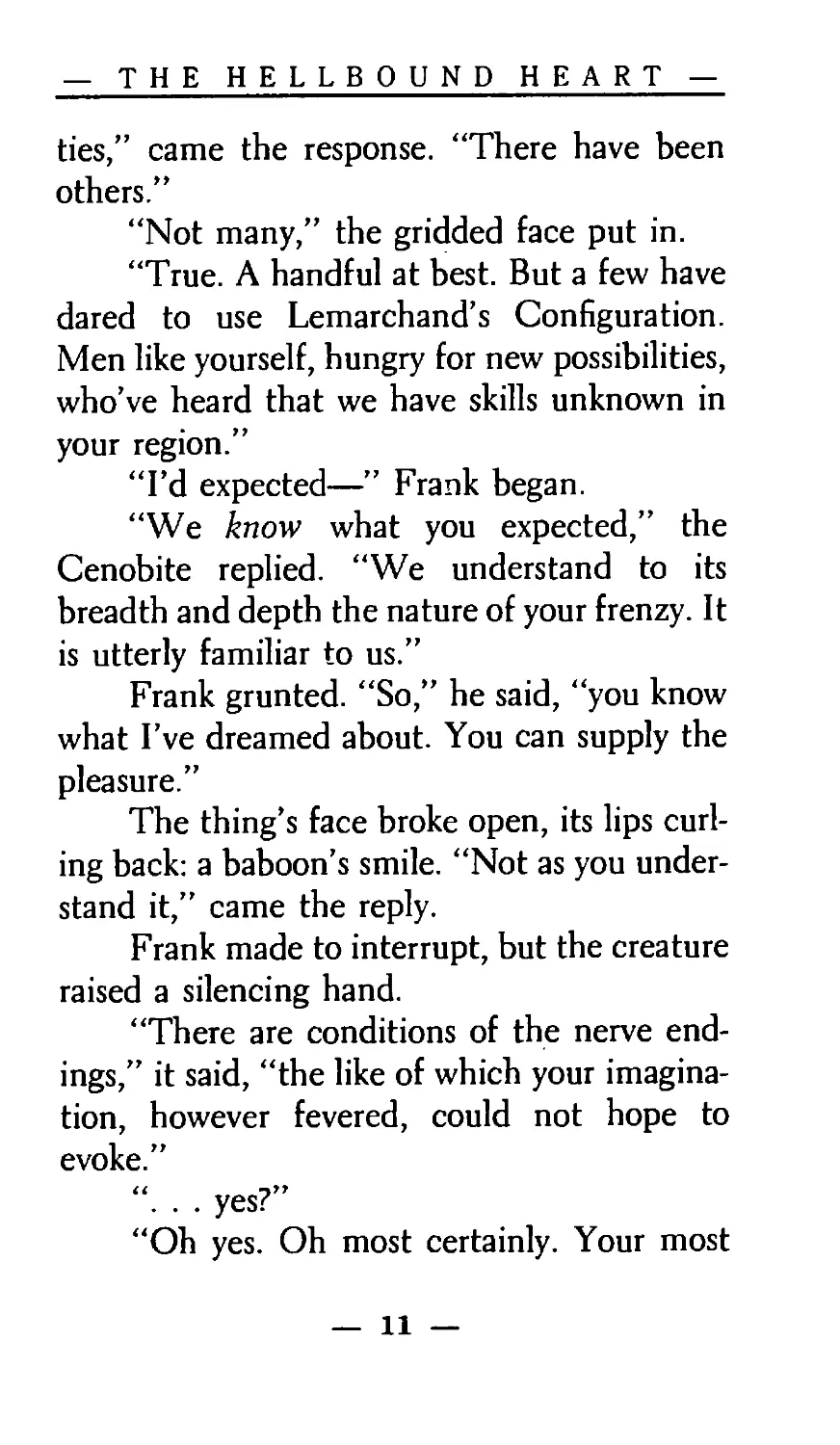
“You know what I’ve dreamed about,” said
Frank. “You can supply the pleasure.”
The thing’s face broke open, its lips curling
back: a baboon’s smile. “Not as you understand it,”
came the reply.
Frank made to interrupt, but the creature raised
a silencing hand.
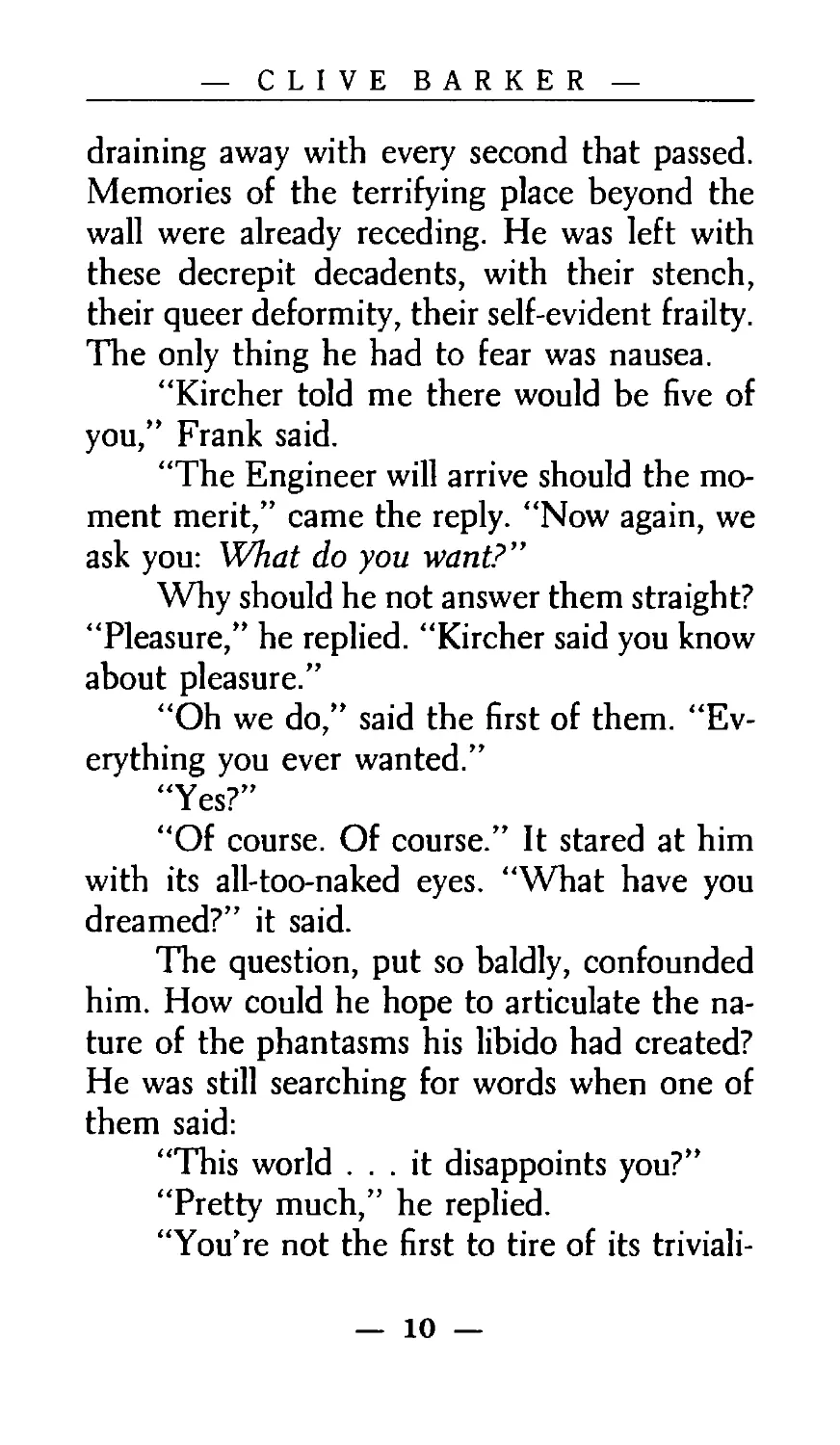
“There are conditions of the nerve endings,” it
said, “the like of which your imagination, however
fevered, could not hope to evoke.”
“. . . yes?”
“Oh yes. Oh most certainly. Your most trea-
sured depravity is child’s play beside the experiences
we offer. Will you partake of them?”
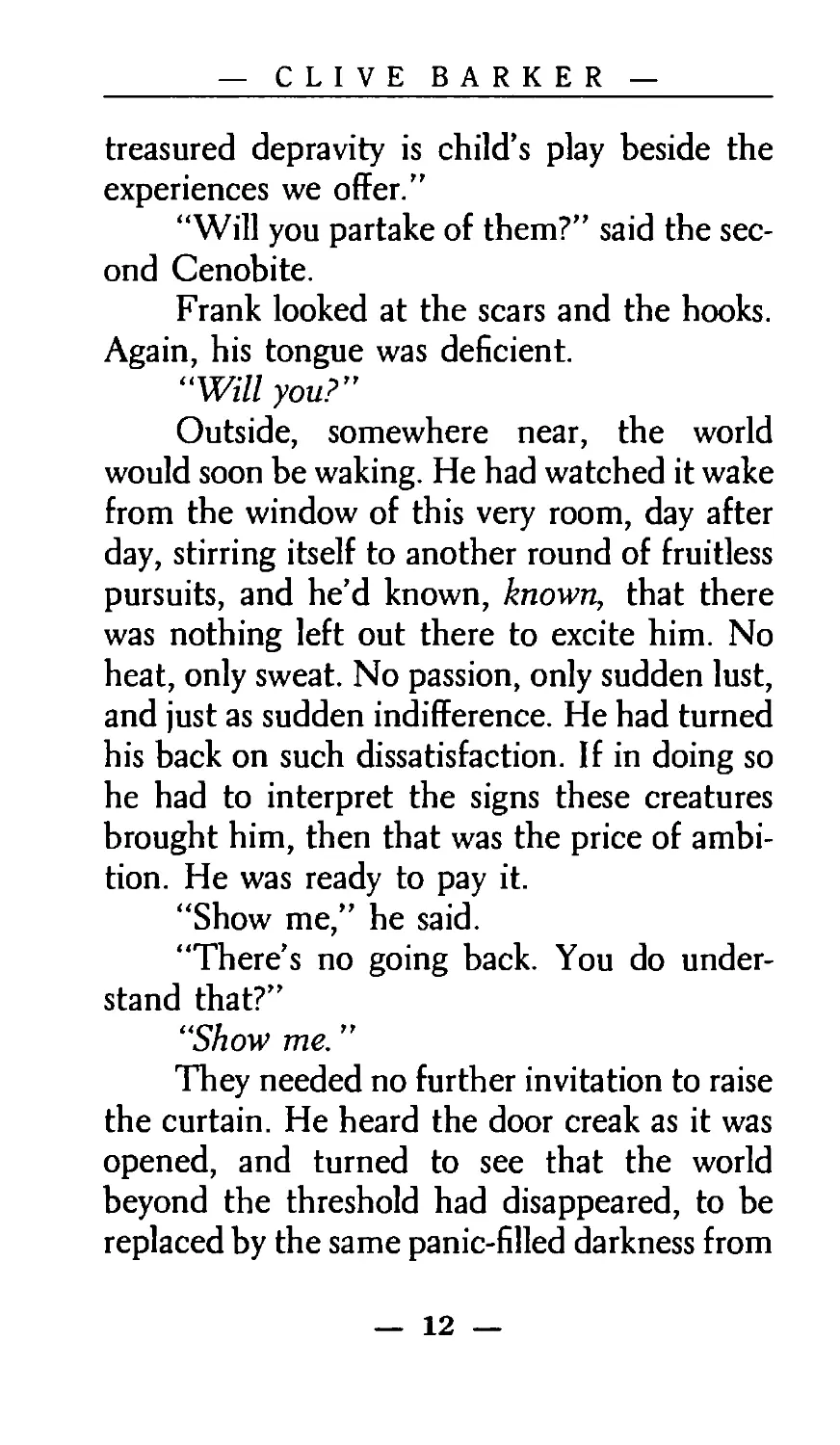
Frank looked at their scars and hooks. Again,
his tongue was deficient.
“Will you?”
Outside, somewhere near, the world would
soon be waking. He had watched it wake from the
window of this very room, day after day, stirring
itself to another round of fruitless pursuits, and he’d
known, known, that there was nothing left out there
to excite him.
“Show me,” he said.
ALSO BY CLIVE BARKER
THE BOOKS OF BLOOD, VOLUMES I-III
IN THE FLESH
THE INHUMAN CONDITION
THE DAMNATION GAME
WEAVEWORLD
CABAL
THE GREAT AND SECRET SHOW
IMAJICA
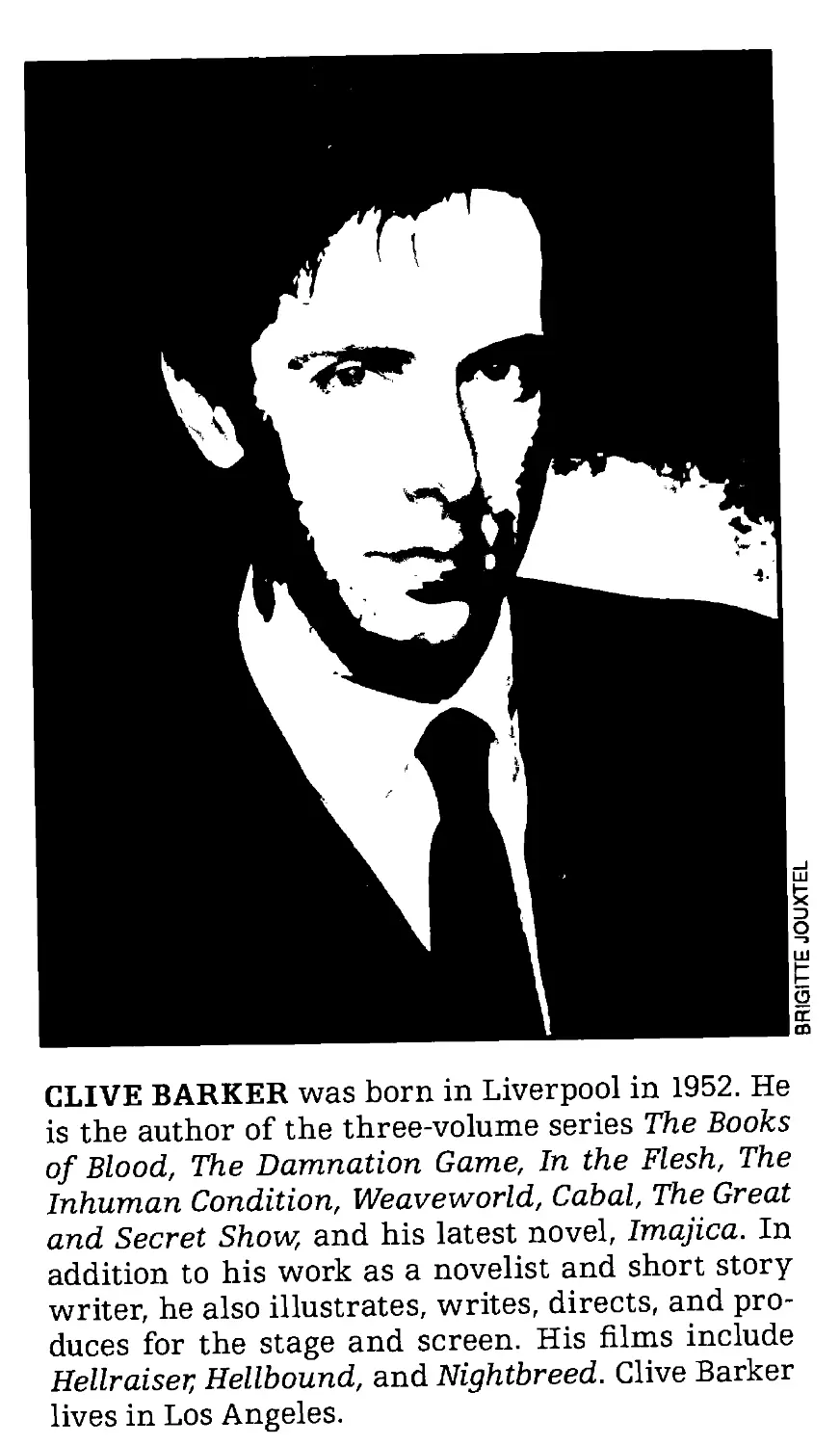
CLIVE
BARKER
THE HELLBOUND
HEART
HarperPaperbacks
A Division of HarperCollinsPwWzsAers
If you purchased this book without a cover, you should be
aware that this book is stolen property. It was reported as
“unsold and destroyed” to the publisher and neither the
author nor the publisher has received any payment for this
“stripped book.”
This is a work of fiction. The characters, incidents, and
dialogues are products of the author’s imagination and are
not to be construed as real. Any resemblance to actual
events or persons, living or dead, is entirely coincidental.
HarperPaperbacks A Division of HarperCoWinsPublishers
10 East 53rd Street, New York, N.Y. 10022
Copyright © 1986 by Clive Barker
All rights reserved. No part of this book may be used or
reproduced in any manner whatsoever without written
permission of the publisher, except in the case of brief
quotations embodied in critical articles and reviews. For
information address HarperCollinsPaWrsAers,
10 East 53rd Street, New York, N.Y. 10022.
This book is published by arrangement with the author.
Cover illustration by Kirk Reinert
First HarperPaperbacks printing: November 1991
Printed in the United States of America
HarperPaperbacks and colophon are trademarks of
Harpe rCollinsPwWzsAers
10 987654321
for Mary
I long to talk with some old lover’s ghost
Who died before the god of Love was bom.
—John Donne, Love’s Deitie
THE HELLBOUND
HEART
ONE
intent was Frank upon solving the puz-
zle of Lemarchand’s box that he didn’t
hear the great bell begin to ring. The
device had been constructed by a master crafts-
man, and the riddle was this—that though he’d
been told the box contained wonders, there
simply seemed to be no way into it, no clue on
any of its six black lacquered faces as to the
whereabouts of the pressure points that would
disengage one piece of this three-dimensional
jigsaw from another.
1
CLIVE BARKER
Frank had seen similar puzzles—mostly in
Hong Kong, products of the Chinese taste for
making metaphysics of hard wood—but to the
acuity and technical genius of the Chinese the
Frenchman had brought a perverse logic that
was entirely his own. If there was a system to
the puzzle, Frank had failed to find it. Only
after several hours of trial and error did a
chance juxtaposition of thumbs, middle and
last fingers bear fruit: an almost imperceptible
click, and then—victory!—a segment of the
box slid out from beside its neighbors.
There were two revelations.
The first, that the interior surfaces were
brilliantly polished. Frank’s reflection—dis-
torted, fragmented—skated across the lacquer.
The second, that Lemarchand, who had been
in his time a maker of singing birds, had con-
structed the box so that opening it tripped a
musical mechanism, which began to tinkle a
short rondo of sublime banality.
Encouraged by his success, Frank pro-
ceeded to work on the box feverishly, quickly
finding fresh alignments of fluted slot and oiled
peg which in their turn revealed further intrica-
cies. And with each solution—each new half
twist or pull—a further melodic element was
brought into play—the tune counterpointed
— 2 —
THE HELLBOUND HEART
and developed until the initial caprice was all
but lost in ornamentation.
At some point in his labors, the bell had
begun to ring—a steady somber tolling. He had
not heard, at least not consciously. But when
the puzzle was almost finished—the mirrored
innards of the box unknotted—he became
aware that his stomach churned so violently at
the sound of the bell it might have been ring-
ing half a lifetime.
He looked up from his work. For a few
moments he supposed the noise to be coming
from somewhere in the street outside—but he
rapidly dismissed that notion. It had been al-
most midnight before he’d begun to work at
the birdmaker’s box; several hours had gone
by—hours he would not have remembered
passing but for the evidence of his watch—
since then. There was no church in the city—
however desperate for adherents—that would
ring a summoning bell at such an hour.
No. The sound was coming from some-
where much more distant, through the very
door (as yet invisible) that Lemarchand’s mi-
raculous box had been constructed to open.
Everything that Kircher, who had sold him the
box, had promised of it was true! He was on the
— з
— CLIVE BARKER —
threshold of a new world, a province infinitely
far from the room in which he sat.
Infinitely far; yet now, suddenly near.
The thought had made his breath quick.
He had anticipated this moment so keenly,
planned with every wit he possessed this rend-
ing of the veil. In moments they would be
here—the ones Kircher had called the Ceno-
bites, theologians of the Order of the Gash.
Summoned from their experiments in the
higher reaches of pleasure, to bring their age-
less heads into a world of rain and failure.
He had worked ceaselessly in the preced-
ing week to prepare the room for them. The
bare boards had been meticulously scrubbed
and strewn with petals. Upon the west wall he
had set up a kind of altar to them, decorated
with the kind of placatory offerings Kircher had
assured him would nurture their good offices:
bones, bonbons, needles. A jug of his urine—
the product of seven days’ collection—stood on
the left of the altar, should they require some
spontaneous gesture of self-defilement. On the
right, a plate of doves’ heads, which Kircher
had also advised him to have on hand.
He had left no part of the invocation rit-
ual unobserved. No cardinal, eager for the
— 4 —
THE HELLBOUND HEART
fisherman’s shoes, could have been more dili-
gent.
But now, as the sound of the bell became
louder, drowning out the music box, he was
afraid.
Too late, he murmured to himself, hoping
to quell his rising fear. Lemarchand’s device
was undone; the final trick had been turned.
There was no time left for prevarication or
regret. Besides, hadn’t he risked both life and
sanity to make this unveiling possible? The
doorway was even now opening to pleasures no
more than a handful of humans had ever
known existed, much less tasted—pleasures
which would redefine the parameters of sensa-
tion, which would release him from the dull
round of desire, seduction and disappointment
that had dogged him from late adolescence. He
would be transformed by that knowledge,
wouldn’t he? No man could experience the
profundity of such feeling and remain un-
changed.
The bare bulb in the middle of the room
dimmed and brightened, brightened and
dimmed again. It had taken on the rhythm of
the bell, burning its hottest on each chime. In
the troughs between the chimes the darkness
in the room became utter; it was as if the world
— 5 —
CLIVE BARKER
he had occupied for twenty-nine years had
ceased to exist. Then the bell would sound
again, and the bulb burn so strongly it might
never have faltered, and for a few precious sec-
onds he was standing in a familiar place, with
a door that led out and down and into the
street, and a window through which—had he
but the will (or strength) to tear the blinds
back—he might glimpse a rumor of morning.
With each peal the bulb’s light was
becoming more revelatory. By it, he saw the
east wall flayed; saw the brick momentarily lose
solidity and blow away; saw, in that same in-
stant, the place beyond the room from which
the bell’s din was issuing. A world of birds was
it? Vast black birds caught in perpetual tem-
pest? That was all the sense he could make of
the province from which—even now—the
hierophants were coming—that it was in con-
fusion, and full of brittle, broken things that
rose and fell and filled the dark air with their
fright.
And then the wall was solid again, and the
bell fell silent. The bulb flickered out. This
time it went without a hope of rekindling.
He stood in the darkness, and said noth-
ing. Even if he could remember the words of
welcome he’d prepared, his tongue would not
— 6 —
THE HELLBOUND HEART
have spoken them. It was playing dead in his
mouth.
And then, light.
It came from them: from the quartet of
Cenobites who now, with the wall sealed be-
hind them, occupied the room. A fitful phos-
phorescence, like the glow of deep-sea fishes:
blue, cold, charmless. It struck Frank that he
had never once wondered what they would
look like. His imagination, though fertile when
it came to trickery and theft, was impoverished
in other regards. The skill to picture these emi-
nences was beyond him, so he had not even
tried.
Why then was he so distressed to set eyes
upon them? Was it the scars that covered every
inch of their bodies, the flesh cosmetically
punctured and sliced and infibulated, then
dusted down with ash? Was it the smell of
vanilla they brought with them, the sweetness
of which did little to disguise the stench be-
neath? Or was it that as the light grew, and he
scanned them more closely, he saw nothing of
joy, or even humanity, in their maimed faces:
only desperation, and an appetite that made his
bowels ache to be voided.
“What city is this?” one of the four en-
quired. Frank had difficulty guessing the
7 —
CLIVE BARKER
speaker’s gender with any certainty. Its clothes,
some of which were sewn to and through its
skin, hid its private parts, and there was noth-
ing in the dregs of its voice, or in its willfully
disfigured features that offered the least clue.
When it spoke, the hooks that transfixed the
flaps of its eyes and were wed, by an intricate
system of chains passed through flesh and bone
alike, to similar hooks through the lower lip,
were teased by the motion, exposing the glis-
tening meat beneath.
“I asked you a question,” it said. Frank
made no reply. The name of this city was the
last thing on his mind.
“Do you understand?” the figure beside
the first speaker demanded. Its voice, unlike
that of its companion, was light and breathy—
the voice of an excited girl. Every inch of its
head had been tattooed with an intricate grid,
and at every intersection of horizontal and ver-
tical axes a jeweled pin driven through to the
bone. Its tongue was similarly decorated. “Do
you even know who we are?” it asked.
“Yes.” Frank said at last. “I know.”
Of course he knew; he and Kircher had
spent long nights talking of hints gleaned from
the diaries of Bolingbroke and Gilles de Rais.
— 8
— THE HELLBOUND HEART —
All that mankind knew of the Order of the
Gash, he knew.
And yet . . . he had expected something
different. Expected some sign of the number-
less splendors they had access to. He had
thought they would come with women, at
least; oiled women, milked women; women
shaved and muscled for the act of love: their
lips perfumed, their thighs trembling to spread,
their buttocks weighty, the way he liked them.
He had expected sighs, and languid bodies
spread on the floor underfoot like a living car-
pet; had expected virgin whores whose every
crevice was his for the asking and whose skills
would press him—upward, upward—to un-
dreamed-of ecstasies. The world would be for-
gotten in their arms. He would be exalted by
his lust, instead of despised for it.
But no. No women, no sighs. Only these
sexless things, with their corrugated flesh.
Now the third spoke. Its features were so
heavily scarified—the wounds nurtured until
they ballooned—that its eyes were invisible
and its words corrupted by the disfigurement of
its mouth.
“What do you want?” it asked him.
He perused this questioner more confi-
dently than he had the other two. His fear was
— 9 —
CLIVE BARKER
draining away with every second that passed.
Memories of the terrifying place beyond the
wall were already receding. He was left with
these decrepit decadents, with their stench,
their queer deformity, their self-evident frailty.
The only thing he had to fear was nausea.
“Kircher told me there would be five of
you,” Frank said.
“The Engineer will arrive should the mo-
ment merit,” came the reply. “Now again, we
ask you: What do you want?”
Why should he not answer them straight?
“Pleasure,” he replied. “Kircher said you know
about pleasure.”
“Oh we do,” said the first of them. “Ev-
erything you ever wanted.”
“Yes?”
“Of course. Of course.” It stared at him
with its all-too-naked eyes. “What have you
dreamed?” it said.
The question, put so baldly, confounded
him. How could he hope to articulate the na-
ture of the phantasms his libido had created?
He was still searching for words when one of
them said:
“This world ... it disappoints you?”
“Pretty much,” he replied.
“You’re not the first to tire of its triviali-
10 —
— THE HELLBOUND HEART —
ties,” came the response. “There have been
others.”
“Not many,” the gridded face put in.
“True. A handful at best. But a few have
dared to use Lemarchand’s Configuration.
Men like yourself, hungry for new possibilities,
who’ve heard that we have skills unknown in
your region.”
“I’d expected—” Frank began.
“We know what you expected,” the
Cenobite replied. “We understand to its
breadth and depth the nature of your frenzy. It
is utterly familiar to us.”
Frank grunted. “So,” he said, “you know
what I’ve dreamed about. You can supply the
pleasure.”
The thing’s face broke open, its lips curl-
ing back: a baboon’s smile. “Not as you under-
stand it,” came the reply.
Frank made to interrupt, but the creature
raised a silencing hand.
“There are conditions of the nerve end-
ings,” it said, “the like of which your imagina-
tion, however fevered, could not hope to
evoke.”
“. . . yes?”
“Oh yes. Oh most certainly. Your most
11
CLIVE BARKER
treasured depravity is child’s play beside the
experiences we offer.”
“Will you partake of them?” said the sec-
ond Cenobite.
Frank looked at the scars and the hooks.
Again, his tongue was deficient.
‘‘Will you?”
Outside, somewhere near, the world
would soon be waking. He had watched it wake
from the window of this very room, day after
day, stirring itself to another round of fruitless
pursuits, and he’d known, known, that there
was nothing left out there to excite him. No
heat, only sweat. No passion, only sudden lust,
and just as sudden indifference. He had turned
his back on such dissatisfaction. If in doing so
he had to interpret the signs these creatures
brought him, then that was the price of ambi-
tion. He was ready to pay it.
“Show me,” he said.
“There’s no going back. You do under-
stand that?”
“Show me. ”
They needed no further invitation to raise
the curtain. He heard the door creak as it was
opened, and turned to see that the world
beyond the threshold had disappeared, to be
replaced by the same panic-filled darkness from
12
THE HELLBOUND HEART
which the members of the Order had stepped.
He looked back towards the Cenobites, seeking
some explanation for this. But they’d disap-
peared. Their passing had not gone unrecorded
however. They’d taken the flowers with them,
leaving only bare boards, and on the wall the
offerings he had assembled were blackening, as
if in the heat of some fierce but invisible flame.
He smelled the bitterness of their consump-
tion; it pricked his nostrils so acutely he was
certain they would bleed.
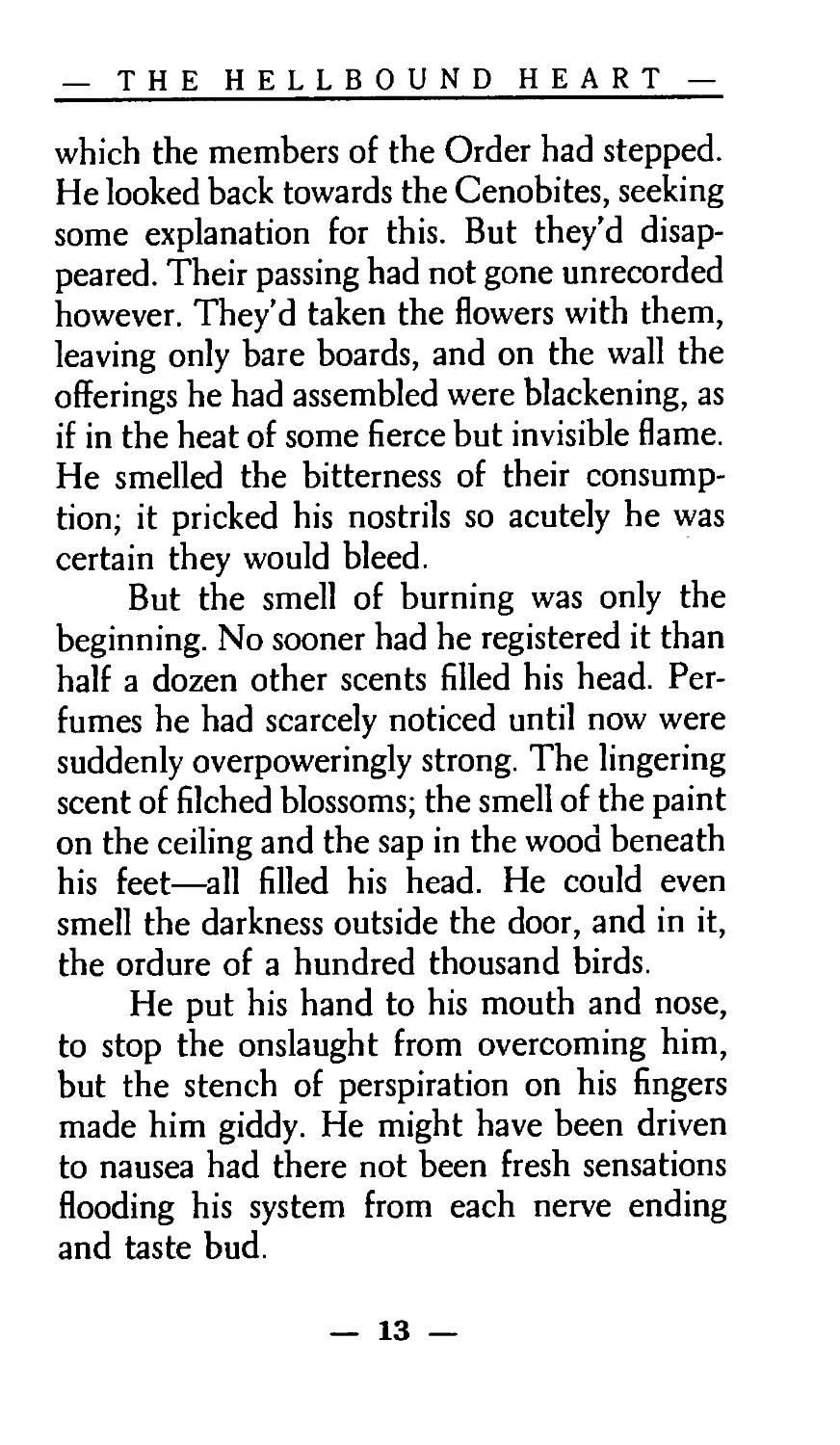
But the smell of burning was only the
beginning. No sooner had he registered it than
half a dozen other scents filled his head. Per-
fumes he had scarcely noticed until now were
suddenly overpoweringly strong. The lingering
scent of filched blossoms; the smell of the paint
on the ceiling and the sap in the wood beneath
his feet—all filled his head. He could even
smell the darkness outside the door, and in it,
the ordure of a hundred thousand birds.
He put his hand to his mouth and nose,
to stop the onslaught from overcoming him,
but the stench of perspiration on his fingers
made him giddy. He might have been driven
to nausea had there not been fresh sensations
flooding his system from each nerve ending
and taste bud.
13
CLIVE BARKER
It seemed he could suddenly feel the colli-
sion of the dust motes with his skin. Every
drawn breath chafed his lips; every blink, his
eyes. Bile burned in the back of his throat, and
a morsel of yesterday’s beef that had lodged
between his teeth sent spasms through his sys-
tem as it exuded a droplet of gravy upon his
tongue.
His ears were no less sensitive. His head
was filled with a thousand dins, some of which
he himself was father to. The air that broke
against his eardrums was a hurricane; the flatu-
lence in his bowels was thunder. But there were
other sounds—innumerable sounds—which as-
sailed him from somewhere beyond himself.
Voices raised in anger, whispered professions
of love, roars and rattlings, snatches of song,
tears.
Was it the world he was hearing—morn-
ing breaking in a thousand homes? He had no
chance to listen closely; the cacophony drove
any power of analysis from his head.
But there was worse. The eyes! Oh god in
heaven, he had never guessed that they could
be such torment; he, who’d thought there was
nothing on earth left to startle him. Now he
reeled! Everywhere, sight!
The plain plaster of the ceiling was an
14
THE HELLBOUND HEART
awesome geography of brush strokes. The
weave of his plain shirt an unbearable elabora-
tion of threads. In the corner he saw a mite
move on a dead dove’s head, and wink its eyes
at him, seeing that he saw. Too much! Too
much!
Appalled, he shut his eyes. But there was
more inside than out; memories whose vio-
lence shook him to the verge of senselessness.
He sucked his mother’s milk, and choked; felt
his sibling’s arms around him (a fight, was it, or
a brotherly embrace? Either way, it suffocated).
And more; so much more. A short lifetime of
sensations, all writ in a perfect hand upon his
cortex, and breaking him with their insistence
that they be remembered.
He felt close to exploding. Surely the
world outside his head—the room, and the
birds beyond the door—they, for all their
shrieking excesses, could not be as overwhelm-
ing as his memories. Better that, he thought,
and tried to open his eyes. But they wouldn’t
unglue. Tears or pus or needle and thread had
sealed them up.
He thought of the faces of the Cenobites:
the hooks, the chains. Had they worked some
similar surgery upon him, locking him up be-
hind his eyes with the parade of his history?
15
CLIVE BARKER
In fear for his sanity, he began to address
them, though he was no longer certain that
they were even within earshot.
“Why?” he asked. “Why are you doing
this to me?”
The echo of his words roared in his ears,
but he scarcely attended to it. More sense im-
pressions were swimming up from the past to
torment him. Childhood still lingered on his
tongue (milk and frustration) but there were
adult feelings joining it now. He was grown! He
was mustached and mighty, hands heavy, gut
large.
Youthful pleasures had possessed the ap-
peal of newness, but as the years had crept on,
and mild sensation lost its potency, stronger
and stronger experiences had been called for.
And here they came again, more pungent for
being laid in the darkness at the back of his
head.
He felt untold tastes upon his tongue: bit-
ter, sweet, sour, salty; smelled spice and shit
and his mother’s hair; saw cities and skies; saw
speed, saw deeps; broke bread with men now
dead and was scalded by the heat of their spit-
tle on his cheek.
And of course there were women.
Always, amid the flurry and confusion,
16 —
— THE HELLBOUND HEART —
memories of women appeared, assaulting him
with their scents, their textures, their tastes.
The proximity of this harem aroused him,
despite circumstances. He opened his trousers
and caressed his cock, more eager to have the
seed spilled and so be freed of these creatures
than for the pleasure of it.
He was dimly aware, as he worked his
inches, that he must make a pitiful sight: a
blind man in an empty room, aroused for a
dream’s sake. But the wracking, joyless orgasm
failed to even slow the relentless display. His
knees buckled, and his body collapsed to the
boards where his spunk had fallen. There was
a spasm of pain as he hit the floor, but the
response was washed away before another wave
of memories.
He rolled onto his back, and screamed;
screamed and begged for an end to it, but the
sensations only rose higher still, whipped to
fresh heights with every prayer for cessation he
offered up.
The pleas became a single sound, words
and sense eclipsed by panic. It seemed there
was no end to this, but madness. No hope but
to be lost to hope.
As he formulated this last, despairing
thought, the torment stopped.
17 —
CLIVE BARKER
All at once; all of it. Gone. Sight, sound,
touch, taste, smell. He was abruptly bereft of
them all. There were seconds then, when he
doubted his very existence. Two heartbeats,
three, four.
On the fifth beat, he opened his eyes. The
room was empty, the doves and the piss-pot
gone. The door was closed.
Gingerly, he sat up. His limbs were tin-
gling; his head, wrist, and bladder ached.
And then—a movement at the other end
of the room drew his attention.
Where, two moments before, there had
been an empty space, there was now a figure.
It was the fourth Cenobite, the one that had
never spoken, nor shown its face. Not it, he
now saw: but she. The hood it had worn had
been discarded, as had the robes. The woman
beneath was gray yet gleaming, her lips bloody,
her legs parted so that the elaborate scarifica-
tion of her pubis was displayed. She sat on a
pile of rotting human heads, and smiled in
welcome.
The collision of sensuality and death ap-
palled him. Could he have any doubt that she
had personally dispatched these victims? Their
rot was beneath her nails, and their tongues—
twenty or more—lay out in ranks on her oiled
18 —
— THE HELLBOUND HEART —
thighs, as if awaiting entrance. Nor did he
doubt that the brains now seeping from their
ears and nostrils had been driven to insanity
before a blow or a kiss had stopped their hearts.
Kircher had lied to him—either that or
he’d been horribly deceived. There was no
pleasure in the air; or at least not as humankind
understood it.
He had made a mistake opening Lemar-
chand’s box. A very terrible mistake.
“Oh, so you’ve finished dreaming,” said
the Cenobite, perusing him as he lay panting
on the bare boards. “Good.”
She stood up. The tongues fell to the
floor, like a rain of slugs.
“Now we can begin,” she said.
19 —
TWO
t’s not quite what I expected,” Julia
я commented as they stood in the hall-
way. It was twilight; a cold day in Au-
gust. Not the ideal time to view a house that
had been left empty for so long.
“It needs work,” Rory said. “That’s all.
It’s not been touched since my grandmother
died. That’s the best part of three years. And
I’m pretty sure she never did anything to it
towards the end of her life.”
— 20 —
THE HELLBOUND HEART
“And it’s yours?”
“Mine and Frank’s. It was willed to us
both. But when was the last time anybody saw
big brother?”
She shrugged, as if she couldn’t remem-
ber, though she remembered very well. A week
before the wedding.
“Someone said he spent a few days here
last summer. Rutting away, no doubt. Then he
was off again. He’s got no interest in property.”
“But suppose we move in, and then he
comes back, wants what’s his?”
“I’ll buy him out. I’ll get a loan from the
bank and buy him out. He’s always hard up for
cash.”
She nodded, but looked less than per-
suaded.
“Don’t worry,” he said, going to where
she was standing and wrapping his arms around
her. “The place is ours, doll. We can paint it
and pamper it and make it like heaven.”
He scanned her face. Sometimes—partic-
ularly when doubt moved her, as it did now—
her beauty came close to frightening him.
“Trust me,” he said.
“I do.”
“All right then. What say we start moving
in on Sunday?”
— 21
CLIVE BARKER
____________________ 2 ______________________
Sunday.
It was still the Lord’s Day up this end of
the city. Even if the owners of these well-
dressed houses and well-pressed children were
no longer believers, they still observed the sab-
bath. A few curtains were twitched aside when
Lewton’s van drew up, and the unloading
began; some curious neighbors even sauntered
past the house once or twice, on the pretext of
walking the hounds; but nobody spoke to the
new arrivals, much less offered a hand with the
furniture. Sunday was not a day to break sweat.
Julia looked after the unpacking, while
Rory organized the unloading of the van, with
Lewton and Mad Bob providing the extra mus-
cle. It took four round-trips to transfer the bulk
of the stuff from Alexandra Road, and at the
end of the day there was still a good deal of
bric-a-brac left behind, to be collected at a later
point.
About two in the afternoon, Kirsty turned
up on the doorstep.
“Came to see if I could give you a hand,”
she said, with a tone of vague apology in her
voice.
“Well, you’d better come in,” Julia said.
— 22 —
THE HELLBOUND HEART
She went back into the front room, which was
a battlefield in which only chaos was winning,
and quietly cursed Rory. Inviting the lost soul
round to offer her services was his doing, no
doubt of it. She would be more of a hindrance
than a help; her dreamy, perpetually defeated
manner set Julia’s teeth on edge.
“What can I do?” Kirsty asked. “Rory
said—”
“Yes,” said Julia. “I’m sure he did.”
“Where is he? Rory, I mean.”
“Gone back for another vanload, to add to
the misery.”
“Oh.”
Julia softened her expression. “You know
it’s very sweet of you,” she said, “to come
round like this, but I don’t think there’s much
you can do just at the moment.”
Kirsty flushed slightly. Dreamy she was,
but not stupid.
“I see,” she said. “Are you sure? Can’t
... I mean, maybe I could make a cup of coffee
for you?”
“Coffee,” said Julia. The thought of it
made her realize just how parched her throat
had become. “Yes,” she conceded. “That’s not
a bad idea.”
The coffeemaking was not without its
— 23 —
CLIVE BARKER
minor traumas. No task Kirsty undertook was
ever entirely simple. She stood in the kitchen,
boiling water in a pan it had taken a quarter of
an hour to find, thinking that maybe she
shouldn’t have come after all. Julia always
looked at her so strangely, as if faintly baffled
by the fact that she hadn’t been smothered at
birth. No matter. Rory had asked her to come,
hadn’t he? And that was invitation enough.
She would not have turned down the chance of
his smile for a hundred Julias.
The van arrived twenty-five minutes later,
minutes in which the women had twice at-
tempted, and twice failed, to get a conversation
simmering. They had little in common. Julia
the sweet, the beautiful, the winner of glances
and kisses, and Kirsty the girl with the pale
handshake, whose eyes were only ever as bright
as Julia’s before or after tears. She had long ago
decided that life was unfair. But why, when
she’d accepted that bitter truth, did circum-
stance insist on rubbing her face in it?
She surreptitiously watched Julia as she
worked, and it seemed to Kirsty that the
woman was incapable of ugliness. Every ges-
ture—a stray hair brushed from the eyes with
the back of the hand, dust blown from a favor-
ite cup—all were infused with such effortless
24 —
— THE HELLBOUND HEART —
grace. Seeing it, she understood Rory’s doglike
adulation, and understanding it, despaired
afresh.
He came in, at last, squinting and sweaty.
The afternoon sun was fierce. He grinned at
her, parading the ragged line of his front teeth
that she had first found so irresistible.
‘Tm glad you could come,” he said.
“Happy to help—” she replied, but he
had already looked away, at Julia.
“How’s it going?”
“I’m losing my mind,” she told him.
“Well, now you can rest from your la-
bors,” he said. “We brought the bed this trip.”
He gave her a conspiratorial wink, but she
didn’t respond.
“Can I help with unloading?” Kirsty of-
fered.
“Lewton and M.B. are doing it,” came
Rory’s reply.
“Oh.”
“But I’d give an arm and a leg for a cup
of tea.”
“We haven’t found the tea,” Julia told
him.
“Oh. Maybe a coffee, then?”
“Right,” said Kirsty. “And for the other
two?”
— 25 —
CLIVE BARKER
“They’d kill for a cup.”
Kirsty went back to the kitchen, filled the
small pan to near brimming, and set it back on
the stove. From the hallway she heard Rory
supervising the next unloading.
It was the bed, the bridal bed. Though she
tried very hard to keep the thought of his em-
bracing Julia out of her mind, she could not. As
she stared into the water, and it simmered and
steamed and finally boiled, the same painful
images of their pleasure came back and back.
_____________________ 3 ______________________
While the trio were away, gathering the
fourth and final load of the day, Julia lost her
temper with the unpacking. It was a disaster,
she said; everything had been parceled up and
put into the tea chests in the wrong order. She
was having to disinter perfectly useless items to
get access to the bare necessities.
Kirsty kept her silence, and her place in
the kitchen, washing the soiled cups.
Cursing louder, Julia left the chaos and
went out for a cigarette on the front step. She
leaned against the open door, and breathed the
pollen-gilded air. Already, though it was only
26
THE HELLBOUND HEART
the twenty-first of August, the afternoon was
tinged with a smoky scent that heralded au-
tumn.
She had lost track of how fast the day had
gone, for as she stood there a bell began to ring
for Evensong: the run of chimes rising and
falling in lazy waves. The sound was reassuring.
It made her think of her childhood, though
not—that she could remember—of any partic-
ular day or place. Simply of being young, of
mystery.
It was four years since she’d last stepped
into a church: the day of her marriage to Rory,
in fact. The thought of that day—or rather, of
the promise it had failed to fulfill—soured the
moment. She left the step, the chimes in full
flight, and turned back into the house. After
the touch of the sun on her upturned face, the
interior seemed gloomy. Suddenly she tired to
the point of tears.
They would have to assemble the bed
before they could put their heads down to sleep
tonight, and they had yet to decide which room
they would use as the master bedroom. She
would do that now, she elected, and so avoid
having to return to the front room, and to
ever-mournful Kirsty.
The bell was still pealing when she opened
— 27 —
CLIVE BARKER
the door of the front room on the second floor.
It was the largest of the three upper rooms—a
natural choice—but the sun had not got in
today (or any other day this summer) because
the blinds were drawn across the window. The
room was consequently chillier than anywhere
else in the house; the air stagnant. She crossed
the stained floorboards to the window, intend-
ing to remove the blind.
At the sill, a strange thing. The blind had
been securely nailed to the window frame, ef-
fectively cutting out the least intrusion of life
from the sunlit street beyond. She tried to pull
the material free, but failed. The workman,
whoever he’d been, had done a thorough job.
No matter; she’d have Rory take a claw
hammer to the nails when he got back. She
turned from the window, and as she did so she
was suddenly and forcibly aware that the bell
was still summoning the faithful. Were they
not coming tonight? Was the hook not suffi-
ciently baited with promises of paradise? The
thought was only half alive; it withered in mo-
ments. But the bell rolled on, reverberating
around the room. Her limbs, already aching
with fatigue, seemed dragged down further by
each peal. Her head throbbed intolerably.
The room was hateful, she’d decided; it
— 28 —
THE HELLBOUND HEART
was stale, and its benighted walls clammy. De-
spite its size, she would not let Rory persuade
her into using it as the master bedroom. Let it
rot.
She started toward the door, but as she
came within a yard of it, the corners of the
room seemed to creak, and the door slammed.
Her nerves jangled. It was all she could do to
prevent herself from sobbing.
Instead she simply said, “Go to hell,” and
snatched at the handle. It turned easily (why
should it not? yet she was relieved) and the
door swung open. From the hall below, a splash
of warmth and ocher light.
She closed the door behind her and, with
a queer satisfaction the root of which she
couldn’t or wouldn’t fathom turned the key in
the lock.
As she did so, the bell stopped.
_____________________ 4 ______________________
“But it’s the biggest of the rooms . . .”
“I don’t like it, Rory. It’s damp. We can
use the back room.”
“If we can get the bloody bed through the
door.”
— 29 —
CLIVE BARKER
“Of course we can. You know we can.”
“Seems a waste of a good room,” he pro-
tested, knowing full well that this was a fait
accompli.
“Mother knows best,” she told him, and
smiled at him with eyes whose luster was far
from maternal.
— 30 —
THREE
_______________________ 1 __________________________
The seasons long for each other, like men
and women, in order that they may be
cured of their excesses.
Spring, if it lingers more than a week
beyond its span, starts to hunger for summer to
end the days of perpetual promise. Summer in
its turn soon begins to sweat for something to
quench its heat, and the mellowest of autumns
will tire of gentility at last, and ache for a quick
sharp frost to kill its fruitfulness.
— 31
CLIVE BARKER
Even winter—the hardest season, the
most implacable—dreams, as February creeps
on, of the flame that will presently melt it
away. Everything tires with time, and starts to
seek some opposition, to save it from itself.
So August gave way to September and
there were few complaints.
___________________ 2 ____________________
With work, the house on Lodovico Street
began to look more hospitable. There were
even visits from neighbors, who—after sizing
up the couple—spoke freely of how happy they
were to have number fifty-five occupied again.
Only one of them made any mention of Frank,
referring in passing to the odd fellow who’d
lived in the house for a few weeks the previous
summer. There was a moment of embarrass-
ment when Rory revealed the tenant to have
been his brother, but it was soon glossed over
by Julia, whose power to charm knew no
bounds.
Rory had seldom made mention of Frank
during the years of his marriage to Julia,
though he and his brother were only eighteen
months apart in age, and had, as children, been
— 32 —
THE HELLBOUND HEART
inseparable. This Julia had learned on an occa-
sion of drunken reminiscing—a month or two
before the wedding—when Rory had spoken at
length about Frank. It had been melancholy
talk. The brothers’ paths had diverged consid-
erably once they’d passed through adolescence,
and Rory regretted it. Regretted still more the
pain Frank’s wild life-style had brought to their
parents. It seemed that when Frank appeared,
once in a blue moon, from whichever corner of
the globe he was presently laying waste, he only
brought grief. His tales of adventures in the
shallows of criminality, his talk of whores and
petty theft, all appalled their parents. But there
had been worse, or so Rory had said. In his
wilder moments Frank had talked of a life lived
in delirium, of an appetite for experience that
conceded no moral imperative.
Was it the tone of Rory’s telling, a mix-
ture of revulsion and envy, that had so piqued
Julia’s curiosity? Whatever the reason, she had
been quickly seized by an unquenchable curios-
ity concerning this madman.
Then, barely a fortnight before the wed-
ding, the black sheep had appeared in the flesh.
Things had gone well for him of late. He was
wearing gold rings on his fingers, and his skin
was tight and tanned. There was little outward
— 33
CLIVE BARKER
sign of the monster Rory had described.
Brother Frank was smooth as a polished stone.
She had succumbed to his charm within hours.
A strange time ensued. As the days crept
toward the date of the wedding she found her-
self thinking less and less of her husband-to-be,
and more and more of his brother. They were
not wholly dissimilar; a certain lilt in their
voices, and their easy manner, marked them as
siblings. But to Rory’s qualities Frank brought
something his brother would never have: a
beautiful desperation.
Perhaps what had happened next had
been inevitable; and no matter how hard she’d
fought her instincts, she would only have post-
poned the consummation of their feelings for
each other. At least that was how she tried to
excuse herself later. But when all the self-re-
crimination was done with, she still treasured
the memory of their first—and last—encoun-
ter.
Kirsty had been at the house, hadn’t she?,
on some matrimonial business, when Frank
had arrived. But by that telepathy that comes
with desire (and fades with it) Julia had known
that today was the day. She’d left Kirsty to her
listmaking or suchlike, and taken Frank up-
stairs on the pretext of showing him the wed-
— 34 —
THE HELLBOUND HEART
ding dress. That was how she remembered it—
that he’d asked to see the dress—and she’d put
the veil on, laughing to think of herself in
white, and then he’d been at her shoulder,
lifting the veil, and she’d laughed on, laughed
and laughed, as though to test the strength of
his purpose. He had not been cooled by her
mirth however; nor had he wasted time with
the niceties of a seduction. The smooth exte-
rior gave way to cruder stuff almost immedi-
ately. Their coupling had had in every regard
but the matter of her acquiescence, all the ag-
gression and the joylessness of rape.
Memory sweetened events of course, and
in the four years (and five months) since that
afternoon, she’d replayed the scene often.
Now, in remembering it, the bruises were tro-
phies of their passion, her tears proof positive
of her feelings for him.
The day following, he’d disappeared. Flit-
ted off to Bangkok or Easter Island, some place
where he had no debts to answer. She’d
mourned him, couldn’t help it. Nor had her
mourning gone unnoticed. Though it was
never explicitly discussed, she had often won-
dered if the subsequent deterioration of her
relationship with Rory had not started there:
— 35 —
CLIVE BARKER
with her thinking of Frank as she made love to
his brother.
And now? Now, despite the change of
domestic interiors, and the chance of a fresh
start together, it seemed that events conspired
to remind her again of Frank.
It wasn’t just the gossip of the neighbors
that brought him to mind. One day, when she
was alone in the house and unpacking various
personal belongings, she came across several
wallets of Rory’s photographs. Many were rela-
tively recent: pictures of the two of them to-
gether in Athens and Malta. But buried
amongst the transparent smiles were some pic-
tures she couldn’t remember ever having seen
before (had Rory kept them from her?); family
portraits that went back decades. A photo-
graph of his parents on their wedding day, the
black and white image eroded over the years to
a series of grays. Pictures of christenings, in
which proud godparents cradled babies smoth-
ered in the family lace.
And then, photographs of the brothers
together; as toddlers, with wide eyes; as surly
schoolchildren, snapped at gymnastic displays
and in school pageants. Then, as the shyness of
acne-ridden adolescence took over, the number
— 36
THE HELLBOUND HEART
of pictures dwindled—until the frogs emerged,
as princes, the other side of puberty.
Seeing Frank in brilliant color, clowning
for the camera, she felt herself blushing. He
had been an exhibitionist youth, predictably
enough, always dressed a la mode. Rory, by
comparison, looked dowdy. It seemed to her
that the brothers’ future lives were sketched in
these early portraits. Frank the smiling, seduc-
tive chameleon; Rory the solid citizen.
She had packed the pictures away at last,
and found, when she stood up, that with the
blushes had come tears. Not of regret. She had
no use for that. It was fury that made her eyes
sting. Somehow, between one breath and the
next, she’d lost herself.
She knew too, with perfect certainty,
when her grip had first faltered. Lying on a bed
of wedding lace, while Frank beset her neck
with kisses.
_____________________ 3 ________________________
Once in a while she went up to the room
with the sealed blinds.
So far, they’d done little decorating work
on the upper floors, preferring to first organize
— 37 —
CLIVE BARKER
the areas in public gaze. The room had there-
fore remained untouched. Unentered, indeed,
except for these few visits of hers.
She wasn’t sure why she went up, nor how
to account for the odd assortment of feelings
that beset her while there. But there was some-
thing about the dark interior that gave her
comfort; it was a womb of sorts, a dead
woman’s womb. Sometimes, when Rory was at
work, she simply took herself up the stairs and
sat in the stillness, thinking of nothing; or at
least nothing she could put words to.
These sojourns made her feel oddly guilty,
and she tried to stay away from the room when
Rory was around. But it wasn’t always possible.
Sometimes her feet took her there without in-
struction to do so.
It happened thus that Saturday, the day of
the blood.
She had been watching Rory at work on
the kitchen door, chiseling several layers of
paint from around the hinges, when she
seemed to hear the room call. Satisfied that he
was thoroughly engrossed in his chores, she
went upstairs.
It was cooler than usual, and she was glad
of it. She put her hand to the wall, and then
transferred her chilled palm to her forehead.
— 38 —
THE HELLBOUND HEART
“No use,” she murmured to herself, pic-
turing the man at work downstairs. She didn’t
love him; no more than he, beneath his infatua-
tion with her face, loved her. He chiseled in a
world of his own; she suffered here, far
removed from him.
A gust of wind caught the back door
below. She heard it slam.
Downstairs, the sound made Rory lose his
concentration. The chisel jumped its groove
and sliced deeply into the thumb of his left
hand. He shouted, as a gush of color came. The
chisel hit the floor.
“Hell and damnation!”
She heard, but did nothing. Too late, she
surfaced through a stupor of melancholy to re-
alize that he was coming upstairs. Fumbling for
the key, and an excuse to justify her presence
in the room, she stood up, but he was already
at the door, crossing the threshold, rushing to-
ward her, his right hand clamped ineptly
around his left. Blood was coming in abun-
dance. It welled up between his fingers and
dribbled down his arm, dripping from his
elbow, adding stain to stain on the bare boards.
“What have you done?” she asked him.
“What does it look like?” he said through
gritted teeth. “Cut myself.”
— 39 —
CLIVE BARKER
His face and neck had gone the color of
window putty. She’d seen him like this before;
he had on occasion passed out at the sight of
his own blood.
“Do something,” he said queasily.
“Is it deep?”
“I don’t know!” he yelled at her. “I don’t
want to look.”
He was ridiculous, she thought, but this
wasn’t the time to give vent to the contempt
she felt. Instead she took his bloody hand in
hers and, while he looked away, prized the
palm from the cut. It was sizable, and still
bleeding profusely. Deep blood, dark blood.
“I think we’d better take you off to the
hospital,” she told him.
“Can you cover it up?” he asked, his voice
devoid of anger now.
“Sure. I’ll get a clean binding. Come
У У
on---
“No,” he said, shaking his ashen face. “If
I take a step, I think I’ll pass out.”
“Stay here then,” she soothed him.
“You’ll be fine.”
Finding no bandages in the bathroom
cabinet the equal of the staunching, she
fetched a few clean handkerchiefs from his
drawer and went back into the room. He was
40
— THE HELLBOUND HEART —
leaning against the wall now, his skin glossy
with sweat. He had padded in the blood he’d
shed; she could taste the tang of it in the air.
Still quietly reassuring him that he
wouldn’t die of a two-inch cut, she wound a
handkerchief around his hand, bound it on
with a second, then escorted him, trembling
like a leaf, down the stairs (one by one, like a
child) and out to the car.
At the hospital they waited an hour in a
queue of the walking wounded before he was
finally seen, and stitched up. It was difficult for
her to know in retrospect what was more comi-
cal about the episode: his weakness, or the ex-
travagance of his subsequent gratitude. She
told him, when he became fulsome, that she
didn’t want thanks from him, and it was true.
She wanted nothing that he could offer
her, except perhaps his absence.
_________________ 4 __________________
“Did you clean up the floor in the damp
room?” she asked him the following day.
They’d called it the damp room since that first
Sunday, though there was not a sign of rot from
ceiling to skirting board.
— 41
CLIVE BARKER
Rory looked up from his magazine. Gray
moons hung beneath his eyes. He hadn’t slept
well, so he’d said. A cut finger, and he had
nightmares of mortality. She, on the other
hand, had slept like a babe.
“What did you say?” he asked her.
“The floor—” she said again. “There was
blood on the floor. You cleaned it up.”
He shook his head. “No,” he said simply
and returned to the magazine.
“Well I didn’t,” she said.
He offered her an indulgent smile.
“You’re such a perfect hausfrau,” he said.
“You don’t even know when you’re doing it.”
The subject was closed there. He was con-
tent, apparently, to believe that she was quietly
losing her sanity.
She, on the other hand, had the strangest
sense that she was about to find it again.
— 42
FOUR
______________________ 1 ___________________:_____
TJ^irsty hated parties. The smiles to be
pasted on over the panic, the glances
A. JL to be interpreted, and worst, the con-
versation. She had nothing to say of the least
interest to the world, of this she had long
been convinced. She’d watched too many
eyes glaze over to believe otherwise, seen
every device known to man for wheedling
oneself out of the company of the dull, from
“Will you excuse me, I believe I see my ac-
— 43
CLIVE BARKER
countant,” to passing out dead drunk at her
feet.
But Rory had insisted she come to the
housewarming. Just a few close friends, he’d
promised. She’d said yes, knowing all too well
what scenario would ensue from refusal. Mop-
ing at home in a stew of self-recrimination,
cursing her cowardice, and thinking of Rory’s
sweet face.
The gathering wasn’t such a torment as it
turned out. There were only nine guests in toto,
all of whom she knew vaguely, which made it
easier. They didn’t expect her to illuminate the
room, only to nod and laugh where appropri-
ate. And Rory—his hand still bound up—was
at his most winning, full of guileless bonhomie.
She even wondered if Neville—one of Rory’s
work colleagues—wasn’t making eyes at her
behind his spectacles, a suspicion that was con-
firmed in the middle of the evening when he
maneuvered himself to her side and inquired
whether she had any interest in cat breeding.
She told him she hadn’t, but was always inter-
ested in new experiences. He seemed de-
lighted, and on this fragile pretext proceeded to
ply her with liqueurs for the rest of the night.
By eleven-thirty she was a whoozy but happy
— THE HELLBOUND HEART —
wreck, prompted by the most casual remark to
ever more painful fits of giggling.
A little after midnight, Julia declared that
she was tired, and wanted to go to bed. The
statement was taken as a general cue for disper-
sal, but Rory would have none of it. He was up
and refilling glasses before anyone had a chance
to protest. Kirsty was certain she caught a look
of displeasure cross Julia’s face, then it passed,
and the brow was unsullied once again. She
said her good-nights, was complimented pro-
fusely on her skill with calf’s liver, and went to
bed.
The flawlessly beautiful were flawlessly
happy, weren’t they? To Kirsty this had always
seemed self-evident. Tonight, however, the al-
cohol made her wonder if envy hadn’t blinded
her. Perhaps to be flawless was another kind of
sadness.
But her spinning head had an inept hold
on such ruminations, and the next minute Rory
was up, and telling a joke about a gorilla and a
Jesuit that had her choking on her drink before
he’d even got to the votive candles.
Upstairs, Julia heard a fresh bout of laugh-
ter. She was indeed tired, as she’d claimed, but
it wasn’t the cooking that had exhausted her.
It was the effort of suppressing her contempt
— 45 —
CLIVE BARKER
for the damn fools who were gathered in the
lounge below. She’d called them friends once,
these half-wits, with their poor jokes and their
poorer pretensions. She had played along with
them for several hours; it was enough. Now she
needed some cool place, some darkness.
As soon as she opened the door of the
damp room she knew things were not quite as
they had been. The light from the shadeless
bulb on the landing illuminated the boards
where Rory’s blood had fallen, now so clean
they might have been scrubbed. Beyond the
reach of the light, the room bowed to darkness.
She stepped in, and closed the door. The lock
clicked into place at her back.
The dark was almost perfect, and she was
glad of it. Her eyes rested against the night,
their surfaces chilled.
Then, from the far side of the room, she
heard a sound.
It was no louder than the din of a cock-
roach running behind the skirting boards.
After seconds, it stopped. She held her breath.
It came again. This time there seemed to be
some pattern to the sound; a primitive code.
They were laughing like loons downstairs.
The noise awoke desperation in her. What
would she not do, to be free of such company?
— 46 —
THE HELLBOUND HEART
She swallowed, and spoke to the darkness.
“I hear you,” she said, not certain of why
the words came, or to whom they were ad-
dressed.
The cockroach scratches ceased for a mo-
ment, and then began again, more urgently.
She stepped away from the door and moved
toward the noise. It continued, as if summon-
ing her.
It was easy to miscalculate in the dark,
and she reached the wall before she’d expected
to. Raising her hands, she began to run her
palms over the painted plaster. The surface was
not uniformly cold. There was a place, she
judged it to be halfway between door and win-
dow, where the chill became so intense she had
to break contact. The cockroach stopped
scratching.
There was a moment when she swam, to-
tally disoriented, in darkness and silence. And
then, something moved in front of her. A trick
of her mind’s eye, she assumed, for there was
only imagined light to be had here. But the
next spectacle showed her the error of that
assumption.
The wall was alight, or rather something
behind it burned with a cold luminescence that
made the solid brick seem insubstantial stuff.
— 47 —
CLIVE BARKER
More; the wall seemed to be coming apart,
segments of it shifting and dislocating like a
magician’s prop, oiled panels giving on to hid-
den boxes whose sides in turn collapsed to re-
veal some further hiding place. She watched
fixedly, not daring to even blink for fear she
miss some detail of this extraordinary sleight-
of-hand, while pieces of the world came apart
in front of her eyes.
Then, suddenly, somewhere in this ever
more elaborate system of sliding fragments, she
saw (or again, seemed to see) movement. Only
now did she realize that she’d been holding her
breath since this display began, and was begin-
ning to become light-headed. She tried to
empty her lungs of the stale air, and take a
draught of fresh, but her body would not obey
this simple instruction.
Somewhere in her innards a tic of panic
began. The hocus-pocus had stopped now,
leaving one part of her admiring quite dispas-
sionately the tinkling music that was coming
from the wall, the other part fighting the fear
that rose in her throat step by step.
Again, she tried to take a breath, but it
was as if her body had died, and she was staring
out of it, unable now to breathe or blink or
swallow.
— 48 —
THE HELLBOUND HEART
The spectacle of the unfolding wall had
now ceased entirely, and she saw something
flicker across the brick, ragged enough to be
shadow but too substantial.
It was human, she saw, or had been. But
the body had been ripped apart and sewn to-
gether again with most of its pieces either miss-
ing or twisted and blackened as if in a furnace.
There was an eye, gleaming at her, and the
ladder of a spine, the vertebrae stripped of mus-
cle, a few unrecognizable fragments of anat-
omy. That was it. That such a thing might live
beggared reason—what little flesh it owned
was hopelessly corrupted. Yet live it did. Its
eye, despite the rot it was rooted in, scanned
her every inch, up and down.
She felt no fear in its presence. This thing
was weaker than her by far. It moved a little in
its cell, looking for some modicum of comfort.
But there was none to be had, not for a creature
that wore its frayed nerves on its bleeding
sleeve. Every place it might lay its body
brought pain: this she knew indisputably. She
pitied it. And with pity came release. Her body
expelled dead air, and sucked in living. Her
oxygen-starved brain reeled.
Even as she did so it spoke, a hole opening
— 49 —
CLIVE BARKER
up in the flayed ball of the monster’s head and
issued a single, weightless word.
The word was:
“Julia.”
_____________________ 2 ______________________
Kirsty put down her glass, and tried to
stand up.
“Where are you going?” Neville asked
her.
“Where do you think?” she replied, con-
sciously trying to prevent the words from slur-
ring.
“Do you need any help?” Rory inquired.
The alcohol made his lids lazy, and his grin
lazier still.
“I am house-trained,” she replied, the ri-
poste greeted with laughter all around. She was
pleased with herself; off-the-cuff wit was not
her forte. She stumbled to the door.
“It’s the last room on the right at the end
of the landing,” Rory informed her.
“I know,” she said, and stepped out into
the hall.
She didn’t usually enjoy the sensation of
drunkenness, but tonight she was reveling in it.
— 50 —
THE HELLBOUND HEART
She felt loose-limbed and light-hearted. She
might well regret this tomorrow, but tomorrow
would have to take care of itself. For tonight,
she was flying.
She found her way to the bathroom, and
relieved her aching bladder, then splashed
some water onto her face. That done, she
began her return journey.
She had taken three steps along the land-
ing when she realized that somebody had put
out the landing light while she was in the bath-
room, and that same somebody was now stand-
ing a few yards away from her. She stopped.
“Hello?” she said. Had the cat breeder
followed her upstairs, in the hope of proving he
wasn’t spayed?
“Is that you?” she asked, only dimly aware
that this was a singularly fruitless line of in-
quiry.
There was no reply, and she became a
little uneasy.
“Come on,” she said, attempting a jocular
manner that she hoped masked her anxiety,
“who is it?”
“Me,” said Julia. Her voice was odd.
Throaty, perhaps tearful.
“Are you all right?” Kirsty asked her. She
wished she could see Julia’s face.
— 51
— CLIVE BARKER —
“Yes,” came the reply. “Why shouldn’t I
be?” Within the space of those five words the
actress in Julia seized control. The voice
cleared, the tone lightened.
“I’m just tired . . she went on. “It
sounds like you’re having a good time down
there.”
“Are we keeping you awake?”
“Goodness me, no,” the voice gushed, “I
was just going to the bathroom.” A pause;
then: “You go back down. Enjoy yourself.”
At this cue Kirsty moved toward her along
the landing. At the last possible moment Julia
stepped out of the way, avoiding even the
slightest physical contact.
“Sleep well,” Kirsty said at the top of the
stairs.
But there was no reply forthcoming from
the shadow on the landing.
____________________ 3 ______________________
Julia didn’t sleep well. Not that night, nor
any night that followed.
What she’d seen in the damp room, what
she’d heard and, finally, felt—was enough to
— 52
THE HELLBOUND HEART
keep easy slumbers at bay forever, or so she
began to believe.
He was here. Brother Frank was here, in
the house—and had been all the time. Locked
away from the world in which she lived and
breathed, but close enough to make the frail,
pitiful contact he had. The whys and the
wherefores of this she had no clue to; the
human detritus in the wall had neither the
strength nor the time to articulate its condi-
tion.
All it said, before the wall began to close
on it again, and its wreckage was once more
eclipsed by brick and plaster, was “Julia”—
then, simply: “It's Frank”—and at the very
end the word “Blood. ”
Then it was gone completely, and her legs
had given way beneath her. She’d half fallen,
half staggered, backward against the opposite
wall. By the time she gathered her wits about
her once more there was no mysterious light,
no wasted figure cocooned in the brick. Real-
ity’s hold was absolute once again.
Not quite absolute perhaps. Frank was
still here, in the damp room. Of that she had
no doubt. Out of sight he might be, but not out
of mind. He was trapped somehow between
the sphere she occupied and some other place:
— 53 —
— CLIVE BARKER —
a place of bells and troubled darkness. Had he
died? Was that it? Perished in the empty room
the previous summer, and now awaiting exor-
cism? If so, what had happened to his earthly
remains? Only further exchange with Frank
himself, or the remnants thereof, would pro-
vide an explanation.
Of the means by which she could lend the
lost soul strength she had little doubt. He had
given her the solution plainly.
“Blood, ” he’d said. The syllable had been
spoken not as an accusation but as an impera-
tive.
Rory had bled on the floor of the damp
room; the splashes had subsequently disap-
peared. Somehow, Frank’s ghost—if that it
was—had fed upon his brother’s spillage, and
gained thereby nourishment enough to reach
out from his cell, and make faltering contact.
What more might be achieved if the supply
were larger?
She thought of Frank’s embraces, of his
roughness, his hardness, of the insistence he
had brought to bear upon her. What would she
not give to have such insistence again? Perhaps
it was possible. And if it were—if she could
give him the sustenance he needed—would he
not be grateful? Would he not be her pet,
54
THE HELLBOUND HEART
docile or brutal at her least whim? The thought
took sleep away. Took sanity and sorrow with
it. She had been in love all this time, she real-
ized, and mourning for him. If it took blood to
restore him to her, then blood she would sup-
ply, and not think twice of the consequences.
In the days that followed, she found her
smile again. Rory took the change of mood as
a sign that she was happy in the new house.
Her good humor ignited the same in him. He
took to the redecoration with renewed gusto.
Soon, he said, he would get to work on the
second floor. They would locate the source of
dampness in the large room, and turn it into a
bedroom fit for his princess. She kissed his
cheek when he spoke of this, and she said that
she was in no hurry, that the room they had
already was more than adequate. Talk of the
bedroom made him stroke her neck, and pull
her close, and whisper infantile obscenities in
her ear. She did not refuse him, but went up-
stairs meekly, and let him undress her as he
liked to do, unbuttoning her with paint-stained
fingers. She pretended the ceremony aroused
her, though this was far from the truth.
The only thing that sparked the least ap-
petite in her, as she lay on the creaking bed
— 55 —
CLIVE BARKER
with his bulk between her legs, was closing her
eyes and picturing Frank, as he had been.
More than once his name rose to her lips;
each time she bit it back. Finally she opened
her eyes to remind herself of the boorish truth.
Rory was decorating her face with his kisses.
Her cheeks crawled at his touch.
She would not be able to endure this too
often, she realized. It was too much of an effort
to play the acquiescent wife: her heart would
burst.
Thus, lying beneath him while Septem-
ber’s breath brushed her face from the open
window, she began to plot the getting of blood.
— 56 —
FIVE
Sometimes it seemed that eons came and
went while he lingered in the wall, eons
that some clue would later reveal to have
been the passing of hours, or even minutes.
But now things had changed; he had a
chance of escape. His spirit soared at the
thought. It was a frail chance, he didn’t deceive
himself about that. There were several reasons
his best efforts might falter. Julia, for one. He
remembered her as a trite, preening woman,
— 57 —
— CLIVE BARKER —
whose upbringing had curbed her capacity for
passion. He had untamed her, of course, once.
He remembered the day, among the thousands
of times he had performed that act, with some
satisfaction. She had resisted no more than was
needful for her vanity, then succumbed with
such naked fervor he had almost lost control of
himself.
In other circumstances he might have
snatched her from under her would-be hus-
band’s nose, but fraternal politics counseled
otherwise. In a week or two he would have tired
of her, and been left not only with a woman
whose body was already an eyesore to him, but
also a vengeful brother on his heels. It hadn’t
been worth the hassle.
Besides, there’d been new worlds to con-
quer. He had left the day after to go East: to
Hong King and Sri Lanka, to wealth and ad-
venture. He’d had them, too. At least for a
while. But everything slipped through his fin-
gers sooner or later, and with time he began to
wonder whether it was circumstance that de-
nied him a good hold on his earnings, or
whether he simply didn’t care enough to keep
what he had. The train of thought, once
begun, was a runaway. Everywhere, in the
wreckage around him, he found evidence to
— 58 —
THE HELLBOUND HEART
support the same bitter thesis: that he had en-
countered nothing in his life—no person, no
state of mind or body—he wanted sufficiently
to suffer even passing discomfort for.
A downward spiral began. He spent three
months in a wash of depression and self-pity
that bordered on the suicidal. But even that
solution was denied him by his newfound nihil-
ism. If nothing was worth living for it followed,
didn’t it, that there was nothing worth dying
for either. He stumbled from one such sterility
to the next, until all thoughts were rotted away
by whatever opiate his immoralities could earn
him.
How had he first heard about Lemar-
chand’s box? He couldn’t remember. In a bar
maybe, or a gutter, from the lips of a fellow
derelict. At the time it was merely a rumor—
this dream of a pleasure dome where those who
had exhausted the trivial delights of the human
condition might discover a fresh definition of
joy. And the route to this paradise? There were
several, he was told, charts of the interface
between the real and the realer still, made by
travelers whose bones had long since gone to
dust. One such chart was in the vaults of the
Vatican, hidden in code in a theological work
unread since the Reformation. Another—in
— 59 —
CLIVE BARKER
the form of an origami exercise, was reported
to have been in the possession of the Marquis
de Sade, who used it, while imprisoned in the
Bastille, to barter with a guard for paper on
which to write The 120 Days of Sodom. Yet
another was made by a craftsman—a maker of
singing birds—called Lemarchand, in the form
of a musical box of such elaborate design a man
might toy with it half a lifetime and never get
inside.
Stories. Stories. Yet since he had come to
believe in nothing at all it was not so difficult
to put the tyranny of verifiable truth out of his
head. And it passed the time, musing drunk-
enly on such fantasies.
It was in Dusseldorf, where he’d gone
smuggling heroin, that he again encountered
the story of Lemarchand’s box. His curiosity
was piqued once more, but this time he fol-
lowed the story up until he found its source.
The man’s name was Kircher, though he prob-
ably laid claim to half a dozen others. Yes, the
German could confirm the existence of the
box, and yes, he could see his way to letting
Frank have it. The price? Small favors, here
and there. Nothing exceptional. Frank did the
favors, washed his hands, and claimed his pay-
ment.
— 60 —
— THE HELLBOUND HEART —
There had been instructions from
Kircher, on how best to break the seal on Le-
marchand’s device, instructions that were part
pragmatic, part metaphysical. To solve the
puzzle is to travel, he’d said, or something like
that. The box, it seemed, was not just the map
of the road, but the road itself.
This new addiction quickly cured him of
dope and drink. Perhaps there were other ways
to bend the world to suit the shape of his
dreams.
He came back to the house on Lodovico
Street, to the empty house behind whose walls
he was now imprisoned, and prepared him-
self—just as Kircher had detailed—for the
challenge of solving Lemarchand’s Configura-
tion. He had never in his life been so abstemi-
ous, nor so single-minded. In the days before
the onslaught on the box he led a life that
would have shamed a saint, focusing all his
energies on the ceremonies ahead.
He had been arrogant in his dealing with
the Order of the Gash, he saw that now; but
there were everywhere—in the world and out
of it—forces that encouraged such arrogance
because they traded on it. That in itself would
not have undone him. No, his real error had
been the naive belief that his definition of plea-
— 61
CLIVE BARKER
sure significantly overlapped with that of the
Cenobites.
As it was, they had brought incalculable
suffering. They had overdosed him on sensual-
ity, until his mind teetered on madness, then
they’d initiated him into experiences that his
nerves still convulsed to recall. They had called
it pleasure, and perhaps they’d meant it. Per-
haps not. It was impossible to know with these
minds; they were so hopelessly, flawlessly am-
biguous. They recognized no principles of re-
ward and punishment by which he could hope
to win some respite from their tortures, nor
were they touched by any appeal for mercy.
He’d tried that, over the weeks and months
that separated the solving of the box from
today.
There was no compassion to be had on
this side of the Schism; there was only the
weeping and the laughter. Tears of joy some-
times (for an hour without dread, a breath’s
length even), laughter coming just as paradoxi-
cally in the face of some new horror, fashioned
by the Engineer for the provision of grief.
There was a further sophistication to the
torture, devised by a mind that understood ex-
quisitely the nature of suffering. The prisoners
were allowed to see into the world they had
— 62 —
THE HELLBOUND HEART
once occupied. Their resting places—when
they were not enduring pleasure—looked out
onto the very locations where they had once
worked the Configuration that had brought
them here. In Frank’s case, onto the upper
room of number fifty-five, Lodovico Street.
For the best part of a year it had been an
unilluminating view: nobody had ever stepped
into the house. And then, they’d come: Rory
and the lovely Julia. And hope had begun
again. . . .
There were ways to escape, he’d heard it
whispered; loopholes in the system that might
allow a mind supple or cunning enough egress
into the room from which it had come. If a
prisoner were able to make such an escape,
there was no way that the hierophants could
follow. They had to be summoned across the
Schism. Without such an invitation they were
left like dogs on the doorstep, scratching and
scratching but unable to get in. Escape there-
fore, if it could be achieved, brought with it a
decree absolute, total dissolution of the mis-
taken marriage which the prisoner had made.
It was a risk worth taking. Indeed it was no risk
at all. What punishment could be meted out
worse than the thought of pain without hope
of release?
— 63
— CLIVE BARKER —
He had been lucky. Some prisoners had
departed from the world without leaving suf-
ficient sign of themselves from which, given an
adequate collision of circumstances, their bod-
ies might be remade. He had. Almost his last
act, bar the shouting, had been to empty his
testicles onto the floor. Dead sperm was a mea-
ger keepsake of his essential self, but enough.
When dear brother Rory (sweet butterfingered
Rory) had let his chisel slip, there was some-
thing of Frank to profit from the pain. He had
found a fingerhold for himself, and a glimpse
of strength with which he might haul himself
to safety. Now it was up to Julia.
Sometimes, suffering in the wall, he
thought she would desert him out of fear. Ei-
ther that or she’d rationalize the vision she’d
seen, and decide she’d been dreaming. If so, he
was lost. He lacked the energy to repeat the
appearance.
But there were signs that gave him cause
for hope. The fact that she returned to the
room on two or three occasions, for instance,
and simply stood in the gloom, watching the
wall. She’d even muttered a few words on the
second visit, though he’d caught only scraps.
The word “here” was amongst them. And
— 64 —
THE HELLBOUND HEART
“waiting, ” and “soon. ” Enough to keep him
from despair.
He had another prop to his optimism. She
was lost, wasn’t she? He’d seen that in her face,
when—before the day Rory had chiseled him-
self—she and his brother had had occasion to
be in the room together. He’d read the looks
between the lines, the moments when her
guard had slipped, and the sadness and frustra-
tion she felt were apparent.
Yes, she was lost. Married to a man she
felt no love for, and unable to see a way out.
Well, here he was. They could save each
other, the way the poets promised lovers
should. He was mystery, he was darkness, he
was all she had dreamed of. And if she would
only free him he would service her—oh yes—
until her pleasure reached that threshold that,
like all thresholds, was a place where the strong
grew stronger, and the weak perished.
Pleasure was pain there, and vice versa.
And he knew it well enough to call it home.
— 65 —
SIX
t turned cold in the third week of Septem-
ш her: an Arctic chill brought on a rapacious
JL wind that stripped the trees of leaves in a
handful of days.
The cold necessitated a change of cos-
tume, and a change of plan. Instead of walking,
Julia took the car. Drove down to the city cen-
ter in the early afternoon and found a bar in
which the lunchtime trade was brisk but not
clamorous.
— 66 —
THE HELLBOUND HEART
The customers came and went: Young
Turks from firms of lawyers and accountants,
debating their ambitions; parties of wine-imbi-
bers whose only claim to sobriety was their
suits; and, more interestingly, a smattering of
individuals who sat alone at their tables and
simply drank. She garnered a good crop of ad-
miring glances, but they were mostly from the
Young Turks. It wasn’t until she’d been in the
place an hour, and the wage slaves were return-
ing to their treadmills, that she caught sight of
somebody watching her reflection in the bar
mirror. For the next ten minutes his eyes were
glued to her. She went on drinking, trying to
conceal any sign of agitation. And then, with-
out warning, he stood up and crossed to her
table.
“Drinking alone?” he said.
She wanted to run. Her heart was pound-
ing so furiously she was certain he must hear it.
But no. He asked her if she wanted another
drink; she said she did. Clearly pleased not to
have been rebuffed, he went to the bar, ordered
doubles, and returned to her side. He was
ruddy-featured, and one size larger than his
dark blue suit. Only his eyes betrayed any sign
of nervousness, resting on her for moments
only, then darting away like startled fish.
— 67 —
CLIVE BARKER
There would be no serious conversation:
that she had already decided. She didn’t want
to know much about him. His name, if neces-
sary. His profession and marital status, if he
insisted. Beyond that let him be just a body.
As it was there was no danger of a confes-
sional. She’d met more talkative paving stones.
He smiled occasionally—a short, nervous smile
that showed teeth too even to be real—and
offered more drinks. She said no, wanting the
chase over with as soon as possible, and instead
asked if he had time for a coffee. He said he
had.
“The house is only a few minutes from
here,” she replied, and they went to her car.
She kept wondering, as she drove—the meat
on the seat beside her—why this was so very
easy. Was it that the man was plainly a vic-
tim—with his ineffectual eyes and his artificial
teeth—born, did he but know it, to make this
journey? Yes, perhaps that was it. She was not
afraid, because all of this was so perfectly pre-
dictable. ...
As she turned the key in the front door
and stepped into the house, she thought she
heard a noise in the kitchen. Had Rory re-
turned home early, ill perhaps? She called out.
— 68 —
THE HELLBOUND HEART
There was no reply; the house was empty. Al-
most.
From the threshold on, she had the thing
planned meticulously. She closed the door.
The man in the blue suit stared at his mani-
cured hands, and waited for his cue.
“I get lonely sometimes,” she told him as
she brushed past him. It was a line she’d come
up with in bed the previous night.
He only nodded by way of response, the
expression on his face a mingling of fear and
incredulity: he clearly couldn’t quite believe his
luck.
“Do you want another drink?” she asked
him, “or shall we go straight upstairs?”
He only nodded again.
“Which?”
“I think maybe I’ve drunk enough al-
ready.”
“Upstairs then.”
He made an indecisive move in her direc-
tion, as though he might have intended a kiss.
She wanted no courtship, however. Skirting his
touch, she crossed to the bottom of the stairs.
“I’ll lead,” she said. Meekly, he followed.
At the top of the steps she glanced round
at him, and caught him dabbing sweat from his
chin with his handkerchief. She waited until he
— 69 —
CLIVE BARKER
caught up with her, and then led him halfway
along the landing to the damp room.
The door had been left ajar.
“Come on in,” she said.
He obeyed. Once inside it took him a few
moments to become accustomed to the gloom,
and a further time to give voice to his observa-
tion: “There’s no bed.”
She closed the door, and switched on the
light. She had hung one of Rory’s old jackets
on the back of the door. In its pocket she’d left
the knife.
He said again: “No bed.”
“What’s wrong with the floor?” she re-
plied.
“The floor?”
“Take off your jacket. You’re warm.”
“I am,” he agreed, but did nothing, so she
moved across to him, and began to slip the knot
of his tie. He was trembling, poor lamb. Poor,
bleatless lamb. While she removed the tie, he
began to shrug off his jacket.
Was Frank watching this? she wondered.
Her eyes strayed momentarily to the wall. Yes,
she thought; he’s there. He sees. He knows. He
licks his lips and grows impatient.
The lamb spoke. “Why don’t you ...” he
— 70 —
— THE HELLBOUND HEART —
began, “why don’t you maybe ... do the
same?”
“Would you like to see me naked?” she
teased. The words made his eyes gleam.
“Yes,” he said thickly. “Yes. I’d like
that.”
“Very much?”
“Very much.”
He was unbuttoning his shirt.
“Maybe you will,” she said.
He gave her that dwarf smile again.
“Is it a game?” he ventured.
“If you want it to be,” she said, and
helped him out of his shirt. His body was pale
and waxy, like a fungus. His upper chest was
heavy, his belly too. She put her hands to his
face. He kissed her fingertips.
“You’re beautiful,” he said, spitting the
words out as though they’d been vexing him for
hours.
“Am I?”
“You know you are. Lovely. Loveliest
woman I ever set eyes on.”
“That’s gallant of you,” she said, and
turned back to the door. Behind her she heard
his belt buckle clink, and the sound of cloth
slipping over skin as he dropped his trousers.
So far and no farther, she thought. She
— 71
CLIVE BARKER
had no wish to see him babe-naked. It was
enough to have him like this—
She reached into the jacket pocket.
"Oh dear,” the lamb suddenly said.
She let the knife lie. "What is it?” she
asked, turning to look at him. If the ring on his
finger hadn’t already given his status away, she
would have known him to be a married man by
the underpants he wore: baggy and over-
washed, an unflattering garment bought by a
wife who had long since ceased to think of her
husband in sexual terms.
"I think I need to empty my bladder,” he
said. "Too many whiskies.”
She shrugged a small shrug, and turned
back to the door.
"Won’t be a moment,” he said at her
back. But her hand was in the jacket pocket
before the words were out, and as he stepped
towards the door, she turned on him, slaughter-
ing knife in hand.
His pace was too quick to see the blade
until the very last moment, and even then it
was bemusement that crossed his face, not fear.
It was a short-lived look. The knife was in him
a moment after, slicing his belly with the ease
of a blade in overripe cheese. She opened one
cut, and then another.
— 72 —
THE H-ELLBOUND HEART
As the blood started, she was certain the
room flickered, the bricks and mortar trem-
bling to see the spurts that flew from him.
She had a breath’s length to admire the
phenomena, no more, before the lamb let out
a wheezing curse, and—instead of moving out
of the knife’s range as she had anticipated—
took a step toward her and knocked the
weapon from her hand. It spun across the
floorboards and collided with the skirting.
Then he was upon her.
He put his hand into her hair and took a
fistful. It seemed his intention was not violence
but escape, for he relinquished his hold as soon
as he’d pulled away from the door. She fell
against the wall, looking up to see him wres-
tling with the door handle, his free hand
clamped to his cuts.
She was quick now. Across to where the
knife lay, up, and back toward him in one fluid
motion. He had got the door open by inches,
but not far enough. She brought the knife
down in the middle of his pockmarked back.
He yelled, and released the door handle. She
was already drawing the knife out, and plung-
ing into him a second time, and now a third
and a fourth. Indeed she lost count of the
wounds she made, her attack lent venom by his
— 73
CLIVE BARKER
refusal to lie down and die. He stumbled
around the room, grieving and complaining,
blood following blood onto his buttocks and
legs. Finally, after an age of this farcical stuff,
he keeled over and hit the floor.
This time she was certain her senses did
not deceive her. The room, or the spirit in it,
responded with soft sighs of anticipation.
Somewhere, a bell was ringing . . .
Almost as an afterthought, she registered
that the lamb had stopped breathing. She
crossed the blood-spangled floor to where he
lay, and said:
“Enough?”
Then she went to wash her face.
As she moved down the landing she heard
the room groan—there was no other word for
it. She stopped in her tracks, almost tempted
to go back. But the blood was drying on her
hands, and its stickiness revolted her.
In the bathroom she stripped off her
flower-patterned blouse, and rinsed first her
hands, then her speckled arms, and finally her
neck. The dowsing both chilled and braced
her. It felt good. That done, she washed the
knife, rinsed the sink and returned along the
landing without bothering to dry herself or to
dress.
— 74 —
THE HELLBOUND HEART
She had no need for either. The room was
like a furnace, as the dead man’s energies
pulsed from his body. They didn’t get far. Al-
ready the blood on the floor was crawling away
toward the wall where Frank was, the beads
seeming to boil and evaporate as they came
within range of the skirting boards. She
watched, entranced. But there was more.
Something was happening to the corpse. It was
being drained of every nutritious element, the
body convulsing as its innards were sucked out,
gases moaning in its bowels and throat, the skin
dessicating in front of her startled eyes. At one
point the plastic teeth dropped back into the
gullet, the gums withered around them.
And in mere moments, it was done. Any-
thing the body might have usefully offered by
way of nourishment had been taken; the husk
that remained would not have sustained a fam-
ily of fleas. She was impressed.
Suddenly, the bulb began to flicker. She
looked to the wall, expecting it to tremble and
spit her lover from hiding. But no. The bulb
went out. There was only the dim light that
crept through the age-beaten blind.
“Where are you?” she said.
The walls remained mute.
“Where are you?”
— 75 —
— CLIVE BARKER —
Still nothing. The room was cooling. Her
breasts had grown gooseflesh. She peered down
at the luminous watch on the lamb’s shriveled
arm. It ticked away, indifferent to the apoca-
lypse that had overtaken its owner. It read 4:41.
Rory would be back anytime after 5:15, de-
pending on how dense the traffic was. She had
work to do before then.
Bundling up the blue suit and the rest of
his clothes, she put them in several plastic bags,
and then went in search of a larger bag for the
remains. She had expected Frank to be here to
help her with this labor, but as he hadn’t shown
she had no choice but to do it herself. When
she came back to the room, the deterioration
of the lamb was still continuing, though now
much slowed. Perhaps Frank was still finding
nutriments to squeeze from the corpse, but she
doubted it. More likely the pauperized body,
sucked clean of marrow and every vital fluid,
was no longer strong enough to support itself.
When she had parceled it up in the bag, it was
the weight of a small child, no more. Sealing
the bag up, she was about to take it down to
the car when she heard the front door open.
The sound undammed all the panic she’d
so assiduously kept from herself. She began to
shake. Tears pricked her sinuses.
— 76 —
— THE HELLBOUND HEART —
“Not now ...” she told herself, but the
feelings would simply not be suppressed any
longer.
In the hallway below, Rory said: “Sweet-
heart?”
Sweetheart! She could have laughed, but
for the terror. She was here if he wanted to find
her—his sweetheart, his honeybun—with her
breasts new-washed, and a dead man in her
arms.
“Where are you?”
She hesitated before replying, not certain
that her larynx was the equal of the deception.
He called a third time, his voice changing
timbre as he walked through into the kitchen.
It would take him a moment only to discover
that she wasn’t at the cooker stirring sauce;
then he would come back and head up the
stairs. She had ten seconds, fifteen at most.
Attempting to keep her tread as light as
possible, for fear he heard her movements over-
head, she carried the bundle to the spare room
at the end of the landing. Too small to be used
as a bedroom (except perhaps for a child), they
had used it as a dump. Half-emptied tea chests,
pieces of furniture they had not found a place
for, all manner of rubbish. Here she laid the
body to rest awhile, behind an upended arm-
77 —
CLIVE BARKER
chair. Then she locked the door behind her,
just as Rory called from the bottom of the
stairs. He was coming up.
“Julia? Julia, sweetheart. Are you there?”
She slipped into the bathroom, and con-
sulted the mirror. It showed her a flushed por-
trait. She picked up the blouse she’d left
hanging over the side of the bath and put it on.
It smelled stale, and there was undoubtedly
blood spattered between the flowers, but she
had nothing else to wear.
He was coming along the landing; she
heard his elephantine tread.
“Julia?”
This time, she answered—making no at-
tempt to disguise the tremulous quality of her
voice. The mirror had confirmed what she
feared: that there was no way she could pass
herself off as undistressed. She was obliged to
make a virtue of the liability.
“Are you all right?” he asked her. He was
outside the door.
“No,” she said. “I’m feeling sick.”
“Oh, darling . . .”
“I’ll be fine in a minute.”
He tried the handle, but she’d bolted the
door.
— 78 —
THE HELLBOUND HEART
“Can you leave me alone for a little
while?”
“Do you want a doctor?”
“No,” she told him. “No. Really. But I
wouldn’t mind a brandy—”
“Brandy . . .”
“I’ll be down in two ticks.”
“Whatever madam wants,” he quipped.
She counted his steps as he trudged to the
stairs, then descended. Once she’d calculated
that he was out of earshot, she slid back the
bolt and stepped onto the landing.
The late afternoon light was failing
quickly; the landing was a murky tunnel.
Downstairs, she heard the clink of glass on
glass. She moved as quickly as she dared to
Frank’s room.
There was no sound from the gloomed
interior. The walls no longer trembled, nor did
distant bells toll. She pushed the door open; it
creaked slightly.
She had not entirely tidied up after her
labors. There was dust on the floor, human
dust, and fragments of dried flesh. She went
down on her haunches and collected them up
diligently. Rory had been right. What a perfect
hausfrau she made.
As she stood up again, something shifted
— 79 —
CLIVE BARKER
in the ever-denser shadows of the room. She
looked in the direction of the movement, but
before her eyes could make sense of the form
in the corner, a voice said: “Don’t look at me.”
It was a tired voice—the voice of some-
body used up by events; but it was concrete.
The syllables were carried on the same air that
she breathed.
“Frank,” she said.
“Yes . . .” came the broken voice, “it’s
me.”
From downstairs, Rory called up to her.
“Are you feeling better?”
She went to the door.
“Much better,” she responded. At her
back the hidden thing said: “Don Y let him near
me, ” the words coming fast and fierce.
“It’s all right,” she whispered to him.
Then, to Rory: “I’ll be with you in a minute.
Put on some music. Something soothing.”
Rory replied that he would, and retired to
the lounge.
“I’m only half-made,” Frank’s voice said.
“I don’t want you to see me . . . don’t want
anybody to see me . . . not like this . . .” The
words were halting once more, and wretched.
“I have to have more blood, Julia.”
“More?”
— 80 —
— THE HELLBOUND HEART —
“And soon.”
“How much more?” she asked the shad-
ows. This time she caught a better glimpse of
what lay in wait there. No wonder he wanted
no one to look.
“Just more, ” he said. Though the volume
was barely above a whisper, there was an ur-
gency in the voice that made her afraid.
“I have to go .. .” she said, hearing music
from below.
This time the darkness made no reply. At
the door, she turned back.
“I’m glad you came,” she said. As she
closed the door, she heard a sound not unlike
laughter behind her, nor unlike sobs.
— 81
SEVEN
«Т7 irsty? Is that you?”
жА “Yes? Who is this?”
Л X “It’s Rory . .
The line was watery, as though the deluge
outside had seeped down the phone. Still, she
was happy to hear from him. He called up so
seldom, and when he did it was usually on
behalf of both himself and Julia. Not this time
however. This time Julia was the subject under
discussion.
— 82 —
THE HELLBOUND HEART
“There’s something wrong with her,
Kirsty,” he said. “I don’t know what.”
“Ill, you mean?”
“Maybe. She’s just so strange with me.
And she looks terrible.”
“Have you said anything to her?”
“She says she’s fine. But she isn’t. I won-
dered if maybe she’d spoken with you.”
“I haven’t set eyes on her since your
housewarming.”
“That’s another thing. She doesn’t even
want to leave the house. That’s not like her.”
“Do you want me to ... to have a word
with her?”
“Would you?”
“I don’t know if it’ll do any good, but I’ll
try/»
“Don’t say anything about me talking to
you.
“Of course not. I’ll call in at the house
tomorrow—”
('“Tomorrow. It has to be tomorrow. ”
“Yes ... I know. ”
“Гт afraid I’ll lose my grip, Julia. Start
slipping back.”)
“I’ll give you a call from the office on
Thursday. You can tell me what you make of
her.”
— 83 —
CLIVE BARKER
(*‘Slipping back?"
“They'll know I’ve gone by now. ”
“Who will?"
“The Gash. The bastards that took me..."
“They’re waiting for you?”
“Just beyond the wall. ")
Rory told her how grateful he was, and she
in turn told him that it was the least a friend
could do. Then he put down the phone, leaving
her listening to the rain on the empty line.
Now they were both Julia’s creatures,
looking after her welfare, fretting for her if she
had bad dreams.
No matter, it was a kind of togetherness.
_____________________ 2 _______________________
The man with the white tie had not bided
his time. Almost as soon as he set eyes on Julia
he came across to her. She decided, even as he
approached, that he was not suitable. Too big;
too confident. After the way the first one had
fought, she was determined to choose with
care. So, when White Tie asked what she was
drinking, she told him to leave her be.
He was apparently used to rejections, and
— 84 —
THE HELLBOUND HEART
took it in his stride, withdrawing to the bar.
She returned to her drink.
It was raining heavily today—had been
raining now for seventy-two hours, on and
off—and there were fewer customers than
there had been the week before. One or two
drowned rats headed in from the street, but
none looked her way for more than a few mo-
ments. And time was moving on. It was already
past two. She wasn’t going to risk getting
caught again by Rory’s return. She emptied her
glass, and decided that this was not Frank’s
lucky day. Then she stepped out of the bar into
the downpour, put up her umbrella, and
headed back to the car. As she went she heard
footsteps behind her, and then White Tie was
at her side and saying: “My hotel’s nearby.”
“Oh . . .” she said and kept on walking.
But he wasn’t going to be shrugged off so easily.
“I’m only here for two days,” he said.
Don’t tempt me, she thought.
“Just looking for some companionship
. . .” he went on. “I haven’t spoken to a soul.”
“Is that right?”
He took hold of her wrist. A grip so tight
she almost cried out. That was when she knew
she was going to have to kill him. He seemed
to see the desire in her eyes.
— 85 —
CLIVE BARKER
“My hotel?” he said.
“I don’t much like hotels. They’re so im-
personal.”
“Have you got a better idea?” he said to her.
She had, of course.
He hung his dripping raincoat on the hall
stand, and she offered him a drink, which he
welcomed. His name was Patrick, and he was
from Newcastle.
“Down on business. Can’t seem to get
much done.”
“Why’s that?”
He shrugged. “I’m probably a bad sales-
man. Simple as that.”
“What do you sell?” she asked him.
“What do you care?” he replied, razor
quick.
She grinned. She would have to get him
upstairs quickly, before she started to enjoy his
company.
“Why don’t we dispense with the small
talk?” she said. It was a stale line, but it was the
first thing that came to her tongue. He swal-
lowed the last of his drink in one gulp, and
went where she led.
This time she had not left the door ajar.
It was locked, which plainly intrigued him.
— 86 —
— THE HELLBOUND HEART —
“After you,” he said, when the door
swung open.
She went first. He followed. This time,
she had decided, there would be no stripping.
If some nourishment was soaked up by his
clothes then so be it; she was not going to give
him a chance to realize that they weren’t alone
in the room.
“Going to fuck on the floor, are we?” he
asked casually.
“Any objections?”
“Not if it suits you,” he said and clamped
his mouth over hers, his tongue frisking her
teeth for cavities. There was some passion in
him, she mused; she could feel him hard
against her already. But she had work to do
here: blood to spill and a mouth to feed.
She broke his kiss, and tried to slip from
his arms. The knife was back in the jacket on
the door. While it was out of reach she had
little power to resist him.
“What’s the problem?” he said.
“No problem . . .” she murmured.
“There’s no hurry either. We’ve got all the
time in the world.” She touched the front of
his trousers, to reassure him. Like a stroked
dog, he closed his eyes.
“You’re a strange one,” he said.
— 87 —
CLIVE BARKER
“Don’t look,” she told him.
“Huh?”
“Keep your eyes closed.”
He frowned, but obeyed. She took a step
backward toward the door, and half turned to
fumble in the depths of the pocket, glancing
back to see that he was still blind.
He was, and unzipping himself. As her
hand clasped the knife, the shadows growled.
He heard the noise. His eyes sprang open.
“What was that?” he said, reeling round
and peering into the darkness.
“It was nothing,” she insisted, as she
pulled the knife from its hiding place. He was
moving away from her, across the room.
“There’s somebody—”
“Don’t ”
“—here.”
The last syllable faltered on his lips, as he
glimpsed a fretful motion in the corner beside
the window.
“What ... in God’s . . .?” he began. As
he pointed into the darkness she was at him,
and slicing his neck open with a butcher’s ef-
ficiency. Blood jumped immediately, a fat spurt
that hit the wall with a wet thud. She heard
Frank’s pleasure, and then the dying man’s
complaint, long and low. His hand went up to
— 88 —
— THE HELLBOUND HEART —
his neck to stem the pulse, but she was at him
again, slicing his pleading hand, his face. He
staggered, he sobbed. Finally, he collapsed,
twitching.
She stepped away from him to avoid the
flailing legs. In the corner of the room she saw
Frank rocking to and fro.
“Good woman . . .” he said.
Was it her imagination, or was his voice
already stronger than it had been, more like the
voice she’d heard in her head a thousand times
these plundered years?
The door bell rang. She froze.
“Oh Jesus,” her mouth said.
“It’s all right . . .” the shadow replied.
“He’s as good as dead.”
She looked at the man in the white tie and
saw that Frank was right. The twitching had all
but ceased.
“He’s big,” said Frank. “And healthy.”
He was moving into her sight, too greedy
for sustenance to prohibit her stare; she saw
him plainly now for the first time. He was a
travesty. Not just of humanity, of life. She
looked away.
The door bell was ringing again, and for
longer.
“Go and answer it,” Frank told her.
— 89 —
CLIVE BARKER
She made no reply.
“Go on, ” he told her, turning his foul
head in her direction, his eyes keen and bright
in the surrounding corruption.
The bell rang a third time.
“Your caller is very insistent,” he said,
trying persuasion where demands had failed. “I
really think you should answer the door.”
She backed away from him, and he turned
his attentions back to the body on the floor.
Again, the bell.
It was better to answer it perhaps (she was
already out of the room, trying not to hear the
sounds Frank was making), better to open the
door to the day. It would be a man selling
insurance, most likely, or a Jehovah’s Witness,
with news of salvation. Yes, she wouldn’t mind
hearing that. The bell rang again. “Coming,”
she said, hurrying now for fear he leave. She
had welcome on her face when she opened the
door. It died immediately.
“Kirsty.”
“I was just about to give up on you.”
“I was ... I was asleep.”
“Oh.”
Kirsty looked at the apparition that had
opened the door to her. From Rory’s descrip-
tion she’d expected a washed-out creature.
— 90 —
— THE HELLBOUND HEART —
What she saw was quite the reverse. Julia’s face
was flushed: strands of sweat-darkened hair
glued to her brow. She did not look like a
woman who had just risen from sleep. A bed,
perhaps, but not sleep.
“I just called by”—Kirsty said—“for a
chat.”
Julia made a half shrug.
“Well, it’s not convenient just at the mo-
ment,” she said.
“I see.”
“Maybe we could speak later in the
week?”
Kirsty’s gaze drifted past Julia to the coat
stand in the hall. A man’s gabardine hung from
one of the pegs, still damp.
“Is Rory in?” she ventured.
“No,” Julia said. “Of course not. He’s at
work.” Her face hardened. “Is that what you
came round for?” she said. “To see Rory?”
“No, I—”
“You don’t have to ask my permission,
you know. He’s a grown man. You two can do
what the fuck you like.”
Kirsty didn’t try to debate the point. The
volte-face left her dizzied.
“Go home,” Julia said. “I don’t want to
talk to you.”
— 91
CLIVE BARKER
She slammed the door.
Kirsty stood on the step for half a minute,
shaking. She had little doubt of what was going
on. The dripping raincoat, Julia’s agitation—
her flushed face, her sudden anger. She had a
lover in the house. Poor Rory had misread all
the signs.
She deserted the doorstep and started
down the path to the street. A crowd of
thoughts jostled for her attention. At last, one
came clear of the pack: How would she tell
Rory? His heart would break, she had no doubt
of that. And she, the luckless tale-teller, she
would be tainted with the news, wouldn’t she?
She felt tears close.
They didn’t come, however; another sen-
sation, more insistent, overtook as she stepped
onto the pavement from the path.
She was being watched. She could feel the
look at the back of her head. Was it Julia?
Somehow, she thought not. The lover then.
Yes, the lover!
Safely out of the shadow of the house, she
succumbed to the urge to turn and look.
In the damp room, Frank stared through
the hole he had made in the blind. The visi-
tor—whose face he vaguely recognized—was
staring up at the house, at his very window,
— 92 —
THE HELLBOUND HEART
indeed. Confident that she could see nothing
of him, he stared back. He had certainly set his
eyes on more voluptuous creatures, but some-
thing about her lack of glamour engaged him.
Such women were in his experience often more
entertaining company than beauties like Julia.
They could be flattered or bullied into acts the
beauties would never countenance and be
grateful for the attention. Perhaps she would
come back, this woman. He hoped she would.
Kirsty scanned the facade of the house,
but it was blank; the windows were either
empty or curtained. Yet the feeling of being
watched persisted; indeed it was so strong she
turned away in embarrassment.
The rain started again as she walked along
Lodovico Street, and she welcomed it. It
cooled her blushes, and gave cover to tears that
would be postponed no longer.
___________________ 3 ____________________
Julia had gone back upstairs trembling,
and found White Tie at the door. Or rather,
his head. This time, either out of an excess of
greed or malice, Frank had dismembered the
— 93
CLIVE BARKER
corpse. Pieces of bones and dried meat lay scat-
tered about the room.
There was no sign of the gourmet himself.
She turned back toward the door, and he
was there, blocking her path. Mere minutes
had passed since she’d seen him bending to
drain energy from the dead man. In that brief
time he had changed out of all recognition.
Where there had been withered cartilage,
there was not ripening muscle; the map of his
arteries and veins was being drawn anew: they
pulsed with stolen life. There was even a
sprouting of hair, somewhat premature perhaps
given his absence of skin, on the raw ball of his
head.
None of this sweetened his appearance a
jot. Indeed in many ways it worsened it. Previ-
ously there had been scarcely anything recog-
nizable about him, but now there were scraps
of humanity everywhere, throwing into yet
greater relief the catastrophic nature of his
wounding.
There was worse to come. He spoke, and
when he spoke it was with a voice that was
indisputably Frank’s. The broken syllables had
gone.
“I feel pain,” he said.
His browless, half-lidded eyes were watch-
— 94 —
THE HELLBOUND HEART
ing her every response. She tried to conceal the
queasiness she felt, but knew the disguise
inadequate.
“My nerves are working again,” he was
telling her, “and they hurt. ”
“What can I do about it?” she asked him.
“Maybe . . . maybe some bandages.”
“Bandages?”
“Help me bind myself together.”
“If that’s what you want.”
“But I need more than that, Julia. I need
another body.”
“Another?” she said. Was there no end to
this?
“What’s to lose?” he replied, moving
closer to her. At his sudden proximity she be-
came very anxious. Reading the fear in her
face, he stopped his advance.
“I’ll be whole soon . . .” he promised her,
“and when lam.. .”
“I’d better clear up,” she said, averting
her gaze from him.
“When I am, sweet Julia . . .”
“Rory will be home soon.”
“Rory!” He spat the name out. “My dar-
ling brother! How in God’s name did you come
to marry such a dullard?”
She felt a spasm of anger toward Frank. “I
— 95 —
CLIVE BARKER
loved him,” she said. And then, after a mo-
ment’s pondering, corrected herself. “I
thought I loved him.”
His laugh only made his dreadful naked-
ness more apparent. “How can you have be-
lieved that?” he said. “He’s a slug. Always was.
Always will be. Never had any sense of adven-
ture.”
“Unlike you.”
“Unlike me.”
She looked down at the floor; a dead
man’s hand lay between them. For an instant
she was almost overwhelmed by self-revulsion.
All that she had done, and dreamed of doing,
in the last few days rose up in front of her: a
parade of seductions that had ended in death—
all for this death that she had hoped so fer-
vently would end in seduction. She was as
damned as he, she thought; no fouler ambition
could nest in his head than presently cooed and
fluttered in hers.
Well ... it was done.
“Heal me,” he whispered to her. The
harshness had gone from his voice. He spoke
like a lover. “Heal me . . . please.”
“I will,” she said. “I promise you I will.”
“And then we’ll be together.”
She frowned.
— 96 —
— THE HELLBOUND HEART —
“What about Rory?”
“We’re brothers, under the skin,” Frank
said. “Г11 make him see the wisdom of this, the
miracle of it. You don’t belong to him Julia.
Not anymore.”
"No,” she said. It was true.
“We belong to each other. That’s what
you want isn’t it?”
“It’s what I want.”
“You know I think if I’d had you I
wouldn’t have despaired,” he said to her.
“Wouldn’t have given away my body and soul
so cheaply.”
“Cheaply?”
“For pleasure. For mere sensuality. In you
. . .” here he moved toward her again. This
time his words held her; she didn’t retreat. “In
you I might have discovered some reason to
live.”
“I’m here,” she said. Without thinking,
she reached across and touched him. The body
was hot, and damp. His pulse seemed to be
everywhere. In every tender bud of nerve, in
each burgeoning sinew. The contact excited
her. It was as if, until this moment, she had
never quite believed him to be real. Now it was
incontestable. She had made this man, or
remade him, used her wit and her cunning to
— 97 —
CLIVE BARKER
give him substance. The thrill she felt, touch-
ing this too vulnerable body, was the thrill of
ownership.
“This is the most dangerous time,” he
told her. “Before now, I could hide myself. I
was practically nothing at all. But not any-
more.”
“No. I’ve thought of that.”
“We must be done with it quickly. I must
be strong and whole, at whatever cost. You
agree?”
“Of course.”
“After that there’ll be an end to the wait-
ing, Julia.”
The pulse in him seemed to quicken at
the thought.
Then he was kneeling in front of her. His
unfinished hands were at her hips, then his
mouth.
Forsaking the dregs of her distaste, she
put her hand upon his head, and felt the hair—
silken, like a baby’s—and the shell of his skull
beneath. He had learned nothing of delicacy
since last he’d held her. But despair had taught
her the fine art of squeezing blood from stones;
with time she would have love from this hateful
thing, or know the reason why.
— 98 —
EIGHT
There was thunder that night. A storm
without rain, which made the air smell
of steel.
Kirsty had never slept well. Even as a
child, though her mother had known lullabies
enough to pacify nations, the girl had never
found slumber easy. It wasn’t that she had bad
dreams; or at least none that lingered until
morning. It was that sleep itself—the act of
closing the eyes and relinquishing control of
— 99 —
CLIVE BARKER
her consciousness—was something she was
temperamentally unsuited to.
Tonight, with the thunder so loud and the
lightning so bright, she was happy. She had an
excuse to forsake her tangled bed, and drink
tea, and watch the spectacle from her window.
It gave her time to think, as well—time to
turn over the problem that had vexed her since
leaving the house on Lodovico Street. But she
was still no nearer an answer.
One particular doubt nagged. Suppose she
was wrong about what she’d seen? Suppose
she’d misconstrued the evidence, and Julia had
a perfectly good explanation? She would lose
Rory at a stroke.
And yet, how could she remain silent? She
couldn’t bear to think of the woman laughing
behind his back, exploiting his gentility, his
naivete. The thought made her blood boil.
The only other option was to wait and
watch, to see if she could gain some incontro-
vertible evidence. If her worst suppositions
were then confirmed, she would have no choice
but to tell Rory all she’d seen.
Yes. That was the answer. Wait and
watch, watch and wait.
The thunder rolled around for long hours,
denying her sleep until nearly four. When, fi-
100 —
THE HELLBOUND HEART
nally, she did sleep, it was the slumber of a
watcher and waiter. Light, and full of sighs.
_____________________ 2 _______________________
The storm made a ghost train of the
house. Julia sat downstairs, and counted the
beats between the flash and the fury that came
on its heels. She had never liked thunder. She,
a murderess; she, a consorter with the living
dead. It was another paradox to add to the
thousand she’d found at work in herself of late.
She thought more than once of going upstairs,
and taking some comfort with the prodigy, but
knew that it would be unwise. Rory might re-
turn at any moment from his office party. He
would be drunk, on past experience, and full of
unwelcome fondness.
The storm crept closer. She put on the
television, to block out the din, which it
scarcely did.
At eleven. Rory came home, wreathed in
smiles. He had good news. In the middle of the
party his supervisor had taken him aside, com-
mended him for his excellent work, and spoken
of great things for the future. Julia listened to
his retelling of the exchange, hoping that his
101
CLIVE BARKER
inebriation would blind him to her indiffer-
ence. At last, his news told, he threw off his
jacket and sat down on the sofa beside her.
“Poor you,” he said. “You don’t like the
thunder.”
“I’m fine,” she said.
“Are you sure?”
“Yes. Fine.”
He leaned across to her and nuzzled her
ear.
“You’re sweaty,” she said matter-of-
factly. He didn’t cease his overtures, however,
unwilling to lower his baton now that he’d
begun.
“Please, Rory—” she said. “I don’t want
this.”
“Why not? What did I do?”
“Nothing,” she said, pretending some in-
terest in the television. “You’re fine.”
“Oh, is that right?” he said. “You re fine.
Гт fine. Everybody’s fucking fine.”
She stared at the flickering screen. The
late evening news had just begun, the usual cup
of sorrows full to brimming. Rory talked on,
drowning out the newscaster’s voice with his
diatribe. She didn’t much mind. What did the
world have to tell her? Little enough. Whereas
she, she had news for the world that it would
102 —
THE HELLBOUND HEART
reel to hear. About the condition of the
damned; about love lost, and then found; about
what despair and desire have in common.
“Please, Julia”—Rory was saying—“just
speak to me.”
The pleas demanded her attention. He
looked, she thought, like the boy in the photo-
graphs—his body hirsute and bloated, his
clothes those of an adult—but still, in essence,
a boy, with his bewildered gaze and sulky
mouth. She remembered Frank’s question:
“How could you ever have married such a dul-
lard?" Thinking of it, a sour smile creased her
lips. He looked at her, his puzzlement deepen-
ing.
“What’s so funny, damn you?”
“Nothing.”
He shook his head, dull anger replacing
the sulk. A peal of thunder followed the light-
ning with barely a beat intervening. As it came,
there was a noise from the floor above. She
turned her attention back to the television, to
divert Rory’s interest. But it was a vain at-
tempt; he’d heard the sound.
“What the fuck was that?”
“Thunder.”
He stood up. “No,” he said. “Something
else.” He was already at the door.
103 —
CLIVE BARKER
A dozen options raced through her head,
none of them practical. He wrestled drunkenly
with the door handle.
“Maybe I left a window open,” she said
and got up. “I’ll go and see.”
“I can do it,” he replied. “I’m not totally
inept.”
“Nobody said—” she began, but he
wasn’t listening. As he stepped out into the
hallway the lightning came with the thunder:
loud and bright. As she went in pursuit of him
another flash came fast upon the first, accom-
panied by a bowel-rocking crash. Rory was al-
ready halfway up the stairs.
“It was nothing!” she shouted after him.
He made no reply but climbed on to the top
of the stairs. She followed.
“Don’t . . .” she said to him, in a lull
between one peal and the next. He heard her
this time. Or rather, chose to listen. When she
reached the top of the stairs he was waiting.
“Something wrong?” he said.
She hid her trepidation behind a shrug.
“You’re being silly,” she replied softly.
“Am I?”
“It was just the thunder.”
His face, lit from the hall below, suddenly
104 —
— THE HELLBOUND HEART —
softened. “Why do you treat me like shit?” he
asked her.
“You’re just tired,” she told him.
“Why though?” he persisted, childlike.
“What have I ever done to you?”
“It’s all right,” she said. “Really, Rory.
Everything’s all right.” The same hypnotic
banalities, over and over.
Again, the thunder. And beneath the din,
another sound. She cursed Frank’s indiscre-
tion.
Rory turned, and looked along the dark-
ened landing.
“Hear that?” he said.
“No.”
His limbs dogged by drink, he moved
away from her. She watched him recede into
shadow. Lightning, spilling through the open
bedroom door, flash—lit him; then darkness
again. He was walking toward the damp room.
Toward Frank.
“Wait. . .” she said, and went after him.
He didn’t halt, but covered the few yards
to the door. As she reached him, his hand was
closing on the handle.
Inspired by panic, she reached out and
touched his cheek. “I’m afraid . . .” she said.
He looked round at her woozily.
105 —
CLIVE BARKER
“What of?” he asked her.
She moved her hand to his lips, letting
him taste the fear on her fingers.
“The storm,” she said.
She could see the wetness of his eyes in
the gloom, little more. Was he swallowing the
hook, or spitting it out?
Then: “Poor baby,” he said.
Swallowed, she elated, and reaching down
she put her hand over his and drew it from the
door. If Frank so much as breathed now, all was
lost.
“Poor baby,” he said again and wrapped
an embrace around her. His balance was not
too good; he was a lead weight in her arms.
“Come on,” she said, coaxing him away
from the door. He went with her for a couple
of stumbling paces, and then lost his equilib-
rium. She let go of him, and reached out to the
wall for support. The lightning came again, and
by it she saw that his eyes had found her, and
glittered.
“I love you,” he said, stepping across the
hallway to where she stood. He pressed against
her, so heavily there was no resisting. His head
went to the crook of her neck, muttering sweet
talk into her skin. Now he was kissing her. She
wanted to throw him off. More, she wanted to
106 —
— THE HELLBOUND HEART —
take him by his clammy hand and show him
the death-defying monster he had been so close
to stumbling across.
But Frank wasn’t ready for that confron-
tation, not yet. All she could do was endure
Rory’s caresses and hope that exhaustion
claimed him quickly.
“Why don’t we go downstairs?” she sug-
gested.
He muttered something into her neck and
didn’t move. His left hand was on her breast,
the other clasped around her waist. She let him
work his fingers beneath her blouse. To resist
at this juncture would only inflame him afresh.
“I need you,” he said, raising his mouth to
her ear. Once, half a lifetime ago, her heart had
seemed to skip at such a profession. Now she
knew better. Her heart was no acrobat; there
was no tingle in the coils of her abdomen. Only
the steady workings of her body. Breath drawn,
blood circulated, food pulped and purged.
Thinking of her anatomy thus, untainted by
romanticism—as a collection of natural imper-
atives housed in muscle and bone—she found
it easier to let him strip her blouse and put his
face to her breasts. Her nerve endings dutifully
responded to his tongue, but again, it was
107 —
CLIVE BARKER
merely an anatomy lesson. She stood back in
the dome of her skull, and was unmoved.
He was unbuttoning himself now; she
caught sight of the boastful plum as he stroked
it against her thigh. Now he opened her legs,
and pulled her underwear down just far enough
to give him access. She made no objection, nor
even a sound, as he made his entrance.
His own din began almost immediately,
feeble claims to love and lust hopelessly tangled
together. She half listened, and let him work at
his play, his face buried in her hair.
Closing her eyes, she tried to picture bet-
ter times, but the lightning spoiled her dream-
ing. As sound followed light, she opened her
eyes again to see that the door of the damp
room had been opened two or three inches. In
the narrow gap between door and frame she
could just make out a glistening figure, watch-
ing them.
She could not see Frank’s eyes, but she
felt them sharpened beyond pricking by envy
and rage. Nor did she look away, but stared on
at the shadow while Rory’s moans increased.
And at the end one moment became another,
and she was lying on the bed with her wedding
dress crushed beneath her, while a black and
108 —
— THE HELLBOUND HEART —
scarlet beast crept up between her legs to give
her a sample of its love.
“Poor baby,” was the last thing Rory said
as sleep overcame him. He lay on the bed still
dressed; she made no attempt to strip him.
When his snores were even, she left him to it,
and went back to the room.
Frank was standing beside the window,
watching the storm move to the southeast. He
had torn the blind away. Lamplight washed the
walls.
“He heard you,” she said.
“I had to see the storm,” he replied sim-
ply. “I needed it.”
“He almost found you, damn it.”
Frank shook his head. “There’s no such
thing as almost,” he said, still staring out of the
window. Then, after a pause: “I want to be out
there. I want to have it all again.”
“I know.”
“No you don’t,” he told her. “You’ve no
conception of the hunger I’ve got on me.”
“Tomorrow then,” she said. “I’ll get an-
other body tomorrow.”
“Yes. You do that. And I want some other
stuff. A radio, for one. I want to know what’s
109 —
CLIVE BARKER
going on out there. And food: proper food.
Fresh bread—”
“Whatever you need.”
“—and ginger. The preserved kind, you
know? In syrup.”
“I know.”
He glanced round at her briefly, but he
wasn’t seeing her. There was too much world
to be reacquainted with tonight.
“I didn’t realize it was autumn,” he said,
and went back to watching the storm.
no —
NINE
The first thing Kirsty noticed when she
came round the corner of Lodovico
Street the following day was that the
blind had gone from the upper front window.
Sheets of newspaper had been taped against
the glass in its place.
She found herself a vantage point in the
shelter of a holly hedge, from which she hoped
she could watch the house but remain unseen.
Then she settled down for her vigil.
ill
CLIVE BARKER
It was not quickly rewarded. Two hours
and more went by before she saw Julia leave the
house, another hour and a quarter before she
returned, by which time Kirsty’s feet were
numb with cold.
Julia had not returned alone. The man she
was with was not known to Kirsty, nor indeed
did he look to be a likely member of Julia’s
circle. From a distance he appeared to be in
middle age, stocky, balding. When he followed
Julia into the house he gave a nervous back-
ward glance, as if fearful of voyeurs.
She waited in her hiding place for a fur-
ther quarter of an hour, not certain of what to
do next. Did she linger here until the man
emerged, and challenge him? Or did she go to
the house and try to talk her way inside? Nei-
ther option was particularly attractive. She de-
cided not to decide. Instead she would get
closer to the house, and see what inspiration
the moment brought.
The answer was, very little. As she made
her way up the path her feet itched to turn and
carry her away. Indeed she was within an ace
of doing just that when she heard a shout from
within.
The man’s name was Sykes, Stanley Sykes.
Nor was that all he’d told Julia on the way back
112 —
— THE HELLBOUND HEART —
from the bar. She knew his wife’s name (Mau-
die) and occupation (assistant chiropodist);
she’d had pictures of the children (Rebecca
and Ethan) provided for her to coo over. The
man seemed to be defying her to continue the
seduction. She merely smiled, and told him he
was a lucky man.
But once in the house, things had begun
to go awry. Halfway up the stairs friend Sykes
had suddenly announced that what they were
doing was wrong—that God saw them, and
knew their hearts, and found them wanting.
She had done her best to calm him, but he was
not to be won back from the Lord. Instead, he
lost his temper and flailed out at her. He might
have done worse, in his righteous wrath, but for
the voice that had called him from the landing.
He’d stopped hitting her instantly and become
so pale it was as if he believed God himself was
doing the calling. Then Frank had appeared at
the top of the stairs, in all his glory. Sykes had
loosed a cry, and tried to run. But Julia was
quick. She had her hand on him long enough
for Frank to descend the few stairs and make
a permanent arrest.
She had not realized, until she heard the
creak and snap of bone as Frank took hold of
his prey, how strong he had become of late:
113 —
CLIVE BARKER
stronger surely than a natural man. At Frank’s
touch Sykes had shouted again. To silence him,
Frank wrenched off his jaw.
The second shout that Kirsty had heard
had ended abruptly, but she read enough panic
in the din to have her at the door and on the
verge of knocking.
Only then did she think better of it. In-
stead, she slipped down the side of the house,
doubting with every step the wisdom of this,
but equally certain that a frontal assault would
get her nowhere. The gate that offered access
to the back garden was lacking a bolt. She
slipped through, her ears alive to every sound,
especially that of her own feet. From the
house, nothing. Not so much as a moan.
Leaving the gate open in case she should
need a quick retreat, she hurried to the back
door. It was unlocked. This time, she let doubt
slow her step. Maybe she should go and call
Rory, bring him to the house. But by that time
whatever was happening inside would be over,
and she knew damn well that unless Julia was
caught red-handed she would slide from under
any accusation. No, this was the only way. She
stepped inside.
The house remained completely quiet.
There was not even a footfall to help her locate
114 —
THE HELLBOUND HEART
the actors she’d come to view. She moved to
the kitchen door, and from there through to
the dining room. Her stomach twitched; her
throat was suddenly so dry she could barely
swallow.
From dining room to lounge, and thence
into the hallway. Still nothing, no whisper or
sigh. Julia and her companion could only be
upstairs, which suggested that she had been
wrong, thinking she heard fear in the shouts.
Perhaps it was pleasure that she’d heard. An
orgasmic whoop, instead of the terror she’d
taken it for. It was an easy mistake to make.
The front door was on her right, mere
yards away. She could still slip out and away,
the coward in her tempted, and no one be any
the wiser. But a fierce curiosity had seized her,
a desire to know (to see) the mysteries the
house held, and be done with them. As she
climbed the stairs the curiosity mounted to a
kind of exhilaration.
She reached the top, and began to make
her way along the landing. The thought occur-
red now that the birds had flown, that while
she had been creeping through from the back
of the house they had left via the front.
The first door on the left was the bed-
room: if they were mating anywhere, Julia and
115 —
CLIVE BARKER
her paramour, it would surely be here. But no.
The door stood ajar; she peered in. The bed-
spread was uncreased.
Then, a misshapen cry. So near, so loud,
her heart missed its rhythm.
She ducked out of the bedroom, to see a
figure lurch from one of the rooms farther
along the landing. It took her a moment to
recognize the fretful man who had arrived with
Julia—and only then by his clothes. The rest
was changed, horribly changed. A wasting dis-
ease had seized him in the minutes since she’d
seen him on the step, shriveling his flesh on the
bone.
Seeing Kirsty, he threw himself toward
her, seeking what fragile protection she could
offer. He had got no more than a pace from the
door however, when a form spilled into sight
behind him. It too seemed diseased, its body
bandaged from head to foot—the bindings
stained by issues of blood and pus. There was
nothing in its speed, however, or the ferocity of
its subsequent attack, that suggested sickness.
Quite the reverse. It reached for the fleeing
man and took bold of him by the neck. Kirsty
let out a cry, as the captor drew its prey back
into its embrace.
The victim made what little complaint his
116 —
THE HELLBOUND HEART
dislocated face was capable of. Then the antag-
onist tightened its embrace. The body trem-
bled and twitched; its legs buckled. Blood
spurted from eyes and nose and mouth. Spots
of it filled the air like hot hail, breaking against
her brow. The sensation snapped her from her
inertia. This was no time to wait and watch.
She ran.
The monster made no pursuit. She
reached the top of the stairs without being
overtaken. But as her foot descended, it ad-
dressed her.
Its voice was . . . familiar.
“There you are,” it said.
It spoke with melting tones, as if it knew
her. She stopped.
“Kirsty,” it said. “Wait a while.”
Her head told her to run. Her gut defied
the wisdom, however. It wanted to remember
whose voice this was, speaking from the bind-
ing. She could still make good her escape, she
reasoned; she had an eight-yard start. She
looked round at the figure. The body in its arms
had curled up, fetally, legs against chest. The
beast dropped it.
“You killed him . . .” she said.
The thing nodded. It had no apologies to
make, apparently, to either victim or witness.
117 —
CLIVE BARKER
“We’ll mourn him later,” it told her and
took a step toward her.
“Where’s Julia?” Kirsty demanded.
“Don’t you fret. All’s well...” the voice
said. She was so close to remembering who it
was.
As she puzzled it took another step, one
hand upon the wall, as if its balance was still
uncertain.
“I saw you,” it went on. “And I think you
saw me. At the window ...”
Her mystification increased. Had this
thing been in the house that long? If so, surely
Rory must—
And then she knew the voice.
“Yes. You do remember. I can see you
remember . . .”
It was Rory's voice, or rather, a close ap-
proximation of it. More guttural, more self-
regarding, but the resemblance was uncanny
enough to keep her rooted to the spot while the
beast shambled within snatching distance of
her.
At the last she recanted her fascination,
and turned to flee, but the cause was already
lost. She heard its step a pace behind her, then
felt its fingers at her neck. A cry came to her
lips, but it was barely mounted before the thing
118 —
THE HELLBOUND HEART
had its corrugated palm across her face, cancel-
ing both the shout and the breath it came
upon.
It plucked her up, and took her back the
way she’d come. In vain she struggled against
its hold; the small wounds her fingers made
upon its body—tearing at the bandages and
digging into the rawness beneath—left it en-
tirely unmoved, it seemed. For a horrid mo-
ment her heels snagged the corpse on the floor.
Then she was being hauled into the room from
which the living and the dead had emerged. It
smelled of soured milk and fresh meat. When
she was flung down the boards beneath her
were wet and warm.
Her belly wanted to turn inside out. She
didn’t fight the instinct, but retched up all that
her stomach held. In the confusion of present
discomfort and anticipated terror she was not
certain of what happened next. Did she
glimpse somebody else (Julia) on the landing as
the door was slammed, or was it shadow? One
way or another it was too late for appeals. She
was alone with the nightmare.
Wiping the bile from her mouth she got
to her feet. Daylight pierced the newspaper at
the window here and there, dappling the room
119 —
— CLIVE BARKER —
like sunlight through branches. And through
this pastoral, the thing came sniffing her.
“Come to Daddy,” it said.
In her twenty-six years she had never
heard an easier invitation to refuse.
“Don’t touch me,” she told it.
It cocked its head a little, as if charmed by
this show of propriety. Then it closed in on her,
all pus and laughter, and—God help her—de-
sire.
She backed a few desperate inches into
the corner, until there was nowhere else for her
to go.
“Don’t you remember me?” it said.
She shook her head.
“Frank,” came the reply. “This is brother
Frank . . .”
She had met Frank only once, at Alexan-
dra Road. He’d come visiting one afternoon,
just before the wedding, more she couldn’t re-
call. Except that she’d hated him on sight.
“Leave me alone,” she said as it reached
for her. There was a vile finesse in the way his
stained fingers touched her breast.
“Don % ” she shrieked, “or so help me—”
“What?” said Rory’s voice. “WTiat will
you do?”
Nothing, was the answer of course. She
120 —
THE HELLBOUND HEART
was helpless, as only she had ever been in
dreams, those dreams of pursuit and assault
that her psyche had always staged on a ghetto
street in some eternal night. Never—not even
in her most witless fantasies—had she antici-
pated that the arena would be a room she had
walked past a dozen times, in a house where she
had been happy, while outside the day went on
as ever, gray on gray.
In a futile gesture of disgust, she pushed
the investigating hand away.
“Don’t be cruel,” the thing said, and his
fingers found her skin again, as unshooable as
October wasps. “What’s to be frightened of?”
“Outside ...” she began, thinking of the
horror on the landing.
“A man has to eat,” Frank replied.
“Surely you can forgive me that?”
Why did she even feel his touch, she won-
dered? Why didn’t her nerves share her disgust
and die beneath his caress?
“This isn’t happening,” she told herself
aloud, but the beast only laughed.
“I used to tell myself that,” he said. “Day
in, day out. Used to try and dream the agonies
away. But you can’t. Take it from me. You
can’t. They have to be endured.”
She knew he was telling the truth, the
— 121 —
CLIVE BARKER
kind of unsavory truth that only monsters were
at liberty to tell. He had no need to flatter or
cajole; he had no philosophy to debate, or ser-
mon to deliver. His awful nakedness was a kind
of sophistication. Past the lies of faith, and into
purer realms.
She knew too that she would not endure.
That when her pleadings faltered, and Frank
claimed her for whatever vileness he had in
mind, she would loose such a scream that she
would shatter.
Her very sanity was at stake here; she had
no choice but to fight back, and quickly.
Before Frank had a chance to press his
suit any harder, her hands went up to his face,
fingers gouging at his eye holes and mouth.
The flesh beneath the bandage had the consist-
ency of jelly; it came away in globs, and with
it, a wet heat.
The beast shouted out, his grip on her
relaxing. Seizing the moment, she threw her-
self out from under him, the momentum carry-
ing her against the wall with enough force to
badly wind her.
Again, Frank roared. She didn’t waste
time enjoying his discomfort, but slid along the
wall—not trusting her legs sufficiently to move
into open territory—toward the door. As she
122 —
THE HELLBOUND HEART
advanced, her feet sent an unlidded jar of pre-
served ginger rolling across the room, spilling
syrup and fruit alike.
Frank turned toward her, the bandaging
about his face hanging in scarlet loops where
she’d torn it away. In several places the bone
was exposed. Even now, he ran his hands over
the wounds, roars of horror coming as he
sought to measure the degree of his maiming.
Had she blinded him? She wasn’t sure. Even if
she had it was only a matter of time before he
located her in this small room, and when he did
his rage would know no bounds. She had to
reach the door before he reoriented himself.
Faint hope! She hadn’t a moment to take
a step before he dropped his hands from his
face and scanned the room. He saw her, no
doubt of that. A beat later, he was bearing
down upon her with renewed violence.
At her feet lay a litter of domestic items.
The heaviest item amongst them was a plain
box. She reached down and picked it up. As she
stood upright, he was upon her. She loosed a
cry of defiance and swung the box-bearing fist
at his head. It connected heavily; bone splin-
tered. The beast tottered backward, and she
launched herself toward the door, but before
she reached it the shadow swamped her once
123 —
CLIVE BARKER
more, and she was flung backward across the
room. It came in a raging pursuit.
This time he had no intention beyond the
murderous. His lashes were intended to kill;
that they did not was testament less to her
speed than to the imprecision of his fury. Nev-
ertheless, one out of every three blows caught
her. Gashes opened in her face and upper
chest; it was all she could do to prevent herself
from fainting.
As she sank beneath his assault, again she
remembered the weapon she’d found. The box
was still in her hand. She raised it to deliver
another blow, but as Fiank’s eyes came to rest
on the box his assault abruptly ceased.
There was a panting respite, in which
Kirsty had a chance to wonder if death might
not be easier than further flight. Then Frank
raised his arm toward her, unfurled his fist and
said: “Give it to me.”
He wanted his keepsake, it seemed. But
she had no intention of relinquishing her only
weapon.
“No,” she said.
He made the demand a second time, and
there was a distinct anxiety in his tone. It
seemed the box was too precious for him to risk
taking it by force.
124 —
THE HELLBOUND HEART
“One last time,” he said to her. “Then I’ll
kill you. Give me the box.”
She weighed the chances. What had she
left to lose?
“Say please,” she said.
He regarded her quizzically, a soft growl
in his throat. Then, polite as a calculating
child, he said, “Please.”
The word was her cue. She threw the box
at the window with all the strength her trem-
bling arm possessed. It sailed past Frank’s
head, shattering the glass, and disappeared
from sight
“Л/b/” he shrieked, and was at the window
in a heartbeat. “No! No! No!”
She raced to the door, her legs threatening
to fail her with every step. Then she was out
onto the landing. The stairs almost defeated
her, but she clung to the bannister like a geriat-
ric, and made it to the hallway without falling.
Above, there was further din. He was call-
ing after her again. But this time she would not
be caught. She fled along the hallway to the
front door, and flung it open.
The day had brightened since she’d first
entered the house—a defiant burst of sunlight
before evening fell. Squinting against the glare
she started down the pathway. There was glass
125 —
CLIVE BARKER
underfoot, and amongst the shards, her
weapon. She picked it up, a souvenir of her
defiance, and ran. As she reached the street
proper, words began to come—a hopeless bab-
ble, fragments of things seen and felt. But
Lodovico Street was deserted, so she began to
run, and kept running until she had put a good
distance between her and the bandaged beast.
Eventually, wandering on some street she
didn’t recognize, somebody asked her if she
needed help. The little kindness defeated her,
for the effort of making some coherent reply to
the inquiry was too much, and her exhausted
mind lost its hold on the light.
126 —
TEN
She woke in a blizzard, or such was her
first impression. Above her, a perfect
whiteness, snow on snow. She was
tucked up in snow, pillowed in snow. The
blankness was sickening. It seemed to fill up
her throat and eyes.
She raised her hands in front of her face;
they smelled of an unfamiliar soap, whose per-
fume was harsh. Now she began to focus: the
127 —
CLIVE BARKER
walls, the pristine sheets, the medication be-
side the bed. A hospital.
She called out for help. Hours or minutes
later, she wasn’t sure which, it came, in the
form of a nurse who simply said, “You’re
awake,” and went to fetch her superiors.
She told them nothing when they came.
She had decided in the time between the
nurse’s disappearance and reappearance with
the doctors that this was not a story she was
ready to tell. Tomorrow (maybe) she might
find the words to convince them of what she’d
seen. But today? If she tried to explain, they
would stroke her brow and tell her to hush her
nonsense, condescend to her and try to per-
suade her she was hallucinating. If she pressed
the point, they’d probably sedate her, which
would make matters worse. What she needed
was time to think.
All of this she’d worked out before they
arrived, so that when they asked her what had
happened she had her lies ready. It was all a
fog, she told them; she could barely remember
her own name. It will come back in time, they
reassured her, and she replied meekly that she
supposed it would. Sleep now, they said, and
she told them she’d be happy to do just that,
and yawned. They withdrew then.
128 —
THE HELLBOUND HEART
“Oh, yes. . said one of them as he was
about to go. “I forgot ...”
He brought Frank’s box from his pocket.
“You were holding on to this,” he said,
“when you were found. We had the Devil’s
own job getting it out of your hand. Does it
mean anything to you?”
She said it didn’t.
“The police have looked at it. There was
blood on it, you see. Maybe yours. Maybe not.”
He approached the bed.
“Do you want it?” he asked her. Then
added, “It has been cleaned.”
“Yes,” she replied. “Yes, please.”
“It may jog your memory,” he told her,
and put it down on the bedside table.
____________________ 2 _____________________
“What are we going to do?” Julia de-
manded for the hundredth time. The man in
the corner said nothing; nor was there any in-
terpretable sign on his ruin of a face. “What
did you want with her anyway?” she asked him.
“You’ve spoiled everything.”
“Spoiled?” said the monster. “You don’t
know the meaning of spoiled. ”
129 —
CLIVE BARKER
She swallowed her anger. His brooding
unnerved her.
“We have to leave, Frank,” she said, soft-
ening her tone.
He threw a look across at her, white-hot
ice.
“They’ll come looking,” she said. “She’ll
tell them everything.”
“Maybe ...”
“Don’t you care?” she demanded.
The bandaged lump shrugged. “Yes,” he
said. “Of course. But we can’t leave, sweet-
heart.” Sweetheart. The word mocked them
both, a breath of sentiment in a room that had
known only pain. “I can’t face the world like
this.” He gestured to his face. “Can I?” he
said, staring up at her. “Look at me.” She
looked. “Can I?”
“No.”
“No.” He went back to perusing the floor.
“I need a skin, Julia.”
“A skin?”
“Then, maybe ... maybe we can go danc-
ing together. Isn’t that what you want?”
He spoke of both dancing and death with
equal nonchalance, as though one carried as
little significance as the other. It calmed her,
hearing him talk that way.
130 —
— THE HELLBOUND HEART —
“How?” she said at last. Meaning, how
can a skin be stolen, but also, how will our
sanity survive?
“There are ways,” said the flayed face,
and blew her a kiss.
__________________ 3 ________:___________
Had it not been for the white walls she
might never have picked up the box. Had there
been a picture to look at—a vase of sunflowers,
or a view of pyramids—anything to break the
monotony of the room, she would have been
content to stare at it, and think. But the blank-
ness was too much; it gave her no handhold on
sanity. So she reached across to the table beside
the bed and picked up the box.
It was heavier than she remembered. She
had to sit up in bed to examine it. There was
little enough to see. No lid that she could find.
No keyhole. No hinges. If she turned it over
once she turned it half a hundred times, find-
ing no clue to how it might be opened. It was
not solid, she was certain of that. So logic de-
manded that there be a way into it. But where?
She tapped it, shook it, pulled and pressed
it, all without result. It was not until she rolled
131
CLIVE BARKER
over in bed and examined it in the full glare of
the lamp that she discovered some clue as to
how the box was constructed. There were in-
finitesimal cracks in the sides of the box, where
one piece of the puzzle abutted the next. They
would have been invisible, but that a residue of
blood remainecbm them, tracing the complex
relation of the parts.
Systematically, she began to feel her way
over the sides, testing her hypothesis by push-
ing and pulling once more. The cracks offered
her a general geography of the toy; without
them she might have wandered the six sides
forever. But the options were significantly re-
duced by the clues she’d found; there were only
so many ways the box could be made to come
apart.
After a time, her patience was rewarded.
A click, and suddenly one of the compartments
was sliding out from beside its lacquered neigh-
bors. Within, there was beauty. Polished sur-
faces which scintillated like the finest
mother-of-pearl, colored shadows seeming to
move in the gloss.
And there was music too; a simple tune
emerged from the box, played on a mechanism
that she could not yet see. Enchanted, she
delved further. Though one piece had been
132 —
— THE HELLBOUND HEART —
removed, the rest did not come readily. Each
segment presented a fresh challenge to fingers
and mind, the victories rewarded with a further
filigree added to the tune.
She was coaxing the fourth section out by
an elaborate series of turns and counter turns,
when she heard the bell. She stopped working,
and looked up.
Something was wrong. Either her weary
eyes were playing tricks or the blizzard-white
walls had moved subtly out of true. She put
down the box, and slipped out of bed to go to
the window. The bell still rang, a solemn toll-
ing. She drew back the curtain a few inches. It
was night, and windy. Leaves migrated across
the hospital lawn; moths congregated in the
lamplight. Unlikely as it seemed, the sound of
the bell wasn’t coming from outside. It was
behind her. She let the curtain drop and turned
back into the room.
As she did so, the bulb in the bedside light
guttered like a living flame. Instinctively, she
reached for the pieces of the box: they and
these strange events were intertwined some-
how. As her hand found the fragments, the
light blew out.
She was not left in darkness however; nor
was she alone. There was a soft phosphores-
133 —
CLIVE BARKER
cence at the end of the bed, and in its folds, a
figure. The condition of its flesh beggared her
imagination—the hooks, the scars. Yet its
voice, when it spoke, was not that of a creature
in pain.
“It’s called the Lemarchand Configura-
tion,” it said, pointing at the box. She looked
down; the pieces were no longer in her hand,
but floating inches above her palm. Miracu-
lously, the box was reassembling itself without
visible aid, the pieces sliding back together as
the whole construction turned over and over.
As it did so she caught fresh glimpses of the
polished interior, and seemed to see ghosts’
faces—twisted as if by grief or bad glass—howl-
ing back at her. Then all but one of the seg-
ments was sealed up, and the visitor was
claiming her attention afresh.
“The box is a means to break the surface
of the real,” it said. “A kind of invocation by
which we Cenobites can be notified—”
“Who?” she said.
“You did it in ignorance,” the visitor said.
“Am I right?”
“Yes.”
“It’s happened before,” came the reply.
“But there’s no help for it. No way to seal the
Schism, until we take what’s ours . . .”
134 —
— THE HELLBOUND HEART —
“This is a mistake,” she said.
“Don’t try to fight. It’s quite beyond your
control. You have to accompany me.”
She shook her head. She’d had enough of
bullying nightmares to last her a lifetime.
“I won’t go with you,” she said. “Damn
you, I won’t—”
As she spoke, the door opened. A nurse
she didn’t recognize—a member of the night
shift presumably—was standing there.
“Did you cal] out?” she asked.
Kirsty looked at the Cenobite, then back
at the nurse. They stood no more than a yard
apart.
“She doesn’t see me,” it told her. “Nor
hear me. I belong to you, Kirsty. And you to
me.
“No,” she said.
“Are you sure?” said the nurse. “I thought
I heard—”
Kirsty shook her head. It was lunacy, all
lunacy.
“You should be in bed,” the nurse chided.
“You’ll catch your death.”
The Cenobite tittered.
“I’ll be back in five minutes,” said the
nurse. “Please go back to sleep.”
And she was gone again.
135 —
— CLIVE BARKER —
“We’d better go,” it said. “Leave them to
their patchwork, eh? Such depressing places.”
“You can’t do this,” she insisted.
It moved toward her nevertheless. A row
of tiny bells, depending from the scraggy flesh
of its neck, tinkled as it approached. The stink
it gave off made her want to heave.
“Wait,” she said.
“No tears, please. It’s a waste of good
suffering.”
“The box,” she said in desperation.
“Don’t you want to know where I got the
box?”
“Not particularly.”
“Frank Cotton,” she said. “Does the
name mean anything to you? Frank Cotton.”
The Cenobite smiled.
“Oh yes. We know Frank.”
“He solved the box too, am I right?”
“He wanted pleasure, until we gave it to
him. Then he squirmed.”
“If I took you to him . . .”
“He’s alive then?”
“Very much alive.”
“And you’re proposing what? That I take
him back instead of you?”
"Yes. Yes. Why not? Yes. ”
136 —
THE HELLBOUND HEART
The Cenobite moved away from her. The
room sighed.
“I’m tempted,” it said. Then: “But per-
haps you’re cheating me. Perhaps this is a lie,
to buy you time.”
“I know where he is, for God’s sake,” she
said. “He did this to me!” She presented her
slashed arms for its perusal.
“If you’re lying”—it said—“if you’re try-
ing to squirm your way out of this—”
“I’m not.”
“Deliver him alive to us then . . .”
She wanted to weep with relief.
“. . . make him confess himself. And
maybe we won’t tear your soul apart.”
137 —
ELEVEN
/ ''Ъ ory stood in the hallway and stared at
Julia, his Julia, the woman he had once
-L. V sworn to have and to hold till death did
them part. It had not seemed such a difficult
promise to keep at the time. He had idolized
her for as long as he could remember, dreaming
of her by night and spending the days compos-
ing love poems of wild ineptitude to her. But
things had changed, and he had learned, as he
watched them change, that the greatest tor-
138 —
THE HELLBOUND HEART
ments were often the subtlest. There had been
times of late when he would have preferred a
death by wild horses to the itch of suspicion
that had so degraded his joy.
Now, as he looked at her standing at the
bottom of the stairs, it was impossible for him
to even remember how good things had once
been. All was doubt and dirt.
One thing he was glad of: she looked trou-
bled. Maybe that meant there was a confession
in the air, indiscretions that she would pour out
and that he would forgive her for in a welter of
tears and understanding.
“You look sad,” he said.
She hesitated, then said: “It’s difficult,
Rory.”
“What is?”
She seemed to want to give up before she
began.
“What is?” he pressed.
“I’ve so much to tell you.”
Her hand, he saw, was grasping the banis-
ter so tightly the knuckles burned white. “I’m
listening,” he said. He would love her again, if
she’d just be honest with him. “Tell me,” he
said.
“I think maybe . . . maybe it would be
139 —
— CLIVE BARKER —
easier if I showed you . . .” she told him, and
so saying, led him upstairs.
__________________ 2 ____________________
The wind that harried the streets was not
warm, to judge by the way the pedestrians drew
their collars up and their faces down. But
Kirsty didn’t feel the chill. Was it her invisible
companion who kept the cold from her, cloak-
ing her with that fire the Ancients had con-
jured to burn sinners in? Either that, or she was
too frightened to feel anything.
But then that wasn’t how she felt; she
wasn't frightened. The feeling in her gut was
far more ambiguous. She had opened a door—
the same door Rory’s brother had opened—
and now she was walking with demons. And at
the end of her travels, she would have her re-
venge. She would find the thing that had torn
her and tormented her, and make him feel the
powerlessness that she had suffered. She would
watch him squirm. More, she would enjoy it.
Pain had made a sadist of her.
As she made her way along Lodovico
Street, she looked round for a sign of the Ceno-
bite, but he was nowhere to be seen. Un-
140 —
THE HELLBOUND HEART
daunted, she approached the house. She had
no plan in mind: there were too many variables
to be juggled. For one, would Julia be there?
And if so, how involved in all of this was she?
Impossible to believe that she could be an inno-
cent bystander, but perhaps she had acted out
of terror of Frank; the next few minutes might
furnish the answers. She rang the bel], and
waited.
The door was answered by Julia. In her
hand, a length of white lace.
“Kirsty,” she said, apparently unfazed by
her appearance. “It’s late . . .”
“Where’s Rory?” were Kirsty’s first
words. They hadn’t been quite what she’d in-
tended, but they came out unbidden.
“He’s here,” Julia replied calmly, as if
seeking to soothe a manic child. “Is there
something wrong?”
“I’d like to see him,” Kirsty answered.
“Rory?”
“Yes . .
She stepped over the threshold without
waiting for an invitation. Julia made no objec-
tion, but closed the door behind her.
Only now did Kirsty feel the chill. She
stood in the hallway and shivered.
“You look terrible,” said Julia plainly.
141
CLIVE BARKER
“I was here this afternoon,” she blurted.
“I saw what happened, Julia. I saw.”
“What was there to see?” came the reply;
her poise was unassailed.
“You know.”
“Truly I don’t.”
“I want to speak to Rory . . .”
“Of course,” came the reply. “But take
care with him, will you? He’s not feeling very
well.”
She led Kirsty through to the dining
room. Rory was sitting at the table; there was
a glass of spirits at his hand, a bottle beside it.
Laid across an adjacent chair was Julia’s wed-
ding dress. The sight of it prompted recogni-
tion of the lace swath in her hand: it was the
bride’s veil.
Rory looked much the worse for wear.
There was dried blood on his face, and at his
hairline. The smile he offered was warm, but
fatigued.
“What happened . . . ?” she asked him.
“It’s all right now, Kirsty,” he said. His
voice barely aspired to a whisper. “Julia told me
everything . . . and it’s all right.”
“No,” she said, knowing that he couldn’t
possibly have the whole story.
“You came here this afternoon.”
142
THE HELLBOUND HEART
“That’s right.”
“That was unfortunate.”
“You . . . you asked me . . .” She glanced
at Julia, who was standing at the door, then
back at Rory. “I did what I thought you
wanted.”
“Yes. I know. I know. I’m only sorry you
were dragged into this terrible business.”
“You know what your brother’s done?”
she said. “You know what he summoned?”
“I know enough,” Rory replied. “The
point is, it’s over now.”
“What do you mean?”
“Whatever he did to you, ГП make
amends—”
“What do you mean, over?”
“He’s dead, Kirsty.”
f“. . . deliver him alive, and maybe w
won’t tear your soul apart. ”)
“Dead?”
“We destroyed him, Julia and I. It wasn’t
so difficult. He thought he could trust me, you
see, thought that blood was thicker than water.
Well it isn’t. I wouldn’t suffer a man like that
to live ...”
She felt something twitch in her belly.
Had the Cenobites got their hooks in her al-
ready, snagging the carpet of her bowels?
143 —
CLIVE BARKER
“You’ve been so kind, Kirsty. Risking so much,
coming back here . . .”
(There was something at her shoulder.
“Give me your soul, ” it said.)
“I’ll go to the authorities, when I feel a
little stronger. Try and find a way to make
them understand ...”
“You killed him?” she said.
“Yes.”
“I don’t believe it . . .” she muttered.
“Take her upstairs,” Rory said to Julia.
“Show her.”
“Do you want to see?” Julia inquired.
Kirsty nodded and followed.
It was warmer on the landing than below,
and the air greasy and gray, like filthy dishwa-
ter. The door to Frank’s room was ajar. The
thing that lay on the bare boards, in a tangle
of torn bandaging, still steamed. His neck was
clearly broken, head set askew on his shoulders.
He was devoid of skin from head to foot.
Kirsty looked away, nauseated.
“Satisfied?” Julia asked.
Kirsty didn’t reply, but left the room and
stepped onto the landing. At her shoulder, the
air was restless.
{“You lost, ” something said, close by her.
“I know, ” she murmured.)
144 —
THE HELLBOUND HEART
The bell had begun to ring, tolling for her,
surely; and a turmoil of wings nearby, a carnival
of carrion birds. She hurried down the stairs,
praying that she wouldn’t be overtaken before
she reached the door. If they tore her heart out,
let Rory be spared the sight. Let him remem-
ber her strong, with laughter on her lips, not
pleas.
Behind her, Julia said, “Where are you
going?” When there was no reply forthcoming,
she went on talking. “Don’t say anything to
anybody, Kirsty,” she insisted. “We can deal
with this, Rory and me—”
Her voice had stirred Rory from his drink.
He appeared in the hallway. The wounds
Frank had inflicted looked more severe than
Kirsty had first thought. His face was bruised
in a dozen places, and the skin at his neck
plowed up. As she came abreast of him, he
reached out and took her arm.
“Julia’s right,” he said. “Leave it to us to
report, will you?”
There were so many things she wanted to
tell him at that moment, but time left room for
none. The bell was getting louder in her head.
Someone had looped their entrails around her
neck, and was pulling the knot tight.
145 —
CLIVE BARKER
“It’s too late . . .” she murmured to Rory,
and pressed his hand away.
“What do you mean?” he said to her, as
she covered the yards to the door. “Don’t go,
Kirsty. Not yet. Tell me what you mean.”
She couldn’t help but offer him a back-
ward glance, hoping that he would find in her
face all the regrets she felt.
“It’s all right,” he said sweetly, still hop-
ing to heal her. “Really it is.” He opened his
arms. “Come to Daddy, ” he said.
The phrase didn’t sound right out of
Rory’s mouth. Some boys never grew to be
daddies, however many children they sired.
Kirsty put out a hand to the wall to steady
herself.
It wasn’t Rory who was speaking to her. It
was Frank. Somehow, it was Frank—
She held on to the thought through the
mounting din of bells, so loud now that her
skull seemed ready to crack open. Rory was still
smiling at her, arms extended. He was talking
too, but she could no longer hear what he said.
The tender flesh of his face shaped the words,
but the bells drowned them out. She was
thankful for the fact; it made it easier to defy
the evidence of her eyes.
“I know who you are . . .” she said sud-
146 —
THE HELLBOUND HEART
denly, not certain of whether her words were
audible or not, but unquenchably sure that
they were true. Rory’s corpse was upstairs, left
to lie in Frank’s shunned bandaging. The
usurped skin was now wed to his brother’s
body, the marriage sealed with the letting of
blood. Yes! That was it.
The coils around her throat were tighten-
ing; it could only be moments before they
dragged her off. In desperation, she started
back along the hallway toward the thing in
Rory’s face.
“It’s you—” she said.
The face smiled at her, undismayed.
She reached out, and snatched at him.
Startled, he took a step backward to avoid her
touch, moving with graceful sloth, but some-
how still managing to avoid her touch. The
bells were intolerable; they were pulping her
thoughts, tolling her brain tissue to dust. At the
rim of her sanity, she reached again for him,
and this time he did not quite avoid her. Her
nails raked the flesh of his cheek, and the skin,
so recently grafted, slid away like silk. The
blood-buttered meat beneath came into horrid
view.
Behind her, Julia screamed.
And suddenly the bells weren’t in Kirsty’s
147 —
CLIVE BARKER
head any longer. They were in the house, in the
world.
The hallway lights burned dazzlingly
bright, and then—their filaments overload-
ing—went out. There was a short period of
total darkness, during which time she heard a
whimpering that may or may not have come
from her own lips. Then it was as if fireworks
were spluttering into life in the walls and floor.
The hallway danced. One moment an abattoir
(the walls running scarlet); the next, a boudoir
(powder blue, canary yellow); the moment fol-
lowing that, a ghost-train tunnel—all speed
and sudden fire.
By one flaring light she saw Frank moving
toward her, Rory’s discarded face hanging from
his jaw. She avoided his outstretched arm and
ducked through into the front room. The hold
on her throat had relaxed, she realized: the
Cenobites had apparently seen the error of
their ways. Soon they would intervene, surely,
and bring an end to this farce of mistaken
identities. She would not wait to see Frank
claimed as she’d thought of doing; she’d had
enough. Instead she’d flee the house by the
back door and leave them to it.
Her optimism was short-lived. The fire-
works in the hall threw some light ahead of her
148 —
— THE HELLBOUND HEART —
into the dining room, enough to see that it was
already bewitched. There was something mov-
ing over the floor, like ash before wind, and
chains cavorting in the air. Innocent she might
be, but the forces loose here were indifferent to
such trivialities; she sensed that to take another
step would invite atrocities.
Her hesitation put her back within
Frank’s reach, but as he snatched at her the
fireworks in the hallway faltered, and she
slipped away from him under cover of darkness.
The respite was all too brief. New lights were
already blooming in the hall—and he was after
her afresh, blocking her route to the front door.
Why didn’t they claim him, for God’s
sake? Hadn’t she brought them here as she’d
promised, and unmasked him?
Frank opened his jacket. In his belt was a
bloodied knife—doubtless the flaying edge. He
pulled it out, and pointed it at Kirsty.
“From now on,” he said, as he stalked her,
“I’m Rory.” She had no choice but to back
away from him, the door (escape, sanity) reced-
ing with every step. “Understand me? I’m
Rory now. And nobody’s ever going to know
any better.”
Her heel hit the bottom of the stair, and
suddenly there were other hands on her, reach-
149 —
CLIVE BARKER
ing through the banisters and seizing fistfuls of
her hair. She twisted her head round and
looked up. It was Julia, of course, face slack, all
passion consumed. She wrenched Kirsty’s head
back, exposing her throat as Frank’s knife
gleamed toward it.
At the last moment Kirsty reached up
above her head and snatched hold of Julia’s
arm, wrenching her from her perch on the
third or fourth stair. Losing both her balance
and her grip on her victim, Julia let out a shout
and fell, her body coming between Kirsty and
Frank’s thrust. The blade was too close to be
averted; it entered Julia’s side to the hilt. She
moaned, then she reeled away down the hall,
the knife buried in her.
Frank scarcely seemed to notice. His eyes
were on Kirsty once again, and they shone with
horrendous appetite. She had nowhere to go
but up. The fireworks still exploding, the bells
still ringing, she started to mount the stairs.
Her tormentor was not coming in imme-
diate pursuit, she saw. Julia’s appeals for help
had diverted him to where she lay, halfway
between stairs and front door. He drew the
knife from her side. She cried out in pain, and,
as if to assist her, he went down on his haun-
ches beside her body. She raised her arm to
150 —
— THE HELLBOUND HEART —
him, looking for tenderness. In response, he
cupped his hand beneath her head, and drew
her up toward him. As their faces came within
inches of each other, Julia seemed to realize
that Frank’s intentions were far from honor-
able. She opened her mouth to scream, but he
sealed her lips with his and began to feed. She
kicked and scratched the air. All in vain.
Tearing her eyes from the sight of this
depravity, Kirsty crawled up to the head of the
stairs.
The second floor offered no real hiding
place, of course, nor was there any escape
route, except to leap from one of the windows.
But having seen the cold comfort Frank had
just offered his mistress, jumping was clearly
the preferable option. The fall might break
every bone in her body, but it would at least
deprive the monster of further sustenance.
The fireworks were fizzling out, it seemed;
the landing was in smoky darkness. She stum-
bled along it rather than walked, her fingertips
moving along the wall.
Downstairs, she heard Frank on the move
again. He was finished with Julia.
Now he spoke as he began up the stairs,
the same incestuous invitation:
“Come to Daddy. ”
151
CLIVE BARKER
It occurred to her that the Cenobites were
probably viewing this chase with no little
amusement, and would not act until there was
only one player left: Frank. She was forfeit to
their pleasure.
“Bastards . . .” she breathed, and hoped
they heard.
She had almost reached the end of the
landing. Ahead lay the junk room. Did it have
a window sizable enough for her to climb
through? If so, she would jump, and curse them
as she fell—curse them all. God and the Devil
and whatever lay between, curse them and as
she dropped, hope for nothing but that the
concrete be quick with her.
Frank was calling her again, and almost at
the top of the stairs. She turned the key in the
lock, opened the junk room door, and slipped
through.
Yes, there was a window. It was uncur-
tained, and moonlight fell through it in shafts
of indecent beauty, illuminating a chaos of fur-
niture and boxes. She made her way through
the confusion to the window. It was wedged
open an inch or two to air the room. She put
her fingers under the frame, and tried to heave
it up far enough for her to climb out, but the
152 —
THE HELLBOUND HEART
sash in the window had rotted, and her arms
were not the equal of the task.
She quickly hunted for a makeshift lever,
a part of her mind coolly calculating the num-
ber of steps it would take her pursuer to cover
the length of the landing. Less than twenty,
she concluded, as she pulled a sheet off one of
the tea chests, only to find a dead man staring
up at her from the chest, eyes wild. He was
broken in a dozen places, arms smashed and
bent back upon themselves, legs tucked up to
his chin. As she went to cry out, she heard
Frank at the door.
“Where are you?” he inquired.
She clamped her hand over her face to
stop the cry of revulsion from coming. As she
did so, the door handle turned. She ducked out
of sight behind a felled armchair, swallowing
her scream.
The door opened. She heard Frank’s
breath, slightly labored, heard the hollow pad
of his feet on the boards. Then the sound of the
door being pulled to again. It clicked. Silence.
She waited for a count of thirteen, then
peeped out of hiding, half expecting him to still
be in the room with her, waiting for her to
break cover. But no, he’d gone.
Swallowing the breath her cry had been
153 —
CLIVE BARKER
mounting upon had brought an unwelcome
side effect: hiccups. The first of them, so unex-
pected she had no time to subdue it, sounded
gun-crack loud. But there was no returning
step from the landing. Frank, it seemed, was
already out of earshot. As she returned to the
window, skirting the tea-chest coffin, a second
hiccup startled her. She silently reprimanded
her belly, but in vain. A third and fourth came
unbidden while she wrestled once more to lift
the window. That too was a fruitless effort; it
had no intention of compliance.
Briefly, she contemplated breaking the
glass and yelling for help, but rapidly discarded
the idea. Frank would be eating out her eyes
before the neighbors had even shaken off sleep.
Instead she retraced her steps to the door, and
opened it a creaking fraction. There was no
sign of Frank, so far as her eyes were able to
interpret the shadows. Cautiously, she opened
the door a little wider, and stepped onto the
landing once again.
The gloom was like a living thing; it
smothered her with murky kisses. She ad-
vanced three paces without incident, then a
fourth. On the fifth (her lucky number) her
body took a turn for the suicidal. She hiccuped,
154 —
THE HELLBOUND HEART
her hand too tardy to reach her mouth before
the din was out.
This time it did not go unheard.
“There you are,” said a shadow, and
Frank slipped from the bedroom to block her
path. He was vaster for his meal—he seemed
as wide as the landing—and he stank of meat.
With nothing to lose, she screamed blue
murder as he came at her. He was unashamed
by her terror. With inches between her flesh
and his knife she threw herself sideways and
found that the fifth step had brought her
abreast of Frank’s room. She stumbled through
the open door. He was after her in a flash,
crowing his delight.
There was a window in this room, she
knew; she’d broken it herself, mere hours
before. But the darkness was so profound she
might have been blindfolded, not even a glim-
mer of moonlight to feed her sight. Frank was
equally lost, it seemed. He called after her in
this pitch; the whine of his knife accompany-
ing his call as he slit the air. Back and forth,
back and forth. Stepping away from the sound,
her foot caught in the tangle of the bandaging
on the floor. Next moment she was toppling. It
wasn’t the boards she fell heavily upon, how-
155 —
CLIVE BARKER
ever, but the greasy bulk of Rory’s corpse. It
won a howl of horror from her.
“There you are,” said Frank. The knife
slices were suddenly closer, inches from her
head. But she was deaf to them. She had her
arms about the body beneath her, and ap-
proaching death was nothing beside the pain
she felt now, touching him.
“Rory,” she moaned, content that his
name be on her lips when the cut came.
“That’s right,” said Frank, “Rory.”
Somehow the theft of Rory’s name was as
unforgivable as stealing his skin; or so her grief
told her. A skin was nothing. Pigs had skins;
snakes had skins. They were knitted of dead
cells, shed and grown and shed again. But a
name? That was a spell, which summoned
memories. She would not let Frank usurp it.
“Rory’s dead,” she said. The words stung
her, and with the sting, the ghost of a
thought—
“Hush, baby . . .” he told her.
—suppose the Cenobites were waiting for
Frank to name himself. Hadn’t the visitor in
the hospital said something about Frank con-
fessing?
“You’re not Rory . . .” she said.
156 —
THE HELLBOUND HEART
“We know that,” came the reply, “but
nobody else does ...”
“Who are you then?”
“Poor baby. Losing your mind, are you?
Good thing too ...”
“Who, though?”
“. . . it’s safer that way.”
“Who?”
“Hush, baby,” he said. He was stooping to
her in the darkness, his face within inches of
hers. “Everything’s going to be as right as rain
>>
“Yes?”
“Yes. Frank’s here, baby.”
“Frank?”
“That’s right. I’m Frank. ”
So saying, he delivered the killing blow,
but she heard it coming in the darkness and
dodged its benediction. A second later the bell
began again, and the bare bulb in the middle
of the room flickered into life. By it she saw
Frank beside his brother, the knife buried in
the dead man’s buttock. As he worked it out of
the wound he set his eyes on her afresh.
Another chime, and he was up, and would
have been at her . . . but for the voice.
It said his name, lightly, as if calling a
child out to play.
157 —
CLIVE BARKER
“Frank.”
His face dropped for the second time that
night. A look of puzzlement flitted across it,
and on its heels, horror.
Slowly, he turned his head round to look
at the speaker. It was the Cenobite, its hooks
sparkling. Behind it, Kirsty saw three other
figures, their anatomies catalogues of disfig-
urement.
Frank threw a glance back at Kirsty.
“You did this,” he said.
She nodded.
“Get out of here,” said one of the new-
comers. “This isn’t your business now.”
“Whore!” Frank screeched at her.
“Bitch! Cheating, fucking bitch!”
The hail of rage followed her across the
room to the door. As her palm closed around
the door handle, she heard him coming after
her, and turned to find that he was standing
less than a foot from her, the knife a hair’s
breadth from her body. But there he was fixed,
unable to advance another millimeter.
They had their hooks in him, the flesh of
his arms and legs, and curled through the meat
of his face. Attached to the hooks, chains,
which they held taut. There was a soft sound,
as his resistance drew the barbs through his
158 —
THE HELLBOUND HEART
muscle. His mouth was dragged wide, his neck
and chest plowed open.
The knife dropped from his fingers. He
expelled a last, incoherent curse at her, his
body shuddering now as he lost his battle with
their claim upon him. Inch by inch he was
drawn back toward the middle of the room.
“Go, ” said the voice of the Cenobite. She
could see them no longer; they were already
lost behind the blood-flecked air. Accepting
their invitation, she opened the door, while
behind her Frank began to scream.
As she stepped onto the landing plaster
dust cascaded from the ceiling; the house was
growling from basement to eaves. She had to
go quickly, she knew, before whatever demons
were loose here shook the place apart.
But, though time was short, she could not
prevent herself from snatching one look at
Frank, to be certain that he would come after
her no longer.
He was in extremis, hooked through in a
dozen or more places, fresh wounds gouged in
him even as she watched. Spread-eagled be-
neath the solitary bulb, body hauled to the
limits of its endurance and beyond, he gave
vent to shrieks that would have won pity from
her, had she not learned better.
159 —
CLIVE BARKER
Suddenly, his cries stopped. There was a
pause. And then, in one last act of defiance, he
cranked up his heavy head and stared at her,
meeting her gaze with eyes from which all
bafflement and all malice had fled. They glit-
tered as they rested on her, pearls in offal.
In response, the chains were drawn an
inch tighter, but the Cenobites gained no fur-
ther cry from him. Instead he put his tongue
out at Kirsty, and flicked it back and forth
across his teeth in a gesture of unrepentant
lewdness.
Then he came unsewn.
His limbs separated from his torso, and his
head from his shoulders, in a welter of bone
shards and heat. She threw the door closed, as
something thudded against it from the other
side. His head, she guessed.
Then she was staggering downstairs, with
wolves howling in the walls, and the bells in
turmoil, and everywhere—thickening the air
like smoke—the ghosts of wounded birds, sewn
wing tip to wing tip, and lost to flight.
She reached the bottom of the stairs, and
began along the hallway to the front door, but
as she came within spitting distance of freedom
she heard somebody call her name.
It was Julia. There was blood on the hall
160 —
THE HELLBOUND HEART
floor, marking a trail from the spot where
Frank had abandoned her, through into the
dining room.
“Kirsty . . .” she called again. It was a
pitiable sound, and despite the wing-choked
air, she could not help but go in pursuit of it,
stepping through into the dining room.
The furniture was smoldering charcoal;
the ash that she’d glimpsed was a foul-smelling
carpet. And there, in the middle of this domes-
tic wasteland, sat a bride.
By some extraordinary act of will, Julia
had managed to put her wedding dress on, and
secure her veil upon her head. Now she sat in
the dirt, the dress besmirched. But she looked
radiant nevertheless, more beautiful, indeed,
for the fact of the ruin that surrounded her.
“Help me,” she said, and only now did
Kirsty realize that the voice she heard was not
coming from beneath the lush veil, but from
the bride’s lap.
And now the copious folds of the dress
were parting, and there was Julia’s head—set
on a pillow of scarlet silk and framed with a fall
of auburn hair. Bereft of lungs, how could it
speak? It spoke nevertheless—
“Kirsty . . .” it said, it begged—and
161
CLIVE BARKER
sighed, and rolled back and forth in the bride’s
lap as if it hoped to unlodge its reason.
Kirsty might have aided it—might have
snatched the head up and dashed out its
brains—but that the bride’s veil had started to
twitch, and was rising now, as if plucked at by
invisible fingers. Beneath it, a light flickered
and grew brighter, and brighter yet, and with
the light, a voice.
“I am the Engineer, ” it sighed. No more
than that.
Then the fluted folds rose higher, and the
head beneath gained the brilliance of a minor
sun.
She did not wait for the blaze to blind her.
Instead she backed out into the hallway—the
birds almost solid now, the wolves insane—and
flung herself at the front door even as the hall-
way ceiling began to give way.
The night came to meet her—a clean
darkness. She breathed it in greedy gulps as she
departed the house at a run. It was her second
such departure. God help her, her sanity that
there ever be a third.
At the corner of Lodovico Street, she
looked back. The house had not capitulated to
the forces unleashed within. It stood now as
quiet as a grave. No, quieter.
162 —
— THE HELLBOUND HEART —
As she turned away somebody collided
with her. She yelped with surprise, but the
huddled pedestrian was already hurrying away
into the anxious murk that preceded morning.
As the figure hovered on the outskirts of solid-
ity, it glanced back, and its head flared in the
gloom, a cone of white fire. It was the Engi-
neer. She had no time to look away; it was gone
again in one instant, leaving its glamour in her
eye.
Only then did she realize the purpose of
the collision. Lemarchand’s box had been
passed back to her, and sat in her hand.
Its surfaces had been immaculately re-
sealed, and polished to a high gloss. Though
she did not examine it, she was certain there
would be no clue to its solution left. The next
discoverer would voyage its faces without a
chart. And until such time, was she elected its
keeper? Apparently so.
She turned it over in her hand. For the
frailest of moments she seemed to see ghosts in
the lacquer. Julia’s face, and that of Frank. She
turned it over again, looking to see if Rory was
held here: but no. Wherever he was, it wasn’t
here. There were other puzzles, perhaps, that
if solved gave access to the place where he
lodged. A crossword maybe, whose solution
163 —
CLIVE BARKER
would lift the latch of the paradise garden, or
a jigsaw in the completion of which lay access
to Wonderland.
She would wait and watch, as she had
always watched and waited, hoping that such
a puzzle would one day come to her. But if it
failed to show itself she would not grieve too
deeply, for fear that the mending of broken
hearts be a puzzle neither wit nor time had the
skill to solve.
— 164 —
BRIGITTE JOUXTEL
CLIVE BARKER was born in Liverpool in 1952. He
is the author of the three-volume series The Books
of Blood, The Damnation Game, In the Flesh, The
Inhuman Condition, Weaveworld, Cabal, The Great
and Secret Show, and his latest novel, Imajica. In
addition to his work as a novelist and short story
writer, he also illustrates, writes, directs, and pro-
duces for the stage and screen. His films include
Hellraiser; Hellbound, and Nightbreed. Clive Barker
lives in Los Angeles.
From his Books of Blood to The Damnation Game, Weave
world, and The Great and Secret Show, to scores of short
stories, bestselling novels, and now major motion pictures,
no one comes close to the vivid imagination and unique
terrors provided by Clive Barker.
The Hellbound Heart is one of his best, a nerve-shattering
novella about the human heart and all the great terrors
and ecstasies within its endless domain. It is about greed
and love, lovelessness and despair, desire and death, life
and captivity, bells and blood. It is one of the most dead-
frightening stories you are likely to ever read.
"Barker's the best thing to happen to horror fiction for
many moons...[he] never fails to deliver the compelling
prose and relentless horror his readers expect."
—Chicago Tribune
U.S. $4.50
CAN. $6.00