/


Текст
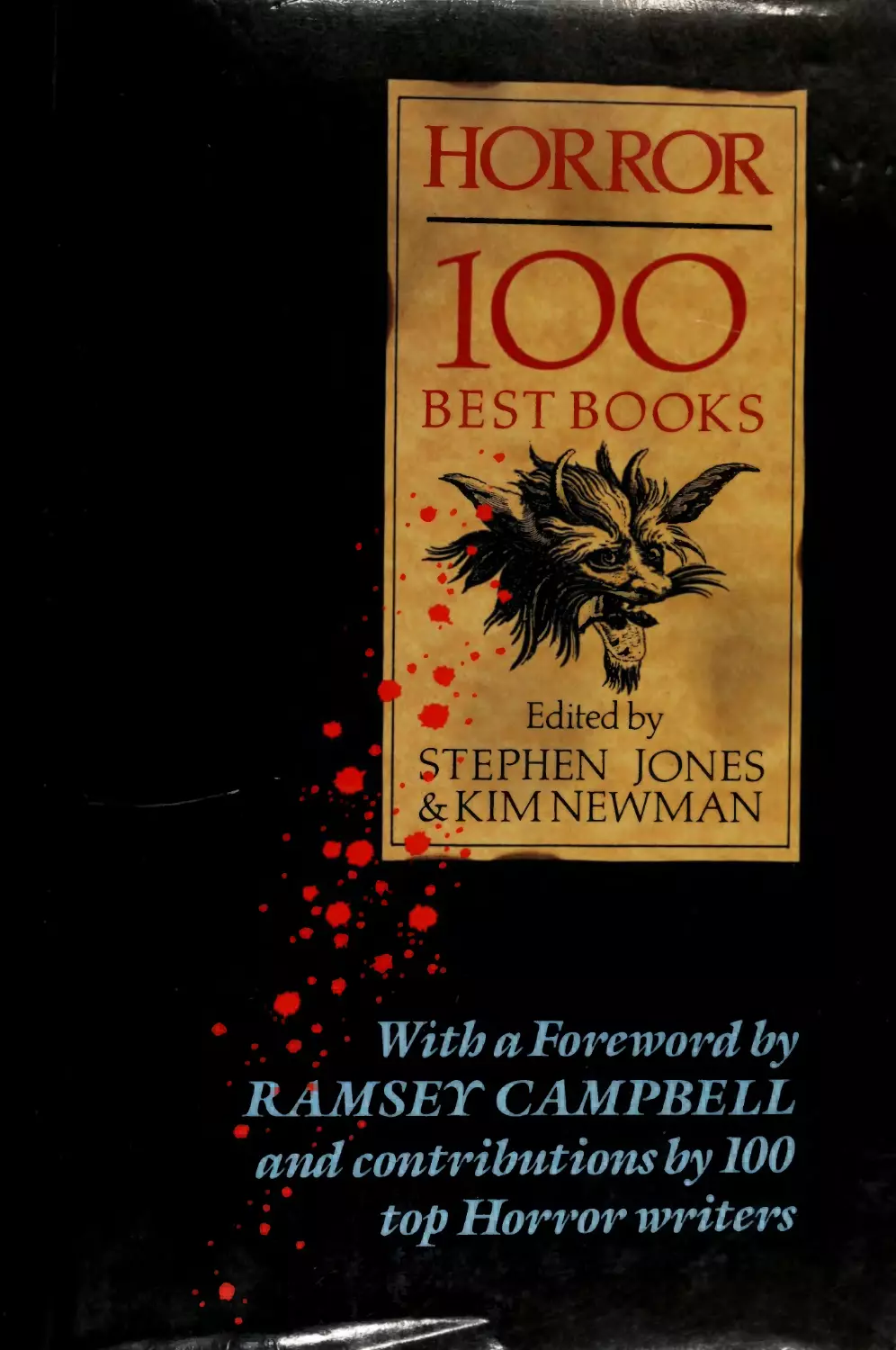
                    HORROR
BEST BOOKS
* in
itz
•
• •
* * '■•
« ’ /
9
• • • •
’ •<
•	a
•• •
•_ • * • With a Foreword by
RAMSEY CAMPBELL
• • '*
and contributions by 100
top Horror writers
• •
■' t
*

Horror is enjoying a colossal boom. The books
and movies of writers like Stephen King, Clive
Barker and Peter Straub attract huge audi¬
ences, and there is a veritable flood of
magazines, videos and TV shows catering to
this seemingly insatiable appetite. But is this
just a matter of blood and guts, or has the
genre something more for offer? And how in
hell is the general reader to select from this
gory spate?
Editors Stephen Jones and Kim Newman
have tackled the problem by inviting the lead¬
ing horror writers to nominate their own
choices of the best books in the genre. The
response has been astonishing: nearly all the
leading authors in the field took to the idea
with great enthusiasm, and the result is a
stunning and fascinating collection of 100
essays by the very top names in Horror.
The choices are revealing, and in many cases
surprising. Clive Barker, for instance, opts for
Christopher Marlowe's Doctor Faustus - the
earliest book in the collection - and appraises
it coolly and with great intelligence. Stephen
King selects a book more firmly rooted in the
horror genre, Robert Marasco’s Burnt Offer¬
ings. but few will have read Robert Bloch’s
choice. The Cadaver of Gideon Wyck.
Recognized classics such as Dracula, Franken¬
stein and The Island of Doctor Moreau are of
course included too, in refreshing new pieces
by writers like Colin Wilson, Jane Yolen and
Gene Wolfe.
As Ramsey Campbell writes in his Foreword,
“Horror is the branch of literature most often
concerned with going too far . . . It shows us
sights we would ordinarily look away from or
insights we might prefer not to admit we
have. Horror writers, he points out, are often
blamed for causing what they have the
courage to examine, and urges that they be
allowed to speak for themselves and make
themselves clear. In Horror: 100 Best Books
they can and, most entertainingly, they do.

Edited by
STEPHEN JONES
&KIM NEWMAN
HORROR
1OO
BEST BOOKS

For Mum and Dad, for all their love
and continued support	steve
For Meg, much love
KIM
This collection Copyright © Stephen Jones and Kim Newman 1988
Pages 255-6 constitute an extension of this copyright page.
All rights reserved
This edition first published in Great Britain by Xanadu Publications Ltd.
1988
First published in the United States of America by
Carroll & Graf Publishers, Inc. 1988
Carroll & Graf Publishers, Inc.
260 Fifth Avenue
New York, NY 10001
Library of Congress Cataloguing in Publication Data
Horror: the 100 best books/edited by Stephen Jones and Kim Newman,
p. cm.
Includes index
ISBN 0-88184—417-9: $15.95
1. Horror tales, English—History and criticism 2. Horror tales, Amer-
*can—History and criticism 3. Bibliography—Best books—Horror
tales 4. Horror tales—Bibliography 5. Authors—Books and reading.
I. Jones, Stephen II. Newman, Kim
PR830.T3H67 1988
823'.0822—de 19
Manufactured in Great Britain

Foreword
by Ramsey Campbell
Horror fiction is the branch of literature most often concerned with
going too far. It is the least escapist form of fantasy. It shows us
sights we would ordinarily look away from or reminds us of insights we
might prefer not to admit we have. It makes us intimate with people we
would cross the street to avoid. It shows us the monstrous and perhaps
reveals that we are looking in a mirror. It tells us we are right to be afraid,
or that we aren’t afraid enough. It also frequently embraces, or at least is
conterminous with, the ghost story. It flourishes here and there in the
fields of science fiction and crime fiction, and not infrequently it bobs up
in the mainstream, whatever that is. Despite its name, it is often most
concerned to produce awe and terror in its audience, but it is not unusual
for a horror story to encompass a wider emotional range.
Some of what I’ve said so far (even when it is understood as seeking to
define good horror fiction) will doubtless prove controversial. For
instance, not only ignorant critics but some horror writers (generally bad
ones) will dismiss the notion that this field has anything to do with
literature. However, there are remarkably few mainstream writers (espe¬
cially of short fiction) who have not attempted the horror story. A good
many mainstream writers are best known, or remembered only, for their
horror fiction, and some of these examples are among the classics of the
field. The present book will go some way toward displaying the scope of
the field and the diversity of its creators.
Diversity breeds conflict, in this field as in any other. Both M. R.
James and Montague Summers deplored the Not at Night series, as
Robert Aickman did the later Pan Books of Horror Stories. Algernon
Blackwood found Lovecraft’s work ‘lacking in spirituality’, Russell Kirk
convicted Blackwood’s of a lack of Christianity. H. Russell Wakefield,
nearly at the end of his career, was disappointed enough to foresee no
future at all for the ghost story (a knell frequently tolled during this
century). Skirmishes most often flare between practitioners of the
graphically gruesome and the subtle, as if they were mutually exclusive
or even mutually destructive but, oddly enough, until recently almost all
the public statements came from the second camp. Not long ago a writer
of gruesomely violent horror fiction was dismissed by someone subtler
as having nothing to do with horror. This nonsensical suggestion
provoked a defence, whose voicing I take to be a healthy sign. I cannot
see that a field, often blamed for causing what it has the courage to
3

examine, can call itself honest if it rushes to make scapegoats of its own
less respectable writers. Let them be allowed to make themselves clear
and be seen for what they are.
For these and other reasons, I welcome the range of subjects and
contributors which the list of contents promises. May it broaden the
reading of whoever uses it.
Merseyside
23 February 1988
4

Contents
1
2
3
4
5
6
7
8
9
10
11
12
13
14
15
16
17
18
19
20
21
22
foreword by Ramsey Campbell	3
introduction by Stephen Jones and Kim Newman	9
clive barker on Doctor Faustus, by Christopher Marlowe
(c. 1592)	11
john blackburn on The Tragedy of Macbeth, by William
Shakespeare (1606)	14
diana Wynne jones on The White Devil, by John Webster
(1612)	15
scott bradfield on Caleb Williams, by William Godwin
(1794)	17
les Daniels on The Monk, by Matthew Gregory Lewis (1796)	19
john sladek on The Best Tales of Hoffman (1814—16)	21
david pirie on North anger Abbey, by Jane Austen (1817)	23
jane yolen on Frankenstein, by Mary Wollstonecraft Shelley
(1818)	25
peter tremayne on Melmoth the Wanderer, by Charles
Maturin (1820)	27
garry kilworth on The Confessions of a Justified Sinner, by
James Hogg (1824)	29
john m. ford on Tales of Mystery and Imagination, by Edgar
Allan Poe (1838)	30
edgar allan poe on Twice-Told Tales, by Nathaniel
Hawthorne (1938)	32
thomas tessier on The Black Spider, by Jeremias Gotthelf
(1842)	34
thomas m. disch on The Wandering Jew, by Eugene Sue
(1844-5)	36
Michael McDowell on The Confidence Man, by Herman
Melville (1857)	39
m. r. james on Uncle Silas, by J. Sheridan Le Fanu (1864)	41
jack Williamson on Dr Jekyll and Mr Hyde, by Robert Louis
Stevenson (1886)	43
tim stout on She, by H. Rider Haggard (1887)	45
h. p. lovecraft on The King in Yellow, by Robert W.
Chambers (1895)
gene wolfe on The Island of Dr Moreau, by H. G. Wells
(1896)
colin wilson on Dracula, by Bram Stoker (1897)
r. Chetwynd-Hayes on The Turn of the Screw, by Henry
James (1898)
5

23
24
25
26
27
28
29
30
31
32
33
34
35
36
37
38
39
40
41
42
43
44
45
46
47
48
49
50
Douglas e. winter on Heart of Darkness, by Joseph Conrad
(1902)	55
richard dalby on The Jewel of Seven Stars, by Bram Stoker
(1903)	59
geoff ryman on Ghost Stories of an Antiquary, by M. R.
James (1904)	61
t. e.d. klein on The House of Souls, by Arthur Machen (1906)	64
hilaire belloc on John Silence, by Algernon Blackwood
(1908)	67
david langford on The Man Who Was Thursday, by G. K.
Chesterton (1908)	70
terry pratchett on The House on the Borderland, by
William Hope Hodgson (1908)	71
milton subotsky on The Collected Works of Ambrose Bierce
(1909)	73
mike ashley on Widdershins, by Oliver Onions (1911)	75
basil copper on The Horror Horn, by E. F. Benson (1912-34)	77
george hay on A Voyage to Arcturus, by David Lindsay
(1920)	79
steve rasnic tem on The Trial, by Franz Kafka (1925)	81
Robert e. Howard on Something About Eve, by James Branch
Cabell (1929)	83
karl edward wagner on Medusa, by E. H. Visiak (1929)	85
marvin kaye on The Werewolf of Paris, by Guy Endore (1933)	86
Jessica amanda salmonson on The Last Bouquet, by
Marjorie Bowen (1933)	88
Robert bloch on The Cadaver of Gideon Wyck, by Alexander
Laing (1934)	89
hugh lamb on A Second Century of Creepy Stories, ed. Hugh
Walpole (1937)	92
Lionel fanthorpe on The Dark Tower, by C. S. Lewis
(c. 1938)	93
denis etchison on Johnny Got His Gun, by Dalton Trumbo
(1939)	95
donald a. wollheim on The Outsider and Others, by H. P.
Lovecraft (1939)	96
harlan ellison on Out of Space and Time, by Clark Ashton
Smith (1942)	99
GERALD w. PAGE on Conjure Wife, by Fritz Leiber (1943)	102
maxim Jakubowski on Night Has a Thousand Eyes, by Cornell
Woolrich (1945)	104
graham masterton on The Lurker at the Threshold, by H. P.
Lovecraft & August Derleth (1945)	106
forrest j ackerman on Deliver Me from Eva, by Paul Bailey
(1946)	7
david g. hartwell on And the Darkness Falls, ed. Boris
Karloff (1946)
peter haining on The Sleeping and the Dead, ed. August
Derleth (1947)
6

51
52
53
54
55
56
57
58
59
60
61
62
63
64
65
66
67
68
69
70
71
72
73
74
75
76
77
78
79
80
81
82
83
ROBERT r. MCCAMMON on Track of the Cat, by Walter Van
Tilburg Clark	113
SUZY MCKEE charnas on The Sound of His Hom, by Sarban
(1952)	115
JOE HALDEMAN on Lord of the Flies, by William Golding (1954)	117
RICHARD CHRISTIAN matheson on I Am Legend, by Richard
Matheson (1954)	119
joe r. landsdale on The October Country, by Ray Bradbury
(1955)	121
stephen Gallagher on Nine Horrors and a Dream, by Joseph
Payne Brennan (1958)	123
HUGH b. CAVE on Psycho, by Robert Bloch (1959)	126
stephen laws on Quatermass and the Pit, by Nigel Kneale
(1959)	127
MICHEL PARRY on Cry Horror!, by H. P. Lovecraft (1959)	130
lisa tuttle on The Haunting of Hill House, by Shirley
Jackson (1959)	131
tad williams on The Three Stigmata of Palmer Eldritch, by
Philip K. Dick (1964)	134
jack dann on The Painted Bird, by Jerzy Kosinski (1965)	136
craig shaw Gardner on The Crystal World, by J. G. Ballard
(1966)	140
colin Greenland on Sub Rosa, by Robert Aickman (1968)	142
Brian aldiss on The Green Man, by Kingley Amis (1969)	144
neil gaiman on The Complete Werewolf, by Anthony
Boucher(1969)	146
dan simmons on Grendel, by John Gardner (1971)	149
f. paul wilson on The Exorcist, by William Peter Blatty (1971)	151
john skipp on The Sheep Look Up, by John Brunner (1972)	154
Frances Garfield on Worse Things Waiting, by Manly Wade
Wellman (1973)	157
stephen king on Burnt Offerings, by Robert Marasco (1973)	159
al sarrantonio on 'Salem’s Lot, by Stephen King (1975)	161
craig spector on Deathbird Stories, by Harlan Ellison (1975)	163
Brian lumley on Murgunstrumm and Others, by Hugh
B. Cave (1977)	165
Charles l. grant on Sweetheart, Sweetheart, by Bernard
Taylor (1977)	167
david j. schow on All Heads Turn When the Hunt Goes By,
by John Farris (1977)	169
peter straub on The Shining, by Stephen King (1977)	171
william f. nolan on Falling Angel, by William Hjortsberg
(1978)	173
Charles de lint on The Wolfen, by Whitley Strieber (1978)	175
shaun hutson on The Totem, by David Morrell (1979)	177
peter nicholls on Ghost Story, by Peter Straub (1979)	178
Christopher evans on The Land of Laughs, by Jonathan
Carroll (1980)	181
david s. garnett on The Cellar, by Richard Laymon (1980)	182
7

84
85
86
87
88
89
90
91
92
93
94
95
96
97
98
99
100
chet Williamson on Red Dragon, by Thomas Harris (1981)	184
j. n. Williamson on The Keep, by F. Paul Wilson (1981)	186
samantha lee on The Dark Country, by Dennis Etchison
(1982)	189
ramsey campbell on In a Lonely Place, by Karl Edward
Wagner (1983)	191
john clute on The Anubis Gates, by Tim Powers (1983)	193
Brian stableford on The Arabian Nightmare, by Robert
Irwin (1983)	195
malcolm edwards on The Wasp Factory, by Iain Banks (1894)	197
thomas f. mcnteleone on The Ceremonies, by T. E. D. Klein
(1984)	199
michael moorcock on Mythago Wood, by Robert Holdstock
(1984)	200
ian watson on Who Made Stevie Crye?, by Michael Bishop
(1984)	203
edward bryant on Song of Kali, by Dan Simmons	(1985)	205
Adrian cole on The Damnation Game, by Clive Barker
(1985)	207
r. s. hadji on Hawksmoor, by Peter	Ackroyd (1985)	208
Robert holdstock on A Nest of Nightmares, by Lisa Tuttle
(1986)	210
guy n. smith on The Pet, by Charles N. Grant (1986)	212
eddy c. bertin on Swan Song, by Robert McCammon (1987)	214
jack sullivan on Dark Feasts, by Ramsey Campbell (1987)	216
NOTES ON THE CONTRIBUTORS	219
LIST OF RECOMMENDED READING	249
ACKNOWLEDGEMENTS	255
8

INTRODUCTION
It seemed like a simple idea at the time . ..
There are plenty of critical guides clogging the shelves, particularly in
the science fiction and fantasy categories. Some are interesting,
idiosyncratic selections, others are narcissist tomes. The problem is that
the titles chosen and dissected can only reflect the author’s own tastes,
and even genre specialists cannot always embrace the entirety of a
complex and varied field. Thus, a devotee of the Classic English Ghost
Story will decline to include anything written after the First World War,
while a disciple of the Cthulhu Mythos might omit any mention of the
18th-century Gothic novel. Even worse, an editor might include works not
to his personal taste simply in order to be ‘representative’. How many
times have you come across: ‘The Castle of Otranto is turgid and
unreadable, but we wouldn’t be here without it, so here’s an in-depth
analysis of how important it is ... ’?
Our solution was to invite one hundred of the world’s top horror,
science fiction and fantasy authors and critics to contribute a brief essay
on his or her favourite horror book. This, we thought, would make for a
genuinely representative, though eclectic and controversial selection.
Writers could acknowledge a debt of gratitude to those titles or authors
that first inspired them to reach for the pen or switch on the word¬
processor. Or put forward a case for an unjustly neglected work, or even
for an out-of-genre book that struck them as too horrific to escape our
categorisation. We sent out rough guidelines, and they could pick any
book from any date. It might have been long out-of-print or a recent
best-seller. We expected people to suggest novels, anthologies or collec¬
tions, we didn’t mind plays or published screenplays, and we would have
accepted poetry if anyone had lighted on Coleridge, Beaudelaire of Poe
(no one did). We forgot to include the word ‘fiction’ in our original
letter, and so one cleverclogs (it was John M. Ford) tried to slip in
Herman Kahn’s On Thermonuclear War. We are pleased that our final
representation includes Jacobean Revenge Tragedies, gothic novels,
literary classics, science fiction, detective stories, westerns, war novels,
surrealist fantasies, pulp horror and major works of modern fiction.
William Shakespeare, Herman Melville, Joseph Conrad, William Gold¬
ing, John Brunner, C. S. Lewis and Peter Ackroyd may be surprised to
find themselves in company with Edgar Allan Poe, Bram Stoker, Arthur
Machen, Richard Matheson, Stephen King, Richard Laymon, and Clive
Barker, but read the pieces and you’ll see how they earned their places
there.
9

We started by approaching considerably more than the 100 contribu¬
tors we needed, and got predictably mixed results. Many never replied.
Others were too busy to contribute. Some wrote polite letters thanking
us for the invitation, but declining on the basis that they knew nothing
about horror (a number of those will find their own novels discussed in
the text). A couple were just plain rude. If your favourite horror writer
isn’t here, we’re sorry. But the majority of people did get back to us, and
that’s when the real problems began. It’s surprising to learn just how
many authors retain a lifelong affection for the stories of M. R. James or
H. P. Lovecraft, or such books as Dracula and The Haunting of Hill
House. We could easily have put out a volume containing ten different
appreciations of each of these. Also, there were contributors who
hinted—often not too subtly—that perhaps their books should have been
included in our preliminary list of suggestions. One American writer was
terribly enthusiastic about the project until he discovered we didn’t want
him to write about his own best book. Harlan Ellison re-read his
childhood favourite novel (The Edge of Running Water by William
Sloane) and now blames us for destroying his beautiful memory of a
book that he now thinks is pretty rotten. Rob Holdstock kept re-reading
books that influenced him and finding they weren’t that horrific after all.
We learned that being an editor also involves a working knowledge of
diplomacy.
Then, putting aside such mundane considerations as contracts, sub¬
clauses and deadlines, there was the problem of those classics of the genre
that none of our 100 wanted to write about. As you might expect, the
random method of asking people for their favourites meant that a
number of books everyone would put in their Top Ten didn’t quite make
it. So major books like Rosemary’s Baby, The Vampire Tapestry and
Fevre Dream, and prominent authors like James Herbert, Thomas Tryon
and Michael McDowell sadly don’t get a look in. It’s also why we’ve
compiled a Recommended Reading list and fairly inclusive notes on the
works of our contributors. Once you’ve finished reading all 100 of the
books discussed in the main text, you should start working your way
through our secondary list. Then you’ll be an expert. You can be excused
The Castle of Otranto if you’ve got a note from your mother.
We hope this book is informative, and fun. It should offer a guide for
the relative newcomer to the subject, but also some meat for the veteran
afficionado. It was a logistical nightmare to compile, but we hope we’ve
succeeded in giving a working overview of an often-maligned field of
literature.
Anyway, the real problem was getting all the contributor’s signatures
for the special limited edition . ..
Stephen Jones and Kim Newman
London, March 1988
10

1
CHRISTOPHER MARLOWE
[c. 1592]
The Tragical History of Dr Faustus
Dr Faustus is generally believed to have been written in the last year of
Marlowe's life, well after his Tamburlaine (1587) and The Jew of Malta
(1589?). Marlowe based his work on what was supposed to have happened to
a German necromancer of the 16th century. It's a legend that has inspired
many other works of art, most notably Goethe's play Faust (1808), the operas
by Arrigo Boito fMefistofele, 1868) and Charles Gounod (1860), and various
pieces of music by Berlioz, Wagner, Liszt, Schumann and Louis Spohr.
Marlowe's play, directed by Richard Burton and Neville Coghill, was filmed
in 1967, with Burton as Faustus and Elizabeth Taylor as a silent Helen of
Troy. Notable performances in the play in the 20th century, either as Faustus
or Mephistophiles, have been given by D. A. Clarke-Smith, Noel Willman,
Robert Harris, Hugh Griffith, Cedric Hardwicke, Paul Daneman, Michael
Goodliffe, Orson Welles, Jack Carter and Ben Kingsley.
It is not that the old stories are necessarily the best stories; rather that
the old stories are the only stories. There are no new tales, only new
ways to tell. Such, at least, is the conviction of many who have studied
narrative. I’d count myself amongst their clan.
For the writer this presents certain challenges, not the least of which is
the shaping of a fresh and original interpretation of a structure which
may have been cast and re-cast several hundred times down the centuries.
The problem is particularly acute when working in a genre that boasts a
very clear line of tradition, as does horror. Write a vampire story and you
may be certain it will be compared with countless others in the family,
and if you’ve failed to bring anything new to the lineage you’ll be judged
accordingly.
In that challenge, of course, lies the greatest spur to invention, and
high times can follow, as the writer drives his imagination to new
extremes of form and content, honing his vision so that whatever else
may be said of the resulting work it can at least be called uniquely his.
But there’s a greater pleasure yet. In travelling the road of a particular
story—along which every town will have streets and squares in common,
yet none looks quite like the other—the writer may see, with a backward
glance, the way the essentials of the tale have been reinterpreted over the
years, subtly changing to reflect the interior lives of those who’ve gone
before. The road becomes an index to the blossoming and decay of
11

belief-systems; a book, if you will, of books, in which the subject is both
the history of story and the story of history.
Perhaps, if he’s far-sighted, the writer, looking back along the road
he’s travelling, may even glimpse its beginnings (or at least the rocky
place from which it emerged), and be enriched by recognition of why the
tale he’s reinterpreting was first created.
The story of the ambitious man, brought down through an excess of
pride, or curiosity, or half a dozen other sweetly human qualities, is one
part of the story I’m celebrating here. The other part concerns inter¬
course with hellish divinities. It tells of a shaman who touches an inner
darkness—a forbidden place that promises dangerous knowledge—and is
snatched off by the very forces he’s hoped to control. Put together, these
elements form the Faust myth. Baldly put, Faust’s (or Faustus’s) story is
that of a brilliant, ambitious academic who sells his soul to the Devil in
exchange for insights and experiences he believes he can gain no other
way, and later—as the time for payment approaches—regrets the terms
of the deal, and attempts to escape damnation.
I	first encountered this story in Marlowe’s variation, and though I later
read other versions—Goethe’s, most significantly—it is that first meeting
that claims greatest hold on my affections. I was as ravished by the
splendours of the play as Marlowe’s Doctor is by magic, which he
believes will show him the secrets of the stars, and of men’s souls. I had
the same hopes of art; still do, in fact. But while a book is readily bought,
a play or a painting easily viewed, Faustus—to gain his magic—must sign
in blood, and give his soul over to Lucifer for all eternity. Not so hard.
This is a man who has studied until study can reward him no longer. A
man to whom science has become a cul-de-sac, philosophy a dead
lj^rary, and who wants to drag the walls and the words down and see the
world for himself. It’s little wonder that Mephistopheles’ warnings
cannot deter this hungry adventurer from the trip.
To evoke the pleasure of what follows, Marlowe uses his prodigious
poetic gifts (which were silenced too quickly: he died at twenty-nine,
stabbed in the eye in a brawl that may have been staged to conceal an
assassination). Here Faustus looks on the beauty of Helen of Troy, raised
from the past for his delectation:
'Was this the face that launch'd a thousand ships,
And burnt the topless towers of Ilium?
Sweet Helen, make me immortal with a kiss.'
It’s the word-music that ensured Marlowe’s immortality, not the
kisses. (There’s a lesson there, damn it.) Later in the play that same
genius conjures Faustus’ terror as damnation approaches:
'You stars that reign'd at my nativity,
Whose influence hath allotted death and hell,
12

Now draw up Faustus like a foggy mist
Into the entrails of yon labouring cloud."
He is not drawn up, needless to say. ‘Ugly hell" gapes, and the Devil
claims his due, leaving Faustus’ servants and ex-students to pick up the
pieces, literally. Whereas Goethe saves his adventurer with love and
metaphysics, Marlowe has his Doctor beg for forgiveness—
‘See, see, where Christ"s blood streams in the firmament!
One drop would save my soul...."
—but here his pleas go unanswered.
The play thus moves through a strikingly diverse series of modes, from
the early scenes of debate, to invocation, and temptation; then through
masque, high poetry and low comedy as Faustus’ years of experience
pass; finally into melancholy and despair. Behind it all Marlowe’s
subversive vision is at work. This is the man reputed to have claimed that
‘whoso liketh not tobacco and boys is a fool’, and who would die as he
lived, in a passion. That heat—that sense of momentum—turns his
version of the Faust story into a headlong plunge, as exhilarating as it is
tragic. Goethe’s treatment may be more philosophically complex, and
arguably contains characters more sensitively drawn; it is certainly the
more humane of the two interpretations. But Marlowe’s variation values
theatricality and poetic dazzle over moral texture, and the kid I was when
I first read it liked the choice. He still does. Maybe in my dotage I’ll be
more profoundly moved by Goethe’s brilliantly argued case for the
redeemability of the human spirit (indeed, I may need its reassurances),
but I’m still too close to Marlowe in age and temper to relinquish my first
love.
What delights me, finally, is to have a choice of versions. I’ve even
added a few variations to the canon of Faust tales myself. ‘The
Damnation Game’, ‘The Hellbound Heart’ and ‘The Last Illusion’ are all
conscious strivings to make sense of the story for a late-20th-century
readership. Hell, I point out in ‘The Damnation Game’, is reimagined by
each generation. So are the pacts, and the pact-makers. But the story will
survive any and all reworkings, however radical, because its roots are so
strong. That far-sighted backward glance I spoke of earlier—the one that
leads back to the rocky place—shows us in the Faust tale one of the most
important roads in all fantastic fiction. At its centre is a notion essential
to the horror genre and its relations: that of a trip taken into forbidden
territory at the risk of insanity and death. With the gods in retreat, and
the idea of purgatorial judgments less acceptable to the modern mind
than new adventures after death as dust and spirit, all imaginative
accounts of that journey become essential reading. In their diversity lies
testament to the richness of our literature’s heritage. In their
experiencing, a sense of how the human perspective changes. And in their
13

wisdom—who knows?—a guide to how we, adventurers in the
forbidden magic of our genre, may behave when the last Act is upon us.
—CLIVE BARKER
2	[1606]
WILLIAM SHAKESPEARE
The Tragedy of Macbeth
Scotland. Macbeth, Thane of Glamis, a loyal subject of King Duncan, meets
three Witches on a blasted heath. They prophesy that he will become Thane of
Cawdor and then King, and that his comrade Banquo will sire a line of kings.
Macbeth is immediately made Thane of Cawdor by Duncan, and is in¬
spired—partly by the witches, partly by his wife, partly by his own ambition—
to plot the murder of Duncan. He becomes king, but tries to prove the witches
false by murdering Banquo and thus ensuring his own family will succeed
him. Visiting the witches again, he receives further prophecies that suggest he
is invincible—he cannot be killed by a man bom of woman, and he will not be
unthroned unless Birnam Wood marches upon Dunsinane castle. However,
while his wife is driven mad by guilt, Macbeth sees each of the further
prophecies come true—Banquo's sons escape him to become the ancestors of
James I of England (recently crowned when the play was being written), his
enemies use the cut-down trees of Birnam as shields when they advance on the
castle, and he faces in battle Macduff, who was bom by Caesarian.
Areally serious crime, in the long run, leads to temporal retribution
and possible damnation.
I have tried to use such a theme many times personally, and though I
am no Shakespearean scholar, I believe that one must realize how grave
the Macbeths’ crimes were. In Shakespeare’s day, regicide was regarded
as the worst crime of all, as the king or queen was God’s consort on
Earth. Duncan was also a good ruler who
‘Hath borne his faculties so meek,
Hath been so clear in his great office
That his virtues
Will plead like angels, trumpet-tongued against
The deep damnation of his taking-off.’
Macbeth was assured by the witches that he need fear nothing unless
14

Birnam Wood came to Dunsinane and he was opposed by a man not
born of woman. The witches were equivocators and this point is
explained by the drunken porter at the castle gate: ‘Lechery, it provokes
and unprovokes; it provokes the desire, but it takes away the
performance. Therefore much drink may be said to be an equivocator
with Lechery: it makes him, and it mars him ...’
By the witches’ own forecast, Banquo was ordained the father of a line
of kings and this prediction is repeated after his murder, so Macbeth sees
his original crime as fruitless, and he and Lady Macbeth are driven mad
by guilt. His wife commits suicide and he accepts the news briefly. ‘She
should have died hereafter. There would have been time for such a word
.. .’ Only at the very end, when the witches’ falsehood is finally revealed,
does Macbeth come to terms with reality and realize the truth.
‘Though Birnam Wood be come to Dunsinane
And though opposed being by no woman born
Yet will I try the last. Before my body
I throw my warlike shield. Lay on, Macduff,
And damned be he who first cries “hold, enough”.’
According to Aristotle, the word ‘tragedy’ means ‘arousing pity and
terror’. The play succeeds in both respects. To my mind, Macbeth's plot
makes the play one of the best thrillers in our language and to this is
added some of the finest poetry ever written. A truly magnificent feast.
—JOHN BLACKBURN
3	[1612]
JOHN WEBSTER
The White Devil
The White Divel, or, The Tragedy of Paulo Giordano Urfini, Duke of
Brachiano, with The Life and Death of Vittoria Corombona the famous
Venetian Curtizan is a Jacobean Revenge Tragedy complete with poisonings,
multiple murders, a scheming villain, a tragic villain, ghosts, intrigues, a
crime-busting Pope, and a vengeance-crazed pirate. Webster (1580—1634) was
also the author of The Duchess of Malfi (1614), an even more gruesome
tragedy, and skull The Devil’s Law-Case (1620), a twisted comedy. A gloomy
misanthrope who complains in his preface about the rabble s lack of enthu¬
siasm for the play, Webster was characterized famously by T. S. Eliot as seeing
‘the skull beneath the skin'.
15

I have always found your actual werewolves, vampires and devils rather
boring. The White Devil is to me true horror because all these
creatures are present in it, and ghosts too, but as human beings. It is also
full of graveyard humour which is hysterically funny, much of it
centering on Flamineo, who is my favourite villain—witty, neurasthenic
and utterly selfish.
There are only two ‘good’ characters: Vittoria’s brother Marcello,
who is too stupid to be otherwise, and the boy Giovanni. All the others
go in for quasi-virtuous acts that damn them. At the start of the play
Corinna curses her children with a big display of outrage, and the curse
works (this is the main undercover supernatural theme). Isabella, with an
equal display of virtue, pretends to hate her husband and gets murdered
for it—with justice because she talks witchcraft. The talk is always a
giveaway. It flickers by, savage and vivid, subliminally dubbing Isabella a
witch, Corinna a witch, invoking arcane herb lore, linking Brachiano
with the devil and calling Flamineo wolf, wolf, wolf, until it rises to the
spell Corinna chants over her dead son, in which she all but names
Flamineo the werewolf he is.
Under the influence of Vittoria, the Pope reveals himself fascinated
with vice and the Duke of Florence ends up (literally) black. Brachiano,
basically a coarse-grained man bored with his wife, commits murder and
then dabbles in Satanism by employing a conjuror. His death—On pain
of death, let no man name death to me; It is a word infinitely
terrible—surrounded by imaginary horrors—Look you, six grey rats that
have lost their tails Crawl up the pillow—is a real spine-chiller.
By a bold stroke, Vittoria herself, the vampire woman at the centre, is
decidely understated. Her character emerges mostly from the disgusted
reactions of the rest, even her brother Flamineo, who behave as if they
are trying to detach a leech. But the talk is again a giveaway. As her lover
dies, all she can say is I am lost for ever! Everything else she says is
equally self-centred. And vampire she is. Right at the end when she has
run out of victims and is about to be killed, she says she is pale from want
And the boy Giovanni? He becomes Duke of Padua at the end and
orders the murderers tortured with sanctimonious relish. As Flamineo
remarks, his talons will grow out in time, and here we see them
sprouting.
—DIANA WYNNE JONES
16

4
[1794]
WILLIAM GODWIN
Things As They Are; or: The
Adventures of Caleb Williams
Caleb Williams, an honest young man, takes a position as secretary to
Ferdinando Falkland, the landowner upon whose property the Williams
family resides. Although treated kindly by Mr Falkland, Caleb is warned to
stay away from a certain room in which the master keeps a mysterious trunk.
Unable to contain his curiosity, Caleb investigates and learns that Falkland is
a murderer. However, their respective social positions ensure that Falkland
goes uncharged and Caleb is ruined. Caleb loses his job and becomes an
outcast, persecuted by his former master, and is thrown in with thieves and
murderers. His ordeal takes him from the melodramatic Gothic horrors of
Falkland’s gloomy old house with its terrible secret to the all-too-real hell of
the underside of 18th-century England. Godwin, a reformer best known for
his Enquiry Concerning Political Justice (1793), here prefigures Dickens by
straddling the genres of gruesome thriller and social expose. His daughter was
Mary Shelley, author of Frankenstein.
There is a sort of domestic tactics, the object of which is to elude
curiosity, and keep up the tenor of the conversation, without the
disclosure of our feelings or opinions. The friends of justice will have
no object more deeply at heart, than the annihilation of this duplic¬
ity. ... It follows, that the promoting the best interests of mankind,
eminently depends upon the freedom of social communication....
William Godwin, An Enquiry Concerning Political Justice
During the year he finished writing Things As They Are; or: The
Adventures of Caleb Williams, many of William Godwin’s radical
friends and associates were either in jail or awaiting trial for treason.
While these radicals advocated democratic equality, aristocratic govern¬
ment deployed its privileged machinery of coercion and law. Radicals
believed men found the Truth inside their own classless human heart, but
aristocratic government preferred its exterior distinctions of family
name, property and station. Radicals sought to unveil the common
‘nature’ of democratic Man, while government sought to veil that nature,
if not immure it.
For Godwin, as for Caleb, truth does not belong to the world of
appearances, but to the world’s repressed heart; in order to achieve
17

justice, one must penetrate the corrupt duplicity of government and gaze
into the hearts of the men who run it. As Godwin wrote in his Enquiry
only a few years before completing Things As They Are:
One of the most essential ingredients in a virtuous character, is
undaunted firmness; and nothing can more powerfully tend to destroy
this principle than the spirit of monarchical government. The first
lesson of virtue is, Fear no man; the first lesson of such a constitution
is, Fear the King.
In Godwin’s universe, terror belongs to the surface world of politics,
not to the dark primitive world of Man’s unconscious. Prisons, disguise,
and aristocratic reputation pursue Caleb across a landscape made
horrible by the very absence of man’s super-natural Reason. Political
corruption for Godwin is not, as our modern age might try to argue, a
thing of the human heart, but rather of the human heart’s confinement;
Caleb is never pursued by evil men so much as he conspires with the
scheme of his own persecution. By refusing to disclose his knowledge of
Falkland’s crimes, Caleb commits himself to a prison of silence. By
adopting disguise, Caleb makes himself subject to criminals disguised as
police and government officials. Like the prison reformer Jeremy
Bentham, Godwin believes even prisons should be made accessible to
public inspection, just as the secrets of Falkland’s padlocked trunk
implicitly demand Caleb’s compulsive investigation.
Godwin’s great novel does not designate heroes and villains, but rather
widespread political conditions. Repressed by political injustice,
individual selves diminish and collapse; in a corrupt world, all men
suffer, regardless of class or distinction. T began these memoirs with the
idea of vindicating my character,’ Caleb concludes. ‘I have now no
character that I wish to vindicate.’ Caleb cannot ‘win’ his final
confrontation with Falkland while the political world which created
Falkland endures. Without the freedom of open democratic discourse,
individual ‘character’ lacks meaning or definition. When for two hundred
years critics reduced Things As They Are to a ‘psychological romance’
entitled Caleb Williams, they disregarded Godwin’s most fundamental
belief: that terror is not a product of the human mind, but of political
men.
—SCOTT BRADFIELD
18

5
MATTHEW GREGORY LEWIS
[1796]
The Monk: A Romance
Madrid, c. 1600. Ambrosio, the impossibly saintly abbot of the Capuchin
order, is visited by a demon in the form of Matilda, a young and lovely
woman who enters the monastery disguised as a novice. She seduces
Ambrosio, and encourages him to plumb the depths of degradation. He is led
unknowingly to rape his sister and murder his mother, and a final confronta¬
tion with Lucifer himself leaves Ambrosio's broken and bleeding corpse to the
insects. Sub-plots, essential to a Gothic novel, feature the Wandering Jew and
a sad spectre known as the Bleeding Nun. By going beyond the comparatively
polite horrors of Mrs Radcliffe and Horace Walpole, Lewis earned the
admiration of such figures as Byron and de Sade, the displeasure of many
'respectable' folks, and a nickname, 'Monk', that stayed with him to the
grave. The Monk, his first novel, was written before Lewis' 21st birthday; he
followed it with a succession of lesser romances, tales and plays, including The
Castle Spectre (1797), Tales of Terror (1799), The Bravo of Venice (1805),
and One O’Clock, or The Knight and Wooddemon (1811).
’TT* he Monk, although it was published almost two hundred years ago,
JL in 1796, may legitimately claim to be the first modern horror novel
in the English language. Predecessors like Horace Walpole and Ann
Radcliffe had pioneered the Gothic tale, but the stories they told tended
to be distressingly genteel and moralistic. This was not enough for
Matthew Gregory Lewis, who, while little more than a boy, produced a
work that was outrageous, offensive, and obnoxious, one that still
demonstrates its power to dismay. A standard history of English
literature claims that it exhibits ‘the perverted lust of a sadist’. Can there
be a higher recommendation?
Set in the early 17th century, The Monk was a period piece even in
1796, yet it contains enough bad attitudes to raise a few hackles even
today. Attacked for obscenity and blasphemy, the book was censored in
its later editions, in no small measure because it had been revealed that
the writer, who penned the novel at the tender age of nineteen, had
recently become a Member of Parliament. The author’s youth is ulti¬
mately more important than his government credentials, for this is a
work of enthusiasm and excess, its audacity and adolescence speaking to
and for the audience that has always eagerly embraced the horrific.
The Monk sneers at convention: its episodes include dead babies,
19

mangled nuns, murdered mothers, deflowered virgins, and sex-crazed
clergymen. This is the sort of material that 20th-century artists have
frequently flaunted to provide their own emblems of emancipation, but
Lewis had staked out the territory long before the grandparents of his
followers were born.
Such calculated bad taste made Lewis a celebrity in his time, yet he also
embodied the essential paradox of the horror writer: contemporaries
from Lord Byron to Sir Walter Scott describe him as an honorable and
kindly man. Literary historians have reduced him to the catalyst whose
personal influence inspired Polidori’s The Vampyre and Mary Shelley’s
Frankenstein, but in his lifetime he was recognized for his own achieve¬
ments, and rightly so. Lewis cut to the bone.
In the depraved monk Ambrosio, Lewis created a character that speaks
uneasily to readers centuries later. Ambrosio is Faustian, in the tradi¬
tional mode, but he represents not the lust for power, or the lust for
money, or even the lust for knowledge. What he displays, embarrassingly
but importantly, is the lust for lust. He is the forefather of a roster of
lascivious villains from Dracula through Norman Bates to Freddy
Krueger.
Despite its overblown language and its overstrained coincidences, The
Monk is a revolutionary work. It defies polite society, and it also
challenges the limits of its genre. The evil in this tale is not exterior, an
outside outrage to be subdued by the representatives of civility and good
taste. Rather, the evil is within its protagonist, and there is no bland
embodiment of virtue to stand in his path. The evil runs its course,
consuming itself rather than facing defeat from the forces of conformity.
This is not melodrama, but tragedy, and as such it shames most of the
popular 20th-century terror tales whose only drive is to enforce the
status quo.
Lewis wanted to see how far he could go, and he went there. In a time
when we are confronted with a flood of reassuring horror stories, each
one promising its readers that everything awful exists only in others, the
courage that Lewis displayed shines like a bloody beacon.
And any book with a character called The Bleeding Nun can’t be all
bad.
—LES DANIELS
20

6
E.T.A. HOFFMANN
[1814-16]
The Best Tales of Hoffmann
Ernst Theodor Amadeus Hoffmann never put his name to a collection under
the title Tales of Hoffmann, but since the success of Jacques Offenbach's opera
Les Contes d’Hoffmann (1881), there have been several competing volumes
under variations of the name, including R.J. Hollingdale's Taler of Hoff¬
mann (1932), Leonard J. Kent and Elizabeth C. Knight's Tales of E.T.A.
Hoffmann (1972), and Victor Lange's Tales (1982). The volume discussed
here is E. F. Bleiler's selection, The Best Tales of Hoffmann. In Hoffmann's
lifetime (1776-1822), his short horror pieces appeared in Fantasiestiicke in
Callots Manier (4 vols, 1814—15) and Nachtstiicke (1816), although several of
his best-known works — ‘The Golden Flowerpot', ‘The Sand-Man' — were
not published until after his death. Hoffmann's major horror novels are Die
Elixier des Teufels (1815-16) and Lebensansichten des Katers Murr (1821-
22). Offenbach's opera was marvellously filmed in 1951 by Michael Powell
and Emeric Pressburger, with Moira Shearer outstanding as Olimpia the
Automaton.
This collection includes ‘The Sand-Man’, the best-known of Hoff¬
mann’s stories, as well as ‘The Golden Flowerpot’, a lavish alchemic¬
al tale whose passages of vivid fantasy brought grudging praise from
Goethe. These and most of the remaining eight tales are unrolled like
dreams, with all of the humor, horror, and superreality dreams require.
In ‘Rath Krespin’, a man collects rare violins only to dismantle them.
A miser meets his doppelganger (‘Signor Formica’). A machine whispers
prophecies (‘Automata’). A divinity student falls under the spell of a
blue-eyed snake (‘The Golden Flowerpot’). A miner is lured to his death
by the glowing face of the Metal Queen (‘The Mines of Falun’). In a
comic-horrific tale ‘The King’s Betrothed’, a woman finds herself
engaged to a carrot.
But the deepest nightmare here is the ‘The Sand-Man’. This dark tale
was written in 1816, two years before Mary Shelley’s Frankenstein, in a
similar spirit of horrified fascination with science and its application to
artificial life. Hoffmann is concerned with the horror of automata
indistinguishable from real people.
In ‘The Sand-Man’, the nightmare is relentless. It begins with a child’s
confusion. A cruel nurse tells young Nathanael that the Sand-man
‘comes to little children when they won’t go to bed and throws handfuls
21

of sand in their eyes, so that they jump our of their heads all bloody’. He
believes the Sand-man is the lawyer Coppelius, who comes to the house
nightly to visit his father on some mysterious errand.
Later the child realizes the Sand-man is only a story, but he also senses
that Coppelius has some unpleasant hold over his parents. The child
hides and sees the men engaged in some secret experiment involving a
forge and glowing metal. When Nathanael is discovered, Coppelius
threatens to put out his eyes.
In a later, ‘last’ experiment, the secret forge explodes, killing Natha¬
nael’s father. Coppelius disappears.
Grown-up Nathanael attends a distant university. One day a peddler
comes to his room, selling barometers and thermometers. The peddler
looks like the sinister Coppelius and calls himself Coppola. All the old
nameless fears are aroused.
Nathanael quarrels with his fiancee. He soon becomes intrigued by the
vision of Olimpia, the rather inert, beautiful daughter of his physics
professor, Spalanzani. The professor lives across the street, and Natha¬
nael can see Olimpia through a window. The peddler returns, offering to
sell him spectacles, which he calls ‘eyes, fine eyes’. He lays out hundreds
of glittering samples—fiery glass lenses like eyes staring back at the
horrified Nathanael. He buys a telescope, which he uses to spy on
Olimpia. His interest deepens to obsession.
Finally Nathanael meets Olimpia at a ball. She plays piano, sings, and
dances well, if soullessly, but she hardly speaks. Others at the ball decide
that she is either a wooden doll or simpleminded.
Nevertheless, Nathanael pursues his fatal obsession. One night as he is
paying a visit to give her a ring, he overhears a quarrel between
Spalanzani and Coppelius. He walks in to find them ripping Olimpia
apart: Spalanzani reclaims the clockwork he constructed, while Coppe¬
lius owns her beautiful glass eyes. After a fight, Coppelius departs with
the doll—leaving its glass eyes on the floor. In frustration, Spalanzani
picks up the eyes and throws them at Nathanael.
Nathanael goes mad, but his fiancee Clara nurses him back to health.
Later they go up to a clock tower to look at the city. Nathanael puts the
accursed telescope to his eye, and goes mad once more. He tries to kill
Clara, and finally throws himself from the tower.
As in a dream, it is never clear whether Coppelius and Coppola are one
man or two; are they split in reality, or only in the divided mind of
Nathanael? We are never sure what the mysterious alchemical experi¬
ment might be, nor what hold Coppelius had over Nathanael’s parents.
Facts become lost in Nathanael’s mad dream, in which we share. And
perhaps that is what is most horrifying about this tale—we dream it
ourselves. Hoffmann’s mixture of magic and madness is experienced
from inside.
Ernst Theodor Amadeus Hoffmann (1776-1822) was the first Late
22

Romantic writer. His tales profoundly influenced European and Amer¬
ican literature, and that most literary of medical arts, psychoanalysis. He
was also a composer and conductor, an influential music critic (the first
to appreciate J. S. Bach), and a judge. Many of his tales were appropriated
for operas and ballets, including Coppelia, The Nutcracker, and Tales of
Hoffmann. The Sand-Man theme of heartless automata appears in the
film Metropolis and in much modern science fiction.
—JOHN SLADEK
7	[1817]
JANE AUSTEN
North anger Abbey
Catherine Morland, a sensitive young girl much given to devouring sen¬
timental Gothic romances of the type popularized by Mrs Radcliffe, comes to
Bath to stay with family friends. In the whirl of society, she meets two sets of
duplicitous people—the parvenu fortune-hunting Thorpes and the more
mysterious, romantic Tilneys. Although she soon sees through the Thorpes, she
is lured by her fanciful notions of the romantic life to spend some time at
Northanger Abbey, the gloomy ancestral home of the Tilneys. Misled by the
likes of Necromancer of the Black Forest (1794) and Horrid Mysteries
(1796), Catherine comes to see General Tilney as a villain in the Radcliffian
sense and suspect that he has murdered his wife, but eventually a more
prosaic—if still ignoble—motive emerges for his attentions. However, the
General's son Henry proves a suitable romantic hero and does finally win
Catherine's hand. Written sometime in the 1790s under the title Susan and
sold in 1803 (for £10) to a publisher who didn't bother to issue it, Northanger
Abbey did not appear in print until a few months after the author's death. It
has been adapted for the stage, radio and television several times, most
notably as a BBC-TV film with Robert Hardy and Katherine Schlesinger in
1987.
At the end of the 1970s, when I was struggling to write the novel that
would get me into screenwriting, I scrawled in a notebook in huge
capitals: NORMAUTY FOR HORROR! DETAIL, RESEARCH,
CHARACTER, BACKGROUND. THE ABNORMAL ONLY HAS
23

MEANING WITHIN THE CONTEXT (DETAILED, PRO¬
LONGED) OF THE NORMAL.
I still believe it. I was reading 'Salem's Lot at the time and it amazed me
how Stephen King’s astonishing capacity for endless ordinary details
enabled him to make such a huge success out of what was an almost
indecently ancient vampire plot. It was obvious that when the man
adapted the technique to a really good plot he would produce a classic
and he did it with The Shining.
Almost by definition horror needs rules, because it thrives on the
breaking of rules. It needs a sharp sense of everyday reality so that when
the lights go off you really take notice. This is why so many of the
greatest horror writers have made a detour into the genre from other
kinds of writing and perhaps the most distinguished recruit of all was
Jane Austen.
No writer in literary history observed the rules and regulations of
polite society as acutely as Austen, so it’s not surprising that she was also
the first writer to see the subversive potential in horror fiction. She
deliberately plotted North anger Abbey sq that the notions of Gothic
horror fiction and of civilized society come into direct collision. Her
heroine Catherine Morland is a horror fan whose imagination keeps
running away with her. She sees the most innocuous Sunday afternoon
walk as a potential abduction, laundry lists become secret manuscripts,
country houses turn into Gothic castles. Austen milks the suspense and
the humour to superb effect, but then steers the book to a point where
Catherine’s horrific perception is truer than anyone else’s. Tn suspecting
General Tilney of either murdering or shutting up his wife’, she
concludes, ‘Catherine had scarcely sinned against his character or
magnified his cruelty.’
Northanger Abbey is often portrayed wrongly as a spoof. It obviously
gave Austen a lot of fun but it was nothing of the kind. Not only does the
author step out of the novel to deliver a ringing endorsement of Gothic
fiction. But all the book’s humour, all its thrills, all its truth comes from
the Gothic world’s conquest of the everyday. Women may not regularly
be abducted to ruined abbeys by villains in black cowls but Austen is
intent on showing us just how well that metaphor conveys the emotional
cruelty of polite society. The Gothic perception wins.
—DAVID PIRIE
24

8 [1818]
MARY WOLLSTONECRAFT SHELLEY
Frankenstein: or, The Modern
Prometheus
In the Arctic, Captain Walton, an English explorer, takes aboard ship a manic
young man, Victor Frankenstein, who recounts the circumstances that have
brought him to the ends of the earth. Frankenstein tells of his experiments
with the creation of life, and his construction of a huge, manlike creature
whose repulsive aspect leads his creator to reject him. The Monster later
returns to Frankenstein and tells of his sufferings at the hands of humanity
and begs the scientist to make him a mate to ease his loneliness. Frankenstein
agrees but abandons the project in horror, and the Monster retaliates by
murdering his maker's friends and family. Frankenstein pursues the Monster
north, but dies on the ship after his story is finished. The Monster pays his last
respects and then vanishes into the wastes. Frankenstein is at once a Gothic
horror tale and the first important science fiction novel. Its sustained
popularity and place in modern myth is probably as much due to the
innumerable stage, film, television, comic book and radio adaptations of
it—most of which depart completely from the text—as to the strengths of the
work itself.
Subtitled The Modern Prometheus, Mary Shelley’s masterwork is a
remarkable book. Blending as it does allegory with Gothic elements,
storytelling with philosophy, it is all the more remarkable because Mary
Shelley completed it before her 20th birthday.
Stated bluntly, this ‘pseudoscientific novel’, as it has been called, is
about a scientist usurping nature and God’s creative powers, and the
terrible consequences that follow that act. Written as a gloss on or as a
rejoinder to Milton’s Paradise Lost, the book is full of grotesque,
dreamlike imagery, and the wild chase across the Arctic that ends the
novel is a phantasmagoric journey of the lost soul.
Mary Shelley, desiring to create a ghost story, wrote instead what
Brian Aldiss calls ‘the first .. . science fiction’, a novel which Shelley
herself wanted to ‘speak to the mysterious fears of our nature . The novel
was conceived in a dream in which she saw the hideous phantasm, of a
man stretched out, and then, on the working of some powerful engine,
show signs of life, and stir with an uneasy, half vital motion.... That
dream followed long late night conversations with her husband, the
poet Shelley, Lord Byron, and John Polidori, Byron’s doctor. The
25

conversations ranged through vampires, Darwin, and the supernatural
and, at Byron’s suggestion, they were to have a contest with the four of
them writing ghost stories.
Mary Shelley’s Frankenstein is an epistolary novel with overtones of
the Gothic and the Romantic. While the implication is that the hero of
the piece (or the anti-hero) is the young doctor Frankenstein, it is to the
monster the modern reader more naturally turns. He has the most
compelling speeches, is the wiser of the characters, and is the most noble
in his own strange way. As Joyce Carol Oates has written of him, ‘Surely
one of the secrets of Frankenstein, which helps account for its abiding
appeal, is the demon’s patient, unquestioning, utterly faithful, and utterly
human love for his irresponsible creator.’
Together Frankenstein the creator and the monster, his creation, are a
whole: shadow selves. One does not exist without the other. It is why
neither the monster nor Frankenstein’s brides can last. The two—man
and giant—need, deserve, and find one another. 7 shall be with you. on
your wedding night,* the monster cries. It is a promise, horrendous in its
outcome, but tauntingly sexual in its undertones.
Frankenstein was published anonymously in 1818 and republished—
with some changes—under Mary Shelley’s name and with an introduc¬
tion in 1831. Movies, musicals, comic book versions, bowdlerized
editions, have all made their mark on the Frankenstein story. In 1984,
Barry Moser, America’s premier wood engraver, created a limited
illustrated version for his Pennyroyal Press based on the first edition.
The book was later reprinted for the ordinary buyer by the University of
California Press. The pictures provide an intelligent, handsome, and
powerful gloss on the book. (There is also a fine if academic afterword by
Joyce Carol Oates.) The strong black and whites of the main text are
dark and brooding, with unremitting shadows and stark contrasts. But
the central conversation with the monster—who owes nothing to the
overused movie image of the creature with zipper scars and an oversized,
blocky head but is rather the novel’s charnel-house composite—is where
Moser’s illustrations show their greatest power. We see a skull with skin
stretched over old bones, wisps of hair, protruding teeth. Taken together,
the pictures give the impression of a monologue (which in fact is what
that section of the book is). The viewer can all but smell the powerful
stench of the monster’s breath as its words spill out across the page.
Strong book-making for one of the world’s strongest and most remark¬
able books.
—JANE YOLEN
26

9
CHARLES MATURIN
[1820]
Melmoth the Wanderer
Young John Melmoth attends the deathbed of his miserly uncle and is
informed that a member of the family, also called John Melmoth, has been
alive since the 16th century, wandering the Earth in search of someone willing
to lay down their soul for him. This Melmoth has made a pact with the Devil,
exchanging his soul for immortality, but can get out of it if he finds someone
miserable enough to sell Melmoth his/her own soul. Young John examines
manuscripts and seeks out old stories, and the novel presents several episodes
in which Melmoth appears to those in need of aid and is rebuffed. During his
quest, Melmoth encounters a sane man imprisoned in a vile insane asylum, a
Spaniard entrapped by the Inquisiton, an Indian maid marooned on a desert
island, a young girl forced to marry against her will, a German couple reduced
to poverty and a pair of lovers dominated by a greedy mother. Finally,
Melmoth returns to his estate and the Devil comes to collect his due. Maturin
also wrote The Fatal Revenge, or the Family of Montorio (1807) and
Albigenses (1824).
I was fourteen years old when I first discovered a copy of Melmoth the
Wanderer in my father’s library and tried to read it. ‘Tried’ because I
was obviously not sufficiently mature to understand the complexities of
that masterpiece of Gothic horror. I merely skipped a lot of pages to get
down to the ‘spooky bits’! However, since then I have read and re-read
Melmoth many times and each time extracted nuggets of pure literary
gold from what I have come to regard, with many others, as one of the
great works of the horror genre of any generation.
Melmoth the Wanderer was published in 1820 when its author,
Charles Robert Maturin, an Irish clergyman living in Dublin, was 40
years old. Maturin, who was to die four years later, had already
established his reputation with several novels and plays which had
brought him praise from literary luminaries such as Lord Byron and Sir
Walter Scott. Melmoth was initially seen by its publisher Archibald
Constable, as a competitor to Mary Shelley’s Frankenstein, published two
years earlier. However, the literary world soon realized that here was a
work that needed no comparison with any other.
Melmoth combines all the Gothic terrors. It is replete with dungeons,
castles, ghosts, cannibalism, monsters (both real and imaginary) and
some truly monumental instances of terror. Walter Scott, Thackeray,
Baudelaire, Rossetti and Honore de Balzac were quick to hail it as a
27

milestone of literature in any genre. Balzac, in those days before
copyright, immediately wrote a sequel to the novel entitled Melmoth
Reconciled, which was a little too whimsical to stand comparison with its
progenitor.
The book was an instant success. Numerous editions, translations and
a long-running dramatization quickly followed the initial publication.
H. P. Lovecraft, in acknowledging it as a masterpiece, has said that
it made ‘the Gothic tale climb to altitudes of sheer spiritual fright which
it had never known before’. Professor Leonard Woolf has written that it
has ‘the most sustained and certainly the most complex vision of any
Gothic fiction—not excepting Dracula’
The Irish literary critic, Aodh De Blacam, in his First Book of Irish
Literature, sees Maturin as ‘manifestly in the tradition of Swift’, another
Dubliner. He goes on to say ‘in works like this we see a definite vein of
Irish genius, a horrific imagination which dramatizes the insane universe
of the sceptic’. De Blacam went further and saw Maturin as the founder
of the Irish school of horror fantasy writing in which he included later
horror writers such as Fitzjames O’Brien, Sheridan Le Fanu, Bram
Stoker and, much later, Dorothy Macardle (author of the classic The
Uninvited). He argues that were it not for Maturin, then there might not
have been such classics as Carmilla, or Dracula.
To this I would argue that were it not for Melmoth the Wanderer,
there might not have been the classic The Picture of Dorian Gray (1891).
Oscar Wilde, yet another Dubliner, was a great admirer of Maturin’s
work. In Melmoth there is reference to a portrait of ‘J. Melmoth, 1648’
hanging in an obscure closet in the ancient Melmoth mansion in Co.
Wicklow. The portrait is the hidden reminder that Melmoth has lived
nearly two centuries. Wilde took this theme and imbued it with his own
genius to write his own vivid contribution to weird literature. Indeed,
Wilde paid Maturin an unusual tribute in the fact that, during his last sad
days in exile in Paris, he chose the name ‘Sebastian Melmoth’ as a
pseudonym.
Melmoth is only fitfully in print. Critics and literary morticians often
pay tribute to it but it seems that it is hardly ever read nowadays except
by ardent fans of the genre. That is exceedingly sad. Even in my
re-readings of it, there are passages which never fail to make my scalp
itch, make a cold tingle send shivers down my back, make me peer
nervously at the rattling windows and door of my room and make me
edge nearer the cold circle of light from my reading lamp. Melmoth, even
with the passage of time, remains an enduring masterpiece. It is a book
which ought to be read by every aspiring writer in the genre, particularly
today when so many are substituting technicolor gore for more literary
qualities, such as the slow build up of tension and psychological fear,
which seem so lacking in the genre today.
—PETER TREMAYNE
28

10
[1824]
JAMES HOGG
The Private Memoirs And Confessions
Of A Justified Sinner
17th-century Scotland. George Colwan, the well-liked heir of the Laird of
Dalcastle, is systematically persecuted, abused and finally murdered by his
half-brother Robert Wringhim. Wringhim becomes the Laird, but later hangs
himself. A hundred years later, his strangely-pre served body is found, along
with a written confession. Wringhim, a fanatical Calvinist, believes in his own
predestined salvation and thus in his right to commit any atrocity and go
unpunished. In this belief he is encouraged by Gil-Martin, a doppelganger
who may be the Devil. After Wringhim becomes Laird, he starts to be blamed
for many crimes committed in his person by Gil-Martin and is finally driven
to suicide. A powerful, ambiguous and surprisingly 'modern' novel, The
Private Memoirs (which has been published in abridged editions as The
Suicide’s Grave or The Confessions of a Fanatic,) has been highly influential
upon the visions of many, including Edgar Allan Poe and Robert Louis
Stevenson. Innumerable 'doppelganger' or 'duality of man' stories can trace
their lineage back to Hogg, including incidentally Garry Kilworth's 'Doppel¬
ganger'.
Central to The Confessions Of A Justified Sinner is the main charac¬
ter’s belief in the pre-ordination of an elite group which, taken to
extremes, provides him with an unassailable justification to commit
murder without sinning. Since Robert Wringhim’s life follows a predes¬
tined path, laid by God, all that he does has been sanctioned in heaven
and is therefore ‘right’. Thus, to kill one of the unchosen is merely to
send a sinner to early judgement. Wringhim has a shapechanging adviser
in these nefarious activities: his doppelganger, Gil-Martin, the perso¬
nification of the evil side of his own nature. Fratricide, matricide and just
plain, ordinary homicide are rationalized by Gil-Martin and accepted by
Wringhim as necessary good works, carried out in the Lord’s name.
One of the effects of horror fiction is to give the Devil a face and a
name, but still retain credibility of character. This is a difficult thing to
do, without creating a monster which appears ridiculous. The Devil
might be absurd and grotesque, but he must not appear foolish or invite
laughter. With Gil-Martin, Hogg manages to instil dread without the loss
of a demonic personality. Like many Gothic horror novels with a
psychological base, this one immerses the reader in a dark well of chaos,
29

where it is difficult to separate reason from insanity, and reversals of
good and evil are backed by persuasive argument.
Certainly, the novel is chaotic. The narrative is erratic and, superfi¬
cially at least, undisciplined, and it has more wildness and savagery than
Withering Heights. What makes it stand out from other horror novels
however, is its structure: a complicated, fractured affair, designed by
Hogg to give the tale an appearance of authenticity. Hogg went to
extraordinary lengths to make it appear as if the contained events actually
occurred. A year before publication, which was initially anonymous, he
wrote a letter to Blackwood's Magazine stating that a corpse, clutching a
manuscript in its bony fingers, had been exhumed from a Scottish peat
bog. An unnamed ‘editor’ was later supposed to have investigated this
claim, relocated the grave and secured the document. Having read it, the
editor questioned locals as to its authenticity. The editor even tells us he
asked Hogg to lead him to the grave, but the author shut the croft door in
his face.
The novel then, consists of The Editor's Narrative, covering half the
book, followed by the Sinner's Memoirs, the manuscript found with the
body, and following these, Hogg’s original letter to Blackwood's. All of
these ‘documents’ were of course written by Hogg himself.
The uneven, eccentric nature of the writing, the contradictions in the
text, the conflicting testimonies of ‘witnesses’ to various murders, which
appear in The Editor's Narrative, and the strangeness of the book’s
structure, all serve (whether intentionally or not) to immerse the reader
in a tale of insanity, creating an atmosphere of dread and horror which
gives the genre its name.
It was Hogg’s best novel by far and he was even accused of being
helped by another writer: a claim which his critics found difficult to
prove and which has been subsequently discredited by modern-day
academics.
—GARRY KILWORTH
11	[1833-47]
EDGAR ALLAN POE
Tales of Mystery and Imagination
The stories collected under the title Tales of Mystery and Imagination first
appeared in a variety of periodicals between 1833 and 1847 and mainly saw
30

their first book publication in Poe's collections Tales of the Grotesque and
Arabesque (1840) and Tales of Edgar A. Poe (1845). Besides the three C.
Auguste Dupin detective stories and such classic tales of horror as ‘The Fall of
the House of Usher’, ‘The Black Cat’, ‘The Pit and the Pendulum’, ‘The
Tell-Tale Heart’, ‘The Masque of the Red Death’ and ‘The Cask of
Amontillado’, the book includes a series of variations on the theme of the
dead/deadly woman (‘Ligeia’, ‘Morelia’, ‘Berenice’, ‘Morelia’), some classic
adventures in the Verne mould (‘The Gold Bug’, ‘A Descent into the
Maelstrom’), a few philosophical pieces, two or three quaint but strained
attempts at crackerbarrel humour and ‘trick’ tales of the type then popular
(‘The Sphinx’, ‘The Thousand-and-Second Tale of Scheherazade’). This
diversity demonstrates that Poe was not only a major horror writer, but an
important figure in American literature and a formative influence on both
science fiction and the detective story.
The raven remains on the door. The axe will not be drawn from the
brain. The beat beneath the floorboards keeps getting louder.
There isn’t anywhere you can go in this overcast, weedgrown,
blood-fertilized field of ours that he hasn’t been first: the chilly blue-lit
corners, the arena of onstage violence, Poet’s Corner, the comedy
sideshow, the Vale of Things Man Was Not Meant to Know. In the
perfumed, moldy halls of horror, he is the doorkeeper, the cartographer,
and the resident ghost. (Edgar, now be still: we swiped not from Walpole
or Stoker with half so good a will.)
There is no real fear, you see, in that which does not exist. The Elder
Whats’ernames, the vampire or werewolf cinedenatured of their human
origins, the retarded adolescent boogeyperson with all the world’s
cutlery at his disposal—who cares? But Edgar was scared of what was
there. More importantly, he was scared of what hadn’t arrived yet, but
would.
Jeremy Bentham and his merry pranksters said that locking bad people
up made them into good people. Edgar knew better, knew that one ought
to be very sure that one’s anima is dead before burying it. And now
whole nations hear the scratch of bloody fingernails wanting Out, about
to bring their houses down around the haunted palaces of their skulls.
Violence was something that low forms did, ugly hairy monstrosities,
probably foreign and of peculiar religions. Edgar gave us ordinary
people, the house-owners next door doing a bit of DIY remodelling:
nervous, with their little tics, but certainly not mad, or at least ethically
mad. (And when he does give us the hairy thing, it is a logical hairy thing,
an innocent thing with its master’s razor.)
Exploration was an adventure, and if the adventurers died it was
boldly and clear-eyed. Edgar descended the Maelstrom and confronted
Arthur Gordon Pym with something white beyond reason.
It was Edgar who exposed the elegant system of Dr Tarr and Professor
31

Fether, telling us that we would not always be able to tell the loonies
from their keepers. It was Edgar who pointed out that Scheherezade was
safe only as long as she spun fictions for the King.
Since even Edgar’s black vision did not plumb the horrors of the
bestseller system, he wrote whatever he pleased. Tales of Mystery? And
Imagination? My God, Eddie, what rack of the bookstore are we gonna
put that in? You’re never going anywhere unless you get out of genre....
He was also, when he felt like it, funny as hell. (Something that seems
generally true of fear’s fine technicians. The idiom may cut closer than it
seems: if you don’t see what’s funny about hell, you’ll never make it back
to type up your report.)
Edgar told us what horror was, and where it comes from, and in terms
that will carry the message as long as horror and its source exist: which is
to say, as long as we are human. Here we sit, and the Raven has told us
what to expect. We walk the decks, waiting for the tarred canvas to
unfurl and spell out something meaningful. On we dance, against the
arrival of the guest who wears no mask.
—JOHN M. FORD
12	[1837, expanded 1842]
NATHANIEL HAWTHORNE
Twice-Told Tales
Following in the literary footsteps of Washington Irving and Charles
Brockden Brown, Nathaniel Hawthorne was instrumental in establishing a
distinctively American tradition of ghost, horror and supernatural fiction.
Twice-Told Tales features stories of apparitions, madness, revenge, witchcraft
and proto-science fiction experimentation. His later collections in a similar
vein were Mosses From an Old Manse (1846) and The Snow Image and
Other Twice-Told Tales (1850), which contain such much-anthologized tales
as 'Young Goodman Brown' and 'Ethan Brand'. Edgar Allan Poe praised
Hawthorne's short stories well before the author attained prominence as a
novelist with The Scarlet Letter (1850) and The House of the Seven Gables
(1851). The 1963 film Twice-Told Tales, a Vincent Price vehicle conceived as
an imitation of the Poe-derived Tales of Terror (1962), features adaptations of
'Dr Heidegger's Experiment', 'Rappacini's Daughter' and the prologue to The
House of the Seven Gables.
32

We have very few American tales of real merit—we may say, indeed,
none, with the exception of The Tales of a Traveller of Washing¬
ton Irving, and these Twice-Told Tales of Mr Hawthorne. Of Mr
Hawthorne’s Tales we would say, emphatically, that they belong to the
highest region of Art—an Art subservient to genius of a very lofty order.
We had supposed, with good reason for so supposing, that he had been
thrust into his present position by one of those impudent cliques which
beset our literature, and whose pretensions it is our full purpose to
expose at the earliest opportunity; but we have been most agreeably
mistaken. We know of few compositions which the critic can more
honestly commend than these Twice-Told Tales. As Americans, we feel
proud of the book.
Mr Hawthorne’s distinctive trait is invention, creation, imagination,
originality—a trait which, in the literature of fiction, is positively worth
all the rest. But the nature of the originality, so far as regards its
manifestation in letters, is but imperfectly understood. The inventive or
original mind as frequently displays itself in novelty of tone as in novelty
of matter. Mr Hawthorne is original in all points.
It would be a matter of some difficulty to designate the best of these
tales; we repeat that, without exception, they are beautiful. ‘Wakefield’ is
remarkable for the skill with which an old idea—a well-known inci¬
dent—is worked up or discussed. A man of whims conceives the purpose
of quitting his wife and residing incognito for twenty years in her
immediate neighbourhood. Something of this kind actually happened in
London. The force of Mr Hawthorne’s tale lies in the analysis of the
motives which must or might have impelled the husband to such folly, in
the first instance, with the possible causes of his perseverance. Upon this
thesis a sketch of singular power has been constructed. ‘The Wedding
Knell’ is full of the boldest imagination—an imagination fully controlled
by taste. The most captious critic could find no flaw in this production.
‘The Minister’s Black Veil’ is a masterly composition of which the sole
defect is that to the rabble its exquisite skill will be caviare. The obvious
meaning of this article will be found to smother its insinuated one. The
moral put into the mouth of the dying minister will be supposed to
convey the true import of the narrative; and that a crime of dark dye
(having reference to the ‘young lady’) has been committed, is a point
which only minds congenial with that of the author will perceive. ‘Mr
Higginbotham’s Catastrophe’ is exceedingly well imagined, and executed
with surpassing ability. The artist breathes in every line of it. ‘The Old
White Maid’ is objectionable, even more than ‘The Minister’s Black Veil’,
on the score of its mysticism. Even with the thoughtful and analytic,
there will be much trouble in penetrating its entire import.
‘The Hollow of the Three Hills’ we would quote in full, had we
space;—not as evincing higher talent than any of the other pieces, but as
affording an excellent example of the author’s peculiar ability. The
33

subject is commonplace. A witch subjects the Distant and the Past to the
view of a mourner. It has been the fashion to describe, in such cases, a
mirror in which images of the absent appear; or a cloud of smoke is made
to arise, and thence the figures are gradually unfolded. Mr Hawthorne
has wonderfully heightened his effect by making the ear, in place of the
eye, the medium by which the fantasy is conveyed. The head of the
mourner is enveloped in the cloak of the witch, and within its magic folds
there arise sounds which have an all-sufficient intelligence. Throughout
this article also, the artist is conspicuous—not more in positive than in
negative merits. Not only is all done that should be done (what perhaps is
an end with more difficulty attained), there is nothing done which should
not be. Every word tells, and there is not a word which does not tell.
—EDGAR ALLAN POE
13	[1842]
JEREMIAS GOTTHELF
The Black Spider
In an attempt to save her neighbours from the violence threatened by a band
of tyrannical knights who rule the valley, Swiss midwife Christine strikes a
bargain with the Devil. The Devil’s kiss on Christine’s cheek seals the
agreement and the people are spared. However, the price—a newborn
child—is too much for the woman to pay, and when the Devil is denied his
due, he extracts a grisly revenge. A burning mark develops on Christine’s
cheek where she was kissed. It grows, swelling frightfully, taking the shape of
a black spider. Finally, it erupts, unleashing masses of spiders that carry plague
and hideous death throughout the valley. The horrid climax of the novel is
strikingly similar to a sequence in John Schlesinger’s film The Believers (1987),
in which a spider-disgorging boil appears on the heroine’s cheek.
First published in 1842, The Black Spider was largely ignored and
forgotten until 1949, when Thomas Mann wrote about it with the
highest praise. English translations soon followed and today readers can
enjoy it as one of those relatively rare examples of an outstanding horror
novel that deservedly ranks among the best of world literature.
The author, Albert Bitzius, was a Swiss pastor who chose to use a
pseudonym and gained a measure of success with several lengthy novels
34

of regional life written in a realistic manner. The Black Spider is quite
different, and very special. Although it’s a short novel it combines the
plague tale, the historical legend and the religious parable with a quirky,
personal style. The result is a work of both epic scope and driving
immediacy, and even now it reads as a thoroughly modern piece of
fiction.
That the midwife, motivated only by a desire to help, should be forced
to act the mother in a bestial travesty of natural birth is one of the more
disturbing ironies in this remarkable story. It is also one of the best early
examples in literature of the human body being invaded by alien or
demonic forces. The devil is eventually trapped, but it is a stalemate
rather than a simple victory. Evil remains at hand, a constant threat and a
dangerous temptation, as we are shown when there is a reprise of the
terror two hundred years later.
There’s much more to it than that, of course. The Black Spider is
actually an artful, highly involved two-fold narrative couched in the kind
of literary framework that Henry James used more than fifty years later
in The Turn of the Screw, one that would become routine in countless
tales of terror.
At times the writing is so casual as to appear slapdash, but any minor
infelicities have the cunning effect of heightening tension and atmos¬
phere, and the story never lets up, even though it ranges over a period
of nearly six centuries. Gotthelf was not a craftsman but he was a
spontaneous, intuitive writer who had a sure sense of what he was doing.
When The Black Spider first appeared its transparent religious lesson
was no doubt taken as the whole point of the novel, and there’s no
denying it has an almost Biblical quality. That may be the least important
side of it, however. The Black Spider is a richly suggestive work with
clear political and even environmental overtones; it rewards attention at
several different levels. But perhaps its greatest strength can be found in
its very real, human characters and the emotional intensity of their
terrible situation. The Black Spider is a macabre, darkly glittering classic.
—THOMAS TESSIER
35

14
EUGENE SUE
[1844-5]
The Wandering Jew
Marie-Joseph Eugene Sue's Le Juif Errant is perhaps the most sustained
literary treatment of the legend of the Jew cursed by Jesus Christ to remain
alive until the Second Coming. The Wandering Jew has cameo appearances in
novels as diverse as Lewis' The Monk (1796) and Walter M. Miller Jr's A
Canticle for Leibowitz (1960). Sue's Jew, influenced perhaps by Maturin's
Melmoth, travels a degraded modem world, spreading cholera wherever he
goes, and is used by the author to expose various contemporary evils. As in
many late Gothics, the perfidious Jesuits come in for a particular bashing. The
novel was filmed several times in the early days of the cinema, by French film
pioneer Georges Melies in 1904, and by Italian studios in 1913 (as L’Ebreo
errante) and 1918 (as Morok). Later movies under the same title—including a
‘lost' 1933 Conrad Veidt vehicle—are adaptations of a play by E. Temple
Thurston. Sue was also the author of the grisly melodramatic novels Les
My steres de Paris (The Mysteries of Paris, 1842—43), Les Septs Peches
Capitaux (The Seven Cardinal Sins, 1847—9) and Les Mysteres du Peuple
(The Mysteries of the People, 1849-56).
Publishers call them blockbusters; critics dismiss them as potboilers;
in their own time and place—Paris of the 1840s—they were romans-
feuilletons, or ‘newspaper-novels’—and the greatest of them all was
Eugene Sue’s The Wandering Jew (unless that honor belongs to The
Count of Monte Cristo, which was being serialized at exactly the same
time in a rival Paris newspaper). The Wandering Jew has got, as the form
demands, everything: an heiress falsely accused of madness and incarcer¬
ated in a lunatic asylum; a destitute hunchbacked seamstress of the
highest moral character hopelessly in love with a blacksmith (who is a
patriotic poet on the side); bloodthirsty panthers, telepathic twins,
debauchery, murder, suicide, duels, supernatural manifestations, blazing
passions, wild mobs, a plague of cholera, scenes in Java and the Arctic,
the two best Reading-of-the-Will scenes that ever were, and towering
over all these attractions, the nastiest crew of villains ever brought
together in one book, presided over by the fiendish, the insidious, the
wholly diabolic Jesuit priest and arch-hypocrite, Pere Rodin, who is
hell-bent on becoming the next Pope.
My first acquaintance with Sue’s genius came at about age 10 when,
like stout Cortez upon his peak in Darien, I stared in wild surmize at the
36

Classics Illustrated comic-book of The Mysteries of Paris, wherein the
hero had been trapped, among frantic rats, in a cellar rapidly being
flooded to the rafters. Here was an absolutely Basic Truth about human
destiny that no other Classics Illustrated author had ever revealed to me.
It was to be another ten years before I found the Modern Library Giant
of The Wandering Jew (no longer in print, alas) and consumed its 1,337
pages of faded purple prose like so many kilograms of popcorn, since
when I have remembered its main outlines and best scenes with the
seared after-image recall that some few paintings of the same era
achieve—Gericault’s Raft of the Medusa or Delacroix’s Liberty Leading
the People, paintings that could be dismissed as cliches if they had not
established themselves as archetypes.
While that part of the novel-reading public that includes some classics
as a staple in their diet can usually enjoy the glorious excesses of painters
and composers, they tend to shy away from books that purvey the
equivalent pleasures of Too Much and Far Out. Melodrama and an eye
peeled for box office success are accounted mortal sins by academics, and
it is academia that has been left in charge of which books of the past are
to be accounted classics, taught, and kept in print.
Yet I doubt the neglect of Sue’s novel can be ascribed entirely to
highbrow snobbery, since any number of comparable novels by Scott,
Hugo, Dumas, and Wilkie Collins have managed to stay in print without
much assistance from academia. Nor need the book’s length tell against
it, for in the great pageturners, from Clarissa to The Godfather, length
becomes a positive virtue: no one wants the fun to stop.
I suspect that the root of the problem may be that The Wandering Jew
is a vehemently anticlerical parable (‘vituperative’, one reference book
calls it), while the tenor of the last forty years has been towards that
brand of genteel ecumenicism whose first article of faith is that religion
and politics should not be discussed—or if they are, every effort must be
made to be fair and impartial. But melodrama is seldom fair: fair isn’t
fun. Besides, Sue wasn’t writing in the age of Bing Crosby but at a time
when the Roman church was in the vanguard of political repression.
Which is not to say he doesn’t stack the deck. Besides the machiavellian
Pere Rodin and his Jesuit minions, the book’s crew of Catholic villains
includes a venal Mother Superior whose convent is a prison in disguise, a
gluttonous bishop who is regaled by an ultramontane (i.e., rich and right
wing) dowager with a lenten repast that includes ‘little Calvaries of
apricot tartlets’, and ‘a superb crucifix of angelica with a crown of
preserved barbaries’, together with such lay assistants as sweat-shop
operators, wild animal tamers, and Indian thugees. There is not, this side
of Melmoth the Wanderer (the most lurid of the Gothic novels and my
second choice for an anthology of favorite horror novels; it was one of
Sue’s prime sources), another work of literature better calculated to drive
a Catholic Anti-Defamation League into paroxysms of denunciation. To
37

return such a book to print is obviously asking for trouble.
And that’s a pity, because despite its glorious excesses (or in addition
to them) The Wandering Jew represents a considerable literary achieve¬
ment, especially for the way that Sue is able to weave his many characters
into a plot of monolithic unity. To wit: seven descendants of one Marius
de Rennespont stand to inherit that gentleman’s fortune, which has
mounted at 5% interest over 150 years to a sum of 212,175,000 francs (or
8,487,000 pounds sterling). These seven, whom the Jesuits are deter¬
mined to despoil of this fortune, represent a cross-section of all that is
sexy, virtuous, and left-wing: Blanche and Rose Simon, twin daughters
of one of Napoleon’s marshals, lately escaped from Siberia; a utopian-
minded industrialist; the dashing Prince Djalma; an 18-year-old heiress
of exquisite refinement; a debauched but good-hearted workman called
Couche-tout-Nud; and the saintly young priest Gabriel, whom the
Jesuits have tricked into making over his share of the fortune as a deed of
gift. For the first half of the novel the bad guys conspire to see that only
Gabriel will be present at the reading of the will, thus becoming sole
legatee. Just as their scheme seems to have succeeded, the female
counterpart of the Wandering Jew of the title appears as dea ex machina
to uncover a hidden codicil that sets the plot in motion for another 600+
pages. I am sworn not to reveal how it all ends, but take my word, the
final tableau is a lulu, and anything but vivante.
For some readers that synopsis may suggest that the book is no more
than a classic of camp humor, and indeed there are chapters when the
extravagance of the plot can be discombobulating, especially if they have
been bullied by the schoolmarms of Serious Literature into believing that
grand gestures and bold colors are necessarily in bad taste. However,
anyone who can enjoy Griffith’s Birth of a Nation or a well-sung II
Trovatore should have no trouble achieving total immersion in Sue’s
story, while readers on friendly terms with Dickens and Balzac will feel a
kindred sympathy for Sue. More to the point, perhaps, in terms of
resurrecting this book from the limbo of used book stores, readers of
such current melodramatists as Stephen King or Anne Rice ought to be
highly receptive to Sue’s grand excesses (especially if his novel were to
appear in a slightly condensed version). With just a bit of spit-and-polish
the old warhorse could be a best-seller all over again.
—THOMAS M. DISCH
38

15
HERMAN MELVILLE
[1857]
The Confidence Man: His
Masquerade
The Mississippi steamer Fidele departs from St Louis for New Orleans,
bearing a wide cross-seaion of mid- 19th-century American society. Among
the passengers is an individual who appears and reappears in a variety of
disguises—a crippled black, a charity fund-raiser, a stock speculator, an
employment agent, a bogus philosopher—and rooks the venal and gullible of
much more than their money. Neither a piece of Mark Twain-style Americ¬
ana nor a simple tale of a cunning criminal, The Confidence Man is a
masterpiece of misanthropy, in which Melville takes swipes at a wide variety
of Americans, including figures like Emerson, Thoreau and Fenimore Cooper.
The Confidence Man himself is a diabolic, perhaps supernatural, being whose
methods of disguise are never rationally explained: his modus operandi has
been reworked in novels as different as Grant Allen's An African Millionaire
(1898) and Steve Gallagher's Valley of Lights (1987). The poor reception of
the book convinced the 38-year-old Melville to give up writing and devote the
rest of his working life to a solid job as a customs inspector. Many of his works,
most famously Moby-Dick (1851), contain horrific, bizarre or semi-
supernatural incidents; his relatively few overt tales of horror—which touch
upon vampirism, robots and ghosts—appear in The Piazza Tales (coll. 1966).
*"T*he Confidence Man is not generally regarded as a novel of horror or
J. fantasy, but I say without hesitation that it is the most fundamentally
unsettling, powerful, and influential book I have ever opened. Melville’s
narrative was born of a cynicism so profound and twisted his story¬
telling makes Kafka seem a bliss ninny in comparison. The book—what
is in it and what I was taught by it—became then, and remains, the
catechism of my irreligion. Perhaps, if I’d never read the book, I d have
become a writer anyway—but by no means would I be the same writer. I
still find it astonishing how many crucial lessons The Confidence Man
taught me. The instruction was bleak but invaluable.
First, I realized that the most potentially dangerous and subversive of
fictional characters is the narrator who speaks in a confiding, authorita¬
tive, and supposedly neutral third-person voice. It is unsettling enough
to read a book written in first-person, where we come to mistrust the
truth, the motives, and the candor of the narrator. But what
when the anonymous third-person narrator of a novel is untrustworthy?
39

It seemed to me, reading in awe, that not Melville, but the God of Lies
himself had written the book. A narrator, I understood then, was every
bit as much a creation of the writer as were the characters whose stories
the narrator told us. This lesson I took to heart. Now I find myself
frequently asked how it is possible I write books that seem totally
different from one another: Southern Gothic Horror, Historical Thriller,
Boy—Girl Romantic Adventure, Gay Detective Novels, Right-Wing
Men’s Adventure. I’m told it appears as if wholly different people had
composed and told stories in the various genres. That is essentially
correct—I don’t so much create characters and a story as create a
particular narrator who creates characters and a story. My narrators are
variously cold, close, indulgent, condescending, admiring, jolly, warm¬
hearted, caustic, and clinical. The Confidence Man bears a sub-title: His
Masquerade—but no one in the story wears so many costumes as he who
tells the story.
The second lesson I got from Melville’s book is contained in the three
chapters with disconcertingly circular titles: [Ch. 14: ‘Worth the consid¬
eration of those to whom it may prove worth considering’; Ch. 33:
‘Which may pass for whatever it may prove to be worth’; and Ch. 44: Tn
which the last three words of the last chapter are made the text of the
discourse, which will be sure of receiving more or less attention from
those readers who do not skip it’]. These ironic discourses—ironically
dedicated to readers—are coded messages with meaning only to other
writers. I write and I work by the observations contained in these cold
yet scalding passages. One single dictum propels my typing fingers: ‘.. .
in books of fiction, [readers] look not only for more entertainment, but,
at bottom, even for more reality, than real life itself can show.’ If there
were ever harsher, crueler, more demanding, but finally more comforting
words for a novelist, I have never read them.
Finally, what The Confidence Man gave me was a straight-walled
definition for what I had always felt about life and existence. It is my
philosophy today, and I mean this in a straightforward plebeian man¬
ner—it is the basis on which I speak, and act, and feel. According to
Melville (and now according to me, too), the universe and existence are
only a joke but dimly discerned. The punchline is garbled and all we
know, while the cosmos’ laughter clamors in our fevered brains, is that
we are the butt of that joke.
The Confidence Man is a book about deception, lies, obscure jests,
undeserved misery, gratuitous fortune, connivance, philistine victories,
and off-the-cuff evil. I felt after reading it that the lids of my eyes had
been ripped away. Thereafter I saw existence and humanity and my own
life with a galling amused embarrassing clarity, perceiving in dark
unambiguous outline its doomed unpitied helplessness. This is the
horror—finally—which prompts and imbues every tale I have ever put to
paper. It is why I always write with humor, because we are the confused
40

victims of this obscure impractical joke we call life. And the laughter will
echo when neither we nor those we love are around to hear it.
—michael McDowell
16 [1864]
J. SHERIDAN LE FANU
Uncle Silas: A Tale of Bertram-Haugh
Austin Ruthyn, father of the seventeen-year-old narrator Maud, firmly
believes that his disgraced brother Silas is innocent of the crimes everyone else
attributes to him. On Silas' recommendation, he takes into his house Madame
de la Rougierre, a sinister governess who terrorizes Maud and is expelled when
Austin finds her prying into his private papers. Austin realizes that Silas is
plotting to gain the fortune he intends to leave to Maud, but succumbs to a
stroke just as he is about to strike out of his will the clause that gives Maud
over into her uncle's care until she reaches her majority. Maud goes to live at
Bertram-Haugh, Silas' gloomy pile, and soon realizes that Silas, his reprobate
son Dudley and the wicked governess are scheming against her. Although not
one of the ghost stories for which its author was famous, Uncle Silas is a prime
example of mid-Victorian post-Gothic melodrama. Unlike Jane Eyre, with
which it shares many elements, it does not finally resolve into a romance
between the put-upon heroine and the saturnine master of the crumbling
house but piles on the horrors and reveals Silas to be a villain considerably
worse than the world thinks him. In 1947, it was filmed twice, in England as
Uncle Silas (a.k.a. The Inheritance) with Jean Simmons as the heroine, and in
Argentina by Carlos Schliepper as El Mysterioso Tio Silas.
This masterpiece of its kind first appeared in its present form in the
Dublin University Magazine in 1864 under the title of Uncle Silas
and Maud Ruthyn. This serial publication was followed by a three-
volume edition by Bentley, and one-volume issues since then have been
frequent.
When he wrote Uncle Silas Le Fanu had already produced four long
stories. Two of these, ‘The Cock and Anchor’ and ‘Torlogh O’Brien’,
were early works, separated by an interval of fourteen or fifteen years
from the long series which he began in 1861. In that year he brought out
The House by the Churchyard, and in 1863 Wy Ider's Hand. I have
always thought that in some ways The House by the Churchyard is the
41

best of all his books: but it cannot be denied that Uncle Silas is the better
known and has elisted more suffrages. It is indeed more compact and
clearer in plot; its population is more easily grasped; there is not the
multiplicity of threads which make the earlier book—some would say
confusing, I say rich and attractive. And it does possess very great
excellences. Let me reckon up some of the features which I remember to
have caught my fancy when I first read the book, some time in the early
eighties, I suppose. There was Maud Ruthyn herself. Surely that
character is well kept up throughout? Of course there is always the
improbability of the recollection of long dialogues spoken many years
before they were written down, but that is a convention in which one can
very easily acquiesce. What matters is that the girl should write as a
sensible pleasant woman would write in later years, when she was able to
detach herself enough from her girlish self to be amused at it and critical
of it. That I think Le Fanu has made her do, and he has made her sensible
and pleasant. It was a role, by the way, which he rather liked: in his last
novel, Willing to Die, the pen is held by a lady very like Maud Ruthyn,
and so it is in the admirable story of ‘Carmilla’.
Monica Knollys: I do not know if the wise sharp-tongued humorous
lady of mature age has often been better drawn. What good language she
uses! How well she tells the story of Charke’s murder! for Dr Bryerly
too I have a particular respect. His talk to the house-keeper when he
comes at dead of night to watch by Austin Ruthyn’s body is one of those
outbursts in which I think Le Fanu reaches a great height of eloquence,
and shows the poet that was in him.
But naturally, among the characters, my chief admiration was centred
on Uncle Silas himself and yet more on Madame de la Rougierre. The
horrid veneer of French culture combined with pietism that appears in
Silas’s talk and letters is inimitable: ‘Chaulieu and the evangelists’ as
Lady Knollys puts it. It is she too who drops a hint about Silas which I
think was, in the back of Le Fanu’s mind, the key to the situation,
though, true to his artistic instinct, he does not dwell on it. ‘Perhaps,’ she
says, ‘Other souls than human are sometimes born into the world and
clothed in flesh.’ ‘Venerable, bloodless, fiery-eyed,’ Uncle Silas is a figure
who stamps himself on the memory.
‘On a sudden, on the grass before me, stood an odd figure—a very tall
woman in grey draperies, nearly white under the moon, courtesying
extraordinarily low, and rather fantastically.’ That is the way in which
Madame de la Rougierre is introduced, and from that moment whenever
she is on the scene she rivets the attention. It is a most careful study; the
language she speaks is but one of many successes in the portrait. What a
hideous atmosphere she carries with her! The hints of a dreadful past, the
growing certainty that she is an accomplice in an obscure plot, the relief
when she vanishes from Knowl, the ghastly shock when she is discovered
in the attic at Bertram-Haugh—to me all these episodes seem to be really
42

masterly in the working out.
Throughout the story many little scenes are managed which serve to
put us in the right frame of mind, expectant of tragedy. There is the talk
of the Swedenborgian in the third chapter, there is the account of the
family ghosts of Knowl, the fortune-telling gipsy, the mysterious ‘Fly
the fangs of Belsarius’: but of course it is the march of the main story
with its short glimpses of light followed by increasing darkness, the
gradual withdrawal of friends and closing up of avenues of escape, that
ought to enlist and does enlist our terrified interest. The climax, I have
always thought, is in every way worthy of what has gone before, and the
swift ending of the book is artistically right, I am sure. Vulgar Victorian
curiosity, I confess, always makes me wish to know exactly what Uncle
Silas and Dudley said to each other when they discovered their mistake:
but this is more than we could reasonably expect to be told; even if
Dickon Hawkes heard it and repeated it, years after, Lady Ilbury might
well have hesitated to write it down.
There are not many stories which succeed in creating and in sustaining
with the right intensity the atmosphere of mystery and the crescendo of
impending doom, and whose dramatis personae are at the same time so
unremote and so easily realized. I wish the book many readers, and I
wish that all of them may find in it the same delight that it has often
brought to me.
—M. R. JAMES
[1886]
ROBERT LOUIS STEVENSON
The Strange Case of Dr Jekyll and
The friends of Dr Henry Jekyll, a respected chemist, are perturbed and
mystified by his association with Edward Hyde, a sinister brute. Mr Utterson,
Jekyll's lawyer, witnesses an incident in the street in which Hyde tramples a
little girl. Later, Jekyll makes a will leaving his money to Hyde in the
of my death or disappearance'. Hyde's crimes descend to murder, and Jekyll
becomes more and more tormented. Finally, Hyde is tracked to Jekyll s
laboratory and found dead, a suicide. Jekyll's posthumous confession reveals
43

that he is Hyde, thanks to a potion which liberates the baser aspects of the
human soul. An instant classic on its first appearance, Dr Jekyll and Mr Hyde
has been dramatized and filmed endlessly. Among the many actors to attempt
the dual role were Charles Mansfield, John Barrymore, Fredric March,
Spencer Tracy, Christopher Lee, Kirk Douglas, David Hemmings and Boris
Karloff. Stevenson's original draft was apparently more gruesome and
sensationalist than the book is as it stands; he was persuaded—perhaps
unfortunately—by his wife to re-write it, emphasizing the moral lesson of the
tale.
The chilling idea for The Strange Case of Dr Jekyll and Mr Hyde, so
Stevenson wrote, came to him in a terrifying dream. First published
in 1886, the story did more than any other work to earn his fame. When I
discovered it, some forty years later, it shook me with an impact I will
never forget.
Such bits of fantasy or science fiction were still rare then, hard to find
and precious when you found them. Weird Tales, the first magazine
devoted to fantasy, did not begin its hard struggle for survival until 1923.
Amazing Stories, the first science fiction magazine, began publication
only in 1926; Hugo Gernsback did not invent the term ‘science fiction’
until 1929.
Popular tastes have vastly changed since then. The book racks are
loaded now with bumper crops of fantasy, science fiction, and horror;
Asimov and Heinlein and Stephen King are best-selling authors. Yet Dr
Jekyll and Mr Hyde still commands attention and builds suspense as it
always did, with its atmosphere of long-ago London, its vivid images of
Utterson and Lanyon, and the riveting mystery of the good doctor and
the sinister Mr Hyde.
Those are merely devices, however, for what Stevenson had to say. His
theme, like Poe’s in ‘William Wilson’ and Conrad’s in ‘The Secret
Sharer’, is the double self, a symbol as I see it for the universal conflict
between the individual and society.
We are all born naked, selfish individualists. At the moment of birth,
however, we are tossed into warfare with all the institutions that try to
socialize us: family, school, religion, law. So long as we live, however we
rebel or submit, compromise or conquer, that tension never ends. Dr
Jekyll, as I see him, is the social man, Mr Hyde the rebel soul. I think
they reflect the division in Stevenson himself.
Witness his long history of conflict and compromise with his father,
who was a sternly pious Calvinist and a prosperous civil engineer.
Stevenson was a sickly child, and sickness can be a strategy of uncon¬
scious rebellion. Frequent illness interrupted his schooling. He dis¬
appointed his father by failing to follow into the family profession of
lighthouse engineering, reading law instead; disappointed him again by
44

rejecting religion and choosing a literary career over the practice of law;
hurt him a third time with his pursuit of Fanny Osborne, a married
women not yet divorced when his courtship began.
His father was kind and tolerant enough in the end, forgiving the
marriage, supporting him when he needed support, but the pattern of
social rebellion remains a constant in Stevenson’s whole career. It appears
in such great novels of adventure as Treasure Island, in the romantic
wandering through the South Seas that ended with his too-early death on
Samoa in 1894, and most clearly, I think, in Dr Jekyll and Mr Hyde.
When we thrill to the shock and horror of the story, I think it is
because we all, at least to some degree, have been torn by that same
internal conflict. When we recoil in terror from the selfish savagery of Mr
Hyde, I think it is because we fear our own secret selves.
—JACK WILLIAMSON
18	[1887]
H. RIDER HAGGARD
She
Professor Holly and his young friend Leo Vincey, exploring in the African
jungle, discover the fabled lost city of Kdr} which is ruled by Ayesha,
She-Who-Must-Be-Obeyed, an immortal white queen. Ayesha believes that
Leo is the reincarnation of her lost love, Killikrates, and invites him to join her
in bathing in the blue flame, the source of her immortality. However, a second
exposure robs her of the gift bestowed by the first, and she reverts horribly to
her true age. Haggard capitalized on the sensational success of She with
several sequels, Ayesha (1905), a direct follow-up, She and Allan (1921), in
which Ayesha meets his series hero Allan Quatermain (of King Solomon s
Mines, 1885, and many others), and Wisdom’s Daughter (1923), a romance of
the ancient world which goes into Ayesha’s origins. She was first filmed in
1899, by George Melies, as La Danse de Feu, and has been remade many
times, most memorably by Irving Pichel in 1935 with Helen Gahaghan and
Randolph Scott.
There’s a moment in the 1965 film version of She when a map showing
the way to a legendary lost city is produced, and the would-be
young explorer urges his hesitant friend to accompany him with the
45

appeal ‘Do you think you’d ever enjoy another good night’s sleep,
wondering what might have been at the end of it all?
Thus begins their trek through swamp and mountain, leading at last to
the hidden city and a meeting with the eerie sorceress of blinding beauty
who dwells there.
The quest theme, that ‘beyond the ranges’ notion of a great, undis¬
covered secret, lies at the very heart of Rider Haggard’s haunting 1887
romance of the deathless Ayesha, who has waited two thousand years for
the reincarnation of her lost love.
Where are they now, those magnificent Victorian yarns of far-off
jungles and plateaux tingling with magic and mystery?
Today the horrors all seem to be coming to us—loping through the
subway, festering in the creepy old house next door, escaping from the
local hospital, even squirming up the plug-hole into the bath.
Back in 1887, though, the world was a bigger place. In those intrepid
days, travellers’ tales—marvellous phrase!—offered entertainment rather
more enlivening than a moan about the water in Majorca.
Zanzibar: the cliff of the Ethiopian’s Head: the caves of Kor ...
Thumb through an atlas for the settings Haggard selected for She and
they’re just another part of the hopeless battleground that makes up
modern Africa. But read the story and it takes you back a century and
more to a time when the ends of the earth were exactly that—realms
created by God for the specific use of authors and their imaginations.
And what a tale it is. A broken potsherd with an ancient inscription
lures Cambridge scholar Horace Holly and his handsome young ward
Leo Vincey to the East African hinterland, home of the savage Amahag-
ger tribe and their all-powerful queen, She-Who-Must-Be-Obeyed.
Long ago, in the days of the pharaohs, She had bathed in the Flame of
Life and made herself immortal. Now she leads a lonely, hermit-like
existence, living out the weary centuries in the belief that ultimately the
lover whom she murdered will be restored to her.
Ayesha—so lovely she must veil her face from those around her. So
old that her feet have worn away the stone steps of her mountain palace.
So powerful in jealousy that the mere brush of her hand can blast a native
girl dead.
As the plot takes hold one has the fancy that she had always existed, in
some dark dimension of the imagination, and that Haggard was the
fortunate author to whom she chose to reveal herself. He was later to
write of the novel: ‘It came faster than my poor aching hand could set it
down.’ After six weeks of sustained, white-hot scribbling he dumped the
manuscript on his agent’s desk, announcing ‘There is what I shall be
remembered by.’
Prophetic words. She is far and away the best of his many stirring tales
of fantasy and high adventure, which include the classic King Solomon's
Mines.
46

I read it first at the impressionable age of thirteen, when the descrip¬
tion of Ayesha’s terrible, disintegrating end filled my schoolboy’s heart
with an overpowering sense of loss.
At forty-one, it still does: even though I know I have only to pick up
the sequels, Ayesha and She and Allan., to meet her again.
A horror story? Not really. Say rather, a romance in its truest sense—a
narrative which passes beyond the limits of ordinary life. Fantasy authors
shouldn’t have to work down among the dead men all the time.
If She were written today it would probably emerge as a sado-sexual
romp, with its heroine bedding half the Amahagger before lustfully
scorching her reincarnated lover Leo to a crisp.
It’s a measure of Rider Haggard’s skill that, without allowing Ayesha
any intimacies beyond the endearments ‘thee’ and ‘thou’, he nevertheless
conjures up the most vivid female character in supernatural fiction,
creating an unattainable feminine ideal against which men dash them¬
selves as moths against a flame.
Unattainable. Isn’t that the secret of fantasy’s appeal? A longing for
the infinite. And Haggard gives us the perfect image—‘as the fishes see
the stars, but dimly’.
It was his friend Andrew Lang, the Scottish mythographer and poet,
who provided the sonnet which might serve as an epitaph for both She
and Haggard—
‘... .Nay, not in Kor, but in whatever spot
In town or field, or by the insatiate sea,
Men brood o’er buried loves and unforgot,
Or break themselves on some divine decree,
Or would o’er leap the limits of their lot—
There, in the tombs and deathless, dwelleth SHE."
That’s if immortals need epitaphs.
—TIM STOUT
19	[1895]
ROBERT W. CHAMBERS
The King in Yellow
The King in Yellow collects two sets of linked stories. The second half of the
book consists of a batch of sentimental novelettes with titles like ‘The Street of
the Four Winds* and ‘The Street of the First Shell*, dealing with the lives and
loves of the Bohemian set in Paris. The first series, however, which comprises
47

'The Repairer of Reputations', "The Mask', "In the Court of the Dragon' and
"The Yellow Sign', has as a continuing thread a play called The King in
Yellow, which seems to call down a strange doom on anyone who reads it.
The stories involve a fascist-run New York of 1925, prophetic dreams and a
solution which will turn living flesh into marble. Several of the names—
Carcosa, the Lake of Hali, Hastur—were later re-used by Lovecraft to add
sinister hints of a continuity between his stories, which also have an evil book
as one of their key elements; interestingly, Chambers took a few of these
names from the works of his contemporary, Ambrose Bierce. A single tale,
"The Demoiselle D'Ys', links the two halves of the collection: it is a romantic
ghost story with a French setting. Besides influencing Lovecraft and—through
him—the Weird Tales generation, Chambers' book was read by Raymond
Chandler, who had Philip Marlowe solve a vaguely related case in his short
story of the same title. Chambers wrote a handful of other horror stories, but
spent the rest of his successful career producing slick society romances.
Very genuine, though not without the typical mannered extravagance
of the eighteen-nineties, is the strain of horror in the early work of
Robert W. Chambers, since renowned for products of a very different
quality. The King in Yellow, a series of vaguely connected short stories
having as a background a monstrous and suppressed book whose perusal
brings fright, madness, and spectral tragedy, really achieves notable
heights of cosmic fear in spite of uneven interest and a somewhat trivial
and affected cultivation of the Gallic studio atmosphere made popular by
Du Maurier’s Trilby.
The most powerful of its tales, perhaps, is ‘The Yellow Sign’, in which
is introduced a silent and terrible churchyard watchman with a face like a
puffy grave-worm’s. A boy, describing a tussle he has had with this
creature, shivers and sickens as he relates a certain detail. ‘Well, sir, it’s
Gawd’s truth that when I ’it ’im ’e grabbed me wrists, sir, and when I
twisted ’is soft, mushy fist one of ’is fingers come off in me ’and.’ An
artist, who after seeing him has shared with another a strange dream of a
nocturnal hearse, is shocked by the voice with which the watchman
accosts him. The fellow emits a muttering sound that fills the head ‘like
thick oily smoke from a fat-rendering vat or an odour of noisome decay.’
What he mumbles is merely this: ‘Have you found the Yellow Sign?’
A weirdly hieroglyphed onyx talisman, picked up on the street by the
sharer of his dream, is shortly given the artist; and after stumbling
queerly upon the hellish and forbidden book of horrors the two learn,
among other hideous things which no sane mortal should know, that this
talisman is indeed the nameless Yellow Sign handed down from the
accursed cult of Hastur—from primordial Carcosa, whereof the volume
treats, and some nightmare memory of which seeks to lurk latent and
ominous at the back of all men’s minds. Soon they hear the rumbling of
the black-plumed hearse driven by the flabby and corpse-faced watch¬
man. He enters the night-shrouded house in quest of the Yellow Sign, all
48

bolts and bars rotting at his touch. And when the people rush in, drawn
by a scream that no human throat could utter, they find three forms on
the floor—two dead and one dying. One of the dead shapes is far gone in
decay. It is the churchyard watchman, and the doctor exclaims, ‘That
man must have been dead for months.’ It is worth observing that the
author derives most of the names and allusions connected with his
eldritch land of primal memory from the tales of Ambrose Bierce. Other
early works of Mr Chambers displaying the outre and macabre element
are The Maker of Moons and In Search of the Unknown. One cannot
help regretting that he did not further develop a vein in which he could so
easily have become a recognized master.
—H. P. LOVECRAFT
20	[1896]
H. G. WELLS
The Island of Dr Moreau
Edward Prendick, a shipwreck victim, is picked up in the South Seas by a boat
carrying a cargo of animals to a nameless island. He strikes an acquaintance
with Montgomery, who is overseeing the animals, and is put ashore with him.
The island is home to Dr Moreau, a scientist intent on proving his evolution¬
ary theories by raising animals through surgery to the status of human beings.
Prendick gradually finds out what is going on and realizes that the strange-
looking 'natives' are all former animals, very shakily kept in line by an absurd
set of jungle laws. Moreau's experiments have been failing because, although
he can turn beasts into approximate humans he cannot prevent them reverting
to their former state. The Beast Men revolt and destroy Moreau and
Montgomery, leaving Prendick alone on the island with creatures who
gradually revert to their animal selves. A mix of Swiftian satire, grand guignol
horror, Darwinian theory and high adventure, The Island of Dr Moreau is
one of the young Wells' most spirited books. It has been much imitated in pulp
fiction and cinema, and been officially filmed twice, most notably as The
Island of Lost Souls (1932) with Charles Laughton as the mad doctor. Gene
Wolfe has written three loosely connected novellas remotely inspired by the
book, The Island of Dr Death, The Doctor of Death Island and The Death of
Dr Island.
H. G. Wells was still my father’s idol, and for just that reason nothing
short of a miracle could have impelled me to read him;
49

but the miracle occurred. I should explain that in those faraway and lost
days there flourished a truly wondrous breed of magazines called pulps.
(We are still living on the capital they left us; but that is another story.)
All were at least as magical as a white rabbit pulled from a hat; but a few,
such as Weird Tales, Planet Stories, and Astounding Science Fiction, were
easily as magical as any enchanted castle upon a mountain of glass.
Yet there was one that surpassed them all, that was, in any average
issue, fully as magical as Aladdin’s lamp. Its name was Famous Fantastic
Mysteries. I don’t think anybody ever told me that it reprinted the best,
the least tamed and most venomous, science fiction, fantasy, and horror
from the past. If somebody had, I would not have believed it; each issue
was brand new to me, utterly wild and marvelous, more disturbing and
more exotic than—well, for years I sincerely believed that the rest did not
run those stories because they were afraid to. And at last the month
arrived in which FFM reprinted The Island of Dr Moreau.
I did not notice that its author was the very one who made my father’s
eyes shine in that strange way. I plunged straight into the story, as you
should, finishing it in a single stifling tropical afternoon. I re-read most
of it that night after dinner, and afterward stretched terrified on my bed
with the abominable voices of beastmen whining and chattering in my
ears. I re-read it again the next day, then set it aside lest eventually it
grow stale. (For I am an invariable putter-off of pleasures, one who will
at last dance and flirt, I am sure, upon the lid of his own coffin.) I do not
think I read it again until I began preparing to write this brief piece.
Nor did I need to. I remembered it, and indeed have been haunted by
it. Years later, when I wrote The Island of Doctor Death and Other
Stories, and wanted a book that would thrill poor little Tackie while
shaking him to his core, I put a vapid imitation of The Island of Dr
Moreau into his hands. It is the ultimate science-fiction novel, and it is
the ultimate horror story. It shows us where we are going, and it shows
us that we are already there: that we are worse than beasts, and that when
we create our final monster, we will find it a fiend nearly as evil as
ourselves. Are you religious? Here is what happened in Eden after Adam
and Eve had gone. Are you scientific? Peep into this telescope, this
microscope, and behold the emptiness and horror of the universe in your
own reflected face.
Enough, I read The Island of Dr Moreau a fourth time to write this. I
did not remember the first line, and indeed it is not memorable. Then:
. she collided with a derelict when ten days out from Callao." Dr
Moreau was back, and I could wind my own fear. Note, please, that
Prendick never troubles to learn the name of one of the two men who
share the boat with him; and permit me one more brief quotation, this
too from an early page: '“Have some of this,” said he, and gave me a
dose of some scarlet stuff, iced. It tasted like blood, and made me feel
stronger. ’
50

By now you have decided I am mad, and that this book cannot have
been to anyone else what it has been to me; so let me close by describing
the cover of the used copy I got. You have seen a thousand in which a
hero with a broadsword battles some monster. This shows a youngish
man, not quite muscular enough to be that sort of hero, but decent¬
looking and intelligent. Behind him stands an ogre, dark and bullet-
headed, with glowing eyes—the brute refuse of nighmare. One of its
hands is upon the man’s shoulder, in the most friendly, comradely way.
The artist is Douglas Rosa; I know nothing about him except that he
painted this picture.
—GENE WOLFE
21	[1897]
BRAM STOKER
Dracula
Jonathan Harker, a solicitor's clerk, arrives at the Transylvanian castle of
Count Dracula in order to settle some business about the Count's impending
move to England. Harker discovers that the Count is a vampire and
undergoes many horrors in the castle, while Dracula sets sail for his new
home. In England, Mina, Harker's fiancee, and her best friend Lucy are
visited noctumally by the Count, who turns Lucy into a vampire. Jonathan
returns, shattered by his ordeal, and joins Dr Van Helsing's group of fearless
vampire hunters, which includes Lucy's three suitors. The heroes destroy the
undead Lucy and drive the Count from the country, but he retains his hold
over Mina. They pursue the vampire back to his castle and there destroy him,
thus reuniting Jonathan and Mina. Although told in the now-archaic Wilkie
Collins manner—as a succession of interlocking accounts, journals, newspaper
clippings and documents—Dracula is probably the first modern horror novel.
In its conflict between an ancient evil and the modern world, it sets the
precedent for the entire 20th-century development of the form. It has been
adapted for stage, film, television, comic books and radio countless times, and
several hands—including those of R. Chetwynd-Hayes, Peter Tremayne,
Fred Saberhagen, Manly Wade Wellman, Woody Allen, and Ramsey Camp¬
bell—have produced sequels.
racula is a paradoxical masterpiece, a work that, in a sense, has no
right to exist. Stoker’s other fantasy novels—The Lady of the
51

Shroud, The Lair of the White Worm and The Jewel of Seven Stars—
reveal a depressing lack of literary talent; they are crude and obvious. Yet
Dracula is one of the most remarkable classics in the whole realm of
horror fiction. When I reviewed Harry Ludlum’s biography of Bram
Stoker in 1962, I received a long letter from a highly literate old
gentleman who told me that I had done less than justice to Dracula, he
had read it a dozen times, and felt that, as a novel, it had quite simply
everything: excitement, romance, sympathy, warmth, horror, adventure
.. . And when I re-read the novel in the light of the old gentleman’s
letter, I saw he was right. From those opening words in Jonathan
Harker’s journal: ‘3 May. Bistritz.—Left Munich at 8.35 p.m. on 1st
May, arriving at Vienna early next morning .. .’, it grips the attention.
You feel you are in the hands of a man who knows what he is talking
about. And the talk about the British Museum, the study of maps of
Transylvania, the slightly pedantic description of the races of this part of
central Europe, impart a richness of texture that fills the reader with the
feeling a child experiences when someone says ‘Once upon a time .. .’
Harry Ludlum’s biography reveals that Abraham Stoker himself was
hardly the sort of person one might expect to produce a masterpiece. The
son of a Dublin clerk, he seemed in his twenties destined for a career in
the Civil Service. In childhood he had been sickly and introverted, and
dreamed of becoming a writer. At the age of twenty he discovered the
works of Walt Whitman, and went to the other extreme, becoming a
muscular, healthy and apparently completely normal young man. Deeply
impressed by the actor Henry Irving when the latter came to Dublin,
Stoker became an unpaid theatre critic simply for the satisfaction of
praising his idol; as a result, he and Irving became friends, and in 1878,
Irving asked him to become his general manager. Stoker accepted
immediately, and neither ever had reason to regret the decision. Stoker
worked like a dray horse for his brilliant but slightly crazy employer,
answering fifty letters a day, reading plays and engaging actors. But he
made no attempt to use his new position to lead a Bohemian life; he
remained a stodgily married man, one of those bearded late Victorians
who always looks at life from a loftily moral viewpoint—in one of his
articles, Stoker even advocated the censorship of fiction.
Considering the mad pace of his daily life—his death certificate gave
the cause of death as ‘exhaustion’"'—it is a mystery how he found time to
write books, let alone a masterpiece like Dracula. The novel emphasizes
the importance of allowing oneself to be totally gripped by a subject
before starting to write about it. One evening in 1890, at a midnight
supper, he met a remarkable man named Arminus Vambery, a professor
of Oriental languages from Budapest, who knew twenty languages and
was a student of the occult. Vambery told him about the 15th-century
" An Edwardian doctor’s euphemism for syphilis (ed.).
52

ruler of Wallachia, Vlad the Impaler, so named because he enjoyed
having people he disliked impaled alive on pointed poles in his dining
room. (Any guests who looked sick were in danger of being impaled on
another pole.) It may have been after that first meeting with Vambery
that Stoker had a horrifying nightmare of a vampire king rising from the
tomb. In due course, Vlad became Dracula (dracul means dragon or
demon) and Vambery became Van Helsing. It is obvious to any reader
that without Van Helsing, the all-knowing expert on the supernatural,
the book would be a failure. (Conan Doyle showed the same artistic
insight when he created Professor Moriarty as a foil to Holmes.) What
seems so extraordinary is that Stoker failed to learn the lesson of Dracula,
and that his other books are so oddly flaccid and feeble.
When Dracula appeared in 1897 it was immediately recognized as the
most powerful novel of the supernatural written so far; it has remained in
print ever since, and intrigued generations of psychologists, who have
speculated how anyone as ‘square’ as Bram Stoker could create such a
horrific rape fantasy. For that is quite obviously what it is all about.
These women whose blood Dracula drinks are archetypal symbols of the
helpless and violated female. On stage in the Lyceum Theatre, Stoker saw
an endless series of Victorian heroines, ‘womanly women’ who yielded
sweetly to manly men at the end of the last act. But in Dracula, the gentle
Lucy Westenra is not only destroyed by the long-dead Count; she
herself becomes a vampire, who has to be destroyed by having a stake
hammered into her heart. It seems obvious that strange fires smouldered
below the dependable and trustworthy surface of this upright Victorian
gentleman. It is because of this touch of paradox—one might almost say
this whiff of sulphur—that Dracula remains one of the most oddly
disturbing novels ever written.
—COLIN WILSON
22	[1898]
HENRY JAMES
The Turn of the Screw
At Christmas, a group of friends are telling ghost stories. One of the company
reads from a manuscript penned by a governess. The anonymous narrator
arrives at an isolated house to take charge of two orphans, Miles and Flora.
53

She learns that the children have recently been under the unwholesome
influence of Miss Jessell, their former governess, and of Peter Quint, a sinister
servant. Both Jessell and Quint are mysteriously dead, and both seem to be
extending their influence from beyond the grave, perhaps to take possession of
the children. While struggling with Quint's spirit for the soul of Miles, the
governess accidentally causes the death of her charge. A classic ghost story,
The Turn of the Screw has been adapted into an opera by Benjamin Britten,
into a play, The Innocents, by Dalton Trumbo (filmed in 1961 by Jack
Clayton) and spuriously 'prequelized' by screen-writer Michael Hastings and
director Michael Winner with The Nightcomers (1971). It is the most
outstanding of James' handful of ghostly stories. The eponymous "turn of the
screw', the involvement of children in the supernatural, might be seen to be at
the root of a whole flood of post-Exorcist horrors unleashed in the 1970s.
Courage—real courage—is the ability to see horror on the far side of a
crowded room and still have the presence of mind to ask for another
cup of tea.
The governess in Henry James’s fantasy tale saw the shade of the
defunct valet looking down from a tower and was still able to detect that
he was not a gentleman. He gave her the sense of looking like an
actor—but never—but no never! a gentleman.
I find that after reading this story many times over the years it is
extremely difficult to take a firm stand. Did the ghosts of the handsome
but base-born valet Peter Quint and the beautiful lady governess Miss
Jessel really exist, or were they merely figments created by the unnamed
narrator’s imagination? It would appear that James intended them to be
accepted as evil entities for he wrote to F. W. H. Myers, his brother’s
fellow researcher into spiritualism, that he had wanted to create the
impression of ‘the communication to the children of the most infernal
imaginable evil and danger—the condition on their part being as exposed
as we can humanly conceive children to be.’
But exposed to whom? The ghosts? The governess? All communica¬
tion seems to come from her. She is the only one to see the ghosts; it is
she who builds up a most fantastic interpretation of what she has been
told by the illiterate housekeeper Mrs Grose. It was assumed that Quint
was evil and Miss Jessel infamous. But were they? The valet certainly
seems to have been a lad for the ladies and to have been perhaps a little
over partial for a drink at the local. Hence his untimely end. A wrong
turning when leaving the pub resulting in a fatal head wound. (A
wronged husband taking revenge?)
Poor Miss Jessel may have found it hard to say no and Quint would
not be the first man to take advantage of an available situation. Naughty
perhaps. But evil? And the children? Miles is sent home from school with
the polite request that he does not go back. The reason we are told: That
he’s an injury to others. What a pity the governess did not demand a
54

detailed explanation of that ambiguous statement. But she assumes it to
be some kind of sexual offence—that he was indeed corrupting his school
fellows.
Why? He may have organized a midnight raid on the kitchen; a very
worthwhile, even necessary operation if my memory of school meals is
anything to go by. But not one to find favour in the eyes of any
self-respecting headmaster.
Right—wandering around at night clad only in his nightgown suggests
an unconventional turn of mind, but could that not have been a boyish
prank? An effort to confuse their decidely odd governess? In fact that
seems to me more than a possibility. The children leading the governess
on—in modern parlance—taking the mickey, and unconsciously
bringing her paranoia up to a dangerous level. This is borne out when
Flora refuses to see a perfectly visible woman standing on the other side
of the lake.
And the governess? The unnamed narrator? Here sex insists on raising
its ugly head. She must have been in a rare old state to be so bowled over
by the uncle who comes to life as a self-centered, don’t-bother-me-I-
leave-it-all-to-you monster. Still women do fall for these egoistic brutes,
but the governess does seem to have fallen harder than most. Then—in
her scene with ten years old Miles she thinks of him and herself as
honeymooners at an inn.... Conjecture begins to slide down a very
steep, slippery hill and finishes up in a mud-filled ditch.
Now—if only Mrs Grose had also seen those ghosts, then just maybe
Miles would not have been frightened to death—for then there would
not have been anything for him to be frightened of—being quite
accustomed to seeing ghosts—if you get my meaning. Also there would
have been no mystery.
—R. CHETWYND-HAYES
23	[1902]
JOSEPH CONRAD
Heart of Darkness
Marlow, Conrad's favoured narrator, forsakes his usual shipping lanes and
takes a trip by riverboat up the Congo into the dark heart of Africa in search
55

of Kurtz, a near-mythical entrepreneur who has somehow become possessed
by the sinister magic of the continent and become the victim of the
mini-empire he has carved out in the uncharted jungle. First published as one
of the three stories in Youth: A Narrative, and Two Other Stories, Heart of
Darkness is one of the most substantial thin novels ever written. It takes as its
theme the duality of man, as elaborated upon by a variety of dark stories from
The Strange Case of Dr Jekyll and Mr Hyde to Lord of the Flies, and uses the
remote setting to create a powerful vision of the quest upriver as a voyage into
the soul of humanity. Conrad, bom Josef Korzeniowski, is one of the giants of
20th-century literature, and was frequently drawn to bizarre and grotesque
subjects.
I first read Heart of Darkness at age fifteen, introduced to its dense and
thickly shadowed prose, like almost every other modern reader, via a
school assignment. It seemed less a story than a curious travelogue, a
river voyage through colonial Africa that was cloaked in an oppressively
gloomy atmosphere. There was no telling what it meant (in those
innocent days before the massacre at My Lai, my teacher talked about
style rather than substance); but its feeling was certain: no other fiction
before or since has instilled in me such relentless dread.
I returned to Heart of Darkness a few years later, this time by choice,
drawn back by memories of that emotional power—and a sense of
unresolved mystery. Now colored by thoughts of schoolmates maimed
and dead, by the daily news from the war in Vietnam, the story, and a
very dark truth, seemed to burn from its pages. Conrad captured me
forever; I have since read Heart of Darkness more times than any other
fiction, and it has never failed to challenge, to terrify, and, indeed, to
surprise me. I am not alone. This timeless story has inspired artists as
diverse as J. G. Ballard (The Crystal World and The Day of Creation),
Francis Ford Coppola (Apocalypse Now), and Tim O’Brien (Going After
Cacciato); and it is rightfully considered one of the greatest horror novels
ever written.
‘Before the Congo,’ Joseph Conrad once told a friend, ‘I was a mere
animal.’
In 1889, when he was thirty-one, Conrad resigned the command of the
Otago in Australia and returned to England for reasons that never have
been made clear. A few months later, lacking money and a job, he
fulfilled a lifelong dream of journeying deep into Africa by agreeing to
captain a riverboat for the Belgian Company for Commerce. He spent six
months in the Congo, traveling as far as the end of navigation at Stanley
Falls; but he soon succumbed to illness—and to the sight of the baseness
and degradation of the European intrusion into Africa. He departed for
London, never to return . . . except in his fiction.
Heart of Darkness, written nearly a decade later, recounts Conrad’s
56

experiences in the Congo ‘pushed a little (and very little) beyond the facts
of the case.’ Narrated by Conrad’s fictional double, Marlow (the
protagonist of Youth and narrator of Lord Jim, Chance, and The Secret
Sharer), safe in harbor at the mouth of the Thames, its story is
deceptively simple.
‘I don’t want to bother you much with what happened to me
personally,’ Marlow begins; but his tale is about little else. Hired by ‘the
Company’ to replace a riverboat captain who had been killed by natives,
Marlow departs the ‘whited sepulchre’ of Europe and sails deep into the
interior of the dark continent. At the end of his journey awaits a
near-legendary agent, Mr Kurtz, the ‘Chief of the Inner Station.’ From
all accounts, Kurtz is the embodiment of enlightened European
traditions, a journalist and statesman—indeed, a missionary—who has
ventured into the deepest jungle armed only with ‘the gift of expression’.
Marlow, steaming upriver in his wake, learns that the great man is ‘an
emissary of pity, of science, of progress, and devil knows what else.’
Devil knows, indeed; for as Marlow follows Kurtz’s path deeper and
deeper into darkness, the evidence mounts that something has gone
wrong. Kurtz, like the ever-darkening jungle, soon takes on the propor¬
tions of a terrifying, almost supernatural monster—a violence-breathing
icon of the degradation and horror that ‘progress’ has visited upon
Africa: slavery, brutality, exploitation, despoliation, the ‘merry dance of
death and trade’.
When Marlow reaches the Inner Station, he finds an obscene encamp¬
ment of war-ready natives, guarded with row upon row of poles that
have been topped with severed heads. Inside, Kurtz awaits, grievously ill
but with a single regret: the ivory trade has been closed, and Kurtz fears
that his method may have failed because it was unsound. Marlow sees no
method at all; Kurtz is ‘hollow to the core’, given over entirely to
darkness—living, and now dying, without moral code or stricture. His
final words, whether uttered merely in observation or in judgment, come
in ‘a cry that was no more than a breath: “The horror! The horror!”’
Throughout Heart of Darkness, and particularly in its closing section,
Marlow’s narrative circles around the unexpressed (and perhaps inex¬
pressible) mystery that has left readers and scholars guessing for nearly a
century: What horror has seized the Inner Station? Some have suggested
cannibalism; but Marlow’s own steamer is manned with cannibal tribes¬
men, whom he lauds for their relatively ‘civilized’ restraint. No, it is
something more—something that renders even the sight of severed heads
mundane: ‘After all,’ Marlow reminds us, ‘that was only a savage sight,
while I seemed at one bound to have been transported into some lightless
region where pure, uncomplicated savagery was a positive relief, being
something that had a right to exist—obviously—in the sunshine.’
But that is only Marlow’s word. The genius of Heart of Darkness lies
not only in its insistent atmospherics, deft symbolism, and almost
57

infuriating vagary, but also in the inherent untrustworthiness of its
narrative. The story is a labyrinth of unanswered questions: Is Marlow’s
tale colored with guilt—or, indeed, his own insanity? Was Kurtz in fact
real, or merely a projection of Marlow’s inner self, confronted at a lonely
outpost beyond the purview of society?
Critics of its time, like those in recent years, read Heart of Darkness as
an indictment of imperialism, a common theme of more explicitly
supernatural fiction of the end of the Nineteenth Century. Those were
the years of the ‘yellow Gothic’, whose key novels—Dr Jekyll and Mr
Hyde (1886), The Picture of Dorian Gray (1891), The Island of Dr
Moreau (1896), and Dracula (1897)—all echoed the fears of an era of
imperial decline. Like those novels, Heart of Darkness speaks profound¬
ly about the thin line between humanity and savagery, the slippery path
from enlightenment to primitivism; but Conrad’s outraged humanism
pushes further, suggesting that there is no line, no demarcation point that
separates ‘us’ from ‘them’: there is only pretense.
The lessons of Heart of Darkness are as real today as they were a
century ago, but it is Conrad’s singular style of confronting these horrors
that has given his story its lasting power. Marlow’s journey is a
travelogue indeed, not of Africa but of the human soul; and it is for this
reason that Heart of Darkness is renowned as a symbolist masterpiece,
and perhaps the finest depiction of the ‘night journey’ in all of literature.
Marlow’s voyage into and out of Africa enacts the mythical descent into
the underworld and the return to light, an allegory of death and spiritual
rebirth. Marlow has been brought—indeed, he has allowed himself to be
brought—to the very face of horror, and has witnessed its bleak
nothingness: ‘I have wrestled with death,’ he tells us; and he has
survived, emerging whole . .. and human. Like Conrad after the Congo,
he is no longer a mere animal, but (for better or worse) a man, nervously
alive with a knowledge both terrifying and cleansing.
In his famous preface to The Nigger of the ‘Narcissus’, Conrad wrote
that ‘Art itself may be defined as a single-minded attempt to render the
highest kind of justice to the visible universe, by bringing to light the
truth, manifold and one, underlying its every aspect.’ Heart of Darkness
brings to light a dark and unwelcome truth—the evil innate in all
mankind. There is no greater purpose in the fiction of horror.
—DOUGLAS E. WINTER
58

24
[1903]
BRAM STOKER
The Jewel of Seven Stars
After Dracula, The Jewel of Seven Stars is Bram Stoker’s best-known novel.
Although it has never attained the immense popularity of the earlier novel, it
is a much tighter, more controlled work, dealing with the gradual possession
of the heroine, Margaret Trelawny, by an ancient Egyptian queen of evil,
Tera, whose mummified remains have been brought to an old dark house in
London by the girl’s archaeologist father. The narrator/hero—Margaret’s
suitor—delves into the peculiar history of the mummy, and is an appalled
witness as Tera’s influence is increased through a variety of magical rituals
which focus on artefacts found in the queen’s tomb. It is one of several
Victorian and Edwardian works—Richard Marsh’s The Beetle (1897), Arthur
Conan Doyle’s story ‘Lot No. 249’—that reflect public interest in Egyptian
archaeology. It was first adapted as Curse of the Mummy, a 1970 segment of
the TV series Mystery and Imagination with Isobel Black, and has subse¬
quently been filmed twice: as Blood from the Mummy’s Tomb (1971), and as
The Awakening (1980).
r he Jewel of Seven Stars is Bram Stoker’s best-constructed novel after
Dracula, and revives his themes of immortality through supernatu¬
ral, and horrific, means. The single-narrator technique is equally as
effective and direct in Jewel as the multi-narrator, journal/letters format
used in Dracula, while the degrees of compelling suspense and uncanny
complexity are maintained excellently throughout the length of the
novel. A feeling of credulity is retained by the liberal descriptions of
Egyptian objects and metaphysics in full detail.
The jewel of the title is an enormous ruby carved like a scarab
(illustrated on the cover and title-page of the first edition), embellished
by hieroglyphics and a clear design of seven stars in the exact contempor¬
ary position of the stars in the Plough constellation.
Among the more ghastly artefacts to be found in the London house of
Trelawny and his daughter Margaret (where most of the action takes
place) are the mummy of a mysterious great Egyptian queen, and her
severed, perfectly preserved hand with seven digits. This mummy, found
hidden in the remote ‘Valley of the Sorcerors’, is of a remarkable
‘historical’ figure adept in magic and ritual, and all the occult Egyptian
sciences: ‘Tera, Queen of the Egypts, daughter of Antef. Monarch of the
North and South. Daughter of the Sun. Queen of the Diadems’. She has
59

suspended herself in time, making all the preparations necessary for her
resurrection over forty centuries later; and this is the incredible experi¬
ment in which Trelawny is engaged.
Much has been written in recent years about the ‘Dracula notes’ (sold
at auction in 1913, and now housed in Philadelphia), which detail the
lengthy research made by Bram Stoker into the occult, historical and
geographical background of his great vampire novel.
It is very likely that Stoker undertook similar extended research during
1897-1902 for The Jewel of Seven Stars, although these notes have never
been discovered or annotated.
The life and times of Vlad the Impaler and his blood-thirsty contem¬
poraries have been very fully documented in various books, whereas the
‘original’ of Queen Tera has attracted virtually no interest at all.
The only historical character who comes reasonably close to the
description of Stoker’s Queen Tera is Sebekneferu, also known as
Sobknofru, daughter of the great Pharaoh Amenemhat III. She became
Queen, and sole monarch, of Egypt after the death of her brother in the
closing years of the Twelfth Dynasty.
Cryptically, Stoker describes Queen Tera as a ruler in the Eleventh
Dynasty, and her shortened name may have been derived from ‘Neb-
tauira’ who (according to Flinders Petrie) followed Antef III in the
Eleventh Dynasty. Although described as ‘daughter of Antef’, there
were several pharaohs of this name in quick succession during the same
dynasty; but in Stoker’s time, Egyptologists were still arguing about the
correct dates, sequence and chronology of the earlier dynasties. There
were still many ‘blank on the map’ areas, and Stoker was free to mix fact
and fiction to his heart’s content.
Some of the leading Egyptologists and archaeologists of the day were
among the regular guests entertained by Sir Henry Irving and Bram
Stoker at the Lyceum Theatre and the Beefsteak Club in London. Stoker
would have had plenty of opportunities to discuss the occult and arcane
lore of Ancient Egypt with these men, and numerous acquaintances like
his fellow Irish-born writer F. Frankfort Moore (brother-in-law of Mrs
Bram Stoker) who had published a weird fantasy novel The Secret of the
Court in 1895; and Sir William Wilde (father of Oscar) was among those
who loved to retell stories of Egypt and Egyptology.
Scarcely a year went by without new discoveries of pharaohs’ tombs
near Luxor and Thebes, and in remote valleys. By 1902, E. A. Wallis
Budge (acknowledged in the novel) had already published an impressive
array of books on The Mummy, Egyptian Magic, Egyptian Ideas of the
Future Life, and related subjects.
The scholar J. W. Brodie-Innes (Imperator of the Amen-Ra Temple,
founded at Edinburgh in 1893), who studied witchcraft and occult
Egyptian rituals, wrote to Bram Stoker in 1903 as soon as he had read
The Jewel of Seven Stars: ‘It is not only a good book, it is a great book .. .
60

It seems to me in some ways you have got clearer light on some problems
which some of us have been fumbling after in the dark long enough ..
Few could have appreciated the hermetic and metaphysical insights more
than Brodie-Innes.
With the compelling and horrific sequence of events related through¬
out this memorable novel, only a climax of unrelieved tension and
finality is possible, and Stoker achieved this perfectly. However, apoca¬
lyptic and decidely ‘unhappy’ endings were entirely out of favour in
Edwardian literature, so most of the contemporary criticism was aimed
at the horrific nature of the finale, where only the narrator (Malcolm
Ross) survives to tell the tale.
When the time came to reprint the book in a cheap or ‘popular’
edition, the publisher insisted on an entirely different ending, with the
survival of the company, complete with wedding bells. (It is not clear
whether the new ‘bland’ ending was written by Stoker himself, or by a
publisher’s editor—I suspect the latter.) A complete chapter (XVI),
‘Powers—Old and New’, was also deleted. This revised edition is the one
which most readers of the book have sampled in the intervening eighty
years; and the revamped somewhat lame ending has always been
regarded as weak, a hurried anticlimax, especially when compared to the
success of the rest of the novel.
Several more changes were made in the two cinematic versions, Blood
from the Mummy's Tomb (1971), with Andrew Keir and Valerie Leon,
and The Awakening (1980), with Charlton Heston and Stephanie
Zimbalist; but the modern reader is well advised to go back to the
complete, unadulterated text of The Jewel of Seven Stars to appreciate the
original novel fully.
Not only did Bram Stoker write the greatest vampire novel of all time,
he also created one of the best (if not the best) horror novels dealing with
Ancient Egypt and the mummy’s resurrection.
—RICHARD DALBY
25	[1904]
M. R. JAMES
Ghost Stories of an Antiquary
Ghost Stories of an Antiquary was James' first collection. It consists of two
previously published pieces and several others ‘which were read to friends at
61

Christmas-time at King's College, Cambridge'. Most feature scholarly pro¬
tagonists, and many focus on antique items (the whistle of'Oh, Whistle and
I'll Come to You, My Lad', the eponymous objects of 'The Mezzotint' and
'Canon Alberic's Scrap-book'). Although frequently hailed as a master of the
suggestive rather than explicit school of horror, James' stories actually contain
a surprising amount of physical nastiness—the face sucked off in 'Count
Magnus', the heart-ripping of 'Lost Hearts', the spider monsters of 'The
Ash-tree'. Ghost Stories of an Antiquary was followed by More Ghost
Stories of an Antiquary (1911), A Thin Ghost (1919) and A Warning to the
Curious (1926). James' stories have been adapted for television and (espe¬
cially) radio many times: Jonathan Miller made a controversial Whistle and
I’ll Come to You/or the BBC in 1967, and the Corporation later annually
adapted several other James stories more faithfully under the collective title 'A
Ghost Story for Christmas'. When we asked over a hundred modern writers
to contribute to this book, M. R. James was named far more times than any
other author as the most important and influential figure in the horror field.
M. R. James is one of horror fiction’s few class acts. Like Stephen
King, he can write about the vile and horrific without seeming to
smear it all over himself or you. His stories are rich in atmosphere,
inexorable in construction—and describe a world as circumscribed as
Jane Austen’s.
James’s first collection, published in 1904, was called Ghost Stories of
an Antiquary. The title sums up the balance of elements in the stories.
James was a brilliant medievalist and biblical scholar, provost of both
King’s College Cambridge and, later, Eton.
The main characters are almost always scholars, and almost always
bachelors. The world is seen through their eyes. In ‘Lost Hearts’, the
description of a Queen Anne House takes up about 140 words, while a
description of the owner’s library and published articles takes up another
hundred—in a 4,300 word story about a little boy. The narrators in
James’ stories usually take no part in the action. They piece their stories
together as historians would, through old documents or the evidence of
friends. The scholarly, slightly fusty tone of voice; the professional
characters; and the narrative technique all work together to produce
what could be called an air of Cambridge verisimilitude. This air lends
credence and charm to the tales, and defines their limits.
The stories are full of unlikely discoveries of old manuscripts or relics,
fantasy thrills for historians. In Canon Alberic's Scrapbook, for example,
a researcher comes across a 16th century collection of pages plundered
from illuminated manuscripts. ‘Such a collection Dennistoun had hardly
dreamed of in his wildest moments.’ But the very last page is a drawing of a
demon. Here the narrator of the tale intervenes, making a sudden
appearance. He describes, not the drawing which has been destroyed, but
a photograph of it.
62

‘I entirely despair o£ conveying by any words the impression this
figure makes upon anyone who looks at it,’ says the narrator and then
describes the figure in great detail:
‘At first you saw only a mass of coarse, matted black hair; presently it
was seen that this covered a body of fearful thinness, almost a skeleton,
but with the muscles standing out like wires. The hands were of a
dusky pallor, covered, like the body, with long coarse hairs and
hideously taloned. The eyes, touched in with a burning yellow, had
intensely black pupils ... Imagine one of the awful bird-catching
spiders of South America translated into human form and endowed
with intelligence just less than human..
M. R. James is thought of as a master of subtle suggestion. He almost
never describes physical injury. But his terrors are described in great and
very physical detail, and are the focus of the tales. The writing grows
more specific when they appear—and there would be no story without
them.
The monsters are seldom ghosts. They are curses—spirits of revenge or
spite or unrequited longing. They erupt into our world because a scholar
has dug them up. James seems to have little interest in the wider
implications of his tales either moral or metaphysical. In his fictional
world, witches used to be real, as in ‘The Ash Tree’, until they were all
burnt at the stake. The justice of burning witches alive is not questioned.
What is of interest is their ability to come back as a crop of large,
poisonous spiders. The aims of the stories are modest—to tell a creepy
story convincingly and with a measure of elegance. In this aim, he
succeeds time after time, but for a historian, he shows little feeling for
being haunted by the past, or little interest in what history could really
teach us. Like many scholars, his attention is not held by great and
central questions.
The stories have the power to unsettle because we are still not sure that
our elders were wrong about witches or curses or demons. We don’t
really believe in electric lights. These are conservative stories, in their
means and in their ends, which they do not go beyond. Their aim is to
produce a frisson of fear, untainted by disgust or broader concerns. In so
limiting his aims and his subject matter, in so restricting the kinds of
characters he writes about and the kinds of terrors he describes, it is
sometimes as if James is shutting out many other kinds of terror, terrors
which his stories sometimes begin to hint at—the terror of loneliness, the
terror of the smallness of one’s own work, and most of the 20th century,
with its wars and more mechanical horrors. It is sometimes difficult to
remember that James is a writer of the 20th century. It comes as a
surprise to find that his houses even have electric lights. His prose style,
his narrators with their letters and documents, even the kinds of people
63

he writes about all seem to belong to a previous era. It is as if James is
using old terrors to drive out new ones.
In any event it was a very specific kind of engine that drove James’s
writing. He produced no other fiction than ghost stories—and those of
an antiquary at that.
—GEOFF RYMAN
26	[1906]
ARTHUR MACHEN
The House of Souls
The House of Souls assembles most of the best of Arthur Machen's occult,
ghost and horror fiction. It reprints two-thirds of his linked collection, The
Three Impostors (1895), The Novel of the Black Seal and The Novel of the
White Powder. The book also includes Machen's best-known, most widely-
reprinted stories, ‘The White People' and ‘The Great God Pan', and several
other fine pieces, ‘A Fragment of Life', ‘The Inmost Light', and ‘The Red
Hand'. Much of Machen's output draws on folklore and legends, particularly
the pre-Christian beliefs found in parts of his native Wales. A teacher,
translator, actor, journalist and genuine occult devotee, Machen (1863-1947)
also wrote The Hill of Dreams (1907), The Angel of Mons: The Bowmen and
Other Legends of the War (1915), The Terror: A Fantasy (1917) and The
Children of the Pool and Other Stories (1936).
One of my longest-held ambitions—not a particularly lofty one, but
the sort that all too easily gets put off, decade after decade, until one
suddenly discovers it’s too late—is to spend a year or so motoring
around the British Isles, from Penzance to John o’ Groats, stopping
wherever I please. The back seat of my car would of course be filled with
books: with the dozens of travel guides, highway atlases, and gazetteers
of haunted houses, prehistoric sites, battlefields, and castles that I’ve been
collecting all my life.
But in addition to the carload of reference works, I’d want to take
three volumes of memoirs and a book of supernatural tales. The memoirs
are those of Arthur Machen and, together, they constitute a rambling
autobiography: Far Off Things, Things Near and Far, and The London
Adventure. The story book is Machen’s The House of Souls.
64

Machen (rhymes with ‘blacken’) was a Welsh clergyman’s son who, as
a young man, left the countryside behind and moved to London in the
hope of becoming a writer, nearly starving in the attempt; later he toured
with a company of Shakespearean actors, but for most of his eighty-four
years he made his living as a journalist. He was born in Caerleon-on-Usk
on March 3, 1863, and died in Amersham, near London, on December
15, 1947. I was privileged to share the earth with him for precisely five
months.
Machen is, to my mind, fantasy’s pre-eminent stylist. What makes his
work so special is the rhythmic quality of his prose: one hears in it the
short, seductive cadences of a fairy tale or the Bible. With the eye of a
visionary and a language that is, for all its simplicity, at times truly
incantatory, he reveals the wonder—and frequently the terror—that lies
hidden behind everyday scenes. No other writer’s work so perfectly
blends the two elements of Walter Van Tilberg Clark’s phrase ‘the
ecstasy and the dread’. (Indeed, Machen’s longest foray into literary
criticism, Hieroglyphics, sees the key attribute of great literature as ‘the
master word—Ecstasy’.) Jack Sullivan has noted that in Machen’s best
tales ‘beauty and horror ring out at exactly the same moment’, and
praises Machen for ‘his ability to make landscapes come alive with
singing prose’. Philip Van Doren Stern saw Machen’s imagery as ‘rich
with the glowing color that is to be found in medieval church glass’. No
one is better at evoking the enchantment of the Welsh hills, or the sinister
allure of dark woods; no one makes London a more terrifying or magical
place, a latter-day Baghdad filled with exotic dangers and infinite
possibilities. Wherever he looked, he saw a world filled with mystery.
Every word he wrote, from youth to old age, reflects his lifelong
preoccupation with ‘the secret of things; the real truth that is everywhere
hidden under outward appearances’.
But perhaps this ‘secret of things’ is too shocking for the human mind
to accept. That, at least, is the premise of The House of Souls' best-known
story. ‘The Great God Pan’, in which a ruthless scientist seeks to rend
the ‘veil’ of everyday reality. (‘I tell you that all these things—yes, from
that star that has just shone out in the sky to the solid ground beneath
our feet—I say that all these are but dreams and shadows: the shadows
that hide the real world from our eyes.’) In a laboratory set amid ‘the
lonely hills’, he performs a delicate operation on the brain of a young
girl, re-awakening atavistic powers and enabling her to glimpse that real
world—a process he calls ‘seeing the god Pan’. The result is not
enlightenment but horror: the child goes mad from what she’s encoun¬
tered and dies ‘a hopeless idiot’, but not before giving birth to a daughter,
a malign being who, decades later, in the form of a seductive woman,
causes an epidemic of sin and suicide in Victorian London.
Today, for all its power, the tale’s decadent frissons may seem rather
dated, but at the time, ‘Pan’ outraged the more prudish English critics.
65

Machen, who took a perverse pleasure in his bad reviews (he even
collected them all in a book, Precious Balms), relished ‘the remark of a
literary agent whom I met one day in Fleet Street. He looked at me
impressively, morally, disapprovingly, and said: “Do you know, I was
having tea with some ladies at Hampstead the other day, and their
opinion seemed to be that ... ‘The Great God Pan’ should never have
been written.”’
Two other stories in the book, ‘The Novel of the Black Seal’ (part of a
longer work, The Three Impostors) and ‘The Red Hand’, can still
provoke a shudder, even today. They theorize—as do later Machen
tales—that the so-called ‘Little People’ of British legend, the fairy folk,
were in fact the land’s original inhabitants, a dark, squat, malevolent
pre-Celtic race now driven underground by encroaching civilization, yet
living on in caves beneath the ‘barren and savage hills’ and still practising
their unsavoury rites, occasionally sacrificing a young woman or some
other luckless wanderer they can catch alone outdoors at night. Writers
such as John Buchan have also made use of this theme, but none so
chillingly.
The book’s most remarkable story is ‘The White People’. (It was the
direct inspiration, incidentally, for my own novel The Ceremonies,
which quotes from it at length.) Most of it purports to be the notebook
of a young girl who, introduced by her nurse to strange old rhymes and
rituals, has a series of nearly indescribable mystical visions involving
supernatural presences in the woods. We learn, at the end, that she has
killed herself. The girl’s stream-of-consciousness style, at once hallucina¬
tory and naive, lends a spellbinding immediacy to the narrative, and for
all its confusion and repetitiveness, it remains the purest and most
powerful expression of what Jack Sullivan has called the ‘transcendental’
or ‘visionary’ supernatural tradition. Most other tales of this sort, such as
Algernon Blackwood’s ‘The Wendigo’, E. F. Benson’s ‘The Man Who
Went Too Far’, and Machen’s own ‘Black Seal’ and ‘Pan’, merely
describe encounters with dark primeval forces inimical to man; ‘The
White People’ seems an actual product of such an encounter, an authentic
pagan artefact, as different from the rest as the art of Richard Dadd is
different from the art of Richard Doyle. Lovecraft, who regarded
Machen as ‘a Titan—perhaps the greatest living author’ of weird fiction,
ranked ‘The White People’ beside Blackwood’s ‘The Willows’ as one of
the best horror tales ever written. Machen, who often denigrated his own
efforts, and who once wrote, ‘I dreamed in fire, but I worked in clay’,
himself termed the tale merely ‘a fragment’ of the one he’d intended to
write, ‘a single stone instead of a whole house’, but acknowledged that ‘it
contains some of the most curious work that I have ever done, or ever
will do. It goes, if I may say so, into very strange psychological regions’.
E. F. Bleiler’s assessment strikes me as more accurate: ‘This document is
66

probably the finest single supernatural story of the century, perhaps in
the literature.’
Bibliographical note Machen had no love for technology, the modern
world, or scientific logic; appropriately, his bibliography is somewhat
illogical. English and American editions of various collections are at
times dissimilar; two American collections entitled The Shining Pyramid
have different publishers and largely different contents. Before their
appearance in the 1906 House of Souls, ‘The Great God Pan’ and its
thematic sequel, ‘The Inmost Light’—another tale of inhuman evil,
similarly fragmented in form, albeit with a huge opalescent jewel as the
source of the horror—had originally been published in 1894 in a separate
edition. The Three Impostors, containing within it a number of loosely
connected stories, had also appeared separately in 1895. It reappeared in
the 1906 Souls minus one of its chapters, and, in the more commonly seen
1922 Knopf edition, it and ‘The Red Hand’ were omitted entirely,
appearing in a volume of their own.
—T. E. D. KLEIN
27	[1908]
ALGERNON BLACKWOOD
John Silence, Physician Extraordinary
This collection features a Sherlockian detective who happens also to be a
medical doctor with an interest in the supernatural. His cases in some of
which he plays a relatively minor role—deal with standard ghostliness (A
Psychical Invasion*), a townful of Devil-worshipping shapeshifters (Ancient
Sorceries*), an elemental attracted to violence and blood ( The Nemesis of
Fire*), Satanic rites in a secluded German monastery (‘Secret Worship ), and
lycanthropy in the woods (‘The Camp of the Dog*). The last tale features a
novel frill on the werewolf legend whereby the fend can be identified in his
human form if the observer has been smoking hashish. Vai Lewton and
Jacques Tourneur started to adapt ‘Ancient Sorceries when ordered by RKO
Pictures to make a film called Cat People in 1942, but the story was largely
abandoned when the team decided to make up their own werecat myth.
Although J. Sheridan Le Fanu*s Martin Hesselius, the linking character of\nz
Glass Darkly (1872), was a psychic sleuth before John Silence took up the
67

profession, it was Blackwood's character who set the tone for such followers as
William Hope Hodgson's Camacki the Ghost Finder, Manly Wade Well¬
man's John Thunstone and Joseph Payne Brennan's Lucius Leffing.
It is the penalty of true literary success that a man who has achieved it
shall be seriously criticized. Mr Blackwood’s book The Empty House,
a book of ghost stories, was reviewed in these columns with a praise due
to a work of the greatest merit. It was much more worthy of the term
‘genius’ than are nineteen out of twenty of the books to which this term
is applied in a decade of reviewing. It had the quality, inseparable from
genius, of conviction; it had the second quality, inseparable from genius,
of creation; it had the third quality, inseparable from genius, of art. It
was remarked in that former review that if the English people possess one
quality more than another remarkable in European letters that quality is
the quality of the romantic and the mysterious; and certainly Mr
Blackwood presented the English ghost story to his readers in a way that
reminded them of the triumphs of the past in this region of literature and
which was yet startlingly modern in its methods and in the scientific basis
upon which that method reposed. So excellent was the work that some
were tempted to see in it the disguise of an older and better known hand.
The present writer has heard it suggested (he discarded the suggestion)
that Ambrose Bierce, the master of Bret Harte and of all the Californians,
was the true author of the work. Indeed, The Empty House was so
widely and justly discussed that the mere discussion was a true compli¬
ment to its powers.
Mr Blackwood has followed that book up by this volume called John
Silence. It must first be described in what John Silence differs from The
Empty House.
John Silence is a collection of stories dealing with the supernatural. The
Empty House was a considerable series of short stories, quite a number of
them. In John Silence the most important stories are lengthy; no story of
this description appears in The Empty House. In The Empty House,
therefore, Mr Blackwood was attempting the easier task; the task easier
to anyone who desires to be poignant, and especially to be poignant in
the sphere of awe. In John Silence there is more of the underlying
philosophy which has produced this marvellous talent; for, when one
says that Mr Blackwood’s work approaches genius the phrase is used in
no light connection, and when one says that genius connotes conviction
one is asserting something which the breakdown of modern dilettante
writing amply proves. There is no doubt that the writer of these arresting
and seizing fictions most profoundly believes the dogmas upon which
they repose; in all there is the supposition (universal before the advent of
Christian philosophy) that Evil can capture the soul of a man whether
that soul be deserving or undeserving, and in all there is the presupposi¬
68

tion that (in the words of St Thomas) ‘All things save God have
extension/ that spiritual essences can take on, or rather must take on,
corporeal form.
What has hitherto been said of this very remarkable book tells the
reader little of its intimate character or of its subjects. Its subjects are a
case of Possession, a case of Transmutation into another and more evil
World, a case of Devil Worship, a case of an old Fire-Curse that went
down the ages from Egypt and ended in an English country house, and a
case of Lycanthropy. Through all of these runs the personality of a man
who has given ample means and leisure to the study of occult things and
who has graduated in medicine for the purpose of healing psychic
disorders. But this personality, which is that of John Silence, connects
rather than dominates the book; what dominates the book is its method.
And that method consists in presenting human life (and animal life too,
for that matter) as being a close part of one whole, and but a small part of
that whole, in which vast Intelligences and vaster Wills stand towards the
boundary and control everything within. It is the scheme of the Mystic,
but of the Mystic absolute. It is not a mysticism in which the dual
solution of Right and Wrong is afforded: it is a sort of Monist Mysticism
in which, while Evil and Good are recognized, each is regarded as but
one out of two poles attaching to a common substance.
All this would mean very little but for the art in which all of it is
involved. Mr Blackwood’s writing is of that kind which takes the reader
precisely as music takes the listener. It creates a different mood. A man in
the middle of one of these stories does not leave it. If he is interrupted he
takes it up again where he put it down. It dominates his thought while he
is concerned with it; it remains in his mind after he has completed it. In a
word, the whole work is a work of successful literary achievement in the
most difficult of literary provinces. It is, as its writer must by this time
know, a considerable and lasting addition to the literature of our time,
and let it be remembered that, tedious and paltry as the literature of our
time may be, excellent writing stands in exactly the same place whether it
appear among a few, and an elect few, under conditions of high taste, or
in a time like ours, when everyone writes, and when most of the best of
those who write are less than the worst of other and more worthy
generations.
—HILAIRE BELLOC
69

28
G.K. CHESTERTON
[1908]
The Man Who Was Thursday:
A Nightmare
After a discussion about anarchy, Lucian Gregory finally convinces his fellow
poet Gabriel Syme of his seriousness by taking him to a meeting of the Central
Anarchist Council. The members of the Council are named after days of the
week, and Syme is persuaded to join in the place of the recently-deceased
Thursday. Syme, however, is not the poet he seems to be, but a Scotland Yard
man assigned to penetrate the Council. But each member of the Council has
his secrets, and it gradually emerges that there are at least as many, if not
more, infiltrating detectives as there are genuine Anarchists. Above all, there
remains the mysterious, perhaps Satanic, perhaps Divine, secret of Sunday, the
almost inhuman President of the Council. G. K. Chesterton was a prolific
author whose detective stories, prophetic fantasies and humorous tales often
contain bizarre, horrific or supernatural elements. He is best known for the
'Father Brown' mysteries.
We all know some wonder-book that bowled us over in youth and
miraculously seems as good or better now. For me it was
Methuen’s chunky G. K. Chesterton omnibus, comprising The Napo¬
leon of Notting Hill, The Man Who Was Thursday and The Flying Inn. I
approached this with the suspicion appropriate to Literature with the
capital L, opened it at random, and found myself falling upward through
a glittering realm of energy and wit.
Over several years and re-readings, I came to see that for all its
grotesque exuberance, The Man Who Was Thursday merits the subtitle
‘A Nightmare’. Chesterton walked some dark paths before attaining his
colossal optimism, and Thursday's epigraph to E. C. Bentley observes
that ‘This is a tale of those old fears, even of those emptied hells, And
none but you shall understand the true thing that it tells.’ I certainly
didn’t: the dazzle of the writing, the narrative antics of poetic police,
rhetorical anarchists and farcical unmaskings, kept me skating at high
speed over some very thin ice.
Underneath, Thursday is a metaphysical chiller in which Chesterton,
always adept at seeing wonder and comedy in everyday things, now
evokes their terror as well. A staircase, a wood, a running man, a smile:
each becomes an image of fear. Nihilism first appears as a caricature, but
70

its philosophy is soon defined with horrible precision. ‘The innocent
rank and file are disappointed because the bomb has not killed the king;
but the high-priesthood are happy because it has killed somebody.’
Horror and hilarity mingle in the figure of Sunday, the huge leader
who makes jolly little jokes while our approaching hero Syme is ‘gripped
with a fear that when he was quite close the face would be too big to be
possible, and that he would scream aloud.’
A sulphurous reek hangs over the members of the Central Anarchist
Council with their weekday codenames. From the moment when the vast
stones of the Embankment loom like Egyptian architecture over him,
Syme in his spying role of Thursday walks all too close to hell. The
hideously aged and decaying Friday pursues him with impossible speed
through a London snowstorm; blank-eyed Saturday chills him with a
mechanistic vision of scientism (‘He was ascending the house of reason, a
thing more hideous than unreason itself’); in his sword-duel with
Wednesday he meets a demonic opponent who refuses to bleed; even¬
tually the whole earth rises up against his lonely spark of sanity. ‘The
human being will soon be extinct. We are the last of mankind.’
There are further unmaskings to come: Thursday is not only a
nightmare but a joke, and Chesterton knew that some of the most
breathtakingly effective surprises are happy ones. But when the last mask
is stripped away from Sunday (a symbol so vast as to be pictured only in
terms of the universe itself), the thing behind is not a joke, and nobody
familiar with Chesterton’s faith will mistake it.
The Man Who Was Thursday is an extraordinary metaphysical melo¬
drama, an intellectual shocker; its chillier passages have the rare quality
of growing more chilly with familiarity. Few horror novels of the
raw-liver persuasion have the durability of this 1908 nightmare.
—DAVID LANGFORD
29
[1908]
WILLIAM HOPE HODGSON
The House on the Borderland
In the ruins of a huge old Irish house, two fishermen discover a ragged
manuscript that purports to he the journal of an old recluse who lived there
with his sister. The old man describes his discovery of a huge cavern that has
71

appeared beneath the house and the strange distortions of time and space
which he subsequently experiences. He is projected into a future when the
earth is dying, and to an other-dimensional blasted plain where he finds a
replica of his own house standing amid the desolation. Throughout, he has to
fight off a terrifying horde of porcine demons; finally, the creatures over¬
whelm him in mid-word. A vital influence on the works of H. P. Lovecraft,
The House on the Borderland is the most concise and effective of Hodgson's
similarly themed novels, which include the interesting The Boats of the ‘Glen
Carrig’ (1907) and The Ghost Pirates (1909) and the unreadable The Night
Land (1912). In his obsession with entropy and the infinite, Hodgson here
seems to be elaboratingly mystically on the themes presented rationally in
H. G. Wells' The Time Machine (1895).
If I had known, that fateful day in the summer of 195-, what terrors lay
beyond the undistinguished blue cloth binder under my unsuspecting
fingers ...
My granny thought that occasional doses of mindless terror were just
what a healthy, growing boy needed. She let me work my way along the
Conan Doyles and the Vernes. Just when I thought it was all going well,
she hit me with Hodgson.
A vast cavern under the house, just under the floor, held the
unimaginable horror of the Pit; no wonder I used to go around the place
holding on to the walls. But it turned out that the walls weren’t safe,
either, because outside the shadow-thin walls of the world itself there
were dreadful things, looking in and biding their time.
I wore my terror like a medal. My contemporaries watched Torchy the
Battery Boy in his sparkler-powered rocket ship, but that was kids’ stuff
to me, who had flown on the cinder of the Earth over the interstellar gulf.
Other children hid behind sofas from Quatermass and the Pit. I had
grown up. I knew there were no sofas, anywhere.
And yet, and yet, how trite it sounds. Man buys House. House
attacked Nightly by Horrible Swine Things from Hole in Garden. Man
Fights Back with Determination and Lack of Imagination of Political
Proportions (halfway through the plot he wonders ‘whether I am doing
wisely in staying here’; there’s the Pit in his garden, ghastly things trying
to smash the door in at night—this man is perceptive). Estate agent had
not mentioned House is on weak spot in the fabric of reality with hot and
cold running sweat in all rooms.
Then there is the sister, apparently several coupons short of a toaster.
She drifts around the house like a small frightened rodent, and for
perhaps the first third of the book the modern reader excusably takes the
view that this is because she’s got a brother who sits up all night shooting
invisible luminous pigs.
And finally, just before the things break through and claim the House,
Hodgson hands us the whole of Time and Space in a couple of chapters.
72

The journey to the Central Suns sold me infinity. Other people’s
infinities seem minuscule by comparison.
The language is that stilted, laboured form that makes most elderly
horror writing such a tedious business to read. The tiny Tennysonian
touches of romance are nauseous. It doesn’t matter. These are just scabs
on the wound, ignore them. For a day in the summer of 195—, it made me
believe that Space was big and Time was endless and that what I thought
of as normality was a 30 W lightbulb with only fivepence left in the meter
and there was nothing anyone could do about it. Forget vampires and
gore, it said, this is where the screaming really starts, out in the void, with
no-one left to hear.
It was the Big Bang in my private universe as sf/fantasy reader and,
later, writer; I can still detect its 2 cm radiation after thirty years.
We live in a cottage on the cave-haunted Mendips. Recently I tried to
open up the old inglenook fireplace and found that, after I’d cleaned up
the floor, there was a draught blowing up from between the flagstones.
Excuse the sloppy typing. I’m holding onto the wall.
Thanks, granny.
—TERRY PRATCHETT
30	[1909]
AMBROSE BIERCE
The Collected Works of Ambrose
Bierce
This volume assembles Bierce's two major collections of short stories, Tales of
Soldiers and Civilians (1891, a.k.a. In the Midst of Life,) and Can Such
Things Be? (1893). His most famous (and imitated) story remains ‘An
Occurrence at Owl Creek Bridge', which was filmed by Robert Enrico as La
Riviere d’Hibou (1961), an Oscar-winning short later transmitted as part of
the original Twilight Zone series. His other major horror and ghost stories—
which range in subject from the American Civil War through lycanthropy,
hauntings, vengeful zombies, robots and psychological terror to simple human
vileness—include ‘The Death of Halpin Frayser', ‘The Middle Toe of< the
Right Foot', ‘Moxon's Master', ‘The Damned Thing', ‘Chickamauga , The
Man and the Snake' and ‘An Inhabitant of Carcosa'. The last named was
73

drawn upon by Robert W. Chambers for a few names which crop up in The
King in Yellow (1895), and were then picked up by H. P. Lovecraft and his
followers for the Cthulhu Mythos.
A mbrose Bierce, probably the most important and influential Amer-
ican horror writer since Edgar Allan Poe, was born in a log cabin on
a small farm in southwest Ohio on 24 June 1842, grew up in northern
Indiana, suffered a serious head wound as a Union soldier in the
American Civil War, became a prolific journalist and short-story writer,
and was last seen on 11 January 1914 at the battle of Ojinaga in Mexico,
where he was a war correspondent covering Pancho Villa’s military
actions
Bierce’s chosen fictional form was the short story. In The Devil's
Dictionary he disparaged the ‘novel’ as ‘a short story padded’. He
preferred imagination to realism. He defined realism as ‘The art of
depicting nature as it is seen by toads.’
Bierce’s stories are cynical, sardonic, ironic, pessimistic, brutal and
filled with black humour. His trademark is the cruel surprise ending. He
was a pioneer in the tale of psychological horror.
The Civil War stories begin realistically and end as imaginative tales of
terror. In ‘Chickamauga’ a deaf-mute child watches as a group of soldiers
he thinks are playing war games slaughters his family. In ‘A Tough
Tussle’, a young Union lieutenant guarding a dead Confederate soldier is
killed by his own imagination, as is the soldier in ‘One of the Missing’,
trapped in a fallen building with what he believes to be a loaded rifle
pointing at him. In Bierce’s most famous story ‘An Occurrence at Owl
Creek Bridge’, an Alabama planter about to be hanged on a bridge for
attempted sabotage escapes and makes his way home only to discover the
real horror. Again and again Bierce uses fantasy to reveal the brutality,
stupidity and horror of war.
Another group of Bierce’s stories are poised between natural and
supernatural horror and in them Bierce is often ahead of his time.
‘Moxon’s Master’, in which a chess-playing automaton kills its maker, is
a forerunner of the robot-run-amok story. In ‘The Man and the Snake’, a
civilian version of ‘One of the Missing’, a man is killed by imagining a
stuffed snake to be real. ‘The Death of Halpin Frayser’ in which the
victim is attacked by the ghost of his murderously possessive mother is a
portrayal of an Oedipus complex long before Freud’s hypothesis. ‘The
Moonlit Road’ tells its story from three conflicting points of view,
including that of a murdered woman speaking through a medium, a
narrative device used 42 years later in Kurosawa’s film Rashomon.
In Bierce’s supernatural tales, life is depicted as horrible and the
afterlife as a continuation of the horror. Horror is primarily psycholo¬
gical. In the Devil's Dictionary, Bierce defines ‘ghost’ as ‘the outward and
74

visible sign of an inward fear’. Whether dealing with werewolves (‘The
Eyes of the Panther’), the avenging dead (‘The Middle Toe of the Right
Foot’), creatures which cannot be detected by human senses (‘The
Damned Thing’), premature burial (‘One Summer Night’), agoraphobia
(‘An Inhabitant of Carcosa’) or corpse-watching (‘A Watcher by the
Dead’), the ultimate horror is always in the human mind and in man’s
own capacity for self-destruction.
Among later horror writers influenced by the imagination and techni¬
ques of Ambrose Bierce are Clark Ashton Smith, Robert E. Howard,
H. P. Lovecraft, August Derleth and Robert Bloch.
—MILTON SUBOTSKY
31
OLIVER ONIONS
Widdershins
[1911]
The centrepiece of this collection is ‘The Beckoning Fair One', a much-
anthologized novella often cited as one of the best ghost stories in the English
language. A writer moves into an old house to finish a novel, and finds a
love-hungry female ghost who usurps his heroine, drives him mad, and
jealously murders a romantic rival. Many of Onions' best stories combine
ghostliness in the M. R. James tradition, with his main characters—often
writers or artists—driven to psychological extremes. Widdershins also includes
such memorable stories as ‘Rooum', ‘The Lost Thyrsus', ‘The Accident', ‘The
Cigarette Case' and ‘Hie Jacet'. Onions produced two later volumes, Ghosts
in Daylight (1924) and The Painted Face (1929); the cream of the three books
can be found in his Collected Ghost Stories (1935). The author's preferred
pronunciation of his name was ‘O-ny-ons'.
Finding titles for books is not easy, but when Oliver Onions called his
first collection of ghost stories Widdershins he came up with a
humdinger. No matter what the word means (and its meaning—contrary
to the normal way of things—is singularly appropriate) it sounds right. It
conjures up an image of something not quite right, and the reader’s in the
haunted mood at the very start. The title doesn’t describe only the title of
the book, it describes its author. George Oliver Onions (1873-1961) was
an artist-turned-writer who strove always to do something different,
75

something out of the ordinary. A no-nonsense Yorkshireman, he had no
time for spooks and phantoms but that did not stop him turning to the
ghost story when the mood hit him. That mood came one crisp winter’s
night when his wife was combing her long hair, the air crackling with
static. Onions became conscious of the unmistakable sound. ‘Imagine if
one heard that sound without seeing any woman standing there,’ he
remarked.
That was the catalyst and out of it came the lead story in Widdershins^
‘The Beckoning Fair One’. Algernon Blackwood thought of it as ‘the
most horrible and beautiful ever written on those lines’; Robert Aickman
claimed it as ‘one of the (possibly) six great masterpieces in the field’,
whilst E. F. Bleiler has said of it, ‘in the opinion of many, the best
classical ghost story’. It alone is worth the price of admission because
Onions created a story that, of its kind, cannot be bettered. With no
overt spectral manifestations, but with mere hints and suggestions, he
portrays the accelerated mental disintegration of the protagonist, Paul
Oleron, whilst establishing an almost suffocating atmosphere of ghostly
doom.
Widdershins contains eight further stories and though none is the equal
of ‘The Beckoning Fair One’, all are highly original in theme and
treatment. ‘Rooum’, for instance, is another unsettling story about an
engineer who is haunted by something unseen which he claims pursues
him and even runs ‘through’ him. To the reader that unseen pursuer
becomes frighteningly real in Onions’ portrayal of Rooum’s reactions.
Writing of this perception does not come easily, but Onions was able to
draw upon his skills as a draughtsman and artist, and in a third story,
‘Benlian’, he creates one of the ultimate in artists’ fantasies. Benlian is a
sculptor who has created a hideous stone statue which he comes to regard
as his god and to which he seeks to transfer his personality. In this story,
as in ‘The Beckoning Fair One’, ‘Rooum’ and others in the collection, we
find a portrayal of madness that leaves the reader uncomfortably unsure
about the state of reality and sanity. This was always Onions’ aim. In
writing his ghost stories he set out to ‘investigate the varying densities of
the ghostliness that is revealed when this surface of life, accepted for
everyday purposes as stable, is “jarred” and, for the time of an
experience, does not recover its equilibrium.’ In reading Widdershins the
reader is likewise jarred and never again quite recovers his equilibrium.
—MIKE ASHLEY
76

32
[1912-34]
E.F. BENSON
The Horror Horn: The Best Horror
Stories of E. F. Benson
Drawing on Benson's collections The Room in the Tower and Other Stories
(1912), Visible and Invisible (1923), Spook Stories (1928) and More Spook
Stories (1934), editor Alexis Lykiard here presents a fine selection of the more
gruesome stories of E. F. Benson, with vampirism and slug-like monstrosities
well to the fore. The more recent collection The Tale of an Empty House and
Other Ghost Stories (1986), edited by Cynthia Reavell, has some overlap
with The Horror Horn, but concentrates more on the author's gentler ghost
tales, most memorably the well-regarded ‘Pirates'. Although often adapted
for the radio, Benson's horror output has not been much filmed. However, of
this selection, 'The Room in the Tower' was the credited but vague inspiration
for one of the episodes of Dead of Night (1946), which also features the
author's 'The Bus-Conductor', and 'Mrs Amworth' became a short TV film
with Glynis Johns in 1971.
Fingers at the window; the cough in the courtyard; the laugh in the
darkness at the top of the stairs. The subtle, the restrained; the terror
induced by fog, firelight or shadow in which we see little and our
imagination supplies the rest.
These are the materials from which are woven the stories of the
macabre writers I most admire; those who work within the parameters
first set by Edgar Allan Poe, M. R. James, Arthur Machen, H. R.
Wakefield, Conan Doyle, Algernon Blackwood, Oliver Onions, W. H.
Hodgson, Henry James, Lord Dunsany, Sheridan Le Fanu and H. P.
Lovecraft, to name but a few. In this superlative company the name of
E. F. Benson must stand high. Yet his work, which has a chilling horror
at its very best, has been strangely neglected from the forties onward and
it is only in the last 15 years or so that paperback collections of his work
have begun appearing.
Edward Frederic Benson came of a distinguished family his father
was a former Archbishop of Canterbury, his elder brother A. C. Benson
an essayist and poet, his younger brother Monsignor Robert Hugh
Benson also a novelist—and he was a highly regarded classical scholar at
Cambridge. His prodigious output as a novelist—he published over 80
books, including his still much acclaimed Mapp and Lucia series, recently
77

televised, Dodo, and many other works of social comedy—did not
prevent him working for the British School of Archaeology in Athens or
being Mayor of Rye in Sussex from 1934 to 1937, where he lived at Lamb
House, formerly occupied by Henry James.
Yet, for all his humorous output, Benson (1867-1940) had a darker
side to his nature and there are striking parallels with W. W. Jacobs and
Jerome K. Jerome. The former could turn with ease from comedy to the
chill terrors of ‘The Monkey’s Paw’ or ‘His Brother’s Keeper’; and the
latter, while convulsing the world with Three Men in a Boat, also
produced the horrific ‘The Dancing Partner’.
Benson’s art in the macabre field was wrought from the same
materials. One of his most famous stories, ‘The Room in the Tower’, first
published in 1912, relates in the most prosaic way a recurring dream
which haunts the narrator: that he was a guest at a house and his hostess
gives him the room in the tower. The dream comes true and at the height
of a storm he is in bed when a hand is laid on his shoulder and he smells
‘an odour of corruption and decay’. Benson is good at this; he and
Lovecraft together with James stand almost alone in their mastery of
these effects. There is blood on his shoulder when his host bursts in, and
in a nearby room, a shroud spotted with earth. A woman who committed
suicide had previously occupied the room. The tale ends with her body
being secretly dug up when ‘the coffin was found to be full of blood’.
Even more awful in its implications is Benson’s celebrated tale
‘Caterpillars’, which combines the unique terror of the caterpillars’
squirming on the victim’s bedding with most human beings’ everyday
fears of falling victim to a dreaded disease. Benson also wrote one of the
most celebrated of vampire stories, doubly chilling because it takes place
in a modern setting, its focus of evil a smilingly benevolent middle-aged
woman, ‘Mrs Amworth’. This is one of my all-time favourites and is the
perfect expression of the ordinary made terrible, an art which Alfred
Hitchcock was to perfect in another medium, that of the cinema.
Equally disturbing is the fourth in Benson’s quartet of most powerful
stories, ‘Negotium Perambulans’, rather reminiscent of F. G. Loring’s
‘The Tomb of Sarah’, in which a land-owner in a lonely part of Cornwall
inadvertently disturbs a thing which eventually wreaks havoc. All this is
described in the gentle, measured prose of a scholar, thus making the
events both more awful and more plausible, which, after all, is the art
which conceals art. The climax involves a giant slug-like creature, which
gives off ‘a stale phosphorescent light’.
There are many other tales from his gifted pen; most of them with
evocative titles which chill even before the reader turns the page: ‘The
Thing in the Hall’, ‘The House with the Brick-Kiln’, ‘The Face’, ‘The
Bed by the Window’ and ‘The Horror Horn’.
In describing some of my favourites I hope to strike a sympathetic
chord in the reader and can only hope that she or he will turn to some of
78

Benson’s neglected masterpieces, whose very pages seem to breathe out
the odour of decay. But there are also many delights among the horrors.
—BASIL COPPER
33	[1920]
DAVID LINDSAY
A Voyage to Arcturus
Among the people assembled for a seance in Hampstead are three strangers—
Maskull, a rootless man, and Nightspore and Krag, two peculiar visitors from
Tormance, a planet orbiting Arcturus. Nightspore and Krag take Maskull
with them on their journey back to Tormance, and the Earthman is left to
wander the surreal, symbolic landscapes of the new planet, where it becomes
obvious that his Pilgrim’s Progress is of a psychological rather than an actual
nature. Experiencing everything from love to murder, Maskull is caught
between Krag and a rival divinity variously known as Surtur, Shaping and
Crystalman, unable to tell which is an angel and which the Devil. An odd
refinement of the ‘interplanetary voyage' genre of early science fiction,
comparable with Wells, Verne, and Burroughs, A Voyage to Arcturus has
been influential on authors as diverse as Jack Vance and Clive Barker.
Lindsay also wrote The Haunted Woman (1922), Sphinx (1923), and Devil’s
Tor (1932).
Around 1920, as around 1947, the horror story experienced a
sea-change. At both periods, a generation desperate to put behind
them the realities of war sought the kind of writing that would justify
them and repudiate the ways of their elders. Economics and the psyche
were in; destiny and the soul were out. Updated horrors were fine;
old-fashioned ones were not. The touch of grue in some of Michael
Arlen’s stories suited the survivors of Verdun excellently, just as Fritz
Leiber’s citified ghosts suited the survivors of the Normandy beach¬
heads.
What was sought was the kind of shudder that might be seen to afflict
that peculiar creature, ‘the contemporary man’ (as if there had ever been
born a man who was not ‘contemporary’!) At all events, precisely what
was not wanted was a story about eschatological horror, that kind of
79

horror that has afflicted all the sons of Adam, and no doubt Adam
himself in his latter days. Under the circumstances, it was hardly
surprising that A Voyage to Arcturus was a complete and commercial
failure. Had it emerged in 1947, the result would almost certainly have
been the same. E. H. Visiak—himself not unaccomplished in this genre—
described the novel as inducing ‘a state of spiritual terror’. Alas! Such an
adjective, at such a time, was a complete no-no.
Well, if Lindsay’s novel went down like the proverbial lead balloon,
what feature does it have to enable its author to correctly predict that, as
long as publishing existed at all, it would always have readers, however
few? What was his ‘secret ingredient’?
The ingredient is utter honesty in the face of life and of death. The
stories of Lindsay’s contemporaries in the occult genre—Oliver Onions,
E. Nesbit, Sax Rohmer, R. H. Benson, for example—were all dealing
with ‘entertainments’: the terrible things that have happened to Miss
M	or Mr Y	. Miss M	and Mr Y	are characters beheld in
your mind’s eye—they are, in that sense, outside of you. For a moment,
as their fate befalls them, you, as one with them, are seized with fear.
After that, there remains only the memory of a not-unpleasant thrill. You
remain untouched (I can think of one exception to this, from the writings
of the twenties: May Sinclair’s ‘Where Their Fire Is Not Quenched’).
Lindsay’s book, however, is simply not pitched at this level. He is not
an entertainer: he is a reporter, bringing you an in-depth account of the
interior existence. This account is full of strange colours and eerie
sounds: the characters met are often physically bizarre. The superficial
reader might call all this ‘romantic’. It would be hard to imagine a greater
error. The landscape described is actually that of one’s own soul, and the
characters are ourselves as seen in a distorting mirror. Maskull and
Nightspore are you and I. For that matter, we are also Corpang,
Tydamin, Spadevil and the rest of the Arcturian crew. But our rela¬
tionship towards them is different from that we have with Maskull and
Nightspore, just as in everyday life we know that we are ‘different’ from
those other bodies we see about us—that we are the centre about which
they revolve. Of course, a moment’s introspection will destroy this
illusion of ours—which is why we are at such pains not thus to
introspect.
No, Lindsay was a realist, just as Cabell and Dunsany were realists,
whatever the romantic disguises they employed. But he is the more
brutal, since he singularly refuses to give us even the most provisional
final answer to the riddles he sets. He is, too, at singular pains not to let
us off lightly. Has any English writer devised a more effective way of
describing that certain aspect of life that Lindsay sums in his ‘Crystal¬
man’ concept? For myself, I cannot recall a more ice-cold moment of
horror than that experienced when reading Nightspore’s climactic ascent
of the tower of Muspel.
80

There is no evasion on Lindsay’s part in leaving his novel on a
suspended ending, for that suspended ending is hs. It is not Nightspore
who has to confront these issues, issues where, as Krag says, ‘nothing
will be done without the bloodiest blows.’ It is you and I. There’s terror
for you!
—GEORGE HAY
34	[1925]
FRANZ KAFKA
The Trial
Joseph K, an ordinary office worker, is arrested one morning on an
unspecified charge and sucked into a vast legal bureaucracy that will never let
him go. He tries to reason with a succession of officials, but never does find out
what exactly is happening to him. His life is ruined and, after a protracted
legal wrangle, the court sends a pair of executioners to put him out of his
misery. Mainly written some time before 1920, Der Prozess did not see
publication until after the author's death in 1924, and even then was issued
against the wishes Kafka expressed in his will. Like The Castle, it is an
unfinished novel: although the last chapter—the execution—was written,
Kafka never got around to producing the sections of the book describing the
actual trial. It was idiosyncratically filmed in 1963 by Orson Welles, with
Anthony Perkins as Joseph K
In a passage Kafka deleted from The Trial (perhaps because it made his
meaning too explicit), Joseph K. tells us that ‘waking up was the
riskiest moment of the day’:
... it requires enormous presence of mind or rather quickness of wit,
when opening your eyes to seize hold as it were of everything in the
room at exactly the same place where you had let it go on the previous
evening.
From Kafka’s diary during this period:
My talent for portraying my dreamlike inner life has thrust all other
matters into the background; my life has dwindled dreadfully, nor will
it cease to dwindle.
81

It is interesting to keep these statements in mind when reading this
dreamlike, paranoiac novel. No modern novel captures the sense of a
waking nightmare better than Kafka’s The Trial. The obsessions of the
dream are continued into waking life and embodied in the objects and
people which surround the protagonist.
Although the novel’s setting is naturalistically detailed, its logic is that
of a dream landscape. Joseph K. is never told what he is accused of, and
after only a few initial queries he does not ask. He is strangely obsessed
by a degenerate sexuality he sees all around him, and is unable to stop
himself from seducing his lawyer’s maid when he should be discussing
his case. He encounters people he should know but he does not
recognize them—their identities change from one scene to the next. The
Court of Inquiry where he must go is disguised within a tenement and
once inside he discovers that this chamber is impossibly large for the
structure.
As in a dream, he is at times uncharacteristically brave in his speeches
and lacking in impulse control. As in a dream, rooms are impossibly
transformed: a bank’s storage room suddenly becomes a torture chamber
for two of his guards. As in a dream, his body rebels in small ways, he
becomes lost easily, and his own self-destructive behavior is frightening
to him. His accusers are everywhere; he is acutely aware of faces
watching him from windows and keyholes; he senses ears pressed against
doors.
He considers compiling a written defense which might have been
designed against an unsettling and ambiguous dream reality:
In this defense he would give a short account of his life, and when he
came to an event of any importance explain for what reasons he had
acted as he did, intimate whether he approved or condemned his way
of action in retrospect, and adduce grounds for the condemnation or
approval ...
Although not the first work to use such techniques, The Trial has at
least indirectly influenced much of modern horror fiction. Joseph K.’s
environment alternatively convinces us with its realism and then is
fantastically transformed so that K. is able to see his buried obsessions
acted out by the people and city around him. His confidence in reality is
thus eroded: this is a harbinger of the paranoid landscapes of such writers
as Ramsey Campbell and Dennis Etchison.
The Trial's blurring of the line between character and landscape
demonstrates the way characterization functions in much of fantasy
fiction. Critics who label Kafka’s characters two-dimensional haven’t
realized that much of this characterization occurs within Kafka’s
personalized, transformed landscapes. As in a dream, every object and
person in the city is a transformed piece of Joseph K.’s character.
Consider again Kafka’s diary entry mentioned earlier. The fact that his
82

protagonist is named K., and one of K.’s guards is called Franz, might
suggest that The Trial is a portion of Kafka’s own internal landscape and
that all its pieces, collectively, characterize him.
Kafka maximizes the efficacy of his characterization technique by
burying the individual personalities of the subordinate characters within
their bureaucratic masks, making them more emblematic of K.’s personal
obsessions. Other techniques in The Trial which support this approach
to characterization (and which have come to typify much of modern
horror fiction) are the novel’s minimal sense of time passage, and the
focus on tone and atmosphere accompanied by a deep probing of
internal, subjective states—as opposed to the focus on plot progression
found in ‘realistic’ fiction.
In The Trials Kafka created a landscape in which every detail is
potentially significant and a clue to the character of Joseph K. Although
more opaque than the many dream narratives which have followed, it
stands as a significant precursor to the psychologically informed,
contemporary novel of dark fantasy.
—STEVE RASNIC TEM
35	[1927]
JAMES BRANCH CABELL
Something About Eve
In 1805, a Southern gentleman called Gerald Musgrave, wishing to evade the
attentions of his married cousin, Evelyn Townsend, strikes a bargain with
Glaum of the Haunting eyes, a demon. Glaum agrees to become Gerald s
doppelganger and take over his life, thus freeing the young man to pursue a
life of itinerant adventure. Gerald's haphazard quest for the magical city of
Antan leads him to encounter a series of peculiar characters, most notably a
succession of scheming, charming, seductive and dangerous women. Some¬
thing About Eve is the eleventh volume in the loosely connected epic romance
The Biography of the Life of Manuel, which consists of over twenty books,
including Jurgen (1919), The High Place (1923) and The Silver Stallion
(1926), and takes the incredibly complicated family of its knightly hero from
the imaginary medieval French province of Poictesme to 20th-century
America. To put it tactfully, Cabell's writing remains, like that of Robert E.
Howard, something of an acquired taste.
83

Something About Eve is perhaps the crowning achievement of a man
<3 who, speaking in a purely literary sense, is undoubtedly the ablest
writer of the present age. Here let me remark that there is nothing
ambiguous or vague about Cabell’s style—there is nothing of the
rambling, incoherent maunderings of most of the modern school of
writers, who seek to conceal their own ignorance by making the reader
feel confused and bewildered. Cabell writes with a diamond pen, if you
understand me.
Well, Something About Eve would be a masterpiece if for no other
reason, because of its perfect English and its juicy morsels of carefully
turned obscenity. Cabell has the elegant knack of being beautifully
vulgar, and of concealing—from the mass—the most jubilant depravities
in innuendo. This alone should be attraction enough for the feminine
readers of the nation.
But there is more than this to Something About Eve. I was not able to
discern whether or not Cabell believed himself in the existence of a Third
Truth, but he at least pointed out two minor facts: that most men desire a
Third Truth and no man finds it—this side of Hell, at least.
And he shows clearly that women are fatal to endeavour—whether
they be the home-loving kind or the butterfly breed. And of the two,
Maya is infinitely more to be feared than Evadne of the Dusk. For in the
arms of Evadne, a man loses only his manhood, his reputation, his
honour, and frequently his life, while with Maya he loses his only
worthwhile possessions—ideals and ambition. Circe made boars out of
men, but Maya makes steers out of them, to browse over her level
pastures of convention forevermore in content—Oh Judas—content! Let
me content myself with Evadne—
Better the serpent fangs of Evadne than the cloying and stultifying
domesticity of Maya and her brood—for they are both daughters, after
all, of the nameless goddess, though men call one Lilith and the other
Eve. And Evadne is but an affair of the road, a wandering off the path, an
unpleasant episode, which if it be unforgettable, may at least be
concluded, whereas Maya, being utter illusion, can never be brought to
an end, and means the permanent halting of the rider who goes down the
long road to that utterly barren and arid goal of all dreamers which is the
only thing worthwhile, which is worth more than any earthly king¬
dom—and which most men squander for a fat, sluggish life in the arms of
a whining, waddling daughter of Maya.
Well, the Adversary be thanked, there is nothing about me to attract
either a daughter of Eve or one of Lilith—so I will ride relentlessly down
the long road to Antan and the doom that waits there, while the great
majority of you, my sneering masculine readers, will be sitting under
your chestnut trees with the scent of Maya’s cooking in your nostrils,
watching the antics of your brood through rose-coloured glasses.
—ROBERT E. HOWARD
84

36
E. H. VISIAK
Medusa
[1929]
A young lad, William Harvell, accompanies an expedition to the Indian
Ocean for the purpose of ransoming captives from pirates. The pirate ship is
discovered empty hut for a single madman, who directs the would-be rescuers
towards destruction in the maw of an ancient and evil monstrosity. On its
original publication, Medusa was something of a failure, partially thanks to a
ferocious review in The Times (somewhat too late, the paper referred to it as a
‘tour-de-force' in the author's obituary). Visiak, not a prolific fantasist, lived
long enough to see the novel back in print in the sixties and was encouraged by
its renewed reputation to take up the pen again. Besides his three novels, he
turned out several books of poetry, Buccaneer Ballads (1910) and The
Phantom Ship (1912) among them, and a handful of fine short stories,
including Tn the Mangrove Hall', ‘The Cutting', ‘Medusan Madness', and
‘The Queen of Beauty'.
I’m always a bit put off when someone asks me to name my favourite
book of all time, or even the three best horror books. It’s rather like
asking one to name the best wine in the world or the finest dinner ever
served. I’m sure that anyone who has read more than a dozen outstand¬
ing books—as you have, or you wouldn’t be bothering with this—can
sympathize with me in this problem. When pressed to give an answer,
such selections inevitably become personal and quirky. It really would be
easier and far more valid to list perhaps one hundred ‘best’ books. Oh,
well ...
A few years back I was asked by The Twilight Zone Magazine to
generate three lists of thirteen books each of the best horror novels ever
written. Even with that latitude, choices were of necessity eccentric.
Only the Fates know how selection #39 pushed out selection #40.
However, one of my selections was Medusa by E. H. Visiak. This novel
is now among my Top Three selections, and if you asked me how closely
it had nudged past David Lindsay’s Devil Tor, I really couldn’t say. Well,
I’ll try.
I believe that I once described Medusa as the probable outcome of
Herman Melville having written Treasure Island while tripping on LSD.
I can’t add much to that, except to suggest that John Milton may have
popped round on his way home from a week in an opium den to help
him revise the final draft. We’re talking heavy surreal here.
85

However. Medusa was indeed written by E. H. Visiak (born London,
20 July 1878; died Hove, Sussex, 30 August 1972). Despite living to the
age of 94, Visiak left only three major novels: The Haunted Island
(1910), Medusa (1929) and The Shadow (1936). These, in addition to a
few short stories, poems, and critical studies of Milton (not surprisingly
to one who has read his novels, Visiak was an authority on Milton) are
about all he is remembered for today—and remembered by a few, at best.
He was also a close friend of the afore-mentioned David Lindsay,
another strange genius whose work has been similarly overlooked.
Anyone who has read both writers’ works will have readily noted
comparisons.
All three of the above-listed novels read like drug-induced visionary
interpretations of Robert Louis Stevenson’s Treasure Island—a bit like
Ingmar Bergman filming a William S. Burroughs screenplay of the book,
with Richard O’Brien as Jim Hawkins. Medusa is the most successful of
the three. It’s a soul-eating Cthulhoid entity, not your common-garden-
variety rubber-tentacled monster. It preys upon the human failings and
spiritual evils that exist within every human being. We are all of us flawed
creatures, flawed beyond the hope of redemption when confronted by
genuine evil. Visiak suggests that such destroying evil comes from within
ourselves. This is not a happy book.
If your horizons reach beyond knife-wielding zombies, check Medusa
out. It might make you think, and then it might really scare you.
—KARL EDWARD WAGNER
37	[1933]
GUY ENDORE
The Werewolf of Paris
An overlapping series of accounts enables a modem American writer in Paris
to piece together the story of Bertrand Caillet, the unfortunate offspring of a
lecherous priest with an evil family history and a young peasant girl. Although
raised by the kindly Aymar Galliez, Bertrand has a troubled childhood and is
suspected of lycanthropy, cannibalism and incest. Galliez pursues Bertrand to
Paris, but the werewolf’s atrocities pale in comparison with the wholesale
slaughter taking place in 1870 during the Paris Commune. The werewolf ends
his days pathetically in an insane asylum. The Werewolf of Paris is the classic
20th-century treatment of the werewolf legend, unequalled until Robert
86

Stallman's The Book of the Beast (1980-82). Endore was a commercial
writer, who contributed to the screenplays of such classic horror films as Mad
Love (1935), Mark of the Vampire (1935) and The Devil Doll (1936). The
Werewolf of Paris was filmed, with the locale changed to Spain for budgetary
reasons, by Hammer Films as Curse of the Werewolf (1961), directed by
Terence Fisher and starring the young Oliver Reed as the afflicted pro¬
tagonist.
Though Guy Endore’s The Werewolf of Paris boasts characters,
settings and diction so convincingly Gallic that one instinctively
glances at the title page for the translator’s name, it is an English language
classic that was first published in 1934, during that nightmarish period of
twilight sleep between the two World Wars.
The Werewolf of Paris is a devastating dissection of the many masks of
corruption, whether ethical, familial or governmental. Its hero is the
pathetic lycanthrope, Bertrand Caillet; its villains are lascivious priests,
bloodthirsty soldiers and inhuman authority figures, such as the doctors
and orderlies at the insane asylum where Bertrand spends his last
miserable days. Beginning with one of the most dreadful conte cruelles
ever penned (the tale of Pitaval and Pitamont), Guy Endore tells a grisly
and erotic story that masterfully offsets our sympathy for the titular
protagonist with towering moral outrage for mankind’s burgeoning
savagery—an ironic stylistic device that prefigures the postwar disillu¬
sionment of such widely disparate works of fantasy as, say, Eugene
Ionesco’s absurdist drama, Rhinoceros, or Stephen King’s popular vam¬
pire novel, 'Salem's Lot, both of which, consciously or unconsciously,
are thematically indebted to The Werewolf of Paris. Note, especially, this
significant passage from Chapter Seventeen:
The Commune shot fifty-seven from the prison of La Roquette.
Versailles retaliated with nineteen hundred. To that comparison add
this one. The whole famous Reign of Terror in fifteen months
guillotined 2,596 aristos. The Versaillists executed 20,000 commoners
before their firing squads in one week. Do these figures represent the
comparative efficiency of guillotine and modern rifle or the compara¬
tive cruelty of upper and lower class mobs?
Bertrand ... was but a mild case. What was a werewolf who had
killed a few prostitutes, who had dug up a few corpses, compared with
these bands of tigers slashing at each other with daily increasing
ferocity! And ... future ages will kill millions. It will go on, the figures
will rise and the process will accelerate! Hurrah for the race of
werewolves!
The Werewolf of Paris is also reminiscent of Theodore Sturgeon s
Some of Your Blood, a short novel about a sado-masochistic romance
that attempts, not altcgether successfully, to make the reader sympathize
with its tormented hero. But Bertrand Caillet, in spite of the crimes of
87

passion he commits when ‘the change’ is on him, is the novel’s ultimate
victim. Even by today’s jaded standards, Bertrand’s bloody affair with
the consenting, doomed Sophie de Blumenburg is deeply shocking, not
because of its essential gruesomeness, but because Guy Endore treats his
lovers with sensitivity and compassion, qualities too often lacking in
contemporary horror literature.
—MARVIN KAYE
38	[1933]
MARJORIE BOWEN
The Last Bouquet: Some
Twilight Tales
Marjorie Bowen was one of the many pseudonyms used by Mrs Gabrielle
Margaret Vere Long, authoress of a huge number of historical romances,
biographies, history books, short stories and thrillers: most of Mrs Long's
macabre output was published under the Bowen name (she should not be
confused with her contemporary, Elizabeth Bowen). The Last Bouquet is
devoted exclusively to ghost stories, typically involving either repressed but
wealthy spinsters (‘The Last Bouquet', ‘The Crown Derby Plate') or horrid
doings in a period setting (‘The Avenging of Ann Leete', ‘Kecksies'). Her
novels of the macabre include Black Magic (1909), The Haunted Vintage
(1921) and The Shadow on the Mockways (1932), and she was also the editor
of Great Tales of Horror (1933) and More Great Tales of Horror (1935).
Among connoisseurs it is commonly heard that Marjorie Bowen is the
premiere horror writer of our century. Yet she is under-represented
in anthologies. Most of her books are so rare as to be known to the
connoisseur and none other. The only modern edition, Kecksies (Arkham
House, 1976) captures some of her best stories, but also some workman¬
like pieces, weakening the overall effect. Far more representative are The
Bishop of Hell (1949) and especially The Last Bouquet.
As a prose stylist she was a throwback to the 1890s. Her reader can
easily imagine Beardsley her illustrator, Leonard Smithers her publisher.
She improves upon the aesthetic and decadent mode in that she is never
actually florid, but stylish and moody, dramatic to the highest pitch. Best
88

known in her day as an historical novelist, she had an output so
enormous that the term ‘hack’ might appear apropos. Yet she achieved an
average quality above the ‘best’ of more lionized writers, while her own
best is untouchable by her contemporaries or our modern masters.
She certainly could write a trivial tale upon occasion, but none are to
be found in The Last Bouquet. The low points are probably ‘Raw
Material’ and ‘The Prescription’, this latter a retelling of too simple a
ghost story previously told by Henry van Dyke as ‘The Night Call’. One
of her best-known stories, ‘The Crown Derby Plate’, has always struck
me as pointless, yet this ‘weak’ piece is an anthology favorite. Finer is
‘Kecksies’, an anti-heroic fantasy, while the well-known ‘Avenging of
Ann Leete’ is quintessentially Bowen in its sinister and romantic
evocations; it represents the quality of the majority of these 14 stories. In
Bowen’s hands, ghost stories are transformed into parables of rage and
passion both human and inhuman.
‘The Fair Hair of Ambrosine’, regarding precognition and murder, is a
period tale of the grimmest sort. ‘Florence Flannery’ also has an
historical setting and offers a tragic love affair; the suffering protagonist
lives through her confused centuries of torment only to find herself, at
last, in the arms of a demonic, avenging love. In tales like ‘The Last
Bouquet’, ‘The Lady Clodagh’ and ‘Madame Spitfire’, we are treated to
exceedingly refined portraits of passionate and insanely evil women, for
whom Bowen seems to have had a niggling liking.
The famous tale of ‘The Sign-painter and the Crystal Fishes’—one of
her scant quarter-dozen tales commonly anthologized—is a break from
her usual pattern in that sadness is evoked rather than anguish or hatred.
It reveals Bowen’s sensitive side to be as horrific as the dark passions.
Today’s authors are more than ever intrigued by sexuality and horror.
None achieves Bowen’s heights of evil romance, her sensuality and
horror. What in other hands is merely tacky or gross is, from Marjorie
Bowen, a superior art, chilling and seductive.
—JESSICA AMANDA SALMONSON
39	[1934]
ALEXANDER LAING
The Cadaver of Gideon Wyck
Published, 'as by a Medical Student', with Laing credited only as the editor
this novel purports to he an actual account of a murder case in which avi
89

Saunders, the narrator, was a suspect. Gideon Wyck, a sinister and ill-liked
member of the faculty of the Maine State College of Surgery, is involved in
various bizarre experiments, which focus on the demented Mike Connell, a
blood donor who has fits whenever anyone who has been given his blood dies,
and on a series of abnormal births. When Wyck disappears, Saunders, his
telephonist girlfriend Daisy and Dr Manfred Alling, the deformed head of the
school, investigate and discover a variety of peculiar circumstances. Later,
Wyck’s corpse turns up, ineptly embalmed, in the school morgue, which has
been sealed during the holidays. Further complications lead to several inquests
and trials, during which various misdeeds are uncovered and a murderer (or
two, or three) is exposed. An early example of the type of medical thriller
latterly the province of Robin Cook, The Cadaver of Gideon Wyck dabbles in
mad science and demonology as it builds to its detective story finale. Laing
also wrote Dr Scarlett: A Narrative of His Mysterious Behaviour in the East
(1936) and its sequel, The Methods of Dr Scarlett (1937). His The Motives of
Nicholas Holtz (1936, a.k.a. The Glass Centipede,) was written in collabora¬
tion with Thomas Painter. The character of Dr Alling would seem to have
impressed Robert Bloch enough to inspire a gruesome short story, ‘The
Mannikin', itself an influence on the film Basket Case (1982).
I venture to say that few of the readers of this volume are familiar with
The Cadaver of Gideon Wyck, or with its author, Alexander Laing. If
this is the case, I’m not surprised, for the novel was published a
half-century or more ago in a small hardcover edition, and I’ve been
unable to ascertain if it was reprinted when paperbacks came into vogue.
Moreover, ‘Alexander Laing’ was the pseudonym of a writer who didn’t
wish to risk his stature as a respectable author by attaching his real name
to a horror story. Nonetheless, the book attained a small success in its
initial publication—enough, apparently, to encourage an encore, entitled
The Motives of Nicholas Holtz. The latter died a deserved death, and
leads me to wonder if the ‘Alexander Laing’ byline had been used by
another.
But the first book seemed to me, at the time, to be a genuine tour de
force, dealing as it did with the then little-exploited phenomenon of
teratology [the study of animal or vegetable monstrosities]. I base my
esteem for the work on my initial encounter, and in all fairness, should
probably re-read the book before giving it a place in this volume, thus
ruling out such equally impressive efforts as Ramsey Campbell’s The
Face That Must Die, or work by Grant, Williamson, Straub, Somtow
et al.
But first impressions are inclined to leave the deepest imprint, and I
recall The Cadaver of Gideon Wyck as one of the most grisly and
evocative readings of a misspent lifetime. I do wish I could unearth the
volume and discover the real name of its author: both deserved better
than this long languishment in obscurity. Strange, how so many worth¬
90

while creations seem to be forever forgotten for lack of proper praise and
attention upon first appearance. But for what it is worth, I recommend
this chiller to your attention; if you track it down, I think you may share
my opinion.
—ROBERT BLOCH
™	[1937]
SIR HUGH WALPOLE (Editor)
A Second Century of Creepy Stories
This huge collection, besides featuring short novels like J. Sheridan Le Fanus
‘Carmilla' and Henry James' The Turn of the Screw, includes many stories
that have since become anthology perennials: Wilkie Collins' ‘Mad Monkton',
Ambrose Bierce's ‘A Watcher By the Dead', Oliver Onions' ‘The Beckoning
Fair One', Guy De Maupassant's ‘The Horla' andF. Marion Crawford's ‘The
Upper Berth'. Besides these Victorian and Edwardian classics, Walpole (who is
himself represented by ‘Tamhelm') selects pieces from the leading ghost story
writers of the day, Walter de la Mare, Algernon Blackwood, Marjorie Bowen,
Margaret Irwin, and A. M. Burrage. Arthur Machen and M. R. James are
included with comparatively unfamiliar stories, ‘Change' and ‘Mr Hum¬
phreys and His Inheritance'.
Simply the best anthology ever assembled; I’ve held this view for over
thirty years.
Walpole edited the sequel to Hutchinson’s Century of Creepy Stories
in 1937, four years after the first volume. It was a vast improvement on
the first as well, that book being merely several collections edited by
Cynthia Asquith rather roughly cobbled together.
Despite having the appearance of a Walpole old pals meeting (there is
no denying it contains many of his literary chums), the contents alone
make it unique. Find me another book that contains Carmilla , The
Beckoning Fair One’, ‘The Horla’ and The Turn of the Screw\
My interest in ghost stories began with this book (and the collected
M. R. James) at a very tender age. I was a precocious reader and my
parents’ bookshelves contained many discoveries. These two were there,
along with Eleanor Scott’s Randall's Round and Robert W. Chambers
Slayer of Souls. I must have read them all by the age of ten, though I can t
claim I understood much of them until later. Arthur Machen s Change ,
91

for example, made no sense at all until much later in my life, when I
realized he was talking about the little people swapping one of their own
for a human baby. In fact, Walpole still seems to be the only editor to
have used the story.
The rarities include the Ex-Private X story from his impossibly rare
collection Someone in the Room: an embittered rustic kills his daughter
and her lover as the latter is a member of a rich family occupying his old
home. The murdered pair return to avenge their death. It contains a line
which made me shiver then and still does: 'There's company in the copse
at night as you wouldn't like meeting. There's them that can't sleep
because they lies hard and damp'.
Other scenes firmly planted in my memory from the first readings of
the book are: John Metcalfe’s phantom boat chasing the owner’s ex-wife;
Le Fanu’s description of the destruction of the vampire’s body (floating
in blood in its coffin!); Walpole’s Uncle Robert who could change into a
dog and smelt of caraway-seed (I still don’t know what that smells like);
Marjorie Bowen’s ghost who said she lived generally in the garden and
smelt of earth; the little-known but absolutely creepy Ann Bridge story
where two dead climbers come and get two children—in my ten-year old
mind, that struck home with a vengeance; and the pure terror (I can still
feel it) of ‘Browdean Farm’, where a broken-necked ghost comes and
taps at the window, and once—horrendously—starts towards the narra¬
tor when he looks out of the front door.
The production of such books is very much curtailed these days by
economic considerations. The nearest we’ve seen to its 1023 pages in
recent years has been the Mary Danby collections for Marks and
Spencer. Even those, backed by a large retail chain, only dared go up to
700 pages. It’s a pity.
No collection of ghost stories should be without Walpole’s book. By
size and quality of contributors alone, it is the best anthology I have ever
seen. I do not think we will see anything like it again.
—HUGH LAMB
41	[c. 1938]
C.S. LEWIS
The Dark Tower
Chrfieu, a Cambridge don, reveals to a company that includes the narrator,
C. S. Lewis himself, and Ransom, the hero of the author's Perelandra (1943)
92

and That Hideous Strength (1945), that he has constructed a chronoscope, a
device which enables him to look into a parallel world. In this Othertime,
they observe a horde constructing an exact replica of the Cambridge
University Library and a worker caste subjected to a race of hive-mind
components who are created by an overlord known as a Unicorn, who has a
sting in his forehead. Scudamore, the youngest of the party, discovers that the
current Unicorn is his double and is accidentally whisked away to live in his
counterpart's body . .. This suggestive fragment, clearly influenced by H. G.
Wells but in its parallel world theme also perhaps the dark side of Lewis'
'Narnia' books, was composed around 1938. The novel was either abandoned
or has not survived complete. In this 1977 edition, with notes by Walter
Hooper, it is accompanied by several uncollected science fiction stories and
another fragment, After Ten Years, about the Trojan War.
More years ago than I care to remember—probably about 1945/50—I
was listening to an old Valentine Dy all Man in Black radio
programme. It was the one about the man who was spending a jolly,
mind-destroying evening observing a corpse in a glass-panelled coffin;
only the corpse wasn’t dead, and, when it tapped on the glass, the guy
who was keeping his morbid vigil to win a bet apparently blew a fuse.
Shortly afterwards the corpse-impersonator blew a fuse as well, and the
result was as predictably cheerful as the last scene of Hamlet.
The point was that the hapless vigil-keeper was philosophizing about
the hypothesis of fear: he said that fear consisted of the two words ‘what
if?’ and that we entered the state we call fear only because of possibilities.
Thinking about it intermittently over the past four decades, I believe
there’s some mileage in it. The most effective horror and the most
spine-tingling fear are frequently centred on the unknown.
It follows, for me at any rate, that the extra edge of unknownness adds
a certain piquancy to a horror story. We are familiar with what happens
to Dracula and his minions when they get their xyloid cardiac implants;
werewolves respond equally satisfactorily to silver blades or silver
bullets; ghouls and poltergeists avoid Holy Water; and a good .44
magnum will put paid to mere physical monstrosities.
But how do we deal with unknown horror?
What if the author himself left the tale tantalizingly unfinished, and the
reader’s imagination has to supply the ending?
My choice of C. S. Lewis’s Dark Tower depends not only upon its
being a first class horror/mystery story in its own right as far as it goes
(and we only have the first sixty-four pages of it) but upon this intriguing
element of its missing ending.
I’m also fascinated by coincidences, or what we choose to call
coincidences, and the real life coincidence attached to The Dark Tower is
almost a story in itself. Lewis had a gardener named Fred Paxford, who
93

saved the unfinished manuscript o£ The Dark Tower from the flames
after Lewis died.
From all accounts, Mr Paxford was a great gardener, but very
pessimistic. Predicting all manner of crop failures throughout the year,
he nevertheless produced superb results each autumn. Upon him Lewis
based the character of Puddleglum the Marshwiggle in The Silver Chair,
part of the immortal ‘Narnia’ series for children. This Puddleglum was as
pessimistic as the Apostle Thomas, and equally loyal and faithful when
the chips were down. In the story he saves the other heroes by
extinguishing the witch’s fire and destroying her evil spell. That the real
Fred Paxford saved many of Lewis’s manuscripts from the bonfire after
his death is an uncanny parallel with the action of his literary alter ego in
The Silver Chair.
What makes The Dark Tower such an outstandingly good horror/
mystery story? Firstly, its intriguing, unknown ending; secondly, its
very smooth transition from the ordinary to the horrific and weird: for
my money, the best horror stories begin in the here and the now and
almost imperceptibly remind us that the fagade of everyday life, behind
which we shelter from the Great Unknown, offers as much protection
from the real universe as a chocolate fireguard. Thirdly, The Dark Tower
incorporates one of my favourite horror story ingredients: an alternative
universe. When the explorers get their chronoscope working, it dawns on
them at last that they are looking neither at the past nor the future but a
sinister, alternative present. Somehow that seems so much more threaten¬
ing than a time that has passed or a time that is yet to be—there is always
the danger of being sucked across into that horrendous other now.
Then, fourthly, there is the eternal conflict element in the story. In the
Dark Tower of the title a battle is raging between good and evil: the same
battle that vivifies Tolkien’s The Lord of the Rings, or Lewis’s Ransom
trilogy. Perhaps it might be truer and more accurate to talk of the battle,
or the war rather than a battle. Only this one great fight between Right
and Wrong, Justice and Injustice, Order and Chaos, Truth and Lies—
whatever names we choose to give the Contestants—is real. All other
conflicts are merely symptoms and manifestations of it. This, too, is a
major attraction of The Dark Tower'. Lewis has no doubts about the
eschatology. However hard the struggle, and however great the suffering
before the final victory, Good will triumph.
The Dark Tower is not only a brilliant and fascinating -unfinished
masterpiece of mystery and horror: it is a worthwhile philosophical
statement.
—LIONEL FANTHORPE
94

42
[1939]
DALTON TRUMBO
Johnny Got His Gun
A young American soldier, hit by a shell on the last day of the First World
War, lies in a hospital bed, a quadruple amputee who has lost his eyes, ears,
mouth and nose. He remains conscious, and able to reason, and tries to
communicate to his doctors his wish that he be put on show in a carnival as a
demonstration of the horrors of war. Trumbo's impassioned novel—written in
a pacifist fervour as the world geared up for another war—was one of the
main causes of his later troubles with the House of Un-American Activities
Commission. In 1971, the author returned io Johnny Got His Gun and made
his only film as a director, from his own screenplay. Despite Trumbo's obvious
commitment to the material, and its universal timeliness, the film—which
stars Timothy Bottoms, Jason Robards, Diane Varsi and Donald Sutherland
as Jesus Christ—is an awkward work that adds little to the shattering
brilliance of the original.
This is the most powerful piece of fiction I know, and the most
frightening. Like Andreyev’s The Seven Who Were Hanged and
Patchen’s The Journal of Albion Moonlight, Johnny Got His Gun is a
brilliant, all but unbearable tour de force, combining a high level of
artistic technique with a fearless depth of human compassion to achieve a
work that is not only breathtaking in its virtuosity but potentially
life-changing for those who read it. Dalton Trumbo’s novel certainly
changed my life, and I suspect that it has altered irrevocably anyone
daring enough to encounter it on its own fierce terms.
It is surely a story about the horrors of war. But to say that Johnny
Got His Gun is a horror story would be tantamount to calling Hamlet a
murder mystery: true enough as far as it goes, but a trivialization. This is
difficult reading in the finest sense; its unflinching courage and passion
demand a braver response than the rudimentary esthetic sense and
readiness to be entertained that are required by most novels. As
challenging as it is, its terrifying beauty has kept it in print for 50 years,
and I suspect that it will outlive us all.
Since I have found it necessary to make my selection from outside the
genre, I am moved to wonder why the best-known titles in dark fantasy,
the very field that purports to deal most directly with matters of life and
death, should compare less than favorably with a book by a man who
was primarily a screenwriter (one of the blacklisted Hollywood Ten) and
95

whose magnum opus remains unexamined, if not altogether unknown,
by aficionados of horror. Perhaps the problem—the reason why such a
question can even be raised—is inherent in the nature of genrefication.
It seems to me that to embrace the assumptions underlying such
subdivision does a disservice to readers and writers alike. For favoritism,
amusing and comforting though it seems to those receiving special
treatment, may ultimately imply disrespect for oneself and for others, as
does any indulgence. All injustices, arising as they do out of hierarchical
thinking, have at their root the notion of dualism as a common factor.
And just as slaves degrade their masters by co-operating with presump¬
tions of superiority and inferiority, to accept the splitting of fiction into
separate camps does violence to the medium itself as well as the
individuals who comprise the body of world literature as a whole.
It finally occurs to Trumbo’s Johnny that if guns are made they will be
aimed, and if bullets are fired they may one day be directed at us.
Already they were looking ahead they were figuring the future and
somewhere in the future they saw war. To fight that war they would
need men and if men saw the future they wouldn’t fight ... The
menace to our lives does not lie on the other side of a nomansland that
was set apart without our consent it lies within our own boundaries
here and now ...
I for one am willing to lay down my arms and forgo the false security
of relaxed standards, the protectionism that can only prolong our
adolescence and our vulnerability. How about you?
—DENNIS ETCHISON
43	[1939]
H.P. LOVECRAFT
The Outsider and Others
The Outsider is one of the most important horror collections of the 20th
century, in that it was both the first major book appearance by the
already-dead Lovecraft and the first publication from Arkham House. The
Outsider includes work from all periods of Lovecraft's writing career: his
Dunsany-influenced dream stories (‘The Cats of Ulthar', ‘Celephais'), his
extravagantly horrid horror tales (‘The Rats in the Walls', ‘Cool Air',
‘Pickman's Model'), the key stories in what later became the ‘Cthulhu
96

Mythos’ (‘The Call of Cthulhu’, ‘The Dunwich Horror’, ‘The Whisperer in
Darkness’, ‘The Shadow Over Innsmouth’, ‘The Shadow Out of Time’), and
his rare attempts at pared-down science fiction-horror (‘The Color Out of
Space’, the Poe-influenced ‘At the Mountains of Madness’). The book also
includes the essay ‘Howard Phillips Lovecraft: Outsider’ by August Derleth
and Donald Wandrei, and Lovecraft’s lengthy essay ‘Supernatural Horror in
Literature’.
I think of Howard Phillips Lovecraft as the Edgar Allan Poe of the 20th
century. Both writers lived and wrote their tales in the early decades of
their centuries—and their tales colored and set the patterns for the terror
writers of their respective centuries. For Poe, the lingering horrors of the
era before, of the beginnings of the scientific investigation of the hitherto
unknown, of such things as Mesmerism and the Inquisition, of the
coming into being of a new and uncertain world amid the rot and ruins of
the old.
For Lovecraft, the terror of the newly discovered, the apparently
infinite universe, the questioning of all established beliefs, the disintegra¬
tion of the social structures cherished by those who had gone before and
the confused kaleidoscope of things to come. The Outsider and Others, a
collection of his most memorable stories, embodies therein his scariest
tales and establishes his basic fears. These fears derived not from old
legendry but from a new and even more frightening legendry that to him
derived from the hints of what science was bringing forth in its most
daring investigations of the universe all around us.
In a surprising, astute article by Paul Di Filippo in a recent fan journal
(Science Fiction Guide No. 11) this author sets forth the basic paradigms
by which one can identify the differences between science fiction,
fantasy, and horror literature. Those for horror fit exactly the Lovecraft
premises, as well as those of almost all similar horror writings. They
embody three premises: 1. The physical universe is sentient and basically
unknowable. 2. The physical universe is malignant. 3. Mankind is the
persecuted object of the malignant universe’s attentions.
Lovecraft himself claimed to be an atheist and denied that his stories
were meant to be taken at their word. But taken seriously they were, for
they fit the fears and suspicions of a world emerging into a universe far
stranger than any envisioned in previous centuries or theologies. Basic¬
ally, Lovecraft’s tales were science-fictional rather than supernatural. The
horrors he conjured up were subject to unknown laws of the vast and
Creatorless universe. They were beings of substance no different from
the innumerable species that exist on Earth, save that they were
originated elsewhere with powers derived from laws inexplicable to
humanity. This is what makes Lovecraft so effective in today’s science-
haunted world, for we recognize that we do not know as much as we had
thought and that the ‘laws’ of science we believed we had discovered
97

were but fragments and shadows of the real, uncaring, and possibly
antagonistic universe.
His Old Ones and Elder Gods were but beings from other worlds
somewhere Out There. His Cthulhu, a godlike being to us, was a
hangover from an alien biology who could indeed wait and sleep for
millennia to arise again some day. Beings from unsuspected worlds and
cycles could and did own and dispute this Earth in which mankind was
just another animal species to be treated as such and never as equals.
Yuggoth was simply an outpost of these monsters, a planet undiscovered
on the outskirts of our solar system ... and beyond Yuggoth were
worlds outside any of our limited comprehensions.
He created the premise that much of these terrible truths could be
detected by a few esoteric students and hinted at in secret books like the
Necronomicon—a work which has been quoted and added to by many of
Lovecraft’s successors.
For the 20th-century mind with a knowledge of science’s many
unexplored boundaries, The Outsider plants the seeds of the horror
paradigms. Indeed, it reinforces the conjectures of the outermost limits
of man’s ever-growing explorations. What new ‘laws’ are to be dis¬
covered? What new horrors shall come from laboratories controlled by
investigators innocent of what may result from their pryings? We have
new diseases and new disasters unparalleled, and in Lovecraft’s tales
there are shadowy outlines of such ‘things to come’.
Lovecraft is science fiction horror that reaches the disbelievers. What is
the color we cannot see? What are the natural orders of other worlds
should they differ from our own? Where is the life on other planets and
why should it be amicable? Are there dimensions we cannot probe or
deal with? How much do we think we know that we are merely guessing
at and revising steadily in those guesses?
This is what makes The Outsider and its tales a seedbed of horror
thoughts for the most modern of readers. Lovecraft was the Columbus of
the malignant universe—Stephen King and his contemporaries are but
those who follow.
—DONALD A. WOLLHEIM
98

44
CLARK ASHTON SMITH
[1942]
Out of Space and Time
Arkham House's second major collection assembles the varied and imagina¬
tive work written for Weird Tales by Smith, who was a Californian poet
directed towards horror and science fiction by H. P. Lovecraft. Smith's stories
take place in an assortment of bizarre, imaginary locales: Zothique, a far
future continent with a vague Arabian Nights feel, very like Jack Vance's
later ‘Dying Earth'; Averoigne, a lamia-haunted province of mediaeval
France modelled on James Branch Cabell's Poictesme; Hyperborea, an
imagined past that presumably neighbours Robert E. Howard's Hyboria, and
where worship of the toad God Tsathoggua (later appropriated by Lovecraft)
is common. The Arkham edition of Out of Space and Time includes an
introductory appreciation of Smith by August Derleth and Donald Wandrei.
Later Smith collections include Lost Worlds (1944), Genius Loci and Other
Tales (1948) and The Abominations of Yondo (1960).
He never wrote a complete novel, though a twelve thousand word
fragment of his intended full-length work, The Infernal Star—
begun and abandoned in February of 1933—lies unpublished in dark¬
ness, possibly in some dank subterranean crypt beneath stygian waters
and flooded ebon caverns through which crawl thick, white worms
whose semblances of countenance are the hideous, cilia-festooned simu¬
lacra of the expressions of the human corpses on which they have fed. Or
maybe just in a safety deposit box in a San Francisco branch of The Bank
of America.
(One bite of the forbidden fruit of his lapidary prose, and I find myself
overwhelmed, engulfed, supersaturated; I find myself tipsy with lan¬
guage, uncharacteristically emulating; indulging in an unashamedly
baroque attack on the idea at hand in a syntax so rich and steaming with
visual evocations that it borders on logorrhea. A style so purple it sloshes
over into the ultraviolet. A writing style that would make Hemingway
break out in hives.)
He was a poet, a painter, a sculptor of the bizarre, and a recluse; and
though he wrote in excess of a hundred stories in a canon spread across
more than a dozen collections, he produced almost all of them in less
than a decade of furious activity, from the beginning of the Depression in
1929 till he inexplicably deserted fiction in 1938; and though his work is
solidly in the traditions of Poe, Bierce, Flaubert and Baudelaire, and
99

though he was one of the towering triumvirate that dominated Weird
Tales in its most fecund period—the other two being Robert E. Howard
and H. P. Lovecraft—he is virtually unknown today beyond the rarefied
venue of those who love obscure horror stories.
Even his name, like those of his characters, seems to echo with
intimations of Omar Khayyam and the silken opulence of ages beyond
Time, of places beyond Space: Clark Ashton Smith. The magical lands he
created bear in their syllables resonances with dreams of the faraway we
have carried with us since the Flood: Zothique, Hyperborea, Poseidonis,
Xiccarph, Averoigne, Phandiom and, of course, Atlantis. Now his
stories, like silent songs in stone, are beyond the reach of modern readers
condemned to the paperback illiteracies of a bumbling horde of ‘horror’
writers who have pilfered the cache of Smith’s work, but who dash
widdershins between their word-masticators and the Oxford Universal,
forlornly and ineptly trying to unearth less-precise and commercially
acceptable words for ossuary and innominate and bitumen-colored
cerements. Purveyors of the recycled cliche and the mot injuste and
language so inelegant it could stun a Visigoth.
And so, even as we have had our critical abilities systematically
bastardized by motion pictures cut like rock videos, so that we cannot go
fifteen minutes without a car crash, thus disabling us for the paced
symmetry of a Kurosawa or Resnais, we have likewise been bludgeoned
by decades of commercial writing below the level of Dr Seuss, on the
theory that simple is best. (Einstein once pointed out: ‘Everything
should be made as simple as possible, but no simpler.’) The stunned, the
bastardized, and the bludgeoned cannot enjoy Clark Ashton Smith,
more’s the pity. His convolute style and sybaritic, depraved fantasies are
to them as Vivaldi is to a teenager googly over Run DMC: it is merely
white noise, at best impenetrable.
More’s the pity, because Smith’s was a voice singular and compelling. I
have written elsewhere of the epiphany of my initial encounter with his
remarkable fantasy, The City of the Singing Flame, an encounter that
profoundly influenced my own writing, and palpably influenced my life.
It was 1950,1 was sixteen, and I found it in an August Derleth anthology
in a school library in Cleveland, Ohio .. . and it was such a powerful icon
that I stole the book, and own it to this day. As Frederic Prokosch’s
Seven Who Fled and Kafka’s The Trial mercy-killed my innocence about
what it took to be a writer worth reading, so Clark Ashton Smith’s
stories thrashed out of me my ignorance about the limits of language.
I would very likely not be writing films now, had I not learned lesson
after lesson from Smith about writing visually. He has an eerie way of
making mimetic in the mind even the most arcane scenes. (Oddly,
however, there is very little aural and tactile freighting in his work. I can
see it all, but in a disembodied, fingerless silence.)
Take, for instance, this snippet from ‘The Last Hieroglyph’. An old,
100

and not very talented astrologer has been commanded by the auguries to
follow a terrifying guide, a mummy, through a ‘region of stifling vaults
and foul, dismal, nitrous corridors’. Overcome with fear, the astrologer
breaks away from the mummy, and tries to retrace his steps, through the
catacombs:
Presently he came to the huge, browless skull of an uncouth creature,
which reposed on the ground with upward-gazing orbits; and beyond
the skull was the monster’s moldy skeleton, wholly blocking the
passage. Its ribs were cramped by the narrowing walls, as if it had crept
there and had died in the darkness, unable to withdraw or go forward.
White spiders, demon-headed and large as monkeys, had woven their
webs in the hollow arches of the bones; and they swarmed out
interminably as Nushain approached; and the skeleton seemed to stir
and quiver as they seethed over it abhorrently and dropped to the
ground before the astrologer. Behind them others poured in a count¬
less army ...
Even those addicted to rap music and car crashes can see that horror in
the dark passageway. Let Judith Krantz or Sidney Sheldon try to plow
that field.
The passage above is from one of the twenty stories in Out of Space
and Time, Smith’s first major collection, published by the speciality
house, Arkham, in 1942. Because of the rules of the game passim this
book, I was allowed to pick only one title by Clark Ashton Smith. That s
tough. It’s representative, the one I selected, but by no means an
adequate primer. I picked it because it contains ‘The City of the Singing
Flame’. One of my all-time favorite stories, as I babbled earlier. But that
eliminates ‘Genius Loci’ and ‘Lost Worlds* and ‘The Abominations of
Yondo’ and a fistful more that delight and mystify. I go with Out of
Space and Time because it remains with me, after more than thirty years
since I first read it, as emblematic of what we mean when we say, It
created worlds and feelings I never knew anywhere else.
A pure wonder, especially in a time filled with white noise.
—HARLAN ELLISON
101

45
[1943]
FRITZ LEIBER
Conjure Wife
Academic Norman Saylor is perturbed to discover that his wife Tansy has
been advancing his career through the practice of white witchcraft. However,
when he demands that she remove all her magical protections, he finds himself
under attack from another faculty wife who is trying to use black magic to
destroy the Saylors. Conjure Wife has been filmed several times, as an Inner
Sanctum mystery, Weird Woman (1944) with Lon Chaney and Evelyn
Ankers, as a 1960 segment of the Moment of Fear TV show with Larry
Bly den, and (unauthorized) as a $w£-Bewitched skit Witches’ Brew (1980)
with Lana Turner, Richard Benjamin and Teri Garr. The classic adaption,
however, is Sidney Hay er s' Night of the Eagle (1962, a.k.a. Burn, Witch,
Burn!)—written by Richard Matheson and Charles Beaumont— with Peter
Wyngarde and Janet Blair. Leiber, best known for his short stories and science
fiction, returned to the occult horror novel in triumphant form with Our Lady
of Darkness (1977).
It is hard to decide on a single word to describe Fritz Leiber; certainly
‘technician’ and ‘professional’ spring to mind. But so does ‘versatile’.
Even that seems a pallid description of what he has accomplished, writing
hard science fiction, sociological sf, heroic fantasy, dark fantasy, satire,
essays and criticism. Other writers have matched his range, but no other
writer seems to have established himself as the best or near-best in so
many areas.
Consider. In the early fifties he produced a number of stories
(‘Coming Attractions’, ‘The Night He Cried’) that, in retrospect, seem to
characterize the way sf changed in those volatile years. His ‘Fafhrd and
Gray Mouser’ series is certainly the most critically successful writing in
the heroic fantasy field. And probably no one did more to bring the art of
M. R. James and Oliver Onions into the urban sprawl of this century’s
midsection than Leiber in stories such as ‘Smoke Ghost’, ‘Black Gondo¬
lier’, ‘Four Ghosts in Hamlet’, ‘The Belsen Express’ and, of course,
Conjure Wife.
While John Campbell was changing science fiction from a principally
romantic form of fiction to a principally realistic one in Astounding, he
was attempting to do the same thing to fantasy in Unknown. It stressed a
logical, extrapolative approach to the central themes of fantasy, which
resulted in some of the strongest stories the field had yet produced. The
102

magazine generated an excitement comparable, yet not identical, to that
which Astounding was creating. It featured some of the best work by
many of Campbell’s best ASF writers, as well as fantasy writers such as
Frank Belknap Long and Robert Bloch, and a number who never
appeared in the field otherwise, such as Raymond Chandler. The
magazine’s success was based on two concepts: first, that fantasy is
primary a source of good, grown-up fun; and, second, that the premise
of a fantasy needs to be extrapolated with the same rigor as the premise of
a science fiction story.
Conjure Wife, the first of Leiber’s novels to see print, appeared in
Unknown a month before Gather Darkness!, a novel that treated the
same subject in science fictional terms, was serialized in Astounding. It
was printed in its current version in the Twayne collection Witches Three
in 1953 but its first solo publication was a paperback edition from the
small but adventurous Lion Books, the following year.
Leiber’s central idea is that all women practice witchcraft and men are
unaware of it. Leiber’s protagonist, Norman Saylor, innocently spies on
his wife and discovers her secret, which he of course regards as
superstitious and foolish. He proceeds to attack her supposed weakness
until she agrees to abandon the practice and he smugly goes on with his
life, or so he thinks. His life quickly begins to collapse about his ears.
We are told by Leiber that Saylor is not the sort of man who ordinarily
spies on his wife, but he is certainly fond of busting icons. After he has
forced his wife to give up her conjuring, we are treated to a classroom
lecture where he demonstrates the primitive origins of fraternity prac¬
tices to his students, especially one who happens to be the president of a
fraternity. But already Leiber has begun the process of smashing some of
Saylor’s own icons. The way in which Saylor’s life begins to crumble
around him and he slowly finds himself accepting the possibility that his
wife’s beliefs may be justified is one of the main delights of the novel.
Although the novel breaks structurally into two parts, it is very well
unified. In the first part (three-fifths of the book’s wordage), the world
Leiber postulates is depicted with the detail and love Jack Vance brings to
his alien societies, and the brilliance Alfred Bester brings to his future
ones. This build-up is so careful that when Leiber’s concern turns from
the story’s concepts to the requirements of its plot, the reader is
propelled along by the suspense in a way that is nothing but daunting to
any lesser writer who’s ever tried to do the same thing. And this was,
remember, Leiber’s first novel.
Leiber’s main contribution as a horror novelist has been the skill and
ease with which he has been able to express the traditional concerns of
the classic horror writer using themes and settings contemporary to him.
Conjure Wife takes place on the campus of a small, conservative
university, a fairly common setting for popular novels (especially
mysteries) in the early forties, possibly because the combination of
103

small-town dynamics and urban sophistication represented the changes
American society was undergoing at the time. Leiber combines the
ability to find horror in commonplace things with a talent for writing
intelligently and clearly, and it is this that has made him one of the best
horror writers of the 20th century.
If there is one unresolved question about Leiber it is whether the secret
of his talent lies in his sheer ability as a writing technician, or in the
intelligence of his approach to his material. Both are aptly demonstrated
in his horror stories, and both serve to explain why Conjure Wife is a
triumph.
—GERALD W. PAGE
46	[1945]
CORNELL WOOLRICH
Night Has a Thousand Eyes
Tom Shawn, a detective, saves Jean Reid from suicide, and listens to the story
of the strange events that have led her into despair. Harlan Reid, Jean's
wealthy father, has been consulting Tompkins, a melancholy psychic, and is
convinced that the man has genuine powers of prophecy. Tompkins has just
predicted that Reid will be killed by a lion, and Reid has been reduced to a
state of panic by the announcement. Shawn agrees to look into the affair,
although no actual crime seems to have been committed, and sets his men on
to the case from several angles, trying to find out how Tompkins has been
making his predictions, whether anyone could be using the psychic as part of
an extortion scheme, and if it's possible to prevent the prophecy from coming
to pass. It seems as if a rational explanation is possible, but the brilliantly
sustained finale plunges back into the supernatural as Shawn tries, on the
preordained night, to keep Reid away from lions and is a helpless witness to
the man's ironic fate. Many of Cornell Woolrich's masterly romans noirs
contain horrific or fatalistic elements, but only Night Has a Thousand Eyes
actually involves the supernatural. John Farrow's 1948 film, scripted by Barre
Lyndon and Jonathan Latimer, is unfaithful to Woolrich's plot, but catches his
mood successfully.
\Jight Has a Thousand Eyes is surely the only horror classic to have
1 \ inspired not only a movie but also a hit pop single (for Bobby Vee
in 1963). But then, Cornell Woolrich’s evocative, image-laden prose has
104

inspired scores of adaptations in all media (film, TV, theatre, radio)
because of the sheer power of its imagery.
Isaac Asimov called him ‘THE Master of Suspense’; his biographer
and literary executor Francis M. Nevins Jr described him as ‘The Edgar
Allan Poe of the 20th century’. Cornell Woolrich is indeed a unique
writer whose approach to horror was never blatant. Not for him the
hyperbolic monsters of Lovecraft or the Jungian archetypes of slime of
so many other practitioners of the genre. Better known as a writer of
crime stories and novels on the edge of darkness, Woolrich tackles horror
through a relentless accumulation of despair, troubling coincidences and
all-too-human characterization. The horror and fantasy element never
becomes explicit, and gains in credible terror by confronting everyday
people with whom the reader can easily identify. Indeed, what you only
guess at, what you never see, is psychologically all the more frightening;
a lesson that few horror film-makers since Vai Lewton and Jacques
Tourneur have learned well.
Written in 1945 under the byline George Hopley (Woolrich’s two
middle names), Night Has a Thousand Eyes was based on an earlier
novelette, Speak To Me of Death, published in the February 1937 Argosy.
It was seen as a breakthrough novel by his publishers, hoping for a larger
audience following the first five of his brilliant ‘Black’ series (The Bride
Wore Black, The Black Curtain, Black Alibi, The Black Angel, The Black
Path of Fear). But, like all great writers who trawl the same wonderful
obsessions from book to book, Woolrich, writing as himself, William
Irish or Hopley, could only explore again in Night Has a Thousand Eyes
with his customary intensity the genteel nobility of his cipher-like
characters in uncommon distress. It all had a sense of existential deja vu.
Set in his familiar urban landscape of an unnamed city at night-time, in
bleak anonymous diners and grey apartments, Night's slow, claus¬
trophobic first half sets up a simple but inevitable scenario which soon
metamorphoses into a relentless chase against time and irrationality, a
clockwork tension that never lets up as the hour of doom approaches.
And horror, Night Has a Thousand Eyes certainly reaches in its
shocking conclusion. The worst has happened, despite the police’s
intervention and a set of simple explanations and coincidences that cancel
out (or do they?) the need for supernatural explanations. Some of the
main characters are inevitably dead, but the worse horror remains for the
sad survivors, for whom love will now not be enough. They have
discovered the sheer horror of inevitability, the fact they have no free will
or choice.
The bleakness and despair of Woolrich’s ‘happy ends’ was reflected in
his own life and he mined this sad vein with consummate obstinacy in his
prolific writing career. Time, or simple sentimentality, might, in some
works, have taken its toll of his style, but his manipulation of suspense,
the effective modern minimalism of his characters and the emotional
105

impact of his tales remain as strong as ever. Ray Bradbury writes ‘Cornell
Woolrich deserves to be discovered and rediscovered by each genera¬
tion’. I am not ready to contradict him.
—MAXIM JAKUBOWSKI
47
[1945]
H. P. LOVECRAFT AND AUGUST DERLETH
The Lurker at the Threshold
Ambrose Dewart inherits Billington House, a shunned old pile in the woods to
the north of haunted Arkham, and learns of its evil history and reputation. He
is cautioned by an ancient document to ensure that a river keeps flowing
around an abandoned tower, and gradually realizes that the tower, the house,
and a strange window of coloured glass are gateways to another dimension, in
which fester indescribable monstrosities who lust to emerge into our world
and cause chaos. The longest of August Derleth's posthumous ‘collaborations'
with H. P. Lovecraft, The Lurker at the Threshold is, apart from two
fragments totalling about 1200 words, wholly Derleth's work. Aside from
pastiching his mentor's style, complete with italicized horrible bits, Derleth
systematizes Lovecraft's collection of hints and references into what has
become known as the Cthulhu Mythos, thus opening the way for many
subsequent tales by other hands. Derleth proceeded to expand some more
Lovecraft fragments into the stories collected in The Shuttered Room (1959),
and made up out of whole cloth the Lovecraftian horrors of The Mask of
Cthulhu (1958) and The Trail of Cthulhu (1962).
Lovecraft’s special talent was to create a world that was deeply
unsettling in all its aspects. Even the trees flourished in Arkham
‘centuries after time should have taken its toll of them’. Yes, we have
taken the wrong fork again, folks, and we are back in the Massachusetts
of gambreled roofs and retarded offspring and whippoorwhills in the
hills.
The Lurker at the Threshold is a joy because it is so magnificently and
unselfconsciously overwritten. The horror novels one reads these days
are so often churned out in King-lish: which amounts to reams of
unedited stream-of-word-processorese—pompous, self-regarding, and
profane. Here, there is no concern for what the reader thinks of the
106

writers: only an out-and-out devotion to being scary, expressed with a
professionalism and a self-mocking elegance that today’s horror writers
would do well to study.
Beyond Dean’s Corners, the benighted traveller still hastens by, urged
on by a curious dislike for which he has no reasonable explanation; but
which we know with a wonderful shudder of anticipation will be some of
our favorite Frightful Things From Outside, especially Yog-Sothoth,
who still froths as primal slime somewhere beyond space and time!
Apart from the hideous Great Old Ones, however, there are many
other memorably disturbing devices in this book. The window of
colored glass in the library at Billington’s Wood, through which the
terrifying world beyond can be glimpsed; the brilliantly faked-up
documents and letters and diaries, recounting the raising of Daemons in
No Human Shape. The sinister tower in the wood, which is the threshold
at which the lurker lurks.
For personal reasons, however, my favorite creation in this novel is
Misquamacus, the Indian Wonder-Worker, who became the Manitou in
my very first horror novel, and whose ambiguity in his relationship with
the Great Old Ones is one of the book’s most frightening delights. Long
may Yog-Sothoth froth.
—GRAHAM MASTERTON
48	[1946]
PAUL BAILEY
Deliver Me From Eva
Mark Allard, a respectable lawyer, marries Eva Craner after a whirlwind
courtship, and is taken to Eva's palatial estate home, The Cradle of Light,
where he is introduced to her peculiar family . Dr Craner, Eva s father, is an
earless, legless genius who can increase intelligence through the manipulation
of the plates of the skull. This treatment has turned Eva's brother Osman into
a great concert pianist, and her sister Insa into an epileptic moron. Various
atrocities and deaths ensue, culminating in the destruction of The Cradle of
Light. A fast-moving, blatantly silly pulp novel, with touch of forties steamy
stuff' (T bent her savagely to me'), Deliver Me From Eva has just enough
jokes—quite apart from its punning title—to suggest that the author wasn t
absolutely serious. Paul Bailey, author also of Sam Brennan and the California
107

Mormons and The Gay Saint, presumably wrote his own jacket copy, which
describes how 'restlessness and rebellion possessed his soul at an early age ...
He has tasted the bitterness of poverty. He has known that ghastly loneliness
where city crowds are thickest. With eager eye, and hungry intellect, he has
pried into the leaven of life. ’
Robert Bloch more than likely would have come up with this title if
Paul Bailey hadn’t thought of it first (1946). In fact, way back then
he might even have written it.
It had been 40 years since I first read Deliver Me From Eva, so in order
to write about it intelligently for this book I thought I had better re-read
it to remind myself why, beyond Dracula or Frankenstein or The
Phantom of the Opera or Guy Endore’s Werewolf of Paris or Virginia
Swain’s Hollow Skin, it stuck in my memory across a gulf of eight
lustrums as the book which I found the most horrifying.
The book’s blurb describes it as ‘a masterpiece of uninhibited,
spine-chilling horror’, from a writer of historical novels ‘an event as rare
and unexpected as angels in Hades’.
The hype and hyperbole continues: ‘When the editor finished the last
gripping line’—(‘God be thanked I’m a lawyer’ is a gripping line?)—‘his
blood was running as cold as a lizard’s belly, and for a week he dared not
turn off his lights at night.’ The Electric Co. must have loved him—and
the author.
Finally: ‘We swear it’s the most gosh-awful, horrific spine-tingler
imaginable. Like the weird and imaginative flights of Poe, Stevenson and
James, Deliver Me From Eva will hold you entranced and glued to the
chair.’
Well, now, in the sober light of day, four decades away from this
horror novel, I see the comparison should not have been made with Poe
et al. but Arthur J. Burks, Arthur Leo Zagat, Justin Case or one of the
venerable old horror hacks who terrified legions of fans a couple of
generations ago in the pulpy pages of Terror Tales and Horror Stories and
Dime Mystery.
Yes, if legendary Ray Cummings, one of the maestros of the magazine
macabre, had gone on from his novels The Sea Girl and The Shadow Girl •
and The Snow Girl and given us The Slay Girl, it would have read, I
believe, very much like Deliver Me From Eva.
At the time I first read this novel it impressed me as ideal B-movie
material. Johnny Eck, the half-boy of Tod Browning’s Freaks, was born
to portray the mad scientist half-man Dr Craner. (Name suggestive of
cranial?—an appropriate name for a brain manipulator.) And after three
years of persistence I sold it to Curtis (Games/ Queen of Blood/Who Slew
Auntie Roo?) Harrington. It has yet to be made but it is perfect fodder
for a follow-up to Re-Animator. In fact, if Deliver Me From Eva had
108

been made first, Re-Animator would have been a natural to follow in its
bizarre and bloody footsteps, even if somewhat difficult to do, consider¬
ing Dr Craner had no feet or legs.
In order to sell Eva to the movies as an agent, it was some, er, feat for
me to track down the author, and by a trillion to one cosmic coincidence,
where was he found to be living? In Horrorwood, Karloffornia, on ...
Ackerman Drive!
In 1988, as I approach my 72nd birthday, the old ‘Ackerman drive’ is
still at work, keeping alive the memory of Eva. I hope some antiquarian
bookseller can locate a copy for you. Or perhaps it’s time for a book
publisher to bring out a new edition. If you hear of it in advance, it might
be profitable to buy stock in sleeping pills or electric bills.
Eva—Eva—I’m coming ...
—FORREST J ACKERMAN
49	[1946]
BORIS KARLOFF (Editor)
And the Darkness Falls
One of the largest, most extensive anthologies of the forties, this volume of
macabre stories and (unusually) poems includes contributions by ghost and
horror perennials Oliver Onions, E. F. Benson, Guy De Maupassant, Lafca-
dio Hearn, Ambrose Bierce, Algernon Blackwood, August Derleth, H. R.
Wakefield, Edgar Allan Poe, Arthur Conan Doyle, Elizabeth Bowen, John
Collier, Clark Ashton Smith and H. P. Lovecraft, but also mainstream names
like Paul Verlaine, Ivan Turgenev, Alfred Tennyson, John Galsworthy,
Somerset Maugham, Algernon Swinburne, Robert Browning, W. B. Yeats,
Charles Baudelaire, Stephen Crane, Jonathan Swift, Nikolai Gogol and
Joseph Conrad, not to mention such then-popular figures as John Buchan, F.
Tennyson Jesse, William Seabrook, L. P. Hartley, William Irish (Cornell
Woolrich) and Dorothy L. Sayers. The pieces in And the Darkness Falls,
subtitled Masterpieces of Horror and the Supernatural, were selected by
Karloff from a list of recommendations by Edmund Speare while the actor
was touring with Arsenic and Old Lace. Karloff also put his name to Tales of
Terror (1943) and The Boris Karloff Horror Anthology (1965).
Rarely, if ever, has a marketing gimmick resulted in a better book.
You can just imagine the chorus of enthusiasm from the salesmen at
the idea of a big fat horror collection edited by Frankenstein himself!
109

And indeed, the taste and personality of one of the greatest actors of the
century identified with horror informs this large and stimulating com¬
pendium. It was a successor to the critically acclaimed Tales of Terror
(1943), which contained fewer, but longer, works. While it lacks the
virtue of a long introductory essay (present in the earlier book), it more
than compensates by the inclusion of informative and often quite
extensive story notes by Karloff. Containing 72 stories and poems, it is
one of the largest collections of horror fiction ever published.
The stories are selected for the most part from the first 40 years of this
century, yet the occasional inclusion of excellent work by Gogol, Swift,
and others, together with selections from 19th-century poetry by Poe,
Baudelaire, Swinburne, Verlaine and others bestows on it the inter¬
national and literary tone that the editors desired. Karloff’s stated
intention was to widen the field of consideration from the mere 14
selections of the earlier book to the rich and diverse materials herein, and
thus broaden horror readers’ taste. The book succeeds admirably in this,
and it is the basis for its historic importance. Still, the whole does not
entirely cohere, because certain selections break the tone and partially
dispel the atmosphere of horror (the parodies by Swift and Onions, for
instance). And while it is good to see a collection of a variety of material
by unfamiliar writers, many of whom wrote little horror, the real
strength of this book is in the stories by familiar names (and in the first
inclusion ever in a horror book by Gogol’s ‘Viy’, praised by Edmund
Wilson as one of the greatest of all stories in the field). Never has ‘star
marketing’ been used more effectively in the horror field, with ingenuity
and broad-ranging taste: the result is a great anthology.
—DAVID G. HARTWELL
50	[1947]
AUGUST DERLETH (Editor)
The Sleeping and the Dead
Suh-titled 'Fifteen Uncanny Tales' The Sleeping and the Dead includes work
from both classic British ghost story writers (M. R. James' ‘A View From a
Hili', J. Sheridan Le Fanu's 'The Bully of Chapelizod', Lord Dunsany's 'The
Postman of Otford', H. R. Wakefield's 'Farewell Performance' and the
then-young masters of the American Weird Tales school (Derleth's own
110

"Glory Hand', Ray Bradbury's "The Jar', Frank Belknap Long's "The Ocean
Leech'). H.P. Lovecraft, a staple of Derleth's career as an anthologist, is
represented by "The Dreams in the Witch House' and by one of his re-write
jobs, Hazel Heald's "Out of the Eons'. Derleth's many other anthologies
include Sleep No More (1944), Who Knocks? (1945), The Night Side (1946),
Dark of the Moon (poetry, 1947), Night’s Yawning Peal (1952), Dark Mind’,
Dark Heart (1962), Travellers by Night (1967) and Tales of the Cthulhu
Mythos (1969).
Ever since I was a child I have loved bookshops, especially those that
sell second-hand volumes and look as if they might yield the odd
treasure or two to the patient searcher. It was back in the early fifties,
when I was a teenager, that I came across a rather battered hardcover
edition of August Derleth’s anthology The Sleeping and the Dead in a
shop in London’s Charing Cross Road—the name of which I’m afraid
I’ve long since forgotten. I’m not sure now whether it was the title or the
unusual editor’s name that caught my eye—it may even have been the
rather strange publishers’ names on the spine: Pellegrini & Cudahy Inc.,
who turned out to be American.
In any event, I leafed through to the contents page, which to someone
just beginning to discover the horror genre promised a host of chilling
reading. I’d actually been introduced to the world of macabre stories
through—of all things—the television (then a small wooden box, with a
tiny flickering, black-and-white screen that you watched in a room with
the curtains drawn and the lights out). My parents, for reasons that still
escape them—though their action has had a singular effect on my
life—decided that the first adult programme I was going to be allowed to
stay up and watch (it had been strictly Children's Hour until then) was a
dramatization of Robert Louis Stevenson’s horror classic Dr Jekyll and
Mr Hyde. To say I sat watching it absolutely terrified would be putting it
mildly—but I know it excited my imagination enough to want to know if
there were any more stories like that to be found.
By the time I came across The Sleeping and the Dead, I had worked
patiently through a good number of the classics like Frankenstein and
Dracula. But it was the first anthology I had encountered (they were
nowhere near as prolific then as they are today) and I ran through the
names of the contributors with increasing interest: M. R. James (who I d
heard wrote ghost stories), Algernon Blackwood (wasn’t he the man who
read supernatural tales on the radio?), Lord Dunsany (who a school pal
said told weird little stories about ancient gods), and a couple of
Americans named H. P. Lovecraft and Ray Bradbury. Oh, and there was
also a story by the editor himself.
I remember I devoured that collection in a weekend. Some of the
stories, in particular M. R. James’ ‘A View from the Hill and Ray
Bradbury’s ‘The Jar’ so impressed me I read them twice. I thought they
111

were all excellent, and the book gave me for the first time an overview of
the range and diversity of the short tale of horror. All the authors, I soon
discovered, had produced other works, and I busied myself making a list
for my next visit to the library—as well as one to keep with me for my
bookshop browsing. The Sleeping and the Dead indeed became for a
time the first volume in what is now a several-thousand strong library of
horror and fantasy novels and collections in my Suffolk home.
I was interested, too, to read the biographical details about August
Derleth—like me a fan of horror since his youth (and a published author
at the tender age of 13, no less!) who had written and edited dozens of
books of macabre stories as well as starting his own publishing company,
Arkham House, which was busy resurrecting the work of H. P. Love¬
craft and Clark Ashton Smith, and had published the first books of
stories by Ray Bradbury and Robert Bloch (who were also to become
favourites of mine). Out of admiration for The Sleeping and the Dead, I
wrote a letter of congratulations to August Derleth—and initiated what
became a friendly and instructive correspondence which continued until
his sad death in 1971. August was always generous with his time and
advice to this young fan across the Atlantic, and even passed judgement
on some of the first selections of stories I was proposing to put together
for British publishers. When I found a story difficult to obtain in
England, he was almost invariably able to supply a copy of it from his
own huge library.
August greatly encouraged me in the development of ‘thematic*
collections, which have become my speciality, and no matter what
particular theme I wanted to explore, he could always be relied upon to
have a few ideas for consideration. I miss his letters and his suggestions,
and it is a pleasure to acknowledge my debt to him in these pages.
I’m also glad to be able to say that I showed my appreciation of his
book in a more positive way while he was still alive. For when my career
took me from journalism into publishing, before I finally became a
full-time writer and anthologist, I had the great satisfaction of arranging
the first publication in Great Britain of The Sleeping and the Dead in a
paperback edition under the Four Square imprint of New English
Library.
My only sadness was that it cost me that original copy of the book, for
it never came back from the printers. If anyone could help replace it I’d
be horrifically grateful ...
—PETER HAINING
112

51	[1949]
WALTER VAN TILBURG CLARK
Track of the Cat
A strangely Gothic Western, Track of the Cat is a complex work which
subliminally integrates the Death of King Arthur and a stern critique of the
pioneer ethic into its snowbound family melodrama and neurotic outdoors
adventuring. It was filmed by William Wellman—who had also adapted Van
Tilburg Clark's best-known book in The Ox-Bow Incident (1943)—in 1954,
with Robert Mitchum, Teresa Wright and Tab Hunter. In an attempt to
match the book's bizarre, psychological feel, Wellman shot in CinemaScope
and WarnerColor but restricted himself almost entirely to the use of blacks
and whites.
Mystic dreams. A half-mad, half-shaman Indian who carves portents
of the future from bits of wood. Three brothers on a rite of passage
that will see two of them dead and one the victor over an old, cunning
evil. A snowstorm that tears at the soul, and a landscape of white
mountains where crevasses lie hidden under smooth, deceptive powder.
The land of the black painter, and blood on the snow.
A Western novel.
Right.
Walter Van Tilburg Clark, who wrote The Track of the Cat, is
probably most famous for The Ox-Bow Incident, another Western¬
based novel that builds tautly to its conclusion in which a group of
innocent men are mistakenly hanged for a murder that never happened.
American high school students know The Ox-Bow Incident from Cliffs’
Notes. Very few people know about The Track of the Cat, which is a
horror novel dressed up in cowboy duds and riding a horse.
A panther has been attacking the livestock at an isolated ranch, and as
a snowstorm gathers its fury the three Bridges brothers—the eldest
Arthur, the hothead and ‘manly’ Curt, and the naive, youngest Harold
go out into the mountains on the track of the cat. Arthur has had
recurring dreams: the voice of a loved one, lost and searching in the
storm. The dreams call him, and he must answer. Curt can hunt and
shoot any animal; he’s not afraid of any panther, no sir! Not even the
spectral ‘black painter’ that their Indian ranch hand Joe Sam says cannot
be killed. Harold, on the eve of his wedding, suffers under Curt s
bullying weight, and he walks in the shadow of his older brothers.
113

Arthur is killed by his dreams; he is ‘day-dreaming’, a habit Curt
warns him about, when the panther—not black after all, but an ordinary
yellow cat—leaps upon him from a snowy ledge. From this portion of
the novel, The Track of the Cat enters true nightmare country. Hunting
the cat on his own in the mountains, Curt steadily roams farther from the
ranch and familiar landmarks. He’s so intent on bringing back the cat’s
hide—and impressing Harold’s bride-to-be with his killing prowess—
that he lets the hunt seduce him. A large part of the novel focuses on
Curt, as the weather closes in and the snow falls and he begins to run out
of matches. This is the center of Track of the Cat', the stalking enemy, the
brutal and beautiful land, both murderous and seductive. Nothing is
familiar to Curt; everything is white, dreamlike, and every shadow holds
a panther. The mountains slowly break Curt down into a gibbering child
who fires his rifle at darting, imaginary shapes and who feels weeping
swell inside him when he loses all sense of direction. The mountains are
cruel, and as Curt flees from the sound of snow slithering from a tree he
steps into a crevasse and falls to his death.
Harold and Joe Sam find the panther and Harold shoots it, regretting
that such a beautiful animal must die. He has found his harmony with the
mountains, with the land that can so quickly turn monstrous. It’s not a
black panther after all, Harold says, as he looks at the carcass. And Joe
Sam sweeps his hands in a circle that includes the sky and mountains, and
he says, ‘Black painter. All black painter.’
The Track of the Cat is a great horror novel because it takes a huge
landscape and slowly narrows it until the reader is squeezed into a
cramped cave with Curt Bridges, frantically talking to one of Joe Sam’s
carved cat figures as the meagre fire flickers and the storm roars outside.
He is one match away from freezing to death, with the sense that the cat
is now tracking him, and the hunt has turned into a struggle for survival.
The Western setting gives The Track of the Cat a particularly American,
folksy flavor, but underneath the cowboy’s flesh beats a heart of true
horror.
A great horror novel—but, first and foremost, a great novel.
—ROBERT R. McCAMMON
114

52
[1952]
SARBAN
The Sound of His Horn
In a post-war clubroom, Alan Querdilion tells a tall story about his escape
from a Second World War POW camp and temporary projection one hundred
years into a future where Nazi Germany won the war and has established
complete domination over a neo-feudalized Europe. Eschewing the science
fictional/political speculations of most Tf Hitler Had Won' novels, Sarban
(really John W. Wall) concentrates instead on a horrific vision of the Thousand
Year Reich at play. Genetically-altered humans are hunted for sport, and
Querdilion finds himself the quarry of Count von Hackelnberg, a bloated
cross between Guy of Gisboume, Count Zaroff and Hermann Goering.
Sarban is also the author of two volumes of weird fantasy, Ringstones and
Other Stories (1951) and The Doll Maker and Other Tales of the Uncanny
(1953). The Sound of His Horn remains his best-known work, and has been
an influence on such Nazi fantasies as Keith Roberts' ‘Weihnachtsabend' and
David Brin's (Thor Meets Captain America'.
This short novel comprises a nightmare within a vision within a
dream. The dream, of peaceful country life in post-Second-World-
War Britain, contains in turn the vision of an alternative future in which
advanced technology supports a carefully crafted, idealized version of an
imaginary Aryan past. The estate of Hackelnberg is a theme park, a
‘Naziland’ which provides the illusion of a robust outdoor life of
baronial pleasures to the fat, lazy functionaries of an urbanized modern
tyranny.
But at the core of this amusement park is the Count, a fabulous,
superhuman figure far more ferocious and horrifying than Hitler’s heirs.
The distance between this savage giant, Beowulf and Grendel rolled into
one, and the Gauleiters whom he seems to serve out of whim, is one
source of the resonance of the work.
The thought of Nazism victorious is horrible enough. But suppose
these nauseating sadists have somehow conjured, by their attempt to
restore some pure, hierarchical, morally unambiguous version of the
past, a dreadful primordial spirit—the Master of the Wild Hunt.
The Count embodies the frightful truth behind all such reactionary
longings. He treats everyone around him with the brutal contempt
typical of the oldest, crudest deities, to whom human beings were merely
slaves. That longed-for, perfect past is always mythical, and the world of
115

myth reverberates with the wilful, utterly untrammeled ferocity of the
ea
Their casual habit of turning men and women into animals surfaces
here as the deliberate debasement of subject peoples, through science and
art, to animal levels. Sarban dramatizes the link between the Count’s
archaic, macho ferocity and the modern urge to dehumanize all those
perceived as weak—in the Nazi formulation, non-Aryans and, more
particularly, women.
The women of the Count’s domain are reduced to three basic western
stereotypes: mindlessly predatory cat-women; game girls, fantastically
costumed as exotic birds to become helpless prey fleeing the hunters; and
gilded torch-bearers, who swerve beautifully but mutely. The shock of
recognizing a heightened version of current sexist attitudes contributes
strongly to the reader’s unease.
In fact there are hardly any characters as such in The Sound of His
Horn. It is filled with emblematic figures like creatures in a dream, with a
dream’s power to fascinate.
But the work has more amplitude and depth than its brevity suggests.
Prodigies of economy are achieved with a deceptively artless style. The
gradually accelerating narrative becomes not only an observer’s tour of
his own nightmare, but both a love story and a headlong adventure tale as
well. The love affair is used not just as a breathing space in the form of a
poignant idyll, but as an opportunity to give readers some chillingly
realistic glimpses of the Nazified world beyond the estate fence.
The ostensibly distancing device of having the hero tell his story to a
friend who then tells it to us serves rather to draw us easily into the heart
of the tale, and by contrast sharpens the focus of the terror-filled final
chase; and the book becomes a grim reflection upon the atavistic and
sadistic aspects of all blood sport.
Above all, using a sure and delicate selection of sensory details the
author evokes not only the horrors but the seductive beauties of
Hackelnberg, and this ambiguity is the dark, dreamy heart of the book.
The bloodthirsty, joyous call of the Count’s hunting horn, the gold
and green livery of his foresters, the sunlit glades of his carefully
manicured woods, the gabbling yammer of the maniacal cat-women—
these flashes from a vision at once false and true, enchantingly beautiful
and starkly hideous, sink indelibly into the mind. A lasting, eerie echo is
the mark of Sarban’s achievement in this brief, unforgettable book.
—SUZY McKEE CHARNAS
116

53
[1954]
WILLIAM GOLDING
Lord of the Flies
A vague crisis—perhaps a worldwide nuclear war—forces an aeroplane
' carrying a party of English schoolboys down on an isolated tropical island. The
children, members of a public school choir, try to set up some form of adult
civilization, but gradually revert to savagery. A decapitated wild boar
becomes a sort of god and appears to speak to the children, influencing Jack,
the bully, towards tyranny and—it is suggested—cannibalism. Piggy, a fat
boy, becomes the tribe's ritual outcast and Ralph, the hero, is forced to make a
stand against Jack's growing power. Golding's novel has survived being
taught in schools, and stands as both a realist revision of R. M. Ballantyne's
classic children's adventure The Coral Island (1858) and an examination of
the Jekyll-and-Hyde ‘beast within' horror theme. Much of Golding's output,
which includes the anthropological The Inheritors (1956) and the historical
The Spire (1964), deals with fringe-horrific material. Lord of the Flies was
starkly filmed in 1963 by Peter Brook.
When William Golding won the Nobel Prize for Literature in 1983
there was an unsurprising amount of huffing and puffing, partly
because he was considered a popular and even, horrors, accessible author
(at least to those who haven’t sought access to works like Pincher
Martin)—but largely because his view of the human condition seems to
be so unrelentingly negative. After all, Alfred Nobel wanted the award to
go to ‘the most distinguished literary work of an idealist tendency . (So
it’s been given to such dewy-eyed optimists as Andre Gide, T. S. Eliot,
Samuel Beckett, and William Faulkner.)
And he is indeed deliciously negative, probably never more so than in
the grotesque fable Lord of the Flies. In fact, the repeatedly avowed dour
purpose of the book was to ‘attempt to trace the defects of society back
to the defects of human nature’, a misanthropic demonstration of our
imperfectibility.
Whether the book seems to succeed in this goal, or in what way it fails,
may be more a reflection of the reader’s attitudes than of the writer s
skill. I personally have no quarrel with the Nobel Committee s choice, I
think Golding is a writer of remarkable virtuosity and power. Neverthe¬
less, while I enjoyed Lord of the Flies, and was properly scared by it, t e
overall effect doesn’t seem to argue strongly for his premise. The oys
carry a great deal of obvious symbolic weight, the burden of representing
117

archetypes, which is wonderful for the atmosphere of the story, and has
everything to do with its success as a horror classic. But I think that
undermines its didactic power. Acting out their simplified stereotypical
roles, the boys move inevitably towards disassociation and savagery. It’s
the inevitableness that gives the book its fearsome suspense, the reader
worrying not ‘will they change their behavior and save themselves?’ but
rather ‘will an outside force save them from themselves before it’s too
late?’
Although in other aspects a comparison would be ludicrous, this
pattern is the same plot dynamic that energizes most horror films, good
or bad. A vampire or werewolf wouldn’t be scary enough if its potential
victims had any chance to vanquish it by simple application of intelli¬
gence and strength. There has to be the sense that inexorable Fate is in
charge; they are only human, and human is not going to do the trick.
God or Science has to intervene.
So we experience the delectable catharsis of being temporarily ter¬
rified, but then walk out of the theater into a real world where we know
things are more complicated but at least are free of flesh-rending
man-beasts or bloodsucking Eastern Europeans. I have a similar feeling
of detachment after reading Lord of the Flies again. The book works
beautifully on its own terms, but when I shut it, I don’t accept those
terms any more.
This may just go back to my initial premise, though. Golding and I are
polar opposites when it comes to the central theme of the book. I believe
human nature is improvable, if not perfectible; and that humans in ones
and twos and even threes can be marvelously good, but in the diffusion
of moral responsibility that ‘society’ brings, we gravitate toward the evil
and ugly.
Of course I wouldn’t want to discourage anyone from reading the
book because of my quibble with its theme. It’s an evening of good solid
terror, and solid food for thought besides.
—JOE HALDEMAN
118

54
[1954]
RICHARD MATHESON
I Am Legend
1976. Robert Neville, formerly a scientist, lives alone, besieged in his ordinary
home by nocturnal creatures who used to be his neighbours. By day, he tries to
find the lair in which the bulk of the vampires hide from the sunlight and
destroys by staking those he can find. In flashback, we learn that he is the only
immune human in a world blighted by an epidemic of vampirism. A rational,
bacteriological explanation is presented for the ancient myth, and Neville is
able to use some of the legendary trappings of the vampire hunter—garlic, the
cross—against his enemy for medical or psychological reasons. Finally, he is
hunted down not by the vampires he is seeking to destroy but by a new society
of infected humans who have learned to live with the disease. In a world of
vampires, the last human being becomes a monster. I am Legend, one of the
first attempts to treat a traditional horror theme in a science-fictional manner,
was an instant classic. It has been unsuccessfully filmed twice, as The Last Man
on Earth (1964) with Vincent Price and The Omega Man (1971) with
Charlton Heston, but more importantly served as the inspiration for George
A. Romero's seminal Night of the Living Dead (1968) and its sequels.
Blood.
Endless, red avenues of it, roaring in blackness.
The body’s ancient aqueducts splash its sleepless current; spreading
life.
Sometimes death.
Like the famished death which the infected in I am Legend chaperone
each night. Like the death which their sunset predation and thirst bring
to Robert Neville. As the novel’s crucified hero, his life hemorrhages
before us. Rampant pain and loss pool around his existence; dark,
inescapable. He is bleeding, somewhere deep; unseen. And the undead
envoys who vulture and loiter septically outside his house each night
want not only the red liquid inside him. They want the aching psyche
which floats like a failing raft.
Blood.
Protected in our body vaults; royalty behind a walled city. Like
Neville, barricaded within his battered house. He is blood; the wet
voltage which runs within the book. Safe in his house, as blood in a body.
His unrelenting flovr is the kinetic stream which makes each chapter
continue on, despite pestilent, viral assault from without.
119

Yet Neville, too, knows anemia.
It shifts within a wounded soul; an isolated dune, blown by empty
routine. The liquor he is addicted to is only so much sweetened, civilized
blood. The vampires who shriek obscene rage outside his house, as he
drinks, simply crave a more horrid vintage and in Neville discover a
warm, living vineyard.
Blood.
It drifts like thought and in I am Legend becomes the presence of evil
itself; an unmerciful irrigation of post-war toxicity and dementia. The
novel’s layers are not unlike blood itself. Dense; intricate. Textured by a
rich compositional weave. And in an era of AIDS, the global contagion
which roves like some hideous vagabond, the ideas expressed in I am
Legend are especially disturbing and prophetic.
The AIDS virus, too, hides amorally in human waterways. Waiting.
Polluting the body’s helpless Amazon torrents with death. It is imposs¬
ible to stop; like the vampires Neville tries uselessly to slaughter.
Did my father have a vision which extended beyond merely a brilliant
novel? Did he see what was coming?
I believe psychics exist. I believe we are all possessed of such ability. I
therefore must, at least partially, support those visions which strike the
psychically sensitive most powerfully; strike with most precise imagery
and articulation.
And I find myself asking, what could be more specifically articulate
than a detailed novel, the crux of which is a central image so exact, it’s
virtually the duplicate of AIDS; a blood holocaust.
I am Legend was set during a period between 1976 and 1979. The first,
vague, unresponded-to reports about AIDS began to appear around
1980. It is, if nothing more, an evocative coincidence. Still, if Orwell’s
fictive predictions in the novel 1984 unsettle the nerves, what then should
we make of what might be equally predictive, albeit equally fictive,
visions contained within I am Legend ?
Blood.
It is passed from father to son; a divine transfusion.
All life comes from it. Worships it.
Forfeits it in death.
It is essence.
And as we are all now grimly aware, it is the perfect messenger for
horror.
Perhaps I am Legend, without my father’s conscious awareness, might
have been written not only to frighten us.
It might have been written to prepare us.
—RICHARD CHRISTIAN MATHESON
120

55
[1955]
RAY BRADBURY
The October Country
The October Country is substantially a reprint o/Dark Carnival (1947), an
Arkham House collection of stories Bradbury originally published in Weird
Tales and other magazine markets in the '40s. Dark Carnival was never
widely available, and The October Country, which includes several tales
original to the collection, stands as the definitive assembly of Bradbury's early
horror fiction. As the title suggests, the mood is usually autumnal and sombre,
as in ‘The Scythe', where the protagonist becomes the Grim Reaper, chopping
down wheatfields in the knowledge that every stalk represents a human life.
However, there are also horrific tales along the lines of ‘Skeleton', in which a
hypochondriac becomes obsessed with the idea that his own bones have turned
against him, and several stories (‘Uncle Einar', ‘The Homecoming') about a
Charles Addamsish family of non-humans living in the Midwest. All these
themes recur in the novel Something Wicked This Way Comes (1962).
f“T“*he October Country is a special place of dark magic where so many
1 discriminating readers have ventured time and time again. It is a
terrain where numerous writers and would-be-writers have also gone in
search of a touch of Ray Bradbury’s cool shadows, and sometimes those
writers have enjoyed their visits so much, they have come back with
souvenirs of his style and tone.
But that is understandable. This October Country is such a marvelous
place, for all its fears, one hates to leave it.
The October Country is, to my mind, Bradbury’s finest work. Cer¬
tainly, it is his most magical. Something Wicked This Way Comes touches
that dark magic now and again, but fails to sustain it. But here, in
this volume of nineteen, perfectly honed stories, it is the status quo.
It is a shame and a surprise to me that his later science fiction tales, fine
as they are (and it should be noted that Bradbury’s so-called science
fiction bears about as much relationship to that genre as a live pig does to
pork) have overshadowed his ventures into the realm of horror, for it was
in this realm that he was at his best. The stories have a feel of youthful
enthusiasm, yet they are also the work of a mature artist coming into his
own.
Fifteen of these tales originally made up his first collection, Dark
Carnival, published by the justly famous Arkham House. These fifteen
stories were reworked by Bradbury, sharpened, and grouped with four
121

others to form The October Country, and from that point on, his poetry
of shadows has defined the field of short story writing in the weird
fiction category, and has had no minor influence on the literary world at
large, though his influence here is probably less admitted due to his pulp
origins.
His direct influence can be seen in the works of such writers as Richard
Matheson, Charles Beaumont, William F. Nolan, and Chad Oliver, as
well as more recent wordsmiths like Charles Grant, Dennis Etchison,
Thomas Monteleone, Al Sarrantonio and Richard Christian Matheson.
Bradbury, like any writer of real literature, was writing about more in
these stories than things that go bump in the night. More goes on in the
scenes than just the scenes. After reading this collection and laying
the book aside, attending to more mundane chores like polishing the
woodwork, tying your kid’s shoes or feeding the gerbil, the echo of these
stories, of that peculiar October Country, continues to bounce inside
your head, and its echo does not diminish with time.
Bradbury has the knack of making the commonplace mystical. It is as
if everything in his stories is alive. The animate and the inanimate. After
reading ‘The Wind’, who has not listened to the howling of the wind
about the eaves and corners of the house and failed to think that it might
not be a random force of nature, but might in fact have intent—dark
intent?
And who cannot, when snug in their bed, half-drifting-off, with an
infant down the hall, fail to think of ‘The Small Assassin’, and find
themselves listening for the murderous slide of scooting baby knees on
the carpet.
And what about the other things The October Country has forever
redefined?
Hot Mexican nights and cisterns and the insides of strange men as
viewed through a pane of stained-glass window; a man with a scythe; a
man driving through the Tropic of Cancer, patting the empty car seat
beside him; a dog bringing an unusual friend to see his sick master, and a
dwarf in love with a funhouse mirror.
Bradbury is not without his faults as a writer. Sometimes his style is
poetic for poetry’s sake. Sometimes his dialogue is too precious. Some¬
times his view of childhood too brightly nostalgic. Sometimes the point
of his stories too trite. But these faults do not raise their heads in The
October Country. When Bradbury wrote of shadows and dread, the
disappointments and emptiness that all of us experience, his poetry was
sharp, his dialogue lean, his visions of childhood bittersweet, his points
as simple and effective as the sight of fresh blood on an infant’s face.
We have many books by Ray Bradbury. Most of them collections of
short stories. Novels like Fahrenheit 451, his best long work, and the
flawed, but still marvelous, Something Wicked This Way Comes. But The
October Country was, and is, his finest hour. Had he written only this
122

one volume of stories, his place in the archives library of the darkly
fantastic would have been assured. And his disciples no less numerous.
—JOE R. LANSDALE
56	[1958]
JOSEPH PAYNE BRENNAN
Nine Horrors and a Dream
First published by Arkham House under the direction of August Derleth, this
collection consists chiefly of pieces written for Weird Tales in the early '50s.
Indeed, the book is dedicated to the memory of the magazine, and the best of
Brennan's stories typify the pulp imagination at its most concentrated.
Included here are the classic blob-of-hungry-ooze story 'Slime' and the highly
regarded tale of a cursed stretch of scrubland, 'Canavan's Back Yard',
together with such lesser but evocative tales as 'Death in Peru', 'On the
Elevator' and 'The Hunt'. One story, 'Levitation', has been adapted for the
TV series Tales from the Darkside. Despite the narrator's last words 'I have
never gone back since. And I never will', Brennan produced a sequel to
'Canavan's Back Yard'—'Canavan Calling'—twenty-five years later for
inclusion in Night Visions 2: Dead Image (1985). Brennan is also the author
of much poetry, the most macabre of which is collected in Nightmare Need
(1964) and has produced series of stories concerning Lucius Leffing, a
Holmesian psychic investigator, and Kerza, a lady barbarian.
Fairytales apart, this was the first honest-to-God horror book that I
ever got my hands on to. I was about nine years old, certainly not
much more. It scared me stiff, gave me nightmares that actually shaded
into major-league hallucinations, probably warped me for life, and
certainly set me on target for what would eventually become a career. I
loved it, and still do. How much more can you ask of a book?
First let me tell you how I came to get hold of it. The collection had
originally been published in an Arkham House edition with a number of
the stories already having a Weird Tales pedigree, but the version that
reached me was a luridly-covered Ballantine reprint ... and when I say
lurid I mean bright pinks, lime greens and purples, with the kind of
lettering that they used in the opening credits of The Invaders on TV. A
huge bulbous spider straddled the artwork from above, while down at
123

the bottom of the cover a tiny naked woman stood amongst Easter Island
statues watching the sun rise—except that it wasn’t the sun, but an
immense and inhuman head with wide-staring eyes. Crude, but effective,
as the villains used to say of their buzz-saws in the chapterplays.
I’m pretty sure it belonged to my uncle. He was an ex-Teddy Boy,
ex-army conscript, ex-railway worker, then an employee on the Man¬
chester docks. US paperback imports rarely made it into the shops in
those days but a number of titles would make it over as ballast with other
cargoes, as used to happen with comic books. Whether or not the
Brennan was one of these, it’s hard to be sure. It’s only when I look back
from here that I can appreciate how my uncle filled in some much-
needed gaps in my early literary education; when they were making us
read Black Beauty at school, he was the one who was telling me how the
Frankenstein monster was put together. He provided my introduction to
Edgar Rice Burroughs with a description of how the Leopard Men
tenderized human flesh for consumption by breaking the limbs of their
captives with clubs and then tethering them submerged up to their chins
in a fast-flowing river. He told me who Doc Savage was.
And he lent me Nine Horrors and a Dream.
Ten stories don’t exactly make for a doorstopper of a book. I read it
quickly and in a state of awe. The one that I think impressed me most
was ‘The Calamander Chest’. It had many of the elements that I’ve come
to think of as characteristic of the genre post-Lovecraft and pre-1970s,
when tales of solitary young men and locked-up secrets gave way to a
much broader sense of involvement that was more akin to soap opera.
Each of the tales (with the possible exception of ‘Slime’, which at 32
pages was a more ambitious novella) was a similarly lean narrative built
around a weird hook and calculated to leave the reader with that oddly
satisfying sense of having taken a peek into forbidden territory from a
place of safety.
Did I mention that I was staying the night at my grandmother’s house
when the book came into my hands? I’d better, because it has some
bearing on what was to follow. My grandmother had a modest little place
in a well-kept Salford backstreet (bulldozed, now, like everything of
value in that city). It wasn’t a spooky house at all, by any rational
standard .. . but to a child of my age, the gulf of time and taste was
enough to make me feel ill-at-ease and a stranger in the home of any
elderly relative. I read the last couple of stories in an unfamiliar bed with
flannel sheets and heavy blankets—my own blanket at home had pictures
of parachutes and jeeps on it—and when I finally switched off the
bedside lamp, there was still a weak illumination in the room from a
streetlight just outside the window. I could see the big, dark shapes of the
furniture and, lit from the window like a little stage, I could see the top of
the dressing-table.
On this dressing-table stood—or rather, knelt—two figurines. They
124

were carved out o£ smooth black stone and they represented an African
man and woman, both unclothed but tastefully featureless. Black naked¬
ness somehow seemed to be considered apart from the taboos of the age,
which would explain why National Geographic was never kept under the
counter with all the skin magazines. I must have been lying there for
about half an hour before anything happened.
So, what did happen?
What happened was that the male figurine got to its feet, and walked to
the edge of the dressing-table and looked down. He seemed to move at
double speed, with a flicker like an overcranked film. As he turned away
from the edge, the female was standing up with the obvious intention of
repeating the action. I tried to close my eyes and look away, but I
couldn’t. As the woman came forward the male was pacing back and
forth behind her, as if trying to get the measure of this surface on which
he found himself trapped. Neither of them made any sound. Every now
and again they would dash back to their carved plinths for a few
moments of rest and recharge.
I don’t remember anything that ever scared me more. Not then, not
since. I know exactly what was happening, of course. My body was on
the brink of sleep and my mind was still racing, and the barriers between
imagination and perception had dropped. I don’t know how long I lay
there, watching this bizarre show that my imagination was conjuring out
of the available materials, but what I do know is that I believed in it
without question.
I still do, in a way. You can add all of the later rationalizations that you
want, but when you strip these away you’re left with one simple
certainty: you know what you saw.
I returned the book. Didn’t see it again for twenty-five years, when I
moved some paperbacks while browsing at a convention bookstall and
found myself face-to-face with that same Ballantine edition. There had
been other landmark books for me in the intervening time—Wells,
Bierce, Levin, Farris, King, Straub—but this had been the first. I
hesitated—there are few things more elusive and disappointing than past
magic—and then I bought it. How could I do anything else? I felt as if I
was welcoming it home.
The stories hold up. Styles and fashions have changed, but for me the
line back in time stays unbroken. There’s only one difficulty that I find
myself unable to resolve.
I still can’t work out which nine stories are the horrors, and which one
the dream .. .
—STEPHEN GALLAGHER
125

57
[1959]
ROBERT BLOCH
Psycho
Fairvale, California. The obese Norman Bates lives with his domineering
mother and runs the isolated Bates Motel. Mary Crane, a young woman
fleeing from a robbery she has committed on impulse, is beheaded in the
shower by the insane Mrs Bates. Norman tries to cover up the crime, which is
investigated by a private detective (who is also murdered by Norman's
mother), and by the dead girl's sister and boyfriend. Finally, it develops that
Mrs Bates has been dead for years, poisoned by her son, and that Norman is a
schizophrenic who becomes homicidal when he takes on his mother's personal¬
ity. Famously filmed by Alfred Hitchcock in 1960 from a screenplay by Joseph
Stefano, with a definitive performance by Anthony Perkins, Psycho has
become the watchword for a certain kind of violent/suspense/psychological
thriller. Bloch wrote a sequel, Psycho 2 (1982), which was not adapted into
the 1983 film of the same name. Further sequels include the cinema's Psycho
III (1986) and television's Bates Motel (1987).
ever mind the movie. Mr Hitchcock did a masterful job on it, sure.
X N And everyone on the planet who is interested in the horror genre
must have seen the movie at least once by now. But Robert Bloch’s novel
was a masterpiece first. Mr Hitchcock didn’t create Norman Bates and
that spooky motel; Mr Bloch did. And not as any special project, either.
Following on the heels of short stories, radio adaptations (of his own
work) and at least four other novels, Psycho was just another product of
Robert Bloch’s wonderfully fertile and disciplined imagination.
Please note that qualifying word ‘disciplined’. Because much of the
strength of Psycho is in the writing.
From the beginning, Robert Bloch has written with clarity, using the
language to communicate, not confuse. Too much of today’s writing is
intentionally obscure, deliberately aimed at having the reader ask himself
on finishing a story, ‘Now what was that all about?’ Too many writers
consider their work a contest between themselves and the reader, with, of
course, the dice loaded in their favor and the reader bound to feel stupid
for not ‘getting it’.
Not Mr Bloch. His prose comes across like the clear, pure trumpet
tone of a Bix Beiderbecke, not like a foghorn moan struggling to be heard
through thick fog. So what he has to say is instantly understandable and
hence all the more powerful.
126

What Bloch had to say in Psycho influenced the whole art of horror
writing. Back onto dusty shelves went most of the vampires, the
werewolves, and other such beasties of the Victorian novelists. To front
and centre came a probing of people’s minds and an awareness of the
frightening things to be found lurking there. Never mind the crumbling
old castle, the mad scientist, the ancient, horrid gods we wrote about in
Weird Tales and other grand old magazines. Those were good stories for
their time and will always be fun to re-read or collect; of course they
will! But take a good, hard look now at your next-door neighbor who
goes to an office every day or sells insurance or, in this case, runs a motel
haunted by memories of an overpowering mother.
With this novel Robert Bloch took us from then to now in one big,
scary leap, raising the hair of his readers while they eagerly turned the
pages of what was scaring them, and showing writers how to handle a
new kind of horror story.
Almost every present-day writer of horror has in one way or another
been influenced by Psycho. Call it a milestone in horror fiction, written
by one of the greats. That’s what it is and what he is.
—HUGH B. CAVE
58	[19591
NIGEL KNEALE
Quatermass and the Pit
While digging the foundations for an office block, London workmen discover
a five-million-year-old spacecraft, complete with mummified Martians. Pro¬
fessor Bernard Quatermass, of the British Experimental Rocket Group, and
archaeologist Dr Matthew Roney are among the boffins called in. Their
investigations uncover a history of demonic manifestation and lead them to
make some frightening conclusions about the nature of humanity. The third of
Kneale's four Quatermass television serials was transmitted by the BBC in six
episodes in 1959, with Andre Morrell in the lead role, first published as a book
in 1960, and adapted for the cinema by Hammer Films in 1967 (US title: Five
Million Years to Earthy, with Andrew Kier. In its various incarnations, it
remains one of the most influential works of modern horror, leaving trace
effects in movies like Tobe Hooper's Lifeforce and John Carpenter s Prince of
Darkness and books like Stephen King's The Tommyknockers. The other
Quatermass serials are The Quatermass Experiment, 1953 (filmed 1955, US
127

title: The Creeping Unknown; script published 1959), Quatermass II, 1955
(filmed 1957, US title: Enemy from Space; script published 1960) and
Quatermass, 1980 (theatrical title: The Quatermass Conclusion; novel
published 1979).
When is a book not a book? Answer: when it’s a screenplay. More
specifically, a television series in six parts entitled Quatermass and
The Pit, written by Nigel Kneale and broadcast to genuinely alarmed and
enthralled English viewers in 1959. When asked to cite a favourite or
influential ‘book’, it may seem to be an anomaly to opt for a screenplay.
But there are a number of reasons: ultimately the skill of Kneale’s writing
and his ability to play on subconscious dreads. Analysis of his writing
nearly thirty years later still gives clues to any writer wishing to tap into
the vein of ‘supernatural terror’ with any effect. As a seven-year-old
back in 1959 I begged my father for the privilege of staying up late to
watch Quatermass and the Pit. Under extreme pressure and with
reservations, I was allowed to do so. Unfortunately, I was often
despatched to bed after becoming too spooked. (Hell, even Trevor
Duncan’s background music was enough to make me hide behind the
settee.) So my initial viewing was very fragmentary. Later, my childhood
frustration at not really understanding why the series was so frightening
drove me to the public library where I discovered to my delight that
Penguin Books had published all of the Quatermass screenplays by
Kneale. I devoured The Pit, reading it inside-out until the bizarre and
fascinating premise—that the Martians were on Earth five million years
ago and left their consciousness subconsciously implanted in mankind—
was crystal clear.
Fantastic in the true sense of the word? Yes, of course. But written in
such a down to earth way as to be extraordinarily convincing, with
incident building upon incident, clue upon clue. The most original aspect
of Kneale’s story is the fact that the hobgoblin-like Martians of antiquity
are in actuality the hobgoblins, and demons from the race memory of our
mythical, superstitious past. As Quatermass says, ‘Could it be that
ghosts and the like were simply phenomena wrongly observed?’ Quater¬
mass’ investigation ensues, resulting in the most effective build-up of
unease and eeriness, until the climactic sequence where the Devil himself
towers over the city in a glowing protoplasm of unearthly light. Only
gradually does the full import of Kneale’s title make its mark. Quater¬
mass and the Pit not only refers to the clay pit in which the cylinder is
found, but more specifically to The Pit of Hell itself.
One of the key elements behind the success of Kneale’s premise is his
depiction of a British no-nonsense sense of propriety. The characters
themselves have difficulty in accepting the situation. But as traditional
eerie goings-on are introduced into this modern (1959) situation and the
128

characters are forced by the weight of evidence to accept the terrifying
implications, so does the reader/viewer (subject to a slight mental
wavelength adjustment from 1988 to 1959) accept them. Reader/viewer
empathy with these realistic characters is strong, with a resultant
‘suspension of disbelief’.
The Pit had a profound effect on me. The echo of its cosmic terror, I’m
sure, was one of the reasons I strove to be a writer in the vein of terror
fiction. As a screenplay, the story unfolds via dialogue and action. The
mood is created by an escalation of gradual discovery and the growing
suspicion that something long dormant and deeply disturbing is on the
verge of reawakening. The more Quatermass investigates, the greater the
underlying fear that his human probing and ‘interference’ in things
perhaps better left alone will resurrect some terrifying threat from the
past. By necessity, there is no lavish, descriptive prose; no long and
detailed examination of the way people are thinking. This is, after all, a
screenplay—not a novel. Everything stems from the realistic quality of
dialogue, the character interaction and the fascinating investigative
structure of the story. Reading the screenplay without direct recourse to
the visuals makes one aware of just how much the reader’s own
imagination is being harnessed by Kneale’s dark hints. This has been a
useful benchmark for me in my own writing. Likewise, the need to
establish a realistic setting with believable characters before introducing
supernatural elements.
Another extremely important aspect to The Pit is the fact that it
achieves its effects without any reliance on traditional horror motifs or
blood’n’splatter (not that this would have been acceptable by the BBC in
1959 anyway). The keynote of Kneale’s work here is ‘terror’ in its pure
sense, a trademark which also applies to his writing for the Beasts TV
series and The Stone Tape in the 1970s.
Quatermass and the Pit had a tremendous effect back in the ’50s and
it’s easy to dismiss it now as a product of its time, dated and overtaken
within the genre. But in a trend of ever increasingly visceral ‘horror’ in
the 1980s, an examination of Kneale’s writing and the way he achieves his
effects gives some very valuable guidelines on how to weave a story so as
to really frighten people. If Kneale’s The Quatermass Experiment was
‘man into monster’ and Quatermass II was ‘monster into man’, then
Quatermass and the Pit could be summarized as ‘man was the monster all
along’. And it’s this latter theme which surfaces in some of the best
horror fiction being written today. As Quatermass discovers, the worst
demons are those which hide in the deepest recesses of the human mind.
—STEPHEN LAWS
129

59
[1959]
H.P. LOVECRAFT
Cry Horror!
Previously published by Avon in 1947 as The Lurking Fear and retitled for
their 1958 reissue, this 1959 WDL edition was one of the first British
paperback appearances of Lovecraft's work. Drawing substantially on the
pick of the Arkham House collection The Outsider and Others ('Cool Air',
'The Call of Cthulhu', 'The Color Out of Space'), with a few tales from other
sources ('The Moon-Bog', 'The Unnamable', 'The Hound'), Cry Horror!
introduced many British fans to the Sage of Providence. Later collections
published as The Lurking Fear have slightly different contents.
I first discovered Lovecraft’s work around the age of 10 when I read a
1947 Avon anthology, Terror by Night. This had stories by Stoker,
M. R. James, Blackwood and Machen, but it was Lovecraft’s ‘The
Haunter of the Dark’ that sent me scurrying out of the house in search of
reassuring crowds. Though I eagerly scoured bookshops and libraries in
search of more Lovecraft, it was not until a couple of years later that I
came across a copy of Cry Horror!, the first HPL collection published in
Britain so far as I know. I can still remember the elation of the discovery,
and the satisfaction I felt as I read the stories and found them to be every
bit as affecting as I had hoped. I’ve read thousands of horror stories since,
but none have ever made quite the same impact as those first Lovecraft
stories.
This collection, comprising of about one-sixth of HPL’s output, offers
a good sampling of his recurrent themes, and includes no less than seven
of my favourite HPL stories: ‘The Lurking Fear’, ‘The Color Out of
Space’, ‘Pickman’s Model’, ‘The Call of Cthulhu’, ‘Cool Air’, ‘The
Hound’ and ‘The Shunned House’. ‘The Lurking Fear’, in which a
Sawney Bean-like community of atavistic humans seeks cannibal nutri¬
tion in ‘the terrible and thunder-crazed house of Martense’ shows
Lovecraft’s talent for building a powerful, dense atmosphere of impend¬
ing doom. So does ‘The Color Out of Space’, which includes some of
HPL’s finest visual imagery, shading from expressionism into surrealism.
Lovecraft’s strength as a writer was primarily in his descriptive power,
and one can’t help regretting that, unlike his friend Clark Ashton Smith,
he was never tempted to extend his visual imagination into other avenues
of expression. In ‘Pickman’s Model’ he wrote: '... only a real artist
knows the actual anatomy of the terrible or the physiology of fear—the
130

exact sort of lines and proportions that connect up with latent instincts or
hereditary memories of fear, and the proper colour contrasts and lighting
effects to stir the dormant sense of strangeness ..An apt summation of
Lovecraft’s art.
‘The Call of Cthulhu’, written in persuasive documentary style, is the
cornerstone of the Cthulhu Mythos, arguably HPL’s greatest contribu¬
tion to supernatural literature. Like all the best Mythos stories it has
enough implications to fill six issues of the Fortean Times. The reason
why Lovecraft towers over his contemporaries and imitators is surely
that he writes with such conviction. Even today, rereading these stories, I
catch myself thinking: ‘what if he’s right?
Apparently I’m not alone. The British occultist Kenneth Grant has
written several books in which he postulates that Lovecraft didn’t invent
the Elder Gods or the Great Old Ones—Cthulhu, Hastur, Yog-Soggoth
and the rest—they’re all real\ Being hypersensitive, Lovecraft simply
picked up on their vibrations and transcribed his dreams into works of
art—just like that poor boob Henry Anthony Wilcox, the unfortunate
sculptor in ‘The Call of Cthulhu’.
This theory is either a tribute to the persuasive power of HPL’s stories,
or .. . No, the alternative is too lawful, too Lovecraftian, to contemplate.
Writing about the artists he admired, HPL wrote: ‘There’s something
these fellows catch—beyond life—that they’re able to make us catch for a
second.’ That’s a talent Lovecraft himself possessed to perfection, as
these stories more than adequately demonstrate.
—MICHEL PARRY
60	[1959]
SHIRLEY JACKSON
The Haunting of Hill House
Eleanor Vance, a lonely spinster racked with guilt over the recent death of her
tyrannical mother, is asked by Dr John Montague to take part in his
investigation of the supposedly haunted Hill House. Joining Eleanor and
Montague in the house, which has a long and evil history, are Theodora, an
ambiguous young psychic, and Luke, a cynical young man who "ffPfs
eventually to inherit the property. Eleanor, who has been selected by
131

Montague because she was as a child the focus of poltergeist phenomena,
becomes the target (or the source) of a series of manifestations. She comes to
believe that the house wants her, and is finally driven to become one of the
ghosts (or perhaps the only ghost) of Hill House. The Haunting of Hill House
is perhaps the most critically respected genre novel of the last fifty years, and
has been widely influential. There are shadows of Hill House in books as
different in approach as Robert Marasco's Burnt Offerings (1973), Richard
Matheson's Hell House (1971), Anne Rivers Siddons' The House Next Door
(1978), Lisa Tuttle's Familiar Spirit (1983) and Stephen King's The Shining
(1977).
It was Shirley Jackson’s achievement to write the great modern novel of
supernatural horror.
In general, I think, supernatural horror is most successful at shorter
lengths. While it is possible to build and sustain a feeling of horror
throughout the length of a novel, horror that is specifically supernatural
places an additional demand on the modern unbelieving reader. A short
story leaves no room for argument; it gets by on style and atmosphere,
overwhelming rationality, forcing the reader (if it succeeds) to accept its
view of the world in one, shuddering gulp. A novel is a more leisurely
affair, and the reader’s trust in the writer is crucial. When the author is
writing about things we (ostensibly) don’t believe in, like vampires and
ghosts, the reader agrees to accept a different reality, and to believe in it,
for the duration of the novel. This willing suspension of disbelief allows
the novel to be enjoyed, but it also blocks a certain intensity of
experience: in a sense, we are pretending to believe, and so we are only
pretending to be scared.
Although she was writing a novel which treats of the supernatural in
the modern world, writing for sophisticated, ‘mainstream’ readers in the
late 1950s, Shirley Jackson demanded no special suspension of disbelief;
no more than that required by any realistic, psychological novel of the
day. She postulated no vampires, no ghosts, no hierarchy of malevolent
spirits, but only the existence of something besides our tangible, material
world, and the experience of such psychic phenomena as have actually
been reported. She was writing a realistic novel of character—actually,
about the disintegration of character, as the protagonist, Eleanor Vance,
goes through an intolerably stressful situation. And yet, this is not
‘merely’ a psychological novel; the fact that it takes place in a haunted
house is absolutely essential. The supernatural elements cannot be
interpreted as misperceptions or evidence of madness on the part of some
‘unreliable narrator’—The Haunting of Hill House is narrated coolly,
elegantly, and utterly sanely in the third person, and the setting is an
archetypal evil place, a house which, from the very first paragraph, is
attributed a personality, and given the status of antagonist.
The idea for the novel came, Jackson said, from her chance reading of a
132

book about the experiences of a group of nineteenth-century ghost¬
hunters: ‘I found it so exciting that I wanted more than anything else to
set up my own haunted house, and put my own people in it, and see what
I could make happen.’ I know the feeling, having tried it myself;
Jackson’s starting point strikes me as more suggestive than Jane Austen’s
favourite ‘3 or 4 Families in a Country Village’, and even more dependent
on the author’s genius to make of it something worth reading.
Reading The Haunting of Hill House first in my teens, I found it
genuinely don’t-turn-out-the-lights frightening, and it went immediately
into my pantheon of the ‘really scary’ along with certain short stories by
M. R. James, Walter de la Mare and L. P. Hartley. Like those other
writers, Jackson invokes terror less by what she says than by what she
doesn’t say; by suggestion rather than explanation; and, rather start¬
lingly, by a noticeable lack of description. Unlike the others named,
Jackson was a contemporary writer; there are no Victorian frills or
fin-de-siecle flourishes to her prose. Re-reading it recently, I was particu¬
larly, and favourably, struck by the absence of description, and consi¬
dered it as an example of what Willa Cather called the ‘unfurnished
novel’. Cather thought that the writer who was an artist should renounce
cataloguing, explaining and minute descriptions; whatever ‘furniture’
was included should be chosen for its emotional charge and because it
was necessary to the story being told. Cather’s prescription came at
about the same time as the revolt by Hemingway, Stein and other
modernist writers against the overstuffed novels of an earlier generation.
My increased admiration for Jackson’s writing may have something to do
with a surfeit of modern blockbusters insisting on a tediously detailed
‘reality’ before allowing their even more lavishly described horrors to
intrude. I happen to believe, with Henry James, that the imagination is
more terrified by unseen terrors than by anything a writer can describe,
and Shirley Jackson’s The Haunting of Hill House is the best argument I
can think of for this point of view. This book is a work of art. And it is
still one of the scariest stories I’ve ever read.
—LISA TUTTLE
133

61
[1964]
PHILIP K. DICK
The Three Stigmata of Palmer
Eldritch
In the 21st century, life is only hearable for the fed-up colonists on Mars if
they take Can-D, a drug that allows them to enter a saccharine fantasy world
populated by dolls. Palmer Eldritch—a tycoon who may be possessed by an
alien demon—returns from a protracted trip to Proxima Centauri with alien
lichens that produce a new drug to rival Can-D. Marketed as Chew-7.,
Eldritch's drug can transport its consumers forever into a world of illusion. In
the sixties, Dick moved, away from the more-or-less conventional science
fiction of his early novels and concentrated on bizarre, surreal, often
drug-related, visions of frightening or disorienting alternative realities. The
Cosmic Puppets (1957) is his sole attempt at using supernatural horror to deal
with his themes, but more interesting than this competent, minor novel are the
mind-twisting weirdness of The Man in the High Castle (1962), Martian
Time-Slip (1964), Do Androids Dream of Electric Sheep? (1968), A Maze of
Death (1970) and A Scanner Darkly (1977).
I suppose there are people to whom a book like The Three Stigmata of
Palmer Eldritch might not seem horrifying, at least in the traditional
sense. It contains almost none of the conventions of the horror genre; in
fact, I can remember only one scene in the entire book that takes place at
night. It is also very science-fictionish: people go jetting about in shuttle
rockets, and much of the action takes place on moon-colonies, or in
robot-driven taxicabs.
Nevertheless, Dick had firm hold of something that seems to exceed
the grasp of many writers who have made a career out of horror fiction,
namely: there is nothing so frightening as the naked vulnerability of the
human mind.
Perhaps Philip K. Dick speaks most strongly to those who have some
first-hand experience of madness, either inherent or chemically induced.
The labyrinth within the skull is deeper, darker, and more desperate than
any Usher, deadlier than any pendulum-pit or other worldly construc¬
tion. One’s own mind can inflict tortures that would leave the canny
professionals of the Inquisition gaping in reluctant admiration. And as
many of us have come to learn, even those who are stout-minded by
nature can experience such bottomless depths with the aid of certain
recreational or religious chemicals.
134

This is not an anti-drug screed, mind you, although Dick himself
certainly seemed to rue his association with the drug scene. While the
psychedelic experience was ultimately a bitter one for him—as it was for
many people—it also opened his fiction in a way that will keep it a
subject of serious discussion when the work of other, more ‘popular’
writers has long faded from notice.
In a way, I could have picked any of several books by Dick that
address the frailty of the rational human mind: time and time again his
characters find the seemingly firm foundation of reality almost literally
rotting away around them. Still, although many of Dick’s books travel in
this realm, there is a scene in Palmer Eldritch that stuck a sliver of ice into
the base of my skull the first time I read it—a sliver that, for me, has
never quite melted—and which seems to well represent the literary turf
on which Dick staked out his largely uncontested claim.
Leo Bulero, a smart and self-righteous man, finds himself up against
something he cannot understand: the transmutation of his rival, Palmer
Eldritch. When Eldritch forces the drug Chew-Z on Bulero, Leo finds
himself in a bizarre and desolate fantasy world that is entirely permeated
and manipulated by the mind of Eldritch. Through force of will, Bulero
escapes from this induced nightmare, back to his business office on
Earth. He summons his associates to tell them what he has learned.
It is only after he notices a hideous, unearthly thing under his desk that
he realizes he has never left the drugged dream at all—that in fact he has
only wandered into a more familiar-looking room within the larger maze
of his hallucination. The ‘actual’ world has become an unretrievable idea.
He bemusedly dismisses his unreal associates, and surrenders himself up
to Eldritch’s control.
This is the true nightside, and it is also where Dick cuts across the grain
of most other writers who traffic in horror. There is no way to tell what is
real. There is no talisman,, no silver bullet, no sword of cold iron to
separate holy from unholy. The human mind can only guess—but, as
Dick shows so well, when trying to bring rational order to the infinite
vistas of both the internal as well as external universe, the mind is out of
its league.
The dark shadow cast by the psychedelic era’s sunshine is the fragility
of sanity. It is a lesson many of us cannot forget, and it was a spectre that
Philip K. Dick could not exorcise, no matter how many times he wrote
about it.
In the latter stages of Three Stigmata, as the line between hallucination
and reality becomes increasingly blurred, and as the characters wander in
and out of both time and space in a most disturbing way, Palmer
Eldritch—who may or may not be: an alien; a transmogrified human, or
even God—manifests himself everywhere. The stigmata of the title
Eldritch’s slitted electronic eyes, steel teeth, and mechanical hand begin
to appear on innocent bystanders, on friends and associates, and even on
135

the protagonists themselves. Eldritch himself seems to be ubiquitous at
all the levels of reality, sometimes merely speaking through the body of
one of the characters, sometimes supplanting that character entirely.
There is no safe haven; there is no fortified place in the mind or elsewhere
where anyone can feel protected from intrusion. They cannot ever know
beyond doubt that they are back in the ‘real world’. A crack in reality has
opened, and Palmer Eldritch is what has oozed through; his presence
spreads like a disease.
Perhaps it is wrong to suggest that those who have experienced some
type of madness will best understand and appreciate Philip K. Dick’s
work. Maybe everyone, even the most placid, stable sorts, need to travel
across that line of safety every now and then, to be reminded that
ultimately we are all living in our own dark and solitary universes,
looking desperately outward for the distant lights of other lives.
The only problem is, once you have crossed that protective barrier—
even if only through literary means—and have spun purchaseless into the
void, nothing ever feels quite comfortable again.
—TAD WILLIAMS
62	[1965]
JERZY KOSINSKI
The Painted Bird
In 1939, a six-year-old boy from a bourgeois city family in Eastern Europe is
sent to a distant village to escape the war. In the turmoil of the German
invasion, the boy's parents lose contact with the man into whose care they
have entrusted their child, and the boy suffers the loss of the woman who was
to be his foster mother. Left to wander aimlessly through the region for the
next four years, the child narrator takes shelter where and with whom he can
and is exposed to every breed of human cruelty and misery imaginable. In a
calm, even tone of voice, he describes the ancient superstitions of the peasants
among whom he lives and the repeated atrocities to which he is a mute
witness. He falls in with criminals, Nazis, prostitutes, communists, savage
Kamluks and liberating troops before being returned, a silent ten-year-old, to
his family. The Painted Bird—which in its approach is something of a
precursor to J. G. Ballard's Empire of the Sun (1985)—is an example of a
realistic novel that deals with events so awful and awesome that it reads like
a catalogue of surrealist horror.
136

Some books are read; others seem to become part of our own, private
experience.
Perhaps it’s a function of youth, just as the music we hear during
adolescence and early adulthood remains part of our intensely evocative
experience. Yet I find something like that still happening: even now
certain books become my own. Perhaps art enables us to overcome the
ennui and cynicism of ‘maturity’ and suspend our disbelief. Thus, we
become innocents once again, opening ourselves to life.
The Painted Bird still burns in my memory, perhaps more brightly
than any of the others. It is still an experienced nightmare, a waking
dream, after fifteen years. I discovered the book when I began to write
fiction, when I was crossing that bridge from being reader to writer. The
initial horror I remember experiencing when I first read the book has
transformed itself over the years into a sensation of numinal perfection,
of something magical and yet terrible, something so incandescently pure
and frightening as to be insidious.
So when asked to recommend my favorite novel of horror, I went back
to my library to re-read The Painted Bird.
It is a devastatingly realistic novel about the mythic journey of an
eleven-year-old boy through the peasant villages of an unnamed war-
torn country, most likely Hungary.
What struck me upon my second reading was that the horrifying
events—the continual and almost pornographic depiction of violence and
cruelty—filtered through the mind of a boy, acquired the same magical
reality as legend and fable. In fact, that is exactly what makes the book so
horrifying: the real events are too terrible, too palpably real, to be
interpreted realistically.
Fantasy takes on the same valence as reality.
Suspecting a young plowboy of a dalliance with his wife, a miller
invites the plowboy to his home for dinner. After dinner, he attacks the
plowboy and plunges a spoon into his eyes. The protagonist watches as
the eyeballs roll down the miller’s hand to the floor, where housecats
play with them as if they are marbles.
Now it seemed that the eyes were staring at me from every corner of
the room, as though they had acquired a new life and motion of their
own.
I watched them with fascination. If the miller had not been there I
myself would have taken them. Surely they could still see. I would
keep them in my pocket and take them out when needed, placing them
over my own. Then I would see twice as much, maybe even more.
Perhaps I could attach them to the back of my head and they would tell
me, though I was not quite certain how, what went on behind me.
Better still, I could leave the eyes somewhere and they would tell me
later what happened during my absence.
Maybe the eyes had no intention of serving anyone. They could
137

easily escape from the cats and roll out of the door. They could wander
over the fields, lakes, and woods, viewing everything about them, free
as birds released from a trap. They would no longer die, since they
were free, and being small they could easily hide in various places and
watch people in secret. Excited, I decided to close the door quietly and
capture the eyes.
The miller, evidently annoyed by the cats’ play, kicked the animals
away and squashed the eyeballs with his heavy boots. Something
popped under his thick sole. A marvelous mirror, which could reflect
the whole world, was broken. There remained on the floor only a
crushed bit of jelly. I felt a terrible sense of loss.
The horror of this scene, and the many other scenes which carry the
same weight as this one in the book, is generated by the objective
reality—what is observed to be ‘out there’. The attending fantastic
element is generated by the need to make sense of that which can be
observed but not believed or understood.
The protagonist is later taken to the home of the peasant Gabros for
safe haven. Gabros, however, has a known history of sadism. He beats
and tortures the boy constantly. Trying to defend himself from these
unprovoked and irrational attacks, the protagonist concludes that the
peasant’s fits of rage must be caused by something subtle and mysterious.
Once or twice I thought I had detected a clue. On two consecutive
occasions I was beaten immediately after scratching my head. Who
knows, perhaps there was some connection between the lice on my
head, which were undoubtedly disturbed in their normal routine by
my searching fingers, and Gabros’s behavior. I immediately stopped
scratching, even though the itching was unbearable. After two days of
leaving the lice alone I was beaten again. I had to speculate anew*.
After overhearing a priest explaining the concept of indulgences, the
boy believes he has deciphered the ruling pattern of world. The defense
against Gabros’s sadistic attacks is simple and obvious:
One had only to recite prayers, concentrating on the ones carrying the
greatest number of days of indulgence. Then one of God’s aides would
immediately note the new member of the faithful and allocate to him a
place in which his days of indulgence would start accumulating like
sacks of wheat piled up at harvest time.
Although he prays continuously for indulgences, he is still beaten and
forced to hold on to hooks in the ceiling while Gabros’s dog snaps at his
feet and waits for him to weaken and fall to the floor. But this kind of
fantastical religious reasoning is a precursor to the boys eventual
understanding of ‘the real rules of this world’:
A man who had sold out to the Evil Ones would remain in their
power all his life. From time to time he would have to demonstrate an
increasing number of misdeeds. But they were not rated equally by his
138

superiors. An action harming one person was obviously worth less
than one affecting many ... Thus, simply beating up an innocent man
was worth less than inciting him to hate others. But hatred of large
groups of people must have been the most valuable of all...
The boy whose family has sent him away from the ‘civilization’ of
Nazi Germany in hopes that he might survive in the country becomes a
witness not only to the cruelty of the uneducated peasants, who are
contrasted to the smooth, neatly groomed, larger-than-life German
soldiers and commanders, but to the human condition itself.
After peering into the mirrors of human depravity, the boy concludes
that his only course is to join those who have sold out to the Evil Ones. It
is then that his psychic pain disappears, then that he feels new strength
and confidence.
Cold sweat drained over me in the dark hutch. I myself hated many
people. How many times had I dreamed of the time when I would be
strong enough to return, set their settlements on fire, poison their
children and cattle, lure them into deadly swamps. In a sense I had
already been recruited by the powers of Evil and had made a pact with
them.
But even that, perhaps terrible, revelation gives way to numbing
objectivity and distancing when he witnesses a Kamluk raid.
In a sense the protagonist, as silent witness to Kosinski’s diorama of
horrors, is emblematic of the reader ... or perhaps just this reader. The
shock of his experience as a wanderer, outsider, and evil-eyed ‘gypsy’,
leaves him mute, only able to watch, no longer disbelieving, unable, in
the final analysis, even to rationalize. As he watches the Kamluks destroy
a village, raping and looting and murdering in every disgusting manner
possible (and the author in his introduction to the book emphasized that
‘Every village of Eastern Europe knew of such events, and hundreds of
settlements had suffered similar fates’), he becomes a camera for us, a
neutral eye, since the marvelous eye, the mirror that could reflect the
whole world, is indeed broken.
Unlike most genre horror novels and stories (and this is not to
denigrate those forms in any way), the shocking element is that of reality.
In the genre, the horror element is the supernatural, which is often
symptomatic or symbolic of our fears and frustration. But Kosinski’s
The Painted Bird cuts to the bone because the experience itself is not
easily digested, and we—like Kosinski’s protagonist—are left frightened
and perplexed after this brush with the dark, perverse antinomies of
human nature.
My own writing has, to some extent, been a reaction to this book.
From my horror story ‘Camps’ to The Economy of Light, a novel-in-
progress about the possibility of moral transformation, I have felt the
obligation to ‘testify’, to try to become ‘a marvelous mirror’ and perhaps
139

transfuse a bit of our past into our present. It may well be a superstitious
hope that if we can only remember our past, we won’t repeat it; and
fiction, which John Gardner called ‘a waking dream’, is one way of
experiencing and remembering.
But as Kosinski has shown us, sometimes superstition is our only
defense.
—JACK DANN
63	[1966]
J. G. BALLARD
The Crystal World
Dr Edward Sanders travels to West Africa to investigate reports of a strange
phenomenon. He discovers that a growing expanse of the jungle has been
turning crystalline, fusing the flora and fauna into a glittering mineral
formation. Finally, Sanders is compelled to travel into the abstract sculpture
jungle himself, hoping to merge with the landscape. The Crystal World
follows Ballard's The Wind from Nowhere (1962), The Drowned World
(1962) and The Burning World (1964) (a.k.a. The Drought), and forms the
final part of a loose quartet of disaster novels dealing with the four elements.
While the first book in the sequence was conventional sf in the John Wyndham
vein, the later books are increasingly bizarre, surreal and unclassifiable.
Disaster is a proud tradition in fantastic literature, from H. G. Wells’
Martian invasion to such modern-day bestsellers as Swan Song and
War Day. The fifties and the early sixties were a particularly fertile time
for disaster novels, what with new awareness of atomic bombs and
ecology, producing such end-of-the-world (or end-of-humanity) classics
as John Wyndham’s Day of the Triffids and Richard Matheson’s / am
Legend. It is in this tradition that J. G. Ballard began writing his
book-length fiction, culminating in his fourth novel, The Crystal World.
The central disaster in Ballard’s book is quite simple. Something is
happening in remote tropical sections of the world. The landscape is
transforming, changing from lusk, humid vegetation, to cold, arid
crystals. But how Ballard handles this disaster is quite atypical. Instead of
fighting the disaster with non-stop action or the latest scientific marvels,
his characters act almost as if the change wasn’t even taking place, and in
140

a way that is most certainly secondary to their immediate emotional
concerns.
Death and decay are everywhere in The Crystal World. The opening
image in the book is one of rotting vegetation along black river water.
The protagonist, Dr Sanders, a specialist in leprosy, searches for a former
lover who has, herself, contracted the disease. In the book’s most
dramatic sub-plot, two men fight violently over a woman who is dying of
some wasting illness.
And, moving slowly but unstoppably, is the crystalization of the
jungle and the world. Ballard describes this transformed jungle as a place
of great beauty—the crystals pulse with a light of their own—but it is a
place without heat, and a place of total silence. Everything, vegetation,
water, birds, animals, humans, perhaps even air, is being turned to crystal
and frozen in place.
Ballard sets up the universe of The Crystal World as a place of
opposites, foremost among them the living/rotting jungle versus the
dead/magnificent crystals. The protagonist has two loves: Suzanne, who
contracts leprosy and is drawn to the crystal world, and Louise, a
journalist investigating the phenomenon, who wants to return to the
unaffected outside world with Sanders. But Sanders cannot resolve either
of his love affairs, and all the opposites in the book seem equally
unresolvable. Life goes on, for the most part passively, as the crystals
approach. The only moment of true passion in the book occurs when a
character, rescued by Sanders from a crystal shell and returned to
bleeding, aching flesh, demands to be taken back, to be frozen again in
crystal.
In the end, Sanders decides to return to the crystals, to be frozen
forever. In fact, none of the characters leave, not even Louise. Perhaps no
one can leave. It is the end of change. The world, the sun, the universe,
everything will turn to crystal. And this end of change, Ballard implies, is
what all of us desire. It is this unique combination of the psychological
and the physical that makes The Crystal World a very quiet, yet very
effective, work of horror fiction.
—CRAIG SHAW GARDNER
141

64
ROBERT AICKMAN
[1968]
Sub Rosa
Sub Rosa is an original collection of ghost stories—or ‘strange stories , to use
the author's preferred term—concentrating on ambiguity, unease and stark
terror. It consists of eight novella-length tales: ‘Ravissante', ‘The Inner
Room', Never Visit Venice', ‘The Unsettled Dust', ‘The Houses of the
Russians', ‘No Stronger Than a Flower', ‘The Cicerones' and ‘Into the Wood'.
Aickman's other collections, all of a similarly high standard, are Dark Entries
(1964), Powers of Darkness (1966), Cold Hand in Mine (1975), Tales of Love
and Death (1977) and Painted Devils (1979).
At the beginning of ‘Ravissante’ our anonymous narrator recalls
.meeting a married couple at a party. The man told him he had given
up painting for easier and more lucrative employment editing coffee-
table books. His wife the narrator describes as a ‘nearly invisible
woman’. She did not speak. ‘I remark on this,’ says the narrator, ‘simply
as a fact. I do not imply that she was bored. She might indeed have been
enthralled. Silence can, after all, mean either thing. In her case, I never
found out which it meant.’
The Latin tag sub rosa means ‘secretly; in strict confidence’. The
estimable E. Cobham Brewer explains that ‘Cupid gave Harpocrates (the
god of silence) a rose, to bribe him not to betray the amours of Venus.
Hence the flower became the emblem of silence.’ Robert Aickman tells
us secrets, secrets we would generally rather not know; secrets so bizarre
we do not know how to take them; secrets so private we may doubt
whether he has told us anything at all.
He has. He has shown us views of the domain of Harpocrates: told us
something of the nature of the silence.
In the silence there may be anything. Most often it is sex or death, or,
for Curtis in ‘No Stronger Than a Flower’ as for Coleridge’s Ancient
Mariner, one wearing the mask of the other. We long for silence as we
long for sleep; as we long for one another. We do not know the face of
what we long for; but when we see it, we know it, and with that we are
extinguished.
The editor of coffee-table books leaves an account of the horrid
experience that induced him to give up painting. In a foreign country, in
a house he did not know, the squat, ugly widow of an artist he much
142

admired subjected him to a sexually degrading ritual before a canvas he
immediately recognized as his own work, but which he knew he had
never painted. It was to keep out of this region of terror and humiliation
that the man gave up his art and married a woman who would efface
herself for him; or perhaps because he had been there already.
‘The Inner Room’ tells how a woman shelters from a storm in a house
that resembles entirely the macabre doll’s house she owned briefly as a
child, but could never open. The musty, embittered inhabitants show her
a photograph of herself when young, pierced with a rusty needle. Robert
Aickman’s ‘strange tales’ enter into secret limbos and private hells where
the outer world has come to resemble the inner. Coded out of gestures,
urges, and hesitations, their landscapes are no more comprehensible and
no less compelling than the scenarios of dreams. ‘These areas,’ says
Aickman in ‘Into the Wood’, ‘are not uncommon if you know how (or
are compelled) to look for them.’
Trant, the central character of ‘The Cicerones’, comes with ease among
the tombs of the bishops of St Bavon. ‘The gate had every appearance of
being locked, but in fact it opened at once.’ In this story it is Christianity
itself, with its mechanisms of martyrdom and election, that generates
horror. At the last it is not clear whether Trant has been saved or
damned, only that he has been removed from the world of guidebooks
and wristwatches.
Aickman’s characters are tourists and travellers, solitaries abroad.
Nugent Oxenhope, in ‘The Unsettled Dust’, is an official forced to put
up at a dreary stately home, the barely tenanted husk of a former
grandeur. Aickman thought this a suitable image for Britain in the
twentieth century. In ‘Never Visit Venice’ and ‘Into the Wood’, as in
‘Ravissante’ and ‘The Cicerones’, Britons carry their disappointment and
loneliness into Europe, where different forms of paralysis await them. In
‘The Houses of the Russians’ a British surveyor’s clerk on business in
Finland is given a gratuitous vision of an Orthodox heaven and hell, and
a protective talisman. Harpocrates too can be kind.
Aickman’s was not a malign universe, or even a retributive tragic order
that automatically punished transgressions and oversights. Rather he
maintained, in the stories of his eight collections (one collaborative, one
posthumous), that human existence is a narrow path through the
absolute unknown; and we occasionally, inevitably, stray. Introducing
the ex-painter’s manuscript, the narrator of ‘Ravissante’ says: ‘The sheer
oddity of life seems to me of more and more importance, because more
and more the pretence is that life is charted, predictable, and control¬
lable.’
In the house of the dead artist, so the manuscript records, the writer
suddenly noticed a small black poodle in the room. ‘It seemed to me, as I
looked at it, to have very big eyes and very long legs, perhaps more like a
spider than a poodle.’ He lost track of it, and mentioned it to the widow.
143

She had not seen it. ‘If it’s not yours,’ he told her, ‘it must have got in
from the darkness outside.’
—COLIN GREENLAND
65
KINGSLEY AMIS
The Green Man
[1969]
Maurice Allington, owner of a pub in Fareham, Hertfordshire, called The
Green Man—which numbers Brian W. Aldiss among its patrons—begins to
see ghosts. A heavy drinker and a womanizer, Allington is at first more
preoccupied with his complicated day-to-day life, specifically his attempts to
get his wife Joyce and mistress Diana to join him in a bout of troilist sex, than
the supernatural visitations. However, the sinister presence of Dr Thomas
Underhill, a dead magician, soon persuades him to take an interest. It
develops that Underhill has plans to return from the beyond; plans which
involve Maurice and his young daughter Amy, not to mention the imposing
folklore figure after which the pub is named. A witty, scary combination of
typical Amis social/sexual comedy and the M. R. James tradition, The Green
Man includes several fine digressions on the natures of death, ghostliness and
the ghost story itself. Although Amis has tried his hand several times at science
fiction, this remains his only major venture into the horror field.
f~T'he Oxford English Dictionary gives as its definition of Horror, ‘A
1 painful emotion compounded of loathing and fear’. The Green Man
provides plenty of fear and loathing, as well as painful emotion in its own
right.
Unlike some novels, which take a while before introducing their
frisson, The Green Man begins briskly: a ghost arrives on page four of
the text. This relatively harmless—that is, merely disconcerting—female
apparition serves as a prelude to a series of malevolent figures, some more
substantial than others, all capable of raising the fear and loathing level.
We meet an old man, a young man, an unpleasant bird, and the
particularly unsettling creature of the title.
This might sound like gilding the lily, but not in Kingsley Amis’
hands. An acclaimed novelist makes his horrors telling by staging them in
the prosaic setting of a public house, The Green Man, eight miles off the
144

Ml in Hertfordshire. The owner of the pub is Maurice Allington, a man
with a drink problem and several other problems of a personal nature
which lead to the disaffection of his second wife and the alienation of his
young daughter. The Green Man works as a novel, rather than just as a
horror tale, its strengths being the rough-edged character of Allington
and the lucidity with which his pub and its working life are described. A
reader soon feels that he could find his way round the premises alone at
night, from the bedrooms to the bar.
Not that this would be the most desirable of activities. For The Green
Man is home to the evil shade of a 17th-century practitioner of the black
arts, Dr Thomas Underhill. Allington comes up against him in what is
now the pub dining-room, once Underhill’s study.
In leisurely fashion, but without delay, the head turned and the eyes
met mine. They were dark brown eyes with deeply creased lids, thick
lower lashes, and arching brows. I also saw a pale, indoors complexion
scattered with broken veins to what seemed an incongruous degree, a
broad forehead, a long, skewed nose, and a mouth that, in another’s
face, I might have called humorous, with very clearly defined lips.
Then, or rather at once, Dr Underhill recognised me. Then he smiled.
It was the kind of smile with which a bully might greet an inferior
person prepared to join with him in the persecution of some helpless
third party.
Amis never piles on the agony, using words with his customary care.
This coolness also characterizes much of Allington’s behaviour, whereas
his old father dies of shock when confronted by one of the apparitions.
If Underhill was once human, the bird which flies through Allington’s
hand—to his terror—manifestly is not. The green monster, which
Underhill once controlled, is even further from human, though it takes
on an approximately human shape. It is a destructive force arising from
nature, not entirely unlike Theodore Sturgeon’s It. Last in the apparition
queue, most far from humanity, is ‘the young man’. The young man,
appearing in the upstairs dining-room when the whole world is struck by
temporal paralysis, is God himself. However many times I read the
novel, these passages, with the universe stopping and this pallid
apparition sitting in a chair, strike me with deep and genuine dismay.
Allington’s conversation with the young man touches profound depths
of ontological discomfort: the Almighty is a petty creature.
In all, The Green Man is one of Amis’s most agreeably rancid novels,
packed with disconcerting moments, both human and inhuman, and
ending on a memorable note of Angst. It’s genuinely and enduringly
chilling, the real McCoy, and no tomato sauce.
—BRIAN W. ALDISS
145

66
[1969]
ANTHONY BOUCHER
The Compleat Werewolf, and Other
Stories of Fantasy and SF
This collection assembles the best of Anthony Boucher's short fiction. A major
influence on the field as founder and editor of The Magazine of Fantasy and
Science Fiction, Boucher (the pseudonym of William Anthony Parker White)
wrote these stories between 1941 and 1945, mainly for John W. Campbell's
Unknown. The title story is a classic mix of lycanthropy, private eyes, fiendish
Nazi agents and wisecracking humour. In a similar vein, the book also
includes such witty variations on old horror themes as ‘Snulbug', about a deal
with a demon, ‘Mr Lupescu', about an imaginary friend, ‘The Ghost of Me', a
doppelganger with a twist, and ‘We Print the Truth', about a newspaper
editor given the power to change the world. ‘They Bite', a rare straight horror
tale about desert-dwelling mutants (perhaps an influence on The Hills Have
Eyes,) is one of the most often-anthologized and praised '40s horror stories.
Boucher's other work includes fine, traditional detective novels like The Case
of the Seven of Calvary (1937), The Case of the Crumpled Knave (1939),
Nine Times Nine (1940), The Case of the Baker Street Irregulars (1940) and
Rocket to the Morgue (1942).
I saw one of the most distressing newspaper headlines of my life last
month; someone was reading The Sun at Haywards Heath railway
station, and the headline blared out from the cover and it made my heart
sink and my fingers cross. ‘Oh no,' I thought. ‘They haven't!'
The Headline read: Werewolf Captured in Southend.
The concept was terrifying. If there really were werewolves—and
Southend did seem the kind of place they’d find one—then werewolves
would be reduced to reality, be codified and counted, make TV
appearances, be explained away. No longer could shapechanging lycan-
thropes stalk the darkness outside the circle of firelight that fits into
everyday experience and dry textbooks; no longer would they be fair
game for any writer with a yen to set someone howling at a full moon.
Instead they’d be case histories and oddities and half of the fun would
vanish as we learned the facts. Make that all of the fun.
Luckily, like much else in the tabloid press, the headline bore no
relation to the actual state of affairs at all. The disgruntled gentleman in
Southend wasn’t actually a werewolf. But it had been a close call.
I think I would feel the same way if any of the creatures of Dark Myth
146

actually turned up and became quantifiable: if a Unicorn was caged in
Bognor, or a Zombie in Blackpool, or if Count Dracula landed at
Grimsby and was detained by Immigration. If they existed then we could
no longer invent them, and the world would be poorer by a myth or
three.
It was Ogden Nash who said that ‘where there’s a monster there’s a
miracle’, but I’d discovered that for myself at the age of ten, when I read
The Compleat Werewolf by Anthony Boucher.
At first glance the book might not seem a prime candidate for a Best
Horror selection it’s a short-story collection, of which less than half the
ten stories could be categorized as strict horror, and three are simply
good-natured Astounding-type sf. But it contains at least two stories
worth their weight in chilled blood, and the title story, which, for me, is
special.
‘They Bite’ is one of the blood chillers. On re-reading it I realized that
I had forgotten the plot, what there is of it, that I had in memory stripped
the tale down to a leaner framework. But the central motif (of the
Carkers—emaciated, brown, desert-dwellers who live in the corner of
your vision, moving faster than the eye can follow; cannibals, and they
bite) had always stayed with me, as had the final scene, of Tailant, the
protagonist, trapped in the adobe hut the Carkers have made their home,
blood pouring from his severed wrist, waiting for the returning female
Carker to come and finish him off.
‘We Print the Truth’ tells of the town of Grover. The Editor of the
local paper, MacVeagh, wishes that his paper will always print the truth;
his wish is granted. Whatever is printed in the paper is the truth—in
Grover. The opportunity to play God becomes too much for MacVeagh;
he ends the Second World War, marries the girl of his dreams, tries to
make a perfect world. But fairytale wishes always have catches, and this
has worse catches than most. His wife is unhappy, commits adultery
with the man she would have married, eventually attempts suicide by
drinking iodine. MacVeagh ‘fixes’ this with a newspaper article but the
results are even more unpleasant than he expected. And outside Grover
things are even worse; after all, outside the paper’s sphere of influence,
the war continues. That things resolve eventually, according to the rules,
doesn’t subtract from the overall feeling that one is watching MacVeagh
dig himself further and further into a pit from which there really is no
escape—like the bartender given a wish by the same old wish-granting
god (Wayland Smith) who wishes for an inexhaustibe beer pitcher, and
drinks himself to death. The post-coital moment at which MacVeagh
realizes that his wife can never possibly love him is true horror indeed.
‘Mr Lupescu’ is an elegant variation on a theme, which recalls to mind
John Collier’s superior short story, ‘Thus We Refute Beelzy . Both
stories involve fathers murdered by ‘imaginary friends’. In the Boucher
tale the imaginary friend is more real than might initially be imagined,
147

and the imaginary friend has an imaginary fiend .. .
‘The Pink Caterpillar’ is a time-travel black magic detective story
about a man and a skeleton; ‘The Ghost of Me’ is a doppelganger variant,
about a man whose ghost turns up to haunt the spot where he was killed,
but slightly too early.
And then there’s the story that changed the way I saw things.
‘The Compleat Werewolf’ isn’t a horror story. But it’s a story that
affects how you perceive the icons of horror—especially if exposed to it
early enough. It affects whose side you are on from then on out; I’m on
the side of the werewolf, have been ever since.
Wolfe Wolf is a professor of old German, hopelessly in love with
Gloria, a feckless film starlet. When, during the course of a drunken
night, Wolfe discovers from Ozymandias the Great (a real magician who
no longer practises, because people want fakes) that he is a werewolf, that
he can change into a wolf simply by saying ‘Absarka’, he sees glory
ahead, a chance to impress and win Gloria. But there are disadvantages—
like the fact that in wolf form it is impossible to say Absarka and change
back again, or the trouble one has with one’s lack of clothes on changing
from wolf into human form in front of a classroom of students.
He converses with cats, listens to Ozymandias’ endless anecdotes of
magic in Madagascar, and unfinished tales of Darjeeling, rescues small
children, and even begins to understand how people could snack on
them .. .
Again the plot—chock-full of fifth columnists, spies, Germans, film
people, FBI men and Fergus O’Breen (red-headed Irish private eye)—
matters hardly at all. It’s the werewolf. Compleatly the werewolf.
And you could ask me why I picked this book, rather than any one of
well over a hundred other possibilities, many of them written by authors
for whom I have more respect or affection, or books which are more
deserving masterworks of. outstanding literary or artistic or horrific
achievement.. .
I suppose it’s because they didn’t catch a werewolf in Southend last
month, and, Fate willing, they never will.
—NEIL GAIMAN
148

67
JOHN GARDNER
Grendel
[1971]
The story of Beowolf, told from the point of view of Grendel, the monster
who terrorizes the meadhall of King Hrothgar until the mighty hero

nameless here—slays him in combat. Unlike Michael Crichton's Eaters of the
Dead (1976), which retells the same myth hut rationalizes Grendel and his
mother as the last surviving Neanderthals, Gardner's novel accepts the
fantastic elements of the original story—monsters, dragons, heroes—and
re-uses them as part of a meditation upon the nature of humanity, the
indifference of God, and the interdependence of heroism and monstrousness in
legend and song. John Gardner, an American academic, was also the author
of The Resurrection (1966), The Wreckage of Agathon (1970), The Sunlight
Dialogues (1972) and other novels. Grendel was filmed a little too whimsi¬
cally as an animated feature in Australia, entitled Grendel, Grendel, Grendel
(1980), directed by Alexander Stitt, with Peter Ustinov as the voice of the
monster.
At first literary glance there seems little enough reason to include John
Gardner’s Grendel in a listing of Horror’s 100 Best: the short novel
contains none of the disturbing frissons common to successful dark
fantasy, offers no hint of the dark-night-of-the-soul distortion of
Lovecraft’s twisted lens, and certainly exhibits no sign of the disquieting
promise of biological horror which so many of our contemporaries bring
to the genre. A critic might say that Gardner’s Grendel has no place on
this list. John Gardner might well agree. Both would be wrong.
John Gardner’s Grendel is a brilliant reversal of the Beowulf tale in
which the reader identifies not with the warriors boasting of victory in
their mead hall, but with the adolescent monster, his arm torn from its
socket by the humorless ‘hero’, dying alone in his cold cave of forest and
night. It is fitting that Gardner has reached back to English’s oldest epic
tale to give us what may be fiction’s most sympathetic depiction of
monster, for it is this very exploration of the reductive inevitability of
monster-in-man which has served as a major theme in the best horror
fiction.
Like Mary Shelley’s creature in Frankenstein or Thomas Harris s fiend
in The Red Dragon, Gardner’s Grendel is a watcher who waits.
Gardner’s creature describes himself clearly: ‘Pointless, ridiculous mon¬
ster crouched in the shadows, stinking of dead men, murdered children,
149

martyred cows’. Grendel’s observation of mankind is equally clear; he
sees a rapacious horde of murderers and earth-destroyers, hiding their
ultimate disharmony behind songs of glory, cloaks of religion, and other
hypocrisies. Occasionally the thanes will eject a too-obvious murderer
into the night, but even among these fellow outcasts the waiting monster
can find no fit company: ‘At times I would try to defend the exile,’ says
Grendel, ‘at other times I would try to ignore him, but they were too
treacherous. In the end, I had to eat them.’
When Gardner’s Grendel falls through time and space to visit the old
dragon, we are confronted with one of the great cameo appearances in all
of fantastic literature. As old as time and twice as cranky, capable of
seeing the far future as easily as the past, Grendel’s fearsome mentor is a
masterpiece of fibre-breathing cynicism, a scaled, Sartre-ish nightmare of
nihilism.
Gardner commented in a 1978 interview: ‘As a medievalist, one knows
there are two great dragons in medieval art. There’s Christ the dragon,
and there’s Satan the dragon. There’s always a war between these two
great dragons.’ Grendel is caught in the middle of this war as surely as he
is torn between his conviction that he is a cog in a mechanistic universe
and his grudging admiration of the glorious feats of free will exalted in
the minstrel Shaper’s meadhall songs. For a while the monster protects
his precarious philosophical balance by refusing to kill Wealtheow,
Hrothgar’s lovely queen, thus postponing his own ‘ultimate act of
nihilism’. But when the time comes, Grendel’s adolescent, romantic
ideals prove as fragile as the queen herself: ‘I would kill her, yes! I would
squeeze out her feces between my fists. So much for meaning as quality
of life! I would kill her and teach them reality. Grendel the truth teacher,
phantasm-tester!’ But in the end, of course, it is Grendel who dies, seeing
in his unnamed nemesis (Beowulf) overtones of the dragon as well as
hints of something even less human.
John Gardner’s prose throughout Grendel is knife-sharp, painfully
honest, and faithful to the word beauty of the great poem it celebrates. It
is a wonderful book.
It should be mentioned that Gardner himself might not have appreci¬
ated being listed among horror’s luminaries. In his many writings on
writing, he relentlessly equated genre fiction with inferior fiction, going
so far as to urge young writers to forestall their initial publication rather
than succumb to the sirens of ‘. . . bad fiction (pornography, horror
novels, and so forth)’. Once, to illustrate contemporary bad writing, he
quoted an out-of-context extract from the work of perhaps the finest
fantasist North America has yet produced.
All of this detracts or adds nothing to the inestimable worth of John
Gardner’s Grendel, but it is oddly fitting that the man’s masterpiece lies
firmly imbedded in the tradition of dark fantasy. It is equally fitting that
when Grendel approaches the dragon with some thoughts of abandoning
150

his career of terrifying humans, the dragon’s reproach may apply not
only to Grendel but to all doubting practitioners of horror’s craft:
‘You stimulate them! You make them think and scheme. You drive
them to poetry, science, religion, all that makes them what they are for
as long as they last. You are, so to speak, the brute existent by which
they learn to define themselves. The exile, captivity, death they shrink
from—the blunt facts of their mortality, their abandonment—that’s
what you make them recognize, embrace! You are mankind, or man’s
condition: inseparable as the mountain-climber and the mountain. If
you withdraw, you’ll instantly be replaced. Brute existents, you know,
are a dime a dozen. No sentimental trash, then. If man’s the irrelevance
that interests you, stick with him! Scare him to glory!’
—DAN SIMMONS
68	[1971]
WILLIAM PETER BLATTY
The Exorcist
Georgetown, Washington. Eleven-year-old Regan MacNeil starts exhibiting
bizarre psychological and physiological symptoms. She hears funny noises,
develops a skin condition, becomes strangely malicious and foul-mouthed, and
appears to have a personality split. After the medical and psychological experts
consulted have failed, Regan's mother calls in the church. Father Damien
Karras, a doubting priest, investigates and gradually becomes convinced that
Regan is an authentic case of possession. He summons Father Lankester
Merrin, an experienced exorcist, who recognizes the demon in Regan as
Pazuzu, an Assyrian spirit he once bested in a similar case. The two priests
administer the sacrament of exorcism and drive Pazuzu out of Regan, but at
the cost of their own lives. Along with Ira Levin s Rosemary s Baby, The
Exorcist took the horror genre out of the specialist category and into the
bestseller racks. It was famously filmed by William Friedkin in 1973 an
spawned a host of imitative 'possessed/evil child books and films.
Mention The Exorcist and what comes to most people’s minds? The
movie, of course: rotating heads and pea-soup vomit. T e visua
excesses may have been necessary to convey the horrors of demonic
151

possession, but they blunted the moral content of the story, and they
have completely obscured the spirituality of the source novel.
Over the years it has become fashionable in certain circles to interpret
The Exorcist as a paradigm of adolescence. (Right. Just as The Shining is
an impassioned plea for tougher hotel security.) This meretricious view
cheapens and trivializes a deeply felt religious novel, strips it completely
of its numinous power, and has been kept in vogue by a small pharisaic
cadre of writers and critics who dismiss as junk any novel wherein evil
has an extrinsic source.
Ignore them. Here’s the real dope.
Ego talking? I don’t think so. This novel speaks to me as have few
others. I’ve never met Williams Peter Blatty, but I feel I know him. Like
him, I had a Catholic upbringing and a Jesuit education—four years each
at Xavier High School in Manhattan and Georgetown University, the site
of the novel. Does that, along with my status as a fallen-away Catholic,
leave me particularly vulnerable to the tale Blatty tells? Perhaps. But I
prefer to think that it makes me more sensitive to the finer nuances of
The Exorcist.
And there are so many nuances that can easily slip by someone not
raised in the Church.
I remember my first night with The Exorcist. I was a third-year
medical student. I hadn’t been able to afford the hardcover but I snapped
up the paperback the moment it hit the stands. At 2 a.m. I was the only
one awake in the apartment. My wife and infant daughter were sound
asleep. I had early pediatric rounds in the morning but I couldn’t put the
damn book down.
Until that snake scene.
That’s when the mother watches her little girl, Regan, glide along the
floor on her belly, hissing softly, her tongue flicking in and out as she
winds about the room.
A chilling scene even if you’re Hassidic. But when you’ve been raised
in the Church and have spent endless hours sitting before statues
depicting the Blessed Mother crushing the serpent, that timeless symbol
of Satan, under her foot, and now you’re reading of little Regan’s body
becoming serpentine and gliding free and unhindered through the house,
the effect is devastating. Up to now, the novel has given you a few bumps
in the night (clever!) and some strange goings on, all of which could have
rational explanations. Up to now. In those of us who share Blatty’s past,
the snake scene leaves no doubt that something unspeakable has invaded
the MacNeil house and usurped the body of an innocent child.
Our apartment was suddenly too dark and too chilly to bear alone. I
confess I slammed the book closed and hightailed it for bed.
In a broader sense, The Exorcist, published in 1971, is a fitting book to
cap the sixties.
We all lost something in the sixties. Sure, we still play the music and at
152

times look back fondly on edited memories of the sunniest of those days,
but it was not a kind decade. Some of us lost men we looked up to as
leaders, some lost faith in government, faith in the political process, faith
in God. Some of us lost our minds. We all lost our innocence.
In The Exorcist, Father Damien Karras, a Jesuit priest who is also a
psychiatrist, is struggling to hang on to his faith. He has already lost
much of his faith in Man and, worse yet, feels his faith in God slipping
from his grasp.
... In the world there was evil. And much of the evil resulted from
doubt; from an honest confusion among men of good will. Would a
reasonable God refuse to end it? Not reveal himself? Not speak?
‘Lord, give us a sign ... ’
The raising of Lazarus was dim in the distant past. No one now
living had heard his laughter.
Why not a sign
... Ah, my God, let me see You! Let me know!
The yearning consumed him.
This is one of the few areas in the novel in which Blatty is
unambiguous. And with good reason. Fr Karras’ crisis of faith is crucial
to the novel. He is yearning to know God, to find an answer to the evil in
the world around him. Then comes the poor, stricken child, Regan
MacNeil. Her doctors are baffled. All her tests are negative, so they offer
lame ideas about hysteria. The child believes she is possessed, therefore
she acts possessed. Maybe an exorcism will reverse the autosuggestion
that is making a hell on earth out of her life and her mother’s.
And so finally Damien Karras comes up against something that goes
beyond rational experience. Fr Merrin, an old priest who has performed
the rite of exorcism before, is called out of retirement. The demon knows
Merrin. They have met before. It tells the priest, ‘This time you will lose.’
The exorcism occupies only the last forty pages of the novel, but it
draws together all the threads that have been woven through the story
thus far. Within the crucible of the rite, a crescendo of horror, Damien’s
faith in Man is restored by Fr Merrin’s simple, unwavering courage.
And his faith in God?
When Fr Merrin’s heart gives out and he dies at the foot of the bed,
Karras challenges the demon:
‘You’re very good with children! ... Little girls! ... Come on, loser!
Try me! Leave the girl and take me!’
We aren’t shown what happens next. We are shifted downstairs to
the point of view of Regan’s mother, who hears the final shouts and the
shattering glass. But as Karras lies dying on the stone steps below the
bedroom window, we are permitted to look into his eyes, which seem to
glow with elation’.
That final scene is one of the many ambiguities that make this novel
153

endlessly fascinating, fit for multiple readings.
Other ambiguities? Well, to whom does the title refer? Merrin or
Karras? Merrin has performed exorcism in the past, but it is Karras who
succeeds here. Also, we are told that the possessed is never the target of
the demon, but rather those around the afflicted one. Who is the real
target here? Merrin or Karras?
As for that ambiguous climax: I believe I know what Karras is feeling
as he’s dying. His intent in taunting the demon to ‘take me’ was perhaps
not totally altruistic. If he could know, if he could experience first hand
the hideous purity of supernatural evil, then surely he could once again
believe in the Ultimate Good. Before he went through the window, he
had that experience. Thus the elation in his eyes. Damien Karras has
finally resolved his crisis of faith, finally found his answer.
The rest of us go on searching.
—F. PAUL WILSON
69	[1972]
JOHN BRUNNER
The Sheep Look Up
In the 1980s, the world is choking on its own excrement. Austin Train, a
scientist who has spoken out on matters ecological, has been forced by the
repressive US government to go underground, and ‘Trainees' are either
committing acts of terrorism in his name or living on would-be self-sufficient
communes. A mysteriously poisoned shipment of food sent as an aid package
to an African nation causes an outbreak of homicidal psychosis and much
home-grown controversy. Colorado, where many of the novel's large cast of
characters live, is racked by avalanches, earthquakes, pollution, disease,
anarchy, mutant worms and other perils directly related to man's abuse of his
environment. America slides closer to martial law as resistance to the murder
of the planet grows. The last in a rough trilogy of dystopian visions—the
others are Stand on Zanzibar (1968) and The Jagged Orbit (1969)—
The Sheep Look Up is one of the most frightening, plausible and angry of the
many science fictional forecasts of a hellish future.
The hungry sheep look up, and are not fed.
But swoln with wind, and the rank mist they draw,
Rot inwardly, and foul contagion spread.
—Milton: Lycidas
154

For those you love—for all you love—I ask you to picture this.
Above: a sky of pale and lifeless blue. No clouds. No birds. No
motion.
Below: a scorched and lifeless plane that stretches on forever. Sand
baked to slats, flat brown and brittle. No motion. No hope of motion.
No hope.
All that's left of the Earth.
In the foreground, he stands: a dead man, all but naked, his body
transparent, the slats bleeding through. He holds in his hand a sun-
bleached skull. The skull of a sheep, in grinning profile: black socket
staring, the joke long gone. Some flowers, too: the green stems bowed, red
petals withered. So much for beauty.
The dead man has no face. A gas mask, only. Robotic. Horrific. The
gaping holes where the eyes should be are neatly bisected by the flat
horizon, where lifeless earth meets lifeless sky on the far side of that
lifeless apparition . . .
I’ve just described the cover of the Del Ray paperback edition of The
Sheep Look Up, John Brunner’s ultimate nightmare vision. It is without
question the most horrifying novel that I have ever read.
I’d like to tell you why.
Let’s face it. Here at the sputtering tail-end of the 20th century, we’ve
got a lot to be frightened about. On top of the same ol’ primordial dreads
that we dragged up out of the slime with us—fear of death, and disease,
and disfigurement; uncertainty as to where we stand, from moment to
moment, on the food chain; fear for the fate of the soul/spark/self when
the bag of meat gives up its ghost—on top of all that, the plugged-in
contemporary Homo sapiens now has the Big Picture to contend with.
And a pretty goddam scary picture it is, boys and girls (as if you didn’t
know). The word has come in from McLuhan’s global sanitarium, and it
ain’t entirely encouraging. Particularly for those of us who grew up on
systems theory, the Whole Earth catalogues, and an integrative world¬
view that sees all things as connected to everything else: viewed in that
light, it looks like hard times a-comin’ for the bright blue ball of spinning
mud on which we live.
It is precisely that kind of holistic overview that Brunner brings to
bear, with excruciating focus, in The Sheep Look Up. As in Stand on
Zanzibar, the novel that netted him the Hugo award, the main character
is not so much an individual human as the world itself, viewed from a
thousand individual human perspectives.
Many of those perspectives are predictably uninspiring: you ve got
your bureaucratic dullards and corporate greedheads, your booming
bigots and shrill subversives, your hell-bent nihilists and quavering
faithful festooning the ever-increasing ranks of bleating do-what-you re
tolders. You’ve even got a character named Prexy who, I swear to God, is
a crystal-clear crystal-ball vision of Ronald Reagan’s presidency, written
155

some eight years earlier (and you thought this wasn’t a horror novel!).
But a surprising, even alarming number of the characters are compas¬
sionate, wilful, wise, intelligent and (heavens!) even noble in their vision.
In the end, none of that matters.
Each one, like the earth, is utterly doomed.
And therein lies the ultimate horror at the heart of The Sheep Look Up.
It’s the feeling of utter powerlessness that Brunner conjures up: the
feeling that, once we’ve let it go too far, nothing we do in retrospect will
make a goddam bit of difference.
Take, for example, Austin Train: the ostensible hero of the story. He’s
a brilliant man who’s taken the time to articulate the extent of our
predicament: the poisoned water, the poisoned air, the poison we feed to
our cattle and crops which, in turn, are fed back into us; the implements
our governments have developed for chemical, biological, and nuclear
warfare; in short, the anatomical fine points of the machines dragging us
towards annihilation.
A major faux pas, it would seem. Train’s just desserts? He’s driven
underground, hunted by the government that has dubbed him traitor and
by the movement that has sprung up around his name. Because, yes
indeed, the Trainites are here: a million strong, and madder than hell.
Their motto is, STOP! YOU’RE KILLING ME!; and they spend their
time running around, sabotaging factories, destroying cars, and basically
getting their last bitter eco-licks in before the machine can grind them all
into burger.
Swell plan. Too bad it’s too late. In Brunner’s book, it’s all over but the
screaming, and his people are caught up in the last turns of the wheel.
Those last turns are meticulously, painfully detailed; for all of the novel’s
vast staggering scope, each individual tragedy is treated with heart¬
shredding intimacy.
And this is where Brunner’s sf epic steps neatly into the horror
domain, despite the absence of supernatural Good vs. Evil fisticuffs: in
the extent to which we fear for and care about the people. Indeed, this is
where the novel’s impact goes well beyond most genre fare.
Because The Sheep Look Up doesn’t give us an out. The good guys are
as guilty as the bad guys in the end, for sitting around with their thumbs
up their asses, Monday morning quarterbacking us over the brink. No
Dread Shape from Beyond the Pale to blame it on; no benevolent
bearded Father On High to swoop in with an eleventh-hour reprieve.
Solly, Cholly. The hot, the cold, and the luke-warm alike have to suck on
the Big One before this baby’s through.
In The Sheep Look Up, we are the monsters, replete with our
cowardice, greed, and stultifying dirth of vision. We, and the machines
that we built in our own image.
Just like real life.
Nice story, huh?
156

Allow me to take the gloves off for a moment and just say it: this book
fucking pisses me off and scares me half to death. As well it should.
Brunner’s fear and rage and pain are amply displayed and enormously
contagious, overshadowed only by his brilliant grasp of the minutiae
comprising his macro-analysis.
Here at the tail-end of the 20th century, we’re close enough to taste a
Better Tomorrow. We could feed, clothe, shelter and educate the world.
We could move out into space. We could activate all that dormant gray
matter, enjoy quantum leaps in human awareness and potential. We
could awaken as a species and shuffle off this goddam veil of tears
without having to ditch the mortal coil with which it has seemed
inseparable.
(We might even learn how to get along with our relatives, although
that’s pushing it a bit. What the hell. It’s worth a try.)
But to paraphrase David F. Friedman, king of the exploitation film,
‘We’re sitting here with the goose that lays the golden eggs, and instead
of just patting it every night we’ve done everything but strangle it and
run our hands up its ass to try to grab another egg.’
If we’re really too stupid to survive as a species, I just hope somebody
thinks to carve that on our global tombstone.
Along with a copy of The Sheep Look Up.
It’s a cautionary tale. We could use a good cautionary tale right now.
The only thing between us and the tar pits is the kind of dangerous
knowledge that Brunner has so painstakingly provided here. If this book
has been allowed to go out of print, the people responsible should be
lined up and shot.
If not, go get a copy. Read it. Weep.
And then tell me it’s not a horror novel.
—JOHN SKIPP
70
[1973]
MANLY WADE WELLMAN
Worse Things Waiting
Worse Things Waiting was the first book from the North Carolina imprint
Carcosa. Established immediately after the death of August Derleth (when it
157

was wrongly assumed that there would be no further Arkham House
volumes), publishers Karl Edward Wagner, Jim Groce and David Drake
decided to produce the kind of book they as collectors would like to own. The
result was a beautifully-designed, 367-page hardcover that collects together
two poems and 28 of Wellman's best stories, selected from Weird Tales,
Strange Stories, Unknown and The Magazine of Fantasy and Science Fiction.
It includes The Terrible Parchment—Wellman's tongue-in-cheek salute to
H. P. Lovecraft and the Weird Tales circle, two previously uncollected John
the Balladeer stories, such classic chillers as ‘Up Under the Roof, ‘The Kelpie',
‘Dhoh', and a pair of novellas: ‘Fearful Rock' and ‘Coven'. ‘Larroes Catch
Meddlers' and ‘School for the Unspeakable' were produced on the Light Out
television series, ‘The Valley Was Still' appeared as one of the most effective
Twilight Zone episodes, and ‘The Devil Is Not Mocked' was adapted for Rod
Serling's Night Gallery show. The book is illustrated with more than thirty
original illustrations by Weird Tales artist Lee Brown Coye.
Choosing a favourite book is next to impossible. What is your
favourite piece of music? Food? Friend? All impossible. There are
too many to choose from. However, Worse Things Waiting is my choice
in this instance for several reasons. First, it is an overview of the man’s
great writing talent. Next, it shows his extensive knowledge of Civil War
history, of folklore and his love of the American Indian, to mention only
a few subjects. His earliest stories about John the Balladeer, which led to
his classic collection Who Fears the Devil? (1963), appear here. And the
book was chosen Best Book by a Single Author at the World Fantasy
Convention in 1975. In giving the award, Gahan Wilson said, ‘Mr
Wellman always knows how to give you a good scare.’
The book opens with ‘Up Under the Roof’, which is based on a
real-life experience Wellman had as a very small boy. It frightened one of
the editors so badly that he finished reading it from a corner where he
had a good view of his surroundings. Wellman said that the experience
had cured him of fearing anything for the rest of his life.
Although Wellman was born in Africa and retained many sentimental
feelings about the place, it only appears in a few of his stories. One of the
best is in this volume, ‘Song of the Slaves’, which has also been produced
on television.
Wellman was a recognized scholar of the Civil War, which he preferred
to call The War Between the States. One of my favourite stories about
this period is ‘The Valley Was Still’, which is in this book. This is another
story which has seen television production, with many re-runs.
The two John the Balladeer stories are ‘Frogfather’ and ‘Sin’s Door¬
way’. Both are based on mountain folklore—the weird custom of eating a
dead person’s skin in order to save him from Hell is a fascinating story.
It is interesting to look at the critics’ comments from this distance: The
WSFA Journal said, ‘The quality of writing is evenly superb in the
158

twenty-eight stories and novelettes. It presents the dark side of America
so loved by Sinclair Lewis, Carl Sandburg and Stephen Vincent Benet. It
merges the reality of city and farm, of mountains, peace, of woodland
with the other reality of the beings, both friendly and inimical, that
coexist with men.’
Several of the stories reflect Wellman’s love of the mountains and the
mountain folk, and they established him as a top folklorist in America.
They made him a citizen of the mountains and a welcome guest in the
mountain homes. This is one of the aspects of ^X^ellman’s stories that I
like the most.
In sum, all that I can say is that my love of the book comes from the
fact that it is a good representation of the man and his work.
—FRANCES GARFIELD
71	[1973]
ROBERT MARASCO
Burnt Offerings
Ben and Marian Rolfe try to escape from New York for the summer by
renting a spacious but dilapidated country house from the Allardyces, a
peculiar brother-and-sister couple. The Rolfes, with their son David and Aunt
Elizabeth, move in, and settle down for some peace and quiet. The catch is
that the Allardyces are only charging such a reasonable rent because they
want the Rolfes to look after their aged mother, who never leaves her room on
the top floor. As summer progresses, the house strangely repairs itself, the
Rolfes suffer a series of puzzling accidents, and the old lady upstairs stays out
of sight. Marasco’s novel has many of the same ingredients as Stephen King’s
The Shining, but is a quieter work, though no less chilling. Burnt Offerings
was filmed by Dan Curtis in 1976from a screenplay by William F. Nolan with
Oliver Reed, Karen Black and Bette Davis.
Shirley Jackson’s The Haunting of Hill House has cast such a long
shadow over the body of post-war supernatural fiction that it comes
naturally to the fore whenever the subject of ‘haunted house novels’
arises. It’s easy to think of it as the only such novel that matters, and
that’s not true. It is the best, without question, but there are other novels
on the subject which are extremely fine: Hell House, by Richard
159

Matheson, The Doll Who Ate Its Mother, by Ramsey Campbell, and
William Sloane’s The Edge of Running Water all come immediately to
mind. But my nominee for the runner-up in the category—and a damned
close runner-up at that—is Burnt Offerings, by Roberto Marasco.
Briefly, Burnt Offerings is the story o£ one family’s hellacious—and
ultimately fatal—summer holiday in the country. The family of four—
father, mother, boy-child, and ageing-but-sprightly aunt—rent the
dilapidated summer home of Roz and Brother Allardyce for the amaz¬
ingly low price of $900 .. . not per month, but for the whole summer
season. The only catch (other than the fact that the large estate seems to
be sinking into a state of terminal neglect and ruin) is the fact that Roz
and Brother’s mother will be staying in the house. ‘Our dear one,’
Brother rhapsodizes, ‘our darling.’ She will be no trouble, Roz and
Brother assure the Rolfe family; in fact, she will probably never leave her
small upstairs suite. Their only responsibility is to leave a tray of food
outside her bedroom door three times a day.
Ben Rolfe has misgivings, but they are swept away by his wife
Marian’s nearly obsessive enthusiasm for the place .. . and the Rolfes
make the deadly mistake of moving in, bag and baggage.
What follows is a memorable and remarkable descent into terror. The
Allardyce house begins to regenerate itself. This process is slow at
first—dying flowers which return to full bloom, seemingly of their own
accord, cracked walls and ceilings which seem to heal themselves—but as
the summer goes on, the process begins to accelerate.
The Rolfe family, pleasant and rather average (as average as any New
York City cliff-dwellers can be, anyway), begins falling to pieces.
Tirelessly cheerful Aunt Elizabeth finally begins to show her age. Marian
becomes more and more obsessed with the house and with the Allar¬
dyce’s mother, ‘our darling’. She sits in the old lady’s little parlor for
hours on end, looking at the hundreds—or is it thousands?—of pictures
on the tables and walls . .. and some of the subjects of these photographs
seem to be in a state of stupefied terror. Worst of all, Ben Rolfe comes
chillingly close to drowning his son, David, when some ordinary
father-son horseplay in the newly regenerated pool turns deadly serious.
The house is, in fact, a living entity, a psychic vampire, and it is sucking
the Rolfe family dry, as it has untold families before it.
What elevates Marasco’s novel of terror to a plateau of near brilliance
is his answer to this question: why in the hell don’t the Rolfes get out
once they have sensed what is happening to the house, and their role in
it? The house is able to make flight difficult .. . but not, Marasco is
careful to point out, actually impossible. His answer is so simple it’s
chilling. Because, he tells us, they can’t.
And neither can we. We only think we own the things we want; the
truth is, our possessions actually own us. We can all lay claim to a little
piece of 17 Shore Road, and we have all jumped, completely of our own
160

accord, into the hell o£ stewardship.
Horror stories are waking nightmares, and the best of them are
whispering of very real fears at the same time they are screaming of
ghosts and demons and werewolves. It is the sound of these two
intertwined voices speaking together, one at top volume, the other very
softly, that gives the good tale of horror its dreamlike power, I think. But
writers of horror very rarely attempt out-and-out allegory, and the
novels of this sort which come immediately to mind are not generally
considered horror stories at all: Lord of the Flies, for instance, or George
Orwell’s political fable Animal Farm.
Marasco’s haunted house tale is such a novel, and it lends the tale a
richness and resonance even really good horror stories rarely achieve. It
is a cautionary and disturbing tale, and one which comes highly
recommended not just to fans of the genre but to the general reader.
—STEPHEN KING
72
STEPHEN KING
'Salem's Lot
[1975]
Jerusalem's Lot, Maine. Antique dealer Richard Straker moves into the
ill-famed Old Marsten House, and sets up a business in town, promising the
imminent arrival of his partner, Kurt Barlow. Ben Mears, a local writer
traumatized at an early age by an experience with Old Marsten House, is
suspicious. Children start to disappear, and it becomes clear that Barlow is a
King Vampire intent on spreading his plague throughout 'Salem's Lot. Mears
and a group of Fearless Vampire Hunters—which includes his girlfriend,
Susan, her doctor father, the local priest and young Mark Petrie—try to resist
the vampire take-over. Stephen King's second novel is a transposition of the
basic plot of Dracula into a small town setting patterned on Grace Metalious'
Peyton Place (1957), and fruitfully plays its sources off against each other. It
was made into a two-part TV mini-series by Tobe Hooper in 1979, but Larry
Cohen's 1987 film A Return to ’Salem’s Lot is a sequel in name only.
It certainly might seem odd calling a vampire novel published in 1975 a
seminal work, but that’s just what I’m calling 'Salem's Lot.
I suppose I should find out what I’m saying.
161

I’ve looked up the word seminal, and besides describing a tribe of
American Indians it also means other things. Webster’s gives its number
1 definition as ‘of or containing seed or semen’. As far as I can remember,
none of that stuff was in my copy of "Salem's Lot when I read it—heck,
as far as I can remember (not very far, these days, I’m afraid) I wasn’t
even wearing my trench coat and dark glasses when I bought the book!
And so, on to Webster’s number 2 definition: ‘of reproduction
[seminal power]’. Though, as you can see, Webster even gives an example
here, it still sounds like sex to me.
Finally, when we reach beyond Webster’s smutty mind, we find that
definition number 3 says seminal is ‘like seed in being a source or in
having a potential for development; germinal; originative.’ Ah.
I don’t know why I just said ‘Ah’, but I do think I’ve finally found
what I’m looking for. A metaphor. You see, writers are lost without
metaphors, and Webster seems finally to have figured that out and
(grudgingly, given the lingering sexuality of the earlier entries) decided to
give writers, the only ones except perverts to use dictionaries, something
to work with. (More likely he’s figured out, as you already know, that
writers are perverts, and, in his infinite wisdom and kindness, decided to
feed the groin before the mind.)
Anyway, what I really want to say is that 'Salem's Lot is certainly like
seed, because, though it is arguably a mirror of Bram Stoker’s seminal
1897 novel Dracula (which, of course, owed allegiance to John William
Polidori’s seminal The Vampyre of 1819), it, like the books which
preceded it, gave birth not only to gaggles of vampire stories (Anthony
Boucher, for one, cites The Vampyre as the spark of a ‘vampire craze’
culminating twenty-eight years later in Varney the Vampire—which,
sadly, was not followed by Wally the Werewolf) but also all kinds of
creepy works in general. While Rosemary's Baby and The Exorcist mined
supernatural niches in the bestseller list, I would argue that 'Salem's Lot,
because of its genuineness, its verve, its originality, its willingness to
reflect, expand and celebrate its sources, and, most importantly, its
establishment of Stephen King, after the sincere but wwseminal Carrie,
not as an interloper but as a pioneer in a field ripe for re-invention, was
germinal and originative of the entire boom in horror fiction we find
ourselves in the middle of—with no culmination in sight.
As soon as I put on my trench coat and dark glasses and look up
germinal and originative, I may even know what I’m talking about.
—AL SARRANTONIO
162

73
[1975]
HARLAN ELLISON
Deathbird Stories
Subtitled (in some editions) 'A Pantheon of Modem Gods’ and with an
introduction titled in the Ellison manner 'Oblations at Alien Altars’, Death¬
bird Stories consists mainly of stories written in the sixties and early seventies,
woven into some kind of a tapestry by brief linking passages in which Ellison,
in his Rod Serling persona, adds pithy messages and pauses for thought. If
H. P. Lovecraft drew on myth and lore and his own nightmares when
creating his monster gods, Ellison is inspired by 20th-century obsessions,
appalling news items and the sixties’ counterculture ethos. Included are pieces
on the Kitty Genovese incident ('The Whimper of Whipped Dogs’), drugs
('Shattered Like a Glass Goblin’), Vietnam ('Basilisk’), car culture ('Along the
Scenic Route’), a twist on the Twilight Zone possessed one-armed bandit
theme ('Pretty Maggie Moneyeyes’), a Genesis re-write ('The Deathbird’), the
bankruptcy of modem religion ('Bleeding Stones’) and the self-explanatory
Paingod, 'Ernest and the Machine God’ and 'Rock God’. The Hugo-award-
winning 'Adrift Just Off the Islets of Langerhans: Latitude 38° 54'N,
Longitude 77° 00' 13"W’ is, almost subliminally, a sequel to the 1941 film The
Wolf Man.
For sheer ferocity and general fearlessness of both language and vision,
few writers can compare to Harlan Ellison. And strangely enough—
for Harlan has a long-standing loathing to genrification—few writers
have done more to blaze the trail for modern horror. The original
splatterpunk, a good twenty years before the advent of that ostensible
phenomenon, his work has punched holes in the body of Literature that
may never fully heal.
With a career as prolific and multifarious as Ellison’s, it becomes
difficult to try and peg it all down to one book. No analysis of his impact
on the contemporary condition of mortal dread is complete without
mentioning titles like ‘I Have No Mouth, and I Must Scream’, Tn the
Fourth Year of the War’, ‘Try a Dull Knife’, ‘The Beast That Shouted
Love at the Heart of the World’, ‘All the Birds Come Home to Roost’,
‘Knox’, ‘Croatoan’, ‘Hitler Painted Roses’, ‘Grail’, ‘The Cheese Stands
Alone’, ‘All the Faces of Fear’, ‘Mona at Her Windows’, and ‘The
Prowler in the City at the Edge of the World’.
But Deathbird Stories, Harlan Ellison’s book of gods, a collection
written during the decade that began with the hopefulness of Camelot
and ended with the hardline of Kent State, stands out as a definitive
163

must-read. This book, with its presaging caveat (‘Please do not attempt
to read the book in one sitting ...’) is not fucking around. The author
means what he says. And he means to take large bites out of the reader’s
coziest assumptions: about life, and death; about hope, and despair.
About gods.
And devils.
It begins with ‘The Whimper of Whipped Dogs’: a story so strong and
so mythically precise that it earns the book admission to the 100 Best on
its merits alone. From its initial Kitty Genovese-style killing to its
innocence-slaying finale, the story is a masterpiece of grim admission and
the price of denial. If you haven’t read it, go. Read. Now. It will kick
your ass clear down to Hell’s lowest level.
From there, you’re on your own: from the sexual betrayal of ‘Pretty
Maggie Moneyeyes’, ‘The Face of Helen Borneau’, and ‘Ernest and the
Machine God’, through the tortured patriotic psychosis of ‘Basilisk’ and
god-abandonment of ‘Neon’, the manically kinetic mayhem of ‘Along
the Scenic Route’ and the absolute full-tilt slaughter of ‘Bleeding Stones’
(a blitzkrieg splatterfesto years ahead of its time, and yes, a very funny
story), it’s a long crawl back.
And only then, at the very end of the journey, will you find the
namesake story of the collection, ‘The Deathbird’: a transformative piece
of fiction that takes radical stances in both its narrative structure and
concept. ‘The Deathbird’ remains one of my all-time favorite Ellison
stories. I first encountered it over twelve years ago, under circumstances
so different that it’s sometimes tough to fully gauge its impact. But one
thing is for sure: it changed me. It was the first story in my experience to
suggest, plain as day, that maybe we’d been set up and suckered the
whole time—that God was lying, and the serpent was a victim of bad
hype.
There’s no overestimating the implicit subversiveness, or the import¬
ance of that subversion on the modern mind. And Ellison’s gift is in
articulating the dark side of the higher self, laying waste to the notion
that blind subservience to a popular ‘moral’ code is in any way the One
True Path to wisdom or compassion. ‘The Deathbird’ stands out: as
hauntingly brutal love story, and as allegory for a dangerous age.
And it ages well, to boot; Harlan rode the cutting edge of fiction when
most of today’s new crop of writers were still fresh from cutting teeth,
and the ultra-hip of twenty years past sometimes falls on the current
palette like a vintage wine that doesn’t quite know whether to turn to
vinegar. And true, some of the stories in this collection fall prey to one
degree or another of the dreaded AHS: ageing hipness syndrome, that
peculiar neurological dysfunction that can make you wince at pictures of
yourself wearing a nehru jacket and bell-bottomed hip huggers—or a
spiked purple mohawk and safety-pins, for that matter.
But this is not a big problem, at least not to the extent that it so much
164

detracts from the work as underscores the time in which it was written
(thus supplying the reader with a wealth of handy historical subtext).
And regardless, the stories in this collection stand unfazed by Time’s
relentless onward trudge. ‘The Whimper of Whipped Dogs’ is, in my
humble opinion, a classic. And ‘The Deathbird’ remains timeless, ageless,
elegant, evocative; a chilling, bittersweet coda that taught me a lot about
how we can touch nerves through as simple a thing as words on paper.
How the right words, the right story, can permanently change the way
we see the world. Deathbird Stories did that for me, way back when I
was too young and hungry and lost in America.
And you know what? I still am. It still does. And I think it always will.
Thanks, Harlan.
—CRAIG SPECTOR
74	[1977]
HUGH B. CAVE
Murgunstrumm and Others
Published by the North Carolina imprint, Carcosa, Murgunstrumm and
Others is almost 500 pages long and collects together 26 tales of horror—the
best of Hugh B. Cave's hundreds of published stories, covering forty years of
writing. Rarely reprinted since their original appearances in the pulp maga¬
zines Weird Tales, Strange Tales, Ghost Stories, Argosy, etc., this line-up of
lurid chillers includes ‘The Isle of Dark Magic' and ‘The Death Watch',
Cave's only two contributions to H. P. Lovecraft's Cthulhu Mythos; ‘Horror
in Wax', a grisly tale of vengeance from the single issue o/Thrilling Mysteries;
‘The Affair of the Clutching Hand' and ‘The Strange Case of No. 7', two
early tales of Cave's occult investigator, Dr Ronald Hale; ‘The Whisperers',
‘The Strange Death of Ivan Gromleigh', ‘Prey of the Nightborn', ‘Purr of a
Cat' and ‘The Caverns of Time', all written under Cave's jokey pseudonym,
‘Justin Case'for Spicy Mystery Stories; and ‘Murgunstrumm' itself—a 30,000
word short novel about the cursed Gray Toad Inn and its vampiric
inhabitants. The book is gruesomely illustrated with more than thirty-five
original drawings by Weird Tales artist Lee Brown Coye. Winner of the 1978
World Fantasy Award for Best Collection.
I started reading the really weird stuff in my early teens. By then I’d
already explored all I could of Haggard, Wells, and some Poe—Poe
was a little more difficult. Mainly I loved adventure stories, and the
165

stranger the adventures the better. Then I got lucky: I gained access to a
second-hand book market littered with piles of old American pulps.
Weird Tales may well have been the ‘unique’ magazine, but it was only
one of many, many pulps. Back in 1950-51 I could buy 15- to
20-year-old copies of Strange Tales, Ghost Stories, Black Book Detective,
Argosy, and many other titles for as little as sixpence (2V2p to you—or
maybe four cents to you) per copy!
Certain names would recur in the contents pages: names like Robert
Bloch, Henry Kuttner, Robert E. Howard, until I got to remember them
and started to look for them, just as in a few more years I’d be hunting
for Lovecraft, C. L. Moore, Clark Ashton Smith. The reason I looked for
them was because I’d learned they wouldn’t let me down—or rarely. Oh,
these were only ‘pulp’ stories, no doubt about it, but their authors had
something; and someone who had an awful lot of it was one Hugh B.
Cave. I’d had some bad old times with that bloke!
The years intervened. Times changed. Titles I remembered had been
extinct even before I had read them! Long before! All of those magazines
were collectors’ items by the time I became a soldier. And I stayed a
soldier until December 1980. But in 1977 Karl Edward Wagner’s Carcosa
Press had published this book called Murgunstrumm and Others—by
one Hugh B. Cave—and I had sworn to buy a copy. Actually meeting
Cave at Worldcon in Providence, October 1986, galvanized me into
action—at long last. We spoke only briefly but... Hugh was so nice and
easy to talk to! You had to like him. He had what his stories had.
And that was why I bought the book: to see if it was still there, that
certain something which had kept me turning over those piles of old
pulps which (God help me for a cretin!) I really should have bought up
and kept, each and every copy, by means of which I’d now be half-way
to rich. That certain something was still there in Lovecraft, I knew, and
in Bloch and Moore. But was it there in Cave? I needn’t have worried.
Yes it was still there: treasure. A treasure ‘Cave’. A veritable Aladdin’s
‘Cave’!
I didn’t remember all of the titles but I certainly remembered some of
the stories. ‘The Watcher in the Green Room’ and ‘The Crawling Curse’
were both from Weird Tales, and ‘Boomerang’ from Argosy.
But... talk about a book! Pushing five hundred pages of book! And 43
wide lines to the page. And illustrated (profusely simply does not do it
justice) by the entirely alien and yet superbly earthy Lee Brown Coye.
He was from Weird Tales too. With a book like this ... I mean, which
story do you read first? And what wonderfully grotesque illo do you
study? ‘Murgunstrumm’, the title story, is itself a short novel—and after
that there are twenty-five more stories!
But describe them? Hint at their contents? Not here, friend! No
way—no room—and anyway, how to start? The best I can do is steal a
line from a Karl Wagner letter to Cave, which goes: ‘For sheer
166

unrestricted horror, I don’t think there’s ever been anything like it’. And
about Coye’s artwork: ‘Turning Coye loose on something like this is like
giving a straight razor to a psychopath.’ And about the pair of them
together: ‘You (Cave) and Coye ought to flood the coronary care units
all across the country!’ Now I know Karl personally and he’s said a few
true words in his time, but none truer than these.
So here’s me stuck for space, just a few more words, and not having
said anything very much about my subject. Some things are like that: too
big to allow room for trivial observation. So big that even detailed
observation might appear trivial.
But if I had to choose my favourite book again next year, it would still
be this one. That is, unless someone had been damn busy between times!
Hugh B. Cave is still alive—is he ever alive! His latest weird story (or
one of them), ‘No Flowers for Henry’, can be found in Whispers for
October ’87. It’s polished—an example of Cave’s art perfected. On the
other hand many of the stories in Murgunstrumm have rough edges too.
These are the ones that tore my imagination and put splinters in it back
when I was a kid. And reading them anew .. . why, the scars start itching
all over again!
—BRIAN LUMLEY
75	[1977]
BERNARD TAYLOR
Sweetheart, Sweetheart
David Warwick returns to England from New York because he instinctively
feels that his twin brother, Colin, has died. In Hillingham, the village where
Colin lived, David begins to gather the full extent of a series of tragedies
which have recently claimed the lives of Colin and his wife, Helen. Moving
into Garrard's Hill Cottage—which has a history of unhappy owners meeting
violent ends—David begins to suspect that murder has been done. When
David's American girlfriend, Shelagh, joins him, the girl becomes the focus of
a series of attacks David at first thinks are the work of Jean Timpson, a local
woman who helps out at the cottage. Gradually, he learns that the place is
home to a malevolent, jealous female spirit who has notched up many victims
over the years. Taylor's second novel, which follows his The Godsend (1976),
has been called by Douglas Winter ‘one of the finest ghost stories ever
written'. Subsequently, Taylor has written The Reaping (1980), The Moor¬
stone Sickness (1982), Mother’s Boys (1988) and Wild Card (1989), and a
study of British crime, Cruelly Murdered (1979).
167

Ghosts were a reliable staple of dark fantasy long before they were
ever shrouded in fiction and put to paper. And because of their
longevity, and their evident tenacity, there is by now little new about
them. We know what they are, what they represent, what they portend—
usually before the author gets around to his own explanation. Yet,
whether these ghosts are pranksters or tragic figures or something in
between, they persist in our literature. Perhaps as reminders of our own
mortality, or as promises of life after death, or as warnings that life after
death isn’t what we hope or pray it will be. The viewpoint depends on
the writer, and the reader, and just as often does not really matter.
Just as often, a ghost is a ghost is a ghost, no further explanation
necessary.
The author who attempts such a story must be aware that he’s walking
on well-trod ground, and his tread has no recourse but to be different if
the story is to be notable, and lasting. That difference does not have to be
drastic, nor need it be even visible at first glance. But to add substance to
the canon requires something that has not been done, or done well,
before.
Sweetheart, Sweetheart, by Bernard Taylor, is then the best ghost
story (in novel form) I have ever read, and am ever likely to read.
Nothing on either side of the Atlantic has thus far even come close.
Any number of elements make this novel special: that it is a true novel,
and not some spawn of a television generation noted primarily for its
minuscule attention span, marks it out as distinctive; that its elegant use
of language demonstrates no condescension signals a respect for the
reader’s intelligence far too often lacking in contemporary fiction of any
stripe; and that it achieves its effects without artifice speaks volumes
about the care and caring that went into its writing.
A ghost story ought to have a certain unease, an anxiety, an air near
palpable tension that is played upon by the writer to summon and engage
as much of his reader’s imagination as possible, in what amounts to active
collaboration. Through this, the fact that we already know this is a ghost
story means nothing. What are important are the lives of the characters,
the people, who are involved, and how they deal with the real and
preternatural forces which oppose them.
Or lure them.
And rather than opt to pile explicit horror upon gruesome horror,
throw one body atop another, toss one cliche after another into the pot,
to satisfy what such a story is ‘supposed to be’, Taylor has successfully
created both a world and a population we can reach and understand with
all our senses, and all their attendant, honest, emotions.
In dark fantasy, to give one an honest chill through a story that holds
and entertains us is a mark of success; to multiply those chills without
dissipating them, to entertain without pretense, and at the same time
conclude an already emotionally draining story with a wrench that is at
168

once heartbreaking and horrifying, is the mark of a potential classic.
Sweethearty Sweetheart is precisely that.
—CHARLES L. GRANT
76	[1977]
JOHN FARRIS
All Heads Turn When the
Hunt Goes By
In 1942, Clipper Bradwin, a promising young army officer from a wealthy
family, plans to marry a socially prominent heiress. The lavish ceremony,
which takes place at an exclusive Southern Military Academy, is disrupted by
the mysterious ringing of a silent bell, an apparent earthquake, and the
bridegroom's sudden attack of sabre-wielding homicidal mania. Although
Clipper, his bride, and his demagogue father are killed, his brother Champ
and young mother-in-law Nhora survive. Two years later, Champ returns
shattered from the War in the Pacific to Dasharoons, the huge family
plantation, accompanied by Jackson Holley, a mysterious English doctor. The
tragic events that follow are traced back to unpleasant experiences Jackson
and Nhora had while younger at the hands of an obscure African tribe, and a
race riot-cum-massacre in which Champ's father was dishonourably involved.
Farris weaves a powerful and complicated story, and delivers the best modern
treatment of the lamia and voodoo themes in horror literature. The novel
reflects the author's interests in Africa, the military, social history and
America's power elite, as also examined in his Catacombs (1982), Son of the
Endless Night (1985) and Wildwood (1987).
No frills: All Heads Turn When the Hunt Goes By is a unique horror
novel; the strongest single work yet produced by the field’s most
powerful individual voice.
The title countermands the phony melodramatics of drippy gerunds or
the exhausted syllabary of horror’s titular cliches: dark or blood or night
this or that.
‘This house was built on the bodies and blood of Africans,’ notes the
half-breed prophet of the resurgent goddess Ai-da Wedo—‘a ravishing
serpent woman who waxed and grew powerful as a consequence
169

of—sexual desire.’ This house is Dasharoons, wellspring of three genera¬
tions of Brad wins, a sprawling Southern estate still going strong at the
close of America’s age of slavery. Farris’ strongest theme is cultural
collision, represented in the collaboration of pedigree that is Little
Judge—half Bradwin, half high priest of ancient African sorcery. Farris’
juxtaposition of a partially sunken Mississippi riverboat with a voodoo
temple (secreted in the swamplands that are slowly swallowing the
vessel) is the fulcrum image of this complex saga of deadly erotic
obsession and racial karma debt repaid.
Far from ‘feel good’ horror that restores order to the world by the final
chapter, Farris prefers to concentrate on the evils people wreak upon
themselves. The restoration of balance is not always a good or pretty
thing, and the ultimately poisonous mingling of disparate cultures in All
Heads Turn offers not even temporary respite—regardless of allegiance,
all the characters are doomed. Apart from being a rare racial horror
novel, the fatal magnetism of the Ai-da Wedo and of Nhora Bradwin for
Jackson Holley and the cursed Bradwin clan make All Heads Turn the
finest modern sexual horror novel yet written.
Most fiction employing Haitian or African magic boils down to
elementary vengeance-via-voodoo, or a procedural ‘how to’ story about
little more than its own occult research. The novel’s plot is a finely
tangled viper’s nest of incident into which Farris has not only deftly
braided the voodoo, but dovetailed two fascinating bloodlines united by
a common past. The horror elements and character narrative are inextric¬
ably interdependent (a similar structure, minus the supernatural, is seen
in Shatter [1981]).
The succinct prose artfully forms instantaneous brain pictures for the
reader. Clipper’s aborted wedding turns hallucinogenic as the stuffy
formalities skew into a surgically dispassionate slaughter. Farris never
wallows in artificially inflated detail or masturbatory excess, yet his
writing is always unflinching, specific, precise. He is not terrified of good
sex between adults, or confused by it, as most of his contemporaries seem
to be. The veracity of his erotic passages serves well this book’s unusual
story, which redefines love and shows us a compelling aberrancy as pure
as a genetic mutation. The closing scenes, symmetrically recapitulating
the wedding which opens the book, are surreal and hypnotic. The web
pulls taut and knots tight. The end is unforgettable, the blackest of
fade-outs, a conclusion whose potency does not pale with repeated
re
Farris claims that he ‘hated every page’ of All Heads Turn while it was
in-work, and that ‘up until the last night [of writing], I had no idea how it
was going to end’. That night, ironically, preceded his marriage to his
second wife, and today he notes the book as his personal favorite among
his own novels. ‘There’s nothing that I’ve seen or heard about that’s
remotely like it,’ he says.
170

Likewise, when John Farris is on high-burn, no one can match the skill
with which he puts words together. All Heads Turn When the Hunt
Goes By is conclusive proof. Period.
—DAVID J. SCHOW
77
STEPHEN KING
The Shining
[1977]
Jack Torrance, a would-be writer, takes a job as winter caretaker at the
Overlook Hotel, a vast resort—snowbound from October till April—in
Colorado. Alone with him in the place, which has a history of violence and
evil, are his wife Wendy and his slightly psychic son, Danny. Jack tries to get
to work, but falls increasingly under the malign influence of the Overlook,
while Danny starts seeing the ghosts of the hotel's previous victims. Finally,
Jack becomes completely absorbed in the Overlook and attempts to repeat the
crime of an early caretaker who murdered his wife and children in the place.
Only Danny's psychic link with Dick Hallorann, a black cook who works in
the hotel in the summer, can help him and his mother escape from the
transformed Jack. The Shining works many of King's favourite themes—the
child with paranormal powers, the pressures that turn a basically decent man
bad, a horror that threatens to destroy an average American family, the
extremely haunted house. The novel was controversially filmed by Stanley
Kubrick in 1980, with Jack Nicholson and Shelley Duvall as rather more
grotesque versions of Jack and Wendy than King intended. It is Kubrick's
Jack, however, who reappears as a character in David Thomson's mosaic
novel Suspects (1985).
I’m not sure that The Shining has ever been properly understood or
appreciated—it has been imitated (even its title has been imitated),
filmed, and analyzed, all badly; by now it is an early element in a large
and varied body of work, the merits of which tend to be taken for
granted; its extraordinary special merits, not quite taken in at the time of
its publication except perhaps by other writers, have become less visible
as its author followed it with novel after novel and became not only a
fixture on the best-seller list but also something like a personification of
the best-seller list. The reasons why that should have happened to
171

Stephen King are all present in full strength in The Shining, but at the
time conventional wisdom declared that he was (only!) a phenomenal
paperback success, read by young audiences—his subject matter inspired
a certain degree of condescension among people who should have known
better. The fact is that The Shining is a masterwork, a bold product of an
original vision, a novel of astonishing passion, urgency, tenderness,
understanding, and invention.
I think its most significant characteristic is its rich and generous
inclusiveness, which is the inclusiveness of a powerful talent discovering
its full capacities. The Shining's themes encompass alcoholism, child
abuse, imagination, madness, responsibility and loyalty, historical
crime—a very Jamesian history—art, and giftedness, and the novel
effortlessly locates all this material within a narrative frame that glides
with great assurance towards its many, carefully nuanced, expertly
judged and placed climaxes.
The first time I read it I was moved by the beauty of its ornamentation,
which was as florid and precise as the pattern in a Persian carpet: Jack
Torrance’s childhood is as fully ornamented as the Overlook Hotel: for
it was that sort of instinctive detailing that made the terror ache
throughout the book and in which the lyric terror accumulated. I
remember also being stunned by the book’s style. This was not exactly
literary, but much better than a conventional literary style, being a fresh
freewheeling unrestrained representation of the way his characters’
minds actually moved. It was quick and lively, as responsive to mood as
music. This way of writing became more familiar as Steve adapted it to
the requirements of books that followed The Shining, but it was never
done better than here.
The first time I finished reading The Shining, I turned right back to the
beginning of the book and started it again. I can’t think of another book
in the field of horror that affected me as strongly, and of only very few
outside it. In its uniting of an almost bruising literary power, a deep
sensitivity to individual experience, and its operatic convictions, it is a
very significant work of art.
—PETER STRAUB
172

78
[1978]
WILLIAM HJORTSBERG
Falling Angel
New York, 1959. Harry Angel, a Chandleresque private eye, is engaged by
the mysterious Louis Cyphre to track down Johnny Favorite, formerly a
successful crooner, who is believed to have been institutionalized since the
Second World War. Angel soon learns that some kind of switch has been made
and that Johnny has dropped completely out of sight. He also finds out that
the various witnesses he visits have a tendency to turn up gruesomely
murdered soon after. The police also make the connection, and Angel finds
himself suspected of mass murder. He also learns about a voodoo cult who
meet in an abandoned cavern beneath the New York subway, and begins an
affair with Epiphany Proudfoot, their high priestess and Johnny's daughter.
Angel realises that Cyphre is Lucifer himself and that he is after Johnny
because the singer has been trying to welsh on a deal involving his soul. It
seems that Johnny has cheated the Devil by taking on another identity
through a magic ritual, but Angel finally deduces—unhappily for all con¬
cerned—who his quarry really is. A crackling combination of hard-boiled
detective story and Faustian horror novel, Falling Angel borrows a plot
element or two from the film Black Angel for its slightly guessable twist
ending. It was filmed in 1987 by Alan Parker as Angel Heart, starring Mickey
Rourke and Robert de Niro.
In 1978 I was browsing a Los Angeles bookstore when a particular title
caught my eye, a Harcourt Brace Jovanovich hardcover. The dust
jacket was arresting: a winged angel, gun in hand, prowling above the
multiple towers of Manhattan, pursued by an evil-smiling, horned Satan,
knife in hand, cloven hoof extending between skyscrapers. All this under
a gold-foil sky.
I read the inside flap copy. Here were the likes of Stephen King, Robin
Moore, and Thomas McGuane showering the novel with all-out raves:
‘brilliant...’, ‘compelling . . .’, ‘terrific .. .’, ‘breathless .. .’, ‘spellbinding
.. And when I found out that the plot involved a tough private
detective named Harry Angel versus the occult world of voodoo and
witchcraft in New York I was hooked. I paid $8.95, plus tax, and Falling
Angel was mine.
I read the book that same evening—with the hair standing up on the
back of my neck. This week, a full decade later, I read it again. My
opinion has not changed: it’s one of the top horror novels of the century.
It is also one of the century’s finest examples of hard-boiled detective
173

fiction, a novel fully deserving to be shelved next to Philip Marlowe and
Sam Spade.
What Raymond Chandler did for Los Angeles in the 1940s William
Hjortsberg does for New York in the late 1950s. He paints a grim and
poetic portrait of New York’s mean streets in 1959, bringing the Big
Apple to raw life. There’s a haunting sense of desolation in his sequence
at Coney Island in the off-season, and his portrayal of life inside the
plush, high finance office suites of Manhattan is equally convincing.
Harry Angel, in dangerous and desperate pursuit of an elusive
shadow-self, is a man fated to lose—the ultimate, cynical, hard-headed
private eye forced into a nightmarish descent into the netherworld of
evil. As he tells his story in classic first-person style, we are with Angel in
his doomed quest, graphically experiencing a voodoo ceremony in late
night Central Park, then a murder in which the victim’s heart has been
ripped from her body, and finally a truly chilling Black Mass conducted
in an abandoned subway station during which a squalling baby is
sacrificed to Satan.
A brutal fight to the death on the underground subway tracks between
Angel and a member of the cult is Hammett-tough:
I left the shipping millionaire lying on the tracks to be dismembered by
the next train through. The rats would feast tonight.
The book’s prime figure of evil, Louis Cyphre, is drawn in brimstone
and Black Magic, a character who bedevils the dreams of Harry Angel
and whose power is absolute.
Hjortsberg’s heroine bears a name worthy of a James Bond thriller,
Epiphany Proudfoot, an expert practitioner of voodoo and erotic sex.
But even this strong woman cannot save Harry Angel from his self¬
created fall.
A superb tour de force, Falling Angel achieves the impact of a .45 slug
to the chest. You’ll keep your lights on at night after reading this one.
—WILLIAM F. NOLAN
174

79
WHITLEY STRIEBER
[1978]
The Wolfen
Brooklyn homicide cops George Wilson and Becky Neff investigate the
gruesome murder of two patrolmen, and discover the existence of a pack of
wolflike superintelligent urban animals. The Wolfen, who have survived
down the centuries preying on the unwanted and outcast, realize that they
have been exposed and set out to silence Wilson and Neff Strie b er’s first novel
gives the werewolf myth a radical rethink, much as his later books would, less
successfully, reinterpret the vampirism (The Hunger, 1981) and black magic
(The Night Church, 1984) themes. The Wolfen remains his best-written,
best-plotted solo novel. It was filmed with the ‘The’ dropped from the title in
1981 by Mike Wadleigh, with Albert Finney as an unlikely New York cop,
but Wadleigh3s issue-heavy two-and-a-half hour cut had to be trimmed and,
rearranged by an uncredited John Hancock into a slick thriller only tinged
with pretension.
In the mid-seventies, Whitley Strieber lived near New York City’s
Central Park. There he enjoyed the quiet of late night strolls until the
night he was in the Literary Walk, going toward Bethesda Fountains, and
noticed something in the trees nearby that appeared to be following him,
pacing him step for step. The movement proved to be of canine
origin—but it wasn’t simply one dog, loose in the park that night. Rather
it was a pack of some eight or ten feral dogs of various sizes.
Strieber beat a hasty retreat, but the thought of those creatures stayed
with him—‘The wildness of these animals in the middle of the city’, was
how he later described it. Eventually that incident became the spring¬
board for his first novel, The Wolfen, and an ongoing theme that can be
found in his work, in various guises, up to the present day.
With hindsight, it’s easy to look back on his career to study this theme
of alien beings coexisting for millennia with the human race. It also
became Strieber’s method of redefining hoary aspects of the genre in
which he began his career.
The Wolfen examined the possibility of werewolves existing on the
fringes of society and also postulated an intriguing origin of the vampire
myth—a question he went on to address in an entirely different manner
with his next book, The Hunger. Subsequent novels investigated secret
societies (Black Magic and The Night Church) and faeries (Catmagic),
and while he strayed from that theme for his next few books, which dealt
175

with environmental concerns, he has returned to it once again with his
latest book, Communion.
The difference with Communion is that, with it, Strieber no longer
considers his present work fiction. The imaginary parasitic aliens of his
earlier novels have been replaced with mysterious others that, Streiber
assures us, really do exist.
But whatever one’s feelings on Strieber’s current projects, nothing can
diminish the power and originality of his earlier work. The Wolfen in its
day, and upon re-reading at the present time, retains all of its strengths.
Foremost of these is the care with which Strieber revealed the novel’s
preternatural element. The presence of the Wolfen is with us from the
first page until the last, but the reader comes to understand their nature
only at the same time as the principal protagonists. At that point, the
storyline occasionally switches perspectives to the Wolfen’s points of
view, where Strieber does an admirable job of conveying their alien¬
ness—though not so much so that the creatures lose their impact through
becoming indecipherable.
They are presented as a race of carnivorous hunters—not noble savages
as they were portrayed in the film version of the book, but more in the
manner we’ve come to understand from documentation of other carni¬
vorous creatures, such as Serengeti lions and the like. Because of this, the
Wolfen remain believable in the context of the work, a very real menace
with which the characters must deal.
The novel’s other strong point is Strieber’s understanding of how, if
one wishes the preternatural to be effective, the natural world must be
conveyed to the reader in clear, unaffected terms. Because of this The
Wolfen reads almost like a police procedural as we follow the workings
of the NYPD’s investigation into the escalating horror of the Wolfen’s
presence in their city.
The characters are fully drawn, with concerns that operate beyond the
confines of the storyline. The novel’s background and action were
conveyed with just the correct amount of detail and power to effectively
tell the story. And while Strieber’s prose became more assured in later
books, The Wolfen remains far more than merely a competently told first
novel.
To this day it stands up as one of the classic works of fiction to emerge
from the horror genre, a book that will undoubtably be read and re-read
by enthusiasts in the field for many years to come.
—CHARLES DE LINT
176

80
[1979]
DAVID MORRELL
The Totem
Nathan Slaughter, a small-town police chief in Wyoming, is confronted with a
series of strange incidents. A corpse apparently revives and frightens a coroner
to death, animals turn savage overnight, children go mad, and outbreaks of
irrational violence disrupt the smooth running of the community. It develops
that a strange strain of rabies has originated in a hippie commune degenerat¬
ing up in the wilderness, and soon the town is under siege. Following his
brutal and horrific thrillers First Blood (1972) and Testament (1975) and the
ambitious Western Last Reveille, David Morrell in The Totem turns to more
explicit horror, mixing in supernatural elements and a scientifically-
rationalized form of vampirism/zombiehood/lycanthropy. Recently, with
Blood Oath (1982) and the Trilogy commencing with The Brotherhood of the
Rose (1984), he has revitalized the international espionage genre with a heavy
dose of Gothic complication. Plot similarities between The Totem and the film
I Drink Your Blood (1971) are probably coincidental, but the book might be
one of the inspirations for Shaun Hutson's Erebus (1983).
The door crashed open and he hurtled through it, slamming it behind
him, breath coming in gasps.
The door to the sitting-room was open and he blundered through,
vaulting the coffee table, landing with a crash on the sofa.
The beginning of The Totem .. . ? Is it hell! That was me coming back
from the bookshop after I’d bought it. Having read Morrell’s earlier
novels (First Blood and Testament) his third book looked like a bit of a
departure for him, but it is written with the same breathless speed of its
predecessors. The Totem is one of the few novels I’ve ever read in a
day—usually I’m lucky if I get through two chapters in a week. But once
I’d started reading it, the rest of the world could have disappeared in a
ball of flame for all I cared. Immersed in it? God, if I’d been any more
involved I’d have drowned ... I chopped the dog’s legs off so it wouldn’t
want walking, nailed my fiancee to the front door to keep visitors away
and ploughed into Morrell’s book.
It’s like the literary equivalent of an aerobics work-out. By the time
you’ve finished you can hardly breathe. You can reel out all the cliches
you like for Morrell’s superb handling of a horror story that is
constructed like a thriller and which, if you analyse it (I’m not going to
but you can), is occasionally an extension of some themes he explored in
177

First Blood (the scene where Rambo crawls through the cave full of bats
being the one which immediately springs to mind). As I say, the cliches
to describe The Totem are endless but I mean it when I say that this novel
moves at such a pace it makes the bullet train look liks a shunter. If it was
a car its number plate would be ‘Turbo Speedburst Maniac’. When I say
it moves, it moves. I’m getting tired just thinking about it.. .
At times you feel as though you should be hanging on to your seat in
case you fly off. The thing about the book which also makes it so
admirable is that the speed never overshadows the characters. I mean, the
central character’s name is Slaughter, for Christ’s sake .. . With a name
like that you can’t go wrong. Quite appropriate too, especially in the
scene where .. . No, why should I? Read it for yourselves.
There is of course the other tiny detail which I’ve so far neglected to
mention and that is that The Totem is one hell of a frightening novel.
Well, I counted at least two changes of underwear and that was just
reading the blurb! The set pieces are beautifully constructed, the short
chapters accentuating the speed of the novel.
In fact, now I come to think about it I hate David Morrell: With The
Totem, he’s written a book which set a standard few authors could ever
come close to in the horror/thriller genre. Yeah, I hate him. He’s a
genius.
Buy it, borrow it, steal it. But for God’s sake read it. The Totem isn’t a
rollercoaster ride, it’s a high-speed journey on a Harley Davison, straight
towards a brick wall. Living dangerously? Damn right. Only problem is,
the brakes don’t work . ..
—SHAUN HUTSON
81
[1979]
PETER STRAUB
Milburn, New York. A group of old men who call themselves The Chowder
Society, linked by their long-ago involvement in the drowning of the strange
Eva Galli, meet regularly to tell each other ghost stories. Don Wander ley, a
writer of occult novels, returns home to Milburn after his involvement with
Alma Mobley, the latest incarnation of shape-shifting Eva, which has led to
the death of his brother. During the siege of a vicious winter, Don and the
178

Chowder Society have to face tip to the ancient and deadly monster woman.
Straub s third novel, patterned m its use of the background community on
Stephen King's Salem’s Lot, is a conscious attempt to evoke the shades of the
classic ghost stories of M. R. and Henry James, Hawthorne, Poe and others,
within the framework of a complex and multifaceted modern Gothic plot. Its
success established him as second only to King as the leading figure in
contemporary horror. The 1982 film, directed by John Irvin, is a travesty of
the material, despite a strong cast of veterans and the very creepy Alice Krige
as the many faces of Eva.
It’s obvious from Ghost Story that Peter Straub loves genre horror
fiction, and indeed he has many times professed great admiration for
Stephen King, with whom he was later to collaborate. But on the
evidence of this, his best book, Straub is most entertaining when he is not
consciously working within the genre, just flirting with it.
Ghost Story is a serious work of mainstream fiction which takes as its
subject a writer of horror fiction (‘A nice exercise in genre writing. More
literary than most.’) who transforms real-life horrors into art, or so it
seems at first. Later it seems as if the real-life horrors may in fact be his
art, as if he somehow dreamed them into existence.
The title of the book is a very careful choice; it is a ghost story and it is
about a ghost story, and within it are many ghost stories, including those
told by four men almost old enough to be ghosts. The word ‘ghost’
flickers wittily into and out of its pages. At the very end, as Don the
ghostwriter chops up what may be a wasp and may be something female
and infinitely more dangerous, a passing observer remarks ‘That thing
ain’t ever gonna give up the ghost.’
I don’t want to sound pretentious, but I think Ghost Story is partly a
book about how we create within our own minds the things that most
frighten us. On the surface it seems that the terrible woman whose
initials are A.M. (Alma Mobley, Anna Mostyn et al.) has a solid, external
reality: that she is a manifestation of some ancient shape-shifting nature
spirit, now feeding vampire-like on the imaginations of the humans she
destroys. But the subtext seems to be that she is in some sense created by
human imagination. (I think therefore I A.M.)
It is no accident that she is both destroyed and most vividly brought to
life by a writer. (Even the elderly lawyers have the names of the two
writers, Hawthorne and James, who between them created in the real
world a kind of consensus image of the New England guilt, which is
partly what this story is about.)
The theory that A.M. was dreamed up by Don also explains the
mysterious exchange between man and creature that is returned to
throughout the story. At the beginning, narrator to little girl: ‘ “What are
you?” She smiled all through her amazing response. “I am you.’” Or
near the very end, dead brother to narrator: ‘“You invented these
179

fantastic beautiful creatures, and then you ‘wrote’ yourself into the story
as their enemy. But nothing like that could ever be defeated.’”
If Alma is a beautiful poem, as the book suggests—‘Could you defeat a
cloud, a dream, a poem?’—Don is her author. (But then, how real are
Don and even Straub, whose surrogate Don is? The uncertainty runs
deep, for at the key moment when allure turns to horror, when Alma,
sexual athlete and monster, turns round in the darkness, we get this,
though it takes us most of the book to find out: ‘ “You are a ghost.” You,
Donald. You. It was the unhappy perception at the center of every ghost
story.’)
We will always as humans write such monstrous, lovely poems the
book suggests. Somehow we need them, and feed on them just as they
feed on us. The moral outrage we feel at the vanity and cruelty of A.M.
and her disciples is outrage at something dirty and attractive in the corner
of our own minds.
And that dirtiness, of course, is the other great attraction of Ghost
Story. I refer to its central metaphor, which is especially forceful for any
male Australian of my age who grew up in a puritanical and sexually
repressive society. A.M. is fundamentally a. female horror. What is it that
peeping Toms see through her window, what is it that she shows foolish
old men in bedrooms, something so horrible that it drives them mad,
their faces locked in a rictus of fear?
The real answer is surely vagina dentata. This novel is fundamentally
about repressed men appalled at the sexuality of woman, their strength,
their darkness; the wetness, the cavernousness, the dangerousness of
their sexual parts.
Peter Straub’s amusingly bitter insight into this question might
usefully be extended to all horror fiction, where the succubus, the lamia,
so often makes her vilely seductive lair. ‘The horror! The horror!’ as
Kurtz said when he reached the Heart of Darkness up that long,
Freudian, dank yet somehow tranquil river that Conrad so beautifully
describes in another, related, classic.
—PETER NICHOLLS
180

82
JONATHAN CARROLL
[1980]
The Land of Laughs
Thomas Abbey, the son of a famous film star, is obsessionally interested in the
works of Marshall France, a mysterious children's writer whose classic books
include The Land of Laughs, Pool of Stars, Peach Shadows and The Green
Dog’s Shadow. Spurred by Saxony Gardner, his girlfriend, Abbey decides to
attempt a biography of his hero, who chose to live a reclusive life in Galen,
Missouri, and whose estate is jealously guarded by his daughter, Anna. Abbey
and Saxony travel to Galen, and after some teasing the author's heiress agrees
to let Abbey attempt the biography. However, it soon develops that Galen
isn't quite the middle American idyll it seems to be: tragedies are shrugged off
by the population, some of the local dogs can speak, and a weird kind of
predestination appears to rule everyday life. The author has not subsequently
been prolific, but he has added to his bizarre reputation with The Voice of
Our Shadow (1983) and Bones of the Moon (1987).
The best novels resist easy categorization, and there’s a point in The
Land of Laughs where the protagonist, Thomas Abbey, says that he
hates horror books and novels—sentiments which we suspect Jonathan
Carroll himself shares. Nevertheless, Carroll is writing a horror story of
a sort, and he understands that the best moments of terror are mental
rather than physical and lie in the collision between the mundane and the
extraordinary, the sudden juxtaposition of the familiar with the bizarre.
The Land of Laughs has several moments of high terror, the more
effective because they do not come until the reader is well into the book.
We are lulled by plenty of realistic narrative while at the same time kept
uneasy by the macabre overtones of the writing itself. This is perfectly
illustrated very early on when Abbey enters a bookstore and comes upon
a rare edition of a book by his beloved author, Marshall France. ‘I
staggered over to the desk,’ Carroll has Abbey tell us, ‘and, after wiping
my hands on my pants, picked it up reverently. I noticed a troll who
looked as if he had been dipped in talcum powder watching me from the
corner of the store.’
This is an arresting image, and even though we swiftly discover that
the troll is simply an ordinary storekeeper, we have a presentiment that
darker things lie in store for Thomas Abbey. Carroll continues to tease
us with hints of the grotesque or aberrant: Abbey’s girlfriend collects
marionettes; Abbey himself collects masks and lives in the psychological
181

shadow of his famous movie-star father, now dead; the character of
France’s daughter is ambiguous to say the least.
Carroll sustains the tension masterfully. Ensconced in France’s
midwestern hometown, Abbey starts work on France’s biography. But
deceit and manipulation lie everywhere, not least in Abbey’s secret affair
with France’s daughter. More than ever, we know he’s courting disaster.
One of the women in the town is serving dinner when Abbey momen¬
tarily sees her as ‘Krang coming out of the kitchen [with] the wide empty
eyes that betray the joy in the mouth’s full, happy smile’. Krang is a
character from one of France’s books. Soon afterwards Abbey arrives
home to find the friendly household dog asleep on his bed. It’s talking in
its sleep. Now the terror of the place begins to take hold as Abbey
discovers that the townsfolk are literally the creation of Marshall France
and that he must complete the biography in order to keep them alive.
This is no Ray Bradbury small-town America. ‘You finish that fucking
book, Abbey!’ one of the inhabitants tells him. ‘You finish it or I’ll cut
your fucking balls off!’
The Land of Laughs is in part a meditation on the seductions of
creativity (one of the impressive things about the book is the way in
which Carroll makes the reader believe that France’s books really exist)
and in part the study of a slide into madness. The three-page epilogue has
Abbey hiding in Europe after having escaped France’s hometown. He’s
begun the biography of his father and has brought him back to life as a
result. Or, to read it another way, his madness is now total and all the
bizarre happenings in the book are seen to be a product of the narrator’s
mind. Strongly characterized and beautifully paced, The Land of Laughs
combines elements of fantasy and horror into a piece of modern
American Gothic which is ultimately sui generis.
—CHRISTOPHER EVANS
83	[1980]
RICHARD LAYMON
The Cellar
Malcasa Point, California. The Beast House is a local tourist attraction, the
site of at least eleven gruesome murders between 1903 and 1977. To Malcasa
Point come Donna Hayes and her daughter Sandy, fleeing from Donna's
182

recently released homicidal maniac/child molestor husband, Roy. Judgement
Rucker, a mercenary, has been hired by Larry Mayhew—who once survived
an encounter with the beast of the house—to kill the creature. Donna and Jud
fall in love at first sight, and resolve to deal with both Roy and the beast.
However, the creature that lurks inside the old house turns out to be only one
of a whole brood of human and inhuman monsters and destroying them isn’t
as easy as it seems. Richard Lay mon’s first novel is a violent, face-paced,
cynical chiller modelled on contemporary horror movies like The Hills Have
Eyes (1977) and Friday the 13th (1980). Laymon returned to Malcasa Point in
The Beast House (1981) and has subsequently turned out many similar
entertainments in the splattery vein of The Woods Are Dark (1981), Out Are
k the Lights (1982) and All Hallows’ Eve (1985).
In an era where horror novels are sold by weight, Richard Laymon
slices away all the surplus fat and cuts down to the bone. Down to the
bone and beyond.
The Cellar is fast moving and written in a very cinematic style, using
the minimum of detail and description. Even the violent episodes are told
in the same sparse manner, with no more emphasis than the rest of the
book. (Scenes chosen for the back covers of some of Laymon’s later NEL
paperbacks, for example, had to be expanded with more graphic detail by
the blurb writers in order to appeal to the potential purchaser.)
Laymon never chooses the easy route by revelling in gory mutilation.
The literal documentation of slaughter takes no great skill, only access to
a textbook on surgery. (Not that this stops several alleged horror authors
and their crude accounts of pre-mortem autopsies.)
Although he has chosen to aim at the less cerebral end of the horror
spectrum, Laymon writes with a style and flair which sets him far ahead
of his pulp rivals. In this context, perhaps his most significant achieve¬
ment is the creation of his characters. They do what real people do: they
talk. Much of the action is carried forward via dialogue.
Every word counts, and every character is there for the same purpose:
to move the plot onwards. They are not created as mere prey, thrown in
at random to fill a few pages so that the author can simply kill them off.
The shock of their deaths comes because we have grown to know them,
not because they have been disposed of as bloodily as possible.
For example: one chapter ends with a woman about to be tortured, but
we never discover her ultimate fate until much later, when Laymon
makes casual reference to her tormentor having lit three good fires in one
day. Laymons’ subtle technique leaves far more to the readers, who are
free to add their own vivid details to the scenes which he has outlined.
The only limit is their own imagination.
It seems that Roy is the villain in The Cellar. He has just been freed
from jail, having served time for raping his own six-year-old daughter. In
his quest for revenge, he slays and steals, brutalizes and burns; he tries to
183

run down a dog and sexually abuses another juvenile girl.
Laymon gradually draws the diverse threads of his novel together. At
first the Beast House, scene of several earlier mysterious murders, is
subordinate to the mayhem caused by Roy. Laymon appears to be
suggesting that there is no one more inhuman than Roy, that there can be
no greater evil than that inflicted by man upon man—or upon woman.
But there is.
What dwells in the cellar can snuff out Roy in an instant, can inflict
infinitely worse terror than he ever could. At least Roy granted his
victims the release of death. There is no such mercy for those who
survive their ordeal in the Beast House.
This ultimate scene is written all in dialogue. We may not understand
what has happened at first, but after a few lines there is no need for any
description of the obvious. With several well-chosen words Laymon
conjures up the truly horrifying fate which awaits those trapped in The
Cellar.
—DAVID S. GARNETT
84	[1981]
THOMAS HARRIS
Red Dragon
Will Graham, a former FBI agent, is called out of early retirement when his
special talents he is an expert in tracking down apparently motiveless serial
murderers are required. Two middle-class families have been coolly wiped
out by a killer who has been nicknamed ‘The Tooth Fairy’ and Graham hopes
hopes to catch the psychopath before he strikes again. His problems are
exacerbated by the malign influence of Dr Hannibal Lektor, the last
murderer he put away, and by his suspicion that he can only do his job if he
actually becomes as warped as his quarry. Meanwhile, Francis Dolarhyde—
the killer is furious about the demeaning ‘Tooth Fairy’ tag and tries to get
his pseudonym changed by eating William Blake’s painting ‘The Red
Dragon .. Harris’ novel is a state-of-the-art police procedural, and an
outstanding examination of the anatomy of madness as exemplified by its hero
and villains alike. 11 was filmed by Michael Mann in 1986 as Manhunter, with
excellent performances from William L. Peterson, Brian Cox and Tom
Noonan.
184

JT> ed Dragon is, quite simply, the most frightening book I have ever
£\. read, and surely belongs in the best one hundred horror volumes. I’d
be tempted to place it in the top ten, despite the fact that there is no
supernatural element in the book. Believe me, it doesn’t need one.
Thomas Harris requires no vampires, werewolves, or any of the other
stock spooks that make up a good percentage of the menaces of horror
fiction. For him, as for William Blake in a quotation Harris uses as an
epigraph, ‘Cruelty has a Human Heart’.
Francis Dolarhyde, the monster of Red Dragon, is indeed human,
pitiful, terrifying, sympathetic, and all too believable. He is a beast who
murders entire families to feed a dark, sociopathic, psychosexual urge,
the result of an upbringing nearly as hideous as his own responses to it.
His personality and background are impeccably drawn, as are those of
Will Graham, the investigator brought out of an early retirement to hunt
down the Dragon.
For Graham, who in the past has caught serial killers by thinking the
way they do, the greatest horror lies in the self-recognition that such an
empathic projection causes, the distressing awareness of the magnitude
and potential of the evil that lies in his own heart. It is the same horror
that confronts Kurtz and Marlow in Conrad’s Heart of Darkness.
The basic plot has been used before and since, but precursors of Red
Dragon had pulled back, reluctant to expose and explore the cellars of the
soul that Harris maps so vividly, while most of those who have followed
in his footsteps have substituted either buckets of viscera or a barrage of
verbal pyrotechnics for the true and terrifying confrontation that Harris
offers.
And confrontation is the key word in discussing Red Dragon. To
approach this book as an ‘escape’ novel, be it a police procedural or a
slasher-on-the-loose story, is shortsighted, though it works on either of
those levels. Unfortunately, so do half a hundred otherwise undistin¬
guished novels to be found in any bookstore. Most of these books are
content to splash the reader with stage blood and explore the first level of
cellars, the most accessible part of the subconscious where the easily
definable—and admissible—fears dwell. But the best horror fiction goes
below to the sub-cellars, to the places in the mind that we dare not admit
exist. Red Dragon is not an escape novel, for it refuses to let us escape.
Instead, it makes us confront the worst in ourselves. It shows us the
monster in the mirror, the one with our own face, smeared not with stage
blood but with the naked emotions of hate and lust and murderous rage.
Along with its disturbing theme, Red Dragon is full of wicked
pleasures. It is an intensely visual novel, rich with sound and color and
telling use of small detail to make large points. All of its characters are
brilliantly portrayed, and it is filled with gritty verisimilitude. Harris has
done his homework, and it shows, but the fascinating investigative
procedures never intrude upon the plot or slow the savage pace.
185

Awful and awesome things happen in this book, but we are not
overwhelmed with descriptive and gory detail, for understatement is one
of Harris’s greatest virtues. He clearly understands the visions already
resident in the imagination of his readers, so he tells us, simply and
honestly, of the acts of Francis Dolarhyde. Then we move on, and the
memories of what Harris may have allowed us to glimpse for only a
moment resonate inside us for hours.
The book itself resonates far longer. I have read it three times, and
every time I have found something new in it—more to admire in the
craftsmanship of the writing, deeper levels, unexpected meanings. In¬
deed, this last time I saw parts of it as a parable for creating fiction, with
Will Graham’s struggles to put a face on the Dragon a metaphor for the
writer’s effort to assume multiple points of view and so delineate his
characters.
But that, of course, is only the reaction of one writer, finding a more
innocent reading in order to give his mind ease, to temporarily deny the
uncomfortable truths at the book’s core, truths that horror fiction and its
readers must ultimately confront, and be richer for the knowledge and
the recognition.
Buy Red Dragon, read it, shiver at it, remember it—for you will be
unable to forget it. It is as real as fiction can be, and as frightening.
—CHET WILLIAMSON
85
[1981]
F. PAUL WILSON
In 1941, a detachment of German soldiers led by Captain Klaus Woermann
occupies the Keep, a strange structure which overlooks a pass in the
Carpathians but which seems to have been built to keep something in rather
than out. A looting sergeant pries a silver cross from the wall, and releases
Molasar, an ancient and evil creature who begins killing the Nazis. German
High Command sends in SS sadist Erich Kaempffer to sort the trouble out,
and he is forced to call in a Jewish historian to explain to the Germans what
they are up against. Glaeken, an immortal warrior, is psychically summoned
to do battle with Molasar, but arrives to find that the monster has found
human allies among those who would see the Nazis out of Romania. A
spirited and horrific thriller which declares its debt to Lovecraft, Clark Ashton
186

Smith and Robert E. Howard, The Keep also flirts with the Dracula myth by
creating a monster who seems to be a Transylvanian vampire but is actually
something much worse! The novel was filmed with bizarre and arty results by
Michael Mann in 1985.
It is difficult, when one has finished reading F. Paul Wilson’s The Keep,
to imagine anything essential to the genre’s form which was omitted.
Whatever a reader or reviewer of horror fiction thinks primary—
necessary in the sense of originality of idea, basic to tight plotting and its
progression, desirable in characterization and imperative in terms of
suspense, surprise, and the inexorable build-up of the total storyline
from event to event, chapter to chapter—seems to me present in Dr
Wilson’s masterwork. I include the qualifying ‘seems to me’ from a sense
of fealty to the proprieties, but I will be inclined toward becoming
passionately disagreeable if anyone wishes to quarrel over this admittedly
extreme viewpoint.
More a matter of sheer opinion, I think, is the further thought that this
novel wouldn’t be the worst choice in the world as an exemplar held up
for would-be novelists working in any modern genre (including the
mainstream—which could use an infusion of originality, plot, suspense
and so forth). Many new writers who have the good sense to check into
what’s selling in the realm of their literary bent are often heard (when one
listens) to remark, ‘Even I can write something better than that!’ It
would make a pleasant change if novices were exposed to a novel which
elicits a sense of respect for the writing craft.
And the overwhelming majority of newcomers to any sort of novel
writing are not about to write a book even fractionally so fine as The
Keep. The fact that it was conceived and brought to full term by a young
man who is a full-time, practicing physician—who was also engaged in
creating richly-inventive science fiction—causes a lifelong Sherlockian to
reflect about reincarnation, and to wonder, ‘Whatever happened to Sir
Arthur Conan Doyle?’
Not that it was Dr Conan Doyle whom Paul Wilson cited on his
acknowledgments page; those fantasists were Lovecraft, Howard and
Clark Ashton Smith, undeniably with sound and sometimes-obvious
reason. Yet it’s just as true that Wilson, as was true of Sir Arthur in
detective fiction, is one of the few frequent practitioners of horror who
deals conspicuously with questions of good versus evil; with mythology
and the supernatural.
Unlike many popular authors—some of whom object to the ‘horror’
label mainly because it’s de rigueur to do so—Dr Wilson often permits
his characters the motivation of morality or immorality, self¬
identification with entrenched rules of faith and decent conduct, nihilism
and sin. He thereby endows them with a timelessness absent from much
187

of modern fiction. ‘Molasar was evil,’ Theodor Cuza concludes, in The
Keep'. ‘That was given: Any entity that leaves a trail of corpses in order to
continue its own existence is inherently evil.’
Which is not at all to say that his supremely well-crafted novel
advances the simplistic notion that its characters (mirroring real people)
are all black or all white, virtuously—devoid of those psychological
shadings so dear to those engaged unceasingly in a sentimental search for
better ways to forgive the unforgivable. From the start of his book, Paul
Wilson uses as his viewpoint character Captain Klaus Woermann. The
period is the Second World War, a time when, as a small boy, I believed
all living Germans were Nazis and that Nazis were the embodiment of
evil. It’s hard for me to conceive of a protagonist for whom, as a reader, I
was less likely to care; when I read Woermann’s message, 'Something is
murdering my men, ’ I thought, Good!
But this German officer is not one ‘to abandon a position’; the fight
has ‘gone out of his heart’, he paints, he has two sons and detests the SS,
he is ‘intelligent and precise’, and he’s ‘no longer in command of the
Keep’ because ‘something dark and awful’ has ‘taken over’. And when, at
the end for Klaus Woermann, he prays, 'Dear God, if you. are my God’, I
was reminded that human beings may work for or ruefully support
endeavors of evil, but that its source, and the origins of its opposite, stem
from elsewhere.
Let us not make too much, however, of the serious intent or elements
of The Keep', not when it is the perfect product of a master storyteller
who is here at his endlessly entertaining best. Instead, let’s refer again to
the echoes of the great storyteller Conan Doyle to which I listened raptly
right up to the penultimate period of this readable book. Good Glaeken,
running through Dr Wilson’s symbol of evil, grapples with his opposite
number on the parapet of the Keep. ‘Together,’ he writes, ‘they toppled
over the edge and plummeted down.’ Sherlock Holmes and Professor
Moriarty ‘tottered together upon the brink of the fall’ and Dr Watson
believed they went ‘reeling over, locked in each other’s arms . . . deep
down in that dreadful cauldron of swirling water’. Wilson’s contrasting
pair awaited ‘the shattering impact with the stones invisible below’;
Holmes saw Moriarty when ‘he struck a rock’. Ultimately, both figures
of courage and goodness—each in his own way immortal—triumph.
Contemporary horror, in common with most so-called ‘modern
fiction’ regardless of the year of publication, is written to sell, be read,
establish the author, and persuade the powers that be—readers among
them, if he or she is fortunate—to allow the cycle to occur all over again.
And there is nothing wrong with that, I suppose; it’s far worse when the
author is merely an imitator or sets out to craft a classic and falls woefully
short. Novels that last, particularly in that which is too loosely called
‘genre fiction’, are the soul of serendipity; delightful happenstance as the
188

product of immense creative effort.
I feel sure The Keep is one of the only four or five such enduring
novels I’ve read in contemporary horror.
—J. N. WILLIAMSON
86	[1982]
DENNIS ETCHISON
The Dark Country
A collection of short material written between 1972 and 1981, The Dark
Country demonstrates the quiet, modern American Gothic strain of which
Etchison is a master. Typically, he writes of the horrors that stalk motel car
parks (‘It Only Comes Out at Night'), laundromats (‘Sitting in the Corner,
Whimpering Quietly’), or all-night drug stores (‘The Late Shift’). This volume
also contains a loosely connected series of science fiction horror stories (‘The
Machine Demands a Sacrifice’, ‘Calling All Monsters’, ‘The Dead Line’)
about organ transplants. Etchison is among the most exquisitely depressing
voices in modem horror.
In a world brutalized by televised overkill from Beirut and Northern
Ireland, it takes a Master of the Horror Genre to set his stories in the
late 20th century and come up with anything more gut-churning than
what passes for everyday life.
Dennis Etchison is such a Master and The Dark Country is such a
collection. Eschewing the gore of the Texas Chainsaw set he gives us
instead the understated atrocity—the inference rather than the actuality,
the razor-blade as opposed to the hatchet.
Just beneath the surface of his stultifyingly ordinary world something
unspeakable is going on. Victim and reader alike are lulled into a sense of
false security, only to be caught on the hop by the unexpected outrage.
For Etchison works on two levels. In reading him we become his victim
and he plays us like the expert angler plays the fish. One moment we are
swimming, womb-warm in well-known waters, the next we are hoist on
the impaling hook, torn into the killing air and left to thrash out an
agonized death in an alien world where even the elements conspire
against us.
189

There are echoes of Poe in these first-person narratives and yet the
subjects are uncomfortably contemporary. The preoccupation with
premature burial is replaced by an equally chilling but updated terror,
felt at some time by all of us, that when our time comes to go, gently or
otherwise, into that dark night, we might instead be prevented and
preserved, quail’s eggs in aspic, brain-dead yet breathing, so that our vital
organs may be torn from our shuddering flesh and sewn into other
bodies, other lives. Read ‘The Dead Line’ before you sign that Donor
Card. Or, on second thoughts .. . don’t.
Each of these stories has been crafted with the delicacy of a miniaturist
so that what we end up with is a series of small, disturbing masterpieces.
From ‘The Pitch’, in which a super salesman slices off his own particular
corner of the food processing market to ‘We Have Been Here Before’,
which reminds us that not all psychics are saintly souls, each is a tiny
gem.
Most of the tales begin innocuously enough, the settings mundane in
their normality—the supermarket, the laundrette, the motel bedroom.
The characters are ordinary too. Rather like us. They leave us with the
distinctly unpleasant feeling that anytime now ... or at least one of these
days ... maybe....
The Dark Country is the kind of book which, days after laying it aside,
causes one to look more closely than usual at the parking attendant with
the secret smile or draw back a hand from the waitress as she presents us
with the cheque, for fear that her blood-red nails might be tipped with
just that.
Etchison cradles us in the palm of his hand, almost persuading us that
we are travelling well-trod ground, secure in the knowledge that we have
read it all before. Only when our defences are down do his fingers
tighten around our vulnerable flesh and begin to squeeze.... Like the
hungry lips of the ‘Daughter of the Golden West’.
I defy any red-blooded male, having read that one, to ever again
submit to a fellatious tongue without at least a frisson of apprehension.
—SAMANTHA LEE
190

87
[1983]
KARL EDWARD WAGNER
In a Lonely Place
Although best known for his violent and sophisticated series of heroic fantasy
tales featuring Kane, the immortal Mystic Swordsman, Karl Edward Wagner
has been contributing a number of highly original horror stories to small press
magazines and anthologies throughout the 1970s and 1980s. His first collec¬
tion, In a Lonely Place, was published as a paperback original in 1983 with an
introduction by Peter Straub, and contains Tn the Pines', 'Where the Summer
Ends', 'Sticks', 'The Fourth Seal', '.220 Swift', 'The River of Night's
Dreaming' and 'Beyond Any Measure'. It was reprinted the following year in
hardcover by Scream/Press with an extra story, 'More Sinned Against', and a
new afterword by the author. Winner of both the British and World Fantasy
Awards, Wagner has edited DAW Books' Year’s Best Horror Stories
anthology since volume VIII.
Karl Edward Wagner is among the most important and accomplished
contemporary writers to have emerged from the tradition of the
horror story, and In a Lonely Place (graced with delicately menacing
illustrations by Ron and Vai Lakey Lindahn) is one of the most
impressive horror collections to have appeared for quite some time.
Where many recent horror writers appear to have learned too much of
their craft from their own generation, Wagner draws strength from his
considerable knowledge of the history of the field. Indeed, In a Lonely
Place demonstrates the development of the genre from the landscapes of
the Gothic novel through the ghost story and pulp fiction to the modern
self-consciously psychological horror story, and does so with a good deal
of individuality and unexpectedness.
Wagner isn’t a writer who seeks to conceal his influences, as the title of
the book—with its clustering references to Bogart, Nicholas Ray,
Dorothy B. Hughes and Walter de la Mare—makes clear. (The assump¬
tion that the reader will note the references also implies that Wagner is a
writer to be read attentively.) Thus the earliest tale, Tn the Pines’, a ghost
story which perhaps isn’t only that, acknowledges its echo of ‘The
Beckoning Fair One’, though the reader may be more struck by the ways
in which it prefigures ‘The Shining’, published three years later. Tn the
Pines’ is the first statement of one of Wagner’s recurring themes, the
swallowing up of characters and their psychological conflicts by a vividly
imagined, almost hallucinatory landscape.
191

If ‘In the Pines’ incorporates Wagner’s tributes to several aspects of
British supernatural fiction, not least a piny whiff of Algernon Black¬
wood, ‘The Fourth Seal’ both reaches further back, to Faust, and
deserves to be hailed as a progenitor of the modern tale of medical horror
where the mad doctors are not so much visionaries, misguided or
otherwise, as professionals who have sold their souls to the job. That the
tale derives from Wagner’s observations of medical school makes it even
more dismaying. The reader may turn with some relief to ‘Sticks’, one of
the few original Lovecraftian stories of the seventies, a witty and
touching tribute to Weird Tales and in particular to the artist Lee Brown
Coye. With its enigmatic landscape strewn with lattices that seem on the
point of turning into symbols, the story also reinvents the Gothic in
terms of the psychedelic decade.
‘.220 Swift’ was written partly with a Lovecraftian anthology in mind,
but found a home in an anthology of newer terrors. Though both
Lovecraft and Machen loom in its shadows, it reaches back to an earlier
myth, and its scenes of underground terror are all Wagner’s own. ‘Where
the Summer Ends’ is the most sustained tale of terror in the book, but
‘The River of Night’s Dreaming’ may be the finest story; it is certainly
the most variously disturbing, and a masterpiece. In this story Wagner
uses Robert W. Chambers’ mysterious symbol The King in Yellow as
personally as Lovecraft did in reconceiving it as ‘The Necronomicon’.
‘The River of Night’s Dreaming’ repays especially attentive reading, and
offers Wagner’s finest nightmare landscape to put the reader in the mood.
‘Beyond Any Measure’ is both an unusually powerful treatment of the
confrontation with the Other and an enviably original variation on the
theme of vampirism, firmly rooted in the conventions of such stories.
With their erotic explicitness, these last two tales might have had
difficulty being published until recently, and the story that followed,
‘More Sinned Against’, was rejected by a horror anthologist who lacked
the courage of his genre on the grounds that the drugs used by the
characters were insufficiently disapproved of, a doubly absurd objection
to the story. ‘More Sinned Against’ is the first example of a bleaker phase
of Wagner’s work, where the landscape is mostly psychological. Other
examples may be found in his later collection, Why Not You And I?,
alongside such stories as ‘Sign of the Salamander’ and its oblique sequel,
‘Blue Lady, Come Back’, remarkable rediscoveries of the merits of pulp
writing.
Lately Wagner’s short fiction has seemed limited by a bitterness akin
to that apparent in Cronenberg’s The Brood and Amis’s Stanley and the
Women, and it is to be hoped this is a darkness he needs to live through in
order to emerge refreshed. The contemporary horror story would be
much poorer without the full range of his intelligence and imagination
and often audacious originality.
—RAMSEY CAMPBELL
192

88
TIM POWERS
[1983]
The Anubis Gates
Brendan Doyle, an academic and expert on the poet William Ashbless—a
contemporary of Coleridge's—is hired by millionaire J. Cochran Darrow to
act as an expert guide on a time travel field trip to 1810 in order to attend one
of Coleridge's lectures. Once in the past, things go awry and Doyle finds
himself lost and caught up in a complex series of plots involving ancient
Egyptian gods, sinister travelling showmen, a body-hopping spirit whose
victims turn into hairy apes, various literary notables, mad scientists, and a
community of artificially created mutants living under the streets of 19th-
century London. Among other things, Doyle is tricked into another body and
forced to live out the life of the little-known Ashbless, a fictional but
convincing character who also figures briefly in James Blaylock's Homunculus
(1985). The Anubis Gates is the ideal post-modernist genre novel, at once
science fiction, horror, literary fantasy, historical recreation, swashbuckling
thriller and comic apocalypse: it was awarded the Philip K. Dick Memorial
Award in 1984.
There is no getting away from the man who invented steampunk.
Charles Dickens (1812-70) may not be mentioned by name any¬
where in The Anubis Gates, but his shaping presence can be felt
everywhere in the populous chortling shadows of the London of 1810 to
which the 20th-century hero of Tim Powers’ time-travel fantasy travels,
never to return. It does not much matter that Powers sets his tale in a
time Dickens could never have experienced, and of which he never
wrote, because novels like Oliver Twist (1837-9), which depicts a
London not dissimilar to that explored by Brendan Doyle, are a kind of
apothesis of the supernatural melodramas popular at the beginning of the
19th century, so that Dickens’ Fagin and Powers’ Horrabin share a
common source in grand guignol. Similarly, the Gothic fever-dreams of
such writers as Monk Lewis or Charles Maturin can be seen to underpin
the oneiric inscapes of the greatest achievements of Dickens—Bleak
House (1852-3) or Little Dorrit (1855-7) or Our Mutual Friend (1864—
5)—those novels in which the nightmare of London attains lasting and
definitive and horrific form. For Dickens that nightmare of London may
be a prophetic vision of humanity knotted into the subterranean entrails
of the city machine, while for Powers the London of 1810 may be a form
of nostalgia, a dream theatre for the elect to star in, buskined and
193

immune; but at the heart o£ both writers’ work glow the lineaments of
the last world city.
Between Dickens and Powers, of course, much water has flowed down
the filthy Thames. Between steampunk—a term which can be used to
describe any sf novel set in any version of the previous century, from
which entropy has been banned—and the desolate expressionism of its
true founder lies what one might call Babylon-upon-Thames-punk. Fin
de siecle writers like Robert Louis Stevenson, Arthur Conan Doyle, and
G. K. Chesterton attempted to domesticate Dickens’ London by trans¬
forming it into a kind of Arabian Nights theme park capable of
encompassing (and taming) all the strangenesses that an Empire in
pullulant decline could possibly import. Even H. G. Wells was some¬
times capable of quasi-Dickensian sentiment (as in novels like Love and
Mr Lewisham, 1900) about the London he more normally destroyed
utterly.
That this enterprise of domestication was deeply suspect, most writers
of Babylon-upon-Thames-punk knew full well, and as a result much of
what they wrote gave off an air of bad-faith complacency, uneasy
nostalgia, weird inanition. It is from their doomed enterprise (and from
other sources as well) that contemporary steampunk authors like K. W.
Jeter and Powers and James Blaylock and others have borrowed not only
a vision of a talismanic city, but also (it must be said) some of the
complacency and diseased nostalgia of the epigones who thought to tame
Dickens.
But there is no getting away from Dickens, and The Anubis Gates,
despite the occasional chilling Chestertonian whimsy, is radiant with the
ambience of his genius. The villains of the piece—like Horrabin, the
beggar-king on stilts, half-immolated by the energy of his own self¬
depiction, or Dog-Faced Joe, or the Spoon-Sized Boys—strut through
Powers’ pages with a grotesque theatricality that is proudly Dickensian.
The geography of London—from the Avernal Thames to the under¬
ground cathedrals whose crepuscular Romantic arches evoke thoughts of
Henry Fuseli in at least one character—has all the inspired animism of
Dickens at his most convinced. And the inturning twists of plot—
fumbled, as so often in Dickens, only in the final pages—seem to tell the
tale of a country in which anything can happen, and not decay; in which
entropy is reversed. This—it must be said—is not the message of Charles
Dickens.
An inextricable compact between world and self ordinates the whole
of Dickens’ work, a rhetoric of entailment. If his London is glowing and
corrupt, multitudinous and confining, star-shot and subaqueous, then it
is so by reason of the human soul, which it expresses. In The Anubis
Gates, on the other hand, world and self are carefully separated from one
another. As they twist and dance through the long theatre of their tale,
Powers’ protagonists—Brendan Doyle and Elizabeth Tichy—are like
194

tourists in an enchanted wonderland; they are like readers of The Anubis
Gates, yffe do not enter their interior lives, nor are we meant to, and the
novel only fails when, by all rights, we should come to grips with some
soul in extremis, as in the final pages when, after innumerable adventures
and scrapes, Doyle is finally tortured to death—or so close to actual
death as makes no difference. We hear his screams, but from off-stage.
Before he can die of his terrible wounds, the barge of Ra surfaces into the
world to encompass his fallen form, and to deliver him, like a new-born
child, to the waters of old Father Thames, whole again and baptized. To
understand the superflux of implications unleashed at this point, perhaps
v unwittingly, we must enter Doyle’s transfigured mind; but of the
resurrection and epiphany of the hero we are tendered nothing but a brief
passage of hearsay, offhandedly couched. Powers’ strategy has allowed
him no choice in the matter.
Terrible monsters do lurk in the cellars of The Anubis Gates, and
fever-dream hints are dropped of circumstances in which it is possible for
the hero truly to die. But after all, steampunk is a form of theodicy, and
Powers displaces these intimations of the reNo\\iXAon-and-Frankenstein-
haunted exterior world on to a harlequinade of magicians and other
villains who know their place, generically familiar templates whose
attempts to spook England into decline and corruption and despair are
constantly thwarted by the invulnerable Adamic Doyle. In externalizing
the horrors of the world of change, Powers has invented a tale of
paradise, where entropy lies down with the lamb and the steam yachts
run on time. In The Anubis Gates he has written a book of almost
preternatural geniality, a book which it is possible (rare praise) to love.
Let us all, it suggests, co-inhabit the Christmas London of Brendan
Doyle, and gape like children at the pageant of the world-stage of his
triumphs. We do. He is having the time of his life. We join him.
—JOHN CLUTE
89	[1983]
ROBERT IRWIN
The Arabian Nightmare
Cairo, 1486. Dirty Yoll, the story-teller, relates a series of adventures that
mainly befall Balian of Norwich, an ostensible pilgrim who has been sent to
195

the Holy Land as a spy for the Franks. Balian encounters Michael Vane, an
English alchemist, and his sorcerer colleague, the King of Cats, and comes to
suspect that he is suffering from a mysterious, deadly curse, The Arabian
Nightmare. Stories unfold within stories, in which talking apes, murderous
courtesans, an order of leprous crusaders, insoluable riddles, demons, and
curses figure heavily. Yoll dies, but the stories continue, and a plot to bring
about the end of the world is uncovered. A dense, witty, erotic, imaginative
and macabre fantasy, The Arabian Nightmare is one of the most original
works in its many genres to appear in the '80s. Irwin, a former teacher of
medieval history, is also the author of History of the Mamluk Sultanate of
Egypt and Syria (1984) and a novel about the Wars of the Roses, The
Dreadlord (1984).
rhe Arabian Nightmare is a thoroughly modern fantasy cast in a
classical mould. Its literary antecedents are the Thousand-and-One
Nights, which first came to Europe in the French edition issued between
1704 and 1717, and The Saragossa Manuscript, written by the Polish
count Jan Potocki and first published (likewise in French) in 1804. Each
of these makes use of a discursive and convoluted narrative structure in
which tales are embedded within other tales; the first displayed for
fascinated Europeans an exotic, mysterious and highly intriguing Eastern
world; the second has a most effective recurrent motif in that its hero,
who goes to sleep beneath a gallows-tree, is victim of a terrible dream and
then awakes, only to find that this awakening is but the first of many
illusory moments of relief in a nightmare which will never let him go.
Irwin takes up this theme, of a man quite lost in a dream so tortuous he
can never be certain that he has awakened, or ever will awake; and
populates that dream with the phantasmagoria of that mythical Orient
which so obsessed the French Romantic writers of the 19th century. He
brings to this task a remarkable freshness, enlivening his consideration of
the nature of dreams with ideas drawn from modern psychological
inquiry, filling out his marvellous descriptions of 15th-century Cairo and
its dream-analogue with detail drawn from the perspective of modern
It is typical of such a deceptive scheme that the nightmare into which
Balian delivers himself might or might not be the Arabian Nightmare of
the title, for that is a nightmare which can never be remembered; each
time Balian thinks he awakes, he may reassure himself that he has not,
after all, suffered that dread fate ... but then, he only thinks that he
awakes. In much the same way, we are invited to wonder who, within the
tale, is its true teller ... but every time we think we know, we are
confounded; the text is engaged in a constant game of self-deconstruction
which links it to the fancies of those more recent French Romantics, the
Barthesian mythologies and Derridaesque post-structuralists.
196

There never was another tale as self-conscious in its convolutions as
this one, and never one which brought the unease of the dream-state into
such seductively sinister intercourse with the intelligence of the reader. It
is a tale of horror because it reminds us, unremittingly, of the precarious¬
ness of our identity in the face of a world whose solidity and predictabil¬
ity might at any moment dissolve, and abandon us to be rent upon the
rack of our anxieties. And yet, even while he taunts and undermines us
with this cognitive vertigo, Irwin writes with great charm and suave wit,
and almost compels us to believe that in nightmare—though nightmare it
is—there is such wonder and such plenitude as would make a fool of any
man who preferred jejune reality. There is no greater achievement at
which the literary fantasist might aim.
—BRIAN STABLEFORD
90	[1984]
IAIN BANKS
The Wasp Factory
Frank, the sixteen-year-old narrator, lives on an island off the coast of
Scotland. Between accounts of his militarist fantasies—which involve murder¬
ing various animals—and various forays to the pub with his midget best
friend, Frank reminisces about his farcical killings of his cousins Blyth and
Esmerelda and his younger brother Paul. Meanwhile, Frank’s unbalanced
brother Eric has escaped from an institution and is travelling back to the
island. Castrated, as he has been told by his reclusive father, in infancy by a
dog, Frank makes discoveries about himself that exceed in strangeness
anything that has gone before in his life. Iain Banks followed up this
extraordinary and controversial first novel—typically, British readers were
more offended by the cruelty to animals than the murdering of children—
with the equally strange Walking on Glass (1985) and The Bridge (1986).
rhe Wasp Factory was Iain Banks’ first novel, and became an
immediate literary cause celebre on its first publication in 1984.
Reactions ranged from extravagant praise to expressions of baffled
disgust. It is debatable whether or not The Wasp Factory is a horror
novel—it is not fuelled by any vision of a malign universe, or any sense of
Evil—but it certainly fixes on horrific incidents, and it has found a
197

following among horror readers. Banks has published several books
since, ranging from a rock-’n’-roll novel (Espedair Street) to an extrava¬
gant space opera (Consider Phlebas), but though they have generally
been well received, and in some cases have reached the bestseller list,
none has had quite the impact of The Wasp Factory.
The novel is set in the present day on a small Scottish island connected
by a bridge to the mainland. The only inhabitants are the teenage
narrator, Frank Cauldhame, and his eccentric ex-hippie father. Frank
apparently suffered a bizarre accident when only three: he was attacked
by the family sheepdog, which bit off his genitals. When he was five he
murdered his cousin by placing an adder inside his artificial leg, and
before he was ten he also killed his younger brother Paul (whom he
persuaded to attack an unexploded bomb with a plank) and his cousin
Esmerelda (attached to a giant kite and never seen again). Each of the
deaths was seen as a bizarre accident, and Frank tells us that this was just
a phase he was going through at the time.
By contrast his older half-brother Eric was a good-natured and
idealistic child, who went away to study medicine, only to be sent insane
by the discovery in a hospital ward of an infant child whose brain was
being eaten alive by maggots (a fly having got under the metal plate in its
skull). Eric took to feeding worms to children and setting dogs on fire,
and was institutionalized. The novel’s plot (such as it is) is triggered by
Eric’s escape: Frank’s account to the reader of his life is punctuated by
Eric’s deranged phone calls as he gets nearer the island.
Since Frank gave up murder his defences against the rest of the world
have taken the form of a bizarre series of rituals and totems: animal heads
mounted on ‘Sacrifice Poles’ around the island; a kind of temple in a
Second World War bunker whose altarpiece is the skull of the dog which
unmanned him; and the Wasp Factory itself, an elaborate construction
centred on an old clock face, in which wasps are murdered (depending on
which way they wander) in any one of a dozen different ways, which are
interpreted by Frank much as an astrologer or tarot reader would
interpret signs. The ritual murder of small animals is another essential
part of Frank’s invented symbol system for understanding and guarding
himself against the world.
This may sound absurd in summary, but the novel’s strength is that it
pursues its central character’s obsessions unflinchingly, and never steps
outside Frank’s skull to allow in conventional reality or perception. Its
weakest moment is its denouement, where we learn that Frank’s father
has been lying to him all his life: he isn’t a mutilated boy, but a more or
less normal girl, dosed with male hormones by his father, partly as an
experiment, partly as a sort of practical joke. The problem with this is
that it reduces the situation from an obsessional reality to a puzzle with a
solution—which ties up the novel, but is less interesting than what has
gone before.
198

Still, The Wasp Factory is a remarkably sustained performance; for all
the grotesquerie of its content Frank’s narrative is written with tight
control and a notable absence of sensationalism, and is sometimes very
funny. Unsurprisingly, one of its greatest admirers is J. G. Ballard,
himself probably the foremost chronicler of obsession in contemporary
British fiction; like Ballard’s Crash, Banks’ novel shows the power of
obsession to reform the world in its own distorted image.
—MALCOLM EDWARDS
91	[1984]
T.E.D. KLEIN
The Ceremonies
Academic Jeremy Friers spends the summer in Gilead, N.Y., renting a house
on the Poroth Farm, preparing to teach a course in supernatural literature.
Along with Carol Conklin, a girl he has recently met, and the dourly religious
Sarr and Deborah Poroth, Friers is manipulated by the Old One, a sorcerer
who hopes to bring about the return to Earth of an unimaginably vast and
evil entity. The four characters are tricked into taking part in a series of
obscure rituals that pave the way for the return of the monster. Elaborating
upon the habitual themes of Arthur Machen and H. P. Lovecraft, Klein here
delves deep into folklore and literary history to provide a richly detailed
variation on the Return of the Elder Gods theme. The novel grew upon the
skeleton of the story originally published as ‘The Events at Poroth Farm'
(1974). Klein has since worked similar shivers in his collection of novellas,
Dark Gods (1985), which also deal with the connections between godhood,
monstrousness and the artistic imagination.
rhe Ceremonies is a carefully wrought book, excelling in the areas of
characterization, style, and plot.
Klein assumes a leisurely pace in introducing and fleshing out the
principle characters in his book. No sketches or convenient labels
here—you get to know everyone thoroughly and believably. The
protagonists become warm, likeable friends and the villain slowly
assumes a mantle of wonderful despicability.
The beauty of this gradual process is achieved through a style and
structure which adds layer upon layer of awareness into the story. Klein
199

steadily apprises the reader of the enormity of the evil waiting to engulf
our world, but he leaves out just enough to keep things enigmatic,
unfamiliar. For a long time, you know there is something terrible about
to happen, but you are never told the particulars. By keeping things
mysterious, Klein achieves a subtle momentum, which carries you
through the novel effectively as any collection of cheap narrative tricks
encountered in many commercially oriented novels. His style is an
interesting combination of both modern and traditional elements used in
the telling of a supernatural tale.
But it is the plot of The Ceremonies which most marks it as a
distinctive novel. The historical and literary references to the work of
Arthur Machen give the story an authentic feel, a true legitimacy. The
idea of a cyclic structure for catastrophe and apocalyptic resolution,
while not new in horror fiction, is given new meaning in Klein’s tale.
While there are resonances with Lovecraft’s Cthulhu Mythos and even
the Bible, there are also references to other far more arcane belief¬
systems and wo rid-views. Klein creates a conception of the world which
comprises the simplest terms of Absolute Good and Absolute Evil, but
he also suggests a hideously complex set of rules which govern the
Universe as it chugs merrily along towards its ultimate fate. In essence,
the plot of The Ceremonies is unique. It is shot full of menace and a
looming sense of inevitability which suggests that Evil is never success¬
fully vanquished. The book’s final image of a great and hideous force in
the earth is extremely powerful and, for me at least, unforgettable.
The Ceremonies is a book of many levels. It depends as much on
philosophy as it does on suspense. It is written with a standard of craft
and care rarely seen in the horror and dark fantasy genres, and deserves
recognition as modern classic.
—THOMAS F. MONTELEONE
92	[1984]
ROBERT HOLDSTOCK
Mythago Wood
Just after the Second World War, Steven Huxley returns to the Gloucester
countryside where he grew up. He discovers that his brother Christian has
inherited their father's obsession with Ry hope Wood, a vast tract of primal
200

forest he believes to be inhabited by ‘mythagos’. These are folkloric archetypes
created by the collective imaginings of the human race, who are compelled to
live and relive their legends. Christian disappears into the wood, and Steven
sets off after him with the lovely mythago Guiwenneth and ex-flier Harry
Keeton in tow. Within the woods, Steven encounters a giant demon pig, Robin
Hood, a First World War battlefield mythago, among other creatures, before
he confronts his brother in a Neolithic village. Expanded from Holdstock's
1981 Magazine of Science Fiction and Fantasy novella, Mythago Wood is a
fantasy adventure story and an examination of the roots of England's rich
native mythology. It won the 1985 World Fantasy Award for Best Novel.
Holdstock has since returned to the Ryhope Wood with Lavondyss (1988).
There is a type of English fantasy story which for me holds a special
fascination. It can loosely be described, I suppose, as the ‘haunted
wood’ fantasy. The haunted wood is that place where England’s most
ancient history impinges upon the modern world, where prehistoric
spirits still live, sometimes yearning for their old power in the world,
sometimes merely content to be left alone to hide from the new creatures,
the human creatures, whose religions and realities have overwhelmed
their own. In the haunted wood magic still persists. Sometimes it is little
more than a faint aura, a hint of what it once was. Sometimes it is
concentrated, merely awaiting the right catalyst to set it loose, to wreak
revenge upon those who opposed it, imprisoned it or sent it into hiding.
Various authors have produced fine examples of this kind of story.
Machen, Blackwood and Buchan spring immediately to mind, as well as
E. F. Benson, M. R. James and several other outstanding English horror
writers. For me, Barrie’s Dear Brutus has much of the atmosphere I have
described.
In recent years, however, only Robert Holdstock has been able to
recreate this special frisson for me, in his marvellous fantasy Mythago
Wood.
Mythago Wood has much of the feel of a classic horror story, both in
its elegant style and in its choice of form. Holdstock uses traditional
devices to draw us into his tale—mysterious activities, leaves torn from a
journal, cryptic letters, discovered objects—until slowly we are as
hooked, as obsessed with curiosity, as the protagonists themselves. By
the time we begin our expedition into the magic wood we share the same
compulsions to searh for the truth.
Again, as in the very best stories of this kind, the truth is not
immediately definable. Indeed Holdstock uses all these traditional
devices to his own ends, to discuss the nature of our perceptions, of our
understanding of what truth actually is. While with one hand he offers us
an answer to a mystery, an explanation for certain events, identification
of shadowy characters, with the other he compounds the mysteries. With
every revelation comes a fresh doubt until by the end of the novel we
201

know a great deal about Mythago Wood but are left with an entirely new
set of questions. Some of these, one hopes, will be answered in the
author’s follow-up, Lavondyss.
The story concerns two generations of the Huxley family, who live at
Oak Lodge, an old country house situated at the edge of three square
miles of post-ice Age forest known as Ryhope Wood and which, by
chance, has been left uncleared, undeveloped and largely unexplored for
centuries. The sons, somewhat embittered with their father, who tended
to ignore them and their mother in favour of his obsession with the wood
and its ‘mythago’ inhabitants, are gradually also hooked on the wood’s
mysteries. Their father’s journals and letters provide some of the
narrative, while the younger brother Steven’s first-person story provides
most of the rest.
The wood has a cryptic geography. Its boundaries expand the deeper
one goes into it; it seems impossible ever to reach the far side. Within it
dwell the ‘mythagos’—whole tribes, whole civilizations, as well as
individuals, representing the British racial unconscious. Familiar figures
of myth and legend exist here, frequently in their purest or most
primitive personae—Hern the Hunter, King Arthur, Robin Hood and
many others—while the explorer is apt to come upon the ruins of a
Tudor manor farm, a Celtic stone fort or an 11th-century castle. And
meanwhile, wandering the trails of this infinite place, are men and
women, some ‘real’ and some little more than memories, following
desires and urges which even they are scarcely able to describe or define.
It is a dangerous place, the mythago wood, where it is perfectly possible
for an explorer to be cut down by a Stone Age axe or a Bronze Age
sword, to be killed by warriors brought into reality by his own racial
memory. These archetypes as described by Holdstock have all the power
that genuine archetypes should possess. Even the woman whom Steven
falls in love with and who, it seems, falls in love with him, probably has
only as much substance as his own longings can provide.
The genuine pathos of Holdstock’s love story again has similarities
with the theme of Dear Brutus and its heroine’s desperate final cry that
she does not want to be a ‘might have been’. Holdstock avoids the
sentimentality which some detect in Barry by offering us tougher
questions, moral dilemmas, an imagined world far more complex than
anything found in the wood’s precursors. For me, this is the outstanding
fantasy book of the 1980s; something to read several times and_to
rediscover the same delight with every new reading.
—MICHAEL MOORCOCK
202

93
[1984]
MICHAEL BISHOP
Who Made Stevie Crye?
Mary Stevenson (‘Stevie') Crye, a young widow trying to make a living as a
freelance writer, faces a crisis when her typewriter breaks down. The machine
is repaired by Seaton Benecke, a strange young man whose pet/familiar is a
sinister capuchin monkey, but it develops the habit of writing on its own,
interrupting the narrative with its own additions, side-tracks, dreams and
nightmares. Stevie tries to deal with the havoc wrought by the typewriter's
imaginings, and becomes convinced that Seaton is horribly involved in what is
happening to her. She also retaliates by becoming a writer of fiction herself,
and twisting her real life into a fairytale, ‘The Monkey's Bride'. The punch
line is a black joke twisting the cliche of the infinite number of monkeys with
the infinite number of typewriters. Best known for his idiosyncratic science
fiction, which includes A Funeral for the Eyes of Fire (1975) and And Strange
at Ectaban the Trees (1976), Michael Bishop here enters the horror genre with
a playful, incisive, tricksy novel. Its impact is considerably enhanced by the
photographic illustrations of J. K. Potter.
Although contemporary horror at its best is a true home for valid
insights into the psychopathology of modern life as well as for
genuine experimental writing, yet many ghastly events in horror novels
are fundamentally absurd if you stop to think. The writerly trick is to
persuade readers through mimesis, compelling style, and tension (alias
fear) not to think with their reason, their day-mind, but with their
night-mind, their dream-mind. The ludicrous still peeps through, and
some of the most effective grotesque horror (such as Stephen King’s)
actually uses and forefronts the joky ludicrous—before ripping the
carpet of hilarity and sanity away again to commit abominations.
Who Made Stevie Crye? had a rough ride to publication, being
bounced by big American commercial houses as impossible to classify,
hence difficult to market. That was because it is a unique parody of the
horror genre itself, funny, savage, and compellingly believable rather
than flipply comic. Thanks to Jim Turner, astute editor at Arkham
House, Stevie finally appeared from that vintage source of Lovecraftiana,
native home of cherished genre horrors predating the mass cloning of
schlock horror—there to be graced with notably more elegant produc¬
tion than most books.
Stevie is more than parody. It’s meta-horror, perhaps the first
203

application of meta-fiction to horror. It’s a fiction which self-consciously
constructs itself and critiques itself, and its adoptive genre; wherein the
heroine’s scary, hallucinatory experiences are written for her by a
spooked typewriter, and where a delirious melting of reality occurs akin
to Philip Dick’s weirdest sf drug-fugues, terminating in the philosophic
surrealism of a team of monkeys tapping typewriters in the attic.
En route, delicious moments of parody abound, both chilling and
archly wry, such as Cujo’s vehicle siege re-enacted by a goofy basset
hound whose dementia is that of ‘a desperate rush-hour commuter’.
Ludic metaphors proliferate as part of the roguish, folksy, though also
hyper-literate tone. ‘Where were today’s Faulkners?’ complains Stevie
after wading through book reviews of such titles as Afterbirth and
Shudderville, irked by the spectre of writers ‘whoring’ into horror for
the big bucks. This possible angry motive for undertaking Stevie is quite
transcended by the author’s humour, elegance, serious playfulness, and
love, an alchemic transmutation of gut-themes into artistic gold.
Yet Stevie is truly scary, and the story makes pungent psychological
sense even as it swallows its own tail (and tale). It is also decent and
empathic, with believable, quirky, three-dimensional, Southern small
town characters, especially Stevie herself, courageous, sad, bitterly
good-humoured, whose reality may be torn apart, though her flesh and
sanity are not ripped. ‘Not merely horrifying but fundamentally con¬
temptuous of civilized human feeling’, is the comment on the hexed
typewriter’s narrative of Stevie’s loved daughter melted in bed, the
slasher side of horror; an important distinction, this. As for salvation, the
repair of the daughter’s gutted toys by the little girl in trance—out of
parodied Disney as much as Poltergeist—is glossed by the motherly
black roadside prophetess as a product of ‘subliterary paranormal
energies’.
Here is a humane, trickster kaleidoscope questioning a genre and a
market, and fiction, and reality too—yet exquistely spiced with human
reality—and delivering the eerie chill of the occult and the illicit, curdling
the blood but also warming the heart.
—IAN WATSON
204

94
DAN SIMMONS
[1985]
Song of Kali
American poet Robert Luczak arrives in Calcutta, with his Indian wife and
baby daughter, to meet Bengali poet M. Das, who has long been thought
dead, and pick up for publication Das' latest work, an epic poem cycle about
the goddess Kali. Although he is given the poem, various sinister forces
prevent him initially from meeting Das, and he is told by a renegade member
of the Kalipalakas, the Kali cult, that the poet is indeed dead and has been
brought back to life by the evil goddess in order that he write a celebration of
her which will spread her malign influence throughout the world. Although
he disbelieves the story, Luczak presses his contacts to arrange a meeting with
Das, and his encounter with what remains of the poet has tragic consequences
for his family and perhaps the world. The winner of a World Fantasy Award,
Song of Kali is a rich and evocative novel. Subsequently, F. Paul Wilson's The
Tomb (1985) and Noel Scanlon's Black Ashes (1986) have echoed its themes,
sugSes^n8 presence of an Indian trend within modern horror.
^ong of Kali is a finely crafted novel of psychological terror in which
<3 overt supernatural elements figure but subtly. The author’s aim is to
construct a crucible in which human toleration for and ability to deal
with violence can be dissected. As an experimental laboratory in which
the human psyche can be ‘tested to destruction’, modern India works just
fine.
Sense of place, of location, is paramount in much horror fiction. It lies
at the very core of Song of Kali. Simmons’ novel demonstrates the
horrendous effect setting has upon the human soul. It is an exactingly
constructed, brutal, and uncompromising study of the degree to which
an evil place may permeate and steep all that makes us human.
Song of Kali is set in modern Calcutta, where the author depicts a
teeming, festering metropolis far darker and more sinister than any
dozen Gothic castles. The novel begins, ‘Some places are too evil to be
allowed to exist. Some cities are too wicked to be suffered.’
In precise, darkly lyrical detail, Simmons delineates an urban horror
story in which the city itself is the monster. That Calcutta is so vividly
realized is an astonishing literary feat. Simmons spent ten weeks traveling
through India on a Fulbright Fellowship tour. He spent a grand total of
two and a half days in Calcutta. To attempt to write a major novel on so
complex a subject after so brief an experience would seem, for most
205

writers, to be the height of presumption. Apparently Simmons was
exposed to precisely the right stimuli. He was powerfully struck by the
suppurating urban environment in which he became immersed.
He came away from the city with voluminous notebooks filled with
details, most valuable of which was a book of sketches (Simmons is a
graphic artist as well as a writer). He took copious notes on such
experiences as meeting with the Bengali poet P. Lal, a protege of Tagore.
Lal became an inspiration for the novel’s mysterious poet, M. Das.
While the exotic and powerfully realized setting is integral to the
events which befall Simmons’ hapless journalist protagonist, it is not the
sole outstanding attribute to which the novel lays claim. Song of Kali,
while much honored and admired, has not met with universal acclaim
from its readers. The reason seems to be that some come away from the
novel not only disappointed by what Simmons seems to be saying, but
actively resistant to the author’s thesis.
The book’s horrendous climax at first seems to revolve around
protagonist Robert Luczak’s discovery that his infant daughter has been
murdered solely for the purpose of stuffing the child with contraband
gems to be smuggled out of India. Luczak and his wife do what has to be
done to return the corpse of their child home for burial. Little is
done—or perhaps can be done about the killers. The second climax
comes soon after in the book when Luczak, letting himself be swept into
the seductive maelstrom of Kali’s violent song, buys a gun and impuls¬
ively returns to India, bent on revenge.
This is potentially the stuff of melodrama. Fortunately the author no
more yields to the siren call of cheap and exploitative violence than does
his protagonist. Much along the line of the similar moral choice posed in
David Morrell’s Testament, Robert makes a conscious determination at
the final moment not to opt for violence as a tactic. No Rambo, Robert
Luczak. He discards his pistol and flies home to his wife and, ultimately,
his new family. The insidious seduction of the death goddess has been
spurned by a conscious moral act.
This is not, it would seem, a wide-screen, Technicolor crowd pleaser.
But it does reify the stance of a psychologically violent novel about a
violent society as a defensible and indisputably moral work of art.
—EDWARD BRYANT
206

95
CLIVE BARKER
[1985]
The Damnation Game
Convict Marty Strauss is offered parole on the condition that he takes a job as
bodyguard with multi-millionaire Joseph Whitehead. Whitehead has made a
fortune through his association with Mamoulian, an immortal Faust-tumed-
Mephistopheles who now wants to back out of the bargain he has made.
Strauss and Whitehead's daughter Carys are caught up in the struggle
between the tycoon and the human monster, and realize that something
apocalyptic is in the offing. Meanwhile, Mamoulian's zombie associate
Breer—The Razor Eater—lurks threateningly in the background, and a pair
of comic relief American evangelists are co-opted into the service of Evil.
Clive Barker's dense and complicated first novel is a variant on the themes of
Dr Faustus and Melmoth the Wanderer, and established him as one of the
genre's leading lights.
The book opens with an extraordinarily perceptive description of
Warsaw in the Second World War, ravaged and mutilated, a dread¬
ful, devastated landscape, a microcosmic hell. It is just such a terrain that
Clive Barker traverses so painstakingly in his work, a terrain that is both
provocative and dangerous. Yet it is a mark of his skill that he does so
without falling into the trap that has claimed so many of his contempor¬
aries, that of self-indulgence, the cult of the cheap thrill. Although his
reputation has inevitably grown to some extent around obvious hype, his
work cuts far below the surface of superficial ugliness and violence to
expose deeper layers of human suffering beneath. In The Damnation
Game he is uncompromising and ruthless in his examination of the
human condition, and the result is at once electrifying, horrifying and
compelling.
There are five meticulously drawn principal characters, each interlink¬
ing in the Damnation Game scenario, which is their own personal
Apocalypse, the torment they endure as a result of their own sin.
‘Everything’s chance,’ says Marty Strauss, a gambler and thief who has
sacrificed all he possessed to feed his hunger. On parole from prison, he
is to act as bodyguard to the multi-millionaire Joseph Whitehead, whose
huge empire grew up from his own scavenging, gambling days in the
Warsaw of the opening scenes. Whitehead tells Marty that there is no
external God, and no Hell: there is only our own appetite, to which we
207

are all slaves, although there is always a price. Our soul is the stake in this
Game.
In The Damnation Game this retribution is largely epitomized by
Mamoulian, the self-styled Last European, who is many things: the
personification of our worst fears and our darkest desires, guilt incarnate,
the very Devil. He is almost vampiric in his power, able to raise the dead,
forcing them to serve him without a shred of compassion, torturing and
manipulating to satisfy his own insatiable greed. His main servant is the
resurrected Breer, the Razor-Eater, whose gradual disintegration is both
appalling and pitiful, his guilt eating into him physically, cancer-like.
Breer is one of the most remarkable creations in modern fiction, his
humanity, though like his body victim to damnation, giving him a
dimension that makes him far more abhorrent than any vampire or
demon.
It is against Mamoulian that Marty has to pit himself, gradually
realizing that this is no ordinary opponent, but one of supernatural
magnitude. Whitehead’s daughter, Carys, controlled by her decadent
father through heroin, is also the victim of the Game, and Marty finds in
his love for her a fresh purpose, a will to break free of the impending
Deluge.
Clive Barker draws on the human fears of his creations, their frailties
(fear of loneliness, of age, of death) as well as the more visceral terrors,
exposing them to the nerve equally as effectively. The physical horrors
are at times obscene, though the book is designed to shock, to put before
us the excesses of the psyche, the darkside of the soul. There may not be
an external Creator, but built into us, Barker asserts, is a leveller, and we
are the instruments of our own judgement, our own executioners.
Like Kubrick’s Clockwork Orange, The Damnation Game faces us
with truths we may not want to know: it is not a book to be taken
lightly.
—ADRIAN COLE
96	[1985]
PETER ACKROYD
Hawksmoor
In the early 18th century, Nicholas Dyer, an architect and associate of Sir
Christopher Wren and Sir John Vanbrugh, is commissioned to design and
208

erect seven churches around London. Dyer, who has made an ambiguously
Faustian bargain with a man named Mirabilis, uses his churches to write a
mystic design across the map of the city. In the late 20th century, a series of
murders by strangulation are taking place in Dyer's churches, baffling the
police. Inspector Nicholas Hawksmoor, whose life parallels Dyer's in many
details, becomes obsessively interested in the case, to the dismay of his
superiors. Hawksmoor is certain that an answer lies among the city's vagrant
population and within the walls of the churches. Peter Ackroyd's Whitbread
Award-winning novel is a dazzling mix of literary pastiche, historical
recreation, subtle ghost story and metaphysical detective story. Ackroyd is a
novelist, historian and biographer whose other subjects include Oscar Wilde,
K T. S. Eliot, Thomas Chatterton and the Great Fire of London.
In the company of 99 horror novels, an appreciation of Peter Ack¬
royd’s Hawksmoor could simply linger over its catalogue of horrors,
for it offers horrors aplenty both of the flesh and of the spirit. The awful
things limned therein, brutality and madness lapped in ordure, are but
surface eruptions, however, signals of more truly awe-full mysteries.
For indeed, Hawksmoor is a Mystery in the archaic sense, embracing
as it does a sense of the writer’s craft cunningly displayed while hinting at
more arcane matters, for this Mystery is not least a sombre meditation on
the occult in all shades of meaning. More than one genre mingles in the
overall design, police procedural and historical melding with supernatu¬
ral horror; each follows its own receipts yet the whole transcends its
parts, attaining a literary form splendidly sui generis.
Ackroyd has an authentic genius for literary pastiche, best demon¬
strated in Dyer’s confessions, which restore in vivid Baroque prose the
full ‘Terrour and Magnificence’ of Augustan London. The cold austerity
of the modern passages corresponds accordingly to Hawksmoor’s bleak
alienation, but his London remains one with Dyer’s, a haunted labyrinth
where past and present flow into one another in intricate patterns of
recurrence.
Many voices clamour therein, addressing the author’s concerns; one
that rather speaks through him is T. S. Eliot, most clearly in the
obsession with physical corruption, coupled with sexual loathing, and
the vision of London as a ‘whited sepulchre’. Images and events, be they
a catch phrase, a murdered child’s name, even a plot twist, echo across
the centuries, as do subtler adumbrations of character, in a psychotic
tramp’s sufferings and, more significantly, in the duality of Dyer/
Hawksmoor. Within this skein of resonances stand fixed constants:
Dyer’s churches, built by the Light of Reason to celebrate Darkness.
Ackroyd’s novel is itself a masterpiece of construction opening on
many perspectives, yet though he lets the arguments of Reason shine, the
Shaddowes are not dispelled. Senseless horrors, too, remain constant in
Time. Time is, indeed, the essence of the Mystery, the contemplation of
209

an unfathomable void. This is truly a work of suspense, for even as the
author cunningly unfolds the pattern of the Mystery by degrees, he
reveals the surrounding Abyss without illuminating its depths. Hawks¬
moor is much more than an intellectual entertainment, however. Its
power, and greatness, lie not so much in brilliant technique as in sombre
tone.
If there is a coda to Hawksmoor, then Dyer states it early on when he
declares ‘There is no Light without Darkness, and no Substance without
Shaddowe.’ A Metaphysical melancholy pervades the work, and more
than this, deep tragedy in the suffering of its lost souls, caught in the
unseen meshes of time. There is much irony, but little humour in
Hawksmoor, save that as black as night.
Indeed, the Darkness so overwhelms Hawksmoor as to exceed even
Ackroyd’s stated intentions, fashioning a Dark Glass in which we the
readers see ourselves, each caught in Time like ants in amber. Such
Shaddowes as these pall the lowest depths of filth and cruelty; if this is
not horror, I do not know the meaning of the word.
—R. S. HADJI
97	[1986]
LISA TUTTLE
A Nest of Nightmares
Although it includes the author's first published story, ‘Stranger in the House'
(1972), this collection consists mainly of short horror stories written between
1980 and 1985. Lisa Tuttle's speciality is domestic terror, frequently with a
feminist slant, focusing on families breaking up, women under pressure and
the insidious intrusion of supernatural evil into an already fractured normal¬
ity. The pieces, many of which originally appeared in The Magazine of
Fantasy and Science Fiction and The Twilight Zone Magazine include ‘Bug
House', ‘Dollburger', ‘Flying to Byzantium', ‘The Horse Lord', ‘The Other
Mother', ‘A Friend in Need', ‘Sun City' and ‘The Nest'.
I had always thought of Lisa Tuttle as a science fiction writer—until I
read ‘The Nest’: in manuscript form, at the 1981 Milford writer’s
workshop. ‘The Nest’ is now the final story in Lisa’s ‘horror’ collection,
A Nest of Nightmares. One of its two nightmare images is the glimpsed
210

figure of something manlike, black, and flapping like a garbage bag, a
figure which appears from, and disappears into, the roof of Pamela’s
newly acquired, ramshackle country house; it seems to be constructing a
vast nest out of detritus in the loft. At the end of the workshop session on
the story, fellow writer Garry Kilworth re-entered the room wearing
nothing but a black dustbin-liner, with appropriate head and arm holes.
He leapt into Lisa’s lap; she made nervous sounds. It was a very funny
moment; it was also one of the most horrifying sights I have ever seen.
That said, the spectacle was nowhere near as disturbing as the story itself.
In ‘The Nest’, the ‘monster’ never appears on full stage. Everything
that happens, or appears to be happening in the attic, is glimpsed out of
the corner of an eye, or from a distant hill; Pam’s sister Sylvia, who has
agreed to share the house, is drawn to the loft, to the nest of rubbish, to
the creature, but what happens to her there is reflected only in the sounds
of her body being rhythmically moved against that attic’s creaking
floorboards. This is extremely effective and the stories in A Nest of
Nightmares are, on the whole, strong, scary and impressive for just this
controlled use of nightmare imagery.
Lisa Tuttle is a writer who moulds tension to create the effect of
horror, rather than shaping direct and horrific narrative image. And that
tension is expertly drawn not just from the interaction of the main
character with the supernatural but also by focusing on the main
character and her ‘real-time’ agonies. Nearly all the stories in the
collection are centred around women. Nearly all the women are in pain.
The pain is real, realistic and recognizable. Few of the characters are
happy in their personal lives: men have left them; they have left men;
fiances are fickle; dreams of sharing a new house founder on the question
of privacy in life; one-parent families have career difficulties and guiltily
acknowledge that they are neglecting their children (‘The Other
Mother’); suitors turn out to be corpses (‘Need’); hosts in far-off, lonely
towns become dedicated to belittling their author-guest out of simple
jealousy (‘Flying to Byzantium’).
Add a secondary supernatural element: horses possessed by ancient
shaman forces (‘The Horse Lord’); Celtic goddesses, complete with boar
avatars, who fulfil neglected children’s needs (‘The Other Mother’); dark
men who prowl the house at night stealing dolls for nourishment
(‘Dollburger’), and you have a collection of stories that work on level
after level, teasing out recognition of childhood (in particular those awful
family mythologies which can be so frightening to a child), fear of the
unknown, and guilty acknowledgement of familiar weaknesses in our
own personal lives.
This is horror at its best because it addresses more than the supernatu¬
ral. It is good horror, too, because it acknowledges that nightmares are
real only in a simple, subjective dimension. There are no ghosts, no living
corpses, no skin-robed spirits of old (‘Sun City’), no worlds created from
211

imagination in which the imaginer gets trapped (‘Flying to Byzantium’)
not for you or me ... but there are for the fevered, oppressed minds
that might create them. Which is why ‘The Nest’ and ‘The Other
Mother’ stand out so well as elegant psychological studies of disturbed
minds: the attic, with its pile of rubbish, has become a haven for Sylvia,
away from the cloying dependency of her older sibling; the white
goddess is an actualizing of the guilt that has been so well suppressed by a
mother’s selfishness.
The stories in A Nest of Nightmares work on a variety of levels, and
are deeply disturbing.
—ROBERT HOLDSTOCK
98
[1986]
CHARLES L. GRANT
The Pet
Ashford, New Jersey. Donald ‘Duck’ Boyd, a mixed-up adolescent, discovers
that he has the power to wish into existence the animals whose pictures cover
his bedroom walls. When Don faces down The Howler, a homicidal maniac
who murders only teenagers, he manages to summon up a huge stallion who
tramples the killer to death. Don takes the credit and briefly becomes a local
hero, but is still subject to intensive persecution at school. His notoriety only
gives the community’s bullies another incentive to pick on him, and his
parents—his father is also his high school principal, which adds to the
all-round awkwardness of his situation—consistently fail to understand his
problems. As his home and school life becomes unbearable, the stallion returns
to carry out Don’s increasingly angry and violent wishes. Although obviously
influenced by the plot and background details of Stephen King’s Carrie, Grant
cites Bill Forsyth’s film Gregory’s Girl, a somewhat gentler picture of confused
teenagers, as the inspiration for the novel.
Once in a while a real blockbuster of a horror novel hits the
bookstalls. The Pet falls into this category and it is one of the few
books in recent years which has left a lasting impression with me.
Sometimes the ‘big’ book with its hype and 500 or so pages does not live
up to its reputation; all too often size seems to be the criterion and when
one gets down to reading it one is sadly disillusioned. The work is
212

padded out for the sake of it and instead of a scary bedtime read
guaranteed to give you nightmares it soon has your eyelids closing, and
more than likely you will wake up the next morning, tread on the book
as you leap out of bed and try to remember where you got to. You can’t
because it is but a hazy memory of incidents unrelated to the main theme
and in all probability you won’t try again. But not The Pet, you won’t
sleep over this one because you won’t be able to put it down until you
have finished it, and when you have finally reached page 343 you won’t
dare to sleep!
It would be unfair to the reader for me to dwell too much on the plot;
suffice to say that the Howler, a Jack the Ripper-type killer who murders
teenagers, has moved into the village of Ashford, New Jersey. I think
that a small community as a setting for any book has a greater impact
than a city one. If the author has done his job, and Grant certainly has,
you feel that you are part of that small community, an unseen observer,
and there is always the lurking fear that the Howler might seek YOU
out!
Grant is also a master of the sudden unexpected shock, a vital
ingredient in any horror novel; however gruesome a book, however
shocking, that necessary element is lacking if the next move is tele¬
graphed. There is plenty in this book to make you jump, however
hardened a reader of the horror genre you are.
I bought The Pet for two reasons. First, I am an admirer of Charles L.
Grant’s work and guessed it would be good. Secondly, I had enjoyed Pet
Sematary by Stephen King and the word ‘pet’ had suddenly taken on a
new meaning for me. Of course, there is no similarity between the two
books—I did not for one moment expect there to be—but I suspected
that Grant’s novel might just top my league of favourite horror novels.
The characterization is strong and the reader at once identifies with the
characters. It could all just as easily be happening to YOU, not to some
silhouette who flits in and out of situations and you don’t even know
what he or she looks like. You know them almost as well as you know
yourself, and their terror becomes very much your terror.
The style is appealing. Grant’s short sentences create a sense of pace.
The whole atmosphere of a book can be lost if the style is pedestrian. If a
lengthy book is racy then it will grip you because the author has not had
to pad it out. He has not needed to; the plot is full, there is no room for
irrelevant sub-plots. We move on from one macabre scene to the next
with barely a pause for breath.
Today’s horror readership is discerning. Gone are the days when a
mediocre novel could go to a reprint. Only the best is acceptable and The
Pet is certainly among the front-runners. Having finished reading it, I
was left with much to think about. Uneasy thoughts. But that’s the way
it should be.
—GUY N. SMITH
213

99
ROBERT McCAMMON
[1987]
Swan Song
America, after a cataclysmic nuclear war. Swan, a scarred nine-year-old, has
mystic powers which could provide a new hope for the ravaged world.
However 'Friend', an evil force who can assume many forms, is out to prevent
Swan from saving anyone. Swan and 'Friend' both pick up allies and
associates, with ex-wrestler Josh and bag-lady Sister Creep opting to fight for
Good, and Colonel Macklin, a rabid militarist, and Roland Croniger, a young
man with delusions of knightly splendour, on the side of Evil. Longer even
than Stephen King's similarly themed The Stand, Swan Song is an epic which
combines nuclear nightmare with fantastical adventure, and is McCammon's
most ambitious work to date.
Robert Bloch once wrote that the most frightening thing was ‘the
.clown at midnight’, the smiling face of innocence hiding whatever
evil we care to imagine. Swan Song is in several ways a novel about
masks: the mask of make-believe society under which man tries to hide
what he has done to the world and himself, and the mutation mask
nine-year-old Sue Wanda (‘Swan’) grows on her mutilated face, turning
her into an abomination. Meet the adversaries for the final Armageddon:
a sick nine-year-old who is slowly changing into a monster, and is aided
by a group of weird characters, and a sadistic and utterly crazy creature
which acts like a clown. Good survives under a mask of horror, while
Evil wears a clown’s mask: the Man with the Scarlet Eye, the Man with
Many Faces, our old friend Satan himself.
Robert R. McCammon has taken on the most ambitious theme of dark
fantasy: the ultimate confrontation of Good and Evil, using mankind as
pawns. A theme worked to death by countless others, but McCammon
manages to make it something unique and special, keeping his readers
entranced through all the 956 small-print pages of this meganovel of
multiple disaster. There are hundreds of plot twists, but what keeps the
reader turning the pages is the way McCammon blends mood and
atmosphere with characters which are alive, no matter how bizarre they
are.
The post-nuclear war setting has its drawbacks: some of the situations
are familiar stuff (the Survivalists, the warring armies, the crazies and
cultists), but McCammon manages to give new flavour to old concepts,
and turn them into something original. The occult themes (the powers of
214

the spiked ring, the mental communication by ‘dreamwalking’, all
leading to the quest of Swan and her friends) are developed parallel with
the more ‘realistic’ adventures and horrors in the post-war societies.
McCammon shows all his strength in characterization: the first several
hundred pages show us the cataclysm and destruction, including some
really remarkable scenes, but mainly they serve to introduce the many
people who will aid Swan unselfishly, unaware of the importance of what
they are doing. These are scenes of great power, tragedy and compassion,
but also scenes of utter horror: McCammon doesn’t shy away from
graphic descriptions, and some are real stomach-turners. Swan Song may
be called fantasy or even sf, but it delivers more than its share of gory
horror and straight terror. The survivors first have to learn to stay alive,
and then learn that survival alone means nothing if it means losing their
humanity, compassion and hope.
This feeling extends itself to the adversary: the Man with Many Faces
(who is never really called Satan) is evil incarnate, and he knows it. This
gives him his power: a terrifying shape-changing being, feeding on its
own insane hatred of mankind. At the same time, however, this
self-knowledge hurts him, constantly showing him what he can never be,
and this makes this sociopathic and murderous creature at the same time
a pathetic, sad and lonely being.
When Swan’s change is completed and the mask goes off her face, we
not only witness a symbolic revelation of the beauty of the ‘inner face’ of
mankind, but also a mystical transformation which transcends her
humanity. The very earth becomes a real power which cleans itself of the
horrors inflicted by the stupidity of mankind. This is utter abomination
to the Man with Many Faces: no longer is he just fighting his old
opponent (there are a few references to his past, and to God) but the
power of life itself. A ‘God’ of a kind makes a rather unexpected
stage-appearance, but the final fight is not between God and Satan but
becomes the struggle of mankind cleaning itself of its inborn evil.
Swan Song is a rollercoaster ride into a world of terror and horror, but
also of wonder and beauty, a story which is cruel and compassionate, a
novel of eternal struggle, and eternal hope.
—EDDY C. BERTIN
215

100	[1987]
RAMSEY CAMPBELL
Dark Feasts
This collection demonstrates why Campbell has been hailed as Britain's
foremost horror writer. Assembling the pick of Campbell's earlier collec¬
tions—The Inhabitant of the Lake and Less Welcome Tenants (1964),
Demons by Daylight (1973), The Height of the Scream (1976) and Dark
Companions (1982)—plus other outstanding pieces from various original
anthologies and magazines, Dark Feasts represents the author's own choice
from the first 25 years of his writing career. Campbell began as a self¬
confessed disciple of H. P. Lovecraft (‘The Room in the Castle'), gradually
expanded within the Lovecraftian vein to find his own subjects ('Cold Print',
‘The Voice of the Beach'), and then emerged as a distressingly original voice in
his own right. His speciality is urban Angst and horror as supernatural
nastiness stalks the inner cities (‘The Man in the Underpass', ‘Mackintosh
Willy', ‘The Midnight Hobo', ‘Boiled Alive'), but he also includes EC-comic-
style black jokes (‘Call First'), several evocative stories about childhood
(‘Apples', ‘The Guy', ‘Just Waiting'), and dark visions of a twisted religion
(‘The Words That Count', ‘The Hands').
A dozen years ago, in a little piece for Harper's on neglected spook
masters, I sang the praises of an unknown named Ramsey Camp¬
bell, ‘a young British writer who is probably the best living creator of
supernatural horror’. Robert Aickman was still alive, so the statement
was perhaps a reckless one, but my friend Ted Klein had put me on to a
book called Demons by Daylight, and I was in that peculiarly heightened
state one experiences when discovering an utterly new literary voice.
Here at last, I thought, was a horror writer who could really write,
who was scarier than anyone in the business and whose scares were
earned, who brought the same intelligence and verbal sophistication to
the creation of terror as Le Fanu, M. R. James, and other past masters,
but who did so in uncompromisingly contemporary terms.
Since 1976, Campbell has gained steadily in popularity and critical
acclaim, and others have made similarly sweeping generalizations about
his work. He has even survived the trappings of success in the genre—
the lurid paperback covers, the claustrophobic thrall of fandom, the
suspicious promotional blurbs—that have reduced so many others to
self-parody.
Campbell’s newest volume, Dark Feasts: The World of Ramsey
216

Campbell, is dedicated to T. E. D. Klein, ‘who helped launch me and
wrote tales for me to aspire to’. This is an entirely fitting dedication since
Klein, now a prominent writer himself, has often confessed to being
inspired by Campbell, and whose prose has raised the standards of the
genre in America much the way Campbell’s has done in Britain.
For anyone who has not sampled the dark delights of Campbell’s short
fiction, Dark Feasts is the book to get, for the simple reason that it has
more first-rate Campbell tales than any other single volume. Campbell
aficionados will want to have the book too, because of its chronological
range and stylistic variety. It takes in everything from early masterpieces
like ‘The Scar’ (surely the most terrifying doppelganger tale ever written)
to recent tales like the Halloween treat, ‘Apples’, a story which demons¬
trates Campbell’s peerless ability to get inside a frightened child’s
sensibility. For those who enjoy Campbell at his most relentless, there is
‘The Hands’, which revives the anti-cleric (in this case, anti-nun)
tradition of Gothic horror with a vengeance. For those who prefer a
lighter touch, there is the creepily delightful ‘Seeing the World’, which
reveals a terseness and satirical flair that constitute a new direction in
Campbell’s work. For those who prefer brooding atmosphere to terse
repartee, there is ‘The Brood’ (like ‘The Scar’, an inventive variation on
Invasion of the Body Snatchers). And for those who still delight in a
dollop of Lovecraft there is ‘The Voice of the Beach’, which manages to
avoid the Lovecraftian mannerisms of The Inhabitant of the Lake.
As the subtitle promises, this book thus encompasses a large portion of
Ramsey Campbell’s ‘world’. It is unmistakably a modern one: dis¬
located, disorienting, and alienating. Campbell is a master of capturing
that world and the myriad ways it makes us feel vulnerable. Long before
Stephen King made it fashionable, Campbell was writing about ordinary
people and settings, capturing a moment of anxiety or panic in their lives
and thickening it into nightmare horror. The heroes in this book are
alienated college students, harassed secretaries, anxious parents, lonely
children, and struggling middle-class families. The epiphany these char¬
acters invariably experience is the realization that the world is even more
awful than they thought it was, so much so that positing supernatural
conspiracies seems an utterly sensible and fitting thing to do.
Campbell’s style is a perfect embodiment of his vision. He is a master
of spectral atmosphere, but also very good at hard realism. His jagged,
hallucinatory prose is exactly in touch with the reality he depicts, both
psychological and physical. He knows how to inject just a drop of
paranoia or dream sensation and let it either spread out to engulf an
entire tale (as in the delectably wacky ‘Boiled Alive’) or remain in a state
of deeply unsettling ambiguity (as in ‘The End of a Summer’s Day’). At
his very best, in ‘The Chimney’, his most moving and personal story, he
is capable of creating something as multi-layered and exquisitely disturb¬
ing as anything by Hartley or de la Mare.
217

In the introduction to Dark Feasts, Campbell writes that his purpose
has always been to disturb. Disturb, you notice, not disgust: ‘Many
horror stories communicate awe as well as (sometimes instead of) shock,
and it is surely inadequate to lump these stories together with fiction that
seeks only to disgust, in a category regarded as the deplorable relative of
the ghost story.’ This statement needs to be made again and again,
especially in the current market, where sadism and misogyny are
regularly confused with ‘horror’. Even in the most physically jolting
tales, such as the notorious ‘Again’, Campbell hopes to communicate ‘a
little of that quality that has always appealed to me in the best horror
fiction, a sense of something larger than is shown’.
It is precisely this sense—that something lurks in the corner of the
page even more chilling than what is so vividly shown—that makes
Campbell’s fiction so memorable.
—JACK SULLIVAN
218

THE CONTRIBUTORS
FORREST J ACKERMAN (b. 1917) has inspired several generations of
writers and film-makers—from Stephen King to Steven Spielberg. He is the
world’s premier fan of science fiction, fantasy and horror. He has spent a
lifetime building a priceless collection of books, magazines and movie
memorabilia which he displays throughout his home, the ‘Ackermansion’, in
‘Hollyweird, Karloffornia’. He won the first Hugo Award, coined the term
‘sci-fi’ and in 1958 created the monster movie magazine field with Famous
Monsters of Filmland. He has known many of the great film stars and
technicians personally, been a literary agent for more than forty years,
written countless articles and numerous books and has appeared in over
twenty films, including Dracula vs. Frankenstein, The Howling and Michael
Jackson's Thriller. After many years of tireless effort, he is still waiting to see
the permanent establishment of the Ackerman Science Fiction Museum.
BRIAN W. (WILSON) ALDISS (b. 1925) is one of Britain’s most important
and prolific science fiction authors. He was born in East Anglia but now lives
in Oxford with his wife Margaret. Aldiss’ first sf story, ‘Criminal Record’
appeared in Science Fantasy (1954) and his first novel, Non-Stop (US:
Starship) followed four years later. Writer, editor and critic, Aldiss has
produced a rich and varied stream of novels, stories, articles and non-fiction
books over the years. His most recent work includes the Helliconia trilogy
and a revised edition of his landmark history of science fiction, Trillion Year
Spree. He has won the Hugo Award, the Nebula, the British Science Fiction
Award and the first James Blish Award for excellence in sf criticism. Aldiss’
1973 time-travel adventure Frankenstein Unbound is a tribute to Mary
Shelley’s 1818 classic and features the young authoress as a major character;
however, he declined to write about the original book as he firmly considers
it science fiction—not a horror novel...
MIKE ASHLEY (b. 1948) was born in Middlesex, England, and now lives in
Kent, where by day he is an auditor with the Kent County Council. By night
he researches the related fields of science fiction, fantasy and weird fiction
and is the author of more than twenty books and some two hundred articles.
He has edited such anthologies as Souls in Metal, Weird Legacies and The
Best of British SF, while his non-fiction books include the four-volume
History of the Science Fiction Magazine, Who's Who In Horror and Fantasy
Fiction, The Illustrated Book of Science Fiction Lists and Algernon Black¬
wood: A Bio-Bibliography. Amongst his current projects, Ashley is working
on a full biography on Blackwood, and a book about Hugo Gernsback and
the pioneer days of the science fiction magazines.
CLIVE BARKER (b. 1952) was born in Liverpool and moved to London in
the early 1970s. An award-winning short-story writer, best-selling novelist,
illustrator, playwright, screenwriter and film director, after his early success
with plays like The History of the Devil, Frankenstein in Love, Colossus and
The Secret Life of Cartoons, he made an impressive debut as a horror writer
in 1984 with the publication of the first three volumes of Clive Barkers
219

Books of Blood. A further trio of Books of Blood followed, along with the
novels The Damnation Game, Weaveworld and Cabal. Barker also scripted
the movies Underworld, Rawhead Rex and Hellraiser (based on his own
novella, The Hellbound Heart), the latter also marking his successful debut
as a director. More recent projects have included the role as executive
producer on Hellbound: Hellraiser II and his second outing as a writer/
director, based on the supernatural exploits of his fictional private eye, Harry
D’Amour. Barker has won both the British Fantasy Award and World
Fantasy Award for Best Short Fiction.
HILAIRE BELLOC (1870-1953) was a French-born English writer, best
known for his poetry, political satires, and vindicatory essays about the
Roman Catholic church. A number of his books, such as But Soft We Are
Observed! (1928), a satirical suspense novel set in 1979, are borderline science
fiction or fantasy: others are Mr. Petre (1925), The Man Who Made Gold
(1930) and The Postmaster-General (1932). The piece reprinted here was
published anonymously in The Morning Post for September 17th, 1908. At
the time, Belloc was the literary editor and internal evidence in the review, as
well as references in correspondence between Belloc and Algernon Black¬
wood, strongly suggest that he was the author of the piece.
EDDY C. (CHARLY) BERTIN (b. 1944) was born in Hamburg-Altona,
Germany, but at a very early age he moved to Belgium, where he still lives.
He started writing horror stories at the age of 13 and began selling fiction to
British anthologies and American magazines in 1967. Bertin’s first profes¬
sional collection, De Achtjaarlijkse God (The Eight-Yearly God) was
published in the Netherlands in 1970, and he has subsequently published one
or more books each year in Holland, Belgium, France, Germany and Poland.
More than fifty short stories have been translated into English (including
three chosen by Richard Davis for his original Year’s Best Horror series) and
his best-known work includes a massive science fiction trilogy known as
Membrane Universe and a dark fantasy novel about Edgar Allan Poe. His
most recent books in the field are two juvenile horror novels, The House
Wants Blood and Witchcraft at Midnight (both in Dutch) and the adult
collection Demon’s Triad, published in France. An as-yet-untitled collection
of realistic horror and crime stories is due in the Netherlands as a follow-up
to The Most Gruesome Stories of Eddy C. Bertin (1984).
JOHN BLACKBURN (b. 1923) has been described as ‘today’s master of
horror’ and ‘the best British novelist in his field*. Born in Northumberland,
Blackburn served in the merchant navy during World War II and prior to
becoming a full-time writer he worked as a lorry diver, a teacher in London
and Berlin, and the owner of an antiquarian bookshop. His first novel, A
Scent of New-Mown Hay (1958), was an instant success, and he has followed
it with more than thirty books, most of them in the horror genre. Among his
best-known titles are A Ring of Roses, Children of the Night, Nothing But
the Night (atmospherically filmed in 1972, starring Christopher Lee and
Peter Cushing), Bury Him Darkly, Blow the House Down, For Fear of Little
Men, Devil Daddy, Our Lady of Pain and The Cyclops Goblet. Blackburn’s
220

short fiction has appeared in such original anthologies as Cold Fear, The
Taste of Fear and The Devil’s Kisses.
ROBERT BLOCH (b. 1917) was born in Chicago and has lived in Los
Angeles, California, for many years. His interest in horror first blossomed
after he was frightened by Lon Chaney’s classic 1925 portrayal of The
Phantom of the Opera. A young devotee of the pulp magazine Weird Tales,
he began corresponding with author H. P. Lovecraft, who advised him to try
his own hand at writing fiction. Bloch’s first story was ‘Lilies’ (1934) and a
year later he made his professional debut with ‘The Secret of the Tomb’.
Quickly establishing himself as a popular and prolific short-story writer,
v Bloch’s early work obviously emulated Lovecraft’s own distinctive style and
themes, but by the early 1940s he had developed a unique blend of twisted
psychological horror and grim graveyard humour (perhaps best exemplified
by one of his most famous tales, ‘Yours Truly, Jack the Ripper’). However,
despite having two dozen novels and hundreds of short stories to his credit,
he will always be identified with his 1959 book, Psycho, successfully filmed
by Alfred Hitchcock the following year. Bloch has often scripted adaptations
of his own work, starting with the radio show Stay Tuned for Terror in 1944,
and including the television series Alfred Hitchcock Presents, Star Trek and
Tales from the Darkside, and such movies as Torture Garden, The House
. That Dripped Blood and Asylum. His most recent novel is The Night of the
Ripper and 500,000 words comprising The Selected Stories of Robert Bloch
recently appeared in three volumes. He won the science fiction field’s Hugo
Award in 1959 for ‘The Hell-Bound Train’ and was the first recipient of The
World Fantasy Award for Life Achievement in 1975.
SCOTT BRADFIELD (b. 1955) was born in California and divides his time
between the American West Coast and London. He received his Ph.D in
American Literature from the University of California, where he taught for
five years. Bradfield’s stories, essays and reviews have appeared in a wide
variety of magazines and anthologies, including Omni, Ambit, The Year’s
Best Horror Stories, The Year’s Best Fantasy Stories, Interzone, New
Statesman, The Listener, The Evening Standard, Other Edens 2 and The
Times Literary Supplement. His first collection of short fiction, The Secret
Life of Houses, was published in 1988 and he has recently completed a novel,
The History of Luminous Motion, and a study of American colonial and
revolutionary narrative entitled Dreaming Revolution.
EDWARD BRYANT (b. 1945) was born in White Plains, New York, and
grew up on a cattle ranch in Southern Wyoming. He met Harlan Ellison,
who assisted his early career, at the Clarion SF Writer’s Workshop in 1968
and 1969 and Bryant sold his first short story, ‘They Come Only in Dreams’,
to Adam in 1970. His fiction has appeared in a wide variety of magazines and
anthologies and two stories, ‘Stone’ (1978) and ‘giANTS’ (1979), both won
the Nebula Award. Bryant’s collections include Among the Dead and Other
Events Leading Up to the Apocalypse, Cinnabar, Wyoming Sun, Particle
Theory and one-third (seven new stories) of Night Visions 4. He collaborated
with Ellison on the short novel Phoenix Without Ashes and edited the
221

original anthology 2076: The American Tricentennial. Currently the books
review editor for Twilight Zone Magazine, Bryant continues to write
superior short stories for such anthologies as Book of the Dead and Blood is
Not Enough.
RAMSEY CAMPBELL (b. 1946) has been justly described as ‘perhaps the
finest living exponent of the British weird fiction tradition’ and last year he
celebrated twenty-five years of chilling spines with a bumper collection,
Dark Feasts. A life-long resident of Liverpool, John Ramsey Campbell sold
his first story, ‘The Church in the High Street’, to August Derleth in 1962.
Leaving school that same year, his first collection, The Inhabitant of the
Lake and Other Less Welcome Tenants appeared from Derleth’s Arkham
House imprint two years later. Campbell worked for the Inland Revenue and
later in a library until he became a full-time writer and reviewer in 1973.
Although his early fiction was heavily influenced by H. P. Lovecraft’s
Cthulhu Mythos (yet set in a distinctly British milieu), his subsequent books
and stories have revealed him to be a unique voice in horror fiction—whether
as an anthologist (Superhorror, or The Far Reaches of Fear, New Tales of the
Cthulhu Mythos, New Terrors, The Gruesome Book, Fine Frights), in his
collections of short fiction (Demons By Daylight, The Height of the Scream,
Dark Companions, Cold Print, Scared Stiff), or as a novelist (The Doll Who
Ate His Mother, To Wake the Dead (US: The Parasite), The Nameless, The
Face That Must Die, Incarnate, Obsession, The Hungry Moon, The In¬
fluence, Ancient Images). A winner of both the British and World Fantasy
Awards, Campbell has also completed several of Robert E. Howard’s stories
of Solomon Kane, written the novelizations of The Wolf Man, Bride of
Frankenstein and Dracula's Daughter under the house name ‘Carl Dread¬
stone’ and is the author of Claw (US: Night of the Claw) behind the
somewhat obvious alias of ‘Jay Ramsey’.
HUGH B. (BARNETT) CAVE (b. 1910) was born in Chester, England, but
emigrated to America with his family when he was five. While editing trade
journals he sold his first story, ‘Corpse on the Grating’, to the pulp
magazines in 1930. He quickly established himself as an inventive and prolific
writer and became a regular contributor to Strange Tales, Weird Tales, Ghost
Stories, Black Book Detective Magazine, Thrilling Mysteries, Spicy Mystery
Stories, and the so-called ‘shudder pulps’, Horror Stories and Terror Tales.
Cave left the field for almost three decades, moving to Haiti and later
Jamaica, where he established a coffee plantation and wrote a number of
books about voodoo and tribal magic. Karl Edward Wagner’s Carcosa
imprint published a hefty volume of Cave’s best horror tales, Murgunstrumm
and Others, in 1977 and he returned to the genre with stories in Whispers and
Fantasy Tales and a string of modern horror novels: Legion of the Dead, The
Nebulon Horror, The Evil and Shades of Evil. More recently, he has written
two new horror novels, tentatively titled Disciples of Dread and The Lower
Depths, a couple of young adult novels, The Voyage and The Wild One, and
a new collection—The Corpse Maker—has been edited by Sheldon Jaffery.
Also in 1988, Starmont published a biography by Audrey Parente, titled Pulp
Man's Odyssey: The Hugh B. Cave Story.
222

SUZY McKEE CHARNAS (b. 1939) was born in New York City but
currently lives in Albuquerque, New Mexico, where she moved with her
husband and two step-children in 1969. After working in Nigeria with the
Peace Corps from 1961-63, she returned to New York to tour suburban high
schools as part of a drug abuse treatment team. Her first novel was published
in 1974: Walk to the End of the World, a feminist view of futuristic amazons,
it won the John W. Campbell Award. A sequel, Motherlines, followed four
years later. Two vampire stories, ‘The Ancient Mind at Work’ and ‘Unicorn
Tapestry’ (winner of the 1980 Nebula Award for best novella), led to her
acclaimed novel The Vampire Tapestry. It has been followed by three fantasy
books: The Bronze King, Dorothea Dreams and The Silver Glove.
R. (RONALD) CHETWYND-HAYES (b. 1919) was born in Isleworth,
West London. His first book was The Man from the Bomb, an undisting¬
uished science fiction novel published in 1959. A supernatural thriller, The
Dark Man, followed in 1964, and by the early 1970s he was turning out a
prolific number of ghost stories and gentle tales of terror, tinged with a
disarming sense of humour. These have been collected in numerous volumes,
such as The Unbidden, The Elemental, The Night Ghouls, A Quiver of
Ghosts, Tales from the Dark Lands and Tales from the Other Side. He has
edited Cornish Tales of Terror, Scottish Tales of Terror, twelve volumes of
. Fontana Book of Great Ghost Stories and the Armada Monster Books series
for children. Chetwynd-Hayes is the author of two film novelizations,
Dominique and The Awakening (the latter based on Bram Stoker’s The Jewel
of Seven Stars), and his own stories have been adapted for the screen in From
Beyond the Grave and The Monster Club (in which the author was portrayed
by actor John Carradine).
JOHN CLUTE (b. 1940) was born in Toronto and grew up in Canada and
America. His first science fiction story, ‘A Man Must Die’, was published in
New Worlds (1966) and he moved to London in 1969. Author of the novel
The Disinheriting Party (1977) and Associate Editor of The Encyclopedia of
Science Fiction (1979), Clute is a co-editor of the three Interzone anthologies
and his collection of sf essays, Strokes, was published in 1988. He has been
the reviews editor of Foundation since 1980 and his reviews and essays have
been published regularly in The Times Literary Supplement, The Guardian,
New Statesman, New Scientist, Omni, The Washington Post and The New
York Times.
ADRIAN COLE (b. 1949) was born in Plymouth and worked for a number
of years as a librarian in Birmingham before moving to Devon with his
family. He began writing for the small press magazines in the early 1970s,
creating a series of adventures about a cursed warrior, The Voidal. His early
books include Madness Emerging (1976), The Lucifer Experiment, Wargods
of Ludorbis and ‘The Dream Lords’ trilogy. More recently he has published
two children’s books, Moorstones and The Sleep of Giants, and an ambitious
adult fantasy series started in 1986 with A Place Among the Fallen and has
continued through Throne of Fools, The King of Light and Shadows and The
Gods in Anger.
223

BASIL COPPER (b. 1924) was born in London and for thirty years he
worked as a journalist and editor of a local newspaper before becoming a
full-time writer in 1970. His first story in the horror field was ‘The Spider’ in
the 5 th Pan Book of Horror Stories (1964), and among his most-reprinted
tales are ‘Camera Obscura’ and ‘Amber Print’. Besides writing two non¬
fiction studies of the vampire and werewolf in legend, fact and art, his novels
of the macabre and gaslight gothic include The Great White Space, The Curse
of the Fleers, Necropolis, The Black Death and House of the Wolf (described
by Peter Haining as ‘the most imaginately plotted and stylishly written’ of all
the novels on the theme published in recent years). Copper’s short fiction has
been collected in Not After Nightfall, From Evil's Pillow, When Footsteps
Echo and And Afterward, the Dark. He has written more than fifty
hard-boiled thrillers about Los Angeles private detective Mike Faraday, and
his Solar Pons collections have successfully continued the exploits of August
Derleth’s Holmes-like consulting detective. Basil Copper is also one of
Britain’s leading film collectors, with a private archive containing more than a
thousand titles.
RICHARD DALBY (b. 1949) is a London-born author, bibliographer,
researcher and bookdealer specializing in supernatural fiction. In 1971 he
unearthed a previously unreprinted M. R. James story which he included in
his anthology, The Sorceress in Stained Glass. His other anthologies include
The Best Ghost Stories of H. Russell Wakefield, Dracula's Blood, Ghosts and
Scholars (with Rosemary Pardoe), The Virago Book of Ghost Stories and The
Virago Book of Victorian Ghost Stories. Dalby is also the author/compiler of
Bram Stoker: A Bibliography of First Editions (1983).
LES DANIELS (b. 1943) was born in Providence, Rhode Island, and
graduated from Brown University with honours in English Literature. He
received an M.A. in English in 1968 from Brown, since when he has been a
freelance writer, composer, film buff and musician. He has performed with
such groups as Soop, Snake and The Snatch, The Swamp Steppers and The
Local Yokels. His first book was Comix: A History of Comic Books in
America (1971), and he went on to write Living in Fear: A History of Horror
in the Mass Media and edit Dying of Fright: Masterpieces of the Macabre. His
debut novel, The Black Castle, was published in 1978 and introduced readers
to Don Sebastian de Villanueva, the enigmatic vampire-hero whose adven¬
tures span the centuries in a series of superior horror novels: The Silver Skull,
Citizen Vampire and Yellow Fog. Daniels is currently working on a new
novel, No Blood Spilled, in which Sebastian is revived in India.
JACK DANN (b. 1945) lives in Binghamton, New York. A writer and
anthologist with a BA in social and political science, he began publishing
science fiction in 1970 with two stories in Worlds of If, ‘Dark, Dark, the
Dead Star’ and ‘Traps’, co-written with George Zebrowski. His short fiction
has been published in most of the leading sf magazines, plus Playboy,
Penthouse, Omni, Gallery, Shadows, After Midnight and A Gallery of
Horror. The author of such books as Starhiker, The Man Who Melted, and
the collection Timetipping, he has edited several anthologies, including the
224

acclaimed Wandering Stars, More Wandering Stars, and, with Gardner
Dozois, Future Power, Aliens!, Unicorns!, Magicats!, Bestiary!, Mermaids!
and Sorcerers! He has been a Nebula Award finalist five times, as well as a
finalist for the World Fantasy Award and The British Science Fiction
Association Award. He is currently working on novels about Leonardo Da
Vinci and Josef Mengele, and tells us he has been inspired by re-reading The
Painted Bird to plan his next book, based on a quote from Kosinski’s
introduction: ‘They blamed me for watering down historical truth and
accused me of pandering to an Anglo-Saxon sensibility whose only con¬
frontation with national cataclysm had been the Civil War a century earlier,
when bands of abandoned children roamed through the devastated South.’
CHARLES DE LINT (b. 1951) was born in Bussum, the Netherlands, but his
father’s job with a surveying company allowed him to grow up in places as
diverse as the Yukon, Turkey, Lebanon and Canada, where he currently lives
as a full-time writer and musician with his wife, Mary Ann Harris. His first
two books, The Riddle of the Wren and Moonheart: A Romance, won him
the 1984 William L. Crawford Award for Best New Fantasy Writer. More
recently he has published Mulengro: A Romany Tale, Yarrow: An Autumn
Tale, Jack the Giant Killer, Greenmantle and Wolf Moon. De Lint also writes
regular horror fiction columns for the trade journals Short Form and
Horrorstruck, and he contributes book reviews to OtherRealms. He has
served as a judge for the Theodore Sturgeon Memorial Short Fiction Award,
the 1986 World Fantasy Awards, the 1987 Horror Writers of America
Awards and the 1988 Nebula Awards. His short fiction has appeared
extensively in magazines and anthologies.
THOMAS M. DISCH (b. 1940) was raised in Arizona and has been a
resident of New York, England, Turkey, Italy and Mexico. Poet, reviewer,
short-story writer and novelist, Disch has been described by David Hartwell
as producing ‘a body of work that seems of growing importance to the
contemporary horror field’. His first science fiction story, ‘The Double¬
Timer’, appeared in Fantastic in 1962, and his highly-regarded output
includes such books as One Hundred and Two H Bombs, The Genocides,
Camp Concentration, The Prisoner (based on the cult TV series), 334, Fun
With Your New Head, Getting Into Death and The Businessman. Disch also
collaborated with John Sladek on a mystery novel, Black Alice (1968) and a
Gothic, The House that Fear Built (1966).
MALCOLM EDWARDS (b. 1949) was born in London, where he has lived
his entire life, except for three years at King’s College, Cambridge, He has an
M.A. in social anthropology which he has ‘never put to any constructive use’.
Formerly Administrator of the Science Fiction Foundation and editor of
Vector and Foundation, Edwards is founding co-editor of Interzone. He was
a Contributing Editor to The Encyclopedia of Science Fiction and co-author
(with Maxim Jakubowski) of the Complete Book of SF and Fantasy Lists. He
has also co-written six illustrated books, one with Harry Harrison and five
with Robert Holdstock, and his first published short story, ‘After-Images’
{Interzone, 1983), was reprinted in The Year’s Best Horror Stories and won
225

the British Science Fiction Association Award for Best Short Story 1984.
Malcom Edwards is currently the Publishing Director of Victor Gollancz
Ltd., sf and fantasy division.
HARLAN ELLISON (b. 1934), author, essayist and screenwriter, was born
and raised in Ohio and moved to Los Angeles in 1962, where he has
remained. Probably one of the field’s most controversial yet talented writers,
Ellison made his professional debut with ‘Glowworm’ in Infinity Science
Fiction (1956). After several books based on his experiences with New York
street gangs (Rumble, The Juvies etc.) and a stint as editor of Rogue
Magazine, he firmly established himself as a maverick sf/horror writer with a
string of powerful short stories and the occasional novel. In 1963 he started
writing for television, contributing scripts to such popular shows as The
Alfred Hitchcock Hour, The Outer Limits, The Man from U.N.C.L.E., Star
Trek and the revived Twilight Zone. His 1969 novella A Boy and His Dog
was filmed with reasonable success in 1975. Ellison has won both the Hugo
and Nebula Awards a number of times and he is the editor on the New Wave
sf anthologies Dangerous Visions (1967) and Again, Dangerous Visions
(1972); a third volume, Last Dangerous Visions, is still awaiting publication.
DENNIS ETCHISON (b. 1943) was born in Stockton, California. De¬
scribed as the best short-story writer in the horror field today, he started
writing before his teens, winning $250 for an essay ‘What America Means to
Me’ at the age of twelve. His first professional sale was a science fiction story,
‘Odd Boy Out’, in Escapade (1961), since when he has contributed fiction to
a wide variety of magazines and anthologies. Etchison has had three major
collections of short stories published, The Dark Country, Red Dreams and
The Blood Kiss, a novel, Darkside, and he has edited Cutting Edge and
Masters of Darkness volumes I and II. His novelizations include The Fog and,
under his ‘Jack Martin’ pseudonym, Halloween II, Halloween III and
Videodrome. He has written several unproduced screenplays, including Ray
Bradbury’s The Fox and the Forest, Stephen King’s The Mist and Halloween
IV, was a staff writer for the HBO TV series The Hitch Hiker, and adapted
his own story ‘The Late Shift’ for a short film entitled Killing Time. His story
‘The Dark Country’ won both the British Fantasy Award and The World
Fantasy Award in 1982.
CHRISTOPHER EVANS (b. 1951) was born in Tredegar, South Wales,
and has been a London-based freelance writer since 1979. He has written
science fiction, fantasy, horror, TV and film novelizations, non-fiction and
reviews under various pen-names. His most recent books under his own
name are In Limbo (1985) and Writing Science Fiction (1988). With Robert
Holdstock, Evans co-edited Other Edens (1987), an anthology of new
science fiction and fantasy stores, and followed it with a second volume in
1988.
LIONEL FANTHORPE (b. 1935) was born in Dareham, Norfolk, and for
a period of fifteen years was Britain’s most prolific science fiction, fantasy
and horror author. While working as a full-time teacher, Fanthorpe wrote his
226

first published story for the John Spencer imprint in 1952 and until 1966 he
produced almost 200 books for them with titles like The Macabre Ones,
Softly By Moonlight, The Immortals, Valley of the Vampire, The Crawling
Fiend, The Loch Ness Terror, Fingers of Darkness and Rodent Mutation. He
almost single-handedly filled all the issues of Supernatural Stories, using a
multitude of pseudonyms, and created a series about occult investigator Vai
Stearman and his wife La Noire. In 1979 he co-authored The Black Lion with
his wife Patricia and they also collaborated on The Holy Grail Revealed
(1982). In 1987 Fanthorpe was Ordained as a Minister in the Church of
Wales, serving as non-stipendiary assistant curate at St German’s, Roath,
Cardiff, and he is also Headmaster of Glyn Derw Comprehensive High
School in Cardiff. His most recent book is God in all Things, a collection of
Christian pieces, published in 1987.
JOHN M. FORD (b. 1957) was born in East Chicago, Indiana. He began
writing in 1974 and sold his first science fiction story, ‘This, Too Reconcile’,
to Analog the following year. Since then, his short fiction has appeared in
several anthologies and such magazines as Amazing, Omni and Asimov's.
Ford published his first novel, Web of Angels, in 1980, and followed it with
Princes of the Air, the World Fantasy Award-winning The Dragon Waiting,
The Illusionist, and two best-selling Star Trek volumes, The Final Reflection
and How Much For Just the Planet? He has also contributed the novella Fuge
State to the anthology Under the Wheel, written children’s fiction under a
pseudonym, and is the author of the spy/thriller The Scholars of Night.
NEIL GAIMAN (b. 1960) was born in Portchester, England. Interested in
books and comics at an early age, he was twelve when he was told by a school
advisor that it would be impossible to become a comics writer. His articles,
interviews and reviews have appeared in a wide variety of periodicals,
including Today, Time Out, The Good Book Guide, Foundation, Knave,
News on Sunday, You, American Fantasy, Publishing News, Observer
Colour Supplement, The Sunday Times Magazine and Penthouse. Gaiman’s
short fiction has been published in Knave, Imagine, Penthouse, Dragon,
Winter Chills and Tales from the Forbidden Planet 2, and his comic scripts
have appeared in 2000 AD, Outrageous Tales from the Old Testament and
DC Comics’ Black Orchid and The Sandman. He is the author of The
Official Hitch-Hiker's Guide to the Galaxy Companion and Violent Cases,
co-compiler (with Kim Newman) of Ghastly Beyond Belief, and co-editor
(with Stephen Jones) of Now We Are Sick. He no longer admits to having
written various pop group biographies.
STEPHEN GALLAGHER (b. 1954) was born in Salford, Lancashire, and
currently lives in Blackburn with his wife and daughter. He graduated with
Joint Honours in Drama and English from Hull University in 1975 and
worked for a number of British television companies before making his first
professional sale as a writer to commercial radio. Gallagher became a
full-time freelance writer in 1980, and he went on to script two serials for
BBC-TV’s popular Doctor Who series, Warrior's Gate and Terminus (which
he subsequently novelized under the pseudonym ‘John Lydecker’). His short
227

fiction has mostly appeared in America in The Magazine of Fantasy and
Science Fiction and Asimov’s, or such anthologies as Ripper and Shadows 9.
Gallagher wrote the novelization of the sf movie Saturn 3, and his horror
novels include Chimera (in development as a TV serial), Follower, Oktober
and Valley of Lights (optioned for filming and described by Ramsey
Campbell as ‘a treat—a suspensful and terrifying tale, compellingly told’).
His latest novel is Down River, which Gallagher describes as a cross-over
between horror and mainstream fiction.
CRAIG SHAW GARDNER (b. 1949) was born in Rochester, New York,
the home of the Eastman Kodak Company (‘thus I was able to obtain large
amounts of free film at an early age’). He was introduced to science fiction at
the age of ten and he wrote Frankenstein meets Juliet for his grammar school
paper. After majoring in ‘Broadcasting and Film’ at Boston University (‘a
degree with absolutely no worth in the real world’) he worked in public
relations while writing short stories in his spare time. In 1978 he sold ‘A
Malady of Magicks’ to Fantastic Stories and within a couple of years his
fiction was appearing regularly in such anthologies as Horrors, Shadows,
Halloween Horrors, Midnight and Doom City. His first novel, A Malady of
Magicks (1986), was a humorous fantasy filled with tap-dancing dragons,
magical virgins and used weapons sales-demons, which was followed by A
Multitude of Monsters and A Night in the Netherhells. A second trilogy
involving the same characters began in 1987 with A Difficulty with Dwarves.
Gardner’s other books include Wishbringer, the novelization of The Lost
Boys and a horror novel tentatively titled Blood for the Master. He currently
lives in ‘artsy’ Cambridge, Massachusetts, with his third wife, Elisabeth.
FRANCES GARFIELD (b. 1908) was born in Texas and has lived in Chapel
Hill, North Carolina, since 1951 where she moved with her husband, Manly
Wade Wellman. During the late 1930s and early ’40s she had three stories
published in Weird Tales and another in Amazing Stories. After retiring from
her job as a secretary in a school of public health, she kept thinking up ideas
for horror stories and telling them to Wellman. He said they were ‘women’s
stories’ and she would have to write them herself. So Garfield returned to her
typewriter, and over the past decade the results have appeared in such
magazines as Fantasy Tales, Whispers, Fantasy Book, Kadath and several
anthologies, including The Year’s Best Horror Stories.
DAVID S. GARNETT (b. 1947) was born in Liverpool and currently lives
in West Sussex. He has written six science fiction novels under his own name,
the first, Mirror in the Sky, when he was nineteen. Garnett is also the author
of numerous other books under various psuedonyms—including noveliza¬
tions of The Hills Have Eyes and its sequel. A 1986 Hugo Award nominee
for his story ‘Still Life’, his short fiction has been published in Interzone,
Mayfair, The Magazine of Fantasy and Science Fiction and such anthologies
as Other Edens, Shadows and The Year’s Best Horror Stories.
CHARLES L. GRANT (b. 1942) has lived most his life in northwestern
New Jersey. In 1964 he graduated from Trinity College, Connecticut, with a
228

B.A. in History and English. A prolific editor, short-story writer and
novelist, he sold his first story, ‘The House of Evil’, to Fantasy and Science
Fiction in 1968. After publishing a number of science fictions novels like The
Shadow of Alpha, Ascention and The Ravens of the Moon, he began to
develop his unique brand of ‘quiet’ horror in more than thirty novels, such as
The Curse (1977), The Hour of the Oxrun Dead, The Soft Whisper of the
Dead, The Nestling, The Tea Party, The Pet, For Fear of the Night and In a
Dark Dream. His stories have been collected in Tales from the Nightside, A
Glow of Candles and Nightmare Seasons and he is the editor of the popular
Shadows, Midnight and Greystone Bay anthologies, amongst others. Grant
has won the Nebula Award, the British Fantasy Award and the World
v Fantasy Award and published more than 100 short stories.
COLIN GREENLAND (b. 1954) holds a doctorate in English Literature
from Pembroke College, Oxford, and lives and works in Essex and
Colorado. From 1980 to 1982 he was the Arts Council Writer in Residence at
the Science Fiction Foundation and The Entropy Exhibition, his study of
Michael Moorcock’s New Worlds magazine, won the University of
California’s Eaton Award for Science Fiction Criticism in 1985. Greenland’s
reviews appear in The Times Literary Supplement, the New Statesman,
Foundation and Channel Four TV’s Book Choice, he is the co-editor of
Interzone: The First Anthology, and his fantasy novels include Daybreak on
a Different Mountain, The Hour of the Thin Ox and Other Voices.
ROBERT STEPHEN HADJI (b. 1953) was born in London, Ontario,
Canada, where he admits he enjoyed ‘an idyllic childhood roaming the
woods in search of salamanders’. Eventually moving to Toronto, Hadji has
become a noted authority on horror fiction, with articles published in
Myriad, Twilight Zone Magazine, American Fantasy and The Penguin Book
of Horror and the Supernatural. He was the founding editor of the Canadian
magazine Borderland, is currently employed as one-half of Hadji & Sherlock
Books Inc., and was appointed as a judge for the 1988 World Fantasy
Awards.
PETER HAINING (b. 1940) was born in Middlesex, England, and now
lives in a sixteenth-century house (sadly, not haunted!) in Suffolk with his
wife and children. Haining has been described as ‘the most prolific
anthologist of horror fiction in the world’, and certainly the number of
volumes he has compiled since his first in 1965, The Hell of Mirrors, supports
this view. He began his career as a journalist in Essex and a story about
Satanic desecration sparked his interest in the occult, resulting in his first
book, Devil Worship in Britain (1964). Since then he has edited numerous
collections and anthologies, selecting lesser-known tales for such volumes as
The Craft of Terror, The Evil People, The Hollywood Nightmare, The
Ghouls, Great British Tales of Terror, The Fantastic Pulps, Weird Tales, The
Black Magic Omnibus and M. R. James—Book of the Supernatural, amongst
many others.
JOE HALDEMAN (b. 1943) sold his first story, ‘Out of Phase’, to Galaxy
229

in 1969) He took a BS in physics and astronomy, doing postgraduate work in
mathematics and computer science before being drafted to Vietnam as a
combat engineer. His first science fiction novel, The Forever War, proved to
be a popular and critical success, and he followed it with Mindbridge, All My
Sins Remembered, a Star Trek novel: Planet of Judgment, Into the Out Of,
Tool of the Trade and The Long Habit of Living. He has edited the sf
anthologies Cosmic Laughter and Study War No More and his short fiction
has appeared in Playboy, Omni and Dennis Etchison’s Cutting Edge
anthology. Haldeman has won both the Hugo and Nebula Awards.
Recently, he has scripted Robojox for director Stuart Gordon.
DAVID G. HARTWELL (b. 1941) is a four-time Hugo Award nominee for
Best Editor. In 1963 he received a B.A. from Williams College, followed by
an M.A. in English from Colgate University (1965) and a Ph.D. in
Comparative Medieval Literature from Columbia University (1973). A
reviewer, columnist and awards administrator, Hartwell has edited such
publications as The Little Magazine and Cosmos. He was a consulting science
fiction editor at New American Library, Gregg Press and Waldenbooks
Otherworlds Club, Editor-in-Chief of Berkeley sf and Director of Science
Fiction for Timescape/Pocket Books before becoming a consulting editor at
Tor Books and Director of sf at Arbor House. Hartwell lives in Pleasantville,
New York, and is the author of Age of Wonders, a non-fiction study of the
science fiction field, and has edited such anthologies as Christmas Ghosts
(with Kathryn Cramer), The Dark Descent and Masterpieces of Fantasy and
Enchantment.
GEORGE HAY (b. 1922) was born in Chelsea, London. Author, editor and
science fiction enthusiast, he is a Council member of the Science Fiction
Foundation, of which he was the founder. Hay’s novels include Man,
Woman and Android (1951) and This Planet for Sale (1952), and he has been
responsible for the reprinting of fantasy novels, plays and stories by such
authors as Lord Dunsany, Walter de la Mare, Robert Aickman, Iaian Sinclair
etc. In 1978 he edited The Necronomicon—a spoof edition of H. P.
Lovecraft’s fabled forbidden book, and he is currently campaigning to get
Applied Science Fiction accepted in the educational curriculum in Britain. He
keeps trying to retire, but...
ROBERT HOLDSTOCK (b. 1948) was born in a remote corner of Kent
and currently lives in London. The eldest of five children, he read Applied
Zoology at the University College of North Wales and holds a Master’s
degree in Medical Zoology. His first published story was ‘Pauper’s Plot’ in
New Worlds (1968) and he became a full-time writer in 1976. Among the
novels published under his own name are Eye Among the Blind (1976),
Earthwind, Necromancer, Where Time Winds Blow, In the Valley of the
Statues, The Emerald Forest, the World Fantasy Award-winning Mythago
Wood and its follow-up, Lavondyss. He has co-written the text (with
Malcolm Edwards) of five illustrated books, co-edited Stars of Albion with
Christopher Priest and Other Edens and Other Edens 2 with Christopher
Evans, and produced a bewildering array of novels under a variety of
230

pseudonyms, including Legend of the Werewolf, The Satanists, and series
such as ‘The Professionals’, ‘Berserker’, ‘Raven’, ‘Bulman’ and ‘Night
Hunter’.
ROBERT E. (ERVIN) HOWARD (1906-1936) was born and lived all his
life in a Texas not far removed from Pioneer days. He began writing at the
age of 15, and although considered something of a misfit by his friends and
neighbours, he made his first professional sale with ‘Spear and Fang’ in the
July 1925 Weird Tales. Responsible for almost single-handedly popularizing
the heroic fantasy genre, he soon became one of the most prolific
contributors to the pulp magazines, creating such memorable characters as
- Bran Mak Morn, Solomon Kane, King Kull and, his most famous, Conan the
Cimmerian. Besides his fantasy fiction and verse, Howard wrote about a
wide range of topics, including sports stories, historical adventure, western,
pirate, detective and Oriental mystery. His best-known horror tales include
‘Black Canaan’, ‘Worms of the Earth’, ‘Pigeons from Hell’ and the
Lovecraft-inspired ‘The Thing on the Roof’. On the morning of June 11th,
1936, the thirty-year-old author ascertained that his mother (to whom he was
devoted) would not regain consciousness from a coma. He calmly got into
his car, rolled up the window, and shot himself in the head. As an epitaph, he
left the following couplet in his typewriter:
‘All fled—all done, so lift me on the pyre:
The Feast is over and the lamps expire.’
Robert E. Howard’s continued influence on new generations of writers
cannot be undervalued, and his books reached a peak of popularity during
the mid-1970s.
SHAUN HUTSON (b. 1958) lives and writes in Milton Keynes, Bucking¬
hamshire. Described as ‘the sort of writer who inspires kindly old grannies to
lobby their local library to remove his books from the shelves’, the
self-confessed heavy metal music fan and frustrated drummer published his
first novel in 1980. With the publication of Slugs (1982), an audacious blend
of explicit sex and gratuitous violence, Hutson’s work met with instant
popular appeal, and he has subsequently produced a steady stream of
best-selling horror books with titles like Spawn, Shadows, Erebus, Deathday,
Breeding Ground, Relics, Victims, Assassin, Nemesis and Monolith. Slugs:The
Movie was produced in 1988 by Spanish director Juan Piquer Simon, and
Hutson lists among his hobbies ‘irritating and annoying people’ and a desire
‘to see euthanasia introduced for critics...’
MAXIM JAKUBOWSKI (b. 1944) was born in Barnet, Hertfordshire, but
was educated and lived in France for more than twenty years. Publisher,
critic, translator, anthologist and author of more than twenty books (not
always in the sf and fantasy field), he has continued the exploits of Michael
Moorcock’s character Jerry Cornelius in a number of stories, and is the
editor of Travelling Towards Epsilon, The Complete Book of SF and Fantasy
Lists, Lands of Never and Beyond Lands of Never. A series of fantasy novels
has appeared under a pseudonym.
231

(MR) MONTAGUE RHODES JAMES (1862-1936) was born at Goodnes-
tone Parsonage in Kent, where his father was curate. A serious child, he devel¬
oped a life-long interest in medieval books and antiquities at an early age. He
was educated at Eton and later King’s College, Cambridge, where he declined
to follow his father and eldest brother into the Church. In 1905 he became
Provost of King’s and was Vice-Chancellor of the University from 1913-15
before returning to Eton as Provost in 1918. He has been described as ‘an
unlikely author of some of the most alarming and unforgettable ghost stories
in the English language’, most of them occasional pieces, written for friends
or college magazines. Among his most famous tales are such subtle chillers as
‘Lost Hearts’, ‘Canon Alberic’s Scrap-Book’, ‘The Mezzotint’, ‘Casting the
Runes’ and the classic ‘Oh, Whistle, and I’ll Come to You, My Lad’. The first
collection of James’ tales was Ghost Stories of an Antiquary, published in
1904, and an omnibus volume entitled the The Collected Ghost Stories of
M. R. James appeared in 1931. His favourite author was J. Sheridan Le Fanu,
whom he described as ‘absolutely in the first rank as a writer of ghost stories’,
and in 1923 he collected and reprinted some of Le Fanu’s stories from
forgotten Victorian periodicals in Madam Crowl's Ghost.
DIANA WYNNE JONES (b. 1934) was born in London and currently lives
in Bristol with her husband, a professor of English at Bristol University, and
their sons. Jones is half-Welsh, of a family which reputedly descends from
Morgan the Pirate. She decided to be a writer at the age of eight, and her
stories of witches, hobgoblins and magic have delighted young readers and
adults since Changeover in 1970. Her other books include The Ogre
Downstairs, Dogsbody, Power of Three, Charmed Life, The Magicians of
Caprona, Archer's Goon, Fire and Hemlock and Howl's Moving Castle. She
won the Guardian Award in 1977, was runner-up for the Children’s Book
Award in 1981, and was runner-up for the Carnegie Medal three times—in
1975, 1977 and 1984.
MARVIN KAYE (b. 1938) was born in Philadelphia and currently lives in
New York City. A graduate of Pennsylvania State University and the
University of Denver, he has a B.A. in Theatre and an M.A. in English
Literature. His short fiction has appeared in Amazing, Fantastic, Fantasy
Macabre, Galileo, Night Cry, Weird Tales, and such anthologies as
Arabesque II, Magical Wishes and The Year's Best Fantasy Stories. Kaye is
the author of a number of horror, mystery, science-fantasy and suspense
novels (often in collaboration with Parke Godwin). These include Ghosts of
Night and Morning, A Cold Blue Light, The Masters of Solitude,
Wintermind, The Incredible Umbrella, The Soap Opera Slaughters, The
Laurel and Hardy Murders and Bullets for Macbeth. He has also edited such
fantasy anthologies as Devils and Demons, Masterpieces of Terror & the
Supernatural, Ghosts, Brother Theodore's Chamber of Horrors, Fiends and
Creatures and Weird Tales: The Magazine That Never Dies. Kaye’s
non-fiction volumes include The Histrionic Holmes and three handbooks of
Magic.
GARRY KILWORTH (b. 1924) was born in York and spent his formative
232

years in Aden. He studied English at King’s College London after twenty
years of global travel with the Royal Air Force and, later, Cable and Wireless.
He now lives with his wife Annette in rural Essex, home of his forebears.
Kilworth’s first science fiction story, ‘Let’s Go to Golgotha’, was published
in The Gollancz/Sunday Times Best SF Stories anthology in 1975, having won
the competition. His first sf novel, In Solitary, appeared two years later. The
author of more than fifty short stories, he has written a number of science
fiction and fantasy books, the most recent of which are the haunting
Witchwater Country, Cloudrock and his acclaimed collection, The Songbirds
of Pain. An urban horror novel, The Street, was recently published under the
psuedonym ‘Garry Douglas’.
STEPHEN KING (b. 1947) is arguably the most popular novelist in the
history of American fiction and is indisputably the most successful horror
writer of all time, with around 100 million copies of his books in print. Born
in Portland, Maine, he currently lives in Bangor with his wife, Tabitha, and
their three children. His first published story was ‘I Was a Teenage
Graverobber’ in a 1965 comic book fan magazine. He made his first
professional sale with ‘The Glass Floor’ in Startling Mystery Stories (1967),
which was quickly followed by sales to better-paying markets. King’s first
novel, Carrie, appeared in 1974, since when he has published a phenomenal
string of best-sellers: 'Salem's Lot, The Shining, Night Shift, The Stand, The
Dead "Zone, Firestarter, Danse Macabre, Cujo, Different Seasons, The Dark
Tower: The Gunslinger, Creepshow, Christine, Cycle of the Werewolf, Pet
Sematary, The Talisman (with Peter Straub), The Eyes of the Dragon,
Skeleton Crew, It, The Dark Tower II: The Drawing of Three, Misery and
The Tommy knockers. As ‘Richard Bachman’ he has also published Rage, The
Long Walk, Roadwork, The Running Man and Thinner, and there are
numerous books available dissecting his work. Most of his books and stories
have already been filmed or optioned by Hollywood.
T. E. D. KLEIN (b. 1947) is a native New Yorker who has been descibed as
‘one of the finest stylists among modern horror writers’. He became a horror
enthusiast after discovering the works of H. P. Lovecraft while studying at
Brown University. His blending of themes found in Lovecraft and Machen’s
fiction resulted in the acclaimed short story ‘The Events at Poroth Farm’,
first published in The Year's Best Horror Stories: Series II (1974). This was
expanded to novel-length in the British Fantasy Award-winning The
Ceremonies (1984), which he followed with Dark Gods (collecting three
novelettes: ‘Petey’, ‘Nadelman’s God’, ‘Black Man with a Horn’, and the
short novel, ‘Children of the Kingdom’) and Nightdown. For five years Klein
was editor of the successful Rod Sterling's Twilight Zone Magazine.
HUGH LAMB (b. 1946) was born in Sutton, Surrey. A journalist by
profession, Hugh Charles Lamb is one of Britain’s most diligent and
accomplished anthologists of ghost and horror fiction, unearthing obscure
tales by Victorian and Edwardian writers. His first anthology, A Tide of
Terror (1972), was compiled to show that the same stories need not be
reprinted endlessly. His collections have often included original fiction by
233

some of the genre’s leading contemporary writers, and he has also edited
volumes by individual neglected authors (The Best Tales of Erckmann-
Chatrian and E. Nesbit’s Tales of Terror). Lamb discovered a lost M. R.
James story for his 1975 anthology The Thrill of Horror, and his numerous
other books include: Victorian Tales of Terror, Star Book of Horror volumes
1 and 2, Terror by Gaslight, The Taste of Fear, Cold Fear, Forgotten Tales of
Terror, The Man Wolf and Other Horrors, New Tales of Terror and the
recent Gaslit Nightmares.
DAVID LANGFORD (b. 1953) was born in Newport, Gwent, South
Wales. He graduated from Oxford University and between 1975-1980
worked as a weapons physicist at the Atomic Weapons Research Establish¬
ment in Aldermaston. Since then he has been a freelance writer, critic, and
software consultant, dividing his creative endeavours between books and sf
fandom. His novels include The Leaky Establishment (based on his
experiences at Aldermaston), The Space Eater, The Wilderness of Mirrors,
Earthdoom and Guts! (the latter two spoof disaster and spoof horror,
respectively, both co-written with John Grant). As well as short fiction,
Langford also writes futurological non-fiction studies such as War in 2080
and, in collaboration with Brian Stableford, The Third Millennium. He has
won the Hugo Award three times.
JOE R. LANSDALE (b. 1951) was born in Gladewater, Texas, and now
lives in Nacogdoches with his wife and children. He has been writing since he
was nine, but only started taking it seriously around the age of twenty-five,
when he admits to once getting one thousand rejection slips for three
months’ work! Nowadays he is less prolific but more successful, with early
articles appearing—often under a pseudonym—in Frontier Times, True West
and Farm Journal. A member of both the Mystery and Western Writers of
America, Lansdale’s short horror stones have appeared in such magazines as
Twilight Zone, Fantasy Tales, Mike Shayne and Cavalier, as well as the
anthologies Masques, A Necropolis of Horror, Shadows, Fears, Mummy!,
Creature!, Ghoul! and Spectre!. His first novel, Act of Love, was a
psychosexual thriller that revealed the influence of his self-confessed ‘role
models’: Matheson, Nolan, King, Bloch and McCammon. More recent
books, such as Dead in the West, The Magic Wagon, The Nightrunners and
The Drive-In, have reflected Lansdale’s own unique voice.
STEPHEN LAWS (b. 1952) lives in Gateshead, with his wife Lyn and young
daughter Ellen, and works as a committee administrator at Newcastle Civic
Centre. He has been writing since he was eight, and while at school he
became a great fan of Hammer Films and actor Peter Cushing. At 27 he was
writing television plays and his short stories of the supernatural were
published locally and broadcast on radio. After winning a fiction competition
in 1981, Laws decided to attempt his first novel. The result was Ghost Train,
published in 1985, which received enthusiastic reviews in America and led to
him being described as ‘England’s answer to Stephen King’. This initial
success continued with two further novels, Spectre and The Wyrm, and to
date his books are also published in Spain, Germany, Japan, Canada, France
and Norway.
234

SAMAMTHA LEE (b. 1940) was born in Londonderry, Northern Ireland,
but currently spends her time commuting between London and her home in
Aberdeen, Scotland. Her short stories have appeared in a number of
anthologies and magazines, including The Pan Book of Horror Stories,
Spectre, Nightmare, The Fontana Book of Monsters and Fantasy Tales. She
has also had several tales broadcast on Capital Radio’s Moment of Terror
series and her original screenplay, The Gingerbread House, was optioned by
Orion Pictures. Lee’s novels consist of ‘The Lightbringer Trilogy’—The
Quest for the Sword of Infinity, The Land Where Serpents Rule and The Path
Through the Circle of Time—and a retelling of Dr. Jekyll and Mr. Hyde, to
which she added a number of gruesome murders for the juvenile readers to
enjoy!
H. P. (HOWARD PHILLIPS) LOVECRAFT (1890-1937) is probably the
most important and influential author of supernatural fiction in the twentieth
century. A life-long resident of Providence, Rhode Island, he remained a
studious antiquarian and virtual recluse until his untimely death. Poor health
as a young boy led him to read voluminously, and the stories of Poe,
Dunsany and Machen inspired his own writing career. Although he was
never prolific, Lovecraft’s fiction, poems and essays received popular acclaim
in the amateur press and through such pulp magazines as Weird Tales and
Astounding Stories. In 1939 August Derleth and Donald Wandrei established
their own imprint, Arkham House, to publish a posthumous collection, The
Outsider and Others, and eventually bring all Lovecraft’s work back into
print. Many of his tales are set in the fear-haunted towns of an imaginary area
of Massachusetts or in the cosmic vistas that exist beyond space and time, and
a number of loosely-connected stories have become identified as ‘The
Cthulhu Mythos’. During the decades since his death, H. P. Lovecraft has
become acknowledged as a master of modern horror and a mainstream
American writer second only to Poe, while his relatively small body of work
has influenced countless imitators and formed the basis of a world-wide
industry of books, games and movies based on his concepts.
BRIAN LUMLEY (b. 1937) was born in Horden, on England’s northeast
coast just nine months after the death of H. P. Lovecraft. He claims that’s
just a coincidence. He joined the Army when he was twenty-one and was
stationed in Germany and Cyprus, where he fell under Lovecraft’s spell. He
decided to try his own hand at writing horror tales, initially updating the
Cthulhu Mythos, starting with his first sale, ‘The Cyprus Shell’ (1968).
Arkham House published two collections of short stories, The Caller of the
Black (1971) and The Horror at Oakdene (1977), and the novel Beneath the
Moors (1974). He has continued Lovecraft’s themes in two series of novels:
The Burrowers Beneath, The Transition of Titus Crow, Spawn of the Winds,
The Clock of Dreams, In the Moons of Borea, Elysia, The Compleat Crow,
and the trilogy Hero of Dreams, Ship of Dreams and Mad Moon of Dreams.
His other books include the fantasy Khai of Ancient Khem, Psychomech,
Psychosphere, Psychamok, Necroscope, Necroscope II: Wamphyri! and a
poetry collection, Ghoul Warning. Lumley’s short fiction appears in a wide
variety of small press and professional magazines and his work has been
widely translated.
235

GRAHAM MASTERTON (b. 1946) was born in Edinburgh, exactly nine
months after VE Day: ‘I was a typical, miserable 1950s British schoolboy
(grey flannel shorts, short-back-and-sides) but I was interested in fantasy and
horror from an early age, writing my first full-length horror novel at the age
of fourteen. It was about a vampire who fed on himself.’ Trained as a
newspaper reporter, Masterton moved on to edit Mayfair in the days of the
mini-skirt, where his experience with tongue-in-cheek dialogue formed the
basis of his first published book, Your Erotic Fantasies. Appointed to the
executive editorship of Penthouse, he wrote more how-to sex books, such as
How To Drive Your Man Wild in Bed (all of which are still selling
phenomenally). His first horror novel was The Manitou (filmed in 1978 with
Tony Curtis as the hero), followed by Charnel House, Tengu, Mirror, Feast
(about gourmet cannibals), Night Warriors, and Death Dreams, amongst
many others. He also writes historical sagas {Solitaire, Maiden Voyage, Lords
of the Air) and has recently compiled Scare Care, an anthology of horror
stories to benefit abused and needy children, which includes 38 tales from
new and established authors on both sides of the Atlantic.
RICHARD CHRISTIAN MATHESON (b. 1953) is the son of acclaimed
fantasist Richard Matheson. Born in Santa Monica, California, he left high
school to work as an advertising copywriter. He also wrote material for
stand-up comedians, played the drums, taught creative writing, freelanced as
a reviewer for innumerable magazines and worked as a researcher/
investigator at the Parapsychology Labs in UCLA. At the age of seventeen he
sold his first short story to a hardcover anthology and four years later be
became the youngest TV writer ever employed by Universal Studios.
Matheson wrote more than 250 shows as diverse as Knightrider, The
Incredible Hulk and Three's Company. He served as story editor on The
A-Team, Hardcastle and McCormick, Quincy and Hunter, and recently
produced and wrote the CBS-TV series Stir Crazy. His often short, but very
sharp fiction has appeared in such magazines and anthologies as Whispers,
Gallery, Twilight Zone Magazine, Night Cry, Fantasy Tales, Shadows, Dark
Forces and Cutting Edge, while a collection entitled Scars and other
Distinguishing Marks appeared from Scream/Press in 1987. Matheson is
currently involved in projects with Steven Spielberg, Tobe Hooper, Dustin
Hoffman and Barbara Striesand, is writing and producing a number of films
and TV series, and has formed his own production company.
ROBERT R. McCAMMON (b. 1952) was born in Birmingham, Alabama,
where he lives with his wife Sally. He was only 26 years old when his first
novel, Baal, was published. Since then, he has followed it with a string of
commercially successful books, including Bethany's Sin, They Thirst, Night
Boat, Mystery Walk, Usher's Passing, Swan Song and Stinger. His shorter
fiction has been collected in Blue World and his 1984 novelette, ‘Night¬
crawlers’, was adapted into one of the most successful episodes on the revived
Twilight Zone television series.
MICHAEL McDOWELL (b. 1950) was born in Alabama, and currently
divides his time between Boston and Los Angeles. He is the author of more
236

than thirty books, published under his own name and four different
pseudonyms. His first horror novel, The Amulet, was published in 1979, and
has been followed by Cold Moon Over Babylon, The Elemental and the
six-volume Blackwater saga. Other books under his real name include the
historical melodramas Katie and Gilded Needles, the macabre/surreal Toplin
(illustrated by Harry O. Morris), and the Jack and Susan series of romantic
adventures. He has written more than a dozen half-hour scripts for
anthology TV shows like Tales From the Darkside, and has turned to the
cinema with the Neil Jordan ghost comedy High Spirits and Tim Burton’s
box-office hit Beetlejuice. His hobbies include collecting American sheet
music, 18th and 19th Century death memorabilia, the documentation of
American crime, and photographs of corpses, criminals and atrocities.
THOMAS F. MONTELEONE (b. 1946) was born in Baltimore, Maryland,
and has been a professional writer since 1972. He has published sixteen
novels, a collection of short stories and edited two anthologies. His short
stories and articles have appeared in more than a hundred anthologies and
magazines. Monteleone’s recent novels include Night Train, Lyrica, The
Magnificent Gallery, The Crooked House, Fantasma, Dragonstar Destiny
and The Apocalypse Man. Two of his stage plays have been produced
professionally, and he has written several screenplays for television—one of
which, Mister Magister, won the Gabriel Award and the Bronze Award from
the International Film and Television Festival of New York.
MICHAEL MOORCOCK (b. 1939) was born in London and is one of
Britain’s most popular and prolific authors. He became involved with science
fiction and fantasy at an early age, editing Tarzan Adventures when he was
seventeen, and was the guiding hand behind the British sf magazine New
Worlds from 1964. A major influence in the growing development of ‘New
Wave’ fiction throughout the ’sixties, Moorcock’s enormous output includes
more than sixty novels, innumerable short stories, a rock album, numerous
individual rock songs, and the screen play for The Land That Time Forgot
(1974). Best known for his heroic fantasy series using the notion of a
multiverse, his series characters include Elric of Melnibone, Corum, Dorian
Hawkmoon, Count Brass, Jerry Cornelius and the Eternal Champion. His
recent books include Letters from Hollywood, The Dragon and the Sword,
The City of the Autumn Stars, Wizardry and Wild Romance and the partly
autobiographical Mother London. A multiple winner of the British Fantasy
Award for his novels and short fiction, Moorcock has also won the Nebula
Award (for Behold the Man), the Guardian Fiction Award (The Condition of
Muzak) and the World Fantasy Award (Gloriana).
PETER NICHOLLS (b. 1939) was born in Australia, where he lived for
almost thirty years before moving to Britain in 1970. His adult life has
oscillated cunningly between academic work (lecturing in English Literature
at several Universities, the first administrator of the Science Fiction
Foundation, 1971-77), media work (award-winning television documentary
scripts, studied film writing in Hollywood), and freelance writing and
editing. He edited Foundation: The Review of Science Fiction from 1974—78
237

and his books as editor or part-author include Science Fiction at Large (or
Explorations of the Marvellous), The Science Fiction Encyclopedia, and The
Science in Science Fiction-, he is also the author of Fantastic Cinema. A regular
reviewer of science fiction, fantasy and horror, both books and films, for
BBC radio for several years, Nicholls returned to Australia to live in 1988.
He is currently planning a critical and historical study of fantasy fiction for
children.
WILLIAM F. (FRANCIS) NOLAN (b. 1928) was born in Kansas City and
moved to California when he was nineteen. The author of more than
forty-five books and more than 600 short stories, he has been a commercial
artist, racing car driver, publisher of The Ray Bradbury Review and a friend
of Steve McQueen. Nolan’s first sf story, ‘The Joy of Living’, appeared in If,
(1954), and his books include the novels Logan's Run (co-written with
George Clayton Johnson) and its two sequels, Space for Hire, and the
collections Aliens Horizons, Wonderworlds, Things Beyond Midnight and
Nightshapes. He has twice won the Mystery Writers of America Edgar Allan
Poe Award, and his biographies include McQueen, Dashiell Hammett and
racing speed king Barney Oldfield. Nolan has also written a number of film
scripts for both the cinema and television, including Logan's Run, Burnt
Offerings, Trilogy of Terror, The Norliss Tapes and Bridge Across Time. He is
currently scripting a CBS-TV Movie of the Week and writing a new horror
novel.
GERALD W. PAGE (b. 1939) was born in Chattanooga, Tennessee, but has
lived most of his life in Atlanta, Georgia. He has been interested in fantastic
fiction for as long as he can remember and sold his first story to John
Campbell’s Analog in 1963. He continued to turn out the occasional sf and
horror story for a variety of magazines while being employed for several
years as a programming editor in TV Guide's Atlanta office and teaching a
course in Modern Science Fiction at the Atlanta College of Art. In 1970 Page
became editor of Witchcraft and Sorcery (a short-lived magazine that had
started life as Coven 13), and went on to edit the original Arkham House
anthology Nameless Places (1975) and volumes IV-VII of DAW Books’ The
Year's Best Horror Stories Series.
MICHEL PARRY (b. 1947) was born in Brussels, Belgium of a Welsh
father. His first published writings were contributions to magazines such as
Castle of Frankenstein and Famous Monsters of Filmland in the early 1960s.
In 1969 he produced his own short surreal film, Hex and his script for The
Uncanny was filmed in 1977 with an all-star cast. A prolific anthologist, his
numerous books include six volumes of The Mayflower Book of Black Magic
(1974-77), the four-volume Reign of Terror (1976-78), Rivals of Dracula,
Rivals of Frankenstein, Rivals of King Kong, Christopher Lee's tX'
Certificate, Christopher Lee's Omnibus of Evil, Savage Heroes, Strange
Ecstasies, Dream Trips, Spaced Out, Jack the Knife, and two books of sex and
horror stories, The Devil's Kisses and More Devil's Kisses, edited under the
pseudonym ‘Linda Lovecraft’. Parry has also written the novelization of
Countess Dracula, several western novels under the pen name of Steve Lee,
238

and a non-fiction book about mercenaries, Fire Power. His most recent
screenplays include a short fantasy, The Z.ipy and a supernatural adventure set
in Mexico, Falco. He is currently working on the screenplay for a comedy
fantasy set in Los Angeles.
DAVID PIRIE (b. 1946) was born and grew up in Scotland. He began his
writing career as a film critic for the London listings magazine Time Out and
he is the author of several critical studies like A Heritage of Horror (about
English Gothic cinema) The Vampire Cinema and Anatomy of the Movies
(about Hollywood finance). He began writing screenplays in 1984 with the
.prize-winning BBC-TV film Rainy Day Women starring Charles Dance and
Lindsay Duncan. His subsequent screenplays have included an adaptation of
his own novel, Mystery Story, for Barry Hanson and Total Eclipse of the
Heart for David Puttnam and Warner Bros. In 1988 he delivered Love-Act
for producer Michael White and MGM, and Wild Things for BBC’s ‘Screen
Two’ series. Pirie is currently working on an original financial thriller called
Treasure for HBO.
EDGAR ALLAN POE (1809-1849) has been described as ‘the father of
modern horror’ (and of scientific and detective fiction as well). He was born
. in Boston to parents who were itinerant actors, but the death of his mother
and desertion of his father resulted in Poe, aged three, being made the ward
of Virginia merchant John Allan, who later disowned him. Expelled from the
University of Virginia for not paying his gambling debts and dismissed from
the West Point military academy for deliberate neglect of duty, Poe finally
embarked on a literary career. In 1836 he married his 13-year-old cousin
Virginia Clemm, who burst a blood vessel in 1842 and remained a virtual
invalid until her death from tuberculosis five years later. Poe suffered from
bouts of depression and madness and in 1848 he attempted suicide. In
September 1849, on his way to visit his new fiancee in Richmond, he
vanished for three days, and inexplicably turned up in a delirious condition in
Baltimore, where he died a few days later. Poe had published a volume of
poetry, Tamerlane, in 1827 but it wasn’t until he wrote ‘The Raven’ (1845)
that he became known as ‘Mr. Poe the poet’. His first short story,
‘Metzengerstein’, appeared in 1832, and although his tales of madness and
premature burial were admired, they never gained him wealth or recognition
until after his death. His best stories include ‘The Fall of the House of Usher’
(1839), ‘William Wilson’ (1839), ‘The Murders in the Rue Morgue’ (1841),
‘The Black Cat’ (1843), ‘The Gold Bug’ (1843), ‘The Tell-Tale Heart’ (1843),
‘The Pit and the Pendulum’ (1842), ‘The Premature Burial’ (1844) and ‘The
Facts in the Case of M. Valdemar’ (1845). Poe’s only novel was The
Narrative of A. Gordon Pym (1837).
TERRY PRATCHETT (b. 1948) was born in Beaconsfield, England, and
moved to Winscombe in the early 1970s. He worked as a journalist before
becoming Press Officer for the Central Electricity Board Western Region,
with special responsibility for nuclear power. In 1987 he gave the CEGB
three months’ notice and became a full-time writer. Pratchett’s early books
include the children’s novel The Carpet People (1970) and two science fiction
239

adventures, The Dark Side of the Sun and Strata. In 1983 he scored an
unexpected success with The Colour of Magic, a comedy-fantasy set in the
mythical Discworld, that still sells a steady 2,000 copies a month in Britain
alone! To date Pratchett has written five Discworld books: The Light
Fantastic, Equal Rites, Mort, Sourcery and Wyrd Sisters, while he has another
novel, Pyramid, forthcoming.
GEOFF RYMAN (b. 1951) was born in Canada and has lived in London
since the early 1970s. He experienced a number of jobs while establishing
himself as a full-time writer, and his first story was published in 1976. A
successful playwright whose work includes an adaptation of Philip K. Dick’s
The Transmigration of Timothy Archer novel), his first novel, The Warrior
Who Carried Life, appeared in 1985 and his story ‘The Unconquered
Country’, which was originally published in Interzone, won the 1985 World
Fantasy Award for Best Novella. His forthcoming novels include A Low
Comedy.
JESSICA AMANDA SALMONSON (b. 1950) lives in Seattle, Washing¬
ton, where she writes, edits and watches numerous samurai movies. In 1980
she won the World Fantasy Award for her anthology Amazons!, and
followed it with Amazons II and Tales By Moonlight. An expert on the
supernatural fiction of the last century, Salmonson’s own novels reflect her
love of Japanese culture and High Fantasy, with titles like Tomoe Gozen, The
Golden Naginata and The Swordswoman.
AL SARRANTONIO (b. 1952) was born in Queens, New York, and
currently lives in Putnam Valley, N.Y., with his wife and two sons. He has
published more than forty short stories in such magazines as Heavy Metal,
Twilight Zone, Analog and Isaac Asimov's Science Fiction Magazine, as well
as in such anthologies as Shadows, Whispers, Great Ghost Stories and The
Year's Best Horror Stories. He was a book reviewer for the late Night Cry
magazine and currently reviews horror books for Mystery Scene. Sarranto-
nio’s novels include The Boy with Penny Eyes, Totentanz, Campbell Wood,
The Worms, Moonbane, House Haunted and Cold Night.
DAVID J. SCHOW (b. 1955) was born in Marburg, West Germany, and
lived in Middlesex, England, until 1957 when he moved to the United States.
In 1985 he won Twilight Zone magazine’s Dimension Award for his short
story, ‘Coming Soon to a Theatre Near You’. Based on a reader poll, the
prize was only given once as, shortly afte the ceremony, the organizer was
sacked! However, Schow’s stories continued to appear in a wide variety of
magazines and anthologies—he is a regular contributor to Karl Edward
Wagner’s Year's Best Horror Stories—and in 1987 he won the World Fantasy
Award for his tale, ‘Red Light’. He is the author of several novelizations under
a psuedonym, and is co-author of The Outer Limits: The Official
Companion. His horror novel The Kill Riff appeared in 1988 along with his
anthology of cinema horror stories, Silver Scream. A self-avowed ‘Splatter
Punk’, Schow is currently working on two novels, The Shaft and Gore
Movie, and a pair of collections, Seeing Red and Lost Angels.
240

DAN SIMMONS (b. 1948) was born in Peoria, Illinois. A teacher for
eighteen years, he lives with his wife and daughter in Colorado. He began
writing his first short fiction at the age of nine and in 1982 he won the Rod
Sterling Memorial Award for his story ‘The River Styx Runs Upstream’. He
has also contributed to such magazines as Omni, Twilight Zone and
Asimov's. Simmons’ first novel, Song of Kali, won the 1986 World Fantasy
Award for Best Novel and was described by Harlan Ellison as ‘one of the
most brilliant first novels I’ve read’. His subsequent books include the novels
Phases of Gravity, Carrion Comfort, Tales of Hyperion and The Fall of
Hyperion, the short-story collection Eyes I Dare Not Meet in Dreams, and
pne-third of Night Vision 5 (with Stephen King and George R. R. Martin).
JOHN SKIPP (b. 1957) is one of a new breed of writers working at the
cutting-edge of urban horror. He was born in Milwaukee, Wisconsin (the
beer capital of the U.S.) and has lived in a variety of locations: Arlington, Va;
Buenos Aires, Argentina; York, Pa; and New York City. He was forced to
leave Buenos Aires at the age of thirteen when President Ongania was
deposed and grew up with a healthy disrespect for authority, and a need to
rock ‘n’ roll. Skipp started writing horror stories at the age of ten and had his
first bestseller in 1986 with The Light at the End (co-written with Craig
Spector). He has subsequently published The Cleanup, The Scream, Dead
Lines and the novelization of Fright Night, as well as a number of shorter
pieces, mostly in collaboration with Spector. Skipp’s ambition is to be the
Woody Allen of horror: ‘To whit: To write, direct, produce, score and star in
films where I play this nebbish who gets horribly murdered, then wanders
around whining about how death is even worse than he thought it would be,
and he still doesn’t understand what it all means.’
JOHN SLADEK (b. 1937) was born in Iowa and lived in London for many
years. He was educated at the University of Minnesota, where he studied
mechanical engineering and English Literature. Since then he has worked as a
technical writer, barman, draughtsman and railroadman. His first published
story was ‘The Poets of Milgrave, Iowa’ in New Worlds (1966) and he started
writing science fiction with ‘The Happy Breed’ in Harlan Ellison’s
Dangerous Visions anthology the following year. Sladek’s first novel, The
Reproductive System, was published to enormous critical acclaim in 1968,
and his blend of black comedy and sf has been likened to Kurt Vonnegut at
his best. The author’s other books include The Muller-Fokker Effect, The
Steam-Driven Boy, Keep the Giraffe Burning, Roderick, Roderick At
Random, Alien Accounts and Tik-Tok. His detective novel Black Aura
contains borderline sf elements, and he has collaborated with Thomas M.
Disch on the Gothic novel The House That Fear Built (as ‘Cassandra Knye’,
1966) and Black Alice.
GUY N. SMITH (b. 1939) is the versatile and incredibly prolific author of
more than fifty best-selling horror novels. He was born in Tamworth,
Staffordshire, and currently resides in Shropshire with his wife Jean, where
he works as a farmer, bookseller and writer of ecological/countryside books
(with such titles as The Rough Shooter's Handbook, Practical Country Living
241

and Moles and their Control). He began writing when he was twelve and
entered the horror genre in 1974 with Werewolf by Moonlight. The following
year he gave up his job in banking and became a full-time writer, turning out
a remarkable number of lively novels with such colourful titles as The Ghoul
(a film novelization), The Sucking Pit, The Slime Beast, Night of the Crabs
(and its several sequels), Abomination, Cannibals, The Festering, Carnivore,
Mania, and the Sabat series of pulp supernatural adventures. His major
occult novel set in Russia, Fiend, recently appeared as a lead-title in Britain.
CRAIG SPECTOR (b. 1958) was born in the confederate capitol,
Richmond, Virginia. Spector tells us ‘Tom Robbins once described Rich¬
mond as a town “settled by a race of thin bony-faced psychopaths”, who
would “sell you anything they had, which was nothing, and kill you over
anything they didn’t understand, which was everything”. Of course, he was
referring to South Richmond, and I was in the West End, but there you are.
Narrowly escaping a promising career of juvenile delinquency in Virginia
Beach by being force-marched to Pennsylvania at the tender age of fifteen,
where I shortly thereafter met John Skipp and began the series of creative
mutations that led me to where I am today. Used to consider myself a
cartoonist, until art school beat it out of me. Hands-down winner of Most
Surprising Mutation award.’ Like Stan Laurel and Lou Costello, Spector is
condemned by alphabetical order in reference books to have all his works
listed under his partner’s name. For works, see under John Skipp.
BRIAN STABLEFORD (b. 1948), author, critic and academic, was born in
Shipley, Yorkshire. In 1969 he graduated from the University of York with
first class honours in Biology, and went on to complete postgraduate
research in Biology and Sociology (a thesis on The Sociology of Science
Fiction was presented in 1978). He is currently a lecturer in the Sociology
Department of the University of Reading. Stableford began writing science
fiction in his teens, and to date he is the author of more than thirty novels and
a number of reference works. He won the European SF Award in 1984 for
The Science of Science Fiction (written in collaboration with Peter Nicholls
and David Langford). He has recently completed two novels: The Centre
Cannot Hold concludes the trilogy begun with Journey to the Centre and
Invaders from the Centre, set on a gigantic hollow world; while The Empire
of Fear is an alternative history adventure, where the 17th-century empires
established in Europe and Asia by a race of vampires begin to crumble
following the revolution in scientific thought.
TIM STOUT (b. 1946) is a legal journalist who lives in Leigh-on-Sea, Essex,
with his wife, son and daughter. His early work in the horror field included
contributions to John Carpenter’s fanzine Fantastic Films Illustrated, and
editing two issues of the British film magazine Supernatural (1969).
Becoming a writer of short stories, he published two collections—Hollow
Laughter and The Doomsdeath Chronicles—before turning to novels with
The Raging, the tale of a haunted Celtic statue. He admits to a preference for
the restraints and polished style of such old masters as Stoker, Conan Doyle,
Wells, Machen, and his all-time favourite author, H. Rider Haggard. Stout’s
242

most recent novels include Dark Image, a genetics mystery yarn, and Green
Blood, a speculative look at the horrors of environmental pollution.
PETER STRAUB (b. 1943) is probably regarded second only to his friend
Stephen King as America’s most popular horror novelist. Born in Mil¬
waukee, Wisconsin, he taught at a private Milwaukee school for boys, where
he wrote poetry published in a number of British and American literary
journals (eventually collected together in Leeson Park and Belsize Square
(1983)). He began his first novel, Marriages (1973), while working on his
doctorate at University College, Dublin, and he followed it with a string of
popular best-sellers that include Julia (filmed in 1976 as Full Circle—a.k.a.
The Haunting of Julia—starring Mia Farrow), If You Could See Me Now,
Ghost Story (poorly filmed in 1981), Shadow Land, Floating Dragon, Wild
Animals (containing Julia, If You Could See Me Now and the non-genre
novel Under Venus) and Koko. In 1977 he collaborated with Stephen King on
The Talisman, which combined a fantasy quest with elements of both
authors’ horror fiction.
MILTON SUBOTSKY (b. 1921) was born in New York City, and despite
majoring in chemical engineering, he started writing, editing and directing
educational, documentary and industrial films at the age of seventeen. After
World War II he wrote scripts for such TV shows as Lights Out, Danger,
Suspense, The Clock and Mr. IMagination. He teamed up with financier Max
J. Rosenberg to make the feature musical Rock, Rock, Rock (1956), for which
Subotsky wrote nine songs, including a No. 1 hit! He moved to England in
1959 to produce City of the Dead (a.k.a. Horror Hotel), a low-budget horror
film starring Christopher Lee, and his successful 1964 production, Dr.
Terror's House of Horrors, led to the formation of Amicus Productions.
Second only to Hammer Films during the 1960s and early ’70s, Amicus
produced a string of horror and science fiction films, many scripted by
Subotsky: Dr. Who and the Daleks, The Skull, Torture Garden, Scream and
Scream Again, The House That Dripped Blood, Tales from the Crypt and The
Land That Time Forgot, amongst numerous others. More recently he has
produced The Uncanny, Dominique, The Monster Club and the TV
mini-series of Ray Bradbury’s The Martian Chronicles. An avid reader,
Subotsky has also co-edited an anthology of science fiction stories and
written the TV series and book The Golden Treasury of Classic Fairy Tales.
JACK SULLIVAN (b. 1946) lives in New York and is a teacher and lecturer
on the ghost story, English and humanities. His short story, ‘The Initiation’,
was published in Ramsey Campbell’s anthology New Terrors (1980). Sullivan
is the author of Elegant Nightmares: The English Ghost Story from Le Fanu
to Blackwood (which develops Robert Aickman’s insight that the ghost story
is akin to poetry) and a book on music criticism, Words on Music; he has also
edited Lost Souls: A Collection of English Ghost Stories and The Penguin
Encyclopedia of Horror and the Supernatural. He reviews regularly for The
New York Times Book Review and Washington Post Book World.
STEVE RASNIC TEM (b. 1950) was born in Pennington Gap, Virginia, in
243

the heart of the Appalachian Mountains. He received his Masters in Creative
Writing at Colorado State University and currently lives with his wife, the
writer Melanie Tem, and two of his three children in a supposedly haunted
Victorian house in Denver. Tem has sold more than a hundred poems and a
similar number of short stories to such magazines and anthologies as Fantasy
Tales, Weirdbook, Whispers, Twilight Zone, Shadows, Cutting Edge,
Halloween Horrors I and II, Tales By Moonlight I and II, and Tropical
Chills. His first novel, Excavation, appeared in 1987 and was followed by a
second, Deadfall Hotel.
THOMAS TESSIER (b. 1947) was born in Connecticut, where he currently
lives. Educated at University College, Dublin, he spent several years in
London, where he was a regular contributor to Vogue. The author of three
books of poems and three plays that were professionally staged, his novels
include The Fates, Shockwaves, The Nightwalker, Phantom (nominated for
the 1982 World Fantasy Award for Best Novel), Finishing Touches and
Rapture.
PETER TREMAYNE (b. 1943) is the pseudonym of author and Celtic
historian Peter Berresford Ellis. The youngest son of a journalist, he was
born in Coventry, England, but because of his father’s work received his
education in a dozen different schools around the country. After studying at
Brighton College of Art he tried his hand as a reporter, magazine editor, and
lecturer. Being of Irish descent on his father’s side, he travelled widely in
Ireland, studying its history, politics, language and culture, later broadening
his interest to all Celtic countries. Already the author of such political
volumes as Wales—A Nation Again and A History of the Irish Working
Class, Ellis used the ‘Peter Tremayne’ alias on his first horror novel, Hound
of Frankenstein, published by Mills & Boon! Since then he has published
more than a dozen horror and fantasy novels with such commercial titles as
Dracula Unborn, The Ants, The Curse of Loch Ness, Dracula, My Love,
Zombie!, The Morgow Rises, Swamp!, Kiss of the Cobra, Angelus! and
Ravenmoon. Tremayne has edited Masters of Terror: William Hope Hodgson
and Irish Masters of Fantasy, his infrequent short fiction appears in
magazines and anthologies on both sides of the Atlantic, and six short horror
stories are collected together in My Lady of Hy-Brasil.
LISA TUTTLE (b. 1952) was born in Texas but has lived in Britain since
1980. An early member of the Clarion SF Writers’ Workshop, she won the
John W. Campbell Award for best new science fiction writer in 1974. Her
first book, Windhaven, was a collaboration with George R. R. Martin. Since
then she has published two supernatural novels, Familiar Spirit and Gabriel,
and the non-fiction studies, Encyclopedia of Feminism and Heroines. Her
excellent short fiction has been collected in A Spaceship Built of Stone and A
Nest of Nightmares.
KARL EDWARD WAGNER (b. 1945) was born in Knoxville, Tennessee,
and trained as a psychiatrist before becoming a full-time writer and editor.
His first novel, Darkness Weaves With Many Shades (which appeared in a
244

much-butchered edition in 1970) introduced Kane the Mystic Swordsman,
and was the first in an intelligent and often extremely brutal heroic fantasy
series that continued with Death Angel's Shadow, Bloodstone, Dark Crusade
and the collections Night Winds and The Book of Kane. Wagner also
developed the exploits of two of Robert E. Howard’s characters, Conan and
Bran Mak Morn, in the novels The Road of Kings and Legion from the
Shadows, and his other books include Sign of the Salamander, Killer
(co-written with David Drake), In A Lonely Place and Why Not You and I?
He has edited nine volumes of The Year's Best Horror Stories and three
Echoes of Valor anthologies. A multiple British Fantasy Award winner for
his stories ‘Sticks’ (1974), ‘Two Suns Setting’ (1976) and ‘Neither Brute Nor
Iduman’ (1983), he also won the Special Award in 1982 and the World
Fantasy Award the following year for his story ‘Beyond Any Measure’.
IAN WATSON (b. 1943) was born and raised on Tyneside. After receiving a
first class Honours degree in English and a research degree from Oxford, he
lectured in literature for several years in Tanzania and Tokyo. Returning to
teach future studies at Birmingham Polytechnic, he has been a full-time
writer since 1976. His first sf story was ‘Roof Garden Under Saturn’ in New
Worlds (1969), and although he has published numerous short stories since, it
is as a novelist that he has gained his reputation: His novel The Embedding
was nominated for the John W. Campbell Memorial Award in 1974 and won
the Prix Apollo in its French translation the following year. Subsequent
novels have included The Jonah Kit (winner of the British Science Fiction
Award for 1978), The Martian Inca, Alien Embassy, The Book of the River,
Queenmagic, Kingmagic and Whores of Babylon. More recently he has
turned to horror with such novels as The Power, The Fire Worm and Meat.
Watson lives with his wife and daughter in a small Northamptonshire village
and is an active member of CND and the Labour Party.
TAD WILLIAMS (b. 1957) has been a rock and roll singer, a shoe salesman,
a talk-show host, an insurance agent, a radio journalist and a commercial
artist. Born in California, he grew up in Palo Alto, where he loved reading
from an early age. He began writing at the age of 24 and his first novel,
Tailchaser's Song (1985), became a bestseller. Moving from ginger tomcats to
Heroic Fantasy, Williams’ next book, The Dragonbone Chair (1988), is the
first in a trilogy entitled ‘Memory, Sorrow & Thorn’. He had a short story in
the revived Weird Tales magazine and is currently producing a black comedy
series for television about Valley Vision, a TV station situated in Silicon
Valley.
CHET WILLIAMSON (b. 1948) was born in Lancaster, Pennsylvania. His
first short story was published in 1981, and his fiction has appeared widely in
such magazines as Playboy, Twilight Zone, The Magazine of Fantasy and
Science Fiction, Alfred Hitchcock Mystery Magazine, New Yorker, Games,
New Black Mask and Skullduggery. Williamson’s first novel, Soulstorm
(1986) was an inventive reworking of the traditional haunted house theme,
and he has since published Ash Wednesday and Lowland Rider.
245

JACK WILLIAMSON (b. 1908) was born in Arizona and raised in New
Mexico, where he still lives. After discovering Amazing Stories and being
influenced by its 1927 serialization of The Moon Pool by A. Merritt, he
decided to try writing stories for the magazine. His first published effort,
‘The Metal Man’ (1928) was obviously influenced by Merritt, but over the
next couple of decades he produced a prolific amount of sf and fantasy fiction
for the pulp magazines, including ‘Golden Blood’ (Weird Tales, 1933), ‘The
Reign of Wizardry’ (Unknown, 1940) and the classic werewolf novel, ‘Darker
Than You Think’ (Unknown, 1940). Early in his career he began writing his
most famous work, the ‘Legion of Space’ series comprising The Legion of
Space (1934), The Cometeers (1936), One Against the Legion (1939) and
Nowhere Near (1967). Williamson’s best-known novel, The Humanoids, was
published in 1949 and he collaborated with Frederik Pohl on the ‘Undersea’
and ‘Starchild’ trilogies. Since 1960, Williamson has been actively involved in
promoting sf as an academic subject, winning the Pilgrim Award in 1973 for
his work. In 1976 he was awarded the second Grand Master Nebula.
J. (JERRY) N. WILLIAMSON (b. 1932) was born and raised in
Indianapolis, where he still lives with his wife Mary and their six children.
Since starting out as a horror writer in 1979, his incredibly prolific output has
resulted in more than thirty novels, from publishers such as Leisure and
Zebra Books, with colourful titles like The Evil One, Death-Coach, Ghost
Mansion, The Dentist, Babel's Children, The Offspring, The Houngan,
Ghost, Dead to the World and The Black School. More recently, his short
fiction has appeared in Night Cry and Twilight Zone magazines and in such
anthologies as Phantom of the Opera Stories, Scare Care, Whispers IV and 14
Vicious Valentines. Williamson has also edited three volumes of the popular
Masques anthologies, and also How To Write Tales of Horror, Fantasy and
Science Fiction for Writer’s Digest Books.
COLIN WILSON (b. 1931) was born in Leicester and is at once one of
Britain’s most respected and controversial literary figures. He left school at
the age of sixteen and worked in a variety of jobs until he gained international
recognition eight years later with his first book—an ‘inquiry into the nature
of the sickness of mankind’—titled The Outsider. Since then he has written
more than fifty books on a diversity of subjects: psychosexual thrillers
(Ritual in the Dark, The Sex Diary of Gerard Sorme, Lingard), non-fiction
studies of literary creativity and the paranormal (The Strength of Dream, The
Occult, Mysteries, Poltergeist!), H. P. Lovecraft-inspired horrors (The Mind
Parasites, The Philospher’s Stone, The Return of Lloigor) and straightforward
science fiction adventures (The Space Vampires—filmed as Lifeforce, which
he describes as ‘the worst movie of all time!’, and the Spider World series), as
well as historical fiction, mysteries, spy stories, biographies and works on
philosophy, psychology and sexuality.
F. PAUL WILSON (b. 1946) was born and raised in New Jersey, where he
misspent his youth playing with matches, poring over E.C. and Uncle
Scrooge Comics, listening to Chuck Berry and Alan Freed, and watching
Soupy Sales and horror movies. (He would sneak off on Saturday afternoons
246

to catch sf horror double features at the Oritani Theatre in Hackensack, stay
up late to watch Zacherly on TV’s Shock Theatre, and managed to see King
Kong eleven times in one week on Million Dollar Movie). Eventually he
learned to read, and even write. His short fiction first saw print in Startling
Mystery Stories 18 in 1971, while he was studying as a medical student, and
since then he has appeared in all the major science fiction and fantasy
magazines. He is the author of three sf novels (Healer, Wheels Within
Wheels, An Enemy of the State), a trio of successful horror books (The Keep,
The Tomb, Black Wind) and a supernatural medical thriller (The Touch).
Over two million copies of his books are in print in America, and he hasn’t
the faintest idea how many are floating around overseas. Wilson describes the
1983 movie version of The Keep as ‘visually striking but perfectly
incomprehensible’, and he currently resides at the Jersey Shore with his wife
and two daughters.
DOUGLAS E. WINTER (b. 1950) is a Washington D.C. lawyer and
probably the horror/fantasy genre’s premier critic. He is the author of the
definitive biography and literary study, Stephen King: The Art of Darkness
(1984), and a history of contemporary horror fiction, Faces of Fear (1985),
and Winter’s fiction, criticism and interviews have appeared in books and
. magazines as diverse as Gallery, Harper's Bazaar, Saturday Review, Twilight
Zone, Fantasy Newsletter/Review, Midnight and Greystone Bay, as well as
numerous major metropolitan newspapers. Also the editor of Shadowings
and Black Wine and a major contributor to The Penguin Encyclopedia of
Horror and the Supernatural, his most recent books include Splatter: A
Cautionary Tale, the state-of-the-art anthology Prime Evil, and the novel
From Parts Unknown, written with Charles L. Grant.
GENE WOLFE (b. 1931) was born in Brooklyn, New York, and raised
mainly in Houston, Texas. He attended Texas A&M, the University of
Houston and Miami University, and today he lives with his wife, Rosemary,
in Barrington, Illinois. The author of more than a hundred science fiction and
fantasy stories, he made his debut with a supernatural thriller, ‘The Dead
Man’, published in 1965 in Sir magazine. His first book, Operation Ares,
appeared in 1970, and was followed by The Fifth Head of Cerberus (a
collection of three linked novellas), Peace, The Devil in a Forest, Free Live
Free, Soldier of the Mist and two collections of short stories, The Island of
Doctor Death and Other Stories and Other Stories and Gene Wolfe's Book of
Days. In 1980, the first volume in Wolfe’s ‘The Book of the New Sun’
tetralogy was published to major acclaim: The Shadow of the Torturer was
described by Ursula Le Guin as ‘the first volume of a masterpiece’ and won
both the World Fantasy Award and the British Science Fiction Award. The
second book, The Claw of the Conciliator, won the 1982 Nebula Award, and
was followed by The Sword of the Lictor and The Citadel of the Autarch. The
saga quickly attained a cult status as one of the most original and important
works of modern sf and fantasy, and an eagerly-awaited coda to the series,
The Urth of the New Sun, appeared in 1987.
DONALD A. (ALLEN) WOLLHEIM (b. 1914) was born in New York
247

City and together with Forrest J Ackerman was one of the leading members
of the embryonic science fiction fandom during the 1930s. His first published
story was ‘The Man from Ariel’ in Wonder Stories (1934), although his fiction
didn’t appear widely until the following decade. The author of more than
twenty books and numerous short stories (often under the pseudonym
‘David Grinnell’), Wollheim has been a professional editor since 1941, with
such magazines as Cosmic Stories, Stirring Science Stories and the Avon
Fantasy Reader, as well as a multitude of sf anthologies to his credit. After
the Second World War he worked for Avon Books, before moving to Ace
Books in 1952, where he edited their acclaimed sf list for twenty years. He
formed his own highly successful imprint, DAW Books, in 1971, which is
still going strong. Wollheim has been semi-retired since 1985, although he is
still technically President and Publisher, and he continues to be a major
editorial influence on the entire sf and fantasy field.
JANE YOLEN (b. 1939) was born in New York City, grew up in Westport,
Connecticut and currently lives with her husband and children in the small
New England town of Hatfield, Massachusetts. The author of more than
ninety fantasy books for both children and adults, her output ranges from
picture books (Owl Moon, The Emperor & The Kite, An Invitation to the
Butterfly Ball) to fairy tale collections (The Girl Who Cried Flowers, Merlin's
Booke, Dragonfield) to non-fiction (Ring Out: A Books of Bells) to novels
(Cards of Grief, Dragon's Blood, Children of the Wolf) and poetry. Her most
recent volumes include a sword-and-sorcery novel, Sister Light, Sister Dark ;
The Devil's Arithmetic, a time-travel adventure for young adults; Were¬
wolves, an anthology co-edited with Martin Greenberg, and a collection of
Hallowe’en poems for children, Best Witches. She is the recipient of
numerous awards, including the World Fantasy Award, The Caldecott
Medal, The Christopher Medal and the 1988 Kerlan Award for attainments
in children’s literature.
ABOUT THE EDITORS
STEPHEN JONES (b. 1953) lives in Wembley, Middlesex. Winner of the
1984 World Fantasy Award and seven-time recipient of the British Fantasy
Award for his fiction magazine Fantasy Tales (co-edited with David Sutton),
he is also a full-time columnist, film-reviewer, illustrator, television
producer/director and horror movie publicist (Hellraiser, Hellraiser II, etc.)
His early interview with Stephen King was recently reprinted in the
non-fiction volume Bare Bones, he is the co-author of a short horror story in
the Shadows 11 anthology, co-editor of the Fantasy Tales anthology Best
Horror and Now We Are Sick, a collection of ‘nasty’ children’s verse, and
the compiler of Clive Barker's Shadows in Eden.
KIM NEWMAN (b. 1959) lives in Crouch End, London. Freelance writer,
film critic, broadcaster and sometime kazoo-player, his reviews and essays
appear regularly in City Limits, The Monthly Film Bulletin, The New
Statesman, Sheep Worrying, Shock Xpress and other publications. A
248

playwright whose works include the gruesome thriller My One Little
Murder Can't Do Any Harm and the musical The Gold Diggers of 1981, his
short fiction has appeared in both Interzone anthologies and Best Horror
from ‘Fantasy Tales’. He is a major contributor to The Penguin Encyclopedia
of Horror and the Supernatural, The Penguin Encyclopedia of Mystery and
Suspense and The BFI Companion to the Western, co-compiler of Ghastly
Beyond Belief, the science fiction book of quotations, and the author of
Nightmare Movies, an acclaimed critical history of the horror film since
1968.
LIST OF RECOMMENDED READING
Inevitably, in a work like this - with its more or less random sampling of 100 titles
- certain important books and authors have unavoidably been overlooked or
forgotten. Therefore, in collaboration with our distinguished line-up of contribu¬
tors, we’ve compiled this list of recommended books. We could have presented a
comprehensive listing, but that would have meant dropping everything else in the
book, so regard this - unabashedly arbitrary - list as a guide to further reading in the
genre rather than a pantheon of classics engraved in marble and handed down to
posterity.
- THE EDITORS
458 bc:
The Oresteia, Aeschylus
1831:
Notre Dame De Paris/
1300:
Inferno, Dante
The Hunchback of Notre
1657:
Paradise Lost, John
Dame, Victor Hugo
Milton
1834:
Pikovaia Dama/Queen of
1764:
The Castle of Otranto,
Horace Walpole
Spades, Aleksandr
Pushkin
1776:
Ugetsu Mono gat art/
Tales of The Pale Moon
After Rain, Ueda Akinari
1883:
The Narrative of Arthur
Gordon Pym, Edgar Allan
Poe
1778:
The Old English Baron,
Clara Reeve
1839:
The Phantom Ship,
Frederick Marryat
1788:
Vathek, William Beckford
1843:
A Christmas Carol,
1794:
The Mysteries of
Charles Dickens
Udolpho, Anne Radcliffe
1845:
Varney The Vampire,
1798:
Weiland; or: The
J. M. Rymer
Transformation, Charles
Brockden Brown
Lyrical Ballads, William
Wordsworth and Samuel
1847:
Jane Eyre, Charlotte
Bronte
Wuthering Heights,
Emily Bronte
Taylor Coleridge
1850:
Auriol; or: The Elixir of
1815:
Die Elixir Des Teufels/
The Devil’s Elixirs,
Life, W. Harrison
Ainsworth
E. T. A. Hoffmann
1851:
House of The Seven
1819:
The Vampire, John
Polidori
Gables, Nathaniel
Hawthorne
249

The Piazza Tales,
Herman Melville
1914:
1857:
Les Fleurs Du Mai/
Flowers of Evil, Charles
Beaudelaire
1915:
1860:
The Woman In White,
Wilkie Collins
1922:
1870:
The Mystery of Edwin
Drood, Charles Dickens
1923:
1872:
In A Glass Darkly,
J. Sheridan leFanu
1925:
1883:
Contes Cruels, Villiers de
l’lsle Adam
1887:
The Diamond Lens, Fitz-
James O’Brien
1926:
1888:
The Phantom Rickshaw
and Other Tales, Rudyard
Kipling
1927:
1890:
Hauntings, Vernon Lee
1891:
La Bas/Down There,
J. K. Huysmans
The Picture of Dorian
Gray, Oscar Wilde
1928:
1895:
A Bid For Fortune, Guy
Boothby
1930:
1897:
The Hill of Dreams,
Arthur Machen
1931:
The Beetle, Richard
Marsh
1933:
1898:
The War of the Worlds,
H. G. Wells
1902:
The Hound of The
Baskervilles, Arthur
Conan Doyle
1934:
1904:
Kwaidan, Lafcadio Hearn
1935:
1906:
The Empty House and
Other Ghost Stories,
Algernon Blackwood
1911:
Wandering Ghosts,
F. Marion Crawford
Fantome De L’Opera/
1936:
The Phantom of The
Opera, Gaston Leroux
1937:
1912:
The Night Land, William
Hope Hodgson
1938:
1913:
The Lodger, Mrs Belloc
Lowndes
The Mystery of Dr Fu-	1939:
Manchu, Sax Rohmer
Beasts and Superbeasts,
Saki
Dracula’s Guest, Bram
Stoker
The Golem, Gustav
Meyrink
The Undying Monster,
Jessie Douglas Kerruish
Madame Crowl’s Ghost,
J. Sheridan LeFanu
The Smoking Leg and
Other Stories, John
Metcalfe
The Ghost Book, Lady
Cynthia Asquith (ed.)
Das Schloss/The Castle,
Franz Kafka
Benighted,]. B. Priestley
Lukundoo and Other
Stories, Edward Lucas
White
The Beast With Five
Fingers, W. F. Harvey
As I Lay Dying, William
Faulkner
The Supernatural
Omnibus, Montague
Summers
Burn, Witch Burn,
A. Merritt
Miss Loneleyhearts,
Nathaniel West
The Cat Jumps, Elizabeth
Bowen
The Circus of Dr Lao,
Charles G. Finney
The Devil Rides Out,
Dennis Wheatley
Metamorphosis and
Other Stories, Franz
Kafka
The Beast Must Die,
Nicholas Blake
Rebecca, Daphne Du
Maurier
Hangover Square, Patrick
Hamilton
Day of The Locust,
Nathaniel West
250

1939:
Gaslight, Patrick
Nineteen Eighty-Four,
Hamilton
George Orwell
1940:
The Edge of Running
Water, William Sloane
1950-54:
: Tales From The Crypt,
The Vault of Horror, The
Darker Than You Think,
Jack Williamson
Haunt of Fear, William
M. Gaines (publisher)
1942:
The Best Short Stories of
Walter De La Mare
The Uninvited, Dorothy
McCardle
1951:
Fancies and Goodnights,
John Collier
Ringstones and Other
Curious Tales, Sarban
k.
Black Alibi, Cornell
Woolrich
1952:
The Killer Inside Ale, Jim
Thompson
1943:
Donovan’s Brain, Curt
Siodmak
Malpertuis, Jean Ray
1953:
Night of The Hunter,
Davis Grubb
The Doll Maker and
1944:
Ficciones, Jorge Luis
Other Tales, Sarban
Borges
1954:
Someone Like You, Roald
1945:
The Demon Lover,
Dahl
Elizabeth Bowen
1955:
The Body Snatchers, Jack
•*
Witch House, Evangeline
Walton
All Hallows’ Eve, Charles
Williams
Finney
Afew Without Bones,
Gerald Kersh
Satan In Goray, Isaac
1946/59: The Gormenghast
Beshevis Singer
1946:
Trilogy, Mervyn Peake
1956:
The Shrinking Man,
Fearful Pleasures, A. E.
Richard Matheson
Coppard
The Deadly Percheron,
John Franklin Bardin
Skull-Face and Others,
1957:
The Cosmic Puppets,
Philip K. Dick
The Midwich Cuckoos,
John Wyndham
Robert E. Howard
The Hounds of Tindalos,
Frank Belknap Long
West India Lights, Henry
S. Whitehead
1958:
A Scent of New-Mown
Hay, John Blackburn
The Third Level, Jack
Finney
The Sundial, Shirley
1947:
This Mortal Coil, Cynthia
Jackson
Asquith
Dark Carnival, Ray
Bradbury
Night’s Black Agents,
Fritz Leiber
Bend Sinister, Vladimir
Nabokov
1959:
The Naked Lunch,
William S. Burroughs
Night of The Big Heat,
John Lymington
Doctors Wear Scarlet,
Simon Raven
The Pan Book of Horror
1948:
The Travelling Grave, L.
Stories, Herbert Van Thai
P. Hartley
1961:
Nightmares and
1949:
Th e Screaming Mimi,
Fredric Brown
Tomato Cain and Other
Stories, Nigel Kneale
Geezenstacks, Fredrick
Brown
Some of Your Blood,
Theodore Sturgeon
251

1962:	Yours Truly, Jack The
Ripper, Robert Bloch
A Clockwork Orange,
Anthony Burgess
We Have Always Lived
in The Castle, Shirley
Jackson
The Surly Sullen Bell,
Russell Kirk
The Case Against Satan,
Ray Russell
1963:	Something Wicked This
Way Comes, Ray
Bradbury
The Dark Man and
Others, Robert E.
Howard
Who Fears The Devil?,
Manly Wade Wellman
1964:	The Kiss of Death,
Charles Birkin
Seconds, David Ely
1965-77: The Dark Is Rising,
Susan Cooper
1965:	In Cold Blood, Truman
Capote
The Magic Man, Charles
Beaumont
Something Breathing,
Stanley McNail
1966:	Le Locutaire/The
Tenant, Roland Topor
1967:	Not After Nightfall, Basil
Copper
Camp Concentration,
Thomas M. Disch
Rosemary’s Baby, Ira
Levin
The Playboy Book of
Horror and The
Supernatural,
Unholy Trinity,
Ray Russell
The Mind Parasites,
Colin Wilson
1968:	Dagon, Fred Chappell
The Ring of Thoth,
Arthur Conan Doyle
Dance of The Dwarfs,
1971:
1972:
1973:
1974:
1975:
1976:
1977:
Geoffrey Household
The Caller of The Black,
Brian Lumley
Hell House, Richard
Matheson
The Other, Thomas
Tryon
For Fear of Little Men,
John Blackburn
First Blood, David
Morrell
Crash, J. G. Ballard
Demons By Daylight,
Ramsey Campbell
From Evil’s Pillow, Basil
Copper
Gravity’s Rainbow,
Thomas Pyncheon
Harvest Home, Thomas
Tryon
The Elemental, R.
Chetwynd-Hayes
The Burrowers Beneath,
Brian Lumley
The Black House, Paul
Theroux
Collected Ghost Stories,
Mary E. Wilkins-Freeman
Cold Hand In Mine,
Robert Aickman
The Fog, James Herbert
Testament, David Morrell
Nameless Places, Gerald
W. Page (ed.)
The Auctioneer, Joan
Samson
Julia, Peter Straub
Eaters of The Dead,
Michael Crichton
The Year of The Sex
Olympics: 3 TV Plays,
Nigel Kneale
Interview With A
Vampire, Anne Rice
The Children of
Dynmouth, William
Trevor
Echoes From The
Macabre, Daphne Du
252

Maurier
Our Lady of Darkness,
Fritz Leiber
Night-Side, Joyce Carol
Oates
Blind Voices, Tom
Reamy
Nightwing, Martin Cruz
Smith
1978:	Half In Shadow, Mary
'	Elizabeth Counselman
The Black Castle, Les
Daniels
The Cement Garden, Ian
McEwan
San Diego Lightfoot Sue
and Other Stories, Tom
Reamy
The House Next Door,
Anne Rivere Siddons
1979:	Flowers In The Attic, V.
C. Andrews
The Lizard’s Tail, Marc
Brendel
The Face That Must Die,
Ramsey Campbell
Kiss of The Spider
Woman, Manuel Puig
The Nightwalker,
Thomas Tessier
1980:	The Shapes of Midnight,
Joseph Payne Brennan
New Terrors, Ramsey
Campbell (ed.)
The Vampire Tapestry,
Suzy McKee Charnas
The Specialty of The
House and Other Stories,
Stanley Ellin
The Voice of The Night,
Dean R. Koontz
Dark Forces, Kirby
McCauley (ed.)
Cold Moon Over
Babylon, Michael
McDowell
Shadowland, Peter Straub
Puffball, Fay Weldon
1981:	Tales From The
Nightside, Charles L.
Grant
They Thirst, Robert R.
McCammon
The Elementals, Michael
McDowell
1982:	Psycho II, Robert Bloch
The Nestling, Charles L.
Grant
Different Seasons,
Stephen King
Fevre Dream, George
R. R. Martin
Blackwater, Michael
McDowell
The Book of The Beast,
Robert Stallman
1983/87: Nighthunter, Robert
Faulcon (Robert
Holdstock)
1983:	The Ice Maiden, Marc
Behm
Incarnate, Ramsey
Campbell
The Name of The Rose,
Umberto Eco
Flying To Nowhere, John
Fuller
The Ice Monkey and
Other Stories, M. John
Harrison
A Cold Blue Light,
Marvin Kaye and
Parke Godwin
Pet Sematary, Stephen
King
Mystery Walk, Robert R.
McCammon
Claw, Jay Ramsey
(Ramsey Campbell)
Dead White, Alan Ryan
Monkey Shines, Michael
Stewart
Phantom, Thomas
Tessier
Familiar Spirit, Lisa
Tuttle
1984/86: The Books of Blood,
Clive Barker
253

1984:
1985:
1986:
The Voice of Our
R. Maxim
Shadow, Jonathan Carroll
The Vampire Lestat,
The Businessman: A Tale
Anne Rice
of Terror, Tom Disch
The Unconquered
Red Dreams, Dennis
Country, Geoff Ryman
Etchison
Greey Eyes, Lucius
Catch Your Death, John
Shepard
Gordon
The Light at The End,
Domain, James Herbert
John Skipp and Craig
The Ghost Light, Fritz
Spector
Leiber
1987:	Weaveworld, Clive Barker
Night Train, Thomas F.
The Hungry Moon,
Monteleone
Ramsey Campbell
Things Beyond Midnight,
Bones of The Moon,
William F. Nolan
Jonathan Carroll
Cast A Cold Eye, Alan
Valley of Lights, Stephen
Ryan
Gallagher
Vampire function,
Wildwood, John Farris
S. P. Somtow
Strange Toys, Patricia
(Somtow Sucharitkul)
Geary
A Manhattan Ghost
The Dark Descent, David
Story, T. M. Wright
G. Hartwell (ed.)
Death Is A Lonely
Dark Seeker, K. W. Jeter
Business, Ray Bradbury
Afanlir, K. W. Jeter
Obsession, Ramsey
Misery, Stephen King
Campbell
The Wyrm, Stephen Laws
Son of The Endless
Slob, Rex Martin
Night, John Farris
Scars, Richard Christian
Darklings, Ray Garton
Matheson
The Tea Party, Charles L.
Finishing Touches,
Grant
Thomas Tessier
Moon, James Herbert
Why Not Your And I?,
Dark Gods, T. E. D. Klein
Karl Edward Wagner
Angelas, Peter Tremayne
The Power, Ian Watson
The Cormorant, Stephen
1988:	Fear of The Night,
Gregory
Charles L. Grant
Witchwater Country,
The Kill Riff, David J.
Gary Kilworth
Schow
Dreams of Dark and
Dark Winds, Graham
Light, Tanith Lee
Watkins
Time Out of Mind, John
254

ACKNOWLEDGEMENTS
A project like this needs lots of friends. For books, information, advice, criticism and
screaming abuse, we’d like to thank Forrest J Ackerman, Mike Ashley, Ramsey
Campbell, John Clute, Richard Dalby, Meg Davis, Jo Fletcher, Stefan Jaworzyn, Tom
Milne, Lisa Tuttle and our understanding editor, Richard Glyn Jones. Among many
reference works, we found the most invaluable to be The Encyclopedia of Science
Fiction edited by Peter Nicholls, The Penguin Encyclopedia of Horror and the
Supernatural edited by Jack Sullivan, Supernatural Horror in Literature by H. P.
Lovecraft and Who's Who in Horror and Fantasy Fiction by Mike Ashley. Of course,
we’d also like to thank our contributors, whose self-sacrifice and dedication to this
project is perhaps typified by Malcolm Edwards, who took time out from his
honeymoon to write his piece.
dr FAUSTus/Marlow Copyright © 1988 Clive Barker; MACBETH/Shakespeare Copy¬
right © 1988 John Blackburn; the white DEViL/Webster Copyright © 1988 Diana
Wynne Jones; Caleb williAMs/Godwin Copyright © 1988 Scott Bradfield; the
MONK/Lewis Copyright © 1988 Les Daniels; northanger abbey/Austen Copyright
© 1988 David Pirie; FRANKENSTEiN/Shelley Copyright© 1988 Jane Yolen; melmoth
the WANDERER/Maturin Copyright © 1988 Peter Tremayne; confessions of a
justified siNNER/Hogg Copyright © 1988 Garry Kilworth; tales of mystery and
IMAGINATION/Poe Copyright © 1988 John M. Ford; twice told TALEs/Hawthorne
from The Collected Works of Edgar Allan Poe, 1850; the black SPIDER/Gotthelf
Copyright © 1988 Thomas Tessier; the wandering jEw/Sue Copyright © 1988 Tom
Disch; the confidence MAN/Melville Copyright © 1988 Michael McDowell; uncle
siLAs/Le Fanu Copyright © 1926, The World’s Classics edition; dr jekyll and mr
HYDE/Stevenson Copyright © 1988 Jack Williamson; SHE/Haggard Copyright © 1988
Tim Stout; the king in yellow/Chambers Copyright © 1927 W. Paul Cook.
Copyright © 1939, 1945 by August Derleth and Donald Wandrei; the island of dr
MOREAu/Wells Copyright © 1988 Gene Wolfe; DRACULA/Stoker Copyright © 1988
Colin Wilson; the turn of the scREw/James Copyright © 1988 R. Chetwynd-
Hayes; heart of darkness/Conrad Copyright © 1988 Douglas E. Winter; the
jewel of seven STARs/Stoker Copyright © 1988 Richard Dalby; ghost stories of an
ANTiQUARY/James Copyright © 1988 Geoff Ryman; the house of souLs/Machen
Copyright © 1988 T. E. D. Klein; john silence, physician extraordinary/
Blackwood reprinted from The Morning Post, September 17,1908; the man who was
THURSDAY/Chesterton Copyright © 1988 David Langford; the house on the
BORDERLAND/Hodgson Copyright © 1988 Terry Pratchett; the collected works
of Ambrose bierce Copyright © 1988 Milton Subtosky; wiDDERSHiNs/Onions
Copyright © 1988 Mike Ashley; a voyage to ARCTURUs/Lindsay Copyright © 1988
George Hay; the TRiAL/Kafka Copyright © 1988 Steve Rasnic Tern; something
about EVE/Cabell Copyright © 1968 the Terminus, Owlswick & Ft. Mudge Electrick
St. Railway Gazette for Amra, Vol. 2, No. 47; MEDUSA/Visiak Copyright © 1988 Karl
Edward Wagner; werewolf of PARis/Endore Copyright © 1988 Marvin Kaye; the
last bouquet: some twilight TALEs/Bowen Copyright © 1988 Jessica Amanda
Salmonson; the cadaver of gideon wyck Copyright © 1988 Robert Bloch; a
second century of creepy sTORiEs/Walpole Copyright © 1988 Hugh Lamb;
johnny got his GUN/Trumbo Copyright © 1988 Dennis Etchison; commentary on
out of space and TiME/Smith by Harlan Ellison Copyright © 1988 by the
Kilimanjaro Corporation. All rights reserved, conjure wiFE/Leiber Copyright ©
1988 Gerald W. Page; night has a thousand EYEs/Woolrich Copyright © 1988
Maxim Jakubowski; the lurker at the THRESHOLD/Lovecraft-Derleth Copyright ©
1988 Graham Masterton; the outsider and oTHERs/Lovecraft Copyright © 1988
Donald A. Wollheim; deliver me from EVA/Bailey Copyright © 1988 Forrest J
255

Ackerman; and the darkness FALLs/Karloff Copyright © 1988 David Hartwell; the
sleeping and the DEAD/Derleth Copyright © 1988 Peter Haining; track of the
CAT/van Tilburg Clark Copyright © 1988 Robert McCammon; the sound of his
HORN/Sarban Copyright © 1988 Suzy McKee Charnas; lord of the FLiEs/Golding
Copyright © 1988 Joe Haldeman; i am LEGEND/Matheson Copyright© 1988 Richard
Christian Matheson; the October couNTRY/Bradbury Copyright © 1988 Joe R.
Lansdale; nine horrors and a DREAM/Brennan Copyright © 1988 Stephen
Gallagher; cry horror!/Lovecraft Copyright © 1988 Michel Parry; PSYCHo/Bloch
Copyright © 1988 Hugh B. Cave; quatermass and the prr/Kneale Copyright ©
1988 Stephen Laws; haunting of hill HOUSE/Jackson © 1988 Lisa Tuttle; the
three stigmata of palmer ELDRiTCH/Dick Copyright © 1988 Tad Williams; the
painted BiRD/Kosinski Copyright © 1988 Jack Dann; the crystal WORLD/Ballard
Copyright © 1988 Craig Shaw Gardner; tales of HOFFMAN/Hoffmann Copyright ©
1988 John Sladek; sub rosa/ Aickman Copyright © 1988 Colin Greenland; the
green MAN/Amis Copyright © 1988 Brian W. Aldiss; the compleat werewolf/
Boucher Copyright © 1988 Neil Gaiman; GRENDEL/Gardner Copyright © 1988 Dan
Simmons; the EXORCiST/Blatty Copyright © 1988 F. Paul Wilson; the sheep look
up/Brunner Copyright © 1988 John Skipp; worse things WAiTiNG/Wellman
Copyright © 1988 Frances Garfield; burnt OFFERiNGs/Marasco Copyright © 1988
Stephen King; the horror HORN/Benson Copyright © 1988 Basil Copper; ‘salem’s
LOT/King Copyright © 1988 Al Sarrantonio; deathbird STORiEs/Ellison Copyright
© 1988 Craig Spector; the dark TOWER/Lewis Copyright © 1988 Lionel Fanthorpe;
sweetheart, swEETHEART/Taylor Copyright © 1988 Charles L. Grant; murgun-
STRUMM/Cave Copyright © 1988 Brian Lumley; all heads turn when the hunt
goes BY/Farris Copyright © 1988 David J. Schow; the SHiNiNG/King Copyright ©
1988 Peter Straub; the woLFEN/Strieber Copyright © 1988 Charles de Lint; the
TOTEM/Morrell Copyright © 1988 Shaun Hutson; ghost STORY/Straub Copyright ©
1988 Peter Nicholls; falling ANGEL/Hjortsberg Copyright © 1988 William F. Nolan;
the land of LAUGHs/Carroll Copyright © 1988 Christopher Evans; the cellar/
Laymon Copyright © 1988 David S. Garnett; red DRAGON/Harris Copyright © 1988
Chet Williamson; the KEEP/Wilson Copyright © 1988 J. N. Williamson; the dark
couNTRY/Etchison Copyright © 1988 Samantha Lee; in a lonely PLACE/Wagner
Copyright © 1988 Ramsey Campbell; the anubis GATEs/Powers Copyright © 1988
John Clute; the wasp FACTORY/Banks Copyright © 1988 Malcolm Edwards; the
Arabian NiGHTMARE/Irwin Copyright © 1988 Brian Stableford; the ceremonies/
Klein Copyright © 1988 Thomas F. Monteleone; mythago wooD/Holdstock
Copyright © 1988 Michael Moorcock; who made stevie CRYE?/Bishop Copyright ©
1988 Ian Watson; song of KALi/Simmons Copyright © 1988 Edward Bryant; a nest
of NiGHTMAREs/Tuttle Copyright © 1988 Robert Holdstock; the damnation
GAME/Barker Copyright © 1988 Adrian Cole; HAWKSMOOR/Ackroyd Copyright ©
1988 Robert S. Hadji; the PET/Grant Copyright © 1988 Guy N. Smith; swan
soNG/McCammon Copyright © 1988 Eddy C. Benin; dark FEASTs/Campbell
Copyright © 1988 Jack Sullivan; Introduction Copyright © 1988 Ramsey Campbell;
All other material Copyright © 1988 Stephen Jones and Kim Newman.
256

STEPHEN JONES (b.	1953) lives in
Wembley, Middlesex. Winner of the 1984
World Fantasy Award and seven-time recipi¬
ent of the British Fantasy Award for his fiction
magazine Fantasy Tales (co-edited with David
Sutton), he is also a full-time columnist, film¬
reviewer, illustrator, television producer/
director and horror movie publicist (Hellraiser,
Hellraiser II, etc.) His early interview with
Stephen King was recently reprinted in the
non-fiction volume Bare Bones, he is the co¬
author of a short horror story in the Shadows
II anthology, co-editor of the Fantasy Tales
anthology Best Horror and How We Are Sick,
a collection of ‘nasty’ children’s verse, and the
compiler of Clive Barkers Shadows in Eden.
KIM NEWMAN (b. 1959) lives in Crouch
End, London. Freelance writer, film critic,
broadcaster and sometime kazoo-player, his
reviews and essays appear regularly in City
Limits, The Monthly Film Bulletin, The Hew
Statesman, Sheep Worrying, Shock Xpress
and other publications. A playwright whose
works include the gruesome thriller My One
Little Murder Can't Do Any Harm and the
musical The Gold Diggers of 1981, his short
fiction has appeared in both Interzone anthol¬
ogies and Best Horror from Fantasy Tales. He
is a major contributor to The Penguin En¬
cyclopedia of Horror and the Supernatural,
The Penguin Encyclopedia of Mystery and
Suspense and The BFI Companion to the
Western, co-compiler of Ghastly Beyond
Belief, the science fiction book of quotations,
and the author of Nightmare Movies, an ac¬
claimed critical history of the horror film since
1968.

The contributers to Horror: 100 Best Books:
FORREST J ACKERMAN BRIAN W. ALDISS MIKE ASHLEY
CLIVE BARKER HILAIRE BELLOC EDDY C. BERTIN JOHN
BLACKBURN ROBERT BLOCH SCOTT BRADFIELD
EDWARD BRYANT RAMSEY CAMPBELL HUGH B. CAVE
SUZY McKEE CHARNAS R. CHETWYND-HAYES JOHN
CLUTE ADRIAN COLE BASIL COPPER RICHARD DALBY
LES DANIELS JACK DANN CHARLES UetlNT THOMAS M.
DISCH MALCOLM EDWARDS HARLAN ELLISON DENNIS
ETCHISON CHRISTOPHER EVANS LIONEL FANTHORPE
JOHN M. FORD NEILGAIMAN STEVE GALLAGHER
CRAIG SHAW GARDNER FRANCES GARFIELD DAVID
GARNETT CHARLESL. GRANT COLIN GREENLAND
ROBERTS. HADJI PETER HAINING JOE HALDEMAN
DAVID G. HARTWELL GEORGE HAY ROBERT
HOLDSTOCK ROBERT E. HOWARD SHAUN HUTSON
MAXIM JAKUBOWSKI M.R. JAMES DIANA WYNNE
JONES MARVIN KAYE GARY KILWORTH STEPHEN
KING T.E.D. KLEIN HUGH LAMB DAVE LANGFORD
JOE R. LANSDALE STEPHEN LAWS SAMANTHA LEE
H. P. LOVECRAFT BRIAN LUMLEY GRAHAM MASTERTON
RICHARD CHRISTIAN MATHESON ROBERT R. McCAMMON
MICHAEL McOOWELL THOMAS F. MONTELIONE
MICHAEL MOORCOCK PETER NICHOLLS WILLIAM F.
NOLAN GERALD W. PAGE MICHEL PARRY DAVID PIRIE
EDGAR ALLAN POE TERRY PRATCHETT GEOFF RYMAN
JESSICA AMANDA SALMONSON AL SARRANTONIO
DAVID J. SCHOW DAN SIMMONS JOHN SKIPP JOHN
SLADEK GUY N. SMITH CRAIG SPECTOR BRIAN
STABLEFORD TIM STOUT PETER STRAUB MILTON
SUBOTSKY JACK SULLIVAN STEVE RASNIC TEM
THOMAS TESSIER PETER TREMAYNE LISA TUTTLE
KARL EDWARD WAGNER IAN WATSON TAD WILLIAMS
CHET WILLIAMSON JACK WILLIAMSON J. N. WILLIAMSON
COLIN WILSON F. PAUL WILSON DOUGLAS E. WINTER
GENE WOLFE DONWOLLHEIM JANEYOLEN
ISBN 0-88184-417-9