/


Текст
                    r
I
✓
I
r
Ko
"'I
I
v % a
is. it
V
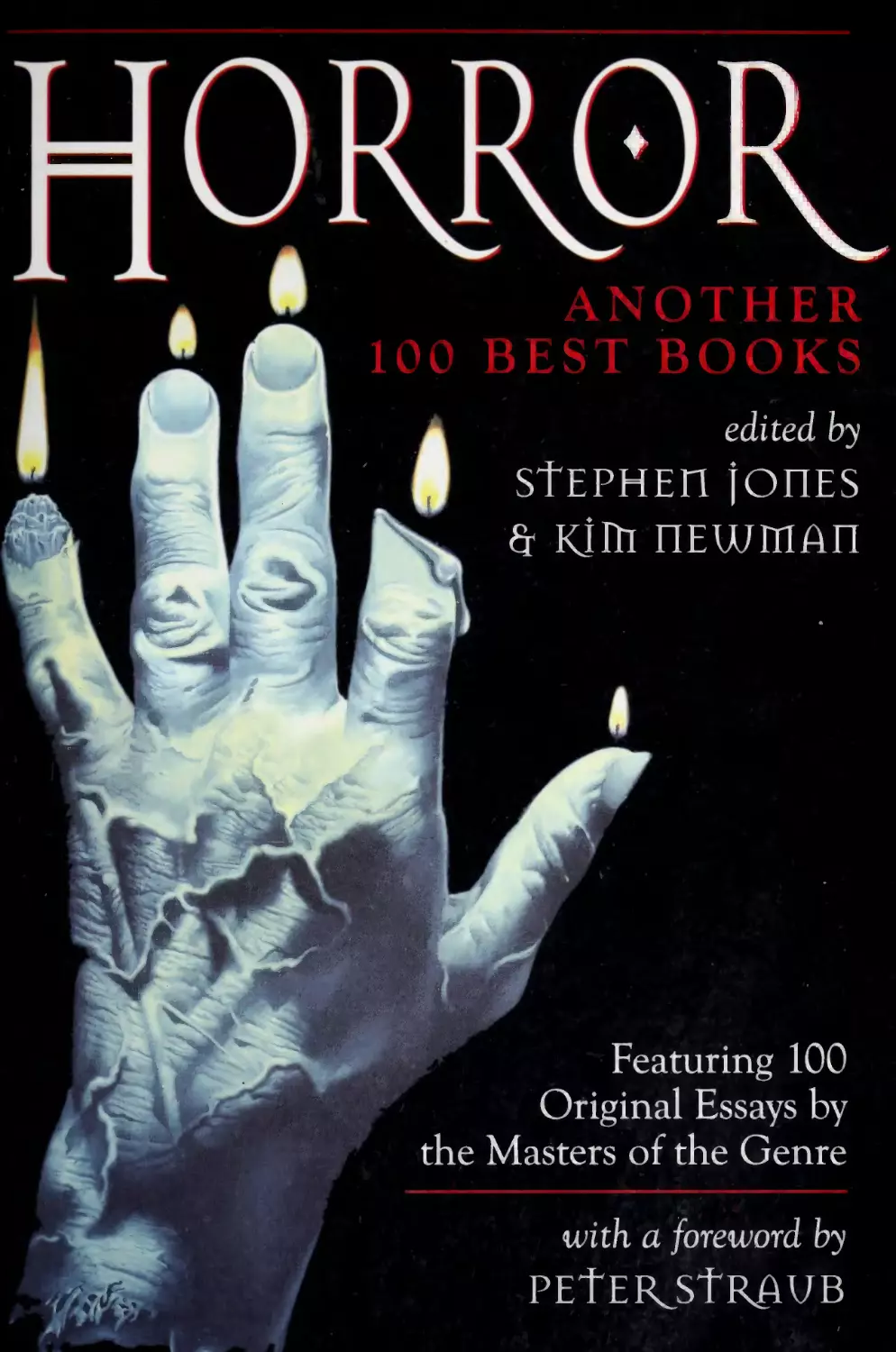
ANOTHER
BEST BOOKS
edited by
sTepheh jonES
a Kim nEwmAn
Featuring 100
Original Essays by
the Masters of the Genre
with a foreword by
peTei<sTravb

EDITED BY
Stephen Jones and Kim Newman
WITH A FOREWORD BY
Peter Straub
Carroll & Graf Publishers
New York

Horror: Another 100 Best Books
Copyright © Stephen Jones and Kim Newman, 2005.
Published by
Carroll & Graf
An Imprint of Avalon Publishing Group Incorporated
245 West 17th Street • 11th Floor
New York, NY 10011-5300
AVALON
All rights reserved. No part of this book may be reproduced in whole
or in part without written permission from the publisher, except by
reviewers who may quote brief excerpts in connection with a review in
a newspaper, magazine, or electronic publication; nor may any part of
this book be reproduced, stored in a retrieval system, or transmitted
in any form or by any means electronic, mechanical, photocopying,
recording, or other, without written permission from the publisher.
Library of Congress Cataloging-in-Publication Data is available.
ISBN: 0-7867-1577-4
987654321
Designed by India Amos, Neuwirth & Associates
Printed in the United States of America

CONTENTS
Foreword by peter straub • xiii
Introduction: It Seemed Like a Simple Idea at the Time ...
bysTEPHEN jones and kim newman • xvii
1	RobertSilverberg on The Revengers Tragedy
by CYRIL TOURNEUR [1607] • 1
2	Chelsea Quinn Yarbro on Pikovaia DamalThe Queen of Spades
byALEKSANDR PUSHKIN [1834] • 5
3	Elizabeth Hand on A Christmas Carol
by CHARLES DICKENS [1843] • 9
<1 Doug Bradley on Jane Eyre
byCHARLOTTE BRONTE [1847] • 14
5	Jay Lake on Rekopiz Znaleziony w Saragossie/
The Manuscript Found in Saragossa
byjAN, COUNT POTOCKI [1847] • 20
6	K. IV. Jeter on New Grub Street
byGEORGE GISSING [1891] • 24
7	DavidJ.Skal on The Picture of Dorian Gray
by OSCAR WILDE [1891] • 29
8	Les Edwards on The War of the Worlds
byH. g. wells [1898] • 34
g Tony Richards on The Hound of the Baskervilles
bySIR ARTHUR CONAN DOYLE [1902] • 39
10 Rick Hautala on The Boats of the “Glen Carrig”
by WILLIAM HOPE HODGSON [1907] ♦ 43
[ V]

11	Jean-Marc Lofficier and Randy Lofficier on Le fan tome de I’Opera/
The Phantom of the Opera
by GASTON LEROUX [1911] ♦ 47
12	Tim Lucas on Fantomas
by PIERRE SOUVESTRE and MARCEL ALLAIN [1911] ♦ 50
13	Christopher Wicking on The Case of Charles Dexter Ward
byH. P. LOVECRAFT [1927-28] • 55
14	Barbara Roden and Christopher Roden on They Return at Evening
by H . R. W A I< E FI E L D [1928] ♦ 60
15	Sydney J. Bounds on Creep, Shadow!
by A. MERRITT [1934] ♦ 64
16	Chaz Brenchley on The Trail ofFu Manchu
by SAX ROHMER [1934] • 69
ij Stephen l/olfc on The Devil Rides Out
byDENNIS WHEATLEY [1934] ♦ 73
18	Gahan IVilson on The Haunted Omnibus
ed. ALEXANDER LAING [1937] ♦ 78
19	Robert Weinberg on The Edge of Running Water
by WILLIAM SLOANE [1939] ♦ 82
20	T.M. Wright on L’Etranger/The Stranger
byALBERT CAMUS [1942] • 86
21	David A. Sutton on Sleep No More:
Twenty Masterpieces of Horror for the Connoisseur
ed. AUGUST DERLETH [1944] ♦ 90
22	Storm Constantine on Lost Worlds
by CLARK ASHTON SMITH [1944] • 95
23	Stefan Dziemianowicz on Jumbee and Other Uncanny Tales
by HENRY S. WHITEHEAD [1944] • 99
24	Gwyneth Jones on Great Tales of Terror and the Supernatural
ed. HERBERT A. WISE and PHYLLIS FRASER [1944] • 104
[ Vi]

25
26
2J
28
29
50
51
32
53
34
35
36
37
38
39
Joel lane on The Opener of the Way
by ROBERT BLOCH [1945] ♦ 108
Christopher Fowler on Gormenghast
byMERVYN PEAKE [1946-50] • 113
Gary Gianni on Carnacki the Ghost-Finder
by WILLIAM HOPE HODGSON [1947] ♦ 117
Randy Broecker on Darker Than You Think
by JACK WILLIAMSON [1948] ♦ 121
Tanith Lee on Tales of Horror and the Supernatural
by ARTHUR MACHEN [1949] ♦ 125
Lucius Shepard on Nineteen Eighty-four
by GEORGE ORWELL [1949] ♦ 130
David Bischoff on House of Flesh
by BRUNO FISCHER [1950] • 136
Anne Billson on Fancies and Goodnights
by JOHN COLLIER [1951] ♦ 141
Nancy A. Collins on The Killer Inside Me
byjim Thompson [1952] • 145
Laurence Staig on The Third Ghost Book
ed. LADY CYNTHIA ASQUITH [1955] ♦ 149
Andy Duncan on The Body Snatchers
by JACK FINNEY [1955] ♦ 153
John Gordon on The Talented Mr Ripley
byPATRICIA HIGHSMITH [1955] ♦ 157
Norman Partridge on The Hunger and Other Stories
by CHARLES BEAUMONT [1957] * 161
Robert Irwin on The Blind Owl
bySADEGH HEDAYAT [1957] ♦ 166
Mark Morris on The Midwich Cuckoos
by JOHN WYNDHAM [1957] • 169
[vii]

i|0 Howard Waldrop on A Scent of New-Mown Hay
by JOHN BLACKBURN [1958] • 173
41	Ed Gorman on A Stir of Echoes
by RICHARD MATHESON [1958] ♦ 178
42	Muriel Gray on The Weirdstone of Brinsingamen
by ALAN GARNER [i960] ♦ 181
43	Terry Dowling on Tales of Terror
ed. CHARLES HIGHAM [1961] • 185
44	Peter Atkins on Some of Your Blood
byTHEODORE STURGEON [1961] • 189
45	Jack Womack on We Have Always Lived in the Castle
by SHIRLEY JACKSON [1962] ♦ 193
46	Darrell Schweitzer on The Case Against Satan
by RAY RUSSELL [1962] • 197
47	Peter Crowther on Something Wicked This Way Comes
by RAY BRADBURY [1963] • 200
48	Ian MacLeod on The Collector
by JOHN FOWLES [1963] ♦ 204
49	Glen Hirshberg on Who Fears the Devil?
byMANLY WADE WELLMAN [1963] • 208
50	Simon Clark on A Wrinkle in the Skin
byjOHN CHRISTOPHER [1965] • 212
51	Nancy Holder on Rosemary's Baby
by ira levin [1967] • 215
52	Ellen Datlow on The Playboy Book of Horror and
the Supernatural
Selected by t h e editors of pl a yb oy [1967] ♦ 219
55 Terry Lamsley on Pages from Cold Point
by PAUL BOWLES [1968] ♦ 224
54 John Farris on Outer Dark
byCORMAC MCCARTHY [1968] • 228
[ viii ]

55	Stephen Baxter on The Book of Skulls
byROBERT SILVERBERG [1971] • 231
56	Elizabeth Massie on Harvest Home
by THOMAS TRYON [1973] ♦ 235
57	P.N. Elrod on The Night Stalker
byjeff rice [1973] ♦ 239
58	Michael Swanwick on Blood Sport
byROBERT F. JONES [1974] • 243
59	Nicholas Royle on Nightshade
by DEREK MARLOWE [1975] ♦ 246
60	Roz Kaveney on Peace
by GENE WOLFE [1975] ♦ 250
61	David Drake on The Year of the Sex Olympics: Three TV Plays
by NIGEL KNEALE [1976] ♦ 253
62	Marc Laidlaw on Our Lady of Darkness
by FRITZ LEIBER [1977] • 257
65	Paul McAuley on The Cement Garden
by ian McEwan [1978] • 260
64 Jo Fletcher on Darkness Weaves With Many Shades
by KARL EDWARD WAGNER [1978] ♦ 264
€5 Sir Christopher Frayling on The Bloody Chamber and
Other Stories
byANGELA CARTER [1979] ♦ 269
66	Thomas Ligotti on Sweeney Todd
bySTEPHEN SONDHEIM and HUGH WHEELER
[1979] ♦ 274
D. F. Lewis on The Collected Stories of Elizabeth Bowen
by ELIZABETH BOWEN [1980] • 278
68 Christopher Golden on Dark Forces: New Stories of Suspense
and Supernatural Horror
ed. kirby McCauley [1980] • 282
[ix]

69	John Burke on Tales from the Nightside
by CHARLES L. GRANT [1981] • 286
70	Yvonne Navarro on They Thirst
by ROBERT R. McCAMMON [1981] ♦ 290
71	Poppy I. Brite on The Face That Must Die
by RAMSEY CAMPBELL [1983] ♦ 294
72	David Stuart Davies on The Woman in Black
by susan hill [1983] • 298
73	Michael Marshall Smith on Pet Sematary
by STEPHEN KING [1983] • 301
74	Anthony Timpone on Clive Barkers Books of Blood
Volumes One, Two, and Three
by CLIVE BARKER [1984] ♦ 306
75	Nancy Kilpatrick on Perfume: The Story of a Murderer
by PATRICK SUSKIND [1986] ♦ 310
76	Bill Sheehan on Finishing Touches
byTHOMAS TESSIER [1986] • 314
77	Kelly Link on Strange Toys
by PATRICIA GEARY [1987] • 317
78	Allen Koszowski on The Dark Descent
ed. DAVID G. HARTWELL [1987] • 321
79	Graham Joyce on Misery
by STEPHEN KING [1987] • 325
80	Frank M. Robinson on The Silence of the Lambs
byTHOMAS HARRIS [1988] • 329
81	Mark Chadbourn on Prime Evil
ed. DOUGLAS E. WINTER [1988] • 334
82	Jay Russell on By Bizarre Hands: Stories by Joe R. Lansdale
by JOE R. LANSDALE [1989] ♦ 338
83	Peter H. Cannon on The Grotesque
by Patrick McGrath [1989] ♦ 342
[x]

84
85
86
«7
88
89
90
91
92
95
98
95
96
97
98
David Morrell on Carrion Comfort
by DAN SIMMONS [1989] ♦ 345
Stephen R. Bissette on From Hell
byALAN MOORE and EDDIE CAMPBELL
[1989-99] ♦ 349
David McGillivray on American Psycho
by BRET EASTON ELLIS [1991] • 354
Brian Hodge on Lost Souls
by POPPY Z. BRITE [1992] ♦ 358
China Mieville on The Course of the Heart
byM. JOHN HARRISON [1992] • 362
Adam Simon on Flicker
by THEODORE ROSZAK [1992] ♦ 366
Paul Di Filippo on X V
byMICHAEL BLUMLEIN [1993] • 371
Caitlin R. Kiernan on Skin
byKATHE KOJA [1993] ♦ 375
Tananarive Due on Throat Sprockets: A Novel of Erotic Obsession
bytim lucas [1994] • 378
Simon R. Green on The OffSeason: A Victorian Sequel
by jack cady [1995] ♦ 382
S. T. Joshi on The Nightmare Factory
byTHOMAS LIGOTTI [1996] • 385
Roberta Lannes on A Sight for Sore Eyes
by RUTH RENDELL [1998] • 389
Michael Shea on Reprisal
by MITCHELL SMITH [1999] ♦ 393
John Pelan on A Haunting Beauty
by SIR CHARLES BIRKIN [2000] • 397
Jeff VanderMeer on House of Leaves
by MARK Z. DANIELEWSKI [2000] • 401
[Xi ]

99 Richard A. Lupoff on Feesters in the Lake & Other Stories
by BOB LEMAN [2002] ♦ 406
100 Tim Lebbon on More Tomorrow & Other Stories
byMICHAEL MARSHALL SMITH [2OO3] ♦ 4H
Lists of Recommended Reading • 415
Appendix I: Horror: 100 Best Books • 415
Appendix II: Further Reading ♦ 419
Selected Webliography ♦ 438
About the Editors ♦ 445
Index to the Books, Authors, and Contributors ♦ 447
Acknowledgments ♦ 453
[xii]

FOREWORD
Peter Straub
Ever savvy, also incredibly well informed, Stephen Jones
and Kim Newman have chosen to bring out this companion
volume to their 1988 collection Horror: 100 Best Books, at what
seems to me exactly the right time, which is to say the moment at
which a sophisticated contemporary reader might well come to the
startling recognition that the one hundred most significant, most
interesting books in the sprawling, multiform, definition-shedding
field of horror might well be substantially different from any such
list compiled nearly twenty years ago. Things have changed, in my
opinion radically and entirely for the better.
That horror now should be a different kind of animal than it was
in, say, 1975, to pick the year of’Salem s Lot and my substantially less
successful first effort at writing a horror novel, Julia, might seem
inevitable. Over the past thirty years, general fiction itself mutated
and evolved, as the generation dominated by Bellow, Roth, and
Updike gradually gave way to writers such as Jonathan Lethem and
Michael Chabon. The culture changed, and so did tastes in literature,
a matter already in evidence by the late 1980s. But it’s an odd and
telling fact that while general literature shifted away from the 1970s
Bellow-Updike axis to a Thomas Pynchon-influenced model, then yet
again around the time of the new millennium, horror writing pretty
much stuck to its guns from the mid-1970s to the late ’90s, which is
the reason it began to seem pretty tired. Witches, vampires, haunted
houses, and serial killers chased each other round and round the
tree until they met the fate of the tigers in Little Black Sambo—they
turned to butterfat. It was as though everyone noticed except the
writers—especially, alas, those who, while replicating the old formu¬
las in largely self-published chapbooks, supposed themselves to be
[ xiii ]

innovators. (Douglas Winter got so fed up with this lazy spiral that
in a speech at the World Horror Convention in 1994, he told everyone
that horror didn’t actually exist, at least not in the way they thought
of it. Using a phrase particular to the demolition industry, he recom¬
mended that the assembled conventioneers “make some sky.”)
As the contributors to this book demonstrate, sky has been made, in
abundance. During the late 1990s, this wonderful thing happened—it
became clear that a number of emerging writers had figured out how
to extend, ignore, or transform horror’s (and dark fantasy’s) supposed
boundaries. By doing so, they were treating it as what at its best it
had aspired to be all along, a kind of literature distinguished from
other kinds chiefly by an angle of vision that, while resisting most
culturally determined forms of denial, celebrated the grotesque,
the eccentric, the marginal, and the magical. This point of view
respected the hard facts of loss, pain, emotional extremity, and grief;
mainly, I think, it honored the capacity of vivid, liberated imagina¬
tion to discover unexpected and often unsettling truths. Among
these writers—most of whom are included here—were Poppy Z.
Brite, Dan Chaon, Peter Crowther, Terry Dowling, Tananarive Due,
Jeffrey Ford, Christopher Fowler, Elizabeth Hand, Glenn Hirshberg,
Graham Joyce, Caitlin R. Kiernan, Tim Lebbon, Thomas Ligotti,
Kelly Link, Christopher Rowe, Michael Marshall Smith, Rosalind
Palermo Stevenson, Jeff VanderMeer, and Conrad Williams. The
non-fiction writers Stefan Dziemianowicz and Bill Sheehan, both
of whom appear in this volume, provided intelligent and supportive
commentary on the exciting developments, as did almost everyone
who contributed reviews and essays to Dziemianowicz’s luxuriantly
thoughtful journal Necrofile (1991-98, RIP).
Readers of a conservative bent—inherent conservatism being one of
the qualities critics reflexively attribute to horror—generally respond
with a shudder of distaste to my concept of the genre (or nongenre)
as the essentially boundaryless product of a particular interpretive
stance, but here I was tutored by my own experience, and I want to
explain how it happened. Between 1988 and 1994 I published three
novels that concentrated on childhood trauma, the profound shadow
[xiv]

of the Vietnam war, emotional extremity, grief, buried crimes, and
buried feelings. There was nothing supernatural in these books; and
although they dealt with multiple murders, they did not actually feel
like mystery novels—they were more like what I thought mystery
novels should be. If asked to categorize them, I would have called them
thrillers, with the unspoken proviso that these thrillers (1) were not
housebroken and (2) read better if read twice. Initially to my dismay,
later to my satisfaction, just about every reviewer of these books used
his or her first sentence to describe them as horror novels.
Instead of responding freshly to the objects of their attention, these
reviewers listened to tapes already installed in their heads; what a
surprise! Yet the knee-jerk genre assignment did not otherwise affect
their responses to the books, which received almost universally
appreciative reviews. For the most part, my earliest readers saw what
was going on in these books and understood my concerns. Which
meant, I began dimly to grasp, that they had no problem with giving
horror an extremely generous and wide-ranging brief. If reviewers
could do that without even bothering to think about it, how could I
not follow their lead and internalize a definition that felt so comfort¬
able as to be tailor-made?
Then, as if to prove the point, came “The Specialist’s Hat” (Link),
The Tooth Fairy (Joyce), Mortal Love (Hand), “Notes on the Writing
of Horror: A Story” (Ligotti), and a host of other, startlingly original
fictions that seemed to emerge from an utterly free and unconfined
imaginative space. If I were one of the people in this book, I’d have a
lot of trouble trying to make my selection. It’s wonderful, this sense
of amplitude, of a rich bounty.
—PETER STRAUB
New York City
April 2005
[XV]

INTRODUCTION:
IT SEEMED LIKE A SIMPLE IDEA AT THE TIME . . .
And that time was 1988.
Actually, that was when Horror: 100 Best Books was pub¬
lished. The simple idea came as many as two years earlier, and
it was initially a lot more simple. A small British publisher (Xanadu
Publications) was issuing a series of 100 Best Books books, and had
recruited experts such as H. R. F. Keating, David Pringle, and Michael
Moorcock (with James Cawthorn) to cover, respectively, crime, sci¬
ence fiction, and fantasy.
Their format was that the expert would select the top hundred
titles himself, and write miniessays about why they made the grade.
When we—Stephen Jones and Kim Newman—first pitched ourselves
for the project, we thought we’d do exactly that kind of job: making
lists, arguing about them, trading off entries, and writing the book
ourselves. We even made a tentative list, which we showed to a few
other writers and experts who, to a man (well, to Les Daniels), com¬
plained that their own books weren’t on it.
Then, independently, we both had a different idea. This is actually
how it happened: Steve said to Kim (in a Mexican restaurant just off
London’s Charing Cross Road), “I know how we should do this book.”
Kim said, “We should get a hundred writers to do individual essays
on books they pick.” Steve said, “How did you know I was going to
say that?” And Kim said, “Because I was going to say that, too.”
So, after a great deal of commissioning, collating, and other busi¬
ness too tedious to go into, the book came out in 1988 from Xanadu in
the United Kingdom and Carroll & Graf in the United States. There
was even a high-priced (for the time) limited edition with signatures
of most of the then-living authors (and facsimiles of the dead ones),
[ xvii ]

copies of which are still available if you want to sell one of your rela¬
tives on the organ transplant black market to get hold of one.
Horror: 100 Best Books (note no “The”) has been through several
slightly revised editions from various publishers, won an award (the
Bram Stoker Award, from the Horror Writers Association), came out
in a Tenth Anniversary Edition in 1998, and has even been imitated
a couple of times—by Maxim Jakubowski’s 100 Great Detectives and
Mark Morris’s Cinema Macabre (which has a mere fifty contributors).
We don’t actually hold ourselves responsible for the plethora of “100
Best” clips-and-talking-heads documentaries on television, though
we have appeared in them from time to time.
Since 1988, list-making and pantheon-building have become
something of a mania, though in a spirit that is quite antithetical
to our intent: most “100 Best” books/films/CD Roms/Internet chat¬
room screeds are dictatorial, in effect saying, “These are the things
you should pay attention to and you can ignore the rest.” Often, they
serve as substitutes for independent thought and set in stone critical
picks that need to be argued with—any “100 Best Films” listing that
excludes The Ghost Goes Gear is worthless in our books.
And don’t talk to us about listings that set aside notions of qual¬
ity and pick out not the “best” but the “best-selling,” “top-grossing,”
or “most profitable” of anything. Or—most pernicious of all—those
assembled after random surveys about as reliable as an election in
Zimbabwe to come up with lists of “favorite” films or books voted for
by folks who haven’t read or seen anything that came out more than
five years ago and haven’t even bothered with anything interesting
that came out recently.
We hope that you’ll listen to our contributors, maybe even argue
with their choices, and then come up with your own list. The point
is to do all the reading that makes you qualified to compile such a
list, not to rush out and collect all the titles on anyone else’s list and
feel that your mission in life is over.
Compiling the first Horror: 100 Best Books in 1988 made us read
titles we d never considered before; and this time around, we were
still making discoveries, not only of recent material but also of vintage
[ xviii ]

work. If not for I<. W. Jeter, for instance, that Penguin paperback of
New Grub Street might have remained unopened on Kim’s shelves
for another fifteen years, which is how long it had been there since
he bought it. Now George Gissing’s book makes his favorite novels of
all time list—not just for the horrific moment where the down-and-
out novelist is forced to move into the most humiliating address in
London, which in the 1880s was the street where Kim now lives!
One of the advantages of our format, as opposed to the single¬
author “100 Best,” is that we can go back to the well. Having set out
a definitive list of the “100 Best Anything,” an expert can hardly do a
sequel called “The 100 Next Best...” However, nearly two decades on,
we can easily find another hundred contributors and solicit another
hundred essay topics.
When we set out to do this follow-up book, we expected many
would-be contributors to look at the contents of the first volume—
which we had to send out as a list of books they couldn’t choose—and
cry off because everything they might want to write about had already
been taken. In practice this complaint never came up. Our distin¬
guished contributors last time around might have knocked off Dracula,
Frankenstein, I Am Legend, The Shining, and M. R. James, but they
left out The Picture of Dorian Gray, The Phantom of the Opera, Our
Lady of Darkness, Misery, and John Collier. As our own recommended
further reading list indicates, important titles down through the
centuries have still slipped through our contributors’ net.
Horror has changed a lot since 1988. It has ceased to be a publishers’
category, making hard times for some of our subjects and contribu¬
tors, but it has also become more entwined with the mainstream of
popular culture. Trends have come or gone and lingered or burned
out—“literary experiment,” “young adult,” “splatterpunk” (hah!),
“extreme horror” (i.e., misogynist crap), “dark suspense,” “hard crime,”
“quiet horror,” “vampire romance,” “terror soap,” “new weird,” block¬
busters from market leaders, books associational with television hits
such as The X Files or Buffy the Vampire Slayer.
Of course, horror is about what we’re afraid of, and we’re afraid
of different things these days: back then, we were terrified of nuclear
[xix]

war between the superpowers, the plague of AIDS, or that the iron
rule of Margaret Thatcher and Reagan-Bush (I) would extend forever.
Now we are terrified of devastating terrorist attacks, the plagues of
SARS or mutant flu, or that the iron rule of Tony Blair and Bush (II)
will extend forever.
We’ve grown older, which brings its own fresh horrors every year—
the deaths of parents and friends (and far too many contributors to
Horror: 100 Best Books); interesting new medical conditions; catching
ourselves saying and doing things older people said and did that we
once swore we wouldn’t (“In our day, we had songs with proper lyr¬
ics and tunes you could hum such as Anarchy in the U.K.’”); losing
patience when we notice younger people saying and doing things we
used to and now wonder why we weren’t clouted for them. At least
no one has run us over with a camper van yet.
Though we hope to be thought-provoking and even scary—criticism
can be scary, as any author knows—this is also a book of celebration.
Everyone here has earned their place, whether they are writing about
or written upon; some are so long dead we’re not even sure who they
were, such as the author of The Revengers Tragedy, while others have
barely brushed the shell out of their hair, but all number among the
selected, the deservedly acclaimed “Best.”
Once again we hope that this volume will appeal to both the rela¬
tive newcomer and the veteran aficionado. As with the earlier volume,
it was a logistical nightmare to compile—although the invention of
e-mail made a huge difference to our deadlines and mailing costs.
However, having apparently learned nothing since 1988, at the
time of writing we are actually considering a limited edition of this
book signed by all the contributors, and we are already compiling a
list of those we might approach for a third volume in another decade
or two ...
—STEPHEN JONES andKIM NEWMAN
London, England
May 2005
[XX]

This volume is dedicated to the memory
of those contributors to Horror: 100 Best Books
who are no longer among us:
John Blackburn
Robert Bloch
Hugh B. Cave
R. Chetwynd-Hayes
Frances Garfield
George Hay
Michael McDowell
Milton Subotsky
Karl Edward Wagner
Donald A. Wollheim

1
ROBERT 5III/ERBERG on
The Revenger’s Tragedy
by CYRIL TOURNEUR
[1607]
In the standard edition o/The Plays of Cyril Tourneur (1978), editor G.
Parfitt acknowledges that Thomas Middleton (1580-1627) has at least
as strong a claim as Tourneur (15757-1626) to be regarded as author
o/’The Revenger’s Tragedy and that “unless new evidence emerges...
the play has to be regarded as anonymous.”Bluntly titled with a main
character whose name gives away the game, this is one of the great
Jacobean revenge tragedies and offers both an especially impressive
body count and an array of perverse and/or criminal activities. Alex
Cox’s 2002 film (titled without the apostrophe), which opts to credit
Middleton, uses Liverpudlian locations and has a ferocious perfor¬
mance from Christopher Eccleston as Vindice. Tourneur’s other works
include The Atheist’s Tragedy (1611) and an elegy on the death of Prince
Henry (1613); he died in Ireland after accompanying Sir Edward Cecil
on an unsuccessful raid against Spanish treasure ships. Middleton,
who probably contributed passages to Shakespeare’s Macbeth and
Timon of Athens, is best known for The Changeling (1622).
Horror in plain view was a Shakespearean specialty. The blind¬
ing of Gloucester in King Lear, the smothering of the blameless
Desdemona, and the mutilations perpetrated in Titus Andronicus
come quickly to mind. But in the Jacobean era a striking band of lesser
figures created plays that went far beyond Shakespeare in reaching
for a tone of grandguignolesque frenzy: Webster’s The White Devil,
Kyd’s The Spanish Tragedy, Marston’s The Malcontent, and many
[1]

more. It was the mysterious Cyril Tourneur, though, who most nearly
crystallized the flamboyant sensibility of his times. In The Revengers
Tragedy of 1607, the earlier and greater of his two known plays, he
refined the drama of grisliness to an extraordinary degree.
Little is known of Tourneur. He is a shadowy figure who dodges in
and out of the official records of his time under several names. His
early life is virtually a blank to us; we have scattered documentation
of his literary career, which lasted only (as far as we know) about a
decade, and some sketchy information about his later years. We aren’t
even sure he wrote The Revengers Tragedy. (Some recent scholars
have attributed the play to another fire-and-brimstone seventeenth¬
century playwright, Thomas Middleton. The evidence in favor of
Middleton is just about as convincing as that for Tourneur, and vice
versa; since there seems to be no way to arrive at the truth, I prefer
to stick with the long-standing attribution to Tourneur.)
Nobody looks upon Tourneur as one of the great originals of
the Elizabethan theater. He took materials already in the common
domain, borrowing a plot device here, a character type there, even
the structure of an entire scene, and, by infusing them with peculiar
fire of his own, gave unique life to his work.
We can hear echoes of Hamlet, for example, in the parallels between
the two mothers, Gertrude and Graziana. Both sons have a quasi-
sexual interest in their mothers, and Vindice, like his predecessor,
eventually forces his morally flexible mother to reconsider the evils of
her ways and leads her to repentance. (Tourneur’s Graziana is forced
to it by her sons at dagger’s point, a typical Tourneur touch.) Hamlet
and Vindice both have major scenes involving skulls, too, although,
as we will see in a moment, they are rather different in purpose. And
the setting of Tourneur’s play is the dark, feverish, steamy fantasy
Italy, savage and corrupt and amoral, rife with rape and murder and
treachery, of a host of more familiar Elizabethan plays.
Derivative though Tourneur may be, though, his vision of evil is so
intense that his Revengers Tragedy reaches an almost sublime level of
ghastliness. Looking down detachedly on his cast of bloody-minded
characters and yet passionately involved, he writes of decay and lust
[2]

and villainy with a ferocious gusto, a cosmic humor; his play is, as it
were, a comedy of terrors.
The first line of the text provides the memorable stage direction
that tells us what we are in store for: “Enter Vindice, holding a skull.”
The skull is that of his beloved Gloriana, poisoned by the duke of this
unnamed Italian principality when she refused his sexual advances.
For Hamlet, the skull of Yorick touches off an extended philosophical
meditation on the transience of human existence; but for Vindice,
Gloriana’s skull is the instrument of his terrible revenge, and we will
see it again at the center of the action in the third act’s remarkable
scene of over-the-top vengeance, when it serves as the strangest of
all literary murder weapons.
The play focuses narrowly on one man and one action alone. Tour¬
neur bathes his Vindice—the name itself means “revenger”—in a
beam of white light that reveals that there is nothing else in the play,
no hidden corners; we do not feel, as with Ben Jonson, that we are
looking at a captured segment of a bustling, sprawling world. The
confines of Vindice’s world are the limits of the play; nothing else
exists. He has but one goal—destruction of “the nest of dukes” who
have done him such injury—and the play sweeps along at a furious
pace toward that goal. In this he is unlike Hamlet, whose greatness as
a literary figure lies in his ambivalence, his perpetual self-questioning,
which bubbles out into the texture of the play most notably in the
soliloquies. Vindice has moments of soliloquy, too—indeed, the play
opens with quite an astonishing one—but never a moment of Hamlet¬
like inner despair. He does reflect on the action in which he is bound,
such as the moment when he is called on to tempt his mother and
prostitute his chaste sister for the sake of his scheme, and he shows
a bit of sorrow at this necessary treachery. But generally he moves
swiftly along on his murderous project, never pausing to wonder
whether he’d be happier calling the whole thing off.
The verse moves swiftly, too, and every few pages reaches one of
those frenzied climaxes that epitomize the whole play, as in this
famous passage of Act Two, when Vindice seeks to embroil his sister
in his plan:
[3]

Oh think upon the pleasure of the palace,
Secured ease and state; the stirring meats,
Ready to move out of the dishes, that e’en now quicken
when they’re eaten,
Banquets abroad by torch-light, musics, sports,
Bare-headed vassals, that had ne’er the fortune
To keep on their own hats, but let horns wear ’em,
Nine coaches waiting—hurry, hurry, hurry!
This choppy, irregular verse, which at one point breaks the confines
of pentameter completely and explodes into an unmetrical, overlong
line, brings the scene of temptation to a breathless peak. And the play
moves right along through the remaining acts, in which murder piles
upon murder until Vindice has achieved (and, indeed, overachieved)
his task. The ceaseless sardonic fury of The Revengers Tragedy, the
cool moral ambiguity, the sense of an irresistible stream rushing
away to flow over some towering precipice’s edge—these are things
no other dramatist of the era managed with the same overwhelm¬
ing effect.
With the passionate conviction of a youthful writer, Tourneur
tells a story that must have been close to his own feelings. The death
of Vindice at the climax of his revenge is the ultimate triumph, not
the punishment meted out by an angry god. His defiant final speech
(“We die after a nest of dukes—adieu”) is not the outcry of a tortured
man, but the ringing words of one who has done a splendid job of
bloodletting and is greatly pleased with his work.
In The Revenger’s Tragedy the strange mind of Cyril Tourneur was
free to revel in the lust and gore that so evidently delighted it, and
produced the richest work of horror of the Elizabethan stage.
ROBERT SI LVERBERG (b. 1935) published his first short
story, Gorgon Planet,” in Nebula Science Fiction in 1954.
The following year he became a professional author and has
written more than a thousand short stories and countless
novels (many under a bewildering array of pseudonyms)

in all genres. Among just some of his best-known books
are Thorns, Son of Man, Dying Inside, Lord Valentine’s
Castle, and Majipoor Chronicles. He was also the editor of
the New Dimensions anthology series, Men and Machines,
Great Short Novels of Science Fiction, and the two Legends
fantasy anthologies. Phases of the Moon: Stories from Six
Decades was a recent retrospective collection from Subter¬
ranean Press. Silverberg has won five Hugo Awards, five
Nebula Awards, and has been designated a Grand Master
by the SFWA. His 1972 novel The Book of Skulls has been
purchased by Paramount for filming (and is discussed in
this present volume by Stephen Baxter), while The Posi¬
tronic Man, which he wrote in collaboration with Isaac
Asimov, was adapted into the Chris Columbus movie The
Bicentennial Man starring Robin Williams.
[1834]
CHELSEA QUINN YARBRO on
Pikovaia Dama/lhe Queen of Spades
by ALEKSANDR PUSHKIN
“Pikovaia Dama,” by Aleksandr Pushkin (1799-1837), is one of the
most anthologised of all ghost stories (e.g, in Charles Higham’s Tales
of Terror, i960—Terry Dowlings choice in this volume—and Robert
Aickman’s The 4th Fontana Book of Great Ghost Stories, 1967)- A
German officer in St. Petersburg seeks the secret of the three cards that
will ensure a winning streak at faro and pesters an ancient countess
[5]

to death only to learn the secretfrom her specter and suffer madness
and punishment when he tries to make his fortune with the trick. In
1890 Tchaikovsky turned the tale into an opera, and it is often done
on stage, screen, and radio. Thorold Dickinsons The Queen of Spades
(1949), with Anton Walbrook and Edith Evans, is a faithful, impres¬
sive film version. Otherfilm/television adaptations (Pikovaia Dama,
Pique dame, La dama di picche,) came in 1910 (German and Russian),
1913 (Italian and American), 1916 (Russian), 1921 (Hungarian), 1927
(French, German), 1937 (French), 1954 (American short and an Inner
Sanctum TV episode), i960 (Russian, from the opera), 1965 (French),
1982 (Russian), and 1999 (a record ofPlacido Domingo's star turn in
the Tchaikovsky). To save our readers the trouble of damning them¬
selves, we can reveal that “the secret of winning at cards” is to play, in
succession, a three, a seven, and an ace. Be especially careful not to
play a queen instead of the ace, for ruin lies that way.
About the time I was starting grade school, the family’s next-
door neighbor was a retired teacher—Miss Patterson—who had
been a high school teacher for forty years. She was very much of a type
you sometimes see in Depression-era films: quiet, self-contained, a
bit autocratic, and rigorously bookish. In retrospect, I realize she was
hungry for students when she first asked me if I wanted to read any
of her books. Since my mother often boasted of my reading prowess—
I had started reading early—I was selected for Miss Patterson’s atten¬
tion, and I am exceedingly grateful to her for it.
She had kept a great many of her schoolbooks, among them a
series done in the 1930s for secondary students as part of the WPA
programs to put printers, binders, and writers/translators back to
work. These were local products, or so Miss Patterson believed,
distributed to Bay Area schools in 1937 or 1938, roughly ten years
before I encountered them. They were called Great Stories from
Other Lands. The books were fairly short—between thirty thousand
to forty thousand words—and aside from retellings of classic myths,
excerpts from Don Quixote, a collection of Balzac’s short stories,
a pair of novelettes by Goethe, and a book on the fables of South
[6]

America, there was a translation of Aleksandr Pushkin’s great story
of compulsion and madness Pikovaia DamaI The Queen of Spades,
and that was the one that caught my fancy. I just loved it. Even then
I had a taste for the macabre.
The book itself was utilitarian in design, with heavy boards and
simple black lettering on gray-green cloth. It had two illustrations: the
frontispiece was a Lynn Ward-style woodblock of a young man with
insane eyes holding up three cards. The second illustration showed a
very grand old woman wearing out-of-date clothing and a plethora
of jewels, clasping her hand to her throat, her face a horrified rictus.
From the first time I saw it, I beseeched (as only a six-year-old can
beseech) Miss Patterson to “help” me read it—which meant she was
to fill in all the words I didn’t know yet.
What a great story Pikovaia Dama was for me then! Poor Her¬
mann, caught up in the glamour of gambling, killing the countess
for the secret, and being betrayed by it. The story spirals in on itself
hypnotically, and even now it can hook me. Then, it was so much
better than Nancy Drew mysteries and similar fare that was usually
offered to me, I couldn’t understand why my classmates didn’t share
my enthusiasm. I read it every chance I got until fourth grade. I still
do, in various translations, every decade or so, and I listen to the
opera based on it about every year.
There is an odd little coincidence between this story and my own
work: the countess learned the secret of the winning hand of cards
from le Comte de Saint-Germain when she was in Paris as a girl. That
story marks, as far as I can remember, my first interest in that most
intriguing gentleman.
When I was approached about this project, I tried to find a copy of
that particular 1930s edition of the book on the Internet, but without
success: those WPA projects did not tend to remain in the system
once they reached a certain stage of dilapidation. In addition, a lot of
Russian literature disappeared from school shelves in the 1950s during
the McCarthy era, and I suspect Pikovaia Dama, if it didn’t disappear
from hard use, may have been one of the casualties. I did find another
edition of the story published in London in 1928 by Blackamore Press.
[7]

It has vellum-backed cloth boards, and was a limited edition of three
hundred and ten copies, two hundred and fifty of which are on Rives
vellum; it is fully illustrated in color—much grander than the old
schoolbook I knew, and fiendishly expensive.
I wish now I had asked Miss Patterson to give it to me, for it would
have a prized place in my library, but I didn’t. She died in 1951, and
her estate went to a niece. Miss Patterson’s books were packed up
with the rest of her things, and I have no notion what happened to
them. If you had asked me then if I would still miss that book more
than half a century later, I wouldn’t have believed it—but I do.
CHELSEA QUINN YARBRO (b. 1942) was born in Berke¬
ley, California, where she lives with three autocratic cats.
A professional writer and tarot reader for more than thirty-
five years, she has sold more than seventy books and more
than eighty works of short fiction and essays. Her first story
was published in 1969 in T/’magazine, and she became a
full-time writer the following year. Her novels include the
werewolf volumes The Godforsaken and Beastnights’, the
quasi-fictional occult series Messages from Michael, More
Messages from Michael, Michael's People, and Michael
for the Millennium; the “Brides of Dracula” trilogy; the
“Mycroft Homes” series with Bill Fawcett (as “Quinn
Fawcett”); and the movie novelizations Dead & Buried
and Nomads. The author is best known for her series of
historical horror novels featuring the Byronic vampire
Saint-Germain, loosely inspired by the real-life eighteenth¬
century French count of the same name. The first book in
the cycle, Hotel Transylvania: A Novel of Forbidden Love,
appeared in 1978, and has been followed by a number of
sequels, including The Palace, Blood Games, Path of the
Eclipse, Tempting Fate, Out of the House of Life, Darker
Jewels, Better in the Dark, Mansions of Darkness, Writ in
Blood, Blood Roses, Communion Blood, Come Twilight, A
Feast in Exile, Night Blooming, Midnight Harvest, Dark of
[8]

the Sun, and State of Grace. A spin-off sequence featuring
Saint-Germain’s lover Atta Olivia Clemens comprises A
Flame in Byzantium, Crusaders Torch, and A Candle for
D’Artagnan, while her short fiction has been collected in
Cautionary Tales, The Saint-Germain Chronicles, Signs
& Portents, The Vampire Stories of Chelsea Quinn Yarbro,
and Apprehensions and Other Delusions. In 2003 the
World Horror Association presented her with its Grand
Master Award.
[1843]
ELIZABETH HAND on
H Christmas Carol
by CHARLES DICKENS
Originally published as A Christmas Carol in Prose Being a Ghost
Story of Christmas, Charles Dickens’s (1812-70) brief novel was an
immediate sensation in 1843, prompting the author to deliver further
holiday-themed moral bogey tales in successive years: The Chimes:
A Goblin Story of Some Bells That Rang an Old Year Out and a New
Year In (1844), The Cricket on the Hearth: A Fairy Tale of Home
(1845), and The Haunted Man and the Ghost’s Bargain: A Fancy for
Christmas (1848). These were first collected in one volume, Christmas
Books, in 1852. A Christmas Carol has been adapted for many media,
almost as often under the title Scrooge, and may well be the most-
adapted single novel of all time, certainly rivaling franchises such as
Dracula, Sherlock Holmes, and Tarzan. No author since Shakespeare
[9]

introduced so many characters to popular culture than Dickens, and
the miserly Ebenezer Scrooge is his most lasting creation, constantly
invoked in everyday speech, newspaper cartoons, even sermons (Joseph
D. Cusumano’s Transforming Scrooge: Dickens’ Blueprint for a
Spiritual Awakening, 1996) and popular science (Robert Gilmores
Scrooge’s Cryptic Carol: Visions of Energy, Time, and Quantum
Nature, 1996). It is probable that if A Christmas Carol had not been
written, Christmas would not be celebrated now in any manner we
would recognize. Among many, many modernized or parodic versions
are Mickey’s Christmas Carol (1983), Blackadder’s Christmas Carol
(1988), Scrooged (1988), and Ms. Scrooge (1987), and the book has
influenced such Christmas fables as the film It’s a Wonderful Life
(1947). Bruce Bueno de Mesquita reassessed the facts to make Dickens
and Tiny Tim the villains in The Trial of Ebenezer Scrooge (2001),
while Anne Moore and Marvin Kaye delivered straighter sequels in A
Christmas Carol 2: The Wedding of Ebenezer Scrooge and The Last
Christmas of Ebenezer Scrooge (both 2003). Paul Davis's The Lives
and Times of Ebenezer Scrooge (1990) is an exhaustive, though now
sadly outdated, listing of adaptations and spin-offs. Simon Callows
Dickens’ Christmas: A Victorian Celebration (2003) is an anthology
including A Christmas Carol and many other writings and illustra¬
tions that demonstrate its influence.
Has there ever been a more successful ghost story than A
Christmas Carol7. Written in a white heat between early October
and November 1843, Dickens’s completed manuscript appeared in
book form a few days before Christmas. By January 6,1844—Twelfth
Night—the first pirate texts hit the streets, and by February multiple
stage versions were vying for London audiences. Since then, the cas¬
cade of adaptations—in text, film, stage, television, radio, advertising,
musical, animation, greeting cards, ballet, and modern dance—has
never ceased pouring from Dickens’s short novel, one of the Ur-texts
of contemporary horror.
Even if you’ve never actually read Dickens’s little book—just over
a hundred pages long—you’ve almost certainly absorbed the story of
[ 10 ]

a coldhearted, solitary man haunted and ultimately saved by ghosts.
Is there anyone who wouldn’t recognize some version of Ebeneezer
Scrooge? He is the middle-aged "man of business,” a successful broker
on the London Exchange, holed up in his underheated office on a frigid
Christmas Eve, his underpaid clerk shivering over an account book.
Stooped and wretched as he is, Scrooge’s long shadow falls upon
most of us in the industrialized world. He is one of the earliest exis¬
tentialist figures in modern fiction, held accountable for his own
history by four spirits—the ghosts of Jacob Marley, of Christmas
Past, Present, and Yet to Come—who visit him on Christmas Eve.
Scrooge’s subsequent spiritual reclamation may be kick-started by
the visions shown him by the first two ghosts, but there’s little doubt
that it’s the terrifying, silent ghost of Christmas Yet to Come who
seals the deal by showing Scrooge his own headstone in an aban¬
doned churchyard. The simplicity of the ghost’s gesture—it points
wordlessly at the neglected grave—underscores the horror vacui that
has enveloped Scrooge as the Ghosts show him the wasteland he’s
made of his life.
Unlike his American contemporary, Edgar Allan Poe, Dickens
builds his sense of horror through character and not effect. The walls
of Scrooge’s haunted house are composed not of rotting timbers and
crumbling stone, but of memory. Scrooge is literally haunted by him¬
self. His refusal to engage with his fellow man has exiled him from
his own humanity; his refusal to enter into either sacred or profane
time—the former exemplified by the Christmas season, the latter by
any human commerce not strictly of an economic nature—condemns
him to the void.
It’s a very modern terror, and a secular one. There are obvious
Christian underpinnings to Dickens’s text; yet its elements (Tiny
Tim’s “God Bless us, every one!” notwithstanding) are more aligned
with the revels and cycles of the older, pagan year than they are to
any contemporary fundamentalist Christianity.
Dickens wrote A Christmas Carol in part as reaction to the first
report of the Children’s Employment Commission, issued early in 1842,
as well as in anguished response to the increasing industrialization
[n]
of the English countryside, a process that undermined the nation’s
agricultural economic base, thus eradicating much of its folk culture.
The most memorable vision shown Scrooge by the ghost of Christmas
Past is the sight of the ebullient young Ebeneezer at his employer
Fezziwig’s annual Christmas party. It’s a scene reminiscent of the
idealized English Christmas invented by Washington Irving in the
“Bracebridge Hall” stories in The Sketch-Book of Geoffrey Crayon, Gent
(1819-20); and its terrible poignancy, for both Scrooge and the reader,
comes from knowing that past is irrevocably lost.
The loss is more than Scrooge can bear. Gazing upon the ghost
“burning high and bright,” with a face “in which in some strange
way there were fragments of all the faces it had shown him,” he
extinguishes its light.
The second spirit, the ghost of Christmas Present, is very much a
benign lord of misrule; “a jolly Giant, glorious to see,” who sits upon
a throne heaped with every kind of holiday fare and carries a torch
like a horn of plenty. He takes Scrooge upon a festal tour across the
face of the Earth (and beneath it), “a long night, if it were only a night,”
wherein the exuberant giant leaves some of his essence at each place
they visit, “in misery’s every refuge, where vain man in his little brief
authority had not made fast the door, and barred the Spirit out...”
But the ghost’s goodwill ages him. “My life upon this globe, is very
brief... It ends to-night,” he tells Scrooge. Then, in a terrible revelation,
the ghost shows Scrooge the ravaged creatures that haunt him:
From the foldings of its robe, it brought two children; wretched,
abject, frightful, hideous, miserable. They knelt down at its feet,
and clung upon the outside of its garment.... No change, no
degradation, no perversion of humanity, in any grade, through
all the mysteries of wonderful creation, has monsters half so
horrible and dread.
The children are human Ignorance and Want; they cling, vampire¬
like, to the Ghost but can only be destroyed or reclaimed by human
intervention. Scrooge recoils; the ghost disappears with his demonic
[ 12]

stepchildren, leaving the terrified man to face his final, mute com¬
panion, the specter pointing to Scrooge’s own neglected grave.
The story could end there. Because, of course, that’s where it really
will end, for all of us. But what kind of Christmas story would that
be? T. S. Eliot remarked that humanity can’t bear too much reality;
and so Scrooge is redeemed. What’s more, he redeems himself. (Any
overt Christian influence is dismissed in just four words, describ¬
ing the reformed Scrooge’s very busy Christmas Day: “He went to
church.”)
The “man of business” takes his dead partner’s exhortation to heart.
Scrooge makes mankind his business. Not by preaching temperance,
or abstemiousness, or the virtues of isolation; but through fiscal gen¬
erosity and expansiveness of spirit—neither of which have yet rid us
of those two terrible children who cringe in the shadows of Plenty.
Scrooge may be reformed, but his ghosts are with us still.
ELIZABETH HAND (b. 1957) was born in California
and grew up in Yonkers and Pound Ridge, New York. She
received a B.A. in cultural anthropology and playwrit¬
ing from Catholic University of America in Washington,
D.C., where she lived from 1975 until 1988, when she
moved to the coast of Maine and bought a three-hundred-
square-foot lakefront cottage with no running water or
indoor plumbing. Her acclaimed novels include Winter-
long, Aestival Tide, Icarus Descending, Waking the Moon,
Glimmering, Black Light, and Mortal Love, along with
numerous film novelizations and media tie-ins. Hand’s
short fiction has been collected in Last Summer at Mars
Hill and Bibliomancy, while with her friend Paul Witcover,
she created and wrote the influential 1990s postpunk DC
Comics series Anima. Her work has received two World
Fantasy Awards, two International Horror Guild Awards,
the Nebula Award, the James M. Tiptree Jr. Award, and
the Mythopeoic Society Award, as well as an Individual
Artist’s Fellowship in Literature from the Maine Arts
[13]

Commission and the National Endowment for the Arts.
Hand is a longtime contributor of reviews and essays to
the Washington Post, among many other magazines and
newspapers, including the Village Voice and The Magazine
of Fantasy & Science Fiction. She has two teenage children
and is currently working on a novel, Generation Loss.
[1847]
DOUG BR/IDLEY on
Jane Eyre
by CHARLOTTE BRONTE
The Bronte sisters all cloaked themselves in male pseudonyms when
their novels were first published—Charlotte (1816-55) called herself
“Currer Bell.” A template for many, many Gothic romances—perhaps
most notably Daphne du Maurier’s Rebecca (1938)—Jane Eyre brings
its put-upon heroine to an isolated old dark house where she is both
attracted to and repulsed by an ambiguous but saturnine man and
uncovers his deadly, tragic secret. As in many later stories, mysteries
and horrors are resolved with a conflagration. It has been adapted
for the stage, film, radio, and television dozens of times—the version
that terrified young Master Bradley was a BBC-TV serial from 1963
with Ann Bell and Richard Leech. Films were made in 1910,1914 (two
of them), 1915 (as The Castle of Thornfield,), 1918 (as Woman and
Wife,), 1921, 1926 (as Die Waise von Lowood,), 1934 (with Virginia
Bruce and Colin Clive), 1944 (with Joan Fontaine and Orson Welles),
and 1996 (with Charlotte Gainsbourg and William Hurt). The first
[14]

TV version was made in 1949 (on Studio One, with Mary Malone and
Charlton Heston), and subsequent one-off or serial versions came
in 1955 (from Brazil), 1961,1970 (with Susannah York and George C.
Scott), 1983 (with Zelah Clarke and Timothy Dalton), and 1997 (with
Samantha Morton and Ciaran Hinds). Vai Lewton claimed that I
Walked With a Zombie (1943) was a transposition of]zne Eyre to the
voodoo-haunted West Indies. This connection was developed by Jean
Rhys in an outstanding prequel, Wide Sargasso Sea (1966)—which tells
the story of how Bertha Rochester came to be mad; it was filmed in
1993 with Karina Lombard and Nathaniel Parker. Charlotte has been
played on screen by Olivia de Havilland (Devotion, 1946), Vickery
Turner (The Brontes of Haworth, 1973), Julie Harris (Bronte, 1983)
and Amanda Root (London, 2004).
Tucked away amid the apparently innocuous surroundings of
the BBC’s Sunday tea-time Classic Serial back in the 1960s was an
adaptation that, in my house at least, kept the bedroom lights and
the nightmares burning for weeks: Charlotte Bronte’s Jane Eyre. Nor
was the novel a disappointment to me when I came to read it some
years later. It is Gothic horror of the first water.
Something, it seems, was stirring in the collective unconscious
of the early Victorian gentlewoman. Less than thirty years separate
Jane Eyre from Mary Shelley’s Erankenstein, while, just across the
kitchen table from Charlotte, her sister Emily was at work on Wuther-
ing Heights, and Anne was busying herself with Agnes Grey (all three
Bronte novels were published in the same year: 1847). Like Shelley’s,
Charlotte’s life was haunted by tragedy: between 1821 and 1825, her
mother and two sisters died. Within two years of the publication
of their books, Emily, Anne, and her brother Branwell were dead.
Charlotte enjoyed a measure of success and fame, forging friend¬
ships with literary figures such as Thackeray and Mrs. Gaskell. She
married in 1854 but died nine months later, three weeks short of her
thirty-ninth birthday.
The tone is set in the opening pages. The orphaned, ten-year-old
Jane reads Bewick’s History of British Birds, but it is not pictures of
[is]

chaffinches and robins she is entranced (and scared) by, but images
of “death-white realms,” a “solitary churchyard,” and a “black, horned
thing seated aloof on a rock, surveying a distant crowd surrounding
a gallows.” It sounds more like something from Goya’s Horrors of
War than an ornithological handbook.
Jane’s reverie is broken by the arrival of the Reed children, mocking
and teasing her. Jane responds with fury. Now an adult—Mrs. Reed,
her aunt and guardian—intervenes, but this is not a rational adult
voice: rather the mother succeeds in topping the children’s cruelty,
declaring, “Take her away to the red room, and lock her in there.”
The red room is a place of blood and death: always gloomy and
always cold, dominated by the furniture: “ a bed supported on mas¬
sive pillars of mahogany hung with curtains of deep-red damask
... like a tabernacle.” Charlotte introduces a shocking note of titil¬
lation and bondage to the brutality as the two female servants who
take Jane, kicking and screaming, to the room, decide they need to
restrain her. One of them removes her garters to tie the child to a
chair. Jane sits in the room as daylight fades into darkness, imagin¬
ing the possibility of the ghost of Mr. Reed, who died in the room,
appearing. When she gives way to her fears, the servants release her
from the room, but Mrs. Reed orders her to be locked up again and
Jane is finally removed in the morning, unconscious and in a state
of nervous collapse.
Jane is now sent to Lowood school. Enter Mr. Brocklehurst, rep¬
resenting the twin pillars of religious idealism and education. Good
news? Not a bit of it. Jane sees him as “a black pillar ... [a] straight,
narrow, sable-clad shape ... the grim face at the top ... like a carved
mask.” His methods are closer to concentration camp than school.
Lowood stands as a sister academy to Dickens’s Dotheboys Hall
in Nicholas Nickleby, the regime built around long hours, joyless
learning, a starvation diet, ritual humiliation, and extreme cruelty
of punishment (“she quietly, and without being told, unloosed her
pinafore, and the teacher instantly and sharply inflicted on her neck
a dozen strokes with the bunch of twigs”).
It is the darkest and most brutal start imaginable, and a brilliant
[16]

evocation of the helpless, sensitive child trapped in a loveless, uncaring
world. We have reached the end of the seventh chapter, and barely a
civil word has passed between two human beings. And all of this is
merely the appetizer. The main course has yet to be served.
Jane finds employment at Thornfield Hall with responsibility
for Adele, Mr. Rochester’s ward. Is it a case of out of the low wood,
into the thorn field? It doesn’t seem so. Everything about Jane’s new
home seems agreeable. Until she takes a tour of the house: “While
I paced softly, the last sound I expected to hear in so still a region,
a laugh, struck my ear. It was a curious laugh; distinct, formal,
mirthless.”
This is, of course, the first appearance of Mrs. Rochester, the crazy
Creole first wife of Mr. Rochester, whom he keeps shut up in one
room at Thornfield: a creature of the night who has learned to steal
the keys to her prison and wander around the house while everyone
sleeps. To this day I cannot stand at the bottom of a flight of stairs
leading up to an attic door without thinking of her. She is the witch
in the cupboard, the madwoman in the attic. (This is a triumph of
imagination over fact, by the way, as she is not actually described as
being in an attic in the book.) Psychologically I suppose we might
expect our monsters to live in the basement, but she’s in good com¬
pany: think “Mrs. Bates” in Psycho, think the first arrival of Pazuzu
in Regan’s house in The Exorcist.
As Jane and Rochester’s relationship develops, Mrs. Rochester’s
nighttime excursions grow more frequent and more frightening. Jane
is disturbed by “a demoniac laugh—low, suppressed and deep—uttered,
as it seemed, at the very key-hole of my chamber door.” She tries to
burn Rochester alive in his bed. A visitor to the house is physically
attacked (“she sucked the blood; she said she’d drain my heart”).
Things reach a climax the night before Jane and Rochester are to
be married. Jane wakes from sleep troubled by dreams presaging
disaster to find Mrs. Rochester in her room, examining her wedding
dress, wearing her veil, peering into her face. Bronte now removes
any doubt as to whether she knows the genre she’s working in as Jane
describes the encounter to Rochester:
[17]

“[Her face was]... purple: the lips were swelled and dark; the
brow furrowed; the black eyebrows raised over the blood-shot
eyes. Shall I tell you of what it reminded me?”
“You may.”
“Of the foul German spectre—the Vampyre."
The wedding collapses as Mrs. Rochester’s identity is revealed and
Rochester is exposed as a bigamist. Jane flees, and Mrs. R. later burns
Thornfield to the ground, killing herself and blinding her husband
in the process. Jane is taken in by the Rivers siblings, St. John, Mary,
and Diana, but rejects their evangelical piety and the offer of life as
a missionary’s wife (rejecting the Baptist, the Virgin, and a Roman
goddess: how bold a symbolic gesture was that for the 1840s?), and,
hearing Rochester’s voice calling to her in the night, flees back to her
wounded hero and, reader, she marries him.
In his preface to the current (2003) Penguin Classics edition,
Professor Michael Mason suggests that Jane Eyre is the most widely
read novel of all time, having achieved an estimated readership of
more than ten million. It is no accident. The sheer intensity of the
writing (it seems Charlotte habitually wrote with her eyes closed
to shut out the real world and sharpen the clarity of the imagined
thought), allied to the boldness and deep richness of the themes
(abandonment and loss; cruelty, fear, and madness; love thwarted
and regained; damnation, redemption, and salvation), make it
without doubt one of the greatest novels of all time and one I would
unhesitatingly recommend should be sitting on the shelves of any
self-respecting horror library.
DOUG BRADLEY (b. 1954) was born in Liverpool and
now lives in London with his wife and two children. It was
while he was studying at Quarry Bank High School that
he first met and worked with Clive Barker. After moving
to London in 1977, Bradley cofounded the Dog Company
(a small-scale touring theater company) with Barker and
[18]

worked as the company’s leading actor over the next five
years, playing roles as diverse as the Devil, Dr. Franken¬
stein, and a cartoon rabbit not very loosely based on Bugs
Bunny. In 1986 Barker invited his old school friend to play
the iconic leader of the demonic Cenobites—today known
around the world as “Pinhead”—in the film Hellraiser.
The film’s success led to the actor starring in a string of
sequels: Hellbound: Hellraiser II, Hellraiser III: Hell on
Earth, Hellraiser: Bloodline, Hellraiser: Inferno, Hellraiser:
Hellseeker, Hellraiser: Deader, and Hellraiser: Hellworld.
Bradley teamed up with Barker again in 1990, appearing
as Lylesberg in Nightbreed. His other genre film cred¬
its include Proteus, Killer Tongue (La Lengua asesina),
the CGI Dominator (which he also executive-produced),
Prophecy: Uprising, and such shorts as Driven, On Edge,
and Red Lines, based on stories by Christopher Fowler.
Bradley has been heard as Barlow the vampire in Stephen
Kings ’Salems Lot on BBC Radio, and since 2002 has been
performing his one-man show, An Evening With Death, a
compendium of writings on the subject from Shakespeare
to Barker. Bradley’s book Sacred Monsters (aka Behind the
Mask of the Horror Actor) compares his own experience
of playing Pinhead with that of other horror actors. It is
based on the illustrated lecture The Man in the Mask,
which he has performed at the National Film Theatre in
London, the 1997 World Fantasy Convention, and the 2000
British Fantasy Convention, among other venues. Inducted
into Fangoria’s Hall of Fame in 1989, he is a regular guest
at conventions on both sides of the Atlantic. In 1996 he
won the Best Actor Award at the Fantafestival in Rome for
his performance in Hellraiser: Bloodline, and he received
a Career Achievement Award at the 25th anniversary
Fantasporto festival.
[19]

s
JAY LAKE on
Rekopiz Znaleziony w Saragossie/
lhe Manuscript Found in Saragossa
by JAN, COUNTPOTOCKI
[1847]
Jan, Count Potocki (1761-1815), a Polish soldierand traveler, was influ¬
enced by the Arabian Nights tales when he put together this monu¬
mental, labyrinthine novel, which, in its full version, covers stories told
over sixty-six nights. Potocki, who wrote in French, apparently began
work on the book in 1797, and privately published it in installments
throughout the rest of his life. When he killed himself, the book was
apparently left unfinished—but nobody really knows. Among many
variant editions of various portions of the whole of the work are Manu-
scrit trouve a Saragosse (1804), Avadoro, Histoire Espagnole (1813), Les
Dix Jours d Alphonse van Worden (1814), and the six-volume Polish
Rekopiz Znaleziony w Saragossie (1847). Elizabeth Abbott translated
segments of the work into English as The Saragossa Manuscript: A
Collection of Weird Tales (i960) and The New Decameron: Further
Tales from the Saragossa Manuscript (1966). A scholarly edition of
the complete Manuscrit trouve a Saragosse appeared in French (1989),
and was translated into English by Ian Maclean as The Manuscript
Found in Saragossa (1995)- Polish director Wojciech Has adapted the
book into an epic-length film, Rekopiz Znaleziony w Saragossie (1965),
with Zbigniev Cybulski as van Worden, while a single segment became
a French television series, La Duchesse d Avila (1973).
The manuscript found in Saragossa is a novel both Gothic
1 and picaresque, its history as strange as its contents. Nominally a
travelogue of one Alphonse van Worden, a Walloon officer entering
[20]

Spanish service in 1739, the book alleges to have been composed from
a manuscript found hidden in Saragossa in 1809 by a French officer
after that city’s siege. It is in fact a complicated, multilayered book
entangling more than a dozen major story lines in tales framed within
tales framed within tales. Imagine a sort of inverted Canterbury Tales,
with van Worden traveling among and between the storytellers rather
than awaiting them at the Tabard Inn.
Potocki employs many of the standbys of modern horror and
conspiracy literature—Cabbalists and other secret magicians, shape¬
changers, the walking dead, hidden religious conspiracies, and a
maze of cryptic confusion worthy of any modern best seller. The
storytelling structure echoes many recent literary tropes in its slid¬
ing frames and shifting perspectives, while the details of sexual and
violent encounters are startling in their frank depiction. Even the
language, at least in the generally available translation by Ian Maclean,
is surprisingly contemporary.
The details of the book’s history are, if anything, more curious
than the contents. Jan Count Potocki was a Polish nobleman and
polymath of the late eighteenth century who traveled widely, as far
as Cairo and Urga. He served in various militaries, was one of the
first people to ride in a hot-air balloon, and managed various literary
endeavors as writer, publisher, and even librarian. The Manuscript
Found in Saragossa was composed in French, rather than Potocki’s
native Polish, and published in fits and starts over a number of years
before and after his death. The original French text was lost, and only
a Polish translation survived into the modern era, though sufficient
French fragments exist as a guide to retranslation from Polish to
French, and from there to English.
In short, when I first read this, I thought I was being put on by a
modern writer, that Potocki’s authorship was simply one more frame
around the story. However, the story’s rhythm does drag on a bit,
which is what finally convinced me that this was a genuine text of its
era—that and the substantial body of scholarship surrounding the
book. But the plot elements are amazing. Near the very beginning of
the book we are treated to the story of Pacheco the Demoniac, which
[21]

manages to include incest (both intergenerational and transgenera-
tional), necrophilia, hauntings, walking corpses, sex changes/bodily
transformations, and the icy grip of Spanish etiquette in the space
of four pages.
What greater grist for the mill of dark imagining? Brooding,
sexually charged bloodlust, postmodern weirdness, and one of the
strangest publishing histories since Gutenberg first whittled an
illuminated capital for his Bible.
Inasmuch as it has a plot, The Manuscript Found in Saragossa
recounts the sixty-six days of van Worden’s journey across Andalu¬
sia, dueling with bandits, arguing with innkeepers, and alternately
pursuing and being pursued by the Great Sheik of the Gomelez, the
Old Man of the Mountain, a powerful and enigmatic figure who
could give Kaiser Sose a run for his money. Other characters, most
notably the Gypsy chief and Ahasuerus the Wandering Jew, make
repeated appearances as well to alternately aid and bedevil the honor-
stricken young officer.
But the fun of this book is not in the putative story line, but rather
in the wrenching spirals of the narrative, and the bizarre contortions
through which Potocki puts his vast cast of characters. He explores
tropes of horror and dark fantasy, using both narrative technique and
plot elements that, like Tristram Shandy, feel more than a century
ahead of their time. The sheer walleyed lunacy of the book is inspired,
the curious story line is intriguing, and under other circumstances,
The Manuscript Found in Saragossa could well have launched an
entire literary tradition the way its Chaucerian predecessor did. As
it stands, the book is a response to the Age of Reason, much like our
own pop culture obsessions with horror, magic, and religious themes.
Potocki, a widely traveled intellectual, chose to dive into the darkest
places within the pages of his masterwork.
Whether the reader is interested in the roots of genre literature
as they rise from the Gothic novel tradition, looking for obscure
inspiration for modern storytelling, or simply chasing cheap thrills,
this book has it all.
[22]

J A Y LAKE (b. 1964) was primarily raised in Taiwan and
Nigeria. His father was an officer in the U. S. Foreign
Service. During his adult life, Lake has lived in Texas and
Oregon, pursuing a career in advertising and marketing
while raising his child and developing his writing career.
He published his first story in 2001; since then he has
embarked on a rapidly burgeoning career as both an
author and a short fiction editor. Winner of the John W.
Campbell Award for Best New Writer, and a Hugo and
World Fantasy Award nominee, his “New Wave” and
“New Weird’-inspired short fiction has been collected in
Greetings from Lake Wu, Green Grow the Rushes-Oh, Dogs
in the Moonlight, and American Sorrows. He has edited
the anthologies All-Star Zeppelin Adventure Stories (with
David Moles), Exquisite Corpuscle (with Frank Wu), Spicy
Slipstream Stories (with Nick Mamatas), TEL : Stories,
and five volumes of Polyphony (with Deborah Layne), all
for Wheatland Press. Another anthology is 44 Clowns,
(coedited with Mike Brotherton), while Rocket Science is
a forthcoming novel from Fairwood Press.
[23]

G
K.U/. JETER on
New Grub Street
bi/ GEORGE GISSING
[1891]
An account of the lives and troubles of the Victorian literary business,
New Grub Street catches exactly the circumstances of the times but
also contains a great deal of material that is all too true a century
later. George Gissing (1857-1903) was an academic who lost his posi¬
tion upon being convicted of theft, traveled in America, and made a
career as a novelist. The book is populated by representatives of the
various type of literary effort but chiefly contrasts the unhappy fate
of the serious novelist Edwin Reardon with the success of the shal¬
low journalist Jasper Milvain. Gissing is honest enough to own up to
Reardons weaknesses as a man and an artist, giving the novel a sense
of unflinching self-analysis amid its potent chronicle of financial and
social desperation. Tony Ramsay scripted a three-part “Classic Serial”
adaptation for BBC Radio 4 in 2002.
It says a great deal about writers that the novel widely considered
to be the best ever written about writers and the writing life—at
least in the English language—is at its heart a horror novel.
George Gissing certainly lived the life of a writer, or more par¬
ticularly, the life of a writer as most writers know it. Other than a
brief period of critical lionization and relative financial security at
the end of his life (born in 1857, Gissing wrote most of his novels in
the period from 1886 to 1897), his was the existence of a hack writer,
scribbling furiously for pennies, a typically Victorian/Edwardian
demon of literary industry that modern writers, coddled by their
labor-saving word processors, can barely dream of emulating.
[24]

(Given Gissing’s starving early days, it’s ironic that acceptance
into the upper strata of the British lit biz might have killed him
off: sick in bed at St. Jean Pied de Port in southwestern France, he
was secretively—and against doctor’s orders—fed “beef tea” by his
recently acquired friend and admirer H. G. Wells. In this case, Wells
didn’t know better than everyone else, as he always thought he did;
Gissing’s fever spiked and he was dead within hours. One has visions
of Wells humming a distracted tune and furtively pushing the dirty
bowl and spoon under the deathbed with his foot while the doctor
examined the deceased’s body.)
In fairness, of course, it wasn’t just the economics of a hack
writer’s life, grueling as those were and continue to be, that made
Gissing’s life miserable. He was as given to willing degradation and
self-destruction as many other writers, though in his case it was not
through the usual solvent alcohol (still popular today!), but by means
of his involvement with the opposite sex. He threw away a promising
academic career for the sake of a prostitute, with whom he continued
to torture himself—including disastrous marriage—for a good part
of his subsequent life. Of course, writers other than Gissing have
done the same, if differing in the details; at a conference in Poitiers,
I had a slight biographical disagreement with another writer whom
I much admire, my friend Norman Spinrad, when he referred to the
effect of drugs on the life of Philip I<. Dick. “Norman,” I said, “mar¬
rying the wrong women screwed Phil up more than drugs ever did.”
(A plug here for Tom Dardis’s excellent—and sobering—study The
Thirsty Muse: Alcohol and the American Writer (1989), which makes
the point that Hemingway and Fitzgerald did themselves in through
both vices—drink and, to paraphrase Nelson Algren’s advice to a
young man, sleeping with people whose problems were worse than
their own.)
Economics and sex cross preordained paths in New Grub Street.
Before the protagonist Edwin Reardon’s “becoming practical” about
his writing career, he attempts a rapprochement with the wife who
had expected better financial results from him. It doesn’t work, to
the surprise of none of his friends, who observe his downward arc
[25]

with mixed Schadenfreude and presentiment of their own destinies.
For Reardon, Gissing’s lacerating self-portrait, practicality is achieved
at last through suicide.
When it comes to money itself, Gissing is very likely the bleakest
writer of his time. His early novel Demos (1886) brutally depicts the
kind of economy generally described as “Dickensian” (though Giss¬
ing makes Dickens’s depictions of poverty seem positively cheery by
contrast), to the reconstruction of which the once most powerful
economy the world has ever seen is now busily dedicating its foolish
energies. (Ave atque vale, the United States calls out to the world, as
it slides beneath the waters of its own self-created Third World.) One
would be correct to imagine, just from the title, that Gissing’s 1889
novel The Nether World is even grimmer. But bad as it gets, penury
isn’t the true horror in New Grub Street, considered by George Orwell,
among others, to be Gissing’s masterpiece. There the horror is the
wasting, at whatever wages, of one’s only God-given life.
Midway through New Grub Street, the second-generation literary
drudge Marian Yule drags herself to her most dreaded haunt, the
domed reading room of the British Museum:
The days darkened. Through November rains and fogs Marian
went her usual way to the Museum, and toiled there among the
other toilers. Perhaps once a week she allowed herself to stray
about the alleys of the Reading-room, scanning furtively those
who sat at the desks....
One day at the end of the month she sat with books open
before her, but by no effort could fix her attention upon them.
It was gloomy, and one could scarcely see to read; a taste of fog
grew perceptible in the warm, headachy air. . . . She kept ask¬
ing herself what was the use and purpose of such a life as she
was condemned to lead When already there was more good
literature in the world than any mortal could cope with in his
lifetime, here was she exhausting herself in the manufacture
of printed stuff which no one even pretended to be more than
[26]

a commodity for the day’s market. What unspeakable folly! To
write—was not that the joy and the privilege of one who had
an urgent message for the world? ...
The fog grew thicker; she looked up at the windows beneath
the dome and saw that they were a dusky yellow. Then her
eye discerned an official walking along the upper gallery, and
in pursuance of her grotesque humour, her mocking misery,
she likened him to a black, lost soul, doomed to wander in an
eternity of vain research along endless shelves. Or again, the
readers who sat here at these radiating lines of desks, what were
they but hapless flies caught in a huge web, its nucleus the great
circle of the Catalogue? Darker, darker. From the towering wall
of volumes seemed to emanate visible motes, intensifying the
obscurity; in a moment the book-lined circumference of the
room would be but a featureless prison-limit.
“An urgent message for the world”—that shows how much of a
disappointed idealist Gissing was at heart. If writers limited them¬
selves to that, the bookstore shelves would be stripped of nearly all
those pretty, glossy bundles that have become, in America now and
increasingly elsewhere, ornaments to the coffee-drinking experience.
More often than not, the only urgent message from the scrabblers is,
“The rent’s due,” and from the megasuccessful, “I’m afraid to shut up,
for if I should, what am I?”
Darker, darker—the motto Gissing carved over his writing desk.
And yet, and yet...
Sometimes the three hours’ labour of a morning resulted in
half-a-dozen lines, corrected into illegibility. His brain would
not work; he could not recall the simplest synonyms; intoler¬
able faults of composition drove him mad. He would write a
sentence beginning thus: “She took a book with a look of—;”
or thus: “A revision of this decision would have made him an
object of derision—”
[27]

After that harrowing—and accurate—description of writer’s block,
Gissing depicts his doomed hero staggering to the finish line:
The last volume was written in fourteen days. In this achieve¬
ment Reardon rose almost to heroic pitch, for he had much to
contend with beyond the mere labour of composition.... And
before the end of the fortnight it was necessary to think of
raising another small sum of money; he took his watch to the
pawnbroker’s ... and sold a few more books. All this notwith¬
standing, here was the novel at length finished. When he had
written “The End,” he lay back, closed his eyes, and let time pass
in blankness for a quarter of an hour.
The writer’s usual indulgence of self-pity—Gissing could certainly
manage that in full measure. But there is something heroic, however
meanly so, in the futile efforts he describes. In darkness, light—that
would not have been seen otherwise. They scribble on, not even know¬
ing if they have a message for the world. Perhaps it’s not for them to
judge. Let those who read, however many left, do that.
K. (KEVIN) W. (WAYNE) JETER (b. 1950) was born
in Los Angeles and started reading science fiction and
suspense novels at an early age. While others in class
were reading the “acknowledged” classics, Jeter wrote
his book reports on novels by authors such as Philip I<.
Dick and Robert Sheckley. He attended college at Cal
State Fullerton in the late 1960s and early ’70s, graduating
with a degree in sociology. He completed his first novel,
Dr. Adder, in 1972. Soon afterward he met Tim Powers
and another budding writer, James Blaylock. When one
of Jeter’s professors showed the manuscript of Dr. Adder
to Philip K. Dick, the author liked it but suspected that
Jeter was actually a government agent. Consequently they
broke off personal contact until 1976. Jeter went on to
write such SF novels as Seeklight, The Dreamfields, Glass
[28]

Hammer, Death Arms, Farewell Horizontal, Madlands,
and Noir, plus the Victorian fantasies Morlock Night
and Infernal Devices. He is also the author of the highly
original horror novels Soul Eater, Dark Seeker, Mantis,
In the Land of the Dead, The Night Man, and Wolf Flow.
These days Jeter is better known for his media tie-ins and
novelizations, including two Alien Nation and two Star
Trek: Deep Space Nine books, a Star Wars trilogy (“The
Bounty Hunter Wars”), and three sequels to Dick’s Blade
Runner and the “director’s cut” of the film.
[1891]
DAI//D I. SKAL on
The Picture of Dorian Gray
by OSCAR WILDE
In 1889, J. M. Stoddart, the American agent for Lippincott’s Maga¬
zine, visited London and took Arthur Conan Doyle and Oscar Wilde
(1854-1900) to dinner. He solicited from them The Sign of [the] Four,
the second Sherlock Holmes novel, and The Picture of Dorian Gray.
Wildes novel was published first in an 1890 issue, in its entirety rather
than as a serial, and slightly revised for its appearance as a book
a year later. Though some critics were properly scandalized by the
tone, others felt that the story delivered a sermon-like moral in which
Dorian is punished for his superficiality, prompting an infuriated
Wilde to write a preface designed to prevent such a reading (“those
who find ugly meanings in beautiful things are corrupt without being
[29]

charming—this is a fault”). He was much cheered when the British
bookselling chain W. H. Smith refused to carry Dorian Gray. Some of
Wildes witticisms are lifted for the intertitles of the John Barrymore
movie Dr. Jekyll and Mr. Hyde (1920), but there have been many
faithful screen adaptations, most notably Albert Lewins 194s film
with Hurd Hatfield as Dorian, George Sanders as Sir Henry, and
Angela Lansbury as Dorians first love victim. Other film and televi¬
sion Dorians include: Valdemar Psilander (the Danish Dorian Gray’s
Portraet, 1910); Wallace Reid (1913); Harris Gordon (1915); Varvara
Yanova (who played the male part in drag in the Russian Portret
Doriana Greja, 1915); Henry Victor (1916); Bernd Aldor (Das Bildnis
Dorian Gray, 1916); Norbert Dan (the Hungarian Az Elet Kiralya, 1918,
with Bela Lugosi as Sir Henry); John Fraser (1961, a year after he had
played Lord Alfred Douglas, the probable real-life inspiration for the
character, in The Trials of Oscar WildeJ. Also, Helmut Berger (The
Secret of Dorian Gray, 1970); Shane Briant (1973); Peter Firth (1976, a
TV version of John Osbournes stage adaptation); Patrice Alexsandre
(Le Portrait de Dorian Gray, 1977); Belinda Bauer as a female Dorian
(The Sins of Dorian Gray, 1983); Veruschka von Lehndorff (Dorian
Gray im Spiegel der Boulevardpresse/The Image of Dorian Gray in
the Yellow Press, 1984)• Also, Ethan Erickson (Dorian, 2001); Josh
Duhamel (2002); Stuart Townsend (beside the point in The League of
Extraordinary Gentlemen, 2003); David Gallagher (200s); and Ryan
Philippe (Dorian Gray, 200s). Skits and variants, with unaging vid¬
eotape or home movies, include Phantom of the Paradise (1975/ Take
Off (1978), Dinner With a Vampire (1988), and Portrait of the Soul
(1999) ■ “Amarantha Knight” (Nancy Kilpatrick) added explicit sex in
a renovelization, The Darker Passions: The Picture of Dorian Gray
(1995), and there have, of course, been gay and straight porno movies
based on the story—Jesus Francos Das Bildnis der Doriana Gray (1976),
Dorian Gay (1981), Portrait of Dorian (1992), and The Seven Deadly
Sins: Gluttony (aka The Porno Picture of Dorian Gray, 2003).
On its surface, Oscar Wilde’s The Picture of Dorian Gray
seems to be a supernatural morality tale set in the art world of
[30]

Victorian London, but it also has close affinities to the mad-science
genre trail-blazed by Mary Shelley’s Frankenstein (1819), Robert Louis
Stevenson’s The Strange Case of Dr. Jekyll and Mr. Hyde (1886J, and
H. G. Wells’s The Island of Dr. Moreau (1896). All share the theme
of presumptuous overreaching and the production of monsters. All
are informed by the Faust mythos. All embody strange, secularized
creation myths. Dangerous, forbidden knowledge and experience run
rampant, providing the kind of chills the reading public has never
been able to resist.
Wilde’s only novel, Dorian Gray revolves around a privileged young
man of unusual physical beauty, who, entranced by his own full-length
portrait in oil, entertains a fatal reverie of immortality:
How sad it is! I shall grow old, and horrible, and dreadful. But
this picture will remain always young. It will never be older than
this particular day of June.... If it were only the other way! If
it were I who was to be always young, and the picture that was
to grow old! For that—for that—I would give everything! Yes,
there is nothing in the whole world I would not give! I would
give my soul for that!
Some unnamed force grants Dorian’s wish, with disastrous com¬
plications. He is not only frozen in age, but in soul and conscience
as well. At the prodding of a cynical mentor, the epigram-spouting
epicurian Sir Henry Wotton (the book’s closest approximation of
Mephistopheles, and a clear stand-in for Wilde himself), he descends
into a Victorian underworld of sensation for its own sake. For the most
part, Dorian’s sensual sins go tantalizingly undescribed, but a homo¬
erotic miasma hovers over the proceedings. Older men loll about his
house, exchanging bitchy repartee. The artist who painted the canvas
is clearly infatuated with Dorian, if not pathologically obsessed. The
portrait begins to show steady signs of his corruption, and Dorian
locks it up in his childhood playroom, where it eventually assumes
the appearance of a debauched satyr. He murders his portraitist and
drives two others (including a smitten actress, whose major function
[31]

in the novel seems to be providing a “beard” for Wilde’s sexually
ambiguous antihero) to suicide. When he finally attacks the cursed
painting with a knife, Dorian himself dies, a shriveled nightmare, his
portrait restored to its original beauty.
Dorian Gray was immediately attacked by critics, who had rea¬
son to suspect that Wilde was using his story to flaunt the subject
of homosexuality in blatant literary euphemism. lhe London Daily
Chronicles assessment was among the most scathing:
It is a tale spawned from the leprous literature of the French
Decadents—a poisonous book, the atmosphere of which is heavy
with the mephitic odours or moral and spiritual putrefaction—a
gloating study of the mental and physical corruption of a fair,
fresh and golden youth, which might be horrible and fascinating
but for its effeminate frivolity, its studied insincerity, its theatri¬
cal cynicism, its tawdry mysticism, its flippant philosophisings,
and the contaminating trail of garish vulgarity.
Dorian Gray itself has outlived such charges, but for Wilde, the
scandal over the book was just the beginning of another, personal
horror story whose ending he could not control—his trial and impris¬
onment for acts of “gross indeceny” in 1895 and the total destruction
of his personal and professional lives. He died, impoverished and in
exile, in 1900.
Although his reputation temporarily suffered, his plays banished
from the British stage, his name banished from polite society, Wilde
has since risen from the grave to have the last laugh. Lhe Picture of
Dorian Gray is now universally regarded as a major Victorian novel,
and has been adapted for the stage, film, and television more than a
dozen times, with no end in sight. One can easily imagine a futuris¬
tic update on the story, replacing the studio-created painting with a
laboratory-created clone.
Dorian Gray can be analyzed on any number of levels, but much of
the novel’s power comes from Wilde’s superimposition of a primitive
conceit on a hypercivilized world, a time-honored horror tradition.
[32]

Dorian’s magic portrait has its origins in ancient fears of soul-stealing
mirrors, reflections, and doppelgangers, all of which persist today
in such modern guises as identity theft anxiety; extreme cosmetic
makeovers (arguably driven by the fear of mirrors); and, of course,
human cloning.
As a story of supernatural energy transference, Dorian Gray is also
linked closely to the vampire genre, which frequently employs the
eternal youth gambit and difficulties with reflections. In his working
notes for Dracula (1897), Bram Stoker took possible inspiration from
Dorian Gray in an art-world subplot, later dropped, wherein we would
have learned that the master vampire could not be photographed
(only an X-rayish skeleton would appear) or painted (the image would
always look like someone else). Wilde was the first suitor of Stoker’s
wife, the former Florence Balcombe, a legendary beauty who (it has
been said) preserved her legend simply by refusing to be photographed
or painted after age forty. Perhaps Dorian Gray should have opted for
a similar strategy. It would certainly have saved him a lot of trouble.
DAVID J. SKAL (b. 1952) was born in Garfield Heights,
Ohio, and now makes his permanent home in Glendale,
California. His interest in horror, fantasy, and science fic¬
tion began at an early age. A graduate of Ohio University,
Athens, and an alumnus of the Clarion Writer’s Workshop,
where his teachers included Damon Knight, Harlan Ellison,
and Samuel Delany, he began a career as a science fiction
writer, contributing short stories to science fiction maga¬
zines and original anthologies. He published three novels
during the 1980s that combined elements of science fiction
and horror: Scavengers, When We Were Good, and Anti¬
bodies. His first non-fiction work, Hollywood Gothic: The
Tangled Web of Dracula from Novel to Stage to Screen (1990,
revised 2004), was nominated for a Hugo Award and was
followed by The Monster Show: A Cultural History of Horror.
His subsequent meticulously researched studies include V
is for Vampire, Dracula: The Ultimate Illustrated Edition
[33]

of the World-Famous Vampire Play, Dark Carnival: The
Secret World of Tod Browning (with Elias Savada), Dracula:
A Norton Critical Edition (with Nina Auerbach), Screams
of Reason: Mad Science and Modern Culture, Vampires:
Encounters With the Undead, Death Makes a Holiday: A
Cultural History of Halloween, Citizen Clone: The Morphing
of America, and Claude Rains: An Actors Voice (with Jes¬
sica Rains). Skal has also written, produced, and directed a
dozen original DVD documentaries on Universal Studios’
classic horror and science fiction films, a behind-the-scenes
chronicle of the Academy Award-winning film Gods and
Monsters, and scripted segments on classic horror icons for
the television series Biography. He was recently appointed
Lansdowne Visiting Scholar at the University of Victoria
in British Columbia, teaching a multimedia course based
on his books.
[1898]
LES EDU//IRDS on
The War of the Worlds
bVH. 6. WELLS
In 1897, Pearsons Magazine in the United Kingdom and Cosmopoli¬
tan in the United States serialized The War of the Worlds by Her¬
bert George Wells (1866-1945); it was published in book form a year
later. Though it draws on a tradition of future war” stories popular
in the late nineteenth century (in the wake of George Chesney’s “The
[.34]

Battle of Dorking,” 1871), this was the first story of an invasion from
outer space, and stands at the head of a whole genre of SF/horror
in which aliens arrive on Earth with hostile, aggressive intentions.
Even before book publication, and to Wells’s sputtering fury, Ameri¬
can magazines plagiarized the work: the New York Journal and the
Boston Post ran versions in which their own cities were devastated
by Martians rather than Wells’s London. Garrett P. Serviss wrote
Edison’s Conquest of Mars (1898), a sequel to the New York version,
in which the real-life inventor mounts a retaliatory strike against
the red vermin. Many hands have provided sequels, spin-offs, or
revisions: compare Manly Wade Wellman and Wade Wellman’s
Sherlock Holmes’s War of the Worlds (1975), Christopher Priest’s
The Space Machine (1976), George H. Smith’s The Second War
of the Worlds (1976), and the contributors to Kevin J. Anderson’s
anthology War of the Worlds: Global Dispatches (1996). The War
of the Worlds has spun off the famous Orson Welles Mercury The¬
ater of the Air radio adaptation (1938), the Byron Haskin-directed
George Pal film (1953), a concept album by musician Jeff Wayne
(1978), a TV series (1988-90) notion ally sequelizing the 1933 film,
and the Tom Cruise-starring Steven Spielberg movie (200s). In com¬
ics, Marvel’s futuristic War of the Worlds sequel (centering on anti¬
Martian rebel Killraven, once bizarrely partnered with Spider-Man)
commenced in Amazing Adventures #18 (1973); DC’s tardy response
was Superman: War of the Worlds (1999), pitting the Man of Steel
against the Welles version of the invasion. The second volume of Alan
Moore and Kevin O’Neill’s The League of Extraordinary Gentlemen
(2003) offers more teamups but returns to Wells’s time period.
1 wonder if it’s possible for a book to be too famous. Certainly,
anyone with a passing acquaintance with the literature of the fan¬
tastic will know of H. G. Wells’s The War of the Worlds. Any history
of science fiction will refer to it as one of the precursors of modern
SF, usually pointing out—with some gravity—that the term had not
yet been invented when Wells was writing, and perhaps suggesting
that he is to blame for the creation of the entire genre.
[35]

I expect, too, that many people will be aware of Orson Welles’s use
of the story to scare a large number of Americans with a realistic radio
broadcast; and, of course, we must not forget George Pal’s rollicking
1953 movie with those splendid manta-shaped Martian war machines.
It’s part of our culture, part of our collective experience—so much
so that when I first went to the local grammar school, at age twelve,
it was on the list of “recommended reading” given to all first-year
pupils. That must mean that it is real literature then. So, like those
other seminal novels Dracula and Frankenstein, cornerstones of the
horror genre, almost everyone knows The War of the Worlds, and
even if they have not gone so far as to actually read it, they will know
the story and have an opinion about it. It’s an invasion story, with
Martians. Oh, and there are those tripod things. But as with Dracula
and Frankenstein, it seems to me that the common perception of
Wells’s book has drifted some way from the original, and I want to
argue that there is something deeper to it than heat rays and black
smoke that merits its inclusion in any list of scary stories.
It’s easy enough to be seduced by the SF trappings of the story,
and perhaps it was Wells’s intention to dazzle us with glittering
machines and ultratechnology before revealing the dark heart of
the tale. Indeed, as a ten-year-old casually picking up my mother’s
library book, that is just what drew me in. “Across the gulf of Space,”
the stunning opening gives us the Martian view of Earth and paints
a picture of a decayed and wasted Martian civilization, drawing its
resources together to fling a desperate invasion toward us. The author
goes to some length to depict mankind’s unsuspecting ignorance and
“infinite complacency” as “intellects vast, cool and unsympathetic...
slowly and surely drew their plans against us.”
From this lofty view we are then plunged into the initially mun¬
dane and comfortable life of the story’s narrator, who is to lead us
through subsequent events. Wells’s narrative rushes onward from
this point with the same inexorable ruthlessness as the Martian
war machines. The invaders come to Earth—somewhat inelegantly,
it must be said—and the main concern of the unaware citizens is
that there might be men in the strange cylinders. Wells has already
[36]

played a writer’s trick on us. We know what’s inside and that it’s not
friendly, in the same way that in a horror movie, we know that going
down into the cellar is a bad idea. When the Martians appear, we
are given a detailed description of the full horror of their appear¬
ance so that the narrator is “overcome with disgust and dread.” It is
not long before the famous heat ray makes its appearance, and the
final outcome seems inevitable. In the headlong race toward the end
of Book One, Wells treats us to some stirring adventures and nar¬
row escapes culminating in the splendid battle with the battleship
Thunder Child.
The Thunder Child, culmination of man’s technology and power
and a symbol of his conceit, is wiped from the face of the Earth in
a blast of fire and vapor. While she dies valiantly, cutting down a
Martian in her last rush, it is clear now that the Martians cannot
be stopped.
So far it’s a rattling good story. Add a flaky scientist (Jeff Goldblum,
of course) or a muscular, cigar-chomping commando type ready to
“kick Martian butt,” and Hollywood beckons. However, Wells is by
no means finished with us, and it seems to me that the second book,
Earth Under the Martians, is somewhat overlooked. It is here that
the real horror lies.
Wells has rather allowed us to assume that the Martians have
come because the resources of their own planet are exhausted. He
has simply neglected to mention the most important resource of all.
Trapped with an insane curate by the debris from a falling Martian
cylinder, the narrator is able to observe the Martians at close quar¬
ters, and now he discovers their true nature. We have already seen
that the Martians have been capturing people and keeping them in
cages. Our hero watches in horror as a Martian, clasping a struggling
figure in a metallic embrace, begins its hideous meal. The Martians
have come, not just to take our world, to destroy our civilization.
They have come to eat us, draining the blood from their victims with
hoots of gastronomic glee.
Isn’t it one of our darkest, most atavistic fears? Doesn’t the dread
permeate even the earliest stories we hear?
[37]

“Why, Grandma, what big teeth you have!”
“My dear, all the better to eat you with.”
It was certainly this that gave my ten-year-old self a reluctance
to turn out the light. That reawoke those fears I thought I’d left
behind—of the shadowy, shifting forms of bedroom furniture, and
of what lurked under the bed, waiting its chance.
Man is finally saved by the merest chance; but before the book
ends, we are given a view of Earth under Martian rule—where men
are herded and farmed, fattened and bred, and even those who are
free are consumed by the one vital and overwhelming impulse: to
avoid being eaten. For all the “rout of civilization” and the “massacre
of mankind,” the zap of the heat ray and the creeping black smoke,
in the end, like the best of horror writers, Wells has tapped into one
of our most deep-seated fears. In our darkest moments and in our
most hidden thoughts we know it.
We are prey.
LES EDWARDS (b. 1949) studied at the Hornsey College
of Art from 1968 to 1972. On leaving he began to work
as a freelance illustrator and swiftly established himself
as a stalwart of the U.K. illustration scene. In a career
spanning thirty years, he has painted a great number of
covers, for such series as The Mayflower Books of Black
Magic, The Fontana Books ofHorror, The Star Books of Hor¬
ror, The Reign of Terror series for Corgi Books, The Years
Best Horror Stories for DAW Books, and The Mammoth
Book of Best New Horror for Carroll & Graf. He has also
created covers for works by Graham Masterton, Guy N.
Smith, Theodore Sturgeon, Les Daniels, August Derleth,
R. Chetwynd-Hayes, Brian Lumley, Ramsey Campbell,
and Stephen King. His cover for the 1988 Ace paperback
edition of Wells s The War of the Worlds was reused on
the Bantam Classic edition in 2003. He has created two
graphic novels based on the works of Clive Barker and
painted a number of movie posters, including Barker’s
[ 38 ]

Nightbreed and John Carpenter’s The Thing Some of his
early work is collected in Blood & Iron (1989), and he has
recently been producing the covers for Anne McCaffrey’s
“Pern” series, novels by Mary Gentle, and illustrations for
some of Terry Pratchett’s stories. Under the pseudonym
“Edward Miller” he has begun working in a different style,
painting covers for books by China Mieville, Mark Morris,
Steve Erikson, Simon Clark, and Tim Lebbon, and the new
“Not at Night” series from PS Publishing. In 1995 Edwards
was Artist Guest of Honour at the World Science Fiction
Convention, where he painted another version of Wells’s
Martian invaders for the souvenir book cover. He has won
Best Artist in the British Fantasy Awards on five occasions,
and has been nominated in that category every year since
1994. He has twice been nominated for the World Fantasy
Award for Best Artist, and in 2004 he was nominated for
a Chesley Award for his painting The Snow Witch.
[1902]
TONY RICHARDS on
The Hound of the Baskervilles
by SIR ARTHUR CONAN DOYLE
Tiring of Sherlock Holmes, Sir Arthur Conan Doyle (1859-1930) had
his famous sleuth tumble fatally over the Reichenbach Falls locked
in combat with his nemesis Moriarty in “The Final Problem” (1893).
Almost immediately Doyle was pressured by readers, editors, and
[39]

publishers to bring Holmes back from the dead; he held out for the
better part of a decade. Eventually, Holmes turned up alive in The
Empty House (1903), but before that Doyle produced a “posthumous
reminiscence” that remains the best known of the Holmes stories. The
Hound of the Baskervilles first appeared in The Strand Magazine
from August 1901 to April 1902, and was issued as a novel by Newnes
in the United Kingdom and McClure, Phillips in the United States
as soon as the serialization was finished. It is the most-filmed and
-televised of all the canon; oddly, the first film version—the Danish
Den Graa Dame (1903)—switched the phantom hound for a female
ghost, but all subsequent adaptations have gone with the glowing-eyed
dog. A1914 German Der Hund von Baskerville was so successful that
it inspired a series of sequels in which the novel's villain returns to
plague Holmes again. The best-known (and best) versions came from
Sidney Lanfield in 1939 (with Basil Rathbone) and Terence Fisher
in 1959 (with Peter Cushing); others to star in Hound include Eille
Norwood, Carlyle Blackwell, Cushing (again), Stewart Granger, Peter
Cook, Ian Richardson, Vasiliy Livanov, Jeremy Brett, and Richard
Roxburgh. Among many Holmes pastiches are a few that pick up plot
threads from Baskervilles: Richard L. Boyers The Giant Rat of Suma¬
tra (1976) and Michael Hardwicks The Revenge of the Hound (1987);
the 1937film Silver Blaze, with Arthur Wontneras Holmes, turns the
well-remembered horse-racing story into a sequel to Hound and was
released in America as Murder at the Baskervilles. Doyles original
Hound manuscript was broken up in 1902 when publisher McClure,
Phillips supplied American booksellers with individual sheets for
window display. A single leaf from the beginning of chapter 12, headed
“Death on the Moor,” was sold at auction in New York in November
2004 for $78,000. The largest single collection of Hound manuscript
pages resides in the Berg Collection of the New York Public Library.
Sharing its podium with Dickens’s A Christmas Carol; Bur¬
roughs’ first Tarzan novel; and, much later, Ira Levin’s The Stepford
Wives, this is undoubtedly one of the best-known pieces of fiction
in the world. It is certainly the most famous of Conan Doyle’s tales,
[40]

with numerous film and television adaptations, and it is arguable
that the entire series of Sherlock Holmes stories would never have
enjoyed the shelflife they have without its inclusion. But why? What
is it about a rather short Edwardian detective novel, centered around
of all things a spooky dog, that has captured the public’s imagination
in such an enduring fashion?
To begin with, it is a ferociously readable book. In his 1974 after¬
word, John Fowles guesses that the title of chapter 3 must be the least
read chapter title in all literature, simply because chapter 2 ends with
the words “they were the footprints of a gigantic hound!” The helpless
reader is catapulted onward in this way throughout the telling of the
tale. Yet there must be more to the phenomenon than that.
Sherlock Holmes first appeared in 1887 in A Study in Scarlet, and
with him was born a cultural template the like of which previously
had not been seen—one for the industrial and scientific age. We’d
had wise men in our literature and folklore long before the “great
detective.” What we had not had was such a creature of pure intellect.
Holmes relies upon it the way the rest of us rely on our pulse. We
all know about his idiosyncrasies—the violin, the pipe, the cocaine
habit. They are there to fill in a void because, essentially, Holmes
has very little human side at all, or what there is, Conan Doyle keeps
mysterious. He is a detached being, a puzzle-solving machine, setting
the precedent in our culture for characters so diverse as Mr. Spock
from Star TreZ; and, more recently, CS/’s Gil Grissom. In the prizefight
that is existence, Holmes occupies the blue corner, representing logic,
depth of knowledge, and pure reason.
In the red? The answer to that is, in some Holmes stories, Moriarty.
But Moriarty is long gone by the twentieth century. This leaves his
corner open, to be occupied by ... what exactly?
Dr. Watson, our narrator, describes his first glimpse of the Basker¬
ville estate in this way: “There rose in the distance a grey, melancholy
hill, with a strange jagged summit, dim and vague in the distance,
like some fantastic landscape in a dream.” And there we have it, that
classic archetype from horror lore, the “bad place.” Sherlock Holmes
is not up against any faceless master criminal this time. He is up
[4i]

against a direct opposite of logic: superstitious cant. He’s engaged in
the battle of his life ... and seems to know it.
Fowles has already examined the role of the “ghost dog” in British
folklore, and I’ll not discuss that here. The hound is purely emblematic
of the terrain it inhabits. Under Conan Doyle’s pen, Dartmoor—upon
which the rather gloomy Baskerville Hall stands—is a place of curl¬
ing mists and depthless shadow, of bracken and crags. A landscape
across which escaped convicts roam unchecked. The birthplace of
our deepest primal fears, in fact.
Some of it is hyperbole. Fowles, again, has observed that there is no
marsh on the moor deep enough to swallow a man. But that is not the
point. Conan Doyle’s Dartmoor actually makes us want to believe in
a vast spectral hound with glowing eyes—it touches an ancient nerve
in us, one that puts aside all reason in favor of bestial panic.
Watson, apparently, goes to the place on his own, leaving Holmes
behind in London. And yet, halfway through the book, the sleuth
turns up. He has traveled down independently, and been camping
out on Dartmoor for the past few nights to take a look at what is
going on. Partly this is reason facing superstition head on, a cool
intellect convincing itself there is nothing in the dark to be afraid of.
But rarely in a Sherlock Holmes story has the great detective been
so hands-on in his method of investigation. Perhaps he recognizes
the enormity of the task.
In the end, reason shines through, intellect prevails. The whole
business is revealed as a man-made sham. At this point Holmes
promptly retreats to his more civilized life in the metropolis. Could
it be he senses he has won the battle, but not nearly the war? Like
Dartmoor, our fears are still out there, however much our logic
struggles to deny them. There will be more “hounds.”
TONY RICHARDS (b. 1956) is the author of four horror
novels: the Bram Stoker Award-nominated The Harvest
Bride, Night Feast, Postcards from Terri, and Ghost Dance.
Widely traveled, he often uses the places he has visited as
settings for his work. His short fiction has appeared in The
[42]

Magazine of Fantasy & Science Fiction, Weird Tales, The
3rd Alternative, Alfred Hitchcock’s Mystery Magazine, 12th
Armanda Ghost Book, The Fontana Book of Great Horror
Stories, The Pan Book of Horror Stories, Dark Terrors 6,
and Gathering the Bones, and he shows up regularly in
the pages of Cemetery Dance magazine. He was a major
contributor to the 1985 Science Fiction Film Source Book,
and he has reviewed for publications ranging from Ad
Astra to Prism and Horror Quarterly. Though he has held
down a variety of different jobs, he is currently working
as a full-time freelance writer, and lives in North London
with his wife.
10
RICK HAUTALA on
The Boats of the “Glen Carrig"
by WILLIAM HOPE HODGSON
[1907]
Though many of the writers who were most inspired by him could
charitably be described as bookish weeds, William Hope Hodgson
(1877-1918) lived an action-packed, muscular life. He was a lieuten¬
ant in the merchant marine (though not very happily), established a
prototype system of body-building (the School of Physical Culture),
and served in the Royal Field Artillery throughout World War I (he
was wounded, recuperated, and returned to the front; he died at Ypres
in the last year of the war). The Boats of the “Glen Carrig,” like The
Ghost Pirates (1909) and the stories collected in Deep Waters (1967)»
[43]

draws on the lore of the sea, and spreads out its tendrils to influence the
fishy horrorfantasies ofH. P. Lovecraft and Dennis Wheatley (whose
Uncharted Seas, 1938, is practically a remake). Terry Pratchett wrote
about Hodgsons The House on the Borderland (1908) in Horror: 100
Best Books, and Gary Gianni has an essay on Hodgsons collection
Carnacki: The Ghost-Finder (1947) later in this volume.
Talk about in medias res. With absolutely no preamble, the
reader is dropped into a lifeboat lost somewhere “in the unknown
seas to the Southward.” The Glen Carrig has foundered and gone
under, and after five days adrift, the survivors sight land. This island,
apparently, is not on any of their charts. The narrator gives it the
name, “The Land of Lonesomeness,” and they set ashore to explore
an island where the deformed trees are monstrosities, and eerie
wailings fill the night.
I first read William Hope Hodgson’s masterpiece when I was in
my early twenties, when the book was reprinted as part of Ballan¬
tine Books’ “Adult Fantasy Series.” Following the success of J. R. R.
Tolkien’s The Lord of the Rings in paperback, series editor Lin Carter
unearthed fantasy treasures for a greedy reading public, yours truly
included. It was a more innocent time. We could never have imag¬
ined computer CGI effects that would rival our own imaginations
and—finally—bring Tolkien’s trilogy to the movie screen. Even the
name of the publishing series—“Adult Fantasy”—has taken on entirely
different connotations. But I’ll never forget the delightful frisson, the
deep sense of fear and dread this book gave me. One of my clearest
memories—from life or literature—is how I felt upon reading the
opening chapters of The Boats of the “Glen Carrig’
“The Land of Lonesomeness”... ?
I’ll say! Before the survivors leave the island, they discover evi¬
dence of previous castaways and learn what may be ... I emphasize
may be ... the source of the wailing they hear after dark. They never
know for sure.
And that, to me, is the sheer beauty and power of William Hope
Hodgson’s novel. His characters encounter all manner of horrors in
[44]

their struggle to survive: screaming trees with distorted faces trapped
inside them . . . gigantic, bloated toadstools with the texture and
consistency of corpse flesh... gigantic crabs and ravenous “devil fish”
that kill with a swiftness and rapacity neither the characters nor the
reader can comprehend ... a vast continent of floating seaweed that
hides hideous terrors, until they surface at night to wreak havoc on
the survivors. And throughout it all, Hodgson maintains a remark¬
able balance. He never explains what these horrors are. He tells his
tale and leaves the reader as much in the dark as the characters, who
accept what they encounter at face value.
Because The Boats of the “Glen Carrig” was Hodgson’s first novel
(and, unfortunately, his life and literary career were cut tragically short
by World War I), the writing is not what you would call splendid. It
is, in fact, downright clunky, with punctuation that will make you
cringe, and syntax and sentence structure even more horrid than the
creatures in his story. Some of the plot devices are either predictable
or else challenge the reader’s credulity past the breaking point.
But the sheer power and drive of Hodgson’s imagination and
storytelling, the ineffable mystery of supernatural forces never flag.
Anyone who has read Hodgson’s work might be inclined to choose
either The House on the Borderland or his masterpiece The Night
Land to classify as “great,” but I’m sticking with my choice. The Boats
of the “Glen Carrig” was the first novel (after a steady diet of Alfred
Hitchcock anthologies and Twilight Zone collections) that showed
me what a sustained piece of supernatural fiction can and should do.
In some ways I feel as though I was much younger than twenty-one
when I first read the book. It awakened within me a sense of wonder
and mystery and dread of the “unknown” that remains with me today
and that I try to inject into my own writing.
Many people have not heard of, much less read, William Hope
Hodgson. Lin Carter did fantastic fiction a wonderful service by
reissuing paperback editions of forgotten classics such as The Boats
of the “Glen Carrig” Without him, this marvelous book would have
sunk, as her namesake did, to the depths and never been seen again.
Hodgson’s work is now available online, and I urge everyone to seek
[45]

it out it, read it, and let yourself be plunked down into the middle of
a vast ocean where horrors and monstrosities abound because, like
the ancient maps warned, “Here there be dragons.”
RICK HAULATA (b. 1949) was born and raised in Rock¬
port, Massachusetts. A graduate of the University of Maine
in Orono with a M.A. in English literature, Hautala lives
in southern Maine with author Holly Newstein. Writing
under his own name as well as the pseudonym “A. J. Mat¬
thews,” he has published more than thirty novels and more
than sixty short stories that have appeared in a variety of
national and international anthologies and magazines. He
is the author of the million-copy best seller Nightstone,
as well as Winter Wake, Dead Voices, Little Brothers, and
Cold Whisper. His most recent books under his own name
include Bedbugs and Lhe Mountain King As “A. J. Mat¬
thews” he has published Lhe White Room, Looking Glass,
and Follow. He and artist Glenn Chadbourne are putting
together two collections, Occasional Demons (short sto¬
ries) and Four Octobers (novellas), for Cemetery Dance
Publications. A fourth “Body of Evidence” teen thriller,
Last Breath (cowritten with Christopher Golden), was
published in 2004 and was followed by Lhroat Culture.
He is currently working on Lhe Singing Sands, the first in
a young adult series titled “Mockingbird Bay.”
[ 46 ]

11
]E/IN-MAR( LOFFICIER and RANDY LOFFICIER on
Le fantome de I’Opera/The Phantom of the Opera
by GASTON LEROUX
[1911]
In 1896, one of the counterweights holding up the chandelier (not
the chandelier itself) fell onto the audience during a performance
at Charles Garniers Paris Opera. Gaston Leroux, creator of the
boy reporter sleuth Rouletabille and the magician detective Cheri-
Bibi, drew on urban legends connected with the Paris Opera for his
novel Le fantome de l’Opera. Film rights to the novel were secured
by Universal Pictures, which starred Lon Chaney in a troubled 1926
production (issued in several variant versions) remembered for the
actors skull face and sequences of wonderful, surreal melodrama.
Illustrated photoplay editions of the Chaney movie were published by
Grosset & Dunlap (United States) and The Readers Library (United
Kingdom). Many subsequent adaptations, including the 1986 Andrew
Lloyd Webber musical, have scrambled elements of the original—an
unmasking, the catacombs, the chandelier—but invented their own
stories. Film and television phantoms include Claude Rains (1943),
Herbert Lorn (1963), Maximilian Schell (1983), Robert Englund (1989),
Charles Dance (1989), Julian Sands (1998) and Gerard Butler (2004);
onstage, various versions have been vehicles for Edward Petherbridge,
Peter Straker, and Michael Crawford. Looser adaptations include the
rock-themed Phantom of the Paradise and the likes o/Phantom of the
Ritz and Eric’s Revenge: The Phantom of the Mall. Susan Kay’s novel
Phantom (1990) retells Leroux’s story very imaginatively, providing a
full biography of Erik. A new translation of the Leroux story has been
prepared by Jean-Marc and Randy Lofficier.
[47]

Almost twenty-six years ago my wife and writing partner,
Randy, set out to teach herself French. She started out with reading
magazines, specifically Elie, which in France is a weekly. She mostly
read the ads, because they were the easiest things to understand. But
after several months of application, she finally began to realize that
she could read the articles as well. She then moved on to comics, a
natural choice in our household.
Then, one day, she felt that she had mastered enough of the language
to tackle something meatier: a novel.
Why did she choose The Phantom of the Opera as her first novel?
To be honest, neither of us can remember today. Perhaps because
it was there. Perhaps it was because she thought she knew it from
having seen the various film adaptations. However, it doesn’t really
matter, because tackle it she did.
The first thing that astonished her was how modern the prose read.
It didn’t feel like a book that had been written almost a hundred years
earlier. The second thing that grabbed her was that the story was far
more than what the various films had shown. As she explained, there
was a depth to Erik’s character that was totally lacking in anything
she had seen previously. The truly monstrous nature of his being, as
reflected in the horror of his face, was brutally chilling.
The hero, Raoul, was quite a wimp, and Christine was foolish and
naive. But Erik was evil and devious, totally convinced of the righ¬
teousness of his actions. As one learns about him through the Persian’s
narrative, one feels that one could believe he had truly existed.
We both recognized that like E. L. Doctorow after him, Leroux
had ably blended fact and fiction in a way that increased the reality
of the horror. It was hard to realize that none of what was described
in the book had actually happened. Also, because the author was a
journalist, the language is crisp and punchy, not flowery. Those ele¬
ments combined to make it a gripping read that drew Randy in (as it
had done to me years earlier) without giving her a moment’s pause.
And perhaps that is what made The Phantom of the Opera truly hor¬
rific, the feeling that one was reading about possibly real events. One
could see the rat catcher and his herd of vermin as they ran beneath
[48]

the streets of Paris. One wants to see the vast lake where Erik lived.
We were both fascinated by the city that was the Paris Opera.
How was it possible that a chandelier had not fallen during a
major performance, injuring dozens of people? Was the opera filled
with secret doorways and passages? We truly wanted to believe that
it was.
Randy was doubly shocked when she eventually saw the version
of Phantom available in English. All the power of the language was
missing, and it had become turgid and heavy. Of course, it was also
clear that the various adaptations of the book onto film had missed
the essential core of Erik. He was not a tragic hero, but instead a true
villainous monster. His soul was even more corrupt than his flesh.
Totally ignored is the fact that because his exterior was hideous from
birth, he was rejected as a human being by everyone he met, including
his parents. The innate cruelty of mankind was as responsible for his
later actions as he was himself. By pretending that, like Quasimodo,
his perverted exterior hid a heart of gold, the unpalatable truth is
never exposed: Erik has no heart. It was crushed into a small, hard
stone before he ever left childhood.
We know that for most people, The Phantom of the Opera is a story
of doomed romantic love. But for Randy and I it will always remain
a powerful tale of fear and brutality. Randy has read it several times
over the years and she never fails to come to the final pages without
a sense of true horror having touched her once again.
JEAN-MARC LOFFICIER (b. 1954)andRANDY LOFFICIER
(b. 1953) are a prolific husband and wife team of writers,
editors, and translators. Jean-Marc was born in Toulon,
France, and Randy was born in Philadelphia. These days
they make their home in the Languedoc region of the south
of France, while still running a business in Los Angeles.
Their book credits include Les Maitres de LTnsolite and
Les Maitres de la Science-Fiction, Robonocchio, Shadow¬
men and Shadowmen 2, Arsene Lupin vs. Sherlock Holmes:
The Hollow Needle, Doc Ardan: City of Gold and Lepers,
[ 49 ]

a young adult novelization of Disney’s Basil The Great
Mouse Detective, and such reference works as English
through Comics, Science Fiction Filmmaking in the 1980s,
Into the Twilight Zone: The Rod Serling Programme Guide,
The Dreamweavers, French Science Fiction Fantasy Hor¬
ror & Pulp Fiction, and Pocket Essential Tintin, along with
several video and Doctor Who guides. They have written
scripts for a number television shows, including episodes
of the animated Duck Tales and The Real Ghostbusters,
plus the live-action special ALF’s Halloween and an epi¬
sode of Cheers. Winners of the 1990 Inkpot Award for
Outstanding Achievement in Comic Arts and also various
Eisner and Harvey Awards, the Lofficiers have scripted
and translated numerous comic books, including issues
of Dr. Strange, Clive Barkers Hellraiser, H. P. Lovecraft’s
Cthulhu, Cadillacs & Dinosaurs, The Dracula-Frankenstein
War, Batman: Nosferatu, Alone in the Dark, Witchblade:
Phenix, and Witchblade: Blood Oath.
[1911]
TIM LUCAS on
Fantomas
by PIERRE SOUVESTRE and MARCEL AILAIN
Fantomas, which would have been called Fantdmus if publisher
Artheme Feyard had been able to read Pierre Souvestre’s handwriting,
was the first in a rapid run of novels, each self-contained but picking
[50]

up plot threads like a serial, which recount the struggle between the
dogged Paris flic Inspector Juve and the shadowy archcriminal Fantd-
mas, invariably involving the heroic Fandor, his girlfriend Helene, and
Fantomas’s lover Lady Beltham. In 1913, filmmaker Louis Feuillade
delivered the Fantomas movie serial, with Rene Navarre as Fantd-
mas and Edmond Breon as Juve. This made the character even more
famous, in France and abroad, and essentially founded the cinema of
adventure, mystery, espionage, escape, and action. The character has
been revived in film many times—there was an American Fantomas
(1920) with Edward Roseman, a French remake with Jean Galland
(1932), the Belgian Monsieur Fantomas (1937), a 1947 version with
Simone Signoret as Helene, and a trio of 1960s efforts with Jean Marais
as Fantomas and Fandor (and many other disguises). The criminal's
last major media appearance was a French TV series, directed by
Claude Chabrol and Jean Louis Buhuel, with Helmut Berger as the
shadowman and Gayle Hunnicutt as Lady Beltham. Fantomas lingers
in popular culture—even The Pink Panther (1964) parodies Juve and
Fantomas as Inspector Clouseau and the Phantom.
Fantomas exploded in the heart of pre-World War I France
1 like a bomb flung from an opera gloved hand. It was the first of
thirty-two novels of terror written by Souvestre (1874-1914) and Allain
(1885-1969), all paperback originals published monthly between Feb¬
ruary 1911 and September 1913. Each volume carried the distinctive
“Fantomas” logo and a chilling cover painting by Gino Starace—a
severed hand clutching a roulette wheel, a nurse screaming in a
room splashed with blood, a man disposing of someone’s head from
a hatbox—establishing their paternal ties to the American crime
pulps of the 1930s and 40s. Unlike the eighty-page “novels” promised
on the covers of The Shadow, each new Fantomas novel was as thick
as cake—actually Dickensian in its accumulation of character and
incident—and the French public reached for their pocket knives to
cut its signatures with ravenous appetite.
For some reason, the Fantomas novels have been absorbed into
the genre of mystery and detection rather than into the horror genre,
[51]

where they truly belong. As Geoffrey O’Brien observed, “Fantomas is
not a puzzle, but an intoxicant.” The Starace painting on the cover of
Fantomas shows the title character—“The Genius of Crime” (a phrase
that Sax Rohmer would appropriate for his Dr. Fu Manchu)—in tie
and tails with a black mask and glinting dagger, straddling the whole
of Paris. Larger than life, he is seemingly beyond arrest, a Reign of
Terror incarnate, but Inspector Juve refuses to accept this. Fantomas
may seem a fantastic enlargement of earlier French literary figures
such as Rocambole and Arsene Lupin—those archetypes of “the
gentleman thief”—yet the book’s true villain of the piece turns out
to be a very clever and tangible murderer named Gurn, whom Juve
merely suspects of being Fantomas. What elevates Fantomas to
greatness, in my estimation, is that nowhere do Souvestre and Allain
explicitly confirm or deny Juve’s suspicions.
As the book opens, Juve summons Fantomas into being by speak¬
ing his name aloud:
a y x. A	i ff
Fantomas!
“What did you say?”
“I said: Fantomas!”
“And what does that mean?”
“Nothing ... everything!”
“But what is it?”
“No one ... and yet, yes, it is someone!”
“And what does this someone do?”
“Spreads terror!”
Did Fantomas exist before this moment?
Remarkably, everything we learn about this archcriminal originates
with Juve, who holds Fantomas personally accountable for all that
thwarts or vexes him. If crime lends meaning to the life of a police¬
man, might Fantomas be the inverse projection of a detective with a
gargantuan ego? Lending credence to this interpretation is that Juve’s
own colleagues scoff at his belief in this mythical Fantomas. However,
as the book continues, as we repeatedly encounter characters on both
[52]

sides inhabiting different disguises Juve’s paranoia slowly infects
us. The more colorfully a new incidental character is described, the
more heavily the stage makeup is troweled on, so to speak, the more
we delight in sussing out whether they are in fact Fantomas, Juve, or
the very person they claim to be.
One begins to suspect that Juve himself is Fantomas. In the course
of his quixotic investigation, Juve shows himself an equal master of
disguise, and when he aids and abets Charles Rambert—a young man
wanted for the murder of the novel’s first victim—Juve reveals himself
as someone who places his personal needs and instincts above the
requirements of law. Sensing a kindred spirit in this innocent fugitive,
he bestows on him the new identity of “Jerome Fandor,” an alias chosen
because it “sounds something like Fantomas.” Thus Juve unwittingly
confesses a sense of enchantment with his foe, a dichotomy reflected
elsewhere in the character of Lady Beltham, the lover and chief accom¬
plice of Fantomas who is also the widow of a man he murdered.
In Juve contre Fantomas (aka The Exploits of Juve, 1916; revised as
The Silent Executioner, 1987), the authors persist in teasing us with the
question of whether Fantomas truly exists—until the final chapter. In
a perfunctory finale (at least as represented by the English translation),
a figure in black is explicitly identified as Fantomas. The mystery ends,
but what arises in its place is one of the most seminal characters in the
annals of horror fiction, comparable to Bram Stoker’s Dracula in the
sheer number and variety of its offspring. Notable examples include
Sax Rohmer’s Fu Manchu, Angela and Luciana Giussani’s Diabolik,
Grant Morrison’s Fantomex, and that quirky Australian imitation of
Clarence W. Martin, Ubique—the Scientific Bushranger.
The end of the first Fantomas cycle coincided with the onset of
World War I. Pierre Souvestre—the series’ prime mover—died in 1914
at age forty, less than one year into his military service. Marcel Allain
revived the character in 1925 with a series of thirty-four sixteen-page
magazine stories, later collected in five additional books. (A few more
followed.) Though Allain’s works aren’t the equal of those he wrote
with Souvestre, all five were translated for the English market—which
can be said of only a paltry seven titles from the classic run. Of those
[53]

seven, Le Mort qui Tue (aka Messengers of Evil, 1917) is outstanding,
with Fantomas committing murders while wearing the skin of a dead
man’s hands for gloves, and L’Agent Secret (aka A Nest of Spies, 1917)
is arguably the smoking gun behind Fritz Lang’s Spione (1928), James
Bond, and all the spy entertainment we enjoy to this day.
Fantomas exists in a few different English translations. The earliest,
published in 1915 and credited to Jules Verne’s translator Cranstoun
Metcalfe, is the preferred and most complete text. The uncredited
William Morrow translation (1986) is expurgated and rather too mod¬
ernistic in flavor. There also exists a Mayflower Dell (United Kingdom)
paperback original, published in 1966 under the bizarre title A Mad
Womans Plot. This lively, somewhat condensed translation was the
work of Raymond Rudorff, who also translated Ornella Volta’s study
The Vampire (1970) and whose own books include Studies in Ferocity:
A Book of Human Monsters (1969) and The Dracula Legend (1972).
TIM LUCAS (b. 1956) was born in Cincinnati, Ohio, where
he and his wife, Donna, co-edit Video Watchdog, described
as “The Perfectionist’s Guide to Fantastic Video.” Founded
in 1990, the now-monthly periodical has won two Rondo
Awards for Best Magazine. The author of the novels Throat
Sprockets and The Book of Renfield: A Gospel of Dracula,
Lucas has written and/or edited a dozen volumes of Signet
Books/Video Times’ Your Video Guide series. His other
non-fiction works include The Video Watchdog Book and
the in-depth study Mario Bava: All the Colors of the Dark.
A respected contributor to such reference books and
magazines as Eyeball Companion, The BFI Companion to
Horror, Fangorias Best Horror Films, The Shape of Rage:
The Films of David Cronenberg, Modern Critical Views:
Anthony Burgess, Sight and Sound, Film Comment, Cahiers
du Cinema, Cinefex, Fangoria, Gorezone, The Dark Side,
American Cinematographer, Spin, and Heavy Metal, he has
also written liner notes and recorded audio commentaries
for more than thirty DVD releases.
[54]

13
CHRISTOPHER U/ICKING on
The Case of Charles Dexter Ward
byH. P. LOVECRAFT
[1927-28]
Howard Phillips Lovecraft (1890-1937) did not place “The Case of
Charles Dexter Ward” during his lifetime. In 1941, August Derleth
and Donald Wandrei had the forty-eight-thousand-word short novel
professionally retyped from the authors handwritten manuscript. An
abridged version of the tale appeared under the blurb “The Last of the
Lovecrafts” over two issues 0/Weird Tales in May and July 1941, and
the unexpurgated version was published in Arkham Houses second
bumper collection of Lovecraft stories, Beyond the Wall of Sleep (1943)-
It has occasionally been reprinted as a stand-alone volume (from
Panther in the United Kingdom in 1963, for instance) but is more
often included in collections of Lovecraft’s work. Needing a film to go
with the title of Edgar Allan Poe’s poem “The Haunted Palace,” Roger
Corman had Charles Beaumont adapt Charles Dexter Ward as a
1963 vehicle for Vincent Price, with sinister support from Lon Chaney
Jr. (and, allegedly, additional dialogue from Francis Ford Coppola).
Director Dan O’Bannon tried again in 1992, reconfiguring the Lovecraft
plot as a private-eye mystery with Chris Sarandon as Ward and his
evil ancestor Curwen for the little-seen The Resurrected.
^Oinister, seething horror strictly for the iron-nerved
IJ addict...” and “From the pits of unspeakable horror came the
evil of another time, to devour his soul.”
Such are the blurbs on the cover of the May 1963 Panther paperback
of The Case of Charles Dexter Ward. There is no mention of Lovecraft
as such, apart from his byline. That’s the edition I would have first
[55]

read at about that time, and only once since, its pages yellowing and
brittle with the passage of time.
In 1963 I was working as an assistant film editor (including on
Orson Welles’s Chimes at Midnight), and later that year I’d be doing
interviews with the likes of Roger Corman and Jacques Tourneur for
the French magazines Pos/ft/and Midi-Minuit Fantastique.
Did I know that Corman had made the yet-to-be-released The
Haunted Palace, based on the book? Is that why I read it? Or was
Lovecraft in the air anyway?
Whatever, it struck me back then like an absolute thunderbolt, I
suppose because it touches on something that fascinates me—the
notion that there’s more to this world than we’re as yet aware, that
we’re perhaps connected umbilically to other planets and civilizations
(past/present/future?). Otherwise, why the urge since the dawning
to take to the skies? Why, of course, to go home!
Early in 1964, when I interviewed Corman (“that typewriter you
hear in the other room is Charles B. Griffith, working on a rewrite of
our adaptation of The Gold Bug”), he was contrite about the “unhappy
circumstances” that led to “Edgar Allan Poe’s” The Haunted Palace
being “treachery” to Lovecraft (Poe’s stories having pretty much run
dry for the production company AIP, apart from “Murders in the Rue
Morgue” and “The Gold Bug”).
I had no idea what he meant, of course, until the film finally
came out. Treachery indeed, and tragedy insofar as I couldn’t
imagine a true adaptation now being made. But at least a seam of
material had now been opened up for AIP in other Lovecraft sto¬
ries, so perhaps there might be hope for something more authentic
to come along.
In the next few years I continued as a correspondent for vari¬
ous French, American, and English magazines, visiting the sets of
Tourneur’s City under the Sea and Daniel Haller’s Monster of Ter¬
ror (from Lovecraft’s “Colour out of Space”), among others, while
my screenwriting activities began to bear fruit until, in a mystical
irony, I found myself doing rewrites on The Gold Bug (four years
after Charles B. Griffith) as well as The Oblong Box for Michael
[56]

Reeves and, yes, AIP, which subsequently put me on the payroll as
the Blue-Eyed Boy.
Monster of Terror (aka Die, Monster, Die!) turned out to be pretty
tacky, yet AIP continued to adapt Lovecraft, and Dan Haller had fol¬
lowed it up with a version of “The Dunwich Horror,” which was not
yet released in Britain when AIP’s English honcho, Louis M. “Deke”
Heyward, called me in for a meeting. Did I think I could get any more
mileage out of The Case of Charles Dexter Ward7.
Did I, hell!!! Excitement and enthusiasm flooded back. I’d have
been ready to start right away. But Deke said, “Read the book again.
Take a look at our other Lovecraft adaptations.” I said I didn’t need to.
“But you haven’t seen The Dunwich Horror yet. I’ll book a screening
room and you can run them all.”
So he did. And I did. Read the book again and got even more excited.
But made the mistake of sitting down in the screening room. The
Haunted Palace, Monster of Terror, and now The Dunwich Horror.
Each, from a Lovecraft perspective, more atrocious than the last. My
heart sank. Four and a half hours of treachery and tragedy. This is all
they really wanted. A contemporary adaptation of Charles Dexter
Ward with all the weird touches and new ideas I could bring to it
would be far more expensive than an AIP budget would stand, and
be so radical anyway that I was sure I’d never get it through.
Believe it or not, I didn’t try. I never went back.
So, all these years later, would Charles Dexter Ward still be my
favorite horror novel? In fact it doesn’t seem to be regarded as a novel
these days, rather as a long short story. Now Lovecraft gets more than
a byline on the covers. Now he’s “The 20th-century horror story’s dark
and baroque prince” (Stephen King).
The Case of Charles Dexter Ward turns out to be even more remark¬
able than I (only dimly) remembered it. Divided into five seductively
headed chapters (“A Result and a Prologue,” “An Antecedent and a
Horror,” “A Search and an Evocation,” “A Mutation and a Madness,”
and “A Nightmare and a Cataclysm”), it’s a stylistic tour de force,
opening daringly with the disappearance from “a private hospital
for the insane” of the twenty-six-year-old Ward himself.
[57]

Though then proceeding to tell its two separate but interconnected
past-tense stories through a third-person narrator, it manages to make
them as grippingly spellbinding as if they were happening “now,” or
told first person.
In a nutshell, the initially unworldly Ward, with his antiquarian
interests, learns of a mysterious ancestor, Joseph Curwen, who has
been virtually written out of history. In tracking back into this past
life, Ward becomes subsumed by Curwen (there’s a tip of the hat to
Wilde’s The Picture of Dorian Gray, which Lovecraft much admired).
His quest, via “ye essential sakes,” becomes awesomely otherworldly,
embracing “some vast and revolting menace, of a scope and depth too
profound and intangible for more than shadowy comprehension.”
Yet, for all such cosmically convoluted concepts (and prose),
Lovecraft intelligently earths his vast visions in the mundane, the
better to make us believe them. Just as Dracula was up to date in 1897,
Charles Dexter Ward is set very firmly in the then present, with its
references to Prohibition and the Curwen portrait installed “above
a cleverly realistic electric log.”
I was especially drawn to the story’s concept of “ye essential sakes”
(as apparently is the Finnish rock band His Infernal Majesty). Some
three decades before Crick and Watson discovered DNA, it seemed to
me that Lovecraft had essentially postulated some similar “building
blocks” of life (or at least rebirth), an early, magical, grotesque, and
messy form of cloning.
The emotional and narrative centerpiece is the long section where
Dr. Willett, “Ward’s family physician,” whose knowledge of his patient
and investigation into his behavior provide the narrative spine, gets
to go to the Curwen house, and down to the catacombs where the
unholy work has been carried out. (“Devil take ye! Those cursed
things have been howling down there for a hundred and fifty-seven
years gone!”)
And delightfully, even in this terrifying section the classicist
Lovecraft keeps contemporary references alive and allows himself
a sideswipe at the same time. The frightened Dr. Willett repeats the
[58]

Lord’s Prayer to himself, “eventually trailing off into a mnemonic
hodge-podge like the modernistic ‘Waste Land’ of Mr. T. S. Eliot.”
CHRISTOPHER WICKING (b. 1943) is the internationally
celebrated British screenwriter of such classic cult mov¬
ies as The Oblong Box, Scream and Scream Again, Cry of
the Banshee, Murders in the Rue Morgue, Blood from the
Mummy’s Tomb, Demons of the Mind, and To the Devil a
Daughter. Originally a critic, Wicking collaborated with
such studios as Hammer and American International Pic¬
tures on a run of unconventional, and structurally dar¬
ing horror films during the late 1960s and ’70s. His other
screen credits from this period include Venom, Medusa,
and Dream Demon, although such potentially interesting
Hammer projects as Nessie, Vampirella, and Kali Devil
Bride of Dracula remained unfilmed. Nowadays Wicking
divides his time between screenwriting/script consultancy
and, via his Dublin-based company Midnight Movies Ltd.,
is developing various film and television projects. Recent
writing assignments have included Powers, a children’s
X Files for BBC-TV; The Judge’s House, a pilot episode for
the fantasy series Shiver, an adaptation of Peter Ackroyd’s
novel Hawksmoor, and the original horror screenplay
Needles.
[59]

[1928]
BZIRB/IR/I RODEN and CHRISTOPHER RODEN on
They Return at Evening
by H. R. WAKEFIELD
H. (Herbert) R. (Russell) Wakefields first collection of supernatural
tales, They Return at Evening, was published by Philip Allan in 1928
and reprinted by Barbara and Christopher Roden’s Ash-Tree Press in
1995. Among the stories in the volume are such classics as “Professor
Pownall’s Oversight”; “He Cometh and He Passeth By!”; “The Seven¬
teenth Hole at Duncaster”; and the volume’s most famous tale, the
chilling “The Red Lodge,” about a house that drives a succession of
owners and tenants to madness and/or death. Although he produced
well-received work in other genres—notably mystery stories and true
crime studies—Wakefield (1888-1964) is best remembered for his ghost
stories, and he returned to the form throughout his life, in the collec¬
tions Old Man’s Beard (aka Others Who Returned, 1929), Imagine a
Man in a Box (1931), Ghost Stories (1932), A Ghostly Company (1935),
The Clock Strikes Twelve (1940, expanded 1946), and Strayers from
Sheol (1961). In later years Wakefield’s career was kept alive by edi¬
tor August Derleth, who used his stories in original anthologies and
published the author’s final two collections under theArkham House
imprint. Wakefield has rarely been adapted to other media, though his
“The Triumph of Death” (1949) became an episode of the 1968 BBC-TV
series Late Night Horror, starring Claire Bloom.
Pity poor h. R. Wakefield, who through an accident of timing
saw his first collection of ghost stories, They Return at Evening,
published in the same year as E. F. Benson’s Spook Stories and midway
[60]

between M. R. James’s A Warning to the Curious (1925) and Collected
Ghost Stories (1931)-
This has led to his being conveniently, if unfairly and erroneously,
labeled a “Jamesian” writer of ghostly tales; and while he was not
averse to using certain conventions of that genre when it suited him
(notably, in his first collection, in the excellent “The Seventeenth Hole
at Duncaster”), those approaching They Return looking for stories
written to a Jamesian formula are apt to be disappointed.
Modern readers are also inclined to be put off by the accusations
of misogyny and sadism that have—not unjustly—been leveled at
Wakefield, even though similar criticism has not harmed the critical
standing of (to take one example) E. F. Benson. M. R. James wrote in
1929 that “H. R. Wakefield, in They Return at Evening (a good title)
gives us a mixed bag, from which I should remove one or two that
leave a nasty taste. Among the residue are some admirable pieces,
very inventive.” This, from James, amounts to high praise, but that
“nasty taste” tag has unfortunately lingered in the memory longer
than has his accolade.
John Betjeman was more unequivocal: “M. R. James is the great¬
est writer of the ghost story. Henry James, Sheridan Le Fanu and
H. R. Wakefield are equal seconds,” he wrote in 1972, and looked at
objectively one can only nod one’s head at Betjeman’s judgment in
including Wakefield with these other names. Le Fanu, M. R. James,
and Henry James all helped, at various times and in various ways, to
transform the ghost story, to show how a genre that was in danger
of becoming formulaic and stale could be altered to fit a changing
world with new standards, expectations, and perceptions.
Unlike many of his contemporaries, who were content to ring
changes on well-worn themes and conventions, Wakefield was never
afraid to change with the times, combining the elegance and structure
of the classic ghost story with a more modern, complex approach.
This tendency is demonstrated in several of the tales in They Return
at Evening, such as “Professor Pownall’s Oversight,” which on first
glance seems to be nothing more than a conventional tale of super¬
[61]

natural revenge. However, in the final three pages Wakefield manages
brilliantly to pull the rug out from under the feet of the reader, first
by suggesting that the entire story to that point has been the mere
fabrication of a madman, and then indicating that it may be something
much more terrifying. In typical Wakefield fashion, the story then
ends, leaving the reader to decide for himself or herself what has hap¬
pened. As in many of his stories, tension builds steadily throughout,
to reach a sudden and horrifying crescendo that quickly ends the tale,
the author resolutely declining to cross every t and dot every i.
He plays much the same trick in “The Third Coach,” in which a
supposedly hardened criminal and con man is revealed to be a mild-
mannered clergyman suffering from delusions; or is he? The story
ends with a note of black humor that typifies Wakefield’s style but
that leaves the reader going over the story again from a completely
different angle.
“He Cometh and He Passeth By!” pays slight homage to James’s
“Casting the Runes,” in that both concern a dabbler in the black arts
who revenges himself by means of a piece of paper passed on to his
victim that presages violent death, but for the most part Wakefield’s
plots were his own. (In an interesting twist, L. T. C. Rolt acknowledged
that he consciously modeled his own story “New Corner,” about a
haunted racetrack, on Wakefield’s golfing ghost story “The Seven¬
teenth Hole at Duncaster,” one of the finest tales in They Return.)
Unlike many other ghost story writers of the time, who agreed
with James that supernatural tales should be set slightly in the past,
Wakefield set the majority of his stories in the (then) present day, with
references to radio, films, current celebrities, and fast cars littering
the tales. He did, however, agree with the dictum that a writer should
write about what he knows; hence “And He Shall Sing ...” is set in
the world of publishing, a world that Wakefield, who was an editor
and publisher, knew intimately.
Writers also feature prominently (and not always flatteringly) in
his stories; in They Return at Evening the profession is represented by
Mr. James Partridge in “A Peg on Which to Hang—,” who is described
as a writer by habit and inclination, though being the fruit of honest
[62]

but rich parents, he is not in the paralysing position of having to rely
on his pen, ink, and paper for his means of subsistence.”
Wakefield used an incident from his own life in what is almost
certainly his most famous story, and the cornerstone of They Return
at Evening, “The Red Lodge.” In 1917 he stayed at a house that had an
evil reputation, and while there the author found himself “oppressed
by a fear without a name,” which caused night after night of insom¬
nia. He discovered that different people were affected by the house
in different ways, and that five such people had committed suicide
over the previous thirty years. It claimed another life the year after
Wakefield stayed there. He considered the house a death trap, and it
was transformed into the superficially charming, but utterly malig¬
nant, Red Lodge, whose “Permanent Occupants” are presumably
still there at the end of the tale, awaiting the next hapless tenant, the
renting of haunted houses not yet being, as one character points out,
a criminal offense.
They Return at Evening would be a key collection if only for “The
Red Lodge”; but taken as a whole, the volume assumes a place at the
very head of books of supernatural fiction. It ranks with Ghost Stories
of an Antiquary as one of the most assured and polished debuts in
all of supernatural literature, and in it H. R. Wakefield boldly lays
claim to being one of the most important writers of the weird tale,
bridging the gap between the classic style of an earlier age and the
more modern approach of writers in the post-World War II era.
After reading the volume, one has to agree with critic H. C. Har¬
wood, who wrote (in a 1928 review of They Return at Evening), “Sheer
devilry, Mr. Wakefield. Many thanks.”
BARBARA RODEN (b. 1963) andCHRISTOPHER RODEN
(b. 1948) founded Ash Tree Press, which specializes in
supernatural fiction, in 1994. Since then, the Press has
published more than a hundred titles and won a World
Fantasy Award and a Special Award of the Trustees of the
Horror Writers Association. Barbara Roden was born in
Vancouver, British Columbia, Canada. She read her first
[63]

grown-up collection of ghost stories, which included
Wakefield’s “The Red Lodge,” at age nine and was hooked
on the genre from that moment. After joining the Ghost
Story Society in 1990, she began editing its newsletter in
1993 and took over editing its journal, All Hallows, the fol¬
lowing year. In 2004 the title won the International Horror
Guild Award for Best Periodical. Christopher Roden was
born in Stourbridge, West Midlands, England. He founded
the Arthur Conan Doyle Society in 1989 and in 1992 edited
two volumes of The Oxford Sherlock Holmes for Oxford
University Press. Between them they have edited and/or
introduced a number of collections of supernatural fiction,
including the World Fantasy Award-nominated anthology
Shadows and Silence and the Bram Stoker Award-nomi¬
nated Acquainted With the Night.
[1934]
SVDNfVj. BOUNDS on
Creep, Shadow!
by fl. MERRITT
In ancient Ys, Alan Caranac destroys Dahut, a seductive and evil witch.
In a modern reincarnation, Alan again fights Dahut when she sends
the shadow of one of her victims to drive Alans friend Dick Ralston
to suicide. Dahut is joined by the sorcerer De Keradel, and together
they sacrifice paupers to an ancient god, the Gatherer, in exchange for
absolute power. Alan risks his life to destroy Dahut again. Abraham
[ 64 ]

Merritt (1884-1943), known for his fantasy novels flhe Moon Pool,
1919; The Ship of Ishtar, 1926), dipped a toe into horror with the Sax
Rohmer-influenced Seven Footprints to Satan (1928, filmed 1929). He
made a more sustained essay in the pulp supernatural with Burn,
Witch, Burn! (1933, filmed by Tod Browning as The Devil Doll, 1936),
which is not to be confused with the American title of the British
film Night of the Eagle (1962), an adaptation of Fritz Leiber s novel
Conjure Wife (1943). Burn, Witch, Burn! introduces the characters
of psychiatrist/occult detective Dr Austin Lowell and underworld
tough guy adventurer McCann, who pitch in again in Creep, Shadow!
to help Alan Caranac against De Keradel, leftover lover of the earlier
novel's villainess Madame Mandelip (who became a male transvestite
played by Lionel Barrymore in the film). First published in hardcover
by Doubleday in 1934, it appeared as Creep, Shadow, Creep! from
Methuen in the United Kingdom the following year. The title formation
refers to a rash of similarly styled songs of the 1920s and '30s (“Laugh
Clown, Laugh,” “Sing, Baby, Sing”) but survives in pop culture only
in Merritts horror-inflected mode (Die, Monster, Die!, 1965; Scream,
Blacula, Scream!, 1973). The book retained the altered title when
reprinted “complete and unexpurgated” as Issue No. 11 of Murder
Mystery Monthly (“a $2.00 Mystery for 25c”) in 1943, but was back to
the original when it became the first story in the premier issue of the
pulp A. Merritt’s Fantasy Magazine (December, 1949). Though Creep,
Shadow! is influenced in its reincarnated love-hate story by H. Rider
Haggard's She (1887), the Breton legend of Ys came to Merritt via
Robert W. Chambers' “The Demoiselle d’Ys” (1895). Another familiar
version is Edouard Lalo's opera Le Roi d’Ys (1888).
The first publication of this novel was as a seven-part serial
in the American pulp magazine Argosy Weekly, which had the sub¬
title “Action Stories of Every Variety.” The story copped the cover for
the first installment, dated September 8,1934. Each installment was
headed by a black-and-white illustration.
Because Creep, Shadow!, like other Merritt novels, started life as
a serial, it has the built-in advantage of a series of cliff-hangers.
[65]

On the contents page of the magazine a blurb reads, “Modern sci¬
ence against ancient and evil sorcery.” The blurb to the first install¬
ment reads, “Four men commit suicide—without apparent reason!
Is the supernatural responsible? Do sorcerers hold sway today?”
A case could be made that Merritt’s fantasy was a forerunner of
the kind of story published in Unknown Worlds; it seems likely that
John W. Campbell Jr., the editor, was familiar with this story when
he started his fantasy magazine.
Abraham Merritt worked as a newspaper reporter and assistant
to the editor on the staff of American Weekly, the supplement for
the papers owned by William Randolph Hearst. Creep, Shadow! was
his last novel; he stopped writing fiction when he was promoted to
editor.
Merritt was regarded as a master of fantasy in pre-Tolkien days.
So how does he qualify for a horror selection?
“Horror” is a commercial category, and an odd one out. “Crime,”
“romance,” “science fiction,” and “Western” are labels indicating the
type of story; but horror is an emotion and specifies what readers
must feel if the story is to be successful. It is possible to write a short
story featuring this one dominant emotion; with a novel, the most
we can hope for are individual scenes that arouse horror during the
course of the book.
Are there scenes of horror in Creep, Shadow!7. Consider some
of the ingredients: witchcraft, a land of shadows, an elder god who
demands human sacrifice. Here is a quote to give you a taste:
They had substance, these shadow hounds of Dahut. Tenuous,
misty—but material. I dropped my gun and fought with bare
hands. From the dogs came a strange and numbing cold. They
tore at my throat with red eyes burning into mine, and it was
as though the cold poured into me through their fangs. I was
weakening. It was growing harder to breathe. The numbness
of the cold had my arms and hands so that now I could only
feebly struggle against the black cobwebs. I dropped to my
knees, gasping for breath.
[66]

Writing in the first person was then a favorite method of authors
striving for credibility with fantastic material.
In his young days, Merritt wrote poetry, and this colored his early
work; the style of his late novels was influenced by his journalism
and was less flamboyant.
In this story, Chicago-style gangsters with tommy guns fight
on the side of good against evil; and the hero, after climbing down
the outside of a tower block to escape from Dahut, enters another
apartment, where he joins a poker game to win clothes so he can
get home.
Although billed as a sequel to Burn, Witch, Burn! (1933), it is not
necessary to have read the earlier novel to enjoy this one.
A final quote:
My foot struck against a black and oval bowl. Not all black—there
were stains along its sides, and inside was a viscous scum.
The bowl of sacrifice!
Abruptly the fog lifted . . . and there was the dream ... if
dream it had been. I recoiled from it. If it had been no dream,
then I was doubly and trebly damned. If I had not beaten in the
breasts of the sacrifices with my own hands, I had not lifted a
finger to save them.
If you want a story with plenty of meat on the bone, try Creep,
Shadow!
SYDNEY J. (JAMES) BOUNDS (b. 1920) was born in
Brighton, Sussex, England. In 1937 he joined the Science
Fiction Association, where he met Arthur C. Clarke, Wil¬
liam F. Temple, and John Christopher (Sam Youd). Dur¬
ing World War II, Bounds helped found a SF fan group,
the Cosmos Club, and his early short stories appeared
in the club’s fanzine, Cosmic Cuts. His first professional
sale, to publisher Gerald G. Swan, was a macabre tale
involving a locked-room murder where the killer was a
[67]

poltergeist. Although the story never appeared, by the
late 1940s Bounds had begun contributing “spicy” stories
to the monthly magazines produced by Utopia Press. He
was soon writing hardboiled gangster novels for John
Spencer under various pseudonyms, and became a regular
contributor to such SF magazines as Futuristic Science
Stories, Tales of Tomorrow, Worlds of Fantasy, New Worlds
Science Fiction, Science Fantasy, Authentic Science Fiction,
Nebula Science Fiction, Other Worlds Science Stories, and
Fantastic Universe. When the science fiction magazine
markets started to dry up in the 1960s, he became a
prolific and reliable contributor to such anthology series
as New Writings in SF, The Fontana Book of Great Ghost
Stories, The Fontana Book of Great Horror Stories, the
Armada Monster Book, and the Armada Ghost Book. His
short fiction also turned up in Tales of Terror from Outer
Space, Gaslight Tales of Terror, and Frighteners. One of his
best-known stories, “The Circus,” was scripted by George
A. Romero for a 1986 episode of the syndicated television
series Tales from the Darkside. In 2002 Cosmos Books
issued the first ever collections of the author’s work as two
volumes of The Best of Sydney J. Bounds: Strange Portrait
and Other Stories and The Wayward Ship and Other Sto¬
ries, which were both edited by Philip Harbottle. More
recently, Bounds’s stories have appeared in Keep Out the
Night, The Mammoth Book of Vampires, The Mammoth
Book of New Terror, and Great Ghost Stories, and he is a
regular contributor to Harbottle’s Fantasy Adventures
series published by Wildside Press.
[68]

1G
CH/IZ BRENCHIEY on
The Trail of Fu Manchu
by SAX ROHMER
[19341
Dr. Fu-Manchu, “yellowperil incarnate,nfirst appeared in “TheZayat
Kiss” ("Pearson’s Magazine, 1913), which “Sax Rohmer” (Arthur Henry
Ward, aka A. Sarsfield Ward, 1883-1959) followed with further serial¬
like shockers, assembled into The Mystery of Dr. Fu-Manchu (aka
The Insidious Dr. Fu-Manchu, 1913). The series continued with The
Devil Doctor (aka The Return of Dr. Fu-Manchu, 1916) and The Si-
Fan Mysteries (aka The Hand of Dr. Fu-Manchu, 1917), then took a
pause—though Rohmer has the Devil Doctor make an unbilled cameo
in The Golden Scorpion (1919)—and resumed (after some hyphen-drop¬
ping) with Daughter of Fu Manchu (1929). The master fiend's threat
to the world continued through The Mask of Fu Manchu (1932), Fu
Manchu’s Bride (aka The Bride of Fu Manchu, 1933), The Trail of Fu
Manchu (1934; the first edition includes a final chapter dropped from
most reprints), President Fu Manchu (1936), The Drums of Fu Manchu
(1939), The Island of Fu Manchu (1941), and The Shadow of Fu Manchu
(1948), before another hiatus broken at the last by Re-Enter Fu Manchu
(1957) and Emperor Fu Manchu (1959). Initially a staunch enemy of the
British Eastern Empire and, by extension, all Caucasians, Fu Manchu
eventually clashed with Nazis and Communists, and it was suggested
that the near-immortal villain might have been an Egyptian pharaoh
rather than a Chinese mandarin. The Wrath of Fu Manchu (1973)
consists of previously uncollected stories. There have been pastiches
(Richard Jaccomas Yellow Peril, 1978) and authorized sequels (Cay
Van Ash’s SherlockHolmes-meets-Fu Manchu Ten Years Beyond Baker
Street, 1984; and Fu Manchu solo The Fires of Fu Manchu, 1987). The
[69]

villain has kept a high profile in movies (played by Harry Agar Lyons,
Warner Oland, Boris Karloff, Henry Brandon, Christopher Lee, Peter
Sellers, and Paul Naschy); television (played by John Carradine in a
1952 pilot, and Glenn Gordon in a 1955-56 series The Adventures of
Fu ManchuJ; and radio (Rohmer himself took part in a 1931 serial).
In comics, Fu Manchu was in Detective Comics before the debut of
Batman, was extensively revised as the father of Marvel's archetypal
martial arts hero in The Hands of Shang-Chi, Master of Kung Fu,
and appeared (without actually being named) in a feud with Professor
Moriarty in Alan Moore and Kevin O’Neill’s The League of Extraordi¬
nary Gentlemen. One of the greatfigures of twentieth-century popular
culture, albeit potentially offensive to most of the world’s population,
Fu Manchu has given his name to a mustache, an orchid, a virus, an
orange-and-lemon sweet (Trebor’s “Fu Man Chews”), and some nov¬
elty records (Guy Lombardo’s “Fu Manchu, Why Don’t You Behave?,”
1935; the Rockin’ Ramrods’ “Don’t Fool with Fu Manchu,” 1965, and Big
Bad John’s “Funky Fu Manchu,” 1995). The Fu Manchu who appears in
Mexican movies was an English stage magician named David Bamberg,
who appropriated the name for his act.
Basically we’re looking at chickens and eggs here, unan¬
swerable questions. Was it my discovering Fu Manchu at a tender
age that inspired my fascination with the East, or was it that love of
all things Oriental that led me, inter alia, to Fu Manchu? And did
the books lead me to the movies, or was that, too, the other way
around?
Logic insists that the orientalism must have come first, because
that has internal family roots; my mother was born in Rangoon, and
grew up in Kuala Lumpur and Singapore. I’ve always envied her that
childhood at that time (eightysome years ago, since you ask). But she’s
never really talked about it, she’s never done anything to inspire or
to feed my interest, and it’s not a heritable characteristic. When I fell
for that whole “Romance of the East” creation, I found it or created
it for myself. Maybe I did find the seeds of it in Fu Manchu. I don’t
know, I don’t remember; I was very young.
[70]

The same caveat applies to the other question. Again logic wants
to stick its oar in, to suggest that I must have seen the films first; they
were much more prominent than the books when I was a child in
the 1960s. But we didn’t go to the movies much, and we didn’t have a
television at all until I was seven or eight. That was about the time my
elder brother got his adult library ticket. I read all his book choices
as well as my own, and that’s certainly where I first came across Sax
Rohmer. Whether that was before or after I first saw Boris Karloff
or Christopher Lee is impossible of resolution, as is whether I had
asked my brother to look out for the name.
That name, of course, is as fake as his creation. Arthur Sarsfield
Ward knew no more of the expatriate Chinese community than he
did of the Anglo-Saxon from which he allegedly compiled his pseud¬
onym—just enough to sound authoritative to the vast mass of his
readers who knew less than he did. This, of course, is the ideal position
for the fiction writer, to have enough details at hand to lend a token
credibility without being encumbered by too much inhibiting fact.
The Fu Manchu books didn’t introduce the notion of the “yellow peril”;
the yellow press had done that already. Sax Rohmer wasn’t even the
first to play with it in fiction, any more than he was the first to feature
a clean-shaven, clean-cut ex-colonial hero. He’s working with types
here, with that happy blend of cliche and prejudice that personifies
pulp fiction. That doesn’t matter; it’s not a criticism. The point about
types is that they are built on a compilation of observable traits in
established classes of people. Nayland Smith—Sax Rohmer’s hero
and Fu Manchu’s would-be nemesis—is a tall, lean, tanned, educated
imperial with profound moral convictions and an overriding sense of
duty, of mission, almost of destiny. That passes for a good description
of my grandfather also, who was exactly that kind of empire-builder,
albeit a soldier rather than a colonial officer.
If Nayland Smith comes from Central Casting, though, Fu Manchu
himself comes from another place, where imagination outreaches
its source material by a distance. He is the creation that justifies the
series, that sets it apart from its pulp contemporaries and still gives it
life after nearly a century in print, as well as defining its place in the
[71]

canon of horror fiction. To those who oppose him, Fu Manchu is the
devil doctor, the fiend made flesh. Everything about him is exagger¬
ated, one step beyond the norm we call human: he’s preternaturally
tall, intelligent, cruel, ambitious, inventive, evil.
The Trail of Fu Manchu is emblematic of the whole series of
thirteen novels, not breaching the established formula but doing its
work as well as any and better than some. It also has the advantage
of belonging to another brief sequence, those books that open in a
London fog: from Dickens’s Bleak House to Margery Allingham’s
The Tiger in the Smoke, it’s the same fog and it does the same job,
wreathing its stories in an atmosphere of doubt and disarray. Here
the fog serves Fu Manchu so well, we wonder if he hasn’t somehow
summoned it up; it isn’t until the air clears some days later that the
forces of virtue start to make headway against him.
But remember this, Fu Manchu is the devil incarnate; he can be
frustrated but never defeated. He is functionally immortal, living far
beyond the normal span of man and surviving whatever cataclysmic
blow his enemies may wreak against him. Coming back to the matter
of chickens and eggs, he is strange-flavored chicken and thousand-
year eggs; I have cooked and eaten both, and the world will hear from
him again, even if I have to write the damn’ thing myself.
CHZIZ (CHARLES RICHARD) BRENCHIEY (b.1959)was
born in Oxford, England, and was inspired to become a
fantasy writer after meeting J. R. R. Tolkien at age twelve.
He briefly attended St. Andrews University before leaving in
1977 to become a full-time writer. After contributing hun¬
dreds of mostly anonymous stories to teenage romance and
women’s magazines and children’s comics, he published the
romance novel Time Again under the pseudonym “Carol
Trent” in 1983. His first accredited book was the crime novel
The Samaritan (1988), followed by The Refuge, The Garden,
and Mall Time. As “Daniel Fox” he contributed stories to
the Dark Voices: The Pan Book of Horror anthology series,
[72]

and The Mammoth Book of Frankenstein. Before he could
develop the pseudonym further, the horror novel Paradise
(1994) was published under his own name. Dead of Light,
Dispossession, the British Fantasy Award-winning Light
Errant, and Shelter followed. Brenchley’s books often reveal
a moral conscience found lacking in much mainstream
horror fiction. His “Outremer” fantasy series is set dur¬
ing the Crusades in Palestine, and titles published to date
include Tower of the King's Daughter, Feast of the Kings
Shadow, and Hand of the King's Evil. He is also the author
of three children’s books: The Thunder Sings, The Fishing
Stone, and The Dragon in the Ice, while Blood Waters is a
collection of short stories.
[1934]
STEPHEN VOLK on
The Devil Rides Out
by DENNIS WHEATLEV
The Due de Richleau, Dennis Wheatley’s aristocratic savant hero,
made his print debut in The Forbidden Territory (1933), in which the
due and Jewish friend Simon Aron rescue Rex Van Ryn from a god¬
less, oppressive, sinister culture—the Soviet Union. The Devil Rides
Out is a sequel in which Rex is the sidekick and Simon the abductee,
and the forces of Bolshevism are replaced by the equally dangerous
powers of Darkness. The first of Wheatley's occult-themed books
[73]

(which were a small but significant part of his large output), The Devil
Rides Out is one of many novels and stories from authors as diverse
as W. Somerset Maugham, Anthony Powell, Robert Irwin, Will Self,
and Ira Levin to draw inspiration from the public and private career
of self-described black magician Aleister Crowley. It was filmed by
Hammer in 1967, with Christopher Lee as an authoritative due. It is
a mark of Wheatley’s status as a bestseller in Britain but a marginal
name elsewhere that his title was kept for U.K. release but replaced by
The Devil’s Bride abroad, allegedly because U.S. distributors though
the “Rides Out” made it sound like a Western. The due, Rex, Simon
and their fourth Musketeer, Richard Eaton, first meet in a conven¬
tional murder mystery, Three Inquisitive People, which the author
wrote before the other books but did not publish until 1940. Though
later exploits of the foursome—Strange Conflict (1941) and Gateway
to Hell (1970)—returned to the world of black magic, the adventur¬
ers also continued to tackle more mundane international intrigue in
The Golden Spaniard (1938), Codeword—Golden Fleece (1946), The
Second Seal (1950), The Prisoner in the Mask (1957), Vendetta in Spain
(1961), and Dangerous Inheritance (196s).
Nowadays, astonishingly, Dennis Wheatley (1897-1977)
is almost unknown to the general public. Yet in the 1960s, when
I was growing up, his name was synonymous with horror—to the
extent that when I wrote a spooky story as a composition at age
thirteen, my teacher wrote at the end: “You obviously want to be the
next Dennis Wheatley’!” Well, yes, frankly—I did.
So why is Wheatley now so absent from present-day horror
consciousness, given merely one scant paragraph in The Penguin
Encyclopaedia of Horror and the Supernatural? (Joyce Carol Oates
is given seven.)
His style might be labored, but look at Lovecraft. There might
be racism, but look at Poe. If the accusation is true that Wheatley’s
works are spoiled by a terrible snobbery, perhaps he is cursed by the
class-conscious era he lived in, when the British Empire still held
[74]

sway. In a way, is it surprising that his “black magic” books are about
the threat to civilized society of paganism; the clash of moral decay
and decent “English” values?
The great thing about The Devil Rides Out is that the characters,
like their author, take Satanism seriously. Upon finding a black cock
and white hen at Simon’s house, the avuncular duke tells the boy:
“I’d rather see you dead than monkeying with black magic!” We
know immediately what’s at stake: a young man’s soul. The theme,
Exorcist-\ike, is the corruption of the young. And we are off to a
heart-pounding start.
Simon is being initiated into a world of black magic, but so are we.
Every piece of arcane lore the duke delivers sucks us in deeper. The
more he tells us to beware, the more intoxicated we get by the allure
of evil. Clearly the duke and Rex (i.e., King) represent a chivalric
aristocracy dedicated to protect us, while Simon, the “English Jew,”
is a symbolic disciple—but to which side?
If you can forgive phrases such as “It’s beastly cold up here” and “I
see Simon has taken to the Cliquot again,” there are chilling wonders
here: Mocata’s black servant’s astral body with eyes like burning coals;
Tanith’s drive to the sabbat on Salisbury Plain; the stunning appear¬
ance of the Goat of Mendes, and the banquet of bestiality—rightly
described as “Goya come to life.”
Then when the action shifts to Cardinal’s Folly and the good old
family unit of Richard and Marie Lou Eaton (what could be more
English than that surname?), what becomes at stake is the virgin
child Fleur, not to mention the possibility of unleashing the Four
Horsemen of the Apocalypse. Tarot cards, numerology, Egyptol¬
ogy, alchemy, hypnosis, the Quabalah, even lucky horseshoes are all
thrown into the heady mix.
And the final battle within the “astral fortress” of the pentacle
drawn on the floor, when Damien (sic) Mocata sends a succession of
malefic forces to find a crack in our heroes’ psychic armor, culminat¬
ing in the slug-like Saiitii manifestation and the stomping hoofbeats
of the Angel of Death, must be one of the most terrifying tours de
[75]

force in all horror literature. Though the story then coasts for a couple
of chapters, the author delivers a final coup de grace with a twist
worthy, surely, of a master.
It was Wheatley’s unique talent to depict the world of the unseen
and its occult rules as prosaically as, to me, O-Level maths—and a
lot more exciting. Doubtless it was his ability to make the unbeliev¬
able (some might say absurd) totally real that made him the world’s
best-selling purveyor of supernatural fiction.
It was not surprising that this modern mystery play, this wild
allegorical chess game between the powers of light and darkness,
attracted Hammer Films. Happily, its director was to be Terence
Fisher, whose “solemn, almost pedantic style” of “bourgeois splen¬
dor” versus “decay and death,” according to David Pirie’s Heritage
of Horror, perfectly suited the material. It also had the benefit of a
tight, magisterial screenplay by Richard Matheson. Notably, the
possessory credit “Dennis Wheatley’s” appeared above the title on
the posters—testimony to his standing in the public consciousness
in 1967.
Ironically, without The Devil Rides Out there may have been no
Rosemary’s Baby, no Omen, no Wicker Man, but it was probably
The Exorcist and Stephen King that did for Wheatley by relocating
horror in America’s backyard and bedroom. Sadly, even British
readers preferred America’s backyard to an era they didn’t recognize
anymore, which is a shame. Dennis Wheatley is ripe for rediscovery.
But the climate is different today, and perhaps the Christian right,
who deplore even Harry Potter, would burn Wheatley’s books at the
drop of a pointed hat.
STEPHEN VOLK (b. 1954) was born and brought up in
Pontypridd, South Wales. After taking postgraduate film
and TV studies at Bristol University, his first produced
feature film script was for Gothic (1986), Ken Russell’s
idiosyncratic retelling of the events that led to Mary
Shelley writing Frankenstein. He followed it with scripts for
[76]

The Kiss (1988), The Guardian (1990), Superstition (2001),
and Octane (2003), and is currently working on a feature
adaptation of John Masefield’s children’s fantasy The Box
of Delights and a script for BBC Films, The Interpretation
of Ghosts. His short film The Deadness of Dad (1997) won
BAFTA Best Short and Best Short Film awards at the
Galway Film Festival and Celtic Film Festival. Volk’s “live”
television play for Halloween, Ghostwatch (1992), managed
successfully to pull off the difficult mock documentary
form six years before The Blair Witch Project and caused
questions to be raised in Parliament. It also has the dubi¬
ous distinction of being later cited in the British Medical
Journal as the first TV program to cause post-traumatic
stress disorder in children. The writer’s subsequent credits
for the small screen have included two episodes of the BBC
anthology series Ghosts (“I’ll Be Watching You” and “Mas¬
sage”) and an episode of the TV show Shockers (“Cyclops”),
while Afterlife is a new drama series combining psychology
and the supernatural. Volk’s other credits include Answer¬
ing Spirits, a 1992 theatrical play about spiritualism; he
novelized his screenplay for Gothic, and his short fiction
has been published in Samhain, All Hallows, Crimewave
and the anthologies Midnight Never Comes, Shadows and
Silence, Acquainted With the Night, Hideous Progeny, Poe’s
Progeny, Postscripts 3, and Best British Mysteries 2005. He
is currently working on his “first” novel.
[ 77 ]

18
GAHAN U/llSON on
lhe Haunted Omnibus
Edited by by fl LEXA ND ER LAING
[1937]
Originally published as The Haunted Omnibus by Farrar & Rinehart
in 1937, this bumper anthology edited by Alexander Laing (1903-76)
was reissued as Great Ghost Stories of the World by Blue Ribbon Books
in 1941. Featuring sixty illustrations by artist and wood engraver Lynd
Ward (1905-83), the book contains twenty-seven stories, including
such classics as “Lhe Yellow Wallpaper” by Charlotte Perkins Gilman,
“The Screaming Skull” by F. Marion Crawford, “The Horla” by Guy
de Maupassant, “An Occurrence at Owl Creek Bridge” by Ambrose
Bierce, “The Ghost-Ship” by Richard Middleton and “William Wilson”
by Edgar Allan Poe, along with tales by A. E. Coppard, O. Henry, Saki,
Lafcadio Hearn, May Sinclair, Michael Arlen, and others. Robert Bloch
wrote on Alexander Laings 1934 novel The Cadaver of Gideon Wyck
(also illustrated by Ward) in Horror: 100 Best Books. Laing was also
a poet (The Sea Witch, 1933), historian of the sea (Clipper Ship Men,
1944), and historical novelist (Jonathan Eagle, 1955). His other genre
novel is The Motives of Thomas Holtz, Being the Weird Tale of the
Ironville Virus (1936), which—like Gideon Wyck—is an early entry in
the “medical Gothic” sub-genre later popularized by Robin Cook.
Among the ways the world has changed since I was a creepy
little kid is that it has become a slightly easier place for creepy little
kids. For one thing, adults nowadays feel that they must first pretend
to try and “understand” creepy little kids before they scold them; and
for another, it is much easier and certainly far more respectable for
creepy little kids to read creepy books.
[78]

When I was a creepy little kid the creepy stuff we liked was mostly
published in what were called pulp magazines, which were printed
in oily ink on badly made paper that contained little bits of tree bark,
and if you put your nose up close to them they smelled like vacant
city lots.
The covers of these magazines had embarrassing titles printed in
bright red and featured gaudy paintings of largely undressed women
being menaced by space aliens or mad scientists or other kinds of
drooling, perverted beings, and sometimes it seemed as if they had
been expressly designed to enrage, or at least seriously offend, parents
and other grown-ups starting with the grumpy old men who ran the
cigar stores where all the pulps were sold.
For quite a while I thought cigar stores were the only place where
creepy stories could be found, but then I discovered it was possible
to buy old pulps in creepy secondhand bookstores, and it was in one
of those places where I had the great good fortune to come across a
very used book bound in green with big yellow letters reading Great
Ghost Stories of the World printed on its spine.
I will never forget my growing astonishment as I scanned its
astoundingly varied table of contents and had my first glimpse of its
wonderful illustrations. It slowly began to dawn on me that up until
now I had only begun, had just barely started, my exploration into
creepiness. In my innocence I thought I’d plunged deeply into its con¬
tinent, and now I realized I’d only been dawdling at its coastline.
Its editor, Alexander Laing, was a poet and writer of novels. Most
of the latter were seafaring sagas, but he did write a grim and spooky
little thriller about evil medical doings in a New England college of
surgery intriguingly called The Cadaver of Gideon Wyck, which I
read on account of his doing the book under discussion and because
good old Bob Bloch spoke of it with ghoulish affection. I enjoyed it.
So far as I know, Great Ghost Stories is his only anthology of oth¬
ers’ work, which makes the skillfulness of its assembly all the more
impressive.
Lynd Ward was probably one of America’s greatest and most inven¬
tive illustrators, and I freely admit I never recovered from the impact
of his work in this book. He is probably best known for God's Man, an
astonishing visual narrative that is composed entirely of a series of
stirring and sometimes highly disturbing woodcuts. He did a number
of other works in the same vein, most notably Mad Man's Drum and
Song without Words. His illustrations for others’ books are legendary
and include Frankenstein, Faust, and truly spectacular color litho¬
graphs for Beowulf, bless its heart. It is therefore hardly to be wondered
that his drawings for Great Ghost Stories blew me away.
That title, by the way, is entirely inaccurate, as Laing by no means
confined himself to spooks, though he includes some of the very
best ever caught on paper, and the sole reason he printed only one of
M. R. James’s titles was because the publishers managing that author’s
estate (talk about really rotten timing!) had only just brought out a
complete collection of that great man’s work.
The unghostly stories in the collection cover a rich and heady
multitude of genres, ranging from insane murderers (such as W. F.
Harvey’s “August Heat” and Robert Louis Stevenson’s “Markheim”),
to mythic entities responsible for such as Lovecraft (Algernon Black¬
wood’s “The Wendigo” and Arthur Machen’s “The White People”), to
flat-out monstrosities (W. F. Harvey’s “The Beast with Five Fingers”
and one of the abovementioned M. R. James’s best nonghost stories,
“The Treasure of Abbot Thomas”). But that’s just for starters.
Laing not only managed to include most of the best and most liter¬
ate writers of more or less contemporary creepiness, he also subtly
yet dramatically enlarged the reader’s horizon (very much including
my own young horizon) by sneaking in quotes and excerpts from
such ancient and impressive historical sources as The Panchatantra
Sutra, Pliny the Younger, and “The Second Kalandar’s Tale” from
The Arabian Nights, not to mention numerous intriguingly eerie bits
from Shakespeare, John Aubrey, Milton, Ibsen, John Donne, and Sir
Thomas Browne.
I still have the book, it’s beside me as I type, much more used than
when I first came across it, and it’s still got the nameplate I bought
for it. The plate shows a small mouse looking at a big book lit by a
candle. I remember trying to tell myself that the mouse was really a
[80]

frightening rat and much bigger than he seemed, and pretending that
the perfectly innocent-looking book somehow resembled a wizard’s
dark grimoire, which it doesn’t. But it was the creepiest nameplate
the store had since, as I said at the beginning, things were far more
difficult for creepy kids than they are now.
Going over the book for the purposes of writing this article, I find
I am now able to discern new gold in its wonderful stories and greater
richness in its magnificent illustrations. I was not wrong to love it. I
am not wrong to love it now.
GAHAN WILSON (b. 1935) believes he was helped to get
off to a good start in the horror business by being born
dead. He was saved from this condition only because the
family doctor intervened by bursting into the operating
room and repeatedly plunging him first into a bowl of
hot water and then into another filled with ice until he’d
bullied the infant into living. Wilson spent his boyhood
years in Evanston, Illinois, which was (and likely still is)
littered with huge mansions sheltering rich eccentrics
who tend to go mad in all sorts of interesting ways. After
graduating from the prestigious Chicago Art Institute,
he eventually succeeded in persuading highly dubious
magazine editors to buy his macabre cartoons. Some of his
earliest artwork appeared in the final issues of the original
run of Weird Tales, although nowadays his work is mostly
seen in Playboy and the New Yorker. His cartoons have
been collected in a number of volumes, including Gahan
Wilsons Graveside Manner, Is Nothing Sacred?, The Weird
World of Gahan Wilson, Still Weird, Even Weirder, Gahan
Wilsons Gravediggers Party, Gahan Wilsons Monster
Party, and The Best of Gahan Wilson. His short stories have
appeared in magazines and anthologies and were collected
in The Cleft and Other Odd Tales, and he has edited the
anthologies Gahan Wilsons Favorite Tales of Horror and
The First World Fantasy Awards. Along with a number of
[81]

children’s books and two peculiar mystery novels, he has
also illustrated the graphic works The Raven and Other
Poems by Edgar Allan Poe, The Devil’s Dictionary and
Other Works by Ambrose Bierce, and Gahan Wilsons Big
Book of Freaks. He has presently extended his activities
into movies and television and feels the best so far among
those so far accomplished is the animated short Gahan
Wilsons Diner, and an animated special for Showtime
Networks entitled Gahan Wilson’s Kid.
19
ROBERT U/EINBERG on
The Edge of Running Water
by WILLIAM SLOANE
[1939]
William Milligan Sloane III (1906-74) spent most of his life as an
academic publisher, at such respected houses as Funk & Wagnail’s
and Rutgers University Press, but had two brief spells of activity as a
genre writer. In 1931 he wrote two plays, Back Home: A Ghost Play in
One Act and Runner in the Snow: A Play of the Supernatural in One
Act (based on a werewolf anecdote by W. B. Seabrook). Toward the
end of the decade he produced two novels, To Walk the Night (1937)
and The Edge of Running Water, reissued in 1964 in an omnibus titled
The Rim of Morning. Like Abraham Merritt’s Burn, Witch, Burn!
(1933, filmed as The Devil Doll, 1936) and Fritz Leiber’s Conjure Wife
(1943, filmed as Weird Woman, 1944), The Edge of Running Water
[82]

sold to Hollywood at a time when most horror movies were based on
Victorian properties or original scripts. Purchased by Columbia Pic¬
tures to add to a run of Boris Karloff mad science quickies, the 1942
film (meaninglessly retitled The Devil Commands,) was entrusted to
ambitious tyro director Edward Dmytryk, who brought more imagina¬
tion to the project than Nick Grinde had to earlier films in the series
and prompted Karloff to one of his more involved “deranged doctor”
performances.
10 cat 1 ng the great horror novels of the first half of the
twentieth century is a difficult task for scholars because horror, as
a separate genre, did not exist. Stories and novels were called hor¬
rifying or gruesome in reviews, but no reviewer categorized them as
“horror.” Instead, such works were considered to be “supernaturals” if
they had a supernatural element, or “mysteries” if the supernatural
element was unimportant or entirely missing from the story. Stylized
horror novels were often labeled “Gothics.” Disturbing short work
by people such as James, Lovecraft, Blackwood, Bradbury, and many
others were called “ghost stories.” It wasn’t until the 1950s when the
H-word—horror—overwhelmed American comic books that the label
started appearing on novels and short stories that were more than
ghost stories and different than conventional mysteries. The public
finally realized that some books could only be called horror.
Thus a majority of the finest horror fiction published from 1930
to 1950 in the United States, and to a lesser degree in England, was
labeled as “fiction” or “mystery,” when neither title did the book
much justice. Being cross-genre efforts, such books had a diffi¬
cult time finding a home, and the number of supernatural novels
published from 1930 to 1950 dropped enormously, since publish¬
ers had no easy way of categorizing these hard-to-define novels.
Those books that made it into print walked a thin tightrope among
mystery, mainstream, and the supernatural. Perhaps the most suc¬
cessful book of its kind was The Edge of Running Water by William
Sloane, published in 1939.
[83]

Sloane’s novel was a slow-moving story that encompassed three
days in an isolated house on the tip of the Kannebec River in Maine.
The narrator of the novel, Dr. Richard Sayles, a psychologist, is sent
a letter by an old friend, Dr. Julian Blair. Blair wants Sayles to come
to visit and help him with an experiment he’s been working on for
five years. When Sayles reaches the isolated town, he soon learns that
Dr. Blair is considered by most of the townspeople to be a maniac.
Moreover, they think his experiment involves some sort of heat ray.
At the Blair house, Sayles mets Anne, the sister of the woman Blair
had married years ago and who had later died. Anne has matured
into a young woman, and within a short time Sayles falls in love with
her. Also at the house is Mrs. Walters, a heavyset, very bossy woman
who claims to be a medium as well as Dr. Blair’s assistant.
Exactly as Sayles fears, Blair is unable to accept the death of his
wife, and he has spent the past five years of his life assembling a
machine to communicate with the dead. Unfortunately, while the
machine does open a doorway between our universe and something
else, communication is not possible. A murder mystery tangles up
the situation with the townspeople and, in the end, Blair and most
of his futuristic technology are swept into the darkness of the other
universe, destroying any possibility of his device working.
Unlike a majority of modern horror novels, The Edge of Running
Water is a deliberately paced, subtle novel. It is a story of growing
tension, of the fears of ordinary people having to deal with something
beyond their perception. There is no gore in the book, and the only
murder is totally accidental. The horror of the novel comes from the
perception of changed reality. In his laboratory, Dr. Blair has built a
model of a seance, complete with seven figures made of copper wire,
holding hands around a table. Flooding these figures with electrical
impulses based on certain brain waves, Blair duplicates the moment
of contact in a seance. He succeeds in opening a black doorway to
another space-time, but he never succeeds in learning if that dimen¬
sion is the home of the dead. The chills at the climactic scene of the
novel are as intense and real as any modern horror novel and are
[84]

grounded in everyday reality. After closing the book, the reader is
left with a feeling “with the right equipment, that experiment could
be done here tonight.” For any horror novel to achieve that level of
believability ranks it among the best novels of the supernatural ever
written. The Edge of Running Water takes the reader to the edge of
reality and makes it clear that the door outside is very close.
ROBERT WEINBERG (b. 1946) is one of the foremost
authorities on weird fiction pulp magazines. His first
professionally published story, “Destroyer,” appeared in If
in May 1969. Since then he has been the author of sixteen
novels, including The Devil's Auction, The Black Lodge,
The Dead Man's Kiss, and The Armageddon Box. He also
wrote two popular trilogies for White Wolf Books, “The
Masquerade of the Red Death” and “The Horizon War,”
while his short fiction is collected in Dial Your Dreams. In
collaboration with Stefan Dziemianowicz and Martin H.
Greenberg, he is the co-editor of such popular anthologies
as Between Time and Terror, the World Fantasy Award-
nominated Famous Fantastic Mysteries, Girls' Night Out,
the Bram Stoker Award-winning Horrors!36s Scary Stories,
Lovecraft's Legacy, Mistresses of the Dark, The Mists from
Beyond, Nursery Crimes, To Sleep Perchance to Dream
. . . Nightmare, Rivals of Weird Tales, Weird Tales: 32
Unearthed Terrors, Virtuous Vampires, Weird Vampire
Tales, 100 Fiendish Little Frightmares, 100 Hilarious Little
Howlers, 100 Tiny Tales of Terror, 100 Twisted Little Tales
of Torment, 100 Vicious Little Vampire Stories, 100 Little
Weird Tales, 100 Wicked Little Witch Stories, and many
others. His ten non-fiction books include The Annotated
Guide to Robert E. Howard, The Weird Tales Story, A Bio¬
graphical Dictionary of SF/Fantasy Artists, and Horror of
the 20th Century: An Illustrated History. Weinberg is also
the co-author of The Science of Superheroes and its sequel,
[85]

The Science of Supervillains, which separate the real science
from the pseudoscience in comic books. He and co-author
Lois H. Gresh recently finished work on their third pop¬
culture study, The Science of James Bond. Working for
Marvel comics, Weinberg scripted the popular X-Men
spin-off series Cable, and chronicled the adventures of his
female supernatural detective, Sydney Taine, in the four-
issue Nightside miniseries. He also scripted Vampire: The
Machievelli Conundrum for Moonstone Comics. Weinberg
is the recipient of two World Fantasy Awards, two Society
of Technical Communications Awards, and two Bram
Stoker Awards. He is also perhaps the only fantasy writer
to serve as grand marshal of a rodeo parade.
20
T. M. WRIGHT on
L'Etranger/The Stranger
by ALBERT CAMUS
[1942]
The Algerian-born French writer Albert Camus (1913-60) was a close
associate of Jean-Paul Sartre in the French Resistance during the Nazi
occupation, but argued philosophically with the other writer, refusing
to be labeled an existentialist (which hasn’t prevented many critics
from lumping him in with the famous movement). L’Etranger, which
informs such essays in hardboiledpsychosis as Jim Thompsons The
Killer Inside Me (1952), is narrated by Meursault, who refuses to
[86]

“play the game" by pretending to beliefs or feelings he does not have
and gives a cold account of his mothers death, a casual affair, and a
murder. Italian director Lucino Visconti filmed The Stranger as Lo
Straniero (1967), with Marcello Mastroianni oddly cast as Meursault;
the Turkish writer-director Zeki Demirkurbuz made a looser adapta¬
tion, Yazgi (2001). Camuss other major works include the essay “Le
Mythe de Sisyphe" (“The Myth of Sisyphus," 1942), the play Caligula
(1944), and the novel La Peste fThe Plague, 1947), which all envision
an absurd, random, horrifically violent universe. Camus was awarded
a Nobel Prize for literature in 1957.
I HE chorus to The Cure’s 1978 hit “Killing an Arab,” inspired by
The Stranger, has the first-person narrator telling us that he’s both
alive, and dead, and that he’s "... a stranger/killing an Arab.”
At its core, horror fiction is about being in the mortal grip of forces
we cannot understand, control, or define. Sometimes those forces
are external. Sometimes they aren’t. Sometimes they originate deep
within us.
I first read The Stranger in one quick gulp when I was twelve years
old; it scared the adolescent hell out of me. It is the oddly low-key but
wrenching story, set in Algiers, of a young man named Meursault,
who, in an instant of strangely passive compulsion, shoots an Arab
man lying on a beach:
I knew that I had shattered the harmony of the day, the excep¬
tional silence of a beach where I’d been happy. Then I fired four
more times at the motionless body where the bullets lodged
without leaving a trace. And it was like knocking four quick
times on the door of unhappiness.
The story’s pervasive aura of claustrophobic and soul-shattering
doom fascinated me, gave me lingering nightmares, made me
feel small. I loved that fascination, of course, and I even loved the
nightmares (they became a kind of alternate, terrible reality, which—
[ 87 ]

because, even then, I was a writer of dark fantasy and horror—also
fascinated and consumed me). But because I had so identified with the
novel’s main character, I hated feeling small and alone and under the
control of forces I didn’t understand. At the same time, I was intrigued
by the idea that I was a “stranger” to myself, although the idea, even
then (perhaps especially then) that I didn’t know myself nearly as
well as I thought I did was one I found awfully compelling.
It is an idea that has driven many pieces of fiction, in and out of
the horror genre. It was not, however, solely what drove Meursault,
the protagonist in The Stranger. Inevitably what drove him was his
own implacable and fatally resigned honesty about himself.
Meursault is not Count Dracula, nor a werewolf, nor one of the
living dead (at least in the classic sense we have come to think of these
creatures), nor one of a million wraiths babbling incessantly in empty
houses. He does not strike terror in the hearts of men. He does not
seek out hapless, innocent victims that he may live forever. In the
novel he is dangerous, in his compulsions, to only two individuals:
the Arab man lying on a beach, and himself.
Modern vernacular might characterize Meursault as a “slacker.”
He’s clearly all but spiritually and intellectually dead; at best, he has
distanced himself from the flow of life and, for that matter, from
caring much about anything at all, in the small French community
where his mother has recently died. Her death, however, is not
nearly the tragedy, for Meursault, that the society in which he lives
wants—indeed, needs—it to be.
As Camus said in his preface to a 1955 edition of The Stranger,
Meursault “is foreign to the society in which he lives; he wanders, on
the fringe, in the suburbs of a private, solitary, sensual life. And this
is why some readers have been tempted to look upon him as a piece
of social wreckage.” But, Camus continues, Meursault is doomed not
because he’s a “piece of social wreckage” but because he, very simply,
“cannot lie,” cannot even embellish or exaggerate, as we all do to
ensure that our daily dealings with others run smoothly.
Did this make him feel “small and alone and under the control of
[88]

forces he didn’t understand”? Did this make him feel that he was a
stranger to himself? And, if so, was he the unwitting author of his own
doom, like so many tragic characters in any genre, not just horror?
Meursault acts, in the novel, almost like someone being swept away
on a tsunami. But he does not flail about and scream for help: he goes
with the flow, lets the tsunami (the expectations of others—his few
friends, his lawyer, the prosecutor, the judge—and his knowledge and
expectations of himself) sweep him toward the inevitable because,
very simply, he has no choice.
And he is, apparently, quite aware that he has no choice. Like so
many in the genre of horror, he cannot pretend to be what he is not,
even if it will save his life (similar, perhaps, to the vampire and the
werewolf and, indeed, very similar to the living dead). His actions,
or lack of action, in his own defense are driven not by hopelessness,
which requires a resigned kind of negative energy, or despair, which
needs something meaningful to be despairing about, but by an oddly
passive compulsion to simply be what he is—a man whose life has
been driven by forces within himself and, as well, external to him
that he cannot—indeed, does not want to—control.
And that lack of control, on any level, puts us quickly in a world
of nightmare that is at once grotesque, mystifying, and heartbreak-
ingly, frustratingly recognizable. Even stranger, and more grotesque,
when we become a part of that world, we, like Meursault, grow to
welcome our own death.
For everything to be consummated, for me to feel less alone, I
had only to wish that there be a large crowd of spectators the
day of my execution and that they greet me with cries of hate.
T. (TERRANCE) M. (MICHAEL) WRIGHT (b. 1947)
has been writing fiction professionally since the late
1970s. Following the publication of The Intelligent Man’s
Guide to Flying Saucers (1968), he began turning out a
series of popular and highly commercial horror novels
[89]

with such titles as the World Fantasy Award-nominated
Strange Seed, Nursery Tale, The Playground, The Woman
Next Door, Carlisle Street, The Children of the Island, A
Manhattan Ghost Story, The Changing (as “F. W. Arm¬
strong”), The People of the Dark, The Waiting Room, The
Devouring (another “F. W. Armstrong”), The Island, The
Place, The School, Boundaries, The Last Vampire, Little
Boy Lost, Goodlow’s Ghosts, Sleepeasy and The Ascending
More recent titles include Laughing Man, The House on
Orchid Street, the Bram Stoker Award-nominated Cold
House, and The Eyes of the Carp, while Bone Soup contains
a new novel, short fiction, poetry, and art.
[1944]
D/1 VID A. SUTTON on
Sleep No More:
Twenty Masterpieces of Horror for the Connoisseur
Editedby AUGUST DERLETH
Sleep No More: Twenty Masterpieces for the Connoisseur was the
first of three linked anthologies edited by August W. (William) Derleth
(1909-71), published in hardcover by New York imprint Rinehart; it
was followed by Who Knocks? Twenty Masterpieces of the Spectral
for the Connoisseur (1946) and The Night Side: Masterpieces of the
Strange & Terrible (1947)- All three books were profusely illustrated
by regional artist Lee Brown Coye (1907-81) in his finest scratchboard
[90]

style, and drew heavily on Weird Tales, the British supernatural tradi¬
tion, and authors Derleth was developing through his Arkham House
list. Published in an inflated edition of14,500 copies (the subsequent
volumes merited runs less than half that size), Sleep No More was
“sponsored” by Arkham and promoted by Derleth in his imprint’s stock
lists. The abridged U.K. edition that first fell into the trembling hands
of young David Sutton appealed to an even more discerning connois¬
seur, by shrinkingfrom twenty to twelve masterpieces. Omitted were
“Johnson Looked Back” by Thomas Burke, “Thus I Refute Beelzy” by John
Collier, “The Two Black Bottles” by Wilfred Blanch Talman, “The Cane”
by Carl Jacobi, “The Kennel” by Maurice Level, “Midnight Express”
by Alfred Noyes, “A Gentleman from Prague” by Stephen Grendon,
and “The Rats in the Walls” by H. P. Lovecraft. It is especially odd
that Panther should drop Lovecraft (Derleth’s mentor) and “Grendon”
(Derleth himself). Though credited as a reprint from Weird Tales, “A
Gentleman from Prague” did not appear in the magazine until the
November 1944 issue, and received its probable first publication in
the anthology. Peter Haining wrote about Derleth’s 1947 anthology
The Sleeping and the Dead in Horror: 100 Best Books.
During the 1940s, while he was hard at work establishing
Arkham House as the premier publisher of weird fiction, August
Derleth put together several reprint anthologies. Their evocative titles,
which Derleth cleverly quoted from Shakespeare, include The Sleeping
and the Dead, The Unquiet Grave, The Night Side, and Night’s Yawn¬
ing Peal. My copy of Sleep No More is a Panther paperback from 1964,
its cover illustration a luminous green disembodied hand crawling
across a carpet (from “The Return of the Sorcerer”).
In that year I was starting out as a fan of horror, SF, and fantasy
fiction, and these Derleth anthologies showcased—and were my first
introduction to—the mix of classic English ghost and horror writers
and those from the American pulp tradition. Sleep No More was the
first such anthology I bought (and also the first in this reprint series
that Derleth edited).
[9i]

It was an influential volume that set me off on a lifelong love of
horror fiction, which led, some four years later (during which time
my education in the genre was fortified by the reading of many tomes
of a similar disposition), to my starting my fantasy review fanzine,
Shadow. At the time paperback anthologies were an excellent source
of material, and easier and cheaper to come by than scarce hardcover
collections or copies of Weird Tales and other pulps.
M. P. Shiel, one of a number of British authors whom Derleth
would later reprint in Arkham House editions, is represented by the
fantastic “The House of Sounds.” Of the four writers from the Brit¬
ish side of the Atlantic to be included in this anthology, Shiel’s was
the story that had the most haunting affect on me and was the first
work of his I had read. The author’s lavish prose and the evocative
plot, set in a sepulchral brass and copper mansion chained over a
thunderous cataract on a small island off Shetland, still resonates its
aura of strangeness and phantasmagoria down the years.
In “The Occupant of the Room,” set in the Swiss Alps, Algernon
Blackwood builds up his tale of psychological horror to a feverish
pitch of sustained terror that is not in any way diminished by the
expected revelation at the end. “Count Magnus” is from M. R. James’s
first collection of ghost stories and concerns the eponymous violent
alchemist and the researcher who delves too far. The story is typical
of James’s themes and of his style of dropping in detail upon detail
to unsettle the reader. Finally there is H. R. Wakefield’s “He Cometh
and He Passeth By,” a celebrated story that has as its protagonist an
evil seducer, drug user, and Satanist.
The most memorable of the remaining eight stories is Clark Ashton
Smith’s “The Return of the Sorcerer.” Imagine the frisson I felt as I
read the tale in 1964, with its mention of The Necronomicon and the
obvious association with H. P. Lovecraft’s Cthulhu Mythos. Smith’s
exuberant prose extrudes the last ounce of horror from this story of
rival Satanists. In the concluding paragraphs Smith moves the horror
“off-stage,” seen as shadows cast by lamplight through a doorway, but
nevertheless the images are as potent as the gruesome denouement
that quickly follows.
[92]

Among the other stories is “The Yellow Sign,’” an eerie tale, one
of a series of loosely connected stories that Robert W. Chambers
wrote concerning a strange book, The King in Yellow. An artist falls
in love with his model, but they are doomed by the presence of the
book; a strange clasp of black onyx; and a vile, corpse-like church
warden. Chambers started out as a painter, and some of the unease
in this tale comes from his ability to describe the artist at work. The
other American writers in this book provide a snapshot of the pulp
tradition, with the sweeping prose of Robert E. Howard in “The Black
Stone” and Frank Belknap Long’s tightly drawn “The Black Druid,”
both again exploring forbidden occult books. A tale about premature
burial told by village elders, I would later learn that Hazel Heald’s
“The Horror in the Burying Ground” was one of H. P. Lovecraft’s
revisions and virtually all his own work. Set in the Minnesota hills,
in “The Hand of the O’Mecca” Howard Wandrei creates a peculiar
and evocative werewolf yarn that comes across like a fairy tale. And
Henry S. Whitehead uses his firsthand experience of voodoo and the
West Indies to craft the unsettling “Cassius.” Robert Bloch’s “The
Mannikin” touches on a similar theme in a way and is a gruesome
blend of Lovecraftian references, witches’ familiars, deformity, and
horrific possession.
Sleep No More advertises itself as “Horror for the Connoisseur,”
and so it felt reading it that first time. Though a slender book, it
gave me my first taste of James, Shiel, Blackwood, Smith, and
Howard—writers I would turn to again and again as my interest in
the genre expanded. I didn’t know anything about August Derleth
at the time, but very soon wised up to America’s foremost horror
anthologist and publisher. I remain indebted to him for his genre
introduction to this anonymous reader and for his invitation to ...
sleep no more!
DAVID A. (AMBROSE) SUTTON (b. 1947) was recog¬
nized for his devotion to and achievement in the genre
over many years with the British Fantasy Society’s “Special
Award” in 1994. He has also received the World Fantasy
[93]

Award, the International Horror Guild Award, and twelve
British Fantasy Awards since 1978. From producing his
own small press magazine, Shadow Fantasy Literature
Review, and extensive editorial and administrative jobs
for the British Fantasy Society and British Fantasy Con¬
ventions during the 1970s, he has also been involved in
editing and publishing a number of small press publica¬
tions, including the multiple-award-winning Fantasy
Tales magazine, Dark Horizons, and Fantasy Media. More
recently he compiled Voices from Shadow, a small non¬
fiction anthology celebrating the twentieth anniversary
of his first genre magazine, and an anthology of new
ghost and horror tales, Phantoms of Venice. Earlier fiction
anthologies under his editorship include New Writings in
Horror & the Supernatural (two volumes); The Satyrs Head
& Other Tales of Terror; and, jointly edited with Stephen
Jones, The Best Horror from Fantasy Tales, The Anthology
of Fantasy and the Supernatural, Dark Voices: The Pan
Book of Horror Stories (five volumes), and the acclaimed
Dark Terrors series (six volumes) from Gollancz. His short
stories have appeared in a number of periodicals and
anthologies, including Skeleton Crew, Best New Horror
2, 7, Final Shadows, Cold Fear, Taste of Fear, The Mam¬
moth Book of Zombies, The Mammoth Book of Werewolves,
The New Lovecraft Circle, Shadows Over Innsmouth, The
Merlin Chronicles, and Beneath the Ground. He lives in
Birmingham, England, from where he regularly rambles
through the surrounding hills, woodland, countryside, and
mud. When not poring over Ordnance Survey maps, he is
working on a batch of new short stories that he intends to
combine with some of his best previously published work
to form his first collection of horror tales, Clinically Dead
& Other Tales of the Supernatural.
[94]

[1944]
STOftM CONSTANTINC on
Lost Worlds
by CLARK ASHTON SMITH
Published in 1944 by August Derleth's small press Arkham House,
Lost Worlds was the third collection of stories by Californian author,
poet, and artist Clark Ashton Smith (1893-1961), following the self¬
published The Double Shadow and Other Fantasies (1933) and a
previous Arkham volume Out of Space and Time (1942), which Harlan
Ellison wrote on in Horror: 100 Best Books. Personally selected by
the author, Lost Worlds contains twenty-three stories, all but seven
reprinted from the pulp magazine Weird Tales. The stories are “The
Tale ofSatampra Zeiros,” “The Door to Saturn,” “The Seven Geases,”
“The Coming of the White Worm,” “The Last Incantation,” “A Voyage
to Sfanomoe,” “The Death of Malygris,” “The Holiness of Azedarac,”
“The Beast ofAveroigne,” “The Empire of the Necromancers,” “The Isle
of the Torturers,” “Necromany in Naat,” “Xeethra,” “The Maze ofMaal
Dweb,” “The Flower-Women,” “The Demon of the Flower,” “The Pluto¬
nian Drug,” “The Planet of the Dead,” “The Gorgon,” “The Letterfrom
Mohaun Los,” “The Lightfrom Beyond,” “The Haunters from Beyond,”
and “The Treader of the Dust.” The first edition, limited to 2,043 copies,
uses a jacket photograph by E. Burt Trimpey of four of Smith's outre
sculptures; Panther Books issued a two-volume paperback edition in
the United Kingdom in 1974, presenting Smith's lost worlds in sections
headed “Zothique, Averoigne and others” and “Atlantis, Hyperborea,
Xiccarph and others.” Arkham published a further four collections of
Smith's fiction and three volumes of poetry. His work has subsequently
been reprinted in various permutations and editions, most recently
The Emperor of Dreams: The Lost Worlds of Clark Ashton Smith
[95]

(2002), edited by Stephen Jones for the Gollancz “Fantasy Master works”
series. In 2005 Night Shade Books announced a major republishing
program of the complete Smith.
One of the reasons I fell in love with Clark Ashton Smith’s work
as a young teenager was his colorful use of language. As a fledgling
writer I was impressed by arcane and unusual words, and reading
Smith’s baroque stories was like being drip-fed word honey, perhaps
laced with some exotic and narcotic alcohol. I came to Smith via H. P.
Lovecraft, and those great old Panther paperbacks from the 1970s,
when the whole school of Weird Tales-spinners all came back into
print in the United Kingdom. Lovecraft hardly reined himself in on
the convoluted sentences, but Smith blazed on to greater excesses.
And the things he described ...
The lost worlds included in this collection imply a feverish imagi¬
nation to say the least. Some could best be termed fantasy, others
science fiction, but all are set in vivid and uncanny landscapes, some
on the edge of destruction beneath the light of dying suns, peopled
by arrogant warrior-kings and conniving magicians. They are also
horror stories in the literal sense. Most of the tales describe dooms
of various grotesque sorts, although there are a couple of tales that
are reminiscent of Jack Vance in their somewhat humorous tone. In
fact, I think Vance’s “Dying Earth” stories probably owe more than
a nod to Mr. Smith.
Returning to the stories after a long time away provided an inter¬
esting new perspective. They come across as slightly camp now, but
still with the power to captivate. I might be smiling more than gasp¬
ing nowadays, but the insanely opulent prose is still a treat. The lost
worlds in question include “Xiccarph” (another planet) and forgotten
realms of our own world, “Hyperborea,” “Atlantis,” “Averoigne,” and
“Zothique.” To round off the collection there are also some stories
under the heading “Others,” which are random exotic corners of
Smith’s imagination.
Like Lovecraft, Smith invented a mythos, since most of his worlds
are tentatively connected and their upper (and lower) realms are
[96]

populated by gods and demigods of horrific attributes. The Cthulhu
Mythos became a bona fide magical system espoused by chaos magi¬
cians in the late twentieth century, and it would be interesting to
see Smith’s mythos undergo the same process. Lovecraft, who had
no belief in the occult, would have been disgusted if he knew what
would happen to his material, but I think Clark Ashton Smith would
have been more sympathetic, if not pleased.
There’s a subtle difference in his stories to those of Lovecraft,
which implies that on some level he’s in awe of his creations rather
than simply repulsed by them. If the god Zhothaqquah and his fel¬
lows aren’t worse than Cthulhu’s crew, they’re on a level. Bat-like,
slobbering, slavering, shuffling . . . multiple appendages appearing
loathsomely from bloated amorphous shapes ... you get the picture.
Aphrodite they are not.
I identified with the outsider in Smith and can remember the huge
impact a particular paragraph from “The Planet of the Dead” had on
me when I was about fourteen. I just have to quote some of it:
For Melchoir was one of those who are born with an immedi¬
cable distaste for all that is present or near at hand; one of those
who have drunk too lightly of oblivion and have not wholly
forgotten the transcendent glories of other aeons.... The earth
is too narrow for such, and the compass of mortal time is too
brief; and paucity and barrenness are everywhere; and in all
places their lot is a neverending weariness.
Yes! I thought as I read that, heart swelling. I was the weird kid at
school who was into weird things. I wanted to live in ancient Greece
or Egypt. In Smith I found a mentor. His worlds were like those
vanished aeons, and I could immerse myself in his violet prose and
just be ... somewhere else. The fact that most of the stories were so
doom-laden and grim also appealed to the angry teen in me.
There are no kindly wizards in the Lost Worlds, but a horde of
necromancers, sorcerers, torturers, and dark priests of the most per¬
verse kind. They inhabit surreal and immense mansions and palaces,
[97]

waited upon by peculiar familiars and automata. In the darkness
they scheme the annihilation of their rivals. They breed strange and
deadly flowers or decant poisons. They appear dead, sitting immobile
as liches on obsidian thrones, but then exact horrible revenges on
those who come to loot their silent, dust-wreathed halls. The gods
of these stories are similarly without benign aspects. They are like
the demons of Tibetan lore, kept at bay by clever magicians but eager
to inflict monstrous torment upon their worshipers whenever the
opportunity presents itself. The kings are mostly tyrants, and there
are few female characters other than the occasional limpid maiden
who’s the beloved of a story’s protagonist and who gets kidnapped
or worse by passing torturers or a lustful wizard.
This could all come across, of course, as distasteful to modern
sensibilities, but there is such a strong sense of “otherness” in Smith’s
stories that whatever occurs in those worlds seems, if not acceptable,
then natural and faithful to the environment. It’s almost as if he wrote
while under the influence of a mind-altering drug, and was merely
recounting things he was seeing rather than making it all up.
I still have a story I wrote myself when I was in thrall to Smith’s
worlds. It’s really cute in its woe and angst, its rotting towers, its end¬
less Wastes (capitalization of Terrible Deserts and Awful Crags de
rigueur, of course), its revenant serpent people enslaved by a curse
and so on. Smith was a great inspiration to me until I went on to find
writers like Michael Moorcock, Jack Vance, and Tanith Lee, whose
use of language was, while equally enthralling, much more suitable to
modern writing. Still, I’ll always have an affection for the abominable
monstrosities of the Lost Worlds. Zothique and its contemporaries
are still bizarre and barely frequented places, and tourism has not
defiled them. Ideal for the discerning traveler.
S T 0 R 71/1 CONSTANTINE (b. 1956) lives in the British Mid¬
lands with her husband and a number of cats. Her novels
and stories span the genres of science fiction, fantasy, and
horror, and she has also written non-fiction titles on the
Egyptian zodiac, Ancient Egyptian feline goddesses (with
[98]

Eloise Coquio), and esoteric psychology (with Deborah
Benstead). Her novels include the “Wraeththu” trilogy (The
Enchantments of Flesh and Spirit, The Bewitchments of
Love and Hate, and The Fulfilments of Fate and Desire),
The Monstrous Regiment, Hermetech, Aleph, Burying the
Shadow, Sign for the Sacred, Calenture, Stalking Tender
Prey, Scenting Hallowed Blood, Stealing Sacred Fire, Thin
Air, The Thorn Boy, Silverheart (with Michael Moorcock),
The “Magravandias Chroncles” (Sea Dragon Heir, The
Crown of Silence, and The Way of Light), and the “Wra¬
eththu Chronicles” (The Wraiths of Will and Pleasure, The
Shades of Time and Memory, and The Ghosts of Blood and
Innocence). The Hienama is a novella of the Wraeththu
Mythos, and her short fiction is collected in Three Heralds
of the Storm, The Oracle Lips, and The Thorn Boy and Other
Dreams of Dark Desire. The Grimoire ofDeharan Magick:
Kaimana: The Rite and Rituals of the Wraeththu is pub¬
lished by the author’s own imprint, Immanion Press.
STEFAN OZIEAAIANOIA/ICZ on
Jumbee and Other Uncanny Tales
by HENRY S. WHITEHEAD
Jumbee and Other Uncanny Tales was published by Arkham House
in an edition of 1,559 copies. The volume collected fourteen tales of
horror and the supernatural by the American-born Dr. Henry St. Clair
[99]

Whitehead (1882-1932), an Episcopal minister who was one of the
most highly regarded writers for the pulp magazine Weird Tales dur¬
ing the 1920s and 30s. The collection was assembled posthumously
by August Derleth and is the first of two volumes of Whitehead’s
fiction from the Arkham imprint, which also published his West
India Lights in 1946. All of the book’s stories previously appeared in
pulp fiction magazines between 1926 and 1932, with the lion’s share
appearing in Weird Tales. All but one of the stories are set in the West
Indies, where Whitehead had been appointed acting archdeacon to
the Virgin Islands. The book’s contents consist of“Jumbee,” “Cassius,”
“Black Tancrede,” “The Shadows,” “Sweet Grass,” “The Black Beast,”
“Seven Turns in a Hangman’s Rope,” “The Tree-Man,” “Passing of a
God,” “Mrs. Lorriquer,” “Hill Drums,” “The Projection of Armand
Dubois,” “The Lips,” and “The Fireplace.” The jacket art was by Frank
Wakefield, and the book was reprinted in the United Kingdom in the
1970s by Neville Spearman.
In the 1920s and ’30s the world was much bigger than it is today,
and travel was more difficult and dear. People who wanted to escape
to foreign lands and exotic locales often did so by way of their favorite
pulp fiction magazines. Weird Tales, the leading weird fiction pulp,
offered its armchair travelers transport to marvelous realms far off
the beaten paths of most periodicals, and the Reverend Henry S.
Whitehead was one of its top tour guides.
Whitehead was an Episcopal minister with an unusually worldly
outlook. He had held a number of jobs before his ordination in 1913,
and had been contributing fiction to a wide variety of pulps for nearly
a decade. With his first sale to Weird Tales in 1924 he seems to have
found a perfect fit for his literary interests. Virtually everything he
wrote thereafter until his death in 1932 was supernatural fiction, and
the bulk of it went to Weird Tales, where it consistently ranked as
high in reader approval as the fiction of H. P. Lovecraft (with whom
he corresponded), Clark Ashton Smith, and Robert E. Howard.
There had been nothing terribly distinguished about Whitehead’s
fiction, weird or otherwise, until the publication of “Jumbee” in 1926.
[100]

The story is a plotless account of folk beliefs and customs relating to
the West Indian islands, but the narrator delivers it with the convinc¬
ing nonchalance of one who knows and accepts ideas that require
more than a little willing suspension of disbelief. The West Indies had
been serving as fodder for pulp adventures long before Whitehead
wrote his tale, but there was an understandable difference in his
treatment. Whereas most other pulpsmiths built their island stories
from bits and pieces of local color picked up secondhand and glued
together with imagination, Whitehead wrote from direct experience:
He had been appointed acting archdeacon of the Virgin Islands in
1921 and was a regular visitor to them until his death. Fiction set in
a magic land where the occult is an inextricable part of the culture
was simply Whitehead writing what he knew.
Whitehead must have realized he’d struck a mother lode of raw ore
for weird fiction in what he absorbed from his island travels because
he mined it for nearly two dozen stories, or just about everything
he wrote from that point on. All but one of the fourteen stories col¬
lected in Jumbee and Other Uncanny Tales, his first collection, is set
in Haiti or the Virgin Islands. To read these stories is to enter into
a mystic realm whose bedrock is a rich and resonant mythology of
mysterious gods, extraordinary supernatural beings, and sacred
customs and rituals. The history of the islands abounds with vivid
accounts of piracy and adventures of Dutch, French, Danish, Span¬
ish, and English explorers, and Whitehead wove it seamlessly into
his stories to enrich their atmosphere and root the supernatural
in a tangible reality. Stereotypes of the natives and their culture
were inevitable, but Whitehead refrained from cliche depictions of
superstitious primitives who instinctively practiced black magic. He
wrote with genuine sympathy for the islanders and presented them
as spiritually healthier in their willingness to accommodate marvels
that rigidly rational European settlers could not. Though they have
their moments of horror, ultimately Whitehead’s works are tales of
the “uncanny” that evoke wonder as much as terror.
Most of the stories are narrated by the character Gerald Canevin,
a traveling writer whom Whitehead modeled on himself. Canevin’s
[101]

inquisitiveness leads him down unusual byways, and his accounts of
what he observes read like a Baedeker to the secret mysteries of island
life. “Black Tancrede” begins with a pithy history of the slave trade
before launching into the legend of an executed slave whose ampu¬
tated hand still scuttles around the plantation where it was lopped
off, seeking to avenge its owner’s death. In “Cassius,” scientific men
discover that a half-glimpsed creature they dismiss as an island rodent
is actually the magically animated body of an unborn twin that was
surgically removed from a local. “Sweet Grass” condenses attitudes
toward race relations and the taboo of miscegenation into a tale of a
white settler’s bewitchment by an island girl. Canevin is unsettled by
much of what he sees, but he knows when to share his awe with the
reader. In “The Tree-Man,” he discusses obi, or the practice of herb
magic, as background for a haunting story of an islander revered as
the spiritual twin of a sacred island tree. And in “Passing of a God,”
his revelation that a tumorous growth on an island settler is slowly
manifesting a benign vodu god the man once channeled is as close
as popular fiction comes to describing a religious epiphany.
A second collection of Whitehead’s tales, West India Lights, came
out two years later, and its contents perfectly complement those of
Jumbee. The stories are as vivid and colorful as when they were first
written, and the echoes of the otherworldly that reverberate through
them will persuade even the most jaded reader of supernatural hor¬
ror fiction that the West Indies are, as Whitehead writes, “a land of
the imagination.”
STEFAN DZIEMIANOWICZ (b. 1957) has spent most of
his life in the New York/New Jersey area. Influenced by old
television shows such as The Twilight Zone and The Outer
Limits, and by parents who were both avid readers, he
discovered the work of Ray Bradbury at an early age. After
moving on to H. P. Lovecraft, he began reviewing books for
Crypt of Chthulhu and Fantasy Review. One of the genre’s
busiest and most perceptive editors and critics, he is the
[102]

author of Bloody Mary and Other Tales for a Dark Night,
The Core of Ramsey Campbell: A Bibliography & Readers
Guide (with Ramsey Campbell and S. T. Joshi), and The
Annotated Guide to Unknown and Unknown Worlds. He
has compiled a number of single-author collections, by
such writers as Robert Bloch, Ralph Adams Cram, Jane
Rice, Gerald Biss, A. Merritt, Andrew Caldecott, W. C.
Morrow, Bram Stoker, Louisa May Alcott, and Charles
Dickens. An editor of the British Fantasy Award- and Inter¬
national Horror Guild Award-winning critical magazine
Necrofile: The Review of Horror Fiction (1991-99, with S. T.
Joshi and Michael A. Morrison), he recently put together
the three-volume World Encyclopedia of Supernatural Fic¬
tion for Greenwood Press with S. T. Joshi. Dziemianowicz
has also edited or co-edited more than thirty anthologies,
usually in collaboration with Robert Weinberg and Martin
H. Greenberg. These include Weird Tales: 32 Unearthed
Terrors, Rivals of Weird Tales, the World Fantasy Award-
nominated Famous Fantastic Mysteries, Weird Vampire
Tales, A Taste for Blood, To Sleep, Perchance to Dream:
Nightmares, 100 Ghastly Little Ghost Stories, The Mists
from Beyond, Sea Cursed, 100 Creepy Little Creature Sto¬
ries, 100 Wild Little Weird Tales, 100 Vicious Little Vampire
Stories, 100 Wicked Little Witch Stories, Between Time
and Terror, 100 Astounding Little Alien Stories, 100 Tiny
Tales of Terror, Virtuous Vampires, Rivals of Dracula, 100
Fiendish Little Frightmares, Girls Night Out, Mistresses
of the Dark, the Bram Stoker Award-winning Horrors!
365 Scary Stories, 100 Twisted Little Tales of Torment, 100
Hilarious Little Howlers, and Crafty Cat Crimes: 100 Tiny
Cat Tale Mysteries. He is a regular contributor to a number
of genre magazines, Publishers Weekly, and numerous
encyclopedia and reference projects.
[103]

[1944]
GWYNETH JONES on
Great Tales of Terror and the Supernatural
fditedby HERBERT fl. WISE and PHYLLIS FRASER
First published as a 1,100-page hardcover by Random Houses presti¬
gious Modern Library imprint, Great Tales of Terror and the Super¬
natural is split into two sections, “Tales of Terror” and “Tales of the
Supernatural,” with the stories arranged chronologically according
to the authors’ dates of birth. The “Terror” section contains twenty
stories, by Honore de Balzac, Edgar Allan Poe (two), Wilkie Collins,
Ambrose Bierce, Thomas Hardy, W. W. Jacobs, H. G. Wells (two),
“Saki” (H. H. Munro), Alexander Woollcott, Conrad Aiken, Dorothy
L. Sayers, Richard Connell, Carl Stephenson, Michael Arlen, William
Faulkner, Ernest Hemingway, John Collier, and Geoffrey Household.
The “Supernatural” selection is more traditional, with thirty-two
tales, from Edward Bulwer-Lytton, Nathaniel Hawthorne, Charles
Collins and Charles Dickens, Joseph Sheridan Le Fanu, Fitz-James
O’Brien, Henry James, Guy de Maupassant (two), F. Marion Crawford,
O. Henry, M. R. James (two), Edith Wharton, W. W. Jacobs (again),
Arthur Machen, Robert Hichens, Rudyard Kipling (two), Edward
Lucas White, E. F. Benson (two), Algernon Blackwood (two), “Saki”
(again), Oliver Onions, Walter de la Mare, A. E. Coppard, E. M.
Forster, Richard Middleton, “Isak Dinesen” (Karen Blixen), andH. P.
Lovecraft (two). The editors contribute a historical Introduction and
detailed author notes and admit that: “Only in the case o/The Turn
of the Screw by Henry James have we consciously left out a classic we
would have liked to include. Our only reason is its length—it is really
a complete short novel, and would have taken up more space than
we could spare.” Weirdly, James Agate said exactly the same thing
[ 104 ]

in his foreword to the 1934 collection A Century of Thrillers: From
Poe to Arlen. Co-compiler Phyllis Fraser (Cerf Wagner) (b. 1911) was
married to Bennet Cerf the founder of Random House; Hollywood
actress Ginger Rogers was her cousin, and she had played bit parts
(mostly uncredited) in 1930s films such as Vivacious Lady, The Black
Room (with Boris Karloff), and Fighting Youth. Less is known about
Herbert A. Wise (1890-1961), who should not be confused with the
British TV director (\, Claudius,) or the credited director o/Castle of
the Living Dead (actually, Luciano Ricci).
I was ten years old when I bought a massive volume of ghost
stories at a rummage sale. I think it cost me sixpence. My mother
was horrified. She’d brought her children up to be rational beings:
science fiction was entirely acceptable; ghosts, ghoulies, and things
that go bump in the night, definitely not! But she didn’t take it away.
My mother and father never forbade me to read anything (though
occasionally they’d implore me to wait until I was old enough to
appreciate what I was reading).
I didn’t know I’d got hold of perhaps the greatest anthology of weird
tales of all time, but the stories made a huge impact. I was impressed
to the point of wake-up-screaming by “The Rats in the Walls” and
“The Dunwich Horror” (H. P. Lovecraft), “The Haunters and the
Haunted,” or “The House and the Brain” (Edward Bulwer-Lytton)
and “The Screaming Skull” (F. Marion Crawford). Oh, that pit, that
squirming abyss deep under the old country house, where the dread¬
ful shepherd tends his blobby, white-fleshed, naked livestock.... The
unwise experiment of spending a night in that house “situated on the
north side of Oxford Street, in a dull but respectable thoroughfare.”
Or the peevish, defensive tone of the madman who relates the tale
of the skull in the cupboard. Not to mention that intensely horrible
face made of crumpled linen. Nobody who has read M. R. James’s
“Oh, Whistle, and I’ll Come to You, My Lad” at a young age will ever
sleep easy with an extra, empty bed in the room.
It took me longer to realize that I was marked for life by the disquiet
of J. Sheridan Le Fanu’s “Green Tea”; by Professor Guildea’s nauseating
[105]

admirer in “How Love Came to Professor Guildea” (Robert Hichens);
by the hinting, shying-away, circling around, Chinese-boxes narrative
of Arthur Machen’s “The Great God Pan”; by the invisible creatures
of “What Was It?” (Fitz-James O’Brien); and by “The Horla” (Guy de
Maupassant), or by the bowl of primroses delivered to a very sick boy
in Walter de la Mare’s “Out of the Deep.”
I don’t much go for pretty ghost stories, so I was less interested in
Rudyard Kipling’s gentle “They,” but I liked “The Ghost Ship” (Richard
Middleton) for the sarcasm, and I loved the shape-shifting falcon in
Karen Blixen’s “The Sailor Boy’s Tale.” For years I ignored most of
the “Tales of Terror” section; if there was nothing spooky going on,
how was my skin going to crawl? I still agree with the editors: “The
literature of the tale of pure terror is comparatively limited. Good
supernatural stories are far more plentiful.” But children delight in
sheer bloody-mindedness, so I relished “Leningen versus the Ants”
(Carl Stephenson) and Richard Connell’s “The Most Dangerous
Game”; and when I realized what had happened at the punch line (I
didn’t get it at first) I considered “The Facts in the Case of M. Valde¬
mar” (Edgar Allan Poe) very fine.
Most of the books I loved when I was a child had been handed to me
with shining recommendations: from my sister, my parents; the librar¬
ian. Either that, or they’d been deemed necessary for my education. I
loved Great Tales of Terror and the Supernatural because I had found
it, and discovered for myself that it was vitally important to me.
I don’t know why I’m drawn to supernatural horror—just lucky, I
guess—but four decades later I still love this book, because I’m expe¬
rienced enough to know that the stories are not only seminal (Great
Tales material is buried at the heart of modern horror, and coils its
mycorrhizoid tendrils everywhere) but also ingeniously, intuitively
constructed. A writer’s algorithm for creating terror in the reader lies
here. You can read them for spine-tingling pleasure today; and you can
read them and learn. You may examine the autobiography of Arthur
Machen and suspect that his demonic visions of the unthinkable
are child-sex trade in fancy dress; you may spot a barely disguised
account of the moral and social consequence of untreated syphilis in
[106]

Edward Lucas White’s grisly “Lukundoo.” The causes of horror don’t
change much from age to age: we fear death, we fear the unforgivable
crimes society denies. But the abyssal dimension, the stripping away
of rational and material defenses, remains valid.
The horrific side of my writing owes everything to this anthology.
You can read on my “Ann Halam” Web page how the newspaper “ghost”
in The Fearman, the book that won me the Children of the Night
Award for 1995, is a steal from “Oh, Whistle, and I’ll Come to You,
My Lad,” especially the way it moves; and how the occult mechanism
in the house on Roman Road is sampled from “The Haunters and the
Haunted” (the most haunted house in London also features in Band
of Gypsys). Arthur Machen’s “The Great God Pan” and Lovecraft’s
“The Rats in the Walls” can both be traced in the circling, shuddering,
Chinese boxes narrative of Phoenix Cafe, and M. Valdemar’s fate
recurs in Castles Made of Sand. Most of all I take my lesson from
Sheridan Le Fanu, whose “Green Tea” doctrine you can find quoted
by a character in Castles Made of Sand (the Gwyneth Jones novel
with the most overt horror content so far).
There are circumstances when the internal and the external world
may change places. The horrors of the abyss inside may enter the
world we fondly regard as material, and a safe refuge from night¬
mare. Maybe that’s a parable, a rich metaphor. Maybe it’s the truth
of a world to come.
Great Tales of Terror and the Supernatural is a very masterly col¬
lection. I could wish there were more stories by women: Charlotte
Perkins Gilman’s “The Yellow Wallpaper” should be in here, and
May Sinclair’s “Where Their Fire Is Not Quenched”; women more
expert in the hidden literature could name many more. But this is the
canon: work with it, add to it, transform it to your taste. If you care
about weird tales, you need to know this old book. Let the ancient
sorceries touch you.
GWYNETH JONES (b. 1952) was born in Manchester,
England. She took an undergraduate degree in History of
Ideas at the University of Sussex, which gave her a taste
[107]

for scientific revolutions and societies in phase transition,
which still echoes in her work. She’s written more than
twenty novels for teenagers, including several ghost and
horror stories, mostly using the pseudonym “Ann Halam
These include King Death's Garden, The Haunting of Jessica
Raven, The Powerhouse, Crying in the Dark, Don't Open
Your Eyes, Dr. Franklin's Island, and The Fearman, which
won the Dracula Society’s Children of the Night Award in
1995. She also writes highly regarded science fiction and
fantasy for adults, including the Aleutian Trilogy and the
Bold as Love sequence. Bold as Love, the first in this series,
won the Arthur C. Clarke Award in 2002. Her short story
output is not prolific, but her horror fiction has appeared
in several anthologies, including The Mammoth Book of
Best New Horror, The Architecture of Fear, Dark Terrors
S, and The Mammoth Book of Vampire Stories by Women.
She doesn’t believe in ghosts but is afraid of them, and she
always pays close attention to her nightmares.
25
JOEL LANE on
The Opener of the Way
by ROBERT BLOCH
[1945]
The Opener of the Way was the first book publication of the prolific
Robert Bloch (1917-94). Produced by August Derleth’s pioneering
[ 108 ]

small press imprint Arkham House in an edition of two thousand
copies, it collects twenty-one stories from Weird Tales and other
pulp magazines. These include the classic vampire story “The Cloak”
(from Unknown,) and “Waxworks” both adapted by the author for
the Amicus anthology movie The House That Dripped Blood (1970).
Other stories, such as “Yours Truly, Jack the Ripper,” “Return to the
Sabbath,” and “Beetles” have been adapted frequently for radio and
television shows including Stay Tuned for Terror, Thriller, The Alfred
Hitchcock Hour, and Tales from the Darkside. The book has rarely
been republished in a single volume, though several paperbacks have
repackaged the Arkham material. Two U.K. collections called The
House of the Hatchet (Tandem, 196s, and Granada, 1976) have
overlapping but not identical contents; most of the stories from the
Tandem House turn up in the companion volume to the Granada
House titled The Opener of the Way. The late Hugh B. Cave wrote on
Bloch’s most famous work, Psycho (1959), in Horror: 100 Best Books,
while Bloch himself contributed an essay on The Cadaver of Gideon
Wyck by Alexander Laing (1934)-
Eobert bloch was one of the all-time masters of horror fiction.
He’s best known for his psychological thrillers—Psycho, The Scarf
Firebug, and others—which, due to his background in supernatural
horror and his innate pessimism, are chilling portraits of psychosis
and despair. Bloch’s engaging prose style and his fondness for black
humor have misled some readers into imagining he is not fully seri¬
ous. If you think that, you’re not paying attention. The carefully timed
shifts of awareness and stabs of unease in Bloch’s writing reveal a
worldview in which there are no reassurances. Life’s a nightmare and
then you die ... if you’re that lucky.
The key to Bloch’s fiction is the interplay of external and internal
forces, creating a world of paranoia in which neither the narrator nor
the outside world can be relied on. Bloch honed his writing tech¬
niques in the 1930s and 40s, writing supernatural horror stories for
Weird Tales and other pulp magazines. And despite the excellence of
[109]

his 1950s novels, my favorite of his books is the debut collection he
published with Arkham House in 1945: The Opener of the Way.
Why? Partly because his meteoric development from faux-Gothic
pastiche to sour, elliptical portraits of urban damnation is so rapid
it takes your breath away. But more importantly, because this book
rocks. Buying and devouring the Neville Spearman edition seven years
ago helped me get through a difficult time. I also have the two U. K.
paperback collections derived from Opener, but my copies are frayed
and desiccated in a manner reminiscent of Bloch’s tale “The Eyes of
the Mummy.” In fact, I suspect something has gnawed them.
In a brief introduction, Bloch attributes his ideas to a secret col¬
laborator, a “Mr. Hyde,” who makes up in dark conviction what he
may lack in good taste. Reading the stories—awkward and deriva¬
tive though a few of them are—you never doubt for a minute that
this is a writer who means business. His first published story, “The
Feast in the Abbey” (1935), is pure nightmare: the story of a traveler
lost in a forest in France at night, trying to reach his brother’s home
in the village but instead finding a gray and somber abbey where
some kind of celebration is in progress. Bloch packs this potentially
cliched tale with a raging darkness, a brooding atmosphere of dread,
that builds up to a resonant conclusion. When this story appeared,
Bloch was seventeen.
Thereafter he fell under the influence of his friend and mentor
H. P. Lovecraft. Six of Bloch’s efforts in this vein are included here,
and they show two things. One is that Bloch, from the outset, had
a profoundly individual sense of ironic pessimism. The other is that
Bloch was not content to replicate Lovecraftian settings or narrative
structures. Rather, he focused on themes that appealed to him—such
as the lore of ancient Egypt—and hammered out his own blacker-than-
black pulp fever dreams, with a handful of dried Lovecraft stirred
in for flavoring. “The Faceless God” (1936) has a criminal European
explorer pursued and destroyed by the immemorial shadow of
Nyarlathotep, the Lord of the Desert. Bloch writes as if in a trance:
“Presently the figure struggled to its feet and glanced furtively over its
[no]

shoulder.... And all the while the shadow lurked just a step behind.”
Better still, “The Eyes of the Mummy” (1938) portrays the survival
of ancient Egyptian magic; its ending is a tour deforce of creeping,
dust-choked horror.
Two fine stories from 1938 show Bloch in transition from the pulp-
Gothic mode to the landscape and language of modern America.
“Return to the Sabbath” describes a European supernatural darkness
invading the artificial shadows of a Hollywood horror movie. Its poetic
bleakness is implicitly a lament for a depth and intensity of creative
imagination rendered obsolete by commercial imperatives. “Slave of
the Flames” uses the character of a pyromaniac to link the burning
of Chicago in 1871 with the destruction of ancient Rome. Grim as
these tales are, they have an element of mysterious poignancy that
makes them particularly memorable.
Three more stories give us the new Bloch, the wisecracking cynic
with a troubled heart. In “House of the Hatchet” (1940) we follow a
bickering, ill-matched couple into a possibly bogus “haunted house”
set up as a roadside attraction. The ensuing narrative is both ghostly
and violent; yet its keynote is the icy silence of human self-interest.
“Yours Truly, Jack the Ripper” (1943)—which Cornell Woolrich,
another master of psychological horror, numbered among his favorite
crime stories of all time—explores the idea that the Ripper might
have been carrying out human sacrifices and thereby prolonging his
life span. Bloch’s sharp characterization and iron control of timing
make this tale a classic of weird suspense. Finally, “One Way to Mars”
(1945) is a sardonic parable about a drunken gangster’s encounter
with destiny. Is it spoiling the ending to tell you that his destiny is
not redemption? Nope. We’re talking Robert Bloch here.
Though most of his later fiction was nonsupernatural, Bloch never
lightened up—except when he was telling a joke, and not always then.
He wrote bleak, unsettling crime stories and dark, accusing science
fiction. In 1978 he returned to his early stamping ground with the
superb Lovecraftian novel Strange Eons. He remained a leading
figure in the genre for more than half a century. By all accounts he
[in]

was a profoundly likable man who had channeled all his bitterness
into his work. And that’s quite some bitterness, though his love of
language and his pleasure in storytelling help to take the edge off his
anger at human stupidity.
JOEL LANE (b. 1963) was born and lives in Birming¬
ham, England, where he works as a freelance editor and
writer. His tales of urban angst and doomed relationships
have appeared in various magazines and anthologies
over the past twenty years, and he was a prime member
of the “miserabilist” movement within British horror dur¬
ing the 1990s. Influences on his writing include Robert
Aickman, Ramsey Campbell, M. John Harrison, Cornell
Woolrich, and Jean Genet. A collection of his short stories,
The Earth Wire, was published by Egerton Press in 1993
and won a British Fantasy Award. Another collection, The
Lost District and Other Stories, recently appeared from
Night Shade Books. His essays on the weird fiction genre
have appeared in Foundation, Wormwood, and elsewhere.
Lane is the author of two novels, From Blue to Black and
The Blue Mask, and two collections of poems, The Edge
of the Screen and Trouble in the Heartland. He edited an
anthology of subterranean horror stories, Beneath the
Ground, for Alchemy Press, and he and Steve Bishop’s
anthology of crime and suspense stories Birmingham Noir
was published by Tindal Street Press. Lane is currently
working on his third novel, Midnight Blue.
[112]

2G
CHRISTOPHER FOWLER on
Gormenghast
byMERVYN PEAKE
[1946-50]
Active as a poet of light and serious verse, an illustrator (many editions
use Peake’s own sketches as cover images), a commercial playwright
flhe Wit to Woo, 1957), a children’s author fCaptain Slaughterboard
Drops Anchor, 1939), and a radio scriptwriter, Mervyn Peake (1911-68)
is nevertheless best remembered for the first volumes, Titus Groan
(1946) and Gormenghast (1950), of the “Gormenghast Trilogy.” The
canon extends to Titus Alone (1959), a shorter book not completed
to its author’s satisfaction, and was certainly intended to continue
into other works (a fragment exists of a fourth novel, to have been
called Titus Awakes/ The world of Gormenghast harks back to the
castle-centered gothics of Anne Radcliffe and the scheming villains
of Shakespeare, but might have been informed by the China-born
Peake’s knowledge of Peking’s “Forbidden City,” while the murderous
social envy of Steer pike looks forward to Kind Hearts and Coronets or
Room at the Top as much as it evokes Richard III. Peake adapted Titus
Groan as a BBC radio drama in 1956; rights to the saga were acquired
by Sting, who starred as Steerpike in a later radio dramatization but
was never able to produce or star in a movie, contenting himself with
a version of Patrick McGrath’s Peake homage The Grotesque (1995). In
2000 BBC-TV mounted a lavish, somewhat cold three-part serial with
Jonathan Rhys-Meyers as Steerpike and an array of British eccentrics
including Christopher Lee, Ian Richardson, Richard Griffiths, Stephen
Fry, Fiona Shaw, and Spike Milligan among the inhabitants of the
rambling household.
[ 113 ]

The gormenghast trilogy is the twentieth century’s thrill¬
ing peak of Gothic horror. A mountain analogy is appropriate, for
it presents the reader with a demanding challenge, and scaling the
book’s heights requires concentration and stamina. It is not a fantasy,
for there are only human elements here. Nor is it a trilogy; the first
book, Titus Groan, is an immense prelude. The second, Gormenghast,
is the great pulsing gut of the story. The last, Titus Alone, would be
a landmark novel in anyone else’s career, but is disastrous and dis¬
missable in the context of the whole. It’s argued that sickness robbed
Peake of his imaginative power, but there are extraordinary passages
in Titus Alone. Rather, the great Gothic fable was played out in the
first two volumes and reaches an entirely satisfactory conclusion,
making the last part redundant.
To my mind, Gormenghast deserves the spot occupied by The
Lord of the Rings; it’s certainly more bravely written—but herein lies
the problem. Peake’s style is not to everyone’s taste. He is a densely
descriptive writer, one of the greatest the world has ever known,
and every sentence carries the weight of his subject. The first two
volumes reach more than a thousand pages, but within them lives a
vast moldering world unlike anything that has gone before.
I used to believe it was important to experience these books with
time and youth on your side. I read them at fifteen, and they have
haunted me ever since, but my father read them at seventy, and they
had the same effect. What is the origin of their power, and why do
they remain so underappreciated?
Gormenghast is a place, a vast, crumbling castle sinking under the
weight of its history and traditions, a gloomy labyrinth of corridors
and chambers so knuckle-scrapingly real you feel trapped inside them.
It is a fractured mirror of England, static in time and smothered by
centuries of conservatism, suffocating in meaningless rituals, and it
is doomed to disappea r from the moment that the youthful kitchen
underling Steerpike climbs from a window to view his home from
the outside.
Steerpike has no warmth or love for his place of birth but senses
the power that surrounds him and grows ambitious. Crossing the
[114]

vast flagstone roof, he lucks upon the bedroom of the castle’s sulky
time-biding first daughter, Fuschia, and senses that the family is vul¬
nerable. From this point, his course is set. The empire is in fact ripe
for collapse; Titus Groan, the seventy-seventh earl of Gormenghast,
is the last of his line. Steerpike can only rise to the top by destroying
the past, and sets about doing so with gusto. He has the great library
burned down, sending Fuschia’s father, Lord Sepulchrave, mad. He
corrupts from within, making himself so indispensable to twin sisters
Cora and Clarice that they rely on him to bring them food, and he
allows them to starve to death in stifling darkness. He is the unseen
force that turns the family against itself, spreading evil and collapsing
the castle’s power structure, but as a true anarchist, has nothing with
which to replace the system. Steerpike is filled with the righteous anger
of chaos, but he is also a coward, operating only behind the scenes.
The irony is that one man understands what is happening; Flay,
the royal family’s creaking, faithful servant, is the first to sense the
truth about Steerpike, and pays for this knowledge by being ban¬
ished from the kingdom. Now as much of an outsider as the lowliest
peasant, only he can reveal the machinations behind Gormenghast’s
collapse. Toward the end of the second novel the castle floods, and
as the family is forced to climb ever upward, Steerpike, now insane,
visits sudden death on the inhabitants armed with a catapult full
of stones. Before we reach this point, though, the ill-equipped Flay,
now our unlikely hero, must fight the revolting, swine-toothed cook
Swelter, “the pendulous horror,” in the Hall of Spiders.
Death stalks these pages, death of tradition and the end of all
things, as well as human destruction. The first volume was published
just after World War II, and images of horror spike the text. The cat
thrown at Steerpike’s face rips a crimson wedge from his cheek. A
dead animal skull is fixed to the chief librarian’s spine. Rotting flower
water is tossed in Steerpike’s eyes. Insanity stalks the corridors of
power, wailing like the starving near-corpses of Cora and Clarice. It’s
deeply peculiar, then, to encounter a very funny and lengthy romance,
between Professor Bellgrove and the angular, humorless Irma, right
in the center of the action—yet this is true to the essence of Gothic
[ns]

horror, for dark laughter is the only possible survival response to
such a doom-laden catalog of events.
Why does Gormenghast remain outside the pantheon of classic
horror? Perhaps it is too “literary,” too descriptive, too unwieldy.
Perhaps there is too little hope for the world here. As Peake puts it,
“a spider stirs, and darkness winds between the characters.” Certainly
a passing knowledge of Hamlet is useful to the book’s appreciation,
for it feels like a perverse inversion of Shakespeare’s tragedy. And
like that woeful tale of destruction, it deserves to be revered, its
heart-rending language and images remembered as long as there
are books left to read.
CHRISTOPHER FOWLER (b. 1953) was born in Greenwich,
South London. He is a director of the Soho movie marketing
company the Creative Partnership, producing television
and radio scripts, documentaries, trailers, and promotional
shorts. He spends the remainder of his time writing short
stories and novels of dark urban horror, usually filled with
anxiety and satire and a blackly humorous twist. After
publishing two non-fiction guides in the mid-1980s, How
to Impersonate Famous People and The Ultimate Party
Book, he turned to novels with Roof world, Rune, Red Bride,
Darkest Day, Spanky, Psychoville, Disturbia, Soho Black,
Calabash, Breathe, and Plastic. He is currently writing
the Bryant & May novels, six volumes of dark crime. The
first, Full Dark House, was published in 2004 and won the
British Fantasy Society’s August Derleth Award for Best
Novel. It has so far been followed by The Water Room and
Seventy-seven Clocks. A contributor to the tail end of The
Pan Book of Horror Stories series, his tales “Wageslaves” and
“American Waitress” also both won British Fantasy Awards,
and his short fiction is collected in City Jitters, City Jitters
2, The Bureau of Lost Souls, Sharper Knives, Flesh Wounds,
Personal Demons, Uncut, The Devil in Me, and Demonized
(which includes his hundredth published story). He also
[116]

scripted the 1997 graphic novel Menz Insana, illustrated
by John Bolton; reviews for The Independent on Sunday
newspaper, and contributes a regular column about mov¬
ies to The 3rd Alternative. Most of Fowler’s novels are in
various stages of development as movies, while his story
“The Master Builder” was filmed by CBS-TV as Through the
Eyes of a Killer (1992), starring Tippi Hedren. Left Hand
Drive, based on his first short story, won Best Film in the
1993 British Short Film Festival.
[1947]
GARY GIANNI on
Carnacki the Ghost-Finder
by WILLIAM HOPE HODGSON
William Hope Hodgson (1877-1918) introduced occult detective Car¬
nacki in “The Gateway of the Monster” (The Idler, January 1910). “The
House Among the Laurels,” “The Whistling Room,” “The Horse of the
Invisible,” and “The Searcher of the End House” followed monthly
until May; “The Thing Invisible” was scheduled to appear in the June
issue but was pulled and eventually turned up in the New Magazine
in January, 1912. Carnacki, the Ghost Finder, and a Poem (1910), an
abridged collection, appeared in the United States for copyright rea¬
sons. Carnacki the Ghost-Finder (Eveleigh Nash, 1913), collects all six
stories, in slightly rewritten form. After Hodgsons death, a further three
stories, were discovered. “The Haunted ‘Jarvee,’” revised by Hodgsons
wife in 1919, saw publication a decade later in Premier Magazine
[117]

(March 1929). Thanks to August Derleth, “The Hog” appeared in Weird
Tales (January 1947), and all eight stories, along with the previously
unpublished “The Find” (the only Carnacki case that does not involve
even the apparent supernatural), were included in the 1947 Carnacki
the Ghost-Finder, published under Arkham Houses sister imprint
My croft & Moran. “The Hog” and “The Find” were edited and somewhat
revised by Derleth. This edition was reprinted in the United Kingdom
in 1972 by Tom Stacey (and in paperback by Tandem). More recently
all nine stories were reprinted in The House on the Borderland and
Other Mysterious Places (2004) volume 2 of Night Shade Books' Col¬
lected Fiction of William Hope Hodgson set, edited by Jeremy Lassen.
The character features in pastiche stories by A. F. (Chico) Kidd and
Rick Kennett; four are collected in chapbook 472 Cheyne Walk: Car¬
nacki: The Untold Stories (1992); and a further eight are added to the
expanded Ash-Tree Press edition (2002). Donald Pleasence was very
well cast as Carnacki in “The Horse of the Invisible,” an episode of The
Rivals of Sherlock Holmes (1971)—the television series based on Sir
Hugh Greenes best-selling anthologies of Victorian and Edwardian
detective fiction that reintroduced Carnacki and many other semi¬
forgotten sleuths to the public.
Iwas among the guests dismissed into a cold winter’s evening
after Carnacki related his experiences in the whistling room. With
the odor of pipe and brandy still lingering in my nostrils, I made my
way along the embankment, mulling over his strange narrative. I
wondered if such things were possible. The detective’s explanation
concerning a giant pair of menacing lips materializing in the floor
of an ancient bedchamber seemed terrifyingly plausible under the
circumstances.
After all, Carnacki is never the sort given to exaggeration. He
is sober-minded and resolute in his need to make us understand
the danger associated with each of his cases involving paranormal
activity.
It is chiefly that stern countenance that led to his reputation as
being ‘something of a butt” with the fellows at the club. His references
[118]

to the fourteenth-century manuscripts and warnings to clients fool¬
hardy enough to step beyond the protective barrier of his electric
vacuum-tubed pentacle provoke a barrage of big titters on many
occasions. “I never did and never will allow myself to be blinded by a
little cheap laughter,” Carnacki proclaimed to me, and it is precisely
that no-nonsense bearing I admire in the man. “If that’s the case, his
stories must be true,” I murmured under a frigid breath.
I drew my scarf closer when suddenly I realized that the biting cold
emanated from within my bones rather than from the air around
me. Perhaps I had a touch of the creep. This was Carnacki’s way of
describing a physical pain in the spine resulting from the strain a
ghostly fright sets up in the human nervous system. Lord knows
he suffered his share of the creeps. He was almost killed in the
case known as “The Gateway of the Monster” and his very soul was
threatened when he confronted “The Hog”—fighting a monstrosity
capable of reducing men to grunting, piggish abhorrences was beyond
the ken of his colleagues in the consulting detective business. Only
one who had witnessed such abominations could accurately describe
the cosmic horror:
I saw it, pale and huge through the swaying, whirling funnel of a
cloud—a monstrous pallid snout rising out of that unknowable
abyss. It rose higher, like a huge pale mound. Through a thin¬
ning of the cloud curtain I saw one small eye ... I shall never
see a pig’s eye again without feeling something of what I felt
then. A pig’s eye with a sort of hell-light of vile understanding
shining at the back of it.
The idea of hordes of swine flying around in storm clouds peering
malevolently down upon their victims gave new meaning to the old
expression “in a pig’s eye.”
The saying, which I heard frequently as a boy, was popular with
an uncle of mine, who in an odd way reminded me of Carnacki. I
remember a Christmas long ago when Uncle Lawrence surprised me
with a gift of a Ouija board. I was equally surprised several days later
[119]

when he returned to exchange it with a different gift. “Perhaps it’s
best not to meddle with such things,” he explained nonchalantly. In
its place I received a magic trick bag that made eggs disappear. Soon
thereafter I discovered that an inverted drinking glass on a highly
polished table worked just a well as any manufactured Ouija board.
“In either case,” warned my uncle, “when you mess around with it, you
invite the devil into your home.” The Carnackian resemblance was
even more pronounced when Uncle Lawrence’s visit would culminate
in an after-dinner family ghost story.
In our house these stories were considered gospel, officially
sanctioned anecdotes handed down throughout the years by family
members, collected by my uncle, and retold in a fashion the family
never grew tired of. He was a wonderful storyteller, with the ability
to throw his voice lending an unearthly drama to the proceeding in
our dining room. We all agreed he could have made a living onstage,
although I seem to recall he was popular in the annual talent show
at the insurance company where he worked.
A melancholy air now replaced my chill.
Those were magic evenings, listening to stories that mesmerized
us and brought us closer together. But the years grind relentlessly,
on, and somehow the impressions we thought were indelible become
fainter—harder to conjure up.
Fortunately I find the spirit recaptured in the rosy glow of firelight
whenever I visit Carnacki’s Place. That author fellow who’s always
among the listeners—what’s his name? Dodgson . . . Hodgson? He
should commit Carnacki’s stories to paper, record them so we can
hold them in our hands. I’ll suggest it to him at our next gathering.
Satisfied, I arrived at my front door, put the key in the lock, and
hurried inside.
GARY GIANNI (b. 1954) was born and lives in Chicago,
Illinois. He is an illustrator whose work has appeared in
numerous books, comics, and newspapers. He has received
the Eisner Award and the Spectrum Award for his work,
and six years of his career were devoted to illustrating the
[120]

stories of Robert E. Howard, featuring Conan, Solomon
Kane, and Bran Mak Morn for publisher Wandering Star.
Aside from writing and drawing his own comic book titled
Corpus Monstrum, Gianni has produced artwork for such
works as Another Chance to Get It Right by Andrew Vachss,
The Lost Adventure by Joe R. Landsdale and Edgar Rice
Burroughs, Tom Strong by Alan Moore, The Slab by Harlan
Ellison, Moby Dick by Herman Melville, Kidnapped by
Robert Louis Stevenson, Twenty Thousand Leagues under
the Sea by Jules Verne, The Last Pin by Donald Wandrei,
Gateway of the Monster by William Hope Hodgson, and
The Stories ofO. Henry. He has also illustrated “Thurnley
Abbey” by Perceval Landon for The Dark Horse Book of
Hauntings, “Mother of Toads” by Clark Ashton Smith for
The Dark Horse Book of Witchcraft, and “Old Garfield’s
Heart” by Robert E. Howard for The Dark Horse Book of
the Dead. In 2004 Gianni took over drawing the syndi¬
cated newspaper adventure strip Prince Valiant from John
Cullen Murphy.
28
RANDY BROECKER on
Darkerlhan You Think
by JACK WILLIAMSON
[1948]
Jack Williamson (b. 1908) originally placed a forty-thousand-word
“complete novel” o/Darker Than You Think with John W. Campbell’s
[121]

legendary pulp magazine Unknown, which published it in the Decem¬
ber 1940 issue. Williamson expanded the text for the book version,
published by Fantasy Press in 1948 in an edition illustrated by famed
science fiction artist Edd Cartier. Described by critic Douglas E. Win¬
ter as “a werewolf novel that is not truly a werewolf novel,” the story
involves newspaper reporter Will Barbee, who discovers that his seduc¬
tive rival, April Bell, is actually a flame-haired witch-woman, part
of a lycanthropic cult awaiting the coming of the legendary “Child of
Night.” Plagued by feral dreams and with his friends dying one by one,
Barbee finds himself drawn into a supernatural war waged against
mankind by a semihuman race of prehistoric shape shifters. In 1976 the
novel was republished in the United Kingdom by Sphere Books as part
of “The Dennis Wheatley Library of the Occult,” and it was reissued in
the United States by Tor Books in 1999, with heading illustrations by
David G. Klein. Jack Williamson wrote about Robert Louis Stevenson’s
Dr. Jekyll and Mr. Hyde in Horror: 100 Best Books.
The woman is naked and riding on the back of a huge prehistoric
pterosaur, flying through a darkened sky filled with other, vague,
animal shapes.
The year was 1976.1 was in Uncle Hugo’s Science Fiction Bookstore
in Minneapolis when I spotted this particular paperback cover. It was
a British Sphere Books edition, part of the “Dennis Wheatley Library
of the Occult” series, and I knew the scene quite well that the cover
painting beautifully depicted.
The artist I felt sure was Alan Lee, today best known for illustrating
the works of J. R. R. Tolkien and his involvement with the recent Lord
of the Rings films. During the 1970s, however, Lee did some wonder¬
fully atmospheric covers for British paperback series, including The
Fontana Book of Great Ghost Stories, among others. In those days,
though, cover artists often went uncredited; this was no exception.
What was exceptional was this: Here was what I believed to be
the work of a favorite artist of mine, on the cover of a novel that was
an all-time favorite—Darker Than You Think, by Jack Williamson.
Needless to say, I bought it.
[ 122]

Those already familiar with the novel or Williamson’s work do
not need any more cajoling by me to justify their inclusion in any
kind of “best” literary assemblage (it should have been in the first
Horror: 100 Best Books), but since I’ve told you more about Alan Lee
so far, please bear with me and I’ll try to get to the point without
overstaying my welcome.
The image of that girl on the flying saurian (her name is April Bell,
by the way) has been fluttering around in my mind ever since I first
encountered her in the early 1960s. She also pulls a Lady Godiva
on the back of a saber-tooth tiger, and I can’t begin to tell you the
wonders those scenes did for this adolescent. These creatures and
others—wolves figuring prominently among them—are results of
transformations in what is probably the most unique and original take
written on an age-old subject and horror staple: lycanthropy. Shape
shifting through witchcraft, but with a scientific spin on it.
Unique as it is, at the time I first read it, it was already more than
twenty years old, having initially been written for that classic and
revered home to so many great (and not-so great) writers of yore—the
pulps. There were giants in those days, and Jack Williamson is one
of them.
The operative word here is “is,” as in “he is still writing some sixty-
five years later.” Celebrated for his science fiction, Williamson also
wrote horror stories and fantasy adventures.
In Darker Than You Think, Williamson set down the notion
that the blood of modern Homo sapiens carries a taint of evil, or
Homo lycanthropus strain, as a result of the mating of witch folk
and human females during witches’ Sabbaths ages ago. This ancient
race of witch folk are the basis of the various “were-beast” legends
throughout the world.
This inherited gene strain varies in individuals, more recessive
in some than in others, with many being unaware of their ancestry.
Others conceal this evil nature, living among us and waiting for
their “Black Messiah,” a foretold “Child of Night,” born with more
abilities than any other, to come forward and lead them. Alcoholic
newspaper reporter Will Barbee becomes caught up in the middle
[123]

of a struggle between good and the stirrings of something darker
awakening within him.
By combining noir and horror/fantasy elements with a pseudo¬
scientific approach, Williamson has crafted a brilliant piece of writing
that succeeds not only within the pulp market that it was originally
written for but, like a shape-shifter itself, has proven today to be that
most elusive of beasts, an original and influential classic.
In the end it all comes down to that wonderful were-dactyl
transformation, which brings us in a roundabout way back to that
uncredited Alan Lee cover.
When we were introduced some years later I asked the artist
about it and in 1989 I bought the original painting from him. Not
a day since has gone by that I don’t gaze upon the lovely April Bell,
riding on her “Child of Night” toward a new world of gods and, well,
monsters. And I blame it all on Jack Williamson. Thanks to him, it’s
darker than you think. And later.
RANDY BROECKER (b. 1951) was born and lives in
Chicago. Having an older brother who, when not hitting
him in the back of the head with a rolled-up newspaper,
would bring home and share pulps and EC comics was a
great help in shaping him into the monster and art-loving
illustrator he is today. When his brother’s friend, Rich
Hauser, published Spa-Fon in the 1960s, Broecker’s first
published art appeared in that highly revered EC fanzine.
Many years later, a meeting with publisher Donald M.
Grant at the second World Fantasy Convention eventually
led in 1979 to Fhe Black Wolf and Broecker’s first hard¬
cover illustrations. Since then his artwork has appeared in
books published by Cemetery Dance, Underwood-Miller,
Highland Press, Robinson Publishing, Carroll & Graf,
Pumpkin Books, Fedogan and Bremer, American Fantasy,
Sarob Press, PS Publishing, and other imprints on both
sides of the Atlantic. He was Artist Guest of Honor at the
[ 124 ]

2002 World Horror Convention and is the author of the
World Fantasy Award-nominated study Fantasy of the
Twentieth Century: An Illustrated History from Collector’s
Press, which also formed part of a three-in-one omnibus
titled Art of Imagination: 20th-Century Visions of Science
Fiction, Horror, and Fantasy.
[1949]
TANITH LEE on
Tales of Horror and the Supernatural
by ARTHUR MACHEN
Originally published by the Richards Press, Tales of Horror and the
Supernatural stands as a useful “best of” Machen. Overlapping but
not identical with the contents o/The House of Souls (1906), which
T. E. D. Klein wrote on in Horror: 100 Best Books, the collection
includes two-thirds of Machen’s volume of linked novellas, The Three
Imposters (1895), the short novel originally published as The Terror:
A Fantasy (1917), and most of Machen’s other important short fiction.
Born Arthur Llewellyn Jones, Arthur Machen (1863-1947) worked as
clerk, teacher, actor, and journalist while concocting stories of horror
and darkfantasy firmly rooted in the myths and legends of his native
Wales. “The Bowmen” is comparatively slight, but remains his most
famous story because it inspired an early “urban legend.” A patriotic
anecdote about the ghostly appearance of King Henry’s archers at
the Battle of Mons, it was published in the Evening News in 1914 and
[125]

accepted as fact by many readers—inspiring a number of reported
sightings of “the Angel of Mons” at the front. In 1975, Tales of Horror
and the Supernatural was split into two paperback volumes by Panther,
featuring distinctive cover paintings by Bruce Pennington.
Don wollheim, the former esteemed editor and chief of DAW
Books, and then my publisher, introduced me to this volume of
stories in the late 1970s. Don said he thought I had some similar
preoccupations as Arthur Machen appeared to. I did and do.
Machen was a contemporary of that other great genius of the
inescapable horror, M. R. James. But where their heroes and their
sometimes (only initially) cozy frameworks now and then concur,
Machen is more fluid in his strongly evoked depiction of hopeless
psychological dread. The frequently scholarly characters each writer
uses are generally driven to their truly awful fates by the lure of the
fabulous unknown.
Yet in the case of Machen, whether found in lyrical recurrent
landscapes or the streets of London, events rest on a basic premise,
which is that this world—this apparent reality—lies precariously
adjacent to others run on different lines. They are usually terrible,
occasionally too beautiful to be borne. They are hells, or the memory
of a lost Eden, though neither have very much to do with essentially
religious concepts. Only an opaque curtain, or veil, conceals these
parallel realities. And while most of us live in happy ignorance this
side of it, others seek to lift, the barrier or tear it away.
“The Great God Pan,” one of Machen’s more famous novellas, begins
with a series of separated chapters, rather like loosely linked short
stories in themselves. Each has one central sinister event. The novella
then gradually draws itself together until the last chapter commences
with a jolt most writers would be proud of springing. Dr. Raymond,
with a “perfectly simple” operation on the brain of his innocent female
ward, means to enlighten. But this successful attempt to peer beneath
the veil beings endarkenment instead. Madness; hints of chilling,
repulsive acts; and a medley of ritualized deaths result.
As in several other Machen stories, a “thinking” man is the
[126]

instigator. But the lethal conduit is a woman. Something Dionysian
as well as Panish pervades the tale, but Dionysian at its most savage
(see Euripides’ Bacchae) a power improperly understood and wrongly
unleashed.
But “The Great God Pan” is not alone in tackling this dark beyond
the veil. In “The Novel of the White Powder,” an unforeseen phar¬
maceutical reaction lets out a demon of the id or soul. A doting
sister watches in helpless fright and despair the deterioration of her
beloved brother into something “as formless as my fear, the symbol
and presence of all evil.” Seldom has any writer of horror topped the
sense of claustrophobic oppression and dread in this tale.
In “The White People,” however, unease results mostly from the
main character’s pleasant familiarity with the unveiled unseen.
She—and Machen, I would say, write most convincingly here as
a very young girl—notes, with evident complacence in her “green
book” all the weirdness she is coming to delight in. We can only look
on—unnerved spectators. The story “The Inmost Light” also engages
with ideas of connection with unveiled forces. In this instance, again
something is enticed through, something seemingly exquisite—but it
takes payment in kind. Once more a woman is the channel. Machen
employs an occasionally repeated image: the unexpected glimpse
in at a window, which itself seems almost a cipher for glimpsing
beyond the Veil. Here an entirely everyday scene among redbrick
villas suddenly gives way on such a sight that: “I knew I had looked
into another world ... and seen hell open before me.”
Conversely, in the lyrical, mystic story “The Great Return,” Machen
conjures the other face of the hidden coin. It is a beauty, power, and
glory that stun, but bring healing rather than harm, while in “The
Happy Children” both the supernatural and the horrors of this world
are gilded by a firm hope of joy. “N,” though, takes a more pragmatic
look at the chance of a parallel paradise.
Carefully structured around the history and nostalgia of an ever¬
altering London, Machen seems to tap the feeling many of us may
get, that half-remembered streets and other places sometimes run
away as we approach, relocating somewhere slightly different, to
[127]

confuse us. The magnificence of this finely controlled tale is all in
its contrasts. But the premise once more is definite: “The universe,
originally fluid and the servant of his (Mankind’s) spirit, became
solid and crashed down upon him overwhelming him beneath its
weight and its dead masse.” (My own italics.) Has the parable of the
Fall, or the apparently intractable cement of the “real” world, ever
been better analogized?
This work seems to have sympathies with H. G. Wells’s “The Door in
the Wall,” and even with Ruth Rendell’s wonderfully written departure,
“The Green Road to Quephanda.” It also finishes with surely a pair of
the most disturbing paragraphs in the canon of literary horror. Or,
come to that, of existentialism.
Throughout this fascinating collection, Machen produces constant
surprises. “The Shining Pyramid,” “Out of the Earth,” and “The Novel
of the Black Seal” contend with Faery and the Celtic legends. But what
waits under these hills is far from either loveliness or enchantment.
Yet in “The Bowmen” (a story that the other story, “Out of the Earth,”
indicates caused the truthful Machen public opprobrium), a patriotic
myth is skillfully constructed. Then again, in “The Children of the
Pool” Machen perpetrates a marvelous trick, leading us it seems into
a straightforward and nightmarish horror yarn, only to confound us
with something even blacker and more unsettling. “The Bright Boy”
too, has a canny twist: dispatched to tutor the charming and clever
little boy of the title, Joseph Last uncovers an unspeakable family
secret. The story’s denouement resolves with grim logic, and what
might be called an obscene commonplace.
The entire shining volume concludes with its best tale. “The Terror”
is indeed terrifying, but also one of the most cleverly plotted stories
I have ever read, in or out of the genre.
Set in a quiet, rural Welsh community in 1915, it is a kind of short
“detective” novel dealing in utter fear. All the clues are there, plus
several red herrings, but the mounting miasma of an elusive yet ines¬
capable, faceless and doubtless supernatural enemy, soon encloses
the reader like a fog.
[128]

The start of the story involves, perhaps for contemporary tastes,
rather a long preface. But it should be read, maybe, with contempo¬
rary notions of conspiracy theory in mind. It bears anyway on the
following events, which soon come thick and fast.
A host of peculiar, singularly nasty, and unreasonable deaths
occur—falls over rocks and into quarries by persons well used to
the paths, inexplicable bludgeonings, drownings and asphyxiations
of men, women, and children. These are presently categorized as
murders, but who—or what—is responsible?
In the climate of World War I, information is governmentally sup¬
pressed—but everything is suspected, from enemy action to scientific
“rays.” Meanwhile, the terror spreads across the whole of Britain.
Munitions factories are left standing by mysterious explosions that
see three hundred dead carried out at a time, in closed coffins. Ships
unmanned save by human bones founder on the coasts; clouds of
what may be poison gas, lit with inner lights, float over the country¬
side; and feral panic begins to spread through both the human and
the animal populations.
The final chapters, which outline the horrifying “siege” of Treff
Loyne Farm, are a piece of sustained genius on their own. And
the ultimate decoding of the terror proves dismayingly legitimate.
Machen ends his story with an indictment of this world no less
damning now for being couched in the elegant moral phrases of its
past. Properly adapted, what a movie this would make!
TANITH LEE (b. 1947) began writing at age nine and
became a full-time writer in 1975, when DAW Books
published her novel The Birthgrave. Since then she has
written and published about sixty novels, nine collections,
and more than two hundred short stories. She also had
four radio plays broadcast during the late 1970s and early
’80s, and scripted two episodes of the cult BBC-TV series
Blakes 7. She has twice won the World Fantasy Award for
short fiction and was awarded the British Fantasy Society’s
[ 129]

August Derleth Award in 1980 for her novel Death’s Master.
In 1998 she was short-listed for the Guardian Award for
Childrens Fiction for her novel Law of the Wolf Tower, the
first volume in the Claidi Journal series. Tor Books has
published White as Snow, the author’s twisted retelling of
the Snow White story, while Overlook Press has issued A
Bed of Earth and Venus Preserved, the third and fourth
volumes, respectively, in the Secret Books ofParadys series.
More recent titles include Cast a Bright Shadow, Here
in Cold Hell, and No Flame but Mine, comprising the
Lionwolf Trilogy, while Piratica and its sequel Piratica 2:
Return to Parrot Island are novels for older children about
the exploits of a female pirate. Metallic Love is a sequel to
her novel The Silver Metal Lover for Bantam Books, and
rights to the 1981 original have been sold to Miramax Film
Corp. Under the pseudonym “Esther Garber” she has also
published a number of novels in the Abstract Lesbian Fic¬
tion series from Egerton House Publishing.
LUCIUS SHEPARD on
Nineteen Eighty-Four
by GEORGE ORWELL
In 1948, Eric Blair (1903-50), who used the pseudonym “George Orwell,”
transposed the numerals on the calendar to come up with the title and
the setting of this key twentieth-century dystopia. Orwell acknowledged
[130]

his debt to the Russian Yevgeny Zamiatins We (1924) and obviously
intends a contrast with the utopias ofH. G. Wells and Aldous Huxley’s
more fantastical Brave New World (1932). In imagining Air Strip One,
a totalitarian state that crushes the spirit of potential rebel Winston
Smith, Orwell chiefly used Stalins U.S.S.R. as a model, though he stirs
in elements of Nazi Germany and even Britain under the wartime
rule of another Winston (the Ministry of Truth is a caricature of the
BBC, for whom Orwell worked during the war). The book’s despairing,
angry grimness is political in nature but has personal causes, too: the
author was gravely ill during the writing While working on the novel on
the island of Jura, he was diagnosed with the tuberculosis that would
kill him within a year. Though the book title is Nineteen Eighty-Four,
mostfilm and television adaptations have gone with 1984. It was first
dramatized for television in 1953 on the American anthology series
Studio One, with Eddie Albert as Smith. Better remembered is a 1954
BBC production, scripted by Nigel Kneale, produced (i.e., directed)
by Rudolph Cartier and starring Peter Cushing. Kneale’s script was
remade in 196s, with David Buck. Edmond O’Brien played Smith in
Michael Anderson’s disappointing 1956 film, and John Hurt takes the
role in a film by Michael Radford that plays up the ironic resonance
of making 1984 in 1984. Anthony Burgess’s 1985 (1978) combines an
essay on the Orwell with a new-minted dystopia, while David Bowie’s
album Diamond Dogs (1974) partially adapts the novel, taking the
motto of Winston Smith and his rebel lover, Julia (“We Are the Dead”)
as a song title. A facsimile edition of the original typescript was pub¬
lished in—yes!—1984.
The famous opening line of Nineteen Eighty-Four (“It was a
bright cold day in April, and the clocks were striking thirteen.”)
generates an impression of sharpness and precision, of an environment
subject to impersonal control, and serves as a doorway leading to a
place that poses the opposite of that impression—a world of varicose
ulcers and grit in the wind, smelling of “boiled cabbage and old rag
mats,” a world from which we do not emerge until Winston Smith,
George Orwell’s protagonist, is taken to meet his fate at the Ministry
[131]

of Love, an edifice of glittering white porcelain and sterile light.
Between these two poles we are immersed in a gray, murky, bitter
milieu that bears a striking resemblance to our own. True, our colors
are less muted, the governing authority somewhat less restrictive, the
people less terrified, though our populace is nonetheless controlled
by the machineries of fear, by threats against the various forms of
their security, whether financial or mortal, fraudulent or real; but
privacy is a dwindling commodity, the proles swill beer and watch
television. . . . The basics are the same. History is being rewritten,
truth has become utterly flexible, and we indulge in Two-Minute
Hates, albeit with different demons, Osama and Saddam currently
standing in for Goldstein. Give our culture a nudge or two, a couple
of 9/iis more, and we are there.
I first read Nineteen Eighty-Four when I was fourteen, at the
beginning of the Kennedy administration, and I felt instinctively
that it was true ... or rather that it had the potential to be true.
Coming of age, as I did, in the days of the Cold War, I gleaned from
the book a promise of eternal distant strife and that the gray termi¬
nals of the Soviet Union would stretch out across the intervening
sea to neuter us with jolts of debasing energy. At the time I believed
that the drab Soviet cities were the precursors of an all-consuming
drabness, but I came to realize with the passage of years that every
society carries these potentials. I am certain Orwell knew this as
well, that he was not merely spinning an anti-Soviet cautionary tale.
Every system, no matter its high ethics, how noble its goals, nur¬
tures within itself the seeds of an oligarchy more controlling than
that from which it sprang.
Nineteen Eighty-Four is probably the most claustrophobic novel
ever written. Winstons very thoughts are subjects of observance.
He works in a tiny cubicle and lives in a tiny room, both under the
scrutiny of viewscreens, through which the government spies on his
intimate moments. The haven he finds from all this is a no more than
a slightly larger room and, when at last he is captured and punished
for his thoughtcrime, he initially feels relief in being conveyed to the
[132]

Ministry of Love; with its cleanliness and spacious holding cells, its
somewhat comforting sterility.
It is also a novel of dread. Winston knows from the outset, from
the moment he realizes that he can no longer live within the abhor¬
rent limitations of his culture and begins keeping a diary, that he will
inevitably be caught and tortured and executed. That he is numb to
the likelihood of personal extinction should, again, be familiar to us,
for we are equally numb to the dread potentials of our own culture;
we have been inoculated against them by the televised repetitions
of a thousand mantras that promise us security. We have become
so immunized against reality that a man onscreen—Big Brother in
one of his many guises—holding a roll of duct tape and pointing
to a color chart seems to the majority of our population soothing,
a sturdy armor against terrorism. At night, walking around in my
neighborhood, seeing the faint glow and flicker of a television set in
every house I pass, I understand that it is only a short leap between
television and viewscreen.
I cannot imagine what it would be like to come upon Nineteen
Eighty-Four for the first time during the early years of this new
century. Would a reader, assuming that his or her mind is capable
of illumination, be shocked to discover how prescient Orwell was?
Would he or she be alarmed by the resonances of the novel to see
that Orwell’s grim future dystopia was a foreshadowing of our own
near future, or would they merely shrug, toss the book aside, and
cast about for a lighter, more upbeat form of entertainment? And
what would they think about Room 101, the room in the Ministry of
Love in which the ultimate invasion of his psyche occurs and he is
persuaded to think whatever his tormentors want him to think, no
matter how absurd or wrong? (It’s not really an academic question
when one considers that the current attorney general of the United
States is an avowed proponent of torture.) I suspect that they might
view Room 101 in terms of the terrorist threat and say to themselves,
“Well, of course the government has to have that option available to
deal with these people.”
[133]

The politics of Nineteen Eighty-Four fascinates us, holding up a
slightly distorted mirror to our world, and the reason that we do not
recoil from the prospect it presents, the imminent subversion and
destruction of the democratic state, is that we believe events have
gone beyond our ability to forestall them (at least we take refuge in
that belief), or else we pretend it’s not happening. There was a slogan
during the 2004 U.S. presidential election that referenced the United
States’ “successes” in Iraq and Afghanistan: FREEDOM IS SPREAD¬
ING ACROSS THE WORLD LIKE A GOLDEN SUNRISE. When
one takes even a cursory glance at this particular golden sunrise, it
becomes evident that the statement makes every bit as much sense
as WAR IS PEACE, yet fifty-nine million Americans were coerced
into believing it. And it would be naive to think that Europeans or
Latin Americans or Asians are less prone to manipulation. Yet the
horrific effect of Nineteen Eighty-Four does not arise merely from our
recognition of its author’s prescience; it echoes Kafka and Conrad in
its evocation of an infection at the heart of the world that corrupts
every clean thing and permeates every orderly system. Winston’s
collapse before the terrors of Room 101 is as much a result of human
inevitability as it is of political violence, and restates in visceral terms
Mr. Kurtz’s “The horror, the horror.”
Reading the book now, revisiting familiar passages, tracking Win¬
ston Smith along his tedious daily circuit, I’m astonished to recognize
how many of its terms have acquired the status of catchphrases, and
equally astonished to note how many of them have a faintly humor¬
ous connotation (Big Brother, for example, has been appropriated for
the name of a cloddish reality show, one in which cameras spy on a
group of people closeted in a house). The book has insinuated itself so
thoroughly into the culture, it’s as if it were a self-fulfilling prophecy
that has worked a gray magic on our world. And that is the power of
Nineteen Eighty-Four, it portrays an obscenely repressive future that
strikes us as virtually normal, that we ignore because of its familiarity,
yet lurks at the edges of the believable, waiting its time.
[134]

LUCIUS [TAYLOR] SHEPARD (b. 1947) was born in
Lynchburg, Virginia, and grew up in Florida. After leaving
home at age fifteen, he traveled widely in the Third World
and is currently writing a non-fiction book on Central
America. His first professional sale was the novelette The
Taylorsville Reconstruction to Terry Carr’s anthology Uni¬
verse 13 (1983). Widely regarded as one of the finest writers
in the science fiction, fantasy, and horror fields, he has
been compared to Graham Greene and Ward Just, and
his multigenre fiction has earned him the Hugo Award,
Nebula Award, World Fantasy Award, Theodore Sturgeon
Award, John W. Campbell Award, Locus Award, and the
International Horror Writers Guild Award, among others.
His debut novel Green Eyes (1984) involved science fiction,
voodoo, and zombies, and he followed it with Life during
Wartime, Kalimantan, The Scalehunters Beautiful Daugh¬
ter, The Father of Stones, the vampire novel The Golden,
The Last Time, Valentine, Louisiana Breakdown, Floater,
Liars House, and Two Trains Running His exotic short
fiction has been collected in the Arkham House volume
The Jaguar Hunter, Nantucket Slayrides: Three Short Novels
(with Robert Frazier), The Ends of the Earth, Sports & Music,
Beast of the Heartland (aka Barnacle Bill the Spacer and
Other Stories') and Night Visions 11 (which also includes
work by Kim Newman and Tim Lebbon). Shepard’s most
recent books are Trujillo and Other Stories, a collection
from PS Publishing, and the novel A Handbook of American
Prayer. Forthcoming are the novel Softspoken and Weapons
of Mass Seduction, a collection of film reviews and essays.
Another fiction collection also is due from PS.
[135]

[1950]
31
DflVIO BISCHOFF on
House of Flesh
by BRUNO FISCHER
In the early 1950s, Harry, a star player for a professional Manhattan
basketball team, heads north to cool his heels for the summer at a
woodsy upstate town. After a grueling season, too much alpha-male
boozing, and a marriage gone south, his coach tells him its time for
a little rest and relaxation. But stay away from the women. However,
the women cant stay away from Harry. In his Our Town retreat, he
meets and dates Doris Day look-alike Polly Wellman. Harry finds
her just as resistible as his bombshell ex-wife, who visits to park a
dog, Max, with Harry during a trip. But there s also this creepy old
house and the sinister hulking veterinarian, Dr. Doane, rumored to
have fed his first wife to his pack of savage dogs; and above all there
is Leia, Dr. Doanes second wife, a smoldering noir babe. Harry
falls into temptations trap—and discovers hell doesn't have to have
pitchforks and brimstone to be hot and full of an inescapable horror.
Bruno Fischer (1908-92) was among the top tier of original mystery
and crime novelists who rose to prominence during the first success
of the paperback boom. His earlier titles, tinged with horror, include
So Much Blood (aka Stairway to Death, 1939), Quoth the Raven
(1944), and The Spider Lily (1946), plus series featuring private eyes
Rick Train flhe Hornet’s Nest, 1944) and Ben Helm fThe Dead Men
Grin, 1945)- However, he really hit his stride with a string of 1950s hits,
includingThe Lady Kills (1951), The Fast Buck (1952), So Wicked, My
Love (1953), Knee-Deep in Death (1956), Murder in the Raw (1957), and
Second-Hand Nude (1959)- As “Russell Gray" he wrote The Lustful
Ape (1950). In i960 Fischer returned to his first profession, editing, in
[136]

New York City. His final book was The Evil Days (1974), after which
blindness forced him to retire fully from writing.
OF all the images spawned by horror literature in the twentieth
century, only one set has actually not only been unaffected by a
natural twenty-first century, postmodern numbness but also can
also still arouse outrage.
These are the covers of the “shudder” or “weird menace” pulps of
the American 1930s. Horror Tales. Terror Tales. Dime Mystery. Gor¬
geous half-clad women being tortured by hunchbacks and dwarves
and men in hoods was the usual vivid, primary, four-color fare for the
artists. These paintings sear, amuse, and disturb still. Copies of the
magazines in good shape fetch astronomical prices on eBay. Mutant
cousins to the giant of pulp horror, Weird Tales, the “shudder pulps”
had stories that stuck to one successful formula: their melodramatic
tales had all the elements of the most outrageous supernatural entities;
however, by the end, the author had to tie things up to show that no
physical laws were actually broken. In other words, like William Hope
Hodgson’s “Carnacki” stories, the ghosts and goblins and vampires,
in the light of day, are from natural origins.
I adore the “shudder” pulps. Their stories own a strange putrefac¬
tion. They smell of dusty, forgotten, unredeemable pulpwood. Like
good hunks of stinky French or German washed-rind cheese, they
just get better with age.
In the mid-i93os, the editor of a socialist magazine, Bruno
Fischer, was complaining of his poor salary to a publishing friend.
Fischer was told of the roaring Depression success of the garish
pulp magazines. He read a pile and felt an inclination toward the
“shudder” titles. Fischer immediately began selling stories with titles
like “Satan Calls His Slaves” and “Monsters of the Pit,” and became
prolific enough to need to use the pseudonyms “Russell Gray” and
“Adam Train.”
By the 1940s, with the horror pulps selling from behind news¬
stand counters, stalwarts of morality like Mayor Fiorello LaGuardia
of New York City outlawed them. Fischer went on to easily adapt to
[137]

writing for the multitude of pulp mystery and detective magazines,
and began selling hardcover mystery novels as well.
In 1949 Fawcett Publications was running out of options for
reprints and decided to enter pulp territory and publish original
material. Under the Gold Medal imprint they joined the booming
market for paperback books. One of the first titles was Bruno Fischer’s
House of Flesh.
Without the constraints of hardcover expectations of mystery and
crime novels, Fischer was able to fashion a creepy and queasily odd
tale—a horror novel, like one of his old shudder pulp tales. It uses
the elements of the supernatural literary tradition to inform the
naturalistic noir sensibilities of John Hersey and James M. Cain and
create a book whose power perhaps grows in retrospect.
A lover of pulp fiction since a kid, I stumbled across the noir
paperbacks of the 1950s a few years ago. Largely collected because
of their fabulous covers, these books still stand up as entertaining
reading. Because there seems to have been a paradigm shift in style
in popular fiction between the 1930s and early ’50s, paperback noir
is more readable now than its pulp forebears.
What strikes me, particularly in Manhunt magazine—a kind of
1950s noir digest—was how these stories opened up a horrific view
of modern male psychology. You get the feeling that “the greatest
generation” that fathered the baby boomers had married in haste
and was repenting in resentful, violent leisure.
Fischer wrote for Manhunt magazine. After House of Flesh, I don’t
think he ever used the “shudder” pulps formula again. Maybe once
was enough.
House of Flesh tells the story of a Manhattan pro basketball player
seeking rest and sanctuary from a divorce in a sleepy rural town in
upstate New York. There he encounters dark secrets, a sinister vet,
and an odd but intensely compelling femme fatale. The effective back
cover declares: “In the forbidding old house, guarded by vicious dogs,
lived exotic, mysterious Leia. Murder was done there, it was said, and
other deeds, wanton and eerie.”
Like the “shudder” pulp stories, House of Flesh is pervaded by
[138]

the existential dread of the “skull beneath the skin.” While there’s
no actual mention of the supernatural, the sweaty summer here is
drenched with its feel. Fischer’s implication seems to be that the
wholesome facade of Americana forces the natural to become
the supernatural. The results of this repression are horrific. In fact,
the title House of Flesh is derived from an A. E. Houseman verse cited
at the beginning of the book:
If the heats of hate and lust
in the house of flesh are strong
Let me mind the house of dust
Where my sojourn will be long.
It’s a Gothic novel for males—who then read fiction more than
nowadays—addressing modern man’s self-hatred, his obsession-yet-
repulsion with sex and emotional slavery. Beneath the smooth, sleek
lines of modernity lurks chaotic horror. Tightly cohered by vivid prose
and sex scenes oddly steamier than those in postmodern prose, like
classic ironic French and Russian stories, this novel entertains wildly
but leaves behind a gloomy and haunting resonance.
While out of print now, in its day House of Flesh sold two million
copies in North America alone. Other writers of crime fiction, such
as Jim Thompson, Charles Williford, Robert Bloch, and Cornell
Woolrich, doubtless took note of its success.
Mystery has always been one step away from horror. The Hound of
the Baskervilles (a prototype shudder pulp story) is a perfect example.
However, horror is generally not thought of as a progenitor of kitchen-
sink naturalistic noir crime stories.
It should be.
Other powerful original paperbacks with psych-horror elements
include Charles Williams’ The Hot Spot-, Bloch’s Psycho-, and another,
even more lurid male Gothic, Gil Brewer’s 13 French Street, which I
strongly suspect is a direct editorial result of House of Flesh's success.
However, because I love shudder pulp horror stories, House of
Flesh remains my favorite.
[139]

DA VID BISCHOFF (b. 1951) was born in Washington,
D.C., and now resides in Eugene, Oregon. He graduated
from the University of Maryland with a Bachelor of Arts
degree in television, radio, and film, and worked for NBC-
TV for five years before becoming a prolific fiction writer.
Working in various genres, including science fiction, fan¬
tasy, horror, and mysteries, his numerous novels include a
young adult version of Phantom of the Opera, Nightworld,
Vampires of Nightworld, the trilogy Day of the Dragonstar,
Night of the Dragonstar, and Dragonstar Destiny (all with
Thomas E Monteleone), Bill the Galactic Hero #3 and #5,
Philip K. Dick High, J. R. R. Tolkien University, The H. P.
Lovecraft Institute, and The Tawdry Yellow Brick Road.
Bischoff also is the author of a number of film, television
and gaming novelizations, such as WarGames, The Man¬
hattan Project, The Blob, Gremlins II: The New Batch, Star
Trek: The Next Generation: Grounded, Aliens: Genocide,
Aliens vs. Predators: Hunters' World, SeaQuest: The Ancient,
Space Precinct: The Deity Father, Space Precinct: Demon
Wing and Space Precinct: Alien Island, The Crow: Quoth
the Crow and FarScape: Ship of Ghosts. As “Brad Quenton”
he has written six books in The Real Adventures of Jonny
Quest series, aimed at younger readers. The author of more
than seventy short stories in magazines such as Omni, The
Magazine of Fantasy & Science Fiction, Amazing, Analog,
Fantastic, and Pulphouse, his collection Tripping the Dark
Fantastic appeared in 2002. Bischoffs television credits
include scripts for Star Trek: The Next Generation (“Tin
Man” and “First Contact”) and episodes of the animated
shows Centurions, Dinosaucers, and Disney’s Darkwing
Duck. He also has worked in comics, computer games,
and magazine publishing.
[ 140 ]

32
ONE 8IIIS0N on
Fancies and Goodnights
by JOHN COLLIER
[1951]
London-born John Collier (1901-80) was a successful Hollywood
screenwriter whose credits include Sylvia Scarlett (1935), I Am a
Camera (1955), The War Lord (1965), and an unproduced adaptation
of Paradise Lost (circa 1968). He also wrote for television, adapting
his own stories for Alfred Hitchcock Presents (193$) and Tales of the
Unexpected (1979), and produced a collection of poetry and several
novels, of which the best known are His Monkey Wife (1931) and Defy
the Foul Fiend (1934)- Fancies and Goodnights (1951) collects fifty short
stories written between 1931 and 1951. Some were originally published
in the New Yorker, the Atlantic Monthly, Harper’s Bazaar, Harper’s
Magazine, and Esquire; twenty-four had previously been collected in
Presenting Moonshine (1941). Among Colliers best-known short sto¬
ries are “Green Thoughts,” “Evening Primrose,” “Thus I Refute Beelzy,”
“Bird of Prey,” and “The Lady on the Grey,” all included here. In 2003,
Fancies and Goodnights was reissued by the New York Review of
Books with a new introduction by Ray Bradbury. Many of the stories
have been adapted: “Evening Primrose” became a Broadway mini¬
musical by Stephen Sondheim, which was produced for television in
1966 with Anthony Perkins; “Green Thoughts” is the unacknowledged
source of Roger Cormans film (and the later Broadway musical) The
Little Shop of Horrors (i960); and “Sleeping Beauty” was filmed by
James B. Harris as Some Call It Loving (1973), with Zalman King
and Tisa Farrow. The stories from this collection have frequently been
used on anthology TV shows: “De Mortuis” on Suspense (1951); “The
Chaser” on The Twilight Zone; “De Mortuis,” “Back for Christmas,”
[141]

and “Wet Saturday" on Alfred Hitchcock Presents; “Special Delivery"
(as “Eve") on Journey into the Unknown; and “Backfor Christmas,"
“Youth from Vienna," “De Mortuis" (as “Never Speak III of the Dead"),
“Wet Saturday," “Bird of Prey," and “In the Cards" all on Tales of the
Unexpected. In 1958 Orson Welles adapted “Youth from Vienna" as
a pilot for an anthology series, The Fountain of Youth.
uTt was on the second-floor landing that they found the shoe,
Iwith the man’s foot still in it, like that morsel of a mouse which
sometimes falls unnoticed from the side of the jaws of the cat.” John
Collier has a knack for rounding off a short story with the sort of
deliciously understated unpleasantness that immediately makes you
want to jump back to the beginning of the tale and read it all over
again, just to verify that it really was as nasty as you suspected.
I first stumbled across his work in the anthologies of ghost and
horror stories that were the staple reading matter of my adolescence.
His name didn’t register in my brain back then, but his stories most
certainly did, the payoffs lodged like glittering splinters in my memory:
“At that moment a log rolled on the hearth, and a little flame flickered
up, and he saw his long and hairy fore-legs, and he knew.” Twenty
years later (by which time I had managed to attach an author’s name
to those glittering splinters) the highlight of a productive rummage
through a secondhand bookstore in West Los Angeles was a battered
but still readable copy of Fancies and Goodnights.
Each of the fifty short stories in this collection is a little miracle
of elegant and sardonic writing, capped not so much by a narrative
twist as a vicious little kick that makes it the literary equivalent of
a dry martini that some malicious prankster has garnished with
a coiled worm instead of an olive. There’s whimsy aplenty, but of
the dark, unsettling kind that teeters on the edge of nightmare and
sometimes falls right in. Collier is the missing link between Saki
and Roald Dahl, and beneath the polished veneer of his exquisite
and often very funny prose seethes a maelstrom of perverted passion
and murderous greed.
[ 142 ]

His protagonists are adulterous spouses and serial philanderers,
concupiscent demons and lovelorn fleas, jealous pigs or performing
mice whose misplaced trust in humans proves their undoing, stat¬
isticians driven to murder by badly mixed cocktails, or ghosts who
drift through their old routines, unaware that they’ve died. Though
Collier’s tone is classically English in its ironic detachment, he travels
easily between Old Europe and the New World, as much at home in
Malibu or Chicago as he is in Piccadilly Circus, the south of France,
or indeed hell itself, parts of which, in “The Devil, George and Rosie,”
“proved to have an aspect not unlike that of the Great West Road,
where it approaches London. On every hand, rows of cells were being
run up. To add to the total refinement of misery, they were designed
exactly like houses in a modern building project.”
Collier’s sense of dialogue is keen, and he doesn’t waste words. In
“Collaboration,” a wife’s infidelity is exposed (to the alert reader, if
not her blinkered husband) through nothing more than the speech
patterns of her offspring. There’s a peppering of movie in-jokes: in
“Pictures in the Fire,” a screenwriter wriggles out of a deal with the
Devil thanks to his familiarity with the intricacies of Hollywood
contracts, while “Over Insurance” begins, “Alice and Irwin were as
simple and as happy as any young couple in a family-style motion
picture. In fact, they were even happier, for people were not looking at
them all the time and their joys were not restricted by the censorship
code.” Since this is Collier, though, you know that such happiness is
fated to end in tears.
For every protagonist prepared to go to baroque lengths in pur¬
suit of romantic or erotic satisfaction—the narrator of “Squirrels
Have Bright Eyes” pretends to be a stuffed hunting trophy in order
to infiltrate his loved one’s penthouse, while in “Season of Mists” a
man who has posed as his own identical twin to facilitate a bigamous
marriage ends up cuckolding himself twice over—there is another
whose marriage has turned sour, like the husband in “Three Bears
Cottage” whose attempt to kill his wife with a poisonous mushroom
goes awry when he eats it himself and is duly subjected to “giddiness,
[143]

nausea, spots before the eyes, palpitations, convulsions, flatulence,
and other symptoms too hideous to mention.”
The pursuit of romantic happiness and its unhappy sequel finally
dovetail in “The Chaser,” the last story in the collection, in which an
old man sells a cheap love potion to an eager young romantic, secure
in the knowledge that he will one day be back in search of the more
expensive antidote—a tasteless, colorless liquid “quite imperceptible
to any known method of autopsy” Delicious, understated, unpleasant:
it’s Collier in a nutshell.
ANNE BIL L S 0 N (b. 1954) was born in Southport, England,
and currently lives in Paris. Growing up in Exeter and the
South London suburb of Croydon, she took a foundation
course in art and design at Wolverhampton Polytechnic
(1971-72) and a degree course in graphic design at London’s
Central School of Art and Design (1972-76). She worked
as a bookshop assistant, signwriter, window dresser, sec¬
retary, cookbook illustrator, unqualified English teacher,
lyric-writer for Japanese pop singers, movie cashier, and
once appeared as a Dutch girl in a Japanese television com¬
mercial. As a stills photographer her pictures have been
published in Time Out, Event, Illustrated London News,
Mode et Mode, Fashion News, Men Only, Tatler, Options,
Elie, Vogue, Daily Express, Soho Weekly News, and other
periodicals, and she has had exhibitions of her work in
Tokyo and London. Her articles have appeared in the Sun¬
day Telegraph, Monthly Film Bulletin, The Erotic Review,
GQ, Time Out, Event, City Limits, the Times, Vogue, Elie,
Harpers & Queen, Esquire, Just Seventeen, Cosmopolitan,
the Guardian, the Independent, the Observer, the Sunday
Times, and Playbirds, and she was the regular film critic
for Today (1986), The Sunday Correspondent (1989-90),
Tatler (1989-90), New Statesman & Society (1991-92) and
the Sunday Telegraph (1992-2001). Her 1989 novelization
[144]

of Dream Demon was deemed to be too good to tie in
with the film, and she followed it with the revisionist
vampire novel Suckers (which earned its author a place
on Grantas “Best Young British Novelists” list) and the
darkly comic ghost story Stiff Lips. Billson’s non-fiction
books include Screen Lovers, My Name is Michael Caine,
and a study of John Carpernter’s The Thing for the BFI
Film Classics series.
[1952]
NANCY A. COLLINS on
The Killer Inside Me
by JIM THOMPSON
The prolific Jim Thompson (1906-76) might have felt he enjoyed little
luck in his lifetime, but his posthumous reputation has mushroomed
thanks to respectful reprints of novels issued originally as paperback
ephemera, high-profile film adaptations like Stephen Frears’s The
Grifters (1990) and a definitive biography (Robert Polito's Savage
Art, 1995). The Killer Inside Me was Thompsons fourth novel and
began a productive three-year streak in which he turned out eleven
tough, strange, brief, innovative thrillers. Thompson wrote books that
sold to Hollywood fThe Getaway, 1959) and worked on early Stanley
Kubrickfilms fThe Killing, 1956; Paths of Glory, 1957), but alcoholism,
political troubles (as a sometime Communist, he was often blacklisted),
and seismic shifts in the paperback market made for a bibliography
[145]

studded with work-for-hire gigs like novelizations of the television
pilot Ironside (1967) and the Western film The Undefeated (1969)- He
has one lone credit as an actor, as the aged tycoon married to a slut
murderess in Farewell My Lovely (1975)- Killer is one of two Thompson
novels narrated by a corrupt small-town cop (the other is Pop. 1280,
1964); Killer was turned into a much-underrated 1976 film by direc¬
tor Burt Kennedy, with an outstanding Stacy Keach in the lead (few
other actors could manage Deputy Lou Ford’s sham folksy imbecile
with murderous intellect glittering through the eyes) and one of those
supporting casts that make B-movie buffs’ eyes water: Susan Tyrrell,
Tisha Sterling, Keenan Wynn, John Dehner, Royal Dano, Julie Adams,
Don Stroud, and (in one of his best 1970s cameos) John Carradine.
Although widely acknowledged as one of the defin¬
ing works of American “crime noir”, Jim Thompson’s The Killer
Jnside Me is also important in the context of the sub-genre known
as “psychological horror.”
It could be argued that Thompson’s “protagonist,” Deputy Lou
Ford, is the literary precursor to such American psychos as Norman
Bates and Hannibal Lecter. Like his better-known fictional kin, Lou
Ford isn’t the giggling, ax-wielding lunatic of Gothic literature or the
twitchy, hand-washing sadist of the Grand Guignol. The human mon¬
ster on display in Thompson’s novel is far more disturbing because of
his unnerving ability to pass for “normal” among his friends, loved
ones, and coworkers.
Thompson’s years of working as a stringer for True Detective had
given him unique insight into the workings of the sociopathic mind.
Although the sex scenes are exceptionally tame by today’s standards,
the story retains the ability to shock the reader, even more than fifty
years after its initial publication. The way the first-person narration
recounts a secret life filled with sexual sadism, child molestation,
rape, murder, and acts of cruelty as if they were all as natural as the
sun rising is far more unnerving than any gruesome description of
mayhem ever could be.
[ 146 ]

A particularly inspired bit of character development by Thompson
comes from Ford’s deliberately playing himself for a fool, so those
who think they know him underestimate him as a likable oaf. Or,
as the narrator explains it, “Striking at people that way is almost as
good as the other, the real way.”
Imagine, if you can, Sheriff Andy Taylor of the good town of May¬
berry beating naked women with a belt until the blood comes and
putting out cigars in the palms of homeless panhandlers in between
dishing out cornball homilies and you will understand the discon¬
certment The Killer Inside Me can trigger within a reader.
As a writer I stand in awe of how Thompson refuses to succumb
to the temptation of allowing his viewpoint character to soften or
become a “nice guy,” even though it’s clear by the end of the novel
that many of the citizens of Central City, Texas, are as corrupt and
evil as Ford, in their own way.
Every time you start to feel something like empathy for the char¬
acter, or think there might be the faintest glimmer of hope for his
redemption, you hit a passage like this one, where he’s discussing the
woman he admits to loving all his life: “I knew I had to kill Amy; I
could put the reason into words. But every time I thought about it, I
had to stop and think why again. I’d be doing something, reading a
book or something, or maybe I’d be with her. And all of a sudden it
would come over me that I was going to kill her, and the idea seemed
so crazy that I’d almost laugh out loud. Then I’d start thinking and
I’d see it, see that it had to be done, and ...”
In the decades since the publication of The Killer Inside Me, the real-
life equivalents of Lou Ford have become far more plentiful. Strange
that a novel published during an era we now choose to remember as
far more bucolic and “simpler” than the one today should presage
the likes of Scott Peterson, BTI<, Ted Bundy, Herb Baumeister, John
Wayne Gacy, and other such ogres who hide in plain sight in modern
society, masquerading as “perfectly average” family men until that
fatal moment when all masks are dropped and the fiend within is
revealed in all its horrid glory.
[147]

The Killer Inside Me is a reminder that the knowledge a novel is
“ahead of its time” isn’t always a source of comfort for its author.
NANCY A. (AVERILL) COLLINS (b. 1959) was born
and raised in Arkansas and currently makes her home
in Atlanta, with her dog, Scrapple. She is the author of
several novels and numerous short stories, served a two-
year stint as the writer of DC Comics’ Swamp Thing, and
created Dhampire: Stillborn for DC/Vertigo. She has
received the Horror Writers Association’s Bram Stoker
Award, the British Fantasy Society’s Icarus Award, and
the Deathrealm Award, and was nominated for the Eisner,
International Horror Guild, and World Fantasy Awards.
Her books include her 1989 debut Sunglasses After Dark
(which introduced undead-vampire-hunter Sonja Blue),
In the Blood, Paint It Black, Darkest Heart, A Dozen
Black Roses, Tempter, Walking Wolf, Angels on Fire, and
Lynch: A Gothik Western. Her short fiction has appeared
in numerous anthologies and magazines and has been
collected in Nameless Sins, Dead Roses for a Blue Lady:
The Sonja Blue Short Fiction Collection, Dead Mans
Hand: Five Tales of the Weird West, Knuckles and Tales:
Southern Neo-Gothic (illustrated by Steve Bissette), and
Avenue X and Other Dark Streets. As an editor Collins
has co-compiled the erotic horror anthologies Dark Love
(with Edward E. Kramer and Martin H. Greenberg) and
Forbidden Acts (again with Kramer), while Gahan Wilsons
The Ultimate Haunted House features stories loosely based
on the artist’s work.
[ 148 ]

34
LAURENCE STAIG on
The Third Ghost Book
Editedbi/ LADY CYNTHIA ASQUITH
[1955]
Lady Cynthia Asquith (Mary Evelyn Charteris, 1887-1960) was pri¬
vate secretary to J. M. Barrie, creator 0/Peter Pan,/rom 1918 until
the authors death in 1937. To earn extra money she wrote biographies,
childrens books, and an occasional ghost story. Calling upon her large
circle of literary friends and acquaintances, she edited a number of
superior horror anthologies, including The Ghost Book (1927), The
Black Cap (1928), Shudders (1929), When Churchyards Yawn (1931),
and My Grimmest Nightmare (1935). She finally compiled The Second
Ghost Book in 1952, and followed it with a third volume four years
later. The Third Ghost Book was originally published by James Barrie
Publishers and contained twenty-seven original stories by Elizabeth
Bowen, Lord Dunsany, L. P. Hartley, Robert Aickman, Rosemary
Timperley, Nancy Spain, Angus Wilson, and others, including the
editors own tale “Who is Sylvia?” When it was reprinted by Pan
Books in 1957, the cover of the paperback depicted a man surprised
in bed by a spectral pirate. The cover Laurence Staig recalls was on
a 1960s reissue. After Cynthia Asquith’s death, the series was revived
in 1965 and continued by James Turner, Rosemary Timperley, and
Aidan Chambers.
I’ve never been in any doubt about my love of “the dark side.”
Growing up in numerous fairgrounds and the circus (my father was
a showman), I remember all too well the attractions of my bizarre
surroundings. I especially liked the ghost trains with graphic flashes
showing yawning graveyards and dancing figures in shrouds.
[149]

But my first “literary” introduction to the macabre (when I was just
ten years old) was ghost stories, with M. R. James’s Ghost Stories of
an Antiquary—the Penguin edition. James’s stories were bliss: nasty
creatures from dark, damp tombs were definitely my kind of thing.
However, at about the same time, I discovered another collection,
which I have only recently realized has played just as significant a
part in my own writing, and love of the genre.
I still remember the day I found the book. I had been playing with
school friends at “the flats,” a huge tower block estate of council flats
in Brixton, South London. It was a Saturday lunchtime, getting late,
and I had to return home. Stopping by a newsstand, I was intrigued by
a circular (and rickety) metal paperback display. I gave it a twirl, and
there it was. A Pan paperback sat in a wire pocket, a bit dog-eared, but
it had an interesting cover showing an arched black cat, standing on
a coffin and staring at an assembly of spectral graveyard figures. The
tagline read: “Stories that will take you in a cold embrace—twenty¬
seven startling tales of the tormented and the damned.” It was a
week and a half’s pocket money, but I had enough—two shillings
and sixpence—and I had to have it: The Third Ghost Book, edited by
Lady Cynthia Asquith.
I seldom read anthologies from start to finish. I treat collections
like a box of chocolates. Not unsurprisingly at that time, I had never
heard of any of the authors, so I started with titles I was drawn to.
Although described as The Third Ghost Book, the introduction (an
excellent essay on the genre) by L. P. Hartley referred to this as
being Cynthia Asquith’s seventh collection. The book is dedicated
to Walter De La Mare and includes stories by such literary luminar¬
ies as Elizabeth Bowen, Angus Wilson, Ronald Blythe, and Robert
Aickman. It is a very English collection, and the general tone is
specific: dry and sometimes understated. At other times it is simply
quite shocking.
Although described as a “ghost book,” many of the stories do not
feature ghosts, although they most definitely lean toward the macabre
and the horrific. The settings include hotels, country houses, and
East Anglian coastal resorts with a mixture of mannered characters
[150]

among “the lost.” It is also an eclectic mix stylistically, with Ronald
Blythe’s humorous take on Suffolk country life in “Take Your Part¬
ners”; Lord Dunsany’s “The Ghost of the Valley,” which shimmers
with its sensitive poetic references to the passing of time and sense
of place; and then there is Ursula Codrington’s “Shades of Sleepe,”
which similarly evokes the transition and synergy of place. I have never
forgotten these stories, but a particular few significantly affected me
when I first read them. I believe these represent some of the finest
and genuinely most disturbing ghost stories ever written.
For me, the best story in the collection is “The Tower,” written by
Marghanita Laski. This tells the story of a lone lady tourist who in
the early evening chooses to take in one final attraction—a climb
to the top of a medieval Florentine Tower via 470 stone steps. The
creeping sense of menace that Laski creates is truly horrifying, and
you begin to care desperately about the unfortunate and vulnerable
woman in the story. When I reached the end with its terrible twist,
it frightened the life out of me.
There is a postscript. In the 1980s I did a stint on the Arts Council’s
Literature Panel, which was chaired at the time by . . . Margha¬
nita Laski. Upon hearing how much I liked the story, Marghanita
revealed that it was the only ghost story she had ever written. After
passing a biscuit she then asked me, “Do you think I should have
written more?”
This collection also includes what must be one of Robert Aickman’s
best stories, “Ringing the Changes.” This was my first introduction
to Aickman, and this story hooked me to his work for life. Much has
been written on the psychological interpretation of his fiction and,
as with the best literary horror stories, this works on many levels.
It is the honeymoon from hell: A newly married couple arrive at
Holihaven, a desolate East Anglian coastal town. He is twenty-four
years her senior. They arrive to a pealing of bells throughout the town.
The townspeople are ringing to wake the dead, and at the moment
at which the bells suddenly stop you may well catch your breath and
you truly realize they have been with you throughout the story. What
happens next is a fantastic depiction of a horrifying descent into loss
[151]

of innocence. “Ringing the Changes” is about as disturbing a piece
of fiction as you will find.
Finally, I mention a story I have often revisited, partly because to
this day I have never been entirely certain what happens in it. L. P.
Hartley’s “Someone in the Lift” was a devastating read for me as a
child. Hartley perfectly adopts the young Peter Maldon’s point of view
as an observer of a possibly imagined occupant of an elevator. Elevators
were never the same for me after reading this and I easily identified
with Peter, as I had a similar fascination with elevators and elevator
shafts. They terrified and attracted me, and if we sometimes stayed
in hotels I was always wary of them. Reading this, you will see why it
chilled me and brought back memories. It is a grim story of childhood
fascination with insubstantial shadows and premonition—the stuff
that scares most children. The ending is quite a shock.
Cynthia Asquith wrote a little under a dozen or so ghost stories
herself, but it is as an important early anthologist that she will be best
remembered. Her other collections are equally as rich and memorable
as this one. But this was my first encounter with an anthology to
which I not only related, but that also unconsciously had a part to
play in my own involvement in supernatural and horror fiction. My
thanks, Lady Cynthia, for a very important collection.
LAURENCE STAIG (b. 1950) was born in Bristol and edu¬
cated at Manchester and London universities. He grew up
among fairground and circus folk, and having a magician
uncle (the illusionist Robert Harbin) and a sideshow show¬
man father, he was easily attracted to the macabre. After
a short teaching career in the 1970s and a stint working
for the Arts Council of England, he became an author in
1986. His horror and dark fantasy novels for young adults
include The Network The Glimpses, Digital Vampires,
Shapeshifter, Fear of the Dark (as “Christopher Carr”),
Carnival of the Dead, and The Bestiary. The Invasion of
the Wire Ones, Nightwing Towers, The Haunting of Aisle
Number Nine, The Tick-Tock Man, and The Polkadot Wash-
[152]

ingMachine are aimed at younger readers, while his short
stories are collected in Dark Toys and Consumer Goods
and Technofear. Staig writes obituaries for the Independent
newspaper and teaches film and media studies part-time
at a college in Cambridge, England. He has never won the
Booker Prize or received an Arts Council grant.
[1955]
ANDY DUNCAN on
The Body Snatchers
by JACK FINNEY
Jack Finney (1911-95) was a proud member of that forgotten literary
tradition, the slick (as opposed to pulp) writer. First published as a
serial in Collier’s magazine in 1954, The Body Snatchers recounts the
takeover of a small California town by doppelgangers who—it turns
out—sprout from alien seed pods that have drifted to Earth. The film
rights were immediately purchased by producer Walter Wanger—on
the advice of genre expert William K. Everson—and the project assigned
to director Don Siegel. The 1956 film was titled Invasion of the Body
Snatchers, to prevent confusion with the film of Robert Louis Stevensons
The Body Snatcher (1945). Despite a studio-mandatedframe story that
suggests that the invasion might be defeated, the film is a rare case of
Hollywood changing the happy ending of a novel (in which the aliens
are defeated) in favor of a terrifyingly downbeat finale (in which the
invasion spreads and the hero’s warnings are ignored). There have been
two official remakes, and a string of imitations in film fThe Day Mars
[153]

Invaded Earth, 1963) and television flhe Invaders, 1967-68). Part of
Finney’s appeal was that, like John Wyndham in England, he wrote
science fiction or fantasy but with a more direct, mainstream appeal
than the material coming out of the genre magazines. He is among the
most imitated of writers—Rod Serling, Richard Matheson, and Stephen
King have all “remade” Finney stories (Serling repeatedly and with¬
out according credit), and the George Clayton Johnson-scripted movie
Ocean’s Eleven (i960) owes a debt to Finney’s first novel, Five against
the House (1954). Finney’s other novels (almost all filmed) include the
comicfantasy Marion’s Wall (1973), the heist thriller Assault on a Queen
(i960), the marital comedy Good Neighbor Sam (1963), and the linked
time-travel stories Time and Again (1980) and From Time to Time
(1995). His outstanding short stories are collected in The Third Level
(1957) and I Love Galesburg in the Springtime (1963).
Medicine has a name for it: Capgras’s syndrome, the insistence
that a spouse, parent, or child has been replaced by an impostor.
Some believe the disorder is caused by a short circuit in the brain’s
ability to recognize faces. The sufferer gets enough input to recog¬
nize, say, her husband, but not enough input to feel the appropriate
emotional connection.
Much scarier is the explanation so memorably offered in Jack
Finney’s novel The Body Snatchers: Madam, your spouse really has
become someone else, from someplace not of this Earth.
This theme was not new when Finney’s novel first was serialized in
Collier’s in 1954, the year of Brown v. Board of Education, the Army-
McCarthy hearings, Ike’s acknowledgment of the H-bomb tests, and
Dr. Wertham’s anticomics hysteria. Aliens-among-us paranoia was
commonplace. Finney’s immediate predecessors include Robert A.
Heinlein’s 1951 novel The Puppet Masters and two 1953 movies, Invad¬
ers from Mars and It Came from Outer Space.
But The Body Snatchers became the definitive novel on the theme.
Its just-the-facts-ma’am approach is as insidiously effective as Finney’s
alien spores. It has been repeatedly filmed (by Don Siegel in 1956, by
Philip Kaufman in 1978, and by Abel Ferrara in 1993) and endlessly
[154]

imitated because it works on many levels, beginning with the liter¬
ary allusion in its title. Robert Louis Stevenson’s famous 1884 story
“The Body Snatcher” is about grave robbers, but Finney’s snatchers
needn’t wait until we are dead and buried to trundle us away. The
novel also evokes ancient folk beliefs of doppelgangers, evil doubles
that herald our doom; and of fairies that abduct human children and
leave changelings in their place. The novel’s emphasis on the dread¬
ful consequences of sleep makes no sense as alien biology but is a
powerful echo of the midnight fancies of childhood, when fighting
sleep can seem a matter of life and death. And what childhood fear
is greater than the fear that one’s parents might one day, without
warning, become someone else?
The Body Snatchers is also a political novel—though the opening
paragraph tells us to expect an ambiguous one:
I warn you that what you’re starting to read is full of loose ends
and unanswered questions. It will not be neatly tied up at the
end, everything resolved and satisfactorily explained. Not by
me it won’t, anyway. Because I can’t say I really know exactly
what happened, or why, or just how it began, how it ended, or
if it has ended; and I’ve been right in the thick of it. Now if you
don’t like that kind of story, I’m sorry, and you’d better not read
it. All I can do is tell what I know.
At the time of publication, The Body Snatchers was seen both as
anti-Communist and anti-McCarthyist, depending on the reader’s
point of view, and half a century later the novel retains its ability to
unnerve everyone equally. After all, what an outsider sees as mindless
robot conformity always looks to the conformist like the way things
ought to be, or even like the one true path to salvation.
I first read The Body Snatchers when I was fifteen and enjoyed it
as a straightforward bogeyman tale. At the time I attended one of
the all-white private academies erected across the American South
in the 1960s and ’70s in a wave of protest and panic by white parents
fleeing the desegregation of public schools. In hindsight I marvel that
[155]

I wasn’t made more uneasy by Finney’s description of one’s human¬
ity being leached away unnoticed, “absorbed like static electricity,”
leaving only “a pile of gray fluff. It can happen, does happen, and you
know that it has happened; and yet you will not accept it.” I was too
conformist at fifteen to accept it myself.
The passing decades have added resonance to Finney’s setting,
Mill Valley in Marin County. What seemed in 1954 a generic middle-
American county has become famous since for hot tubs, New Age
beliefs, and the Skywalker Ranch. Aliens among us, indeed!
At novel’s end, Mill Valley seems to be returning to normal, but
the reader gets little reassurance from the closing paragraph:
But... showers of small frogs, tiny fish, and mysterious rains
of pebbles sometimes fall out of the skies. Here and there,
with no possible explanation, men are burned to death inside
their clothes. And once in a while, the orderly, immutable
sequences of time itself are inexplicably shifted and altered. You
read these occasional queer little stories, humorously written,
tongue-in-cheek, most of the time; or you have vague distorted
rumors of them. And this much I know. Some of them—some
of them—are true.
Finney’s other famous novel is Time and Again (1970), a time-slip
fantasy in which a disenchanted New Yorker wills himself back to 1882,
to a Manhattan he finds more to his liking. Time and Again implies
that the entirety of the modern world is a sort of mass hallucination
from which a strong individual can fight free. Those of us who don’t
make that effort, Finney ultimately seems to be saying, are no better
off than the Pod People. Is anyone feeling sleepy?
ANDY DUNCAN (b. 1964) was born in Columbia, South
Carolina, and currently lives in Northport, Alabama. After
graduating from the University of South Carolina with a
B. A. in journalism, he worked as a writer and editor for the
Greensboro News & Record for seven years. He first attended
[156]

the Clarion West writers’ workshop in 1994, and returned a
decade later to teach. A winner of the Theodore Sturgeon
Memorial Award and the World Fantasy Award for his
short fiction, his stories of southern fantasy and regional
Gothic have appeared in such magazines and anthologies as
Asimovs, Realms of Fantasy, SciFiction, Weird Tales, Mojo:
Conjure Stories, New Magics, Polyphony 1, Starlight 1 and 3,
The Years Best Science Fiction, The Years Best Fantasy and
Horror, The Mammoth Book of Best New Horror, Years Best
Fantasy, and The Mammoth Book of Best New Erotica. His
World Fantasy Award-winning collection Beluthahatchie
and Other Stories was published by Golden Gryphon in
2000, he co-edited the anthology Crossroads: Tales of the
Southern Literary Fantastic with F. Brett Cox, and he wrote
the non-fiction study Alabama Curiosities.
[1955]
JOHN GORDON on
The Talented Mr. Ripley
by PATRICIA HIGHSMITH
Patricia Highsmith (1921-93) introduced her psychopathic antihero Tom
Ripley, an American whose stamping ground is Europe and area of inter¬
est is art collection, in her third novel, The Talented Mr. Ripley (i95Sf
She returned andfound him older, more assured, and just as dangerous
in Ripley under Ground (1970), Ripley’s Game (1974), The Boy Who Fol¬
lowed Ripley (1980), and Ripley under Water (1991)- The Talented Mr.
[157]

Ripley has been filmed twice, by Rene Clement as Plein Soleil (Purple
Noon, i960), with Alain Delon as Ripley and Maurice Ronetas the gilded
youth he replaces; and by Anthony Minghella in 1999 (onscreen title: The
Mysterious Yearning Secretive Sad Lonely Troubled Confused Loving
Musical Gifted Intelligent Beautiful Tender Sensitive Haunted Passion¬
ate Talented Mr. Ripley), with Matt Damon and Jude Law. However,
thefirst adaptation was a live television drama done on Studio One in
1956, with Keefe Brasselle and William Redfield. Minghella’s well-known
film simplifies Ripley, depictinghim as a tormented gay man. Though
all the novels feature odd relationships between Ripley and other men,
Highsmith’s character (who has a strangely normal marriage) is far
more complicated. Other screen Ripleys have included Dennis Hopper
in Wim Wenders’The American Friend (1977, from Ripleys Game), John
Malkovich in Liliana Cavani’s Ripley’s Game (2002), and Barry Pepper
in Roger Spottiswoode’s Ripley Under Ground (2005).
It would be a pleasure to meet Mr. Ripley. He is polite, even
diffident, can be very considerate, talks amusingly and has a really
great talent for mimicry. Yet, if he saw profit in it, he would kill you.
The Talented Mr. Ripley is one of the most chilling books I have read.
When we first meet Tom Ripley he is in a bar on Fifth Avenue where he
has been followed by a stranger. Tom is nervous, and has reason to be.
Although outwardly harmless and holding down a reasonable job, he
has been working a postal scam. The stranger could be a policeman.
So we know Ripley is a small-time crook, but otherwise he seems
sensible and decent. It is a great relief when the man trailing him
turns out not to be a policeman but the father of one of Tom’s friends.
He is seeking help in a project that is perfectly legal and at the same
time very profitable for Tom.
It’s hard not to be on Tom Ripley’s side. He loves pictures, archi¬
tecture, and travel, and the new project offers them all, with enough
money for clothes and good hotels. Patricia Highsmith has encour¬
aged us into a dream with just the hint of guilt that often comes with
dreams. Things are turning out well for Tom, but we do not quite
forget that he is, or has been, a petty crook.
[158]

At some time in the past, Tom Ripley had met a young man of
his own age, a rich young man, Dickie Greenleaf, and it is Greenleaf
Sr. who has, in effect, hired Tom to encourage Dickie to give up his
ambition to be a painter and come home to the family business.
Dickie is living abroad on his own money.
Within a week Tom is in Italy with an allowance generous enough
to make him feel at home among wealthy expatriates, and before long
he is living in Dickie’s house.
It is then that a subtle shift in the narrative begins to have its full
effect. We know that Tom Ripley is capable of theft and is very afraid
of being caught, that he almost panics at the thought of punishment,
but what has not been so clear is that he is incapable of feeling guilt.
Eyes devoid of feeling look out from his friendly face. Patricia High¬
smith has lured the reader into the skin of a cold-blooded, self-seeking
psychopath and in the process has transferred the guilt Tom Ripley
does not feel onto the reader.
But Tom is enjoying himself. He is accepted by Dickie Greenleaf,
who is leading exactly the type of life Tom covets. The two even
have a physical resemblance, and Tom is one day discovered trying
on clothes from Dickie’s wardrobe, to the great disgust of Dickie’s
girlfriend Marge. She believes Tom Ripley is homosexual, and there
is a hint of it in the way he behaves, but he is as near asexual as
makes no difference. His great happiness is to be alone among his
possessions—or the possessions of others.
Frictions develop and gradually the dream darkens. Tom Ripley
may have become an alien character, but his grip on the reader tight¬
ens. Patricia Highsmith never allows the talented Mr. Ripley to do
the impossible. He is a good liar and so inventive that whenever he
seems at the point of being unmasked as an unscrupulous villain, he
can turn the moment to his own advantage. But he is not universally
liked. Marge, in particular, begins to see through him. And Tom
begins to sense that the wealthy Dickie Greenleaf is shoving him
out into the cold.
Then comes “a crazy emotion of hate, of affection, of impatience and
frustration”... and Tom Ripley knows that he himself can become
[159]

Dickie Greenleaf. They are the same height and build, he can do
everything that Greenleaf does, and Tom is a brilliant mimic. Only
one person stands in his way.
The two young men are in a small boat, just far enough from land
for no one to see what is happening, when “Tom lifted the oar and
came down with it on the top of Dickie’s head.”
The body, stripped of its valuables, carefully weighted, goes over
the side, and Tom Ripley steps ashore as Dickie Greenleaf. Tom can
never hope to be safe masquerading as his victim, but he is totally
unscrupulous. More, almost casual, murder follows, but the talented
Mr. Ripley is hardly aware of the nightmare he is living. It is the reader
who feels the relentless buildup of the horror.
JOHN GORDON (b. 1925) was born in Jarrow-on-Tyne
and now lives in Norwich with his wife, Sylvia. As a child
he moved with his family to Wisbech in the Fens of Cam¬
bridgeshire, where he went to school. After serving in the
Royal Navy on minesweepers and destroyers during World
War II, he became a journalist on various local newspa¬
pers. His first book for young adults, The Giant Under the
Snow, was published by Hutchinson in 1968 and garnered
praise from Alan Garner, among others. Since then Gor¬
don has published a number of fantasy and horror novels,
including The House on the Brink, The Ghost on the Hill,
The Quelling Eye, The Grasshopper, Ride the Wind, Secret
Corridor, Blood Brothers, Gilray’s Ghost, The Flesh Eater,
The Midwinter Watch, Skinners, and The Ghost of Black¬
lode. Gordon’s short stories are collected in The Spitfire
Grave and Other Stories, Catch Your Death and Other
Stories, and The Burning Baby and Other Stories. He was
one of five authors who contributed to the Oxrun Station
“mosaic novel” Horror at Halloween, edited by Jo Fletcher,
and his autobiography Ordinary Seaman appeared from
Walker Books in 1992.
[160]

[1957]
37
NORMAN PARTRIDGE on
The Hunger and Other Stories
by CHARLES BEAUMONT
Charles Leroy Nutt (1929-67) understandably adopted the pseud¬
onym “Charles Beaumont” and then legally took it as his name. A
busy professional who turned his hand to the slicks, radio, television
(notably episodes o/The Twilight Zone, One Step Beyond, Thriller,
and Alfred Hitchcock Presents,) and the movies (Queen of Outer
Space, Mister Moses), Beaumont is best remembered for his short
fiction. The Hunger and Other Stories was issued in hardcover by
Putnam in 1957 in the United States, and reprinted in abridged form
as Shadow Play by Panther in the United Kingdom in 1964 (although
it doesn't include a source story for Beaumont's Twilight Zone episode
of that name). The Magic Man, published by Fawcett in 196s (topped
and tailed by comments from Ray Bradbury and Richard Matheson),
and The Edge,/rom Panther in 1966, have overlapping contents with
The Hunger, as do Best of Beaumont (1982), edited by his son Christo¬
pher, and Charles Beaumont: Selected Stories (1988), edited by Roger
Anker (reissued in 1992 as The Howling Man/ Beaumont's screenplays
include adaptations of other significant genre writers: Edgar Allan
Poe's tales (The Premature Burial, The Masque of the Red Death),
H. P. Lovecraft's “The Case of Charles Dexter Ward” (The Haunted
Palace), Fritz Leiber's Conjure, Wife (Night of the Eagle/Burn, Witch,
Burn), and Charles G. Finney's The Circus of Dr Lao (The 7 Faces of
Dr. Lao). The Intruder (1959), Beaumont's only solo novel, became a
strong 1962 film from his own script, directed by Roger Corman and
starring William Shatner, with Beaumont in his only acting role as
[161]

a liberal Southerner opposed by a mob that includes fellow Twilight
Zone writers William F. Nolan and George Clayton Johnson. Though
he died of premature-onset Alzheimer’s disease in 1967, his script
Paranoia—written for Corman in the early 1960s—was finally made
by director Adam Simon in 1990 as Brain Dead. "Miss Gentibelle”
became an unsettling 1961 short film, Ursula. The Hunger is, of course,
not to be confused with Whitley Strieber’s 1981 novel, the 1983 Tony
Scott film adaptation, or the 1997-2000 anthology TV show.
Rod serling introduced me to a couple of damn fine
writers.
Not personally, of course. I hadn’t yet seen my second birthday
when The Twilight Zone debuted in 1959, and I was still in high school
when its creator died. But I was just the right age to grow up watching
Serling’s signature anthology television series, which was a re-run
staple on American television.
So you might say that I first encountered Charles Beaumont and
Richard Matheson in The Twilight Zone. After Serling, those writers
were the two most frequent contributors to the show. As a teenager
armed with a library card, I set about tracking down short story
collections by both men. Finding Matheson’s work was easy; his
career was still going strong in the mid-1970s. Finding Beaumont’s
books was harder—he’d died in 1967 at age thirty-eight, a victim of
Alzheimer’s disease.
But I was persistent in my quest. Eventually I found a beat-up
Bantam paperback of Beaumont’s The Hunger and Other Stories in
a used bookstore. In it, I found the kind of tales I’d admired on The
Twilight Zone, but I also discovered that Beaumont on the page was
different from Beaumont on the screen. Freed from the restraints
imposed by television, his dark work was darker, while his comedy
was definitely more sardonic.
This was Beaumont unfiltered. It was also very good stuff.
Rereading that old paperback copy of The Hunger now, I’d have to
conclude that in one sense Beaumont was very much a writer of his
times. His stories appeared in the best markets of the day—Playboy,
[162]

Esquire, the Saturday Evening Post, Colliers—and for the most part
his subject matter fit solidly within the template of the 1950s and the
“what kind of man reads Playboy?” generation. Jazz musicians, disaf¬
fected businessmen, bohemian hipsters, and juvenile delinquents
populate the stories in The Hunger, while Beaumont’s themes included
racism, alienation, and sexual repression. He often worked with
genre conventions mined by other writers of his day, and this, too, is
evidenced in the collection—there’s a tale about an escaped asylum
patient on the prowl, a few black comedies featuring murders gone
wrong, and even one story featuring the familiar setup of a fortyish
spinster encountering a satyr in the woods.
In the hands of a less-talented writer, this material might have
become pedestrian. The difference with Beaumont was that he wrote
beyond the idea. Unlike the typical genre writer who focused almost
exclusively on plot, Beaumont used plot as a point of departure. The
gimmick was not his primary concern. His stories contained a dif¬
ferent level of characterization (and emotion) than you’d find in the
average genre tale. Beaumont wrote about people. That was his great
secret... and his great strength.
It’s also why Beaumont’s best work has stood the test of time.
Though the Playboy aesthetic is long gone, and the concerns of the
1950s may seem simple exercises in nostalgia, Beaumont’s characters
retain a pulsebeat on the page. You still feel that pulse when you read
stories like “The Vanishing American” and “A Point of Honor.” I don’t
know if Beaumont understood that, or if thoughts of Active longevity
ever crossed his mind. I do know that while the world has changed
in the past fifty years, the dynamics of the human heart remain the
same. I also know that Beaumont understood the human heart, and
that his understanding formed the core of his fiction. That’s why his
work endures.
Beaumont’s people stick with you. They’re loners, or underdogs,
or outsiders. Many are haunted in a not quite expected sense of the
word. They aren’t easily forgotten. The trapped boy in “Miss Genti-
belle,” the lonely woman in “Fair Lady,” the busted flush of a writer
in “Open House,” the boy intent on becoming a man in “Tears of
[163]

the Madonna”... they’ll leave you with an ache you’ll feel long after
closing the covers of The Hunger.
Apart from his skill with characterization, Beaumont had a way
of catching the reader stylistically, too. One example is “Free Dirt,”
a story about a miserly suburbanite who landscapes his yard with
soil taken from a cemetery. Beaumont’s tale opens with a straight
comic tone that’s reminiscent of Robert Bloch’s work, but then the
story becomes progressively darker, stranger, and extremely unset¬
tling. There’s nothing at all overt about the ending; still, it disturbs
in a way few stories can.
There are a lot of great endings in The Hunger. Beaumont was a
master of closing with a single line that was both a summation and
a coup de grace. You’ll find that most often in quieter stories like
“The Dark Music” and “Last Night the Rain.” It’s a difficult tech¬
nique to describe—on the one hand packed with emotion, on the
other hard and cold and final. Searching for an analogy, I can only
think of a door slamming in a very quiet house. The door itself isn’t
capable of emotion, but the person who slammed it.. . well, that’s
another story.
Perhaps Beaumont’s finest work climaxes the collection. “Black
Country” is the tale of a terminally ill musician and his young protege.
Again, it’s a story very much of its time; the narrator tells the tale in
the vernacular of 1950s jazz. You’d think the technique would date
“Black Country,” but Beaumont never crosses the line into parody,
and the story still works marvelously today.
The ending of “Black Country” is a flat-out tour de force, and maybe
the best thing Beaumont ever got down on paper. Many writers have
tried to capture music through words. Few have succeeded. Beaumont
does the job and then some. For a few pages, his typewriter truly
becomes a jazzman’s battered trumpet.
And, man, does Beaumont play that thing. His phrasing is impec¬
cable, his rhythm driving and perfect, his music by turns dark and
bright. There’s a paragraph near the end of the tale describing a solo
gone wild and “the heart of jazz.” I’ll resist the temptation to quote
it here. But experiencing it as both a climax to “Black Country” and
[ 164 1

The Hunger itself, I found myself thinking of that block of black type
as the best music a writer could possibly conjure. It’s an enduring
testament not only to Beaumont’s own talent, but also to the people
and stories he left behind on the page.
NORMAN PARTRIDGE (b. 1958) was born in Vallejo,
California, and lives in the San Francisco Bay Area with
his wife, Canadian writer Tia V. Travis. Patridge grew up
listening to his father tell ghost stories in the backyard
on summer nights—tales of haunted houses, bloody foot¬
prints, and Pennsylvania’s own private haunt, the “Green
Man.” The first book he remembers buying on his own
was a copy of Peter Haining’s The Ghouls. A two-time
Bram Stoker Award winner for Best Collection, for Mr.
Fox and Other Feral Tales (1993), and The Man With the
Barbed-Wire Fists (2002), he also won the International
Horror Critics Guild Award for his 1995 short story “The
Bars on Satan’s Jailhouse.” Partridge is a frequent con¬
tributor to anthologies and magazines. His novels range
from horror to noir to suspense, including Slippin’ into
Darkness, Saguaro Riptide, The Ten-Ounce Siesta, Wild¬
est Dreams, and To Hell and Gone, the latter set in the
universe of Joe R. Lansdale’s “God of the Razor” character.
Bad Intentions is another collection, and he also edited It
Came from the Drive-In (with Martin H. Greenberg), an
anthology of short stories that might have been drive-in
movies. He contributes a popular column of the same
name, featuring movie reviews and commentary, to Horror
Garage magazine. An expanded edition of Mr. Fox and
Other Feral Tales was published in 2005 and featured
early tales and extensive commentary, plus advice for
young writers looking to break into the horror market. A
movie adaptation of his original novel, The Crow: Wicked
Prayer, stars Edward Furlong, David Boreanaz, Tara Reid,
and Dennis Hopper.
[165]

[1957]
38
ROBERT IRU/JN on
The Blind Owl
bySADEGH HEDAYAT
Sadegh Hedayat (1903-51) originally published this short novel in
Persian as Buf-i Kur (1937); the English translation, by D. P. Costello,
appeared in 1957 as The Blind Owl. The unnamed narrator scrapes
a living working in a suburb of Teheran as a painter of pen boxes. As
he reaches for a jug of wine, he glimpses through a hole in the wall
a beautiful woman robed in black, who leans toward a sinister old
man robed like an Indian fakir and offers him flowers. The old mans
laughter is chilling. The painter becomes obsessed with this vision or
hallucination. Weeks later the woman enters the painters hovel, lies
down on his bed, and dies. He paints a portrait of the corpses face
before cutting up the body to squeeze the pieces into a suitcase that
he takes to a graveyard. In digging her grave, he finds an ancient vase
bearing an identical portrait of the woman. In the second part of the
story, a man, apparently the same narrator but now married and
sickly, is frantically jealous of his young wife (whom he thinks of as the
“harlot’). He suspects her of having an affair with that same sinister old
man, whom, in his earlier identity, he had glimpsed laughing at the
woman in black. The narrator makes love to his wife and in a frenzy
of passion kills her. He then looks into the mirror and sees that he has
the face of the old man. Although The Blind Owl is a very short novel,
its hallucinatory plot defies sensible summary.
There are sores which slowly erode the mind in solitude like
a kind of canker.” This is the opening to what is almost certainly
the greatest Iranian novel of the twentieth century. The Blind Owl
[166]

faithfully reflects its author’s fastidious, melancholy, and even sui¬
cidal temperament. Sadegh Hedayat was born in Teheran. Though
he belonged to an aristocratic landowning family, he was without
social or political ambition. Early in life he went to Europe and
studied dentistry in Belgium. Fortunately for the history of the novel,
orthodontics swiftly lost its appeal. Thereafter, though he occupied
various low-level civil service posts in Iran, he spent much of his life
traveling and writing. Since he was intensely proud of his country’s
past, by that very token he was bitterly disappointed with the tyranny,
corruption, and poverty of the age he lived in. He produced novels,
short stories, plays, and satires. He also translated Kafka’s writings
into Persian, though he only became aware of Kafka after completing
The Blind Owl. That story’s blasphemy and eroticism meant that it was
impossible to publish it at first in Shah Reza’s Iran. It first appeared in
India in mimeographed samizdat form, before being serialized in an
Iranian newspaper in 1941. In Paris in 1951, Hedayat gassed himself
and was at last successful in exiting from the world he despised.
The Blind Owl’s painter of lacquer pen boxes paints those boxes
for the same reason that he takes opium and drinks alcohol. He is
a man in hiding from life and people and, as the claustrophobic
atmosphere of his story intensifies, his room will come to resemble
his tomb. Though he had hoped to stupefy his senses, visions still
come to him—most specifically, the vision of the woman in black
and her eyes: “frightening, magic eyes, those eyes which seemed to
express a bitter reproach to mankind, with their look of anxiety and
wonder, menace and promise—and the current of my existence was
drawn to those shining eyes charged with manifold significance and
sank into their depths. That magnetic mirror drew my entire being
towards it with inconceivable force.” The story coils and turns in
upon itself like smoke from an opium pipe. Is the woman in black
with the brilliant eyes the same as the bitch-wife in the second part
of the story? How many stories are being told? The pen-box painter
both is and is not the same as the husband of the bitch-wife. There
is little logic to the narrative, which works with echoes, ambiguities,
and sinister metamorphoses. There is a Dostoyevskian intensity to
[167]

the description of the burial of the suitcase and its maggoty, bloody
aftermath. The reader is drawn into the squalor and dread of the
narrator’s world. The reading experience is that of being horribly
drunk—too drunk to find a door out.
Toward the end, the narrator comes to consider everyone—the
odds-and-ends man, the butcher, the uncle, the nanny, the bitch-wife,
and the sinister old man—as shadows of himself, “shadows in the
midst of which I was imprisoned. I had become like a screech-owl,
but my cries caught in my throat and I spat them out in the form of
clots of blood. Perhaps screech-owls are subject to a disease which
makes them think as I think. My shadow on the wall had become
exactly like an owl, and, leaning forward, read intently every word I
wrote.” As a youth, Hedayat tried to drown himself. His masterpiece
is a novel to drown in. But note that drowning is rarely pleasant.
ROBERT IRWIN (b. 1946) studied modern history at
Oxford and taught medieval history at the University of
St. Andrews before resigning in 1977 to become a house¬
husband and write books. Since then he has published six
novels: The Arabian Nightmare (chosen by Brian Stableford
for his essay in Horror: 100 Best Books), The Limits of Vision,
The Mysteries of Algiers, Exquisite Corpse, Prayer Cushions
of the Flesh, and Satan Wants Me. He has also published
a few short stories. He is a director of a publishing com¬
pany and a commissioning editor at the Times Literary
Supplement. He has also pursued an intermittent career as
a freelance scholar and has published The Middle East in
the Middle Ages: The Early Mamluk Sultanate 1250-1382,
The Arabian Nights: A Companion, Islamic Art, Night
and Horses and the Desert: An Anthology of Classical
Arabic Literature, and The Alhambra. Irwin is a fellow of
the Royal Society of Literature, a fellow of the Society of
Antiquaries, a fellow of the Royal Asiatic Society and a
fellow of the London Institute of Pataphysics.
[168]

[1957]
39
MARK MORRIS on
The Midwich Cuckoos
by JOHN WYNDHAM
After The Day of the Triffids (1951), The Midwich Cuckoos is the
best-known novel of the English author John Wyndham Parkes Lucas
Beynon Harris (1903-69), who usually signed himself with his first
two names but occasionally used “John Beynon” or “Johnson Harris”
and once (The Outward Urge, 1959) claimed to be collaborating with
himself as “John Wyndham and Lucas Parkes.” It is one of a run of very
different Wyndham stories dealing with the effects of alien species on
mankind and the Earth, physically and socially: the human-born but
alien-souled cuckoos follow the genetically engineered killer plants
o/Day of the Triffids and the Jovian invaders who take up residence
in the seas deeps in The Kraken Wakes (1953), while prefiguring the
ambiguous mental contact made by an alien with a human child in
Chocky (1968). Along with Penguins H. G. Wells reprints, the novels
of Wyndham-influenced disastermongers like John Christopher and
John Blackburn (even the early J. G. Ballard), and television like the
Quatermass serials, Doctor Who, and The Avengers, Wyndham's
books maintained a tweedy, down-to-earth, post-war British style of
science fiction/horror as an alternative to pulpier American forms. The
novel was filmed as Village of the Damned by WolfRilla in i960, with
George Sanders and Barbara Shelley as the “parents” of well-spoken
Midwich kid Martin Stephens; oddly, the script was by an American
(Stirling Silliphant), and the film lets stand some of his mistakes (the
movie Midwich has a “general store” instead of a “village shop”). It
was successful enough to inspire a thematic sequel, Children of the
Damned (1963)- An unsatisfying John Carpenter remake (1995) stars
[169]

Christopher Reeve and Kirstie Alley; it relocates Midwich in modern
California but weirdly keeps the children not only in i960 British school
uniforms but also makes them gray to match the black-and-white of
the earlierfilm. Thanks to the persistentfame of the first Village of the
Damned, Wyndham’s novel received an ultimate accolade when its
creepy kid characters were caricatured in the distinctive Matt Groening
style as the cast o/The Bloodening, an imaginary film which features
in “Wild Barts Can’t Be Broken,” a 1999 episode o/The Simpsons.
E emember the movies? Remember the spooky blond-haired
kids who could control people with their minds? In the i960
version—and, by the way, the movie adaptations of Wyndham’s
book were renamed Village of the Damned, thus consolidating the
cinematic supposition that these were the devil’s children, evil to
the core—the kids’ eyes even glowed with an eerie light when they
made people do bad things.
It’s a cracking little film, but thematically it is so radically differ¬
ent from Wyndham’s thoughtful, talky, ideologically complex novel
that seeing it should not discourage potential readers from tracking
back to the source material. For what makes Wyndham’s book so
frightening is not the spooky children themselves, but the fact that
their presence serves to strip away, layer by layer, the political, reli¬
gious, and moral foundations of our so-called civilized society. The
children are a rogue element, a fly in the ointment, a cuckoo (as the
title suggests) in the nest, and as such are used by the author to raise
fundamental questions about the way we structure our society and
run our lives.
But let’s backtrack. Let’s talk about the plot. The Midwich Cuckoos
is a relatively simple story, which takes place almost exclusively in
a sleepy little village in the heart of England, “a place where things
did not happen.” The story, related by Richard Gayford, who quickly
adopts a largely passive role of observer and reporter, begins when
he and his wife, Janet, try to return to their Midwich home one Sep¬
tember morning, only to discover that the village has been enclosed
in a (for want of a better term) “sleep barrier.” For twenty-four hours
[170]

any living thing who enters the village limits falls instantly and pro¬
foundly asleep. Afterward it is discovered that every childbearing
woman in the village is pregnant. When the sixty-one children are
born they appear to be normal, except for an odd golden hue to their
eyes. Soon, though, it becomes apparent that the children are anything
but normal—physically identical, they appear to share a group mind
(albeit delineated by gender), and most terrifying of all, have the ability
to mentally influence and control whomever they wish.
As far as the plot goes, that’s about it. The final third of the book,
by which time the children are nine years old but are as physically
developed as children almost twice that age, chronicles a series of
escalating encounters between themselves and the increasingly hostile
villagers, which inevitably leads to a—literally—shattering climax.
Even here, however, the “action” mostly takes the form of a series of
theoretical discussions in various country pubs and genteel English
drawing rooms—though this is not to suggest that the book is dry
or dull. The issues raised by the children’s presence and actions are
fascinating and thought-provoking. The mouthpiece for most of
these ideas is tutor, philosopher, and grandfatherly academic Gordon
Zellaby, a friend of Gayford’s who brings to mind a retired version of
Nigel Kneale’s Professor Quatermass (and it is feasible that Wyndham
had Quatermass in mind when he wrote the book; the initial BBC
production of The Quatermass Experiment preceded publication
of The Midwich Cuckoos by some four years). It is Zellaby who first
propounds the theory that the children are “intruders, changelings:
they are cuckoo-children.” Evidence—in particular the discovery
that other groups of children have been simultaneously born in other
small communities throughout the world—suggests that the children
may be the first stage of an “interplanetary invasion”. However, if so,
theirs is a low-key, parochial, insidious invasion. It is also nonaggres-
sive. When they attack, they do so with devastating force, but their
actions are always reactive rather than proactive. Their motive, Zel¬
laby states, is simply to survive: “They have an instinct for survival,
an instinct characterized by utter ruthlessness.”
That human beings and the “cuckoos” will ultimately not be able
[171]

to survive in tandem is made abundantly clear. When a villager clips
a cuckoo child with his car and injures him, the others react spon¬
taneously, forcing the villager to commit suicide by driving his car
at speed into a wall. Later the brother of the dead villager, seeking
revenge, shoots and wounds one of the children and is then forced
to turn his gun on himself. These two incidents illustrate that the
children are unpunishable, which in turn brings to light the frailty
of our universal system of law and order, coupled with our ideas of
what constitutes “justice.” Zellaby states, “What these incidents really
make clear ... is that the laws evolved by one particular species, for
the convenience of that species, are, by their nature, concerned only
with the capacities of that species—against a species with different
capacities they simply become inapplicable.”
This is only one of many fascinating and disturbing dilemmas
raised in the book. At its heart, though, lies the most tragic dilemma of
all. Both sides know that only one species can survive, yet even while
being aware that ultimately there can be no mutually satisfactory
solution, both can discuss the situation with the other calmly, intel¬
ligently, and without rancor. “What are you going to do to liquidate
us?” one of the boys bluntly asks Bernard Westcott, who represents
the interests of the military. When Westcott asks why the subject
can’t be approached in a civilized manner, he is told, “This is not a
civilized matter ... it is a very primitive matter. If we exist, we shall
dominate you—that is ... inevitable. Will you agree to be superseded,
and start on the way to extinction without a struggle? Can any state,
however tolerant, afford to harbor an increasingly powerful minority
which it has no power to control? Obviously the answer is ... no.”
There are many more issues raised by this timeless novel than I
can possibly discuss here. My advice is to watch the movie for its
spooky kids and read the book for its terrifying ideas. That way you
won’t be disappointed by either.
MARK MORRIS (b. 1963) was born in the mining town
of Bolsover and spent his childhood in the English towns
of Tewkesbury, Newark, and Huddersfield, as well as
[172]

Hong Kong. He became a full-time writer in 1988 on the
Enterprise Allowance Scheme, and a year later saw the
publication of his first novel, Toady (aka The Horror Club).
Since then he has had eight further novels published:
Stitch, The Immaculate, The Secret of Anatomy, Mr. Bad
Face, Longbarrow, Genesis, Fiddieback (as “J. M. Morris”)
and Nowhere Near an Angel, along with the Doctor Who
novelizations The Bodysnatchers and Deep Blue. His short
fiction has appeared in such magazines and anthologies as
Fear, Skeleton Crew, Peeping Tom, The Third Alternative,
Interzone, Cemetery Dance, Subterranean, Final Shadows,
Dark Voices 3, Darklands, Darklands 2, Blue Motel, Dark
Terrors, The Mammoth Book of Werewolves, Taps and
Sighs, Best New Horror, Fourbodings, and Night Visions
12, and has been collected in Close to the Bone. He is the
editor of Cinema Macabre, a multi-authored collection
of essays on horror films avowedly modeled on Horror:
100 Best Books.
[1958]
HOU//IRO WALDROP on
A Scent of New-Mown Hay
by JOHN BLACKBURN
In the proud tradition of gruesome stories about mushroom plagues,
A Scent of New-Mown Hay is worthy of comparison with William
Hope Hodgsons story “The Voice in the Night” (1907), inspiration for
[ 173 ]

Jshiro Hondas underrated film Matango (aka Attack of the Mush- •
room People, 1963), and The Fungus (1985) by Harry Adam Knight
(John Brosnan and Leroy Kettle). John Blackburn (1923-93), who wrote
about The Tragedy of Macbeth by William Shakespeare in Horror:
100 Best Books, continued to alternate science fiction-themed horrors
with the supernatural in novels like A Ring of Roses (196s), Children
of the Night (1966), Nothing but the Night (1968, filmed 1972), For
Fear of Little Men (1972), and Our Lady of Pain (1974). A 1968 New
English Library paperback reprint of A Scent of New-Mown Hay
uses the cover line “Now an outstanding BBC serial”—referring to a
four-part radio adaptation.
1am going to tell you about the power of books.
When I first read this, at age twelve, when it came out, it scared
the crap out of me.
I remember the opening chapter: men lost in a cold fog on the
Russian Arctic coast; villages deserted or burning, something coming
across the tundra after the lost men in the night.
I carried the memory of that chapter around with me for forty¬
seven years; whenever I needed a little frisson, I’d conjure it up.
So when I just reread it, you could have knocked me over with a
feather: the opening chapter takes place on a rare, sunny bright July
day at the Foreign Office in London.
The chapter I mostly remembered is chapter three: there is fog,
but it’s still July. It’s mostly daytime when the shipwrecked British
sailors find the deserted village (the burning village is in another
chapter, told from the point of view of a Russian officer). Something
does come across the tundra for the men.
What makes the chapter so chilling and effective is that until
the survivors of a rammed British cargo vessel land in the lifeboats
and find the deserted huts, it has been a straightforward, realistic
report on abandoning a sinking ship, of navigating the lifeboats, and
a description of how not to get lost in the fog, walking on marshy
ground, roped together, with the lifeboat sirens going off every thirty
seconds so you can echolocate yourself back to the boats. The three
[174]

men find the huts, which had been abandoned in a hurry. Then, going
back toward the boats, they realize that something large is following
them. We leave them waiting, and we know that those three, and
everyone in the lifeboats, are going to die without seeing any of it
happen. (They see something; we don’t.)
This, Blackburn’s first novel, is subtitled A Novel of Action, Horror,
and Emotion, which pretty much sums it up. What it reminds me
of (forty-seven years on) was Quatermass II as imagined by a cross
between John Le Carre and C. P. Snow—a horror novel involving
various British bureaucracies and departmental denizens. It is, even
for 1958, a solidly old-fashioned novel, with all the strengths and weak¬
nesses the term implies. It is almost as full of coincidence as a novel by
Dickens or Wilkie Collins, but the coincidences in service of the plot
come out of the characters’ very human emotions and motivations.
The plot: (stick with me) General Kirk, a gentleman missing all but
two fingers on one hand (never specified), is head of Foreign Service
Intelligence. He gets a report that the Russians are evacuating a huge
area of their Arctic coast. There’s lots of speculative palaver—perhaps
they need it for a new atomic missile they’re testing?
Then we follow Marcia and Tony Heath (a name, appropriately
enough, right out of Defoe’s A Journal of the Plague Year). She’s the
wife (but not a cipher); he’s a teacher of biology at a small university,
but was formerly the brightest guy at Farhill, a high-powered research
institute. Then we get the swell chapter with the crew of the Gadshill
(Dickens’s last house) forced to leave with only two-thirds of a load
of timber from a Russian port by the evacuation order; hit by what
seems to be a Russian aircraft carrier and sinking; the lifeboat journey
to land and the unshown deaths of the crew. Then we see Russian
officers burning other villages: there’s a United Nations meeting at
which the current decent-bureaucrat ambassador is replaced at the
last minute by the last of the hard-line Stalinist (author’s descrip¬
tion) leftovers (who breaks down and cries and asks the British and
Americans for help).
It devolves that there’s some kind of fungoid human-based horror
loose in Russia. (You imagine they look like the Heap in the old Air¬
[175]

boy Comics of the 1940s and ’50s), which goes back to a sociopathic
genius orphan German girl named Rosa Steinberg, who was the brains
behind SS experimental Camp Ruhleben during the war—much is
made of the fact that Himmler was afraid to use her plans earlier—and
only authorized it in late 1944-
One of the coincidences: Ruhleben was liberated by a unit headed
by Professor Roberts, who also teaches at the same university as Tony
Heath and who tried to warn the British War Office in 1945 that
something very dangerous and nasty had been going on there. (The
Nazis destroyed most of the equipment before the Allies arrived.)
Rosa Steinberg escaped.
Tony is called back by his former boss at Farhill for a conference
at the Foreign Office after the Russians ask for help. There is—as in
the Quatermass movies, wherein in all three—we get glimpses of
mystifying things as shown in films or other media—a first glimpse
of the mutated fungus creatures—still not really described—in a
foggy, badly lit bouncy, handheld film as the Russian cameraman
runs. There’s a scene in Germany—on the Reeperbahn, where the
Quarrymen would be playing in a few years—an agent starts out on
the very cold trail of Rosa Steinberg. The British scientists think they
have at least four days before the wind changes to the east, bringing
the spores to the rest of Europe. Then we follow a lady shoplifter from
a small English peninsular village who has developed what seems
to be a toothache.
Then the book kicks into high gear.
Needless to say, everyone ends up at the same place at the same
time with (like in a 1940s movie serial) one of the fungus things
coming to get them all.
Earlier there’s even a (mild) sex scene (between married people).
Once things start to move in the book, they really move. But it’s
not the plot you come to this book for.
No one has ever written a horror novel like this—a novel told mostly
from within the operations of big science and big government.
The narrative POV jumps around to tell you what you need to
know without spilling all the beans.
[176]

All this is in the context of the just-austerity-ended Britain. (Cozy
was gone; despair and nicotine poisoning had not yet set in.) The book
has a charm it didn’t have when it was published; you can see the
changes nearly fifty years have brought to the sceptered isle—they
still did things the old ways then, even, as Dylan Thomas said, “In
this Hydrogenous Age.”
Something ugly is loose in the world, and they try to stop it. If
you’re twelve, it’s a scary book. Forty-seven years later, it’s still scary,
but you can admire how Blackburn scares you, and the architecton¬
ics of the narrative engine.
And there’s still that third chapter, which is as frightening as
anything you’ve ever read.
HOWARD WALDROP (b. 1946) was born in Houston,
Mississipi, and has lived in Texas since he was four years
old. His stories are filled with images from contemporary
American culture—rock ’n’ roll music, bad science fiction
movies, cartoons, comic books, and real-life characters
have all found their way into his uniquely comic/tragic
fiction. A winner of the World Fantasy and Nebula Awards,
his novels include Texas-Israeli War: 1999 (with Jake Saun¬
ders), Them Bones, A Dozen Tough Jobs, and You Could Go
Home Again. Waldrop’s highly distinctive short fiction is
collected in Going Home Again, Howard, Who?: Twelve
Outstanding Stories of Speculative Fiction, All About
Strange Monsters of the Recent Past, Strange Things in
Close-up: The Nearly Complete Howard Waldrop, Night
of the Cooters: More Neat Stories, Dream Factories and
Radio Pictures, Custers Last Jump and Other Collabora¬
tions (with A. A. Jackson, Leigh Kennedy, George R. R.
Martin, Joseph F. Pumilia, Buddy Sanders, Bruce Sterling,
and Steven Utley), and Heart of Whitenesse. His novella
The Search for Tom Purdue was recently published by
Subterranean Press, while Old Earth Books is issuing two
chapbooks with covers by Carol Emshwiller.
[177]

[1958]
ED GORMAN on
A Stir of Echoes
by RICHARD MATHESON
“Out of the nightmare mists of darkness, the pale silent woman came
in a macabre dream of terror." In the 1950s, before there was a mar¬
ketable publishing category of “horror99fiction, Richard Matheson (b.
1926) tended to write science fiction or crime novels that sidled up to
the genre: I Am Legend (1954) and The Shrinking Man (1956) in sci¬
ence fiction and Someone is Bleeding (1953) and Ride the Nightmare
(1959) in crime. A Stir of Echoes flirts with the parapsychology that
comes to the fore in Hell House (1971) and finds a murder mystery
at the heart of its haunting, but it is the first Matheson novel to deal
with the supernatural. Its plot pattern, as a haunted protagonist is
nagged by a ghost to solve a murder, may be influenced by Dorothy
McCardles The Uninvited (1942) but is presented in a more grounded,
credible setting. Stir of Echoes (1999), a film adaption scripted and
directed by David Koepp, updates the story from the 1950s but is
remarkably faithful, with an especially strong central performance
from Kevin Bacon as a typically paranoid Matheson protagonist. It
was eclipsed by the box-office success o/The Sixth Sense that summer,
but its reputation is slowly building.
In the late 1950S, aircraft plant worker Tom Wallace goes to a
party with his pregnant wife, Anne, and his brother-in-law Phil, a
psych major at Berkeley.
Phil, who is not adverse to showing off a bit, puts on a demonstration
of hypnotism with Tom as the subject. While the guests are amused,
Tom finds himself oddly troubled by the experience. In nights to follow,
[178]

unable to sleep, he begins to hear voices, among them, ultimately,
the voice of the ghost who shows herself to him, demanding that he
solve her murder. Equally as troubling, he begins to hear the most
intimate thoughts of those around him, voices that in the end help
him find the killer of the ghost-girl who appeared to him.
The conventional wisdom is that Richard Matheson created a new
kind of horror—kitchen-table everyday kind of horror—almost as
soon as he appeared on the scene.
True enough, but I think that the novel that best proves this theory
is not one of his two widely acknowledged early masterpieces, I Am
Legend or The Incredible Shrinking Man. While the latter certainly
turns the hero’s home into a house of horrors for the ever-diminished
protagonist, the central dilemma is so powerful that the everyday
moments of the story begin to fade quickly.
A Stir of Echoes takes as its milieu the working class of 1950s South¬
ern California. Pregnancy, the price of groceries, labor conditions,
the upkeep of the era’s automobiles, evening meals, in-laws, backyard
barbecues, neighborhood relationships, Ozzie and Harriet, crew-cut
time—the book is packed with cultural references that ground it in
the hopes and fears of the Cold War era in America.
Because he places his novel in a realistically depicted historical
moment, and because the I narrator presenting this story is believ¬
able in every respect, the reader accepts without question the only
unrealistic elements of the book—the paranormal scenes. It is the
quiet, informal tone of the novel that gives the fantastic aspects
their reality.
The real theme of the book is in harmony with all Matheson’s great
work (and I can’t think of another author who has so many novels
and short stories that live up to that adjective)—a man in isolation
not only from his loved ones, from his society and also from himself.
The last is especially important. No fearless pulp hero is to be found
in Matheson. He is as fearful, neurotic, and existential as his time.
As in I Am Legend, The Incredible Shrinking Man, The Beardless
Warriors, The Night Stalker, The Journal of the Gun Years, and What
Dreams May Come, this novel is about working alone in search of a
[179]

particular truth. Sometimes the truth is about himself (Gun Years) i
and sometimes the truth is much greater (Dreams May Come). But
there is always that question, whether internal, external, or both—
Matheson’s unlikely (even unwilling) protagonists always need a
truth that will redeem them. The last page of Shrinking Man speaks
to this theme brilliantly.
For all that A Stir of Echoes relies on its historical period to cre¬
ate its reality, the book is as vital and fresh as it was when it first
appeared nearly half a century ago. This is likely because of the
shifting relationship between Tom and Anne—at times she is afraid
for him; other times she is afraid of him. Given her pregnancy, and
the added concern for the child she’s carrying, Anne’s moods are as
much a part of the drama as the ghostly visitor, and give the reader
one more compelling reason to keep flipping those pages so quickly.
The marriage dynamic is as current as tonight’s news.
While A Stir of Echoes isn’t as high concept as I Am Legend or The
Incredible Shrinking Man (or even another Matheson masterpiece,
Hell House), my feeling is that in every other way it’s just as strong,
just as cohesive, and just as unforgettable.
ED GORMAN (b. 1941) was born in Minneapolis and
currently lives in Iowa with his wife, Carol, who is also a
writer. He spent twenty years in communications, work¬
ing at various times as a political speechwriter, a writer¬
director of television commercials, a copywriter for several
advertising agencies, and owner of his own small agency.
Gorman has been a full-time fiction writer for almost a
quarter century, working in suspense (his favorite genre)
and Westerns, with a handful of horror short stories and
novels. His fiction reflects his primary influences—Rich¬
ard Matheson, Robert Bloch, and Cornell Woolrich—and
among his best-known books are The Autumn Dead (mys¬
tery), Cage of Night (horror), and Wolf Moon (Western). He
recently collaborated with Dean Koontz on City of Night,
the second novel in Koontz’s modern Frankenstein series.
[180]

Though Gorman’s writing output has slowed in recent years,
his work has still managed to win the International Horror
Guild Award, the Anthony, the Shamus, and the Spur. He
has also published six collections of his short fiction, and
has contributed to a wide variety of publications, including
the New York Times, Redbook, Penthouse, Ellery Queen, The
Magazine of Fantasy & Science Fiction, Poetry Today, and
Interzone. With Martin H. Greenberg he has edited more
than twenty anthologies. Gorman is the father of two sons
and grandfather of five grandchildren, each of whom take
turns showing him how to use his DVD player.
[i960]
MURIEL GRAY on
The U/eirdstone of Brinsingamen
by ALAN GARNER
Alan Garner (b. 1934) set his first novel in Alderley Edge, Cheshire,
where he attended primary school. Collins published the book in i960
as The Weirdstone of Brisingamen: A Tale of Alderley, while the
1961	American edition, from Watts, was retitled The Weirdstone. In
1962	the author adapted the book for BBC Radio. For its paperback
appearance from Penguins famous Puffin childrens imprint in 1963,
Garner slightly revised the text. The Moon of Gomrath (1963) is a
direct sequel, but his later novels—Elidor (1965), The Owl Service
(1967), and Red Shift (1973)—take darker, more personal courses and
seem less and less like “children’s books."
[181]

IOR lovers of horror who occasionally turn to the fantasy novel
in search of alternative explorations of the supernatural, there
remains the obstacle of searching for such among reams of derivative
pish that make any sensible reader wish to ram an elf up some wise
old wizard’s backside by page thirty.
The disquieting elements of evil that fascinate discerning horror
fans—that it is never tidy, predictable, containable, or conclusive—are
generally neutered in the poor fantasy novel by rigid and formulaic
lines drawn between good and bad. Brave and honorable protagonists
encounter good creatures with pretty names like Gelflindlings or
Brindlelashes, who battle bad opponents with names consisting of
phlegm-creating consonants, and nothing much more complex or
unsettling gets in between.
Given the subject matter of Alan Garner’s i960 children’s novel
The Weirdstone of Brinsingamen—an Arthurian tale in which two
children find themselves unwitting guardians of medieval warriors,
slumbering deep in a mountain in enchanted reverie until an England
in peril deems their awakening necessary, (which, if true, the poor
bastards would have been woken up every five minutes by Daily
Mail editors)—one might imagine that the book must therefore be
dismissed into this cliched category and passed up by serious hor¬
ror buffs.
This would be very wrong.
As a young person’s introduction to horror, The Weirdstone of
Brinsingamen resides with the classics. The reason it transcends its
enjoyable wizard and troll romp is that Garner quickly establishes an
evil that is not confined to remote magic kingdoms. By bringing the
canker of moral corruption into the modern human community—in
the form of witches and warlocks who have been dwelling covertly
right under the noses of the solid and decent if emotionally retarded
Yorkshire men and women who never suspected their neighbors—
Garner’s tale begins to toy with sophisticated ideas of paranoia and
corruption that are more usually found in works of superior horror
than in elves-in-tights books.
[182]

The children first enter an Alderly Edge straight out of Enid Bly-
ton, played host to by Gowther and Bess Mossock, who stop short
at offering lashings of ginger beer but nevertheless represent normal,
clean-living country wisdom, getting on with nothing more demand¬
ing than the arduous task of bastardizing the English language as
only a Yorkshire person can. Susan comments that the Edge is creepy
(that’s the location, and not U2’s balding guitarist), to which Gowther
replies, “Ay, theer’s some as reckons it is, but yon munner always listen
to what folks say.” Er, quite so.
So against the backdrop of this English rural solidity, when the
children encounter a local witch, the Morrigan (whose human form
is the terrifying Selina Place, the posh lady from the big house), the
human landscape alters. Selina Place, on recognizing the stone that
Susan wears around her wrist as the missing key to the warriors’
dorm, tries to force them into her car with hissing, demonic, Latin
incantations, succeeding only until a dog barking breaks the spell.
From this moment on we are out of that safe childhood division
between the real world and the fantastic, more in Stephen King
territory, where the shifting sands of a normal society are gradually
blown from the surface to reveal nasty things beneath.
What follows includes the truly gripping entrapment of the
children in the Morrigan’s house, there to retrieve the stone, but
in the process witnessing from their hiding place the summoning
of supernatural forces. These are described by Garner in true M. R.
James understatement when he tells us that the column of smoke
created by the witch contained strange shapes whose “forms were
indistinct, but the children could see enough to wish themselves
elsewhere.” When their sanctuary is sniffed out by a supernatural
hound with a head, ears, snout, but no eyes, the reader is deliciously
chilled to the marrow.
Of course, the romp in the enchanted underworld that ensues is
familiar, although beautifully crafted and with darker and nastier
shadow-dwelling creatures than most rival works. But the climax of
the book, back in the real world where innocent ramblers in anoraks
[183]

cannot be trusted and even Gowther and Bess are forced to stop
torturing vowels and defend their home and lives against these ter¬
rifying human as well as supernatural foes, is a horror rather than
fantasy tour deforce.
It’s Garner’s breathtaking ability not just to make profound ideas
accessible to children and adults alike but also to merge two genres
and create something unique and terrifying that keep The Weird¬
stone of Brisingamen rightly in a position of literary importance. As
Gowther Mossock says, “I’ve seen nowt like it: it’s enough fer t’send
you mazed.” I’m sure he’s right. Whatever the hell he means.
MURIEL GRAY (b. 1958) was born in Glasgow, Scotland.
Educated at the Glasgow School of Art, she went on to
become assistant head of design in the National Museum
of Antiquities in Edinburgh. At the same time she followed
a parallel career as a member of the rock group the Von
Trapp Family. With her trademark bleached hair and sharp
wit, during the 1980s Gray became familiar as the post¬
punk presenter of a range of British television programs,
including Channel 4’s late-night cult music show The Tube
(1982) and The Media Show (1987-89). She started her own
TV production company, Gallus Besom, in 1989 and was
responsible for such shows as Art is Dead, Long Live TV
(1991), and The Munro Show (1991). Her company Ideal
World is now the biggest television production company
in Scotland. In the mid-1990s Gray reinvented herself as a
mother and successful horror novelist whose books include
The Trickster, Furnace, and The Ancient, while The First
Fifty is a non-fiction work from Mainstream Publishing.
Known for her outspoken views, she writes regularly for
various newspapers and became the first female rector of
the University of Edinburgh (1988-91).
[ 184 ]

[1961]
TERRY OOU/IING on
Tales of Terror
Edited by CHARLES HIGHAM
Tales of Terror, the first of six paperback anthologies from Australian
imprint Horwitz Publications (better known for crime thrillers and
naval adventures), was edited by the British-born Charles Higham
(b. 1931). Produced not long after wartime paper restrictions in Aus¬
tralia were lifted in 1958, the books were distinguished by pulpy cover
art and predominantly Victorian selections. Tales of Terror was
quickly followed by Weird Stories (1961), Tales of Horror (1962), The
Curse of Dracula (1962), Spine-Tingling Tales (1962, reprinted 196s)
and Nightmare Stories (1962). All are rare and highly collectible
today. As an editor, Higham mined a vein that would later be tapped
by Robert Aickman, Mary Danby, R. Chetwynd-Hayes, and others in
the British Great Ghost Stories and Great Horror Stories series from
Fontana Books. Eleven of the forty tales in his collections were drawn
from Montague Summers’ The Supernatural Omnibus (1931). He also
reprinted classic stories by Frederick Marryat, Guy de Maupassant,
Wilkie Collins, J. Sheridan le Fanu, Erckmann-Chatrian, Ambrose
Bierce, Theophile Gautier, E. Nesbit, Honore de Balzac, Sir Walter
Scott, Amelia B. Edwards, and others. Just once, Higham published
an original—“The Mummy’s Curse” by Horwitz house writer John
Workman (aka ‘James Dark”), which appeared in Nightmare Stories.
Higham left Australia in 1970 for America, where he became known
as a Hollywood biographer; among his subjects are Cary Grant, Louis
B. Mayer, and Howard Hughes. With Joel Greenberg, Higham wrote
Hollywood in the Forties (1968), an important and influential critical
work with a rare appreciation for the fantastic in genre cinema.
[185]

I
I
It’s so often about context, isn’t it, how and when we come to
something?
For me it was at age fifteen in 1962. Somewhere in between dis¬
covering Fritz Leiber’s “A Bit of the Dark World” in the June issue of
Fantastic magazine that year and Jack Vance’s “The Dragon Masters”
in the August issue of Galaxy, I chanced upon Tales of Terror, com¬
piled by Charles Higham. It was a compilation of ten horror reprints
published by Horwitz Publications (the “Australian Pocket Book,” the
back cover said), and though London was included with Melbourne
and Sydney at the foot of the title page, the book probably never made
it far beyond the antipodes.
The stories were mainly late nineteenth-century pieces, though
I never knew that then. They had a mannered, antiquarian caste
certainly, a syntactical quaintness, but somehow that seemed right,
too, making for a curious refrain of people telling stories in front of
warming fires while the wind howled outside and rain lashed the
windows. You’ll find something of that antique “fireside” quality in
my own work—“The Daemon Street Ghost-Trap” comes to mind—just
as Charles Dickens’s “The Signalman” gets a nod in my story “Scaring
the Train.” You pay your dues where you can.
Maybe it was the running order that did it. Higham opened his
anthology with two tales from the same author, F. Marion Crawford,
a curious enough practice in any day but, then as now, an excellent
way to set the mood.
The opening piece, “The Screaming Skull,” was too good a title and
too striking an image for the book’s uncredited cover artist to resist.
There it sits, midshriek, in the top left of a deep green nightscape, ably
illustrating this tale of a retired sea captain holding forth in true old
salt fashion and inadvertently providing a husband with the perfect
means for murdering his wife. Here the MO was drugging the victim
and pouring molten lead in her ear through a tiny funnel. (The Grand
Guignol has a definite appeal when you’re fifteen.)
Later the husband is found with his throat torn out, and our sea
captain comes into possession of a skull that can only be that of the
murdered wife. It screams, it bites, and, yes, there’s a little piece of
[186]

lead rolling around inside. Horrific premise. Simple story. Just add
wind, a rainy night, and presto! I read “The Screaming Skull” on a
sunny late autumn afternoon and considered myself lucky to have
escaped so lightly.
“The Upper Berth,” Crawford’s haunted-stateroom story, made an
ideal second offering—all very safe and quaint until that locked port¬
hole began unscrewing and the bed was no longer empty. Crawford—
and Higham—had done it again.
“The Body Snatcher” was the third in a run of unforgettable titles
and themes, and author Robert Louis Stevenson taught me the
Writing 101 essential of always trying for a strong ending, a surprise
if you can manage it, though an uncanny flourish will certainly do.
It also gave the artist a second powerful image for the cover. The
screaming skull keeps watch over two body snatchers carrying a
shrouded yet distinctly—alarmingly then!—feminine shape away
from an opened grave.
W. W. Jacobs’s “The Monkey’s Paw” at fourth place was all the
more powerful for its economy, delivering the sort of sudden nugget
of horrific understanding later to be found in much of Ray Bradbury’s
earlier work. Just that one swift reading in 1962 and I learned how
understatement, implication, and imagination can work better than
mere words ever can—a precious lesson to have at any age. By this
stage Tales of Terror had well and truly earned its keep.
A. M. Pushkin’s “The Ace of Spades” came next (Alexander S. Push¬
kin misnamed and robbed, too, of his preferred title “The Queen of
Spades”), a slight, elegant conte cruel that worked mostly by contrast.
This respite was followed by Wilkie Collins’s “The Dead Hand,” more
potent in its chilling central premise—the narrator passing the night
with a corpse in the next bed—than in its rather forgettable conclu¬
sion. Like having a skull screaming, it again showed the power of a
good title and a solid narrative hook.
Charles Dickens’s “The Signalman,” then as now, was eerie, full
of portent and dread, while Edgar Allan Poe’s “The Tell-Tale Heart”
provided not only a first taste of that seminal author’s work, but also
threw together the sort of uncanny and disturbing notions you could
[187]

never have quite imagined without one or two such examples to set
you on your way. Shining the light of a lantern on a sleeping man’s
“dead” eye was one such.
Just as Higham opened his compilation with two works from a
single writer, he closed it the same way: with two from Bram Stoker.
“Dracula’s Guest,” a chapter omitted from his famous 1897 novel,
was smooth and atmospheric, but safe fare for someone already
conditioned by horror movies. It was the final tale, “The Squaw,”
that shocked and delighted me with its unforgettable iron maiden
finale.
It would be overly sentimental and wrong to say that Tales of Ter¬
ror was the single contributing factor in my own fascination with
the darker side of storytelling. There were soon many other roads to
the same destination: Told in the Dark, edited by Herbert van Thai,
Creeps by Night from Dashiell Hammett, Perturbed Spirits from R. C.
Bull, the work of Lovecraft, Bradbury, and Robert Bloch, and other
Higham compilations.
But for form, feel, and sheer cumulative effect,' Tales of Terror sits
as the work that first helped me distill a sense of what good horror is
and what it should always try to do. More importantly, since for many
of us it is always about context and paying dues, there’s something
right in Charles Higham editing his book then and me thanking him
for it now. All of us take our turn and try to pass it on.
TERRY DOWLING (b. 1947) was born in Sydney and
is one of Australia’s most awarded and internationally
acclaimed writers of science fiction, fantasy, and horror.
He has been called “Australia’s finest writer of horror”
(Locus magazine) and “Australia’s premier writer of dark
fantasy” (All Hallows). A communications instructor,
musician, and songwriter, he has reviewed genre books
for The Weekend Australian for the past sixteen years.
His novels and collections include the “Tom Rynosseros”
saga, comprising Rynosseros, Blue Tyson, and Twilight
Beach, Wormwood, The Man Who Lost Red, An Intimate
[188]

Knowledge of the Night, Antique Futures: The Best of
Terry Dowling, and Blackwater Days. Dowling is also the
author of the best-selling computer adventures Schizm:
Mysterious Journey, Schizm II: Chameleon, and Sentinel:
Descendants in Time. His short stories have appeared in
numerous anthologies, including The Years Best Science
Fiction, The Years Best SF, The Years Best Fantasy, Best
New Horror, and The Years Best Fantasy and Horror, as
well as Dreaming Down Under, Centaurus, Gathering the
Bones, and The Dark. He is also co-editor of Mortal Fire:
Best Australian SF and The Essential Ellison, while a col¬
lection of his best horror stories recently appeared from
Cemetery Dance Publications.
[1961]
PETER ATKINS on
Some of Your Blood
by THEODORE STURGEON
This novel by Theodore Sturgeon (1918-85) is brief enough to be included
whole in anthologies: Robert Arthur, who actually edited the books
credited to Alfred Hitchcock, selected it for Stories My Mother Never
Told Me (1963). In telling its story through interview transcripts and
medical memorandums, the novel updates the collage of diaries and
news cuttings Bram Stoker used in Dracula (1897), pioneering a format
that became familiar in thrillers like Lawrence Sanders's The Anderson
Tapes (1969). Some of Your Blood concerns a medical inquiry into
[189]

the mental health of an American serviceman of Eastern European
origin who is called “George” throughout the file, though a single slip
gives away his significant real name (“Bela”). Actor-writer-director
Ken Campbell, of The Science Fiction Theatre of Liverpool, adapted
the novel as a play, Psychosis: Unclassified (1977)-
The writer who died as Theodore Sturgeon in 1985 had been
born as Edward Waldo in 1918. The “Sturgeon” came from his
stepfather, the “Theodore” was (I’m guessing) reverse-engineered
from the diminutive it has in common with his real first name. He
wrote prolifically from the late 1930s to the early 1960s and sporadi¬
cally thereafter. The life is over now, but the work survives. And the
work is wonderful.
Sturgeon was of that generation of fantasists whose fiction was
routinely classified always as science fiction, whatever its actual
nature. Certainly Sturgeon wrote science fiction (and the best of it
was genre-expanding, influential, and quite marvelous stuff), but
he also wrote Westerns, mysteries, and fantasies—some whimsical,
some not so much, and some downright horrifying.
The science fiction field is keeping Sturgeon’s memory alive
and his fiction in print, for which we should all be grateful—but it
means that some of his work, marginal to science fiction proper, is
in danger of not being remembered or celebrated. Case in point:
Some of Your Blood, an almost unacknowledged masterpiece of
unflinchingly dark vision and, at least for the popular fiction of its
day, innovative execution.
This refreshingly short 1961 novel begins with medical and military
curiosity regarding a minor piece of violence in the army, moves to
a long story of a particularly deprived childhood in rural Kentucky,
and ends as a reminder of how and where, and perhaps why, there
are monsters among us.
Readers unfamiliar with the book who don’t want part of its plea¬
sures compromised should perhaps stop here and read it, because
there s kind of a punch line to the novel—not quite an O. Henry or
Fredric Brown all-in-the-last-line zinger, more a series of cumulative
[190]

revelations in the last thirty pages—which I will have to reveal at
this point.
Though the nature of what’s going on in Some of Your Blood is
unveiled slowly, it eventually becomes clear that it is in fact a vampire
novel, albeit one blessedly free of the ossifying and irritating conven¬
tions of the genre. It overtly stacks the deck against there being any
supernatural cause for its psychotic protagonist’s condition, though
his parents "come from the old country” and his father’s phonetically
rendered accent is a contextually disguised joke—“Poy, dat schmells
goot!” is the kind of line, we realize in retrospect, that could have
come from the mouth of another, more well-known, bloodsucking
emigre had the latter not been of a more aristocratic lineage.
Another nod to Dracula is that Some of Your Blood is, like its pre¬
decessor, an epistolary novel (or, more precisely, that particular riff
on the form that includes various found documents, not all strictly
letters) that allows the story to reveal its secrets obliquely, in patch¬
work glimpses of alternating analysis and revelation.
Some of the voices in the surrounding documents—the vernacular
of middle-class military men of their time—may strike the modern
reader as a little dated, but the central voice of the book, a beautifully
observed prose that never steps outside the halting and uneducated
voice of its “writer” but nevertheless achieves a poignant folk-art poetry,
is not only assured and masterful but also is a sustained demonstra¬
tion of the bravura hide-in-plain-sight technique by which Sturgeon
conceals the truth about his protagonist. Sentences that make perfect
(if disturbing) contextual sense in what we believe to be the novel’s
reality take on deeper significance upon a second reading.
There are moments in the book that, nearly fifty years later, retain a
stunning power. The protagonist’s innocent readings of the Rorschach
tests given to him by a well-intentioned psychiatrist, for example,
are both revelatory and deeply disturbing, exposing the utterly alien
drives within a character for whom we have previously felt at least
pity and perhaps sympathy and affection.
Though Some of Your Blood is also, in its own bizarre way, a love
story, it is by no means a “vampire romance” and it’s sobering and
[191]

sad to compare this neglected gem to today’s best-selling bodice- i
rippers-with-blood, those fantasies (in the least generous sense of i
the word) in which the legions of Anne Rice imitators trot out their
wearying tales.
Richard Matheson’s I Am Legend and Stephen King’s 'Salem’s Lot
both receive deserved praise as novels that revivify vampire mythol¬
ogy by marrying it to well-observed contemporary (or, in Matheson’s
case, near-future) settings. It’s easy to forget, of course, that that was
also true of Stoker’s Dracula upon its first appearance. Sturgeon’s
novel more than deserves a place in that particular pantheon. It
recasts an ancient bogeyman as a terrifyingly and truthfully rendered
contemporary monster. Over and above its real-world milieu, it pos¬
sesses an emotional and behavioral truth that renders it a timeless
classic of dark fantasy.
PETER ATKINS (b. 1955) was born in Liverpool and
now lives in Los Angeles, with his wife, Dana. A child¬
hood friend of Clive Barker’s, in 1974 he joined Barker’s
experimental theater company, which also included Doug
Bradley (future horror icon Pinhead). He worked with
them for the next six years and was flayed alive in Barker’s
short film, The Forbidden. Atkins trod the boards for
another half decade as composer, musician, and singer
before establishing himself as a novelist and screen¬
writer. He has published the novels Morningstar (1992)
and Big Thunder (1997), and the collection Wishmaster
and Other Stories (1999)- His short fiction has appeared
in the anthologies Best New Horror, Don’t Turn Out the
Light, 365 Scary Stories, and The Museum of Horrors, and
he has been a contributor to Fear, Demons and Deviants,
Skull: The Magazine of Dark Fiction, Weird Tales, and
The Magazine of Fantasy & Science Fiction as well as the
non-fiction anthologies The Hellraiser Chronicles, Clive
Barker s Shadows in Eden, Cut! Horror Writers on Horror
Film, Pandemonium, The Tiger Garden, Dancing With
[192]

the Dark, and My Favorite Horror Story. He has twice
been nominated for the British Fantasy Award and has
served as a judge for the World Fantasy Awards. Atkins is
perhaps best known for his work in the movies, where he
has authored the screenplays for Hellbound: Hellraiser II,
Hellraiser III: Hell on Earth, Hellraiser: Bloodline, Fist of
the North Star, and Wishmaster. He has also written for
television, comic books, and the stage.
[1962]
JACK WOMACK on
We Have Always lived in the Castle
by SHIRLEY JACKSON
Shirley Jackson (1916-65) remains a frequently invoked name in the
horror genre for her story “The Lottery” (1948) and novel The Haunt¬
ing of Hill House (1959), but her works stretch to a mainstream novel
about multiple personalities, The Bird’s Nest (1954), memoirs of her
life as a parent, Raising Demons (1957), and the childrens history The
Witchcraft of Salem Village (1956). We Have Always Lived in the Castle,
her second best-known novel, takes place in an America that is at once
horribly credible and strange enough to seem fable-like. Lisa Tittle wrote
about The Haunting of Hill House in Horror: 100 Best Books.
Tew writers were as adept as Shirley Jackson at the art of
1 never wasting words. We Have Always Lived in the Castle opens
as sparely, and perfectly, as any novel can:
[193]

My name is Mary Katherine Blackwood. I am eighteen years old
and I live with my sister Constance. I have often thought that
with any luck at all I could have been born a werewolf, because
the two middle fingers on both my hands are the same length,
but I have had to be content with what I had. I dislike washing
myself, and dogs, and noise. I like my sister Constance, and
Richard Plantagenet, and Amanita phalloides, the death-cup
mushroom. Everyone else in my family is dead.
Mary Katherine—Merricat, to those who know her—is one of
literature’s most unreliable narrators: hungry for revenge, perversely
imaginative, suspicious of all around her, as patient and cunning
as her beloved cat Jonas, possessed of a heart like one of Jupiter’s
moons—forever frozen yet magma-hot within. She lingers on the
cusp of adulthood, staring cold-eyed into the abyss beyond, opting to
go no farther. Her story seems at first half-remembered: fragments of
a child’s dream, scattered verses of a murder ballad, a New England
fairy tale bereft of moral, yet rich in poetry.
Merricat, said Connie, would you like a cup of tea?
Oh no, said Merricat, you’ll poison me.
Merricat, said Connie, would you like to go to sleep?
Down in the boneyard ten feet deep!
Every day for nearly six years she has walked to the village for
groceries and library books, hearing the villagers—young and old
alike—chanting this rhyme (if often hearing it only in echoes, bounc¬
ing off the walls of her skull). Constance, a decade older, never leaves
the house, but serves tea to neighborhood ladies who ask boldfaced
what drove her to poison her parents and younger brother with arsenic
in the sugar bowl (their uncle Julian survived, though wheelchair¬
bound and a bit addled, and still lives with them). They wonder, too,
what led her to spare Merricat.
As Jackson’s masterpiece unfolds, and Merricat alludes to her true
feelings for the villagers and the world in general, the mood darkens,
[194]

yet becomes ever more entrancing. However mad the reader’s head
perceives Merricat to be, the more the reader’s heart embraces her. As
she wanders in the woods, burying coins and nailing books to trees,
casting spells meant to protect the family against the villagers, you
hope her magic will work. When it fails and their cousin Charles slips
through, all smiles and lies and greed, it’s impossible not to take her
side as he openly plots to drag Constance (and the family’s money)
back into the world while sending Merricat away, where she’ll be a
bother to no one but herself.
As is always the case in Shirley Jackson’s work, the greatest hor¬
rors in her books are those people who are most keen to inflict pain
upon others (and often themselves). In most of her work, there is no
escape—think of Mrs. Hutchinson screaming as the stones begin to
hit her, and of Eleanor, held tight in the grip of Hill House. So after
Charles’s pipe has set the house on fire; after the villagers, having
extinguished the flames, begin to hurl rocks through the house’s
few unbroken windows; after they smash and steal the Blackwoods’
possessions; after they seem moments away from lynching Merricat
and Constance; after they slink off into the night, leaving behind the
women, the ruins, and their uncle lying dead in the grass—after¬
ward the reader can only breathe a sigh of relief when Constance
decides to remain with her sister thereafter in the ruin, staring up
beyond where the roof had once been at the moon, where Merricat
has always wished they could live, far away from the terrible world
down below.
They have always seemed two sides of the same woman; and now,
for all intents and purposes, they are the same woman. And they are
as happy in their castle as they will ever be.
Remarkably, a stage play was somehow adapted from the book
soon after its publication—it ran on Broadway for three days. I am
genuinely horrified to hear that a movie is in the works—had Vai
Lewton lived into the 1960s he might have pulled it off, but I doubt
anyone can these days.
Ultimately this novel, like Merricat, like Shirley Jackson herself,
remains sui generis.
[195]

JACK WOMACK (b. 1956) was born in Lexington, Ken¬
tucky, and moved to New York City in 1977, where he
has since resided with his wife and works as publicity
manager for all the science fiction and fantasy titles at
HarperCollins Publishers. He is the author of the novels
Ambient (1987), Terraplane, Heathern, the Philip K. Dick
Award-winning Elvissey, Random Acts of Senseless Vio¬
lence, and Going, Going, Gone. Set mostly in two alternate
New Yorks—one that never was, but could have been;
the other might never be, but then again might—these
six books make up a single interrelated narrative called
by some the “Dryco,” or “Ambient” cycle, although the
author always called it “WomackWorld.” Lets Put the
Future Behind Us is a contemporary novel set in Moscow
in about 1994, and he is currently working on a new book,
Lying to Children. Womack’s infrequent short stories have
appeared in such anthologies as Walls of Fear, A Whisper
of Blood, The Years Best Science Fiction and Fantasy, and
Little Deaths, and he has contributed non-fiction to Spin,
the Washington Post Book World, Science Fiction Eye, The
Magazine of Fantasy & Science Fiction, and the New York
Review of Science Fiction. He has both written short pieces
for and appeared on BBC-TV and the BBC World Service,
as well as Radio Bavaria. His novels have been translated
into German, French, Spanish, Italian, Hebrew, Japanese,
Czech, Polish, Greek, and Norwegian, but he has no idea
how any of them read in these languages.
[196]

[1962]
DARRELL SCHWEITZER on
The Case Against Satan
by RAY RUSSELL
Ray Russell (1924-99) was the anonymous editor o/The Playboy
Book of Horror and the Supernatural (1967), which Ellen Datlow
writes about elsewhere in this volume. His novella-length horror fic¬
tion inclines to the Gothic, most memorably the much-anthologized
conte cruel “Sardonicus,” but his comparatively few horror novels
have contemporary American settings and tend to be well ahead of
breaking waves in the genre. Incubus (1976) is an early entry in the
small-town-infiltrated-by-a-supernatural-murderer cycle, while The
Case Against Satan is a template for the wave of Satanic terrors that
followed Rosemary’s Baby (1967) and reads like the seed of William
Peter Blatty’sfranchise blockbuster The Exorcist (1971). A sharp, pol¬
ished, to-the-point piece free from bloated best-seller mannerisms, The
Case Against Satan—originally subtitled A Melodramatic Novel—was
published by Oblensky in the United States and Souvenir in the United
Kingdom ata time when very few modern-set American supernatural
novels were being written.
This tautly written psychological thriller, by far a better
book than William Peter Blatty’s later, more sensational reworking
of the same material in The Exorcist, is a Turn of the Screw for modern
Catholics. The scenario is familiar: a priest with something of an
alcohol problem transfers into a new parish where he must cope with
not merely the usual nosy parishioners, hints of prior scandal, and
the disapproval of his bishop, but also what seems to be a genuine
case of demonic possession in a teenage girl.
[197]

Yet the “supernatural” manifestations are equivocal, even when the
girl is burned by the touch of a crucifix. Could her sudden lapses into
extreme licentiousness and profanity be some form of schizophrenia?
The modern, liberal priest-hero, Father Sargent, is all too inclined to
such explanations. Is this just one more of the Devil’s wiles to prevent
us from believing in him? When the Father of Lies, within the girl, is
forced to speak (after a vomiting scene and bedroom acrobatics like
those in The Exorcist), he explains his purpose as an attempt to drive
the girl to suicide. But is it really a more elaborate plot to undermine
Father Sargent’s faith and possibly that of his bishop? The delicate
balances among paranoia, narcissism, and superstition are enough
to drive anyone over the edge. Is one young girl actually worth the
Devil’s time? Is Father Sargent?
Like the governess in The Turn of the Screw, Father Sargent has
to make tough choices. He is ultimately assisted by the bishop, even
as parishioners, the girl’s father, and the police oppose him. (What
about those female screams coming from the rectory at all hours?
Exorcism in the modern world takes some explaining.)
The real strength of The Case Against Satan, other than the
compulsive readability of its prose, is how every detail sets a further
trap for Father Sargent in a manner—if one will pardon the expres¬
sion—truly diabolical. When it is revealed that the girl may have
suffered sexual assault, and that the criminal will be the next person
to knock on the rectory door, and a knocking is heard, Sargent, still
tottering between belief and non-belief, can only pray that it isn’t his
predecessor, Father Halloran (whom we know is on his way to the
rectory just then). The dilemma is neatly summed up by a quote from
H. C. Goddard, which Russell puts at the front of the book:
Whether the insane man creates his hallucinations or whether
insanity is precisely the power to perceive objective existences
of another order, whether higher or lower, than humanity, no
open-minded person can possibly pretend to say.
Father Sargent is open-minded if he is anything, but is he thus
[ 198 ]

falling prey to yet another Satanic snare? What Russell has focussed
on is both a serious theological question—can even someone who
believes in God truly believe in an active, personal devil?—and the
core issue of all supernatural fiction. What is truly supernatural, and
what is merely produced by abnormal psychological states? If all data
come from the senses, how do we know that we are not deceived?
Ultimately characters like James’s governess or Russell’s priest have
to go with gut instincts. The priest is victorious. He knows that his
own faith is on a more solid foundation when he is able to casually
describe the girl’s fate to his brother-in-law over the phone: “She was
possessed by the Devil. They cast him out. She’s fine now.”
The Case Against Satan may be one of the very few supernatural
horror novels ever published in a special edition for the Catholic Book
Club, but it is much more than a philosophical conundrum and is
anything but a religious tract. There are more moments of genuine
fear evoked by this fifty-thousand-word short novel than in most
bloated bestsellers. That a subtle, thoughtful book can also be paced
like a series of hammer blows makes it all the more remarkable.
This was Russell’s first novel, written shortly after he resigned as
fiction editor of Playboy. He is better known for the novella Sardoni-
cus, written at about the same time, but is generally, despite a World
Fantasy Award for Lifetime Achievement in 1991, a neglected writer.
The Case Against Satan is a model of what a good horror novel should
be. It is a lost gem that cries out to be reprinted.
DARRELL SCHWEITZER (b. 1952) has lived all his life in
the Philadelphia area, though he is widely traveled. He has
been publishing fantastic fiction and critical commentary
since the early 1970s. His work has appeared in Twilight
Zone Magazine, Realms of Fantasy, Interzone, Whispers,
Amazing Stories, Fantasy Tales, and elsewhere. His three
published novels are The White Isle, The Shattered Goddess,
and The Mask of the Sorcerer. His short story and poetry
collections include Tom O’Bedlam’s Night Out, Transients,
Refugees from an Imaginary Country, Nightscapes: Tales
[199]

of the Ominous and Magical, Necromancies and Nether-
worlds: Uncanny Stories (with Jason van Hollander), The
Great World and the Small: More Tales of the Ominous and
Magical, Sekenre: The Book of the Sorcerer, and Groping
Toward the Light: Poems for Midnight and After His non¬
fiction books include a collection of essays, Windows of the
Imagination, book-length studies of Lord Dunsany and H.P.
Lovecraft, and numerous critical symposia such as The
Thomas Ligotti Reader, Discovering Modern Horror Fiction
I and II, Discovering Classic Horror Fiction, and Speaking
of Horror: Interviews With Writers of the Supernatural. He
is a regular contributor to the New York Review of Science
Fiction and has been co-editor of the revived Weird Tales
since 1987, for which he won the World Fantasy Award in
1992 with George H. Scithers.
[1963]
PETER CROWTHER on
Something Wicked This Way Comes
by RAY BRADBURY
Ray Bradbury (b. 1920) sketched the tale that would become Something
Wicked This Way Comes in the story “The Black Ferris” fWeird Tales,
May 1948)—perhaps in homage to Charles G. Finney’s The Circus of
Dr. Lao (1935) > though weird doings in carnivals and amusement parks
are also central to the Lon Chaney-Tod Browning films Bradbury
watched as a child. That the theme was especially personal to the
[ 200 ]

author can be gauged from the title of his first collection from Arkham
House, Dark Carnival (1947). According to Bradbury, the title “was
supposed to be a long story about an evil carnival which arrived in a
small town late one October night. I never finished the story, at that
time, so the book came out minus its title story!” Impressed—unlike
98 percent of other viewers—by Gene Kelly's “art movie” Invitation to
the Dance (1956), Bradbury reworked Dark Carnival as an original
screenplay for Kelly to direct. When Kelly could not raise the budget,
Bradbury converted his script into the novel Something Wicked This
Way Comes. Bradbury, at various times, approached David Lean and
Steven Spielberg with the project, and Sam Peckinpah worked on an
abandoned adaptation. In 1983 Jack Clayton finally directed a film
from Bradbury's script, with Jonathan Pryce as the sinister Mr. Dark
and Pam Grier interestingly cast as “the most beautiful woman in
the world.'' After studio interference, which included removing scenes
and replacing a Georges Delerue score with one from James Horner,
Clayton and Bradbury distanced themselves from the film—though
it has some good things in it.
ccTirst of all, it was October, a rare month for boys.”
1 While that oh-so-familiar first line in Ray Bradbury’s most
complete and damn near perfect novel seems to say it all—October,
wood smoke, Halloween, dark nights, boys, adventure, et al.—it actu¬
ally tells only half of the story. For, though it’s a wholly appropriate
opener (and, make no mistake, this is—at least on the surface—a
boys’ book), the eternal October in which Bradbury dwells, and with
which he has filled his voluminous output, is simply a metaphor for
that almost-end section of life, the winding-down time wherein
we can see the first faint glimmer of light reflecting from the Grim
Reaper’s scythe as it waits for us all at the allegorical year’s end: the
swan song of the party that is life. And, of course, that holds true
even if you’re a girl.
But in addition to gender-spanning, Something Wicked This Way
Comes also builds a bridge across that other great divide in our culture,
age, reuniting traditionally opposite if not necessarily opposing sides
[201]

against the common enemy of death. The two sides in question are
not male and female but rather young and old—or, more specifi¬
cally, children and adults—and this is where Bradbury’s novel, like
so many of his short stories, scores most highly, in that it speaks so
eloquently of the yawning gulf of time between those age streams.
Sneakers versus slippers, if you will.
For anyone who doesn’t know the story, here it is in a nutshell:
Will Halloway and Jim Nightshade, two thirteen-going-on-fourteen-
year-old boys, encounter “Cooger & Dark’s Pandemonium Shadow
Show,” a traveling troupe of ageless soul-stealers, masters of the
arcane arts, and altogether general ne’er-do-wells. Masquerading as
carnival sideshow-and-ride hosts, they come to visit their mayhem
on the sleepy midwestern community of Green Town, Illinois, and
go off replenished with a few souls for their efforts. Mister Dark,
the carnival’s cadaverous proprietor, gets wind of the fact that the
boys are onto him and of their intention to foil him. So he sets out
to steal them away... particularly the fatherless Jim Nightshade, in
whom Dark senses a young ward’s great potential. Quickly recog¬
nizing that they are completely outclassed when pitted against the
preternatural strength and powers of the Pandemonium Shadow
Show players, Will and Jim decide to enlist an ally—Will’s father,
the town librarian.
It’s in this very special relationship—a melding far beyond any¬
thing that could reasonably be normally expected between parent
and progeny—that we’re able to dissect life’s greatest fear, its end, and
through that, the prospect of loss, of bereavement, and of loneliness.
This, surely, is the essence of all horror—it’s not the lycanthrope or
the shambling zombie; nor is it the patchwork man made up of dead
parts, or the multi-limbed “Old Ones” set to retrieve dominance
through ancient volumes of arcane law; it’s not even slavering aliens or
malevolent ghosts—it’s what these things can do to us that scares us.
In short, it’s not the weapon nor its wielder—it’s the act, and the act’s
consequences: the fact that they can kill us. That’s what scares us: the
end of all things. It’s what all of us wake up thinking about from time
to time, wondering how and where and when and why everything
[ 202 ]

will stop. And that is what Bradbury achieves in this ostensibly gentle
and optimistic work: he reminds us of our own frailty.
What will it be like when it comes, that ending... that gentle taking
of a last cherished breath, the dawning realization that we re slipping
away from everything we have ever known, a darkness creeping up
across the edges of our vision and our very being, as the final glimpse
of a loved one dims and a once-cherished and familiar voice grows
faint? What will it be like, that final breath, that oh-so-slender cusp
of existence and nothingness? Will it hurt?
As the story comes close to its finale, we re treated to the inevitable
confrontation between the middle-aged Halloway—carrying on his
weary shoulders the memories of a life of missed opportunities and
gentle regrets—and the carnival’s proprietor, confident, calm and
polite, self-assured and thorough, uncaring and unafraid. It is here
that the librarian faces a Sophie’s Choice of sorts: hand over the two
boys and, Dark promises, he will receive a reduction of years—per¬
haps as many as thirty—to live again, and to experience life again,
to revisit questionable decisions and play them again. It’s a tempter,
but Halloway stands firm. Unperturbed, Dark turns away, but not
without exacting a grim punishment:
“Stay there,” he directed. “Listen to your heart. I’ll send
someone to fix it. But, first, the boys.”
Something Wicked This Way Comes is that rare find, a work of
literary genius that bears repeated readings, each time revealing
more of itself while, paradoxically, each time turning slightly darker
at its core. Cunningly disguised as a gentle tale of strength against
adversity and redemption despite almost impossible odds, it’s a tale
filled with all manner of 3:00 a . m . lingerings ... when, perhaps the
only one awake in your house, you’ll cast a thought to the manner
of your own passing and wonder what it will be like.
PETER GROWTH ER (b. 1949) was born in Leeds and
now lives in the northeast of England, close to the sea,
[ 203 ]

with his wife, Nicky. While employed by one of the big¬
gest financial institutions in the United Kingdom, he also
worked as a freelance music and arts journalist. He has
since become a full-time author, editor, critic/essayist, poet,
and, most recently—with the multiple award-winning PS
imprint—publisher. Crowther is the editor of more than
twenty anthologies, including such titles as Narrow Houses,
Touch Wood, Blue Motel, Taps and Sighs, Fourbodings,
Destination: Unknown, Tales in Time, Tales in Space,
and Tombs and Dantes Disciples (both with Edward E.
Kramer). His 1996 Bradburyesque novel Escardy Gap was
written in collaboration with James Lovegrove, and some
of Crowther’s more than one hundred short stories and
novellas have been collected in The Longest Single Note,
the British Fantasy Award-winning Lonesome Roads, Cold
Comforts, Songs of Leaving, and Dark Times.
[1963]
IAN MacLEOO on
lhe Collector
by JOHN FOM/IES
John Fowles (b. 1926) made a best-selling debut with The Collector—#
canny mix of literary fiction, suspense thriller, and perversity—and
delivered two more of the signature novels of the 1960s, both inflected
with fantasy, The Magus (1966) and The French Lieutenant’s Woman
(1969)- All three have been filmed, though the depths of the novels have
[ 204 ]

proven difficultfor the movies. William Wyler directed The Collector
in 196s, with Terence Stamp in a bad haircut as the butterfly-collecting
Clegg and Samantha Eggar tied to the bathroom pipes as art student
Miranda. Far less well known is Mike DeLeons Tagalog-language
remake, Bilanggo sa dilim ^Prisoner of the Dark, 1986), from the
Philippines. An entire sub-genre of “imprisonment” Grand Guignol
springs from this source: Stephen King willingly acknowledges the
debt in Misery (1987), but other examples include the Hammer film
Fanatic (aka Die! Die! My Darling, 196s) and the Korean movie Old-
boy (2004)-
If there w a s ever a book that expressed the banality of evil, The
Collector is it. The tone and structure couldn’t be blanker, simpler,
or more horrifying. In the long canon of works about obsession, few
get closer to what lies beneath, or find so terrifyingly little there.
I’d read almost everything Fowles had written by my early twen¬
ties, and reached The Collector after I’d already enjoyed most of his
later work. I remember that for all I’d grown to expect twists and
surprises, it came as something of a shock. At the time he wrote
The Collector, Fowles was unpublished as a novelist, although he’d
already produced most of what later came out as The Magus. He
felt, probably rightly, that he was unlikely to get very far with such
big, complex works. The Collector, which is as blunt as The Magus is
elusive, was the result.
Clegg, a youngish man of no particular accomplishments, becomes
obsessed with Miranda, a pretty young art student whom he lacks
the courage ever to approach. Instead he follows her, dwells upon
the fragments of her life. When he gets the windfall of a pools win,
he quits his dowdy job, buys a house in the country, kidnaps her, and
keeps her in the cellar.
Nothing so very new there, at least now, when bookshops echo to
the helpless cries of imprisoned females. Indeed, with the success of
The Collector, Fowles as much as anyone could be blamed for starting
this misogynistic trend. But his concerns, his approach, are very dif¬
ferent. The book is written exclusively—indeed, claustrophobically—in
[205]

diary form by the two main characters. Not only that, but Fowles’s
focus is unwavering; there’s none of the switching back and forth
between narrators that you might expect. What we get is almost
Clegg’s entire story in the first half, then Miranda’s in the second.
That, apart from a few final entries by Clegg, is it.
Clegg’s tone, in particular, rings out. Fowles, once a teacher, had
plainly had long and bitter exposure to the flat tones of underachiev¬
ing middle England. There’s no brightness, no verve, no passion.
We don’t doubt that Clegg, in his own bland, introverted way, loves
Miranda—but it’s a love that, on the page just as when he’s in her
presence, he’s quite incapable of expressing. By the time we do get to
hear from Miranda, for all Clegg’s obsessive detailing, we still know
very little about her. Partly—after all, she’s an art student—we’re
hoping for brightness and relief from her: indeed, escape. But we
already know, from what Clegg has set down about their deteriorat¬
ing relationship and her rapidly weakening health, that it’s too late. I
can’t think of another book where the unrelentingly thinning number
of pages waiting to be read is more ominous.
Miranda, as it turns out, is nothing more nor less than what she
appears: a pretty, moderately intelligent art student from a wealthy
if not especially privileged background. If anything, we come to find
her surprising initial optimism about the situation she finds herself
in—and then her willingness to treat Clegg like a normal human
being—irritating. She’s not really passionate or resourceful enough
to find a realistic way of escape, or of bringing the situation to a head.
Instead she details her metropolitan life, and in particular a relation¬
ship with an older painter whose main interest, although she seems
incapable of realizing it, is getting into her knickers. As she natters
on about style and taste and art and a mother who drinks too much
and a father who’s a little cold, she reveals herself to be shallow and
snobbish. Only when she starts to become delirious toward the end
of her section does her writing ever take flight.
The Collector isn’t a book about sex; sex, in its passion, is something
neither of the two narrators can understand. It touches, a couple of
[ 206 ]

times, lightly, and in passing, on the Nazi Holocaust, and I think that
that points us closer to the truth. Evil isn’t about monstrous people
doing monstrous things; it’s about gray lives dragged through day by
day in vague incomprehension and dull resentment. It’s about prob¬
lems at work and people looking down on each other and thinking
they know better, or not caring if they don’t. It’s about hope turned
sour. The true place of horror, Fowles is telling us, isn’t a railroad
junction in Poland or a damp cellar in the country. It’s inside all of
our heads.
IAN MaCLE0D (b. 1956) currently resides in Bewdley,
Worcestershire, where he divides his time between teach¬
ing English and writing. After an early diet of Doctor Who,
he fell in love with ghost stories in his early teens, and
then “scary” science fiction novels such as The Day of the
Triffids. For MacLeod, unease has always been a key part of
what’s important in storytelling. As a writer—and, indeed,
a reader—he is particularly interested in the boundaries of
the real and the unreal, and what makes or unmakes genre
and mainstream fiction. His books include the Arkham
House collection Voyages by Starlight, Breathmoss and
Other Exhalations, Past Magic and the novels The Great
Wheel, The Light Ages, The House of Storms, and The Sum¬
mer Isles. The latter two titles are both set in a historically
twisted version of England, where the industrial revolution
took place with the aid of magic. He is currently working
on an eschatological novel of the very near future about
God, death, and a technological afterlife. MacLeod’s “The
Summer Isles” won the 1999 World Fantasy Award and the
Sidewise Award for Best Alternate Fiction Novella, while
his story “The Chop Girl” received both the Asimov’s
Readers’ Award and the World Fantasy Award in 2000.
He has also been nominated for the BSFA, James Tiptree,
Arthur C. Clarke, Nebula, and Hugo Awards.
[ 207 ]

49
GLEN HIRSHBERG on
Who Fears the Devil?
by MANLY WADE WELLMAN
[1963]
Taking its title from a game song once popular with Southern children,
Who Fears the Devil? was first published by Arkham House in an
edition of 2,058 copies with a jacket illustration by the regional artist
Lee Brown Coye. The eleven stories about John, a wandering balladeer
with a silver-stringed guitar, and his supernatural encounters among
the people of the Appalachian hill country, originally appeared in
the Magazine of Fantasy and Science Fiction between 1951 and 1962.
August Derleth convinced Manly Wade Wellman (1903-86) to revise
the stories for the collection and give them a thread of continuity with
brief, atmospheric, linking vignettes (four origin to the book). Well¬
man returned to the character of John in five novels, The Old Gods
Waken (1979), After Dark (1980), The Lost and the Lurking (1981), The
Hanging Stones (1982) and The Voice of the Mountain (1984). John
the Balladeer (1988), edited by Karl Edward Wagner, collects all the
stories from Who Fears the Devil? in their original form, along with
six further tales about the character that appeared between 1979 and
1987. Hedge Capers starred as John in John Newland's low-budget 1972
film of Who Fears the Devil? (aka The Legend of Hillbilly John,), which
adapted Wellman’s stories “O Ugly Bird!”and “The Desrick on Yandro”
while adding an original story and an original voodoo tale.
When he was growing up young and poorish in Ohio, my father
spent his Saturdays pretending he was the Lone Ranger, Captain
Marvel, Elvis, and Cleveland Symphony Orchestra conductor George
[ 208 ]

Szell. In my own suburban Detroit neighborhood, we had kids who
played at being G.I. Joe, Luke Skywalker, Ted Nugent (I have no idea
what happened to that kid, so don’t ask me), and even Malcolm X. I
didn’t know anyone who actually wanted to be Frank or Joe Hardy,
but there were guys around who’d read about them, and a few who
traded Robert Arthur’s quirkier, friendlier Three Investigators novels.
My friends were the kids who aspired to be “stocky” (as in fat), brilliant,
defiantly independent Jupiter Jones. But I wanted to be Silver John.
It’s not an experience typically associated with our genre. To walk
(with whatever else walks) the wood and stone of Hill House, sure. To
sit in on one of Straub’s Chowder Society storytelling sessions, sight
the ghost-pirates from the deck of Hodgson’s “Morzestus,” hear—just
once—the bells ringing the changes in Aickman’s Holihaven, you bet.
But few horror books worthy of the designation create life maps, or
inspire that specifically personal kind of daydreaming that drives
children (and not only children) to remake themselves. This one does,
or at least it did for me.
It also gave me nightmares. For all its tree-dappled mountain sun¬
light and wisps of folk music (“Fare thee well, my charming girl/Fare
thee well, I’m gone”) and colloquial speech, Who Fears the Devil? is
full of monsters. One of the little vignettes scattered through the
book, “Find the Place Yourself,” delivers some of the most memorable
haunted-house imagery I have ever encountered: “In the trees over
you will be wings flapping, but not bird wings. Roundabout you will
sound voices, so soft and faint they’re like voices you recollect from
some long-ago time, saying things you wish you could leave forgot¬
ten . . . look back, and you’ll see the path wiggle behind you like a
snake after a lizard.” There are giant blackbirds in these valleys, and
behinders, and a train whose cars are coffins.
But the people are worse. Characters use every power they possess
or inherit or steal from the landscape to terrorize their neighbors,
settle ancient scores, horde treasure, lure one another’s wives and
daughters. Even the gentler stories have barbs buried in them, as in
“Dumb Supper,” in which a lonely—and, it turns out, dead—woman
[ 209 ]

performs an ancient ritual to call her living lover home. Though
Wellman dedicates the book to the backcountry people from whom
he collected the inspiration for these stories, calling them “High on
top of the mountain/Away from the sins of the world,” the culture he
portrays is every bit as sin-soaked and hunger-driven and unforgiving
as the one in the teeming American cities below.
And yet, through it all strides Silver John, comfortably solitary
but capable of love, using music like campfire light to chase back
loneliness. I love his sense of justice, which is site-specific, derived
partially from Native American traditions and partially from Judeo-
Christian theology but mostly from intuition. Told that witches can’t
prevail against a pure heart, John says, “I can’t claim that,” and he
can’t. But he listens, and he learns, and he sorts for himself, and his
judgments aren’t global, and his fights are his own even when they
benefit others.
All of this might make me admire the character. But it’s Silver
John’s wanderlust that binds me to him and that keeps this collec¬
tion tucked forever on my bedside night table. At the opening of
The London Adventure, a book primarily about getting lost, Arthur
Machen mentions “a certain tavern in the north-western parts of
London which is so remote from the tracks of men and so securely
hidden that few people have ever suspected its existence.” The allure
of such hidden people and places, for Machen—and for Silver John,
and, I hope, for me—isn’t the promise of joining some private club,
or gaining privileged knowledge to keep for oneself. It is, instead, the
promise of discovery, the opportunity to be let in on a secret to share,
the confirmation that even the dreariest days are lived days, which
automatically makes them magical. In “Nine Yards of Other Cloth,”
when John finally finds a woman he would stop wandering for, she
tells him, “‘You have what you need. There’s music on the way you
walk, John. I want to hear the music. I want to help the song.’” Then
she comes wandering, too.
Corny, that. A drifter’s pipe dream. But if there’s a bittersweet qual¬
ity to most great horror writing—and I believe there is—it derives
[210]

from conceits like Silver John’s commitment to musicmaking as a
method of making peace with (as opposed to making sense of) the
way people treat each other, to dreaming by day at least as much as
by night. More, it comes from his conviction that if he can just make
it over that next hilltop, to the porch of that house in the woods no
one visits anymore, up that last, dark hollow, he’ll catch a glimpse
of a bird he can’t name, a well he can’t sound, a home he forgot he
knew, the edge of the world, another story worth telling.
GLEN HIRSHBERG (b. 1966) grew up in Detroit and in
San Diego, and currently lives in the Los Angeles area with
his wife and children. A very early discovery of Ramsey
Campbell’s stories and the series of RI<O Radio films pro¬
duced by Vai Lewton in the 1940s led to a lifelong love of
the eerily alluring aesthetics and quietly crushing impact
of much good horror fiction. Hirshberg has written film
and music and literary criticism for alternative newspapers
such as Seattle Weekly and L.A. Weekly, where he was a
regular contributor for a number of years, in addition to
his fiction, which blurs genre boundaries but draws heavily
from the ghostly. He is the author of the serial-killer novel
The Snowmans Children and the supernatural collection
The Two Sams, both published by Carroll & Graf in the
United States. His work has also appeared in various
anthologies, including The Mammoth Book of Best New
Horror, The Years Best Fantasy and Horror, The Mammoth
Book of New Terror, Acquainted With the Night, Shadows
and Silence, Dark Terrors 6, Trampoline: An Anthology,
and The Dark: New Ghost Stories. In 2004, both his story
“Dancing Men” and The Two Sams garnered him Inter¬
national Horror Guild Awards. The collection was also
selected by Publishers Weekly as one of the Best Books of
2003. Hirshberg’s latest novel is a ghost/love/lighthouse
story called Sisters of Baikal.
[211]

[1965]
so
SIMON CLARK on
A Wrinkle in the Skin
by JOHN CHRISTOPHER
A series of earthquakes and volcanic eruptions in the southern hemi¬
sphere prompt the press to call it a “Quaking Spring.” On Guernsey,
an affluent island that is a microcosm of all that is cozily English,
an earthquake reduces everything to rubble, killing almost everyone.
Tomato grower Matthew Cotter wanders through the desolation, even¬
tually setting out for the mainland in search of his daughter. However,
he finds that the harmony of post-war New Elizabethan England has
yielded to the dissonance of barbarism. John Christopher (b. 1922)
authored many disaster novels for adults and children. His 1956 novel
The Death of Grass was filmed by Cornel Wilde as No Blade of Grass
(1970). The authors most famous work, The Tripods trilogy, with its
Catcher in the Rye aesthetic of liminal angst, became an engaging
family serial from BBC-TV in 1984-85. Christophers work may well
have flavored Terry Nations compelling BBC drama series Survivors
(1975-77) as well as influenced a tranche of contemporary apocalyptic
tales such as The Day After Tomorrow (2004).
John Christopher’s novels are the news stories of today.
The Death of Grass is pure eco-horror; grass and cereal crops die.
The world starves. The World in Winter expounds on a new ice age.
The Thames River freezes solid; civilization collapses. Even in his
children’s novels such as Empty World, its young hero is confronted
with a corpse-strewn England after a plague.
As a John Wyndham fan, I’d heard that Christopher wrote disaster
yarns in the same vein. Many critics, however, were dismissive of the
[212]

author, suggesting he merely recycled Wyndham for the not very
discerning reader. Though I resisted for a while, naively believing
that to read Christopher would be disloyal to Wyndham, my eye was
snagged by the dramatic covers of Christopher’s Sphere paperbacks.
One showed the Houses of Parliament surrounded by glaciers. Then I
found A Wrinkle in the Skin. Here, New York is being torn by seismic
convulsions, the sky’s on fire, cars are hurled into the air. In a rush of
blood I bought the book and hurried home to enjoy my guilty pleasure.
I soon learned that Christopher isn’t derivative of Wyndham, despite
scenarios of global destruction. Wyndham, dubbed the master of
the “cozy catastrophe,” depicts his heroes bearing up in the face of
rampaging Triffids and GM kids. Stiff upper lips never become flaccid.
That’s no criticism of Wyndham’s work. I love it. I really do. It was
a product of its age. Christopher, however, is the tightrope between
the tightly laced fiction of the 1950s and the raunchy storytelling of
the ’60s, when you read your gaudy paperback as the Who hollered
teenage rebellion from the radio.
Christopher can be summed up in one word: subtraction. His
characters arrive on page one as successful, contented men with
breeding and education. In fact, very much your typical Wynd¬
ham hero. However, when disaster strikes, Christopher’s men lose
everything—home, money, possessions, wives, and even their home
turf. Invariably the hero is forced to undergo a journey. And you’ve
seen nothing yet. This is a real Nekyia—a Jungian night-sea journey
of both body and soul. The process of subtraction is remorseless.
Material possessions are only the start. The hero loses pride, his
peace of mind, his self-image. Nothing is sacred. Ultimately they’re
robbed of what the imperial Englishmen treasured most; the thing
they believed they’d never abandon. They lose that stiff upper lip.
This was real horror for the 1950s reader, the moment when the gal¬
lant hero breaks down and weeps, because everything they value has
gone and they are helpless as a baby.
A Wrinkle in the Skin is still my favorite Christopher novel. Here
his iron rule of subtraction is absolute. It begins with Mathew Cotter
losing his home when a ferocious earthquake strikes Guernsey. Soon
[ 213 ]

he discovers that every building on the island is shattered, with its
population lying dead in the ruins. The birds have vanished. He has
no shelter, no human company. Subtraction, subtraction. He reaches
the coast and looks out across the beach: “It was like a glimpse of
another planet, a strange and savage barren world ... the blue sweep
of wave was gone.” Subtraction! Even the sea has vanished.
Eventually Cotter joins fellow survivors. They trek across the
ocean floor that has been raised by the quake. It’s become a land of
evil enchantment, a desert-like place littered with ships and ancient
wrecks shrouded in weeds. In dwindling pools, whales, porpoises, and
fish wallow. Once the survivors reach the mainland, they encounter
bands of Englishmen reduced to savagery. Civilization is subtracted
from the world. It’s kill or be killed. Yet Cotter still treasures hope
that he will somehow find his grown-up daughter on the mainland.
With everything else of value gone from his life, he desperately hangs
on to the illusion that he’ll be reunited with her despite the fact that
England’s cities are dust.
What proves to me that Christopher is no rehasher of Wyndham
is when Cotter thinks he’s saved a group of women from being raped.
This is one of the real shock scenes in the book. Just as Cotter is being
almost smug about his chivalrous intervention, one of the group
tells him that she was raped along with the others. My blood ran
cold as I read this chapter, especially when she reveals it's happened
several times before. For women in that shattered world, rape is a
regular occurrence. They accept that that’s the way it’s going to be.
It’s impossible not to be deeply affected by their fatalism.
Cotter’s ego is gone. He sheds his illusion that he can find his
daughter alive. Subtraction, subtraction. Other than the loss of
Cotter’s life, there’s nothing left to subtract. And only now, when he
hits rock bottom, can he begin to rebuild one Matthew Cotter.
SIMON CLARK (b. 1958) was born in Wakefield, England,
and currently lives in Doncaster with his wife and chil¬
dren. He attended Whitwood Technical College, where
he learned what he considers one of his most useful skills,
[ 214 ]

touch typing. He began writing for small-press magazines
before his first novel, Nailed by the Heart, made it through
the slush pile in 1994. With the advance safely banked, he
became a full-time writer. His subsequent novels include
Blood Crazy, Darker, King Blood, Vampyrrhic, The Fall,
Judas Tree, Stranger, Vampyrrhic Rites, Darkness Demands,
In This Skin, and The Night of the Triffids, which continues
the story of John Wyndham’s classic dystopian novel The
Day of the Triffids. His revival of the ambulatory Triffid
plants won the British Fantasy Society’s August Derleth
Award for Best Novel in 2002. His short stories have been
collected in Blood and Grit and Salt Snake, and since mak¬
ing his first professional sale to local radio, Clark has also
created and co-presented the series Winter Chills for BBC
regional television. His latest book is another short-story
collection, Hotel Midnight.
[1967]
NANCY HOLDER on
Rosemary’s Baby
by IRA LEVIN
One of the first horror novels to climb the best-seller lists, Rosemary’s
Baby confirmed the status of Ira Levin (b. 1929) as a major popular
author; he virtually reprised the novel's structure in The Stepford
Wives (1972), in which another wife learns that paranoid fantasies
about her husband's involvement in a conspiracy against her are well
[215]

founded, and delivered a tardy, disappointing sequel in Son of Rose¬
mary (1997). The book was filmed in 1968 by writer-director Roman
Polanski, with Mia Farrow as Rosemary Woodhouse; John Cassavetes
as her husband, Guy; and an Oscar-winning Ruth Gordon as the
witch next door. Among many films to lift outright Levins premise
are The Omen (1976) and Blessed (2004). Sam O'Steen, Polanskis
editor, directed a television movie sequel, Look What’s Happened to
Rosemary’s Baby (1976), with Patty Duke Astin as Rosemary, George
Maharis as Guy, Stephen McHattie as teenage Antichrist Adrian,
and Gordon reprising her role. Ray Bradbury's essay/story “A New
Ending to Rosemary's Baby," written in response to the film, somewhat
presumptuously suggests an alternative outcome to Levin's story.
In his introduction to the twenty-fifth-anniversary edition
of Rosemary's Baby (published in 1990 by the Armchair Detective
Library), Ira Levin says:
It’s one thing to refer to the book in my bio as being generally
credited or blamed for having sparked the current revival of
occultism, and another to recognize, as I have in the past few
years, that the blame may be real and weighty. It was Rosemary’s
Baby—both, the novel and Roman Polanski’s faithful film of
it—that led us to exorcists, omens, and all manner of super¬
natural nonsense, which in turn led us to a time when people,
presumably schooled, detect backward demonic messages in
rock music, and Satan’s symbol on bars of soap.
Why was Rosemary's Baby so influential?
Certainly a lot of the book’s commercial success was the result of
timing. Levin was already on the literary radar after his first novel, A
Kiss Before Dying. And in the above-mentioned introduction, Levin
reminds us that his editor was fond of saying that Rosemary's Baby
wasn’t about witchcraft, it was about motherhood. The novel origi¬
nally came out in 1967, during the hippie era. Middle-class parents
were terrified by the behavior of their children, who were seemingly
[216]

possessed: running away and joining communes, taking drugs, and
sleeping with each other. Then the nightmare came true: some of
them joined a murderous cult led by Charles Manson, butchering,
among others, a nine-months-pregnant actress named Sharon Tate.
She was the wife of director-actor Roman Polanski.
In 1968, one year after publication (and one year before the murder
of his wife), Roman Polanski directed the film version of Rosemary's
Baby. The hit film continued the momentum of the novel’s success.
After all, Stephen King wrote Carrie in 1974; the film version came out
in 1976, and King’s career was launched. A similar thing happened to
Peter Straub. His first “Gothic” novel, Julia (filmed as Full Circle, aka
The Haunting of Julia with Mia Farrow, who starred in Rosemary's
Baby), paved the way for Ghost Story and his stellar literary carrier.
But Rosemary's Baby was there before King and Straub. Or Anne
Rice, for that matter. It is the foundation stone for the horror boom
that was to follow.
Again: why?
A story, about an American teenager (that would be me) who had
just moved to Germany to become a ballet dancer. Ironically (in the
context of this essay), Polanski’s Dance of the Vampires/The Fear¬
less Vampire Killers (Tanz der Vampire) was in the German movie
theaters, and I was so shy and inarticulate that it took me two days
to purchase a ticket and go inside.
The film started; it was in German with no subtitles, and although
it was very broad and slapstick and I could follow the action, I was
only watching it. I wasn’t “in” the movie because I couldn’t suspend
my disbelief. Because it wasn’t “speaking my language,” it seemed
too alien to me to really get into it.
Then at one point in the film, the professor character whispered
in the dark to his assistant (Polanski): “Wo ... wo bist du?” (“Where
are you?”). And Polanski whispered back, “H-hier.”
These were the first two lines of the movie that I actually under¬
stood. I burst out laughing so hard that everyone started staring at
me. It was not a particularly funny moment in the film. I was reacting
purely out of a shock of recognition.
[217]

I think tremendous numbers of readers and moviegoers connected
with Rosemary’s Baby in a similar way. Yes, because of the timing, and
the Weltgeist, and because Levin’s details—a concurrent papal visit
to New York, a newspaper strike—lent such an air of verisimilitude
that, it’s been claimed, Polanski called him up during filming and
asked him which issue of the New Yorker Rosemary’s husband, Guy,
is reading in a particular scene.
There’s also Levin’s writing itself. His straightforward narrative
style—like that of King and, to a lesser degree, Straub, who is more
elegant—provided readers a shock of recognition, a sense of being truly
present. As echoed by Rosemary in the dream sequence when Satan
impregnates her: “This is no dream! This is really happening!”
Ironically, I first read Rosemary’s Baby after Carrie had come out,
because I wanted to see what all the fuss had been, now that I was
hooked on this horror stuff.
I read it in German. And it really creeped me out.
NANCY HOLDER (b. 1953) was born in Palo Alto, Cali¬
fornia, and has lived in Japan, Germany, South Carolina,
Hawaii, and back to California. She studied ballet for
many years, but her career was cut short by a number of
injuries and the realization that the best she could hope
for was a position in innumerable productions of Swan
Lake as the 1,217th swan on the left. Holder was encour¬
aged at a young age to become a writer, and in 1981 she
sold her first novel, a young adult romance retitled (to her
chagrin) Teach Me to Love. She sold five more romance
novels before Charles L. Grant bought her first horror short
story, “Blood Gothic,” for Shadows 8. Since then she has
sold more than two hundred short stories and essays and
approximately sixty-five more novels. The latter include
Dead in the Water, Making Love and Witch-Light (both
with Melanie Tern), Pretty Little Devils, Cannibal Dwight’s
Special Purpose, Spirited, and The Wicked Saga (Witch,
Curse, Legacy, and Spellbound). She has written various
[ 218 ]

novelizations for Sabrina the Teenage Witch, Highlander,
Smallville, Angel, and more novels, novellas, short stories,
essays, and show guides about Buffy the Vampire Slayer
than any other writer in the galaxy. She also recently
co-edited the anthology Outsiders: Stories on the Edge of
the Fantastical with Nancy Kilpatrick. Holder has received
four Bram Stoker Awards from the Horror Writers Asso¬
ciation, and her work has appeared on recommended lists
from the American Library Association, the American
Reading Association, and the New York Public Library.
She teaches writing at the University of California at San
Diego through their Extension Department, and also at
the Maui Writers Retreat.
[1967]
ELLEN DATLOU/ on
The Playboy Book of Horror and the Supernatural
fditedbyTHE EDITORS OF PLAYBOY
Though the introduction is vaguely signed by “the editors o/Playboy,”
who also get listed on the title page, this was in fact put together by
novelist and screenwriter Ray Russell (1924-99), who held various
positions on Hugh Hefner’s magazine from 1954 and deserves creditfor
ensuring that the magazine genuinely was bought for the quality of its
writingas well as the attractions of its centerfold “Playmates.” Russell’s
(contractually enforced?) modesty did not keep him from including two
of his own (excellent) stories, “Sardonicus” (filmed by William Castle
[219]

as Mr. Sardonicus in 1961) and “Comet Wine” (which concludes the
book). Several other selections have been dramatized—David Ely's
“The Academy” on Night Gallery (1971), Richard Matheson s “No Such
Thing as a Vampire” on the BBC's Late Night Horror (1968) and in
the made-for-television movie Dead of Night (1977J Taking stories
not from traditional genre markets but the trend-setting (and high-
paying) men's magazine, Russell showcased mostly American authors
who began their careers in pulps but moved up in the 1950s and '60s to
the “slicks” These “gray flannel suit” horror writers remain anthology
mainstays, and are as liable to be adapted for TV orfilm as they were
in the days of Alfred Hitchcock Presents, The Twilight Zone, and
Thriller. Among authors represented are Charles Willeford, John Col¬
lier, Charles Beaumont, Henry Slesar, Robert Bloch, William F. Nolan,
Mack Reynolds, John Christopher, John Tomerlin, Jack Finney, Ken W.
Purdy, Charles Schafhauser, John Reese, Hugh G. Foster, Calvin Tom¬
kins, and Ray Bradbury. Playboys most famous horror story—George
Langelaan's “The Fly” (1957)—was left out because Russell had just
used it in The Playboy Book of Science Fiction and Fantasy (1966). The
series also included The Playboy Book of Crime and Suspense (1966)
and Playboy’s Stories of the Sinister & Strange (1969).
JJlayboy was launched by Hugh Hefner in December 1953,
1 and from the very beginning it showcased great genre writing. The
Playboy Book of Horror and the Supernatural, reprinting stories from
the first four years of the magazine’s existence, was published as a
hardcover by Playboy Press in 1967 and then reprinted the following
year as a mass-market paperback.
That paperback, dog-eared and moldy, is still a cherished possession.
I first read it when I was about eighteen. I was already a voracious
reader throughout my childhood and as a teenager—consuming
historical novels, mysteries, science fiction, fantasy, and horror. And
short stories. I read Bulfinch's Mythology, the brothers Grimm, Hans
Christian Andersen, Oscar Wilde, and the Andrew Lang colored fairy
books; stories by Guy de Maupassant, O. Henry, Edgar Allan Poe,
Nathaniel Hawthorne, and collections and anthologies by Harlan
[ 220 ]

Ellison and Ray Bradbury. Nothing could intrude—except my mother
yelling for me to come and eat, dinner was getting cold.
Although university put a crimp in my reading schedule, I made
up for it during semester breaks and summer holidays. It was during
this period that The Playboy Book of Horror and the Supernatural
introduced me to wonderfully disturbing stories by writers whose
names I was already somewhat familiar with: Ray Bradbury for his
luminous descriptions of a Mars and his often bittersweet, some¬
times dark tales of small-town U.S.A. Gahan Wilson for his ghoulish,
hilarious cartoons. Fredric Brown for his science fiction short shorts.
I was also reading Richard Matheson’s collections Shock!, Shock II,
and ShockWaves. And although I didn’t know it at the time, I was
watching Matheson’s and Charles Beaumont’s work regularly on
The Twilight Zone.
Perusing the table of contents of The Playboy Book of Horror
and the Supernatual recently—more than thirty years after I first
devoured it—I still recalled some of the odder titles: ’’Burnt Toast,”
“Heavy Set,” “Nasty,” “Sardonicus,” “Weird Show,” “Black Country,”
and “The Sea Was Wet as Wet Can Be.” Did I remember the actual
stories at first glance? Not really, but as soon as I started rereading
them it was like encountering old friends. I realized that these literate,
well-told terror tales embedded themselves into my conscious, my
subconscious, and even my temperament. This is one of the books
that created a horror editor.
As I re-read the book, I discovered that the stories I remembered
best were those with titles that were familiar to me. They were still
deliciously creepy and unsettling, and retained their bite. But all
the stories are good, and overall the book provides a glimpse at the
sheer variety of what encompasses what we call “horror fiction.” The
psychological horror story about insanity, the terror tale, the conte
cruel, the monster story, deal with the Devil—these stories represent
some of the best of their type and, after all the vitriol spewed over
the past twenty years about “quiet horror vs. splatter horror,” this
book clearly focuses on what the horror field should be concerned
with: the story.
[221]

The individual stories capture snapshots of specific places and
times—New York City, Hollywood, Paris, small-town America in
the 1950s. The characters are con men, innocents, schlubs, femmes
fatales, musicians, dreamers, the guilt-ridden, and the selfish.
“Heavy Set,” a story about a strange young man and his mother,
represents Ray Bradbury at his sinister, subtle best, reminding con¬
temporary readers that throughout his long career the author has
maintained a chilling, cutting edge to his fiction.
A bit of harmless Americana—the “weird” or spook show, during
which children and teenagers watched grade-B horror movies while
being pelted by “worms” (macaroni) or terrorized by a man in a gorilla
costume—is used in “Weird Show,” Herbert Gold’s only horror story
of the thirty-six he wrote for Playboy.
“Black Country” by Charles Beaumont is one of the most amazing
stories about playing great jazz music ever written. I wasn’t a jazz
aficionado at eighteen, so although I enjoyed the story when I first
read it, I appreciate it more today when I can “hear” the music played
in the story.
“The Sea Was Wet as Wet Can Be” by Gahan Wilson has always
been one of my favorites because it transforms Lewis Carroll’s
“The Walrus and the Carpenter” into as macabre a story as I’ve
ever read.
The above stories are only a hint of the treasures in The Playboy
Book of Horror and the Supernatural. For me, one of the most interest¬
ing things about the anthology (aside from the sheer overall quality) is
that all these stories were originally published in a slick, high-paying,
won-horror or non-science fiction magazine. Many of the writers in
the anthology also wrote for genre titles: the Magazine of Fantasy
and Science Fiction, If Orbit, Imagination, Ed McBain’s Mystery
Magazine, etc. But it seems that the boundaries between genre and
nongenre were as fluid then as they sometimes are today.
Now, that is an important tradition we should all continue to
embrace and nurture.
[ 222 ]

ELLEN DATLOW (b. 1949) was born and lives in New
York City. She earned a B.A. in English literature before
traveling around Europe for a year. Having spent the latter
half of the 1970s attempting to work in the book publish¬
ing industry, she was eventually hired as associate fiction
editor at Omni magazine in 1980. When Robert Sheckley
left as fiction editor, Datlow was promoted to his job. After
editing twelve Omni anthologies for various publishers, in
1989 she became the editor of a string of acclaimed horror
and science fiction anthologies, including Blood is Not
Enough, Alien Sex, A Whisper of Blood, Little Deaths, Off
Limits: Tales of Alien Sex, Twists of the Tale: Stories of Cat
Horror, Lethal Kisses: Revenge and Vengeance, Vanishing
Acts, and The Dark: New Ghost Stories. With Terri Win-
dling she has co-edited the successful series of fairy-tale
anthologies Snow White Blood Red, Black Thorn White
Rose, Ruby Slippers Golden Tears, Black Swan White Raven,
Sirens and Other Daemon Lovers, Silver Birch Blood Moon,
Black Heart Ivory Bones, A Wolf at the Door and Other
Retold Fairy Tales, The Green Man: Tales from the Mythic
Forest, Swan Sister: Fairy Tales Retold, The Faery Reel, and
The Coyote Road: Trickster Tales. For sixteen years, since
1988, Datlow and Windling co-edited the multiple award¬
winning The Years Best Fantasy and Horror series from St.
Martin’s Press, with Datlow handling the “horror” material.
From the seventeenth volume onward, Windling’s role
has been taken by Kelly Link and Gavin Grant. A winner
of seven World Fantasy Awards, the Bram Stoker Award,
the International Horror Guild Award, and the 2002 Hugo
Award, Datlow is currently editor of Sci Fiction, the fic¬
tion area of SciFi.Com, the SciFi Channel’s Web site, and
a consulting editor at Tor Books.
[223]

S3
TERRV IRM5LEV on
Pages from Cold Point
by PAUL BOWLES
[1968]
Though most of the nine stories in this collection were written in the
1950s and published in America at that time, the title story and “The
Delicate Prey,” perhaps due to the subject matter, did not become
available in the United Kingdom until 1968, when the book was
published by Peter Owen. After World War II, author and composer
Bowles (1910-99) moved to North Africa, where many of his stories
are set, remaining a voluntary exile there until the end of his life.
Sometimes associated with the “beat” writers with whom he shared
friendship and a keen interest in literature and smoking kif, his writ¬
ing is nothing like theirs, being detached, elegant, lucid, and deeply
pessimistic. The term “African Gothic” has been applied. Bowles said
that his mother read Edgar Allan Poe to him when he was seven or
eight—an experience that gave him many sleepless nights and, he was
sure, influenced his own fiction thirty years later. Other writers he
read in his early years were Arthur Machen, M. P. Shiel, Lautreamont,
Conrad, and Kafka; it is possible to detect echoes of the last two in
his mature work. Bowles claimed that his grandmother told him that
his father, jealous of the attention the baby Paul was getting from his
mother, had tried to kill him by leaving him naked in a basket by an
open window in the depth of winter. With such a start in life, it is no
wonder Bowles became the creator of a dark, cruel, and godless world.
Bowless best-known fiction is his first novel, The Sheltering Sky (1949);
he appears enigmatically as himself in the 1990 film. Among other
manifestations in popular culture, he inspired the character played
by lan Holm in David Cronenbergs film of William Burroughs’ Naked
[ 224 ]

Lunch (1991) and lent his surname to Christopher Isherwoodfor the
character of “Sally Bowles,” heroine of his Berlin stories (and later the
musical Cabaret/
The story that starts this collection, “Pages from Cold Point,”
caused some controversy when it first appeared, and may seem even
more disturbing to the politically correct nowadays, as it describes
the seduction of a father by his young son. Even the supposedly
unshockable Tennessee Williams took exception to it, and other
writers advised Bowles to put it to one side for fear that people would
think he was a monster. Norman Mailer, however, described it as
“one of the best stories ever written by anyone.” Sure enough, it’s a
nasty little tale, written in the author’s most detached and amoral
style, and its ending somehow leaves one amused and shuddering
at the same time.
Next comes “The Time of Friendship,” an account of the grotesque
relationship between an elderly female Christian teacher and a young
Muslim boy she decides to befriend, that explores the huge and, for
her, agonizing gaps between her beliefs and his. Very relevant today,
this is one of Bowles’s gentler efforts, though it is full of pain and
closes on a note of despair. “The Hyena” is a savage and elliptical little
fable that reads like a folk tale but is almost certainly the author’s
invention. Then comes “He of the Assembly” in which a man named
Ben Tajah sees “a letter lying on the pavement. He picked it up and
found that his name was written on the envelope.” When he opens
it he finds “a paper which reads: The sky trembles and the earth is
afraid, and the two eyes are not brothers.” This discovery leads him
to believe “that Satan was nearby.” Later he fails to find the letter in
his pocket and wonders if he ever really found it. Then meets He
of the Assembly, a very stoned boy who seems to know something
about the letter. What follows is a nightmare of superstitious dread
and ^/-induced disorientation that convincingly creates a mood of
entrapment and paranoia that will be uneasily familiar to anyone
who has ever done much too much dope.
“The Garden” is a tight little jewel of a story of jealousy, poison,
[225]

and the fear and destruction of innocence. Next comes “The Story of
Lahcen and Idir,” a tale of two aimless and predatory young men, one
addicted to brandy, the other to kif who spend their days pursuing
and abusing women. At one point, as Idir sits smoking in his room,
he notices a tiny bird walking slowly along the floor next to him. He
captures it and slips a ring Lahcen has given him around its neck.
Then, when he tries to take the ring off, he finds he can’t pull it back
over the bird’s head. The bird struggles and escapes. When Lahcen
returns drunk and is told about the incident he says angrily, “So he
stole my ring”—an example of the sublime unreasonableness of many
of Bowles’s characters that creates a particular kind of tension and
often leads to cold, absurd violence.
The following story, “The Delicate Prey,” my main reason for choos¬
ing to recommend this particular collection, is Bowles at his gruesome
and relentless best. The events, which I see no point in describing,
are related as if from a very great distance, but with absolute clarity,
and the reader is led into somewhere dreadful and left there. The
conclusion of the story, a paragraph of three short sentences, still
sends my head spinning. Two stories, “A Friend of the World” and
“The Wind at Beni Midar,” which both deal with false magic and
spiteful acts of revenge and casual cruelty, bring the collection to a
bleak, downbeat end.
I hope the above book will lead the reader into a wider consider¬
ation of Bowles’s four novels and many short stories collected in Call
at Corazon, A Thousand Days for Mokhtar, and Midnight Mass. He
never wrote specifically for the horror genre, but many of his tales
are much more strange and disturbing than those by some writers
who do. One such, “Kitty,” about a girl who wants to turn into a cat,
was written for a children’s book and rejected by the publisher as
being far too gruesome. I have never come across any of his stories
in a horror anthology.
By all accounts a fastidious, totally unpretentious, polite, and
compassionate man, Bowles was nevertheless essentially solitary and
chose to live in somewhat sordid and uncomfortable circumstances.
Reluctant to discuss his own or anyone else’s sexual activities and
[ 226 ]

private life, his autobiography, Without Stopping, reads like an exercise
in devious self-concealment. He tells us where he went, but not much
of interest about what he did when he got there. William Burroughs
suggested it should have been called Without Telling
I’ll finish with a few enigmatic words from Bowles himself, taken
from a 1988 film called Paul Bowles: The Complete Outsider. When
asked, “What is your idea of a good time?” his reply was, “Forgetting
myself, laughing. It requires the presence of other people to forget
oneself. Man is gregarious. I don’t want to be gregarious. I don’t even
want to be human. But what can I do? I’m in the land of the living!”
TERRY LR/UISLEY (b. 1941) was born in the south of
England, but lived in the north for most of his life. He
eventually moved a few years ago to Amsterdam. His first
collection of supernatural stories, Under the Crust, was
published in a small paperback edition in 1993. Originally
intended to appeal only to the tourist market in Lamsley’s
hometown of Buxton in Derbyshire (the volume’s six tales
are all set in or around the area), its reputation quickly
grew, helped when stories from the book were included
in two of the annual “Year’s Best” horror anthologies.
The book was subsequently nominated for three World
Fantasy Awards, eventually winning for Best Novella.
Ramsey Campbell accepted it on the author’s behalf, and
Lamsley’s reputation as a writer of supernatural fiction
began to grow. In 1997 Canada’s Ash-Tree Press reprinted
Under the Crust as a handsome hardcover, limited to
just five hundred copies and now as sought after as the
long-out-of-print first edition. A year earlier, Ash-Tree
had issued a second, equally remarkable collection of
Lamsley’s short stories, Conference With the Dead: Tales
of Supernatural Terror, which has recently been reissued
by Night Shade Books, and it was followed in 2000 by a
third collection, Dark Matters. The author’s short stories
have been published in a wide variety of magazines and
[ 227 ]

anthologies, including Cemetery Dance, Dark Terrors,
Lethal Kisses, The Mammoth Book of Dracula, Midnight
Never Comes, Subterranean Gallery, White of the Moon:
New Tales of Madness and Dread, Taps and Sighs, Med¬
dling With Ghosts: Stories in the Tradition of M. R. James,
By Moonlight Only, The Mammoth Book of New Terror,
Taverns of the Dead, and Fourbodings.
[1968]
JOHN F/IRRIS on
Outer Dark
by cormac McCarthy
Though born in Rhode Island, Cormac McCarthy (b. 1933) was brought
up in Knoxville, Tennessee, and writes literary fiction rooted in the
American West—which takes on an infernal, horrific feel in his Blood
Meridian, or the Evening Redness in the West (198s). Outer Dark, his
second novel, is set in Appalachia, perhaps around 1900, and opens
with the birth of a baby born of an incestuous union between brother
and sister. The father (Holme) abandons the child and tells the mother
(Culla) it has died, whereupon she sets out in search of the lost infant,
and both siblings undergo dangerous, Gothic-inflected journeys in a
degraded landscape, encountering grotesque characters and appalling
situations. Among McCarthy’s other novels are Child of God (1973)> a
study of an alienated necrophiliac, and the slightly mellower Tex-Mex
Western All the Pretty Horses (1992).
[ 228 ]

Most of cormac McCarthy’s literary life has been spent as
an isolator for the most part he appears not to like talking about
himself or his work. In the one photo of McCarthy I recall seeing,
reprinted in my Vintage edition of Outer Dark, he looks annoyed,
in that bred-in-the-bone black Irish manner, that anyone should be
trying to steal his soul with an Instamatic. His arms are folded in an
attitude of stern passivity. Could he have been having a clairvoyant
moment, “seeing” across decades to his inclusion in a compendium
that offers up what I consider to be his greatest work as a “horror
novel”?
Sorry, Cormac. Labels are onerous, but “horror novel” in no way
compromises your achievement. I first read Outer Dark almost
forty years ago and recently reread it to see what I’d forgotten, but I
had forgotten very little: the book has been burning in my creative
unconscious for quite a long time.
The title itself nails the stark, strange, apocalyptic landscape in
which the novel exists, as well as its cast of wandering souls: the
abandoned, the despised, the hopeless, and the damned—“from
nowheres,” McCarthy writes, “to nowhere bound.” Symbolized in
the birth of a child conceived by siblings, on the dark side of Eden,
left to die in a wood by Culla Holme, the father, taken up by a tinker,
and eventually destroyed, in the novel’s biblically searing denoue¬
ment, its throat cut and the frail body burned so that only “a little
calcimined rib cage” remains when its mother stumbles into that
charnel, burned-out place, in which, “half-wild and haggard,” she
falls asleep, her circular fate concluded.
McCarthy’s formidable talent has been celebrated elsewhere,
abundantly. I might add that what elevates talent to brilliance or
perhaps genius in the creation of fiction is (and here I’d like to bor¬
row an observation of Raymond Chandler’s) “a perfection of control
over the movement of a story similar to the control a great pitcher
has over the ball.”
From the opening paragraph of Outer Dark in which Culla Holme
awakens from a dream that is nothing short of an apocalypse of the
[229]

soul to Culla’s metaphoric encounter with the mendicant blind man
and, finally, his arrival at “a spectral waste ... A faintly smoking gar¬
den of the dead that tended away to the Earth’s curve,” McCarthy is
in command of his story. On the road that leads to wasteland Culla
has a sole moment of introspection, a vague apprehension of the evils
his corruption of virginal innocence has wrought: “Someone should
tell a blind man before setting him out that way.”
What frightens in Outer Dark—slowly, offhandedly at times, but
inexorably—is McCarthy’s tight control; for all of his gifts, seldom
needing to go to his fastball. Once we are acquainted with the phan¬
tasmal, murderous trip crossing and recrossing the landscape, all
McCarthy need write of them is, “The men when they came might
have risen from the ground. The tinker could not account for them.
They gathered about the fire and looked down at him. One had a rifle
and was smiling” to evoke the desired reaction: creeping fear.
Sorry again, Cormac. You did your work well.
You wrote a hell of a horror story.
JOHN FARRIS (b.1936) was born in Jefferson City, Mis¬
souri. He began writing at age fifteen and has persevered
through his adult years, which have, inevitably, become
numerous. He began his writing career in the late 1950s
with a series of young adult books published under the
pseudonym “Steve Brackeen.” Described by Stephen King
as “America’s premier novelist of terror,” Farris is best
known as the author of the 1976 novel The Fury (filmed
by Brian De Palma in 1978, starring Kirk Douglas and
Amy Irving). He followed it with the belated sequels The
Fury and the Terror, The Fury and the Power, and Aveng¬
ing Fury. His more than thirty books also include When
Michael Calls (filmed as a television movie in 1971), All
Heads Turn When the Hunt Goes By (which David J. Schow
wrote on in Horror: 100 Best Books), Catacombs, Son of
the Endless Night, Wildwood, Nightfall, Fiends, Soon She
Will Be Gone, and Phantom Nights. The author of twenty
[ 230 ]

screenplays (including Dear, Dead Delilah, 1972, which
he also directed), poetry, and a book-length collection of
aphorisms, his horror short stories have been collected
in Scare Tactics and Elvisland. A recipient of the Horror
Writers Association Grand Master Award, he never plots
anything in advance—because if he isn’t interested in find¬
ing out what happens next, nobody else will care either.
STEPHEN BAXTER on
The Book of Skulls
by ROBERT SILVERBERG
Four American college boys seek out a secretive desert sect with
an extraordinary promise—immortality, but for only two of them:
“Eternal life... An existential gamble. Two to live forever, two to die.”
The pressure of this dreadful bargain tears the boys apart. Robert
Silverberg (b. 1935), who kicks off this present volume with his essay
on The Revenger’s Tragedy, is among the most prolific writers of his
generation; The Book of Skulls is one of twelve books that appeared
under his byline in 1971. In addition to the novels The World Inside,
A Time of Changes, and Son of Man and the nonfiction Before the
Sphinx, Clocks for the Ages: How Scientists Date the Past, To the
Western Shore: Growth of the United States 1776-1853, and (with
Arthur C. Clarke) Into Space, Silverberg edited the anthologies Four
Futures, The Science Fiction Bestiary, To the Stars, and New Dimen¬
sions that year. Published in 1971 by Scribner in the United States and
[231]

in 1978 by Gollancz in the United Kingdom, The Book of Skulls has
tended to be packaged in science fiction lists, stressing the authors
science fiction credentials, but the apt strapline of the 1981 Coronet
paperback is “a thriller fantasy.”
The book of skulls was first published in 1971. Robert Sil-
1 verberg was thirty-six. Having established himself as a master of
genre science fiction—his first science fiction novel was published
in 1955—he was in the middle of a remarkable eight-year period of
creative experimentation.
The material, the idea, and the artistry were the drivers, not genre
forms. Silverberg told me of Skulls, “I never consciously thought of
the book as being a horror novel, or SF, or fantasy. I had a story to
tell, inspired by a reproduction I saw of a medieval manuscript page
bearing a row of skulls (it was used on the U.S. hardcover edition),
and the category it might fall into was not anything I spent time
considering. ... I also had set a technical challenge for myself—to
tell the story through four different first-person narrators.”
Those narrators are carefully constructed. All American, all aged
roughly twenty, the four boys are polarized types ethnically, sexually,
intellectually. But Silverberg is seeking a more enduring fable. A hint
of his design, perhaps, is contained in a reference to “an ethnographi¬
cal film about some African bushmen out hunting a giraffe [, which]
drew a structural metaphor of society.” Similarly, here is a metaphor
of American society in four college kids out pursuing a dream (or a
nightmare). So you have a shaman in Eli the bookish New York Jew,
a headman in Timothy the spoiled preppy rich kid from Chicago, a
clown in Ned the overtly homosexual Boston Irish Catholic, and a
beautiful one in Oliver the repressed Kansas farm boy.
To approach their goal, the boys must first endure a long drive into
the heart of a desert that seems alien to them all. The strangeness of
their quest is contrasted with the mundane surfaces of their lives:
it’s all a game—but what if it isn’t? And the stress has been mounting
since even before they left Manhattan.
When they do find their monastery, populated by ageless, leathery-
[232]

skinned “fraters,” Silverberg makes the immortality project utterly
convincing. Science fiction writers are practiced in making the impos¬
sible seem plausible, so there are references to the familiar, allusions,
compelling details, and irresistible hints of roots going back all the way
to the Ice Age: “You have come to us out of Altamira, out of Lascaux,
out of doomed Atlantis itself.” It’s all smoke and mirrors, of course;
you don’t really see anything, but you’re left feeling that you do.
But all the while the approaching crux of the boys’ quest ratchets
up the psychological pressure: “This frightens me. I’m likely to find
out something about myself I don’t want to know.” The trick of four
first-person narrators works beautifully. The characters’ outer layers
and inner levels are built up in intense detail; on one level this is a
parable of how little we know each other, how alone we humans are.
And through long, fluent, first-person passages you are locked firmly
into the heads of the four narrators and drawn into their conflicts
inner and outer, until the final disintegration overwhelms.
On still another level the book captures its moment in time. The
late 1960s was an age of intense psychological (some of it drug-fueled)
experimentation, of self-awareness, of a restless search for something
new and spiritual. Perhaps Silverberg can be criticized that his four
twenty-year-olds are a little too knowing, of themselves and their
position in time; and perhaps in some ways the book has dated.
Nevertheless, Silverberg’s characters are archetypes of an age that
survives in the imagination, so enduring has 1960s culture proven
to be, demonized or eulogized in turn.
When I first read this book a few years ago I was deeply impressed
with its technical quality, but it was the sheer intensity of the prose
that really hooked me. I read it in a sitting, and it reads as though it
were written that way. Silverberg himself may not have defined this
as a horror novel, but at its deepest core the book is an extended
meditation on the ultimate horror, the inevitability of personal death
in an immense and ancient universe. And it is a story of personal
disintegration brought about purely through psychological pressure,
with nary a special effect in sight, it foreshadows The Blair Witch
Project, perhaps.
[ 233 ]

The Book of Skulls is a technical tour de force, deeply unsettling,
astounding. Read it in a sitting, as I did; you’ll remember it for a
lifetime.
STEPHEN BAXTER (b. 1957) was born in Liverpool. He
has degrees in mathematics, from Cambridge Univer¬
sity; in engineering, from Southampton University; and
in business administration, from Henley Management
College. He worked as a teacher of math and physics, and
for several years in information technology. He is also a
chartered engineer and fellow of the British Interplan¬
etary Society. Baxter applied to become a cosmonaut in
1991—aiming for the guest slot on Mir eventually taken
by Helen Sharman—but fell at an early hurdle. Best
known primarily as a “hard” science fiction author, like
Robert Silverberg he has been known to dabble in hor¬
ror from time to time. His first professionally published
short story appeared in 1987, and he has been a full-time
writer since 1995. His acclaimed SF novels include Anti¬
Ice, The Time Ships, Evolution, and the “Destiny’s Chil¬
dren,” “Manifold,” “Mammoth,” “NASA,” “Xeetee,” and
“The Web” series. He has collaborated with Sir Arthur
C. Clarke on The Light of Other Days, Time’s Eye, and
Sunstorm, while his short fiction has been collected in
Traces and The Hunters of Pangaea. Baxter’s books have
won the Philip I<. Dick Award, the John W. Campbell
Memorial Award, the British Science Fiction Associa¬
tion Award, the Kurd Lasswitz Award (Germany), and
the Seiun Award (Japan). He helped develop the BBC
television series Invasion: Earth (1998) and scripted an
episode of the Sky One series Space Island One (1998),
while his novel Voyage was dramatized for BBC Radio
and broadcast in six weekly parts in 1999.
[234]

[1973]
SG
ELIZABETH MASSIE on
Harvest Home
by THOMAS TRYON
Under the name “Tom Tryon,” the future novelist (1926-91) had a mid¬
range acting career that spanned lead roles in I Married a Monster
from Outer Space (1958) and Otto Premingers The Cardinal (1963).
The story goes that Tryon was so bullied by Preminger, whom he worked
for also on In Harm’s Way (196s), that he resolved to quit acting and
find something else to do. Impressed by the book, film, and success
of Ira Levins Rosemary’s Baby (1967), Tryon wrote the ghost-themed
The Other (1971)—which he then scriptedfor Richard Mulligan’s 1972
film. Harvest Home, Tryon’s second horror novel, stands in the 1970s
run of strangers-in-a-strange-small-town novels, including Stephen
King’s ’Salem’s Lot (1975) and Peter Straub’s Ghost Story (1979), but
it also has some echoes of the pagan, ritual, sacrificial concerns of the
film The Wicker Man (1973). It was adapted into a two-part television
miniseries, The Dark Secret of Harvest Home (1978), with Bette Davis
top-billed as the sinister Widow Fortune, David Ackroyd as the threat¬
ened incomer, Joanna Miles as his wife, Rosanna Arquette memorably
sexy as the teenage daughter, and narration from Donald Pleasence
(video releases are of an unsatisfactory feature-length cut-down that
ruins director Leo Penn’s slow, unsettling buildup). Though Tryon
never excluded the macabre, horrific, and magical from his fiction,
his subsequent novels and collections tend to be less squarely in the
genre; his most personal writing might be the four linked Hollywood-
themed novellas in Crowned Heads (1976).
[235]

By sheer virtue of being cast in our own bodies at birth, we
are destined to lives of isolation and alienation. With few excep¬
tions, we spend our remaining years in an attempt to leap or crawl
from ourselves into some collective better, emotionally and physically.
There is a hard-wired need in most people to seek out and to belong
to a communal whole. Not necessarily a need to go as far back as
the bicameral mind, but an urge to find a group with whom we have
things in common, with whom we feel most often comfortable, a
group that accepts us for the unique oddities we are.
Often coupled with the desire to belong comes the desire for a life
free of the shoulder-crushing minutiae of modern life, the mindless
tedium that clogs our brains like sticky cobwebs, the blaring white
noise that makes us think we have, or even drives us to, adult ADD.
I understand both these needs. Born and raised in a small town and
presently living in rural Virginia, I remain aware of my separateness.
I have family and friends who love me and whom I love, yet there are
times when I am acutely conscious of how different I am from them,
them from me, and even more so from the world at large. And I get
on edge when the kid in the car behind me has his stereo system so
loud that it drives its enormous fists into the side of my own vehicle
or when I go into a “superstore” and am accosted by countless ads
and displays that scream “buy me!” at every turn.
Thomas Tryon’s Harvest Home gets right to the heart of these very
real, very human matters. He understands that the greatest horrors
in life might not be that is outside us but that which is within. He
knows that to be human is to try to make life better for ourselves
and for those we love, but such an attempt is never as simple as it
should be. We carry our baggage, our dark secrets, with us into our
supposed paradises. And we encounter the dark secrets of others of
the collective.
Tryon’s main characters, the Constantines, seek an escape from
the crime, noise, filth, and clutter of life in New York City. They
discover Cornwall Coombe, a New England town that seems frozen
in a time long past. As the family drives into the town, Ned, the
[ 236 ]

first-person narrator, witnesses farmers planting corn on a hillside
and is moved:
I could not then—nor can I now—describe, a vague stirring
inside me, some fugitive longing, a desire to stop the car, get
out and feel my feet upon that earth, to be among those farm
people planting seeds that would grow.
Ned, his wife, Beth, and daughter Kate decide this humble place
will be their salvation.
But it can never be as simple as that, can it? The dark secrets come
out to play, and play with a vengeance.
Tryon weaves a beautiful, touching, claustrophobic, and horrify¬
ing story of a family in need of peace, and a community in need of,
well, something else altogether. From the outset the reader senses
something isn’t quite right with the folks of Cornwall Coombe—the
wise and outspoken Widow Fortune, the overly chatty peddler Jack
Stump, the women’s sewing circle with their “ways” that carefully
follow and mimic the cycles of nature, the blind neighbor to whom
the Invisible Voice reads classics the whole day long, the odd child
Missy and the respect given her by the villagers. The communal whole
with which the Constantines have surrounded themselves and that
have accepted them tightens its cold, purposeful grip. Two will mold
themselves happily to the pressure, to become one with the village.
The third will resist and be crushed in the vise.
There is nothing supernatural in Harvest Home save the villagers’
beliefs in oracles and the power of magic. Thus, for me, it is all the
more frightening. I read the novel soon after it was published, and
at the tender age of twenty was shaken. I do not doubt its enormous
impact on my decision to write on the darker side of fiction. Tryon’s
book is a brilliant blend of the graphic and the downplayed, the violent
and the idyllic. It is a story with characters so genuine—so likable or
pitiable or callous—that one can easily find himself or herself there
in Cornwall Coombe as the suffocating, caring circle closes in.
[ 237 ]

ELIZABETH MASSIE (b. 1953) grew up in the Shenan¬
doah Valley of Virginia and has lived her life there. Her
first published short story, “Whittier,” appeared in David
B. Silva’s magazine the Horror Show in 1984. She became
a full-time writer in 1994, and continues to create novels,
short stories, poetry, and non-fiction works. Her books
include the Bram Stoker Award-winning Sineater, Dark
Shadows: Dreams of the Dark (with Stephen Mark Rainey),
Welcome Back to the Night, Wire Mesh Mothers, Shadow
Dreams, The Fear Report, 1863: A House Divided, 1776: Son
of Liberty, 1609: Winter of the Dead, 1870: Not With Our
Blood, The Great Chicago Fire: 1871, Buffy the Vampire
Slayer: Power of Persuasion, Maryland: Ghost Harbor,
The Little Magenta Book of Mean Stories, and Abaddon
Inn: Twisted Branch. She is the author of about eighty
short stories and novellas (including the Bram Stoker
Award-winning “Stephen”), which have appeared in vari¬
ous magazines and anthologies, and her story “Lock Her
Room” was developed into a short film that premiered on
the Showtime Network in 2003. Her teleplay for the PBS
special Rhymes and Reasons was the recipient of a 1990
Parents’ Choice Award. A World Fantasy Award finalist,
Massie acknowledges that living in the rural southern
United States has certainly influenced her fiction, creating
works that some have classified as “Southern Gothic.”
[ 238 ]

57
P. N. ELROD on
The Night Stalker
by JEFF RICE
[1973]
In January 1972 ABC-TVaired The Night Stalker, a made-for-television
movie about a vampire in Las Vegas, produced by Dan Curtis, directed
by John Llewellyn Moxey, and scripted by Richard Matheson. It scored
a record-setting 7s million viewers and was followed by a sequel, The
Night Strangler (1974), also starring Darren McGavin as crusading
newspaperman Carl Kolchak. Kolchak: The Night Stalker, a short¬
lived TV series with McGavin, followed in 1974-75- The original TV
film was based on an as-yet unpublished novel by journalist Jeffrey
Grant) Rice (b. 1944), originally titled The Kolchak Papers. It belat¬
edly appeared in December 1973 under the title The Night Stalker
as a Pocket Books paperback original, and has been reissued as The
Kolchak Papers #1: The Night Stalker. Rices novelization of Matheson’s
The Night Strangler script was issued by Pocket Books in January
1974. In 2003 Gauntlet Press published Richard Matheson’s Kolchak
scripts, which also includes an unproduced third teleplay (co-written
with William F. Nolan), The Night Killers. Mark Dawidziak’s Night
Stalking: A 20th Anniversary Companion (1991), a guide to Kolchak’s
career, was revised as The Night Stalker Companion: A 25th Anni¬
versary Tribute (1997).
The kolchak papers began as a yet-to-be published novel
1 adapted by Richard Matheson into a screenplay with the catchy
title The Night Stalker.
It was January 1972, and I was a nut for vampires, having seen
every film, read every book (at least twice), and was a loyal disciple
[ 239 ]

of my much-loved Dark Shadows. A serious scholar of the critters,
I’d even waded through Montague Summers’ hefty tomes on the
topic. There are vampires everywhere now, but not then. They were
thin on the ground, and the formula established by Bram Stoker of
evil-vampire-comes-to-town-sucks-necks-gets-staked-by-good-guys
had been done to undeath. I was young and cynically certain there
would never be anything new on the theme.
But. . . the all-too-fleeting previews of this version of the myth
promised something different and dynamic, and—oh, gosh!—against
all odds, it delivered. The television movie exceeded my expectations,
and I love it to this day, but the book that followed was something
truly special.
I first glimpsed its gaudy cover on the revolving wire rack at the
elderly grocery store up the street from my house, seized the book
with a squeal, and blew half my allowance then and there. I knew it
would be worth the extravagance if it bore even a cousinly resem¬
blance to the completely cool movie I’d watched the previous year.
At that time I was vaguely familiar with such early attempts at
media tie-in books. The genre had yet to achieve the bookstore staple
status of this era. Then as now, many adaptations were more often
than not hack work written for the money, particularly in cases where
the writer had never seen the show.
But in December 1973 my find was an out-of-the-blue treat, and
I gave it the respect it deserved. I whisked away Jeff Rice’s book and
read it in one sitting.
It wasn’t what I’d expected.
Yes, it was like the movie, only a whole lot more so. In a good way.
From the eye-opening autopsy to the gruesome and graphic climax
I could not put it down. As soon as I finished I read it all over again,
caught my breath, then began a third reading. I was in gleeful shock;
I was in love with Carl Kolchak, and Jeff Rice was my new god.
I’d never met any other literary character quite like Rice’s Kolchak.
He was overweight, drank, was wholly unglamorous, and suffered a
number of personality problems that never made it to the screenplay,
and still I loved him. For all those faults, he burned to bring the truth
[ 240 ]

to the people, and his ongoing frustration when thwarted hit a deep
chord in my own developing personality. He was not a crazed knight
tilting at windmills, but going after real giants, and craziness be
damned. He knew he was right; the world was flat after all.
That book was also ahead of its time.
It chronicled brutal slayings and profiled the background of a
serial killer when the term had yet to be coined by Robert I<. Ressler,
who had joined the FBI’s budding Behavioral Science Unit only the
year before.
It delved into the dark and nasty world of political coverups,
which didn’t become popular grist for the news mills until Alfred E.
Lewis reported a break-in at the Watergate Hotel in June 1972.
Colleagues Woodward, Bernstein, and others would keep things
stirred up, but chronologically, the then-unpublished Kolchak Papers
predated them.
It had a detailed description of an autopsy and the use of foren¬
sics to help track and identify the killer, anticipating this century’s
abundance of crime scene investigation shows by more than three
decades.
It used date, time, location, and a straightforward, no-frills reporting
style, giving the narrative a documentary feel. So convincing was this
that I biked down to the university library to spin through microfiche
files in search of the reality behind the fiction, and by default learned
how to research the books I would someday come to write.
Its setting was not a creepy castle or an isolated old house, nor
was it peopled with stock heroes tracking a stock villain to a mor¬
ally satisfying demise. This vampire moved and killed freely in the
most frivolous and garish of modern American cities. His predatory
prowlings were glossed over and to some extent aided by the pow¬
ers that be, anticipating one of the plot drivers for Peter Benchley’s
Jaws in 1974.
All those factors and more made for a very scary and thrilling read,
and they still work for me.
It is no accident that the vampire hero in my first series of novels
started out being a reporter. Jack Fleming was no Carl Kolchak, but
[ 241 ]

they might have understood one another—providing Kolchak wasn’t
about to stake my guy in the heart for his drinking habits.
Carl, I still love you; I always will.
Jeff Rice, I revere you for firing my young imagination and helping
me to begin to learn my craft.
Thank you and thank you again; I would love to buy you both
a beer.
See you in Vegas?
P. (PATRICIA) N. ELROD (b. 1954) was born and lives in
Texas. She is the author of more than twenty novels since
1990, most notably the best-selling The Vampire Files series
featuring Jack Fleming and comprising Bloodlist, Lifeblood,
Bloodcircle, Art in the Blood, Fire in the Blood, Blood on
the Water, A Chill in the Blood (winner of the 1998 Lord
Ruthven Award for Best Vampire Novel), The Dark Sleep,
Lady Crymsyn, Cold Streets, Song in the Dark, and Dark
Road Rising Her other books include I, Strahd: The Mem¬
oirs of a Vampire and I, Strahd: The War Against Azalin
for Wizards of the Coast, three collaborations with actor
Nigel Bennett (Keeper of the King, His Fathers Son, and
Siege Perilous), Quincey Morris Vampire, and The Adven¬
tures ofMyhr, while her four books about Jonathan Barrett,
Gentleman Vampire (Red Death, Death and the Maiden,
Death Masque, and Dance of Death) were collected into an
omnibus edition by the Science Fiction Book Club. She has
edited the anthologies Time of the Vampires and Dracula's
London (both with Martin H. Greenberg), Stepping Through
the Stargate, and My Big Fat Supernatural Wedding, while
her short fiction has been published in Dracula Prince of
Darkness, Vampire Detectives, Tales of Ravenloft, Celeb¬
rity Vampires, Murder Most Romantic, Assassin Fantastic,
Death by Horoscope, Presidential Pet Detectives, Familiars
Fantastic, Vengeance Fantastic, Death by Dickens, and Rot¬
ten Relations, among other titles.
[242]

S8
MICHAEL SWANWICK on
Blood Sport
by ROBERTF. JONES
[1974]
Robert F. Jones (1934-2002) was a journalist who specialized in outdoor
subjects, from manly sports to combat; allegedly he was the writer
who popularized the term “hippie.” Besides Blood Sport, a fantasti¬
cal yarn of father-son bonding and conflict set along a bizarre river,
Jones was the author of several other novels about field sports: The
Diamond Bogo: An African Idyll (1977), Slade’s Glacier (1982), and
The Run to Gitche Gurnee (2001). His Westerns include Tie My Bones
to Her Back (1996), Deadville (1998), and The Buffalo Runners (1998).
Slightly more inclined to be classed as non-fiction, though equally
concerned with shooting and hooking things, are Upland Passage: A
Field Dog’s Education (1992), Dancers in the Sunset Sky: The Musings
of a Bird Hunter (1996), and Hunter in My Heart: The Sportsman’s
Salmagundi (2002).
IT begins with one hell of a narrative hook: “The Hassayampa
River, a burly stream with its share of trout, rises in northern China,
meanders through an Indian reservation in central Wisconsin, and
empties finally into Croton Lake not a mile from where I live in
southern New York State.”
After swallowing that, the reader is committed to believing
anything—and the author takes full advantage of it, populating the
wilderness around the Hassayampa with buffalo and mastodon, elk
and aurochs, manticores and mandiggers, even a Sad Sack of a uni¬
corn. Jones plays the reader like a trout.
Blood Sport can best be understood as North American magic real¬
[ 243 ]

ism. A man and a boy travel up the mythic river of self-discovery. They
have no names, though they will earn them later. The father wants
to toughen up his son. The son wants his freedom. They are head¬
ing for their separate confrontations with the outlaw Ratnose—ugly,
one-eyed, cunning, murderous, and possibly unkillable.
But it’s also an early work of postmodernism. Drinking the water
of the Hassayampa, we are told, turns men into liars. Important parts
of the plot happen offstage and are learned of from men who may
well be lying. Much of what we see is literally unbelievable. At the
beginning of the novel, the man knows of Ratnose only by things he
seems to recall hearing. By the time they meet, they have a long and
bitter history. The text casts constant doubt on its own reliability. I
don’t think that the title’s initials are coincidental.
The action plays out in the uneasy borderland between night¬
mare and tall tale. Father and son are on internal voyages back to
the Stone Age, where each will get in touch with his inner savage.
Their stories overflow with testosterone. Not just the swagger and
crudeness of being male, but the easy violence born of boredom and
the casual brutalization of women as well. (Blood Sport has a cult
following, but I doubt that many of its admirers are female.) The
pleasures the son experiences as an outlaw include massive drug
use and frequent public sex. Both are presented in a down-and-dirty
fashion sure to offend the moralists, and they are not portrayed
with disapproval.
Indeed, one of the chief virtues of Blood Sport is how bracingly
free it is of moral judgment. Nobody blames the son for running away,
or the father for his numerous acts of murder and even torture. For
all his treachery and guile, Ratnose in person is as charming as the
Devil on a bright blue day. And it is only when madness and suffering
have transformed the father into someone as cruel and remorseless
as Ratnose himself that he can finally face off against the outlaw in
a climactic duel to the death at the source of the Hassayampa, using
fly rods with poisoned flies.
All of this could easily devolve into whimsy and self-indulgence
were it not for the delicate precision and iron control of the writing.
[ 244 ]

The passages dealing with hunting and fishing, which Jones covered
for twenty-four years as a writer for Sports Illustrated, are particularly
fine, but the prose burns with a lean and holy elegance throughout.
Much in this book that a reader might otherwise find repugnant is
redeemed by the beauty with which it is told.
Ultimately, Robert F. Jones has created a myth of manhood, and
like all myths it resists being reduced to a single reading. Consider
it instead a map of the far reaches of the male psyche, the primitive
lands upriver where monsters lurk and only the strong and tough
and violent can survive. Up there lie the anarchic territories of the
spirit where mothers and wives are conveniently absent and women
are little more than opportunities for men to display sexual prowess.
The proving grounds are deep in the subconscious where we go to
experience things that cannot be allowed in the real world, and thus
become, briefly, heroes and gods.
Blood Sport presents an unflattering portrait of the male gender,
warts and all, with no apologies whatsoever. You may not agree with
it, but its power is undeniable. We are men, Jones says. These are our
fantasies. This is the way we are.
MICHAEL SWAN WICK (b. 1950) was born in Sche¬
nectady, New York. Committed to being a writer at age
seventeen, he attended the College of William and Mary in
Virginia but graduated with no marketable skills. Settling
in Philadelphia, he finished his first story when he was
twenty-nine. It didn’t sell, but every story he has written
since has. His first two published stories were both Nebula
Award finalists. He has since been honored with five Hugo
Awards and the Nebula, Theodore Sturgeon, and World
Fantasy Awards, as well as receiving nominations for the
British Science Fiction Award and the Arthur C. Clarke
Award. Swanwick is one of the most acclaimed science
fiction and fantasy writers of his generation. His novels
include In the Drift, Vacuum Flowers, Griffins Egg, Sta¬
tions of the Tide, The Iron Dragons Daughter, Jack Faust,
[ 245 ]

and Bones of the Earth. His stories have appeared in Omni,
Penthouse, Amazing, Asimovs Science Fiction, High Times,
New Dimensions, Starlight, Universe, Full Spectrum, Tri¬
quarterly, and elsewhere. Many have been reprinted in
“Best of the Year” anthologies, and his short fiction has been
collected in Gravity’s Angels, A Geography of Imaginary
Lands, Moon Dogs, and Tales of Old Earth.
[1975]
NICHOLAS HOYLE on
Nightshade
by DEREK MARLOWE
An English couple, Edward and Amy Lytton, are on vacation in the
Caribbean. At the port of Revenants, a light aircraft has crashed
into the side of a volcano, killing the planes two occupants. Edward,
unsettled in the tropics, encounters a mysterious stranger, Daniel
Azevedo, who appears out of nowhere and vanishes as suddenly.
Ambiguous signs lead Edward to cultivate a vague suspicion that
Amy is enjoying the company of another man. Moving on to Haiti, the
Lyttons meet a voodoo priest who tells them that if someone dies in
an accident they are likely to reappear as a restless soul in search of
company for their return to the grave. Spooked, Edward is surprised
to find himself attracted to an Englishwoman staying in the same
hotel and feels equally drawn to the charismatic Azevedo, while
Amy’s behavior becomes increasingly unpredictable. England seems
impossibly distant. Finding success with his first novel, A Dandy in
[246]

Aspic (1966), Derek Marlowe (1938-96) wrote five more, among them
Echoes of Celandine (1970, filmed and reissued as The Disappearance^)
before publishing Nightshade. Associational with horror is A Single
Summer With L. B. (1969), about the Byron-Shelley menage of 1816
that produced Frankenstein. Marlowe also wrote for the Adventures
of Sherlock Holmes television series and co-scripted the 1988 two-part
TV drama Jack the Ripper.
Throughout his career, Derek Marlowe flirted with genre.
And not just one. A Dandy in Aspic was a spy novel. Echoes of Celan¬
dine, about a professional assassin, would be shelved with crime—if it
were in print today—alongside his detective novel Somebody’s Sister
(1974), assuming that was available, too.
Let me save you some time. Nothing Marlowe wrote is in print,
including his wonderfully creepy ghost story/horror novel Nightshade
(at the time of writing, abebooks.com lists sixty-eight second-hand
copies from $1.00 to $85.00).
For a voodoo tale, it’s remarkably restrained, far more suggestive
than explicit. Instead of rotting corpses in ragged shrouds dragging
themselves from their graves (and I enjoy reruns of Zombie Flesh
Eaters and The Living Dead at the Manchester Morgue as much as
the next gore-hound), Marlowe gives us silk shirts, straw hats, blue
blazers, panatelas, backgammon, and cocktail lounges.
Edward and Amy have not come away without baggage. Dark
hints are dropped about a terrible event involving Amy’s late sister
Blanche: “what had happened in Tewkesbury need never happen
again.” If the vacation is an opportunity to heal the wounds of the
past, however, it is soon lost. Edward picks up signs (damp patches on
the beach chair next to Amy’s, the smell of cigarette smoke in their
room), and in the tropical heat suspicion is quickly cooked up into
paranoia. Untrustworthy faces pop up: Lapotre, the cane-wielding
hotelier who ambushes the couple at the airport and persuades
them to switch accommodations; Jean-Dantor, the voodoo priest or
houngan, polite but persistent and perceived by Edward as leading
Amy astray; Daniel Azevedo, the cultured and charismatic stranger
[ 247 ]

who appears and disappears at will, seemingly the guardian of any
secrets of the island to which the houngan is not privy.
Edward tries to convince himself that his suspicions are unnatu¬
ral and unwarranted. He remembers reading that it’s the light and
the fact of being on an island. “Commonplace behaviour suddenly
appeared sinister.” It’s that, but it’s more than that. Emotionally
repressed, Edward can barely bring himself to touch his wife. They
sleep apart and have yet to consummate their marriage. Witnessing
a couple fornicating in a cornfield severely discomfits him. Returning
from Mass, he thinks he spots a figure on their balcony but can’t be
certain it’s theirs. Noises are heard coming from the room upstairs,
which is unoccupied. But on investigation, a blue dress and shoes
are discovered, just like Blanche’s. The urbane, personable Azevedo
is a light in the gathering darkness to which both Edward and Amy,
in their different ways, are attracted like moths.
In the Times, Amy reads that the woman on the plane that crashed
at Revenants was English, though the man was not. When Amy wears
too much makeup for a proposed evening that the two of them will
spend with Azevedo, Edward objects. Is it Amy’s being attracted
to Azevedo that upsets him, or Azevedo’s suspected attraction to
Amy? Their marriage is approaching total breakdown. “If only, she
wished, he would hit her. Just once. She deserved that at least. To feel
his hand on her body, no matter what the intention.” But Edward is
burdened with his own secret: he is attracted to Alice, a woman he
has seen and spoken to around the hotel.
“An eel, as you know, has a fondness for human flesh. It enters a
drowned body through the eyes,” the houngan tells Edward. It’s a pow¬
erful image and a telling one. With his aversion to touch, Edward relies
on the evidence of his eyes. An observer, he takes everything in.
Marlowe’s style—his rich, lyrical prose with its love of detail and
parentheses—is intimate. He apostrophizes the reader, drawing us in:
“Let me just place you discreetly outside her half-open shutters in such
a way that you may peer into the room.” The relationship he sets up
between the narrator and the story—“It is a clumsy image, to be sure,
but it is Edward’s and so one is stuck with it”—encourages trust and
[ 248 ]

acceptance. It falters once, when Edward feels so detached he imagines
he’s no more than a character in a book, but this self-conscious blip
merely demonstrates that Marlowe was, in fact, only human.
Appropriately, he contrives, elegantly and cleverly, to work in
a reference to Matthew Gregory Lewis (“The driver of the white
Packard had said he owned a plantation that used to belong many
years ago to Monk Lewis. The writer of ghosts.”) and even allows a
surprising eruption of Lovecraftian horror: “He had thought he had
seen things moving inside . . . semi-human creatures huddled one
within the other... he heard the scuffling again, and above it a kind
of indefinable sliding, scraping, as if something living was dragging
itself with great difficulty over damp earth.”
Sly, bewitching, and devilishly paranoid, Nightshade is a master¬
piece of dark fiction.
NICHOLAS ROYLE (b. 1963) was born in Manchester,
England, and recently returned to that city with his wife
and two children after years of living in London. He is the
author of five literary and disturbing novels—Counterparts,
Saxophone Dreams, The Matter of the Heart, The Directors
Cut, and Antwerp—in addition to more than a hundred
short stories, which have appeared in a wide variety of
anthologies and magazines. He has edited twelve antholo¬
gies: Darklands', Darklands 2; A Book of Two Halves-, The
Tiger Garden: A Book of Writers Dreams-, The Time Out
Book of New York Short Stories-, The Agony and the Ecstasy:
New Writing for the World Cup-, The Ex Files: New Stories
About Old Flames-, Neonlit: Time Out Book of New Writing-,
The Time Out Book of Paris Short Stories-, Neonlit: Time
Out Book of New Writing, Volume 2-, The Time Out Book
of London Short Stories, Volume 2; and Dreams Never End.
He has written about books, film, art, and music for a wide
range of publications and is a regular contributor to Time
Out, the Independent, the Guardian, and the Independent
on Sunday. Royle has won the British Fantasy Award three
[249]

times and the Bad Sex Prize once. In case anyone doesn’t
know, the latter is also a literary prize.
GO
ROZ KAVENEV on
Peace
by GENE IVOIFE
[1975]
Gene Wolfe (b. 1931), who wrote on H. G. Wellss The Island of Dr.
Moreau in Horror: 100 Best Books, is among the most important
contemporary fantasy authors, though none of his works can easily be
slotted into genre brackets. Peace is a small-town portrait, narrated
by a man who might be a ghost, full of truncated stories about the
inhabitants of a midwestern town that has a certain kinship with such
archetypal locales as Thornton Wilders Our Town, Henry Bellamanns
King’s Row, and the Bedford Falls o/It’s a Wonderful Life—all of which
nurture deep darknesses behind the folksy facades and picket fences.
Perhaps best known for the far future cycle The Book of the New Sun
(1980-83), Wolfe has written other novels of the fantastic and sinister,
including There Are Doors (1988) and Castleview (1990).
The title is one of the most disturbing things about this subtle
book; throughout its length, people sleep or die, but peace is the last
thing they find in their dreams and the stories told there. It is one of
the earliest of Gene Wolfe’s novels and still one of his best; it dem¬
onstrates that it is possible to evoke a truly disturbing unease while
using almost none of the standard material of the horror novel.
[250]

Peace is a novel in which it is almost impossible to be sure of any¬
thing, but some things appear most of the time to be the case. Alden
Weer is an old man, wandering the empty rooms of his large house.
Some of the time he is a young man taking medical advice for his old
age, and a child doing the same and telling that doctor of the immi¬
nent death of the doctor’s son Bobby, whom Alden, almost certainly,
killed. At other times he is old and brooding and uncertain whether
he has had a stroke, and whether he can get up to walk around some
more; the fire at which he is sitting is no more than smoldering and
he himself may only be the ashes of the dead.
At one level this is a novel of deep nostalgia in which Alden mourns
a long-ago small-town America in which he was briefly innocent; at
another, it is a reminder that lost paradises were never quite what
they seemed. Heartbreak and cruelty are part of the human condi¬
tion; his past is too full for comfort of maiden aunts who aged into
eccentricity, and solitary bachelors for whom a collection of curios
has become a substitute for life. The people Alden knew have far too
much in common with the hungry ghosts about whom they tell stories.
Alden Weer speaks for us as well as to us, and he is an uncomfortable
spokesman in his vague malice and hints of worse.
We know that people in Alden Weer’s life have met with mis¬
fortune, and it is never entirely clear to us how much he had to do
with any of it. His habit of avoiding telling us things and of telling
us only parts of stories comes to seem like an evasion. Some of his
stories are open to far more terrible interpretations than the one we
assume at first hearing; the world Alden inhabits is one in which
the nightmarish is always available. If this is the case about the little
lives whose memories drift around Alden, how much more so the
godless but haunted universe of his tales in which genies and ghouls
and banshees lurk, and even Christian saints can only offer release
from pain into death?
Wherever Alden is, people tell him stories, most of which never end;
those that do end, end badly in heartbreak and unfulfilled promises.
Stories are interrupted by other stories, or set aside so Alden can dis¬
cuss his future health with the people of his past; this is a book about
[251]

frustration that delivers its fair share of frustration as it goes. Wolfe is
writing about the limits of narrative and the capacity possessed by the
act of refusing a sense of an ending; he gives us instead the evocation
of a complex mood. Everyone Alden has known or loved is dead, and
the promise of their futures comes to nothing but his ramshackle
memories. This is perhaps the most horrid thing of all.
Because this is, after all, a Gene Wolfe novel, it includes a num¬
ber of deeply precious literary jokes. One of the more obvious is
the unnamed—or rather nameless—presence in it of a copy of the
Necronomicon as well as of other books from the H. P. Lovecraft
mythos; the copy is a forgery of an imaginary book, and yet that,
in a sense, makes it a real one. Certainly Alden seems as bound by
other characters’ endless repetition of his name as other spirits are
by the book’s rituals. The allusion to Alden’s stone pillow is perhaps
a reference to the unwritten tale with that title which was to be the
culmination of Robert A. Heinlein’s unfinished “Future History.”
Above all, Alden’s tale, which loops back and forth through his
life without resolution and without any clear sense of who ultimately
he is and what he has done, is an allusion to another book about
memory. Peace ends as Proust’s Remembrance of Things Past begins,
with a fractious child trying to sleep. Time cannot be regained, Wolfe
seems to be saying, and what is lost is gone—including the soul of
the damned Alden Weer.
ROZ K A V E N E Y (b. 1949) was born in London. She studied
English at Oxford and did research on William Morris
there. After brief periods in the civil service, teaching, and
television, she started working as a reviewer and publisher’s
reader, intermittently involving herself in civil liberties and
anti-censorship work as well as queer and trans politics.
She is best known in the science fiction and fantasy fields
as an anthologist, editing the two Tales from the Forbidden
Planet volumes as well as co-editing Villains! and both
volumes of The Weerde with Mary Gentle. She is also the
author/editor of Reading the Vampire Slayer and author of
[252]

From Alien to the Matrix: Reading Science Fiction Film, as
well as a variety of short stories. As a reviewer, she covers
everything from science fiction to thrillers, classical music
to literary biographies.
[1976]
0/1 VID DRAKE on
The Year of the Sex Olympics: Three TV Plays
by NIGEL KNEALE
With apologies to Rod Serling, Brian Clemens, Gene Roddenberry
and Joss Whedon, the Manxman, Thomas Nigel Kneale (b. 1922), is
probably the most important horror/SF writer to work primarily in
television. Though he published an early collection of short stories
("Tomato Cain, 1949) and was perhaps the last major writer launched
by Strand Magazine, his sole novel—developed in parallel with a serial
script—is Quatermass (1979). Otherwise he has written exclusively for
the small and large screens, often adapting other authors in and out of
the genre, like George Orwell (the TV version o/Nineteen Eighty-Four,
1954), John Osbourne (the films o/Look Back in Anger, 1958, and The
Entertainer, i960), H. G. Wells (thefilm First Men in the Moon, 1964),
Susan Hill (the TVfilm o/’The Woman in Black, 1989), and Kingsley
Amis (the TV serial Stanley and the Women, 1991). The scripts of his
first three Quatermass serials were published in paperback by Pen¬
guin (Stephen Laws wrote about Quatermass and the Pit in Horror:
100 Best BooksJ and reissued by Arrow in 1979. The Year of the Sex
Olympics collects three of Kneale’s original genre teleplays, all writ¬
[253]

ten and produced for the BBC. The broadcast o/The Road no longer
exists (criminally, much 1960s British television was not preserved),
but The Year of the Sex Olympics (sadly in black-and-white rather
than the garish color it was designed for) and The Stone Tape have
been issued on DVD in the United Kingdom. The book, published by
George Lockes Ferret Fantasy imprint, is hard to find, but all three
scripts are included on the DVDs.
In the 1950s Nigel Kneale wrote three television serials for BBC
in which Professor Bernard Quatermass saved the world from
invading monsters. Because he focused on human beings and human
reactions rather than on the monster, they are some of the best and
most effective of the SF horror films of the period.
When Kneale returned to SF/horror teleplays with The Road (1963),
The Stone Tape (1972), and The Year of the Sex Olympics (1969), he
dispensed with the monster altogether. The horror is implied by
the actions of the human characters rather than stemming from the
phenomena they’re investigating.
The scripts were collected by a London bookseller in 1976. I dis¬
covered them the next year and reread them not only for pleasure—
though always with pleasure—but also to hone my craft as a writer.
That they remain teleplays instead of being novelized doesn’t detract
from their effectiveness. Kneale was an award-winning short-story
writer before he turned to screen writing. His settings and stage
directions are crisp, clear, and sufficient for a full understanding of
the action.
The Road is set in 1770. A country squire, an amateur of natural
philosophy, is investigating sounds heard annually in a stretch of
woods. His young, bored, very resentful wife has invited a rationalist
to watch—and to mock—her husband’s endeavors. Both the proto¬
scientist and the rationalist are men of their own time; and they, as
well as the supporting cast, are rounded, believable human beings.
The rationalist knows the truth by deduction: the power of the mind
will perfect mankind by eliminating both labor and superstition. The
proto-scientist has no certainties beyond the need to devote himself
[254]

to an empirical search for truth. His humility and determination
make him far more attractive than his sneering, arrogant, and close-
minded, rationalist rival.
But it’s the rationalist who understands the true horror of the ter¬
rifying climax and who understands also that it’s men like the quietly
decent proto-scientist who will create that horror in a single-minded
pursuit of truth. The interplay of characters in 1770 is a paradigm of
the horror to come.
The Stone Tape has a contemporary setting: the research division
of an electronics firm moves into a haunted house and begins inves¬
tigating the phenomena with an eye toward making a breakthrough
in recording technology. The scientists don’t have as much time as
they think, however, and corporate infighting forces the division’s
ruthless, charismatic head to cut scientific corners as he has in his
professional and personal life.
This time he can’t bull through with drive and arrogance. The
tragedy that follows is complete, crushing—and forever.
The final play, The Year of the Sex Olympics, is set a generation
or two in the future. Government exists to eliminate “tension”—
emotional spikes of all descriptions. The population is divided at age
nine into “high-drives” who maintain society, and “low-drives”—by
far the majority—who are fed, housed, and entertained by television.
TV programming is didactic, convincing the low-drives that food is
disgusting and sex is a spectator sport only, thus conserving resources
that wouldn’t stretch if they bred to capacity.
A pair of high-drives, more bored than repelled by their society, go
to an island to be filmed as entertainment while living a “natural” life
with their daughter. The inevitable tragedy—they’re completely out of
their depth—is accelerated when their former television colleagues add
sparkle by placing a murderous sociopath on the island with them.
Unlike the faceless rulers of 1984, the TV executives of Year aren’t
after power or privilege; they’re working hard and responsibly to
keep society together, preventing war and mass starvation. They’ll
do anything to achieve those results even if it means arranging to
film the deaths of women and children.
[255]

Kneale in recent interviews plays down the importance of the
“prophecy” of reality television in Year. That’s simply a tool the execu¬
tives use, the way the gentleman amateur in 1770 uses an electroscope
or present-day researchers use a thermograph. They’re pragmatists:
they’ll use any available tool to achieve their immediate goals;
and they all ignore the question of where those goals—laudable in
themselves—will lead in the longer term.
The gentleman amateur of 1770 has no intention of creating a
nuclear holocaust. He wouldn’t halt his search for truth if he did know,
however; and neither did his twentieth-century successors.
The dangers here aren’t monsters or evil men; they’re innate in
mankind itself. Kneale shows horrors that no human can escape.
DAVID DRAKE (b. 1945) was born in Dubuque, Iowa.
He graduated from the University of Iowa with a B.A.
in history and Latin in 1967. While an undergraduate,
he sold his first story, “Denkirch,” to August Derleth’s
Arkham House anthology Travellers by Night (1967).
Derleth bought three more stories from the young
author, mailing the check for the last on July 3, 1971;
Derleth died the following morning. Drake entered
Duke Law School in 1967, was drafted in 1969, and
spent two years in the army, with service in Vietnam
and Cambodia. He returned to finish law school in 1972,
and practiced law as assistant town attorney for Chapel
Hill, North Carolina, for eight years. After driving a city
bus for a year, he became a full-time freelance writer in
1981. With Karl Edward Wagner and Jim Groce he was
one of the three partners in Carcosa, the World Fan¬
tasy Award-winning small-press publishing house, and
was assistant editor of Stuart David Schiff’s Whispers
magazine from the second issue onward. Drake has
sold more than a hundred short stories and has written,
co-written, or edited about 150 books, including Killer
(with Karl Edward Wagner), Old Nathan, The Sea Hag,
[256]

and the popular Hammers Slammers and The Crisis of
Empire military SF series. He bought The Year of the Sex
Olympics in 1977, during his first visit to London, and
has treasured and often reread it since.
G2
A1/IRC t/HOLflU/ on
Our Lady of Darkness
by FRITZ LEfBER
[1977]
Fritz Leiber Jr. (1932-92), the son of a familiar character actor, appeared
in a few tiny movie bits (e.g., James Whales The Great Garrick, 1937,
and Mark McGees Equinox, 1969), and was a significant force in
at least three popular literary genres. He brought the ghost story to
modern America (cf. the 1947 collection Night’s Black Agents,) and
arguably did more than anyone else to make horror a contemporary
genre. Furthermore, he added wit and humor to sword and sorcery in
his “Fafhrd and Grey Mouser” stories and published much outstand¬
ingscience fiction. Gerald W. Page wrote about Leiber’s Conjure Wife
(1943) in Horror: 100 Best Books, and Our Lady of Darkness—following
Shirley Jacksons The Haunting the last time around—won an unof¬
ficial poll as most requested title from this crop of contributors. We
assigned the book to Marc Laidlaw, against stiff competition, because
we felt it needed to be covered by another San Francisco writer. Leiber
sketched out the story in the novella The Pale Brown Thing, written
in 1974-7S, which he swiftly expanded into the World Fantasy Award¬
winning novel.
[257]

In 1976, just shy of my sixteenth birthday, I drove four hundred
miles to meet Fritz Leiber, the culmination of several months of cor¬
respondence. I had pictured him living in luxury befitting his status as
one of science fiction’s grand masters. Instead, I was shocked to find
him occupying one small room of a seedy San Francisco residence
hotel, its squalor relieved mainly by walls of books. Far from the pro¬
fessional office I had imagined, he perched on the edge of his unmade
bed to type on a cluttered coffee table. Yet Fritz made me feel at home.
He signed my books in purple ink; he showed me his annotated copy
of Lovecraft’s The Outsider; and from the window of his room, he
pointed out the Twin Peaks TV tower and the pale brown shape of
Corona Heights above the cityscape. I left with a deepened respect
for Fritz, and a sense of sadness because of his circumstances.
When, shortly thereafter, The Pale Brown Thing appeared in The
Magazine of Fantasy & Science Fiction, I experienced first a shock of
recognition and then the slow magic of artistic transformation. The
story of Franz Westen, a writer struggling with grief and alcoholism
after the death of his wife, was mixed up not only with my visit but
also with photocopied letters Leiber sent to his correspondents in this
period. In his letters, Fritz detailed the vagaries of his career, his adven¬
tures in the city, and even his “self-experiments” with alcohol. There
was little separation between the tone and content of these letters and
the circumstances of The Pale Brown Thing Westen’s apartment was
Fritz’s own. Westen’s deceased wife, “Daisy,” was Leiber’s own “Jonquil.”
The low bed covered with books and magazines, which Westen called
his “Scholar’s Mistress,” was the same low bed where Leiber composed
his book. When Leiber described the supernatural impinging on this
instantly recognizable world, it created in me a kind of thrill I had
never felt before—supernatural novel as confessional, eerie love song
to a fog-swept city with which I was falling in love myself.
Our Lady of Darkness (its eventual title) is the quintessential San
Francisco horror novel. It borrows techniques from M. R. James and
H. P. Lovecraft, and uses them to visit nightmares on the Bay Area’s
literary dreamers: Jack London, George Sterling, Dashiell Hammett,
and Clark Ashton Smith. Yet rather than populate the customary
[ 258 ]

scenic attractions of Golden Gate Bridge or Coit Tower with Barbary
Coast ghosts, Leiber grimly obsesses on the city’s depressing financial
district skyline with its focal Transamerica Pyramid, and develops a
modern metropolitan mythology that is completely unique.
This is not a book for tourists. It is a piercing look at the heart of a
city so full of lonely individuals that they have achieved critical mass.
The soul of the city itself is racked with terror and despair, albeit
shot through with glimmers of hope. No other horror novel so well
evokes the feeling of huddling with friends on a windswept sidewalk,
telling stories that both deepen and push back the surrounding
dark. Amid the crush of steel and cement towers, Leiber poignantly
summons the spirit of friendship and demonstrates the cost of its
absence. For in their desperate loneliness, Westen and his troubled
peers grant inanimate objects the kind of significance intended for
human companions. Corona Heights, observed through binoculars,
stirs and wakes, as if grateful for Westen’s inspection. His research
disturbs the long-forgotten specter of a man who might be either an
occult visionary or a fraud fantastically twisted by his lies. Scattered
through the book is a breadcrumb trail of speculation about the line
between sanity and madness, truth and art. Leiber leaves plenty of
hints to suggest that his real concern is the manner in which frus¬
trated creativity turns inward upon itself, transforming dreamers
into addicts, deviants, madmen, or (more rarely) artists. Westen
continually grapples with the question: Which am I?
Yet a hallmark of the book is its continual optimism. Westen is
a white-knuckled drunk, holding so tightly to sobriety and sanity
that his hands cannot stop trembling. Terrified of losing his grip and
slipping into the abyss beneath existence, Westen resolutely refuses
to look down. He fixes his gaze on hilltops, TV towers, stars. He
pushes aside all thoughts of his dead wife; he refuses offered drinks
and avoids backsliding into unconsciousness or oblivion; he resists all
the obvious temptations but overlooks his most telling vulnerability.
For Westen finds his false solace in a form of escapism well known
to Leiber’s audience. He buries himself in books, in words, in cold
print. He lies down with his Scholar’s Mistress and comes very close
[259]

to never rising again. From this bloodless partner, this paperwork
simulacrum, only his links of friendship, fragilely forged through
the rest of the book, save Franz Westen in the end by binding him
to life. And Leiber’s spirit of friendship, which I recognize in this
supernatural journal, still means exactly this to me. The dark mirror
he raised up to the cold city still shows the warm imprint of Fritz’s
foggy breath. It reminds us that we are more than merely readers.
MARC LAIDLAW (b. i960) was born in Los Angeles and
lived in San Francisco for fifteen years, before moving to
Washington State to learn how to write and design video
games. He is the author of numerous short stories, and
his novels include Dad's Nuke, Neon Lotus, Kaliforma,
The Orchid Eater, The Third Force, and the International
Horror Guild Award-winning The 37th Mandala (1996).
In 1997 Laidlaw joined Valve Software to write and design
computer games, beginning with the successful Half-Life,
which was noted for its innovative storytelling technique
and has sold about 3.5 million copies to date.
63
PAUL LMcAULfV on
The Cement Garden
by IAN McEIVAN
[1978]
Of his early, creepy work, Ian McEwan (b. 1948) has said, 7 always
used to deny this, but I guess what I'm really saying is that I was
[ 260 ]

writing to shock.... And I dug deep and dredged up all kinds of vile
things which fascinated me at the time.” McEwan’s second published
book, following the short-story collection First Love, Last Rites (1975)>
The Cement Garden came to the attention of genre fans when Ste¬
phen King and Douglas E. Winter listed it in the further reading”
sections of their important studies Danse Macabre (1981) and Faces
of Fear (1985); Winter even spelled McEwan’s name correctly. With a
premise that distantly echoes Julian Gloag’s 1963 novel Our Mother’s
House (filmed in 1967 by Jack Clayton) and even the incest gothics
of V. C. Andrews, The Cement Garden fits into a tiny sub-genre of
children-left-to-their-own-devices stories that descend from The Lord
of the Flies (1954)- Though McEwan has worked as a screenwriter
("The Ploughman’s Lunch, 1983), The Cement Garden was filmed by
writer-director Andrew Birkin (scriptwriter of The Final Conflict,) in
1993, with his niece Charlotte Gainsbourg and future Titus Groan
Andrew Robertson in the lead roles of Julie and Jack.
Although ian mcewan’s place at the top table of the British
literary establishment is firmly established, several of his novels
have flirted with the borderlands of genre. The Comfort of Strangers is
a psychological thriller; The Child in Time a near-future dystopia; The
Innocent is a Cold War spy story. And The Cement Garden not only
displays his consummate skill in dissecting pathological extremes
of human behavior and evoking macabre menaces from ordinary
events, but also is a cunning variation on that good old horror staple
of an odd family with dark secrets and something nasty lurking in
the basement.
In McEwan’s accomplished first novel, a family of four children,
living in an isolated house in a down-at-the-heels urban area that’s
slowly being demolished, have grown used to taking care of them¬
selves during their mother’s long illness (their father suffered a fatal
heart attack while laying the first batch of the cement with which
he planned to cover his garden). When they’re orphaned by their
mother’s death on the last day of the summer term, they’re afraid
that they will be put into care and split up, and hide her body inside a
[261]

trunk in the basement of their house and bury it under cement. The
children have already reimagined their lives through dreams, mas-
turbatory fantasies, pulp science fiction, and games of dressing up as
doctors and nurses. Concealing their mother s death enables them
to reinvent their lives for real, to create new rules and an alternate
morality, and assume the power of the grown-ups who have previ¬
ously governed every aspect of their lives. But without the yardstick
of adult authority they are unable to express their grief properly, and
their collective guilt divides rather than binds them.
McEwan atomizes the slow decay of the children’s fantasy world
with stripped-down, high-precision prose (at about fifty thousand
words, the novel is a perfectly structured marvel of compression),
and fastidious psychological acuity. The narrator, fifteen-year-old
Jack, becomes obsessed with the various secretions of his body and
possessed by a pathological torpor; his introverted younger sister,
Sue, retreats into her bedroom and books; his young brother, Tom,
regresses toward babyhood. Only Julie, Jack’s older sister, makes a
serious attempt to keep the family together as, during a gruelingly
hot summer (the novel was written during the fag end of Britain’s
long, hot summer of 1976), food rots in the kitchen and their mother’s
body bursts its cement casing.
The claustrophobic heat invokes a postapocalypse landscape similar
to those of J. G. Ballard, a strange new world in which the rules of
ordinary civilization have melted away, while the children’s isolation
and skewed notions of self-sufficiency recall William Golding’s sub¬
version of desert-island fictions in The Lord of the Flies. But while the
absence of adults allowed the schoolboys in Golding’s novel to revert
to violent, primitive savagery, what’s released or unrepressed in The
Cement Garden is sexuality. Although Julie does her best to assume
the role of her dead mother, she also brings into the house the agent
of her family’s destruction in the form of her boyfriend Derek. Just
twenty-three, an only child with an overprotective mother, Derek,
as Julie tells Jack, “wants to be one of the family, you know, big smart
daddy.” But when Derek surprises Julie and Jack in bed together, his
jealous rage drives him to smash open the family’s secret.
[ 262 ]

The best horror novels are solidly rooted in fastidiously detailed
evocations of ordinary, everyday life; were only willing to be seduced
into believing in monsters and supernatural events after we’ve
been convinced that the fictional worlds into which they erupt are
precisely congruent with our own. Like the best horror novels, The
Cement Garden evokes an utterly convincing and recognizable world
that gradually mutates into a weird fantasy, and while the monsters
remain inside the heads of the protagonists, they are as disturbing
as any vampire or werewolf.
McEwan has earned an undeserved reputation as a connoisseur
of the sordid and perverted outer edges of human behavior, yet his
work carries a powerful imaginative charge precisely because it
acknowledges and anatomizes what lies beneath the thin skin of
civilization and civilized behavior—what, despite our most fervent
denials, lies as unrealized potentials inside all of us. That’s the true
wellspring of horror, and The Cement Gardens pellucid nightmare,
which ends with a wakening and an ironic and rhetorical question
(“There,” she said, “wasn’t that a lovely sleep.”), is a pure and bracing
draft drawn deep from the depths.
PAUL McAULEY (b. 1955) was born in Stroud, Gloucester¬
shire. He received a B.Sc. in botany and zoology from Bris¬
tol University in 1976, and went on to get a Ph.D. in botany
in 1980. A former research scientist at Oxford University
and UCLA and a former lecturer at St. Andrew’s Univer¬
sity, he became a full-time writer in 1996. He sold a story
to //’when he was just nineteen, but the magazine folded
before it could appear, and his first published short story,
“Wagon, Passing,” appeared in Asimov’s in 1984. With his
debut novel, Four Hundred Billion Stars, he became the
first British writer to win the prestigious Philip K. Dick
Memorial Award, and he established his reputation as
one of the best young science fiction writers in the field by
winning the John W. Campbell Memorial Award in 1995.
His other novels include Secret Harmonies (aka Of the
[ 263 ]

Fall), Eternal Light, Red Dust, Pasquales Angel (winner of
the Sidewise Award for Best Long Form Alternate History
fiction), the Arthur C. Clarke Award-winning Fairyland,
Child of the River, Ancients of Days, Shrine of Stars, Ship of
Fools, The Secret of Life, Whole Wide World, Doctor Who:
Eye of the Tyger, White Devils, and Mind’s Eye. McAuley’s
short fiction is collected in The King of the Hill and Other
Stories, The Invisible Country, and Little Machines, while
his story “The Temptation of Dr. Stein” was awarded the
1995 British Fantasy Award. Making History was a novella
from PS Publishing, and he co-edited the 1986 anthology
In Dreams with Kim Newman.
[1978]
JO FLETCHER on
Darkness Weaves with Many Shades
by KARL EDWARD WAGNER
Karl Edward Wagner (1945-94) is remembered at the insightful editor
of fifteen volumes o/The Year’s Best Horror Stories series (DAW Books,
1980-94) and an author of superior horror fiction. While attending
medical school, inspired by the sword and sorcery heroes of Fritz Leiber
and Robert E. Howard, Wagner set about creating his own fantasy
character, the immortal, red-haired, dark-hearted Kane. Darkness
Weaves With Many Shades (1970; revised 1978) was a paperback
original from West Coast porn imprint Powell Publications, which
[ 264 ]

introduced numerous changes and typographical errors rooted out in
later editions. Darkness Weaves set the tone for the series as Kane, the
Mystic Swordsman, finds himself involved in the political machina¬
tions of a hideous rulerand opponents both human and supernatural.
Wagner relinquished his chance to become a doctor and turned to
writing full-time. Death Angel’s Shadow (1973), a collection of three
original Kane novellas, was followed by the novels Bloodstone (1975)
and Dark Crusade (1976). Night Winds (1978) collects six previously
published Kane tales, including the British Fantasy Award-winning
Two Suns Setting.” Silver Eel Press published nine Kane verses in
Songs of the Damned (1981), a thin chapbook limited to three hundred
copies; a revised and expanded version was published by the Sidecar
Preservation Society as Red Harvest (2002). The Book of Kane (198s)
contains five reprint stories, Gods in Darkness (2002) is an omnibus of
the three Kane novels, and Midnight Sun (2003) collects all the Kane
short stories and poetry in one volume. Roger Zelazny narrated two
audio volumes of Kane stories in 1993. In the Wake of the Night, a
proposed fourth Kane novel, was much discussed but never actually
written. Karl Edward Wagner wrote on E. H. Visiak’s Medusa (1929) in
Horror: 100 Best Books, while Ramsey Campbell contributed an essay
on Wagners collection In a Lonely Place (1983) to the same volume.
Two centuries: they are as nothing to Kane. Years are only
flickering moments to a man who has seen ages roll past him,
empires rise and crumble, mankind emerge from infancy, and
the elder races crumble into darkness.... He is not, as you had
supposed, a mere pirate lord who has been kept living past
his time by a freak of fate. No, Efrel! Pirate, thief, beggar, king,
sorcerer, warrior, scholar, general, poet, assassin—his roles have
been myriad. This man who measures centuries like years has
been many things in his endless wandering. Kane was one of
the first true men.
—from Darkness Weaves With Many Shades
[265]

In the late 1970S I met Kane, and my life, like the countless
numbers who had already encountered this pirate, thief, beggar,
king, sorcerer, warrior, scholar, general, poet, assassin, changed. Kane,
an assumer of myriad roles, was at that time wandering the Earth
in his endless quest for who-knew-what in the guise of Karl Edward
Wagner, a giant of a man with flaming Viking-red hair and beard,
ice-blue eyes (the “Mark of Kane,” I later discovered, although with
added twinkle), a fierce intelligence, and a ready wit.
I should perhaps add that at this point I didn’t recognize him as
Kane: I wasn’t, as many of my friends were, a child of the pulps; I had
grown up veering wildly between the hard science fiction of Philip K.
Dick, Isaac Asimov, and Eric Frank Russell and the high fantasy of
Lord Dunsany, George MacDonald, and James Branch Cabell, and
the horror I knew was from the hands of Kipling and Poe, Hawthorne
and Haggard, all those grimy volumes squirreled away from Girl
Guide rummage sales and the dusty junk shops that pervaded my
seaside town home.
But I fell in with Wagner, who introduced me to Manly Wade
Wellman, and Frances Garfield, and E. Hoffman Price, and Hugh B.
Cave, and many others, and the stories told by these vibrant, articulate
older people reliving their glory days as pulp writers at a cent a word
opened my eyes to a treasure trove awaiting my plundering. That was
the first of the ways Kane changed my life: he opened the gates to
the wonderful world of pulp fiction, for he was a knowledgeable and
avid collector and reader himself.
So my days were filled with stories of musclebound barbarian
heroes and beautiful snake sorceresses with hearts harder than the
jade that echoed the color of their eyes, and my nights with night¬
mares of tentacled horrors suppurating in uncharted deeps and
unwary neophytes chanting tortured syllables to waken ravenous
elder gods . . . and then I moved on to Wagner himself, and read,
in quick succession, Bloodstone, and Dark Crusade, and Darkness
Weaves With Many Shades.
This was the second way Kane changed my life: now my much¬
loved and very dear friend, and genial host of so many Chapel Hill
[266]

and Tennessee and “Dead Dog” gatherings, including my surprise
twenty-first-birthday party, was a sorcerer indeed.
At the end of the 1970s there were no shortage of Conan reprints,
revisions, and rip-offs, and much as I loved Wagner, I wasn’t expecting
much more than a better-than-averagely written Conan pastiche. His
Bran Mak Morn book Legion from the Shadows was fast and furious
and terrific fun, and his Conan novel The Road of Kings darker and
more intense than its predecessors, but he was working with someone
else’s characters. With Kane, Wagner found his own voice and, en
route, not only revitalized the moribund genre of sword and sorcery,
but also at the same time started his own journey into horror with
characters like Efrel, the once-beautiful sorceress twisted and flayed
into an unrecognizable obscenity after being tied to a maddened bull
and dragged through the city—her punishment for betraying her
emperor husband with his own brother and trying to steal his empire.
But Wagner was never content with linear characters or plots: in
Darkness Weaves Efrel, herself a rare monstrosity and without doubt
providing quite enough evil in one story for most writers, calls up even
more unpleasant supernatural help in the guise of the Scylredi, an
ancient and unspeakably noisome race armed with alien technologies,
and the Oraycha, deep-ocean-dwelling monsters that owe a passing
wave to H. P. Lovecraft’s own Cthulhu Mythos. Kane is hired to lead
Efrel’s rebellion against her erstwhile husband, Netisten Maril, king
of Thovnos, to repay him for ruining her body and her life, but she has
plans for Kane, too, once he has handed over to her Maril’s empire,
his beauteous daughter M’Cori, and Maril himself. Efrel’s vengeance
has been long in the planning, and it is going to be neither quick nor
easy. Kane himself has his own plans for all of the above ... but this
is a Wagner story, and that means nothing is ever going to be quite
as simple as it might appear at the beginning.
Though Wagner may have been playing with by now familiar
tropes, both in heroic fantasy and Gothic fantasy archetypes, his
intelligence, introspection and dark humor make him stand out
from his contemporaries, not least thanks to the many intriguing
secondary characters, such as the assassin Arbas in Darkness Weaves,
[267]

with whom he peoples his tales. And that was the third way Kane
changed my life: Darkness Weaves was the start of my own journey
• into modern horror.
There is a fourth way, too: Wagner was not just an extraordinary
writer in his own right, but also was a seeker and nurturer of talent,
the likes of whom are too seldom seen. Many of today’s big names
got a helping hand, a first start, or a leg up thanks to the selfless
efforts of Karl Edward Wagner, who would search out the cheapest
and smallest mimeographed fanzines searching for contributions to
his Year’s Best Horror Stories series, which he edited for DAW Books.
It redefined the horror genre and showed readers that great horror
writing could be found in the most unlikely places.
Karl Edward Wagner was a prolific novelist in the first years after
he gave up his psychiatric training to be a full-time writer, but illness
and depression took their toll too soon and we have been robbed of
the many extraordinary tales that were waiting to be set free from
his always fertile mind. I at least was one of the few who have the
memories of many late-night sessions passing the jack and listening
to Wagner revealing more about his previous lives as a pirate, thief,
beggar, king, sorcerer, warrior, scholar, general, poet, assassin. And
wherever he is now, you can be sure he’s raising hell and living the
legend to the full.
JO FLETCHER (b. 1958) is a poet, writer, critic, journalist,
and publisher. She won the International Society of Poets’
Editors’ Choice Award in 1996, the British Fantasy Society’s
Karl Edward Wagner Award in 1997, and the World Fantasy
Award in 2002. She has been published widely, and her
work has appeared in, among other titles, The Mammoth
Book of Werewolves, The Mammoth Book of Frankenstein,
The Mammoth Book of Dracula, Now We Are Sick, The
Tiger Garden: A Book of Writers’ Dreams, Dark of the Night,
White of the Moon, Freaks Geeks and Sideshow Floozies,
Cthulhu and the CoEds, Short Trips: A Christmas Treasury
and Daughter of Dangerous Dames. As “featured poet” she
[268]

contributed a zodiac cycle to the Urbanite magazine. She
has edited a number of anthologies, including Gaslight &
Ghosts and Secret City: Strange Tales of London (both with
Stephen Jones), and the mosaic children’s novel Horror at
Halloween. Her first poetry collection, Shadows of Light
and Dark, was short-listed for the British Fantasy Award.
Non-fiction has included The World’s Greatest Mysteries
and a number of military and historical works. In 1985
she joined the fledgling independent publishing company
Headline and masterminded the launch of Headline’s
fantasy, SF, and horror list, introducing award-winning
writers like Dan Simmons, Michael Bishop, and Charles L.
Grant’s acclaimed horror anthology series Shadows to the
United Kingdom. She left Headline in 1988 and worked for
Mandarin (1988-90), then moved to Pan to run the newly
revitalized genre list. She is currently editorial director of
Gollancz, which she took over in 1994.
[1979]
SIR CHRISTOPHER FRAYLING on
The Bloody Chamber and Other Stories
by ANGELA CARTER
The Bloody Chamber and Other Stories is a collection of Gothic short
stories, reworkings of traditionalfairy tales for modern readers—from
“Beauty and the Beast,” “Little Red Riding Hood,” and “Puss in Boots” to
legends of the vampire and the werewolf In each story the traditional
[ 269 ]

“moral” is challenged—as is the tyranny of good taste—and the lion
learns to lie down with the lamb (or, sometimes, vice versa). Angela
' Carter (1940-92) deliberately sets out to subvert the homogenized,
Disneyfied, consolatory version of fairy tales that dominate the market
today and to bring some of the nastiness back. Earlier drafts of some
of the stories appeared in Vogue, Bananas, the Iowa Reader, South
West Arts Review, and Emma Tennant’s anthology The Straw and
the Gold (1979). With writer-director Neil Jordan, Carter elaborated
two of the stories, “The Werewolf” and “The Company of Wolves,” into
the script for the film The Company of Wolves (1984)-
In the early summer of 1976—which happened to be the five-
hundredth anniversary of the death of Vlad the Impaler—I visited
the Carpathian Mountains in Romania, with notebook and camera on
the backseat of a Dacia 13, known to the rest of the world as a Renault
12, to unearth some visual and historical material on vampires for a
study I was preparing on “the vampyre” in literature.
At the same time, my good friend the novelist Angela Carter was
beginning to prepare her BBC radio play Vampirella, which subse¬
quently became the magical short story “The Lady of the House of
Love” in her collection of reworked fairy tales The Bloody Chamber.
Angela’s story was very loosely based on my escapade, and it grew out
of the many midnight conversations we had at that time about the
tainted bloodline of the literary Count Dracula; also about Sawney
Beane the Midlothian cannibal and amateur anarchist, a particularly
choice specimen whose favorite meal was roast leg of justice of the
peace, which (we fantasized) was consumed to the sound of bagpipes
in a cave near Edinburgh.
In both play and story, the central character is a dashing young
Boys Own paper chap called Hero, who decides to go on a tour of the
land beyond the forest on his bicycle. Hero is rather naive and overly
enthusiastic (thanks, Angie), has studied the good old English tradi¬
tion of literature at university, looks as though he has “the head of a
lion, and believes that words are facts—always a mistake in Angela
[ 270 ]

Carter’s world. Indeed, when confronted with the delectable vampire
countess in her dark glasses—and in her glittering castle, school of
Cocteau’s La Belle et la Bete—the strapping Hero tries to reassure
himself by clinging onto the world of facts:
Soon it will be morning; the crowing of the mundane cock and
the first light will dissolve this gothic dream with the solvent
of the natural. Yes, perhaps I shall take her to Vienna; and we
shall chip off her fingernails and take her to a good dentist, to
deal with her fangs. Perhaps, perhaps ... one day, when she is
cured ... mother, I want you to meet... There are some things
that, even if they are true, we must not believe them.
In the end, what protects Hero from the vampire countess are not
the traditional weapons of religion—holy water and the crucifix—or
even of folklore and the old religion—garlic and a wooden stake—but
the fact that he has been brought up to repress his imagination, and
he simply doesn’t recognize a bloodsucker when she is standing
right in front of him. Desire is best coped with by “blessing the cold
showers of my celibacy.” He hopes to cure her by the innocence of
his kiss, like in Sleeping Beauty. This lack of a Gothic imagination
gives heroism to the hero (thanks again, Angie!). Then off he goes to
die—this being 1914—in a war that turned out to be more ghastly by
far than any superstitious imaginings. “Next day,” as the story version
briskly concludes, “his regiment embarked for France.”
I can still remember talking to Angela about the effects of World
War I on the borders of the land of Nosferatu, and about haema-
todipsomania—my word for the pathological thirst for blood; like
alcoholism only much, much worse. And, more generally, about
whether human relationships must always be about asset-stripping.
The Bloody Chamber and Other Stories is Angela Carter’s cabinet
of fairy tales, or folktales, reinterpreted with sympathy, wonder, and
excess as well as with cynicism for a late-twentieth-century audi¬
ence. These short stories are about lions and lambs, carnivores and
[271]

herbivores, desire and anxiety, romance and bawdy humor—and they
are variations on the theme of the lion and the lamb reaching some
kind of mutual understanding rather than the one always tearing
the other to pieces. On the whole, the lamb is expected to join the
lion’s side. They are also a challenge to traditional myths about the
role of women—and what used in those days to be called “the battle
of the sexes.”
So in “The Tiger’s Bride,” one of the stories, the virginal heroine
discovers that she, too, is an animal and all the better for that. In
the three wolf stories—“The Werewolf,” “The Company of Wolves,”
and “Wolf-Alice”—the little girl discovers, in different ways, that she
is “meat for no one,” she takes control by refusing to be frightened,
and she learns that there is much more to life than “eat or be eaten”;
also, that being a victim is not much fun. She comes in the process
to a particularly useful realization: that some wolves are hairy on
the inside.
In the title story, Bluebeard meets his match in the form of the
heroine’s formidable mother, who has spent time shooting man-eating
tigers in Indochina. And in “The Courtship of Mr. Lyon,” the beast is
transformed into a herbivorous human being by the power of mutual
love, which conquers stereotyping and aggression.
As Margaret Atwood has wittily noted, these stories are organized
by categories of meat-eater—from cats (“sleepily cruel by nature”) via
woodland spirits and vampires to wolves (“fearful of gift rather than
plunder”). Nosferatu meets La Belle et la Bete in finely worked prose
that combines extravagant, sometimes nasty fantasies, seductive
forests, gorgeous images, Gothic tracery, and carnival jokes.
In The Bloody Chamber, Angela Carter is reacting against what she
called “the tyranny of good taste,” and against the modern tendency
to treat fairy tales as nothing more than “consolatory nonsense.” For
her, these tales carry important truths about everyday life. They are
also, she later wrote, “the most vital connection we have with the
imagination of ordinary men and women whose labour created our
world. The Bloody Chamber and Other Stories renews an age-old
[272]

tradition and is now recognized—as it should have been since the
late 1970s—as a contemporary classic of horror fiction.
SIR CHRISTOPHER FRAY LI NG (b. 1946) was born on
Christmas Day, which lore at least as ancient as Ham¬
mers The Curse of the Werewolf (1961) suggests leads to
lycanthropy. Author, broadcaster, academic, and arts
administrator, he has written sixteen books, among them
Vampyres: Lord Byron to Count Dracula, The Face of Tut¬
ankhamun, and Strange Landscape and Nightmare: The
Birth of Horror (all three made into BBC television series),
Spaghetti Westerns, Clint Eastwood and Sergio Leone:
Something to Do With Death, Ken Adam: The Art of Pro¬
duction Design, and Mad, Bad, and Dangerous?: Images of
the Scientist in the Movies. His broadcast credits include
the Channel 4 television series The Art of Persuasion
(winner of the Gold Medal at the New York Film and TV
Festival) and Busting the Block, plus the BBC Radio series
America: The Movie, Britannia: The Film, Print the Legend,
How the West Was Shot, and Cinema Cities. Frayling is
rector of London’s Royal College of Art and professor of
cultural history there, as well as being chairman of Arts
Council England and the longest-serving trustee of the
Victoria and Albert Museum. He has several honorary
doctorates and fellowships, and lists his recreation in
Who’s Who as “finding time.”
[273]

[1979]
GG
THOMAS LIGOTTI on
Sweeney Todd
by STEPHEN SONDHEIM and HUGH WHEELER
Whether a barber named Sweeney Todd ever kept shop on Londons
Fleet Street, murdering customers for money and turning corpses over
to the widow next door as material for her pie shop, is impossible at
this date to discern. It seems likely that the tales scramble stories of the
Scots cannibal Sawney Beane. Todd became famous in the nineteenth
century thanks to George Dibdin Pitts play The String of Pearls; or
the Fiend of Fleet Street (1847) and a penny dreadful probably writ¬
ten by Thomas Pecket Prest, The String of Pearls; or the Sailor’s Gift
(1846-47). The barber didn't become the title character until 1862, when
Frederick Hazleton wrote (then novelized) a play, Sweeney Todd, the
Barber of Fleet Street; or the String of Pearls. The story was a war¬
horse of repertory theater for a hundred years, and the most notable
stage Sweeney was Tod Slaughter, who also "polished them off” in a
1936 film. The musical, with music and lyrics by Stephen Sondheim
and book by Hugh Wheeler (who also adapted Shirley Jackson’s We
Have Always Lived in the Castle as a play), is based closely on a 1974
play by Christopher Bond that reimagines the story, adding revenge
and social injustice themes from Tourneur’s The Revenger’s Tragedy
and Dumas’ The Count of Monte Cristo. The Broadway and London
productions were led by Len Cariou and Angela Lansbury (who are
on the original cast album) and Denis Quilley and Sheila Hancock;
George Hearn, Carious replacement, partners Lansbury in a 1984
TV record of the show issued on DVD and also takes the lead in a
recent Sweeney Todd in concert performance, also available on disc.
The musical is often revived—very successfully in London at Sadler’s
[274]

Wells in 2003. The script was published in 1991 by Nick Hern Books,
with useful introductory material by Craig Zadan, Robert Kimball,
and Christopher Bond.
Every normal man must be tempted at times to spit upon his
hands, hoist the black flag, and begin slitting throats.
—H. L. Mencken
People, for lack of a better term, see things in different ways.
If this were not so, we would all be living in harmony with one
another, which never has been and never will be the case. Actually,
universal harmony, which is a mere metaphor, would not eliminate
differences, which can mean anything from a good-natured diver¬
gence of opinion to dreams of genocide. To put things truly right, to
make a world truly just, assonance itself would need to dissolve into
a single pitch sung by a multitude of voices—an impossible unison
outside of heaven or a fairy tale. So we fall back into harmony, because
without harmony, there can be no music, no singing, no anything.
Harmony is difference. At its extreme, it is dissonance. Our common
crime on this earth is that we prefer difference to unity, dissonance to
monotony. (“For what’s the sound of the world out there? ... It’s man
devouring man, my dear.”) To claim otherwise is a lie and a sham. We
do not love oneness and cannot abide sameness, let alone endure the
ultimate redemption of eternal silence. What we want—the sound
of what we embrace—is the screech that cuts the air and signals the
opening to Stephen Sondheim (b. 1930) and Hugh Wheeler’s (1912-87)
melotragic telling of the Demon Barber of Fleet Street.
If it were not for tragedy, the human race would have become
bored into extinction long ago. No one knows this better than the
entertainers among us, who could not sell a book or a song or a seat
in a theater without drawing upon the screams and tears arising out
of that primal pit of twisting shadows from which every life emerges
and to which every life returns. Thus each action and consequence
in Sondheim and Wheeler’s Sweeney Todd flows out of, and feeds
into, the tragic. It is the groaning pedal tone over which everything
[275]

else—for instance, beauty and love—serves as fleeting grace notes
that only seem to suggest the existence of something other than
the tragic, yet are actually part of the piece as much as the grossest
monstrosity that stalks the stage. And tragedy (Oedipus, Hamlet,
Long Days Journey into Night) begins at home.
“There was a barber and his wife.” Like every horror that has
wormed its way from the muck of the organic, Sweeney Todd begins
with a desired union that spreads its seed by the blood of progeny
(“Wake up, Johanna, it’s another bright red day”). This reproduction,
however, only promises to perpetuate the pain when one offspring
meets another. “I feel you, Johanna,” sings Anthony to his beloved,
who together compose another innocent and inane couple whose
purpose is to provide a ray of “hope” into the mayhem of the drama.
However, to anyone who has been paying attention, this new Adam
and Eve are only being readied for the meat grinder of their future life,
just as were a barber named Benjamin Barker and his wife, Lucy. It is
only when Benjamin and Lucy have been dragged through the inferno
of their lives that they are fit to sate our hunger for tragedy. They are
positioned within the innermost circle of hell, while Mrs. Lovett,
Judge Turpin, Toby, and others radiate concentrically about them with
their own fateful cravings (for beauty and love, of course), pushing
them closer to the barber’s blade and the fire-belching oven.
Ultimately all of us end up as filling for one of Mrs. Lovett’s meat
pies. In the purported last words of Thomas Lovell Beddoes, the poet
and physician called himself “food for what I am good for—worms.”
While worms do not get to feast on many of us in modernized
nations, the point of our essential ignobility still resonates. That
anyone cares about nobility or dignity or any of those other traps
we set for ourselves is part of the whole sloppy mess of our lives.
This is where tragedy performs a crucial function for us by provid¬
ing us with grandeur and style, qualities of the theatrical world and
not the everyday one. This is why we are thrilled with the horror of
Sweeney Todd and envy, if only as gawking spectators, the qualities
he possesses and we lack. He is as illuminated as any sage when he
declares that we all deserve to die, given the fact that none of us can
[ 276 ]

unmake the tragedy of our birth. He has a sense of purpose that few
who are made of flesh and blood rather than of music and poetry will
ever know (“But the work waits/I’m alive at last/And I’m full of joy”).
Most of all, he has the courage and bravado to do what he knows
needs to be done. “To seek revenge may lead to hell,” he says, to which
Mrs. Lovett answers, “But everyone does it and seldom as well . . .
as Sweee-ney.” Since harmony and unity are beyond our talents, we
might as well admit universal villainy as the lot of our species and
get to work. Alas, hardly any of us has the gifts required for this duty.
And those among us who are so gifted are precisely the ones, in my
opinion, who would be most justly seated in the barber’s chair. Ah,
how the mind dreams of those righteous throats.
Reading these words, some might suspect that their writer is lean¬
ing toward derangement himself. To that charge I cannot honestly
give an answer. Nevertheless—you, sir, how about a shave?
THOMAS [ROBERT] LIGOTTI (b. 1953) was born in
Detroit and currently lives in Florida. After training as a
teaching assistant, he took a series of editorial jobs at Gale
Research Company before going freelance. Ligotti’s horror
fiction has been critically praised for its richly evocative
prose style and its ability to suggest the nightmarish
essence of existence itself, and his first collection of short
stories, Songs of a Dead Dreamer, was published in 1986
with an introduction by Ramsey Campbell. He followed
it with the World Fantasy Award-nominated Grimscribe:
His Lives and Works, Noctuary, The Agonizing Resurrec¬
tion of Victor Frankenstein and Other Gothic Tales, In a
Foreign Land in a Foreign Town, I Have a Special Plan for
This World, This Degenerate Little Town, the International
Horror Guild and Bram Stoker Award-winning My Work
is Not Yet Done, Sideshow and Other Stories, and Death
Poems. His 1996 retrospective collection The Nightmare
Factory featured an introduction by Poppy Z. Brite and
won the Bram Stoker Award and the British Fantasy Award,
[ 277 ]

as well as being a World Fantasy Award finalist. Crampton:
A Screenplay was co-written with Brandon Trenz, while
The Unholy City included a CD featuring voice and music
by the author. The Thomas Ligotti Reader, edited by Dar¬
rell Schweitzer, was published by Wildside Press in 2003.
Ligotti has also won the Bram Stoker Award for superior
achievement in novella, and the Small Press Writers and
Artists Organization (SPWAO) Award for best author of
horror/weird fiction.
[1980]
D. F. LEWIS on
The Collected Stories of Elizabeth Bowen
by ELIZABETH BOWEN
The Irish authoress Elizabeth Bowen (1899—1973) turned out a great
many eerie or ghostly tales between mainstream novels ofhaut bour¬
geois middle age, like The Last September (1929), The House in Paris
(1939)> and The Heat of the Day (1949)- Collected Stories, first pub¬
lished in the United Kingdom by Jonathan Cape in 1980, assembles
stories written between 1923 and 1956 and draws on several earlier
collections, notably The Cat Jumps and Other Stories (1934) and The
Demon Lover and Other Stories (1945> aka Ivy Gripped the Steps and
Other Stories,). (She is not to be confused with Marjorie Bowen, whose
The Last Bouquet (1932) was the subject of an essay by Jessica Amanda
Salmonson in Horror: 100 Best Books.,) Elizabeth Bowen wrote a
handful of stories that remain staples ofghost anthologies. Although
[ 278 ]

her mainstream novels have occasionally been adapted as classy
vehicles for the likes of Patricia Hodge, Maggie Smith, and Michael
Gambon, her ghostlier works have been overlooked by television and
the movies, though Peter Hammond directed an hour-long version of
“The Demon Lover” retitled The Dream Lover (1986) with Adrienne
Corri, Hugh Grant, Robert Hardy, and Miranda Richardson.
Ivy gripped and sucked at the flight of steps, down which with
such a deceptive wildness it seemed to be flowing.
—from “Ivy Gripped the Steps”
Her stories and novels are all that one needs; because know¬
ing about Elizabeth Bowen as a person may well undermine
what they give you. However, to satisfy the curious, she was born
in Dublin, traveled a lot, and lived at various times in Ireland and
England (particularly London). She wrote fiction about her sort of
higher social class people and the contemporary historical events
that surrounded them.
Let’s get to the point. Elizabeth Bowen is my favorite writer of all
time. Many have been surprised at this, when I have enunciated the
fact in many places over the years. A lot of well-read people have
never heard of her; she is usually ignored by those in the world of
English literature, where she often finds her place. I claim that her
work more naturally resides in the horror genre of fiction and that
her huge volume of Collected Stories—containing seventy-nine sto¬
ries published in various separate collections from the 1920s to the
’50s—is a seminal work of this genre.
Each story needs special care and attention to wring out the hor¬
ror and, once wrung out, lodges in the mind and haunts you most
effectively—not always wrung-out horror, but often delightfully
in your face. The language itself sets traps and surprises you with
unexpected turnings of structure and meaning, giving a ivy-like grip
upon the reading mind, insinuating within you and fortifying the
concentration required to open the prose’s dark charms. The stories
consistently have this special tentacular power in style and subject
[ 279 ]

matter, teetering on the edge of a subtly surreal and/or fragmented
world, a world that is contrastively generated by her high social (and
sometimes more mundane) world of events—comprising, typically,
tales of childhood and evocative depictions of the London Blitz era.
One has to infer ghosts; otherwise many of the stories’ plots wouldn’t
make sense. Some have real ghosts without the need for inference, as
in “The Demon Lover.” There is also a visionary strength similar to
Arthur Machen, as in “Mysterious I<dr.” The one titled “Love” has the
puckish absurdism but enduring nightmarishness of Robert Aickman.
“The Cat Jumps” horrifies me beyond words. “The Apple Tree” applies
falling apples—thump thump ... equally horrifying.
The streets of lonely seaside towns. The opening of a silver cigarette
case, the match flaring. The characters with inexplicable (or gratu¬
itous) motives: for instance, climbing into a stranger’s car, or spurning
the one they love as bombs rain down like spilled hot jam. London’s
World War II is made to appear paradoxically more real by giving it
an unreal veneer—as if that sort of history (one only witnessed in
monochrome newsreels) is simply waiting to be brought back to life
with some instinctive flourish of the fictional art. And fiction, at its
best, disfigures as well as reflects. We are ever in a nightmare of angst.
Life without disfigurement would lack humor as well as credibility; it
can only be brought truly to life with ominous imagination.
Elizabeth Bowen’s imagination is ominous, leaning out to grab
you back before even you know that you are about to fall down the
flight of ivied steps she has just created. But will she lean far enough?
Elizabeth Bowen (as I infer) didn’t understand her own powers; she is
a conduit for a creative force that yearns to bring to life the figments
and fragments of our recent history with the added ingredient of
alternately subtle and blatant elements of supernature. Her many
fine novels often demonstrate these features, too.
In the end, one has to return to the language, the incredibly rich
texture of the prose, the syntactic/semantic traps—because these
elements, above all, are where the previously mentioned “conduit”
resides. One cannot do justice to all these stories, written along
[ 280 ]

different threads of subject matter and in different strengths of
horror as they are. They do contain, in varying degrees, the fissured
soul of someone who was Elizabeth Bowen or, equally, someone who
was not Elizabeth Bowen. The stories do carry her label, however. I
return to her work at all times. Peter Ackroyd compares her to a
hybrid of Saki and Edgar Allan Poe. I compare her to Charles Dick¬
ens, Marcel Proust, Ivy Compton-Burnett, Walter De La Mare. She
is, in fact, a major figure in the universal reservoir of creative fiction
that underpins and is underpinned by our beloved horror fiction, a
genre that rightly comprises all manner of styles and methods to
create that horror.
D. (DES) F. LEWIS (b. 1948) was born in 1948 in Essex,
England. He qualified for a B.A. degree from Lancaster
University in 1969, and worked for an insurance company
from 1970 to 1992 while living in Croydon, Surrey. He has
now returned to live by the North Sea coast near Walton-
on-Naze with his wife of thirty-five years. Creatively
influenced by a nontechnical enjoyment of classical music,
Lewis had approximately fifteen hundred surreal and
idiosyncratic stories published from 1986 to 2000, many
of which appeared in hard-to-find small press outlets,
plus literary journals and professional book anthologies.
The latter includes three volumes of the Best New Horror
series edited by Stephen Jones and five volumes of the
Year’s Best Horror Stories edited by Karl Edward Wag¬
ner. Other anthologies Lewis has contributed to include
Shadows Over Innsmouth, Horror of the Next Millennium,
Signals, Cthulhus Heirs, Touch Wood, and The Ultimate
Zombie. Sixty-seven of his stories were recently collected
in Weirdmonger from Prime Books, and he is currently the
editor/publisher of the acclaimed series otNemonymous
anthologies. He received the British Fantasy Society’s
special Karl Edward Wagner Award in 1998.
[281]

G8
CHRISTOPHER GOLDEN on
Dark Forces:
New Stories of Suspense and Supernatural Horror
Edited by KIRBY McCAULEY
[198o]
Kirby McCauley (b. 1941) made an underappreciated but significant
contribution to horror as a New York literary agent, representing
Stephen King and Peter Straub early in their careers and also less
best-selling but equally major writers like Ramsey Campbell, Den¬
nis Etchison, and Karl Edward Wagner. A devotee of horror from his
early teens and an avowed disciple of August Derleth, McCauley
edited the original anthologies Night Chills (1975), Beyond Mid¬
night (1976), and the World Fantasy Award-winning Frights: New
Stories of Suspense and Supernatural Terror (1977). These were well
received enough to convince Anthony Cheetham, then an editor at
Futura in the United Kingdom, that McCauley was the man to put
together something more ambitious; vowing to do for the horror field
that was undergoing a metastasis in the late 1970s what Harlan Elli¬
sons Dangerous Visions (1967) had done for science fiction—namely,
get new stories from established greats that showed they were still
abreast of current developments in the field, showcase the works of
names that were only just becoming major presences on the weird
shelf, and introduce newcomers who would proceed to amass con¬
siderable bodies of work. Containing twenty-three original stories
by authors on McCauley's client list, Dark Forces: New Stories of
Suspense and Supernatural Horror won a World Fantasy Award, a
Balrog Award, and was voted thirteenth best anthology of all time in
a 1999 Locus magazine poll.
[ 282 ]

Iwas thirteen years old when editor Kirby McCauley
presented the world with the gift of Dark Forces, widely regarded
as the most influential horror anthology of its era, and doubtless
among the most important such collections of all time. Words like
“quintessential” and “seminal” are bandied about until they lose their
power. Dark Forces, and the stories inside, have never suffered the
same fate.
Thirteen—the perfect age, I think, for discovery. By that time I had
read most of Stephen King’s early works, but that was the sum of my
knowledge of “modern” horror fiction. Soon enough I would discover
a vast array of books and authors I still recall today, some of whose
stories are capable of making me uneasy even as mere memories. I
would devour those writers. On the beach during misspent summers
and during recess at my Catholic school, I would devour all I could
find of what the early 1980s had to offer. I was fortunate to come of
age during what I still believe to be the most creatively fertile time
in the genre’s history.
My first exposure to many of the authors who would make such
an impression on me came courtesy of Charles L. Grant, editor of
numerous anthologies, most notably the long-lived Shadows series.
It may seem oddly tangential to discuss Dark Forces by talking about
Charlie Grant, but you can’t really separate the two. Though McCauley
and Grant were working on volumes of horror fiction simultaneously,
Grant would go on to become the seeming patriarch of a generation
of horror writers due to his reputation as a cultivator of talent and
his mission to bring fresh, intelligent modern horror stories to the
reading public.
But if Charles L. Grant was on a mission, Kirby McCauley’s Dark
Forces is the mission statement.
Prior to 1980, horror fiction had been gathering steam, garnering
more and more attention. Stephen King and Peter Straub had already
published massively influential novels, emerging as the Young Turks
in a genre dominated by writers such as Richard Matheson, Ray
Bradbury, and Charles Beaumont, whose specialty was not simply
[ 283 ]

horror, but stories of the fantastic that defied the boundaries publish¬
ers would later place on genre fiction.
Dark Forces represented a bridge of sorts from one generation to
the next, and the beginning of an era where the idea of being a “horror
writer” was brand new. The anthology approached horror as literature
with a sturdy defiance, McCauley recruiting Isaac Bashevis Singer
and Joyce Carol Oates, among others, to contribute unsettling tales.
Within those pages I discovered Bradbury and Matheson, Robert
Bloch and Theodore Sturgeon, Davis Grubb and Manly Wade Well¬
man, masters of the form who had been writing since before I was
born, in some cases, long before. Yet also within those pages were
tales by the “new wave” of writers of the fantastic, including Stephen
King, Ramsey Campbell, Dennis Etchison, Lisa Tuttle, Edward Bry¬
ant, T. E. D. Klein, and Charles L. Grant.
Dark Forces was a bridge, and perhaps there is no better example
than “Where There’s a Will,” a gut punch of a story about unwelcome
resurrection by Richard Matheson and his son, Richard Christian
Matheson.
The anthology is perhaps best remembered by most readers as the
book in which King’s story “The Mist” first appeared, and if that had
been where the book ended, it would already have been a landmark.
“The Mist” took up 130 pages of Dark Forces, and it is prime Stephen
King, an absolutely essential read, and still one of my favorites. The
story of a government facility whose experiments tear a hole into
another reality, unleashing an unearthly mist and all manner of
monstrosities, has been on director Frank Darabont’s wish list to
translate to celluloid since long before he found success in Hollywood.
The ugly microcosm of humanity that finds temporary sanctuary in
a local supermarket provides the intimacy and character work that
had already become King’s hallmark and that other writers have been
attempting to replicate for a quarter century.
Yet The Mist is, as noted, only the beginning of Dark Forces. Each
story is a gem, from Etchison’s cheap zombie labor in “The Late Shift”
to Gene Wolfes fascinating “The Detective of Dreams.”
But I find that the ones that really got under my skin then, that
[ 284 ]

filled my head with images and ideas I simply couldn’t shake, are the
same ones remaining with me today. A quarter century has passed,
and so many of the stories in Dark Forces are fresh in my mind even
now. It is rare to find a single story with such resonance, but a book
full of them?
Edward Bryant’s “Dark Angel” is brutal and shocking, laying bare
human fragility in one of the finest, most affecting tales of vengeance
I have ever read. Joyce Carol Oates’s “The Bingo Master” is a story
of loneliness worthy of Shirley Jackson. Gahan Wilson’s insidiously
absurd short short “Traps” was my first exposure to an absolute
master, known to so many only from his extraordinary career as a
cartoonist but equally talented in prose. Charles L. Grant’s “A Garden
of Blackred Roses” remains with me to this day, particularly its final
image, and the atmosphere of utter damnation in every line.
Most of all, however, the images from T. E. D. Klein’s “Children of
the Kingdom” linger. Klein, legendary editor of Twilight Zone magazine,
is rarely heard from today, but he was on a roll during the early 1980s.
This was one of a handful of remarkable stories he produced in that
period, and its sense of hidden history, the quiet menace of every scene,
and the vividness of the elderly characters, make it unforgettable.
A bridge, a mission statement, the quintessential collection of
horror stories from the 1980s, Dark Forces is one of horror’s finest
moments, a landmark that seems even more remarkable today than
it did twenty-five years ago.
CHRISTOPHER GOLDEN (b. 1967) was born and raised
in Massachusetts, where he still lives with his wife and
three children. After twelve years in Catholic school, he
attended Tufts University, graduating with honors. His first
book was as editor of the non-fiction study Cut! Horror
Writers on Horror Film (1992), which won the Bram Stoker
Award. Golden is the author of such novels as Of Saints
and Shadows, Strangewood, The Ferryman, Straight on 'Til
Morning, The Boys Are Back in Town, Wildwood Road, the
Prowlers series, The Veil trilogy, and the Body of Evidence
[285]

series of teen thrillers (several co-written with Rick Hau¬
tala). Working with actress/writer/director Amber Benson,
he co-created and co-wrote Ghosts of Albion, an animated
supernatural drama for BBC Online that is now a book
series from Del Rey. With Thomas E. Sniegoski he is the
co-author of the dark fantasy series The Menagerie as
well as the young-adult fantasy series OutCast. Golden
and Sniegoski also wrote the graphic novel BPRD: Hollow
Earth, a spin-off from the fan favorite comic book series
Hellboy. Golden has authored the original Hellboy novels,
The Lost Army and The Bones of Giants, and edited two
Hellboy anthologies. He has also written or co-written
(many with Nancy Holder) numerous novels, non-fiction
guides, video games, and comic books set in the world of
Buffy the Vampire Slayer. His other media tie-ins include
X-Men, Daredevil, and Justice League, along with the
novelization of King Kong (2005). There are more than
eight million copies of his books in print.
JOHN BURKE on
Tales from the Nightside
by CHARLES L. GRANT
Published by Arkham House with a dust-jacket painting by Michael
Whelan, Tales from the Nightside collects fifteen stories by Charles L.
Grant (b. 1942), who, at that time, was emerging as the leading
[286]

proponent for “quiet horror.” With a foreword by Stephen King and
interior illustrations by Andrew Smith, several stories in the book were
originally published in The Magazine of Fantasy & Science Fiction,
Midnight Sun, and the Year’s Best Horror Stories. Charles L. Grant
wrote on Bernard Taylors Sweetheart, Sweetheart in Horror: 100
Best Books, while GuyN. Smith covered Grant's novel The Pet in the
same volume.
In his foreword to this collection of short stories, Stephen
King rightly emphasizes that “None of them takes place on distant
planets, none of them takes place in any environment more exotic
than suburban England. Most of them could have happened two
streets over and one block down from where you yourself live.”
To me this is a more effective way of writing really macabre tales
than by piling on the gore and sadistic torture. The author himself
speaks of “those shadows over in the corner that do not quite resolve
themselves into objects familiar.”
With evocative illustrations by Andrew Smith, this volume con¬
tains some of the finest examples of what I like to call “Tales of Unease”
rather than blatant horror stories. They are full of sinister whispers
rather than repetitive screams. Even coming to them for the third
or fourth time over several years, I still get the frisson provoked by
subtle, disturbing suggestiveness that leaves an uneasy bewilderment
at the end but that can unexpectedly erupt into stark terror.
The book is divided into three sections. “Tales from Oxrun Sta¬
tion” encompasses five stories set in a small New England township
bedeviled by strange forces that rarely show their shapes or purposes
but that are all the more disquieting for that. In “Coin of the Realm,” a
man in a routine job, collecting money at a highway toll office, begins
to find that strange coins are showing up in his takings. Previous
employees have walked off the job or simply disappeared without
explanation. It all seems so drab and ordinary, a boring way of earning
a living in a place hardly worth living in, until he, too, decides to get
out, and drives off along the highway, only to find himself saddled
with one of those coins with a strange, symbolic head on it. The last
[ 287 ]

two lines of dialogue in the story deliver a ghastly blow for which
nothing in the earlier development has prepared the reader.
The other four stories in this section take us through the revenge
of a boy whose supposed fear of darkness turns into an unexpected
strength; the puzzling sight of an eccentric old man who sets up gar¬
den swings for children who are not there; a domestic clash between
parents and child that might seem like a contemporary TV situation
drama but that leads us in a darker direction; and what, yet again,
might seem a predictable situation, this time a seance about which
we are as skeptical as the journalist sent to report on it... until the
time comes to leave.
Always with Grant there is a distortion of things familiar, as if,
walking along your own street toward your own cozy home, you are
tripped by a loose paving stone and thrown sideways into another
dimension; or disorientated by a swirling fog. Grant is much preoc¬
cupied by fog, shadows, and dreams.
By the end of these experiences you can feel sure of only one thing:
you’re lucky not to be living in Oxrun Station.
Yet are the “Tales from Hawthorne Street” going to be any more
comforting?
In fact, we are still in a world where everyday situations are gradu¬
ally contaminated by a sly menace that has been lying in wait all along,
biding its time. We are told that on Hawthorne Street “all families
were neighbors and all children friends,” but then it emerges that just
one house has a reputation for being “unlucky.” We soon realize that
it’s the neighbors who are unlucky.
In “Something There Is,” a tired schoolmaster longs for a dream to
start so that it he can find in it the Muse who has so far eluded him. I
once wrote a story in which a dream beckoned more alluringly than
everyday routine, and I’m wondering whether it was provoked by
some half-forgotten experience of a kind that this author, too, might
have gone through. There are places I still visit in dreams that bear
only a fleeting resemblance to anywhere in the real world. But what
is real7. Sometimes when I wake I’m not sure I’m really awake, and
[ 288 ]

have to make a great effort to avoid being dragged back into those
unidentifiable places. Charles Grant is skilled at nudging you just
over the edge in either direction.
The final section of the book, called “Tales from the Nightside,”
contains a miscellany of six unrelated stories, of which the most
horrific is set in England, with an ending that needs to be brooded
over ... if you are really hungry for a foul, lasting nightmare.
So many scenes in this book are so eerily close to my own experi¬
ences that I find it hard to believe that other readers will not feel the
same kinship, the same fear of normality becoming not so much
abnormal as a different, more perverse normality.
All right, Mr. Grant, in every story you have been way ahead of
me. But I don’t want to look over my shoulder to glimpse what the
hell is behind me.
The last, innocent-sounding line in the whole book is “'Daddy’s
home,’ the boy whispered. ‘You said you wanted to meet him.’”
Frightening or not frightening? That depends on how intently you
have been following the preceding narrative.
JOHN BURKE (b. 1922) was born in Rye, Sussex, and now
lives with his wife in Kirkcudbright, Scotland. Brought
up in Liverpool, where his father was a chief inspector
of police, he became an early member of the Liverpool
branch of the Science Fiction Association and founded
an early fanzine, the Satellite, which for a brief period
became the official journal of the SFA. Following World
War II he worked in publishing as production manager
for Museum Press and editorial manager of Paul Hamlyn
Books for Pleasure Group, while in the 1960s he was Euro¬
pean story editor for Twentieth Century Fox Productions.
Burke’s first novel, Swift Summer (1949), won an Atlantic
Award in Literature from the Rockefeller Foundation. He
has since published numerous books in all genres under a
bewildering array of pseudonyms. He edited three volumes
[ 289 ]

of Tales of Unease for Pan paperbacks and was story editor
on the television series of that name and on The Frighteners.
Author of the “Dr. Caspian” trilogy and “The Laird and
the Law” series, his numerous film and TV novelizations
include such titles as Dr. Terrors House of Horrors, The
Hammer Horror Omnibus, The Second Hammer Horror
Omnibus, Moon Zero Two, and the Beatles tie-in A Hard
Day’s Night. A chapter on his original screenplay for the
Michael Reeves film The Sorcerers appears in Benjamin
Halligan’s study of the British filmmaker, published by
Manchester University Press in 2003.
70
YVONNE NAVARRO on
They Thirst
by ROBERT R. Me C/1/VI MON
[1981]
Acclaimed as the “War and Peace of vampire novels,” They Thirst
was the fourth novel—andfirst epic—from Robert R. McCammon (b.
1952). In Horror: 100 Best Books, McCammon wrote about Walter
van Tilburg Clark’s Track of the Cat (1949), while his apocalyptic
novel Swan Song (1987) was selected by Eddy C. Bertin. Among many,
many presences in They Thirst is Karloff-Lugosi-Chaney-style classic
horror star Orlon Kronsteen,” whose make-up kit also figures in the
story Make-up, adapted with Billy Crystalfor the Darkroom anthol¬
ogy television show in 1981. McCammon returned to the theme of a
[ 290 ]

vampire-dominated world by editing the Horror Writers of America
anthology Under the Fang (1991), to which he contributed the story
“The Miracle Mile.” In an essay on They Thirst, which he began as a
Chicago-set vampire street-gang novel that would have been called
The Hungry, McCammon notes, “I think a Vampire King would find
Los Angeles a wonderland. He would know that such a beautiful
beast has a huge dark belly. And in that darkness, surrounded by
pallid forms who fall at his feet in worship, even a Vampire King
might become a star.”
People have been saying for years that vampire stories are all
the same, little more than old cliches and legends retold so often
that no one wants to hear them anymore. What a shame that the folks
who insist this is true can’t see beyond their own time frame—as long
as there are children learning to read, there will eventually be readers
who have never read those “old cliches and legends,” who will pick up
Bram Stoker’s Dracula or Anne Rice’s Interview With the Vampire or
Stephen King’s "Salem’s Lot and come away craving more.
I hope these readers will be lucky enough to find and read Robert R.
McCammon’s They Thirst.
Anxiety, energy, excitement, and terror—ask anyone to name the
components of a great horror story and he or she will come up with
a hundred different descriptions, but they always come down to
these four things. Thanks to too many relocations, my copy of this
wonderful book has been in storage for the better part of seven years,
and I probably haven’t read it cover-to-cover in close to fifteen. My
memory is average at best, and yet after a decade and a half, I can
still recite the opening and closing sentences of They Thirst. In an
exceptional story, anxiety can be called a synonym for anticipation,
and McCammon goes straight for the heart with his classic first line:
“Tonight there were demons in the hearth.”
A book deserves to be called the best when you can’t forget the
characters, when its opening line still brings a dark, pleasurable
smile to your face nearly a quarter of a century (yes, I am that old)
[291]

after you first read it. Beginning to end, the scenes in this wonder¬
ful novel stay with you, and while I won’t divulge it here, I also can
still recall the last, two-word sentence, that simple line that wraps
it all up. With a master’s touch, Rick McCammon took a theme
that even in the 1980s was wrongly labeled passe and showed hor¬
ror fans how much depth, life, and death were still to be discovered
within the forever intertwined concepts of vampires and the end
of the world.
To make it better, he spread that idea over one of the most vibrant
cities in the world: Los Angeles. While this unforgettable adventure
starts in a humble Hungarian village, it quickly catapults forward to
the City of Angels. There, in the City of Dreams, is Hollywood, mov¬
ies, gangs, riches beyond imagination, and for so many, the heart of
the search for youth and fame and all things fabulous. That search,
as McCammon shows, can take you to Heaven ... or Hell.
Evil feeds on evil, multiplying to the /7th power. So far, so typical.
But it isn’t just vampires who show their dark truths here. McCammon
portrays with chilling accuracy the evil that hides in humanity and
how quickly some would join it, revel in it, and help it to procreate.
Los Angeles is a world unto itself, and McCammon misses none of
it. We don’t just read about the gangbanger’s pregnant girlfriend, the
haunted police detective, the ever-curious reporter, and the Holly¬
wood star made successful by a mystical woman he wins in a poker
game. Instead we go with them on their journeys. We live and die,
endure, as they do, being caught between the holy and the unholy
in a terrifying and unexpected apocalypse. With others, such as the
serial killer, the biker who exists only to serve his dark master and
spread death, and the relentlessly hungry being who sees the city as
the stepping-stone to a world aching to be destroyed, we cringe as
we re pulled along on their dark and irresistible ride. Mesmerized, we
shudder as via one devastating move after another, the great City of
Angels folds in on itself and crumbles.
For me this wasn’t just a great book. It wasn’t even a best book.
[292]

It was, in complete honesty, a hfe-changing book. This novel, a first-
printing paperback I bought off a drugstore rack in 1981 despite (or
maybe because of) its hideous, toothy-mouth-dripping-blood cover,
worked magic for me. The prose was so smooth and compelling, so
immersing, that it sparked something inside my mind and my heart,
inside me. A seed, an idea, a dream that worked on me month after
month and year after year. They Thirst, and Robert McCammon,
made me want to be what I am today ...
A writer.
YVONNE NAVARRO (b. 1957) grew up and lived mostly
in Chicago until 2002, when she finally realized her nearly
two-decade-old dream of moving out of that frigid climate
to Arizona, where she now lives with her husband, author
Weston Ochse, and two Great Danes, Lily and The Gobin.
Her writing career has included original novels and media
tie-in projects (both original and adaptations), including
AfterAge (1993), Deadrush, Final Impact, Red Shadows,
That’s Not My Name, DeadTimes, Mirror Me, Species, Spe¬
cies II, Aliens: Music of the Spears (based on the graphic
novel by Chet Williamson), Buffy the Vampire Slayer: The
Willow Files (two volumes), Buffy the Vampire Slayer: Paleo,
Buffy the Vampire Slayer: Tempted Champions, Wicked
Willow Books 1-3, Hellboy, Elektra, and Ultraviolet. Also
the author of about a hundred short stories and one refer¬
ence book, Navarro has won the Bram Stoker Award, the
CWIP Award for Excellence in Adult Fiction, and the
IWPA’s Mate E. Palmer Communications Contest for adult
novel, first and second place young-adult novel, and the
short-story category (where she swept first, second, and
the third places). She has also won the NFPW Commu¬
nications Contest, and the Rocky Mountain News “Unreal
Worlds” Award for Best Horror Paperback.
[ 293 ]

[1983]
71
POPPY I. BRITE on
The Face That Must Die
by RAMSEY CAMPBELL
Ramsey Campbell’s second novel under his own name, The Face
That Must Die, was originally published as a paperback original in
the United Kingdom (Star Books/W. H. Allen, 1979), with the text
pruned against the author’s wishes. A break with the supernatu-
rally based horror of The Doll Who Ate His Mother and most of
Campbell’s earlier short fiction, it is an intensely interior account
of psychosis, establishing a thread of personality-based horror that
has often resurfaced in his work, notably the later novel The Count
of Eleven. Reputedly “too strong” for the New York publishing estab¬
lishment, The Face That Must Die appeared in America in 1983
from Jeff Conner’s California small press imprint Scream/Press
in a trade hardcover edition and a one-hundred-copy numbered
boxed edition, signed by the author and artist J. K. Potter. This
was the first edition of the author’s preferred text and includes an
additional short story, “I Am It and It Is I,” plus a new foreword
by Robert Bloch and Campbell’s frank, revealing autobiographical
essay (later adapted by Bill Wray as a comic strip, “At the Back of
My Mind,” for Saturday Mourning Fly in My Eye and reprinted as
“Near Madness” in Ramsey Campbell, Probably, 2002). This edition
(minus Bloch’s piece) has subsequently been reprinted with a 1989
afterword by Campbell that serves as an addendum to his very per¬
sonal introduction. Jack Sullivan wrote about Campbell’s collection
Dark Feasts (1987) in Horror: 100 Best Books.
[ 294 ]

The face that must die is probably the best slasher novel
1 ever written. It’s more than that, too, but we are concerned with
horror superlatives here, so that will be its present distinction. Many
are gorier, many are flashier, but The Face That Must Die stars John
Horridge, and John Horridge is the only fictitious serial murderer
who has ever wholly convinced me. (I enjoy Hannibal Lecter, but I
don’t believe in him, if you see what I mean.)
Horridge is no cliche, no product of a colorfully abusive home, no
clothespins on his privates or Grandma’s false teeth compelling him
to kill. His father beat him once for masturbating and urged him
to “be a man” during painful visits to the dentist—a far cry from
the lurid tortures found in most such characters’ childhoods. Nor
(refreshingly, given his virulent homophobia) was he molested by a
man or an older boy; he has only a memory (or at least a dream) of
being trapped among some garbage cans by girls who ordered him to
“make it stand up,” then called him a queer when he couldn’t. These
events suggest a bleak childhood but not a freakish one. Like most
of his real-life counterparts, Horridge is simply an ineffectual creep,
his disposition toward mental illness stirred by a nasty experience
or two, who eventually wills himself into being dangerous; he’s never
explained or excused.
Yet he is handled with humor and even, I daresay, a macabre
affection. His restless but not especially keen mind occupies itself
by making endless paranoid puns and associations: a poor-visibility
weather forecast on the radio becomes “poor disability” to mock
his limp; the Social Security—police—need only jackboots to live
up to their initials; masturbation for him is like “pumping away
as though to make a reluctant toilet work.” He has a naivete that’s
almost touching at times: passing an army barracks, he thinks, “At
least there couldn’t be any homosexuals in there: soldiers were men.”
He has a voracious sweet tooth, even forgetting his boiled dessert
while savaging a victim with his straight razor, then rediscovering
the dessert rattling against his teeth afterward.
[295]

The perfect foils to this muttering creation are the young couple
Cathy and Peter, she painfully earnest and exasperatingly patient, he
self-indulgent and self-loathing in about equal parts. She saves money,
hoping to buy a house; he spends it on grass, acid, and comics. The
other residents of their apartment building are picked off by Hor-
ridge, and eventually they must tangle with him, which they do with
a welcome lack of the resourcefulness, heroics, or sudden attacks of
wit common to the protagonists of so many slasher novels.
My copy of The Face That Must Die is the 1983 Scream/Press
hardcover edition that includes J. K. Potter’s disturbing illustrations,
Robert Bloch’s laudatory foreword, and Campbell’s own remarkably
candid autobiographical essay, “At the Back of My Mind: A Guided
Tour.” During a recent visit to Liverpool I had the good fortune to
visit, in the author’s company, both John Horridge’s joyless concrete
home Cantril Farm and the house where Campbell lived for twenty
years with his increasingly unstable mother. I found Cantril Farm far
less unsettling than I’d expected it to be, and the former Campbell
home far more so. I’m not sure what this demonstrates: his ability to
transform a rather innocuous housing estate into a fictional landscape
of sunless dread? His power to make us see the demons of the mind
in an ordinary house where no splashy disasters occurred, just a real
woman going quietly, wrenchingly insane and doing her best to take
her only child with her? Or both?
In his foreword, Robert Bloch compares The Face That Must Die
to the early Graham Greene novel Brighton Rock. Both are won¬
derful books; both feature a riveting antihero and an unparalleled
sense of place. I think perhaps Campbell’s novel is a little better.
Brighton Rock’s Pinkie is a type; he’s flawlessly drawn, but we have
seen him elsewhere and will see him again, a young man hardened
by his own ignorance and self-pity. John Horridge, by contrast, is
a complete original; I can’t think of another character like him
anywhere in fiction. This seems to me one of the finest things an
author can achieve—a character who is wholly his own and utterly
memorable.
[ 296 ]

POPPY I. BRITE (b. 1967) was born in New Orleans,
where she still lives in the French Quarter with her hus¬
band, Christopher, a chef. After briefly attending the
University of North Carolina at Chapel Hill, she dropped
out to write her first novel. Lost Souls, a punk Gothic
vampire fable that introduced a number of recurring
characters and themes in her fiction, was published to
instant acclaim in 1992, and became a Book-of-the-Month
Club alternate selection (Brian Hodge writes about it in
this volume). Winner of the British Fantasy Society’s
Best Newcomer Award in 1994, she followed her debut
with the novels Drawing Blood, Exquisite Corpse, and
The Lazarus Heart. Her short fiction has been published
in the collections Wormwood (aka Swamp Foetus'), Are
You Loathsome Tonight? (aka Self-Made Man), The Devil
You Know, Wrong Things (with Caitlin R. Kiernan), and
Triads (with Christa Faust), while His Mouth Will Taste
of Wormwood and Other Stories was a compilation of
four stories published as part of the “Penguin 60s” series
to celebrate the influential imprint’s sixtieth anniversary.
Guilty But Insane is a collection of non-fiction, and she
also edited two volumes of the erotic vampire anthology
Love in Vein. She appeared in the erotic art film John Five,
directed by Jim Herbert (the video director for the band
REM, not the horror writer), and also has written a best¬
selling biography of rock personality Courtney Love. In
recent years Brite has moved away from horror, drawing
on her extensive knowledge of the New Orleans restaurant
scene for a series of novels and short stories about Rickey
and G-man, two young New Orleans cooks who make a
name for themselves by opening a restaurant whose menu
is based entirely on liquor. Brite’s restaurant tales include
the novels Liquor, Prime, and The Value ofX, and she is
currently working on another book in the series.
[297]

[1983]
12
DAVID STUART DAVIES on
The U/oman in Black
by SUSAN Hill
This slim novel by Susan Hill (b. 1942) is at once a playful pastiche,
stitching together references to Victorian ghost and mystery tales, and
a genuinely terrifying horror tale, returning nastily to Henry Jamess
“turn of the screw” in its imperiling of children. Hill, a prolific writer,
has dipped again into ghostliness ("The Mist in the Mirror, 1992), edited
anthologies of the supernatural (Ghost Stories, 1983), and produced
the authorized sequel to Daphne du Maurier’s Rebecca (Mrs. de
Winter, 1993)- The Woman in Black was adapted by actor Stephen
Mallatratt into a two-handed stage play, which has been running in
London’s West End since 1987 and been produced widely around the
world. In 1989 Nigel Kneale scripted a made-for-TV movie adaptation
for Christmas broadcast; Kneale eliminated an H. G. Wells reference
by renaming protagonist Arthur Kipps “Arthur Kidd.”
1 don’t know what it is about the human psyche that enjoys
being scared witless. Isn’t it strange to actively seek to frighten
yourself by picking up a horror novel or ghost story? Maybe, but there
is a perverse and satisfying pleasure in being frightened by literature.
It happened a lot to me when I was a child.
The school library was a wonderful receptacle of spooky stuff. I
remember quivering to A Christmas Carol, particularly when the
ghost of Christmas Present reveals the two shivering children Want
and Ignorance beneath his dark, voluminous robe; being chilled by
the stories of Algernon Blackwood, especially a tale in which a child’s
doll comes to life and begins walking in a strange, stiff, mechanical
[ 298 ]

way up the bedspread toward its victim; and shuddering to the glori¬
ously frightening Hound of the Baskervilles, which disappointed me
in the end when it turned out to be a real dog.
In adulthood I have rarely been as frightened by a story as I was
in my salad days, except by The Woman in Black. I remember first
reading it one wet and rainy evening in November in the mid-1980s.
I was alone in the house as the wind shook the windows, howling
like a banshee outside—or was it the Woman in Black trying to gain
entrance? No longer was I an impressionable kid, but nevertheless I
was genuinely frightened. And yet I couldn’t put the book down.
Of course, The Woman in Black is a pastiche. Susan Hill has gath¬
ered a whole raft of cliches from the genre, including isolated houses,
strange noises in the night, unexplained happenings and portends
of death, and woven them so cleverly into the fabric of her story
that she has come up with something fresh and genuinely chilling.
Throughout the novel there are nods to her literary predecessors. The
title itself is a play on Wilkie Collins’s The Woman in White, and one
of the chapters is called “Whistle and I’ll Come,” which is a touch of
the cap to one of M. R. James’s most frightening tales, “Oh Whistle
and I’ll Come to You, My Lad.” In fact, the influence of James, his
ability to build up the suspense infinitesimally slowly and make the
ordinary seem odd, is felt throughout the book. And we get some
Dickensiana, too, for good measure. Hill’s wonderful description of
the fog in the early chapter, “A London Particular,” is not only rich
in detail but also echoes the opening scene in A Christmas Carol.
Arthur Kipps, the central character, also refers to Eel Marsh House
as being like “the house of poor Miss Havisham.” This is a deliberate
ploy. Hill is giving us a dark wink to show us that she knows where
she’s coming from. These are witty little jokes along the way, as when
Kipps, learning about his trip to Eel Marsh House, confesses to the
reader, “The business was beginning to sound like something out of
a Victorian novel.”
Indeed, although the period of the tale is the early part of the
twentieth century, the trappings of the Victorian age are felt within
the story, not least in the leisurely and circumspect tone and language
[ 299 ]

Hill employs to create her chills. It is not for her the urgent, graphic
prose of a Stephen King or a Dean Koontz. Hill plays gently with the
’ reader’s imagination by suggestion and implication—for the most
part, that is, so when she does shock, it is unexpected and therefore
more brutal.
By having the story told in the first person, Hill allows the reader
to follow the same road as Arthur Kipps, a levelheaded fellow who
states on arriving at Eel Marsh House that he does not believe in
ghosts. The unsettling and frightening experiences he endures force
him to change his mind and, caught up in the story, we, too, share
his fears. For example, the scene where Arthur hears the sound of
rocking emanating from the darkened nursery undermines our
rationality. He recognizes the sound from his own childhood, “from
a time before I could clearly remember anything else.” It was com¬
forting then, associated as it was with his nurse sitting by his bed in
a rocking chair. This warm memory gives him courage to enter the
haunted nursery.
The book begins with a ghost story-telling session; but Arthur,
whose story is real, cannot bear to tell it. Thank goodness Susan Hill
does tell it, and in doing so she creates one of the greatest chillers
of all time.
DAVID STUART DAVIES (b. 1946) was a teacher of
English for twenty years before becoming a full-time writer.
His work is heavily influenced by the Sherlock Holmes
stories of Sir Arthur Conan Doyle, and he is the author
of five Holmes novels: Sherlock Holmes & the Hentzau
Affair, The Tangled Skein, The Scroll of the Dead, Shadow
of the Rat, and The Veiled Detective. The editor of various
anthologies, including Return from the Dead and Tales
of Unease, his non-fiction work includes Holmes of the
Movies and Starring Sherlock Holmes. Davies has provided
authoritative commentaries to the DVD releases of the
remastered Basil Rathbone Sherlock Holmes films, and
[ 300 ]

also has worked on DVDs of the Jeremy Brett Holmes
series and with David Jason on the Frost releases. Davies’
award-winning one-man play Sherlock Holmes: The Last
Act, has been touring with the actor Roger Llewellyn since
it premiered at Salisbury Playhouse in 1999. Llewellyn has
performed the play all over the United Kingdom, as well
as in Hong Kong, Malta, France, Canada, and the United
States. Davies has edited the crime fiction magazine Sher¬
lock, and Red Herrings, the monthly publication for mem¬
bers of the Crime Writers Association. His latest novel,
Forests of the Night, features his own detective, Johnny
One Eye, a private investigator operating in London during
World War II. A second adventure about the character is
in the pipeline, along with a collection of vintage detective
and mystery stories titled Baffled.
[1983]
MICHAEL MARSHALL SMITH on
PetSematary
by STEPHEN KING
Taglined (on the U.K. edition at least) as “the ultimate horror novel,”
Pet Sematary was reputedly written by Stephen King (b. 1947) and
then bottom-drawered as liable to be too upsetting even for his regu¬
lar audience. IfFhe Shining (1977) is a book by a father who wonders
what he might do to his family, this is a book by a father who wonders
[301]

what he might not do for them. Its a sustained riff on W. W. Jacobs’s
classic short story (and play) “The Monkey’s Paw” (from The Lady on
' the Barge, 1902), which several contributors to this volume offered to
write about even though it’s not an actual book, about the dangers
of wishing for the dead to return. In light of the fact that Michael
Marshall Smith has never actually finished reading Pet Sematary, he
might be interested to learn that Ramsey Campbell has argued that
the zombie-stalked last chapters aren’t horrific enough. King scripted
Mary Louise Lambert’s slightly too-on-the-nose 1989 film, starring
Dale Midkiff, Fred Gwynne, and Denise Crosby (who features in a
memorable, subtly gruesome last shot), but had no involvement in
Lambert’s Pet Sematary II (1992), featuring Edward Furlong, Clancy
Brown, and Anthony Edwards. A 1997 BBC Radio serial written by
Gregory Evans stars John Sharian (best known for his sinister role in
the film The Machinist,) and has been released on CD and audio cas¬
sette. Perhaps the best media adaptation of the novel is the Ramones’
film theme song, “I Don’t Wanna Be Buried in (Pet Sematary).” Al
Sarrantonio wrote about Stephen King’s "Salem’s Lot (1975) in Hor¬
ror: 100 Best Books, and Peter Straub covered The Shining (1977),
while King himself contributed a piece on Robert Marasco’s Burnt
Offerings (1973).
WHY PET SEMATARY?
Because it changed my life.
I’m sure there are many, many people currently plying the word
juggler’s trade who know that without Stephen King they’d be doing
something else. In pure cause-and-effect terms, it was The Talisman
that did it for me. That was the book a friend recommended while I
was on a long theater tour, the summer after I finished university.
I spent the following three months hunting down every King book
in the land (and as The Bachman Books had just come out, there were
plenty to get my teeth into): reading them during rehearsal breaks, or
perched on windowsills in stuffy bed-and-breakfasts, or while killing
afternoons around a series of theater-equipped towns. Until then I
[302]

assumed I’d join the family business and become an academic. In
fact, partly through spending too much time writing comedy shows
and being a third-rate performer, I’d wound up with a degree good
enough to win a doctorate place but not good enough to secure a
grant. By the end of the summer this didn’t matter so much to me:
I’d decided I wanted to be a horror writer instead. The Talisman was
the book that flicked the switch. But Pet Sematary was the one that
glued it permanently in the “On” position.
And the weird thing is, I didn’t even finish it.
The book’s plot is simple, as the best ones usually are. Dr. Louis
Creed relocates his family from urban Chicago to meadowed Maine.
They move into a rambling old house and all is well until one night
when the wife and kids are away and their much-loved cat gets killed
by one of the big trucks that thunder along the highway outside.
Luckily, the old guy who lives across the way has a solution. Unluck¬
ily... well, it just doesn’t work too well. But when the same kind of
accident befalls the Creeds’ baby son, a grief-stricken father thinks
he knows what he must do.
And bam—that was me out of there.
I put the book down and went for a walk. I bought another
King book the next day—something gentle and soothing, like The
Shining—and started reading that instead. I have still never gotten
to the end of Pet Sematary, and I’ve tried twice since. The reaction
was the same each time, and occurred at the exact same point: great,
thanks very much, Mr. King, really enjoyed it so far, but no fucking
way am I following you down that road.
I was twenty-one that first time, and the reaction was out of all
proportion. I didn’t have a wife or children or a job. I hadn’t lost
anyone whose absence turned the world sour and bleak and flat.
Pet Sematary abruptly hurled me forward twenty years, showing
me things I’d suspected but not yet learned. Among its other quali¬
ties the novel is a heartrending reimagining of the old tale of the
Monkey’s Paw, with its terrible, melancholy lesson of how death
is not only immutable, but also so life-structuring that you’ll stop
[ 303 ]

wishing it wasn’t so. As Creed’s neighbor Jud Crandall says at one
stage, “Sometimes dead is better.”
Sometimes in life you’ve just got to let it go.
In general, I’m not a wuss. I have never stopped watching a horror
movie, nor shirked the husbandly duty of going downstairs to check
what’s making that weird noise. Pet Sematary’s just different. It’s too
real, too mythically sharp. It doesn’t achieve this through gore or
Gothic, but by conjuring a covetable everyday life and introducing
a waking nightmare, the kind that can enter the lives of someone
like you or me: by presenting the reader with a scenario where you
agree the character has no credible option but to walk a dark and
terrible path.
Where you know you’d do the same.
Pet Sematary represents the quintessential Stephen King and
contains some of his very best prose. The writing is focused, intent,
austere, a distilled master class in how King managed to reinvent
horror and bring it to people who “don’t normally read that kind of
thing”: by proving the genre works best when the emotional core
drives the story. This is King in no mood to kid around, either: he’s
out to cause damage, and he’s coming in low and fast. It’s like Annie
Wilkes suddenly dropping the folksy stuff and swinging the ax out
from behind her back: you dismally realize you’ve been suckered in,
tied to the bed by King’s storytelling genius, and all you can do is
watch the hammer coming down.
We all know how our life stories are going to end. But that doesn’t
mean you actually want to, like, know.
This afternoon, nearly twenty years after first picking up Pet Sema¬
tary, I have another copy in front of me. It’s a new edition, without
my decades-old reading creases, which stop at a certain point. Many
things have changed for me during that time. I am married. I have
lost people dear to me. My experience bag is fuller now.
Also, I have a baby son.
Can I read this book now? Do I really want to go there—and this
time for real? Do I want to walk into those woods and follow that
[304]

path to the end? Three times I have woken from this nightmare just
in time. Can I do the same again?
Neither I, nor the boy I was, are sure.
MICHAEL MARSHALL SMITH (b. 1965) was born in
Knutsford, Cheshire, and grew up in the United States,
South Africa, and Australia before moving to North Lon¬
don, where he lives with his herbalist wife, Paula, his son,
and two cats. After earning a degree in philosophy from
Cambridge University, he spent some time as a comedy
writer and performer for BBC Radio. In 1991 he won Brit¬
ish Fantasy Awards for Best Newcomer and for his debut
story, “The Man Who Drew Cats,” and he followed those
with two more for his short fiction, some of which is col¬
lected in What You Make It and the International Horror
Guild Award-winning More Tomorrow & Other Stories
(discussed in this present volume by Tim Lebbon). The
author of three science fiction novels, Only Forward won
the August Derleth and Philip I<. Dick Awards, Spares
was optioned by Steven Spielberg’s DreamWorks SI<G
and translated into seventeen languages, and One of Us
was optioned by Warner Brothers. Seven of Smith’s short
stories are also under option. Writing as “Michael Mar¬
shall” he has recently completed a series of three thriller
novels—The Straw Men, The Lonely Dead (aka The Upright
Man), and Blood of Angels—which have been Sunday
Times and international bestsellers. He has also written
a number of film and television scripts for companies in
Hollywood and London.
[ 305 ]

[1984]
it
ANTHONY TIMPONE on
Clive Barker's Books of Blood Volumes One, Two, and Three
by CLIVE BARKER
Clive Barker’s Books of Blood Volumes One, Two, and Three were
first published in the United Kingdom by Sphere Books as paperback
originals. Though it was conceived as one gargantuan six-hundred-
page collection called The Book of Blood, Clive Barker (b. 1952) was
convinced to split the stories into three simultaneously published
volumes. Volume One contains Ramsey Campbell’s introduction and
the stories ‘‘The Book of Blood,” “The Midnight Meat Train,” “The Yat-
teringand Jack,” “Pig Blood Blues,” “Sex, Death, and Starshine,” and
“In the Hills, the Cities.” Volume Two presents “Dread,” “Hell’s Event,”
“Jacqueline Ess: Her Will and Testament,” “The Skins of the Fathers,”
and “New Murders in the Rue Morgue.” Volume Three offers “Son of
Celluloid,” “Rawhead Rex,” “Confessions of a (Pornographer’s) Shroud,”
“Scapegoats,” and “Human Remains.” The Liverpool-born writer’s
first published efforts, the Books of Blood were an instant critical
and eventually financial success. Barker delivered three additional
Books of Blood a year later. The books’ complex printing history is
lampooned in Kim Newman’s short story “The Man Who Collected
Barker,” which hasn’t stopped variant editions from appearing to the
present day. The first two volumes became a Sphere book club omni¬
bus hardcover in 1984, and California’s Scream/Press issued all three
volumes in a single hardcover the following year, with illustrations by
J. K. Potter and Harry O. Morris. Numerous variations and permuta¬
tions include a run of prestige format comics adaptations, Tapping
the Vein. In 1986, “The Yattering and Jack” became an episode of the
Tales from the Darkside television series and “Rawhead Rex” a low-
[ 306 ]

budgetfeature film; both were scripted by Barker butfailed to serve his
work well. Clive Barker wrote about The Tragical History of Doctor
Faustus (c. 1592) by Christopher Marlowe in Horror: 100 Best Books,
while Adrian Cole contributed an essay on Barkers debut novel, The
Damnation Game (1985).
On both personal and professional levels, I first discovered
Clive Barker in the summer 1985 when, prophetically, I had just
begun work as a lowly editorial assistant at the New York-based
Fangoria magazine. The first issue I contributed to, no. 48 (Septem¬
ber), included a rave review of the Sphere edition of Clive Barker’s
Books of Blood. A few weeks later, out of the blue, a polite Englishman
called the office.
“Hi, this is Clive Barker,” he said. “I would like to thank Fangoria
for the kind review of my book.” “Whoa,” I thought, “if all horror
people were this cool, who cares if I have to type up all those free
subscribers ads?”
In the months before I started, word of Barker’s horror wake-up
call had filtered to Fangoria via transatlantic phone calls from newly
minted British correspondent Philip Nutman. It would be two years
before most Americans would discover these dark delicacies for
themselves, courtesy of paperback editions published by Berkley
Books in two-month intervals, beginning in June 1986 (with images
of cheesy rubber monster masks leaping off the covers). By this time I
had been groomed to take over the editorship of Fangoria, and Barker
himself had visited us “in the flesh” to personally show his gratitude
for all the glowing press.
Before Barker’s Books of Blood came along, short horror fiction was
in a sorry state. The stories I read came from dated Scholastic Books
collections and Alfred Hitchcock and Rod Serling anthologies—tales
that struggled to come up with O. Henry-style or Twilight Zone twists.
Stephen King’s 1979 Night Shift collection had several winners (the
wryly clever “Quitters, Inc.” and the achingly personal “The Woman
in the Room”), but a few clinkers, too (silly B-movie-inspired yarns
such as “Trucks” and “The Mangier,” which themselves inspired dopey
[ 307 ]

B-movies of their own). Overall, Night Shift could not compete with
the mastery of King’s long-form novels of that period (Carrie, 'Salems
' Lot, and The Shining).
Once I began devouring the Books of Blood, however, I realized
from the get-go that every story was a winner. Each was unique in its
outrageousness, refreshing inventiveness, and chilling gruesomeness.
Volume One’s introductory “The Book of Blood” worked just fine as
a stand-alone, but how could I not be hooked by the grisly charnel
house express ride called “The Midnight Meat Train”? I rode that
line that Barker described so well, a subway rich in doom and gloom
in a pre-Giuliani New York; and I read “The Midnight Meat Train”
and each subsequent story as I traveled those city rails to my job at
Fangoria. What could be more appropriate?
Though almost whimsical on the surface, “The Yattering and Jack”
had a subversive naughtiness, while “Pig Blood Blues” came close to
turning me into a vegetarian. With the sublime ghost story “Sex, Death,
and Starshine,” Barker first fused horror with the erotic. I think that
many readers, myself included, never realized they could get sexually
aroused while reading a horror story until they found Barker’s prose.
Volume One closes with one of Barker’s greatest stories ever, the breath-
takingly original “In the Hills, the Cities,” about the citizens of warring
towns who tie themselves together to tussle as towering giants.
Volume Two opens with the nasty ditty “Dread,” which, like many
of the stories in these books, would make a doozy of a motion picture.
Not some big-budget fx fest, but an intimate, skin-crawling psycho¬
logical thriller on the order of Saw. Barker’s writing throughout the
Books of Blood shows an affinity for outre cinema, from the body
horror of David Cronenberg to the flesh-eating zombie flicks of Lucio
Fulci. The ultimate expression of female empowerment, “Jacqueline
Ess: Her Will and Testament” plays out like Brian De Palma’s Carrie
and The Fury times ten, while “The Skins of the Fathers” serves as
the perfect precursor to Barker’s own movie Nightbreed (based on
his novella Cabal). Barker even pays homage to Edgar Allan Poe and
Roger Corman with “New Murders in the Rue Morgue,” which also
asks us to love our monsters, particularly the ones that shave.
[ 308 ]

Speaking of movies, imagine what a David (Eraserhead) Lynch
could do with Volume Three’s “Son of Celluloid,” about a cancer
imitating dead movie stars in a fleatrap grindhouse. “Rawhead Rex”
would have made the ultimate monster movie if Tobe Hooper or Eli
Roth had directed it, and not some guy named George Pavlou, who
screwed up the 1986 film version. The powerful, full-throttle “Rawhead
Rex” rates as one of the best monster stories of all time. The vicious
gangland vendetta antics and subsequent spectral revenge in “Con¬
fessions of a (Pornographer’s) Shroud” would make Martin Scorsese
blanch, while the water-logged ghouls of “Scape-goats” manage to
echo both the grossness of Fulci and poetry of Vai Lewton. With the
golem tale “Human Remains,” Barker once again finds compassion
for his “monsters,” as both ancient sculpted doppelganger and the
reader himself shed tears at a moving graveside conclusion.
Clive Barkers Books of Blood announced a literary force to be reck¬
oned with, but within a few years, Barker abandoned the short form.
He soon graduated to ambitious, large-scale epics of dark fantasy,
such as The Great and Secret Show, Everville, Imagica, and \FwAbarat
series. More than twenty years after the publication of his Books of
Blood, Barker’s imagination continues to show no limits.
ANTHONY TIM P 0 N E (b. 1963) is the long-time edi¬
tor of both Fangoria magazine and its sister Web site
(fangoria.com). He is the author of Men, Makeup, and
Monsters, which the New York Public Library named one
of the “Best for the Teenage 1997.” He also edited Fangoria
Vampires, Fangoria Masters of the Dark: Stephen King
and Clive Barker, Fangoria’s 100 Best Horror Films You’ve
Never Seen, and Fangoria’s Best Horror Films. During the
early 1990s he helped guide the first three Fango movies
for Columbia/TriStar Home Video: Mindwarp, Children
of the Night, and Severed Ties, and in 2004 he served as
a producer on the five-hour documentary series The 100
Scariest Movie Moments. He currently serves as a producer
at Fangoria TV and as an acquisitions chief for Fangoria’s
[ 309 ]

three video/DVD labels: Fangoria Presents GoreZone,
Fangoria International, and Fangoria’s Midnight Classics.
For Koch Vision he co-created and co-produced Fangoria
Blood Drive, a short film search and magazine-format DVD
hosted by Rob Zombie. For television he was a consulting
producer for the Horror Hall of Fame special and served
on the award show’s Board of Directors. Timpone has
been a frequent media spokesman for the horror industry,
appearing on MTV, Nightline, Geraldo, Entertainment
Tonight, Showbiz Today, CBS Evening News, and many
more, as well as numerous documentaries such as Horror
Business, The Many Lives of Jason Voorhees, Halloween:
A Cut Above the Rest, Haunters, Full Tilt Boogie, and
Hollywood's Creepiest Creatures.
[1986]
NANCY KILPATRICK on
Perfume: The Story of a Murderer
by PATRICK SUSKIND
The German author and play wright Patrick Suskind (b. 1949) ventured
very successfully into the grotesque with Perfume, which appeared in
German in 198s as Das Parfum: Die Geschichte eines Morders and was
translated into English (by John E. Woods) a year later. An international
bestseller, the book has been in development as a film for nearly twenty
years, though a version directed by Tom Tykwer fo/Run, Lola Run fame)
seems likely to appear in 2006 with Ben Whishaw as the odious but not
[310]

odiferous Grenouille (French, of course, for “frog”) and support from
Dustin Hoffman and Alan Rickman. Among the novel’s fans was the
late rock star Kurt Cobain, whose song “Scentless Apprentice” is alleg¬
edly inspired by the book. Suskind has not been prolific, but delivered
a modern-day tale of the obsessive and macabre in The Pigeon (1988).
In partnership with director Helmut Dietl, Suskind has scripted several
major projects in a black comic vein for German televison and film:
Monaco Franze: Der Ewige Stenze (1983), Kir Royale (1986), Rossini
(1997), and Vom Suchen und Finden de Liebe (200s).
Isat on the crowded Air Canada plane, flight number 928, aisle
seat 22B, directly in front of seat 23B, where my then-husband,
Mike, sat. We were headed to Puerto Vallarta, Mexico, on our first
vacation together. It was 1989. Clean aircraft, friendly crew, smooth
ride, polite passengers.... All was right in my little world, specifically
and generally. I felt good.
I cracked open the paperback I’d bought a few days before, know¬
ing nothing about it or the author other than the descriptive subtitle
on the cover: “The story of a murderer.”
Instantly I was transported to another time and place. France.
July 17,1738. A child is birthed beneath a market stall onto the filthy
street by a woman who dropped four others over the years on the
same spot, all stillborn or half stillborn. This time, despite what the
mother intended, the baby survives. Found on one of the hottest
days of the year beneath a “swarm of flies, and amid the offal and
fish heads” is a sociopath who will come to be named Jean-Baptiste
Grenouille, and live his life as a serial killer like no other.
Before I had read more than the first two pages I was astonished,
charmed, captivated, and revolted by the exquisite prose of this
translated-from-the-German novel by Patrick Suskind. I remember
leaping out of my seat several times and exclaiming to my husband,
“This book is extraordinary!”
What Suskind does in the novel Perfume is describe events largely
by how they smell. There may have been other novels written prior
to this in which scent is used as the major descriptive element, but
[311]

I hadn’t read them. Most authors rely on the visual. Sometimes the
audile. Less often the tactile. Even more rarely, the sense of taste is
' employed. Smell is used in fiction so infrequently that to encounter
it in a major way opens up a new, fresh world or, in the case of Per¬
fume, a rank world.
Perfume is a dark journey through the life of this born-bad mass
murderer Grenouille, which means “frog” and which describes his
hideous appearance. His voyage of evil is portrayed mostly by scent
because of Grenouille’s unique gift. His body does not emit any odor,
yet something comes from him that, throughout his life, repels oth¬
ers. Meanwhile, his own sense of smell is so acute that he can detect
the precise elements that composed any scent his olfactory nerves
focus on.
But despite the novel’s title, the smells are not pretty, and that is
part of what makes this such a deliciously insidious read. Right from
the get-go Paris is presented as a revolting cacophony of odors, all the
more offensive because they compose a breeding ground for harmful
bacteria that, in reality, would not be addressed by the world until
closer to the end of the eighteenth century. Suskind writes that the
streets stank of “manure, the courtyards of urine, the stairwells stank
of moldering wood and rat droppings, the kitchens of spoiled cabbage
and mutton fat.” Individuals were worse, reeking of more than the
sweat and filthy clothing we would expect from the era. The author
continues, “from their mouths came the stench of rotting teeth, from
their bellies that of onions, and from their bodies, if they were no
longer very young, came the stench of rancid cheese and sour milk
and tumorous disease.”
Having been all my life a fan of eighteenth- and nineteenth-century
literature, I love the imitative style of this work. The writing is com¬
plex, dark, and moody. It also does what fiction of the past did so
well—encourages the reader to feel both sympathy and revulsion
toward a character. Grenouille is a murderer, thoroughly insane, and
yet his life is agonizingly hard from birth onward; I feel sorry for him
even as I am repelled by his hideous violence. Grenouille does not pos¬
sess the brilliant personality of a Hannibal Lecter, nor is he crisp and
[312]

corporate like many modern serial killers. In fact, Grenouille seems
to have little personality at all; the story takes place more around
him than through him. What makes it work is his unique obsession,
which is both fascinating and thoroughly absorbing.
Perfume is a twisted tale that reveals the grim underbelly of society;
it horrifies to the core. Only a wordsmith and a historian such as
Suskind could weave such a cleverly brutal tour deforce. I still marvel
at and treasure every page of this magnificent novel.
NANCY KILPATRICK (b. 1946) was born in Philadel¬
phia and currently resides in Montreal, Quebec, where
she lives with her black cat Bella and travels the world
in search of cemeteries, ossuaries, mummies, and danse
macabre artwork. Her generational "Power of the Blood”
vampire series comprises Near Death, Child of the Night,
Reborn, Bloodlover, and Transformation, while her other
novels include As One Dead, Dracul, Eternal City (with
Michael Kilpatrick), Mercedez: Day of the Dead, Jason X:
Planet of the Beast, and Jason X: To the Third Power. She
is a winner of Canadas Arthur Ellis Award for her story
"Mantrap,” and her short fiction has been collected in Sex
and the Single Vampire, Endorphins, The Vampire Stories
of Nancy Kilpatrick, and Cold Comfort. As an editor, she
has a number of anthologies to her credit, including
Outsiders: Stories on the Edge of the Fantastical (with
Nancy Holder) and Graven Jmages and In the Shadow of
the Gargoyle (both with Thomas Roche). She is the author
of the non-fiction book The Goth Bible: A Compendium
for the Darkly Inclined and has scripted various issues
of the Brainstorm Comics series VampErotica. Her play
Ghost Rails I Les Fantomes Deraillent, written with Benoit
Bisson, was staged at the Fringe Festival, Toronto, in 1996.
Under the pseudonym “Amarantha Knight” she has writ¬
ten a number of explicit novels in The Darker Passions
erotic series, including Dracula, Dr. Jekyll and Mr. Hyde,
[313]

Frankenstein, The Fall of the House of Usher, The Portrait
of Dorian Gray, Carmilla, The Pit and the Pendulum, and
Curse of the Mummy, as well as editing the anthologies
Love Bites, Flesh Fantastic, Sex Macabre, Seductive Spec¬
tres, and Demon Sex.
[1986]
BILL SHEEHAN on
Finishing Touches
by THOMAS TESSIER
Thomas Tessier (b. 1947), who contributed an essay on Jeremias Gotthelf s
The Black Spider (1842) to Horror: 100 Best Books, is an American
writer who spent much of the 1970s in London. Like The Nightwalker
(1979), his effective and unusual werewolf novel, Finishing Touches
brings an informed outsiders eye to the British cityscape, digging deep
to find particularly appallinghorrors. Among the mysteries confronted
uncomfortably in the book is the disappearance of the murder suspect
Lord Lucan, who is here brought to some kind of terrible justice. Though
Tessier often deals with the unconventionally supernatural, as in The
Fates (1978), Phantom (1982), and Fog Heart (1997), Finishing Touches
was the first of a run of non-supernatural mystery and suspense novels
that continued with Rapture (1987) and Secret Strangers (1990).
Horror fiction, by definition, invites us to contemplate
extreme situations and equally extreme states of mind. At its best,
this sort of fiction can be disquieting, exhilarating, and revelatory
all at once. Few modern horror novels succeed on all these levels
as thoroughly—and frighteningly—as Thomas Tessier’s Finishing
Touches. An unsparing meditation on the human capacity for cruelty
and corruption, Finishing Touches is Tessier’s masterpiece and is one
of the dark landmarks of late twentieth-century fiction.
In its early stages, the narrative bears a resemblance to John
Fowles’s The Magus. In Fowles’s novel, a callow young Englishman
named Nicholas Urfe travels to the Greek islands in search of “a new
mystery,” encounters Maurice Conchis (the “Magus” of the title),
and finds himself enmeshed in a labyrinthine psychological experi¬
ment known as “The Godgame.” In Tessier’s novel, Tom Sutherland,
a young American doctor, travels to England for an extended final
fling before settling into his chosen career. Over drinks in a hotel bar,
Tom encounters a Magus-like figure of his own: Dr. Roger Nordhagen,
a successful cosmetic surgeon and advanced alcoholic whose bland
exterior conceals an unspeakable secret life.
Nordhagen is the master and creator of a grotesque variation of
the Godgame that takes place in a high-tech dungeon beneath his
lavish Mayfair home. (I won’t reveal the precise nature of Nordhagen’s
“game,” since readers should be free to discover it for themselves. Suf¬
fice it to say that it is a breathtaking exercise in what Tessier calls
“the politics of cruelty.”) When Tom first meets Nordhagen, Tom sees
only a harmless, somewhat inebriated old man. But Nordhagen sees
something different—something special—in Tom. Quoting Pascal,
he tells Tom, “‘If I had not known you, I would not have found you,”’
a remark that implies a profound, if unspecified, affinity and sets the
stage for the multifaceted seduction to come.
What follows is, in fact, a seduction—or a series of seductions—that
lead Tom (a pliable, unfinished young man about to undergo some
very special finishing touches) from his initial aimless state to a con¬
dition of pure, transcendent evil. The seduction takes place in stages,
and Tessier describes those stages with quiet, systematic brilliance. It
begins with Tom’s first brief glimpses of a “private London”—a world
of power, privilege, and erotic possibility—and reaches a new level
when Tom meets Lena Ravichol, Nordhagen’s ravishing personal
[315]

assistant. Blinded by his feelings for Lena, Tom quickly realizes that
he will do anything—literally anything—to win and keep her love.
This deeply sexual Faustian bargain propels Tom out of his old life
and into an unexplored universe where everything is permitted.
Finishing Touches is a profound—and profoundly moral—exami¬
nation of the lengths a man will go in pursuit of his deepest, most
secret desires. Through a series of increasingly disturbing episodes,
the novel circles and recircles a single fundamental question: are there
any limits to human behavior? The answer, as Tessier sees it, is no. The
interconnected stories of Tom, Lena, and Nordhagen reflect a world
balanced precariously over a moral abyss, a world where every act of
cruelty and degradation leads downward to newer, darker possibilities.
At every step of his descent—which encompasses erotic obsession,
sexual violence, and murder—Tom learns to accommodate himself to
his own capacity for evil. He may, on occasion, be deeply shocked by
the things he sees and does, but the shock, no matter how profound,
eventually subsides. (Tom’s discovery of Nordhagen’s underground
kingdom precipitates the novel’s sharpest moral crisis. But that, too,
passes, leaving Tom to resume his pursuit of a life unhindered by
moral reservations.)
At bottom, Finishing Touches concerns the power of fantasies to
shape our lives for better or, in Tom’s case, for worse. The novel is filled
with “scenarios of enactment” that, once realized, make the next fan¬
tasy, the next scenario, both possible and inevitable. By the novel’s end,
Tom and Lena have created a mutual, self-contained fantasy world that
keeps the “real” world increasingly at bay. At first their shared fantasies
are invariably sexual. (Eros is a powerful element of this novel, as it
is in so much of Tessier’s work.) But sex, as Lena tells Tom early on,
is only the “first wave. Beyond that, are the real fantasies.” As those
“real fantasies” become more extravagant and destructive, Finishing
Touches attains the level of an authentic, fully realized nightmare.
This isn’t by any means a comfortable novel. (What real horror
novel ever is?) But it is, I believe, a memorable and important one,
the rare sort of book that invades your consciousness and takes up
residence forever. Very few novels—very few works of art of any
[316]

kind—can do this. If you’ve read Finishing Touches, you’ll know
exactly what I mean. If you haven’t, then a memorable, unsettling
experience awaits you. I envy you the encounter.
BILL SHEEHAN (b. 1950) lives outside of Philadelphia with
his wife and two daughters. His insightful and perceptive
essays, articles, interviews, and reviews have appeared in
The Washington Post Book World, The Magazine of Fantasy
& Science Fiction, Locus, the New York Review of Science
Fiction, and numerous other publications. Sheehan’s book¬
length critical study of Peter Straub, At the Foot of the Story
Tree, won the World Fantasy Award, the International Hor¬
ror Guild Award, and was a finalist for the Horror Writers
Association’s Bram Stoker Award. He edited the original
anthology Night Visions 11 (containing original stories by
Kim Newman, Lucius Shepard, and Tim Lebbon) and, with
William I<. Schafer, co-edited the anthologies Embrace the
Mutation and Lords of the Razor.
[1987]
KELLY LINK on
Strange Toys
by PATRICIA GEARY
Patricia Geary (b. 1951) made a splash with her debut novel, Living in
Ether (1982), which mixes psychic phenomena; lightly satirized Cali¬
fornian New Ageness; and an intensely odd set of family relationships,
[317]

especially between siblings. Strange Toys shifts the locale to New
Orleans, stirring in a little voodoo, and explores three stages in the
life of Pet, which is wound-up with that of her sister Deane. The book
apparently suffered from a bizarre piece of publishing office politics,
wherein a seniorfigure at Bantam Books was locked briefly in a closet
and opted to blame Geary’s editor. The decision to release the book as
a genre paperback, without the benefit of a hardcover edition, paid
off in that Strange Toys won the Philip K. Dick Award for best genre
paperback original, but Geary took an enforced break from publishing
for fifteen years before returning with The Other Canyon (2002) and
Guru Cigarettes (2005).
We are magicians! Our heads are ravens, our wings are purple,
studded with nails. When we fly overhead, sleeping women
feel the breath of frost on their cheeks. Children dream of the
seven tongues of fire. We fear only the Master Wizard. Now
he is on us. His arms are giant radishes with revolving razor
blades. Each blade can cut a piece of paper into two thinner
pieces of paper. We feel the heat on our cheeks. Without the
magic formula, we will be torn to ribbons!
This quote comes from a game that Pet, the narrator of Strange
Toys, plays with her sisters June and Deane. Maybe you once played
games like this, too. I did. Riding tricycles in a loop down their
driveway, they take turns describing what they see. Pet is fond of
fairy tales; bossy, greedy June invents a suburban Candyland where
swimming pools brim with M&M’s. Deane, beloved and feared by
her younger sisters, describes nightmarish landscapes from which
only she can save them.
The novel itself has the feel of a childhood game or a fairy tale:
prickly; loopily endearing and private; dangerous when one doesn’t
know the rules; and described with the inventive, hallucinatory
textures of the best and most convincing nightmares. What I felt
reading Geary was: childhood is like this. Magic is like this, and
families are like this.
[318]

Family vacations are boring and enchanted, exactly like this. Tour¬
ist attractions are gates into other worlds. Malevolent supernatural
forces are focused on the ones you love, and only certain rituals or
tokens can protect them, if only you could figure out which rituals,
what tokens.
I love the first section of this book best: it’s the most enchanted,
the spookiest, and the most gonzo. It begins with the mysterious
disappearance of the oldest sister (Deane manages to disappear in
the second part as well, and again in the third) and ends with the
failure of Pet’s magical efforts to protect her family from her sister
Deane with souvenir necklaces.
Pet is nine, and Geary gets childhood and magic perfectly. Every
time I read it, I’m convinced that if magic worked, it would work
exactly as Geary says. There are bizarre and unmagical ceremonies,
as when Pet and June painstakingly build an elaborate village of
vacation tepees for their plush-toy stuffed poodles. There are rituals
of protection and rituals to accumulate power: when Deane disap¬
pears for the first time, she leaves behind Marmalade—Pet’s missing
kitten—whom she’s killed and amateurishly stuffed, and even worse,
her diary/^rzmozre.
Despitethethree-pagewarning—danger’ turn the page at
YOUR OWN RISK! I FINAL WARNING: A CURSE ON THE PER¬
SON WHO STEALS THIS BOOK, OR READS IT UNLAWFULLY /
ANCIENT MAGICS AND SECRETS, THE U N I< NO W N— Pet reads
her sister’s diary. Of course she does! Wouldn’t you?
Disaster falls on her immediately; further disaster follows, and her
family leaves their home in a kind of involuntary, perpetual vacation:
part On the Road, part on the lam. (Pet’s mantra, repeated throughout
the book, is “Don’t farewell. Fare forward.” Not the best mantra for
a writer, but it works for a reader of this book.)
Later, Pet will transform herself into a kind of tourist attraction,
a monument to her own wrecked childhood. Rituals of childhood
become rituals of self-empowerment and Pet becomes the splendid
destination she never found in her journeys: large enough to contain
both the ordinary and the supernatural world, strong enough to pick
[319]

up herself and keep moving forward. Sex becomes a doorway into
mystic realms, and so do shopping malls and upscale restaurants.
Here’s one of the things I love about Patricia Geary’s book: every
place that looks like a destination turns out to contain an even
stranger journey. Pet, abandoned as a child in Disneyland, discovers
that her favorite ride is closed and instead boards a boat on the mys¬
terious Sammy’s Snowland attraction. She ends up sailing, in isolated,
ghostly silence, through a cheerfully supernatural beta-version of
It’s a Small World and then is carried away even farther, into service
tunnels leading straight into the underworld. Perhaps you’ve been
on this ride. Or perhaps you’d know better.
Geary turns the dingiest of tourist attractions—Madame Mira-
culo’s Crazy House, the Snake-a-Torium, Ripley’s Believe It or Not
Museum—into something more: dangerous, alluring, and almost
affordable. The supernatural world is always pressing against the
seams of the real world, and sometimes the seams give and the
supernatural world seeps right through. Every purchase or ticket
is imbued with magical possibility, just like the advertisements
promise.
KELLY LINK (b. 1969) lives in Northampton, Massa¬
chusetts. She grew up reading Helen Hoke’s alliterative
anthologies of uncanny tales, and graduated to the short
stories of Joan Aiken, John Collier, E. F. Benson, M. R.
James, H. P. Lovecraft, Shirley Jackson, Angela Carter,
Fritz Leiber, Robert Westall, and Robert Aickman. Link
is the author of two acclaimed collections, Stranger
Things Happen and Magic for Beginners. With her part¬
ner Gavin J. Grant she runs Small Beer Press and edits
the fiction magazine Lady Churchill’s Rosebud Wristlet.
Together they also edit the fantasy half of The Year’s Best
Fantasy and Horror anthology series, with Ellen Datlow
handling the horror. Over the past few years Link has
been writing mostly ghost and horror stories, especially
[ 320 ]

those featuring zombies, and these will be appearing in
such anthologies as Undead, Firebirds Rising, Coyote
Road, and a McSweeney’s young adult benefit volume
with a ridiculously long title. Her surreal and literary
short fiction has won the Nebula, World Fantasy, and
Tiptree Awards.
[1987]
ALLEN KOSZOWSKI on
The Dark Descent
Editedby DAVID G. HARTU/Ell
Initially published by Tor Books at the height of the 1980s horror boom
as a single, thousand-plus-page hardcover, The Dark Descent was an
attempt by editor David G. (Geddes) Hartwell (b. 1941) to chart the
entire spectrum of horror fiction up to that time, as well as to make
a case for considering horror as central to contemporary literature.
Hartwell's experience as editor in chief of Berkley Science Fiction,
director of science fiction for Timescape/Pocket Books, and a consult¬
ing editor at Tor allowed him to assemble some of the biggest names
in the genre, from Ray Bradbury, Richard Matheson, H. P. Lovecraft,
and Theodore Sturgeon to Robert Aickman, Ramsey Campbell, Harlan
Ellison, and Stephen King (three contributions). The fifty-six stories
are broken down into three sections: “The Color of Evil,” “The Medusa
in the Shield,” and “A Fabulous Formless Darkness.”In paperback the
book has been split into three volumes: The Dark Descent: The Color
[321]

of Evil, The Dark Descent: The Medusa in the Shield, and The Dark
Descent: A Fabulous Formless Darkness. Hartwell followed The Dark
Descent with another magnum opus horror anthology, Foundations
of Fear (1992).
In the first edition of what we can now safely call at least a
two-volume series, David Hartwell chose Boris Karloff’s 1946 anthol¬
ogy And the Darkness Falls as one of the picks for Horror: 100 Best
Books, and an excellent choice it is. Naturally, modesty would have
prohibited him from choosing his own landmark anthology The Dark
Descent, published the previous year. I have no such constraints, so
I will go on record as saying I feel this blockbuster anthology to be
the Mount Everest of horror anthologies, to which all other serious
editors must aspire.
According to editor Hartwell, the seed of this collection sprouted
during a panel discussion at a dark fantasy convention, one of the
many panels that fill most of the conventions to which enthusiasts
from all over the world flock every year. This panel concerned literary
influences, and it occurred to David Hartwell that with the exception
of Stephen King, all the authors mentioned were primarily known as
short-story writers. Further thoughts on this observation, and talks
with such novelists as Peter Straub, led Mr. Hartwell to the tentative
conclusion, or theory, that since the late 1960s and early ’70s the field
had been moving from primarily a short story to a novel genre. Mr.
Hartwell’s ruminations went much deeper than this, of course, and
I don’t have enough space here to expand on them. It would be much
better for you to purchase the collection and read his wonderful,
thoughtful introduction.
Anyone who has more than a passing interest in the field must
own a copy of this book for his or her permanent library.
And what about the stories? You will not find a better assemblage
of horror stories from the 1700s until the present (in the case of this
book, 1987) anywhere. There are a whopping fifty-six stories included
in the collection, and there is not a weak tale among them. Longtime
[322]

readers will have read many before, but never enshrined as they are
here, or put into the critical context in which Mr. Hartwell wraps
them. It was wonderful to be prodded into reading these classics
again, to remind me why I fell in love with the genre to begin with,
to show me, as if I needed showing, to what literary heights horror
fiction can climb.
There will always be those who will carp, “Why not that Lovecraft
story over this one?” or “This Ellison over that one?” That is a waste
of time. Editor Hartwell obviously could not include every classic.
The superb roster of stories he has amassed here speaks for itself
and illustrates the thoughts expressed in his introduction well. He
has even managed to use a small gem of a story I was not familiar
with: Lucy Clifford’s “The New Mother” (1882). I was also pleased to
see that he did not neglect a favorite sub-genre of mine, the science
fiction-horror story. Michael Shea’s “The Autopsy” is an excellent
inclusion.
Obviously I can’t name every writer and story included, but I will
say that editor Hartwell has managed to collect an impressive num¬
ber of my favorites: Ramsey Campbell’s shivery “Mackintosh Willy,”
Ray Bradbury’s paranoid “The Crowd,” Fritz Leiber’s groundbreaking
“Smoke Ghost” (which I once read to my English class in high school),
M. R. James’s frightening “The Ash Tree,” Theodore Sturgeon’s grue¬
some “Bright Segment,” Poe’s “The Fall of the House of Usher”—I
could go on and on. Each story is a classic. I loved rereading them.
Each story shines, and in the company of all the rest it is a bright
firmament indeed.
I have been reading horror fiction for many years, and I have a col¬
lection of books and magazines that number in the many thousands.
Among those are the volumes that contain the original appearance
of many of these stories, but that did not stop me from purchasing
this collection. I now have these tales enshrined in a more permanent
form than those crumbling old magazines. This anthology now holds
a treasured place in my collection and is among the best anthologies
in the field.
[323]

If you ever want to hook friends on horror fiction, to show them
how classy, how thoughtful, how atmospheric, how scary the field can
be, I urge you to steer them to this anthology. I cannot recommend
this book highly enough. It truly is a classic collection.
ALLEN KOSZOWSKI (b. 1949) was born in Upper Darby,
Pennsylvania, and has lived there all his life, except for a
stint of about ten years on the mean streets of southwest¬
ern Philadelphia. He spent four years in the U.S. Marines,
with thirteen months of that time in Vietnam. He has had
an interest in science fiction and horror ever since he saw
the original Godzilla in 1956 at a local movie theater, and
his collection of horror, SF and fantasy books, comics, and
magazines numbers in the tens of thousands. His distinc¬
tive and highly detailed stipple artwork has appeared in
such publications as Fantasy Tales, Whispers, Weirdbook,
Asimovs Science Fiction, The Magazine of Fantasy & Sci¬
ence Fiction, Analog, Weird Tales, Cemetery Dance, The
Horror Show, and many others. He has also contributed
art to such publishers as Subterranean Press, Midnight
House, and Midnight Marquee Press, to name only a few
imprints. Koszowski has won the L. Ron Hubbard Illustra¬
tor of the Year Award, the World Fantasy Award for Best
Artist, and the Small Press Writers and Artists Award a
number of times. Despite mostly working in black-and-
white illustration, he has been the artist guest of honor
at the World Fantasy Convention, The World Horror
Convention, Albacon, Necronomicon, and Eeriecon. In
2003 Koszowski launched his own fiction title, Allen K’s
Inhuman Magazine.
[324]

[1987]
79
JOYCE on
Misery
by STEPHEN KING
Stephen King (b. 1947) has described Misery (which was originally
going to be published under the authors “Richard Bachman” alias)
as illustrating “the powerful hold fiction can achieve over the reader”
Although the story has echoes of John Fowles’s 1963 novel The Collector,
Kings book was inspired by a meeting the author had with an intense
autograph-seeker who asked to have his photograph taken with King
and described himself as the writers “number one fan.” The admirer
allegedly turned out to be Mark Chapman, who subsequently shot John
Lennon to death in New York City on December 8,1980. Director Rob
Reiner and screenwriter William Goldman adapted the novel into a
1990 film starring James Caan as novelist Paul Sheldon, while Kathy
Bates won a Best Actress Oscar for her performance as the demented
Annie Wilkes. Less well known is a 1992 stage play by Simon Moore,
which opened in London with Bill Paterson and Sharon Gless. In 2004,
Moores play became a radio drama with Nicholas Farrel and Miriam
Margoyles. Other stage Annies include Sara Morsey, Carolmarie Stock,
Merry Evans, Cathy O’Brien, Barbara Chisholm, Hazel Maycock, Lisa
Marie Daugherty, Sheila Sheffield, Catherine LeClair, Kristina Baker,
and Deborah Lobban.
Txemplary horror, exemplary writing. Once, when I was
JC lost in what I was doing as a writer, I went back to this book and
examined its structure. I made notes about how the story worked,
how the cogs turned, how the characters held each other in orbit. It
[325]

was like discovering laws of physics, but applied to writing. After I’d
ended my note-making and closed the book, what I was trying to
write at the time all started to make sense again. If I get lost again,
I’ll go back to Misery.
Quite recently Stephen King was honored with the National Book
Foundation Medal for Distinguished Contribution to American Let¬
ters. It aroused a bit of controversy, but not from anyone who mat¬
ters. One egregious sack of gas huffed and puffed and pronounced
Stephen King not literary enough to merit the award. Shameful, and
yet wonderfully ironic when you think that Misery, in addition to
being a flight of brilliantly executed horror, was at the same time a
discourse on literary writing values.
In fact it’s the double intention at large in this novel that makes
it so spectacular. The narrative grabs you like an eagle’s claw, while
the multiple layering is what carries you into the air. On one plane,
in a clever inversion of Scheherazade, it is about a male storyteller
kept prisoner by a monster of a woman; on another, it is an explora¬
tion of the alarming nature of the writer’s muse. The novel is often
described as being about obsessive fans, and maybe that’s another
level. But then again, the fan and the muse ultimately melt down to
the same thing.
The rich layering in Misery cannot have been rationally appre¬
hended at the time Stephen King wrote it. These things tend to happen
much deeper in the psyche, and it is the gift of the true literary author
to have the mental capacity to hold two possibly contradictory ideas at
the same time and run them in parallel. Overly rational apprehension
would compromise either the narrative or the poetic message of this
book. This is why some critics don’t get Stephen King. They operate
on inferior lines: more intellectual but less humane; more academic
but without compassionate insight. This is why we need artists more
than we need critics, and Stephen King is an artist.
The trouble is that people say "literary" when they mean ’’about
language.” Many so-called literary authors merely paddle about in
language, employing a kind of exhibitionist verbosity, sometimes
hysterical, sometimes lyrical, sometimes bloody boring. Stephen
[ 326 ]

King, like many popular authors, deliberately erases style. It’s a lit¬
erary form that might be called “non-style.” It avoids self-conscious
playfulness with language. But that’s not the same thing as not being
literary. The craft of narrative is a much higher literary quality than
any amount of lyrical word-slinging. Character play is far more subtle
and elusive an art than genteel finessing of a sentence. And Stephen
King shows in Misery that he is a grand master of these and many
other eminently literary qualities.
When recommending Misery I don’t know whether to talk about
the fizzing narrative bomb or about these other, more abstract, liter¬
ary properties. There are a couple of reasons why Misery is one of
my favorite—no, scratch that, is my favorite—King novel. I mean,
beyond the fact that the story is ferocious and, beyond that, the fact
that it is, as I say, also a discourse on writing. One reason is that as
a horror novel it finds its horror not in supernatural sources but in
human ones. I had a grandmother who saw ghosts and specters on
a regular basis, but she was always telling me that I shouldn’t fear
ghosts, and that it was “the living ones you have to worry about.” This
is what she meant.
The character of Annie Wilkes is as sphincter-flapping scary as
they come. The scene in which Annie turns her Medusa’s head after
Paul expresses a preference for a particular kind of typing paper will
freeze any writer’s heart. Because King is so far inside Annie and she
is so authentic as a character, you kind ot—gulp!—agree with what
she’s saying about prissy authors! Ack! The humor inside the horror
is just beautiful.
I can think of very few other novels that so effectively manipulate
the parable—or the allegory, if that’s what it is—without diminishing
the narrative of the story. One of these is Ernest Hemingway’s The
Old Man and the Sea, yet another fiction partly about writing. That
author, lauded early in his career, was taking some hammer from the
critics before he trounced them with this extraordinary work. Stephen
King at his best—and Misery is certainly one of his best—is on a par.
Some of Stephen King’s novels are a long, slow excavation and oth¬
ers seem to parachute in quickly, forming as they reach the ground.
[ 327 ]

I suspect Misery must have been one of the latter for Stephen King,
probably because the content was carried around in his unconscious
for a long time. Whatever the reasons for its genesis, it’s easily one
of the best horror novels of all time.
GRAHAM JOYCE (b. 1954) grew up in a mining village
near Coventry, England. He spent several years in youth
work before quitting his job for the Greek island of Lesbos
to concentrate on his writing, and it was there that he
wrote his first novel, Dreamside (1991). His second book,
Dark Sister, won the British Fantasy Award for Best Novel
of 1992, and it was followed by a return to Lesbos, at least
in the setting, for House of Lost Dreams. Two more British
Fantasy Awards came, for Requiem and The Tooth Fairy.
With his 1998 novel The Stormwatcher came a new blend¬
ing of fantasy and reality. Indigo netted him a fourth British
Fantasy Award, while the novella Leningrad Nights won
the French Grand Prix de L’lmaginaire. Set in Thailand,
Smoking Poppy was followed by the World Fantasy Award¬
winning The Facts of Life, The Limits of Enchantment, and
the collection Partial Eclipse and Other Stories. He has
a Ph.D. in literature and teaches creative writing at Not¬
tingham Trent University.
[ 328 ]

[1988]
80
FRANK Nl. ROBINSON on
The Silence of the Lambs
by THOMAS HARRIS
Thomas Harris (b. 1940) became a best-selling author with the terrorist-
themed thriller Black Sunday (1975) and the serial killer procedural
Red Dragon (1981), which both became well-known if not-quite-smash-
hit films. However, The Silence of the Lambs—a semi-sequel to Red
Dragon—elevated him to the more exalted position of publishing
phenomenon even before Jonathan Demmes Oscar-sweeping 1992
film, the only horror movie ever to win Best Picture, cast Jodie Foster
as Clarice Starling and Anthony Hopkins as Dr. Hannibal Lecter.
Because Michael Manns Manhunter (1986), based on Red Dragon,
had not performed at the box office, producer Dino De Laurentiis
failed to exercise his option to make the sequel. However, he clawed
back rights to Harris's follow-up Hannibal (1999), which reads more
like a sequel to Demmes film than his earlier novel, and hired Ridley
Scott to direct Hopkins and Julianne Moore (as Clarice) in the 2001
film, then had Brett Ratner remake Manhunter in the style of Demme
(with Hopkins replacing Brian Cox) as Red Dragon (2002). No one has
yet suggested remaking Silence in the style of Mann and giving the
excellent Cox another shot at the role. Harris and De Laurentiis have
ensured that, Bond-like, “Hannibal Lecter will return' in a prequel
to be called Behind the Mask, with the film at least due for 2006. As
played by Hopkins, Lecter became a pop culture icon—imitated by
Billy Crystal at the Academy Awards and Steve Coogan in a sketch
about Silence of the Lambs: The Musical, and evoked by Kathy Acker
in her essay collection Hannibal Lecter, My Father (1991). Parody
[ 329 ]

versions have been played by Ben Kingsley (National Lampoon’s
Loaded Weapon 1,1993) and Dom DeLuise (The Silence of the Hams,
1993), while Jerry Butler takes the lead in the porno variation Han¬
nibal Lickter (1992). Chet Williamson wrote about Red Dragon in
Horror: 100 Best Books.
There are many sub-genres within the horror novel category,
one of the most popular of which deals with “things that go bump
in the night”—the tales by H.P. Lovecraft in which eldritch horrors
stalk the ghost-haunted streets of Arkham or where slimy, many-
tentacled things dwell just beyond the veil.
But there is another sub-genre that is far more terrifying. Rather
than dealing with the monsters without, it deals with the monsters
within—those human monsters who kill one-by-one and face-to-
face. And here, fiction cannot compete with reality. Pedro Alonzo
Lopez, the “monster of the Andes,” is credited with more than 300
kills. Gilles de Rais, an ally of Joan of Arc and later named a marshal
of France, had a score of 140, mostly boys.
More recently there was Chicago’s John Wayne Gacy, “Pogo the
Clown,” who performed at children’s parties and strangled thirty-
three children or adolescents. And then there’s Jeffrey Dahmer, who
had a taste for seventeen young men, literally.
Most of these monsters have faded from public memory, but
the fictional monsters live on in song and story. Three of them are
archetypes of the species: Sweeney Todd, the “demon barber of Fleet
Street,” Darth Vader, the most terrifying of villains immortalized in
science fiction films; and Hannibal Lecter, the greatest literary—and
movie—monster of them all.
Sweeney Todd was more than a character in English “penny
dreadfuls.” He was a real, live person and so was Margery Lovett,
both of them destined to give generations of young Brits night¬
mares. Sweeney was immortalized in The String of Pearls; or the
Sailor’s Gift by Thomas Pecket Prest, a story later adapted for the
stage. The first movie about him was a 1920s silent, Sweeney Todd,
[ 330 ]

a Romantic Comedy. The second was the 1936 film Sweeney Todd:
The Demon Barber of Fleet Street, which was anything but funny.
Stephen Sondheim’s musical about Sweeney was largely based on
this film.
Darth Vader was certainly in the running as a major pop villain
before George Lucas decided to humanize him, turning him into
Luke Skywalker’s daddy and resurrecting him as a friendly ghost at
the end of the first trilogy.
And then there’s “Hannibal the cannibal.”
Dr. Lecter had a walk-on in Thomas Harris’s first serial killer novel,
Red Dragon, filmed as Manhunter with a creditable Brian Cox playing
Lecter. But it was Anthony Hopkins who earned his retirement play¬
ing Lecter in The Silence of the Lambs and in the sequel, Hannibal.
Of the three books starring Lecter, it’s Silence of the Lambs that
stands out as the perfect thriller and horror novel.
The plot of Silence is relatively simple. Clarice, a young FBI trainee,
is sent to interview Dr. Hannibal Lecter, held in a maximum secu¬
rity prison. The FBI would like his help in capturing “Buffalo Bill,”
who kidnaps young women and skins them for their pelts, which
he intends to wear, reminiscent of the real-life drama that inspired
Robert Bloch’s Psycho. Lecter trades bits and pieces of information
about Buffalo Bill, a former patient, for bits and pieces of information
about Clarice—plus a prison cell with a view. Subplot complications
set in when Buffalo Bill’s latest victim turns out to be the daughter
of a U.S. senator. The head of the prison then makes his own deal
with the senator and Lecter, seeking to cut out the FBI and gain
some glory for himself. Once out of the maximum security prison,
Lecter makes a bloody bid for freedom in one of the most riveting
scenes in any thriller. This is almost equaled when Clarice corners
Buffalo Bill in the blacked-out, nightmarish basement of his house.
Buffalo Bill is wearing night-vision goggles; Clarice has to depend
on her ears to locate him.
All’s well that ends well. Clarice ices the perp and rescues the fair
[33i]

(if slightly fleshy maiden), but it’s Lecter who has the last word as he
escapes to play the lead in the next novel.
Why does Silence of the Lambs qualify as a horror novel? And why
does it stand out in our minds more than the newspaper stories about
real monsters like Gacy and Dahmer? The tote board numbers of
real serial killers run the danger of drowning in their own statistics.
Thirty-three for Gacy and seventeen for Dahmer. The next of kin and
the relatives see them, but we don’t. We forget the photographs, and
the stories on the tube or in the morning paper.
Who do you think ends up with the most audience recognition?
Gacy and Dahmer or Hannibal Lecter? Lecter lingers in our imagi¬
nation, more alive than the villains of reality.
The casualties in a war are beyond imagining. So are the serial
killers of reality. We cannot comprehend them—they’re nightmarish
fantasy figures. But when it comes to the reality of prose, the devil is
in the details and author Harris researches everything. The scene in
the Smithsonian where Clarice is trying to locate the name and back¬
ground of a moth? It’s all there, exactly how it would be done—with
a throwaway bit about the moth that lives on tears. The procedures
followed in Lecter’s maximum security prison? Lecter’s psychiatric
undressing of Clarice as she questions him? All perfectly researched
and perfectly believable.
And Harris spares us nothing. Lecter killing guards Pembry and
Boyle in his escape from maximum security? Stomach-turning—and
again, perfectly believable.
If absolutely everything else in the story becomes believable, then
so does the unbelievable. It’s no longer fantasy, it’s reality.
Is Silence of the Lambs a horror novel?
The editor of Terror Tales and Horror Stories a long time ago
defined “terror” as what you feel when the killer is after you. “Hor¬
ror” is what you feel when you watch the victim being murdered and
cannot turn away.
By these lights, The Silence of the Lambs is one perfect horrify¬
ing novel.
[332]

FRANK M. (MALCOLM) ROBINSON (b. 1926) was born
in Chicago and currently lives in San Francisco, with one
of the foremost collections of pulp magazines in the world.
After graduating from high school in 1943, he worked as
an office boy at Amazing Stories before he was drafted
into the navy, where he served during World War II and
the Korean War. His first science fiction story, “The Maze,”
appeared in 1950 in Astounding Science Fiction, while his
debut novel, The Power (1956), was filmed by George Pal
in 1967. During the 1970s and ’80s Robinson co-wrote a
number of techno-thrillers with Thomas N. Scortia, such
as The Glass Inferno (filmed as The Towering Inferno), The
Prometheus Crisis, The Nightmare Factor, The Gold Crew
(filmed by NBC-TV as The Fifth Missile), and Blow-Out!.
As well as collaborating with John Levine on the political
novel The Great Divide and Paul Hull on the spy thriller
Death of a Marionette, Robinson’s solo science fiction
novels include The Dark Beyond the Stars, Waiting, and
The Donor. In 1981 his short fiction was collected in A
Life in the Day of. .. and Other Stories, while his recent
non-fiction studies are Pulp Culture: The Art of Fiction
Magazines and Science Fiction in the 20th Century: An
Illustrated History (reprinted as part of Art of Imagina¬
tion, along with studies by Robert Weinberg and Randy
Broecker). Robinson was assistant editor at Science Digest
(1956-59, replacing Fritz Leiber), managing editor at Rogue
(1959-65) and Cavalier (1965-66), and a staff writer with
Playboy (1969-73).
[ 333]

81
MARK CHADBOURN on
Prime Evil
Editedby DOUGLAS E. IVINTE
[1988]
Douglas E. Winter (b. 1950) contributed an essay on Joseph Conrad’s
Heart of Darkness (1902) to Horror: 100 Best Books. As the editor
of this Big Name anthology, he shows where he’s coming from in an
epigraph that quotes (in Italian) Dario Argento’s script for Demons
(1985): “faranno dei cimiteri le loro cattedrali e delle citta le vostre
tombe” (for the cemeteries shall be their cathedrals and the cities
shall be your tombs). Winter divides his volume of “new stories by the
modern masters of horror” into five sub-sections: “In the Court of the
Crimson King” (Stephen King’s “The Night Flier,” Paul Hazel’s “Hav¬
ing a Woman at Lunch,” Dennis Etchison’s “The Blood Kiss”), “Turn
to Earth” (Clive Barker’s “Coming to Grief,” Thomas Tessier’s “Food,”
M. John Harrison’s “The Great God Pan”), “Secrets” (David Morell’s
“Orange is for Anguish, Blue for Insanity,” Peter Straub’s “The Juniper
Tree”), “Spinning Tales” (Charles L. Grant’s “Spinning Tales with the
Dead’, Thomas Ligotti’s “Alice’s Last Adventure,” Ramsey Campbell’s
“Next Time You’ll Know Me”), and “By Reason of Darkness” (Whitley
Streiber’s “The Pool,” Jack Cady’s “By Reason of Insanity”). “The Night
Flier” became a 1997 low-budgetfeature with Miguel Ferreras a tabloid
reporter who stalks a vampire. “The Great God Pan” was expanded
into a novel, The Course of the Heart (1992), which is the subject of
the essay by China Mieville in this volume.
The 1980s were a strange, creepy time to be alive. Fueled by
societal decay and right-wing politics, the first flowering of the
[ 334 ]

cult of consumerism and “greed is good” psychotics in expensive
suits, it was a decade that could have been hand-tooled for a horror
resurgence. And so it turned out.
There was a desperate need for devastatingly brilliant fiction that
would hold up a mirror to those real-world nightmares and show them
for what they really were. Barker, King, and Straub led the pack, but
there were many other authors who contributed to an unprecedented
outpouring of creativity in the field of scares. And in Prime Evil, the
1980s—horror’s last great decade—got the anthology it deserved.
“What makes great horror fiction?” Douglas E. Winter asks in
his introduction, and then proceeds to give the answer in the most
elegant way possible. It’s not simply because Prime Evil contained
the best of that era’s crop of horror authors, nor because Winter
managed to pull from them some of the most accomplished work of
their career; all of the stories in this anthology are good, some are
great. And two are bona fide classics that could hold their head up
with any short story, genre or not.
It was because Winter also had the insight to recognize that hor¬
ror sprawls across the landscape, rising here and there in different
forms like the alien in John Carpenter’s The Thing', sometimes it looks
just like us, quietly spoken but with a manic look in the eye, at other
times so hideously monstrous it takes the breath away.
Winter has ensured there’s a story for every kind of horror fan by
dividing the anthology into different sections that capture some of
the core moods or styles that make up the essential horror experi¬
ence. And if you look at it askance, you’ll see that the whole anthology
is really Winter’s philosophical reflection on the genre, its hidden
meanings and its importance in our lives. He sets the bar very high
in what he plans to do and clears it easily.
And so, in “In the Court of the Crimson King” we find “The Night
Flier,” where Stephen King indulges his E.C. comics fascination with
a blackly humorous tale of a vampire with his own private plane, and
where, we learn that the nosferatu urinate blood. This section is about
Grand Guignol, where no scalpel cut is spared.
[ 335 ]

“Turn to Earth” delivers subtle tales where the horror is on the
fringes of the vision and is all the more chilling for it. Clive Barker
notably writes against type with the moody “Coming to Grief,” about a
woman haunted by her past and a consuming sadness. This is the kind
of horror that creeps up on you on a gray day and never leaves.
And here we find the first of the two truly great tales, M. John
Harrison’s “The Great God Pan,” a riff on Machen’s classic tale of
the same name. Harrison is often described as a writer’s writer with
good reason. He has effortless mastery of the language, using words
in a way few others can. His story is a masterpiece of hints and mood,
each delicate but unsettling reflection a part of a puzzle that only by
the end reveals the true horror of the situation. “The Great God Pan”
is rooted in the mundane and the quiet miseries of people’s lives, but
terror is never more than a whisper away.
“Secrets” investigates the fringes of reality and how horror can
be uncovered in any situation, defined by a truly disturbing, qui¬
etly told story by Peter Straub. “Spinning Tales” leads us into the
garden of madness, with Ramsey Campbell, Charles L. Grant, and
Thomas Ligotti all turning in excellent reflections on the psycho¬
logical state.
The final section, “By Reason of Darkness,” is very much Winter’s
way of summing up his dissertation. It examines why horror is so
important to all of us, illustrated by Winter in a quote from Joseph
Conrad: “[A] shadow darker than the shadow of the night. . . the
heart of a conquering darkness.”
Here we find the second of those two modern classics, Jack Cady’s
“By Reason of Darkness.” Winter has taken Cady’s title for this section
because the novella perfectly captures the essence of Winter’s whole
argument. Cady’s tale is “haunted not only by the ghosts of Korea
and Vietnam, but by the specter of Cady’s spiritual ancestor Joseph
Conrad.” Laden with symbolism filtered through quiet contempla¬
tion, it tells of an ex-soldier struggling to live with the legacy of all
the real-life horrors he has seen.
[ 336 ]

Cady shows the best aspect, in my opinion, of the horror genre:
that it is not escapist, but instead deals with archetypes and sym¬
bols to probe aspects of the world around us that we cannot bring
ourselves to consider.
I would recommend Prime Evil just for the stories by Harrison
and Cady, but the anthology is greater even than the sum of its con¬
tents. Much of that is down to Winter’s brilliance as an editor and
his desire to turn the anthology into something more than a simple
showcase of’80s horror. Through his erudite introduction, he invests
in it meaning and depth as well as real insight.
As Winter says, “Great horror fiction is not about shock, but
emotion; it digs beneath our skin and stays with us.’’ Prime Evil is
an emotionally exhausting journey into the places inside us that we
rarely visit. Not every tale will be to your taste, but I guarantee that
by the end of the trip you will be changed.
MARK CHADBOURN (b. i960) comes from a long line
of Midlands coal miners, but after gaining an honors
degree in history, he broke with family tradition to become
a national newspaper and magazine journalist. Other
jobs include running the independent record label Faith,
managing bands, a fitter’s mate at a power station, and a
production line worker. After winning Fear magazine’s
Best New Author award for his first short story in 1991,
he landed a publishing deal that saw his debut horror
novel, Underground, launched a year later. Since then he
has worked firmly in the field of contemporary fantasy
with a string of novels that include Nocturne, The Eternal,
Testimony, Scissorman, World's End, Darkest Hour, Always
Forever, The Devil in Green, The Queen of Sinister, and The
Hounds of Avalon. He won the British Fantasy Award in
2003 for his novella The Fairy Fellers Master-Stroke from
PS Publishing.
[ 337 ]

82
JAY RUSSELL on
By Bizarre Hands: Stories by Joe R. Lansdale
by JOE R. LANSDALE
[1989]
By Bizarre Hands: Stories by Joe R. Lansdale was originally published
by California small press imprint Mark V. Ziesing in trade and slip-
cased hardcover editions, with the mass-market paperback reprint
coming from Avon. The collection comprises fourteen stories that
Lansdale (b. 1951) published between 1982 and 1989 in magazines like
Twilight Zone and Hardboiled and original fiction anthologies
like Charles L. Grant’s After Midnight (1986) and John Skipp and Craig
Spectors Book of the Dead (1989), the originals “The Steel Valentine’
and “The Fat Man and the Elephant,” and an introduction by Lewis
Shiner. “Hell through a Windshield” made its first appearance in the
authors preferred version after Twilight Zone cut it for length on initial
publication. “On the Far Side of the Cadillac Desert with Dead Folks”
won the Bram Stoker Award and the British Fantasy Award, while
“Tight Little Stitches in a Dead Man’s Back” was a World Fantasy
Award finalist. The stories “The Windstorm Passes” and “Boys Will
Be Boys” were later incorporated into the novels The Magic Wagon
(1987) and The Nightrunners (1986).
A few years back, Elmore Leonard cobbled together some
rules of writing. I mention this not because I’m the biggest Elmore
Leonard fan in the world—in fact, I think he’s overrated—nor do I
believe that there really can be any rules for writers or writing. Only
suckers and wannabes who piss-away their hard-earned cash on
tripe like Writer’s Digest fall for such fancies. But Leonard—who
does, I concede, know a thing or three about his craft—boils his very
[ 338 ]

entertaining set of rules down to one simple idea, which I paraphrase:
writers should write what readers want to read. That may not be a
recipe for high art, but it is a rule for great writing.
Nobody follows this imperative better than Joe R. Lansdale, who
is twice the writer Leonard is forever acclaimed to be.
By Bizarre Hands was Lansdale’s first story collection, and it dis¬
plays all the strengths and qualities that characterize the author’s now
prodigious and diverse bibliography. At the time the book appeared
Lansdale had already published several novels, but while enjoyable,
none seemed to achieve the intensity, focus, and depth of his aston¬
ishing short fiction. I remember thinking then that Lansdale was just
one of those writers—like Harlan Ellison, perhaps—for whom the
short story was seemingly invented, and whose novels would always
come off as second-best. Great for devotees of the form; tough luck
for the writer’s mortgage. Lansdale has long since proved me wrong,
of course, having since produced a body of novel-length work every
bit as powerful and affecting as the finest of these stories. But I still
love this collection the best of all Lansdale’s work, and I think maybe
it is because you can see the boiled-down essence of the full-strength
writer-to-be bubbling away on every page.
At the time By Bizarre Hands appeared, horror was in the last bloom
of its short-lived commercial boom and “splatter” was the talk of the day.
Lansdale was never really a “splatterpunk” writer—was anyone?—but his
unflinching writerly gaze, applied in potently equal measure to violence
and character, made it possible to mistake him for someone who was
just playing with grue. There is an undeniable degree of excess in some
of these stories, a certain uncomfortable reveling in the details of pain
(and there is still a category of horror readers for whom this remains
the genre’s key appeal), but even Lansdale at his most overwrought—in
nasty, stripped-down exercises such as “The Pit” or “The Steel Valen¬
tine,” or in an over-the-top, postapocalyptic Boschian triptych such as
“Tight Little Stitches in a Dead Man’s Back”—always constructs and
overlays his tales with a complex humanity; his characters and situations
invariably transcend the limits of even the basest of genre trappings.
Though their testicles get eaten by dogs or their severed heads get stuck
[ 339 ]

on poles, Lansdale’s characters live in our heads because of who they
are and not simply how they are killed. It makes the difference between
being merely repulsed and being genuinely horrified.
Lansdale is one of the great voice writers of our time: he is, in fact,
the anti-Grisham. There is no mistaking Lansdale’s authorial voice for
any other, and while I regard that as the highest praise you can pay
to a writer, there are masses who run shrieking from such singularity.
They want that bland, lifeless, water-left-in-a-glass-on-the-nightstand-
for-three-days prose that characterizes most bestsellers. Lansdale will
not give in to them, though. He takes remarkably different tacks in
these stories, to be sure: from the terse, Shirley Jackson-with-a-shot-
gun smile exhibited in “Duck Hunt,” to the elegiacally Waldropian
alternate-history pitch of “Trains Not Taken,” to the gently haunting
(and distressing) sui generis character study “The Fat Man and the
Elephant.” All very different, but each unmistakably Lansdale in tone,
in measure, in diction ... in voice.
The collection culminates with not one, but two masterpieces.
“Night They Missed the Horror Show” remains one of the great modern
horror stories. No vampires or werewolves or supernatural trappings
of any kind here, just the distilled horrors of human perversity. The
tale is excessive, to be sure, but so true in revealing the depths of the
amoral heart that the extremity of the situation is beside the point. The
story works so well because it touches something deep and foul—an
animalistic and instinctive hatred of any brand of other—that sits
somewhere in all of us, waiting always to get out. It is a story you might
wish you could forget, but like certain images of real life (and death)
that get burned forever into your brain, it ain’t going to happen.
The last story in the book, “On the Far Side of the Cadillac Desert
with Dead Folks,” is, impossibly, even better than its title. Written
for Skipp and Spector’s infamous Book of the Dead, it is the ultimate
zombie story and exemplifies everything that is wonderful (and
probably a thing or two that is flawed, but we won’t harp on that
here) about Lansdale’s writing. It is so extreme in its violence and
black-comic attitude as to render itself immune from any criticism of
that tendency. It takes an already absurd premise—a world overrun
[ 340 ]

by flesh-eating zombies—and says, “Okay, boys, let’s go a little crazy
here today.” The even moderately offended won’t get past the second
paragraph. Well, fuck ’em, I say. And so does Joe. Every sentence in
this fantabulous novella is a delight to the eye and mental ear. It is
laugh-out-loud funny sixty times an hour, but no less horrific for its
humor. And that is a Lansdale trademark. There are precious few
writers working in any genre with his comic gifts, a talent all the
more impressive for its seamless blending with blazing action, multi¬
dimensional characterization, and meticulous plotting. Everything
Lansdale does, he does well. Goddamn the sumbitch.
Christ, now I’m trying to talk like him. Which you always want to
do after you read a few pages of Lansdale. So I’d better stop, because
I can’t do it anywhere near as well as he does.
But then, no one can.
j A Y RUSSELL (b. 1961) is the pseudonym of a writer born
in New York, aged in Los Angeles, and currently living in
London with his wife and daughter. He is the author of
five novels, one short-story collection, and assorted bric-
a-brac. Brown Harvest (a World Fantasy Award nominee
for Best Novel) is a textbook guide to many of his key
influences and unfortunate tendencies. Guaranteed to
confuse or your money back! His most recent work is the
novella Apocalypse Now, Voyager (Earthling Publications),
the latest adventure in the fantastical/comic life of reluc¬
tant supernatural detective Marty Burns, who also stars
in the novels Celestial Dogs, Burning Bright, and Greed
& Stuff. Russell’s other books include Blood, the Twilight
Zone novelization Memphis/The Pool Guy, and the short¬
story collection Waltzes and Whispers. His distinctively
off-center fiction also can be found in such anthologies as
The Mammoth Book of Best New Horror, The Years Best
Fantasy and Horror, Stranger, Dark Detectives: Adventures
of the Supernatural Sleuths, Embraces, Skipp and Spector’s
Still Dead, Splatterpunks, and The King is Dead.
[34i]

[1989]
83
PITER H. CANNON on
The Grotesque
by PATRICK McGRATH
Patrick McGrath (b. 1950) melds the worlds of Mervyn Peakes Gor-
menghast, Vivian Stanshall’s Rawlinson End, and J. B. Priestley’s
Old Dark House in this old dark house mystery of grotesque murders,
improbable names, and manipulative social climbers. The author
adapted the novel into a screenplay, directed in 199s by John-Paul
Davidson; among the cast were Alan Bates as Sir Hugo; Theresa
Russell as Lady Harriet; Sting as Fledge the butler; Anna Massey as
Mrs. Giblet; and McGrath’s wife, Maria Aitken as Lavinia Freebody.
Released in the United Kingdom as The Grotesque, the film also has
been seen under the odd titles Grave Indiscretion and Gentlemen
Don’t Eat Poets. The author is the stepfather of actor Jack Davenport,
whose horror credits include The Wisdom of Crocodiles (aka Immor¬
tality) and The Bunker, and brother-in-law of born-again ex-convict
Tory M.P. Jonathan Aitken, which suggests that the world of his books
isn’t as removed from reality as might seem likely.
When 1 was a sophomore in college, I took a course called
“Eighteenth-Century Gothick Taste in England,” which intro¬
duced me to such early novels of the genre as Horace Walpole’s The
Castle of Otranto and William Beckford’s Vathek. Some years later I
had the pleasure of discovering Patrick McGrath, whose first book,
Blood and Water and Other Tales, both mocked and paid homage
to the Gothic tradition. McGrath, I was amused to find, wrote as if
the most recent author he had read was Edgar Allan Poe!
As impressive as the short stories were in Blood and Water, they
[ 342]

only hinted at the achievement of McGrath’s first novel, The Gro¬
tesque, a deliciously decadent, blackly humorous variation on the
Golden Age English murder mystery, set vaguely in the same well-
to-do world as that of Agatha Christie or Dorothy Sayers. There are
few if any topical references, though we learn that the death penalty
is still in force.
Sir Hugo Coal, the eccentric and ill-tempered lord of Crook Manor,
has suffered “a cerebral accident” that has left him a vegetable in a
wheelchair. Nonetheless, he manages to describe in retrospect—just
how is never explained—a series of sinister events at Crook, cen¬
tered on the disappearance of his daughter Cleo’s fiance, Sidney
Giblet, whose gnawed bones eventually surface on nearby Ceck
Marsh. (McGrath’s choice of short names with hard “C” sounds is
an inspired touch.)
An amateur paleontologist, Sir Hugo used to work in his barn on
reconstructing the skeleton of a dinosaur he’d unearthed, Phlegmo-
saurus carbonensis, while in a tank in his study he kept a fat toad
named Herbert, of whom he says, “I did not find him monstrous,
however, nor was there anything revolting to me in the spectacle
of a toad eating maggots at the dinner table.” (By coincidence, I had
recently read a passage in Gilbert White’s eighteenth-century nature
classic The Natural History of Seibourne, in which he describes an
overgrown toad who eats maggots at the supper table—no doubt the
source for this bizarre image.)
Sir Hugo suspects most everyone of nastiness, but it is Fledge, the
new butler whom his pious wife, Harriet, has hired, who bears the
brunt of his antipathy. Sir Hugo is certain that Fledge is attempting
to seduce Harriet; at the same time, Sir Hugo fantasizes about having
sex with Doris, Fledge’s drunken wife. Of course, all this may be the
product of a diseased mind, as Sir Hugo himself realizes: “There is
something I have learned since being paralyzed, and that is that in
the absence of sensory information, the imagination always tends
to the grotesque!’
Finding out who killed Sidney Giblet, as skillfully as McGrath
reveals the clues and the developments in the case, is ultimately of
[ 343 ]

less interest than his memorable portrait of his unreliable narra¬
tor as well as of such minor characters as Mrs. Giblet, the victim’s
indomitable mother, and Sir Hugo’s ten-year-old grandson, who reads
Freud’s Totem and Taboo. McGrath has the gift of selecting just the
right suggestive detail. Especially memorable is Sir Hugo’s dream of a
Mesozoic swamp, which evokes the distant geological past as vividly
as any comparable passage in H. P. Lovecraft’s At the Mountains of
Madness or “The Shadow Out of Time.”
McGrath, incidentally, has been careful to keep his distance from
Lovecraft and the Weird Tales school—indeed, from anything that
smacks of commercial horror fiction of the past century or so. He and
other literary authors have even gone so far as to identify themselves
as practitioners of the “New Gothic.” The one time I met McGrath, at
a signing at the old Scribner’s bookstore on Fifth Avenue in New York,
he confirmed that his fiction was aimed at an adult sensibility.
McGrath’s three subsequent novels—Spider, Dr. Haggard's Disease,
and Asylum—share similar themes, but they’re grimmer than The
Grotesque, dealing realistically with abnormal psychology and sexual
obsession in often recognizably modern settings. Each of them is
nearly as exquisite and concise as The Grotesque, but because they
lack the earlier novel’s extravagant humor, they hold a lesser place
in my affections.
PETER H. CANNON (b. 1951) was born in California,
grew up mostly in Massachusetts, and lives in New York
City with his wife and three children. He is the Mystery
and SF/Fantasy/Horror Forecasts editor at Publishers
Weekly. Nearly all his work, both fiction and non-fiction,
is related to H. P. Lovecraft, starting with his acclaimed
1984 short novel Pulptime, which paired HPL with fellow
Weird Tales writer Frank Belknap Long Jr. and an aging
Sherlock Holmes. It was followed a decade later by Scream
for Jeeves: A Parody, and both books were collected in
The Lovecraft Papers. Cannon’s other fiction has been
[ 344 ]

published in two volumes of The Early Cannon, Forever
Azathoth, Episode of Pulptime, and The Lovecraft Chron¬
icles. His non-fiction work includes The Chronology Out
of Time: Dates in the Fiction ofH. P. Lovecraft, the Bram
Stoker Award-nominated study H. P. Lovecraft, Sunset
Terrace Imagery in Lovecraft, and the personal memoir
Long Memories: Recollections of Frank Belknap Long In
1998 Cannon edited Lovecraft Remembered, a collection of
essays for Arkham House, and with S. T. Joshi co-edited
More Annotated H. P. Lovecraft for Dell.
84
DAVID MORRELL on
Carrion Comfort
by DAN SIMMONS
[1989]
Dan Simmons (b. 1948) wrote an essay on John Gardners Grendel
(1971) in Horror: 100 Best Books, while Edward Bryant wrote about
Simmonss World Fantasy Award-winning debut novel Song of Kali
(1985)- A rare author to score equal success in horror and SF (with
Hyperion, 1989), genres rarely as Siamese-twinned as they seem,
Simmons partially set his epic Carrion Comfort in the mythical Elm
Haven, Illinois. Summer of Night (1991), influenced by Stephen Kings It
(1986), returns to Elm Haven in more depth, and it is the hometown of
characters in Children of the Night (1991), a slightly more traditional
vampire novel, and Fires of Eden (1994).
[345]

My enthusiasm for Dan Simmons began with Carrion
Comfort and became an addiction. He is the only author whose
complete signed works I’ve collected. Back in 1990, however, all I
knew about him was that two of his other novels, The Song of Kali
and Hyperion, had terrific reputations and a ton of awards. Luckily
for me, Carrion Comfort's paperback publisher requested a publicity
quote. I couldn’t resist the editor’s enthusiasm and asked to look at
the hardcover.
Even as a physical object, that three-pound book was impressive.
Most hardcovers measure five by seven inches or six by nine. But this
was a whopping seven by ten, with a corresponding thickness, its 636
pages crammed with half a million words (“the first truly epic hor¬
ror novel,” the flap copy noted). The book was also handsome, with
brooding illustrations by Simmons and Kathleen McNeil Sherman.
But I expected no less from the publisher Dark Harvest. Horror-writer
veterans know the place that Paul Mikol’s specialty press occupied in
the genre back then. Paul’s ambition was impressive, and numerous
authors (including me) were happy to be in his publications, one of
which was the original Night Visions series.
Carrion Comfort, I learned, was originally a novella with the same
name published in Omni magazine in 1983 (reprinted in a Simmons
collection, Prayers to Broken Stones). The novella deals with three
elderly friends, Melanie, Nina, and Willi, who can project their minds
into other people and seize control of them. Once a year the group
meets to play a chilling game: to show who can use surrogates to
achieve the most inventive carnage (Mark Chapman’s murder of
John Lennon, for example). Not only do the players gain amusement
from their abilities, they also suck energy from their victims and
thus prolong their lives.
But on this particular evening, betrayal is the essence of the game.
Soon Willi is dead, the victim of an explosion. Meanwhile, Nina uses
intermediaries to stalk Melanie, leaving a trail of corpses through
Charleston’s Old Section. The fear and gore are palpable as Melanie,
the narrator, turns from hunted to hunter and triumphs. On the final
page she thinks of a nuclear submarine she once saw in the waters
[ 346 ]

of Charleston’s bay. She imagines how others with her power might
indulge “in their own gigantic, final Feeding.”
According to Simmons, the novella is his “inquiry into the psychol¬
ogy of absolute power corrupting absolutely.” In contrast, the novel
is his “exploration of the effect of such absolute power on people
who refuse to be victims of it.” The book begins with the novella’s
text and builds from it to examine the nature of charisma. The idea
is that the world has numerous mind vampires, that we encounter
them every day in many contexts, and that far from seeing them
as threats, we enjoy the influence they exert. Politics, Hollywood,
religion—these three arenas are especially rife with mind vampires,
the novel argues. Demagogues and zealots control our minds to a
degree we never suspect.
Carrion Comfort’s disparate protagonists, brought together by
violence and destiny, are a law-enforcement officer, a black woman
whose father was one of Nina’s victims, and a Jewish psychiatrist
who survived the Nazi death camps. (The camps are one example
of a massive mind-vampire Feeding.) As the trio investigates the
implications of the trail of corpses that Nina and Melanie left in
Charleston, it soon becomes clear that Willi faked his death, that
Nina, too, might still be alive, and that a devastating psychic war is
in progress. But there are other Feeders, men at the highest levels of
influence who crave a larger, deadlier game in which whole countries,
instead of individuals, are manipulated to achieve the greatest, most
inventive carnage.
Carrion Comfort is important in the genre because it is one of the
few major reinventions of the vampire concept, on a par with Jack
Finney’s Invasion of the Body Snatchers, Richard Matheson’s I Am
Legend, and Stephen King’s ‘Salem’s Lot. But the novel’s greatness isn’t
due only to its innovations, as considerable as they are. Simmons man¬
ages the rare horror achievement of making his narrative convincing.
He uses various forms of science to persuade us. He provides a ton
of palpable details to suspend our disbelief. Charleston and other
settings are described with loving vividness in sentences that have
texture and conviction. The grand shifts of locale and the complex
[ 347 ]

leap-frogging time scheme make the narrative feel three-dimensional.
The numerous viewpoint shifts from character to character and first-
person to third-person also add a sense of many dimensions. The
characters are developed to such a degree that when a protagonist
dies halfway through the plot, the shock of the murder reverberates
through the rest of the novel, making us fear for the safety of the
survivors as if they are actual people.
Carrion Comfort's highest achievement is that it makes us look
at our world in a different fashion. Too often horror novels have
no relevance to the reality outside their pages. But Simmons uses
the concept of mind vampires as a metaphor that makes us look
at charisma in a new, disturbing way. Governments, TV screens,
and pulpits become enemies. Free will becomes our most precious
resource. The irony is that every compelling fiction writer is a
mind vampire, seizing control of readers and drawing imaginative
strength from them.
DAVID MORRELL (b. 1943) is the author of First Blood,
the award-winning novel in which Rambo was created.
He holds a Ph.D. in American literature from Pennsyl¬
vania State University and was a professor in the English
Department at the University of Iowa until he gave up his
tenure to devote himself to a full-time writing career. “The
mild-mannered professor with the bloody-minded visions,”
as one reviewer called him, Morrell has written numer¬
ous best-selling thrillers that include The Brotherhood of
the Rose (the basis for a highly rated NBC-TV miniseries
in 1989), The Fifth Profession, and Extreme Denial (set in
Santa Fe, New Mexico, where he lives). His recent books
are a collection of dark-suspense stories, Nightscape, and
Lessons from a Lifetime of Writing, a discussion of what he
has learned during his more than thirty years as an author.
Eighteen million copies of his books are in print. His fic¬
tion has been translated into twenty-seven languages, and
his short stories have appeared in many of the major hor-
[ 348 ]

ror/fantasy anthologies of the past twenty years, including
the Whispers, Shadows, Night Visions, Masters of Dark¬
ness III, The Dodd Mead Gallery of Horror, Psycho Paths,
Prime Evil, Dark at Heart, MetaHorror, Revelations, 999,
Redshift, and Flights: Extreme Visions of Fantasy. Two of
his novellas received Bram Stoker Awards from the Horror
Writers Association. He has also been nominated for two
other Stokers and has twice been nominated for the World
Fantasy Award. Shaun Hutson wrote about Morrell’s novel
The Totem (1979) in Horror: 100 Best Books.
[1989-99]
STEPHEN R. BISSETTE on
From Hell
by ALAN MOORE and EDDIE CAMPBELL
Created for serialization in SpiderBaby Grafix & Publications’ anthol¬
ogy comic Taboo, From Hell originally appeared in volumes two
through seven (Tundra co-published volumes five through seven)
between 1989 and 1992. The serial halted in midstream, though Taboo—
home also of the first version of Tim Lucas’s Throat Sprockets—lasted
until 1995. Tundra (and its successor Kitchen Sink Press) republished
the serialized Taboo chapters in conjunction with Alan Moore’s own
Mad Love imprint between 1994 and 1998, continuing the series to its
conclusion in eleven perfect-bound “prestige format” volumes. After
the collapse of Kitchen Sink, Eddie Campbell rescued the completed
graphic novelfrom legal entanglements and prepared the definitive one-
[ 349 ]

volume collected edition in 1999 (via his self-publishing imprint Eddie
Campbell Comics, in collaboration with Knockabout in the United
Kingdom and Top Shelf in the United States). Though meticulously
researched and rooted in actual history, its central premise addresses
“theories”about the Rippers identity and motives essentially made up
by Stephen Knight, which had previously inspired the BBC-TV docu¬
mentary Jack the Ripper (1974), the Sherlock Holmes film Murder by
Decree (1979), and the ITV miniseries Jack the Ripper (1988). From
Hell embraces Knight’s selection of Ripper, but fully acknowledges
in its overlapping realities that it is an arbitrary choice. Among the
many, many literary and visual influences on the work are David
Lynch’s The Elephant Man (1980), Peter Ackroyd’s Hawksmoor (1985),
and Iain Sinclair’s White Chapell, Scarlet Tracings (1988). From Hell
was filmed by Allen and Albert Hughes in 2001, with Johnny Depp as
an even more unlikely Inspector Abberline than Michael Caine but
a great deal of melodramatic brio.
The ripper was born amid the journalistic comics illustrations
of the 1888 Police Gazette, so it’s only appropriate that the greatest
Ripper novel of all time is a graphic novel. Those dismissing Alan
Moore and Eddie Campbell’s From Hell as a mere echo of revisionist
Ripperologists and true-crime conspiracy theorists miss the point
entirely (as did the Hughes Brothers, whose ambitious attempt to
adapt the graphic novel to film was doomed once they lockstepped
with the archetypal mystery/horror film template). From Hell is not
just the story of Jack the Ripper, whoever he might have been. From
its second chapter we know who the Ripper is: we meet him as a
child and trace his formative experiences. For the sake of narrative
convenience if nothing else, Moore and Campbell embrace Stephen
Knight’s conjecture of Dr. William Gull as the culprit, discarding
the “whodunit?” trappings of most Ripper metafiction to address
more momentous issues. It is not who, but what happens to whom
and why, and how those events irrevocably shatter all in their wake,
that provide the black heart of this graphic novel, breathtaking in its
audacity and scope and brilliantly realized.
[350]

The conceit of From Hell is that Jack the Ripper was essential: the
nineteenth century’s most dire undercurrents made flesh, a necessary
harbinger of the century to come, foreshadowing our twenty-first cen¬
tury. If history is written in human blood, were the sordid deaths of a
quintet of prostitutes a sacrifice to something more than lust, a mani¬
festation of some malignance vast beyond our comprehension? From
Hell is Lovecraftian in concept, but in execution it is quite something
else: ripe with blunt sexuality, redolent with Jacobean cruelties, rich
with labyrinthian intricacies worthy of Nicolas Roeg’s best films (one
must evoke creators from other media, as there is nothing in comics
quite like it, outside of Moore and Campbell’s own distinctive bodies of
work). With an orchestration of effect impossible outside the medium
of comics, Moore and Campbell trace the ripples of the Ripper murders
back and forward in time while telling their tale with absorbing imme¬
diacy, intimacy, breadth, and depth. Only in this medium could they
so elegantly weave a tapestry in which the maturation of an affluent
murderer, the savage deaths of five destitute women we come to care
for, and the throes of a frustrated investigator are interwoven with
queens and elephant men, masons and Indians, Aleister Crowley and
Robert Louis Stevenson, the visions of Blake (what monstrous “ghost
of the flea” did the poet and artist see?), the biological conception of
Hitler himself, and all the blood and the butchers and the world wars
to follow. In the bloodied alleys of Whitechapel, a truly apocalyptic
finale to one century and first act of the next erupts, as seen, spoken,
felt, and suffered by the lowly pawns in its thrall.
Conceived prior to the adoption of an occult path in his own
personal life, completed after his active exploration of magic(k) was
under way, Moore delineates a mythic perception of reality/realities,
human and suprahuman, that is at once profane and divine. “I am a
wave, an influence,” Gull rhapsodizes during the mystical ascension
that precedes his mortal descent; in genre terms, Robert Bloch’s Rip¬
per was here before, but Moore redefines Bloch’s pulp metaphysics
with bracing conviction (these are resonant concepts Moore explored
and articulated in his subsequent performance pieces—one of which
Campbell adapted into graphic novel form—and the comics series
[351]

Promethea). His erstwhile confederate Campbell more than keeps
pace; he in fact kept Moore on task throughout the arduous execution
of the graphic novel, which was a decade in the making.
What is most remarkable about From Hell is the manner in which
writer and artist communicate this arcane philosophy while main¬
taining fidelity to a tactile sense of people, time, and place. Moore
had already proved himself adept at any genre he chose to engage
with (and, inevitably, expand), while Campbell was best known at
the time of From Hell's inception for his semiautobiographical A/ec
graphic novels. Working together, they wield Campbell’s earthy
pragmatism with surgical skill. This is central to From Hell's impact:
in a matter of panels, not pages, Campbell’s deceptively casual pen-
and-ink imagery and Moore’s cunning dialogue dispose of a cen¬
tury of cliches peculiar to their chosen subject, maintaining their
balance for another five-hundred-plus pages with alchemical grace.
This uncanny collaborative synthesis evokes more than sketches of
life embraced (and extinguished) beyond the narrow parameters of
panel borders and the gutters between: time and time again, the quiet,
secret-but-utterly-banal rhythms of daily existence assert themselves.
Amid the rigorously researched and rendered historic details, the
Masonic rituals, back-alley fucks, barroom banter, horrific murders,
and glimpses of the most private of human exchanges punctuated
by the most jarring glimpses of the infinite, they (and we) never lose
our footing. There is no comforting exoticism in their/our immer¬
sion in London of the late 1880s, no retreat into the alien: even Gull’s
monstrous acts are rendered human and all too palpable. It is all of a
piece, a lucid portrait of life lived and lost on its own terms.
This anchors the cosmological horrors of From Hell—real or
imagined, it matters not a whit—in the unflinching re-creation of
those caught in its eye, its grip, its terrible orbit. Moore and Campbell
conclude their saga with a transcendent movement through time and
space (enhanced by the lovely autobiographical coda “Dance of the
Gull Catchers”), which ripples out of the pages. “Truth is,” Moore
writes in the coda, “this has never been about the murders, not the
killer nor his victims. It’s about us. About our minds, and how they
[352 ]

dance.” We join those within and beyond the panel borders and
gutters—touched, one and all, by the dance of the Ripper.
STEPHEN R. (RUSSELL) BISS ETTE (b. 1955) lives and
works in Marlboro, Vermont, with his wife, Marjory, and
son Daniel. Stephen toiled in the comic book industry for
almost a quarter of a century as a cartoonist, writer, editor,
and publisher. Bissette remains best known for his work on
such titles as Sojourn, Heavy Metal, Sgt. Rock, the graphic
adaptation of the Steven Spielberg film 1941 (with Rick
Veitch), and DC Comics’ Saga of the Swamp Thing (1982-87).
He co-created, edited, and published ten volumes of the
Eisner Award-winning horror comics anthology Taboo
(1989-95) and earned the comics industry Inkpot Award
for Superior Career Achievement in 1998, just before the
market’s collapse led to his retirement from the field the
following year. Since 1990 Bissette has illustrated numer¬
ous limited-edition books by authors such as Neil Gaiman,
Douglas E. Winter, Joe R. Lansdale, Rick Hautala, Christo¬
pher Golden, Nancy A. Collins, Joe Citro, and others, and
painted the cover art for the Barrel Entertainment DVD
Last House on Dead End Street. He co-created the character
of John Constantine, played by Keanu Reeves in the 2005
film Constantine, and worked briefly on Mirage Studios’
Teenage Mutant Ninja Turtles—the character “Tokka” that
appeared in the second TMNT feature, Secret of the Ooze,
was based on his drawings. As a writer, Bissette’s work
includes the 1992 Bram Stoker Award-winning novella
Aliens: Tribes and short fiction for Words without Pictures,
Hellboy: Odd Jobs, Working for the Man, and other titles.
He wrote the movie guide We Are Going to Eat You!: The
Third World Cannibal Movies and co-authored Comic Book
Rebels and The Monster Book: Buffy the Vampire Slayer.
His articles have appeared in numerous film magazines,
including Video Watchdog, Deep Red, Ecco, Fangoria, and
[ 353 ]

Gorezone. Bissette’s papers are now housed at the Hen¬
derson State University library’s Special Collections in
Arkadelphia, Arkansas.
8G
david McGillivray on
American Psycho
by BRET EASTON ELIIS
[1991]
Though Simon & Schuster paid a $300,000 advance for Bret Easton
Elliss third novel, the publisher—after protests from groups within
and outside the company who considered the book pornographically
misogynist on the strength of leaked extracts from the manuscript-
refused to issue American Psycho. Vintage in the United States and
Picador in the United Kingdom picked up the novel, which became
enormously controversial, especially among the many readers who
skim-read to get to the sexy and/or gruesome stuff. Among the many
subjects Ellis writes about with apparent, though ironized, knowl¬
edge are fashion, food, music, serial killing, and the video nasty. It
hardly needs saying that the title refers to the film American Gigolo
and Robert Bloch’s novel and Alfred Hitchcock’s film Psycho. Ellis
returned to horror briefly in his next novel, The Informers (1994),
which features a vampire among many rootless, addicted, predatory
characters. Though film versions ofAmerican Psycho were threatened
from David Cronenberg and/or Brian DePalma, the eventual movie
was directed by Mary Harron, who co-scripted with actress/lesbian
icon Guinevere Turner. Christian Bale starred as Patrick Bateman,
[ 354]

the 1980s yuppie who combined “mergers and acquisitions” with
“murders and assassinations ”Michael Kremko had a cameo as Bate¬
man in the unnecessary direct-to-video sequel American Psycho II
All-American Girl (2002), which cast Mila Kunis as a copycat killer
opposite an unlikely William Shatner.
Unless we imagine that it is us teetering on the brink of
Poes pit or trapped in King’s Overlook Hotel, horror tends not to
work. By this token, Bret Easton Ellis’s American Psycho, the most
controversial novel of the early 1990s, works horribly well. Or, to be
more precise, it works as horror even though it may not work on
other levels.
Before the book appeared in 1991, we knew a fair amount about
Ellis. He was born in 1964, and his first two published novels—Less
Than Zero (1985) and The Rules of Attraction (1987)—were inspired
by people he met at college on the U.S. West Coast. After he moved
to New York, his third novel was once again about his own milieu,
this time yuppie friends “making enormous amounts of money for
doing basically nothing.” In American Psycho they’re privileged
college boys obsessed with personal grooming, designer labels, sex,
drugs, and the newest club, the trendiest restaurant. They’re sexist,
racist, and homophobic. Their tale is told by Patrick Bateman, age
twenty-six, different from the others only in that he appears to lead
a double life as a serial killer.
Like Ellis’s earlier work, American Psycho is parody that would be
impossible without personal knowledge. The book’s most famous
gimmick—Patrick’s need to log the name of the designer of every
piece of clothing worn by him and everyone he meets—is irritating
but impressive. Ellis’s knowledge of fashion icons seems unparal¬
leled. Cleverly, it leads us to assume that Patrick’s misanthropy is
also Ellis’s; and when the murders begin, they are described in such
ferocious and fastidious detail that we believe they are also Ellis’s
own experiences. It is not until we close the book that the spell is
broken and we come to our senses.
Bret Easton Ellis is a slippery customer who may or may not have
[ 355 ]

cultivated an image to enhance his book sales. In interviews he comes
across as a strange loner, capable of anything he has written about
(and more). He has said that American Psycho is and isn’t autobio¬
graphical. Indisputably, he was a precociously talented writer from
an early age. Less Than Zero, published when he was twenty and still
at college, catapulted him to the forefront of the literary brat pack
of the 1980s. But his initial success was short-lived. He says that he
began preparations for American Psycho during a period of great
unhappiness.
Out of this came the bizarre notion of a link between consumer¬
ism and bloodlust. “I don’t know where I made the connection,” Ellis
explains. “It just seemed logical that one of these guys would be driven
so nuts by how status-obsessed everyone is that it would incite him
into becoming a murderer.” The psychology is not easy to accept;
and although it came to be admired as such, American Psycho is not
the most telling satire of everything that was wrong about the 1980s.
(Ellis’s targets—cocaine-fueled claptrap, body fascism, and celebrity
worship—remain part of our lives in the twenty-first century.)
Ellis’s talent for building inconceivable horror out of everyday
metropolitan life is, however, considerable. His main influence, he
says, is the cinema. Variations on the phrase “Like in a movie” are
repeated throughout American Psycho', and when it’s revealed that
Patrick’s sex killings have been in his drug-addled mind, we realize
that everything he has imagined has been inspired by the videos he’s
rented. The sex is the imagery of pornography, while the murders
are inspired by splatter movies {Body Double, The Toolbox Murders,
and The Texas Chain Saw Massacre are among those mentioned in
the text). Just to set the record straight, the impassive descriptions
of the murders, which sear them into one’s brain for life, were based
on FBI accounts and books about real-life serial killers. “I couldn’t
really have made this up,” says Ellis.
Whatever his other failings, Ellis can write horror that instills in
the reader a mounting fear that almost borders on panic. He begins
with the merest hint Xh&t American Psycho is not a story about small
talk on the Upper West Side: after his morning ablution ritual with
[356]

spearmint face scrub, Patrick is strangely fascinated by the Black &
Decker Handy Knife in the kitchen. A quarter of the way through
the book, he blinds a tramp on Twelfth Street, an incident that is
followed by Patrick’s four-page appraisal of Genesis, “the best, most
exciting band to come out of England in the 1980s.” This is the first
use of Ellis’s perverse juxtapositions, jarring in a book but com¬
monplace in a film.
After Patrick has nailed Bethany to the floor, cut out her tongue, and
fucked her twice in the mouth, we turn the pages in terrible fear for the
welfare of Patrick’s girlfriends, Evelyn and Courtney; of Luis, a male
admirer whom Patrick has spurned; and, by implication, ourselves. As
it happens, Patrick’s friends are safe. He moves on instead to strangers,
prostitutes, finally a nameless victim. We approach chapters headed
“Killing child at zoo” and “Tries to cook and eat girl” with almost
unbearable dread. There is a breathtakingly exciting chase, written in
a single, Joycean sentence, but it doesn’t end as we expect. When the
end comes, some fourteen chapters later, it comes, as we should have
expected, with Patrick’s almost complete disintegration.
Able only to suggest the violence, the 2000 film of the book is
more barbed in its satire of the 1980s, dwelling mockingly on nouvelle
cuisine; Phil Collins; and, most memorably, mobile phones the size
of house bricks. It’s not a bad film, but thirty years from now it will
seem as tame and prudish as Stanley Kubrick’s once shocking film
of Lolita. Then it will be time to film American Psycho full-strength,
complete with the popped eyeball; the dismemberment; and, of
course, the starving rat and the Brie. What will it say about the
people we’ve become?
DAVID McGILLVRAY (b. 1947) was born in London. Like
David Pirie, Anne Billson, and Kim Newman, he began
his career reviewing exploitation movies for the British
Film Institute’s Monthly Film Bulletin. During the 1970s
he scripted sleazy British films for directors Pete Walker
(House of Whipcord, Frightmare, House of Mortal Sin,
Schizo) and Norman J. Warren (Satan’s Slave, Terror), plus
[357 ]

ventures into the even murkier world of the British sex
film—the ultimately sexless White Cargo, starring David
Jason, The Hot Girls and the memorably titled I’m Not
Feeling Myself Tonight—which eventually led to a definitive
book (and television documentary) on the subject, Doing
Rude Things: The History of the British Sex Film, 1957-1981,
As an actor he can be glimpsed in most of his films—usu¬
ally wearing noteworthy 1970s shirts, although he appears
in clerical garb for the witch-whipping flashback in Satan s
Slave—;ind also the short Can I Come, Too? He also wrote
the Norwegian psycho intruders-vs.-mad magician movie
Turnaround and has worked extensively on stage and
television. His serial autobiography, Spawn of Tarantula!,
appeared in three parts in Stefan Jaworzyn’s Shock Xpress
and Shock compilations from Titan Books.
[1992]
BRIAN HODGE on
lost Souls
by POPPY I. BRITE
Published by Delacorte Press in the United States and Penguin Books
in the United Kingdom, Lost Souls—a working definition of “not just
a vampire novel”—was the debut novel of Poppy Z. Brite (b. 1967). The
prologue appeared as a separate story (“A Taste of Blood and Altars”)
in The Horror Show magazine in 1988, and “The Seed of Lost Souls,”
the novella that grew into the novel, was published as a chapbook
[ 358]

(illustrated by Dame Darcy) by Subterranean Press in 1999. The Lost
Souls characters of Steve Finn and Ghost, musicians from Missing Mile,
North Carolina, crop up in other Brite stories and fragments (“Angels,”
“Stay Awake,” “America,” and “How to Get Ahead in New York”), though
she now claims that “after almost fifteen mostly happy years with
Steve and Ghost, lam done writing about them.” An interesting Web
footnote can be found online (quizilla.com/users/discoranger/quizzes/):
an easy-to-answer “which Lost Souls character are you?” question¬
naire. A tenth-anniversary edition of the novel appeared in 2002 from
Gauntlet Press. Poppy Z. Brite writes about Ramsey Campbell's The
Face That Must Die (1983) elsewhere in this volume.
In the late 1980s and early 90s, Poppy Z. Brite emerged as a
writer to watch, based on a handful of short stories. But this, her
debut novel, turned her into a bona fide cult figure almost overnight,
guaranteeing both acclaim and jealous snarking. Such is the fate of
those who emerge in full bloom, or appear to.
In the introduction to the tenth-anniversary edition of Lost Souls,
Brite admits to regarding the novel as “juvenilia,” and technically
this is true. It was written when she was not long out of her teens ...
but then, it almost had to be. Otherwise its depictions of adolescent
and early twentysomething malaise wouldn’t have near the cred¬
ibility they do. Like so many debuts, Lost Souls is a coming-of-age
novel, replete with the concerns and anxieties of passage. Yet it’s
still the work of an artist of uncommon maturity whose deep love
of language is evident from the first paragraph and who even in her
most lyrical moments remains in control of her gifts. Lost Souls is a
book for those who don’t just read, but also savor.
Central to the novel—the axis around which several characters,
groups, and story threads revolve and whose destinies converge—is
a fifteen-year-old runaway named Nothing, sired by one vampire
and delivered by another, who took the infant far away and left him
as a doorstep foundling in hopes of giving him a chance at a normal
life. It doesn’t work. Blood calls to blood.
Part of the novel’s primal allure, although rendered in much darker
[ 359 ]

and more savage tones, is the way it taps into the same fantasy at the
core of the later “Harry Potter” phenomenon: the sense that where
you grew up is not your home, and that your true family—so much
more alive and vibrant—is somewhere out there, waiting to claim
you and unlock your potential and the secrets of your past.
It’s been said that a vampire novel is about as safe a route as
there is to first getting published. But there was nothing safe about
Brite’s approach to this one. In contrast to Anne Rice’s swank and
long-suffering navel-gazers, Lost Souls core trio—Molochai, Twig,
and Zillah, Nothing’s father—are brats to the bone, all hedonism,
swagger, and gluttony, gorging on junk food and awash in drugs and
alcohol. Blood is just one more addiction. They walk in sunlight and
have none of the weaknesses of older vampires such as the ironically
named Christian, who tried to carry the newborn Nothing beyond
his heritage and who maintains a quietly touching dignity even as
he admires this newer generation.
And on the opposing side, the musician duo of Steve and Ghost
are as unlikely a pair of vampire hunters as has ever been seen. With
Steve’s slacker tendencies and beer-soaked self-pity over a lost girl¬
friend, and the asexual Ghost’s empathic psyche and connection to the
spirit world, they’re as unsuited for normal lives as the vampires.
Brite clearly loves these characters and refuses to judge them, which
allows for some intriguing dichotomies to emerge: the depiction of
the vampire lifestyle is heavily romanticized, yet the characters who
romanticize it, as early as the prologue, invariably meet bad ends.
Nothing embraces his new family, even though they engage in the
same kind of casual cruelty it’s easy to imagine him suffering at the
hands of jocks and other high school tormentors. Also notable—to
some, notorious—is the novel’s explicit portrayal of gay and bisexual
characters, a rarity at the time.
Though the novel may revolve around vampires, the true horror
in the world of Lost Souls is conformity, to be avoided at all costs.
As Nothing tells himself midway through: You ve consigned yourself
to a life of blood and murder, you can never rejoin the daytime world.
. . . Fine. As long as I don’t have to be alone again. Even the major
[ 360 ]

locales—the fictional hamlet of Missing Mile, North Carolina, and
Brite’s rendition of New Orleans’ French Quarter—seem immeasur¬
ably far from interstate highways and their clusters of prefabricated
sameness, stubbornly resistant to mass appropriation and their roots
sunk deep into earth and time. It’s as close as Brite comes to honor¬
ing tradition. Following in Clive Barker’s still-warm footsteps, she
likewise showed no interest in returning things to the status quo.
Decadent and amoral, Lost Souls is definitely not for traditionalists,
but for those who won’t be threatened by its worldview; it weaves a
spell of narcotic potency.
BRIAN HODGE (b. i960) was born and raised in the
Midwest, although for the past several years he has lived
in Boulder, Colorado, and works beside a window that
looks out on the Front Range of the Rocky Mountains—at
least when the leaves are off the trees. He sold his first two
novels about three months apart when he was twenty-six
years old and has written full-time ever since. Most of his
fiction has fallen under the horror and crime-suspense
umbrellas, including the novels Oasis, Dark Advent, Night¬
life, Deathgrip, The Darker Saints, Prototype, Wild Horses,
Hellboy: On Earth As It is in Hell, and Mad Dogs. He is the
author of about ninety short stories and novellas, and his
work has been collected in The Convulsion Factory, Falling
Idols, Lies & Ugliness, and The Sacred and Profane. Despite
being nominated for more than a dozen awards—Bram
Stoker Award, World Fantasy Award, International Horror
Guild Award, and Britain’s CWA Dagger Award for crime
fiction—for various novels, stories, and collections, it all
amounted to a long Susan Lucci-like losing streak until
2004, when he won the IHG Award for the short story
“With Acknowledgments to Sun Tzu,” which originally
appeared in the The Third Alternative. Hodge also dabbles
in photography and music—the latter mostly dark, elec¬
tronic stuff, that could be a soundtrack to much of what
[361]

he writes. He used to feel guilty about being influenced by
various movies until a few years ago, when Ray Bradbury
came to town for a lecture and cheerfully proclaimed that
he’d been influenced by film pretty much his entire career.
If it didn’t bother Bradbury up in his aerie, he thought,
then it shouldn’t bother him down here.
88
CHINA MltUlllE on
Ihe Course of the Heart
byM. JOHN HARRISON
[1992]
The Course of the Heart expands on “The Great God Pan” (1988), a
novella that first appeared in Douglas E. Winters anthology Prime
Evil (see Mark Chadbourn’s piece in this volume); between versions,
characters change names and much else is revised. The novel is a bleak
and enigmatic work by M. (Michael) John Harrison (b. 1945)> one of
the great writers of literary fantastic, renownedfor, among others, the
Viriconium books (collected 2000), the award-winning Light (2003),
Signs of Life (1997), and the “realist” novel Climbers (1989)- One
hot night, with the help of the utterly selfish magician Yaxley, three
Cambridge students carry out a ritual. The details are unclear, but
the event leaves each of the three scarred by the Pleroma, a magical
realm beyond our own. The ramifications of the contact shape the
rest of their lives. One of the three, the unnamed narrator, becomes
complicit in and tries to extricate himself from another of Yaxley’s
monstrous, tawdry schemes. Ultimately, Yaxley must watch his erst¬
[362]

while co-magicians, Pam Stuyvesant and Lucas Medlar, try andfail to
live together in the shadow of what they have done, haunted by figures
from the Pleroma. One of their strategies is the shared creation of the
memoirsofa ‘Michael Ashman,” chronicler of the “Coeur,” an evasive,
vaguely Mitteleuropean kingdom that acts as a conduit between the
Pleroma and the everyday. The novel received a first American edition
in 2004 from Night Shade Books.
There are several different ways of reading The Course of the
Heart. One can read it as an anti-fantasy—as, in fact, the antifantasy,
the exemplary, ne plus ultra of the punitive fantastic that M. John
Harrison spent years honing and that reaches its apotheosis in this
astonishing, unremitting work. “So you want to escape, do you?” the
book says. “You ‘fantasy’ readers? You want to run away to a Magical
Kingdom? Well, here it is: it’s merciless and terrifying and it’ll get you
nowhere.” The book can be read, in other words, as the cliched injunc¬
tion to “grow up” transmogrified into an extraordinary lament—a cri,
of course, de Coeur—by one who knows exactly why we don’t want
to grow up, why that’s the hardest thing there is.
Or it can be read as a gloss on Gnosticism, “Vision for Beginners,”
written just before the Nag Hammadi corpus became the world’s
greatest magnet for grad students and two-bit mystic flakes. These
days you can’t spit without hitting someone wittering on about the
Gospel according to Thomas. Particularly after the megaton catastro¬
phe of The Da Vinci Code, we live in an aftermath of post-theological
debris, a rubble of degraded dissidence in which we spuriously
(re)construct mysticism with the finesse of Cro-Magnons, banging
together ass-end scobs of doctrine and calling it Gnosticism. In an
epoch of such debased faux vision, it can be hard to remember how
strange and—yes, in context, insurrectionary—much of that muddle
of suppressed beliefs really were.
Harrison remembers, and he lays it out. He gives us a “Pleroma,”
that Gnostic universe of fullness, a Real beyond the real, without the
taint of middlebrow kookiness. As in religion, so in history: Harrison
points out, with the ink still wet on the cheerful Templar porn of
[363]

Foucault's Pendulum, that counterhistory is, of course, bunk. In this
book we see it written by terrified liars, and our fascination for the
stories they construct is human but pathetic: to underline the utterly
constructed nature of these comforting conspiracy theories, we even
get to read different drafts of the same spurious descriptions.
That precise awareness of how to write suggests another possibil¬
ity. Perhaps the book is best understood as a patchwork of literature
and art. It was born out of a meditation on and updating of Arthur
Machen’s short masterwork “The Great God Pan,” and its nods don’t
stop there. The book is neurotically referential. Among many others,
in the comforting/threatening inventions of the dysfunctional couple,
we see Albee’s Who's Afraid of Virginia Woolf?', in the revelation of
Lucas Medlar’s grotesque Pleroma-sourced familiar is the coagulum
of the demons of Don't Look Now and Sheridan Le Fanu’s “Green Tea.”
In the unsustainable otherworld of the Coeur, that airlock between
the everyday and the always, is Alfred Kubin’s impossible city of
Pearl. And on and on. Harrison even references Harrison: the book
is populated with his signature ash and collapse, in Pam Stuyvesant’s
cigarette surname, in the “Ash-man” she and Lucas create to fanta¬
size for them: who, after all, is Michael the Ash-Man but Mike John
Harrison himself?
There is another, more bluff, way to think about this book, with
its obsessively specific Yorkshire setting. “Something’s going on in
the Pleroma” the distraught Pam says early on, and is then echoed
by the despicable Yaxley a few pages later: “Something’s going on in
the Pleroma.” Or to put it another way, “There’s trouble at t’mill.” In
the hidden heart of plenitude, there is trouble, and it is spilling into
our world: the archetypal Northern England anxiety.
Harrison is a master of Northern England Gothic. Like an angry
miner whose effete son’s gone South, God glowers from just offstage
of The Course of the Heart, outraged at these know-it-all kids who
went to Cambridge and London and got uppity, followed a dream
of better things, and ended up getting themselves in trouble. Lucas
Medlar, look, a meddler. That’s what comes from not knowing
your place. Despite the folk radicalism of the mining community,
[364]

that so-classic confrontation (“no son of mine ...”) is astoundingly
conservative. Harrison, however, is not: the danger here comes not
from not knowing your place in the world but from the world itself, a
world you can forgive or rail against but that is saturated with danger.
Noticing that—staring into the face of the Pleroma/abyss—might just
increase the risk—the abyss might stare back—but it was always there.
There’s no sure way to play safe in Harrison’s universe.
Our usual half-cocked security measures against the implacable
numinous, in which traditional North-of-England culture excels,
here offer no comfort at all, and are in fact dangerous. “Fuck your
common sense,” says Lucas, and he’s right. Sentimentality does no
better: the cheap romances a dying woman reads with good-humored
condescension are nothing but the narrative of her own life, embedded
with horror, the tragedy of seeking to be swept off her feet. Roses, such
cozy and pretty flowers, cloy with their stench, are for our narrator
the very avatar of that Pleroma that exacts from him an unbearable
price. All of the monstrous angels that haunt the book, the wisps that
cling to the failed numinauts, are made of the detritus of everyday
culture: cheap flowers, stock monsters, the dangling lovers from a
plastic-coated tarot deck.
For Harrison, escape has always been limited to what, in this book,
he explicitly calls an “infolding”: a crippled dialectic that stumbles
at the moment of its synthesis and tips the unsuspecting dialecti¬
cian onto her ass, aghast, back where she started. In recent years
Harrison’s fiction has softened, as he has come to forgive the world,
just a bit, for being always already pregnant with a numinous that
only leads back here. The fringe of that forgiveness is present in this
book, in the occasional moments of peace Pam finds at the edge of
death. But they are inchoate, and each is always followed by despair.
There is humanity, but it is constrained by that austere vision. It is
this that makes The Course of the Heart the greatest of Harrison’s
works, and a pinnacle of literate horror.
CHINA MIEVILLE (b. 1972) was born in Norwich and
moved very quickly to London. He has degrees in social
[365]

anthropology and international relations, and a Ph.D. in
the philosophy of international law. He has lived, worked,
and studied in Britain, Egypt, Zimbabwe, and the United
States. He was into more or less anything with monsters
in it from as young as he can remember, and has never
grown out of it. With influences that include M. John
Harrison, Gene Wolfe, Dambudzo Marechera, and H.
P. Lovecraft, Mieville’s first novel was King Rat (1998),
followed by the Arthur C. Clarke Award- and British
Fantasy Award-winning Perdido Street Station, The Brit¬
ish Fantasy Award-winning The Scar, and the Arthur C.
Clarke Award-winning Iron Council. His novella The Tain
appeared from PS Publishing with an introduction by M.
John Harrison. Mieville’s first non-fiction book is Between
Equal Rights (2005).
[1992]
/IDO SIMON on
Flicker
by THEODORE ROSZAK
Film fan and critic Jonathan Gates has a lifelong obsession with Max
Castle, a German Expressionist filmmaker (Judas Jedermann) who
came to Hollywood, made horror films (Zombie Doctor), and disap¬
pears. Gates’s investigations of Castle thread between perhaps estab¬
[366]

lished cinematic history, like Orson Welles’s abandoned film version
o/Heart of Darkness, and a perhaps invented shadow of the medium.
Meanwhile, albino movie brat Simon Dunkle, auteur of American Fast
Food Massacre and Sub Sub, seems to be re-creating the most danger¬
ous elements of Castle’s style. Theodore Roszak (b. 1933) is the author
of incisive non-fiction cultural studies like The Making of a Coun¬
terculture: Reflections in the Technocratic Society and Its Youthful
Opposition (1969) and The Cult of Information (1986). He maintains
that he is “not a non-fiction writer who turned to fiction, but a novel¬
ist who got diverted into non-fiction when I could not get my novels
published.” His first novels, Bugs (1981) and Dreamwatcher (1985), were
“Gothic science fiction thrillers,” acutely perceptive about territory that
film and literature would endlessly mine in the subsequent twenty-five
years. Since Flicker he has published an unusual gloss on one of the
founding texts of the genre, The Memoirs of Elizabeth Frankenstein
(199 s), and the novels Blizzard (2001) and The Devil and Daniel Silver-
man (2003). Flicker has been announced as a film, scripted by Jim Uhls,
to be directed by Darren Aronofsky. The band Sub Sub takes its name
from one of the fictional films featured in the novel.
Many of us can still remember a moment of magic and won¬
der in a darkened hall, transfixed by a scintillating, glowing
rectangle of light that seemed bigger and brighter than our vision
and that moved and breathed and spoke like a second life before
our eyes. And we remember turning away from the light—trying
to peer back into the impenetrable darkness to find the source of
this image—and seeing only a flickering beam of hot light shooting
out, a beam formed by the dust and smoke in the darkened hall,
and a beam whose very source was lost in a darkness made all the
darker by the light itself.
Long before there were any such things as movies, Plato imag¬
ined that this life was exactly that—an illusion of light and shadow
thrown upon a wall to a group of immobilized spectators while the
[367]

real world existed somewhere else, somewhere outside of this cave
we call the world.
Before there were any such thing as movies ... or not.
What if Lumiere didn’t invent movies a mere century ago? What
if there were medieval, or even ancient, movies? What if the very
heart of the movies was not a bit of science but a bit of magic? A bit
of very black magic? What if the art of light and shadow stands not
only at the very beginnings of all human knowledge, but farther back?
What if the source of all we see—the vast play of light and sound all
around us—is itself but a shadow play thrown by a vast and unseeable
projector? What if the projectionist Himself is not who we think He
is, and we are not His guests, not His children, not His lovers, but
His slaves, His chattels, His food?
Then we are all in very big fucking trouble.
Flicker knows all this, and more. It is a literally wonderful book of
secrets that, like all the most essential works, has no greater purpose
than blowing the top of your head off and redecorating your ceiling
with spattered brains and the remains of everything you thought
you knew.
It is not only one of the very greatest horror novels, but also one of
the greatest Hollywood novels, one of the greatest esoteric mystery
novels, one of the greatest of half a dozen other genres. And a key
member of my most favorite genre, what I consider to be the genre
of genres: Gnostic noir.
Variations of Gnostic doctrines have percolated in our culture for
thousands of years. Condemned by the church, by rabbinical Judaism,
mainstream Islam, and most organized religions for much of history,
these are truly dangerous ideas that will not die. When the great
heresy was chased out of religion (and chased it was, with pitchforks,
and bonfires, and all the torturous instruments of the Inquisition),
the ideas fled and hid in other places: in the shadowy realms of what
we now call the occult (meaning, simply, the “hidden”), and increas¬
ingly they fled into the realms of art and imagination.
They survived by hiding in plain sight among the trash and treasure
[368]

of popular culture: in genre fiction and pop music and the movies.
Gnosticism became in a sense “escapism”: what we dimly dismiss
as escapist is the very fictional means of Gnostic thought, with its
indictment of this world as a dark prison house of matter and its
promise of another world beyond. What is it we are “escaping” in
escapism? And to where?
This, you might say, is a lot to hang on the shoulders of a poor,
unprepossessing horror novel. But this is no ordinary novel written
by an ordinary man. Roszak is, for my money, the real man in the
high castle: a man whose non-fiction writings lie at the heart of the
1960s and 70s, from the hippie movement, to the sexual revolution,
to the ecology movement: he coined the term “counterculture,”
explored the mythology of sex roles, and critiqued the ecological
disasters of the postindustrial landscape thirty years ago, and then
presciently warned of the increasing alienation of a “virtual” world
before the term “virtual reality” even existed. In his later career he’s
turned to writing powerful, page-turning novels. And in doing so,
Roszak reminds us that this is what the horror novel—and the science
fiction novel, and the fantasy novel and the mystery novel—always
were: carriers of dark, dangerous philosophical, theological, even
cosmological ideas.
Roszak’s novels, like the best genre novels, not only contain ideas
but also are almost always about the consequences of ideas: remind¬
ers that every monster is precisely an idea made flesh and that every
idea given flesh will inevitably turn out to be a monster.
Flicker reminds us that the mysterious flicker at the heart of the
movies, the secret of light and darkness at the heart of the machin¬
ery of illusion, is itself a dim reflection, or a pointer and reminder, a
whispered hint, about the machinery of illusion we call “reality”: the
sleight-of-hand-and-eye by which the dead, still frames of a movie cre¬
ate an illusion of movement is somehow intimately—horribly—linked
to the demiurgical sleight-of-hand by which this world of dead matter
all around us rises as an apparent reality.
So every film is a Frankenstein movie—stitched together from
[ 369 ]

dead pieces of a dead world and animated by flashes of light. And the
dark magic of the movies hints slyly that the world itself may equally
be a Frankenstein monster, stitched from the rotted parts of a dead
cosmos and animated by an infernal light.
ADAM SIMON (b. 1962) is a veteran of the Roger Cor¬
man B-movie film factory, where he wrote and directed
Brain Dead (1989) and Carnosaur (1993), among other
titles. His three award-winning plays for Tim Robbins
and the Actors’ Gang have been staged in Los Ange¬
les, Chicago, New York’s Public Theater, and the Edin¬
burgh Festival. Simon has worked as a screenwriter and
rewriter for Oliver Stone, John Landis, James Cameron,
and Peter Guber, among many others. His screenplay
written with Tim Metcalfe, Bones, was produced in
2001 starring Snoop Dog and Pam Grier. He’s created
miniseries and pilots for HBO, Showtime, USA Net¬
work, and Sony Television. He also made two award¬
winning television documentaries for the Independent
Film Channel: The Typewriter, the Rifle, and the Movie
Camera (1995), about maverick director Sam Fuller,
and The American Nightmare (2000), which looked
at the traumatic North American horror films of the
late 1960s and early ’70s. More recently Simon adapted
David Mack’s series of graphic novels Kabuki for Fox
Searchlight Films. After a decade-and-a-half in Holly¬
wood, he reports that he maintains a naive belief in the
transmutational power of pulp and an optimistic hope
that he will someday produce a work that gains greater
notoriety than his brief parody of himself in Robert
Altman’s The Player.
[ 370 ]

[1993]
90
PAUL 01 FILIPPO on
X,Y
byMICHAEL BLULAAEIN
Michael Blumlein’s (b. 1948) short fiction, collected in The Brains of
Rats (1989), lays the groundwork for the areas explored in his second
novel, X, X—clinically described medical procedures; Cronenber-
gian scramblings of identity and flesh; a deep, dark, dry humor that
too often goes unnoticed, and an interest in extremes of expression.
Labeled “a psychosexual thriller” on the original cover, X, Yfollowed
The Movement of Mountains (1987), but it was a decade-and-a-half
before the authors next novel, The Healer (2005). In 2004, writer¬
director Vladimir Vitkin filmed X, Y with Jamie Harrold (o/Kingdom
Hospital,) and Melissa Murphy as, respectively, Terry and Frankie.
Dr. Blumlein practices and teaches medecine at the University of
California at San Francisco.
P, anstey’s vice versa (1882). Thorne Smith’s Turnabout (1933).
Disney’s Freaky Friday (1976). The gimmick of “identity exchange,”
as this trope is labeled in Clute and Grant’s The Encyclopedia of
Fantasy (1997) is, more often than not, used in comedic fashion.
Readers and viewers are deftly convinced by farcical misunderstand¬
ings that nothing could be more of a mischievous lark than to pop
into someone else’s skull for a stint, although awkward yet mirthful
complications might ensue.
Such a blithe treatment of this fantastical theme is by no means
exemplified by Michael Blumlein in his expertly horrific novel, which
blends issues of alienation, gender roles, power games, S&M, body
modification, and class into a potent draft.
[37i]

Francesca “Frankie” de Leon is an alcoholic stripper. Her boyfriend,
Terry, is a failed med student who now works in a bookstore. Their
relationship is, if not loving, then at least mutually sustaining and
supportive. Until the night Frankie becomes not herself.
While onstage, she experiences a strange seizure triggered by the
piercing wail of an anomalous siren. Simultaneously, a middle-aged
man at the bar near Frankie undergoes the same convulsion. When
Frankie awakes the next day, she is a near-total amnesiac. No per¬
sonal memories, hazy on cultural data as well. But of one thing she
is convinced: she is a male trapped in a woman’s body.
Naturally, Terry’s reaction to this incredible assertion is disbelief
and anger. He feels Frankie is playing him. But eventually he goes
along with her desperate entreaties and attempts to find the cor¬
responding male victim. The man is tracked down to a certain hos¬
pital, where he lies in a coma. Even in his presence, Frankie cannot
effect any sort of retransference by sheer willpower—if indeed this
insensate body even represents the original abode of her/his spirit.
She resorts to voodoo via the mother of Marcus, a black friend of
Terry’s. But this is likewise ineffective. Terry, losing patience, finally
rapes Frankie. She experiences a nervous breakdown. But when she
emerges from her catatonia, she is a monster.
The subsequent downward spiral between a repentant Terry and
a malicious Frankie ends very badly. But Blumlein offers a note of
hope in the final sentence of the novel: “Leaning over, careful not to
disturb any of the life-giving tubes, she wipes the man’s brow.”
Blumlein’s prose in this book is a marvel of terse, clipped, yet vivid
descriptiveness. The seedy milieu of the strip club where Frankie
works, and the general hopeless sleaziness of the lower rungs of
the economic ladder that Frankie and Terry cling to, recall the best
“ashcan realism.”
But as counterpoint to this acute mimesis, Blumlein offers extracts
from various clinical journals. As a practicing doctor of medicine,
Blumlein possesses a keen ear for those bits of arcane scientific ter¬
minology that will resonate in a literary fashion. This must be one
[372]

of the few horror novels in history to come complete with scholarly
endnotes.
The result of all this is to create a book with the same air of deraci¬
nated estrangement as the film of The Man Who Fell to Earth (1976).
Like the David Bowie character in that film, Frankie is portrayed as
an odd spirit summoned from the ether and uncomfortably housed
in a foreign shell, wreaking havoc both on herself and those who
surround her as she attempts to maneuver through a world she never
made, where she is a hapless, bumbling visitor, ultimately asexual
and hence unable to be fitted into any convenient niche.
Prescient for its period in its examination of such recently hot top¬
ics as gender roles, intersexuality, and the vogue for ritual scarification
and body modification, this book has held up remarkably well after a
decade. Blumlein is a far from voluminous writer, making his inter¬
mittent books cherished milestones along a singular career path.
One of the clinical passages early on discourses on the role of
science as a substitute for religion: “Logic stands in place of spirit;
methodology above faith.” Blumlein argues in this book not that
both science and religion must be present to ensure sanity, but that
sometimes even the two combined are not a strong enough bulwark
to hold back madness engendered by the sheerly accidental, gratuitous
malice of the universe. It’s not a comforting view, but it’s certainly
bracing in its assertion that even after suffering all the universe can
throw at an individual, some small rock of self remains as an ultimate
refuge on which to build.
PAUL DI FILIPPO (b. 1954) was born in Rhode Island,
where he has lived all his life. He met Deborah Newton
in college, and in January 2006 they celebrate thirty years
together. Di Filippo currently lives in a cramped house
with seven thousand books, two cats (Penny Century
and Queen Mab), and a chocolate cocker spaniel named
Brownie. A prolific short-story writer, since 1977 his smart
and often idiosyncratic fiction has appeared in numerous
[ 373 ]

magazines and anthologies, such as the New York Times,
Twilight Zone Magazine, The Magazine of Fantasy &
Science Fiction, Night Cry, New Pathways, Amazing, SF
Eye, Pulphouse, Hardware, Journal Wired, New Worlds,
Interzone, SF Age, After Hours, Nova SF, Universe, The
Third Alternative, Pirate Writings, Space and Time, The
Edge, Fantastic Stories, Sci Fiction, the Years Best Fantasy,
The Years Best SF, Mirrorshades, The Mammoth Book of
Comic Fantasy III, The Mammoth Book of Future Cops,
Disco 2000, Mars Probes, and Nanotech. He is winner of
the 1994 British SF Association Award for Best Short Story
and a multiple Nebula nominee, and his short stories are
collected in The Steampunk Trilogy, Ribofunk, Destroy
All Brains!, the World Fantasy Award-nominated Fractal
Paisleys, Lost Pages (winner of a Citation for Excellence
from the Philip I<. Dick Award), Strange Trades, Little
Doors, Babylon Sisters, Neutrino Drag, and The Emperor
of Gondwanaland. Di Filipo has collaborated on stories
with Rudy Rucker, Marc Laidlaw, Don Webb, and Barry
Malzberg. Di Filippo’s other books include the novels
Ciphers, Would It Kill You to Smile? and Muskrat Courage
(both written with Michael Bishop as “Philip Lawson”),
Joes Liver, A Mouthful of Tongues, Fuzzy Dice, Spondulix,
Harp Pipe and Symphony, Plumage from Pegasus, and the
Hugo Award-, Sturgeon Award-, and World Fantasy Award-
nominated A Year in the Linear City. He also contributed
the text to Dreamland, a book of Todd Schorr’s art.
[374]

[1993]
91
CAITLIN R. KIERNAN on
Skin
by KATHE KO]A
Kathe Koja’s third novel was originally published in hardcover by Dela-
corte Press under the short-lived “Abyss”horror imprint. Skin explores
the extremes of art, taking cues from many real-life creators: among
the works evoked in the novel are the mechanical constructs of the
Survival Research Laboratories (which self-destruct when on show like
some industrial punk-aesthetes demolition derby), the performance
art of dancer Marina Abramovic (whose “Rhythm 0” piece involved
asking the audience to use various implements on her however they
liked—one report claims “By the third hour, her clothes had been cut
from her body with razor blades, her skin slashed; a loaded gun held
to her head finally caused a fight between her tormentors, bringing
the proceeding to an unnerving halt”), and the body modification of
Steve Haworth (an artist who works on his own flesh, specializing in
subdermal and transdermal implants and laser-cautery branding).
Koja (b. i960) produced four novels loosely classed as “horror”—the
others are The Cipher (1991), Bad Brains (1992), and Strange Angels
(1994)—before taking a more mainstream step with the similarly
themed Kink (1996); her website doesn't mention any of these but cov¬
ers her recent young adult work, from Straydog (2002) to Talk (200s).
Her short fiction is collected in Extremities (1998). Skin was a World
Fantasy Award nominee in 1994.
IN the early 1990s I was still reading a lot of genre “horror,”
but I’d begun to realize that very little of it was having much effect
[ 375 ]

on me one way or another. So when Dell launched its Abyss line of
“cutting edge” dark fantasy in 1991,1 was hopeful, encouraged by the
powerful, distinctive voices of writers like Kathe Koja, the late Michael
McDowell, and Poppy Z. Brite. Unfortunately, Abyss very quickly
devolved into the same bland morass of shoddy, mass-produced spook¬
house frights that characterized the majority of the field at that time
(and now, for that matter). But, on the way to that dissolution, Abyss
gave us three stunning Koja novels—The Cipher (1991), Bad Brains
(1992), and Skin (1993). Together, these three books seemed to me a
long-overdue wake-up call for the genre, if there even is such a thing
as “genre,” and I listened. I listened hard.
Skin is a complex, oblique novel obsessed with the search for trans¬
formation and transcendence. Thematically it skirts the periphery of
the old-school “terror” Gothic novels, at least in one of the central
characters’ incessant straining toward unattainable and perhaps
forbidden knowledge. Here, though, it’s not Lovecraft’s Necronomicon
or the ancient secrets of a dilapidated family castle, but the possibil¬
ity of knowledge that might have been lost during the ravages of the
industrial revolution; knowledge that might still exist somewhere and
that can perhaps be accessed via gateways, by returning to the rituals
of the noble savage. On the one side stands Tess Bajac, a metal sculp¬
tor who we might take for an orphaned daughter of dead industry,
content with the act of melting metal, living for that burn alone. And
on the other side stands Bibi Bloss, a dancer and performance artist
driven in her pursuit of something more, though she never seems
to have even the faintest idea what that something more might be.
These two women inhabit a world that, if we didn’t know better (and
maybe we don’t), could be taken as postapocalyptic. All is decay and
disintegration, abandonment and disorder.
Tess Bajac may be read as not merely an orphan, but also as a ghost
of industry. She is, however, industry made pure through the simple
desire to burn and reshape, industry freed of its ultimately destructive
love for money. The need is still there, but it’s at best a necessary evil,
intruding into Tess’s purer pursuits in the form of scanty “pickup jobs”
that barely pay the rent and the electric bills. Tess is a phantom of
[376]

solder and arc light who might have gone on this way forever, except
that she’s confronted by something strange and new, another human
phantom, one who struggles to recall an age and a spirit situated
deeper in history and the human psyche than mere industrialism.
Bibi Bloss is the frantic violence and harried introspection of urban
primitivism, seeking extremities of physical experience in the feverish
hope that she might thereby gain the rebirth of spirit promised but
never delivered by modernism.
It is entirely appropriate, therefore, and perhaps even critical, that
this novel is written in the fractured, stuttering prose poetry of the
modernists, of Joyce and Pound, Stein and Eliot. It leads us into the
very heart of the ruined landscape at the edge of Eliot’s wasteland,
but, unlike Eliot, points no way out. Skin does not even offer hope
that escape is a possibility. Like Tess’s sculptural boxes, the fallen
world contains each of us, divided from all others, and we may tear
ourselves apart—spiritually, emotionally, physically—but, as with the
hell of Sartre, there is no exit here. If the gates ever existed—if, indeed,
the secrets of access were possessed by “primitive” man—they are
lost now and may not be rediscovered. And this is the horror of Skin,
that one may either accept one’s place in the wasteland or one may
be destroyed and destroy others in a futile attempt at escape. In the
end, Bibi Bloss becomes only a murderer and a madwoman, and Tess’s
joy (as distinct from simple happiness) at the act of melting metals is
replaced by the cannibalization of her earlier creations and the unan¬
swered question “What will she burn when all of them are gone?”
Near the end of the novel, a journalist attending one of Bibi’s per¬
formances, a delirious circus of blood and darkness, death and violated
flesh, remarks, “Something here is wrong,” a statement that might well
stand as the book’s chilling thesis. Something here is wrong But is it
Bibi’s blind, ruthless search for transcendence or Tess’s introverted
contentment with her transformation of ruin?
CAITLIN R. KIERNAN (b. 1964) was born in Ireland
and lives in Atlanta with her partner, Kathryn, and her
cat, Sophie. Trained as a vertebrate paleontologist, she
[ 377 ]

continues her research on Cretaceous vertebrates in
her spare time. Kiernan is the author of five novels: Silk,
Threshold, The Five of Cups, Low Red Moon, and Murder
of Angels. Her short fiction has been collected in four
volumes: Tales of Pain and Wonder, From Weird and Dis¬
tant Shores, Wrong Things (with Poppy Z. Brite), and To
Charles Fort, With Love. Kiernan also scripted the comic
The Dreaming for DC/Vertigo, along with the miniseries
The Girl Who Would Be Death and Bast: Eternity Game.
She is currently working on her sixth novel, Daughter
of Hounds, and a collection of “weird erotica” titled Frog
Toes and Tentacles.
[1994]
T/HWIWRII/E DUE on
Throat Sprockets: A Novel of Erotic Obsession
by TIM LUCAS
Like From Hell, Throat Sprockets began in a different medium as a
serial in Stephen E. Bissette’s Taboo: “Throat Sprockets” and “Tran¬
sylvania, Mon Amour,” illustrated by Mike Hoffman, appeared in 1987
and 1989 in issues 1 and 3, respectively, of the anthology comic. “The
Disaster Area,” a third chapter, was illustrated by David Lloyd but
not published. Lucas (b. 1956) found time to complete the story as a
novel, while editing and publishing Video Watchdog magazine and
working on his monumental study Mario Bava: All the Colors of the
Dark. An adman happens upon Throat Sprockets, a porn movie for
[ 378 ]

a specialized audience, and becomes obsessed with the film, which
takes over his life and subtly seems to become a dominant cultural
influence. Lucas has admitted that one of his inspirations was Ric¬
cardo Fredas film A doppia faccia/Double Face (1969), in which Klaus
Kinski is similarly struck by a stag film that directs attention to the
neck of its mystery leading lady.
If thou and Nature can so gently part,
The stroke of death is as a lover’s pinch,
Which hurts, and is desir’d.
—William Shakespeare
Before there was The Ring, there was Throat Sprockets.
No, there’s no accursed waif climbing out of a television screen
in Tim Lucas’s first novel—not exactly, anyway—but this is a story
about a video that seizes the viewer and won’t let go. And that was
the impact Lucas’s novel had on me when I read it in 1995.1 was so
impressed that I wrote about it in my journal: “Throat Sprockets utterly
captivated me with its intelligence and originality,” I raved.
No one familiar with Lucas’s Video Watchdog magazine will be
surprised that Throat Sprockets is soaked with affection for, and
obsession with, the world of film. Film is to Lucas what trivia is to
Sherlock Holmes, or treachery is to Iago. Cinema serves as Lucas’s
muse, so why not a story about a man whose life is forever shattered
by the viewing of a film? Or a world ultimately sent into chaos by
the film’s spliced images?
And what a film. Lucas’s title film, an art-house creation called
Throat Sprockets, unleashes a fetish for biting women’s throats—or
“sprocketing,” as the act is called—and propels this story of destruc¬
tive erotic fascination for our Everyday Joe narrator.
“I was bowled over,” says our protagonist, “by how the film com¬
municated, in that single moment, the courage it takes (a detail
glossed over by every vampire film I’ve ever seen) to actually sink
one’s teeth into the throat of another person, especially the throat of
a loved one, to set their life’s blood flowing—and I was stricken by
[379]

the selfless yet gratifying surprise felt by the young woman, receiving
yet giving, so vividly conveyed that I felt her participation too. It was
perfect, mutual sex; a stunning reenactment of nothing less than the
first bite of apple in Eden’s gone garden.”
Almost immediately, the film changes the way our narrator views
everything from the Shopping Channel to encounters with new
women and relationships. As Lucas describes an interaction with
one woman: “The angle at which she stood . . . provided me with
an ideal view of the mole on her throat, which rode her pulse like a
pubic nipple. In idle moments I found myself wondering where this
genetic heirloom had appeared on her mother, her grandmother, and
even more distant relatives ... as if I wanted to ravish not only her
but her entire bloodline.”
The pure kinkiness of Throat Sprockets is endearing enough, tak¬
ing vampiristic images and transporting them into our everyday sex
lives in a way that seems not only fully plausible but also downright
enlightening. (Ah-ha! Now I get it!)
But Throat Sprockets also takes the time and care to create a
protagonist with a real life, a real advertising job (Lucas’s fictitious
ad campaigns are good enough for Madison Avenue), and a horrific
problem he wrestles with from the instant he first glimpses the fateful
film at the Eros Theater. Lucas paints his characters’ relationships
with wisdom and a touch of sadness, imbuing the novel with an ironic
sweetness in the face of growing depravity.
Beyond that, his novel brims with astute social commentary on
everything from film to sexuality to the morality to war. With grim
humor, sharp intellect, and no lack of literary calisthenics, Throat
Sprockets is a lot of evil fun. Lucas’s descriptions of swarms of minors
boasting “virgin blood” descending on cars at stoplights, and a hotel
that offers discreet sprocketing kits in its guest rooms, are particu¬
larly delightful.
But for all its societal observations, Throat Sprockets remains a
profoundly individual journey for the protagonist and its reader. Too
few novels actually make us believe, but Throat Sprockets accomplishes
an eerie verisimilitude more writers could learn from. Lucas’s bizarre
[ 380 ]

world of glovers and chokers seems to exist on a plane somewhere
just beneath our own, hidden only by an onion skin. The title film at
the center of the novel is so well drawn that it might be sitting on the
shelf of the video store right now—and by now, it’s out on DVD.
And I can guarantee you that you won’t shake the novel’s final images
of ruin out of your head anytime soon. Let’s just say I’ll never look at
my Complete Works of William Shakespeare the same way again.
Nor my throat, for that matter.
Taste, anyone?
TANANARIVE DUE (b. 1966) was born and grew up in
Miami. She recently moved to Southern California with
her husband, novelist Steven Barnes, and their two chil¬
dren. Due has a B.S. in journalism from Northwestern
University and an M.A. in English literature from the
University of Leeds, England, where she specialized in
Nigerian literature as a Rotary Foundation Scholar. Hav¬
ing had a healthy fascination with her own mortality for
as long as she can remember, she had been writing fiction
for years before producing her first novel, The Between
(1995)- Since then she has published books ranging from
supernatural thrillers to a civil rights memoir, including
My Soul to Keep (soon to be filmed), The Black Rose (a
historical novel in conjunction with the Alex Haley Estate),
the American Book Award-winning The Living Blood,
Freedom in the Family: A Mother-Daughter Memoir of
the Fight for Civil Rights (with Patricia Stephens Due), the
International Horror Guild Award-nominated The Good
House, and Joplin’s Ghost. A two-time finalist for the Bram
Stoker Award, Tananarive Due (pronounced “tah-nah-nah-
REEVE doo”) also received the New Voice in Literature
Award at the Yari Yari Pamberi conference cosponsored
by New York University’s Institute of African-American
Affairs and African Studies Program and the Organiza¬
tion of Women Writers of Africa. She has taught at the
[381]

Hurston-Wright Foundation’s Writers’ Week at Howard
University, the Clarion Science Fiction and Fantasy Writ¬
ers’ Workshop at Michigan State University, the University
of Miami, and the summer Imagination conference at
Cleveland State University. She is also a former feature
writer and columnist for The Miami Herald.
[1995]
SIMON R. GREEN on
The Off Season: A l/ictorian Sequel
by JACK CADY
Point Vestal is a small tourist town on the edge of the Pacific coast.
When the first white settlers arrived, they asked the local Indians where
they should settle. The Indians pointed to a place and said, “Take that.
We don't want it. It is cursed.” And so the town was founded. It has a
long and colorful history, mostly concerned with smuggling, and has
ghosts like a dog has fleas. Phantoms walk alongside the living, and
everyone is cool about it. Timeslips are common, so that people from
different periods are constantly bumping into one another, but no one
seems to mind much—until August Starling comes back. In Victorian
times he was the most evil man in Port Vestal. The man who danced
with a corpse; and she wasn't even his wife. August Starling is deter¬
mined to drag Port Vestal kicking and screaming into the twentieth
century, and make the town a monument to death and destruction.
Set against him are the traveling preacher Joel-Andrew, and the local
pariah, Kune. It is a battle of wits and conspiracies, bold stratagems
[382]

and vile plots. Good against evil, faith verses corruption. And for
some, death will be the kindest thing that can happen. Jack Cady
(1934-2004)penned The OffSeason: A Victorian Sequel in homage to
the tall tale tradition of Mark Twain; the book should, on no account,
be confused with Off Season (1980) by Jack Ketchum, which goes for
a very different kind of horror.
xThe key to Port Vestal,” said Kune, “is that all the time is
lhappening some of the time.”
Jack Cady’s The Off Season isn’t like most horror novels. To start
with, it’s often laugh-out-loud funny. Second, it’s quirky as all hell.
And third, it takes its underlying themes of faith, duty, and damna¬
tion very seriously.
So why is it funny? Suppose you were the ghost of a fair young
maid who threw herself off a cliff for love, condemned to repeat this
act every night, year after year? After thirty years of this you might
well start to wonder if the young man was ever really worth it. Then
there’s the cop who beat a prisoner to death in his cell and whose
screams can be heard every evening at the exact same time. After
twenty years the cop and the prisoner got bored and swapped roles.
After another twenty years they realized if they just rattled some
chains and made all the right noises, they could just lounge around,
because no one ever came down to check.
And quirky? Hell, yes. One of the town’s oldest buildings, the
Parsonage, has become self-aware, and taken to moving itself around
town, materializing wherever it damn well feels like. The preacher
Joel-Andrew has a cat called Obed, who can purr in many languages.
And the story you are reading is actually being written by four of the
main characters.
But what makes The OffSeason such a powerful horror novel, and
damn spooky to boot, is not just that the town is wall-to-wall ghosts.
Ghosts always represent the past, and this town’s past is coming back
to haunt and judge it. August Starling embodies all the very worst
Victorian values, and his slow, inexorable rise to power in the town
comes by destroying all that those of the twentieth century held dear.
[ 383 ]

By appealing to the town’s worst instincts he corrupts both individuals
and groups, the political and the religious, like a Pied Piper leading
his flock to damnation. For it isn’t just the townspeople’s lives that
are at stake; he will settle for nothing less than the corruption of
their souls.
Underneath the humor is a growing grim realization that this game
is being played for all the marbles. Either the good guys defeat August
Starling, or the town will go to hell. And it has to be said: the good
guys are few and far between, and spiritually walking wounded. They
have none of the fluency of Starling’s honeyed words, and their main
weapon, their sincerity, is often mocked or taken advantage of.
For all the humor in the book, it is first and foremost a horror
novel. Senses of dread and melancholy suffuse the novel, which is
fitting for a work that the author declares to be essentially Victorian
in style and content, though its details are utterly modern. The slow
turning of the town to darkness, to a delight in death and all its
trappings, in the name of tourism, puts a chill into the heart. You
come to care about all the characters in the book, the wise and the
foolish, those who stand up to be counted and those who are too
easily persuaded. This is a story of a town going to the Devil, and
laughing all the way.
Did I mention that there are loads of ghosts in it?
SIMON R. GREEN (b. 1955) was born in the small coun¬
try town of Bradford-on-Avon. He lived for three years
in London and then decided that cities were best enjoyed
from a safe distance. He has written more than thirty
novels, including the science fiction Deathstalker series
{Deathstalker, Deathstalker Rebellion, Deathstalker War,
Deathstalker Honour, Deathstalker Destiny, Deathstalker
Legacy, Deathstalker Return, Deathstalker Coda, and
Deathstalker Prelude), the heroic fantasy Hawk & Fisher
series (Blue Moon Rising, No Haven for the Guilty, Devil
Take the Hindmost, The God Killer, Vengeance for a Lonely
Man, Guard Against Dishonour, Two Kings in Haven, and
[ 384 ]

Beyond the Blue Moon), and the decidedly weird and
offbeat Nightside series (Something from the Nightside,
Agents of Light and Darkness, Nightingales Lament, Hex
and the City, Paths Not Taken, and A Mother’s Son). His
other novels include Shadows Fall, Drinking Midnight
Wine, Blood and Honour, and Down Among the Dead Men.
He also wrote the international best-selling film noveliza¬
tion Robin Hood: Prince of Thieves. He is not married. No
one ever asked him.
[1996]
S. T. JOSHI on
The Nightmare Factory
by THOMAS LIGOTTI
First issued as a hefty trade paperback in Britain by Robinson Publish¬
ing’s Raven Books genre imprint, The Nightmare Factory is an omnibus
edition of the works of Thomas Ligotti (b. 1953), assembling thirty-nine
stories from his earlier collections, Songs of a Dead Dreamer (1989),
Grimscribe: His Lives and Works (1991), and Noctuary (1994). “Teatro
Grottesco and Other Tales” adds a further six stories, including the
Bram Stoker Award-winning novelette “The Red Tower.” Prefatory
material consists of “The Consolations of Horror,” an introductory
essay by the author, and an original foreword by Poppy Z. Brite, who
recalls first encountering Ligotti’s work on a trip to San Francisco
(“For me, those black-foaming gutters and back alleys [not to mention
the Street of Wavering Peaks] will always be just across the bay from
[385]

Berkeley”). The Nightmare Factory won theBram Stoker and British
Fantasy awards for Best Collection in 1997-
Sometime in 1986, as a cocksure young critic chiefly devoted
to promoting the work of H. P. Lovecraft and some of his worthier
disciples, I received a review copy of a not particularly well-produced
book from Silver Scarab Press called Songs of a Dead Dreamer, by
a writer I had never heard of, Thomas Ligotti. In spite of an enthu¬
siastic introduction by Ramsey Campbell (who, I suspected, was
paying a tribute to friendship rather than to literary quality), I
quickly dismissed the book as yet another of the seemingly endless
array of “fan fiction” that has brought such disrepute to the field of
supernatural horror. I have no idea what happened to my copy of this
book—probably I gave it away to someone in a casual moment. What
folly!—imagine what I could now get for this book on eBay!
It was only some years later, and chiefly through the urging of
Stefan Dziemianowicz, that I was tempted to probe Ligotti’s work
again. I was at work on a book called The Modern Weird Tale, a broad
survey of selected writers of supernatural fiction since Lovecraft, and
was strongly advised to give Ligotti some consideration. I obtained
the Robinson edition of Songs of a Dead Dreamer and began read¬
ing. Its first story, “The Frolic,” electrified me, and I was a Ligotti
devotee for life.
One of the disadvantages of being a practicing critic, in this or
any other field, is that one falls into so inveterate a habit of reading
analytically that the sheer pleasure of reading tends to be slighted. It
does not help that, in the course of one’s professional obligations, one
is generally forced to read a considerable quantity of mediocre work.
But Ligotti gave me the first genuine frisson—in the literal sense of
the term—that I had received in years. His work made me realize
why I had become a student of weird fiction to begin with—it was
to experience that indescribable sensation of being unnerved. The
purpose of supernatural fiction, I am convinced, is not to horrify or
frighten as such; it is to make one uneasy. The very best of Lovecraft,
Blackwood, Machen, Aickman, Campbell, and T. E. D. Klein have
[386]

this quality; and the best of Ligotti has it, too. When reading his work,
one enters a universe as distinctive and idiosyncratic as Tolkien’s or
Peake’s, a world we half recognize as our own, but one that has been
rendered insane—or, perhaps, a world whose latent insanity has
finally been brought to the surface by a skilled hand.
The Nightmare Factory—an omnibus collecting Ligotti’s first
three story collections, Songs of a Dead Dreamer, Grimscribe, and
Noctuary—must take its place among the cornerstone volumes of any
library of contemporary weird fiction. Without the least violence of
diction, Ligotti is capable of suggesting that the world, the universe,
are awry in some hideous way that we fail to grasp only because of
our deliberate blindness. His prose style can at times be as tortured
and metaphor-laden as M. P. Shiel’s, but it is a vital, indispensable
vehicle for his conveyance of a world where nightmare has replaced
reality: purely on the level of prose, no one in modern weird fiction
equals or even approaches him. (At the same time, Ligotti sometimes
becomes so enamored of his own gift for language that he lapses into
preciosity and self-indulgence—a fault particularly on display in the
prose poems that conclude Noctuary.)
Much of Ligotti smells of the study: he is among the most well-
read writers in the history of supernatural fiction. He has frequently
stated that it is the earlier, more mystical works of Lovecraft, rather
than the later, more scientifically rationalized narratives, that have
influenced him: hence “The Last Feast of Harlequin,” although
resonant of “The Shadow Over Innsmouth,” in reality draws more
from “The Festival.” It is my contention that “Nethescurial” is an
extraordinarily oblique pastiche of “The Call of Cthulhu.” “The Tsalal,”
the capstone of Noctuary, draws subtly on Poe’s Narrative of Arthur
Gordon Pym. In a field such as ours, this bookishness may not be
such a bad thing: Ligotti scorns the notion that weird fiction, and
perhaps all fiction, is some kind of “treatment of life” (as Lovecraft
himself said as he was entering his “realistic” phase): the writer is a
demiurge, creating a universe that may or may not connect with the
“real” world at his whim.
[387]

Perhaps the most heartening thing about Thomas Ligotti is that
so unconventional a writer could have attained the kind of celebrity
he has. Emerging from the small press (and retaining his devotion
to it); consciously eschewing explicit gore; refusing to fill his works
with “sympathetic” characters to whom the more naive sorts of read¬
ers feel they need to identify; and, most courageous of all, declaring
flatly that the “horror novel” is a virtual oxymoron to which he has
no desire to devote his talents, Ligotti has nonetheless managed to
achieve a status that goes well beyond a mere cult following. After
writing the three volumes gathered in The Nightmare Factory, Ligotti
appears to have experienced a period of uncertainty as to the direc¬
tion he wished his literary career to take; but with My Work is Not
Yet Done (2002), a scintillating volume whose title story is of short
novel length, Ligotti has wondrously regained his focus. The title of
this book may well be prophetic, and it is certain that we have not
heard the last of this most unclassifiable of writers.
S. T. JOSHI (b. 1958) is a widely published critic and edi¬
tor. He is the author of such critical studies as H P. Love¬
craft: The Decline of the West, The Weird Tale, The Modern
Weird Tale, and The Evolution of the Weird Tale. He has
edited the standard corrected editions of H. P. Lovecraft’s
fiction from Arkham House, and annotated editions of the
author’s work for Penguin and Dell, as well as The Ancient
Track: Complete Poetical Works and Collected Essays. His
revisionist 1996 biography, H. P. Lovecraft: A Life, from
Necronomicon Press, won both the British Fantasy Award
and the Bram Stoker Award. The founder and editor of the
magazines Lovecraft Studies and Studies in Weird Fiction,
Joshi has edited the critical anthologies H. P. Lovecraft:
Four Decades of Criticism and An Epicure in the Terrible,
compiled the standard bibliography of Lovecraft for Kent
State University Press, and assembled An H. P. Lovecraft
Encyclopedia (with David E. Schultz). He has also trans¬
lated Maurice Levy’s Lovecraft: A Study in the Fantastic.
[388]

Along with writing the critical studies Lord Dunsany: Mas¬
ter of the Anglo-Irish Imagination and Ramsey Campbell
and Modern Horror Fiction, he has prepared editions of
the work of Arthur Machen, Algernon Blackwood, Lord
Dunsany, Arthur Quiller-Couch, Donald Wandrei, and
Ambrose Bierce, among others. He is co-editor (with Ste¬
fan Dziemianowicz) of World Supernatural Literature: An
Encyclopedia from Greenwood Press, while a two-volume
edition of the complete ghost stories of M. R. James is
forthcoming from Penguin.
[1998]
ROBERTA LANNES on
A Sight for Sore Eyes
by RUTH RENDELL
Ruth Rendell (b. 1930), Baroness Rendell ofBabergh, began her crime
writing career with From Doon With Death (1964), which introduced
her series sleuth Inspector Wexford. She produces two distinct types of
novel: the Wexford police procedurals, which are mysteries with char¬
acterdepth, and suspense stories in the tradition of Patricia Highsmith,
which deal with psychologically twisted characters whose paths cross
in ways that lead to crime and violence. Between A Dark-Adapted Eye
(1986) and Gallowglass (1990), she published non-Wexford books under
the pseudonym ‘Barbara Vine,” a practice abandoned by the time she
wrote the very Vine-like A Sight for Sore Eyes. The Wexford novels
have been British television staples for many seasons, with George
[389]

Baker in the lead, but the psycho-thrillers are more frequently filmed
by European filmmakers like Claude Chabrol (La Ceremonie, 199s;
from A Judgment in Stone, 1977), Pedro Almodovar (Carne Tremula,
1987; from Live Flesh, 1986), and Claude Miller (Betty Fisher et Autres
Histoires, 2001; from The Tree of Hands, 1975)- A Sight for Sore Eyes
was filmed in France as Inquietudes (2003) by writer-director Gilles
Bourdos, with Gregoire Colin, Julie Ordon, Brigitte Catillon, and
Berangere Bonvoisin.
4sight for sore eyes is a novel in several stories, told in paral-
H lei. Each story has its significance to the whole, as they gradually
converge in the lives of the characters. Ruth Rendell’s psychological
stories are profoundly disturbing, and this novel is one of her best. Her
fascination with the nature of obsession is evident in the distinctly
uncomfortable relationships she draws. In the novel, Rendell makes
a clear distinction between love and obsession; her characters refute
the notion that love can be enduring in these characters’ acts of self¬
ishness, depravation, ignorance, denial, and dangerous compulsions.
Obsession in relationships leads inevitably to horrific ends.
The first is a story of a little girl who has been scolded and sent
to her room, and while there, her mother is brutally murdered. As
Francine grows up, she is haunted by the experience, which strikes
her mute for a long while afterward. She is taken to a psychologist,
Julie, who marries Francine’s widowed father. Julie becomes besieged
by hysterical notions of evil waiting to destroy Francine; and by shel¬
tering Francine from reality, she raises a child who never grows up,
whose wounds develop in her the compulsion to save others.
Rendell’s second story is of Teddy Grex, a beautiful young man
whose childhood reads like a case study from Michael Rutter’s text
on Maternal Deprivation. Teddy is neglected, unloved, and ignored
until finally, as a defense mechanism, he switches his emotions off.
Teddy feels no fear, no loneliness, but neither can he empathize nor
feel real love. He eventually discovers that murder can be an effective
way to get what he wants.
Third, we meet Harriet, who from an early age has learned to
[ 390 ]

use her beauty to make her way in the world. Bored by marriage
to a wealthy, much older man, she scans the local newspapers for
handymen to perform odd jobs around Orcadia Cottage (a place that
figures in the past of many of the characters), including services in
the bedroom. When she finds Teddy to do woodwork on her place,
she invites a special kind of horror into her pathetic life.
From the outset the story conveys the brooding anticipation of a
gathering storm. The groundwork is laid for the unhappiness of Teddy
and Francine, whose relationship begins when Teddy sets his sights on
her as the “perfect” woman. Their friendship becomes deeply unsettling
by the appearance of “the worm in the bud.” Fragile, naive Francine, full
of good intentions, spirals into the abyss being forged in the increas¬
ingly alien landscape of Teddy’s mind. The intensely claustrophobic
atmosphere of the book, and Teddy’s rationalizations and justifica¬
tions of his increasingly bizarre and cruel behavior, are reminiscent
of John Fowles’s The Collector, but Rendell deftly preserves Francine’s
innocence, even through Teddy’s most monstrous excesses.
When these three plot strands finally converge, the result is har¬
rowing and unforgettable. Rendell’s bleak view of man’s inhuman¬
ity is unrelenting, yet rings true. Although drawn into this cold,
manipulative world unwillingly, one is compelled to read on. There
is inevitability to the dire outcomes in A Sight for Sore Eyes. At its
core, the novel is a horror story.
A Sight for Sore Eyes is not really a mystery, though it is marketed
as such. We know who did what, when, and why, and if in the case of
Francine’s mother’s murder we are left to wonder until the end, we
are not surprised. There is enough tension and suspense to qualify
the novel as a thriller, but thrillers lack the depth of character, the
subtle threads unraveling and reweaving themselves to create a new
tapestry. Only the best horror novels have the strength of fully real¬
ized characters who, whether beast or prey, we can relate to even as
we flinch and wish to pull away.
It is Rendell’s gift as a writer to create, out of a mystery story, a noir
frisson, a bleak and steady downward itinerary to horrific destinations.
Her ability to create an air of dread that buoys the story even in its
[39i]

lighter, narrative strains, is that of a true horror writer. Her charac¬
ters are tragic enough that we feel a pathos toward them, yet their
innocence and denial or guile and detachment from reality keep us
from any sentimentality.
After all, horror is relative. Stories rife with monsters; dark, stormy
nights; and victims littering a landscape with gore qualify. So do
the quiet tales where something may or may not have happened to
a character, when an author suggests something far worse awaits. It
is the inexact essence of that which frightens or haunts, puts us ill
at ease, or creeps us out. A Sight for Sore Eyes does all these things
so well, it haunts me still.
ROBERTA LANNES (b. 1948) was born in Southern Cali¬
fornia and currently lives in Valencia with her husband,
British software developer for the J. Paul Getty Trust, Mark
Sealey. She was a member of a professional improvisational
comedy troupe, and did stand-up comedy in a club on
Sunset Boulevard before becoming a fine and digital arts
teacher at Valencia High School. Lannes’s father was a
financial manager for the film production companies of
many Hollywood actors, so she was fortunate to meet two
of her favorite famous monsters, Bela Lugosi and Boris
Karloff, unmasked. She began writing stories around the
age of six, sharing them with some of her father’s clients.
The one about a cat with forty toes that ate the eyes of
children horrified her godmother Barbara Stanwyck, who
told her that she would grow up to be a “writer of scary
stories.” In 1986 Dennis Etchison discovered Lannes in his
writing class at UCLA and published her first horror story,
“Goodbye, Dark Love,” in his acclaimed anthology Cutting
Edge. Since then her many visceral and erotic short stories
have been published in such magazines and anthologies
as Fantasy Tales, Iniquities, Pulphouse, Tenebres, Alien
Sex, Splatterpunks, and Splatterpunks II, The Bradbury
Chronicles, Still Dead: Book of the Dead II, Dark Voices,
[392]

Best New Horror, The Years Best Fantasy and Horror, The
Mammoth Book of Werewolves, The Mammoth Book of
Frankenstein, Dark Terrors, Darkside: Horrorfor the Next
Millennium, Love in Vein II, Lethal Kisses, The Mammoth
Book of Dracula, Dark of the Night, Bal des Loups-Garous en
Presence du Fantastique, White of the Moon, The Mammoth
Book of Vampire Stories by Women, Taverns of the Dead,
Don’t Turn Out the Light, and Dark Delicacies. Lannes’s
debut short-story collection, The Mirror of Night, appeared
from John Pelan’s Silver Salamander Press in 1997.
[1999]
/VIICHAEl SHEA on
Reprisal
by MITCHELL SMITH
Mitchell Smith (b. 1935) is a former army intelligence officer. After
reputedly publishing a series of "Buckskin Westerns” under the name
“Roy LeBeau” (Rifle River, 1984, Trigger Spring, 1985), he used his own
name on a run of sharp, spare, chilly suspense thrillers in the man¬
ner of early David Morell—Stone City (1991), Daydreams (1991), Due
North (1994), Karma (1996), and Sacrifice (1999, filmed 2000—albeit
by Mark L. Lester with Michael Madsen as a direct-to-video effort).
Snowfall (2002), Kingdom River (2003), and Moonrise (2004) are
a change of direction, a science fiction/disaster trilogy set several
hundred years after a change in Jupiter’s orbit has brought about the
onset of a global winter.
[ 393 ]

WHEN we first meet Joanna Reed, a poet, a professor of poetry,
and a deep-earth caver (i.e., a rock climber in absolute darkness),
she has just lost her husband, who “fell” off his boat and drowned.
Her father’s death—he is burned alive in his lonely cabin—succeeds
her husband’s by a week or so. Both deaths are flawlessly staged as
accidents, but Joanna intuitively knows they are something else.
The reader knows for sure.
The reader has been involved in both murders, has both times
moved with the killer through an often graceful dance of arrangement,
to modify the victim’s environment just so, until that environment
falls like a cleaver on his life.
The reader’s complicity has, from the story’s very outset, been com¬
manded by Mitchell Smith’s voice. His speech is supple. He requires
of himself that whatever he presents, he evokes, but his narrative
is so beautifully calibrated that evocation never slows its drive. He
knows how to make it happen with just a flash here, a spark there ...
and he knows when to stop and unfold it. And the kind of horror he
deploys with his voice is in a class of its own.
Violent death there is aplenty in Reprisal, and hair-raisingly
unfolded. But the old Greeks knew that such was just the antechamber
of true horror. In horror’s inner sanctum, Antigone wills her burial
alive in the tomb, and Oedipus tears out the eyes that have shown
him who he is. Smith has the right to broach terrors of this magnitude
because he has the heart to see them and the art to carry them. For
my money, Smith writes the best prose in the game.
Let’s take a taste of it. In the spirit of the sortes Virgilianae I’ve
opened the book at random, confident of something luminous . . .
and find I am not disappointed.
In this scene, Joanna is on the trail of whatever might really
underlie her husband’s apparent accident at sea. She drives across
Asconsett Island to visit the people who leased her husband his boat.
In making this foray, she is entering the harsher, sea-working half of
the island, where live the “boat” families who have been fishing and
trapping lobsters here for generations.
On arriving at the house of the Wainrights, owners of the Bo-Peep,
[394]

which washed ashore capsized some days before her husband’s body
did likewise, Joanna beholds:
There was one of Asconsett’s rare trees—a molting, lean and
knotty pine—in the Wainrights’ wide front yard. A thick rope
was attached to its largest limb, a car tire was suspended from
that, and a medium-sized red dog hung from the tire. The dog
seemed content to have the tire’s heavy rubber in its jaws; it
dangled clear of the ground, relaxed, still, and smiling....
The dog watched Joanna as she watched it. Its body, a com¬
pact cylinder of muscle, was completed by a head as massive, red,
and rectangular as a brick block. The dog, its eye considering
her, swung very slightly with the sea-breeze as it hung.
The Wainrights, a young man and his mother, are big, hard people,
and hostile when they learn her identity. (Their boat was destroyed
weeks ago, and they haven’t heard from her until now.) Determined
to talk to them, Joanna tries to thrust past their rejection; she opens
the gate and steps into their yard. Their dog drops from the tire and
trots to meet her. Neither of its owners intervenes.
The animal was not big at all, but looked extraordinarily dense,
solid with muscle, and carried a head so massive it seemed to
belong to a bigger dog. Its white [fight-blinded] eye was not
troubling, but the other, a light topaz to complement its coloring,
had an odd expression—so though the animal hadn’t growled
at her, or threatened in any way, Joanna stopped and stood still.
She wished the boy would call it.
This close, she could see the dog had no ears—only trimmed
stubs. A piece looked to have been bitten from its lip. . . .
But it was the dog’s good eye that held her still. The animal
watched her, head cocked for one-eyed sight, looking up with no
expression of either threat or friendliness, no sort of exchange
at all. There was nothing in the topaz eye but study, and stern
purpose.
[395]

His language is liquid, like glacier melt wrapping itself through
rocks, over brightly colored gravels; all the shapes and textures of
things, of skies and terrains and faces and desperate acts, come shin¬
ing out of the flux of this limpid language.
Updike once said of Nabokov, “He writes prose the only way it
should be written: ecstatically.”
Mitchell Smith does just that. The kind of rendering he does can
only come from the mantic trance of the writer who has left himself
and let the world take his place. (I impute no impropriety to Mr. Smith,
of course, and by “trance” mean a sober and decorous spiritual dis¬
cipline.) No readers who really take horror as a serious genre should
deny themselves the pleasure of reading, not only Reprisal, but Due
North, Daydreams, Stone City, Karma, and Sacrifice as well.
Read them now! You’ll thank me.
MICHAEL SHEA (b. 1946) was born in Los Angeles and
now makes his home in Northern California. After dis¬
covering a battered copy of Jack Vance’s The Eyes of the
Overworld in a cheap hotel in Juneau, Alaska, he wrote a
sequel to the book as a homage. Shea then wrote to Vance,
asking if he would help get the sequel published and split
the take. Although Vance graciously declined the offer, or
to even read another author’s addendum to a character he
might himself wish to take up again, he did invite Shea to
get the work published on his own. The result was A Quest
for Simbilis (1974)- In the years since, Shea’s sword & sor¬
cery work has retained Vance’s stylistic stamp, especially
his love of lexicon, but has also reflected the more horrific
slant of Clark Ashton Smith’s work. Shea has published
more than two dozen stories and novellas, along with such
books as the World Fantasy Award-winning Nifft the Lean,
In Yana the Touch of Undying, The Color Out of Time (a
sequel to H. P. Lovecraft’s “The Colour Out of Space”), Fat
Face, The Mines of Behemoth, The A’rak, and the World
Fantasy Award-nominated collection Polyphemus. Also
[ 396 ]

a finalist for the Hugo and Nebula Awards, the author is
currently developing, with an Athenian collaborator, a
film version of his novella The Autopsy.
JOHN PELAN on
A Haunting Beauty
by SIR CHARLES BIRKIN
Edited and prefaced by Mike Ashley, A Haunting Beauty collects the
best psychological horror stories of Charles Lloyd Birkin (1907-86), the
fifth baronet Birkin. It was published by Midnight House, a Seattle
small press imprint, in an edition limited to 450 numbered copies, so if
youre collecting the whole set of 200 Best Books associated with these
volumes, be prepared to look long and pay mightily. Birkin worked in
the 1930s for the United Kingdom publisher Philip Allan, who issued the
authors first collection, Devil’s Spawn (1936), but had him concentrate
on editing (without credit) many anthologies of horror stories (Creeps,
1932; Shivers, 1932; Shudders, 1932; etc). Later, Tandem published six
collections, from The Kiss of Death (1964) to So Pale, So Cold, So Fair
(1970), and Award managed a final title, Spawn of Satan (1971). Birkins
stories have not been discovered by many adapters, although his work
would have fit easily into the formats o/Alfred Hitchcock Presents or
Night Gallery. However, Birkins “So Pale, So Cold, So Fair” became
“Meeting in Athens,” a 1976 episode of the Vincent Price-presented BBC
radio series The Price of Fear. In 2002 Midnight House published a
further selection of Birkins stories, The Harlem Horror.
[ 397 ]

Charles birk in probably did more than any other individual
for the horror genre in England during the 1930s as an editor at
publisher Philip Allan. As an author, he almost single-handedly kept
the genre afloat in the United Kingdom during the 1960s. His paper¬
backs garnered rave reviews, and most were reprinted in the United
States. With an impressive resume like that, one would expect that
an author-selected “Best of” would be a staple volume of any serious
collection of modern horror, a book kept perpetually in print.
Sadly, this wasn’t to be the case. It was not until 1981 that editor
Mike Ashley suggested that Sir Charles assemble a collection of his
best work. The final selections were made in 1983, but unfortunately
the book did not see print until 2000. In this collection Birkin draws
on his extensive world travels to offer the reader horror in a wide
variety of guises and settings. Birkin has often been compared to
Robert Bloch (unfairly, I think). In Birkin’s tales the recurring theme of
man’s inhumanity to man is always portrayed with a clear, unflinching
look into the abyss. In Bloch’s work there’s always an undercurrent
of humor, a reminder that this is only fiction, after all, and it’s all for
laughs. You won’t find that sort of humor here; in a nutshell, Birkin
writes beautifully about the most ghastly of events, and if there’s any
humor at all, it’s of the type favored by Ambrose Bierce.
A Haunting Beauty showcases the range of Birkin’s fiction, begin¬
ning with a delicately stated ghost story so convincing in its sense
of place that one can smell the sea breeze and feel the sand beneath
one’s feet during the reading. While Birkin is known primarily for
his non-supernatural horror, this volume contains the former piece
and one of the greatest treatments of the zombie theme in modern
horror. All told, Birkin wrote very few overtly supernatural tales, but
these are masterpieces of the form.
The most acclaimed story in the book is his chronicle of a doomed
group of POWs, in “Waiting for Trains.” It contains no elements of the
genre; indeed, there are not only no haunts or specters, but also no real
onstage violence. However, that being said, the commentary on the
residual horror of war and the manner in which it can and does turn
men into monsters makes it one of the great antiwar tales, ranking
[398]

with Dalton Trumbo’s Johnny Got His Gun and Walter Owen’s The
Cross of Carl. Not only does the story belong here in a retrospective
volume of Birkin’s tales, it also belongs with the great British stories of
the twentieth century. Birkin served in World War II and wrote some
of his greatest fiction based on all-too-real experiences. While this
collection omits “Green Fingers” and “A Lovely Bunch of Coconuts,”
the presence of the classic “Waiting for Trains” more than makes up
for the omission of the two more graphic tales.
“Hosanna” and “Text for Today” take on the theme of religious
fanaticism or misinterpretation carried to horrifying extremes. In
the hands of a lesser writer, these stories would come off as heavy-
handed japes at the church; with Birkin, he turns both into powerful
tales. In both stories monstrous acts are committed. In the former,
a man’s religious fervor becomes madness. In the latter, a literal
interpretation of Scripture has horrifying consequences.
The unflinching cruelty that is a hallmark of Birkin’s tales is
never more elegantly stated than in “Fairy Dust,” a look at Peter Pan
through a very dark glass, and “King of the Castle.” The former tale
won a considerable amount of praise and was featured in the British
Argosy as a prize winner in a crime writers’ competition. “King of
the Castle” explores a favorite Birkin theme, that the “monsters” are
not necessarily unhuman or supernatural creatures but may be as
close and familiar as our own families. This is a theme the author
returned to many times in other tales, but this is perhaps the most
noteworthy selection.
In “Lords of the Refuge” Birkin presents a horrific reflection of
a society that has created a god in their own image, an image that
happens to be rather savagely twisted and cruel. “The Terror on
Tobit” is a rare sort of story for Birkin, far more reminiscent of the
type of shuddery tale of horrors rising from the sea that one would
expect from H. P. Lovecraft or Frank Belknap Long. Of all of his
stories, “Tobit” most clearly shows the link between Birkin’s famous
“Creeps” series (a brilliant series of anthologies published by Philip
Allan during the 1930s) and the American pulp Weird Tales. A short
and powerful tale, “The Terror on Tobit” is a classic of its type, and
[ 399 1

had it been published in Weird Tales originally, it would likely have
served to forever fix Birkin’s name in the minds of American hor¬
ror fans.
That the author chose to end his collection with “Tobit” and the
titular story show that he’s lost none of the editorial acumen that
made the “Creeps” series so well regarded. “A Haunting Beauty” is
one of his finest tales of madness; murder; and brutal, violent excess.
Beautifully written by a writer’s writer, it’s a story with plot and
resolution straight out of the Grand Guignol Theatre. It’s the sort of
story that the American shudder pulps aspired to, but written by an
author at the height of his literary powers and, like the rest of this
collection, it couches the horror in a polished prose that makes the
subject matter all that much more horrific.
JOHN PELAN (b. 1957) was born and still lives in Seattle,
Washington. He was inspired to become a writer at age
thirteen when he discovered that Arkham House had
published a book submitted by a sixteen-year-old Ramsey
Campbell. Prior to launching his writing career Pelan
worked as a sales trainer, mixologist, steelworker, and
antiquarian bookseller. In 1986 he founded Axolotl Press
and published a number of volumes by authors such as
Tim Powers, Charles de Lint, Michael Shea, and James P.
Blaylock. He has edited or co-edited single-author collec¬
tions by Edward Lucas White, Fritz Leiber, Manly Wade
Wellman, Keith Fleming, Russell Kirk, John Wyndham,
Violet Hunt, Eric Frank Russell, and others. As an author,
his books include three collaborative “hard core horror”
novels with Edward Lee: Goon, Shifters, and Splaterspunk.
An Antique Vintage, The Tower, The Colour Out of Dark¬
ness, Breaking the Lines, and the collection Darkness, My
Old Friend from Ash-Tree Press. He has edited the Inter¬
national Horror Guild Award-winning Darkside: Horror
for the Next Millennium, The Last Continent: New Tales
ofZothique, Children of Cthulhu (with Benjamin Adams),
[ 400 ]

the Bram Stoker Award-winning The Darker Side: Genera¬
tions of Horror, Shadows Over Baker Street (with Michael
Reaves), A Walk on the Darkside, The HWA Presents: Dark
Arts, The Cthulhuian Singularity, Lost on the Darkside, and
Alone on the Darkside. His most recent anthology project
is The Century’s Best Horror, which collected some of the
best stories from 1901 to 2000 and took nearly three years
to complete.
JEFF VANDERMEER on
House of Leaves
by MARK Z. DANIELEWSKI
House of Leaves presents itself as the republication of a novel first
distributed via the Internet, with numerous appendices andfootnotes
(and footnotes to footnotes), not to mention photographic plates,
sketches, academic references bogus and genuine, reproductions of
messy manuscript pages, and even a comprehensive index. The actual
author, MarkZ. Danielewski (b. 1966), conceals himself behind (or in
front of) a series of stand-ins, from the anonymous editors who have
prepared the Internet textfor paper publication through Johnny Truant,
a pseudonymous Los Angeles dropout who works in a tattoo parlor,
and the blind old sage Zampano, who has died and left Johnny what
seems to be a novel in the form of a lengthy description o/’The Navid-
son Record. This is a documentary film that chronicles discoveries
made in the eponymous house on Ash Tree Lane in Virginia, where
[ 401 ]

an impossible corridor appears in the living room, opening into a
black-walled, apparently endless subterranean labyrinth. The book
has several detours into obsessive list-building that suggest that all its
narrators, down to the supposedly well-balanced “editors,”are liable
to get stuck on mental hobbyhorses. Along with pages containing only
a few words and passages written upside down or crammed into a
corner, not to mention two separate color and font tricks for every use
of the word “house” (or maison or haus, etc.), this gives the construction
something of the feel of The Shining crossed with Tristram Shandy—the
kind of reference Danielewski is happy to make himself, forestalling
critical approaches by incorporating them into a constantly shifting
text. Danielewski (who has a bit part in the movie Gettysburg, 1993)
is the son of the acting teacher Tad Danielewski, lyricist for the Polish
version of “Sweet Georgia Brown” heard in Mel Brooks’s To Be or Not
to Be (1983), and brother of the singer-songwriter Poe (b. Annie Decatur
Danielewski), whose album Haunted has thematic connections with
House of Leaves. Danielewksi, Poe, and Mercedes Ruehl (one of Tad
Danielewksi’s students) collaborated on a promotional CD of musi¬
cally illustrated extracts from the novel. The final section of the book
has been published separately as The Whalestoe Letters (2000).
A house that’s bigger on the inside than on the outside,1 a
family filmed falling apart and coming back together again, horror
mixed with a love story, the love story intertwined with a metaphysi-
cal/metafictional mystery—and all of that hidden by frames within
frames and doors within doors. Is House of Leaves a document
related to a horror movie of events that never happened, or is it a
record relating the events behind a documentary?2 This is just one of
the compelling questions set up by Danielewski in his ever-moving
kaleidoscope of a novel.
I am so taken with House of Leaves not because it represents an
updating of techniques first canonized by Vladimir Nabokov, Jorge
Luis Borges and, later, the first post-modernists. Nor do I admire it
primarily because, in its copious use of visuals, footnotes,3 annotated
texts, appendix-type material,4 color coding, and odd typography,5 it
[402]

represents one of the first novels that could be considered a creature
of the Internet.6
No, I love House of Leaves because the author deploys its myriad
effects in the service of scaring you half to death and making you
care about its characters. Will Navidson, award-winning photojour¬
nalist and his (sometimes estranged) wife, Karen Green, achieve a
remarkable reality in Danielewski’s mirror-fractured narratives.2
Their struggles with life, their attempts to love each other, their
efforts to deal with the horrors of their house—all of this has a raw
yet sometimes delicate poignancy.
That may seem like a simple response to a novel composed of com¬
plex parts, but really, the duality of love and horror forms the heart
of House of Leaves. To dismiss or ignore these elements in favor of
focusing on the pyrotechnics of Danielewski’s approach is to ignore
the reason why this novel has lingered in so many readers’ imagina¬
tions like some strange, dark, half-remembered song. It also ignores
the reason why House of Leaves, already a cult novel, will someday
be considered a classic horror novel.
I love House of Leaves for moments like this one about a Raleigh
colony-era hunting expedition caught in winter blizzards, conveyed
in a footnote that, when I first read it, had me shivering with the
delight-in-shock that speaks to the so-called “primitive” part of the
reading experience:
20 Janiuere, 1610
More fnow. Bitter cold. This is a terrible Place we have stumbled
on. It has been a Week fince we haue fspied one living thing.
Were it not for the ftorm we would have abandoned it. Verm
was plagued by many bad Dreames last night.
22 Janiuere, 1610
We are dying. No food. No fhelter. Tiggs dreamt he faw all fnow
about us turn Red with blood.
And then the last entry:
[ 403 ]

23 Janiuere, 1610
Ftaires! We have found ftaires!7
This digression provides a miniature example of how the author
has managed to channel the marvelous sense of expanding¬
contracting space and time that J. G. Ballard perfected in his early
short fiction—almost as if Ballard had taken a sudden right turn into
the horror field. Throughout House of Leaves, Danielewski plays with
the reader’s sense of scale, meshing more cerebral mind-bending with
the emotional struggle at the heart of the book. In what other novel
can the reader find the more disturbing elements of The Blair Witch
Project cross-pollinated with a Kierkegaardian existential quest?
In the end, the novel achieves its greatest effect through its explora¬
tion of Karen Green and Will Navidson’s wounded relationship—and
through Will’s obsession with discovering the mystery behind the
house and Karen’s willingness to risk everything to try to save him.
These two elements could be lifted from the oldest of horror novels,
because if you slough away the various tricks and special effects,
House of Leaves is a tangled and knotted narrative rope leading down
into a formless abyss. We care about the characters clinging to that
rope and do not want to see them fall.8
1	Danielewski is exacting about just how much the house subverts reality. When
the novel’s protagonists move into the house, it has an extra six feet of corridor
inside that should not exist. Not four feet. Not seven. Not some undisclosed
amount. No, the husband actually measures it, based on the house’s outside
dimensions, and comes up with six feet. Somehow the precise nature of this
measurement adds to the horror.
2	Danielewski sprinkles his story with quotes about this film from famous artists,
filmmakers, etc., but in such a context that the novel absorbs them. Seventy years
from now, even if no one knows who Dr. Joyce Brothers is, her quote will still
resonate in House of Leaves. In a sense, the novel devours and recycles the real
world whenever, through use of specific detail, it comes into contact with it.
3	It may be true that some of the novel’s copious footnotes stumble through the
text like wayward explorers caught in the bowels of a house bigger on the inside
than the outside—sometimes a little closer to home, sometimes completely lost,
and losing the reader at times, too.
[404]

4	It may be true that the additional text in the novel’s coda provides lovely epis¬
tolary entertainment while not always justifying its presence in the narrative.
5	However, all of this can be forgiven as a necessary subterfuge—a kind of self-
conscious camouflage that helps House of Leaves achieve greater depth and
breadth. Sometimes a book has to be bigger on the inside so it can be bigger on
the outside, too.
6	That House of Leaves is at least a familiar of the Internet is echoed by the story
that the novel was first published in various editions on the Internet. Is this
true? It doesn’t matter; given the ephemeral nature of electronic publication,
the rumor has a kind of mythical truth to it.
7	At the time I was in a small plane that was making a difficult landing in a
thunderstorm, but nothing could tear my attention away from House of Leaves.
Despite the sometimes maddening digressions, the novel held me as rapt as any
airport thriller, making it hard for me to decide whether to read fast to find out
what would happen next, or to read slow to savor the heady sense of unease. The
hint of the house’s influence extending into the past, conveyed through that
one short footnote, created the same shudder of recognition as more visceral
shocks I’d had reading more direct horror novels.
8	“But what about Johnny Truant? What about Zampano? How can you ignore
two whole layers of the novel?” you may ask. To which I reply, I haven’t ignored
them at all, if you examine this record closely.
JEFF VANDERMEER (b. 1968) grew up in the Fiji Islands
and currently lives in Tallahassee, Florida, with his wife,
Ann. He spent six months traveling around the world before
returning to his native United States, and these travels have
deeply influenced his fiction. He is a two-time winner of
the World Fantasy Award as well as a past finalist for the
Hugo Award, the Philip I<. Dick Award, the International
Horror Guild Award, the British Fantasy Award, the Bram
Stoker Award, and the Theodore Sturgeon Memorial Award.
VanderMeer is the author of several surreal/magic realist
novels and short-story collections, including City of Saints
& Madmen, Veniss Underground, Shriek: An Afterword,
and Secret Lives. He is the recipient of an NEA-funded
Florida Individual Artist Fellowship for excellence in fic¬
tion (1995-96) and a Florida Artist Enhancement Grant
[ 405 ]

(2004-2005). In 2001 Locus Online named him one of the
ten best speculative fiction writers in the world. In addition
to his writing, VanderMeer has run an award-winning
publishing company for the past fifteen years and edited
or co-edited several anthologies, including the critically
acclaimed Leviathan series (with Forrest Aguirre) and
The Thackery T. Lambshead Pocket Guide to Eccentric &
Discredited Diseases (with Mark Roberts).
RICHARD A. LUPOFF on
Feesters in the Lake 6 Other Stories
by BOB LEMAN
Published in a hardcover edition of just 460 copies by John Pelan
and Aaron Bates’s small press imprint Midnight House, Feesters in
the Lake & Other Stories collects fifteen stories—the entire output of
part-time writer Bob Leman (b. 1922). All but one of the stories were
reprints, originally appearing between 1977 and 199s; thirteen initially
appeared in Edward L. Ferman’s Magazine of Fantasy & Science Fic¬
tion. “How Dobbstown Was Saved,” the sole original, was not newly
written for the collection but rescued from Harlan Ellison’s long-in-
limbo Last Dangerous Visions. The best-known story, “Window” (1980),
was nominated for a Nebula Award and was filmed by director Bill
Pullman as “A View Through the Window”for the Sci-Fi Channel’s
series Night Visions. The book was edited with an introduction by
[406]

Jim Rockhill andfeatured a cover illustration and frontispiece author
portrait by Allen Koszowski.
Unless you’re a deeply committed science fiction fan or a
longtime reader of The Magazine of Fantasy & Science Fiction, the
chances are that Bob Leman is a leading candidate for the title of
“Finest Short-Story Writer You’ve Never Heard Of.”
Born in 1922, Leman interrupted his education to spend more
than three years in the U. S. Army, serving as an artillery officer in
Europe during World War II. Receiving his discharge from the army,
he returned home, earned a degree in political science, and thereafter
pursued a career in the oil industry.
He was a lifelong enthusiast of fantasy literature, whether inter¬
planetary romances, weird tales, or ghost stories. Along the line
he became a member of the science fiction fan community and
self-published fanzines filled for the most part with his own witty
commentary.
Like many fans, Leman apparently decided that it would be amus¬
ing to emulate the professional writers whose works he admired, and
he wrote a story, “Bait,” which he sold to F&SFin 1967. There followed
a ten-year hiatus, after which Leman’s second story appeared in the
same magazine. A total of thirteen Leman stories were published
in F&SF between 1967 and 1988. All thirteen stories, plus “Come
Where My Love Lies Dreaming” (sold to Charles L. Grant’s anthol¬
ogy Shadows 10) and “How Dobbstown Was Saved,” not previously
published, are gathered in the present collection.
After producing a total of fifteen stories, Leman simply stopped
writing for publication. He told his admirer and editor Jim Rockhill,
“Whatever creative spark I had for a while just went away.” It was
largely through Rockhill’s efforts that Leman’s stories were collected,
and it is to the credit of Midnight House, a specialty publisher in
Seattle, Washington, that this volume, about as unpromising a com¬
mercial proposition as one could imagine, found its way into print.
The stories range across the spectrum from science fiction—of a
[ 407 ]

sort—to Lovecraftian horror. They are narrated in a formal, often
distant voice. Critic Charles de Lint has commented on “Leman’s
penchant for writing from an omnipresent point of view, but that
distancing of the narrator—be it in first person or third—can make
the story feel stiff.” There is indeed a peculiarly archaic feel to much
of Leman’s writing. His stories do not offer much that is new, so
much as they represent startlingly new explorations of familiar
themes.
His most famous story is “Window” (1980). In it a three-dimensional
opening is created between the rather grim modern world and the
sunny Victorian milieu so poignantly longed for in the works of Ray
Bradbury and in countless old Twilight Zone episodes. Leman evokes
a sense of yearning in the reader with his descriptions of this lost,
idealized American home:
The house was drenched now with the light of a red sunset; it
seemed to glow from within with a deep, rosy blush. But, Gilson
reflected, the sunset wasn’t really necessary; sentiment and the
universal, unacknowledged yearning for a simple, cleaner time
would lend rosiness enough. He was quite aware that the surge
of longing and nostalgia he felt was nostalgia for something he
had never actually experienced, that the way of life the house
epitomized for him was in fact his own creation, built from
patches of novels and films; nonetheless he found himself
hungry for that life, yearning for that time. It was a gentle and
secure time, he thought.
The story proceeds, including the expected attempt by a sympa¬
thetic protagonist to escape the real world of 1980 and reach that
“simple, cleaner time.” It is a perfect Bradbury/Serling setup that
Leman inverts into a horrific event, leaving the reader in a state of
shock. (Leman’s device, incidentally, was lifted to equal effect in the
film Galaxy Quest.)
Leman is notably honest in crediting his sources and influences.
He is an unabashed Lovecraftian, making the Appalachian town
[ 408 ]

of Sturkeyville and the surrounding Goster County his version of
Lovecraft’s decaying New England villages and their demon-haunted
environs. The Lovecraft influence is clearly present in such stories
as “Olida” and “The Feesters in the Lake.”
The first of these is reminiscent of Lovecraft’s “The Dunwich
Horror,” with its inbred, semihuman families and their monstrous
members long hidden from the outer world. The second is a variation
on Lovecraft’s “The Shadow Over Innsmouth” with an infusion of
William Hope Hodgson’s nautical horrors. To this material Leman
adds a fillip of doubt as to the very existence of the monsters.
Nor is Leman above essaying such classic themes as the vampire
tale (“The Pilgrimage of Clifford M.”) or the paranoid/solipsist theme
(“Industrial Complex”).
Another monster story, by no means Lovecraftian, is “The Time of
the Worm” (1988), almost certainly the last written of Leman’s stories
and clearly among the most effective. A classic conte cruel, this one is
worthy of Dean Koontz at his best—and nastiest—as Leman tempts
and torments both his victims and the reader with alternating doses
of hope and despair.
Leman’s stories are not all of equal merit. The formal, mannered
style of narration that de Lint refers to requires some adjustment by
the reader. And Leman’s conservative social and political attitudes,
clearly manifest in many of these stories, will jar some readers.
Still, one can only wonder what gems Leman might have produced
if he had produced fifty stories instead of fifteen, or if he had written
a novel. If only his career in the oil business had palled and he had
turned his energies, full-time, to literature. If only “whatever creative
spark” Leman had, had blazed into a full-scale career instead of
winking out in his middle age.
That, we will never know.
RICHARD A. (ALLEN) LUPOFF (b. 1935) was born
in Brooklyn, New York, and for many years has lived in
Berkeley, California, with his wife, Patricia. He spent a few
years in the U.S. Army in the late 1950s, never firing a shot
[409]

in anger and never having had one shot at him, neither
of which he regrets. He has worked as both a print and
broadcast journalist from his student days onward, and
for fifty years has done a books-and-authors show on
local radio station KPFA. He is novelist, short-story writer,
critic, screenwriter, and anthologist, and his many books
include the novels One Million Centuries, Sandworld,
Sword of the Demon, The Return of Skull-Face (with Robert
E. Howard), Space War Blues, Circumpolar!, Lovecrafts
Book, Galaxy's End, Night of the Living Gator, and two
Buck Rogers novelizations (under the byline “Addison E.
Steele”). His short fiction has been collected in The Ova
Hamlet Papers, Before... 12:01... and After, Claremont
Tales, Claremont Tales II, and Quintet: The Cases of Chase
and Delacroix. Lupoffs non-fiction titles include Edgar
Rice Burroughs: Master of Adventure, Barsoom: Edgar
Rice Burroughs and the Martian Vision, Writer at Large,
and The Great American Paperback, and he has edited
All in Color for a Dime and The Comic Book Book (both
with Don Thompson) and two volumes of What If? Sto¬
ries That Should Have Won the Hugo. In 1963 he and Pat
Lupoff won the Hugo Award for their fanzine Xero, and
a 2004 compilation The Best of Xero was nominated for
another Hugo. He is also a winner of the Edgar Rice Bur¬
roughs Lifetime Achievement Award and the Left Coast
Crime Lifetime Achievement Award for mystery fiction. A
short film based on his story “12:01 p.m.” was an Academy
Award nominee in 1990 and was expanded into a feature
three years later.
[ 410 ]

[2003]
100
TIM IfBBON on
More Tomorrow & Other Stories
by MICHAEL MARSHALL SMITH
Published by Earthling Publications, Paul Millers small press imprint,
More Tomorrow & Other Stories collects all the shortfiction Michael
Marshall Smith (b. 1965) published between 1988, when his “The Man
Who Drew Cats' and “The Dark Land” both appeared, and 2003. It
includes the entire contents of the U.K. collection What You Make
It (1999) and the three-story “sampler” Cat Stories (2001), plus the
fabulously rare When God Lived in Kentish Town (1998), a promo¬
tional bookstore giveaway, and the novella The Vaccinator, first put
out (by PS Publishing) as a chapbook. The hardcover was issued in
an edition of a thousand numbered copies and a twenty-six-copy
tray cased lettered edition. “Being Right,” “Maybe Next Time,” “Open
Doors,”and “The Munchies”are original to the collection, and “Happy
Holidays!” can be read only by the purchasers of the lettered edition
(and their friends, if they let them near the precious thing). The book
includes an introduction (“Alias Smith & Jones”) by Stephen Jones, an
afterword by the author (“On Not Writing”), and a wraparound cover
illustration by John Picacio. More Tomorrow & Other Stories shared
the 2004 International Horror Guild Award for Best Collection with
Glen Hirshberg’s The Two Sams. Smith writes about Stephen Kings
Pet Sematary (1983) in this volume.
Arthur machen once bemoaned his inability to convey vision
to paper when he said, “I dreamed in fire, but I worked in clay.” He
was truly one of the greats, yet even he knew that the process between
[411]

imagination and page can often filter some of the grandness from
an idea. This is especially pertinent in the short-story form, because
often a story will be a faultless whole in the writer’s mind before pen
touches paper.
But here’s a secret: writing short stories is easy. Everyone can
write short stories, and a lot of people do. Writing good short stories,
however, is much harder; these are the ones that leave an impact
through content, tone, or meaning. Again, lots of people write good
short stories.
Writing a perfect short story . . . that’s in a league of its own. It’s
incredibly difficult, because the perfect short story not only leaves an
impact, it can change the reader’s life. Very few people write perfect
short stories. Michael Marshall Smith does. And not just one or two,
but a whole bucketload of them, as witnessed by More Tomorrow &
Other Stories. I’m not saying that every story in this book is utterly
perfect, but most of them are close enough to matter, and this col¬
lection is surely destined to become a classic.
And Smith makes it all look so damn easy. His writing flows along
in a relaxed and intimate style reminiscent of Stephen King at his
best, but at the same time Smith is doing things with your percep¬
tion, toying with your emotions, and you barely notice the whole
effect until the end. Humor often presents itself in Smith’s writing,
sometimes a natural part of the story but also there on occasion to
emphasize some of the revelations to come. You laugh, you cry. His
prose is casually brilliant, drawing you along so bewitchingly that
you forget you’re actually reading. There’s no awkwardness here, no
stumbling about with inappropriate descriptions or fancy phrasing.
You’re there in Smith’s world, watching or interacting with his char¬
acters, feeling what they feel and doing what they do. It’s the ultimate
effect that any writer aims for but few achieve.
And his stories mean something. His fiction is life-affirming and
moving, mysterious and relevant. His stories say things about the
world we live in, as opposed to telling us about the world the writer
lives in, and the reader will come away feeling challenged and edu¬
cated. His stories have soul.
[412]

It’s difficult to pick out highlights from such an exceptional col¬
lection, but here are a few:
“Being Right” tells of a man who has let his relationship with his
wife grow stale. She talks a lot, he thinks she’s boring, and their
affection seems to have waned. By conjuring a listening angel he
hopes to be proven right... but what it really tells him is the reality
of things. It’s a simple, beautiful tale counseling against selfishness
and indifference, and it will make you open your eyes.
“What You Make It,” masquerades as a science fiction tale, but is
in reality a story of acceptance and fulfillment. Its underlying moral
is similar to that in “Being Right”: be happy with what you have. It’s
an idea that informs many stories in this collection.
“The Dark Land,” one of Smith’s earliest stories (and winner of
the British Fantasy Award), is a strange tale of shifting realities
and overlapping perceptions. Trapped in a house, a young man is
assaulted by its ghostly former occupants, and while he struggles to
keep them at bay, there’s something appearing in his living room. A
jungle, larger than the room and wilder. And in the jungle, something
growls. Chilling!
One of my all-time favorites—and further evidence, if it were
needed, of Smith’s talent for conjuring inspiring titles—is “Hell
Hath Enlarged Herself.” There’s science here, and lots of technical
genetic and computer stuff, and the end of the world as we know it.
But at its heart this is a story of friendship and love, and the choices
we make in both.
“Always” is a gorgeous story, a tale of mourning and the memories
the dead leave behind. It emphasizes the importance of memories,
and how they can help us hold on to people we love.
“Dying” is a scream against the environmental damage we rain
so apathetically on our planet, and it twists around the assumption
that because we can build airplanes and tower blocks and comput¬
ers, we’re superior to the creatures we share this world with. Set in
a future world where there are no longer any animals, it’s a parable
about humankind’s inflated sense of self-importance. And you’ll
never look at a cat the same way again.
[413]

Every story in this collection will leave the reader thinking, whether
it is over the emotional content of a piece, or the twists that Smith is
so adept at throwing our way. Yet even these twists carry meaning;
they’re not just a handy storyteller’s device, they’re also important
to what this storyteller is trying to say.
Michael Marshall Smith has written best-selling novels that have
been optioned by major film companies, but for me his triumph is
still his short fiction. It’ll hit you in the face and soothe your heart
at the same time. Smith dreams in fire, and works with the flames
of his singular and unique imagination.
TIM LEBBON (b. 1969) was born in London but has
spent most of his life in South Wales. He currently lives in
Goytre, Monmouthshire, with his wife and two children.
His books include the novels Face, The Nature of Bal¬
ance, Mesmer, Until She Sleeps, Desolation, and Berserk',
the novellas White, Naming of Parts, Changing of Faces,
Exorcising Angels (with Simon Clark), Dead Mans Hand,
and Pieces of Hate, and the collections Fears Unnamed, As
the Sun Goes Down, White and Other Tales of Ruin, and
Night Visions 11 (with Kim Newman and Lucius Shepard).
Forthcoming titles include the dark fantasy novels Dusk
and Dawn from Bantam Dell, the novelization Hellboy:
The New Ark from Pocket, and further books from Leisure,
Night Shade Books, Cemetery Dance, and Necessary Evil
Press. Lebbon has won two British Fantasy Awards, a Bram
Stoker Award, and a Tombstone Award, and has been
short-listed for International Horror Guild and World
Fantasy Awards. Several of his novels and novellas are
currently under film option in the United States and the
United Kingdom.
[414]

LISTS OF RECOMMENDED READING
Appendix I: Horror: 100 Best Books
Listed below, in chronological order and alphabetically by author per
year, are the selections from the previous 1988 volume along with
the name of each entry’s essayist. These titles, along with the 100
included in this book, do not appear in Appendix II.
YEAR
SELECTION
ESSAYIST
c. 1592
The Tragical History of Doctor Faustus,
Christopher Marlowe
Clive Barker
1606
The Tragedy of Macbeth, William
Shakespeare
John Blackburn
1612
The White Devil, John Webster
Diana Wynne
Jones
1794
Caleb Williams, William Godwin
Scott Bradfield
1796
The Monk, Matthew Gregory Lewis
Les Daniels
1814-16
The Best Tales of Hoffman
John Sladek
1817
Northanger Abbey, Jane Austen
David Pirie
1818
Frankenstein, Mary Wollstonecraft
Shelley
Jane Yolen
1820
Melmoth the Wanderer, Charles
Maturin
Peter Tremayne
1824
The Confessions of a Justified Sinner,
James Hogg
Garry Kilworth
1838
Twice-Told Tales, Nathaniel Hawthorne
Edgar Allan Poe
[415]

YEAR
SELECTION
ESSAYIST
Tales of Mystery and Imagination,
Edgar Allan Poe
John M. Ford
1842
The Black Spider, Jeremias Gotthelf
Thomas Tessier
1844-45
The Wandering Jew, Eugene Sue
Thomas M. Disch
1857
The Confidence Man, Herman Melville
Michael
McDowell
1864
Uncle Silas, J. Sheridan Le Fanu
M. R. James
1886
Dr. Jekyll and Mr. Hyde, Robert Louis
Stevenson
Jack Williamson
1887
She, H. Rider Haggard
Tim Stout
1895
The King in Yellow, Robert W. Chambers
H. P. Lovecraft
1896
The Island of Dr. Moreau, H. G. Wells
Gene Wolfe
1897
Dracula, Bram Stoker
Colin Wilson
1898
The Turn of the Screw, Henry James
R. Chetwynd-
Hayes
1902
Heart of Darkness, Joseph Conrad
Douglas E.
Winter
1903
The Jewel of Seven Stars, Bram Stoker
Richard Dalby
1904
Ghost Stories of an Antiquary,
M. R. James
Geoff Ryman
1906
The House of Souls, Arthur Machen
T. E. D. Klein
1908
John Silence, Algernon Blackwood
Hilaire Belloc
The Man Who Was Thursday,
G. K. Chesterton
David Langford
The House on the Borderland, William
Hope Hodgson
Terry Pratchett
1909
The Collected Works of Ambrose Bierce
Milton Subotsky
1911
Widdershins, Oliver Onions
Mike Ashley
1912-34
The Horror Horn, E. F. Benson
Basil Copper
1920
A Voyage to Arcturus, David Lindsay
George Hay
1925
The Trial, Franz Kafka
Steve Rasnic Tern
[ 416 ]

YEAR
1929
1933
1934
1937
1938
1939
1942
1943
1945
1946
1947
1949
1952
SELECTION
ESSAYIST
Something about Eve, James Branch
Cabell
Medusa, E. H. Visiak
The Last Bouquet, Marjorie Bowen
The Werewolf of Paris, Guy Endore
The Cadaver of Gideon Wyck,
Alexander Laing
A Second Century of Creepy Stories,
Hugh Walpole, ed.
The Dark Tower, C. S. Lewis
The Outsider and Others, H. P. Lovecraft
Johnny Got His Gun, Dalton Trumbo
Out of Space and Time, Clark Ashton
Smith
Conjure Wife, Fritz Leiber
The Lurker and the Threshold,
H. P. Lovecraft and August Derleth
Night Has a Thousand Eyes, Cornell
Woolrich
Deliver Me from Eva, Paul Bailey
And the Darkness Falls, Boris Karloff, ed.
The Sleeping and the Dead, August
Derleth, ed.
Track of the Cat, Walter Van Tilburg
Clark
The Sound of His Horn, Sarban
Robert E. Howard
Karl Edward
Wagner
Jessica Amanda
Salmonson
Marvin Kaye
Robert Bloch
Hugh Lamb
Lionel Fanthorpe
Donald A.
Wollheim
Dennis Etchison
Harlan Ellison
Gerald W. Page
Graham
Masterton
Maxim
Jakubowski
Forrest J.
Ackerman
David G.
Hartwell
Peter Haining
Robert R.
McCammon
Suzy McKee
Charnas
[417]

YEAR
1954
1955
1958
1959
1964
1965
1966
1968
1969
1971
1972
1973
1975
1977
SELECTION
ESSAYIST
Lord of the Flies, William Golding
I Am Legend, Richard Matheson
The October Country, Ray Bradbury
Nine Horrors and a Dream, Joseph
Payne Brennan
Psycho, Robert Bloch
The Haunting of Hill House, Shirley
Jackson
Quatermass and the Pit, Nigel Kneale
Cry Horror!, H. P. Lovecraft
The Three Stigmata of Palmer Eldritch,
Philip K. Dick
The Painted Bird, Jerzy Kosinski
The Crystal World, J. G. Ballard
Sub Rosa, Robert Aickman
The Green Man, Kingsley Amis
The Compleat Werewolf, Anthony
Boucher
The Exorcist, William Peter Blatty
Grendel, John Gardner
The Sheep Look Up, John Brunner
Burnt Offerings, Robert Marasco
Worse Things Waiting, Manly Wade
Wellman
Deathbird Stories, Harlan Ellison
’Salem’s Lot, Stephen King
Murgunstrumm and Others, Hugh B.
Cave
Joe Haldeman
Richard
Christian
Matheson
Joe R. Lansdale
Stephen
Gallagher
Hugh B. Cave
Lisa Tuttle
Stephen Laws
Michel Parry
Tad Williams
Jack Dann
Craig Shaw
Gardner
Colin Greenland
Brian Aldiss
Neil Gaiman
F. Paul Wilson
Dan Simmons
John Skipp
Stephen King
Frances Garfield
Craig Spector
Al Sarrantonio
Brian Lumley
[ 418]

YEAR SELECTION
ESSAYIST
1978
1979
1980
1981
1982
1983
1984
1985
1986
1987
All Heads Turn When the Hunt Goes By,
John Farris
The Shining, Stephen King
Sweetheart, Sweetheart, Bernard Taylor
Falling Angel, William Hjortsberg
The Wolfen, Whitley Strieber
The Totem, David Morrell
Ghost Story, Peter Straub
The Land of Laughs, Jonathan Carroll
The Cellar, Richard Laymon
Red Dragon, Thomas Harris
The Keep, F. Paul Wilson
The Dark Country, Dennis Etchison
The Arabian Nightmare, Robert Irwin
The Anubis Gates, Tim Powers
In a Lonely Place, Karl Edward Wagner
The Wasp Factory, Iain Banks
Who Made Stevie Crye?, Michael Bishop
Mythago Wood, Robert Holdstock
The Ceremonies, T. E. D. Klein
Hawksmoor, Peter Ackroyd
The Damnation Game, Clive Barker
Song of Kali, Dan Simmons
The Pet, Charles L. Grant
A Nest of Nightmares, Lisa Tuttle
Dark Feasts, Ramsey Campbell
Swan Song, Robert McCammon
David J. Schow
Peter Straub
Charles L. Grant
William F. Nolan
Charles de Lint
Shaun Hutson
Peter Nicholls
Christopher
Evans
David Garnett
Chet Williamson
J. N. Williamson
Samantha Lee
Brian Stableford
John Clute
Ramsey
Campbell
Malcolm
Edwards
Ian Watson
Michael
Moorcock
Thomas F.
Monteleone
R. S. Hadji
Adrian Cole
Edward Bryant
Guy N. Smith
Robert Holdstock
Jack Sullivan
Eddy C. Bertin
[419]

Appendix II: Further Reading
Inevitably, in a work like this and the earlier volume—an almost ran¬
dom selection of 100 titles in each—certain key books and authors
have unavoidably been overlooked and forgotten. Therefore, in col¬
laboration with our distinguished line-up of contributors from both
books, we have compiled this list of further recommended titles.
This should in no way be considered a comprehensive listing—to
have done so would have filled the entire book—so regard this as an
unabashedly arbitrary and biased guide to some of the best titles the
genre has to offer, as opposed to a pantheon of classics engraved in
marble and handed down to posterity. As in appendix I, the listings
are in chronological order and alphabetically by author per year.
458 B.C.
1300
1657
1764
1776
1778
1785
The Oresteia, Aeschylus
Inferno, Dante
Paradise Lost, John Milton
The Castle of Otranto, Horace Walpole
Ugetsu Monogatari/Tales of the Pale Moon, Ueda Akinari
The Old English Baron, Clara Reeve
Les 120 journees de Sodome/The 120 Days of Sodom,
the Marquis de Sade
1788
1791
1794
1798
Vathek, William Beckford
Justine, the Marquis de Sade
The Mysteries ofUdolpho, Anne Radcliffe
Weiland, or The Transformation: An American Tale,
Charles Brockden Brown
Lyrical Ballads, William Wordsworth and
Samuel Taylor Coleridge
The Midnight Bell, Francis Lathom
1815
1819
1831
Die Elixir des Teufels/The Devils Elixirs, E. T. A. Hoffman
The Vampyre, John Polidori
Notre Dame de Paris/The Hunchback of Notre Dame,
Victor Hugo
1835
Fairytales, Told for Children, Hans Christian Andersen
[ 420 ]

1837
1839
1845
1847
1850
1851
1851
1853
1857
i860
1870
1872
i88o
1883
1887
1888
1890
1891
1895
1897
1904
1906
1909
1911
1912
1913
1914
The Narrative of A. Gordon Pym, Edgar Allan Poe
The Phantom Ship, Frederick Marryat
Varney the Vampire, J. M. Rymer
Wuthering Heights, Charlotte Bronte
Auriol, or The Elixir of Life, W. Harrison Ainsworth
House of the Seven Gables, Nathaniel Hawthorne
Moby-Dick, Herman Melville
The Piazza Tales, Herman Melville
Bartleby the Scrivener, Herman Melville
Les Fleurs du Mal/Flowers of Evil, Charles Beaudelaire
The Woman in White, Wilkie Collins
The Mystery of Edwin Drood, Charles Dickens
The Devils, Fyodor Dostoievsky
In a Glass Darkly, J. Sheridan Le Fanu
Strange Stories, Erckmann-Chatrian
Contes Cruels, Villiers de l’lsle Adam
The Diamond Lens, Fitz-James O’Brien
The Phantom Rickshaw and Other Tales, Rudyard Kipling
Hauntings, Vernon Lee (Violet Paget)
Las BasIDown There, J. K. Huysmans
A Bid for Fortune, Guy Boothby
The Hill of Dreams, Arthur Machen
The Beetle, Richard Marsh
Kwaidan, Lafcadio Hearn
The Empty House and Other Ghost Stories,
Algernon Blackwood
The Necromancers, R. H. Benson
Wandering Ghosts, F. Marion Crawford
Alraune, H. H. Ewers
The Room in the Tower and Other Stories, E. F. Benson
The Night Land, William Hope Hodgson
Seven Keys to Baldpate, Earl Derr Biggers
The Lodger, Mrs. Belloc Lowndes
The Mystery of Dr. Fu-Manchu, Sax Rohmer
Beasts and Superbeasts, Saki (H. H. Munro)
[421]

1914
1915
1920
1922
1923
1925
1926
1926
1927
1928
1930
1931
1932
1933
1934
1935
1936
1937
1938
1939
1942
Draculas Guest, Bram Stoker
The Golem, Gustav Meyrink
Les Mains d'Orlac/The Hands of Orlac, Maurice Renard
The Undying Monster, Jessie Douglas Kerruish
Madame Crowls Ghost, J. Sheridan Le Fanu
The Smoking Leg and Other Stories, John Metcalfe
The Ghost Book, Lady Cynthia Asquith, ed.
Das Schloss/The Castle, Franz Kafka
Benighted, J. B. Priestley
The Cat and the Canary, John Willard
The Beast With Five Fingers, W. F. Harvey
Not at Night!, Herbert Asbury, ed.
As I Lay Dying, William Faulkner
Creeps by Night (aka Modern Tales of Horror),
Dashiell Hammett, ed.
The Dain Curse, Dashiell Hammett
The Supernatural Omnibus, Montague Summers, ed.
36 Creeps, Charles Birkin, ed.
Burn, Witch, Burn!, A. Merritt
A Glastonbury Romance, John Cowper Powys
Miss Lonelyhearts, Nathaniel West
The Cat Jumps, Elizabeth Bowen
Seven Gothic Tales, Isak Dinesen (Karen Blixen)
The Circus of Dr. Lao, Charles G. Finney
Metamorphosis and Other Stories, Franz Kafka
The Devil and Daniel Webster, Stephen Vincent Benet
The Beast Must Die, Nicholas Blake
The Burning Court, John Dickson Carr
Rebecca, Daphne Du Maurier
Hangover Square, Patrick Hamilton
Ten Little Niggers/And Then There Were None,
Agatha Christie
Day of the Locust, Nathaniel West
The Best Short Stories of Walter De La Mare
[422]

1942
1943
1944
1945
1945
1946
1947
1948
1949
1950
1951
The Uninvited, Dorothy McCardle
Black Alibi, Cornell Woolrich
Donovan s Brain, Curt Siodmak
Malpertuis, Jean Ray
Ficciones, Jorge Luis Borges
The Demon Lover, Elizabeth Bowen
Best Ghost Stories, Anne Ridler, ed.
Witch House, Evangeline Walton
All Hallows Eve, Charles Williams
Fearful Pleasures, A. E. Coppard
Who Knocks?: Twenty Masterpieces of the Spectral
for the Connoisseur, August Derleth, ed.
The Deadly Percheron, John Franklin Bardin
Skull Face and Others, Robert E. Howard
The Hounds ofTindalos, Frank Belknap Long
West India Lights, Henry S. Whitehead
This Mortal Coil, Cynthia Asquith
Dark Carnival, Ray Bradbury
Dark of the Moon: Poems of Fantasy and the Macabre,
August Derleth, ed.
The Night Side: Masterpieces of the Strange & Terrible,
August Derleth, ed.
The Sleeping & the Dead: Thirty Uncanny Tales,
August Derleth, ed.
Night’s Black Agents, Fritz Leiber
Bend Sinister, Vladimir Nabokov
Devil Take the Blue-Tail Fly, John Franklin Bardin
The Travelling Grave, L. P. Hartley
The Screaming Mimi, Fredric Brown
Tomato Cain and Other Stories, Nigel Kneale
54	Tales from the Crypt, The Vault of Horror,
The Haunt of Fear, William M. Gaines, publisher
Ringstones and Other Curious Tales, Sarban
(John W. Wall)
[423]

1952
1953
1954
1954
1955
1956
1957
1958
1959
1960
1961
1962
1963
1964
Night’s Yawning Peal: A Ghostly Company, August
Derleth, ed.
The Devils of Loudon, Aldous Huxley
Night of the Hunter, Davis Grubb
The Doll Maker and Other Tales, Sarban (John W. Wall)
Celle qui netait plus/The Woman Who Was No More,
Pierre Boileau and Thomas Narcejac
Someone Like You, Roald Dahl
Men Without Bones, Gerald Kersh
Satan in Goray, Isaac Beshvis Singer
The Shrinking Man, Richard Matheson
Fire, Burn!, John Dickson Carr
Best Horror Stories, John Keir Cross, ed.
The Cosmic Puppeteers, Philip K. Dick
Honeymoon in Hell, Fredric Brown
The Third Level, Jack Finney
The Sundial, Shirley Jackson
The Naked Lunch, William S. Burroughs
The Manchurian Candidate, Richard Condon
Night of the Big Heat, John Lymington
Doctors Wear Scarlet, Simon Raven
The Pan Book of Horror Stories, Herbert van Thai, ed.
The Macabre Reader, Donald A. Wollheim, ed.
Corpus Earthling, Louis Charbonneau
Nightmares and Geezenstacks, Frederick Brown
Yours Truly, Jack the Ripper, Robert Bloch
A Clockwork Orange, Anthony Burgess
Dark Mind, Dark Heart, August Derleth, ed.
The Surly Sullen Bell, Russell Kirk
The Dark Man and Others, Robert E. Howard
The Kiss of Death, Charles Birkin
Over the Edge, August Derleth, ed.
Seconds, David Ely
No Such Thing as a Vampire, Frederick Pickersgill, ed.
[424]

1964-72
The Fontana Book of Great Ghost Stories,
Robert Aickman, ed.
1965
In Cold Blood, Truman Capote
The Magic Man, Charles Beaumont
Something Breathing, Stanley McNail
Progeny of the Adder, Leslie H. Whitten
1965-77
1966
The Dark is Rising, Susan Cooper
A Study in Terror/Sherlock Holmes vs. Jack the Ripper/
Ellery Queen vs. Jack the Ripper, Ellery Queen
(Paul W. Fairman)
Le Locutaire/The Tenant, Roland Topor
1967
Not After Nightfall, Basil Copper
Travellers by Night, August Derleth, ed.
Camp Concentration, Thomas M. Disch
Trinity, Ray Russell
The Mind Parasites, Colin Wilson
1968
Nothing But the Night, John Blackburn
Dagon, Fred Chappell
The RingofThoth, Sir Arthur Conan Doyle
Dance of the Dwarfs, Geoffrey Household
1969
1971
The Cell: Three Tales of Horror, David Case
Fengriffen and Other Stories, David Case
Dark Things, August Derleth, ed.
The Caller of the Black, Brian Lumley
Hell House, Richard Matheson
The Other, Thomas Tryon
1972
For Fear of Little Men, John Blackburn
First Blood, David Morrell
1973
Crash, J. G. Ballard
Demons by Daylight, Ramsey Campbell
From Evil’s Pillow, Basil Copper
Gravity’s Rainbow, Thomas Pyncheon
1973-84
The Fontana Book of Great Ghost Stories,
R. Chetwynd-Hayes, ed.
1974
Jaws, Peter Benchley
[425]

1974
1975
1976
1977
1978
1979
1980
The Hawkline Monster: A Gothic Western,
Richard Brautigan
The Elemental, R. Chetwynd-Hayes
The Burrowers Beneath, Brian Lumley
The Black House, Paul Theroux
Collected Ghost Stories, Mary E. Wilkins-Freeman
Cold Hand in Mine, Robert Aickman
The Fog, James Herbert
Testament, David Morrell
Nameless Places, Gerald W. Page, ed.
The Dracula Tape, Fred Saberhagen
The Auctioneer, Joan Samson
Eaters of the Dead, Michael Crichton
Dying of Fright: Masterpieces of the Macabre,
Les Daniels, ed.
Interview With a Vampire, Anne Rice
The Children ofDynmouth, William Trevor
Echoes from the Macabre, Daphne Du Maurier
Night-Side, Joyce Carol Oates
Blind Voices, Tom Reamy
Nighthwing, Martin Cruz Smith
Halfin Shadow, Mary Elizabeth Counselman
The Black Castle, Les Daniels
San Diego Lightfoot Sue and Other Stories, Tom Reamy
The House Next Door, Anne Rivere Siddons
Flowers in the Attic, V. C. Andrews
The Lizards Tail, Marc Brendel
The Face That Must Die, Ramsey Campbell
The Specialty of the House and Other Stories, Stanley Ellin
Kiss of the Spider Woman, Manuel Puig
The Nightwalker, Thomas Tessier
The Shapes of Midnight, Joseph Payne Brennan
New Terrors, Ramsey Campbell, ed.
The Vampire Tapestry, Suzy McKee Charnas
The Voice of the Night, Dean R. Koontz
[426]

1980
Cold Moon Over Babylon, Michael McDowell
Shadowland, Peter Straub
Puffball, Fay Weldon
1980-94
1981
The Year's Best Horror Stories, Karl Edward Wagner, ed.
Tales from the Nightside, Charles L. Grant
The Elementals, Michael McDowell
The Exorcism: A Play, Don Taylor
1982
Psycho II, Robert Bloch
The Nestling, Charles L. Grant
Different Seasons, Stephen King
Fevre Dream, George R. R. Martin
Blackwater, Michael McDowell
The Book of the Beast, Robert Stallman
1983
The Ice Maiden, Marc Behm
Incarnate, Ramsey Campbell
The Name of the Rose, Umberto Eco
The Revenants, Geoffrey Farrington
Flying to Nowhere, John Fuller
The Ice Monkey and Other Stories, M. John Harrison
A Cold Blue Light, Marvin Kaye and Parke Godwin
Slimer, Harry Adam Knight (John Brosnan, Leroy Kettle)
Mystery Walk, Robert R. McCammon
Claw, Jay Ramsey (Ramsey Campbell)
Dead White, Alan Ryan
The Collected Stories of William Sansom
Monkey Shines, Michael Stewart
Phantom, Thomas Tessier
Familiar Spirit, Lisa Tuttle
1983-87
1984
Nighthunter, Robert Faulcon (Robert Holdstock)
The Voice of Our Shadow, Jonathan Carroll
The Businessman: A Tale of Terror, Thomas M. Disch
Red Dreams, Dennis Etchison
Catch Your Death, John Gordon
Domain, James Herbert
The Ghost Light, Fritz Leiber
[ 427 ]

1984
1985
1986
1987
The Night Train, Thomas F. Monteleone
Things Beyond Midnight, William F. Nolan
Cast a Cold Eye, Alan Ryan
Vampire Junction, S. P. Somtow (Somtow Sucharitkul)
A Manhattan Ghost Story, T. M. Wright
Death is A Lonely Business, Ray Bradbury
Obsession, Ramsey Campbell
Son of the Endless Night, John Farris
Darklings, Ray Garton
The Tea Party, Charles L. Grant
Moon, James Herbert
Dark Gods, T. E. D. Klein
The Eungus, Harry Adam Knight (John Brosnan,
Leroy Kettle)
Angelusl, Peter Tremayne
Homunculus, James Blaylock
The Cormorant, Stephen Gregory
Witchwater Country, Garry Kilworth
Dreams of Dark and Light, Tanith Lee
Time Out of Mind, John R. Maxim
The Vampire Lestat, Anne Rice
The Unconquered Country, Geoff Ryman
Green Eyes, Lucius Shepard
The Light at the End, John Skipp and Craig Spector
Weaveworld, Clive Barker
The Hungry Moon, Ramsey Campbell
Bones of the Moon, Jonathan Carroll
Wildwood, John Farris
Valley of Lights, Stephen Gallagher
The Dark Descent, David G. Hartwell, ed.
Dark Seeker, K. W. Jeter
Mantis, K. W. Jeter
Misery, Stephen King
The Wyrm, Stephen Laws
Slob, Rex Miller
[428]

1987
1988
1989
Scars & Other Distinguishing Marks,
Richard Christian Matheson
Finishing Touches, Thomas Tessier
Why Not You and I?, Karl Edward Wagner
The Power, Ian Watson
Selected Stories, Charles Beaumont
The Selected Stories of Robert Bloch
The Influence, Ramsey Campbell
Sleeping in Flame, Jonathan Carroll
Ripper! (aka Jack the Ripper), Gardner Dozois and
Susan Casper, eds.
The Big Nowhere, James Elroy
For Fear of the Night, Charles L. Grant
Immortal Blood (aka Those Who Hunt the Night),
Barbara Hambly
Lavondyss, Robert Holdstock
The Nightrunners, Joe R. Lansdale
The Troupe, Gordon Linzner
Blood and Water and Other Tales, Patrick McGrath
The Magnificent Gallery, Thomas F. Monteleone
The Penguin Complete Saki
The Kill Riff, David J. Schow
Silver Scream, David J. Schow, ed.
White Chappell, Scarlet Tracings, lain Sinclair
The Empire of Fear, Brian Stableford
Koko, Peter Straub
Dark Winds, Graham Watkins
Webs, Scott Baker
The Great and Secret Show, Clive Barker
The History of Luminous Motion, Scott Bradfield
Ancient Images, Ramsey Campbell
A Child Across the Sky, Jonathan Carroll
Goat Dance, Douglas Clegg
Sunglasses After Dark, Nancy A. Collins
[ 429 ]

1989
1990
Blood is Not Enough, Ellen Datlow, ed.
Geek Love, Katherine Dunn
Down River, Stephen Gallagher
The Woodwitch, Stephen Gregory
In the Land of the Dead, K. W. Jeter
The Dark Half, Stephen King
By Bizarre Hands, Joe R. Lansdale
Songs of a Dead Dreamer, Thomas Ligotti
The Grotesque, Patrick McGrath
Toady (aka The Horror Club), Mark Morris
Batman: Arkham Asylum, Grant Morrison and
Dave McKean
The Quincunx, Charles Palliser
Seeing Red, David J. Schow
Carrion Comfort, Dan Simmons
Mystery, Peter Straub
Tales of the Cthulhu Mythos, James Turner, ed.
Unthreatened by the Morning Light, Karl Edward Wagner
Horrorstory Volume Five, Karl Edward Wagner, ed.
Antique Dust, Robert Westall
Sex and Other Acts of the Imagination, Cliff Burns
Midnight Sun, Ramsey Campbell
The Brains of Rats, Michael Blumlein
Rune, Christopher Fowler
Rain, Stephen Gallagher
Adventureland, Stephen Harris
Creed, James Herbert
Sweet Heart, Peter James
Phantom, Susan Kay
The Frighteners, Stephen Laws
The Hope, James Lovegrove
Mary Reilly, Valerie Martin
Good Omens, Terry Pratchett and Neil Gaiman
The Shaft, David J. Schow
Moon Dance, S. P. Somtow (Somtow Sucharitkul)
[430]

1990
1991
1992
1993
The Werewolves of London, Brian Stableford
Houses Without Doors, Peter Straub
Rapture, Thomas Tessier
Horrorstory Volume Four, Karl Edward Wagner, ed.
Alma Cogan, Gordon Burn
Saint Peters Wolf, Michael Cadnum
The Count of Eleven, Ramsey Campbell
Outside the Dog Museum, Jonathan Carroll
The M.D.: A Horror Story, Thomas M. Disch
The Boat House, Stephen Gallagher
The Fetch, Robert Holdstock
Twilight, Peter James
Dreamside, Graham Joyce
The Cipher, Kathe Koja
Batman: Captured by the Engines, Joe R. Lansdale
Grimscribe: His Life and Works, Thomas Ligotti
Darklands, Nicholas Royle, ed.
Summer of Night, Dan Simmons
Downriver, Iain Sinclair
The Bridge, John Skipp and Craig Spector
Ringu/Ring, Koji Suzuki
Secret Strangers, Thomas Tessier
Horrorstory Volume Three, Karl Edward Wagner, ed.
Dirty Weekend, Helen Zahavi
Whispers in the Dark, Jonathan Aycliffe
Meeting Evil, Thomas Berger
Dead Girls, Richard Calder
Ghostwright, Jonathan Carroll
MetaHorror, Dennis Etchison, ed.
Foundations of Fear, David G. Hartwell, ed.
Bedlam, Harry Adam Knight (John Brosnan, Leroy Kettle)
Marvel Masterworks Volume 23: Doctor Strange,
Stan Lee and Steve Ditko
Sineater, Elizabeth Massie
Alone With the Horrors, Ramsey Campbell
[431]

1993
1994
1995
The Long Lost, Ramsey Campbell
Shadowman, Dennis Etchison
Under the Crust, Terry Lamsley
Created By, Richard Christian Matheson
El club Dumas/The Dumas Club, Arturo Perez-Reverte
Crybbe (aka Curfew), Phil Rickman
The Golden, Lucius Shepard
The Throat, Peter Straub
Demons and Shadows, Robert Westall
Random Acts of Senseless Violence, Jack Womack
Brittle Innings, Michael Bishop
The Early Fears, Robert Bloch
What’s Wrong With America, Scott Bradfield
From the Teeth of Angels, Jonathan Carroll
What a Carve Up, Jonathan Coe
The Priest, Thomas M. Disch
Spanky, Christopher Fowler
Shadows Fall, Simon R. Green
The Great Divorce, Valerie Martin
Hellboy: Seed of Destruction, Mike Mignola and
John Byrne
Radon Daughters, Iain Sinclair
Shades of Darkness, Robert Westall
Dan Leno and the Limehouse Golem, Peter Ackroyd
Father of Frankenstein, Christopher Bram
The One Safe Place, Ramsey Campbell
Burning Your Bridges, Angela Carter
Death Stalks the Night, Hugh B. Cave
The Blood Countess, Andrei Codrescu
California Gothic, Dennis Etchison
Psychoville, Christopher Fowler
The Vampyre/Lord of the Dead, Tom Holland
Wicked: The Life and Times of the Wicked Witch
of the West, Gregory Maguire
The Prestige, Christopher Priest
[432]

1995	The Memoirs of Elizabeth Frankenstein, Theodore Roszak
1996	Stiff Lips, Anne Billson
The House on Nazareth Hill (aka Nazareth Hill),
Ramsey Campbell
Brand New Cherry Flavor, Todd Grimson
The Tooth Fairy, Graham Joyce
The 37th Mandala, Marc Laidlaw
Conference With the Dead, Terry Lamsley
The Nightmare Factory, Thomas Ligotti
The World on Blood, Jonathan Nasaw
Fight Club, Chuck Palahniuk
Ghosting, John Preston
Celestial Dogs, Jay Russell
The Pavilion of Frozen Women, S. P. Somtow
The Hunger and Ecstasy of Vampires, Brian Stableford
The Hellfire Club, Peter Straub
The Pillow Friend, Lisa Tuttle
1996-2001 Preacher, Garth Ennis and Steve Dillon
1997	The Church of Dead Girls, Stephen Dobyns
100 Fiendish Little Frightmares, Dziemianowicz,
Weinberg, Greenberg, eds.
Disturbia, Christopher Fowler
Furnace, Muriel Gray
Signs of Life, M. John Harrison
Midnight Never Comes, Barbara and
Christopher Roden, eds.
The Matter of the Heart, Nicholas Royle
Darker Angels, S. P. Somtow
Best Ghost and Horror Stories, Bram Stoker; Dalby,
Dziemianowicz and Joshi, eds.
Fog Heart, Thomas Tessier
Revelations (aka Millennium), Douglas E. Winter, ed.
1998	Ghosts and Grisly Things, Ramsey Campbell
The Boss in the Wall: A Treatise on the House Devil,
Avram Davidson
[433]

1998
1999
2000
The Savage Tales of Solomon Kane, Robert E. Howard
Silk, Caitlin R. Kiernan
A Coven of Vampires: The Collected Vampire Stories of
Brian Lumley, Brian Lumley
King Rat, China Mieville
A Closed Book, Gilbert Adair
The Collected Strange Stories of Robert Aickman
Brotherly Love and Other Tales of Faith and Knowledge,
David Case
The Night Wind Howls: Complete Supernatural Stories,
Frederick Cowles
Satan Wants Me, Robert Irwin
White, Tim Lebbon
The Unburied, Charles Palliser
999 New Stories of Horror and Suspense,
Al Sarrantonio, ed.
What You Make It, Michael Marshall Smith
Mr. X, Peter Straub
We’ve Been Waiting for You, John Burke;
Nicholas Royle, ed.
The Amazing Adventures ofKavalier and Clay,
Michael Chabon
Taps and Sighs, Peter Crowther, ed.
Beluthahatchie and Other Stories, Andy Duncan
The Death Artist, Dennis Etchison
The Mammoth Book of Haunted House Stories,
Peter Haining, ed.
Tales of Pain and Wonder, Caitlin R. Kiernan
Dark Matters, Terry Lamsley
High Cotton: Selected Stories of Joe R. Lansdale
As the Sun Goes Down, Tim Lebbon
Naming of Parts, Tim Lebbon
Dystopia, Richard Christian Matheson
Perdido Street Station, China Mieville
The Director’s Cut, Nicholas Royle
[434]

2000 Magic Terror: Seven Tales, Peter Straub
City Fishing, Steve Rasnic Tern
2000-02 The Selected Stories of Manly Wade Wellman-,
John Pelan, ed.
2000-2001 Planetary, Warren Ellis and John Cassaday
The Deadman Collection, Neal Adams, Bob Haney,
Jack Miller, Arnold Drake, Robert Kanigher,
Dennis O’Neil, Carmine Infantino, and George Tuska
From the Dust Returned: A Family Remembrance,
Ray Bradbury
The Pact of the Fathers, Ramsey Campbell
Meddling With Ghosts: Stories in the Tradition of
M. R. James, Ramsey Campbell, ed.
The Wooden Sea, Jonathan Carroll
The Alchemist's Apprentice, Jeremy Dronfield
Talking in the Dark: Selected Stories, Dennis Etchison
American Gods, Neil Gaiman
Carter Beats the Devil, Glen David Gold
Once..., James Herbert
A Pleasing Terror: The Complete Supernatural Writings of
M. R. James
The Black Gondolier and Other Stories, Fritz Leiber;
John Pelan, and Steve Savile, eds.
Stranger Things Happen, Kelly Link
The Whisperer and Other Voices, Brian Lumley
The Scar, China Mieville
Phantoms of Venice, David Sutton, ed.
City of Saints and Madmen: The Book of Ambergris,
Jeff VanderMeer
2002 Ancient Sorceries and Other Weird Stories,
Algernon Blackwood
The Darkest Part of the Woods, Ramsey Campbell
The Deadly Space Between, Patricia Duncker
Coraline, Neil Gaiman
The Snowmans Children, Glen Hirshberg
[435]

2002
2003
The House on the Borderland and Other Novels,
William Hope Hodgson
Great Tales of Terror, S. T. Joshi, ed.
The Facts of Life, Graham Joyce
From Weird and Distant Shores, Caitlin R. Kiernan
Smoke Ghost & Other Apparitions, Fritz Leiber; John
Pelan, and Steve Savile, eds.
Beneath the Moors and Darker Places, Brian Lumley
The Straw Men, Michael Marshall (Smith)
Nightmare at 20,000 Feet, Richard Matheson
Black Gods and Scarlet Dreams, C. L. Moore
Lullaby, Chuck Palahniuk
Ghosts & Other Lovers, Lisa Tuttle
Gods in Darkness: The Complete Novels of Kane,
Karl Edward Wagner
Bradbury Stories: 100 of His Most Celebrated Tales,
Ray Bradbury
Told by the Dead, Ramsey Campbell
The Dark: New Ghost Stories, Ellen Datlow, ed.
Kissing Carrion, Gemma Files
Full Dark House, Christopher Fowler
The Two Sams: Ghost Stories, Glen Hirshberg
The Collected Fiction of William Hope Hodgson:
The Boats of the “Glen Carrig” and Other Nautical
Adventures, William Hope Hodgson; Jeremy Lassen, ed.
The Rising, Brian Keene
Beneath the Ground, Joel Lane, ed.
Devil in the White City: Murder, Magic, and Madness at
the Fair That Changed America, Erik Larson
White and Other Tales of Ruin, Tim Lebbon
Dark Universe, William F. Nolan
The Lamplighter, Anthony O’Neill
The Idol of the Flies and Other Stories, Jane Rice
The White Hands and Other Weird Tales, Mark Samuels
Lost Boy Lost Girl, Peter Straub
[436]

2003
2004
2005
Midnight Sun: The Complete Stories of Kane,
Karl Edward Wagner
The Overnight, Ramsey Campbell
Nocturnes, John Connolly
Elvisland, John Farris
Out of His Mind, Stephen Gallagher
Mortal Love, Elizabeth Hand
The Collected Fiction of William Hope Hodgson:
The House on the Borderland and Other Mysterious
Places, William Hope Hodgson; Jeremy Lassen, ed.
White Devils, Paul McAuley
Acquainted With the Night, Barbara and Christopher
Roden, eds.
The Banquet of the Lords of Night & Other Stories,
Liz Williams
Taverns of the Dead, Kealan Patrick Burke, ed.
Secret Stories, Ramsey Campbell
Fine Cuts, Dennis Etchison
The Collected Fiction of William Hope Hodgson:
The Ghost Pirates and Other Revenants of the Seas,
William Hope Hodgson; Jeremy Lassen, ed.
The Limits of Enchantment, Graham Joyce
The Lost District, Joel Lane
Tales, H. P. Lovecraft; Peter Straub, ed.
The Book of Renfield: A Gospel of Dracula, Tim Lucas
Creepers, David Morrell
Haunted, Chuck Palahniuk
Zombie Jam, David J. Schow
The Mysteries, Lisa Tuttle
[437]

SELECTED WEBLIOGRAPHV
Stephen Jones: www.herebedragons.co.uk/jones
Kim Newman: www.johnnyalucard.com
Stephen Baxter: www.cix.co.uk/~sjbradshaw/baxterium
Steve Bissette: www.hollywoodcomics.com/bissette.html
Doug Bradley: www.dougbradley.co.uk
Chaz Brenchley: www.chazbrenchley.co.uk
Poppy Z. Brite: www.poppyzbrite.com
Mark Chadbourn: www.markchadbourn.net
Simon (lark: www.bbr-online.com/nailed
Storm Constantine: www.gothland.wox.org/bast
Peter Crowther: www.pspublishing.co.uk
Ellen Datlow: www.datlow.com
David Stuart Davies: www.sherlock-holmes.com/featur2.htm
Terry Dowling: www.tabula-rasa.info/MirrorDanse/TerryDowling.html
David Drake: www.david-drake.com
Tananarive Due: www.tananarivedue.com
/Indy Duncan: www.angelfire.com/al/andyduncan
les Edwards: www.lesedwards.com
P. Al. Elrod: www.vampwriter.com
John Earris: home.earthlink.net/-blackleatherrequired/home.html
Christopher Fowler: www.christopherfowler.co.uk
Sir Christopher Frayling: www.bbc.c0.uk/radi04/factual/
desertislanddiscs 20031101.shtml
Gary Gianni: www.garygianni.com
Christopher Golden: www.christophergolden.com
Ed Gorman: www.edgorman.com
Muriel Gray: www.realmofphoenix.com/fan_listings/murielgray.html
Simon R. Green: www.bluemoonrising.nl
[438]

Elizabeth Hand: www.elizabethhand.com
Rick Hautala: www.rickhautala.com
Glen Hirshberg: www.glenhirshberg.com
Nancy Holder: www.nancyholder.com/
Robert Irwin: www.spongobongo.com/no9963.htm
K. W. Jeter: www.oivas.com/kwj
Gwyneth Jones: homepage.ntlworld.com/gwynethann
Graham Joyce: www.grahamjoyce.net
Roz Kai/eney: glamourousrags.dymphna.net
Caitlin R. Kiernan: www.caitlin-r-kiernan.com
Nancy Kilpatrick: www.sff.net/people/nancyk
Allen Koszowski: www.allenk.com
Jay lake: www.jlake.com
Terry Lamsley: www.oozingbrain.com/lamsley/index.html
Joel lane: www.pulp.net/fiction/biogs/lane-joel.html
Roberta Lannes: www.sff.net/people/RLannes
Tim Lebbon: www.timlebbon.net
Tanith lee: www.daughterofthenight.com
0. F. Lewis: www.nemonymous.com
Thomas ligotti: www.ligotti.net/nightmare
Kelly link: www.kellylink.net
Jean-Marc Lofficier: www.lofficier.com
Tim Lucas: www.videowatchdog.com/home/home.html
Richard/I. lupojf: fanac.org/timebinders/lupoff.html
Ian R. MacLeod: www.ianrmacleod.freeserve.co.uk
Elizabeth Massie: www.elizabethmassie.com
Paul McAuley: www.omegacom.demon.co.uk
China Mieville: runagate-rampant.netfirms.com
David Morrell: www.davidmorrell.net
Vt/onne Navarro: www.yvonnenavarro.com
Norman Partridge: www.nightshadebooks.com/spotlightpartridge.html
John Pelan: www.darksidepress.com/pelan.html
Tony Richards: www.richardsreality.com
Barbara and Christopher Roden: www.ash-tree.bc.ca/ashtreecurrent.html
Nicholas Royle: www.sinfield.org/nicholasroyle
[ 439 ]

jay Russell: www.sff.net/people/JRussell
Darrell Schweitzer: www.sfwa.org/members/schweitzer
Michael Shea: www.michaelsheaauthor.com
Lucius Shepard: www.lucius-shepard.com
RobertSilverberg: www.majipoor.com
David j. Skal: www.monstershow.net
Michael Marshall Smith: www.michaelmarshallsmith.com
Michael Su/anu/ick: www.michaelswanwick.com
TonyTimpone: www.fangoria.com
Jeff 1/anderMeer: www.jeffvandermeer.com
Stephen Volk: www.bfi.org.uk/videocat/more/ghostwatch/volk.html
Howard Waldrop: www.sff.net/people/Waldrop
Robert W. Weinberg: www.robertweinberg.net
Gahan Wilson: www.lowbrowartworld.com/gahan_wilson.html
Jack Womack: www.euro.net/mark-space/bioJackWomack.html
Chelsea Quinn Yarbro: www.mindspring.com/~ebowden/Yarbro/
yarbro_homepage.htm
Clive Barker,The Books of Blood: www.clivebarker.com
Robert Bloch, The Opener of the Way: mgpfeff.home.sprynet.com/bloch.html
The Collected Stories of Elizabeth Bouven: www.usna.edu/
EnglishDept/ilv/bowen.htm
Paul Bowles, Pages from Cold Point: www.lib.udel.edu/ud/spec/exhibits/
bowles/index.htm
Ray Bradbury, Something Wicked This Way Comes: www.raybradbury.com
Poppy Z. Brite, Lost Souls: www.poppyzbrite.com
Charlotte Bronte, Jane Eyre: www.literature.org/authors/
bronte-charlotte/jane-eyre
Jack Cady, The Off Season: www.nightshadebooks.com/spotlightcady.html
Ramsey Campbell, The Face That Must Die: www.ramseycampbell.com
Albert Camus, The Stranger: www.bookrags.com/notes/str
Angela Carter, The Bloody Chamber: www.kirjasto.sci.fi/acarter.htm
John Christopher, A Wrinkle in the Skin: www.empty world.info/author_john_
christopher.html
[ 440 ]

MarkZ. Danielewski, House of Leaves: www.geocities.com/run_rom_run/
houseofleaves.html
August Derleth, Sleep No More: waldeneast.fsnet.co.uk/adpcontents.htm
Charles Dickens, A Christmas Carol: www.stormfax.com/dickens.htm
Sir Arthur Conan Doyle,The Hound of the Baskervilles: www.online-literature.com/
doyle/baskervilles
Bret Easton Ellis, American Psycho: www.geocities.com/Athens/Forum/85o6
Jack Finney, The Body Snatchers: members.aol.com/leahj/finney.htm
Bruno Fischer, House of Flesh: www.stopyourekillingme.com/
Bruno-Fischer.html
John Fou/les,The Collector: www.fowlesbooks.com/index.htm
/Ilan Garner,The Weirdstone of Brisingamen: members.ozemail.com.au/
-xenophon/index.html
Patricia Geary, Strange Toys: www.geary.com/Patricia_Geary_Science_
Fiction_Writer
George Gissing, New Grub Street: www.gutenberg.org/etext/1709
Charles L Grant, Tales From the Nightside:
charlesgrant.novelhost.net
Thomas Harris, The Silence of the Lambs: www.randomhouse.com/features/
thomasharris/home.html
Sadegh Hedayat, The Blind Owl: www.geocities.com/Paris/Tower/2943
Patricia Highsmith, The Talented Mr. Ripley: www.mysterynet.com/books/
testimony/ripley.shtml
Susan Hill, The Woman in Black: www.susan-hill.com
William Hope Hodgson, The Boats of the "Glen Carrig": www.gutenberg.org/
etext/10542
William Hope Hodgson, Carnackithe Ghost-Finder: www.gutenberg.org/
etext/10832
Shirley Jackson, We Have Always Lived at the Castle: www.underthesun.cc/
Classics/Jackson
Stephen King, Misery: www.stephenking.com/index_flash.php
Stephen King, Pet Sematary: www.stephenking.com/index_flash.php
Nigel Kneale, Year of the Sex Olympics: www.nigelkneale.cwc.net
Kathe Koja, Skin: www.kathekoja.com
[ 44i ]

Joe R. Lansdale, By Bizarre Hands: www.joerlansdale.com
Fritz Leiber, Our Lady of Darkness: www.lankhmar.demon.co.uk
Bob Leman, Feesters of the Lake: www.darksidepress.com/lemanfeesters.html
Gaston Leroux, Phantom of the Opera: www.literatureproject.com/
phantom-opera
Ira Levin, Rosemary's Baby: www.intercoursewiththedead.com/levcrit.htm
Thomas ligotti, Nightmare Factory: www.ligotti.net/nightmare
H. P. Lovecraft, The Case of Charles Dexter U/ard: www.hplovecraft.com
Tim Lucas, Throat Sprockets: www.videowatchdog.com/home/home.html
Arthur Machen, Tales of Horror and the Supernatural: www.machensoc.demon
.co.uk
Richard Matheson, A Stir of Echoes: home.earthlink.net/~sitman
Robert McCammon, They Thirst: www.robertmccammon.com
Cormac McCarthy, Outer Dark: www.cormacmccarthy.com
Ian McEwan, The Cement Garden: www.ianmcewan.com
Alan Moore and Eddie Campbell, From Hell: www.alanmoorefansite.com
George Oru/ell, Nineteen Eighty-Four: www.ucsolutions.com/nef/index2.htm
Mervyn Peake, Gormenghast: ladygroan.tripod.com
Count Jan Potocki, Manuscript Found in Saragossa: www.forteantimes.com/
articles/i4o_potocki.shtml
Alexander Pushkin, The Queen of Spades: www.kirjasto.sci.fi/puskin.htm
Ruth Rendell, A Sight for Sore Eyes: www.inejacet.nl/RuthRendellenglish/
start.html
Jeff Rice, The Night Stalker: www.geocities.com/laxaria/kolchak.html
Sax Rohmer, The Trail of Fu Manchu: www.njedge.net/~knapp/FuFrames.htm
Robert Silverberg, The Book of Skulls: www.majipoor.com
Dan Simmons, Carrion Comfort: www.dansimmons.com
Clark Ashton Smith, Lost Worlds: www.oceanstar.com/cas
Michael Marshall Smith, More Tomorrow G Other Stories:
www.michaelmarshallsmith.com
Stephen Sondheim, Sweeney Todd: www.sondheim.com/shows/sweeney_todd
Pierre Souuestre and Marcel Attain, Fantomas: www.fantomas-lives.com
Theodore Sturgeon, Some of Your Blood: www.physics.emory.edu/~weeks/misc/
sturgeon.html
Jim Thompson, The Killer Inside Me: www.kirjasto.sci.fi/jthompso.htm
[442]

Thomas Tryon, Harvest Home: www.canadiancontent.net/en/jd/
go?Url=http://summertryon.tripod.com
Karl Edward U/agner, Darkness Weaves with Many Shades:
www.dodgenet.com/~moonblossom/kane.htm
H. Russell Wakefield, They Return at Evening: www.litgothic.com/Authors/
wakefield.html
Manly Wade Wellman, Who Fears the Devil?:
www.manlywadewellman.com
H. G. Wells, War of the Worlds: www.calibra.eclipse.co.uk/eve/index.htm
Dennis Wheatley,The Devil Rides Out: www.denniswheatley.info
Oscar Wilde, The Picture of Dorian Gray: www.educanet.ch/home/bac3m3/
autre/DorianGray.htm
Gene Wolfe, Peace: www.urth.org/~gac/Wolfe
John Wyndham,The Midwich Cuckoos: www.liv.ac.uk/~asawyer/wyndham.html
[ 443 ]

ABOUT THE EDITORS
Stephen jones (b. 1953) shares his name with the protagonist
of the H. P. Lovecraft-Hazel Heald collaboration “The Horror in
the Museum”—a story set in London, just across the RiverThames
from where he was born. He is the winner of three World Fantasy
Awards, three Horror Writers Association Bram Stoker Awards, and
three International Horror Guild Awards, as well as being a sixteen¬
time recipient of the British Fantasy Award and a Hugo Award
nominee. A former television producer/director and genre movie
publicist and consultant (the first three Hellraiser movies, etc.), he has
published more than eighty books, including Horror: 100 Best Books
(with Kim Newman), Creepshows: The Illustrated Stephen King Movie
Guide, The Essential Monster Movie Guide, The Illustrated Vampire
Movie Guide, James Herbert: By Horror Haunted, Clive Barker’s A-Z
of Horror, Clive Barker’s Shadows in Eden, Clive Barker’s The Night¬
breed Chronicles, Hellraiser Chronicles, Now We Are Sick (with Neil
Gaiman), Shadows Over Innsmouth, Weird Shadows Over Innsmouth,
Dark Detectives, Dancing With the Dark, Dark of the Night, White of
the Moon, Keep Out the Night, By Moonlight Only, Don’t Turn Out
the Light, the Dark Terrors series (with David A. Sutton), and numer¬
ous titles in the popular Mammoth series, including sixteen volumes
of the annual Mammoth Book of Best New Horror series. Jones also
has compiled short-story collections by Karl Edward Wagner, R.
Chetwynd-Hayes, Robert E. Howard, Clark Ashton Smith, Leigh
Brackett, and Rudyard Kipling. He was a Guest of Honor at the 2002
World Fantasy Convention in Minneapolis, and at the 2004 World
Horror Convention in Phoenix.
[445]

K’im ne wman (b. 1959) was born in Brixton, London. A novelist,
critic, and broadcaster, he has worked extensively in the theater,
radio, and television. His novels include The Night Mayor, Bad
Dreams, Jago, Anno Dracula, The Quorum, The Bloody Red Baron,
Back in the U.S.A, (with Eugene Byrne), Dracula Cha Cha Cha (aka
Judgment of Tears: Anno Dracula 1959}, Life’s Lottery, Doctor Who:
Time and Relative, and An English Ghost Story. His short stories
are collected in The Original Dr. Shade and Other Stories, Famous
Monsters, Seven Stars, Unforgivable Stories, Where the Bodies Are
Buried, Dead Travel Fast, and The Man From the Diogenes Club.
Under the name “Jack Yeovil” he has also written a number of titles
in the Warhammer and Dark Future series from Games Workshop,
plus the original novel Orgy of the Blood Parasites. A winner of the
Bram Stoker Award, the British Science Fiction Award, the British
Fantasy Award, the Children of the Night Award, the Fiction Award
of the Lord Ruthven Assembly, and two International Horror Guild
Awards, his non-fiction books include Ghastly Beyond Belief: The
Science Fiction and Fantasy Book of Quotations (with Neil Gaiman),
Horror: 100 Best Books (with Stephen Jones), Nightmare Movies: A
Critical History of the Horror Film Since 1968, Wild West Movies, The
BFI Companion to Horror, Millennium Movies, BFI Film Classics:
Cat People, and TV Classics: Doctor Who. With Paul McAuley he
edited the anthology In Dreams, and he has scripted television and
radio documentaries. He is a consulting editor at Empire and Sight
& Sound magazines. Newman’s story “Week Woman” was made as
an episode of the Canadian TV series The Hunger in 1999, and he
wrote and directed the short-short film Missing Girl in 2001. He
was a Guest of Honor at the 2006 World Horror Convention in San
Francisco.
[ 446 ]

INDEX TO THE BOOKS, AUTHORS, AND CONTRIBUTORS
The titles of the 100 books featured in this volume are
italicized; the authors and editors are indicated by a bold page
number, and contributors’ notes are shown as an italicized
page number.
Allain, Marcel, 50-54
American Psycho, 354-57
Asquith, Lady Cynthia, 149-52
Atkins, Peter, 189-93
Barker, Clive, 306-10
Baxter, Stephen, 231-34
Beaumont, Charles, 161-65
Billson, Anne, 141-45
Birkin, Sir Charles, 397-400
Bischoff, David, 136-140
Bissette, Stephen R., 349-54
Blackburn, John, 173-77
Blind Owl, The, 166-68
Bloch, Robert, 108-12
Blood Sport, 243-45
Bloody Chamber and Other Stories,
The, 269-73
Blumlein, Michael, 371-73
Boats of the “Glen Carrig,” The, 43-46
Body Snatchers, The, 153-56
Book of Skulls, The, 231-34
Bounds, Sydney J., 64-68
Bowen, Elizabeth, 278-81
Bowles, Paul, 224-27
Bradley, Doug, 14-19
Bradbury, Ray, 200-203
Brenchley, Chaz, 69-73
Brite, Poppy Z., 294-97, 358-61
Broecker, Randy, 121-25
Bronte, Charlotte, 14-19
Burke, John, 286-290
By Bizarre Hands: Stories by Joe R.
Lansdale, 338-341
Cady, Jack, 382-84
Campbell, Eddie, 349-53
Campbell, Ramsey, 294-96
Camus, Albert, 86-89
Cannon, Peter H., 342-45
Carnacki the Ghost-Finder, 117-20
Carrion Comfort, 345-48
Carter, Angela, 269-73
Case Against Satan, The, 197-99
Case of Charles Dexter Ward, The,
55-59
Cement Garden, The, 260-63
Chadbourn, Mark, 334-37
Christmas Carol, A, 9-13
Christopher, John, 212-14
Clark, Simon, 212-15
Clive Barker’s Books of Blood Volumes
One, Two, and Three, 306-9
Collected Stories of Elizabeth Bowen,
The, 278-81
Collector, The, 204-7
[ 447 ]

Collier, John, 141-44
Collins, Nancy A., 145-48
Constantine, Storm, 95-99
Course of the Heart, The, 362-65
Creep, Shadow!, 64-67
Crowther, Peter, 200-204
Danielewski, Mark Z., 401-405
Dark Descent, The, 321-24
Dark Forces: New Stories of Suspense
and Supernatural Horror, 282-85
Darker Than You Think, 121-24
Darkness Weaves Many Shades,
264-68
Datlow, Ellen, 219-23
Davies, David Stuart, 298-301
Derleth, August, 90-93
Devil Rides Out, The, 73-76
Di Filippo, Paul, 371-74
Dickens, Charles, 9-13
Dowling, Terry, 185-89
Doyle, Sir Arthur Conan, 39-42
Drake, David, 253-57
Due, Tananarive, 378-82
Duncan, Andy, 153-57
Dziemianowicz, Stefan, 99-103
Edge of Running Water, The, 82-85
Edwards, Les, 34-39
Ellis, Bret Easton, 354-57
Elrod, P. N., 239-42
Face That Must Die, The, 294-96
Fancies and Goodnights, 141-44
Fantomas, 50-54
Fantome de L’Opera, Le, 47-49
Farris, John, 228-31
Feesters in the Lake & Other Stories,
406-9
Finishing Touches, 314-17
Finney, Jack, 153-56
Fischer, Bruno, 136-39
Fletcher, Jo, 264-69
Flicker, 366-70
Fowler, Christopher, 113-17
Fowles, John, 204-7
Fraser, Phyllis, 104-7
Frayling, Sir Christopher, 269-73
From Hell, 349-53
Garner, Alan, 181-84
Geary, Patricia, 317-20
Gianni, Gary, 117-21
Gissing, George, 24-28
Golden, Christopher, 282-86
Gordon, John, 157-60
Gorman, Ed, 178-81
Gormenghast, 113-16
Grant, Charles L., 286-89
Gray, Muriel, 181-84
Great Tales of Terror and the
Supernatural, 104-7
Green, Simon R., 382-85
Grotesque, The, 342-44
Hand, Elizabeth, 9-14
Harris, Thomas, 329-32
Harrison, M. John, 362-66
Hartwell, David G., 321-24
Harvest Home, 235-37
Haunted Omnibus, The, 78-81
Haunting Beauty, A, 397-400
Hautala, Rick, 43-46
Hedayat, Sadegh, 166-68
Higham, Charles, 185-88
Highsmith, Patricia, 157-60
Hill, Susan, 298-300
Hirshberg, Glen, 208-11
Hodge, Brian, 358-62
Hodgson, William Hope, 43-46,
117-20
Holder, Nancy, 215-19
Hound of the Baskervilles, The, 39-42
House of Flesh, 136-39
House of Leaves, 401-5
[448]

Hunger and Other Stories, The, 161-65
Irwin, Robert, 166-68
Jackson, Shirley, 193-95
Jane Eyre, 14-18
Jeter, K. W., 24-29
Jones, Gwyneth, 104-8
Jones, Robert F., 243-45
Joshi, S. T., 385-89
Joyce, Graham, 325-28
Jumbee and Other Uncanny Tales,
99-102
Kaveney, Roz, 250-53
Kiernan, Caitlin R., 375-78
Killer Inside Me, The, 145-48
Kilpatrick, Nancy, 310-14
King, Stephen, 301-5, 325-28
Kneale, Nigel, 253-56
Koja, Kathe, 375-77
Koszowski, Allen, 321-24
Laidlaw, Marc, 257-60
Laing, Alexander, 78-81
Lake, Jay, 20-23
Lamsley, Terry, 224-28
Lane, Joel, 108-12
Lansdale, Joe R., 338-41
Lannes, Roberta, 389-93
Lebbon, Tim, 411-14
Lee, Tanith, 125-30
Leiber, Fritz, 257-60
Leman, Bob, 406-9
Leroux, Gaston, 47-49
L’Etranger, 86-89
Levin, Ira, 215-18
Lewis, D. F., 278-81
Ligotti, Thomas, 274-78, 385-88
Link, Kelly, 317-21
Lofficier, Jean-Marc, 47-50
Lofficier, Randy, 47-50
Lost Souls, 358-61
Lost Worlds, 95-98
Lovecraft, H. P., 55-59
Lucas, Tim, 50-54, 378-81
Lupoff, Richard A., 406-10
Machen, Arthur, 125-29
MacLeod, Ian, 204-7
Manuscript Found in Sargossa, The,
20-23
Marlowe, Derek, 246-49
Massie, Elizabeth, 235-38
Matheson, Richard, 178-80
McAuley, Paul, 260-64
McCammon, Robert R., 290-93
McCarthy, Cormac, 228-30
McCauley, Kirby, 282-85
McEwan, Ian, 260-63
McGillivray, David, 354-58
McGrath, Patrick, 342-44
Merritt, A., 64-67
Midwich Cuckoos, The, 169-72
Mieville, China, 362-6
Misery, 325-28
Moore, Alan, 349-53
More Tomorrow & Other Stories,
411-14
Morrell, David, 345-49
Morris, Mark, 169-73
Navarro, Yvonne, 290-93
New Grub Street, 24-28
Night Stalker, The, 239-42
Nightmare Factory, The, 385-88
Nightshade, 246-49
Nineteen Eighty-Four, 130-34
OffSeason, A Victorian Sequel, The,
382-84
Opener of the Way, The, 108-12
Orwell, George, 130-34
Our Lady of Darkness, 257-60
Outer Dark, 228-30
Pages from Cold Point, 224-27
Partridge, Norman, 166-68
[449]

Peace, 250-52
Peake, Mervyn, 113-16
Pelan, John, 397-401
Perfume: The Story of a Murderer,
310-14
Pet Sematary, 301-5
Phantom of the Opera, The, 47-49
Picture of Dorian Gray, The, 29-33
Pikovaia Dama, 5-9
Playboy Book of Horror and the
Supernatural, The, 219-22
Potocki, Jan, Count, 20-22
Prime Evil, 334-37
Pushkin, Aleksandr, 5-9
Queen of Spades, 5-9
Rekopiz Znaleziony w Saragossi,
20-22
Rendell, Ruth, 389-92
Reprisal, 393-96
Revenger’s Tragedy, The, 1-4
Rice, Jeff, 239-42
Richards, Tony, 39-43
Robinson, Frank M„ 329-33
Roden, Barbara, 60-64
Roden, Christopher, 60-64
Rohmer, Sax, 69-72
Rosemary’s Baby, 215-18
Roszak, Theodore, 366-70
Royle, Nicholas, 246-50
Russell, Jay, 338-41
Russell, Ray, 197-99
Scent of New-Mown Hay, A, 173-77
Schweitzer, Darrell, 197-200
Shea, Michael, 393-97
Sheehan, Bill, 314-17
Shepard, Lucius, 130-35
Sight for Sore Eyes, A, 389-92
Silence of the Lambs, The, 329-32
Silverberg, Robert, 1-5, 231-34
Simmons, Dan, 345-48
Simon, Adam, 366-70
Skal, David J., 29-34
Skin, 375-77
Sleep No More: Twenty Masterpeices
of Horror for the Connoisseur,
90-93
Sloane, William, 82-85
Smith, Clark Ashton, 95-98
Smith, Michael Marshall, 301-5,
411-14
Smith, Mitchell, 393-96
Some of Your Blood, 189-92
Something Wicked This Way Comes,
200-203
Sondheim, Stephen, 274-77
Souvestre, Pierre, 50-54
Staig, Laurence, 149-53
Stir of Echoes, A,
Strange Toys, 317-20
Stranger, The, 86-89
Sturgeon, Theodore, 189-92
Siiskind, Patrick, 310-13
Sutton, David A., 90-94
Swanwick, Michael, 243-46
Sweeney Todd, 274-77
Talented Mr. Ripley, The, 157-60
Tales from the Nightside, 286-89
Tales of Horror and the Supernatural,
125-29
Tales of Terror, 185-88
Tessier, Thomas, 314-17
They Return at Evening, 60-63
They Thirst, 290-93
Third Ghost Book, The, 149-52
Thompson, Jim, 145-48
Throat Sprockets: A Novel of Erotic
Obsession, 378-81
Timpone, Anthony, 306-10
Tourneur, Cyril, 1-4
Trail ofFu Manchu, The, 69-72
[450]

Tryon, Thomas, 235-38
VanderMeer, Jeff, 401-6
Volk, Stephen, 73-77
Wagner, Karl Edward, 264-68
Wakefield, H. R., 60-64
Waldrop, Howard, 173-77
War of the Worlds, The, 34-38
We Have Always Lived in the Castle,
193-95
Weinberg, Robert, 82-86
Weirdstone of Brinsingamen, The,
181-84
Wellman, Manly Wade, 208-11
Wells, H. G., 34-39
Wheatley, Dennis, 73-76
Wheeler, Hugh, 274-77
Whitehead, Henry S., 99-102
Who Fears the Devil?, 208-11
Wicking, Christopher, 55-59
Wilde, Oscar, 29-33
Williamson, Jack, 121-124
Wilson, Gahan, 78-82
Winter, Douglas, 334-37
Wise, Herbert A., 104-7
Wolfe, Gene, 250-52
Womack, Jack, 193-96
Woman in Black, The, 298-300
Wright, T. M., 86-90
Wrinkle in the Skin, A, 212-14
Wyndham, John, 169-72
X Y, 371-73
Yarbro, Chelsea Quinn, 5-9
Year of the Sex Olympics: 3 TV Plays,
The, 253-57
[451]

ACKNOWLEDGMENTS
Our thanks to Peter Straub, Nate Knaebel, Claiborne
Hancock, Dorothy Lumley, Stefan R. Dziemianowicz, Mike
Willmoth, Ellen Datlow, Hank Wagner, Paul McAuley, John
Pelan, Sue and Del Howison, Lucy Ramsey, Mark Kermode, Barbara
and Christopher Roden, Gill Plummer, Mandy Slater, Sara Broecker,
Gordon Van Gelder, Tina Rath, and Philip Harbottle for their help
and support. Unlike the first volume, most of this book was put
together using the Internet (which didn’t exist back in 1988!). However,
among the reference works most consulted were Whos Who in Hor¬
ror and Fantasy Fiction by Mike Ashley, The Penguin Encyclopedia
of Horror and the Supernatural edited by Jack Sullivan and Locus
edited by Charles N. Brown. Once again, we’d also like to thank all
our contributors for their hard work and enthusiasm, acknowledge
those we approached who turned us down with a polite response,
and trust that those who couldn’t even be bothered to reply are now
feeling suitably chastised—especially those writers whose work is
featured in this book.
Foreword copyright © Peter Straub 2005; The Revengers Tragedy!
Tourneur copyright © AGBERG, Ltd. 2005; Pikovaia Dama/The
Queen of Spades/Pushkin copyright © Chelsea Quinn Yarbro 2005;
A Christmas GzroZ/Dickens copyright © Elizabeth Hand 2005; Jane
£yre/Bronte copyright © Doug Bradley 2005; Rekopiz Znaleziony w
Sargossie/The Manuscript Found in Sargossa/WAocki copyright ©
Joseph E. Lake, Jr. 2005; New Grub Street/Gissing copyright © I<. W.
Jeter 2005; The Picture of Dorian GrayTWW&e copyright © David J.
Skal 2005; The War of the Worlds /Wells copyright © Les Edwards
2005; The Hound of the Baskervilles/Doyle copyright © A. G. Rich¬
ards 2005; The Boats of the “Glen Car rig”! Hodgson copyright © Rick
[453]

Hautala 2005; Le Fantome de L’Opera/The Phantom of the Opera!
Leroux copyright © Jean-Marc Lofficier and Randy Lofficier 2005;
F^w^dwas/Souvestre-Allain copyright © Tim Lucas 2005; The Case
of Charles Dexter Ward /Lovecraft copyright © Christopher Wicking
2005; They Return at Evening/Wakeheid copyright © Barbara Roden ■
and Christopher Roden 2005; Creep, Shadow! I Merritt copyright ©
Sydney J. Bounds 2005; The Trail ofFu Manchu I Rohmer copyright
© Chaz Brenchley 2005; The Devil Rides CW/Wheatley copyright
© Stephen Volk 2005; The Haunted Omnibus/Laing copyright ©
Gahan Wilson 2005; The Edge of Running Water/Sioane copyright
© Robert Weinberg 2005; L’Etranger/The Stranger/Camus copyright ©
T. M. Wright 2005; Sleep No More: Twenty Masterpieces of Horror
for the Connoisseur/Derleth copyright © David A. Sutton 2005; Lost
Worlds I Smith copyright © Storm Constantine 2005; Jumbee and
Other Uncanny Tales/Whitehead copyright © Stefan Dziemiano-
wicz 2005; Great Tales of Terror and the Supernatural /Wise-Fraser
copyright © Gwyneth Jones 2005; The Opener of the Way/Bio ch
copyright © Joel Lane 2005; Gormenghast/Peake copyright © Chris¬
topher Fowler 2005; Carnacki the Ghost-Finder/Hodgson copyright ©
Gary Gianni 2005; Darker Than You Think IWilliamson copyright ©
Randy Broecker 2005; Tales of Horror and the Supernatural IMachen
copyright © Tanith Lee 2005; Ninteen Eighty-FourI Orwell copyright
© Lucius Shepard 2005; House of Flesh/Pischer copyright © David
Bischoff 2005; Fancies and Goodnights/Collier copyright © Anne
Billson 2005; The Killer Inside Ale/Thompson copyright © Nancy A.
Collins 2005; The Third Ghost Book!Asquith copyright © Laurence
Staig 2005; The Body Snatchers I Finney copyright © Andy Duncan
2005; The Talented Mr. Ripley/Highsmith copyright © John Gordon
2005; The Hunger and Other Stories/Beaumont copyright © Norman
Partridge 2005; The Blind OW/Hedayat copyright © Robert Irwin
2005; The Midwich Cuckoos IWyndham copyright © Mark Morris
2005; A Scent of New-Mown Hay!Blackburn copyright © Howard
Waldrop 2005; A Stir of Echoes/Matheson copyright © Ed Gorman
2005; The Weirdstone of Brinsingamen!Garner copyright © Muriel
Gray 2005; Tales of Terror/Higham copyright © Terry Dowling 2005;
[454]

Some of Your Blood /Sturgeon copyright © Peter Atkins 2005; We
Have Always Lived in the C^stZe/Jackson copyright © Jack Womack
2005; The Case Against Satan/Russell copyright © Darrell Schweitzer
2005; Something Wicked This Way Comes/Bradbury copyright © Peter
Crowther 2005; The Collector/Fowles copyright © Ian MacLeod 2005;
Who Fears the DevZZF/Wellman copyright © Glen Hirshberg 2005; A
Wrinkle in the S^Zn/Christopher copyright © Simon Clark 2005;
Rosemary's Baby/Levin copyright © Nancy Holder 2005; The Playboy
Book of Horror and the Supernatural/Playboy copyright © Ellen Dat-
low 2005; Pages from Cold Point/Bowles copyright © Terry Lamsley
2005; Outer Dar/dMcCarthy copyright © John Farris 2005; The Book
o/S/rzTZs/Silverberg copyright © Stephen Baxter 2005; Harvest Home!
Tryon copyright © Elizabeth Massie 2005; The Night Stalker/Rice
copyright © P. N. Elrod 2005; Blood SportT\ones copyright © Michael
Swanwick 2005; Nightshade IMarlowe copyright © Nicholas Royle
2005; Peace! Wolfe copyright © Roz Kaveney 2005; The Year of the
Sex Olympics: 3 TV Plays/Kneale copyright © David Drake 2005; Our
Lady of Darkness/Leiber copyright © Marc Laidlaw 2005; The Cement
Garden/McEwan copyright © Paul McAuley 2005; Darkness Weaves
With Many ShadesTWagner copyright © Jo Fletcher 2005; The Bloody
Chamber and other Stories! Carter copyright © Christopher Frayling
2005; Sweeney Todd/Sondheim-Wheeler copyright © Thomas Ligotti
2005; The Collected Stories of Elizabeth Bowen/Bowen copyright ©
D. F. Lewis 2005; Dark Forces: New Stories of Suspense and Super¬
natural Horror/Mc Cauley copyright © Christopher Golden 2005;
Tales from the Nightside I Grant copyright © John Burke 2005; Thery
Thirst/McCammon copyright © Yvonne Navarro 2005; The Face That
Must Die!Campbell copyright © Poppy Z. Brite 2005; The Woman in
Black! YEW copyright © David Stuart Davies 2005; Pet Semetary/King
copyright © Michael Marshall Smith 2005; Clive Barkers Books of
Blood Volumes One, Two, and Three/Barker copyright © Anthony
Timpone 2005; Perfume: The Story of a Murderer/Siiskind copyright
© Nancy Kilpatrick 2005; Finishing Touches/Tessier copyright © Bill
Sheehan 2005; Strange Toys/Geary copyright © Kelly Link 2005; The
Dark Descent/Hartwell copyright © Allen Koszowski 2005; Misery!
[ 455 ]

King copyright © Graham Joyce 2005; The Silence of the Lambs/Harris
copyright © Frank M. Robinson 2005; Prime £vz7/Winter copyright
© Mark Chadbourn 2005; By Bizarre Hands: Stories by Joe R. Lans-
dale/Lzms&dXe copyright © Jay Russell 2005; The Grotesque/McGrath
copyright © Peter H. Cannon 2005; Carrion ComfortI Simmons copy¬
right © David Morrell 2005; From He///Moore-Campbell copyright ©
Stephen R. Bissette 2005; American Psycho/Ylhs copyright © David
McGillivray 2005; Lost Souls/Bvite copyright © Brian Hodge 2005;
The Course of the Heart/Harrison copyright © China Mieville 2005;
Flicker/Roszak copyright © Adam Simon 2005; X, T/Blumlein copy¬
right © Paul Di Filippo 2005; ShTz/Koja copyright © Caitlin R. Kiernan
2005; Throat Sprockets: A Novel of Erotic Obsession/Lucas copyright
© Tananarive Due 2005; The Off Season: A Victorian Sequel/Ca&y
copyright © Simon R. Green 2005; The Nightmare Factory/Ligotti
copyright © S. T. Joshi 2005; A Sightfor Sore Eyes/Rendell copyright
© Roberta Lannes 2005; Reprisal /Smith copyright © Michael Shea
2005; A Haunting Beauty/Birkin copyright © John Pelan 2005; House
of Ee^ves/Danielewski copyright © Jeff VanderMeer 2005; Feesters
in the Lake & Other Stories/Leman copyright © Richard A. Lupoff
2005; More Tomorrow & Other Stories/Smith copyright © Tim Leb-
bon 2005. All other material copyright © Stephen Jones and Kim
Newman 2005.
[ 456 ]

A mVSt-HAVE FOKAnY tRVE FAI1 OF THE GEFIRE
— onE HvnDRED of The Top nAinES in The horkok
FiELD PAY HOH1AGE tO OnE HVnDRfD OF THE RIOS!
tERRIFYinG BOOKS EVEKWRjttEn
- - 1
he sequel to Stephen Jones and Kim Newman’s classic Bram
Stoker Award-winning study, Horror: Another 100 Best Books
expands upon the unique format of the original and features one
hundred of the top names in the horror field—from recognized masters
such as David Morrell and John Farris to exciting up-and-comers such
as China Mieville and Glen Hirshberg—each discussing one of the most
spine-chilling books ever written. Each entry includes a synopsis of the
work as well as publication history, biographical information about the
author of each title, and recommended readings.
Peter Atkins, Stephen Baxter, Anne Billson, David Bischoff, Stephen R.
Bissette, Sydney J. Bounds, Doug Bradley, Chaz Brenchley, Poppy Z. Brite, Randy Broecker,
John Burke, Peter H. Cannon, Mark Chadbourn, Simon Clark, Nancy A. Collins, Storm
Constantine, Peter Crowther, Ellen Datlow, David Stuart Davies, Paul Di Filippo, Terry
Dowling, David Drake, Tananarive Due, Andy Duncan, Stefan Dziemianowicz, Les
Edwards, PN. Elrod, John Farris, Jo Fletcher, Christopher Fowler, Sir Christopher Frayling,
Gary Gianni, Christopher Golden, John Gordon, Ed Gorman, Muriel Gray, Simon R. Green,
Elizabeth Hand, Rick Hautala, Glen Hirshberg, Brian Hodge, Nancy Holder, Robert Irwin,
KW. Jeter, Gwyneth Jones, S.T. Joshi, Graham Joyce, Roz Kaveney, Caitlin R. Kiernan,
Nancy Kilpatrick, Allen Koszowski, Marc Laidlaw, Jay Lake, Terry Lamsley, Joel Lane,
Roberta Lannes, Tim Lebbon, Tanith Lee, D.E Lewis, Thomas Ligotti, Kelly Link, Jean-Marc
Lofficier and Randy Lofficier, Tim Lucas, Richard A. Lupoff, Ian MacLeod, Elizabeth Massie,
Paul McAuley, David McGillivray, China Mieville, David Morrell, Mark Morris, Yvonne
Navarro, Norman Partridge, John Pelan, Tony Richards, Frank M. Robinson, Barbara Roden
and Christopher Roden, Nicholas Royle, Jay Russell, Darrell Schweitzer, Michael Shea, Bill
Sheehan, Lucius Shepard, Robert Silverberg, Adam Simon, David J. Skal, Michael Marshall
Smith, Laurence Staig, David A. Sutton, Michael Swanwick, Anthony Timpone, Jeff
VanderMeer, Stephen Volk, Howard Waldrop, Robert Weinberg, Christopher Wicking, Gahan
Wilson, Jack Womack, T.M. Wright, and Chelsea Quinn Yarbo
CARROLL & GRAF
An Imprint of Avalon Publishing Group
Distributed by Publishers Group West
Front Cover Design by Smith & Jones
Cover Illustration © Les Edwards