/
Теги: weapons military affairs
Год: 1937

Текст
                    NOT TO BE PUBLISHED
The information given in this document
is not to be communicated, either.-directly
or indirectly, to the Press or to any person
not holding an official position in -His
Majesty's Service.
26
M anwtls
1700
. Notified^1
Arnty Oder's Jor
October,
7^37
Small Arms Training
Volume I, Pamphlet No. 5
Anti-Tank Rifle
1937
Amendment Xo. 1, A.C.Is., 12th October, 1938,
included in this edition.
(Printed with Amendment. 1939.)
Crown Copyright Reserved,
Reprinted with the permission of the Controller, His Majesty’s Stationery
Office, London.
By Authority: The Adver:iser Print, Waymouth Street, Adelaide.
A.M.R. & О. 1588B.
26
Manuals
1799
Notified in
Army Orders for
October,
1937
Small Arms Training
Volume I, Pamphlet No. 5
Anti-Tank Rifle
1937
(Printed with Amendment, 1939.)
Crown Copyright Reserved,
Reprinted with the permission of the Controller, His Majesty’s Stationery
Office, London.
By Authority: The Advertiser Print, Waymouth Street, Adelaide.
By Command oj the Army Council,
The War Office,
ЗШ October, 1937.
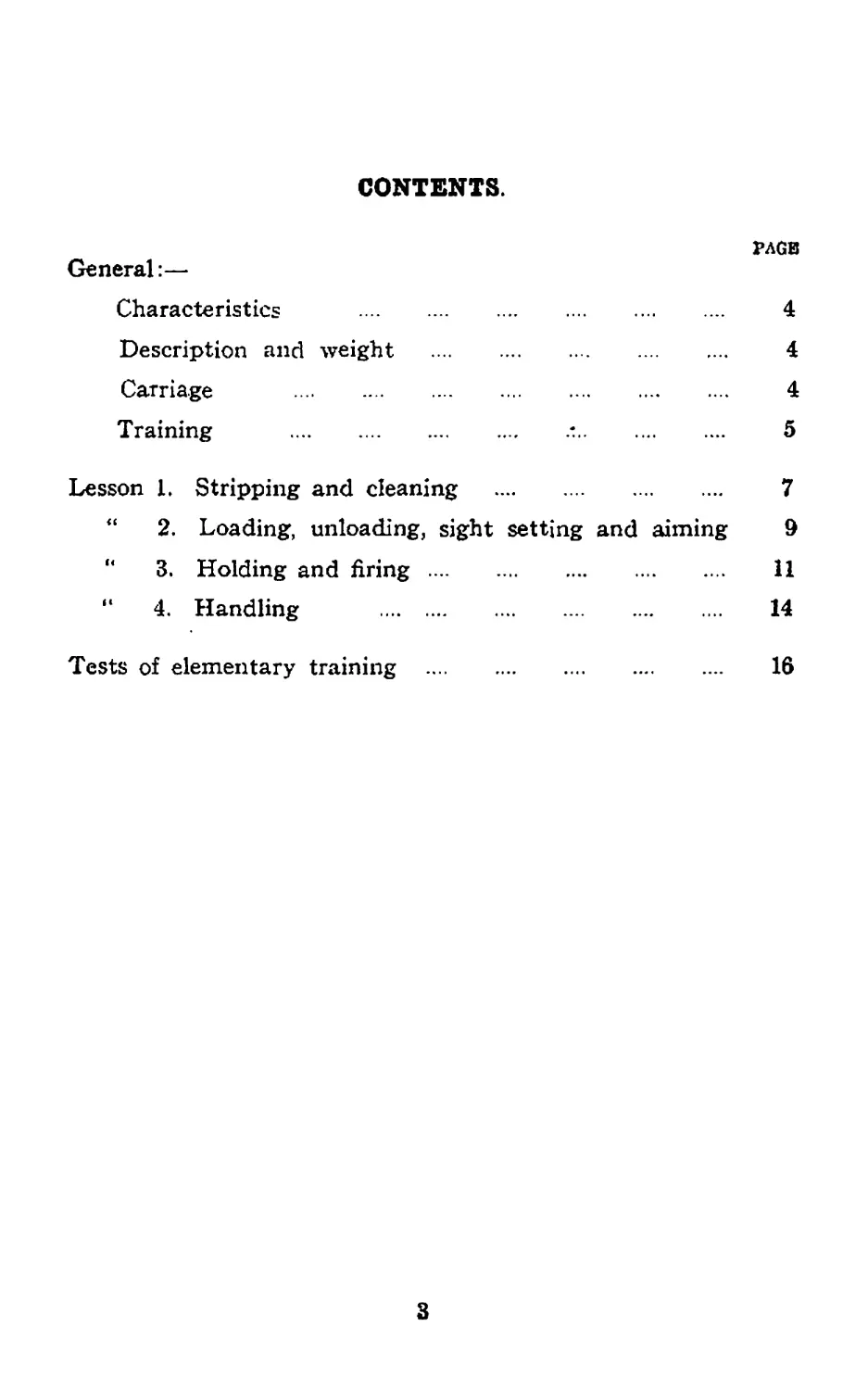
CONTENTS.
PAGB
General:—
Characteristics	................................ 4
Description and	weight ............................... 4
Carriage ............................................. 4
Training ............................'................ 5
Lesson	1.	Stripping	and cleaning ....................... 7
“	2.	Loading,	unloading,	sight setting and aiming	9
“	3. Holding and	firing............................ 11
“	4.	Handling .................................... 14
Tests of elementary	training .......................... 16
3
GENERAL.
1.	The tactical employment of the anti-tank rifle is referred to in
Infantry Training, 1937. Sections 6, 56,70,76 and 79 should be read
in conjunction with this pamphlet.
The anti-tank rifle affords я means of protection against enemy
light-armoured fighting vehicles. Its bullet will penetrate their
armour up to about 500 yards range and inflict casualties on the
crew, although it may not seriously damage the vehicle itself. A
trained soldier can produce a rate of fire of about nine rounds a
minute. It is essentially a weapon of surprise and will always be
carried in action.
2.	Its chief characteristics are:—
i.	A single shot, hand-operajted weapon with a simple bolt
action.
ii.	Great accuracy and good penetration.
iii.	Comparative lightness and mobility.
iv.	When fired, it has a pronounced flash and muzzle blast.
3.	General description.—-
i.	Weight................ 36	lb.
Calibre.....................55	in.
Weight of magazine
containing 5	rounds	..	2	lb.	7	oz.
Totad length	..	..	5	ft.	4	in.
ii.	Recoil.—This is considerable, but a recoil reducer, together
with a strong buffer spring and padded shoulder piece,
reduces the shock of discharge on the firer’s shoulder.
iii.	Mechanism.—This is similar to that of the service rifle.
4.	Carriage.—In the infantry the anti-tank rifle with its
ammunition is carried on the platoon truck, or corresponding
vehicle, until required for use. It can be man-handled by one
individual for short distances; otherwise two men are required to
carry it and its ammunition.
4
5.	Training.—There are so many similarities between the
anti-tank rifle and existing weapons that a trained soldier should be
capable of handling it with a small amount of instruction. Train-
ing policy should, therefore, be directed to giving practice in
handling and firing the weapon at moving targets.
As the rifle has a range almost double that of the S.M.L.E., it is
unsafe to fire full charge ammunition on rifle ranges, except where
danger areas have been extended and passed as safe.
The .55-inch aluminium bullet has been evolved to enable prac-
tice to be carried out on classification ranges, etc., where suitable
facilities and danger areas exist.
It will be found, however, that valuable practice can be carried
out using a reduced scale range. This will consist of l/5th or
1/30 scale shooting at about 100 yards on a classification range
using the .22-inch rifle attachment, The method of carrying out
this training is contained in Pamphlet No. 14.
Anti-tank rifles are not specialist weapons, and all ranks will be
taught to fire them. Men will be trained to aim at the places in
tanks and armoured vehicles where the driver and the gunner will
be, rather than at the vital parts of the machine.
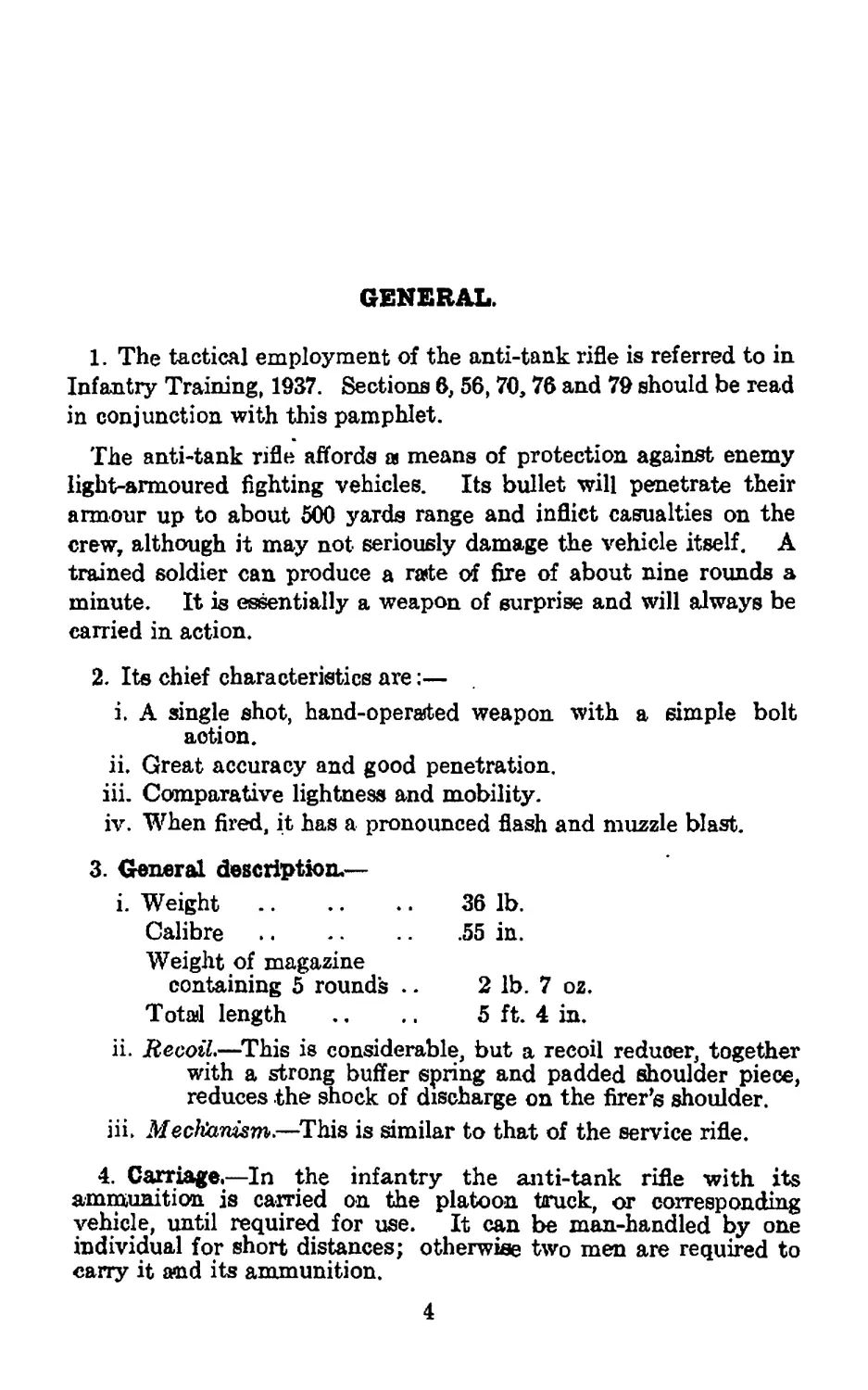
The anti-tank rifle (off-side view)
Fig. 1.
5
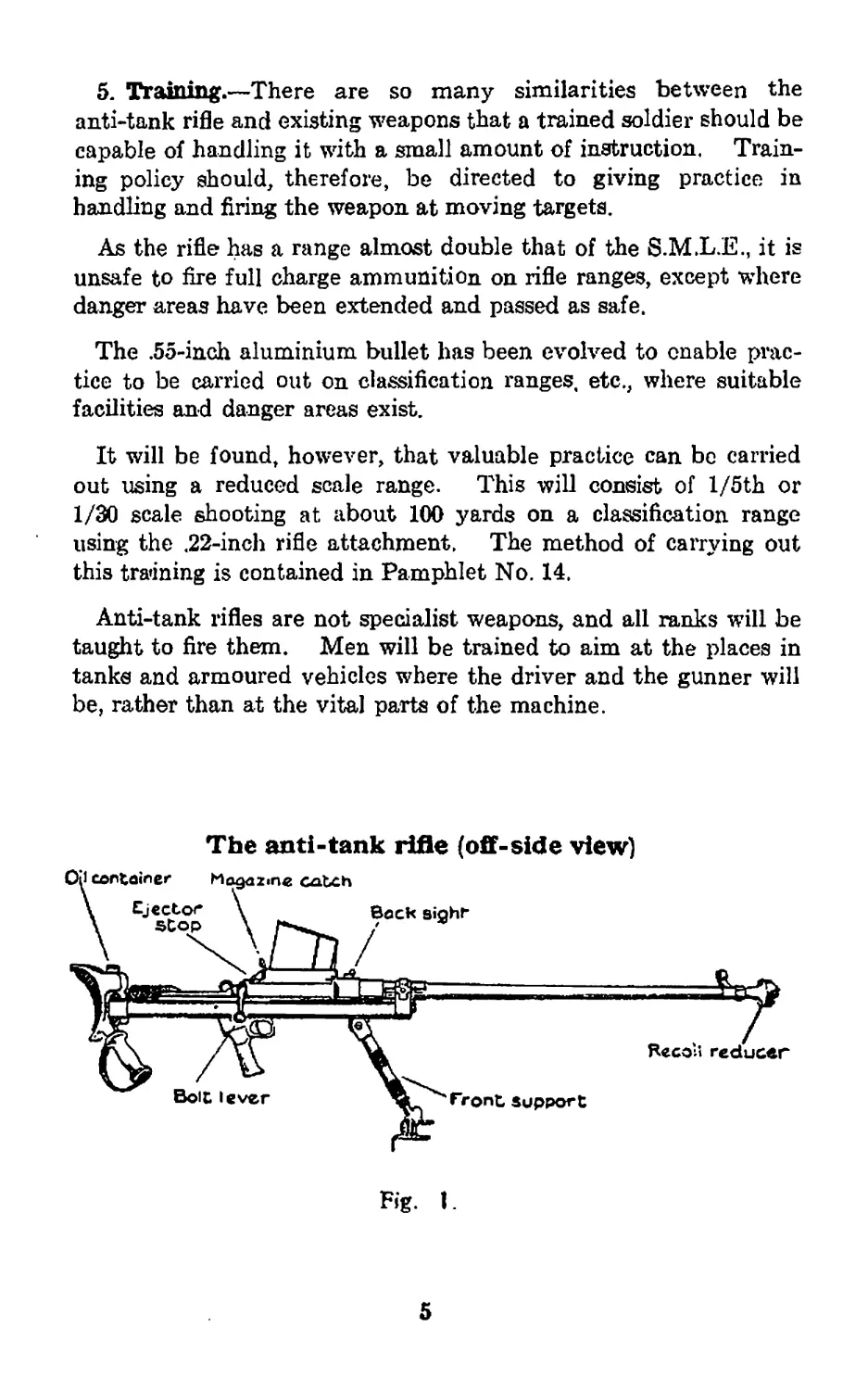
The anti-tank rifle (near-eld* view)
Recoil reducer
e&===
Fig. 2
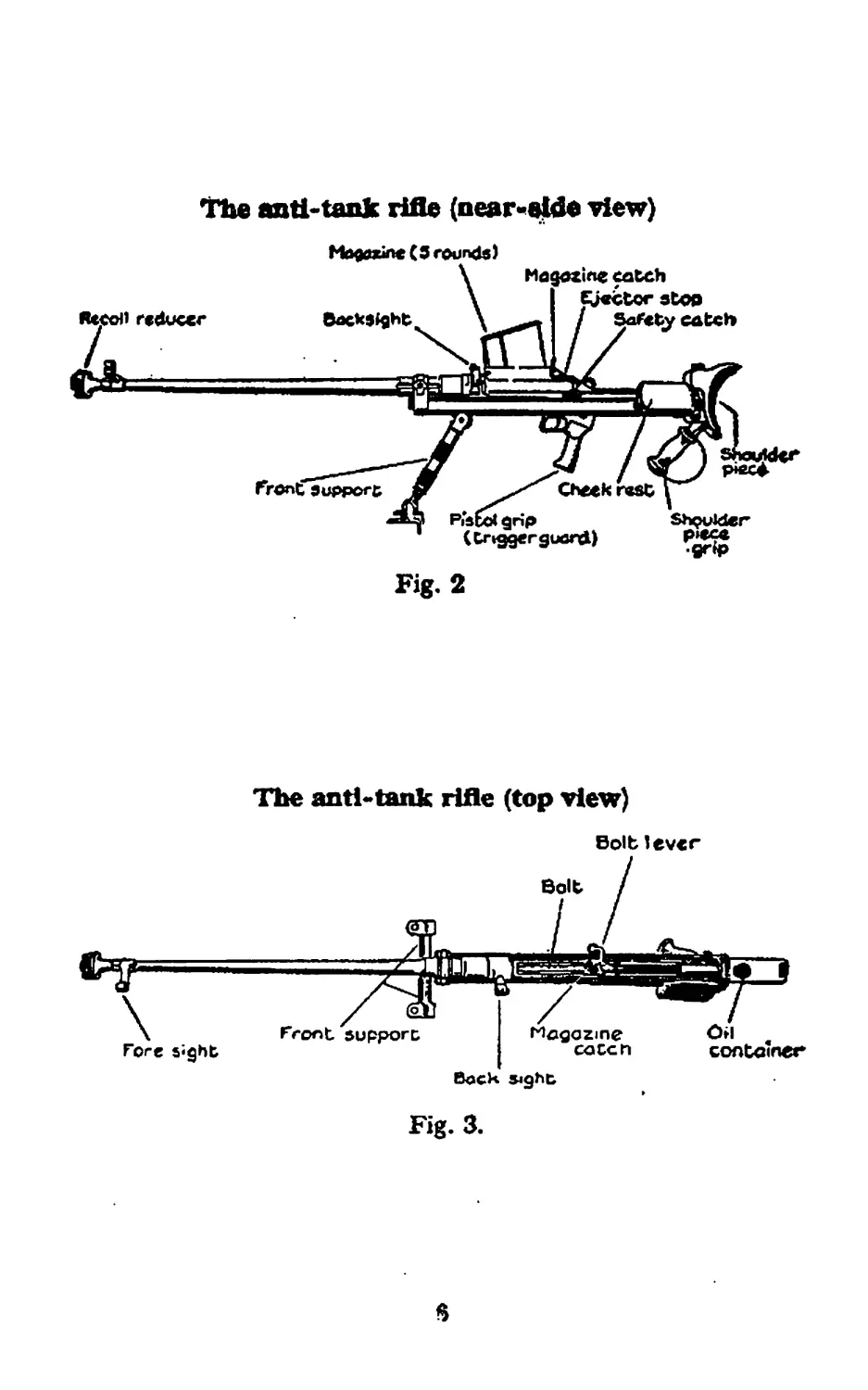
The anti-tank rifle (top view)
Fig. 3.
S
LESSON L—STRIPPING AND CLEANING.
Instructors Notes.
Stores.—
Magazine, combination tool, cleaning rod, brushes, flannelette
in breech cover, oil and ground sheet.
Throughout the lesson each part of the rifle will be named as
handled.
1.	Explain paras, 1 to 3, page 5.
2.	Removing and replacing bolt.—
Explain and demonstrate:—
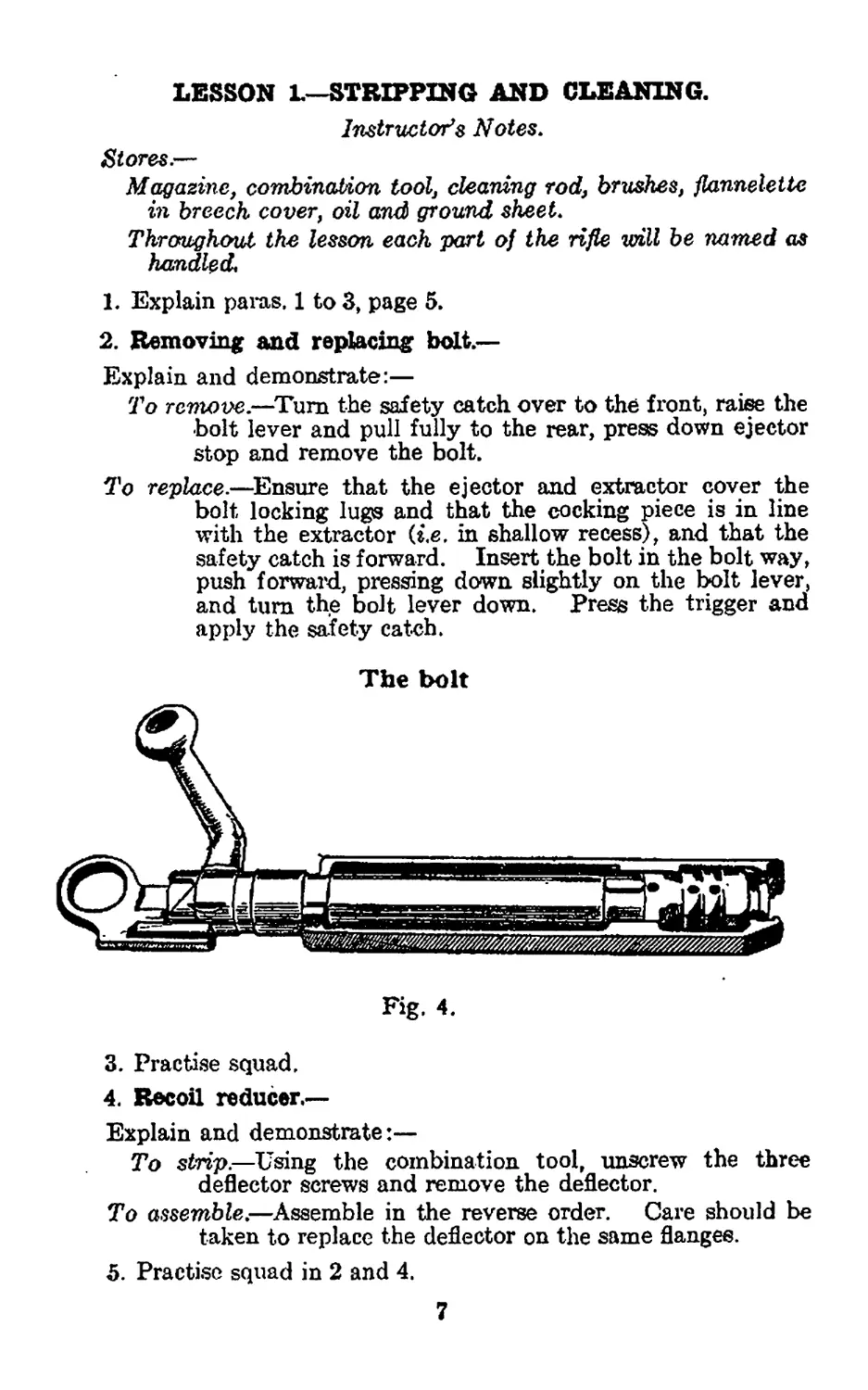
To remove.—Turn the safety catch, over to the front, raise the
bolt lever and pull fully to the rear, press down ejector
stop and remove the bolt.
To replace.—Ensure that the ejector and extractor cover the
bolt locking lugs and that the cocking piece is in line
with the extractor (i.e. in shallow recess), and that the
safety catch is forward. Insert the bolt in the bolt way,
push forward, pressing down slightly on the bolt lever,
and turn the bolt lever down. Press the trigger and
apply the safety catch.
The bolt
Fig. 4.
3.	Practise squad,
4.	Recoil reducer.—
Explain and demonstrate:—
To strip.—Using the combination tool, unscrew the three
deflector screws and remove the deflector.
To assemble.—Assemble in the reverse order. Care should be
taken to replace the deflector on the same flangee.
5.	Practise squad in 2 and 4.
7
6.	Magazine platform.
Explain and demonstrate:—
To strip.—Press in the stud on the bottom plate of the maga-
zine, and slide it off, controlling the spring as it comes
out. Lift out the spring and platform.
Assemble in the reverse order.
Note.—The magazine will be held so as to prevent injury
should premature release of spring occur.
The magazine will not normally be stripped, except for
cleaning after a gas attack. In pea'ce, should it not
work correctly, it will be taken to the armourer.
7.	Cleaning.—
Explain and demonstrate:—
i.	Cleaning materials arc similar to those used for the service
rifle, but in place of a pull-through there is a brass
tubular rod with loop and wire brush, the letter for the
removal of fouling. These, with flannelette and a
bristle brush, are carried in the breech cover. Oil is
housed in the shoulder piece. To prepare the rod for
use, assemble the four sections. Pull the cord tight
and secure by inserting it in the notches of the handle.
ii.	Daily cleaning.—Remove bolt, insert a piece of dry flan-
nelette, 4 in. by 6 in., in the loop of the rod. Insert rod
in the muzzle end of the barrel and clean thoroughly,
taking care to keep the rod central in the barrel. Oil
the barrel, using a smaller piece of flannelette. Clean
all remaining parts and leave slightly oiled.
iii.	Before firing.—As taught for the service rifle and, in addi-
tion, wipe all trace of oil from the recoil reducer by tak-
ing off the deflector and cleaning it.
iv,	After firing—Remove the bolt and take off the deflector
from the recoil reducer. Then, with the aid of dry
flannelette, clean all loose fouling from the barrel. Next,
scour out the barrel with an oily brush, and clean with
dry flannelette. Clean the breech with the bristle brush.
Clean and oil the deflector and the body of the recoil
reducer.
All remivining parts will be cleaned as in daily clean-
ing.
The outside of the magazine and magazine platform
will be wiped and oiled, but not stripped. Finally, oil
the barrel, using flannelette. Replace the deflector and
bolt.
v.	During and after да* attack.—As for the service rifle. Ques-
tion squad on this method.
vi.	Breech cover.—Removing and replacing.
8
LESSON 2 — LOADING, UNLOADING, SIGHT-SETTING
AND AIMING.
Instructor’s Notes.
Stores.—
Magazines, dummies and ground sheets.
1.	Filling magazines.—
Explain and demonstrate:—
i.	The magazine.—Holds five rounds. Inside is a platform
and powerful spring.
ii.	To fill.—Hold the magazine in one hand, resting it on the
knee or on a solid surface. Press down the platform
and insert the base of the cartridge under the magazine
lips. Push the cartridge into the magazine. Continue
this action until the magazine is filled.
iii.	To empty.—Push each round forward with the nose of a
bullet and remove.
2.	Practise squad.
3.	Loading and unloading.—
Explain and demonstrate:—
i.	Loading position.—Lie down with the body straight behind
the rifle; grasp the pistol grip with the right hamd, fore-
finger outside the trigger guard and the loft hand on the
shoulder piece grip.
ii.	To Icwd.—Tivni the safety catch over to the front, put the
magazine on, forward portion first. Open and close the
breech as taught with the service rifle, taking care to
turn the bolt lever completely down. Apply the safety
catch.
iii.	To unload.—Turn the safety catch over to the front; press
the magazine catch with the palm of the hand and
remove the magazine. Open and close the breech.
Haise the shoulder piece into the shoulder and press the
trigger. Apply the safet>r catch, lower the rifle and
stand up.
4.	Practise squad.
5.	Sight setting.—
Explain that the body of the backsight is marked on the left
“ 300 °, and on the right ° 500 ”.
To set the backsight.
For 300 yards turn the lever to the left.
9
For 500 yards turn the lever to the right. The aperture is thus
raised or lowered to the required height.
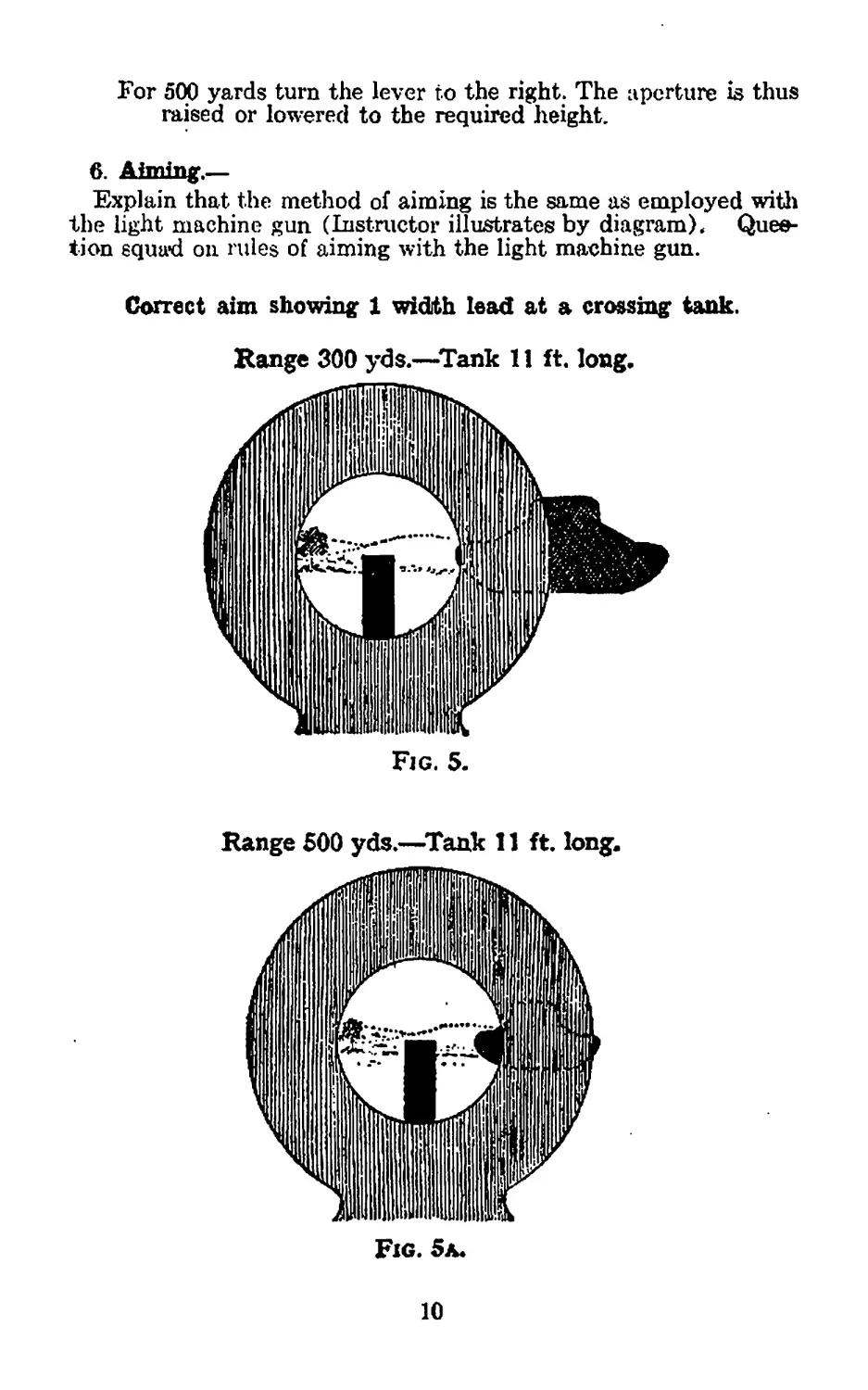
6.	Aiming.—
Explain that the method of aiming is the same as employed with
the light machine gun (Instructor illustrates by diagram). Ques-
tion squad on rules of aiming with the light machine gun.
Correct aim showing 1 width lead at a crossing tank.
Range 300 yds.—Tank 11 ft. long.
Fig. 5.
Range 500 yds.—Tank 11 ft. long.
Fig. 5a.
10
LESSON 3 —HOLDING AND FIRING.
Instructor's Notes.
Stores»—
Magazines and dummies.
A.F.V. targets and ground sheets.
1.	Explain that the trigger has two pressures, which will be taken
in the same way as with the service rifle.
2.	Holding.—
Explain a?nd demonstrate:—
i.	Adopt the loading position and load. Adjust sights. Turn
the safety catch over to the front. Raise the shoulder
piece into the shoulder, lower the cheek on to the cheek
rest and take the first pressure. Hold firmly with both
hands and aim as taught, Explain that it may be
necessary to adjust the elevation of the barrel and that
this is done by rotating the sleeve on the front support.
ii.	Firing.—The method of firing is similar to that of the service
rifle. Having fired, reload at once in the shoulder and
declare the point of aim.
3.	Practise squad.
4.	Changing magazines.—
Explain and demonstrate that, when necessary, the firer will
change magazines with the rifle in the shoulder. The bolt will not
go forward when the magazine is empty. It must, therefore, be
fully withdrawn before a new magazine is placed on the rifle.
5.	Practise squad.
6.	Moving targets.—
i.	Explain that the method of engaging moving targets is the
same as taught with the rifle. Question squad on this
method and emphasize that the swing of the rifle must
not be checked at the moment of pressing the trigger.
ii.	The following are guides in firing at armoured fighting
vehicles:—
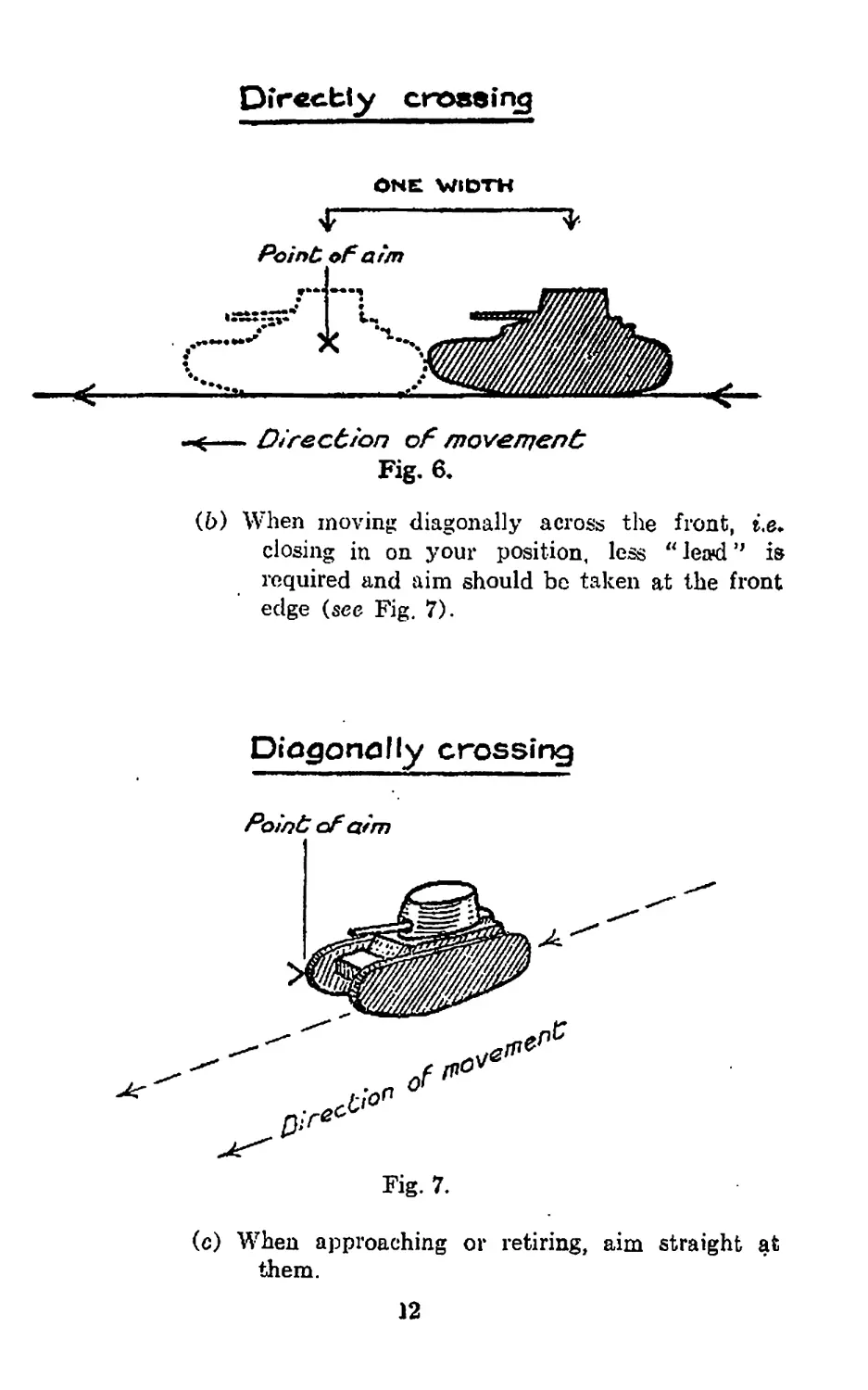
(a)	When moving directly across the front, aim one
width from the centre of the target (see Fig. 6)*
11
Directly crossing
Direction of movement
Fig. 6,
(6)	When moving diagonally across the front, i.e.
closing in on your position, less “ lead ° is
required and aim should be taken at the front
edge (see Fig. 7).
Diagonally crossing
Fig. 7.
(c)	When approaching or retiring, aim straight at
them.
)2
7.	To set up the rifle.—
i.	To prepare the front support for use.—With the shoulder
piece on the ground, hold the barrel with the left hand
in any convenient manner. With the right hand depress
the retaining catch and swing the support away from the
barrel, at the samj* time releasing the catch, which will
re-engage when the support is fully extended.
ii.	To close the front support.—Hold the rifle as above, depress
the retaining catch and reverse the procedure detailed
in para. i. above.
8.	Practise squad.
13
LESSON 4—HANDLING.
Instructor's Notes.
Stores.—
Magazines.
This lesson should be carried out on ground where various
types of cover exist.
1. Explain that the anti-tank rifle is carried within the platoon
or corresponding sub-unit for the purpose of protection against
attack by armoured fighting vehicles and that the following factors
require consideration when siting for position:—
i.	The position of neighbouring troops,
ii.	A good field of fire, if possible not less than 500 yards.
iii.	The necessity for obtaining surprise, which can only be
achieved by careful concealment.
iv.	Ground which is wooded or marshy, stream^ which have
steep sides, rocky beds and a good depth of water, form
an obstacle to the movement of armoured fighting
vehicles and serve to shepherd these into the more open
country, which should, therefore, be covered by anti?
tank fire.
v.	The location of anti-tank mine-fields.
2.	Ammunition.—The ammunition will be carried as follows:-
i.	In the truck or corresponding vehicle—200 rounds for each
anti-tank rifle. Of these, 160 rounds are in 16 bando-
liers, each holding 2 clips of five rounds, and 40 rounds
in eight magazines.
ii.	In reserve, 40 rounds for each anti-tank rifle.
3.	Use of cover.—
i.	Explain:—
(a)	That the firer should at all times make full use of
cover for protection and concealment. His know-
ledge of firing the light machine gun from behind
cover should be applied to the mounting and firing
of the anti-tank rifle. Special attention must be
given to the concealment of the muzzle on account
of the flash and muzzle blast.
(b)	That the position should always be examined from
the point of view of the enemy. Normally, when
an anti-tank rifleman has been given the arc or
approaches for which he is responsible and the
approximate position from which he will fire, he
should leave the-rifle in the best cover and recon-
noitre alternative positions for it. He should decide
14
how it is to be mounted at each place, bearing in.
mind that free use of the weapon is a factor of
primary importance. Unless concealment is com-
plete, both from air and ground, the rifle should be
kept under cover near at hand, and mounted only
when the necessity arises.
(c)	That the anti-tank rifle is not easy to swing across a .
wide arc when being fired in the lying position. A
position should, therefore, be chosen, when possible,,
from which it can be fired either sitting or standing,
but no support behind the shoulder should be given
owing to the shock of discharge. In the early stages
this will mean placing behind natural cover, which
allows the firer to sit. At the earliest opportunity
a weapon pit should be dug, and later a trench
from which the weapon can be fired. In an emer-
gency the anti-tank rifle may have to be fired from
the lying position.
(d)	That on all ranges where anti-tank rifle practice
(both l/5th scale and full charge) is carried out,
weapon pits should be constructed. These emplace-
ments should be made so as to provide a firm base
for the front support and so that the firer can adopt
either the sitting or standing position and cover the
required arc of fire.
ii.	Explain and demonstrate setting up the rifle, using various
types of cover, with and without the front support, and
introduce camouflage where necessary.
4.	Practise squad.
(Reprinted with the permission of the Controller, His Majesty's Stationery
Office. London.)
By Authority: The Advertiser Print, Way mouth Street, Adelaide.
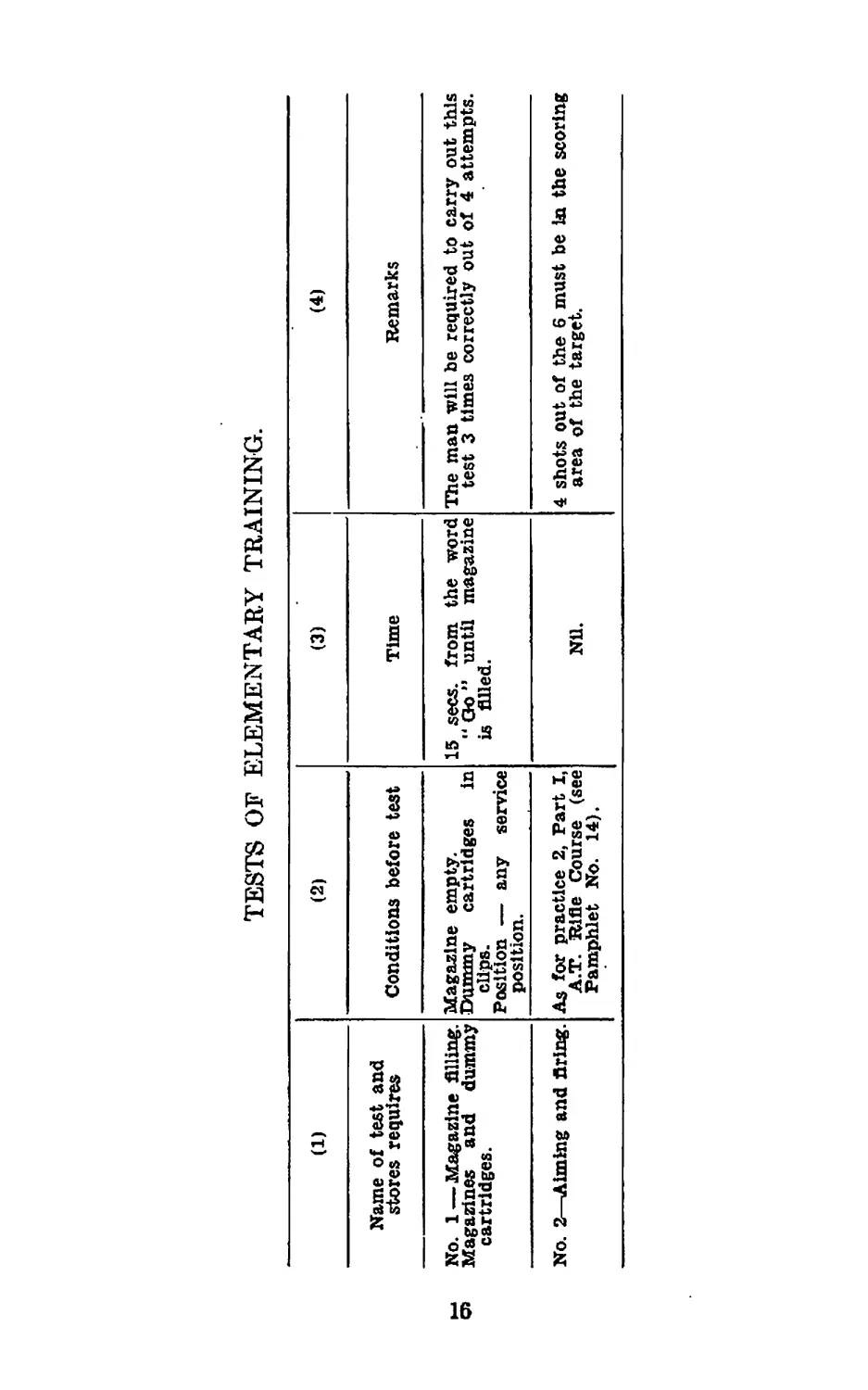
TESTS OF ELEMENTARY TRAINING.
(1)	(2)	(3)	(4)
Name of test and stores requires	Conditions before test	Time	Remarks
i-> No. 1—Magazine filling. & Magazines and dummy cartridges.	Magazine empty. Dummy cartridges in clips. Position — any service position.	15 secs, from the word Go ” until magazine is fined.	The man will be required to carry out this test 3 times correctly out of 4 attempts.
No. 2—Aiming and firing.	As for practice 2, Part I, A.T. Rifle Course (see Pamphlet No. 14).	Nil.	4 shots out of the 6 must be in the scoring area of the target.