/
Теги: weapons military affairs
Год: 1942

Текст
                    NOT TO BE PUBLISHED.
The Information given in this document is not to be
• communicated, either directly or indirectly to the Press,
or to any person not holding an official position in the
Service of His Majesty's Government in the Union of
South Africa.
UNION OF SOUTH AFRICA.
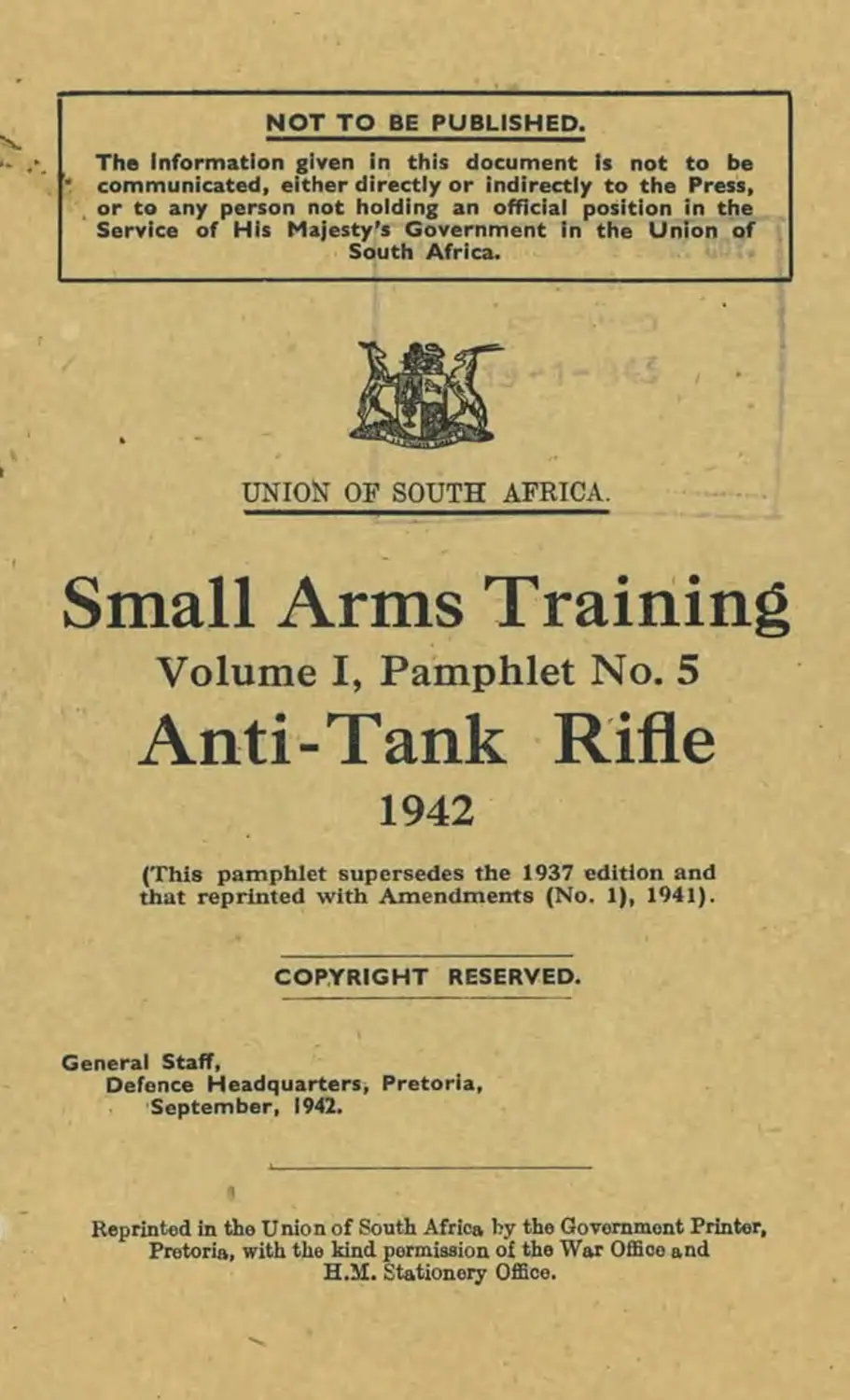
Small Arms Training
Volume I, Pamphlet No. 5
Anti-Tank Rifle
1942
(This pamphlet supersedes the 1937 edition and
that reprinted with Amendments (No. 1), 1941).
COPYRIGHT RESERVED.
General Staff,
Defence Headquarters, Pretoria,
September, 1942.
Reprinted in the Union of South Africa by the Government Printer,
Pretoria, with the kind permission of the War Office and
H.M. Stationery Office.

ii
i
CONTENTS.
PAGE.
General......................................................  1
Lesson 1. Cleaning, loading and unloading..................... 2
Lesson 2. Sight setting, aiming and firing................'....	6
Section for instructors (handling)..........................   9
Lesson 3. Handling.........................................   10
Tests of elementary training.............................,...	12
1
GENERAL
1.	Object
The sole object of weapon training is to teach all ranks
the most efficient way of handling their weapons m order to
kill the enemy. Instructors will always bear this fact in
mind, and will continually impress it upon those whom they
instruct.
2.	General description
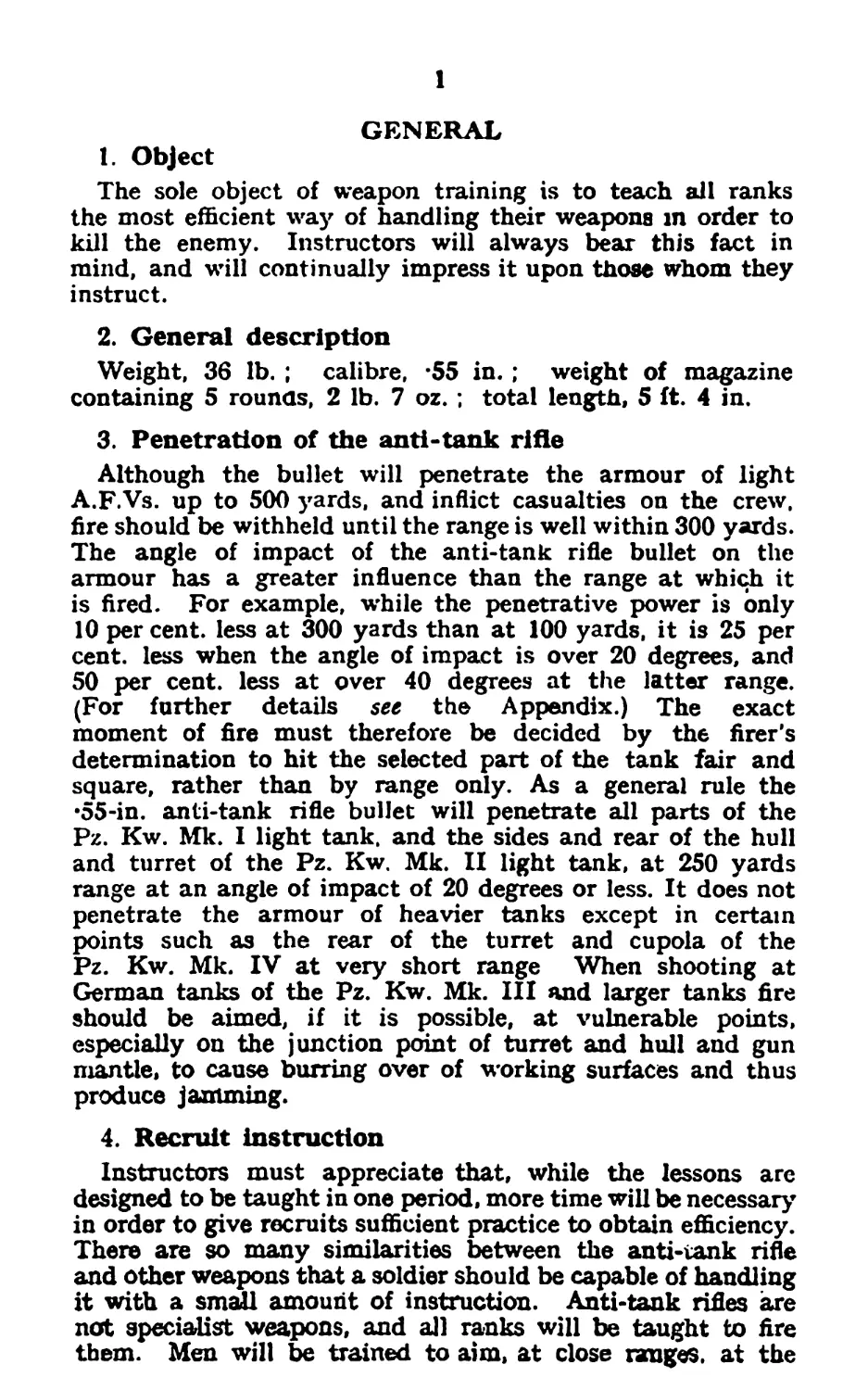
Weight, 36 lb. ; calibre, -55 in. ; weight of magazine
containing 5 rounds, 2 lb. 7 oz. ; total length, 5 ft. 4 in.
3.	Penetration of the anti-tank rifle
Although the bullet will penetrate the armour of light
A.F.Vs. up to 500 yards, and inflict casualties on the crew,
fire should be withheld until the range is well within 300 yards.
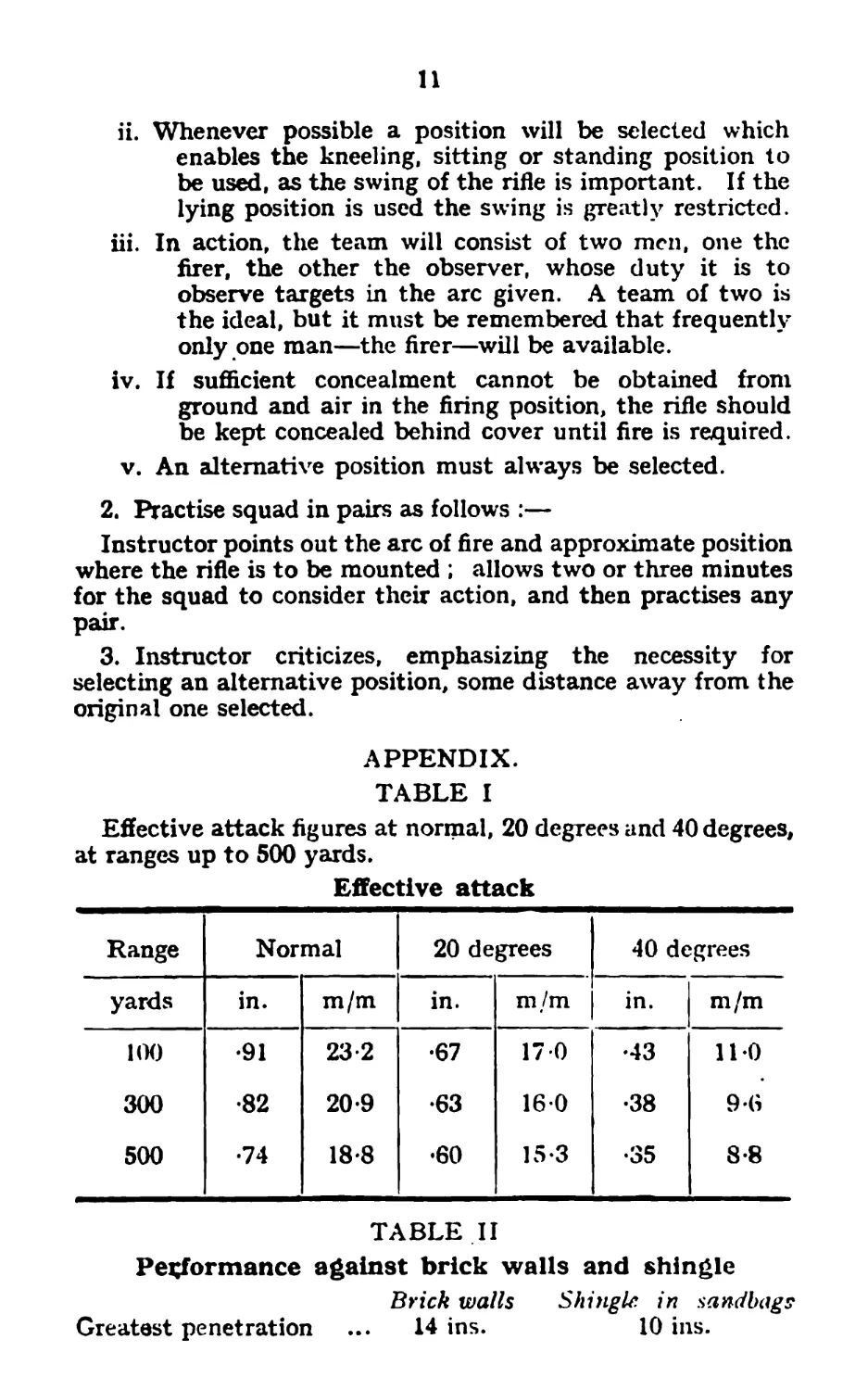
The angle of impact of the anti-tank rifle bullet on the
armour has a greater influence than the range at which it
is fired. For example, while the penetrative power is only
10 per cent, less at 300 yards than at 100 yards, it is 25 per
cent, less when the angle of impact is over 20 degrees, and
50 per cent, less at over 40 degrees at the latter range.
(For further details see the Appendix.) The exact
moment of fire must therefore be decided by the firer’s
determination to hit the selected part of the tank fair and
square, rather than by range only. As a general rule the
•55-in. anti-tank rifle bullet will penetrate all parts of the
Pz. Kw. Mk. I light tank, and the sides and rear of the hull
and turret of the Pz. Kw. Mk. II light tank, at 250 yards
range at an angle of impact of 20 degrees or less. It does not
penetrate the armour of heavier tanks except in certain
points such as the rear of the turret and cupola of the
Pz. Kw. Mk. IV at very short range When shooting at
German tanks of the Pz. Kw. Mk. Ill and larger tanks fire
should be aimed, if it is possible, at vulnerable points,
especially on the junction point of turret and hull and gun
mantle, to cause burring over of working surfaces and thus
produce jamming.
4.	Recruit instruction
Instructors must appreciate that, while the lessons are
designed to be taught in one period, more time will be necessary
in order to give recruits sufficient practice to obtain efficiency.
There are so many similarities between the anti-tank rifle
and other weapons that a soldier should be capable of handling
it with a small amount of instruction. Anti-tank rifles are
not specialist weapons, and all ranks will be taught to fire
them. Men will be trained to aim, at close ranges, at the
2
vulnerable parts of tanks and armoured vehicles, for which
reason it is important that training in the vulnerable parts
of enemy A.F.Vs. is included as a subject in the training of
the soldier.
5.	Trained soldier instruction
The trained soldier should be practised in handling this
weapon irom all types of cover and firing the weapon at moving
targets. Valuable practice may be given by means of reduced
Scale shooting in a miniature range using the ’22-in. rifle
attachment.
6.	Dress
Battle order will be worn for all lessons.
7.	Improvisation
A halfpenny will act as a magazine platform depressor.
8.	Safety precautions
Before every lesson the instructor will inspect the anti-tank
rifle, magazines, and drill cartridges and utility pouches.
As the anti-tank rifle has a range almost double that of
the rifle, it is unsafe to fire full charge ammunition on classifi-
cation ranges, apart from a few rounds at short distances
into the stop butt to accustom men to the effect of such fire.
LESSON 1. CLEANING. LOADING AND
UNLOADING
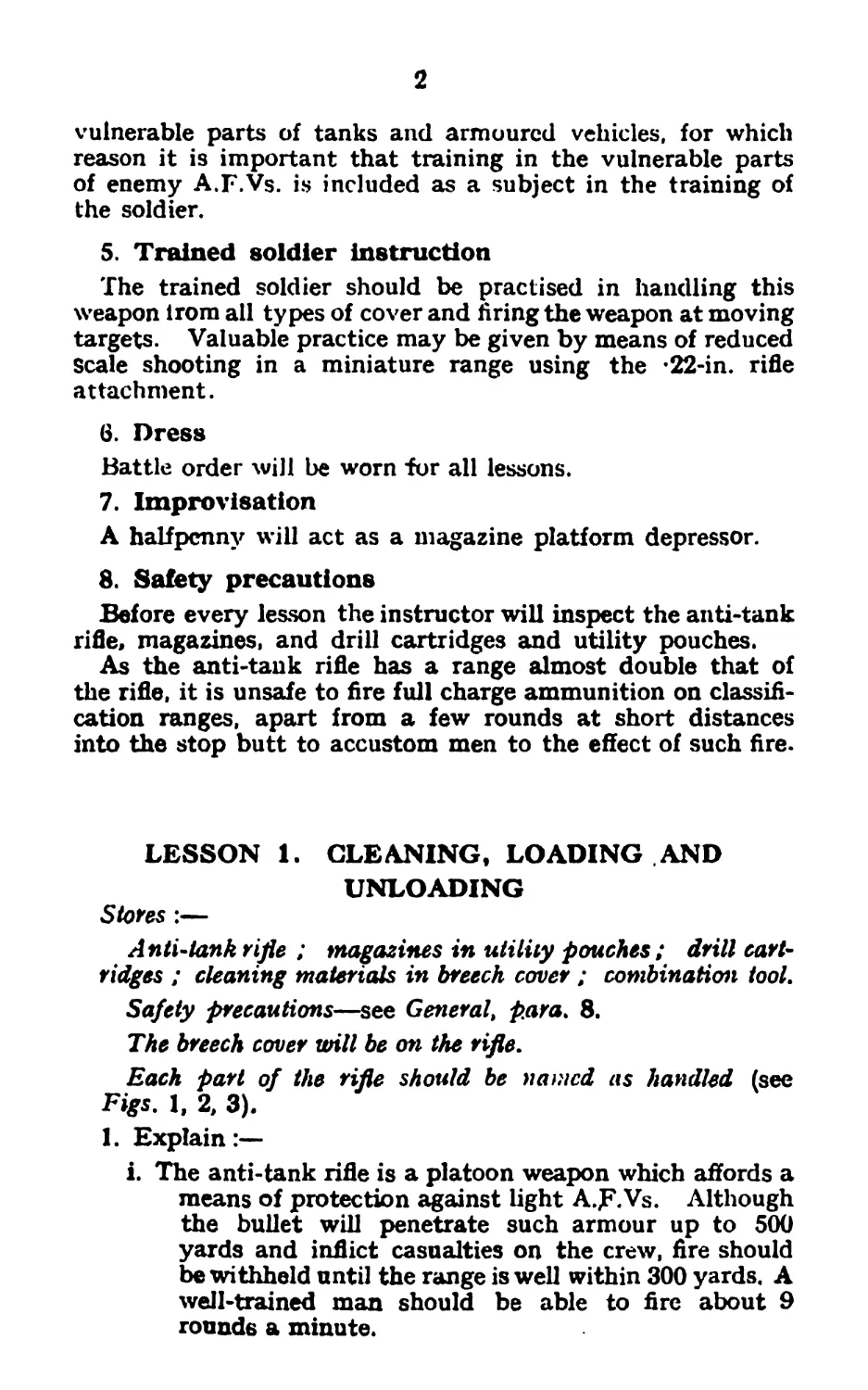
Stores:—
Anti-tank rifle ; magazines in utility pouches; drill cart-
ridges ; cleaning materials in breech cover ; combination tool.
Safety precautions—see General, para. 8.
The breech cover will be on the rifle.
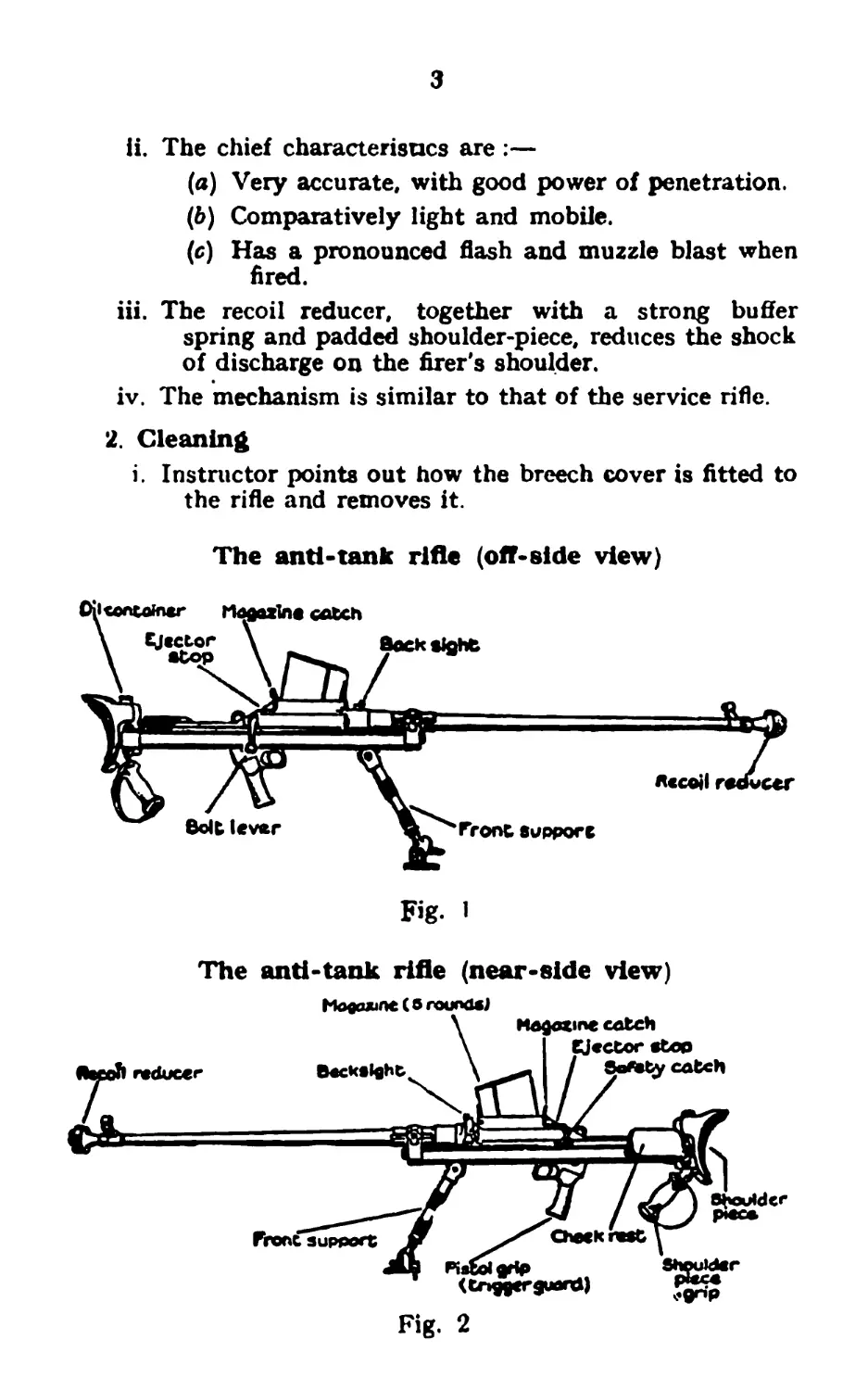
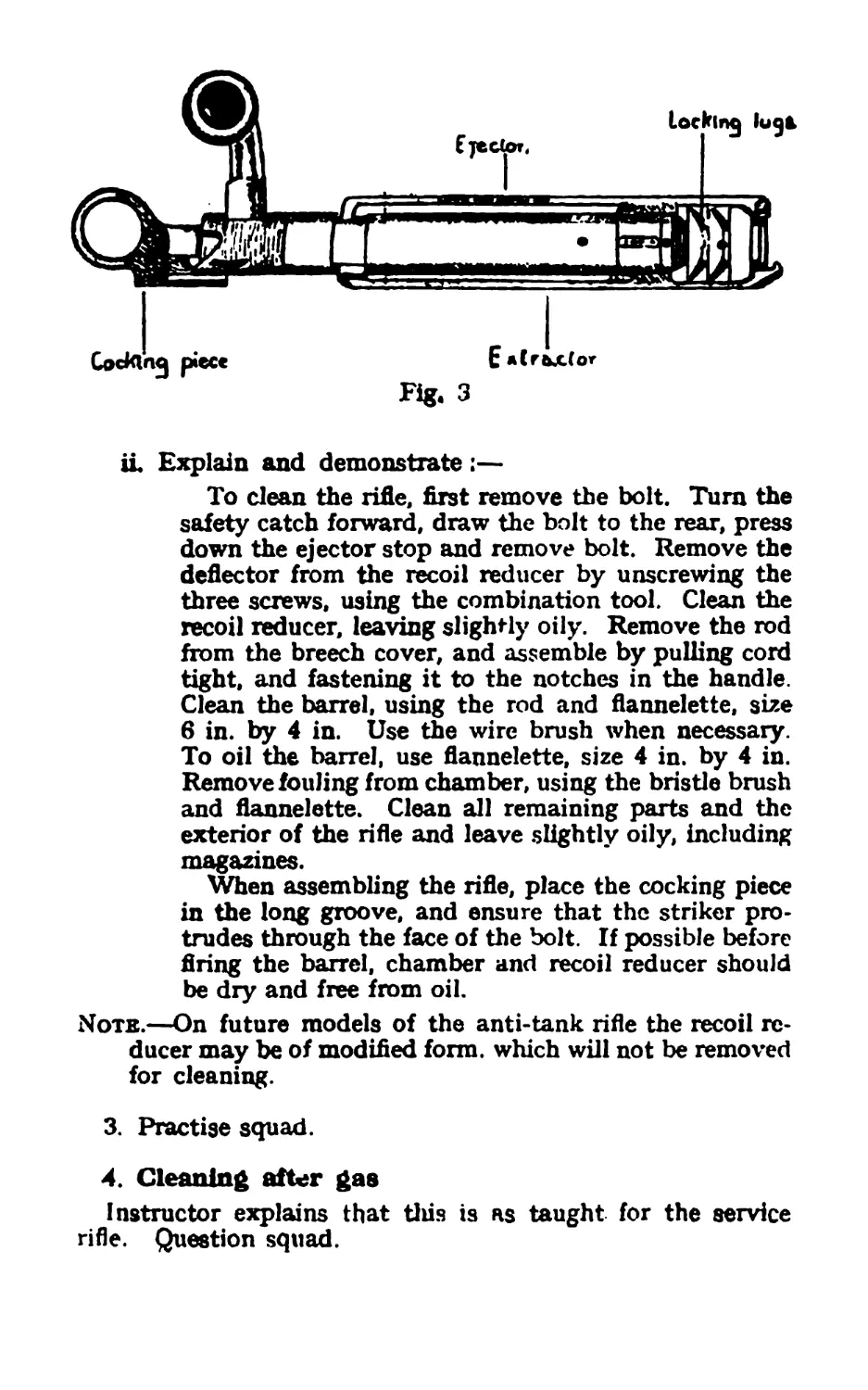
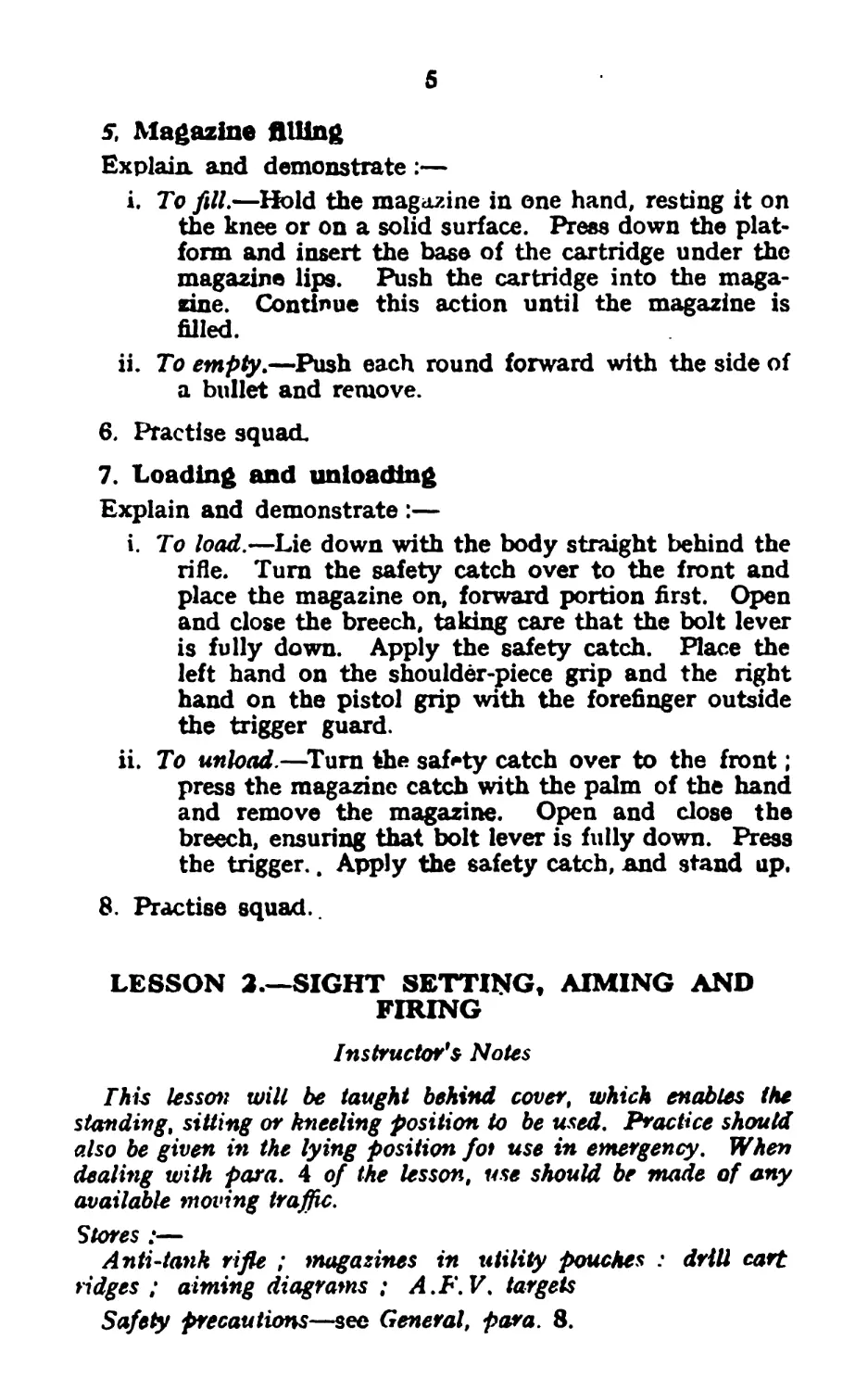
Each part of the rifle should be nanted as handled (see
Figs. 1, 2, 3).
1.	Explain:—
i.	The anti-tank rifle is a platoon weapon which affords a
means of protection against light A.F.Vs. Although
the bullet will penetrate such armour up to 500
yards and inflict casualties on the crew, fire should
be withheld until the range is well within 300 yards. A
well-trained man should be able to fire about 9
rounds a minute.
3
ii.	The chief characteristics are :—
(a)	Very accurate, with good power of penetration.
(b)	Comparatively light and mobile.
(c)	Has a pronounced flash and muzzle blast when
fired.
iii.	The recoil reducer, together with a strong buffer
spring and padded shoulder-piece, reduces the shock
of discharge on the firer's shoulder.
iv.	The mechanism is similar to that of the service rifle.
2.	Cleaning
i.	Instructor points out how the breech cover is fitted to
the rifle and removes it.
The anti-tank rifle (off-side view)
Fig. 1
The anti-tank rifle (near-side view)
Mootuune (б roundcJ
Fig. 2
Fig. 3
it Explain and demonstrate:—
To clean the rifle, first remove the bolt. Turn the
safety catch forward, draw the bolt to the rear, press
down the ejector stop and remove bolt. Remove the
deflector from the recoil reducer by unscrewing the
three screws, using the combination tool. Clean the
recoil reducer, leaving slightly oily. Remove the rod
from the breech cover, and assemble by pulling cord
tight, and fastening it to the notches in the handle.
Clean the barrel, using the rod and flannelette, sue
6 in. by 4 in. Use the wire brush when necessary.
To oil the barrel, use flannelette, size 4 in. by 4 in.
Remove fouling from chamber, using the bristle brush
and flannelette. Clean all remaining parts and the
exterior of the rifle and leave slightly oily, including
magazines.
When assembling the rifle, place the cocking piece
in the long groove, and ensure that the striker pro-
trudes through the face of the bolt. If possible before
firing the barrel, chamber and recoil reducer should
be dry and free from oil.
Note.—On future models of the anti-tank rifle the recoil re-
ducer may be of modified form, which will not be removed
for cleaning.
3.	Practise squad.
4.	Cleaning after gas
Instructor explains that this is as taught for the service
rifle. Question squad.
5
s,	Magazine filling
Explain and demonstrate :—
i. To fill.—Hold the magazine in one hand, resting it on
the knee or on a solid surface. Press down the plat-
form and insert the base of the cartridge under the
magazine lips. Push the cartridge into the maga-
zine. Continue this action until the magazine is
filled.
ii. To empty.—Push each round forward with the side of
a bullet and remove.
6.	Practise squad.
7.	Loading and unloading
Explain and demonstrate :—
i.	To load.—Lie down with the body straight behind the
rifle. Turn the safety catch over to the front and
place the magazine on, forward portion first. Open
and close the breech, taking care that the bolt lever
is fully down. Apply the safety catch. Place the
left hand on the shoulder-piece grip and the right
hand on the pistol grip with the forefinger outside
the trigger guard.
ii.	To unload.—Turn the safety catch over to the front;
press the magazine catch with the palm of the hand
and remove the magazine. Open and close the
breech, ensuring that bolt lever is fully down. Press
the trigger.. Apply the safety catch, and stand up.
8.	Practise squad..
LESSON 3.—SIGHT SETTING, AIMING AND
FIRING
Instructor's Notes
This lesson will be taught behind cover, which enables the
standing, sitting or kneeling position to be used. Practice should
also be given in the lying position fot use in emergency. When
dealing with para. 4 of the lesson, use should be made of any
available moving traffic.
Stores :—
Anti-tank rifle ; magazines in utility pouches : drill cart
ridges ; aiming diagrams ; A.F.V. targets
Safety precautions—see General, para. 8.
в
1.	Sight setting
Explain that the body of the backsight is marked on the
left " 300 ” and on the right ° 500 ”
To set the backsight:—
For 300 yards turn the lever to the left.
For 500 yards turn the lever to the right.
(On future models there will be only one fixed backsight for
use up to 300 yards.)
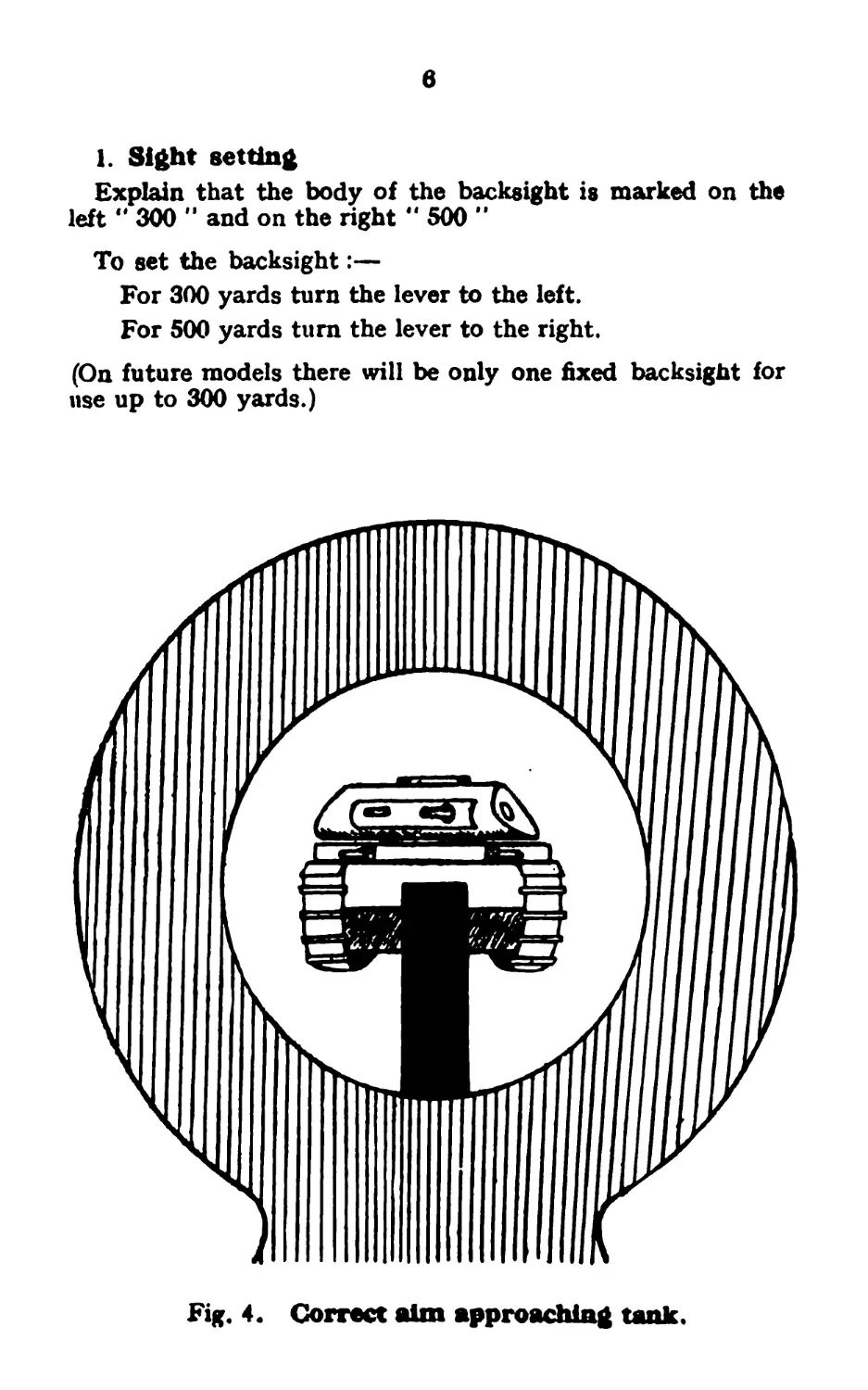
Fig. 4. Correct aim approaching tank.
7
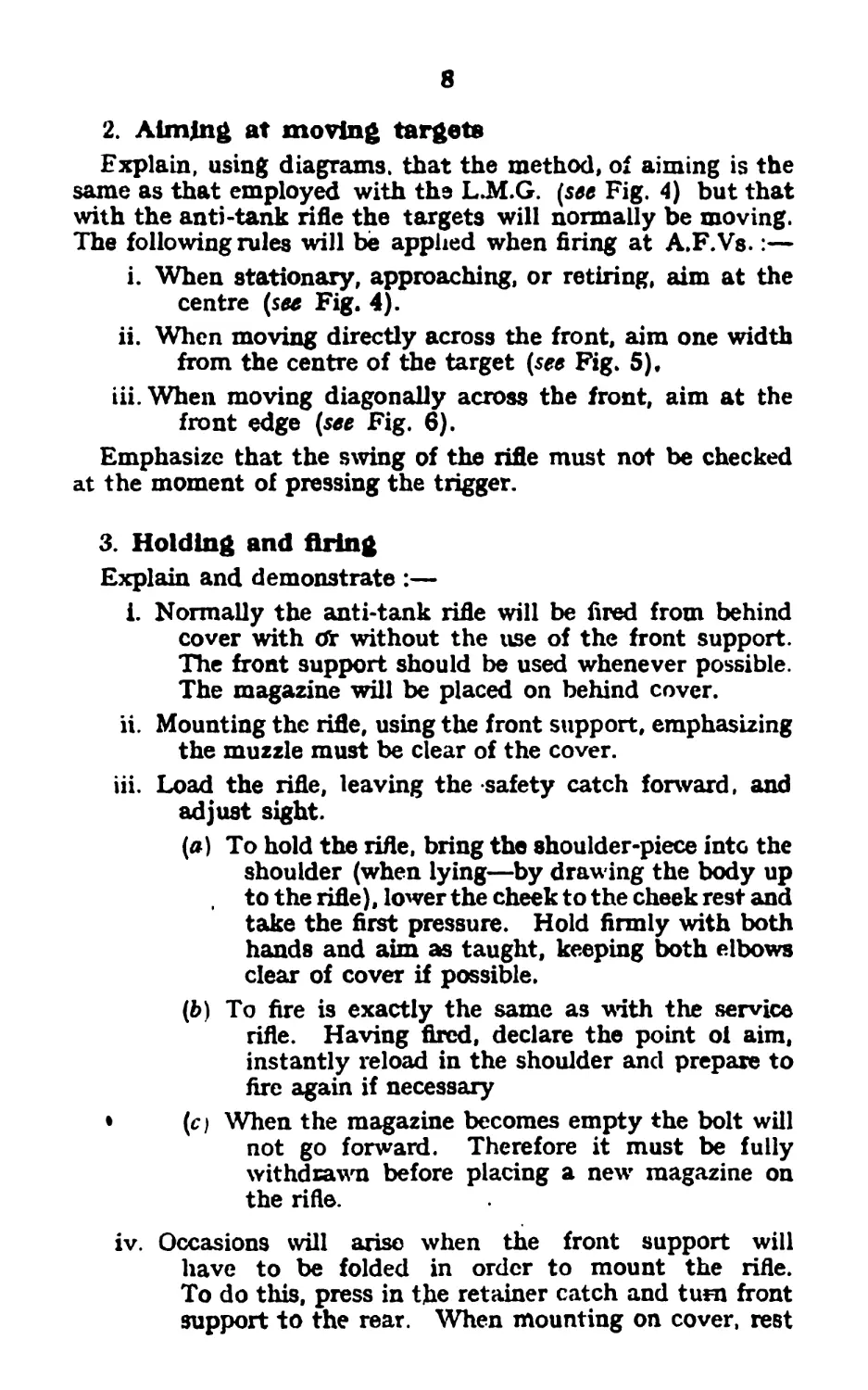
Fig. 6. Correct aim diagonally crossing tank.
8
2.	Aiming at moving targets
Explain, using diagrams, that the method, of aiming is the
same as that employed with the L.M.G. (see Fig. 4) but that
with the anti-tank rifle the targets will normally be moving.
The following rules will be applied when firing at A.F.Vs.:—
i. When stationary, approaching, or retiring, aim at the
centre (see Fig. 4).
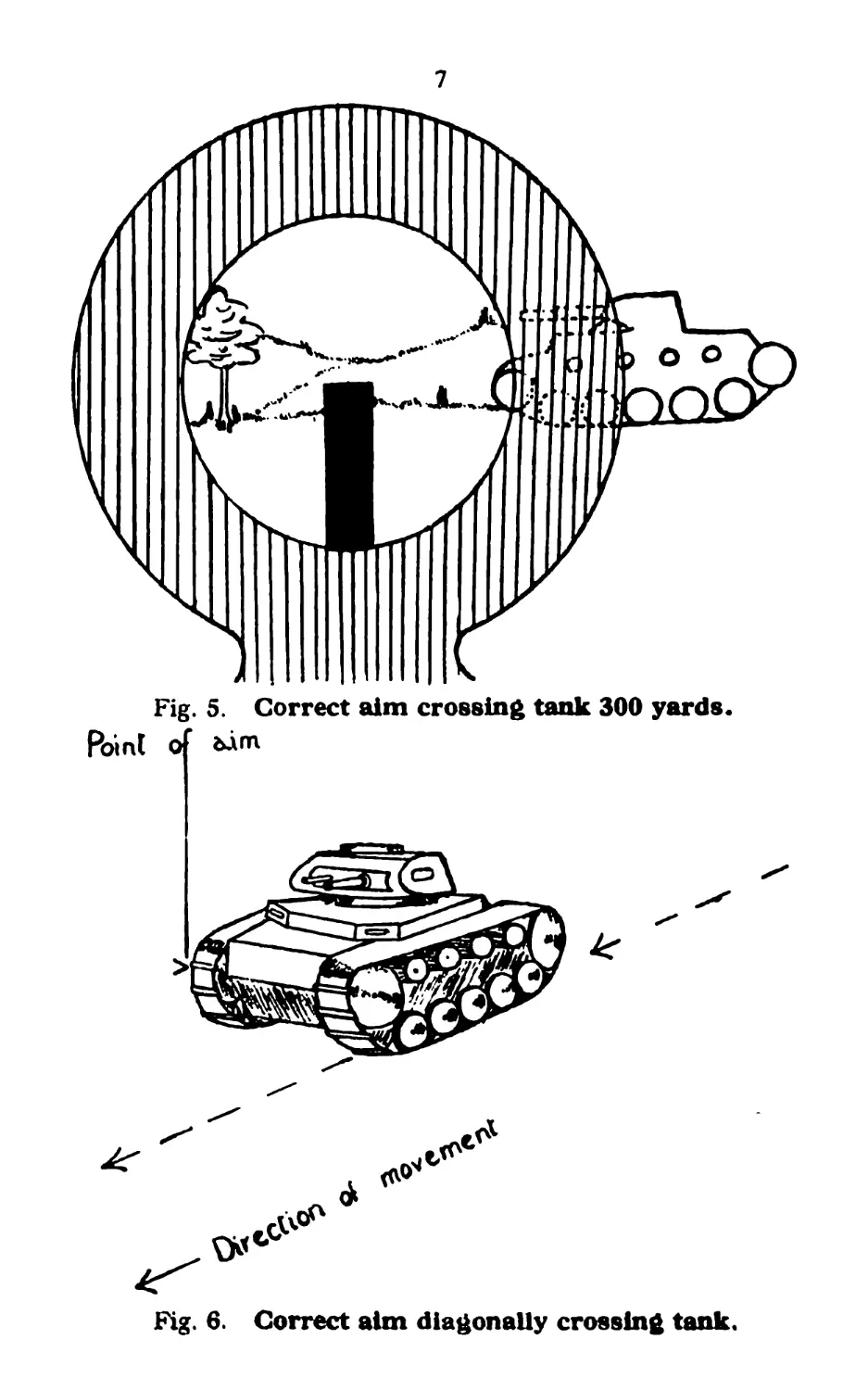
ii.	When moving directly across the front, aim one width
from the centre of the target (see Fig. 5).
iii.	When moving diagonally across the front, aim at the
front edge (see Fig. 6).
Emphasize that the swing of the rifle must not be checked
at the moment of pressing the trigger.
3.	Holding and firing
Explain and demonstrate :—
i.	Normally the anti-tank rifle will be fired from behind
cover with (Я without the use of the front support.
The front support should be used whenever possible.
The magazine will be placed on behind cover.
ii.	Mounting the rifle, using the front support, emphasizing
the muzzle must be clear of the cover.
iii.	Load the rifle, leaving the safety catch forward, and
adjust sight.
(a)	To hold the rifle, bring the shoulder-piece into the
shoulder (when lying—by drawing the body up
to the rifle), lower the cheek to the cheek rest and
take the first pressure. Hold firmly with both
hands and aim as taught, keeping both elbows
clear of cover if possible.
(b)	To fire is exactly the same as with the service
rifle. Having fired, declare the point oi aim,
instantly reload in the shoulder and prepare to
fire again if necessary
• (c) When the magazine becomes empty the bolt will
not go forward. Therefore it must be fully
withdrawn before placing a new magazine on
the rifle.
iv.	Occasions will arise when the front support will
have to be folded in order to mount the rifle.
To do this, press in the retainer catch and turn front
support to the rear. When mounting on cover, rest
9
the rifle as near as possible to where it is normally
supported, again keeping muzzle just clear of cover.
Firing is exactly the same as when using the front
support.
Notes.—1. To elevate or depress the barrel, rotate the sleeve
on the front support.
2.	On future models the front support may be
modified in the form of a bipod
4.	Practise squad in mounting, holding, aiming and firing,
with and without the front support
HANDLING
(For the use of Instructors only)
1.	When siting the anti-tank rifle the following factors must
be considered :—
i.	A field of fire which covers the task given, which may
often be to cover an anti-tank or partial anti-tank
obstacle, such as road blocks, wooded or marshy
ground, rivers and anti-tank minefields, etc.
ii.	The desirability of shooting at enemy A.F.Vs. from the
flanks or rear in order to avoid taking head-on shots
where the armour is thickest.
iii.	The necessity to gain surprise, and the consequent
importance of a carefully concealed position.
2.	Ammunition
The ammunition will normally be carried as follows :—
In the truck ©r corresponding vehicle—200 rounds for
each anti-tank rifle. Of these, 160 lounds are in 16
bandoliers, each holding two clips of five rounds, and
40 rounds in eight magazines. These eight magazines go
into action with the rifle.
8. Use of cover
L The firer should at all times make* full use of cover for
protection and concealment. Special attention must
be given to the concealment of the muzzle on account
of the flash. Muzzle blast must be considered.
10
ii. The position should always be examined from the
point of view of the enemy. Normally, when an
anti-tank rifleman has been given the arc or
approaches for which he is responsible and the
approximate position from which he will fire, he
should leave the rifle in the best cover and reconnoitre
alternative positions.for it. He should decide how it
is to be mounted at each place, bearing in mind that
free use of the weapon is a factor of primary impor-
tance. Unless concealment is complete, both from
air and ground, the rifle should be kept under cover
near at hand, and mounted only when the necessity
arises.
iii. The anti-tank rifle is not easy to swing aeross a wide
arc when being fired in the lying position. A position
should, therefore, be chosen, when possible, from
which it can be fired either sitting, kneeling, or stand-
ing, but no support behind the shoulder should be
given owing to the shock of discharge. In the early
stages this will mean placing it behind natural cover,
which allows the firer to sit. At the earliest oppor-
tunity a slit trench should be dug. In an emergency
the anti-tank rifle may have to be fired from the
lying position.
Note.—On all ranges where anti-tank rifle practice is carried
out slit trenches should be constructed so that the rifle
may be fired from a standing position.
LESSON 3.—HANDLING
Instructor's Notes
Stores :—
Anti-tank rifle ; magazines in utility pouches ; rifles.
Safety precautions—see General, para. 8.
Additionally inspect rifles, drill cartridges, pouches.
Loosen slings.
This lesson should be carried out on ground affording
various types of cover. The object of the lesson is to exercise
men, working together in pairs, as they will do on service, in
handling and siting the rifle.
1.	Instructor explains :—
i.	Necessity for concealment of muzzle flash and limitation
of blast.
11
ii.	Whenever possible a position will be selected which
enables the kneeling, sitting or standing position to
be used, as the swing of the rifle is important. If the
lying position is used the swing is greatly restricted.
iii.	In action, the team will consist of two men, one the
firer, the other the observer, whose duty it is to
observe targets in the arc given. A team of two is
the ideal, but it must be remembered that frequently
only one man—the firer—will be available.
iv.	If sufficient concealment cannot be obtained from
ground and air in the firing position, the rifle should
be kept concealed behind cover until fire is required.
v.	An alternative position must always be selected.
2.	Practise squad in pairs as follows :—
Instructor points out the arc of fire and approximate position
where the rifle is to be mounted ; allows two or three minutes
for the squad to consider their action, and then practises any
pair.
3.	Instructor criticizes, emphasizing the necessity for
selecting an alternative position, some distance away from the
original one selected.
APPENDIX.
TABLE I
Effective attack figures at normal, 20 degrees and 40 degrees,
at ranges up to 500 yards.
Effective attack
Range	Normal		20 degrees		40 degrees
yards	in.	m/m	in.	i m/m |	in-	m/m
100	•91	23-2	•67	170	•43	110
300	•82	20-9	•63	160	•38	9’6
500	•74	18-8	•60	15-3	•35	8-8
TABLE II
Performance against brick walls and shingle
Brick walls Shingle in sandbags
Greatest penetration ...	14 ins.	10 ins.
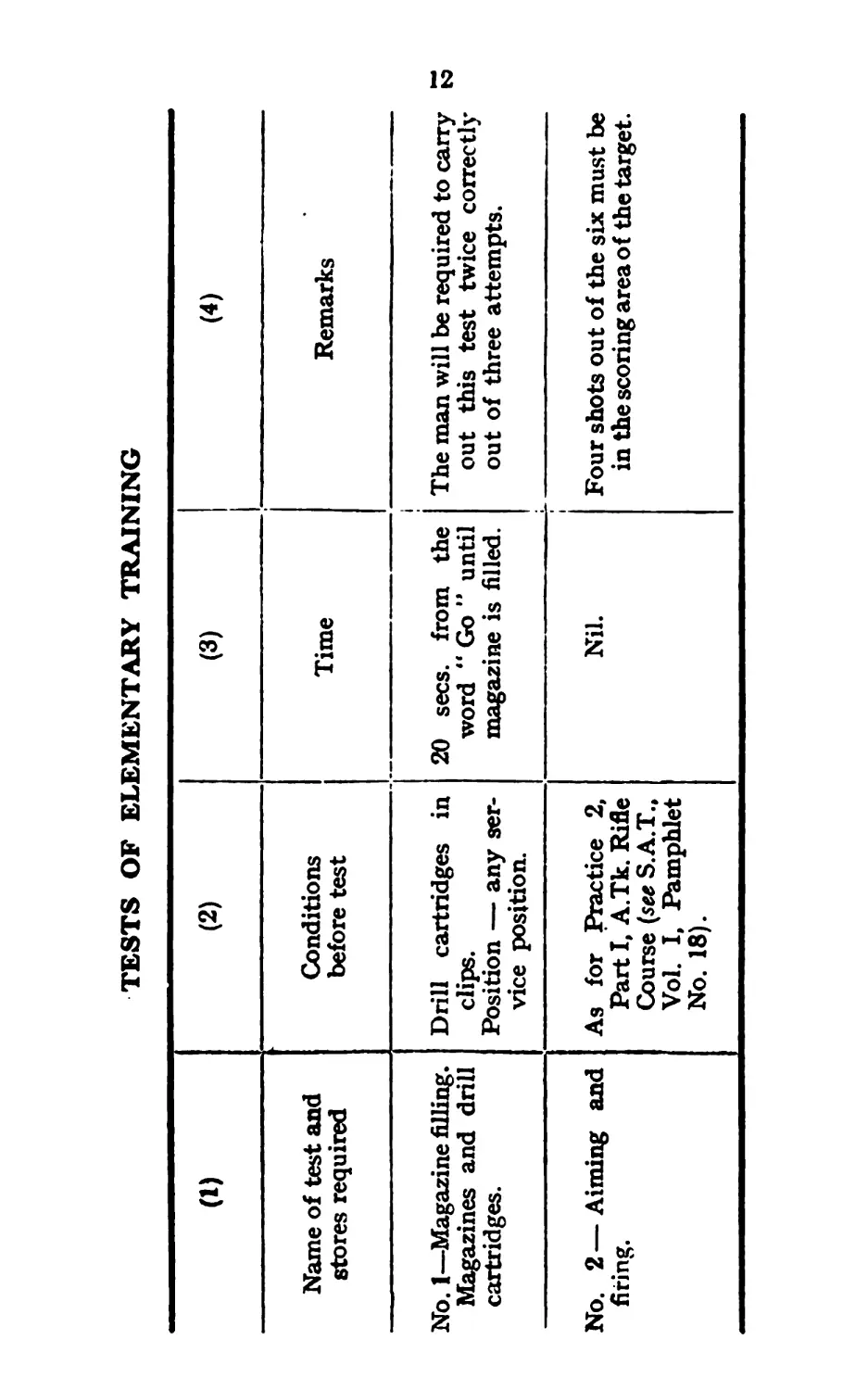
TESTS OF ELEMENTARY TRAINING
(1)	(2)	(3)	И)
Name of test and stores required	Conditions before test	Time	Remarks
No. 1—Magazine filling. Magazines and drill cartridges.	Drill cartridges in clips. Position — any ser- vice position.	20 secs, from the word “ Go ” until magazine is filled.	The man will be required to carry out this test twice correctly out of three attempts.
No. 2 — Aiming and firing.	As for Practice 2, Part I, A.Tk. Rifle Course (see S.A.T., Vol. I, Pamphlet No. 18).	Nil.	Four shots out of the six must be in the scoring area of the target.