/



































































Автор: Gaunt D.
Теги: history world history war crimes genocide history of middle east brown university
ISBN: 978-1-78533-498-6
Похожие


Текст
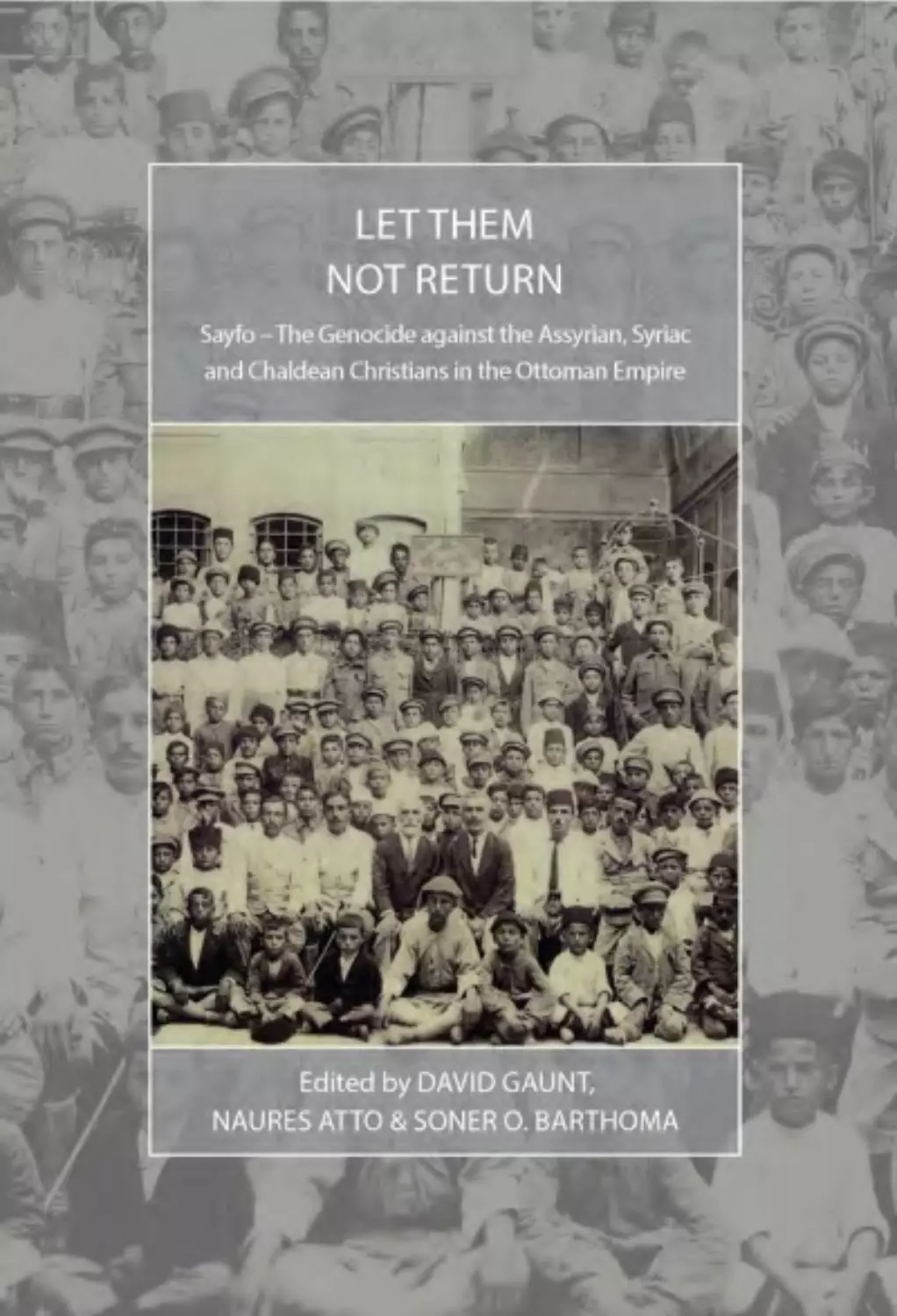
Let Them Not Return
War and Genocide
General Editors: Omer Bartov, Brown University; A. Dirk Moses, University
of Sydney
In recent years there has been a growing interest in the study of war and genocide, not from a traditional military history perspective, but within the framework of
social and cultural history. This series offers a forum for scholarly works that reflect
these new approaches.
“The Berghahn series Studies on War and Genocide has immeasurably enriched the
English-language scholarship available to scholars and students of genocide and, in
particular, the Holocaust.” —Totalitarian Movements and Political Religions
For a full volume listing, please see back matter
Let Them Not Return
Sayfo – The Genocide against the Assyrian,
Syriac and Chaldean Christians in the
Ottoman Empire
Edited by David Gaunt, Naures Atto and
Soner O. Barthoma
berghahn
NEW YORK • OXFORD
www.berghahnbooks.com
Published in 2017 by
Berghahn Books
www.berghahnbooks.com
© 2017 David Gaunt, Naures Atto and Soner O. Barthoma
All rights reserved. Except for the quotation of short passages
for the purposes of criticism and review, no part of this book
may be reproduced in any form or by any means, electronic or
mechanical, including photocopying, recording, or any information
storage and retrieval system now known or to be invented,
without written permission of the publisher.
Library of Congress Cataloging-in-Publication Data
A C.I.P. cataloging record is available from the Library of Congress
British Library Cataloguing in Publication Data
A catalogue record for this book is available from the British Library
ISBN 978-1-78533-498-6 hardback
ISBN 978-1-78533-499-3 ebook
Contents
R
Prefacevii
Acknowledgementsx
Introduction: Contextualizing the Sayfo in the First World War
David Gaunt, Naures Atto and Soner O. Barthoma
1
Chapter 1
How Armenian was the 1915 Genocide?
Uğur Ümit Üngör
33
Chapter 2
Sayfo Genocide: The Culmination of an Anatolian Culture of Violence
David Gaunt
54
Chapter 3
The Resistance of Urmia Assyrians to Violence at the Beginning of the
Twentieth Century
Florence Hellot-Bellier
Chapter 4
Mor Dionysios ‘Abd an-Nur Aslan: Church Leader during a Genocide
Jan J. van Ginkel
Chapter 5
Syriac Orthodox Leadership in the Post-Genocide Period (1918–26) and
the Removal of the Patriarchate from Turkey
Naures Atto and Soner O. Barthoma
Chapter 6
Sayfo, Firman, Qafle: The First World War from the Perspective of
Syriac Christians
Shabo Talay
70
100
113
132
viContents
Chapter 7
A Historical Note of October 1915 Written in Dayro D-Zafaran
(Deyrulzafaran)148
Sebastian Brock
Chapter 8
Interpretation of the ‘Sayfo’ in Gallo Shabo’s Poem
Simon Birol
Chapter 9
The Psychological Legacy of the Sayfo: An Inter-generational
Transmission of Fear and Distrust
Önver A. Cetrez
157
178
Chapter 10
Sayfo and Denialism: A New Field of Activity for Agents of the Turkish
Republic205
Racho Donef
Chapter 11
Turkey’s Key Arguments in Denying the Assyrian Genocide
Abdulmesih BarAbraham
Chapter 12
Who Killed Whom? A Comparison of Political Discussions in France and
Sweden about the Genocide of 1915
Christophe Premat
219
233
Index255
Preface
R
This book appears in a political atmosphere in which great parts of
the Middle East have been set alight, where massacres and ethnic and
religious cleansing have become part of our daily lives and indigenous
minorities that were the target of massacres and ethnic cleansing in
the Ottoman Empire during the First World War are again faced with
extinction. In their demonstrations worldwide, Assyrians are appealing to the international community to put an end to the ongoing genocide; they have been holding placards on which is written ‘1915, 1933,
now 2014: No more genocide!’ – referring to the genocidal events in
the last century and today. The year 2015 marked the centenary of the
genocide during the First World War in Ottoman Turkey. Assyrians
refer to this genocide as ‘the year of the sword’ (i Shato du Sayfo1).
In a broader context it is more commonly known as the Assyrian
genocide, which took place in the borderlands between Turkey, Iran
and present-day Iraq and decimated an indigenous population with
a unique ethno-religious heritage. Hundreds of thousands were murdered or driven into exile with survivors scattered all over the world.
Today they are greatly dispersed in a worldwide diaspora, with large
populations in the United States, Europe and Australia, and in the
Middle East in Iraq and Lebanon, with only tiny remnants of once
vibrant communities in Turkey, Syria and Iran. Although it happened
a century ago, among the descendants of its victims and survivors
the genocide is still a living trauma. The denial of this genocide, the
continued oppression of the Assyrians and their recent expulsion from
their ancestral homeland have all served to trigger the remembrance
of this traumatic past.
viii
Preface
This book is a result of the international research project, ‘An
Intergenerational Approach to the Study of Genocide: Seyfo’, organized
in the Netherlands by the Inanna Foundation in 2011. The impetus for
this book stemmed from a shared conviction among its contributors
that there are many issues regarding the Assyrian genocide that have
not been dealt with or that still require further investigation. Although
the genocide of Ottoman Armenians, Assyrians and Pontic Greeks took
place in the same time frame and in the same political context, most of
the academic publications that have hitherto appeared discuss only the
Armenian genocide. So far, existing literature about the Assyrian genocide has been composed principally of a few monographs and articles
mainly by historians. Therefore, the primary aim of this volume is to fill
the gap in academic research about the Assyrian genocide and develop a
greater interest in the Sayfo among scholars. This work is the first academic anthology dealing specifically with the Sayfo. The book aims to
provide an interdisciplinary account of the study of the Sayfo by bringing together scholars from history, philosophy, anthropology, linguistics,
theology, political science and law in order to open up new avenues of
research to the study of this less-researched genocide. We believe that
the volume will be an important contribution to comparative genocide
studies.
Naming
In this volume, the reader will notice the use of various names for the
group(s) discussed in this study. Some of the writers apply the cross-
denominational term Assyrian or Syriac to denote what can be seen as
an ethnic group originally from Anatolia and Mesopotamia who adhere
to several indigenous Christian churches.2 Other authors use a cross-
denominational name when referring to the victim group(s) in general
terms, as well as their use of the church name when discussing specific
experiences. Yet other authors might use only confessional names. In all
cases authors have made it clear in their specific chapters how they refer
to the group(s) concerned.
This multiple naming is the result of a historical condition arising
from the millet system of the Ottoman Empire in which the formal
status of the Assyrians was that of separate church communities and
not an ethno-national group. The national awakening of Assyrians came
about in the late Ottoman period but rapidly collapsed as, in the period
before and during the First World War, their intellectuals were among
the first to be killed. Only after the relocation of large numbers of the
Preface
ix
group to Western countries in the twentieth century did they begin
to express a cross-denominational national identity en masse, first as
‘Assyrian’ and later also as ‘Aramean’.3 The name ‘Chaldean’ has also
been used to indicate a community when referring to both a religious
and an ethnic group. The use of the respective names ‘Assyrians’ and
‘Arameans’ reflects a particular (perceived) ancient ancestry. Many who
use the name ‘Arameans’ focus on a more religious identity and stress
the importance of their collective identity after their conversion to
Christianity. Hence they also use either the name ‘Syriac’ or ‘Aramean’
interchangeably; the latter highlights a more ethno-national identity. In
this context, the present-day use of ‘Arameans’ has been developed in
opposition to the use and identification as ‘Assyrians’ which has a more
political and secular orientation. Despite the heated dispute over what
name to use when translating the emic name ‘Suryoye’/‘Suryaye’ into
Western languages, all sides suffered from the Sayfo and request recognition of it as a genocide from the international community.
Notes
1. Sayfo is also spelled Seyfo and Saypa.
2. These churches are the Syriac Orthodox Church, the Church of the East, the Chaldean
Catholic Church, the Syriac Catholic Church and their Protestant offshoots.
3. Atto (2011) details the disagreement over self-identity. Cetrez, Donabed and Makko
(2013) present the case for Assyrian continuity. For the case of Aramean continuity,
see Brock et al. (2001).
Bibliography
Atto, N. 2011. Hostages in the Homeland. Orphans in the Diaspora. Leiden: Leiden
University Press.
Brock, Sebastian, et al. 2001. The Hidden Pearl: The Syrian Orthodox Church and its
Ancient Aramaic Heritage. Rome: Trans World Film Srl.
Cetrez, Ö.A., S.G. Donabed and A. Makko (eds). 2013. The Assyrian Heritage. Threads of
Continuity and Influence. Uppsala: Uppsala University Library.
Acknowledgements
R
W
e are thankful to the Inanna Foundation, which covered the editing
costs of this publication. We would also like to thank our series editors
at Berghahn and anonymous reviewers of this volume for their useful
feedback and their help in the publication of this book. We are very
grateful for the work of Mrs Rosemary Robson in the English editing.
Introduction
Contextualizing the Sayfo in the First
World War
David Gaunt, Naures Atto and Soner O. Barthoma
R
“We should not let them return to their homelands”
—From a telegram of Talaat to the governors of Mosul and Van provinces,
30 June, 1915.
This book focuses on a little-known genocide of the Assyrian peoples
that took place at the same time as the well-known Armenian genocide
during the First World War. The sorrow and loss caused by the killing and displacement of ancestors has been a painful memory for the
Assyrians ever since. But the memory of the massacres, deportations
and expulsions of the Assyrians has long been confined inside families
and religious communities, only seldom told to outsiders. As with the
Armenian genocide, the official stance of Turkey has been to deny that
anything near a genocide ever befell the Assyrians. Representatives
of the various traditionally Syriac-speaking Christian minorities, here
referred to collectively by the cross-denominational name ‘Assyrians’,
estimated that 250,000 of their number perished between 1914 and
1918. The population had been reduced to half its original size (Namik
2
David Gaunt, Naures Atto and Soner O. Barthoma
and Nedjib 1919). Before 1914 the Assyrians lived in a wide region in
what is now south-east Turkey, north-western Iran and the northern
parts of Syria and Iraq. Academic source-based research on their fate
has only recently started (de Courtois 2004; Gaunt 2006; Hellot-Bellier
2014). Fortunately, it is becoming integrated into the overall history of
the Armenian genocide and in that way is increasingly recognized as a
genocide in its own right (Suny, Göçek and Naimark 2011; Kaiser 2014;
Kévorkian and Ternon 2014; Suny 2015; De Waal 2015). But there are
still many aspects that need further investigation.
The genocide during the First World War did not come without warning. For decades the Assyrian peoples had been the victims of increasing
violence and dispossession, to which the Ottoman governments were constant bystanders. Much of this violence had a colonial aspect, that is, to
seize land and property, but other aspects were religious, that is, forced
conversion to Islam or death; another aspect that came late into the overall
picture was political, to create a homogeneous Turkish national identity
by destroying those peoples and cultures that were considered impossible to assimilate. Although the motives varied, the long chain of massacres kept a feeling of vulnerability alive. When the genocide began, it was
preceded by posters spreading jihad propaganda among the local Muslim
population, in the manner of an announcement (Hellot-Bellier 2014).
The first instance of mass violence that specifically targeted Assyrians
in the nineteenth century was in the 1840s, when the Kurdish emir of
Bohtan, Badr Khan, invaded the Hakkari mountains twice and attacked
the Assyrian tribes. According to European newspapers, tens of thousands were murdered. Further mass violence followed in the 1870s
and in the so-called Hamidiye massacres of the 1890s. In most parts of
south-eastern Anatolia, when Armenians were attacked, their Assyrian
neighbours suffered the same brutality.
Massacres and ethnic cleansing in Anatolia proceeded in a manner
that makes it difficult to generalize (Gaunt 2015a). Basically, the events
reflected territorial and religious divisions among the Assyrians, thus
shaping three very different patterns. One pattern, that of ethnic cleansing, refers to the Hakkari mountain area populated by people belonging to the Church of the East (formerly also known as Nestorians); the
second pattern is that of imperialist invasion and concerns the district
of Urmia, a part of north-western Iran populated both by members of
the Church of the East and the Chaldean Church; and the third is that
of the systematic attacks on towns and villages in the neighbourhood of
the province of Diyarbakir (also spelled Diyarbekir) populated mostly by
Syriac Orthodox and Syriac Catholic believers. Details of these events
will be presented later in this introduction.
Introduction
3
In a nutshell, the official Ottoman government’s deportations and
massacres of Assyrians started on 26 October 1914.1 Through a ciphered
telegram, Minister of the Interior Talaat ordered the deportation of
Assyrians living along the border with Iran. They were to be sent inwards
to central Anatolia and dispersed so that only a few would be living in
any particular village. This order was never implemented because war
with Russia broke out a few days later. Instead, irregular Kurdish cavalry
perpetrated massacres intended to cause the population to flee. From
this starting point, attacks on Assyrians spread eastwards into Iran and
westwards into the provinces of Bitlis, Diyarbakir, Harput and Aleppo.
Ottoman troops, irregular Kurdish cavalry, pardoned criminals, local
jihadists and specially formed death squads were the prime perpetrators.
In all territories the Assyrians tried to mount armed resistance and in
a few cases were successful. The houses and other property of the victims were confiscated by the state and redistributed to Muslim refugees.
The bulk of the government-sponsored killing ceased with an order by
Interior Minister Talaat to stop the hostility against the Assyrians (but
not the Armenians) on 25 December 1915.2 After that date, Assyrians
were still being attacked but on an individual basis and without the commitment of government resources. The war ended in November 1918
and some of those Assyrians who had survived tried to return to their
homes. When the Republic of Turkey was established in 1923, a new
wave of state violence was directed against the Assyrians remaining in
Turkey. Those trying to revive their villages in Hakkari were driven out
by a large military operation. The Syriac Orthodox patriarch was sent
into exile and members of his church living in the town of Urfa were
deported in 1924. Only a tiny enclave of Assyrians remained in the tiny
south-eastern district of Midyat (also known as Tur Abdin).
Most of the killings and deportations had a local background. The
case of the Assyrian mountaineers of Hakkari differs greatly from
the story of the Syriac Orthodox and Chaldeans. The Assyrian tribes of
the Hakkari mountains had an autonomous legal position under the traditional secular-religious leader Patriarch Mar Shimun, who combined
both religious and secular tasks in his leadership. The Ottomans called
these people Nasturi (Nestorians). These Assyrians lived on both sides
of the Turkish-Iranian border and this position was becoming increasingly precarious. Russia and Turkey both had ambitions in Iran and
this conflict affected all of the many different ethnic groups living in the
border zone, primarily Sunni and Shia Kurds, Turkish-speaking Azeris,
Armenians, Assyrians, Chaldeans and Jews. The Assyrian tribes on the
Turkish side of the border were isolated, living in small villages in alpine
terrain. By the end of the nineteenth century, they were in contact with
4
David Gaunt, Naures Atto and Soner O. Barthoma
Russian diplomats, military and religious figures, who promised them
protection (Lazarev 1964). In all fairness, the Ottomans also sought
to woo the Assyrians but had less success as siding with Russia gave
the Assyrians hope of greater autonomy. Even the British government
had contact with the Assyrians through its consular officer in Van who,
under the terms of the Treaty of Berlin of 1878, was to monitor the
human rights of the Christian minorities, and the Anglican Church
established a mission (Coakley 1992). As the war loomed, Russian influence increased and some Assyrian communities joined the Russian
Orthodox Church. Inter-ethnic clan conflicts undermined the unity of
the Assyrians. Before the outbreak of the First World War, the Russians
intensified their contact, but the Ottomans had efficient spies and knew
of the communications. Obviously worried, on 12 July 1914, Minister
of the Interior Talaat Pasha telegraphed the provincial government of
Mosul and ordered a report on the ‘Nestorians’ – how many they were,
where they were settled, what their political orientation was and what
steps the provincial governor considered appropriate.3
After weeks of border skirmishes along the Iranian border, the
Ottoman Empire commenced formal hostilities with the Russian Empire
in November 1914. Although Iran declared neutrality, the Ottoman military plans included a violation of Iranian territory in order to encircle
the Russians and seize the oilfields at Baku. This manoeuvre involved
the invasion of the north-western border district of Urmia, which had
a large number of Armenian, Assyrian and Chaldean settlements.
On the eve of war, as an important matter of security, Minister of the
Interior Talaat Pasha sent a decree to the province of Van to deport the
Assyrians from the Ottoman side of the border. His order of 26 October
1914 stated:
The position of the Nestorians has always remained dubious in the eyes of
the government on account of their predisposition to be influenced by foreigners and to act as a channel and an instrument for them. Because of the
operation and efforts in Iran, the importance of the Nestorians to the government has increased. Especially those who are found at our border area
with Iran, because of the government’s lack of trust . . . [they will be punished
by their] deportation and expulsion from their locations to appropriate such
provinces as Ankara and Konya, to be transferred in a dispersed fashion so
that henceforth they will not be together en masse and be settled exclusively
among Muslim people, and in no location to exceed twenty dwellings.4
The Assyrians resisted deportation, and confrontations with civil and
military authorities continued throughout the autumn and winter of
1914–15. Massacres of villagers were carried out as an instrument to
Introduction
5
terrify the population into fleeing across the border into the part of Iran
occupied by Russia. Some of the leaders responded by activating the
provisions of their agreement with the Russians for mutual help. On
the Iranian side of the border, the Russians organized an Assyrian self-
defence militia, armed with army-surplus rifles, and gave them some
training (Matveev and Mar-Yukhanna 1968; Genis 2003). The Christian
militias existed up to New Year’s Day 1915, when a makeshift Ottoman
army under the provincial governor of Van, Jevdet Bey, rushed into the
Urmia district to fill a vacuum of power as the Russians pulled back their
troops to face an offensive in the southern Caucasus. The Ottomans
occupied the district until May 1915. During the occupation, numerous atrocities were committed against those Armenians, Assyrians and
Chaldeans who had not managed to flee. Returning Russian soldiers discovered a huge massacre of 707 Armenian and Assyrian civilian males in
the village of Haftevan (near Salamas) when they arrived on 10 March
1915. Reports of similar atrocities in this and other places came from
American and French missionaries who had remained in Iran to care
for refugees seeking asylum in mission complexes (Toynbee and Bryce
2000). The Iranian government also informed foreign embassies of the
atrocities (Empire de Perse 1919). Alarmed by these reports, the governments of Great Britain, France and Russia issued a joint statement
published in major newspapers such as the New York Times and the
London-based Times on 24 May 1915 declaring that in consideration
of the Ottoman ‘crimes against humanity and civilization . . . all members of the Turkish government . . . together with its agents implicated
in the massacres’ will be held personally responsible and punished
(Gaunt 2006). This warning was proclaimed on 24 May, just at the official start of the anti-Armenian deportations inside Turkey, and had no
effect there. Inside Iran, the Russian army, led by Russian-Armenian
generals and supported by local Armenian and Assyrian volunteers,
defeated troops under General Halil, who retreated into the Hakkari
mountains. The defeated Ottoman army withdrew deep into Turkish
territory, destroying whatever Christian communities they happened to
come into contact with, most notoriously slaughtering the Armenian
and Chaldean populations of the towns of Bashkala, Siirt and Bitlis.
A Venezuelan mercenary in Ottoman service witnessed these events
(Nogales 1926). It has to be said that the victorious army manned by
Armenian and Assyrian volunteers was no better disciplined than the
Ottoman, and it took revenge by pillaging Muslim villages, slaughtering
the men and raping their women. The Russian civil authorities constantly complained about the atrocities committed by these soldiers and
their allies during punitive raids (Holquist 2013: 347–348).
6
David Gaunt, Naures Atto and Soner O. Barthoma
The most important assistance given to the Russians was during the
Turkish bombardment of the Armenian quarters in the town of Van,
which began on 20 April 1915. Assyrian warriors joined forces with
a Russian detachment, which had rushed to relieve the Armenians.
During this campaign, in mid-May the Assyrian warriors fought against
and stopped General Halil’s army, which had intended to reinforce the
Turkish troops in Van. Of course, the Turks considered this an act of
revolt, even though it was devised as a tactical protective measure. This
defiance resulted in a concentration of civil and military might for the
purpose of punishing the Assyrians. The governor of Mosul, Haydar
Bey, was granted extraordinary powers to invade the Hakkari mountains, which had been transferred to his jurisdiction.5 Soldiers under
Haydar Bey’s command joined forces with several local Kurdish tribes to
mount an attack from several sides. Although the Assyrians fought well,
they were outnumbered, outgunned and had difficulty in finding supplies and food. They retreated high up into the mountains, where they
had no chance of survival. Talaat Pasha ordered Haydar Bey to drive
them out and concluded, ‘Let them not return to their homelands’.6 By
September, driven by desperation, most of the Assyrians from Hakkari
had fled into Russian-occupied Iran, never to return, even though many
of the males had volunteered for service in the Russian army in the
hope of being able to return. Assyrian military units remained part of
the Russian army until the Bolshevik Revolution of October 1917, and
after that time they continued to defend the area, retaining sporadic
contact with the British. The Assyrian militia was still in place in 1918
when a Turkish army invaded present-day northern Iran and a great
many Assyrians fled south to join up with the British in Iraq. During
this mass flight on foot, many of the refugees were killed in attacks by
Turkish units. In effect, by the end of the First World War the border
zone between Iran and Turkey had been ethnically cleansed, an operation in which the Ottoman army played the most important role, but
which had also been supported by local Kurdish tribes.
These examples of the activities of the Ottoman army in repressing
and expelling Assyrians from their homes are documented in Ottoman
sources because their resistance brought the matter to the attention of
the highest civil and military authorities. However, many other Christian
communities were haphazardly annihilated, for which there was felt to
be no need to consult with the central government, and hence relevant
archival documentation is unavailable. Throughout the province of
Diyarbakir, Syriac villages were systematically destroyed at the same
time as those of their Armenian neighbours. In many places, like the
important administrative city of Harput, the Assyrians had assimilated
Introduction
7
into Armenian society and spoke the Armenian language. One of the
professors of Armenian literature at the Protestant college in Harput,
Ashur Yusef, was a Syriac Protestant and he was murdered together
with his colleagues in Diyarbakir in June 1915. The organizers of the
massacres made little distinction between the two groups. For example,
in the Beshire district east of Diyarbakir, although both the Assyrians
and Armenians spoke Kurdish, they retained their different religions.
In the town of Mardin, all of the Christian groups spoke a local variety
of Arabic, particularly the large Catholic community into which were
integrated the Armenian Catholic, Syriac Catholic and Chaldean congregations. Any violence targeting Armenians in such places as Harput,
Mardin and Beshire became a general massacre of Christians rather
than a specific Armenian massacre. Levene has proposed the term ‘zone
of violence’ to describe eastern Anatolia during late Ottoman times.
There was not one single Armenian genocide, but rather a ‘series of
genocidal and near genocidal massacres encompassing . . . additional
national groups’ (Levene 1998: 394).
The Question of Genocide
Assyrians today usually refer to their genocide by the term Sayfo (also
spelled Seyfo), Aramaic for ‘sword’.7 The year 1915 has become the
symbol of this genocide and has been referred to in terms of ‘the year
of the sword’ (see more on this term in the chapter by Shabo Talay in
this volume). Sayfo as a designation has been in oral use since the event
itself and was obviously used even earlier as a metaphor for massacre.
Nevertheless, in publications it has only been used since roughly the
1980s, when the first publications of witness testimonies and oral history appeared in Europe.8 Previously, in addition to Sayfo, the Arabic
word for catastrophe, nakba, was used.9 In some areas the Turkish word
firman, which means an ‘official decree’, was commonly used because
many people in rural Anatolia, both victims and perpetrators, believed
the sultan had ordered the massacres (Talay 2010).
Since the 1990s, Assyrian political activists have advanced the idea
that what happened to their people in the First World War and its
immediate aftermath can be considered genocide. Agitation and lobbying began against the background of increasing international recognition that what happened to the Armenians was genocide. Assyrian
groups patterned their activities on the Armenians: commemorations
were held on or around 24 April, memorials were raised throughout the
world in localities where there were large diaspora communities, youth
8
David Gaunt, Naures Atto and Soner O. Barthoma
groups created educational materials, organizations urged parliamentarians to submit bills for the recognition of Sayfo as genocide and, in
a few cases such as in Sweden, such a bill was actually passed. In 2007
the International Association of Genocide Scholars issued a statement
to the effect that what happened to the Assyrians was genocide. This
activity of recognition began before there was much scientific research,
so discussions of whether the facts fit any definition of genocide became
a matter of choice within a ‘black and white’ dichotomy of cruel perpetrators against innocent victims.
There are many definitions of genocide, but nearly all see it as a systematic campaign organized by governments and their apparatuses to
destroy targeted ethnic and religious groups. The UN convention of
1948 talks of full genocide but also refers to ‘partial’ genocide, in which
a substantial part of a targeted population, but not all of it, is destroyed.
Therefore, it is not dependent on the total eradication of the target.
The concept of ‘partial destruction’ has not been sufficiently discussed.
Genocide is directed at the destruction of a national group as a conscious
community; it does not matter that some individuals survive if the community to which they had belonged no longer exists (Feierstein 2012).
Genocide is not just the outright murder of a people; it can also take
the form of forcing a people into conditions in which they cannot survive (ghettos, camps in the desert, death marches). Massacres are also
combined with forced expulsion or acts of extreme terror to drive people
to abandon their homes voluntarily. In this sense, it is close to ‘ethnic
cleansing’. The purpose is usually to win a piece of territory completely
or nearly completely emptied of the target population.
The intention of the Ottoman government to remove the Assyrians
from their homelands is not in doubt. The government definitely knew
it was acting against populations that were not Armenians. In the documents cited in Turkish, the members of the Church of the East are called
Nasturi, the members of the Syriac Orthodox Church are called Süryani
and the Chaldeans are called Keldani. It is not a case of mistaken identity,
except in those places where language assimilation with the Armenians
had taken place. As mentioned above, Minister of the Interior Talaat
Pasha expressed suspicions about the loyalty of ‘Nestorians’ in July
1914 and sent a deportation order to expel the Nestorians along the borderlands with Iran as early as October 1914. When they resisted, in July
1915 he ordered the army to drive them from the Hakkari mountains,
never to return. In the case of Azakh, one of the last entrenched positions of Syriac defenders, Minster of War Enver ordered the suppression
of the village using the ‘utmost severity’.10 Talaat even sent a contingent
of mujaheddin under his command to lend the siege a Muslim-Christian
Introduction
9
twist. After the attack failed, Enver conferred with the Commander of
the Third Army about returning to finish the job when a better opportunity should present itself. Other high-ranking Committee of Union and
Progress (CUP) members were involved: Naci Bey had been the committee’s Inspector General for Anatolia and both he and the provincial
governor, Reshid Bey, were well-respected members of the Young Turks’
old guard.
That Enver intended the destruction of Azakh and its defenders is
beyond question. Because of the presence of German military advisors,
these events came to the notice of the German government. Obviously
that government understood that the task of the Ottoman army was
to exterminate the defenders and therefore it insisted that no German
soldiers should be involved.
Members of the Syriac Orthodox Church in Azakh and members of
the Church of the East in Hakkari took up arms in order to confront
the Ottoman civil and military authorities. Therefore, the Ottoman government officials were able to describe the actions they took against
them as punitive measures against rebels and traitors. However, as the
German consul in Mosul pointed out, they were simply trying to save
themselves from certain annihilation or expulsion. This point seemed
to have been recognized by the government as, on 25 December 1915,
an order arrived in the eastern provinces bringing news of a change of
policy. ‘Instead of deporting all of the Syriac people found within the territory’, they should be ‘detained in their present locations’.11 However,
by that date most of the Christian heartland in the Mardin sub-district
had been destroyed, with the exception of the defended villages, some
families who had found asylum in monasteries and some isolated villages in forested areas. It was therefore an ongoing genocide that was
only halted at the eleventh hour.
Another point that indicates the intention to annihilate all Christians
in the eastern provinces is the way the Ottoman government turned
a deaf ear to international criticism. Against the background of the
atrocities committed against Armenians, Assyrians and Chaldeans
in the Turkish-Iranian borderlands, the declaration of 24 May 1915
had no effect. Furthermore, German diplomatic protests decrying the
atrocities of the governor of Diyarbakir, Reshid Bey, in instigating a
general massacre of all Christians received only a pro forma response
from the Ottoman government. Nevertheless, Germany did lodge a
protest about the killing of more than four hundred Armenian, Syriac
Catholic, Chaldean and Protestant leaders from Mardin and its vicinity
on the night of 10–11 June 1915.12 This had come to the attention of
the German consul in Mosul who immediately informed his ambassador
10
David Gaunt, Naures Atto and Soner O. Barthoma
and government. The German response was to insist that the universal
massacre of Christians should be stopped and that Reshid be dismissed.
Talaat telegraphed Reshid on 12 July saying that ‘measures adopted
against the Armenians are under no circumstances to be extended to
other Christians . . . you are ordered to put an immediate end to these
acts’.13 However, despite this warning, the general massacre of Christians
did not stop, Reshid was not replaced and, at the end of his term of
office in Diyarbakir, he was rewarded with the provincial governorship
of Ankara. His closest ally in orchestrating the general massacres, his
deputy-governor, Bedreddin Bey, took over his position. Whether or
not Talaat’s telegram was genuine, or merely a ploy to appease the
diplomats, is a matter of debate. Its importance lies in showing that
Talaat was aware that Christians who were not Armenians had been
arrested, tortured and murdered, and that he had not intervened to stop
it. Certainly Reshid had a long-standing reputation for brutality and
hostility towards Christians and this was one of the reasons the local
Diyarbakir CUP group insisted on his appointment to replace an alleged
too ‘Christian-friendly’ governor, Hamid, in March 1915 (Bilgi 1997).
Another indication of the occurrence of genocide is the high number of
victims. In a rare show of inter-sectarian cooperation, in 1919 Assyrians
of all denominations presented a petition to the Paris Peace Conference
stating that altogether 250,000 of their number had been killed in
Anatolia or Turkish-occupied Iran during the war. They calculated that
this was about half of the original population. By 1922, at the Lausanne
peace negotiations, they raised that number to 275,000. However, the
delegate, Afram Barsoum, Archbishop of the Syriac Orthodox archdiocese in Syria, gave a lower figure of 90,000 for the Syriac Orthodox and
90,000 for the combined Church of the East and Chaldeans, resulting in
a total of 180,000. In other words, the earliest stated numbers of victims
range from as low as 180,000 to as high as 275,000. The accuracy of these
figures is impossible to check. How they could obtain information from
a decimated population that had been dispersed all over the world is
also hard to understand. The various churches lacked their own precise
statistics that would give an accurate starting point from which to calculate the percentage population loss. Most estimates from the immediate
prewar years indicate a total Assyrian population ranging from 500,000
to 600,000 (Gaunt 2006: 19–28, 300–303). Given the nature of the peace
process and the desire of the Christians to be compensated in proportion
to the extent of their suffering, it would have been natural for them
to give somewhat exaggerated figures. However, the estimate of 50 per
cent is an overall figure and contemporary observers found much higher
percentages in certain important localities. Jacques Rhétoré, a French
Introduction
11
Dominican monk interned in Mardin from 1915 to 1916, recorded that
in the sub-district of Mardin, 86 per cent of Chaldeans had disappeared
along with 57 per cent of the Syriac Orthodox, 48 per cent of the Syriac
Protestants and 18 per cent of the Syriac Catholics (Rhétoré 2005:
136).14 The manner in which people were murdered had been extreme
in places and had been proceeded by the gratuitous public humiliation
of local leaders and their families. For instance, in Mardin on 10 June
1915, four hundred prisoners were paraded through the main street
of the town in heavy chains. The deputy-governor of Diyarbakir and
the chief of police organized the march. Many of the Christian leaders,
particularly the heads of churches, displayed visible injuries caused by
torture and beatings (Armale 1919: part 3 chapters 4–5; Rhétoré 2005:
72–74; Sarafian 1998: 264; Simon 1991: 65–71; Ternon 2002: 133, Gaunt
2006: 170–173). As they trudged through the centre of town, the Muslim
population was encouraged to insult them, while the families of the victims were forbidden to leave their houses. Female Assyrian witnesses
claimed sexual abuse, rape and other forms of gender-based atrocities
(Naayem 1920 reveals many such cases).
In conclusion, a number of conditions make it possible to recognize
the Sayfo as a genocide. Chief among them was the deep involvement
of the civil and military commands of the Ottoman government in
plans to target Assyrians of all denominations. Secondly, hundreds of
thousands out of a relatively small population fell victim. Thirdly, the
Assyrian homeland in Hakkari was completely destroyed and never re-
established. Fourthly, the Syriac Orthodox were nearly wiped out and
only saved by an order of December 1915 calling a temporary reprieve
to the aggression. The Chaldeans had the best chance of survival as
the majority of the members of this church lived in the southern provinces of Mosul, Bagdad and Basra, which were not part of the 1915
anti-Christian campaign. However, those Chaldeans who lived in the
Anatolian province of Bitlis, particularly in or around the towns of Siirt
and Cizre or in the Urmia district of Iran, were subject to great cruelty and had little chance of survival unless they had been able to flee
beforehand.15
What Were the Causes?
Genocides are complex. There are usually multiple and entangled ideological, economic and social causes. The Assyrian case is no exception.
There were geopolitical as well as regional and local causes over which
the groups had little control. Alongside these were Turkish nationalistic
12
David Gaunt, Naures Atto and Soner O. Barthoma
ideological causes and, finally, there were social and economic causes
specific to the localities in which the target populations lived.
On a macro level, these peoples lived in a historically very unstable borderland. These regions are territories prone to ethnic and religious mass violence. Bartov and Weitz (2013) have identified what they
term a geographic ‘shatterzone’ of extreme violence extending from
the Baltic region of Northern Europe through Eastern Europe down to
the Middle East. This ‘shatterzone’ emerged in the borderland friction
between the German, Habsburg, Russian and Ottoman empires. To the
cases described in this book can be added the fact that these Oriental
Christian peoples were caught up in the additional friction between
Turks, Iranians, Kurds and Arabs, all with their nascent national movements. In this type of violent territory, all people needed to be on their
guard against personal attack. In a genocidal situation, even the target
population might respond with violence and seek revenge.
A similar concept of a territory prone to persistent extreme religious
or ethnic violence is Mark Levene’s idea of the ‘zone of genocide’, which
he applies directly to eastern Anatolia in the period 1878–1923 (Levene
1998). The date 1878 refers to the Treaty of Berlin, which ended the
Russo-Turkish War and provided for the appointment of foreign consuls
inside Turkey to act as guardians of the rights of Armenians. Christian
Gerlach’s (2006) term ‘extremely violent society’ is also relevant here.
His concept seeks to avoid some of the pitfalls inherent in the term
genocide – particularly that of the implied moral dichotomy of perpetrators and victims. The above-mentioned theories place extreme ethnic
and religious violence within a particular type of disputed geography,
creating a certain type of social structure – one in which there are persistent unresolved and long-standing ethnic conflicts. They also have
the advantage of removing the role of complete innocence from the
target population. In a zone of extreme violence, even the victims can be
armed defenders.
Another high-level explanation comes from Donald Bloxham (2005),
who emphasizes the perfidious influence of Great Power involvement as
a background to genocide. The nineteenth-century rivalry known as the
Great Game between Russia, Britain, Germany, Austria and France in
bids to gain influence over the declining Ottoman Empire destabilized
that country. The Great Powers became increasingly involved in the situation of the non-Muslim minorities and what today is called their human
rights. Their not-so-altruistic involvement included plans for grabbing
territory under the premise of protecting the non-Muslims. This outside
interference created a backlash that put the minorities at risk of retribution through the connivance of officials. In 1908, the patriarch of the
Introduction
13
Church of the East, Mar Shimun, begged the British consul in Van to
stop protesting about the pillaging of Assyrian villages as the protests
only made matters worse (Heazell and Margoliuth 1913: 205–8). French
consuls at Diyarbakir were equally ineffectual, although they did document numerous cases of seizure of Christian property and unsolved
murders and kidnappings (de Courtois 2004). During the First World
War, the Russians and then the British promised the Assyrians that
they would be granted independence if they participated in the struggle
against the Ottomans. Despite the Assyrians siding with these powers,
in the end their dreams were crushed, resulting in a justified feeling
of betrayal (Stafford 1935; Malek 1935). The German intervention was
connected with that country’s need for a socially stable Turkey in order
to benefit German economic interests. Consequently, it supported the
idea of making Turkey homogeneous so as to rid itself of the (potential)
internal conflicts caused by unassimilated minorities. At the outbreak
of the world war, German diplomats and military advisors agreed to the
deportation of the Armenians, even though they thought the measures
unnecessarily cruel. And, as already mentioned, they p
rotested when
non-Armenians were made victims (Weitz 2013).
On the national level, there was an acute demographic crisis a few
years after the Young Turk revolution of 1908. Turkey had to cede a
large amount of territory in Europe through the Balkan Wars of 1912–
13 and large waves of Muslim refugees streamed into Istanbul and western Anatolia. By and large, the refugees were rural families and needed
farmland and places to live. The Minister of the Interior, Talaat, developed a scheme of demographic engineering that would disperse them in
Anatolia to encourage the Turkification of those many Balkan refugees
who were not already Turkish speaking. The refugees would be resettled in eastern Anatolia on land possessed by people suspected of disloyalty. The upshot was orders to move populations. The order to resettle
the Assyrians of Hakkari was just one step in this greater scheme. New
waves of Muslim refugees were created as people fled from front-line
regions. During the world war, the Directorate for the Settlement of
Tribes and Immigrants controlled the conditions and direction of resettlement (Akçam 2012). The forced removal of Christian farmers greatly
facilitated the resettlement of Muslim refugees.
This general and national background intertwined with local factors to create a very violent situation. Among the local factors was the
emergence of a provincial civil administration prone to violence against
non-Muslims. Genocide in the Ottoman Empire was not accomplished in
the set-up of a modern bureaucratic system as was the Jewish Holocaust,
but depended instead mainly on the enthusiasm of brutal local leaders
14
David Gaunt, Naures Atto and Soner O. Barthoma
who could build up an ad hoc organization of volunteer death squads,
reinforced in places by pardoned criminals. The massacres were organized by a provincial committee that determined the times and places
of depredations. In Diyarbakir, a political and administrative symbiosis
could build upon an already-existing, fatal anti-Christian hostility alive
among the Muslim population. Some of the highest administrators, like
governor Reshid of Diyarbakir, belonged to the so-called Teshkilat-i
Mahsusa (Special Organization), the combined espionage and assassination group of the CUP. To implement the planned eradications, local
leaders and administrators created paramilitary militias under their
own control.
The local political club of the Young Turks in Diyarbakir was dominated by the Pirinççizâde clan, which had a history of violence against
non-Muslims. They were close to the CUP leadership through their relative Ziya Gökalp, the principal ideologue and a member of the party’s
Central Committee. When Pirinççizâde Arif was mayor of Diyarbakir,
in 1895, he instigated a bloody pogrom against Armenian and Assyrian
businesses, leading to more than a thousand deaths in the city and the
destruction of eighty-five Assyrian villages in the vicinity (Gaunt 2013:
320). In 1908, Arif also ordered the slaughter of the non-Muslim Yezidis
living to the west of Diyarbakir (Kaiser 2014). His son, Aziz Feyzi,
became a delegate to the newly established National Assembly, where
he was noted for his hostility towards the Armenian delegates. Allegedly
he had assassinated Ohannes Kazazian from Mardin, his political rival
in elections, in 1913 (Üngör 2011: 48). He was also instrumental in
having Reshid Bey appointed governor of Diyarbakir in March 1915.
Reshid brought with him a personal bodyguard of Circassian warriors
and hitmen who became embroiled in all sorts of anti-Christian violence
as well as in the assassinations of Muslim dissidents. Furthermore,
the provincial administration created local militias of Muslim males
exempted from conscription and they were based in the major towns,
given military rifles and led by reserve officers. They made up a collection of death squads that could be rapidly deployed.
The politicians and governors of Diyarbakir may or may not have
been Turkish nationalists, but they did take part in the plundering of
Christian wealth and property. In Van province, where most of the members of the Church of the East in the Ottoman Empire lived, the governor was Jevdet Bey, a close relative of Minister of War Enver. Jevdet also
had a private army composed of gendarmes and others whose activities
were an embarrassment to the regular army. His anti-Christian hostility was unleashed in early 1915 when he was the acting commander of
the Turkish army that invaded north-western Iran. The mass killing of
Introduction
15
seven hundred Armenian and Assyrian men in Haftevan was reported
to have been undertaken on his orders. He called his cut-throat private
army the ‘butcher battalion’ (kassablar taburu). Jevdet can be seen as
the initiator of the Armenian deportations by creating an atmosphere of
panic by means of a series of reports of ‘Armenian rebellions’, which he
sent to Enver throughout March and April 1915 (Gaunt 2006: 106–7).
His forces fired the first artillery shells against the Ottoman Armenians
when they began to bombard the Armenian quarters in Van on 20 April
1915.
Another local factor, which might not have caused the genocide but
certainly contributed to its complexity and prevented stronger and more
strategic resistance, was the lack of unity among the members of the
Church of the East, Syriac and Chaldean churches. This disunity made
possible incidents in which some Christian communities stood to one
side as bystanders while their neighbours were massacred. The lack of a
common, non-ecclesiastical identity was compounded by the instability
of the major institutions – their churches. The Syriac Orthodox of Tur
Abdin with numerous farm villages were embroiled in long-term conflict
with the Syriac Orthodox patriarch based in Mardin. The authority of
the patriarch of the Church of the East, Mar Shimun, was in question.
One archdiocese joined the Russian Orthodox Church and the leaders
of the Jilu tribe converted to Roman Catholicism. The Chaldeans were
equally split and in some places cooperated with Armenian and Syriac
Catholics in the use of church buildings. The instability of the churches
was matched by the divisions created by the social structure, which was
based on large clans in Tur Abdin, or on tribes in the Hakkari mountains.
Clans and tribes were rivals. All of these persistent hostilities enabled
the Ottoman authorities to play the game of ‘divide and rule’. In Midyat,
for instance, the Syriac Orthodox secular leadership was enticed by the
municipal authorities to turn over the rival Syriac Protestant minority,
who were said to be richer, to certain death. In Mardin, when the Syriac
Catholic, Protestant and Chaldean prisoners were being sent to execution in June 1915, the Syriac Orthodox bribed their way to freedom.
In Hakkari, when most of the other tribes united to fight the Turkish
army, the Jilu tribe, whose leaders had just been assassinated on Mar
Shimun’s orders, declined to participate, and instead retreated into
Iran. Efforts by the few Assyrian intellectuals in the different churches
to unite their communities were to little avail (Gaunt 2013).
Many of the above-mentioned factors affected all non-Muslim minorities in Anatolia, particularly the Armenians. This would partially explain
why Assyrians were caught up in a genocide despite not being clearly
defined as a target, as the Armenians were. The same background factors
16
David Gaunt, Naures Atto and Soner O. Barthoma
that were relevant to the extermination of the Armenians resulted in
the partial genocide of the other Christian peoples. We are aware that
the background causes enumerated here are descriptive factors. They
do not actually explain why these groups were annihilated, not even
when all these aspects are combined.
The genocide perpetrated against the various Assyrian denominations of northern Mesopotamia can be viewed from several perspectives, each of which is legitimate. One approach focuses only on the
great catastrophe during the First World War, instigated by the Young
Turk government and its extreme nationalist Committee of Union and
Progress. This approach emphasizes the political ideology of the political leaders and their desire to ‘Turkify’ the country by eliminating all
members of the population who were expected to resist. Indisputably,
the main actors were Talaat, the Minister of the Interior, who orchestrated the genocide, and Enver, the Minister of War, who supplied the
support of the army when needed. The second approach emphasizes the
long-term escalation of anti-Christian violence from the mid-nineteenth
century, culminating in the great annihilation of 1915, followed by continued persecution in Turkey and even in the new successor state of
Iraq. The first approach, with a short historical background, emphasizes
the role of the Young Turk government in radicalizing politics and systematically orchestrating the murders, and places them in the context
of modern political genocides. This point of view stresses the importance of ideology and nationalism to mass politics and of gaining popular support for the repression of minorities (Mann 2005). The second
approach, with a longer historical background, places the killing inside
an increasingly lethal local inter-ethnic and inter-religious conflict, and
puts it in the context of colonial genocides, pushing native peoples off
their land. The genocide can be seen as an extreme form of a ‘culture
of violence’, and some would call it genocide ‘by attrition’ (Fein 1997).
In this context, the slow evolution approach as an explanation of the
genocide distinguishes the following phases. Sporadic but later on recurring bloody anti-Christian pogroms commenced in the mid-nineteenth
century and as a consequence of which non-Armenian Christians were
also increasingly caught up in the Armenian Question. This phase
continued in varying intensity up to the outbreak of the First World
War. The second phase began at the time of Turkey’s mobilization at
the outbreak of the First World War in August 1914 until the spring
of 1915. In the mobilization phase, adult men were drafted into slave
labour battalions on the pretext of suspicions about disloyalty. Searches
for suspected army deserters in Christian quarters of towns led to indiscriminate violence and the arrests of Christian leaders. The third phase,
Introduction
17
from May 1915, was marred by an outburst of general genocidal atrocities over a wide area, characterized by mass executions, destruction of
entire districts, death marches and rape warfare, continuing unabated
until November 1915. The fourth phase was that of the mopping-up
operations, in which the last survivors were pushed out of Hakkari
and the Urfa area and revenge was exacted on those who had led village defences, and the final expulsion of the Syriac Orthodox patriarch
from Turkey in 1924. In this volume both short-term and long-term
perspectives are represented.
Roots and Settlement
The various Syriac-speaking church communities are indigenous to
eastern Anatolia and Mesopotamia and most of their members trace
their heritage to the Assyrians, Arameans and/or Chaldeans. Ethnically,
they are probably a composite of people who converted to Christianity in
the first centuries ad, long before its acceptance by the Roman Empire.
They came to be known as Syrian(/c) Christians; Suryoye/Suryaye in
Syriac Aramaic. Originally, they spoke a variety of Aramaic local dialects
and used Syriac as their liturgical language. This hybrid ancient past is
very much reflected in the hotly disputed discourses about their origin,
especially within the group itself in its diaspora communities. Leaving
aside what happened in the past, contemporary identity debates in the
diaspora should be understood from the present-day perspective of the
context of having to establish a new life in secular states in which religious identity is seen as a private matter and other forms of identification (such as ethno-national) have become dominant instead. This
process of redefining the collective identity of the group concerned in the
diaspora has been discussed in several studies (Deniz 1999; Cetrez 2005;
Atto 2011). For a better understanding of the present ethno-politics in a
historical context, it is necessary to reflect briefly on the divisions within
the church in the early centuries of Christianity.
The first main split within Syriac Christianity goes back to the fifth
century ad, and emanated from various inner-Christian conflicts and
splits over sophisticated theological points dealing with the nature of
Christ. In 410, the Christians in Persia proclaimed their independence
from the patriarch of Antioch and the emperor in Constantinople at a
time when war was raging between Byzantium and Persia. The church
leadership of the Christians in Persia needed to adopt an independent
position in relation to the Byzantine Church if it was to win greater
acceptance from the Persian rulers. Thereafter, it became known as the
18
David Gaunt, Naures Atto and Soner O. Barthoma
Church of the East.16 This church has also been known under the name
East Syrian Church, in contrast to the West Syrian Church, which grew
inside the Byzantine Empire.
Theological debates in the Byzantine Empire resulted in the establishment of various Christian churches of the Near East and the
Mediterranean. Archbishop Nestorius’s ideas about his concept of
Christology and the Virgin Mary were declared heretical at the Synod
of Ephesus (431). When as a consequence of this he settled in Persia, he
gained ascendancy in the recently established Church of the East, which
was already independent and chose to adopt a Dyophysite Christology,
which was closely, but not exactly, related to Nestorius’s position. This is
the reason the Church of the East has also been known by the erroneous
name Nestorian Church, after Nestorius. Throughout Ottoman official
documents and censuses, its members are referred to as Nasturiler. The
Church of the East was the first institution in modern times to use the
term Assyrian to express its collective identity (Surma 1920; Coakley
1992).
In the sixth century, the West Syriac Church continued to oppose the
Chalcedonian Creed to which the Roman rulers had committed themselves. The persecution by these rulers forced the Syriac Orthodox
hierarchy and monastic orders to seek to escape the influence of the
emperor. Jacob Baradaeus (Bishop of Edessa, ca 500–578) played a fundamental role in the setting up of a new, independent, stable organizational structure for the Syriac Orthodox Church. Therefore, the Syriac
Miaphysites have erroneously been called Jacobites. In official Ottoman
documents they are sometimes referred to as Süryaniler and sometimes
as Yakubiler.
Having been pushed to the periphery, Syriac-speaking Christians
gradually began to express their own traditional cultural identity. In
retrospect, it is possible to see that the divisions in the church were also
heavily influenced by non-theological struggles: political (mainly rivalry
between Byzantium and Persia), ethnic, social and geographical, not to
mention personal antagonisms between the clergy (Rompay 1997).
With the spread of Islam throughout the Middle East, Syriac
Christians hoped they would escape the persecution to which they had
been subjected under the Byzantines. In many places, the Christians
formed a majority, although their rulers were Muslims. Under Arab
Muslim rule, all Christians acquired the status of dhimmis and no
major difference was made between the various Christian sects. As the
non-Muslim subjects of an Islamic state, they lived under Sharia law,
and had the right of residence and protection from the ruler in return
for the payment of a special tax (jizya). Moreover, they had to abide by
Introduction
19
certain rules that did not apply to Muslims. However, centuries after
the initial Islamic conquest, the combined negative consequences of the
failure of the Crusades and the Mongol invasions (Bagdad was taken
in 1258 and razed by Timur Lenk in 1401) brought near total destruction to the indigenous Christian communities of Mesopotamia. By the
fifteenth century, the once-flourishing indigenous Christians found
themselves a decimated minority.
In their subsequent steady decline, the Oriental churches splintered
even more as they struggled with internal and external strife. The
Church of the East became a local church in the vast isolation of the
Hakkari mountains and, after a while, the office of patriarch became
hereditary to the Shimun dynasty, whose base was in an inaccessible
Hakkari mountain hamlet. In the mid-sixteenth century, a group within
the Church of the East split off and created a separate church. Its base
became the provinces that make up Iraq, with enclaves inside Turkey
and Iran. It sought union with the Vatican and was accepted under
the name of the Chaldean Catholic Church and the leader was termed
the Catholicos-Patriarch of Babylon. Throughout, the Ottomans designated the members of this Church Keldaniler. In the second half of
the seventeenth century, under the influence of French missionaries,
a group of Syriac Orthodox split away and established the first Syriac
Catholic patriarchate in Aleppo. Later Protestant churches were also
founded.
Each church had a core area in which nearly everyone was a member
of the same church. The Syriac Orthodox core area was in the southern part of Diyarbakir province, with concentrations around the market
towns of Mardin and Midyat as well as in the large rural district of
Midyat (known as Tur Abdin) consisting of about a hundred villages.
There were outlying enclaves near the towns of Harput, Adiyaman and
Urfa. The core area of the Church of the East was in the remote Hakkari
mountains, forming the Turco-Iranian frontier. It also had an enclave
around the Iranian administrative town of Urmia. The majority of the
Chaldeans lived in Mosul province, with enclaves around the Turkish
towns of Cizre and Siirt and Salamas in Iran.
All of these sects were small and their leaders bitterly reviled their
opponents as dangerous heretics, an attitude that promoted sectarian
exclusion and effectively hindered the growth of a cross-denominational
collective identity or common national movement. However internally
important these divisions were, outsiders paid little attention to them.
In the face of rising Turkish nationalism and Islamic radicalism in the
late 1800s, the term gavur (infidel) for all non-Muslims became a general
part of verbal abuse in Muslim discourse, blurring the fine distinctions
20
David Gaunt, Naures Atto and Soner O. Barthoma
between the various Assyrian denominations and even those with the
Armenians and Greeks.
In the mid-nineteenth century, lethal conflicts between the Assyrians
and Kurds began when Kurdistan was rocked by a confrontation between
the Ottoman government and Badr Khan, the ambitious Kurdish emir
of Bohtan. Cizre, the town in which he resided on the Tigris River, had
many Christian settlements in its immediate neighbourhood. Then,
suddenly, a civil war erupted in the nearby Emirate of Hakkari, which
had been split over a disputed succession to its leadership. The upshot
was a breach between the Kurds and the Assyrians. Badr Khan used
the problem caused by the dispute as a pretext to launch an invasion
targeting the Assyrians who were on the losing side. An initial military
campaign in the summer of 1843 singled out the Assyrians for massacre and European newspapers reported that an estimated seven to ten
thousand were killed. Hundreds were captured and sold as slaves. A
second invasion in 1846 destroyed any Assyrian village that had been
previously overlooked. It is a matter of speculation as to why Badr Khan
targeted the Christians, but he was known for his Muslim piety. His
operations were not confined to Hakkari, which lay east of Bohtan, but
also encompassed much of Tur Abdin, which was situated to the west.
Bowing to British pressure, the Ottoman government finally put a halt
to Badr Khan’s activities (Hirmis 2008; Gaunt 2012; Gaunt 2015b).
Controlling peripheral areas was a chronic problem confronting all
Ottoman governments. Centrally appointed provincial governors were
underpaid and quickly slipped under the thumbs of local clans and their
interests. State finances were so strapped that it proved impossible to
station regular troops in the area on a permanent basis (Hartmann
2013). Therefore, the state compromised with local power holders,
particularly the Kurdish emirs and the urban notables. The Ottomans
adopted a policy of binding the loyalty of selected Kurdish tribes to the
sultan. One fateful step in the 1880s was the establishment of irregular
Kurdish cavalry regiments (Hamidiye Alayları) on the same model as
the notorious Russian Cossacks. In return for loyalty to the sultan, these
tribes received a special extra-legal status and could behave with impunity. The chief was given a military officer’s rank and the warriors were
supplied with uniforms and military arms. These regiments proved a
highly disruptive factor to Muslims and non-Muslims alike. As military
regiments, they were outside the jurisdiction of the civil authority and,
as irregular troops, they were beyond normal bounds of military discipline (Klein 2011). Their activities in the borderland region wrecked
the delicate balance of power between the Kurds and the Assyrians (see
Gaunt’s chapter in this volume).
Introduction
21
In the late Ottoman period, politically motivated persecution focused
on the relatively strong Armenian nationalist movement. Several
Armenian political parties worked underground to achieve co-determination in eastern Anatolia, and a small number of revolutionaries struggled for total independence and in their campaign committed occasional
acts of violence. In response, Sultan Abdulhamid sought and found
enthusiastic support from latent Islamist forces. In 1895 and 1896, riots
directed against Armenians broke out in many towns and Assyrians
were sucked into these events haphazardly, even though they had no
political movement themselves. In November and December 1895, mobs
destroyed Christian homes and shops, over a thousand were murdered
in Diyarbakir and an untold number were killed in Harput. Most victims were Armenians, but hundreds of Assyrians were killed and many
Assyrian villages were plundered. As Uğur Ümit Üngör points out in
his contribution to this volume, the victimhood of the Assyrians was
almost always eclipsed by the greater interest given to the plight of
the Armenians. It has required painstaking research to rediscover the
Assyrian genocide behind the Armenian genocide.
Although general anti-Christian violence grew steadily in the final
years of the Ottoman Empire, violence specifically targeting Assyrians
had been common for centuries. The motives for the violence were complex, but included a lethal mix of the land hunger of Kurdish nomadic
tribes, the urgent need to find homes for Muslim refugees streaming
in after the defeats in the Balkan Wars of 1912–13, newly radicalized
Turkish political and cultural nationalism and, on top of all that, popular religious hatred which the authorities found easy to manipulate.
The Assyrian Christians were deeply divided – isolated from each other
by denomination, distance and dialects. These divisions prevented any
unified resistance, but the administration of the Ottoman government
nonetheless depicted them as dangerous insurgents threatening the
very existence of the nation.
At the end of the First World War, most of eastern Anatolian Turkey
had been cleansed of Oriental Christians. There were a few Assyrian
exceptions: some Tur Abdin villages had been passed over and some
refugees had been permitted to return from the Arab provinces to which
they had fled by local Kurdish aghas. Other refugees made their way to
Europe (particularly France) or the United States of America. Tens of
thousands of survivors were scattered in refugee camps in the Caucasus
states, which were later part of the Soviet Union, and in the emerging
countries of Iraq, Lebanon and Syria. Their leaders were not able to do
much for them. As the chapter by Naures Atto and Soner O. Barthoma
reveals, although the Syriac Orthodox patriarch did everything in his
22
David Gaunt, Naures Atto and Soner O. Barthoma
support – including expressing full loyal support for the new political line of the Turkish governing elite and downplaying the genocide
– he was forced to leave Turkey in 1924 by Atatürk. Thereafter, the
new Patriarchal See was established in Homs in Syria (1933). Jan van
Ginkel focuses on the role that one church leader played during the
time of genocide. He asks such questions as: what was the response of
the church leaders during the genocide itself and later? How did the
genocide influence the behaviour of religious leaders after the event?
How did the community respond to the behaviour of their secular and
religious leaders? In his chapter, he introduces a new, more or less forgotten church leader from that time, Mor Dionysius ‘Abd an-Nur Aslan,
Metropolitan of Harput, Homs and Diyarbakir, to illustrate some aspects
of these questions.
The Aftermath of the Sayfo
After the First World War, the allied victors met at the Paris Peace
Conference (1919) to lay down the terms for the defeated powers, among
them the once mighty but by then long-crumbling Ottoman Empire.
The terms were quite severe and the vanquished empires were carved
up to make new states based on the principle of the rights of nationalities to independence. In the midst of negotiations, a large but uninvited
group turned up calling itself the Assyro-Chaldean delegation, claiming
authority to speak for what they called the ‘Assyro-Chaldean nation’.
To complicate matters, other Assyrian groups turned up, one claiming to speak for the Assyrians of Persia, another for the Assyrians of
Transcaucasia (Gaunt 2013). All told, these rival delegates hailed from
many places – the United States, Russia, Iran, Lebanon and Turkey –
and had had different experiences during the war. Most delegates had
been born inside the Ottoman, Persian or Russian empires. Those who
lived outside the war area had little direct knowledge of the destruction,
but had high hopes for independence. The delegates told a remarkable
tale: their people formed Christian minorities which for centuries had
been dominated and persecuted by Muslim majorities. They insisted
that they had been promised their own country, first by Russia and
then by Great Britain, provided they joined them in fighting against the
Ottoman army. Some of them had done so, particularly those who lived
along the Turkish-Persian border. Now their representatives turned up
in Paris expecting to collect their reward. Their motive for fighting the
Turkish army was to defend their homes from ethnic cleansing and to
avert aggression. The British made many promises of independence.
Introduction
23
The Balfour Declaration made to Jewish leaders assigned them a homeland in Palestine and Sheriff Hussein of Mecca was promised Arab independence in return for launching a revolt. But the Assyrians lacked
solid proof that similar oral promises made by middle-ranking officers
were the official standpoint of the British government. A number of diplomats and military officers did give testimonies that such promises had
been made, but they were not confirmed by the British government.
Similar promises of independence made by Tsarist Russia were of course
worthless after the Bolshevik Revolution. Although they included many
influential public figures, supporters of the Assyrians in Britain lobbied
unsuccessfully for those whom they called ‘our smallest ally’ (Wigram
1920, Bentinck 1924).17
Far from all of the Assyrians had joined the allies in military campaigns
– fighting was mostly confined to the tribes living on the Turkish side of
the border and the village militias armed by the Russians on the Iranian
side of the border (Holquist 2015). They had been the target of persecution and violen Abdulmesih ce for a long time and their plight had been
exacerbated after the Young Turk revolution of 1908. Prewar Ottoman
violations of the Iranian border were daily occurrences and ambitions
were clear about annexing territory where Turkish speakers lived. For
this reason, the Assyrians maintained contacts with representatives of
Tsarist Russia in order to discuss the possibilities of Russian protection
(Lazarev 1964; Matveev and Mar-Yukhanna 1968; Hellot-Bellier 2014).
Apologists for the decision to rid Turkey of Assyrians usually generalize
by arguing that because the Assyrians took up arms against the government, full military suppression and ethnic cleansing was their due
reward (see the chapter by Abdulmesih BarAbraham in this volume).
For Turkish apologists, the issue of resistance is – no matter how limited and unsuccessful – the main legitimation for Ottoman state aggression. However, under no circumstances are states allowed to annihilate
an entire population simply because it refuses to comply with a hostile
government order to vacate their ancestral homes.
The conflicting claims of the various Assyrian delegates to the
peace conferences led to deep disappointment. The Syriac Orthodox
Archbishop of Syria, Afram Barsoum, demanded the independence of
the provinces of Diyarbakir, Bitlis, Harput and Urfa – a region where a
majority of Syriac Orthodox lived – but he did not include the Hakkari
mountains or Urmia. Representing the most extreme claim, Joel Werda,
an Assyrian-American journalist born in Iran, called for the rebirth
of the ancient Assyrian Empire extending from the Persian Gulf to
the Mediterranean Sea. He illustrated his journal, Izgadda: Persian
American Courier, with a map showing this ‘new Assyria’. His group
24
David Gaunt, Naures Atto and Soner O. Barthoma
made claims for Iranian territory, something the Peace Conference
refused to discuss since Iran had been neutral. Furthermore, many of
the territorial demands clashed with the Sykes-Picot Agreement, which
divided a large part of the Middle East between Britain and France.
Some Assyrians curried favour with the French, others with the British.
The Assyro-Chaldean delegation was never officially recognized and
therefore had no authority to plead its case before the Peace Conference.
Some of the delegates did manage to obtain private audiences with the
British diplomat Robert Vansittart and Philip Kerr, Lloyd George’s private secretary. One very active Assyrian delegate, A.K. Yousef, a doctor
in the US army although born in Harput, tried to encourage the delegation to coordinate its efforts with the Armenian delegations, but
to no avail. The Assyrian voices were submerged in a cacophony of
similar demands, often for the same territory, from other larger and
therefore more politically ‘valuable’ nationalities, such as the equally
victimized Armenians and the Kurds. However, all of these conflicting
nationality claims eventually came to nothing. Neither the Assyrians,
Armenians nor the Kurds were rewarded with parts of the Ottoman
lands. Relatively vague statements of the recognition of a need for the
special protection of the Christian minorities were made in the first
peace treaty dictated in the Parisian palace of Sèvres in 1920, and there
was mention of possible Kurdish and Armenian states. However, that
treaty was never ratified and by 1922 the Turkish war of independence
had created a completely new situation. A state of Kurdistan had been
proposed at Sèvres, in which the Assyrians would become a protected
minority. Nonetheless, even these weak expressions of support vanished
into thin air in the final treaty negotiated with the new Republic of
Turkey at Lausanne in 1922–23. Thereafter, European awareness of the
destitution of the Assyrians faded as the survivors were dispersed to all
corners of the globe.
In 1933, a new crisis drew international concern to the Assyrians.
The British mandate in Iraq was drawing to a close. In the new states
of Syria and Iraq, the British mandatory administration had actively
recruited Assyrian warriors into special military detachments named
Levies and used them to put down Kurdish and Arab rebellions, which
caused considerable ill will among the new Iraqi rulers. The League of
Nations recognized that they ran the risk of massacre once Iraq became
independent. Various projects for resettlement in other countries saw
the light of day, but none came to fruition. After the British relinquished
their mandate and Iraq became independent, the Iraqi army took
revenge and targeted Assyrian settlements, the largest Simele, with a
series of massacres in August 1933. Many Assyrians then fled from Iraq
Introduction
25
to Syria. Raphael Lemkin had collected clippings of newspaper articles
dealing with these attacks in preparation for his ongoing, worldwide
comparative research on genocide.
New Results
One of the intentions of this volume is to stimulate researchers working on the Sayfo to strike out in new directions. In several instances,
this has meant focusing on local studies rather than searching through
the political statements of high-ranking politicians to try to discover the
intentions of the Young Turk government. One local study has the added
importance of highlighting the situation of women during the massacres. In her chapter, Florence Hellot-Bellier deals with the abduction,
rape and forced conversion of Assyrian women by Muslim men in the
region of Urmia, and attempts by the Assyrians to protect themselves
from Muslim violence. Systematic rape is not included as a criterion
in the 1948 United Nations convention on punishing and preventing
genocide, but it has been increasingly included in legal cases as a condition calculated to destroy a national group (Stiglmayer 1995). There are
widespread accusations of rape warfare in the contemporary testimonies
of survivors.
Other contributions to this volume describe and analyse previously
unknown or little-used sources. Sebastian Brock takes up a recently
discovered colophon in a liturgical manuscript which gives an account
of mass killings of Assyrians in the Mardin area. It was written in the
Zafaran Monastery, and he compares it with another source, that of
Qarabashi, from the same monastery (Qarabashi 1997). Simon Birol
interprets an epic poem in the classical Syriac language written by Gallo
Shabo, who was the leader of a village in Tur Abdin which managed
to defend itself successfully against the assaults of Turkish troops and
Kurds. One key explanation offered by Gallo Shabo for what happened
to his people is God’s punishment for their sins.
One very important field of research is the consequences of genocide
for the families of the victims and the efforts of the survivors to commemorate their victimization. This research goes in two directions. One
leads to the psychological effects of collective trauma. The other leads
to efforts to spread knowledge and to have the genocide recognized and
acknowledged. Taking the first line of reasoning, Önver Cetrez applies
psychological categories of Post-Traumatic Stress Disorder to determine the degree to which the Assyrian community has been marked
by internal dissent and distrust of outsiders. He advances the idea that
26
David Gaunt, Naures Atto and Soner O. Barthoma
present-day Assyrians suffer from the death of time, that is, they are
unable to distinguish between today and what happened in the past.
Finally, several of our contributors deal with the international repercussions of genocide in the form of pressure put on the governments of
the countries in which they now live as citizens by the Assyrian diaspora to officially acknowledge that these peoples were victims of genocide. Throughout the Western world, parliaments are being asked to
make declarations recognizing that inside the Ottoman Empire the
Assyrian, Armenian and Greek peoples were victims of genocide. This
is not a demand usually placed on the agenda of a government or a
parliament, and deliberations are not always fruitful. The Republic of
Turkey has invested enormous resources in denying that anything criminal was perpetrated against the Assyrians. Racho Donef describes such
denial activities produced by the recently created Assyrian section of
the Turkish Historical Society. The aim of this new section is to challenge the Assyrian claims. As a rule, this is done by casting doubt on the
statistics presented and by claiming that the testimony of survivors is
flawed and therefore inadmissible. Abdulmesih BarAbraham describes
the key arguments employed by Turkish government officials when
denying genocide. He also makes an analysis of several recent ‘denialist’
publications by the Turkish Historical Society. Christophe Premat, a
political scientist, compares how the French and the Swedish parliaments have dealt with diaspora demands for the recognition of genocide.
His study shows that the larger the group is, and the more votes it can
muster, the greater the possibility of getting a recognition bill passed.
The purpose of this volume is to initiate further research on the
Sayfo, as the results have led to more burning issues. Foremost is the
role of the Assyrian religious and political leadership, that is, to explain
the contacts between the Assyrians and the Russians and British before,
during and after the First World War and to explain the degree to which
some of the religious leaders were collaborating with the Turkish
authorities both during and after the war – whether out of necessity
to avoid worse, or otherwise. How much of a role did personal rivalry
between the leaders play in the failure of the Assyrians to develop a
united resistance? There is an acute need to recover documentation,
particularly from the archives and libraries of the religious institutions
of Assyrians. There should be plenty of material in the correspondence
between the patriarchs and the Ottoman authorities. Moreover, there
should be primary documents used by the Assyro-Chaldean delegation
to the Peace Conference in its estimation of the total number of victims. Much more effort needs to be exerted to clarify the ambiguity of
the CUP government’s reaction when it realized that Assyrians were
Introduction
27
caught up in a persecution that outwardly targeted only Armenians.
How and why were the two groups conflated as enemy targets? Hardly
anyone has yet touched on the impact of the Sayfo on the socio-economic
position of Assyrians in the post-genocidal period as a consequence of
the confiscation of their property. Furthermore, how has the Sayfo
affected institutions like their churches and secular organizations, their
emigration, their future orientation and their relationship with their
Muslim neighbours? What forms of collective trauma are to be found in
the post-genocide period and how are Sayfo memories transmitted and
reconstructed? How has the Sayfo affected different fields of art, including the disappearance of some, and how is it expressed in art created by
post-genocide Assyrian generations? What are the effects of the Sayfo
on language and culture? These and many other questions raised by this
book should be on the agenda for future study.
David Gaunt is professor of History at the Centre for Baltic and East
European Studies at Södertörn University, Stockholm, Sweden. He has
published widely on ethnic and religiously motivated violence against
minorities in Eastern Europe and the Middle East. His monograph on
the Armenian and Assyrian genocides Massacres, Resistance, Protectors:
Muslim-Christian Relations in Eastern Anatolia during World War I
(2006) has been translated into Turkish.
Naures Atto is a Mellon Postdoctoral Fellow in World Christianities
and their Diaspora in the European Context and Principal Investigator
in the Aramaic Online Project at the University of Cambridge. She is the
author of Hostages in the Homeland, Orphans in the Diaspora: Identity
Discourses among the Assyrian/Syriac elites in the European Diaspora
(2011).
Soner O. Barthoma is an independent researcher in the field of
Political Science and coordinator of the Erasmus+ Aramaic Online
Project at Freie Universität Berlin. He is the author of several articles
about the modern history of Assyrians in Turkey.
Notes
1. Minister of Interior to governor of Van province, 26 October 1914, the President’s
Ottoman Archive, Istanbul (BOA) DH. ŞFR 46/78.
28
David Gaunt, Naures Atto and Soner O. Barthoma
2. Talaat to the Directorate of General Security for the Eastern Provinces, 25 December
1915, BOA DH. ŞFR 57/112, as cited in Akçam (2012: xx).
3. BOA DH. ŞFR 42/263, as cited in Akçam (2012: xx).
4. Minister of Interior to governor of Van province, 26 October 1914, BOA DH.
ŞFR 46/78.
5. Ministry of the Interior to Mosul vilayet, 7 June 1915, BOA DH. ŞFR 53/276.
6. Talaat to valis of Mosul and Van, 30 June 1915, BOA DH. ŞFR 54/240.
7. Smith (1903: 376) translates the Syriac Mawto dsayfo as ‘death by the sword’.
8. Julius Yesu’ Cicek, Ktobo d-Seyfe (1981) is one of the first publications to use Sayfo.
9. See the witness testimony of Ishaq Armale, in Al-Qusara fi nakabat al-nasara [1919]
1970. During the war he was secretary to the Syriac Catholic Archbishop of Mardin.
10. Enver to Third Army Command, 27 November 1015. ATASE (Turkish Military
Historical Archive, Ankara) Kol.: BDH, Kls.: 81, Dos.: 81/, Fih. 35-14. Reprinted in
Gaunt 2006 482–483.
11. Talaat to the Directorate of General Security for the Eastern Provinces, 25 December
1915, BOA DH. ŞFR 57/112, as cited in Akçam (2012: xx).
12. According to Rhétoré (2005), 410 persons: 230 Armenian Catholics, 113 Syriac
Catholics, 30 Chaldeans and 27 Protestants. Somehow, 85 Syriac Orthodox males
already imprisoned managed to get released (Gaunt 2006: 170–73).
13. Holstein to German Embassy, 10 July 1915; German Ambassador to Minister of the
Interior Talaat, 12 July 1915, in Lepsius (1919: 101–3). Talaat to Reshid, 12 July
1915, in Turkey General Directorate of Ottoman Archives (1995: 75), and BOA DH.
ŞFR 54/406.
14. For other local estimates, see Gaunt (2006: 300–303).
15. From a legal perspective, the Sayfo also meets the criteria mentioned in the
Memorandum of the International Centre for Transitional Justice (ICTJ) on the
Applicability of the UN Convention on the Prevention and Punishment of the Crime of
Genocide to Events which Occurred during the Early Twentieth Century. 1 January
2002. The memorandum deals specifically with the Armenian issue. Access through
www.ictj.org/publications.
16. Today this church has two patriarchates and two different names: Holy Apostolic
Catholic Assyrian Church of the East (largest) and the Ancient Holy Apostolic
Catholic Church of the East.
17. The Petition of the Persian Assyrians to the Peace Conference (June 1919), a copy
of which can be found in the Hoover Library, elaborates on the numerous promises
made by British, Russian and French military officers and diplomats; some of the
battles are described in Eva Haddad (1996).
Bibliography
Akçam, T. 2006. A Shameful Act: The Armenian Genocide and the Question of Turkish
Responsibility. New York: Metropolitan Books.
–––––– 2012. The Young Turks’ Crime against Humanity: The Armenian Genocide and
Ethnic Cleansing in the Ottoman Empire. Princeton, NJ and Oxford: Princeton
University Press.
Armale, I. [1919] 1970. Al-Qusara fi nakabat al-nasara. Beirut. This work was published
anonymously and without specifying publisher; it has been reprinted in Beirut in
1970 giving the name of the author, but not specifying any publishing house.
Introduction
29
Atto, N. 2011. Hostages in the Homeland. Orphans in the Diaspora: Identity Discourses
among the Assyrian/Syriac Elites in the European Diaspora. Leiden: Leiden
University Press.
Bartov, O., and E.D. Weitz (eds). 2013. Shatterzone of Empires: Coexistence and Violence in
the German, Habsburg, Russian, and Ottoman Borderlands. Bloomington: Indiana
University Press.
Bentinck, A. D. W. 1924. ‘The Assyrians’, in Journal of the Royal Central Asian Society,
vol. 11, 85–89.
.
Bilgi, N. 1997. Dr. Mehmed Reşid Şahingiray’in Hayatı ve Hâtıraları: Ittihâd ve Terraki
Dönemi ve Ermeni Meselesi. Istanbul: Akademi Kitapevi.
Bloxham, D. 2005. The Great Game of Genocide: Imperialism, Nationalism, and the
Destruction of the Ottoman Armenians. Oxford: Oxford University Press.
Brock, S., et al. 2001. The Hidden Pearl: The Syrian Orthodox Church and its Ancient
Aramaic Heritage. Rome: Trans World Film Srl.
Cicek, J.Y. (ed.) 1981. Mimre d’cal Seyfe [Poems about Swords]. Losser, Netherlands: St
Ephrem der Syrier Kloster.
Cetrez Ö.A 2005. Meaning-Making Variations in Acculturaltion and Ritualization: A
Multi-generational Study of Suroyo Migrants in Sweden. Uppsala: Acta Universitatis
Upsaliensis.
Cetrez, Ö.A., S.G. Donabed and A. Makko (eds.). 2013. The Assyrian Heritage: Threads of
Continuity and Influence. Uppsala: Acta Universitatis Upsaliensis.
Coakley, J.F. 1992. The Church of the East and the Church of England: A History of the
Archbishop of Canterbury’s Assyrian Mission. Oxford: Clarendon.
de Courtois, S. 2004. The Forgotten Genocide: Eastern Christians, the Last Arameans.
Piscataway, NJ: Gorgias Press.
De Waal, T. 2015. Great Catastrophe: Armenians and Turks in the Shadow of Genocide.
New York: Oxford University Press.
Deniz, F. 1999. En Minoritets Odyssé: Upprätthållande till moderniseringsprocesser – Det
assyriska exemplet. Uppsala: Department of Sociology, Uppsala University.
Donef, R. 2009. Massacres and Deportation of Assyrians in Northern Mesopotamia: Ethnic
Cleansing by Turkey 1924–1925. Stockholm: Nsibin.
Empire de Perse, Ministère des affaires étrangers. 1919. Neutralité Persane: Documents
diplomatiques. Paris: Georges Cadet.
Feierstein, D. 2012. ‘The Concept of Genocide and the Partial Destruction of the National
Group’, Logos: A Journal of Modern Society and Culture (11:1), accessed online 19
September 2012.
Fein, H. 1997. ‘Genocide by Attrition 1939–1993: The Warsaw Ghetto, Cambodia, and
Sudan: Links between Human Rights, Health, and Mass Atrocities’, Health and
Human Rights 2(2): 10–45.
Gaunt, D. 2006. Massacres, Resistance, Protectors: Muslim–Christian Relations in Eastern
Anatolia during World War I. Piscataway, NJ: Gorgias Press.
–––––– 2012. ‘Relations between Kurds and Syriacs and Assyrians in Late Ottoman
Diyarbekir’, in J. Jongerden and J. Verheij (eds), Social Relations in Ottoman
Diyarbekir, 1870–1915. Leiden: Brill, pp. 241–266.
–––––– 2013. ‘Failed Identity and the Assyrian Genocide’, in O. Bartov and E.D. Weitz
(eds), Shatterzone of Empires: Coexistence and Violence in the German, Habsburg,
Russian and Ottoman Empires. Bloomington: Indiana University Press, pp. 317–33.
–––––– 2015a. ‘The Complexity of the Assyrian Genocide’, Genocide Studies International
9(1): pp. 83–103.
–––––– 2015b. ‘Too Close for Comfort. Relations between Kurds, Syriacs and Assyrians in
Late Ottoman Times’, Vienna Kurdology Yearbook 3: pp. 45–64.
30
David Gaunt, Naures Atto and Soner O. Barthoma
Genis, V. 2003. Vitse-konsul Vvedenskii sluzhba v Persii i Bukharskom khanstve (1906–
1920 gg.): Rossiiskaya diplomatiya v sud’bakh. Moscow: Izdatel’stvo Sotsialnopoliticheskaya Mysl’.
Gerlach, C. 2006. ‘Extremely Violent Society – an Alternative to the Concept of Genocide’,
Journal of Genocide Research (Vol 8(4): pp. 455–71.
Haddad, E. (pseudonym) 1996. The Assyrian, Rod of my Anger. Australia, private
publisher.
Hartmann, E. ‘The Central State in the Borderlands: Ottoman Eastern Anatolia in the
Late Nineteenth Century’, in O. Bartov and E. D. Weitz (eds), Shatterzone of Empires:
Coexistence and Violence in the German, Habsburg, Russian and Ottoman Empires.
Bloomington: Indiana University Press, pp. 172-192.
Heazell, F.N., and Mrs. Margoliuth (eds). 1913. Kurds and Christians. London: Wells
Gardner.
Hellot-Bellier, F. 2014. Chroniques de massacres annoncés: Les Assyro-Chaldéens d’Iran et
Hakkari face aux ambitions des empires 1896–1920. Paris: Geuthner.
Henno, S. 1987. Gunhe d-Suryoye d-Tur Abdin. Losser: Bar Hebreaus Verlag.
Hirmis, Aboona. 2008. Assyrians, Kurds and Ottomans: Intercommunal Relations on the
Periphery of the Ottoman Empire. New York: Amherst.
Holquist, P. 2013. ‘Forms of Violence during the Russian Occupation of Ottoman
Territory and in Northern Persia (Urmia and Astrabad)’, in O. Bartov and E.D.
Weitz (eds), Shatterzone of Empires: Coexistence and Violence in the German,
Habsburg, Russian, and Ottoman Borderlands. Bloomington: Indiana University
Press, pp. 334–361.
–––––– 2015. ‘The World Turned Upside Down: Refugee Crisis and Militia Massacres in
Occupied Northern Persia, 1917–1918’, in Conseil scientifique internationale pour
l’étude de génicide des Armeniéns, Le génocide des Arméniens. Paris: Armand Colin,
pp. 130–54.
Kaiser, H. 2014. The Extermination of Armenians in the Diarbekir Region. Istanbul: Bilgi
University Press.
Kévorkian, R. 2006. Le génocide des armeniens. Paris: Jacob.
Kévorkian, R., and Y. Ternon (eds). 2014. Mémorial du génocide des Arméniens. Paris:
Seuil.
Kiernan, B. 2007. Blood and Soil: A World History of Genocide and Extermination from
Sparta to Darfur. New Haven, CT: Yale University Press.
Klein, J. 2011. The Margins of Empire: Kurdish Militias in the Ottoman Tribal Zone. Palo
Alto, CA: Stanford University Press.
Lazarev, M.S. 1964. Kurdistan i kurdskaya problema (90-e gody XIX vecka – 1917g.).
Moscow: Izdatel’stvo Nauka.
Lepsius, J. 1919. Deutschland und Armenien: Sammlung diplomatischer Aktenstücke.
Potsdam: Der Tempelverlag.
Levene, M. 1998. ‘Creating a Modern “Zone of Genocide”: The Impact of Nations and
State on Eastern Anatolia 1878–1923’, Holocaust and Genocide Studies 12: pp.
93–433.
Leverkuehn, P. 1938. Posten auf ewiger Wache: Aus dem abenteuerreichen Leben des Max
von Scheubner-Richter. Essen: Essener Verlagsanstalt.
Malek, Y. 1935. The British Betrayal of the Assyrians. Warren Point NJ: The Kimball
Press.
Mann, M. 2005. The Dark Side of Democracy: Explaining Ethnic Cleansing. Cambridge:
Cambridge University Press.
Matveev, K.P., and I.I. Mar-Yukhanna. 1968. Assiriskii vopros vo vremya i posle pervoi
mirovoi voiny. Moscow: Izdatel’stvo Nauka.
Introduction
31
Naayem, J. 1920. Les Assyro-Chaldéens et les Arméniens massacreés par les Turcs:
Documents inédits recueillis par un témoin oculaire. Paris: Bloud et Guy.
Namik, S.A., and R. Nedjib. 1919. La Question assyro-chaldéenne devant la conference de
la paix (July 16). Paris: private distribution to Peace Conference Delegations. A copy
can be found in the Hoover Library, Stanford University.
Nogales, R. 1926. Four Years beneath the Crescent. London: Charles Scribner.
Qarabashi, A.M.N. 1997. Dmo Zliho: Vergossenes Blut, 1915–1918. Augsburg: A.D.O.
Rhétoré, J. 2005. ‘Les Chrétiens aux bêtes’: Souvenirs de la guerre sainte proclamée par les
Turcs contre les chrétiens en 1915. Paris: Cerf.
Rompay, L. van. 1997. ‘Opkomst en groei van onafhankelijke volkskerken in het Oosten
tot aan de Arabisch-Islamitische veroveringen (451–641)’, in H. Teule and A. Wessels
(eds), Oosterse Christenen binnen de Wereld van de Islam. Kampen: Uitgeverij Kok,
pp. 451–641.
Sarafian, A. 1998. ‘The Disasters of Mardin during the Persecutions of the Christians,
Especially the Armenians, 1915’, in Haigazian Armenological Review 18: 261–71.
Simon, H. 1991. Mardine la ville heroique: Autel et tombeau de l’Arménie (Asie
Mineure) Durant les massacres de 1915. Jounieh, Lebanon: Maison Naaman pour
la Culture.
Smith, J.P. 1903. A Compendious Syriac Dictionary. Oxford: Calderon Press.
Stafford, R.S. 1935. The Tragedy of the Assyrians. London: Allen and Unwin.
Stiglmayer, A. (ed.). 1995. Mass Rape: The War against Women in Bosnia-Herzegovina.
Lincoln: University of Nebraska Press.
Suny, R.G. 2015. ‘They Can Live in the Desert But Nowhere Else’: A History of the Armenian
Genocide. Princeton, NJ: Princeton University Press.
Suny, R.G., F.M. Göçek and N.M. Naimark (eds). 2011. A Question of Genocide:
Armenians and Turks at the End of the Ottoman Empire. New York: Oxford
University Press.
Surma d’Bait Mar Shimun. 1920. Assyrian Church Customs and the Murder of Mar
Shimun. London: Faith Press.
Talay, T. 2010. ‘Sayfo, Firman, Qafle: Der Erste Weltkrieg aus der Sicht der syrischen
Christen’, in R.M. Voigt (ed.), Akten des 5. Symposiums zur Sprache, Geschichte,
Theologie und Gegenwartslage der syrischen Kirchen (V. Deutsche Syrologentagung),
Berlin 14.-15. Juli 2006. Semitica et Semitohamitica Berolinensia 9. Aachen: Shaker
Verlag.
Ternon, Y. 2002. ‘Mardin 1915: Anatomie pathologique d’une destruction’, Special issue of
Revue d’Histoire Arménienne Contemporaine 4.
Tevetoğlu, F. 1987. Ömer Naci. Ankara: Kültur ve Turizm Bakanlığı Yayınları.
Toynbee, A., and J. Bryce (eds). 2000. The Treatment of Armenians in the Ottoman Empire
1915–1916. Originally printed 1916. Uncensored edition edited by Ara Sarafian.
Princeton, NJ: Gomidas Institute.
Turkey General Directorate of Ottoman Archives. 1995. Armenians in Ottoman Documents
(1915–1920). Retrieved from http://onlinebooks.library.upenn.edu/webbin/book/
lookupid?key=olbp30433, 24 July 2014.
Üngör, U.Ü. 2006. ‘When Persecution Bleeds into Mass Murder: The Processive Nature of
Genocide’, Genocide Studies and Prevention 1(2): pp. 173–96.
–––––– 2011. The Making of Modern Turkey: Nation and State in Eastern Anatolia, 1913–
1950. Oxford: Oxford University Press.
Weitz, E.D. 2013. ‘Germany and the Ottoman Borderlands: The Entwining of Imperial
Aspirations, Revolution, and Ethnic Violence’, in O. Bartov and E.D. Weitz (eds),
Shatterzone of Empires: Coexistence and Violence in the German, Habsburg, Russian,
and Ottoman Borderlands. Bloomington: Indiana University Press, pp. 152–171.
32
David Gaunt, Naures Atto and Soner O. Barthoma
Wigram, W.A. 1920. Our Smallest Ally: A Brief Account of the Assyrian Nation in the Great
War. London: Society for Promoting Christian Knowledge.
Winter, J. (ed.). 2008. America and the Armenian Genocide of 1915. Cambridge: Cambridge
University Press.
Zaken, M. 2007. Jewish Subjects and Their Tribal Chieftains in Kurdistan. A Study in
Survival (Jewish Identities in a Changing World 9). Leiden: Brill.
Chapter 1
How Armenian was the
1915 Genocide?
Uğur Ümit Üngör
R
Introduction
Much like other modern genocides, the Armenian Genocide can be considered a complex process of sequential and overlapping developments.
At the outbreak of the First World War, persecution, stigmatization,
expropriation and emigration ushered in the first phase of the process.
This was followed by an economic and social boycott and exclusion
from civil service in the early winter of 1914. Harassment and sporadic
violence became commonplace as the Young Turk regime launched its
policy of cultural and economic ‘nationalization’. The Young Turk military failures in the Caucasus and Persia sparked a severe radicalization of anti-Armenian policy at the political centre. The second phase
was the threat of defeat and invasion by the British in the west and
the Russians in the east. It is no exaggeration to state that the effect of
these threats on the Ottoman political elite was nothing short of apocalyptic. It fuelled a fear of disappearance among the Ottoman elites and
spurred persecutions in the winter of 1914–15 when, for example, all
Armenian civil servants were fired from their positions and Armenian
34
Uğur Ümit Üngör
soldiers were disarmed and placed in labour battalions (Bloxham
2002: 101–28). The third phase developed out of the delusional fear
of an organized Armenian insurrection, which reached boiling point
when Allied forces launched the Gallipoli campaign on the night of
24 April 1915. The same night, Ottoman Interior Minister Mehmed
Talaat (1871–1921) ordered the arrest of the Armenian elites of the
entire Ottoman Empire. In Istanbul, 235 to 270 Armenian clergymen,
physicians, editors, journalists, lawyers, teachers and politicians were
rounded up and deported to the interior, where most were murdered
(Shamtanchian 2007; Odian 2009). Other provinces followed. This
effectively stripped a community of their political, intellectual, cultural
and religious leaders. Armenian men in the labour battalions were
disarmed and massacred.
By this time, sporadic deportations had already been launched.
The fourth phase followed when on 23 May 1915 the regime officially
authorized the general deportation of all Ottoman Armenians to the
Syrian desert. This consisted of expulsion and deportation, policies
that were expected to offer a territorial solution to the ‘Armenian question’ (Bloxham 2002: 101–28). From the spring of 1915 onwards, the
Ministry of the Interior began deporting Armenians locally, first to central Anatolia, then to the Syrian desert. From May 1915, mass deportations developed into veritable death marches. There were no proper
provisions for those who reached the scorching desert, giving way to
exposure and hunger. This final phase of the process consisted of two pillars. First was an escalation into outright mass murder as special units
began murdering Armenian soldiers, elites and deportation convoys.
Second, the killings became categorical and targeted the abstract category of group identity: all Armenians, loyal or disloyal, were deported
and massacred. This is what made the massacres genocidal. By the end
of the war, the approximately 2,900 Anatolian Armenian settlements
(villages, towns, neighbourhoods) were depopulated and about a million
Armenians were dead.1
The identities of the organizers and perpetrators of the 1915 Young
Turk genocide have been explored relatively well. There can be little
doubt that the Committee of Union and Progress (CUP) elite mobilized
local party members and certain families and tribes to achieve their aim
of destroying the Armenian community of the Ottoman Empire. On the
other hand, little is known regarding the categorical nature of victims
targeted. The notion that official CUP policy targeted only Armenians
clearly contradicts the broad diversity of non-Armenian victims, especially in the provinces of Diyarbekir and Hakkari, as well as in Persia.2
In other words, how Armenian was the genocide supposed to be? The
How Armenian was the 1915 Genocide?
35
Mardin district can serve as a fitting backdrop for an exploration of this
discrepancy because of the district’s religious diversity. The evidence,
admittedly patchy, supports the argument that Diyarbekir governor Dr
Mehmed Reshid (1873–1919) amplified the anti-Armenian persecution
into a more general anti-Christian persecution, and by the time he was
reproached for this policy, it was too late.
Diyarbekir Province in the Spring of 1915
Most Christian notables in Diyarbekir city were incarcerated in May
1915. By this time, there had been little persecution in Mardin, the citadel city south of Diyarbekir. As in other provincial towns, Reshid had
ordered the mutasarrif,3 Hilmi Bey, to arrest the Christian notables of
the city. Hilmi reportedly answered that the Armenians of Mardin were
Arabic-speaking Catholics, and had little in common with the Gregorian
Armenians. The mutasarrif also added that they were unarmed and
honourable citizens, and that there was no reason at all to arrest any
other Christians either (Sarafian 1998: 263). Reshid was not interested
in this reply and sent local CUP strongman Pirinççizâde Aziz Feyzi
(1878–1933) in May to incite Muslim notables to destroy the Mardin
Christians. Feyzi toured the region and bribed and persuaded the chieftains of the Deşi, Mışkiye, Kiki and Helecan tribes to carry out this
destruction. From 15 May, the scenario in Diyarbekir was repeated in
Mardin. Police chief Memduh Bey, a ruthless opportunist, moved into
the house of the notable Syriac Yonan family and began organizing the
process of persecution. First he arrested dozens of Armenian and Syriac
men and tortured them to extract confessions of disloyalty and high
treason. In the meantime, he extorted large sums of money from the
families of the arrested men, who offered Memduh financial compensation in exchange for the release of their children
. (Sarafian 1998: 263).
Reshid sent the new mayor of Mardin, Ibrahim Bedreddin and
militiamen Çerkez Şakir and Çerkez Harun to Mardin to organize the
physical destruction of the Christian population of Mardin. Together
they organized a militia of five hundred men and placed them under
command of the brothers Nuri and Tahir El Ensari, both of them
sheikhs of the Ensari family (Rhétoré 2005: 65). While Hilmi was still in
office, the group bypassed standard bureaucratic procedures and began
arresting Christian notables, such as Anton Gasparian (Armalto 1970).4
However, Reshid and his men probably considered the presence of an
uncooperative mutasarrif an intransigent obstacle to the organization
of a massacre, which was a complex undertaking. Therefore, Reshid
36
Uğur Ümit Üngör
attempted to apply his tested method of having the mutasarrif removed,
but his appeal only achieved the reinstatement of the equally unwilling official Mehmed Şe.fik Bey to his old district of Mardin. Moreover,
Talaat suggested that Ibrahim Bedri be ‘assigned to a vacant office of
district governor’ (BOA, DH.SFR 53/291).5 Having replaced Hilmi with
Mehmed Şefik, Reshid did not respect this new constellation either. He
ignored Şefik and treated his emissary Bedri as a shadow-official with
the authority of a district governor. In Mardin, Bedri was assisted by
Halil Edib, who was made a judge on 17 June 1915. Bedri himself officially became district governor only on 12 September (Aydin et al. 2000:
242; Armalto 1970: 33). The CUP had not completely taken over the
Ottoman bureaucracy, but it was sufficient for the genocidal process to
be launched in Mardin.
On 3 June 1915, at eight o’clock in the evening, Mardin was surrounded by Reshid’s militiamen, headed by Çerkez Harun. Memduh
Bey arrested Bishop Ignatius Maloyan and his entire Armenian
Catholic clergy and locked them up in the Mardin castle, a fortress
overlooking the city. Over the following days he arrested hundreds of
Christian notables, according to a French eyewitness, ‘all taken from
various ranks of society, without differences of age, nor of rite, nor of
condition’ (Simon 1991: 17–18). The men were all taken to prison and
severely tortured for a week by judge Halil Edib. On 9 June a group of
militiamen arrived from Diyarbekir with dozens of sets of chains and
galloped up to the fort. The prisoners were told they were summoned
by Governor Reshid and would be taken to Diyarbekir the next morning. The notables realized at this point they were going to be killed
(Rhétoré 2005: 70).
The treatment of the Mardin notables was a copy of that of the
Diyarbekir notables, who had already been massacred in the Reman
gorge by that time. The first convoy, just over four hundred Christians
of all denominations, left Mardin on 10 June and was marched off to
Diyarbekir by Memduh on horseback. After having walked for two
hours in the burning heat, Memduh took away four notables (Iskender
Adem, his son August, Naum Cinanci and Iskender Hammal) and killed
them (Simon 1991: 64). Three hours later, the convoy was halted at
the Kurdish village of Adirshek, near the Şeyhan caves. Memduh Bey
gathered the convoy and read their death sentence aloud. He added that
conversion to Islam would avert death and gave those who refused conversion one hour to prepare for their deaths. Memduh had barely finished his words when Bishop Maloyan responded that he would never
convert and preferred to die as a Christian rather than to live as a
Muslim. The great majority of the convoy agreed, whereupon Memduh
How Armenian was the 1915 Genocide?
37
took a hundred men, led them away to the Şeyhan caves and had them
all murdered and burnt. After this first massacre he returned and took
another hundred men off to the Roman castle Zirzawan, where he
slaughtered them and threw them in large wells (Rhétoré 2005: 78).
Those who agreed to convert were taken away by the Kurdish villagers to their shaikh and became Muslims. The next day, the rest of the
convoy was marched further and halted four hours from Diyarbekir.
For the last time, Memduh turned to Maloyan and urged him to convert. When he refused, Memduh pulled out his handgun and shot the
bishop in the head.6 He then ordered the firing squad to massacre
the rest of the convoy (Armalto 1970: 47). The work was finished and
the perpetrators rode to Diyarbekir and reported their accomplishment
to Governor Reshid (PAAA, R14087, 21 August 1915).7 Two weeks later,
Talaat asked Reshid about the whereabouts of Maloyan (BOA, DH.SFR
54-A/178).
The killings in Diyarbekir province had become so explicit that
national and international political actors began speaking about them
freely. The genocide had definitively broken through the circle of CUP
secrecy. Apart from the Catholic clergymen in Mardin, another Western
observer of the massacres in Diyarbekir province was the German
vice-consul at Mosul, Walter Holstein. On 10 June he wired the German
embassy, expressing his abhorrence of the crimes. When Holstein spoke
to the governor of Mosul about the killings, the latter responded ‘that
only the governor of Diyarbekir bears responsibility’ (PAAA, Botschaft
Konstantinopel 169, 10 June 1915).8 However, Holstein was not content
with this evasive reply and dispatched a second, more indignant telegram to the embassy two days later:
The massacre of Armenians in Diyarbekir province is becoming more and
more known here every day and causes a growing unrest among the local
population which, with the foolish unscrupulousness and weakness of the
local authorities can easily bring about unforeseen consequences. In the
Mardin district . . . the circumstances have grown to a veritable persecution of
Christians. It is undoubtedly the government that bears guilt for it. (PAAA,
Botschaft Konstantinopel 169, 13 June 1915)
This well-intentioned message made its way through the German
bureaucracy to Talaat and most probably to Reshid too. Talaat seemingly was not moved much by these protests. He listened to the stories about the massacres and replied to an employee at the German
embassy named Dr Mordtmann, ‘that the Porte wants to use the World
War, to thoroughly settle scores [gründlich aufzuräumen] with its
inner enemies – the domestic Christians – without being disturbed by
38
Uğur Ümit Üngör
diplomatic intervention from abroad’ (PAAA, R14086, 17 June 1915).9
What Holstein did not know was that preparations were underway
for a second convoy of Christian notables in Mardin, the day after his
cable.
In the meantime, the second convoy of Mardin Christians, 266 people
of all denominations, was sent off on 14 June. It was led by militia commander Abdul Kadir (a subordinate of Çerkez Şakir) and Tevfik Bey,
who had eliminated the Armenians of Derik (Rhétoré 2005: 83; Simon
1991: 69–70). As had been done with the first convoy, the group was
halted at the Şeyhan caves, where they were forced to pay tribute to
the Sultan Şeyhmus cult. The men noticed that Kurdish tribesmen,
armed with rifles, axes and spades, had surrounded them. The militiamen invited the Christians to descend to the cave to drink from the cold
spring water, but those who went never returned. The killings continued
during the night and the next day. More than a hundred men were killed
at the Şeyhan caves, after which the rest of the convoy was marched off
to Diyarbekir. All of a sudden, the convoy came across three mounted
gendarmes approaching at high speed. They reached the convoy and
proclaimed that the sultan had pardoned the non-Armenian Christians
from persecution. Their hands were untied and they were allowed to
drink water and eat bread. The Armenians were not fed and continued the deportation with their hands tied. The convoy was marched off
again and reached Diyarbekir on 16 June, where they were sent to the
caravanserai prison (Armalto 1970: 52–53, 103).
As in Diyarbekir, after the elimination of the notables, the remaining Christians were sent to their deaths. These were mainly women,
children and the elderly, although many men were still alive as well.
On 2 July, a convoy of six hundred men was taken away and slaughtered just outside the city. walls. Before sending the victims down the
Mardin road to the valley, Ibrahim Bedri and Memduh resorted to largescale extortion. On 13 July, Memduh negotiated with the families of
the Christian men still in custody about a considerable ransom, which
amounted to several hundred liras per family. The men were sent off
and killed on the Mardin–Diyarbekir road (Sarafian 1998: 263). After
the men, their families were targeted. From late June to late October,
several convoys comprising hundreds of women and children were led
away and destroyed. For example, on 10 August, a convoy of six hundred
women and children was taken through the Mardin plain further south.
Some had already died of exhaustion and sunstroke when the convoy
was halted in the district of the Kiki tribe. After Kurdish tribesmen
had finished selecting the women and children they fancied, the three
hundred remaining victims were massacred with axes and swords. A
How Armenian was the 1915 Genocide?
39
small batch of survivors was able to flee and hide in the desert caves
(Rhétoré 2005: 164–6). Within a month or two, the Christian population
of Mardin city had been drastically reduced.
The district of Mardin numbered several substantial villages with
large numbers of Christian inhabitants. The largest among these
were Eqsor (Gulliye) and Tell Ermen, each harbouring several thousand souls. Tell Ermen had already experienced some persecution and
arrests by Memduh’s militia, but mass violence was not employed until
1 July. On that day, the militia and a large number of Kurdish tribesmen
invaded the village, where the terrified villagers had fled to the church.
On the orders of the militia commander and with assistance from the
village headman Derwiş Bey, the church was attacked and a massacre
ensued. The killers did not distinguish between men and women and
decapitated many of the victims. Some were drawn and quartered, or
hacked to pieces with axes. A little girl who crawled out from under the
corpses was battered to death when she refused to convert to Islam.
Approximately seventy women were raped in the church before being
put to the sword. After the massacre, Kurdish women entered the
church and used daggers to stab to death any survivors (Armalto 1970:
102–3). The bodies were disposed of by being thrown into wells or burnt
to ashes (PAAA, R14087, 21 August 1915, enclosure no. 5). When Rafael
de Nogales visited the village a few weeks later, he met a few severely
traumatized survivors, and was shocked by ‘corpses barely covered with
heaps of stone from which emerged here and there a bloody tress or
an arm or leg gnawed on by hyenas’ (Nogales 2003: 171–2). A German
navy officer visited Tell Ermen too and saw severed children’s hands
and women’s hair.10 A week after the massacre, a Major von Mikusch
reported to Vice-Consul Holstein that he had met the militia, who
had ‘told about the massacre, beaming with joy’ [freudestrahlend von
Massacres erzählt] (PAAA, R14086, 9 July 1915).
The next day, on 2 July at eight o’clock in the evening, Memduh Bey
ordered the attack on the village of Eqsor (Gulliye), a predominantly
Jacobite Syriac agricultural centre on the Mardin plain. The militia
was headed by Sergeant Yusuf, son of Nuri Ensari, and aided by chieftain Mohammed Ağa of the Milli tribe. Kurdish tribesmen of the Deşi,
Mişkiye and Helecan tribes, as well as some Arabs, had come over to
Eqsor to participate. The village was invaded and the population was
massacred. Children were thrown from roofs and mutilated with axes.
Many villagers were crammed together in the house of the village headman Elias Cabbar Hinno, and burnt alive (Armalto 1970: 102). After the
massacre, the village was burnt down, a spectacle visible from Mardin,
where the inhabitants looked on in awe. According to Hyacinthe Simon,
40
Uğur Ümit Üngör
.
Ibrahim Bedreddin watched the bloodbath too, cheering and applauding
(Noel 1919: part I, p. 11):
During this bloody tragedy a man was seated on the balcony of his terrace,
breathing the fresh morning air and gazing at the roseate glow of the fire
raging on the plane: it was the governor of Mardin, it was Bedreddin Bey. The
barbarians were cutting throats and burning his subjects, he was smoking
his cigarette. (Simon 1991: 53)
Dozens of pretty women were raped and dozens more were carried
off. According to survivor Abdulaziz Jacob, Yusuf Ensari had kept at
least fifty women in his home in Mardin for serial rape (Yeghiayan 1991:
229). The mass looting went on for two more days and by the third
day the once prosperous village of Eqsor had been reduced to a state of
complete devastation (Rhétoré 2005: 195–6).
Protests and Response
The massacres in Mardin were a major component of the ‘reign of terror’
that Dr Reshid pursued all over Diyarbekir province. It is probable that
due to Reshid’s fanaticism, the CUP genocide in Diyarbekir exceeded
in efficiency, scope, speed and cruelty that of any other province of the
Ottoman Empire. Reshid’s militia murdered without mercy, without
distinction and without consequences. His bloody rule obviously did
not go unnoticed, since Vice-Consul Holstein had already denounced
the governor’s policy. Other international observers were disturbed by
his campaign as well. A French report noted Reshid’s treatment of the
Christians he imprisoned: ‘It is difficult to describe here in detail the
suffering and torture that these unfortunates have suffered in prison
during all this time’ (Beylerian 1983: 49).11 Likewise, Aleppo Consul
Jesse Jackson wrote on 28 June that the persecution of the Armenians
in his city was intensifying. Jackson informed Ambassador Morgenthau
specifically about ‘the horrible things taking place in Diarbekir. Just
such a reign of terror has begun in this city also’.12
Most protests emanated from German officials, stationed in the eastern provinces. Aleppo Consul Walter Rößler wrote about Diyarbekir
province that they received ‘the most gruesome rumours, which
remind us of the Spanish Inquisition’ (PAAA, R14086, 29 June 1915).
Ambassador Wangenheim forwarded to Berlin the news about ‘the province of Diyarbekir, where the Armenians are persecuted particularly
cruelly’ (PAAA, R14086, 9 July 1915). When Holstein received the news
How Armenian was the 1915 Genocide?
41
about the Eqsor and Tell Ermen massacres, he wrote an even more
indignant telegram to Wangenheim:
The former district governor of Mardin, briefly here, informed me as follows:
the governor of Diyarbekir, Reshid Bey, is raging among the Christians of his
province like an insane bloodhound; recently, in Mardin too he had seven hundred Christians (mostly Armenians) including the Armenian bishop gathered
during a night by gendarmerie specially dispatched from Diyarbekir, and had
them slaughtered like sheep [wie Hammel abschlachten lassen] near the city.
Reshid Bey is continuing his bloody work among the innocents, the number
of which, the district governor assured me, now surpasses two thousand. If
the government does not immediately take quite vigorous measures against
Reshid Bey, the common Muslim population of this local province will launch
similar massacres against Christians. The situation from this point of view
is becoming more threatening every day. Reshid Bey should immediately be
recalled, which would document that the government does not condone his
infamous acts so that a general uproar here can be allayed. (PAAA, Botschaft
Konstantinopel 169, 10 July 1915)
The insistence of this message impelled Wangenheim to take a stand
in regard to the reports. The next day he replied to Holstein that he
would convey the content of his message to the Sublime Porte. On
12 July 1915, Wangenheim slightly adjusted the telegram, translated
it into French and sent it to Talaat, who knew French. Wangenheim
reproduced the exact wording of ‘wie Hammel abschlachten lassen’ as
‘égorgé comme des moutons’ (PAAA, Botschaft Konstantinopel 169, 12
July 1915).
After this sequence of written communication, Talaat officially
reproached Reshid for ‘overdoing’ the carnage. Several instances of reprehension are especially significant as they contain intimations of the
scope of the massacres. On the same day Talaat received Wangenheim’s
message about the indiscriminate killings in Diyarbekir province, he
dispatched the following telegram to Dr Reshid:
Lately it has been reported that massacres have been organized against the
Armenians of the province and Christians without distinction of religion, and
that recently for example people deported from Diyarbekir together with the
Armenians and the Bishop of Mardin and seven hundred persons from other
Christian communities have been taken out of town at night and slaughtered
like sheep, and that an estimated two thousand people have been massacred
until now, and if this is not ended immediately and unconditionally, it has
been reported that it is feared the Muslim population of the neighbouring
provinces will rise and massacre all Christians. It is absolutely unacceptable for the disciplinary measures and policies procured to the Armenians
to include other Christians as this would leave a very bad impression upon
42
Uğur Ümit Üngör
public opinion and therefore these types of incidents that especially threaten
the lives of all Christians need to be ended immediately, and the truth of the
conditions needs to be reported. (BOA, DH.ŞFR 54/406)
In this important telegram, Talaat not only literally reproduced
Holstein’s words, ‘slaughtered like sheep’, but also used the euphemism
‘disciplinary measures and policies’ to endorse what Reshid had been
doing correctly so far: destroying the Armenians of Diyarbekir.
In July, Reshid’s excesses became notorious among anyone who even
came near his province, strewn as it was with corpses. The governor
of Baghdad, Süleyman Nazif (1870–1927), a noted intellectual hailing
from Diyarbekir, travelled to his hometown during this period. Nazif
later wrote that the pungent smell of decaying corpses pervaded the
atmosphere and that the bitter stench clogged his nose, making him
gag (Kocahanoğlu 1998: 522–3). Nazif had seen only the tip of the iceberg, as most bodies were disposed of in the rivers Euphrates and Tigris.
Rößler wrote that the ‘floating along of corpses on the Euphrates’ had
been going on for twenty-five days, adding: ‘The bodies were all tied in
the same manner two by two, back to back’ (PAAA, R14087, 27 July
1915). Cemal Pasha, in charge of the Syrian region south of Diyarbekir,
reproached Dr Reshid with an urgent and personal telegram on 14 July,
complaining that ‘the corpses floating down the Euphrates are probably
those of the Armenians killed in the rebellion, these need to be buried
on the spot, leave no corpses out in the open’.13 Two days later, Reshid
answered Cemal by pointing out that the Euphrates bore little relation
to Diyarbekir province, and that the floating corpses were coming from
the Erzurum and Mamuret-ul Aziz directions. Reshid noted that burials
were exceptional and that ‘those who were killed here are either being
thrown into deep deserted caves or, as has been the case for the most
part, are being burnt’.14 Faiz Al-Ghusayn was a witness to the burning
of dead bodies when he entered Diyarbekir province near Karapınar.
He saw hundreds of bodies burnt to ashes. He also saw that there
were many women and children among the dead, consumed by fire
(Al-Ghusayn 1917: 20). The rumours of Diyarbekir having become an
open-air morgue reached Talaat, who ordered Reshid on 3 August to
‘bury the deceased lying on the roads, throw their corpses into brooks,
lakes, and rivers, and burn their property left behind on the roads’.15
Alongside these reports, there is photographic evidence that the two
men met during the war, possibly because Reshid was summoned to
Istanbul.
Reshid did not pay much attention to, let alone seriously consider
the wave of negative feedback, and his reputation grew more and more
How Armenian was the 1915 Genocide?
43
nefarious. The German protests became much more explicit by the end of
July. An employee at the German embassy wrote to German Chancellor
Bethmann-Hollweg a most explicit report, which read: ‘Since the beginning of this month the governor of Diyarbekir, Reshid Bey, has begun
the systematic extermination of the Christian population under his
jurisdiction, without distinction of race and religion’ (PAAA, R14086, 31
July 1915). As reports of massacres poured into Mosul province, Walter
Holstein became increasingly enraged and wrote a bitter telegram to his
colleagues in Istanbul:
Everyone knows that the governor of Diyarbekir . . . is the instigator of the
terrible crimes committed against the Christians in his province; everyone
rightly presumes that we are also aware of the atrocities and they are asking
themselves why we allow a notorious mass murderer to remain unpunished
and continue to be the governor. It would hardly suffice merely to express
our disapproval of the atrocities effectively to counteract the various compromising attitudes towards us. Not until we have forced the Porte ruthlessly to
demand that the criminals who are sitting in official positions in Diyarbekir,
Mardin, Siirt, etc., account for these allegations and do so as quickly as possible, only then will they drop the suspicions held against us. I read in various German newspapers official Turkish denials of the atrocities committed
against the Christians and am surprised at the naivety of the Porte in believing they can obliterate facts about the crimes by Turkish officials by telling
blatant lies. Up to now the world has not experienced such atrocities, which
have provenly been and are still being committed by officials in Diyarbekir
province! (PAAA, Botschaft Konstantinopel 170, 14 August 1915)
This report too was forwarded to Talaat, who began losing his
patience, since he was forced to explain Reshid’s compromising and
embarrassing actions to German officials. Reshid obviously had taken
no measures to act according to his instructions a month previously. To
clear things up, two days after Holstein’s cable, Talaat sent a second
telegram admonishing Reshid, reiterating that the persecution and massacre of all Christians in the province was not permitted. He also urged
him to dismantle the militia that was causing the provincial authorities
to be held responsible for the killings (BOA, DH.ŞFR 54-A/248). This
was not yet the end of Talaat’s reprimands to his zealous subordinate.
It had become clear that Reshid had persecuted and murdered not only
non-Armenian Ottoman Christians, but also non-Ottoman Armenians.
His indiscriminate slaughter of ethnic Armenians without consideration
of political identity had become a serious problem. One of the victims
was Stepan Katosian, an Armenian American who had summarily been
put to death in the Diyarbekir prison. His execution could have caused a
diplomatic incident since the Ottoman Empire was not at war with the
44
Uğur Ümit Üngör
United States, in which case it still would have been a legal violation.
Talaat therefore asked Reshid for information about Katosian’s execution (BOA, DH.ŞFR 56/131). To ensure that this was the last instance
in which Reshid transgressed the rules of the genocide, Talaat ordered
the consistent screening of the political identities of Armenians from
then on (BOA, DH.ŞFR 57/50).16 The purpose of this order was that non-
Ottoman Armenians should not be persecuted. For example, an Iranian
Armenian named Mıgırdiç Stepanian was allowed to leave for Persia via
Mosul (BOA, DH.ŞFR 57/57).17
Fine-Tuning the Scope of Victims
Apart from specific instructions readjusting Reshid’s extreme behaviour,
Talaat released several national decrees defining the categories of those
to be persecuted and deported. At first, he excluded the Armenian converts to Islam from deportation to the south (BOA, DH.ŞFR 54/100).
Most converts were not persecuted any further and, provided they kept
their silence, were allowed to continue living in their homes. Two weeks
later, he reincorporated the converts into the deportation programme.
Talaat’s order read that ‘some Armenians are converting collectively or
individually just to remain in their home towns’, and that ‘this type of
conversion should never be lent credence’. Talaat contended that ‘whenever these types of people perceive threats to their interests they will
convert as a means of deception’ (BOA, DH.ŞFR 54/254). On 4 August,
Talaat excluded the Armenian Catholics from deportation, requesting
their numbers in the respective provinces (BOA, DH.ŞFR 54-A/252). On
15 August, the Protestant Armenians were also excluded from deportation to Der ez-Zor. Again, Talaat requested statistical data (BOA, DH.ŞFR
55/20). Besides these official directions, the general methodology of the
genocide consisted of killing the men and deporting those women and
children who were not absorbed into Muslim households. This means
that, in general, Armenian women were not to be subjected to immediate on-the-spot killing as the men were (Derderian 2005). Finally, a
specific order excluding the Jacobite Syriacs from deportation was issued
for those provinces with Syriac communities (BOA, DH.ŞFR 57/112).18
There is contradictory evidence on the precise nature of Reshid’s
local implementation of Talaat’s national instructions. On the one
hand, Reshid observed the commands for exclusion of non-Armenian
Christians from further genocidal destruction; on the other hand, he
disregarded all narrowing of victim categories. According to another
interpretation, it is conceivable that the series of rebukes compelled him
How Armenian was the 1915 Genocide?
45
to mitigate the persecution, even though the harm was already done. In
other words, Reshid discontinued the persecution of the non-Armenian
Christian communities when they had already been largely destroyed.
These restrictions of time may have added to restrictions of location.
It is also possible that this turn of .events only happened in and around
Diyarbekir city, since in Mardin Ibrahim Bedreddin, Aziz Feyzi and
Memduh Bey had taken over the district. The most compelling example
of selective persecution, steered from above, is the causal link between
Holstein’s telegram of 12 June and the fate of the second convoy of
Mardin notables. In that chain of events, Reshid indeed seems to have
followed orders and limited the scope of the genocide.
One of the first villages to be thoroughly destroyed was Kabiye, on
23 April 1915. According to one survivor from that village, a group of
survivors from all over the Diyarbekir plain had assembled in Qarabash
some time after the massacre, probably around mid-June. Pirinççizâde
Sıdkı had drawn up a list of these survivors and had the list read aloud
in front of the group. Those with Armenian names were carefully separated from those with Syriac names. Sıdkı declared that the Syriacs
were exempted from persecution on orders of the government. When a
young man named Dikran was also placed into the Armenian group, he
protested to Sıdkı, pleading that he was a Syriac Orthodox. Although he
had spoken the truth, his protests were futile and he was led away with
the rest of the Armenians and butchered (Jastrow 1981: 327–9). The
survivors of the second Mardin convoy had been in prison for a week
when Memduh Bey arrived and ordered all cells opened. The prisoners
were led outside, where Memduh addressed them: ‘Those of your who
are Syriac, Chaldean and Protestant, raise your hands and state your
names’. The Syriacs, Chaldeans and Protestants were separated from
the Armenians and were allowed to go home (Armalto 1970: 54). A similar selection was remembered by a Syriac survivor from a labour battalion working on road construction near Akpınar, between Diyarbekir
and Mardin. On 17 June Sıdkı reportedly arrived at the road-building
site, where he separated the Armenians from the other Christians. An
Armenian named Migirditch from Qarabash village was moved to the
Armenian side but claimed to be a Syriac Orthodox. Though his identity was confirmed by a native of Qarabash, Sıdkı did not believe him
and swore at him: ‘Filthy dog, your name is Migirditch and you are
supposed to be a Syriac?!’ The unfortunate man was then sent off to
his death with the other Armenians (Qarabashi 2002: 69–70). A Syriac
conscript in a labour battalion working between Urfa and Diyarbekir in
mid-August related his tale to the Swiss missionary Jacob Künzler, who
reported as follows:
46
Uğur Ümit Üngör
‘In the evening’, the Syriac recounted, ‘a large crowd of well-armed gendarmes had come from the city. They immediately ordered the segregation
of the Armenians from the Syriacs. Thereupon the Armenians were tied
together and were taken about a quarter of an hour away. Soon one heard
many shots . . . It became clear to us, that our Armenian comrades were now
being slaughtered . . . When the gendarmes returned to the village, we Syriacs
thought that soon it would also be our turn. We were provided with lanterns
and had to go towards the place of slaughter . . . We had to throw the murdered Armenians in a deep well. There were several among them, who were
still breathing, one could even still walk, he dove into the well voluntarily.
When all the dead and half-dead had been dropped down, we had to seal off
the well and heap earth and ashes on it’. (Künzler [1921] 1999: 47–8)
These instances of selection of Armenians illustrate that Reshid delegated the implementation of Talaat’s orders to Sıdkı. After Talaat’s
telegrams, some form of selective killing seems to have been applied. By
that time, many Syriacs had already been murdered.
These telling examples notwithstanding, there is also evidence that
runs counter to Reshid’s ostensible pardon of non-Armenian Christians
after Talaat’s telegrams. The case of the Eqsor massacre shows that
orders for differentiation between Christians were simply brushed
aside. Reportedly, the executioner of Eqsor, Nuri Ensari, had personally
proclaimed the ‘amnesty’ accorded to the Syriacs, while the predominantly Syriac and Catholic village had just been exterminated and was
at that time still being razed (Yeghiayan 1991: 230). The same treatment befell the Christian women and children, who were supposed to
be excluded from immediate massacre as routine. As early as June,
Aleppo Consul Jackson reported about the village of Redwan that ‘they
even killed little children’.19 A deportation convoy trudging to Mardin
was halted by Reshid’s militia at the village of Golikê, where dozens of
women were first raped and then killed (Qarabashi 2002: 72).20 There
was even a report – though highly suspect – that Reshid himself ‘took
800 children, enclosed them in a building and set light to it’, burning the
children alive (Morning Post, 7 December 1918, quoted in Dadrian 2003:
430, 436, fn 24).21
The few Orthodox or Catholic Greeks were not spared either. The
wife of a Catholic Greek citizen of Diyarbekir complained to German
Vice-Consul Rößler that she had not heard from her husband Yorgi
Obégi since he, her daughter and four of her brothers had gone into
hiding with a Muslim colleague in Diyarbekir. It became known that
they were found and deported, but shortly outside of Diyarbekir stripped
of their valuables and killed. The Greek Orthodox priest of Diyarbekir
had disappeared without a trace, and was probably murdered as well.
How Armenian was the 1915 Genocide?
47
Rößler was informed by an Ottoman officer that the then police chief
of Diyarbekir, most probably Memduh Bey, had confessed the murder
to him: ‘The commissar had told him that he had killed them himself’
(PAAA, R14087, 3 September 1915, enclosure no. 2).22 In the Silvan district, 425 Greeks out of a total 583 were killed (Noel 1919: part II, p. 1).
The most compelling evidence supporting the interpretation that
Talaat’s orders were ignored. are the massacres organized in Nusaybin and
Cizre. On 16 August 1915, Ibrahim Bedri sent militia officer Abdulkadir
and chieftain of the Deşi tribe Abdulaziz to Nusaybin (Rhétoré 2005:
220). They incarcerated all the Christian men of Nusaybin with no distinction of denomination: Syriac Jacobites, Chaldeans, Protestants and
Armenians. In the middle of the night, the men were led away to a desolate canyon, butchered one by one and thrown into the ravine. Many
were decapitated, and each victim was urged to convert to Islam before
being killed and hurled down the abyss (Hinno 1993: 30–33). Hanna
Shouha, the Chaldean priest of Nusaybin, had already been deported
to Kharput and died on the road. His wife was violated and killed; his
family were sent to Mardin and Diyarbekir and were eliminated either
on the road or on arrival. Within two days, the population of Nusaybin
dropped from 2,000 to 1,200, as 800 Christians were destroyed. The
Jewish community of 600 persons was left unharmed (Armalto 1970:
97–8; Qarabashi 2002: 124–5).
Almost two weeks later, Cizre was targeted. On orders of Reshid, deputies Zülfü Bey and Aziz Feyzi had toured the province in April 1915
to organize the genocide. They had also frequented Cizre and spoken
to local Kurdish leaders (Épisodes des massacres 1920: 14).23 On 29
August, Aziz Feyzi led a group of men, including the mufti of Cizre
Ahmed Hilmi and Reman chieftain Ömer, in the attack.24 All Christian
men were arrested and tortured under the pretext that they had arms
hidden in secret depots. They were then bound with ropes and chains,
and marched out of the city, where they were stripped of their belongings and murdered. The naked bodies were dumped downstream in the
Tigris, for the obvious reason that the killers did not want the victims’
relatives to see the corpses and panic. Two days later, the families were
placed on kelek rafts and sent off, after local Muslims had selected a
number of children. Their river journey was short, as their vessels were
moored at a Kurdish village shortly downstream. Most women were
raped, shot dead and thrown in the river (Armalto 1970: 89–90). The
pollution the decaying corpses caused to the Tigris was of such a nature
that the population of Mosul was forbidden to drink from the river for
a month (Merigoux 2000: 462). In Cizre, the only survivors were four
women absorbed into a Muslim household. Three of them were killed
48
Uğur Ümit Üngör
anyway; the other, Afife Mimarbashi, bribed her kidnapper and fled
to Mardin as the only survivor of the Cizre massacre (Sarafian 1998:
263). A total of 4,750 Armenians (2,500 Gregorians, 1,250 Catholics,
1,000 Protestants), 250 Chaldeans and 100 Jacobite Syriacs were killed
(PAAA, Botschaft Konstantinopel 170, 11 September 1915). A week
after the mass murder, Holstein reported to his superiors that ‘gangs
of Kurds, who were recruited for this purpose by Feyzi Bey, deputy for
Diyarbekir, with connivance of the local authorities and participation of
the army, have massacred the entire Christian population of the town of
Cizre (in Diyarbekir province)’ (PAAA, Botschaft Konstantinopel 170, 9
September 1915).
Discussion
It is evident that the indiscriminate killings were by no means spontaneous outbursts of popular bloodlust. Nor were they meticulously
premeditated and prepared by conspiracy the year before. Talaat’s
telegraphic reprimands had arrived late, and were not taken into consideration. As the Minister of the Interior, he was aware of this, as he
was continuously informed of it by German officials in Istanbul, who
noted ‘that the instructions of the Turkish government to the provincial authorities for a large part defeat their purpose as a result of their
arbitrariness’ (PAAA, R14093, 27 September 1916). In the summer of
1915, all Christian communities of Diyarbekir were equally struck by
the genocide, although the Armenians were often singled out for immediate destruction. As Norman Naimark (2002: 41–2) wrote, ‘Protestant
and Catholic Armenians could be formally exempted from deportation,
even if in practice local authorities made no distinction among the various Christian sects’. Consul Rößler reported that the Ottoman government lost ‘control over the elements they had brought into existence’
(PAAA, R14087, 27 July 1915). These ‘elements’, as Rößler described
the genocidal measures, proved particularly ferocious in Diyarbekir
province. Major Noel was aware of this, but he incorrectly noted about
the Syriacs:
In Diarbekir itself the Syrian Jacobites were scarcely molested. Of all the
Christian communities they know how best to get on with the Turks, and
when the massacres were ordered they were officially excluded. In the districts, however, the Government very soon lost control of the passions they
had loosed (if they ever wanted to keep them in control), with the result that
the Jacobites suffered there as much as anybody else. (Noel 1919: part II,
p. 14)
How Armenian was the 1915 Genocide?
49
Contrary to Rößler’s perception, Reshid had a firm control of his
murderous infrastructure. Especially in and around Diyarbekir district,
most instances of massacre in which the militia engaged were directly
ordered by him. An exploration of the perpetrators involved, the timing,
scope and methodology of the killings clearly reveals Reshid’s will propelling them. Due to his personal disposition, Dr Mehmed Reshid gave a
distinct shape to the genocide, configuring the range of victims from the
outset, even when his superior tried to modify it.
What does this mean for the conventional understanding of the 1915
Young Turk genocide? Hannibal Travis has argued, in a sweeping statement, that the shorthand ‘Armenian Genocide’ became entrenched in
genocide studies in the 1970s, as scholars came to use it without properly questioning the broader range of victims, thereby ‘unremembering’ the victimization of Assyrians and Greeks (Travis 2013). In recent
years this trend has changed. Edited volumes by Tessa Hofmann (2010)
and Matthias Bjørnlund (2011) have sketched, with precise empirical strokes, a more complex picture of Christian victimization in the
Ottoman Empire. In some provinces, all Christians were targeted from
the outset; in other provinces, only Armenians were; again in others, a
mosaic of persecution fluctuated throughout the First World War. The
arguments might be reconcilable: yes, the Armenians were singled out
across the vast country for complete annihilation, and yes, although not
necessarily planned by Istanbul, the mass murder of Assyrians quantitatively and qualitatively meets the criteria for genocide, by any definition. The 1915 genocide was a multi-layered, chequered process of
destruction with a broad range of victims. Like most genocides are.
Uğur Ümit Üngör gained his PhD in 2009 (cum laude) at the
University of Amsterdam. He is Associate Professor in the Department
of History at Utrecht University and Research Fellow at the NIOD:
Institute for War, Holocaust, and Genocide Studies in Amsterdam. His
main area of interest is the historical sociology of mass political violence.
His most recent publications include Confiscation and Destruction: The
Young Turk Seizure of Armenian Property (Continuum, 2011) and the
award-winning The Making of Modern Turkey: Nation and State in
Eastern Anatolia, 1913–1950 (Oxford University Press, 2011).
Notes
Parts of this chapter have been reprinted from Uğur Ümit Üngör, The Making of Modern
Turkey: Nation and State in Eastern Anatolia, 1913–1950, Chapter 2: ‘Genocide of
50
Uğur Ümit Üngör
Christians, 1915–1916’, published in 2011 by Oxford University Press. By permission of
Oxford University Press, www.oup.com.
1. For a bibliography on the Armenian genocide see Vassilian (1992). All translations in
this chapter are mine.
2. For example, for detailed studies of the genocidal process in Mardin, see Ternon
(2002) and Gaunt (2006).
3. An administrative authority in the Ottoman system.
4. This detailed chronicle was written in 1919 in Arabic by the Syriac Catholic priest
Ishaq Armalto, who was also secretary to Mardin’s bishop Gabriel Tappouni. It
provides a very valuable account of Diyarbekir province before and during the war.
The book has recently been translated by Ingvar Rydberg (2005) into Swedish.
This author has used an unofficial Turkish translation by Turan Karataş (Sweden,
1993), p. 40.
5. Hilmi was demoted and assigned to a minor office in the Mosul province. Just as he
left for Mosul, Reshid sent orders for him to be murdered. Hilmi escaped assassination because the mutasarrif who was assigned this task was a personal friend who
procrastinated in carrying out the order. In the meantime, Hilmi crossed into Mosul
province, out of the jurisdiction of the Diyarbekir provincial authorities, and thereby
out of Reshid’s deadly reach (Sarafian 1998: 263).
6. Bishop Maloyan was later beatified by the Vatican. See Ciliciae Armenorum seu
Mardinen (2000).
7. See enclosure no. 6: ‘In the Mardin too the district governor was deposed, for he did
not obey the will of the governor. From here, they brought to D[iyarbekir] first 500
and then again 300 notables of all sects. The first 600 never arrived, from the others
nothing was ever heard.’ (In Mardin wurde der Mutessarif auch abgesetzt, da er nicht
nach dem Willen des Walis. Von hier hat man einmal 500 und dann wieder 300 der
Notabeln aller Konfessionen nach D. bringen lassen. Die ersten 600 sind nie angekommen, von den anderen hat man nichts mehr gehört.)
8. This telegram contains a footnote which reads: ‘Herrn Kap Humann für Enver’.
The note refers to Lieutenant Commander and Marine Attaché Hans Humann, a
personal friend of Enver Pasha’s and a staunch advocate of Ottoman expansion into
the Caucasus. According to an intimate observer, Humann had unfettered access to
the CUP elite and held ‘an outstanding position of extraordinary influence’ (Jäckh
1944: 119).
9. When Kâmil Bey, a member of parliament for Diyarbekir who opposed the massacres,
travelled to Istanbul to complain to Talaat about Reshid and Feyzi’s genocidal campaign in Diyarbekir, Talaat threatened to have him assassinated if he did not quieten
down (Yeghiayan 1991: 482).
10. Bundesarchiv (Freiburg), Reichsmarine 40/434, G.B.N. 8289, Engelking to Fleet
Command, 11 November 1915, quoted in Kaiser (2002: 84).
11. Document no. 156: ‘Note du Département sur les massacres arméniens’.
12. National Archives, RG 59, 867.4016/92, Jackson to Morgenthau, 28 June 1915, in
Sarafian (2004: 84).
13. Cemal to Reshid, 14 July 1915, quoted in Kocahanoğlu (1998: 519).
14. Reshid to Cemal, 16 July 1915, quoted in Kocahanoğlu (1998: 519).
15. Talaat to Reshid, 3 August 1915, quoted in Kocahanoğlu (1998: 519).
16. Talaat later specified the order and requested information on ‘Armenian officials
employed at consulates of allied and neutral countries’ (BOA, DH.ŞFR 70/152).
17. Whereas his superordinate Talaat was scolding him continuously, two days later
Reshid received an appreciative telegram from his subordinate Halil Edib in Mardin.
How Armenian was the 1915 Genocide?
18.
19.
20.
21.
22.
23.
24.
51
Edib expressed his praise on the Eid el-Adha, the important Muslim festival involving sacrifice of cattle: ‘I congratulate you with your Eid, and kiss your hands that
have gained us the six provinces and opened up the gateways to Turkistan and the
Caucasus’. Halil Edib to Reshid, 19 October 1915, quoted in Bilgi (1997: 29, fn 73).
A year later, an even more lenient instruction was issued towards the Syriacs,
requesting information about their numbers and at the same time allowing them
to travel within the country for the sake of trade (BOA, DH.ŞFR 68/98). Although
tens of thousands of Syriacs had been massacred by that time, it did allow a terrified
and traumatized remnant of the Syriac community to live in their native regions.
Still, their relative comfort was probably contingent on the appointment of Süleyman
Necmi, Reshid’s successor in Diyarbekir. The new governor was merciful compared
.
to Reshid, and permitted the Syriacs to take a breath, before Ibrahim Bedreddin
became governor of Diyarbekir province and launched a second attack against the
Syriacs of Tur Abdin.
Jackson to Morgenthau, 8 June 1915, in Sarafian (2004: 60).
There is some propagandistic evidence that Aziz Feyzi became known for his habit of
collecting trophies from female victims. On several occasions he reportedly had the
militia retrieve a necklace of women’s nipples and a rope of women’s hair. See more
in Épisodes des massacres (1920: 50) and Yeghiayan (1991: 152).
Dr Reshid’s reputation would hardly accord him the benefit of the doubt regarding
incidents such as these. This source, however, seems highly dubious and the massacre is not reported in any of the other sources from Diyarbekir province.
Additionally, Memduh seems to have murdered a Russian and an Englishman. The
murdered Englishman was probably Albert Atkinson, a missionary. Talaat later
asked Reshid questions on his whereabouts (BOA, DH.ŞFR 56/238).
On his way back to Diyarbekir, Feyzi reportedly visited the Reman district and
convinced the brothers Ömer and Mustafa that the time had come to destroy all
Christians.
PRO, FO 371/4191, 9 April 1919, reproduced in Mesut (1992: 29). For biographical
information on the then Muslim clerics of Cizre, see Yaşın (1983: 147–65).
Bibliography
Al-Ghusayn, F. 1917. Martyred Armenia. London: C.A. Pearson Ltd.
Armalto, I. 1970. Al-Qousara fi Nakabat an-Nasara, 2nd edn. Beirut: Al-Sharfe Monastery.
–––––– 2005. De Kristnas Hemska Katastrofer: Osmanernas och Ung-turkarnas Folkmord
i norra Mesopotamien 1895 / 1914–1918, trans. Ingvar Rydberg. Stockholm: Beth
Froso Nsibin.
Aydın, S., et al. (eds). 2000. Mardin: Aşiret-Cemaat-Devlet. Istanbul: Tarih Vakfı.
Başbakanlık Osmanlı Arşivi [Ottoman Archives], Istanbul (BOA) DH.ŞFR 53/291, Talaat
to Reshid, 8 June 1915.
–––––– DH.ŞFR 54/100, Talaat to provinces, 22 June 1915.
–––––– DH.ŞFR 54/254, Talaat to provinces, 1 July 1915.
–––––– DH.ŞFR 54/406, Talaat to Reshid, 12 July 1915.
–––––– DH.ŞFR 54-A/178, Talaat to Reshid, 29 July 1915.
–––––– DH.ŞFR 54-A/252, Talaat to provinces, 4 August 1915.
–––––– DH.ŞFR 55/20, Talaat to provinces, 15 August 1915.
–––––– DH.ŞFR 54-A/248, Talaat to Reshid, 16 August 1915.
–––––– DH.ŞFR 56/131, Talaat to Reshid, 24 September 1915.
52
Uğur Ümit Üngör
–––––– DH.ŞFR 57/50, Talaat to Reshid, 17 October 1915.
–––––– DH.ŞFR 57/57, Talaat to Reshid, 17 October 1915.
–––––– DH.ŞFR 57/112, Talaat to the provinces of Diyarbekir, Bitlis, Haleb and Urfa, 25
October 1915.
–––––– DH.ŞFR 56/238, Talaat to Reshid, 30 October 1915.
–––––– DH.ŞFR 68/98, Mamuret-ul Aziz, Diyarbekir, Bitlis, Musul and Urfa, 23
September 1916.
–––––– DH.ŞFR 70/152, Talaat to provinces, 30 November 1916.
Beylerian, A. 1983. Les grandes puissances l’Empire ottoman et les Arméniens dans les
archives françaises, 1914–1918. Recueil de documents. Cambridge, MA: Avon Hill
Books.
.
Bilgi, N. 1997. Dr. Mehmed Reşid Şahingiray’ın hayatı ve hâtıraları. Izmir: Akademi.
Bjørnlund, M. et al. (eds). 2011. The Genocide of the Ottoman Greeks: Studies on the StateSponsored Campaign of Extermination of the Christians of Asia Minor 1912–1922
and Its Aftermath. New York: Aristide D. Caratzas.
Bloxham, D. 2002. ‘The Beginning of the Armenian Catastrophe: Comparative and
Contextual Considerations’, in H.-L. Kieser and D.J. Schaller (eds), Der Völkermord
an den Armeniern und die Shoah: The Armenian Genocide and the Shoah. Zürich:
Chronos, pp. 101–28
Ciliciae Armenorum seu Mardinen: Beatificationis seu Canonizationis servi Dei Ignatii
Choukrallah Maloyan, archiepiscopi mardinensis in opium fidei, uti fertur, interfecti (1915): Positio super vita, martyrio et fama martyrii. 2000. Rome: Tipografia
Guerra.
Dadrian, V.N. 2003. ‘Children as Victims of Genocide: The Armenian Case’, Journal of
Genocide Research 5(3): 421–37.
Derderian, K. 2005. ‘Common Fate, Different Experience: Gender-Specific Aspects of the
Armenian Genocide, 1915–1917’, Holocaust and Genocide Studies 19(1): 1–25.
Épisodes des massacres armèniens de Diarbekir: Faits et Documents. 1920. Constantinople:
Kéchichian Fr.
Gaunt, D. 2006. Massacres, Resistance, Protectors: Muslim–Christian Relations in Eastern
Anatolia during World War I. Piscataway, NJ: Gorgias.
Hinno, H.H. 1993. Farman: Tur’Abdinli Süryanilerin Katliamı 1914–1915. Athens: n.p.
Hofmann, T. (ed.). 2010. Verfolgung, Vertreibung und Vernichtung der Christen im
Osmanischen Reich 1912–1922. Berlin: LIT Verlag.
Jäckh, E. 1944. The Rising Crescent: Turkey Yesterday, Today, and Tomorrow. New York:
Farrar & Rinehart.
Jastrow, O. (ed.). 1981. Die mesopotamisch-arabischen Qəltu-Dialekte: vol. II,
Volkskundliche Texte in Elf Dialekten. Wiesbaden: Kommissionsverlag Franz
Steiner GmbH.
Kaiser, H. 2002. At the Crossroads of Der Zor: Death, Survival, and Humanitarian
Resistance in Aleppo, 1915–1917.
London: Gomidas.
.
Kocahanoğlu, O.S. 1998. Ittihat-Terakki’nin Sorgulanması ve Yargılanması. Istanbul:
Temel.
Künzler, J. [1921] 1999. Im Lande des Blutes und der Tränen: Erlebnisse in Mesopotamien
während des Weltkrieges (1914–1918). Zürich: Chronos.
Merigoux, J.M. 2000. Va a Ninive! Un dialogue avec l’Irak: Mosul et les villages chrétiens,
pages d’histoire dominicaine.
Paris: Cerf.
.
Mesut, A. (ed.). 1992. Ingiliz Belgelerinde Kürdistan 1918–1958. Istanbul: Doz.
Naimark, N. 2002. Fires of Hatred: Ethnic Cleansing in Twentieth-Century Europe.
Cambridge, MA: Harvard University Press.
Noel, E.W.C. 1919. Diary of Major E. Noel on Special Duty in Kurdistan. Basra: n.p.
How Armenian was the 1915 Genocide?
53
Nogales, R. 2003. Four Years beneath the Crescent. London: Sterndale Classics.
Odian, Y. 2009. Accursed Years: My Exile and Return from Der Zor, 1914–1919. London:
Gomidas.
Politisches Archiv Auswärtiges Amt [German National Archives], Berlin (PAAA),
Botschaft Konstantinopel 169, Holstein to embassy, 10 June 1915.
–––––– Botschaft Konstantinopel 169, Holstein to embassy, 13 June 1915.
–––––– R14086, Wangenheim to Bethmann-Hollweg, 17 June 1915.
–––––– R14086, Rößler to Bethmann-Hollweg, 29 June 1915.
–––––– R14086, Wangenheim to Bethmann-Hollweg, 9 July 1915.
–––––– Botschaft Konstantinopel 169, Holstein to Embassy, 10 July 1915.
–––––– Botschaft Konstantinopel 169, Wangenheim to Talaat, 12 July 1915.
–––––– R14087, Rößler to Bethmann-Hollweg, 27 July 1915.
–––––– R14086, Hohenlohe-Langenburg to Bethmann-Hollweg, 31 July 1915.
–––––– Botschaft Konstantinopel 170, Holstein to Embassy, 14 August 1915.
–––––– R14087, director of the Deutscher Hülfsbund für christliches Liebeswerk im Orient
(Frankfurt am Main) Friedrich Schuchardt to the Auswärtiges Amt, 21 August 1915.
–––––– R14087, Rößler to Bethmann-Hollweg, 3 September 1915.
–––––– Botschaft Konstantinopel 170, Holstein to embassy, 9 September 1915.
–––––– Botschaft Konstantinopel 170, Hohenlohe-Langenburg to Auswärtige Amt, 11
September 1915.
–––––– R14093, ‘Aufzeichnung über die Armenierfrage’, Berlin, 27 September 1916.
Qarabashi, N. 2002. Dmo Zliho, trans. J. Jonk from German into Dutch, Vergoten Bloed.
Glanerburg: Bar Habreus Uitgeverij.
Rhétoré, J. 2005. Les chrétiens aux bêtes: souvenirs de la guerre sainte proclamée par les
Turcs contre les chrétiens en 1915. Paris: Éditions du Cerf.
Sarafian, A. 1998. ‘The Disasters of Mardin during the Persecutions of the Christians,
Especially the Armenians, 1915’, Haigazian Armenological Review 18: 261–271.
––––––– (ed.). 2004. United States Official Records on the Armenian Genocide 1915–1917.
London: Gomidas.
Shamtanchian, M. 2007. The Fatal Night: An Eyewitness Account of the Extermination of
Armenian Intellectuals in 1915. Studio City, CA: H. and K. Majikian Publications.
Simon, H. 1991. Mardine: la ville heroïque: Autel et tombeau de l’Arménie (Asie Mineure)
durant les massacres de 1915. Jounieh: Maison Naaman pour la culture.
Ternon, Y. 2002. ‘Mardin 1915: Anatomie pathologique d’une destruction’, Revue d’Histoire Arménienne Contemporaine 4.
Travis, H. 2013. ‘Constructing the “Armenian Genocide”: How Scholars Unremembered
the Assyrian and Greek Genocides in the Ottoman Empire’, in A.L. Hinton, T. La
Pointe and D. Irvin-Erickson (eds.), Hidden Genocides: Power, Knowledge, Memory.
Rutgers, NJ: Rutgers University Press, 170–192.
Vassilian, H.B. 1992. The Armenian Genocide: A Comprehensive Bibliography and Library
Resource Guide. Glendale, CA: Armenian Reference Books Co.
Yaşın, A. 1983. Bütün yönleriyle Cizre. Cizre: n.p.
Yeghiayan, V. (ed.). 1991. British Foreign Office Dossiers on Turkish War Criminals.
Pasadena, CA: American Armenian International College.
Sayfo Genocide: The Culmination of an Anatolian Culture of Violence
Chapter 2
Sayfo Genocide
The Culmination of an Anatolian Culture
of Violence
David Gaunt
R
S
cholars seeking to identify the background causes of genocide often
point to the crucial importance of a long history of violence inside
the territory where the genocide later takes place. The aim of this
research is to see if it is possible to predict risk of mass murder or
genocide in advance in order to prevent it. The indicators can also be
used in describing historical events. Helen Fein points out that the
perpetrators of genocide are often repeat offenders who have committed mass killings before and want to complete the destruction of a
target group (Fein 1993). Barbara Harff shows that perpetrators of
genocide and their victims are brought through the repeated instances
of inter-ethnic and inter-religious violence into a condition of being
‘habituated’ to mass killing and repeated attacks (Harff 2003). Here I
will examine the increasing instances of anti-Christian violence building up in south-eastern Anatolia before the First World War and its
connection with the genocide perpetrated against the native Assyrian,
Chaldean and Syriac Christians. This was a region so accustomed to
mass violence in late Ottoman times that one scholar has termed it a
‘zone of genocide’ (Levene 1998).
Sayfo Genocide: The Culmination of an Anatolian Culture of Violence
55
The Ottoman Empire and its successor the Republic of Turkey have
been plagued by unresolved tension between the centre and its periphery (Mardin 1973, 2006). Efforts to integrate the multicultural borderlands, which historically were semi-autonomous, led often to violence
that proved irreversible. The harder the central government strove to
control the periphery, the more bloodshed came in its wake. The regimes
of the sultan’s court and even the Young Turk rule after their revolution
of 1908 ruled the provinces with an underpaid bureaucracy appointed
for a short term and staffed by persons who were strangers to the communities they administered. The local population was composed of an
undifferentiated mass of agriculturalists dominated by a higher stratum
of patriarchal extended families, the ayan. Upon arrival, the agents of
the central government immediately became dependent on collaborating with the local strongmen, which made the provinces almost immune
to national policies, unless they were compatible with the wishes of the
ayan or could be manipulated to its advantage. This made the process
of top-down modernization protracted and frustrated. In the course of
time, it created a condition in the borderlands of Turkey that can be seen
as a culture of violence or a society of violence (Gerlach 2006; Speitkamp
2013). Using Ottoman documents, Hilmar Kaiser describes the province
of Diyarbakir in the years after the Young Turk revolution of 1908 as in
near total Hobbesian anarchy, with Kurdish tribal feuds, attacks against
Christians and Yezidis, and ineffective governors. This situation continued up to and even after the Ottoman Empire entered the First World
War on the side of Germany and Austria-Hungary (Kaiser 2014).
Inside a culture of violence, force is one of the prime tactics used to
resolve social, economic and political issues. It neutralizes the functioning of the legal system and forces the victims to develop means of defence
and makes for an atmosphere of guarded suspicion. One remarkable
aspect of the Sayfo genocide was the capacity of the Assyrians, once
they realized that even they were targeted, not just the Armenians, to
put up resistance. Depending on lucky circumstance, they organized
self-defence units, made barricades, found weapons and made ammunition. At times they were able to repel large Kurdish attacks and even
sieges by the regular army. Only rarely did this resistance result in an
Assyrian victory, such as in the villages of Azakh and Ayn-Wardo. The
Assyrians were pushed out of Hakkari after a three-month military
campaign and the medium-sized Christian town of Midyat was crushed
after a week-long battle. But the Ottomans did not always find it easy
to annihilate them.
Genocide by definition is a criminal act made up of a long series of
massacres and other bloody activities instigated by authorities in order
56
David Gaunt
to remove or destroy an ethnic, religious or racial group. Genocide does
not need to be seen as an ‘event’, but can also be seen as a process of
steadily increasing killing until the target population is extremely decimated. It may have a vague beginning, but the final phase is definite.
The reasons for a government to start a genocide and choose a victim
group vary, but normally have some sort of ideological background and a
belief that this is a necessary step to benefit the majority (Mann 2005).
The members of the targeted population are murdered regardless of sex
or age, whether they are unarmed captives or simply peaceful residents.
The indiscriminate killing of women and children is a particularly telling sign that the aim is total eradication. Usually genocides are preceded
by a long period in which the targeted population is subjected to spontaneous or less well-organized forms of violence, which do not lead to
total removal or destruction. During the First World War, Armenians,
Assyrians and Greeks were the object of genocide initiated by the
Ottoman regime. They were easy targets because they differed from
the majority Muslim population through language and religion. These
differences became steadily more visible as the Ottoman Empire struggled to survive in confrontation with European Great Power pressure.
Particularly the divide between Muslims and non-Muslims became politicized in the final decades of the empire’s existence. Muslims, despite
actions to the contrary by Kurds and Arabs, were perceived as the backbone of society, while non-Muslims were often assumed, despite their
protests of loyalty, to be an internal threat to the survival of the empire.
The cause of the genocide is not completely researched, but the main
factors are presumed to be a mix of newborn nationalistic Turkish
ideology in collision with embryonic Armenian and Kurdish nationalism, growing religious friction between popular Muslim extremists and
the peoples they termed gavur (infidels), ethnic commercial competition that the non-Muslims were clearly winning, failed constitutional
reforms for granting non-Muslims equal citizenship, coupled with acute
material needs for land to settle Muslim refugees from the Caucasus
and Balkans. The genocide perpetrated against the non-
Muslims
during the First World War can be seen as the culmination of a process of forcefully assimilating the distant provinces of Anatolia into a
state modernization project. And at that particular moment, the plans
of the central government to eradicate a perceived non-Muslim threat
were compatible with the local notables in removing their non-Muslim
neighbours and seizing their wealth. Sociologically the various local
militias and death squads established for the purpose of exterminating
the Armenians and Assyrians created powerful new links between the
state and the local communities. At the same time, it solidified a culture
Sayfo Genocide: The Culmination of an Anatolian Culture of Violence
57
of violence inside the new republic in relation to its Anatolian borderlands (Üngör 2011).
Under the dark shadow of a total war, the Committee of Union and
Progress (CUP) nationalist government, which seized power in a military coup in 1913, intensified a programme for the ‘Turkification’ of
the country through state-orchestrated violence and large-scale forced
dislocation of groups that either resisted outright or were assumed
to be impossible to turn into Turks (Seker 2007). These were mostly
Christian Armenians and Assyrians of various confessions. Since the
1878 Treaty of Berlin, they had Great Power support, at least on
paper, for their claims to cultural autonomy and state-guaranteed
freedom from harassment from Kurdish and Caucasian tribes. But
it proved impossible to attain this protection and after a while the
Assyrians of Hakkari even stopped complaining to the authorities
as doing so only made matters worse (Heazell and Margoliuth 1913:
205–7). Instead, the Ottoman project of replacing Anatolia’s Christian
population fitted well into the desires of local Muslim notables hoping
to grasp the wealth of their urban rivals, and to seize the farm land
from Christian villagers. This linked into the desires of local religious leaders to decrease the status of the non-Muslim community.
For their part, the local notables echoed national suspicions accusing
the Christians of being spies for the enemies literally on the cusp of
revolt, even though no evidence of this existed. Directly after the massacres and deportations, Muslim refugees were resettled into confiscated homes and farms. For perhaps for the first time ever in Anatolia,
it proved possible to mobilize the provincial elites for a central state
project. The combination of economic and religious motives deepened
the link between local elites and their political structure so that their
traditional distrust of high officials was temporarily neutralized. This
is most evident in the situation of the governor of Diyarbakir, Reshid
Bey, who was appointed in March 1915 on the insistence of the local
elite. He was in the hands of the city’s powerful Pirinççizâde clan,
who convinced him to attack the Assyrians as well as the Armenians
(Üngör 2011: 61–5; Kieser 2002: 245–80). The Pirinççizâdes were in
Fein’s meaning repeat perpetrators: Arif as mayor had organized the
massacres of 1895 and the extermination of a Yezidi tribe; his son Feyzi
inherited his role and organized the massacres of local Armenians
and Assyrians. Both joined the local CUP club and became national
assembly delegates. This integration of national and local interests
made possible a hitherto unparalleled expansion of genocidal activities
that almost totally eradicated the Christians. After the war, the traditional conflict of interests between centre and periphery resumed,
58
David Gaunt
particularly in Kurdistan. However, above-mentioned Feyzi became a
minister in the new Kemalist government (Üngör 2011).
A Spiralling Conflict
There is some difference of opinion as to the level of inter-ethnic warfare
in eastern Anatolia at the start of the twentieth century. The Anglican
minister W.A. Wigram, who worked closely with the Assyrian tribes
in the Hakkari mountains, reported unparalleled growth of violence.
According to him, the Kurdish tribes no longer observed the unwritten
moral code of tribal fighting and had become increasingly deadly. The
Assyrian tribesmen told him that inter-religious strife assumed ever
more brutal proportions. Battles between the groups were
. . . by no means intolerable a generation ago . . . arms were approximately
equal; and the Christians, though outnumbered, had strong positions to
defend, and were of good fighting stock, as men of Assyrian blood should be.
So, until [Sultan] Abdul Hamid’s day, the parties were fairly matched on the
whole; and generations of ‘cross-raiding’ had evolved an understanding in
the matter, capable of summary statement as ‘Take all you like, but do not
damage what you leave; and do not touch the women’. Thus livestock were
fair lot, and so were carpets and other house-furniture, and arms of course.
But the house must not be burnt, and standing crops and irrigating channels not touched, while a gentlemanly brigand would leave the corn-store
alone. Women were never molested when a village of ashirets [tribesmen]
was raided, until a few years ago. And this was so thoroughly understood that
it was not necessary even to guard them . . . Of late things have changed for
the worse in this respect. Women are not always respected now; and the free
distribution of rifles among the Kurds has done away with all the old equality. This was done, when the late Sultan raised the ‘Hamidiye’ battalions;
partly for the defence of his throne, partly perhaps with the idea of keeping the Christians in subjection. Now when to odds in numbers you add the
additional handicap implied in the difference between Mauser and flintlock,
the position becomes impossible; and the balance has since inclined steadily
against the Christian tribes. (Wigram and Wigram 1914: 167–8)
The British archaeologist and later famous government advisor on
Iraq, Gertrude Bell, passed through Diyarbakir and noted in 1909 the
inter-communal tension. She wrote to her mother:
[t]he nervous anxiety which is felt by both Christians and Moslems – each
believing that the other means to murder him at the first opportunity – is in
itself a grave danger and very little in Diyarbakir is needed to set them at each
other’s throats. During the three days that I was there tales of outbreaks in
Sayfo Genocide: The Culmination of an Anatolian Culture of Violence
59
different parts of the empire were constantly being circulated in the bazaars.
I have no means of knowing whether they were true, but after each new story
people went home and fingered their rifles.1
Among all the foreign observers, few downplay the level of conflict in the
borderlands. Those with long experience of the area – missionaries and
foreign consuls above all – stressed the debilitating effects of tribal warfare on the Christian communities. All are agreed that everyday life was
characterized by tension and distrust and the need to think defensively.
Throughout the nineteenth century, Diyarbakir province was marked
by increasingly brutal violence. Simple small-scale cattle stealing
developed into full-blown battles, with thousands of tribesmen ranged
against large Ottoman armies. The battles aimed at bringing new territory under control of the emirs and at the same time crush rival tribes
into total defencelessness. Several factors were at play – one was the
ambition of certain local Kurdish chiefs to create enlarged emirates by
conquering or coercing their neighbours. The other was the concerted
effort by the Ottoman leadership to bring the previously self-governing
emirates of Kurdistan under direct government control. The balance of
power between the Kurdish emirs and the Ottoman authorities shifted
over time, but from the second half of the nineteenth century the government tightened its grip over the region, succeeding in buying the loyalty of some tribes, by forming the so-called Hamidiye irregular cavalry.
A decisive confrontation between the central government and an
ambitious Kurdish prince came when the emir of Bohtan, Badr Khan,
had built up a new tribal federation that he ruled from his main town,
Jezire-ibn-Omar (now renamed Cizre), on an island in the Tigris River.
The neighbouring emirate of Hakkari was in uproar after a disputed
choice of a new emir, resulting in a breach between the majority of the
Kurds on one side and the majority of the Assyrians on the other. Badr
Khan used the issue of the disputed succession as a pretext to invade.
Up until then it was said that the so-titled Mar Shimun, as the religious
and secular head of the Assyrian tribes, was always the second in command to the Muslim emir of Hakkari and ruled in his absence. During
a first invasion in 1843, the Assyrian mountaineers were singled out for
massacre and an estimated seven to ten thousand were killed in what
one missionary saw as a ‘war of extermination’ (‘Letter of Dr. Grant’
1843: 434). Badr Khan appeared to be preparing to form an independent
state. He established a rifle and ammunition factory, formed a standing army and even minted his own coins. An Ottoman army sent to
defeat him had considerable difficulty with several heavy battles in and
around Cizre, but he eventually surrendered in 1847. Still, his many
60
David Gaunt
heirs continued to claim influence over much of the surrounding district, revolted at any opportunity and started the Kurdish nationalist
movement (Hakan 2007; Aprim 2006; Jwaideh 2006).
After Badr Khan was brought under control, other Kurdish warlords
fought to fill his position, but most of them seldom held power for
long periods and the regions they controlled were usually small. The
Ottoman army modernized and could defeat Kurdish forces in a running battle. Among the rivals for Kurdish leadership was Êzdan Şêr,
who invaded the then predominantly Christian Tur Abdin in 1855. An
Assyrian family history describes these incursions in almost the same
terms as Wigram, quoted above. Kurdish tribesmen ‘savagely killed
and enslaved the Syriac people, making them homeless and raped their
property, destroyed their houses’. The invaders burned the ‘green and
dry’ crops, pulled down houses and kidnapped women and children.
The Assyrians attempted to defend themselves, but were defeated and
the tribes of Bohtan continued to ravage Tur Abdin for about thirty
years (Safar ca. 1970). In 1877, against the background of the ongoing
Russo-Turkish war, two of Badr Khan’s sons attempted to revive the
emirate. They rebelled and occupied a vast stretch of territory extending far westwards to the towns of Mardin, Midyat and Nusaybin, which
they held for about eight months (Bruinessen 1992). The government
sent an army under General Shevket Bey and he sought and received
local support from the non-Muslims. This was perhaps the first time
non-Muslims supported the policy of the central government against
the Kurdish tribes. They supplied warriors, scouts and advisors, which
proved an essential resource. The Ottomans brought in canons and
heavy armament. After the Kurdish defeat, the sultan rewarded the
leading Assyrian family of Midyat, the Safars, with the honorary title
of pasha for their loyalty. A young son of the Safar family, Hanne,
as one of the few who knew Ottoman Turkish, served as advisor to
the Ottoman general. Up until his death in the 1915 genocide, he was
the main contact between Tur Abdin’s Assyrians and the government,
and even became a figure inside a Kurdish tribal confederation. As
loyal supporters of the government, the Safars were surprised when
the authorities turned against the Assyrians and besieged Midyat in
July 1915.
A new turn of the screw in the increasing local violence came in
the wake of the Turkish-Russian war of 1877–78. In that war the government felt it had sufficient control so that it would be safe to trust
Kurdish tribesmen to fight at the Caucasus front. If Kurds volunteered,
they would be outfitted with state-of-the-art Martini-Henry rifles
(breach-loading rifles). After that war they were requested to return the
Sayfo Genocide: The Culmination of an Anatolian Culture of Violence
61
rifles, but this seldom happened. Thus, the strongest Kurdish tribes now
had even more modern weapons plus experience of military operations,
but the Assyrians had to make do with home-crafted flintlock hunting
rifles. The authority of the Kurdish emirs may have been destroyed, but
in their place the Kurdish shaikhs rose up as a new type of leader even
in secular matters (Bruinessen 1992; McDowall 1996). Since the shaikhs
were religious leaders, often also connected with popular sufi orders,
they could use their traditional role to mobilize a broad following. This
had the effect of introducing religious differences into tribal warfare
between the Kurds and Christians and making cooperation over religious boundaries more difficult. In the countryside, shaikhs and their
followers would sometimes plunder Christian villages and seize their
land and flocks. One shaikh is known to have dismantled a church to use
the stone to build his house (Yarman 2010; Astourian 2011).
Hamidiye Regiments
One fateful innovation in the Ottoman policy of binding the loyalty of
selected Kurdish tribes was the establishment in 1882 of irregular cavalry regiments (Klein 2011). In return for loyalty to the sultan, these
chosen tribes received special privileges. They were termed Hamidiye
regiments as they were under the personal protection of Sultan
Abdulhamid. These regiments proved a greatly disturbing factor and
were decisive in creating a culture of violence. As military regiments
they were outside civil authority and courts of justice, but as irregular
units they were outside normal forms of military discipline. Thus, they
could act with impunity inside their home territory and could never be
brought to trial no matter how outrageously they behaved. They became
a plague to both the Christians and the other Kurdish tribes.
Powerful Hamidiye forces influenced the condition of the Christians
in Diyarbakir province. On one side was the Milli confederation,
which had three regiments led by Ibrahim Pasha based in the town
of Viranshehir. On the eastern side around Cizre were the Miran confederation led by Mustapha Pasha, which had two regiments. In addition, there were a few smaller tribes with a single regiment such as
the Karakechi, the Kiki-Kikan and the Bucaks who lived in Siverek.
Although all of them expressed loyalty to the sultan, this did not hinder
continual feuds among them. When tribal wars broke out, the brunt of
the aggression was directed at burning and plundering the Christian
villages that were under the protection of the enemy tribe. A French
consul attested to the destructive effect of tribal warfare.
62
David Gaunt
It is difficult for me to describe the deplorable situation in which the province’s Christian populations, especially those who live in the countryside,
find themselves. Oppressed to no end, stripped of their belongings, they are
forced, in order to gain some form of protection from the Kurdish aghas and
beys of their region, to work for these people and to accept the harshest conditions of slavery. Despite that, they pay a great deal for their protection and
yet are still the most frequent victims of rivalries between Kurdish chieftains, who when wanting to inflict reprisals, find nothing better to do than to
kill and pillage each other’s fellahs – meaning Christians – and vice versa.2
The Assyrians who were victimized were conscious of the need to
build defences. One such step was to ally with Kurdish leaders in a
patron–client relationship. This could, of course, mean getting involved
in the leader’s tribal feuds. There are notices that non-Muslims fought
alongside the Kurds. The consul in Diyarbakir wrote in 1904:
Since the beginning of the present year, the Beshiri and Midyat kazas have
been in a desperate situation because of the rivalries among the many
Kurdish tribes living there . . . The Christians and Yezidi that live there have
been singled out and denounced to the Sublime Porte as disruptive elements
who could cause the Government a great deal of embarrassment. I must
not allow you to remain unaware that the situation of the Armenians and
Jacobites, and of those Yezidi, is very different from that of other Christians
scattered among that vilayet’s Kurdish tribes: while the latter are reduced to
the most brutal slavery, the ones from Beshiri and Midyat have the privilege
of being equal to the Muslims.3
This meant they were obliged to follow their aghas and to take up their
causes and even to help them in tribal warfare (Joseph 2000: 111).
The 1895–96 Pogroms: Relations between Assyrians
and Kurds
Popular anti-Christian feelings exploded in widespread massacres in
eastern Anatolia in 1895–96. The epidemic-like spreading of the pogroms
and the participation of public officials in the agitation indicates a
degree of consensus among powerful local Muslims to target Christians.
It seems reasonable to assume that the government was in some way
involved; the ambassadors of foreign countries certainly believed so and
wrote so in the reports they sent to their governments. In Diyarbakir,
Arif the mayor, who belonged to the Pirinççizâde extended family, was
definitely one of the instigators. Diplomats noted that riots began at
a predetermined hour and started on a given signal. Afterwards, the
Sayfo Genocide: The Culmination of an Anatolian Culture of Violence
63
sultan’s government participated in a cover-up and was more than
passive in pursuing the perpetrators and negligent in aiding the survivors. The French consul advised that what was called the ‘Armenian
Question’ actually included a universal Christian dimension.
This state of affairs affects all Christians regardless of race, be they Armenian,
Chaldean, Syrian or Greek. It is the result of a religious hatred that is all the
more implacable in that it is based on the strength of some and the weakness
of others. We might even say that the ‘Armenian issue’ is foreign to this
matter, for if the Armenians are indeed the worst treated, it is because they
are the most numerous and because it is easy to portray the cruelty with
which they are subjected as a form of repression necessary for public safety.4
In November 1895, deadly ethnic riots erupted in Diyarbakir with the
torching of the bazaars. Mobs struck mainly against the large Armenian
community with a thousand deaths and two thousand shops destroyed.
But 167 Assyrians of many denominations also perished, 89 of their
homes were plundered and 308 shops were looted and burned (Meyrier
2000: 134–5).
What is new here is that destruction struck important urban commercial enterprises, not just the farmers in the rural backwaters. In this
form it likens what has been termed the ‘deadly ethnic riot’. The definition of this is an ‘intense, sudden though not necessarily unplanned,
lethal attack by civilian members of one ethnic group on civilian members of another ethnic group, the victims chosen because of their group
membership. So conceived, ethnic riots are synonymous with what
are variously called “communal”, “racial”, “religious”, “linguistic” or
“tribal” disturbances’ (Horowitz 2001: 1).
Christians and Kurds reacted differently to news of the Young Turk
revolution of 1908. It was expected that the new rulers would stop
Abdulhamid’s currying of Islamist anti-Christian sentiments. The
Assyrians welcomed the new government’s statements implying the
imminent realization of unfulfilled promises of full Ottoman citizenship
to non-Muslims. This was part of the attraction of the revolution and
it seemed to open the door wide for non-Muslim political participation.
But the Kurds with Hamidiye regiments now found themselves without the patronage of the sultan and feared loss of power and influence
and many revolted. Kurdish shaikhs opposed the revolution because
of its secular nature, and they combined their customary defence of
religion with a new dose of nationalism (Jwaideh 2006: 301–5). One of
the first non-Muslim groups to meet with genocidal violence was the
Yezidis around the town of Viranshehir. Diyarbakir notables and politicians supported a campaign of eradication against them in 1909 (Kaiser
64
David Gaunt
2013: 207–20). A whole series of Kurdish proto-nationalistic revolts
began and the Assyrians were often entangled in these events. The
embryonic Assyrian press commented on the chaotic increase of violence since 1908. The Mürşid-i Âsûriyûn (Guide of the Assyrians) published in Harput since 1909 attributed the conflicts to Kurdish chiefs
who resumed the drive for autonomy. A letter from a correspondent
in the town of Hasankeyf described the sacking of nearby villages and
monasteries and complained that there was ‘no government’ (TrigonaHarany 2009: 143–5). In an attempt to master the chaos, the Young
Turks soon abandoned their initial multicultural stance, and became
increasingly Turk nationalistic, particularly after the Committee of
Union and Progress clique took over in 1913. Turkish ideologues tended
to combine their nationalism with Islamism (Hanioğlu 2008: 187–8;
Landau 1995). The Assyrian peoples had great difficulty in responding
to the radical Turkish and Kurdish national feelings. They were caught
unaware and were unable to create bonds between the various religious
sects (Gaunt 2013: 317–33).
The pre-modern history of Kurdish–Assyrian relations shows a high
degree of integration between the Kurds and Assyrians. They were
neighbours, they were dependent on each other, but they were entwined
in a vicious circle that excluded stable and harmonious relations. This
integration was not peaceful; rather it led straight into a world marked
by violence, raiding, the kidnapping and rape of women, hostage taking,
cattle stealing, robbery, plundering, the torching of villages and a state
of chronic unrest.
Culmination of Violence in the Genocide
The complicated structures that intertwined the Assyrians and Kurds
broke down to a great extent during the First World War and resulted
in genocide and a near permanent rift between Kurds and Christians
(Gaunt 2012: 241–66). The rift is even evident in the differing memories
of 1915 (Biner 2010). This breakdown can probably be attributed to a
new factor in domestic Turkish politics. The radical government policy
aimed to forcibly displace Christians from their homelands, and evolved
into one of the first examples of a politically motivated genocide (see
more in Gaunt 2006).
Despite the weakened bonds of Kurdish–Assyrian loyalty, the
Assyrians had a slightly better chance of survival than the Armenians.
There were several reasons for this. One has to do with geography.
The Assyrians lived mostly south of the Armenian core regions. When
Sayfo Genocide: The Culmination of an Anatolian Culture of Violence
65
massacres and deportations of Armenians started, some of them fled
into Assyrian territory and could tell of what was happening. This gave
the Assyrians a slight opportunity to start preparing defences. Also the
Assyrians of Hakkari bordered Iran, where they could flee, and some
of the Syriacs and Chaldeans of Diyarbakir and Bitlis provinces could
escape further south to adjacent Arab provinces. The Dominican monk
Jacques Rhétoré completed his statistical estimates for population loss
for the entire Diyarbakir province up to 1916 when he made his computation. He found that the losses for Gregorian Armenians were 97 per
cent of the original population and for Armenian Catholics 92 per cent.
Losses for the Syriac Orthodox were slightly less, at 72 per cent. When
he investigated the Mardin district, he found that the Syriac Orthodox
loss of population was 57 per cent (Rhétoré 2005: 136–8).5 These figures
indicate that although the eradication of the Assyrian population was
extreme, it was still not as total as for the Armenians.
Accustomed as they were to a society of everyday violence, many
Assyrians reacted by establishing a self-defence. This usually worked,
except in the case of surprise attacks. In the cities the Assyrians had a
tendency to trust the disinformation coming from the authorities that
only the Armenians were the targets. But in the countryside, where
people traditionally distrusted all authorities, Assyrians established
defensive structures and people from small outlying villages and hamlets swelled into the defensible places like Ayn-Wardo and Azakh.
But even the Kurds were put under government pressure to abandon their Assyrian clients. To a great extent, local Kurdish tribes
were caught up in an anti-Christian policy initiated and orchestrated
by the government. This made it almost impossible to stand neutral.
Death squad militiamen were recruited from among urban Muslims
in Diyarbakir, Cizre, Mardin and Nusaybin. They were given uniforms
and military weapons and the units were led by an officer. Often they
could handle the massacring of a small village by themselves. However,
if it was a large village, or if they expected resistance, they would call
for a collection of warriors from nomadic tribes on a certain date at a
specified place, before mounting a coordinated assault. It was hard to
avoid such a summons. The vali of Diyarbakir went out of his way to
seek out and recruit outlawed bandits, who were given amnesty if they
became the governor’s personal assassins (Demirer 2008: 77–87; Aktar
and Kirmizi 2013: 289–323).
When news of plans to eliminate the Christian population came, it
was impossible for the government-loyal Kurdish confederations to
oppose. Thus, the Milli, who under Ibrahim Pasha’s leadership were
famous for their protection, participated in the massacres under his
66
David Gaunt
son’s chieftaincy (Armale [1919] 1970: 283; Berré 1997: 93). The same
was true for the Dekşuri despite the fact that they had Assyrian sub-
sections and close relations with the Christians of Midyat. But the government-oppositional Heverkan confederation’s leaders promised to
shield their clients. Thus, the sections headed by the families of Çelebi
agha, Alike Bate, Sarokhano and Sarohan helped Assyrians by escorting them to defendable villages, or hid them in their own villages. One
branch, however, turned on its initial promise of help and that was the
one led by Hassan Haco in the district east of Nusaybin. It appears that
he was pressured by the authorities to participate or be punished. Other
chiefs who protected Assyrians in Tur Abdin were Haco of the Kurtak
clan and Musa Fatme of the Dayran clan (Gaunt 2006: 211, 240, 271).
Armenians found refuge among the Kurds of Dersim and the Yezidis
of Sinjar. After the First World War was over, it was close to impossible
for survivors and refugees to return to their farms, but Çelebi agha of
the Heverkan who sat out the war in prison because of involvement in a
prewar revolt, helped Assyrians to return to their lands in the villages
of Boqusyono, Mizizah and Zaz.
Even such a catastrophe as the genocide of 1915 could not entirely
break all of the bonds between Diyarbakir’s Assyrians and Kurds. But
they were never again at the same level of stability and trust.
Conclusion
There was a great difference between the mass murder of 1915 and
the previous violence. Before the First World War, the anti-Christian
attacks were either a side effect of inter-tribal warfare or the target of
local short-term pogroms after which some sort of normality resumed.
However, an elaborate net of local organizations implemented the mass
killing during the First World War and saw to it that the killing was systematic with a nearly complete geographic spread over almost the whole
country north of the Arab provinces. This included mopping-up operations to ensure that few of the targeted victims survived. The main part
of the mass murder, with hundreds of thousands of murders, took place
from May to October 1915. But a second wave of genocide took place in
1916, targeting people placed in concentration camps near the desert as
well as deporting individuals who had been allowed to remain in their
hometowns, and stragglers who had run away from the deportation caravans. About 250,000 Assyrians and more than a million Armenians
were dead or missing at war’s end.6 Refugees were seldom able to return
to their homes of origin.
Sayfo Genocide: The Culmination of an Anatolian Culture of Violence
67
David Gaunt is professor of History at the Centre for Baltic and East
European Studies at Södertörn University, Stockholm, Sweden. He has
published widely on ethnic and religiously motivated violence against
minorities in Eastern Europe and the Middle East. His monograph on
the Armenian and Assyrian genocides Massacres, Resistance, Protectors:
Muslim-Christian Relations in Eastern Anatolia during World War I
(2006) has been translated into Turkish.
Notes
1. Gertrude Bell to her mother, 6 June 1909, Gertrude Bell Archive, University of
Newcastle Library.
2. Diplomatic dispatch from Diyarbakir, no. 2, 9 January 1901, cited in de Courtois
(2004: 141).
3. French diplomatic dispatch, no. 10, 3 June 1904, cited in de Courtois (2004: 144–5).
4. French vice-consul in Diyarbakir, report no. 2, 9 February 1895, cited in de Courtois
(2004: 101).
5. See Gaunt (2006: 301–3) for more calculations.
6. General surveys are: Raymond Kévorkian (2006) and David Gaunt (2006).
Bibliography
Aktar, A., and A. Kirmizi. 2013. ‘Diyarbekir 1915’, in Diyarbakir ve Çevresi Toplumsal ve
Ekonomik Tarihi Konferansi. Istanbul: Hrant Dink Vakfi. 289–323.
Aprim, F. 2006. Assyrians from Badr Khan to Saddam Hussein. Verdugo City, CA. Pearlida
Publishing.
Armale, I. [1919] 1970. Al Quosara fi nakabat an-Nasara. Beirut: n.p.
Astourian, S.H. 2011. ‘The Silence of the Land: Agrarian Relations, Ethnicity and
Power’, in R.G. Suny, F.M. Göçek and N.M. Naimark (eds), A Question of Genocide:
Armenians and Turks at the End of the Ottoman Empire. Oxford: Oxford University
Press 55–81.
Berré, M. 1997. ‘Massacres de Mardin’, Haigazian Armenological Journal 17: 81–106.
Biner, Z. 2010. ‘Acts of Defacement, Memory Loss: Ghostly Effects of the Armenian Crisis
in Mardin, Southeastern Turkey’, History & Memory 22(2): 68–94.
Bruinessen, M. 1992. Agha, Shaikh and State: The Social and Political Structures of
Kurdistan. London: Zed Books.
de Courtois, S. 2004. The Forgotten Genocide: Eastern Christians, the Last Arameans.
Piscataway, NJ: Gorgias Press.
Demirer, H. 2008. Ha ver Delal: Emînê Perîxanê’nin Hayati. Istanbul; Avesta.
Fein, H. 1993. ‘Accounting for Genocide after 1945: Theories and Some Findings’,
International Journal on Group Rights 1: 79–106.
Gaunt, D. 2006. Massacres, Resistance, Protectors: Muslim–Christian Relations in Eastern
Anatolia during World War I. Piscataway, NJ: Gorgias Press.
–––––– 2012. ‘Relations between Kurds and Syriacs and Assyrians in Late Ottoman
Diyarbekir’, in J. Jongerden and J. Verheij (eds), Social Relations in Ottoman
Diyarbekir, 1870–1915. Leiden: Brill 241-266.
68
David Gaunt
–––––– 2013. ‘Failed Identity and the Assyrian Genocide’, in O. Bartov and E.D. Weitz
(eds), Shatterzone of Empires: Coexistence and Violence in the German, Habsburg,
Russian, and Ottoman Borderlands. Bloomington: Indiana University Press. 317-333
Gerlach, C. 2006. ‘Extremely Violent Societies: An Alternative to the Concept of Genocide’,
Journal of Genocide Research, 8(4): 455–71.
Hakan, S. 2007. Osmanlı Arşiv Belgelerinde Kürtler ve Kürt Direnişleri (1817–1867).
Istanbul: Presidential Archive.
Hanioğlu, M.S. 2008. A Brief History of the Late Ottoman Empire. Princeton, NJ: Princeton
University Press.
Harff, B. 2003. ‘No Lessons Learned from the Holocaust? Assessing Risks of Genocide
and Political Mass Murder since 1955’, American Political Science Review 97: 57–73.
Heazell, F.N., and Mrs. Margoliuth (eds). 1913. Kurds and Christians. London: Wells
Gardner.
Horowitz, D.L. 2001. The Deadly Ethnic Riot. Berkeley: University of California Press.
Joseph, J. 2000. The Modern Assyrians of the Middle East: Encounters with Western
Christian Missions, Archaeologists, and Colonial Powers. Leiden: Brill.
Jwaideh, W. 2006. The Kurdish National Movement: Its Origins and Development.
Syracuse, NY: Syracuse University Press.
Kaiser, H. 2013. ‘Ezidi Aşiretleri ve Şehirli Elitler’, in Çengiz Aktar ed., Mardin ve
Çevresi Toplumsal ve Ekonomik Tarihi Konferansi. Istanbul: Hrant Dink Vakfi
123–140.
–––––– 2014. The Extermination of Armenians in the Diarbekir Region. Istanbul: Bilgi
University Press.
Kévorkian, R. 2006. Le genocide des arméniens. Paris: Odile Jacob.
Kieser, H.-L. 2002. ‘Dr. Mehmed Reshid (1873–1919): A Political Doctor’, in H.-L. Kieser
and Dominik J. Schaller (eds), Der Völkermord an den Armeniern und die Shoah.
Zürich: Chronos 245–280.
Klein, J. 2011. The Margins of Empire: Kurdish Militias in the Ottoman Tribal Zone.
Stanford, CA: Stanford University Press.
Landau, J. 1995. Pan-Turkism: From Irredentism to Cooperation. Bloomington: Indiana
University Press.
‘Letter of Dr. Grant July 5’. 1843. The Missionary Herald XXXIX, no. 11.
Levene, M. 1998. ‘Creating a Modern Zone of Genocide: The Impacts of Nations and State
on Eastern Anatolia 1878–1923’, Holocaust and Genocide Studies 12: 393–433.
Mann, M. 2005. The Dark Side of Democracy: Explaining Ethnic Cleansing. Cambridge:
Cambridge University Press.
Mardin, S. 1973. Religion, Society, and Modernity in Turkey. Syracuse, NY: University of
Syracuse Press.
–––––– 2006. ‘Centre-Periphery Relations: A Key to Turkish Politics?’ Daedalus 102(1):
169–90.
McDowall, D. 1996. A Modern History of the Kurds. London: I.B. Tauris.
Meyrier, G. 2000. Les Massacres de Diarbekir: Correspondance diplomatique du ViceConsul de France 1894–1896. Paris: L’Inventaire.
Rhétoré, J. 2005. Les Chrétiens aux bêtes: Souvenirs de la guerre sainte proclamée par les
Turcs contre les chrétiens en 1915. Paris: Cerf.
Safar, S. (ca 1970). ‘Sayfo Rabo: Majzarët Mëdyat wa Nakabat aţ Ţor’, Unpublished manuscript in Arabic, Mesopotamian Collection, Södertörn University.
Şeker, N. 2007. ‘Demographic Engineering in the Late Ottoman Empire and the
Armenians’, Middle Eastern Studies 43: 461–74.
Speitkamp, W. (ed.). 2013. Gewaltgemeinschaften von Spätantike bis ins 20. Jahrhundert.
Göttingen: V & R.
Sayfo Genocide: The Culmination of an Anatolian Culture of Violence
69
Trigona-Harany, B. 2009. The Ottoman Süryânî from 1908 to 1914. Piscataway, NJ:
Gorgias Press.
Üngör, U.Ü. 2011. The Making of Modern Turkey: Nation and State in Eastern Anatolia,
1913–1950. Oxford: Oxford University Press.
Wigram, W.A., and E. Wigram. 1914. The Cradle of Mankind: Life in Eastern Kurdistan.
London: n.p.
Yarman, A. 2010. Palu-Harput 1878 – Çarsancak, Çemişgezek, Çapakçur, Erzincan, Hizan
ve Civar Bölgeler, Vol. 2. Istanbul: Belge.
Chapter 3
The Resistance of Urmia Assyrians
to Violence at the Beginning of the
Twentieth Century
Florence Hellot-Bellier
A
R
ssyro-Chaldeans and Armenians had been living in the Urmia region
of north-west Iran for centuries when they fled to the Caucasus (1915),
then to Hamadan and Bakuba (1918) to escape from the Ottoman
armies. The Church of the East was originally established under the
Sassanid Empire (224–651). Its roots lay in the province of Syria and
it clearly distinguished itself from Western Christianity, rooted in the
Roman Empire and its successor the Byzantine Empire. Later it underwent an expansion and even set up dioceses in the south of India and
along the Silk Road all the way to China.
At the end of the fourteenth century, Tamerlane’s (1336–1405) attacks
on Iran forced Christians who had settled east of the Kurdish uplands to
take refuge in Hakkari, a mountainous region where they lived a tribal
life until 1915. At a critical stage, in 1552, the Church of the East developed a schism. A dispute over the patriarchal succession resulted in the
creation of the Chaldean Church, which eventually entered into communion with the Roman Catholic Church. In the eighteenth century, a
number of formerly displaced Christian groups settled back in the Urmia
and Salmas Valleys in the Iranian province of Azerbaijan. Throughout
The Resistance of Urmia Assyrians to Violence
71
the centuries, classical Syriac, derived from Aramaic, was preserved and
kept alive in the liturgy, but spoken Syriac was increasingly permeated
with borrowings from the surrounding local languages (Murre-van den
Berg 1999). In the nineteenth century, the number of native speakers of
Syriac living in Azerbaijan was estimated to be between thirty and forty
thousand, plus some six hundred Christians from Erbil who had settled
in Sina (Iranian Kurdistan). A handful of Christians also lived in the
city of Kermanshah.
Ever since the Arab conquest of the seventh century and the proclamation of Shia Islam as the state religion by the Safavids in the sixteenth
century, Iranian Christians had been tolerated as ‘People of the Book’,
but this status never entitled them to equal rights with the Muslims,
with whom they enjoyed relations of ‘trust and violence’ (Reemtsma
2008). Although this discrimination on religious grounds was experienced as a form of violence, the practice of ‘gift exchange’ did manage to
succeed in generating a kind of solidarity between Muslims, Christians
and Jews, as Marcel Mauss (1923–24) has shown in his famous book
An Essay on the Gift. Hoping to be able to counter their inequality at
the time of the Iranian constitutionalist revolution in 1906, the Urmia
Christians took part in the uprising. Their hope was to gain full citizenship and freedom of conscience for themselves and for all other Iranian
people as a whole. The outcome disappointed their expectations. On
one particular issue, however, they were able to convince a number of
Iranian dignitaries, both civilian and military, to rally to their cause
and take issue with a practice that had long escaped prosecution: the
abduction of Christian women by Muslims.
The Ottoman occupation west of Lake Urmia, which took place
between 1907 and 1912, followed by the Russian occupation until 1918,
created a situation which the Iranian authorities were powerless to do
anything about, and the Christians of the Urmia region found themselves trapped, left to face the endemic violence of raids by Kurdish
tribes. As they were hemmed in at the crossroads between the Iranian,
Ottoman and Russian Empires, they had no choice but to come together
and join forces to protect their villages.
In the modern era, the Eastern Christian societies have undergone a series of decisive transformations. Many of these changes have
been introduced by missionary education, as well as emigration to the
Caucasus and the United States. These transformations have prompted
those Assyrian Christians who had remained behind to react to their
conditions and take their history into their own hands, at times sharing
the hopes of the Iranian constitutionalists, at times asserting their own
national identity, rather than an identity attached solely to the church
72
Florence Hellot-Bellier
and religion thrust upon them. The early twentieth century was a time
in which the Assyrians claimed their rights, and took a stand against the
endemic violence. Given this context, how can the 1915, 1918 and 1919
massacres in Urmia and Salmas be understood? Were they attributable
solely to the movements of Ottoman troops in the Iranian province of
Azerbaijan, or can they be more cogently explained by a mutual lack of
understanding between Iranian Christians and Muslims?
This question can best be answered by looking into the accounts and
comments left by the missionaries, such as the Presbyterians or the
Roman Catholic Lazarists, who lived among the Urmia Christians. The
long-standing presence of a Congregational mission (1835) in areas west of
lake Urmia, where they were followed by American Presbyterians (1870),
as well as the Congregation of the Mission (French Lazarist Mission)
(1841), lends weight to numerous letters written at the height of events
by the missionaries themselves: William Ambrose Shedd, Frederick G.
Coan, Edmund W. McDowell, Robert M. Labaree plus such Apostolic
representatives as Mgr François Lesné and Mgr Jacques Sontag, as well
as such Lazarist missionaries as Dilek Shlimun (also known as Désiré
Salomon) and Aristide Chatelet.1 Their fraught relations were stretched
beyond breaking point over time, particularly for the Christian community. The reports of the Episcopalian missionaries located in Urmia and
in Kurdistan from 1886 have less historical depth as they were replaced
every five years. Letters with anti-Islamic undertones written by Russian
Orthodox priests who opened their mission in Urmia in 1899 should only
be relied on with great caution. Reports of consuls stationed in Tabriz and
vice-consuls posted in Iranian Azerbaijan and in Van, in Eastern Anatolia,
also contain invaluable information on the state of relations between the
various populations in the region, but the impact of the relations Iran
maintained with foreign powers at the time must be taken into account
when interpreting such reports. This chapter hopes to arrive at a proper
reading of these archives, which might help to develop an understanding
of how the Urmia Assyrians resisted violence until 1915, when they found
themselves thrust into the tumult of the Great War.
Iranian Christians’ Fight for a New Legal Status (1905–11)
Iranian Christians’ Short-Lived Hopes for a New Status
(1905–7)
The Iranian Empire had been ruled by Qajar rulers since the end of
the nineteenth century. In the reign of Naser ed-Din Shah (1848–96),
Iranians who had spent time in Europe made determined efforts to
The Resistance of Urmia Assyrians to Violence
73
reform the Iranian political system and to transfer the techniques of
government proven successful in European countries to their country.
Their struggle was in vain.
However, in the years 1905 and 1906, the Shiite religious leaders
who had blocked concessions to foreigners finally joined the reformers and liberals who were seeking to establish a constitutional regime,
with powers to oversee the law-making of the Qajar king and contain
foreign interference. In August 1906, Mozaffar ed-Din Shah finally
yielded to the demonstrations led by merchants and Shiite leaders and
signed a document announcing that a National Council or majles was
to be elected. The constitutionalists in Tabriz gathered for a council
or club (anjuman) to support and inspire this majles in Tehran. On 9
September 1906, a new election law granted suffrage to all men aged
twenty-five and older to vote with the exception of the members of the
break-away Babi Movement; all men aged thirty and over were eligible,
with the exception of the Babis. Christian Iranians were hoping to share
in equal rights with the Muslims, especially as the Fundamental Law
signed by Mozaffar ed-Din Shah just a few days before he died, on 30
December 1906, did not discriminate against Iranian believers except
for the Babis.
In 1906, the inhabitants of Urmia held meetings, as did the people in
Tabriz and Tehran. In November, seven Muslim representatives formed
an anjuman whose composition William A. Shedd described as: ‘A sort
of censorship of Governmental Affairs, with two influential mullahs,
one of whom was a seyyed (‘descendant of the Prophet’, a title that is
passed down from father to son), two landowner Khans, two merchants
and a representative of the craftsmen of the bazaar’. Hoping that the
constitutional movement would bring freedom, Shedd went on to comment: ‘So far as I have been able to form an opinion, it seems to me that
there is a real popular movement. It recognizes freedom as a necessary
condition to national progress’ (PHSA, 23 November 1906). The Urmia
anjuman expressed its willingness to cooperate with the authorities to
defend justice and freedom.
The Christians who relied on the Gospel, which states that all God’s
children are created equal, responded enthusiastically to the calls for
more equality and brotherhood expressed by certain constitutionalists.
At the beginning of 1907, Urmia Christians, specifically those who had
lived in the Caucasus or in the United States, joined the movement.
Presbyterian students demonstrated, brandishing banners announcing
their desire ‘to defend the sacred cause of freedom’ (PHSA, 1 September
1907). Dilek Shlimun, a Lazarist priest who had been born into the
Assyrian tribe of Tkhuma, mentioned a meeting on 30 January 1907,
74
Florence Hellot-Bellier
at which Christians toyed with the idea of creating their own independent anjuman. The Presbyterians dissuaded them because they knew
that the kargozar [Iranian Foreign Office officer] in Urmia was attempting to encourage some Assyrians to form a council to compete with the
anjuman established in November 1906, as William A. Shedd wrote to
Secretary Robert E. Speer:
Our Syrians are being affected by the new spirit of things in Persia and are
talking about a national assembly etc. It is all very well if they only have
the sense not to go too fast and get themselves into trouble . . . After various
negotiations a rather stormy meeting of delegates was held and a committee
elected and empowered to act for the nation. It soon found itself in trouble
with the anjuman, due mainly to the intrigues of certain Syrians with the
help of the Kargozar, the Foreign Secretary’s representative. He takes care
of the foreigners. (PHSA, 1 September 1907)
Dilek Shlimun, like Shedd, emphasized the complexity of the situation
in the Urmia area, pointing out the endemic attacks by some Kurdish
tribes and the difficulty the Assyrians experienced in being able to speak
with a common voice:
The province is not immune to the turmoil that shook Tabriz and anjumans have been founded everywhere; there sometimes were two anjumans
inside the walls of a city. Oddly enough, the Chaldeans have been led by
the movement and, on January 30, a meeting gathered people of all religions in Urmia: Presbyterians, however, opposed this meeting and those
who attended it were few. They first decided to send a telegram to His
Majesty the Shah. Then they created a National Fund and they agreed
to buy a People’s Home. The meeting was of limited scope because of the
non-participation of the Presbyterians; it confined its work to the limited
program that I have just indicated. The promoters of the movement are
the Chaldeans [sic] who have been to England and especially to America.
(FFOA, 17 April 1907)2
Some Assyrians joined the ranks of the ‘patriotic volunteers’ of the
Armenian fada’is, a sub-group of the Dashnak Party which had many
branches in Tabriz and in the villages in Urmia and Salmas. In May
1907, Mirza Javad Agha, a representative of the Tabriz anjuman,
came to Urmia ‘to awaken the revolutionary zeal’. He addressed all
Urmia inhabitants but refrained from mentioning religion, as Dilek
Shlimun commented to the French Consul Alphonse Nicolas:
He came to Urmia where something unique happened in the annals of
Islamic Persia. The missionary [Mirza Javad Agha] invited the Muslims,
Christians and Jews to a lecture which he gave in the great Mosque! The
The Resistance of Urmia Assyrians to Violence
75
theme of his speech was ‘The situation of Persia, its causes, its cures’. ‘We
should no more’, he said, ‘make distinctions between religions and races:
every Iranian must endeavour to do his best for Iran!’ He began to criticize
the current system, reviewing the men in the government, sparing not even
the Shah himself, showing in his assessments so ardently his support for the
people that the audience asked him if he did not fear to be punished for the
violence of his attacks. He replied quietly: ‘I am ready to shed my blood to
the last drop for the dear and holy cause of the people’. (FFOA, 7 May 1907)
Although some of the Urmia inhabitants did not agree with Mirza
Javad Agha, who questioned the status of the non-Muslim Iranians,
others were ready to treat all Iranians equally. For example, Jamshid
Majid es-Saltaneh Afshar, an influential landowner from Urmia, whom
the Episcopalian missionary Oswald H. Parry (1907) considered ‘full of
liberal and humanitarian ideas, intolerant to any opposition’, supported
a ‘Committee of Syrians appointed to look after their affairs and to represent them in their relations to the government’, as the Presbyterian
Robert M. Labaree noted. However, when Majid es-Saltaneh enrolled
Christians in an expedition to fight the Kurds in July 1907, Labaree
admitted that some people in Urmia were worried about the role played
by Christians: ‘Yesterday the anjuman ordered the disbanding of this
Christian committee. . . . As a result, the sudden turn of affairs gave
advantage to some of the most disturbing elements in the Syrian nation
who were opposed to the movement’.3
In the excitement of the constitutional revolution and what appeared
to be the dawning of freedom of the press heralded by the publication
of an overwhelming number of new newspapers, a dozen young openminded Assyrians created a partnership called ‘Partnership & Co’
to publish the Assyrian newspaper Kokwa (The Star) in Syriac. This
monthly eight-page newspaper, printed by the Presbyterian press, rapidly became a twelve-page bimonthly, which quickly won support among
the Urmia Assyrian emigrants in the United States. This publication
represented a step towards the construction of an Assyrian identity
whose roots could be traced back to the history of the empires of Assyria
and Nineveh rather than to the history of the Church of the East (Naby
1977; De Kelaita 1994). Championing the recently granted press freedom, the kargozar also allowed the Presbyterians to print Faryad (The
Scream) in Farsi on their press.
Finally, in the Salmas Valley, instead of creating an anjuman,
Chaldeans in the Khosrowabad (Khosrowa) village mandated qaša
[priest] Lazare Georges to represent them in the Tabriz provincial anjuman to issue a demand based on the protection traditionally offered to
the village by the Tabriz provincial authorities and in the name of equal
76
Florence Hellot-Bellier
justice the ‘constitutional’ Iranians were calling for. He announced that
they no longer wanted to be subjected to the arbitrary laws of the tax
collectors. Jerideh Melli, the anjuman’s newspaper (No. 19) in Tabriz,
commented on the case as follows:4
Amidst all these events, a Christian priest called Lazare Georges, in company with a man from Salmas [Gabriel Sefer], arrived and came to the anjuman [in December 1906] to complain about the acts of violence which he and
his co-religionists were subject to. He was brought into the chamber where
he was invited to give his reasons. He said: ‘Nasser el-Vezareh had sent a
mubasher [a representative] to Khosrow-Abad and this latter had exercised
all the violence that pleased him against the citizens who are the Shah’s
subjects. Under the title of gifts, loans, or fines, he took all the money that
he wanted and he demanded the payment at 20 toman per kharvar of the
sixteen kharvar reduction provided by H.I.M. the Shah. The inhabitants of
Khosrow-Abad asked if this was an order from Tehran or if the mubasher did
as the fancy took him. Then he jailed the old men [rish sefid]. Here in Tabriz,
the man who came with me was arrested. Therefore, I have come on behalf
of my compatriots to ask the anjuman for Justice and protection and I wait
for its verdict with confidence’. The anjuman has taken the matter in hand.
(FFOA, 20 December 1906, emphasis in the original)
Alphonse Nicolas added: ‘The case is now settled to the satisfaction
of the inhabitants of Khosrow-Abad’ – an indication that in 1907 the
Azerbaijan Assyrians were optimistic that the reforms would take place.
The Special Status Assigned to Non-Muslims Remains in
Force (1906–9)
In Tehran and elsewhere in Iran, dissenting voices asserting that civil
rights were for Muslims only were being heard. The question of whether
or not non-Muslim Iranians would have a parliamentary seat was raised.
In 1906, some ulamas had pointed out that Iran should adopt European
sciences, but without allowing Christian Iranians to have a seat in the
majles because they were outside the Muslim umma. This issue was
debated all year in 1907, because Mohammad-Ali Shah, who succeeded
Mozaffar ed-Din Shah in January 1907, was known for his opposition
to reforms and his subordination to Russia. Therefore, supporters of an
absolutist regime clashed with constitutionalists, as did defenders of an
Islam-based government with supporters of a constitution that made
no reference to Islam. Consequently, the Iranian Christians were disappointed by the Supplementary Fundamental Laws that MohammadAli Shah implemented in October 1907 and pledged on the Quran to
respect. These laws recognized Islam as the official religion and put legislative control in the hands of a group of ulamas:
The Resistance of Urmia Assyrians to Violence
77
Article I: The official religion of Persia is Islam according to the orthodox
Jafari doctrine of the Twelve Imams, which faith the Shah of Persia must
profess and promote. Article II: At no time must any legal enactment of the
Sacred national Consultative Assembly be at variance with the sacred principles of Islam or the laws established by His Holiness the Best of Mankind (i.e.
Mohammed) on whom and on whose household be the blessings of God and
peace. It is therefore officially enacted that there shall always be a committee
of five Mujtahid or other devout theologians. . . . Article LVIII: No one can
attain the rank of Minister unless he be a Moslem by religion, a Persian by
birth and a Persian subject. (‘The Place of Islam in Persian Constitution’
1911: I, p. 341)
During the course of 1908, Mohammad-Ali Shah gave increasing proof
of his determination to override the majles and to restore the old regime,
going to the extreme in June 1908 of allowing Colonel Liakoff to bombard the majles. Many Assyrians joined those who rejected MohammadAli Shah’s coup, chief among them Tabriz constitutionalists who were
determined to defend the majles and the infant constitutional regime,
with the help of Caucasian revolutionaries. The upshot was that the
Armenian Dashnak Party officially joined forces with Iranian constitutionalists. In the aftermath, the Russians helped the royalist army,
which besieged the: city of Tabriz (September 1908–April 1909), and
they entered the city in April 1909.
In the Urmia district, Assyrians, Mawana village inhabitants (in
Tergawer district on the border) and others, among them Faramarz
Khan, never budged an inch in their defence of the constitutionalists.
Faramarz Khan was a grandson of Rachel, a Chaldean, who belonged
to an Urmia malek family (malek is a nobility title in the Assyrian
tribes and some Assyrian families). Lazare Nazar-e Agha, born to
Rachel in 1828 from her first marriage, had been a Lazarist scholar,
then a Minister of Iran in Paris from 1873 to 1905 (Hellot-Bellier 2007:
554–6, 560–70). Rachel had two other sons from her second marriage
to Colonel Licingof. They both received the title (or laqab) of Faramarz
and of Burzu, as well as the Khan title.5 They owned Sengar Burzuwi,
a village at the gates of Urmia. In 1908, Rachel’s grandson, Faramarz,
educated in French military schools was working in the Urmia finance
department. He was a fierce defender of the Iranian constitution.
Muslims and non-Muslims joined forces to defend the constitution.
In 1908, William A. Shedd pointed out ‘Armenians’ and Iranian nationalists’ unity’, which had allowed the constitutionalists to score points in
Salmas and Khoï. He described the funeral of a fada’i killed during a
Kurdish raid on Urmia in December 1908. This funeral ceremony provided Muslims with the opportunity to express their solidarity with
78
Florence Hellot-Bellier
Christians. Shedd was delighted by ‘the spirit of the Syrians, national
rather than religious’ and the seriousness of the newspaper Kokwa
(PHSA-CCIII-Shedd 1908):6
His funeral [the fada’i’s funeral] was attended by thousands, including the
principal nobility of the city, and speeches were made, such as the streets of
Urmia never before heard. After making large allowance for insincerity and
fear, the public preaching of equality without regard to religion, and the fraternizing of Christians and Moslems were enough to make one think. Among
the speakers were two mullahs and a Sayyed. . . . The sentiment for liberty
has not gone, although the inevitable disappointments of the past few years
have destroyed many illusions. We are living in stirring times of wonderful
change. The revolution in Turkey has brought new hope to the people in
that part of our field, weary as they are of outrage and violence. Among the
Syrians there are signs of a new spirit. In the mountains the influence of
the young Nestorian patriarch, a man of vigor and liberal impulses, is being
felt. . . . The new spirit is national rather than religious, but it is healthy and
hopeful. (PHSA, 28 December 1908)
The Christians’ Hopes Are Dashed
In 1909, the rifts between Mohammad-Ali Shah’s followers and the constitutionalists became more blatantly apparent. In Urmia, the Iranian
New Year celebration (Nowruz), in March, was disturbed by riots. Cries
of ‘Death to the anjuman! Death to patriots!’ were heard during the
demonstrations. The Armenian fada’is of Urmia mounted an operation, assisted by ‘Assyrian patriots’, among them Faramarz Khan. On
25 March, Governor Muhtasham es-Saltaneh was deposed by nearly
twenty fada’is; a ‘revolutionary’ governor was sent from Salmas to
take his place. The public was surprised both by the ease with which
fada’is had managed the operation and by the boldness of the Christians
who had conceived and implemented it. Shortly afterwards, however,
Russian General Snarsky entered Tabriz, where he put an end to the
resistance of the constitutional defenders. Once more, Muhtasham
es-Saltaneh became governor of Urmia. On 1 July 1909, MohammadAli Shah decided to save face and announced elections for a new majles
(parliament): ‘Conditions for being elector: to be Iranian subject, to be
older than 20, to be well known, to pay a tax of ten toman, exception of
those who have renounced Muslim faith (Articles IV and V). Conditions
for egilibility: to profess Muslim faith, exception of the representatives
of the Christian, Zoroastrian and Jewish nations who have to profess
their own religion (Article VII) . . .The Armenian, Chaldean [the term
used in the text], Jewish and Zoroastrian nations’ (FFOA Téhéran 7 July
1907)7 would each be represented by one member of parliament’ elected
The Resistance of Urmia Assyrians to Violence
79
by Chaldeans in Tabriz, Armenians in Isfahan, Jews and Zoroastrians
in Tehran. The Christians’ hopes for civil equality between Muslims and
non-Muslims were dashed. Notably, although the Armenians appointed
two members of parliament, the Assyrians found it hard to come to an
agreement to choose one member.
By now, the Christians who had hoped to become full-fledged members of Iranian society were also interested in the possibility of finding a
way to negotiate an end to an ancient practice that acted greatly to their
detriment. A custom, attributed to Imam Jafar el-Sadeq (702–765), the
sixth Imam, and revived in the seventeenth century under Safavides
(1501–1736), allowed the Muslim family of a Christian converted to
Islam (jadid el-Islam) to claim the Christian family inheritance up to
the seventh degree. In 1909, in vain, three priests requested the Urmia
anjuman and Muhtasham es-Saltaneh to put an end to this practice, as
Dilek Shlimun wrote to Alphonse Nicolas:
A strange thing is that the authorities had taken up the law stating that
every Christian converted to Islam is entitled to all the inheritance from his
(or her) parents, to the prejudice of his (or her) brothers and sisters. Three
priests and several leaders of the community vainly went to ask the anjuman
not to enforce this law until the case was heard by the majles. (FFOA, 11
December 1909)8
However, in Iranian society, where the framework for social life was
embedded in religion, it was only natural that converting to a different
religion was frequently a source of dispute. In 1913, the Presbyterian
Samuel Graham Wilson (1880–1916) reported that when Christians
converted to the Muslim faith – approximately a dozen individuals each
year in Iranian Azerbaijan – the estates of their families were diverted
to the benefit of the Muslim families of the new converts, especially as
‘the convert was generally a girl who has been beguiled from her home’
(Wilson 1913: 342).
In a nutshell, in 1909, the conservative Iranians who opposed fundamental changes finally won out and Assyrians had to relinquish hope
of being considered as Iranians with equal rights, even if they could be
represented by an MP in the Iranian majles.
The Resistance of Abducted Christian Women in the Urmia
Region (1910)
Although the abduction of Christian women was another common
form of violence perpetrated by Muslims in villages along the OttomanIranian border, most widespread in the western regions of Lake Urmia,
80
Florence Hellot-Bellier
the year 1910 was a milestone in the history of such violence because the
resistance shown by the abducted women proved stronger than those
guilty of abducting them. The abducted women were not only able to go
back home, but the legal procedures headed by the Iranian authorities
also admitted that their claims were justified.
Although some girls sometimes did consent to marry their abductors,
most of the women not only refused to marry their abductors, they also
resolutely repudiated conversion to Islam, a condition imposed before
such a marriage. This happened to Batisteva from Balulan, Elizabeth
from Sardarud, Batisteva from Anhar and Catherine from Urmia (see
Figure 3.1 for the locations). The procedures leading to the release of
these four women and the involvement of Iranian civil and religious
authorities in the process demonstrated that the violence perpetrated
in abduction cases could actually be fought on a legal basis. Accounts
of these abductions can be read in letters from the Presbyterians and
in three issues of the newspaper Kala d’Shrara (The Voice of Truth),
translated from Syriac into French by the Lazarist Abel Zaya. They
were printed on the Lazarist press.
Batisteva, David of Balulan’s daughter, was sixteen years old when
she was abducted in February 1910 by four Kurds supported by other
Kurds hiding in the vineyards. After her refusal to convert to Islam, she
was led from village to village, until finally a customs official rescued her
from her captors and took her first to the venerable Afshar Monazzam
od-Dowleh Vali and then to the Urmia mojtahed (Doctor of Islamic
Law). Before being summoned before a court, she was lodged with an
‘Islamized’ woman. In the court, the governor, the community leaders,
the sarparast – in charge of litigation between non-Muslim Iranians
– the Russian vice-consul B.A. Preobrazensky and missionaries handed
down their judgements. After she had reiterated her avowal that she
wished to remain a Christian, Batisteva was allowed to join the Mission
of the Sisters of Charity.
Catherine’s abduction on the riverbank was reported in Esteqlal
(Independence), a Tabriz newspaper, in an article that focused on the
Sunni Muslim abductor. She was released thanks to Sherif ed-Din, the
Ottoman vice-consul in Urmia, who delivered her first to the governor,
then to her mother.
Elizabeth from Sardarud was kidnapped as she was visiting her
brother, Nuya. Her abductor was Mahmud, a seyyed from Derbarud. She
was taken from village to village while three mullahs attempted to convert her to Islam. When Sherif ed-Din realized she was truly obdurate
in her refusal to convert to Islam, he took her back to Mar Toma Audo,
the Chaldean bishop of Urmia.
The Resistance of Urmia Assyrians to Violence
81
Accounts of the abduction of Batisteva, Badal’s daughter from Anhar,
are numerous as she managed to escape her kidnappers on her own
initiative. She was taken to the west of Anhar by Kurds who were serving under their leader, Kordu. Although she refused to eat in order
to respect the Chaldean fast, having heard that Shaykh Abd el-Qader
was a fair man, she agreed to meet him. However, Kurds had given
her clothes to a Kurdish woman who impersonated her and met the
shaykh. Batisteva ran away three times and was recaptured three times
before she managed to hide first in the vineyards of Anhar and then
in Alwach, whose inhabitants, fearful of Kurds’ retaliation, denied her
protection. Eventually she reached the village of Sengar, where she was
taken in by Faramarz Khan. She was tried before Governor Muhtasham
es-Saltaneh and asserted she did not wish to become ‘Islamized’, after
which she was released.9 Presbyterians subsequently informed William
F. Doty, the American consul in Tabriz, and Charles W. Russell, their
minister in Tehran, of the affair, begging them to communicate with
the Ottoman ambassador about this matter, explaining that the intense
rivalry between the Ottomans and the Russians in the region left these
women and the Iranian and mission authorities with very little power
over the situation:10
Several cases of abduction of Syrian girls and women by Kurds have occurred.
The missions united in representations and the women were all set free. In
one case this was accomplished only by the woman herself escaping from the
Kurds at the peril of her life. She was supposedly examined by the Turkish
Consul and the Shaykh Abdul Kadir in order to find out her will in the
matter; but apparently her clothes and not herself were taken into their presence, for one day while with the Kurds her clothes were taken from her and
she shut up in a room. Later the clothes were returned. Doubtless someone
had been found to impersonate her. These cases have been reported by letter
to the Board. In all of them a great deal of tact as well trouble was called for,
not least of all because of the other missions. A concert of the missions here
is a very difficult affair because of the delicacy of the relations of the parties
included in it. (PHSA, 9 August 1910)
The accounts translated by Abel Zaya for the newspaper Kala d’Shrara are highly graphic. They steadfastly compare the violence of
the kidnappings with the efficacy of the faith and prayers of the
victims of abduction. They highlight the kidnappers’ contempt for
the law and emphasize the importance of the claims of Christian
women filed with the Urmia civil and religious authorities during
the trials of the former. Recurrent abduction failures in the spring of
1910 should have reassured Assyrian Christians. Nevertheless, some,
namely Faramarz Khan, kept up a resistance, but Dilek Shlimun kept
82
Florence Hellot-Bellier
silent for fear of a Christian massacre by Kurds, afraid that ‘they will
achieve their goal’:
The entry of the escaped woman to the house of our Sisters has irritated the
Kurds and turned the Turkish consul against us. The name of France prevents them from launching an attack to remove the woman from the sisters.
The Turkish consul is in contact with the Kurds: is it against the Christians?
The last few days there have been a host of thefts in the mills, and it has been
widely rumoured that the thieves were Christians. The bakers are threatening not to make any bread; they are spreading the rumour that it is because
the Christians are stealing the wheat and flour from the mills. Thereby they
are whipping up the people’s anger against the Christians. Tomorrow they
will find some other accusation, but they will reach their goal. (FFOA, 3 June
1910)
Alphonse Nicolas, whose main correspondent was Dilek Shlimun, comments as follows: ‘Generally speaking, I do not believe in a massacre of
Europeans in Persia, but the case of Urmia is more complex because
there, there are Kurds and Turks and I am too far away to be able to
form any judgement on my own. The Russian policy is rather aggressive
and it gets an unruly minority excited’(FFOA, Tauris 3 June 1910).
The Uprising of the Urmia Christians against Kurdish
Raids
The violence arising from various causes – the status of Christians in
Iranian society, the conversion of Christians to the Muslim faith and the
abduction of women – had simmered for a long time. However, the fact
that the Christians began to organize their community and to fight back
at the beginning of the twentieth century was something new. At that
point in history, several factors combined to lead to increased violence
against the Christians. The Russian and Ottoman Empires had both set
their sights on Iranian Azerbaijan, the Armenians and Kurds were both
harbouring nationalist aspirations and power was ebbing away from the
Qajars in Tehran.
The Increasing Violence of Kurdish Tribes
The first problem faced by the region was caused by Kurdish tribes who
had cohabited with the Assyrian tribes in the Hakkari mountains and
the villagers of the eastern Piedmont Mountains, sometimes peacefully, at other times belligerently. The invasions launched by both the
The Resistance of Urmia Assyrians to Violence
83
Ottoman and the Russian Empires into the Hakkari mountain region
and the Urmia villages only served to ignite more disputes along an
already unstable border. This situation fired the ambitions of a certain
number of Kurdish leaders.
The Kurdish tribes in the Hakkari mountain area, like the Assyrian
tribes, were divided into the ashiret, who were independent tribes, and
the rayat tribes, the latter being subjects of the former. Their basic
income came from their flocks. They had built up two confederations
or bazekke, and a tribe belonged to the left or right bazekke depending
on which side the tribe leader would sit next to the emir of Julamerg.
In the event of a long absence, the emir would delegate his power to
Mar Shimun, both the patriarch of the Eastern Church and head of the
Assyrian tribes, who lived in Qodshanes, not far from Julamerg (Bohas
and Hellot-Bellier 2008: 91–2).
The abolition of the Kurdish emirates by the Ottomans in the 1840s
had sounded the death knell for the bazekke structure. The raids of the
Kurdish tribes, whose pasture lands stretched on either sides of the
border disputed by Ottomans and Iranians until 1913, ensured that a climate of violence dominated in the Urmia and Salmas Valleys, although
for a long time the Assyrians and Kurds respected the ancient tribal
agreements. This all changed in the early 1890s with the setting up
of the hamidiye Kurdish battalions along the eastern Ottoman border.
This decision by Sultan Abdulhamid increased instability and fed the
Kurdish chieftains’ misuse of power, thereby driving disturbances to a
peak in Eastern Anatolia.
Turmoil reached the Urmia region where, as Consul Nicolas pointed
out, Kurdish tribes, Assyrian tribes, Kurdish villages and Christian villages were intertwined:
They begin in Chara, near Salmas, then stretch as far as Somaï and Baradost
(north-west Urmia), Tergawer, Dasht and Mergawer (west and south-west
Urmia). Lahijan, Alan and Sardasht are possessions of Sawjbulaq. Chara,
Somaï and Bradost are inhabited by the large tribe of the Shakkaks, and are
subdivided into small tribes: for example Chara is home to the Shakkaks
Abdaï, whose chief, Jaafar Aqa, was recently killed in Tauris [Tabriz].
Another chief of the Shakkaks Mohammadi was taken four and a half years
ago and sent to Urmia where he was sentenced to capital punishment – his
name was Omer Aqa. Somaï is inhabited by the Shakkaks Nissanaï, Kardari,
Hanifeh, etc. whose chieftain was Ismaïl Aqa, Mustafa Khan’s brother, who
was killed last year by Jaafar Aqa’s relatives. Bradost is inhabited by the
Shakkaks Hennaraï whose chieftain is Amr Aqa, a very rich man. The tribe
of the Shakkaks is very strong and fields 2,000 armed horsemen. Terghaver,
or Terghiaver [Tergawer] is partly inhabited by the Chaldeans, who are
either Nestorian or Catholic [sic], and the Kurds called Harki Mandani. The
84
Florence Hellot-Bellier
Chaldeans have several villages, including Mawana, and are very brave. Their
leader, Bijan, who had gone with his men to bring back the herd stolen by the
Hennaraï in Harkis two months ago, was killed by Amr Aqa’s son. The Harkis
are numerous: they are a tribe of more than 3,000 nomad families who move
from Terghaver to Mosul during the winter and from Mosul to Terghaver
during the summer. Their chieftain is Piru. Dasht is inhabited by the Dashtis
or Beyzadehs, who gave birth to the murderers of the American missionary
Labaree [B.W. Labaree]. This country is a nest of bandits and brigands who
incessantly plunder and ravage the Urmia plain. The Dashtis have several
chieftains, and each chieftain has between twenty to forty armed men. . . .
Merghaver [Mergawer] is inhabited by the Harkis Sidonaïs whose chieftains
are Kerim Khan, Qasim Aqa, and Mohammad Aqa. These are the least thieving of all, and the Zapties Turks came to their home. Lahijan is inhabited by
the Mameks [Mamashs], whose chieftain is Hamzeh Aqa, and the Mangurs,
whose chieftains are Peiz Aqa and Bapera Aqa. The tribe of Piran spreads
throughout Persia and Turkey, and the Govriks tribe in Serdasht. In inland
Persia, one encounters the Zarzas in Ushnu and the Mokris is in Sawjbulaq
whose Serdar Mohammad Qasim is the city governor. (FFOA, 18 June 1907)
The way these Kurdish and Assyrian tribes were intertwined with
Christian villages was sometimes a source of peaceful exchange and
sometimes a source of violence. The stability of this region located at
the crossroads of the Iranian, Ottoman and Russian Empires had yet
other dangers to face.
The Assassination of Mar Gawriel (1896) and Kurdish Raids
After massacres of the Armenians in the Ottoman Empire (1894–95),
which generated turmoil in Anatolia, the cynical murder of Mar Gawriel
probably inspired by Shaykh Sadeq of Neri stood as a warning.
In June 1896, Mar Gawriel, the metropolitan bishop in Urmia for the
Church of the East, went with his nephew Esmail, Archdeacon Dinkha
and some companions from Tergawer to visit the Matran family who
lived in Shemdinan, not far from Shaykh Sadeq of Neri, on the other
side of the border. At the Matran’s house, they met Shaykh Sadeq, who
invited them to visit his house. Before returning home, they spent the
evening and night with the shaykh and resumed their journey early the
next morning. Their bodies, among them the horribly mutilated corpses
of the bishop and the archdeacon, were found near a ravine (Coakley
1992: 212–13).11 These murders frightened the Assyrians, who were all
the more upset since seven thousand Armenian and Assyrian refugees
had flocked to the Urmia region, fleeing the massacres in the Ottoman
Empire. Most of them were from the Gagoran villages (Gawar),
Marbesho and Iyeli, as well as some from the Jelo and Dez Assyrian
The Resistance of Urmia Assyrians to Violence
85
tribes. Some of the refugees made their way to the Caucasus, but many
of them stopped in the Tergawer district, where they were helped by the
Christians of Mawana, Balulan, and Qurana. Residents of Marbesho,
whose flocks had been stolen, settled in Dustallan, a village in Tergawer.
Dilek Shlimun explained the troubles, blaming both the violent acts of
the Kurds and the Armenians’ plans for autonomy:12
Turkish atrocities against the Christians, many of which happened in Persia.
The persecution has increased since the Armenians have demanded autonomy and because of the Kurdish extortions. The migration began before
the killings, but since the killings, the Nestorians [i.e. the Christians of the
Church of the East] and Armenians flow into Salmas. Many die. (CMA, 1
November 1896)
Unquestionably, at the beginning of the twentieth century, Kurdish
tribes did sometimes offer Assyrian tribes a helping hand against
Shaykh Rashid of Barwar, who had trapped and killed Yossep Malek, the
head of the Bnai-Matha of the Assyrian tribe Tiyari (FFOA, 14 February
1901). Nevertheless, Beyzadeh Kurds looted the Christian villages of
the Tergawer district in 1903. Dr Joseph Plumb Cochran, who was the
head of the Urmia Presbyterian hospital from 1878 to 1905, analysed
the situation of the Christians in a report written in September. He suggested that the Kurds tried to stir up the Muslims against the Christians
and he concluded that it would not take much before Christians and
Muslims clashed:
The last summer has been full of anxiety and trouble, due largely to the lawless condition of the country. The weakness of the government, always very
evident, becomes painfully so whenever there is any unusual uprising among
the Kurds or the rougher elements in the towns and cities. . . . Urmia city and
country were dwelling in fear and actual danger of general uprising against
the Christians first and secondly against the government. A comparatively
small affair had been exaggerated, and had become the starting point for a
most serious affair against the Christians of Tergawer, a little district lying
just over the foothills twenty miles away. The Kurds of this place united to
crush or drive out the Christians who resided in different villages of the same
district. These Christians are brave and warlike, and not very unlike their
Kurdish neighbors in dress, manner or morals, but as the government did
not come to their aid, they were badly beaten, and took refuge together in the
largest village of the place where they have been huddled together since June.
Three villages were burned, 21 men and 4 women have been killed. Others
have been wounded, 1,600 sheep have been taken, their hay stacks have been
burned, and they have been watched day and night to prevent their moving
about freely. They have been unable to feed their flocks and herds at any distance from their village, and have had to go armed and in large numbers to
86
Florence Hellot-Bellier
Figure 3.1. Map illustrating the places mentioned in the Urmia region.
harvest their grain. The Kurds at the head of this trouble were making every
effort to excite Moslem ecclesiastics of this city against these Christians,
by reporting that they had desecrated their mosques and burned their holy
books, and their dead etc. . . . The Kurds all along the border, emboldened,
threatened to take over the country in a general raid; and now both Christian
The Resistance of Urmia Assyrians to Violence
87
and Moslem thoroughly frightened, began to desert their villages and move
their goods within the City wall. (PHSA, 1 September 1903)
Dilek Shlimun judged the Kurds the same way, whereas Mgr François
Lesné, the Apostolic delegate of the Roman Catholic Church in Iran,
tried to reassure everyone by demonstrating that the burning of three
villages by Kurds was not necessarily synonymous with a universal
movement against Christians.13
The murder of both the Presbyterian Benjamin W. Labaree, who had
been in Iran since 1893 and his servant Israel Guivergis of Gawalan by
some Kurds from the Dasht tribe apparently near the town of Khoï, in
March 1904, seemed to lend credence to Dr Cochran’s opinion. Robert
M. Labaree, the murdered Presbyterian’s brother, condemned the violence: ‘The country is very unsettled, the Kurds committing robbery
and murder in every direction’ (PHSA, April 1906).
Christian Self-Defence in the Early 1900s
Some groups of Assyrian Christians in Iran decided to oppose this violence being stirred up by international tension, and the Armenians
intensified their preparations for defence. The Armenian Dashnak Party,
whose members were settled in Tabriz and around Urmia, Salmas and
Khoï, had two workshops – in Tabriz and in the Salmas Valley – in which
unassembled arms from the Caucasus were reassembled. They distributed these arms to the Armenian fadais. The Assyrians of Mawana also
decided not to allow the Kurds to loot their village and they were able
to repel these would-be invaders, a deed for which they were praised by
the Lazarists:
Mawana, the Chaldean Sparta! Behind its mud walls, three hundred giants
from 25 to 40 years old are capable of blocking the way of 3,000 Kurds. The
Catholics [Chaldeans] and the Nestorians go into the church dedicated to the
Virgin and carry a handful of soil from the church before the battle against
the Kurds: one hundred and fifty young men received communion after
throwing down to the ground the daggers from which they never separate.
(CMA, 5 June 1899)
In the context of the increased rivalry between the Russian and the
Ottoman Empires in their bids to control the border of the province of
Azerbaijan, the Urmia region was of strategic importance. In August
1907, the Russians and the British signed an agreement splitting Iran
into zones of influence: the British would control the Persian Gulf area
and the Russians would control northern Iran, especially the Iranian
88
Florence Hellot-Bellier
province of Azerbaijan. This agreement urged the Ottomans to occupy
the ‘disputed territories’14 west of Lake Urmia which the Iranians considered their own. In Urmia, the archimandrite who was at the head of
the Russian Holy Synod Mission did his best to encourage the population to support the Russians. While this was happening, the Ottomans
took advantage of the dissension between the Kurdish chieftains to
enter Azerbaijan to target Sunni, Shiite and Christian villages.
The Iranians delegated the responsibility of ensuring security along
the Ottoman-Iranian border in Azerbaijan to Majid es-Saltaneh Afshar.
In 1907, he led a military expedition against the Kurdish tribes suspected of having taken part in Labaree’s murder. He intended to
enlist Christians to fight in his expeditions. Although the Assyrians of
Tergawer agreed to join him, thereby hoping to strengthen the defence
of their villages, the Kurds were helped by the Ottomans whose cannons put Majid es-Saltaneh’s tiny army to flight in August 1907. The
Assyrians covered the retreat. The Kurds retaliated by plundering the
villages of Tergawer, whose populations had to find shelter in Urmia.
In Tabriz, the Ottoman consul condemned ‘the looting and murderous
instincts of the Kurds’ in strong language, and Consul Nicolas described
them as ‘the looters and thieves of the Beyzadeh Dashts’ (FFOA, 8
August 1907). Tergawer Muslim inhabitants found refuge in the Urmia
mosques and the inhabitants of the Christian villages were taken in by
Armenian and Assyrian committees; the latter took the situation into
their own hands, as Robert M. Labaree reported:
A committee of the Syrians of Urmia Plain have taken matters in hand
and have been trying to raise funds. . . . The Moslems and Christians of this
plain have made subscriptions for the relief of the sufferers. (PHSA, 27
August 1907)
Even though the Russian vice-consul, A.A. Cherkasov, paid eight shahi15
a day to feed about five hundred Christian refugees until April 1908,
some villagers preferred to request Ottoman protection offered by the
Ottoman vice-consul or shahbender in Urmia. In 1908, the Ottoman
shahbender was Petros Elia (Agha Petros), an Assyrian from the Baz
tribe, a follower of the teachings of the Urmia Presbyterians, who had
lived an adventurous life. Having returned from Canada, where he
had raised funds for an orphanage, he married Zarifeh, daughter of
the Ottoman shahbender in Urmia in May 1906. Thereafter he made
his way by gradually taking on the functions of the shahbender. This
elicited Iranian protests and in 1909 the Ottomans appointed another
shahbender. His rejection drove Agha Petros closer to the Russians. He
The Resistance of Urmia Assyrians to Violence
89
spoke in favour of Assyrians and in his own defence. He was used to
replying in Mar Shimun’s place and he gradually inherited a part of the
patriarch’s power. During WWI he played a leading part in the fights
against Ottoman armies. He eventually left Urmia in July 1918 and died
in France in 1932.16
In 1908, the Lazarist Abel Zaya, from Mawana, found himself in disagreement with Agha Petros. Zaya was convinced, as were most of the
Assyrians, that the refugees could only survive under Russian protection
– which was a dangerous opinion to hold: ‘My parents who were driven
out by the Turks and Kurds, and had everything taken away from them,
took refuge here in Urmia and sought protection from the Russians’
(CMA, 15 April 1908). Shedd (PHSA Urmia, 14 March 1910) claimed
that such initiatives might have led to the discrediting of Christians in
the eyes of the Muslims.17
In 1908, neither the Iranian authorities nor the Ottoman or Russian
‘protectors’ could prevent the Kurdish attacks on the Christian and
Muslim villages. In a letter to the Lazarist Emile Sontag in Tehran,
Mgr Lesné detailed the attacks against Christian villages, but failed
to mention similar assaults on Muslim villages. He wrongly presented
the Christians as passive victims of the Kurds and he deplored the passivity of the Ottomans when faced with the looting of the villages by
Kurds, with the object, he suggested, of forcing Iran to give up ‘disputed
territories’:
Since my last letter, the situation has got worse and gets worse day by day.
The Kurds of the regions currently occupied by the Ottomans, driven and
urged on by them, have swooped down and continue to swoop down, mainly
on the Urmia plain. They put everything to fire and bloodshed, especially
in the Christian villages. They loot, burn, and dishonour women and girls,
threatening men and women with children, when they cannot flee in time
without distinguishing between them. The Christian villages which have
been mostly affected in recent times are: Dezatekia, Shemshejian, Tekia,
Ardishai, Darbari, Sardarud and Babari. The latter two have been looted
and burned, our church in Babari was also ransacked. There were deaths −
some say more than a dozen − but one cannot be sure because many do not
reappear. Some children, women and young girls were also thrown into the
river and drowned. Flocks of several villages were swept away. Everywhere
the terror is at its height, people abandon the villages to escape to the city
and the city is jam-packed. (FFOA 16 June 1908)
Dilek Shlimun joined the newspaper the Mojahed, published in
Tabriz, in underlining how the Christians had defended the Iranian
territory at considerable risk to their own lives.18 In a letter sent to
the American consul W.F. Doty, W.A. Shedd points out that the Muslim
90
Florence Hellot-Bellier
villages in the Salmas Valley were actually subjected to more Kurdish
raids than the Christian villages, as the latter were able to profit from
the defences organized by the Armenians. In cases of dire emergency,
the Armenians and the Assyrians who lived together in small villages
were indeed invited to gather in bigger villages where the Armenians
tried hard to take defence into their own hands:19
Perhaps it will be no harm to go back a little in reporting affairs here. Very
soon after the departure of the Turkish commissioners on February 29, disturbances began. Up till this time, all winter things had been fairly quiet in
this region. About the 1st of March, the Shakoik [Shakkak] Kurds in the north
between Urmia and Salmas began robbing travellers on the road on the one
hand, while on the other hand, to the south, on the way to Sulduz, the Shias
turned on the Sunnis, plundering Kurds, carrying their loads and also attacking Kurdish villages. Nearer the city, within three miles’ distance, Dashtis
attacked two villages, carrying over some plunder. Afterwards Muhtisham
es-Saltaneh assumed the governorship of the district and carried on negotiations with the Shakoiks and also with some of the Dashtis who promised
to join with the Persians, to maintain order, etc. In the Baranduz, south of
the city, the Kurds who had remained with the Persians [Dashtis] and had
been charged with the protection of the villages took the opportunity to institute a small reign of terror, quarrelling among themselves and robbing the
villagers. One Syrian village was attacked, some eight or ten houses were
completely robbed, and one man killed while one or two Moslem [sic] villages
also suffered. About two weeks ago the disturbances became more general
and more serious, and now all the roads from Salmas to Sulduz region are
very disturbed. It is very difficult to get the exact truth about anything in this
country, but I will try to give the facts that I am reasonably sure of. Number
of the villages of Salmas, especially along the border of the plain, have been
robbed, the Moslem villages suffering most. The presence of the Armenian
revolutionists keeps the Kurds away from the larger Armenian villages. The
road from Salmas towards Urmia is very unsafe and for a considerable distance the telegraph line has been destroyed so that all telegraphic communication has been interrupted for ten days. The villages in the little district of
Anzel, this side of the pass to Salmas, are in constant fear of attack. People
from Gavilan who had come to get guns and ammunition reported that the
Kurds were around the village. The villages along the Nazlu River north of
the city some fifteen to twenty miles have been repeatedly attacked by the
Shakoiks, at least six of them having either lost flocks or had houses robbed.
A good many travellers and several caravans have also been plundered. Two
villages near the city had houses robbed last night. One house in the city near
the wall was robbed completely a few nights ago and last night there was
an alarm of thieves just outside the gate nearest us. . . . Naturally the fear is
general and the villagers from all directions are crowding into the city. There
is no concerted effort to defend the villages, the only landlords who are doing
anything being the sons of Agha Khan Mirpanj in Dol and Dr. Aveshalom
Khan, Mr. Stevens’ agent, in his villages in Nazlu. Muhtisham es-Sultaneh
The Resistance of Urmia Assyrians to Violence
91
has not been able to do anything, though he is trying to get some of the soldiers together. . . . (PHSA, 25 April 1908)
In the Urmia district, its governor Muhtasham es-Saltaneh supplied
weapons to an Assyrian committee led by Faramarz Khan, who was in
charge of the protection of four large villages (Dezatakieh, Ardishahi,
Shamshajian and Gogtapeh) assigned to serve as places of refuge for
the inhabitants of smaller villages. Armenian fada’is and Tergawer
Assyrians instilled in Christians such a spirit of resistance that the
Ottomans were seriously discomposed. The Lazarist Aristide Chatelet
praised the feats of ‘three mountain Mawananians who, during the
attack of Shamshamjian in May 1908, mounted their own siege against
sixty Kurds hiding in the poplar woods. The Tergawer refugees have
found employment as guards in a good many places and have been really
the only people, with the exception of some Christian and a few Muslim
villagers ready to offer any effective resistance to the Kurds’ (CMA,
March 1908).20
In May and June 1908, the Kurdish attacks on the village of
Jamalabad, where a small unit of Iranian troops was stationed, as well
as raids against four Christian villages (Ardishahi, Takieh, Dezzatekieh
and Babarud) and many Muslim villages on the Baranduz River, were
among the attacks that caused the population the worst damage and
the longest-lasting trauma. The American consul W.F. Doty and the
British consul A.C. Wratislaw, in Tabriz, the Russian vice-consul of
Urmia, Cherkasov, Governor Muhtasham es-Saltaneh and the missionaries of the four missions all put pressure on the Ottoman commissioner
Taher Pasha to put an end to the Kurdish violence. Their joint efforts
did not meet with much success, even though Taher Pasha consented
to acknowledge that the attackers were indeed Kurds who had come
from the territories occupied by the Ottomans and he could measure the
strength of the resistance of Christians by the large numbers of Kurds
killed in battles:21
It gave one a very vivid idea of the terror of the people to see village after
village absolutely deserted, to pass hundreds of refugees coming to the city,
to find their fields without any labourers and the meadows without cattle.
(PHSA, 2 June 1908)
In a letter written to Alphonse Nicolas, Dilek Shlimun in 1910 reported
how the Ottomans and the Kurds retaliated against the Christians of
Tergawer, because they had taken proper steps to defend themselves
and had also managed to free the women abducted by the Kurds and,
above all, they remained faithful to the Iranian authorities:
92
Florence Hellot-Bellier
The Turks are furious at the defeat of the Kurds in Sengher [Sengar]. We
heard the Turkish officers’ threats against the Balulan men. They need
forces near their consulate and they want to have their soldiers stationed
in Sengher. The defeat and the recovery of the three women [who had been
abducted] are an affront to the Kurds. We are fearful that they bear us a
grudge. They will not try to massacre Christians, just to give them a lesson
that they will not forget. For their part, the Turks note the loyalty of the
Christians to the Persian authorities and they do not like it. They let the
Kurds seize the fields in Mavana [Mawana], and allowed some others to move
the former boundaries. They left the Balulan village entirely to the Kurds,
and the Christian inhabitants are all in Urmia, living miserably. (FFOA, 8
July 1910)
The Lazarist priest seized this opportunity to stress the diverging
views between the Ottoman troops and the Kurds who had overrun the
border and occupied the Urmia region and the Ottoman vice-consul of
Urmia who was simultaneously yielding to the resistance of Christians
who had been abducted by the Muslims. It was a way for him to pay
indirect tribute to the Christians who were resisting both the violence
perpetrated against women and the ravages inflicted on Iranian territory by the Ottomans and Kurds. He also sensed that the Ottomans and
Kurds would not stop there.
The Assyrians Trapped by the Turkish and Russian Plans
In 1910, the drafting of armed Kurds into ‘Tribal Light Cavalry
Regiments’ and the complexity of the political problems made the
cohabitation of Kurdish, Armenian and Assyrian populations in the
districts coveted by Russia on both sides of the border more and more
difficult. The French vice-consul in Van, Stephan Zarzecki, believed that
the nationalist expectations nurtured by Turks, Kurds and Armenians
were only making the situation worse. He reported rumours, which distorted the truth as indeed every rumour did: Abd el-Razzak Bederkhan,
Simqo Shakkak Abddowi and Shaykh Taha of Neri were allegedly under
Russian protection and had settled in Azerbaijan specifically to stir up
Kurdish violence against the Ottomans:22
The issue is much more complex than in Berlin in 1878. . . . The Kurdish
claims and the propaganda from the Russian circles of Azerbaijan, the
Persian province bordering this velayat [Van], militarily occupied by Russia,
have been added to the Armenian claims. The Armenians responded by organizing bands of former fada’is who attacked the Kurdish chieftains. (FFOA,
11 October 1913)
The Resistance of Urmia Assyrians to Violence
93
The Kurdish chieftain Simqo, who lived in Cheheriq Fort two hours
from Khosrowa in the Salmas Valley, proved the most opportunist
adventurer. After his brother’s murder, ordered by the Tabriz governor in 1904, he had made overtures to the Ottomans, but, in 1910, he
turned his attention to the Russians. Under Russian pressure, he was
appointed a border ‘guard’ by the Iranians (CMA, 8 February 1913).23
During the First World War, he fought first on the Russian front before
joining the Ottomans.
Through the autumn of 1912, the Ottoman military defeats in the
Balkans and the uprisings in Albania hastened the withdrawal of the
Ottomans from the Urmia area. The Russians subsequently occupied it and for a while were able to guarantee some sort of security.
Nevertheless, they blotted their copybook by encroaching too much on
the Iranian authorities, allying themselves with some Kurdish rulers
and supplying some Christian villages with weapons to ensure they
would receive support for their expansionist policy. Slowly, animosity
against Russia spread on both sides of the border and the violence was
rekindled (Gaunt 2006: 96).
Russian initiatives in Anatolia raised concerns among Turkish nationalists, already upset by the Ottoman defeats in the Balkans, for which
they held the Armenians responsible. In the meantime, the triumvirate
trained by Enver Pasha, Talat Pasha and Jamal Pasha (Akçam 2006;
Bozarslan 2013), who took over in Constantinople in 1913, were making
plans to deport Christians from their Eastern Anatolian villages. Talat
Pasha, followed by Enver Pasha, set up ‘Special Organization Units’ in
the form of army corps whose members were put in charge of attacking and exterminating the Christians (Vahakn and Akçam 2010: 122;
Bozarslan 2013: 285). Pressure mounted in the years 1913–14, when
the nationalist Turks deliberately spread rumours to compromise the
Christians, whom they unfairly considered their enemies (Bozarslan
2013: 279). For instance, Mar Shimun Benyamin was rumoured to have
yielded to the Russians, who had sent envoys to Qodshanes – as they had
heard of the courage of the Assyrian tribes – and because the Russian
archimandrite supported the initiative from Urmia.
Initially Mar Shimun trod carefully and did not embrace the Russian
cause right away. Also, heeding the advice of some of the patriarchal family emphasized the importance of remaining faithful to the
Ottomans. However, when William A. Shedd and the Presbyterian missionary E.W. McDowell visited the patriarch in Qodshanes in May 1913,
they heard about the rumour which insinuated that all Christians were
under Russian protection. Shedd judged that this rumour campaign,
which threatened Christians, wrongly blamed them for supporting
94
Florence Hellot-Bellier
Russian expansionist plans in the region. When he returned to Urmia at
the end of May, he wrote a long report and in one paragraph highlighted
the risks of protection reversals and swings of power, which could lead to
large-scale massacres of Christians. Furthermore, in a serious incident,
nine thousand sheep, a massive source of income, had been stolen from
the Tkhuma Assyrian tribe. Shedd thought the theft might have had
some connection to Shaykh Barzani’s recent protection of the Tkhuma
tribe, which he viewed as a fair and grateful return for the assistance
provided a few years previously:
When Mr McDowell was in Ashitha last winter he received warnings from
different sources, going back ultimately to friendly Kurds, that there was
danger of general attack on the Christians in the mountains and especially
on the Syrians in Tkhuma and Tiari. About April 20th, when the McDowells
were in Tkhuma, a very serious affair took place, which was intended as a
part of a larger plan. Nearly 9,000 of the sheep of Tkhuma with over two hundred men, women and children were in the region south of Tkhuma along
the Zab, in order to take advantage of the earlier pasturage here. They were
under the protection of the Shaykh of Barzani, one of the three or four most
powerful of the religious leaders of the Kurds; and they felt secure under
his protection, as only a few years ago they had protected this same Shaykh
against the government at the risk of their own safety. The confidence was
misplaced and the followers of the Shaykh seized all the sheep and other
property of the Christians, the intervention of friendly Kurds saving them
from massacre. . . . About the same time there was trouble in part from the
same Kurds which resulted in the robbing of several thousand sheep and
the killing of four or five men from Ashitha and Geramun, districts of Tiari.
In other places there were less serious disturbances. From all that can be
learned, including information derived from Kurds themselves, it seems
very certain that there was an attempt to get up a concerted attack on the
Christians. (PHSA, 28 May 1913)
Therefore, on the eve of the First World War, the Assyrian tribes of
Ottoman Hakkari, like the Assyrians of the Iranian Azerbaijan, were
not at all passive victims of arson attacks: they stood up to protect their
own security and their very lives. The Assyrians of Urmia proved their
ability and resilience to combat any violence they might have to face,
a very real threat that was exacerbated by Turkish and Russian ambitions in the triangle formed by Eastern Anatolia, Iranian Azerbaijan
and the southern Caucasus. The Assyrians of Tergawer, who were so
vulnerable to Kurdish raids, pragmatically set about developing a protection system for the Assyrian villages. Against all odds, the Assyrians
of the Urmia region never gave up hope.
The Resistance of Urmia Assyrians to Violence
95
Conclusion
The massacres of the First World War and the genocide inflicted on
Armenian and Assyrian Christians in Eastern Anatolia and the Iranian
border districts proved William Ambrose Shedd right. The Hakkari
Assyrians did fall victim to the Ottoman armies and the Kurdish tribes
sent to attack them first on Ottoman, then on Iranian territory. This
fate befell the Azerbaijan Assyrians during the first five months of 1915
and again in June and July 1918, despite the fact they had thought they
might have been able to forestall this risk by standing up against the
injustice which lay at the root of the violence. In 1915 and in July 1918,
the attacks against the Assyrian tribes and the massacres of villagers
that were an inevitable part of the advance of the Ottoman army in the
Urmia and Salmas Valleys were carried out by the ‘Special Organization
Units’ enlisted in the Ottoman troops. Nevertheless, in the face of this
onslaught, some Muslim neighbours and some Kurdish chieftains did
shelter the Christians who were forced to flee their villages. However,
the hundred or so men who had sought refuge in the Urmia missions
and were nevertheless shot down by the Ottomans appear to have
been the villagers of Tergawer who had defended the Christian villages
against Kurdish raids in the years 1900–1910. In 1918, the Urmia and
Hakkari Assyrians who had taken refuge in Azerbaijan again felt they
were in grave peril after the withdrawal of Russian troops. In their dangerous predicament, Agha Petros played a large part in the organization
of the Assyrian troops’ fight against the Ottomans: he recruited other
Assyrians to fight alongside Urmia Assyrians, reinforcing their sense of
unity, even though Patriarch Mar Shimun Benyamin had doubts about
seeing the Assyrians siding with the British. The violence reached its
peak on both sides: Muslim families were protected by some Assyrians
and by the missionaries; however, in March 1918, the Kurdish chieftain
Simqo, with the connivance of the Democrat Party of Azerbaijan – it
would seem – treacherously murdered Patriarch Mar Shimun Benyamin
in Kohnehshehr near Diliman (Kasravi 1380h/1970: 725–8; Yako 1964;
Bohas and Hellot-Bellier 2008: 63, 71–87). Afterwards, Agha Petros
gradually assumed some of the patriarchal authority, and Surma, Mar
Shimun Benyamin’s sister, did her best to give the Assyrians guidance.
In July 1918, the Ottoman army again entered Urmia: the violence
of the ‘Special Organization Units’ was revived by groups of Iranian
Muslims, irritated by Christian claims about their military organizational skills and angered by their support of British plans for the region
following a Russian withdrawal. Once again, the Iranian landowners
96
Florence Hellot-Bellier
of Urmia sheltered the Christian families of their villages, but despite
their help the Christian inhabitants were slaughtered. Those who had
been able to flee joined the British in Hamadan. Most of them were sent
to Baquba and the Mindan camps in 1919–20.
In May 1919, the starving population of Urmia attacked the
Christians who were being assisted by the Presbyterians, who had also
never hesitated to distribute aid to the starving Iranians and Kurds. The
floodgates of restraint were then broken and the Assyrians were swept
away in a storm of distrust, intensified both by the Kurdish attempts to
take over the Urmia district and the British attempts to take over Iran.
Florence Hellot-Bellier is a member of the Research Team ‘Mondes
iranien et indien’ (Paris, CNRS), and works on the modern history of
Iran, particularly the relations of the Christian minorities with the
Iranians and the Western powers. She is the author of France-Iran,
quatre cents ans de dialogue (Peeters, 2007) and Chronique de massacres annoncés: Les Assyro-Chaldéens d’Iran et du Hakkari face aux
ambitions des empires (1896–1920) (Geuthner, 2014). She co-authored
Les Assyriens du Hakkari au Khabour: Mémoire et histoire (Geuthner,
2008) and La Géorgie entre Perse et Europe (L’Harmattan, 2009).
Notes
1. W.A. Shedd, from 1892 to 1918, R.M. Labaree from 1904 to 1914, F.G. Coan from 1885
to 1924, E.W. McDowell from 1887 to 1897 and from 1902 to 1922 were Presbyterian
missionaries in Urmia. Mgr François Lesné and Mgr Jacques Sontag were the
Apostolic delegates in Iran respectively from 1904 to 1910 and from 1910 to 1918.
Aristide Chatelet, who remained in Urmia up to 1912, and Dilek Shlimun, who died
in September 1914, were Lazarist missionaries.
2. Unless indicated otherwise, all translations from Persian to French have been made
by the author, the translations from French to English by Stephanie Wooley.
3. Lambeth Library Palace Archives, LXIX, O.H. Parry, October 1907. US National
Archives (USNA), American Consulate Tabriz, IV, Urmia, 23 July 1907.
4. Passages in italics were underlined by the French consul Alphonse Nicolas who
translated the article into French from Farsi.
5. Burzu Khan was Urmia’s sarparast (the governor’s representative who took care of
Non-Muslim Iranians) in 1872 until he died in 1873.
6. Shedd generally refers to Assyrians as ‘Syrians’.
7. Translated by Saugon.
8. See also CMA, 23 April 1882, and Golnazarian-Nichanian (2009).
9. FFOA, 13 June 1910, translated from the French.
10. W. F. Doty arrived in Tabriz in 1907.
11. See also LLPA, Quarterly Papers, XXV, October 1896, 190–1 and Coakley 1992:
212–13.
The Resistance of Urmia Assyrians to Violence
12.
13.
14.
15.
16.
17.
18.
19.
20.
21.
22.
23.
97
See also Golnazarian-Nichanian (2009) and Avedissian (2010).
CMA, 29 June 1903, translated from the French.
Term used by the diplomats to define the Ottoman territorial claims on Iran.
A shahi was a silver coin worth one twentieth of a rial.
Assyrians themselves were divided: some followed the Patriarchal family, others
followed Agha Petros. According to Weibel (2007), the British preferred to lean on
Surma in 1918, perhaps because Surma represented the ancient traditional power
and she had been educated by W.H. Browne (from the Archbishop of Canterbury’s
Assyrian Mission).
State Department Records, Maryland, US (SDR), W.A. Shedd, Urmia, 14
March 1910.
FFOA, 3 December 1907, 15 August 1908, translated from the French.
See also Avedissian (2010).
See also PHSA, 19 May 1908.
See also Wratislaw (1924).
See also Zarzecki (1914), McDowall (2004: 99) and Vali (2011).
See also D’Bait Mar Shimun (1920).
Bibliography
Ahmad, K.M. 1998. ‘Les Kurdes et le génocide des Arméniens’, trans. Halkawt Abdul
Hakem, Revue du Monde Arménien moderne et Contemporain IV: 163–84.
Akçam, T. 2006. A Shameful Act: The Armenian Genocide and the Question of Turkish
Responsibility. New York: Metropolitan Books.
Avedissian, O. 2010. Du gamin d’Istanbul au fédaï d’Ourmia: Mémoires d’un révolutionnaire arménien. Paris: Thaddée.
Bayat, K. (ed.). 1369h/1990. Iran va djang-e djahani-ye avval: Esnad-e vezarat-e dokheleh.
Tehran: K. Bayat ed.
Bloxham, D. 2005. The Great Game of Genocide. New York: Oxford University Press.
Bohas, G., and F. Hellot-Bellier. 2008. Les Assyriens du Hakkari au Khabour: Mémoire et
Histoire. Paris: Geuthner.
Bozarslan, H. 2013. Histoire de la Turquie, de l’Empire à nos jours. Paris: Tallandier.
Chaqueri, C. 1988. ‘The Role and Impact of Armenian Intellectuals in Iranian Politics
1905–1911’, Armenian Review XLI(2): 1–51.
Chevalier, M. 1985. Les Montagnards chrétiens du Hakkari et du Kurdistan
septentrional. Paris: Département de Géographie de l’Université Paris Sorbonne,
No. 13.
Coakley, J.F. 1992. The Church of the East and the Church of England: A History of the
Archbishop of Canterbury’s Assyrian Mission. Oxford: Clarendon Press.
Congregation of the Mission Archives, Paris (CMA).
–––––– Bejan, Urmia, 23 April 1882.
–––––– Khosrowa, 1 November 1896.
–––––– Annals, LXV, Demuth to Fiat, Urmia, 5 June 1899.
–––––– Archbishop Lesné’s letter, Urmia, 29 June 1903.
–––––– Annals, LXXIII, Chatelet, March 1908.
–––––– Abel Zaya, Urmia, 15 April 1908.
–––––– letter of the Lazarist G. Decroo, Khosrowa, 8 February 1913.
Davis, G. (ed.). 1999. Genocides against the Assyrians. Unpublished.
D’Bait Mar Shimun, Surma. 1920. Assyrian Church Customs and the Murder of Mar
Shimun. London: n.p.
98
Florence Hellot-Bellier
De Courtois, S. 2002. Le Génocide oublié. Chrétiens d’Orient, les derniers Araméens. Paris:
Ellipses.
De Kelaita, R. 1994. ‘On the Road to Nineveh: Brief History of Assyrian Nationalism’,
Journal of the Academic Society VIII (1), pp. 26–27.
Dodd, E.M. 1920. ‘By the Grace of the Kurds’, Asia Magazine XX(4), 10 May: 420–25.
French Foreign Office Archives, Paris, Nantes, La Courneuve (FFOA).
–––––– Constantinople, DCLXIII, Santi to Constans, Mosul, 14 February 1901.
–––––– Nouvelle Série, Perse, II, Tabriz, 20 December 1906.
–––––– Nouvelle Série, Perse, II, Téhéran, 17 April 1907.
–––––– Nouvelle Série, Perse, II, Tabriz, 7 May 1907.
–––––– Nouvelle Série, Perse, II, Tabriz, 18 June 1907.
–––––– Téhéran, ‘Rules for legislative elections’, 7 July 1907.
–––––– Tauris Consulate, V, Nicolas, Tabriz, 8 August 1907.
–––––– Nouvelle Série, Perse, III, XIV, Tabriz, 3 December 1907, 15 August 1908.
–––––– Nouvelle Série, Perse, III, Urmia, 16 June 1908.
–––––– Nouvelle Série, Perse, XV, Urmia, 11 December 1909.
–––––– Nouvelle Série, Perse, VII, Tabriz, 3 June 1910.
–––––– Nouvelle Série, Perse, VII, Tabriz, 13 June 1910.
–––––– Correspondance Consulaire, Tauris, IX, Urmia, 8 July 1910.
–––––– Guerre 1914–1918, Van, 11 October 1913.
Gaunt, D. 2006. Massacres, Resistance, Protectors: Muslim–Christian Relations in Eastern
Anatolia during World War I. Piscataway, NJ: Gorgias Press.
Golnazarian-Nichanian, M. 2009. Les Arméniens d’Azerbaïdjan: Histoire locale et enjeux
régionaux 1828–1918. Paris: Centre d’histoire arménienne contemporaine.
Heazell, F.N., and D.S. Margoliouth (eds). 1913. Kurds and Christians. London: Wells
Gordon & Company.
Hellot-Bellier, F. 2002. ‘La Première Guerre mondiale à l’ouest du lac d’Urumieh’, in
O. Bast (ed.), La Perse et la Grande Guerre. Tehran: IFRI, pp. 228–52.
–––––– 2003. ‘La fin d’un monde: les Assyro-Chaldéens et la Première Guerre mondiale’, in B. Heyberger (ed.), Chrétiens du Monde Arabe, un Archipel en Terre d’Islam.
Paris: Autrement, pp. 127–45.
–––––– 2006. ‘Les Chrétiens d’Iran au xixe siècle (1800–1918): Une page se tourne’, in
R. Gyselen (ed.), Chrétiens en Terre d’Iran: Implantation et Acculturation. Studia
Iranica 33. Louvain: Peeters, pp. 79–104.
–––––– 2007. France-Iran: Quatre cents ans de dialogue. Studia Iranica 34. Louvain: Peeters.
–––––– 2014. Chroniques de massacres announces: Les Assyro-Chaldéens d’Iran et du
Hakkari face aux ambitions des empires, 1896–1920. Paris: Geuthner.
Joseph, J. 1961. The Nestorians and their Muslim Neighbors: A Study of Western Influences
on their Relations. Princeton: Princeton University Press.
Kasravi, A. 1378h/1958. Tarikh-e hedjdah saleh-ye Azerbaïdjan. Tehran: Sepehr.
–––––– 1380h/1970. Tarikh-e mašrouteh-ye Iran. Tehran: Sepehr.
Lambeth Library Palace Archives, London (LLPA). Archbishop Mission to the Assyrian
Christians.
LXIX, Quarterly Papers, Parry, O.H., October 1907.
XXV, Quarterly papers, October 1896.
Mauss, M. 1923–24. ‘Essai sur le don: Formes et raisons de l’échange dans les sociétés
archaïques’, L’Année Sociologique: Seconde série, tome I, 30–186.
McDowall, D. 2004. A Modern History of the Kurds. London: I.B. Tauris.
Murre-van den Berg, H.L. 1999. From a Spoken to a Written Language: The Introduction
and Development of Literary Urmia Aramaic in the Nineteenth Century. Leiden:
Nederlands Instituut voor het Nabije Oosten.
The Resistance of Urmia Assyrians to Violence
99
Naby, E. 1977. ‘The Assyrians of Iran: Reunification of a “Millat” 1906–1914’, International
Journal of Middle East Studies 8: 237–49.
‘The Place of Islam in Persian Constitution’. 1911. The Moslem World, Part I, pp. 341–4.
Presbyterian Historical Society Archives, Philadelphia (PHSA)
–––––– CCVII, J.P. Cochran, General Medical Report of Urmia Station, 1 September 1903.
–––––– CCVII, Robert M. Labaree, Urmia, April 1906.
–––––– CCI, Shedd, Urmia, 23 November 1906.
–––––– CCII, Urmia, 27 August 1907.
–––––– CCVII, William A. Shedd, Urmia, 1 September 1907.
–––––– CCI, Urmia, 1 September 1907; 16 October 1907, Report for the Year 1906–1907.
–––––– CCIII, W. Shedd to W. Doty, Urmia, 25 April 1908.
–––––– 203, 19 May 1908.
–––––– W.A. Shedd, Urmia, 2 June 1908.
–––––– CCIII, W.A. Shedd, Urmia, 28 December 1908.
–––––– CCV, W.A. Shedd, Report on Civil Affairs, 1910, Urmia, 9 August 1910.
–––––– RG 91, W.A. Shedd, Urmia, 28 May 1913.
Reemtsma, J.P. 2008. Vertrauen und Gewalt: Versuch über eine besondere Konstellation der
Moderne. Hamburg: HIS Verlag.
Semelin, J. 2005. Purifier et Détruire, Usages politiques des massacres et génocides. Paris:
Seuil.
Teule, H. 2008. Les Assyro-Chaldéens: Chrétiens d’Irak, d’Iran et de Turquie. Brepols,
Turnhout.
Vahakn, N.D. and T. Akçam. 2010. Tehcir ve Taktil: Divan-i Harb-i Orfi Zabitlari-Ittihad
ve Terakki’nin Yargilanmasi 1919–1922. Istanbul: Bilgi Universitesi Yayinlari.
–––––– 2011. Judgment at Istanbul: The Armenian Genocide Trials. New York: Berghahn
Books.
Vali, A. 2011. Kurds and the State in Iran: The Making of Kurdish Identity. London: I.B.
Tauris.
Weibel, Y.C. 2007. Surma l’Assyro-Chaldéenne (1883–1975), Dans la tourmente de
Mésopotamie. Paris: L’Harmattan.
Wigram, W.A. 1920. Our Smallest Ally. London: SPCK.
Wilson, S.G. 1913. ‘The Russian Occupation of Northern Iran’, The Moslem World III
(July): 339–49.
Wratislaw, A.C. 1924. A Consul in the East. London: William Blackwood & Sons.
Yacoub, J. 1985. ‘La Question Assyro-Chaldéenne, les Puissances Européennes et la
Société des Nations, 1908–1938’, PhD dissertation, Université Lyon II.
Yako, M. 1964. Les Assyriens et les deux guerres mondiales, trans. G. Bohas. Tehran
(unpublished).
Yonan, G. 1989. Ein vergessener Holocaust: Die Vernichtung der christlichen Assyrer der
Tűrkei. Göttingen: Gesellschaft für bedrohte Völker.
Zarzecki, S. 1914. ‘La question kurdo-arménienne’, La Revue de Paris: 873–94.
Mor Dionysios ‘Abd an-Nur Aslan: Church Leader during a Genocide
Chapter 4
Mor Dionysios ‘Abd an-Nur Aslan
Church Leader during a Genocide
Jan J. van Ginkel
R
In academic research on the Sayfo, neither the position of the ecclesi-
astical hierarchy during the genocide nor the impact of the massacres on
these church leaders and their policies after the event has been studied
extensively.1 Therefore, the time has come to pose the question: what was
the response of the hierarchy during the massacres and in their aftermath? This leads on to the second question: to what extent did it influence
their behaviour in organizing and administrating their church? How did
the community respond to its leaders and their behaviour? In this chapter, I introduce a now more or less forgotten church leader of that time,
Mor Dionysios ‘Abd an-Nur Aslan, who at one time was Metropolitan of
Harput, Homs and Diyarbakir respectively, in an attempt to illustrate
some aspects of these questions. In his own time, Mor Dionysios was one
of the highest-ranking officials in his community and church. His contacts
within and outside his church make him a central figure in understanding
the attitude and actions of the ecclesiastical elite during this crucial period.
I will give a brief sketch of his career and position within the community
before and after the Sayfo in order to highlight the challenges of these
times and the way in which the hierarchy responded to these challenges.
Mor Dionysios ‘Abd an-Nur Aslan: Church Leader during a Genocide
101
Early Life
’Abd an-Nur Aslan was born in Urfa (Edessa) on 31 July 1851, the son of
Ibrahim, son of Aslan, and of Rihan, a relative of Chorepiskos Paul.2 After
being trained in Syriac and Turkish by Deacons Elias and ‘Abdallah, he
joined the household of Patriarch Ignatius Jacob II (1847–71) who was
then resident in Diyarbakir (Amid) in 1869. After the death of the patriarch, in 1871 he entered the Zafaran Monastery3 and was ordained as a
deacon by Julius ‘Abdul Masih of Mardin. He was ordained as a priest
by Cyril Giwargis, Bishop of Diyarbakir. There is some doubt about the
date; G. Rabo states that this ordination occurred in 1875 (Rabo 2002,
2004: 250), but it seems that Cyril was only consecrated as Bishop of
Diyarbakir in 1876 (Fiey 1993: 163). After being ordained as a priest,
‘Abd an-Nur taught in Midyat for a year and half and later also had the
opportunity to visit Jerusalem in 1879. In 1880 he was sent to Istanbul by
Patriarch Ignatius Peter IV4 (1872–94) to represent the Syriac Orthodox
Church at the court of the sultan. This is the time in which the Syriac
Orthodox were recognized and established as an independent millet
(1882) (Atto 2001: 86),5 distinct from the Armenian millet, of which
they had been a part for centuries. ‘Abd an-Nur became the first official
patrik vekili (representative of the patriarch) of the Syriac Orthodox.
As the official spokesman of his church at the palace, his duties went
beyond maintaining contacts between the church and the Ottoman government. He also had opportunities to speak to the ambassadors of the
Western countries.6 During this period he spent in Istanbul, he was also
in charge of the local Syriac Orthodox community. In that capacity he
helped in the restoration of the Church of the Mother of God in Beyoglu,
which had been burned down in the great fire of 1870.7 He also tried to
use the newly established contacts with the Anglican Church to acquire
funding for a Syrian school in the capital (Taylor 2005: 55 [and n 15],
58–9 [and n 21]). After spending nearly eight years in Istanbul, ‘Abd
an-Nur was transferred to Hah in Tur Abdin in 1887 and little is known
about his activities for the next ten years.
Harput
In 1896, the newly appointed Patriarch Ignatius ‘Abdul Masih II (1895–
1905) consecrated ‘Abd an-Nur as Metropolitan of Harput (Elazig),
whereupon he took the name Dionysios.8 His consecration took place just
a few months after the massacres of 1895/96 in that region.9 Although
102
Jan J. van Ginkel
there are only limited sources about his tenure as Metropolitan of
Harput, there are at least various reports in the newly founded contemporary Syriac newspapers.10 These reports leave little doubt that
Dionysios ‘Abd an-Nur was pastorally active and that he tried to help
members of his community to withstand the pressures from outside.
For example, he intervened in clashes about the remarriage of a Syriac
Orthodox woman to a Kurd after her first (Armenian) husband had left
to go to the US. The religious and social implications of this love triangle
made it potentially very dangerous for all communities. The metropolitan was able to convince the government to annul the second marriage
(Trigona-Harany 2009a: 159–60).
The fact that he was able to convince the government to annul the
marriage may have had to do with other reports about his contacts with
the Turkish state. In various instances, he was not remiss in showing
his positive attitude towards that state. In 1910 he praised the new constitution as ‘heroic’ and, in his own diocese in 1912, he was actively
involved in collecting money for the war effort (Trigona-Harany 2009a:
136, 138). Although this attitude reflects the ‘normal’ tendency of a
minority to rely on the central state for protection against any potential upheaval within society (Atto 2011: 83–142), Dionysios ‘Abd an-Nur
seems to have taken this one step further.
To all intents and purposes, the metropolitan appeared to be anxious
to distance himself, and his community, from the Armenians. As early
as his time in Istanbul, he was already actively involved in seeking to
achieve independence for the Syriac Orthodox from the Armenian millet.
Although there were unquestionably theological and other grounds for
the establishment of a separate millet for the Syriac Orthodox, the fact
that the Armenians had already begun to acquire ‘a bad name’ in certain circles in Ottoman society could well have intensified that desire.
This drive to be seen as different from the Armenians remained an
important element in Syriac Orthodox ecclesiastical policy,11 and among
its champions Dionysios ‘Abd an-Nur was one of the most prominent.
The clearest expression of this desire for separation can be seen in his
founding of the journal Kekvo d-Suryoye (The Star of the Suryoye), in
Harput.12 Undoubtedly, his decision to set up this journal was a response
to other publications and concrete acts by his own parishioners, who
mingled freely with the Armenians – intermarrying, using the language
and espousing the culture. This interaction could even go as far as the
‘conversion’ of whole communities. For instance, when a particular
village priest crossed swords with Dionysios ‘Abd an-Nur, he and his
parish ‘changed churches’ and became Armenians in the blink of an eye
(Trigona-Harany 2009a: 201–2).13
Mor Dionysios ‘Abd an-Nur Aslan: Church Leader during a Genocide
103
The metropolitan also clashed with the modern and secular elite of
the Syriac-speaking community. Best documented in various contemporary journals and essays are his conflicts with Aşur Yusuf.14 A. Yusuf was
a journalist and professor at the Euphrates College, an American mission school in Harput and a leading representative of this more secular
cultural elite. He, for example, criticized Dionysios for the misappropriation of funding earmarked for educational purposes. Caution is advised
here, as this accusation might simply be a reflection of an ideological
conflict about whether education should be available to all young people,
or should be reserved for a certain elite. Lurking behind this ideological
conflict lies the clash between the elitist ecclesiastical hierarchy and the
modernists, who took a more ‘democratic’ view.15 In a report by Ernst
Lohmann on a meeting with Dionysios, he states that the bishop had
asked for assistance in establishing a seminary in Harput ‘for suitable
young men’. A German theologian would be in charge of the staff and
its curriculum, but the bishop would teach the Syriac language and
church history. It seems that Dionysios was making a determined effort
to strengthen the clergy intellectually (Lohmann 1904).
Although Aşur and Dionysios clashed repeatedly, they both displayed
a similar ‘Ottomanist’ attitude. Aşur was also assiduous in stressing the
need to protect and develop the Syriac culture of his own community.
There was a difference between the two men: unlike the metropolitan,
Aşur seems to have focused on the inner strength of his community
and less on the pressures from outside that threatened to assimilate
the Syriac Orthodox culturally. Like Dionysios ‘Abd an-Nur, Aşur Yusuf
also displayed his loyalty to the state by participating in the war effort
during the Balkan Wars (1912) and supporting the new constitution of
1908 (Trigona-Harany 2009a: 131–9). He even praised the metropolitan
for his handling of the Syriac Orthodox woman and her two marriages
(Trigona-Harany 2009a: 160; ‘Abdünnûr has performed his duty rather
well’). Nevertheless, his 1913 comment about the precarious position of
Dionysios ‘Abd an-Nur in Harput highlights both their mutual antagonism and the difficult character of the metropolitan:
The conflict between the Italian and Balkan governments and the Ottomans
have [sic] come to an end. But the years-long conflict happening between the
Harput congregation and metropolitans has not. (Cited in Trigona-Harany
2009a: 160)
In fact, Dionysios ‘Abd an-Nur seems to have antagonized so many
members of his community that by 1913 he had to leave Harput.
Whether or not he was officially deposed can no longer be ascertained.
104
Jan J. van Ginkel
Homs
After leaving Harput, Dionysios ‘Abd an-Nur received orders from
Patriarch Ignatius ‘Abd ed-Aloho II (1906–15) to take care of the diocese of Syria and Homs in 1914.16 Although little is known of his activities in this period, it was the seminal period in the history of the Syriac
Orthodox community. Although many members of his previous diocese in Harput were killed or had disappeared (Naayem 1920: 146–8),
Dionysios ‘Abd an-Nur survived unscathed in Homs,17 where he did
leave a legacy. While in Harput, and possibly even earlier, Dionysios
‘Abd an-Nur had been actively collecting manuscripts and copying
them. His collection must have been impressive, as it contained several unique manuscripts.18 He was in contact with various Western
scholars and was acutely aware of their interest in the Syriac heritage.
At least one manuscript was copied under his direct personal supervision for J. Rendel Harris. Several other manuscripts in Harris’s library
also originate from Harput. He also mentioned Syriac manuscripts in
Western libraries and makes explicit reference to Western scholars in
his own works. Several examples occur in his 1903 poem written in
praise of the Indian Syriac Orthodox Metropolitan, Geevargese Mar
Gregorios Parumala (1848–1902).19 These works show his international
connections, but his writing activities were also directed towards his
own community. The poem about Mar Gregorios was used in a memorial service. He also composed a lengthy Lament on the Destruction of
the Monastery of Mar Barsauma near Malatya.20 When he was transferred from Homs to Diyarbakir in 1917, he left behind part of his collection, which is now part of the Homs Collection in the Patriarchal
Library in Saydnaya.21
Diyarbakir
In 1917 Dionysios ‘Abd an-Nur was consecrated as the new Metropolitan
of Diyarbakir (Amid) by the new patriarch, Ignatius Elias III Shaker
(1917–32).22 As in 1896, he was transferred to a diocese that had suffered overwhelming losses in the preceding years. Again his mission was
to rebuild a shattered community. The impact of the genocide was even
worse than the trauma of the events of 1895/96, as a once flourishing
community had now been reduced to a small remnant, which was subjected to constant pressure. Moreover, because of the devastating impact
of the genocide in the region of Harput, this diocese had to be merged
Mor Dionysios ‘Abd an-Nur Aslan: Church Leader during a Genocide
105
with the diocese of Diyarbakir as neither diocese had sufficient numbers
left to function on its own.23
By now in his late sixties, it is known that Dionysios ‘Abd an-Nur
tried to provide pastoral care for his new community, but it seems he
faded from history. He no longer seems to have been involved in church
politics. There are also no traces to suggest that he was still using his
international contacts. However, he did retain his old attitude towards
the state. In a report on the situation in Eastern Anatolia by an English
officer, Dionysios is said to have opted for the continuance of Ottoman
rule and ‘had prayers offered in the church for the sultan and his government, that their benign rule might continue’ (Noel 1920: ‘Note on
Position of Syrian Jacobites’).24 This steadfastness is also reflected in
the various honours awarded to him for his loyalty by officials of the
Turkish Republic.25 During the Sheikh Said rebellion (1925), his ‘support’ of the government was repaid by the award of the honorary title,
‘Friend of the Turks’. This seems to reflect a continuation of attitudes
from Ottoman times by both the metropolitan and the new state officials. The overriding idea seems to have been that the state was the
best source of protection for a weak minority. The metropolitan certainly seems to have coveted its patronage by showing his unconditional
loyalty.26 It is unclear whether this was because of his closeness to the
government or because of the small size of the community, which was
not perceived as dangerous. There are certainly no references to the
Diyarbakir community being threatened with expulsion, which was
the eventual fate of the much larger community of Urfa (Edessa) and
Azakh.27
Although the state seems to have honoured him, even though it is
not possible to be precise about how exceptional these honours were,
the metropolitan appears to have spent his last years in relative isolation, with only a limited number of believers. According to Günel (1970),
there were stories about Dionysios ‘Abd an-Nur riding through the city
on a donkey and being pestered by youths. He was reduced to the condition of being an old man who waved his stick at them; there was not
much else he could do (Günel 1970: 195).
Dionysios ‘Abd an Nur died in 1933 and was buried in the Zafaran
Monastery (Mardin), the last Syriac Orthodox Bishop of Diyarbakir. He
seems to have left a substantial sum of money, some real estate and
many books, manuscripts and religious silverware. His religious legacy,
however, was limited as both within the community and within the
church hierarchy few remember him.
106
Jan J. van Ginkel
Epilogue
The second half of the nineteenth century and the first decades of
the twentieth century saw the imperial state of the Ottoman Empire
alter into a patchwork of national countries in the Middle East and
the Balkans. This process was both very painful and highly dramatic,
and it changed the demographic and cultural setting of this region forever.28 This demographic, cultural and ideological upheaval within the
Ottoman Empire culminated in the events of 1915–16 (Gaunt 2006;
Üngör 2009),29 which are now referred to as the Armenian Genocide30
and Assyrian Genocide or Sayfo.31
In this very challenging environment, under the leadership of its
ecclesiastical leaders the Syriac Orthodox Church had to find a way to
survive. For a while, Mor Dionysios ‘Abd an-Nur, who represents this
old ecclesiastical hierarchy, was an important player in the Ottoman
and Turkish world. The course of his career can be used to highlight
the problems and challenges the patriarchs and bishops faced and the
various strategies and actions they adopted to guide their community.
Dionysios ‘Abd an-Nur was a prelate who was active in social affairs,
and even established a journal. He had good connections with Western
scholars and politicians, but within his community he clashed with the
new, more secular elite, such as Aşur Yusuf, who had a more modern
approach to communal identity. Whereas Dionysios seems to have been
focused on the traditional social division within the community, which
also relied on internal patronage, the new elites tried to further the cause
of the community by educating anybody who was willing and capable.
Nevertheless, despite his educational conservatism, he did try to activate his international contacts to improve the schools in Istanbul and
Harput, to the extent that he was even willing to accept foreign teachers.
Twice Dionysios was consecrated a bishop in places where history had
recently shown its most ugly and bloody face. Twice his mission was to
help the shattered community to move on. In Harput his answer was to
stress loyalty to the government, but simultaneously to emphasize the
unique and distinct identity of the Syriac Orthodox. He seems to have
actively tried to counter the assimilation process between his parishioners and the Armenians. His principal aim was to protect the identity
of his community, but he might also have been inspired by an element
of fear of the anti-Armenian attitude of large parts of Ottoman government and society.32 Despite the exhortations to the Syriacs to show their
loyalty, in the end both Armenians and Syriacs suffered the same fate
during the First World War.
Mor Dionysios ‘Abd an-Nur Aslan: Church Leader during a Genocide
107
In his response to the massacres in 1916, Dionysios seems once again
to have resorted to his previous model. He sought refuge for his community by remaining loyal to the government, which he felt was the only
power that could protect them, even after the genocide.33 Although in
hindsight his attitude might be called into question, it should be noted
that the majority of the leaders chose to follow the same path, most
notably Patriarch Ignatius Elias III (Atto 2011: 83–100). Immediately
after the First World War, at the peace conference in Paris (1919), the
hierarchy had, through its delegate Metropolitan Ephrem Barsaum,
tried to establish an autonomous area for the Christians, but it soon
became clear that the other victorious countries were not interested in
the concerns of this small community.34 As a result, Ephrem Barsaum
and the rest of the hierarchy turned back to focus even more on the local
or regional governments, rather than on the West and global networks.
The fact that the community of Diyarbakir was allowed to remain could
even have been felt to be a vindication of that policy. The impact of the
Sayfo – no matter how terrible it had been – did little to change the
policies of the hierarchy; it might even have intensified them.
One reason for the attitude of these bishops was that they seemed to
have run out of options. Although there were mass migrations in this
period,35 the vast majority of the survivors were unable to leave their
newfound homes. They were as vulnerable as ever. The violence continued for several years,36 for example in the expulsion of the Edessene
Christian community or of the Syriac Orthodox patriarchate from the
Turkish Republic.37 However, other non-Turkish communities were
forced to bear the brunt in these later decades, namely the Greeks and
the Kurds. Just as after previous massacres, the community had to ‘live
on’ as it had done for centuries. Dionysios was part of a tradition in
more ways than he might have bargained for.38
Jan J. van Ginkel is Research Fellow at the Vrije Universiteit (VU
University) in Amsterdam. He has worked – both as a researcher and
as a lecturer – in the field of Syriac Studies and the History of Middle
Eastern Christianity at various universities. His publications include
John of Ephesus. A Monophysite Historian in Sixth-Century Byzantium
(Groningen, 1995) and, as co-editor, Redefining Christian Identity.
Christian Cultural Strategies since the Rise of Islam (Peeters Pubs.
2005) and Syriac Renaissance (Peeters Pubs 2010).
108
Jan J. van Ginkel
Notes
1. Note the relative lack of references to the higher ecclesiastical order in Gaunt (2006).
Although members of the hierarchy were also massacred, the direct victims were
predominantly ordinary community members and their local priests.
2. This part of the chapter is mainly based on Gabriel Rabo’s articles (2002, 2004). For
further information, see also ‘Al-Sayid Dionosios ‘Abd al-Nur Matran Diyarbakir’
(1933) in Al-majallah al-Batriyarkiyyah al-Suryaniyyah (The Syriac Patriarchal
Magazine), 1, pp. 168–9; (1982), no. 13, pp. 16–17.
3. Probably with the name Butrus (Peter); see Taylor (2005: 55, n 15, 58–9, and n 21).
4. In contemporary documents he is referred to as Peter III. For the change in his
designation, see Taylor (2005: 15, n 1). The change of designation might well have
occurred under the influence of Western scholarship.
5. Note that the community had gained more autonomy within the Armenian millet
since at least the 1830s. In the firman confirming his appointment (1873), Patriarch
Ignatius Peter IV was already treated as being de facto independent of the Armenian
millet.
6. For some examples of his attempts to lobby with the British Foreign Office, see
Destani (2007a and b); on a conflict over church ownership in Mosul, see Destani
(2007a: 394–6); on Kurdish attacks on Syriac Orthodox near Siirt, see Destani
(2007b: 290); and on requesting funding for a school, see (ibid.: 291).
7. One reason for the long delay in rebuilding the church seems to have been a property
dispute with the Armenian Church. See Taylor (2005: 40 and n 58).
8. In manuscript CFMM 280 (Manuscript in Church of the Forty Martyrs, Mardin,
http://www.hmml.org/) (retrieved 31 October 2016), he calls himself Metropolitan of
the Diocese Melitene and Hisn Ziyad, which is “Khartbert” (Harput). I wish to thank
Adam McCollum (Hill Museum & Manuscript Library) for providing me with this
information. According to the colophon in Mingana (1933: Manuscript 535), it was
written by Metropolitan Dionysios ‘Abd an-Nur on 29 August 1895. However, his
inauguration in Harput took place in 1896. In the colophon he refers to himself as
‘nominally Metropolitan’ ܒܫܡ ܡܝܛܪܦܘ︤ܠ, without mentioning his diocese. This phrase is
usually an expression of humility. However, Dionysios never resorts to this phrase in
other manuscripts and invariably mentions his diocese. Could it be an indication that
he had already been consecrated in 1895, but not yet inaugurated in Harput (which
took place in 1896)?
9. For a contemporary account of the impact of these massacres, see Harris and Harris
(1897).
10. This part of the chapter is mainly based on B. Trigona-Harany’s book, The Ottoman
Süryânî from 1908 to 1914 (2009a).
11. For some remarks, see Trigona-Harany (2009a), and see also Özcoşar (2006: ch.
2.2.3.3., pp. 171–8).
12. See also Trigona-Harany (2009b: 294–5).
13. Note that Aşur Yusuf also berated the priest, calling him ‘ignorant, empty-headed
and disobedient’ (Trigona-Harany 2009a: 144–5).
14. See, for example, Trigona-Harany (2009a: 144 and n 406) on two lawsuits that
Dionysios ‘Abd an-Nur brought against Aşur Yusuf and his paper.
15. It should be noted that Aşur Yusuf was not anti-ecclesiastical hierarchy (TrigonaHarany 2009a: e.g. 160–61 and passim). Nevertheless, the hierarchy was traditional
and elitist. For example, Serepiskopos Pavlos (patrik vekili in Istanbul at that time)
only selected children from wealthy families for educational opportunities, as did
Mor Dionysios ‘Abd an-Nur Aslan: Church Leader during a Genocide
16.
17.
18.
19.
20.
21.
22.
23.
24.
25.
26.
27.
109
‘Abd an-Nur (Trigona-Harany 2009a: 158). Note that Pavlos had a very good reputation among the ‘secular’ modernizers (ibid.: 154).
This part of the chapter is mainly based on Gabriel Rabo’s (2002) article.
Research into the history of the indigenous Syriac Christians south of Aleppo is still
a desideratum.
Johannes Gerber (1911: 1) refers to a collection of ‘wertvolle’ manuscripts in the
hands of the ‘syrisch-jakobitischer Erzbischof Abdun-Nur von Sis’. Ernst Lohmann
bought two manuscripts from him, ‘die der schlaue und kundige Orientale aber nur zu
sehr hohen Preise feilbot’ [a nice example of German Orientalism]. Hubert Kaufhold
(1990: 115–17, 151) establishes that the bishop mentioned in Gerber’s introduction is Dionysios of Harput. Ernst Lohmann (1933: 145–6) describes the contacts
between the two men and the manuscript collection. Lohmann asserted that the collection, consisting of ‘viel wertvollere’ manuscripts than the one (or two, according
to Gerber!) he had bought, had been destroyed in the ‘Christenverfolgungen durch
die Turken’, i.e. the Sayfo. Also see Auf der Warte (Lohmann 1904), where Lohmann
describes his meeting with Mor Dionysios and finding the Bar Wahbun manuscript.
According to J.F. Coakley (1993: 155–6), the text (JR Syr. 33 = olim Harris 142)
is ‘supplemented by lengthy notes in smaller writing. These notes also contain a
good deal of miscellaneous information about the history and glories of the Syrian
Orthodox church in India and elsewhere’. He also copied a polemical tract by Saliba,
better known as Sleebo Mor Osthatheos, Metropolitan in India, denouncing a Syrian
Catholic work (JR Syr. 30 = olim Harris 147). Dionysios’s link with India also needs
further research. There are other indications in this collection that manuscripts had
reached Rendel Harris through the hands of Dionysios ‘Abd an-Nur and are now in
Manchester or Harvard.
I wish to thank Adam McCollum for providing me with this information.
Some examples of manuscripts that were part of his collection at some time:
Garshuni version of the Chronography of Mor Michael Rabo (Chabot 1899–1924
: xlvii); various manuscripts of scientific and historical works of Bar `Ebroyo (see
the index provided in Takahashi [2005]); Gospel of Hah (1227 ad); Bar Salibi’s
Commentary on the Letters of Paul (see Rabo 2002; Coakley 1993: 156–7); Job of
Edessa, Book of Treasures (1221 ad; copies made for Rendel Harris and A. Mingana;
the original [or an unknown copy] was copied again in 1964 in Elazig/Harput; I
wish to thank Adam McCollum again for this information). This implies that at
least some of his manuscripts remained in Harput and survived the turmoil of the
twentieth century.
This part of the chapter is mainly based on Aziz Günel’s book, Türk Süryaniler Tarihi
(1970: 192–5). Note that this work was written in a highly nationalistic context in
Turkey, which has probably influenced the presentation of some of the material.
Both dioceses had been linked before; see Fiey (1993: 163, 216). For the impact of the
massacres, see Üngör (2009, 2011: 85).
This note might originally derive from Noel’s (1919) Note on the Kurdish Situation,
which was then integrated into Noel (1920). Dionysios is referred to as Mitran Abdul
Nus [sic!].
Rabo (2002) states that he became a ‘Provinzratsmitglied’ (member of the provincial
council).
As already mentioned our source for these events was written in Turkey in the early
1970s, a very Turkish nationalistic environment, which might well have influenced
the author in his presentation and selection of anecdotes.
During the Kurdish rebellion, Azakh was located within the region held by the troops
of Sheikh Said.
110
Jan J. van Ginkel
28. It was not only non-Turks who fell victim to these events. The expulsion of Turks
and Muslims from the various newly created or expanded Balkan states has had an
irreversible impact on the Turkish psyche and identity as well. For a study on the
expulsion of Turks and Muslims from the Balkans, see McCarthy (1995). Note that
his approach to the massacres of non-Turks, including the genocides of 1915–16, can
and has been challenged. See also Pekesen (2012).
29. For a case study, see Üngör (2009). Many events in later years can and should be seen
as part of this effort to homogenize ‘Turkish territory’, e.g. the removal of the Syriac
Orthodox patriarchate from within the boundaries of Turkey, but also the ethnic
cleansing of Kurds from parts of eastern Turkey.
30. For a chronology and literature, see Kevorkian (2008).
31. For a legal discussion of the use of the term ‘genocide’ for these events, see the
2002 memorandum, ‘The Applicability of the United Nations Convention on the
Prevention and Punishment of the Crime of Genocide to Events which Occurred
during the Early Twentieth Century: Legal Analysis Prepared for the International
Centre for Transitional Justice’, retrieved 31 October 2016 from http://ictj.org/sites/
default/files/ICTJ-Turkey-Armenian-Reconciliation-2002-English.pdf.
32. Although not explicit in the sources, it was this rejection of the Armenian cultural
influence on his parishioners that seems to have caused most of the conflicts in
Harput and eventually led to his removal from this See, not the clash with the modernists (who also opposed the cultural closeness).
33. For the survival of many who had been involved in the genocide in the Turkish
Republic, see Üngör (2009) and his chapter in this volume.
34. This also seems to have led Ephrem Barsaum, when he had become patriarch in
1933, to commit fully to the cause of pan-Arabism rather than expect protection from
the West.
35. Migration within the Middle East meant that the group was still living as a minority
among – dominant – others. Migration outside the Middle East meant that these
isolated communities usually assimilated to the surroundings and, for the most part,
were swallowed up into the larger society.
36. For a very general overview, see Tachjian (2009).
37. See Atto and Barthoma’s chapter in this volume for the expulsion of the Syriac
Orthodox patriarchate.
38. This chapter is only a preliminary presentation on Mor Dionysios ‘Abd an-Nur Aslan.
The author would like to hear from anyone who has more information about this
man and his career.
Bibliography
Anonymous 1933. ‘Al-Sayid Dionosios ‘Abd al-Nur Matran Diyarbakir’. Al-majallah
al-Batriyarkiyyah al-Suryaniyyah (The Syriac Patriarchal Magazine), 1, pp. 168–9.
Reprinted in 1982, no. 13, pp. 16–17.
Atto, N. 2011. Hostages in the Homeland, Orphans in the Diaspora: Identity Discourses
among the Assyrian/Syriac Elites in the European Diaspora. Leiden: Leiden
University Press.
Chabot, J.B. 1899–1924. Chronique de Michel le Syrien, Patriarche jacobite d’Antioche
1166–1199, 4 vols. Paris: Ernest Leroux.
Coakley, J.F. 1993. ‘A Catalogue of the Syriac Manuscripts in the John Rylands Library’,
Bulletin of the John Rylands University Library of Manchester 75(2): 105–207.
Mor Dionysios ‘Abd an-Nur Aslan: Church Leader during a Genocide
111
Destani, B.D. 2007a. Minorities in the Middle East: Christian Minorities, 1838–1967.
Greek Orthodox Communities, Roman Catholic, Jacobite, Chaldean and Syrian
Catholic Communities in the Levant and Iraq, 1844–1955. Slough: Archive
Editions, Ltd..
–––––– 2007b. Minorities in the Middle East: Christian Minorities, 1838–1967. Protestant
Communities in the Levant, 1841–1913. Slough: Archive Editions, Ltd..
Fiey, J.M. 1993. Pour un Oriens Christianus Novus: Répertoire des diocèses syriaques
orientaux et occidentaux. (Beiruter Texte und Studien 49). Stuttgart: Steiner
Gaunt, D. 2006. Massacres, Resistance, Protectors: Muslim–Christian Relations in Eastern
Anatolia during World War I. Piscataway NJ: Gorgias Press.
Gerber, J. 1911. Zwei Briefe Barwahbuns: nebst einer Beilage: das Schisma des Paulus
von Beth-Ukkame [nach Joh. v. Ephesus, III. Teil]. Halle a.S.: Friedrichs-Universität
Halle-Wittenberg, Diss.
Günel, A. 1970. Türk Süryaniler Tarihi. Diyarbakir: n.p.
Harris, J.R., and H.B. Harris. 1897. Letters from the Scenes of the Recent Massacres in
Armenia. London: James Nisbet & CO., Ltd.
Kaufhold, H. 1990. ‘Zur syrischen Kirchengeschichte des 12. Jahrhunderts: Neue Quellen
über Theodoros bar Wahbu-n’, Oriens Christianus 74: 115–51.
Kevorkian, R. 2008. ‘The Extermination of Ottoman Armenians by the Young Turk
Regime (1915–1916)’, Online Encyclopedia of Mass Violence, retrieved 31 October
2016 from
http://www.sciencespo.fr/mass-violence-war-massacre-resistance/en/document/
extermination-ottoman-armenians-young-turk-regime-1915-1916
Lohmann, E. 1904. ‘Ein Besuch bei einem syrischen Erzbischof’, in Auf der Warte (Separat
Abdruck, with additional remark by the author) Freienwalde a. O.: n.p.
–––––– 1933. Nur ein Leben: Lebenserinnerungen (3. Aufl.). Schwerin: Verlag Friedrich
Hahn.
McCarthy, J. 1995. Death and Exile: The Ethnic Cleansing of Ottoman Muslims, 1821–
1922. Princeton: The Darwin Press.
Mingana, A. 1933. Catalogue of the Mingana Collection of Manuscripts, 3 vols. Cambridge:
Heffer.
Naayem, J. 1920. Les Assyro-Chaldéens et les Arméniens massacrés par les Turcs. Paris:
Bloud & Gay Editeurs.
Noel, E.W.C. 1919. Note on the Kurdish Situation. Baghdad: Government publication.
Noel, E.W.C. 1920. Diary of Major Noel on Special Duty in Kurdistan. Baghdad:
Government publication .
.
Özcoşar, I. 2006. ‘19. Yüzyilda Mardin Süryanileri’, PhD thesis, Kayseri, retrieved 31
October 2016 from http://www.suryaniler.com/makalehavuzu/19_yuzyil_Mardin_
Suryanileri.pdf
Pekesen, B. 2012. ‘Expulsion and Emigration of the Muslims from the Balkans’,
Europäische Geschichte Online, retrieved 31 October 2016 from http://www.ieg-ego.
eu/en/threads/europe-on-the-road/forced-ethnic-migration/berna-pekesen-expu
lsion-and-emigration-of-the-muslims-from-the-balkans.
Rabo, G. 2002. ‘Aslan, Dionysius ‘Ebednuhro (‘Abdennur)’, BiographischBibliographisches Kirchenlexikon, retrieved 31 October 2016 from http://www.Bautz.
de (registration needed).
–––––– 2004. ‘Mor Dionysius ‚Ebednuhro Aslan (1851–1933)’, in Kolo Suryoyo, Zeitschrift
der syrisch-orthodoxen Diözese von Mitteleuropa, No. 144. Losser.
Tachjian, V. 2009. ‘The Expulsion of Non-Turkish Ethnic and Religious Groups
from Turkey to Syria during the 1920s and early 1930s’, Online Encyclopedia
of Mass Violence, retrieved 31 October 2016 from http://www.sciencespo.fr/
112
Jan J. van Ginkel
mass-violence-war-massacre-resistance/en/document/expulsion-non-turkish-ethnicand-religious-groups-turkey-syria-during-1920s-and-early-1930s.
Takahashi, H. 2005. Barhebraeus: A Bio-bibliography. Piscataway, NJ: Gorgias Press.
Taylor, W.H. 2005. Antioch and Canterbury: The Syrian Orthodox Church and the Church
of England 1874–1928. Piscataway, NJ: Gorgias Press.
Trigona-Harany, B. 2009a. The Ottoman Süryânî from 1908 to 1914. Piscataway, NJ:
Gorgias Press.
–––––– 2009b. ‘A Bibliography of Süryânî Periodicals in Ottoman Turkish’, Hugoye 12(2):
287–300.
Üngör, U.Ü. 2009. ‘Diyarbekir (1915–1916): Young Turk Mass Killings at the Provincial
Level’, Online Encyclopedia of Mass Violence, retrieved 31 October 2016 from
http://www.sciencespo.fr/mass-violence-war-massacre-resistance/en/document/
diyarbekir-1915-1916-young-turk-mass-killings-provincial-level.
–––––– 2011. The Making of Modern Turkey: Nation and State in Eastern Anatolia, 1913–
1950. Oxford: Oxford University Press.
Chapter 5
Syriac Orthodox Leadership in the
Post-Genocide Period (1918–26) and
the Removal of the Patriarchate
from Turkey
Naures Atto and Soner O. Barthoma
R
Between 1918 (the end of the First World War) and 1926 (the reso-
lution of the Mosul Question), the Entente, Turkey and the minority
groups living there became enmeshed in a complex series of negotiations. Struggling to obtain a political foothold for their people in the
aftermath of the First World War, Syriac Orthodox Church leaders –
their effective civil leadership – were forced to negotiate their civil position and rights. Although the Syriac Orthodox Patriarch Ignatius Elias
III Shakir (1867–1932) had deputized a delegation led by Archbishop
Aphrem Barsoum to attend the Paris Peace Conference in 1919 to present a list of requests, Patriarch Elias had changed his standpoint and
declared his loyalty to the Turkish Republic a few years later. Although
Turkish elites looked on this gesture with favour, the patriarch was exiled
at the end of 1924 and the official Patriarchal See of the Syriac Orthodox
Church in Mardin was later officially moved and re-established in Homs
by Aphrem Barsoum in 1932.
This brief storyline sets the scene for this chapter, which poses three
questions: (1) How can the change in the political standpoint expressed
by Patriarch Elias III in this period be contextualized and explained? (2)
114
Naures Atto and Soner O. Barthoma
What impact did his ambivalence have on the outcome of the Treaty of
Lausanne for Assyrians?1 (3) What were the principal reasons for the
removal of the Syriac Orthodox patriarchate from Turkey?
A limitation in writing this chapter has been the availability of the
few sources about this topic. In part, the explanation for this situation
lies with the removal of the Patriarchal See which, it can be assumed,
would have certainly been in possession of some strategic documents
relating to the period concerned.
The Paris Peace Conference (1919) gave representatives of different
groups affected by the world war the opportunity to submit their requests
for the improvement of their situation to representatives of the Great
Powers, and among them were Assyrian representatives who attached
various petitions to their submissions.2 The Syriac Orthodox patriarch
deputized a delegation led by Archbishop Aphrem Barsoum (the successor to Patriarch Elias III) to attend the conference. In his petition,
the archbishop presented six requests on behalf of his people. Among
them were a case for granting them autonomy in Turkey, a plea for the
recognition of the losses in the broadest sense suffered by Assyrians
and a claim for compensation. The requested autonomous area is shown
on the map ‘Carte Ethnographique et Politique de la Nation AssyroChadéenne’ (Atto 2011: Appendix 5). Its area stretched from Urmia (in
the east) to Tikrit (in the south), Bitlis (in the north) and Adıyaman
(in the west). Further attempts to negotiate the rights of Assyrians
with Western countries are revealed in a letter (16 February 1921) from
the Syriac Orthodox patriarch to the British Foreign Minister, George,
Marquess Curzon of Kedleston.
Given the prevailing circumstances, it is feasible to link the request
for autonomy to a feeling of insecurity under Muslim rule.3 The dislocation that occurred during the war, more specifically in the appalling aftermath of the genocide, naturally inflicted a severe trauma on
and caused an enormous crisis among the Assyrians. Their demand for
autonomy can be interpreted as their perception of a glimmer of hope
that might allow them to pick up the thread of their lives.
Although these proposals by the Syriac Orthodox Church leadership were made only a few years after more than half of their population in the Ottoman Empire had been massacred, none was accepted.
Reflecting on the process of the negotiations years later, Archbishop
Aphrem Barsoum (Bet-Barsawmo 1996) expressed his disappointment
in the way Western powers dealt with the Assyrian proposals:
There [at the Paris Peace Conference], I laid bare all the catastrophes which
had befallen my people. I spared no detail in describing the oppression and
Syriac Orthodox Leadership in the Post-Genocide Period (1918–26)
115
the horror. Even though I particularly emphasized how our casualties had
been both massacred in cold blood and had perished from hunger and cold
during the war, when I saw that not one of the Conference participants shed
a tear or felt any compassion for us, I felt as if I had delivered my speech to
statues carved from stone.4
This example illustrates how communal leadership could exert little
influence on the macro-politics in which their geopolitical position had
been formed. In the case of the Syriac Orthodox Church leadership, and
also that of the Church of the East, their representatives realized at an
early stage that Western countries would not be prepared to keep their
word and meet their demands. Realizing the constraints within which
they had to operate, they found themselves forced to find other allies to
secure the position of their people.
As noted, at the Paris Peace Conference Archbishop Aphrem Barsoum
presented a list of requests on behalf of Patriarch Elias III, among which
autonomy for his people was of paramount importance. Three years
later, during the Lausanne Peace Conference (1922–23) when the conditions for Turkish minority policy were being shaped, the patriarch
remained silent about these earlier requests and adopted a more explicitly pro-Turkish stance. To put the change in the patriarch’s political
standpoint into context and explain the reasons behind it, it is enlightening to take a look at his biography.
Patriarch Ignatius Elias III (1867–1932)
Patriarch Elias III was born in Mardin in 1867. In 1908,5 he had been
consecrated Archbishop of Diyarbakır, where he continued to serve
until his appointment as Archbishop of Mosul in 1912, a position he
occupied until 1917 (Nuro 1972). After Patriarch ‘Abded Aloho died (26
November 1915), Archbishop Elias was elected patriarch and assumed
his throne in 1917. It is remarkable that for more than a year – a relatively long period during the Sayfo – the Syriac Orthodox community
was without a leader. At the moment, no sources that might explain
this hiatus are known, but in that period of severe crisis it would have
been more difficult to organize matters. Patriarch Elias III was an
important witness of the Sayfo and its aftermath because of his position as a bishop, first in Diyarbakır and later in Mosul, and thereafter
as the patriarch of the Syriac Orthodox Church between 1917 and
1932. Nevertheless, so far, no specific writings about the Sayfo by him
are known.
116
Naures Atto and Soner O. Barthoma
As the patriarch responsible for his community, he found himself
in a difficult political situation, in which a whole series of negotiations
about the future of Turkey, its geographical borders and the status of
minorities were taking place between different powers. Although the
Patriarchal See was officially in the Zafaran6 Monastery in Mardin, the
patriarch had chosen to live in Istanbul for more than three years,7 presumably assuming he could use his influence in the political arena more
effectively there. He was in contact with both Western diplomats, especially the British and French, and Turkish political elites (Nuro 1972).
Among the very few writings by Patriarch Elias III that have survived is
a letter he wrote to his church community in Malabar (India) during the
time he spent in Istanbul (1920); Elias III 2011). He mentions the killing of his people, the destruction of villages and the people who had been
forced to take refuge elsewhere. The patriarch also states that he had
received some financial help from the Christians in Egypt and was also
seeking financial help from his church community in India. This letter
shows that he had been trying to find resources to help his community
members who survived the genocide.
Another important piece of evidence that shows Patriarch Elias III
was very much aware of the massacres and was trying to help the victims of the genocide is the list of requests he submitted to the sultan.
On 26 September 1919, Patriarch Elias had an audience in Istanbul
with the Ottoman sultan, Muhammad Rashid, at which he was presented with an official firman (decree) confirming his appointment
as patriarch.8 During this audience, the patriarch took the opportunity to submit a long list of requests to the sultan and these were
discussed by his cabinet (Meclis-i Vükelâ) on 22 November 1919 (Oral
2007; Hür 2007).9 One important request was that those people who
had been deported during the Sayfo should be allowed to return to
their homes with the restitution of their property. Furthermore, he
asked that abducted women and children and all others who had been
forcibly converted to Islam should be allowed to return to their own
religion.
Although the patriarch also made these and other requests through
his representatives at the Paris Peace Conference, throughout his career
he never failed to demonstrate his loyalty to the Ottoman and later to
the Turkish Republican authorities, which is aptly illustrated by the following anecdote. Even during the dreadful year (1915) of the genocide,
Elias, then still archbishop, had been contacted by the Ottoman authorities who had demanded he use his influence to stop the ‘revolts’ by
his community members in Midyad, Cizre and Diyarbakır (Kurtcephe
1993). Archbishop Elias’s response to this demand is unknown. Cogently
Syriac Orthodox Leadership in the Post-Genocide Period (1918–26)
117
the official Turkish discourse made use of the term ‘revolt’, instead of
defence, to legitimize the massacres.10
Outsiders have criticized the patriarch for his unswerving loyalty to
the Turkish state. For example, Israel Audo (2004), Chaldean Bishop of
Mardin, refers to his attitude in terms of ‘voluntary slavery’. This sort
of criticism is also found in the book by M.C. Holmes (1923), the principal of the American orphanage for Armenian children in Urfa at the
time of the patriarch’s visit to that city in 1919.
Several sources11 indicate that after the war the patriarch told his
community members to submit to Turkish policy and rule, and to refrain
from any cooperation with the Armenians. During his visit to Urfa in
1919, he was criticized by some community members for his plan to
visit the Turkish governor before he had paid his respects to the British
governor. The patriarch reacted to this criticism with the comment: ‘My
Son, let me do my job. I know what I am doing. The English are guests,
whereas the Turks are here to stay’ (Nuro 1972).12 Especially after the
realization had dawned that the Western countries were indifferent to
the plight of the Assyrians, the patriarch inclined even more towards
the Turkish side and subsequently expressed his loyalty more explicitly
to the
of the Turkish elite whom he met, among them Rauf
. members
.
Bey, Ismet Inönü and Fevzi Çakmak. The patriarch’s secretary Zakaria
Shakir confirms this (Nuro 1972):
So when the Patriarch visits Turkish statesmen for the first time . . . he speaks
about and explicates his Turkish policy, ‘. . . We of the Syriac [Orthodox]
denomination are loyal to the administration to which we are subject’ . . . ‘We
don’t have any links with Western nations.’ . . . He [the patriarch] repeats
this formula [to everyone he visits]. Rauf Bey [Prime Minister] thought it an
overstatement.
The patriarch’s cautious political approach was firmly rooted in a
survival strategy and should be understood in the context of his own
time. An excerpt from Abrohom Nuro’s interview with Zakaria Shakir
(Nuro 1972) leaves no doubt that the patriarch’s intention was to deal
with issues within the accepted political boundaries set by the Ottoman
and Turkish rulers. Simultaneously, as the supreme leader responsible
for his people, he negotiated political matters with Assyrian lay elites:
Nuro: At the time, Naum Faik13 expressed his preparedness to serve the
cause of the Assyrian Movement, did not Patriarch Elias implicitly
object to the idea? What is your honest opinion about this?
Shakir: During his time in Diyarbakır, Naum Faik performed a national
service by forming a nationalist association.
118
Naures Atto and Soner O. Barthoma
Nuro: The ‘Irutho [Renaissance] Association, perhaps! . . .
Shakir: Patriarch Elias did not oppose them [Naum Faik and his friends].
Indeed, he supported them. But he warned them: ‘. . . Be careful of
movements which impinge on the sensitivities of the Turkish State
[CUP].’ . . . I see the Turkish State through the officials with whom
I am in contact. They regard the Armenians with extreme caution,
through a finely focused microscope. . . . ‘So, do not bring this rigid
scrutiny to bear on us, . . .’.
Nuro: Yet he used to give them fatherly advice. Yes, as a father; that is, a
father who knows his duties and commitments.
Shakir: .. . Yes! There was both friction and a dialogue between him and
Naum Faik.
As a young monk, Patriarch Elias had already witnessed the massacres of Christians in 1894–96 during the reign of Sultan Abdul Hamid II.
He had personally experienced the terrors a ruler could unleash on his
subjects. Against this background, the patriarch’s attempts to negotiate
between the different powers and to meet the most urgent needs of his
community, namely to save their lives, become more comprehensible. In
his interview with Abrohom Nuro (1972), Zakaria Shakir mentions that
the patriarch used to say:
We have to safeguard [the lives of] the living because the dead are not going
to come back. . . . We want to ensure that the swords are at rest. This was the
term [swords] he used.
In line with his cautious, obedient attitude, Patriarch Elias III maintained good relations with the new Turkish political elites. His secretary, Zakaria Shakir (Nuro 1972), says that he had three meetings14 with
Mustafa Kemal in Ankara. On 9 February 1923 – prior to his meeting
with Mustafa Kemal – Patriarch Elias
III was interviewed by Celal
.
Nuri, the owner of the newspaper Ileri and an MP who was very close
to Mustafa Kemal. In an interview, the patriarch made a statement setting out his stance on the future position of Assyrians in the Turkish
Republic:15
So far the issue of minority rights has entered neither the minds nor the
dreams of the community I represent. We shall defend this very vigorously. I,
on behalf of my community, did not make any such demand, nor do I make it
now, nor shall I in the future. Süryaniler [Assyrians] are the minority of the
people living under the purview of the Misak-i Milli [National Oath]. They
merely wish to live together with the majority [Turks] in good times and bad
and to enjoy the benefits of this . . .
It is remarkable that the patriarch had already disclosed so much in
the interview before he actually met Mustafa Kemal. His expression of
Syriac Orthodox Leadership in the Post-Genocide Period (1918–26)
119
loyalty says something about the insecurity and fear besetting him; he
had left himself no room for negotiations about the future of his people
with the head of the Turkish state. During the second meeting, which
took place on 3 March 1923 (Oral 2007: 288; Nuro 1972), Mustafa Kemal
said to Patriarch Elias: ‘I congratulate you on this policy of yours. . . . I
put . . . excellent means of transportation to Beirut at your disposal . . .
from here to Beirut and from Beirut to Aleppo’. Zakaria Shakir says
that a final meeting between the patriarch (whom he had accompanied)
and Mustafa Kemal was held to take his leave and ‘to be punctiliously
and painstakingly provided with appropriate orders to take to Mardin,
. . . as the professional, respected leader of a millet in Turkey’.16 Zakaria
Shakir also mentions that in the same meeting the patriarch was told
by a representative from Mardin, ‘. . . you have gained the trust of
. young
and old in Ankara’. Moreover, the yearbook of Mardin (Mardin Il Yıllığı
1967: 87, in Dolapönü [Dolabani] 1972: 102) mentions the approving
words spoken by Mustafa Kemal about Patriarch Elias:
During the War of Independence, as a true son of this country, the Süryani
Patriarch Elias III has shown himself to be one of its heroes by having taken
a strong stand against the aggressors.
What the patriarch did or why the Turkish political elites in Ankara
rewarded him with so much trust, and the reason he is referred to as
one of the heroes of the War of Independence, are no longer known.
Nevertheless, the idea that the attitude and subsequent policy of the
Syriac Orthodox Church leadership affected the non-recognition of
Assyrians in the Treaty of Lausanne does raise
some questions. Even
.
before the patriarch was interviewed by Ileri and had met Mustafa
Kemal, the Western powers had washed their hands of the minority
question.
An analysis of the Lausanne Conference documents leaves no doubt
that the Western powers never expended much time and effort on the
‘Assyro-Chaldean Question’ and certainly did not prioritize it.17 Before
the conference, the British Foreign Office prepared a list of British
requirements, which were divided into two categories, ‘(A) Essential’
and ‘(B) Most Desirable’. The protection of minorities, including their
demands for a ‘home’, was categorized as ‘most desirable’ (Dockrill
1993: 4), which could be translated as meaning they could easily use the
questions in this category to appease Turkish demands.
The Assyro-Chaldean question was tabled a few times during the conference in the context of ‘protection of minorities’ (in the 13th and 14th
meetings, 13/14 December 1922), in the Report of the Sub-Commission
120
Naures Atto and Soner O. Barthoma
(19th meeting, 9 January 1923)18 and during the discussions about the
‘Mosul Question’ (21st meeting, 23 January 1923).19 The discussions
between Lord Curzon and Ismet Pasha reveal that from the outset the
Turkish delegation had adopted a very rigid standpoint on the ‘AssyroChaldean’ question. Lord Curzon mentioned the Assyrians for the first
time in the 13th meeting:20
There is also the important group of Nestorian or Assyrian Christians in different parts of the Kurdish mountains and on the Turco-Persian border. A
deep interest is taken in the fortunes of these people, particularly in Great
Britain, France and America, and they suffered terribly in the havoc and ruin
of the recent war. In so far as they are now settled within the borders of British
influence they are assured of our friendly interest and protection. Wherever
they may be found in Turkish territory, we must insist upon adequate measures being taken to safeguard their religion, their industry and their life.
The Turkish delegation refused to discuss this question. Ismet Pasha
argued that the ‘Nestorians and Assyrians on the eastern frontier of
Turkey had never made any complaint until the great war, and even
during the latter they had not had to endure any suffering peculiar to
themselves . . .’.21 In the first meetings, the Allied powers, especially
Lord Curzon on behalf of the British Empire, were insistent on the
demands of the minority groups. However, this standpoint changed in
later meetings. Michael Dockrill (1993: 7) says that the British government was committed to peace and retrenchment, and did not want any
complications outside Europe while it had to deal with a serious rift
with the French over Germany. Therefore, the British Prime Minister
urged Curzon to terminate the Lausanne Conference quickly on the
best terms he could get. The Turkish delegation was aware that the
breach in the Allied front would strengthen its hand at the conference.
Directly after this, prior to the Minorities Sub-Commission meeting on
9 January 1923, the Western
reached an agreement with the
. delegates
.
Turkish delegation led by Ismet Inönü. Later, Curzon admitted that ‘the
minority clauses were less than satisfactory and that the Armenians
[and with them the Assyrians] had been abandoned to their fate’.22
In his book The Great Betrayal (1924), Edward Hale Bierstadt
(Executive Secretary of the Emergency Committee for Near East
Refugees in 1923) also unequivocally indicates that the Allies were more
absorbed with economic and political imperialist interests rather than
protecting the rights of minorities. The fact that they had to compete
with each other for resources paved the way for Turkey to take a leading
role in the negotiations at the Lausanne Conference. Bierstadt (1924:
170) writes:
Syriac Orthodox Leadership in the Post-Genocide Period (1918–26)
121
Two factions were conspicuous at Lausanne; one representing the oil interests, the other appearing in the interests of the Christian Minorities and
America’s philanthropic investment in Asia Minor. Oil won the day. Turkey
refused to discuss concessions unless the minorities were excluded from the
conversation, and not one of the Powers was willing to forego a possible economic advantage to see justice done. Knowing that the Allies were divided
among themselves Turkey pitted the one against another.
Consequently, it would be wrong to take Patriarch Elias’s loyalty as an
explanation for the outcome of the Treaty of Lausanne in terms of how
this affected Assyrians. The two most compelling factors in this decision
were the fawning attitude adopted by the Western powers in their dealings with Turkey and the rigid policy imposed by the fledgling Turkish
Republic in the wake of its military success. On account of its strong
position, the Turkish state was able to presume to take the upper hand
at the Lausanne Peace Conference. It requires no great stretch of the
imagination to see how the Turkish delegation managed to thwart the
participation of the delegations from minority groups.23 The Turkish
delegation did not attend the meetings at which the representatives of
the Armenians and the Assyro-Chaldeans were heard.24 Furthermore,
during the meeting of the Minorities Sub-Commission on 6 January
1923, in a vehement reaction to the submissions25 made by Western diplomats on behalf of ‘Assyro-Chaldeans’, Rıza Nur Bey, member of the
Turkish delegation, walked out of the meeting (James 1923). In the discussion of its position on the ‘Assyro-Chaldean Question’, the Turkish
delegation refused to budge an inch. The minutes and documents of the
Lausanne Conference unequivocally reveal that when this matter was
tabled by Western diplomats in the .21st meeting
on 21 January 1923,
.
the head of the Turkish delegation, Ismet Inönü, stated:
The Chaldeans,26 and more especially the Assyrians of the Vilayet of Diarbekir,
never let themselves be influenced by foreign agitation and they are still
living on terms of perfect understanding with their Turkish compatriots.27
The Turkish delegation refused all the demands touching upon the
Assyro-Chaldeans.28 Consequently, the eventual upshot of the post-First
World War negotiations was that, as a group of people, the Assyrians
were no longer protected by any treaty. In contrast to the position they
had enjoyed in the preceding era before the foundation of the Turkish
Republic, the Assyrians had now lost their formal status as a self-
contained community (millet). In the ‘official’ Turkish minority policy
that was outlined in the Lausanne Treaty (24 July 1923), it was agreed
that non-Muslims would be allowed to enjoy certain rights. Later, in
122
Naures Atto and Soner O. Barthoma
1932, Turkey inserted a clause that narrowed the definition of non-Muslim minorities to the Armenians, Greeks and Jews only.29 The new clause
made it officially possible for only the recognized non-Muslim minorities to establish their own schools, social organizations and magazines,
which meant that the Assyrians were denied any access to these rights
(Oran 2007: 38–9).30
The Removal of the Patriarchal See from Turkey
How was it that such a loyal leader who had won the praises of the
Kemalist regime could be sent into exile? Oral and written sources infer
that the patriarch’s flight was the outcome of state policy. In 1924, an
official decree issued by the authorities deprived Patriarch Elias III of
his right to use his official title in his communications with them (Srayel
[Israel Audo] 2004, in Bet Sawoce and BarAbraham 2009). Sources mention two different years for the order to move the Syriac Orthodox patriarchate from Turkey. Harry Charles Luke, once Assistant-Governor of
Jerusalem for the British Mandated Government, wrote that the patriarch had already been expelled from his monastery in the spring of
1924 (Luke 1925: 28, 113). He also observes that, since February 1924,
Assyrians in this region had been subjected to a renewal of the persecution they had suffered during the war. Abrohom Sowmy, an orphan
in the Assyrian orphanage in Adana who joined Yuhanon Dolabani in
Jerusalem and served the community there, told his son Peter Sowmy
that the patriarch did not go back to Mardin after 1924.31 Peter Sowmy
says that in 1923–24 Patriarch Elias travelled between Jerusalem and
Mardin on several occasions and, by the end of 1924, the patriarchate
had been temporarily moved to Jerusalem. In contrast to these two
sources, a letter in the Secret Archive of the Vatican mentions that the
patriarch fled Turkey in late 1925.32 Moreover, an oral account given by
Archpriest Gabriel Aydin (Bar Yawno), who was a pupil at the Zafaran
Monastery (Mardin) in the 1920s, says:33
. . . one day the governor34 of Mardin came to the Monastery to deliver a
telegram from Atatürk [Mustafa Kemal] which had been sent to him [the
governor]. The telegram read: ‘The clerical leader in the black cassock [the
patriarch] should leave Turkey immediately and should never ever return!’
So far, no explanations have been found for the discrepancies about
the year in which the patriarch permanently left Turkey. Archbishop
Dolabani ([Dolapönü] 1972: 165) mentions the necessity for Patriarch
Syriac Orthodox Leadership in the Post-Genocide Period (1918–26)
123
Elias III to leave the country in more general terms: ‘. . . that, after the
death of Patriarch Elias III in India, it was absolutely necessary that the
Patriarchate be moved to Homs in Syria in 1933 during the Patriarchate
of Aphrem Barsoum’. It is generally known that Archbishop Dolabani
had been subjected to crushing pressure by the Turkish authorities
to do with what he could and could not publish. This reference to the
removal of the patriarchate might provide an explanation for the censorship imposed on him.
After the patriarch left his residence in Mardin, he busied himself
seeking a new home for the patriarchate of the Syriac Orthodox Church
abroad. Initially Patriarch Elias attempted to settle the patriarchate in
Jerusalem (Kiraz 2005),35 where he lived for three years (Nuro 1972),
but the patriarchs of the other denominations (the Latins, Greeks and
Armenians) were unhappy about this plan. An oral source hints that
King Faisal had forbidden any attempt by Patriarch Elias to establish the
patriarchate in Mosul.36 However, Archbishop Athanasius Yeshue Samuel
(1968: 117), one of the monks who had accompanied the patriarch to Iraq
and India, mentions that Patriarch Elias III had a meeting with King
Faisal in 1931, but he does not mention what had been discussed. Kiraz
(2005) writes that suggestions about settling the patriarchate in Mosul
had to be abandoned because the patriarch died. An official decree37 signed
by the Turkish cabinet on 7 July 1931 deprived Patriarch Elias III of his
Turkish citizenship on the grounds that he had acquired Iraqi citizenship
without having first sought permission from the Turkish authorities –
despite the fact that he had already been exiled – and as a consequence of
this action his relations with Turkey were null and void.
On 16 February 1931,38 Patriarch Elias journeyed on to his church
community in India, where he was hoping to solve problems within the
community, and where he died in 1932. A year later, in 1933, the official Patriarchal See of the Syriac Orthodox Church was established in
Homs and since 1959 it has been based in Damascus. Homs was chosen
because Elias’s successor, Patriarch Aphrem Barsoum, was based there
as Archbishop of Syria and Lebanon (Kiraz 2005). After Patriarch Elias
left Turkey, the Turkish authorities forbade Patriarch Aphrem Barsoum
from entering Turkey because he had argued the case for the rights of
Assyrians in Turkey when, as an archbishop, he had been the church’s
representative in the postwar negotiations. A government decree of 7
June 1937, which was signed by Mustafa Kemal, Ismet Inönü and other
cabinet members, banned the import into Turkey of any publication by
Patriarch Aphrem Barsoum ‘because of their dangerous content’.39
The contextualization of this period does offer some explanations for
the expulsion of the patriarch. As Oral (2007: 294–5) writes, the removal
124
Naures Atto and Soner O. Barthoma
of the Syriac Orthodox patriarchate from Turkey can be explained in the
context of the Kemalist secularization policy that was adopted in 1923. In
his speech in May 1924, Mustafa Kemal said that religious institutions
constituted a discrepancy within a state that worked on the basis of a single
jurisprudence (Atatürk’ün Söylev ve Demeçleri 1997: 102–3). He declared
in no uncertain terms that ‘[t]he Orthodox and Armenian churches and
Jewish synagogues which are based in Turkey should have been abolished together with the Caliphate’. The political arena in the mid-1920s
also shows that relations between the community and the Turkish state
worsened after what was known as the ‘Nestorian Revolt’ in the Hakkari
mountains in 1924, and were exacerbated even further in 1925, after it
emerged that some members of the Assyrian community had supported
the Sheikh Said Revolt.40 The Kemalist regime seized upon these revolts
as a pretext to eliminate any potential opposition forces and, by doing
so,
.
weed out potential threats to the regime. Independence Tribunals (Istiklal
Mahkemeleri) were used to facilitate the effectuation of this policy.41 After
the failure of the Sheikh Said Revolt, in 1926 the state launched a comprehensive elimination and disarmament programme,42 whose purpose
was to achieve stability within the borders of the Misak-i Milli. After they
had been established, many people were arrested and brought to trial
before these Independence Tribunals. A letter in the Secret Archive of
the Vatican (Archivio della Nunziatura Apostolica in Parigi: Busta 392)43
supplies the information that 150 Assyrians, both Syriac Orthodox and
Syriac Catholics, were deported from Midyad, ‘Iwardo, Anhel, Mzizah
and Midin. Another hundred persons were deported from Hazakh. The
lawyer Malak Barsaumo (a member of the Hanne Safar family in Midyad)
was hanged in Elazığ in 1926 (Bet Sawoce 2009: 259-270).44
Conclusion
The political discourse of the Syriac Orthodox Church leadership in the
nascent Turkish Republic has to be understood in the context of the
early post-Sayfo period (1918–26), in which the Sayfo had obviously
weakened their position drastically.
In the post-Sayfo period, having lost hope of being able to effectuate
any real change in their status, Assyrians feared stigmatization. Given
their precarious status, the representatives of the Assyrians never lodged
any appeal against their status in the decades that followed the Sayfo,
and hence they were left with little hope of being granted any formal
status at a later date.45 Their strategy, born of necessity, has been to
develop tactics to accommodate to their new position in Turkish society;
Syriac Orthodox Leadership in the Post-Genocide Period (1918–26)
125
consequently, it has been characterized by obedience to a succession of
Turkish governments.
Patriarch Elias III certainly championed the demand for ‘AssyroChaldean autonomy’ at the Paris Peace Conference, lobbied with
Western powers and presented a whole list of demands to the ruling
sultan. Later, however, especially towards 1923, the patriarch spoke of
his loyalty to the Turkish authorities in no uncertain terms. In seeking
an explanation for this ambivalent attitude, the relational and contextual aspects in the process of decision making cannot be overlooked. The
conclusion reached in this chapter is that the stance taken and decisions made by the Syriac Orthodox leadership during this transitional
period can be explained in terms of the adoption of a ‘survival strategy’,
although the term ‘strategy’ should not be taken literally. A ‘survival
strategy’ should not be understood as a political approach developed
in a context in which different choices can be made to maximize subsequent benefits. The ‘survival strategy’ discussed here was the product
of a crisis situation in which individuals or groups encountered insurmountable obligations that necessarily limited their (political) choices
and set the boundaries to their means of influence. Our contention is
that the Syriac Orthodox Church leadership adopted this survival strategy in order to safeguard the future of its remaining community members. Hence, the discourses of loyalty professed by the church leadership
should be seen in the context of their weak position and desperate
straits, particularly in the post-Sayfo period. By and large, discourses of
loyalty of clergymen with the governments under which they live have
been characterized by the de-politicization of their community. A typical
example of such a discourse of obedience can be seen in the speech of the
former patriarch of the Syriac Orthodox Church, Zakka I Iwas, when he
spoke to his community members in the Zafaran Monastery (Mardin) in
2004:46 ‘In order to be a true believer in God, above all a believer should
be a good citizen. If a believer is not loyal to his country then it is not
possible to be a true believer in God’ (quoted from Akyüz 2005: 457).
The patriarch’s correlation between a ‘believer’ and a ‘loyal citizen’ provides a cogent illustration of how the clergy in particular have made
use of loyalty discourses based on religious arguments to encourage the
members of their community to become loyal and obedient citizens, a
role they hope will ensure that they will be tolerated in the countries
in the Middle East in which they live. This religious discourse of loyalty
shows no deviation from the traditional line taken by Syriac clergymen,
namely to convince the faithful to accept any hardship and persecution.
This strong discourse of ‘loyalty’ betrays the fear they have experienced
and should be seen in the light of a survival strategy.47
126
Naures Atto and Soner O. Barthoma
Another question raised in this study was whether the pro-Turkish
stance of Patriarch Elias III affected the outcome of the Lausanne Treaty.
It would be at worst wrong, at best an oversimplification, to assert a
direct relationship between the pro-Turkish stance of the patriarch and
the drawing up of the Lausanne Treaty in which the minority policy
of Turkey was shaped. Even prior to the conference, theirs was a lost
cause: Assyrians and their rights had already been abandoned. At the
Lausanne Conference, the Western powers, Great Britain in particular,
were not disposed to support the rights of minorities within the Misak-i
Milli boundaries with any vigour. Angling to strengthen its own position
in the negotiations on the Mosul Question, Great Britain accepted the
Turkish stance on minority questions.
Considering the decision to move the Syriac Orthodox patriarchate
from Turkey, the conclusion has to be that, although Patriarch Elias III
repeatedly expressed his loyalty during the time in which the Turkish
Republic was being established, his leadership was still perceived to be a
‘potential threat’ by the nascent Turkish regime. It was therefore inevitable that he was among the leaders who were expelled from Turkey in
the mid-1920s.
Naures Atto is a Mellon Postdoctoral Fellow in World Christianities
and their Diaspora in the European Context and Principal Investigator
in the Aramaic Online Project at the University of Cambridge. She is the
author of Hostages in the Homeland, Orphans in the Diaspora: Identity
Discourses among the Assyrian/Syriac Elites in the European Diaspora
(2011).
Soner O. Barthoma is an independent researcher in the field of
Political Science and coordinator of the Erasmus+ Aramaic Online
Project at Freie Universität Berlin. He is the author of several articles
about the modern history of Assyrians in Turkey.
Notes
1. In this publication, although we use the name ‘Assyrians’ cross-denominationally, we
focus on the case of the members of the Syriac Orthodox Church only. For further discussions about the use of different names for the same group of people, see Atto (2011).
2. See the introduction in this volume for more about the requests of different delegations. See further de Courtois (2004: 201–23) for a specific discussion of the Syriac
Catholic and Syriac Orthodox delegations and their demands. See Yacoub ([1986]
Syriac Orthodox Leadership in the Post-Genocide Period (1918–26)
3.
4.
5.
6.
7.
8.
9.
10.
11.
12.
13.
14.
15.
16.
17.
18.
127
1993) specifically for the Assyro-Chaldean delegations. See Aprim (2006) for a discussion of the above-mentioned delegations.
For instance, after the frightening expansion of the Islamic State in Iraq and Syria in
2014, Assyrians worldwide have launched a demand to the international community
for a ‘safe zone/heaven’.
The original of this citation was published in Arabic in Ignatius Zakka Iwas (1983),
The Syrian Orthodox Church at a Glance (translated into English by E.H. Bismarji,
Aleppo), and translated into Turkish by Jan Bet Sawoce in A. Bet-Barşawmo (1996).
This is our translation of the Turkish translation.
Syriac Orthodox Resources, Patriarch Ignatius Elias III, retrieved 22 July 2011 from
http://sor.cua.edu/Personage/PElias3/.
Earlier Syriac names for this monastery were Dayro d-Kurkmo and Dayro d-Mor
Hananyo.
Zakaria Shakir (Nuro 1972) mentions that he remained in Istanbul for three and a
half years. The patriarch mentioned three years in the interview ‘Süryani Kadim
Patrikíne göre Anadolu’, Ikdam 9076, 23 June 1922, p. 1.
During this audience, Sultan Muhammad Rashid conferred the Ismania Medal on
Patriarch Elias III. See further McCallum (2010) for a study on the Christian leadership in the Middle East.
For the official response to the patriarch’s requests, see Başbakanlik Osmanlı Arşivi
Meclis-i Vükelâ Mazbataları (217), No. 553, 22 November 1919.
See also Talay (2010: 242–4), who uses some examples to illustrate how the authorities misrepresented the situation.
For the patriarch’s directive to the Adana congregation, see ‘Süryani Kadim
Patriğinin Bir Tebliği’, Ikdam, 8921, 15 January 1922, p. 3. For the patriarch’s
decree to the Urhoy congregation, see Akyüz (2005: 445) and Nuro (1972).
Even today, all Christian minorities in the Middle East are caught in the same
dilemma: they have to choose between cooperation with Western foreign powers or
cooperation with local power groups. In both cases, the relations are problematic
because they are either forced to show their ‘loyalty’ by the majority groups with
whom they live or approached very pragmatically by Western powers.
Naum Faik (1868–1930) was a prominent Assyrian intellectual known for his patriotism (umthonoyutho).
An article detailing the patriarch’s gratitude for the reception he had received appeared
in
. the newspaper: ‘Süryani Patriki’nin Şükranı’, Ikdam, 9332, 9 March 1923, p. 1.
Ileri, 9 February 1923. In some sources, the name of the newspaper is said to be
Yenigün. This interview was republished in a press release sent by the president
of the Syriac Orthodox Church Board in Istanbul, Ferit Özcan, to the Turkish
daily newspaper Milliyet (19 November 1977) in reaction to a previously published
secret US document about Turkey during the time of the War of Independence. For
similar statements by Patriarch Elias III in Turkish newspapers, see ‘Süryani Kadim
ve Türkiye Patriki Ilyas Efendi Ankara’da’, Ikdam, 9299, 4 February 1923, p. 2;
‘Süryani Patriki’nin Beyanatı’, Akşam, 1572, 6 February 1923, p. 1. See also ‘Süryani
Kadim Patriki tarafindan Süryani cemaatinin sadakatini teýiden arz ve iblağ ediliyor’, Ikdam, 9422, 10 June 1923, p. 2.
There is no record of the orders Mustafa Kemal gave to the patriarch.
See also Joseph (2000: 167–8) showing how Great Britain and other powers yielded
to the Turkish claims in their desire to secure an agreement.
See the Annex (pp. 303–13) for the ‘Report of the Sub-commission on Minorities’,
particularly pp. 307–8 about ‘Assyro-Chaldeans’ in Lausanne Conference on Near
Eastern Affairs 1922–1923 (1923).
128
Naures Atto and Soner O. Barthoma
19. See ‘Mosul: Statements of Turkish and British Cases’, in Lausanne Conference on
Near Eastern Affairs 1922–1923 (1923). Proposal made by Lord Curzon for reference
to League of Nations (pp. 337–63), and in the Appendix, ‘Correspondence between
Lord Curzon and Ismet Pasha Regarding Mosul’ (pp. 363–93).
20. See Lausanne Conference on Near Eastern Affairs 1922–1923 (1923: 178).
21. See Lausanne Conference on Near Eastern Affairs 1922–1923 (1923: 208).
22. Documents on British Foreign Policy (DBFP), Curzon to Lindsay, unnumbered tel.,
5 February 1923, no. 370 in W. N. Medlicott et al. (eds), Documents on British Foreign
Policy 1919–1939 (DBFP), 1972, p. 505.
23. Agha Petros (as representative of the Assyrian delegation) participated in the opening
ceremony of the Lausanne Peace Conference in November 1922 (Nirari 1989: 191).
24. See Lausanne Conference on Near Eastern Affairs 1922–1923 (1923: 299).
25. These requests were discussed in conjunction with the quest for an ‘Armenian homeland’ undertaken by the same Western delegations.
26. Members of the Church of the East who have converted to Roman Catholicism are
referred to as Chaldeans.
27. Lausanne Conference on Near Eastern Affairs 1922-1923 (1923: 343). See also a
similar statement in the ‘Reply to the British Memorandum Regarding the Mosul
Question’ (p. 376), and in Turkish sources about the Lausanne Conference in Meray
(1993: 347).
28. Lausanne Conference on Near Eastern Affairs 1922–1923 (1923: 308).
29. For further reading about this limitation, see also Cengiz (2003).
30. For example, Archbishop Dolabani applied to the Turkish authorities on 19 October
1949 to obtain permission to commence a Bible study course in the Zafaran Monastery.
The correspondence between the archbishop and the Turkish authorities illustrates
the almost insurmountable difficulties the archbishop encountered when he made
this application and how he eventually had to give up because he failed to make any
progress. For more on this correspondence, see Akyüz (2005: 450–53).
31. Email communication with Peter Sowmy, February 2013. Peter Sowmy had been
informed about this while growing up.
32. ‘Letter from Hazakh, 4 January 1926’, in Archivio della Nunziatura Apostolica in
Parigi (Busta 392).
33. All translations are ours if not mentioned otherwise (Bet Sawoce and BarAbraham
2009). Since, as far as we know, Archpriest Gabriel was born in 1926, he probably
heard this quotation from others after he had commenced his studies in the monastery. Otherwise his year of birth would have to be at least five or six years earlier.
At the time of writing, Archpriest Gabriel’s frail health prevented him from talking
about this matter, so it was impossible to discuss it with him personally.
34. Other oral information commonly heard among Assyrians says that the governor of
Mardin (1923–25), Abdülfattah Baykurt Bey, had a very good relationship with the
patriarch and therefore informed the patriarch that it would be better for him to
leave the country if he were not to forfeit his life. If he did not take this advice and
leave, when the governor received the telegram from Ankara it would be too late to
save his life. It is said that when he heard this news, the patriarch decided to flee the
country.
35. Dolabani (1972) mentions that he travelled (first) to Aleppo to consecrate a church.
36. We have not been able to find a written confirmation for this source.
37. This document (7 July 1931, Başbakanlık Cumhuriyet Arşivi [BCA], Başvekalet,
036/16/01/02, 17-1-18) was signed by the president of Turkey (Mustafa Kemal),
Prime Minister Ismet Inönü and other cabinet members.
38. Zakaria Shakir (Nuro 1972) mentions that they went to India at the end of 1930.
Syriac Orthodox Leadership in the Post-Genocide Period (1918–26)
129
39. BCA, Başvekalet, 030/18/01/02, 75-50-1.
40. For an early source, see Sykes (1924: 473–4). See also Gaunt (2006, Appendix I,
p. 341) and Bet Sawoce (2009: 259–70).
41. See more about the Independence Tribunals in Zürcher (2003: 179–80).
42. On 15 June 1926, there was a suicide assassination attempt against Mustafa Kemal
in Izmir.
43. See also Luke (1925: 113), who mentions that the patriarch was expelled (spring
1924) from the Zafaran Monastery.
44. See also Joseph (1983: 102–3) about how the Syriac Orthodox became victims during
the suppression of the Kurdish revolt.
45. On 30 March 1995, representatives of the Mor Gabriel Monastery in Tur Abdin
and the Syriac Orthodox Bishopric in Istanbul requested the then incumbent
Turkish president, S. Demirel, and Prime Minister T. Ciller to recognize Assyrians
as a non-Muslim minority and to grant them the rights inherent in this status. A
respondent who was involved in writing this application informed me that they never
received an answer to this request. Assyrian activists in the diaspora have also run up
against this wall of silence from Turkey in response to their requests, an indication
that their requests have not been taken seriously.
46. Patriarch Zakka I Iwas was officially invited by the governor of Mardin to attend
the meeting ‘Kültürler Arası Diyalog Platformu’, which was held in Mardin on 13
May 2004.
47. To give an example, many books written by Syriac Orthodox clergymen in Turkey
have a frontispiece showing a picture of Mustafa Kemal.
Bibliography
Akyüz, G. 2005. Tüm Yönleriyle Süryaniler. Mardin: Mardin Anadolu Ofset.
Aprim, F. 2006. Assyrians in the World War I Treaties: Paris, Sevres, and Lausanne.
Retrieved 29 June 2011 from http://www.christiansofiraq.com/TreatiesfredJune166.
html.
Archivio della Nunziatura Apostolica in Parigi (Busta 392). ‘Letter from Hazakh’,
4 January 1926.
Atatürk’ün Söylev ve Demeçleri. Vol. III. 1997. Ankara: Atatürk Araştırma Merkezi.
Atto, N. 2011. Hostages in the Homeland, Orphans in the Diaspora: Identity Discourses
among the Assyrian/Syriac Elites in the European Diaspora. Leiden: Leiden
University Press.
Audo, I. 2004. Maktbonutho cal Rdufye da Kristiyone d Marde, w d Amid, w d Sacërd, w
da Gziro w da Nsibin d bi sato 1915. Jönköping: Ashurbanipal bokförlaget.
Bet-Barşawmo, A. [Barsoum, A.]. 1996. Tur-Abdin Tarihi. Södertälje: Nsibin.
Bet Sawoce, J. 2009. ‘Beth-Zabday Azech’, Vad hände i 1915? –I. Norrköping: Azret Azech.
Bet Sawoce, J., and A. BarAbraham. 2009. ‘Cumhuriyet Tarihi Boyunca Doğu ve Batı
Asurlara Karşı – Baskı, Zulüm, Asimile, Kovulma’, in F. Başkaya and S. Çetinoğlu
(eds), Türkiye’de Azınlıklar: Resmi Tarih Araştırmaları 8. Istanbul: Maki Basın
Yayın, pp. 152–251.
Bierstadt, E.H. 1924. The Great Betrayal: A Survey of the Near East Problem. London:
Hutchinson & Co.
Cengiz, O.K. 2003. Minority Foundations in Turkey: An Evaluation of Their Legal
Problems. Presentation for the working-level meeting of foreign embassies, organized by the Dutch Embassy in Ankara, 4 April.
130
Naures Atto and Soner O. Barthoma
de Courtois, S. 2004. The Forgotten Genocide: Eastern Christians, the Last Arameans.
Piscataway, NJ: Gorgias Press.
Dockrill, M. 1993. ‘Britain and the Lausanne Conference 1922–1923’, in The Turkish
Yearbook of International Relations Vol. XXIII. Ankara: Ankara Üniversitesi
Basımevi, pp. 1–17.
Dolapönü, H. [Dolabani, Y.]. 1972. Tarihte Mardin. Itr el-nardin fi tarih Merdin. Istanbul:
Hilâl Matbaacılık.
Elias III, I. 2011. ‘Letter to the Church Community in Malabar’, The Patriarchal Journal
of the Syrian Orthodox Patriarchate of Antioch and All the East (Damascus, Syria)
49(309–10), 584–586.
Gaunt, D. 2006. Massacres, Resistance, Protectors: Muslim–Christian Relations in Eastern
Anatolia during World War I. Piscataway, NJ: Gorgias Press.
Holmes, M.C. 1923. Between the Lines in Asia Minor. New York and Edinburgh: Fleming
H. Revell Company.
Hür, A. 2007. ‘Hoşgörü (!) Tarihimizden Bir Yaprak: Süryaniler’, Agos Newspaper, 20 July.
James, Edwin L. 1923. ‘Allies Consider Turks Insulting; Demand Apology’, The New York
Times, 7 January. Retrieved from http://umdearborn.edu/dept/armenian/bts/Oct_
Jan_7_1923_NYT_AlliesConsiderTurksInsultingDemandAnApology.pdf.
Joseph, J. 1983. Muslim–Christian Relations and Inter-Christian Rivalries in the Middle
East: The Case of the Jacobites in an Age of Transition. Albany: State University of
New York Press.
––––– 2000. The Modern Assyrians of the Middle East: Encounters with Western Christian
Missions, Archeologists & Colonial Powers. Leiden: Brill.
Kiraz, G.A. 2005. ‘Suryoye and Suryoyutho: Syrian Orthodox Identity in the Late
Nineteenth Century and Early Twentieth Century’. Paper presented at the PIONIER
Project Seminar, Leiden University.
Kurt, A. 2010. The Secret Payment of Patriarch Elias Shaker for Denying the Assyrian
Genocide Seyfo. Retrieved 20 June 2011 from http://www.atour.com/forums/
religion/48.html.
Kurtcephe, I. 1993. ‘Birinci Dünya Savaşı’nda Bir Süryani Ayaklanması’, OTAM
4 (January): 291–6.
Lausanne Conference on Near Eastern Affairs 1922–1923. Records of Proceedings and
Draft Terms of Peace. 1923. London: HMSO.
Luke, H.C. 1925. Mosul and Its Minorities. London: Martin Hopkinson & Company Ltd.
McCallum, F. 2010. Christian Religious Leadership in the Middle East: The Role of the
Patriarch. Lewistone: Edwin Mellen Press.
Medlicott, W. N., D. Dakin and M.E. Lambert (eds). 1972. Documents on British Foreign
Policy 1919–1939 (DBFP) First Series, Vol. XVIII, Greece and Turkey September 3,
1922–July 24 1923. London: HMSO.
Meray, S.L. (trans.). 1993. Lozan Barış Konferansı: Tutanaklar-Belgeler I. Istanbul: Yapı
Kredi Yayınları.
Nirari, N. 1989. Agha Petros. Chicago: Alpha Graphic.
Nuro, A. 1972. Interview with Zakaria Shakir in Lebanon in 1972 (translated from Arabic
into English for us by Salim Abraham). Unpublished.
.
.
Oral, M. 2007. ‘Mardin’in Son Süryani Kadim Patriği Mar Ignatios III. Ilyas Şakir
Efendi’, in I. Özcoşar (ed.), Makalelerle Mardin IV. Istanbul: Mardin Tarihi Ihtisas
Kütüphanesi Yayınları , pp. 269–97.
Oran, B. 2007. ‘The Minority Concept and Rights in Turkey’, in Z.F. Kabasakal Arat (ed.),
Human Rights in Turkey. Philadelphia: University of Pennsylvania Press, 35–56.
Samuel, A.Y. 1968. Treasure of Qumran: My Story of the Dead Sea Scrolls. London:
Hodder and Stoughton Ltd.
Syriac Orthodox Leadership in the Post-Genocide Period (1918–26)
131
Sykes, M. 1924. Dar ul-Islam: Record of a Journey through the Asiatic Provinces of Turkey.
London: Bickers and Son.
Talay, S. 2010. ‘Sayfo, Firman, Qafla: Der Erste Weltkrieg aus der Sicht der syrischen
Christen’, in R.M. Voigt (ed.): Akten des 5. Symposiums zur Sprache, Geschichte,
Theologie und Gegenwartslage der syrischen Kirchen (V. Deutsche Syrologentagung),
Berlin, 14–15 Juli 2006, pp. 235–250. Semitica et Semitohamitica Berolinensia, 9.
Aachen: Shaker.
Yacoub, J. [1986] 1993. The Assyrian Question, 2nd ed. Chicago: Alpha Graphic.
Zürcher, E.J. 2003. Turkey: A Modern History. London: I.B. Tauris & Co Ltd Publishers.
–––––– 2010. ‘Renewal and Silence. Postwar Unionist and Kemalist Rhetoric on the
Armenian Genocide’, in R.G. Suny, F.M. Göçek and N.M. Naimark (eds), A Question
of Genocide: Armenians and Turks at the End of the Ottoman Empire. New York:
Oxford University Press, 306–316.
Chapter 6
Sayfo, Firman, Qafle
The First World War from the Perspective
of Syriac Christians
Shabo Talay
R
F
or the massacres against the Christian population in the eastern
provinces of the Ottoman Empire during the First World War, the
Suryoye1 – the Syriac Christians in Tur Abdin and in the surrounding
regions2 – most often use the terms Sayfo, Firman and Qafle. For this
reason, the perspective of the victims and their descendants concerning
the fate they suffered is presented in the following discussion with reference to these three terms.
Reassessing the Experience of Suffering
While the persecution and extermination of the Christians of the
Ottoman Empire during the First World War is referred to in Western
historiography as the ‘Armenian Genocide’, and has been and is still
extensively treated as such in scientific, literary and artistic expression by both Armenian as well as other non-Armenian Western scholars, the extermination of the Syriac nation3 awaits scientific and
literary appraisal.
Sayfo, Firman, Qafle
133
For instance, from among the Western Syriacs there have been until
recently but a few extensive monographs concerning what they endured
in this period. One among these is the work entitled Spilled Blood: The
Atrocities and Painful Events of the Christians within the Borders of
Mesopotamia,4 by Abdulmasih Naaman Qarabashi (1999) who between
1915 and 1918, as a novice at the Syriac Orthodox Patriarchal See in
the Zafaran Monastery (Syriac: Dayro d-Kurkmo and dayro d-Mor
h.ananyo) near Mardin, recorded in Syriac the experiences of the refugees who arrived there, especially those from the regions around the
cities of Diyarbakir5 and Mardin. The second work is that of archpriest
Sulayman Henno (Aramaic: Khori Sle-ma-n H
. ənno) with the title The
Atrocities Committed against the Suryoye in Tur Abdin.6 His handwritten copy was made available in print in the Netherlands by the former
Syriac Orthodox Archbishop Julius Yeshu Çiçek in 1987. Henno presents
a collection of the terrifying events in particular Syriac Orthodox locations, most of which are in Tur Abdin.7 In addition, one needs to mention the somewhat more comprehensive treatment of the topic by the
Syriac Catholic priest Ishaq Armale (Aramaic: Ish.a- q bar Amalto) from
the year 1919. Armale published his account in Arabic under the pseudonym Ša-hid ʿIya-n, meaning ‘eyewitness’, in Lebanon using the title The
Ultimate in the Catastrophes of the Christians.8 Armale provides a comprehensive presentation of the persecution, which is ordered chronologically and supplemented by individual observations and accounts of
events, at which he himself had been present. A further work, which has
not yet been edited for publication, is the Eastern Syriac manuscript by
Israel Audo, the last Chaldean bishop of Mardin, which is entitled An
Account Concerning the Horrors Committed against the Christians of
Mardin, Diyarbakir, Siirt, Cizre, and Nusaybin in the Year 1915.9 Audo,
who was born and grew up in Alqosh in northern Iraq, was consecrated
in 1906 to become the Chaldean Catholic archbishop of Mardin, where
he lived until his death in 1948. Just like Armale, Audo sees himself as
an eyewitness. In the preface to his work, Audo makes his role explicit:
I have not written this book hastily. Indeed, I have limited myself to what I
have seen personally or what I have heard many times from others and what
I have recorded is far removed from exaggeration. I have incorporated into
this account nothing from what I have heard without accurate verification.
(Audo 2004: 5) 10
The events and the experience of suffering have been and are still
expressed for the most part through the millennia-old literary tradition which began with St. Ephraem the Syrian. This tradition takes
the form of the memra (pl.: memre), rhythmic poems of instruction.
134
Shabo Talay
Often, these memre concerning the atrocities of the Suryoye are sung
with a weeping voice. Julius Çiçek edited two volumes of such Syriac
poems, the volume Sayp-e- in 1981, and Tenh.ot-o d-t. u-rʿab-dı-n in 1987. The
fate of the Christians of Cizre (Aramaic: Gziro/Gzira)
is immortalized
.
by Isho Sulayman Gharib (Aramaic: Išo Šlemon Garı-b) in his lengthy
poem, The Extermination of the Syriac Christians of Cizre in Turkey in
the Year 1915.11 Composed in modern, literary Eastern Syriac, Gharib’s
poem describes in sixty-five four-line strophes the suffering that the
Christians of Cizre had to endure in 1915 while the First World War
raged on. Another memra, composed in the Modern
. . Aramaic language
of Tur Abdin, is preserved as a recording by Isa Işler (Aramaic: ʿIsa
Saqat.) on an audio cassette and released in Germany.12 Similar recordings are available in Kurdish and Arabic.
Only in the past few years have Suryoye in the diaspora engaged with
their history during the First World War in a concerted way, which has
resulted in scores of projects.13 For several reasons, including its many
eyewitness accounts composed in the language of Tur Abdin, the mono14
graph Sayfo b-T
. urcabdin (Sayfo in Tur Abdin) by Jan Beth-S.awoce
from Sweden (2006) is a high point in coming to terms with this past.
Beth-S.awoce collected from across the whole of Europe the personal
histories of Suryoye survivors of the First World War. This publication is
largely composed in Turoyo, the Aramaic vernacular of Tur Abdin, and
is written in the Latin alphabet.15
Religious Dimensions of the Persecution
In their assessment of the massacres that took place during the First
World War, all of these works speak of a general extermination extending to all Christians by both Turkish and Kurdish Muslims. Although
the nuances distinguish each of these accounts one from the other, they
share this common assumption: that what was taking place was a general persecution of Christians. For this reason, Qarabashi, in his aforementioned book, places these massacres of Suryoye in a line of Christian
persecutions beginning with the massacres of Christians by the Roman
Emperors in the first four centuries, those conducted by the Sassanian
King Shapur (Sha-hpur II, 309–379) and those of the Arab-Islamic armies
of the seventh century (Qarabashi 1999: 25–38). In the same way, the victims of the Sayfo are presented as witnesses for their faith, or, according
to Audo, as Christian martyrs.16 The premise is that these Christians died
because they were Christians, not because they were not Turks or Kurds.
Many were offered to accept Islam instead of death. Each person who
Sayfo, Firman, Qafle
135
accepted this offer and converted to Islam would be spared.17 Audo (2004:
37) also stresses the religious motivation of the perpetrators of the persecution of Christians, who were ‘invited before the slaughter to renounce
their faith, but they did not renounce it’.18 For this reason, Audo considers the murdered Christians martyrs (Syriac: sa-hd-e- ). In contrast to this
perspective, Archbishop Çiçek considers the political motivation of the
war as primary. Nevertheless, he emphasizes immediately the religious
motivations of the Muslim persecutors. He writes:
It is known that the First World War in 1915 had political motives and in no
way religious ones, but the Muslims and especially the Kurds were thirsty for
the blood of Christians. They used this golden opportunity to relieve themselves of the Christians within the boundaries of the Ottoman Empire, and
to appropriate for themselves the possessions and property of Christians for
free. Thus there were more than 100,000 Syriac Christians and 1.5 million
Armenians, who were killed and eliminated, in a terrible manner, without
any justifiable cause, for no reason.19
Most Suryoye were of the firm conviction that, in the perspective of
the immediate agents of these operations, who were mostly Kurds, all
these actions that took place against Christians in the eastern provinces
of the Ottoman Empire were without a doubt an instance of Islamic holy
war (jihad) by which the adherents of Islam spread their religion among
non-Muslims by the sword. It has been reported that the attackers fell
upon Christian villages with calls of ‘Alla-hu akbar’. Each survivor and
contemporary witness who has been able to share his or her voice has
spoken of a general extermination of all Christians by Muslims. For
Audo (2004: 5), who describes the situation in Mardin and its surrounding areas, primarily ‘two nations, the Arameans [that is, the Suryoye,
Syriacs] and the Armenians’ were affected by the extermination.20
This religious aspect of the extermination and deportation of
Christians is concealed or completely rejected by many, especially
Turkish historians, although the Turkish military used religious
expressions in their telegrams.21 Thus, according to one telegram dated
15 November 1915, the Syriac Christians (Turkish: Süryani hiristiyanlar) between the cities of Cizre and Midyat attacked Islam (Ottoman:
islam-a hücüm) and massacred Muslims (Ottoman: ahali islamiye-ye
qatil).22 The national troops, who had the responsibility to put down this
alleged uprising of Christians against Muslims, are referred to not with
the Turkish word asker, ‘soldier’, but with the word mücahit, muja-hid,
a fighter for Islam.23
In highlighting the religious dimension as an explanation for the
events during the First World War in eastern Turkey, it also is in no way
136
Shabo Talay
my intention to minimize the importance of nationalistic, political and
strategic motives. It always seems to be a question of power.
Sayfo, Firman, Qafle
From the perspective of Syriac Christians, the fate they had to suffer
during the First World War is unequivocally genocide. This is clear from
the three most important expressions used by Syriac Christians in connection with the First World War, and which this chapter will now discuss in detail.
Sayfo: ‘Sword, Extermination, Extinction’
The first word from the title of this chapter, sayfo is the Aramaic
cognate of the Arabic as-sayf. The basic meaning of this word is ‘the
sword’, but in this context the Syriac word is to be understood as the
pendant for the fuller expression ‘sword of Islam’. Since at least the
tenth century, sayfo has had the secondary meanings ‘extermination’
and ‘extinction’. The Syriac lexicographer Hassan Bar Bahlul from the
tenth century glosses the lemma sayfo with the Arabic words ’ifna-ʾ,
‘extermination, annihilation, destruction’, fana-ʾ, which has the same
range of meanings, and ʾiba-da, ‘extermination, elimination, extinction’
(Bar Bahlul [1901] 2010: 1345). From this one can draw the conclusion
that according to the viewpoint of the Suryoye, the massacres of the
First World War were a religiously motivated war of extermination
against Christians. Most of the perpetrators knew practically nothing
of the regional or even international political strategies and interests of
the Great Powers and the lesser participants, about which a great deal
has been and continues to be written and discussed. For the Suryoye
the persecution came, if not without some forewarning, by surprise.
From official sources it was always claimed that Suryoye had done
nothing wrong against the Ottoman authorities and for this reason
would be spared.24 Rather, according to these official Turkish sources,
what took place was a war against the Allied Powers and their allies,
the Armenians. Thus, one could witness the burning of the village
of Isfis from the neighbouring village of Midən without fear of being
attacked. One felt secure in Midən because one presumed that the residents of Isfis had committed some criminal act for which they were
now being punished. A short time thereafter, Midən had its turn, with
its three to five thousand inhabitants. When the situation had calmed
down, of the more than five hundred large families in Midən, only
Sayfo, Firman, Qafle
137
around seventy remained; of the seven priests who were active in the
village, there was only one left.25
Firman: ‘Decree of the Sultan, Punishment, Extermination’
In the spring of 1915 my grandmother, Nise be Qasho Mirza, then fifteen years old, found herself together with her parents on the homeward
journey from a pilgrimage to Jerusalem. Three years earlier, her father,
Gawriye be Qasho Mirza, together with his wife and his daughter, had set
out on foot for Jerusalem from Midәn, the previously mentioned village
in Tur Abdin, by way of Antioch, in order to visit the grave of the Lord,
but also with the objective of settling in Palestine. After some time, at
the request of his brother Qasho Yuh.anən be Qasho Mirza, who was one
of the seven priests of the village at the time, he and his family packed up
and intended to return to his village. Just as the caravan to which he had
joined his small family reached Nusaybin (this is the famous Syriac city of
Nisibis, in Aramaic Ns.ı-b-ı-n), the mullah, i.e., the Muslim muezzin (Arabic:
muʾad
- d-in) who announces the call to prayer, called out from the roof of
the mosque26 not the call to prayer chanted in classical Arabic but rather
in Kurdish, geli mus.ilmano, firmana filliha-ya, ‘O Muslims, the firman
of the Christians is at hand’, inciting them to the extermination of the
Christians.27
It is not my intent to burden the reader with an account of how my
grandmother endured the war and survived. Rather, I would like to
examine more closely the term the muezzin called out, namely firman.
This important term is used by both Syriac Christians in Aramaic as
well as Kurds in the Kurdish language to designate what was taking
place at that time.
The Modern Aramaic term firman corresponds to the Turkish
ferman, a borrowing from the Persian word farma-n which has the basic
meaning ‘command, order, decree’. In Ottoman Turkish, ferman came
to be a technical term for the decree of the sultan or of the government.
During the Ottoman Empire and in the period of the Young Turk movement, an official ferman could only mean a command from the highest
level of the state. That is to say, if the Kurds as ‘co-perpetrators’ and the
Suryoye as ‘victims’ use the same term for what took place, then this
means indeed that the whole set of operations was planned, ordered
and organized from the highest levels of the Turkish state. Thus, when
the Kurdish muezzin called out firmana filliha-ya (the firman of the
Christians is at hand), it must be understood that he was announcing
an official c ommand to exterminate the Christians.
138
Shabo Talay
According to the Turkish dictionary published by the Association for
the Turkish Language (Türk Dil Kurumu), a ferman was pronounced in
order to punish anyone who had revolted against the state. Thus, it is
also possible that the ferman was decreed against the Syriac Christians
because they had rebelled against the state. In fact, there can be found
in Ottoman archives pieces of evidence that speak of a revolt of Syriac
Christians living in the villages between Cizre and Midyat, specifically
in Midyat and in the villages of ‘Iwardo (Syriac: ʿAynwardo; Turkish:
Gülgöze), Bsorino (Turkish: Haberli) and Azəx (also spelled Azakh;
Turkish: Idil).28 However, survivors’ accounts show that this is a misrepresentation of the facts.29 There is no credible evidence for any such
operations against the Ottoman Turkish state on the part of the Suryoye
before the beginning of the genocide. On the contrary, telegrams sent
from the Imperial German Embassy in Constantinople in July 1915 lead
to the opposite conclusion:
Since the beginning of the month [July 1915], Rashid Bey, the vali of
Diyarbakir, has initiated the systematic extermination of the Christian population of the district under his authority, without distinction of race or confession, . . . as a consequence of which . . . the Christian population between
Mardin and Midiat has risen up against the government and destroyed the
telegraph circuit. (Yonan 1989: 277)
A telegram from Mosul dated 28 July reads, ‘This uprising has been
incited as a direct result of the extreme procedure of the vali of Diyarbakir
against Christians in general. They are defending their own skin. . .’.30
At approximately the same time on the eastern side of the Tigris River,
the Eastern Syriac Tkhuma Tribe were also defending themselves from
the raids of Turkish-Kurdish troops. Shlemon d-Tiyare, the malik, or
leader, of the Tkhuma Tribe, is reported to have answered the demand
to surrender with, ‘. . . we have no animosity towards the Turkish government, but we are forced to defend . . . ourselves’.31
These three examples indicate that the three or four instances of
the so-called ‘revolt of Syriac Christians’ – Süryani ayaklanması as the
Turks present it – while the Christians were barricaded in their villages
had nothing to do with an uprising against the Turkish state. On the
contrary, this was an attempt to defend themselves against the ruthless
and cruel murder of Christians by the military and paramilitary units
of the Turkish-Kurdish alliance. This is indicated, moreover, by the fact
that Christians survived only in those villages where they had barricaded themselves and defended themselves. This was not an act of rebellion against the forces of the state. I know of no operation on the part of
Syriac Christians west of the Tigris River against the Turkish authority.
Sayfo, Firman, Qafle
139
Qafle: ‘Deportation Marches, Extermination through
Deportation’
The last term, qafle, is a widely used term in the Christian Arabic dialects
spoken around Diyarbakir and Mardin for the events that took place
during the First World War. Qafle corresponds to the Arabic qa-fila,32
meaning ‘caravan’ or ‘convoy’. Qafle designates first and foremost the
deportation of Christians from their residences.33 These deportation
marches were not only towards the south, such as those suffered by
the Armenians and the Pontus Greeks. Qafle also includes the situation
in which all able-bodied men of the villages were assembled and transported to perform forced labour on the construction of roads,34 at which
time these Christian villages were raided by Kurds from the neighbouring villages, plundered, and burned down. This can be deduced from
the description provided by a woman from the village of Mlah.so in the
district of Lice, a locality some 100 km north-east of Diyarbakir:
Our Muslims, the Muslims from the neighbouring villages, were very good,
but all at once they became like fire which consumed us. In fact it was not
they, but the government, which became like fire. It was the government that
carried the men away. (Jastrow 1994: 117f)
How were the men treated? They had to perform forced labour in stone
quarries or on road construction for three or four months at a time,
without provisions. The weakened and emaciated men were for the
most part killed; at any rate, only a few individuals were able to survive
these torments.
Syriac Christians understand the concept of Qafle as the extermination of Christians, on the one hand through the transport of the men,
who were taken away in groups for forced labour and then killed, on
the other hand through the subsequent laying waste of the villages in
which there were no longer any men capable of mounting a defence, at
the hands of the Kurdish units, the so-called Hamidiye Alayları, and of
the Kurdish inhabitants of the neighbouring villages. According to the
accounts collected by Audo, women, the elderly and children were not
spared from the deportation marches.35
After the End of the First World War
According to the statistics provided by Gaunt (2006: 405–32), more than
seventy per cent of Syriac Christians did not survive the First World War.
In regions outside the core area of Tur Abdin, with the exception of the
140
Shabo Talay
large cities, no single Syriac Christian community remained intact. All
which they had left behind went to the Kurds. It was primarily they who
had grabbed for themselves the cities and villages, property and possessions of the Christians and who to this day still hold on to them.36 It
was the same people who exterminated their Christian neighbours ‘like
fire’, as has been portrayed above. The Suryoye have not yet recovered
from this senseless murder and probably never will. The survivors have
been silent for over eighty years. They have wanted to live in Turkey in
peace. The unjust politics of the later, officially secular Turkish Republic
against the Christian minority drove the survivors of the First World
War out of Turkey between 1925 and 1995, and for this reason barely
two thousand persons live in their homeland on Turkish territory.
Among Syriac Christians, there is still no public commemoration of the
genocide of the First World War in the homeland, such as exists among the
Armenians. Out of fear of reprisal, the tragedy and the suffering is spoken
of only privately. Only in 2000–2001 with the case of the Syriac Orthodox
priest of Diyarbakir Yusuf Akbulut, has this matter been revived among
Syriac Christians in the West. Akbulut had told Turkish journalists that
during the First World War not only were Armenians massacred, but also
Syriac Christians. Until then, the discussion in the Western media was
solely about the genocide committed against the Armenians, which in
Turkey had been vehemently denied on the grounds that the Turks could
not have committed genocide against the Armenians because, according
to Turkey, the Armenians together with the Russians had first massacred the Turks. The Suryoye had no role in this discussion whatsoever,
and it was to this fact that Akbulut wanted to draw attention. For this
reason, he was charged with treason and brought before the notorious
State Security Court in Diyarbakir. Due to the great interest in Europe
concerning this case, the priest was released, not because he was found
innocent, but because of a lack of evidence.
Since then, the Suryoye have become aware that they have to deal
with their past and make known their painful fate to the wider public
in both the West and in Turkey. They have emphasized that they do not
wish to bring legal proceedings against Turks and Kurds of the third and
fourth generation who bear no guilt for the crimes the Suryoye suffered.
They only bear the great responsibility that such a crime never happens
again in Turkey, and that the survivors may work through their mourning and their memory. Enough time has passed, and on the cusp of the
accession of Turkey to the European Union it would be a good occasion
for Turkey to free itself of this old burden. However, the discussion in
Turkey concerning the fate of Syriac Christians during the First World
War has only just begun. Neither the officials in Turkey nor the majority
Sayfo, Firman, Qafle
141
of the Kurds have officially apologized for their actions. Nevertheless,
the Kurds no longer deny them and some of their organizations have
even officially recognized the genocide.37
More than thirty per cent of the population of eastern Turkey was
Christian before the First World War. Today, at most two thousand
Christian individuals live there. When will anyone in Turkey be able to
deal earnestly and without prejudice with the question of how this situation came to be? When once after a lecture in Nuremberg, Germany
I asked the Turkish historian Kemal Çiçek, from the research group
on Armenia in Ankara, about the whereabouts of Syriac Christians, he
replied, ‘They all went to Mosul’ (Turkish: Hepsi Musula gittiler).
The First World War is a decisive point in the history of Syriac
Christians. The Syriac nation lost the overwhelming part of its people
and homes in the eastern provinces of the Ottoman Empire. According
to the estimates of Afram Barsoum, the patriarch of the Syriac Orthodox
Church, as published by Sleman Henno in 2005, over ninety thousand
died during the First World War, and this number counts only those
who were members of the Syriac Orthodox Church in Tur Abdin and its
surrounding areas. It is against this background that the three concepts
of Sayfo, Firman, and Qafle are to be understood. They express the perspective of the Syriac Christians with regard to what happened. Despite
the clear relationships between ‘perpetrator’ and ‘victim’, the Suryoye
attempted to bear the entire suffering as Christians and to understand
it, to an extent, as the punishment of God. Thus, according to one song,
Like wolves they howl and fall upon the Suryoye;
They drive them from one place to another, like foreigners,
On account of the sins of the children of the Church and of the monks
Because they have not kept the divine commandments. (Ritter 1969: 692)
Those who have been affected by this catastrophe searched among
and within themselves for the guilt for what had happened, in order to
understand why they had to endure so much suffering. The discussion
in this chapter does not attempt to indict anyone, but rather, as Amill
Gorgis (2002: 12) writes in the conclusion to his preface to Qarabashi’s
Spilled Blood, it attempts to ‘illuminate the dark areas in order to
remember those who were the victims of religious and nationalistic
fanaticism’.
Shabo Talay is Professor in Semitic Studies at the Freie Universität
Berlin. Besides the linguistic research activities in neo-Aramaic
142
Shabo Talay
languages and Arabic dialectology, he has published on the history
and current situation of minority communities in the Middle East.
His publications include Die neuaramäischen Dialekte der KhaburAssyrer (Harrassowitz, 2008), Texte in den neuaramäischen Dialekte
der Khabur-Assyrer (Harrassowitz, 2009), ‘Neben-, mit- und gegeneinander: Zum Zusammenleben von Muslimen und Christen in
Ostanatolien’, (Der Islam 2011), and ‘Politische und gesellschaftliche Entwicklungen im Turabdin des 19. Jahrhunderts: Rolle und
Bedeutung der syrischen Christen’ in M. Tamcke and S. Grebenstein
(eds.), Geschichte, Theologie und Kultur des syrischen Christentums
(Harrassowitz 2014).
Notes
1. I employ this term here where necessary as a synonym for ‘Syriac Christians’ solely
in an attempt to avoid the politically charged words ‘Aramean’ and ‘Assyrian’.
Even if most activists still belong to the Assyrian camp, the vast majority of Syriac
Christians living in Germany refer to themselves as Arameans. In choosing the
expressions ‘Syriac Christians’ or ‘Suryoye’, I as a scholar would like to avoid being
labelled as favouring one side or the other.
2. This chapter considers only the Syriac Christians of Tur Abdin and neighbouring
regions. Thus, the situation of the Assyrians, that is, the Syriac Christians east of the
Tigris River, is omitted here.
3. Afram Barsoum, patriarch of the Syriac Orthodox Church (1933–57), dedicated to
this topic only some two pages in his book, ( ܡܟܬܒܢܘܬܐ ܥܠ ܐܬܪܐ ܕܛܘܪܥܒܕܝܢMak-tb-o-nu--toʿal at-ro- d-t. u-rʿab-dı-n) [Account concerning Tur Abdin] (Barsoum 1964: 182–4).
4. The original title in Syriac is: ܕܡܐ ܙܠܝܚܐ܇ ܓܘ̈ܢܚܐ ܘܫܖ̈ܒܐ ܡܚܫ̈ܢܐ ܕܡܫܝ̈ܚܝܐ ܕܒܬܚܘ̈ܡܐ ܕܒܝܬܢܗܪܝܢ
(Dmo- zlı-h.o-: gunh.e- w-šarbe- mh.aššo-ne- d-a-mšı-h.o-ye- d--b-a-t-h.u-me- d--b-e- -tnahrı-n). And the
Syriac name of the author is ʿBedmšı-h.o- d-Qaraba-š.
5. As one can also tell from his name, Qarabashi came from the Syriac village of
Qarabash near Diyarbakir. Possibly for this reason, the events that occurred in and
around Diyarbakir make up a significant part of his book.
ܵ
6. Original title in Syriac: ܓܘܢܚܐ ܕܣܘܖ̈ܝܝܐ ܕܛܘܪܥܒܕܝܢ
(Gunh.e- d--suryo-ye- d--t. u-rʿab-dı-n).
The author’s handwritten copy was edited by Julius Yeshu Çiçek (1987), reprint:
Sulayman Henno and Julius Yeshu Çiçek, The Massacre of Syriac Christians at Tur
Abdin, Bar Ebroyo Kloster Publications 19 (Piscataway, NJ: Gorgias Press, forthcoming). Çiçek was the Metropolitan Archbishop of the Syriac Orthodox Church
for Central Europe, resident in Glane/Losser, the Netherlands. He passed away in
Düsseldorf in 2005.
7. This work has since been translated into Turkish (by Hanna Basut, 1993), German
(by Amill Gorgis and George Toro, 2005) and Dutch (by Jan Jonk, 2005); full publication details of these works are given in the bibliography.
8. The Arabic title is ( القصارى في نكبات النصارىAl-qus.a-ra- fı- nakaba-t an-nas.a-ra-). On the
back cover of the book, following the English title, the author, who calls himself
‘Eyewitness’, writes, ‘An authentic rare document which describes in affective,
comprehensive details what was committed against Christians in Turkey and
Mesopotamia, and particularly in Mardin; of oppressions, aggressions, kidnappings,
Sayfo, Firman, Qafle
9.
10.
11.
12.
13.
14.
15.
16.
17.
18.
19.
20.
143
captivities, massacres and other sort[s] of scandalous crimes in the year 1895 and
during the period extending from 1914 to 1919’.
( ܡܟܬܒܢܘܬܐ ܥܠ ܪܕܘܦܝܐ ܕܟܖ̈ܝܣܬܝܢܐ ܕܡܪܕܐ ܘܕܐܡܝܕ ܘܕܣܥܪܕ ܘܕܓܙܪܬܐ ܘܕܢܨܝܒܝܢ ܕܗܘܐ ܫܢܬ ܐܨܝܗMak- - - tb-a-nu--ta- ʿal rd
- upya d-a-k-ristyane d--merda wa-d--ʾamıd wa-d--siʿird wa-d--gazarta w
d-a-ns.ı-b-ı-n da-hwa- šnat- 1915). All references in the present chapter are to the copy of
this work in West Syriac script and published by Iliyo Dere (2004).
Unless otherwise indicated, all translations from foreign languages are my own.
Original title: ( ܩܨܬܐ ܕܩܛܐܠ ܕܣܘܖ̈ܝܐ ܕܐܬܪܐ ܕܓܙܝܪܐ (ܬܘܪܟܝܐ) ܫܬܐ ܕܐܨܝܗQəs.s.atta d-qət. la
d-su-ra-ye d-ʾatra- də-gzı-ra- (turkiya), šatta d-1915).
Jan Beth-s.awoce (2006: 284–8) published a transcription of the contents of this audio
cassette recording. Meanwhile, hundreds of new songs and poems have been composed that address the subject of the First World War and which have awoken an
interest in the topic even among Suryoye youth living in the West.
A further activity to be mentioned is the founding of the ‘Seyfo-Centre’ in Sweden,
whose director and co-founder, Sabri Atman, has already dedicated many years of
his life to the pursuit of this cause. He seeks to gain participants in the struggle
through organizing talks and demonstrations both in nearly every capital in the West
and in cities inhabited by many who have been affected by the genocide. His goal
is to pressure Turkey to formally recognize as genocide the massacres against the
Syriac Christian population in the Ottoman Empire. The same goal is pursued by
the politico-cultural institutions of the Suryoye, among them the World Council of
Arameans (WCA), the Assyrian Democratic Organization (ADO) and the European
Syriac Union (ESU). These and other groups conduct events and political lobbying
activities which are in general independent of one another.
Sayfo is here used with the meaning of ‘extermination’.
Beth-S.awoce published several works in this Latin writing system for speakers of
Turoyo (Surayt) Aramaic. Some of these texts can serve as important sources for
research on Tur Abdin during and after the First World War. It should be noted here
that Beth-S.awoce worked with David Gaunt as research assistant and provided him
with empirical material for his book, Massacres, Resistance, Protectors (2006).
- - Syriac: ( ܣܗ̈ܕܐ ܕܟܪܝܣܬܝܢܘܬܐsa-hd
- e d-a-k-ristyanu-ta).
Armale (1919: 355f) offers an example of Armenian Catholics from Mardin, who
( باعوا دينهم بدنياهمba-ʿu- dı-nahum bi-dunya-hum), ‘sold their religion for their earthly
lives’.
Audo (2004: 37): ( ܡܙܕܡܢܝܢ ܗܘܘ ܩܕܡ ܕܒܘܚܝܐ ܠܡܟܦܪ ܘܐܠ ܟܦܪܘmezdammnı-n (h)waw qd
- am
db-uh.ya- l-mek-par w-la- k-p-ar(w)).
In Qarabashi (2002: 16).
Audo (2004: 5): ( ܬܪܝܗܘܢ ܐܡܘ̈ܢ ܕܐܖ̈ܡܝܐ ܘ]ܕ[ܐܖ̈ܡܢܝܐtrayho-n emwa-n d-a-ra-ma-yew[ad]-ʾarmena-ye- ).
21. Some of these telegrams, which come from Turkish archives and mention Syriac
Christians, have been published by Dr Racho Donef, each accompanied by a photograph, with the original text in Romanized Turkish transcription and an English
translation, in Gaunt (2006: Appendix 4, 445–94).
22. According to Donef, in Gaunt (2006: 472–3).
23. E.g. Donef, in Gaunt (2006: 457, 461).
24. Still in 1960 this was stated by the Turkish president of the time, Cemal Gürsel,
in a conversation with Aziz Günel (Khori ʿAzı-z), the priest of the Syriac Orthodox
- Church in Diyarbakir (in Ritter 1969 (= T
. uroyo, Teil A, Band 2), 334–43). According
to Günel, Gürsel said, ‘We love the Syriac Christians in particular because they have
a clean record with us, and the Syriac Christians always behave in a manner that is
genuine and loyal to us’ (Ritter 1969: 337, sentence 24).
144
Shabo Talay
25. Sle-man H
. anna Maskobi describes the events that took place in and about Midən
and Bsorino, in which the people of Midən, after a siege of the village by soldiers
and armed Kurdish paramilitaries from neighbouring villages, which lasted for many
days, fled by night. According to him, most of the people of Midən had to give up their
- - lives there. See Ritter 1971 (= T
. uroyo, Teil A, Band 3), 446–55.
26. At that time, the mosque in Nusaybin, as typical elsewhere in Tur Abdin, probably
did not have a minaret.
27. In Kurdish, the Christians are generally referred to as fillah, ‘peasant, farmer’, from
the Arabic falla-h. or the Aramaic falla-h.a- with the same meanings.
28. Israfil Kurtcephe speaks in detail about this in his article, ‘Biririnci dünya savaşında
bir Süryani ayaklanması’ [An Uprising of the Syriac Christians during the First
World War] (1993). Kurtcephe took as a main source for this article material from
the Askeri Tarih ve Stratejik Etut Başkanlığı (ATASE) Arşivi [The Archive of the
Directorate for Studies on Military and Strategic History]. In his book Savur (1944),
which is polemical with regard to Syriac Christians, Zeki Teoman describes how the
Christians of Midyat rose up against the government and how four hundred armed
men from Savur, a small regional capital city in the province of Mardin, 40 km northwest of Midyat, went out to put down the uprising. It is alleged that along the way
to Midyat, from many Muslim localities which are listed by name, as well as from
Mardin, ‘everyone who could carry a weapon’ (Turkish: ‘eli silah tutan’) joined them.
Gallo Shabo also mentions the band of fighters, as published in Beth-S.awoce (2006:
115). Shabo was one of the leaders of the defence of ʿIwardo (ʿAynwardo) and according to him more than twelve thousand Muslim fighters of diverse origins surrounded
his village and attacked it.
29. According to Sle-man H
. anna Maskobi (in Ritter 1971: 446–55), the inhabitants of
the village of Midən are said to have disarmed any soldiers who were present in the
village at the start of the war and expelled them. They had earlier learned of the
massacre committed by soldiers against the Protestant Christian family Hirmiz in
Midyat. In this massacre, the soldiers stationed in Midyat had arrested all of the male
members of this respected family on the charge of collaboration with the European
powers and then murdered them between Estel and Midyat. The fear that the same
fate would befall them led the inhabitants of Midən to this act of despair. The inhabitants of the village soon considered their act a mistake, returned their weapons to
the soldiers, and permitted them to return to the village. With those same weapons,
the soldiers took part in the subsequent attack on this village, which the villagers
allegedly instigated.
30. The telegram was dated 28 July 1915; see Yonan (1989: 277).
31. Following Rudolph Macuch (1976: 238), a report from Malik Shlemon d-Tiyare.
32. Cognate to Syriac ( ܩܦܐܠqa-p-la-) and Turoyo qaflo, pl. qafle.
33. Armale (1919: 184ff) describes one instance of deportation of the Christian notables in the city of Mardin; all Christian denominations represented in the city were
affected.
34. Prior to this, the young men were drafted for war service in the context of the general
mobilization. Of these young men, few returned to their families. See the reports
from Midyat in Gaunt (2006: 331) and from Midən by Sle-man H
. anna Maskobi in
Ritter (1971: 446ff).
35. Fe-s.al Mh.ammad ʿAbdirrah.ma-n, a member of the ruling family of the Arabian T.ayy
Tribe, has recounted to me the tragic end of one of these deportation marches.
According to his claims, a deportation march, consisting of approximately three
hundred men, women and children, was driven into a cave in Margada, which lies in
north-eastern Syria between De-r iz-Zo-r and H
. asaka. The soldiers who accompanied
the march, all of whom were Cherkessians, blocked the entrance to the cave with
Sayfo, Firman, Qafle
145
wood, which they set alight. Only four people survived this act of martyrdom. See
Talay (2007: 11f).
36. One exception is a Kurd with the pseudonym Berzan Boti from the vicinity of Siirt,
who on 13 May 2009, in the context of an official press conference in the Swedish
Parliament in Stockholm, bequeathed to the Seyfo-Centre everything his family
had acquired from Christian owners. He apologized for the suffering his family had
brought upon the Christians. He wanted no part in the crime, and for this reason he
returned the wrongfully acquired property. Retrieved 11 August 2013 from http://
www.seyfocentre.com/index.php?sid=2&aID=71.
37. According to Sarian (2011), some Kurdish organizations (these are the PKK, Kurdish
Parliament in Exile, PRK/Rizgari) and several intellectuals officially recognized the
genocide. In addition, more recently, at an election campaign event organized by
his party in Midyat, the chairman of the pro-Kurdish Party for Democratic Society
(Demokratik Toplum Partisi, DTP), Ahmet Türk, apologized to Syriac Christians for
the crimes committed against them during the First World War. He emphasized that
the Kurdish people too took part in these crimes. Retrieved 11 August 2013 from
http://www.seyfocentre.com/index.php?sid=2&aID=500 and http://www.hurriyet.
com.tr/english/ domestic/ 10672641.asp.
Bibliography
Anschütz, H. 1985. Die syrischen Christen vom Tur ‘Abdin: Eine altchristliche
Bevölkerungsgruppe zwischen Beharrung, Stagnation und Auflösung. Würzburg:
Augustinus-Verlag.
Armale, I. 1919. Al-qus. a-ra- fı- nakaba-t an-nas. a-ra- [The Ultimate in the Catastrophes of
the Christians]. Beirut: Al-Sharfe Monastery. Swedish translation in 2005 by Ingvar
Rydberg, De kristnas hemska katastrofer: Osmanernas och ung-turkarnas folkmor i
norra Mesopotamien 1895/1914–1918. Södertälje: Nsibin.
Atiya, A.S. 1968. A History of Eastern Christianity. London: n.p.
Audo, I. 2004. Mak-tb-a-nu--ta- ʿal rd-up-ya- d-a-k-ristya-ne- d--merda- wa-d--ʾa-mı-d wa-d--siʿird
- wa-d--ga-zarta- w d
- a-ns. ıb-ın da-hwa šnat- 1915) [An Account Concerning the Horrors
(Committed) against the Christians of Mardin, Diyarbakir, Siirt, Cizre, and Nusaybin
in the Year 1915], ed. Iliyo Dere. Jönköping: Assyriska Riksförbundet i Sverige.
- - Aydin, K.N. 1997. Ged
- še w šab-t. e d--t. urʿab-dın: h.urob-o d-dayro-to w qet. lo d-dayre [The
Misfortunes and Scourges of Tur Abdin: The Destruction of Monasteries and the
Murder of Monastics], 1st ed. Glane: Mor Ephrem Kloster.
Bar Bahlul, H. [1901] 2010. Lexicon, ed. Rubens Duval. Lexicon Syriacum Auctore
Hassano Bar Bahlule, 2 vols. Paris: E Republicæ Typographeo, prostat Ernestum
Leroux, 1901. Reprint: Rubens Duval, The Syriac Lexicon Hasan Bar Bahlul [sic], 2
vols. Piscataway, NJ: Gorgias Press.
Barsoum, Afram. 1964. Mak-tb-o-nu--to- ʿal at-ro- d-t. u-rʿab-dı-n [Account Concerning Tur Abdin],
ed. (with Arabic translation: Ta-rı-ẖ t. ūr ʿabdı-n [History of Tur Abdin]) Būlus Bahna-m.
Jounie: Bı-ba-n.
Beth-S.awoce, J. 2006. Sayfo b-T
. urcabdin 1914–1915 (I). Södertälje: Nsibin, 2006.
Çiçek, Julius Yeshu (ed.). 1981. Sayp-e- . Me-mre- d--ʿal sayp-e- d-a-sk-al(w) mšı-h.o-ye- b--turkiya- men šnat- 1714–1914 [Poems about the Sayfo: On the Transgressions against
Christians in Turkey in the Years 1714–1914]. Glane/Losser: Bar Hebraeus Verlag.
Reprint: Poems about Sayfo. What Happened to Christians in Turkey from 1714–
1918. Bar Ebroyo Kloster Publications 25. Piscataway, NJ: Gorgias Press, April 2005.
146
Shabo Talay
–––––– 1987. Tenh.o--to- d--t. u-rʿab-dı-n [Laments for Tur Abdin]. Glane/Losser: Bar Hebraeus
Verlag. Reprint: Voices of Tur Abdin. Bar Ebroyo Kloster Publications 11. Piscataway,
NJ: Gorgias Press, forthcoming.
Gaunt, D. 2006. Massacres, Resistance, Protectors: Muslim–Christian Relations in Eastern
Anatolia during World War I. Piscataway,
NJ: Gorgias Press.
.
Gharib, I. S. (Aramaic: Išo Šlemon Garı-b), Original title: ܩܨܬܐ ܕܩܛܐܠ ܕܣܘܖ̈ܝܐ ܕܐܬܪܐ ܕܓܙܝܪܐ
( (ܬܘܪܟܝܐ) ܫܬܐ ܕܐܨܝܗQəs. s. atta d-qət. la d-su-ra-ye d-ʾatra- də-gzı-ra- (turkiya), šatta
d-1915).
[The Story of Extermination of the Syriac Christians of Cizre in Turkey in the Year 1915].
Unpublished manuscript.
Hage, W. 2007. Das orientalische Christentum. Stuttgart: Kohlhammer.
Henno, K.S. 1987. Gunh.e- d--suryo-ye- d--t. u-rʿab-dı-n [The Atrocities (Committed against) the
Suryoye in Tur Abdin]. Abschrift des Mor Julius Yeshu Çiçek. Mor Ephrem Kloster/
Glane: Bar Hebraeus Verlag. Turkish translation: Hanna Basut, Farman, Tur
Abdinli Süryanilerin 1914–1915 Katliamı. Athens: n.p., 1993. German translation:
Amill Gorgis and George Toro, Die Verfolgung und Vernichtung der Syro-Aramäer im
Tur Abdin in 1915. Mor Ephrem Kloster/Glane: Bar Hebraeus Verlag, 2005. Dutch
translation: Jan Jonk, De vervolging en de uitroeiing van de Syro-Arameërs in Tur
Abdin 1915. Mor Ephrem Kloster/Glane: Bar Hebraeus Verlag, 2005.
Hoffmann, T. (ed.). 2004. Vefolgung, Vertreibung und Vernichtung der Christen im
Osmanischen Reich 1912–1922. Münster: LIT-Verlag.
Jastrow, O. 1994. Der neuaramäische Dialekt von Mlah.so-. Wiesbaden: Harrassowitz.
Kurtcephe, I. 1993. ‘Birinci dünya savaşında bir Süryani ayaklanması’ [An Uprising of the
Syriac Christians during the First World War], Ankara Üniversitesi Osmanlı Tarihi
Araştırma ve Uygulama Merkezi (OTAM) Dergisi 4: 291–6.
Macuch, R. 1976. Geschichte der spät- und neusyrischen Literatur. Berlin and New York:
de Gruyter.
Merten, K. 1997. Die syrisch-orthodoxen Christen in der Türkei und in Deutschland.
Untersuchung zu einer Wanderungsbewegung. Münster LIT-Verlag.
Qarabashi, A.N. 1999. Dmo- zlı-h.o-: gunh.e- w-šarbe- mh.aššo-ne- d-a-mšı-h.o-ye- d--b-a-t-h.u-med--b-e- -tnahrı-n [Spilled Blood: The Atrocities and Painful Events of the Christians
within the Borders of Mesopotamia]. Mor Ephrem Kloster/Glane: Bar Hebraeus
Verlag. German translation: George Toro and Amill Gorgis, Vergossenes Blut:
Geschichten der Greuel, die an den Christen in der Türkei verübt, und der Leiden,
die ihnen 1895 und 1914–1918 zugefügt wurden. Mor Ephrem Kloster/Glane: Bar
Hebraeus Verlag, 2002. Dutch translation: Jan Jonk, Vergoten Bloed. Verhalen over
de gruweldaden jegens Christenen in Turkijke, en over het leed dat hun in 1895 en
in 1914–1918 is aangedaan. Mor Ephrem Kloster/Glane: Bar Hebraeus Verlag, 2002.
Ritter, H. T.u-ro-yo. 1990. Die Volkssprache der syrischen Christen des T
. ur ʿAbdın. Teil A:
Band 1, Beirut, 1967; Band 2, Beirut, 1969; Band 3, Beirut, 1971. Teil B: Wörterbuch,
Beirut, 1979. Teil C: Grammatik. Stuttgart: Franz Steiner Verlag.
Sarian, Toros. 2011. Kürt Aydınları ve Ermeni Soykırımı. Retrieved 13 October 2014 from
http://www.hayastaninfo.net/soykirim/1986-kuert-aydinlari-ve-ermeni-soykirimi.
html#_edn2.
Talay, S. 2001. ‘Die Christen in der syrischen Ǧazire (Nordostsyrien)’, in M. Tamcke (ed.),
Orientalische Christen zwischen Repression und Migration: Beiträge zur jüngeren
Geschichte und Gegenwartslage. Hamburg: LIT-Verlag, 17–30.
–––––– 2007. ‘Das T.ayy-Arabische – Charakteristika eines Beduinendialekts’, in
R. Brunner, J.P. Laut und M. Reinkowski (eds), XXX. Deutscher Orientalistentag,
Freiburg 24-28. September 2007. Online publication: http://orient. ruf.uni-freiburg.
de/dotpub/talay.pdf. ISSN 1866-2943.
Sayfo, Firman, Qafle
147
Tamcke, M. 2008. Christen in der islamischen Welt: Von Mohammed bis zur Gegenwart.
Munich: C. H. Beck.
Teoman, Z. 1944. Savur. C.H.P. Savur Halkevi Yayını 2. Savur: n.p.
Yonan, G. 1989. Ein vergessener Holocaust: Die Vernichtung der christlichen Assyrer in
der Türkei. Göttingen: Gesellschaft für bedrohte Völker.
Chapter 7
A Historical Note of October
1915 Written in Dayro d-Zafaran
(Deyrulzafaran)
Sebastian Brock
R
A
lmost all accounts of the events of the Sayfo were written several
years after the events. This gives an added interest to contemporary ones,
such as the one translated below, taken from a liturgical manuscript
written in October 1915, only four months after the commencement of
the massacres on a large and organized scale. Copyists of manuscripts, at
the conclusion of their task, have often added a colophon, giving details
about their identity and the place and circumstances of their writing; in
quite a few cases they have also provided important information about
contemporary events, and this is the case with the colophon translated
here. It is unlikely to be the only colophon of relevance for the Sayfo.1
Most accounts of events in Mardin come from Catholic sources,2 and
hitherto the only Syrian Orthodox one from Dayro d-Zafaran has been
that by ‘Abedmshiho Na‘man Qarabashi, in his Dmo zliho. ‘Abedmshiho
Qarabashi (1903–83) was a student at the monastery at the time of the
Sayfo, and kept a diary of events, which was written up and published
many years later, in 1997, and then again in 1999, under the title Dmo zliho
(German translation by G. Toro and A. Gorgis, Vergossenes Blut, 2002);
included in this account is a short section concerning the attack on Dayro
A Historical Note of October 1915
149
d-Zafaran in the summer of 1915.3 It is this event that is also the subject of
a historical note, translated below, to be found in a manuscript written in
the monastery just a few months later and dated 15 October 1915.
The Manuscript
Mor Philoksinos Yuhanon Dolabani (1885–1969; metropolitan of
Mardin from 1947), who had become a monk at Dayro d-Zafaran in 1908
(Dolabani 2007: 32), compiled a series of catalogues of Syriac manuscripts in different locations, which remained unpublished until 1994
when Mor Gregorios Yuhanon Ibrahim reproduced them photographically in three volumes (8–10) of his series Syriac Patrimony; the third
volume is devoted to small collections in different churches and monasteries, and among the manuscripts belonging to the churches of Mor
Hnanyo and of the Yoldat Aloho of Netpo, number 6 is a Fanqitho for
the Great Fast (Lent) (Dolabani 1994: 125–9). This was copied out in
the Monastery of Mor Hananyo (Dayro d-Zafaran) by the Monk Murad
(Awgen), ‘son of Shmu’il, from the village of Hashas in the region of
Gurzan’,4 and it was completed in October 1915, on the Feast of Mor
Osyo and Mor Esha‘yo (on the 15th). At the end of the manuscript, the
scribe has added a historical note, and fortunately Dolabani has copied
out the text in full;5 it is this text, together with Dolabani’s added note
about the scribe, that is translated below.
Translation of the October 1915 Note
Translator’s note: words in round brackets are provided for the sake of
sense.
1. With grief and unspeakable suffering I am going to record the last
Fathers who have survived, and the Fathers who have been martyred
(lit. testified) in the persecution that the Kurdish Muslims (Tayoye)
have started up [+ following the indication they had received]6
against our wretched people (umtan), not distinguishing between
us and the children of Togarma [i.e. Armenians]. Those who have
been held in the hope of some sort of life, that is the Fathers [+ in
these regions of ours]7 (are):
2. Mor Qurillos Gurgis, epitropos of the Patriarchate in Mardin,
Mor Qurillos Elias, abbot of Mor Mattai (Monastery) on the mountain of Alfaf,
150
3.
4.
5.
6.
7.
Sebastian Brock
Mor Iwannis Elias Halluli, universal metropolitan,
Mor Julius Behnam, of Gozarto d-Qardu,
Mor Dionysios ‘Abednuhro, of Syria,8
Mor Iwannis Elias Shakr, of Mosul,
Mor Athanasios T’umo, of Amid,
Mor Qurillos Mansur of Kartbert (Kharput),
Mor Grigorios Afrem, of Jerusalem.
Those who have been martyred are:
Mor Athanasios Denho, metropolitan of Siverek,
Mor Anthimos Ya‘qub, of Kerburan;
Mor Philoksinos ‘A(bd)lahad of Tur ‘Abdin, has fallen asleep in the
Lord.
As for the monks and priests, I am unable to indicate the names of
them all precisely, for this persecution was not raised up in a few villages, but in the entire region of Armenia, and people of our Church
were put to the sword, from Bitlis as far as Gozarto d-Qardu; [p. 127]
and along with them, the flock of our monastery, that is, the people
of the villages of Qellet, Bafawah, Ma‘sarteh, Qasro, Ibrahimiyeh
and the rest of the villages: there only survive from them a remnant
not worth counting.
O the suffering, bereft of any consolation! Whom should I counsel?
Whom should I weep for? Whom should I pass over of those who
were slain by the sword? Or of those who went off as prisoners and
were slaughtered? Or those who ended their lives in different kinds
of deaths? The time of the chastisement of wrath was stirred up
alike against the guilty and the innocent.
But God’s care preserved us when, on the seventeenth of June
massed hordes of Kurds came against us from ‘Ain Gurne to the
mountain of Mor Ya‘qub and Qurqus of the God-Bearer [sc. Mary].
God acted in (his) grace towards us when, on the day we were in
straits, the governor of the town of Mardin heard (about it) and sent
us some 90 valiant armed soldiers who drove (the Kurds) away from
us. They remained with us for two days, after which they went away,
leaving some ten soldiers for guarding the monastery; four of them
are with us right up to the present. May the Lord deliver us from
these chastisements and bring peace back to the land in his mercy,
allowing everyone to live in quiet; and may he cause those driven
out (lit. strangers) to return to their homes in peace and health,
amen.
[p. 128] There are now residing in our monastery people from Hesno
d-Anttho and Banabil, impoverished victims of plunder. (This has
occurred) in the days of our Abbot, Abba T’umo, from Arzioglu,
A Historical Note of October 1915
151
and the inhabitants of our monastery (are): Abun Mor Quryaqos
Shmu’il of Tur ‘Abdin, Abba Sa‘id of Mardin who was Abbot of (the
Monastery of) Netpo, Abba ‘Abedmshiho of ‘Urdnus, Abba Elias
Quri of Mardin, who was mentioned above, in charge of the (printing) Press; Abba Petros of Banabil, Abba Yuhanon of Mansuriyeh,
Abba Shem‘un Nasheph of Mardin who was Abbot of (the Monastery
of) Mor Ya‘qub, Abba Ya‘qub of Mosul, Abba Mika’il son of Yeshu‘,
Rabban Anton of Mosul; the novice brothers, Monk Shem‘un So‘uro
of the church of Mor Hnanyo who is from Arzioglu, Monk Yawseph
of Bartelli, Monk Yawsep of Ka‘biyeh, Monk Yuhanon of Qarahbash,
Monk Ya‘qub Tanurgi of Mardin, Monk Saliba of Ka‘biyeh, Monk
Yuhanon Dawlabani of Mardin, Monk Melke of Mardin, the gatekeeper of the Monastery; together with the students, for whose
individual names we have not got enough space for them to be
mentioned.
8. [Note, evidently by Dawlabani] This writer was ordained priest by
Mor Ignatius Elia, the Patriarch, who set him to be abbot of the
Monastery of Mor Quryaqos. While he was still in charge, he was
killed by the oppressors when he was standing up on behalf of some
destitute people and was being questioned about them. This was at
the time of the rebellion of Sheikh Sa‘id in the year . . . [left blank; in
fact 1925]. [p. 129] And from among those people mentioned by him
in the historical notice, indicated in ‘gold water’: on the day that the
Monastery fell into dire straits, that is, 17th June, when the Kurds
surrounded it with their firearms and were attacking it, when someone was needed to be sent to the town to give news (of what was happening) to Mor Qurillos Gurgis, and to learn what was happening in
the town, he [i.e. the scribe, Murad Awgen] volunteered gladly and
courageously, while everyone else shrank from going. While the gate
was locked, they lowered him from a window on the north side and
he made the journey alone. God protected him so that he reached
the town and informed Mor Qurillos; Mor Qurillos then went to the
governor, who ordered troops to be sent as a guard. The governor
then was Shafiq Bey.
Annotation
(Numbers refer to sections in the translation above)
The following annotation is very basic in character, and it is to be hoped
that scholars more familiar with the sources for this period will one day
be able to provide a much fuller prosopographical commentary.
152
Sebastian Brock
1. ‘children of Togarma’: this designation for Armenians is based on
the genealogy in Genesis 10:3, Togarma (Armenian T‘orgom) being
held to be the father of Hayk, the ancestor of the Armenians.
2. Mor Qurillos Gurgis: he features already in a colophon of 1895 with
a list of bishops (Dolabani 1994: 182; see also 1990: 277).
Mor Qurillos Elias: he too features in the colophon of 1895 (Dolabani
1994: 183; see also 1990: 277).
Mor Iwannis Elias Halluli: he too features in the colophon of 1895
(Dolabani 1994: 183; see also 1990: 277); his title is given literally as
‘metropolitan of the universe’, presumably in the sense that he was
not appointed to a specific see.
3. Mor Athanasios Denho: he is recorded in a manuscript of 1895 as
already being metropolitan of Siverek (Dolabani 1994: 183; see also
1990: 277). For his fate, see Gaunt (2006: 261) and Henno (1987:
14–15).9
Mor Anthimos Ya‘qub: for his fate, see Gaunt (2006: 366) and Henno
(1987: 147–8).
6. ‘seventeenth of June’: the number, which is written out, conflicts
with that given by Qarabashi (1999: 103), namely ‘Monday, 4th
July’; Dolabani (2007: 37) gives ‘15th June’. The differences between
these dates cannot simply be due to that between the Julian and
Gregorian calendars.
‘Ain Gurne . . . Qurqus of the God-Bearer: Qarabashi (1999: 103),
has ‘from ‘Ain Gurne in the south-east as far as Qurqus of the GodBearer in the north’. The area is also given in Dolabani (2007: 37),
whose account shows a number of verbal similarities with the wording of the colophon, which he must evidently have had in mind.
‘some 90 soldiers’: Qarabashi (1999: 104) gives ‘about 100’, providing several further details (see translation below). Dolabani
(2007: 37) also gives ‘90’ and adds that the commander was Nuri
Effendi.
‘ten soldiers . . . four’: the same figures are given in Dolabani (2007:
37–8).
7. ‘inhabitants of our monastery’: the figures given by Qarabashi
(1999: 105) only partially fit with the number of names given in the
ensuing list.
monks: several of the names are mentioned in Dolabani (2007: 36).
Yuhanon Dawlabani: the future Metropolitan of Mardin and author
of the Catalogue.
8. Mor Ignatius Elia: Patriarch Elia III (1917-1932).
Monastery of Mor Quryaqos: in Beshiriyeh, north of the Tigris.
‘north side’: the episode is also recorded by Dolabani (2007: 37).
A Historical Note of October 1915
153
‘gold water’: evidently ‘tears’ are meant.
‘Shafiq Bey’: for him, see Gaunt (2006: 171, 178).
Translation of the Account in Qarabashi’s Dmo Zliho
Finally, for convenience of comparing the two accounts, I append a
translation of the corresponding passage in Qarabashi’s Dmo zliho
(1999: 103–6):
The Monastery was filled with thousands of men, women and children, refugees who had taken refuge, having fled from the Christian villages in the
vicinity of the Monastery, such as Hesno d-Anttho, Banabil, Bkhereh etc.,
along with [refugees from] the nearby monasteries of the God-Bearer, of
Netpo, and Mor Ya‘qub. They were weeping and wailing for the men and the
youths who had been killed, and those who had been scattered [in various
places] for labour, and had perished.
From one moment to another those living in the monastery were expecting attacks from the Kurds. Then, on the fourth of July, in the morning of
Monday, the wild Muslims came against the Monastery, surrounding it from
‘Ain Gurne in the south-east to Qurqus of the God-Bearer in the north. Some
of them reached within a stone’s throw of the Monastery’s garden.
[p. 104] Some of those living in the Monastery, who were from the villages and monasteries, fired shots at the Muslims from the rooftops, while
others earnestly urged the soldiers [guarding the Monastery] to chase them
away; others, again, were continually praying: how grievous and pitiful was
the supplication, with the young boys standing lined up in front [sc. in the
church] and making prostrations, crying out ‘Lord, have pity, have mercy
on us’.
The guards from Hesno d-Anttho, on hearing the shots, signalled by horn
to the town, that they should send a force, and at midday fifty soldiers from
the Fiftieth Corps arrived. The faces of everyone were set for slaughter and
destruction, but God in his grace preserved us. Because the Kurds who had
come against the Monastery had previously made an agreement with the
commander of the 50 soldiers, whose name was Farhan, that they would give
him 200 gold dinars, so that he would hand over the Monastery to them for
killing and plunder. When these soldiers wanted to enter the Monastery, some
people did not want to open the gate, being afraid lest there happen what had
happened in the village of Qasro; but bishop Elias Halluli and others allowed
them to enter inside; however, before any bad trouble occurred from them,
there turned up other soldiers from the fighting forces, sent by the governor
of Mardin in response to a request from Mor Qurillos Gurgis. As soon as
these other soldiers arrived, they turned out the treacherous ones from the
50th Corps. Thus those in the Monastery found peace in their hearts. In
number there were about 100 soldiers. When they went up onto the roofs of
the monastery buildings they saw the wild [Kurds] all around the Monastery.
154
Sebastian Brock
Their commander was enraged and cast bitter insults at the contingent of
the 50th Corps, and gave orders to drive the Kurds away and disperse them.
When the Kurds saw this, they retreated in defeat. The Abbot gave instructions to the attendants to slaughter some ten sheep and prepare a meal for
the [soldiers from Mardin]; these remained in the Monastery for two days.
As the general fighting was still going on and the soldiers’ clothes became
dirty, care was taken to have these washed, and to some of them new clothes
were provided when it was seen that they were lacking some. Twenty dinars
of gold were presented to their commander who distributed them among his
troops. When they were released, the commander left ten of them to guard
the Monastery of Mor Hananyo; these stayed there for twenty days, held in
great respect by those living in the Monastery.
Even though the Christians who had taken refuge in the Monastery escaped
[being killed], when it came to the onslaughts of famine and disease, because
the provisions they had brought with them when they fled their homes ran
out, and because they were unable to go outside the Monastery – since anyone
who did so would immediately be killed by all the Kurds along the road – once
all the provisions in the Monastery had been used up, it was a case of famine.
Furthermore, as the facilities for washing were scarce, filth gave rise to sickness and disease. Accordingly, little by little they would escape to Mardin,
under protection from the guard of soldiers in the Monastery; there they
would manage to live either by working or by begging for alms. Then they got
scattered in the desert regions around Mardin, in Beth ‘Araboye, and kept
alive (avoiding) famine and death.
To be found in the monastery then, at the time of affliction, was Patriarch
‘Abedmshiho, who, after he had been wrongfully deposed and had joined the
Catholics, had returned to the holy fold and motherly bosom [of the Syrian
Orthodox Church]; also [present there were] Mor Iwannis Elias Halluli, Mor
Sewerios Samu’il of Mor Melke [Monastery], eight priest monks and twelve
novice monks; there were also something like forty students, quite apart
from the villagers of Hesno d-Anttho, Banabil and Bekhereh, and some individual refugees from among the Christians of surrounding villages, such as
Dara, Firan, Bafawah, Ma‘sarteh etc. However, the brave men with weapons
who guarded the monastery from the attacks of tyrannical [Kurds] were in
particular young men of the village of Banabil who were renowned for their
agility and valour; these men stood on guard night and day, holding their
arms ready – but when troops turned up, they hid themselves, afraid lest
they be arrested and sent off for forced labour – in fact, to be killed. This was
especially the case if the troops should have found any weapon in the hands
of these young men, seeing that this was not permitted, and any Christian
found with a weapon on him was subject to sentence of death.
Sebastian Brock is Emeritus Reader in Syriac Studies at Oxford
University and Emeritus Fellow of Wolfson College, Oxford. He has
published widely in the field of Syriac Studies and has four volumes
A Historical Note of October 1915
155
of articles reproduced in the Ashgate series of Variorum Reprints. He
was one of the four editors of the Gorgias Encyclopedic Dictionary of
the Syriac Heritage (2011), and his translation of Zacharias’s Life of
Patriarch Severos has been published in the Liverpool University Press
series Translated Texts for Historians.
Notes
1. Two others are known to me; one is to be found in Dolabani’s catalogue (see notes 5
and 6), the other is an East Syriac manuscript of 1919 in Baghdad, whose text is reproduced in Saliba (2003: 3–10, of Syriac pagination). An extended colophon concerning
the massacres of 1895, in Mingana Syriac manuscript 95, is translated in Brock (2008:
36–8); there is also a German translation in Kaufhold (2007).
2. Notably Armalet (1919), Simon (1991) [the text dates from 1916], de Courtois (2004:
66–73, 160–70, 182–4, 246–8), and Rhetoré and Alichoran (2005) (P.V.M. 1996/7 and
2002/3 only concern the Armenians). According to a German source quoted in Naayem
(1920: 4–5), the Syrian Orthodox in Mardin itself were much less affected, thanks to
the payment of ‘une somme énorme’ as protection money.
3. Published in 1997 by the Assyrische Demokratische Organization (Augsburg) and
in 1999 by the Monastery of Mor Ephrem, Holland; in the 1997 edition there is no
chapter numbering, and the passage on Dayro d-Zafaran is on pp. 140–44, while in the
1999 edition it features as Chapter 4, section 18 (pp. 103–6); the German translation
has a different numbering, and there it is section 31, on pp. 94–7.
4. Murad also wrote no. 10 in the same collection (Dolabani 1994: 132–3) where he is said
to be from Arzon, rather than Gurzan. The manuscript was written in the monastery
in 1916, and gives a partially overlapping list of names.
5. In view of Dolabani’s mention of the revolt of Sheikh Sa‘id in his note about the fate
of the scribe, this particular entry must have been compiled by him between 1925 and
1928, the date when his catalogue was evidently completed.
6. This important information is given in brackets, which may imply it was added by
Dolabani.
7. This is evidently added by Dolabani (and is given in brackets) to indicate that this is
not a full list of bishops in 1915.
8. See Jan van Ginkel’s chapter about Mor Dionysius ‘Abednuhro/‘Abd an-Nur in this
volume.
9. Henno records that he was seventy-nine years old, and had been metropolitan for
thirty-three years; Henno continues, ‘He was arrested in the night and imprisoned;
the next morning, after tortures that he endured with a true witness, his head was
crushed by a stone; his two priests were killed along with him’.
Bibliography
Armalet, I. 1919. Al-qusara fi naqabat al-Nasara. Beirut: Al-Sharfe.
Brock, S.P. 2008. ‘The Syrian Orthodox Church in Modern History’, in A. O’Mahony (ed.),
Christianity in the Middle East: Studies in Modern History, Theology and Politics.
London: Melisende: 17–38.
156
Sebastian Brock
Courtois, S. de. 2004. The Forgotten Genocide: Eastern Christians, the Last Aramaeans.
Piscataway, NJ: Gorgias Press.
Dolabani, P.Y. 1990. Patryarke d-Antyukya. Glane/Losser: Monastery of St Ephrem.
Dolabani (Dolabany), Y. 1994. Mhawyono da-ktobe srite d-botay arke d-dayroto wad-‘idoto
suryoyoto dab-madenho (Yortuto Suryoyto 10), ed. G. Ibrahim. Damascus: Mardin
Publishing House.
Dolabani, P.Y. 2007. Tash‘itho d-hayye d-Yuhanon Dolabani, ed. E. Dere and T. Isik.
Södertälje: Assyrian Federation in Sweden Press.
Gaunt, D. 2006. Massacres, Resistance, Protectors: Muslim–Christian Relations in Eastern
Anatolia during World War I. Piscataway, NJ: Gorgias Press.
Henno, S. 1987. Gunhe d-Suryoye d-Tur ‘Abdin, ed. Y. Çiçek. Glane/Losser: Bar Hebraeus
Verlag.
Kaufhold, H. 2007. ‘Zeitgenössische syrische Berichte über die Christenverfolgungen der
Jahre 1895/6 im Osmanischen Reich’. Oriens Christianus 91: 25–43.
Naayem, J. 1920. Les Assyro-Chaldéens et les Arméniens massacrés par les Turcs:
Documents inédits recueillis par un témoin oculaire. Paris: Bloud et Gay.
P.V.M. 1996/7. ‘Documents sur les événements de Mardine 1915–1920’, Studia Orientalia
Christiana, Collectanea 29/30: 5–220.
P.V.M. 2002/3. ‘Autres documents sur les événements de Mardine’, Studia Orientalia
Christiana, Collectanea 35/36: 33–88.
Qarabashi, A.N. 1997. Dmo zliho. Augsburg: Assyrische Demokratische Organization.
–––––– 1999. Dmo zliho. Glane/Losser: Bar Hebraeus Verlag.
–––––– 2002. Vergossenes Blut, trans. G. Toro and A. Gorgis. Glane/Losser: Bar-Hebraeus
Verlag.
Rhétoré, J., and J. Alichoran. 2005. Les chrétiens aux bêtes: souvenirs de la guerre sainte
proclamée par les Turcs contre les chrétiens en 1915. Paris: Le Cerf.
Saliba, G. 2003. Makhtutat maktaba mutraniyah kanisat al-sharq fi Baghdad. Baghdad:
Church of the East Press.
Simon, H. 1991. Mardine, la ville héroïque: autel et tombeau de l’Arménie (Asie Mineure)
durant les massacres de 1915. Jounieh: Maison Naaman pour la Culture.
Chapter 8
Interpretation of the ‘Sayfo’ in
Gallo Shabo’s Poem
Simon Birol
R
F
or the explanation and interpretation of persecutions and defeats,
all the great religions have their own scriptural sources to which they
can refer. The different Christian confessions especially tend to have
used varying degrees of moral theological thinking to seek an explanation for those events. Well grounded in both biblical and even more
ancient motifs, Syriacs have endured experiences of encroachments and
other catastrophes1 that have led to the evolution of common patterns
of interpreting and justifying such events as the inevitable outcome of
their sins, a chastisement sent by God Himself (Harrak 2005: 60).
Not surprisingly, a significant number of the Syriac survivors of the
‘horrific massacre’2 (stanza 2) in 1915 used this paradigm to imbue their
shattering experiences with a religious meaning (Bet-S.awoce 2006a: 9).
Among the few eyewitnesses to write an interpretation of these events,
Gallo Shabo stands out as the most significant. As one of its secular
leaders, Gallo Shabo Beth Murad, from the village of ‘Iwardo (Turkish:
Gülgöze) in Tur Abdin, played an important role in the defence of his
village.3 He is one of the rare eyewitnesses to the events of 1915 in Tur
Abdin to have captured his memories and experiences in a poem. In his
158
Simon Birol
lament, he describes the Sayfo as Divine Judgement. Although, as Atto
(2008: 126) and Talay (2010: 237) point out, much of the Syriac literature about the events of 1915 is poetic and mournful, redolent with
prayers and supplications,4 Gallo Shabo’s approach to this event goes
further than those of other contemporary Syriacs from Tur Abdin.
Whereas authors such as ‘Abdulmasih Ne’man Qarabashi (1999)
and Archpriest Sleman Henno (2005) have used religious language to
place their experiences in the context of persecutions of Christians in
the past, Shabo goes a step further and describes the visitation poetically as God’s will. In his interpretation of the Sayfo of 1915, he identifies the Syriacs in this period as the ‘eighth generation’ (stanza 6), who
were doomed to be punished for their own sins and those of their ancestors. As well as its theological interpretation, this work also stands out
because ‘one of the major figures of the events in Midyat and the defence
of ‘Ayn-Wardo [‘Iwardo]’ (Gaunt 2006: 397) probably wrote this detailed
depiction of what had happened shortly after the Sayfo.5 This presumption emphasizes its significance as a source for a possible reconstruction
of the events. I will commence with a brief sketch of Shabo’s personality
and what was probable in his mind when he was interpreting the events
of 1915 in the way he did.
The Author Gallo Shabo Beth Murad
The original version of Shabo’s untitled6 poem recounting the Sayfo in
1915 was written in Classical Syriac. It was collected and edited with
other poems as one of the first anthologies to be published by the newly
established Syriac Orthodox Diocese in Europe in 1981 by the late
Archbishop Julius Yeshu‘ Çiçek.7 The book is entitled Poems about the
Swords that Christians Had to Suffer in Turkey 1714–1914. The date
of the poem cannot be determined with any certainty, but there can be
little doubt that Shabo composed his poem shortly after the Sayfo, probably in ‘Iwardo. Gallo Shabo was born in 1875 in the village of ‘Iwardo,
where he was educated in ecclesiastical doctrines and was imbued with
a fine command of Classical Syriac.8 His education eventually led to
his appointment as Deacon of the Syriac Orthodox Church in ‘Iwardo.
Here he pursued his studies in Syriac, Arabic, Persian and the OttomanTurkish language. Even before the Sayfo,9 as one of the secular leaders
of ‘Iwardo, Shabo had been imprisoned twice in Midyat (stanzas 74–5)
and Mardin. According to Çiçek, Shabo copied many religious works,
especially the works of Bar Hebraeus, including parts of the latter’s
Compendium Grammar and his Treasury of Mysteries (Awsar Roze)
Interpretation of the ‘Sayfo’ in Gallo Shabo’s Poem
159
during his incarceration.10 Soon after the Sayfo, in 1920, Shabo had to
flee from ‘Iwardo to Mosul with his uncles. In 1923, he left Iraq for
Qamishli in Syria, which was under French mandate. He died there
in 1966.
The Poem and Its Interpretation
Although Shabo had the ability to speak and write different languages,
because he chose to write his poem in Classical Syriac his immediate
audience was limited to Syriacs and those few others who were able
to read and understand the Syriac language. In short, Shabo saw his
mission to be to write and share his memories and interpretation of
the Sayfo in his poem from the perspective of his oppressed community.
This poem consists of 20711 stanzas, each of four lines and written in
the twelve-syllabic meter of Jacob of Sarug. Despite its standard meter,
readers may have failed to recognize Shabo’s text as poetry. In fact, it
seems to have been intended to be sung as a traditional dirge, in the
manner of other poems about massacres and persecutions.12
The poem can be divided into six parts. Shabo begins his poem
(stanzas 1 to 5) with a prayer, in which he beseeches God to grant him
the power to be able to tell ‘something about what happened at this
time’ (stanza 2). In this he complies with earlier Syriac writers such
as Patriarch Behnam Hadloyo (d. 1454) in his poem about repentance
(1987), Yuhanon Sbirinoyo (d. 1729) in his poem about the capture of
Tur Abdin by Mir Shemdin (1981), Father Mirza of Midun (fol. 52) and
Father Aphrem Safar of Midyat (1987) in the proem to his first poem
about the massacres of 1895, who have all used the first stanzas of their
poems to accentuate the mightiness of God and to depict God as the
Creator (stanzas 1–2).13 In his second step, Shabo prays, as did Giwargis
Azkhoyo (1981) and Isa Işler (2006) in their poems, for ‘the wisdom and
knowledge’ (stanza 2) to be able to report about the Sayfo. In his poem
about his experiences in the newly established Turkish Republic, the
late Bishop Mor Iwannis Aphrem Bilgiç (1981) used the same sort of
introduction, whereas Monk Yuhanon Kafroyo (1981) dispensed with
such a beginning and commenced his work with a description of his personal experiences at the time of the Sayfo. Taking a completely different
tack to either of these poems, Shabo emphasizes ‘What I saw and heard
with my own deaf ears’ (stanza 3), to underline both the authenticity of
his depiction and the singularity of his poem ‘about what happened at
this time’ (stanza 2). In the tradition of former Syriac writers and contemporary Syriac poets writing about the Sayfo, Shabo harks back to the
160
Simon Birol
Seleucid Era,14 hence forming a starting point for his remark that the
mass murder of Christians results from a decree15 issued by the Ottoman
leader Muhammad Rashad16 in the year 2226 after the Seleucid Era
(1914/15 ad). In the poems in Çiçek’s collection and Qarabashi’s book,
the Sayfo is consistently described as a regional event, whereas, right
from the beginning of his poem, Shabo avers its initiation by ‘command
of that Muslim king’, underscoring that it was a part of the imperial
policy adopted against the Christians (see stanzas 4, 15, 16, 22, 23).17
Shabo claims that this decree, which was sent to ‘all the Muslim
heads’ (stanza 6), described Christians as traitors, who ‘had usurped
uncounted pieces of land’ (Gaunt 2006: 398), whose ultimate goal was
to seize power from the Muslims throughout the length and breadth of
the country. Consequently, the decree stipulated what should be done to
restrain the power of the Christians: the mass killing. Rashad’s hatred
of the Armenians had been so fierce and deep-seated that, Shabo claims,
the Chaldean, Syriac Orthodox and Syriac Catholic Christians were also
doomed to be massacred (see stanza 5).18 This was the spur that encouraged Shabo to compose the following stanzas in the form of a prayer that
can also be interpreted as a cry for help and understanding:
Behold Divine Revelation writes of it,
How greatly the people called Christian shall be oppressed.
Woe to us for everything is turned against us,
This arrow has struck us and it is no more than we deserve. (Stanza 7)
In contrast to the other poems in Çiçek’s collection, Shabo has linked
these biblical prophecies to the experiences of the Sayfo. For the interpretation of this genocide he has depended highly on the prophets of both
the Old and the New Testament, and his knowledge of various Syriac
theological writings, including those of the Lawij. Although this statement is true, Shabo never quotes directly from his scriptural resources.
For instance, in the 7th and 8th stanzas, it appears Shabo is referring to
Luke’s prophecy of persecution of Christians (cf. Luke 11:49 and 21:12),
Isaiah’s description of God’s judgement and the destruction of the Earth
(cf. Chapter 24). Perhaps this was also borrowed from the conclusion
of the 11th stanza of the poem Lawij, in which the poet uses the words
‘Would that I had never existed and had not seen that hour’ and that
when God ‘does not deliver us, We shall find no other refuge’ (stanza 15).
This comes very close to Shabo’s expressions (see stanzas 8, 17, 169, 197–
8). The description of the wailing (see stanzas 9, 13, 19), sobbing (see
stanzas 4, 6, 20) and the endless, hard-fought battles (see stanzas 29–30,
36) in Bishop Mor Qurillos Ya‘qub ‘Urdnusoyo’s poem also seems to be
influenced by Shabo’s way of reporting and interpreting his experiences.
Interpretation of the ‘Sayfo’ in Gallo Shabo’s Poem
161
According to Gallo Shabo, this generation, who had been punished
by the ‘horrific massacre’, had reached the eighth and last age of time,
therefore they would suffer extreme torments until the advent of Divine
Judgement.19 These events occurred at the beginning of this age, but
other Syriac writers, working from the eighteenth to the twentieth century, have also attempted to interpret the persecution and catastrophes
that befell them as retribution for their sins, by making this connection
between sinful deeds and having to bear the horrific consequences an
unalterable concept.20 For instance, this aspect is expressed in Bishop
Ya‘qub ‘Urdnusoyo’s words, which were still remembered by Syriacs
decades after the Sayfo (Talay 2010: 247):
And they will open their mouths such as beasts and rear up at the Syriacs.
They persecute them from town to town as if they were strangers; weighed
down by the sins of the church’s people and the solitary monks, because they
have not obeyed the Lord’s Commandments. (Stanza 22)
Yuhanon Sbirinoyo interprets the massacres in his time in the same
sort of words: ‘The cause is because of our sins that afflict us, You, Lord,
have mercy on us; and annihilate and forgive our frailties’ (stanza 10).
Giwargis Azkhoyo (see stanzas 42–4), Monk Yuhanon Kafroyo (see
stanza 24) and Ne‘man Aydin (see stanzas 23, 41) begin by describing
their situation and concluding that this event was a punishment for
their sins. They do this without making any reference to other writings, but adduce it as an irrevocable concept. Only Bishop Aphrem
Bilgiç enumerated a few of the Syriac misdeeds in his poem (see stanzas 48–9).
Shabo underlines the singular experience of the Sayfo by saying: ‘For
this anguish is very cruel and there is none like it’ (stanza 11) and ‘This
battle was like no other’ (stanza 167), therefore only a learned prophet,
of the likes of Jeremiah (see stanza 10), has the talent to ‘compose piteous dirges for us’ (stanza 10), because ‘Neither hearing nor speech can
comprehend it, Nor is the tongue able to tell of this massacre’ (stanza
11; see also stanzas 38, 198). As well as Shabo, Isa Işler has also pointed
out the uniqueness of the events (see stanzas 58, 84, 95), for instance
when he describes the Sayfo as a greater act of cruelty than that which
befell the Jews at the hands of the ancient Assyrians and Babylonians
(see stanza 58). In spite of his loss for words, Shabo is able to speak
about the Sayfo, because ‘He [i.e. the Lord] gave me a full heart, a spring
of water, And my eyes shall also be as sources which do not fail’ (stanza
12). A similar statement can be discovered in the books of the prophets Isaiah (cf. 58:11) and Ezekiel (cf. 3:10). Shabo’s statement serves to
underline the authenticity of his report and of his interpretation.
162
Simon Birol
The idea that the Syriacs sinned and consequently God punished them
with the Sayfo runs through the poem like a thread. By and large, Shabo
describes the Sayfo in general terms, but he does give more detailed
information about Omid (Turkish: Diyarbakır), Midyat and ‘Iwardo.21
In the case of Midyat and ‘Iwardo, he illustrates his interpretation by
accepting God’s chastisement without any critical challenge (Atto 2008:
130). When he focuses on God’s chastisement, he uses the Syriac term
for ‘sin’ (‘Htitho’) only three times.22
The Structure of the Poem
According to Judeo-Christian tradition, the author of the biblical Book
of Lamentations, the prophet Jeremiah, mourned the destruction
of Jerusalem and its temple by Nebuchadnezzar II (king of the NeoBabylonian Empire) in 586 bc. It seems that by using the name Jeremiah,
Shabo wants to express that the Sayfo was of the same proportions and
had the same terrible effect on the Syriacs as did the destruction of
Jerusalem and its First Temple on the Jews. The structure of the Book
is close to the structure of Shabo’s poem, although direct references to
biblical texts are few and far between.
As Atto (2008: 129) has stated, in the first part Shabo describes the
contemporary situation of Armenians, Chaldeans and Syriacs (Suryoye),
who were being exterminated by the Muslims in the lands in which
they had been living for so long; hence these lands had become bereft
of Christian groups (see stanza 4). Significantly, Shabo ends his poem
with a description of the actual situation of the Syriacs (see stanzas
203–6). At the beginning of his book, the author of the biblical Book of
Lamentations also gives an overview of the actual situation in Jerusalem
(cf. Lam. 1:1-11.15–17.22).
The second part, stanzas 6 to 42, deals with the causes Christians
were killed and what plans the ‘Muslim king’ (stanza 4) and the ‘Sultan
of Islam’ (stanza 22) had for the Christians. As his source, he mentions
the Syriac refugees who had arrived in Tur Abdin from ‘faraway lands’
(stanza 41; see also stanza 96). God’s judgement can be seen in both
this part of Shabo’s poem and in the Book of Lamentations (cf. Lam.
1:13-17.20–22; 2:2-8.17.20–22). Afterwards, he repeats what he has
heard about the killings in Omid from eyewitnesses. Shabo expresses
his astonishment when he hears of the defeat of Omid (Atto 2008: 128).
In stanzas 65 to 137, Shabo recounts the Sayfo in Tur Abdin in detail.
He describes how he was imprisoned in Midyat and what he discussed
with and asked the other imprisoned Christians. Afterwards, when
Interpretation of the ‘Sayfo’ in Gallo Shabo’s Poem
163
Shabo reports about Midyat, he begins by recording his talks with other
Christians in jail. There, he expresses his first impressions of the sufferings of the Syriacs in Tur Abdin, because one of the persons being held
in custody told him that there were no Syriacs left alive there and he
should feel as if he too were dead (see stanzas 78–9).
Shabo propagates his idea that the events were the consequence of
their sins in his description of the Sayfo in Midyat. It is noticeable that,
especially in this description, he uses biblical references (cf., e.g., Luke
11:4 and Matthew 6:13) to help him set down detailed accounts of what
happened there (see stanza 66). Furthermore, he makes various allusions to God (see stanzas 70, 71, 76, 93, 105, 108, 127, 133–7), and, as
Atto (2008: 126) has also mentioned, he inserts a prayer in every fourth
line between stanzas 114–24.
Initially, Shabo records that the people of Midyat were disturbed
by the sound of shooting in the nearby village of Habsus (Turkish:
Mercimekli), and that by order of the political leader of Midyat, three
of the Muslim agitators were executed.23 In his reaction to this, Shabo
reveals that the ‘heathens’ (stanzas 2, 18, 25, 54, 63, 82, 84–5, 100, 109,
111, 113, 116, 121, 123, 135, 137, 139, 141, 154, 182, 195, 203; see also
stanzas 44–5, 47, 55, 112, 159, 189, 200) were now enraged and the
Syriacs were frightened by the response of the Muslims. Henno (2005:
76–7) says that the houses of Christians in Midyat were searched for
weapons, and Christians of different denominations were imprisoned.
Both acts swelled the fear of the Christians, although the secular
and religious leaders of the Syriacs in Midyat, Hanne Safar and Father
Aphrem Safar, had assured them that there was no cause to be frightened. Henno and Shabo both report that after this incident, seven Syriac
Orthodox Christians and Gallo Shabo himself were imprisoned but
released sometime later. Apart from Shabo (stanza 82), both Armalto
(Gaunt 2006: 177) and Henno (2005: 77–8) interpreted this as an act of
bad faith in governmental policy, and Henno goes so far as to claim that
the other imprisoned Christians were killed (2005: 77–8). Afterwards,
Henno chose to describe the Sayfo in Midyat by quoting (stanzas 101–
31) from Gallo Shabo’s poem (2005: 79–81), because Henno considered
him a reliable eyewitness (2005: 79), who with other armed men from
‘Iwardo had participated in the defence of the city (see stanzas 100–30).24
Therefore, when Shabo heard the appeals for help from Midyat,
twenty-five armed men, among them Shabo, left ‘Iwardo on 6 July 1915
to go to the assistance of the people in Midyat (see stanzas 101–2). Over
the next days, Shabo and dozens of strong men were witnesses to the
very violent murders of Christians in Midyat (see stanzas 104, 107,
109–10). Although Shabo and the rest of the men from ‘Iwardo were
164
Simon Birol
experienced fighters (Gaunt 2006: 196), they witnessed scenes of great
brutality, that were later described by Shabo less emotionally, because
he wanted to keep to what he had seen and did not want to embroider
it. At this point, he evokes his sadness and horror elicited by the events
in Midyat (see stanzas 115, 120, 122–4, 132–6). He goes as far as to
compare the situation of the Syriacs (see stanzas 110–12) with God’s
wrath unleashed against Sodom and Gomorrah (cf. Genesis 19:24–28)
and with the Lawij’s imagery of the trembling of the Earth (see stanzas
3–5, 8, 14–15, 18, 20–21, 27), inspired by ‘the cries for help by the souls’
(stanza 124).
As said earlier, in the whole poem he only uses the word ‘sin’ three
times, but all three times consecutively in this part of the poem (see
stanzas 134–6) to underline unequivocally that what happened was
‘because we have sinned’ (stanza 135).25
It is striking that he personalized the city of Midyat, because the Book
of Lamentations also personalizes the city of Jerusalem as a broken
widow (cf. Lam. 1:1; 2:12). Midyat is further characterized as a broken
widow, but in Shabo’s description Midyat is not to be outdone in cruelty
by the personalized widow Jerusalem, as Midyat is not only a widow,
her children have also been slain and all her friends have deserted her
and ‘they assault her’ (stanzas 131–2). In his description Shabo tries to
indicate that the Sayfo was more brutal and bitter than the ravage that
Jeremiah describes. The outrages, especially in Midyat, were in his view
so unique that the world had never before seen such inhuman slaughter
and only a person of the stature of the Prophet Jeremiah (see stanzas
10–11) would be able to tell of the catastrophe he witnessed in such a
way that he could convey his feelings to his readers.
In stanzas 137 to 203, Shabo reports on the battle in ‘Iwardo. As a
leader of this village, he gives an account of the defence strategy taken
up by the Syriacs to counter the Muslim attacks. Shabo mentions twelve
thousand26 armed fighters, who were encamped on the high hill opposite
the village (see stanzas 140–41), pitched against the Syriacs of ‘Iwardo.
Setting the context for his story of the assault, he depicts the social situation of the Syriac population in this village that was, like so many other
villages, ravaged by famine and its aftermath. In this part he describes
the Bishop of Qartmin, Mor Philoxenos Abdlahad Beth Mase from the
village of Upper Kafro (Turkish: Arıca), as a highly significant figure
during the Sayfo in ‘Iwardo. He obviously played an important role at
that time (Henno 2005: 89) and Shabo mentions him in several passages, adding more interesting details about the Sayfo.
Shabo describes the awkward and desperate situation one evening of
the inhabitants of ‘Iwardo, who were very afraid and low-spirited, bereft
Interpretation of the ‘Sayfo’ in Gallo Shabo’s Poem
165
of any hope: ‘All the people were immediately defeated, they gave up in
despair and their knees trembled unceasingly’ (stanza 152).
However, the next moment the Lord imbued the fighters with a new
will to resist the Muslim attackers and they were able to defeat them
(see stanzas 152–4). Bishop Abdlahad, who was given a sign27 of victory
by the fighters, used religious language to interpret this incredible victory: God has brought this victory, because it is easy for God to do so (see
stanza 156). He also prays to God for a complete victory over the enemy
(see stanza 152), in a passage that comes very close to Isaiah 4:4-6.
The next few days were incredibly difficult for the inhabitants of
‘Iwardo; they had lost several places outside the village (see. stanzas
159–63, 175–8) but, after a time, they were able to retake them and
explained their victory as a sign of God’s mercy (see stanzas 179–82; see
also Aydin 1990: 114–15 and Henno 2005: 89). Shabo keeps to his own
interpretation and when describing the famine in ‘Iwardo he writes:
At the Lord’s will, they strike us down with every chastisement.
No blame is attached to the heathen peoples who now inflict
punishment on us.
Because of our iniquity and transgressions, they now scatter us,
And hunger and death surround us on all sides. (Stanza 200)
The Syriacs had forfeited the ‘Lord’s mercy’ (stanza 199), which had
protected them: because of their ‘wrongdoing’ (stanzas 199, 201), God
is incandescent with ‘rage . . . like an oven’ (stanza 105). Shabo also
borrowed this image from various biblical quotations (cf. Gen 19:28;
Ez 22:22; Dan 3:6.11.17, Mal 3:19). Hence, the Muslims, often called
the ‘Heathens’ (stanzas 2, 18, 25, 44, 54, 63, 82, 84–5, 100, 109, 111,
113, 116, 121, 123, 135, 137, 139, 141, 154, 182, 195, 203), were able
to scourge and chastise them, because of the sins earlier committed by
Syriacs before God.28
The Description of Muslims in the Poem
Shabo asserts that God would chastise the Muslims when their ‘wrongdoing is greater than that of’ (stanza 199) the Syriacs. Therefore, Shabo
cried to God: ‘Look down, O Lord, and see how much they [i.e. the
Muslims] blaspheme against Thy Good Name’, adding the request to
‘help Your servants [i.e. the Syriacs] and suppress the fighting!’ (both
in stanza 160).29
Ever since the advent of Islam, some Syriac writers had interpreted
the new Islamic rule as the fulfilment of a number of biblical prophecies
166
Simon Birol
(Harrak 2005: 47). Nevertheless, they noted the different consequences
for the people of both religions. For instance, Dionysios of Tell-mahre
had done this, saying ‘God, Whose purpose is to chastise us for our sins,
nodded in assent while this [Arab] empire waxed in power’ (Chabot
1916–37: 228, translated in Palmer 1993: 130–31).
Even Bar Hebraeus, who also used this idea in his writings, states
critically: ‘That someone, who has sinned seven times, will be punished,
this is an old lesson; but when we sinned, we suffered, chastisement a
thousand-fold. There is no end to our punishment and no respite, its
character never changes’ (my translation based upon Scebabi 1877:
114–16).
Shabo prays only once that God should gaze on the blaspheming and
sins of the Muslims, and cries: ‘O Lord, cause their swords to rebound
wondrously onto themselves’ (stanza 146). In accordance with these passages, he states that ‘no blame can be attached to the heathen people,
who chastise us’ (stanza 200), because they are being used as temporary instruments by God (Harrak 2005: 47; see also stanzas 199–200).
Shabo’s message was that the dimension of the sins was so extreme,
‘we are now at “ninth hour”’ (stanzas 101, 113, 144), at which time
‘as it is said, an unbelievably terrible event shall occur in the world’
(stanza 144; cf. Mark 15:25). Right at the beginning of his poem, Shabo
addresses the Muslims, especially the Muslim ruler, whom he calls ‘a pig
rolled in filth’ (stanza 15), in an admonitory manner, telling them not
to think they hold power over the Christians in the Ottoman Empire,
because only God has the power to make decisions about the Syriacs:
Woe to you [Muslim king!] oh mindless wretch and drunkard!
How dare you try to emulate the sufferings of the End of the Time . . .
(Stanza 6)
It is obvious that the Muslims, respectively the Muslim king, should
not have the power to defeat and kill the Christians; God chose the
Muslims as the instrument of His chastisement, as He used different nations (e.g. Is. 10:5-34) as an instrument to chastise the Jews of
Jerusalem. But why does he draw this parallel with what he believed
had happened to the Jews of Jerusalem?
As said earlier, Shabo was not able to participate as a fighter in
‘Iwardo, but he played an important role as a strategist. In this position,
he was probably able to hear the slogans of the Muslims, uttered as a
kind of psychological warfare, proclaiming that within a short time the
inhabitants of ‘Iwardo would be killed horrendously and that the lives of
the Syriacs were in the hands of the Muslims (see stanza 168). Although
slogans would have been yelled on both sides, the last call that remained
Interpretation of the ‘Sayfo’ in Gallo Shabo’s Poem
167
unanswered was, according to Shabo, from the Muslim side (see stanza
169). Therefore, it is possible to understand this poem as the final and
definitive answer to this exclamation: No, the life of the Syriacs is in the
hands of God and the Syriacs accept God’s punishment. Muslims were
used by God to chastise the Syriacs just as the ancient Assyrians and
Babylonians were interpreted to be God’s tool in the biblical books. Işler
interprets the Muslims’ role in the same way: Muslims were directed
by God (see stanzas 32, 62, 94). Therefore, he requests Him to stop the
Sayfo and halt the troubles that He visited upon them (see stanzas 108,
124) and ‘to break down the Muslims’ power with the magnitude of the
cross’ (stanza 121).
Using a similar sort of language to that chosen by Shabo, the so-called
‘Nestorian Lutheran’ priest Luther Pera wrote about the situation of
Syriacs in Urmia, underlining that both Shabo and Pera (Tamcke 2008:
206) interpreted the events in 1915 and in 1918 as God’s wrath and the
Muslims as God’s instruments, without marginalizing or covering up
the brutality of what happened.
This could explain why Shabo did not use many derogatory expressions about Muslims. Certainly he does not shun epithets such as ‘evil
and drunken fools’ (stanza 4; see also stanzas 154, 178) and ‘the cursed
people’ (stanzas 140, 155; see also stanzas 165, 169, 187–8) to describe
the Muslims, but in comparison with other Syriac authors he is very
restrained.30
Shabo’s leniency when he describes Muslims arises from the fact
that he regards their role to be only negligible figures, moved and used
by God Himself. God was the principal factor in the realization of the
Sayfo, according to Shabo. Another point for ignoring the significance
of the Muslims in the events is that Shabo stated and justified that not
Muslims, but only God Himself was able to change the situation of the
Syriacs. Shabo observes that the thread of the way of life before the Sayfo
cannot be picked up again, so the only salvation is the end of the world
and salvation by God Himself. In reverse, the generation who had to
face these events had been penalized for their sins by God Himself, who
visited the Sayfo on them. Therefore, it should be the hope of Christians
to be members of the eighth generation as they would be the recipients
of God’s salvation. Any return to a former life or a prolongation of the
actual situation was beyond Shabo’s comprehension. 31
It is striking that Shabo emphasizes that the Sayfo was a unique,32
unparalleled event (see stanzas 11, 38, 198). He achieves this by revealing the countless and previously unheard acts of ruthlessness and
brutality, never before encountered in any former experiences of persecutions and catastrophes. Therefore, he concludes his poem with a
168
Simon Birol
description of the actual situation that contrasts starkly with the former
flourishing situation in Tur Abdin. In the last four stanzas he points out
that, as a whole, the mountains and the region of Tur Abdin have been
engulfed in grief, caused by the destruction of churches, monasteries
and the murder of the people, priests and monks.
The scourge of famine has completely consumed the people,
And a second scourge follows hard on its heels.
Various illnesses have struck people down like the plague,
And the third [has been] barbaric murder and Sayfo. (Stanza 202)
Who shall not weep for the churches that the heathens demolished, . . .
They are reduced to ruins, the dwelling places of owls and conies.
(Stanza 203)
Woe to you, oh mountains, the home of hermitages!
Now all that can be done is to mourn the monks. (Stanza 205)
Where is the delightful, embellished beauty of Mor Gabriel,33
Today nothing more than a den of all sorts of thieves? (Stanza 206)
Nevertheless, Shabo admonishes trust in God and His judgement,
echoing the last part of the Book of Lamentations, especially its final
words (cf. Lam. 5:19-22). It is striking that Shabo does not develop any
idea of repentance; in contrast to the ancient Syriac tradition (Harrak
2005: 47) and also the Lawij, he does not even mention repentance as
way to gain release from the chains of the sins that brought the Sayfo
down upon the people.34 It seems that he consciously ignored this concept, because what happened was so unique that any ‘ordinary’ return
to a former life and rites would be unimaginable. The uniqueness of
the Sayfo will only be comprehensible when the Syriacs, who faced this
ruthlessness, have reached the eighth generation and will find salvation
only by God Himself.
In his dolorous last lines, Shabo points out that the surviving Syriacs
have had to bear the consequences of the Sayfo: disease, poverty, hunger,
the breaking up of families and many who were forced to become servants to Muslims.35 They had been ridiculed, victimized and degraded by
the Muslims, and it was a terrible truth that some Christians had to live
‘like animals’ (stanzas 191, 195; see also stanzas 189, 190–91, 195, 197;
see also Gaunt 2006: 337).
The end of the poem reveals the reason he interprets the Sayfo as
‘Divine Judgement sent by God Himself’. As the events fit the biblical
sources so well, he is hoping that God had chosen that actual generation
Interpretation of the ‘Sayfo’ in Gallo Shabo’s Poem
169
to be the eighth generation, so that He will redeem the Syriacs and free
them from their anguish. Indubitably, Shabo considers God to be the
only path for such a miracle to be achieved, because Syriacs have ‘No
friends or relatives’ (stanza 132), except God:
. . . They left not a single place where they did not massacre and
deport them . . . (Stanza 138)
Because of our iniquity the wall that surrounded us was breached.
Our Lord’s mercy that protects us, he distanced from us . . .
(Stanza 199)
Referring back to Jeremiah 30:11–16, he concurs with the Lawij
(stanzas 15, 46) that God is the only hope of His people in this situation (see stanzas 66, 76, 121, 150, 160, 169, 198).36 On account of their
sins, Shabo’s and all other poems in Çiçek’s anthology, with the exception of those of Yuhanon Sbirinoyo (see stanza 19) and Bishop Ya‘qub
‘Urdnusoyo (see stanzas 39–40), exclude the idea of justice in paradise
after their deaths. Nevertheless, Shabo does mention once that ‘our
death is fairer than life at this time’ (stanza 153).
Though Shabo is able to reimagine the sufferings they had to bear,
it seems clear for him that the gravity of the Sayfo cannot be rehabilitated by any human or governmental power. Effectively, the Sayfo can
be described as a decisive break for the Syriacs in the Ottoman Empire
(Talay 2010: 245), so it is coherent to see the salvation of those sufferings
solely in the biblical prophecies.
Epilogue
A common theme in Syriac literature has been the interpreting of a
catastrophe like the Sayfo in an eschatological way (Harrak 2005: 60). It
was not unusual to expose an answer to persecution by referring to the
scriptural sources of the community (van Ginkel 2007: 216). Obviously,
Shabo had been extraordinarily distressed by the events of 1915 and
their aftermath, and he was also continually being asked by other people
why this calamity had befallen them (see stanzas 35–42). Drawing on
his education in and inspiration from religious texts, he thought that
such an event was so unique it could only be the beginning of the End of
Time, described in several books of the Bible and by the Church Fathers.
His intention was not only to cast light on the sufferings of 1915; he
was also eager to interpret what had happened for his people in their language as a sign of hope. In a situation characterized by the degradation
170
Simon Birol
of Christians into near slavery and abject poverty, obviously the only
hope could come from some power more powerful than the enemy: God.
Therefore, it was God and God alone who brought the battle in ‘Iwardo
to an end:37
After 6038 days had passed, as said,
The Lord sent a command to the shameful people. (Stanza 187)
In his explanation of the events in ‘Iwardo, Shabo continues his argument by saying that God had allowed the Syriacs to become the servants
of the Muslims. Therefore, in comparison with the works of other Syriac
authors, Shabo’s poem is very specific as he is the only Syriac writer who
describes the Sayfo of 1915, and explains and interprets this genocide in
a way that is therapeutic.
The only way to interpret any change in this situation is to believe
that the events were God’s chastisement, that after the anguish, judgement would lead to salvation. Especially in stanzas 157–61, he tries
to prove how suddenly God’s salvation can come: just as Good Friday
meant a decisive break for the Lord’s followers, loyalty to Jesus led to
their salvation on Easter Sunday (see stanza 157). Despite this message of hope, Shabo concludes his poem with a description of the actual
situation, providing an unvarnished, authentic picture of what it was
like. All knowledge, prayers and belief indicated that the situation
of the Christians of Tur Abdin seemed to mark the End of Time (see
stanza 202).
All in all, Gallo Shabo presents his audience with an image of a calamitous, almost inconceivable Sayfo, one that far exceeded all former persecutions and massacres, leaving just one interpretation, that the events
of 1915 were a visitation of God’s wrath. All that was left was to utter a
helpless cry and plead that they might be the eighth generation, as this
event would signify the end of their atrocious situation.
Simon Birol is a PhD candidate at the Ruhr-University Bochum. He
is the author of several articles about Syriac Church history, ChristianIslamic coexistence and migration/diaspora: ‘Die Ambivalenz des 21.
Jahrhunderts: Syrische Christen in der Türkei zwischen bekannten
Repressionen und neuen Hoffnungen?’ in M. Tamcke, S. Grebenstein
(eds), Geschichte, Theologie und Kultur des syrischen Christentums,
(Harrasowitz 2015), ‘Einige Bemerkungen zu der Schrift “Lawij” des
Basilius Šem‘u-n II.’ (Parole de l’Orient 2015) and ‘Syrisch-orthodoxe
Christen in Deutschland’ in T. Bremer, A. E. Kattan, R. Thöle (eds),
Orthodoxie in Deutschland (Aschendorff 2016).
Interpretation of the ‘Sayfo’ in Gallo Shabo’s Poem
171
Notes
1. For example, famine and drought have also been interpreted as the retribution for
the sins of the people by Syriac Church fathers (Tamcke 2009: 267).
2. Gallo Shabo generally refers to the 1915 events in terms of ‘Massacre’ (see stanzas
2, 9–11, 41, 54, 56, 105–6, 111, 137, 163, 202) and does not refer to it as ‘Sayfo’ (see
note 9). I am indebted to Naures Atto for the whole English translation of Gallo
Shabo’s poem, translated for her by Nicolas Al-Jeloo. If not otherwise marked, all
texts have not been previously translated and all translations are my own. The
transcription is based on the traditional pronunciation of the Surayt Aramaic language of Tur Abdin (also called Turoyo). Diacritical signs have been reduced to a
minimum.
3. Because of three wounds received during the fights in Midyat (stanza 126; see also
Gaunt 2006: 334), Gallo Shabo was not able to participate as a defender, but he was
one of the main strategists of the resistance (Gaunt 2006: 348, 397) and of domestic
matters (Aydin 1990: 115) in ‘Iwardo.
4. The cassette by Isa Işler (1992) from Belgium is full of prayers dedicated to the
Christians killed and those who survived and of execrations heaped on their Muslim
killers. In his recording, Isa Işler narrates his own experiences and also recalls the
eyewitness accounts that he heard from the different villages in the melancholy dirge
with which Syriacs mourn the death of relatives. His poem has been published in
J. Bet-S.awoce (2006a: 291–319).
5. Gallo Shabo’s leadership role in ‘Iwardo has also been recorded by Archbishop Çiçek
(1981: 69) in the last stanza of Shabo’s poem (see note 11). Additionally, Gallo Shabo’s
father Shabo Murad is listed at the top of the Syriac Orthodox Patriarchal Register
of Dues of 1870 for ‘Iwardo (Bcheiry 2009: 52), which underlines the leading role of
Gallo Shabo’s family in the village of ‘Iwardo at least since 1870.
6. The late Archbishop Çiçek added the title, ‘This Poem Describing the Slaying of
Syriacs’ (W-honaw mimro d-som ‘al-qatlo d-Suryoye). I thank Naures Atto for this
information. Jan Bet-S.awoce has given me a manuscript that was in the possession
of Archpriest Gabro Beth Yawno. This manuscript contains a number of poems
narrating horrific events written by eyewitnesses, among them an unedited poem
ascribed to Gallo Shabo (fol. 1–19), poems by Priest Hanno Qufar (fol. 20–44; publ.
in Çiçek 1981: 141–63), Monk Yuhanon Kafroyo’s poem (fol. 46–50; publ. in Çiçek
1981: 17–21), Priest Mirza of Midun (fol. 52–61; unedited) and also the here discussed poem by Gallo Shabo (fol. 62–100), although this poem has been transmitted without mentioning its author. According to this manuscript, the title of this
poem is ‘About the Destruction and the Sword that the Sons of Hagar Stroke against
the Syriacs and Armenians’ (‘al-harbo w-sayfo da-mhaw bnay Hogar b-Suroye
w-Armenoye). The unedited poem has been ascribed to the late Gallo Shabo (fol. 1)
and has a similar title. The name of Gallo Shabo was added later with a different
colour to the manuscript, ascribing the poem to him. According to the manuscript,
this poem was written in 1916 (fol. 1). Because of the uncertainty about the authorship, I refer to this poem as the poem written by Pseudo-Gallo Shabo. The aforementioned poem by Father Mirza of Midun recorded ‘the manslaughter and devastation
inflicted by the sons of Mir Sevdin by Izzadin Sher and Massur Beg’ (fol. 52) in 1855
(cf. Barsoum 2008: 131).
7. Jan Bet-S.awoce recorded Father Yuhanon Shamcunki’s translation of this poem
(from the first stanza up to stanza 191) into Surayt Aramaic on tape in Hannover
(Germany, 1981). It has been published in Bet-S.awoce (2006a). Father Yuhanon’s
recording has been transcribed and also translated into English and published in
172
8.
9.
10.
11.
12.
13.
14.
15.
Simon Birol
Gaunt (2006: 398–404). In her article ‘Remembering the Seyfo; Re-reading the Poem
by Gallo Shabo’, Naures Atto (2008) presents several stanzas of this poem in English.
The main information in his biography has been taken from Çiçek’s introduction
to Shabo’s poem. According to Atto (2008: 125) and Çiçek (1981: 32), a longer,
unpublished biography is preserved by Shabo’s grandson, His Eminence Mor Julius
Abdlahad Shabo, Archbishop of Sweden and Scandinavia.
Contrary to Atto’s perception (2008: 124), Gallo Shabo twice used the term ‘Sayfo’,
in stanzas 146 and 202. This can be taken as evidence of an earlier rather than
later composition of the poem, because in the years after the mass murder, the term
‘Sayfo’ was not immediately taken to refer to this event (Bet-S.awoce 2006a: 9–11).
In contrast, in two (see stanzas 3, 20) of the sixty-nine stanzas in the unedited poem
about the Sayfo in ‘Iwardo which was ascribed to Gallo Shabo and probably written
later (see note 14), Shabo uses the term ‘Sayfo’ explicitly referring to the events
in 1915.
Bar Hebraeus’s writings especially, such as the above-mentioned Awsar Roze, can be
considered to be a collection of short notes on all the books of the Syriac Bible giving
a complete text, other historiographical and liturgical texts as well as orally transmitted hymns and poems, such as the famous poem Lawij in Kurdish by Catholicos
Basilios Shem‘un (transcription and translation into English in Kreyenbroek 1995:
29–53), have indubitably left their mark on Shabo’s poem and his way of interpreting the Sayfo as a punishment for the sins of the Syriacs. In the tradition of the
Syriacs, the Catholicos of the Syriac Orthodox Church, Basilios Shem‘un (1710–40),
was forced by a Kurdish clan chief to chant a song. The Catholicos began to compose
the poem Lawij, in which he laments the transgressions of mankind and speaks of
the End of Time. This poem was written in both Arabic and Syriac script and was one
of the most popular sung lamentations among the Syriacs until very recently (Çiçek
1987: 99; see also Birol 2015: 65–100).
Atto (2008: 128) states that the last stanza of Shabo’s poem seems to have been
added by Çiçek. In the manuscript of Archpriest Gabro Beth Yawno (see note 6),
Gallo Shabo’s poem ends abruptly in the middle of stanza 190.
Father Yuhanon Shamcunki did not recognize the melodic traits of this poem, therefore Bet-S.awoce did not identify Shabo’s work as a poem and identified it as prose
(see note 7). In contrast to Çiçek’s uncritical edition, the manuscript of Archpriest
Gabro Beth Yawno records that the present poem was written in the twelve-syllabic
meter of Jacob of Sarug (fol. 62). Isa Işler’s poem and the poem Lawij have also been
sung in different variations. Syriacs generally performed their poems as a sort of
recitative. Hence, Shabo’s poem was probably also intended to be delivered in this
fashion. Interestingly, Çiçek makes mention of Shabo’s sweet and mournful voice
(Çiçek 1981: 32).
Archbishop Çiçek collected and edited the poems of Father Aphrem Safar of Midyat,
Patriarch Behnam Hadloyo and Bishop Ya‘qub ‘Urdnusoyo (d. 1804) and put them
into an anthology with other poems under the title Tenhotho d’Tur‘Abdin (English:
The Groans of Tur Abdin).
In Pseudo-Gallo Shabo’s unedited poem, he uses the Gregorian calendar, and this
supports the statement that Shabo’s edited poem was written earlier than his
unedited work (see note 9).
It is possible that Shabo seized upon the widespread assumption (Talay 2010: 241–4)
of a command (stanza 4) resp. decree (stanza 15) issued by the sultan and other
Ottoman authorities (see stanza 173) as a connecting point to his theological interpretation that the Lord’s command to the ‘shameful people’ (stanza 187) stopped
the Sayfo in ‘Iwardo after sixty days (see stanza 6, 187; see note 38). Furthermore,
Interpretation of the ‘Sayfo’ in Gallo Shabo’s Poem
16.
17.
18.
19.
20.
21.
22.
23.
24.
25.
173
it should be mentioned that a belief in the existence of a decree from the sultan that
heralded the event in 1915 was widespread among Christians (Gaunt 2006: 328, 364,
368–9) and also among Muslims (Gaunt 2006: 305).
Muhammad Rashad, whose regal name was Mehmet V, was 35th Sultan of the
Ottoman Empire from 1909 to 1918.
At the beginning of the second chapter of Sleman Henno’s Gunhe d-Suryoye d-Tur
‘Abdin (translated into German in 2005), he refers to Shabo by quoting this stanza
of Shabo’s poem verbatim. This is an indication of the widespread popularity of
this poem. In the poem ‘Aqafto’ by Ne‘man Aydin (1981: 70–90), he refers to ‘the
foolish people of Hagar, who were incited by a command issued by the Byzantine
[i.e. Ottoman] king’ (stanza 24). In Yusuf Bilan’s poem (1981: 97–107) about the
Sayfo in Azakh (Turkish: Idil), he writes that ‘King Enver Rashad’ (stanza 4), probably a mixture of Ottoman Sultan Rashad and War Minister Enver Pasha, issued
this anti-Christian command. Father Aphrem Safar interpreted the command of the
‘pagan Byzantine [i.e. Ottoman] king’ as being prompted by the spread of the apostasy of the rulers of Constantinople (stanzas 5–6; in the second poem stanza 10).
He distinguishes the different known Christian communities in his immediate environment as ethno-Christian groups. In comparison to Yusuf Bilan’s poem, Shabo
also mentions ‘Franks’ (he most probably means the Chaldean Catholics and Syriac
Catholics) in later stanzas (see stanzas 27, 89), who also fell victim to the Sayfo.
In his Church History, Pseudo-Zacharias Rhetor also interprets his own generation
as ‘the last generation’ and reports on what had befallen them and what they will
experience in accordance with strong eschatological expectations based on biblical
revelations: ‘And it showered itself upon stones and fell upon walls; and discerning men were in fear and trepidation and anxiety, and instead of the joy of the
Passover they were in sorrow, because all the things that are written had been
fulfilled against us on account of our sins’ (my translation based on Brooks 1919:
135–6, 199–200).
In Syriac literature this concept is also strongly represented, e.g. Dionysios of Tellmahre was quoted in the Syriac Chronicle of Michael the Great: ‘God turned His face
away. And when we cry, He does not listen, because we have angered Him with our
deeds’ (my translation based on Chabot 1899–1924: 108).
In Pseudo-Gallo Shabo’s other poem, he focuses more on the village of ‘Iwardo, but
also gives information about other villages in Tur Abdin, such as Bote (Turkish:
Bardakçı) (see stanzas 30–33) and Kfarze (Turkish: Altıntaş) (see stanzas 51–8).
In these stanzas he is talking in terms of sin: 135 (‘Because we have sinned’), 136
(‘We shall leave these for lo, . . . For all who sin have to deserve the wine of this’) and
147 (‘. . . they requested God’s mercy upon the sinners’). The basic meaning of sin in
the Syriac language is to miss the mark (Sokoloff 2009: 442–3), so it was irrevocable
that in retribution for their sinful way of life, the people were not able to reach God,
and they were punished with God’s chastisement.
Henno (2005: 76) also reported on this event, but he says that only two men were
killed.
Aydin (1990: 113–14) also reports about Syriac warriors from ‘Iwardo, who participated in the defence of Midyat (Gaunt 2006: 195 and 203).
In 1914, the deposed Syriac Orthodox Patriarch ‘Abdulmasih II angrily left the city
after a quarrel with the Syriac community of Midyat, with the words: ‘I hope and
pray that Midyat will be turned upside down’ (Bet-S.awoce 2006b: 272). It should
be mentioned that the following generation of Syriacs had also made a connection
between the brutality of the Sayfo in Midyat in 1915 and the curse of the deposed
patriarch. Hence, it is possible that Shabo believed that the extreme brutality used
174
26.
27.
28.
29.
30.
31.
32.
33.
34.
35.
Simon Birol
against the Christians in Midyat compared to other locations was the result of this
curse.
Yawsef Babo-Rhawi also mentioned around twelve thousand Muslim fighters (Gaunt
2006: 349), whereas Resqo Gawwo-Afrem counted ten thousand government soldiers
aided by twelve thousand Kurds (Gaunt 2006: 353).
According to Henno (2005: 90), Resqo Gawwo-Afrem (Gaunt 2006: 353) and Aydin
(1990: 115), the sign was a flag. Resqo Gawwo-Afrem described it as ‘the green
Muslim flag’ (Gaunt 2006: 353).
In his unedited poem, Pseudo-Gallo Shabo indicates that ‘our sin was in front of the
cloud’ (stanza 59), also in front of God (cf., e.g., Ex 20:21, 24:16, 34:5; Num 9:17).
In Pseudo-Gallo Shabo’s poem, he cites more accusations of transgressions against
the Muslims and says in no uncertain terms that the Muslim fighters had also sinned
(see stanza 13).
In contrast to the poems by Mirza of Midun (fol. 61) and Monk Yuhanon Kafroyo
(see stanza 24), Bishop Ya‘qub ‘Urdnusoyo’s poem (see stanzas 21–3, 30–32), Father
Aphrem Safar’s poem (in the first poem see stanzas 2, 8, 22; in the second poem see
stanzas 21, 23, 26, 44), Ne‘man Aydin’s poem (see, e.g., stanzas 24, 26, 32, 37, 38,
39, 90, 97) and Işler’s poem (see stanzas 3, 14, 16, 30, 53, 56, 69, 80, 87, 94, 101–2,
104, 109, 111, 116, 120), Shabo uses only the fairly mildly denigrating expressions
‘fool(s)’ (stanzas 22, 23, 24) and ‘shameful people’ (stanzas 169, 188). However, it is
striking that Shabo does call Muhammad Rashad ‘a pig rolled in filth’ (stanza 15)
and also ‘evil’ (stanza 4), as is the railroad (stanza 193), betraying his knowledge of
imperial policy. Moreover, he calls the fate of the Syriacs (stanzas 51, 108), the judge
in Midyat (stanza 82) and also his opponents in ‘Iwardo ‘evil’ (stanzas 137, 181–2).
Closer to home, Shabo calls the Muslim clan chief ‘Abdal‘aziz from Midyat ‘the
Antichrist’ (stanza 87). Resqo Gawwo-Afrem also refers to him as ‘a sworn enemy
of the Christians’ (Gaunt 2006: 354). In contrast, in his unedited poem Pseudo-Gallo
Shabo is not loath to use more denigrating epithets such as ‘evil’ (stanzas 4, 11, 28–9,
60), ‘drunkard’ (stanza 5), ‘tyrannical people’ (stanza 7), ‘Mohammed . . . Satan’s
friend’ (stanza 18) and ‘Forgetters’ (stanzas 42–4, 51).
In a note at the end of the earlier mentioned apocalyptic poem by Bishop Ya‘qub
‘Urdnusoyo about the end of the world, included in manuscript 144 of the Church of
the Forty Martyrs in Mardin (fol. 47v; copied 1915), the copyist Monk Yuhanon [the
later Bishop Mor Philoxenus Yuhanon Dolabani (d. 1969)] advances a similar view, cf.
Birol (forthcoming).
It is obvious that the blowing of the horns (stanza 175) and trumpets (stanzas 173–5),
the sound of the people (stanzas 175–6, 178) and the gunfire (stanza 175), the battle
call ‘Muhammat s.alawat’ (stanza 173), the trembling of the Earth (stanza 173) and
the countless bodies of the dead recall apocalyptical topics, underlining the singularity of these events.
Henno (2005: 103) as well as Qarabashi (1999: 132) has underscored Shabo’s statement that Mor Gabriel had become a ‘den of all sorts of thieves’ (stanza 206). It
had been occupied by the Kurdish family ‘Azzam between 1917 and 1919 (Henno
2005: 100–103; Aydin 1988: 78–9; Gaunt 2006: 231, 247). Henno (2005: 103) says
that the first priest to return to Mor Gabriel in 1919 was Father Yuhanon of ‘Iwardo.
Therefore, Shabo must have written his poem before 1919 (see note 9).
Although he did not explicitly mention repentance, the poem does refer to people
beseeching God to forgive them (see stanzas 123, 147, 150), a theme repeated in
Pseudo-Gallo Shabo’s unedited poem (see stanza 22).
Resqo Gawwo-Afrem (Gaunt 2006: 354), Gawriye Beth Mas‘ud (Gaunt 2006: 386), Henno
(2005: 92–3) and Aydin (1990: 116) have also presented an authentic depiction of condi-
Interpretation of the ‘Sayfo’ in Gallo Shabo’s Poem
175
tions in ‘Iwardo after the battle, all fitting in well with Shabo’s description. Moreover,
Aydin (1990: 116) and Resqo Gawwo-Afrem (Gaunt 2006: 354) have confirmed Shabo’s
statement that, after the battle in ‘Iwardo, families left ‘Iwardo for Anhel (Turkish:
Yemişli) and the village of Kafro in Mount Izlo (Turkish: Elbeğendi) (see stanza 188).
36. On further examination the German Protestant missionary journal Hermannsburger
Missionsblatt of 1916 reveals that Syriacs from Urmia (Iran), namely the Lutheran
minister Luther Pera, interpreted their own situation in a similar way: ‘We were
taught the important lesson not to trust in human power and help, but only in the
Almighty and Living God. In His Hands lies the fate of the people. He has used the
imperial powers, for either to punish or to rescue Oriental Christians’ (my translation, based on Tamcke 2008: 205).
37. In his poem, Pseudo-Gallo Shabo gives more details about the end of the battle in
‘Iwardo. It is striking that in his edited poem Shabo ignores the significant role of
Sheikh Fathallah, but Pseudo-Gallo Shabo emphasizes it in four out of sixty-nine
stanzas (see stanzas 63–7).
38. Apart from Shabo (stanzas 183 and 187) and Aydin (1990: 114), Henno (2005: 93)
says that the siege of ‘Iwardo went on for sixty days, but Ishaq Armalto mentions
fifty-two days (Gaunt 2006: 205) and Resqo Gawwo-Afrem said sixty-two days (Gaunt
2006: 352).
Bibliography
Atto, N. 2008. ‘Remembering the Seyfo: Re-Reading the Poem by Gallo Shabo’, in The
Harp 23: 123–136.
Aydin, H. 1988. Das Mönchtum im Tur-Abdin: Das Leben der Mönche im Tur-Abdin in der
Gegenwart. PK Glane: Bar Hebraeus Verlag.
Aydin, H. 1990. Die Syrisch-Orthodoxe Kirche von Antiochien: Ein geschichtlicher
Überblick von Diakon Hanna Aydin. PK Glane: Bar Hebraeus Verlag.
Aydin, N. 1981. ‘Aqafto’, in J.Y. Çiçek (ed.), Memre d-‘al Sayfe da-sbal Mshihoye b-Turkiya
men shnath 1714–1914. Holland: Diocese of the Syriac Orthodox Church in Middle
Europe, pp. 70–90.
Azkhoyo, G. 1981. ‘Al-Ruwandez maroho shnath 2146 d-yawnoye’, in J.Y. Çiçek (ed.),
Memre d-‘al Sayfe da-sbal Mshihoye b-Turkiya men shnath 1714–1914. Holland:
Diocese of the Syriac Orthodox Church in Middle Europe, pp. 8–15.
Barsoum, A. 2008. The History of Turabdin, trans. Matti Moosa. Piscataway, NJ: Gorgias
Press.
Bcheiry, I. 2009. The Syriac Orthodox Patriarchal Register of Dues of 1870: An Unpublished
Historical Document from the Late Ottoman Period. Gorgias Eastern Christian
Studies 17. Piscataway, NJ: Gorgias Press.
Bet-S.awoce, J. 2006a. Seyfo b Tur Abdin 1914–1915, Vol. 1, 2nd ed. Södertälje: Nsibin
Förlag.
––––– 2006b. ‘The Fall of Medyad. Midyat in the Time of Sayfo 1914–15’, Parole de l’Orient
31: 269–77.
Bilan, Y. 1981. ‘Memro d-‘al shgushye gawonoye da-shnath 1914’, in J.Y. Çiçek (ed.),
Memre d-‘al Sayfe da-sbal Mshihoye b-Turkiya men shnath 1714–1914. Holland:
Diocese of the Syriac Orthodox Church in Middle Europe, pp. 97–107.
Bilgiç, I.A. 1981. ‘Al ksef-risho u-ihtiyat d-folhutho turkoyto’, in J.Y. Çiçek (ed.), Memre
d-‘al Sayfe da-sbal Mshihoye b-Turkiya men shnath 1714–1914. Holland: Diocese of
the Syriac Orthodox Church in Middle Europe, pp. 22–31.
176
Simon Birol
Birol, S. 2015. ‘Einige Bemerkungen zu der Schrift “Lawij” des Basilius Šem‘ūn II.’,
Parole de l’Orient 40: 65–100.
–––––– (forthcoming). ‘Forgotten Witnesses: Remembering and Interpreting the ‘Sayfo’
in the Manuscripts of Tur ‘abdin’ (working title) in S. Talay (ed.), Sayfo 1915 – The
Assyrian/Aramean Genocide. Piscataway/NJ: Gorgias Press.
Brooks, E.W. (ed.). 1919. Historia Ecclesiastica Zachariae. Louvain: Peeters.
Chabot, J. -B. (ed.). 1899–1924. Chronique de Michel le Syrien, Patriarche Jacobite
d’Antioche (1166–1199). 4 vols. Paris: Ernest Leroux.
–––––– (ed.). 1916–37. Anonymi auctoris: Chronicum ad annum Christi 1234 pertinens I. Corpus Scriptorum Christianorum Orientalium 81, 109 and 56. Leuven:
Peeters.
Çiçek, J.Y. (ed.). 1981. Memre d-‘al Sayfe da-sbal Mshihoye b-Turkiya men shnath 1714–
1914. Holland: Diocese of the Syriac Orthodox Church in Middle Europe.
–––––– (ed.). 1987. Tenhotho d-Tur‘Abdin. PK Glane: Bar Hebraeus Verlag.
Gaunt, D. 2006. Massacres, Resistance, Protectors: Muslim–Christian Relations in Eastern
Anatolia during World War I. Piscataway, NJ: Gorgias Press.
Hadloyo, B. 1987. ‘Al-tyobutho’, in J.Y. Çiçek (ed.), Tenhotho d’Tur‘Abdin. PK Glane: Bar
Hebraeus Verlag, pp. 1-14.
Harrak, A. 2005. ‘Ah! The Assyrian is the Rod of My Hand! Syriac Views of History after
the Advent of Islam’, in J.J. van Ginkel, H.L. Murre-van den Berg and T.M. van Lint
(eds), Redefining Christian Identity: Cultural Interaction in the Middle East since the
Rise of Islam. Leuven: Peeters, pp. 45–65.
Henno, S. 2005. Die Verfolgung und Vernichtung der Syro-Aramäer im Tur Abdin 1915,
transl. G. Toro and A. Gorgis. PK Glane: Bar Hebraeus Verlag.
Işler, I. 2006. [Untitled], in J. Bet-S.awoce (ed.), Seyfo b Tur Abdin 1914–1915, Vol. 1, 2nd
ed. Södertälje: Nsibin Förlag, pp. 291–319.
Kafroyo, Y. 1981. ‘Al qatle da-Mshihoye 1914’, in J.Y. Çiçek (ed.), Memre d-‘al Sayfe da-sbal
Mshihoye b-Turkiya men shnath 1714–1914. Holland: Diocese of the Syriac Orthodox
Church in Middle Europe, pp. 16–21.
Kreyenbroek, P.G. 1995. ‘The Lawîj of Môr Basîliôs Shim‘ûn: A Kurdish Christian Text in
Syriac Script’, Journal of Kurdish Studies 1: 29–53.
Palmer, A. 1993. The Seventh Century in the West-Syrian Chronicles. Translated Texts for
Historians 15. Liverpool: Liverpool University Press.
Qarabashi, ‘A.N. 1999. Dmo zliho: Gunhe w-sharbe mhashone da-Mshihoye d-bethnahrin.
PK Glane: Bar Hebraeus Verlag.
Safar, A. 1987. ‘Al qatle da-Mshihoye shnath 1895’, in J.Y. Çiçek (ed.), Tenhotho d’Tur‘Abdin. PK Glane: Bar Hebraeus Verlag, pp. 129–142.
Safar, A. 1987. ‘Al qatle da-Mshihoye shnath 1895’, in J.Y. Çiçek (ed.), Tenhotho d’Tur‘Abdin. PK Glane: Bar Hebraeus Verlag, pp. 143–148.
Sbirinoyo, Y. 1981. ‘D-‘al shbitho d- Tur abdin da-hwoth b-yadh Mir Shemdin’, in J.Y.
Çiçek (ed.), Memre d-‘al Sayfe da-sbal Mshihoye b-Turkiya men shnath 1714–1914.
Holland: Diocese of the Syriac Orthodox Church in Middle Europe, pp. 1–7.
Scebabi, A. (ed.). 1877. Gregorii Bar Hebraei Carmina. Rome: Typographia Polyglotta.
Shabo, G. n.d. Tub ‘al-sayfo u-harbo da-mnoh bnay Hogar ba-qritho d-‘Aynwardo d-Tur
abdin. Unpublished.
–––––– 1981. ‘W-honaw memro d-som ‘al-qatlo d-Suryoye’, in J.Y. Çiçek (ed.), Memre d-‘al
Sayfe da-sbal Mshihoye b-Turkiya men shnath 1714–1914. Holland: Diocese of the
Syriac Orthodox Church in Middle Europe, pp. 31–70.
Sokoloff, M. 2009. A Syriac Lexicon. A Translation from the Latin, Correction,
Expansion, and Update of C. Brockelmann’s Lexicon Syriacum. Winona Lake, IN:
Eisenbrauns; Piscataway, NJ: Gorgias Press.
Interpretation of the ‘Sayfo’ in Gallo Shabo’s Poem
177
Talay, S. 2010. ‘Sayfo, Firman, Qafle – Der Erste Weltkrieg aus der Sicht der syrischen
Christen’, in R. Voigt (ed.), Akten des 5. Symposiums zur Sprache, Geschichte,
Theologie und Gegenwartslage der syrischen Kirchen. V. Deutsche Syrologentagung,
Semitica et Semitohamitica 9. Aachen: Shaker Verlag, pp. 235–250.
Tamcke, M. 2008. ‘Diesem furchtbaren Gottesgerichte gegenüber, das wir gesehen und
erlebt haben: Theologische Deutungen der Verfolgungen der ostsyrischen Christen
aus ostsyrisch-lutherischen Berichten während des Ersten Weltkrieges’, in M.
Tamcke (ed.), Christliche Gotteslehre im Orient seit dem Aufkommen des Islams
bis zur Gegenwart. Beiruter Texte und Studien 126. Würzburg: Ergon-Verlag, pp.
203–212.
–––––– 2009. ‘Was die Dürre lehren kann’, in L. Greisiger, C. Rammelt and J. Tubach
(eds), Edessa in hellenistisch-römischer Zeit. Religion, Kultur und Politik zwischen
Ost und West. Beiruter Texte und Studien 116. Würzburg: Ergon-Verlag, pp. 267–78.
‘Urdnusoyo, Q.Y. 1987. ‘Al-qrobe d-zabne hroye’, in J.Y. Çiçek (ed.), Tenhotho d’Tur‘Abdin. PK Glane: Bar Hebraeus Verlag, pp. 115–23.
van Ginkel, J.J. 2007. ‘The End is Near! Some Remarks on the Relationship between
Historiography, Eschatology, and Apocalyptic Literature in the West-Syrian
Tradition’, in W.C. van Bekkum, J.W. Drijvers and A.C. Klugkist (eds), Syriac
Polemics. Studies in Honour of Gerrit Jan Reinink. Leuven: Peeters, pp. 205–17.
Chapter 9
The Psychological Legacy of
the Sayfo
An Inter-generational Transmission of
Fear and Distrust
Önver A. Cetrez
Background
R
My personal link to the Sayfo (meaning ‘sword’ in Assyrian; other terms
used are Fërman, meaning ‘order’ and Qafle, meaning ‘deportation’) is
related to a childhood memory of my grandfather Seğo. I was around
seven years old and would accompany my grandfather as he did his regular agricultural work. On the road, he would tell stories that provided
the most inspiring material for my childhood fantasies. One of these
stories was about the spirits of people from the past, hidden in the caves
in the mountains we used to pass by. The stories were not told to scare
me, but to tell me something about the past, about people’s experiences,
and their suffering.
Why is the psychological dimension of a trauma such as genocide
important? Is it not better to try to forget, instead of dealing with issues
that are past? Duran, Firehammer and Gonzalez (2008: 288) point
out the importance of understanding how history affects our present
mental well-being when they write: ‘If the historical soul wounding is
not effectively dealt with, each person, as well as her or his descendants,
The Psychological Legacy of the Sayfo
179
is doomed to experience and perpetuate various forms of psychic and
spiritual suffering in the future’. After all, as Duran et al. remind us, the
term psychology itself literally means the study of the soul.
To acquire a thorough background to the historical and political
dimensions of the Sayfo, I refer to the other chapters in this book as well
as to previous research (Travis 2010; Gaunt 2006). It is important to
note that the Sayfo in the Ottoman Empire in 1915 was not the last, but
was followed by other massacres, among them the massacre at Simele
(Iraq), including the Dohuk and Mosul districts, in 1933, the homogenization campaigns of the Ba’th era in Iraq and Syria after the 1940s
(Donabed and Makko 2012), the civil war in south-east Turkey after the
1980s, and the trauma of migration en masse to Western countries after
the 1970s (Cetrez 2011a; Deniz 1999). All these events in the recent past
have contributed to an accumulation of trauma among Assyrians. But
now, today, various parliaments have recognized the Sayfo and memorials are being erected in Australia, the United States, Armenia, Wales,
France and Belgium, among others. The inscription on the monument
in Belgium expresses the inter-generational suffering well: ‘Virgin of
the Poor, pray for Assyrian (Syriac) Martyrs of the Seyfo genocide perpetrated by the Ottoman Empire in 1915 and relieve the suffering of their
children’. In a study conducted among Assyrians (n = 241) in Sweden
in 2010, ninety-one per cent responded that they had a relative who
had been killed during the Sayfo, seven per cent said they had no relatives who had been killed, and two per cent who did not know (Cetrez
2011b).1 The memory of the Sayfo is commemorated in different ceremonies on 24 April each year, and a number of painters and writers have
expressed their personal interpretation of the Sayfo in creative ways.
A large project of interviews was also conducted by Jan Bet-Ş awoce in
Sweden during 1990–2000, for the purpose of gathering material about
the Sayfo. The Assyrian Federation of Sweden produced a documentary
about the Sayfo, called Exodus, at the end of the 1980s, and the Seyfo
Center (http://www.seyfocenter.com) collects information and works on
the political level for the recognition of the Sayfo.
Previous Research
A research review using scientific electronic databases limited to the
English and Swedish languages was conducted in 2013. A broad search,
using the keywords ‘trauma’ and ‘genocide,’ revealed a total of 221
hits. On the basis of the abstracts, forty-six sources were chosen for
further reading. Previous studies have focused mainly on survivors of
the Holocaust, the Armenian genocide and the more recent genocides
180
Önver A. Cetrez
in Bosnia and Rwanda. Their results relate to first-generation survivors and such health issues as well-being (Nadler and Ben-Shushan
1989) and psychopathology, revealed in such symptoms as social withdrawal and suspicion, which lead to difficulties in forming close emotional attachments (ibid.). Research has also been carried out into
inter-generational trauma and health, examining emotional difficulties
in dealing with the Holocaust (Chaitin 2002), obsessive storytelling or
deep emotional silence (Jacobs 2011), secondary traumatization (Van
IJzendoorn, Bakermans-Kranenburg and Sagi-Schwartz 2003), personal, social and family impacts of the Holocaust (Lazar, Litvak-Hirsch
and Chaitin 2008), transmission of distrust and fear (Teshuva 2010;
Chaitin 2002) and the psychological impact on Armenian survivors
(Karenian et al. 2010). Research has also focused on the inter-generational transmission of narratives and their contribution to identity
construction (Azarian-Ceccato 2010). Other studies have looked at
how child survivors have dealt with extreme trauma (Sternberg and
Rosenbloom 2000) and at how children absorb their parents’ psychic
conflicts (Urlic 2004). Other research has been interested in person-object relations and the transmission of the genocidal past (Kidron 2012)
and the role of ritual in the cross-generational transmission of trauma
(Jacobs 2011). Another perspective has concentrated on post-conflict
reconciliation, trust and constructive attitudes (Geneviéve 2010),
revenge and forgiveness (Van Noort 2003) and aesthetic ways of dealing
with trauma (Connolly 2011).
Research on trauma and its consequences reveals that the trauma
of ‘extreme experiences throughout the lifecycle can have profound
effects on memory, affect regulation, biological stress modulation and
interpersonal relatedness’ (Connolly 2011: 608), and also giving way to
feelings of depression and guilt (ibid.). Connolly goes on to write that,
following the Holocaust survivors, trauma has an impact on future generations, notably with a long period of silence, characterized by denial
and repression. Hence, the children of survivors have had a greater tendency than their parents to display emotional problems. They have also
shown ‘characteristic deficits such as a failure of metaphorization with
subsequent difficulties in distinguishing between reality and fantasy,
and a disturbance of temporality, all of which lead to the typical disturbances of memory and of identity’ (Connolly 2011: 610). Furthermore,
research has also revealed among survivors the incapability to remember, to mourn and to symbolize the trauma. This inability to symbolize
mental structures is also transmitted to future generations. Findings in
neuroscience have also confirmed the inter-generational transmission
of trauma, with lasting hormonal changes among Holocaust survivors
The Psychological Legacy of the Sayfo
181
as their Post-Traumatic Stress Disorder (PTSD) is replicated among
their adult children (Connolly 2011). According to DSM-IV (American
Psychiatric Association 1994), PTSD is defined as the persistent re-experiencing of a traumatic event, the persistent avoidance of stimuli
associated with the trauma or numbing of general responsiveness and
persistent symptoms of increased arousal, including hyper-vigilance
and irritability. The symptoms are chronic, and the disturbance causes
impairment in social, occupational and other important functioning
(Connolly 2011). If PTSD is left untreated, the long-term psycho-social effects can be transmitted from generation to generation (Kidron
2012). Trauma survivors and their descendants are widely encouraged
to express their repressed and silenced past both verbally and non-
verbally (ibid.).
Psychological research on the Sayfo has yet to be undertaken.
Nevertheless, a historical approach by Gaunt (2006) included interviews with survivors of the Sayfo and their children, conducted in the
decade 1990–2000. One category in this study was lessons learned from
the Sayfo, expressed through stories and proverbs retold by survivors,
which served as lessons for own conduct. Cetrez (2011b) analysed
material from an Assyrian electronic newspaper in Sweden, Hujådå
(www.hujada.com). A search for the keyword ‘Sayfo’ from 2001 to 2011
resulted in forty-seven articles, in which two relevant themes occur, one
of self-image, including victimization and vulnerability, and the other of
remembrance of the Sayfo.
Aims and Questions
My aim in this chapter is to demonstrate how a trauma such as the
Sayfo has ongoing effects on Assyrian individuals who have had to face
the new traumas of the Iraq and Syria War. The Iraqi individuals had
settled in Sweden during 2012–13, while the Syrian individuals were
refugees in Istanbul, Turkey, during 2013–14. Two general research
questions run through this chapter as a scarlet thread: (1) What stories
have Assyrians heard about the Sayfo and how has this information
affected their experiences both in Iraq, Syria and in Sweden today? (2)
On the basis of the stories the participants tell about the Sayfo, what
can a psychological analysis, primarily from an object-relation perspective, tell us about the cultural construction, including in- and out-group
perceptions, of Assyrian-Iraqis and Assyrian-Syrians in particular and
Assyrians in general?
182
Önver A. Cetrez
Theoretical Framework
Object-Relation Theory
My theoretical starting point will be the object-relation theory, more
specifically the concepts of image and imagination described in the
approach of the Dutch-born clinical psychologist Paul W. Pruyser (1916–
87) to human development. The discussion of images and imagination
has, Pruyser (1983) says, a number of reference points, one being the
external reality and its impact on the human mind, a second being the
mind itself generating mental images and a third reference point being
cultural work, for example religion, art, literature, music and science.
This cultural work comprises a wealth of systems of symbols transmitted inter-generationally. They also constitute a world of their own,
transcending both the external and the internal worlds. The verb ‘to
imagine’ denotes a mental process that produces a variety of images.
Viewing intentionality as a characteristic of the human mind in search
of meaning, the imagination produces images. In other words, a human
being actively forms images in an attempt to create reality through culture. Pruyser’s most important contribution is his theoretical concept of
what he calls the illusionistic world, a liminal space between subjectivity
and objectivity, or an intermediate area of experience.
Pruyser’s approach provides a good basis for an understanding of
the role of image and imagination in early human development. Other
concepts in object-relation theory add to this approach by indicating
that the child learns early to differentiate itself from other people and
from the outer world, by forming an image of itself in relation to others
(Psychologists for Social Responsibility 1989). Volkan (1985, referred
to in Psychologists for Social Responsibility 1989) points out that very
early in its life the child characterizes experiences into distinct good
and bad categories. From the child’s point of view, an object, such as
the self, cannot be both good and bad at the same time. Therefore, the
mind finds ways around this dichotomy, including outlets for externalizing bad aspects of the self-image. By the time the child learns to
integrate the opposite images of others and of itself, and as its cognitive ability develops, it finds ways to deal with these binary categories,
for example by understanding that people can be both good and bad
(Jones 2008). Nevertheless, certain images remain divided in a dualistic
relationship, as all-good or all-bad, and are then projected onto other
people or objects, for example through the externalization of negative
parts of the self onto specific objects in the surrounding area (ibid.). By
doing this, the child manages to build up an inner sanctum of safety and
The Psychological Legacy of the Sayfo
183
strength for itself, in which are included those who are close to it and
its own group. Although this process distorts our ability to make more
nuanced judgements and contributes to the formation of stereotypes of
other people (Psychologists for Social Responsibility 1989), as human
interaction is its focus, object-relation theory can be advanced through a
concept from practice theory, misrecognition. The ritualization theorist
Bell (1992: 87) writes that ‘[p]ractice sees what it intends to accomplish,
but it doesn’t see the strategies it uses to produce what it does actually
accomplish, a new situation’.
Inter-generational Transmission of Trauma
In inter-generational trauma two fields are of relevance to the survivors:
the death of time and the death of language (Connolly 2011). The death
of time refers to the discontinuity between past, present and future
among survivors, and this is transmitted to their children. Connolly
(2011) also refers to research by Kijak and Funtowicz (1982) showing
that this dissociation in temporality leads to the simultaneous coexistence of two aspects of the ego, one part continuing ‘to live’ in the death
camp, stripped of all its defences, and the other part ‘adapted’ to the new
reality, and behaving as if it can love, hate and work. Connolly refers to
other research in which parents and children identify with each other
in what has been called a ‘vampiric identification’. The children become
imprisoned in the parents’ trauma, in an imageless, timeless condition,
condemned to repeat what they themselves have not experienced. This
death of time creates dissociation between history and memory, which
is purely subjective, mythical and ineffective for the creation of meaningful narratives (Connolly 2011). The children of survivors have memories which are transmitted to them, but of which they have no personal
experience. Consequently, they acquire a repetitive, static and coercive
character. Instead, these non-experienced memories accumulate an
amalgam of images from personal experience and stereotyped images of
the history of the family or the social group (ibid.).
The death of language refers to an extreme physical deprivation, in
which the threat of extinction and the process of dehumanization lead
to a ‘world without metaphors’, Connolly (2011) postulates. Metaphor
itself lies at the heart of our capacity to think imaginatively and to perform dream work; this has profound effects on symbolization, which
also lies at the core of Pruyser’s (1983) approach to human development
and creativity through the illusionistic world. Dreaming is important to
the consolidation of memory as well as to the metabolization of emotions
and sensations, as shown by neuro-physiological research. Without the
184
Önver A. Cetrez
ability to ritualize and symbolize, the cultural content is being distorted
into an unhealthy condition, or what Pruyser calls the inner autistic or
the outer realistic worlds. Both survivors of intense trauma and their
children, Connolly writes, report disturbances in dreaming, sometimes
an inability to dream, or when dreaming having hallucinations in sleep
as well as nightmares, which are sometimes repetitive. Connolly also
postulates that the less the parents remember, the more these experiences are transmitted to the children in less representable and elaborative forms. Narrative is a central aspect of inter-generational trauma
and it requires the capacity to use metaphor in order to fashion the
experiences into a comprehensible and meaningful whole for oneself
and for others.
To elaborate further on the death-of-language concept, we need to
look at theories of inter-generational narratives and trauma that focus
on the relationship between storytelling, personal or others’, and perceptions of worldview, self and identity formation in a cultural context. Azarian-Ceccato (2010: 107) points out that narrative scholars
look at the protection of self and the conception of identity relating to
the stories told. He also examines the role of culturally specific narratives in the making and the articulation of collective identities. In their
work, narrative scholars have also looked at the recounting of historically laden traumatic narratives about the Holocaust. These studies
have shown how the appropriation of others’ stories helps individuals
to comprehend their own world, and their place in it. However, narrative scholars, Azarian-Ceccato argues, have not focused so much on the
inter-generational transmission of narratives as it relates to the maintenance of ethnic identity. Narrative theory can help to explain how we
bridge the past and the present linguistically and how certain events
remain seminal to a group’s idea of existence (2010: 107). This is connected to the idea of collected stories, indicating an individualized articulation of stories, which are not discovered through direct experience,
but vicariously encountered (2010: 112). In collected stories, the lines
of authorship and storyline lineages and origins are blurred, giving the
impression that the person telling the story has actually lived through
the experience recounted (ibid.).
Remembering and Trauma
Traumatic events can lead to the failure of memory, leaving the traumatic experience in an indescribable and unknowable condition (Kidron
2012). It is a human characteristic to remember and, as relational
beings, we then want to share those memories with others. Collective
The Psychological Legacy of the Sayfo
185
memory refers to the sharing of memories within a community, creating
a sense of identity among its members (Bourguignon 2005). A definition
of collective memory, by Schiff, Noy and Cohler (2001) referred to in
Azarian-Ceccato (2010: 112), is ‘the property of social groups who talk
about, and reconfigure, defining moments of a group’s history through
the frame of present day concerns’, being the cultural fabric of a society and its stock of significant stories and events. Another definition
is ‘shared representations of the past, involving the meanings and
forms . . . through which the past is remembered and influences action
in the present’ (Foner and Alba 2010: 800). Remembering can be in
many forms – oral, written, images and ritualistic. Stein (2009) relates
remembering to memory work, which assumes that remembering is an
active process mediated by culture. Memory work can be travelling to
one’s parents’ place of origin, collecting oral histories from survivors
or producing films and memoirs narrating the biographies of the survivors. As feelings of loss are transmitted inter-generationally, Stein
writes, individuals undertake memory work in an act of solidarity with
the trauma of their parents. By engaging with their parents’ traumatic
past through memory work, the children are addressing the loss of both
memory and continuity caused by genocide. Stein points out that any
act of remembrance takes place from a specific point of time and place.
The parents’ traumatic experiences also leave the children with a loss of
history, growing up knowing little about their roots.
Lazar, Litvak-Hirsch and Chaitin (2008, referring to research by
Alexander 2004) present an important concept, cultural trauma, defined
as those phenomena occurring ‘when members of a collective feel they
have been subjected to a horrendous event that leaves an indelible mark
upon their group consciousness, marking their memory for ever and
changing their future identity in fundamental and irrevocable ways’
(Lazar, Litvak-Hirsch and Chaitin 2008: 98). Referring to Smelser
(2004), another perspective is added to the concept of cultural trauma,
as follows: ‘. . . for an event to be considered a cultural trauma, the
memory of the event is culturally and publicly represented as obliterating, damaging, and as a threat, both to the existence of the culture
the individual identifies with, and to one’s own identity and self’ (Lazar,
Litvak-Hirsch and Chaitin 2008: 98).
Method
The empirical material for this study is drawn from two separate
studies. The first one is a larger study conducted in 2012–13 among
186
Önver A. Cetrez
Assyrian-Iraqis residing in Södertälje, Sweden, among which five interviews (three females and two males, the youngest twenty-seven and the
oldest sixty, who arrived in Sweden between 2005 and 2008) included
material related to the Sayfo, collected from the interviewees who all
had ancestors who had survived the Sayfo and had emigrated from
Turkey to Iraq soon after 1915. The second study was conducted among
Assyrian-Syrians, still refugees in Istanbul or South East Turkey, and
included 25 individuals (equally divided by gender, age ranging from 18
to 70 years) and five focus group semi-structured interviews. The interviews in both studies followed a semi-structured pattern, inspired by a
life-story method, focusing on whether the interviewees had heard stories about the Sayfo from their parents or grandparents and whether
this has had any relevance to how they have interpreted their situation
either today or in earlier periods of their lives. The interviews were
carried out face to face, either in Assyrian, Arabic, English or Swedish,
and were tape-recorded and then transcribed verbatim. As the research
team included well-trained Assyrian and Arabic speaking colleagues the
use of translators was not needed (also recommended by Hassan, et al.,
2015). Ethical approval was granted by the Uppsala regional board, in
Sweden, for both studies. As in other studies with refugees, we created
a written information letter, both in Arabic and English that we shared
with each participant before an interview was conducted. This was also
read aloud for them before the interview. They were informed about
the purpose of the study, how the interview was being structured, the
benefits and possible risks of the study, and that the participants could
at any moment withdraw from the study, without any questioning or
hindrance. The participants were also informed about the level of confidentiality of the study and how the data material was kept, who had
access to the material, and how it would be analysed and presented.
The possible risks identified in both studies were the fact that the
interview questions may awaken difficult memories among the participants. It could be memories of the war or memories of fleeing Iraq or
Syria. With questions of trauma experiences in the past and challenges
during their present vulnerable conditions, the participants could be
exposed to short term risks. Though questions about previous difficulties were limited, questions regarding experience of trauma, physical
and psychological conditions of themselves and of their children were
needed. In order to meet the need of the participants a psychiatrist was
on hand, whom the participants could consult after the interview. An
interpreter was available for them if needed. Though none of the participants consulted the psychiatrist, it was a service provided without
any cost.
The Psychological Legacy of the Sayfo
187
In coding the interview material, the principal method used was an
inductive approach. The Assyrian-Iraqi material will be presented first
in overall coding and then through two distinct cases, one female and
one male. The Assyrian-Syrian material will only be used to clarify or
confirm some of the conclusions. A deductive approach is used in the
theoretical analysis.
Empirical Findings
First, the overall empirical result related to the Sayfo will be presented,
giving the density and the co-occurrence of the codes. Following this,
two cases from the interviews with Iraqi-Assyrians are presented. One
is by a female, reflecting the theme of dlo awla (distrust), and the other
by a male, reflecting the theme of zëcṯo (fear).
Presentation of the Overall Material
An analysis of the distribution of codes reveals that the code the Sayfo
and its consequences is the most common one (with its sub-codes, n =
44), among which religious differentiation is the most frequent (n =
14). This is followed by the code fear (with its sub-codes, n = 35), among
which social consequences is the strongest (n = 8). Furthermore, the
code inter-generational relations occurs frequently (n = 15), as well as
stories (with its sub-codes, n = 12), distrust (n = 10), meaning (with its
sub-codes, n = 10) and self-image (with its sub-codes, n = 8).
One of the sub-codes of the Sayfo and its consequences is qaţlo d marduṯo (cultural genocide). Cultural genocide is concerned with political,
religious and ecological dimensions referring to the situation in Iraq
and Syria. This is exemplified by a female Assyrian-Syrian woman, who
reflects on this as a collective experience:
I don’t feel safe because of the situation in my country, and because I belong
to an Assyrian minority. We are under the threat of being murdered by IS.
I can’t talk anymore. I had enough of the miserable situation we live in.
(Woman, born 1965)
One informant from Iraq describes it in terms of systematic killing,
discrimination and deportation, as well as destruction of infrastructure
and archaeological sites and the use of radioactive material for the purpose of ridding Iraq of Christian people. The arrival of the Americans in
Iraq in 2003 is also referred to as the beginning of genocide and extermination, opening the way for gangsters, extremists and sectarians who
188
Önver A. Cetrez
wanted revenge to kill people indiscriminately. There is also a fear of the
increased awareness of ethnic and national differentiation. The rising
use of national labels and separatist movements increases the risks of
genocide, or as one informant puts it (text excerpt, Simon 12: 152–6):2
Politics, [that’s] what’s happening now, this very minute – there is a genocide
coming; it began two–three years ago. Kurds want to take the Christian area.
I have told you, separatists surrounded Mosul.
This prediction is more or less what took place just one year after the
interviews were conducted, perpetuated by religiously motivated terrorism. Cultural genocide also includes the exodus of the intellectuals, who
are subsequently scattered throughout different countries. The informant refers to this as genocide of a demographic character. There is also
frustration that the world community takes note of some wrongdoings
against other groups, but does not pay attention to the genocide now
being perpetrated against the Assyrians in Iraq and Syria.
A code co-occurrence analysis provides information about how each
code is used across all project excerpts and whether it has been coded
together with other codes. The results present the frequencies with
which all code pairings were applied to the same excerpt. Such a display
can expose patterns in which two codes were (or were not) used together.
Stories and distrust: seven overlapping excerpts from the interviews
were coded with both ‘feeling of distrust’ and ‘stories as maḏco rwiẖo’
(lessons to be learned). The relatively high frequency of this pairing
indicates that, as participants are thinking and reporting on distrust,
they often discuss thoughts about lessons to be learned. These codes
also co-occur with such codes as inter-generational relations, religious
connotation, social consequences of the Sayfo and gender.
Inter-generational relations and religious differentiation: another
seven overlapping excerpts were coded with both ‘inter-generational
relations about stories of Sayfo’ and ‘impact on life attributable to farqiye d dino’ (religious differentiation).
Stories and inter-generational relations: another group included six
overlapping excerpts, coded with both ‘ẖkeyat’ (stories) and ‘i calaqa d
bayn daj jilat’ (inter-generational relations), indicating that the relations between the generations frequently take place through stories.
Stories as lessons to be learned and inter-generational relations:
five overlapping excerpts were coded with both ‘stories as lessons to
be learned’ and ‘inter-generational relations’. The case of Sitto, to be
presented below, is one example of how inter-generational relations
and lessons to be learned, and distrust and religious differentiation,
The Psychological Legacy of the Sayfo
189
are intertwined. Inter-generational relations and stories as lessons to
be learned are also linked to the feeling of distrust and feeling unsafe,
as well as the impact on life as the consequence of religious differentiation, again as in the case of Sitto (10: 687–8). An Assyrian-Syrian
female who had escaped to Turkey after her husband had been decapitated in Syria, tells in the interview of her grandmother, who grew up
as an orphan and who would tell stories about her memories from the
Sayfo: ‘When I was out in the field my uncle shouted loud from a distance that I should hurry.’ The whole village had been killed. She would
be told by older people, ‘Aloho lo mahwalkhuyo’ (‘May God not let you
experience this’). But, the mass killings, the burning of churches and
driving out people is a new genocide, just like Sayfo, taking place, she
says repeatedly.
Inter-generational relations and distrust: five overlapping excerpts
were coded with both ‘inter-generational relations’ and ‘distrust’.
Feeling unsafe and religious differentiation: five overlapping excerpts
were coded with both ‘šcoro lo m’amno’ (feeling unsafe) and ‘impact on
life attributable to religious differentiation’. Sitto’s case (10: 30–39) is
one of these examples, which also highlights the gender dimension. The
same person also tells of how she felt unsafe, together with religious
differentiation and the social impact of what has happened in Iraq (10:
716–21).
Inherited fear from the Sayfo: five overlapping excerpts were coded
with both ‘fear related to the Sayfo’ and ‘wëroṯo d zëcṯo’ (fear inherited
from the elderly).
Fear of history being repeated: five overlapping excerpts were coded
with both ‘fear based on past conditions’ and ‘fear being repeated’.
Internal fear: four overlapping excerpts were coded with different
sub-codes for fear, namely ‘zëcṯo d lawǧ ël’ (internal fear), ‘past conditions’ and ‘societal consequences’, plus effects on relationships today in
Sweden.
Existential questions: four overlapping excerpts were coded with
meaning on a cognitive level and as a religious dimension, as well as
religious differentiation and the feeling of being vulnerable.
The Case of Sitto: The Feeling of Distrust
Sitto is female, fifty years old and a third-generation Sayfo survivor.
She speaks about the lack of safety being suffered by her family in Iraq,
specifically highlighting the gender dimension and the religious differentiation from other groups, and the fact that the lack of safety was the
main reason for her emigration to Sweden. She says:
190
Önver A. Cetrez
I cannot feel it’s safe for my daughter. I cannot feel it’s safe for my children.
So, this is what makes us always want to get out of Iraq . . . And there is
something very important to us as a Christian people. We never feel safe in
Arab countries. Because we are always the target, because of the idea that it’s
halal3 . . . to kill us, because we are not Muslims. And this is the thing which
really, really makes us constantly worried about our families, our children,
our daughters. (Sitto 10: 30–39)
Sitto also gives this as a reason for her depression, which began
twenty years ago and have still not been alleviated in Sweden. Speaking
about her relatives, she remembers her grandmother, who was very
close to her. This grandmother was born in Turkey and experienced
the genocide in 1915. As a result, she had her own nose cut off. Sitto’s
grandfather was killed in the same period. Sitto would hear from both
her grandmother and her father about the many relatives they had lost
during the Sayfo. The grandmother was proud of being a Christian,
even though that was the reason for the atrocities. Sitto says that her
grandmother did not feel safe either, and, as a lesson for life, she would
tell Sitto not to trust Muslims, no matter how good they were to her.
Instead, Sitto was told to put her trust in God, to be strong and not be
afraid or do anything that deviated from the norms in the Bible.
During the latest American invasion (2003), Sitto could sense how
people around her had changed and had begun to see her not primarily as Iraqi, but as Christian. This reminded her of the stories
told by her grandmother and her father, with the moral not to trust
Muslims.
Sitto links her experiences in life with what is happening to her
group, affecting her socially and making her feel unsafe:
I always helped them [neighbours], stayed beside them in good times and in
bad times. We never did anything bad to them. . . . When the Americans came
to Iraq, they [neighbours] began to blame us. It’s not our fault. ‘No, it’s your
fault, because you are Christian like them.’ They began to avoid us. They
began to see us as an enemy. One day my neighbour told me ‘You are rubbish,
because you are Christian’. This is what really hurt and I did not feel safe.
(Sitto, 10: 716–21)
Sitto continues on the dlo awla (distrust) theme, making it clear that
although they have relations with Muslims, there are social and gender-specific limitations:
We did not let them into our houses. For example, my sons, in Iraq they had
Muslim friends, but they never let them inside the house. They tried to keep
their sisters away from them. (Sitto, 10: 691–3)
The Psychological Legacy of the Sayfo
191
Sitto is aware that she is passing on to her children the same lessons
in life she learned from her grandmother and father:
I tried, but my children did not believe it. They thought that the times are
changing and everything is changing. But [after] what happened in Iraq, they
began to think that I might have got something right. I tried to tell them, be
friends with them but do not trust them, do not give them everything, do
not involve them in your life, your personal life. When you want to involve
someone in your personal life, they must be trusted, and I do not trust them.
(Sitto, 10: 696–700)
Sitto’s distrust of Muslims is not only attributable to stories about
the Sayfo, but also to conditions in contemporary society in general.
Furthermore, the distrust did not end with the situation in Iraq, but continues in the post-migration situation in Sweden and towards Muslims
globally. Sitto connects what happened during the Sayfo with what is
happening to her people today in a very clear way, through the existential question she is formulating, linking it to a religious dimension and
to her vulnerable social position and that of her people:
They will be satisfied to kill us for no reason. . . . I read from time to time
[about the Sayfo], but why, why did they kill them? It’s the same now.
We’re always the target and the object with which they make a sacrifice. . . .
They will kill us. Why? Because we are Christians. Are they bad people, the
Christians? Yes, because they are not Muslim. They do not judge us because
we are doing good things, doing bad things, are good people, are evil people.
No. (Sitto, 10: 707–14)
The Case of Simon: Feeling of Fear
Simon is a forty-eight-year-old male and belongs to the fourth generation of Sayfo survivors. As he reached adulthood, Simon could sense
an ethnic differentiation in Iraq, where his group was seen as inferior.
This sparked his interest in the history of his people, and through the
internet he learned about the persecutions of his group and of other
minorities. This self-study led him to establish an image of his in-group
as a weak one.
When talking about his situation in Sweden and establishing friendships, Simon, as do many other Assyrian-Iraqis, mentions that he does
not have any ethnic Swedish friends. However, he is definite that this
is not because of any difficulty in establishing friendships with Swedes;
instead, it is related to his own zëcṯo (fear), which is internal and
has social consequences, creating a feeling of exclusion from society.
He says:
192
Önver A. Cetrez
There is something inside us. This element is called fear. This fear pushes us
away from society and from Swedes. This fear is not limited to the way we
are treated; it includes everything and it makes us draw back. We always feel
that Swedes hate us or do not want us here because we are migrants, whereas
in reality Swedes are not like this. This fear is planted inside us, but it is only
illusion and not reality. (Simon, 16: 119–23)
The fear he feels is attributable to past conditions, which have consequences for all aspects of life today, according to Simon:
We have been taught about this fear from the beginning. I have reached a
level of fear which makes me feel scared whenever there is a knock at the
door, whenever the post is delivered. I get scared. Fear is inside us because
our past is built on fear. Our [education] is built on fear; our life is built on
fear because we have spent a long period [caught up] in wars. I took part in a
war and I was wounded. So fear is inside us and it is very difficult to get rid
of. (Simon, 16: 127–32)
This fear, Simon says, is not only related to the war in Iraq or to being
a minority; it is deeper, embedded in the culture and society. First and
foremost, it is built on the primary socialization at home:
This fear begins at home . . . Our families taught us about fear even before
[we began] school. ‘Do not do this or he will do this to you. Do not go there
otherwise the car will run over you. Do not be late otherwise you get killed.’
Fear is implanted inside us in this way. (Simon, 16: 140–43)
The internalization of fear continues in the secondary socialization,
for instance at school. Simon elaborates on this aspect in more detail,
stressing that this fear was also present in his parents, who in turn
had inherited it from their families, the legacy of past experiences.
When asked what past he is referring to, he says it is related to the
Sayfo, and what happened then forced them to migrate to different
countries:
It is related, since the survivors of such massacres as the Sayfo and the
Armenian massacre fled to Syria, Lebanon and Iraq. They even went as far
as the south of Iraq. It is something they inherited. I have not met any of the
old people who witnessed those events, but I met their children. The same
families were broken up and dispersed to different places, so half the family
was in Syria and the other half went to Iraq. (Simon, 16: 156–60)
Simon tells of his own village and other villages as examples of this
fear. Villagers have built their lives in the fear that atrocities against
them will be repeated:
The Psychological Legacy of the Sayfo
193
Because of the fear they built our village in a location [not benefiting most
from] the surrounding area. This was so that the village could not to be seen
from a distance, for example, if an army happened to pass by the village. . . .
Up to the present we have villages in the north of Iraq where people live in
groups, as if the people wanted to hide themselves . . . Old people still have
the same fear. They are afraid of history repeating itself. They build a cellar
in their houses in which they store a lot of food. They always think that a
famine or some similar calamity might occur. (Simon, 16: 165–72)
Simon links the past with the present by indicating that the history
of the Sayfo will be repeated and this makes him feel unsafe:
Nowadays we see that same situation has been re-awakened. The changes in
our region are indicating that the old situation will return. Extremism has
recently come to the fore again and if they do not get it under control, the
same event can be repeated again. . . . It could happen, this is not far-fetched.
The West considers these events isolated actions and they are not bothered
by it. (Simon, 16: 270–74)
As Simon’s case shows, fear has been a dominating theme, both as an
internal inherited phenomenon linked to the Sayfo, and as an external
aspect influencing social life.
Theoretical Analysis
In the following analysis, specific concepts from object-relation theory
will be used, more specifically imagination as a practice. This is followed
by some additional concepts found in the research review.
Image and Imagination
In any consideration of the Sayfo, the mental process of imagining is
linked to such healthy cultural work as annual commemorations, the
symbolic monuments erected, the seminars and conferences held, the
popular and scientific writings, the poetry, novels, paintings, music and
documentaries. These practices can perform the function of healthy ritualizations of the Sayfo.
However, as Pruyser (1983) notes, imagination in the illusionary
world runs the risk of intrusion from the autistic and realistic worlds,
when imagination is connoted with either good or bad categories,
rather than the complex relationship between these two dimensions.
On the one hand, images and imagination are creating prototypes
that are inflated and self-images characterized by being victims and
194
Önver A. Cetrez
vulnerable and, on the other hand, generalizing stereotypes of others.
These images are formed through relationships and objects in the outer
world, including role models and social identities to which the individual can relate, as they stand as models for enmity or allies. Therefore,
the risk of a different kind of ritualization of the Sayfo is great. In
the search for a meaningful interpretation of this historical trauma,
a one-sided process of imagination, either internal or external, runs
the risk of creating all-bad images of the gërup baroyo (out-group) or
hënne (them) and all-good images of the gërup gawoyo (in-group) or
aẖna (us). This dichotomization of images creates a culture connoted
with processes of projection, externalization, distortion and stereotyping. Furthermore, not only does this construct a wrong image of the
other, as a consequence it also builds up a wrong image of the self,
creating an inflated self- or group-image as not only all-good but also as
‘vulnerable’ and the ‘victims’ of history. Despite the strong stereotypes
of Muslims as hostile, there are some exceptions, among them Shaykh
Fathallah, who played an important role in saving Assyrians during the
Sayfo (see Gaunt 2006). What object-relation theory teaches us is that
any individual or group needs to learn to integrate opposite images of
others and of the self by understanding that these images can be both
good and bad. The hegemony today is still that of fear, victimization
and vulnerability. This is why it is so crucial that the individual and
the community liberate themselves from the strong dichotomization of
‘us’ and ‘them’.
Without a balanced ability to imagine or an ability to use metaphors,
it is impossible to shape personal experiences in a comprehensible and
meaningful way. The material reveals that, when describing the experiences of the Sayfo, the interviewees’ relatives used only fragments of
narratives. It is impossible from this study to draw any conclusions on
the presence of trauma among earlier generations. However, what we
do know is that PTSD, which was very probably evident as a result of
the Sayfo, was left untreated or, at best, the culture-specific treatment
that was perhaps given did not include the need for a re-ritualizing or
re-imagining of the consequences of the Sayfo, and this has resulted in
long-term psycho-social effects for the self and for succeeding generations. Some of the psychological effects today are fear, distrust, victimization and feelings of vulnerability. Fear is accentuated by different
conditions in the outer social world, among them primary processes of
family stories and secondary processes of school and societal practices.
There is also a sense of worry generated by the conditions in which relatives and a person might find themselves because of the current war.
This is exacerbated by a feeling of distrust, formed by the stories told
The Psychological Legacy of the Sayfo
195
within the family and community. These inner feelings of worry and
distrust, made worse by misgivings about victimization and vulnerability born of unhealthy imagining and brooding, are woven together
and acquire meaning through the narratives available in the cultural
surroundings. The context of narratives has already been influenced by
certain hegemonic positions, in which certain narratives are dominant,
dictating what is being transformed and what can and cannot be said:
so-called lessons to be learned. One of these narratives is the understanding of contemporary living conditions as a cultural genocide taking
place today, constructing a world of meaning and the elaboration of existential questions. During the previous Iraq War, the attitude towards
the Christians deteriorated to the negative; informants were affected
by the stories told by their elders, teaching them not to trust outsiders,
specifically Muslims. From our perspective of image and imagining, the
contemporary war, accentuated by the stories of the Sayfo, constitutes
the images which trigger the imagination to conjure up social relations
fraught with distrust and fear.
Fear is expressed in culture-specific ways. Historically, among
Assyrians, external groups have played the role of inserting fear as part
of the socialization of children. Examples used are Rëmoye (Romans),4
the Muslims or the Jandërma (military police). Different periods and
places have had their own specific object for the externalization of fear.
Recently, in countries of immigration, the externalization of fear is exercised through warnings against fšoro (assimilation) and ẖa dë mw̱ayëc
i marduṯo d këtle (losing one’s culture). Consequently, the Sayfo is not
the sole narrative of cultural work; earlier narratives have preceded it
and new ones are being formed in the diaspora. However, what makes
the Sayfo unique is that the traumatic dimension has not been healed.
Nor does the damage stop there. The binary oppositions used also reflect
and are upheld by those in the surrounding societies, namely the distinctions between Christians and Muslims, Western and Eastern, liberal
and traditional. Such practices as fear and distrust follow a dualistic
construction of binary oppositions, strongly set in a religious discourse
today. The content of these practices is externalized into an object to
construct the Self in relation to the Other; constructing the good and
the bad, the oppressed and the oppressor. Therefore, there is a need for
the enemy to be bad in order to maintain the positive view of oneself as
good. The upshot is that the more vulnerable the self is, the stronger the
need for enmity. In cultural work, negative images of the enemy as well
as positive images of the in-group are created and sustained. Around
this cultural work of distrust and fear, narratives are woven and passed
on inter-generationally. One of the functions of these narratives is to
196
Önver A. Cetrez
connect the past, the present and the future, as exemplified in the two
cases in this study.
The Death of Time and Death of Language
The informants reveal a simultaneous coexistence in their countries
of origin and in Sweden, in terms of worry about private property left
in Iraq or Syria or anxiety about relatives scattered all over the world.
Other Assyrians continue to hide in their villages (prior to the recent
war), partly, but not solely, on the basis of a fear inherited from previous generations, thereby repeating a pattern based on a fear they have
not experienced themselves. As the death-of-time concept indicates, they
have memories of which they have had no personal experience. However,
they are being reminded of the legacy of fear from the Sayfo by the new
atrocities and traumas that were perpetrated during the last and recent
wars. These non-experienced and transmitted memories, sensations
and emotions, namely images formed only by external sources, create a
coercive behaviour, including not letting outsiders get too close to their
private spheres. In other words, the non-experienced happenings of the
Sayfo become personal, through the new atrocities committed during the
war and accentuated by the stories told, linking the past with the present.
More so than ever before, the conditions among the Assyrians, such as
the silence surrounding the Sayfo, have resulted in a world without metaphors and the inability to achieve a balanced or healthy imagination, in
other words, the death of language. In Connolly’s words, on account of
the radical break between trauma and language, or in Pruyser’s words,
because of the inability to ritualize and symbolize, neither the victims of
the Sayfo nor the succeeding generations have been able to find categories of thoughts or words to describe their experiences.
In the results of this study, in which narratives of ‘victimization’
and ‘vulnerability’ in relation to the Sayfo are told and passed on to
younger generations, we see a construction and maintenance of individual and collective identity in a larger societal context. However, the
collected stories used in these narratives do not need to be experienced
personally; lineages of authorship and origins are blurred. The upshot
is that it is as if the person telling the story had actually lived through
the experience recounted, a reaction also identified in previous research
on the Sayfo (Cetrez 2011b). The inter-generational silence about the
Sayfo, the limited recognition of the Sayfo, as well as the present misrecognition of the cultural genocide by the world community, limit the
ability to express and articulate feelings of trauma in a constructive
way linguistically.
The Psychological Legacy of the Sayfo
197
Remembering and Trauma – Loss of History and Continuity
In the Assyrian case, we see a collective form of memory work in the
sense of practices related to the Sayfo. Memory and remembrance, as
inner-psychological practices, are dependent on stories collected in the
outer world, as well as on the information available. However, a strong
tendency towards silence in the outer social world means that the processes of remembrance are limited. The practice of remembering is
taking place in a specific contemporary time and place, and in this study
the context is that of exodus, in which Assyrian-Iraqis and AssyrianSyrians in particular and Assyrians in general constitute a minority
group. The Swedish context is also one of a politically open society, in
which they can articulate their rights for recognition, a situation helpful to the healing process of remembrance. However, in the Turkish
context, the discussion of the Sayfo is more limited and the genocide
itself not recognized. As an example, early in the Syrian war a specific
camp was built for Christians and Yazidis in Midyat, South East Turkey.
However, during my own visit to the camp in 2013 only one family had
taken refuge there. Others preferred to live in the surrounding villages,
justifying this by saying they could not trust the Turkish government.
At the same time as they felt gratitude towards the Turkish society, they
also felt ambivalence and distance due to the historical experiences and
stories told by their grandparents. Consequently, the remembering of
the Sayfo becomes the cultural fabric of significant stories and events,
to borrow terms used by other researchers (Azarian-Ceccato 2010). By
remembering the Sayfo and through the different practices related to
this, Assyrians as individuals and as a collective are simultaneously
conducting cultural work, by producing documentaries, writing books,
creating music and arts and so on. But, by engaging with their parents’ traumatic past, the act of remembrance among Assyrians is also a
sign of loss of history and continuity attributable to genocide, which, as
described by some of the participants in this study, has left them with
only a limited knowledge of their own collective roots. The interpretation among individuals in this study, of being subjected to a horrendous
event and experiencing a threat to the existence of individual and cultural identity, points to what Lazar, Litvak-Hirsch and Chaitin (2008)
call cultural trauma.
A Culture of Binary Oppositions
On the basis of this empirical analysis of the Sayfo and its consequences,
is it possible to say something about Assyrian culture in general? For a
198
Önver A. Cetrez
behavioural science approach to culture, I propose the following broad
definition:
Cultures consist of how people from a specific frame of reference perceive,
interpret and classify visible artefacts (e.g., food, clothes, architecture, environment), visible behaviour (rules, code systems for language, social roles,
rituals), fundamental attitudes, values and beliefs (evolving around family
relations, relations to friends, to society, to the transcendent), on different
dimensions (psychological, physical/biological, social, ecological and existential) and on a scale from joyful to painful, good–evil, desirable–undesirable,
acceptable–unacceptable. The cultural content reflects generativity and continuity, as this is passed on from one generation to another, and dynamism,
as it changes, mixes with other cultures, and is adaptable to innovative
solutions.5
From the empirical material on the Sayfo, we can discern a pattern
emerging, namely a culture positioned between the poles of binary
oppositions; strongly dualistic in interpreting reality and one’s position within this reality. It is a dualism of aẖna (us) and hënne (them),
the former being aẖna a mšiẖoye (us Christians) and u camayḏan
(our people), who are vulnerable, the victims of history who have been
unjustly treated. The latter are the Muslims, the Arabs, the Kurds or
the Turks, who are the oppressors. Whereas the former is connoted with
good and positive; the latter is connoted with bad and negative. Such a
culture draws strong boundaries in social relations, accepting certain
relations but not others; a strong boundary between intimacy within
the in-group and distance from the out-group, as well as trust shown
towards the in-group and distrust towards the out-group. Subsequently,
such other cultural work as images and imagining, as well as narratives, memory and remembrance, follows a similar dualistic pattern of
good and evil, desirable and undesirable, acceptable and unacceptable.
History has been harsh towards the Assyrians, and for survival purposes,
it is not difficult to understand the development of a culture with strong
stereotypes about the out-group and strong prototypes of the in-group,
at times exaggerating the differences from the out-group while minimizing the differences within the in-group. All human practice can be
classified into binary oppositions of inner and outer processes, and they
are dynamic in nature. Although they might be static for a period, for
the purpose of survival, when a culture is too strongly based on similar
binary oppositions it loses its ability to change, to be creative, to adapt
and to be innovative.
The Psychological Legacy of the Sayfo
199
Discussion
Just as revealed in the studies by Jacobs (2011) and Azarian-Ceccato
(2010), the present study also shows that storytelling and inter-
generational transmission of narratives have both played a role in
causing the situation of Assyrian individuals today, especially in their
relationships with other people. Furthermore, individuals recount the
genocide narrative with little linguistic differentiation between the past
and the present. As in the case of the study of the Armenians, the informants in our study rework, reshape and interpret narratives of the past
from their own context at hand. Their interest in increased knowledge
and teaching about the Sayfo is comparable to the findings of Chaitin
(2002) about third-generation Holocaust survivors.
Cultural trauma, as described by Lazar, Litvak-Hirsch and Chaitin
(2008), is also apparent among Assyrians in their attitude to the Sayfo,
including such characteristic features as being subjected to a horrendous event and leaving an indelible mark upon group consciousness,
but the memory of the Sayfo is most clearly represented culturally and
publicly as obliterating, damaging and as a threat to the existence of
individual and cultural identity. Silencing the Sayfo past has also been
found in previous research, among third-generation Holocaust survivors (Lazar, Litvak-Hirsch and Chaitin 2008; Connolly 2011). Distrust
of non-family members or others is another topic that crops up, which
is also demonstrated among Holocaust survivors for three generations
(Chaitin 2002).
Fear is a strong reaction found among the participants in this study, as
is also seen among the fourth-generation Armenian survivors (Karenian
et al. 2010) and third-generation Holocaust survivors (Lazar, LitvakHirsch and Chaitin 2008). The results of this study indicate that fear is
one of the hindrances to attachment with people in the forming of social
relations, which can be compared to Nadler and Ben-Shushan’s results
(1989). The fear of annihilation as a real threat found in this study is
comparable with the results among third-generation Holocaust survivors (Lazar, Litvak-Hirsch and Chaitin 2008). The perception of some
groups as a potential threat to their own survival is also comparable to
the study by Lazar, Litvak-Hirsch and Chaitin (2008). Both fear and distrust are common consequences among genocide and mass trauma survivors, as shown in a study among Holocaust and Cambodian survivors
in Australia (Teshuva 2010).
It is very important to highlight that the Sayfo and the generational
reactions need to be understood in relation to the relevant political
200
Önver A. Cetrez
and societal conditions and developments in those countries in which
Assyrians have been living, including Turkey, Iraq and Syria. These
conditions differ from those of the Israelis and Armenians, on which
much research has been conducted, not least because after the Sayfo
Assyrians have had to continue to live as a stateless minority.
Recommendations and Suggestions for Future Research
As this study has demonstrated, the Sayfo still affects the lives of many
Assyrians. But a general psychological approach is not enough. It is
also crucial to approach the issue from the perspective of liberation psychology, which is grounded in liberation theology influenced by Freire’s
ideas of conscientization, that is, a change in consciousness (Duran,
Firehammer and Gonzalez 2008). The aim of this process is that the
entire community that is affected by systematic forms of oppression
and injustice can begin to liberate itself and, as a result, to liberate the
oppressor (ibid.). Consequently, instead of seeing itself as a victim of
trauma and genocide, the community needs to find a balance in its relationship with the trauma. As the individual and the community establish a relationship with the trauma, instead of remaining a trauma, a
new narrative emerges, which is liberating (ibid.). Although the empirical material in this study has not dealt with issues of reconciliation or
other ways of dealing with the trauma of the Sayfo, the research review
provides information that is useful to communities to which the Sayfo is
relevant. Reconciliation needs to be both inwards within the community
(see more in Cetrez 2012), between the different political organizations,
and outwards, towards the Turkish, Kurdish, Syrian and Iraqi societies.
The focus in reconciliation needs to be on individual, community and
national levels simultaneously (see more in Geneviéve 2010; Van Noort
2003). A critical cultural evaluation of images, enmity and stereotypes
needs to be conducted on both individual and community levels. Future
studies need to depict pathways towards liberation from the negative
psychological consequences of the Sayfo and to contribute to healing the
wounds passed on from one Assyrian generation to another.
The psychological approach to the Sayfo is very new and a great deal
of research remains to be done. One possible focus in such research is
to examine primary and secondary sources, including family processes
and structures over generations and time, for example through theories
of life-course perspective. Another approach can be through partial relevance, studying the stages that cover the elaboration among the younger
generations. Socialization processes are also useful to understand how
The Psychological Legacy of the Sayfo
201
younger generations are influenced by family values linked to the Sayfo.
Further research can focus on the inter-generational transmission of
trauma and personality development among the grandchildren of survivors, either through a psycho-analytical viewpoint, social learning
and family system theories, object-relation theory, self-in-relation perspective or ritual theories. Other research topics can focus on well-being
and coping, behavioural health concerns and problems, reconciliation,
trust and enmity, the contribution of literature, poetry, art and film to
memory, and converts and religious identity.
In conclusion, those trips with my grandfather, to which I referred
at the beginning of this chapter, were perhaps the happiest moments
of my childhood. Today, having read books and accumulated additional
information about the Sayfo, as well as having practised new ways to ritualize the past, I view my grandfather’s stories in a new light and with
a different effect. I understand now that they were not made up, nor
were they innocent stories to tickle a child’s fantasies, but were part of a
collective remembrance of historical happenings during the Sayfo, with
a concern on the part of my grandfather to guide, nurture and establish an act of care towards the next generation. Today, they have given
me the inspiration to immerse myself in this difficult topic of genocide,
trauma and psychological effects among Assyrians, a community with
which I have a personal connection.
Önver A. Cetrez is a senior lecturer at Uppsala University and during
2014–16 was Deputy Director of the Swedish Research Institute Istanbul.
He has led several research projects on Assyrian migration and refugee
research projects in Sweden and Turkey. His published works include:
‘The Next Generation Assyrians in Sweden: Religiosity as a Functioning
System of Meaning within the Process of Acculturation’, Mental Health,
Religion & Culture (2011) and, as co-editor, The Assyrian Heritage –
Continuity in Rituals, Symbols, and Language (Uppsala University
Press, 2012).
Notes
I am grateful to all those interviewed for sharing their personal life stories. Also to Jan
Bet-Ş awoce for translating some of the keywords into Modern West Assyrian, and to the
peer-reviewers for their valuable comments. The Assyrian-Iraqi study was part of the
project ‘Gilgamesh – Mental health, meaning-seeking, and integration processes among
Iraqi immigrants in Sweden’, financed by the Swedish Research Council and conducted
during 2010–13. The Assyrian-Syrian study was part of the project ‘Religion as support
202
Önver A. Cetrez
or burden – Syrian Christian refugees in Turkey, their overall health and resilience’,
financed by a national grant awarded to the multidisciplinary research programme,
Impact of Religion: Challenges for Society, Law and Democracy, established as a Centre
of Excellence at Uppsala University and funded by the Swedish Research Council 2008–
2018. Önver Cetrez is a member of this Centre of Excellence, within the theme Well-Being
and Health.
1. The study was conducted among Assyrians in several cities in Sweden, and the
respondents were asked if the Sayfo should be recognized as genocide and if they had
any relatives killed during the Sayfo.
2. The first number indicates the specific interview person, followed by the row in the
transcribed document.
3. Halal in Arabic connotes a practice whose performance is ritually clean.
4. Romans in Assyrian cultural narratives refer to Byzantines; that is, Eastern Rome.
5. The definition has been developed with inspiration from Rudmin (2009), Marsella
(2005), Erikson (1982) and Ruesch et al. (1948).
Bibliography
American Psychiatric Association. 1994. Diagnostic and Statistical Manual of Mental
Disorders, 4th ed. Washington, DC: American Psychiatric Association.
Azarian-Ceccato, N. 2010. ‘Reverberations of the Armenian Genocide Narrative’s
Intergenerational Transmission and the Task of not Forgetting’, Narrative Inquiry
20(1): 106–23.
Bell, C. 1992. Ritual Theory, Ritual Practice. Oxford: Oxford University Press.
Bourguignon, E. 2005. ‘Memory in an Amnesic World: Holocaust, Exile, and the Return of
the Suppressed’, Anthropological Quarterly 78 (1): 63–88.
Cetrez, Ö.A. 2011a. ‘The Next Generation Assyrians in Sweden: Religiosity as a
Functioning System of Meaning within the Process of Acculturation’, Mental Health,
Religion & Culture 14(5): 473–87.
–––––– 2011b. ‘Assyrian View of Turkey from the Perspective of Immigration: The
Construction of the Other’, Keynote speech, European Society for Intercultural
Theology and Interreligious Studies Conference on the Study of Religions in a
Changing Europe: Integrity. Translation and Transformation. Istanbul, 26–29 April.
–––––– 2012. ‘Assyrian Identification as a Body of Power Politics: A Practice-Oriented
Analysis’, in Ö.A. Cetrez, S.G. Donabed and A. Makko (eds), The Assyrian Heritage:
Threads of Continuity and Influence. Uppsala: Uppsala University Library, pp.
221–42.
Chaitin, J. 2002. ‘Issues and Interpersonal Values among Three Generations in Families
of Holocaust Survivors’, Journal of Social and Personal Relationships 19(3):
379–402.
Connolly, A. 2011. ‘Healing the Wounds of Our Fathers: Intergenerational Trauma,
Memory, Symbolization and Narrative’, Journal of Analytical Psychology 56: 607–26.
Deniz, F. 1999. En minoritets odyssé: upprätthållande och transformation av etnisk identitet i förhållande till moderniseringsprocesser: det assyriska exemplet. Uppsala:
Uppsala University.
Donabed, S.G., and S. Makko. 2012. ‘Between Denial and Existence: Situating Assyrians
within the Discourse on Cultural Genocide’, in Ö.A. Cetrez, S.G. Donabed and
A. Makko (eds), The Assyrian Heritage: Threads of Continuity and Influence.
Uppsala: Uppsala University Library, pp. 281–95.
The Psychological Legacy of the Sayfo
203
Duran, E., J. Firehammer and J. Gonzalez. 2008. ‘Liberation Psychology as the Path
Towards Healing Cultural Soul Wounds’, Journal of Counselling & Development 86
(Summer): 288–96.
Erikson, E.H. 1982. The Life Cycle Completed. New York: W.W. Norton.
Foner, N., and R. Alba. 2010. ‘Immigration and the Legacies of the Past: The Impact
of Slavery and the Holocaust on Contemporary Immigrants in the United
States and Western Europe’, Comparative Studies in Society and History 52(4):
798–819.
Gaunt, D. 2006. Massacres, Resistance, Protectors: Muslim–Christian Relations in Eastern
Anatolia during World War I. Piscataway, NJ: Gorgias.
Geneviéve, P. 2010. ‘Reconciliation and Justice after Genocide: A Theoretical Exploration’,
Genocide Studies and Prevention 5(3) (December): 277–92.
Hassan, G., L.J. Kirmayer, A. Mekki-Berrada, C. Quosh, R. el Chammay, J.B. DevilleStoetzel, A. Youssef, H. Jefee-Bahloul, A. Barkeel-Oteo, A. Coutts, S. Song, and
P. Ventevogel. 2015. Culture, Context and the Mental Health and Psychosocial
Wellbeing of Syrians: A Review for Mental Health and Psychosocial Support Staff
Working with Syrians Affected by Armed Conflict. Geneva: UNHCR, 2015.
Jacobs, J. 2011. ‘The Cross-Generational Transmission of Trauma: Ritual and Emotion
among Survivors of the Holocaust’, Journal of Contemporary Ethnography 40(3):
342–61.
Jones, J.W. 2008. Blood that Cries out from the Earth: The Psychology of Religious
Terrorism. New York: Oxford University Press.
Karenian, H., M. Livaditis, S. Karenian, K. Zafiriadis, V. Bochtsou, and K. Xenitidis. 2010.
‘Collective Trauma Transmission and Traumatic Reactions among Descendants of
Armenian Refugees’, International Journal of Social Psychiatry 57: 327–37.
Kidron, C.A. 2012. ‘Breaching the Wall of Traumatic Silence: Holocaust Survivor and
Descendant Person-Object Relations and the Material Transmission of the Genocidal
Past’, Journal of Material Culture 17: 3–21. Kijak, M. and S. Funtowicz. 1982. ‘The
syndrome of the survivor of extreme situations: definitions, difficulties, hypotheses’,
International Review of Psychoanalysis, 9: 25–33.
Lazar, A., T. Litvak-Hirsch and J. Chaitin. 2008. ‘Between Culture and Family: JewishIsraeli Young Adults’ Relation to the Holocaust as a Cultural Trauma’, Traumatology
14(4): 93–102.
Marsella, A.J. 2005. ‘Culture and Conflict: Understanding, Negotiating and Reconciling,
Conflicting Constructions of Reality’, International Journal of Intercultural Research
29: 651–73.
Nadler, A., and D. Ben-Shushan. 1989. ‘Forty Years Later: Long-Term Consequences of
Massive Traumatisation as Manifested by Holocaust Survivors from the City and the
Kibbutz’, Journal of Consulting and Clinical Psychology 57(2): 287–93.
Pruyser, P.W. 1983. The Play of the Imagination: Towards a Psychoanalysis of Culture.
New York: International Universities Press.
Psychologists for Social Responsibility. 1989. Enemy Images: A Resource Manual on
Reducing Enmity. Retrieved 2 August 2010 from http://www.psysr.org/about/
pubs_resources.
Rudmin, F. 2009. ‘Constructs, Measurements and Models of Acculturation and
Acculturative Stress’, International Journal of Intercultural Relations 33 (2009):
106–23.
Ruesch, J., A. Jacobsen, and M. B. Loeb. 1948. ‘Acculturation and Illness’, Psychological
Monographs, 62(5): 1–40.
Stein, A. 2009. ‘Trauma and Origins: Post-Holocaust Genealogists and the Work of
Memory’, Qualitative Sociology 32(3): 293–309.
204
Önver A. Cetrez
Sternberg, M., and M. Rosenbloom. 2000. ‘“Lost Childhood” – Lessons from the Holocaust:
Implications for Adult Adjustment’, Child and Adolescent Social Work Journal 17(1)
(February): 5–17.
Teshuva, K. 2010. Caring for Older Survivors of Genocide and Mass Trauma. Melbourne:
Australian Institute for Primary Care & Ageing, La Trobe University.
Travis, H. 2010. Genocide in the Middle East: The Ottoman Empire, Iraq, and Sudan.
Durham, NC: Carolina Academic Press.
Urlic, I. 2004. ‘Trauma and Reparation, Mourning and Forgiveness: The Healing Potential
of the Group’, Group Analysis 37(4): 453–71.
Van IJzendoorn, M.H., J.M. Bakermans-Kranenburg and A. Sagi-Schwartz. 2003. ‘Are
Children of Holocaust Survivors Less Well-Adapted? A Meta-Analytic Investigation
of Secondary Traumatisation’, Journal of Traumatic Stress 16(5): 459–69.
Van Noort, M. 2003. ‘Revenge and Forgiveness in Group Psychotherapy’, Group Analysis
36(4): 477–89.
Chapter 10
Sayfo and Denialism
A New Field of Activity for Agents of the
Turkish Republic
Racho Donef
R
I
n 2007 I was in London as a guest of the Assyrian Firodil Institute
to launch Ahmet Refik’s Two Committees, Two Massacres (Iki Komite
Iki Kitâl 1998), which I translated (originally published in 1919 in the
Ottoman script). I was also to give a talk on the Assyrian and Armenian
genocide. Turkish consulate officials and their associates also attended
this seminar. Their aim was clear from the outset: they were there to
make a show of strength and disrupt the lecture. While I was talking,
a member of this group asked the following question: ‘You allege that
genocide was committed against the Armenians and Assyrians in the
east. So, why did no such incidents take place in Western Turkey? How
is this possible? Can you explain?’
I thought this to be a strange question. The person posing the question was basically saying there was a war going on in the east, which did
not affect anyone in Western Anatolia. I said, ‘What do you mean? In
the Aegean region, the Special Organization (Teşkilatı Mahsusa) gangs
attacked Greeks, massacred many people and forced others to emigrate’.
‘Do you have sources for this information?’ he asked. I said, ‘There are
plenty of sources’ and continued:
206
Racho Donef
There are reports of the Danish Consul in Turkey on this topic. I uploaded
them to the Internet. These documents of the Danish Consulate are not the
only ones; other reports from the Swedish consulate also depict the same
picture. Those documents also show forced deportations of Greek citizens.
One report by the Swedish Consulate, dated July 21, 1915 states that those
subjected to persecution were not just the Armenians; Greeks of Turkish citizenship were subject to the same persecution. About 60,000 Greeks, mostly
women, children and elderly men, were forced to leave their homes in the
Marmara Sea coast villages. (Donef 2009: 253)
In reality, what I thought to be a strange question at the time, I should
have regarded as a normal occurrence. Turkish citizens are deceived by
the often repeated mantra of minorities living in ‘comfort and security’
and being told that anyone who says to the contrary is either a traitor,
an agent of a foreign government, ignorant, unqualified, one-sided or
ideologically or politically biased. Those who came to the seminar did
not do so to listen to the speaker or engage in a dialogue. Their objective
was to protest and ask prepared questions. The group sent the following
information to a number of online forums and to the Islamist daily in
Turkey, Zaman:
Donef, who in his speech talked about the collapse of the Ottoman Empire in
the early 1900s, and the Union and Progress Society, described this society
as responsible for massacres. Donef said that the Union and Progress Society
membership consisted of Young Turks and alleged that it had the mentality
of wanting to create a community consisting of Turks only, rather than an
ethnically diverse society.
Donef alleged that Circassian Ahmet who lived in the Eastern Anatolia
region of Turkey during the First World War, killed two Armenian deputies and many Armenians and read to the participants part of Refik’s book
describing the incident. After his talk, in the question and answer section,
he was asked many questions by the Turkish scholars participating in the
seminar, and Donef found himself in a difficult situation. When he was asked
if he was a historian, Donef said that he had only completed a doctorate and
that he had translated Ahmet Refik’s book into English. He was also angry
that a Turkish citizen took a picture of him. When a Turkish scholar asked
him why Armenians were not massacred in the west and why it is alleged
that Armenians were only massacred in the east, Donef alleged that Greeks
were massacred in Western Turkey. When a Turkish citizen asked a question
using the phrase ‘the so-called Armenian genocide’, the tension increased.
In the meantime, it has been observed that Dr Donef did not know the issue
very well. (Zaman, 15 January 2007)1
The obsession with the official history thesis (Türk Tarih Tezi) and
the continuation of producing official history in Turkey goes hand in
hand with denialism. Official history is not just the history produced
Sayfo and Denialism
207
through the efforts of the state. Its scope is not restricted to the publications supported, printed and distributed by the Ministry of Education,
the Ministry of Culture, the Turkish Historical Society (Türk Tarih
Kurumu) and so on. History manufactured by scholars, journalists,
researchers and writers, designed within the framework of the official
ideology, is also part and parcel of ‘invented history’ (Başkaya 2006: 8).
In the example discussed above, a seminar was held that was contrary
to the official views. Consequently, it needed to be undermined, and a
group of people were sent to perform the task. This is because in those
circles there is no tolerance of alternative opinions and thoughts. Rather
than examine the evidence and dispute it scientifically, it is thought best
to attack and vilify the person delivering the message. Unfortunately,
this is the only path they are willing to take.
One of the foundation myths of the official thesis that the Assyrians,
and other ethnic groups for that matter, were living in peace and
harmony, is a myth created very early in the history of the Republic.
At the Lausanne Conference, the head of the Turkish
delegation
and
.
.
later Prime Minister and President of the Republic Ismet [Inönü] read
the following statement in which the seeds of denialism were already
sown:
The Christians in the subject areas are mainly Nestorians, Assyrians and
Chaldeans. The Nestorians, during the occupation of Van by the Tsarist
Russian army, acted with such treachery and cruelty against their Muslim
compatriots with whom they lived in peace, that during the Russian retreat
they felt obligated to go with them. As to the Chaldeans and especially the
Assyrians in the province of Diyarbakır, they were never influenced by external provocations, they lived in full harmony with their Turkish compatriots.
(Kürt Halk Kültür Derneği 1981: 18–19)
In contrast to the current policy of denialism, before the Republic
was formed there was some soul-searching about what had transpired
during the preceding war. The aforementioned testimony by Ahmet
Refik [Altınay], Two Committees, Two Massacres, is but an example.
After the end of the war, the massacres perpetrated against Christians
were not the taboo subject they were to become later. A government
functionary such as Ahmet Refik published an account of what he witnessed, and expressed his disgust with the party of the Young Turks,
Ittihat.2 In the trials that were conducted in Istanbul for war crimes,
the perpetrators were identified and found guilty, albeit in absentia (Kocahanoğlu 1998). An article that used disparaging expressions
about Reşit Bey was published in the 7 November 1918 edition of the
newspaper Hadisat. The Vali (governor) of Diyarbakır Reşit, who was
208
Racho Donef
responsible for masterminding massacres against the Christian population in the province, was arrested for crimes committed during the war
and a Hadisat correspondent conducted an interview with him. The
correspondent did not make any effort to conceal his disgust with the
former Vali and his actions:
. . . we were in the presence of a degenerate, remains of Envers, who was once
in authority in Diyarbekir, Mosul and Ankara, that is Reşit Bey. The aforesaid responded begrudgingly to all of our questions, with a smile of contempt,
as though his power and genius was not understood, held captive by his high
seclusion of his soul, habitually indifferent to the miserable and ungrateful
people and derision of the press, with a regal attitude of certainty about the
just and categorical judgement of justice, civilization and history. At the same
time he spoke with an expression peculiar to great people like Napoleon,
ironic and swift, scattering ridicule and derision against newspapers. Only,
from time to time, his glances to Tevfik Hâdi Bey, excitedly and secretly,
asking for help made us doubt Reşit Bey’s lofty infallibility. Whatever the
consequences, we asked him:
– It is said that you killed more than 50,000 men, women, children, innocent people and among them three kaymakams [governors of districts] and
usurped from them 300 thousand lira of gold and jewellery of equal value.
How much exaggeration is there in these [allegations]?
– They are all lies, all lies . . .
– Apparently you retained a murderer, a major by the name of Rüştü
Bey, in your retinue as gendarme commander and you employed about 30
Circassians from Rüştü Bey’s own tribe and killed these poor people.
– I don’t know.
– It is said that you ordered to kill the kaymakam of Lice and a distinguished writer known in literary and publishing circles, Giridî Ahmed Nesimi
Bey and deputy kaymakam of Beşiri, a Baghdad notable and a graduate of the
Civil Administration School, Suveydizâde Sabit Bey, for not following your
orders for massacre. Your defence?
– All wrong accusations. In any case, aren’t newspapers a source of slander
and anarchy?
– They say that as soon your predecessor, the incumbent Department of
Interior Undersecretary Hamid Bey, left because of your immorality when
you were police chief in Diyarbekir, you were called up from Mersin and
restored to the position of police chief and without any distinction of religion
or sect you destroyed the poor people. Weren’t these people who worked on
these matters, your gendarmes?
– I have no information about these things.
...
Because of the action of people such as the detestable Reşit Bey, whom
no religion, sect or profession will claim [as its own], the world civilization
sees us as ‘the murderers of the oppressed’ and this stain will be present
from our ancestors’ grave to the cradle of our children. Our correspondent
thought that Reşit Bey should account for besmirching not only the name of
Sayfo and Denialism
209
the public law officials but the whole nation and dared to continue to ask his
questions. (Bilgi 1997: 80–81)
This critical attitude regarding the massacres perpetrated during
the war, and even the acceptance of collective responsibility, can be contrasted with the attitude adopted after the formation of the Republic.
The rewriting of Turkish history along the desired lines started in
the early years of the Republic. In a book published in 1930, Outline
of Turkish History, the anonymous author poses a rhetorical question,
‘Why is this book written?’, and offers the following response:
Up to now, in most of the history books published in our country and in the
French history books given as a source in those books, the role of the Turks
in world history is understated, whether consciously or not. Such false information about the ancestors of the Turks has been harmful in the development of self-identity of the Turks. (Anon. 1930: 25)3
In short, effort was made to ‘correct’ what was regarded to be
‘harmful’. The state, or rather the new regime, redesigned, spread and
imposed a new version of any facts and historical events they did not
agree with. According to Fikret Başkaya (2006: 7), ‘official history is a
made-to-order version of history founded on lying, tampering, denial . . .
censorship and self-censorship’.
Until the Armenian genocide emerged as a thorn for the Turkish
Republic, the massacres of Christians were something to be proud of and
boastful about. In a brochure published by the then governing Turkish
Republican Party’s Mardin People’s House (CHP Mardin Halkevi),
entitled Mardin: Before and After the Republic, the writer boasted:
The greatest, the most happy and dignified joy the Turkish Mardin felt in her
ancient history, going back for centuries and during her existence, happened
in 1915. For the people of Mardin, this joy, which was more valuable, more
precious than life itself, happened during the autumn months of that year.
So, Mardin reached another joyful occasion in 1915, which our other cities
and towns had not managed to, and its unkempt and devastated face was
enlightened with the light it received from the Source of [Divine] Light and
found itself progressing with great speed on the path of progress and development. (CHP Mardin Halkevi 1938: 24–5)
These thinly veiled references to massacres of Assyrians were promoted as a source of pride. Much like the attitude displayed by the
Republican People’s Party, Committee of Union and Progress, the
party of the Young Turks, was very open about its plans to exterminate the Christian minorities. In 1912, in Giresun, the May issue of
210
Racho Donef
a local newspaper published by the Committee of Union and Progress
heralded that ‘[n]ow it is not the time for politics, it is time for the
sword!’ (Fotiadis 1993: 201). The US ambassador in Constantinople
between the years 1913 and 1916, Henry Morgenthau, in his Secrets of
the Bosphorus, revealed that the Constantinople Police Director Bedri
Bey said to one of Morgenthau’s secretaries that ‘the Turks exiled the
Greeks with an outstanding success. The Empire needs to apply the
same method’ (Donef 2009: 258).
After the issue of the Armenian genocide came to the fore and could
no longer be suppressed, the official policy of denialism was constituted. Academics were trained to deny that such an event took place;
the Turkish Historical Society focused on publishing books that purportedly showed that the Turks themselves were victims of aggression
by the Armenians. To that an army of journalists could be added who,
being uninformed about the events in question, repeated the official
mantras. The journalists embraced this policy and promoted it, without
any special knowledge of the events of the First World War. In the next
decades, the state was prepared to refute Armenian accusations.
In short, the denial of the Armenian genocide was a well-established
framework in Turkey, relying as it did on the Turkish Historical Society
and academics producing material to counteract the Armenian claims.
When the issue of the Assyrian genocide emerged, the establishment was
caught unawares. Other than Salâhi Sonyel, there were few academics
with sufficient knowledge of Assyrian history to refute the claims of
genocide. Journalists from such nationalist and denialist newspapers as
Hürriyet or Türkiye had no idea of the complexity of the issues involved,
or even understood the history of the Assyrian communities during the
war – although this did not stop them from writing about it.
The impetus for the Assyrian genocide claims came from abroad,
from the diaspora and certain scholars, but the catalyst was Reverend
Father Yusuf Akbulut’s statements regarding the Sayfo in 2000. Yusuf
Akbulut, a Syriac Orthodox priest serving in Diyarbakır, in Turkey’s
south-east, was charged with inciting hatred for his declaration that
the Assyrians were also subjected to genocide in 1915: ‘At that time it
was not only the Armenians but also the Assyrians [Süryani] who were
massacred on the grounds that they were Christians’ (Yavuz, 4 October
2000). Already having to counteract Armenian and Hellenic genocide
claims, the Turkish authorities now found themselves in a situation
where they had to negate Assyrian genocide claims as well.
During September and October 2000, the United States Senate
was also discussing a resolution on the genocide, which eventually did
not pass. It was not clear at the time whether the resolution would be
Sayfo and Denialism
211
adopted. Nevertheless, Turkish newspapers felt obliged to print another
volume of articles attacking Armenians and any other ethnic group or
institution viewed as suspicious. One such paper, Olay, went to extract
a statement from the Assyrian priest Yusuf Akbulut. It was suspicious
that they chose to obtain a statement from a priest with a very small
congregation in Diyarbakır, when they could have spoken to religious
leaders in Tur Abdin or Istanbul. It is also likely that they went to
extract the kind of statement the Armenian patriarchate issued from
time to time, in order to appease Turkish authorities. For example, on
the occasion of the resolution in the French Senate, the Armenian patriarch, who, it should be pointed out, had no choice in the matter, issued
a statement to placate the authorities and avoided incurring the wrath
of the press.
The priest in question, however, Reverend Father Akbulut, did not
perform the assigned role and instead made a statement confirming that
the genocide took place and that Assyrians were massacred, as well as
Armenians. The following day, two journalists from the populist tabloid
Hürriyet, from Istanbul, went to confirm Father Akbulut’s statement.
Akbulut was chatting (with journalists) off the record. Clearly, he did
not think he was going to be reported. Nonetheless, he did not deny
that he made the statement. Furthermore, the journalists had secretly
recorded the interview on video.
The next day, the vilification campaign against the priest started in
earnest. Hürriyet called him a ‘traitor’ (hain). This is a charge worth
analysing. What is the act of treason that Akbulut had actually committed? Who did he betray by these statements? He simply stated what he
believed to be the truth. It is certain that what Hürriyet means by ‘traitor’ is ‘a traitor to the Turkish nation or state’. However, Father Akbulut
is not a Turk, although a Turkish citizen. He is a Syriac Orthodox, an
Assyrian; a member of a dwindling minority. One could argue that were
he to deny that the genocide took place, he would have been a traitor to
his own nation. Under the circumstances, nobody would have blamed
him had he simply issued a denial of the genocide for fear of his own and
his family’s safety.
The indictment summarized Father Akbulut’s statement:
At that time it was not only the Armenians but also the Syrians who were
massacred, on the grounds that they were Christians. Christians were massacred in groups, the Kurds were used in the massacres . . . The homeland of
the Süryani is Mesopotamia. Whereas the Armenians’ is Muş, Erzurum, Van,
Erzincan and Sıvas. Armenians lived in these lands. Why is it that there were
so many Armenians then and now there are not any? In our area, it is called
the ‘kafle time’.4 What does kafle mean? It means destruction en masse. All
212
Racho Donef
people living in the region know the truth. . . . I look at Diyarbakır, many
people say my grandmother is Armenian or Süryani. From this we understand that at that period our men have been massacred but our young girls
were not touched. (Donef 2001a)
The underlying message in the Turkish press is that everyone who
lives in Turkey owes gratitude to the Turkish government, state and
nation. If they do not show this gratitude in some way, they will be considered traitors. Three journalists showing a complete lack of consideration for any ethical standards secretly recorded Akbulut, furnished the
tape as evidence to the court and appeared as witnesses for the prosecution. They acted as agents of the state rather than independent observers of events, facts or truths. In effect, they fabricated the event in order
to report it.
While the case was in progress, a report on the Assyrians was presented to the National Security Council (Milli Güvenlik Kurulu, MGK).
The compilation of ‘the Assyrian report’, a report on the activities of the
Assyrian diaspora, was almost certainly precipitated by the publicity
the Akbulut case attracted. It may have also partly accounted for the
circular issued by the then Turkish Prime Minister Bülent Ecevit on
Assyrians, to facilitate their return to Turkey from the diaspora (see
Appendix A). The Turkish government must have realized that the traditional methods of denialism may no longer be sufficient to neutralize
claims of Assyrian genocide.
Calls for recognition of the Sayfo have obviously raised alarm bells in
the higher ranks of the Turkish political, academic and military establishment. The Assyrian genocide has emerged as yet another historical
reality swept under the proverbial carpet. At the same time, the Assyrian
diaspora has been able to organize, set up institutions, community organizations, political parties to lobby on their behalf and express their
criticism of governments in the Middle East whose policies and practices
coerced them into exile. As the diaspora is becoming more articulate,
more efficient and more effective, it is able to pressure governments in
the West to sensitize them to this historical reality; Turkey has found
itself in yet another quandary.
The activities of the Assyrian diaspora worried the authorities to such
an extent that, in 2001, Turkey’s National Security Council commissioned the aforementioned report on the Assyrians. Visibly, the report
was commissioned because Turkey felt under a metaphorical siege. The
National Security Council ordered the report to get a clear picture of
in which organizations (partly named), who (also partly named) and
where the Assyrians were active. An article by journalist Sabahattin
Sayfo and Denialism
213
Onkibar appeared on 6 March 2001 in the fundamentalist Türkiye
newspaper under the title, ‘MGK’ya Süryani Raporu’ (Assyrian Report
to the National State Security Council). The State Security Council
was a mechanism through which the military used to keep an eye on
politicians (it has since been reformed).
Reportedly, the report was fourteen pages long. Only a short section of
it was published, however. A cursory glance at the report .would suggest
that the Turkish National Intelligence Organization (MIT) monitored
Assyrian and other websites that publish information about Assyrians
(Donef 2001b).
Another example of attacks on opinions
contrary to the official thesis
.
is exemplified by journalist Özdemir Ince, who in a series named ‘Lies
in Syriac’ in 2003 named anyone not
. agreeing with the official thesis
a ‘mercenary’, i.e., a paid soldier (Ince 2003). This series of articles
was written for the purpose of attacking Assyrians who were seeking
recognition of the Assyrian genocide.
.
In this extraordinary series of twenty articles, Ince accused perished
Assyrians and Armenians of treason. According to this viewpoint, it is
the murdered party that is at fault, not the murderers themselves. In
this series of articles, the only party that is not at fault over the events
that took place in 1915 is the Turkish nation and the Ittihat ve Terakki
government. Everyone else is guilty of something or other – the missionaries, the Armenians, the Assyrians, the Greeks, the Protestant Church,
the Hamidiye regiments (i.e. Kurds), the French, the English and the
Russians (Donef 2003).
The methods of the practitioners of the official thesis are so flexible and adept that they can integrate any document or study into this
system. For example, Osman Selim Kocahanoğlu, who transliterated
Ahmed Refik’s Two Committees, Two Massacres from the Ottoman
Turkish version to the Latin script, claimed ‘there were no Armenian
massacres or Armenian genocide’ (Kocahanoğlu 1998: 17). Yet the book
is directly related to the Armenian deportation and massacres. The
transliterator hopes that those who read his preface will not go beyond
the preamble to read the actual text, and that what will remain in the
reader’s mind is that the book proves there was no genocide.
Currently, two academics who are employed in the service of Sayfo
denialism are Mehmet Çelik and Bülent Özdemir. Mehmet Çelik wrote
a book on early Syriac Orthodox history, which, it must be said, is well
researched. Yet, Mehmet Çelik, who must have knowledge of what happened during the First World War, does not hesitate to mislead. In an
interview he gave to the newspaper Zaman (Akman 2008), he stated that
the Interior Minister Talât Pasha, the governor of the east and south-east
214
Racho Donef
during the tehcir [deportation] sent seven circulars to provincial and district governors [valis and kaymakams]. In these circulars, he said: ‘Oh,
be very careful, not to bleed the nose of a single Süryani’. Therefore, the
Süryanis were not subjected to deportation. While the Armenians were
fooled by the Western imperialists and preferred adventure to the peace
and tranquillity of several centuries, the Süryanis who lived with the
Armenians in the same regions did not betray the Turks, with whom
they had lived together peacefully for centuries. They did not respond to
the fanciful proposals of the Russians, the French or the British.
The assertion that the Assyrians were not subjected to deportation is
not a serious proposition warranting comment. Studies have been published in Turkish and anyone who works in this field would be aware
of them. At the very least, one can consult publications in the Ottoman
Archives, which cannot conceal the upheaval of 1915:
It is understood that communication with departments and institutions
associated with the Ministry of Justice and Sects has been taken in order to
address the actual requests of the return to their homes of those Süryanis
deported and the return of their property to them, help from the government
and the special appropriation of revenue from the education aid to Süryani
schools, the acceptance for gratis of two Süryani children every year as
boarders for the Galatasaray Imperial School and each state school and the
closure of the brothels that opened up around Istanbul.
It has been communicated by the Ministry of the Interior to the provinces
that by way of legal allocation of allowances the condition of the orphans
and widows of those congregation members who died in the war is being
improved, of the orphans who did not take advantage of this to be paid 750
lira as one-off [payment] from the appropriation of unforeseen expenses and
if there are orphans of those deported, to be handed over to the congregation
of which they are members, not to prevent those who want to change their
religion and that although no communiqué or complaint about any interference on this matter has been received, [it is necessary] again to give requisite advise to relevant officers about this appeal of the patriarchate and in
order to provide special assistance by the government, the provision of five
thousand qurush a month from an appropriate allocation from the Ministry
of Interior budget to the patriarchate has been considered and approved.
(Gökbilgin 1965: 206–8, emphases added)
The most bizarre proposition is that ‘not even a single Assyrian’s
nose bled in 1915’. Employing Goebbels’ propaganda method, a lie is
perpetuated until it becomes the truth; a false truth only for domestic
audiences, to be sure. Admittedly, it is the interviewer that comes up
with the proposition; it is not stated clearly as such by Mehmet Çelik,
but the tenor of the interview encourages the reader to believe nothing
happened to the Assyrians.
Sayfo and Denialism
215
This outlandish assertion is then used as a source for other denialists
with minimal historical knowledge or research experience. For instance,
Sadettin Abaylı (2011), another denialist, quotes Mehmet Çelik as
though it is now proven that nothing happened to the Assyrians. This
type of simplistic message plays to domestic audiences only; the more
outlandish the statement, the better. For instance, Kâzım Karabekir’s
(Commander of the Eastern Army during the First World War) daughter used similarly crude statements asserting that orders were given to
provide Armenian convoys with doctors and milk, and she then wonders
‘how can you have genocide with doctors and milk?’ (Zaman, 9 March
2009). This rather naive assertion is, in turn, used as a source to deny
the event of genocide.
It is not surprising that these assertions have not been translated
into English for Turkish diplomats or academics to use abroad when
they refute allegations. The audience for this type of rather simplistic
message is Turks only. As Halil Berktay argued, ‘[o]n this issue Turkey
is living in total, almost hermetic isolation from the rest of the world.
The endless repetition that no such incident occurred, that this is a
matter of groundless “Armenian falsification”, forms a type of sweet lullaby for our public opinion. This lullaby is not putting the rest of the
world to sleep, but it is putting Turkey to sleep’ (Alpay 2000).
The 9th of September is celebrated in Turkey as ‘the reconquest of
Izmir’. In the official narrative the enemy, the Greeks, are thrown into
the sea. No one survives. On the one hand, Turkey denies that genocide
took place; on the other hand, school textbooks speak proudly of killing
Greeks.
Is it any wonder that the Turkish audience (both at home and abroad)
who grew up and became familiar with manufactured and invented history then overreacts when facing an alternative viewpoint? A case in
point is the Assyrian genocide monument erected in south-west Sydney,
in the suburb of Fairfield, where there is a sizable Assyrian community.
The monument was vandalized: a crescent and star sign was painted
on the monument and derogatory comments, not worthy of reproduction here, were written on its base. People who wish to deny that their
grandparents committed a violent crime do so through violent means.
The paradox is lost on them; so is the irony that the vandalism brought
about further publicity for the Sayfo.
The term sözde soykırım (‘so-called genocide’) in Turkish is invariably
used when referring to the Armenian genocide, and now to the Sayfo,
in the Turkish press and by politicians, academics and bureaucrats, as
though using the term genocide without the addition of ‘so-called’ would
amount to an admittance on their part. The Turkish state has convinced
216
Racho Donef
itself that, more or less, this policy of denial is the only path to follow.
This is unfortunate. Prime Minister Erdoğan apologized for the Dersim
genocide perpetrated in 1939 by the Republican government (Zaman,
10 August 2011). This was a genocide against the heterodox Alevi Kurds
residing in the province of Dersim. Perhaps Erdoğan’s move signals a
leap in the state policy in relation to denialism. It is hoped that Erdoğan
will take the next step and break from the established norms in relation
to recognition of the Sayfo, Aghet and Megali Katastrofi, though in light
of recent events this seems unlikely. 5
Racho Donef is an independent researcher. He holds a doctorate in
anthropology and various qualifications, inter alia, in social sciences,
languages and ancient history. He delivers lectures and teaches a number
of courses related to the Middle East in the Workers’ Educational
Association. He has published a number of articles in Greek, Turkish
and English related to the Assyrian genocide and minorities in
Turkey. He is the author of Assyrians Post-Nineveh: Conflict, Identity,
Fragmentation and Survival: A Study of Assyrogenous Communities
(Tatavla Publishing, 2012), and The Hakkâri Massacres: Ethnic
Cleansing by Turkey 1924–25 (Tatavla Publishing, 2014).
Notes
1. All translations from foreign languages in this article were done by the author.
2. Ittihat ve Terakki Cemiyeti [Committee of Union and Progress].
3. This pseudo-historical account of Turkish history was produced by members of the
Turkish History Committee (Türk Tarihi Heyeti). The thesis reflected the Kemalist
ideology of the period.
4. The term Qafle from the Arabic qa- fila (qa-fla in Syriac and qaflo/qafle in Turoyo) literally means convoy, but in the context of the Sayfo it refers to the destruction during
the deportation of the Assyrians (see Shabo Talay’s chapter in this volume).
5. Aghet, Genocide in Armenian; Megali Katastrofi, the Great Disaster, Greek term referring to 1922 massacres of Greeks in the Pontus region and elsewhere in the Ottoman
Empire.
Bibliography
Abaylı, S. 2011. ‘Büyüklere masallar 2’. Gerçek Medya, 19 March. Retrieved from http://
gercekmedya.com/yazar/buyuklere-masallar---2-123.html
Akman, N. 2008. ‘1915’te bir tek Süryaninin burnu bile kanamadı’. Zaman, 27 April.
Retrieved from http:/zaman.com.tr.
Sayfo and Denialism
217
Alpay, Ş. 2000. ‘Serinkanlı olalım’. Milliyet, 20 October. Retrieved from http://www.milliyet.com.tr/2000/10/20/entel/ent.html
Anon. 1930. Türk Tarihinin Ana Hatları. Istanbul: Kaynak Yayınları.
Başkaya, F. 2006. ‘Neden Resmi Tarih?’ in F. Başkaya and S. Çetinoğlu (eds), Resmi Tarih
Tartışmaları, Volume 2. Ankara: Maki Basın Yayın.
.
Bilgi, N. 1997. Dr Mehmed Reşid Şahingiray: Hayatı ve Hatıraları. Izmir: Akademik
Kitabevi.
CHP Mardin Halkevi. 1938. Mardin: Cumhuriyetten Önce ve Sonra. Halkevi Bröşürü.
Istanbul: Resimli Ay Matbaası.
Donef, R. September 26, 2001a. ‘The Assyrian Genocide and Article 312 of the Turkish
Penal Code: The Case of an Assyrian Priest in Turkey’. Atour. Retrieved from http://
www.atour.com/government/docs/20010926a.html
–––––– March 21, 2001b. ‘Turkish National Security Council’s report on the Assyrians’.
Atour. Retrieved from http://www.atour.com/government/docs/20010321b.html
–––––– 2003. ‘Yalanın Türkçesi veya yalancının mumu yatsıya kadar yanar’, in Nsibin,
Stockholm.
–––––– 2009. ‘Resmi Tarih ve Rumlar’, in F. Başkaya and S. Çetinoğlu (eds), Resmi Tarih
.
tartışmaları, Volume 8. Istanbul: Özgür Üniversite Yayınları, pp. 253–82.
Fotiadis, K. 1993. ‘Oi Ellines tou Pontou os ti Sinthiki tis Lozannis’, in Charalamidis, M.
(ed.), I Poliethniki Tourkia. Athens: Gordios, pp. 237–58.
Gökbilgin, M.T. 1965. Millî Mücadele Başlarken: Sivas Kongresinden Büyük Millet
.
Meclisi’nin Açılmasına. Ankara: T.I.B. Kültür Yayınları.
.
Ince, Ö. 9 May 2003. ‘Süryanicenin
yalancası’. Hürriyet.
.
Kocahanoğlu, O.S. 1998. Ittihat Terakki’nin Sorgulanması ve Yargılanması. Istanbul:
Temel Yayınları.
Kürt Halk Kültür Derneği. 1981. Lozan Konferansı´nda Kürdistan Sorunu. Uppsala.
Morgenthau, H., 1918. Secrets of Bosphorus,
London: Hutchinson & Co.
.
Refik, A. 1998. Kafkas Yollarında Iki Komite iki Kitâl. Istanbul: Temel Yayınları.
Talay, S. 2006. ‘Sayfo, Firman, Qafle: Der Erste Weltkrieg aus der Sicht der Syrischen
Christen’, in R. Voigt (ed.), Akten des 5. Symposiums zur Sprache, Geschichte,
Theologie und Gegenwartslage der syrischen Kirchen. Aachen: Shaker Verlag, pp.
235–49.
Yavuz, R. ‘The traitor among us’, Hürriyet, 4 October 2000. Retrieved from http://www.
atour.com/news/assyria/20001127a.html
Zaman. 15 January 2007. ‘Sözde soykırım iddialarına ilişkin konferansta tartışma yaşandı’. Retrieved from http://www.zaman.com.tr/.
–––––– 9 March 2009. ‘Ermeniler mezalim yaptığı için “tehcir” kararı alındı’. Retrieved
from http://www.zaman.com.tr/.
–––––– 10 August 2011. ‘PM Erdoğan Apologizes over Dersim Massacre on Behalf of
Turkish State’. Retrieved from http://www.todayszaman.com/news-263658-pm-erdogan-apologizes-over-dersim-massacre-on-behalf-of-turkish-state.html
Appendix A
Press Statement by Prime Minister H.E. Bülent Ecevit
Concerning Turkish Citizens of Assyrian Origin
Turkish citizens of Assyrian origin who emigrated abroad on their own
will as a consequence of intense terrorist activities in their region have
218
Racho Donef
reportedly been facing certain difficulties in returning to their homes in
Turkey.
It has also been claimed that they encountered certain restrictions in
their efforts to return to their villages in exercising their real property
rights and in visiting their relatives. It was also reported that they were
not allowed to receive religious education and that foreigners were prevented from visiting Assyrian villages.
Certain administrative errors may have been made due to misinterpretations at local level. However, instructions have been given to the
local authorities to act within the law.
Constitutional, legal and democratic rights of all Turkish citizens of
Assyrian origin are under the full guarantee of the State.
Our dear citizens who have settled in other countries for various reasons can return to our country and their villages without any difficulty
or restrictions. (Donef 2001a)
Chapter 11
Turkey’s Key Arguments in Denying
the Assyrian Genocide
Abdulmesih BarAbraham
R
I
t is well documented that the genocide of 1915 was a state-organized
and state-sponsored campaign of destruction, aimed at eliminating from
the emerging Turkish Republic the native Christian populations and
wiping out evidence of their culture, which dated back more than three
thousand years. This genocide is viewed as the precursor to the Jewish
Holocaust in the Second World War. Turkey, until today, vehemently
denies having committed this genocide.
According to Richard G. Hovanissian (1998: 201), the denial strategy
for the genocide of 1915 has changed ‘from one of absolute negation of
intentional mass killing to that of rationalization, relativization, and
trivialization’. But, he continues, all of these approaches are intended
‘to create doubts and cloak disinformation by appealing to a sense of fair
play and of giving a hearing to the other side of a misunderstood and
misinterpreted issue’.
Under the guise of historical debate, Turkey has institutionalized
the genocide denial. Hovanissian (1998: 202) says that the ‘rationalizers pretend to pose a plausible, scholarly viewpoint, and a reasonable
proposal’, though the ultimate objective remains ‘historical deception’
220
Abdulmesih BarAbraham
instead of ‘absolute negation’. Books of the Turkish Historical Society
dealing with genocide denial are often regarded as groundbreaking in
Turkey because they try to dismiss the ‘claims’ of Armenians (Akcam
2005: 257) – and, in recent years, the ‘claims’ of Assyrians as well.
Such publications supposedly apply a scholarly approach using archival
sources to disprove genocidal intent or impact. The argumentation outlined in the publications is, to some extent, adopted by universities in
Turkey focused on the historical issues raised; it is exploited for political
purposes and propaganda abroad.
Before we review two of the publications of the Turkish Historical
Society on Assyrians, it would be helpful to shed some light on the society’s background. The Turkish Historical Society (Türk Tarih Kurumu,
TTK) was established as Türk Tarihi Tetkik Cemiyeti (Society for the
Research of History) by a directive of Mustafa Kemal, Turkey’s first
president, on 15 April 1931. Its aims are defined by the Turkish constitution, and it has carried its current name since 1935. The society’s
mission is ‘to research Kemalist thinking, the principles and reforms of
Atatürk, Turkish culture, the Turkish history and the Turkish language
by scholarly means, to make known and disseminate it as well as to
distribute publications on it’ (Rumpf 2004, 2016). Furthermore, it deals
with various topics of Turkish, Ottoman and pre-Ottoman history of
the region. For various controversial topics (e.g. Turkish-Russian history), the society established what they call international commissions
of historians. One of the most important research fields of the society is
the ‘genocide’ of the Christian population of the Ottoman Empire at the
beginning of the twentieth century.
Victims of Major Power Policy?
The first book to be discussed here is written in English by Dr Salahi
Sönyel (2001) under the title The Assyrians of Turkey – Victims of Major
Power Policy. In the preface to the book, the author, whose speciality is
the Armenian case, reveals in harsh language the so-called scholarly
stance of the Turkish Historical Society:
A number of Assyrians, particularly a few extremists, who have emigrated
to West Europe and North America from Turkey, mainly for economic reasons, have indulged in propaganda, spreading rumours intermittently that
they were compelled to leave their homeland because they were oppressed
by the Turkish authorities. They also draw parallels between themselves and
the Armenians of Turkey, and claim that they have shared the same fate
with them.
Turkey’s Key Arguments in Denying the Assyrian Genocide
221
Apparently some of these extremists are cooperating with numerous secessionist and terrorist organizations whose aim is to destabilise and dismember
Turkey. They are supported and aided in this venture by some Turcophobe
organizations. (Sönyel 2001: xi)
It is evident, beginning with the preface to his book, that in his zeal
to discredit Assyrian claims of Turkish culpability, Sönyel resorts freely
to any and all means. This includes derogatory language for those who
hold a different position, attribution of ulterior motives to Turkey’s critics unsupported by evidence, and facile indulgence in reciting ‘history’
according to a version intended to coincide with Sönyel’s exculpatory
thesis. Sönyel’s intemperate approach to the central issue falls short of
what one expects in terms of scholarship. His self-serving remarks seek
to change the subject rather than to meet the challenge honestly.
About one third of Sönyel’s book tries to establish the notion that
Assyrians prior to the First World War lived in security and peace within
the borders of the Ottoman Empire, benefiting from Ottoman Muslim
toleration. Through a sequence of selective citations, Sönyel attempts to
establish the claim that ‘the appearance of missionaries in the Ottoman
Empire, despite some of their humanitarian and other welfare activities, brought a catastrophe to the Eastern Churches, including that
of the Assyrians’ (2001: 25). He goes on to blame the missionaries for
having created a rift between the Christians and the Ottoman government, which was ‘not pleased with the activities of the missionaries,
and saw them as enemies of the regime’, since the missionaries, he continues, ‘gave rise to dissatisfaction that did not previously exist, and
urged the Christians against Ottoman laws, which they claimed were
repressive’ (ibid.: 26) This seems to be an after-construction invented
in Kemalist times, since all missionaries in the Ottoman Empire were
working with the explicit and formal permission of the sultan and they
were very closely watched. If there was any suspicion at the time that
they were inciting trouble, there is little evidence of this.
Focusing entirely on the Eastern Assyrians,1 Sönyel tries to portray
them as pawns of Britain and France, while also involved in intrigue
with Russia. In addition, he portrays the events of 1914–18 partially
as civil war between Muslim and Christian populations, and elaborates
concerning the Assyrians that they were misled by false promises of
independence, first by Tsarist Russia and then by Britain, into joining
the war against the Ottoman Empire, and were deceived by both allies.
Sönyel does not touch on the root cause of the problems of the
non-Muslims and the question of why Assyrians, after centuries of loyalty to the government, were desperately seeking such protection from
222
Abdulmesih BarAbraham
the Great Powers. In fact, he mentions that Mar Shimun earlier rejected
requests from the Kurdish leader Uebeydullah asking for assistance to
become an independent ruler. Mar Shimun replied that ‘he would not
join in a rising against the government, and that, if he were to consent
to do so, his people would not obey him’ (2011: 71). Sönyel even contradicts himself as he cites as the reason for the Assyrians’ persistent effort
to seek the protection of the powers, that ‘Turkish authorities (mostly
Kurdish aghas and beys) did not protect them, but they demanded from
them military taxes, poll tax, and other moneys . . . As the Turks did
not protect their person, property, and honour, from the Kurds, it was
difficult for the Nestorians to pay them taxes’ (Sönyel 2001: 52).2
Sönyel’s nationalistic filter prevents him from questioning any of the
motives of the Ottoman government or the Young Turks. He does not
mention any of the massacres of the late nineteenth century perpetrated
by the Hamidiye irregular regiments, armed and paid by the sultan,
even though he dedicates a section to the reign of Sultan Abdulhamit,
nor does he touch on any systematic killing during the First World War
with the support of the regular Ottoman army. Instead, he portrays the
Assyrians as potentially dangerous insurgents and traitors, capable of
threatening the existence of the empire. His distorted scholarly view
goes so far as to depict the victims as perpetrators (Sönyel 2001: 90).
As David Gaunt (2007: 30) summarized, Sönyel’s key denial thesis
is that, ‘since the Nestorians of the Hakkari mountains declared war
on the Ottoman state in May 1915, the violent ethnic cleansing of the
region was justified’. In fact, Sönyel fails to provide any formal documentary evidence of the so-called ‘war declaration’ and he does not
mention that ‘in October 1914, Talaat Pasha sent a decree to the Vali
of Van ordering the deportation of the Assyrians on the border’ to Iran
(Gaunt 2006: 128).
Through his nationalistic stance, Sönyel not only excludes any statements in those archival documents he is citing, which certainly would
give a different picture of the events, but he even ignores contemporary
Turkish events regarding the matter. The case of the Syriac Orthodox
priest Yusuf Akbulut from Diyarbakir in Turkey is worth highlighting
in order to demonstrate how free speech, for instance, was respected in
Turkey at the beginning of the twenty-first century, just as Sönyel was
writing his denialist thesis. In October 2000, the priest Yusuf Akbulut
was charged with inciting hatred for his privately made statement to a
journalist of the nationalistic newspaper Hürriyet (2000), that ‘not only
Armenians, but Assyrians too’ were subjected to genocide in 1915. The
next day the newspaper published an article titled ‘The Traitor Among
Us’. The priest was arrested and after various trials (pursuant to the
Turkey’s Key Arguments in Denying the Assyrian Genocide
223
infamous Article 312 of the Turkish Penal Code), in which Akbulut
never denied making that statement, and under increasing international pressure, he was finally cleared of the charges (Donef 2001).
Sayfo – Creation of a Myth?
The author of the second publication by the Turkish Historical Society
that deals with the Assyrian genocide is Professor Bülent Özdemir
(2009). He is head of the Assyrian section at the society, which was
apparently established in 2007. The book is entitled Süryanilerin Dünü
Bugünü: I. Dünya Savaşı’nda Süryaniler [The Assyrians Past and
Present: The Assyrians during World War I]. It was published in 2008,
and its second extended edition appeared in 2009. Both of these editions
are published in Turkish. As of 2013, an English translation of the book
has been published under the title Assyrian Identity and the Great War.
Nestorian, Chaldean and Syrian Christians in the 20th Century.3
It is no surprise that this book also reiterates the core thesis of
‘Assyrian treason’ and makes reference to Sönyel’s thesis. While playing
down the negative effect of the events of the late Ottoman Empire on
the Assyrians, it differs in style from Sönyel’s publication and addresses
broader issues. Obviously, the Turkish side’s argumentation is evolving
and worth reviewing in more detail.
The book consists of six main sections. The first two sections establish the historical context of the Assyrians in the Ottoman Empire prior
to the First World War, and are much better researched than Sönyel’s
book. The second section elaborates on the Assyrian–Armenian and
Assyrian–Russian relations (Özdemir 2009: 66–70) to argue for a continuous historical relationship. Section three deals with the role of the
Assyrians on the side of the Allies in the First World War, while section
four briefly deals with ‘The World War and Claims of Genocide’ (ibid.:
111–25). Two further sections deal with the situation of the Assyrians
after the war and during the Turkish Republic. The book concludes
with various attachments of copied documents (ibid.: 175–221) and a
bibliography.
In his foreword, the author points to the standard Turkish thesis
regarding the role of missionaries; similar to Sönyel, Özdemir reiterates that the ‘activities of Western Christians, and especially those of
the evangelical missionaries in the nineteenth century, alienated the
Assyrians from the Ottoman administration; the relationship with
the Kurds, with whom they lived for many centuries, was negatively
influenced and the sense of “others” was nurtured’ (2009: vii). Özdemir
224
Abdulmesih BarAbraham
differentiates between the situation of East and West Assyrians, while
stating that Nestorians, ‘with the encouragement of the Russians,
allegedly took sides and became a “small ally” of the Entente states’
(2009: vii).
The book’s approach to dealing with the Sayfo is outlined as follows: to refute the Assyrian claims regarding the ‘events of 1915’. This
is based on the study of various external archives while comparing
Assyrian claims with documents in the Ottoman archives.
Initially, Özdemir’s reasoning sounds rational; in the introduction
he says, ‘. . . the Assyrians, despite the marginality of their case, took
their place in history during the discussed period, though they left
behind a “sad history”. At last and with “claims of genocide” in 1915,
the topic grew to a political issue between states’ (2009: x). However,
along with his denial arguments, Özdemir occasionally adopts a partisan tone, for example in describing the Assyrian approach to providing
numbers of victims, which he regards as too high, as ‘fascistic’ (2009:
51). In another context, he states that today’s claims that a genocide
was perpetrated against the Assyrians are based on ‘encouragement and
collaboration’ with the Armenian diaspora; ‘[the allegation,] however,
cannot be proven by documents in archives’ (ibid.: 170). This Turkish
predication certainly bears no relation to any reality and overestimates
the Armenian diaspora’s impact on the Assyrians. The Sayfo and the
Assyrian suffering during the massacres have been burned into the consciousness of Assyrians since childhood,4 independently of what happened to the Armenians. After their emigration to Europe, Assyrians
were without any repression able to talk more freely about their history,
the Sayfo and human rights issues concerning their people in the Middle
East. These topics are still difficult or impossible to address openly in
Middle Eastern countries, including in today’s Turkey.
Özdemir attempts to differentiate between the position of the
Nestorians and Jacobite Assyrians during the war, saying that the latter
‘stayed loyal to the Ottoman regime and generally maintained silence
during the war’ (2009: ix). Going further, he says that the Assyrians
who lived in Mardin, Urfa, Diyarbakir and Mosul, ‘with few exceptions,
lived in peace during the Armenian deportations – before and even after
the war’ (ibid.: 169). However, the Assyrians who lived in Van, Hakkari
and Urmia did ‘join the Russians along with the Armenian bandits and
fought against the Ottoman Empire in the frontline in Caucasus and
made sacrifices’, he continues. This is a simple logic based on the discretionary categorization by the perpetrators to justify the mass killing of
people by referring to an alleged role of a group during the war: those
who eventually defended themselves and resisted are labelled as rebels
Turkey’s Key Arguments in Denying the Assyrian Genocide
225
and punished by death, and those who remained peaceful died as victims
of war, but were not killed.
Of course, the aim of the book remains to deny any wrongdoing by
the Turks.5 Özdemir places blame on external powers, missionaries and
even the Assyrian victims for what happened. These arguments are
repeated over and over again. He makes no mention of the Teşkilât-ı
Mahsusa (Ottoman Turkish for Special Organization), which carried
out killing in major cities in south-eastern Anatolia. Regarding the
Jihad, Özdemir offers a naïve interpretation of this Ottoman holy war
decree, which became the root cause of most of the annihilation of the
Christian population at the local level in south-eastern Anatolia during
the First World War. The book can be also regarded as a first reaction to
recent Sayfo research (particularly to David Gaunt’s book) and lobbying
by the Assyrian diaspora for the recognition of the genocide.
In regards to the current Assyrian demands to recognize their genocide, Özdemir observes that in the context of emigration and their life in
the Western diaspora, the Assyrians are confronted with social and societal problems, the most important of them being the identity problem,
and makes the claim that in modern publications the events of the First
World War are interweaved with myths while ‘claims of a genocide are
utilized as historical reality’ in forming a collective identity (Özdemir
2009: 114). For the Assyrian diaspora, Özdemir’s assessment is that, as
they emphasize being an ethnic group, ‘they attach the claim of a lived
genocide’ in order to build unity and identity around it (ibid.: 162). With
that, he claims, the question is answered ‘why they have been forced to
live abroad’. Ultimately, he concludes that the events prior to and after
the First World War form key experiences in the historical tradition of
the Assyrians, while they ‘believe they have not achieved what they
deserved in the postwar Middle East state configuration’, and hence
face a frustration that they still cannot overcome.
Certainly, this is a new quality in Turkish argumentation. The Sayfo
is undoubtedly key to Assyrian identity all over the world and across the
denominational borders of the Syriac churches, just as the Armenian
genocide or Aghet is for Armenian identity and the Holocaust or Shoah
is for Jewish identity. But what Professor Özdemir obviously confuses is
cause and effect. It is legitimate for people to have learned lessons from
their past, even if the lessons are as disastrous as a genocide. Özdemir’s
claim that ‘most of the narratives are based on “oral tradition” and
“hearsay”’ is, in addition, a distortion, and reflects ignorance of the fact
that some of the initial books on Sayfo were written by eyewitnesses,
not to mention the numerous neutral bystanders from outside the community (Armalto 1919; Bryce and Toynbee [1916] 2000; Lepsius 1919;
226
Abdulmesih BarAbraham
Naayem 1920; Gaunt 2007). Considering the fact that Turkey since the
establishment of the Republic systematically prohibited any discourse
on the events of the First World War from an Assyrian perspective, the
oral sources shedding light on the events cannot be underestimated or
undervalued. Özdemir might criticize the methodology – in case there is
a methodological problem with the validation of such oral sources – but
not the use of oral sources as evidence.
As evidence of a so-called war declaration against the Ottoman Empire,
Özdemir refers to a statement in a petition to the Paris Peace Conference,
while he fails to provide any Ottoman archival documents as proof or
confirmation of such an important fact. He reiterates the thesis that the
Assyrians at the start of the war fought against the Ottoman Empire
jointly with Russia and later with Britain, and made sacrifices. As proof
of this collaboration, the author concludes that Assyrians did not remain
neutral during the First World War, which is, according to him, ‘a fact’
that is ‘clearly expressed by the title of Wigram’s book, Our Smallest Ally
– A Brief Account of the Assyrian Nation in the Great War’ (Özdemir 2009:
8). Here again, Özdemir applies the same logic of discretionary categorization to indirectly justify mass killings, by labelling part of the victim group
as ‘neutral’ and others as ‘non-neutral’. In fact, he seems to be unaware
of contradicting himself, as he labels the West Assyrians ‘neutral’, while
neglecting to explain why they too lost a large portion of their population
in the Diyarbakir province (de Courtois 2004: 196) even though they lived
in the cities and villages not directly at the front of the war.6
Özdemir confirms that the Assyrians sought help from the British
consulates or missionary centres, for the purpose of representing their
interests and taking note of their complaints. However, ‘their collaboration with Russia prior to the First World War and during the war
as well as Assyrian entry into Russian military service along with the
Armenians made their position against the Ottoman Empire particularly clear’, he continues (2009: 67). According to the author, the archival materials emphasize that the Assyrians stood ‘in enmity with the
Kurds, with whom they lived for centuries as neighbours’, and that
Assyrians were regarded as a ‘Trojan Horse’ by Russia, Britain and
France and utilized as such during the First World War (ibid.: 170). He
argues that the Armenian claims in the context of 1915 against Turkey
are for the Assyrians ‘an example and point of departure’ to raise ‘similar’ demands (ibid.: 169). Needless to say, Özdemir and other genocide
deniers in general have a problem studying the Armenian genocide in
the same context, because they disavow the evidence that the genocide
during the First World War was committed against all Christian populations in the Ottoman Empire.
Turkey’s Key Arguments in Denying the Assyrian Genocide
227
In conclusion, Özdemir states that ‘the claims and the accusations
brought against Turkey, that in 1915 and similarly to the Armenians,
Assyrians were also victims of a genocide, cannot be proven by historical
facts’ (2009: 170). In stark contrast to the Turkish trivialization of the
events, on 16 December 2007 the International Association of Genocide
Scholars (IAGS), an organization of the world’s foremost experts on
genocide, passed a resolution affirming that the massacres and death
marches of the Armenian, Assyrian and Greek populations during the
First World War were genocide.7
Özdemir does not neglect to discuss both prewar and postwar statistics (2009: 50–65). He compares and comments on the various statistics, including those from American, French and British archives, while
confronting them with McCarthy’s minimalistic approach based on the
Ottoman census of 1914. The number of Assyrians the author comes up
with prior to the First World War in the different provinces varies from
144,483 (according to McCarthy) up to 435,000 according to the population statistics prepared in 1918 by David Magie (Özdemir 2009: 57–8),8
who was advisor to the American President Woodrow Wilson and participated as a member of the US delegation to the Paris Peace Conference
in 1919. Özdemir does not attempt to resolve obvious contradictions in
the numbers he provides, even though such a discussion is quite necessary. For instance, one statistic from the Syrian-Orthodox Church in
the 1870s provides a list that claims there were 236,380 West Assyrians
living in the various regions of the empire (ibid.: 59), whereas in other
statistics this number has been claimed to be much lower. Özdemir
appears to accept the fact that considering different sources, around
360,000 to 430,000 Assyrians lived within the borders of the Ottoman
Empire prior to the First World War. However, he dismisses population
statistics provided to the Paris Peace Conference on 26 July 1919 (ibid.:
64) and documented in British Foreign Office archives that indicate
there were 811,000 Assyrians in Turkey alone.
Regarding the number of victims, Özdemir tries to compare different
statistics, though cursorily. He remarks that ‘according to claims, the
Assyrian losses within the Ottoman borders amount to 200,000’, while
adding that it is impossible to verify those numbers (2009: 61–6). Based
on that statistic, however, Özdemir asserts that the West Assyrians’
‘claims about losses’ during the First World War are not in line with
their population numbers prior to the war – which should mean that the
number of victims is higher than the Ottoman statistics for the population prior to the First World War.
On some other important events of the war, Özdemir (2009: 169)
states that:
228
∑
∑
∑
∑
∑
Abdulmesih BarAbraham
the Nestorians ‘decided to fight on the side of the Russians and later
deliberately moved from Hakkari to Urmia’;
‘in Mardin-Midyat, the Assyrians did not participate in the war and
they have not been deported by force’;
the Assyrians were ‘victim of difficulties that accompanied the war,
such as illness, armed robberies and other clashes’;
‘only during the Armenian resettlement did some local resistance
occur, which caused losses’;
however, ‘there was no planned or organized genocide at any time’.
In a short subsection, Özdemir elaborates on the relations between
the Assyrians and the Armenians and Russia during the First World
War, mentioning the former two fighting alongside the latter, which was
the ‘protection power’ in the Caucasus region until the Russian revolution of 1917. He says that ultimately the withdrawal of Russia ‘caused
panic among the Assyrians’ (2009: 70). With regards to Britain, he raises
the question of whether there were any promises for independence after
the war, without giving a conclusive answer (ibid.: 82).
One important subsection is about the Sayfo – as the ‘effort to establish a myth’ (Özdemir 2009: 112). Certainly this is a new dimension
in Turkish genocide denial research, arguing that the Sayfo includes
‘claims’ of massacres during 1915 by the Ottoman military power and
irregular Kurdish troops against the Christian population of MardinMidyat. However, according to Özdemir, there is no proof, either in
the Ottoman archives or in the foreign archives, that would support
such claims. He explains that oral traditions, ‘telling from father to son
within the family’, have over time developed to an important level in the
diaspora and helped to ‘construct a myth’. According to him, the ‘resistance in Hazakh9 and Aynwardo10 in particular is transmitted in an exaggerated way’ (2009: 113). Here Özdemir, like other Turkish historians,
denies Assyrians even the right of self-defence (partially successful, as
we know) against a powerful alliance of armed irregulars, mostly Kurds,
and Turkish army units intending to destroy them, instead he portrays
those sieges and the resistance as uprisings against the government.
Özdemir (2009: 114) touches briefly on the call for Jihad in the context of the First World War and comes up with a very strange interpretation. According to him, the declaration of Jihad, which was announced
along with mobilization, has been ‘misinterpreted’ due to a lack of context. And the author explains that context: the call for Jihad against
Christians during the First World War was ‘targeted to mobilize Muslims
in other countries’ and was ‘a political manoeuvre’, as ‘Jihad cannot be
declared against [one’s] own population’. ‘The researchers, ‘who do not
Turkey’s Key Arguments in Denying the Assyrian Genocide
229
know the legal basis of the decree, interpreted this as war and a call for
destruction of the Christian population’, he concludes.
The Ottoman government declared Jihad – holy war against the
‘infidels’ – in November 1914 by the Sheikh-ul Islam, Hayri Effendi,
in order to unify the non-Turkish non-Christian population and mobilize it against the Christians in Anatolia. In fact, non-Muslims have
always been considered ‘internal enemies’, not dignified members of the
Ottoman population. Özdemir chooses to ignore the fact that the Jihad
declaration (Yonan 2000)11 was trumpeted throughout the country and
in the streets based on government orders, and he tries to detract from
its implications. Is this simply a new Turkish historian’s attempt to
misinterpret Jihad? Today, Kurdish people in Turkey refer to the order
as the Firmane Fillah (Christian’s Decree), which was the call to kill
the Christians. A firman or ferman was a royal decree issued by the
Ottoman sultan.
Özdemir touches on a statement in a 1919 report by the British
officer E. Noel, who was sent on a fact-finding mission to Northern
Mesopotamia immediately after the war. Evidently, Noel visited Mardin
on 20 April 1919 and had talks with local religious leaders of the city.
Özdemir (2009: 113) cites from the report that the Assyrians in Mardin
suffered the ‘least impact from the events and counted the least victims
to grieve about’. In addition, he states that the Assyrians reconfirmed
their loyalty to the Ottoman regime, while neglecting to mention the
losses they had endured (Gaunt 2006: 176, 441).
In a conclusion as to the presumed intent of the Assyrians after any
Turkish apology, Özdemir hints that once Turkey, seen as the heir of the
Ottoman Empire, ‘stops denying the claims of the genocide and apologizes’, high ‘claims for reparations would follow’ (2009: 116). In the context of Turkish–European negotiations for EU accession, he argues that
Assyrians ‘aim to receive the minority status’ they failed to obtain with
the Treaty of Lausanne. Ultimately, and ‘without doubt’, he asserts that
the aim of the Assyrians is to ‘establish a state of their own in Northern
Mesopotamia as their ancestral homeland, which is partially Turkish
territory’. Indeed, this is an unnecessarily extreme stretch of Assyrian
demands seeking recognition and justice.
Conclusion
It is not surprising that both books of the Turkish Historical Society
have the same message, although they differ in style, breadth of the
issues covered, and the archive materials utilized. Both stress the claim
230
Abdulmesih BarAbraham
that there was no systematic or organized killing of Assyrians by the
Ottoman government during the First World War. Furthermore, both
argue that Assyrians are to be blamed for their destiny during the war
and for the resulting sacrifices, because ‘they joined the war against
Turkey’.
While Sönyel focuses on the Eastern Assyrians and selectively cites
mainly British archives, Özdemir broadened the selective archive utilization to include French, Russian, US and Ottoman sources, and also
widened the focus to cover the events in Upper Mesopotamia and Tur
Abdin. Both books are cited today in studies of Turkish university students on the Assyrians, meaning that the denial arguments are being
actively used as reference and guidance for future research. In addition,
the claims of the authors, though disputed by independent scholars,
extend into public discourse in Turkey and most recently even into high
school textbooks.12 This is exactly the purpose of both books discussed
here. In its concerted efforts to deny the genocide orchestrated by the
Ottoman government during the First World War against the Christian
population – Assyrians, Armenians and Pontic Greeks – today’s Turkish
government is clearly not hesitant to distort historical events by inverting victim and perpetrator in order to create what in German is called a
Dolchstoßlegende (‘stab in the back’ legend). More seriously, the government is not afraid to carry a historically disputed matter to the public
and confront Assyrians with hatred and open attacks. Assyrian organizations in Turkey and from abroad have protested against this initiative.
Abdulmesih BarAbraham holds an MA degree from the University
of Erlangen/Nürnberg. He is Chairman of the Trustee Boards of the
Yoken-bar-Yoken Foundation and of Mor Afrem Foundation. He has published numerous articles on the situation of the Assyrians in the Middle
East. His publications include Cumhuriyet tarihi boyunca doğu ve batı
Asurlara karşı- baskı zulüm assimile ve kovulma (Özgür Üniversite
Kitapliği, 2009) and Verbreitung des Nationalgedankens unter den
syrisch-aramäischsprachigen Christen (LIT Verlag, 2004).
Notes
1.
The author uses the denominational term ‘Nestorians’ throughout the book, meaning the Eastern
Assyrians.
2. Sönyel cites from an unreferenced letter of Mar Shimun, Patriarch of the Church of the East, to
Russian Grand Duke Michael. By ‘difficult’, it is obviously meant that the Nestorians had no
reason or motivation to pay taxes.
Turkey’s Key Arguments in Denying the Assyrian Genocide
231
3. As the English version of the book was not available when the initial paper was prepared and presented, all translations from Turkish into English are mine.
4. It is worth pointing out that my grandfather, a survivor of the Sayfo, lost his parents during the
events.
5. With respect to Kurds, Özdemir (2009: 35–42) emphasizes the clan-based interrelations with
Assyrians and depicts conflicts among the groups as being mainly of economical character rather
than religiously motivated. However, and without becoming specific, he admits that the establishment of the Hamidiye regiments (formed from selected Kurdish tribes) ‘impacted’ the relations between Assyrians and Kurds and ‘brought an imbalance to the relationship’.
6. Figures of victims presented by the Syriac Orthodox Patriarchate to the peace conference after the war state that 77,963 West Assyrians were killed in 278 villages of the
Diyarbekir province alone.
7. The full text is available at http://www.genocidetext.net/iags_resolution_supporting_documen
tation.htm.
8. Providing a table with statistics of different denominations of Assyrians (Nestorian, Jacobite,
Chaldean, Catholic) with reference to David Magie, ‘The Christian Sects of the Turkish Empire’,
undated, at NARA, Inquiry Documents, Roll 47, No. 1010. The Magie Source seems to be
undated, but was presented to Paris peace conference (see: http://www.oac.cdlib.org/findaid/
ark:/13030/kt496nd9gt/entire_text/).
9. Hazakh (today’s Turkish name for the city is Idil), a larger village with a mostly Syriac Catholic
population near Midyat, was under siege by Kurdish irregulars with the support and partial
involvement of the Ottoman army between July and November 1915. For a detailed account of
the events, see Gaunt (2006: 273–90).
10. Ayn-Wardo (today’s Turkish name for the village is Gülgöze), an Assyrian village near Midyat
in Tur Abdin, was under siege by Kurdish tribes and irregulars between July and October 1915.
For a brief account of the events, see Gaunt (2006: 200).
11. According to the German historian Gabriele Yonan, ‘the genocide carried out by the Muslim
forces against Assyrians and Armenians would never have been possible without the declaration
of Holy War (Jihad), by which the Muslims sought to destroy all Christian peoples in the name
of the prophet Mohammed’.
12. The Turkish National Education Ministry in Ankara has recently published the third
edition of a history textbook (Cazgir 2011) used in tenth grade high school classes.
The book presents distorted historical information about Assyrians and denounces
them as traitors who rebelled against Turkey. The subsection which deals with
Assyrians is titled ‘The Assyrian minority’s situation under the Ottoman Empire’.
It states: ‘During the First World War, the Assyrians rebelled [against the Ottoman
Empire] at the encouragement of Russian and other European states. Since these
rebellions did not succeed, most of the Assyrians traveled from areas governed by the
Ottoman Empire’ (Cazgi 2011: p. 65).
Bibliography
Akcam, T. 2005. ‘Anatomy of a Crime: The Turkish Historical Society’s Manipulation of
Archival Documents’, Journal of Genocide Research 7(2), 255–277.
Armalto, I. 1919. Al-Qousara fi Nakabat Al-Nasara [The Calamities of the Christians].
Lebanon: Al Sharfe; reprinted Beirut 1970.
BarAbraham, A. 2011. ‘Turkish High School History Book Portrays Assyrians as Traitors’.
Assyrian International News Agency. Retrieved 2 October 2011 from http://www.
aina.org/releases/20111002110757.htm.
232
Abdulmesih BarAbraham
Bryce, J., and A. Toynbee. [1916] 2000. The Treatment of Armenians in the Ottoman
Empire, 1915–1916, ed. A. Sarafian. Princeton, NJ: Gomidas Institute.
Cazgir, V., I. Genc, M. Celik, C. Genc, and S. Turedi, S. 2011. Ortaöğretim, Tarih 10 Sınıf, 3.
Baskı (Middle Grade Education, History, 10th Grade, 3rd edition), Ankara: Devlet
Kitapları Döner Sermaye Işletmesi Müdürlüğü.
de Courtois, S. 2004. The Forgotten Genocide: Eastern Christians, the Last Arameans.
Piscataway, NJ: Gorgias Press.
Donef, R. 2001. The Assyrian Genocide and Article 312 of the Turkish Penal Code: The
Case of an Assyrian Priest in Turkey. Retrieved 2 August 2011 from http://www.
atour.com/government/docs/20010926a.html.
Gaunt, D. 2006. Massacres, Resistance, Protectors. Muslim–Christian Relations in SouthEast Anatolia during World War I. Piscataway, NJ: Gorgias Press.
–––––– 2007. ‘1915: Ottoman Bystanders’, Report for Forum för Levande Historia,
December. Retrieved 2 September 2011 from http://www.atour.com/~history/1900/
20110208a.html.
Hovannisian, G.R. 1998. Remembrance and Denial: The Case of the Armenian Genocide.
Detroit: Wayne State University Press.
.
Hürriyet. 2000. ‘Içimizdeki hain’ [The Traitor among Us], 4 October. Retrieved 18 October
2011 from http://arama.hurriyet.com.tr/arsivnews.aspx?id=-186566.
Lepsius, J. 1919. Deutschland und Armenien. Sammlung diplomatischer Aktenstücke.
Potsdam: Tempelverlag.
Naayem, J. 1920. Les Assyro-Chaldéens et les arméniens massacres par les Turcs.
Documents inédits recueillis par un témoin oculaire. Paris: Bloud et Gay.
Özdemir, B. 2009. Süryanilerin Dünü Bugünü: I. Dünya Savaşı’nda Süryaniler. Ankara:
Türk Tarih Kurumu Yayınları.
Rumpf, C. 2004. Einführung in das türkische Recht. 1. Auflage. Munich: C.H. Beck.
–––––– 2016. DieVerfassung der Republik Türkei, Stand 1.6.2016 [The Turkish
Constitution of the Turkish Republik as of 2016]. Retrieved 20 October 2016 from
http://www.verfassungen.eu/tr/tuerkei82.htm
Sönyel, S.R. 2001. The Assyrians of Turkey – Victims of Major Power Policy. Ankara:
Turkish Historical Society Publications.
Yonan, G. 2000. Holy War Made in Germany – New Light on the Holocaust Against the
Christian Assyrians during World War I. Retrieved 2 August 2011 from http://www.
nineveh.com/Holy%20War%20Made%20in%20Germany.html.
Chapter 12
Who Killed Whom?
A Comparison of Political Discussions in
France and Sweden about the Genocide
of 1915
Christophe Premat
I
R
n France, since the beginning of the 1990s, there has been a wave
of historical laws passed to help cast light on past crimes. The role of
the French state during 1940–44 was the starting point for the political discussion about the responsibility of the French administration
in the Holocaust (Andrieu 2000). The same mindset is also revealed
in the instituting of a national day set aside to commemorate the victims of anti-Semitic and racist crimes (law of 10 July 2000) and the
abolition of slavery (10 May 2001), both telling outcomes of the development of public memory policies (Michel 2010: 91). The Algerian War,
the role of harkis1 and other groups have also been dealt with in these
discussions. The debate on the abrogation of Article 4 of the law of 23
February 2005 (debate on the effects of French colonization)2 exposed a
gap between those who want to construct a status for the victims and
those who refuse the logic of repenting (Michel 2010: 153). During this
same period, the symbolic commemoration of past events has become
a ritual (Nora 1997). The Republic has to deepen its foundations and
enhance its social links by instigating these different acts of commemoration (Ozouf 1976). Memory governance has grown up in this context.
234
Christophe Premat
Recognition of the Armenian genocide has taken place in France in
the specific context of the politicization of memory. The Armenian community is well integrated into the country, a number of different artists
and political leaders among them helping to reaffirm its identity and its
roots.3 It is no wonder that they are able to influence the parliamentary
discussions about the recognition of the genocide of Armenians in 1915.
Moving the field of play slightly, it is interesting to note that the debate
about the events of 1915 has gained in importance in a country with a
different perception of communities, to wit, Sweden. Sweden is often
viewed as a tolerant and liberal country that has invariably welcomed
many political refugees since the 1960s. Although the first Oriental
Christians came to Sweden at the beginning of the 1960s, their issues
only began to be debated at the end of the 1990s. One of these groups
of Oriental Christians referred (and refers) to themselves in English as
Assyrians, but at a later stage some of them began to call themselves
Syriacs or Assyrians/Syriacs (Swedish Assyrier/Syrianer) (Atto 2011). In
this chapter, I use the term Assyrian as a cross-denominational name,
inclusive of all the different Syriac churches.4 Assyrians is a name that
covers different Christian denominations whose roots lie in the northern part of Mesopotamia (Lundgren and Barryakoub 2010: 13). The
Assyrians have arrived in Sweden in different waves of migrations from
the mid-1960s to the present day.
The principal goal of this chapter is to understand how the genocide issue has been dealt with in the political discussions held in two
different national traditions: France and Sweden. The idea is to compare two national narratives on the genocide. I shall adopt a discursive
methodology (Thornborrow and Coates 2005: 6), analysing how representatives in both countries put this issue on the political agenda. Who
killed whom? Who is the aggressor and who the victim? What categories
do these political debates produce in these historical events? What are
the main terms used in both national political debates? The controversy
gives an unparalleled opportunity to highlight a historical question. The
material is composed of legislative texts that illustrate the state of the
political debates on this question. Both countries experienced a wave of
immigration due to the events of 1915. The analysis of parliamentary
texts is all the more important as it reveals the construction of new
categories to qualify what happened.
In France, the Armenian community is the main party concerned
with this issue, and in Sweden the majority of the groups of victims
are Assyrians but do include other Christian communities. There is a
difference between Armenians, who are a community in France linked
to a state (Armenia), and Assyrians, who are a stateless community.
Who Killed Whom?
235
In France, most Armenians arrived in the 1920s, still in flight from
the massacres of 1915 (Björklund 2011), but the first Assyrians came
to Sweden only in 1967, as invited stateless refugees from Lebanon.
A second wave arrived later as they too attempted to flee the growing
religious and political tensions that were affecting Assyrians living in
Turkey.
I argue that controversies aroused by the genocides in general help to
identify and recognize the wounded identity of some social and ethnic
groups. Maurice Halbwachs (1925: 391) has drawn up a social framework of memories. Accordingly, social groups recollect parts of the past
in their struggle to strengthen their identity.5 The parliamentary discussions are of paramount importance as they reflect the way this battle
for social recognition is tackled by the representatives of the people
and inserted into two different national narratives. The first part of
the chapter is a description of the international context of the recognition of the genocide. The discussion then continues with a description
of the historical background to these debates in France and in Sweden.
In the last part, the debates and the laws related to the genocide in both
countries will be compared.
The International Context
The concept of genocide and mass crimes dates back to 1948 when Raphael
Lemkin, one of the first historians of genocide, founded the Convention
on the Punishment and Prevention of the Crime of Genocide, part of the
United Nations Commission on Human Rights. Although he had written about the Armenian genocide in the 1930s, he was actually inspired
to create this institution as an immediate consequence of the Holocaust
(Schaller and Zimmerer 2005: 448). Nowadays, it is obvious that this
convention must be taken as the starting point for the official history of
genocides. Although overshadowed by the Holocaust, the controversial
question of the recognition of the Armenian genocide is nothing new.
Many countries and various non-governmental bodies have recognized
the Armenian genocide, and the Armenian Genocide Resolution was
passed unanimously by the Association of Genocide Scholars of North
America in 1997. In some parliamentary texts (Sweden, Northern
Ireland and Scotland), the naming of the victims is not restricted to
Armenians, but also includes Assyrians. The European parliament recognized the genocide of Armenians on 18 June 1987. The accompanying
text is all the more striking as it insists on the need to acknowledge the
history of the Armenians and it also refers to the shadow side of the
236
Christophe Premat
matter: the terrorist acts committed by radical groups of Armenians
between 1973 and 1986. The text regrets the continued denial of this
genocide that has been historically proven.6
France and Sweden have two big Christian communities and counted
among them are 600,000 Armenians in France and more than 100,000
Assyrians in Sweden (Gaunt 2010: 4). The proportion of these two communities in their new homelands is quite similar and their not inconsiderable presence has unquestionably influenced the historical and
political reflections on the events of 1915 in both countries. In France,
the debates on the historical genocides have been enshrined in the statute books in a series of historical laws passed since the beginning of
the 1990s. Naturally enough, in French thinking the question of the
role of the Vichy regime in the Second World War and its collaboration
with the Nazi regime, as well as the massacres in the Algerian War, has
taken centre stage in these historical debates. The way parliament has
treated these historical laws has not been without controversy; some
historians, such as Jean-Pierre Azéma (2006), have criticized political
interference in what is considered a historical matter. On occasion, the
controversy has been so heated that on 18 November 2008 the French
National Assembly published a report on the question of memory laws
(Rebérioux, 2008). Dealing as it does with such a delicate subject, the
expression ‘memory laws’, first used in 2005, is imbued with negative
connotations and theoretically could impinge on all the laws that have
been passed in France. Many historians fear that in the future it will
be the political powers-that-be that will decide what is worth being
commemorated.
Under the Fifth Republic, the French parliament had its power to
honour important past figures abrogated. This power is now vested
in the person of the president. The mainspring behind this ideology
is that historical persons should be celebrated if they have performed
actions that have a collective meaning.7 Some events, such as the
French Revolution, are regularly celebrated to enhance the image of
the Republic. The idea was to solidify new links between French citizens in the post-revolutionary period. When the first memory laws of 13
July 1990 allowed those who denied the Holocaust to be punished, two
important historians, Pierre Vidal-Naquet and Madeleine Rebérioux,
reacted angrily and declared that, if certain crimes should be punished,
parliament did not have the legitimacy to decide what was historically
true. Madeleine Rebérioux (2008: 20) writes that this idea of historical
truth would certainly be extended to other genocides. The debate was
both juridical and historical and the law of 13 July 1990 was only the
first step in this discussion.
Who Killed Whom?
237
The argument about the recognition of the Armenian genocide in this
controversy is being waged between those who are determined not to
allow the political sphere to interfere with historical laws and those who
are fighting for symbolic recognition. Many thinkers and politicians fear
that the image of the Republic will be fragmented into as many pieces
as there are different interpretations of history. The first parliamentary
reactions to the question of the Armenian genocide date back to the end
of the 1990s. In Sweden, the first reactions to the genocide of Christian
communities came at the end of the 1990s, although a general bill of 1964
punished those who denied such genocides as the Holocaust. In fact, this
bill was a transcription of the international convention on genocides
and it was passed before the establishment of the Assyrian community
in the country. Generally speaking, its purpose was to punish every
crime committed against any community in Sweden.8 In both cases it is
important to sift through the facts to analyse whether parliament was
simply passing a bill or whether it was expressing symbolic recognition
of the crime of genocide.
A Brief History of Armenians in France and Assyrians
in Sweden
As an aid to better understanding the background to the political debates in France and Sweden, a summary of the history of the
Armenian and the Assyrian communities in both countries will not be
out of place at this point. In 1966, after a request by the United Nations
High Commissioner for Refugees and the World Council of Churches,
the Swedish government decided to welcome Christian refugees living
in Lebanon. Most of these refugees in Lebanon were stateless, but had
actually come from Turkey. Consequently, the first Assyrians came to
Sweden in 1967. Between 1967 and 1976, there were several waves
of Assyrian migrants, and the communities already established in
Sweden were able to take care of the new migrants. At the time the
first Assyrians arrived in Sweden, there was no adequate categorization
of refugees. In 1982, there were around fifteen thousand Assyrians in
Sweden, four thousand of them living in the city of Södertälje (Svanberg
and Runblom 1988: 31). These Assyrians had been anxious to flee from
religious tensions in south-eastern Turkey. Most of them came from this
region, specifically from the cities of Mardin and Midyat and from the
villages in Tur Abdin; Sweden was the first destination for this diaspora.
As said, after the 1960s Sweden received several waves of Assyrian
and Oriental Christian migrants. The last arrival of Oriental Christians
238
Christophe Premat
was the group who were forced to flee in response to the deteriorating
situation in Iraq after the conflict of 2003. Under the dictatorship of
Saddam Hussein, the Christian communities had been relatively well
protected and the fall of the regime had destabilizing consequences for
them. In 1981, the Iraqi government had officially recognized seventeen communities, including four non-Muslim communities (Christians,
Jews, Sabeans and Yazidis) (Yacoub 2010: 146). After 2003, many
Christian leaders in Iraq were murdered (among them the Chaldean
archbishop Paul Faraj Rahho in February 2008), but considerable numbers of Christians had already left the country (Yacoub 2010: 141). The
situation is now repeating itself in Syria, where the civil war has already
had tragic consequences for the Christian communities that had been
relatively protected by the Baath regime. The migration of Christian
communities from the Middle East is a symptom of the political instability in the area.
After their arrival in Sweden, the integration of Assyrians progressed
smoothly, even though their collective integration might be considered
problematic (Gaunt 2010). Against the odds, they have managed to
build a community with their own media (including Suroyo TV, Suryoyo
SAT and Assyria TV). Within a relatively short period, they have produced some influential politicians such as Ibrahim Baylan, the former
Minister of Education under the government of Göran Persson, the
former General Secretary of the Social Democrats under the leadership
of Mona Sahlin and the present Minister of Energy. Nevertheless, the
identification of this Christian community remains a disputed theme.
For instance, there is not even consensus among the group itself or
among outsiders about what name should be used to refer to them. The
two main protagonists, Syrianer and Assyrier, have built up competing
churches, associations and football teams (respectively Syrianska and
Assyriska). Hence, for now, there is still a need to recognize the genocide of 1915 and its consequences on the diaspora of Assyrians under a
plurality of names.
The main difference between the Armenians and the Assyrians is
that the Armenians came to Europe, to France in particular, in the
immediate aftermath of the events of 1915. The Assyrians came to
Europe and Sweden much later, after the 1960s, when they were feeling threatened by the growing political instability and threats in the
Middle East. In their case, the trauma of 1915 was actually reawakened
in the 1960s. Among the Assyrians, the word Sayfo (sword) is used when
referring to the massacres of 1915, whereas in Armenian the term Meds
Yéghern (the Great Crime) is used. To the Assyrian community that
developed in Sweden in the 1970s and 1980s, the Sayfo is a constitutive
Who Killed Whom?
239
fact (Weibel-Yacoub 2009: 61), a factor that has to be borne in mind
continually when making any analysis of the parliamentary debates on
this question. In France, the establishment of the Armenian community
dates back to the end of the 1910s, when large numbers of Armenians
fled the massacres that had occurred in the Ottoman Empire. They
organized themselves and began to settle in France.
The Armenian issue was a hot topic throughout the 1920s. The
Western Armenians present in Turkey (they were called this to distinguish them from the community in Russia, the Oriental Armenians)
numbered around 2.1 million in 1912 according to the Armenian
Patriarchate of Constantinople, and 1.3 million in 1914 according to
the Turkish authorities (Ter Minassian 2000: 135). The number of victims is contested, as the Turkish authorities claim there were around
600,000 victims, whereas the Armenians assert there were 1.5 million
victims (Kévorkian 1999). A great many books have been published
on the question of the genocide. The more radical theories claim that
Turkey only came into the First World War to get rid of this community, finishing off the work begun with the first massacres of Armenians
at the end of the nineteenth century. Tchalkhouchian (1919: 7) states,
‘Turkey tolerated Christian populations. It could not admit that the
Christian element would grow up and be important. History shows . . .
that Turkish politicians governing the country decided on massacres
in order to diminish the number of Christians’.9 In other words, the
decision to unleash the genocide was taken by Ottoman Turks in 1915
(Dadrian 1995). Some historians place more emphasis on the objectives
of the Turkish government. On 5 November 1918, Woodrow Wilson
declared that Turks were imitating the actions of the German Kaiser
when they killed the Armenians (Tchalkhouchian 1919: 106). The
responsibility for who killed whom is shared between Turks, Tartars
and Kurds (Tchalkhouchian 1919: 78). Although the Kurds might also
have been responsible for executing the decision to commit massacres, they themselves were not left unscathed by the decisions of the
Young Turks. They were also victims and removed from some regions;
although they did take part in the massacres, they cannot be systematically associated with the genocide (Schaller and Zimmerer 2008: 8;
Levene 1998).
The parliamentary discussions in France and Sweden have focused
on the massacres of Oriental Christians but have never resulted in a collective accusation. The MPs only go as far as insisting on the necessity
for the Turkish authorities to acknowledge this genocide so that there
can finally be some clarification on what really happened.
240
Christophe Premat
The Parliamentary Climates in France and Sweden
It is easy to work with the archives of parliamentary debates as they
are open access. In France, the National Assembly has a rédacteur des
compte-rendus whose duty is to transcribe all parliamentary debates.10
The job of analyst of debates is a prestigious one. The persons selected
are supposed to transcribe texts and note the varying reactions in parliament. The importance of having full transparency on the debates cannot
be stressed highly enough (Coniez 2008). The Senate also employs
people who are in charge of publishing the debates.11 The French parliament is composed of two assemblies, the Assemblée Nationale and the
Senate, whereas the Swedish parliament has only one chamber. This difference is important because in France a law can only be adopted if both
chambers agree on it. The discussions in both chambers are therefore
very important; the debate has time to evolve and some initial positions
can be strengthened after the discussion in the Senate. In Sweden, the
parliament has one chamber; there is also a policy of full transparency
in the debates and in the administration of the archives.12 It is possible
to have full access to everything related to the work of parliamentarians
(committees, motions and also the different budgetary pieces linked to
the action of the parliamentarians). At this point, the digital archives
in Sweden provide sufficient information to establish the comparison.
The massacres of the Armenians were already a topic for discussion
in France at the end of the nineteenth century. In France, the first MP
to denounce the massacres of Armenian populations was the socialist
Jean Jaurès in his speech in the Chambre des Députés on 3 November
1896 (Ter Minassian 2000: 136). The first of what are now known as the
Hamidian massacres occurred between 1894 and 1896, preceding the
massacres in Cilicia that were unleashed in 1909. The word ‘genocide’
had not yet appeared in international law, and the lack of a specific term
created difficulties for some parliamentarians in France who wanted to
draw attention to the massacres of Armenian populations as a reprisal
for their claims to more autonomy. As the growth of a historical process,
and given enormous impetus by the Holocaust, by the end of the 1990s
the issue of the genocide was being fiercely discussed simultaneously
in France and in Sweden. The first memory laws in 1990 punishing
denial of the genocide cast the first stone in a juridical process. Aware
of the ethical issues at stake, some political leaders were keen to reinforce the juridical framework. The Republic has always been a majority
regime whose duty is to protect wounded minority communities. Their
goal was to build a secure status for the victims (Michel 2010). On 29
Who Killed Whom?
241
May 1998, the National Assembly unanimously adopted a principle
acknowledging the reality of the Armenian genocide. In October 2000,
some Conservative MPs proposed a bill that would pave the way for the
French parliament to recognize the genocide of 1915 officially.13 On 29
January 2001, a law for the public recognition of the Armenian genocide of 1915 was passed in parliament. There is a large consensus in
parliament on the necessity of recognizing the existence of the genocide,
and it was heavily supported by the lobby of the Armenian diaspora.
The final report of the parliamentary committee refers to some specific
events in 1914 and 1915: when the city of Van established an Armenian
government on 7 April 1915, the Young Turks reacted mercilessly. The
first acts in the genocide were perpetrated on 24 April, when the Young
Turks arrested 650 Armenian leaders in Constantinople.14 The discussions focus on historical facts and provide accurate details on the construction of the evidence of the genocide. At the end of the 1990s, the
National Assembly in France had a left-wing majority but the Senate
was Conservative (the senators are not directly elected). Although the
bill was proposed by Conservative senators, it was also accepted without
difficulty in the Assembly, showing just how deep the consensus on this
issue was. Work in committees is the appropriate way to reach a sensible
debate on this question and share a consensus.
In Sweden, the debates on the recognition of the genocide began at
the end of the 1990s. Although there was already a law to punish people
who denied genocides (law of 1964), the principal purport of this law was
to punish denial of the Holocaust. In the debate on the genocide of the
Oriental Christians, the idea of punishing those who denied the genocide
of 1915 was not raised. The parliamentary debates were concentrated
on acknowledgement of the genocide: in 1999, an MP from the leftist
party, Murad Artin, submitted a written question to the former Minister
of Foreign Affairs, Anna Lindh. He wanted the Social Democrat government to offer a perspective on the Armenian genocide in a forthcoming
conference in Sweden about the Holocaust (24–28 January 2000).
One of the aims of the conference is to increase awareness and knowledge of
the Holocaust, its meaning and causes. Particularly important is how the recognition of the Holocaust was handled by different states when it happened.
Turkey is invited to the conference although the question of the genocide is
not recognized in this country. When the Turkish state was created, genocide
of Armenians was committed. The number of persons killed was between 1
million and 1.5 million.15
The MP wanted questions about genocide to be expanded so that the
concept would no longer be restricted to the Holocaust. Murad Artin,
242
Christophe Premat
who was an MP of the leftist party (Vänsterpartiet) between 1998 and
2002, is an Armenian who was born in Iraq and was one of the first politicians to talk publicly in Sweden about the genocide of the Armenians
and Assyrians. He was a member of the parliamentary Foreign Affairs
Committee, which is why he addressed himself to Anna Lindh. She
replied that the topic of the conference was not about genocides in general but specifically about the Holocaust. In a way she was reaffirming
the historical position of Sweden on the Holocaust. Turkey was permitted to take part in the conference on account of its role during the
Second World War when it welcomed many Jewish refugees.16 In France,
it was the left wing (socialists, communists and ecologists) who passed
the first memory laws, but the Conservatives had no hesitation in joining them in calling for acknowledgement of the genocide of Armenian
populations. At the moment, there is a relative consensus on the recognition of the genocide, but not on the punishment of those who deny it.
The presidents of the friendship groups (France-Armenia) in the parliament (Senate and National Assembly) are the most active in working
for the recognition of the genocide. A proposal for a bill condemning
people who deny the Armenian genocide was submitted to the National
Assembly as early as 12 October 2006,17 but the Senate never debated
this text. In the French National Assembly session of 22 December
2011, the debate showed the sensitivity that still surrounds this question. Valérie Boyer, a French Conservative MP, was the author of the
proposal. She was the president of the French-Armenian friendship
group in the National Assembly. She cited the last presidential visit of
Nicolas Sarkozy on 6 October 201118 as proof of the very close relationship between France and Armenia. According to Valérie Boyer:
The democratically elected national representation does not act under the
threat of a state, whatever it is, especially on topics related to the defence of
human rights in our country. These archaic methods, which I call diplomacy
of threat, do not honour this great country which is Turkey; it strengthens my
desire to vote for it to protect people who have now the French nationality’.19
The French MP insisted on the idea of the defence of human rights.
The recognition of the genocide and the fight against the denial of this
fact should not be influenced by diplomatic relations with another country. Valérie Boyer regretted the pressure exerted by Turkey in these
issues. After naming Turkey, she referred to the general fact that historical debates should never be influenced by diplomatic relations with
another country.20 Parliament adopted this law, but the Constitutional
Council declared that it was not legal in February 2012. After the shift
of power and the election of the socialist François Hollande in May 2012,
Who Killed Whom?
243
the new parliamentary majority skirted around the issue. The socialist Minister of Foreign Affairs, Laurent Fabius, answered the questions
of the Foreign Affairs Committee of the National Assembly on 17 July
2012 in these words:21
Regarding the issue of Armenian genocide and Turkey, we have to be careful
with our words. A law that several of you voted aimed at punishing those
who denied the existence of the genocide. The Constitutional Council which
evaluated the text declared that it was contrary to the spirit of the constitution. During the campaign of presidential elections, the two main opponents
accepted the idea of repressing the denial of the genocide, if I remember it correctly. The government is working on it. The task is not that easy as we have
to honour the engagement of the president and respect the constitutional
and juridical framework.
Most politicians are in favour of this recognition but are afraid of a
repeat of what happened with the first laws of 1990.
In Sweden, the leftist parties are the most engaged in the recognition
of this issue. In 2000, Yilmaz Kerimo, a Social Democrat MP, asked a
question about the recognition of the genocide of the Assyrier/Syrianer
and Kaldéer: would the Swedish government consider the genocide a
historical fact?22 In his question, Yilmaz Kerimo, who is also politically
engaged in the municipality of Södertälje, claimed that the government
should sustain research in this domain if it really wants to understand
the migration process of the Assyrian community. He also pointed out
the fact that the parliamentary Committee of Foreign Affairs had asked
Turkey to open its archives to researchers on this issue. Anna Lindh
answered this question with the announcement of the creation of an
institute whose task would be to study all forms of genocide.23 In 2001,
the Living History Forum (Forum för levande historia) was established
by the government and was keen to reinforce democratic values by
studying all forms of genocide.24 The lessons of history should be more
focused on all forms of racism and intolerance. In France, the private
actors, among them the association Le Mémorial de la Shoah, concentrate on a specific memory issue (how to teach young generations about
the Holocaust). Sweden is now one step ahead with its creation of an
institute dealing specifically with genocides.
The Living History Forum was created to combat all the racist prejudices that were to be found in different Swedish schools (Lange et al.
1997). The motion 2002/03:U213 was drafted by Yilmaz Kerimo and
Tommy Waidelich. The debate on the genocide of the Assyrians was
introduced by the leftist parties in parliament. The name Svärdets år
(the Year of the Sword in Swedish) is quoted several times and various
244
Christophe Premat
names crop up in the debate: Assyrier, Syrianer, Kaldéer and Armenier.
The motion states that two million Assyrier/Syrianer were living in the
south-eastern part of Turkey at the beginning of the twentieth century.
Many of them were killed during disturbances surrounding the collapse
of the Ottoman Empire.25 Naturally, the post-genocide generations of
Assyrians and Armenians have been affected by what happened and this
argument is central to the motivation behind the proposal. The need to
have proper research outcomes to help clarify this matter is fundamental to the future of this community. This is the first time we have been
able to see the link between genocide, identity and generation among
the Assyrians and Armenians. Yilmaz Kerimo was very active in raising the debate on the situation in Iraq in 2006; he addressed a question in writing to the Conservative government. In it he used the term
‘genocide’ to qualify the events engulfing Iraq in which Christian populations were being subjected to kidnapping and murder.26 He declared
that around 300,000 Christians had disappeared from Iraq since 2003,
either because they had been killed or because they had fled the country.27 He also refers to the murder of the Syriac Orthodox priest, Paulos
Iskandar. The word ‘genocide’ is used several times and the victims are
named as Assyrier/Syrianer/Kaldéer. Yilmaz Kerimo is heavily engaged
in these issues. He is the MP who proposed most of the texts (questions,
motions) to do with the question of the Christian genocide. In 2007/08,
he signed a motion with two other Social Democrats (Tommy Waidelich
and Christina Zedell) that was rejected by parliament.28
The recognition of the Armenian genocide is in fact a strong political
issue that indubitably influences the relationship between Turkey and
France. During a parliamentary debate on 4 May 2011, Serge Lagauche,
a socialist MP who was in favour of the punishment of those who denied
the Armenian genocide (Proposal no. 607, 2009–10), declared:
Our colleague, René Rouquet, concluded in his report [which would lead to
the recognition of the Armenian genocide in 2001], transmitted to the Foreign
Commission of the parliament: ‘France is not taking any action against
Turkey with which it has a long tradition of friendship. Indeed, the contrary
is the case, France would like to establish a sustainable peace between Turks
and Armenians. The peace has to be built on solid foundations and not on the
occultation of history that threatens every democracy’.29
The French MPs insisted on the fact that this call for recognition is not
addressed to the present Turkish government, which is not responsible
for what happened under the Ottoman Empire. Nevertheless, during
this parliamentary discussion, the aggressor is clearly defined: anyone
who supported the racist and nationalistic ideology of pan-Turkism was
Who Killed Whom?
245
accountable for these massacres. Serge Lagauche accuses the Turkish
authorities of supporting an approach based on denial and of refusing
to recognize the reality of these massacres. He refers to the murder
of Hrant Dink, a Turkish-Armenian journalist who was assassinated
in 2007 because of his fight for recognition of the Armenian genocide.
The proposal of 2011 was devised to raise the pressure on genocide
deniers. The deniers of the Armenian genocide would be punished just
as those who deny the Shoah are punished. The Deputy Prime Minister
of Turkey, M. Bülent Arinç, declared that French–Turkish relations
would improve if the French parliament and the government did not
try to go any further than the decision of the Constitutional Council
that rejected the draft proposal for the 2011 bill.30 This is a fine example
of how political relations interfere with the way parliamentarians see
historical facts.
In 2007, the Green MP Mats Pertoft asked the Conservative
Minister of Foreign Affairs (Carl Bildt) whether he was prepared to
launch an initiative to obtain recognition of this genocide.31 In his
question, he referred to Assyrier/Syrianer, Armenier and Kaldéer. The
genocide was perpetrated in Eastern Anatolia at the end of the collapse of the Ottoman Empire. In his question to the Swedish government, the MP touched upon the diaspora of Assyrier/Syrianer and
Armenier throughout the world. France is cited as being the homeland of a strong Armenian community. Last but not least, he explicitly
referred to the acknowledgement of the Armenian genocide by the
French National Assembly (18 January 2001). Another 2009 motion
also referred to the Pontic Greeks. In his motion, Nikos Papadopoulos,
a Social Democrat MP, described all the massacres of Pontic Greeks
(they once numbered 750,000, but 350,000 of them were killed between
1915 and 1920). Hence, Pontic Greeks were introduced into these parliamentary debates as additional victims. The motion was strongly
motivated by an analysis of the historical facts. Papadopoulos quoted
the French archives with reference to this question. They contain the
accounts of some of the eyewitnesses: ‘This was the culmination of a
series of attacks against and massacres of Christian populations, they
eradicated the Christian civilization in the area’.32 The interest of some
Christian Democrats and Liberals was also quickened by the question.
Cecilia Wikström, a Liberal MP from Uppsala, asked a question about
the genocide of 1915. She referred to some figures about the massacres:
1.5 million Armenians, between 250,000 and 500,000 Assyrier/Syrianer
and 350,000 Pontic Greeks. It is interesting to note that all the victim
groups of the genocide were named in the Swedish parliamentary
debate. This is in contrast to the parliamentary debates in France, in
246
Christophe Premat
which only Armenians are referred to. It also has to be said that the
motions and texts proposed in Sweden in 2008 were more accurate in
their qualification of the genocide. For instance, Wikström mentions
that the genocide was carried out in April 1915. In her argumentation,
she also draws attention to the recognition of the genocide by several
countries since 1965. She firmly states that the recognition accorded
by the European parliament on 18 June 1987 was a step forward that
Sweden could follow. She adds that, after the Holocaust, the genocide
of 1915 was one of the most studied genocides.
At the moment, there is irrefutable scientific evidence obtained by
independent researchers that should be made known to a broader audience.33 Interestingly, the parliamentary discussions in both countries
are very well documented by citing historical facts (in France) about the
Armenian genocide and (in Sweden) about the Assyrian, Syriac, Pontic,
Armenian and Chaldean genocides. A variety of victims is dealt with in
Sweden because of the presence there of a number of different Oriental
Christian communities.
A consensus is shared among different political parties in Sweden,
even though the Conservatives do tend to drag their heels when it
comes to recognizing the genocide, as they are worried about the follow-through for Swedish–Turkish relations. Of all the evidence, motion
2008/09:U332 on the genocide of Armenians, Assyrians, Syriacs,
Chaldeans and Pontic Greeks is certainly the most documented text on
the nature of the genocide. The motion was signed by different left-wing
parties (leftists, Social Democrats and Greens) as well as by MPs from
the Christian Democrats and Liberals. The text insists on recognition of
the international texts pertaining to the genocide and the research area,
acknowledging the role of the Living History Forum. Certainly some
arguments are accurate, for instance the one stating that the genocide
was discussed from 1918 until the rise to power of the nationalistic
movement of Mustafa Kemal. The idea of genocide is discussed in a historical perspective, with the founder being the man who put forward
this idea, Raphael Lemkin. The convention of 1948 is adamant that the
category of genocide does apply to the cases mentioned in the document.
To the text of the motion are appended other documents, including
the testimonies of the Swedish ambassador Per Gustaf August Cosswa
Anckarsvärd and the defence attaché Einar af Wirsén, who were serving in Constantinople at the time. Wirsén (1942) devotes a chapter to
the genocide in his memoirs, Minnen från fred och krig. He writes that
the official purpose of the deportations was to remove the Armenian
populations from Mesopotamia, but in fact he reveals that the deportations were a means to wreak widespread slaughter among the Christian
Who Killed Whom?
247
communities.34 The motion points out that the Turkish authorities had
a political responsibility to recognize the genocide. The former Swedish
Prime Minister denounced these massacres as early as 26 March 1917.
Different witnesses are quoted, among them the missionaries Alma
Johansson (Johansson 1930), Maria Anholm (Anholm 1906), Lars
Erik Högberg, E. John Larsson (Larsson 1919), Olga Moberg35 and Per
Pehrsson (Pehrsson 1896). Per Pehrsson and Maria Anholm had both
witnessed different massacres at the end of the nineteenth century.
The motion was accepted by the Swedish parliament, which had
recognized the concept of genocide in March 2010, in opposition to the
position of the government, which wanted nothing to do with memory
laws.36 The Conservatives (Moderaterna) constantly rejected this type
of motion and from 2002 until 2010 people managed to get by with a
political construction of the recognition of the genocide. Although
left-wing parties were more outspoken on their position on this question, some other MPs did not hesitate to join them in supporting these
motions asking for recognition. In France, the reverse was true as the
Conservative parties were more engaged with the question than the
socialists. Here it was not parliament that voted a law against the will
of the government; the government, with the president taking the lead,
was in favour of such a law.37
In France, the parliamentary discussion of 22 December 2011
favoured the same arguments put forward for the international recognition of the Armenian genocide; the other communities are not
named in the text. ‘The genocide of Armenians is recognized in Russia,
Canada, Argentina, Italy, Sweden and Germany. Its denial is repressed
in Switzerland, Slovakia and that will be the fact in other states.’38 The
question of genocide has been handled in the context of the deep friendship between Armenia and France. France has a long history of interaction with Armenian people. Nicolas Sarkozy recently declared: ‘Armenia
is a sister country to France. Our relationship is more than friendship.
These very close links are reinforced by the presence of a large community of Franco-Armenian citizens. It explains why we are a driving force
in these matters in Europe’.39 This quotation is peppered with highly
emotive words and phrases such as ‘sister’ and ‘more than friendship’.
The Armenians are not a community like any other, as they are the
descendants of the many who came in the 1920s after the genocide. The
relationship between the two countries is very close and explains why
the recognition of the genocide is a strong political statement. The genocide of the Armenians had already been recognized in France, but the
purpose of this new law proposal is to punish those who deny it (New
York Times, 13 October 2006).
248
Christophe Premat
The open attitudes of denial, the destruction of remembrance monuments
and the diffusion of revisionist opinions in the press and on the internet can
develop in France without being punished. The question of the opportunity
to pass memory laws is a real and large topic to which no MP, neither lawyer
nor historian, has a definite answer. The government respects all opinions,
whether they are for or against the passing of these laws. Nevertheless, in
the present case, I repeat that the question is neither to recognize nor deny
any genocide; instead it is whether or not to draw up a penalty for those who
would contest a genocide that has already been recognized by the French law.
The text does not target anybody; it completes our legal system.40
The choice of words is particularly striking in this instance. The MP
who proposed it did not want to harp on who killed the Armenians; his
aim is to bring the legal system full circle in order to punish those who
deny the reality of the genocide.
Conclusion
In both countries, the parliaments have debated and discussed the
concept of genocide over the last decade. There has been a special
parliamentary appropriation of the question fired by the motions, the
questions addressed to the government and the laws. In France, the
debate revolves around the memory laws, as many historians do not
want parliament to define what is or is not true. The mention of Turkey
does not crop up very often; instead the MPs have focused on the recognition of a community that is well integrated in France. The leftwing parties initiated the memory laws at the beginning of the 1990s,
stealing a march on the Conservatives, who had not yet got round to
tackling the question of genocide. In Sweden, all groups of victims
were mentioned progressively between 2002 and 2010; the MPs studied the details of the massacres, backed up by historical facts, reports
and books. When a political party is in government, it tends to tread
more cautiously (as is the case for Social Democrats and Conservatives
in Sweden), as it is anxious to maintain closer links with Turkey. The
evolution towards a more pragmatic attitude might explain why there
is a deviation between the governmental attitude and the debates in
parliament. In all these texts, the authors of the motions have clearly
underlined the role of Turkey in this genocide. In France, even if a few
isolated MPs have referred to the genocide of other Christian communities, the texts focus on the Armenian genocide. The geopolitical aspect
(the relationship with Armenia and Turkey) is all the more important
as the French presidents have always expressed a special friendship
Who Killed Whom?
249
with Armenia. The institutional framework (half-presidential system
with a strong parliament in France versus a parliamentary system in
Sweden) has also influenced the way the debate is tackled in both countries. In France, the arrival of the Armenians dates back to just after
the genocide, whereas the Oriental Christians in Sweden only arrived
in the 1960s. The genocide was not a direct reason for the migration,
although it did play a role. Christians lived with the fear that those massacres could happen again. In that sense, we can say that the genocide
has played a major role in their collective identity. Assyrian Christians
need to develop this if they are to educate the younger generations of
Assyrians born in Europe, and this is why they need official recognition
of what happened in 1915 so badly. In the 1960s, they also came because
of religious conflicts: they were afraid of falling victim to new massacres.
In this tangential way, their migration can also be traced to the events
of 1915, hence why it is so important to them to be given official recognition of the genocide. The collective trauma is still present; it cannot be
forgotten. Both Armenians and Assyrians are well integrated in France
and Sweden, but even so, the discussion of the genocide of 1915 has been
raised under the influence of the political leaders from these two diasporic communities. In fact, the discussion of the genocide is also part
of European history, because these migrations have led to permanent
settlements.
Christophe Premat is Lecturer in Cultural Studies in the Department
of Romance Studies and Classics at Stockholm University, and Associate
Researcher in Political Science at the Institute of Political Studies of
Bordeaux (Centre Émile Durkheim). Since 2014, he has served as
deputy for the Third constituency for French residents overseas in the
Assemblée Nationale in Paris. He is a member of the editorial board of
the review Sens Public, an international online journal of social sciences.
In 2015, he co-edited a handbook on French–German relations, entitled
Handwörterbuch der deutsch-französischen Beziehungen (Nomos) and
in 2014 he published a book entitled L´idée d´une nouvelle représentation politique (Edilivre).
Notes
1. The name harkis refers to Muslim Algerians who served in the French Army during
the Algerian war between 1954 and 1962.
2. http://www.ladocumentationfrancaise.fr/dossiers/loi-memoire/termes-debat.shtml
(retrieved 28 November 2013).
250
Christophe Premat
3. Among them are various well-known artists such as the singer Charles Aznavour and
the filmmaker Robert Guédiguian. Some other politicians, such as the Conservative
Patrick Devedjian, are also very influential in France.
4. The Syriac Orthodox Church, the Church of the East, the Chaldean Church, the
Syriac Catholic and the Syriac Protestant Churches.
5. The old French word ‘remembrance’ is close to the word ‘remember’. To remember
means to recollect pieces of the past. Both groups are trying to establish the historical
truth about the events of 1915.
6. The exact quote is: ‘Whereas the recognition of the Armenian genocide by Turkey
must therefore be viewed as a profoundly humane act of moral rehabilitation towards
the Armenians, which can only bring honour to the Turkish government’.
7. Examples of this republican tradition in France can be illustrated by some historical
ceremonies. In 1964, André Malraux, the French writer and the former Minister of
Culture under De Gaulle, delivered a speech on Jean Moulin, the famous resistance
fighter who died after being tortured by the Gestapo. His ashes were transferred to
the Pantheon, in which people who have accomplished extraordinary acts for the
Republic are buried. In 1995, Jacques Chirac led the transfer of the ashes of André
Malraux.
8. http://www.riksdagen.se/sv/Dokument-Lagar/Lagar/Svenskforfattningssamling/Lag1964169-om-straff-for-f_sfs-1964-169/ (retrieved 25 November 2013).
9 Unless otherwise indicated, all translations into English were made by Christophe
Premat.
10. http://www.assemblee-nationale.fr/concours/index.asp (retrieved 25 November
2013). Before that date, the rédacteur des compte-rendus was a secretary of debates.
11. http://www.senat.fr/adresse/annuaire-direction-des-comptes-rendus-analytiques.
html (retrieved 28 November 2013).
12. http://www.riksdagen.se/sv/Sa-funkar-riksdagen/Forvaltningen/Allmanna-handling
ar-och-arkiv/ (retrieved 15 August 2012).
13. http://www.senat.fr/leg/ppl00-060.html (retrieved 20 April 2013).
14. http://www.senat.fr/rap/r12-716/r12-7164.html (retrieved 23 July 2013).
15. http://www.riksdagen.se/sv/Dokument-Lagar/Fragor-och-anmalningar/Fragor-forskriftliga-svar/Turkiet-och-folkmordet-pa-arme_GN11454/ (retrieved 25 November
2013).
16. http://www.riksdagen.se/sv/Dokument-Lagar/Fragor-och-anmalningar/Fragor-forskriftliga-svar/Turkiet-och-folkmordet-pa-arme_GN11454/ (retrieved 25 November
2013).
17. http://www.assemblee-nationale.fr/12/ta/ta0610.asp (retrieved 11 August 2012).
18. http://www.lepoint.fr/politique/nicolas-sarkozy-en-armenie-06-10-2011-1381523_20.
php (retrieved 24 November 2013).
19 http://www.assemblee-nationale.fr/13/cri/2011-2012/20120094.asp (retrieved 19
October 2016)
20. The proposal states that people who deny the genocide should pay a fine of up to
45,000 euros.
21. http://www.assemblee-nationale.fr/14/cr-cafe/11-12/c1112004.asp#P11_185
(retrieved 19 October 2016)
22. http://www.riksdagen.se/sv/Dokument-Lagar/Fragor-och-anmalningar/Fragor-for-sk
riftliga-svar/historieforskning-om-folkmord-_GO111006/ (Question no. 2000/01:
1006) (retrieved 25 November 2013).
23. https://www.riksdagen.se/sv/dokument-lagar/dokument/svar-pa-skriftlig-fraga/historieforsk
ning-om-folkmord-i-turkiet_GO121006(11 April 2001) (retrieved 19 October 2016)
Who Killed Whom?
251
24. http://www.sweden.gov.se/content/1/c4/14/28/b30bd3a9.pdf (retrieved 23 November
2013).
25. Motion 2002/03:U213, retrieved 12 May 2012 from http://www.riksdagen.se/sv/
Dokument-Lagar/Forslag/Motioner/Forskning-om-assyriersyrianer_GQ02U213/
?text=true.
26. The word is not appropriate here as there was no systematic plan to get rid of the
Christian communities in Iraq. This argument weakens the demonstration of Yilmaz
Kerimo.
27. Skriftlig fråga 2006/07:44, ‘Genocide in Iraq’. Retrieved 25 November 2013 from
http://www.riksdagen.se/sv/Dokument-Lagar/Fragor-och-anmalningar/Fragor-forskriftliga-svar/Folkmorden-i-Irak_GU1144/.
28. Motion 2007/08:U339. Retrieved 25 November 2013 from http://www.riksdagen.se/
sv/Dokument-Lagar/Forslag/Motioner/Forintelsekonferens-om-folkmor_GV02U339/.
29. Senate meeting of 4 May 2011 (compte-rendu intégral des débats).
30. http://www.senat.fr/rap/r12-716/r12-7164.html (retrieved 28 June 2013).
31. Interpellation 2007/08:41. Retrieved 25 November 2013 from http://www.riksdagen.
se/sv/Debatter--beslut/Interpellationsdebatter1/Debatt/?did=GV1041&doctype=ip.
32. Interpellation 2009/10:105. Retrieved 13 August 2012 from http://www.riksdagen.se/sv/Dokument-Lagar/Fragor-och-anmalningar/Interpellationer/Erkanna
ndet-av-folkmordet-pa-p_GX10105/.
33. Anna Lindh’s (Minister of Foreign Affairs) answer 1999/2000:454. Retrieved 15 August
2012 from http://www.riksdagen.se/sv/Dokument-Lagar/Fragor-och-anmalningar/
Svar-pa-skriftliga-fragor/Turkiet-och-folkmordet-pa-arme_GN12454/.
34. Motion 2008/09:U332. Retrieved 16 August 2012 from http://www.riksdagen.
se/sv/Dokument-Lagar/Forslag/Motioner/Folkmordet-1915-pa-armenier-a_
GW02U332/?text=true.
35. http://www.armenian-genocide.org/Affirmation.414/current_category.7/affirmation_
detail.html (retrieved 18 August 2012).
36. Answer by Carl Bildt to the written question 2009/10:696. Retrieved 14 August
2012 from http://www.riksdagen.se/sv/Dokument-Lagar/Fragor-och-anmalningar/
Svar-pa-skriftliga-fragor/Utrikesministern-och-riksdagen_GX12696/.
37. In both countries, the schoolbooks clearly refer to the genocide of the Armenians
(Larsson, Almgren and Almgren 2012: 128); see also the different official programmes in France (Centre National de Documentation Pédagogique 2003, http://
ecehg.ens-lyon.fr/ECEHG/enjeux-de-memoire/le-genocide-des-armeniens/le_genocide_armenien_a_l-ecole.pdf). Retrieved 19 October 2016.
38. Meeting of Thursday 22 December 2011. Retrieved 25 November 2013 from http://
www.assemblee-nationale.fr/13/cri/2011-2012/20120094.asp#INTER_0.
39 Meeting of Thursday 22 December 2011. Retrieved 25 November 2013 from http://
www.assemblee-nationale.fr/13/cri/2011-2012/20120094.asp#INTER_0.
40. Meeting of Thursday 22 December 2011.
Bibliography
Andrieu, C. (ed.). 2000. La persécution des Juifs de France 1940–1944 et le rétablissement
de la légalité républicaine, Mission d’étude sur la spoliation des Juifs de France.
Paris: La Documentation française.
Anholm, M. 1906. De dödsdömda folkens saga. Stockholm: Godtköpsförlaget.
252
Christophe Premat
Armbruster, H. 2014. Keeping the Faith: Syriac Christian Diasporas. Canon Pyon: Sean
Kingston Publishing.
Atto, N. 2011. Hostages in the Homeland, Orphans in the Diaspora: Identity Discourses
among the Assyrian/Syriac Elites in the European Diaspora. Leiden: Leiden
University Press.
Azéma, J.P. 2006. ‘Faut-il abroger les lois mémorielles?’, L’Express, 2 February. Retrieved
6 August 2012 from http://www.lexpress.fr/actualite/societe/histoire/faut-il-abrogerles-lois-memorielles_483148.html.
Björklund, U. 1981. North to Another Country: The Formation of a Suryoyo Community in
Sweden. Stockholm: Stockholm University Press.
——— 2011. Armenien, sex essäer om diaspora. Stockholm: Carlsson.
Bjurling, C. 1982. ‘Vallbys syrianer i Västerås: En kristen minoritets flykt till ”himmelriket” Sverige’, Ph.D. Dissertation. Uppsala: Sociologiska institutionen.
Caloz-Tschopp, M.C. 2003. ‘Les sans-État “Ni minoritaires, ni prolétaires, en dehors de
toutes les lois” (H. Arendt)’, Tumultes 21–22: 215–42.
Coniez, H. 2008. Écrire la démocratie, de la publicité des débats parlementaires. Paris:
L’Harmattan.
Dadrian, V. N. 1995. Autopsie du génocide arménien. Brussels: Editions Complexe.
Deniz, F. 2001. En minoritets odyssé, det assyriska exemplet. Uppsala: Sociologiska
institutionen.
Fabius, L. 2012. ‘Compte-rendu Commission des Affaires étrangères’, 14th Legislative
Period, Report no. 4 [French Parliament], 17 July.
Gaunt, D. 2010. ‘Identity Conflicts among Oriental Christians in Sweden’, Sens Public.
Retrieved 4 October 2010 from http://www.sens-public.org/spip.php?article767.
Hajjar, J. 1962. Les chrétiens uniates du Proche-Orient. Paris: Editions du Seuil.
Halbwachs, M. 1925. Les cadres sociaux de la mémoire. Paris: Alcan.
Johansson, A. 1930. Ett folk i landsflykt: Ett år ur armeniernas historia (facsimile).
Kévorkian, R.H. 1999. Parler les camps, Penser les génocides. Paris: Albin Michel.
Knutsson, B. 1982. Assur eller Aram: Språklig, religiös och nationell identifikation hos
Sveriges assyrier och syrianer. Norrköping, Stockholm: Statens invandrarverk (SIV),
Statens kulturråd.
Lange, A., H. Lööw, S. Bruchfeld and E. Hedlund. 1997. Utsatthet för etniskt och politiskt
relaterat hot m.m., spridning av rasistisk och antirasistisk propaganda samt attityder
till demokrati m.m. bland skolelever. Stockholm: Centrum för invandringsforskning.
Larsson, E.J. 1919. Vid Ararats fot. Stockholm: Svenska Missionsförbundets förlag.
Larsson O., H. Almgren and B. Almgren. 2012. Alla tiders historia 2–3. Stockholm:
Gleerups.
Levene, M. 1998. ‘Creating a Modern “Zone of Genocide”: The Impact of Nation- and
State-Formation on Eastern Anatolia, 1878–1923’, Holocaust and Genocide Studies
12(3): 393–433.
Lundgren, S., and A. Barryakoub. 2010. Assyrierna, frågor och svar. Sweden: selfpublished.
Madra, Ö. 1982. ‘Were the Assyrians Really Persecuted? A Critical Appraisal of a Study
on the Assyrian Migration from Turkey to Sweden’, Invandrare och Minoriteter,
Scandinavian Migration and Ethnic Minority Review (3), May: 165–73.
Michel, J. 2010. Gouverner les mémoires. Les politiques mémorielles en France. Paris: PUF.
Mouradian, C. 2000. L´Arménie de Staline à Gorbatchev. Histoire d´une république soviétique. Paris: Ramsay.
New York Times. 13 October 2006. ‘French Pass Bill that Punishes Denial of Armenian
Genocide’. Retrieved 25 November 2013 from http://www.nytimes.com/2006/10/13/
world/europe/13turkey.html.
Nora, P. (ed.) 1997. Les lieux de mémoire. Paris: Gallimard.
Who Killed Whom?
253
Ozouf, M. 1976. La fête révolutionnaire 1789–1799. Paris: Gallimard.
Pehrsson, P. (1896). Armenierna och deras nöd. Uppsala University: Archives of the
Student Association of Uppsala University.
Rebérioux, M. 2008. ‘Rapport d´information au nom de la mission d´information sur les
questions de lois mémorielles no. 1262’. Treizième législature, Assemblée Nationale,
18 November.
Ringren, H., and A.V. Ström. 1967. Religions of Mankind, Yesterday and Today. Edinburgh
and London: Oliver & Boyd.
Schaller, D.J., and J. Zimmerer. 2005. ‘Raphael Lemkin: The Founder of the United
Nations Genocide Convention as a Historian of Mass Violence’, Journal of Genocide
Research 7(4): 447–52.
–––––– 2008. ‘Late Ottoman Genocides: The Dissolution of the Ottoman Empire and
Young Turkish Population and Extermination Policies – Introduction’, Journal of
Genocide Research 10(1): 7–14.
Svanberg, I., and H. Runblom (eds). 1988. Det mångkulturella Sverige, en handbok om
etniska grupper och minoriteter. Stockholm: Gidlunds Bokförlag.
Tchalkhouchian, G. 1919. Le livre rouge. Paris: Veradzenount.
Ter Minassian, A. 2000. ‘Les Arméniens au 20e siècle’. Vingtième Siècle 2000: 135–50.
Thornborrow, J., and J. Coates (eds). 2005. The Sociolinguistics of Narrative. Amsterdam:
John Benjamins Publishing.
Weibel-Yacoub, C. 2009. Surma l´Assyro-chaldéenne (1883–1975). Dans la tourmente de
Mésopotamie. Paris: L’Harmattan.
Wirsén, E. 1942. Minnen från fred och krig. Stockholm: Bonnier.
Yacoub, J. 2010. ‘Du traitement des minorités en Irak: le statut des chrétiens’. Études
interculturelles (3), April: 139–54.
Index
R
A
Abd an-Nur, Dionysios, 22, 100–101, 104–7
Abd ed-Aloho II, patriarch, 104, 115
Abdlahad, Philoksinos, bishop, 150, 165
Abdlahad Beth Mase, Philoxenos, bishop,
164
Abdülfattah Baykurt Bey, 128
Abdul Masih, Julius, of Mardin, 101
Abdul Masih II, patriarch, 101
Abedmshiho, of ‘Urdnus, abbot, 154
Acculturation, 98, 201–3
Adiyaman, 19, 114
Afshar, 75, 80, 88
Agha Petros, 88–89, 95, 128
Aghet, 216, 225
Ain Gurne, 153
Akbulut, Yusuf, priest, 140, 210–12,
222–23
Aleppo, 3, 19, 109, 119
Alevi Kurds, 216
Alqosh, 133
Alwach, 81
American and French missionaries in
Iran, 5, 19
American Presbyterians, 72
Amid, 101, 104, 129, 150
Anckarsvärd, Gustaf August C., 246
Anglican Church, 4, 101
Anhar, 80–81
Anjuman, 73–76, 78–79
Anthimus Ya‘qub, bishop of Kerburan,
150, 152
Anton of Mosul, monk, 151
Anzel, 90
Aqa, Amr, 83–84
Aqa, Mohammad, 84
Aqa, Omer, 83
Aramaic, 7, 17, 71, 133–34, 137, 143–44
Arameans, 17, 135, 142
Ardishai, 89
Armale/Armalto, Ishak, 50, 133, 143, 155,
163, 175
Armenia, 141, 179, 234, 242, 247–49. See
also Togarma
Armenian
Genocide, 33, 49, 132, 205, 210, 213,
234–35, 237, 244–47
millet, 101–2, 108
Protestan and Catholic, 48
rebellions, 15
Armenians
of Derik, 38
of Diyarbekir, 42
of Mardin, 35
Arzioglu, 150–51
Arzon, 155
Ashur Yusef, 7
Assyrian
Christians, 21, 95
committees, Urmia, 88, 91
delegates, Paris Peace Conference, 23
demands, 57, 107, 114, 225, 229
diaspora, 26, 212, 225, 238
Genocide, 210, 212, 223
256
Assyrian (cont.)
homeland in Hakkari, 11
identity, 75, 225
orphanage in Adana, 122
-Syrians, 186, 189, 197
tribes, 2–3, 58–59, 77, 82–83
Assyrians, 2, 4–5, 7–8, 10–11, 20, 22, 62,
64, 87–88, 90, 179, 214–15, 220–21,
223–27, 230–31
of Azerbaijan, 76, 95
of Hakkari, 3, 59
Assyro-Chaldean Question, 70, 119–21,
127
Âsûriyûn, Mursid-i, magazine, 64
Atatürk. See Kemal, Mustafa
Athanasius Denho, bishop of Siverek, 150,
152
Athanasius T’umo, bishop of Amid, 150
Audo, Israel, 117, 122, 133
Audo, Toma, bishop of Urmia, 80
Aveshalom Khan, 90
Awgen, Murad, monk, 149
Aydin, Gabriel, archpriest, 122
Aydin, Neman, 161
Aynwardo/Iwardo (Gülgöze), 55, 65, 124,
138, 144, 157–59, 162–66, 170–76,
228, 231
Azakh, 8–9, 55, 65, 105, 109, 124, 128, 138,
173, 228, 231
Azkhoyo, Giwargis, 159
B
Baath era in Iraq, 179
Babari, 89
Babi Movement, 73
Badr Khan Bey, 2, 20, 59–60, 67
Bafawah, 150, 154
Baghdad, 11, 19, 42, 208
Bakuba, 70
Balfour Declaration, 23
Balkan Wars, 13, 21, 103
Balulan, 80, 85, 92
Banabil, 150–51, 153–54
Baquba, 96
Baradaeus, Jacob, bishop of Edessa, 18
Baradost, 83
Baranduz, 90–91
Barsaumo, Malak, 124
Barsoum, Afram (archbishop, patriarch),
10, 23, 107, 110, 113–14, 123
Bartelli, 151
Index
Bashkala, 5
Basilios Simon, 172
Basra, 11
Batisteva, 80–81
Bazekke, 83
Baz tribe, 88
Bederkhan, Abd el-Razzak, 92
Bedreddin Bey, 10, 40
Bedri, Ibrahim, 36, 38, 47
Behnam, Julius, bishop of Gozarto
d-Qardu, 150
Behnam Hadloyo, patriarch, 159, 172
Beirut, 119
Bekhereh, 154
Bell, Gertrude, 58, 67
Beshiri/e, Beshiriyeh, 7, 62, 152
Beth Araboye, 154
Bethmann-Hollweg, Theobald von, 43
Beyzadeh Kurds, 85
Bilgiç, Aphrem, bishop, 161
Bitlis, 3, 5, 11, 23, 65, 114, 150
Bkhereh, 153
Bohtan, 2, 20, 59–60
Bolshevik Revolution, 6, 23
Boqusyono, 66
Bote (Bardakçi), 173
Botschaft Konstantinopel, 37, 41, 43, 48
British Foreign Office, 119
Bsorino, 138, 144
Bucaks, tribe, 61
Burzu, 77, 96
Byzantine Empire, 17–18, 70, 173, 202
C
Çakmak, Fevzi, 117
Catholic Greeks, 46
Cemal (Jamal) Pasha, 42, 93
Chalcedonian Creed, 18
Chaldeans, 8–11, 15, 19, 47–48, 74–75, 79,
81, 84, 121, 160, 207, 223
Chatelet, Aristide, 91
Cheheriq, 93
Cherkasov, A.A., 91
CHP Mardin Halkevi, 209
Christian communities, 5, 15, 59, 173, 234,
236–37
of Diyarbakir, 6, 48
of Iraq, 238, 251
of Mardin, 39, 41
non-Armenian, 45
of Urmia, 72
257
Index
Christians, and Yazidis in Midyat, 197
Christians communities
of Cizre, 134
of Mawana, 85
of Midyat, 66, 144
of Tergawer, 85, 91
of Tur Abdin, 170
Church of the East, 2, 8, 10, 13, 70
Çiçek, Julius, archbishop, 28, 134–35, 158,
171–72
Circassian Ahmet, 206
Cizre, 11, 19–20, 47–48, 59, 61, 65, 116,
133–35, 138
massacre, 48
Collective Trauma Transmission, 203
Committee of Syrians in Urmia, 75
Committee of Union and Progress (CUP),
9, 14, 16, 34, 36, 57, 64, 118, 209–10
leadership in Diyarbekir, 14
Constantinople, 17, 93, 138, 173, 210, 239,
241, 246
Constitutionalists (Iran), 73, 76–78
Convoy, 36–38, 139, 216
Curzon, George, 120
Cyril Giwargis, bishop of Diyarbakir, 101
D
Damascus, 123
Danish Consulate, 206
Dara, 154
Darbari, 89
Dashnak Party, 74, 77, 87
Dawlabani, 151. See also Dolabani
Dayro d-kurkmo. See Zafaran Monastery
Dayro d-Mor Hananyo. See Zafaran
Monastery
Dehumanization, 183
Deksuri, tribe, 66
Denialism, 205–7, 209–13, 215–17, 219
Deportation, 3–4, 13, 44, 48, 139, 187, 214,
222
Dersim, 66, 216
genocide, 216
Désiré Salomon, 72. See also Dilek
Shlimun
Dezatakieh/Dezatekia, 89, 91
Diarbekir, 40, 48, 121. See also Diyarbakir
Diliman, 95
Dink, Hrant, 245
Dinkha, 84
Divine Judgement, 158, 161, 168
Diyarbakir, Assyrians and Kurds, 66
Diyarbakir/Diyarbekir, 3, 6, 11, 13–14,
35–36, 40, 42–43, 46, 55, 58, 65, 104,
133, 139, 212
Dol, 90
Dolabani, Hanna, archbishop, 123, 128,
149, 155
Doty, F., 81
Dustallan, 85
Dyophysite Christology, 18
E
Edessa, 18, 101, 105, 109, 177
Edib, Halil, 36, 51
Elazig, 42, 52, 109, 124
Elias III Shaker, Ignatius, patriarch, 101,
104, 107, 113–19, 121–23, 125–27,
151–52
Elias Shakr, Iwannis, bishop of Mosul,
150. See also Patriarch Elias III
Ensari family, 35
Enver Pasha, 9, 15–16, 28, 50, 173, 208
Episcopalian missionaries, Urmia, 72, 75
Eqsor (Gulliye), 39–41, 46
Erbil, 71
Erzurum, 42, 211
Esteqlal, newspaper, 80
Êzdan Şêr, 60
F
Faik, Naum, 117–18, 127
Fanqitho, 149
Faramarz Khan, 77–78, 81, 91
Farhan, 153
Faryad, 75
Fein, Helen, 54, 57
Ferman/Firman, 123, 132, 137–38, 178,
229
Feyzi Bey, 35, 48, 50–51, 58
Firan, 154
First World War, 2, 6, 13, 16, 21, 33, 56, 66,
93–95, 107, 132, 141, 206, 221
France, 5, 21, 24, 82, 89, 96, 221, 226,
233–34, 244, 249–52
French Lazarist Mission, 72
G
Gagoran, 84
Galatasaray Imperial School, 214
Garshuni, 109
Gasparian, Anton, 35
258
Gavilan, 90
Gavur, 19, 56
Gawwo-Afrem, Resqo, 174–75
Geevargese, Mar Gregorios of Parumala,
104
Geramun, 94
German
diplomatic protests, 9
diplomats and military advisors, 13
economic interests, 13
Gertrude Bell Archive, 67
Gharib, Isho Sulayman, 134
Al-Ghusayn, Faiz, 42
Giridî Ahmed Nesimi Bey, 208
Giwargis, Cyril, bishop of Diyarbakir, 101
Gogtapeh, 91
Gökalp, Ziya, 14
Golikê, 46
Gozarto d-Qardu, 150
Gregorian Armenians, 35, 65
Grigorios Afrem, bishop of Jerusalem,
150
Günel, Aziz, 109
Gürsel, Cemal, 143
Gurzan, 149, 155
Gziro/Gzira, 134. See also Cizre
H
Habsus, 163
Haco, of the Kurtak clan, 66
Hadisat, newspaper, 207
Haftevan, 5
Hah, 101
Hakkari, 3, 6, 9, 15, 34, 95, 224
Halil Edib, 36, 50–51
Halluli, Elias, bp, 153
Hamadan, 70, 96
Hamid Bey, 208
governor of Diyarbakir, 10
Hamidiye Alaylari/Batallions, 20, 58–59,
61, 83, 139, 222
Hanna Shouha, priest, 47
Hanno Qufar, priest, 171
Harput/Kharput, 3, 6–7, 19, 21–24, 64,
100–104, 106, 108–10
Harun, Çerkez, 35–36
Haydar Bey, 6
Hayri Effendi, sheikh ul-Islam, 229
Hazakh. See Azakh
Henno, Sleman, archpriest, 133, 141, 152,
155, 163–65, 173–75
Index
Hesno d-Anttho, 150, 153–54
Heverkan, tribe, 66
Hilmi Bey, 35
Holstein, Walter, 37–41, 43, 45, 48
Homs, 22, 100, 104, 113, 123
Hyacinthe Simon, 39
I
Ibrahim, Gregorius Yuhanon, archbishop,
149
Ibrahim Bedreddin, 35, 40, 45, 51
Ibrahim Pasha, 61, 65
Ileri, newspaper, 118
Inönü, Ismet, 123, 128
International Association of Genocide
Scholars (IAGS), 8, 227
Iran, 2, 4–5, 10, 24, 65, 70, 87, 96
Iranian majles, 79
Islamic radicalism, 19
Islamic State, 18, 127
Isler, Isa, 172
Iwardo. See ʿAynwardo
Iyeli, 84
Izgadda, newspaper, 23
Izzadin Sher, 171
J
Jaafar Aqa, 83
Jackson, Jesse, 40
Jacob II, Ignatius, patriarch, 101
Jacobites, 18, 39, 44, 48, 62
Javad Agha, 75
Jerideh Milli, newspaper, 76
Jerusalem, 101, 122–23, 137, 150, 162,
164, 166
Jevdet Bey, 5, 14
Jewish Holocaust, 13, 219
Jihad, 225, 228–29, 231
Julamerg, 83
K
Kabiye, 45
Kafro (Elbeğendi), 175
Kala d’Shrara, newspaper, 80–81
Kâmil Bey, 50
Karabekir, Kâzim, 215
Karapinar, 42
Kargozar, 74
Kassablar taburu (Butcher battalion),
15
Kazazian, Ohannes, 14
Index
Kekvo d-Suryoye, magazine, 102
Keldani, 8. See also Chaldeans
Kemal, Mustafa, 22, 118–19, 122–24,
128–29, 220, 246
Kemalist regime, 122, 124
Kerburan, 150
Kermanshah, 71
Kfarze, 173
Khoï, 77, 87
Khosrowabad, 75
Kikan/Kiki tribe, 61
King Faisal, 123
Kohnehshehr, 95
Kokwa, newspaper, 78
Kordu, 81
Künzler, Jacob, 45
Kurdish
chieftains and Assyrians, 62, 83, 88, 92,
95, 222
raids, 82, 84, 90, 94–95
tribes, 58, 60–62, 71, 74, 82–83, 85, 88,
95, 231
L
Labaree, Benjamin W., 84
Labour battalions, 34, 45
Lahijan, 83–84
Lake Urmia, 71, 79, 88
Lamentations, 162, 164, 168
Lausanne Conference, 120–21, 126, 207
Lawij, 160, 168–69
Lazare Nazar-e Agha, 77
Lebanon, 21–22, 123, 133, 192, 235, 237
Lemkin, Raphael, 25, 235, 246
Liakoff, colonel, 77
Licingof, colonel, 77
Lloyd George, David, 24
Lohmann, Ernst, 109
M
Malatya (Melitene), 104
Malek, 13, 30, 85
Maloyan, Ignatius, bishop, 36, 50
Mamuret-ul Aziz. See Elazig
Mansuriyeh, 151
Mar Barsauma Monastery, 104
Marbesho, 84–85
Mardin, 7, 11, 15, 35, 40, 65, 115, 129,
139, 144, 148–49, 224
Mar Shimun Benyamin, patriarch, 93,
95
259
Ma‘sarteh, 150, 154
Massacres of 1895/96, 101
Massur Beg, 171
Mawana, 92
McCarthy, 110–11, 227
McDowell, E. W., 93
Meds Yéghern, 238
Megali Katastrofi, 216
Mehmet Sefik Bey, 36
Melke, of Mardin, monk, 151
Memduh Bey, 35–36, 39, 45, 47
Memory, 197–98
Mergawer, 83–84
Michael Rabo, 109
Midyat, 3, 15, 60, 62, 101, 116, 158, 197,
237
Millet system, 102, 119, 121
Mindan, 96
Mir Sevdin, 171
Mir Shemdin, 159, 176
Mirza, priest of Midun, 159, 171, 174
Misak-i Milli, 118, 124, 126
Missionaries, 59, 72, 80, 91, 95, 213, 221,
223, 225
Mlahso, 139
Mohammad-Ali Shah, 76–78
Mojahed, newspaper, 89
Monazzam od-Dowleh Vali, 80
Mor Ephrem Monastery, 155
Mor Gabriel Monastery, 129
Morgenthau, Henry, 210
Mor Hananyo Monastery, 149, 151, 154
Mor Mattai Monastery, 149
Mor Melke Monastery, 154
Mor Quryaqos Monastery, 151–52
Mosul, 4, 6, 9, 11, 37, 44, 47, 84, 115, 123,
138, 150–51, 159, 208, 224
Mount Izlo, 175
Mozaffar ed-Din Shah, 76
Mubasher, 73, 76–77, 79
Muhtasham es-Saltaneh, 90
Mzizah, 66, 124
N
Naci Bey, 9
Nazif, Süleyman, 42
Nazlu, 90
Necmi, Süleyman, 51
Nestorians (Nasturi), 2–4, 8, 83, 85, 87,
98, 120, 207, 222–24, 228, 230–31
Nicolas, Alphonse, 74, 83, 88
260
Noel, Edward W.C., 48, 229
Nogales, Rafael de, 39
Nuri, Celal, 118
Nuri Efendi, 152
Nusaybin, 47, 60, 65–66, 133, 137
O
Object-relation theory, 182
Osthatheos, Sleebo, metropolitan in India,
109
Ottoman(s), 4–5, 9, 18, 20, 22, 33, 60, 81,
83, 95, 173
Özdemir, Bulent, 227–28
P
Pan-Arabism, 110
Pan-Turkism, 244
Paris Peace Conference, 10, 22, 113–14,
116, 125, 226–27, 231
Pavlos, archpriest (patrik vekili), 108
Peter IV, Ignatius, patriarch, 101, 108
Petros Elia, 88. See also Agha Petros
Petros of Banabil, monk, 151
Pirinççizâde, Arif, 14
Pirinççizâde, Aziz Feyzi, 14, 35, 45, 47,
51
Pirinççizâde clan, 14, 57, 62
Pirinççizâde Sidki, 45
Pontic Greeks, 139, 230, 245–46
Post-Sayfo period, 124–25
Post-Traumatic Stress Disorder, 25, 181,
194
Preobrazensky, B. A., 80
Presbyterians, 72, 74–75, 80–81, 93, 96
Q
Qafle/Qaflo, 31, 132–33, 135–37, 139, 141,
143–45, 147, 176, 178, 217
Qajar king, 73
Qamishli, 159
Qarabashi, Abdulmasih Naaman, 25,
133–34, 148, 152, 158
Qarabash village, 45
Qartmin, 164
Qasro, 150
Qellet, 150
Qodshanes, 83, 93
Quri Elias, of Mardin, 149, 151–52
Qurillos Gurgis, 149, 151–53
Qurillos Mansur, 150
Qurillos Ya‘qub Urdnusoyo, 161
Index
R
Reman tribe, 47
Remembering, 184–85, 197
Rendel Harris, J., 104
Reshid, Dr Mehmed, governor of
Diyarbekir, 35, 37, 41, 43, 138
Rhétoré, Jacques, 65
Riza Nur Bey, 121
Rößler, Walter, 40, 42, 47–48
Roze, Awsar, 158, 172
Russians, 4–6, 13, 23, 26, 33, 81, 88–89,
93, 140, 213, 224, 230–31
S
Sabeans, 238
Safar, Aphrem, priest of Midyat, 159,
172
Safar, Hanne, 124, 163
Safars, 60
Sa‘id of Mardin, abbot, 151
Sal(a)mas, 5, 19, 72, 74, 76–78, 83, 85, 87,
90
Saliba of Ka‘biyeh, monk, 151
Samuel Athanasius Yeshue, archbishop,
123
Samu’il, Sewerius of Mor Melke, bishop,
154
Sardasht, 83
Sarparast, 80
Saydnaya, 104
Sayfo, 7–8, 11, 22, 25, 27, 106–7, 134, 136,
158, 160, 194–97, 199–201, 210, 212,
225
Sbirinoyo, Yuhanon, 159, 161, 169
Sefer, Gabriel, 76
Serdasht, 84
Severos, patriarch, 155
Seyfo Center, 179
Shabo Gallo, 25, 144, 157–58, 163, 170–72,
175
Shakir, Zakaria, 117–19, 127–28, 130
Shamshajian, 89, 91
Shaykh Abdul Kadir, 81
Shaykh Barzani, 94
Shaykh Fathallah, 194
Shaykh Rashid of Barwar, 85
Shaykh Sadeq of Neri, 84
Shaykh Taha of Neri, 92
Shedd, William A., 74, 77, 93
Sheikh Sa‘id, 151, 155
Shemdinan, 84
261
Index
Shem‘un Nasheph of Mardin, abbot, 151
Shem‘un So‘uro, monk, 151
Shevket Bey, General, 60
Shimun dynasty, 19
Shlemon d-Tiyare, 138
Shlimun, Dilek, 72–74, 79, 82, 85, 87, 89,
91, 96
Shmu’il, Mor Quryaqos of Turbabdin,
bishop, 151
Siirt, 5, 11, 19, 43, 133
Silvan district, 47
Simele massacre, 179
Simqo agha, 93, 95
Sina, 71
Sinjar of Yazidis, 66
Siverek, 61, 150, 152
Sontag, Emile, 89
Sönyel, Salahi, 220
Sowmy, Abrohom, 122
Speer,Robert E., 74
Sulduz region, 90
Sultan Abdulhamid II, 21, 61, 83, 118
Sultan Muhammad Rashad, 173
Surma d’Bait Mar Shimun, 31
Survival strategy, 117, 125
Süryaniler, 18
Suryoye/Suryaye, 102, 134–38, 140–43,
162
Sykes-Picot Agreement, 24
Syria, 104, 187–89, 192, 196
Syriac Christians, 18, 44, 47, 51, 54,
135–36, 138–46
of Cizre, 134
literature and Sayfo, 158, 169, 173
poems, 159
Protestants, 7, 11
Renaissance, 107
revolt, 138
writers, 159, 161, 165, 170
Syriac Orthodox Church
leadership, 114–15, 119, 124–25
Patriarchal See, 133
in Tur Abdin, 141
Syrians, 17, 74, 78, 94
T
Talât Pasha, 3–4, 6, 8, 10, 13, 36–37,
41–44, 46–47, 72–77, 79, 81, 83,
87–89, 91, 93
Tamerlane, 70
Tehran, 73, 76, 79, 81–82, 89
Tell Ermen massacres, 41
Tergawer, 83–85, 88, 91, 95
Teshkilat-i Mahsusa, 14
Tevfik Bey, 38
Tevfik Hâdi Bey, 208
Ti(y)ari tribe, 85
Tkhuma tribe, 73, 94, 138
Togarma, 149, 152
Trauma, 25, 27, 178–81, 184, 203, 249
Treaty of Berlin, 57
Treaty of Lausanne, 229
T’umo of Arzioglu, abbot, 150
Turabdin/Tur Abdin, 15, 20–21, 132, 163,
171, 211
Türk, Ahmet, 145
Turkification, 13, 57
Turkish apologists, 23
Turkish Historical Society, 26, 207, 210,
220, 223, 229
Turkish minority policy, 115, 121, 126
Turkish-Persian border, 22
Turkish-Russian war 1877-78, 60
Türk Tarih Kurumu. See Turkish
Historical Society
Türk Tarih Tezi, 206
Turoyo, 134, 143, 171, 216
U
Uebeydullah, 222
Upper Kafro, 164
Urdnusoyo, Ya‘qub, bishop, 169, 172, 174
Urfa, 3, 19, 23, 45, 101, 105, 117, 224
Urmia, 2, 4, 19, 23, 25, 70, 72–74, 77–78,
83, 88, 94–96
V
Vatican, 19, 50, 122, 124
Viranshehir, 61, 63
W
Wangenheim, Hans, 40
Wirsén, Einar af, 246
Y
Ya‘qub of Mosul, monk, 151
Ya‘qub Tanurgi, monk, 151
Yawseph, of Bartelli, monk, 151
Yawsep of Ka‘biyeh, monk, 151
Yazidis/Yezidis, 14, 55, 57, 62–63, 66, 197
Yeshu‘, Mika’il bar, 151
Yonan family, 35
262
Young Turks, 9, 16, 25, 33–34, 49, 137,
207, 239, 241
Yuhanon, priest of Iwardo, 174
Yuhanon Kafroyo, monk, 159, 171
Yuhanon of Mansuriyeh, monk, 151
Yuhanon of Qarahbash, monk, 151
Yusuf, Aşur, 103
Index
Z
Zafaran Monastery, 25, 101, 105, 116, 122,
125, 127, 133, 148
Zakka Iwas, Ignatius, patriarch, 127
Zaya, Abel, 80, 89
Zaz, 66
Zülfü Bey, 47
War and Genocide
General Editors: Omer Bartov, Brown University; A. Dirk Moses, University
of Sydney
In recent years there has been a growing interest in the study of war and genocide, not from a traditional military history perspective, but within the framework of
social and cultural history. This series offers a forum for scholarly works that reflect
these new approaches.
“The Berghahn series Studies on War and Genocide has immeasurably enriched the
English-language scholarship available to scholars and students of genocide and, in
particular, the Holocaust.” —Totalitarian Movements and Political Religions
Volume 1
Volume 9
The Massacre in History
Robbery and Restitution: The Conflict over
Jewish Property in Europe
Edited by Mark Levene and Penny Roberts
Volume 2
National Socialist Extermination Policies:
Contemporary German Perspectives and
Controversies
Edited by Ulrich Herbert
Volume 3
War of Extermination: The German
Military in World War II, 1941/44
Edited by Hannes Heer and Klaus
Naumann
Volume 4
In God’s Name: Genocide and Religion in
the Twentieth Century
Edited by Omer Bartov and Phyllis Mack
Volume 5
Hitler’s War in the East, 1941–1945
Rolf-Dieter Müller and Gerd R. Ueberschär
Volume 6
Genocide and Settler Society: Frontier
Violence and Stolen Indigenous Children
in Australian History
Edited by A. Dirk Moses
Volume 7
Networks of Nazi Persecution:
Bureaucracy, Business, and the
Organization of the Holocaust
Edited by Gerald D. Feldman and Wolfgang
Seibel
Volume 8
Gray Zones: Ambiguity and Compromise
in the Holocaust and Its Aftermath
Edited by Jonathan Petropoulos and John
K. Roth
Edited by Martin Dean, Constantin Goschler
and Philipp Ther
Volume 10
Exploitation, Resettlement, Mass Murder:
Political and Economic Planning for
German Occupation Policy in the Soviet
Union, 1940–1941
Alex J. Kay
Volume 11
Theatres of Violence: Massacre, Mass
Killing and Atrocity throughout History
Edited by Philip G. Dwyer and Lyndall
Ryan
Volume 12
Empire, Colony, Genocide: Conquest,
Occupation, and Subaltern Resistance in
World History
Edited by A. Dirk Moses
Volume 13
The Train Journey: Transit, Captivity, and
Witnessing in the Holocaust
Simone Gigliotti
Volume 14
The ‘Final Solution’ in Riga:
Exploitation and Annihilation,
1941–1944
Andrej Angrick and Peter Klein
Volume 15
The Kings and the Pawns:
Collaboration in Byelorussia during World
War II
Leonid Rein
Volume 16
Volume 22
Reassessing the Nuremberg Military
Tribunals: Transitional Justice, Trial
Narratives, and Historiography
Genocide on Settler Frontiers: When
Hunter-Gatherers and Commercial Stock
Farmers Clash
Volume 17
Volume 23
The Nazi Genocide of the Roma:
Reassessment and Commemoration
The Making of the Greek Genocide:
Contested Memories of the Ottoman Greek
Catastrophe
Edited by Kim C. Priemel and Alexa Stiller
Anton Weiss-Wendt
Volume 18
Judging ‘Privileged’ Jews:
Holocaust Ethics, Representation, and the
‘Grey Zone’
Adam Brown
Volume 19
The Dark Side of Nation States:
Ethnic Cleansing in Modern Europe
Philip Ther
Volume 20
The Greater German Reich and the Jews:
Nazi Persecution Policies in the Annexed
Territories 1935–1945
Edited by Wolf Gruner and Jörg Osterloh
Volume 21
The Spirit of the Laws: The Plunder of
Wealth in the Armenian Genocide
Taner Akçam and Ümit Kurt
Edited by Mohamed Adhikari
Erik Sjöberg
Volume 24
Microhistories of the Holocaust
Edited by Claire Zalc and Tal Bruttmann
Volume 25
Daily Life in the Abyss:
Genocide Diaries, 1915–1918
Vahé Tachjian
Volume 26
Let Them Not Return: Sayfo – The
Genocide against the Assyrian, Syriac
and Chaldean Christians in the Ottoman
Empire
Edited by David Gaunt, Naures Atto and
Soner O. Barthoma